
states and capitals Crossword Puzzles
federalism 2019-10-24

Across
- gives Congress the authority to make laws about economic activity that crosses state lines, or that may affect the interstate economy. Source of authority for many modern laws.
- a system of taxing and spending within the federal system (usually it’s the national government providing money to states with some instructions on how to spend it)
- both the national government and state governments may do these
- the old idea that the national and state governments were equal authorities
- what the constitution explicitly says Congress can do
- money and other resources given to states to spend on state and local activities, like when the national government gave states land which states sold to fund public universities
Down
- says that one state must recognize and honor the official acts of other states, like marriages or criminal convictions
- greatly expanded the role of the national government, trying to improve people’s social and economic welfare during the Great Depression of the 1930s
- a state separating itself from the USA
- demands on states to carry out specific policies (usually, but not always, with money provided by the national government)
- not mentioned specifically in the constitution, these may be done by states because the constitution neither assigns them to the national government nor prohibits them to states
- the national government has these under the Necessary and Proper Clause because they’re logical extensions of expressed powers
- returning power from the national government to states
13 Clues: a state separating itself from the USA • what the constitution explicitly says Congress can do • returning power from the national government to states • both the national government and state governments may do these • the old idea that the national and state governments were equal authorities • ...
The Great Depression Vocabulary 2021-01-29

Across
- Is the purchase of an asset with the hope that it will become more valuable in the near future.
- An American documentary photographer and photojournalist, best known for her Depression-era work for the Farm Security Administration.
- Is a form of far-right, authoritarian ultranationalism characterized by dictatorial power, forcible suppression of opposition and strong regimentation of society and of the economy which came to prominence in early 20th-century Europe.
- An American physician who was best known for his revolving old-age pension proposal during the Great Depression.
- Is the practice of buying stock without paying the full price.
- Was a shanty town built during the Great Depression by the homeless in the United States.
- Was a government corporation administered by the United States Federal Government between 1932 and 1957 that provided financial support to state and local governments and made loans to banks, railroads, mortgage associations, and other businesses.
- Is a 1928 international agreement in which signatory states promised not to use war to resolve.
- A group of 12,000 World War I veterans who massed in Washington, D.C the summer of 1932 to induce Congress to appropriate moneys for the payment of bonus certificates granted in 1924.
- Was an American politician who served as the 32nd president of the United States from 1933 until his death in 1945.
- Was a law that implemented protectionist trade policies in the United States.
Down
- The Twenty-first Amendment to the United States Constitution repealed the Eighteenth Amendment to the United States Constitution, which had mandated nationwide prohibition on alcohol.
- Was a period of severe dust storms that greatly damaged the ecology and agriculture of the American Canadian prairies during the 1930's.
- Is a collective action taken during the auction of a foreclosed property to force the sale of the property at a low price.
- In May 1930, US raised the tariff with the Hawley Smoot Tariff.
- Some large financial institutions, such as banks, insurance companies and investment houses, whereby they guarantee payment in case of damage or financial loss and accept the financial risk for liability arising from such guarantee.
- An American author and the 1962 Nobel Prize in Literature winner "for his realistic and imaginative writings, combining as they do sympathetic humour and keen social perception."
- An American political figure, diplomat and activist. She served as the First Lady of the United States from March 4, 1933, to April 12, 1945.
18 Clues: Is the practice of buying stock without paying the full price. • In May 1930, US raised the tariff with the Hawley Smoot Tariff. • Was a law that implemented protectionist trade policies in the United States. • Was a shanty town built during the Great Depression by the homeless in the United States. • ...
Social Studies: Drafting the Constitution 2024-12-05

Across
- none could be charged on trade between the states
- Only George Washington granted most of his freedom
- states with larger ones receive more representatives
- wealthy, influential and well educated
- to argue an opinion
- national, state and local governments share power
Down
- kept free and open among states
- each had to use the same coinage or money
- all states get the same amount...two
- representatives
- a give and take situation
11 Clues: representatives • to argue an opinion • a give and take situation • kept free and open among states • all states get the same amount...two • wealthy, influential and well educated • each had to use the same coinage or money • none could be charged on trade between the states • national, state and local governments share power • ...
General Knowledge Crossword Puzzle 2017-08-31

Across
- Limits the power of the federal government and guarantee citizens of the United States certain rights.
- Leads the Judaical Branch of the United States Federal Government.
- The leader of a state or province.
- The elected head of the republican state.
- Needs to be a US citizen for at least 9 years and over the age 30.
- Occupies a central position as the chief, policy-making, and representative organ of the United Nations.
- If you are born in the United States you automatically gain _______ of the country.
- The leader of the ________ Branch is the President of the United States.
- Someone who helps the president conduct his duties.
- A form of government with roles and powers given, limited by the law, written in the Constitution.
- Deals with disputes between people which can be compensated.
- A legal statement that suggests that no one is above the law and governmental decisions must be made only by applying legal knowledge.
Down
- When an ________ is proposed by the Congress, it takes two-and-a-half years for it to be ratified.
- A group of people who decide the verdict of a court case.
- The ______ __ ____________ is granted by the Constitution the power to impeach an elected official.
- It is also called the Legislative Branch and is made of two parts: House of Representatives and The Senate.
- Indicates a system of government in which the power is divided by constitutional right between national and local units of government.
- In elections we _____ for people who are going to represent us in the government.
- Voting used for electing representatives in the United States
- Protects certain values, such as life and property.
20 Clues: The leader of a state or province. • The elected head of the republican state. • Protects certain values, such as life and property. • Someone who helps the president conduct his duties. • A group of people who decide the verdict of a court case. • Deals with disputes between people which can be compensated. • ...
Warring States Period States and more 2023-05-05

Across
- Very Common around the time of the Warring states Peroid
- The philosopher who created Confucianism
- On the far east side of China
- The state that won in the warring states period
Down
- Was the only state powerful enough to oppose the Qin
- Located in what is now the Shanxi providence
- One of the smallest states
- Northeast most Vassal State
- believes in ancestor worship
- A very Strong and big state and was the second to last on to lose.
10 Clues: One of the smallest states • Northeast most Vassal State • believes in ancestor worship • On the far east side of China • The philosopher who created Confucianism • Located in what is now the Shanxi providence • The state that won in the warring states period • Was the only state powerful enough to oppose the Qin • Very Common around the time of the Warring states Peroid • ...
Civil War 2025-04-15

Across
- battle of the Civil War
- for Confederate soldiers
- Uncle Tom’s Cabin
- Southern states were called the ___
- Clues
- Robert E. ___
- the slaves in Confederate states
- African American abolitionist and speaker
- slavery in the U.S. (amendment)
- Clues
- of Confederate states
- general nicknamed “Stonewall”
Down
- Lincoln’s most famous ___
- of the Confederacy
- general who later became president
- of the United States during the Civil War
- ___ helped slaves escape
- naval strategy: the ___ Plan
- North was also called the ___
- Lee surrendered to Grant
- single-day battle
- requiring citizens to return runaway slaves
- point battle fought in Pennsylvania
23 Clues: Clues • Clues • Robert E. ___ • Uncle Tom’s Cabin • single-day battle • of the Confederacy • of Confederate states • battle of the Civil War • for Confederate soldiers • ___ helped slaves escape • Lee surrendered to Grant • Lincoln’s most famous ___ • naval strategy: the ___ Plan • North was also called the ___ • general nicknamed “Stonewall” • slavery in the U.S. (amendment) • ...
Bellwork puzzle 2020-09-30

Across
- an are that only grows one type of crop
- a country gains welt through trade with other countries
- was the first president of the united states
- a proposal to establish a bicameral legislature in the newly formed United States
- a form of democracy in which people decide on policy initiatives directly
- the surrender at Yorktown
- a proposal for the structure of the U.S. government
- was a founding father who served as the third president of the United States
- made sure the colonist get their sugar from Britain
- didn't allow colonists to settle west of the Appalachians
- war between countries of British american and new France
- was a military commander, statesman, and founding father
Down
- a document written by the 13 colonies declaring freedom from Great Britain
- peaceful protest held by the sons of liberty in December 16,1776
- the first ten amendments to the United States Constitution
- presidential proclamation issued by the United States
- was king of Britain during the American Revolution
- a form of government operating on principles adopted from a republic and democracy
- was a small but private battle that took place December 26, 1776
- required printed material in the colonies to be produced by stamped paper in London
- Parliament restricted colonial trade
- an american social reformer, abolitionist, writer, and statesman
22 Clues: the surrender at Yorktown • Parliament restricted colonial trade • an are that only grows one type of crop • was the first president of the united states • was king of Britain during the American Revolution • a proposal for the structure of the U.S. government • made sure the colonist get their sugar from Britain • presidential proclamation issued by the United States • ...
Unit 4 Quiz Study Guide 2021-03-04

Across
- A(n) ______________________ is a tax on goods leaving to entering some place. Down
- ____________________ means occurring between states, such as trade.
- The President was part of the __________________.
- The New Jersey Plan much like the Articles of Confederation called for a _________ central government.
- A group of farmers rebelled in Massachusetts against taxes. This was known as __________________.
- A(n) _____________________ is a good brought in from another country.
- The ________________ includes the Supreme Court and other lower courts.
- The Articles of confederation did not give ______________ the power to collect taxes.
Down
- What are the first 10 amendments to the constitution called?
- ______________________ was the first state to ratify the Constitution.
- __________________________ such as Thomas Jefferson wanted states to have more power.
- ___________________ supported the constitution.
- In the _____________ plan, every state had the same number of representatives.
- The states had to ___________________the constitution to make it the law of the land.
- Three out of five slaves would be included in population and taxation counts for the southern states. This was know as the __________ compromise.
- The _____________________was a plan that called for two different houses in congress; one based on population and one equal.
- The Northwest Territory could be divided into states when _______ was large enough.
- Today the Legislative Branch is made up of the _______ and the House of Representatives.
- Many ________________________ settled in the Northwest Territory.
- The ___________________ was also known as the large state plan.
20 Clues: ___________________ supported the constitution. • The President was part of the __________________. • What are the first 10 amendments to the constitution called? • The ___________________ was also known as the large state plan. • Many ________________________ settled in the Northwest Territory. • ...
Cities (Passive Verb Forms) 2025-07-15

Across
- The Freedom Trail is walked by history enthusiasts in this city. (United States)
- The annual Cali Fair's _____ performances are attended in Cali. (Colombia)
- Mount Isabel de Torres' Christ the Redeemer statue is ascended by _____ car in Puerto Plata. (Dominican Republic)
- The Shibuya Crossing's organized chaos is experienced in this city. (Japan)
- Hollywood's iconic sign is viewed in this city. (United States)
- The modern art collection of the _________ is housed in New York City. (United States)
- Adana _____, a spicy ground meat skewer, is savored in Adana. (Turkey)
- The Feria de Manizales' _____ and coffee pageant are celebrated in Manizales. (Colombia)
- The observation deck of the Space ______ is visited in Seattle. (United States)
- Art _____ architecture is prominently displayed in Miami Beach. (United States)
- The walled city's vibrant colonial architecture is explored in _____. (Colombia)
- _____ Gras parades are celebrated with fervor in New Orleans. (United States)
- The _____ Garden's traditional landscape design is appreciated in Kanazawa. (Japan)
Down
- The Liberty _____ is exhibited in Philadelphia. (United States)
- The Basilica Cathedral of Santa María la Menor, the oldest in the Americas, is visited in this capital. (Dominican Republic)
- The Battle of _____ parade is a highlight of Barranquilla's Carnival. (Colombia)
- The Swing at the End of the World, overlooking a _____, is experienced near Baños de Agua Santa. (Ecuador)
- The Hagia Sophia's Byzantine and Ottoman architectural marvels are admired in this city. (Turkey)
- The fairy chimneys and unique rock formations are seen from hot air _____ in Cappadocia. (Turkey)
- Humpback _____ are observed during migration season off the coast of Samaná. (Dominican Republic)
- The Sapporo _____ Festival's intricate ice sculptures are admired in Sapporo. (Japan)
- The "broken _____" and its artisan shops are frequented in Cuenca. (Ecuador)
- The wild sika _____ freely roaming the park are fed in Nara. (Japan)
- The Fushimi Inari-taisha shrine's thousands of torii gates are walked through in this city. (Japan)
24 Clues: The Liberty _____ is exhibited in Philadelphia. (United States) • Hollywood's iconic sign is viewed in this city. (United States) • The wild sika _____ freely roaming the park are fed in Nara. (Japan) • Adana _____, a spicy ground meat skewer, is savored in Adana. (Turkey) • The annual Cali Fair's _____ performances are attended in Cali. (Colombia) • ...
Civil War 2021-10-01

Across
- Union General that got fired twice
- soldiers on horseback, eyes and ears of the army
- Bloodiest single day in american history
- Union General that invaded Georgia
- Name for Northern Soldiers
- Name for Southern Soldiers
- Rebel General, Hero of Bull Run for the Confederacy
- President of the Confederate States
- Bloodiest battle of the Civil War
- Northern ¨Free¨ States
Down
- President of the United States
- Top Confederate General
- Southern ¨Slave¨ States
- Town in Mississippi that was the key to controlling the Mississippi River
- Confederate Capital city
- Top Union General
- first major battle of the war
- ship covered in iron plates for protection
- Union Capital City
- Federal fort attacked by confederate troops starting the civil war
20 Clues: Top Union General • Union Capital City • Northern ¨Free¨ States • Top Confederate General • Southern ¨Slave¨ States • Confederate Capital city • Name for Northern Soldiers • Name for Southern Soldiers • first major battle of the war • President of the United States • Bloodiest battle of the Civil War • Union General that got fired twice • Union General that invaded Georgia • ...
Ancient Chinese Warfare 2020-05-15

Across
- Which State reunited China during the Warring States period?
- By 334 BC there were how many Warring States?
- The study of The Art of War helped the soldiers of which country to win their war?
- Another tactic was to use reverse ………..
- Colours used in ancient armour included red, blue and ……..
- The earliest known armour were used by warriors of the ……. Dynasty
- The earliest shields were made of this.
- The period between 475-221 BC was called The …….. States Period.
- In the Warring States period, States declared independence from which Dynasty
- What weapon was a mix of a spear and an axe?
- Early armour was made from a part of what animal?
- The catapult was able to launch projectiles, including fired ……….
Down
- The best strategy described in The Art of War was one that delivered victory without ……..?
- One tactic was to send …….. women to the opposition to distract them
- Single arm catapults were introduced in the ….... Period
- The most common weapon of Ancient Chinese warfare.
- When were swords first introduced?
- A tactic Ancient Chinese warriors would use was pretending to be ……...
- Who wrote the book “The Art Of War”?
- What piece of armour was worn to protect the ears and back of the neck?
20 Clues: When were swords first introduced? • Who wrote the book “The Art Of War”? • Another tactic was to use reverse ……….. • The earliest shields were made of this. • What weapon was a mix of a spear and an axe? • By 334 BC there were how many Warring States? • Early armour was made from a part of what animal? • The most common weapon of Ancient Chinese warfare. • ...
New American Diplomacy 2023-09-29

Across
- The man who led the attack on Columbus, New Mexico in March 1916
- The Mexican reformer who led the Mexican Revolution
- Policy where all countries should be able to trade with China.
- The French company's agent who helped Panama make a deal with the United States.
- Other than Panama, where else did the United States consider building the canal?
- Under the Roosevelt __________ the United States would intervene in Latin America to maintain stability
- President Taft's policy of supporting Latin America for everyone's benefit
- Roosevelt said "Speak softly and carry a big _________"
Down
- Who the United States bought the rights for the Panama Canal from
- William Jennings Bryan attacked Republicans for their support of...
- Woodrow Wilson believed that the United States should always promote __________
- In 1914, war erupted between China and Japan over...
- The secret Chinese Societies that fought foreign control
- The Mexican general who seized power of Mexico in February 1913
- The last name of President Roosevelt's successor
- The city where American sailors were arrested in April 1914
- William McKinley's running mate in the 1900 election
- The country that Panama was a province of
- Where the Germans were delivering weapons to Mexico
- Where Roosevelt settled a peace agreement between Japan and Russia
- The anarchist who shot William McKinley
21 Clues: The anarchist who shot William McKinley • The country that Panama was a province of • The last name of President Roosevelt's successor • The Mexican reformer who led the Mexican Revolution • Where the Germans were delivering weapons to Mexico • In 1914, war erupted between China and Japan over... • William McKinley's running mate in the 1900 election • ...
Term 2 - Democracy, Progress, and Imperialism 2023-11-30

Across
- Country in the continent Oceania, the land of the Aborigine people, colonized by the British as a penal colony
- A movement to develop and protect a Jewish nation in what is now Israel.
- Movement in England that required expansion of voting rights to all men, annual election, and secret ballot.
- Belief that one group or race is superior to other nations, races, or groups
- Country in the continent Oceania, the land of the Maori people, colonized by the British
- Proclamation of _________. Order by U.S. President Abraham Lincoln to release all slaves.
- Country dominated by England that suffered the Great Potato Famine.
- Country colonized by the United States after defeating Spain in the Spanish-American War in 1898.
- The _______*______ in the United States was a conflict between the North and the South areas.
- English and American female groups demanded _________ using different activist tactics.
- Cars, airplanes, steam-powered engines, and electricity are examples of ________ developed in the 19th and 20th centuries.
- Country located North of the United States, formed after the union of French and British colonies
Down
- Bill from 1832 that expanded voting rights in England to middle-class men.
- Belief that a country should invest in military and technologies to overpower others
- hostility to or prejudice against Jewish people.
- Type of activism, including riots, attacking properties, confronting the police, and hunger strikes
- Synonym of franchise: the right to vote in public elections
- The Monroe Doctrine states that the United States should protect _________ from European influence.
- Conference where European countries agreed to divide Africa and avoid wars
- Discriminatory laws approved in the South of the United States to exclude African Americans from society.
- Action of one country to conquest, influence, dominate, or interfere with another.
- During the Trail of Tears, ________*________ were removed from their lands, attacked, and had their culture damaged during the American expansion to the West.
- Condition when one human is owned by another and, usually, forced to work in bad conditions
- Political system in which state power is given by its citizens, usually through election.
24 Clues: hostility to or prejudice against Jewish people. • Synonym of franchise: the right to vote in public elections • Country dominated by England that suffered the Great Potato Famine. • A movement to develop and protect a Jewish nation in what is now Israel. • Bill from 1832 that expanded voting rights in England to middle-class men. • ...
unit 9: reconstruction 2025-04-24

Across
- murder usually under secret attack for politcal reasons
- the period of rebuilding social economic, and political systems after the civil war
- males could vote regardless of color( gave suffrage to African Americans
- a proposal by President abraham Lincoln to readmit confederate states to the Union. the plan was based on the idea that 10 % of a state's 1860 voters must swear loyalty to the Union
- Republican a republican favoring drastic and usually repressive measures against the southern states in the period following the civil war
- a person from the northern states who went to the south after the Civil war to profit from the reconstruction
- the right of a citizen to be treated fairly by the government when laws are made and enforced
- the status of being a legal citizen of a country and entitled to certain rights
Down
- the rights of all people to social, economic and political freedom and equality
- defined us citizen which receives due process and equal protection under the law
- a law passed in 1867 that limited the power of the president to remove certain federal officials
- agreement between southern democrats and the republicans to settle the result of the 1876 presidential election and marked the end of the reconstruction era
- abolished slavery
- the right to vote
- a system that keeps different groups seperate from each other, normally through social pressures and/or laws
- a system of beliefs and practices in which white people are considered to be superior to people of other racial backgrounds that is maintained through discrimination
- a white southerner who collaborated with northern republicans during reconstruction, often for personal profit
- to reject; to refuse a law made by legislature
- a term in the 14th amendment requiring that states guarantee the same rights, privileges, and protections to all people
- laws passed in the southern states that enforce racial segregation on the United States after the civil war to limit the rights of former
- rising to an important position
- a fixed sum tax levied on all persons
- laws that enforced racial segregation in the US from the post civil war era until the 1960's
23 Clues: abolished slavery • the right to vote • rising to an important position • a fixed sum tax levied on all persons • to reject; to refuse a law made by legislature • murder usually under secret attack for politcal reasons • males could vote regardless of color( gave suffrage to African Americans • ...
Unit 9 2025-04-24

Across
- the right to vote
- abolished slavery
- the status of being a legal citizen of a country and entitled to certain rights
- a term in the 14th amendment requiring that states guarantee the same rights,privileges, and protections to all people
- a white southerner who collaborated with northern Republicans during Reconstruction, often for personal profit
- a person from the northern states who went to the South after the civil war to profit from the Reconstruction
- a law passed in 1867 that limited the power of the president to remove certain federal officials
- rising to an important position
- agreement between southern Democrats and the Republicans to settle the result of the 1876 presidential election and marked the end of the Reconstruction era
- Males could vote regardless of color (gave suffrage to African Americans)
- a system that keeps different groups separate from each other, normally through social pressure and/or laws
Down
- a proposal by President Abraham Lincoln to readmit Confederate states to the Union. The plan was based on the idea that 10% of a state's 1860 must swear loyalty to the Union.
- laws passed in the Southern United States after the Civil War to limit the rights of formerly enslaved people
- laws that enforced racial segregation in the United States from the post- Civil War era until the 1960s
- a Republican favoring drastic and usually repressive measures against the Southern States in the period following the civil war
- defined U.S. citizen,which receives due process and equal protection under the law
- a fixed sum tax levied on all persons
- the rights of all people to social,economic,and political freedom and equality
- the period of rebuilding social,economic,and political systems after the Civil war
- a system of beliefs and practices in which White people are considered to be superior to people of other racial backgrounds that is maintained through discrimination
- the right of a citizen to be treated fairly by the government when laws are made and enforced
- to reject; to refuse a law made by legislature
- murder usually under secret attack for political reasons
23 Clues: the right to vote • abolished slavery • rising to an important position • a fixed sum tax levied on all persons • to reject; to refuse a law made by legislature • murder usually under secret attack for political reasons • Males could vote regardless of color (gave suffrage to African Americans) • ...
Unit 9:Reconstruction 2025-04-24

Across
- laws that enforced racial segregation in the untied states from the post-civil war era until the 1960s.
- a white southerner who collaborated with the northern Republicans during reconstruction,often for personal profit.
- a person from the northern states who went to the south after the civil war to profit from the reconstruction.
- the rights of a citizen to be treated fairly by the government when laws are made and enforced.
- a law passed in 1867 that limited the power of the president to remove certain federal officials.
- laws passed in the southern united states after the civil war to limit the rights of formerly enslaved people.
- Males could vote regardless of color(gave Suffrage to African Americans).
- to reject;to refuse a law made by the legislature.
- the rights of all people to social,economic,and political freedom and equality.
- a Republican favoring drastic and usually repressive measures against the southern states in the period following the civil war.
- the right to vote.
Down
- a fixed sum levied on all persons.
- a system of beliefs and practices in which white people are considered to be superior to people of other racial backgrounds that is maintained through discrimination.
- a system that keeps different groups separate from each other,normally through social pressures and/or laws.
- a proposal by president Abraham lincoln to readmit confedrate states to the union.the plan was based on the idea that 10% of a state's 1860 voters must swear loyalty to the union.
- agreement between southern Democrats and the reppublicans to settle the result of the 1876 presidential election and marked the end of the reconstruction era.
- rising to an important position.
- murder usually under secret attack for political reasons.
- abolished slavery.
- a term in the 14th amendment requiring that states guarantee the same rights,privileges, and protections to all people.
- the period of rebuilding social, economic, and political systems after the civil war.
- the status of being a legal citizen of a country and entitled to certain rights.
- defined U.S.citizen,which receives due process and equal protection under the law.
23 Clues: abolished slavery. • the right to vote. • rising to an important position. • a fixed sum levied on all persons. • to reject;to refuse a law made by the legislature. • murder usually under secret attack for political reasons. • Males could vote regardless of color(gave Suffrage to African Americans). • ...
Unit 9: Reconstruction 2025-05-02

Across
- Males could vote regardless of color (gave suffrage to African Americans)
- To reject; to refuse a law made by legislature
- The rights of all people to social, economic , and political freedom and equality
- A system of beliefs and practices in which white people are considered to be superior to people of other racial backgrounds that is maintained through discrimination
- codes laws passed in the southern united states after the civil war to limit the rights of formerly enslaved people
- The right to vote
- The status of being a legal citizen of a country and entitled to certain rights
- The right of a citizen to be treated fairly by the government when laws are made and enforced
- Agreement between southern democrats and the republicans to settle the result of the 1876 presidential election and marked the end of the Reconstruction era
- a republican favoring drastic and usually repressive measures against the southern states in the period following the civil war
- murder usually under secret attack for political reasons
- defined U.S citizen, which receives due process and equal protection under the law
Down
- a fixed sum tax levied on all persons
- abolished slavery
- rising to an important position
- A person from the northern states who went to the south after the civil war to profit from the Reconstruction
- A white southerner who collaborated with northern republicans during reconstruction, often for personal profit
- A term in the 14th amendment requiring that states guarantee the same rights, privileges, and protections to all people
- a law passed in 1867 that limited the power of the president to remove certain federal officials
- A system that keeps different groups separate from each other, normally through social pressures and/or laws
- the period of rebuilding social, economic, and political systems after the civil war
- laws that enforced racial segregation in the united states from the post-civil war era until the 1960s
- a proposal by president Abraham Lincoln to readmit confederate states to the union. The plan was based on the idea that 10% of a state's 1860 voters must swear loyalty to the union
23 Clues: abolished slavery • The right to vote • rising to an important position • a fixed sum tax levied on all persons • To reject; to refuse a law made by legislature • murder usually under secret attack for political reasons • Males could vote regardless of color (gave suffrage to African Americans) • ...
the cold war 2023-12-30

Across
- conflict between communist and non communist forces that began in vietnam the united states was heavily involved in the war. In 1973 the united states oylled its forces from the southeast asian country. Afterward the nation became united under a communist government.
- Dwight David Eisenhower, nicknamed Ike, was an American military officer and statesman who served as the 34th president of the United States from 1953 to 1961.
- Joseph Vissarionovich Stalin was a Soviet revolutionary and politician who was the leader of the Soviet Union from 1924 until his death in 1953.
- George Catlett Marshall Jr. GCB was an American army officer and statesman.
- the name given to the physical division between communist countries and democratic countries during the cold war. This name represented the idea that communist countries were isolated from democratic countries.
- the name given to the physical division between communist countries and democratic countries during the cold war. This name represented the idea that communist countries were isolated from democratic countries.
- Mikhail Sergeyevich Gorbachev was a Soviet and Russian politician who served as the last leader of the Soviet Union from 1985 to the country's dissolution in 1991.
- the military operation led by the united states after world war 2. The residents of west berlin germany were blockaded by the soviet union. Led by the united states weather nation delivered food and supplies to them by airplane.
Down
- a dispute during the cold war between the united states and the soviet union. The soviet union had built missile sites in cuba. President John F Kennedy set up a naval blockade of the island until soviet leader Nikita Khruschev ordered the missiles to be removed.
- an alliance of western democratic nations formed after world war 2 to defend themselves against communist aggression.
- U.S. senator who believed some other congressmen and senators were secret communists. In the early 1950s, he led the investigation of his colleagues as well as many military and civilian officials.
- The Warsaw Pact, formally the Treaty of Friendship
- Ronald Wilson Reagan was an American politician and actor who served as the 40th president of the United States from 1981 to 1989.
- A conflict between communist north korea hoping to unity the country under a communist government and democratic souther north korea was allied with UN forces led by the united states
- The domino theory is a geopolitical theory which posits that increases or decreases in democracy in one country tend to spread to neighboring countries in a domino effect.
- the battle of internation influence that arose between communist and democratic nation following the end of world war 2.
- Nikita Sergeyevich Khrushchev was the first secretary of the Communist Party of the Soviet Union from 1953 to 1964
- encircled West Berlin of the Federal Republic of Germany from 1961 to 1989
- a U.S.-sponsored program that was implemented following the end of World War II
- Harry S. Truman was the 33rd president of the United States, serving from 1945 to 1953.
20 Clues: The Warsaw Pact, formally the Treaty of Friendship • encircled West Berlin of the Federal Republic of Germany from 1961 to 1989 • George Catlett Marshall Jr. GCB was an American army officer and statesman. • a U.S.-sponsored program that was implemented following the end of World War II • ...
UNIT 7 2016-05-20

Across
- Increase in prices and decrease in value of money
- Tax on earnings
- Military draft
- Slave states that bordered states in which slavery was illegal
- Paper money introduced in the Civil War
- Confederate ironclad ship, later renamed the Virginia
- Infantry regiment that saw extensive service in the Union Army during the American
Down
- An organized association of workers formed to protect and further their rights and interests
- Union strategy to defeat the Confederacy
- Confederation Formed in 1861 by the Southern states after their secession from the Union
- Nation formed by Southern States
- 1856 Supreme Court case in which a slave, sued for his freedom
- First president of the Confederate States of America
- Confederate General,Commander of the Army of Northern Virginia
- Federal arsenal in Virginia; captured in 1859 during an antislavery revolt
15 Clues: Military draft • Tax on earnings • Nation formed by Southern States • Paper money introduced in the Civil War • Union strategy to defeat the Confederacy • Increase in prices and decrease in value of money • First president of the Confederate States of America • Confederate ironclad ship, later renamed the Virginia • ...
UNIT 7 2016-05-20

Across
- 1856 Supreme Court case in which a slave, sued for his freedom
- Union strategy to defeat the Confederacy
- Confederate ironclad ship, later renamed the Virginia
- Slave states that bordered states in which slavery was illegal
- Tax on earnings
- Infantry regiment that saw extensive service in the Union Army during the American
- Confederate General,Commander of the Army of Northern Virginia
- Military draft
Down
- First president of the Confederate States of America
- Confederation Formed in 1861 by the Southern states after their secession from the Union
- An organized association of workers formed to protect and further their rights and interests
- Paper money introduced in the Civil War
- Federal arsenal in Virginia; captured in 1859 during an antislavery revolt
- Increase in prices and decrease in value of money
- Nation formed by Southern States
15 Clues: Military draft • Tax on earnings • Nation formed by Southern States • Paper money introduced in the Civil War • Union strategy to defeat the Confederacy • Increase in prices and decrease in value of money • First president of the Confederate States of America • Confederate ironclad ship, later renamed the Virginia • ...
SRI LANKa 2020-09-06

Across
- ONE OF THE CAPITALS
- SRI LANKA'S WORD FOR GINGER
- SRI LANKA IS THE HOME OF THIS SWEET SPICE
- DON'T MISTAKE THIS FOR THEIR NATIONAL SPORT
- SRI LANKA IS OFTEN CALLED THIS IN RELATION TO INDIA
- A TRADITIONAL THIN PANCAKE
- THE OFFICIAL LANGUAGE
- A WORLD RECORD WAS SET FOR THE LARGEST ONE OF THESE (5,4)
- A DISH ENJOYED AT NEW YEAR
- ONE OF THE GREAT ANIMALS YOU CAN SEE AT THEIR NATIONAL PARK (5,7)
Down
- YOU MIGHT NOT SEE THIS UTENSIL AT DINNER TIME
- THE MARKET LEADER BISCUIT BRAND IN SRI LANKA
- THEIR CURRENCY
- THEIR NATIONAL FOOD DISH (5,3,4)
- A SNACK ENJOYED BY MANY IN SRI LANKA
- ONE OF THE FOUR VALUES OF THE NATION
- SRI LANKA'S LARGEST EXPORT
- THE NATIONAL SPORT
- THEIR NATIONAL FRUIT
19 Clues: THEIR CURRENCY • THE NATIONAL SPORT • ONE OF THE CAPITALS • THEIR NATIONAL FRUIT • THE OFFICIAL LANGUAGE • SRI LANKA'S LARGEST EXPORT • A TRADITIONAL THIN PANCAKE • A DISH ENJOYED AT NEW YEAR • SRI LANKA'S WORD FOR GINGER • THEIR NATIONAL FOOD DISH (5,3,4) • A SNACK ENJOYED BY MANY IN SRI LANKA • ONE OF THE FOUR VALUES OF THE NATION • SRI LANKA IS THE HOME OF THIS SWEET SPICE • ...
The Presidents of the United States 2021-10-16

Across
- President from March 4, 1881–September 19, 1881.
- The longest serving president, serving over three terms.
- The state of the second President of the United States.
- The current President of the United States.
- The only president to resign from serving.
- The state of President Eisenhower and President Johnson.
- The state of Abraham Lincoln.
- The only president to serve nonconsecutive terms.
- President from March 5, 1849–July 9, 1850.
Down
- The state of President Arthur and Coolidge.
- The first vice president and third president.
- The first person of color and female vice president.
- The first president to die in office.
- The only president from Hawaii.
- The first father and son set of presidents.
- The first president.
- The only president from Arkansas.
- The total number of presidents in all.
- The first president from Pennsylvania.
- Warren G. Hardings vice president and 30th President of the United States.
20 Clues: The first president. • The state of Abraham Lincoln. • The only president from Hawaii. • The only president from Arkansas. • The first president to die in office. • The total number of presidents in all. • The first president from Pennsylvania. • The only president to resign from serving. • President from March 5, 1849–July 9, 1850. • ...
Unit 2 Keywords 2022-10-12

Across
- The national mood of the United States from 1815 to 1825, as first described by the Boston Columbian Centinel on July 12, 1817. The period of time is commonly associated with President James Monroe's two presidential terms (1817-25), but it actually began in 1815, when, for the first time since the Napoleonic Wars ended, American citizens could afford to pay less attention to European political and military concerns.
- New York delegate to the Constitutional Convention (1787), a key author of the Federalist papers, and first secretary of the United States Treasury (1789-95), who was the leading advocate of a strong central government for the new United States.
- Four punitive measures enacted by the British Parliament in retaliation for acts of colonial defiance.
- A diplomatic incident that, when made public in 1798, nearly led to war between the United States and France.
- The decisive engagement of the American Revolution that took place in the colono. The British surrender forecast the end of British rule in the colonies and the birth of a new nation—the United States of America.
- An uprising that provided the young United States government with its first opportunity to establish federal control through military measures within state borders, as officials traveled into western Pennsylvania to crush a settlers' revolt over the liquor tax.
- American patriots disguised as Mohawk Indians threw 342 boxes of tea belonging to the British East India Company from ships into Boston Harbor.
- The Second Continental Congress's final attempt to convince King George III of England to respond to the concerns of the American colonists and settle their issues peacefully.
- English-American writer and political pamphleteer whose work Common Sense and Crisis papers had a significant impact on the American Revolution.
- In preparation for a war with France, the United States Congress approved four internal security laws restricting aliens and limiting the excesses of an unfettered press.
- The set of doctrines and practices that serve as the basic organizing principle of a political state.
- An event that occurred during a conflict after which the eventual outcome was inevitable.
- Groups appointed by the legislatures in the 13 British American colonies to provide colonial leadership and aid intercolonial cooperation.
- A loose political coalition of popular politicians, such as Patrick Henry, who unsuccessfully opposed the strong central government envisioned in the U.S. Constitution of 1787 and whose agitations led to the addition of a Bill of Rights.
- Organization formed in the American colonies in the summer of 1765 to oppose the Stamp Act.
- The British government's policy toward its North American colonies from the early to mid-18th century, wherein trade regulations for the colonies were laxly enforced and imperial supervision of internal colonial affairs was permissive as long as the colonies remained loyal to the British government and contributed to Britain's economic profitability.
- First U.S. constitution (1781–89), which served as a bridge between the initial government by the Continental Congress of the Revolutionary period and the federal government provided under the U.S. Constitution of 1787.
- The first ten amendments to the United States Constitution, which were ratified as a single unit on December 15, 1791, and comprise a collection of mutually reinforcing guarantees of individual rights and limitations on federal and state governments.
- The opening shot of the battles of Lexington and Concord on April 19, 1775, which began the American Revolutionary War.
- Two or more acts conducted by the British Parliament requiring local governments of the American colonies to provide the British soldiers with housing and food.
Down
- (August 1786–February 1787) It was an uprising in western Massachusetts in opposition to high taxes and stringent economic conditions.
- It was the army of the Thirteen Colonies and the Revolutionary-era United States. It was formed by the Second Continental Congress after the outbreak of the American Revolutionary War.
- A conflict fought between the United States and Great Britain over British violations of U.S. maritime rights (1812-1814).
- The first internal tax levied directly on American colonists by the British Parliament. The act imposed a tax on all paper documents in the colonies.
- British legislation aimed at putting an end to the smuggling of sugar and molasses from the French and Dutch West Indies.
- The United States purchased the western half of the Mississippi River basin from France in 1803; for less than three cents per acre for 828,000 square miles (2,144,520 square kilometers), it was the greatest land purchase in American history.
- The final effort of the Second Continental Congress to persuade King George III of England to respond to the concerns of the American Colonists and to settle their differences amicably.
- Declaration by the British Parliament that accompanied the repeal of the Stamp Act. It stated that the British Parliament’s taxing authority was the same in America as in Great Britain.
- On February 24, 1803, the United States Supreme Court for the first time proclaimed an act of Congress unconstitutional, thereby establishing the notion of judicial review.
- A early U.S. national political party that advocated a strong central government and held power from 1789 to 1801, during the rise of the country’s political party system.
- Series of four acts passed by the British Parliament (1767) in an attempt to assert what it considered to be its historic right to exert authority over the colonies.
- The body of delegates who spoke and acted collectively for the people of the colony-states that later became the United States of America.
- An agreement in Belgium between Great Britain and the United States to end the War of 1812 on the general basis of the status quo antebellum (maintaining the prewar conditions).
- A skirmish between British forces and a crowd that took place in Boston, Massachusetts. It was widely publicized, and it contributed to the British regime's unpopularity in much of colonial North America in the years leading up to the American Revolution.
- Collection of treaties concluding the American Revolution and signed by representatives of Great Britain on one side and the United States, France, and Spain on the other.
35 Clues: An event that occurred during a conflict after which the eventual outcome was inevitable. • Organization formed in the American colonies in the summer of 1765 to oppose the Stamp Act. • The set of doctrines and practices that serve as the basic organizing principle of a political state. • ...
Topic 5 lesson 4-5 Crossword 2021-01-26

Across
- was the fourth President of the United States and one of the main authors of the United States Constitution and the Federalist Papers.
- was the Chief Justice of the United States Supreme Court from 1801 to 1835.
- was a leading member of the House of Representatives for Kentucky under Presidents Madison and Monroe who spoke for the interests of the West, and who later served as a U.S. senator and Secretary of State.
- an 1807 law that imposed a total ban on foreign trade
- the practice of forcing people into military service
- the treaty signed by some Native Americans in 1795, giving up land that would later become part of Ohio
- a peace treaty signed by Britain and the United States in 1814 to end the War of 1812
- the idea that government should play as small a role as possible in economic affairs.
- was the sixth President of the United States who earlier served as a U.S. diplomat, senator, and Secretary of State.
- the power of the Supreme Court to declare a law unconstitutional.
- a devotion to one's nation and its interests
Down
- in 1811, a battle over white settlement in the Indiana Territory
- a 1795 agreement with Spain that let Americans ship their goods down the Mississippi River and store them in or ship them through New Orleans
- an economic system in which goods and services are exchanged on a free market with as little government interference as possible.
- an 1809 law that allowed Americans to carry on trade with all nations except Britain and France
- a gathering of New Englanders to protest the War of 1812 at which some threatened to secede from the Union
- the vast territory extending from the Mississippi River to the Rocky Mountains, purchased from France in 1803
- the members of Congress from the South and the West who called for war with Britain prior to the War of 1812
- Orleans at the end of the War of 1812, a battle between British and U.S. forces, led by Andrew Jackson, that ended in a victory for the United States
- was the seventh President of the United States who earlier served as a military officer during conflicts with Creek Indians during the War of 1812, and during conflicts with Spain over Florida.
20 Clues: a devotion to one's nation and its interests • the practice of forcing people into military service • an 1807 law that imposed a total ban on foreign trade • in 1811, a battle over white settlement in the Indiana Territory • the power of the Supreme Court to declare a law unconstitutional. • ...
Civil War Level 2 2021-04-08

Across
- A boundary or border that split the free states from the slave states. It went between Pennsylvania to the north and Virginia, Maryland, and Delaware to the south.
- The fighting during the Civil War that took place west of the Appalachian Mountains. It eventually included the fighting in Georgia and the Carolinas as well.
- These states were slave states that did not leave the Union, but largely supported the cause of the Confederates. They included Missouri, Kentucky, Maryland, and Delaware
- Part of a country leaves
- The south during the Civil War
- A nickname for people from the North as well as Union soldiers.
- Led a March to the sea, the last campaign of the war
- soldiers that travel on horseback
- A nickname for the South.
- A person who wanted to eliminate or "abolish" slavery
- Crackers eaten by Civil War soldiers made from flour, water, and salt.
- soldiers that travel by foot
- a death or loss at war
- The north during the Civil War
- an army of the people used during emergencies
- A nickname for northerners who were against the Civil War
Down
- A law passed by Congress in 1850 that said escaped slaves in free states had to be returned to their owners.
- Lincoln's War Plan
- Large caliber firearms like cannons and mortars
- knife on end of musket used in battle
- A term meaning "before war". ...
- A term used to describe people who supported the Union.
- Court house where surrender was signed
- A nickname for United States paper money that was first used in 1862. It got its name from the green ink used in printing.
- When a person is murdered for political reasons
- A cap worn by Civil War soldiers.
- The rebuilding of war torn southern states so they could be readmitted into the Union after the Civil War.
- a warship covered in iron
- When you get pooled to go to war
- The side of an army or military unit.
30 Clues: Lincoln's War Plan • a death or loss at war • Part of a country leaves • a warship covered in iron • A nickname for the South. • soldiers that travel by foot • The south during the Civil War • The north during the Civil War • A term meaning "before war". ... • When you get pooled to go to war • A cap worn by Civil War soldiers. • soldiers that travel on horseback • ...
LaMiya Ford Unit 6 2018-02-13

Across
- The son of John Adams and one of the American delegates, summed up the Treaty of Ghent in one sentence : “ Nothing was adjusted , nothing was settled .
- the practice of a successful political party givin public office to its supporters
- one of the more than 80,000 people who joined the gold rush to California in 1849
- federal government to promote big business
- was a United States sectional political crisis in 1832-33,during the presidency of Andrew Jackson , which involved a confrontation between South Carolina and the federal government
- was american politician who served as the 11th president of the United States. He previously was Speaker of the United states of the House of Representatives and Governor of Tennessee
- was an American statesman and political theorist from from South Carolina and the seventh vice president of the United States from 1825 to 1832
- is one of the two major contemporary political parties in the United States , along with the Republican Party
Down
- President during the Panic of 1837
- Whig, Shortest term of President , 1 month he died from pneumonia
- was an american leader in the Latter Day Saint movement , politician , and a settler in the Western United States . He was the second president of The Church of Jesus Christ of Latter Day Saints from 1847 until his death
- was an American lawyer,planter, and statesman who represented Kentucky in both the United States Senate and House of Representatives
- The rights and powers held by individual US states rather than by the federal government
- this artificial waterway would let western farmers ship their goods to the port of New York . It would also bring business to towns along the route . To many people , the ideas of such a canal seemed far fetched . When Thomas Jefferson heard of the plan , he exclaimed: Why , sir,you talk of making a canal 350 miles through the wilderness - it is little short of madness to think of it at this day
- the right to vote
- The law let the government give land west of the Mississippi to Native Americans in exchange for their lands to the east
- was to run from Cumberland, Maryland, to Wheeling , on the Ohio River in western Virginia
- First vice president to take over because the president died
18 Clues: the right to vote • President during the Panic of 1837 • federal government to promote big business • First vice president to take over because the president died • Whig, Shortest term of President , 1 month he died from pneumonia • the practice of a successful political party givin public office to its supporters • ...
civil war 2022-03-08

Across
- represented the southern army and wore grey.
- He planned a slave rebellion and was hanged for treason.
- In 1863 this declared all slaves in the rebelling states were free.
- The capital of the Confederate states of America during the Civil War was.
- Who was the president of the Confederate states of America?
- The capital of the United States of America during the Civil War was.
Down
- The commanding general of the Union army was.
- Who was the president of the United States during the Civil War?
- represented the northern states and wore blue.
- Who said, "A house divided against itself cannot stand"?
- The single bloodiest DAY in the Civil War took place here.
- of these was NOT a border state during the Civil War?
- The commanding general of the Confederate army was.
- Which state was not part of the Union?
- Which state was not part of the Confederacy?
15 Clues: Which state was not part of the Union? • represented the southern army and wore grey. • Which state was not part of the Confederacy? • The commanding general of the Union army was. • represented the northern states and wore blue. • The commanding general of the Confederate army was. • of these was NOT a border state during the Civil War? • ...
Civil War 2023-05-05

Across
- Southern General that stood like a stonewall during battle
- California enters Union as a free state
- Leave or withdraw
- Place where first shots were fired at Civil War
- Published anti-slavery newspaper, The North Star
- The President of U.S. during the Civil War
- A book by Harriett Beecher Stowe
- All men could vote in this amendment
- Union general who accepted Lee's surrender
- During the Civil War, The United States was also known as the _____
- Believed that slavery violated Christian principles
- The bloodiest single day of combat in American History was the battle of________
Down
- The amendment that freed all slaves
- Gave Union control of Mississippi River and cut South in half
- Having a larger population and more factories was an advantage for which side?
- These states did not secede and join the Confederate states.
- What Slave Act required northern states to forcibly return escaped slaves to their owners
- Having most of the nation’s best generals was an advantage for which side?
- When Lincoln issued the Emancipation Proclamation, the war's purpose was to end _____
- increased the need for slavery
- After Civil War Southern states adopted these to limit the impact of the Thirteenth Amendment
- President of the Confederacy
22 Clues: Leave or withdraw • President of the Confederacy • increased the need for slavery • A book by Harriett Beecher Stowe • The amendment that freed all slaves • All men could vote in this amendment • California enters Union as a free state • The President of U.S. during the Civil War • Union general who accepted Lee's surrender • Place where first shots were fired at Civil War • ...
The Civil War 2024-12-09

Across
- The site where the Confederacy surrendered to the Union.
- A critical city in the Civil War's Mississippi campaign.
- The northern states during the Civil War, opposing the Confederacy.
- A key river in the Union’s strategy to divide the South.
- Mandatory recruitment for military service.
- Slave states loyal to the Union but divided on the war.
- A pivotal Civil War battle that marked a turning point.
- The site of two early Civil War battles that ended in Confederate victories.
- A legal principle protecting against unlawful imprisonment.
Down
- A failed Confederate attack during the Battle of Gettysburg.
- The site of the bloodiest single-day battle in American history, fought on September 17, 1862, where Union forces halted the Confederate advance into the North.
- People advocating for the end of slavery.
- Northern Democrats who opposed the Civil War and abolition.
- A sudden and violent attack on an enemy position.
- Warships heavily armored with iron.
- The use of naval forces to prevent the transportation of goods and supplies.
- The act of freeing enslaved individuals.
- The act of withdrawing from an organization or political entity, as the southern states did.
- The federal fort where the Civil War began after Confederate forces attacked.
- The southern states that seceded from the United States during the Civil War.
20 Clues: Warships heavily armored with iron. • The act of freeing enslaved individuals. • People advocating for the end of slavery. • Mandatory recruitment for military service. • A sudden and violent attack on an enemy position. • Slave states loyal to the Union but divided on the war. • A pivotal Civil War battle that marked a turning point. • ...
Maddie executive branch 2023-03-24

Across
- a sector of a national or state government that deals with a particular area of interest
- the official air traffic control designated call sign for a United States Air Force aircraft carrying the president of the United States.
- a policy pursued by a nation in its dealings with other nations, designed to achieve national objectives.
- an annual address delivered by the president of the US to Congress
- house of president
- an official or executive ranking below and deputizing for a president.
- unofficial title usually used for the wife, and occasionally used for the daughter or other female relative, of a non-monarchical head of state or chief executive
- the smaller upper assembly in the US Congress, most US states, France, and other countries.
- covers anybody who was a US citizen at birth, meaning they did not have to go through naturalization at a later time.
- a charge of misconduct made against the holder of a public office.
- a position to which one is assigned, as by a high government official
- binding agreements between nations and become part of international law.
Down
- an expression of the President's forgiveness
- formal working space of the president of the United States
- official documents … through which the President of the United States manages the operations of the Federal Government.
- a federal law enforcement agency under the Department of Homeland Security charged with conducting criminal investigations and protecting U.S. political leaders, their families, and visiting heads of state or government
- Acting in this capacity, the President finds themselves ultimately responsible for the safety and security of the United States and its citizens.
- document where somebody records information they wish to present.
- a body of people representing the states of the US, who formally cast votes for the election of the president and vice president.
- the action or process of inheriting a title, office, property, etc.
- The members of the Court
- a constitutional right to reject a decision or proposal made by a law-making body.
- a fixed or limited period for which something, e.g., office, imprisonment, or investment, lasts or is intended to last.
- the committee of senior ministers responsible for controlling government policy.
24 Clues: house of president • The members of the Court • an expression of the President's forgiveness • formal working space of the president of the United States • document where somebody records information they wish to present. • an annual address delivered by the president of the US to Congress • a charge of misconduct made against the holder of a public office. • ...
Abolitionism Crossword 2022-11-22

Across
- an American abolitionist leader. First reaching national prominence for his radical abolitionism and fighting in Bleeding Kansas
- is an anti-slavery novel by American author Harriet Beecher Stowe
- this act repealed the Missouri Compromise, created two
- an exaggerated devotion to the interests of a region over those of a country as a whole.
- Pro slavery raiders, that crossed from Missouri into Kansas to ensure it became a slave state.
- a prominent American Christian, abolitionist, journalist, suffragist, and social reformer.
- the fifth chief justice of the United States
- She was an American author and abolitionist
- an African American social activist that went on 13 missions to rescue approximately 70 slaves
- This act required that slaves he returned to their owners, even if they were in a free state
- a network of clandestine routes and safe houses for slaves to escape to free states
Down
- A series of violent civil confrontations in Kansas.
- This legislation admitted Missouri as a slave state and Maine as a non-slave State at the same time
- The fugitive slave act was amended and the slave trade In Washington D.C. was abolished
- an American lawyer and statesman who served as the 16th president of the United States
- is a short lived coalition political republican party that was absolved into the Republican Party and that was opposed to the expansion of slavery.
- Scottv.Sanford1857 a landmark decision of the United States Supreme Court that held that the United States Constitution was not meant to include American citizenship for people of black African descent
- territories, and allowed for popular sovereignty.
- is a movement to end slavery
- an anti-slavery newspaper
- an African American reformer, abolitionists, writer, and statesman that escaped slavery in Maryland
21 Clues: an anti-slavery newspaper • is a movement to end slavery • She was an American author and abolitionist • the fifth chief justice of the United States • territories, and allowed for popular sovereignty. • A series of violent civil confrontations in Kansas. • this act repealed the Missouri Compromise, created two • ...
General Knowledge Crossword Puzzle 2017-08-31

Across
- It is also called the Legislative Branch and is made of two parts: House of Representatives and The Senate.
- A form of government with roles and powers given, limited by the law, written in the Constitution.
- Someone who helps the president conduct his duties.
- Protects certain values, such as life and property.
- The leader of the ________ Branch is the President of the United States.
- Voting used for electing representatives in the United States
- Indicates a system of government in which the power is divided by constitutional right between national and local units of government.
Down
- Limits the power of the federal government and guarantee citizens of the United States certain rights.
- The ______ __ ____________ is granted by the Constitution the power to impeach an elected official.
- The elected head of the republican state.
- Leads the Judaical Branch of the United States Federal Government.
- In elections we _____ for people who are going to represent us in the government.
- The leader of a state or province.
- Occupies a central position as the chief, policy-making, and representative organ of the United Nations.
- Needs to be a US citizen for at least 9 years and over the age 30.
- If you are born in the United States you automatically gain _______ of the country.
- A legal statement that suggests that no one is above the law and governmental decisions must be made only by applying legal knowledge.
- When an ________ is proposed by the Congress, it takes two-and-a-half years for it to be ratified.
- Deals with disputes between people which can be compensated.
- A group of people who decide the verdict of a court case.
20 Clues: The leader of a state or province. • The elected head of the republican state. • Someone who helps the president conduct his duties. • Protects certain values, such as life and property. • A group of people who decide the verdict of a court case. • Deals with disputes between people which can be compensated. • ...
Reconstruction Crossword 2023-11-28

Across
- When a president is fired.
- The Northern and western states that stayed loyal to the federal government.
- An agricultural production system in which landowners contribute their land and often a measure of operating capital and management.
- White Southerners who supported the Republican party
- Recent arrivals in the region for North, and freedom were freed slaves.
- The basic physical and organizational structures and facilities needed for the operation of a society or enterprise.
- The right of Citizens of the United States to vote shall not be denied or abridged by the United States or by nay State on account of race, color, or previous condition of servitude.
- This was to provide food, shelter, clothing, medical service, and land to displaced Southerners, including newly freed African American
- The group formed by White Supremacist.
Down
- The outlined the conditions under which the Southern States would be readmitted to the union following the American Civil War Ku Klux Klan (1865-1871)
- The president of the Union that served during the civil war.
- and a Mule The promise was the first systematic attempt to provide a form of reparations to newly freed slaves
- The Southern States that were not apart of the federal government.
- The war that started the reconstruction plan.
- Restricted black people’s right to own property, conduct business, buy and lease land, and move freely through public spaces.
- Lincoln’s plan which specified that a southern state could be readmitted into the Union once 10% of its voters swore an oath of allegiance to the Union.
- A school made to targets African Americans giving them a free and safe place to learn without discrimination.
- This offered full pardon to those people that took oath of loyalty and accepted the abolition of slavery.
- No state shall make or enforce any law which shall abridge the privileges or immunities of citizens of the United States
- A system where the landlord allows a tenant to use the land in exchange for a share of the crop.
20 Clues: When a president is fired. • The group formed by White Supremacist. • The war that started the reconstruction plan. • White Southerners who supported the Republican party • The president of the Union that served during the civil war. • The Southern States that were not apart of the federal government. • ...
Cold War 2023-04-23

Across
- American politician who served as the 35th president of the United States from 1961 until his assassination in 1963.
- War that was fought between North Korea and South Korea from 1950 to 1953.
- failed military landing operation on the southwestern coast of Cuba in 1961
- pitted communist North Vietnam and the Viet Cong against South Vietnam and the United States
- Acronym for the North Atlantic Treaty Organization.
- Union of Soviet Socialist Republics
- A geopolitical strategic foreign policy pursued by the United States during the Cold War to prevent the spread of communism after the end of World War II.
- In October 1962, an American U-2 spy plane secretly photographed nuclear missile sites being built by the Soviet Union on the island of Cuba.
- First Secretary of the Communist Party of the Soviet Union from 1953 to 1964.
- The capital and largest city of Germany by both area and population.
- Country of the West Indies, the largest single island of the archipelago, and one of the more-influential states of the Caribbean region.
- created in 1949 when the United States, Great Britain, and France consolidated those zones, or portions, of Germany that they had occupied at the end of World War II.
Down
- Guarded concrete barrier that encircled West Berlin of the Federal Republic of Germany from 1961 to 1989.
- Treaty of Friendship, Cooperation and Mutual Assistance, was a collective defense treaty signed in Warsaw.
- Military aircraft designed or adapted to perform aerial reconnaissance.
- This country was commonly viewed as a communist state, and it described itself as a socialist "workers' and peasants' state".
- Soviet politician, political theorist and revolutionary who led the Soviet Union from 1924 until his death in 1953.
- American politician who served as the 36th president of the United States from 1963 to 1969.
- “A complete disarmament and demilitarization of Germany”
- Political boundary dividing Europe into two separate areas from the end of World War II in 1945 until the end of the Cold War in 1991.
20 Clues: Union of Soviet Socialist Republics • Acronym for the North Atlantic Treaty Organization. • “A complete disarmament and demilitarization of Germany” • The capital and largest city of Germany by both area and population. • Military aircraft designed or adapted to perform aerial reconnaissance. • ...
Unit 9 Vocabulary Test 2025-05-21

Across
- defined US citizen, which receives due process and equal protection under the law
- to reject; to refuse a law made by legislature
- laws passed in the Southern United States after the Civil War to limit the rights of formerly enslaved people
- the right of a citizen to be treated fairly by the government when laws are made and enforced
- a proposal by President Abraham Lincoln to readmit Confederate states to the Union. The plan was based on the idea that 10% of a state's 1860 voters must wear loyalty to the Union
- a person from the northern states who went to the South after the Civil War to profit from Reconstruction
- laws that enforced racial segregation in the United States from the post-Civil War era until the 1960s
- a system that keeps different groups separate from each other, normally through social pressures and/or laws
- abolished slavery
- the period of rebuilding social, economic, and political systems after the Civil War
- a term in the 14th amendment requiring that states guarantee the same rights, privileges, and protection to all people
Down
- the status of being a legal citizen of a country and entitled to certain rights
- a Republican favoring drastic and usually repressive measures against the southern states in the period following the Civil War
- males could vote regardless of color (gave suffrage to African Americans)
- rising to an importation position
- a law passed in 1867 that limited the power fo the president to remove certain federal officials
- the right to vote
- a system of beliefs and practices in which white people are considered to be superior people of other racial backgrounds that is maintained through discrimination
- a fixed sum tax levied on all persons
- murder usually under secret attack for political reasons
- agreement between southern Democrats and the Republicans to settle the result of the 1876 presidential election and marked the end of the Reconstruction era
- the rights of all people to social, economic, and political freedom and equality
- a white Southerner who collaborated with northern Republicans during Reconstruction, often for personal profit
23 Clues: the right to vote • abolished slavery • rising to an importation position • a fixed sum tax levied on all persons • to reject; to refuse a law made by legislature • murder usually under secret attack for political reasons • males could vote regardless of color (gave suffrage to African Americans) • ...
Events Leading to the Civil War: Crossword 2026-03-12

Across
- The South's decision to leave the United States
- The division of the United States that did not utilize slavery
- These states joining the union used popular sovereignty to decide whether to be slave or free states
- This is where the 3630 line came from
- Slaves in which got away were forced to be returned with this act
- The power the states had to decide to be slave states or not while joining in the union
- The division of the United States that utilized slavery
- A book that enraged the south but ensured the North
Down
- Pro and anti slavery groups fighting in Kansas
- The main abolitionist who went to Harpers Ferry
- The man who sued his owner because he deemed himself free \
- The author of Uncle Tom's Cabin
- The 16th president of the United States
- A tax on imported goods
- A place common in the south where many slaves worked
15 Clues: A tax on imported goods • The author of Uncle Tom's Cabin • This is where the 3630 line came from • The 16th president of the United States • Pro and anti slavery groups fighting in Kansas • The main abolitionist who went to Harpers Ferry • The South's decision to leave the United States • A book that enraged the south but ensured the North • ...
Andrew Jackson 2023-02-13

Across
- the action of withdrawing formally from membership of a federation or body, especially a political state.
- andrew Jacksons nickname
- to make it invalid
- a person sent or authorized to represent others, in particular an elected representative sent to a conference.
- Andrew Jacksons wife
- Three events in American political history
- a person's ability to participate in society by being able to vote at elections.
- the practice of a successful political party giving public office to its supporters.
- American statesman and political theorist from South Carolina who held many important positions including being the seventh vice president of the United States
- American financier who served as the third and last president of the Second Bank of the United States
Down
- American lawyer and statesman who served as the eighth president of the United States
- indian cheif the leader of a group of Native Americans.
- a deadly route used by Native Americans when forced off their ancestral lands and into Oklahoma
- a group of people who believe in a strong government
- the largest tribe in the United States
- a derogatory term for selected by the u.s department of treasury
- political powers held for the state governments rather than the federal government
- American politician and lawyer who served as the fourth chief justice of the United States
18 Clues: to make it invalid • Andrew Jacksons wife • andrew Jacksons nickname • the largest tribe in the United States • Three events in American political history • a group of people who believe in a strong government • indian cheif the leader of a group of Native Americans. • a derogatory term for selected by the u.s department of treasury • ...
Civil War Vocab 2026-03-06

Across
- The location where General Robert E. Lee surrendered to General Ulysses S. Grant effectively ending the Civil War.
- The northern states that remained loyal to the United States government during the Civil War.
- Loyalty to a specific region or section of the country, which contributed to tensions between the North and South.
- The system in which people were owned as property and forced to work without pay, a central issue leading to the Civil War.
- Commander of the Confederate Army
- A significant battle fought in July 1863, considered a turning point in the Civil War, resulting in a Union victory.
- The 16th President of the United States who led the country during the Civil War and worked to end slavery.
- tax imposed on imported goods
- The production of goods and services in factories
Down
- An executive order issued by Abraham Lincoln on January 1, 1863, declaring the freedom of all slaves in Confederate-held territory.
- The site in South Carolina where the first shots of the Civil War were fired on April 12, 1861
- A novel by Harriet Beecher Stowe
- A member of the Confederate States of America, which seceded from the Union during the Civil War.
- President of the Confederacy
- The idea that states have certain rights and political powers independent of the federal government, often used to justify slavery.
- The presidential election in which Abraham Lincoln was elected, leading to the secession of several southern states.
- An agreement passed in 1820 that allowed Missouri to enter the Union as a slave state and Maine as a free state, maintaining the balance.
- General of the Union Army
- A famous speech delivered by Abraham Lincoln in November 1863, emphasizing the principles of liberty and equality
- The bloodiest single-day battle in American history
20 Clues: General of the Union Army • President of the Confederacy • tax imposed on imported goods • A novel by Harriet Beecher Stowe • Commander of the Confederate Army • The production of goods and services in factories • The bloodiest single-day battle in American history • The northern states that remained loyal to the United States government during the Civil War. • ...
Causes of the Civil War 2022-03-07
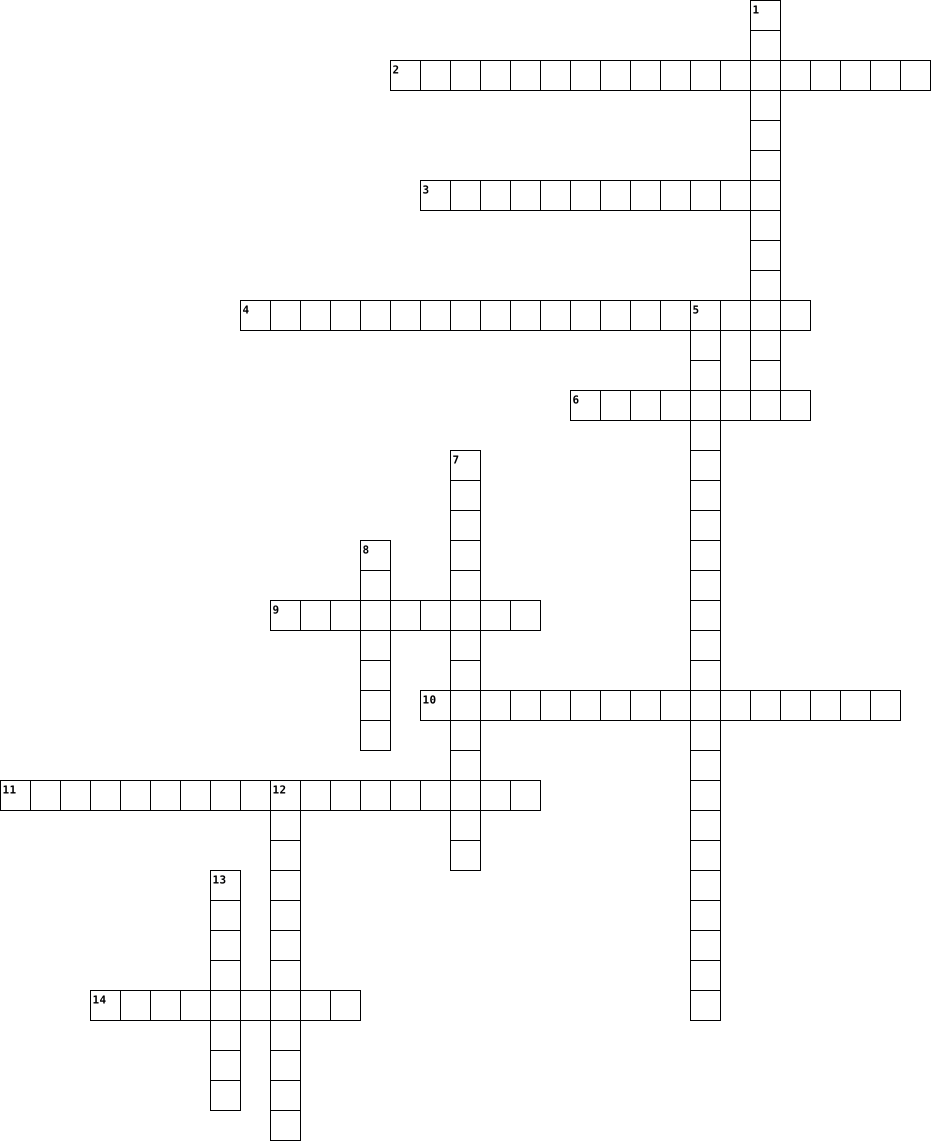
Across
- admitted missouri as a slave state and maine as a non-slave state, keeping the number of slave and free states equal. At 36-30 line, slavery was permitted below the line and would not be permitted above the line
- greater loyalty to your own section rather than the country as a whole.
- required all citizens to help catch runaway slaves.
- Kansas The first fighting over the slavery issue took place in Kansas. In 1854, the government passed the Kansas-Nebraska Act allowing the residents of Kansas to vote on whether they would be a slave state or a free state. The region was flooded with supporters from both sides. They fought over the issue for years. Several people were killed in small skirmishes giving the confrontation the name Bleeding Kansas. Eventually Kansas entered the Union as a free state in 1861.
- As the United States continued to expand westward, each new state added to the country shifted the power between the North and the South. Southern states began to fear they would lose so much power that they would lose all their rights. Each new state became a battleground between the two sides for power.
- willnot provise, suggested all lands from mexico cession had no slaves. California free state, fugitive slave law, texas border established, no slave trade in W.DC, Nm and UT could vote.
- northern abolitionist, launched a slave revolt in 1859 he seized weapons from harpers ferry, virginia. Uprising was quickly crushed, brown was tired and executed.
- When Lincoln was elected, many of the southern states decided they no longer wanted to be a part of the United States. They felt that they had every right to leave. Starting with South Carolina, eleven states would eventually leave the United States and form a new country called the Confederate States of America. Abraham Lincoln said they did not have the right to leave the United States and sent in troops to force the Southern states to rejoin the Union. The Civil War had begun.
Down
- The final straw for the South was election of Abraham Lincoln to President of the United States. Abraham Lincoln was a member of the new anti-slavery Republican Party. He managed to get elected without even being on the ballot in ten of the southern states. The southern states felt that Lincoln was against slavery and also against the South.
- he sued his master for his freedom. The supreme court ruled slaves were not legal citizens and could not bring court cases before the supreme court. They said the declaration of independence did not apply to slavery.
- Abraham Licoln became the 16th president campaigning on a platform opposing the spread of slavery.
- condition in which one human being was owned by another. A slave was considered by law as property, or chattel,and was deprived of most of the rights ordinarily held by free persons.
- The idea of states' rights was not new to the Civil War. Since the Constitution was first written there had been arguments about how much power the states should have versus how much power the federal government should have. The southern states felt that the federal government was taking away their rights and powers.
- In the mid-1800s, the economies of many northern states had moved away from farming to industry. A lot of people in the North worked and lived in large cities like New York, Philadelphia, and Boston. The southern states, however, had maintained a large farming economy and this economy was based on slave labor. While the North no longer needed slaves, the South relied heavily upon slaves for their way of life.
14 Clues: required all citizens to help catch runaway slaves. • greater loyalty to your own section rather than the country as a whole. • Abraham Licoln became the 16th president campaigning on a platform opposing the spread of slavery. • ...
Reconstruction 2023-05-17

Across
- These people wanted a better approach to Reconstruction.
- Period of time after the Civil War where the states wanted to rebuild its society.
- General of the Confederate Army.
- This states that if you were born in the U.S. you were a citizen and have the same rights as a citizen.
- U.S. President at the time.
- People tortured African Americans by hanging them. This was called _______.
- This is when one human being was owned by another and was forced to work..
- This was 3 requirements a state had to make in order to rejoin the Union.
Down
- Laws that were passed to free newly freed African Americans.
- Northerners who traveled south to "help" with Reconstruction, but really wanted to scam them.
- This was created to assist African Americans adjust to their life after being a slave.
- These laws divided the former Confederate states into five military sections.
- Abolished slavery in the United States.
- The amendment that granted African American men the right to vote.
- 10% of the voters within the Confederate states swear allegiance to the Union.
- Dishonest or illegal actions.
- African Americans and white people were separated. This was called _________.
- General of the Union Army.
- Southerners who supported the north during the civil war.
- The forgiveness of any crime committed.
20 Clues: General of the Union Army. • U.S. President at the time. • Dishonest or illegal actions. • General of the Confederate Army. • Abolished slavery in the United States. • The forgiveness of any crime committed. • These people wanted a better approach to Reconstruction. • Southerners who supported the north during the civil war. • ...
Capitals and NHL somewhat advanced Trivia 2016-07-09

Across
- an idea we do not agree with or whatever Luke wrote
- Ted's ladies
- name of new Quebec arena
- knee on knee with Ovi
- bears goalie
- caps first playoff loss vs
- not related to any of us
- interviews like costanza
- signed 4 year ext in Winnipeg
- ex-cap won cup in Det/Pit
- cap killer in Pitt Car Phil Atl TB Bos Mont
- number of teams in division
- caps expansion cousins
- "three-or-more"
- franchise first draft pick
- hard working Jacket
- draft to stock vegas
- 2017 UFA
- Ovi fiance
- oh oh Joe ____ est.2010
- Auston's team
Down
- ward's OT victims
- Islander legend
- gretzky's assist
- caps forward in 1990s
- domicile du habitants
- number of cups NJ won
- signed 7 yr $44M deal in denver
- Trotz last AHL job
- paralyzer
- philly ghost
- traded to get Laich
- ex-cap NHL hall of famer
- ovi was ambassador
- league in Russia
- learn Craig's way
- ECHL affliate
- what ward was in game 5 vs NYR
- an 80's caps netminder
- location of the old cap center
- George's son
- secretary of defence
- panther stopper
- brouwer rangers new team
- Latta's game night diet (usually)
45 Clues: 2017 UFA • paralyzer • Ovi fiance • Ted's ladies • philly ghost • bears goalie • George's son • ECHL affliate • Auston's team • Islander legend • "three-or-more" • panther stopper • gretzky's assist • league in Russia • ward's OT victims • learn Craig's way • Trotz last AHL job • ovi was ambassador • traded to get Laich • hard working Jacket • secretary of defence • draft to stock vegas • caps forward in 1990s • ...
Spanish Countries and their capitals Crossword 2017-05-22

Across
- Planet in spanish is ______.
- la capital de Peru es ______.
- la capital de Honduras es ______.
- la capital de Espana es ______.
- la capital de República Dominicana es ______.
- la capital de Puerto Rico es ______.
- la capital de Ecuador es ______.
- la capital de Columbia es ______.
- la capital de Costa Rica es ______.
- la capital de Panama es ______.
- la capital de Chile es ______.
- country in spanish is ______.
Down
- la capital de Guatemala es ______.
- la capital de Nicaragua es ______.
- la capital de Cuba es ______.
- la capital de Paraguay es ______.
- la capital de Bolivia es ______.
- la capital de Mexico es _______.
- la capital de Uruguay es ______.
- Continent in spanish is ______.
- la capital de Salvador es ______.
- Capital in spanish is ______.
- Aries la capital de Argentina es ______.
- la capital de Venezuela es ______.
- la capital de Guinea Ecuatorial es ______.
25 Clues: Planet in spanish is ______. • la capital de Peru es ______. • la capital de Cuba es ______. • Capital in spanish is ______. • country in spanish is ______. • la capital de Chile es ______. • la capital de Espana es ______. • Continent in spanish is ______. • la capital de Panama es ______. • la capital de Bolivia es ______. • la capital de Mexico es _______. • ...
Countries and Capitals of the World 2022-03-05

Across
- Kigali
- Luxembourg
- Conakry
- Dublin
- La Paz (administrative), Sucre (official)
- Belmopan
- Stockholm
- Thimphu
- Ouagadougou
- Bishkek
- Maputo
- Mbabane
- Valletta
- Cardiff
- Georgetown
- Helsinki
- Tbilisi
- Vaduz
- Suva
- Phnom Penh
- Port Vila
- San Jose
- Amman
- Algiers
- Port Louis
- Bandar Seri Begawan
- Tallinn
- Yerevan
- Budapest
- Ljubljana
- Lisbon
- Bridgetown
- Tunis
- Kingston
- Sofia
- Vientiane
- Bratislava
- Islamabad
- Apia
- Amsterdam
- New Delhi
- N'Djamena
- Havana
- Dodoma
- Dhaka
- Gitega
- Reykjavik
- Libreville
- Tehran
- Tripoli
- Saint George's
- Kuala Lumpur
- Managua
- Mogadishu
- Jerusalem (very limited international recognition)
- Nassau
- Nairobi
- Abuja
- Khartoum
- Gaborone
- Hanoi
- Montevideo
- Port au Prince
- Bamako
- Lome
- Brussels
- City Vatican City
- Porto Novo
- Rome
- Buenos Aires
- Brazzaville
- Muscat
- Kathmandu
- San Salvador
- Kinshasa
- Ngerlmund
- African Republic Bangui
- Chisinau
- Jakarta
- Harare
- Warsaw
- Bogota
- Zagreb
- Vienna
- Bissau
Down
- Copenhagen
- Male
- Baku
- Minsk
- Juba
- Kiev
- Asuncion
- Doha
- Panama City
- Kuwait City
- Nouakchott
- Bucharest
- No official capital
- Ulaanbaatar
- Djibouti
- Tashkent
- Washington D.C.
- Pretoria, Bloemfontein, Cape Town
- Nicosia
- Paris
- Mexico City
- Prague
- Maseru
- Bern
- Caracas
- Beijing
- Lima
- Nay Pyi Taw
- Paramaribo
- Moscow
- Vilnius
- Antananarivo
- Monaco
- Tarawa Atoll
- Madrid
- Athens
- Tirana (Tirane)
- Baghdad
- Riyadh
- Accra
- Sri Jayawardenapura Kotte
- Leone Freetown
- Beirut
- Tegucigalpa
- Banjul
- Lilongwe
- Kabul
- Belgrade
- Dakar
- Manila
- Andorra la Vella
- Asmara
- Sana'a
- Pristina
- Roseau
- Brasilia
- Ottawa
- Tokyo
- Lusaka
- Canberra
- Dushanbe
- Berlin
- Taipei
- Edinburgh
- Bangkok
- Guatemala City
- Santiago
- Monrovia
- London
- Kampala
- Yaounde
- Addis Ababa
- Rabat
- Ankara
- Quito
- Luanda
- Niamey
- Windhoek
- Cairo
- Damascus
- Riga
- Nuku'alofa
167 Clues: Male • Baku • Juba • Kiev • Doha • Bern • Lima • Suva • Apia • Lome • Rome • Riga • Minsk • Paris • Vaduz • Amman • Accra • Tunis • Sofia • Kabul • Dakar • Dhaka • Tokyo • Abuja • Hanoi • Rabat • Quito • Cairo • Kigali • Dublin • Maputo • Prague • Maseru • Moscow • Monaco • Madrid • Athens • Riyadh • Lisbon • Beirut • Banjul • Manila • Havana • Dodoma • Asmara • Gitega • Sana'a • Roseau • Ottawa • Tehran • Lusaka • Nassau • Berlin • Taipei • London • Bamako • Ankara • Luanda • Niamey • Muscat • Harare • Warsaw • Bogota • Zagreb • Vienna • ...
Latin American Countries and their Capitals 2024-05-08

Across
- Capital of Russia
- Capital of Panama
- Capital of Argentina
- Capital of Japan
- Capital of Nicaragua
- Capital of El Salvador
- Capital of Kazakhstan
- Capital of Egypt
- Capital of Colombia
Down
- Capital of Brazil
- Capital of Nigeria
- Capital of Equador
- Capital of Chile
- Capital of Guatemala
- Capital of China
- Capital of Peru
- Capital of Venezuela
- Capital of France
- Capital of Costa Rica
- Capital of Spain
20 Clues: Capital of Peru • Capital of Chile • Capital of China • Capital of Japan • Capital of Egypt • Capital of Spain • Capital of Brazil • Capital of Russia • Capital of Panama • Capital of France • Capital of Nigeria • Capital of Equador • Capital of Colombia • Capital of Guatemala • Capital of Argentina • Capital of Venezuela • Capital of Nicaragua • Capital of Costa Rica • Capital of Kazakhstan • ...
Spanish speaking countries, capitals and nationalities 2025-09-12

Across
- Which Spanish speaking country has two capitals?
- This is the capital of Uruguay
- Caracas is my capital city
- Whose capital is Guatemala City
- Republic, Whose capital is Santo Domingo
- This is the capital of Paraguay
- Rican, What is the nationality of people from Puerto Rico
- City, This is the capital of Panama
- Guinea, Malabo is my capital city
- What is the capital of Chile
- My name means "The Savior"
- Whose capital city is Managua
- This is where you can find the most Spanish speaking countries
- Aires, The capital of Argentina is
Down
- What Spanish-speaking country is in North America?
- If you are from El Salvador your nationality is
- What is the capital of Ecuador?
- Rica, Whose capital is San Jose
- What is the capital of Honduras
- where did Spanish originate?
- What is your nationality if you are from Colombia?
- This is where Spain is located
- This is where Cuba, Puerto Rico and D.R. are located
- This is the capital of Cuba
- Lima is my capital
25 Clues: Lima is my capital • Caracas is my capital city • My name means "The Savior" • This is the capital of Cuba • where did Spanish originate? • What is the capital of Chile • Whose capital city is Managua • This is the capital of Uruguay • This is where Spain is located • What is the capital of Ecuador? • Rica, Whose capital is San Jose • Whose capital is Guatemala City • ...
8th US Benchmark 2 Crossword Review 2021-03-17

Across
- This amendment protects against unreasonable searches and seizures.
- Tunnels basted through mountains, bridges built across rivers, hills leveled and valley filled, these environmental modifications were made in order to construct the _____________ railroad.
- The creation of Congress to carry out the will of the people represents this constitutional principle.
- One result of industrialization in the United States was that _________ differences increased.
- ____________ became a widespread practice in the U.S. because of the need for agricultural labor increased as a result of expanded cotton production.
- This constitutional principle explains how powers are divided between the national government and the state government.
- This document guarantees protection of your rights, like the right of protection against excessive bail and cruel punishment.
- Slavery expanded into new acquired territories after this invention made processing cotton faster and growing cotton more profitable.
- Thomas Jefferson and Alexander Hamilton were the leaders of America's first two _______________.
- Irish and German _____________ came to the U.S. to escape starvation from crop failure and see economic opportunity.
- George Washigton wanted the United States to follow a policy of _________ in regards to foreign nations.
- The Whiskey Rebellion, Alien and Sedition Acts, and Marbury v. Madison are all examples of __________ issues faced by the leaders of the new republic.
- The Supreme Court case Marbury v. Madison first stated the principle that the courts may declare a federal law ______________.
Down
- The __________ Ordinance outlined the process for admitting a new state into the Union and also protected civil liberties and outlawed slavery in new territories.
- The purchase of ___________ provided the United States with access to the vast resources of western lands.
- This amendment declares that individual states are given powers not granted to the federal government.
- In this type of economic system there is limited government interference in business, and prices are determined by supply and demand.
- This amendment was created to prevent soldiers from being housed in private homes without the owner’s consent.
- The President vetoing a law passed by congress, then the congress overriding a presidential veto is an example of which Constitutional Principle.
- This was the main crop grown on plantations in the southern United States.
- During the ______ Crisis southern states felt they had the right to overrule and act passed by Congress since the national government is supposed to share power with the states.
- The main reason for the __________ Doctrine was to prevent European intervention in countries near the United States.
- Rights The first ten amendments of the U.S. Constitution are an example of this constitutional principle.
- This principle bestows the right to vote in a democracy and also the civic duty to do so.
- Wahsington stopped this rebellion and showed the country that under the Constitution military action could be used to enforce laws.
- Iron ore, coal, timber, and rivers are examples of the abundant _________ that helped the United States become a major industrial power in the early 19th century.
- The formation of political parties in the U.S. can be traced back to a disagreement over whether congress should create a ______________ and raise tariffs.
- This occurred when workers moved closer to manufacturing centers after the development of the factory system.
- Northern manufacturers increased their production of textiles, which could not be imported from England during the _____________.
- One effect of the Fugitive Slave Act of 1850 was that ___________ among the populations of northern and southern states increased.
- One of the most significant contributions to the industrial development in the Northeast was the construction of the _____ canal.
31 Clues: This amendment protects against unreasonable searches and seizures. • This was the main crop grown on plantations in the southern United States. • This principle bestows the right to vote in a democracy and also the civic duty to do so. • One result of industrialization in the United States was that _________ differences increased. • ...
Vocabulary definition 2018-02-09

Across
- the artificial waterway opened in 1825, linking Lake Erie to the Hudson River
- the 1800s belief that Americans had the right to spread across the continent
- the forced migration by the Cherokee and other Native American groups from their southeastern homelands to territories west of the Mississippi River
- the first federally funded national road project, begun in 1811
- an 1848 treaty in which Mexico gave up California and New Mexico Territory to the United States for $15 million
- Stephen Austin (1793–1836), often referred to as the “Father of Texas,” founded the first colony of U.S. settlers in Mexican Texas. Born in Virginia, he spent most of his life on the frontier, living in the Missouri and Arkansas territories before moving to Texas.
- Brigham Young (1801–1877) supervised the Mormon migration to Utah beginning in the 1840s. He was the first governor of Utah when it became a U.S. territory.
- the practice of giving supporters government jobs
- to give up
- to add on or take over
- Sam Houston (1793–1863), a soldier, lawyer, and politician, was instrumental in Texan independence and its subsequent annexation by the United States. He was born and grew up on a farm in Tennessee. In his teens, he ran away and lived with the Cherokee for three years.
Down
- the route to Santa Fe, New Mexico, that was used by traders in the 1800s
- William Henry Harrison (1773–1841) was the ninth President of the United States. In 1841, he died of pneumonia after only a month in office.
- the right of state to limit the power of the local government.
- James Polk (1795–1849) was the eleventh President of the United States, serving from 1845-1849. He led the expansion of the United States to the Pacific Coast through the acquisition of the Oregon Territory and the Mexican Cession.
- a term to describe one of more than 80,000 people who joined the California Gold Rush in 1849
- an 1836 battle between Texans and Mexicans during the Texas war for independence from Mexico
- a strip of land in present-day Arizona and New Mexico for which the United States paid Mexico $10 million in 1853
- John Quincy Adams (1767–1848) was the sixth President of the United States who earlier served as a U.S. diplomat, senator, and Secretary of State.
- a law passed by Congress in 1830 setting up territories west of the Mississippi River where Native Americans living in existing states could be relocated
- an act passed by South Carolina that declared that the Tariff of 1832 unconstitutional
- an old Spanish mission building in Texas where Mexican forces under Santa Anna besieged Texans in 1836
- a U.S. political party active between 1832 and 1858 that backed government support for the economy
- a U.S. political party dating from the 1820s to the present that at first spoke out for small farmers and workers against moneyed businessmen and whose policies have changed over the years
- the right to vote
- the Mexican territories of California and New Mexico given to the United States in 1848
- John C. Calhoun (1782–1850) was a leading member of the House of Representatives for South Carolina under Presidents Madison and Monroe who spoke for the interests of the South, and who later served as Vice President and U.S. senator.
- John Quincy Adams (1767–1848) was the sixth President of the United States who earlier served as a U.S. diplomat, senator, and Secretary of State.
- John Tyler (1790–1862) was the tenth President of the United States, serving from 1841-1845. He accomplished little during his presidency due to quarrels between Whigs and Democrats.
- the route to the Oregon Country used by wagon trains in the 1800s
- a trapper who explored and hunted in the American West in the early 1800s
31 Clues: to give up • the right to vote • to add on or take over • the practice of giving supporters government jobs • the right of state to limit the power of the local government. • the first federally funded national road project, begun in 1811 • the route to the Oregon Country used by wagon trains in the 1800s • ...
4.2 Crossword 2024-05-01

Across
- The 15th _______________ was signed into law to protect the right to vote for all citizens regardless of race, color, or previous condition of servitude. This mainly protected African-American citizens from discrimination.
- After the Civil War, many states in the south implemented discriminatory laws to suppress African-American citizens from voting and to keep white and black people segregated. (Two words)
- The political group which opposed Lincoln's Ten Percent Plan and created the Reconstruction Acts for the South's re-admittance to the Union was the ___________ _____________. (Two words)
- One of the ways former Confederate states attempted to reduce the number of African-American men from voting was to introduce a ________ _________ and charge citizens a fee to vote. (Two words)
- The period after the Civil War in which Southern states were rebuilt & brought back into the Union as the federal government addressed the impact of slavery was called __________________.
- After trying to suppress Reconstruction plans, Radical Republicans
- In the Election of 1868, former Union general Ulysses ___________ ran as a Republican who supported Reconstruction and extending rights to former slaves.
- After the Civil War ended, former Confederate states had to be readmitted to the Union and were placed under _______________ control for several years.
- One of the biggest impacts of Reconstruction was that African-Americans were now able to ________ and take part in the political process.
Down
- President Lincoln and Congress created the ___________ ____________ to provide and protect many rights and services intended for formerly enslaved African-Americans. (Two words)
- The 14th Amendment was signed into law to protect the earlier legislation of the _________ _________ Act of 1866. (Two words)
- Besides the poll tax, southern states also began forcing citizens to pass a __________ test in order to vote, but exempted anyone whose father or grandfather could vote on January 1st, 1867 -- making the law only apply to African-Americans.
- People in the former Confederate states viewed Northerners that came South to profit as unwelcomed and referred to them as _______________.
- The 13th Amendment abolished all forms of __________ in the United States, except as a punishment for a crime.
- In his Second __________ Address, President Lincoln called for the nation to begin healing the wounds and division and that the former Confederate states should be treated with both kindness and weakness.
- The Supreme Court ruled in __________ v. United States that "Grandfather Clauses" used to suppress African-American voters was unconstitutional.
- After the Civil War, much of the former Confederate leadership retained their political power and immediately began passing laws to trap former slaves in a system that limited their rights and freedoms. These became known as _______ ________. (Two words)
- Southern Democrats could not believe that any white southerner would vote for Republican candidates and would call them a ____________ if they did, which meant they were a traitor to the South.
18 Clues: After trying to suppress Reconstruction plans, Radical Republicans • The 13th Amendment abolished all forms of __________ in the United States, except as a punishment for a crime. • The 14th Amendment was signed into law to protect the earlier legislation of the _________ _________ Act of 1866. (Two words) • ...
Constitution 2025-03-04

Across
- happened in Philadelphia, PA 1787 to discuss the failure of the articles of confederation
- the number of state representatives in this house is based on population
- a set of rules that establish the fundamental principles of a government
- wanted equal votes among states regardless of size
- the introduction to the constitution that explains its purpose
Down
- branch of government led by President of the United States and their job is to enforce the laws
- branch of government led by the supreme court and their job is to interpret the Constitution
- two houses were created one by population and one with equal number to establish a balance between NJ and VA Plan
- It gave the power to the states, preventing a strong central government
- all states get two representative in this house
- branch of government led by House of Representatives and the Senate and their job is to create the laws
- wanted different number of votes depending on size of state
- main body of the constitution
- the first ten amendments of the constitution
- Felt that the Constitution was taking rights away from the people
- For every 5 slaves, 3 of them would be counted in the population
- Allows the three branches to check on each other and make sure that no branch is gaining too much power
- Nine out of thirteen states needed to ? the Constitution in order for it to replace the Articles of Confederation
- Wanted a strong national government
19 Clues: main body of the constitution • Wanted a strong national government • the first ten amendments of the constitution • all states get two representative in this house • wanted equal votes among states regardless of size • wanted different number of votes depending on size of state • the introduction to the constitution that explains its purpose • ...
Unit 3 Review 2026-04-15

Across
- This group of people wanted Americans to vote against the Constitution and keep power in the state governments.
- The Constitution guards against tyranny by creating three different branches in the government.
- The _____ to the Constitution lists the purposes of government and who the government's power comes from.
- Passed by President Adams, the _____ Act made it much more difficult for immigrants to the United States to become citizens.
- This branch of the government is the one that creates the nation's laws.
- The _____ Compromise created a bicameral (two house) legislature, with one house having representation based on population and the other based on equality for all states.
- This Massachusetts farmer led a rebellion that showed people the federal government under the Articles of Confederation was too weak.
- Under Tennessee's first state constitution in 1796, all voters had to own this.
- This General in the Continental Army also served as the President of the Constitutional Convention.
- This branch of the government is the one that carries the laws out.
- The Northwest Ordinance helped the U.S. expand by creating a way for the U.S. to make new _____.
- Tennessee's 1796 state constitution was unique because while voters did have to be men, they did not have to be _____.
- In the United States, the government's power comes from this.
- The _____ Rebellion under Washington's Presidency proved the Constitution had enough power to enforce the government's laws.
- The Constitution guards tyranny in this way, splitting powers between the state and federal governments.
- This branch of the government is the one that interprets the laws and makes sure they follow the Constitution.
- This man was known as the "Father of the Constitution" because he wrote most of the document.
- The President's advisors, and a precedent set by George Washington for other Presidents to follow.
- The Constitution guards against tyranny by giving each branch a way to limit the power of the others.
Down
- Washington's Vice President and the second President of the United States.
- The first government of the United States was set up under this document.
- The _____ _____ Plan (ugh) wanted representation to be equal for all states, regardless of their population.
- This was the main issue debated at the Constitutional Convention, with debates between large and small states as well as northern and southern states.
- The Northwest Ordinance contributed to sectionalism by banning this in the Northwest Territory.
- This group of people wanted Americans to approve of the Constitution and increase the federal government's power.
- The _____ Plan wanted representation to be based on population, with bigger states getting more representatives.
- Washington's _____ Address laid out many of the hopes and goals he had for the new nation.
- Almost starting a war with France, the _____ Affair was one of the biggest controversies of Adams' Presidency.
- The number of terms served by George Washington, setting a precedent for future Presidents.
- Passed by President Adams, the _____ Act made it illegal to say anything negative about the President or the government.
- The _____ Compromise stated that for every 5 non-white inhabitants of a state, 3 would count towards the population of that state.
- The Land Ordinance of 1785 made every new town include a school, helping to spread _____.
- These first 10 amendments to the Constitution protect many of the rights Americans enjoy today.
- Sometimes referred to as the Lost State, this state would have been the first new state created in the U.S. but got denied.
34 Clues: In the United States, the government's power comes from this. • This branch of the government is the one that carries the laws out. • This branch of the government is the one that creates the nation's laws. • The first government of the United States was set up under this document. • Washington's Vice President and the second President of the United States. • ...
Civil War Georgia 2019-01-14

Across
- of 1850 Allowed California to enter as free and divided territories won in the Mexican War to Utah and New Mexico. No decision on slavery
- War the social economic and constitutional disagreement between the North and the South
- Plan The Northern plan that was meant to strangle the South and cut off trade with other countries
- The blocking of Southern ports from trading
- Davis President of the Confederacy
- Person who supports abolition
- Brown Northern abolitionist who led the raid on Harpers Ferry
- to end slavery
- Lincoln 16th President of the United States. His election in 1860 caused the Southern States to secede from Union
- Platform stated that Georgia would remain in the Union as long as the Fugitive Slave Act would be enforced
- before war
- Slave Act stated that any slave escaping from slavery had to be returned to its owner
- Ferry located in Virginia, Brown hoped attack would rally slaves to revolte against their masters
Down
- Sovereignty Allowed people in certain areas to decide whether they wanted slavery or not
- States of America The country that the succeeding states formed
- Proclamation Document that Lincoln used to free the slaves in the Southern states
- Compromise The agreement that allowed Missouri to enter as a slave state and Maine as a free state. It was meant to keep the balance of free and slave state
- Rights Where the state has the right to decide on a particular issue
- Proviso Law that would forbid the expansion of slavery in western territories won from Mexico
- gold rush gold discovery in 1849. Prompting the debate of slavery in Union
- loyal to a certain part or region of the country
- To break away from the Union
- Stephens popular polition from Georgia, became the Vice President of the Confederacy.
- to say its not valid
24 Clues: before war • to end slavery • to say its not valid • To break away from the Union • Person who supports abolition • Davis President of the Confederacy • The blocking of Southern ports from trading • loyal to a certain part or region of the country • Brown Northern abolitionist who led the raid on Harpers Ferry • ...
Civil War and Reconstruction (1820-1877) 2022-10-04

Across
- The ________ of Office Act was broken by Andrew Johnson when he fired Edwin Stanton.
- Republicans who pushed to end slavery and punish the South for the Civil War were called ________ Republicans.
- The action of separating people, especially based on race.
- Name of the Railroad that linked the East and West of the United States, completed in 1869.
- Derogatory term for people from the North who arrived in the South to recover the South.
- A compromise reached in 1820 to keep slave and nonslave states equal in the Senate.
- Term for a freedman who enters into a farming deal with former owner to work the land and divide the harvest
- This group was founded on white supremacy and committed acts of violence against African Americans following the Civil War.
- Loyalty felt by many Americans to their region of the country, rather than the country as a whole.
Down
- The admission of California as a free state coupled with stronger slave laws made up the ________ of 1850.
- Violence between abolitionists and pro-slavery Southerners in Kansas led to the nickname "________" Kansas.
- Constitutional amendment that prohibited slavery throughout the United States.
- An emancipated slave.
- Just after the Civil War, _______ _______ were written by Southern states to prevent freedmen from having the same rights as whites.
- Lincoln's __________ Proclamation declared that slaves in states in rebellion would be free in January 1863.
- Constitutional amendment that prohibits denial of voting rights on the basis of race.
- The action of formally withdrawing from membership in the United States.
- These tests were given to African Americans after the Fifteenth Amendment in order to limit black voting rights.
- The first American president to be impeached by Congress.
- The Freedmen's _________ was designed to provide newly freed slaves with legal protection and education during the Reconstruction period.
- Bill that prohibited discrimination based on race, the __________ act of 1866.
- Republican who won the 1860 presidential election.
- A Southern white who supported Reconstruction.
23 Clues: An emancipated slave. • A Southern white who supported Reconstruction. • Republican who won the 1860 presidential election. • The first American president to be impeached by Congress. • The action of separating people, especially based on race. • The action of formally withdrawing from membership in the United States. • ...
Colonial Era through the US Constitution 2023-11-30

Across
- Allows Congress to pass legislation
- This was a British tax on paper goods
- Law signed under the Articles of Confederation that prohibited slavery in the Ohio River Valley region
- The official term for a legislative branch that has two chambers
- This clause found in Article VI. Section 2 of the US Constitution makes clear that the US government is higher than state governments
- This amendment allows states legislate on topics that the federal government has not already regulated
- Found in the 12th Amendment, this is not popular vote is how the president is elected in the United States
- Name of pamphlet published the same year as the Declaration of Independence to convince colonists reasons to separate from Britain
- This group argued for a strong central government and did not believe the Bill of Rights was necessary to include in the US Constitution
- Gives legislative power to Congress
- This compromise between the north and south enhancing the population of the southern states by counting enslaved people as part of it
- Allowed for the importation of enslaved people until the year, 1808
Down
- Advocated for more states rights
- Rebellion that occurred in the state of Virginia over farmers wanting more land and protesting taxes
- Taken every decade and used to determine the number of representatives each state can send to Congress
- corrects this weakness of the Articles of Confederation and allows Congress to tax the states
- A trade regulation stipulating that colonies can only trade within the empire
- the first ten amendments that were added as part of the Constitution
- This compromise was made between the states of Virginia and New Jersey creating a bicameral legislature
- American delegates met in Philadelphia to revise the weaknesses of the Articles of Confederation
- Some argue this war was started by Washington and his Ohio Company
21 Clues: Advocated for more states rights • Allows Congress to pass legislation • Gives legislative power to Congress • This was a British tax on paper goods • The official term for a legislative branch that has two chambers • Some argue this war was started by Washington and his Ohio Company • Allowed for the importation of enslaved people until the year, 1808 • ...
US History Catch UP - Colonial Era 2024-01-30

Across
- Allows Congress to pass legislation
- This was a British tax on paper goods
- Law signed under the Articles of Confederation that prohibited slavery in the Ohio River Valley region
- The official term for a legislative branch that has two chambers
- This clause found in Article VI. Section 2 of the US Constitution makes clear that the US government is higher than state governments
- This amendment allows states legislate on topics that the federal government has not already regulated
- Found in the 12th Amendment, this is not popular vote is how the president is elected in the United States
- Name of pamphlet published the same year as the Declaration of Independence to convince colonists reasons to separate from Britain
- This group argued for a strong central government and did not believe the Bill of Rights was necessary to include in the US Constitution
- Gives legislative power to Congress
- This compromise between the north and south enhancing the population of the southern states by counting enslaved people as part of it
- Allowed for the importation of enslaved people until the year, 1808
Down
- Advocated for more states rights
- Rebellion that occurred in Virginia colony over farmers wanting more land and protesting taxes
- Taken every decade and used to determine the number of representatives each state can send to Congress
- corrects this weakness of the Articles of Confederation and allows Congress to tax the states
- A trade regulation stipulating that colonies can only trade within the empire
- the first ten amendments that were added as part of the Constitution
- This compromise was made between the states of Virginia and New Jersey creating a bicameral legislature
- American delegates met in Philadelphia to revise the weaknesses of the Articles of Confederation
- Some argue this war was started by Washington and his Ohio Company
21 Clues: Advocated for more states rights • Allows Congress to pass legislation • Gives legislative power to Congress • This was a British tax on paper goods • The official term for a legislative branch that has two chambers • Some argue this war was started by Washington and his Ohio Company • Allowed for the importation of enslaved people until the year, 1808 • ...
Module 8 Vocabulary 2023-02-16

Across
- stated that the United States would not take sides with any European countries that were at war
- Agreement in which Spain gave up all of Florida to the United States
- the vice president of George Washington.
- the treaty that forced the Creek nation to give up millions of acres of their land
- the power of a court to determine the constitutionally of a governmental action
- from france
- United States commodore who led the fleet that defeated the British on Lake Erie during the War of 1812
- 1817 agreement that limited American and British naval forces on the Great Lakes
- warship which defeated the British warship guerrine in 1812 called "old ironsides"
Down
- the first president.
- "Legalized pirates," more than a thousand strong, who inflicted heavy damage on British shipping
- Battle where a Naval force led by Oliver Hazard Perry defeated the British and secured Lake Erie
- the territory the united states
- "Father of the Constitution," Federalist leader, and fourth President of the United States.
- a case that needed the supreme court and judicial review
- an offical ban on trade other on commercial activity with a particular country
- the woman who helped lewis and clark with geography
- 1803
18 Clues: 1803 • from france • the first president. • the territory the united states • the vice president of George Washington. • the woman who helped lewis and clark with geography • a case that needed the supreme court and judicial review • Agreement in which Spain gave up all of Florida to the United States • ...
Crossword Activity 2020-06-23

Across
- pro slavery states
- freeing of slaves
- outlawed publishing false writings
- believed states should have control
- new powers to deport foreigners
- believed in a central government
- nicknamed "Little Jemmy"
Down
- first president of the US
- the Cavalier
- assumption of state debt
- foreign minister of France
- Thomas Jefferson's plantation
- Washington's retirement speech
- anti slavery states
- John Adams' wife
- the Yankee
- force assembled after tensions with France
- helped shape foreign policy
- confrontation between the US and France
- fight in Weehawken, NJ
20 Clues: the Yankee • the Cavalier • John Adams' wife • freeing of slaves • pro slavery states • anti slavery states • fight in Weehawken, NJ • assumption of state debt • nicknamed "Little Jemmy" • first president of the US • foreign minister of France • helped shape foreign policy • Thomas Jefferson's plantation • Washington's retirement speech • new powers to deport foreigners • ...
chapter 2 History 2021-09-30

Across
- groups of workers who press for better working conditions and member benefits
- most famous conductor
- taking their states out of the Union
- a decree freeing all enslaved persons in states
- withdraw, from the Union
- moderation in the consumption of alcohol
- jackson’s decision formed a new political party
- began following his troops seeking food and shelter
- the Confederate States of America
- the first 10 amendments to the Constitution
- On the journey, known to the Cherokee as the the
- was the idea that the nation was meant to spread to the Pacific
- the wearing down of one side by the other through exhaustion of soldiers and resources
Down
- one of the best senior officers in the United States Army
- banning slavery in the United States
- a Missouri slave who had been taken north to work in free territory for several years
- A key to many African Americans’ escape from the South was the
- the practice of appointing people to government jobs based on party loyalty and support
- became one of the best-known orations in American history
- clear sign from the voters, to end slavery permanently by amending the Constitution
- utting off its food and supplies and bombarding the city until its defenders gave up
- powers not explicitly listed in the Constitution but necessary for the government to do its job
- system to select presidential candidates
- who had escaped from slavery in Maryland
- the individuals who would head Thomas Jefferson and others favored less government interference in the economy
25 Clues: most famous conductor • withdraw, from the Union • the Confederate States of America • banning slavery in the United States • taking their states out of the Union • system to select presidential candidates • who had escaped from slavery in Maryland • moderation in the consumption of alcohol • the first 10 amendments to the Constitution • ...
American History Key Terms & People (Midterm) by Samania Choudhury 2023-12-12

Across
- U.S. general who led troops to capture Villa
- A leading proponent of woman suffrage
- First African American to receive a doctorate degree from Harvard
- Policy of intervening in other countries to protect U.S. business interests
- Mexican rebel
- Roosevelt's 1904 extension of Monroe Doctrine, stating that United States has right to protect its economic interests in South Central America by using military force
- An American nurse who founded the American Red Cross.
Down
- A prosperous businessman who organised War Industries Board
- Inventor who unveiled dramatic invention of telephone in 1876
- Former President of the Confederate States of America from 1862 to 1865
- The 13th president of the United States, serving from 1850 to 1853
- A prominent organiser in the civil rights movement in the United States and the global pan-African movement
- An American statesman and political theorist who served as the seventh vice president of the United States from 1825 to 1832.
- An American statesma and a Founding Father of the United States.
- A channel across Central America between Atlantic and Pacific Oceans opened in 1914
15 Clues: Mexican rebel • A leading proponent of woman suffrage • U.S. general who led troops to capture Villa • An American nurse who founded the American Red Cross. • A prosperous businessman who organised War Industries Board • Inventor who unveiled dramatic invention of telephone in 1876 • An American statesma and a Founding Father of the United States. • ...
Chapter 14 2023-09-15

Across
- Maine, battleship sent to Cuba to aid in the independence efforts that eventually was blown up
- Mans Burden, the alleged duty of white colonizers to care for nonwhite Indigenous subjects in their colonial possessions.
- a territory of the United States gained in 1898
- White Fleet, A group of battleships from the United States that contributed to U.S. imperialism
- Amendment, piece added to the Cuban Constitution to protect American interests
- B Dole, influential businessman in Hawaii that pushed to overthrow the government and establish U.S. control
- Policy, the way a country deals with other countries
- Journalism, exaggerated news stories created to attract and enrage readers
- Constitution, government document created in Hawaii by force
- a territory of the United States gained in 1898
- Riders, volunteer cavalry unit created by T. Roosevelt
- Juan Hill, battle in Cuba that proved to be the greatest victory for the Rough Riders
- country under colonial rule that received aid from the United States
- McKinley, president of the United States during the Spanish American war
- Roosevelt, Deputy Secretary of the Navy and military leader during the Spanish American War
- an organized division of a country that is not yet admitted to the full rights of a state.
- colonial government controlling Cuba
Down
- Folly, the nickname given for the purchase of Alaska by people who did not agree with it
- Rico, a territory of the United States gained in 1898
- the Maine, rallying cry of soldiers during the Spanish-American War
- gaining control over lands and using them to build an empire.
- a country or area under the full or partial political control of another country, typically a distant one, and occupied by settlers from that country
- Queen of Hawaii
- Door Policy, concept that allowed the U.S. and European nations to trade with China during the early 1900s
- The policy that the United States should stay out of other countries problems and issues
25 Clues: Queen of Hawaii • colonial government controlling Cuba • a territory of the United States gained in 1898 • a territory of the United States gained in 1898 • Policy, the way a country deals with other countries • Rico, a territory of the United States gained in 1898 • Riders, volunteer cavalry unit created by T. Roosevelt • ...
APUSH Chapter 20-21 Puzzle Part 2 2021-12-09

Across
- United States Army officer, defeated Robert E. Lee in the Battle of Gettysburg.
- Northern Democrats who obstructed the war effort by attacking Abraham Lincoln.
- A coalition party of pro war Republicans and Democrats to defeat antiwar Northern Democrats.
- Declared all slaves in rebelling states to be free.
- Union Soldier, Unites States Senator
- Constitutional amendment prohibiting all forms of slavery.
- Major General in the Confederate States Army.
- Civil War Union General.
Down
- 18th U.S. president.
- George B. McClellan's failed effort to seize Richmond.
- Assassinated Abraham Lincoln.
- William Tecumseh Sherman's destructive march through Georgia.
- Commander of the Confederate States Army.
- Abraham Lincoln's famous speech delivered at the dedication at the Gettysburg Battlefield.
- Brutal clashes between Ulysses S. Grant's and Robert E. Lee's Armies.
15 Clues: 18th U.S. president. • Civil War Union General. • Assassinated Abraham Lincoln. • Union Soldier, Unites States Senator • Commander of the Confederate States Army. • Major General in the Confederate States Army. • Declared all slaves in rebelling states to be free. • George B. McClellan's failed effort to seize Richmond. • ...
The Great Migration 2024-12-18

Across
- The year The Great Migration took place
- An outbreak of racial violence that occurred in 1919
- The ethnic population that migrated
- work, especially hard physical work.
- The movement of a person or people from one country, locality, place of residence, etc., to settle in another
- One of the States in the United States were they migrated to
- A paid position of regular employment.
- The area of the United States where they migrated from
- One of the states in the United States where they migrated to
Down
- The action or state of setting someone or something apart from others.
- One way of transportation they used to migrate
- Laws that mandated segregation of schools, parks, libraries, drinking fountains, restrooms, buses, trains, and restaurants.
- The area of the United States where they migrated to
- Serious human rights violations, including a threat to life or freedom
- Discrimination and prejudice against people based on their race or ethnicity
15 Clues: The ethnic population that migrated • work, especially hard physical work. • A paid position of regular employment. • The year The Great Migration took place • One way of transportation they used to migrate • An outbreak of racial violence that occurred in 1919 • The area of the United States where they migrated to • ...
Constitution 2025-03-04

Across
- branch of government led by President of the United States and their job is to enforce the laws
- of Representatives the number of state representatives in this house is based on population
- a set of rules that establish the fundamental principles of a government
- Wanted a strong national government
- Felt that the Constitution was taking rights away from the people
- It gave the power to the states, preventing a strong central government
- the introduction to the constitution that explains its purpose
- Compromise, two houses were created one by population and one with equal number to establish a balance between NJ and VA Plan
- wanted equal votes among states regardless of size
- the first ten amendments of the constitution
- convention happened in Philadelphia, PA 1787 to discuss the failure of the articles of confederation
Down
- all states get two representative in this house
- Allows the three branches to check on each other and make sure that no branch is gaining too much power
- wanted different number of votes depending on size of state
- Nine out of thirteen states needed to ? the Constitution in order for it to replace the Articles of Confederation
- branch of government led by House of Representatives and the Senate and their job is to create the laws
- For every 5 slaves 3 of them would be counted in the population
- articles main body of the constitution
- branch of government led by the supreme court and their job is to interpret the Constitution
19 Clues: Wanted a strong national government • articles main body of the constitution • the first ten amendments of the constitution • all states get two representative in this house • wanted equal votes among states regardless of size • wanted different number of votes depending on size of state • the introduction to the constitution that explains its purpose • ...
Properties and States of Matter 2018-02-27

Across
- a change that occurs when one or more substances change into entirely new substances with different properties
- a characteristic of a substance that does not involve a chemical change, such as density, color, or hardness
- homogeneous mixtures whose particles are smaller than the particles in suspensions but larger than particles in solutions and the particles do not settle out
- a homogeneous mixture that appears to be a single substance
- the law that states that mass cannot be created or destroyed in ordinary chemical and physical changes
- heterogeneous mixture with large particles that can separate and settle out
- a substance that cannot be separated or broken down into simpler substances by chemical means
- a pure substance that is composed of molecules that form when two or more kinds of atoms bond
- anything that has mass and takes up space
Down
- a property of matter that describes a substance's ability to participate in chemical reactions
- a change of matter from one form to another without a change in chemical properties
- the state of matter in which the volume and shape of a substance are fixed
- the state of matter that has a definite volume but not a definite shape
- building blocks of matter because they combine with one another to make may different materials
- a state of matter that starts as a gas and then becomes ionized; it consists of free-moving ions and electrons, it takes on an electric charge, and its prperties differ from those of a solid, liquid, or gas
- a form of matter that does not have a definite volume or shape
- matter that contains two or more pure substances
- the amount of force exerted per unit area of a surface
18 Clues: anything that has mass and takes up space • matter that contains two or more pure substances • the amount of force exerted per unit area of a surface • a homogeneous mixture that appears to be a single substance • a form of matter that does not have a definite volume or shape • the state of matter that has a definite volume but not a definite shape • ...
Matter and States of Matter 2020-10-04

Across
- no charge
- only one type of atom
- proton and neutron home
- 29th element
- atoms bouncing all around
- packed extremely tight together
- 5th element
- does not have a fixed shape
- anything with mass that takes up space
- type of plasma
Down
- positive
- Indian physicist
- electron snaps off
- negative
- 11th element
- dry ice
- solid goes directly to a gas
- German physicist
18 Clues: dry ice • positive • negative • no charge • 5th element • 11th element • 29th element • type of plasma • Indian physicist • German physicist • electron snaps off • only one type of atom • proton and neutron home • atoms bouncing all around • does not have a fixed shape • solid goes directly to a gas • packed extremely tight together • anything with mass that takes up space
America and the Law: Trying to Abolish Slavery 2026-01-20

Across
- The Northern states that stayed together and fought to keep the United States united.
- The branch of government that makes the laws, known as Congress.
- ______of Independence, the 1776 document that announced America’s independence from Britain.
- A system where people are owned, controlled, and forced to work without pay.
- To completely end or get rid of something, such as slavery.
- A situation where neither side can win, and nothing moves forward.
- The branch of government that leads the country and enforces laws, including the President.
Down
- _____ Fathers, the group of leaders who helped create the United States and wrote important early documents like the Constitution.
- The national government that makes laws for the whole country.
- Describes an economy based on farming and growing crops.
- The Southern states that broke away from the United States.
- A gap or weakness in a law that allows people to avoid following it fully.
- The branch of government that interprets laws and runs the court system.
- Describes an economy based on factories, machines, and manufacturing.
- A level of government that controls individual territories, such as Texas or New York.
15 Clues: Describes an economy based on farming and growing crops. • The Southern states that broke away from the United States. • To completely end or get rid of something, such as slavery. • The national government that makes laws for the whole country. • The branch of government that makes the laws, known as Congress. • ...
Second Semester Texas History Crossword Puzzle 2021-05-18

Across
- This was transported to northern markets along cattle trails.
- These helped on cattle drives/ trails and had a very difficult job.
- Major cash crop in Texas
- The US _______ War led to the US acquiring the Mexican Cession
- One of the two major political parties in the United States that favors less government involvement and spending.
- Another name for North during the Civil War
- Equal rights organization for African Americans that was established during the Civil Rights Era.
- During the Civil War, Texas sided with the _______ states of America.
- Also called The Great War.
- _________ was the era after the Civil War where southern states were readmitted to the Union.
- Country that existed from 1836-1845.
- Oil was discovered here in 1901.
Down
- Equal rights organization for Hispanic Americans that was established during the Civil Rights Era.
- President of Texas who established the Texas Navy
- First president of Texas.
- Established the Texas Railroad Commission
- The ______ of Texas was a major cause of the US Mexican War.
- The ____________was a conflict between the Northern and Southern States in the US.
- One of the two major political parties in the United States that favors more government involvement and spending.
- The ________ of 1850 finalized the borders of Texas.
- Major conflict between the Allied and Axis powers.
- Transported cattle and were helped regulated by James Hogg.
- Major industry in Texas that experiences a boom and bust cycle.
- Leader of Germany during World War II.
- Immigrant group to Texas that experienced discrimination during the World Wars.
25 Clues: Major cash crop in Texas • First president of Texas. • Also called The Great War. • Oil was discovered here in 1901. • Country that existed from 1836-1845. • Leader of Germany during World War II. • Established the Texas Railroad Commission • Another name for North during the Civil War • President of Texas who established the Texas Navy • ...
Civil War Crossword 2026-04-21

Across
- A tax on earnings
- Rights given to all citizens
- Cash payments
- Northern democrat that favored peace with the South
- This is also known as the draft
- The most famous speech said by Abraham Lincoln
- Slave states that bordered the seceded states or Confederate states
- To formally leave or break away from the Union
Down
- The process the federal government took to readmit the Confederate states to the Union
- The green paper currency that got its name from the color
- Soldiers riding on horseback
- The states that broke away from the Union and formed the…
- Warships covered in iron
- A reformer who supported ending slavery
- When another army cuts off supply of a location their enemy is in and isolates them
15 Clues: Cash payments • A tax on earnings • Warships covered in iron • Rights given to all citizens • Soldiers riding on horseback • This is also known as the draft • A reformer who supported ending slavery • The most famous speech said by Abraham Lincoln • To formally leave or break away from the Union • Northern democrat that favored peace with the South • ...
Unit 2 Vocab 2020-09-08

Across
- locke, among the most famous philosophers and political theorists of the 17th century. He is often regarded as the founder of a school of thought known as British Empiricism, and he made foundational contributions to modern theories of limited, liberal government.
- of rights, the first ten amendments to the US Constitution, ratified in 1791 and guaranteeing such rights as the freedoms of speech, assembly, and worship.
- Branch, executed and enforced laws.
- Ordinance of 1787, adopted July 13, 1787, by the Confederation Congress, chartered a government for the Northwest Territory, provided a method for admitting new states to the Union from the territory, and listed a bill of rights guaranteed in the territory.
- Plan, a plan to place the British North American colonies under a more centralized government
- government in which the power is divided between the national government and other governmental units. It contrasts with a unitary government, in which a central authority holds the power, and a confederation, in which states, for example, are clearly dominant.
- Battle of Saratoga, occurred in September and October, 1777, during the second year of the American Revolution. It included two crucial battles, fought eighteen days apart, and was a decisive victory for the Continental Army and a crucial turning point in the Revolutionary War.
- Paine, English-born American political activist, philosopher, political theorist, and revolutionary.
- and Balances, counterbalancing influences by which an organization or system is regulated, typically those ensuring that political power is not concentrated in the hands of individuals or groups.
- a person who advocates or supports a system of government in which several states unite under a central authority.
- Branch, makes the meanings of the laws
- Rebellion, rebellion in Springfield, Massachusetts to protest what he perceived as the unjust economic policies and political corruption of the Massachusetts state legislature.
- a state in which supreme power is held by the people and their elected representatives, and which has an elected or nominated president rather than a monarch.
- branch, makes laws.
- of 1763, prohibited American colonists from settling west of Appalachian
Down
- a diverse coalition of people who opposed ratification of the Constitution. They believed that the greatest threat to the future of the United States lay in the government's potential to become corrupt and seize more and more power until its tyrannical rule completely dominated the people.
- Compromise, also known as the Connecticut Compromise, or the Sherman Compromise, was an agreement made between large and small states which partly defined the representation each state would have under the United States Constitution, as well as in legislature.
- compromise, agreement between delegates from the Northern and the Southern states at the United States Constitutional Convention (1787) that three-fifths of the slave population would be counted for determining direct taxation and representation in the House of Representatives.
- College, (in the US) a body of people representing the states of the US, who formally cast votes for the election of the president and vice president.
- Ordinance of 1785, established the creation of townships of any size, set aside land for public schools. Under the Articles of Confederation, Congress had the ability to tax. Crated the Wilderness Road.
- the action of signing or giving formal consent to a treaty, contract, or agreement, making it officially valid.
- of confederation - the original constitution of the US, ratified in 1781, which was replaced by the US Constitution in 1789.
- Madison, America's fourth President (1809-1817), made a major contribution to the ratification of the Constitution by writing The Federalist Papers, along with Alexander Hamilton and John Jay. In later years, he was referred to as the “Father of the Constitution.”
- of independence, adopted by the Continental Congress on July 4, 1776, the 13 American colonies severed their political connections to Great Britain. The Declaration summarized the colonists' motivations for seeking independence.
- Plan, proposal to the United States Constitutional Convention for the creation of a supreme national government with three branches and a bicameral legislature. The plan was drafted by James Madison while he waited for a quorum to assemble at the Constitutional Convention of 1787.
- Jersey plan, a proposal for the structure of the U.S. federal government put forward by William Paterson at the Constitutional Convention in 1787. The proposal was a response to the Virginia Plan, which Paterson believed would put too much power in large states to the disadvantage of smaller states
26 Clues: branch, makes laws. • Branch, executed and enforced laws. • Branch, makes the meanings of the laws • of 1763, prohibited American colonists from settling west of Appalachian • Plan, a plan to place the British North American colonies under a more centralized government • ...
4th of July Good Shepherd Puzzle 2025-06-12

Across
- Light show often seen on the 4th of July.
- Doodle Patriotic Song often sung on Independence Day.
- Number of original colonies.
- Red, white, and blue banner.
- Eagle National Bird of the United States.
- George ____ first president of United States.
- Soldiers fight for our ____.
- Color of sky or Sea.
Down
- Someone who loves and supports America.
- Head of the executive branch.
- The 4th of July is ___ Day.
- United States of ____.
- Color of Clouds.
- John ____ was the first vice-president of United States.
14 Clues: Color of Clouds. • Color of sky or Sea. • United States of ____. • The 4th of July is ___ Day. • Number of original colonies. • Red, white, and blue banner. • Soldiers fight for our ____. • Head of the executive branch. • Someone who loves and supports America. • Light show often seen on the 4th of July. • Eagle National Bird of the United States. • ...
Causes of the Civil War 2023-03-14

Across
- This state was admitted to the U.S. under the Compromise of 1850.
- The states that seceded and left the US during the Civil War were these States. They had a partnership and worked together.
- people who were against slavery and tried to put an end to it or help slaves escape.
- States that legalized or permitted slavery. (the South)
- By June of 1860 this was the total number of states that had seceded.
- In 1857 the Supreme Court ruled on a case involving this African American.
- In 1859 this abolitionist led a slave revolt in Harpers Ferry, VA.
Down
- The name given to the states that stayed united and did not secede(break away) during the Civil War.
- The Congressman who proposed the Missouri Compromise.
- This man was elected president in 1860.
- people who did not want slavery to expand into the western states.
- A state that outlawed or banned slavery (the North)
- South Carolina was the first state to do this in 1860.
- The author of the book "Uncle Tom's Cabin."
- Citizens were allowed to do this to decide if their territory would have slaves under the Kansas-Nebraska Act of 1854
- This event started in 1861 and was where the Union fought against the Confederacy.
16 Clues: This man was elected president in 1860. • The author of the book "Uncle Tom's Cabin." • A state that outlawed or banned slavery (the North) • The Congressman who proposed the Missouri Compromise. • South Carolina was the first state to do this in 1860. • States that legalized or permitted slavery. (the South) • ...
Chapter 3: Vocabulary 2023-12-04

Across
- power, power reserved to the state government to regulate the health, safety, and morals of its citizens
- a system of government in which power is divided, by a constitution, between a central government and regional governments
- grants, congressional grants given to states and localities on the condition that expenditures be limited to a problem or group specified by law
- programs through which Congress provides money to state and local governments on the condition that the funds be employed for purposes defined by the federal government
- the principle that allows the national government to override state or local actions in certain policy areas; in foreign policy, the willingness to strike first in order to prevent an enemy attack
- federalism, a type of federalism existing since the New Deal era in which grants-in-aid have been used strategically to encourage states and localities (without commanding them) to pursue nationally defined goals; also known as intergovernmental cooperation
- powers, powers derived from the necessary and proper clause of Article I, Section 8, of the Constitution; such powers are not specifically expressed but are implied through the expansive interpretation of delegated powers
- faith and credit clause, provision from Article IV, Section 1, of the Constitution requiring that the states normally honor the public acts and judicial decisions that take place in another state
- powers, specific powers granted by the Constitution to Congress (Article I, Section 8) and to the president (Article II)
- rule, power delegated by the state to a local unit of government to manage its own affairs
- federalism, the system of government that prevailed in the United States from 1789 to 1937 in which most fundamental governmental powers were shared between the federal and state governments
- and proper clause, Article I, Section 8, of the Constitution, which provides Congress with the authority to make all laws "necessary and proper" to carry out its expressed powers
- rights, the principle that the states should oppose the increasing authority of the national government; this principle was most popular in the period before the Civil War
Down
- relations, the processes by which the three levels of American government (national, state, local) negotiate and compromise over policy responsibility
- system, a centralized government system in which lower levels of government have little power independent of the national government
- clause, Article I, Section 8, of the Constitution, which delegates to Congress the power "to regulate commerce with foreign nations, and among the several States and with the Indian tribes"; this clause was interpreted by the Supreme Court in favor of national power over the economy
- powers, authority possessed by both state and national governments, such as the power to levy taxes
- and immunities clause, provision, from Article IV, Section 2, of the Constitution, that a state cannot discriminate against someone from another state or give its own residents special privileges
- federalism, a form of federalism in which Congress imposes legislation on states and localities, requiring them to meet national standards
- powers, powers, derived from the Tenth Amendment to the Constitution, that are not specifically delegated to the national government or denied to the states
20 Clues: rule, power delegated by the state to a local unit of government to manage its own affairs • powers, authority possessed by both state and national governments, such as the power to levy taxes • power, power reserved to the state government to regulate the health, safety, and morals of its citizens • ...
Emancipation Proclamation Crossword Puzzle 2016-05-14

Across
- Slaves could receive this in order to move from the United States. They could make the decision to move to countries such as Liberia.
- The number of black volunteers who fought with the Union in the Civil War.
- This branch of government enforces our laws.
- This was the president who was in office during the Civil War, on the Union side.
- This race of people were freed from slavery with the Emancipation Proclamation. Many of them helped fight in the Civil War with the Union.
- The month and year when the 13th Amendment was ratified.
- Lincoln passed this bill that proposed that all slaves in states or territories should be free.
- The name of the war that was started to keep all states in the Union and eventually abolished slavery.
- The month and year Lincoln abolished slavery in Washington DC.
Down
- Britain continued to buy this popular crop from the Confederate States of America while the Civil War was being fought.
- When this bureau was established, it allowed blacks to fight with the Union Army during the Civil War.
- The capital of the Union, where slavery was first prohibited.
- The month and year that Lincoln prohibited slavery in the Union states and territories.
- The month and year that Lincoln prohibited slavery in the rebellious states and territories.
- The group of people who were angry about the Emancipation Proclamation, because the Civil War was originally meant to keep the Union together, not to free slaves.
- The amendment that was passed that eventually gave slaves their freedom.
- An early device that used electric signals to send messages across long distances invented by Samuel Morse.
- The advisors of the President who help him make decisions.
- The Secretary of the Navy during the time of the Emancipation Proclamation (1862).
- The government institution that passed the Emancipation Proclamation that Lincoln proposed.
20 Clues: This branch of government enforces our laws. • The month and year when the 13th Amendment was ratified. • The advisors of the President who help him make decisions. • The capital of the Union, where slavery was first prohibited. • The month and year Lincoln abolished slavery in Washington DC. • ...
Civil War Crossword 2025-04-01

Across
- The act of leaving the Union, claimed as a right by Southern states.
- Lincoln issued this proclamation in 1863 to free enslaved people in Confederate states.
- Lincoln described this as “government of the people, by the people, for the people.”
- Term for formerly enslaved individuals who sought rights and opportunities after the war.
- The political party of Abraham Lincoln, which opposed the expansion of slavery.
- President of the United States who led the Union during the Civil War.
- The Northern government led by Abraham Lincoln during the Civil War.
- Commander of the Confederate Army of Northern Virginia.
- Abolitionist and former enslaved man who advised Lincoln and advocated for Black soldiers.
- Union general who later became the 18th President of the United States.
- Last name of the president of the Confederate States of America.
- The period after the Civil War focused on rebuilding the South and integrating freed slaves.
Down
- Turning point battle in Pennsylvania was fought in July 1863.
- Union victory in Mississippi that gave control of the Mississippi River.
- The government formed by Southern states that seceded from the Union.
- Nickname for Northerners who moved South after the war, often seen as opportunists.
- Lincoln warned that this “divided against itself cannot stand.”
- Crow – Laws that enforced racial segregation in the South after Reconstruction.
- Lincoln believed preserving this was the primary goal of the Civil War.
- The first major battle of the Civil War, also called Manassas.
- The 13th, 14th, and 15th of these granted rights to formerly enslaved people.
- A core belief of Lincoln, who stated, “Those who deny freedom to others deserve it not for themselves.”
- The bloodiest single-day battle of the Civil War, was fought in Maryland.
- A bloody battle in Tennessee that showed the war would be long and costly.
- Former enslaved woman who helped free others and served as a Union spy.
25 Clues: Commander of the Confederate Army of Northern Virginia. • Turning point battle in Pennsylvania was fought in July 1863. • The first major battle of the Civil War, also called Manassas. • Lincoln warned that this “divided against itself cannot stand.” • Last name of the president of the Confederate States of America. • ...
The Iron Curtain 2024-05-10

Across
- A state of armed conflict between different nations or states or different groups within a nation or state.
- A place that was part of the cold war.
- To keep someone in one place.
- An alliance during the cold war.
- A serious disagreement or argument.
- An economic system based on private ownership.
- A Western European country with a landscape of forests, rivers, mountain ranges and North Sea beaches.
- A term used by Winston Churchill in a speech to describe the growing divide between western democracies and Soviet-influenced states.
Down
- A softening or easing of relations between the United States and the Soviet Union.
- purposefully escalated a dangerous situation.
- An economic system based on government ownership and control of resources.
- The whole number of people or inhabitants in a country or region.
- A country that was apart of the cold war.
- The elected head of the republic.
- The president that was in office during the atomic bomb.
- The struggle for power between the Soviet Union and the United States.
16 Clues: To keep someone in one place. • An alliance during the cold war. • The elected head of the republic. • A serious disagreement or argument. • A place that was part of the cold war. • A country that was apart of the cold war. • purposefully escalated a dangerous situation. • An economic system based on private ownership. • ...
History 2022-04-07

Across
- the first president of the United States
- the act which established Supreme Court
- Farmers rebels against tax collectors due to hight taxes on Whiskey
- the main author of the Declaration of Independence
- an organization consits of one Chief Justice and five Associate Justices
- in charge of carrying out the law
- treaty with Spanish that created clear boundary between the USA and Spain
- political party that support high tariffs and the establishment of National Bank
- the lower chamber of the United States Congress
- political party that support strict interpretation of the constitution
Down
- the act where George declared all colonies in rebellion
- the event where the declaration of the causes and necessities for taking up arms took place
- in charge of interpreting the law
- the first ten amendments
- representatives from different states were brought together to amend the Articles of Confederation
- divided the powers into three branches
- the turning point of the war that resulted in the alliance between France and America
- in charge of making of the law
- the upper chamber of the United States Congress
- head of the Executive branch
20 Clues: the first ten amendments • head of the Executive branch • in charge of making of the law • in charge of interpreting the law • in charge of carrying out the law • divided the powers into three branches • the act which established Supreme Court • the first president of the United States • the upper chamber of the United States Congress • ...
American Civil War 2019-10-16

Across
- Steam-propelled warship protected by iron or steel plates used in the early part of the second half of the 19th century
- African-American abolitionist and women's right activist
- General in the Union Army during the American Civil War
- Author of of Uncle Tom's Cabin
- Escaped slavery in Maryland and became a national leader of the abolitionist movement in Massachusetts and New York
- 16th president of the United States from 1861 to 1865
- 18th president of the United States from 1869 to 1877
- The art or practice of communicating news by photographs, especially in magazines
- Also known as the draft, the enlistment of people into the military
- American abolitionist who advocated the use of armed insurrection to overthrow the institution of slavery in the United States
- Also known as the first battle of Manassas, was the first battle of the American Civil War
- Also known as the Battle of Sharpsburg, was fought September 17, 1862
Down
- Type of muzzle-loading spin-stabilized bullet for rifled muskets
- Side known as the North in the American Civil War
- Pioneering nurse who founded the American Red Cross
- Largest of three Cherokee federally recognized tribes in the United States
- One of the best-known Confederate commanders after General Robert E. Lee
- Commander of the Confederate States Army
- Town in the U.S. state of Pennsylvania, is known for Gettysburg National Battlefield
- Only President of the Confederate States of America from 1861 to 1865
- An American soldier, civil engineer, railroad executive, and politician.
- Made 13 missions to rescue around 70 enslaved people
- Another term for Confederate States of America
- City in western Mississippi, known as the site of the key Civil War battle
- Also known as the Battle of Pittsburg Landing, was fought April 6-7 1862
25 Clues: Author of of Uncle Tom's Cabin • Commander of the Confederate States Army • Another term for Confederate States of America • Side known as the North in the American Civil War • Pioneering nurse who founded the American Red Cross • Made 13 missions to rescue around 70 enslaved people • 16th president of the United States from 1861 to 1865 • ...
WK25Crossword 2024-02-22

Across
- The collection of the Southern States the left the Union
- a system used in the United States for electing the President and Vice President.
- Amendments are proposed by _____/thirds of the vote of both houses
- One goal of Reconstruction was the ________of the northern and southern states.
- one goal of Reconstruction
- total number of Amendments
- _______ Amendment mandates that electors designate their choice for president and vice president separately.
- one goal of Reconstruction
Down
- _______ Amendment prohibits federal courts from hearing cases in which a state is sued by an individual from another state or another country
- Amendments are passed with a _____ quarters of the vote from both houses
- The process in which a proposed amendment ispassed and added to the constitution
- a period in American history following the Civil War that aimed to rebuild the nation, particularly the South, and address the social, economic, and political aftermath of the war.
- Freeing of the American Slaves
- An add-on to the Consitution
- one major cause of the Civil War
- a major armed conflict in the United States fought between 1861 and 1865,between the Northern and Southern states.
16 Clues: one goal of Reconstruction • total number of Amendments • one goal of Reconstruction • An add-on to the Consitution • Freeing of the American Slaves • one major cause of the Civil War • The collection of the Southern States the left the Union • Amendments are proposed by _____/thirds of the vote of both houses • ...
Secession and War 2026-05-13

Across
- and France Southern states hoped these two European countries would support them.
- Confederate capital city in Virginia.
- Border state important because it controlled rivers to the West.
- The Southern military strategy was mainly this type of warfare.
- Carolina The first state to secede from the Union.
- The Northern goal at the start of the war was to restore the _____.
- River The river the Union wanted to control to split the Confederacy.
- Plan Northern plan named after a snake.
- President elected in 1860 who opposed the spread of slavery.
- Sumter Fort attacked by Confederate forces in April 1861.
Down
- The group of states that formed after seceding from the Union.
- Northern states were also known by this nickname.
- Southern states leaving the Union.
- Rights Southern states argued these gave them the right to leave the Union.
- Army African Americans were finally allowed to join this army during the war.
- The political issue that divided the North and South before the war.
- Plan The Union strategy to blockade Southern ports and control the Mississippi River.
17 Clues: Southern states leaving the Union. • Confederate capital city in Virginia. • Plan Northern plan named after a snake. • Northern states were also known by this nickname. • Carolina The first state to secede from the Union. • Sumter Fort attacked by Confederate forces in April 1861. • President elected in 1860 who opposed the spread of slavery. • ...
Unit 4 crossword Mason & Sophie 2023-10-20

Across
- First President of the United states
- Second President
- policy stating that europe should not colonize
- landmark supreme court case that established judical reveiw
- forced relocation of nartive american tribes
- allows the supreme court to determine the law
- set of fundmental rights
- conflict with united states and great britian
- Believed in a small federal government
Down
- Jefferson negotiated land from france
- Movement of settlers and immigrants
- identifying in ones country
- 13th Amendment
- An offical ban on trade
- Believed in a strong federal government
- james madisons proposal consituitonal convention
- Political Party
- Federalist taxing common products
- conflict with native american tribes
- fourth president of the united states
20 Clues: 13th Amendment • Political Party • Second President • An offical ban on trade • set of fundmental rights • identifying in ones country • Federalist taxing common products • Movement of settlers and immigrants • First President of the United states • conflict with native american tribes • Jefferson negotiated land from france • fourth president of the united states • ...
Constitutional Convention 2026-01-29

Across
- The buying and selling of goods between states or countries, which the national government gained power to regulate.
- The part of government that makes laws; includes the House of Representatives and the Senate
- Leaders who helped create the U.S. Constitution.
- To officially approve the Constitution.
- The number of people living in a state.
- Upper house of Congress with equal representation for each state.
- A government where people elect representatives to make decisions.
- Goods brought into a country from another country.
- Lower house of Congress based on state population.
- A tax placed on imported goods coming into a country.
- People forced into slavery with no legal rights.
- Proposal that favored large states with representation based on population.
- States that generally opposed counting enslaved people for representation.
- Goods sent out of a country to another country.
- Proposal that favored small states with equal representation.
Down
- Agreement counting three out of five enslaved people for representation and taxes.
- A list of rights and freedoms for citizens that was not included in the original Constitution but added later.
- How states or people are represented in government.
- Agreement creating a two-house Congress.
- The city in Pennsylvania where the Constitutional Convention was held in 1787.
- A meeting in 1787 where delegates met in Philadelphia to fix the government.
- America’s first government, which was too weak to solve problems.
- An agreement where both sides give up something.
- A loose union of states with a weak central government, like under the Articles of Confederation.
- A legislature with two houses.
- Delegate who proposed the Virgina Plan and helped design the new government.
- Delegate who proposed the New Jersey Plan and helped design the new government.
- Elected president of the Constitutional Convention.
- A legislature with one house.
- To change or improve something.
- A representative chosen by a state to attend the Convention.
- Each state has the same number of votes.
- States that wanted enslaved people counted to gain more power.
- Money paid to the government to support it.
34 Clues: A legislature with one house. • A legislature with two houses. • To change or improve something. • To officially approve the Constitution. • The number of people living in a state. • Agreement creating a two-house Congress. • Each state has the same number of votes. • Money paid to the government to support it. • Goods sent out of a country to another country. • ...
Geography Unit Test Review 2014-10-19

Across
- This country borders the United States to the north.
- The climate in North America ranges from Arctic to __________, as it gets closer to the equator.
- Portuguese is spoken in Brazil which is part of this continent.
- This mountain range is located in the eastern United States.
- One factor that affects climate is ocean winds, the other is this.
- The two national languages of Canada are English and ______________.
- The northeast region of the U.S. has rocky soil, a strong fishing and shipping industry, as well as a _____ and cool climate.
- Also known as 0 degrees latitude.
- These lines run up and down and measure distance east or west of the Prime Meridian.
- Places with the ___________ climate are typically closest to the equator.
- This region of the United States has four season and lots of farmland.
- This lake is the northern border for Ohio.
- This ocean is on the west border of South America.
Down
- This region of the United States is mostly arid with desert and sand.
- This tropic of __________ is in the northern hemisphere.
- Which frigid line of latitude runs through North America, Europe, & Asia?
- The Prime Meridian runs through Europe, Antarctica, and this continent.
- Texas and _______share the Rio Grande as a border.
- One must travel this direction to go from Ohio to Maine.
- This U.S. region is know for its strong technology industry.
- Cities that are the same ___________ from the equator typically have the same climate.
- Which ocean borders the United States on the east?
- Meridian: Also known as 0 degrees longitude.
- These lines run left to right and measure the distance north or south of the equator.
- This is the largest country in South America.
25 Clues: Also known as 0 degrees latitude. • This lake is the northern border for Ohio. • Meridian: Also known as 0 degrees longitude. • This is the largest country in South America. • Texas and _______share the Rio Grande as a border. • Which ocean borders the United States on the east? • This ocean is on the west border of South America. • ...
Govt. Vocab Crossword - Layla Johnson 2022-01-07

Across
- believed in natural rights: life, liberty, and property; strongest influence on Thomas Jefferson
- defined the structure of Congress and the number of representatives each state would have in Congress
- supporters of the new Constitution who believed in a strong central government with limited government and checks and balances
- third president of the United States; author of the Declaration of Independence
- king/queen controls all aspects of life
- explains the purpose of the constitution, and defines the powers of the new government as originating from the people of the United States
- the power within the government is divided so that no branch is too powerful
- powers that are not specifically granted to the federal government by the Constitution
- group who feared the new government created by the Constitution gave too much power to the national government at the expense of individual rights
Down
- the government is not all powerful; powers are limited
- power is held at the national level, with very little power being held in political subdivisions
- a leading supporter of the constitution and helped write the Federalist Papers; he has a whole musical about him
- english philosopher, had the Social Contract Theory
- government is defined by law and serves the people; law is above and applies to everyone
- the people are the only source of power for any and all government actions; government can only govern with the consent of the governed
- belief that monarchs were chosen by God; gave the monarch unlimited authority
- first president of the United States
- the distribution of power between the national government and the states within a union
- father of the constitution, fourth president of the United States
- government attempts to control all facets of the lives of its citizens
20 Clues: first president of the United States • king/queen controls all aspects of life • english philosopher, had the Social Contract Theory • the government is not all powerful; powers are limited • father of the constitution, fourth president of the United States • government attempts to control all facets of the lives of its citizens • ...
American History 2023-07-18

Across
- "Rosie the ___" was a cultural icon representing women who worked in factories and shipyards during World War II
- Conflict between the Northern and Southern states from 1861 to 1865
- "___ Purchase": Acquisition of a large territory from France by the United States in 1803
- Document that outlines the fundamental laws and principles of the United States
- The right to vote in political elections
- Founding Father, inventor, and diplomat; played a significant role in drafting the U.S. Constitution
- The "___ Globetrotters" are a globally renowned basketball team known for their entertaining style of play and cultural impact
Down
- 35th President of the United States; assassinated in 1963
- 7th President of the United States; known for his populist policies and expansion of presidential powers
- "___ Destiny" was the belief that the United States was destined to expand its territory from coast to coast
- Tension and rivalry between the United States and the Soviet Union after World War II
- Naval base in Hawaii attacked by the Japanese on December 7, 1941
12 Clues: The right to vote in political elections • 35th President of the United States; assassinated in 1963 • Naval base in Hawaii attacked by the Japanese on December 7, 1941 • Conflict between the Northern and Southern states from 1861 to 1865 • Document that outlines the fundamental laws and principles of the United States • ...
Creating the Constitution 2022-02-16

Across
- this plan sought two houses of congress and was cheered by big states
- in the Three-Fifths Compromise it was agreed that enslaved people would count as this percentage of a person
- this was the first attempt at creating a constitution in the United States
- a system used in the United States to choose the President and Vice President
- this rebellion led to the overhaul of the constitution
- thinkers like John Locke were from this era
- Edmund Randolph suggested that the executive branch should have this many leaders
- a written frame of government
- amount of delegates who attended and did not sign the Constitution
Down
- angry with a brother, sister, or rival nation? You're having one of these.
- often known as the father of the constitution
- a delegate from this state would create the Great Compromise
- the branch that interprets laws
- the oldest delegate at the constitutional convention
- this plan sought one single house and every state would get one vote
- the branch that makes laws
- modern-day Ohio, Indiana, Illinois, Michigan, and Wisconsin
- the constitutional ________ occurred in 1787 in Philadelphia
- the branch that carries out laws
- the number of states needed to ratify the Constitution
20 Clues: the branch that makes laws • a written frame of government • the branch that interprets laws • the branch that carries out laws • thinkers like John Locke were from this era • often known as the father of the constitution • the oldest delegate at the constitutional convention • this rebellion led to the overhaul of the constitution • ...
JW Civil War Crossword 2021-10-14

Across
- American stage actor who assassinated President Abraham Lincoln
- represented the first clash of ironclad naval vessels in history
- acceptance of black men into the Union army and navy
- where the Army of Northern Virginia surrendered
- portion of the U.S loyal to the federal government during the civil war
- naval blockade of the confederate shore
- center of the Union war effort
- turning point in the Civil War
- states important to the success of the union
- Union general during the Civil War, playing a crucial role in the victory over the Confederate States
Down
- most acclaimed Union general during the American Civil War and was twice elected president
- 16th president of the United States
- served as the capital of the confederate States
- fought for the institution of slavery
- war between north and south
- First Battle of Bull Run, first major battle in civil war
- deadliest one-day battle in American military history
- Confederate general who led the South's attempt at secession during the Civil War
- called for registration of all males between the ages of 20 and 45
- efforts to coerce Great Britain and France to support the Confederate war
20 Clues: war between north and south • center of the Union war effort • turning point in the Civil War • 16th president of the United States • fought for the institution of slavery • states important to the success of the union • where the Army of Northern Virginia surrendered • acceptance of black men into the Union army and navy • ...
Vocab Buffet 2026-10-08

Across
- A form of government in which supreme power resides in a body of citizens entitled to vote and is exercised by elected representatives responsible to them
- An armed uprising of debt-ridden farmers in Massachusetts led by Daniel Shays. It exposed the weakness of the Articles of Confederation
- An English philosopher/The primary author of the Declaration of Independence
- principle that a government's power is restricted by law, usually a written constitution, to protect individual liberties
- system established under the Articles to survey, divide, and sell western lands to raise revenue for the national government
- first constitution of the United States (1781–1789), which established a weak central government and left most power to the individual states
- political theory that individuals mutually agree to surrender some freedom to a government in exchange for the protection of their remaining rights
- final amendment in the Bill of Rights, which states that powers not delegated to the federal government are reserved to the states or to the people
- assembly of delegates from the Thirteen Colonies that managed the colonial war effort, adopted the Declaration of Independence
- the formal birth certificate of the United States and a radical blueprint for global democracy
Down
- he belief that political authority ultimately rests with the people, who rule through their consent and votes
- supreme law of the United States, drafted in 1787, creating a stronger federal framework with a system of checks and balances
- A French philosopher who advocated for the separation of powers into legislative, executive, and judicial branches to prevent tyranny
- law establishing a structured process for territories to become new states on equal footing with the original 13
- the historical date when the Second Continental Congress formally adopted the Declaration of Independence
- Locke’s principle that all individuals are born with fundamental rights to life, liberty, and property, which no government can justly take away
- 18th-century intellectual movement emphasizing reason, science, individualism, and a skepticism of traditional authority
17 Clues: An English philosopher/The primary author of the Declaration of Independence • the formal birth certificate of the United States and a radical blueprint for global democracy • the historical date when the Second Continental Congress formally adopted the Declaration of Independence • ...
Early Civil War 2026-05-11

Across
- First state to leave the Union
- to formally join a military force
- Term for the Northern states during the Civil War
- This side of the war had many more troops and supplies
- A warship equipped with iron platting used in the war
- Capital of the Southern states during the war
- To leave
- The biggest city in the South during the Civil War
- The Civil War lasted _________ years
- This idea was a big issue/argument point during the war
Down
- The __________________ Proclamation was a decree by Lincoln freeing slaves in the Confederacy
- Fort name where the first battle of the Civil War happened
- The war was fought mainly on land in the ______
- Term for the Southern states during the Civil War
- These states were undecided at the start of the war on which side to join
- Main river in the South that the Northern states wanted to control
- Main general and leading figure for the South
- Abraham _______ was the President during the Civil War
- First MAJOR battle of the Civil War in northern Virginia
19 Clues: To leave • First state to leave the Union • to formally join a military force • The Civil War lasted _________ years • Capital of the Southern states during the war • Main general and leading figure for the South • The war was fought mainly on land in the ______ • Term for the Southern states during the Civil War • Term for the Northern states during the Civil War • ...
World Capitals - C 2026-03-02

Across
- PENH CAMBODIA
- DEMOCRATIC REPUBLIC OF THE CONGO
- COTE D'IVOIRE
- COLOMBIA
- COSTA RICA
- CHAD
- CABO VERDE
- COMOROS
- CORATIA
Down
- CHILE
- CANADA
- CAMEROON
- CYPRUS
- CUBA
- CZECHIA
- CENTRAL AFRICAN REPUBLIC
- CHINA
- REPUBLIC OF THE CONGO
18 Clues: CUBA • CHAD • CHILE • CHINA • CANADA • CYPRUS • CZECHIA • COMOROS • CORATIA • CAMEROON • COLOMBIA • COSTA RICA • CABO VERDE • PENH CAMBODIA • COTE D'IVOIRE • REPUBLIC OF THE CONGO • CENTRAL AFRICAN REPUBLIC • DEMOCRATIC REPUBLIC OF THE CONGO
Chapter six Geography 2022-10-24

Across
- What were the states called that divided the North from the South? P 136
- State Connecticut is known as the _ state p 121
- Barrens The large wooded wilderness in New Jersey is called _ p 135
- Plateau New York’s glacier-formed Finger Lakes are located where? P 132
- what is a major product of the Aroostook Valley? P 125
- Atlantic the area which is most diverse in climate and culture p 125-126
- The greatest early American Preacher p 121
- What is the capital of the United States, in terms of how it is categorized? P 138
- Vermont and which state were not one of the original colonies? P 124
- New England is where the Berkshire Hills are located p 120
Down
- Canal the waterway that made NYC the rade capital of the world p 130
- Maryland and _ are two boarder states in the Middle Atlantic region p 121
- What is the largest city in New England? P 119
- New England has larger states and the alpine zone p 122
- production Eli Whitney’s concept first used in his musket factory. P121
- The Piedmont is a _ p 126
- Institution Name the largest museum in America p 139
- The peninsula which contains parts of three states p 136
- Upper New England contains Maine, New Hampshire, and _ p 122
19 Clues: The Piedmont is a _ p 126 • The greatest early American Preacher p 121 • What is the largest city in New England? P 119 • State Connecticut is known as the _ state p 121 • Institution Name the largest museum in America p 139 • what is a major product of the Aroostook Valley? P 125 • New England has larger states and the alpine zone p 122 • ...
Texas Republic and Statehood 2017-04-27

Across
- Parts of the United States set aside for Native Americans.
- a group of men on horseback that organized to enforce Texas' Native American policies.
- the second President of the Republic of Texas.
- independence
- When Mexico gave up territory after the US/Mexican War.
- the first President of the Republic of Texas.
- official document that set the Texas/Mexico border at the Rio Grande.
- to add or attach to something.
- After annexation delegates met to create the state constitution of 1845.
- the type of government where people vote for their leaders.
Down
- caused by the annexation of Texas - Mexico and the United States fight over the territory and border of Texas/Mexico.
- The major city in a state, where government business happens.
- the fight to end slavery.
- The name for the newly independent country after the Texas Revolution.
- When economic indicators (jobs, money, trade) in a country are unchanging.
- plan for Texas government created 3 branches of government gave voting rights to white men over 21 only and allowed slavery.
- The westward growth of the United States as it annexed new territories.
- The United States buys a big piece of land from France and doubles the size of the United States.
- the belief that America had a God-Given right to expand westward and claim territory all the way to the Pacific Ocean.
19 Clues: independence • the fight to end slavery. • to add or attach to something. • the first President of the Republic of Texas. • the second President of the Republic of Texas. • When Mexico gave up territory after the US/Mexican War. • Parts of the United States set aside for Native Americans. • the type of government where people vote for their leaders. • ...
Virginia State Facts Crossword Puzzle 2025-05-15

Across
- The first of the original 13 Colonies is what.
- How many capitals are there in Virginia
- Virginia’s state bird is a what.
- Virginia’s state nickname is old what.
Down
- What is General Thomas Jefferson's nickname.
- How many Presidents were born in
- How many Presidents' wives were born in Virginia.
- Virginia's state flower is a what.
- What is Virginia’s capital city.
- How many Presidents were buried in Virginia.
10 Clues: How many Presidents were born in • Virginia’s state bird is a what. • What is Virginia’s capital city. • Virginia's state flower is a what. • Virginia’s state nickname is old what. • How many capitals are there in Virginia • What is General Thomas Jefferson's nickname. • How many Presidents were buried in Virginia. • The first of the original 13 Colonies is what. • ...
AP QUIZ 2022-02-14

Across
- benefits, Caused by the capital being brought to the country by the large foreign investors, a number of Filipinos became employed, being employed.
- culture, Another aspect that influenced the activities and beliefs of people in other countries.
- This is the result of all the activities of peoples and government around the world.
- What is the main source of fuel?
- This is one of the aspects of globalization which Information technology has paved the way to cultural globalization.
- trade organization, Formerly known as GATT
- This aspect focuses on transnational Corporations or Multinational companies lead globalization.
- Hellenistic culture, What culture is the combination of the western and eastern culture?
- how many benefits of economic integration can be categorized?
- Silk Road, This is the trade route between China and other countries during the 207 - 220 B.C.E.
- This refers to the advocacy system or theory of protecting domestic producers
- the great, He is the reasons behind hastening of globalization. In 334 B.C.
- Another aspect of globalization that focuses to the improvements of transportation.
- One of the goals of of European was to bring and spread of what religion?
- Cooperation, Two countries trading products, services and capitals between them eventually form cooperation of a political nature.
- Air transportation, This kind of transportation was flourished including the use of telephone and postal mail.
- Where did the Filipinos sent their harvested Tobacco?
- This is referred to as exchange of goods, services and capitals.
- an organization working to faster global monetary cooperation, secure financial stability
- When did the catholic missionaries spread Catholicism in the Philippines?
- What did the Filipinos harvested during the colonization of the Spaniards?
Down
- War, World bank loans helped rebuild countries devastated by what war?
- trade, Creates employment and job opportunities.
- This includes call center.
- Trade, What happened during Spaniards colonization year 1565-1815?
- Who colonized the Philippines?
- investors , Investors who lose a lot because they need to pay higher tax to the government.
- Bank, This is also known as International Bank for Reconstruction and Development (IBRD).
- Revolution, This refers to extensive mechanization in the production system
- Wiseman, Who wrote the book entitled “ Australia and the Politics of Globalization.”
- Multinational corporation bring to our country not only material goods as well as their?
- Nation, this started on October 24, 1945. Before they only have 51 members but now it has 193 member.
- trade, What trade was expanded in the 21th century which ushered the Information Age?
- One country that dominated WTO.
- America, Where did the catholic missionaries from Europe spread Catholicism in 1492?
- country, They have a lay of capital and have many corporations but only limited market for the large amount of product.
- A mentality deeply engraved in every Filipino as a result of country’s colonization
- Foreign corporations coordinates with them.
- to travel, What kind of Freedom that gives problem to the world like spreading of diseases?
- How many members does WTO has?
- network, What is CNN, BBC and Al Jazeera?
- How much is the minimum wage in Metro Manila?
42 Clues: This includes call center. • Who colonized the Philippines? • How many members does WTO has? • One country that dominated WTO. • What is the main source of fuel? • trade organization, Formerly known as GATT • network, What is CNN, BBC and Al Jazeera? • Foreign corporations coordinates with them. • How much is the minimum wage in Metro Manila? • ...
AP QUIZ 2022-02-14

Across
- to travel, What kind of Freedom that gives problem to the world like spreading of diseases?
- Cooperation, Two countries trading products, services and capitals between them eventually form cooperation of a political nature.
- Multinational corporation bring to our country not only material goods as well as their?
- Bank, This is also known as International Bank for Reconstruction and Development (IBRD).
- trade organization, Formerly known as GATT
- how many benefits of economic integration can be categorized?
- network, What is CNN, BBC and Al Jazeera?
- Revolution, This refers to extensive mechanization in the production system
- This includes call center.
- Air transportation, This kind of transportation was flourished including the use of telephone and postal mail.
- This is the result of all the activities of peoples and government around the world.
- Trade, What happened during Spaniards colonization year 1565-1815?
- A mentality deeply engraved in every Filipino as a result of country’s colonization
- This is one of the aspects of globalization which Information technology has paved the way to cultural globalization.
- One country that dominated WTO.
- America, Where did the catholic missionaries from Europe spread Catholicism in 1492?
- This refers to the advocacy system or theory of protecting domestic producers
- How many members does WTO has?
- What did the Filipinos harvested during the colonization of the Spaniards?
Down
- the great, He is the reasons behind hastening of globalization. In 334 B.C.
- War, World bank loans helped rebuild countries devastated by what war?
- Where did the Filipinos sent their harvested Tobacco?
- culture, Another aspect that influenced the activities and beliefs of people in other countries.
- an organization working to faster global monetary cooperation, secure financial stability
- Silk Road, This is the trade route between China and other countries during the 207 - 220 B.C.E.
- trade, What trade was expanded in the 21th century which ushered the Information Age?
- This is referred to as exchange of goods, services and capitals.
- benefits, Caused by the capital being brought to the country by the large foreign investors, a number of Filipinos became employed, being employed.
- Another aspect of globalization that focuses to the improvements of transportation.
- investors , Investors who lose a lot because they need to pay higher tax to the government.
- When did the catholic missionaries spread Catholicism in the Philippines?
- Nation, this started on October 24, 1945. Before they only have 51 members but now it has 193 member.
- trade, Creates employment and job opportunities.
- This aspect focuses on transnational Corporations or Multinational companies lead globalization.
- Who colonized the Philippines?
- One of the goals of of European was to bring and spread of what religion?
- Wiseman, Who wrote the book entitled “ Australia and the Politics of Globalization.”
- Hellenistic culture, What culture is the combination of the western and eastern culture?
- country, They have a lay of capital and have many corporations but only limited market for the large amount of product.
- What is the main source of fuel?
40 Clues: This includes call center. • Who colonized the Philippines? • How many members does WTO has? • One country that dominated WTO. • What is the main source of fuel? • trade organization, Formerly known as GATT • network, What is CNN, BBC and Al Jazeera? • trade, Creates employment and job opportunities. • Where did the Filipinos sent their harvested Tobacco? • ...
Human System 2014-09-21

Across
- what percentage of the U.S. exports does japan receive
- often on farms
- which general direction is the population of the united States moving from
- name one Chinese cities have population of more than 5 million people
- relying on each other
- region that buys the smallest percentage of the United States export
- person who moves to a new city taking a job
- which country has the smallest percentage of people between 0 and 9
- region buys the most of united states
- permanent movement of people place to place
- region does the United States imports the largest amount of goods
Down
- the number of years an average person lives
- name one cities that have a major airports and major seaports
- used to explain the population history of a country or region
- buying and selling goods
- which European country has the highest percentage of urban population
- name one of the cities in the region have population of 500,000 to 1,000,000
- moving people and goods from another place to place to place
- which county has the highest percentage of people between the ages 0 and 9
- eraser that came from Malaysia
20 Clues: often on farms • relying on each other • buying and selling goods • eraser that came from Malaysia • region buys the most of united states • the number of years an average person lives • person who moves to a new city taking a job • permanent movement of people place to place • what percentage of the U.S. exports does japan receive • ...
CH Unit 5 Extra Credit Crossword 2024-03-14

Across
- When a solution has as much solute as possible.
- ________'s Law states that volume and moles of gas are proportional.
- A heterogenous mixture with large particles, that settles over time.
- An evenly mixed mixture.
- A homogenous mixture of two or more substances.
- Degrees ______ are the unit for temperature in the Ideal Gas Law.
- When, using temperature/pressure changes, a solution has more solute than it normally should have.
- _____'s Law states that volume and pressure are inversely proportional.
Down
- An unevenly mixed mixture.
- A solution with water as the solvent.
- _______'s Law states that temperature and volume are proportional.
- When using this unit to measure pressure, R is equal to 8.314 .
- The major component of a solution.
- A heterogenous mixture with medium particles, that doesn't settle, and often scatters light well.
- The minor component of a solution.
- The Ideal Gas Law (just the letters, without the "=" in the middle).
- The unit for volume in the Ideal Gas Law.
- When using this unit to measure pressure, R is equal to 0.08206 .
- When a solution does NOT have as much solute as possible.
- _______'s Law states that pressure and temperature are proportional.
20 Clues: An evenly mixed mixture. • An unevenly mixed mixture. • The major component of a solution. • The minor component of a solution. • A solution with water as the solvent. • The unit for volume in the Ideal Gas Law. • When a solution has as much solute as possible. • A homogenous mixture of two or more substances. • When a solution does NOT have as much solute as possible. • ...
Forces and Motion Review 2026-01-21

Across
- the amount of "stuff" in an object
- energy of motion
- the change in the motion of an object
- law of energy that states that energy cannot be created or destroyed
- a device that uses motion and magnetism to create electricity
- any push or pull
- equal to distance over time
- attractive or repulsive forces between magnets
- a device that uses electricity and magnetism to create motion
- Newton's law that states for every action, there is an equal and opposite reaction
- any device that helps make work easier
Down
- the "oomph" or speed of an object
- a force that is unequal and therefore causes changes in motion to an object
- a force that resists motion and needs to be in contact with the object
- the capacity to do work
- a force created by an electric current flowing through a wire
- energy of position or stored energy
- Newton's law that states something will keep moving until another force stops it
- a non-contact force that pulls us to the center of the Earth
- Newton's law that states that if more force is applied, the more it accelerates
- a machine that incorporates two or more simple machines
21 Clues: energy of motion • any push or pull • the capacity to do work • equal to distance over time • the "oomph" or speed of an object • the amount of "stuff" in an object • energy of position or stored energy • the change in the motion of an object • any device that helps make work easier • attractive or repulsive forces between magnets • ...
Unit 6 2013-03-27

Across
- corps:volunteer program run by the United States government
- States health program for certain people and families with low incomes and resources
- of direct action that involves one or more people nonviolently occupying an area for a protest, often to promote political, social, or economic change
- frontier:used by liberal Democratic presidential candidate John F. Kennedy in his acceptance speech in the 1960 United States presidential election to the Democratic National Convention
- for progress:nitiated by U.S. President John F. Kennedy in 1961 aimed to establish economic cooperation between the U.S. and Latin America
- wall:was a barrier constructed by the German Democratic Republic, that completely cut off West Berlin from surrounding East Germany and from East Berlin
- baines johnson: 36th President of the United States
- act of 1965:abolished the National Origins Formula that had been in place in the United States since the Emergency Quota Act
- F Kennedy: 35th President of the United States
- test ban:prohibits nuclear weapons tests "or any other nuclear explosion" in the atmosphere, in outer space, and under water
- line: point-to-point communications link in which a call is automatically directed to the preselected destination without any additional action by the user when the end instrument goes off-hook
- commission: a group that investigated the assassination of United States President John F. Kennedy that had taken place on November 22, 1963
Down
- opportunity act:authorized the formation of local Community Action Agencies as part of the War on Poverty
- social insurance program, administered by the U.S. federal government since 1965, that guarantees access to health insurance for Americans ages 65 and older and younger people with disabilities as well as people with end stage renal disease
- castro:a Cuban communist revolutionary and politician who was Prime Minister of Cuba from 1959 to 1976, and President from 1976 to 2008.
- response:was realistic in that nuclear weapons couldn't be used
- society:speech and program by Lyndon B. Johnson
- authority act that an elected official receives from the voters who elected him or her
18 Clues: F Kennedy: 35th President of the United States • society:speech and program by Lyndon B. Johnson • baines johnson: 36th President of the United States • corps:volunteer program run by the United States government • response:was realistic in that nuclear weapons couldn't be used • States health program for certain people and families with low incomes and resources • ...
Chapter 4 Nathaniel Beyer 2020-12-01

Across
- those posers that the constitution does not grant to nation government and does not deny to the states.
- both state and national government were equal authorities operating within their own spheres of influence, as defined by a strict reading of the Constitution
- an era of federalism during which the national and state governments shared functional authority in broad policy areas
- powers the constitution is preseumed to have delegated to nation government because it is the government of a soverign state within the world community.
- regulations that the national government imposes on state and local governments
- The Constitution lists powers granted to the national government.
- federal funds given to state and local governments for specific projects
- the modern era in federalism in which authority that rested with the national government is being returned to the states
- central to the Contract with America was the idea of returning power to states
- federal grants that can only be used for a specific purpose, or category, of state and local spending
- a system of spending, taxing, and providing grants in the federal system
Down
- the idea that a state had the right to separate from the Union
- the belief that the states had the right to cancel federal laws which they believed contradicted or clashed with state interests
- those powers that both the nation government and states posses and exercise.
- those delegated powers of the national government that are suggested by the expressed powers set out in the constitution; those "necessary and proper" to carry out expressed powers.
- constitution's requirement that each state accept public acts, records, and judicial proceedings of every state.
- the period in which the national government channeled federal funds to local governments and citizen groups to address problems that states could or would not address
- federal grants given to state and local governments for broad purposes, such as welfare, community development, public health, or education
18 Clues: the idea that a state had the right to separate from the Union • The Constitution lists powers granted to the national government. • federal funds given to state and local governments for specific projects • a system of spending, taxing, and providing grants in the federal system • those powers that both the nation government and states posses and exercise. • ...
Civil war crossword puzzle 2023-02-23

Across
- confederate general
- before the war
- turning point in the civil war
- the Union president
- submarine found a century later in Charleston
- killed more people in the war than fighting
- goods that are illegal in a country
- the first battle of the war
- the number of confederate states
- the states that seceded
Down
- blocking people or goods from entering or leaving somewhere
- to leave a government or political party
- the one and only confederate president
- could be considered a monster or hero
- a job a lot of women took
- setting free
- the first ironclad battle in the war
- the states that weren't confederate or union states
- the first state to secede
- the nickname for the US
20 Clues: setting free • before the war • confederate general • the Union president • the nickname for the US • the states that seceded • a job a lot of women took • the first state to secede • the first battle of the war • turning point in the civil war • the number of confederate states • goods that are illegal in a country • the first ironclad battle in the war • ...
Saxon's Gramma Crossword 2024-11-17

Across
- listing things in a sentence
- to demand an action
- person, place, thing
Down
- describing word
- a phrase in a sentence giving more info
- start of a sentence
6 Clues: describing word • start of a sentence • to demand an action • person, place, thing • listing things in a sentence • a phrase in a sentence giving more info