
states and capitals Crossword Puzzles
The Roaring Twenties 2013-11-22

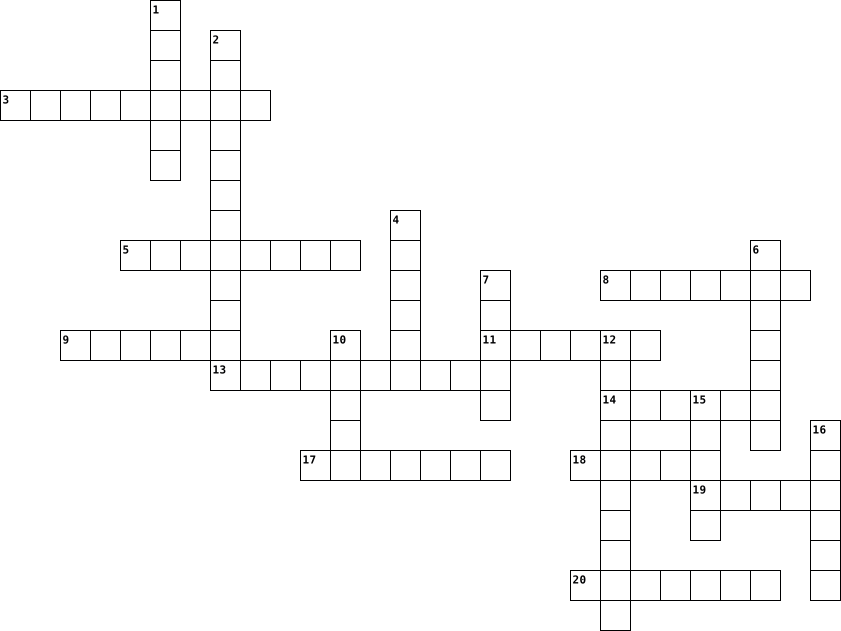
Across
- The time in the 1920s in which jazz music and dancing became popular.
- Prevention by law of the sale and consumption of alcohol.
- The generation during and just after WWI that lost many men.
- An act that restricted immigration to the United States.
- The right to vote.
- People who advocate complete political or social reform.
- A society in which authority is not recognized.
Down
- A secret terrorist society organized to assert white supremacy
- A time in which Communist actions in the United States were feared.
- The trial of John Scopes, who was accused of violating the Butler Act by teaching evolution in school.
- An act that set an amount of immigrants who could enter the country annually.
- Attempts to arrest and deport radical leftists and anarchists from the United States.
- A period of time where African American arts and literature thrived.
- Movements to inform consumers through advertising.
- Refers to the cultural edge and economic prosperity of the 1920s in the United States.
- Two Italian immigrants who were accused of murder in 1920.
16 Clues: The right to vote. • A society in which authority is not recognized. • Movements to inform consumers through advertising. • An act that restricted immigration to the United States. • People who advocate complete political or social reform. • Prevention by law of the sale and consumption of alcohol. • Two Italian immigrants who were accused of murder in 1920. • ...
US History Ch5 Vocabulary 2017-01-09

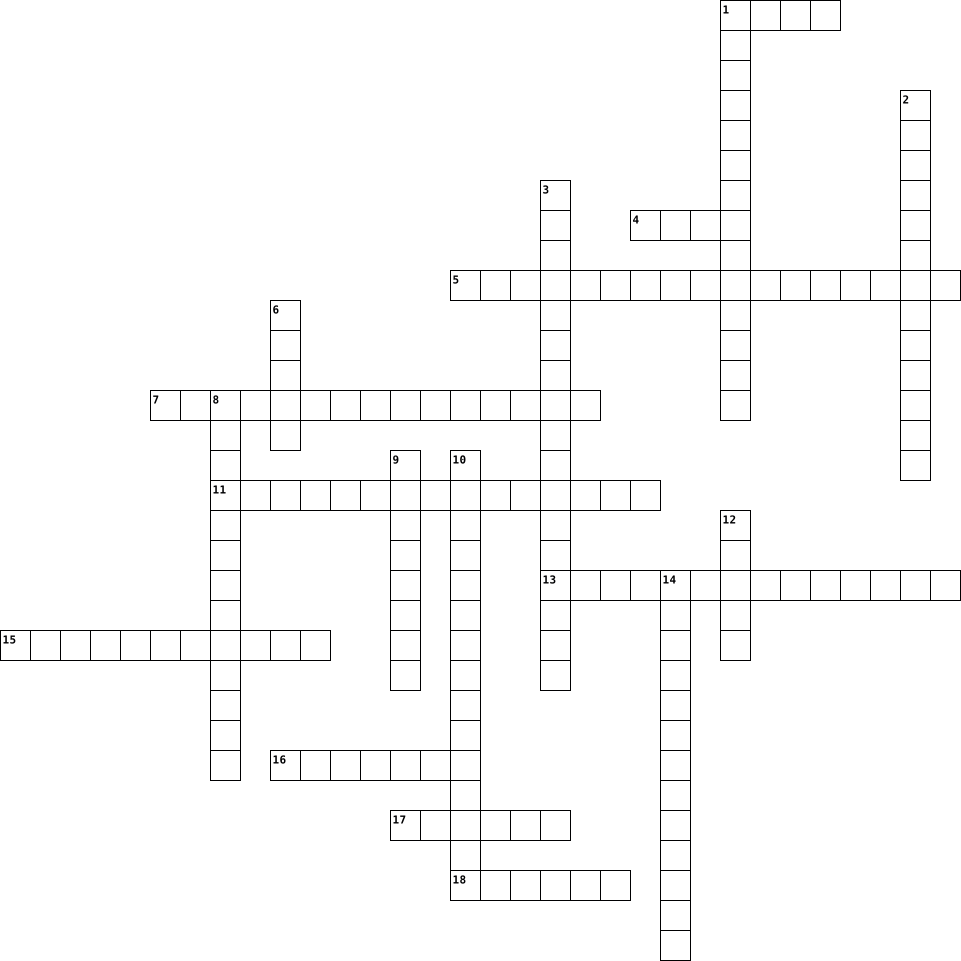
Across
- people who supported ratification of the Constitution
- official change, correction,or addition to a law or constitution
- the plan for government proposed at the Constitutional Convention in which the national government would have supreme power and a legislative branch would have two houses with representation determined by state population
- an agreement worked out at the Constitutional Convention establishing that a state’s population would determine representation in the lower house of the legislature, while each state would have equal representation in the upper house of the legislature
- the division of the government that proposes bills and passes them into laws
- led hundreds of men to shut down the Supreme Court in an event that became known as Shays’s Rebellion
- the division of the federal government that is made up of the national courts; interprets laws, punishes criminals, and settles disputes between states
- an anti-federalist who opposed the constitution and believed the Constitution needed a section guaranteeing individual rights
- a meeting held in Philadelphia at which delegates from the states wrote the Constitution
- to plead in favor of
- an agreement worked out at the constitutional convention stating that only three-fifths of the slaves in a state would count when determining a state’s population for representation in the lower house of Congress
- the idea that political authority belongs to the people
- trade between two or more states
- a series of essays that defended and explained the constitution and tried to reassure Americans that the states would not be overpowered by the proposed national government
- an uprising of Massachusetts’ farmers, led by Daniels Shays, to protest high taxes, heavy debt, and farm foreclosures
- an official approval
- a charter of liberties agreed to by King John of England, it made the king obey the same laws as citizens
- a set of basic principles that determines the powers and duties of a government
Down
- a tax on imports or exports
- the division of the federal government that includes the president and the administrative departments; enforces the nation’s laws
- The fourth president, delegate of the Constitutional Convention, and author of the Bill of Rights.
- the document that created the first central government of the United States; was replaced by the Constitution in 1789
- a proposal to create a unicameral legislature with equal representation of states rather than representation by population; rejected at the Constitutional Convention
- a document that gave people in Virginia freed of worship and prohibited tax money from being used to fund churches
- legislation passed by Congress authorizing surveys and the division of public lands in the western region of the country
- legislation passed by Congress to establish a political structure for the Northwest Territory and create a system for the admission of new states
- a steep drop in economic activity combined with rising unemployment
- U.S. system of government in which power is distributed between a central government and individual states
- a system established by the Constitution that prevents any branch of government from becoming too powerful
- people who opposed ratification of the Constitution
- lands including present-day Illinois, INdiana, Michigan, Ohio, and Wisconsin; organized by the Northwest Ordinance of 1787
- voting rights
- the first 10 amendments to the US Constitution, ratified in 1791
- increased prices for goods and services combined with the reduced value of money
34 Clues: voting rights • to plead in favor of • an official approval • a tax on imports or exports • trade between two or more states • people who opposed ratification of the Constitution • people who supported ratification of the Constitution • the idea that political authority belongs to the people • official change, correction,or addition to a law or constitution • ...
Creating the Constitution 2014-02-05

Across
- This compromise reduced African slaves to something less than a person
- Constitutional goal: To Secure the _______ of Liberty to Ourselves and Our Posterity
- The Constitution neither gives these to Congress, nor denies them to the states
- The opponents of the Constitution
- This system gives each branch of government ways to limit the powers of the other two
- A group that supported the Constitution and a strong national government
- Approval of a compact (Article 7 deals with this)
- A plan proposed by James Madison that favored large states
- Proposed by William Paterson, favored small states
- Constitutional Goal: To Ensure Domestic _______
- Constitutional goal: To _______ Justice
- Changes to the Constitution
Down
- Plan proposed by Roger Sherman that forced each side to give up some of what they wanted in the Constitution
- The absence of this in the original Constitution troubled the Anti-Federalists
- Article 4 deals with these
- _______ Hamilton, one of the authors of the Federalist Papers
- Patrick _____, most outspoken member of the Anti-Federalists
- Powers that are shared by the federal and state governments
- Article 1 forms this branch of government
- Two-house legislature
- To accuse
21 Clues: To accuse • Two-house legislature • Article 4 deals with these • Changes to the Constitution • The opponents of the Constitution • Constitutional goal: To _______ Justice • Article 1 forms this branch of government • Constitutional Goal: To Ensure Domestic _______ • Approval of a compact (Article 7 deals with this) • Proposed by William Paterson, favored small states • ...
Countries 2021-04-26
Across
- This Country is known for its dangerous wildlife and interesting accent
- This country is right between the ocean and Spain
- Country where a majority of the Eastern colonists came from
- The major country that opposed Britain in the Seven Years war.
- First country to fall to Germany in WW2
- Country to the south of North Korea that has a thriving democracy
- This country was formerly the biggest part of the Soviet Union
- This country is partly responsible for both World Wars
- Country that has the second-largest economy in the world
- country with the largest population in the world
- Neutral country that Germany invaded in both World Wars
Down
- Country to the North of the United States
- Country with the largest economy in the world
- Country to the South of the United States
- Was the center of a proxy war between the United States and the Soviet Union. The US eventually pulled out of this country.
- Island country that was defeated in WW2 by the United States
- closest country to Antarctica in the world
- Country run by the brutal dictator Kim Jung Un
- Mexico was a colony under this country
- Biggest country in South America
20 Clues: Biggest country in South America • Mexico was a colony under this country • First country to fall to Germany in WW2 • Country to the North of the United States • Country to the South of the United States • closest country to Antarctica in the world • Country with the largest economy in the world • Country run by the brutal dictator Kim Jung Un • ...
Module 9 Vocab 2023-03-01

Across
- Money and debt
- the worst economic downturn in the history of the industrialized world
- getting a loan from your brokerage and using the money from the loan to invest in more securities
- Decline in prices in good
- 31st president of the United States
- a line of needy persons. assembled to receive food given as charity
- cash payments or “the dole”
- a place where people who cannot afford, or do not have the means to feed themselves
- the United States stock market crashed
- enacted to protect U.S. farmers from foreign competition
Down
- an agency authorized by the U.S. government to loan money to assist the nation's ailing banks after the stock market crash
- the highest concrete arch dam in the United States
- American statesman who was elected Governor of New York
- measures the daily price movements of 30 large American companies
- agricultural price support
- intended to lower the cost of home ownership by creating a network of government-sponsored banks
- the drought-affected south central United States
- to review something idly or casually and often inconclusively
- A group of almost
- Homeless Americans began to build their own camps on the edges of citiesSoup kitchen
20 Clues: Money and debt • A group of almost • Decline in prices in good • agricultural price support • cash payments or “the dole” • 31st president of the United States • the United States stock market crashed • the drought-affected south central United States • the highest concrete arch dam in the United States • American statesman who was elected Governor of New York • ...
VA/US SOL 5 Crossword 2024-02-06

Across
- This branch of government interprets the laws and consists of the court system:
- This man was the leader of the Federalists:
- Who wrote the Virginia Statute for Religious Freedom?
- Which amendment prohibits quartering of soldiers in peace time?
- Which amendment gives the right to bear arms?
- Which level of law is the supreme law of the land?
- Who wrote the Virginia Declaration of Rights?
- Who wrote the Bill of Rights in the Constitution?
- Which amendment guarantees a fair trial, a jury, and lawyer?
- McCulloch v Maryland delt with this issue:
- Which amendment states that rights not explicitly given to the federal government are given to the states and the poeple?
- This was the first governing document of the United States:
- The case of Marbury v Madison delt with this issue:
- Who was elected as president of the constitutional convention?
- Which amendment guarantees a jury trial?
Down
- Gibbons v Ogden delt with this issue:
- Who was the Chief Justice of the Supreme Court who oversaw the these early court cases?
- Which amendment gives citizens the right to remain silent?
- This political party was led by Thomas Jefferson:
- Which amendment gives freedom of speech, religion, press, petition, and assembly?
- Which amendment states that rights are not limited to those listed in the Constitution?
- This group opposed a strong central government:
- This group supported a strong central government:
- Which part of congress is based on population?
- Which amendment prohibits cruel and unusual punishment and excessive bail?
- Which amendment protects from unreasonable search and seizure?
- This branch of government makes the laws:
- This branch of government enforces the laws and is made up of the police and president:
- Which part of congress gives states two representatives regardless of size?
29 Clues: Gibbons v Ogden delt with this issue: • Which amendment guarantees a jury trial? • This branch of government makes the laws: • McCulloch v Maryland delt with this issue: • This man was the leader of the Federalists: • Which amendment gives the right to bear arms? • Who wrote the Virginia Declaration of Rights? • Which part of congress is based on population? • ...
Greece chapter 2026-04-07

Across
- The famous games held every four years in honor of Zeus.
- A period of civil crisis or conflict within a Greek city-state, often caused by land hunger.
- A foreigner living in Athens who had no political rights but paid taxes.
- The most famous Doric temple, located on the Acropolis and dedicated to Athena.
- A heavily armed Greek foot soldier who fought in a phalanx formation.
- The simplest and oldest architectural style, with sturdy columns and no base.
Down
- The belief in many gods (like Zeus, Hera, and Athena) rather than just one.
- A person considered as "property" with no rights, performing most of the hard labor.
- The process of Greeks leaving their mother-city (metropolis) to found new cities.
- An elegant architectural style recognizable by the scrolls (volutes) on its capitals.
10 Clues: The famous games held every four years in honor of Zeus. • A heavily armed Greek foot soldier who fought in a phalanx formation. • A foreigner living in Athens who had no political rights but paid taxes. • The belief in many gods (like Zeus, Hera, and Athena) rather than just one. • The simplest and oldest architectural style, with sturdy columns and no base. • ...
Civil War Remembrance 2023-04-26

Across
- A formal charge brought against an elected official
- The first African American to serve a full term as a US Senator
- The rights and powers held by individual US states rather than by the federal government.
- 16th President of the United States - 1860
- What did the 13th Amendment do?
- The first African American to serve in the US Senate
- The seceded states formed the _________
- Former slave
- Important Civil War battle that took place in Mississippi was over what town?
- The right to vote
Down
- Who was appointed governor of MS by President during Reconstruction?
- Freedom
- What bloody battle took place just north of Corinth, MS?
- A set of laws that governed and regulated the lives of freedmen in Mississippi after the Civil War
- Whites who wanted to return control to the Democrats
- A northerner who remained in the South or moved to the South after the Civil War
- To take away the right to vote from a specific person or group
- A tactic where armed forces try to capture a fort or fortified town by surrounding it and preventing supplies from reaching it
- The main disagreement between the Confederacy and the Union
- The North states formed the _____
20 Clues: Freedom • Former slave • The right to vote • What did the 13th Amendment do? • The North states formed the _____ • The seceded states formed the _________ • 16th President of the United States - 1860 • A formal charge brought against an elected official • Whites who wanted to return control to the Democrats • The first African American to serve in the US Senate • ...
Unit 2 Vocabulary 2022-05-02

Across
- constitution provides for its own
- powers powers that the Constitution does not grant
- needed to happen in 13 states
- Compromise satisfied smaller states
- reject acts passed by Congress
- powers not expressly stated in the Constitution
- gov need for an orderly regulation
- rebellion Happened in Western Massachusetts
- gov serve the will of the people
- power of court to determine constitutionality
- sovereignty limited gov, civil rights and liberties
- of Rights the first 10 amendments
- of Confederation approved on Nov. 15, 1777
- & Slave trade compromise agreed to include commerce power
- favored ratification
- Compromise southern states able to count slaves
Down
- Adams a rising lawyer in Boston
- powers can only be exercised by the Nat. Gov
- Washington voted against British policies
- annual Congress
- of powers basic powers distributed among 3
- Gov government is restricted
- Locke enlightenment thinker
- and balances each branch is subject to these
- Jefferson joined Virginia delegation in June 1775
- declare illegal, null, and void
- division of power among a central government
- Plan state guaranteed Republican form of gov
- powers powers delegated to the National gov
- two houses
- powers both the Nat. Gov and states possess
- the frame of the government
- Jersey Plan retained the unicameral Congress
- Federalist opposed ratification
34 Clues: two houses • annual Congress • favored ratification • Locke enlightenment thinker • the frame of the government • Gov government is restricted • needed to happen in 13 states • reject acts passed by Congress • Adams a rising lawyer in Boston • declare illegal, null, and void • Federalist opposed ratification • gov serve the will of the people • constitution provides for its own • ...
Civil War Crossword 2026-04-09

Across
- Capital city of the northern states - in Maryland
- The side of the south - slave states in rebellion
- The Fort attacked by the south that started the war
- first name Jefferson - President of the South
- Capital city of the southern rebellion states - in Virginia
- The site of a significant battle in Maryland - a Union victory by technicality
- Emancipation ___________ - a significant executive order regarding slavery
- Northern Democrats who wanted to end the war as soon as possible - a type of snake
- What the North and South were fighting over
- A northern general known for his hesitation and large ego - fired by Lincoln at Antietam
- The action of a state leaving to start its own country
Down
- The primary southern general - the big bad guy of the war
- A lottery where men get forced to fight in the military
- Non-venomous snake the northern war plan was named after
- The side of the north - generally free states
- A northern general who liked fire and helped in the invasion of Vicksburg
- The site of a significant battle in Pennsylvania
- Flour and water makes this - goes great with coffee
- Nickname of a southern General Jackson - "he's standing there like a _____________"
- President of the North
20 Clues: President of the North • What the North and South were fighting over • The side of the north - generally free states • first name Jefferson - President of the South • The site of a significant battle in Pennsylvania • Capital city of the northern states - in Maryland • The side of the south - slave states in rebellion • ...
Citizenship Crossword Quiz!! 2023-01-10

Across
- We hold these truths to be self ______, that all men are created equal,
- The department of _________ works to protect the country against terrorism and make sure the borders are safe.
- _______ are groups of people who share similar beliefs on how the government should be run and how issues facing the country should be solved.
- The main job of the governor is to make sure ________ are being carried out.
- Executive agencies ______ the law when someone isn’t following it.
- ________ spending is spending that the Congress decides on each year.
- The United States government is ruled by___; which is called a Democracy.
- The local government is ___ mentioned in the U.S Constitution.
- The oath of ______ is one of the final steps of citizenship.
- The ___________ allows women to vote.
- The Citizens of the U.S give consent to the government this is called ____________.
- The main job of the legislative branch is to create _____ for the states.
- The department of _________ supports farmers, makes sure our food is safe, and gives recommendations about good nutrition.
- The process in which allows immigrants to become citizens of the United States _______.
- Expressed, Inherent, Implied, and Reserved are all types of these ____.
- States constitutions are very similar to the U.S Constitution because they have a similar _______.
Down
- The official plan the government uses for its budget is called the ______.
- The President’s _____ is a group of individuals who advise him with decisions.
- Another name for the president is called the_____.
- The United States has a ______ Democracy; meaning citizens elect these people to make decisions for them.
- The U.S celebrates 4th of July because that date is when the __________ was signed.
- In the party system the far right beliefs are called ______ beliefs.
- The highest court in the Judicial branch is the _______.
- These powers are given to the states _______.
- The Government has ___ roles.
25 Clues: The Government has ___ roles. • The ___________ allows women to vote. • These powers are given to the states _______. • Another name for the president is called the_____. • The highest court in the Judicial branch is the _______. • The oath of ______ is one of the final steps of citizenship. • The local government is ___ mentioned in the U.S Constitution. • ...
The Civil War Vocabulary 2014-03-14

Across
- a branch of the military mounted on horseback
- it said that people of each territory should decide for themselves if slaves should be allowed
- something that makes a defensive position stronger, they can be man-made or natural
- a group of soldiers usually led my a brigadier general
- the effort by the North to keep ships from entering or leaving Southern ports
- withdrawal from the Federal government of the United States
- the cruel killing of a number of helpless or unresisting people
- troops who are only called out to defend the land in an emergency
Down
- a branch of the military using ships to conduct warfare
- a state of bondage in which African Americans were owned by other people, usually white, and forced to labor on their behalf
- a place where weapons and other military supplies are stored
- the new nation that the southern states made, it fought against the Union
- a boundary that became a symbolic division between the free and the slave states
- troops sent to strengthen a fighting force by adding a number of fresh soldiers
- the states of Maryland, Delaware, Kentucky, and Missouri who didn't join the Confederacy, but supported the south
- to lie in wait for an attack
- someone who wishes to abolish or get rid of slavery
- blanket or other bedding rolled up and carried over the shoulder by a soldier
- hard crackers often issued to the soldiers of both sides during the Civil War
- a soldier who was wounded, killed, or missing in action
- the term used to describe new soldiers
- the largest organized group of soldiers
22 Clues: to lie in wait for an attack • the term used to describe new soldiers • the largest organized group of soldiers • a branch of the military mounted on horseback • someone who wishes to abolish or get rid of slavery • a group of soldiers usually led my a brigadier general • a branch of the military using ships to conduct warfare • ...
Cuban Missile Crisis 2016-01-14

Across
- A ________ is an effort to cut off supplies, war material or communications from a particular area by force
- the staged invasion from the CIA was called ___ __ ___
- ____ is a Soviet short-range artillery rocket system
- Stevenson _____ _________ attempted to force an answer from Soviet Ambassador Valerian Zorin as to the existence of the weapons
- is a city located on the Atlantic coast in southeastern Florida
- place of the President of the United States located in Washington, D.C.
- This organizations is abbreviated to UN
- _______ is a unit written into various nuclear weapon control treaties, and gives a sense of destructiveness
- This continent is made up of Germany, USSR, France exc.
- A Surface-to-Air Missile was abbreviated to ___
Down
- Rusk ____ ____ was the United States Secretary of State from 1961 to 1969
- _____ revolution was a plan to get rid of the dictator in Cuba
- is a state in the southeast United States, bordered to the west by the Gulf of Mexico
- This was a neclear weapon created by USA and was placed on submarines are called ______
- ______ was the place where USA placed missiles pointing towards USSR
- to separate and restrict the movement of persons'state of enforced isolation is called __________
- The Capital city of Cuba is called ______
- a system that allows direct communication between the leaders of the United States and Russia
- ______ was a body of United States government officials that convened to advise President John F. Kennedy during the Cuban Missile Crisis
- The Capital City of USSR is ______
- __-__ was used for electronic sensor research, satellite calibration, and communications purposes.
21 Clues: The Capital City of USSR is ______ • This organizations is abbreviated to UN • The Capital city of Cuba is called ______ • A Surface-to-Air Missile was abbreviated to ___ • ____ is a Soviet short-range artillery rocket system • the staged invasion from the CIA was called ___ __ ___ • This continent is made up of Germany, USSR, France exc. • ...
Social Studies Week 1 Vocabulary Test 2016-03-25

Across
- The first national government framework; considered ineffective and was replaced by the U.S.Constitution
- American army defeated American Indians leading to the Treaty of Greenville
- Able to act or speak freely; freedom
- Receiving fair treatment under the law
- Original groups who lived in Ohio before written records. Include: Paleo, Archaic, Woodland, Fort Ancient
- issues Disagreements between regions of the United States, especially over whether or not to allow slavery in new territories
- Movement that worked to end slavery in the United States
- Conflict between the United States and Great Britain and its American Indian allies
- Person who comes to a country to live there
- Protection of rights included in the Northwest Ordinance including freedom of religion, right to trial by jury, education, ban on slavery
Down
- Law that made it illegal to help slaves escape to freedom
- Original groups who lived in Ohio after written records
- American colonies announced their decision to free themselves from Great Britain
- Person who moves from one place to another within a country
- Amount of money that a government requires people to pay on goods purchased
- Act by the British government that did not allow the colonists to settle west of the Appalachians
- Most American Indians gave up their land claims in much of Ohio after their defeat in the Battle of Fallen Timbers
- System of secret routes used by free people to help slaves escape to freedom
- Oliver Hazard Perry and American sailors defeated the British navy; ended Indian resistance to American settlement of Ohio
- Established a process for the creation of new states and identified democratic ideals to be included in the states of the Northwest Territory
20 Clues: Able to act or speak freely; freedom • Receiving fair treatment under the law • Person who comes to a country to live there • Original groups who lived in Ohio after written records • Movement that worked to end slavery in the United States • Law that made it illegal to help slaves escape to freedom • Person who moves from one place to another within a country • ...
Voc 2023-08-28

Across
- Limited the power of the king
- Avoid tyranny; the majority can't be allowed to dictate or violate the rights of the minorities.
- Government that only has those powers delegated to it by law, often through a written constitution.
- Written in 1776, declared us independent of GB.
- The governing body that declared us independent of GB
- Wanted additional protections for people and states.
- States slaves were to be counted as ⅗ of a person
- Each branch has their individual roles and responsibilities
- Established direct democracy, first form of self government in the U.S
- Supported the constitution as is; no need for additional protections
- The supreme law of the United States of America
- Ensures one branch does not become too powerful.
- Met between May and September of 1787 to address the problems of the weak central government that existed under the Articles of Confederation.
Down
- Where we got some of our BOR from, gave us the idea of representative government
- Showed the weakness of the Articles; armed rebellion regarding taxes.
- Division of power among different levels of government
- States no one is above the law
- People directly vote for what they want
- Rule by the people, consent of the governed
- A compromise that stated the HOR= based off population and Senate= equal in proportion
- War between Britain and France over territory in the Ohio River Valley
- The nation’s first constitution; it failed due to giving the states too much power.
- The power of the judicial branch to declare laws unconstitutional.
- The first democratically elected legislative body in the U.S
24 Clues: Limited the power of the king • States no one is above the law • People directly vote for what they want • Rule by the people, consent of the governed • Written in 1776, declared us independent of GB. • The supreme law of the United States of America • Ensures one branch does not become too powerful. • States slaves were to be counted as ⅗ of a person • ...
Islamic Art 2026-04-30

Across
- Prophet of God in Islam
- A honeycomb-like decoration applied in Islamic buildings to domes, niches, capitals, or vaults; surface resembles intricate stalactites
- decorative or beautiful handwriting
- decoration using polygonal shapes with no gaps
- Believe that the true leader after Muhammad was Abu Bakr (Muhammad’s father-in-law)
- Holiest Site in Islam that resides in Mecca
- flowing, intricate, symmetrical patterns that come from floral motifs
Down
- The artist of the Ardabil Carpet
- Believe that the true leader after Muhammad should have been Ali (Muhammad’s son-in-law)
- A pulpit from which sermons are given
- A tall, slender column used to call people to prayer (outside of a mosque)
- Dense forest of columns
- The Holy Book in Islam
- One God in Islam
- A central niche in a mosque, which indicates the direction to Mecca
- The Holy City in Islam
- Place of worship for Muslims
- A vaulted space in a Muslim building that is walled on 3 sides and open on the fourth side towards a courtyard
- Direction towards Holy city of Mecca that all Muslims face during prayer
19 Clues: One God in Islam • The Holy Book in Islam • The Holy City in Islam • Prophet of God in Islam • Dense forest of columns • Place of worship for Muslims • The artist of the Ardabil Carpet • decorative or beautiful handwriting • A pulpit from which sermons are given • Holiest Site in Islam that resides in Mecca • decoration using polygonal shapes with no gaps • ...
venezuela 2022-03-22

Across
- What is the official language in Venezuela
- which country is the largest donor of humanitarian aid
- politician that protested against Maduro
- what country did Venezuela separate from
- what is the most poverty stricken country in latin america
Down
- term used for a country reliant on oil
- What color is the middle stripe in the flag
- what was the province that was added to the flag in 2006
- the decline in oil lead to what
- political leader that died in 2013
- the increase of price but the decrease in value
- whats the cities capitals
- political leader that was elected in 2013
13 Clues: whats the cities capitals • the decline in oil lead to what • political leader that died in 2013 • term used for a country reliant on oil • politician that protested against Maduro • what country did Venezuela separate from • political leader that was elected in 2013 • What is the official language in Venezuela • What color is the middle stripe in the flag • ...
Tour The World Official Crossword! 2022-04-26

Across
- Capital of South Sudan
- The only country the US has a travel ban on (no spaces)
- The country with 3 capitals (no spaces)
- The last country said in "Tour the World" by Renald Francouver
- The country that only issues business visas
- The place with 0 people per square mile
Down
- Capital of Equatorial Guinea
- The amount of countries that have "South"
- The only fully recognized country not in the United Nations
- The amount of countries that have "Guinea"
- The topic of Isahi's magazine (check editorial page)
- The first country said in "Tour the World" by Renald Francouver
- The squarest country, according to Map Men
13 Clues: Capital of South Sudan • Capital of Equatorial Guinea • The country with 3 capitals (no spaces) • The place with 0 people per square mile • The amount of countries that have "South" • The amount of countries that have "Guinea" • The squarest country, according to Map Men • The country that only issues business visas • The topic of Isahi's magazine (check editorial page) • ...
Civil War 2021-02-17

Across
- At the heart of the divide between the North and the South was?
- What was the south’s main source of income
- The United States was able to communicate by using the?
- What were the northern states called?
- What fort did Confederate General P.G.T Beauregard fire on to start the Civil War
- A long blade or knife attached to the end of a musket, Soldiers would use it like a spear in close combat.
- Soldiers that fight and travel by foot
- Who was a former slave who sued for his freedom in the supreme court?
Down
- Who was elected President of the United states in 1860?
- a long gun with a smooth bore that soldiers shot from the shoulder
- Who served as president of the confederate States of America?
- What was the major cause of death during the Civil War?
- Where did the Civil War begin
- What were the southern states called
- First major land battle of cCivil wWar on July 1st 1861
- What was used on both sides of the war to destroy enemy soldiers vehicles?
- Who was the general for the confederacy
17 Clues: Where did the Civil War begin • What were the southern states called • What were the northern states called? • Soldiers that fight and travel by foot • Who was the general for the confederacy • What was the south’s main source of income • Who was elected President of the United states in 1860? • What was the major cause of death during the Civil War? • ...
Unit 2 Vocab 2024-02-21

Across
- American prophet and founder of the Church of Jesus Christ of Latter-day Saints
- An unsuccessful 1846 proposal in the United States Congress to ban slavery in territory acquired from Mexico in the Mexican–American War
- The idea that white Americans were divinely ordained to settle the entire continent of North America
- A wagon road stretching 2170 miles from Missouri to Oregon's Willamette Valley
- The voluntary withdrawal of one or more states from the Union that constitutes the United States
- A formerly enslaved man who became a prominent activist, author and public speaker
- A commercial highway connecting Missouri and Santa Fe, New Mexico
- "Before the war"
- To acquire new land and make it part of another country
- An escaped enslaved woman who became a “conductor” on the Underground Railroad
- Was an American politician and lawyer from Illinois. A senator, he was one of two nominees of the badly split Democratic Party for president in the 1860 presidential election
- American religious leader, second president of the Mormon church, and colonizer who significantly influenced the development of the American West
- A pair of federal laws that allowed for the capture and return of runaway enslaved people within the territory of the United States
- Played an instrumental role in the founding or expansion of more than 30 hospitals for the treatment of the mentally ill.
- A rebellion of enslaved Virginians that took place in Southampton County, Virginia, in August 1831
Down
- Rapid influx of fortune seekers to the site of newly discovered gold deposits
- An invasion of Mexico by the United States Army from 1846 to 1848
- Government based on consent of the people
- Five laws passed in September of 1850 that dealt with the issue of slavery and territorial expansion
- System of cultural beliefs or ideals in the 19th century that governed gender roles in upper- and middle-class society
- A printer, newspaper publisher, radical abolitionist, suffragist, civil rights activist
- War fought from October 1835 to April 1836 between Mexico and Texas colonists that resulted in Texas's independence from Mexico and the founding of the Republic of Texas
- The first women's rights convention in the United States
- Was an agreement between the United States and Mexico, finalized in 1854, in which the United States agreed to pay Mexico $10 million for a 29,670 square mile portion of Mexico that later became part of Arizona and New Mexico
- American writer and philanthropist, the author of the novel Uncle Tom's Cabin, which contributed so much to popular feeling against slavery that it is cited among the causes of the American Civil War
- Movement dedicated to promoting moderation and, more often, complete abstinence in the use of intoxicating liquor
- The route taken by Mormons from Nauvoo, Illinois, to the Great Salt Lake in what would become the state of Utah
- The movement that sought to end slavery in the country
- A period in the 1820s-1830s in which the economy and society shifted from moral economies to a capitalist system
- A school reformer during the Reform Era. Also became the first secretary of education in Massachusetts
30 Clues: "Before the war" • Government based on consent of the people • The movement that sought to end slavery in the country • To acquire new land and make it part of another country • The first women's rights convention in the United States • An invasion of Mexico by the United States Army from 1846 to 1848 • ...
A More Perfect Union: Chapter 5 Vocabulary Quiz! 2024-10-24

Across
- Article III deals with the _____ _____ or count system
- The Constitution contains a system of _______ ______ ______ which means each branch of government has ways to check and or limit the power of other branches
- having two branches, chambers, or houses, as a legislative body
- supreme and independent power or authority in government as possessed or claimed by a state or community
- a member or supporter of the Federalist Party
- a Connecticut politician and Superior Court judge
- a plan, unsuccessfully proposed at the Constitutional Convention, providing for a legislature of two houses with proportional representation in each house and executive and judicial branches to be chosen by the legislature
- the freeing of individual enslaved people
- someone who opposed the ratification of the United States Constitution in 1787 and the establishment of a strong central government
- a city in east Massachusetts on the Massachusetts bay near Boston
- gained America's independence, created a government for the new country, and helped free enslaved people
- _______ is a key feature in the United States to which federal and state governments share power
- Many American settlers moved to the Northwest Territory by sailing on _________ along the Ohio River. A _______ was capable of carrying large amounts of cargo from place to place
- a special group of people named by each state legislator to select the president and vice president
- a government in which citizens rule through elected representatives
- In 1785 the Confederation Congress passed a law that set up a process to survey and sell the lands north of the Ohio River
- Article II of the Constitution sets up the ______ ______ to carry out the nation’s laws and policies
- the first constitution of the 13 American states, adopted in 1781 and replaced in 1789 by the Constitution of the United States
- Article I of the constitution declares congress to be the lawmaking branch of the government
Down
- a union of sovereign states in which the stress is laid on the autonomy of each constituent body
- the ability or one group to control the actions of another group by withholding funding, or putting stipulations on the use of funds
- The Northwest Ordinance was passed in 1787 which created a single _______ _______ from lands north of the Ohio River and east of the Mississippi River
- a law that reduced the minimum amount of land that could be purchased from 640 acres to 320 acres and introduced a credit feature for buyers
- a tax imposed by the government on goods imported into a country
- a change, correction, or improvement added to a document
- liberties that are not dependent on government, while legal rights, also known as positive rights, are defined by government action or inaction
- a plan, unsuccessfully proposed at the Constitutional Convention, providing for a single legislative house with equal representation for each state
- an improved state or way of functioning that results from the correction of abuses and bad habits or practices
- In September 1786, Hamilton had called for an authorized meeting in Philadelphia to discuss trade issues
- In September 25 1789, the United States _____ ___ _____ comprises the first ten amendments to the United States Constitution
- a tax, or duty, levied on imported goods
- created a government with 3 branches and became the 4th president of the United States
- proposed the Virginia plan
- a Connecticut politician and Superior Court judge
34 Clues: proposed the Virginia plan • a tax, or duty, levied on imported goods • the freeing of individual enslaved people • a member or supporter of the Federalist Party • a Connecticut politician and Superior Court judge • a Connecticut politician and Superior Court judge • Article III deals with the _____ _____ or count system • ...
Unit 3 social studies 2024-03-27

Across
- The first written plan of government for the United States. A confederation is an association of states that cooperate for a common purpose.
- The system that allows each branch of government to limit the powers of the other two branches.
- A law passed by Congress in 1787 that specified how western lands would be governed.
- A region of the United States bounded by the Ohio and Mississippi rivers and the Great Lakes. The region was given to the United States by the Treaty of Paris in 1783.
- To formally approve a plan or an agreement. The process of approval is called ratification.
- Payment given to someone to offset, or make up for, a loss or injury.
- The “Age of Reason” in 17th- and 18th-century Europe. Enlightenment thinkers emphasized using rational thought to discover truths about nature and society.
- To treat a person or group unfairly.
- A formal listing of the basic rights of people in the United States.
- Supporting ideas of freedom, change, and progress.
- A person who is required to defend himself or herself in a legal action. An example is an accused person who is put on trial for a crime.
- To agree or pledge to support someone or something.
Down
- A basic set of ideas used to develop a larger plan.
- A written plan that provides the basic framework of a government.
- A strong disagreement.
- A meeting held in Philadelphia in 1787 at which delegates from the states wrote the U.S. Constitution.
- The plan of government adopted at the Constitutional Convention that established a two-house Congress. In the House of Representatives, representation from each state is based on state population. In the Senate, each state is represented by two senators.
- The group established by the Constitution to elect the president and vice president. Voters in each state choose their electors.
- A difference between two statements or situations that means they cannot both be true.
- A country governed by elected representatives.
20 Clues: A strong disagreement. • To treat a person or group unfairly. • A country governed by elected representatives. • Supporting ideas of freedom, change, and progress. • A basic set of ideas used to develop a larger plan. • To agree or pledge to support someone or something. • A written plan that provides the basic framework of a government. • ...
Unit 3 social studies 2024-03-27

Across
- The first written plan of government for the United States. A confederation is an association of states that cooperate for a common purpose.
- The system that allows each branch of government to limit the powers of the other two branches.
- A law passed by Congress in 1787 that specified how western lands would be governed.
- A region of the United States bounded by the Ohio and Mississippi rivers and the Great Lakes. The region was given to the United States by the Treaty of Paris in 1783.
- To formally approve a plan or an agreement. The process of approval is called ratification.
- Payment given to someone to offset, or make up for, a loss or injury.
- The “Age of Reason” in 17th- and 18th-century Europe. Enlightenment thinkers emphasized using rational thought to discover truths about nature and society.
- To treat a person or group unfairly.
- A formal listing of the basic rights of people in the United States.
- Supporting ideas of freedom, change, and progress.
- A person who is required to defend himself or herself in a legal action. An example is an accused person who is put on trial for a crime.
- To agree or pledge to support someone or something.
Down
- A basic set of ideas used to develop a larger plan.
- A written plan that provides the basic framework of a government.
- A strong disagreement.
- A meeting held in Philadelphia in 1787 at which delegates from the states wrote the U.S. Constitution.
- The plan of government adopted at the Constitutional Convention that established a two-house Congress. In the House of Representatives, representation from each state is based on state population. In the Senate, each state is represented by two senators.
- The group established by the Constitution to elect the president and vice president. Voters in each state choose their electors.
- A difference between two statements or situations that means they cannot both be true.
- A country governed by elected representatives.
20 Clues: A strong disagreement. • To treat a person or group unfairly. • A country governed by elected representatives. • Supporting ideas of freedom, change, and progress. • A basic set of ideas used to develop a larger plan. • To agree or pledge to support someone or something. • A written plan that provides the basic framework of a government. • ...
Manifest Destiny 2024-11-11

Across
- The treaty that ended the Mexican-American War in 1848, ceding vast territories to the United States.
- A historic route used by pioneers traveling to Oregon, starting from Missouri and covering about 2,000 miles.
- The nickname for a high tariff passed in 1828 that angered the South because it raised the prices of imported goods. It was called the Tariff of ________.
- The practice of a political leader rewarding loyal supporters with government jobs.
- The final battle of the Texas Revolution where Texas forces, led by Sam Houston, defeated the Mexican army and captured General Santa Anna.
- The belief that the United States was destined to expand westward to the Pacific Ocean, spreading democracy and freedom.
- A group of unofficial advisers to President Andrew Jackson, separate from his formal cabinet.
- A financial crisis in the United States that led to a severe economic depression during Martin Van Buren's presidency.
- Gold seekers who traveled to California during the Gold Rush of 1849.
Down
- An agent who was given land grants by the Mexican government to bring settlers to Texas.
- The mass migration to California following the discovery of gold in 1848, leading to rapid population growth.
- Crisis: A conflict between Southern states, especially South Carolina, and the federal government over states' rights to nullify federal laws.
- A pivotal event in the Texas Revolution where a small group of Texans held off a much larger Mexican army before being defeated.
- The 1835-1836 rebellion of Texans against Mexican rule, resulting in Texas gaining independence.
- A revolt by American settlers in California against Mexican rule in 1846, leading to California's brief independence.
- A law passed in 1830 that authorized the forced relocation of Native Americans to lands west of the Mississippi River.
- An annual meeting of fur trappers and traders in the wilderness to exchange goods.
- The process of incorporating a territory into a country, as seen with Texas joining the United States in 1845.
- Fur traders and explorers who roamed the Rocky Mountains, often helping to map the West.
- The forced march of Cherokee Native Americans from their homeland to Indian Territory, resulting in the deaths of thousands.
20 Clues: Gold seekers who traveled to California during the Gold Rush of 1849. • An annual meeting of fur trappers and traders in the wilderness to exchange goods. • The practice of a political leader rewarding loyal supporters with government jobs. • An agent who was given land grants by the Mexican government to bring settlers to Texas. • ...
Civil War 2021-09-03

Across
- the southern states
- southern states which slavery was legal
- where battle is fought
- war between citizens
- control by majority of members
- an offensive against an enemy
- operation aimed at achieving a goal
- person who wanted to eliminate slavery
- troops trained to fight on horseback
- region north of mason-dixon line
Down
- freedom of choice
- states of being allied
- submit to there authority
- statement that is emphatic
- government with central and regional authorities
- person who is in an army
- successful ending in a contest
- being/joined into a single entity
- authorities direction to do something
- entry into an area
20 Clues: freedom of choice • entry into an area • the southern states • war between citizens • states of being allied • where battle is fought • person who is in an army • submit to there authority • statement that is emphatic • an offensive against an enemy • control by majority of members • successful ending in a contest • region north of mason-dixon line • being/joined into a single entity • ...
Korean/vietnam 2015-05-21
Across
- war/threats between the soviets and U.S. would have ended the world
- race/a time of getting weapons
- city od Israel
- soviets neighbor
- an Ussr were these
- tries to spread this
- policy to relax tension between the communist and the free world
- war/A war were total victory is not the goal
- wall/separated east and west Germany
- theory/the belief that in one land in a religion came under the influence of communist then more would follow
Down
- communist believe in
- united states tries to spread this
- get along with Kennedy
- missile crises/a very tense confirmation between the soviets and the united states over the soviets deployment of a nuclear missile in Cuba
- soviets citizens freedom of speech and religion
- war from 1950-1953
- blockade instead of war
- race/ the race between the soviets and the united states
- country
19 Clues: country • city od Israel • soviets neighbor • war from 1950-1953 • an Ussr were these • communist believe in • tries to spread this • get along with Kennedy • blockade instead of war • race/a time of getting weapons • united states tries to spread this • wall/separated east and west Germany • war/A war were total victory is not the goal • soviets citizens freedom of speech and religion • ...
States and Caps Section 1 2026-10-16

Across
- RhodeIsland
- Massachussetts
- Maine
- Georgia
- Maryland
- Delaware
- NorthCarolina
- NewHampshire
Down
- Vermont
- Florida
- Virginia
- SouthCarolina
- Connecticut
- NewYork
- Pennsylvania
- NewJersey
16 Clues: Maine • Vermont • Florida • NewYork • Georgia • Virginia • Maryland • Delaware • NewJersey • RhodeIsland • Connecticut • Pennsylvania • NewHampshire • SouthCarolina • NorthCarolina • Massachussetts
Crossword Crisps 2025-11-18

Across
- An agreement between two sides where both sides give a little to gain a little.
- A meeting to discuss government changes.
- Plan that says that 60% of the slave population would count towards population and taxes.
- Creator of the New Jersey Plan.
- Creator of the Great Compromise.
- Plan that created 3 branches of government with a bicameral legislature.
- The people for the constitution.
Down
- The process and pattern to add states to the US.
- States that wanted slaves to count towards representation but not taxation.
- The only state that did not show up to the convention.
- Plan that was favored by the small states. Representation based on equality.
- States that wanted slaves to count towards taxation but not representation.
- Leader of the Constitutional Convention.
- The people against the Constitution.
- Plan favored by the large states. Population-based representation
15 Clues: Creator of the New Jersey Plan. • Creator of the Great Compromise. • The people for the constitution. • The people against the Constitution. • A meeting to discuss government changes. • Leader of the Constitutional Convention. • The process and pattern to add states to the US. • The only state that did not show up to the convention. • ...
The Civil War Crossword 2023-03-01

Across
- Before the War
- The last name of the 16th president of the United States
- The first state to secede from the Union
- The war
- An judgment made about someone before facts are known
- President was Jefferson Davis
- A name for people from the North
- Blocking off a place preventing things or people from leaving or entering
- The first battle of the American Civil War
- The snake plan
Down
- Made up of 23 Free States
- To be set free and be your own person without the control of another
- These states were slave states that did not leave the Union but supported the confederates
- Led 100,000 men into Atlanta
- A formerly enslaved person
- A battle fought between July 1-3, 1863
- Argued breaking away from the union was the only way with or without other states
- Last name of the man who led the Confederate Army Of Virginia throughout the civil war
- A name for southern whites who supported the Republican Party
- Escaped to the North in a confederate ship
20 Clues: The war • Before the War • The snake plan • Made up of 23 Free States • A formerly enslaved person • Led 100,000 men into Atlanta • President was Jefferson Davis • A name for people from the North • A battle fought between July 1-3, 1863 • The first state to secede from the Union • The first battle of the American Civil War • Escaped to the North in a confederate ship • ...
"Hamilton" Vocabulary 2023-03-16

Across
- the act of taking over the debts of another entity
- the act of withdrawing from a political union or federation
- relating to the political and economic theories of Thomas Jefferson, particularly his belief in states' rights and agrarianism
- freedom from the control, influence, support, aid, or the like, of others
- the legislative branch of the United States government, consisting of the Senate and the House of Representatives
- a financial institution that manages a country's currency, monetary policy, and interest rates
- the branch of government responsible for enforcing the law, headed by the President
- the system of courts that interpret and apply the law
- a system designed to prevent any one branch of government from becoming too powerful by providing each branch with the means to check the power of the others
- a supporter of a strong central government and a national bank, particularly during the early years of the United States
- the branch of government responsible for making laws, consisting of Congress
- a system of government in which power is divided between a central authority and constituent political units
- relating to the political and economic theories of Alexander Hamilton, particularly his belief in a strong central government and a national bank
- a group of electors who are appointed to elect the President and Vice President of the United States
- a form of government in which a single person, the monarch, has supreme authority over the state
- an organization that consists of a number of parties or groups united in an alliance or league
- The practice of conducting negotiations between nations
- the right
- the total amount of money owed by the federal government
- the first ten amendments to the Constitution, which protect the basic rights and freedoms of American citizens
- A territory controlled by a distant country
Down
- the movement to end slavery in the United States
- the lower house of Congress, consisting of representatives elected by the people of each state
- the gathering that drafted the Constitution of the United States in 1787
- a tax on imported goods
- the act of invalidating a federal law within a state
- a group of advisors to the President or other leader, typically consisting of heads of executive departments
- Groups of people who share similar beliefs and goals about how the government should be run
- the upper house of Congress, consisting of two senators from each state
- the branch of government responsible for interpreting the law, consisting of the federal court system
- a person who opposed a strong central government and a national bank, particularly during the early years of the United States
- To approve or confirm a law or agreement
- a document that outlines the basic principles, laws, and structures of a government or organization
- the act of freeing slaves from slavery
- a sudden and dramatic change in political power or government structure
- an act of open resistance or defiance to an established authority
- a tax protest in the United States in 1791, during the presidency of George Washington
- A settlement in which both sides give up something in order to reach an agreement
- a form of government in which the power is held by the people or their elected representatives
- a form of government in which the people have the power to elect their leaders and participate in decision-making
40 Clues: the right • a tax on imported goods • the act of freeing slaves from slavery • To approve or confirm a law or agreement • A territory controlled by a distant country • the movement to end slavery in the United States • the act of taking over the debts of another entity • the act of invalidating a federal law within a state • ...
Revolutionary War Trivia 2015-01-22

Across
- He shouted “The British are coming! The British are coming!”
- He signed the Declaration of Independence with a bold signature
- Loyal to Britain
- Wrote the pamphlet “Common Sense”
- Founding father and George Washington's Secretary of Treasury
- founding father and 1st chief justice of supreme court
- The Boston _____ resulted with five Americans dead and a strong need for independence from Britain
- 3rd president of United States
Down
- Loyal to the colonies
- He said “Give me death, or give me liberty.”
- German soldiers hired to fight for the British
- 1st president of the United States
- Founding father and 2nd president of the United States
- The number of original colonies
- He wrote the Constitution
- famous inventor and publisher for the Pennsylvania Gazette
16 Clues: Loyal to Britain • Loyal to the colonies • He wrote the Constitution • 3rd president of United States • The number of original colonies • Wrote the pamphlet “Common Sense” • 1st president of the United States • He said “Give me death, or give me liberty.” • German soldiers hired to fight for the British • Founding father and 2nd president of the United States • ...
wwii 2022-05-18

Across
- japan's surprise bombing on this united states military port
- served as british prime minister during world war ||
- german submarines during world war ||
- german encoding device
- german tactic of "lightning war"
- incredible soviet victory in this city
Down
- nuclear weapon used against two japanese cities
- germany's renewed air force after world war
- major german offensive on the western front
- germany invaded the rhineland and broke the treaty of _
- major british evacuation
- alliance of germany, japan, and italy
- major pacific battle between japan and the united states over this island
- alliance pf great britain, united states, and soviet union
- greatest naval invasion in history
15 Clues: german encoding device • major british evacuation • german tactic of "lightning war" • greatest naval invasion in history • german submarines during world war || • alliance of germany, japan, and italy • incredible soviet victory in this city • germany's renewed air force after world war • major german offensive on the western front • ...
Civil War Crossword 2025-05-20

Across
- A medical method that was used on soldiers to prevent deadly infections from spreading
- A nurse nicknamed "The angel on the battlefield" because she brought supplies to soldiers in battle
- A non-perishable cracker made of only flour and water
- Pro-slavery states with less advanced economy and poor military
- Troops trained to fight on horseback
- A lead hollow bullet with grooves that made it quicker and deadlier than a typical lead ball used in battle
- Granted slaves freedom in Confederate states if they returned to the union
- A medicine that was used to treat gangrene
- A label used by soldiers so their bodies can be identified if they're killed
- Anti-slavery states with advanced economy and military
Down
- A form of quick transportation mainly in the North
- A soldier that is wounded or killed in battle
- A form of quick communication using electrical pulses
- The act of preserving bodies of soldiers after death
- The state of being forced servitude to another person
- To leave or withdraw; Eleven southern states__from the union
- A person who wanted to stop slavery
- A Confederate general for the United States army during the civil war
- A multibarrel, rotating, and Crank operated machine gun that was similar to modern day machine guns
19 Clues: A person who wanted to stop slavery • Troops trained to fight on horseback • A medicine that was used to treat gangrene • A soldier that is wounded or killed in battle • A form of quick transportation mainly in the North • The act of preserving bodies of soldiers after death • A non-perishable cracker made of only flour and water • ...
CIVIL WAR!!!!!! ella rigot 2023-01-25

Across
- Slave Law A law passed by Congress in 1850 that said escaped enslaved people in free states had to be returned to their owners.
- a village in Virginia that was the site of the Confederate surrender to Union forces under the command of General Ulysses
- Scott decision A decision made by the Supreme Court that said Congress could not outlaw slavery and that people of African descent were not necessarily U.S. citizens.
- weakness for the south
- When a person is murdered for political reasons.
- pro for the North
- weaknesses for the North
- location pro for the south
- another name for the Confederate States of America, made up of the 11 states that seceded from the Union
Down
- The proclamation declared "that all persons held as slaves" within the rebellious states "are, and henceforward shall be free."
- pro for the south
- The northern states of the United States, also called the Union.
- A nickname for the Confederate States of America or the Confederacy
- pro for the North
- pro for the North
- a war between opposing groups of citizens from the same country
- pro for the North
17 Clues: pro for the south • pro for the North • pro for the North • pro for the North • pro for the North • weakness for the south • weaknesses for the North • location pro for the south • When a person is murdered for political reasons. • a war between opposing groups of citizens from the same country • The northern states of the United States, also called the Union. • ...
constitution 2022-05-26

Across
- "We the _________ of the United States..."
- must be at least 30 and 9 years a citizen
- must be 35 or older, a natural-born citizen, and a U.S. resident for 14 years
- people have the _________ to a speedy trial
- includes the Senate and House of Representatives
- most powerful court in the Judicial Department
- department headed by the President
- introduction to the Constitution
- a written plan of government
- what a person born or naturalized in the United States is
- the 13th amendment forbids this
- addition or change in the Constitution
Down
- Branch of government that enforces the laws.
- branch of government that makes the laws.
- of confederation The US Constitution replaced this.
- minimum voting age (Amendment 26)
- ________ of Representatives
- Amendment 19 gave them the right to vote
- __________ of religion
- Bill of ________
- _________ III discusses the judicial branch
- the one thing citizens should do.
- the United States Constitution replaced the Articles of ______________
- Congress has the power to do this
24 Clues: Bill of ________ • __________ of religion • ________ of Representatives • a written plan of government • the 13th amendment forbids this • introduction to the Constitution • minimum voting age (Amendment 26) • the one thing citizens should do. • Congress has the power to do this • department headed by the President • addition or change in the Constitution • ...
Unit 5 notes 2023-12-04

Across
- constitution of USA
- Judges if the laws are fair
- Every slave counted for 3 votes
- Small states wanted the votes to be equal
- States that are larger and it has more votes
- States wanted votes to be proportional to how many people were in the state
- Signed and agreed on
- Equal representation
- Passed the laws
- Legislative branch has 2 houses
Down
- Wanted a weak control government
- Changes to the constitution
- People came up with a new constitution
- Make sure none are too strong
- Enforces the laws
- Both groups pass laws
- First 10 amendments
- A rule book for what a government can do
- Strong central government
- No branches would be to powerful
- Loose friendship
- Power to govern themself
- Ruler with total power
23 Clues: Passed the laws • Loose friendship • Enforces the laws • constitution of USA • First 10 amendments • Signed and agreed on • Equal representation • Both groups pass laws • Ruler with total power • Strong central government • Power to govern themself • Changes to the constitution • Judges if the laws are fair • Make sure none are too strong • Every slave counted for 3 votes • ...
Nathan Colosimo - Constitution Crossword 2022-01-18

Across
- The president can call special sessions of ____
- Supreme Court Judges hold the office for ____
- The branch which can override the president’s veto
- Powers not listed in the constitution are reserved for the states or people
- The constitution states the required voting age is ____
- A president is limited to ___ terms
- The amendment must be ratified by at least ____ of state legislatures
- Different states may run schools how they choose
- This body can refuse to ratify treaties
- The body which may rule laws or executive acts unconstitutional
- The person who can appoint Supreme Court Judges
Down
- This part of the government has the power to impeach the president
- Right to a trial by jury
- Branch which interprets laws and can declare them unconstitutional
- Only the federal government has the power to declare war
- Last name of the current speaker of the house
- The president must be a resident in the US for at least _____ years
- The federal law which outlaws slavery
- the system of government by which there are different levels of power in the government (such as federal, states, local, etc)
- Current NJ senator, also former mayor of Newark.
- Amendments may be proposed by a ____ vote of congress
- Both the states and federal government have the power to tax and collect taxes
- A senator must be a resident of the ____ from which they were elected
- The right to bear arms
- Last name of current representative from NJ 5th District
25 Clues: The right to bear arms • Right to a trial by jury • A president is limited to ___ terms • The federal law which outlaws slavery • This body can refuse to ratify treaties • Last name of the current speaker of the house • Supreme Court Judges hold the office for ____ • The president can call special sessions of ____ • The person who can appoint Supreme Court Judges • ...
Emersen Nugent constiution crossword 2026-03-19

Across
- the Constitution is_____
- to wage war on England,the newly in dependent states needed to_____with each other
- there are________branches of government
- the articles gave states to much______
- certain states didn’t want to______the Constitution without specific protections for the right so if individuals.
- the framers divided the federal government's powers between the legislative,executive,and branches.
- our_____constitution was called the articles of confederation
- Any law that conflicts with it is illegal, and declared______
- The Confederation Congress didn't have_____power
- There are a total of 435 number of seats in the house of
- The Framers of the Constitution didn't want anyone branch to have too much_______
Down
- the United States became__________in 1776
- the preamble,or introduction, which sets out the goal so if the______
- Bill will become law after receiving_______of those votes.
- The Second Amendment says that Americans have the right to______
- In 1787, state representatives met to discuss changing the Articles of________
- with 50 states,that makes 100 Voter select______senators from each state, regardless of population size.
- we have additions to the original document called______
- That was America's first______written in 1776.
- Fifty five delegates from_____states met over the course of that summer to decide
- this principle of__________government prevents our leaders from grabbing to much power.
- Once the war had been_______in 1783,things began falling apart.
- We call these first_____amendments to the Constitution the Bill of Rights.
- A constitution in a set of basic_____for government.
- the_____ lets us speak freely
- The Fifth and Sixth Amendments deal with the right so if anyone accused of a_______
26 Clues: the Constitution is_____ • the_____ lets us speak freely • the articles gave states to much______ • there are________branches of government • the United States became__________in 1776 • That was America's first______written in 1776. • The Confederation Congress didn't have_____power • A constitution in a set of basic_____for government. • ...
The new nation: USA 2024-04-27

Across
- The document that declared the United States as an independent nation.
- The first ten amendments to the United States Constitution
- The group of people who wrote the United States Constitution
- The President of the Confederate States of America during the Civil War.
- The period of rebuilding and reunification of the United States after the Civil War.
- The bloodiest conflict in American history fought between The Northern and the Southern States
- The first permanent English settlement in North America
Down
- The first president of the United States
- The amendment that abolished slavery in the United States
- The system of government where power is divided between national and state governments
10 Clues: The first president of the United States • The first permanent English settlement in North America • The amendment that abolished slavery in the United States • The first ten amendments to the United States Constitution • The group of people who wrote the United States Constitution • The document that declared the United States as an independent nation. • ...
CHIJMES crossword puzzle 2022-04-27

Across
- father who was in charge of designing the chapel
- something that the sisters prayed hard for
- the sculptures that the immigrants designed
- are now held at the chapel
- our founder
- the person who led the sisters to Singapore
- something the sisters used to teach the orphans
Down
- father who purchased the house at the corner from H.C Caldwell
- where the sisters used to live
- which year of the animal was considered to bring bad luck if a chinese girl was born in that year?
- singapore is racially?
- babies left at the door were?
12 Clues: our founder • singapore is racially? • are now held at the chapel • babies left at the door were? • where the sisters used to live • something that the sisters prayed hard for • the sculptures that the immigrants designed • the person who led the sisters to Singapore • something the sisters used to teach the orphans • father who was in charge of designing the chapel • ...
south africa 2026-01-14

Across
- A very popular sport in South Africa
- The city where the 2010 world cup was held
- The system of racial separation that ended in the 1990's
- South Africa national animal
- One of the capitals of South Africa where the parliament is
- The currency used in South Africa
- How many official languages are there in South Africa?
Down
- The place were Nelson Mandela was held in prison for many years
- One of South Africa’s three capital cities
- south africa is known as the "rainbow ______"
- A person who fought against apartheid
- the political party that was against apartheid
12 Clues: South Africa national animal • The currency used in South Africa • A very popular sport in South Africa • A person who fought against apartheid • One of South Africa’s three capital cities • The city where the 2010 world cup was held • south africa is known as the "rainbow ______" • the political party that was against apartheid • ...
Causes of the Civil War 2024-03-04

Across
- Tariff of 1828 was also known as the Tariff of ___
- War between the states
- First state to secede from the United States
- Fort the Confederate troops fired upon to begin the Civil War
- Leaving the Union
- Best-selling novel of the 19th Century
- Became president after Taylor's death
- Slave who argued to the Supreme Court he should be free, as his owner took him to a free state
- 1850 law that required people to return escaped slaves to slavery
- Franklin Pierce's political party
- Led a raid on Harper's Ferry
- Fighting as a direct results of voting for slavery in Kansas
- Act introduced by Stephen Douglas
- Voting would be used to allow slavery or not
- Beaten with a cane for insulting pro-slavery Senator Butler
- Zachary Taylor's political party
- Compromise of 1850 admitted this as a free state
Down
- Abraham Lincoln's political party
- Created a line dividing free/slave states
- Members of this party, Whig and some Democrats joined to create the Republican Party
- Southern states felt politically ___, as a president could be elected without their support
- Won the election of 1856
- The act of declaring a law invalid, or refusing to follow it
- Name the southern states gave their new country
- Slave that led a revolt in Virginia in 1831
- President of the Confederate States
- Debated with Abraham Lincoln 7 times
- Settlers wanted this in Kansas and Nebraska despite the Missouri Compromise
- Constitution written by people from Missouri to govern Kansas
29 Clues: Leaving the Union • War between the states • Won the election of 1856 • Led a raid on Harper's Ferry • Zachary Taylor's political party • Abraham Lincoln's political party • Franklin Pierce's political party • Act introduced by Stephen Douglas • President of the Confederate States • Debated with Abraham Lincoln 7 times • Became president after Taylor's death • ...
Progressive Puzzle 2014-02-16
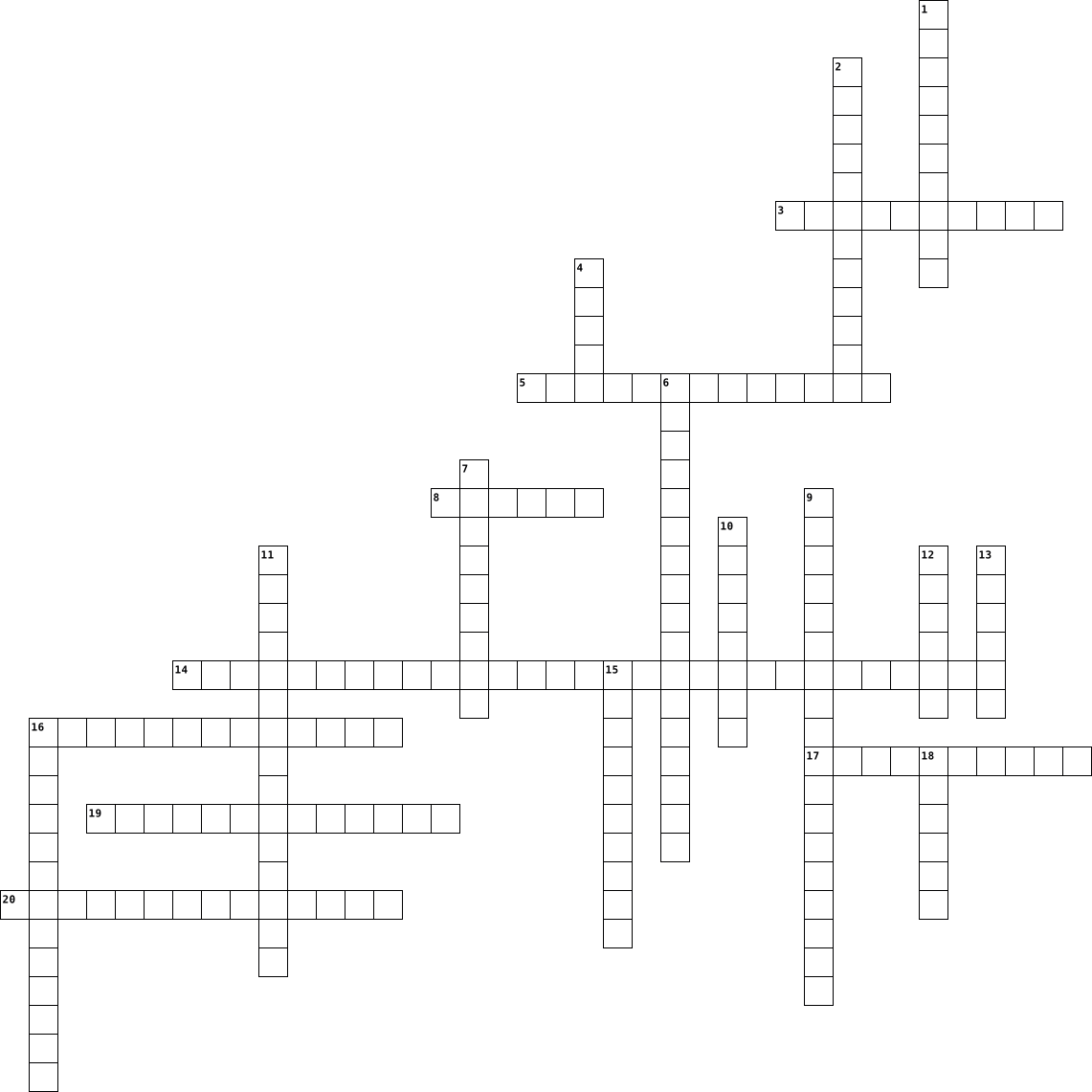
Across
- submission of law, proposed or already in effect, to a direct vote of the electorate.
- allows Congress to levy an income tax without apportioning it among the states.
- French passenger steamer that was torpedoed by the Germans in March 1916.
- one of the deadliest industrial disasters in New York City history, killed 126 people.
- states that US senators shall be elected by popular vote
- Woodrow Wilson's political philosophy of reforming tariffs, bankers, and trusts.
- consisted of Germany and Austria-Hungary, Turkey, and Bulgaria.
- Theodore Roosevelt's political philosophy to increase the federal government's power to remedy economic and social abuse.
Down
- writers who specialized in exposing corruption of businesses, government, etc.
- doctrine developed by US Supreme Court in the case of Standard Oil Company of New Jersey vs. United States.
- a German submarine
- decreed that all meat shipped over state lines would be subject to federal inspection.
- British passenger liner that killed 1,198 people, including 128 Americans.
- designed to prevent adulteration and mislabeling of foods and pharmaceuticals.
- the Republicans who supported President Taft during the campaign of the 1912 elections.
- President Taft's efforts to further its aims in Latin America and Asia through use of economic power.
- British liner that killed two American lives in August 1915.
- consisted of France, Britain, and Russia, and later Japan and Italy.
- procedure where voters can present proposed legislation directly to the electorate.
- states the prohibition of selling and manufacturing liquor.
- procedure for removing an official from office through popular election.
21 Clues: a German submarine • states that US senators shall be elected by popular vote • states the prohibition of selling and manufacturing liquor. • British liner that killed two American lives in August 1915. • consisted of Germany and Austria-Hungary, Turkey, and Bulgaria. • consisted of France, Britain, and Russia, and later Japan and Italy. • ...
chapter 4 lesson 1 2022-09-08

Across
- the ability to do something or act in a particular way, especially as a faculty or quality.
- two or more governments exercise power over the same people and the same territory.
- deny the truth of a statement by asserting the opposite.
- Power of a court to adjudicate cases and issue orders.
- powers also called enumerated powers, are those powers directly expressed or stated in the Constitution by the Founders.
- the system of rules which a particular country or community recognizes as regulating the actions of its members and which it may enforce by the imposition of penalties.
- the action or fact of joining or being joined, especially in a political context.
- the particular condition that someone or something is in at a specific time.
Down
- powers The Constitution says that the states will have any powers not delegated to the national government, as long as they are not also prohibited to the states.
- powers powers the Constitution grants or delegates to the national government.
- powers political powers granted to the United States government that aren't explicitly stated in the Constitution.
- powers The federal government and the states also have certain powers that they share
- the activities of governments concerning the political relations between countries.
- clause Article VI makes the acts and treaties of the United States supreme and is called the
- by giving the national government certain specified powers, reserving all other powers to the states or to the people.
- the management of any office, business, or organization; direction.
16 Clues: Power of a court to adjudicate cases and issue orders. • deny the truth of a statement by asserting the opposite. • the management of any office, business, or organization; direction. • the particular condition that someone or something is in at a specific time. • powers powers the Constitution grants or delegates to the national government. • ...
Unit 3 Part 1 & 2 Review - Federalism & the Legislative Branch 2026-10-06

Across
- this branch of government is responsible for making laws
- this branch of government is responsible for interpreting laws
- serves as leader of the Senate when the Vice President is not present
- Powers that both the federal government and state governemnts have
- Leader of the House of Representatives
- The "upper" house of Congress that has 100 members who serve 6 year terms
- this clause states that federal law (the Constitution) is always supreme to state laws
- this branch of government is responsible for enforcing the laws
- This clause states that US citizens are free to practice whatever religion they choose
Down
- power of the federal, state, or local government to seize private property and convert it into public use, provided the owner receives just compensation
- first ten amendments to the Constitution
- a legislative branch that is divided into two chambers or houses
- The "lower" house of Congress that has 435 members who serve two year terms
- the supreme law of the United States
- Powers that are only for states, not the federal government
- This clause states that only Congress has the power to regulate interstate or foreign trade
- serves as leader of the Senate
- This clause prohibits the government from establishing a national religion
- Powers of Congress that come from the necessary and proper clause
- Powers given to Congress in Article 1 of the Constitution
- the name given to the legislative branch of the US government
- a system of government where power is divided between a national government and individual state governments
22 Clues: serves as leader of the Senate • the supreme law of the United States • Leader of the House of Representatives • first ten amendments to the Constitution • this branch of government is responsible for making laws • Powers given to Congress in Article 1 of the Constitution • Powers that are only for states, not the federal government • ...
Principles of Training- By Laney :) 2024-08-14

Across
- States the magnitude of exertion should be appropriate for the selected physical activity
- Impacts an athletes ability to complete certain training activities
- The key factors in the design of an appropriate training program
- States that training should be planned to ensure gradual increases in training load to ensure that physiological adaptation is appropriate for selected sport
- States the length of training time should be appropriate for the selected sport
- Will impact an individuals ability to complete certain training activities
Down
- Will impact an athletes ability to complete certain training activities
- States a range of different training activities, movement options and training contexts should be included in a training program
- States the personal needs, goals, fitness levels, motivation and skills of individual athletes should be considered when creating a training program
- An increase in work volume and/or intensity of work, placing the athletes body under stress
- States the type of exercise used in training should be relevant to energy systems and fitness requirements for physical activity
- States the number of times training occurs in a given period should be appropriate for selected sport
- Should be considered when creating a training program as this may affect when an athlete can train and types of training they can partake in
13 Clues: The key factors in the design of an appropriate training program • Impacts an athletes ability to complete certain training activities • Will impact an athletes ability to complete certain training activities • Will impact an individuals ability to complete certain training activities • ...
Reconstruction Vocab 2024-05-13

Across
- This was the action of putting someone apart from others
- Rules that were specifically for one group of people
- A tax that was given to people when they voted
- This plan was the Reconstruction Act of 1867, it divided the old confederate states into five military districts. This plan also wrote the 14th and 15th amendment
- This plan states that 10 percent of confederates states have to swear to oath to the union and work to create new state constitutions
- A period of time where the US tried to include African americans in social, political and labor systems
Down
- A test that was given to people to see how good they are at reading and writing
- This amendment states that no state should take away the freedoms or privilege's of a person
- This amendment allowed African American men to vote
- Army forces that were assigned to protect a certain area
- This amendment states that slavery should be banned in the united states unless it is a punishment
- These were laws that restricted African Americans rights
- This plan states that if 10 percent of voters from a state took a pledge to promise to the US, abide by emancipation and agree to the 13th amendment, then they could pick new state constitutions
13 Clues: A tax that was given to people when they voted • This amendment allowed African American men to vote • Rules that were specifically for one group of people • Army forces that were assigned to protect a certain area • This was the action of putting someone apart from others • These were laws that restricted African Americans rights • ...
Alana Riddell: Our Puzzling Government #2 | Federalism 2022-11-18

Across
- an organization of government administrators
- Clause which states that the constitution is the supreme law of the land
- refers to documents such as mortgages, birth certificates, leases, and deeds
- Powers directly stated in the Constitution by the founders
- organization made up of all of the USA's govenors
- act An act that allows a territory wishing to become a state to prepare a constitution
- Powers given to the states if not given specifically to the government
- court case that declared Congress overstepped boundaries by banning guns in or near schools
- a type of compact made between two different states
- Clause which allows the powers of Congress to stretch if need be
- laws relating to disputes between people, groups or the state itself (not criminal)
- court case which ruled that between a state and national government, the national one is superior
Down
- a type of tax that is put on the money that you make
- powers held by both the national and state governments
- powers which are refused to all forms of government
- Powers the Constitution grants to the national government
- a position taken on how federalism should run which leans toward national action
- to return criminals from other states to their state of origin after committing a crime
- state and local governments making their own policies
- a government system which divides power between the state and national governments
- Powers are not directly stated but can be inferred from other expressed powers
- a law that requires checking government agencies from time to time to see if they are still needed
- law which prohibits public officials from holding closed/secret meetings
- One of the last two states admitted to the USA
24 Clues: an organization of government administrators • One of the last two states admitted to the USA • organization made up of all of the USA's govenors • powers which are refused to all forms of government • a type of compact made between two different states • a type of tax that is put on the money that you make • state and local governments making their own policies • ...
The Civil War Vocabulary 2014-03-14

Across
- the effort by the North to keep ships from entering or leaving Southern ports
- the term used to describe new soldiers
- something that makes a defensive position stronger, they can be man-made or natural
- a group of soldiers usually led my a brigadier general
- the new nation that the southern states made, it fought against the Union
- blanket or other bedding rolled up and carried over the shoulder by a soldier
- a soldier who was wounded, killed, or missing in action
- the states of Maryland, Delaware, Kentucky, and Missouri who didn't join the Confederacy, but supported the south
- troops who are only called out to defend the land in an emergency
- a boundary that became a symbolic division between the free and the slave states
- a branch of the military using ships to conduct warfare
- hard crackers often issued to the soldiers of both sides during the Civil War
Down
- a place where weapons and other military supplies are stored
- someone who wishes to abolish or get rid of slavery
- it said that people of each territory should decide for themselves if slaves should be allowed
- troops sent to strengthen a fighting force by adding a number of fresh soldiers
- withdrawal from the Federal government of the United States
- a branch of the military mounted on horseback
- the largest organized group of soldiers
- a state of bondage in which African Americans were owned by other people, usually white, and forced to labor on their behalf
- the cruel killing of a number of helpless or unresisting people
- to lie in wait for an attack
22 Clues: to lie in wait for an attack • the term used to describe new soldiers • the largest organized group of soldiers • a branch of the military mounted on horseback • someone who wishes to abolish or get rid of slavery • a group of soldiers usually led my a brigadier general • a soldier who was wounded, killed, or missing in action • ...
Cuban Missile Crisis 2016-01-14

Across
- ____ is a Soviet short-range artillery rocket system
- A ________ is an effort to cut off supplies, war material or communications from a particular area by force
- is a city located on the Atlantic coast in southeastern Florida
- the staged invasion from the CIA was called ___ __ ___
- to separate and restrict the movement of persons'state of enforced isolation is called __________
- Stevenson _____ _________ attempted to force an answer from Soviet Ambassador Valerian Zorin as to the existence of the weapons
- ______ was a body of United States government officials that convened to advise President John F. Kennedy during the Cuban Missile Crisis
- This was a neclear weapon created by USA and was placed on submarines are called ______
- This organizations is abbreviated to UN
- The Capital City of USSR is ______
- ______ was the place where USA placed missiles pointing towards USSR
Down
- The Capital city of Cuba is called ______
- _____ revolution was a plan to get rid of the dictator in Cuba
- _______ is a unit written into various nuclear weapon control treaties, and gives a sense of destructiveness
- is a state in the southeast United States, bordered to the west by the Gulf of Mexico
- __-__ was used for electronic sensor research, satellite calibration, and communications purposes.
- This continent is made up of Germany, USSR, France exc.
- a system that allows direct communication between the leaders of the United States and Russia
- A Surface-to-Air Missile was abbreviated to ___
- place of the President of the United States located in Washington, D.C.
- Rusk ____ ____ was the United States Secretary of State from 1961 to 1969
21 Clues: The Capital City of USSR is ______ • This organizations is abbreviated to UN • The Capital city of Cuba is called ______ • A Surface-to-Air Missile was abbreviated to ___ • ____ is a Soviet short-range artillery rocket system • the staged invasion from the CIA was called ___ __ ___ • This continent is made up of Germany, USSR, France exc. • ...
Voc 2023-08-28

Across
- Limited the power of the king
- Avoid tyranny; the majority can't be allowed to dictate or violate the rights of the minorities.
- Government that only has those powers delegated to it by law, often through a written constitution.
- Written in 1776, declared us independent of GB.
- The governing body that declared us independent of GB
- Wanted additional protections for people and states.
- States slaves were to be counted as ⅗ of a person
- Each branch has their individual roles and responsibilities
- Established direct democracy, first form of self government in the U.S
- Supported the constitution as is; no need for additional protections
- The supreme law of the United States of America
- Ensures one branch does not become too powerful.
- Met between May and September of 1787 to address the problems of the weak central government that existed under the Articles of Confederation.
Down
- Where we got some of our BOR from, gave us the idea of representative government
- Showed the weakness of the Articles; armed rebellion regarding taxes.
- Division of power among different levels of government
- States no one is above the law
- People directly vote for what they want
- Rule by the people, consent of the governed
- A compromise that stated the HOR= based off population and Senate= equal in proportion
- War between Britain and France over territory in the Ohio River Valley
- The nation’s first constitution; it failed due to giving the states too much power.
- The power of the judicial branch to declare laws unconstitutional.
- The first democratically elected legislative body in the U.S
24 Clues: Limited the power of the king • States no one is above the law • People directly vote for what they want • Rule by the people, consent of the governed • Written in 1776, declared us independent of GB. • The supreme law of the United States of America • Ensures one branch does not become too powerful. • States slaves were to be counted as ⅗ of a person • ...
Chapter 25: The United States: From Neutrality to War 2023-11-03

Across
- Who declared war on December 8th
- Who was Germany's parter that declared war on the United States
- Mention one of the two opposing ideologies that created a confrontation between empires
- What did the United States stand on the verge of war with?
- What did President Roosevelt declare about Arsenal in December 1940?
- What is the name of the boat that the Japanese airmen bomb and sank?
- In what month did the congress pass the Lend-Lease act in 1941
- Which country's admiral said, "Awakened a sleeping giant and filled him with a terrible resolve."
- Who spoke of attempting a "quarantine" of nations engaged in acts of aggression in October 1937?
- Which government requested Japan to move into French Indochina?
- Which nationalist government led the United States in the Panay incident?
- What did the nationalist Chinese government announce in 1911 trade treaty?
Down
- Where did Japanese Embassy code the communiques that war was coming?
- What country did Italy invade in 1935?
- But the ______ in Italy, the Nazis in Germany, and the militarists in Japan interpreted these communqiues as confessions of weakness and cowardice.
- What policy in Japan did the United States refuse to comply with?
- What country declared war on the United States?
- What race did the Germans intend to establish for a new world order
- What passed the Neutrality Act of 1937?
- Where did Japanese airmen bombed and sank the American gunboat?
- What crisis happened in September 1938 that cabled Hitler?
- What did President Franklin Roosevelt send the shipment of an embargo to
- Whats rising after the passage of the Lend-Lease act
23 Clues: Who declared war on December 8th • What country did Italy invade in 1935? • What passed the Neutrality Act of 1937? • What country declared war on the United States? • Whats rising after the passage of the Lend-Lease act • What did the United States stand on the verge of war with? • What crisis happened in September 1938 that cabled Hitler? • ...
CIVIC LITERACY 2023-08-30

Across
- People directly vote for what they want
- War between Britain and France over territory in the Ohio River Valley
- A compromise that stated the HOR= based off population and Senate= equal in proportion.
- Established direct democracy, first form of self government in the U.S
- Met between May and September of 1787 to address the problems of the weak central government that existed under the Articles of Confederation.
- Ensures one branch does not become too powerful.
- Wanted additional protections for people and states.
- Where we got some of our BOR from, gave us the idea of representative government
- Rule by the people, consent of the governed
- Division of power among different levels of government
- Supported the constitution as is; no need for additional protections
Down
- The supreme law of the United States of America.
- States slaves were to be counted as ⅗ of a person
- States no one is above the law
- Each branch has their individual roles and responsibilities
- The first democratically elected legislative body in the U.S
- Government that only has those powers delegated to it by law, often through a written constitution.
- Limited the power of the king
- The governing body that declared us independent of GB.
- Written in 1776, declared us independent of GB.
- The nation’s first constitution; it failed due to giving the states too much power.
- Avoid tyranny; the majority can't be allowed to dictate or violate the rights of the minorities
- Showed the weakness of the Articles; armed rebellion regarding taxes.
- The power of the judicial branch to declare laws unconstitutional.
24 Clues: Limited the power of the king • States no one is above the law • People directly vote for what they want • Rule by the people, consent of the governed • Written in 1776, declared us independent of GB. • The supreme law of the United States of America. • Ensures one branch does not become too powerful. • States slaves were to be counted as ⅗ of a person • ...
CW and Recon Vocab 2025-05-05

Across
- Battle where Union leaders cut off supplies to this Mississippi city
- Agency that provided relief to freed people and certain poor people in the South.
- This man sued a railroad company after being arrested for sitting in the “whites only” rail car.
- Slave states that did not join the Confederacy
- Location of Confederate surrender
- This Union victory was the last Confederate attack on northern soil.
- Lincoln orders the freeing of all those enslaved in the Confederacy
- The bloodiest single-day battle of the Civil War
- Laws that greatly limited the freedoms of African-Americans after slavery was outlawed.
- Destroying civilian and economic resources
- Landowners provide land, tools, and supplies, while sharecroppers harvested the land for little reward.
- Location of the first Civil War battle
- Process of readmitting the former Confederate states into the Union
Down
- Union commander who was eager to attack
- Amendment that gave African-American men the right to vote.
- first president to be impeached.
- The freeing of slaves
- Forced separation of whites and African-Americans in public places
- Terrorist group who targeted African-Americans, white Republican voters, and public officials.
- Lincoln’s Speech renewing his commitment to win the war.
- Civil War volunteer who founded the American Red Cross
- to bring charges against a president.
- This Amendment made slavery illegal in the United States
- Confederate General appointed in 1862
- Abe Lincoln’s plan to readmit the southern states
- This Amendment defined all people born or naturalized within the United States, except Native Americans, as citizens.
- Laws that enforced Segregation
- Location of the first Confederate attack
28 Clues: The freeing of slaves • Laws that enforced Segregation • first president to be impeached. • Location of Confederate surrender • to bring charges against a president. • Confederate General appointed in 1862 • Location of the first Civil War battle • Union commander who was eager to attack • Location of the first Confederate attack • Destroying civilian and economic resources • ...
Constitution Vocabulary 2024-10-10

Across
- group of electors that officially elect the president and vice president
- the state must respect all legal rights owed to a person
- system of government where power is divided between the central government and the states
- the process by which a government official is charged with a crime
- a change or addition to the Constitution
- introduction outlining the purpose of the Constitution
- system that ensures no one branch of the government becomes too powerful
- a legislative body having two houses or chambers
- powers that both the Fed and states have
- the highest court in the U.S.
- power of the President to reject a law passed by Congress
- power of the Supreme Court to determine Constitutionality of laws or actions of the government
Down
- the supreme law of the United States
- the principle that the federal government keeps its power by the consent of the governed
- powers explicitly given to the federal government by the Constitution
- having the power to make laws
- the first constitution of the United States
- gives Congress the power to do what is "necessary and proper" as needed
- Powers not explicitly given to the federal government but are reserved for the states or the people
- gives Congress the authority to trade with foreign nations
- type of indirect democracy where the people elect legislators to govern for them
- first amendments that protected personal liberties
- approval process
- division of government to prevent a concentration of power in one branch
- establishes that the Constitution and federal laws take precedence over state laws
- guarantee that no state can deny any person within their state equal protection of the law
- the minimum number of people needed to legally conduct business
27 Clues: approval process • having the power to make laws • the highest court in the U.S. • the supreme law of the United States • a change or addition to the Constitution • powers that both the Fed and states have • the first constitution of the United States • a legislative body having two houses or chambers • first amendments that protected personal liberties • ...
The 27 Amendments 2022-09-29

Across
- Congressional pay raise parameters set
- States can't be sued by people in other states or countries
- Elect President and Vice President
- Freedom of speech, assembly, press, and religion
- Defines US Citizenship and Citizens' Rights
- 18 year olds can now vote
- No cruel or unusual punishments; no excessive bail or fines
- No Taxes for Voting
- All Races Can Vote
- Income taxes can be collected
- Repeals 18th Amendment
- Rights not mentioned in constitution
Down
- Presidential, Vice Presidential, and Congress terms set
- Right to a jury in a civil case
- Women Can Vote
- Senators are elected by the people
- Rights in criminal cases
- Quartering of soilders without approval of owner
- Outlaws Slavery in US
- Outlaws manufacture and sale of alcohol
- Rights given to states not granted to government
- Freedom from unreasonable search and seizure
- Limited Presidential Terms
- Right to Bear Arms
- Vice President becomes President if President cannot serve
- People living in Washington, DC can vote
- Rigtht to an attorney, public trial, fair and speedy trial
27 Clues: Women Can Vote • Right to Bear Arms • All Races Can Vote • No Taxes for Voting • Outlaws Slavery in US • Repeals 18th Amendment • Rights in criminal cases • 18 year olds can now vote • Limited Presidential Terms • Income taxes can be collected • Right to a jury in a civil case • Senators are elected by the people • Elect President and Vice President • ...
Ancient Greece 2022-11-01

Across
- Spartan life was centered on the ___________
- the most deadly fighting force in ancient Greece
- the enemy of both Sparta and Athens
- Alexander was unable to conquer this because his troops refused to continue
- citizen-soldiers of Ancient Greek city-states who were primarily armed with spears and shields
- these "h" rebels could be credited with Sparta's desire to form a military state
- "We are what we repeatedly do; excellence is a habit."
- a government ruled by a few powerful people
- home of Philip and Alexander
- Athens focused on science, rhetoric, and the ________
- Greece's geography led to these independent states
- alarm clocks, democracy, astronomy, mathematics, and drama are all Greek ________
Down
- unlike today, these rulers typically appealed to common citizens for support and were fair and just
- the most famous Greek 'republican'
- Greece was the first to use this form of government
- Alexander's greatest achievement
- leader of the Delian League
- earliest Greeks
- he used league money to beautify Athens
- age of no written records existed during this period of Greek history
- winner of the Peloponnesian War
21 Clues: earliest Greeks • leader of the Delian League • home of Philip and Alexander • winner of the Peloponnesian War • Alexander's greatest achievement • the most famous Greek 'republican' • the enemy of both Sparta and Athens • he used league money to beautify Athens • a government ruled by a few powerful people • Spartan life was centered on the ___________ • ...
the civil was crossword By jessica 2021-11-23

Across
- platform, The Georgia Platform succeeded in helping the Union from collapse by Compromise of 1850.
- , landlord/planter allows a tenant to use the land in exchange for a share of the crop.
- rights, States' rights became not just a political argument, but a person on, too.
- codes, black laws were for the African Americans
- a state did not have to follow federal law and could, in effect nullify the law
- of 1850, it split the states equally and the south now had the fugitive slave act which now they could bring slaves back to the south
- Lincon, 16th president of the union during the civil war
- Mcneal Turner, was a minister, politician, and the 12th elected
Down
- reconstruction, the federal government e attempted to enforce equal suffrage on the ex-Confederate states.
- 50 military prisons of the Civil War, Camp Sumter
- reconstruction transformed the south with slavery-free for them
- Scott, A slave in the south which he was brought back from the more and then fought for his freedom but lost
- T Sherman, Commanding General of the United States Army
- Republicans, The Radical Republicans were a group of politicians who formed a faction within the Republican party
- The south left the united states of America to create the confederacy and South Carolina was the first to leave
15 Clues: 50 military prisons of the Civil War, Camp Sumter • codes, black laws were for the African Americans • T Sherman, Commanding General of the United States Army • Lincon, 16th president of the union during the civil war • reconstruction transformed the south with slavery-free for them • Mcneal Turner, was a minister, politician, and the 12th elected • ...
The Constitutional convention 2026-09-25

Across
- The delegate from New York who argued for a strong national government.
- The branch described in Article I that makes laws.
- The delegate from Virginia known as the “father of the Constitution.”
- The one-house legislature proposed by the New Jersey Plan.
- Article IV explains how the states and the federal government work together.
- Article VII explains this process for approving the Constitution.
- The two-house legislative system created by the Great Compromise.
- The compromise that created a two-house Congress.
- The opening section of the Constitution that explains its purpose.
- The Connecticut delegate who defended the interests of small states.
- The compromise that counted enslaved people as three-fifths of a person for representation and taxation.
- The plan that favored large states and representation based on population.
- The delegate who argued for a Bill of Rights.
- The ninth state to ratify the Constitution was this state.
- Article V explains how to make this change to the Constitution.
Down
- The Articles of Confederation were replaced by this document.
- The group that opposed a strong national government and wanted protections for individual rights.
- Article VI establishes the Constitution as the supreme law of the land.
- The city where the Constitutional Convention met in 1787.
- The group that supported a stronger national government.
- The chamber of Congress in which representation is based on population.
- the plan that favored small states and equal representation.
- The branch described in Article III that interprets laws.
- The date when delegates signed the Constitution.
- The number of senators representing each state under the Great Compromise.
- The chamber of Congress in which each state has equal representation.
- The branch described in Article II that carries out laws.
- The month and year when the Constitutional Convention met.
- The process by which states approve the Constitution.
- The final state to join the Union in May 1790.
- The president of the Constitutional Convention.
- The first three words of the Preamble.
32 Clues: The first three words of the Preamble. • The delegate who argued for a Bill of Rights. • The final state to join the Union in May 1790. • The president of the Constitutional Convention. • The date when delegates signed the Constitution. • The compromise that created a two-house Congress. • The branch described in Article I that makes laws. • ...
unit 7 2022-10-06

Across
- a federal executive department of the United States government tasked with the enforcement of federal law
- one of two agencies that supply deposit insurance to depositors in American depository institutions
- domestic intelligence and security service of the United States
- the federal executive department responsible for developing and executing federal laws related to farming, forestry, rural economic development, and food.
- American scientific and regulatory agency within the United States Department of Commerce that forecasts weather
Down
- provides the military forces needed to deter war, and to protect the security of the United States
- the revenue service for the United States federal government
- an intergovernmental military alliance between 30 member states
- agency of the United States Department of Homeland Security
- the combination of communications and collaboration technologies.
10 Clues: agency of the United States Department of Homeland Security • the revenue service for the United States federal government • an intergovernmental military alliance between 30 member states • domestic intelligence and security service of the United States • the combination of communications and collaboration technologies. • ...
Barbary States and Embargo Act 2023-01-31

Across
- states coastal region of North Africa
- Act law that restored trade with most of Europe (but not Britain and France)
- an attack on this US ship nearly caused Jefferson to abandon neutrality
- sum of money demanded for the return or a release of a prisoner
- a government order that prevents the departure of ships or other property to another country
- person being held against their will or prisoner
- to suddenly take hold by force
Down
- an illegal payment of money made to influence the behavior of public officials
- person who expresses a negative opinion about someone or something
- military branch made of ships and boats
- increase greatly or rapidly
- goods being shipped out of a country
- person involved in trade
- military tactic used to block the movement of people and goods in and out of a port or coast
- person who attacks and robs ships at sea
- the practice of forcing men to serve in the military against their will
16 Clues: person involved in trade • increase greatly or rapidly • to suddenly take hold by force • goods being shipped out of a country • states coastal region of North Africa • military branch made of ships and boats • person who attacks and robs ships at sea • person being held against their will or prisoner • sum of money demanded for the return or a release of a prisoner • ...
APUSH Unit 5 2025-01-29

Across
- United States slave and insurrectionist who in 1831 led a rebellion of slaves in Virginia
- a racial term for a black and native american child
- a free black who moved from the South to the North and urged African Americans to fight for their freedom.
- the formal act of freeing from slavery
- Written by Harriet Beecher Stowe in 1853 that highly influenced england's view on the American Deep South and slavery. a novel promoting abolition. intensified sectional conflict.
- An anti-slavery newspaper written by William Lloyd Garrison. It drew attention to abolition, both positive and negative, causing a war of words between supporters of slavery and those opposed.
- American social theorist who justified slavery by saying that black people were just children and needed to be in slavery
- Former slave who helped slaves escape on the Underground Railroad
- a young woman of the American Old South's upper class, known for being quiet and polite
- man or farmer owning small estate; middle-class farmer
- United States abolitionist who published an anti-slavery journal (1805-1879)
Down
- a system that helped enslaved African Americans follow a network of escape routes out of the South to freedom in the North
- 1842, Supreme Court case that decided federal law superseded state law, it was over a fugitive slave law.
- opposed the expansion of slavery in new states (particularly out west) ; subcatagory of the Republican party who were also abolitionists ; popular during the late antebellum period ; Abe Lincoln was the most influential person of this political party
- A Society that thought slavery was bad. They would buy land in Africa and get free blacks to move there. One of these such colonies was made into what now is Liberia. Most sponsors just wanted to get blacks out of their country.
- Another term for slavery; The owning of human beings existed in a country that practiced liberty.
- Term used to refer to the approximately 3 decades before 1860 when "king" cotton and the slave labor dominated the economy of the southern states
- United States freed slave and insurrectionist in South Carolina who was involved in planning an uprising of slaves and was hanged (1767-1822)
- cotton and cotton-growing considered, in the pre-Civil War South, as a vital commodity, the major factor not only in the economy but also in politics.
- United States abolitionist who escaped from slavery and became an influential writer and lecturer in the North (1817-1895)
20 Clues: the formal act of freeing from slavery • a racial term for a black and native american child • man or farmer owning small estate; middle-class farmer • Former slave who helped slaves escape on the Underground Railroad • United States abolitionist who published an anti-slavery journal (1805-1879) • ...
US CULTURE 2024-09-02

Across
- name of the first black president of the U.S.A
- public holiday and celebration on the fourth Thursday of November
- the American president who abolished slavery
- event celebrated on 4th of July
- last name of the running democrat candidate for 2024 presidential Elections
- : complex which was hit by a terrorist attack on September 2001
- number of stripes on the American Flag
Down
- American coffee chain
- emblematic non violent figure of fight against racism
- The overturn of roe vs wade in June 2022 enabled a number of states to make it illegal
- national emblem of the U.S.A
- house official residence and workplace of the president of the United States and his family
- seat of the United States congress
- Movement that became viral with the accusations of sexual abuse against a famous film director
- what does the stars stand for on the flag ?
- the city that never sleeps
- victim of an assassination attempt this summer, he was shot in the right ear
17 Clues: American coffee chain • the city that never sleeps • national emblem of the U.S.A • event celebrated on 4th of July • seat of the United States congress • number of stripes on the American Flag • what does the stars stand for on the flag ? • the American president who abolished slavery • name of the first black president of the U.S.A • ...
Erich Malek 2020-09-27

Across
- of Rights, The first Ten Amendments were known as the _____________ _____________ _____________.
- The Sixth Amendment guarantees the right to a speedy _____________.
- Since the Bill of Rights were written, _____________ more amendments have been added.
- Amendment, Guarantees the rights to a Grand Jury, and states that you can not be tried for the same crime again.
- The Fourteenth Amendment granted _____________ to all persons born or naturalized in the United States—including former slaves—and guaranteed all citizens “equal protection of the laws.”
- Amendment, The Government can not search your belongings without a warrant.
- Amendment, We have the freedom of speech, freedom to choose our own religion, peaceful protest, and the right to petition the Government.
- Amendment, States that you have rights that are not in the Constitution, but they exist.
- Amendment, We have the right to bear arms (to own a gun).
Down
- The Seventh Amendment guarantees the right for a trial by _____________.
- The Eighth Amendment guarantees the right that excessive _____________ shall not be required.
- The 27 amendments to the _____________ range from personal rights to procedural laws.
- Madison, Wrote the Bill of Rights.
- The Eighteenth Amendment established the _____________ of alcohol in the United States.
- Amendment, Provides the procedure for electing the president and vice president.
- Rights, The Bill of Rights were written for our _____________ _____________.
- Amendment, The powers not delegated to the United States by the Constitution, nor prohibited by it to the States, are reserved to the State respectively, or to the people.
- Amendment, No soldier shall, in time of peace be quartered in any house, without the consent of the owner, nor in time of war, but in a manner to be prescribed by law. (people should not have to give up their home to soldiers. It is their property.)
18 Clues: Madison, Wrote the Bill of Rights. • Amendment, We have the right to bear arms (to own a gun). • The Sixth Amendment guarantees the right to a speedy _____________. • The Seventh Amendment guarantees the right for a trial by _____________. • Amendment, The Government can not search your belongings without a warrant. • ...
Constitutional convention In New Jersey 2025-01-29

Across
- revenue and regulate trade
- smaller states
- for bigger national government
- slaves involved in states votes
- articles of confederation
- states vs higher states
- vs north
Down
- New Jersey plan
- affected
- for smaller Nation government
- votes per states
11 Clues: affected • vs north • smaller states • New Jersey plan • votes per states • states vs higher states • articles of confederation • revenue and regulate trade • for smaller Nation government • for bigger national government • slaves involved in states votes
Mr. Valerio - Unit 1 - Reconstruction 2026-09-28

Across
- A law that exempted a person from voting requirements like literacy tests if their grandfather had voted before 1867, protecting white voters while excluding Black voters.
- The enforced separation of different racial groups in schools, housing, transportation, and public spaces.
- A secret white supremacist organization founded during Reconstruction that used violence and intimidation to prevent African Americans from exercising their rights.
- A test of reading and writing skills that Southern states used to keep African Americans from registering to vote.
- Lincoln's 1863 proposal that a Southern state could rejoin the Union once 10% of its 1860 voters swore loyalty to the U.S. and accepted the end of slavery.
- The 1865 constitutional amendment that abolished slavery throughout the United States.
- The 1870 constitutional amendment that stated a citizen's right to vote could not be denied based on race, color, or previous condition of servitude.
- A minister and politician who, in 1870, became the first African American to serve in the U.S. Senate, representing Mississippi. His election was a landmark moment showing what political participation by Black Americans could look like under Reconstruction.
- A formerly enslaved man who became a leading abolitionist, writer, and statesman. Throughout Reconstruction, he pushed the nation to fully guarantee Black citizenship, voting rights, and equal protection under the law, arguing that freedom without rights was incomplete.
- A farming system in which landless farmers, often freedpeople, worked land owned by others in exchange for a share of the crops, frequently trapping them in debt.
- The process of formally charging a public official with misconduct; Andrew Johnson was impeached by the House in 1868 but not removed from office.
Down
- A federal agency created in 1865 to help formerly enslaved people find food, housing, education, and employment after the Civil War.
- 16th President of the United States (1861-1865).
- Restrictive laws passed by Southern states after the Civil War to limit the freedom and rights of African Americans.
- The informal agreement that resolved the disputed 1876 presidential election by giving Republicans the presidency in exchange for withdrawing federal troops from the South, ending Reconstruction.
- A fee required to vote, used after Reconstruction to prevent poor African Americans (and some poor whites) from voting.
- The 1868 constitutional amendment that granted citizenship to all persons born or naturalized in the U.S. and guaranteed equal protection under the law.
- A group of Republicans in Congress who wanted harsh treatment of the South, full citizenship rights and protections for freedpeople, and a slower path back to the Union for Confederate states.
- The U.S. president who succeeded Lincoln in 1865. He favored a lenient approach to readmitting Southern states, clashed repeatedly with Radical Republicans in Congress, and was impeached by the House in 1868 but not removed from office.
- The period from 1865 to 1877 when the United States worked to rebuild the South and reunite the nation after the Civil War.
20 Clues: 16th President of the United States (1861-1865). • The 1865 constitutional amendment that abolished slavery throughout the United States. • The enforced separation of different racial groups in schools, housing, transportation, and public spaces. • ...
Civil War 2021-11-02

Across
- The proclamation that freed all slaves in the Confederacy
- Supreme court case that declared slaves were not citizens
- Someone who opposes slavery
- The era after the Civil War
- States that banned slavery
- The Georgian vice president of the Confederate States of America
- A warship used during the Civil War covered in iron and steel
- The Union's president during the Civil War
- Prisoner of war camp in Macon, GA
- The act that said all runaway slaves had to be returned
Down
- The south during the Civil War
- Union military campaign whose goal was to capture Savannah
- The belief that states should have more sovereignty than the federal government
- The party that opposed Andrew Jackson
- The amendment that banned slavery
- What 11 southern states did after the 1860 election
- Involuntary servitude
- Invented the cotton gin
- making legally void
- The north during the Civil War
20 Clues: making legally void • Involuntary servitude • Invented the cotton gin • States that banned slavery • Someone who opposes slavery • The era after the Civil War • The south during the Civil War • The north during the Civil War • The amendment that banned slavery • Prisoner of war camp in Macon, GA • The party that opposed Andrew Jackson • The Union's president during the Civil War • ...
The Civil War 2019-02-11

Across
- commanded Confederate forces in Texas
- to withdraw from a larger unit one belongs to
- 19th Governor of Texas
- fought on both sides
- southern states
- a local law or piece of legislation
- Tom Green County is named for him
- Free African Americans fought for
- steamboat converted to gunboat
- rights the position that the federal government should not interfere with the states exercising their constitutional powers
Down
- States of American
- Governor of Texas in 1861
- the civilian world in wartime
- using naval vessels to prevent shipment of food and supplies into or out of ports
- forced enrollment of people into military service
- focus on the interests of one’s own region
- member of a volunteer committee organized to punish criminals
- coarse, loosely woven, homemade fabric
- a tax on trade
- drug used for fighting malaria
- person who supported the Union cause during the Civil War
21 Clues: a tax on trade • southern states • States of American • fought on both sides • 19th Governor of Texas • Governor of Texas in 1861 • the civilian world in wartime • drug used for fighting malaria • steamboat converted to gunboat • Tom Green County is named for him • Free African Americans fought for • a local law or piece of legislation • commanded Confederate forces in Texas • ...
Post war America maddalynn 2024-02-03

Across
- undue dependence on
- Southern states of the United States
- a 1954 landmark United States Supreme Court
- American pediatrician whose books on child-rearing
- type of social influence involving
- economic extension of the New Deal proposed
- the right or license granted
- bipartisan agency charged with monitoring federal civil rights enforcement
- that dream of a land
- 37th President
- temporary marked increase in the birth rate
- the practice of designing products
- a corporation of several
- a network of controlled-access
Down
- emphasized governmental economy and decentralization of Federal projects
- five-star general in the United States Army
- the belief that excessive consumption of goods
- society in which scarcity of resources
- man who subordinates individualism
- an area of a town or city
- system for organizing
- mass-produced homes built using a strict division
- doctor who killed-virus polio vaccine
- help you pay for college
24 Clues: 37th President • undue dependence on • that dream of a land • system for organizing • a corporation of several • help you pay for college • an area of a town or city • the right or license granted • a network of controlled-access • man who subordinates individualism • type of social influence involving • the practice of designing products • Southern states of the United States • ...
Peloponnesian War 2022-12-01

Across
- The war was a ___ for the city-states.
- Sparta was recovering from a major ________.
- The war fought between the delian and ________ League.
- Athens was a ______ city-state.
- the war ended when Athens _____.
- The war remained _______ for many years
- Criminal Cases could only be tried in ____.
Down
- Athens began to ___ the other city-states
- He wrote history of the Peloponnesian War.
- ____ was widespread.
- Money from the Delian League was used to build the _______.
- The war fought between 2 different time periods with a period of ____ between them.
- How many different time periods did the war fight?
- Athens government was a ______.
- Sparta was ruled by 2 ____.
- The fighting made the city-states ___.
- The ruler of Athens.
- Like the other city-states sparta had ______.
- Free foreigners who lived in ____ were called Perioeci.
- In 430 BCE, a ____ weakened athens.
20 Clues: ____ was widespread. • The ruler of Athens. • Sparta was ruled by 2 ____. • Athens government was a ______. • Athens was a ______ city-state. • the war ended when Athens _____. • In 430 BCE, a ____ weakened athens. • The war was a ___ for the city-states. • The fighting made the city-states ___. • The war remained _______ for many years • ...
South Afrika 2026-01-14

Across
- The island which Mandela served his time in prison on
- The number of capitals in South Afrika
- a famous Cape Wineland in South Africa
- Nelson Mandelas real African name
- When people of colour were separated from the whites
Down
- What kind of gem the colonists discovered in South Africa
- The number of official languages
- The South African flag represents
- The kind of marriage that was prohibited during apartheid
- In 1910 they formed the Union of South Africa
- It is called a ... nation because of it's diversity
11 Clues: The number of official languages • The South African flag represents • Nelson Mandelas real African name • The number of capitals in South Afrika • a famous Cape Wineland in South Africa • In 1910 they formed the Union of South Africa • It is called a ... nation because of it's diversity • When people of colour were separated from the whites • ...
Friday Activity Suzuki 2019-08-26

Across
- Authority of courts to declare laws passed by Congress and acts of the executive branch to be unconstitutional.
- System of government in which ultimate authority rests with the national government.
- Broad coalitions of interests organized to win elections in order to enact a commonly supported set of public policies.
- Gives Congress the power to tax to provide for the general welfare.
- Compromise over slavery at the Constitutional Convention that granted states extra representation in the House of Representatives based on their number of slaves at the ratio of three-fifths.
- Authority of the president to block legislation passed by Congress. Congress can override a veto by two-thirds majority in each chamber.
- Initially, those who supported the Constitution during the ratification period; later, the name of the political party established by supporters of Alexander Hamilton.
- Initial governing authority of the United States, 1781-88
- Meeting in 1787 at which twelve states intended to revise the Articles of Confederation but ended up proposing an entirely new Constitution.
- Gives Congress the power to pass all laws necessary and proper to the powers enumerated in section 8.
- Rule by the people.
- Formal process of changing the Constitution
- Powers retained by the states under the constitution.
- Right of states to invalidate acts of Congress they believe to be illegal.
- System of government in which sovereignty is constitutionally divided between national and state governments.
- Form of government in which power derives from citizens, but public officials make policy and govern according to existing law.
Down
- The presidential electors, selected to represent the votes of their respective states, who meet every four years to cast the electoral votes for president and vice president.
- Compromise on legislative representation whereby the lower chamber is base on population, and the upper chamber provides equal representation to the states.
- The 1776 document declaring American independence from Great Britain and calling for equality, human rights, and citizen participation.
- Those who opposed the new proposed Constitution during the ratification period.
- Government structure that authorizes each branch of government (executive, legislative, and judicial) to share powers with the other branches, thereby holding some scrutiny of and control over the other branches.
- Government structure in which authority is divide among branches (executive, legislative, and judicial), with each holding separate and independent powers and areas of responsibility.
- Document or set of documents that establish the basic rules and procedures for how a society shall be governed.
- Powers expressly granted to Congress by the Constitution.
- First ten amendments to the Constitution, which provide basic political rights.
- System of government in which ultimate authority rests with the regional governments.
- Powers held by both the national and state government in a federal system.
- Powers not expressly granted to Congress but added through the necessary and proper clause.
- To formally withdraw from a nation-state.
29 Clues: Rule by the people. • To formally withdraw from a nation-state. • Formal process of changing the Constitution • Powers retained by the states under the constitution. • Powers expressly granted to Congress by the Constitution. • Initial governing authority of the United States, 1781-88 • Gives Congress the power to tax to provide for the general welfare. • ...
Civil War Crossword 2025-03-18

Across
- soldiers for the Confederacy
- United States of America's President
- Bloodiest battle of the Civil War with more than 50,000 casualties
- Confederate general that led to a Rebel victory at the First Battle of Bull Run
- General-in-Chief of the US Army and veteran of the 1812 and Mexican wars
- Sunk March 8, 1862 by the CSS Virginia and marked the end of wooden vessels use in the US Navy
- Britian nearly sided with the Confederacy.
Down
- commander of the South's eastern forces
- Confederate States of America's President
- Union strategy to cut blockade Southern ports using the US Navy
- The court house were the Civil War officially ended with Confederate surrender and reunification on April 9, 1865
- United States army during the civil war
- The Confederate strategy that hoped European nations dependent on American cotton would help aid the rebellion
- succeeded from the United States
- soldiers for the Union Union's
15 Clues: soldiers for the Confederacy • soldiers for the Union Union's • succeeded from the United States • United States of America's President • commander of the South's eastern forces • United States army during the civil war • Confederate States of America's President • Britian nearly sided with the Confederacy. • Union strategy to cut blockade Southern ports using the US Navy • ...
Ch 1 History- Reconstruction 2025-08-26

Across
- The ten percent plan created by...
- AA reformer who argued that AA's should get used to segregation and focus on economy and jobs.
- 13th amendment.
- Law that limited AA's rights and wasn't much better then slavery.
- Who was president during the compromise of 1877?
- Right to vote
- The compromise of 1877 did what?
- Presidency during most of civil war
Down
- The freedmen's bureau hoped to give every african american an...
- Northerners who came to the south to help with economy.Had advantage on jobs as they were educated.
- President who died 5 days after civil war
- This plan was owned by a group of people who wanted the southern states to have to have 50% of states having to sweat into the union to be readmitted.
- 14th amendment
- The civil rights act of 1866 was...
- This amendment forbid states from denying suffrage.
- Who's plan was focused more on the states and less on helping AA's with Reconstruction?
16 Clues: Right to vote • 14th amendment • 13th amendment. • The compromise of 1877 did what? • The ten percent plan created by... • The civil rights act of 1866 was... • Presidency during most of civil war • President who died 5 days after civil war • Who was president during the compromise of 1877? • This amendment forbid states from denying suffrage. • ...
Ice Hockey By: Blakely Beinstein 2026-03-13

Across
- When a player scores 3 goals in one game.
- a forward position responsible for playing the side of the ice
- This is what its called when a player breaks a rule
- a machine that goes over the ice to resurface it
- Who is holding the record for most all- time regular season goals
- the NHL champion trophy
Down
- what city team are the capitals
- a building that inside holds ice
- the most powerful shot in ice hockey
- what is used to hit the puck
- When two or more players pass to make a goal.
- the professional hockey league
12 Clues: the NHL champion trophy • what is used to hit the puck • the professional hockey league • what city team are the capitals • a building that inside holds ice • the most powerful shot in ice hockey • When a player scores 3 goals in one game. • When two or more players pass to make a goal. • a machine that goes over the ice to resurface it • ...
gramar crossword 2024-11-20

Across
- this goes at the end of interrogitive sentences(2 words)
- a sentence that exclaims(2 words)
- what to words combied are(2 words)
- these words make things more urgent(2 words)
- a sentence that needs another sentence to make sense(2 words)
- these go at the start of names
- this makes nouns more discriptive
Down
- what the crossword is about(2 words)
- this is what names or specific thing(2 words)
- something that asks a question that dosen't need to be ansered(2 words)
- this goes at the end of a sentence(2 words)
- this goes inbetween words
12 Clues: this goes inbetween words • these go at the start of names • a sentence that exclaims(2 words) • this makes nouns more discriptive • what to words combied are(2 words) • what the crossword is about(2 words) • this goes at the end of a sentence(2 words) • these words make things more urgent(2 words) • this is what names or specific thing(2 words) • ...
GA Importance 2022-04-20

Across
- previous capitals
- GAs rank based on population
- origin of the state name
Down
- number of our congressional district
- Georgia on __ ____
5 Clues: previous capitals • Georgia on __ ____ • origin of the state name • GAs rank based on population • number of our congressional district
Unit 2 Vocab 2024-02-22

Across
- Fe Trail: Historic trade route between Missouri and Santa Fe, New Mexico, used extensively in the 19th century.
- Barton: Founder of the American Red Cross and known as the "Angel of the Battlefield" for her work during the Civil War.
- Southern states that seceded from the Union and fought against the Union during the Civil War.
- of Bull Run: First major battle of the Civil War, fought in Virginia in 1861.
- Party: Political party in the United States during the mid-19th century, primarily focused on nativist and anti-immigrant sentiments.
- Formal withdrawal of a state from a union or federation.
- Smith: Founder of the Latter-day Saint movement (Mormonism).
- Doctrine: Position taken by Stephen A. Douglas during the Lincoln-Douglas debates, asserting that slavery could be excluded from territories of the United States by local legislation.
- War: Conflict between the United States and Mexico from 1846 to 1848, resulting in the annexation of vast territories by the U.S., including California and New Mexico.
- Douglass: African American abolitionist, writer, and orator who escaped from slavery and became a leading voice in the abolitionist movement.
- Revolution: Conflict between Texas settlers and the Mexican government resulting in Texas gaining independence from Mexico and becoming the Republic of Texas.
- Scott: African American slave who sued for his freedom in the famous Dred Scott v. Sandford case, which ultimately ruled against him and contributed to tensions leading up to the Civil War.
- Refers to the period before the American Civil War (1861-1865).
- Civil War battle fought in Maryland in 1862, the bloodiest single-day battle in American history.
- Mann: Education reformer known for his efforts to improve public education in America, including the establishment of teacher training schools and compulsory attendance laws.
- Policy of favoring native-born or established inhabitants over immigrants.
- A. Douglas: American politician known for his role in the Kansas-Nebraska Act and his debates with Abraham Lincoln.
- Proviso: Proposal to prohibit slavery in any territory acquired from Mexico during the Mexican-American War.
- The movement to end slavery, particularly in the United States during the 19th century.
- Republicans: Faction of the Republican Party during Reconstruction advocating for more aggressive policies toward the South and greater rights for freedmen.
- Brown: Abolitionist who led the raid on Harpers Ferry, an attempt to start a slave rebellion.
- Revolution: Economic transformation in the United States during the early 19th century, characterized by the emergence of a capitalist economy, increased industrialization, and improvements in transportation and communication.
- Farming: Agricultural system in which farmers rent land from landowners and pay rent either in cash or in shares of their crops.
- of Domesticity: Social and cultural belief system that idealized women as guardians of the home and family, emphasizing domesticity, piety, and submission to husbands.
- Slave Act: Law passed by the U.S. Congress in 1850 to allow for the capture and return of escaped slaves.
- Ferry: Location of John Brown's raid on a federal arsenal in Virginia, aimed at starting a slave rebellion.
- Plan: Union strategy during the Civil War to blockade Confederate ports and control the Mississippi River to split the Confederacy in two.
- Proclamation: Executive order issued by Abraham Lincoln in 1863, declaring slaves in Confederate-held territory to be free.
- Codes: Laws passed by Southern states during Reconstruction to restrict the rights and freedoms of African Americans.
- Act: Legislation that allowed settlers in the Kansas and Nebraska territories to decide for themselves whether to allow slavery, leading to violent conflicts.
- Davis: President of the Confederate States of America during the Civil War.
- To bring charges against a public official for misconduct in office.
- Dix: Activist who advocated for better treatment of the mentally ill and for the establishment of mental asylums in the United States.
- Turner’s Rebellion: Slave rebellion led by Nat Turner in Virginia in 1831, resulting in widespread fear and harsher slave laws.
- Northern Democrats who opposed the Civil War and advocated for peace with the Confederacy.
- Agricultural system in which landless farmers (often former slaves) worked on land owned by others in exchange for a share of the crops produced.
Down
- of 1877: Informal agreement that resolved the disputed 1876 presidential election, leading to the withdrawal of federal troops from the South and the end of Reconstruction.
- Falls Convention: The first women's rights convention held in the United States, which took place in Seneca Falls, New York, in 1848.
- Period following the Civil War aimed at rebuilding the South and integrating newly freed slaves into society.
- Movements of the 1800s: Social and political movements aimed at improving various aspects of society during the 19th century.
- Purchase: Acquisition of a strip of land (present-day southern Arizona and southwestern New Mexico) from Mexico by the United States in 1853.
- Amendment: Constitutional amendment ratified in 1865, abolishing slavery in the United States.
- Amendment: Constitutional amendment ratified in 1868, granting citizenship and equal protection under the law to all persons born or naturalized in the United States.
- Reconstruction Plan: Reconstruction plan implemented by Congress after the Civil War, which aimed to enforce civil rights for freedmen and place Southern states under military rule until they ratified the Fourteenth and Fifteenth Amendments.
- of 1850: Series of legislative measures aimed at resolving the territorial and slavery controversies arising from the Mexican-American War.
- and Merrimack: Ironclad warships that fought in the first battle between ironclad vessels during the Civil War.
- Reconstruction Plan: Andrew Johnson's plan for Reconstruction, which was lenient towards the South and lacked protections for freedmen.
- Northerner who moved to the South after the Civil War, often for political or economic gain.
- Truth: African American abolitionist and women's rights activist known for her speeches advocating for the abolition of slavery and women's rights.
- Corpus: Legal principle that protects individuals from arbitrary detention, suspended by Abraham Lincoln during the Civil War.
- Trail: Historic route used by American pioneers during the mid-19th century to migrate to the Pacific Northwest.
- Lloyd Garrison: Prominent abolitionist who founded the newspaper "The Liberator" and advocated for the immediate emancipation of slaves.
- Amendment: Constitutional amendment ratified in 1870, granting voting rights to African American men.
- (extremist organization): Ku Klux Klan, a white supremacist hate group founded in the United States after the Civil War, known for its violence and terrorism against African Americans, Jews, Catholics, and other minority groups.
- Sovereignty: Political doctrine that the people of a territory should decide for themselves whether or not to permit slavery.
- Movement: Social movement advocating for moderation or total abstinence from alcoholic beverages.
- Tubman: African American abolitionist and conductor of the Underground Railroad, leading slaves to freedom.
- Party: Political party founded in the 1850s, initially opposed to the expansion of slavery and later became the party of Abraham Lincoln and the Union during the Civil War.
- Revels: The first African American to serve in the United States Senate, representing Mississippi during the Reconstruction era.
- Destiny: Belief in the 19th-century American doctrine that the United States was destined to expand across the North American continent.
- Term used to describe Southern whites who supported the Republican Party and Reconstruction efforts during the post-Civil War era.
- To incorporate a territory into an existing political entity, such as a country.
- Lincoln: 16th President of the United States, known for his leadership during the Civil War and his efforts to abolish slavery.
- Party: Political party dedicated to preventing the expansion of slavery into the western territories.
- Beecher Stowe: Author of "Uncle Tom's Cabin," a novel that depicted the harsh realities of slavery and helped fuel the abolitionist cause.
- Bureau: Federal agency established during Reconstruction to provide assistance to former slaves and poor whites.
- Rush: Period of mass migration to California following the discovery of gold in 1848, leading to rapid population growth and economic development.
- Rule: The ability of a locality to govern itself within its own legislative framework.
- Reconstruction Plan: Abraham Lincoln's plan for Reconstruction, which offered amnesty to Southerners who took an oath of loyalty to the Union and supported
69 Clues: Formal withdrawal of a state from a union or federation. • Smith: Founder of the Latter-day Saint movement (Mormonism). • Refers to the period before the American Civil War (1861-1865). • To bring charges against a public official for misconduct in office. • Policy of favoring native-born or established inhabitants over immigrants. • ...
zach grace 2013-05-22

Across
- to lengthen (in time)
- FREED THE SLAVES IN THE CONFEDERATE STATES
- a white supremisist group that opposed reconstruction and rights for freedmen
- Became president when Abraham Linclon
- northerners who went south after the civil war to help freedmen
- African Americans freed from slavery after the Civil War
Down
- Northern States and the army
- southern states who left the union
- rights granted to all citizens
- the act of setting someone free
- northern republicans and congressmen who supported african american citizenship
- laws that limited the freedom of former slaves
- northern democrats who favored peace with the south
- to free
- southern whites who supported Carpetbaggers and freedmen
15 Clues: to free • to lengthen (in time) • Northern States and the army • rights granted to all citizens • the act of setting someone free • southern states who left the union • Became president when Abraham Linclon • FREED THE SLAVES IN THE CONFEDERATE STATES • laws that limited the freedom of former slaves • northern democrats who favored peace with the south • ...
Constitution Review 2021-09-14

Across
- The state-named plan that called for every state to have a single vote (protected the small states)
- The anti-federalists feared that the president would have too much power and become like a what?
- Clause in the Constitution that declares the Constitution as the "Supreme Law of the Land"
- Portion of the Constitution where six goals are listed; one goal being to form a more perfect union
- Group that supported the ratification of the Constitution, published papers supporting this idea
- What document was ratified and signed in 1787?
- The Constitution created _____ branches of government.
- One of the five freedoms listed in the first amendment to the Constitution that guarantees people the ability to say things that they want
- Branch that interprets laws
- Branch that creates laws
- The Articles of Confederation was weak, because they allowed the states to coin their own ________.
- A word that means to sign, approve or give formal consent to
- Alexander _____________ was one of the three men who composed the federalist papers in support of the Constitution.
Down
- James __________ was known as the "Father of the Constitution"
- America's first "constitution", signed in 1777
- The state-named plan that called for larger states to have more votes
- Each state is given 2 of these members of this house of Congress
- The number of representatives that a state receives in the House of Representatives is based on the states' what?
- Anti-federalists insisted that the Constitution include a Bill of _______ to protect the freedoms of citizens.
- Checks and _________ is a system in government where each branch has power over the other branches.
- Branch that enforces laws
- Word that means the division of power between the federal government and the states
- Last name of the president of the Constitutional Convention and first president of the United States
- A form of government where citizens rule themselves through elected officials
- The second amendment gives people the right to bear _______.
- Both the state and federal governments can collect these
- Congress is split into how many houses?
27 Clues: Branch that creates laws • Branch that enforces laws • Branch that interprets laws • Congress is split into how many houses? • America's first "constitution", signed in 1777 • What document was ratified and signed in 1787? • The Constitution created _____ branches of government. • Both the state and federal governments can collect these • ...
Exponential and Logarithmic Functions 2014-10-12

Across
- The exponential function given by f(x) = e^x.
- The __ property states that log (uv) = log u + log v.
- The ___ property of logarithms and exponentials states that the base a log of a^x = x and that a^(base a log of x) = x.
- The inverse function of the exponential function given by f(x) = a^x is called the ___ function, and has base a.
Down
- The __ property states that ln u^n = n ln u.
- The ___ property of logarithms states that if log x = log y, then x = y
- The __ property states that log (u/v) = log u - log v.
- The ___ logarithmic function has base e and is expressed by f(x) = ln x.
- Exponential and logarithmic functions are examples of ___ functions.
- Polynomials and rational functions are examples of ____ functions.
- An __ solution is one that does not satisfy the original equation.
- The ___ logarithmic function has base 10 and is expressed by f(x) = log x.
- To evaluate a logarithm to any base, you can use the __ of base formula.
13 Clues: The __ property states that ln u^n = n ln u. • The exponential function given by f(x) = e^x. • The __ property states that log (uv) = log u + log v. • The __ property states that log (u/v) = log u - log v. • Polynomials and rational functions are examples of ____ functions. • An __ solution is one that does not satisfy the original equation. • ...
State Constitutions 2026-01-20

Across
- State that focuses on water rights (no space).
- Only unicameral state in the U.S.
- Shortest state constitution by word length.
- Number of states whose constitutions explicitly protect the right to privacy.
- First state to adopt a state Constitution.
- States that have set term limits for state legislators.
- Number of states with township governments.
- State that focuses on property rights.
- Only state that convenes a Constitutional Revision Commission to revise the constitution.
Down
- Longest state constitution by word length.
- One of two states whose counties do not have functioning governments.
- State with the most constitutions (11).
- State with the least number of amendments (no space).
- Number of states that allow governors to veto items in appropriation bills.
- Amendment that reserves powers not stated in the U.S. Constitution to the states and the people.
15 Clues: Only unicameral state in the U.S. • State that focuses on property rights. • State with the most constitutions (11). • Longest state constitution by word length. • First state to adopt a state Constitution. • Shortest state constitution by word length. • Number of states with township governments. • State that focuses on water rights (no space). • ...
The Civil War and Reconstruction 2024-11-15

Across
- This state was formed from part of another state during the Civil War
- Name given to northerners who traveled to the South after the Civil War to profit from Reconstruction
- Name of the book that helped to expose the brutality of slavery
- Famous African American who fought for the abolition of slavery and encouraged African Americans to become soldier, hoping to eventually earn citizenship
- Republican president during the time period after the civil war
- Name given to southerners who helped northerners who came to the south
- One of the most common medical ailments responsible for deaths during the Civil War
- These were states that were slave states, but stayed part of the Union during the Civil War
- Last name of the leader of the southern army
- Name of Lincoln's VP who became president after he was assassinated
- name of the government agency created by republicans to help protect African Americans
- Name of the bullet used in many rifles in the Civil War, caused a lot of damage and was a main reason for a lot of the medical procedures needing to be performed
- The 13th, 14th, and 15th of these were passed during the time period after the civil war
- Name of the bill/plan Radical Republicans had for Reconstruction
- Lincoln suspended this right during the Civil War. Some thought this was unconstitutional
- This amendment put an end to slavery
- Number of votes that the Senate fell short from convicting Johnson in his impeachment trial
- Name of the law that Johnson was accused of breaking in his impeachment trial
- Discriminatory laws passed in the south
- Famous nurse from the Civil War
- Name of the battle that Lincoln used as an opportunity to pass the Emancipation Proclamation
- This tax was first introduced by Lincoln and Congress to raise money for the Civil War
- A majority of deaths during the Civil War were attributed to this
Down
- What many African Americans had to turn to after the Civil War to make a living
- One of Lincoln's most famous speeches. Made after one of the major battles of the Civil War
- Percent of people that Lincoln wanted to swear an oath of loyalty in a state in order to be readmitted into the Union
- This number amendment aimed to allow African Americans to vote
- This medical procedure involved cutting off parts of the body in order to save the patient
- Name of the state where two of the three southern capitals were located
- President during the Civil War
- Name given to democrats from the north during the Civil War who either opposed the war or Lincoln (or both)
- One of the most important legacies left behind from the government agency aimed at protecting and helping African Americans
- The Union's initial plan to win the war against the south, named after an animal
- This clause aimed to take away African American's right to vote in southern states
- Abbreviation for the name of the South during after seceding from the Union
- The government agency aimed at protecting African Americans promised 40 acres and THIS, but never delivered
- Initials of the individual responsible for Lincoln's death
- The South was broken up into these by Congress in order to better organize Reconstruction efforts
- The US was worried that this European power would aid the South during the Civil War
- This would help tell soldiers to wake up or what to do during training camp
- Name of the Union general who marched through the south caused immense destruction as he went
- Name of the fort where the civil war started
- The North had many more of these than the South did. These were crucial in transporting war materials
- Considered by many to be the turning point of the civil war
- Location of the last battle of the civil war and where the south surrendered
- This is where draft riots took place in the North
- When this is declared the military takes control of an area and civilians have to usually follow strict rules. Lincoln called for this in some northern states
- First state to secede from the Union
- Name of president who was elected in the same year that Reconstruction ended
- This law allowed Congress and the U.S. to fight against the KKK to protect African Americans
- Name of the woman who served as the Superintendent of Army Nurses for the North
- First name of the President of the South
52 Clues: President during the Civil War • Famous nurse from the Civil War • First state to secede from the Union • This amendment put an end to slavery • Discriminatory laws passed in the south • First name of the President of the South • Last name of the leader of the southern army • Name of the fort where the civil war started • This is where draft riots took place in the North • ...
Unit 4 Crossword 2026-05-06

Across
- prohibiting European colonization or interference in the Western Hemisphere
- Madison's refusal to deliver the commission was illegal
- a conflict initiated by the United States against the United Kingdom and its allies
- fourth chief justice of the United States
- prohibiting all American ships from trading with foreign ports to avoid war and coerce Britain
- extended United States sovereignty across the Mississippi River
- an international treaty signed in 1818 between the United States and the United Kingdom
Down
- a landmark agreement where Spain ceded Florida to the U.S. and defined a firm boundary between the U.S. and New Spain (Mexico)
- the United States expedition to cross the newly acquired western portion
- 3rd US president
- Muslim privateers operating from North Africa's "Barbary Coast"
- "Revolution of 1800"
12 Clues: 3rd US president • "Revolution of 1800" • fourth chief justice of the United States • Madison's refusal to deliver the commission was illegal • Muslim privateers operating from North Africa's "Barbary Coast" • extended United States sovereignty across the Mississippi River • the United States expedition to cross the newly acquired western portion • ...
Unit 10: Chapter 27 & 28 Vocabulary 2026-04-23

Across
- a period of economic decline caused by falling demand for oil, falling prices, and reduced oil production
- a system that legally or socially separates people based on race in public spaces, schools, and housing
- residential communities located on the outskirts of cities, where people often live and commute to urban jobs
- planted by families during World War II to grow their own food and support the war effort
- a global war fought between 1939 and 1945 involving many countries around the world
- a long period of tension between the United States and the Soviet Union (modern day Russia) after World War II
- an industry that builds airplanes, spacecraft, and military technologies
- a group of government programs created by President Johnson to reduce poverty and improve education, healthcare, and living conditions in the United States
- a political belief that supports limited government, lower taxes, and traditional values
- methods of protest that seek change without the use of force, often through peaceful actions like marches or boycotts
- a period of rapid economic growth caused by high demand and high prices for oil
- a Cold War conflict in which the United States sent troops to Southeast Asia to stop the spread of communism
Down
- the process of ending segregation by bringing people of different races together in shared institutions like schools
- the United States government agency responsible for space exploration and research
- a federal program that provides health insurance for people age 65 and older, who no longer have access through their employers
- the movement of people from rural areas to cities, often caused by economic opportunities
- the unfair treatment of individuals or groups based on race, ethnicity, or other characteristics
- the process of increasing involvement in a conflict, especially by sending more troops or resources
- a competition between the United States and the Soviet Union to explore space and reach the Moon first
- a federal and state program that provides healthcare coverage for people with low incomes
20 Clues: an industry that builds airplanes, spacecraft, and military technologies • a period of rapid economic growth caused by high demand and high prices for oil • the United States government agency responsible for space exploration and research • a global war fought between 1939 and 1945 involving many countries around the world • ...
Chapter 12 Crossword 2024-02-15

Across
- An American statesman, attorney, diplomat, writer, and Founding Father who served as the second president of the United States
- An American Founding Father, military officer, politician and statesman who served as the first president of the United States
- United States foreign policy position that opposes European colonialism in the Western Hemisphere.
- An American statesman, diplomat, lawyer, architect, philosopher, and Founding Father who served as the third president of the United States
Down
- A means of preventing a country or region from sending out food, supplies, weapons, communications, and sometimes even people, to military needs.
- A policy of remaining apart from the affairs or interests of other groups, especially the political affairs of other countries.
- A war fought by the United States and its indigenous allies against the United Kingdom and its indigenous allies in British North America.
- Shawnee chief and warrior who promoted resistance to the expansion of the United States onto Native American lands
- How a country uses different strategies to guide its relationships with other countries and international organizations.
- An American statesman, diplomat, and Founding Father who served as the fourth president of the United States
- The state of not supporting or helping either side in a conflict, disagreement, etc.
- An official ban on trade or other commercial activity with a particular country.
12 Clues: An official ban on trade or other commercial activity with a particular country. • The state of not supporting or helping either side in a conflict, disagreement, etc. • United States foreign policy position that opposes European colonialism in the Western Hemisphere. • ...
capstone1 2024-09-04

Across
- number of chapters for capstone 2
- manuscript title should be ____ pyramid
- discusses some important concepts/theories/history about the capstone project
- website for patent search
- ______________ of the capstone project states the gap
- _________flowchart states the steps in doing something
- ____________ of the capstone project states the importance
Down
- ____________ of materials which gives the estimated amount
- conceptual __________ shows the overall interconnections of systems/sub-systems
- summarizes all the past studies
- number of chapters for proposal
- spaces between title and the capstone project proposal
- _______ lines represents a table in the manuscript
- manuscript formating was based
- number of objectives
- manuscript top margin is 1 inch and a ________.
- page numbers used for the chapter 1 to five is ______ numerals
- page numbers used for the preliminary pages is ____ numerals
- spaces between the bambang campus and partial fulfilment
- manuscript left margin is 1._____
20 Clues: number of objectives • website for patent search • manuscript formating was based • summarizes all the past studies • number of chapters for proposal • number of chapters for capstone 2 • manuscript left margin is 1._____ • manuscript title should be ____ pyramid • manuscript top margin is 1 inch and a ________. • _______ lines represents a table in the manuscript • ...
Vocab 4 - Between wars(no spaces just -'s) 2020-02-05

Across
- people who are jobless
- was an American composer, composition teacher, writer, and later a conductor of his own and other American music
- was best known for her paintings of enlarged flowers, New York skyscrapers, and New Mexico landscapes
- the movement of 6 million African Americans out of the rural Southern United States to the urban Northeast, Midwest, and West that occurred between 1916 and 1970
- was an American trumpeter, composer, vocalist, and actor who was among the most influential figures in jazz
- was a severe worldwide economic depression that took place mostly during the 1930s, beginning in the United States
- an intellectual, social, and artistic explosion centered in Harlem, Manhattan, New York City, spanning the 1920s
- was the most popular female blues singer of the 1920s and 1930s
- a tax on imports or exports between sovereign states
- the aggregation of buyers and sellers of stocks, which represent ownership claims on businesses
- was an American composer, pianist, and leader of a jazz orchestra
Down
- an American fiction writer, whose works helped to illustrate the flamboyance and excess of the Jazz Age.
- as a series of programs, public work projects, financial reforms, and regulations enacted by President Franklin D. Roosevelt
- an American author. He won the 1962 Nobel Prize in Literature "for his realistic and imaginative writings
- a peice of a company
- was an American poet, social activist, novelist, playwright
- an American politician who served as the 32nd president of the United States from 1933 until his death in 1945
- was an American composer and pianist whose compositions spanned both popular and classical genres
- rican-American painter known for his portrayal of African-American life
- the central banking system of the United States of America. It was created on December 23, 1913
- to assume an excessive amount of business risk in speculating on something (such as stocks)
21 Clues: a peice of a company • people who are jobless • a tax on imports or exports between sovereign states • was an American poet, social activist, novelist, playwright • was the most popular female blues singer of the 1920s and 1930s • was an American composer, pianist, and leader of a jazz orchestra • ...
Mount Rushmore 2024-03-29

Across
- Abraham Lincoln was a ___ who's face is on Mount Rushmore
- He is the twenty-sixth president of the United States
- The ___ made sure to shape the stone out carefully on his statue
- The sculptor made sure his ___ was exact to match the real face of George Washington
- He is the sixteenth president of the United States
- The state of ___ in the United States is home to Mount Rushmore
- Mount Rushmore is a ___ piece of art on a mountain
- Mount Rushmore is a ___ to honor four presidents who aided in the liberty and freedom of the United States
Down
- He is the first president of the United States
- The ____ in South Dakota is the site of Mount Rushmore
- Millions of ___ go to Black Hills, South Dakota to see Mount Rushmore
- He is the second president of the United States
- The ___ took place in the United States between the years 1861-1865
- The sculpture was made from a block of ____
- Mount Rushmore is a unique piece of art carved on a ____
15 Clues: The sculpture was made from a block of ____ • He is the first president of the United States • He is the second president of the United States • He is the sixteenth president of the United States • Mount Rushmore is a ___ piece of art on a mountain • He is the twenty-sixth president of the United States • The ____ in South Dakota is the site of Mount Rushmore • ...
6th LoH 7 Critical Period 2024-12-11

Across
- Named the United States of America
- Independence of states over national government
- Rules for US government before the Constitution
- Agreed to by the states
Down
- One vote per state in national congress
- Add more states, forbid spread of slavery
- Governed the states
- Rules for surveying and owning land
- Author of the Articles of Confederation
- States govern their own affairs
- Colonial government during Revolution
11 Clues: Governed the states • Agreed to by the states • States govern their own affairs • Named the United States of America • Rules for surveying and owning land • Colonial government during Revolution • One vote per state in national congress • Author of the Articles of Confederation • Add more states, forbid spread of slavery • Independence of states over national government • ...
A Time of Conflict Lesson 3 2024-03-18

Across
- United States Secretary of State
- a period in the political history of the United States that reflected a sense of national purpose and a desire for unity among Americans in the aftermath of the War of 1812.
- a federal legislation of the United States that balanced desires of northern states to prevent expansion of slavery in the country with those of southern states to expand it
- United states Representative
- 4th president of the U.S
- to transfer control of something
- tax or duty to be paid on a particular class of imports or exports.
Down
- a market were there is only one provider
- very strong
- rivalry based on special interests of different areas
- economic activity taking place between two or more states
- Former Speaker of the United States House of Representatives
- within the country
13 Clues: very strong • within the country • 4th president of the U.S • United states Representative • United States Secretary of State • to transfer control of something • a market were there is only one provider • rivalry based on special interests of different areas • economic activity taking place between two or more states • ...
Industrial Revolution 2012-12-15

Across
- Invented the cotton gin.
- This transportation became the easiest and cheapest way to move goods as well as people.
- This was a change in the way goods were produced.
- Inventor who helped develop the Morse code, which was used to send messages by telegraph.
- In the 1700s this is where the Industrial Revolution occured.
- Increased the growth of the United States and were brought in to work in the factories.
- Invented the first telephone in 1876.
- Industrialist who made steel a major industry in the united states.
Down
- Act In 1924 Congress passed this law to restrict the number of immigrants allowed in the United States.
- Inventor whose many creations included the light bulb, the phonograph, and the microphone.
- Built the first successful airplane in 1903 called the Flyer.
- Belief that the United States should expand west to the Pacific Ocean.
- Entrepreneur and inventor who introduced the idea of the assembly line who built the Model T which was a faster and cheaper than previous methods.
- Industrialist who founded the Standard Oil Company, in the United States by 1881.
- In 1790 he built the first cotton cotton-spinning factory in the country.
- Very often had horrible working conditions with no windows to allow for ventilation, or heating systems to help the workers stay warm during the winter.
- Engineer in 1830 who built a steam powered locomotive.
- Island in New York Harbor, which was the entry point for immigrants from Europe.
- Were used to run spinning machines because they could be hired for a cheaper wage.
19 Clues: Invented the cotton gin. • Invented the first telephone in 1876. • This was a change in the way goods were produced. • Engineer in 1830 who built a steam powered locomotive. • Built the first successful airplane in 1903 called the Flyer. • In the 1700s this is where the Industrial Revolution occured. • ...
History of Kansas farming 2023-10-20

Across
- A region in the middle of the United states.
- A state in the United states and a place where a lot of people that lived in the dustbowl migrated to hoping for a better future.
- Being extremely hungry, millions of family's were this during the Great Depression.
- A job that grows the food and sell it for a living.
- period of time when the Midwest had serve dust storms as a result of over farming.
- A "town" built by unemployed and poor people in the 1930's during the great depression.
- The president during the great depression
Down
- Not being able to produce anything.
- movement of people from one place to another.
- Migrants from the midwest who migrated to California for the gold rush and a better life.
- A state in the middle of the United States.
- the process of growing food and doing it as a job.
- In 1924 when the United states citizens were struggling with keeping jobs and earning money.
- A strong wind that carries clouds of dust over a large area.
- a collection of micro particles that can hurt our lungs if we breath to much of it.
- A way of making money.
- having little to no money and not being able to thrive in the world.
- The study of the past
- A period of time when no rainfalls.
19 Clues: The study of the past • A way of making money. • Not being able to produce anything. • A period of time when no rainfalls. • The president during the great depression • A state in the middle of the United States. • A region in the middle of the United states. • movement of people from one place to another. • the process of growing food and doing it as a job. • ...
U.S. Civil War: Key Terms 2025-03-03

Across
- The Southern States that seceded from the Union to form the Confederate States of America.
- The amendment that granted voting rights to Black American men.
- A legal order requiring that a person be brought before a court; suspended by Lincoln during the war to suppress dissent.
- Northern Democrats who opposed the Civil War and sympathized with the South.
- A large-scale conflict between groups within the same country or state, often involving factions, regions, or communities with differing political, social, and/or ethnic interests.
- A military strategy aimed at not only defeating the enemy’s army but also destroying its economy and civilian resources.
- Labor system that evolved during & after the Reconstruction era whereby landowners furnished laborers with a house, farm animals, & tools and advanced credit in exchange for a share of the laborer’s crops.
- The nicknames for soldiers during the U.S. Civil War with Northern troops called Yankees or Yanks & Southern troops called Rebels or Johnny Rebs.
- The Northern states during the Civil War, also known as the "United States.”
- A federal agency created to assist freed slaves by providing food, education, and legal assistance lasting from 1865 - 1872.
- Small-scale farmers who owned & worked their own land, particularly in the context of the Southern U.S. during the 18th and 19th centuries.
- Union offensive led by Union General McClellan with the objective of capturing Richmond, Virginia.
- Referred to as the time period following the U.S. Civil War starting in 1867 that divided the South into five military districts subject to martial law while also rebuilding the Southern States and protecting newly freed Black Americans.
Down
- The act of the Southern States leaving the Union, starting with South Carolina in 1860.
- The draft system used by both the Union and Confederacy to compel citizens to serve in the military during the Civil War.
- Distinct geographical areas or regions where military operations take place during a conflict, primarily in large-scale wars.
- A naval strategy used by the Union to prevent the South from trading, particularly with Europe.
- The process by which a country develops and expands its industrial capacity to produce weapons, military equipment, and supplies on a large scale, often in preparation for or during a period of armed conflict.
- The amendment granting citizenship and equal protection under the law to all persons born or naturalized in the U.S.
- Person from the Southern states of the U.S. who remained loyal to the Union during the Civil War.
- Decree announced by President Abraham Lincoln in September 1862 & formally issued on January 1, 1863, freeing slaves in all Confederate States still in rebellion.
- Laws passed in the South after the Civil War that restricted the rights of freed Black Americans, also known as Jim Crow Laws.
- Provided full citizenship to Black Americans in the U.S.
- One of the most prominent of the vigilante groups that terrorized black people in the South during the Reconstruction era, founded by Confederate veterans in 1866.
- The amendment to the U.S. Constitution that abolished slavery in the U.S. in 1865.
25 Clues: Provided full citizenship to Black Americans in the U.S. • The amendment that granted voting rights to Black American men. • Northern Democrats who opposed the Civil War and sympathized with the South. • The Northern states during the Civil War, also known as the "United States.” • ...
Unit 4 Keywords - U.S. History A 2022-05-16

Across
- the surrender of the Confederacy occurred here ending the war.
- debates between republican party Lincoln and democratic part Douglas over Senate of Illinois.
- the person residing on the land of landlord contributing their crops and profits to them.
- an era after the civil war from 1865 to 1877 where America faced challenges of bringing United States together with new laws.
- a law requiring slaves be returned to their owners even if they were in a free state.
- people who went to the South or applied to republican parties and radical parties to get rich quick during reconstruction.
- a group of republicans known for the opposition of slavery who took over in congress during reconstruction.
- a set of rules that restricted African Americans from doing almost anything.
- two generals of the Confederacy were Robert E. Lee and Stonewall Jackson.
- decision by the supreme court saying that an enslaved person did not have freedom even when in a free state/territory.
- repealed the Missouri compromise creating two new territories allowing popular sovereignty.
- two generals of the Union wereUlysses S. Grant and William Sherman.
- a bureau established for the newly freedmen and African Americans who needed shelter and food.
- one of the major political parties that exists in the United States to this day.
- the period of battles between pro-slavery and anti-slavery forces with creation of territory of Kansas.
- a slave revolt led by abolitionist John Brown.
- the withdrawal of a group from a larger group, like the Southern states from the Union.
Down
- a white supremacist organiztion made to raise terror against radical republicans and people who supported them.
- military strategy making use of a naval blockade to surround the confederate states.
- the principle that the government of a state and its law are governed through the people and their wishes.
- American actor who assasinated president Abraham Lincoln.
- these amendments were designed to ensure the equality of all people no matter the race and for the recently emancipated slaves.
- the first officially recognized black military unit in the Unions forces.
- a novel by Harriet Beecher Stowe showing the injustices of slavery.
- a proclamation during the civil war issued by Abraham Lincoln declaring the slaves in rebellious states free.
- president of the Confederate states during the civil war.
- 11 articles of impeachment against the president making it the first in history to be impeached.
- this compromise gave Rutherford B. Hayes position of president and removed the troops from Southern states.
- laws passed that dealt with territorial expansion and slavery issues.
- a form of farming where they contribute their land to others to get a profit of what they plant and make.
30 Clues: a slave revolt led by abolitionist John Brown. • American actor who assasinated president Abraham Lincoln. • president of the Confederate states during the civil war. • the surrender of the Confederacy occurred here ending the war. • a novel by Harriet Beecher Stowe showing the injustices of slavery. • ...
Westward Expansion Crossword Puzzle 2020-06-02

Across
- Move to a new place.
- Divide Basin, An area of land in Wyoming where none of the falling rain water drains into any ocean.
- Wagon, The vehicle pioneers used to store and move their belongings, food, and weapons, along the Oregon Trail.
- Gold Rush, The rush of settlers to California once gold was found.
- and Clark, The two men who lead the exploration of the land purchased from the French, and traveled to the Pacific Coast.
- Purchase, When the United States government bought a large amount of land West of the Mississippi River from the French in 1803.
- Lands, The land where Native American Tribes lived before they were forced to move.
- Plural of ox. Large animals farmers used to pull heavy loads.
- of Guadalupe Hidalgo, The treaty that ended the Mexican American War, defined the Texas- Mexico Border, and sold the territories of Arizona, California, New Mexico, Texas, Colorado, Nevada, and Utah to the United States.
- Railroad, A train route across the United States competed in 1869 that connected the East to the West.
- Flat open land covered in grass.
- A natural formation of sand that makes a hill or dune.
- Mines, An excavation site in the Earth for extracting gold.
Down
- Destiny, The belief that the citizens of the United States were meant to settle the West.
- Expansion, The term used for the settlement of the Western United States.
- Battle of Little Bighorn, The last large battle between the U.S. Military and the Sioux Tribe. Took place by the Little Bighorn River..
- Train, The group of wagons pioneers and wagons that all left for the West at the same time and traveled together for safety.
- The land the U.S. Government set aside for the Native American tribes to live on after the Indian Removal Act.
- The surface of an area of land. Example: mountainous, flat, forested, rocky, wet.
- Last Stand, Another name for the Battle of Little Bighorn as battle was General Custer’s final battle with the Sioux Tribe.
- Removal Act, The law issued in 1830 that gave the President of the United States the power to negotiate the removal of Native American Tribes from their ancestral land to federal land West of the Mississippi River.
- To change yourself to act, talk, and dress like those around you, to “fit in.”
- The young Native American woman who led, hunted, and interpreted for Lewis and Clark on their expedition across the West.
- Schools, Schools where students go to live away from home and attend classes.
- American War, A war between the United States and Mexico over the placement of the Texas-Mexico border.
- Oregon Trail, A trail that leads from Independence, Missouri to the state of Oregon, traveled by pioneers in covered wagons.
- of Tears, The forced march of the Cherokee Tribe and other Native American Tribes from their ancestral lands to the reservations.
27 Clues: Move to a new place. • Flat open land covered in grass. • A natural formation of sand that makes a hill or dune. • Mines, An excavation site in the Earth for extracting gold. • Plural of ox. Large animals farmers used to pull heavy loads. • Gold Rush, The rush of settlers to California once gold was found. • ...
Unit 4 2020-12-07

Across
- when the president is forced to leave the white house
- these people formally elect the president and vice pres
- serving as the senior United States Senator from Virginia
- law that defines crimes against public order
- consisting two parts or houses
- declare war is an example of this law
- a person who is represented politically by a designated government official
- authority to reject or cancel
- postponement of legal punishment
- the ability to tax and spend public money for the national government
Down
- political powers granted to the United States government
- regulate state commerce is an example of this law
- upper chamber of the United States Congress
- appointed to vote in presidential elections
- speaker of house
- serving as the junior United States senator from Virginia
- responsible for the rules in House of Representatives
- collecting taxes is an example of this power
- order given by higher authority
- a coming together
- power to reject a bill
- a release from legal punishment
- something you do on election day
23 Clues: speaker of house • a coming together • power to reject a bill • authority to reject or cancel • consisting two parts or houses • order given by higher authority • a release from legal punishment • something you do on election day • postponement of legal punishment • declare war is an example of this law • upper chamber of the United States Congress • ...
Andrew Jackson-Avery,Marlie 2024-01-29

Across
- the president appoints civil servents to goverment jobs
- the largest native american group in the US
- the forced westward migration of american indians tribes from the south and sout east
- a private financial institution that operated from 1816 until 1836.
- the senates most prominent states rights advocate
- people with conservitive views toward social issues
- a person who is chosen to vote or make decisions on behalf of a group of other people
- state banks that were selected to recive surplus fedreal tresury funds in 1833
- the party joe biden leads
Down
- the cherokee nation opposed this act
- a consertitive political party that existed in the united states in the mid 19th centruy
- case decided by the U.S. Supreme Court in 1819
- President of the United States from 1837-1841
- the act of cancelling soemthing
- Cherokee, Chickasaw, Choctaw, Creek, and Seminole Indian Tribes
- when states try to leave the country
- a strong supporter of the us constitution
- andrew jacksons nickname
- territory in oklahoma where indians were forced to settle
- 7th president of the US
20 Clues: 7th president of the US • andrew jacksons nickname • the party joe biden leads • the act of cancelling soemthing • the cherokee nation opposed this act • when states try to leave the country • a strong supporter of the us constitution • the largest native american group in the US • President of the United States from 1837-1841 • case decided by the U.S. Supreme Court in 1819 • ...
Crossword puzzle Government: Name: Jailenne Morales (Uniforme) 2026-05-06

Across
- – The branch of government that makes laws.
- – Division of government into three branches
- – The national lawmaking body, made up of the House and Senate.
- – A change or addition to the Constitution.
- – America’s first national government, with a weak central power.
- – The process a bill goes through to become a law.
- – The supreme law of the United States.
- – Short phrase used to persuade voters.
- – Leaders who helped create the United States government.
- -Each branch can limit the power of the others.
Down
- – The lower house of Congress based on population (you can write it with or without spaces in your crossword)
- – Theories about how governments first began.
- – The supreme law and plan of government of the United States.
- – The upper house of Congress, two members per state.
- – The branch that interprets laws.
- – The highest court in the United States.
- – Assignment to create a pretend election campaign.
- – The branch that enforces (carries out) laws.
- – Information about important events happening around the globe
- - The first ten amendments to the Constitution
20 Clues: – The branch that interprets laws. • – The supreme law of the United States. • – Short phrase used to persuade voters. • – The highest court in the United States. • – The branch of government that makes laws. • – A change or addition to the Constitution. • – Division of government into three branches • – Theories about how governments first began. • ...
The Emancipation Proclamation 2024-05-11

Across
- President who issued the proclamation
- Year the preliminary proclamation was issued
- Era following the Civil War and emancipation
- Promise of the proclamation for many enslaved people
- States where the proclamation did not apply
- Technology used to transmit the proclamation
- People freed by the proclamation in rebellious states
- Thousand, number of slaves immediately freed by the proclamation
- First, date the final proclamation took effect
- Celebration of the proclamation reaching Texas
- Necessity, justification used by Lincoln for the proclamation
Down
- Frederick, prominent Black abolitionist who met with Lincoln
- Proclamation issued in September 1862
- Order, type of presidential action used for the proclamation
- States where slavery remained legal despite the proclamation
- Power invoked by Lincoln to issue the proclamation
- States where the proclamation freed slaves
- Of African Americans formed in Union-occupied areas
- Term for slaves who escaped to Union lines
- Amendment that later abolished slavery nationwide
20 Clues: Proclamation issued in September 1862 • President who issued the proclamation • States where the proclamation freed slaves • Term for slaves who escaped to Union lines • States where the proclamation did not apply • Year the preliminary proclamation was issued • Era following the Civil War and emancipation • Technology used to transmit the proclamation • ...