
states and capitals Crossword Puzzles
Civil War Crossword 2022-05-19
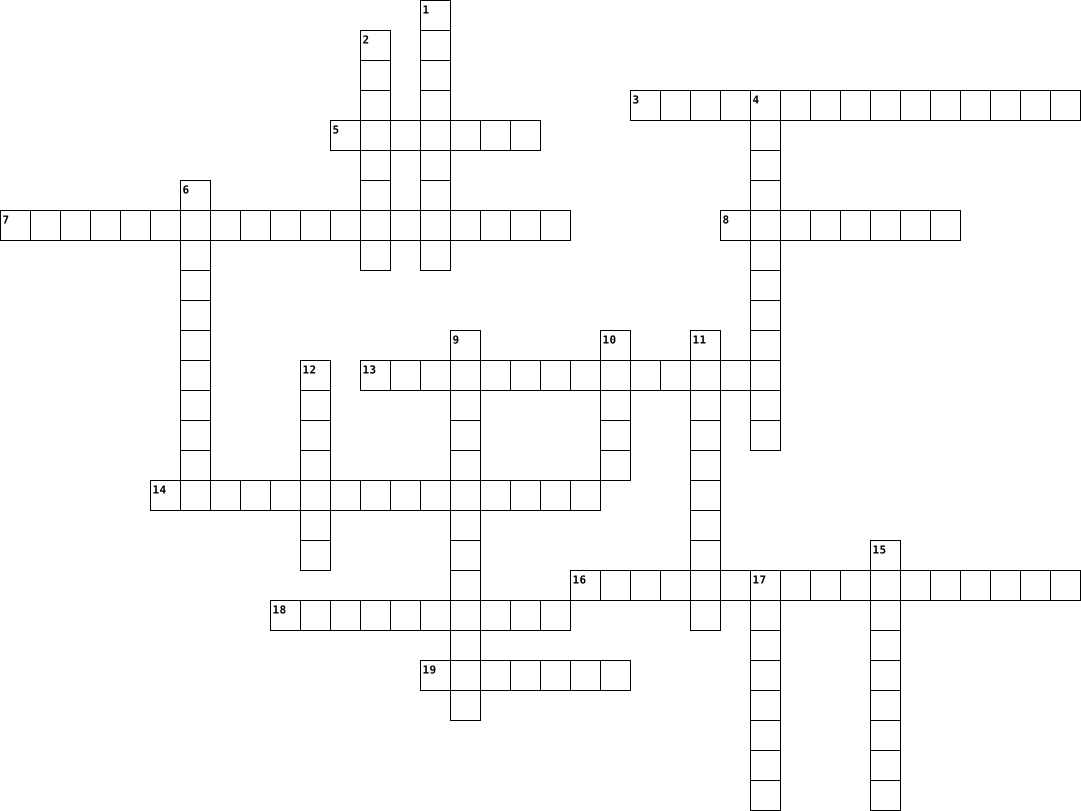
Across
- Assasinator of Abraham Lincoln
- Most common way to die during civil war
- Path used by conductors to lead runaway slaves
- Confederate States Capitol
- President of United States during Civil War
- Union General that made Lincoln mad
- Abolitionist and Suffragist that had sons fight in the civil war
- Most important and deadly battle of Civil War
- the main focus of the Southern economy
Down
- new bullet invented during civil war which was much more deadly than the musket ball
- Deadliest Day of Civil War
- United States Capitol
- Best Social Studies teacher for 8th grade
- most famous underground railroad conductor
- weapon used Civil War
- First battle of Civil War
- main issue that caused the civil war
- invention that helped cotton production invented by Eli Whitney
- the main focus of the Northern economy
19 Clues: United States Capitol • weapon used Civil War • First battle of Civil War • Deadliest Day of Civil War • Confederate States Capitol • Assasinator of Abraham Lincoln • Union General that made Lincoln mad • main issue that caused the civil war • the main focus of the Northern economy • the main focus of the Southern economy • Most common way to die during civil war • ...
Physics 2022-03-07

Across
- plane simple machine similar to a ramp
- mass X acceleration
- speeding up, slowing down or turning
- Newton's law that states actions have equal opposite reactions
- distance/time
- a wedge wrapped around an inclined plane
- Newton's law that states force depends on mass and acceleration
- Newton's law that states objects in motion stay in motion
- speed + direction
Down
- the type of machine that is a combination of multiple simple machines
- heat transfer through liquids and gases
- a rigid bar that rests on a fulcrum. Used to lift objects
- inclined plane with one edge thinner than the other. An axe is an example of this
- work/time
- the type of machine that makes work easier
- heat transfer through electromagnetic waves
- heat transfer through solids
- force X distance
- simple machine using a rope to lift objects
19 Clues: work/time • distance/time • force X distance • speed + direction • mass X acceleration • heat transfer through solids • speeding up, slowing down or turning • plane simple machine similar to a ramp • heat transfer through liquids and gases • a wedge wrapped around an inclined plane • the type of machine that makes work easier • heat transfer through electromagnetic waves • ...
WWI Quiz Review 2026-04-09

Across
- Many types of ______________ were used during WWI. _______________ is meant to persuade or influence people's opinions and promote a specific idea. It often uses strong images and emotional language, and it is commonly used during wars.
- Germany sent a telegram, known as the Zimmerman Telegram to ___________________ during WWI asking them to attack the United States. This was the 2nd reason as to why the United States entered WWI.
- Trying to build an empire is known as _________________.
- Prior to WWI, many European countries began building up their armed forces preparing for war. This is known as _______________.
- All people & resources devoted to the war effort is known as ___________________.
- Germans dug in and prepared to hold their ground. The French and German armies soon turned to __________________ on the Western Front.
- The sinking of the _______________________, killing 128 Americans, is one of the reasons the United States declared war on Germany.
- Sometimes known as conscription, the ____________ is when a country requires its citizens to join the military. In the United States, this started with the Selective Service Act of 1917. This law made it necessary for men to sign up to serve in the military if needed. This means that if the government needed more soldiers, they could call on those who registered to help.
- This foreign policy is when a country is careful about getting involved in fights or partnerships with other countries. Instead, it focuses more on problems at home and tries to stay out of what’s happening around the world.
Down
- Germany’s fleet of _________ was the world’s largest and most advanced in the world. They not only targeted warships, but merchant ships as well.
- Who represented the United States at the Paris Peace Conference at the end of WWI?
- Europe had been swept by a rise in____________ prior to WWI. People had pride in the country and were willing to defend it.
- By late 1914 the war on the western front had become a _____________. Neither the French nor the Germans were able to gain ground or defeat the other.
- Soldiers from the United States, known as "______________" began arriving in Europe in 1917 to help fight the Germans.
- For the majority of WWI the United States practiced _____________. This meant that the US didn't want to get involved in WWI and refused to choose sides.
- This leader was assassinated and created the "spark" that started WWI.
- On the 11th hour of the 11th day of the 11th month of 1918 the __________ officially ended the war.
17 Clues: Trying to build an empire is known as _________________. • This leader was assassinated and created the "spark" that started WWI. • All people & resources devoted to the war effort is known as ___________________. • Who represented the United States at the Paris Peace Conference at the end of WWI? • ...
Elizabeth Wilson Unit 5 2014-12-04

Across
- Became the meatpacking-manufacturing Industrial center in the United States
- Captain of the oil industry.
- Showing someone a product and trying to get them to buy it
- Something that was invented by Henry Ford to make production go faster
- Invented the telephone
- Became the automobile-manufacturing Industrial Center in the United States
- Something that has been made by someone that has never been made before
- Invented the assembly line.
- Invented the airplane
- Became the steel-manufacturing Industrial center in the United States
Down
- Captain of the steel industry
- Captain of shipping and railroad industry
- Recourse that are found in nature
- It reduced farm labor needs and increased production
- Invented the light bulb
15 Clues: Invented the airplane • Invented the telephone • Invented the light bulb • Invented the assembly line. • Captain of the oil industry. • Captain of the steel industry • Recourse that are found in nature • Captain of shipping and railroad industry • It reduced farm labor needs and increased production • Showing someone a product and trying to get them to buy it • ...
Historical events 2023-06-19

Across
- Global conflict from 1939 to 1945
- Genocide during World War II
- Tension between the United States and Soviet Union after World War II
- American war for independence
- Secret development of atomic bombs during World War II
- Protest against British taxation in colonial America
- Cultural and intellectual movement in Europe
Down
- Japanese attack on U.S. naval base in 1941
- Overthrow of the French monarchy in the late 18th century
- Declaration by a nation of its self-governance
- Conflict between the Union and Confederacy in the United States
- Struggle for racial equality in the United States
- Racial segregation policy in South Africa
- Apollo 11 achievement in 1969
- Shift to mechanized production in the 18th and 19th centuries
15 Clues: Genocide during World War II • American war for independence • Apollo 11 achievement in 1969 • Global conflict from 1939 to 1945 • Racial segregation policy in South Africa • Japanese attack on U.S. naval base in 1941 • Cultural and intellectual movement in Europe • Declaration by a nation of its self-governance • Struggle for racial equality in the United States • ...
Unit 5 Vocab 2025-12-11

Across
- a change or addition to the Constitution
- rights that cannot be taken away
- dividing government power into three branches
- a group of citizens who decide court cases
- the first written plan for the U.S. government
- the idea that people hold the power
- fair steps the government must follow
- the main written plan for how the U.S. government works
- a person who did not support the Constitution
- sharing power between states and the national government
- a group of states joined together
Down
- to house soldiers in your home
- the right to gather peacefully
- something that follows the rules of a constitution
- the area north and west of the original states
- the group that chooses the president
- rights that belong to each person
- the right to vote
- an agreement where each side gives up something
- the first ten amendments that protect rights
- a clause that lets Congress make necessary laws
- a plan that gave more power to big states
- the right to know why you are being held
- an agreement about counting enslaved people
- a rule or law made by a government
- essays written to support the Constitution
- to approve something officially
- a plan that gave equal power to all states
- the idea that government cannot do whatever it wants
- choosing leaders to represent the people
- ways each branch can limit the others
- a person who supported the Constitution
32 Clues: the right to vote • to house soldiers in your home • the right to gather peacefully • to approve something officially • rights that cannot be taken away • rights that belong to each person • a group of states joined together • a rule or law made by a government • the idea that people hold the power • the group that chooses the president • fair steps the government must follow • ...
U.S Constitution 2024-02-12

Across
- Which amendment protects the right to a speedy public trial by jury
- the sharing of powers among three separate branches of government
- bill name of the first ten amendments to the U.S. Constitution; most were designed to protect fundamental rights and liberties
- Which amendment prohibits unreasonable searches.
- Which amendment gives you the right to a jury trial during civil lawsuits
- Which amendment prohibits self-incrimination and double jeopardy.
- , what was the first basis for the new nation’s government; adopted in 1781; created an alliance of sovereign states held together by a weak central government
- who where those who did not support ratification of the constitution
- the right to life, liberty, and property; believed to be given by God; no government may take away
- a system that allows one branch of government to limit the exercise of power by another branch; requires the different parts of government to work together
- a compromise between the Virginia Plan and the New Jersey Plan that created a two-house Congress; representation based on population in the House of Representatives and equal representation of states in the Senate
- a legislature with only one house, like the Confederation Congress or the legislature proposed by the New Jersey Plan
- a collection of eighty-five essays written by Alexander Hamilton, James Madison, and John Jay in support of ratification of the Constitution
- Which amendment gives and protects the right to bear arms
- Which amendment restricts the quartering of soldiers in private homes.
- a highly decentralized form of government; sovereign states form a union for purposes such as mutual defense
Down
- a plan that called for a one-house national legislature; each state would receive one vote
- Which amendment States that rights not enumerated in the Constitution are retained by the people.
- Which amendment states that the federal government possesses only those powers delegated, or enumerated, to it through the Constitution, and that all other powers are reserved to the States, or to the people.
- the powers given explicitly to the federal government by the Constitution (Article I, Section 8); power to regulate interstate and foreign commerce, raise and support armies, declare war, coin money, and conduct foreign affairs
- Which amendment prohibits excessive fines and excessive bail, as well as cruel and unusual punishment.
- a compromise between northern and southern states that called for counting of all a state’s free population and 60 percent of its enslaved population for both federal taxation and representation in Congress
- a document written in 1776 in which the American colonists proclaimed their independence from Great Britain and listed their grievances against the British king
- an agreement between people and government in which citizens consent to be governed so long as the government protects their natural rights
- those who supported ratification of the Constitution
- the statement in Article VI of the Constitution that federal law is superior to laws passed by state legislatures
- a form of government in which power is divided between state governments and a national government
- Which amendment protects our freedom of speech?
- the power of the president to reject a law proposed by Congress
- a plan for a two-house legislature; representatives would be elected to the lower house based on each state’s population; representatives for the upper house would be chosen by the lower house
30 Clues: Which amendment protects our freedom of speech? • Which amendment prohibits unreasonable searches. • those who supported ratification of the Constitution • Which amendment gives and protects the right to bear arms • the power of the president to reject a law proposed by Congress • the sharing of powers among three separate branches of government • ...
U.S History: Civil War 2022-09-26

Across
- Treaty that ended the Mexican War, granting the U.S. control of Texas, New Mexico, and California in exchange for $15 million
- This Act set up Kansas and Nebraska as states. Each state would use popular sovereignty to decide what to do about slavery. People who were proslavery and antislavery moved to Kansas, but some antislavery settlers were against the Act. This began guerrilla warfare.
- Lincoln urged Americans not to seek revenge on slaveholders and their supporters and military after the war. Instead, he urged reconstruction of the South "with malice toward none; with charity for all."
- The 11th U.S. President, he led the country during the Mexican War and sought to expand the United States
- laws passed in the south just after the civil war aimed at controlling freedmen and enabling plantation owners to exploit african american workers
- Abolished slavery
- Declares that all persons born in the U.S. are citizens and are guaranteed equal protection of the laws
- Includes California admitted as a free state, the Fugitive Slave Act, made popular sovereignty in most other states from Mexican- American War
- Bill that would ban slavery in the territories acquired after the War with Mexico
Down
- the belief that an individual state may restrict federal authority, belief that because the states created the United States, individual states have the power to nullify federal laws
- Southwestern territory acquired by the Pierce administration to facilitate a southern transcontinental railroad and completed the lower 48 States
- federal agency set up in 1865 to provide food, schools, and medical care to freed slaves in the South
- stronger navy, larger population, more industrial output and a network of railroads, more food, more $$$, more telegraphs, more factories
- Ended Reconstruction. Republicans promise 1) Remove military from South, 2) Appoint Democrat to cabinet (David Key postmaster general), 3) Federal money for railroad construction and levees on Mississippi river; as long as Hayes became the president
- War 1846 - 1848 - President Polk declared war on Mexico over the dispute of land in Texas. At the end, American ended up with 55% of Mexico's land.
- a law that made it a crime to help runaway slaves; allowed for the arrest of escaped slaves in areas where slavery was illegal and required their return to slaveholders
- a system used on southern farms after the civil war in which farmers worked land owned by someone else in return for a small portion of the crops.
- a white Southerner who joined the Republican party during the Reconstruction period. they were also considered traitors to the Southern cause. Part of the radical government, they passed much needed reforms.
- Citizens cannot be denied the right to vote because of race, color , or precious condition of servitude
- Northerners who went to the South during Reconstruction. They carried their belongings in carpetbags, and most intended to settle in the South and make money there. Part of the radical government, they passed much needed reforms.
- A sequence of violent events involving abolitionists and pro-Slavery elements that took place in Kansas-Nebraska Territory. The dispute further strained the relations of the North and South, making civil war imminent.
- The adding of a region to the territory of an existing political unit.
- violent abolitionist who murdered slaveholders in Kansas and Missouri (1856-1858) before his raid at Harpers Ferry (1859), hoping to incite a slave rebellion; he failed and was executed, but his martyrdom by northern abolitionists frightened the South.
23 Clues: Abolished slavery • The adding of a region to the territory of an existing political unit. • Bill that would ban slavery in the territories acquired after the War with Mexico • federal agency set up in 1865 to provide food, schools, and medical care to freed slaves in the South • ...
Civil War: Arianna Parrish 2019-12-02

Across
- States leave the nation
- slave states loyal to the union
- conflict between the Union and Confederacy
- Bloodiest single day battle
- Lee surrendered to Grant
- most fighting took place in the south
- made troops into disciplined army men
- Turning point of the wars
- union advantage
- First shots where fired
- was accidentally killed by fellow troops
Down
- Lee lost half of his army;bloodiest battle
- Freed slaves from southern states
- Union General who led the fall of Atlanta
- brought most wealth to the economy
- most notorious prison camp in south
- President of Confederacy
- Souths version of the enrollment act
- Commander of the Union Armies in 1864
- Assassinated Lincoln
- blockade southern ports
- President of the Union
22 Clues: union advantage • Assassinated Lincoln • President of the Union • States leave the nation • blockade southern ports • First shots where fired • President of Confederacy • Lee surrendered to Grant • Turning point of the wars • Bloodiest single day battle • slave states loyal to the union • Freed slaves from southern states • brought most wealth to the economy • ...
CONSTITUTION CROSSWORD 2012-12-04

Across
- legal writs to arrest or search private property.
- money gave to authorities to get someone out of jail.
- a fire or flame.
- shorten lesson
- a written or unwritten record
- The order, act, or right of SUCCEEDING to a property
- complaint.
- undo
- person that votes.
Down
- to change before an authorized tribunal.
- a letter asking for something
- the offence of attempting to over throw the government
- branch Carries out the laws
- Which amendment states freedom of speech.
- to custody by police
- qualified to participate to be chosen
- Amendment 16 states the _________ tax.
- right to vote
- correct and make up for
- Amendment 2 states that you have the right to bear _______.
20 Clues: undo • complaint. • right to vote • shorten lesson • a fire or flame. • person that votes. • to custody by police • correct and make up for • branch Carries out the laws • a letter asking for something • a written or unwritten record • qualified to participate to be chosen • Amendment 16 states the _________ tax. • to change before an authorized tribunal. • ...
South Carolina 2012-06-03

Across
- state hospitality beverage
- South Carolina is known for what fish
- How many counties compromise South Carolina
- One of the major industries
- What is the state amphibian
- state beverage
- favorite vacation spot in South Carolina
- South Carolina is known for this stone
- Bordering body of water
- the states nickname is
- state gemstone
Down
- State song
- What is the state flower
- Hightest point in South Carolina
- one of states bordering South Carolina is north Carolina and what other state
- What is the capital of South Carolina
- what is the state bird
- State abbreviation
- South Carolinas quarter was what number released in the United States mint
- What bridge was built in 1929
- What is South Carolina's state fruit
21 Clues: State song • state beverage • state gemstone • State abbreviation • what is the state bird • the states nickname is • Bordering body of water • What is the state flower • state hospitality beverage • One of the major industries • What is the state amphibian • What bridge was built in 1929 • Hightest point in South Carolina • What is South Carolina's state fruit • ...
South Carolina 2012-06-03

Across
- state hospitality beverage
- South Carolina is known for what fish
- How many counties compromise South Carolina
- One of the major industries
- What is the state amphibian
- state beverage
- favorite vacation spot in South Carolina
- South Carolina is known for this stone
- Bordering body of water
- the states nickname is
- state gemstone
Down
- State song
- What is the state flower
- Hightest point in South Carolina
- one of states bordering South Carolina is north Carolina and what other state
- What is the capital of South Carolina
- what is the state bird
- State abbreviation
- South Carolinas quarter was what number released in the United States mint
- What bridge was built in 1929
- What is South Carolina's state fruit
21 Clues: State song • state beverage • state gemstone • State abbreviation • what is the state bird • the states nickname is • Bordering body of water • What is the state flower • state hospitality beverage • One of the major industries • What is the state amphibian • What bridge was built in 1929 • Hightest point in South Carolina • What is South Carolina's state fruit • ...
Civil War Crossword 2023-01-27

Across
- system of secret routes
- a change in law,or bill
- growing crops and raising animals
- a deal to settle a conflict
- town in southern Pennsylvania
- a giant farm
- A person who tries to escape
- a group of states wanting to leave the union
- organization of the confederate states
Down
- The twenty third state to join the U.S
- The sixteenth president of the U.S
- to withdraw from an organization
- manufacturing goods
- a tax on imported goods
- to end slavery
- a person who want to end slavery
- when someone is enslaved for work
- the careful use of economic systems
- loyal to one part of a country
- the group of states loyal to the U.S
20 Clues: a giant farm • to end slavery • manufacturing goods • system of secret routes • a tax on imported goods • a change in law,or bill • a deal to settle a conflict • A person who tries to escape • town in southern Pennsylvania • loyal to one part of a country • to withdraw from an organization • a person who want to end slavery • growing crops and raising animals • ...
South Carolina 2024-12-14

Across
- state hospitality beverage
- South Carolina is known for what fish
- How many counties compromise South Carolina
- One of the major industries
- What is the state amphibian
- state beverage
- favorite vacation spot in South Carolina
- South Carolina is known for this stone
- Bordering body of water
- the states nickname is
- state gemstone
Down
- State song
- What is the state flower
- Hightest point in South Carolina
- one of states bordering South Carolina is north Carolina and what other state
- What is the capital of South Carolina
- what is the state bird
- State abbreviation
- South Carolinas quarter was what number released in the United States mint
- What bridge was built in 1929
- What is South Carolina's state fruit
21 Clues: State song • state beverage • state gemstone • State abbreviation • what is the state bird • the states nickname is • Bordering body of water • What is the state flower • state hospitality beverage • One of the major industries • What is the state amphibian • What bridge was built in 1929 • Hightest point in South Carolina • What is South Carolina's state fruit • ...
US History 2026-04-29

Across
- colonies declare freedom
- tea dumped in harbor
- North vs South conflict
- first U.S. president
- route to western lands
- explored western lands
- led slaves to freedom
- Northern states in war
- warned Europe stay out
- workers join for rights
- secret escape routes north
- nickname for British soldiers
- divided North and South
- law forcing Native relocation
Down
- Britain vs France in America
- president during Civil War
- forced Native relocation march
- colonists killed by soldiers
- wrote Declaration of Independence
- first ten amendments
- doubled size of nation
- machines replace hand labor
- powers to states
- no forced housing soldiers
- people who opposed slavery
- Southern states in war
- first permanent English settlement
27 Clues: powers to states • tea dumped in harbor • first ten amendments • first U.S. president • led slaves to freedom • doubled size of nation • route to western lands • explored western lands • Northern states in war • warned Europe stay out • Southern states in war • North vs South conflict • workers join for rights • divided North and South • colonies declare freedom • president during Civil War • ...
Clone of First Five Presidents 2021-02-16

Across
- the policy of remaining neutral in foreign issues
- 2nd president
- 3rd president
- the rebellion that proved that the federal government was strong
- 1st president
- Hamilton's political party that favored a national government and businesses
- the war in which Mexico became independent from Spain
Down
- the battle with natives that resulted in the war of 1812
- the war fought against England that proved the power of the United States
- 5th president
- the purchase of land that doubled the size of the United States
- Jefferson's political party that favored states and agriculture
- an incident in which France angered Americans and caused war fever
- 4th president
- a halt on trade
15 Clues: 2nd president • 5th president • 3rd president • 1st president • 4th president • a halt on trade • the policy of remaining neutral in foreign issues • the war in which Mexico became independent from Spain • the battle with natives that resulted in the war of 1812 • the purchase of land that doubled the size of the United States • ...
American History 2015-02-11

Across
- Refers to reform- minded journalists who wrote largely for all popular magazines and continued a tradition of investigative journalism reporting
- The first U.S. Navy ship to be named after the state of Maine and was commissioned in 1895.
- Has a trunk
- A policy of extending a country's power and influence through diplomacy or military force.
- Addition to the Monroe Doctrine articulated by President Theodore Roosevelt in his State of the Union address in 1904
- Journalism that is based upon sensationalism and crude exaggeration.
- Reliance on the integrity, strength, ability, and surety.
- One of the peace treaties at the end of World War I.
- Information, especially of a biased or misleading nature, used to promote or publicize a particular political cause or point of view.
- Is characterized by an absence of competition, which often results in high prices and inferior products.
- A United States Congress Act that works to prevent adulterated or misbranded meat and meat products from being sold as food and to ensure that meat and the products are slaughtered and processed under sanitary conditions.
- An international organization, headquartered in Geneva, Switzerland, created after the First World War to provide a forum for resolving international disputes.
- A belief, creed or political ideology that involves an individual identifying with, or becoming attached to, one's nation.
- A policy of remaining apart from the affairs or interests of other groups, especially the political affairs of other countries.
- The system in which support is given only to countries whose moral beliefs are analogous to that of the nation.
- The effort of the United States particularly over President William Howard Taft, to further its aims in Latin America and East Asia through use of its economic power by guaranteeing loans made to foreign countries.
Down
- Secret telegram saying that in the event of war with the United States, Mexico should be asked to enter the war as a German ally.
- British ocean liner, holder of the Blue Riband, and briefly the largest passenger ship.
- Large marsupial
- The state of not supporting or helping either side in a conflict, disagreement.
- A term for the attitude prevalent during the 19th century period of American expansion that the United States not only could, but was destined to, stretch from coast to coast.
- The central banking system of the United States.
- A German Submarine.
- A formal agreement or treaty between two or more nations to cooperate for specific purposes.
- The right to vote in political elections.
- The United States Constitution prohibits any United States citizen from being denied the right to vote on the basis of gender.
- A 1906 novel written by the American journalist and novelist Upton Sinclair
- A plan made by Woodrow Wilson's in a speech Wilson gave to the American Congress in January 1918.
- Refers to the pursuit of foreign policy objectives with the aid of conspicuous displays of naval power.
29 Clues: Has a trunk • Large marsupial • A German Submarine. • The right to vote in political elections. • The central banking system of the United States. • One of the peace treaties at the end of World War I. • Reliance on the integrity, strength, ability, and surety. • Journalism that is based upon sensationalism and crude exaggeration. • ...
The civil war 2023-12-11

Across
- Organization that helped freed slaves
- Gift for Abraham
- Abolished Slavery
- Blocking off any trade
- dividing from the laws of other states
- The states not loyal to America
Down
- Labor without money
- Place full of railroads
- Era after the Civil War
- Process of being free, with equal rights
- Large marsupial
- diving from a state
- The states loyal to America
- Transportation of resources and people
14 Clues: Large marsupial • Gift for Abraham • Abolished Slavery • Labor without money • diving from a state • Blocking off any trade • Place full of railroads • Era after the Civil War • The states loyal to America • The states not loyal to America • Organization that helped freed slaves • Transportation of resources and people • dividing from the laws of other states • ...
World Geo Unit 2 Vocabulary 2025-09-24

Across
- area in which several large cities and surrounding areas grow together
- any kind of economic activity that provides a service rather than a
- major mountain chain in the eastern United States and Canada
- person who moves from place to place
- goods sold to another country
- movement of plants, animals, and diseases between the Eastern and Western hemispheres
- largely treeless area in the interior lowlands
- community on the outskirts of a city
- economic system in which private individuals own most of the resources, businesses and can operate them with little government control
- Shipping route that connects the Great Lakes to the Atlantic Ocean
- economic phase in which manufacturing no longer plays a dominant role
- Canada’s longest river
- a mission and fort in San Antonio, Texas where Mexican forces massacred rebellious Texans in 1836
- permanently frozen ground
- line of the highest points in the Rockies
Down
- territory between the Mississippi River and the Rocky Mountains purchased by the United States from France
- movement of people, goods, and ideas from one place to another
- government grants that gave land to empresarios
- government where the people rule through elected representatives
- land bridge that once connected what are now Siberia and Alaska
- mountain chain in the western United States and Canada
21 Clues: Canada’s longest river • permanently frozen ground • goods sold to another country • person who moves from place to place • community on the outskirts of a city • line of the highest points in the Rockies • largely treeless area in the interior lowlands • government grants that gave land to empresarios • mountain chain in the western United States and Canada • ...
U.S. Constitution 2020-11-19

Across
- a representative form of government
- created the three branches and established representation in the legislative branch.
- favored by large states that wanted three branches and representation to be based of population.
- Led by Thomas Jefferson that did not support the U.S. Constitution and wanted a Bill of Rights
- counted slaves as three/fifth of the population for representation and taxation.
- system where the national government shares powers with state government.
- a change to the U.S. Constitution
- to approve
Down
- how the states interact with each other.
- favored by small states that wanted equal representation.
- the place were the delegates created the U.S. Constitution.
- ten amendments that protect individual rights.
- explains the the powers of the president.
- known as the father of the constitution.
- Led by Alexander Hamilton who supported the U.S. Constitution.
- the national government is the supreme law of the land.
- explains the duties of the legislative branch.
17 Clues: to approve • a change to the U.S. Constitution • a representative form of government • how the states interact with each other. • known as the father of the constitution. • explains the the powers of the president. • ten amendments that protect individual rights. • explains the duties of the legislative branch. • the national government is the supreme law of the land. • ...
Vietnam War 2013-03-28

Across
- increased federal power during ww2
- political organization and army
- Vietnamese revolutionary communist
- search enemy and destroy them
- people who supported the war
- worked as secretary of state
- United states vietnam relations
- Problem cause
- Communist national independence
- Country
Down
- United states army general
- Communist party of kampuchea
- american broudcast journalist
- millitary campaign
- president of the republic of vietnam
15 Clues: Country • Problem cause • millitary campaign • United states army general • Communist party of kampuchea • people who supported the war • worked as secretary of state • search enemy and destroy them • american broudcast journalist • political organization and army • United states vietnam relations • Communist national independence • increased federal power during ww2 • ...
Allied Powers 2022-11-17

Across
- Entered the war when Germany invaded Belgium.
- Also known as the Allied Powers.
- The Western Front was in this country.
- Country that had their own revolution during WW1.
- British commander.
- Prime Minister of France.
- French commander.
- Tsar of Russia.
Down
- Became the leader of the Soviet Union after the revolution.
- Considered an Associated Power.
- President of the United States.
- What the United States and Belgium tried to stay.
- Prime Minister of Britain.
- Also known as the Entente Powers.
- United States commander.
- A Russian commander.
- Fighting forces of a country.
17 Clues: Tsar of Russia. • French commander. • British commander. • A Russian commander. • United States commander. • Prime Minister of France. • Prime Minister of Britain. • Fighting forces of a country. • Considered an Associated Power. • President of the United States. • Also known as the Allied Powers. • Also known as the Entente Powers. • The Western Front was in this country. • ...
AMERICA - land of the free 2025-10-01

Across
- first successful British colony
- Plains Indian tribe
- the number of colonies established by the British
- discoverer of America (2 words)
- most immigrants to USA now are this ethnicity
- failed first colony of Britain
- what England called America (2 words)
- Sioux Indians lived in these structures
- harvest festival to celebrate blessings
Down
- protest against British taxes (3 words)
- USA fought Britain to gain this
- first president of USA (2 words)
- war between Northern and Southern states
- president that abolished slavery
- Southern states in civil war
- Northern states in civil war
- Africans working on Southern plantations
- statue gifted by France expressing this value
18 Clues: Plains Indian tribe • Southern states in civil war • Northern states in civil war • failed first colony of Britain • USA fought Britain to gain this • first successful British colony • discoverer of America (2 words) • first president of USA (2 words) • president that abolished slavery • what England called America (2 words) • protest against British taxes (3 words) • ...
Unit One Vocab (History) 2020-10-08

Across
- composed of diverse elements, including those opposed to the Constitution because they thought that a stronger government threatened the sovereignty and prestige of the states, localities, or individuals
- known as the Federal Convention, the Philadelphia Convention, or the Grand Convention at Philadelphia took place from May 25 to September 17, 1787, in the old Pennsylvania State House (now known as Independence Hall) in Philadelphia
- the principle that the authority of a state and its government are created and sustained by the consent of its people, through their elected representatives, who are the source of all political power
- separation of powers distributed power among branches of government (the legislature, the executive, and the judiciary, each of which provide a check on the powers of the other)
- counterbalancing influences by which an organization or system is regulated, typically those ensuring that political power is not concentrated in the hands of individuals or groups
- a person who advocates or supports a system of government in which several states unite under a central authority
- comprises the first ten amendments to the United States Constitution
Down
- the federal principle or system of government;
- an act of vesting the legislative, executive, and judicial powers of government in separate bodies
- an agreement among the 13 original states of the United States of America that served as its first constitution. It was approved, after much debate, by the Second Continental Congress on November 15, 1777, and sent to the states for ratification
- the supreme law of the United States of America. The Constitution, originally comprising seven articles, delineates the national frame of government
- or compound mode of government that combines a general government with regional governments in a single political system
- the liberties of each individual to pursue life and goals without interference from other individuals or the government. Examples of individual rights include the right to life, liberty and the pursuit of happiness as stated in the United States Declaration of Independence
- a political ideology centered on citizenship in a state organized as a republic. Historically, it ranges from the rule of a representative minority or oligarchy to popular sovereignty
- relationship of parity between the two levels of government established;
- composed of diverse elements, including those opposed to the Constitution because they thought that a stronger government threatened the sovereignty and prestige of the states, localities, or individuals
16 Clues: the federal principle or system of government; • comprises the first ten amendments to the United States Constitution • relationship of parity between the two levels of government established; • an act of vesting the legislative, executive, and judicial powers of government in separate bodies • ...
World Studies 2021-06-04

Across
- long period of intense rivalry between the Soviet Union and the United States
- armed communist political revolutionary organization in South Vietnam and Cambodia
- mass student-led paramilitary social movement mobilized and guided by Chairman Mao Zedong
- India's national political party
- european nations generous funding to rebuild their economies as long as the money was spent on goods made in the United States
- anti-colonial activist and politician who governed Kenya as its Prime Minister from 1963 to 1964
- A group of people living together and sharing the same possessions and responsibilities
- Sunni Islamist movement and military organisation in Afghanistan
- US policy of withdrawing its troops and transferring the responsibility and direction of the war effort to the government of South Vietnam
- act of pushing a situation to the verge of war, in order to threaten and encourage one's opponent to back down
- change of political borders cutting through at least one territory considered a homeland by some community
- political and military organization formed in 1964
- chairman of the plo
Down
- Filipino politician, lawyer, and kleptocrat who served as the 10th President of the Philippines
- United States policy using numerous strategies to prevent the spread of communism abroad
- easing of hostility or strained relations, especially between countries
- Indonesian military officer and politician, who was the second President of Indonesia
- negotiations between the United States and the Soviet Union that were aimed at curtailing the manufacture of strategic missiles capable of carrying nuclear weapons
- guerrilla fighters in Islamic countries, especially those who are fighting against non-Muslim force
- military and defense alliance formed by 12 countries in Western Europe and North America
- this barrier isolated Eastern Europe from the rest of the world
- Indonesian statesman and revolutionary who was the first president of Indonesia
- international organization made up of sovereign nations created after WW2
- Palestinian uprising against Israeli occupation of the West Bank and Gaza Strip, beginning in 1987
24 Clues: chairman of the plo • India's national political party • political and military organization formed in 1964 • this barrier isolated Eastern Europe from the rest of the world • Sunni Islamist movement and military organisation in Afghanistan • easing of hostility or strained relations, especially between countries • ...
World Studies 2021-06-04

Across
- political and military organization formed in 1964
- negotiations between the United States and the Soviet Union that were aimed at curtailing the manufacture of strategic missiles capable of carrying nuclear weapons
- US policy of withdrawing its troops and transferring the responsibility and direction of the war effort to the government of South Vietnam
- anti-colonial activist and politician who governed Kenya as its Prime Minister from 1963 to 1964
- mass student-led paramilitary social movement mobilized and guided by Chairman Mao Zedong
- change of political borders cutting through at least one territory considered a homeland by some community
- Filipino politician, lawyer, and kleptocrat who served as the 10th President of the Philippines
- India's national political party
- act of pushing a situation to the verge of war, in order to threaten and encourage one's opponent to back down
- long period of intense rivalry between the Soviet Union and the United States
- military and defense alliance formed by 12 countries in Western Europe and North America
- guerrilla fighters in Islamic countries, especially those who are fighting against non-Muslim force
Down
- Palestinian uprising against Israeli occupation of the West Bank and Gaza Strip, beginning in 1987
- international organization made up of sovereign nations created after WW2
- United States policy using numerous strategies to prevent the spread of communism abroad
- Indonesian statesman and revolutionary who was the first president of Indonesia
- this barrier isolated Eastern Europe from the rest of the world
- european nations generous funding to rebuild their economies as long as the money was spent on goods made in the United States
- easing of hostility or strained relations, especially between countries
- Indonesian military officer and politician, who was the second President of Indonesia
- armed communist political revolutionary organization in South Vietnam and Cambodia
- chairman of the plo
- Sunni Islamist movement and military organisation in Afghanistan
- A group of people living together and sharing the same possessions and responsibilities
24 Clues: chairman of the plo • India's national political party • political and military organization formed in 1964 • this barrier isolated Eastern Europe from the rest of the world • Sunni Islamist movement and military organisation in Afghanistan • easing of hostility or strained relations, especially between countries • ...
Police Crossword 2023-07-15

Across
- an individual cannot be compelled by the government to provide incriminating information about herself
- the U.S. government department that is responsible for making sure that laws on who is allowed to enter, stay in, and work in the U.S.
- seize (someone) by legal authority and take into custody
- unwelcome and inappropriate sexual remarks or physical advance
- an official who investigates violent, sudden, or suspicious deaths
- the recruitment, transportation, transfer, harboring or receipt of people through force, fraud or deception
- an elected officer in a county who is responsible for keeping the peace
- an action or omission that constitutes an offense that may be prosecuted by the state and is punishable by law
- the action of teaching a person or animal a particular skill or type of behavior
- rights of criminal defendants
Down
- the civil force of a national or local government, responsible for the prevention and detection of crime and the maintenance of public order
- enforce the controlled substances laws and regulations of the United States
- protection of the president, vice president and others; and investigations into crimes against the financial infrastructure of the United States
- the state of being free from danger or threat
- protects people from unreasonable searches and seizures by the government
- a place for the confinement of people accused or convicted of a crime
- an intelligence-driven and threat-focused national security organization with both intelligence and law enforcement responsibilities
- revenue service for the United States federal government
- A collaborative law enforcement approach combining problem-solving policing, information sharing, and police accountability, with enhanced intelligence operations
- federal agency primarily responsible for administering and enforcing the criminal and regulatory provisions of the federal laws
- protects our country’s borders and manages the flow of people and products into and out of the United States
21 Clues: rights of criminal defendants • the state of being free from danger or threat • seize (someone) by legal authority and take into custody • revenue service for the United States federal government • unwelcome and inappropriate sexual remarks or physical advance • an official who investigates violent, sudden, or suspicious deaths • ...
The Great depression 2022-01-28

Across
- favoring free enterprise, private ownership, and socially traditional ideas
- the greatest flood in over 300 years roared down the Connecticut River
- ambitious employment and infrastructure program
- boosts agricultural prices by reducing surpluses
- theory states that tax breaks and benefits for corporations and the wealthy will trickle down to everyone else
- money paid regularly at a particular rate for the use of money lent
- independent federal agency insuring deposits in U.S. banks and thrifts in the event of bank failures
- relating to or affecting the fundamental nature of something
- a law that implemented protectionist trade policies in the United States
Down
- government spending, in excess of revenue, of funds raised by borrowing rather than from taxation
- work relief program that gave millions of young men employment on environmental projects during the Great Depression
- a federally-owned electric utility corporation in the United States.
- supervised fair trade codes and guaranteed laborers a right to collective bargaining
- a loan from your brokerage and using the money from the loan to invest in more securities than you can buy with your available cash.
- the central banking system of the United States of America
- a supporter or policies that are socially progressive and promote social welfare
16 Clues: ambitious employment and infrastructure program • boosts agricultural prices by reducing surpluses • the central banking system of the United States of America • relating to or affecting the fundamental nature of something • money paid regularly at a particular rate for the use of money lent • a federally-owned electric utility corporation in the United States. • ...
capitals 2022-07-09

Across
- Capital of Tamil nadu
- capital of Maharashtra
- Capital of Meghalaya
Down
- Capital of Haryana
- Capital of Anmdhra Pradesh
- capital of Goa
6 Clues: capital of Goa • Capital of Haryana • Capital of Meghalaya • Capital of Tamil nadu • capital of Maharashtra • Capital of Anmdhra Pradesh
10th Grade Crossword 2025-10-15

Across
- : Land deal under Jefferson that doubled the size of the United States.
- : Treasury Secretary who created a financial plan to reduce national debt.
- : Conflict between the U.S. and Britain over trade and impressment of sailors.
- : Farmers’ protest against a whiskey tax that proved federal authority under Washington.
- : Jefferson’s ban on trade with foreign nations that hurt the U.S. economy.
- : National bank proposed by Hamilton to stabilize the nation’s finances.
- : Agreement ending the War of 1812 and restoring pre-war boundaries.
- : Laws under John Adams that limited immigration and restricted free speech.
- : Political party that favored a strong central government and industry.
- : Supreme Court case establishing judicial review.
Down
- : Washington’s policy to keep the U.S. out of foreign wars.
- : First U.S. president; set important precedents for future leaders.
- : Jefferson and Madison’s response claiming states could nullify unconstitutional laws.
- : Power of the Supreme Court to declare laws unconstitutional.
- : Diplomatic incident where French officials demanded bribes from U.S. envoys.
- : “Father of the Constitution” and president during the War of 1812
- : Political party that favored limited government and agriculture.
- : Group of presidential advisors who lead executive departments.
- : An example or tradition established for others to follow.
- : Secretary of State and leader of the Democratic-Republicans; supported agriculture and states’ rights.
20 Clues: : Supreme Court case establishing judicial review. • : Washington’s policy to keep the U.S. out of foreign wars. • : An example or tradition established for others to follow. • : Power of the Supreme Court to declare laws unconstitutional. • : Group of presidential advisors who lead executive departments. • ...
APUSH Review 2025-04-30

Across
- Unofficial policy of relaxed royal control over colonial trade and only weak enforcement of Navigation Laws
- Religious revival that swept the colonies
- Policy of rewarding political supporters with public office, first widely employed at the federal level by Andrew Jackson.
- Determined that each slave would be counted as three-fifths of a person for the purpose of apportioning taxes and representation.
- Notion that the sovereign people of a given territory should decide whether to allow slavery
- Supreme Court case that established the principle of “judicial review”—the idea that the Supreme Court had the final authority to determine constitutionality.
- Gathering of feminist activists in 1848 where Elizabeth Cady Stanton read her “Declaration of Sentiments,” stating that “all men and women are created equal.”
- first American constitution that established the United States as a loose confederation of states under a weak national Congress, which was not granted the power to regulate commerce or collect taxes.
Down
- Opponents of the 1787 Constitution who objected to the subordination of the states to the central government and feared encroachment on individuals’ liberties in the absence of a bill of rights.
- Constitutional amendment that extended civil rights to freedmen and prohibited States from taking away such rights without due process.
- Decree issued by Parliament in the wake of Pontiac’s uprising, prohibiting settlement beyond the Appalachians.
- Established the principle that truthful statements about public officials could not be prosecuted as libel.
- Failed proposal to prohibit the importation of slaves into Missouri territory and pave the way for gradual emancipation.
- Ordered the removal of Indian Tribes still residing east of the Mississippi to newly established Indian Territory west of Arkansas and Missouri.
- Amendment that sought to prohibit slavery from territories acquired from Mexico.
- Thomas Paine’s pamphlet urging the colonies to declare independence and establish a republican government.
- The transfer of goods, crops and diseases between New and Old World societies after 1492.
- Agricultural system employed by North American Indians as early as 1000 a.d.; maize, beans, and squash were grown together to maximize yields.
- Popular name for the period of one-party, Republican, rule during James Monroe’s presidency.
- Prohibited states from denying citizens the franchise on account of race.
- Constitutional amendment prohibiting all forms of slavery and involuntary servitude.
- Belief that the United States was destined by God to spread its “empire of liberty” across North America.
- exchange of rum, slaves, and molasses between the North American Colonies, Africa, and the West Indies
- Laws passed throughout the South to restrict the rights of emancipated blacks, particularly with respect to negotiating labor contracts.
24 Clues: Religious revival that swept the colonies • Prohibited states from denying citizens the franchise on account of race. • Amendment that sought to prohibit slavery from territories acquired from Mexico. • Constitutional amendment prohibiting all forms of slavery and involuntary servitude. • ...
U.S. HISTORY EOC REVIEW 2016-04-19

Across
- provided direct election of senators
- Essays written by James Madison, Alexander Hilton, and John Jay to support the ratification of the Constitution
- Gave African American men the right to vote
- gave the right to vote to 18 year olds
- required states to give citizenship to all citizens born in the United States and gave other basic civil rights
- by Truman to economically assist any country fighting communism after World War two. The declaration marked the beginning of the containment Policy
- Major ideas found in the U.S. Constitution of limiting the power to tax and right to fair trial
- Foundation for American government for freedoms such as freedom of speech and trial by jury
- First ten amendments to the Constitution guaranteeing individual liberties and due process
Down
- gave women the right to vote
- Written mostly by Jefferson to list the grievances (complaints) against Great Britain and to declare independence from Great Britain
- gave freedom to the slaves in all states
- Document which formed the first government of the U.S. near the end of the American Revolution. States had more power than the national government.
- Treaty that ended WW1. Was extremely harsh on Germany.
- Created a graduated income tax
- A document outlining the basic form and rules of the U.S. government
- Peace plan issued by Wilson that called for freedom of the seas, reduction of armaments , and end to secret diplomacy. Important part was the creation of the League of Nations a national peace organization
- ended poll tax
18 Clues: ended poll tax • gave women the right to vote • Created a graduated income tax • provided direct election of senators • gave the right to vote to 18 year olds • gave freedom to the slaves in all states • Gave African American men the right to vote • Treaty that ended WW1. Was extremely harsh on Germany. • ...
U.S. HISTORY EOC REVIEW 2016-04-19

Across
- gave freedom to the slaves in all states
- declarationby Truman to economically assist any country fighting communism after World War two. The declaration marked the beginning of the containment Policy
- A document outlining the basic form and rules of the U.S. government
- Written mostly by Jefferson to list the grievances (complaints) against Great Britain and to declare independence from Great Britain
- Foundation for American government for freedoms such as freedom of speech and trial by jury
- First ten amendments to the Constitution guaranteeing individual liberties and due process
- Peace plan issued by Wilson that called for freedom of the seas, reduction of armaments , and end to secret diplomacy. Important part was the creation of the League of Nations a national peace organization
- Essays written by James Madison, Alexander Hilton, and John Jay to support the ratification of the Constitution
- Created a graduated income tax
- Gave African American men the right to vote
Down
- provided direct election of senators
- gave the right to vote to 18 year olds
- Document which formed the first government of the U.S. near the end of the American Revolution. States had more power than the national government.
- Major ideas found in the U.S. Constitution of limiting the power to tax and right to fair trial
- Treaty that ended WW1. Was extremely harsh on Germany.
- ended poll tax
- required states to give citizenship to all citizens born in the United States and gave other basic civil rights
- gave women the right to vote
18 Clues: ended poll tax • gave women the right to vote • Created a graduated income tax • provided direct election of senators • gave the right to vote to 18 year olds • gave freedom to the slaves in all states • Gave African American men the right to vote • Treaty that ended WW1. Was extremely harsh on Germany. • ...
CIVIL WAR; Vocab Crossword puzzle 2024-01-10

Across
- The act of making legally null and void.
- Compromise that brought missouri into the Union as a slave state and Maine as a free state.
- Act that required runaway slaves to be returned to their masters if caught anywhere in the United States.
- Supreme Court ruling that declared slaves were not citizens of the United States (1857).
Down
- Position supported by several prominent Georgia politicians who supported the Compromise of 1850.
- The act of separating from a nation or state and becoming independent; the withdraw of eleven southern states from the Union in 1860-1861.
- Compromise between North and South that allowed California to enter the union in exchange for the passage of the Fugitive Slave Act.
- States where slavery was NOT legal.
- States where slavery WAS legal.
- The belief that a state's sovereignty is more important than that of a national government.
- Involuntary servitude of African-Americans or Blacks in the United States (1619-1865).
11 Clues: States where slavery WAS legal. • States where slavery was NOT legal. • The act of making legally null and void. • Involuntary servitude of African-Americans or Blacks in the United States (1619-1865). • Supreme Court ruling that declared slaves were not citizens of the United States (1857). • ...
Civil War 2025-04-15

Across
- Union general who later became president
- General Robert E. ___
- Ended slavery in the U.S.
- The North was also called the ___
- Lincoln’s most famous speech
- Union naval strategy: the ___ Plan
- Law requiring citizens to return runaway slaves(No spaces)
- President of the Confederacy
Down
- President of the United States during the Civil War
- First battle of the Civil War
- Underground ___ helped slaves escape
- Turning point battle fought in Pennsylvania
- Freed the slaves in Confederate states
- Capital of the Confederacy
- Slavery-supporting Southern states were called the ___
- Where Lee surrendered to Grant
- Bloodiest single-day battle
- Confederate general nicknamed "Stonewall"
- Nickname for Confederate soldiers
- Famous African American abolitionist and speaker
- Wrote Uncle Tom’s Cabin
21 Clues: General Robert E. ___ • Wrote Uncle Tom’s Cabin • Ended slavery in the U.S. • Capital of the Confederacy • Bloodiest single-day battle • Lincoln’s most famous speech • President of the Confederacy • First battle of the Civil War • Where Lee surrendered to Grant • The North was also called the ___ • Nickname for Confederate soldiers • Union naval strategy: the ___ Plan • ...
Italian States 2021-12-06

Across
- to influence or contol
- A language of everyday speech in particular region
- having a distinctive quality
- to gain or achieve
- Basic or essential
- A member of the middle class who lived in a city or town
- a determining condition
Down
- A change to a lower state or level
- a soldier who fought primarily for money
- painting done on fresh, wet plaster with water-based paints
- A key intellectual movement of the renaissance
- Artistic techniques use to give the effect of three- dimensional dept to two dimensional surfaces
- A form of government in which the leader is not a king and certain citizens have the right to vote
13 Clues: to gain or achieve • Basic or essential • to influence or contol • a determining condition • having a distinctive quality • A change to a lower state or level • a soldier who fought primarily for money • A key intellectual movement of the renaissance • A language of everyday speech in particular region • A member of the middle class who lived in a city or town • ...
United States 2018-08-10

Across
- The “Register of the Desert”
- Samuel Clemens and some of his book characters live here
- has the largest natural stone bridge in the world
- where the living symbol for “Smokey Bear” was found
- NASA headquarters are located here
- Liberty Bell
- Has a 6,640 mile long coastline
Down
- where Paul Revere rode his horse
- Nick Adams goes fishing here
- book and movie: A River Runs Through It, set in this state
- Here is where the first presidential inauguration took place
- gravesite of Elvis Presley
- produces the most maple syrup
13 Clues: Liberty Bell • gravesite of Elvis Presley • The “Register of the Desert” • Nick Adams goes fishing here • produces the most maple syrup • Has a 6,640 mile long coastline • where Paul Revere rode his horse • NASA headquarters are located here • has the largest natural stone bridge in the world • where the living symbol for “Smokey Bear” was found • ...
Killer States 2023-03-20

Across
- The volunteer state
- The Bayou state
- The golden state
- The Buckeye state
- The natural state
Down
- The peach state
- The hospitality state
- The Battle Born state
- The sunshine state
- The lone star state
- The Old line state
- The copper state
- The bluegrass state
13 Clues: The peach state • The Bayou state • The copper state • The golden state • The Buckeye state • The natural state • The sunshine state • The Old line state • The volunteer state • The lone star state • The bluegrass state • The hospitality state • The Battle Born state
U.S. States 2023-04-16

Across
- The Sooner State
- The Peach State
- The Sunshine State
- Big Sky Country
- The Aloha State
- The Garden State
Down
- The Golden State
- The Last Frontier
- Land of 10,000 Lakes
- Land of Lincoln
- Lone Star State
- America's Dairyland
- The Buckeye State
13 Clues: Land of Lincoln • Lone Star State • The Peach State • Big Sky Country • The Aloha State • The Golden State • The Sooner State • The Garden State • The Last Frontier • The Buckeye State • The Sunshine State • America's Dairyland • Land of 10,000 Lakes
western states 2023-04-11

Across
- great salt lake?
- no, not dc
- where aliens land
- grand canyon?
- the state of sacramento
- __ trail
Down
- hanna ____
- pearl harbor?
- the potato land
- denali?
- has a flag that looks like pac-man
- yellow stone park?
- Sierra ___ Mountains
13 Clues: denali? • __ trail • hanna ____ • no, not dc • pearl harbor? • grand canyon? • the potato land • great salt lake? • where aliens land • yellow stone park? • Sierra ___ Mountains • the state of sacramento • has a flag that looks like pac-man
SE States 2023-01-05

Across
- COLUMBIA
- RAEIGH
- RICHMOND
- LITTLEROCK
Down
- CHARLESTON
- JACKSON
- ATLANTA
- NASHVILLE
- ANNAPOLIS
- BATONROUGE
- TALLAHASSEE
- FRANKFORT
- MONTGOMERY
13 Clues: RAEIGH • JACKSON • ATLANTA • COLUMBIA • RICHMOND • NASHVILLE • ANNAPOLIS • FRANKFORT • CHARLESTON • BATONROUGE • MONTGOMERY • LITTLEROCK • TALLAHASSEE
Mesopotamia crossword 2021-12-17

Across
- something in the middle of a city state
- something they made during those times
- one of the rivers
- to trade
- Hammurabi ruled over this
- lots of city states
- land between two rivers
- not an emporor, a _____
- a way to bring water into city states
Down
- The epic of _________
- worth nothing
- someone who owns many city states
- someones customs or beiliefs
- artsy-fartsy
- current day Mesopotamia
- a form of writing they used
- city with its own goverment and leaders
- Hammurabi ruled over these people
- someone who writes or reads writing
- _______ made the first written laws
- people who bartered with stuff
- the first emperor
- people who kept the gods happy
- became besties with gilgamesh
24 Clues: to trade • artsy-fartsy • worth nothing • one of the rivers • the first emperor • lots of city states • The epic of _________ • current day Mesopotamia • land between two rivers • not an emporor, a _____ • Hammurabi ruled over this • a form of writing they used • someones customs or beiliefs • became besties with gilgamesh • people who bartered with stuff • people who kept the gods happy • ...
S.S. Crossword 2014-06-11

Across
- This tribe is located closest to us
- 1st U.S. permanent settlement
- One of the border states during the Civil War
- The Indian tribe located in the Southwest
- This battle was the turning point of the Civil War
- 1st U.S. president
- 2nd U.S. president
- This is what the South fought for during the Civil War
- George Washington's house was located at
Down
- This tribe lived in tipis
- The region of Virginia that we live in
- Capital of Confederacy
- Located in the Pacific Northwest
- President of the Confederacy
- Were rude to Indians and enslaved them
- Confederate States were in the
- We live in the
- Fransisco Coronado discovered the
- President during the Civil War
- Free states were in the
20 Clues: We live in the • 1st U.S. president • 2nd U.S. president • Capital of Confederacy • Free states were in the • This tribe lived in tipis • President of the Confederacy • 1st U.S. permanent settlement • Confederate States were in the • President during the Civil War • Located in the Pacific Northwest • Fransisco Coronado discovered the • This tribe is located closest to us • ...
South Carolina History 2023-03-14

Across
- what is the state bird
- What is the state flower
- What bridge was built in 1929
- the states nickname is
- state hospitality beverage
- How many counties compromise South Carolina
- state beverage
- State song
- South Carolinas quarter was what number released in the United States mint
- What is the state amphibian
Down
- South Carolina is known for what fish
- One of the major industries
- South Carolina is known for this stone
- favorite vacation spot in South Carolina
- Hightest point in South Carolina
- Bordering body of water
- What is the capital of South Carolina
- one of states bordering South Carolina is north Carolina and what other state
- What is South Carolina's state fruit
- state gemstone
- State abbreviation
21 Clues: State song • state beverage • state gemstone • State abbreviation • what is the state bird • the states nickname is • Bordering body of water • What is the state flower • state hospitality beverage • One of the major industries • What is the state amphibian • What bridge was built in 1929 • Hightest point in South Carolina • What is South Carolina's state fruit • ...
History 2022-10-11
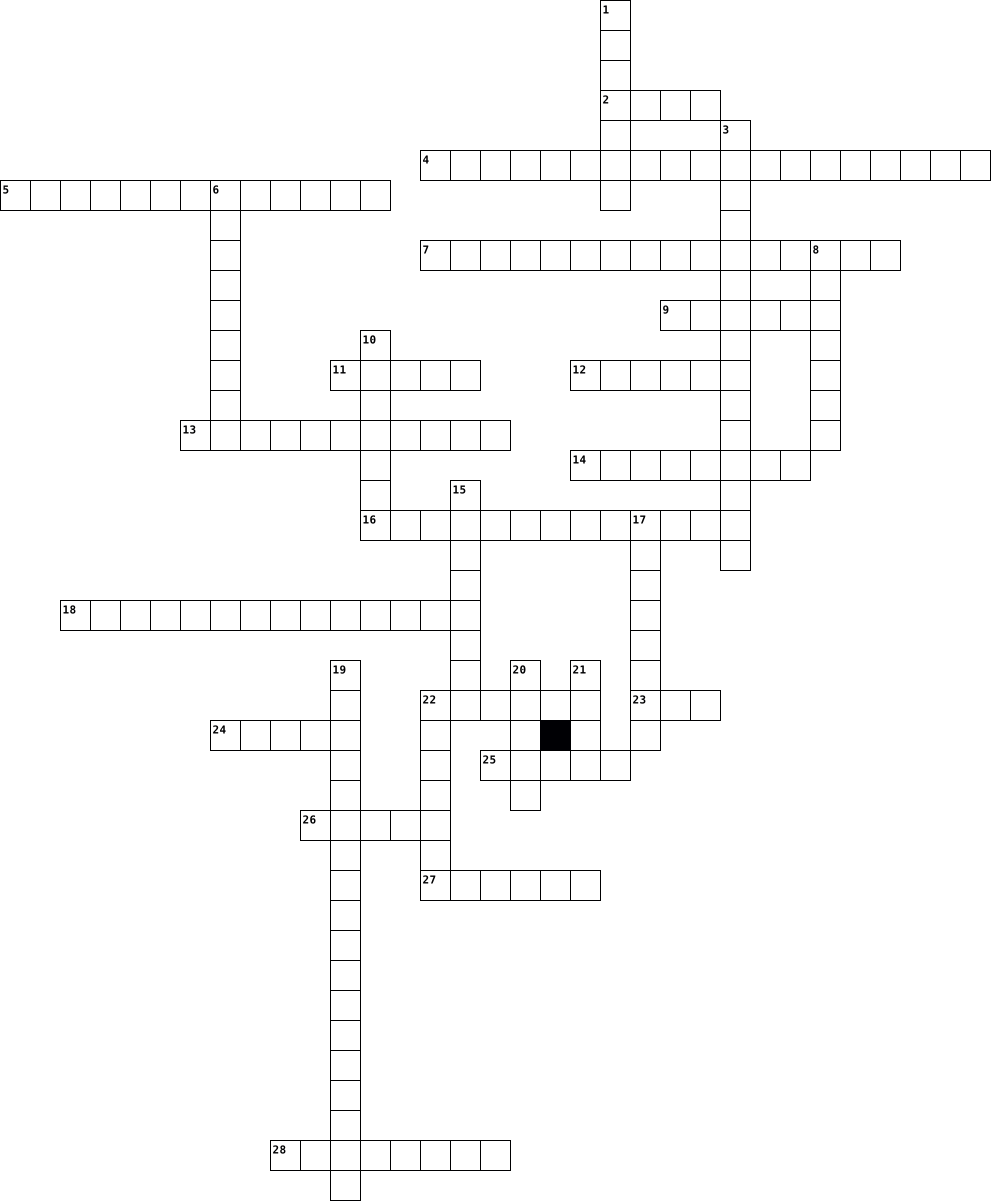
Across
- ancient language
- a woodland of tall trees
- a stone wall enclosed kingdom
- earliest know christans
- people who formed many kingdoms
- African Language
- oral historians
- raising herds
- first ruler of songhai
- ruler of songhai to 1493-1528
- an oval wall
- Desert
- earliest african society
- west african state in charge of gold
- best know for sculptures
- people who lived in city states
- kingdom along the red se
- social class
Down
- conquered mali
- south africa
- richest man
- Bantu language
- a grassy plain
- Christan ethiopian king
- wind patterns
- states along the coast
- between desert and wet lands
- the second kingdom after ghana
- founder of mali
29 Clues: Desert • richest man • south africa • an oval wall • social class • raising herds • wind patterns • conquered mali • Bantu language • a grassy plain • oral historians • founder of mali • ancient language • African Language • first ruler of songhai • states along the coast • earliest know christans • Christan ethiopian king • a woodland of tall trees • earliest african society • best know for sculptures • ...
Vocabulary - Civil War 2025-02-25

Across
- To form or develop an idea or plan in the mind.
- Unjust or prejudicial treatment of individuals based on characteristics such as race, gender, or age.
- To formally withdraw from an organization or political entity, such as a state leaving a union.
- Douglass A prominent African-American social reformer, abolitionist, orator, writer, and statesman who escaped from slavery and became a leader in the abolitionist movement.
Down
- The period after the American Civil War, from 1865 to 1877, during which the Southern states were reorganized and reintegrated into the Union
- The act of formally ending a system, practice, or institution, particularly referring to the movement to end slavery.
- The group of 11 Southern states that seceded from the United States in 1860-1861, forming their own government.
- Lincoln The 16th President of the United States, best known for leading the country during the Civil War and for his efforts to abolish slavery through the Emancipation Proclamation.
- The act of freeing someone from legal, social, or political restrictions; liberation.
- In the context of U.S. history, the northern states during the Civil War that opposed the seceding Confederate states.
- A person who has escaped from a place or is in hiding, especially to avoid arrest or persecution.
- A formally concluded and ratified agreement between states or sovereigns.
12 Clues: To form or develop an idea or plan in the mind. • A formally concluded and ratified agreement between states or sovereigns. • The act of freeing someone from legal, social, or political restrictions; liberation. • To formally withdraw from an organization or political entity, such as a state leaving a union. • ...
Meteorolgy 2022-03-17

Across
- lines that connect areas of similar air pressure on a weather map
- This type of front forms when a warm air mass is caught between two colder air masses.
- This is an air mass that generally brings cool, dry weather to the united states
- A destructive, rotating column of air that touches the ground
- This type of front forms when warm air moves over cold air
- A boundary between air masses of different densities and usually different temperatures.
- in this type of pressure system, you will experience sunny and clear skies with cool temperatures
- A severe storm that develops over a tropical ocean.
Down
- in this type of pressure system, you will experience warm and moist weather
- The average weather conditions in an area over a long period of time.
- This type of front forms when a cold air mass meets a warm air mass and little to no movement occurs.
- This air mass develops over water and brings warm humid weather to the united states.
- A short term state of the atmosphere.
- This type of front forms when cold air moves under warm air
- The temperature in which a gas condenses into a liquid.
- A large body of air where the temperature and moisture are constant throughout
- This is an air mass that brings very dry and hot weather to the united states
- This is an air mass that brings very cool and wet weather to the untited states
18 Clues: A short term state of the atmosphere. • A severe storm that develops over a tropical ocean. • The temperature in which a gas condenses into a liquid. • This type of front forms when warm air moves over cold air • This type of front forms when cold air moves under warm air • A destructive, rotating column of air that touches the ground • ...
Antebellum Unit and Civil War Unit 2025-04-16

Across
- Douglas Debates, debates between the Union and the Confederacy
- Barton, nurse in the Civil War
- States, states that did not leave the Union
- Tom's Cabin, story on slavery
- Sumpter, attached by Confederate forces
- Scott, had a court case and fought for his rights
- to withdraw from
- B McClellan, chief of all Union armies
Down
- DC, capital of the United States
- of Antietam, bloodiest battle
- Plan, plan that was named after a snake
- capital city of Virginia
- of Bull Run, 1st battle of the Civil War
- E Lee, Confederate general
- to betray your country
15 Clues: to withdraw from • to betray your country • capital city of Virginia • E Lee, Confederate general • of Antietam, bloodiest battle • Tom's Cabin, story on slavery • Barton, nurse in the Civil War • DC, capital of the United States • B McClellan, chief of all Union armies • Plan, plan that was named after a snake • Sumpter, attached by Confederate forces • ...
Early Republic - Washington through Adams 2024-12-12

Across
- Second President of the United States
- This Act made it illegal to speak badly about the Federalists in government.
- These taxes are used to protect American industries
- George Washington was the only president to have been elected ___________.
- The group responsible for guiding the President on important issues
- This Act was passed because of in increase in suspicion of immigrants.
- Washington used these to get Natives to sign over their land
- He created a plan to get the United States out of debt after the American Revolution
- The Whiskey Rebellion was the first time the power of the _________ government had been tested.
- France asked for a bribe for the U.S. during the ____________.
- Hamilton proposed that the Federal government should assume states' _______.
Down
- The Fugitive Slave Act led to the creation of the __________ Railroad.
- He was the first Chief Justice of the United States Supreme Court
- Hamilton was the leader of this political party
- The practice of kidnapping U.S. sailors
- Pinckney's Treaty was signed to settled boundary disputes between the U.S. and this country.
- This gave slave owners power to recapture their runaway slaves.
- In 1789, this created the judicial branch of the national government
- Washington warned that these would lead to animosity amongst Americans.
- The Proclamation of ___________ was issued to keep the United States out of foreign affairs.
- The Fugitive Slave Act led to the growth of the _________ Movement.
- Hamilton believed that we needed a _________ ________ and a common currency.
22 Clues: Second President of the United States • The practice of kidnapping U.S. sailors • Hamilton was the leader of this political party • These taxes are used to protect American industries • Washington used these to get Natives to sign over their land • France asked for a bribe for the U.S. during the ____________. • ...
Civil War and Reconstruction 2021-01-26

Across
- System An economy based on agricultural mass production of cash crops grown on large farms that used slave labor.
- Codes Restrictive laws designed to limit the freedom of African Americans and ensure their availability as a cheap labor force after slavery was abolished during the Civil War
- Bureau An agency of the War Department set up in 1865 to assist formerly enslaved people in obtaining equal rights.
- Proclamation President Abraham Lincoln’s Proclamation that freed the slaves.
- War A war fought between northern states and southern states that had seceded to form the Confederate States of America
- Preconceived opinion about someone that is not based on reason or actual experience.
- Crow Laws State and local laws that enforced racial segregation in the Southern United States
- The forced separation of different racial groups.
Down
- Courthouse On April 9, 1865, the surrender of the Confederate Army of Northern Virginia in the McLean House signaling the end of the nation's Civil War.
- Sovereignty The controversial political doctrine according to which the people of federal territories should decide for themselves whether their territories would enter the Union as free or slave states.
- Steam-powered warships where a wooden ship was protected from enemy fire by bales of cotton lining its sides
- Plan The military strategy proposed by Union General Winfield Scott called for a naval blockade of the Confederate coast.
- The effort after the war was over to reintegrate Southern states from the Confederacy and 4 million newly-freed people into the United States.
- A type of farming in which families rent small plots of land from a landowner in return for a portion of their crop to be given to the landowner at the end of each year.
- Soldier that was loyal to the Union.
- Soldier that was loyal to the Confederacy.
16 Clues: Soldier that was loyal to the Union. • Soldier that was loyal to the Confederacy. • The forced separation of different racial groups. • Proclamation President Abraham Lincoln’s Proclamation that freed the slaves. • Preconceived opinion about someone that is not based on reason or actual experience. • ...
U.S. HISTORY EOC REVIEW 2016-04-19

Across
- declarationby Truman to economically assist any country fighting communism after World War two. The declaration marked the beginning of the containment Policy
- Document which formed the first government of the U.S. near the end of the American Revolution. States had more power than the national government.
- ended poll tax
- Essays written by James Madison, Alexander Hilton, and John Jay to support the ratification of the Constitution
- Created a graduated income tax
- Foundation for American government for freedoms such as freedom of speech and trial by jury
- First ten amendments to the Constitution guaranteeing individual liberties and due process
- Treaty that ended WW1. Was extremely harsh on Germany.
- Gave African American men the right to vote
Down
- gave women the right to vote
- required states to give citizenship to all citizens born in the United States and gave other basic civil rights
- A document outlining the basic form and rules of the U.S. government
- Peace plan issued by Wilson that called for freedom of the seas, reduction of armaments , and end to secret diplomacy. Important part was the creation of the League of Nations a national peace organization
- gave freedom to the slaves in all states
- Written mostly by Jefferson to list the grievances (complaints) against Great Britain and to declare independence from Great Britain
- Major ideas found in the U.S. Constitution of limiting the power to tax and right to fair trial
- provided direct election of senators
- gave the right to vote to 18 year olds
18 Clues: ended poll tax • gave women the right to vote • Created a graduated income tax • provided direct election of senators • gave the right to vote to 18 year olds • gave freedom to the slaves in all states • Gave African American men the right to vote • Treaty that ended WW1. Was extremely harsh on Germany. • ...
The Crossword Puzzle For Mr.Hill 2017-02-08

Across
- forced the native americans from the northwest territory
- the third president of the united states of america
- setting an example to be followed in the future
- seizing ships to fight for your navy
- something that is not in the united states constitution
- he was a patriot commander and the first president of the united states of america
- a person who invests in a risky venture
Down
- not taking a side in a argument (Switzerland)
- he was the united states of america's first secretary of treasury
- import tax wanted by the federalists
- the second federalist president of the united states
- a organized group in politics, capatalists
- the formal admission of someone to office
- the most credited person who wrote the constitution
14 Clues: import tax wanted by the federalists • seizing ships to fight for your navy • a person who invests in a risky venture • the formal admission of someone to office • a organized group in politics, capatalists • not taking a side in a argument (Switzerland) • setting an example to be followed in the future • the third president of the united states of america • ...
Standard 2 2023-05-04

Across
- phrase frequently used by Southern politicians and authors prior to the American Civil War, indicating the economic and political importance of cotton production
- bank war
- system
- Act of 1854
- United States foreign policy position
- acquisition of the territory of Louisiana
- conflict between the United States and Mexico from 1846 to 1848.
- 1850
- the resistance to enslavement through escape and flight
- convention
Down
- Rebellion
- Destiney
- forced displacement of tribes
- commonly shortened to the KKK
- Jacksonian
- 13th Amendment
- required that slaves be returned to their owners, even if they were in a free state
- revolution
- restricted black people's right to own property
19 Clues: 1850 • system • Destiney • bank war • Rebellion • Jacksonian • revolution • convention • Act of 1854 • 13th Amendment • forced displacement of tribes • commonly shortened to the KKK • United States foreign policy position • acquisition of the territory of Louisiana • restricted black people's right to own property • the resistance to enslavement through escape and flight • ...
27 amendments 2024-10-22

Across
- right to vote not denied by race
- right of freedom of speech
- lame ducks
- presidential disability and succession
- prohibition of alcohol
- powers reserved to the states
- prohibits the poll tax
- limits pay raises in congress
- ends slavery
- women's right to vote
- trial by jury in civil cases
Down
- popular election of senators
- right to vote at age 18
- citizenship and rights and = protection
- lawsuit against the states
- non-enumerated rights
- due process and rights of the accused
- rights to a fair and speedy trial
- federal income tax
- presidential term limit
- electoral votes for D.C
- unreasonable searches and seizures
- cruel and unusual punishment
- Right to bear arms
- quartering on soldiers
- electing the president and vice president
26 Clues: lame ducks • ends slavery • federal income tax • Right to bear arms • non-enumerated rights • women's right to vote • prohibition of alcohol • quartering on soldiers • prohibits the poll tax • right to vote at age 18 • presidential term limit • electoral votes for D.C • lawsuit against the states • right of freedom of speech • popular election of senators • cruel and unusual punishment • ...
Levels of Government 2024-12-04

Across
- is the branch of government that writes and passes laws
- has 435 members, determined by state populations
- is the branch of government that interprets laws and decides if they are Constitutional
- states that any powers not listed in the Constitution should go to the states
- these powers are explicitly given to the federal government in the constitution
- running these is a reserved power that States are in control of
Down
- Congress has the power to make any laws that are" _______________ and proper" for society to function
- is a concurrent power that both the State and Federal governments can impact
- is the branch of government that includes the president
- includes offices like the Department of Education and the Department of Justice
- has 100 members, 2 for each state, who are elected to serve 6-year terms
- has the power to declare war
- a word meaning power is divided between the Federal government and the states
13 Clues: has the power to declare war • has 435 members, determined by state populations • is the branch of government that writes and passes laws • is the branch of government that includes the president • running these is a reserved power that States are in control of • has 100 members, 2 for each state, who are elected to serve 6-year terms • ...
Heat, Temperature and States of Matter 2022-10-17

Across
- the lowest temperature possible on the kelvin scale
- thermal energy moving from a warmer object to a cooler object.
- You need this between sections of railway track, especially in the summer!
- this happens when a liquid is change to a solid.
- these particles are close together but they can still move around in this state
- Ice thawing is an example of ___.
- This word sums up the movement of gas and liquid particles in all directions.
- This particle property changes with change in temperature
- instrument used to measure temperature
- Melting, freezing, boiling etc. are all examples of a ___.
- The individual bits of solids, liquids and gases.
- the temperature scale scientists use.
Down
- this tells you how hot or cold a substance is.
- a thermometer that responds quickly to temperature changes.
- at 100°C is the temperature of pure boiling water at standard atmospheric pressure.
- the point on the celsius scale where pure ice melts at standard atmospheric pressure.
- This is caused by gas particles hitting the side of a container.
- particles moves ___ when heated.
- a type of thermometer used in the medical field.
- the particles are close together but they can still move around in the state.
20 Clues: particles moves ___ when heated. • Ice thawing is an example of ___. • the temperature scale scientists use. • instrument used to measure temperature • this tells you how hot or cold a substance is. • this happens when a liquid is change to a solid. • a type of thermometer used in the medical field. • The individual bits of solids, liquids and gases. • ...
United States-Physical and Human Geography. 2020-05-08
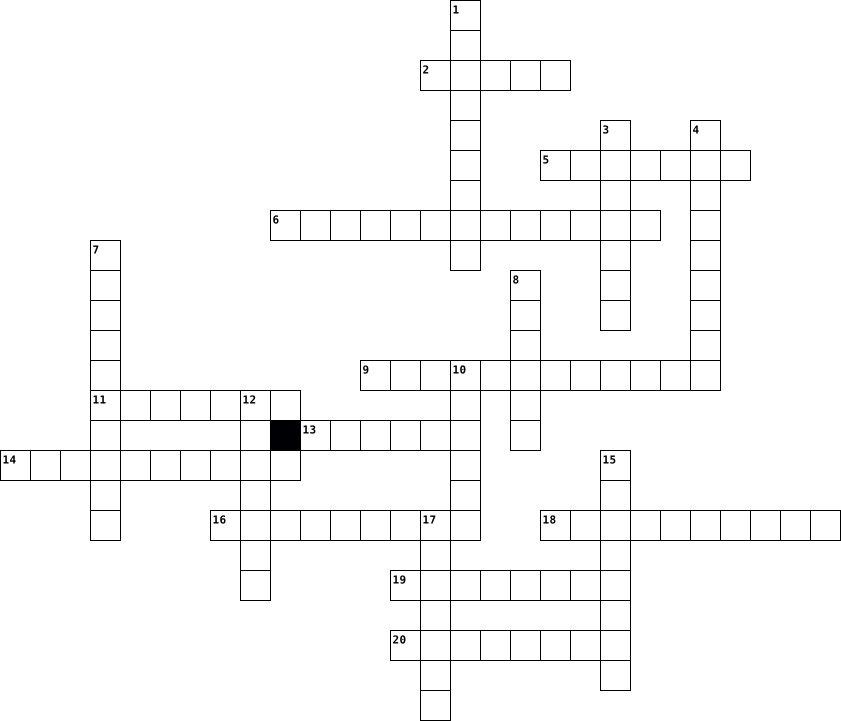
Across
- Cardinal point
- Social community with a political organization
- It comes from an indigenous name
- Legal Text
- Second largest continent on the planet
- One of the most cold countries
- Where is the Mojave desert
- distance from a point on the earth to the parallel of the equator
- Capital of United states
- natural elevation of land
- Group of people from the same geographical origin
Down
- science that studies the surface of the earth
- set of traditions and customs
- It is transmitted from generation to generation
- set of inhabitants of a place
- Population where a group of people lives
- Specific cities of a country
- The seasons of the year begin and end
- Occupation, activity or work
- Science that studies how to manage resources of money
20 Clues: Legal Text • Cardinal point • Capital of United states • natural elevation of land • Where is the Mojave desert • Specific cities of a country • Occupation, activity or work • set of traditions and customs • set of inhabitants of a place • One of the most cold countries • It comes from an indigenous name • The seasons of the year begin and end • Second largest continent on the planet • ...
Native Americans and the United States 2023-03-22

Across
- (adj.) able to move quickly and gracefully
- (n.) something that you imagine or dream
- (n.) the body's ability to resist or fight off a disease
- (n.) a tradition or behavior that is common among a group or family; a ritual
- (n.) a piece of cloth worn around the hips as clothing by men in certain cultures, usually in warm climate
- line (n.) the boundary, or border, that indicates where one piece of property ends and another begins
- (v.) to believe that something is true despite not knowing all the facts.
- (n.) a leftover piece; a small part of a whole
- (adj.) made up of people or items that are not alike
- (v.) to change something from time to time
- (n.) a strain
- (n.) a group of people chosen to lead or give advice
- (n.) a group of people, animals or things that act together to achieve a common purpose
- (n.) a change
Down
- (n.) a bag or case used to carry arrows
- (adj.) originating in a certain location or region
- (v.) to observe someone or something in order to gather and report information about that person or thing
- (v.) to suggest something without saying it directly
- (v.) to follow along, or draw, the outline of something; to examine the history of something to see how it developed
- (v.) to keep alive
- deed (n.) an official piece of paper that shows who legally owns a piece of property
- (n.) the cost in health or life
- (n.) discomfort felt when different people or groups disagree and feel anger toward each other
- (n.) a conclusion or view that comes from knowing some, but not all, of the fact
- (n.) a separate area of land in the United States set aside for Native Americans to live on
- (n.) a right someone has because they were born into a specific group or family, or because it is a right of all people belonging to that group
- (n.) someone who is sent somewhere in advance of others to gather information
- relocation (n.) the act of making people move to a new place against their will
- (v.) to disagree, differ, or say or do the opposite of something
- (n.) In the Sioux culture, a supernatural power
30 Clues: (n.) a strain • (n.) a change • (v.) to keep alive • (n.) the cost in health or life • (n.) a bag or case used to carry arrows • (adj.) able to move quickly and gracefully • (n.) something that you imagine or dream • (n.) a leftover piece; a small part of a whole • (v.) to change something from time to time • ...
The Development of States and Empires 2014-05-04

Across
- important trading capital of the Byzantine Empire.
- effective form of government used by Qin China.
- founder of the Mauryan Empire in India.
- ruled from 269-232 BCE, was one of the best known Mauryan emperors.
- form of government where all or most adult citizens play a role.
- dynasty brought to power by uprisings during the Qin.
- Greek-like culture created by Alexander the Great.
- founder of Qin, ended Warring States period.
- harsh military oriented city in Greece; enemy of Athens.
Down
- philosophy favored by the Han dynasty.
- philosophy favored by the Qin dynasty.
- First dynasty of the Persians founded by Cyrus.
- society revolving around males.
- nomadic invaders who threatened the Han's borders.
- system used by the Han to collect taxes from their neighbors.
- Persian empire from 224-651 BCE.
- North African port found by the Phoenicians.
- trade route from China to the Roman Empire used by the Han.
- culturally and politically advanced city in Greece; strong navy.
- empire that rose in 320 CE which controlled most of north-central India.
20 Clues: society revolving around males. • Persian empire from 224-651 BCE. • philosophy favored by the Han dynasty. • philosophy favored by the Qin dynasty. • founder of the Mauryan Empire in India. • North African port found by the Phoenicians. • founder of Qin, ended Warring States period. • effective form of government used by Qin China. • ...
STATES OF MATTER- Mason And Dash 2025-06-04

Across
- A Type Of Electricity-(4th State) (You Can By This Product In a Glass Ball)
- Something With Extremely Spaced Out Atoms
- When Water Gets Heated And Rises Into The Air
- Energy Anything With Movement In It
- The Secound Smallest Element In Our Universe
- The Ability To Do Work
- Energy The Amount Of Energy Stored Into Something
- When Something Happens To Something To Make It A Completely Different Thing Eg Acid Chicked
- Something That Can Be Reversed Eg Ice
- Something With Tightly Packed Atoms
- They Make Up Most Of Our World
- Point The Right Temp That Can Just Melt Something
- Something Hot
Down
- When SOmething Dissapears
- Something That Can Go Back To Its Origianl State
- Its Short Word-(BEC)
- The Smallest Element In Our Universe
- A Orange Dust That Forms On Iron And Steel/Metal
- Something With Tight Molecules But Also Spaced Atoms
- Something That Cant Go Back To Its Original State
- Point When Something Has Just Hit The Right Temp
21 Clues: Something Hot • Its Short Word-(BEC) • The Ability To Do Work • When SOmething Dissapears • They Make Up Most Of Our World • Energy Anything With Movement In It • Something With Tightly Packed Atoms • The Smallest Element In Our Universe • Something That Can Be Reversed Eg Ice • Something With Extremely Spaced Out Atoms • The Secound Smallest Element In Our Universe • ...
states of matter, mixtures, and changes 2023-09-25

Across
- does not make a new substance
- used to seperate small to medium sized pieces of a mixture
- used to manually separate large pieces of a mixture
- when 2 susbtances are physically combined
- vinegar and baking soda
- the only way to seperate a solution
- have the most movement out of all states of matter
- takes the shape of container but tries to escape
- frozen state of water
- makes a new substance
- when a gas becomes a liquid
- mixture in which parts cannot be seen
- size, shape, density, state, mass
- takes the shape of container definite volume but not shape
- when a liquid becomes a gas
Down
- smoke, temp change, odor, bubbles, formation of gas, and color change
- chopping up fruit
- what is needed to make a phase change occurr
- means that a formation of gas is occurring
- when a state of matter chaoccurorms
- gas form of water
- when a liquid becomes a solid
- floats out pieces of large material in mixtures
- mixture in which all parts can be seen
- have the least amount of movement of all states of matter
- way to get iron or metal from a mixture
- when a solid becomes a liquid
- definite shape and volume vibrates in place
- the best mixed mixture is homogeneous
29 Clues: chopping up fruit • gas form of water • frozen state of water • makes a new substance • vinegar and baking soda • when a gas becomes a liquid • when a liquid becomes a gas • does not make a new substance • when a liquid becomes a solid • when a solid becomes a liquid • size, shape, density, state, mass • when a state of matter chaoccurorms • the only way to seperate a solution • ...
The United states And Their Nicknames 2024-09-19

Across
- The Beaver State
- The Pine Tree State
- The Show Me State
- The Old Dominion
- The Grand Canyon State
- The North Star State
- The Centennial State
- The Badger State
- The Peach State
- The Natural State
- The Beehive State
- Sunflower State
- The Gem State
- The Flicker Tail State
- The Silver State
- The KeyStone State
- The Lone Star state
- The BlueGrass State
- The Palmetto State
- The Ocean State
- The Ever Green State
- The Land Of Enchantment
- The Volunteer State
- The Magnolia State
- The First State
- The Empire State
- The Green Mountain State
Down
- The Cotton State
- The Pelican State
- The Prarie State
- The Sunshine State
- The Golden State
- The Aloha State
- The Sooner State
- The Last Frontier
- The Bay State
- The Treasure State
- The Old North State
- The Great Lakes State
- The Equality State
- The Corn Husker State
- The Granite State
- The Free State
- The Buckeye State
- The Mountain State
- The Hawkeye State
- The Mount Rushmore State
- The Garden State
- The Constitution State
- The Hoosier State
50 Clues: The Bay State • The Gem State • The Free State • The Aloha State • The Peach State • Sunflower State • The Ocean State • The First State • The Cotton State • The Prarie State • The Beaver State • The Golden State • The Sooner State • The Old Dominion • The Badger State • The Silver State • The Garden State • The Empire State • The Pelican State • The Show Me State • The Last Frontier • The Natural State • ...
States of Matter, Temperature, and Heat 2025-09-21

Across
- Energy of motion
- State of Matter with definite shape and definite volume
- Energy transferred between systems
- What typically happens to temperature as heat is removed from a system
- Temperature scale where absolute zero is at 0 K
- State transition from liquid to gas
- The average kinetic energy of particles in a system
- State transition from liquid to solid
- Latent heat of _____ occurs at the melting point
- Defined part of the universe that is being studied
- State transition from solid to liquid
- Everything else in the universe outside of the system
- Type of system where energy can be exchanged but matter cannot
- What typically happens to temperature as heat is added to a system
- Type of system where both energy and matter can be exchanged
Down
- State of Matter with indefinite shape and definite volume
- Type of system where neither energy or matter can be exchanged
- State of Matter with indefinite shape and indefinite volume
- State transition from gas to liquid
- Distinct physical form in which matter can exist (solid, liquid, gas)
- Latent heat of _____ occurs at the boiling point
- Type of heat where energy goes towards breaking bonds between molecules, does not increase temperature
- State transition from gas to solid
- The temperature scale use in science (and the rest of the world)
- State transition from solid to gas
25 Clues: Energy of motion • Energy transferred between systems • State transition from gas to solid • State transition from solid to gas • State transition from gas to liquid • State transition from liquid to gas • State transition from liquid to solid • State transition from solid to liquid • Temperature scale where absolute zero is at 0 K • ...
States of Matter and Particles Crossword 2026-04-19

Across
- Flows and takes the shape of its container
- What liquids can do
- Needed for changes like melting
- Used to record results
- Solid, liquid, or gas
- To find size, time, or amount
- Used to observe changes
- How hot or cold something is
- When a solid turns into a liquid
- Keeps its shape
Down
- Removes heat and causes solidifying
- A specific kind of material
- When something becomes different
- What particles are always doing
- When a liquid turns into a solid
- Tiny pieces everything is made of
- What solids keep
- What objects are made from
- Energy that causes melting
- Spreads out and fills space
20 Clues: Keeps its shape • What solids keep • What liquids can do • Solid, liquid, or gas • Used to record results • Used to observe changes • What objects are made from • Energy that causes melting • A specific kind of material • Spreads out and fills space • How hot or cold something is • To find size, time, or amount • What particles are always doing • Needed for changes like melting • ...
US History Test Review 2025-11-05

Across
- purchase of land from France in 1803
- a federal law that gives the President the authority to apprehend, restrain, and deport non-citizens from an enemy country during a declared war or invasion
- in favor of articles of confederation, strong state governments
- head of government of the United States
- in favor of constitution, strong central government
- a political party in the United States founded by Thomas Jefferson and others who advocated for a decentralized government with power held by the states
- the supreme law of the land, establishing the framework for the federal government and defining its powers and limitations
- first 10 amendments in the Constitution
- a federal excise tax on distilled spirits, like whiskey, that was first imposed in the United States in 1791 to help pay off Revolutionary War debts
- leader of the antifederalists, 3rd US President
Down
- a law that criminalizes speech or writing considered a threat to the government's authority, making it illegal to "write, print, utter, or publish... any false, scandalous, and malicious writing" against the government
- a diplomatic incident in 1797-1798 where three American diplomats in France were asked for bribes and loans by secret French agents
- branch of government that interprets laws and administers justice
- branch of government that has the power to make laws
- 1st US President
- the branch of government responsible for enforcing and implementing laws
- way of doing something in the future
- city in which Lewis and Clarck began their journey
- a legal theory that a state can invalidate any federal law it deems unconstitutional
- 2nd US President, defended British soldiers during Boston Massacre
20 Clues: 1st US President • way of doing something in the future • purchase of land from France in 1803 • head of government of the United States • first 10 amendments in the Constitution • leader of the antifederalists, 3rd US President • city in which Lewis and Clarck began their journey • in favor of constitution, strong central government • ...
CROSSWORD PUZZLE ON POLITICS AND GOVERNANCE 2026-01-13

Across
- Theory – Belief that states formed to meet economic needs.
- – Branch of government that enforces laws.
- Theory – Theory that the state arose through domination of the strong over the weak.
- Contract Theory – Belief that people voluntarily formed states for mutual benefit.
- – An established organization that governs behavior.
- Theory – View that humans are social beings who naturally form states.
- – Government body that makes laws.
- – Process of testing political ideas using data.
- – Branch of government that interprets laws.
- Theory – Idea that forming a state is a natural human instinct.
- Behavior – Actions of individuals and groups in politics.
- – The art or science of governing and influencing government policies and power.
- – The population living within a state.
- – A group of people sharing common culture, language, or identity.
- – Based on observation and evidence.
Down
- – Supreme authority of a state, free from external control.
- Law – Rules governing relations between states.
- Approach – Scientific study of political behavior using empirical methods.
- – A defined geographical area under a state’s jurisdiction.
- – Thinker who popularized the modern concept of the state.
- – Legitimate power exercised by a government or institution.
- – A political organization with people, territory, government, and sovereignty.
- Approach – Political study focusing on philosophy, ethics, and institutions.
- – Concerned with values of what is good or bad in society.
- Science – The systematic study of politics, power, government, and the state.
- Right Theory – Belief that the state and ruler are created and chosen by God.
- – Institutions that make and enforce laws for society.
- Theory – Theory that the state evolved from family units.
- – A Greek city-state; the root word of politics.
- – The ability to influence or control the behavior of others.
30 Clues: – Government body that makes laws. • – Based on observation and evidence. • – The population living within a state. • – Branch of government that enforces laws. • – Branch of government that interprets laws. • Law – Rules governing relations between states. • – Process of testing political ideas using data. • – A Greek city-state; the root word of politics. • ...
Chapter 3 Terms 2018-10-14

Across
- The doctrine that a state can declare null and void a federal law that, in the state's opinion, violates the Constitution
- Section of the Constitution allowing Congress to pass all laws "necessary and proper" to its duties, and that has permitted Congress to exercise powers not specifically given to it by the Constitution
- Idea that the federal and state governments share power in many policy areas
- Procedure whereby voters can remove an elected official from office
- Terms set by the national government that states must meet if they are to receive certain federal funds
- Procedure enabling voters to reject a measure passed by the legislature
Down
- Idea that different states can implement different policies, and the successful ones will spread
- Doctrine that the national government is supreme in its sphere, the states are supreme in theirs, and the two spheres should be kept separate
- Money given by the national government to the states
- The transfer of power from the national government to the state and local governments
- Process that permits voters to put legislative measures directly on the ballot
- Federal grants for specific purposes, such as building an airport
- Terms set by the national government that states must meet whether or not they accept federal grants
- Government authority shared by national and local governments
- A decision by an administrative agency granting some other part permission to violate a law or rule that would otherwise apply to it
15 Clues: Money given by the national government to the states • Government authority shared by national and local governments • Federal grants for specific purposes, such as building an airport • Procedure whereby voters can remove an elected official from office • Procedure enabling voters to reject a measure passed by the legislature • ...
Financial Literacy 2023-07-10

Across
- day fund, money for an emergency
- of return, percentage of money earned by investment
- ability to turn items into cash quickly
- income left over after bills are paid
- market, when stock prices keep increasing
- value, worth of stocks when sold
- advantage of using a credit card
- person who loans money
- price someone is willing to buy stock
- where to put money for a short term goal
- put up against a loan
- used to manage your money
- price stock is being sold at
- saving for post secondary schooling
Down
- value gained or lost as a percentage of investment
- buying a coffee everyday
- monthly expense related to gas in the car
- income that shows up in bank account
- partial ownership of a company
- score, can hurt or help in buying a house
- value, original purchase price of stock
- high risk investment
- interest, how your money makes money
- market, when people should be buying stocks
- money given to you as a stock owner
- assets owned by a person
- a person who owes money
- steady job and regularly paying bills
- required for survival
- earning potential considered for loan
30 Clues: high risk investment • required for survival • put up against a loan • person who loans money • a person who owes money • buying a coffee everyday • assets owned by a person • used to manage your money • price stock is being sold at • partial ownership of a company • day fund, money for an emergency • value, worth of stocks when sold • advantage of using a credit card • ...
Hockey 2023-12-20

Across
- The act of winning the championship
- The act of passing the puck to a teammate who then scores
- The NHL team from Edmonton
- The NHL team from Detroit
- The playing surface in hockey
- Where the New Jersey Devils are based
- The area where the goalie stands
- The NHL team from Pittsburgh
- The act of stopping the puck with any part of the body
- The act of scoring three goals in a single game
- The act of shooting the puck over the glass and out of play
- The number Nico Hischier wears
- The act of removing an opponent from play by force
Down
- The player who defends the net
- The NHL team from Washington D.C.
- The act of hitting an opponent with the stick
- The NHL team from Toronto
- The NHL team from Chicago
- The NHL team from New York
- The NHL team from Los Angeles
- The act of shooting the puck between the opponent's legs
- The act of shooting the puck into the opponent's net
- The act of illegally impeding on opponent's progress
- The NHL team from Boston
24 Clues: The NHL team from Boston • The NHL team from Toronto • The NHL team from Chicago • The NHL team from Detroit • The NHL team from Edmonton • The NHL team from New York • The NHL team from Pittsburgh • The playing surface in hockey • The NHL team from Los Angeles • The player who defends the net • The number Nico Hischier wears • The area where the goalie stands • ...
SOUTH AMERICAN CAPITALS 2013-04-17

Across
- COLOMBIA
- BRAZIL
- GUYANA
- SURINAME
- VENEZUELA
Down
- ECUADOR
- PANAMA
- URUGUAY
- FALKLAND ISLANDS
- PARAGUAY
- BOLIVIA
- ARGENTINA
- CHILE
- FRENCH GUIANA
- PERU
15 Clues: PERU • CHILE • PANAMA • BRAZIL • GUYANA • ECUADOR • URUGUAY • BOLIVIA • COLOMBIA • PARAGUAY • SURINAME • ARGENTINA • VENEZUELA • FRENCH GUIANA • FALKLAND ISLANDS
North American Capitals 2023-06-09

Across
- - Capital of Honduras
- - US capital
- - Capital of Haiti
- - Capital of El Salvador
- - Canadian capital
- - Capital of Nicaragua
- - Capital of Northern Ireland (part of the UK)
Down
- - Capital of Mexico
- - Capital of Jamaica
- - Capital of Guatemala
- - Capital of Belize
- - Capital of Dominican Republic
- - Capital of Panama
- - Capital of Costa Rica
- - Capital of Cuba
15 Clues: - US capital • - Capital of Cuba • - Capital of Haiti • - Canadian capital • - Capital of Mexico • - Capital of Belize • - Capital of Panama • - Capital of Jamaica • - Capital of Honduras • - Capital of Guatemala • - Capital of Nicaragua • - Capital of Costa Rica • - Capital of El Salvador • - Capital of Dominican Republic • - Capital of Northern Ireland (part of the UK)
Capitals of Europe 2025-04-01

Across
- The capital of The Netherlands
- The capital of Spain
- The capital of France
- The capital of Hungary
- The capital of England
- The capital of Finland
- The capital of Ireland
Down
- The capital of Germany
- The Capital of Russia
- The capital of Poland
- The capital of Portugal
- The capital of Sweden
- The capital of Italy
- The capital of Bulgaria
- The capital of Ukraine
15 Clues: The capital of Spain • The capital of Italy • The Capital of Russia • The capital of Poland • The capital of France • The capital of Sweden • The capital of Germany • The capital of Hungary • The capital of England • The capital of Finland • The capital of Ukraine • The capital of Ireland • The capital of Portugal • The capital of Bulgaria • The capital of The Netherlands
NAME THE CAPITALS 2025-04-02

Across
- RUSSIA
- SWITZERLAND
- ITALY
- FRANCE
- UNITED KINGDOM
- UNITED ARAB EMIRATES
- CANADA
- GREECE
- SPAIN
Down
- AUSTRALIA
- GERMANY
- SAUDI ARABIA
- EGYPT
- INDIA
- BRAZIL
15 Clues: EGYPT • ITALY • INDIA • SPAIN • RUSSIA • FRANCE • CANADA • BRAZIL • GREECE • GERMANY • AUSTRALIA • SWITZERLAND • SAUDI ARABIA • UNITED KINGDOM • UNITED ARAB EMIRATES
State capitals, USA 2025-01-24

Across
- Georgia
- Arizona
- Maine
- Ohio
- Texas
- Colorado
- Alabama
- Michigan
Down
- Nebraska
- Nevada
- Wisconsin
- Mississippi
- New York
- California
- Pennsylvania
15 Clues: Ohio • Maine • Texas • Nevada • Georgia • Arizona • Alabama • Nebraska • New York • Colorado • Michigan • Wisconsin • California • Mississippi • Pennsylvania
Countries & Capitals #3 2025-10-21

Across
- Bern
- Edinburgh
- Brussels
- Budapest
- Warsaw
- Prague
- Oslo
- Stockholm
Down
- Vienna
- Athens
- Copenhagen
- Dublin
- Amsterdam
- Helsinki
- Reykjavik
15 Clues: Bern • Oslo • Vienna • Athens • Dublin • Warsaw • Prague • Brussels • Budapest • Helsinki • Edinburgh • Amsterdam • Reykjavik • Stockholm • Copenhagen
Federalism Crossword 2024-12-02

Across
- a system of government in which a written constitution divides the powers of government between a central government and state or regional governments.
- national legislation is supreme, no state law may conflict with any form of national law. (2 words)
- powers that are specifically denied to the states and national government by the Constitution
- powers directly stated, or spelled out expressly in the Constitution
- powers not expressly stated in the Constitution, but reasonably suggested, or implied, by the expressed powers.
- a form of government where the people hold the power and elect representatives to make laws and serve their interests. (2 words)
- the political authority that governs an entire country, as opposed to a smaller part like a state or province. (2 words)
- powers that can be exercised only by the National Government; cannot be exercised by the States under any circumstances.
Down
- powers of the National Government granted to it in the Constitution.
- powers that both the National Government and the States possess and exercise.
- certain powers assigned to the national government other powers reserved for the states. (3 words)
- a government that creates and enforces laws for a state within a federal system. (2 words)
- powers that the Constitution does not grant to the National Government and does not deny to the states.
- the supreme law of the land.
- powers that belong to the National Government because it is the national government of a sovereign state.
15 Clues: the supreme law of the land. • powers of the National Government granted to it in the Constitution. • powers directly stated, or spelled out expressly in the Constitution • powers that both the National Government and the States possess and exercise. • a government that creates and enforces laws for a state within a federal system. (2 words) • ...
250th Anniversary 2026-04-22

Across
- Festive procession often held on July 4
- Colonial militia ready at a moment’s notice
- Declaration of ____ signed on July 4,1776
- National bird of the United States
- What the states form
- What the Statue stands for
- War that began in 1775
Down
- Term for America’s 250th birthday
- Nation celebrating its 250th anniversary in 2026
- British troops in the colonies
- Colonist who opposed British rule
- As in ___ Fathers
- What July 4 represents
- Icon said to have cracked while tolling
- They represent the states on the flag
- Supporter of American independence
- Stars and stripes symbol
17 Clues: As in ___ Fathers • What the states form • What July 4 represents • War that began in 1775 • Stars and stripes symbol • What the Statue stands for • British troops in the colonies • Term for America’s 250th birthday • Colonist who opposed British rule • Supporter of American independence • National bird of the United States • They represent the states on the flag • ...
Articles of Confederation and the Constitution 2021-11-10

Across
- under the Articles, there wasn't one of these branches to enforce laws
- system of government where the state and central government share power with one another
- system of government where the central government hold all power and lower government must follow
- this was an uprising of farmers who were upset about government taking their property for unpaid taxes
- this document is what corrected the weaknesses of the Articles of Confederation
- states were unable to print their own version of this to making fake ones were easy
Down
- there was no____system to settle disputes between states
- under the Articles, this is the number of states needed to pass a law
- because the U.S. was a confederation, they competed with one another over trade with foreign _______.
- system of government where states have more power than the central government
- you needed all 13 states to agree to pass these
- federal government does not have the power to collect these from the states
- without taxes to be collected, this could not be funded
13 Clues: you needed all 13 states to agree to pass these • without taxes to be collected, this could not be funded • there was no____system to settle disputes between states • under the Articles, this is the number of states needed to pass a law • under the Articles, there wasn't one of these branches to enforce laws • ...
Social Studies vocab words for chapters 7 and 8 2023-03-30

Across
- to withdraw from a country or organization
- somebody who encourages people to join a group or take action.
- an order issued by Abraham Lincoln on January 1, 1863 that announced the freedom of enslaved people in the rebelling states
- the group of people who make laws for the United States. It has elected representatives from all states.
- a change to government process or document
- The head of the executive branch
- someone who wants to end slavery
Down
- a system of government in which power is divided between a federal, or national government and its various state governments.
- a written document that outlines how the state will be governmentally organized.
- a person who comes into a country to live there.
- the eleven southern states that left the union during the civil war, also called the confederate states of America
- the north part of the country during the civil war/United States
- a geographic area with boundaries and a government with a constitution, plus some say in the federal government.
13 Clues: The head of the executive branch • someone who wants to end slavery • to withdraw from a country or organization • a change to government process or document • a person who comes into a country to live there. • somebody who encourages people to join a group or take action. • the north part of the country during the civil war/United States • ...
Governments 2025-08-25

Across
- A form of government where people have the supreme power.
- Government where one person has absolute power.
- A Government where power is limited by a constitution.
- Government where states hold supreme power over everything.
- Power is shared with state and central governments.
- Government where authority is spread among branches equally.
- The government can govern itself without interference.
- One person holds absolute power over everyone else and denies civil rights.
- Monarchy where power is limited by a constitution.
- Government where one person is born into power.
Down
- A group of people have control over everyone else(usually based on power and wealth)
- Government where power is shared between state and central governments.
- Everyone has equal rights.
- A democracy where an elected representatives lead the government.
- States form a group but still have most of their power.
- Central governments have complete power over states.
- Government where religion is the supreme leader.
17 Clues: Everyone has equal rights. • Government where one person has absolute power. • Government where one person is born into power. • Government where religion is the supreme leader. • Monarchy where power is limited by a constitution. • Power is shared with state and central governments. • Central governments have complete power over states. • ...
World Studies 2021-06-04

Across
- political and military organization formed in 1964
- negotiations between the United States and the Soviet Union that were aimed at curtailing the manufacture of strategic missiles capable of carrying nuclear weapons
- US policy of withdrawing its troops and transferring the responsibility and direction of the war effort to the government of South Vietnam
- anti-colonial activist and politician who governed Kenya as its Prime Minister from 1963 to 1964
- mass student-led paramilitary social movement mobilized and guided by Chairman Mao Zedong
- change of political borders cutting through at least one territory considered a homeland by some community
- Filipino politician, lawyer, and kleptocrat who served as the 10th President of the Philippines
- India's national political party
- act of pushing a situation to the verge of war, in order to threaten and encourage one's opponent to back down
- long period of intense rivalry between the Soviet Union and the United States
- military and defense alliance formed by 12 countries in Western Europe and North America
- guerrilla fighters in Islamic countries, especially those who are fighting against non-Muslim force
Down
- Palestinian uprising against Israeli occupation of the West Bank and Gaza Strip, beginning in 1987
- international organization made up of sovereign nations created after WW2
- United States policy using numerous strategies to prevent the spread of communism abroad
- Indonesian statesman and revolutionary who was the first president of Indonesia
- this barrier isolated Eastern Europe from the rest of the world
- european nations generous funding to rebuild their economies as long as the money was spent on goods made in the United States
- easing of hostility or strained relations, especially between countries
- Indonesian military officer and politician, who was the second President of Indonesia
- armed communist political revolutionary organization in South Vietnam and Cambodia
- chairman of the plo
- Sunni Islamist movement and military organisation in Afghanistan
- A group of people living together and sharing the same possessions and responsibilities
24 Clues: chairman of the plo • India's national political party • political and military organization formed in 1964 • this barrier isolated Eastern Europe from the rest of the world • Sunni Islamist movement and military organisation in Afghanistan • easing of hostility or strained relations, especially between countries • ...
World Studies 2021-06-04

Across
- political and military organization formed in 1964
- negotiations between the United States and the Soviet Union that were aimed at curtailing the manufacture of strategic missiles capable of carrying nuclear weapons
- US policy of withdrawing its troops and transferring the responsibility and direction of the war effort to the government of South Vietnam
- anti-colonial activist and politician who governed Kenya as its Prime Minister from 1963 to 1964
- mass student-led paramilitary social movement mobilized and guided by Chairman Mao Zedong
- change of political borders cutting through at least one territory considered a homeland by some community
- Filipino politician, lawyer, and kleptocrat who served as the 10th President of the Philippines
- India's national political party
- act of pushing a situation to the verge of war, in order to threaten and encourage one's opponent to back down
- long period of intense rivalry between the Soviet Union and the United States
- military and defense alliance formed by 12 countries in Western Europe and North America
- guerrilla fighters in Islamic countries, especially those who are fighting against non-Muslim force
Down
- Palestinian uprising against Israeli occupation of the West Bank and Gaza Strip, beginning in 1987
- international organization made up of sovereign nations created after WW2
- United States policy using numerous strategies to prevent the spread of communism abroad
- Indonesian statesman and revolutionary who was the first president of Indonesia
- this barrier isolated Eastern Europe from the rest of the world
- european nations generous funding to rebuild their economies as long as the money was spent on goods made in the United States
- easing of hostility or strained relations, especially between countries
- Indonesian military officer and politician, who was the second President of Indonesia
- armed communist political revolutionary organization in South Vietnam and Cambodia
- chairman of the plo
- Sunni Islamist movement and military organisation in Afghanistan
- A group of people living together and sharing the same possessions and responsibilities
24 Clues: chairman of the plo • India's national political party • political and military organization formed in 1964 • this barrier isolated Eastern Europe from the rest of the world • Sunni Islamist movement and military organisation in Afghanistan • easing of hostility or strained relations, especially between countries • ...
Police Crossword 2022-12-07

Across
- an individual cannot be compelled by the government to provide incriminating information about herself
- the U.S. government department that is responsible for making sure that laws on who is allowed to enter, stay in, and work in the U.S.
- seize (someone) by legal authority and take into custody
- unwelcome and inappropriate sexual remarks or physical advance
- an official who investigates violent, sudden, or suspicious deaths
- the recruitment, transportation, transfer, harboring or receipt of people through force, fraud or deception
- an elected officer in a county who is responsible for keeping the peace
- an action or omission that constitutes an offense that may be prosecuted by the state and is punishable by law
- the action of teaching a person or animal a particular skill or type of behavior
- rights of criminal defendants
Down
- the civil force of a national or local government, responsible for the prevention and detection of crime and the maintenance of public order
- enforce the controlled substances laws and regulations of the United States
- protection of the president, vice president and others; and investigations into crimes against the financial infrastructure of the United States
- the state of being free from danger or threat
- protects people from unreasonable searches and seizures by the government
- a place for the confinement of people accused or convicted of a crime
- an intelligence-driven and threat-focused national security organization with both intelligence and law enforcement responsibilities
- revenue service for the United States federal government
- A collaborative law enforcement approach combining problem-solving policing, information sharing, and police accountability, with enhanced intelligence operations
- federal agency primarily responsible for administering and enforcing the criminal and regulatory provisions of the federal laws
- protects our country’s borders and manages the flow of people and products into and out of the United States
21 Clues: rights of criminal defendants • the state of being free from danger or threat • seize (someone) by legal authority and take into custody • revenue service for the United States federal government • unwelcome and inappropriate sexual remarks or physical advance • an official who investigates violent, sudden, or suspicious deaths • ...
Malaysia Day Crossword Puzzle 2024-09-19

Across
- How many federal states does Malaysia have right now?
- How many years after its independence did Malaysia officially adopt its current name?
- How many points does the star on the Stripes of Glory flag?
- One of the states designated as federal territories.
- One of the 11 states in the federation of Malaya
- Which Prime Minister delivered the Proclamation of Malaysia?
- How many states does Malaysia have right now?
Down
- Malaysia was granted independence from whom?
- The proclamation ceremony of our independence was held at which stadium?
- One of the three states that joined Malaysia on the 16th September 1983
- What was Malaysia known as before 16th September 1983
- One of the three states that joined Malaysia on the 16th September 1983
- One of the three federal states in Malaysia.
- The country that was formed from the merging of the federation of Malaya, Singapore, and Borneo peninsular.
- North Borneo was also known as what before 16th September of 1983
15 Clues: Malaysia was granted independence from whom? • One of the three federal states in Malaysia. • How many states does Malaysia have right now? • One of the 11 states in the federation of Malaya • One of the states designated as federal territories. • How many federal states does Malaysia have right now? • What was Malaysia known as before 16th September 1983 • ...
America in the Early 19th Century 2017-02-02

Across
- Daniel _______________________ and nationalistic federalists felt that all states should follow all federal laws.
- Though most African Americans (free blacks) in the North were free from slavery, they still faced ____________________.
- Doctrine The _____________________ warned Eastern empires to stay away and declared that the United States would prevent further colonization of the Americas.
- The new textile industry created a high demand for _______________, the major cash crop in the 19th Century.
- Many states in the __________________ were starting to have thoughts of seceding or separating from the Union.
- Destiny The America idea that it was the clear and obvious fate for America to expand its empire westward.
- Nat Turner led a violent slave __________________ in Virginia.
- The recent purchase of the _________________ territory led President Andrew Jackson to enforce the Indian Removal Act of 1830.
- Henry Clay and Daniel Webster both supported protective _______________, which put a tax on foreign-bought goods, encouraging people to buy American goods.
- The rise of labor ___________________ in the North changed the work force by improving workplace conditions and treatment of workers in northern factories.
- John _____________________ and sectionalistic southern states felt that states should be able to nullify federal laws.
- The _____________ party was a political group whose primary goal was to prevent the re-election of “King” Andrew Jackson as President.
Down
- Samuel Morse’s invention of the ___________________ helped farmers in the southern economy and industries in the north send and receive quick information about goods and needs in other areas.
- Aside from poor work conditions with little or no pay, slaves also faced the hardship of being separated from their __________________.
- The South thrived on a(n) __________________ economy, where crops grew on large plantations.
- ___________________ improved because people wanted a faster, easier way to ship goods.
- The technological innovations of John Deere, Cyrus McCormick, and Eli Whitney helped increase agricultural productivity in the __________________ economy.
- The Adams-Onis Treaty marked a positive change in relations between the U.S. and ___________________ when America purchased the state of Florida.
- __________________ and steamboats made transportation easier, so the price of goods was cheaper.
- Americans wanted to expand U.S. territory and power to the west and use every bit of land they could so they began removing ________________ from their lands in Georgia, Mississippi and Florida.
- Products from the new textile (clothing) industry were manufactured in factories in the __________________.
21 Clues: Nat Turner led a violent slave __________________ in Virginia. • ___________________ improved because people wanted a faster, easier way to ship goods. • The South thrived on a(n) __________________ economy, where crops grew on large plantations. • __________________ and steamboats made transportation easier, so the price of goods was cheaper. • ...
8th American History, American Revolution to Constitution 2025-04-14

Across
- Rights not in the Constitution belong to the States
- British response to the Boston Tea Party
- freedom from cruel and unusual punishment and no excessive bails and fines
- Written by Thomas Jefferson
- Decided how many representative large and small states would send to congress
- no unreasonable search or seizure
- First U.S. Government, it was weak
- rights from birth, life, liberty, and pursuit of happiness
- Process for admitting new state to U.S., must have 60,000 settlers
- Due process and right to not testify against yourself
- Law prohibited colonist from moving west of Appalachian Mountains
- Freedom of speech, religion, press, to assemble, and petition the government
Down
- Agreement over how slaves would count for representation and taxation purposes
- Serve on juries, vote, and obey laws
- First 10 Amendments
- Against Constitution and wanted more power given to the states
- right to trial by jury, must be allowed a lawyer
- Supported the Constitution,wanted a strong central gov't
- Turning point in American Revolution, France stepped in to help U.S.
- Each branch of government has some pwer over the other two branches
- Belief British should have colonist' permission to tax colonist
- Last major battle during te American Revolution
- Grievance
23 Clues: Grievance • First 10 Amendments • Written by Thomas Jefferson • no unreasonable search or seizure • First U.S. Government, it was weak • Serve on juries, vote, and obey laws • British response to the Boston Tea Party • Last major battle during te American Revolution • right to trial by jury, must be allowed a lawyer • Rights not in the Constitution belong to the States • ...
Quarter 2 Vocabulary Crossword Puzzle 2025-11-19

Across
- Speech or actions encouraging rebellion against the government.
- A law or regulation, especially one enacted by a government or authority—such as the Northwest Ordinance which governed western lands.
- A government ban on trade with other countries.
- The group established by the Constitution to elect the president and vice president. Voters in each state choose their electors when they vote for president.
- A small army made up of everyday citizens trained to protect their town or colony in an emergency.
- A person sent to represent a government diplomatically.
- Opponents of ratifying the U.S. Constitution. They favored the loose association of states established under the Articles of Confederation.
- A loan to the government paid back with interest.
- An example set for others to follow later.
- Speech or actions encouraging rebellion against government authority.
Down
- Forcing people into military service, especially sailors.
- A series of essays written by James Madison, Alexander Hamilton, and John Jay in support of the ratification of the Constitution by the states.
- To cancel or make a law legally invalid.
- A meeting to choose political candidates or make decisions.
- To put in place by authority, such as a law, tax, or punishment.
- A region of the United States bounded by the Ohio and Mississippi rivers and the Great Lakes. The region was given to the United States by the Treaty of Paris in 1783.
- Policy of not taking sides in foreign conflicts.
- Supporters of ratifying the U.S. Constitution. They favored the creation of a strong federal government that shared power with the states.
- A person from another country living in the U.S.
19 Clues: To cancel or make a law legally invalid. • An example set for others to follow later. • A government ban on trade with other countries. • Policy of not taking sides in foreign conflicts. • A person from another country living in the U.S. • A loan to the government paid back with interest. • A person sent to represent a government diplomatically. • ...
The Great Depression 2021-01-25

Across
- an American political figure, diplomat and activist. She served as the First Lady of the United States from March 4, 1933, to April 12, 1945, during her husband President Franklin D. Roosevelt's four terms in office, making her the longest-serving First Lady of the United States.
- a shanty town built by unemployed and destitute people during the Depression of the early 1930s.
- a government corporation administered by the United States Federal Government between 1932 and 1957 that provided financial support to state and local governments and made loans to banks, railroads, mortgage associations, and other businesses.
- Bowl an area of land where vegetation has been lost and soil reduced to dust and eroded, especially as a consequence of drought or unsuitable farming practice.
- repealed the Eighteenth Amendment to the United States Constitution, which had mandated nationwide prohibition on alcohol.
- investment in stocks, property, or other ventures in the hope of gain but with the risk of loss.
- an American author and the 1962 Nobel Prize in Literature winner "for his realistic and imaginative writings, combining as they do sympathetic humour and keen social perception."
Down
- an American physician who was best known for his revolving old-age pension proposal during the Great Depression. Known as the "Townsend Plan'', this proposal influenced the establishment of the Roosevelt administration's Social Security system.
- an American politician who served as the 32nd president of the United States from 1933 until his death in 1945.
- a American documentary photographer and photojournalist, best known for her Depression-era work for the Farm Security Administration.
- international agreement in which signatory states promised not to use war to resolve "disputes or conflicts of whatever nature or of whatever origin they may be, which may arise among them.
- a law that implemented protectionist trade policies in the United States. Sponsored by Senator Reed Smoot and Representative Willis C. Hawley, it was signed by President Herbert Hoover on June 17, 1930.
- a type of all-pay auction in which all participants must pay a non-refundable fee to place each small incremental bid.
- (of a bank or other financial institution) pledge to buy all the unsold shares in (an issue of new securities).
- a group of 43,000 demonstrators made up of 17,000 U.S. World War I veterans, together with their families and affiliated groups – who gathered in Washington, D.C. in mid-1932 to demand early cash redemption of their service certificates.
- borrowing money from a broker in order to purchase stock.
- a form of far-right, authoritarian ultranationalism characterized by dictatorial power, forcible suppression of opposition and strong regimentation of society and of the economy.
17 Clues: borrowing money from a broker in order to purchase stock. • a shanty town built by unemployed and destitute people during the Depression of the early 1930s. • investment in stocks, property, or other ventures in the hope of gain but with the risk of loss. • ...
The American Civil War 2022-10-06

Across
- What region were the Confederates from
- What color did the Union wear
- President of the Confederate Union
- number of confederate states during the civil war
- Woman that led slaves to freedom
- The month the war started and ended in
- What did the Confederates believe in
- Started the civil war
- What were the Northern States called
- youngest person to fight in the civil war
- name of the confederate flag
Down
- Who fired the first shot in the Civil War
- name of the union flag
- nickname for the Civil War
- number of union states during the civil war
- First battle
- What color did the confederates wear
- The president during the war
- Bloodiest battle
- Confederate nickname
20 Clues: First battle • Bloodiest battle • Confederate nickname • Started the civil war • name of the union flag • nickname for the Civil War • The president during the war • name of the confederate flag • What color did the Union wear • Woman that led slaves to freedom • President of the Confederate Union • What color did the confederates wear • What did the Confederates believe in • ...
Civil War 2023-05-11

Across
- First major battle
- deadliest battle
- freed slaves in confederate states
- General in the confederate army
- Lincoln's speech that praised the bravery of Union soldiers and renewed his commitment to winning the Civil War.
- African American Soldier
- RobertELee surrender
- President of Confederate states
- Slave states that did not join the army
- Chilean immagrant
- Founder of the American Red Cross
Down
- Freeing of Slaves
- Ships armed with Iron
- Proclamation issued by Lincoln, freeing all slaves in areas still at war with the Union.
- name referring to the U.S
- North's plan to cut off supplies to the South through naval blockades
- Confederate people lost
- First shots beginning of the war
- Union General
- Famous person in the Civil War
20 Clues: Union General • deadliest battle • Freeing of Slaves • Chilean immagrant • First major battle • RobertELee surrender • Ships armed with Iron • Confederate people lost • African American Soldier • name referring to the U.S • Famous person in the Civil War • General in the confederate army • President of Confederate states • First shots beginning of the war • ...
South Carolina 2012-06-03

Across
- state hospitality beverage
- South Carolina is known for what fish
- How many counties compromise South Carolina
- One of the major industries
- What is the state amphibian
- state beverage
- favorite vacation spot in South Carolina
- South Carolina is known for this stone
- Bordering body of water
- the states nickname is
- state gemstone
Down
- State song
- What is the state flower
- Hightest point in South Carolina
- one of states bordering South Carolina is north Carolina and what other state
- What is the capital of South Carolina
- what is the state bird
- State abbreviation
- South Carolinas quarter was what number released in the United States mint
- What bridge was built in 1929
- What is South Carolina's state fruit
21 Clues: State song • state beverage • state gemstone • State abbreviation • what is the state bird • the states nickname is • Bordering body of water • What is the state flower • state hospitality beverage • One of the major industries • What is the state amphibian • What bridge was built in 1929 • Hightest point in South Carolina • What is South Carolina's state fruit • ...
Midterm Study Guide 2022-01-03

Across
- A government whose legalized force and power is restricted through delegated and enumerated authorities.
- British political philosophers that differed how governments should be ran.
- The first ten amendments.
- Feared the powered of the national government and believed state legislatures, which would better protect their freedoms, wanted the Bill of Rights.
- Refers to the set of political institutions by which a government of a state is organized.
- When the government doesn't protect its people, the people can revolt.
- The legal process by which a fugitive from justice in one State is returned to that State.
- Agreements among States.
- The principle that sovereignty should be divided between the federal government and the states especially as expressed by the Constitution of the U.S.
- A pamphlet written by Thomas Paine advocating for independence against Great Britain.
- God given rights to life, liberty, and property.
- A form of government in which the people have the authority to deliberate and decide legislation.
- A form of government in which "supreme power is held by the people and their elected representatives.
- Are not expressly stated in the Constitution, but are reasonably suggested, or implied by, the expressed powers.
- Principle of government under which separate branches are empowered to prevent actions by other branches and are induced to share power.
- Political stalemate is a situation when there is difficulty passing laws that satisfy the needs of the people.
- Belong only because the U.S. is sovereign.
Down
- An agreement between the people and their government.
- States like these because they have more say in how the money is spent.
- Supported the Constitution, believed a strong central government would be better for national security and economic prosperity.
- An addition or alteration made to a constitution, statute, or legislative bill or resolution, there are 27.
- People sacrificed a small portion of their freedom and consented to be ruled in exchange for the government's protection of their lives, liberty, and property.
- A clause in the Constitution ensures that States recognize the laws and, documents, and court proceedings of the other States.
- Letter to the British king that listed all the ways he abused his power, written by Thomas Jefferson.
- Are those found directly within the Constitution.
- Come with strings attached, used for specific purpose.
26 Clues: Agreements among States. • The first ten amendments. • Belong only because the U.S. is sovereign. • God given rights to life, liberty, and property. • Are those found directly within the Constitution. • An agreement between the people and their government. • Come with strings attached, used for specific purpose. • ...
Reconstruction 2025-08-24

Across
- Laws in the South that enforced segregation and discrimination
- Constitutional amendment that gave Black men the right to vote
- Areas of the South controlled by the U.S. Army during Reconstruction
- President who planned for lenient Reconstruction but was assassinated in 1865
- Deal that ended Reconstruction by removing federal troops from the South
- Federal laws created to stop KKK violence and protect voting rights
- Members of Congress who wanted strict Reconstruction and full rights for freedpeople
- Money owed to others, often trapping sharecroppers in poverty
- The Southern states that seceded from the Union during the Civil War
- Location in Virginia where General Lee surrendered to General Grant in 1865
- Farming system where workers gave a share of crops to landowners in exchange for using land
- Government agency created to help former slaves with food, schools, and legal aid
- Vice president who became president after Lincoln and clashed with Congress over Reconstruction
- Formerly enslaved African Americans freed after the Civil War
- The right of citizens to participate in elections
- Constitutional amendment that granted citizenship and equal protection under the law
- Period after the Civil War when the U.S. tried to rebuild the South and reunite the nation
- Constitutional amendment that abolished slavery in the United States
Down
- Belief that white people are superior and should control society
- Promise to give land and tools to freedpeople that was later taken away
- Religious centers that also served as community and political meeting places for freedpeople
- The act of leaving or breaking away from the United States
- Laws passed in the South to restrict the freedom of African Americans after the Civil War ReconstructionActs Laws dividing the South into military districts to enforce new rights and laws
- Legal requirement that the government must respect all rights owed to a person
- Secret group that used violence to keep white control and stop Black progress
- Principle that laws must apply the same to all people
- Rights guaranteeing personal freedoms and equality under the law
- The Northern states that fought to preserve the United States in the Civil War
- Leader of the Radical Republicans in Congress
- Separation of people by race in schools, housing, or public places
- Legal membership in a country with rights and responsibilities
31 Clues: Leader of the Radical Republicans in Congress • The right of citizens to participate in elections • Principle that laws must apply the same to all people • The act of leaving or breaking away from the United States • Money owed to others, often trapping sharecroppers in poverty • Formerly enslaved African Americans freed after the Civil War • ...
EOC Review 2: Age of Jackson to Progressive Era 2026-04-14

Across
- Agency that supported freed slaves with aid and education
- War that resulted in major U.S. land gains
- Lincoln’s order freeing enslaved people in Confederate states
- Land gained from Mexico including California and the Southwest
- President who clashed with Congress during Reconstruction
- Journalists exposing corruption and social problems
- Leader who advocated for women’s rights and suffrage
- Idea that citizens vote to decide slavery
- Laws restricting African Americans’ rights after the war
- Journalist who exposed Standard Oil
- 1820 agreement balancing free and slave states
- Battle where Native Americans defeated U.S. troops
- Book exposing unsafe meatpacking conditions
- Agreement that ended Reconstruction
- Rockefeller’s oil monopoly
- Plan for tariffs, national bank, and infrastructure improvements
- Supreme Court case ruling enslaved people were not citizens
- Immigration station for Europeans entering the U.S.
- Railroad connecting East and West
- Conflict over whether states could nullify federal tariffs
Down
- Union strategy to blockade Southern ports and control rivers
- Law forcing Native Americans west, leading to the Trail of Tears
- Overcrowded housing for urban immigrants
- Election of Lincoln that led to Southern secession
- Growing division between North and South
- Abolitionist who led the Harpers Ferry raid
- Radical Republican plan to rebuild the South
- Expanded voting rights to all white males and increased political participation
- President who supported expansion and led the U.S. into war with Mexico
- Adding territory such as Texas to the United States
- To withdraw from the United States
- Law allowing territories to vote on slavery, increasing conflict
- Belief the U.S. was destined to expand westward
- Supreme Court case upholding segregation
- First women’s rights convention demanding equality in 1848
- Union victory that split the Confederacy
- Lincoln and Johnson’s lenient rebuilding plan
- Period of rapid industrial growth with inequality and corruption
- Laws admitting California as free and strengthening Fugitive Slave Act
- Campaign destroying Southern infrastructure
- Major turning point battle in the Civil War
- Confederate general who led Southern forces
- Anti-immigrant attitudes among native-born Americans
- Speech redefining the war as a fight for equality
- Reform period addressing industrial issues
- Laws enforcing racial segregation
- Union general who led the North to victory
- Law giving free land to western settlers
48 Clues: Rockefeller’s oil monopoly • Laws enforcing racial segregation • Railroad connecting East and West • To withdraw from the United States • Journalist who exposed Standard Oil • Agreement that ended Reconstruction • Overcrowded housing for urban immigrants • Growing division between North and South • Supreme Court case upholding segregation • ...
Vocab 2021-11-10

Across
- a formally concluded and ratified agreement between countries
- allowing to enter
- a government of delegated powers, meaning that it has only those powers delegated to it by the Constitution
- a body of people representing the states
- an international agreement
- a document containing a formal statement rights
- the action of extraditing a person accused or convicted of a crime
- a political power reserved by a constitution to the exclusive jurisdiction of a specified political authority
- powers of the President of the United States and Congress that are not explicitly specified in the Constitution
- A voluntary arrangement between two or more states that is designed to solve their common problems and that becomes part of the laws of each state
Down
- the action of signing or giving formal consent to a treaty, contract, or agreement, making it officially valid
- the powers of government, as expressed clearly in the U.S. Constitution
- powers that are specifically assigned to the various branches of the federal government
- powers enjoyed by both the state and federal government
- a minor change or addition designed to improve a text
- political powers granted to the United States government that aren’t explicitly stated in the Constitution
- a statute empowering a person or body to take certain action
- tells us that federal law trumps state law
18 Clues: allowing to enter • an international agreement • a body of people representing the states • tells us that federal law trumps state law • a document containing a formal statement rights • a minor change or addition designed to improve a text • powers enjoyed by both the state and federal government • a statute empowering a person or body to take certain action • ...
U.S.A. 2026-05-12

Across
- Which institution creates federal laws in the U.S.A.?
- Which process formally accuses a president?
- Which system separated people by race in South Africa?
- Which political system allows citizens to vote for leaders?
- Which value is central to the American Dream?
Down
- Which system separated Black and white Americans?
- Which document is the supreme law of the United States?
- Which conflict divided the United States between North and South?
- Which office is held by the leader of the United States?
- Which building hosts the U.S. Congress?
- Which system divides powers between states and government?
- Which war became a symbol of U.S. military failure in Asia?
12 Clues: Which building hosts the U.S. Congress? • Which process formally accuses a president? • Which value is central to the American Dream? • Which system separated Black and white Americans? • Which institution creates federal laws in the U.S.A.? • Which system separated people by race in South Africa? • Which document is the supreme law of the United States? • ...
United States 2022-10-18

Across
- the city that has the Golden Gate Bridge
- number of states in USA
- the coast that has good public transportation
- person who stays in the classroom in the US
- city that never sleeps
- when school has strict guidelines on clothing
- capital of Florida
Down
- the president's home
- worst car traffic
- in the US, Americanxs eat dinner at this time
- place Jennifer is from
- students in US eat lunch in this place
- capital of Texas
13 Clues: capital of Texas • worst car traffic • capital of Florida • the president's home • place Jennifer is from • city that never sleeps • number of states in USA • students in US eat lunch in this place • the city that has the Golden Gate Bridge • person who stays in the classroom in the US • in the US, Americanxs eat dinner at this time • the coast that has good public transportation • ...
Southwest States 2022-01-24

Across
- A root that taste like a pear and potatoe
- Tree Nut
- Gobble Gobble
- BBQ
- Stalk Vegetable
- Main staple for foods
- Lone Star State
Down
- Added spice to food
- Not Mexico
- Cactus state
- combination of texas and mexican food
- Clay ovens
- Deep fried dough (circular shape)
13 Clues: BBQ • Tree Nut • Not Mexico • Clay ovens • Cactus state • Gobble Gobble • Stalk Vegetable • Lone Star State • Added spice to food • Main staple for foods • Deep fried dough (circular shape) • combination of texas and mexican food • A root that taste like a pear and potatoe
lead up to the civil war 2025-10-20

Across
- a machine that efficiently separates cotton fibers from their seeds
- The act required that slaves be returned to their owners, even if they were in a free state
- the principle that the authority of a government is created and sustained by the consent of its people, who are the source of all political power
- the act of being freed from the control, authority, or power of another person or institution
- to break away from a territory or group in power and create a separate entity
- an enslaved man who sued for his freedom after his owner took him to free states and territories
- a formerly enslaved man who became a prominent activist, author and public speaker
- the formal act of officially ending or getting rid of a system, practice, or institution
Down
- a deal in 1820 that allowed Missouri to enter the U.S.
- the dominant role of cotton as the primary cash crop in the Southern United States economy from the late 18th century through the Civil War
- five laws passed in September of 1850 that dealt with the issue of slavery and territorial expansion
- the act of making something legally void or inoperative
- a period of violent conflict between pro-slavery and anti-slavery settlers in the Kansas Territory in the 1850s, ultimately leading to the Civil War
- The colonial system of slavery
- a secret network of people and safe houses in the 19th century United States that helped enslaved people escape to freedom in northern states or Canada
- humanize enslaved people and argue that Christianity condemned slavery, inspiring widespread opposition to the institution
- a conflict between the United States and Mexico from 1846 to 1848, fought over the annexation of Texas and resulting in the U.S. acquiring vast territories including California and New Mexico
- meaning is primarily associated with his roles as a major American statesman, the "Great Compromiser," and the architect of the "American System".
- a U.S. law that organized the Kansas and Nebraska territories and allowed residents of each to decide whether to allow slavery through the principle of popular sovereignty
- a man who would not be deterred from his mission of abolishing slavery
20 Clues: The colonial system of slavery • a deal in 1820 that allowed Missouri to enter the U.S. • the act of making something legally void or inoperative • a machine that efficiently separates cotton fibers from their seeds • a man who would not be deterred from his mission of abolishing slavery • ...
The War of 1812 2023-12-04

Across
- fourth president of the United States (1809–17) and one of the Founding Fathers of his country; he sponsored the first 10 amendments to the Constitution, commonly called the Bill of Rights.
- a common national personification of the federal government of the United States or the country in general
- military hero and seventh president of the United States; his face is on the twenty-dollar bill
- to be included as part of something such as a plan, calculation, etc.
- a state of the E central US: consists of a plain in the west, rising to the Appalachians and the Cumberland Plateau in the east. Capital: Nashville.
- a Native American people formerly living in and around the Appalachian Mountains, now chiefly in Oklahoma; one of the Iroquois peoples
- a port in SE Louisiana, on the Mississippi River: the largest city in the state and the second most important port in the US; founded by the French in 1718; famous for its annual Mardi Gras festival and for its part in the history of jazz
- Maryland’s most populous city; Edgar Allan Poe lived and in buried there; its important landmarks include the first Washington Monument and first Catholic cathedral in the United States
Down
- showing feelings of liking or love
- the state of understanding and realizing something, aware of what is around you or the fact of noticing the existence of something
- (star-... banner) the national anthem of the United States
- (Trail of ...) the deadly route Native Americans were forced to follow when they were pushed off their ancestral lands and into new territories west of the Mississippi River
- consisting of parts or things that are very different from each other
- the elected group of politicians that is responsible for making the law in the United States. It consists of two parts: the House of Representatives and the Senate.
- to worsen a problem
15 Clues: to worsen a problem • showing feelings of liking or love • (star-... banner) the national anthem of the United States • consisting of parts or things that are very different from each other • to be included as part of something such as a plan, calculation, etc. • military hero and seventh president of the United States; his face is on the twenty-dollar bill • ...