
states and capitals Crossword Puzzles
Yenifer Lux 2023-10-20

Across
- Jefferson´s of an agrarian society and emphasis on education continue to influence.
- Doubled the size of the United States.
- Balance of power between the federal goverment and...
- Thisdoctrine gives the supreme court the power to declare laws unconstitutional.
- the supreme court to determine the constitutionality of laws.
- Was an economic plan proposed by james madison.
- Was a landmark supreme court case that established the principle of judicial review.
- The fundation for the structure of the new goverment.
- Popular president.
- posed a threat to american sovereignty through their support of native American.
- Thus acquisitacion allowed for westward exe[amsion and acccess to.
- the First founding father and president of the U.S.A.
Down
- This is leading to balancing the number of free to...
- The united states is recognized as player on the world stage with European nations and...
- Change from a subsistence economy to a market economy based on money.
- Emergence of the 2nd generation os U.S .
- Secretary of the Treasury.
- The fourth president of the United states from 1809-1817.
- Established peaceful relations with native Americans tribes.
- Implemented the embargo act to protect american.
20 Clues: Popular president. • Secretary of the Treasury. • Doubled the size of the United States. • Emergence of the 2nd generation os U.S . • Was an economic plan proposed by james madison. • Implemented the embargo act to protect american. • This is leading to balancing the number of free to... • Balance of power between the federal goverment and... • ...
Government Crossword 2023-11-20

Across
- the government must follow constitutional procedures in trials
- to accuse a public official of misconduct
- powers that belong strictly to the states
- a change to the constitution
- freedom of speech,religion, right to privacy, right to own property
- a formal agreement between the governments of 2 or more countries
- an appeal
- rule by the people
- to return a criminal or fugitive who flees across state lines back to the original state where the crime was commited
Down
- national and state government powers are divided
- the sytem where each branch exercises some control over another
- a system in which the power of the government is limited
- legislative executive and judicial branches
- the constitution, laws passed by congress and the treaties of the united states shall be the supreme law of the land
- money paid in order to vote
- powers that the states and national governments share
- rejection of a bill
- government administrators
- clause that gives congress the right to make all laws necessary and proper to carry out powers expressed in other clauses
- the power of the supreme court to declare laws unconstitutional
- to approve
21 Clues: an appeal • to approve • rule by the people • rejection of a bill • government administrators • money paid in order to vote • a change to the constitution • to accuse a public official of misconduct • powers that belong strictly to the states • legislative executive and judicial branches • national and state government powers are divided • ...
United States and World War II Vocab and The Start 2026-03-11

Across
- This kept the United States out of the affairs of Latin America
- Only President to be elected to a third term.
- Became President of the United States when FDR died
- These prevented the sale of weapons, loans, and extensions of credit to nations at war
- British Prime Minister from 1945-1951
- Great Britain, France, United States
- Germany demilitarized this area in 1936
- Fascist leader of Italy from 1922-1943
- Leader of Germany from 1934-1945
- Germany, Italy, and Japan were on this side of the war
- Japan attacked this naval base in the United States
- Type of government led by a dictator with complete control and uses force
Down
- This agreement allowed Germany to take the Sudetenland
- Giving in to hostile powers in order to maintain peace
- Turning point in the Pacific against Japan
- Prime Minister of Italy from 1940-1945
- Leader of the USSR from 1924-1953
- Britain and France declared war on this country
- This act required men to register for the draft
- Great Britain and France were on this side of the war
- Belief of staying out of European affairs, no commitments, or alliances
- Bloodiest battle in the Pacific, allied victory
22 Clues: Leader of Germany from 1934-1945 • Leader of the USSR from 1924-1953 • Great Britain, France, United States • British Prime Minister from 1945-1951 • Prime Minister of Italy from 1940-1945 • Fascist leader of Italy from 1922-1943 • Germany demilitarized this area in 1936 • Turning point in the Pacific against Japan • Only President to be elected to a third term. • ...
TRUMP, NETANYAHU, KHAMENEI 2026-03-01

Across
- - the armed forces of a country
- - a system of political or social ideas and beliefs
- estate - property such as land or buildings that can be bought and sold
- leader - the highest political and religious authority in Iran
- - communication between countries to manage international relations
- - the elected head of state in some countries, such as the United States
- - a sudden and major political or social change
- - organised activities to gain political support or win votes
- - a country in the Middle East governed as an Islamic republic
- - a formal process in which citizens vote for leaders or policies
Down
- - a country in the Middle East on the Mediterranean Sea
- - public disagreement or debate that attracts strong opinions
- minister - the head of government in many parliamentary countries
- - a person who works in commerce or owns companies
- - a system used to broadcast programmes, news, and entertainment
- - a person who has wealth worth more than one billion dollars
- - a vote in which people choose political leaders
- - a religious leader or scholar, especially in Islam
- - a member or supporter of a major conservative political party in the United States
- - public demonstrations expressing disagreement or opposition
- York - the largest city in the United States
21 Clues: - the armed forces of a country • York - the largest city in the United States • - a sudden and major political or social change • - a vote in which people choose political leaders • - a person who works in commerce or owns companies • - a system of political or social ideas and beliefs • - a religious leader or scholar, especially in Islam • ...
TRUMP, NETANYAHU, KHAMENEI 2026-03-01

Across
- - a system used to broadcast programmes, news, and entertainment
- - a formal process in which citizens vote for leaders or policies
- - public demonstrations expressing disagreement or opposition
- - the largest city in the United States
- - the elected head of state in some countries, such as the United States
- - a person who has wealth worth more than one billion dollars
- - organised activities to gain political support or win votes
- - a country in the Middle East governed as an Islamic republic
- - a country in the Middle East on the Mediterranean Sea
- - a system of political or social ideas and beliefs
Down
- - a religious leader or scholar, especially in Islam
- - the head of government in many parliamentary countries
- - a person who works in commerce or owns companies
- - a sudden and major political or social change
- - the highest political and religious authority in Iran
- - a member or supporter of a major conservative political party in the United States
- estate - property such as land or buildings that can be bought and sold
- - public disagreement or debate that attracts strong opinions
- - a vote in which people choose political leaders
- - the armed forces of a country
- - communication between countries to manage international relations
21 Clues: - the armed forces of a country • - the largest city in the United States • - a sudden and major political or social change • - a vote in which people choose political leaders • - a person who works in commerce or owns companies • - a system of political or social ideas and beliefs • - a religious leader or scholar, especially in Islam • ...
Unit 1 Getting Acquainted Goals 1-4 2021-02-01

Across
- And you (formal)?
- Hello
- so-so
- How's it going?
- Me too
- I'm fine
- I am from
- Ma'am/Mrs.
- Good-bye
- The United States
- How are you (informal)?
- Sick
- See you later
Down
- Tired
- from the United States
- Nice to meet you
- See you soon
- My name is
- Where are you from?
- Miss
- Good morning
- What is your name (informal)?
- Likewwise
- Sir/Mr.
- Good afternoon
25 Clues: Miss • Sick • Tired • Hello • so-so • Me too • Sir/Mr. • I'm fine • Good-bye • I am from • Likewwise • My name is • Ma'am/Mrs. • See you soon • Good morning • See you later • Good afternoon • How's it going? • Nice to meet you • And you (formal)? • The United States • Where are you from? • from the United States • How are you (informal)? • What is your name (informal)?
American History Unit 1 Vocabulary 2021-08-13

Across
- People who believed in a strong central government that would represent the nation to foreign countries.
- The branch of government that includes the Supreme Court along with other federal courts. This branch interprets the constitutionality of laws passed by the federal government. This branch also settles disputes about federal laws.
- Signed into law in 1830 by Andrew Jackson. This authorized the president to grant Native Americans land west of the Mississippi river in exchange for Native American land that was existing within the borders of certain states.
- A Native American woman from the Lemhi Shoshone tribe who helped the Lewis and Clark expedition when she was 16.
- An agreement between delegates from the south and up north to count ⅗ of the slave population when determining direct taxation and representation.
- A form of government where the power belongs to the people and their elected representatives.
- The first president of the United States who was also a general in the independence war.
- The original constitution of the United States that was created as an agreement between all 13 colonies to create a national government after independence from Britain was declared. Ratified in 1781.
- A boundary put in place by the British which prevented the colonists from settling west of the Appalachian mountains.
- The system in place to prevent the three branches of government from gaining too much power.
- A landmark supreme court case that granted the court with the power of judicial review which allows the courts to strike down any laws that they have deemed unconstitutional.
- An American founding father who is the main author of the Declaration of Independence. He also went on to become the 3rd president of the US.
- The document approved by the continental congress to be sent to King George III declaring the freedom of the 13 colonies from British rule.
Down
- People who believed in state's rights and having a less powerful central government.
- A strong feeling of pride in one’s nation of residence, so much so that it can be detrimental to the interests of other nations.
- United States federal legislature that made Missouri a slave state while making Maine a free state. This legislation also prevented the practice of slavery in new states created during the Louisiana purchase.
- A political party system where there are 2 major parties that dominate the political landscape.
- The creation of large amounts of manufactured goods.
- A land deal between the US and France that granted the US with 828,000 sq miles of land in 1803.
- The branch of government that includes the president and the armed forces.
- The first 10 amendments to the US constitution that gave us rights such as the freedom of speech and right to bear arms.
- Part of a series of forced displacement of Native Americans from their native lands. During this event, Native Americans were forced to move over 5,000 miles westward on foot which caused thousands of deaths amongst the approximately 60,000 Native Americans that traveled.
- The branch of government that creates laws and is composed of the House and the Senate.
- The right to vote.
- A plan drafted by James Madison for the constitutional convention that called for a bicameral legislature along with a strong government consisting of three separate branches (judiciary, executive, and legislative).
- The 7th president of the United States who abolished the Second Bank of the United States, founded the Democratic party, and created policies that led to the forced removal and migration of Native Americans.
- The ideology that protects the interests of native-born or established inhabitants of a country against those of foreigners or immigrants.
- One of the founding fathers who played an important role in defending the constitution and believed in a federal government. Designed a treasury department.
- The plan that was favored by smaller states as it proposed a unicameral legislature where states had an equal number of representatives regardless of population size. Also gave congress the power to tax.
- The explorers that set out on an expedition to explore the land acquired during the Louisiana purchase.
30 Clues: The right to vote. • The creation of large amounts of manufactured goods. • The branch of government that includes the president and the armed forces. • People who believed in state's rights and having a less powerful central government. • The branch of government that creates laws and is composed of the House and the Senate. • ...
Lesson 1: Foundations of American Government 2013-06-19

Across
- powers, ,in the United States, are those powers authorized by a legal document (from the Constitution) which, while not stated, seem to be implied by powers expressly stated.
- government, ,a political entity characterized by a union of partially self-governing states or regions united by a central (federal) government.
- , a political concept in which a group of members are bound together by covenant (Latin: foedus, covenant) with a governing representative head.
- of powers, ,often imprecisely used interchangeably with the trias politica principle,[1] is a model for the governance of a state (or who controls the state). The model was first developed in Ancient Greece and Rome.
- ,the quality of having independent authority over a geographic area, such as a territory.
- ,a principal's approval of an act of its agent where the agent lacked authority to legally bind the principal.
- government, , the power of government to intervene in the exercise of civil liberties is restricted by law, usually in a written constitution.
- Compromise, ,a compromise between Southern and Northern states reached during the Philadelphia Convention of 1787 in which three-fifths of the enumerated population of slaves would be counted for representation purposes regarding both the distribution of taxes and the apportionment of the members of the United States House of Representatives.
- enterprise system, ,an economic system characterized by private or corporate ownership of capital goods, by investments that are determined by private decision, and by prices, production, and the distribution of goods that are determined mainly by competition in a free market.
- ,A set of fundamental principles or established precedents according to which a state or other organization is governed.
- government, ,a state governed as one single unit in which the central government is supreme and any administrative divisions (subnational units) exercise only powers that their central government chooses to delegate.
- rule, ,a decision rule that selects alternatives which have a majority, that is, more than half the votes.
- of Rights, ,a list of the most important rights to the citizens of a country.
Down
- compact, ,an agreement between two or more states of the United States of America.
- ,the system by which a state or community is governed.
- ,a formal or official change made to a law, contract, constitution, or other legal document.
- ,A form of government in which all eligible citizens have an equal say in the decisions that affect their lives.
- and balances, ,To prevent one branch from becoming supreme, protect the "opulent minority" from the majority, and to induce the branches to cooperate, government systems that employ a separation of powers need a way to balance each of the branches.
- , Latin for "I forbid" – is the power (used by an officer of the state, for example) to unilaterally stop an official action, especially the enactment of legislation.
- ,an organized political community, living under a government
- ,An autocratic or authoritarian form of government in which a government is ruled by either an individual: a dictator, or an authoritarian party, as in an oligarchy.
- powers, ,a list of items found in Article I, Section 8 of the U.S. Constitution that set forth the authoritative capacity of Congress.
- sovereignty, ,the principle that the authority of the government is created and sustained by the consent of its people (Rule by the People), who are the source of all political power.
- of powers, ,often imprecisely used interchangeably with the trias politica principle,[1] is a model for the governance of a state (or who controls the state).
- Clause, , highest form of law in the U.S. legal system, and mandates that all state judges must follow federal law when a conflict arises between federal law and either the state constitution or state law of any state.
- of Confederation, ,an agreement among the 13 founding states that established the United States of America as a confederation of sovereign states and served as its first constitution.
- review, ,the doctrine under which legislative and executive actions are subject to review (and possible invalidation) by the judiciary.
27 Clues: ,the system by which a state or community is governed. • ,an organized political community, living under a government • of Rights, ,a list of the most important rights to the citizens of a country. • compact, ,an agreement between two or more states of the United States of America. • ...
History Choice Board 2022-03-03

Across
- Missouri came in as a slave state and Main came in as a Free state
- African Americans that worked on Plantations
- This is where 11 states left the US
Down
- Nickname for the Kansas-Nebraska Act
- This election is where Lincoln was elected
- Greater loyalty to your own section
- Compromise that separated slave and free states
- This is a law that made the North find runaway slaves
- This man sued his master
- Where a man tried to steal weapons to Arm Slaves
- The 19th amendments
- A series a Debates
- Some states thought that they had rights
13 Clues: A series a Debates • The 19th amendments • This man sued his master • Greater loyalty to your own section • This is where 11 states left the US • Nickname for the Kansas-Nebraska Act • Some states thought that they had rights • This election is where Lincoln was elected • African Americans that worked on Plantations • Compromise that separated slave and free states • ...
Civil War 2017-05-02

Across
- practice marching, military formations and the steps in firing one's weapon
- paper currency that was green
- a large gap or hole in fortification walls
- a Branch of military in which soldiers traveled and fought on foot
- a crop such as tobacco or cotton which was used to get cash
- loyal to the government of the United States
- a place that weapons are made and stored
- loyal to the confederacy
- a round container that can be used to carry water
- like a short sword and is on the front of a gun
Down
- resisting or protecting attack against attack from someone
- states that werent part of the confederacy
- the distance around the inside of a barrel measured in thousands of an inch
- large group of soldiers made up of one or more corps
- to rush towards the enemy
- a series of military operations that form a distinct phase of war
- a soldier who was wounded, killed, or missing in action
- the effort by the north of keeping ships from leaving
- a place where weapons and other military stuff is stored
- long metal tube on a gun that a projectile is fired
20 Clues: loyal to the confederacy • to rush towards the enemy • paper currency that was green • a place that weapons are made and stored • states that werent part of the confederacy • a large gap or hole in fortification walls • loyal to the government of the United States • like a short sword and is on the front of a gun • a round container that can be used to carry water • ...
Indigenous Terms Found Throughout The Marrow Thieves 2021-11-20

Across
- A Indigenous tribe located in Central Alberta
- A word that means "good" in the Cree language
- Mythological creatures originating from Indigenous folktales that cannibalize humans
- town in Northern Ontario, Canada, with a large Indigenous population
- Culturally related ethnic groups who are native to a specific location
- Means "my grandmother" in the Ojibwa language
- Mixed European and Indigenous ancestry
- A language mainly spoken by Indigenous individuals
- A group of Indigenous individuals originating from British Columbia and the Northwestern region of the United States
- A Indigenous tribe normally located in Wisconsin and Illinois
- Older Indigenous men often opt for this hairstyle
Down
- A Indigenous community located in Southern Canada and Northern Midwestern United States
- Outdated term for "Indigenous"
- A word in the Anishinaabemowin language, that translates to "hello"
- Indigenous individuals living in the Great Lakes regions of Canada and the United States
- A word in the Anishinaabemowin language, that translates to "sacrificer" in English
- People of Indigenous background, originating from the Northern regions of Canada
- A friendly greeting in the Cree language
- A mythological creature used in traditional Métis stories (hint: Werewolf)
- An Indigenous community located in Northeast Canada
20 Clues: Outdated term for "Indigenous" • Mixed European and Indigenous ancestry • A friendly greeting in the Cree language • A Indigenous tribe located in Central Alberta • A word that means "good" in the Cree language • Means "my grandmother" in the Ojibwa language • Older Indigenous men often opt for this hairstyle • A language mainly spoken by Indigenous individuals • ...
JW Civil War Crossword 2021-10-14

Across
- shore
- served as the capital of the
- portion of the U.S loyal to the federal government during the civil war
- where the Army of Northern Virginia surrendered
- States
- deadliest one-day battle in American military history
- Confederate general who led the South's attempt at secession during the Civil War
- called for registration of all males between the ages of 20 and 45
- naval blockade of the
Down
- center of the Union war effort
- First Battle of Bull Run, first major battle in civil war
- most acclaimed Union general during the American Civil War and was twice elected president
- fought for the institution of slavery
- acceptance of black men into the Union army and navy
- war between north and south
- turning point in the Civil War
- states important to the success of the union
- Union general during the Civil War, playing a crucial role in the victory over the Confederate States
- represented the first clash of ironclad naval vessels in history
- efforts to coerce Great Britain and France to support the Confederate war
- 16th president of the United States
- American stage actor who assassinated President Abraham Lincoln
22 Clues: shore • States • naval blockade of the • war between north and south • served as the capital of the • center of the Union war effort • turning point in the Civil War • 16th president of the United States • fought for the institution of slavery • states important to the success of the union • where the Army of Northern Virginia surrendered • ...
Early Black American History (1639-1900) 2023-12-19

Across
- Amistad
- Journalist
- First Black American United States Senator, 1870
- Philadelphia 1899 study
- Enslaved Black man who led the Southampton Insurrection slave revolt in modern day Virginia
- Trade unionist, founder of Colored National Labor Union
- A
- Abolitionist in Philadelphia
- US Army regiment of Black servicemen
- Black American revolutionary who led the 1811 German Coast Uprising slave revolt in modern day Louisiana
- Underground Railroad
- First Black college president
- A
- Editor, organizer, suffragist and founder of the Woman's Era, the first newspaper by and for African-American women
- Tuskegee Institute
Down
- First Black Billionaire in the South, became rich after investing in Memphis, TN.
- Black American United States Senator
- Businessman, lawyer, politician, and abolitionist, born free in Philadelphia, PA
- First black member of the U.S. House of Representatives
- Civil War hero
- Bishop founder of AME and abolitionist in Philadelphia
- First person to be martyred in the Boston Massacre leading to the American Revolution, a Black man who worked as a sailor.
- A
- First black Governor of a state of the United States of America.
- Dred Scott v. Sandford
- Galveston, Texas union organizer and chairman of the Republican Party of Texas.
- Kansas Exodusters in 1879
- A
- Philadelphia
29 Clues: A • A • A • A • Amistad • Journalist • Philadelphia • Civil War hero • Tuskegee Institute • Underground Railroad • Dred Scott v. Sandford • Philadelphia 1899 study • Kansas Exodusters in 1879 • Abolitionist in Philadelphia • First Black college president • Black American United States Senator • US Army regiment of Black servicemen • First Black American United States Senator, 1870 • ...
The Constitution 2024-01-22

Across
- a groupd of advisors to the president
- the People forst 3 words of the Constitution
- branch that interprets laws and settles disagreements about them
- powers those that are shared by the federal and state governments
- to accuse or charge a government official with a crime or misconduct
- branch the branch that carries out of execute
- Convention the meeting called by the states in 1787 to improve the Articles of Conferation
- to reject a bill and keep it from becoming a law
- an agreement where each side gives something up
- powers the belong to the national government
- historians call the people who wrote the Constitution the People the first 3 words of the Constitution
Down
- of Confederation the document
- the power divided by the national and state governments
- a document that describes how a government will work
- powers powers kept by the states
- set up the first government of the United States
- laws
- and balances the system by which each branch of government limits, or checks,the powers of the other branches
- instead wrote a new constitution
- often called "the art of compromise" Read & Do
20 Clues: laws • of Confederation the document • powers powers kept by the states • instead wrote a new constitution • a groupd of advisors to the president • powers the belong to the national government • the People forst 3 words of the Constitution • branch the branch that carries out of execute • often called "the art of compromise" Read & Do • ...
War of 1812 2026-01-19

Across
- U.S. commander who surrendered Detroit to the British
- wrote “The Star-Spangled Banner”
- British general who defended Canada
- wars in Europe distracted Britain, contributing indirectly to tensions
- United States Navy frigate is famous for its role in the War of 1812.
- 1811 conflict where U.S. forces defeated Tecumseh’s confederacy
- destiny strengthened American nationalism and encouraged westward expansion.
- American general who defeated Tecumseh’s forces
- key British victory in the War of 1812
Down
- site of a major War of 1812 battle.
- American politicians who pushed for war against Britain
- British practice of forcing American sailors into their navy
- seventh president of the United States.
- restricted American trade with Britain and France and hurt the U.S. economy.
- Shawnee leader who fought to unite Indigenous nations against American expansion during the War of 1812.
- U.S. president who led the nation during the War of 1812.
- ended the War of 1812 by restoring peace between the United States and Britain.
- U.S. naval commander who won the Battle of Lake Erie
- Canadian heroine who warned British forces of an American attack
- captured and burned by American forces
20 Clues: wrote “The Star-Spangled Banner” • site of a major War of 1812 battle. • British general who defended Canada • captured and burned by American forces • key British victory in the War of 1812 • seventh president of the United States. • American general who defeated Tecumseh’s forces • U.S. naval commander who won the Battle of Lake Erie • ...
Andrew Jackson presidency 2025-03-12

Across
- revised rules
- The act of invalidating something, such as the law, decision, or agreement.
- When a political party gives government jobs to supporters as a award for working towards victory
- United States territory that existed from 1800 to 1816
- People who supported or were against Andrew Jackson
- The people who supported Jacksons candidacy
- When Andrew Jackson threatened the Union and it was viewed this.
Down
- Cherokee, Chickasaw, Choctaw, Muscogee (Creek), and Seminole
- The state banks Andrew Jackson used t deposit funds after he voted
- a party against Andrew Jackson
- political party who opposed Andrew Jackson’s Democratic Party
- the backroom deal between John Adams and Henery clay for Andrew Jackson to win the election
- Andrew Jackson’s nickname
- forced relocation of thousands of NativeAmericans
- President who served the shortest term in history
- The largest Native American tribe in the United States
- He was the president of the second bank of the United States
- He wrote the syllabary, and writing system that allowed people to become literate
- Had Indian treaties, and had campaign treaties
- He clashed with Andrew Jackson over issues of federal power.
20 Clues: revised rules • Andrew Jackson’s nickname • a party against Andrew Jackson • The people who supported Jacksons candidacy • Had Indian treaties, and had campaign treaties • forced relocation of thousands of NativeAmericans • President who served the shortest term in history • People who supported or were against Andrew Jackson • ...
Executive Order Gov Final 2022-12-12

Across
- American lawyer, politician, and statesman who served as the 16th president of the United States from 1861 until his assassination in 1865.
- short-lived job creation program established by the New Deal during the Great Depression in the United States to rapidly create mostly manual-labor jobs for millions of unemployed workers.
- a rule or order issued by the president to an executive branch of the government and having the force of law
- Capital of the United States housing the White House, congress, and the Supreme Court
- a course or principle of action adopted or proposed by a government, party, business, or individual.
- The amount of executive order President Joe Biden has issued during his term
- American politician and attorney who served as the 32nd president of the United States from 1933 until his death in 1945
- the financial and industrial slump of 1929 and subsequent years
- Proclamation used by President Abraham Lincoln on January 1, 1863, announcing, "that all persons held as slaves" within the rebellious areas "are, and henceforward shall be free."
Down
- The country where Joe Biden’s last executive order affected
- Person made a slave; held in slavery or bondage
- programs, public work projects, financial reforms, and regulations enacted by President Franklin D. Roosevelt in the United States between 1933 and 1939.
- Amendment abolishing slavery and involuntary servitude, except as punishment for a crime.
- A situation of national danger or disaster in which a government suspends normal constitutional procedures in order to regain control.
14 Clues: Person made a slave; held in slavery or bondage • The country where Joe Biden’s last executive order affected • the financial and industrial slump of 1929 and subsequent years • The amount of executive order President Joe Biden has issued during his term • Capital of the United States housing the White House, congress, and the Supreme Court • ...
FINAL PREPARATION 2023-05-23

Across
- took office as Westchester County Executive in January 2018 as the ninth County Executive.
- one of the two major contemporary political parties in the United States.
- provides that Congress make no law respecting an establishment of religion or prohibiting its free exercise
- Vice President of the United States
- an arrangement between a prosecutor and a defendant whereby the defendant pleads guilty to a lesser charge in the expectation of leniency.
- American politician serving as the senior United States senator from New York, a seat he has held since 1999.
- principle of government under which separate branches are empowered to prevent actions by other branches and are induced to share power
- mayor of Peekskill
Down
- an American lawyer and politician serving as the junior United States senator from New York since 2009.
- a right for people to possess weapons for the preservation of life, liberty, and property.
- conducts diplomacy with other nations and the President has the power to negotiate and sign treaties
- emphasizes social equality and equal opportunity.
- an estimate of income and expenditure for a set period of time.
- a system of government by the whole population or all the eligible members of a state, typically through elected representatives.
- in charge of making laws
- a group, such as a meeting or an electorate, convenes together for the purpose of making a collective decision or expressing an opinion usually following discussions, debates or election campaigns.
- divides land into districts where similar rules are in effect
- Right to Bear Arms
- a system of laws, regulatory measures, courses of action, and funding priorities concerning a given topic promulgated by a governmental entity or its representatives.
19 Clues: Right to Bear Arms • mayor of Peekskill • in charge of making laws • Vice President of the United States • emphasizes social equality and equal opportunity. • divides land into districts where similar rules are in effect • an estimate of income and expenditure for a set period of time. • one of the two major contemporary political parties in the United States. • ...
Geographical Position of the USA 2025-12-13

Across
- — the process of people coming from other countries to live permanently in the United States.
- — the movement of people from rural areas to cities.
- — one of the longest rivers in North America, flowing through the central part of the United States.
- — the large ocean located on the eastern side of the United States, separating North America from Europe and Africa.
Down
- — the country located to the north of the United States.
- — describing a country that has people from many different cultural backgrounds.
- — the continent from which many early immigrants moved to the United States.
- — the largest ocean in the world, bordering the western coast of the United States.
- — the country situated to the south of the United States.
- — the main language used in government, education, and daily communication in the United States.
10 Clues: — the movement of people from rural areas to cities. • — the country located to the north of the United States. • — the country situated to the south of the United States. • — the continent from which many early immigrants moved to the United States. • — describing a country that has people from many different cultural backgrounds. • ...
Geographical Position of the USA 2025-12-13

Across
- — the process of people coming from other countries to live permanently in the United States.
- — the movement of people from rural areas to cities.
- — one of the longest rivers in North America, flowing through the central part of the United States.
- — the large ocean located on the eastern side of the United States, separating North America from Europe and Africa.
Down
- — the country located to the north of the United States.
- — describing a country that has people from many different cultural backgrounds.
- — the continent from which many early immigrants moved to the United States.
- — the largest ocean in the world, bordering the western coast of the United States.
- — the country situated to the south of the United States.
- — the main language used in government, education, and daily communication in the United States.
10 Clues: — the movement of people from rural areas to cities. • — the country located to the north of the United States. • — the country situated to the south of the United States. • — the continent from which many early immigrants moved to the United States. • — describing a country that has people from many different cultural backgrounds. • ...
U.S History EOC Review 2016-04-20

Across
- Foundation for American government for freedoms such as freedom speech and trial by jury
- ended poll taxes
- gave women the right to vote
- created a graduated income tax
- Document, which formed the first government of the U.S. near the end of the American Revolution. States had more power than the national government.
- First ten amendments to the constitution guaranteeing individual liberties and due process
- Declaration by Truman to economically assist and country fighting Communism after World War 2. The declaration marked the beginning of the Containment Policy
Down
- Written mostly by Jefferson to list the grievances against Great Britain and to declare independence from Great Britain
- gave African American men the right to vote
- Essays written by James Madison, Alexander Hamilton, and John Jay to support the ratification of the Constitution.
- a document outlining the basic form and rules of the U.S. government
- provided direct election of senators
- gave freedom to the slaves in all of the states.
- Required states to give citizenship to all citizens born in the United States and gave other basic civil rights
- the right of 18 year olds to vote
- Treaty that ended World War 1. Was extremely harsh on Germany.
- Peace plan issued by Wilson that called for freedom of the seas, reduction of armaments, and end to secret diplomacy. Important part was the creation of the League of Nations a national peace organization
- Major ideas found in the U.S. Constitution of limiting the power to tax and right to a fair trial
18 Clues: ended poll taxes • gave women the right to vote • created a graduated income tax • the right of 18 year olds to vote • provided direct election of senators • gave African American men the right to vote • gave freedom to the slaves in all of the states. • Treaty that ended World War 1. Was extremely harsh on Germany. • ...
Expressed powers of Congress 2025-10-03

Across
- – Power related to handling criminals between states or nations.
- – Authority to regulate commerce with Indian tribes.
- – Authority to issue copyrights and patents.
- – Power to call forth the militia to enforce laws.
- – Power to regulate trade between states and with foreign nations.
- – Power to establish a postal system.
- – Power to raise and support armies.
- – Authority to organize, arm, and discipline the militia.
- – Power to make laws “necessary and proper” to carry out expressed powers.
- – Authority to declare war.
- – Authority to punish those who counterfeit money.
- – Power to define and punish piracy on the seas.
Down
- – Power to set rules for immigrants to become citizens.
- – Authority to regulate trade with foreign nations.
- – Power to establish standard weights and measures.
- – Authority to punish counterfeiters of U.S. money.
- – Power to create courts below the Supreme Court.
- – Power to make rules concerning captures on land and water.
- – Authority to make rules governing land and naval forces.
- – Power to coin and print national currency.
- – Authority to borrow funds on the credit of the United States.
- – Authority to create uniform laws on bankruptcy.
- – Power to raise revenue for the federal government.
- – Power to govern the District of Columbia.
- – Authority to provide and maintain a navy.
- – Power to allocate money for defense and welfare.
- – Power to punish offenses against international law.
27 Clues: – Authority to declare war. • – Power to raise and support armies. • – Power to establish a postal system. • – Power to govern the District of Columbia. • – Authority to provide and maintain a navy. • – Authority to issue copyrights and patents. • – Power to coin and print national currency. • – Power to define and punish piracy on the seas. • ...
Cold War 2026-05-07

Across
- First artificial satellite launched by the Soviet Union
- Fear of communism spreading in the United States
- Economic system based on private ownership and free markets
- Soviet policy of political and economic reform
- Competition to build more powerful weapons
- Conflict in Vietnam involving communist and anti-communist forces
- Period of tension between the United States and Soviet Union
- Country controlled by the Soviet Union
- Military alliance between the United States and Western European nations
- Conflict where major powers support opposing sides indirectly
- Competition between the U.S. and USSR to explore space
- Economic and political system where government controls property and business
- Accusing people of communism without strong evidence
Down
- Idea that nuclear war would destroy both sides
- War between North and South Korea during the Cold War
- Policy of stopping the spread of communism
- Barrier separating East and West Berlin during the Cold War
- Division between communist Eastern Europe and democratic Western Europe
- U.S. effort to supply West Berlin during a Soviet blockade
- Idea that one country falling to communism would lead others to follow
- U.S. program providing aid to rebuild Europe after WWII
- U.S. policy supporting countries resisting communism
- 1962 conflict over Soviet missiles in Cuba
- Military alliance of communist countries led by the Soviet Union
- Relaxation of tensions between the U.S. and Soviet Union
25 Clues: Country controlled by the Soviet Union • Policy of stopping the spread of communism • Competition to build more powerful weapons • 1962 conflict over Soviet missiles in Cuba • Idea that nuclear war would destroy both sides • Soviet policy of political and economic reform • Fear of communism spreading in the United States • ...
The Crucible - Acts I, II, and III 2013-03-10

Across
- Vocab term that means common people
- Is interviewed while Proctor and Abigail have their backs turned
- Quits the court after Proctor is arrested
- Is the first to claim she freezes after Abigail states that a cold wind has come into the courtroom
- The number of names on Proctor's testament
- Signing her warrant made Hale's hand shake with guilt
- Homeless pipe-smoker, mumbles as she begs
- Vocab term that means lying
- Claims that the Devil offered to give her pretty dresses and fly her away from Salem
- Has sixteen warrants to serve, including one for Elizabeth Proctor
- Accused of sending her spirit in the shape of a yellow bird
Down
- Servant to Dr. Griggs
- Held in contempt of court after accusing Putnam
- A judge, ancestor of Nathaniel Hawthorne
- States "God is dead!"
- Vocab term that means exactly opposite
- Elderly member of the Topsfield faction
- States she will leave the court and never returned if questioned about Proctor's lechery
- Head judge
- Protests her innocence to Hathorne and Danforth at the start of Act III
- Midwife during three of Ann Putnam's births
- Tells Danforth that Proctor ripped the warrant and damned the court
22 Clues: Head judge • Servant to Dr. Griggs • States "God is dead!" • Vocab term that means lying • Vocab term that means common people • Vocab term that means exactly opposite • Elderly member of the Topsfield faction • A judge, ancestor of Nathaniel Hawthorne • Quits the court after Proctor is arrested • Homeless pipe-smoker, mumbles as she begs • ...
Geography Final 2021-05-20

Across
- Largest land area west of the Mississippi
- where the natural resources of oil and natural gas come from
- coal is this type of fuel
- makes the soil fertile for growing crops in the Northern Europe Plan
- unique locations on Earth that are defined by both physical and human characteristics
- lines that run east to west
- another name for the Middle Ages
- are responsible for looking at how people, products, ideas and information move
- shows heights above or below sea level
- original name for New York
- show changes in the shape of the land
Down
- body of water that separates England and Spain
- river that divides the United States into 2 regions
- Native Americans fought over these
- first high speed rail lines where built here
- major ethnic group in Texas,
- lines that run north and south on a globe
- French settled this area in the United States
- designates land for national parks
- Mexico, California
- most accurate depiction of the Earth
- feature on the map that shows direction
- average weather in a place over a long period of time
- provides aid for disasters
- body of water west of the United States
25 Clues: Mexico, California • coal is this type of fuel • provides aid for disasters • original name for New York • lines that run east to west • major ethnic group in Texas, • another name for the Middle Ages • Native Americans fought over these • designates land for national parks • most accurate depiction of the Earth • show changes in the shape of the land • ...
Govt.'s & Citizenship Crossword Review 2020-09-15

Across
- Optional citizenship tasks like voting and donating to others
- Form where a leader uses force to maintain complete control
- A person fleeing their country to escape their danger
- System where states have the power
- A person who permanently moves to a new country
- The "law" that includes claiming citizenship through your parents citizenship
- System where the executive leader is chosen from the legislative branch
- Requirements of citizenship that includes attending school and paying taxes
- What citizens give to the govt. in exchange for protection
- Form of democracy where citizens vote on govt. matters themselves
- Form of monarchy where a king has unlimited power
Down
- Someone who is a citizen through the law of soil or blood
- The legal process to become a citizen
- Includes govt.'s with limited power like direct democracy, republic, and constitutional monarchy
- The "law" that includes the 50 states, D.C., U.S. territories, and military bases overseas
- System where states & central share power
- System where central has all the power
- Form where govt. controls the economy
- Form where citizens vote for the govt. leader
- Includes govt.'s with unlimited power like absolute monarchy, oligarchy, and dictatorship
20 Clues: System where states have the power • The legal process to become a citizen • Form where govt. controls the economy • System where central has all the power • System where states & central share power • Form where citizens vote for the govt. leader • A person who permanently moves to a new country • Form of monarchy where a king has unlimited power • ...
events leading up to the revaloutionary war 2024-04-15

Across
- president added Texas to the U.S. during the Annexation of Texas
- Helped create the compromise of 1850
- land north was considered free during the Missouri compromise
- a state that allowed slavery and slaves could not be free
- this but not slavery itself was banned in the Washington DC area
- top of government
- written by William Loyd Garrison
- U.S. got new land California which became free and the Utah area which had no limits to slavery
- the 30,36 line was canceled leaving slavery up to popular soverneighty
- a person who abolish something
- sisters who spoke out against slavery
- helped create the Kansas-Nebraska act canceling the Missouri compromise
Down
- in 1845 Texas broke away from Mexico and became a slave state
- Tried to sue his enslaver because he lived in free states
- In 1820 a (36,30) line was made across The U.S. seperating free from slave states
- Kansas and Nebraska joined as this
- was shot and killed when his house was set on fire
- Jailed in MA for safety against mobs
- to end slavery
- The act of getting rid of something
- states where slaves could be free
21 Clues: to end slavery • top of government • a person who abolish something • written by William Loyd Garrison • states where slaves could be free • Kansas and Nebraska joined as this • The act of getting rid of something • Helped create the compromise of 1850 • Jailed in MA for safety against mobs • sisters who spoke out against slavery • ...
Constitution Crossword 2023-03-01

Across
- national; involving the whole country
- a settlement in which both sides give up something to reach and agreement
- a set of rules and institutions people set up so they con function together as a unified society
- a government run by the people
- an official change to a document or law
- these states wanted enslaved people to count in the population for taxation purposes
- this branch of government interprets the laws
- the house of Congress that has equal representation
- each branch of government has some power over the other 2 branches
- to formally approve
- these states wanted enslaved people to count in the population for representation purposes
Down
- this branch of government enforces the laws
- The settlement between the large and small states to create Congress
- a government in which citizens choose representatives to govern them
- a document that defines the laws and organization of a government
- the house of Congress that has proportional representation
- each branch of government has its own job
- the division of power between the federal government and the state government
- this compromise counted enslaved people as less than 1 in the population
- this branch of government makes the laws
- to reject
21 Clues: to reject • to formally approve • a government run by the people • national; involving the whole country • an official change to a document or law • this branch of government makes the laws • each branch of government has its own job • this branch of government enforces the laws • this branch of government interprets the laws • ...
TRUMP, NETANYAHU, KHAMENEI 2026-03-01

Across
- - a system used to broadcast programmes, news, and entertainment
- - a formal process in which citizens vote for leaders or policies
- - public demonstrations expressing disagreement or opposition
- - the largest city in the United States
- - the elected head of state in some countries, such as the United States
- - a person who has wealth worth more than one billion dollars
- - organised activities to gain political support or win votes
- - a country in the Middle East governed as an Islamic republic
- - a country in the Middle East on the Mediterranean Sea
- - a system of political or social ideas and beliefs
Down
- - a religious leader or scholar, especially in Islam
- - the head of government in many parliamentary countries
- - a person who works in commerce or owns companies
- - a sudden and major political or social change
- - the highest political and religious authority in Iran
- - a member or supporter of a major conservative political party in the United States
- estate - property such as land or buildings that can be bought and sold
- - public disagreement or debate that attracts strong opinions
- - a vote in which people choose political leaders
- - the armed forces of a country
- - communication between countries to manage international relations
21 Clues: - the armed forces of a country • - the largest city in the United States • - a sudden and major political or social change • - a vote in which people choose political leaders • - a person who works in commerce or owns companies • - a system of political or social ideas and beliefs • - a religious leader or scholar, especially in Islam • ...
Immigration and the American Identity 2026-05-27

Across
- — Legal status that gives a person rights and responsibilities in a country
- — The movement of people into a new country to live permanently
- — Belief that anyone can achieve success in America through effort
- — A person forced to leave their country because of danger or war
- — Official permission to enter or stay in a country temporarily
- — The process through which an immigrant becomes a citizen
- — The qualities and beliefs that make a person or group unique
- — Unfair treatment based on race, nationality, or other differences
- — Law that restricted immigration from China to the United States
- — The removal of someone from a country by the government
Down
- — Movement of people from one place to another
- — The chance for success often associated with the American Dream
- — A term describing different cultures blending together in America
- — The presence of many different cultures, backgrounds, and traditions
- — Symbol of freedom and hope for many immigrants
- — The power to act, speak, or think without unfair restriction
- — The line separating two countries or states
- — An unfair opinion formed without full knowledge
- — The idea that all people should have the same rights and opportunities
- — Historic immigration station where millions entered the United States
20 Clues: — The line separating two countries or states • — Movement of people from one place to another • — Symbol of freedom and hope for many immigrants • — An unfair opinion formed without full knowledge • — The removal of someone from a country by the government • — The process through which an immigrant becomes a citizen • ...
Test II Extra Credit (Part 1) 2022-02-24

Across
- Comprising one body or house, as in a one-house legislature
- Powers to act in a particular area are exclusively granted by the Constitution to the national government and cannot be interfered with by the states
- According to James Madison, the concentration of power in any one branch of government
- A proposed law that has been sponsored by a member of the legislature and submitted to the clerk of the House or Senate
- A militant farmers’ movement of the late nineteenth century that fought for improved conditions for farmers
- Possessing supreme political authority within a geographic area
- Occurring every two years
- Under the Texas Constitution, the formal charge by the House of Representatives that leads to trial in the Senate and possible removal of a state official
- Possessing supreme political authority within a geographic area
- The Confederate States of America, those southern states that seceded from the United States in late 1860 and 1861 and argued that the power of the states was more important than the power of the central government
Down
- Having a legislative assembly composed of two chambers or houses
- The process by which people move from rural to urban areas
- A person who is represented by an elected official
- A system of government in which power is divided between a central government and regional governments
- The legal structure of a government, which establishes its power and authority as well as the limits on that power
15 Clues: Occurring every two years • A person who is represented by an elected official • The process by which people move from rural to urban areas • Comprising one body or house, as in a one-house legislature • Possessing supreme political authority within a geographic area • Possessing supreme political authority within a geographic area • ...
Chapter 16 crossword 2021-02-16

Across
- a person owned like property and worked without pay or freedoms
- political powers held for the state governments rather than the federal government according to the United States Constitution
- an American statesman and lawyer who served as the 16th president of the United States from 1861 until his assassination in 1865.
- the agreements made that created the fugitive slave law, admitted California to the country as a slave state, and created Utah and New Mexico territories which slavery determined by popular sovereignty
- a statement executed by a Georgia Convention in Milledgeville, Georgia on December 10, 1850, in response to the Compromise of 1850
- a law passed as part of the Compromise of 1850 that increased the punishment of runaway slaves and those who helped them.
Down
- in the United States from 1861 to 1865, fought between northern states loyal to the Union and southern states that had seceded to form the Confederate States of America.
- was the 19th quadrennial presidential election, held on November 6, 1860.
- was United States federal legislation that admitted Missouri as a slave state
- an enslaved African-American man in the United States who unsuccessfully sued for his freedom and that of his wife
10 Clues: a person owned like property and worked without pay or freedoms • was the 19th quadrennial presidential election, held on November 6, 1860. • was United States federal legislation that admitted Missouri as a slave state • an enslaved African-American man in the United States who unsuccessfully sued for his freedom and that of his wife • ...
Unit 2 2026-02-16

Across
- - The bloodiest single-day battle in U.S. history, 12 hours of fighting in Maryland.
- Rush - A mass migration to California for gold being discovered there.
- Trail - The route followed by Mormons led by Brigham Young to settle in Utah.
- Beecher Stowe - Author of Uncle Tom’s Cabin, an anti-slavery novel that increased support for abolition in the North.
- Trail - A major route used by settlers traveling west to Oregon in the mid-1800s.
- Codes - Laws passed in Southern states after the Civil War to restrict the freedom and rights of former slaves.
- Proclamation - Lincoln’s order declaring enslaved people in Confederate states free.
- Movement - A reform movement aimed at reducing or banning alcohol consumption.
- Bureau - A federal agency that helped formerly enslaved people with education, jobs, and legal assistance.
- of 1850 - Meant to ease tensions between North and South, including a stricter Fugitive Slave Act for California being a free state.
- - The Ku Klux Klan, a white supremacist group, intimidated black citizens and terrorized them.
- Plan - The Union’s strategy to defeat the Confederacy by blockading Southern ports and controlling the Mississippi River.
- - A Northerner who moved South during Reconstruction, often viewed negatively by Southerners.
- Amendment - Prohibited denying the right to vote based on race.
- Northern Democrats who opposed the Civil War and wanted peace.
Down
- - The movement to end slavery in the United States.
- - A movement favoring native-born Americans over immigrants.
- Act - An act that allowed settlers in Kansas and Nebraska to decide on slavery through popular sovereignty.
- Sovereignty - The idea that citizens of a territory/state should decide on choices like slavery.
- Brown - A radical American abolitionist, believing God told him to free slaves, fought for abolition through violence.
- Amendment - Granted citizenship to all born in the U.S. and guaranteed equal protection under the law.
- - To acquire new land and make it part of another country like California or Texas
- Destiny - The belief that the United States was destined to expand westward by God.
- Amendment - Amendment that officially abolished slavery in the United States
- - The withdrawal of Southern states from the Union after Lincoln’s election.
- Lincoln - President during the Civil War who worked to preserve the Union and later pushed to end slavery, 16th president.
- Falls Convention -The first women’s rights convention in U.S. history (1848), with activists like Elizabeth Cady Stanton & Susann B. Anthony.
- Tubman - African American woman who helped hundreds of enslaved people escape through the Underground Railroad.
- Movements of the 1800s - A wave of movements seeking social change, including abolition, women’s rights, and temperance.
- Ferry - John Brown’s attack on a federal arsenal in Virginia, which increased tensions before the Civil War.
30 Clues: - The movement to end slavery in the United States. • - A movement favoring native-born Americans over immigrants. • Northern Democrats who opposed the Civil War and wanted peace. • Amendment - Prohibited denying the right to vote based on race. • Rush - A mass migration to California for gold being discovered there. • ...
Politics, Philosophy & History 2024-02-24

Across
- Co-founder and member of The Rolling Stones who drowned in July 1969
- Longest-serving British prime minister
- Author of the United States Declaration of Independence
- Third-most populous city in the United States
- Most recently established sovereign state recognised by the UN, became independent in 2011
- Political party of which incumbent French president Emmanuel Macron is a member
- Political ideology constituted by a lack of hierarchy
- Colloquial term used to refer to natives of New Zealand
- Moral philosophy prescribing actions that maximise pleasure and minimise pain
- Royal house which ruled England from 1154 to 1485
Down
- Caribbean country that broke away from the Commonwealth in November 2021
- Longest-serving King in British history
- Capital city of the People's Democratic Republic of Korea
- City in which Karl Marx and Friedrich Engels wrote 'The Communist Manifesto'
- President of the United States dubbed 'The Great Communicator'
- Scottish island on which George Orwell lived out the final months of his life and wrote the novel 1984
- Inaugural president of the French Fifth Republic upon its proclamation in 1958
- Only permanent member of the United Nations Security Council to be entirely located in Asia
- First name of the First Lady of the United States from 1969 to 1974
- Economic system whereby the means of production are owned collectively
- British liberal political party that dissolved after merging into the Liberal Party in 1859
21 Clues: Longest-serving British prime minister • Longest-serving King in British history • Third-most populous city in the United States • Royal house which ruled England from 1154 to 1485 • Political ideology constituted by a lack of hierarchy • Author of the United States Declaration of Independence • Colloquial term used to refer to natives of New Zealand • ...
States and Properties of Matter. 2025-10-10

Across
- The space an object occupies.
- The ability to attract metals like iron.
- A hot, charged state of matter found in lightning and the sun.
- How resistant a material is to being scratched or broken.
- It flows and takes the shape of its container.
- The ability to allow heat or electricity to pass through.
Down
- The ratio between mass and volume.
- It spreads freely and has no shape or volume.
- The way a surface feels — smooth, rough, soft, or hard.
- The ability to bend without breaking.
- The amount of matter in an object.
- The ability to dissolve in another substance.
- It has a definite shape and volume.
- The way an object reflects light — red, blue, green, etc.
14 Clues: The space an object occupies. • The ratio between mass and volume. • The amount of matter in an object. • It has a definite shape and volume. • The ability to bend without breaking. • The ability to attract metals like iron. • It spreads freely and has no shape or volume. • The ability to dissolve in another substance. • It flows and takes the shape of its container. • ...
Unit 15: Reconstruciotn 2019-04-22

Across
- The first African American to serve in the U.S. Congress.
- amendment that freed all slaves, abolished slavery in US
- amendment that granted full rights of citizenship to all people born or naturalized in the United States, except for American Indians.
- Lincoln's VP who became POTUS #17 after Lincoln was assassinated; clashed with Radical Republicans over Reconstruction; was impeached by the House of Representatives for violating the Tenure in Office Act but survived Senate removal by only one vote
- The period after the Civil War (1865-1877) in the United States when the southern states were reorganized and reintegrated into the Union; included extending civil rights to African Americans
- an American stage actor who assassinated Abraham Lincoln at Ford's Theatre in Washington, D.C. on April 14, 1865.
- created by Congress to aid former slaves through education, health care, and employment
- Southern whites who supported Republican policy through Reconstruction including equal rights for African Americans
- Sherman wanted to grant to each freedmen family 40 of these (and a mule)to help them become economically self-sufficient; never became a law
- used violence and intimidation to scare African-Americans away from voting; targeted white Republicans in the South who supported African American rights; wanted to restore Democratic Party control to the South
Down
- last name of POTUS # 18; Republican elected to two terms; supported by new African American voters in the south; second term marred by scandals in his administration and economic panic
- Northern whites who moved to the South & served as Republican leaders during reconstruction; wanted equal rights for African Americans
- After the Civil War former landowners "rented" plots of land to blacks and poor whites in such a way that the renters were always in debt and therefore tied to the land, creating a cycle off debt
- laws that enforced racial segregation in the South
- Political party that favored harsh punishment of Southern states after Civil War and promoted equal rights for African Americans
- last name of 19th president of the US; Republican named as POTUS after Democrats agreed to the Compromise of 1877
- amendment stating the right of citizens of the United States to vote shall not be denied or abridged by the United States or by any State on account of race, color, or previous condition of servitude.
- Separation of people based on racial, ethnic, or other differences
- laws that restricted freedmen's rights with provisions such as: curfews, labor contracts, and land restrictions.
19 Clues: laws that enforced racial segregation in the South • amendment that freed all slaves, abolished slavery in US • The first African American to serve in the U.S. Congress. • Separation of people based on racial, ethnic, or other differences • created by Congress to aid former slaves through education, health care, and employment • ...
Civil war abc 2025-05-08

Across
- railroad conducter
- another name for the south
- states choice
- to get picked to fight
- battle strategies
- help you feel better
- to end slavery
- they rebuilt
- fort on the water
- anti slavery states
Down
- supplies food and clothing
- lincons law to end slavery
- 16th president
- commander that led the charge of gettysburg
- the first metal battle ship
- confederates president
- union general
- end slavery
- slaves can escape
- the turning point battle
- had to work for people
21 Clues: end slavery • they rebuilt • union general • states choice • 16th president • to end slavery • slaves can escape • battle strategies • fort on the water • railroad conducter • anti slavery states • help you feel better • confederates president • to get picked to fight • had to work for people • the turning point battle • supplies food and clothing • lincons law to end slavery • ...
8th Grade Power Words 2022-01-24

Across
- The first ten Amendments of the U.S. Constitution that guarantees basic rights for all American citizens.
- To approve and sanction formally.
- The right to vote in political elections.
- Make of no use or value; cancel out.
- Southern states that seceded from the Union. They were Pro Slavery.
- The United States; especially the northern states during the Civil War, which remained with the original United States government.
- The refusal to take part in war or conflict with two other countries or parties.
- The branch of government made up of the President, Vice President, and Cabinet; their main job is to enforce laws.
- Information, especially of a biased or misleading nature, used to promote a particular political point of view.
- Promoting agricultural interests or a farmers way of life
- Devotion, pride, and support for your country/nation.
- Withdraw formally from membership of a federal union, alliance, or political organization.
- To change or modify something for the better.
Down
- A person who favors getting rid of a practice or institution. Examples are Capital Punishment and slavery.
- The quality or state of being free.
- The basic principles and laws of a state or nation that determines powers and duties of the government while guaranteeing certain rights for people.
- The authority of a state to govern itself or another state.
- A style of government where the people choose elected officials to represent them.
- The usually violent attempt by many people to end the rule of one government and start a new one.
- Belonging to a foreign country or nation.
- The branch of government that is made up of the Supreme Court and other lower courts; their main job is to interpret laws and the Constitution.
- A style of government that unites separate states under one overarching political system and power.
- The part of the government that is made up of the House of Representatives and Senate; their main job is to make laws.
- Preconceived opinion that is not based on reason or actual experience.
- An agreement or settlement of a dispute that is reached by each side making concessions.
- A system of government in which control is by the whole population directly or indirectly through representation.
26 Clues: To approve and sanction formally. • The quality or state of being free. • Make of no use or value; cancel out. • The right to vote in political elections. • Belonging to a foreign country or nation. • To change or modify something for the better. • Devotion, pride, and support for your country/nation. • Promoting agricultural interests or a farmers way of life • ...
Module 9 Cross Word Puzzle 2023-03-07

Across
- an agency authorized by the U.S. government to loan money to assist the nation's ailing banks after the stock market crash of 1929 and during the Great Depression that followed.
- was an American politician who served as the 31st president of the United States from 1929 to 1933.
- the reduction of the general level of prices in an economy.
- the highest concrete arch dam in the United States.
- is a stock market index of 30 prominent companies listed on stock exchanges in the United States
- a record of how a person handles money and debt, including credit card accounts and other loans
- the drought-affected south central United States in the aftermath of horrific dust storms.
- was an American politician who served four terms as Governor of New York and was the Democratic Party's presidential candidate in 1928.
- a line of needy persons. assembled to receive food given as charity
Down
- is a deprived area on the outskirts of a town consisting of large numbers of crude dwellings.
- gathering of probably 10,000 to 25,000 World War I veterans (estimates vary widely) who, with their wives and children, converged on Washington, D.C., in 1932, demanding immediate bonus payment for wartime services to alleviate the economic hardship of the Great Depression.
- intended to lower the cost of home ownership by creating a network of government-sponsored banks and boards to provide mortgage credit.
- the forming of a theory or conjecture without firm evidence.
- getting a loan from your brokerage and using the money from the loan to invest in more securities than you can buy with your available cash.
- cash payments or “the dole”
- prices that the government sets and maintains by buying surplus goods
- enacted to protect U.S. farmers from foreign competition by increasing tariffs on certain foreign goods
- The longest and deepest downturn in the history of the United States and the modern industrial economy lasted more than a decade, beginning in 1929 and ending during World War II in 1941.
- a place where people who cannot afford, or do not have the means to feed themselves, can get a free or cheap meal
- October 29, 1929
20 Clues: October 29, 1929 • cash payments or “the dole” • the highest concrete arch dam in the United States. • the reduction of the general level of prices in an economy. • the forming of a theory or conjecture without firm evidence. • a line of needy persons. assembled to receive food given as charity • prices that the government sets and maintains by buying surplus goods • ...
GA Studies 2017-01-08

Across
- an older slave that a plantation owner thought was loyal and who supervised other slaves
- the idea of voiding and following national laws within a state
- legislation passed by Congress by which California entered the Union as a free state, slave trading was ended in the District of Columbia, Texas gave up its claims to New Mexico in exchange for money, residents of the territories of New Mexico and Utah would be able to determine whether they wanted slavery, and a stronger Fugitive Slave Act was enacted
- the idea that slavery should not be interfered with where it already existed and that the national government had the right to keep it from spreading into new territories
- farm-centered
- city-centered
- a state that allowed slavery
- a series of roads, houses, river crossings, and people who helped southern slaves, mainly from border states, escape to the north
- the belief that the US was destined to expand from the Atlantic to the Pacific Ocean
- extreme loyalty given to a particular region in the belief that their ideas and interests must be protected from other regions
- one who wants to do away with something particularly slavery in the 1800s
- the period before the Civil War
Down
- free states and slave states which shared borders
- a document issued by a state convention in 1850 but agreed to resist if the north did not live up to its obligations or if it hindered slavery
- 1854 legislation that created the territories of Kansas and Nebraska and that contained a clause on popular sovereignty that negated the Compromise
- the ability of the residents of an area to decide upon an issue, such as whether they would allow slavery
- legislation passed by Congress in 1820 by which Maine entered the Union as a free state, Missouri entered the Union as a slave state, and slavery was prohibited north of the southern border of Missouri
- setting a fire
- a state that did not allow slavery
- to add on, such as adding territory to an existing town, city, or state
- a tax on imported goods
- the belief that all powers not specifically given to the national government in the US Constitution or specially denied to the states remain with the states
22 Clues: farm-centered • city-centered • setting a fire • a tax on imported goods • a state that allowed slavery • the period before the Civil War • a state that did not allow slavery • free states and slave states which shared borders • the idea of voiding and following national laws within a state • to add on, such as adding territory to an existing town, city, or state • ...
U.S Constitution Crossword Puzzle 2023-11-06

Across
- “Father of the Constitution”.
- The highest court in the U.S.
- Amendment that granted women the right to vote.
- Having two legislative houses for making laws.
- The power to stop a law from being passed.
- Branch that carries out laws.
- Amendment that protects against unreasonable searches and seizures.
- Branch that evaluates laws.
- Amendment that ensures the right to a fair and speedy trial by an impartial jury and the right to legal counsel.
- Amendment that prohibited the manufacture, sale, or transportation of alcoholic beverages and later got repealed.
- Amendment that protects against cruel and unusual punishment and excessive bail or fines.
- Amendment that prohibits the denial of voting rights on the basis of race, color, or previous servitude.
- Amendment that modified the procedure for electing the President and Vice President, requiring separate ballots for each office.
- Amendment that grants citizenship to all people born or naturalized in the United States and ensures equal protection under the law.
- Amendment that establishes the direct election of U.S. Senators by the people of the state.
- Amendment that reserves powers not delegated to the federal government to the states or the people.
Down
- Amendment that gives Congress the power to levy income taxes.
- Introduction to the U.S. Constitution that expresses the government’s goals.
- Amendment that guarantees the right to a trial by jury in civil cases.
- How many amendments are in the Bill of Rights?
- Amendment that protects the right to bear arms.
- “Lame duck amendment”.
- Amendment that gaurantees freedom of speech, religion, press, petition, and assembly.
- The supreme law of the U.S.
- Amendment that prohibits the government from forcing citizens to house soldiers in peacetime without their consent.
- Amendment that protects states from being sued by citizens of other states or foreign countries in federal court.
- Branch that makes laws
- The system of government where power is divided among the national and state levels.
- Amendment that abolished slavery.
- Amendment that gaurantees the right to remain silent, protection against double jeopardy, and the right to due process of law.
- Amendment that states that the Constitution’s enumeration of certain rights does not deny or disparage other rights retained by the people.
31 Clues: “Lame duck amendment”. • Branch that makes laws • The supreme law of the U.S. • Branch that evaluates laws. • “Father of the Constitution”. • The highest court in the U.S. • Branch that carries out laws. • Amendment that abolished slavery. • The power to stop a law from being passed. • How many amendments are in the Bill of Rights? • ...
Food and their states 2021-07-25

Across
- Dal Makhni
- Dum Aloo
- Rosogulla
- Dal Bati
- Vada Pav
Down
- Maysore Pak
- Dhokla
- Litti-Chokha
- Hyderabadi Biryani
- Momos
10 Clues: Momos • Dhokla • Dum Aloo • Dal Bati • Vada Pav • Rosogulla • Dal Makhni • Maysore Pak • Litti-Chokha • Hyderabadi Biryani
States and the EU 2024-10-22

Across
- A set of institutions created to organize the lives and activities of people who live in the same territories and are governed by the same laws.
- Money of the EU
- Branch of government that makes the laws, legislative function
- Set of laws of democratic countries
- Government type where citizens vote for their leader
- How citizens choose a leader in democracies
Down
- Branch of government applies the laws and makes judgements, judicial function
- supranational organization of 27 countries
- Branch of government that determines the policy and administration, executive function
- Event in 2016 when the UK left the EU
10 Clues: Money of the EU • Set of laws of democratic countries • Event in 2016 when the UK left the EU • supranational organization of 27 countries • How citizens choose a leader in democracies • Government type where citizens vote for their leader • Branch of government that makes the laws, legislative function • ...
Year 9 Civics 2015-11-22

Across
- Queen
- The PM must be a member
- Represents the States
- One reason to Federate
- Adam Bandt
- Came into operation on the 1st Jan 1901
- The Queen
- Essential democratic feature
- State Government
Down
- Queen's Representative
- Father of Federation
- This was a model adopted from the United States
- Responsible for making the laws
- Two Houses
- A meeting
- Left of Centre
- This acts as a check and a balance
- These are allocated
- Where it all began
- This is counted
20 Clues: Queen • A meeting • The Queen • Two Houses • Adam Bandt • Left of Centre • This is counted • State Government • Where it all began • These are allocated • Father of Federation • Represents the States • Queen's Representative • One reason to Federate • The PM must be a member • Essential democratic feature • Responsible for making the laws • This acts as a check and a balance • ...
Civil War People to Know 2026-05-05

Across
- president of the CSA
- led people to freedom
- United States of America
- General Jackson
- Confederate States of America
- 16th president
- slave rebellion leader
- related to citizens
- stole a battleship
Down
- angel of the battlefield
- Nickname for General Grant
- Harper's Ferry rebel
- major cause of the Civil War
- Lee surrendered to this General
- Elizabeth Van Lews
- Brown and Tubman had this role
- famous black abolitionist
- commanding southern general
- died from friendly fire
- marched to the sea
20 Clues: 16th president • General Jackson • Elizabeth Van Lews • stole a battleship • marched to the sea • related to citizens • president of the CSA • Harper's Ferry rebel • led people to freedom • slave rebellion leader • died from friendly fire • angel of the battlefield • United States of America • famous black abolitionist • Nickname for General Grant • commanding southern general • ...
Constitutional Crossword 2021-11-08

Across
- The highest rank accredited to a foreign gov
- To free someone who is guilty of a crime
- A body of high ranking state officials
- Bicameral plan for large populated states
- The highest court of law in the United States or in many of its states
- 1 more than half majority vote wins
- The crime of betraying one's country
- 46th pres of the us
- Complete count of a population as a state
- An advocate of a federal union between the American colonies
- Branch responsible for creating laws
- 435 members in what house
- Someone who is chosen to temporary fill the absence of the vice president
- Branch responsible for interpreting the laws
Down
- Head of state or officer in supreme command of a country's armed forces
- Single legislative house with equal representation for each state
- Congress has the power to ___ against other countries
- Gathering of a group for the purpose of either drafting a new constitution or editing an existing one
- Limits and controls limits imposed on all branches
- Approval of articles
- To establish the branches of the federal gov. and describe what powers they have
- Reject a decision or proposal
- One of the chambers of the Congress
- Democratic Connecticut congressman
- Branch responsible for carrying out and enforcing laws
- Female politician serving as speaker of the United States: House of Reps
26 Clues: 46th pres of the us • Approval of articles • 435 members in what house • Reject a decision or proposal • Democratic Connecticut congressman • One of the chambers of the Congress • 1 more than half majority vote wins • The crime of betraying one's country • Branch responsible for creating laws • A body of high ranking state officials • To free someone who is guilty of a crime • ...
WWI Crossword 2024-11-21

Across
- The name for the German submarines that sunk Allied ships in the Atlantic.
- Soldiers being involuntarily selected for service
- The alliance containing Germany, Austria-Hungary, and the Ottoman Empire.
- At the beginning of WWI the United States declared _____________.
- After the war the United States retreated to a policy of ____________.
- This cause of WWI is the reason why so many countries felt the need to fight
- The practice of maintaining large empires and a main cause of tension between European countries.
- The fighting in WWI took place in these...
Down
- ___________ submarine warfare
- The ________ & Sedition Acts drew criticisms from Americans
- This cause of WWI had to do with the build up of strong armies and weapons.
- The name of the British ship, carrying 128 Americans, that sunk.
- Thinking that one's country is superior to all those around it
- The government would sell these to raise money for WWI
- The number of "points" Woodrow Wilson had during negotiations to prevent future wars.
- The alliance that the United States joined.
- Charles Schenck argued that the government was violating what amendment when he was arrested
- Harlem _______________
- The name of the telegram sent from Germany to Mexico asking them to join the Central Powers.
- The United States believed in Peace Without _______ following WWI
- The nickname for at-home plots where families would grow their own veggies to conserve food during the war
21 Clues: Harlem _______________ • ___________ submarine warfare • The fighting in WWI took place in these... • The alliance that the United States joined. • Soldiers being involuntarily selected for service • The government would sell these to raise money for WWI • The ________ & Sedition Acts drew criticisms from Americans • ...
Washington State 2022-11-03

Across
- the official state fruit which Washington produces more that 50% of for the entire country
- to get to this 5 mile Washington State town, you have to travel out of Washington and through Canada first
- a beach in Seattle, a Native American word that means "bye and bye" or "into the future"
- Washington has the second largest auto carrying system of this king in the world and the largest fleet in the United States
- the only other state to have more glaciers than Washington state has. Washington state has more glaciers than all other 47 contiguous states combined.
- state flower
- the largest of around 200 of Washington's islands
- directly to the West of the state
- largest county in Washington State by population
- nickname for Washington the _____ state
Down
- largest river flowing into the Pacific Ocean from North America
- the largest city in Washington, also the 18th largest city in the United States!
- the 5th highest point in the contiguous United States
- one of 10 volcanos in Washington state, this one famously erupted in May of 1980
- state to the East
- located to the North of Washington State
- largest county in Washington State by land area
- State Capital of the State
- state directly to the South
- 80% of the state's population lives on this side of the state
20 Clues: state flower • state to the East • State Capital of the State • state directly to the South • directly to the West of the state • nickname for Washington the _____ state • located to the North of Washington State • largest county in Washington State by land area • largest county in Washington State by population • the largest of around 200 of Washington's islands • ...
Newton's Laws and Matter 2023-01-30

Across
- the speed and direction in which an object moves
- the law that states force is proportional to mass and acceleration
- an objects rate of speed in a certain amount of time and in a particular direction
- the force that pulls objects towards the earth and gives weight
- state of matter in which the atoms separate and exist at ions and electrons state higher than gas
- a force that slows objects down through contact with a surface
- action reaction law
Down
- the amount of matter in an object
- state of matter that takes the shape of the container it is in
- a push or pull on an object
- everything is made of this
- state of matter that has high energy and molecules fill the container it is in
- the rate in which an object moves
- the law that states an object at rest stays at rest
- lowest energy level of the states of matter
15 Clues: action reaction law • everything is made of this • a push or pull on an object • the amount of matter in an object • the rate in which an object moves • lowest energy level of the states of matter • the speed and direction in which an object moves • the law that states an object at rest stays at rest • state of matter that takes the shape of the container it is in • ...
Washington DC 2023-06-02

Across
- A group of museums where you can learn about history, science, and art.
- ( ________ Memorial) A large statue of a famous President sitting in a chair.
- The building where the U.S. Congress meets.
- The leader of the United States.
- A cemetery where many U.S. soldiers and presidents are buried.
- (Cherry _____)Beautiful pink flowers that bloom in spring in D.C.
- A system of government where people have the power to vote and make decisions.
Down
- (_____ Monument) A tall stone obelisk dedicated to the first U.S. President.
- (National _____) A large park in D.C. with famous monuments and memorials.
- The document that outlines the basic laws and principles of the United States.
- The river that flows through D.C.
- The group of people who make laws for the country.
- (White _____)The official residence of the U.S. President.
- A symbol of the United States with stars and stripes.
- The state of being free and self-governing.
15 Clues: The leader of the United States. • The river that flows through D.C. • The building where the U.S. Congress meets. • The state of being free and self-governing. • The group of people who make laws for the country. • A symbol of the United States with stars and stripes. • (White _____)The official residence of the U.S. President. • ...
Jacksonian Democracy 2018-02-02

Across
- protective tariff passed by the Congress of the United States on May 19, 1828
- military officer, a principal contributor in the War of 1812,
- James McCulloch refused to pay tax and went to the Supreme Court
- senator of Massachusetts
- financial crisis in the United States
- popular politician by farmers,frontier settlers,and southern slaveholders
- Secretary of state and Jackson’s strongest allies
- Jackson's group of informal advisers
Down
- senator from South Carolina and Jackson's’ vice presidential mate
- people started calling themselves democrats and this political party was created
- meetings where political party choose its presidential and vice presidential candidates
- politicians practice giving government jobs to supporters
- dispute between South Carolina and the federal government over state rights’ to cancel unpopular tariff
- political party that made 4 other candidates run for president that would make Jackson win
- belief federal government’s power of states are limited
15 Clues: senator of Massachusetts • Jackson's group of informal advisers • financial crisis in the United States • Secretary of state and Jackson’s strongest allies • belief federal government’s power of states are limited • politicians practice giving government jobs to supporters • military officer, a principal contributor in the War of 1812, • ...
Black History Month 2023-02-28
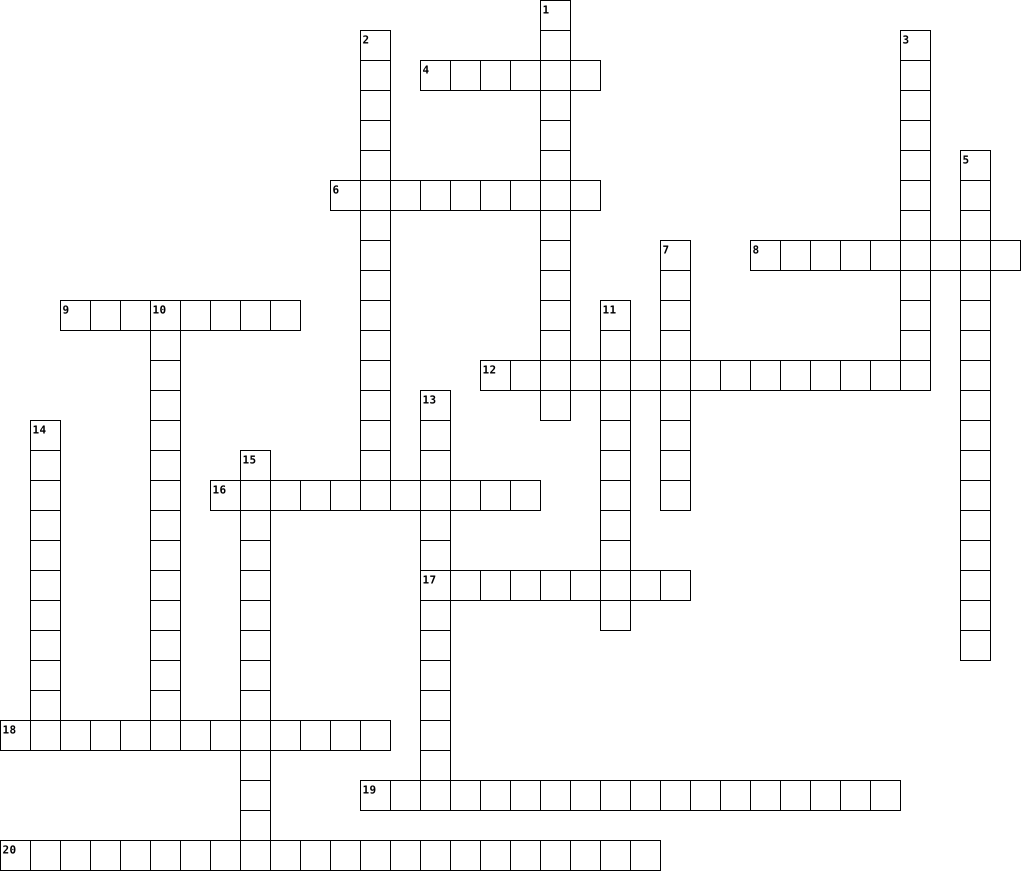
Across
- an American blues singer-songwriter, guitarist, and record producer. He introduced a sophisticated style of soloing based on fluid string bending, shimmering vibrato, and staccato picking that influenced many later blues electric guitar players.
- American sociologist, socialist, historian, and Pan-Africanist civil rights activist. Born in Great Barrington, Massachusetts
- an American activist in the civil rights movement best known for her pivotal role in the Montgomery bus boycott.
- American Muslim minister and human rights activist who was a prominent figure during the civil rights movement. A spokesman for the Nation of Islam until 1964, he was a vocal advocate for Black empowerment and the promotion of Islam within the Black community
- an American author who is considered the first African-American author of a published book of poetry
- American memoirist, popular poet, and civil rights activist. She published seven autobiographies, three books of essays, several books of poetry, and is credited with a list of plays, movies, and television shows spanning over 50 years.
- an American investigative journalist, educator, and early leader in the civil rights movement.
- an American abolitionist and social activist. Born into chattel slavery, She escaped and subsequently made some 13 missions to rescue approximately 70 similarly-enslaved people,
- An American Baptist minister and activist, one of the most prominent leaders in the civil rights movement from 1955 until his assassination in 1968.
- an American agricultural scientist and inventor who promoted alternative crops to cotton and methods to prevent soil depletion. He was one of the most prominent black scientists of the early 20th century.
Down
- a United States Air Force general and commander of the World War II Tuskegee Airmen. He was the first African-American brigadier general in the USAF.
- American author, anthropologist, and filmmaker. She portrayed racial struggles in the early-1900s American South and published research on hoodoo.
- a Jamaican political activist, publisher, journalist, entrepreneur, and orator. He was the founder and first President-General of the Universal Negro Improvement Association and African Communities League, through which he declared himself Provisional President of Africa.
- an American educator, author, orator, and adviser to several presidents of the United States.
- an enslaved African American man who, along with his wife, Harriet, unsuccessfully sued for freedom for themselves and their two daughters in the Dred Scott v. Sandford case of 1857
- American diplomat and political scientist who is the current director of the Hoover Institution at Stanford University
- an American politician, statesman, diplomat, and United States Army officer who served as the 65th United States Secretary of State from 2001 to 2005. He was the first African-American Secretary of State.
- an American-born French dancer, singer and actress. Her career was centered primarily in Europe, mostly in her adopted France
- an American retired politician who served as the 44th president of the United States from 2009 to 2017. A member of the Democratic Party, he was the first African-American president of the United States.
- American poet, social activist, novelist, playwright, and columnist from Joplin, Missouri. One of the earliest innovators of the literary art form called jazz poetry,
20 Clues: an American educator, author, orator, and adviser to several presidents of the United States. • an American investigative journalist, educator, and early leader in the civil rights movement. • an American author who is considered the first African-American author of a published book of poetry • ...
Unit 15: Reconstruction 2019-04-22

Across
- amendment that freed all slaves, abolished slavery in US
- used violence and intimidation to scare African-Americans away from voting; targeted white Republicans in the South who supported African American rights; wanted to restore Democratic Party control to the South
- an American stage actor who assassinated Abraham Lincoln at Ford's Theatre in Washington, D.C. on April 14, 1865.
- amendment that granted full rights of citizenship to all people born or naturalized in the United States, except for American Indians.
- created by Congress to aid former slaves through education, health care, and employment
- last name of 19th president of the US; Republican named as POTUS after Democrats agreed to the Compromise of 1877
- laws that restricted freedmen's rights with provisions such as: curfews, labor contracts, and land restrictions.
- laws that enforced racial segregation in the South
- last name of POTUS # 18; Republican elected to two terms; supported by new African American voters in the south; second term marred by scandals in his administration and economic panic
Down
- After the Civil War former landowners "rented" plots of land to blacks and poor whites in such a way that the renters were always in debt and therefore tied to the land, creating a cycle off debt
- Separation of people based on racial, ethnic, or other differences
- The first African American to serve in the U.S. Congress.
- Northern whites who moved to the South & served as Republican leaders during reconstruction; wanted equal rights for African Americans
- Political party that favored harsh punishment of Southern states after Civil War and promoted equal rights for African Americans
- amendment stating the right of citizens of the United States to vote shall not be denied or abridged by the United States or by any State on account of race, color, or previous condition of servitude.
- The period after the Civil War (1865-1877) in the United States when the southern states were reorganized and reintegrated into the Union; included extending civil rights to African Americans
- Lincoln's VP who became POTUS #17 after Lincoln was assassinated; clashed with Radical Republicans over Reconstruction; was impeached by the House of Representatives for violating the Tenure in Office Act but survived Senate removal by only one vote
- Southern whites who supported Republican policy through Reconstruction including equal rights for African Americans
- Sherman wanted to grant to each freedmen family 40 of these (and a mule)to help them become economically self-sufficient; never became a law
19 Clues: laws that enforced racial segregation in the South • amendment that freed all slaves, abolished slavery in US • The first African American to serve in the U.S. Congress. • Separation of people based on racial, ethnic, or other differences • created by Congress to aid former slaves through education, health care, and employment • ...
East Asia 2026-01-27

Across
- rate the average number of children born to a woman during her childbearing years
- trade the international exchange of goods and services without taxes (tariffs), quotas, or other
- a group, chain, or cluster of islands scattered in a body of water, such as an ocean, sea, or occasionally a lake or river.
- globalization the international integration of markets for goods, services, and capital
- wall of china a vast network of stone, brick, and earth fortifications stretching over 13,171 miles (21,196 km) across northern China
- the belief in a single, all-powerful deity.
- desert a vast, cold desert region in northern China and southern Mongolia
- of fire a 25,000-mile (40,000 km) horseshoe-shaped zone of intense volcanic and seismic activity
Down
- parallel a circle of latitude that historically served as the original dividing line between North and South Korea following World War II
- defined as an enlarged natural or artificial lake, pond, or impoundment created using a dam or lock to store water
- categorized into three primary contexts: financial/economic, political, and social.
- zone buffer zone separating North and South Korea
- A group of traders, pilgrims, or travelers journeying together for safety.
- plateau the highest and largest plateau on Earth
- a style of Japanese comic books and graphic novels
- law the temporary substitution of military authority for civilian rule
- hereditary military dictator of Japan during the feudal period from 1192 to 1867
17 Clues: the belief in a single, all-powerful deity. • plateau the highest and largest plateau on Earth • a style of Japanese comic books and graphic novels • zone buffer zone separating North and South Korea • law the temporary substitution of military authority for civilian rule • A group of traders, pilgrims, or travelers journeying together for safety. • ...
Chapter 13 2025-01-21

Across
- name kept by the northern states during the Civil War
- name given to the southern states during the Civil War
- "Workshop of the Confederacy" was A nickname for the city of ____
- (2 words) slaveholding states that were next to free states and did not secede
- This person was the main person who drafted a constitution for the new Confederacy.
- The flag that represented the union prior to the secession of Southern states/prior to the Civil War nation split. The Stars and ___
- address speech given by the President where he urged the north to win the Civil War, and to preserve the Union
- to write a proposal for a law or proclamation
Down
- use of military forces to isolate enemy territory
- The 16th US President, elected in 1860. Republican. Favored the abolition of slavery.
- the document issued by the President that stated all slaved would be free. (_____ Proclamation)
- Adopted in 1861, the first national flag of the Confederacy was referred to as the Stars and ___
- a place where weapons are made or stored
- a law requiring civilians to join the military
14 Clues: a place where weapons are made or stored • to write a proposal for a law or proclamation • a law requiring civilians to join the military • use of military forces to isolate enemy territory • name kept by the northern states during the Civil War • name given to the southern states during the Civil War • ...
Northern America Culture Region 2023-03-14

Across
- 70% of Americans believe in which religion?
- What is the largest city in Canada?
- How many states does the United States have?
- What country is above the United States of America?
- What is the capital of the United States?
- Which Canadian province is home to Halifax Harbor, the main Atlantic port in Canada?
- What is a group of islands called?
- What language is the main language spoken in the United States?
Down
- Which Canadian province primarily speaks French?
- Where does the United States rank in land mass?
- Which province in Canada produces the most wheat?
- What is PCCA's mascot?
- What is the capital of Canada?
- Which state is the St. Louis arch located in?
- What is the largest city in British Columbia?
- Which sport is known as "America's Pastime?"
- Which sport, played on ice, do Canadians love?
- Which state do you live in?
- What is Mrs. Casillas's first name?
- How many provinces does Canada have?
20 Clues: What is PCCA's mascot? • Which state do you live in? • What is the capital of Canada? • What is a group of islands called? • What is the largest city in Canada? • What is Mrs. Casillas's first name? • How many provinces does Canada have? • What is the capital of the United States? • 70% of Americans believe in which religion? • How many states does the United States have? • ...
causes of the civil war crossword 2022-03-08

Across
- , said that citizens had to help capture the runaway slaves
- , sued his master for freedom but was told he isn't allowed to sue because he is a slave
- , the person who started the raid on Harper's Ferry
- , an attempt to initiatea slave revolt (led by jhon brown)
- , states where slavery is legal
- , a book written by Harriet Breecher against slavery
- , a person who is forced to work with no pay
- , elected as president in 1860
- , states that did not have slaves
Down
- , said that new states would vote on if they had slaves or not
- , claimed that any states above the coordinates 36,30 were free and the ones below are slave states
- , where most slaves worked
- , person who suggested that all lands from mexican secession had no slaves
- , to have greater loyalty to ones section rather than their country
- , to leave or withdraw
15 Clues: , where most slaves worked • , to leave or withdraw • , elected as president in 1860 • , states where slavery is legal • , states that did not have slaves • , a person who is forced to work with no pay • , the person who started the raid on Harper's Ferry • , a book written by Harriet Breecher against slavery • ...
U1M6 Vocabulary Crossword 2024-10-02

Across
- conquering and acquiring land
- person or company involved in trade
- person, place, thing, idea
- map type showing landforms and water ways
- one entity owns a market
- sentence type with 2 independent clauses
- sentence type with 2 independent clauses
- owing
- source that witnessed news/ info
- human property
Down
- another word for indigenous
- the study of physical features
- act of settling into foreign land
- natural features on the Earth
- sentence type with one clause
- source that reports info not witnessed
- contains a verb and states subject status
- noun(s) that sentence is discussing
- to move from another place
- map types that shows nation states
20 Clues: owing • human property • one entity owns a market • person, place, thing, idea • to move from another place • another word for indigenous • conquering and acquiring land • natural features on the Earth • sentence type with one clause • the study of physical features • source that witnessed news/ info • act of settling into foreign land • map types that shows nation states • ...
Capitals - Africa Edit 2024-01-08

Across
- Uganda
- Libya
- Tunisia
- Ethiopia
- Ghana
- Mali
- Botswana
- Egypt
Down
- Kenya
- Nigeria
- Zambia
- Rwanda
- Madagascar
- Morocco
14 Clues: Mali • Kenya • Libya • Ghana • Egypt • Uganda • Zambia • Rwanda • Nigeria • Tunisia • Morocco • Ethiopia • Botswana • Madagascar
The Branches of Government 2013-07-25

Across
- The President of the United States
- This word means "a proposed law".
- This is the legislative branch of government.
- This branch of government reviews and explains laws and decides if a law is constitutional.
- This one part of the Congress and begins with "S"
- This is the number of state senators from each state.
- There are this many justices on the Supreme Court now.
Down
- The name of the Chief Justice of the United States now.
- The Vice President of the United States
- This person is in charge of the Executive Branch.
- This federal court is the highest in the United States.
- Refuse to sign a bill into law
12 Clues: Refuse to sign a bill into law • This word means "a proposed law". • The President of the United States • The Vice President of the United States • This is the legislative branch of government. • This person is in charge of the Executive Branch. • This one part of the Congress and begins with "S" • This is the number of state senators from each state. • ...
U.S. history 2023-12-06

Across
- The right of citizens of the United States to vote shall not be denied or abridged by the United States or by any State on account of race, color, or previous condition of servitude
- known for their opposition to slavery, their efforts to ensure emancipation and civil rights for Blacks
- required that 50% of all voters in the Confederate states, as opposed to Lincoln's proposed 10%, must pledge allegiance to the Union before reunification
- No State shall make or enforce any law which shall abridge the privileges or immunities of citizens of the United States; nor shall any State deprive any person of life, liberty, or property, without due process of law; nor deny to any person within its jurisdiction the equal protection of the laws.
- several United States administrations wanted to reconstruct society in the former Confederate states in particular by establishing and protecting the legal rights of the newly freed black population.
- poor farmers were granted access to farm small plots of land
- a derogatory term for an individual from the North who relocated to the South during the Reconstruction period
Down
- became the first African American senator in 1870
- were laws passed at different periods in the southern United States to enforce racial segregation and curtail the power of Black voters
- the 17th president of the U.S.
- provided assistance to tens of thousands of formerly enslaved people and impoverished whites in the Southern States
- a pejorative term for a white Southerner who supported the federal plan of Reconstruction
12 Clues: the 17th president of the U.S. • became the first African American senator in 1870 • poor farmers were granted access to farm small plots of land • a pejorative term for a white Southerner who supported the federal plan of Reconstruction • known for their opposition to slavery, their efforts to ensure emancipation and civil rights for Blacks • ...
Western Hemisphere Geography 2024-01-17

Across
- Capital of Mexico
- The largest Great Lake
- Cuba, Jamaica, Haiti, and the Dominican Republic are part of these
- The Indigenous name of Greenland
- Capital of Chile
- The Uruguay River, the Parana River, and the Salado River empty here
- Body of water that borders Greenland and various Canadian islands
- Capital of Argentina
- Capital of Colombia
- Capital of the United States
- Mountain range in northern Alaska
- Country that borders Brazil, Bolivia, and Argentina
Down
- Capital of Honduras
- Number of US states that border Mexico
- Capital of Venezuela
- Tallest peak in South America
- Country that borders only Colombia and Peru
- Body of water that borders Nicaragua, Cuba, and Venezuela
- Capital of Canada
- Tallest peak in North America
- Capital of Jamaica
- Capital of Costa Rica
22 Clues: Capital of Chile • Capital of Mexico • Capital of Canada • Capital of Jamaica • Capital of Honduras • Capital of Colombia • Capital of Venezuela • Capital of Argentina • Capital of Costa Rica • The largest Great Lake • Capital of the United States • Tallest peak in South America • Tallest peak in North America • The Indigenous name of Greenland • Mountain range in northern Alaska • ...
The Muzzys 2024-02-18

Across
- How many states has Korey lived in
- Amelia and Korey's dog's name
- Maid of Honor's name
- Amelia and Korey's favorite board game
- Amelia's first horse's name
- Sport Amelia played in college
- What month did Korey and Amelia get engaged?
- Where Korey and Amelia went to college
- Amelia's favorite singer
- Where Amelia grew up
- Number of states guests are from
- Bride and groom's go to sunday date spot
Down
- Korey's favorite candy
- Who said "I love you" first
- Favorite date night restaurant
- Where Amelia Teaches
- Where the furthest guest traveled from
- Korey's biggest fear
- Amelia's birth month
- Amelia's Middle Name
- The sport Korey played childhood-college
- When Amelia and Korey started dating
- Korey's Birth month
23 Clues: Korey's Birth month • Where Amelia Teaches • Maid of Honor's name • Korey's biggest fear • Amelia's birth month • Amelia's Middle Name • Where Amelia grew up • Korey's favorite candy • Amelia's favorite singer • Who said "I love you" first • Amelia's first horse's name • Amelia and Korey's dog's name • Favorite date night restaurant • Sport Amelia played in college • ...
Trevor Noah - Quiz 2024-05-06

Across
- What is Trevor’s mothers name?
- What was the social segregation called?
- When did Apartheid end in south Afrika?
- How many racial groups were they classified in?
- Who was the most important Civil right freighter?
- What is Trevor’s father’s origin?
- Who shot Trevor’s mother?
- How many Capitals does South Afrika have?
Down
- What was the name of the girl Trevor took to prom?
- What language does Trevor’s family speak?
- What was the name of Trevor’s friend that danced?
- What’s the most visited city in South Afrika?
- How old was Trevor’s Grandmother in the Video?
- What’s the last name of the current president is South Afrika?
- What city does Trevor’s family come from?
- How many years was Nelson Mandela in Prison?
- Who colonized South Afrika at First?
- What did Trevor use as a toilet because they weren’t done building their toilets?
- What was the party called that began Apartheid?
- Where was Trevor’s mother shot at first?
20 Clues: Who shot Trevor’s mother? • What is Trevor’s mothers name? • What is Trevor’s father’s origin? • Who colonized South Afrika at First? • What was the social segregation called? • When did Apartheid end in south Afrika? • Where was Trevor’s mother shot at first? • What language does Trevor’s family speak? • What city does Trevor’s family come from? • ...
Trevor Noah - Quiz 2024-05-06

Across
- What is Trevor’s mothers name?
- What was the social segregation called?
- When did Apartheid end in south Afrika?
- How many racial groups were they classified in?
- Who was the most important Civil right freighter?
- What is Trevor’s father’s origin?
- Who shot Trevor’s mother?
- How many Capitals does South Afrika have?
Down
- What was the name of the girl Trevor took to prom?
- What language does Trevor’s family speak?
- What was the name of Trevor’s friend that danced?
- What’s the most visited city in South Afrika?
- How old was Trevor’s Grandmother in the Video?
- What’s the last name of the current president is South Afrika?
- What city does Trevor’s family come from?
- How many years was Nelson Mandela in Prison?
- Who colonized South Afrika at First?
- What did Trevor use as a toilet because they weren’t done building their toilets?
- What was the party called that began Apartheid?
- Where was Trevor’s mother shot at first?
20 Clues: Who shot Trevor’s mother? • What is Trevor’s mothers name? • What is Trevor’s father’s origin? • Who colonized South Afrika at First? • What was the social segregation called? • When did Apartheid end in south Afrika? • Where was Trevor’s mother shot at first? • What language does Trevor’s family speak? • What city does Trevor’s family come from? • ...
US Constitution 2022-01-25

Across
- Highest Court in Federal Government.
- is when there is one strong main government for the entire United States that has a lot of power.
- A branch of the U.S. government is called Congress.
- of concern to or concerning the internal affairs of a nation.
- The legislature of the federal government of the United States
- A political ideology centered on citizenship in a state organized as a republic.
- The principle that the authority of a state and its government are created and sustained by the consent of its people.
- review by the US Supreme Court of the constitutional validity of a legislative act.
- Each branch of government with individual powers to check the other branches and prevent any one branch from becoming too powerful
Down
- the principle that the authority of a state and its government are created and sustained by the consent of its people.
- A branch carries out and enforces laws.
- A decision rule that selects alternatives which have a majority
- The division of government responsibilities into distinct branches to limit any one branch from exercising the core functions of another.
- The first ten amendments.
- A constitutional amendment is a modification of the constitution of a polity.
- A United States federal law that was designed to regulate the railroad industry
- is responsible for the execution and enforcement of the laws created by Congress.
- A branch that explain the laws.
- The supreme law of the United States of America.
- The process by which a legislative body or other legally constituted tribunal initiates charges against a public official for misconduct.
20 Clues: The first ten amendments. • A branch that explain the laws. • Highest Court in Federal Government. • A branch carries out and enforces laws. • The supreme law of the United States of America. • A branch of the U.S. government is called Congress. • of concern to or concerning the internal affairs of a nation. • ...
AP GOV Crossword - Constitutional Amendments. 2025-04-07

Across
- Established prohibition of alcohol.
- Established procedures for presidential succession and disability.
- Protects states from lawsuits in federal court by citizens of other states or foreign countries.
- Granted residents of the District of Columbia the right to vote in presidential elections.
- Repealed Prohibition.
- Abolished Slavery.
- Changed the dates of presidential and congressional terms.
Down
- Prohibited Congress from granting itself a pay raise that would take effect during the current term.
- Granted citizenship to all persons born or naturalized in the United States, including former slaves, and addressed issues of equal protection and due process.
- Abolished poll taxes in federal elections.
- Limited presidents to two terms.
- Authorized Congress to levy an income tax.
- Lowered the voting age to 18.
- Modified the Electoral College to provide for separate votes for President and Vice President.
- Granted women the right to vote.
- Provided for the direct election of U.S. Senators.
- Granted voting rights to all male citizens, regardless of race.
17 Clues: Abolished Slavery. • Repealed Prohibition. • Lowered the voting age to 18. • Limited presidents to two terms. • Granted women the right to vote. • Established prohibition of alcohol. • Abolished poll taxes in federal elections. • Authorized Congress to levy an income tax. • Provided for the direct election of U.S. Senators. • ...
Unit 7 Review 2013-06-16

Across
- the southern states' army led by Lee
- African Americans can fight for the Union
- the northern states' army led by Grant
- first battle on Union soil, was the single bloodiest day of the civil war
- an order issued by lincoln that freed slaves in states of rebellion
- the two European countries the confederates wanted to win recognition for in the civil war
- military leader for the union army
- the final battle before Lee surrendered to Grant
Down
- battle that provided a decisive victory for the union, and ended Lee's motivation to enter the North
- military general for the confederate army
- Missouri, Delaware, Kentucky, and Maryland
- speech made by Lincoln after the battle of Gettysburg
- military strategy for the union to win the war
- man who assassinated Abraham Lincoln
- when Lincoln states that he cannot interfere with slavery where it already exists
15 Clues: military leader for the union army • the southern states' army led by Lee • man who assassinated Abraham Lincoln • the northern states' army led by Grant • military general for the confederate army • African Americans can fight for the Union • Missouri, Delaware, Kentucky, and Maryland • military strategy for the union to win the war • ...
Government 2023-12-13

Across
- A group of people that work for and advise the president
- the amount of terms a president can serve
- the act of lawfully attempting to influence the actions, policies, or decisions of government officials
- constitutional arrangement in which power is distributed between a central government and states
- the legislature of the federal government of the United States
- a charge of misconduct made against the holder of a public office.
- approved by two political parties
- a political procedure in which one or more members of a legislative body prolong debate on proposed legislation
Down
- the supreme law of land
- a proposal for a new law, or a proposal to significantly change an existing law
- a legislative body composed of two chambers
- A change or addition to the Constitution
- the upper chamber of the United States Congress
- the amount of years per term for a president
- elected leader of the United States
15 Clues: the supreme law of land • approved by two political parties • elected leader of the United States • A change or addition to the Constitution • the amount of terms a president can serve • a legislative body composed of two chambers • the amount of years per term for a president • the upper chamber of the United States Congress • ...
Cold War Crossword 2023-05-10

Across
- - the North Atlantic Treaty Organization, a military alliance between Western democracies formed during the Cold War
- - the practice of spying or using spies
- - a policy aimed at preventing the spread of communism
- - conflicts in which opposing powers use third parties as substitutes for fighting each other directly
- - competition between nations to develop and stockpile weapons
- - a system of beliefs or principles, often political in nature
- - a concrete barrier built by the Soviet Union to separate East and West Berlin during the Cold War
- - USSR president born in Georgia
- - competition between the United States and the Soviet Union to achieve technological superiority in space exploration
- - the United States and the Soviet Union, the two dominant world powers during the Cold War
- - a military alliance between communist countries formed in response to NATO
- - a term used to describe the dividing line between democratic Western Europe and communist Eastern Europe during the Cold War
- - a term used to describe the practice of making accusations of subversion or treason without evidence
Down
- - a communist state that existed from 1922 to 1991 and was a major world power during the Cold War
- - an economic system based on private ownership of the means of production and the creation of goods and services for profit
- - a political and economic ideology that advocates for a classless society in which the means of production are owned and controlled by the community as a whole.
- - a period of easing tensions between the United States and the Soviet Union during the 1970s
- - politicians, military leaders, and others who were committed to the fight against communism during the Cold War
- - a standoff between the United States and the Soviet Union over the presence of Soviet missiles in Cuba
- - relating to or involving atomic energy or weapons
20 Clues: - USSR president born in Georgia • - the practice of spying or using spies • - relating to or involving atomic energy or weapons • - a policy aimed at preventing the spread of communism • - competition between nations to develop and stockpile weapons • - a system of beliefs or principles, often political in nature • ...
History World Puzzle 2024-01-12

Across
- the outer parts of a town, where there are houses, but no large stores, places of work, or places of entertainment
- provided World War II veterans with funds for college education, unemployment insurance, and housing
- 35th president of U.S.
- An attack on individuals on suspected beliefs.
- One place where the world's nations can. gather together, discuss common problems. and find shared solutions.
- an ongoing political rivalry between the United States and the Soviet Union and their respective allies that developed after World War II.
- conflict between the Democratic People's Republic of Korea (North Korea) and the Republic of Korea (South Korea) in which at least 2.5 million persons lost their lives.
- "companion" ("satellite" in the astronomical sense).
- the act, process, or means of keeping something within limits.
- a person born in the years of the baby boom.
Down
- A period in the United States history when everyone was so caught up in containment of communism, and investigated people within their community for communism
- a U.S.-sponsored program that was implemented following the end of World War II
- a direct and dangerous confrontation between the United States and the Soviet Union during the Cold War
- a group of 10 film industry members that refused to testify to an anti-communist committee hearing during the Second Red Scare era.
- a Cold War competition between the United States and the Soviet Union to develop aerospace capabilities, including artificial satellites, unmanned space probes, and human spaceflight.
- a treaty that established a mutual-defense organization
- a political, military, and ideological barrier that cuts off and isolates an area.
- the Russian state after end of Tsarist Period and the world's first single-party Marxist–Leninist state from 1922 until 1991.
- a system of government by the whole population or all the eligible members of a state, typically through elected representatives.
- a pattern of competitive acquisition of military capability between two or more countries.
20 Clues: 35th president of U.S. • a person born in the years of the baby boom. • An attack on individuals on suspected beliefs. • "companion" ("satellite" in the astronomical sense). • a treaty that established a mutual-defense organization • the act, process, or means of keeping something within limits. • ...
Go Buffs NDGD Hair Sarai 2025-12-05

Across
- A member of the black cabinet and a civil rights activist
- A town built by the homeless during the great depression
- Longest-serving first lady of the United States during the great depression
- Known for leading the United States through the Great Depression for creating the New Deal programs to provide relief and economic recovery
- Increase in money
- An economic idea where the government stays out of business and the economy, letting individuals and companies operate freely with minimal rules, believing the market self-regulates through supply and demand
- Supported FDR's New Deal & is a Canadian-American Catholic priest in the 1930s who used radio to reach millions
- An American labor leader and civil rights activist
- Veterans who marched on Washington demanding early payment of their bonuses
- An unofficial group of African Americans
- Widespread decline in economic activity lasting more than a few months, marked by lower employment, income, and industrial production
- The idea that giving big tax breaks or benefits to wealthy people and big businesses will make them invest and grow the economy
Down
- Charge for borrowing money
- Government programs and reforms launched by President Franklin D. Roosevelt
- A period of severe dust storms that cause economic damage
- 31st president of the United States
- Ended the federal policy of breaking up tribal lands into individual allotments and encouraged tribes to adopt self-governance
- A sustained drop in the average prices for goods and services
- Stock market crash, mass unemployment & bank failures
- People waiting for free food causing widespread hunger
- President Franklin D. Roosevelt's plan to expand the Supreme Court by adding more justices
- United States senator from Louisiana (democratic party)
- A series of U.S. government reforms for Native Americans
- Played a role in creating the Social Security Act and enacting the Fair Labor Standards Act to establish a minimum wage
24 Clues: Increase in money • Charge for borrowing money • 31st president of the United States • An unofficial group of African Americans • An American labor leader and civil rights activist • Stock market crash, mass unemployment & bank failures • People waiting for free food causing widespread hunger • United States senator from Louisiana (democratic party) • ...
Final SPEAK OUT! Session (A mix of history, archaeology, technology, and more!) 2026-04-27

Across
- Era of economic growth, cultural change, and jazz music in the United States during the 1920s.
- Scientific study of human history through artifacts and physical remains.
- Instrument used to determine direction using Earth’s magnetic field.
- The name of the series of programs and projects President Franklin D. Roosevelt enacted during the Great Depression.
- Early communication device that sent messages using electrical signals.
- Capital of the Byzantine Empire, now modern-day Istanbul, Turkey.
- Ancient Roman city preserved after being buried by a volcanic eruption.
- Cultural “rebirth” in Europe known for major advances in art and science.
- Prehistoric monument in England made of massive standing stones.
- Artifact that helped scholars translate ancient Egyptian hieroglyphics.
- Land deal in 1803 that doubled the size of the United States.
Down
- The first artificial satellite launched into space by the Soviet Union in 1957, marking the beginning of the Space Age.
- Scientific method used to determine the age of ancient organic materials.
- Barrier that divided East and West Berlin during the Cold War, symbolizing political division between communism and democracy.
- Writing system used in ancient Egypt that combines symbols and pictures.
- U.S. program during World War II that developed the atomic bomb.
- Ancient trade network connecting Asia, the Middle East, and Europe.
- Planet that was downgraded to a dwarf planet in 2006.
- U.S. Navy aircraft carrier that served in World War II and is now docked as a museum on the Hudson River.
- One of Christopher Columbus’s ships during his 1492 voyage to the Americas.
- Railway system completed in 1869 that connected the eastern and western United States.
- The country the United States bought Alaska from.
- Migration triggered by the discovery of gold in California in 1848.
- Devastating pandemic that spread across Europe in the 14th century and killed millions.
- Instrument that collects and magnifies distant light to observe faraway objects like stars and planets.
25 Clues: The country the United States bought Alaska from. • Planet that was downgraded to a dwarf planet in 2006. • Land deal in 1803 that doubled the size of the United States. • U.S. program during World War II that developed the atomic bomb. • Prehistoric monument in England made of massive standing stones. • ...
Civil War Crossword puzzle 2023-03-07

Across
- taxation and southern didn't like it
- military leader for the north
- added factories to the north.
- increased trade
- Didn't like slavery
- Lincoln election in 1860
- blockage of goods
- president of the union
Down
- government said slaves are properties
- leader for he south
- military leader for the south
- people separate states
- rights for all states
- a worker for life
- A woman wrote a book about slavery
- begin to replace hand goods
- farms, planting, and animals
17 Clues: increased trade • a worker for life • blockage of goods • leader for he south • Didn't like slavery • rights for all states • people separate states • president of the union • Lincoln election in 1860 • begin to replace hand goods • farms, planting, and animals • military leader for the south • military leader for the north • added factories to the north. • ...
US HISTORY CROSSWORD 2022-02-16

Across
- No unreasonable search or arrest.
- a system of government in which the power is divided between a central government and smaller political units such as states
- everyone, citizens and powerful leaders alike must obey the law
- People get rights not listed in Constitution.
- Rights of accused in criminal cases to fair trial.
- Federalism
- Freedom of speech, press, religion, assembly, and petition.
- No excessive bail, fines, or cruel and unusual punishment.
- a government in which the people rule, a broad range of people shared in the power to govern themselves.
- personal liberties or privilege
Down
- each branch of government can exercise checks, or controls over the other branches
- the people exercise their power by voting.
- Right to bear arms.
- Trial by jury.
- the division of basic government roles into three branches
- system of government in which the power is divided between a central government and smaller political units such as states
- Any rights not given to federal government are given to the states and people.
- Citizens do not have to house soldiers.
- No double jeopardy or no witness against yourself.
19 Clues: Federalism • Trial by jury. • Right to bear arms. • personal liberties or privilege • No unreasonable search or arrest. • Citizens do not have to house soldiers. • the people exercise their power by voting. • People get rights not listed in Constitution. • Rights of accused in criminal cases to fair trial. • No double jeopardy or no witness against yourself. • ...
Map of Canada 2024-12-11

Across
- This province is known for having a French-speaking population.
- The ocean to the west of Canada.
- This city is the capital of the province of Nova Scotia.
- The province known for the city of Calgary and the Calgary Stampede.
- The capital city of the province of Alberta.
- One of the Great Lakes, located mainly between Ontario and the United States.
- The capital city of Canada’s largest province, Ontario.
- Canada's capital city.
- This province is known for its vast prairies and is home to the city of Regina.
- This Great Lake is entirely in the United States and borders the state of Michigan.
- The province where the city of Fredericton is located.
Down
- This large island is located to the east of Canada, near Newfoundland.
- This country borders Canada to the south.
- The province where the city of Vancouver is located.
- One of the five Great Lakes, located between Canada and the United States.
- This Canadian territory is the least populated and located far north.
- This ocean lies to the east of Canada.
- The large territory located in northern Canada.
- The ocean to the east of Canada.
19 Clues: Canada's capital city. • The ocean to the west of Canada. • The ocean to the east of Canada. • This country borders Canada to the south. • This ocean lies to the east of Canada. • The large territory located in northern Canada. • The capital city of the province of Alberta. • The province where the city of Vancouver is located. • ...
Jefferson Era 2026-03-05

Across
- The _____________ Court increased it's power with cases during this time period.
- ___________ V. Madison established judicial review.
- The Louisiana Purchase gave the United States exclusive rights to this river.
- The U.S. ____________ defeated the British in the Battle of Lake Champlain.
- Became President in 1800
- Alexander ________________ fought Aaron Burr in a duel in 1804.
- American nationalism and ____________ rose after the War of 1812.
- Andrew___________ became a hero during the Battle of New Orleans.
Down
- The Louisiana _____________ cost 15 million dollars and doubled the size of the U.S.
- Act of 1801 set up courts for the United States.
- James __________ became President during a difficult time.
- Shoshone guide for Lewis and Clark.
- Lewis and Clark led an expedition to find the ________ passage a water route to the Pacific Ocean.
- The war of 1812 ended with the Treaty of _________.
- Napoleon sold this territory to the United States and doubled it's size
- Jefferson stopped most Federal ________.
- The British took and burned much of ___________ D.C. during the War of 1812.
- War _______ pushed for war with Britain.
18 Clues: Became President in 1800 • Shoshone guide for Lewis and Clark. • Jefferson stopped most Federal ________. • War _______ pushed for war with Britain. • Act of 1801 set up courts for the United States. • ___________ V. Madison established judicial review. • The war of 1812 ended with the Treaty of _________. • James __________ became President during a difficult time. • ...
Civil War 2025-04-14

Across
- S. Grant- Commander of the Union Army.
- Sumter- The site of the first shots of the Civil War.
- E. Lee- Commander of the Confederate Army
- A military tactic used by the Union to restrict trade with the Confederacy.
- A major crop of the South that was essential to its economy.
- Lincoln- President of the United States during the Civil War
- Rights- A belief that states should have the power to make their own decisions, particularly concerning slavery.
- Railroad- A network of secret routes and safe houses used by enslaved people to escape to freedom.
Down
- The site of a major Union victory and a turning point in the war.
- The name for the Northern states during the Civil War
- The institution that was a primary cause of the Civil War.
- Proclamation- An order issued by President Lincoln that freed slaves in Confederate-controlled areas.
- Amendment- The constitutional amendment that abolished slavery throughout the United States.
- The name for the Southern states that seceded from the Union
- Davis- President of the Confederacy
- Court House- The site where Confederate General Robert E. Lee surrendered to Union General Ulysses S. Grant, effectively ending the Civil War.
- To withdraw from an organization, in this case, the Union.
17 Clues: Davis- President of the Confederacy • S. Grant- Commander of the Union Army. • E. Lee- Commander of the Confederate Army • The name for the Northern states during the Civil War • Sumter- The site of the first shots of the Civil War. • The institution that was a primary cause of the Civil War. • To withdraw from an organization, in this case, the Union. • ...
apush 2024-05-14

Across
- The first ten amendments to the U.S. Constitution
- A person who wanted to end slavery
- all people are equal and deserve equal rights
- The leader of the civil rights movement in the 1960s
- purchase that doubled the size of the united states
- the 16th president of the united states who led the country during the civil war
Down
- the author of the declaration of independence
- the first president of the united states
- the site of the first shots of the American Revolution
- The right to vote
- The war fought by American colonies to gain independence from Britian
- The act of officially ending slavery
- The U.S. policy to prevent the spread of communism during the Cold WAr
- event that triggered U.S. entry into WWII
- The war between the North and the South in the United States from 1861 to 1865
15 Clues: The right to vote • A person who wanted to end slavery • The act of officially ending slavery • the first president of the united states • event that triggered U.S. entry into WWII • the author of the declaration of independence • all people are equal and deserve equal rights • The first ten amendments to the U.S. Constitution • ...
Progressive Crossword 2023-03-13

Across
- 28th president of the United States. Elected in 1912 as a Democrat.
- Laws on child labor
- Gave American women the right to vote.
- 26th president of the United States. Pushed for progressive reforms.
- An American socialist leader and five time presidential candidate.
- Prohibited the manufacture, sale, or transportation of intoxicating liquors.
- Pioneer/leader of muckraking
Down
- New laws passed by petition.
- A female muckraker who published a 19-part expose of the business practices of John D. Rockefeller's Standard Oil Company.
- Removal of public officials from office.
- Allows congress to levy an income tax without apportioning it among the states on the basis of population.
- Established the direct election of United States senators in each state.
- A pioneer social worker in America who was also a feminist an internationalist.
- Group of American writers identified with pre-World World I reform and expose writing.
- Approval of laws by petition.
15 Clues: Laws on child labor • New laws passed by petition. • Pioneer/leader of muckraking • Approval of laws by petition. • Gave American women the right to vote. • Removal of public officials from office. • An American socialist leader and five time presidential candidate. • 28th president of the United States. Elected in 1912 as a Democrat. • ...
Lession 4.1 and 4.2 crossword 2025-02-20

Across
- Fifths, compromise that three-fifth of enslaved people would count in a state population
- Put private companies or individuals in charge of something
- compromise, plan that the constitutional convention that settled differences between large n small states
- Ordinance that set up a government for the northwest territory
- document that sets out the laws principles, organizations and processes of government
- Jersey, Plan that had a government with one house
- To take away
Down
- type of paper money
- Both sides gives up something to reach a agreement
- Convection, Meeting of representatives from states to revise the article of confederation
- Time when everything slowed and unemployment rises
- Plan that had a government with 2 houses
- of Rights, First ten Amendments of the United States
- Rebellion, Revolt in Massachusetts led by farmers due to high taxes
- of confederation, First American constitution that created a loose alliance of 13 states
15 Clues: To take away • type of paper money • Plan that had a government with 2 houses • Jersey, Plan that had a government with one house • Both sides gives up something to reach a agreement • Time when everything slowed and unemployment rises • of Rights, First ten Amendments of the United States • Put private companies or individuals in charge of something • ...
United States Constitution 2021-09-21

Across
- Supreme Court justice nominee rejected by the senate in 1987.
- Power being shared between central government and the 50 states of America.
- Describes the difficult nature of the United States Constitution to change
- A power vested in Congress by the United States Constitution to 'check' the power of the President.
Down
- Section of the United States Constitution that outlines the rights of citizens.
- Process of changing the United States Constitution
- A power vested in the judiciary by the United States Constitution to 'check' the power of the President and Congress.
- Word used to describe the powers outlined in the first three articles of the United States Constitution.
- A power vested in President by the United States Constitution to 'check' the power of Congress.
- French political philosopher who wrote about the separation of powers.
10 Clues: Process of changing the United States Constitution • Supreme Court justice nominee rejected by the senate in 1987. • French political philosopher who wrote about the separation of powers. • Describes the difficult nature of the United States Constitution to change • Power being shared between central government and the 50 states of America. • ...
The geographical position of USA 2025-12-13

Across
- — the process of people coming from other countries to live permanently in the United States.
- — the movement of people from rural areas to cities.
- — one of the longest rivers in North America, flowing through the central part of the United States.
- — the large ocean located on the eastern side of the United States, separating North America from Europe and Africa.
Down
- — the country located to the north of the United States.
- — describing a country that has people from many different cultural backgrounds.
- — the continent from which many early immigrants moved to the United States.
- — the largest ocean in the world, bordering the western coast of the United States.
- — the country situated to the south of the United States.
- — the main language used in government, education, and daily communication in the United States.
10 Clues: — the movement of people from rural areas to cities. • — the country located to the north of the United States. • — the country situated to the south of the United States. • — the continent from which many early immigrants moved to the United States. • — describing a country that has people from many different cultural backgrounds. • ...
The Crucible - Acts I, II, and III 2013-03-10

Across
- Servant to Dr. Griggs
- Protests her innocence to Hathorne and Danforth at the start of Act III
- Vocab term that means lying
- The number of names on Proctor's testament
- Vocab term that means common people
- Is interviewed while Proctor and Abigail have their backs turned
- Accused of sending her spirit in the shape of a yellow bird
- Head judge
- Homeless pipe-smoker, mumbles as she begs
- Signing her warrant made Hale's hand shake with guilt
- States "God is dead!"
Down
- Claims that the Devil offered to give her pretty dresses and fly her away from Salem
- Tells Danforth that Proctor ripped the warrant and damned the court
- A judge, ancestor of Nathaniel Hawthorne
- Elderly member of the Topsfield faction
- Is the first to claim she freezes after Abigail states that a cold wind has come into the courtroom
- States she will leave the court and never returned if questioned about Proctor's lechery
- Held in contempt of court after accusing Putnam
- Midwife during three of Ann Putnam's births
- Vocab term that means exactly opposite
- Quits the court after Proctor is arrested
- Has sixteen warrants to serve, including one for Elizabeth Proctor
22 Clues: Head judge • Servant to Dr. Griggs • States "God is dead!" • Vocab term that means lying • Vocab term that means common people • Vocab term that means exactly opposite • Elderly member of the Topsfield faction • A judge, ancestor of Nathaniel Hawthorne • Quits the court after Proctor is arrested • Homeless pipe-smoker, mumbles as she begs • ...
Maya 2022-03-08

Across
- In math, the Maya used the concept of _____.
- About A.D.900, the Maya culture ______.
- Maya kings claimed to be descended from the _____. (2 words)
- By watching the sky, priests learned about ____.
- the area the Maya settled
- To please the gods, priests would perform ceremonies that sometimes involved ___________. (2 words)
- number of independent Maya city-states
- number of languages modern-day descendants of the Maya speak
- Sinkholes gave the Maya access to a number of ________ rivers and streams.
- Marriages helped form ______, political agreements to work together.
Down
- The Maya lived in Mexico and ______ (2 words)
- used for writing and carving monuments
- a year-round source of water
- The Maya believed that ___ controlled everything that happened on Earth.
- greatest Maya king who ruled for 67 years (uses Roman numerals)
- one reason the Maya city-states were connected
- used a method of counting based on the number ______
- major crop for the Maya and other peoples of the Americas
- one reason Maya city-states fought each other
- god of rain
- city-state of Pacal II
- used to predict eclipses and schedule religious festivals.
- place where at least two women served as ruling queens
23 Clues: god of rain • city-state of Pacal II • the area the Maya settled • a year-round source of water • used for writing and carving monuments • number of independent Maya city-states • About A.D.900, the Maya culture ______. • In math, the Maya used the concept of _____. • The Maya lived in Mexico and ______ (2 words) • one reason Maya city-states fought each other • ...
Indigenous Terms Found Throughout The Marrow Thieves 2021-11-20

Across
- A Indigenous tribe located in Central Alberta
- A word that means "good" in the Cree language
- Mythological creatures originating from Indigenous folktales that cannibalize humans
- Town in Northern Ontario, Canada, with a large Indigenous population
- Culturally related ethnic groups who are native to a specific location
- Means "my grandmother" in the Ojibwa language
- Mixed European and Indigenous ancestry
- A language mainly spoken by Indigenous individuals
- A group of Indigenous individuals originating from British Columbia and the Northwestern region of the United States
- A Indigenous tribe normally located in Wisconsin and Illinois
- Older Indigenous men often opt for this hairstyle
Down
- A Indigenous community located in Southern Canada and Northern Midwestern United States
- Outdated term for "Indigenous"
- A word in the Anishinaabemowin language, that translates to "hello"
- Indigenous individuals living in the Great Lakes regions of Canada and the United States
- A word in the Anishinaabemowin language, that translates to "sacrificer" in English
- People of Indigenous background, originating from the Northern regions of Canada
- A friendly greeting in the Cree language
- A mythological creature used in traditional Métis stories (hint: Werewolf)
- An Indigenous community located in Northeast Canada
20 Clues: Outdated term for "Indigenous" • Mixed European and Indigenous ancestry • A friendly greeting in the Cree language • A Indigenous tribe located in Central Alberta • A word that means "good" in the Cree language • Means "my grandmother" in the Ojibwa language • Older Indigenous men often opt for this hairstyle • A language mainly spoken by Indigenous individuals • ...
Brandons Xword 2024-02-13

Across
- Ben Franklins _______ plan wasn't adopted by the colonies, but some of its ideas later made it into the Article Of Confederation.
- Congress could not stop states from making the own _______.
- Some economic losers were _______ and American customers.
- The confederation congress was given the power to deal with foreign _________.
- The articles of confederation only had _______ branch.
- Without taxes congress had no ______.
- Powers that belonged to the state governments
- Many Americans worried about their new countrys problems.
- The 1787 convention is known as the ____________.
- Benjamin Franklin used this cartoon to support his plan for a united colonial government.
- Congress could not control _____ within the states.
- Small armies could be used against _______ _______ groups.
Down
- Powers that belonged to the state governments.
- Some economic winners were American merchents and and American ________________.
- Congress could not force the states to _______
- Under the _____________ each state could have a different number of representatives and the same number of votes.
- During what war did the colonies try to make central government.
- A plan to govern the new country was written and adopted during the _____________.
- A representative from each colony were appointed to be _________ members.
- Only congress has the power to ____ money.
20 Clues: Without taxes congress had no ______. • Only congress has the power to ____ money. • Powers that belonged to the state governments • Powers that belonged to the state governments. • Congress could not force the states to _______ • The 1787 convention is known as the ____________. • Congress could not control _____ within the states. • ...
TRUMP, NETANYAHU, KHAMENEI 2026-03-01

Across
- - a member or supporter of a major conservative political party in the United States
- - public demonstrations expressing disagreement or opposition
- - a country in the Middle East on the Mediterranean Sea
- - the armed forces of a country
- - public disagreement or debate that attracts strong opinions
- - a formal process in which citizens vote for leaders or policies
- - organised activities to gain political support or win votes
- - a sudden and major political or social change
- - a vote in which people choose political leaders
- - a person who has wealth worth more than one billion dollars
Down
- leader - the highest political and religious authority in Iran
- - a person who works in commerce or owns companies
- - a system of political or social ideas and beliefs
- - a system used to broadcast programmes, news, and entertainment
- - the elected head of state in some countries, such as the United States
- - a religious leader or scholar, especially in Islam
- estate - property such as land or buildings that can be bought and sold
- York - the largest city in the United States
- minister - the head of government in many parliamentary countries
- - a country in the Middle East governed as an Islamic republic
- - communication between countries to manage international relations
21 Clues: - the armed forces of a country • York - the largest city in the United States • - a sudden and major political or social change • - a vote in which people choose political leaders • - a person who works in commerce or owns companies • - a system of political or social ideas and beliefs • - a religious leader or scholar, especially in Islam • ...
US History Year in Review 2024-05-22

Across
- The 16th President of the United States, who led the country during the Civil War and worked to end slavery.
- The head of state and government in the United States, responsible for leading the executive branch and serving as commander-in-chief of the armed forces.
- The 1st President of the United States and a Founding Father who led the American forces during the Revolutionary War.
- a colonist who supported the fight for independence from British rule
- The branch of government responsible for enforcing laws, headed by the President.
- The branch of government responsible for making laws, consisting of the Congress (the Senate and the House of Representatives).
Down
- A document adopted on July 4, 1776, declaring the 13 American colonies' independence from British rule.
- An African American abolitionist who escaped slavery and helped others gain their freedom through the Underground Railroad (nicknamed "Black Moses")
- A formerly enslaved person who became a leading abolitionist, writer, and speaker who founded the North Star newspaper.
- Someone who fought to end slavery
- An amendment to the U.S. Constitution that abolished slavery (except for as punishment for a crime) in the United States, ratified in 1865.
- The supreme law of the United States, outlining the national framework of government and fundamental laws.
- The branch of government responsible for interpreting laws and administering justice, consisting of the courts, including the Supreme Court.
- A member of the House of Representatives, the other chamber of Congress, representing a congressional district.
- A member of the Senate, one of the two chambers of Congress, with each state having two senators.
15 Clues: Someone who fought to end slavery • a colonist who supported the fight for independence from British rule • The branch of government responsible for enforcing laws, headed by the President. • A member of the Senate, one of the two chambers of Congress, with each state having two senators. • ...
8.2 Creating the Constitution (Cam Moore) 2022-04-14

Across
- Some people also refered to this as the connecticut compromise. It made the virgina plan and the new jersey plan go together. We also still have this today and has been going on since july 16, 1787 (2 words)
- Helped the larger states, it was about representation and population (2 words)
- Nominated george washington the president of the constitutional convention
- Helped the smaller states out because they didn't have as big of a population and it was so only each state could have one vote (3 words)
Down
- states What kind of states did the virgina plan help
- this compromise under this so many slaves population would be counted when setting direct taxes on the states.
- the southerns wanted slaves for this reason
- Read more that 100 books of goverment for the preparational meeting.
- he presented an alternative on June 15 in the Great Compromise
- states What kind of states did the New Jersey Plan help
10 Clues: the southerns wanted slaves for this reason • states What kind of states did the virgina plan help • states What kind of states did the New Jersey Plan help • he presented an alternative on June 15 in the Great Compromise • Read more that 100 books of goverment for the preparational meeting. • ...
Government 2/3/2023 2023-02-03

Across
- Improves the situation of workers, job seekers and retirees
- Its purpose is to better the security of United States
- It enforces the federal law and administration of justice in the United States
- It is responsible for the country's foreign policy and relations
- Controlling all governmental activities that are directly relevant to national security and the US military
- Ensures equal access to educational opportunities for all
- responsible for the operation and maintenance of the U.S. Military, such as managing the Navy and Air Force
- Provides essential human services
- Takes care of federal finance; collects taxes, manages currency etc.
Down
- It is in charge of safe, efficient, sustainable, and equitable movement of people and goods
- Provides housing programs and assistance
- Develops and oversees federal laws that regards farming
- Supports economic growth and gives access to opportunities for all communities
- Provides life-long healthcare services for military veterans
- It oversees the United States energy policies and manages the research and development of nuclear power
- It makes sure that cultures and heritage are treated with honor
16 Clues: Provides essential human services • Provides housing programs and assistance • Its purpose is to better the security of United States • Develops and oversees federal laws that regards farming • Ensures equal access to educational opportunities for all • Improves the situation of workers, job seekers and retirees • ...
Unit 2, Week 1: "At the Beach" Spelling Words 2022-09-11

Across
- dash
- to join together
- to start or begin
- the states at the bottom of a USA map
- big bird
- a small section of a longer book
- amaze
- genetic background
Down
- snake
- gives to the needy
- a tool used for digging
- a hard task
- from the cold
- to move towards
- break
- delicate dishes and cups
- the states at the top of a USA map
- drug store
- selected
- a preposition used to join a phrase
20 Clues: dash • snake • break • amaze • big bird • selected • drug store • a hard task • from the cold • to move towards • to join together • to start or begin • gives to the needy • genetic background • a tool used for digging • delicate dishes and cups • a small section of a longer book • the states at the top of a USA map • a preposition used to join a phrase • the states at the bottom of a USA map
Unit 4 Week 2 2021-02-11

Across
- plural of lunch
- more then one library
- plural of hero
- not countries or cities
- small horses
- plates
- not countries or states
- sparks that come out of a fire
- hints
- not a fork or knife
Down
- groups of grapes
- plural of cherry
- plural of daisy
- to shake
- animals that are orange and white
- two identical people
- there are 24 months in two _______________
- there are 12 _______ in a foot
- insects that are grown fleas
- bowling________
20 Clues: hints • plates • to shake • small horses • plural of hero • plural of daisy • plural of lunch • bowling________ • groups of grapes • plural of cherry • not a fork or knife • two identical people • more then one library • not countries or cities • not countries or states • insects that are grown fleas • there are 12 _______ in a foot • sparks that come out of a fire • animals that are orange and white • ...
AP GLOBALIZATION CROSSWORD 2022-02-17

Across
- happened in a number of places in the world during the last of 18th century up to the early part of the 19th century.
- a term used to describe how trade and technology have made the world into a more connected and interdependent place. It also captures in its scope the economic and social changes that have come about as a result.
- refers to the advocacy system or theory of protecting domestic producers by impeding or limiting as by tariffs or quotas, the importation of foreign goods and services.
- was started on October 24, 1945. Before they only have 51 members but now it has 193 members.UN was organized to help all countries about their territorial disputes in other countries which created different diplomatic agreements, embassy or consulate in other countries.
- Information technology has paved the way to cultural globalization. Nowadays, information spread faster and more easily through the internet and cyberspace technology.
- deeply engraved in every Filipino as a result of country’s colonization. Filipinos penchant for things foreign are reflected in their preference in cloths. foods, music, movies and others.
- Globalization also augurs the_________ of the General Agreement on Tariffs and Trade and World Trade Organization
- can be gained in trading products, services and capitals with the other countries because the number of products one can choose from the market increases significantly.
- Transnational Corporations or Multinational companies lead globalization. They formed different institutions and organization like Wold Bank, International Monetary Fund, GATT – WTO to control the economy of the world.
- Due to globalization activities and beliefs in other countries or parts of the world influenced the activities and beliefs of people in other countries.
- One of the goals of of European was to bring and spread __________ in the placed they colonized.
Down
- Due to improvements of transportation like boats became ships much larger more faster, caravan change into bike, motorcycles, cars, buses and airplanes.
- Cooperation Two countries trading products, services and capitals between them eventually form cooperation of a political nature.
- United Nation was started on October 24, 1945. Before they only have 51 members but now it has 193 members.UN was organized to help all countries about their territorial disputes in other countries which created different diplomatic agreements, embassy or consulate in other countries.
- The gathered and abstain natural resources and products of these countries. The developed markets and places to bring their products by means of conquering.When the Spaniards colonized the Philippines, the tobacco harvested by the Filipinos were sent to Mexico and sold there.
- has a big effect on a country’s politics because whoever holds the economic power holds the political power as well. Meaning these two entities are inseparable.
- formerly known as General Agreement on Tariff and Trade (GATT)– an organization that regulates and facilitates international trade between nations. Founded in January 1, 1995.Its main function is to ensure that trade flows as smoothly, predictably and freely as possible.
- Multinational corporation bring to our country not only material goods but their culture as well.
- an organization working to faster global monetary cooperation, secure financial stability, facilitate international trade, promote high employment and sustainable economic growth and reduce poverty around the world.
- Because of the capital being brought to the country by the large foreign investors, a number of Filipinos became employed, being employed.
- has paved the way to cultural globalization. Nowadays, information spread faster and more easily through the internet and cyberspace technology.
- _______such as CNN, BBC and Al Jazeera and many others deliver world news as they happened in real-time.
22 Clues: One of the goals of of European was to bring and spread __________ in the placed they colonized. • Multinational corporation bring to our country not only material goods but their culture as well. • _______such as CNN, BBC and Al Jazeera and many others deliver world news as they happened in real-time. • ...
Civics Chapter 3 Test 2022-10-23

Across
- due process of law
- gov limited
- prevents abuse of power
- 100 members
- ways to be amended
- Intro to the constitution
- amendment states' rights
- relationship of states
- The Judicial branch
- people hold ultimate authority
Down
- 435 members
- The legislative branch
- judicial review
- division of power between nat and state gov
- supremacy clause
- ratification
- 3 branches of gov
- The executive branch
18 Clues: 435 members • gov limited • 100 members • ratification • judicial review • supremacy clause • 3 branches of gov • due process of law • ways to be amended • The Judicial branch • The executive branch • The legislative branch • relationship of states • prevents abuse of power • amendment states' rights • Intro to the constitution • people hold ultimate authority • ...
Email 2 2021-01-25

Across
- the last part of a process
- an abbreviation consisting of the first letters of each word in the name of something, pronounced as a word
- any of several different types of container used to store papers, letters, and other documents in an ordered way, especially in an office
- to give a description of something or information about it to someone
- a book with a list of all the goods that you can buy from a shop
- a computer program, used especially in business, that allows you to do financial calculations and plans
- used to say that something is sad, disappointing, or has a bad effect
- showing or expressing thanks, especially to another person
- to send something in the same envelope or email as something else
- a letter of the alphabet in the form and larger size that is used at the beginning of sentences and names
- to not be able to do something
- to use a machine to put a picture of a document into a computer
Down
- suitable when you are with friends and family but not for official occasions
- in connection with
- to start to do something
- a formal arrangement to meet or visit someone at a particular time and place
- the action of writing, receiving, and reading letters
- very pleased
- suitable for serious or official occasions
- a drawing that gives you a particular type of information about a particular area
- something friendly or polite that you say or do when you meet or welcome someone
21 Clues: very pleased • in connection with • to start to do something • the last part of a process • to not be able to do something • suitable for serious or official occasions • the action of writing, receiving, and reading letters • showing or expressing thanks, especially to another person • to use a machine to put a picture of a document into a computer • ...
Holiday Around the World 2020-12-03

Across
- The holiday celebrated in Scotland to bring in the New Year.
- This holiday is celebrated in November and usually includes a turkey meal.
- This is the name of man who brings gifts on Christmas Eve to the children in the United States.
- Similar to Christmas in the United States, this holiday is celebrated by the giving of gifts.
- This holiday is celebrated in the United States to honor African American Culture.
- This is a holiday celebrated in Ancient Rome to honor the God Saturn with festivities.
- A festival celebrated people in Ancient Germany for the wild hunt.
- This country has a New Year’s celebration that may include fireworks, dragons, and lanterns.
Down
- The children celebrate 13 Father Christmases that are called Yule Lads.
- This Holiday is celebrated in the United States by wearing costumes and trick or treating.
- This holiday comes from Israel and is celebrated for eight nights and eight days.
- Families place a single lit candle on the grave of their loved ones on Christmas Eve.
- Lights and trees are decorated in Cairo.
- This holiday called Dongzhi celebrates the arrival of winter.
- La Befana is an old woman that delivers gifts to children throughout this country on January 5th.
- Junkanoo is the name of this country’s holiday to celebrate New Years Day.
16 Clues: Lights and trees are decorated in Cairo. • The holiday celebrated in Scotland to bring in the New Year. • This holiday called Dongzhi celebrates the arrival of winter. • A festival celebrated people in Ancient Germany for the wild hunt. • The children celebrate 13 Father Christmases that are called Yule Lads. • ...
States of Matter 2021-02-26

Across
- A liquid's resistance to flowing.
- The force of particles against things they bump into
- An example of a crystaline solid
- Water in the solid form.
- A solid arranged in a geometric pattern.
- Massive balls of gas and plasma in the universe
- The most common gas on earth.
- A state of matter with a fixed volume and shape.
- A form of matter with no fixed shape or volume.
- What makes up plasma
- The most common gas in the universe
- Plasma that glows in the sky up north.
Down
- A state of matter with a fixed volume but no fixed shape.
- The force that makes water form droplets.
- A solid arranged in a random pattern.
- A form of matter with no fixed volume nor shape and is made up of ions.
- an example of an amorphus solid
- Water in the gas form.
- A form made of plasma and comes with storms.
- A metal found in liquid form.
20 Clues: What makes up plasma • Water in the gas form. • Water in the solid form. • The most common gas on earth. • A metal found in liquid form. • an example of an amorphus solid • An example of a crystaline solid • A liquid's resistance to flowing. • The most common gas in the universe • A solid arranged in a random pattern. • Plasma that glows in the sky up north. • ...
States of Consciousness 2020-12-13

Across
- recurring problems in falling or staying asleep (mod 24)
- according to Freud, the underlying meaning of a dream (mod 24)
- the biological clock; regular bodily rhythms (for example, of temperature and wakefulness) that occur on a 24-hour cycle (mod 23)
- the large, slow brain waves associated with deep sleep (mod 23)
- the relatively slow brain waves of a relaxed, awake state (mod 23)
- drugs that excite neural activity and speed up body functions (mod 25)
- a chemical substance that alters perceptions and moods (mod 25)
- our awareness of ourselves and our environment (mod 22)
- a sleep disorder characterized by uncontrollable sleep attacks (mod 24)
- a powerful and addictive stimulant, derived from the coca plant, producing temporarily increased alertness and euphoria (mod 25)
- non-rapid eye movement sleep; encompasses all sleep stages except for REM sleep (mod 23)
- psychedelic drugs that distort perceptions and evoke sensory images in the absence of sensory input (mod 25)
Down
- a sleep disorder characterized by high arousal and an appearance of being terrified (mod 24)
- the discomfort and distress that follow discontinuing an addictive drug or behavior (mod 25)
- drugs that reduce neural activity and slow body functions (mod 25)
- an altered state of consciousness reported after a close brush with death (such as by cardiac arrest); often similar to drug-induced hallucinations.
- according to Freud, the remembered story line of a dream (mod 24)
- continued substance craving and use despite significant life disruption and/or physical risk (mod 25)
- the diminishing effect with regular use of the same dose of a drug, requiring the user to take larger and larger doses before experiencing the drug’s effect (mod 25)
- a sleep disorder characterized by temporary cessations of breathing during sleep and repeated momentary awakenings (mod 24)
- compulsive craving of drugs or certain behaviors despite known adverse consequences (mod 25)
21 Clues: our awareness of ourselves and our environment (mod 22) • recurring problems in falling or staying asleep (mod 24) • according to Freud, the underlying meaning of a dream (mod 24) • the large, slow brain waves associated with deep sleep (mod 23) • a chemical substance that alters perceptions and moods (mod 25) • ...
States of Consciousness 2020-12-10

Across
- Skeeter the dog has this condition where he falls asleep uncontrollably
- The ________ content of dreams refers to the underlying meaning of dreams, according to Freud
- _______ waves occur when you are awake but relaxed
- The major active ingredient in marijuana, and may also trigger mild hallucinations.
- bodily functions also follow (sleep, for example)
- Our awareness of ourselves and our environment
- a stimulating and highly addictive drug found in vapes, cigarettes, and tobacco
- The sleep theory of ________ centers around the idea that sleep helps us restore and repair brain tissue
- __________s excite neural activity and speed up body functions
- Near-______ experiences are altered states of consciousness that occur after a close brush with _______. Think of "Heaven is Real."
Down
- These are sensory experiences that occur without sensory stimuli
- The _________ nucleus responds to light by ultimately adjusting melatonin production and changing our feelings of sleepiness
- __________s are drugs that reduce anxiety but simultaneously impair judgement and memory
- __________ drugs alter one's perceptions and moods
- Our ________ rhythm is a 24-hour cycle that
- Sleep _______ refers to the condition where you experience temporary cessations in breathing and repeated awakenings
- The transition into _______ is marked by slowed breathing and irregular brain waves
- A night ______ is rarely remembered but causes its victims to take on a terrified appearance during their sleep
- _______ sleep is also called paradoxical sleep because our muscles are relaxed while our bodily systems are active
- Sleep ________ is a phenomenon especially common amongst college and university students and is a predictor for depression
- Refers to the continued difficulty in falling and staying asleep
21 Clues: Our ________ rhythm is a 24-hour cycle that • Our awareness of ourselves and our environment • bodily functions also follow (sleep, for example) • __________ drugs alter one's perceptions and moods • _______ waves occur when you are awake but relaxed • __________s excite neural activity and speed up body functions • ...