
states Crossword Puzzles
Midwest States 2021-06-02

Across
- The capital for this state is Lansing
- The capital for this state is Madison
- The capital for this state is Pierre
- The capital for this state is Springfield
- The capital for this state is Topeka
- The capital for this state is St.Paul
Down
- The capital for this state is Bismarck
- The capital for this state is Indianapolis
- The capital for this state is Des Moines
- The capital for this state is Lincoln
- The capital for this state is Columbus
- The capital for this state is Jefferson City
12 Clues: The capital for this state is Pierre • The capital for this state is Topeka • The capital for this state is Lansing • The capital for this state is Madison • The capital for this state is Lincoln • The capital for this state is St.Paul • The capital for this state is Bismarck • The capital for this state is Columbus • The capital for this state is Des Moines • ...
States nicknames 2023-09-27

Across
- Dakota Flickertail state
- The Sunshine State
- Blue Hen state
- Land of Lakes
- The gardener state
- The Peach State
Down
- Great Lakes state
- Battle Born state
- Beaver State
- The empire state
- Lone Star State
- The Cotton State
12 Clues: Beaver State • Land of Lakes • Blue Hen state • Lone Star State • The Peach State • The empire state • The Cotton State • Great Lakes state • Battle Born state • The Sunshine State • The gardener state • Dakota Flickertail state
States nicknames 2023-09-27

Across
- Dakota Flickertail state
- The Sunshine State
- Blue Hen state
- Land of Lakes
- The gardener state
- The Peach State
Down
- Great Lakes state
- Battle Born state
- Beaver State
- The empire state
- Lone Star State
- The Cotton State
12 Clues: Beaver State • Land of Lakes • Blue Hen state • Lone Star State • The Peach State • The empire state • The Cotton State • Great Lakes state • Battle Born state • The Sunshine State • The gardener state • Dakota Flickertail state
United States 2023-11-28

Across
- - Largest U.S. state
- - Entertainment industry hub
- - Nation's capital
- - Space exploration agency
- - Longest U.S. river
- - Symbolic figure
- - Oldest national park
Down
- - U.S. mountain range
- - Pacific island state
- - November holiday
- - Sculpted presidential faces
- - Statue in New York Harbor
12 Clues: - Symbolic figure • - November holiday • - Nation's capital • - Largest U.S. state • - Longest U.S. river • - U.S. mountain range • - Pacific island state • - Oldest national park • - Space exploration agency • - Statue in New York Harbor • - Entertainment industry hub • - Sculpted presidential faces
States Nicknames 2023-09-26

Across
- The Sunshine State
- The Golden State
- The Mitten State
- The Buckeye State
- Cotton State
- Hoosier State
Down
- The Magnolia State
- The Centennial State
- The Copper State
- Soda City
- Little America
- The City of dreams
12 Clues: Soda City • Cotton State • Hoosier State • Little America • The Copper State • The Golden State • The Mitten State • The Buckeye State • The Magnolia State • The Sunshine State • The City of dreams • The Centennial State
States nicknames 2023-09-27

Across
- Bay state
- Empire state
- Natural state
- Buckeye state
- Land of enchantment
Down
- Beaver state
- Sunshine state
- North star state
- Golden state
- Ocean state
- great lake state
- Peach state
12 Clues: Bay state • Ocean state • Peach state • Beaver state • Golden state • Empire state • Natural state • Buckeye state • Sunshine state • North star state • great lake state • Land of enchantment
us states 2024-12-16

Across
- its a state with the name of the country below the us
- a place many go for vacation
- the state with capital
- a state thats very close to russia
- known for its western accent
Down
- a kids series with miley cyrus
- known by a song
- a state that many visit
- known for its crocodiles
- known by its meme on tiktok
- fried chicken
- known for its inbreeding
12 Clues: fried chicken • known by a song • the state with capital • a state that many visit • known for its crocodiles • known for its inbreeding • known by its meme on tiktok • a place many go for vacation • known for its western accent • a kids series with miley cyrus • a state thats very close to russia • its a state with the name of the country below the us
Northeastern States 2026-04-28

Across
- the capital of Delaware
- the capital of Pennsylvania
- the capital of Maine
- the capital of New Hampshire
- the capital of West Virginia
Down
- the capital of Vermont
- the capital of Maryland
- the capital of Rhode Island
- the capital of connecticut
- the capital of New York
- the capital of Massachusettes
- the capital of New Jersey
12 Clues: the capital of Maine • the capital of Vermont • the capital of Maryland • the capital of Delaware • the capital of New York • the capital of New Jersey • the capital of connecticut • the capital of Rhode Island • the capital of Pennsylvania • the capital of New Hampshire • the capital of West Virginia • the capital of Massachusettes
Civil War Crossward 2021-01-06

Across
- Period of time where the Union fought the confederacy
- The thing in the south that made up most of its economy, also known as slavery
- Books, papers, magazines, and other written documents speaking out against southern slavery
- period after the civil war in which the southern states rejoined the union
- the capital of the confederate states, also the current capital of virginia
- President of the Union during the civil war
- an executive order from President Abraham Lincoln that freed Slaves in the Confederate States
Down
- A bill aimed to stop the spread of slavery during the 1820s
- Type of manufacturing common in the north during the civil war
- Leader of the Confederate Army
- Capitol of the U.S currently, and during the Civil war
- People, mostly in the north, who want to abolish slavery
- The area in the U.S against slavery
- The enslavement of people for work, existed in the U.S before the civil war
- a group of 4 states that existed on the edge of the confederacy, most had slaves, but the states were part of the union
- States that stayed loyal to the federal government during the civil war, mostly anti-slavery, also known as the north
- The period of time, right before the civil war, in which many southern states left the union
- Part of the U.S that is pro-slavery, became the confederacy
- The amendment that abolished slavery
- Collection of states that were once part of the U.S, but left in 1860, also known as the south
20 Clues: Leader of the Confederate Army • The area in the U.S against slavery • The amendment that abolished slavery • President of the Union during the civil war • Period of time where the Union fought the confederacy • Capitol of the U.S currently, and during the Civil war • People, mostly in the north, who want to abolish slavery • ...
CONSTITUTION 2021-10-23

Across
- The power of the Supreme Court to declare laws and actions of the government unconstitutional
- This amendment abolished slavery and involuntary servitude
- This article declares that the constitution will take effect when nine states had ratified it
- An agreement that states reached during the Constitutional Convention which included a Senate with equal representation and a House of Representatives with representation based on population
- This article says that the states of the union must respect each other's laws, court rulings, and records
- This article of the constitution describes the legislative branch of the government
- Father of the constitution
- Powers shared by both the federal and state government
- Principle that every member of a society, including the ruler or government, must follow the law
- The upper house of the United States government
- The process of charging officials in the executive and judicial branches with wrongdoing and bringing them to trial
- The clause in the Constitution that gives Congress the power to regulate all business activities that cross state lines or affect more than one state or other nations
- Powers specifically stated in the Constitution as belonging to the federal government
- Powers of the national government that are not specifically stated in the Constitution but that are implied from the Enumerated powers and that allow Congress to perform its duties
- The first ten amendments of the constitution
- Seven sections of the constitution that outline the structure of the government
- Twenty-seven additions or changes to the constitution
- To sign or give formal consent and approval to the constitution or an amendment, making it officially valid
- The first three words of the constitution of the United States of America
- A system that allows each branch of government to limit the powers of the other branches in order to prevent abuse of power
- A form of government in which power is divided between the federal or national government and the states
Down
- The division of powers among the different branches of government
- A group of organized citizens with common beliefs and who join together to elect candidates to public office and determine public policy
- The first constitution of the United States in which the states, rather than the people, held the power
- A right guaranteed by the first amendment to the United States constitution
- An assembly that makes, amends, or repeals laws
- The legislature of the United States government
- The people rule themselves and have the power
- A gathering of statesmen who drafted the United States constitution in 1787 constitution
- The lower legislative assembly of the United States Congress
- The person who holds the office of head of state of the United States government
- The branch of the United States government that makes laws
- The introduction of the constitution that describes the goals and purposes of the United States of America
- This article describes how amendments to the constitution are to be made
- Part of the 5th and 14th amendments that ensures everyone is treated fairly through the process of law
- A principle of a constitutional government whose powers are defined and limited by a constitution
- This article of the constitution describes the judicial branch of government
- This article declares that the constitution is the "supreme law of the land" and that federal laws shall prevail over state laws
- The branch of the United States government responsible for carrying out laws
- The branch of the United States government responsible for administering justice
- This article article of the constitution describes the executive branch of government
41 Clues: Father of the constitution • The first ten amendments of the constitution • The people rule themselves and have the power • An assembly that makes, amends, or repeals laws • The legislature of the United States government • The upper house of the United States government • Twenty-seven additions or changes to the constitution • ...
CONSTITUTION 2021-10-23

Across
- The power of the Supreme Court to declare laws and actions of the government unconstitutional
- This amendment abolished slavery and involuntary servitude
- This article declared that the constitution would take effect when nine states had ratified it
- An agreement that states reached during the Constitutional Convention which included a Senate with equal representation and a House of Representatives with representation based on population
- This article says that the states of the union must respect each other's laws, court rulings, and records
- This article of the constitution describes the legislative branch of the government
- Father of the constitution
- Powers shared by both the federal and state government
- Principle that every member of a society, including the ruler or government, must follow the law
- The upper house of the United States government
- The process of charging officials in the executive and judicial branches with wrongdoing and bringing them to trial
- The clause in the Constitution that gives Congress the power to regulate all business activities that cross state lines or affect more than one state or other nations
- Powers specifically stated in the Constitution as belonging to the federal government
- Powers of the national government that are not specifically stated in the Constitution but that are implied from the Enumerated powers and that allow Congress to perform its duties
- The first ten amendments of the constitution
- Seven sections of the constitution that outline the structure of the government
- Twenty-seven additions or changes to the constitution
- To sign or give formal consent and approval to the constitution or an amendment, making it officially valid
- The first three words of the constitution of the United States of America
- A system that allows each branch of government to limit the powers of the other branches in order to prevent abuse of power
- A form of government in which power is divided between the federal or national government and the states
Down
- The division of powers among the different branches of government
- A group of organized citizens with common beliefs and who join together to elect candidates to public office and determine public policy
- The first constitution of the United States in which the states, rather than the people, held the power
- A right guaranteed by the first amendment to the United States constitution
- An assembly that makes, amends, or repeals laws
- The legislature of the United States government
- The people rule themselves and have the power
- A gathering of statesmen who drafted the United States constitution in 1787 constitution
- The lower legislative assembly of the United States Congress
- The person who holds the office of head of state of the United States government
- The branch of the United States government that makes laws
- The introduction of the constitution that describes the goals and purposes of the United States of America
- This article describes how amendments to the constitution are to be made
- Part of the 5th and 14th amendments that ensures everyone is treated fairly through the process of law
- A principle of a constitutional government whose powers are defined and limited by a constitution
- This article of the constitution describes the judicial branch of government
- This article declares that the constitution is the "supreme law of the land" and that federal laws shall prevail over state laws
- The branch of the United States government responsible for carrying out laws
- The branch of the United States government responsible for administering justice
- This article article of the constitution describes the executive branch of government
41 Clues: Father of the constitution • The first ten amendments of the constitution • The people rule themselves and have the power • An assembly that makes, amends, or repeals laws • The legislature of the United States government • The upper house of the United States government • Twenty-seven additions or changes to the constitution • ...
Sectionalism 2025-11-17

Across
- Helped freed slaves with jobs, food, schools.
- Wanted full rights for freed slaves.
- Separation of races.
- Citizenship to all born in U.S.
- loyalty to one’s region.
- Southern states that seceded.
- Southern laws limiting rights of freedmen.
- States – Slave states that stayed in Union.
- Northern states during Civil War.
Down
- Voting rights for African American men.
- Used violence to keep African Americans from rights.
- Proclamation – Freed enslaved people in Confederate states.
- Rebuilding South after Civil War.
- Laws enforcing segregation.
- Ended slavery.
- To break away from a country.
16 Clues: Ended slavery. • Separation of races. • loyalty to one’s region. • Laws enforcing segregation. • To break away from a country. • Southern states that seceded. • Citizenship to all born in U.S. • Rebuilding South after Civil War. • Northern states during Civil War. • Wanted full rights for freed slaves. • Voting rights for African American men. • ...
Chapter 10 Vocab 2021-12-10

Across
- A system in which the residents vote to decide an issue.
- captured and executed for a failed incitement of a slave rebellion at Harpers Ferry preceding the American Civil War
- The modern political party that was formed in 1854 by opponents of slavery in the territories.
- 16th us president?
- A law enacted as part of the compromise of 1850, designed to ensure that escaped slaves would be returned into bondage.
- American author and abolitionist
- The confederate states of America, a confederate formed in 1861 by the southern states after their secession from the union.
- The formal withdrawal of a state from the union.
- Statutes, passed in nine northern states in the 1850s, that forbade the imprisonment of runaway slaves and guaranteed jury trials for fugitive slaves. UndergroundRailroad A system of routes along which runaway slaves were helped to escape to Canada or to safe areas in the free states.
- former United States representative
- Fifth chief justice of the United States?
- Former governor of California
- 15th us president?
Down
- An amendment to an 1846 military appropriations bill, proposing that none of the territory acquired in the war with Mexico would be open to slavery.
- an enslaved African-American man in the United States who sued for his freedom
- 13th is president
- 14th us president
- American politician who served as the president of the Confederate States from 1861 to 1865
- A name applied to the Kansas Territory in the years before the civil war, when the territory was a battleground between proslavery and antislavery forces.
- A series of congressional measures intended to settle the major disagreements between free states and slave states.
- A political party formed in 1848 to oppose the extension of slavery into U.S. territories.
- A name given to the American party, formed in the 1850s to curtail the political influence of immigrants.
- Favoring the interests of native born people over foreign born people.
- Town in West Virginia
- A best selling novel by Harriet Beecher Stowe, published in 1852, that portrayed as a great moral evil.
- The idea, expressed by Stephen Douglas in 1858, that any territory could exclude slavery by simply refusing to pass laws supporting it.
- Former senator of the United States
- Abolitionist and political activist
28 Clues: 13th is president • 14th us president • 16th us president? • 15th us president? • Town in West Virginia • Former governor of California • American author and abolitionist • Former senator of the United States • Abolitionist and political activist • former United States representative • Fifth chief justice of the United States? • The formal withdrawal of a state from the union. • ...
Kaylee Mullins's Government Crossword 2023-10-18

Across
- leaders and government are created and sustained by the people
- The United States' first constitution
- 3/5 of the non-white land-owning man population will be counted towards the total population
- works with the House of Reprisentatives in a bicameral legislature
- makes laws
- trials a government official against a crime
- father of the constitution
- electors who are selected to elect a candidate
- leader of the United States
Down
- interprets what our laws mean
- first president of the U.S.
- supreme law of the United States
- states get more power based on population
- enforces laws
- the finial court of appeal in the U.S. government
- able to break a tie in the Senate
- wanted states to have more power than government
- having two branches of government
- first section of the constitution
- adjustment to the constitution
20 Clues: makes laws • enforces laws • father of the constitution • first president of the U.S. • leader of the United States • interprets what our laws mean • adjustment to the constitution • supreme law of the United States • able to break a tie in the Senate • having two branches of government • first section of the constitution • The United States' first constitution • ...
CONSTITUTION 2021-10-23

Across
- to sign or give formal consent and approval to the constitution or an amendment, making it officially valid
- This article of the constitution describes the legislative branch of the government
- this article declares that the constitution is the "supreme law of the land" and that federal laws shall prevail over state laws
- the first constitution of the United States in which the states, rather than the people, held the power
- Twenty-seven additions or changes to the constitution
- the person who holds the office of head of state of the United States government
- this article declares that the constitution will take effect when nine states had ratified it
- The people rule themselves and have the power
- an assembly that makes, amends, or repeals laws
- Part of the 5th and 14th amendments that ensures everyone is treated fairly through the process of law
- a system that allows each branch of government to limit the powers of the other branches in order to prevent abuse of power
- A principle of a constitutional government whose powers are defined and limited by a constitution
- the process of charging officials in the executive and judicial branches with wrongdoing and bringing them to trial
- a gathering of statesmen who drafted the United States constitution in 1787 constitution
- the legislature of the United States government
- a form of government in which power is divided between the federal or national government and the states
Down
- An agreement that states reached during the Constitutional Convention which included a Senate with equal representation and a House of Representatives with representation based on population
- This article says that the states of the union must respect each other's laws, court rulings, and records
- the power of the Supreme Court to declare laws and actions of the government unconstitutional
- This article article of the constitution describes the executive branch of government
- father of the constitution
- The branch of the United States government responsible for administering justice
- Powers shared by both the federal and state government
- the lower legislative assembly of the United States Congress
- Powers specifically stated in the Constitution as belonging to the federal government
- a right guaranteed by the first amendment to the United States constitution
- Seven sections of the constitution that outline the structure of the government
- this article describes how amendments to the constitution are to be made
- This article of the constitution describes the judicial branch of government
- the branch of the United States government that makes laws
- principle that every member of a society, including the ruler or government, must follow the law
- The clause in the Constitution that gives Congress the power to regulate all business activities that cross state lines or affect more than one state or other nations
- the upper house of the United States government
- The division of powers among the different branches of government
- a group of organized citizens with common beliefs and who join together to elect candidates to public office and determine public policy
- the branch of the United States government responsible for carrying out laws
- the introduction of the constitution that describes the goals and purposes of the United States of America
- the first ten amendments of the constitution
- the first three words of the constitution of the United States of America
- Powers of the national government that are not specifically stated in the Constitution but that are implied from the Enumerated powers and that allow Congress to perform its duties
40 Clues: father of the constitution • the first ten amendments of the constitution • The people rule themselves and have the power • an assembly that makes, amends, or repeals laws • the upper house of the United States government • the legislature of the United States government • Twenty-seven additions or changes to the constitution • ...
CONSTITUTION 2021-10-23

Across
- The branch of the United States government that makes laws
- A right guaranteed by the first amendment to the United States constitution
- A system that allows each branch of government to limit the powers of the other branches in order to prevent abuse of power
- The first ten amendments of the constitution
- To sign or give formal consent and approval to the constitution or an amendment, making it officially valid
- The people rule themselves and have the power
- A gathering of statesmen who drafted the United States constitution in 1787 constitution
- This article of the constitution describes the judicial branch of government
- The lower legislative assembly of the United States Congress
- The power of the Supreme Court to declare laws and actions of the government unconstitutional
- Principle that every member of a society, including the ruler or government, must follow the law
- This article declares that the constitution is the "supreme law of the land" and that federal laws shall prevail over state laws
- A form of government in which power is divided between the federal or national government and the states
- The legislature of the United States government
- Powers of the national government that are not specifically stated in the Constitution but that are implied from the Enumerated powers and that allow Congress to perform its duties
- The introduction of the constitution that describes the goals and purposes of the United States of America
- Twenty-seven additions or changes to the constitution
Down
- A group of organized citizens with common beliefs and who join together to elect candidates to public office and determine public policy
- This article describes how amendments to the constitution are to be made
- The branch of the United States government responsible for carrying out laws
- Part of the 5th and 14th amendments that ensures everyone is treated fairly through the process of law
- A principle of a constitutional government whose powers are defined and limited by a constitution
- This article of the constitution describes the legislative branch of the government
- The person who holds the office of head of state of the United States government
- The division of powers among the different branches of government
- This article declared that the constitution would take effect when nine states had ratified it
- This article says that the states of the union must respect each other's laws, court rulings, and records
- An assembly that makes, amends, or repeals laws
- This article article of the constitution describes the executive branch of government
- Father of the constitution
- Seven sections of the constitution that outline the structure of the government
- The first three words of the constitution of the United States of America
- The first constitution of the United States in which the states, rather than the people, held the power
- The branch of the United States government responsible for administering justice
- The clause in the Constitution that gives Congress the power to regulate all business activities that cross state lines or affect more than one state or other nations
- Powers shared by both the federal and state government
- An agreement that states reached during the Constitutional Convention which included a Senate with equal representation and a House of Representatives with representation based on population
- The process of charging officials in the executive and judicial branches with wrongdoing and bringing them to trial
- The upper house of the United States government
- Powers specifically stated in the Constitution as belonging to the federal government
40 Clues: Father of the constitution • The first ten amendments of the constitution • The people rule themselves and have the power • An assembly that makes, amends, or repeals laws • The upper house of the United States government • The legislature of the United States government • Twenty-seven additions or changes to the constitution • ...
CONSTITUTION 2023-02-28

Across
- The power of the Supreme Court to declare laws and actions of the government unconstitutional
- This amendment abolished slavery and involuntary servitude
- This article declares that the constitution will take effect when nine states had ratified it
- An agreement that states reached during the Constitutional Convention which included a Senate with equal representation and a House of Representatives with representation based on population
- This article says that the states of the union must respect each other's laws, court rulings, and records
- This article of the constitution describes the legislative branch of the government
- Father of the constitution
- Powers shared by both the federal and state government
- Principle that every member of a society, including the ruler or government, must follow the law
- The upper house of the United States government
- The process of charging officials in the executive and judicial branches with wrongdoing and bringing them to trial
- The clause in the Constitution that gives Congress the power to regulate all business activities that cross state lines or affect more than one state or other nations
- Powers specifically stated in the Constitution as belonging to the federal government
- Powers of the national government that are not specifically stated in the Constitution but that are implied from the Enumerated powers and that allow Congress to perform its duties
- The first ten amendments of the constitution
- Seven sections of the constitution that outline the structure of the government
- Twenty-seven additions or changes to the constitution
- To sign or give formal consent and approval to the constitution or an amendment, making it officially valid
- The first three words of the constitution of the United States of America
- A system that allows each branch of government to limit the powers of the other branches in order to prevent abuse of power
- A form of government in which power is divided between the federal or national government and the states
Down
- The division of powers among the different branches of government
- A group of organized citizens with common beliefs and who join together to elect candidates to public office and determine public policy
- The first constitution of the United States in which the states, rather than the people, held the power
- A right guaranteed by the first amendment to the United States constitution
- An assembly that makes, amends, or repeals laws
- The legislature of the United States government
- The people rule themselves and have the power
- A gathering of statesmen who drafted the United States constitution in 1787 constitution
- The lower legislative assembly of the United States Congress
- The person who holds the office of head of state of the United States government
- The branch of the United States government that makes laws
- The introduction of the constitution that describes the goals and purposes of the United States of America
- This article describes how amendments to the constitution are to be made
- Part of the 5th and 14th amendments that ensures everyone is treated fairly through the process of law
- A principle of a constitutional government whose powers are defined and limited by a constitution
- This article of the constitution describes the judicial branch of government
- This article declares that the constitution is the "supreme law of the land" and that federal laws shall prevail over state laws
- The branch of the United States government responsible for carrying out laws
- The branch of the United States government responsible for administering justice
- This article article of the constitution describes the executive branch of government
41 Clues: Father of the constitution • The first ten amendments of the constitution • The people rule themselves and have the power • An assembly that makes, amends, or repeals laws • The legislature of the United States government • The upper house of the United States government • Twenty-seven additions or changes to the constitution • ...
CONSTITUTION 2026-09-21

Across
- The power of the Supreme Court to declare laws and actions of the government unconstitutional
- This amendment abolished slavery and involuntary servitude
- This article declared that the constitution would take effect when nine states had ratified it
- An agreement that states reached during the Constitutional Convention which included a Senate with equal representation and a House of Representatives with representation based on population
- This article says that the states of the union must respect each other's laws, court rulings, and records
- This article of the constitution describes the legislative branch of the government
- Father of the constitution
- Powers shared by both the federal and state government
- Principle that every member of a society, including the ruler or government, must follow the law
- The upper house of the United States government
- The process of charging officials in the executive and judicial branches with wrongdoing and bringing them to trial
- The clause in the Constitution that gives Congress the power to regulate all business activities that cross state lines or affect more than one state or other nations
- Powers specifically stated in the Constitution as belonging to the federal government
- Powers of the national government that are not specifically stated in the Constitution but that are implied from the Enumerated powers and that allow Congress to perform its duties
- The first ten amendments of the constitution
- Seven sections of the constitution that outline the structure of the government
- Twenty-seven additions or changes to the constitution
- To sign or give formal consent and approval to the constitution or an amendment, making it officially valid
- The first three words of the constitution of the United States of America
- A system that allows each branch of government to limit the powers of the other branches in order to prevent abuse of power
- A form of government in which power is divided between the federal or national government and the states
Down
- The division of powers among the different branches of government
- A group of organized citizens with common beliefs and who join together to elect candidates to public office and determine public policy
- The first constitution of the United States in which the states, rather than the people, held the power
- A right guaranteed by the first amendment to the United States constitution
- An assembly that makes, amends, or repeals laws
- The legislature of the United States government
- The people rule themselves and have the power
- A gathering of statesmen who drafted the United States constitution in 1787 constitution
- The lower legislative assembly of the United States Congress
- The person who holds the office of head of state of the United States government
- The branch of the United States government that makes laws
- The introduction of the constitution that describes the goals and purposes of the United States of America
- This article describes how amendments to the constitution are to be made
- Part of the 5th and 14th amendments that ensures everyone is treated fairly through the process of law
- A principle of a constitutional government whose powers are defined and limited by a constitution
- This article of the constitution describes the judicial branch of government
- This article declares that the constitution is the "supreme law of the land" and that federal laws shall prevail over state laws
- The branch of the United States government responsible for carrying out laws
- The branch of the United States government responsible for administering justice
- This article article of the constitution describes the executive branch of government
41 Clues: Father of the constitution • The first ten amendments of the constitution • The people rule themselves and have the power • An assembly that makes, amends, or repeals laws • The legislature of the United States government • The upper house of the United States government • Twenty-seven additions or changes to the constitution • ...
Global Politics 2021-10-05

Across
- Official orders or laws stopping trade or communication with another state, as a way of forcing its leaders to make political changes.
- The capacity to convert potential power into realized power (2 words, no gap)
- The ability to achieve one's purposes or goals.
- any doctorine or agenda that supports one-sided action
- A type of power when states use relationships to influence other states.
- Type of realism which is based on the idea that states are led by individuals with an innate need to dominate.
- Type of power that means achieving aims through force.
- Type of power that is a combination of hard and soft power.
- Type of power that is used by states to influence political ideas and structures of other states.
Down
- a relationship or cooperation between states that are commited to using their armed forces in supporting military objectives (2 words,no gap)
- the procces that provides to follow international norms and pay more respect to international insitutions
- A theoretical perspective in which power is seen as the currency of global politics.
- Type of realism that is based on the idea that states pursue power because of the nature of the international system.
- Type of power that refers to the internet empowering new groups at both state and individual level.
- A model of international relations which includes one state that is more powerful than all the others.
- A model of international relations which includes many powerful states that compete with each other.
- Level of analysis that refers to geographic area in which social organisation is created.
- A model of international relations which includes two states that are equally powerful. The main competition is between these two states.
- Level of analysis that is narrower than global but nonetheless refers to events that impact several states.
- Type of power that means achieving aims through cultural ties and influence.
20 Clues: The ability to achieve one's purposes or goals. • any doctorine or agenda that supports one-sided action • Type of power that means achieving aims through force. • Type of power that is a combination of hard and soft power. • A type of power when states use relationships to influence other states. • ...
Chapter 10 Vocab 2021-12-10

Across
- Former governor of California
- The modern political party that was formed in 1854 by opponents of slavery in the territories.
- Statutes, passed in nine northern states in the 1850s, that forbade the imprisonment of runaway slaves and guaranteed jury trials for fugitive slaves.
- The idea, expressed by Stephen Douglas in 1858, that any territory could exclude slavery by simply refusing to pass laws supporting it.
- A name applied to the Kansas Territory in the years before the civil war, when the territory was a battleground between proslavery and antislavery forces.
- A system in which the residents vote to decide an issue.
- Favoring the interests of native born people over foreign born people.
- A series of congressional measures intended to settle the major disagreements between free states and slave states.
- 16th us president?
- Fifth chief justice of the United States?
- 15th us president?
- Town in West Virginia
- The confederate states of America, a confederate formed in 1861 by the southern states after their secession from the union.
- American author and abolitionist
- A system of routes along which runaway slaves were helped to escape to Canada or to safe areas in the free states.
- American politician who served as the president of the Confederate States from 1861 to 1865
Down
- A best selling novel by Harriet Beecher Stowe, published in 1852, that portrayed as a great moral evil.
- 14th us president
- A name given to the American party, formed in the 1850s to curtail the political influence of immigrants.
- A political party formed in 1848 to oppose the extension of slavery into U.S. territories.
- An amendment to an 1846 military appropriations bill, proposing that none of the territory acquired in the war with Mexico would be open to slavery.
- Abolitionist and political activist
- 13th is president
- Former senator of the United States
- A law enacted as part of the compromise of 1850, designed to ensure that escaped slaves would be returned into bondage.
- captured and executed for a failed incitement of a slave rebellion at Harpers Ferry preceding the American Civil War
- an enslaved African-American man in the United States who sued for his freedom
- former United States representative
- The formal withdrawal of a state from the union.
29 Clues: 14th us president • 13th is president • 16th us president? • 15th us president? • Town in West Virginia • Former governor of California • American author and abolitionist • Abolitionist and political activist • Former senator of the United States • former United States representative • Fifth chief justice of the United States? • The formal withdrawal of a state from the union. • ...
Civil War Crossword 2025-01-29

Across
- – The Vice President of the Confederacy and a supporter of the Georgia Platform.
- – A law requiring that runaway slaves be returned to their owners, even if they had escaped to free states.
- – The act of formally withdrawing from a nation, as the Southern states did from the Union.
- – A major Civil War battle fought in Georgia, resulting in a Confederate victory but ultimately benefiting the Union.
- – The idea that states can ignore or invalidate federal laws they believe are unconstitutional.
- – A Union general known for his "March to the Sea," which devastated Georgia.
- – Loyalty to one’s own region rather than to the country as a whole, a major cause of the Civil War.
Down
- – A notorious Confederate prisoner-of-war camp in Georgia known for its harsh conditions and high death rate.
- – The official approval or confirmation of a law, treaty, or constitutional amendment.
- – General Sherman’s destructive campaign from Atlanta to Savannah, aimed at crippling the Confederacy.
- – The President of the Confederate States of America during the Civil War.
- – A system of government in which power is divided between a central authority and individual states.
- – A Supreme Court case ruling that African Americans were not citizens and that Congress could not ban slavery in the territories.
- – The idea that people in a territory should decide for themselves whether to allow slavery.
- – The period before the Civil War, particularly in the South.
- – A set of laws designed to ease tensions between free and slave states, including the Fugitive Slave Act and California’s admission as a free state.
- – An 1820 agreement that allowed Missouri to enter as a slave state and Maine as a free state while banning slavery north of the 36°30′ latitude.
- – The election in which Abraham Lincoln became president, leading to the secession of Southern states.
- – The Northern states that fought to preserve the United States during the Civil War.
- – The belief that individual states have the power to govern themselves with minimal federal interference.
- – The Union’s naval strategy to prevent the Confederacy from trading goods and receiving supplies.
- – A tax on imported goods, often used to protect domestic industries.
- – A person who wanted to end slavery in the United States.
23 Clues: – A person who wanted to end slavery in the United States. • – The period before the Civil War, particularly in the South. • – A tax on imported goods, often used to protect domestic industries. • – The President of the Confederate States of America during the Civil War. • – A Union general known for his "March to the Sea," which devastated Georgia. • ...
Geography 2025-02-04

Across
- One territory in the Pacific.
- Ocean on the West Coast
- The state with the most people
- The state in the Pacific Ocean
- The capital of New York
- One territory in the Caribbean
- The capital of the United States
Down
- The largest state
- The longest river in the United States
- The number of territories with inhabitants
- The number of states in the United States
- The country to the north of the United States
- Ocean on the East Coast
- The country to the south of the United States
- The state that we live in
15 Clues: The largest state • Ocean on the West Coast • Ocean on the East Coast • The capital of New York • The state that we live in • One territory in the Pacific. • The state with the most people • The state in the Pacific Ocean • One territory in the Caribbean • The capital of the United States • The longest river in the United States • The number of states in the United States • ...
USA Geography 2023-02-14

Across
- region of the United States that includes the great plains
- largest wetland area in the United States
- capital of the United States
- state with largest amount of mammoth remains
- where gold was discovered in 1848 sparking the gold rush
- gateway to the west
- longest river in the country
- state that has the Grand Canyon
Down
- the United States' belief that they were destined by God to expand westward
- the granite state
- type of climate in midwest
- the lowest point in the United States
- the great lake touching Chicago
- a barrier constructed to hold back water and form a resevoir to use for electricity or as a water supply
- america's highest mountain
- state that discovered oil first
- area near San Francisco where many technology companies are located
- largest lobster producer in the country
- america's dairyland
- major mountain range in the Eastern USA
20 Clues: the granite state • gateway to the west • america's dairyland • type of climate in midwest • america's highest mountain • capital of the United States • longest river in the country • the great lake touching Chicago • state that discovered oil first • state that has the Grand Canyon • the lowest point in the United States • largest lobster producer in the country • ...
civl puzzl 2024-04-12

Across
- Period before the Civil War
- Warships protected by iron or steel armor plates
- Preventing goods or people from entering or leaving
- Withdrawal of states from the Union
- Decree by Lincoln to free slaves in Confederate states
- A northerner who moved to the South during the reconstruction in order to become rich.
- Group of artillery pieces
- Southern states that seceded from the Union
- Sea fort in South Caralina
- Supreme Court ruling denying citizenship to African Americans
- When a human is owned by another human
Down
- Bloodiest single-day battle in U.S. history
- 16th U.S. President during the Civil War
- Legislation admitting Missouri as a slave state
- Large-caliber weapons used in warfare
- States between Union and Confederacy
- Advocate for the abolition of slavery
- Person killed, wounded, or missing in action
- Northern states during the Civil War
- The side of an army or military unit.
20 Clues: Group of artillery pieces • Sea fort in South Caralina • Period before the Civil War • Withdrawal of states from the Union • States between Union and Confederacy • Northern states during the Civil War • Large-caliber weapons used in warfare • Advocate for the abolition of slavery • The side of an army or military unit. • When a human is owned by another human • ...
Civics Crossword 2025-05-12

Across
- Advocacy for women's rights
- The highest court level
- Part of Congress that is equally represented
- The presidents wife
- What is held every 4 years to determine the next president
- The main institution for the Legislative Branch
- The Bill of Rights has 10 of these
- Where the president lives
- Document that outlines the laws for the United States
- What we won from Britain in the Revolutionary War
Down
- The right to vote
- Part of Congress that is proportionally represented
- The type of Government the United States has
- The main leader of the United States
- To decide the next president, citizens will what on candidates
- First president of the United States
- The document you use to vote for president
- We live in the United States of
- The Executive, Legislative, and Judicial branch are all apart of the
- There are 9 of these on the Supreme court
20 Clues: The right to vote • The presidents wife • The highest court level • Where the president lives • Advocacy for women's rights • We live in the United States of • The Bill of Rights has 10 of these • The main leader of the United States • First president of the United States • There are 9 of these on the Supreme court • The document you use to vote for president • ...
The Jackson Era Crossword Puzzle 2013-01-10

Across
- Act signed by President Andrew Jackson
- the fourth Chief Justice of the United States
- Native American people
- a practice where a political party, after winning an election, gives government jobs to its voters as a reward for working toward victory
- wife of andrew jackson
- political party in the United States
- Cherokee, Chickasaw, Choctaw, Creek, and Seminole
- political party of the United States
- the act of withdrawing from an organization, union, or especially a political entity
- Someone who speaks or acts on behalf of an organization
Down
- a leading American politician
- andrew jacksins nickname
- the ninth President of the United States
- the political movement toward greater democracy
- forced relocation and movement of Native American
- eighth president
- one of two political parties
- an American financier who served as the president of the Second Bank of the United States
- territory that belonged to indians
- political powers
20 Clues: eighth president • political powers • Native American people • wife of andrew jackson • andrew jacksins nickname • one of two political parties • a leading American politician • territory that belonged to indians • political party in the United States • political party of the United States • Act signed by President Andrew Jackson • the ninth President of the United States • ...
4th Grade things we should know 2024-01-31

Across
- sources such as a textbook
- 18th president of the United States
- sources such as a letter or photograph
- the mascot of Lake Forest Hills
- the answer to an addition problem
- only president of the Confederate states
- the war between the Northern and Southern states
- objects that you can partially see through
- the answer to a division problem
Down
- led the Underground Railroad
- First battle of the Civil War
- the amount of space on the inside of a rectangle
- 16th president of the United States
- objects that you can see through
- the answer to a multiplication problem
- the distance around the outside of a shape
- objects that can not be seen through
- the capital of the United States
- taker IB word- being brave enough to try new things
- the answer to a subtraction problem
20 Clues: sources such as a textbook • led the Underground Railroad • First battle of the Civil War • the mascot of Lake Forest Hills • objects that you can see through • the capital of the United States • the answer to a division problem • the answer to an addition problem • 18th president of the United States • 16th president of the United States • the answer to a subtraction problem • ...
WWII Test Crossword 2025-05-15

Across
- senior officer
- treaty
- 34th president of the United States
- joint declaration
- two to five divisions
- diplomatic strategy
- fleet admiral
- killing of a large number of people
- prices of most goods
- United States detonated two atomic bombs
- international military coalition
- fraternal or social organization
- murder all the Jews
- British politician
- offensive warfare
- French general
- American theoretical physicist
Down
- top-secret World War II government program
- American army officer
- general in the United States Army
- British statesman
- general of the Imperial Japanese Army
- controlled distribution
- major naval battle
- 33rd president of the United States
- Germany, Japan, and Italy
- turning point
- Defense of the United States
- Jewish quarter
- prison or other facility
- direct procurement of materials
- Allies won
- American general
- second atomic bomb
34 Clues: treaty • Allies won • fleet admiral • turning point • senior officer • Jewish quarter • French general • American general • joint declaration • British statesman • offensive warfare • major naval battle • British politician • second atomic bomb • diplomatic strategy • murder all the Jews • prices of most goods • American army officer • two to five divisions • controlled distribution • ...
Civil war crossword 2023-05-12

Across
- A group of states that left to form their own country
- Northeners that came to the south to make money.
- Court case that made northerners mad
- And accident, someone could get hurt from it
- Lincoln. Theater....
- Downwards states
- Part of the war front,fire arms
- Upwards states
- Place where slaves worked and lived
- Soldiers that traveled by foot
Down
- What happened when Lincoln was elected for the 2nd time
- An attempt to stop somthing from happening.
- Wanted to get rid of slavery
- Northerners who were against the civil war
- People who supported the union
- Southern whites who supported republic
- Rebuilding of the southern states after the war
- Citizens used in war when needed
- a type of gun used in the war
- Nickname given to states who stayed in america
- Nickname for the first actual paper money
21 Clues: Upwards states • Downwards states • Lincoln. Theater.... • Wanted to get rid of slavery • a type of gun used in the war • People who supported the union • Soldiers that traveled by foot • Part of the war front,fire arms • Citizens used in war when needed • Place where slaves worked and lived • Court case that made northerners mad • Southern whites who supported republic • ...
Events Leading to the Civil War: Crossword 2026-03-12

Across
- The South's decision to leave the United States
- The division of the United States that did not utilize slavery
- These states joining the union used popular sovereignty to decide whether to be slave or free states
- This is where the 3630 line came from
- Slaves in which got away were forced to be returned with this act
- The power the states had to decide to be slave states or not while joining in the union
- The division of the United States that utilized slavery
- A book that enraged the south but ensured the North
Down
- Pro and anti slavery groups fighting in Kansas
- The main abolitionist who went to Harpers Ferry
- The man who sued his owner because he deemed himself free \
- The author of Uncle Tom's Cabin
- The 16th president of the United States
- A tax on imported goods
- A place common in the south where many slaves worked
15 Clues: A tax on imported goods • The author of Uncle Tom's Cabin • This is where the 3630 line came from • The 16th president of the United States • Pro and anti slavery groups fighting in Kansas • The main abolitionist who went to Harpers Ferry • The South's decision to leave the United States • A book that enraged the south but ensured the North • ...
Confederation by landon berger 2012-10-09

Across
- its main industry was lumber
- members of a soiety made up of irish-americans
- where the french cathlics lived
- the country that ruled all
- has the population of 51,524
- allowed canada to trade with united states
- its main industry was ship making
Down
- is a politicain of untied states
- the war in united states
- was the person to perposed confederation
- was the only nation that was independent
- a small british mail ship
- the army of the southern states
- is where the english protestants lived
- means taking over
- the army of the northem states
- the place we live
17 Clues: means taking over • the place we live • the war in united states • a small british mail ship • the country that ruled all • its main industry was lumber • has the population of 51,524 • the army of the northem states • where the french cathlics lived • the army of the southern states • is a politicain of untied states • its main industry was ship making • ...
American History 2026-05-15

Across
- Divisions of the Constitution.
- Third President of the United States.
- First Secretary of the Treasury.
- First President of the United States.
- Branch that creates laws.
- Site of the final battle of the Revolution.
- Sailed the Atlantic Ocean in 1492.
- Seventh President of the United States.
- Amendment that bans slavery
Down
- Branch that interperates the Constitution.
- Second President of the United States.
- First successful English settlement in North America.
- Fifth President of the United States.
- King of Great Britain during the Revolution.
- Amendment that protects freedom of RAPPS
- Branch that is responsible for enforcing laws.
- Twenty-first state added to the Union.
17 Clues: Branch that creates laws. • Amendment that bans slavery • Divisions of the Constitution. • First Secretary of the Treasury. • Sailed the Atlantic Ocean in 1492. • Fifth President of the United States. • Third President of the United States. • First President of the United States. • Second President of the United States. • Twenty-first state added to the Union. • ...
United States Crossword 2020-05-07

Across
- are areas with distinct climates, which occur in east-west direction around the Earth and can be classified using different climatic parameters.
- System of highways retains its separate identity within the NHS
- is an economic system based on supply and demand with little or no government control.
- These are highways in rural and urban areas which provide access between an arterial and a major port, airport, public transportation facility, or other intermodal transportation facility.
- is the application of controlled amounts of water to plants at needed intervals.
- is any product of the condensation of atmospheric water vapor that falls under gravity from clouds.
- is any dimension that can be used to differentiate groups and people from one another.
- can also be called a settler, someone who helps start a settlement in a new land.
- are characterized as lands dominated by grasses rather than large shrubs or trees.
Down
- is a short journey or trip that you make for pleasure.
- was an English ship that transported the first English Puritans
- consists of roadways important to the nation’s economy, defense, and mobility.
- is one of the five major climate groups in the Copen climate classification.
- is the nation's gross domestic product.
- is a system where the government, rather than the free market, determines what goods should be produced.
- This is a network of highways which are important to the United States’ strategic defense policy and which provide defense access, continuity, and emergency capabilities for defense purposes.
- were most influential politically in England during the time of the Commonwealth (1649–60
- is a territory under the immediate complete political control and occupied by settlers of a state, distinct from the home territory of the sovereign.
- is a system that combines aspects of both capitalism and socialism.
19 Clues: is the nation's gross domestic product. • is a short journey or trip that you make for pleasure. • was an English ship that transported the first English Puritans • System of highways retains its separate identity within the NHS • is a system that combines aspects of both capitalism and socialism. • ...
United States Crossword 2020-05-06

Across
- precipitation is any product of the condensation of atmospheric water vapor that falls under gravity from clouds.
- are areas with distinct climates, which occur in east-west direction around the Earth and can be classified using different climatic parameters.
- is a system where the government, rather than the free market, determines what goods should be produced, how much should be produced, and the price at which the goods are offered for sale.
- is the nation's gross domestic product that measures everything produced in the United States, whether it's by U.S. citizens and companies or foreigners.
- is the application of controlled amounts of water to plants at needed intervals.
- can also be called a settler, someone who helps start a settlement in a new land.
- System of highways retains its separate identity within the NHS.
- is any dimension that can be used to differentiate groups and people from one another.
- are characterized as lands dominated by grasses rather than large shrubs or trees.
- were most influential politically in England during the time of the Commonwealth (1649–60)
Down
- is an economic system based on supply and demand with little or no government control.
- is a system that combines aspects of both capitalism and socialism.
- This is a network of highways which are important to the United States’ strategic defense policy and which provide defense access, continuity, and emergency capabilities for defense purposes.
- is a short journey or trip that you make for pleasure.
- is one of the five major climate groups in the Copen climate classification.
- These are highways in rural and urban areas which provide access between an arterial and a major port, airport, public transportation facility, or other intermodal transportation facility.
- was an English ship that transported the first English Puritans, known today as the Pilgrims, from Plymouth, England to the New World in 1620.
- consists of roadways important to the nation’s economy, defense, and mobility.
- is a territory under the immediate complete political control and occupied by settlers of a state, distinct from the home territory of the sovereign.
19 Clues: is a short journey or trip that you make for pleasure. • System of highways retains its separate identity within the NHS. • is a system that combines aspects of both capitalism and socialism. • is one of the five major climate groups in the Copen climate classification. • consists of roadways important to the nation’s economy, defense, and mobility. • ...
United States Crossword 2020-05-06

Across
- consists of roadways important to the nation’s economy, defense, and mobility.
- was an English ship that transported the first English Puritans,
- is any product of the condensation of atmospheric water vapor that falls under gravity from clouds.
- is a short journey or trip that you make for pleasure.
- These are highways in rural and urban areas which provide access between an arterial and a major port, airport, public transportation facility, or other intermodal transportation facility.
- are areas with distinct climates, which occur in east-west direction around the Earth and can be classified using different climatic parameters.
- were most influential politically in England during the time of the Commonwealth (1649–60)
- is one of the five major climate groups in the Copen climate classification.
- a system where the government, rather than the free market, determines what goods shouldS be produced
Down
- This is a network of highways which are important to the United States’ strategic defense policy and which provide defense access, continuity, and emergency capabilities for defense purposes.
- system of highways retains its separate identity within the NHS.
- is an economic system based on supply and demand with little or no government control.
- is any dimension that can be used to differentiate groups and people from one another.
- is a system that combines aspects of both capitalism and socialism.
- are characterized as lands dominated by grasses rather than large shrubs or trees.
- can also be called a settler, someone who helps start a settlement in a new land.
- is the application of controlled amounts of water to plants at needed intervals.
- is the nation's gross domestic product.
- is a territory under the immediate complete political control and occupied by settlers of a state, distinct from the home territory of the sovereign.
19 Clues: is the nation's gross domestic product. • is a short journey or trip that you make for pleasure. • system of highways retains its separate identity within the NHS. • was an English ship that transported the first English Puritans, • is a system that combines aspects of both capitalism and socialism. • ...
States of Matter 2022-10-17

Across
- solids with atoms in no order in particular.
- Ionized gases the 4th state of matter.
- atoms act like particles speed up with high temps, smaller particles go faster.
- definite volume non definite shape.
- change of state from liquid to gas.
- a state of make capable of flowing
- the upward force fluids exert on matter in or on them.
- SI unit for pressure (1N/m2)
Down
- the total kinetic energy of the particles in an object.
- states that a change in pressure on an enclosed fluid will be transmitted equally to all parts of the fluid
- change of state from gas to liquid.
- non definite volume non definite shape.
- solids with an orderly arrangement of atoms.
- a liquids resistance to flow
- amount of force exerted on a given area.
- buoyant force on an object is the same as the weight of fluid displaced.
- have definite shape and definite volume.
- change of state from solid to gas.
- ability to do work, change or move matter.
19 Clues: a liquids resistance to flow • SI unit for pressure (1N/m2) • a state of make capable of flowing • change of state from solid to gas. • change of state from gas to liquid. • definite volume non definite shape. • change of state from liquid to gas. • Ionized gases the 4th state of matter. • non definite volume non definite shape. • amount of force exerted on a given area. • ...
States of matter 2023-09-21

Across
- properties of a substance that are
- duricomponents
- to change from a liquid to a gas
- a diatance.
- the amount of matter in an object or
- to pass.
- a state of matter in which the substance
- not be created nor destroyed; mass is the same at
- physical and end of physical or chemical change.
- measures how well su s it allows
- container
- a state of matter in which the substance has
Down
- of matter a principle stating that mass
- to form a solution
- tool used to measure mass
- a force that pulls magnetic materials
- takes both the shape and the volume of
- part of a element of a whole.
- a physical property of materials
- change a change that produces a new substance
20 Clues: to pass. • container • a diatance. • duricomponents • to form a solution • tool used to measure mass • part of a element of a whole. • to change from a liquid to a gas • a physical property of materials • measures how well su s it allows • properties of a substance that are • the amount of matter in an object or • a force that pulls magnetic materials • ...
States and Capitals 2025-11-03

Across
- Helena
- Boise
- Springfield
- York, Albany
- Harrisburg
- Denver
- Madison
- Dover
- Salt Lake City
Down
- Tallahassee
- Dakota, Bismark
- Annapolis
- Salem
- Jackson
- Oklahoma City
- Mexico, Santa Fe
- Lincoln
- Montgomery
- Sacramento
- Indianapolis
20 Clues: Salem • Boise • Dover • Helena • Denver • Jackson • Lincoln • Madison • Annapolis • Harrisburg • Montgomery • Sacramento • Tallahassee • Springfield • Indianapolis • Oklahoma City • Salt Lake City • Dakota, Bismark • York, Albany • Mexico, Santa Fe
civil war crossword puzzle 2023-02-24

Across
- before the war
- highest in rank or authority
- how the south got there goods
- people should decide for themselves whether their territories would enter the Union as free or slave states
- to pick one side EX:free states and slave states
- people that were freed from slavery
- the president in the civil war
- disrespectful or rude to one color of skin
- slave states were considered what?
- a slave that left a slave state is consider property what act is this
Down
- the largest battle in the civil war
- things that are illegal in ones country
- how the north produced there goods
- congress wanted to keep a balance of power
- african americans that have been slaved by the south
- the free states were considered what?
- first battle of the civil war
- to leave one organization
- information facts to convince a public oppinion
- Souths main agricultural goods
20 Clues: before the war • to leave one organization • highest in rank or authority • first battle of the civil war • how the south got there goods • the president in the civil war • Souths main agricultural goods • how the north produced there goods • slave states were considered what? • the largest battle in the civil war • people that were freed from slavery • ...
crossword puzzle 2023-03-30

Across
- sued for his freedom in the supreme court and was ruled as property
- extended the MI compromise line to the pacific
- owning another human
- constitutional unions candidate for president in 1860
- number of free states/territories
- proposed the Kansas-Nebraska act
- U.S. president on Rushmore
- began in April 12, 1861
Down
- events that unofficially start the civil war
- davis mississippi senator who was president of the conederacy when the states seceded
- leads to the end of the whig party
- divided the nation from free states and slave states
- led slaves raid at Harper's ferry
- number of slave states/territories
- proposed Missouri compromise and compromise of 1850
- Kansas being both free and slave
- came up with nullification and had the first idea to secede
- being free
- new party created in 1854
- wanted to save the union more than anything
20 Clues: being free • owning another human • began in April 12, 1861 • new party created in 1854 • U.S. president on Rushmore • Kansas being both free and slave • proposed the Kansas-Nebraska act • led slaves raid at Harper's ferry • number of free states/territories • leads to the end of the whig party • number of slave states/territories • wanted to save the union more than anything • ...
Topic 12 Federalism Vocabulary 2026-03-05

Across
- powers only for states
- powers used by federal and state gov't like taxes
- money collected by fed/ state gov't in the form of taxes
- article that allows the federal government to add new states
- length of time congress works
- smaller crimes
- power was kept mainly by the states
- local levels of government like cities/ towns/ counties
- pardon power to reduce a criminal's punishment
- powers such as drafting
Down
- federal money awarded to states
- citizens propose new state laws
- state level executive
- powers such as declaring war and coining money
- major crimes with severe punishments
- written plans of government for states
- citizens vote on state laws
- system of government with shared powers
- article 6 of the U.S constitution is also known as the ____ clause
- population count used for redistricting & representation
- pardon power to release someone from prison
21 Clues: smaller crimes • state level executive • powers only for states • powers such as drafting • citizens vote on state laws • length of time congress works • federal money awarded to states • citizens propose new state laws • power was kept mainly by the states • major crimes with severe punishments • written plans of government for states • system of government with shared powers • ...
Ch 3 Definition Crossword- By Cameron and Ryan 2024-09-18

Across
- Join the nation government and state government together
- Article Two of Constitution and establishes presidency
- A belief in a strong national government
- No state can draw unresonable distinctions between its citizens and other state citizens
- Government must obey the law
- All political power resides in the people
- Formal agreement between two or more sovereign states
- Most often comes in to play in courts
Down
- The heads of the fifteen executive apartments
- 45th President of the United States
- 1st President of the United States
- Cheif Justice and makes decisions off supremacy clause
- A democratic president who won presidency four times
- Both national and state powers
- Directing the people to the territory to frame a proposed state constituition
- 3rd President of the United States
- Grants federal money to states and cities
- Powers that belong to the national government
- President who vetoed adding Airizona to the union
- Concept of Limited Government
20 Clues: Government must obey the law • Concept of Limited Government • Both national and state powers • 1st President of the United States • 3rd President of the United States • 45th President of the United States • Most often comes in to play in courts • A belief in a strong national government • Grants federal money to states and cities • All political power resides in the people • ...
State and Tribal Governments: Tutorial 2023-12-12

Across
- A state’s _____ includes specific details about how the state is to function and limits to its power.
- The _____ Amendment states that powers that are not delegated to the federal government are reserved for the states.
- In state government, the _____ is the equivalent of the president in the federal government.
- The _____ clause says that states must honor the laws, public records, and court decisions of other states.
- Most state governments levy property, sales, _____, income, and inheritance/estate taxes.
- Federal, state, and tribal governments can all make laws for their_____.
- By creating a _____ system, the Constitution gave some powers to a national government while still preserving the sovereignty of the individual states.
- The _____ establishes the federal system.
- The _____ process allows citizens to vote directly for a proposal.
- The government has paid billions of dollars in _____ to Native American tribes and individual members
- In state government, the _____ are the equivalent of the Supreme Court in the federal government.
Down
- _____ clause prevents states from discriminating against citizens of another state.
- The _____ Clause ensures that the Constitution and federal laws take priority over state laws.
- In some states, governors have the power to veto part of a bill. This is called a _____ veto and is a power the president of the United States does not have.
- Tribal governments are considered _____, which means they are independent of federal and state governments.
- State governments are responsible for overseeing schools, maintaining roads, regulating businesses, overseeing _____ law, and conducting elections.
- In state government, the _____ is the equivalent of the US congress in the federal government.
- Unlike the federal government, states are required by law to balance their budgets. This means that states cannot run a _____.
- In Worcester v. Georgia (1832): The Supreme Court ruled that only Congress has power over Native American affairs and said that _____ do not apply on Native American land.
- The _____ Clause declares that a state cannot become a monarchy or dictatorship, even if the majority of citizens vote for it.
20 Clues: The _____ establishes the federal system. • The _____ process allows citizens to vote directly for a proposal. • Federal, state, and tribal governments can all make laws for their_____. • _____ clause prevents states from discriminating against citizens of another state. • ...
civil war cross puzzle 2023-04-10

Across
- - The side of an army or military unit.
- - A nickname for northerners who were against the Civil War.
- - A law passed by Congress in 1850 that said escaped enslaved people in free states had to be returned to their owners.
- -An attempt to stop people and supplies from going in or out of a port.
- - A person who wanted to eliminate or "abolish" slavery.
- - A long blade or knife attached to the end of a musket. Soldiers would use it like a spear in close combat.
- - These states were slave states that did not leave the Union, but largely supported the cause of the Confederates. They included Missouri, Kentucky, Maryland, and Delaware.
- - A northerner who moved to the South during the reconstruction in order to become rich.
- - An ankle-high shoe worn by soldiers during the civil War.
- - A soldier that is wounded or killed during battle.
- - An executive order from President Abraham Lincoln stating that the enslaved in the Confederate states were to be set free.
Down
- - A decision made by the Supreme Court that said Congress could not outlaw slavery and that people of African descent were not necessarily U.S. citizens.
- - A term used to describe people who supported the Union.
- - A commutation was when a person could pay a fee rather than be drafted into the army. This angered poorer people who could not pay the fee and had no choice but to fight.
- - Large caliber firearms like cannons and mortars.
- - The part of the war fought in the Eastern United States including Virginia, West Virginia, Maryland, and Pennsylvania.
- - A term meaning "before war". It was often used to describe the United States before the Civil War
- - Another name for the Confederate States of America or the South. The Confederacy was a group of states that left the United States to form their own country.
- - When a person is murdered for political reasons.
- - A nickname for United States paper money that was first used in 1862. It got its name from the green ink used in printing.
- - A nickname for the South
21 Clues: - A nickname for the South • - The side of an army or military unit. • - Large caliber firearms like cannons and mortars. • - When a person is murdered for political reasons. • - A soldier that is wounded or killed during battle. • - A person who wanted to eliminate or "abolish" slavery. • - A term used to describe people who supported the Union. • ...
Final Exam 2020-06-02

Across
- was an international incident and political dispute between the Spanish Empire, the Kingdom of Great Britain, and the fledgling United States of America triggered by a series of events that took place during the summer of 1789
- a Lemhi Shoshone woman who, at age 16, met and helped the Lewis and Clark
- American explorer, soldier, politician, and public administrator, best known for his role as the leader.
- the encampment of the Lewis and Clark Expedition in the Oregon Country
- an American explorer, soldier, Indian agent, and territorial governor
- an estimated 700 to 1,000 emigrants left for Oregon.
- a Greek maritime pilot in the service of the King of Spain, Philip II.
- a confrontation in 1859 between the United States and United aside from the death of one pig, this dispute was a bloodless conflict.
- fur trading post
- an American businessman, real estate developer, investor, inventor, writer, lieutenant colonel in the Spanish–American War.
Down
- a major force in the fur trade from the 1780s to 1821
- a treaty between the United States and Britain
- a conflict between the United States and the Yakama
- a United States policy that opposed European colonialism in the Americas.
- a mountain pass in the northwest United States
- soft under layer of fur
- a point jutting into Puget Sound, the westernmost landform in the West Seattle district of Seattle
- a Canadian retail business group.
- a widely held cultural belief in the 19th-century United States that its settlers were destined to expand across North America.
- a United States statute that permitted the entrance of Montana and Washington into the United States of America
- an American career Army officer and politician, who served as governor of the Territory of Washington from 1853 to 1857
- people of mixed European and Indigenous ancestry
- a meeting in the Pacific Northwest between the United States and sovereign tribal nations of the Cayuse, Nez Perce, Umatilla, Walla Walla, and Yakama
- was the popular slogan that led Polk to victory against all odds.
- a U. S. Army post in the Washington Territory
25 Clues: fur trading post • soft under layer of fur • a Canadian retail business group. • a U. S. Army post in the Washington Territory • a treaty between the United States and Britain • a mountain pass in the northwest United States • people of mixed European and Indigenous ancestry • a conflict between the United States and the Yakama • ...
CONSTITUTION 2021-10-23

Across
- a system that allows each branch of government to limit the powers of the other branches in order to prevent abuse of power
- An agreement that states reached during the Constitutional Convention which included a Senate with equal representation and a House of Representatives with representation based on population
- The clause in the Constitution that gives Congress the power to regulate all business activities that cross state lines or affect more than one state or other nations
- the branch of the United States government responsible for carrying out laws
- the legislature of the United States government
- The branch of the United States government responsible for administering justice
- the person who holds the office of head of state of the United States government
- this article declares that the constitution will take effect when nine states had ratified it
- the process of charging officials in the executive and judicial branches with wrongdoing and bringing them to trial
- the branch of the United States government that makes laws
- Twenty-seven additions or changes to the constitution
- the upper house of the United States government
- This article of the constitution describes the legislative branch of the government
- this article describes how amendments to the constitution are to be made
- Powers shared by both the federal and state government
- This article says that the states of the union must respect each other's laws, court rulings, and records
- the power of the Supreme Court to declare laws and actions of the government unconstitutional
- The division of powers among the different branches of government
- the first three words of the constitution of the United States of America
- the first ten amendments of the constitution
- The people rule themselves and have the power
- This article of the constitution describes the judicial branch of government
- this article declares that the constitution is the "supreme law of the land" and that federal laws shall prevail over state laws
Down
- the first constitution of the United States in which the states, rather than the people, held the power
- This article article of the constitution describes the executive branch of government
- Part of the 5th and 14th amendments that ensures everyone is treated fairly through the process of law
- Powers specifically stated in the Constitution as belonging to the federal government
- the lower legislative assembly of the United States Congress
- A principle of a constitutional government whose powers are defined and limited by a constitution
- a form of government in which power is divided between the federal or national government and the states
- principle that every member of a society, including the ruler or government, must follow the law
- a gathering of statesmen who drafted the United States constitution in 1787 constitution
- a group of organized citizens with common beliefs and who join together to elect candidates to public office and determine public policy
- This amendment abolished slavery and involuntary servitude
- a right guaranteed by the first amendment to the United States constitution
- Seven sections of the constitution that outline the structure of the government
- father of the constitution
- Powers of the national government that are not specifically stated in the Constitution but that are implied from the Enumerated powers and that allow Congress to perform its duties
- the introduction of the constitution that describes the goals and purposes of the United States of America
- an assembly that makes, amends, or repeals laws
- to sign or give formal consent and approval to the constitution or an amendment, making it officially valid
41 Clues: father of the constitution • the first ten amendments of the constitution • The people rule themselves and have the power • the legislature of the United States government • the upper house of the United States government • an assembly that makes, amends, or repeals laws • Twenty-seven additions or changes to the constitution • ...
CONSTITUTION 2021-10-23

Across
- Part of the 5th and 14th amendments that ensures everyone is treated fairly through the process of law
- Powers shared by both the federal and state government
- The people rule themselves and have the power
- The first ten amendments of the constitution
- Principle that every member of a society, including the ruler or government, must follow the law
- Twenty-seven additions or changes to the constitution
- An agreement that states reached during the Constitutional Convention which included a Senate with equal representation and a House of Representatives with representation based on population
- This article describes how amendments to the constitution are to be made
- Powers of the national government that are not specifically stated in the Constitution but that are implied from the Enumerated powers and that allow Congress to perform its duties
- The upper house of the United States government
- The introduction of the constitution that describes the goals and purposes of the United States of America
- This article declares that the constitution will take effect when nine states had ratified it
- This article of the constitution describes the legislative branch of the government
- The branch of the United States government responsible for carrying out laws
- S system that allows each branch of government to limit the powers of the other branches in order to prevent abuse of power
- The lower legislative assembly of the United States Congress
- This amendment abolished slavery and involuntary servitude
- A form of government in which power is divided between the federal or national government and the states
- A right guaranteed by the first amendment to the United States constitution
- This article says that the states of the union must respect each other's laws, court rulings, and records
Down
- Father of the constitution
- To sign or give formal consent and approval to the constitution or an amendment, making it officially valid
- The first constitution of the United States in which the states, rather than the people, held the power
- The first three words of the constitution of the United States of America
- The person who holds the office of head of state of the United States government
- A gathering of statesmen who drafted the United States constitution in 1787 constitution
- The power of the Supreme Court to declare laws and actions of the government unconstitutional
- The division of powers among the different branches of government
- Powers specifically stated in the Constitution as belonging to the federal government
- An assembly that makes, amends, or repeals laws
- A principle of a constitutional government whose powers are defined and limited by a constitution
- The clause in the Constitution that gives Congress the power to regulate all business activities that cross state lines or affect more than one state or other nations
- A group of organized citizens with common beliefs and who join together to elect candidates to public office and determine public policy
- The branch of the United States government that makes laws
- This article article of the constitution describes the executive branch of government
- The branch of the United States government responsible for administering justice
- This article declares that the constitution is the "supreme law of the land" and that federal laws shall prevail over state laws
- The legislature of the United States government
- Seven sections of the constitution that outline the structure of the government
- The process of charging officials in the executive and judicial branches with wrongdoing and bringing them to trial
- This article of the constitution describes the judicial branch of government
41 Clues: Father of the constitution • The first ten amendments of the constitution • The people rule themselves and have the power • An assembly that makes, amends, or repeals laws • The upper house of the United States government • The legislature of the United States government • Twenty-seven additions or changes to the constitution • ...
history 2026-03-10

Across
- Dividing government power among three branches: legislative, executive, and judicial.
- The idea that government power comes from the people.
- the leaders who wrote the U.S. Constitution and helped create the U.S. government
- The first ten amendments to the Constitution that protect individual rights.
- A system where power is shared between the national government and the states.
- enslaved people as three-fifths of a person when determining representation in Congress.
- A change or addition made to the United States Constitution.
Down
- a state in the northeastern United States and was one of the original 13 colonies
- A framer of the United States Constitution who helped create the Great Compromise.
- A system where each branch of government can limit the power of the others.
- was the first president of the United States and a leader of the American army during the revaulaniory war
- was an American leader who helped write the Constitution and is known as the “Father of the Constitution
- one of the original 13 colonies
- A series of essays that supported the ratification of the United States Constitution.
- state in the northeastern United States and was one of the original 13 colonies
- An American leader who opposed the Constitution and supported adding a Bill of Rights.
- A small state in the northeastern United States and one of the original 13 colonies.
- People who opposed the Constitution because they feared a strong national government.
- People who supported the Constitution and a stronger national government.
19 Clues: one of the original 13 colonies • The idea that government power comes from the people. • A change or addition made to the United States Constitution. • People who supported the Constitution and a stronger national government. • A system where each branch of government can limit the power of the others. • ...
Developing Models of Matter (Section 3.2) 2019-05-04

Across
- Antoine Lavoisier identified __________ as a mixture of oxygen and another gas.
- Dalton's atomic model states that each ___________ is characterized by the mass of its atoms.
- Thomson’s atomic model states that electrons have a _________ mass and a negative charge.
- 1650 – Robert Boyle believed the four element model could be improved. He defined element as “certain simple _______________ bodies”.
- Henry ____________ discovered that his gas would burn in oxygen and produce water.
- Rutherford’s Atomic Model states that rapidly moving negatively charged electrons are scattered __________ the nucleus.
- 1831 – Michael Faraday found that electric current could cause _____________ changes to some compounds.
- A.D. 500-1600 – The _______________ devised chemical symbols for substances (now elements and compounds).
- 350 B.C. – Aristotle also believed in the ________ element model and it influenced scientific thinking for almost 2000 years.
- 450 B.C. – Greek scholar Empedocles proposed that matter was composed of four elements: earth, air, fire,___________.
- Robert ____________ recognized that elements could be combined to form compounds.
- Ernest Rutherford made the “nuclear” model and discovered the existence of a dense, positively charged core in the atom called the ____________.
- In 400 B.C., ________________ suggested that matter was made of tiny particles called atoms that could not be broken down further.
- Bohr’s atomic model states that the __________ of filling the first three orbits with electrons is 2, 8, and 8.
- Michael _____________ believed that atoms could gain electric charges and form ions.
- electrons have a negative charge and the rest of the atom is a sphere of ___________ charge.
- Rutherford’s Atomic Model states that the nucleus is a very tiny, __________ and positively charged core of an atom.
Down
- Bohr’s atomic model states that electrons move around the nucleus in circular paths called _________, like the planets circle the Sun.
- Dalton’s model of the atom was called the “_____________ Ball” Model
- Bohr’s atomic model states that each electron in an orbit has a definite amount of __________.
- Bohr’s atomic model states that electrons cannot exist between these orbits, but can move up or down from one orbit to another if ____________ by heat, light or electrical energy.
- J.J. Thomson formed the “__________ bun” model where the atom is a sphere of positive electricity with negative electrons imbedded in the positive sphere.
- 1808 – John Dalton proposed that the atom is a solid, _______________, indestructible sphere and the atom contains no subatomic particles.
- Niels Bohr made the “_______________” model by placing electrons in specific orbits around the nucleus.
- Dalton's atomic model states that atoms are not ____________ or destroyed in a chemical change.
- 1904 – J.J. Thomson discovered very light negative particles called _____________.
- Bohr’s atomic model states that electrons are more ____________ when they are closer to the nucleus.
- Late 1700’s – Joseph Priestly was the first person to isolate ____________.
- Dalton's atomic model states that joining atoms of two or more elements forms _____________.
- Bohr’s atomic model states that each orbit (energy level) is located at a certain _____________ from the nucleus.
- Rutherford’s Atomic Model states that the nucleus is surrounded by mostly ___________ space.
- Antoine Lavoisier defined element as a pure substance that ____________ be broken down into simpler substances. He discovered and identified 23 elements.
- Rutherford’s Atomic Model states that all of the atom’s positively charged particles called ___________ are contained in the nucleus.
- Bohr’s atomic model states that further the electron is from the nucleus, the ___________ its energy.
- Dalton believed that atoms of the same element are exactly alike and have the same _________.
- Henry Cavendish experimented by mixing metal with ________ which produced a flammable gas (hydrogen).
36 Clues: Dalton’s model of the atom was called the “_____________ Ball” Model • Late 1700’s – Joseph Priestly was the first person to isolate ____________. • Antoine Lavoisier identified __________ as a mixture of oxygen and another gas. • Robert ____________ recognized that elements could be combined to form compounds. • ...
United States Presidents 40-46 2021-07-28

Across
- 46th president of the United States
- Musical instrument played by Bill Clinton
- 40th president of the United States
- One of Reagan's careers before presidency
- Biden's vice president
- Trump's TV show
Down
- 43rd president of the United States
- Nickname for George W. Bush
- 44th president of the United States
- George H.W. Bush's presidential number
- Obama's book, The _____ of Hope
- George H.W. Bush's Vice president
- 45th president of the United States
- 42nd president of the United States
14 Clues: Trump's TV show • Biden's vice president • Nickname for George W. Bush • Obama's book, The _____ of Hope • George H.W. Bush's Vice president • 43rd president of the United States • 46th president of the United States • 44th president of the United States • 40th president of the United States • 45th president of the United States • 42nd president of the United States • ...
unit 5 crossword 2025-05-07

Across
- A Supreme Court decision that ruled that African Americans were not citizens and that Congress could not prohibit slavery in the territories.
- A formal process in which an official is accused of unlawful activity, the outcome of which, depending on the country, may include removal from office as well as criminal or civil punishment.
- Restrictive laws passed by Southern states after the Civil War to restrict the freedom of African Americans and ensure their availability as a cheap labor force.
- An executive order issued by President Abraham Lincoln during the Civil War, declaring the freedom of slaves in the Confederate states.
- A package of five separate bills passed by the United States Congress in September 1850 that defused a four-year political confrontation between slave and free states regarding the status of territories acquired during the Mexican-American War.
- Prohibits the federal and state governments from denying a citizen the right to vote based on that citizen's "race, color, or previous condition of servitude."
- The withdrawal of a state from the Union.
- Granted citizenship to all persons born or naturalized in the United States, including former slaves, and guaranteed all citizens "equal protection of the laws."
- This act created the territories of Kansas and Nebraska and allowed the settlers in each territory to determine whether to allow slavery through popular sovereignty.
- A speech delivered by Abraham Lincoln during the American Civil War at the dedication of the Soldiers' National Cemetery in Gettysburg, Pennsylvania, articulating the principles of human equality espoused by the Declaration of Independence and redefining the Civil War as a struggle for national unity and the end of slavery.
- A republic formed in February 1861, composed of the eleven Southern states that seceded from the United States in order to preserve slavery and states' rights.
- The principle that the authority of a state and its government are created and sustained by the consent of its people, through their elected representatives, who are the source of all political power.
Down
- Passed as part of the Compromise of 1850, it required that all escaped slaves were, upon capture, to be returned to their masters and that officials and citizens of free states had to cooperate in this law.
- The period after the Civil War during which the United States attempted to rebuild and politically and economically transform the former Confederate states.
- The 19th-century belief that the United States was destined to expand across the North American continent, justified by a sense of cultural and racial superiority
- A series of violent civil confrontations in Kansas Territory, United States, between 1854 and 1861 which emerged from a political and ideological debate over the legality of slavery in the proposed state of Kansas.
- Abolished slavery and involuntary servitude, except as punishment for a crime.
- An informal, unwritten deal that settled the intensely disputed 1876 U.S. presidential election. It resulted in the United States federal government pulling the last troops out of the South, and formally ended the Reconstruction Era.
- A faction of American politicians within the Republican Party from about 1854 until the end of Reconstruction in 1877 who strongly opposed slavery during the war and after the war distrusted ex-Confederates, demanding harsh policies for the former rebel states, and emphasizing civil rights and voting rights for freedmen.
- An agency of the War Department set up in 1865 to assist freed slaves in obtaining relief, land, jobs, education, and fair treatment.
20 Clues: The withdrawal of a state from the Union. • Abolished slavery and involuntary servitude, except as punishment for a crime. • An agency of the War Department set up in 1865 to assist freed slaves in obtaining relief, land, jobs, education, and fair treatment. • ...
government terms By: Jack Leflet 2021-01-12

Across
- man must give up some freedom for natural rights
- father of the constitution and 4th president of the U.S.
- french writer that introduced separation of powers
- king and queen are in charge
- comrimise between slave and non slave states
- first plan of government for the U.S.
- first ten amendments
- 1st president of the united states
- 3rd president of the united states
Down
- explains the purpose of the constitution
- division of powers between branches of government
- power of government is limited
- powers saved for the states
- wrote natural rights into the declaration of independence
- distribution of powers between state and national government
- people that feared new government
- english political philosopher
- belief that monarchs were chosen from god
- supporters of constitution and strong central government
- compromise for number of reps. for small and big states
20 Clues: first ten amendments • powers saved for the states • king and queen are in charge • english political philosopher • power of government is limited • people that feared new government • 1st president of the united states • 3rd president of the united states • first plan of government for the U.S. • explains the purpose of the constitution • ...
Micheal's Government Crossword 2023-10-19

Across
- The "father of the constitution"
- Made up of the senate and house of representatives
- Members of this serve for six (6) years
- The branch that interprets laws
- The branch that enforces laws
- This means that congress has two (2) houses
- Holding a government official for trial
- The branch that creates laws
- This plan favored large states
- Leader of the United States
- This person was the first president of the United States
- Slaves count for 3/5 of the population
- What the current government is based around
Down
- The leader of the senate
- Wants a strong central government
- The first form of government the US had
- Members of this serve for two (2) years
- Afraid of a strong government and wants states to have more power
- The first part of the Constitution
- This plan favored small states
20 Clues: The leader of the senate • Leader of the United States • The branch that creates laws • The branch that enforces laws • This plan favored small states • This plan favored large states • The branch that interprets laws • The "father of the constitution" • Wants a strong central government • The first part of the Constitution • Slaves count for 3/5 of the population • ...
Anglophone world S.O.S 2022-03-10

Across
- the most spoken language in the united states.
- A very important American tradition where families gather and eat turkey together
- The country above the united states.
- The national animal of the Us.
- The most common girl name in the United states.
- A famous basketball player who was born in the united states.
- The longest river in the Us
- A statue in New York that represents freedom.
- A type of dining room where the students can buy food.
- The full name of the founder of macdonalds.
- A type of clothing that almost every school requires the students to wear.
- the name of the biggest american football finale.
Down
- The name of the american flag.
- A well known national park in Arizona.
- The house where the president stays while he's in command.
- Another name for New York.
- The amount of stars on the american flag.
- The 44th president of the US.
- the most popular sport in the US.
- The biggest state in the united states.
- The most common boy name in the united states
- The current president of the US.
- The smallest state in the US.
- The biggest amusement park in the united states.
- The biggest part of new york.
- a city where many known movies were produced.
- which religion is the most common in the US?
27 Clues: Another name for New York. • The longest river in the Us • The 44th president of the US. • The smallest state in the US. • The biggest part of new york. • The name of the american flag. • The national animal of the Us. • The current president of the US. • the most popular sport in the US. • The country above the united states. • A well known national park in Arizona. • ...
Civil War 2022-09-26

Across
- farmers worked on someone else land in return for a small portion of the crops
- The adding of a region to the territory of an existing political unit
- Confederate general
- Loyalty to one's own region of the country, rather than to the nation as a whole
- an American general and the eighteenth President of the United States (1869-1877).
- 1st major battle in the american civil war to take place on northern soil
- belief that an individual state may restrict federal authority
- 6th President of the United States saved the Union during the Civil War and emancipated the slaves
- Served as President of the Confederate States of America for its entire history from 1861 to 1865
Down
- set up Kansas and Nebraska as states
- a law that made it a crime to help runaway slaves
- the southern states that seceded from the United States in 1861
- northerners who went to the south during the reconstruction
- Lincoln wins, southern states begin to secede
- federal fort in the harbor of charleston
- sequence of violent events involving abolitionists and pro-Slavery elements that took place in Kansas-Nebraska Territory.
- Bill that would ban slavery in the territories acquired after the War with Mexico
- abolished slavery
- rule by the army instead of the elected government
- a white southerner who joined the republican party during the reconstruction period
20 Clues: abolished slavery • Confederate general • set up Kansas and Nebraska as states • federal fort in the harbor of charleston • Lincoln wins, southern states begin to secede • a law that made it a crime to help runaway slaves • rule by the army instead of the elected government • northerners who went to the south during the reconstruction • ...
U.S Citizenship test questions 2023-01-08

Across
- where the statue of liberty is located
- the ocean on the east coast of the united states
- The capital of the united state
- states have more Representatives than other states’
- the date we celebrate independence day
- a U.S senator severes for how many years
- the amount of time a US supreme court justicer and serve for
- a state that boarders mexico
- the group of people that were taken form america and sold as slaves
- the person that represents someone in court
- the war that ended slavery
- what age do you have to be to vote for the president
- the person who wrote the declaration of independence
Down
- a form of which someone can become a US citizen
- how many years does the president serve
- freedom from the first amendment
- the president during world war one
- states have how many senators
- founding document was written in 1787
- lived in the united states of america before the europeans
- the month when we vote for the president
- who is in charge of the executive branch
- a part of the judicial branchthe
- a war fought by the united states in the 1900s
- the movement that ended racial discrimination
- amount of seats are on the superme court
- makes federal laws
- the economic system in the united states
28 Clues: makes federal laws • the war that ended slavery • a state that boarders mexico • states have how many senators • The capital of the united state • freedom from the first amendment • a part of the judicial branchthe • the president during world war one • founding document was written in 1787 • where the statue of liberty is located • the date we celebrate independence day • ...
Civil war 2017-02-24

Across
- /A person who is legally owned by someone else and has to work for that person
- / South economy was based on... plantation
- / Did all Southern states supported the secession?
- / What surgeons on the battlefield didn't know about?
- North economy was based on ...
- Union officials used ... to move troops and supplies from one place to another
- / Confederacy President
- / American ... war was a conflict between the south and the north
- / By using ... Abraham Lincoln Become able to communicate on the spot with his officers on the battlefield.
- / How many states seceded the union by the time Lincoln entered office?
- The ... states during the Civil War were the slave states that didn't leave the Union
- / The ... Army was the land force that fought for the Union during the American Civil War
Down
- Sumter / Where The Confederate Artillery opened fire?
- / The war had its origin in the factious issue of ...
- President Lincoln's initial response to the attack at Ft. Sumter was the ... plan
- / Southern slave states individually declared their secession from the U.S. and formed the... states
- Law / A type of rule in which military commanders are in control and citizens' rights and freedoms are suspended
- /Confederacy was fighting a ... war
- / The slave states ... the union and formed the Confederacy
- / What president won the election in 1860?
20 Clues: / Confederacy President • North economy was based on ... • /Confederacy was fighting a ... war • / South economy was based on... plantation • / What president won the election in 1860? • / Did all Southern states supported the secession? • Sumter / Where The Confederate Artillery opened fire? • / The war had its origin in the factious issue of ... • ...
The American Civil War 2017-02-24

Across
- American ... war was a conflict between the south and the north
- President Lincoln's initial response to the attack at Ft. Sumter was the ... plan
- Did all Southern states supported the secession?
- Confederacy President
- The ... states during the Civil War were the slave states that didn't leave the Union
- The slave states ... the union and formed the Confederacy
- How many states seceded the union by the time Lincoln entered office?
- A person who is legally owned by someone else and has to work for that person
- Union officials used ... to move troops and supplies from one place to another
- Confederacy was fighting a ... war
Down
- South economy was based on... plantation
- What president won the election in 1860?
- North economy was based on ...
- What surgeons on the battlefield didn't know about?
- Southern slave states individually declared their secession from the U.S. and formed the... states
- By using ... Abraham Lincoln Become able to communicate on the spot with his officers on the battlefield.
- The ... Army was the land force that fought for the Union during the American Civil War
- Law A type of rule in which military commanders are in control and citizens' rights and freedoms are suspended
- The war had its origin in the factious issue of ...
- Sumter Where The Confederate Artillery opened fire?
20 Clues: Confederacy President • North economy was based on ... • Confederacy was fighting a ... war • South economy was based on... plantation • What president won the election in 1860? • Did all Southern states supported the secession? • What surgeons on the battlefield didn't know about? • The war had its origin in the factious issue of ... • ...
Constitution Crossword 2024-11-21

Across
- the first 10 amendments to the constitution
- protection against the use by the state of curtain multiple forms of prosecution
- system does not allow any one branch of government to have too much power
- the distribution of power between the federal government and the states within the states
- 3/5 of the enslaved people population would be continued when setting direct taxes
- branch that includes the supreme court and other federal courts
- the branch that consists of the president
- people who argued for a strong federal government
- resulted in a two-house legislature with the house of represenatives based on population and equal representation
Down
- original constitution of the United States
- showed that the government could not keep order and a stronger form of national government was needed
- what branch makes the laws?
- the concept that political power rests with the people who can create, alter, and abolish government
- addition or alteration made to the constitution
- created orderly procedure to add states to the country
- a body of people representing the states of the United states,who formally cast votes for the election of the president and the vice president
- people who believed in a strong state government
- constitution defines the limits of those in power
- large state plan that proposed representation based on population
- small state plan that proposed representation among all states
20 Clues: what branch makes the laws? • the branch that consists of the president • original constitution of the United States • the first 10 amendments to the constitution • addition or alteration made to the constitution • people who believed in a strong state government • constitution defines the limits of those in power • people who argued for a strong federal government • ...
Review Crossword Puzzle - Unit 1 2020-10-07

Across
- -Supreme law of the United States of America
- -A area of land under jurisdiction of ruler or state
- -The crime of betraying ones country, especially by attempting to kill, or overthrow the government
- -A legally recognized subject or national of the state, either native, or naturalized
- -Longest river in the United States
- -A state in which supreme power is held by the people and their elected representatives.
- -The position or status of being a citizen of a particular country
- -The northern country that borders the United States
- -A system of mountains in the eastern North America. They begin in Georgia, and and in Maine
- -Relating to or supporting democracy or its principles
Down
- -Superior, Huron,Michigan, Erie, and Ontario are the largest fresh water system in the world!
- -The southern country that borders the United States
- -Eating in the lunch room, respectful of each other, no weapons, Ext.
- -Where a subject of citizen acknowledges a duty of allegiance, and swears loyalty to its country
- -make your bed, brush your teeth, Ext.
- -Expression to the flag of the United States
- -The process to become a U.S. citizen, if you were born outside the United States
- river
- -The second longest river in the United States
- -3,000 miles beginning in northern portion of Canada, and the mountains end in New Mexico
20 Clues: river • -Longest river in the United States • -make your bed, brush your teeth, Ext. • -Supreme law of the United States of America • -Expression to the flag of the United States • -The second longest river in the United States • -The southern country that borders the United States • -A area of land under jurisdiction of ruler or state • ...
U.S Citizenship test 2023-01-10

Across
- what age do you have to be to vote for the president
- a state that borders Mexico
- a form by which someone can become a US citizen
- the amount of time a US supreme court justice and serves for
- who is in charge of the executive branch
- founding document was written in 1787
- a war fought by the united states in the 1900s
- the movement that ended racial discrimination
- is the month when we vote for the president
- the date we celebrate independence day
- amount of seats are on the supreme court
- states have more Representatives than other states
- makes federal laws
Down
- the ocean on the east coast of the united states
- the president during world war one
- The capital of the united state
- the person who wrote the declaration of independence
- the war that ended slavery
- where the statue of liberty is located
- freedom from the first amendment
- how many years does the president serve
- a part of the judicial branch
- states have how many senators
- the group of people that were taken form America and sold as slaves
- lived in the united states of America before the Europeans
- are the person that represents someone in court
- a U.S senator serves for how many years
- is the economic system in the united states
28 Clues: makes federal laws • the war that ended slavery • a state that borders Mexico • a part of the judicial branch • states have how many senators • The capital of the united state • freedom from the first amendment • the president during world war one • founding document was written in 1787 • where the statue of liberty is located • the date we celebrate independence day • ...
civil war 2021-04-30

Across
- Focus on the interests of one’s regions
- United States abolitionist born a slave on a plantation in Maryland and became a famous conductor on the Underground Railroad leading other slaves to freedom in the North (1820-1913)
- war in the United States between the North and the South; 1861-1865
- AFRICAN PERSON FORCED TO WORK
- FIRST STATE TO SECEDE FROM THE UNION
- To withdraw from the united states
- PRESIDENT OF THE CONFEDERATE STATES
- PRESIDENT OF THE UNITED STATES DURING THE CIVIL WAR
Down
- A person who wanted to end slavery
- A person who supported the Union cause during the Civil War
- FARMING, MOSTLY IN THE SOUTH
- Federal government should not interfere with the states exercising their constitutional rights
- SWITH FROM MAKING THINGS BY HAND TO MACHINES MOSTLY IN THE NORTH
- the 11 Southern states that seceded from the United States in order to preserve slavery and states' rights
14 Clues: FARMING, MOSTLY IN THE SOUTH • AFRICAN PERSON FORCED TO WORK • A person who wanted to end slavery • To withdraw from the united states • PRESIDENT OF THE CONFEDERATE STATES • FIRST STATE TO SECEDE FROM THE UNION • Focus on the interests of one’s regions • PRESIDENT OF THE UNITED STATES DURING THE CIVIL WAR • A person who supported the Union cause during the Civil War • ...
Vocabulary Crossword Puzzle 2017-11-15

Across
- States Kentucky, Maryland, Delaware, Missouri, and West Virginia in the Civil War
- Inherent to all human beings according to the UN
- Section 1- "The right of citizens of the United States to vote shall not be denied or abridged by the United States or by any State on account of race, color, or previous condition of servitude."
- The period after the Civil War in American history
- A synonym of "fairness"
- Southern States during the Civil War
- The northern states during the Civil War
- "Neither slavery nor involuntary _______, except as a punishment..."
- To divide or seperate
- An antonym of "acceptance"
Down
- ________ v. Sandford case of 1857
- Begins with "We the People of the United States, in Order to form a more perfect Union..."
- The Constitution guarantees many types of civil _____
- The 1st of the Reconstruction Amendments
- This amendment was passed in 1868
- The power or right to act, speak, or think as one wants without hindrance or restraint.
- He was arrested for sitting in a white car on a train even though he was only 1/8ths black
- He _____ the ruling the judge had declared
- Laws passed by Democrat-controlled Southern states in 1865 and 1866, after the Civil War to restrict African Americans' freedom
- To set free from something
- Crow A black man portrayed by a white man in minstrel shows
- Making something officially valid
22 Clues: To divide or seperate • A synonym of "fairness" • To set free from something • An antonym of "acceptance" • ________ v. Sandford case of 1857 • This amendment was passed in 1868 • Making something officially valid • Southern States during the Civil War • The 1st of the Reconstruction Amendments • The northern states during the Civil War • ...
President Crossword 2024-04-30

Across
- 1867 he resigned from congress
- current president of the United States
- went to France during World War l
- ordered an invasion in Afghanistan
- 21st president of the United States
- tallest president
- became rich as mining engineer
- elected to the Ohio Senate in 1859
- only president for 3 years
- violated the Tenure of Office Act
- States 48th governor
- the fattest president
- had 15 kids
- only president for 32 days
- 34 years old when he was elected
- owns three hotels
- first roman Catholic president
- awarded the 2002 Noble Peace Price
- extended the territory of the United States
- "the professor" was his nickname
- often referred to as his initials "LBJ"
Down
- "Reaganomics"
- died of throat cancer
- father of the constitution
- second president
- never married
- "little Ben" was his nickname
- first president to ride in an automobile
- 29th president of the United States
- attended the University of Michigan
- 44th president of the United States
- the first democrat elected after the Civil War
- first American to win a Nobel prize
- the Monroe doctrine
- taught law at the University of Arkansas
- first disabled person to become president
- defended British soldiers
- Mexican war hero
- one dollar bill
- 14th president of the United States
- founded the University of Georgia
- English was his second language
- Tennessee first elected representative
- imposed wage and price controls for 90 days
44 Clues: had 15 kids • "Reaganomics" • never married • one dollar bill • second president • Mexican war hero • tallest president • owns three hotels • the Monroe doctrine • States 48th governor • died of throat cancer • the fattest president • defended British soldiers • father of the constitution • only president for 3 years • only president for 32 days • "little Ben" was his nickname • ...
Physical Chemistry Crossword 2024-05-02
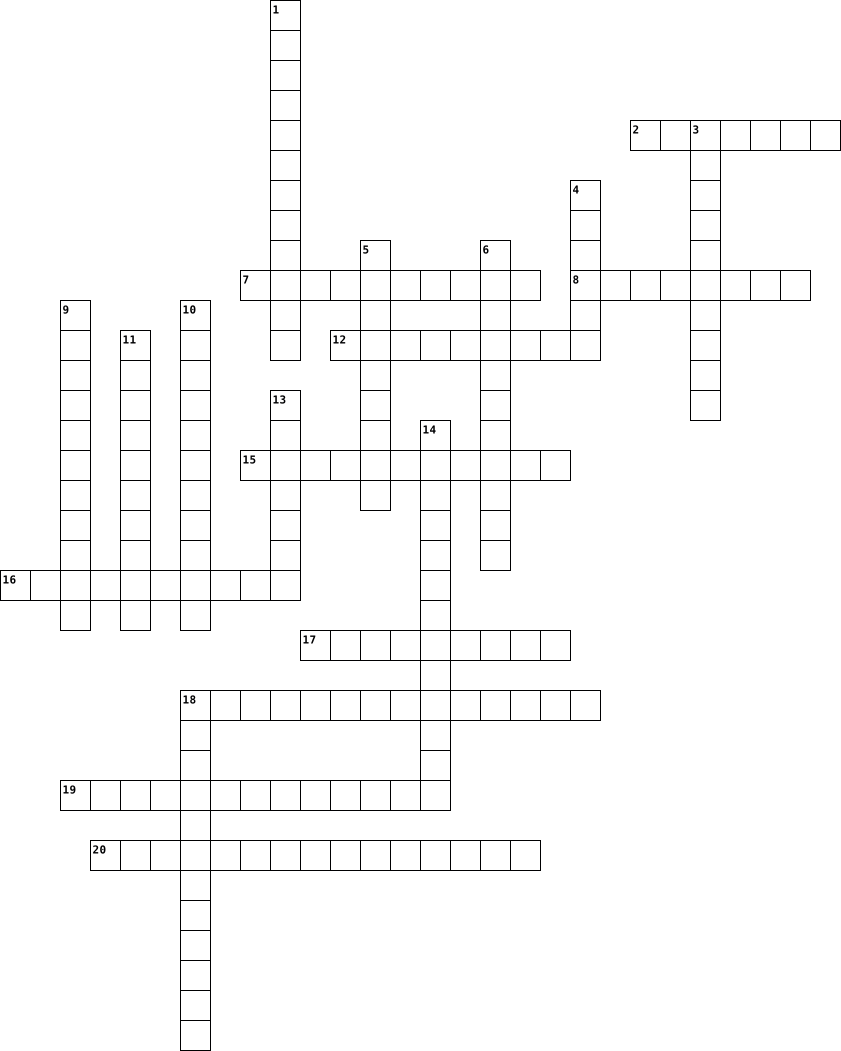
Across
- The probability distribution of molecular states
- This partition function describes the number of accessible states of a system
- This is often described as the disorder of a system
- This branch of chemistry is known for causing mental pain for students
- Dr. Poler's favorite candy that he can't stop dropping jars of
- This partition function describes the number of accessible states of one molecule
- This type of system holds pressure constant
- This form of energy has the highest number of states (partition function)
- This theorem relates degrees of freedom to contributions of energy
- The branch of physical sciences that deal with relations between heat and other forms of energy
Down
- This form of energy has the third highest number of states (partition function)
- This type of system holds volume constant
- This type of matter is the easiest to do calculations and models for
- The total heat content of a system
- This form of energy has the lowest number of states (partition function)
- this type of system holds temperature constant
- This form of energy has the second highest number of states (partition function)
- This type of system holds heat constant
- This is held constant in the universe and isolated systems
- This describes the physical property of a substance needed to increase it by 1 ºC
- A fitting parameter that describes population distribution
21 Clues: The total heat content of a system • This type of system holds heat constant • This type of system holds volume constant • This type of system holds pressure constant • this type of system holds temperature constant • The probability distribution of molecular states • This is often described as the disorder of a system • ...
EU-Jesscia 2024-05-14

Across
- The EU has its own legal system, including EU law and member state law.
- United Kingdom leaves the EU
- The European Union currently consists of 27 member states.
- Reduce pollution, protect ecosystems and promote a sustainable environment.
- The European Union is a political and economic union made up of European states that aims to promote cooperation and solidarity among its member states.
- Eu member states must abide by EU values and norms, including respect for human rights, democracy and the rule of law.
- The headquarters of the European Union is in Brussels, Belgium.
- EU has developed a common foreign policy to promote concerted action among member states.
- some members of the European Union share the euro as their currency.
- Global economic crisis
- The main objective of the EU is to promote and protect peace, prosperity and solidarity among European member States.
- Include the European Parliament, the European Council, the European Commission and the European Central Bank.
Down
- The EU is actively involved in tackling global challenges such as climate change, terrorism and poverty.
- The EU does not have its own army, but member states can cooperate under the Common Security and Defense Policy.
- The EU's economic policy aims to promote economic growth, job creation and trade liberalization.
- The European Union was formally established in 1993 as the European Economic Community (EEC), which was established in 1957.
- direction Strengthen cooperation among member states, promote innovation and sustainable development, and play a greater role in global affairs.
- There is free movement of goods, services, money and people between EU member states.
- The EU budget consists of the contributions of the Member States and the resources of the Union.
- Members of the European Parliament are directly elected by the voters of EU member states.
20 Clues: Global economic crisis • United Kingdom leaves the EU • The European Union currently consists of 27 member states. • The headquarters of the European Union is in Brussels, Belgium. • some members of the European Union share the euro as their currency. • The EU has its own legal system, including EU law and member state law. • ...
Art 4-7 2026-04-29

Across
- this article deals with relationships between states
- number of states needed to sign to ratify the Constitution
- this article outlines the supremacy clause
- removing a person from one state because they committed a crime in another
- article 4, section 4 states that the US shall guarantee this form of government to every state
Down
- article 4, section 1 states all states must respect the public acts, judicial proceedings, and what of the other states
- article 4, section 3 states that new states may not be formed or created within the what of other states
- a change to the Constitution
- signing the Constitution and making it official
- this article outlines the process to pass an amendment
- and Credit Clause
- clause that puts federal law over state law
- number needed to pass an amendment
- this article outlines how to ratify the Constitution
14 Clues: and Credit Clause • a change to the Constitution • number needed to pass an amendment • this article outlines the supremacy clause • clause that puts federal law over state law • signing the Constitution and making it official • this article deals with relationships between states • this article outlines how to ratify the Constitution • ...
Indiana Crime 2023-04-28

Across
- Rape in Indiana is more likely to be committed with a _____ than drugs or narcotics.
- Indiana has a very tiny amount of _____ per population than the United States average.
- Indiana has slightly higher rates of ______ per population than the United States average.
- Indiana used to have more, but now has less, _____ per population than the United States average.
- Indiana has significantly more rapes committed in _____ than the United States average.
- Indiana has more crimes committed at _____ than the rest of the United States.
- Violent crime victims in Indiana are typically:
Down
- Indiana has less violent crime committed by _____ individuals than the United States average.
- Indiana has twice as much _____ per population than the United States average.
- Violent crime offenders in Indiana are rarely:
- Indiana has relatively normal:
- Rape in Indiana is more like to be committed by a _____ of the victim than the United States average.
- Indiana has relatively high:
- Indiana has relatively low:
- Rape in Indiana is much less likely to be connected to _____ than rape in other parts of the United States.
15 Clues: Indiana has relatively low: • Indiana has relatively high: • Indiana has relatively normal: • Violent crime offenders in Indiana are rarely: • Violent crime victims in Indiana are typically: • Indiana has twice as much _____ per population than the United States average. • Indiana has more crimes committed at _____ than the rest of the United States. • ...
Gasses and Phase Changes 2023-05-10

Across
- gas law that states V1/n1=V2/n2
- way to find a missing variable through mole ratio, converted units, or the assumptions of a gas at STP
- on the heating curve, the change from point D to E
- law that states that the sum of individual pressures of each gas in a mixture equals the total pressure
- solid to gas transformation
- gas law that states V1/T1=V2/T2
- law that states that PV=nRT
- theory that has two points: matter is made up of particles and particles are always moving
- solid to liquid transformation
- gas law that states P1V1=P2V2
Down
- substance spreading out across a concentration gradient until evenly distributed
- law that relates the speed of a gas to its molar mass with the equation rateA/rateB=√MB/√MA
- liquid to solid transformation
- on heating curve, the change from point E to D
- gas law that states P1/T1=P2/T2
- the assumptions of particles are hard round spheres; particles aren't attracted to one another; individual particles don't take up space; particle collisions are perfectly elastic are of what?
- passage of a gas through a tiny opening in a barrier
- gas to solid transformation
- gas law that states (P1V1)/T1=(P2V2)/T2
19 Clues: solid to gas transformation • gas to solid transformation • law that states that PV=nRT • gas law that states P1V1=P2V2 • liquid to solid transformation • solid to liquid transformation • gas law that states V1/n1=V2/n2 • gas law that states P1/T1=P2/T2 • gas law that states V1/T1=V2/T2 • gas law that states (P1V1)/T1=(P2V2)/T2 • on heating curve, the change from point E to D • ...
States of Matter Vocabulary Assignment 2024-09-04

Across
- When matter changes states from a liquid to solid form
- When matter changes states from a liquid to gas form.
- When matter changes states from a solid to liquid form
- When matter changes states from a gas to liquid form
- The ability of a fluid, liquid, or gas to exact an upward force on an object immersed in it
- Change: When energy is released, and loses heat.
- Expansion: An increase or decrease in the size of a substance when the temperature is changed.
- Change: Object still has the same composition, and is just represented in a different form
- Matter that has enough energy to overcome not just the attractive forces between its particles, but also the attractive forces within its atoms
- The resistance of a fluid to flowing
Down
- Point: The exact temperature that liquid matter changes states into a solid matter
- Point: The exact temperature that liquid matter changes states to a gas form
- When matter changes states from a liquid to gas form
- The force exerted per unit area
- Change: When energy is taken in, and gains heat
- Change: A change in chemical properties or composition of a substance, resulting in the formation of at least one new substance.
- of State: The change of a substance from one physical state to another
- When matter changes states from a solid to gas form
18 Clues: The force exerted per unit area • The resistance of a fluid to flowing • Change: When energy is taken in, and gains heat • Change: When energy is released, and loses heat. • When matter changes states from a solid to gas form • When matter changes states from a liquid to gas form • When matter changes states from a gas to liquid form • ...
Vocab 2024-09-06

Across
- When energy is taken in, and gains heat
- An increase or decrease in the size of a substance when the temperature is changed.
- When energy is released, and loses heat.
- The resistance of a fluid to flowing
- When matter changes states from a liquid to solid form
- When matter changes states from a liquid to gas form.
- The exact temperature that liquid matter changes states into a solid matter
Down
- The change of a substance from one physical state to another
- When matter changes states from a liquid to gas form
- When matter changes states from a gas to liquid form
- When matter changes states from a solid to liquid form
- The force exerted per unit area
- A change in chemical properties or composition of a substance, resulting in the formation of at least one new substance.
- Matter that has enough energy to overcome not just the attractive forces between its particles, but also the attractive forces within its atoms
- Object still has the same composition and is just represented in a different form
- The ability of a fluid, liquid, or gas to exact an upward force on an object immersed in it
- When matter changes states from a solid to gas form
- The exact temperature that liquid matter changes states to a gas form
18 Clues: The force exerted per unit area • The resistance of a fluid to flowing • When energy is taken in, and gains heat • When energy is released, and loses heat. • When matter changes states from a solid to gas form • When matter changes states from a liquid to gas form • When matter changes states from a gas to liquid form • ...
States of matter Rooj Adhikari 2022-09-12

Across
- When matter changes states from a gas to liquid form
- Change: Object still has the same composition, and is just represented in a different form
- Point: The exact temperature that liquid matter changes states into a solid matter
- When matter changes states from a liquid to solid form
- When matter changes states from a liquid to gas form.
- When matter changes states from a solid to gas form
- Expansion: An increase or decrease in the size of a substance when the temperature is changed.
Down
- The ability of a fluid, liquid, or gas to exact an upward force on an object immersed in it
- When matter changes states from a liquid to gas form
- Change: When energy is taken in, and gains heat
- The force exerted per unit area
- The resistance of a fluid to flowing
- Change: When energy is released, and loses heat.
- Matter that has enough energy to overcome not just the attractive forces between its particles, but also the attractive forces within its atoms
- Point: The exact temperature that liquid matter changes states to a gas form
- of State: The change of a substance from one physical state to another
- Change: A change in chemical properties or composition of a substance, resulting in the formation of at least one new substance.
- When matter changes states from a solid to liquid form
18 Clues: The force exerted per unit area • The resistance of a fluid to flowing • Change: When energy is taken in, and gains heat • Change: When energy is released, and loses heat. • When matter changes states from a solid to gas form • When matter changes states from a liquid to gas form • When matter changes states from a gas to liquid form • ...
Alexander Paneto Vocab States of Matter 2022-09-12

Across
- When matter changes states from a liquid to solid form
- When matter changes states from a liquid to gas form.
- When matter changes states from a solid to liquid form
- When matter changes states from a gas to liquid form
- The ability of a fluid, liquid, or gas to exact an upward force on an object immersed in it
- Change: When energy is released, and loses heat.
- Expansion: An increase or decrease in the size of a substance when the temperature is changed.
- Change: Object still has the same composition, and is just represented in a different form
- Matter that has enough energy to overcome not just the attractive forces between its particles, but also the attractive forces within its atoms
- The resistance of a fluid to flowing
Down
- Point: The exact temperature that liquid matter changes states into a solid matter
- Point: The exact temperature that liquid matter changes states to a gas form
- When matter changes states from a liquid to gas form
- The force exerted per unit area
- Change: When energy is taken in, and gains heat
- Change: A change in chemical properties or composition of a substance, resulting in the formation of at least one new substance.
- of State: The change of a substance from one physical state to another
- When matter changes states from a solid to gas form
18 Clues: The force exerted per unit area • The resistance of a fluid to flowing • Change: When energy is taken in, and gains heat • Change: When energy is released, and loses heat. • When matter changes states from a solid to gas form • When matter changes states from a liquid to gas form • When matter changes states from a gas to liquid form • ...
State of Matter Vocab Crossword Puzzle 2023-09-06

Across
- When matter changes states from a liquid to solid form
- When matter changes states from a liquid to gas form.
- When matter changes states from a solid to liquid form
- When matter changes states from a gas to liquid form
- The ability of a fluid, liquid, or gas to exact an upward force on an object immersed in it
- Change: When energy is released, and loses heat.
- Expansion: An increase or decrease in the size of a substance when the temperature is changed.
- Change: Object still has the same composition, and is just represented in a different form
- Matter that has enough energy to overcome not just the attractive forces between its particles, but also the attractive forces within its atoms
- The resistance of a fluid to flowing
Down
- Point: The exact temperature that liquid matter changes states into a solid matter
- Point: The exact temperature that liquid matter changes states to a gas form
- When matter changes states from a liquid to gas form
- The force exerted per unit area
- Change: When energy is taken in, and gains heat
- Change: A change in chemical properties or composition of a substance, resulting in the formation of at least one new substance.
- of State: The change of a substance from one physical state to another
- When matter changes states from a solid to gas form
18 Clues: The force exerted per unit area • The resistance of a fluid to flowing • Change: When energy is taken in, and gains heat • Change: When energy is released, and loses heat. • When matter changes states from a solid to gas form • When matter changes states from a liquid to gas form • When matter changes states from a gas to liquid form • ...
State Of Matter Crossword 2023-09-22

Across
- When matter changes states from a liquid to solid form
- When matter changes states from a liquid to gas form.
- When matter changes states from a solid to liquid form
- When matter changes states from a gas to liquid form
- The ability of a fluid, liquid, or gas to exact an upward force on an object immersed in it
- Change: When energy is released, and loses heat.
- Expansion: An increase or decrease in the size of a substance when the temperature is changed.
- Change: Object still has the same composition, and is just represented in a different form
- Matter that has enough energy to overcome not just the attractive forces between its particles, but also the attractive forces within its atoms
- The resistance of a fluid to flowing
Down
- Point: The exact temperature that liquid matter changes states into a solid matter
- Point: The exact temperature that liquid matter changes states to a gas form
- When matter changes states from a liquid to gas form
- The force exerted per unit area
- Change: When energy is taken in, and gains heat
- Change: A change in chemical properties or composition of a substance, resulting in the formation of at least one new substance.
- of State: The change of a substance from one physical state to another
- When matter changes states from a solid to gas form
18 Clues: The force exerted per unit area • The resistance of a fluid to flowing • Change: When energy is taken in, and gains heat • Change: When energy is released, and loses heat. • When matter changes states from a solid to gas form • When matter changes states from a liquid to gas form • When matter changes states from a gas to liquid form • ...
Constitutional Crossword 2021-09-23

Across
- Agreement between delegates from the northern and southern states at the united states constitutional convention
- One of the Founding Fathers who wrote roughly 51 Federalists Papers.
- Outlined the process for admitting a new state to the Union and granteed tht newly created states would be equal to the original thirteen states.
- A constitutional right to reject a decision or proposal made by a law-making body.
- A series of violent attacks on courthouse and other government properties in Massachusetts
- Proposal to the united states constitutional convention for the creation of a supreme national government
- created two legislative bodies in Congress.
- Includes the power to coin money, to regulate commerce, to declare war, to raise and maintain armed forces, and to establish a post Office.
- a person who advocates or supports a system of government in which several united under central authority.
- An event to decide how America was going to be governed. (Officially called to revise the existing Articles of Confederation.
Down
- Those who opposed the ratification of the Constitution in favor of small, localized government.
- an amendment to the US Constitution that prohibits any law limiting freedom with respect to religion, expression, peaceful assembly, or the right of citizens to petition the government.
- Laid out the process of which lands west of the Appalachian Mountains were to be surveyed and sold
- form of government in which a state is ruled by representatives of the citizen body
- One house legislature with equal votes of states and an executive by a national legislature.
- Father of the Constitutional convention.
- principle of government under which separate branches are empowered to prevent actins by other branches and are induced to share power.
- Established the function of the national government of the United States after it declared independence from Great Britain
- The powers not delegated to the United States by the Constitution, nor prohibited by it to the States, are reserved to the States respectively, or to the people. Federal Taxing Power
- The first ten amendments to the US Constitution
20 Clues: Father of the Constitutional convention. • created two legislative bodies in Congress. • The first ten amendments to the US Constitution • One of the Founding Fathers who wrote roughly 51 Federalists Papers. • A constitutional right to reject a decision or proposal made by a law-making body. • ...
Civil War 2023-05-02

Across
- Union campaign led by William T. Sherman with Savannah being the objective
- Naval strategy by the United States to prevent the Confederacy from trading
- Compromise between the North and South that allowed California to enter the union
- The first shots of the Civil War were fired in South Carolina
- the period after the Civil War in the United States when the southern states were reorganized, rebuilt, and reintegrated into the Union
- Compromise that brought Missouri into the Union
- A series of battles fought throughout northwest Georgia and the area around Atlanta
- Infamous prisoner-of-war camp
- Turning point in the Civil War
- Citizens cannot be denied the right to vote because of race, color , or precious condition of servitude
- Document that declared all slaves in the rebellious states would be freed
- Declares that all persons born in the U.S. are citizens and are guaranteed equal protection of the laws
- One of the first major battles in the Civil War
- An abolitionist who attempted to lead a slave revolt by capturing Armories in southern territory and giving weapons to slaves
Down
- Speech given by Abraham Lincoln in which he praised the bravery of Union soldiers and renewed his commitment to winning the Civil War
- Allowing political decisions to be made by the will of the people
- States where slavery was legal
- The act of making legally null and void
- Declared slaves were not citizens of the United States
- States where slavery was illegal
- Largest battle fought in Georgia
- Abolished slavery. First of three "Reconstruction Amendments"
- The bloodiest battle of the war
- Act that allowed the territories of Kansas and Nebraska to decide if they wanted to enter the union as free or slave states
- The 16th president of the United States during the Civil War
25 Clues: Infamous prisoner-of-war camp • States where slavery was legal • Turning point in the Civil War • The bloodiest battle of the war • States where slavery was illegal • Largest battle fought in Georgia • The act of making legally null and void • Compromise that brought Missouri into the Union • One of the first major battles in the Civil War • ...
Period 3 2016-11-29

Across
- Compromise/ Roger Sherman introduces it to mend ideas
- Battle which washington Crosses the Delaware river
- plan/ Plan that favored large states
- Ordinance/ System for terrritories to become states
- Rights/ John Locke said everyone had..
- Sovereighty/ Power in the hands of the people
- Paine/ Author of Common sense
- Jersey plan/ Plan that favored small states
- The _______ convention is where they revise the articles
- Final Battle
- people who supported the constitution w/ a strong central gov
- Most states abolished slavery in the...
Down
- five essays/The federalist papers consisted of
- fifths/ Slaves were counted_________ of a person, when voting
- Trade/ allowed to continue untill 1808
- The constitution divided power between state and ...
- Rebellion/ Rebellion includes middle class, debts, jails & banks
- Power comes from the people
- in the Articles of Confederstion, most power lies w/ the...
19 Clues: Final Battle • Power comes from the people • Paine/ Author of Common sense • plan/ Plan that favored large states • Trade/ allowed to continue untill 1808 • Rights/ John Locke said everyone had.. • Most states abolished slavery in the... • Jersey plan/ Plan that favored small states • Sovereighty/ Power in the hands of the people • ...
States of matter Rooj Adhikari 2022-09-12

Across
- When matter changes states from a gas to liquid form
- Change: When energy is released, and loses heat.
- When matter changes states from a liquid to gas form.
- Change: Object still has the same composition, and is just represented in a different form
- Expansion: An increase or decrease in the size of a substance when the temperature is changed.
- Point: The exact temperature that liquid matter changes states into a solid matter
- The resistance of a fluid to flowing
- When matter changes states from a liquid to solid form
- When matter changes states from a liquid to gas form
- The ability of a fluid, liquid, or gas to exact an upward force on an object immersed in it
Down
- Point: The exact temperature that liquid matter changes states to a gas form
- of State: The change of a substance from one physical state to another
- Change: A change in chemical properties or composition of a substance, resulting in the formation of at least one new substance.
- Change: When energy is taken in, and gains heat
- Matter that has enough energy to overcome not just the attractive forces between its particles, but also the attractive forces within its atoms
- When matter changes states from a solid to liquid form
- The force exerted per unit area
- When matter changes states from a solid to gas form
18 Clues: The force exerted per unit area • The resistance of a fluid to flowing • Change: When energy is taken in, and gains heat • Change: When energy is released, and loses heat. • When matter changes states from a solid to gas form • When matter changes states from a gas to liquid form • When matter changes states from a liquid to gas form • ...
States of matter Rooj Adhikari 2022-09-12

Across
- Matter that has enough energy to overcome not just the attractive forces between its particles, but also the attractive forces within its atoms
- Change: When energy is taken in, and gains heat
- Change: A change in chemical properties or composition of a substance, resulting in the formation of at least one new substance.
- of State: The change of a substance from one physical state to another
- When matter changes states from a liquid to gas form
- The ability of a fluid, liquid, or gas to exact an upward force on an object immersed in it
- Point: The exact temperature that liquid matter changes states to a gas form
- The force exerted per unit area
- When matter changes states from a solid to gas form
- Point: The exact temperature that liquid matter changes states into a solid matter
Down
- When matter changes states from a liquid to gas form.
- Change: Object still has the same composition, and is just represented in a different form
- When matter changes states from a solid to liquid form
- Expansion: An increase or decrease in the size of a substance when the temperature is changed.
- When matter changes states from a liquid to solid form
- The resistance of a fluid to flowing
- Change: When energy is released, and loses heat.
- When matter changes states from a gas to liquid form
18 Clues: The force exerted per unit area • The resistance of a fluid to flowing • Change: When energy is taken in, and gains heat • Change: When energy is released, and loses heat. • When matter changes states from a solid to gas form • When matter changes states from a gas to liquid form • When matter changes states from a liquid to gas form • ...
States of matter Rooj Adhikari 2022-09-12

Across
- Matter that has enough energy to overcome not just the attractive forces between its particles, but also the attractive forces within its atoms
- Change: When energy is taken in, and gains heat
- Change: A change in chemical properties or composition of a substance, resulting in the formation of at least one new substance.
- of State: The change of a substance from one physical state to another
- When matter changes states from a liquid to gas form
- The ability of a fluid, liquid, or gas to exact an upward force on an object immersed in it
- Point: The exact temperature that liquid matter changes states to a gas form
- The force exerted per unit area
- When matter changes states from a solid to gas form
- Point: The exact temperature that liquid matter changes states into a solid matter
Down
- When matter changes states from a liquid to gas form.
- Change: Object still has the same composition, and is just represented in a different form
- When matter changes states from a solid to liquid form
- Expansion: An increase or decrease in the size of a substance when the temperature is changed.
- When matter changes states from a liquid to solid form
- The resistance of a fluid to flowing
- Change: When energy is released, and loses heat.
- When matter changes states from a gas to liquid form
18 Clues: The force exerted per unit area • The resistance of a fluid to flowing • Change: When energy is taken in, and gains heat • Change: When energy is released, and loses heat. • When matter changes states from a solid to gas form • When matter changes states from a gas to liquid form • When matter changes states from a liquid to gas form • ...
States of matter 2024-09-04

Across
- When matter changes states from a liquid to solid form
- When matter changes states from a liquid to gas form.
- When matter changes states from a solid to liquid form
- When matter changes states from a gas to liquid form
- The ability of a fluid, liquid, or gas to exact an upward force on an object immersed in it
- Change: When energy is released, and loses heat.
- Expansion: An increase or decrease in the size of a substance when the temperature is changed.
- Change: Object still has the same composition, and is just represented in a different form
- Matter that has enough energy to overcome not just the attractive forces between its particles, but also the attractive forces within its atoms
- The resistance of a fluid to flowing
Down
- Point: The exact temperature that liquid matter changes states into a solid matter
- Point: The exact temperature that liquid matter changes states to a gas form
- When matter changes states from a liquid to gas form
- The force exerted per unit area
- Change: When energy is taken in, and gains heat
- Change: A change in chemical properties or composition of a substance, resulting in the formation of at least one new substance.
- of State: The change of a substance from one physical state to another
- When matter changes states from a solid to gas form
18 Clues: The force exerted per unit area • The resistance of a fluid to flowing • Change: When energy is taken in, and gains heat • Change: When energy is released, and loses heat. • When matter changes states from a solid to gas form • When matter changes states from a liquid to gas form • When matter changes states from a gas to liquid form • ...
Endothermic Change: When energy is taken in, and gains heChange of State: The change of a substance from one physical state to another Physical Change: Object still has the same composition, and is just represented in a different form Chemical Change: A c 2024-09-04

Across
- The force exerted per unit area
- The resistance of a fluid to flowing
- Change A change in chemical properties or composition of a substance, resulting in the formation of at least one new substance.
- Point The exact temperature that liquid matter changes states to a gas form
- When matter changes states from a gas to liquid form
- Expansion An increase or decrease in the size of a substance when the temperature is changed.
- When matter changes states from a liquid to gas form
Down
- of State The change of a substance from one physical state to another
- Change When energy is taken in, and gains heat
- The ability of a fluid, liquid, or gas to exact an upward force on an object immersed in it
- Change Object still has the same composition, and is just represented in a different form
- When matter changes states from a solid to gas form
- Matter that has enough energy to overcome not just the attractive forces between its particles, but also the attractive forces within its atoms
- When matter changes states from a solid to liquid form
- When matter changes states from a liquid to
- When matter changes states from a liquid to gas form.
- The exact temperature that liquid matter changes states into a solid matter
- Chane When energy is released, and loses heat.
18 Clues: The force exerted per unit area • The resistance of a fluid to flowing • When matter changes states from a liquid to • Change When energy is taken in, and gains heat • Chane When energy is released, and loses heat. • When matter changes states from a solid to gas form • When matter changes states from a gas to liquid form • ...
Science 2024-09-05

Across
- When matter changes states from a liquid to solid form
- When matter changes states from a liquid to gas form.
- When matter changes states from a solid to liquid form
- When matter changes states from a gas to liquid form
- The ability of a fluid, liquid, or gas to exact an upward force on an object immersed in it
- Change: When energy is released, and loses heat.
- Expansion: An increase or decrease in the size of a substance when the temperature is changed.
- Change: Object still has the same composition, and is just represented in a different form
- Matter that has enough energy to overcome not just the attractive forces between its particles, but also the attractive forces within its atoms
- The resistance of a fluid to flowing
Down
- Point: The exact temperature that liquid matter changes states into a solid matter
- Point: The exact temperature that liquid matter changes states to a gas form
- When matter changes states from a liquid to gas form
- The force exerted per unit area
- Change: When energy is taken in, and gains heat
- Change: A change in chemical properties or composition of a substance, resulting in the formation of at least one new substance.
- of State: The change of a substance from one physical state to another
- When matter changes states from a solid to gas form
18 Clues: The force exerted per unit area • The resistance of a fluid to flowing • Change: When energy is taken in, and gains heat • Change: When energy is released, and loses heat. • When matter changes states from a solid to gas form • When matter changes states from a liquid to gas form • When matter changes states from a gas to liquid form • ...
States of matter 2022-09-22

Across
- When matter changes states from a liquid to solid form
- When matter changes states from a liquid to gas form.
- When matter changes states from a solid to liquid form
- When matter changes states from a gas to liquid form
- The ability of a fluid, liquid, or gas to exact an upward force on an object immersed in it
- Change: When energy is released, and loses heat.
- Expansion: An increase or decrease in the size of a substance when the temperature is changed.
- Change: Object still has the same composition, and is just represented in a different form
- Matter that has enough energy to overcome not just the attractive forces between its particles, but also the attractive forces within its atoms
- The resistance of a fluid to flowing
Down
- Point: The exact temperature that liquid matter changes states into a solid matter
- Point: The exact temperature that liquid matter changes states to a gas form
- When matter changes states from a liquid to gas form
- The force exerted per unit area
- Change: When energy is taken in, and gains heat
- Change: A change in chemical properties or composition of a substance, resulting in the formation of at least one new substance.
- of State: The change of a substance from one physical state to another
- When matter changes states from a solid to gas form
18 Clues: The force exerted per unit area • The resistance of a fluid to flowing • Change: When energy is taken in, and gains heat • Change: When energy is released, and loses heat. • When matter changes states from a solid to gas form • When matter changes states from a liquid to gas form • When matter changes states from a gas to liquid form • ...
States of Matter Vocabulary Assignment 2024-09-04

Across
- When matter changes states from a liquid to solid form
- When matter changes states from a liquid to gas form.
- When matter changes states from a solid to liquid form
- When matter changes states from a gas to liquid form
- The ability of a fluid, liquid, or gas to exact an upward force on an object immersed in it
- Change: When energy is released, and loses heat.
- Expansion: An increase or decrease in the size of a substance when the temperature is changed.
- Change: Object still has the same composition, and is just represented in a different form
- Matter that has enough energy to overcome not just the attractive forces between its particles, but also the attractive forces within its atoms
- The resistance of a fluid to flowing
Down
- Point: The exact temperature that liquid matter changes states into a solid matter
- Point: The exact temperature that liquid matter changes states to a gas form
- When matter changes states from a liquid to gas form
- The force exerted per unit area
- Change: When energy is taken in, and gains heat
- Change: A change in chemical properties or composition of a substance, resulting in the formation of at least one new substance.
- of State: The change of a substance from one physical state to another
- When matter changes states from a solid to gas form
18 Clues: The force exerted per unit area • The resistance of a fluid to flowing • Change: When energy is taken in, and gains heat • Change: When energy is released, and loses heat. • When matter changes states from a solid to gas form • When matter changes states from a liquid to gas form • When matter changes states from a gas to liquid form • ...
Chapter 2 2013-10-21

Across
- The first reason in every proof
- The title of the right-hand column of a proof.
- The type of proof we have been doing in class.
- If B is the ___ of AC, then AB = BC.
- The property that states if 4x + 5 = 1, then 4x = -4.
- The part following "then" in a conditional statement.
- A type of angle whose measure is 90 degrees.
- The sum of 2 angles is 180 degrees.
- Something that can be proven.
- A statement that combines a conditional statement and its converse. It can only be written when the conditional and converse are both true.
- The title of the left-hand column of a proof.
- The sum of 2 angles is 90 degrees.
- The property that states if 10x = 120, then x = 12.
- Switching and negating the hypothesis and conclusion.
- Another word for an if-then statement.
- Interchanging the hypothesis and conclusion.
- The symbol ~ is used to ___ a statement.
- The property that states A = A
Down
- When using symbols, the arrow in p -> q is read as ___.
- Vertical angles are always ___.
- The property that states if 5 = x, then x = 5
- The property that states if x = 5 and 5 = y then x = y.
- Iff stands for __ __ __ __.
- Negating the hypothesis and conclusion.
- The property that states 15 = 3(x + 2), then 15 = 3x + 6.
- The part following "if" in a conditional statement.
- Something we assume to be true.
- The property that states if x/3 = 15, then x = 45.
- The property that states if 4x + 5 - 2x = 12, then 2x + 5 = 12.
- The property that states if 2x - 3 = 13, then 2x = 16.
- A reasonable conclusion; can be true or false.
- If B is ___ A & C, then AB + BC = AC.
32 Clues: Iff stands for __ __ __ __. • Something that can be proven. • The property that states A = A • Vertical angles are always ___. • The first reason in every proof • Something we assume to be true. • The sum of 2 angles is 90 degrees. • The sum of 2 angles is 180 degrees. • If B is the ___ of AC, then AB = BC. • If B is ___ A & C, then AB + BC = AC. • ...
The west 2024-01-11

Across
- hunkpapa Lakota Leader who led his people during years or resistance against u.s government
- several laws in the United States by which an applicant could acquire ownership of government land
- a Lakota war leader of the Oglala band in the 19th century.
- A leader of the wal lam kain band of nez perce
- a 1,911-mile continuous railroad line built between 1863 and 1869 that connected the existing eastern U.S. rail network
- Animals important to natives, used for food, clothing and more
- a career United States Army officer and a Union general in the American Civil War.
- an agreement between the United States and the Oglala, Miniconjou, and Brulé bands of Lakota people
Down
- the flagship Indian boarding school in the United States from its founding in 1879 through 1918
- a United States Army officer and cavalry commander in the American Civil War and the American Indian Wars
- Rush took place in Dakota Territory in the United States. It began in 1874
- A ceremony incorporated in numerous native american belief system
- an American military officer who founded and was longtime superintendent of the influential Carlisle Indian Industrial School
- treaty between the United States, and nine tribes and bands of Indians, occupying the lands lying around the head of Puget Sound, Washington
- Act of 1887 regulated land rights on tribal territories within the United States
- a military leader and medicine man from the Bedonkohe band of the Ndendahe Apache people
- A battle between Lakota sioux, northern cheyenne, arapaho tribes against the 7th calvary regiment of the united states army.
- a trail used in the post-Civil War era to drive cattle overland from ranches in Texas to Kansas railheads
- the deadliest mass shooting in American history, involving nearly three hundred Lakota people shot and killed by soldiers
- North American Indian tribe of equestrian nomads whose 18th- and 19th-century territory comprised the southern Great Plains
20 Clues: A leader of the wal lam kain band of nez perce • a Lakota war leader of the Oglala band in the 19th century. • Animals important to natives, used for food, clothing and more • A ceremony incorporated in numerous native american belief system • Rush took place in Dakota Territory in the United States. It began in 1874 • ...
United States Crossword 2015-04-22

Across
- document home for freedom of speech and trial by jury.
- Document which formed the first government of the u.s. and states had more power than the national government.
- treaty that ended wwI.
- peace plan issued by Wilson and created the league of nations.
- declaration by Truman to assist any fighting communism after wwII.
- essays written by James Madison, Alexander Hamilton and John jay.
- created a graduated income tax.
- right to vote at 18.
- ended poll taxes.
- gave African Americans the right to vote.
- gave women right to vote.
Down
- First 10 amendments to the constitution.
- written by Jefferson listing the grievances against G.B. and to declare independence from G.B.
- a document outlining the basic form and rules of the government.
- Limiting the power to tax and right to a fair trial found in the u.s. constitution.
- gave freedom to the slaves in all states.
- required states to give citizenship to all citizens born in the u.s.
- provided direct election of senators.
18 Clues: ended poll taxes. • right to vote at 18. • treaty that ended wwI. • gave women right to vote. • created a graduated income tax. • provided direct election of senators. • First 10 amendments to the constitution. • gave freedom to the slaves in all states. • gave African Americans the right to vote. • document home for freedom of speech and trial by jury. • ...
States of Matter 2021-02-09

Across
- Transition of gas to plasma
- Matter that is rigid with a fixed volume
- Atoms connected by chemical bonds
- Matter with charged atoms, no fixed shape, and no fixed volume
- Transition of gas to liquid
- Negatively-charged part of an atom
- The smallest unit of matter with the properties of an element
- slow transition of liquid to gas
- transition of liquid to solid
Down
- Anything that has mass and takes up space
- Matter that cannot be broken down into simpler substances
- Transition of solid to liquid
- matter that has a fixed volume but no fixed shape
- Positively-charged part of an atom
- matter that has no fixed shape and no fixed volume
- molecule made from different elements
- Transition of liquid to gas by boiling
- Enables matter to change state
18 Clues: Transition of gas to plasma • Transition of gas to liquid • Transition of solid to liquid • transition of liquid to solid • Enables matter to change state • slow transition of liquid to gas • Atoms connected by chemical bonds • Positively-charged part of an atom • Negatively-charged part of an atom • molecule made from different elements • Transition of liquid to gas by boiling • ...
United States 2 2021-12-08

Across
- Capital of New York
- Capital of Nebraska
- Capital of Missouri
- Capital of New Mexico
- Capital of North Carolina
- Capital of Ohio
- Capital of Massachusetts
- Capital of Oregon
- Capital of Oklahoma
- Capital of New Jersey
Down
- Capital of New Hampshire
- Capital of Michigan
- Capital of Maryland
- Capital of North Dakota
- Capital of Nevada
- Capital of Montana
- Capital of Mississippi
- Capital of Minnesota
18 Clues: Capital of Ohio • Capital of Nevada • Capital of Oregon • Capital of Montana • Capital of Michigan • Capital of New York • Capital of Maryland • Capital of Nebraska • Capital of Missouri • Capital of Oklahoma • Capital of Minnesota • Capital of New Mexico • Capital of New Jersey • Capital of Mississippi • Capital of North Dakota • Capital of New Hampshire • Capital of Massachusetts • ...
States of Wonder 2023-12-11

Across
- The epicenter of American theater located in New York City.
- One of the largest shopping malls in the U.S.
- Famous landmark located in South Dakota.
- Historic mission and fortress compound in San Antonio, Texas.
- A world-famous skyscraper located in Midtown.
- The first National Park in the U.S.
- Famous for its country music.
- Historic location in Seattle, Washington.
Down
- Famous street in the French Quarter of New Orleans.
- A colossal neoclassical sculpture in the U.S.
- Historic symbol located in Philadelphia, Pennsylvania.
- Capital city of Wyoming.
- The capital of California.
- Prestigious university located in Massachusetts.
- The capital city of Hawaii
- Major aerospace company headquartered in Illinois.
- Known as a global center for high tech
- The capital known for its live music scene
18 Clues: Capital city of Wyoming. • The capital of California. • The capital city of Hawaii • Famous for its country music. • The first National Park in the U.S. • Known as a global center for high tech • Famous landmark located in South Dakota. • Historic location in Seattle, Washington. • The capital known for its live music scene • A colossal neoclassical sculpture in the U.S. • ...
United States Constitution 2024-02-13

Across
- two senators from every state
- Right not to quarter soldiers
- two houses
- judges laws and sets penalties/punishment for law breakers (Supreme Court) Article 3 of the Constitution
- Prohibition of intoxicating liquors
- Commander in chief of the armed forces, grant reprieves and pardons, to make treaties, to appoint major federal officials
- Power is shared by the Federal/National government and the individual state governments
- Guarantees individual liberties; the first 10 amendments
- To collect taxes, to coin money, regulate foreign and interstate commerce, to raise and maintain an army, to declare war, to fix standards of weights and measure, to grant patents and copyrights, etc.
- Second in line to the president
- Carries out the laws (President) Article 2 of the Constitution
- Cannot be denied the right to vote because of race, color, or previous condition of servitude
- lawmaking branch (Congress) Article 1 of the Constitution
- Based on the population of each state.
Down
- Abolished slavery
- Protection from illegal search and seizure (police must have a proper warrant)
- based on the population of each state
- Right to keep and bear arms
- describes the purpose of the Constitution
- Two senators from every state.
20 Clues: two houses • Abolished slavery • Right to keep and bear arms • two senators from every state • Right not to quarter soldiers • Two senators from every state. • Second in line to the president • Prohibition of intoxicating liquors • based on the population of each state • Based on the population of each state. • describes the purpose of the Constitution • ...
States of Matter 2024-01-24

Across
- Any basic unit of matter and energy
- A relatively hard naturally occurring mineral material
- Small usually rounded stones worn by the action of water
- Related to, or derived from living matter
- The expanse of salt water that covers most of the earth's surface and surrounds land masses
- The process where liquid changes to a gas or vapor
- Flat low lying plain that forms from the deposits of sediments at the mouth of a river
- Solid material that is moved and deposited in a new location
Down
- A covering of minute ice crystals on a cold surface
- A natural movement of air at any velocity
- The laying down of sediment carried by wind, flowing water, the sea, or ice
- A naturally occurring sequence of changes of properties of an object or system
- A substance composed of 2 parts hydrogen and 1 part oxygen
- To move in one direction continuously and easily
- The force by which a planet or other body draws objects towards its center
- The solid form of water produced by freezing
- A loose granular material that results from the disintegration of rocks
- A tall plant that can live for a very long time
18 Clues: Any basic unit of matter and energy • A natural movement of air at any velocity • Related to, or derived from living matter • The solid form of water produced by freezing • A tall plant that can live for a very long time • To move in one direction continuously and easily • The process where liquid changes to a gas or vapor • ...
Two States❤️ 2023-02-10

Across
- This city was originally called Baghnagar
- Most popular snacks of Mumbai
- The smallest state of India
- Largest state of India
- This is the most famous dish of Hyderabad
- Cultural capital of Kerala
- The oldest mall in India
- Also known as the City of Dreams
- The state with the highest female to male ratio
- Your cute GF comes from this village in Rajasthan
Down
- This state lies in the western peninsula part of the Indian subcontinent
- It is the oldest surviving classical language
- The worlds richest temple
- India’s first Zoo
- Indian harvest festival celebrated in Kerela
- The only language that is a palindrome
- The city that is located on the Coromandel coast of Bay of Bengal
- It is both a famous dish and festival in South India
18 Clues: India’s first Zoo • Largest state of India • The oldest mall in India • The worlds richest temple • Cultural capital of Kerala • The smallest state of India • Most popular snacks of Mumbai • Also known as the City of Dreams • The only language that is a palindrome • This city was originally called Baghnagar • This is the most famous dish of Hyderabad • ...
States of Matter 2023-02-14

Across
- in a solid, attractions are so strong that particles are fixed in place and can only _________ where they are
- when thermal energy is removed from molecules, they move _____________ together
- in a gas, molecules are very far __________
- the atoms and molecules that make up matter are always in __________
- in a liquid, particles can move ________ each other
- in a gas, molecules ________ interact with each other
- two or more atoms chemically bonded together
- liquids do not have a fixed ___________
- the study of matter and how it changes
- when thermal energy is added to molecules, they move ________ apart
Down
- a gas will spread out evenly to _____ any container
- atoms and molecules that make up matter are _____________ to each other
- when matter is __________, molecules move closer together
- the "building blocks" of all matter
- anything that has mass and takes up space
- matter can exist as a solid, liquid or gas. we call these _________ of matter
- in a solid, atoms or molecules are ______ attracted to each other
- when matter is __________, molecules move farther apart
18 Clues: the "building blocks" of all matter • the study of matter and how it changes • liquids do not have a fixed ___________ • anything that has mass and takes up space • in a gas, molecules are very far __________ • two or more atoms chemically bonded together • a gas will spread out evenly to _____ any container • in a liquid, particles can move ________ each other • ...
States of Matter 2024-10-31

Across
- An element or compound that is made of one thing.
- The state change from solid to liquid.
- liquid water.
- A state that has a fixed shape, volume, and mass.
- A mixture that is fully combined, think salt water.
- A state that has a fixed mass, but has no fixed volume or shape.
- Solid water.
- the state change from gas to solid.
- the temperature where a solid melts.
- the temperature where a liquid boils.
Down
- the state change from solid to gas.
- The state change from gas to liquid.
- A combination of one or more pure substances.
- water as a gas.
- A mixture that is not fully combined, think a cookie.
- The state change from liquid to solid.
- The state change from liquid and gas.
- A state that has a fixed mass and volume, but has the shape of its container.
18 Clues: Solid water. • liquid water. • water as a gas. • the state change from solid to gas. • the state change from gas to solid. • The state change from gas to liquid. • the temperature where a solid melts. • The state change from liquid and gas. • the temperature where a liquid boils. • The state change from solid to liquid. • The state change from liquid to solid. • ...
states of matter 2026-02-17

Across
- a solid material that is typically hard and shiny
- is a bond formed when many metal atoms share their polled valence electrons
- are electrons in the outer shell level of atom
- is an atom that is no longer electrically neutral because it has lose or gain valence electron
- The central part of an object
- A chemical element that lacks the characteristic properties of a metal
- smallest unit of matter that still represents an element
- a molecule that has a partial positive end and a partial negative end because of unequal sharing of electrons
- number Number of protons in an element
Down
- is a force that holds two or more atoms together valence electrons are either shared or transferred
- A partial chemical element that have the same number of protons and electrons
- matter that consists of one type of atom
- The attraction between positively and negatively charged ions in a ionic compound
- is a group of atoms held together by covalent bonding that acts as an independent unit
- a model that represents valence electrons in an atom as dots around the elements chemical bond
- is a chemical bond formed when two atoms share one or more pairs of valence
- an element whose properties are between a metal and non metal
- is a group of chemical symbols and numbers that represent the elements and the number of atoms of each element that make up a compound
18 Clues: The central part of an object • number Number of protons in an element • matter that consists of one type of atom • are electrons in the outer shell level of atom • a solid material that is typically hard and shiny • smallest unit of matter that still represents an element • an element whose properties are between a metal and non metal • ...
Endothermic Change: When energy is taken in, and gains heat Exothermic Change: When energy is released, and loses heat. Boiling: When matter changes states from a liquid to gas form Boiling Point: The exact temperature that liquid matter changes states to 2022-10-10

Across
- When matter changes states from a liquid to solid form
- When matter changes states from a liquid to gas form.
- When matter changes states from a solid to liquid form
- When matter changes states from a gas to liquid form
- The ability of a fluid, liquid, or gas to exact an upward force on an object immersed in it
- Change: When energy is released, and loses heat.
- Expansion: An increase or decrease in the size of a substance when the temperature is changed.
- Change: Object still has the same composition, and is just represented in a different form
- Matter that has enough energy to overcome not just the attractive forces between its particles, but also the attractive forces within its atoms
- The resistance of a fluid to flowing
Down
- Point: The exact temperature that liquid matter changes states into a solid matter
- Point: The exact temperature that liquid matter changes states to a gas form
- When matter changes states from a liquid to gas form
- The force exerted per unit area
- Change: When energy is taken in, and gains heat
- Change: A change in chemical properties or composition of a substance, resulting in the formation of at least one new substance.
- of State: The change of a substance from one physical state to another
- When matter changes states from a solid to gas form
18 Clues: The force exerted per unit area • The resistance of a fluid to flowing • Change: When energy is taken in, and gains heat • Change: When energy is released, and loses heat. • When matter changes states from a solid to gas form • When matter changes states from a liquid to gas form • When matter changes states from a gas to liquid form • ...
States of Matter crossword 2023-09-05

Across
- When matter changes states from a liquid to gas form.
- The exact temperature that liquid matter changes states into a solid matter
- when matter changes states from a liquid to gas form
- When matter changes states from a solid to liquid form
- The exact temperature that liquid matter changes states to a gas form
- An increase or decrease in the size of a substance when the temperature is changed.
- The change of a substance from one physical state to another
- The ability of a fluid, liquid, or gas to exact an upward force on an object immersed in it
- object still has the same composition, and is just represented in a different form
- when matter changes states from a solid to gas form
- A change in chemical properties or composition of a substance, resulting in the formation of at least one new substance.
Down
- When matter changes states from a gas to liquid form
- The resistance of a fluid to flowing
- When matter changes states from a liquid to solid form
- when energy is taken in, and gains heat
- The force exerted per unit area
- When energy is released, and loses heat.
- Matter that has enough energy to overcome not just the attractive forces between its particles, but also the attractive forces within its atoms
18 Clues: The force exerted per unit area • The resistance of a fluid to flowing • when energy is taken in, and gains heat • When energy is released, and loses heat. • when matter changes states from a solid to gas form • When matter changes states from a gas to liquid form • when matter changes states from a liquid to gas form • ...