
states Crossword Puzzles
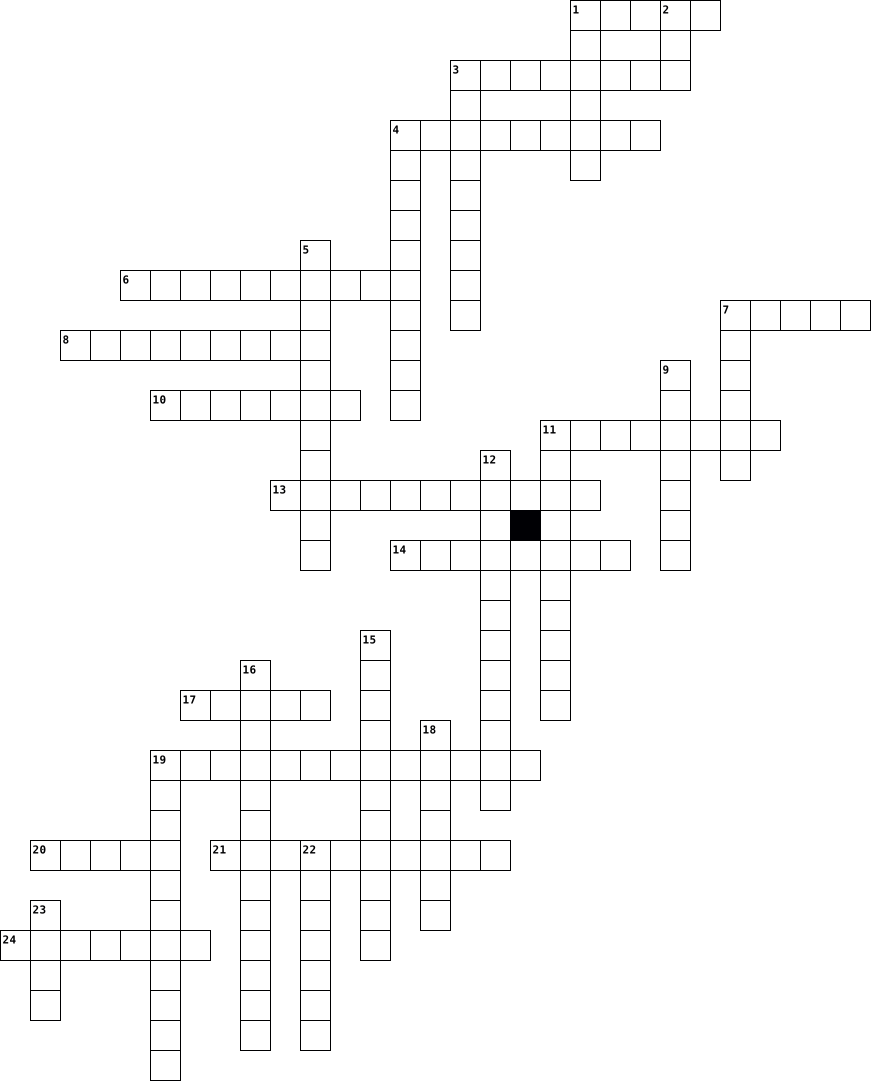
Unit 3 North America Vocabulary 2024-10-16

Across
- It was the first continuous railroad line across the United States that joined the East and West coasts.
- The movement of six million African Americans out of the rural Southern United States to the urban Northeast, Midwest, and West between 1910 and 1970.
- idea that white Americans were divinely ordained to settle the entire continent of North America.
- this can refer to the theory that there was a landmass that connected North America to Asia. Which would explain how earlier humans migrated into the continent.
- second longest river in North America
- the South was defined as all states south of the 18th century Mason–Dixon line
- one of the principal rivers in the southwestern United States and in northern Mexico.
Down
- The process of settling or establishing control, influence and military occupancy over the indigenous people of an area.
- established a free-trade zone in North America.
- It is located just to the east of the Rocky Mountains, much of it covered in prairie, steppe, and grassland.
- This was the exchange of goods and people between the Old World and the New World during the Age of Exploration (Europe, The Americas, and Africa).
- The significant push toward the west coast of North America began in the 1810s.
- The acquisition of the territory of Louisiana by the United States from the French First Republic in 1803
- Freedom The ability and right to freely exercise and practice whatever religion you choose or are a part of.
- Lakes largest freshwater lake system in the world
15 Clues: second longest river in North America • established a free-trade zone in North America. • Lakes largest freshwater lake system in the world • the South was defined as all states south of the 18th century Mason–Dixon line • The significant push toward the west coast of North America began in the 1810s. • ...
Power to the People 2026-08-30

Across
- The 3rd amendment says, No ________ shall, in time of peace be quartered in any house, without the consent of the Owner, nor in time of war.
- The 4th amendment protects the people from unreasonable searches and __________.
- The 26th amendment grants __________ as the voting age.
- According to the 6th amendment, If you're accused of a crime, you have a right to a __________ and public trial.
- The __________ amendment says that just because a right isn't mentioned, it doesn't mean the people do not have the right.
- The amendment states you have a right to remain silent, have due process, and not be charged twice for the same crime.
- The right of citizens of the United States to vote cannot be denied on the basis of __________.
- Congress cannot make laws respecting an establishment or practice of religion; or abridge the freedom of speech, or of the press; or the right to peaceably __________, and to petition the Government.
Down
- Powers not delegated to the federal government is retained by the __________.
- You cannot be denied the right to vote on the basis of not paying a __________ tax, according to the 24th amendment.
- All persons born or naturalized in the United States are __________.
- The ___________ amendment states that the right of U.S. citizens to vote cannot be denied on the basis of gender.
- According to the 8th amendment, bail cannot be __________.
- The 13th amendment abolished __________, except as a punishment for crime..
- The 2nd amendment says, a well regulated Militia, being necessary to the security of a free State, the right of the people to keep and bear __________, shall not be infringed.
15 Clues: The 26th amendment grants __________ as the voting age. • According to the 8th amendment, bail cannot be __________. • All persons born or naturalized in the United States are __________. • The 13th amendment abolished __________, except as a punishment for crime.. • Powers not delegated to the federal government is retained by the __________. • ...
Government 2023 2023-05-15

Across
- The branch of government responsible for making laws; in the United States, it consists of the Congress (House of Representatives and Senate).
- The formal approval or acceptance of a law, treaty, or constitutional amendment.
- A system of government where power is divided between a central government and regional governments (states in the case of the United States).
- The act of attempting to influence government officials and policies by individuals or interest groups.
- A form of government where the country is considered a "public matter," and power is held by elected individuals representing the citizens.
- The process by which a foreign citizen becomes a citizen of another country.
Down
- Changes or additions made to the United States Constitution.
- The process by which an elected official is charged with wrongdoing and removed from office.
- The branch of government responsible for enforcing laws; it is headed by the President of the United States.
- The right to vote in political elections.
- The branch of government responsible for interpreting laws and administering justice; it includes the Supreme Court and other federal courts.
- A written document that outlines the basic principles, structures, and functions of a government.
- A system of government where the power is vested in the people, who exercise it directly or through elected representatives.
- A group of advisors appointed by the President to assist in making decisions and overseeing various government departments.
- The power of the President (or other executive authority) to reject a bill passed by the legislative branch, preventing it from becoming a law.
15 Clues: The right to vote in political elections. • Changes or additions made to the United States Constitution. • The process by which a foreign citizen becomes a citizen of another country. • The formal approval or acceptance of a law, treaty, or constitutional amendment. • The process by which an elected official is charged with wrongdoing and removed from office. • ...
Unit 8 Crossword Puzzle 2025-05-06

Across
- Plan that punished former confederate states and protected african americans
- A system where the landlord/planter allows a tenant to use the land in exchange for a share of the crop
- Give formal consent to something, making it officially valid
- A government agency which helped freedmen and poor whites
- Amendment that ensures equal protection under the law and protects the rights of citizens
- Amendment that abolished slavery
- Amendment that guarantees that all adult male citizens have the right to vote
- Economically disadvantaged whites
- Farming An agricultural labor system that involves the farmer not owning the land they work on and having to pay a portion of their crop yield or profits to the landlord as rent
- Focused on restoring the Southern states to the Union as quickly as possible by offering amnesty and pardons to most white Southerners who pledged loyalty
Down
- a violent post-Civil War secret society founded in Tennessee in 1866 to upend the Black political and social power that was being established during Reconstruction
- The period of time from the end of the Civil War until southern states rejoined the Union
- The practice of requiring separate housing, education and other services for people of color
- Laws passed in the south that discriminated against Freedmen
- Would allow Confederate states to establish new state governments after 10 percent of their male population took loyalty oaths and the states recognized the permanent freedom of formerly enslaved people
15 Clues: Amendment that abolished slavery • Economically disadvantaged whites • A government agency which helped freedmen and poor whites • Laws passed in the south that discriminated against Freedmen • Give formal consent to something, making it officially valid • Plan that punished former confederate states and protected african americans • ...
REVIEW - U.S. Constitution 2021-11-30

Across
- The judicial branch of government can check the legislative branch of government by declaring laws __________.
- During the presidency of George Washington, disagreements between Alexander Hamilton and Thomas Jefferson over the interpretation of the Constitution contributed to the formation of the first two political __________.
- The term __________ is best defined as the division of power between the states and the national government.
- In New Jersey v. T.L.O., the Supreme Court restricted student’s __________ amendment protections against unreasonable searches and seizures on school grounds.
- The United States Constitution corrected a weakness of the Articles of Confederation by creating three __________ of government.
- President George Washington’s leadership during the __________ Rebellion (1794) was important because it showed the ability of the new government to enforce federal law.
- On the issue of creating a national bank, Secretary of State Thomas Jefferson and Secretary of the Treasury Alexander Hamilton differed on whether to apply a strict or loose interpretation of the __________.
- Delegates to the Constitutional Convention of 1787 agreed to the Three-Fifths Compromise as a solution to the problem of whether or not to count __________ in the national census.
- Ordering American troops into a foreign country illustrates the __________ ’s power as commander in chief.
- By agreeing to the __________ Compromise the framers of the U.S. Constitution agreed that the national congress should consist of two houses: one in which representation is based on population, and one in which states are equally represented.
- In the 1780s, the national government under the Articles of Confederation established its authority in the Northwest Territory by providing a system for the formation of new __________.
- The main criticism of the Articles of Confederation was that they failed to provide adequate powers for the __________ government.
Down
- During the Constitutional Convention, the framers of the Constitution were able to __________ on important issues such as state representation in congress.
- In 1790, the first census of the United States was taken in order to determine each state’s representation in Congress and the number of __________ assigned to each state.
- Holding a cabinet meeting at the White House is an example of the use of the __________ constitution?
- In Tinker v. Des Moines, the Supreme Court ruled that students protesting against the Vietnam War by wearing black armbands were protected by the __________ amendment.
- Federalism, separation of powers, and checks and balances are constitutional principles that directly reduce the __________ of governmental power.
- Secretary of the Treasury Alexander __________ supported the creation of the Bank of the United States because it would help ensure the economic stability of the new nation.
- One immediate result of Alexander Hamilton’s financial plan was the creation of a national __________.
- The Preamble to the U.S. Constitution illustrates the principle that __________ are the true source of political power.
- Many of the fundamental principles found in the United States Constitution (1787) were based on the writings of __________ philosophers.
- To prevent tyranny, the authors of the Constitution drew on Montesquieu’s concept of __________ of powers.
- A __________ form of government is described as one in which representatives are elected by the people.
- During the Constitutional Convention of 1787, the plans for Congress proposed by delegates from New Jersey and Virginia differed mainly over the issue of equal state __________ or proportionate state __________ in congress.
- Impeachment of the U.S. President by the House of Representatives is an example of the use of __________.
- A presidential veto of a bill can be overridden by a __________vote of both houses of Congress.
- According to the United States Constitution, the __________ is used to determine the apportionment of members in the House of Representatives.
- A principal reason for calling the Constitutional Convention of 1787 was to __________ the central government.
- One reason President George Washington called for a policy of neutrality in the 1790s was to avoid United States participation in European __________.
- Many opponents of death penalty claim that it should be ruled unconstitutional because the ___________ amendment does not allow “cruel and unusual” punishments.
30 Clues: A presidential veto of a bill can be overridden by a __________vote of both houses of Congress. • Holding a cabinet meeting at the White House is an example of the use of the __________ constitution? • One immediate result of Alexander Hamilton’s financial plan was the creation of a national __________. • ...
Civil War Crossword 2019-01-29

Across
- President of the United States during the civil war
- Beecher who wrote “Uncle Toms Cavin”
- A person who wanted to end slavery
- First battle of the civil war
- The United States of America during the civil war
- Dred Scott sued for his...
Down
- Focus in the interest of ones region
- prohibited slavery in states on the north of the 36’30 latitude line
- Bloodiest battle of the Civil war
- last battle of the civil war
- bloodiest day in American History
11 Clues: Dred Scott sued for his... • last battle of the civil war • First battle of the civil war • Bloodiest battle of the Civil war • bloodiest day in American History • A person who wanted to end slavery • Focus in the interest of ones region • Beecher who wrote “Uncle Toms Cavin” • The United States of America during the civil war • ...
Solis Liquid Gases 2023-12-06

Across
- process to change gases become liquid
- States of matter has Fixed volume and no fixed shape
- Amount of space occupied by matter
- process to change water to be ice
Down
- process to change ice to be water
- States of matter has no Fixed volume and no fixed shape
- States of matter has Fixed volume and fixed shape
- process to change liquid become gases
- process to steam water liquid to be water vapour
- Amount of matter
- Everything around us
11 Clues: Amount of matter • Everything around us • process to change ice to be water • process to change water to be ice • Amount of space occupied by matter • process to change gases become liquid • process to change liquid become gases • process to steam water liquid to be water vapour • States of matter has Fixed volume and fixed shape • ...
German Unification 2026-02-16

Across
- Treaty that ended the Franco-Prussian War
- Rival German power excluded after 1866
- Title taken by Wilhelm I in 1871
- Northern German state that led unification
- Political system emphasizing power over ideology
- Conflict that united southern German states with Prussia
- European concern caused by German unification
Down
- Meeting place of German states after Napoleon (1815)
- Region taken from France after 1871
- Large gathering of German states before unification
- War fought over Schleswig and Holstein (1864)
11 Clues: Title taken by Wilhelm I in 1871 • Region taken from France after 1871 • Rival German power excluded after 1866 • Treaty that ended the Franco-Prussian War • Northern German state that led unification • War fought over Schleswig and Holstein (1864) • European concern caused by German unification • Political system emphasizing power over ideology • ...
Toward Civil war 2025-08-15

Across
- "Bleeding______"
- Harper was_______by John
- The_________Railroad help slaves get to free states
- John Brown was one
- Douglas was a runaway_______
Down
- The________of 1850 involved California
- Slaves are_________to work
- Most states in the______were free states
- Witch state was a free state in the Missouri compromise
9 Clues: "Bleeding______" • John Brown was one • Harper was_______by John • Slaves are_________to work • Douglas was a runaway_______ • The________of 1850 involved California • Most states in the______were free states • The_________Railroad help slaves get to free states • Witch state was a free state in the Missouri compromise
THE EUROPEAN UNION - HISTORY, INSTITUTIONS, ACTS 2016-01-24

Across
- it is the place where, in 2009, the member States
- it is the place where the six founding States signed the
- in each member State
- it is the "guardian" of the EU treaty and the EU's
- it means that a law is really applied
- they are primary sources of eu law
- legislative act which indicates the goals that the member States must achieve, leaving them the choice of issuing the necessary laws to reach the purpose
- the agreement giving more powers to the EU
Down
- it is the place where, in 1993, the European Union
- similarly to the recommendations, they are not binding acts and have just a persuasive effect
- founding the EEC
- body
- it is binding just on those to whom it is addressed
- they are adopted by the Council of Ministers and are
- established
15 Clues: body • established • founding the EEC • in each member State • they are primary sources of eu law • it means that a law is really applied • the agreement giving more powers to the EU • it is the place where, in 2009, the member States • it is the place where, in 1993, the European Union • it is the "guardian" of the EU treaty and the EU's • ...
Civil War Crossword Puzzle - Nathan Ceazar Ursua 2022-05-03

Across
- The commanding general of the Union army when the Union won
- The general who led a total war on the South during the closing years of the Civil War
- The states that succeeded from the Union
- Warships covered with iron plating
- The amendment that ended slavery
- One of the, if not the most fiercest battles fought during the Civil War
- A firearm that shoots minie balls
Down
- the most bloodiest one day battle in the Civil War
- The battle which stopped Lee’s plans of invading the North
- another word for the draft
- The commanding general of the Confederate Army
- The president of the Confederate States of America
- The first Union commanding general who was later relieved of his position
- The name of the states who did not succeed
- The president during the Civil War
15 Clues: another word for the draft • The amendment that ended slavery • A firearm that shoots minie balls • Warships covered with iron plating • The president during the Civil War • The states that succeeded from the Union • The name of the states who did not succeed • The commanding general of the Confederate Army • the most bloodiest one day battle in the Civil War • ...
Civil War Crossword Puzzle - Nathan Ceazar Ursua 2022-05-03

Across
- The first Union commanding general who was later relieved of his position
- The commanding general of the Union army when the Union won
- The commanding general of the Confederate Army
- The president of the Confederate States of America
- The battle which stopped Lee’s plans of invading the North
- Warships covered with iron plating
- The general who led a total war on the South during the closing years of the Civil War
- The name of the states who did not succeed
Down
- The amendment that ended slavery
- One of the, if not the most fiercest battles fought during the Civil War
- A firearm that shoots minie balls
- another word for the draft
- The states that succeeded from the Union
- the most bloodiest one day battle in the Civil War
- The president during the Civil War
15 Clues: another word for the draft • The amendment that ended slavery • A firearm that shoots minie balls • Warships covered with iron plating • The president during the Civil War • The states that succeeded from the Union • The name of the states who did not succeed • The commanding general of the Confederate Army • the most bloodiest one day battle in the Civil War • ...
Chapter 5 Lesson 2 - Hubbard 2022-05-12

Across
- In 1889 Spokane, Ellensburg, and Seattle were all devastated by _____
- *Work that is considered shameful or humiliating
- *White Protestant American who didn't like seeing immigrants work in the United States.
- Ethnic group that settled around Liberty Bay
- Company created by Norwegians in Poulsbo
- Many Irish immigrants after leaving California settled in the city of _____
- City on Olympic Peninsula where Norwegians settled.
- 46% of Washingtons population were immigrants by _____
Down
- The _____ stopped Chinese laborers from entering the United States.
- Agreement between the United States and Japan to combat discrimination and limit Japanese immigrants
- There were twice as many Chinese miners by _____
- A kind of lubrication or grease made from fish
- Hawaiin men
- Founder of White River Lumber and Shingle Company in Enumclaw
- *A part of or a percentage of a whole
15 Clues: Hawaiin men • *A part of or a percentage of a whole • Company created by Norwegians in Poulsbo • Ethnic group that settled around Liberty Bay • A kind of lubrication or grease made from fish • There were twice as many Chinese miners by _____ • *Work that is considered shameful or humiliating • City on Olympic Peninsula where Norwegians settled. • ...
Constitution Crossword 2022-11-28

Across
- The house in congress, where the whole is divided into portions depending on the state's population
- is part of the legislative branch which makes our laws
- to appear or come into being
- a great number
- the highest court in America
- were the large states interested were protected in the new government
- where the smaller state's interests were protected in the new government
Down
- solution where both large and small states are represented equally in congress
- the force of speed of an object
- The branch of the government that studies the constitution
- amendments to the constitution
- to shorten a word
- the house in congress, where the whole is divided equally among states
- the introduction of the constitution defines the fundamental laws of the US court
- the act of improving work life
15 Clues: a great number • to shorten a word • to appear or come into being • the highest court in America • amendments to the constitution • the act of improving work life • the force of speed of an object • is part of the legislative branch which makes our laws • The branch of the government that studies the constitution • ...
1920s CROSSWORD PUZZLE 2023-11-03

Across
- the economic boom
- largest movement of people in the United States
- cultural and social shifts
- Banned Chinese immigrants in the United States
- serves as a guide book to African Americans
- protest in form of not eating a single piece of food
- A famous African-American poet and writer was the central figure of the Herlem Renaissance
- the passage of the 19th amendment, granting women to......
- famous gangster who was involved in organized crime during prohibition era
Down
- Capture suspected anarchists and communist conduct in President Wilson's office mostly targeted Italian and Eastern-European
- racial segregation in the south between the end of the reconstruction in 1877
- A policy of remaining apart from affairs of the other groups specially political
- the prohibition of alcohol in the United States
- repel of the prohibition
- the action of the forbidding something
15 Clues: the economic boom • repel of the prohibition • cultural and social shifts • the action of the forbidding something • serves as a guide book to African Americans • Banned Chinese immigrants in the United States • largest movement of people in the United States • the prohibition of alcohol in the United States • protest in form of not eating a single piece of food • ...
Causes Of Civil Ward 2023-10-12

Across
- entered the Union as a free state on January 29
- Captured New Orleans
- slavery and territorial expansion
- Lee's best chance to cut off the Union army from the James River.
- this required slaves to be returned to their owners even if they escaped to a free state
- upheld slavery in United States territories
- set off a brutal guerrilla war in Kansas
Down
- violent conflict between a state and one or more organized non-state actors in the state's territory.
- allowed Union troops to penetrate the Confederate interior.
- called for a convention to secede from the Union after the election of Lincoln
- where slaves were sold
- was antislavery
- forces from the Confederate States of America attacked the United States military
- created two new territories, and allowed for popular sovereignty
- killed five supporters of slavery in the Pottawatomie massacr
15 Clues: was antislavery • Captured New Orleans • where slaves were sold • slavery and territorial expansion • set off a brutal guerrilla war in Kansas • upheld slavery in United States territories • entered the Union as a free state on January 29 • allowed Union troops to penetrate the Confederate interior. • killed five supporters of slavery in the Pottawatomie massacr • ...
bill of rights 2025-02-10

Across
- what branch can overide presidential vetos
- where did the three branches of govt come from
- what branch can declare laws unconstitutionally
- of thirteen the constitution was approved by how many states
- what branch can veto laws passed by congress
- all though the Americans broke away from the britains they still respected their
- locke who wrote the english bill of rights
Down
- what divided the powers of government and state government
- of rights what limis the power of to federal govts
- a draft for the constitution was sent for approval by how many states
- english bill of rights life libert and?
- what is the supreme law of the u.s.
- carta what limited the power of the govt.
- the law of the land was approved in what month
- to make the constitution official how many states had to approve
15 Clues: what is the supreme law of the u.s. • english bill of rights life libert and? • what branch can overide presidential vetos • what branch can veto laws passed by congress • where did the three branches of govt come from • the law of the land was approved in what month • what branch can declare laws unconstitutionally • carta what limited the power of the govt. • ...
AP Gov 5.8 2025-03-17

Across
- Starts after party nominations and kicks into high gear after Labor Day
- One already holding office
- Residents can vote in either partys primary
- The day with the most primaries
- Only registered party members can vote
- A state that can go either way during an election
- The person was already president and now has an advantage
Down
- Allows voters to cast votes for candidates in multiple parties
- Small states are overrepresented
- The period between the first well-known presidential candidates with strong political support networks
- Candidate who wins the plurality of the popular vote will receive all of that states electoral votes
- Proportion of their % = total votes won
- States scheduling their primaries and caucuses earlier and earlier to boost their political clout
- The first is held in Iowa
- Picking Republicans in some races and Democrats in others
15 Clues: The first is held in Iowa • One already holding office • The day with the most primaries • Small states are overrepresented • Only registered party members can vote • Proportion of their % = total votes won • Residents can vote in either partys primary • A state that can go either way during an election • Picking Republicans in some races and Democrats in others • ...
Civil War Crossword Puzzle 2023-05-12

Across
- The amendment that defined United States citizenship
- The group that the seceded states started
- Violence broke out after this state became a free state
- A person who sought to abolish slavery
- Bringing the Southern states back into the Union
- The amendment that abolished slavery
Down
- Last name of the USA's president during the Civil War
- Last name of the general that led the winning side to victory
- The ____ Compromise was an act that made Missouri a slave state and Maine a free state
- The amendment that granted African American men the to vote
- Civil War's bloodiest battle
- After the election of 1860, South ____ seceded from the Union
- The side that won the Civil War
- Last name of the Confederate general that served throughout the Civil War
- The ownership of a person as property
15 Clues: Civil War's bloodiest battle • The side that won the Civil War • The amendment that abolished slavery • The ownership of a person as property • A person who sought to abolish slavery • The group that the seceded states started • Bringing the Southern states back into the Union • The amendment that defined United States citizenship • ...
Civil War Crossword Puzzle 2023-05-12

Across
- The amendment that defined United States citizenship
- The group that the seceded states started
- Violence broke out after this state became a free state
- A person who sought to abolish slavery
- Bringing the Southern states back into the Union
- The amendment that abolished slavery
Down
- Last name of the USA's president during the Civil War
- Last name of the general that led the winning side to victory
- The ____ Compromise was an act that made Missouri a slave state and Maine a free state
- The amendment that granted African American men the to vote
- Civil War's bloodiest battle
- After the election of 1860, South ____ seceded from the Union
- The side that won the Civil War
- Last name of the Confederate general that served throughout the Civil War
- The ownership of a person as property
15 Clues: Civil War's bloodiest battle • The side that won the Civil War • The amendment that abolished slavery • The ownership of a person as property • A person who sought to abolish slavery • The group that the seceded states started • Bringing the Southern states back into the Union • The amendment that defined United States citizenship • ...
Statue of Liberty 2023-07-14

Across
- - The statue holds a ___ representing enlightenment.
- - The statue holds a ___ with the date of American independence.
- - Nearby island known as the gateway for millions of immigrants.
- - Symbol of freedom and independence.
- - The Statue of Liberty is a symbol of ___ the world.
- - Country that gifted the statue to the United States.
Down
- - The Statue of Liberty represents hope for ___ and freedom.
- - The ___ of Liberty is an iconic symbol in the United States.
- - The Statue of Liberty has a distinctive ___ color.
- - The Statue of Liberty stands on ___ Island in New York ___.
- - Material used to construct the statue's outer layer.
- - The Statue of Liberty is a ___ monument in the United States.
- - The Statue of Liberty is a ___ representation of freedom.
- - City where the Statue of Liberty is located.
- - The statue wears a ___ with seven rays representing rays of light.
15 Clues: - Symbol of freedom and independence. • - City where the Statue of Liberty is located. • - The Statue of Liberty has a distinctive ___ color. • - The statue holds a ___ representing enlightenment. • - The Statue of Liberty is a symbol of ___ the world. • - Material used to construct the statue's outer layer. • - Country that gifted the statue to the United States. • ...
Black History Month 2025-02-03

Across
- First African American to play Major League Baseball
- An American professional boxer and social activist
- First ever African American president of the United States
- First African American child to attend a whites-only school
- One of the greatest basketball players
- First African American justice appointed to the United States Supreme Court
- The first female U.S Vice President
Down
- First Black woman to be elected to the United States Congress
- Famous for his “I Have A Dream” speech
- First black woman to travel to space
- Known for her unique and pioneering autobiographical writing style.
- First African American to hold a pilot license
- Known for escaping slavery and leading enslaved people to freedom using the "Underground Railroad"
- One of the most famous abolitionist and women’s right speeches
- Known as "the first lady of civil rights"
15 Clues: The first female U.S Vice President • First black woman to travel to space • Famous for his “I Have A Dream” speech • One of the greatest basketball players • Known as "the first lady of civil rights" • First African American to hold a pilot license • An American professional boxer and social activist • First African American to play Major League Baseball • ...
Civil War 2025-04-11

Across
- led a march through Georgia destroying crops and property
- the American states called themselves this
- the states that wanted to keep slaves called themselves this
- the Amendment that freed slaves
- where General Lee and Grant arranged a Confederate surrender
Down
- the man who assassinated President Lincoln
- a draft that forced men to fight in the war
- law that freed all slaves in the Southern states
- people trying to destroy slavery are called this
- a new type of bullet invented in the Civil war
- well known general for leading the Union army
- taxed peoples income to help pay for the war
- Confederate general who earned his name from a strong defense
- well known general for leading the Confederate army
- where Lincoln gave a famous address
15 Clues: the Amendment that freed slaves • where Lincoln gave a famous address • the man who assassinated President Lincoln • the American states called themselves this • a draft that forced men to fight in the war • taxed peoples income to help pay for the war • well known general for leading the Union army • a new type of bullet invented in the Civil war • ...
Reconstruction Review 2025-05-12

Across
- The 15th Amendment prohibits states from excluding voters because of ______
- These laws in the South restricted Black people’s rights (2 words)
- In 1877, Republicans agreed to do this to Reconstruction
- President Johnson's favorite weapon
- The 14th Amendment guarantees the right to _______ protection under the law.
- Ranking by historians of Andrew Johnson's presidency
- President who worked hard to dismantle the KKK
Down
- number of military districts in the South during Reconstruction
- former slaves
- Winner of the presidential election of 1876
- 14th Amendment says all people _____ in the United States are citizens of the United States.
- City where 100 African Americans were murdered for protesting an unfair election
- One of the black universities built during Reconstruction
- Tilden won the popular vote, but was one shy of these other votes
- The 13th Amendment ended this
15 Clues: former slaves • The 13th Amendment ended this • President Johnson's favorite weapon • Winner of the presidential election of 1876 • President who worked hard to dismantle the KKK • Ranking by historians of Andrew Johnson's presidency • In 1877, Republicans agreed to do this to Reconstruction • One of the black universities built during Reconstruction • ...
Vocabulary Brandon 2017-11-14

Across
- an agreement at the Constitutional Convention that three fifths of the enslaved residents in any state be counted in its population
- set up a government for the Northwest Territory, guaranteed basic rights to settlers, and outlawed slavery
- a British document signed in 1215 that contained two basic ideas: monarchs themselves have to obey the laws, and citizens have basic right
- a principle by which the powers of government are divided among separate branches
- a written plan of government
- list of freedoms that the government promises to protest, the first ten amendments to the U.S. Constitution
- set up a system for settling the Northwest Territory, it created the townships that we have today
- proposed by James Madison, it called for a strong national government with representation being based on a states population
- a system of government in which citizens choose representatives to govern them
Down
- the first American constitution, created a very loose alliance of the 13 independent states
- a supporter of a strong federal government
- a plan at the Constitutional Convention that settled the differences between large and small states
- to change
- an opponent of a strong federal government
- the plan at the Constitutional Convention, favored by smaller states, that called for three branches of government with a single-chamber legislature
- the right not to be held in prison without first being charged with a specific crime
- to approve
17 Clues: to change • to approve • a written plan of government • a supporter of a strong federal government • an opponent of a strong federal government • a system of government in which citizens choose representatives to govern them • a principle by which the powers of government are divided among separate branches • ...
Chapter 2 Founding Documents Crossword puzzle: 2026-09-07

Across
- An American Founding Father, principal author of the Declaration of Independence, and third President of the United States
- American colonists disguised as Native Americans dumped 340 chest of tea off of Britain’s ship into Boston Harbor.
- A country or area under the full or partial political control of another country, typically a distant one, and occupied by settlers from that country
- Principal of human equality
- A formal, legally binding written agreement between sovereign countries or international organizations.
- Official approval process of the Articles that required the consent of all the 13 states.
- Marked the formal assertion of the American colonies' right to self-governance, establishing the United States as a new nation founded on principals of liberty, equality, and unalienable rights
- Delegate representing Massachusetts.
- A formal meeting of delegates or the chief lawmaking body of a nation
Down
- Utmost authority in decision making and maintaining order.
- Delegate representing Virginia.
- Colonists’ attempt to make peace with Britain.
- The individuals chosen yearly by the states for the unicameral congress.
- A group of independent yet connected parts that work together to form a unified whole.
- Delegate representing Pennsylvania.
- A grammar word like "the," a piece of writing in a publication, a section of a legal document, or a specific physical item.
- A one-house legislature, which was the structure of the Congress under the Articles.
17 Clues: Principal of human equality • Delegate representing Virginia. • Delegate representing Pennsylvania. • Delegate representing Massachusetts. • Colonists’ attempt to make peace with Britain. • Utmost authority in decision making and maintaining order. • A formal meeting of delegates or the chief lawmaking body of a nation • ...
Thats puzzling 2023-12-07

Across
- First 10 amendments in the constitution
- Quartering of soldiers
- citizenship rights, equal protection, civil war debt
- Grand Jury,Double jeopardy, self incrimination
- Search & Seizure
- election of president & vice president
- Jury trials in civil lawsuits
- Abolition of slavery
- Right to bear arms
Down
- Rights reserved to states or people
- Freedom of religion,speech, press, assembly & petition
- Right to Speedy Trial
- Suits against states
- Cruel & unusual punishment
- Non-Enumerated rights retained by people
15 Clues: Search & Seizure • Right to bear arms • Suits against states • Abolition of slavery • Right to Speedy Trial • Quartering of soldiers • Cruel & unusual punishment • Jury trials in civil lawsuits • Rights reserved to states or people • election of president & vice president • First 10 amendments in the constitution • Non-Enumerated rights retained by people • ...
:D 2024-04-23

Across
- President during Civil War
- Confederate general
- Most people who fought in the war were ___________.
- __________ Address
- ________'s ______ hoped to bring the Confederate morale down.
- A dramatic increase in price
- 13th amendment banned this.
Down
- The _________ Days' Battle
- Women took roles as _______ and cared for wounded soldiers
- Slave states that remained in the Union
- Biscuits eaten by soldiers
- The Civil war started here.
- ________ National Cemetery
- The __________ States of America
- The Bloody Battle of _________
15 Clues: __________ Address • Confederate general • The _________ Days' Battle • President during Civil War • Biscuits eaten by soldiers • ________ National Cemetery • The Civil war started here. • 13th amendment banned this. • A dramatic increase in price • The Bloody Battle of _________ • The __________ States of America • Slave states that remained in the Union • ...
Citizenship VPC Famous People 2024-05-10

Across
- Wrote the Declaration of Independence.
- Worked for women's rights.
- Started the first free libraries.
- Vice President of the United States.
- Freed the slaves.
- Came to America in 1492.
- President of the United States.
- The father of our country.
Down
- Governor of Virginia.
- President during World War 1.
- The second president.
- President during the Depression and WW2.
- Leader in the Civil Rights Movement.
- President during World War 2.
- Wrote the Federalist Papers.
15 Clues: Freed the slaves. • Governor of Virginia. • The second president. • Came to America in 1492. • Worked for women's rights. • The father of our country. • Wrote the Federalist Papers. • President during World War 1. • President during World War 2. • President of the United States. • Started the first free libraries. • Leader in the Civil Rights Movement. • ...
Causes of the civil war 2023-03-07

Across
- Country is out of order
- Brown made dumb rebellion
- states threaten to secede
- A book
- People agrue wheater to have have blank or not
- People want them to be free
- California is a free state
Down
- Equal free and slave states
- Some people want slavery abolished
- Divides territory into Kansas and Nebraska
- People rebell
- Dred Scott thinks hes free
- Lincoln says to stop spreading slavery
- Lincoln becomes presedent
- Slaves escape
15 Clues: A book • People rebell • Slaves escape • Country is out of order • Brown made dumb rebellion • states threaten to secede • Lincoln becomes presedent • Dred Scott thinks hes free • California is a free state • Equal free and slave states • People want them to be free • Some people want slavery abolished • Lincoln says to stop spreading slavery • Divides territory into Kansas and Nebraska • ...
Immigration & Urbanization Terms 2015-02-18

Across
- states
- to American culture
- to limit Japanese emigration to the
- A response to the growth in immigration.
- native born people feared Chinese
- a multifamily urban dwelling, usually overcrowded
- races who blended together by abandoning in in their native
- on the East Coast
- A mixture of people of different cultures
- , who would accept lower wages
Down
- the growth of cities
- Immigrants used to enter
- education designed to help immigrants
- and customs.
- United States.
- unsanitary
16 Clues: states • unsanitary • and customs. • United States. • on the East Coast • to American culture • the growth of cities • Immigrants used to enter • , who would accept lower wages • native born people feared Chinese • to limit Japanese emigration to the • education designed to help immigrants • A response to the growth in immigration. • A mixture of people of different cultures • ...
Hass crossword 2023-02-08

Across
- campaigner for the federation
- people coming from different countries
- beneficial agreement between countries
- different states and territories of Australia
- past premier of NSW
- agreement of States
- a word meaning unite
- Ballot Anonymous vote
Down
- charge or a cost for something
- when colonies got together
- leader
- Australia rule in australia didn’t let other people move here
- part of the King’s nation
- when the public gets their say
- Nationwide law or agreement
15 Clues: leader • past premier of NSW • agreement of States • a word meaning unite • Ballot Anonymous vote • part of the King’s nation • when colonies got together • Nationwide law or agreement • campaigner for the federation • charge or a cost for something • when the public gets their say • people coming from different countries • beneficial agreement between countries • ...
Chinese Dynasties 2023-05-23

Across
- Type of Music
- Defeated the Great Qing (There were three of them)
- Economic Advance
- A period of time were China was at war fighting other Chinese states
Down
- The last Dynasty
- Conquered China (Foreigners)
- Created Crossbows
- Controlled China until the civil war
- Right After Mongol Empire
- Modern Day China
- Unified China after the period of Disunion
- Unified China after the Warring States Period
- Created the Clock
- Invented Isolationism
- First Dynasty
15 Clues: Type of Music • First Dynasty • The last Dynasty • Modern Day China • Economic Advance • Created Crossbows • Created the Clock • Invented Isolationism • Right After Mongol Empire • Conquered China (Foreigners) • Controlled China until the civil war • Unified China after the period of Disunion • Unified China after the Warring States Period • ...
Cold War Defintions 2018-11-20

Across
- Shelter / a building or other structure designed to protect people from radioactive fallout after a nuclear explosion.
- and Cover / a method of personal protection against the effects of a nuclear explosion.
- / agency of the United States Federal Government responsible for the civilian space program, as well as aeronautics and aerospace research.
- state / a state that is economically, politically, or militarily subordinate to another more powerful state in international affairs.
- Party / a political party that advocates the application of the social and economic principles of communism through state policy.
- / led the Soviet Union from 1964 to 1982
- / a Soviet pilot and cosmonaut.
- / the easing of hostility or strained relations, especially between countries.
- Chi Minh / Former prime minister of Vietnam
- Pact / known as the Treaty of Friendship
- / the 37th President of the United States from 1969 until 1974, the only president to resign the office.
- / art or practice of pursuing a dangerous policy to the limits of safety before stopping, especially in politics.
- / served as head of government of Soviet Russia from 1917 to 1924 and of the Soviet Union from 1922 to 1924.
- / a system where all property is public and people work and are given things by the government according to their needs
- / American politician and actor who served as the 40th President of the United States
- Wall / a guarded concrete barrier that physically and ideologically divided Berlin from 1961 to 1989.
- / used to describe a state with a dominant position.
- / Soviet policy of open discussion of political and social issues.
- / a weapon that is self-propelled or directed by remote control, carrying conventional or nuclear explosive.
- / Cuban communist revolutionary and politician who governed the Republic of Cuba as Prime Minister
- / The HUAC held nine days of hearings that attempted to investigate alleged Communist propaganda and influence in the Hollywood Motion Picture Industry.
- Theory / theory posited that if one country in a region came under the influence of communism, then the surrounding countries would follow in a domino effect.
Down
- Curtain / the name for the boundary dividing Europe into two separate areas.
- / the political and economic theories of Karl Marx and Friedrich Engels, later developed by their followers to form the basis of communism.
- Doctrine / an American foreign policy whose stated purpose was to counter Soviet geopolitical expansion during the Cold War.
- / 35th President of the United States from January 1961 until his assassination in November 1963.
- Plan / an American initiative to aid Western Europe
- / used to promote a political cause or point of view.
- / the practice in the United States of making accusations of subversion or treason without proper regard for evidence.
- the policy or practice of restructuring or reforming the economic and political system.
- / is an international alliance that consists of 29 member states from North America and Europe.
- war / The Vietnam War, also known as the Second Indochina War, and in Vietnam as the Resistance War Against America
- Menace / term used during the Cold War era to describe the Soviet Union or an "international communist conspiracy"
- / the principal policy making committee of a communist party.
- / the eighth and last leader of the Soviet Union.
- / a citizen of the former Soviet Union.
- / leader of the Soviet Union from 1955 until 1964, succeeding Joseph Stalin.
- War / a war between North Korea and South Korea.
- missile crisis / a direct and dangerous confrontation between the United States and the Soviet Union during the Cold War and was the moment when the two superpowers came closest to nuclear conflict.
- Charlie / name given by the Western Allies to the best-known Berlin Wall crossing point between East Berlin and West Berlin during the Cold War.
- Assured Destruction / a doctrine of military strategy and national security policy.
- / Society in which the citizens are sovereign and control the government.
- Race / a competition between two or more states to have the best armed forces.
- / alert state used by the United States Armed Forces.
- Francis Shelter /
- / the Soviet Union launched the earth's first artificial satellite
- Zedong
47 Clues: Zedong • Francis Shelter / • / a Soviet pilot and cosmonaut. • / a citizen of the former Soviet Union. • / led the Soviet Union from 1964 to 1982 • Pact / known as the Treaty of Friendship • Chi Minh / Former prime minister of Vietnam • / the eighth and last leader of the Soviet Union. • War / a war between North Korea and South Korea. • ...
Module 12 Crossword 2024-04-15

Across
- a U.S. policy, announced by President Harry S. Truman in 1947, of providing economic and military aid to free nations threatened by internal or external opponents
- Communist political leader of Cuba; he helped overthrow the Cuban government in 1959 and seized control of the country, exercising total control of the government and economy.
- During his administration the United States faced off with the Soviet Union in Cuba and Berlin
- he took office after the assassination of JFK
- the reconstructing of the economy and the government instituted in the Soviet Union in the 1980s
- A 327-day operation in which U.S. and British planes flew food and supplies into West Berlin after the Soviets blockaded the city in 1948.
- Thirty-third president of the United States; he led the United states through the end of WW2 and the beginning of the cold war.
- A Military alliance formed in 1955 by the Soviet Union and its Eastern European satellites.
- Russian politician, he was the last president of the Soviet Union before the country's collapse in 1991
- A country that is dominated politically and economically by another nation.
- the idea that if a nation falls under communist control, nearby nations will also fall under communist control
- the open discussion of social problems that was permitted in the Soviet Union in the 1980s
- he championed the policy of detente and visited both China and the Soviet Union.
- The blocking of another nation's attempts to spread it's influence - especially the efforts of the United States to block the spread of Soviet influence during the late 1940s to early 1950s.
- a proposed defense system, popularly known as Star Wars- intended to protect the United States against missile attacks
Down
- The downing of a U.S. spy plane and capture of its pilot by the Soviet Union in 1960
- A congressional committee created in 1938 that investigated Communist influence inside and outside the US government in the years following WWII
- a Cold War policy to respond to any attack with nuclear force, resulting in the total destruction of both parties
- 39th president of the US, his focus on human rights brought an end to detente as Cold War policy
- A U.S. agency created to gather secret information about foreign governments.
- a defensive military alliance formed in 1949 by ten Western European countries, the United States, and Canada
- He faced challenges in many parts of the world during the Cold War
- the state of hostility, without direct military conflict, that developed between the United States and the Soviet Union after World War II
- A concrete wall that separated East Berlin and West Berlin from 1961-1989, built by Communist East German government to prevent its citizens from fleeing to the West.
- the attacks, often unsubstantiated, by Senator Joseph McCarthy and others on people suspected of being Communists in the early 1950s
- competition between nations to gain an advantage in weapons
- The program, proposed by Secretary of State George Marshall in 1947, under which the United States supplied economic aid to European nations to help them rebuild after World War II.
- A conflict between North Korea and South Korea, lasting from 1950-1953, in which the United States along with other UN countries, fought on the side of the South Koreans while China fought on the side of the North Koreans.
- A phrase used by Winston Churchill in 1946 to describe the imaginary line that separated Communist countries in the Soviet bloc of Eastern Europe from the countries in Western Europe.
- leader of the Soviet Union after Joseph Stalin who thought communism could peacefully take over the world; he came into conflict with President Eisenhower during the U-2 incident.
- American politician and the 40th president of the US, his presidency focused on arms control and the end of the Cold War
- The flexible policy, involving a willingness to negotiate and an easing of tensions, that was adopted by President Richard Nixon and his adviser Henry Kissinger in their dealings with communist nations
32 Clues: he took office after the assassination of JFK • competition between nations to gain an advantage in weapons • He faced challenges in many parts of the world during the Cold War • A country that is dominated politically and economically by another nation. • A U.S. agency created to gather secret information about foreign governments. • ...
Federalism 2022-12-02

Across
- The __________ made it so that the national government shares power with the states.
- Marriage ___________ from one state are valid in all states.
- Only the ______________ government can declare war.
Down
- The Constitution and the laws flowing out of it are the "Supreme _______ of the Land."
- Both the state and national governments can _____ money.
- States can not ______________ against other states.
- The national government can regulate ___________ Commerce.
- States are not allowed to print their own __________.
8 Clues: States can not ______________ against other states. • Only the ______________ government can declare war. • States are not allowed to print their own __________. • Both the state and national governments can _____ money. • The national government can regulate ___________ Commerce. • Marriage ___________ from one state are valid in all states. • ...
The civil war 2022-03-09

Across
- an island city on the Gulf Coast of Texas.
- a forcible overthrow of a government or social order, in favor of a new system.
- the governing body of a nation, state, or community.
- focusing on ones religon
- Texas, Alabama and Georgia.
Down
- General Robert E. Lee surrendered his Confederate troops to the Union's Ulysses S.
- the rights and powers held by individual US states rather than by the federal government.
- He served as the first and third president
- flows into the golf of mexico
- November 1863
- ultimate power
- the states that did not separate from the United States.
12 Clues: November 1863 • ultimate power • focusing on ones religon • Texas, Alabama and Georgia. • flows into the golf of mexico • He served as the first and third president • an island city on the Gulf Coast of Texas. • the governing body of a nation, state, or community. • the states that did not separate from the United States. • ...
Civil War 2023-01-06

Across
- southern, pro-slavery states
- the primary reason that caused the civil war
- southern colors
- union president whose election caused South Carolina to secede
- name of the fort that was attacked that started the civil war
- name of the plan which would block southern trade, from the atlantic to the mississippi river
- the most important item in the civil war
Down
- first major battle fought in the civil war at DC
- northern colors
- what the southern states wanted, away from the federal government
- other name for the battle of bull run
- northern, anti-slavery states
12 Clues: northern colors • southern colors • southern, pro-slavery states • northern, anti-slavery states • other name for the battle of bull run • the most important item in the civil war • the primary reason that caused the civil war • first major battle fought in the civil war at DC • name of the fort that was attacked that started the civil war • ...
Fourth of July 2025-06-06

Across
- - Colorful explosions in the sky
- - The Star-________ Banner
- - The first president of the United States
- - The city where the Liberty Bell is located
- - The group of people who signed the Declaration of Independence
- - The Liberty Bell is a powerful symbol of the idea of
Down
- - Founding Father who wrote the Declaration of Independence
- - Document that begins with “We the People”
- - The monument in South Dakota with the faces of four US Presidents
- - The national bird of the United States
- - The holiday that celebrates the Independence of the Unites States
- - Historic item sewn by Betsy Ross
12 Clues: - The Star-________ Banner • - Colorful explosions in the sky • - Historic item sewn by Betsy Ross • - The national bird of the United States • - The first president of the United States • - Document that begins with “We the People” • - The city where the Liberty Bell is located • - The Liberty Bell is a powerful symbol of the idea of • ...
G5: W&W Module 3 ARC 1 Vocab. 2025-01-15

Across
- the making of articles on a large scale using machinery
- having to do with the southern states that separated from the United States, or the union
- to break away
- gotten rid of
- is a crop grown for sale to others
Down
- Northern states that stayed under a single government
- to do Hard work
- having to do with producing items
- having to do with activities of people who are members of the same country
- the system of making money and producing items
- having to do with farming
- is the owning of a person by another person
12 Clues: to break away • gotten rid of • to do Hard work • having to do with farming • having to do with producing items • is a crop grown for sale to others • is the owning of a person by another person • the system of making money and producing items • Northern states that stayed under a single government • the making of articles on a large scale using machinery • ...
B 2020-01-27
Across
- American animated film produced by Walt Disney. (A mule deer)
- P'Toon.
- Blackagar Boltagon.
- Natasha Romanoff.
- Disney Princess.
- หน้าหัก หรือ หน้าเหลี่ยม.
- Don't see.
- Felicia Hardy.
- David Dunn / The Overseer
- Famous student of IP Man.
- Atomic number is 5.
- Rocket Racoon.
- Bangna.
- Makeup Melter & Cleanser.
- The Unexpected Virtue of Ignorance.
Down
- The capital city of the Commonwealth of Massachusetts in the United States.
- Somchanok Intharumphan.
- Blink.
- Batman.
- Harley Quinn's movie.
- Hero of DC.
- ศักรินทร์ตูดหมึก.
- Captain Marvel.
- King T'Challa.
- 44th president of the United States.
- จารชนเจรจาทมิฬ.
- It's My Life.
- Hulk.
- The Best Korean Fired Chicken.
- Super Center.
30 Clues: Hulk. • Blink. • P'Toon. • Batman. • Bangna. • Don't see. • Hero of DC. • It's My Life. • Super Center. • Felicia Hardy. • King T'Challa. • Rocket Racoon. • Captain Marvel. • จารชนเจรจาทมิฬ. • Disney Princess. • Natasha Romanoff. • ศักรินทร์ตูดหมึก. • Blackagar Boltagon. • Atomic number is 5. • Harley Quinn's movie. • Somchanok Intharumphan. • หน้าหัก หรือ หน้าเหลี่ยม. • David Dunn / The Overseer • ...
American History Bonus Crossword 2020-11-16

Across
- having one branch or chamber
- judges that were selected last minutes
- Washington's chosen people who advised him
- Washington's secretary of state
- responsible for establishing judicial review
- forbid people from talking bad about the U.S.
- having two branches or chambers
- written by Hamilton, Jay, and Madison
- large states plan
- small states plan
- a protest against the tax on whiskey
- created the first national bank
Down
- the first president
- making sure that laws are constitutional
- allowed the capital to be moved
- Article 1, Section 8
- rebellion led by Daniel Shays
- the first nation wide banking system in the U.S.
- the system used to elect the U.S. president
- wrote the constitution
20 Clues: large states plan • small states plan • the first president • Article 1, Section 8 • wrote the constitution • having one branch or chamber • rebellion led by Daniel Shays • allowed the capital to be moved • Washington's secretary of state • having two branches or chambers • created the first national bank • a protest against the tax on whiskey • written by Hamilton, Jay, and Madison • ...
Grade 7 Vocab 2022-01-14

Across
- is a horn
- is a Dance
- a big pees of wood
- is a tape of candy
- is a snack
- kills other animals
- getting a tan
- is a plant
- someone ask for stuff
Down
- to tell someone to hush
- when someone is in a bad mood
- go for and then bring it back (someone or something)
- United States is made up of 50 states
- it means is wet and soft mess
- a person's or animal's body between the ribs and the hip.
- is a jock you play on someone
- is an animal
- the movement of the tide out to sec
- is a sprite
- it's a big ball of lite
20 Clues: is a horn • is a Dance • is a snack • is a plant • is a sprite • is an animal • getting a tan • a big pees of wood • is a tape of candy • kills other animals • someone ask for stuff • to tell someone to hush • it's a big ball of lite • when someone is in a bad mood • it means is wet and soft mess • is a jock you play on someone • the movement of the tide out to sec • ...
Northeast State DOODS Crossword 2022-02-10

Across
- state animal of New York
- capital city is Boston
- capital of Rhode Island
- the constitution state
- when visitors it's called this
- holiday that started in this region
- a type of land this region is known for
- state flower is a Black-Eyed Susan
- state with the largest land mass
- marine animal is a Horseshoe Crab
Down
- The Green Mountain State
- ocean that borders this region
- New Jersey capital city
- abbreviation of Maine
- Maine state animal
- this regions ____ has 4 distinct seasons
- Vermont is famous for its ____ syrup
- number of states that have "New" in them
- number of states in the Northeast
- the state farthest Northeast is
20 Clues: Maine state animal • abbreviation of Maine • capital city is Boston • the constitution state • New Jersey capital city • capital of Rhode Island • The Green Mountain State • state animal of New York • ocean that borders this region • when visitors it's called this • the state farthest Northeast is • state with the largest land mass • number of states in the Northeast • ...
Capitals of North American Countries 2019-10-14

Across
- Belize
- Dominica
- Jamaica
- Aruba
- Guadeloupe
- Saint Pierre and Miquelon
- Saint Vincent and the Grenadines
- Turks and Caicos Islands
- Antigua and Barbuda
- Saint Martin
- Haiti
- Montserrat
- Martinique
- United States
- Saint Lucia
- Cuba
- El Salvador
- Valley Anguilla
- Panama
- Saint Barthelemy
- Bermuda
- Barbados
Down
- Nicaragua
- Mexico
- Cayman Islands
- Saint Kitts and Nevis
- Puerto Rico
- Honduras
- Dominican Republic
- Canada
- Greenland
- Grenada
- Trinidad and Tobago
- United States Virgin Islands
- Sint Maarten
- Costa Rica
- Bahamas
- Guatemala
- Curasao
- Town British Virgin Islands
40 Clues: Cuba • Aruba • Haiti • Mexico • Belize • Canada • Panama • Jamaica • Grenada • Bahamas • Curasao • Bermuda • Dominica • Honduras • Barbados • Nicaragua • Greenland • Guatemala • Guadeloupe • Montserrat • Martinique • Costa Rica • Puerto Rico • Saint Lucia • El Salvador • Saint Martin • Sint Maarten • United States • Cayman Islands • Valley Anguilla • Saint Barthelemy • Dominican Republic • Antigua and Barbuda • Trinidad and Tobago • ...
Revolutionary Characters Puzzle 2015-10-09

Across
- John Adams attended this university
- war fought from 1861-1865
- plantation home of George Washington
- legislature that consists of 2 houses
- founded University of Virginia
- Adams, Franklin, Hamilton, Jay, Jefferson, Madison, Washington
- Congress approved this text on July 4, 1776
- power is vested in the people
- American war of Independence
- died same day as Thomas Jefferson
- Hamilton founded this
Down
- first president of the United States
- wrote around 90 pseudonymous
- United State's first constitution
- America's first secretary of Treasure
- James Madison was born here
- United States declared independence from them
- street fight that occurred in 1770
- pamphlet written by Thomas Paine
- successful writer and inspired independence
20 Clues: Hamilton founded this • war fought from 1861-1865 • James Madison was born here • wrote around 90 pseudonymous • American war of Independence • power is vested in the people • founded University of Virginia • pamphlet written by Thomas Paine • United State's first constitution • died same day as Thomas Jefferson • street fight that occurred in 1770 • ...
Social Studies 2015-01-08

Across
- A system of required service
- General rise in prices
- What was Norths biggest advantage
- A military term for killed
- What did the president call for troops
- Slaves who were freed by the war
- A group Pardon
- A personal tax to be paid before voting
- The enforced separation of races
- Also Known as Warships
- Not favoring either side
Down
- Attacks that are aimed st destroying
- Another word for free
- What made the civil war more deadly
- Formal charges against public official
- New Laws used by southern states
- Slave states that did not succeed
- An opposed session
- What did the armies clash along
- A military action to prevent traffic
20 Clues: A group Pardon • An opposed session • Another word for free • General rise in prices • Also Known as Warships • Not favoring either side • A military term for killed • A system of required service • What did the armies clash along • New Laws used by southern states • Slaves who were freed by the war • The enforced separation of races • What was Norths biggest advantage • ...
Unit 5 Vocab 2023-12-01

Across
- signed and agreed on
- a house that votes on laws
- wanted a weak central government
- using slaves for more votes (population)
- power to govern yourself
- first 10 amendments
- the three branches
- change of the constitution
- loose friendship of states
- enforces laws
- a rule book for the U.S
- delegates meeting in Philadelphia
Down
- each state gets one vote
- first constitution of U.S super weak
- another house that votes for laws
- judges laws
- vote for representatives
- makes sure branches aren’t to powerful
- branch that passes laws
- each states gets votes off of population
- a ruler with total power
- wanted a strong central government
22 Clues: judges laws • enforces laws • the three branches • first 10 amendments • signed and agreed on • branch that passes laws • a rule book for the U.S • each state gets one vote • vote for representatives • power to govern yourself • a ruler with total power • a house that votes on laws • change of the constitution • loose friendship of states • wanted a weak central government • ...
Unit 1 Ch1/2 Terms Game 2024-01-09

Across
- Strong central government and weak state government(Japan)
- People choose their leaders
- Higher power determined the leader
- Loose union of states
- Dictator tells us what to do
- Leadership took control
- Provide welfare to underprivileged
- People agree to give up rights
- Believed people needed to be controlled
- States and Federal govt share power
- First 10 Amendments
Down
- Original govt of US
- Build roads or provide shelters
- Father of Communism
- Govt collects the wealth and distributes it evenly
- Bourgeoisie and Proletariat
- Government emerged over time
- System of producers and consumers
- Have laws or provide police
- Father of Capitalism
- People and government should work together
21 Clues: Original govt of US • Father of Communism • First 10 Amendments • Father of Capitalism • Loose union of states • Leadership took control • People choose their leaders • Bourgeoisie and Proletariat • Have laws or provide police • Dictator tells us what to do • Government emerged over time • People agree to give up rights • Build roads or provide shelters • ...
civil war puzzle 2023-03-01

Across
- relied on manufacture
- to leaving
- a debat about what states are free or inslaved
- sued for his freedom
- relied on slavery
- union president
- to get rid of
- a memorial
- against slavery
- union soldier
- someone that works for free with no choice
- confederate president
Down
- first shot of the civil war
- the document that set slaves free
- a battle of the north trying to controlle the souths railroads
- states that allow slavery but stayed with the union
- destroyed everything
- the main cause of the whole distribute
- a event in the compromise between the south and north about slavery
- north
- south
21 Clues: north • south • to leaving • a memorial • to get rid of • union soldier • union president • against slavery • relied on slavery • destroyed everything • sued for his freedom • relied on manufacture • confederate president • first shot of the civil war • the document that set slaves free • the main cause of the whole distribute • someone that works for free with no choice • ...
ABC BOOK CROSSWORD 2023-04-11

Across
- A human being being owned by another
- Type of Aaea used for battles
- Term used to describe the other side
- Loyal to the Confederate States
- A military specialization
- Battle of a city
- Public Speaker
- An animal used in the Civil War
- Officers equipment
- A Confederate general
- Being there for anyone
- A Charge
- The Civil War currency
Down
- Electing someone
- Land in America
- Agreement
- Type of weapon
- Type of hand held gun
- A state
- An act in the Civil War on states
- US Military Academy
- US Army Corps
- A plant used for medicine
- French Infantry unit
- Led by Lincoln
- The 17th President
26 Clues: A state • A Charge • Agreement • US Army Corps • Type of weapon • Public Speaker • Led by Lincoln • Land in America • Electing someone • Battle of a city • Officers equipment • The 17th President • US Military Academy • French Infantry unit • Type of hand held gun • A Confederate general • Being there for anyone • The Civil War currency • A military specialization • A plant used for medicine • ...
Federalism 101 2021-01-21

Across
- powers that are shared between state and federal governments
- clause that says Congress may use implied powers to help complete their duties
- both state and federal government can collect these
- system of government where power is shared between state and federal government
Down
- only states can establish rules for this; a reserved power
- amendment that guarantees states have power
- only the federal government can set this up; a delegated power
- powers specifically given to the federal government in the constitution
- powers that are saved for the states and NOT mentioned in the Constitution
- clause that states federal law overrides state law
10 Clues: amendment that guarantees states have power • clause that states federal law overrides state law • both state and federal government can collect these • only states can establish rules for this; a reserved power • powers that are shared between state and federal governments • only the federal government can set this up; a delegated power • ...
Civil war Crossword 2023-03-08

Across
- , Northerners who came to the Southern states after the Civil War
- , the plan to reintegrate the former-Confederate states back into the Union
- , the first African American senator
- , person who behaves badly but in an amusingly mischievous
Down
- , laws passed at different periods in the southern United States to enforce racial segregation
- , formerly enslaved man who became a prominent activist
- , the president that ended slavery
- , a system where an employer compels a worker to pay off a debt with work
- , favoring drastic and usually repressive measures against the southern states
- , American war hero and politician
10 Clues: , the president that ended slavery • , American war hero and politician • , the first African American senator • , formerly enslaved man who became a prominent activist • , person who behaves badly but in an amusingly mischievous • , Northerners who came to the Southern states after the Civil War • ...
Civil war Crossword 2023-03-08

Across
- , Northerners who came to the Southern states after the Civil War
- , the plan to reintegrate the former-Confederate states back into the Union
- , the first African American senator
- , person who behaves badly but in an amusingly mischievous
Down
- , laws passed at different periods in the southern United States to enforce racial segregation
- , formerly enslaved man who became a prominent activist
- , the president that ended slavery
- , a system where an employer compels a worker to pay off a debt with work
- , favoring drastic and usually repressive measures against the southern states
- , American war hero and politician
10 Clues: , the president that ended slavery • , American war hero and politician • , the first African American senator • , formerly enslaved man who became a prominent activist • , person who behaves badly but in an amusingly mischievous • , Northerners who came to the Southern states after the Civil War • ...
Constitution & Bill of Rights 2023-01-18

Across
- List of rights given to the people that are included on the constitution
- Second governing document of the United states, currently used today
- Branch of government that enforces laws
- This states that we have the right to bear arms
- First governing document of the United States,ended up failing
Down
- Parts of a government that has powers that balance out other powers so no part becomes too powerful
- Branch of government that interprets laws
- The right to bear arms
- This states that we have freedom of speech, press, religion, and etc.
- Branch of government that makes laws
10 Clues: The right to bear arms • Branch of government that makes laws • Branch of government that enforces laws • Branch of government that interprets laws • This states that we have the right to bear arms • First governing document of the United States,ended up failing • Second governing document of the United states, currently used today • ...
American Culture & History 2023-01-04

Across
- This is a system where people are able to vote for their leaders
- This branch of government consists of our courts, like the Supreme Court
- Puerto Rico and Guam are examples of these in the United States
- The document that established our government.
Down
- This is what the United States was before it became a country
- This branch of government is the president and his staff
- The United States used to belong to this country
- Colonists published the Declaration of THIS in 1776
- There are 50 of these in the US
- The Legislative Branch consists of this THIS group of people
10 Clues: There are 50 of these in the US • The document that established our government. • The United States used to belong to this country • Colonists published the Declaration of THIS in 1776 • This branch of government is the president and his staff • The Legislative Branch consists of this THIS group of people • ...
Lessons 7.1 - 7.3: The Industrial Revolution 2020-04-26

Across
- the first African American newspaper
- laws passed by Southern states to prevent African American slaves from running away or rebelling
- the nation where the Industrial Revolution began
- a political party formed by nativists in the 1850s that was extremely hostile to immigrants coming to the United States
- the American woman who formed the Lowell Female Labor Reform Association in the 1840s
- a skilled British mechanic who had worked in a textile mill before coming to the United States to share his knowledge and skills in running textile mills
- the region of the United States in which the first American factories were built
- a mechanical power which revolutionized transportation during the Industrial Revolution
- a skilled, specialized worker
- a type of fast ship launched in 1845 by John Griffiths that was very useful for quick transportation of goods between the United States and other parts of the world
- an attitude which denies equal rights to certain peoples
- a machine that efficiently separated the seeds of a cotton plant from its fibers
- an occurrence in which union workers stop working until their managers agree to resolve their concerns
- the nation which lost many of its potato crops to disease and suffered a severe famine in the 1840s, causing many of its people to immigrate to the United States
- a person who starts a business to make a profit
- the group of wealthy Southern families who owned 50 or more slaves
Down
- the first African American allowed to practice law in the United States
- one aspect of enslaved African American lives which gave them hope and which led to the creation of spirituals
- the nation which experienced extreme food shortages between 1829 and 1830 and also rebels in 1848 who revolted for more democratic policies in this nation
- an American inventor who came up with the idea of interchangeable parts and also invented the cotton gin
- a Boston merchant who improved on British textile mills by building a factory that had everything needed to turn cotton into finished cloth
- many Americans encouraged this concept as it supported new inventions
- an American inventor who invented the "talking wire", or the telegraph
- the first private university run and owned by African Americans
- the state whose court stated, in 1842, that workers had the right to strike
- an African American slave who led a major revolt in 1831 in Virginia, killing more than 57 whites in the process before being captured and hung
- a group formed by artisans specialized in the same trade and which aimed to gain higher pay and better working conditions
- the state which sincerely thought about ending slavery in 1831, but instead decided to increase restrictions against African Americans
- a type of "close" family consisting of grandparents, parents, aunts, uncles, cousins, children, and other relatives which has its orgins in Africa
- the gradual movement of people from rural areas to cities
30 Clues: a skilled, specialized worker • the first African American newspaper • a person who starts a business to make a profit • the nation where the Industrial Revolution began • an attitude which denies equal rights to certain peoples • the gradual movement of people from rural areas to cities • the first private university run and owned by African Americans • ...
American Government Chapter 2 & 3 2019-08-28

Across
- Powers retained by the states under the Constitution.
- comprises the first ten amendments to the United States Constitution
- Rule by the people.
- The supporters of the proposed Constitution. Believed in strong central government
- Gives Congress the power to regulate commerce with foreign nations, with Indian tribes, and among the various states (Article I, Section 8).
- a legislative initiative proposed by U.S. President Franklin D. Roosevelt to add more justices to the U.S. Supreme Court.
- Supreme Court decision upholding the right of Congress to create a bank.
- an agreement to count three-fifths of a state's slaves in apportioning Representatives, Presidential electors, and direct taxes.
- powers of U.S. government which have not been explicitly granted by the Constitution but that is implied by the necessary and proper clause
- Right of states to invalidate acts of Congress they believe to be illegal.
- opposed the creation of a stronger U.S. federal government and the ratification of the Constitution.
- Relied in part on the writings of John Locke in asserting that people had certain natural (or unalienable) rights that government could not take away.
- specific powers granted to Congress by the United States Constitution
- gave the royal governor the right to select the upper house of the Massachusetts legislature
- assures that the Constitution and federal laws and treaties take precedence over state law.
- View that states have strong independent authority to resist federal rules under the Constitution.
- Five colonists killed by British soldiers; led Parliament to repeal all Townshend Act taxes except for tea tax
- Delegated the First Continental Congress
Down
- System of government in which ultimate authority rests with the national government
- required colonists to house British soldiers in their private homes, even during times of peace.
- form of democracy in which the people decide on policy initiatives directly.
- power of the courts of a country to examine the actions of the legislative, executive, and administrative arms of the government and to determine whether such actions are consistent with the constitution.
- To formally withdraw from a nation-state.
- Process for selecting state judges whereby the original nomination is by appointment, and subsequent retention is by a retention election.
- acted as the common government of the states between 1775 and 1781.
- Gives Congress the power to pass all laws necessary and proper to the powers enumerated in Article I, Section 8
- requires a "person held to service or labor" (usually a slave, apprentice, or indentured servant) who flees to another state to be returned to the owner in the state from which that person escaped.
- Imposed new taxes on imports; led to rallying cry “no taxation without representation”
- System of government in which ultimate authority rests with the regional (for example, state) governments.
- the original constitution of the US, ratified in 1781, which was replaced by the US Constitution in 1789.
- Powers held by both the national and state governments in a federal system.
31 Clues: Rule by the people. • Delegated the First Continental Congress • To formally withdraw from a nation-state. • Powers retained by the states under the Constitution. • acted as the common government of the states between 1775 and 1781. • comprises the first ten amendments to the United States Constitution • ...
Semester Exam Review 2023-05-18

Across
- European country whose main economic activity was the fur trade
- Supreme Court case ignored by President Andrew Jackson who forced Cherokee from their land
- Robert E Lee surrendered to Ulysses S Grant here to end the Civil War
- offered Quakers a place where they could worship freely
- forced removal of the Cherokee Indians from their land, 4,000 Cherokees died along the way
- invention which allowed rapid communication between most parts of the country
- belief that it was the fate of the United States to continue to expand westward
- amendment which abolished slavery
- last battle of the American Revolution where British General Cornwallis surrendered to American forces
- 1620 social contract signed when the Pilgrims landed at Plymouth that contained the idea that the power to govern should come from the consent of the people
- agreement at the Constitutional Convention between large and small states over representation which resulted in a bicameral legislature
- resulted from disagreements between Alexander Hamilton and Thomas Jefferson over the proper role of the national government
- increased interest in religion that contributed to many of the reform movements in the United States in the 1800s
- the election of this president is considered to be the beginning of the Democratic party
- colony established as a buffer between English colonies and the Spanish in Florida
- amendment which protects against cruel and unusual punishment
- rights that should not be abridged by governments, including life, liberty, and the pursuit of happiness
Down
- bloodiest single-day battle of the Civil War, this attempt of Lee's to invade the North was thwarted
- issued by James Monroe, stated the United States would prevent future European colonization in the western hemisphere
- Asian immigrant group who sought work on the transcontinental railroad
- United States acquired this territory after signing a treaty with Great Britain
- amendment that defined citizenship as “all persons born or naturalized in the United States”
- established procedures for how territories could become state
- amendment that gives you the right to a fast and public trial by an unbiased jury
- Supreme Court case which considered slaves to be property rather than citizens
- Supreme Court case which established the principle of judicial review (ability of the Supreme Court to declare an act of Congress unconstitutional)
- turning point of the American Revolution because France declared itself an ally of the United States
- one of the main causes of the War of 1812, the British were seizing American sailors and making them serve in the British Navy
- the Proclamation of 1763 prohibited colonists from traveling west of this geographic feature
- economic system where government is expected to keep its involvement in business activity to a minimum
- European country who set up missions in order to convert Native Americans to Christianity
- main cause of the Civil War
- invented by Eli Whitney, led to an increase in agricultural production in the South
33 Clues: main cause of the Civil War • amendment which abolished slavery • offered Quakers a place where they could worship freely • established procedures for how territories could become state • amendment which protects against cruel and unusual punishment • European country whose main economic activity was the fur trade • ...
Lead up to the civil war terms 2025-10-21

Across
- state balance: the pre-Civil War political goal of maintaining an equal number of slave and free states to ensure an equal distribution of power in the U.S. Senate
- slavery:one person has total ownership of another
- Dix: prominent American reformer and advocate for the mentally ill during the 19th century.
- Dougless: American social reformer, abolitionist, orator, writer, and statesman
- toms cabin: a famous anti-slavery novel
- Act: a U.S. law that created the territories of Kansas and Nebraska and allowed residents to vote on whether to allow slavery, a principle known as popular sovereignty
- scott decisions: a 1857 Supreme Court ruling that declared African Americans were not citizens and had no rights, and that the government could not ban slavery in U.S. territories
- the fact or process of being set free from legal, social, or political restrictions; liberation.
- Kansas: a period of violent conflict from 1854 to 1859 between pro-slavery and anti-slavery settlers in the Kansas Territory
- cotton: the South's economic dominance of cotton production in the years before the U.S. Civil War
- Tubman: United States abolitionist
- the withdrawal of 11 Southern states from the Union between 1860 and 1861
- the act of making something ineffective or void.
- the movement to end slavery and promote the emancipation of enslaved people
- Clay: Henry Clay was an American lawyer and statesman who represented Kentucky in both the U.S. Senate and House of Representatives.
Down
- auctions: usually took place on a raised platform with the auctioneer, audience, and the enslaved expected to enact their particular roles
- truth: she believed that she was called by God to travel around the nation--sojourn--and preach the truth of his word
- of 1850: five laws passed in September of 1850 that dealt with the issue of slavery and territorial expansion
- Lloyld Garrison: American journalist, abolitionist, and social reformer
- sovereignty: the principle that the authority of a government is created and sustained by the consent of its people, who are the ultimate source of power
- slave act: a pair of federal laws passed in 1793 and 1850 that required the return of runaway enslaved people to their owners, even if they had escaped to free states
- American war: a conflict fought between the United States and Mexico from 1846 to 1848, primarily over the U.S. annexation of Texas and westward expansion
- railroad: a secret network of people and safe houses that helped enslaved people escape from bondage in the United States to free states and Canada
- gin: a machine that separates cotton fibers from their seeds
- Doctrine: a principle of US policy, originated by President James Monroe in 1823, that any intervention by external powers in the politics of the Americas is a potentially hostile act against the US.
- second great awakening: refers to several periods of religious revival in American history
- brown: abolitionist who was hanged after leading an unsuccessful raid at Harper's Ferry, Virginia (1800-1859)
- temperance movement: The temperance movement was a social and political effort to reduce or eliminate alcohol consumption
- Catchers: individuals or groups who hunted and apprehended enslaved people who had escaped from their enslavers, returning them to their owners
- compromise: Admitted Missouri as a slave state and Maine as a non-slave state at the same time
30 Clues: Tubman: United States abolitionist • toms cabin: a famous anti-slavery novel • the act of making something ineffective or void. • slavery:one person has total ownership of another • gin: a machine that separates cotton fibers from their seeds • Lloyld Garrison: American journalist, abolitionist, and social reformer • ...
Civil War Crossword Puzzle 2023-05-12

Across
- Area of the country housing the Confederacy
- Union Army Commanding General
- Speech that Lincoln gave after the battle of Gettysburg
- The time period where the South was rebuilt after the war
- The battle that marked the end of the civil war; Robert E Lee surrendered here
- Lincoln declared all slaves freed in this document
- The line that separated free states from slave states during the civil war
Down
- President of the CSA during the civil war
- Marked a turning point in the war for the union as they gained control of the Mississippi River
- General in Chief of the CSA army
- What the south did when they left the union
- Capital of the CSA
- Bloodiest day in the civil war
- President of the United States during the civil war
- Area of the country housing the Union
15 Clues: Capital of the CSA • Union Army Commanding General • Bloodiest day in the civil war • General in Chief of the CSA army • Area of the country housing the Union • President of the CSA during the civil war • Area of the country housing the Confederacy • What the south did when they left the union • Lincoln declared all slaves freed in this document • ...
Capter 10 Vocabulary Crossword 2015-01-15

Across
- the Confederate States of America
- the idea that any territory could exclude slavery
- the 14th president of the United States
- a name given to the American Party
- forbade the imprisonment of runaway slaves
- the right of residents of a territory to vote for or against slavery
- conductor of the Underground Railroad
Down
- the modern political party that was formed in 1854 byy opponents of slavery in the territories
- a political party formed in 1848 to oppose the extension of slavery into U.S. territories
- formal withdrawal of a state from the Union
- a slave from Missouri
- violent battlefield in a civil war
- system of routes along which runaway slaves were helped to escape to Canada
- favoring of native-born Americans over immigrants
- the 16th president of the United States
15 Clues: a slave from Missouri • the Confederate States of America • violent battlefield in a civil war • a name given to the American Party • conductor of the Underground Railroad • the 14th president of the United States • the 16th president of the United States • forbade the imprisonment of runaway slaves • formal withdrawal of a state from the Union • ...
The Great Depression 2023-10-17

Across
- a low rent apartment building that generally includes very few amenities
- Michigan, Missouri, Wisconsin, Iowa, and Minnesota
- a system of government or community control of land, capital, and
- to remove people from someplace against their will
- a long period without precipitation
- had to do with farming, a way of life outside the city
- farmers who work land owned by someone else in return for a portion of the crops grown
Down
- information designed to promote or refute a particular cause or idea
- had to do with life in an industrialized, city environment
- a region of the United States generally considered to include Ohio, Indiana,
- migrant workers from Arkansas
- Colorado, and Utah
- a region of the United States generally considered to include Montana, Idaho,
- the western most state in the continental United States.
- migrant workers from Oklahoma
15 Clues: Colorado, and Utah • migrant workers from Arkansas • migrant workers from Oklahoma • a long period without precipitation • Michigan, Missouri, Wisconsin, Iowa, and Minnesota • to remove people from someplace against their will • had to do with farming, a way of life outside the city • the western most state in the continental United States. • ...
Constitutional Convention 2025-11-20

Across
- Wanted enslaved people to count for taxation
- Leader of the convention
- No bill of rights and in favor of a strong central government
- The solution for a stronger government
- The month the constitution was made
- Both sides give a little bit to reach an agreement
- Farmers standing up to the weak government;lead by Daniel Shays
Down
- Caused by Shays Rebellion
- Bill of rights and did not want a strong central government
- The solution to the federalists and anti federalists
- "Father" of the constitution
- The plan to benefit large states and based on population
- Wanted enslaved people to count for representation
- A compromise that says slave population would count as 3/5 for taxation and representation
- William Paterson made this states plan that benefited the small states
15 Clues: Leader of the convention • Caused by Shays Rebellion • "Father" of the constitution • The month the constitution was made • The solution for a stronger government • Wanted enslaved people to count for taxation • Wanted enslaved people to count for representation • Both sides give a little bit to reach an agreement • The solution to the federalists and anti federalists • ...
Bill Of Rights and 7 Principles Of Government 2022-02-18

Across
- Anti-Federalists agreed to the Constitution once this was added. Stated the rights the people had
- Federalists, became the first president before the Constitution was even ratified
- Abolition of Poll Tax in National Elections
- Changing something in a law or document
- Gave Congress power to collect taxes on income
- Anti-Federalists who wanted the Bill of Rights added
- Black Suffrage, No denial of vote because of race, color, previous condition of servitude
- States can not be sued in federal court
Down
- The introduction of the U.S. Constitution. Declares power of the government comes from the people and lists the goals of the Constitution.
- People are the ultimate authority
- People elect senators
- Changing something in a law or doc
- Voting Age Set to 18 Years
- All states had the same number of representative's. Favored the small states
- Women's Suffrage, women gain the right to vote
- Women's Suffrage, women gain the right to vote
- Presidential succession, vice presidential vacancy, and presidential disability
- Election of President and Vice President, Revision of Electoral College
18 Clues: People elect senators • Voting Age Set to 18 Years • People are the ultimate authority • Changing something in a law or doc • Changing something in a law or document • States can not be sued in federal court • Abolition of Poll Tax in National Elections • Women's Suffrage, women gain the right to vote • Women's Suffrage, women gain the right to vote • ...
Civil War 2021-06-09

Across
- name of the southern states that left the Union during the Civil war
- first state to leave the union
- name of the northern states
- turning point of the war
- President of the Union during the Civil War (last name)
- 18th President that was a General for the union (last name)
- the process of destroying civilian and economic resources
- man who assassinated Abraham Lincoln
- President of the Confederacy (south) (last name)
Down
- someone that wants to end slavery
- order Lincoln gave to free the slaves
- Address speech Lincoln gave at the end of the Battle of Gettysburg
- Person who became President after Lincoln was killed (last name)
- name of the war when the north and the south went to war against each other
- Kentucky, Maryland, Delaware, Missouri were all slave states that stayed with the Union known as (2 words)
- number of years the Civil War lasted (spell number)
- first battle of the Civil War
17 Clues: turning point of the war • name of the northern states • first battle of the Civil War • first state to leave the union • someone that wants to end slavery • man who assassinated Abraham Lincoln • order Lincoln gave to free the slaves • President of the Confederacy (south) (last name) • number of years the Civil War lasted (spell number) • ...
American Independence Day 2022-06-09

Across
- Act did Congress pass on 14th June 1777?
- What was the name of the Act that levied heavy taxes on the colonists?
- How many years did the war last for?
- This was one of the thirteen colonies.
- What do the stripes on the American flag represent?
- What was the name of the peace treaty?
- How many stars are there on the American flag?
- In which month was the Declaration of Independence approved?
- Who became the first president of the United States of America?
- Which country gave the Statue of Liberty to the United States of America as a gift?
- Where is the Statue of Liberty?
Down
- What do the stars on the American flag represent?
- Where did the famous 'tea party' take place?
- Which British King was the British Colonies under the rule of?
- This country joined the United States in the war against Britain.
- Who was the Commander-in-Chief of the army?
- Where does the oldest Independence Day celebration in the United States take place?
- How many stripes are there on the American flag?
18 Clues: Where is the Statue of Liberty? • How many years did the war last for? • This was one of the thirteen colonies. • What was the name of the peace treaty? • Act did Congress pass on 14th June 1777? • Who was the Commander-in-Chief of the army? • Where did the famous 'tea party' take place? • How many stars are there on the American flag? • ...
World War I 2024-11-06

Across
- This was the most deadly weapon used during World War I
- Required men to register with the government to be selected for military service
- muddy land with shell craters and barbed wire
- A nickname for German Soldiers during WWI
- The United States used this to overcome the threat of German U-Boats
- Heir to the Austrian throne
- The development of armed forces
Down
- A devotion to the interests and cultures of one's own nation
- President of the United States during WWI
- This contained a suggestion of an alliance between Mexico and Germany
- stronger nations extending control over weaker nations
- Germany, Austria-Hungary, and Ottoman Empire
- This type of warfare included airplanes and tanks
- This form of warfare was used to protect against the machine gun
- The policy that kept the United States out of war
- The sinking of this ship began to sway American sentiment towards entering the war
- Russia, France, and Britain
17 Clues: Heir to the Austrian throne • Russia, France, and Britain • The development of armed forces • President of the United States during WWI • A nickname for German Soldiers during WWI • Germany, Austria-Hungary, and Ottoman Empire • muddy land with shell craters and barbed wire • This type of warfare included airplanes and tanks • ...
Texas Revolution 2022-03-09

Across
- the united states
- was the general of the south when they surrendered
- to withdraw formally from a membership of a
- Free from outside control
- Rememeber the
- The bombardment of fort sabine
Down
- Was the president during the civil war
- the southern states that seceded from the United States in 1861
- The union forces defending galveston were beaten by a confederate force led by magruder
- loyalty to one's own region or section of the country
- War of Texas Independence
11 Clues: Rememeber the • the united states • War of Texas Independence • Free from outside control • The bombardment of fort sabine • Was the president during the civil war • to withdraw formally from a membership of a • was the general of the south when they surrendered • loyalty to one's own region or section of the country • ...
Remember the Titans - Part 3 Vocabulary 2012-11-19

Across
- the ability to make people follow you
- land where fighting in a war happens
- states that fought against slavery, including Massachusetts
- large battle in the Civil War
- war fought between the north and the south of the United States from 1860-1865
Down
- protect
- place where dead bodies are buried in the ground
- land where food is grown or where sports are played
- holy ground; often a place where many people have died
- states that fought for slavery, including Virginia
- practice game
11 Clues: protect • practice game • large battle in the Civil War • land where fighting in a war happens • the ability to make people follow you • place where dead bodies are buried in the ground • states that fought for slavery, including Virginia • land where food is grown or where sports are played • holy ground; often a place where many people have died • ...
Travel for the Holmes 2015-09-04

Across
- red vehicle that goes to help fight fires
- You pay a fair when you get on in this city vehicle
- You hail them in cities
- new england state with coastline along long island sound
- the number of states in the united states
- Robbie rides in them to many countries
Down
- country immediately to the south of the USA
- good for crossing a lake
- smallest new england state
- two wheeled vehicle you can pedal for yourself
- country to the north of the United States
11 Clues: You hail them in cities • good for crossing a lake • smallest new england state • Robbie rides in them to many countries • red vehicle that goes to help fight fires • the number of states in the united states • country to the north of the United States • country immediately to the south of the USA • two wheeled vehicle you can pedal for yourself • ...
Texas Revolution 2022-03-09

Across
- the united states
- was the general of the south when they surrendered
- to withdraw formally from a membership of a
- Free from outside control
- Rememeber the
- The bombardment of fort sabine
Down
- Was the president during the civil war
- the southern states that seceded from the United States in 1861
- The union forces defending galveston were beaten by a confederate force led by magruder
- loyalty to one's own region or section of the country
- War of Texas Independence
11 Clues: Rememeber the • the united states • War of Texas Independence • Free from outside control • The bombardment of fort sabine • Was the president during the civil war • to withdraw formally from a membership of a • was the general of the south when they surrendered • loyalty to one's own region or section of the country • ...
Texas Revolution 2022-03-09

Across
- the united states
- was the general of the south when they surrendered
- to withdraw formally from a membership of a
- Free from outside control
- Rememeber the
- The bombardment of fort sabine
Down
- Was the president during the civil war
- the southern states that seceded from the United States in 1861
- The union forces defending galveston were beaten by a confederate force led by magruder
- loyalty to one's own region or section of the country
- War of Texas Independence
11 Clues: Rememeber the • the united states • War of Texas Independence • Free from outside control • The bombardment of fort sabine • Was the president during the civil war • to withdraw formally from a membership of a • was the general of the south when they surrendered • loyalty to one's own region or section of the country • ...
Dobbs vs Jackson Women's Health Organization 2024-02-26

Across
- how many weeks until having an abortion is illegal?
- one state with very strict laws?
- who did the court side with?
- what is one state that has not as strict laws?
- what amendment?
- what color represents abortion rights?
Down
- how many states have no laws?
- court left it up to who to decide?
- what state takes up to 18 weeks to get an abortion?
- how many states have fully banned abortion?
- are the framers for or against no abortion laws?
11 Clues: what amendment? • who did the court side with? • how many states have no laws? • one state with very strict laws? • court left it up to who to decide? • what color represents abortion rights? • how many states have fully banned abortion? • what is one state that has not as strict laws? • are the framers for or against no abortion laws? • ...
The Age Of Jackson 2013-04-02

Across
- an agreement in 1820 between pro-slavery and anti-slavery factions in the United States concerning the extension of slavery into new territories.
- 6th President of the United States.
- a mercantilist economic plan promoted by Madison and Clay.
- 7th president of the US.
Down
- political philosophy of the 7th president of the US and his supporters.
- The forcible relocation and movement of Native Americans.
- served as vice president under both John Quincy Adams and Andrew Jackson
- United States politician responsible for the Missouri Compromise between free and slave states
- Elected vice president and became the 10th President of the United States when Harrison died.
9 Clues: 7th president of the US. • 6th President of the United States. • The forcible relocation and movement of Native Americans. • a mercantilist economic plan promoted by Madison and Clay. • political philosophy of the 7th president of the US and his supporters. • served as vice president under both John Quincy Adams and Andrew Jackson • ...
The United States 1 2025-09-12

Across
- Besides the forty-eight ________ states that occupy the middle latitudes of the continent
- The angular distance of a place north or south of the earth's equator, or of a celestial object north or south of the celestial equator, usually expressed in degrees and minutes
- It is a federal republic of ______ states
- Conterminous means sharing a _____ boundary.
Down
- The condition of having or being composed of differing elements: variety
- meaning to take control of and assert authority over
- The United States are located in _______
- The major characteristic of the United States is probably its great _____
- The United States are the _____ largest country in the world in area (after Russia, Canada and China)
9 Clues: The United States are located in _______ • It is a federal republic of ______ states • Conterminous means sharing a _____ boundary. • meaning to take control of and assert authority over • The condition of having or being composed of differing elements: variety • The major characteristic of the United States is probably its great _____ • ...
tax vocab 2024-05-03

Across
- IRA: A type of individual retirement account in which contributions may be tax-deductible, and earnings grow tax-deferred until withdrawn in retirement.
- Tax: A tax imposed by governments on income generated by individuals and entities within their jurisdiction.
- Income: Income derived from employment or self-employment activities, including wages, salaries, tips, and bonuses.
- (Federal Insurance Contributions Act): The U.S. law that mandates the collection of Social Security and Medicare taxes from employees' paychecks.
- Security: A federal program in the United States that provides retirement, disability, and survivor benefits to eligible individuals and their families.
- A retirement savings plan sponsored by an employer that allows employees to save and invest a portion of their paycheck before taxes are deducted.
- SE: A form used in the United States to calculate self-employment tax, which includes Social Security and Medicare taxes for self-employed individuals.
- IRA: A type of individual retirement account in which contributions are made with after-tax dollars, but withdrawals in retirement are tax-free under certain conditions.
- A federal health insurance program in the United States primarily for people aged 65 and older, as well as for certain younger individuals with disabilities.
- Amounts subtracted directly from the tax owed by an individual or business, reducing their tax liability dollar for dollar.
- Status: Refers to the classification of an individual for tax purposes, determining whether they can be claimed as a dependent on another taxpayer's return.
Down
- The process of deducting a portion of an employee's pay and remitting it to the government as payment of income taxes.
- Tax: The tax paid by individuals who work for themselves, including Social Security and Medicare taxes.
- Income: Income derived from sources other than employment, such as investments, dividends, interest, and rental income.
- Threshold: The level of income above which a taxpayer becomes subject to certain tax rules, deductions, or limitations.
- (Individual Retirement Account): A tax-advantaged investment account in the United States that individuals can use to save and invest for retirement.
- The amount of money returned to a taxpayer when their tax payments exceed the amount of tax owed.
- C: A form used in the United States by sole proprietors to report business income and expenses for tax purposes.
- Income: The total income earned by an individual or business before deductions, exemptions, and taxes.
- Return: A form filed with a taxing authority, such as the Internal Revenue Service (IRS) in the United States, containing information about a taxpayer's income and applicable deductions and credits, used to calculate the amount of tax owed or refund due.
- W-4: Employee's Withholding Certificate; a form used by employers in the United States to determine the amount of federal income tax to withhold from an employee's paycheck.
21 Clues: The amount of money returned to a taxpayer when their tax payments exceed the amount of tax owed. • Income: The total income earned by an individual or business before deductions, exemptions, and taxes. • Tax: The tax paid by individuals who work for themselves, including Social Security and Medicare taxes. • ...
CROSSWORD ON INDIAN RIVERS 2023-01-23

Across
- Flows through the states of Uttar Pradesh, Haryana, and Delhi. It is considered one of the most sacred rivers in Hinduism.
- A trans-boundary river flowing through China, India and Bangladesh. It is the 9th largest river in the world by discharge, and it is known for its extreme variability of flow.
- Flows through the states of Karnataka and Tamil Nadu. It is considered one of the seven sacred rivers in Hinduism
- The longest river in India, flowing through the states of Uttarakhand, Uttar Pradesh, Bihar, and West Bengal. It is considered one of the most sacred rivers in Hinduism.
- Flows through the states of Jammu and Kashmir, Himachal Pradesh, and Punjab. It is considered one of the most sacred rivers in Hinduism
Down
- Flows through the states of Chhattisgarh and Odisha
- Flows through the states of Maharashtra, Andhra Pradesh, Telangana, and Chhattisgarh. It is considered one of the seven sacred rivers in Hinduism.
- Flows through the states of Maharashtra, KarnATAKA and Andhra Pradesh. It is considered one of the seven sacred rivers in Hinduism
- Flows through the states of KarnATAKA and Tamil Nadu. It is considered one of the seven sacred rivers in Hinduism
- Flows through the states of Madhya Pradesh and Gujarat. It is considered one of the seven sacred rivers in Hinduism
10 Clues: Flows through the states of Chhattisgarh and Odisha • Flows through the states of KarnATAKA and Tamil Nadu. It is considered one of the seven sacred rivers in Hinduism • Flows through the states of Karnataka and Tamil Nadu. It is considered one of the seven sacred rivers in Hinduism • ...
Andrew Jackson Crossword 2023-10-18

Across
- William Henry Harrison, an American military officer and politician, was the ninth President of the United States (1841), the oldest President to be elected at the time. On his 32nd day, he became the first to die in office, serving the shortest tenure in U.S. Presidential history.
- a nickname given to state run banks that were given more power because they were loyal to President Andrew Jackson.
- Historians have traditionally attributed the Panic of 1837 to a real estate bubble and erratic American banking policy.
- he established the power and prestige of the judiciary department, so that it could claim equal status with Congress and the Executive in a balanced government of separated powers.
- also known as the Indian Territories and the Indian Country, was land in the United States reserved for the forced resettlement of Natives
- a person sent or authorized to represent others, in particular an elected representative sent to a conference.
- the right to vote in political elections.
- This was signed into law by President Andrew Jackson on May 28, 1830, authorizing the president to grant unsettled lands west of the Mississippi in exchange for Indian lands within existing state borders.
- History, Culture, Language, Nation, People The Cherokee are North American Indians of Iroquoian lineage who constituted one of the largest politically integrated tribes at the time of European colonization of the America
- This was a conservative political party that existed in the United States during the mid-19th century. Alongside the slightly larger Democratic Party, it was one of the two major parties in the United States between the late 1830s and the early 1850s as part of the Second Party System.
Down
- The spoils system rewarded political loyalists and friends with government.
- it was the eighth President of the United States (1837-1841), after serving as the eighth Vice President and the tenth Secretary of State, both under President Andrew Jackson. While the country was prosperous when the “Little Magician” was elected, less than three months later the financial panic of 1837 punctured the prosperity.
- Guided by policies favored by President Andrew Jackson, who led the country from 1828 to 1837, the Trail of Tears (1837 to 1839) was the forced westward migration of American Indian tribes from the South and Southeast.
- This, also known as the Anti-Jacksonian Party or simply Republicans,[1] was a political party in the United States that evolved from a conservative-leaning faction of the Democratic-Republican Party that supported John Quincy Adams in the 1824 presidential election.
- The Second Bank of the United States was the second federally authorized Hamiltonian national bank in the United States.
15 Clues: the right to vote in political elections. • The spoils system rewarded political loyalists and friends with government. • a person sent or authorized to represent others, in particular an elected representative sent to a conference. • a nickname given to state run banks that were given more power because they were loyal to President Andrew Jackson. • ...
African American Herritage Month 2025-02-27

Across
- war. 1861-1865 war against slavery
- Richard Drew. African-American surgeon and medical researcher that developed large scale blood banks early in Workd War 2
- Lincoln. Led United States in Civil War against the confederate states and enstated Civil Rights.
- Rights Movement. A social movement in the United States to stop legalized segregation and discrimination, which most commonly affected African Americans
- Parks. Civil rights movement activist that is famous for not moving seats on the bus for white people.
- Douglas. Escaped slavery in Maryland in 1838 and gained fame for anti-slavery writings
- Augustus Morgan Sr. An African American inventor of the 3- way traffic light.
- Bridges. She was the first African-American child to attend a formerly whites-only school.
- West. American mathematician who’s work developed the GPS
- Mandela. South African anti-apartheid activist and politician who served as the first president of South Africa from 1994-1999
- Marshall. He was the Supreme Court’s first African-American justice
Down
- Baraka. African American writer of poetry, drama, fiction, essays and music criticism
- X. Advocated for black empowerment and civil rights activist
- Angelou. Poet and civil rights activist
- Washington Cove. African-American agricultural scientist
- History Month. Every February since 1976.
- Railroad. Network of secret paths and ways for slaves to escape to the northern states
- Anita Chisholm. The first black woman to be elected to the United States Congress
- Luther King Jr. Most prominent leader in civil rights movement using nonviolent techniques
- G Woodson. In 1926 he created Negro History Week in the second week of February to coincide with the birthdays of Abraham Lincoln and Frederick Douglass.
20 Clues: History Month. Every February since 1976. • war. 1861-1865 war against slavery • Angelou. Poet and civil rights activist • Washington Cove. African-American agricultural scientist • West. American mathematician who’s work developed the GPS • ...
Países y lenguas 2021-03-22

Across
- France
- United States
- Germany
- Korean
- China
- Chinesee
- England
- German
- Japanese
Down
- Russia
- Spanish
- Australia
- Russian
- Brazil
- French
- Japan
- English
- Canada
- South Korea
- Italy
20 Clues: Japan • China • Italy • Russia • France • Brazil • French • Korean • Canada • German • Spanish • Russian • Germany • English • England • Chinesee • Japanese • Australia • South Korea • United States
paises y nacionalidades 2020-05-06

Across
- – Venezuelan
- – Russian
- States – American
- – Paraguayan
- – Serbian
- – Polish
- – Pakistani
- – Uruguayan
- – Swedish
- – Filipino
Down
- – Peruvian
- – Egyptian
- territories – Palestinian
- – Norwegian
- – Ecuadorian
- – Spanish
- – French
- – Portuguese
- – Turkish
- – Italian
20 Clues: – French • – Polish • – Russian • – Spanish • – Serbian • – Turkish • – Swedish • – Italian • – Peruvian • – Egyptian • – Filipino • – Norwegian • – Pakistani • – Uruguayan • – Venezuelan • – Ecuadorian • – Paraguayan • – Portuguese • States – American • territories – Palestinian
Income inequality 2021-07-10

Across
- trabalho
- cor
- crianças
- dinheiro
- ano
- canto, esquina
- lugar
- direitos
- pessoas
- casas
Down
- Brasil
- preto
- país
- liberdade
- mulheres
- homens
- salários
- estados
- branco
- mais pobres
20 Clues: cor • ano • país • preto • lugar • casas • Brasil • homens • branco • estados • pessoas • trabalho • mulheres • crianças • dinheiro • salários • direitos • liberdade • mais pobres • canto, esquina
Esperanza 2022-03-01

Across
- parents
- documents
- fear
- money
- sad
- cemetery
- bus
- house
- nervous
- driver
Down
- border
- soldier
- mountains
- dead
- sleep
- music
- kids
- United states
- looks for
- yell
20 Clues: sad • bus • dead • fear • kids • yell • money • sleep • music • house • border • driver • parents • soldier • nervous • cemetery • mountains • documents • looks for • United states
Languages spoken across the globe 2022-03-13
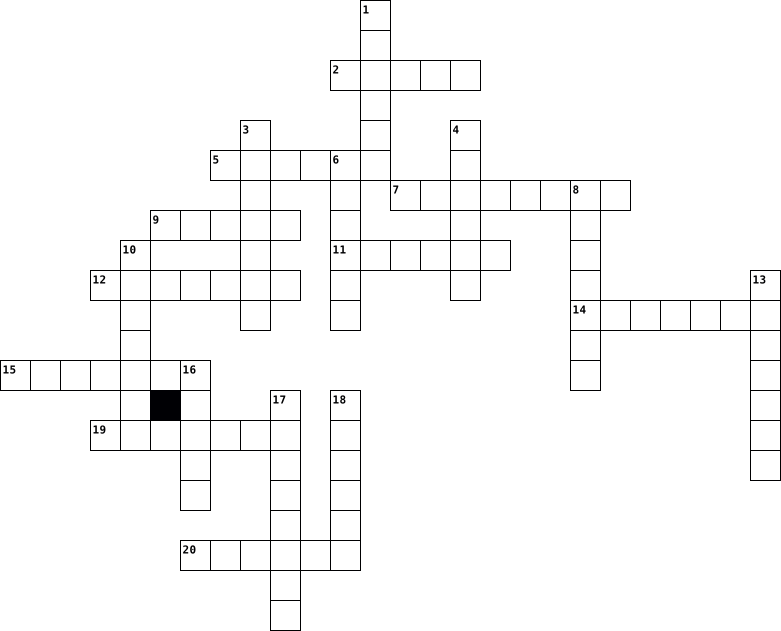
Across
- Greece
- Germany
- Japan
- Ireland
- Bangladesh
- Russia
- Italy
- Finland.
- China
- Poland
Down
- Korea
- Iran
- Nepal
- Saudi Arabia
- spain
- turkey
- United States
- India
- Georgia
- France
20 Clues: Iran • Korea • Nepal • Japan • spain • Italy • India • China • Greece • turkey • Russia • France • Poland • Germany • Ireland • Georgia • Finland. • Bangladesh • Saudi Arabia • United States
capital cities 2026-05-08

Across
- Norway
- Czech Republic
- United States
- UK
- Australia
- Italy
- France
- Estonia
- Portugal
- Bulgaria
- Romania
Down
- Denmark
- Slovakia
- Russia
- Iceland
- Cyprus
- Ireland
- Thailand
- Poland
- Lithuania
20 Clues: UK • Italy • Norway • Russia • Cyprus • France • Poland • Denmark • Iceland • Ireland • Estonia • Romania • Slovakia • Thailand • Portugal • Bulgaria • Australia • Lithuania • United States • Czech Republic
U.S History 2022-04-14

Across
- Who was the first African American Senetor
- 50% of a states white males take loyalty oath to the united states to readmitted to the union
- A system where the landlord/planter allows a tenant to use the land in exchange for a share of the crop
- That severely restricted African American lives
- The era was a period in American history following the American Civil War. It lasted from 1865 to 1877 and marked a significant chapter in the history of United States
- Which provided a Constitutional basis for the Civil rights act
Down
- In the united states is the process by which a legislatures lower house brings charges against Civil federal officer
- Is a largely historical term used by southerners to describe oppertontist Northerners who came to the Southern states after the American Civil War
- The term referred to white Southerners who supported Reconstruction policies and efforts after conclusion of the American Civil War
- What was the Fifteenth Amendment
- After Abraham was assassinated, who became president
11 Clues: What was the Fifteenth Amendment • Who was the first African American Senetor • That severely restricted African American lives • After Abraham was assassinated, who became president • Which provided a Constitutional basis for the Civil rights act • 50% of a states white males take loyalty oath to the united states to readmitted to the union • ...
Civil War 2022-05-25

Across
- A term meaning "before war"
- A long blade or knife attached to the end of a musket
- These states were slave states that did not leave the Union, but largely supported the cause of the Confederates. They included Missouri, Kentucky, Maryland, and Delaware.
- A person who wanted to eliminate or "abolish" slavery.
- Another name for the Confederate States of America or the South. The Confederacy was a group of states that left the United States to form their own country
- A soldier that is wounded or killed during battle
Down
- An attempt to stop people and supplies from going in or out of a port
- A commutation was when a person could pay a fee rather than be drafted into the army. This angered poorer people who could not pay the fee and had no choice but to fight.
- When a person is murdered for political reasons
- Large caliber firearms like cannons and mortars.
- An ankle high shoe worn by soldiers during the Civil War
11 Clues: A term meaning "before war" • When a person is murdered for political reasons • Large caliber firearms like cannons and mortars. • A soldier that is wounded or killed during battle • A long blade or knife attached to the end of a musket • A person who wanted to eliminate or "abolish" slavery. • An ankle high shoe worn by soldiers during the Civil War • ...
Manifest Destiny & Westward Expansion 2024-04-21

Across
- Texas was once part of which other country?
- Grande, What river was recognized as the border between Mexico and the United States?
- Destiny, ____ ____ was the belief that it was Americans' God given right to expand the country coast to coast.
- The 49ers were people who rushed to ____ in search of gold.
- Americans, Which group suffered tremendously as Americans moved west?
- True or false: There was concern over Texas being added to the USA because it would throw off the balance of free and slave states.
Down
- There was a population explosion due to ____ and natural birth so people decided to move west.
- The four countries laid claim to the Oregon territory in the 1800's were Britain, ____ , Russia and the United States.
- The Treaty of Guadalupe ____ ended the Mexican American War.
- As states entered the union, the major issue became whether or not to admit them as ________ or free states.
- Liberty, Who does the female in the Manifest Destiny painting represent?
11 Clues: Texas was once part of which other country? • The 49ers were people who rushed to ____ in search of gold. • The Treaty of Guadalupe ____ ended the Mexican American War. • Americans, Which group suffered tremendously as Americans moved west? • Liberty, Who does the female in the Manifest Destiny painting represent? • ...
The civil war 2022-03-09

Across
- Texas, Alabama and Georgia.
- the rights and powers held by individual US states rather than by the federal government.
- an island city on the Gulf Coast of Texas.
- the governing body of a nation, state, or community.
- focusing on ones religon
- He served as the first and third president
Down
- ultimate power
- General Robert E. Lee surrendered his Confederate troops to the Union's Ulysses S.
- a forcible overthrow of a government or social order, in favor of a new system.
- flows into the golf of mexico
- November 1863
- the states that did not separate from the United States.
12 Clues: November 1863 • ultimate power • focusing on ones religon • Texas, Alabama and Georgia. • flows into the golf of mexico • an island city on the Gulf Coast of Texas. • He served as the first and third president • the governing body of a nation, state, or community. • the states that did not separate from the United States. • ...
US History Homework 2 2022-09-10

Across
- Confederate general who served in the civil war.
- The 16th president of the united states.
- party that belived in a strong federal government.
- War between mexico and america.
- network of clandestine routes and houses in the united states.
- battle that brought the civil war to an end.
Down
- Period after the American civil war from 1896 to 1877
- Withdrawing from a former nation or state.
- Kansas engaged in a guerilla war between pro slavery and anti slavery forces.
- A home on a farm.
- The 7th President of the united states.
- The acquisition of the territory of Louisiana.
12 Clues: A home on a farm. • War between mexico and america. • The 7th President of the united states. • The 16th president of the united states. • Withdrawing from a former nation or state. • battle that brought the civil war to an end. • The acquisition of the territory of Louisiana. • Confederate general who served in the civil war. • ...
For Funzies 2025-04-07

Across
- "lightning war"
- The belief that if European states satisfied the reasonable demands of dissatisfied powers
- Worked to build the first atomic bomb
- Stemmed from military, political, and ideological differences, especially between the Soviet Union and the United States
- 34th President of the United States
- Germany, Italy, Japan
Down
- The deliberate attempt to exterminate the Jewish people of Europe
- Stalin, Roosevelt, and Churchill
- Japanese carrier-based aircraft attacked the U.S. naval base
- Maintained that a nation's power depended on the amount and kind of land it occupied
- An extermination camp
- Special Strike Forces
12 Clues: "lightning war" • An extermination camp • Special Strike Forces • Germany, Italy, Japan • Stalin, Roosevelt, and Churchill • 34th President of the United States • Worked to build the first atomic bomb • Japanese carrier-based aircraft attacked the U.S. naval base • The deliberate attempt to exterminate the Jewish people of Europe • ...
Articles of Confederation 2025-01-16

Across
- States work together for common goals
- The branch that has more power than the others
- NATO (North Atlantic Treaty Organisation)
- The Supreme Court
Down
- The legislative, executive, and judicial branches
- Ex. The "Kansas-Nebraska Act" in the United States
- Made up of 100 senators (2from each state) and 435 voting members of the House of Representatives
- The house of representatives or the Senate
- Office of the President (White House)
- The Constitution
- I ________ my family vacation because I don't want to go to Zoo
- The ability to tax people between the nation and the states
12 Clues: The Constitution • The Supreme Court • Office of the President (White House) • States work together for common goals • NATO (North Atlantic Treaty Organisation) • The house of representatives or the Senate • The branch that has more power than the others • The legislative, executive, and judicial branches • Ex. The "Kansas-Nebraska Act" in the United States • ...
Chapter 9 section 3 2026-01-26

Across
- was more fluid than the western front.
- were know as the American Expeditionary force.
- increased tensions between the United States and Germany
- limited submarines warfare after the Sussex pledge.
- commanded American air forces in Europe.
- helped turn the tide of the war infavor of the Allies.
Down
- conditions in trenches facing disease,mud and constant danger
- created a military draft to build the armed forces.
- began in Europe in 1914.
- machine guns, poison gas,submarines,and airplanes
- United States declared war on Germany.
- proposed an alliance between Germany and Mexico against the United States.
12 Clues: began in Europe in 1914. • was more fluid than the western front. • United States declared war on Germany. • commanded American air forces in Europe. • were know as the American Expeditionary force. • machine guns, poison gas,submarines,and airplanes • created a military draft to build the armed forces. • limited submarines warfare after the Sussex pledge. • ...
Social Studies Unit 2 Review 2025-11-12

Across
- legend, You would find words and symbols for a map on the _____
- A country south of the United States
- People moved west to look for good ____
- _____ tells where places are
- urban land has many _____
- the path you follow from one place to another is called a ___
Down
- directions, North, south, east, and west are ____
- A good use for rural land is _____
- A map measures the ____ between two places
- directions, A directional indicator shows _____
- The country to the north of the United States is ___
- A smaller community near a big city
- Plains, A landform in the middle of the United States
13 Clues: urban land has many _____ • _____ tells where places are • A good use for rural land is _____ • A smaller community near a big city • A country south of the United States • People moved west to look for good ____ • A map measures the ____ between two places • directions, A directional indicator shows _____ • directions, North, south, east, and west are ____ • ...
Standard 2 2023-05-04

Across
- phrase frequently used by Southern politicians and authors prior to the American Civil War, indicating the economic and political importance of cotton production
- bank war
- system
- Act of 1854
- United States foreign policy position
- acquisition of the territory of Louisiana
- conflict between the United States and Mexico from 1846 to 1848.
- 1850
- the resistance to enslavement through escape and flight
- convention
Down
- Rebellion
- Destiney
- forced displacement of tribes
- commonly shortened to the KKK
- Jacksonian
- 13th Amendment
- required that slaves be returned to their owners, even if they were in a free state
- revolution
- restricted black people's right to own property
19 Clues: 1850 • system • Destiney • bank war • Rebellion • Jacksonian • revolution • convention • Act of 1854 • 13th Amendment • forced displacement of tribes • commonly shortened to the KKK • United States foreign policy position • acquisition of the territory of Louisiana • restricted black people's right to own property • the resistance to enslavement through escape and flight • ...
Wyatt unit 1 crossword 2024-09-19

Across
- three king of England in 1760
- civil war in England broke out after____was signed
- troops 1 action of second continental congress
- place where seeds of democracy take root
- federal systems of gov't are an_____invention
- five number of delegates at constitutional convention
- what were delegates called
- location of first continental congress
Down
- Washington commander of continental army
- how many states ratified the constitution
- defined and recognized borders
- example of a dictatorship
- one natural right
- Jefferson author of declaration of independence
- Cooke English philosopher
- Carta signed in 1215
- colony enjoyed most independence from crown
- how many states sent representatives to Philadelphia
- who supported constitution
- two chamber legislature
20 Clues: one natural right • Carta signed in 1215 • two chamber legislature • example of a dictatorship • what were delegates called • who supported constitution • Cooke English philosopher • defined and recognized borders • three king of England in 1760 • location of first continental congress • place where seeds of democracy take root • ...
Agriculture in the US 2022-09-12

Across
- Deals with money.
- Top Agriculture State.
- Name for Cows.
- The industry that produces our food.
- Crop used to make bread.
- Red fruit produced in New York.
- Area of ag that raises animals.
- Sweet substance from Maple Trees
- Name for Pigs.
Down
- Can turn this product into sugar.
- Produces Citrus and many other fruits.
- Most productive agriculture region.
- Breed of Beef Cattle famous in Texas
- United States Department of Agriculture
- Department of Environmental Conservation
- Future Farmers of America
- Machine used on farms to pull equipment.
- Place where our food is produced.
- Produced in all 50 States
19 Clues: Name for Cows. • Name for Pigs. • Deals with money. • Top Agriculture State. • Crop used to make bread. • Future Farmers of America • Produced in all 50 States • Red fruit produced in New York. • Area of ag that raises animals. • Sweet substance from Maple Trees • Can turn this product into sugar. • Place where our food is produced. • Most productive agriculture region. • ...
Important People of the Revolutionary War 2016-01-29

Across
- American Activist and Artisan
- First published African author in America
- American Statesman who discovered electricity
- First Chief Justice of the United States
- Fourth President of the United States
- American Politician, Entrepreneur, and Soldier
Down
- They led the Sons of Liberty in the Boston Massacre
- The infamous general that led most of the attacks against the British
- Third president of the U.S. and Co-author of the Declaration of Independence
- American General who became a traitor by going and fighting for the British instead
- Second President of the United States
- First United Secretary of War
12 Clues: American Activist and Artisan • First United Secretary of War • Second President of the United States • Fourth President of the United States • First Chief Justice of the United States • First published African author in America • American Statesman who discovered electricity • American Politician, Entrepreneur, and Soldier • ...
station 1 2022-10-19

Across
- another word for withdrawal
- _ versus sectionalism in the civil war
- What allowed slavery to go on for so long?
- What was the country experiencing between the North and South states?
- path to for slaves to escape from South states
Down
- what was cotton to land owners during this time?
- What industry was overproduced before the civil war?
- What fought for fair work conditions and pay?
- Invention allowed communication
- What's the nickname for the fights over slavery in Kansas territory
- What were the middle ground called between North and South states?
- What created a growing lower class
12 Clues: another word for withdrawal • Invention allowed communication • What created a growing lower class • _ versus sectionalism in the civil war • What allowed slavery to go on for so long? • What fought for fair work conditions and pay? • path to for slaves to escape from South states • what was cotton to land owners during this time? • ...