
the earth Crossword Puzzles
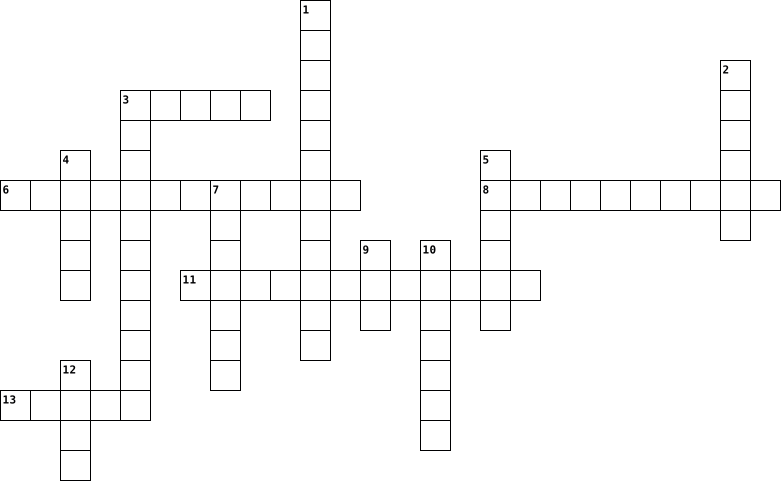
Plate Tectonic Terms 2023-02-15

Across
- earth's outermost layer
- 90% of earthquakes occur inside of this ring
- an instrument used to record the motion of the ground during an earthquake
- there are this many major tectonic plates
- a weaker layer of earth that is beneath the lithosphere
- Alfred Wegener suggested that this was happening to the continents
- a phenomenon caused by the slipping of tectonic plates
- when crust is destroyed as one plate goes under another
- super continent that existed hundreds of millions of years ago
Down
- the solid outer part of earth. It includes the upper part of the mantle and the crust
- when new crust is created as two plates pull away from each other
- when crust is not created or destroyed, as the plates slide past each other horizontally
- last name of the person who proposed "continental drift"
- large pieces of earth's crust and mantle
- a split between two bodies (ex: two plates)
- the centre of the earth
- the proper term for molten rock
- last name of the person who invented the seismic magnitude scale
- formed when lava flows through cracks in the earth
- earthquakes and volcanoes occur along the _____ of plates
20 Clues: earth's outermost layer • the centre of the earth • the proper term for molten rock • large pieces of earth's crust and mantle • there are this many major tectonic plates • a split between two bodies (ex: two plates) • 90% of earthquakes occur inside of this ring • formed when lava flows through cracks in the earth • a phenomenon caused by the slipping of tectonic plates • ...
Trooper's Star Crossword 2025-05-16

Across
- the constaltion between the little dipper and big dipper
- the brightest star in the night
- earth and jupiter are _____
- what planet earth does around the sun
- how long it takes light to travel
- the closest star to earth
- the resistance to change an objects state of motion
- a very good candy bar thats green and brown
- 2 of this element and 1 oxygen will create water
- the name of the lion that hercules killed
- the big dipper the little dipper and cancer are all ____
- the planet we live on
- starlink has a lot of these
- 1 and a half hours
- the first spacecraft to pass the heliosphere
Down
- a guide to find other stars in the sky
- a super dense hole that light cant escape
- a vast doughnut shaped ring
- a space bassed research lab
- a large space observatory
- the milky way _____
- a cloud of dust and gas in space
- what pulls us down when we jump
- the north star
- twinkle, twinkle little _____
- a galaxy located 2.5 millon light years away
- he killed leo the lion
27 Clues: the north star • 1 and a half hours • the milky way _____ • the planet we live on • he killed leo the lion • a large space observatory • the closest star to earth • a vast doughnut shaped ring • a space bassed research lab • earth and jupiter are _____ • starlink has a lot of these • twinkle, twinkle little _____ • the brightest star in the night • what pulls us down when we jump • ...
Geo/Therm/Scope/Meter/Logy 2023-03-16

Across
- sees around
- measures heat
- sees small things
- sees into your chest
- sees the Earth
- tells you the temperature
- study of the Earth
Down
- measures speed
- study of animals
- 1000 standard measurements
- study of life
- study of religion
- Earth meter
- keeps or repels heat
14 Clues: sees around • Earth meter • study of life • measures heat • measures speed • sees the Earth • study of animals • study of religion • sees small things • study of the Earth • sees into your chest • keeps or repels heat • tells you the temperature • 1000 standard measurements
Reasons Of Biodiversity Loss 2023-03-22

Across
- The materials naturally made from the Earth
- Loss Of Trees On Earth
- The decomposition of the environment
- The human consumption of the Earth’s oceans
- Harmful Materials In The Air
- Harmful Materials To Our Environment
- The depletion of food or resources
- The Lower Quality In The Environment
- Long Shifts In Weather Patterns
- A Lack A Food Resources
Down
- The overuse of the earth’s resources
- The Rise In The Human Species
- A reaction in which two or more elements or compounds combine to form a new product.
- Harmful Materials In Our Water
- Harmful Materials In Different Environments
- people’s actions to the Earth
- The destruction of an animal's home
- A Non-Native Animal
- The human consumption of the Earth’s land
- Searching For A Species And Trying To Gather It
20 Clues: A Non-Native Animal • Loss Of Trees On Earth • A Lack A Food Resources • Harmful Materials In The Air • The Rise In The Human Species • people’s actions to the Earth • Harmful Materials In Our Water • Long Shifts In Weather Patterns • The depletion of food or resources • The destruction of an animal's home • The overuse of the earth’s resources • ...
Igneous Rocks 2021-10-11

Across
- Low density rock found on the beach
- Liquid rock found in the crust
- Part of the earth with plastic rock
- Dark coloured lava
- Metal found in Inner core
- size depends on the rate of cooling
- mountain where lava flows
- Feature of Earth's core
- Rock formed by lava
- Liquid rock that flows out of a volcano
Down
- Rock formed in the crust
- Castle Hill is made of this
- Large rock thrown out of a volcano
- Dark volcanic glass
- Centre of the Earth
- Substances that make up rocks
- Common element found in minerals
- Hard outer layer of the earth
18 Clues: Dark coloured lava • Dark volcanic glass • Centre of the Earth • Rock formed by lava • Feature of Earth's core • Rock formed in the crust • Metal found in Inner core • mountain where lava flows • Castle Hill is made of this • Substances that make up rocks • Hard outer layer of the earth • Liquid rock found in the crust • Common element found in minerals • ...
nanyanhgb 2025-05-18

Across
- A human-made object that orbits Earth.
- The circular movement of Earth around the Sun.
- Small plastic pieces harmful to aquatic life.
- Planet that we live on.
- Most common gas in Earth’s atmosphere.
- Type of pollution caused by burning fossil fuels.
- of using items again instead of throwing them away.
- Underground source of water.
- Season that occurs when a hemisphere tilts away from the Sun.
Down
- Gases from pollution can mix with water to form this harmful rain.
- Natural satellite of the Earth.
- Process where water changes from liquid to gas.
- The process of vapor turning into liquid.
- The layer of gases around the planet.
- Object at the center of the solar system.
- The shape of Earth’s orbit around the Sun (slightly ________).
16 Clues: Planet that we live on. • Underground source of water. • Natural satellite of the Earth. • Object at the center of the solar system. • Most common gas in Earth’s atmosphere. • The layer of gases around the planet. • A human-made object that orbits Earth. • The process of vapor turning into liquid. • ...
Moon Cycle Stages 2023-11-01

Across
- he order the cycle goes
- Satelite orbiting the Earth
- First phase of the moon cycle
- Almost completly dark, light on the left
- Before a full moon
- Dark on the right halfway
- Planet we currently live in
- When the Moon blocks the suns light
- Brightest Item in the solar system
- When the moon passes into the earths shadow
Down
- An object that orbits the earth
- Dark on the right first stage
- Light on the right halfway
- First Light on the right
- A meteor that makes it past the earths atmosphere
- All the moon is lit
- Caused by the Moon in the ocean
17 Clues: Before a full moon • All the moon is lit • he order the cycle goes • First Light on the right • Dark on the right halfway • Light on the right halfway • Satelite orbiting the Earth • Planet we currently live in • Dark on the right first stage • First phase of the moon cycle • An object that orbits the earth • Caused by the Moon in the ocean • Brightest Item in the solar system • ...
social studies the earth 2023-01-24

Across
- The beginning of seasons.
- Seams in the crust.
- The process of dropping eroded material.
- Part of a whole.
- Contains all the solid, liquid, and gaseous water of the planet.
Down
- Provide something necessary, to maintain.
- Molten rock.
- Contains all the planet's living things.
- The breaking apart of rocks, while erosion carries away the pieces.
- Contains all of the cold, hard solid land of the planet's crust (surface), the semi-solid land underneath the crust, and the liquid land near the center of the planet.
- Period during which hours of daylight and hours of darkness are of equal length everywhere on Earth.
- Contains all the air in earth's system.
12 Clues: Molten rock. • Part of a whole. • Seams in the crust. • The beginning of seasons. • Contains all the air in earth's system. • Contains all the planet's living things. • The process of dropping eroded material. • Provide something necessary, to maintain. • Contains all the solid, liquid, and gaseous water of the planet. • ...
The Earth Cross word 2023-02-15

Across
- The Movement of plates
- The Size to weight ratio of an object
- two plates moving towards each other form a ___ boundary
- What Mr.Codwell is trying to convey by swimming in the air, warm spot that heats stuff, making it go up and push other thing out of the way
- When something goes under something else
Down
- Batmans Butler(Science mode)
- two plates moving away from each other form a ___ boundary
- can have bread + peanut butter
- The reason for the plates movement
- two plates rubbing against each other form a ___ boundary
- James
- Trevor
12 Clues: James • Trevor • The Movement of plates • Batmans Butler(Science mode) • can have bread + peanut butter • The reason for the plates movement • The Size to weight ratio of an object • When something goes under something else • two plates moving towards each other form a ___ boundary • two plates rubbing against each other form a ___ boundary • ...
Layers of the Earth 2023-02-17

Across
- Thickest layer inside the Earth between the core and the crust; made of silicon
- Lightest, least dense, outermost rock layer; made of oxygen and silicon
- Structural layers of Earth defined on the basis of how materials act
- The region of the mantle beneath the lithosphere and asthenosphere, but above outer core; made of magnesium; high pressure
- The quality of being easily shaped or molded
- The innermost layer of the Earth; solid and believed to be made of iron and nickel; very hot
Down
- The central region of the Earth; made of nickel and iron
- Structural layers of the Earth defined by the materials from which they are made
- The solid and rigid outer layer of the Earth consisting of the crust and the solid portion of the upper mantle; between atmosphere and asthenosphere
- Having the qualities of both a solid and a liquid; exceptionally thick substance
- Thick, fluid layer above solid inner core and below mantle; made of nickel and iron
- The somewhat fluid portion of the mantle upon which the lithosphere is located
12 Clues: The quality of being easily shaped or molded • The central region of the Earth; made of nickel and iron • Structural layers of Earth defined on the basis of how materials act • Lightest, least dense, outermost rock layer; made of oxygen and silicon • The somewhat fluid portion of the mantle upon which the lithosphere is located • ...
Layers of the Earth 2021-10-14

Across
- melted rock below Earth's surface.
- The thickest layer of Earth, underneath the crust, composed of magnesium and iron.
- Solid outer section of the Earth, which includes the crust.
- solid and most dense layer of Earth, made of iron and nickel; creates the magnetic field.
- Molten or melted rock that reaches Earth's surface.
- The top and thinnest layer of earth, similar to the skin of an apple.
- Thin layer of crust that overlies the ocean basins, mostly thinner basalt rock.
- A flow of fluid or air due to heating and cooling of the fluid or air.
Down
- Layer of dense, semi molten (plastic like) material and the crust moves.
- Waves of Energy caused by eathquakes and other rock movement.
- layer of rock which forms the continents, mostly thicker granite
- The second largest (thickest) layer of Earth that is liquid iron and nickel.
12 Clues: melted rock below Earth's surface. • Molten or melted rock that reaches Earth's surface. • Solid outer section of the Earth, which includes the crust. • Waves of Energy caused by eathquakes and other rock movement. • layer of rock which forms the continents, mostly thicker granite • The top and thinnest layer of earth, similar to the skin of an apple. • ...
Layers of the Earth 2022-11-21

Across
- a process to form sedimentary rock
- Nickel and Iron, what makes up two of Earth's layers
- rock made of sediment that was compacted and cemented
- a process involved with making igneous rock
- rock made by heat and pressure
- the 2nd most dense layer, contains nickel and iron, only liquid layer
- the layer that is made of molten rock, causes plates to move
Down
- heat that makes rocks rise and fall
- rock that was made of cooled magma
- caused by earthquakes, only way scientists can study layers
- layer that is east dense and outermost
- the densest core, made up of iron and nickel, middlest
12 Clues: rock made by heat and pressure • a process to form sedimentary rock • rock that was made of cooled magma • heat that makes rocks rise and fall • layer that is east dense and outermost • a process involved with making igneous rock • Nickel and Iron, what makes up two of Earth's layers • rock made of sediment that was compacted and cemented • ...
Layers of the Earth 2016-12-15

Across
- This type of crust is made up of mostly basalt.
- This type of crust is made up of mostly granite.
- This is the thinnest layer of the Earth.
- This is the thickest layer of the Earth and makes up 70% of the Earth's mass.
- When the mantle pushes through the Earth's crust, these erupt.
- This layer is made up of molten liquid.
- The inner core has 3,000,000 times more of this than at sea level.
Down
- This inner core is this.
- The outer core is responsible for the Earth's this.
- The mantle's consistency is solid, but capable of flow like this.
- The outer core is made up of nickel and this.
- This layer is made up of mostly iron.
12 Clues: This inner core is this. • This layer is made up of mostly iron. • This layer is made up of molten liquid. • This is the thinnest layer of the Earth. • The outer core is made up of nickel and this. • This type of crust is made up of mostly basalt. • This type of crust is made up of mostly granite. • The outer core is responsible for the Earth's this. • ...
The Earth-Moon System 2024-03-21

Across
- Different shapes of the moon visible from Earth
- The darkest part of the moon's shadow
- Occurs when the noon is directly between the Sun and Earth
- Where there is the least change between daily high tide and low tides
- Regular rise and fall of ocean waters
- A region of shadow that is less dark than the umbra
- Chunks of rock that move through the solar system
Down
- When the change between daily high and low tides is the greatest
- Low, flat plains formed by ancient lunar lava flows
- When the shadow of one body in space (planet or moon) falls on another
- occurs when the moon is on the opposite side of the Earth from the Sun and the whole side facing the Earth is lit by the moon
- Round depressions in the surface caused by the impact of high-speed meteoroids
12 Clues: The darkest part of the moon's shadow • Regular rise and fall of ocean waters • Different shapes of the moon visible from Earth • Chunks of rock that move through the solar system • Low, flat plains formed by ancient lunar lava flows • A region of shadow that is less dark than the umbra • Occurs when the noon is directly between the Sun and Earth • ...
Atmosphere and the Earth 2024-03-08

Across
- the gas that we breathe out
- the useful gas in the atmosphere
- the outer layer of the earth
- the gas layer around the Earth
- rock that is made when magma cools
- the process by which rocks can change from one to another
- the rock that fossils are found in
Down
- the most abundant gas in the atmosphere
- rock that is made under heat and pressure
- the process where plants make their own food and give out oxygen
- the process by which carbon is recycled
- the remains of animals or plants that lived millions of years ago
12 Clues: the gas that we breathe out • the outer layer of the earth • the gas layer around the Earth • the useful gas in the atmosphere • rock that is made when magma cools • the rock that fossils are found in • the most abundant gas in the atmosphere • the process by which carbon is recycled • rock that is made under heat and pressure • ...
The Earth and space 2025-05-21

Across
- The separating movement of two tectonic plates
- Which is the biggest planet in the Solar system?
- Name of our galaxy
- What type of space object is the Sun called?
- The layer of the Earth that we live in
- How many planets are their in our Solar system?
- What is the Earth's natural satellite?
- The hottest layer in the centre of the Earth
Down
- What type of object is Pluto called?
- After a giant star collapses, it turns into this object.
- The magma layer of the Earth
- What type of planet is the Earth, Mars and Venus?
12 Clues: Name of our galaxy • The magma layer of the Earth • What type of object is Pluto called? • The layer of the Earth that we live in • What is the Earth's natural satellite? • What type of space object is the Sun called? • The hottest layer in the centre of the Earth • The separating movement of two tectonic plates • How many planets are their in our Solar system? • ...
Climate 2025-03-01

Across
- Angular distance north or south of the equator
- When these hit Earth, they release large amounts of dust and block sunlight
- Human caused changes to our climate
- All water on Earth
- All rock on Earth
- Is the measure of how circular or elliptical a planet’s orbit is
- The higher you go in elevation/mountains, the _________ it gets
- This tilt changes over time between 22.1 and 24.5 degrees every 41,000 years.
- Cities are ___________ because parking lots and buildings absorb heat
- How the Koppen Climate Zones are determined
Down
- _____________ cycles discuss how Earth's climate varies due to differences in sunlight reaching our planet
- All living things on Earth
- Air surrounding earth
- Volcanos release large amounts of this compound and alter our atmosphere
- Long term temperature and precipitation trends in an area
- As we spin each day, our axis wobbles in a circle called axial ____________________.
16 Clues: All rock on Earth • All water on Earth • Air surrounding earth • All living things on Earth • Human caused changes to our climate • How the Koppen Climate Zones are determined • Angular distance north or south of the equator • Long term temperature and precipitation trends in an area • The higher you go in elevation/mountains, the _________ it gets • ...
How do the seasons change? 2019-03-13

Across
- The ________ revolves around the Earth.
- A ________ is a very large ball of burning gas in space.
- _________ begins at the equinox in September.
- The ________ revolves around the sun.
- The _______ is when the day and night are the same amount of hours.
- The longest day of the year is during the summer ________.
Down
- The Earth is a _________.
- When it is summer in Spain, it is _______ in Australia.
- _________ begins at the equinox in March.
- The Earth spins on an _______.
- The ________ separates the northern and southern hemispheres.
- The _______ is the nearest star to the Earth.
12 Clues: The Earth is a _________. • The Earth spins on an _______. • The ________ revolves around the sun. • The ________ revolves around the Earth. • _________ begins at the equinox in March. • _________ begins at the equinox in September. • The _______ is the nearest star to the Earth. • When it is summer in Spain, it is _______ in Australia. • ...
Natural Resources 2021-11-30

Across
- salted water
- smoke mixed with fog
- DNA and RNA are called
- used in nitrification
- compound of hydrogen and carbon
- living organisms on earth from the _ component
- glass building which usually has plants
- process of rotting
Down
- fourth stage in water cycle
- Green plants and animals are also known as
- most important gaseous cycle
- a toxic colorless gas surrounding the earth
- emission of energy as electromagnetic waves
- Water on earth
- a rigid external covering for some animals
- a source
- 21% of atmosphere
- air on the earth's surface
18 Clues: a source • salted water • Water on earth • 21% of atmosphere • process of rotting • smoke mixed with fog • used in nitrification • DNA and RNA are called • air on the earth's surface • fourth stage in water cycle • most important gaseous cycle • compound of hydrogen and carbon • glass building which usually has plants • Green plants and animals are also known as • ...
Science 6: Chapter 1 2021-09-13

Across
- the origin of an earthquake
- a type of fast moving lava flow
- the crust and outer mantle of the Earth
- a machine that measures earthquakes
- a fault where rock moves apart
- a fault where rock slides
- a fault where rock moves upward
- the waves caused by movement in the Earth
- the strength of an earthquake
- the type of seismic wave felt on the earth
- the spot above the origin of an earthquake
Down
- the edge of a plate
- the space between plates
- the pieces of the earth's crust
- rock ejected into the air by a volcano
- rock formed from cooled magma and lava
- a huge wave that can do serious damage
- the main vent of a volcano
- the most powerful volcanic eruption
- a fountain that shoots out of hot springs
20 Clues: the edge of a plate • the space between plates • a fault where rock slides • the main vent of a volcano • the origin of an earthquake • the strength of an earthquake • a fault where rock moves apart • a type of fast moving lava flow • the pieces of the earth's crust • a fault where rock moves upward • a machine that measures earthquakes • the most powerful volcanic eruption • ...
Earth,Moon, and Sun glossary 2025-03-11

Across
- a moon outside our solar system
- the star that is the main source of light at the center of our solar system
- the relative size of things
- to shine light on an object and make it visible
- eclipse when the moon is completely dark
- moon a moon phase in which the moon is not visible from Earth
- a planet outside our solar system
- the border between light and dark on the moon
- moon a moon phase that looks like a half circle from Earth
Down
- moon a moon phase that looks like more than half a circle from Earth
- a rocky sphere that travels around a planet
- moon a moon phase that looks like a full circle from earth
- an object,diagram, or computer program that helps us understand something by making it simpler or easier to see
- system the sun,the planets that orbit the sun, and other objects that orbit the sun
- moon a moon phase that looks like less than half a circle
- something we observe to be similar over and over again
- phase the shape of the illuminated part of the moon as it appears from earth
- the nearly circular path a smaller object (like the moon) travels around a larger object (like earth)
- the amount of time it takes for a planet to complete one orbit around a star or stars
19 Clues: the relative size of things • a moon outside our solar system • a planet outside our solar system • eclipse when the moon is completely dark • a rocky sphere that travels around a planet • the border between light and dark on the moon • to shine light on an object and make it visible • something we observe to be similar over and over again • ...
Rotation and Revolution 2020-04-25

Across
- The area that has summer has more ____ rays of the Sun hitting it. (ertdci)
- The imaginary line that passes through its center from the North to the South Pole. (sxia)
- Neither hemisphere is tilted toward the sun ___ days a year during the equinoxes (wot)
- The study of the Earth, moon, stars, and other objects in space. (moonytras)
- The movement of one body around another. (rentloouiv)
- Polaris is another name for the North _____. (rats)
Down
- If the Earth had no ____, we would not have seasons. (ltti)
- Earth's ______ on its axis makes the sun and moon appear to travel across the sky. (irootant)
- The _____ of the Sun to the Earth does NOT cause the seasons. (slonecess)
- In spring and fall the Sun hits the Northern and Southern _______ equally. (shimperheps)
- The Earth tilts at a 23.5 degree ______. (glane)
- The side of the Earth facing the Sun experiences this. (yad)
- The ____ revolves around the Earth. (mono)
13 Clues: The ____ revolves around the Earth. (mono) • The Earth tilts at a 23.5 degree ______. (glane) • Polaris is another name for the North _____. (rats) • The movement of one body around another. (rentloouiv) • If the Earth had no ____, we would not have seasons. (ltti) • The side of the Earth facing the Sun experiences this. (yad) • ...
Let's learn Earth & Space 2020-11-26

Across
- Seismic wave that travels across the surface of the earth as opposed through it.
- surface.
- Seismic wave that travels through the earth rather than across its surface
- Top layer of earth.
- Hot molten material that rises from the mantle to the crust.
- It is formed when a continental plate and an ocean plate collides.
- Method that is used to locate the epicenter of an earthquake.
- A type of plate boundary that are sliding past each other.
- Geologic feature that may form when plates are moving away from each other.
- The one who made the continental drift theory.
- Wave of energy that travels through the earth as a result of
- A type of plate boundary that plates are moving away from each other.
- The boundary between the crust and mantle, as inferred from the change in the speed of body waves.
- Proposed to be the supercontinent 250 million years ago.
- Formed when two oceanic crusts collide.
- Deepest part of earth.
- Geologic feature that happens when two continental plates collide.
- Upper mantle.
- Other possible cause of plate movements which the weight of the subducting plate pulls the trailing slab into the subduction zone just like a tablecloth slipping off the table and pulling items with it.
Down
- This may happen during divergence or convergence of plates because of the movement of plates.
- Thickest layer of the earth where magma comes from.
- A recording device that is used to locate the earthqiake's epicenter.
- A concentration of heat in the mantle capable of creating magma.
- Time difference between the p-waves and s-waves.
- Is the instrument used to mapped the mid-ocean ridges
- A type of plate boundary that collides with each other.
- An upwelling of superheated rock from the mantle.
- Geologic feature that happens when two continental plates move apart from each other.
- A very large wave that is caused by earthquake.
- The very slow creeping motion of earth's solid silicate mantle caused by convection currents carrying heat from the interior to the
- Theory that states that the earth's crust is divided into several plates.
- Surface seismic wave generated by the interaction of p-waves and s-waves at the surface of the earth that move with a rolling motion.
- The point on the surface directly above the focus.
- Theory that states that there was a big continent before.
- Process which happens when ocean plates move apart and magma rises from the mantle and create new areas of oceanic crust.
- Outer crust.
- This process happens when the oceanic crust sinks beneath the continental crust.
- Surface seismic wave that cause horizontal shifting of the earth during an earthquake.
- The point within the earth where the actual movement takes
- One of the possible cause of plate movements which the ridge pushes the old sea-floor towards the trench and it will subduct.
- A geologist who proposed the theory of sea-floor spreading.
41 Clues: surface. • Outer crust. • Upper mantle. • Top layer of earth. • Deepest part of earth. • Formed when two oceanic crusts collide. • A very large wave that is caused by earthquake. • Time difference between the p-waves and s-waves. • An upwelling of superheated rock from the mantle. • The point on the surface directly above the focus. • ...
Weather 2021-10-12

Across
- The time at which the sun begins to rise
- The degree of heat in an area
- The star which earth orbits
- Ice crystals that fall to earth as small white flakes
- The force exerted on a surface by air as gravity pulls it to earth
- Precipitation that forms in balls of ice
- Movement of air
Down
- The temperature at which dew occurs
- A type of liquid precipitation
- The study of weather
- An expert that studies meteorology
- The time at which the sun begins to set
- Rain, snow, sleet, or hail that falls to earth
- A visible mass of water vapor floating in the atmosphere
- Amount of water vapor in the air
15 Clues: Movement of air • The study of weather • The star which earth orbits • The degree of heat in an area • A type of liquid precipitation • Amount of water vapor in the air • An expert that studies meteorology • The temperature at which dew occurs • The time at which the sun begins to set • The time at which the sun begins to rise • Precipitation that forms in balls of ice • ...
Natural Disasters Words 2012-10-07

Across
- molted Rock
- it cause thunder
- caused by disasters
- spinning tornado
- Fires when its summer
- Slides a bunch of rocks falling
- a huge wave
Down
- volcanos
- when the earth drys up
- travelling snow
- explode
- when the earth moves
- spinning disaster
- a rush load of water
- Slides earth rocks rolling
15 Clues: explode • volcanos • molted Rock • a huge wave • travelling snow • it cause thunder • spinning tornado • spinning disaster • caused by disasters • when the earth moves • a rush load of water • Fires when its summer • when the earth drys up • Slides earth rocks rolling • Slides a bunch of rocks falling
Q5. Complete the grid with the help of clues: 2019-01-07

Across
- Model of the Earth
- Our solar system is a part of this galaxy
- Layer of gas that surrounds the Earth
- Ferdinand Magellan and his sailors sailed on this ship
- Covers 70 percent of the Earth's surface
- Shape of the Earth
- Ocean named after our country
Down
- The large landmasses on the Earth
- Planet named after the Roman goddess of love and beauty
- Continent covered with ice
- Third planet in our solar system
- Dwarf planet
12 Clues: Dwarf planet • Model of the Earth • Shape of the Earth • Continent covered with ice • Ocean named after our country • Third planet in our solar system • The large landmasses on the Earth • Layer of gas that surrounds the Earth • Covers 70 percent of the Earth's surface • Our solar system is a part of this galaxy • Ferdinand Magellan and his sailors sailed on this ship • ...
SPACE 2013-08-06

Across
- Someone that challenges people
- A compacter that holds trash
- Spheres that rotate around the sun
- A flying vehicle
- A man that goes into space to investigate
- Used to make repeated journeys between the earth and earth orbit.
- Investigation; adventure
- Another name for space ship
- Instrument that helps you see out to space
- Another way to say dark side
Down
- Where all comets and asteroids are.
- Printer messages
- Foot holder
- It’s sticky in other words.
- Satellite base
- A space program
- A mysterious object seen in the sky
- Of or relating to the atmosphere of the earth or (occasionally) another planet
- U.S space laboratory
- What hold us close to the sun
20 Clues: Foot holder • Satellite base • A space program • Printer messages • A flying vehicle • U.S space laboratory • Investigation; adventure • It’s sticky in other words. • Another name for space ship • A compacter that holds trash • Another way to say dark side • What hold us close to the sun • Someone that challenges people • Spheres that rotate around the sun • ...
Interesting Facts 2023-11-30

Across
- Gassy layer surrounding Earth
- Cold, white, fluffy precipitation
- Natural satellite of Earth
- Earth's largest ocean
- First element on the periodic table
- Powerful natural event with shaking ground
- Bright flashes of light during a storm
- Liquid that gives life to plants
- Our planet's closest star
- The science of matter and energy
Down
- Force that pulls objects toward the Earth
- Tiny building blocks of matter
- Process where plants make their own food
- Red planet in our solar system
- The study of living things
- Organ responsible for thinking and learning
- Glowing insects that light up the night
- Fastest land animal
- Shiny objects in the night sky
- Cold region with polar bears and ice
20 Clues: Fastest land animal • Earth's largest ocean • Our planet's closest star • Natural satellite of Earth • The study of living things • Gassy layer surrounding Earth • Tiny building blocks of matter • Red planet in our solar system • Shiny objects in the night sky • Liquid that gives life to plants • The science of matter and energy • Cold, white, fluffy precipitation • ...
Earth's Layers 2021-12-02

Across
- the fourth layer of the Earth
- Earth's inner core is a solid ball of ______ and nickel
- temperature and pressure_________ as you move down through Earth's layers
- Oceanic crust is _________ than continental crust
- the third layer of the Earth
- the second layer of the Earth
- The crust and the uppermost mantle make up the solid layer of hard rock called the
- the thickest layer of the Earth
Down
- the liquid layer of molten rock.
- layer of the Earth that lies below the lithosphere. It is very similar to bubblegum in terms of texture.
- the amount of layers of the Earth
- the core is ______% of Earth's mass
- the crust is _______% of Earth's mass.
- the first layer of the Earth
- the mantle is _________% of Earth's mass
- the thinnest layer of the Earth
16 Clues: the first layer of the Earth • the third layer of the Earth • the fourth layer of the Earth • the second layer of the Earth • the thinnest layer of the Earth • the thickest layer of the Earth • the liquid layer of molten rock. • the amount of layers of the Earth • the core is ______% of Earth's mass • the crust is _______% of Earth's mass. • ...
Genesis Chapter 7 2024-01-14

Across
- - So He destroyed all ___ things which were on the face of the ground:
- - Only Noah and those who were with him in the ark remained ___
- - And the windows of ___ were opened
- - And the waters prevailed on the earth one hundred and ___ days
- - on that day all the ___ of the great deep were broken up,
- - And Noah did according to all that the ___ commanded him
- - All the high hills under the whole heaven were ___
- - And the ___ prevailed on the earth one hundred and fifty days.
Down
- - The number of people who were on the ark
- - The number of clean animals (male and female) that Noah brought into the ark
- - And I will ___ from the face of the earth all living things that I have made.
- - The waters increased and ___ up the ark,
- - The number of unclean animals (male and female) that Noah brought into the ark
- - Number of days and nights it rained on the earth
- - For after ___ more days I will cause it to rain on the earth...
- - And all ___ died that moved on the earth
16 Clues: - And the windows of ___ were opened • - The number of people who were on the ark • - The waters increased and ___ up the ark, • - And all ___ died that moved on the earth • - Number of days and nights it rained on the earth • - All the high hills under the whole heaven were ___ • - And Noah did according to all that the ___ commanded him • ...
Creation 2015-09-19

Across
- God called the _____ day.
- God said "Let us create ______ in our image."
- God created the great whales and every living _______ that move.
- In the ____, God created the heaven and the earth.
- On the ______ day, God rested.
- The first book of the bible.
- and _____ saw that it was good.
Down
- In the beginning, God ______ the heaven and the earth.
- On the third day, God created the trees that yield _____.
- God called the firmament _____ on the second day.
- And the ____ he called night.
- God made two great lights to rule the day and night. He made the _____ also.
- On the sixth day, God created the ____ of the earth.
- God called the dry land _____.
- God created man in his own ______.
15 Clues: God called the _____ day. • The first book of the bible. • And the ____ he called night. • On the ______ day, God rested. • God called the dry land _____. • and _____ saw that it was good. • God created man in his own ______. • God said "Let us create ______ in our image." • God called the firmament _____ on the second day. • ...
Witty Milky Way 2024-01-24

Across
- A region around the earth that shields the planet from solar radiation.
- The outside layer of earth made from rock and minerals
- The Redirection of waves when passing from one medium to another with varying densities
- Sunlight falls more direct on Northern hemisphere.
- During March and the sun shines equally on both hemispheres.
- Measures the distance north or south of the equator on a globe or map.
- The thicker part of earths crust that forms large landmasses; older and more complex
- The most dense layer of earth.
- The thinner part of earths crust which makes up the ocean floor; younger and made of basaltic rock covered with sediments
Down
- The layer surrounding the inner core of the earth.
- A half of a sphere
- The sun is equally seen on both hemispheres and occurs during september
- Measures the distance east or west of the prime meridian on a globe or map.
- A wave in the earth produced by an earthquake.
- Sunlight falls more direct on the hemisphere.
- Curved path of a celestial object or spacecraft around a star, planet, or moon
16 Clues: A half of a sphere • The most dense layer of earth. • Sunlight falls more direct on the hemisphere. • A wave in the earth produced by an earthquake. • The layer surrounding the inner core of the earth. • Sunlight falls more direct on Northern hemisphere. • The outside layer of earth made from rock and minerals • ...
Plate Tectonics Crossword Puzzle 2022-10-30

Across
- when 2 plates collide with each other
- the theory of plate movements
- when 2 plates separate from each other
- This is a land form created by a convergent collision.
- The type of crust on continent floors.
- what causes plates to move
- when 2 plates slide past each other
- An American geologist who came up with the theory of seafloor spreading.
- This is a land form created by divergent continental plates.
- The movement of the Earth over millions of years.
Down
- The most dense layer of the Earth.
- when one plate goes beneath another plate
- The theory of how crust is being created and recycled.
- The type of crust on ocean floor
- A layer of the Earth that is below the lithosphere and also known as the mantle.
- This is a land form created by a convergent subduction.
- A layer of the Earth consisting of the crust and upper mantle.
- This is a land form created by transform boundaries.
- A German Scientist who came up with the theory of continental drift.
19 Clues: what causes plates to move • the theory of plate movements • The type of crust on ocean floor • The most dense layer of the Earth. • when 2 plates slide past each other • when 2 plates collide with each other • when 2 plates separate from each other • The type of crust on continent floors. • when one plate goes beneath another plate • ...
2nd 9 weeks crossword 2023-12-06

Across
- An area that surrounds the pacific ocean where the earths tectonic plates are in motion
- When two plates move away form each other
- Point on earths surface directly above the location of an earthquake
- Scientists use this to measure earthquakes
- A place where magma is held in a volcano
- When oceanic crust sinks under continental crust
- This fault has a convergent boundary
- The thinnest layer of the earth
- When two plates slide past each other
Down
- The hottest layer of the earth
- When two plates move towards each other
- Crack withing the earths rocky crust, where rock has been fractured and where rocks move past each other
- Slow gentle eruptions lava can travel for miles and is formed from layers of cooled lava
- Energy travellingas waves passing through the earthcaused by a sudden shift along a fault line
- Simplest type of volcanoes and has sudden violent eruptions
- The layer closest to the core
- The thickest layer of the earth
- Point within the earth where an earthquake took place
- Magma that reaches the surface
19 Clues: The layer closest to the core • The hottest layer of the earth • Magma that reaches the surface • The thickest layer of the earth • The thinnest layer of the earth • This fault has a convergent boundary • When two plates slide past each other • When two plates move towards each other • A place where magma is held in a volcano • When two plates move away form each other • ...
Introduction to Earth Science 2018-02-01

Across
- A possible explanation that is based on facts.
- The study of the universe beyond Earth.
- A hypothesis or set of hypotheses supported by results of experimentation and observation.
- measures distance east and west of the prime meridian.
- This sphere consists of the solid earth.
- Lines that show a decrease in elevation.
- This is the invisible blanket that surrounds Earth.
- Imaginary lines that run E to W and are parallel to the equator.
- The study of variations in atmospheric conditions that produce weather.
- The relationship between distance on a map and actual distance.
Down
- The study of the origin, history and structure of Earth.
- Covers all of Earth's water.
- The difference between two contour lines.
- measures distance north and south of the equator.
- Shows Earth's three dimensional surface in two dimensions.
- Imaginary lines that run north to south.
- Lines that connect all points of the same elevation.
- The difference between the highest and lowest point.
- A rule that correctly describes a natural phenomena.
- The study of the seas, waves, tides, currents, and sea floor.
- Any factor in an experiment that changes.
21 Clues: Covers all of Earth's water. • The study of the universe beyond Earth. • Imaginary lines that run north to south. • This sphere consists of the solid earth. • Lines that show a decrease in elevation. • The difference between two contour lines. • Any factor in an experiment that changes. • A possible explanation that is based on facts. • ...
Unit 3 Final word puzzle FMM 2023-05-16

Across
- most likely exists at the poles shadowed in deep craters
- many other solar activities are due to differential rotation
- circular features formed by meteorite impacts
- dark areas on the surface that are ancient basaltic lava flows
- the Earth is positioned between the Moon & Sun
- Moon is slightly egg-shaped
- theory - Moon formed far away and was caught by Earth’s gravity
- orbit to rotation ratio 1:1
- theory Moon formed separately near Earth
- Moon’s rotation is identical to its orbit around Earth - 27.3 days
- pulverized meteorite ejecta or regolith
- the Moon is positioned between the Earth & the Sun
Down
- Moon’s gravity causes a tidal drag on Earth’s spin
- the continuous flow of charged particles (ions, electrons, and neutrons) that comes from the Sun in every direction
- lighter areas that are mountainous
- ditches where molten lava flowed
- largest impact crater on the Moon (10
- radiation from the surface of the Sun, which is the portion of the Sun we see
- from inside the Sun causes the photosphere to be subdivided into 1000-2000 km cells
- thin orange-red gaseous layer just above the photosphere
20 Clues: Moon is slightly egg-shaped • orbit to rotation ratio 1:1 • ditches where molten lava flowed • lighter areas that are mountainous • largest impact crater on the Moon (10 • pulverized meteorite ejecta or regolith • theory Moon formed separately near Earth • circular features formed by meteorite impacts • the Earth is positioned between the Moon & Sun • ...
Emerie space puzzle 2025-02-05

Across
- How many moons does earth have?
- What was the first animal in space?
- what gets info without human maintenance
- what does NASA stand for?
- What is the force that makes things wander in a strait line
- What is in between Mars and Jupiter?
- what is the planet with the most rings
- Have aliens ever visited earth that we know of?
- Who was the first person on the moon?
- Who works in space?
- What is the theory for how space got created?
- What is the closest planet to the sun?
- What used to be the ninth planet?
- what is the farthest planet from the sun?
Down
- What does UFO stand for?
- What is a meteor called after it hits earth?
- How many planets are in the solar system?
- What do astronauts wear in space
- What is the sun?
- An object that can swallow other stuff is a?
- What looks like an asteroid with a tail?
- who was the first person in space?
- What is the third farthest planet from the sun?
- Transportation for in space?
- How many moons does Mars have?
25 Clues: What is the sun? • Who works in space? • What does UFO stand for? • what does NASA stand for? • Transportation for in space? • How many moons does Mars have? • How many moons does earth have? • What do astronauts wear in space • What used to be the ninth planet? • who was the first person in space? • What was the first animal in space? • What is in between Mars and Jupiter? • ...
Sienna’s 6th grade Amplify plate motion science crossword! 🌎🌋 2024-10-28

Across
- an extinct dinosaur that lived in the water
- hot liquid rock on the surface of the earth
- a plate boundary that moves apart
- something that occurs only at a divergent boundary
- the outer layer of the earth
- hot liquid underneath the surface of the earth
- a natural spring that erupts hot water and steam into the air
- a great country to visit if you want to learn about geology
Down
- an opening that erupts lava and smoke on the earths surface
- evidence that shows us things about life millions of years ago
- a plate boundary that moves toward each other
- a group of working parts making something
- a sudden pushing out of something like lava
- the inside of the earth
- how long it typically takes for a plate to move in a year
- when the land gets pulled apart because of plate movement
- the space in between the crust and core
- where most of the worlds earthquakes and volcanoes occur
- a movement of plates that shakes the ground and causes lots of damage
- an indentation in the ocean floor when two plates move towards each other
20 Clues: the inside of the earth • the outer layer of the earth • a plate boundary that moves apart • the space in between the crust and core • a group of working parts making something • an extinct dinosaur that lived in the water • a sudden pushing out of something like lava • hot liquid rock on the surface of the earth • a plate boundary that moves toward each other • ...
Space Vocab Crossword Puzzle 2025-05-16

Across
- the name of the galaxy we live in
- the more mass an object has more
- an asteroid belt outside of Pluto rlly far away
- F=ma
- the name of a famous telescope
- long form of ISS no spaces
- water (H2O), ammonia, methane, table sugar, hydrogen peroxide, and hydrochloric acid all have this in them
- the north star
- the galaxy that is closest to us
- when the planets go around the sun
- the sun is a what?
- where starts are born
Down
- there are more than 10,000 of these orbiting the earth right now
- how long it takes for the ISS to make a full orbit around the earth
- a unit of measurement used in astronomy to describe the vast distances between stars and galaxies
- a triple star system located about 4.37 light-years from Earth.
- what Isaac Newton discovered
- the milky way is a
- hole we have one of these in the center of our galaxy
- Ursa major, Draco, Ursa minor are all examples of this
- a NASA space probe launched in 9/5/1977
- the solar system has nine what in it
- the planet we live in
23 Clues: F=ma • the north star • the milky way is a • the sun is a what? • the planet we live in • where starts are born • long form of ISS no spaces • what Isaac Newton discovered • the name of a famous telescope • the more mass an object has more • the galaxy that is closest to us • the name of the galaxy we live in • when the planets go around the sun • the solar system has nine what in it • ...
chapter 9 2024-04-15

Across
- who suffer most from environmental contamination?
- what is always guided by the principle of subsidiarity?
- what is seen as the major offenders of the natural world?
- which pope was known as the green pope?
- nearly 1 out of 10 people are drinking ____ _____.
- what is a gift from god?
- dominion over creation requires what?
- what can help to take care of the environment?
- who must we protect the earth for?
- what is an important part of the earths balance?
- the church teaches we need to _____the earth
Down
- what is a threat to all life on earth?
- what is drying out the forests?
- what has serious and delay effects?
- what are all things that God created?
- what is a major environmental risk?
- what is essential to life?
- through the gifts of the holy spirit, god gives people power to _________.
- city what is the only carbon neutral country in the world?
- to reduce your energy use you can ____
- who is tasked with protecting the environment?
- what can help to take care of the environment?
- who teaches the meaning of good stewardship?
- what has lead humans to abuse the gift of creation?
- who are the earth stewards?
25 Clues: what is a gift from god? • what is essential to life? • who are the earth stewards? • what is drying out the forests? • who must we protect the earth for? • what has serious and delay effects? • what is a major environmental risk? • what are all things that God created? • dominion over creation requires what? • what is a threat to all life on earth? • ...
The Elemental You 2024-08-13

Across
- The study of land formations
- When nature breaks down earth
- refers to area of land or type of land.
- A fragile material Neha Choksi used in her work ‘Porous Earth’.
- Hajra Waheed's work, known to us as the house of dreams
- where stones are extracted and mined
- Rocks formed by other rocks and once-living organisms
- A restful state to disconnect with the order of daily life.
- It is an important theme explored in the work of Simryn Gill, a diaspora artist.
Down
- Like a sieve, honeycomb, or a sponge
- What do you see on a starry night?
- What kind of fruits can you see in “A Small Town at the Turn of the Century”
- It is from the _____ view that the open pit mines appear as orifices on the surface of the earth
- Caught in the roots of coastal trees.
- Geology is a study of the _______.
- The sanskrit word for it is Naga.
- The deep dark void into which we often gaze -
- living organisms do this upon death
- Like a curl or a coil, the artist’s thoughts intertwine and diverge.
19 Clues: The study of land formations • When nature breaks down earth • The sanskrit word for it is Naga. • What do you see on a starry night? • Geology is a study of the _______. • living organisms do this upon death • Like a sieve, honeycomb, or a sponge • where stones are extracted and mined • Caught in the roots of coastal trees. • refers to area of land or type of land. • ...
Eclipses 2023-04-28

Across
- an object that revolves around a planet or rogue planet
- when some object spins around an imaginary object in the middle of it
- when the moon gets partially in front of the sun
- when the Moon gets in front of the Earth and casts a big shadow
- 1/12 of a single revolution of Earth around the sun
- when a solar object shines on to something and the behind the object is dark because the solar object shining isn't shining on that darkness
- the part of the shadow cast by the Earth or Moon that is darker
- when the Earth gets partially in front of the sun, and makes the Moon look a little red
Down
- when the Earth gets fully in front of the moon, making it look completely red
- when the moon gets completely in front of the sun
- when some object spins around a real object that had more mass
- when an object is not completely straight up, it is pointed somewhere else
- when the Earth gets in front of the Moon, and the moon looks red
- the revolution around an object with more mass
- the part of the shadow cast by the object casting the shadow that is lighter
- when a celestial object gets in front of another object in space and casts a big shadow
16 Clues: the revolution around an object with more mass • when the moon gets partially in front of the sun • when the moon gets completely in front of the sun • 1/12 of a single revolution of Earth around the sun • an object that revolves around a planet or rogue planet • when some object spins around a real object that had more mass • ...
Eclipses 2024-03-14

Across
- an object that revolves around a planet or rogue planet
- when some object spins around an imaginary object in the middle of it
- when the moon gets partially in front of the sun
- when the Moon gets in front of the Earth and casts a big shadow
- 1/12 of a single revolution of Earth around the sun
- when a solar object shines on to something and the behind the object is dark because the solar object shining isn't shining on that darkness
- the part of the shadow cast by the Earth or Moon that is darker
- when the Earth gets partially in front of the sun, and makes the Moon look a little red
Down
- when the Earth gets fully in front of the moon, making it look completely red
- when the moon gets completely in front of the sun
- when some object spins around a real object that had more mass
- when an object is not completely straight up, it is pointed somewhere else
- when the Earth gets in front of the Moon, and the moon looks red
- the revolution around an object with more mass
- the part of the shadow cast by the object casting the shadow that is lighter
- when a celestial object gets in front of another object in space and casts a big shadow
16 Clues: the revolution around an object with more mass • when the moon gets partially in front of the sun • when the moon gets completely in front of the sun • 1/12 of a single revolution of Earth around the sun • an object that revolves around a planet or rogue planet • when some object spins around a real object that had more mass • ...
THE EARTH IS IN DANGER 2013-01-17

Across
- свежий
- дышать
- опасный
- климат
- деятельность
- чистый
- грязный
Down
- озеро
- побережье
- глубокий
- защищать
- трудный
- природа
- фабрика
- океан
- воздух
- умирать
17 Clues: озеро • океан • свежий • дышать • климат • чистый • воздух • опасный • трудный • природа • фабрика • грязный • умирать • глубокий • защищать • побережье • деятельность
The Earth and Tectonic Plates 2015-10-14

Across
- Where the crust is sinking down into the Earth
- A place where extremely hot material from inside the Earth erupts at the surface
- The point on the Earth's surface directly above the focus of an Earthquake
- Isolated places away from plate boundaries where a lot of hot magma is being created
- A layer of 'plastic' semi-solid rock in the upper mantle
- The process of continents breaking up, sinking and allowing the ocean in
- Layer between the crust and the Earth's core
Down
- The place below ground where an Earthquake starts
- The separating of the continents by drifting across the oceans
- Hot liquid rock found under the Earth's surface
- Where plates are colliding with each other
- Where plates are moving apart from each other in opposite directions
- Made up of the crust and the upper-most mantle
- A deep valley in the Earth's crust that is much deeper than the area around it
- Type of boundary where plates are sliding next to each other but in opposite directions
- The rapid movement of the ground, back and forth and up and down, as a result of tectonic plate movement
- A huge wave in the ocean caused by an Earthquake occurring on the seafloor
17 Clues: Where plates are colliding with each other • Layer between the crust and the Earth's core • Where the crust is sinking down into the Earth • Made up of the crust and the upper-most mantle • Hot liquid rock found under the Earth's surface • The place below ground where an Earthquake starts • A layer of 'plastic' semi-solid rock in the upper mantle • ...
The Earth and Tectonic Plates 2015-10-14

Across
- A huge wave in the ocean caused by an Earthquake occurring on the seafloor
- The separating of the continents by drifting across the oceans
- The point on the Earth's surface directly above the focus of an Earthquake
- The rapid movement of the ground, back and forth and up and down, as a result of tectonic plate movement
- Type of boundary where plates are sliding next to each other but in opposite directions
- The process of continents breaking up, sinking and allowing the ocean in
- Where plates are moving apart from each other in opposite directions
Down
- The place below ground where an Earthquake starts
- A place where extremely hot material from inside the Earth erupts at the surface
- Made up of the crust and the upper-most mantle
- A deep valley in the Earth's crust that is much deeper than the area around it
- Where the crust is sinking down into the Earth
- Isolated places away from plate boundaries where a lot of hot magma is being created
- Where plates are colliding with each other
- A layer of 'plastic' semi-solid rock in the upper mantle
- Hot liquid rock found under the Earth's surface
- Layer between the crust and the Earth's core
17 Clues: Where plates are colliding with each other • Layer between the crust and the Earth's core • Made up of the crust and the upper-most mantle • Where the crust is sinking down into the Earth • Hot liquid rock found under the Earth's surface • The place below ground where an Earthquake starts • A layer of 'plastic' semi-solid rock in the upper mantle • ...
The Last Kids On Earth 2021-03-04

Across
- Author
- Flying monster
- Brainless corpse brought back to life
- The final destruction of the world
- Jackś best friend
- Where the monsters live
- First monster in story
- Someone willing to risk their live to save others
Down
- Jackś home
- Giant monster that is super strong
- Jackś crush
- Very strong bully
- Friendly monster
- Apocalyptic truck
- Main character
- Baseball bat weapon
- Illustrater
17 Clues: Author • Jackś home • Jackś crush • Illustrater • Flying monster • Main character • Friendly monster • Very strong bully • Apocalyptic truck • Jackś best friend • Baseball bat weapon • First monster in story • Where the monsters live • Giant monster that is super strong • The final destruction of the world • Brainless corpse brought back to life • ...
Energy and the Earth System 2023-09-12

Across
- ice becomes a gas without passing through the liquid state
- Earth's surface and interior
- refills the groundwater supply
- the largest reservoir of water and carbon on Earth
- oxygen, water vapor, and nitrogen are found in it
- burning fossil fuels or wood puts carbon back in the atmosphere
- liquid to gas
- plants release water vapor
Down
- icebergs and glaciers
- any form of water that falls from the sky
- returns carbon to the geosphere when an organism dies
- all of the living things in a habitat
- producers convert light energy to chemical energy
- forms clouds and dew
- the most abundant gas in the atmosphere
- oceans and lakes
- cellular __________ occurs in the mitochondria to release stored energy
17 Clues: liquid to gas • oceans and lakes • forms clouds and dew • icebergs and glaciers • plants release water vapor • Earth's surface and interior • refills the groundwater supply • all of the living things in a habitat • the most abundant gas in the atmosphere • any form of water that falls from the sky • producers convert light energy to chemical energy • ...
The 4 Spheres of Earth 2021-12-08

Across
- animals that only eat plants
- animals that only eat other animals
- where an animal lives
- animals that eat other animals and plants
- sphere of Earth meaning life
- your science teacher
- factors that are living
Down
- sphere of Earth meaning ground/earth
- sphere of Earth meaning water
- the mascot of Manchester
- sphere of Earth meaning air
- factors that are non-living
- harmful things in the environment
13 Clues: your science teacher • where an animal lives • factors that are living • the mascot of Manchester • sphere of Earth meaning air • factors that are non-living • animals that only eat plants • sphere of Earth meaning life • sphere of Earth meaning water • harmful things in the environment • animals that only eat other animals • sphere of Earth meaning ground/earth • ...
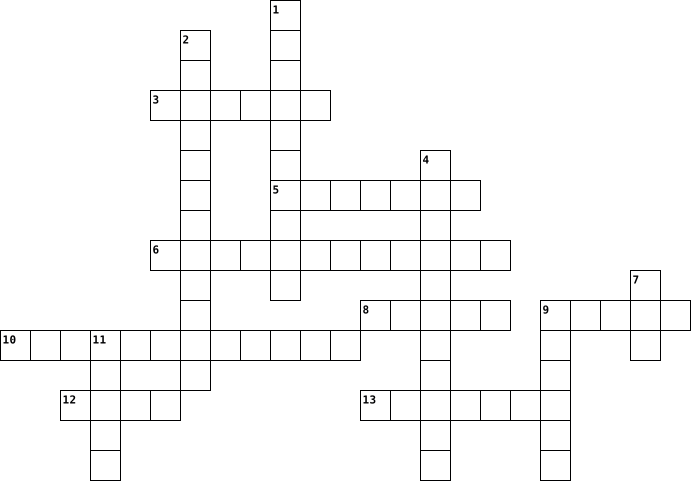
Miraculous Supernatural 2022-07-02
Across
- Finish The Lyrics "LET THIS GROOVE SET IN YOUR..."
- EARTH WIND & FIRE Lead singer
- Carlos's restaurant named after which of his own song
- Original Founder & Leader of Earth Wind & Fire
- Instrument Carlos's wife primarily plays
Down
- Earth Wind & Fire bassist known for his long hair
- First instrument Carlos learned to play
- Which Astrological sign inspired EARTH WIND & FIRE's name {Maurice's sign)
- Finish The Lyrics "OYE COMO VA MI..."
- 2000 Grammy's Song of the Year
- "Black Magic Woman" is on which album?
- Finish The Lyrics "MIDNIGHT CREEPS SO SLOWLY INTO HEARTS OF..."
- City where Earth Wind & Fire FORMED
- Carlos's Birthday Month
14 Clues: Carlos's Birthday Month • EARTH WIND & FIRE Lead singer • 2000 Grammy's Song of the Year • City where Earth Wind & Fire FORMED • Finish The Lyrics "OYE COMO VA MI..." • "Black Magic Woman" is on which album? • First instrument Carlos learned to play • Instrument Carlos's wife primarily plays • Original Founder & Leader of Earth Wind & Fire • ...
Miraculous Supernatural 2022-07-02
Across
- First instrument Carlos learned to play
- "Black Magic Woman" is on which album?
- Original Founder & Leader of Earth Wind & Fire
- Finish The Lyrics "OYE COMO VA MI..."
- Finish The Lyrics "LET THIS GROOVE SET IN YOUR..."
- Earth Wind & Fire bassist known for his long hair
- Carlos's Birthday Month
- City where Earth Wind & Fire FORMED
Down
- Carlos's restaurant named after which of his own song
- EARTH WIND & FIRE Lead singer
- Which Astrological sign inspired EARTH WIND & FIRE's name {Maurice's sign)
- Finish The Lyrics "MIDNIGHT CREEPS SO SLOWLY INTO HEARTS OF..."
- 2000 Grammy's Song of the Year
- Instrument Carlos's wife primarily plays
14 Clues: Carlos's Birthday Month • EARTH WIND & FIRE Lead singer • 2000 Grammy's Song of the Year • City where Earth Wind & Fire FORMED • Finish The Lyrics "OYE COMO VA MI..." • "Black Magic Woman" is on which album? • First instrument Carlos learned to play • Instrument Carlos's wife primarily plays • Original Founder & Leader of Earth Wind & Fire • ...
Everything We've Learned 2024-10-25

Across
- We have 206 of these in our body
- Moving closer with force
- The Earth is in between the Moon and the Sun
- The Moon is in between the Sun and the Earth
- A pattern of rocks
- Moving away with force
- It's pitch black at night
Down
- The warmest season
- The coldest season
- The dead remains that are millions of years old
- The great unconformity settles at this place
- It illuminates fully at night
- The largest planet
- Spinning on it's axis
- Orbiting something
- Life is sustainable on this planet
16 Clues: The warmest season • The coldest season • The largest planet • Orbiting something • A pattern of rocks • Spinning on it's axis • Moving away with force • Moving closer with force • It's pitch black at night • It illuminates fully at night • We have 206 of these in our body • Life is sustainable on this planet • The great unconformity settles at this place • ...
Reflection Puzzle 2024-10-29

Across
- we have 206 in our body
- moving closer with force
- the earth is in between the sun and the moon
- the moon is in between the sun and the earth
- a pattern of rocks
- moving away with force
- its pitch black at night
Down
- the warmest season
- the coldest season
- the dead remains that are millions of years old
- the great unconformity is here
- it illuminates fully at night
- the largest planet
- it spins on its axis
- it orbits something
- life is sustainable on this planet
16 Clues: the warmest season • the coldest season • the largest planet • a pattern of rocks • it orbits something • it spins on its axis • moving away with force • we have 206 in our body • moving closer with force • its pitch black at night • it illuminates fully at night • the great unconformity is here • life is sustainable on this planet • the earth is in between the sun and the moon • ...
Space 2013-11-06

Across
- has things living on it
- is the closet to the Sun
- is White/Grey
- all are planets and stars are in
- things that float in space
- is part of a rocket
- it orbits Earth
- has mountains and craters on it
- are believed to live on the orther planets
Down
- also known as the red planet
- is the largest of Mar's moons
- has 64 Moons
- get sent to planets and back to Earth
- a group of stars, dust, gas and dark matters
- a planet full of methane
- rains diamonds
- made ice, rock, co2 or methane mixed with dust
- is the smallest of Mar's moons
- has rings made of ice
- is one of our largest stars
20 Clues: has 64 Moons • is White/Grey • rains diamonds • it orbits Earth • is part of a rocket • has rings made of ice • has things living on it • is the closet to the Sun • a planet full of methane • things that float in space • is one of our largest stars • also known as the red planet • is the largest of Mar's moons • is the smallest of Mar's moons • has mountains and craters on it • ...
Geology— Colby Lavoie 2024-01-30

Across
- the study of rocks
- the most fragile mineral
- very hard sand that is basically stone
- they have crystals in them
- they are in minerals
- they make earthquakes
- the upper layer has lots of magma
- chunk of frozen fresh water
- mountains with lava and magma
Down
- melted rocks and minerals
- a huge rock structure
- thinnest layer on earth
- when air moves
- when something is so hot its looses its form and becomes a thick liquid
- if earth was this its crust would be skin
- a mixture of minerals
- when two tectonic plates rub
- the world was this when it was combined
- the hardest mineral on earth
- most of the volcanos are here
20 Clues: when air moves • the study of rocks • they are in minerals • a huge rock structure • a mixture of minerals • they make earthquakes • thinnest layer on earth • the most fragile mineral • melted rocks and minerals • they have crystals in them • chunk of frozen fresh water • when two tectonic plates rub • the hardest mineral on earth • most of the volcanos are here • ...
Orienteering vocab 2023-04-21

Across
- opposite of north
- imaginary lines that circle the globe east to west
- shows symbols on a map
- a map that shows travel routes
- opposite of south
- opposite of east
- a map that shows borders of countries/states
- shows distance on a map
- Earth rotates on its...
- the four directions on a compass
Down
- imaginary lines that circle the globe north to south
- the exact location of a place on the earth
- Earth is divided into...
- a map that shows weather and temperature
- a map that shows height elevation
- 0 degrees longitude
- a map that shows land features
- 0 degrees latitude
- height above sea level
- the tool we use to determine direction
- opposite of west
21 Clues: opposite of east • opposite of west • opposite of north • opposite of south • 0 degrees latitude • 0 degrees longitude • shows symbols on a map • height above sea level • shows distance on a map • Earth rotates on its... • Earth is divided into... • a map that shows travel routes • a map that shows land features • the four directions on a compass • a map that shows height elevation • ...
Chapters 17/18 Vocabulary Crossword 2020-09-30

Across
- A relationship in which two different species live in close association
- Growing or living in water
- The colors or patterns on animals that help them hide in their surroundings
- The process of liquid water changing into gas due to heating
- An organism that feeds on other organisms
- A large area of the earth that has similar ecosystems and weather
- Having to do with the solid parts of the earth
- The tops of the forest trees
- An area of water that has salt
- All the food chains in a community that are linked to one another
- An area of water with no salt
Down
- Of or from the sun
- The air that surrounds the earth
- The feeding order of organisms in a community
- An organism that makes its own food
- When organisms try to use the same resources
- Poisonous
- A relationship in which one species eats another species
- The total area of the earth that contains and supports life
- The average weather of a region over a long period of time
- The plant life in an area\
- An organism at the end of a food chain that feeds by breaking down dead organisms
22 Clues: Poisonous • Of or from the sun • Growing or living in water • The plant life in an area\ • The tops of the forest trees • An area of water with no salt • An area of water that has salt • The air that surrounds the earth • An organism that makes its own food • An organism that feeds on other organisms • When organisms try to use the same resources • ...
Crossword Puzzle Mammals 2020-08-30

Across
- warm blooded creatures
- not cold
- newly arrived
- infants
- human beings
- exist
- earth
Down
- like fur
- having a body with blood giving life
- living
- living creature on earth
- almost all
- liquid
- soar above the earth in the sky
14 Clues: exist • earth • living • liquid • infants • like fur • not cold • almost all • human beings • newly arrived • warm blooded creatures • living creature on earth • soar above the earth in the sky • having a body with blood giving life
vocab earth enviromental 2019-09-05

Across
- force which tries to pull two objects toward each other
- distance measured in degrees east or west from the equator
- the movement of one object around a center or another object
- The belief that the Earth and other planets started from nebulae
- cloud of dust, hydrogen, helium and other ionized gases in a galaxy.
- the sun passes directly over the equator
- the time when the sun reaches its highest or lowest point at noon
- idea that the Earth and other planets revolve around the Sun
- meaurment of a part of the Earth in relation to the north or south of the Earth's equator
- the motion of the axis of a spinning body
- the center of mass of two or more bodies
- the process or act of turning or circling around something
- is the act of melting things together
Down
- relating to, measured from, or as if observed from the earth's center
- all matter, energy, planets, galaxies and space
- a noticeable change in the frequency of sound, light or water waves
- the collection of eight planets and their moons in orbit around the sun
- when the Moon passes directly behind Earth and into its shadow
- group of many stars, with gas, dust, and dark matter
- when the sun is covered completely by the moon
- process in which a large nucleus splits into two smaller nuclei with the release of energy
- accumulation of particles into a massive object by gravitationally attracting more matter
- the rocking or swaying motion of the Earth
23 Clues: is the act of melting things together • the sun passes directly over the equator • the center of mass of two or more bodies • the motion of the axis of a spinning body • the rocking or swaying motion of the Earth • when the sun is covered completely by the moon • all matter, energy, planets, galaxies and space • group of many stars, with gas, dust, and dark matter • ...
Earth an Space Science 2022-01-20

Across
- 70% of the Earth's surface is covered in?
- system that with objects that orbit it.
- what are stars made off?
- the only planet not named after a God
- I reflect light from the Sun to light the night
- the closet planet to our sun
- explorers of space
- how many oceans are on the Earth?
Down
- what shape is the Earth
- the amount of hours for the Earth to make a complete rotation
- the sun is actually a _______
- the only planet that spins on its side
- vehicles used to travel to space
- which planet spins backwards
14 Clues: explorers of space • what shape is the Earth • what are stars made off? • which planet spins backwards • the closet planet to our sun • the sun is actually a _______ • vehicles used to travel to space • how many oceans are on the Earth? • the only planet not named after a God • the only planet that spins on its side • system that with objects that orbit it. • ...
Natural Processes 2021-04-13

Across
- made up of all Earth's gases
- when layers of eroded material pile up
- movement of weathered materials from one place to another
- all the water found under and above the surface of the Earth
- breaking down of natural materials
- formed when sediment is deposited at the end of a river
- any surface feature on Earth
- how landforms are laid out in a certain area
Down
- actual solid Earth such as rocks and minerals
- made up of all life on Earth
- Earth has four major ______ that support all life on Earth
- type of weathering caused by changes in chemical properties
- type of weathering that breaks the Earth's materials apart
13 Clues: made up of all Earth's gases • made up of all life on Earth • any surface feature on Earth • breaking down of natural materials • when layers of eroded material pile up • how landforms are laid out in a certain area • actual solid Earth such as rocks and minerals • formed when sediment is deposited at the end of a river • ...
weathering and deserts 2021-03-11

Across
- invisible mass movement
- colour of iron's chemical weathering
- central african lake
- the biggest desert on Earth
- dry valley (arabic word)
- removal of solid particles of wind
- sand mound
- sandy desert on the atlantic coast of Africa
- a kind of evaporite mineral
Down
- chemical weathering of iron
- vanishing salt lake in Central Asia
- borderline between Sahara and savannah
- ship of the desert
- native tribe of deserts
- palm tree of oases
- the driest part of Earth
- the biggest temperate zone desert on Earth
17 Clues: sand mound • ship of the desert • palm tree of oases • central african lake • invisible mass movement • native tribe of deserts • dry valley (arabic word) • the driest part of Earth • chemical weathering of iron • the biggest desert on Earth • a kind of evaporite mineral • removal of solid particles of wind • vanishing salt lake in Central Asia • colour of iron's chemical weathering • ...
Vocabulary Review 2023-10-02

Across
- When a breeze moves from the sea to the land due to cooler waters and warmer land at daytime
- Temperature at which air near the ground becomes fully saturated with water
- Cycle how carbon moves and cycles throughout earth and atmosphere
- Atmospheric conditions of a certain place at a certain time
- Amount of water vapor in the air
- Boundary between two air masses
- The pressure that air exerts on the air or surface below it
- how water changes form and moves throughout the earth (evaporation, condensation, precipitation, and transpiration)
- large body of circulating air that has low pressure at its center and higher pressure on the outside
- when a cloud becomes over saturated (too full of) water and water falls to the earth (rain, snow, sleet, hail)
Down
- intense tropical storm with winds exceeding 119 km/h
- the gases around earth
- Large body of circulating air that has high pressure at its center and lower pressure on the outside
- liquid water heating up and becoming water vapor (gas)
- when water vapor cools down and forms a cloud
- how something rots/decays
- Cycle how Nitrogen is cycled throughout earth in many different forms (fixation, animal waste, decay, and etc...)
- Breeze When a breeze moves from land to the sea due to cooler land and warmer water at night time
- when plants release water back into the atmosphere
- the compactness of a substance
20 Clues: the gases around earth • how something rots/decays • the compactness of a substance • Boundary between two air masses • Amount of water vapor in the air • when water vapor cools down and forms a cloud • when plants release water back into the atmosphere • intense tropical storm with winds exceeding 119 km/h • liquid water heating up and becoming water vapor (gas) • ...
Kaitlyn's crossword on earth 2021-03-26

Across
- it surrounds the earth's core
- another word for lava
- two boundaries separating
- two boundaries sliding past each other
- this causes the earth's plates to move
- the outer core is the only ______ layer of the earth
- center of the earth
- the less dense type of plate
Down
- the more dense type of plate
- the outer layer of the earth
- the layer of the earth below the crust
- a very mountainous example of a convergent boundary
- two boundaries colliding
13 Clues: center of the earth • another word for lava • two boundaries colliding • two boundaries separating • the more dense type of plate • the outer layer of the earth • the less dense type of plate • it surrounds the earth's core • the layer of the earth below the crust • two boundaries sliding past each other • this causes the earth's plates to move • ...
Let's learn Earth & Space 2020-11-26

Across
- The very slow creeping motion of earth's solid silicate mantle caused by convection currents carrying heat from the interior to the
- Geologist who proposed the theory of sea-floor spreading.
- It is formed when a continental plate and an ocean plate collides.
- Is the instrument used to mapped the mid-ocean ridges.
- The point within the earth where the actual movement takes
- A concentration of heat in the mantle capable of creating magma
- Deepest part of earth.
- An upwelling of superheated rock from the mantle.
- Thickest layer of the earth where magma comes from.
- Surface seismic wave that cause horizontal shifting of the earth during an earthquake.
- This may happen during divergence or convergence of plates because of the movement of plates.
- Formed when two oceanic crusts collide.
- Theory that states that the earth's crust is divided into several plates.
- A very large wave that is caused by earthquake.
- One of the possible cause of plate movements which the ridge pushes the old sea-floor towards the trench and it will subduct.
- Upper mantle.
- Proposed to be the supercontinent 250 million years ago.
- A recording device that is used to locate the earthquake's epicenter.
- Method that is used to locate the epicenter of an earthquake.
- Process which happens when ocean plates move apart and magma rises from the mantle and create new areas of oceanic crust.
- Theory that states that there was a big continent before.
Down
- Seismic wave that travels across the surface of the earth as opposed through it.
- Surface seismic wave generated by the interaction of p-waves and s-waves at the surface of the earth that move with a rolling motion.
- Top layer of earth.
- Outer crust.
- Geologic feature that happens when two continental plates move apart from each other.
- Type of plate boundary that collides with each other.
- Wave of energy that travels through the earth as a result of an earthquake.
- The point on the surface directly above the focus.
- Other possible cause of plate movements which the weight of the subducting plate pulls the trailing slab into the subduction zone just like a tablecloth slipping off the table and pulling items with it.
- Seismic wave that travels through the earth rather than across its surface.
- surface.
- Geologic feature that happens when two continental plates collide.
- Hot molten material that rises from the mantle to the crust.
- Type of plate boundary that are sliding past each other.
- This process happens when the oceanic crust sinks beneath the continental crust.
- Type of plate boundary that plates are moving away from each other.
- A geologic feature that may form when plates are moving away from each other.
- The one who made the continental drift theory.
- Boundary between the crust and mantle, as inferred from the change in the speed of body waves
- Time difference between the p-waves and s-waves.
41 Clues: surface. • Outer crust. • Upper mantle. • Top layer of earth. • Deepest part of earth. • Formed when two oceanic crusts collide. • A very large wave that is caused by earthquake. • Time difference between the p-waves and s-waves. • An upwelling of superheated rock from the mantle. • The point on the surface directly above the focus. • ...
Eclipses 2025-03-13

Across
- an object that revolves around a planet or rogue planet
- when some object spins around an imaginary object in the middle of it
- when the moon gets partially in front of the sun
- when the Moon gets in front of the Earth and casts a big shadow
- 1/12 of a single revolution of Earth around the sun
- when a solar object shines on to something and the behind the object is dark because the solar object shining isn't shining on that darkness
- the part of the shadow cast by the Earth or Moon that is darker
- when the Earth gets partially in front of the sun, and makes the Moon look a little red
Down
- when the Earth gets fully in front of the moon, making it look completely red
- when the moon gets completely in front of the sun
- when some object spins around a real object that had more mass
- when an object is not completely straight up, it is pointed somewhere else
- when the Earth gets in front of the Moon, and the moon looks red
- the revolution around an object with more mass
- the part of the shadow cast by the object casting the shadow that is lighter
- when a celestial object gets in front of another object in space and casts a big shadow
16 Clues: the revolution around an object with more mass • when the moon gets partially in front of the sun • when the moon gets completely in front of the sun • 1/12 of a single revolution of Earth around the sun • an object that revolves around a planet or rogue planet • when some object spins around a real object that had more mass • ...
Vocabulary 2016-09-27

Across
- CYCLE The series of processes that change one type of rock into another type of rock.
- The process that moves large bodies of earth materials the higher elevations.
- The long term average weather conditions that occur in a particular region.
- Water that is stored in cranes and pores beneath earths surface.
- The system containing all earth s water.
- A statement of what will happen next in the sequence of events.
- A naturally occurring, inorganic solid that has a crystal structure and a definite chemical composition.
- The atmospheric condition, along with short-term changes, of a certain place at a certain time.
- The process of a liquid changing to a gas at the surface of the liquid.
Down
- The parts of earth and the surrounding atmosphere where there is life.
- A thin layer of gases surrounding earth.
- CLCLE The series of natural processes by which water continually moves throughout the hydrosphere.
- The process by which plants release water vapor through their leaves.
- The process by which a gas changes to a liquid.
- The solid part of earth.
- The frozen portion of water on earths surface.
16 Clues: The solid part of earth. • A thin layer of gases surrounding earth. • The system containing all earth s water. • The frozen portion of water on earths surface. • The process by which a gas changes to a liquid. • A statement of what will happen next in the sequence of events. • Water that is stored in cranes and pores beneath earths surface. • ...
Year 9 Space 2024-08-05

Across
- How long it takes the Earth to orbit the Sun
- The seventh planet from the Sun
- Another word for Sun
- The side of the Earth facing the Sun
- This season is in between Summer and Winter
- The Earth spins on this, causing day and night
- How long it takes the Moon to orbit the Earth
Down
- The fifth planet from the Sun
- The closest planet to the Sun
- The most famous dwarf planet
- Caused by the tilt of the Earth's axis
- The third planet from the Sun
12 Clues: Another word for Sun • The most famous dwarf planet • The fifth planet from the Sun • The closest planet to the Sun • The third planet from the Sun • The seventh planet from the Sun • The side of the Earth facing the Sun • Caused by the tilt of the Earth's axis • This season is in between Summer and Winter • How long it takes the Earth to orbit the Sun • ...
Inside the Earth and the Rock Cycle 2023-09-13

Across
- The scientist who said continental drift could occur because of thermal convection in the mantle
- Small bits of rock being carried by water or wind
- Rocks formed by melted rock erupting and cooling
- The connecting of compacted small bits rock into a sedimentary rock
- The layer of the earth that likely produces the magnetic field
- Igneous rock that cools under the surface
- Igneous rock that cools on the surface
- Rocks formed by pressure on rock particles
- Rocks formed by extreme heat and pressure
Down
- Metamorphic rock without visible layers
- The Navy scientist who mapped the sea floor and supported the idea of plate tectonics
- The squishing together of small bits of rock
- Metamorphic rock with visible layers
- Small bits of rock being dropped and usually buried by water and wind
- The hot dense middle layer of the earth
- The action of wind, water, ice, and sun to break small bits of rock off of the land
- The outer layer of the earth broken into tectonic plates
- The inside layer of the earth spinning very fast and heated to 10,000 F
- The scientist who in 1915 proposed the idea of continental drift
19 Clues: Metamorphic rock with visible layers • Igneous rock that cools on the surface • Metamorphic rock without visible layers • The hot dense middle layer of the earth • Igneous rock that cools under the surface • Rocks formed by extreme heat and pressure • Rocks formed by pressure on rock particles • The squishing together of small bits of rock • ...
Investigating Australia's Physical Environments 2013-02-03

Across
- something crecent shaped
- an extent of land which drains water
- half the earth
- a rock transformed by heat
- lies underneath the bark of a trunk
- someone who studies evolution
- starchy swelling of the root
- a plant that needs very little water
- land that separates water from flowing into rivers
Down
- geographic coordinate that specifies the north-south position on the Earth
- formed from cooled magma
- formed from sediments
- forces that structure the earth
- a type of vegetation
- a sacred era
- a line representing a physical system at constant pressure
- the angular distance of a place east-west
- a low-growing Australian Eucalyptus
18 Clues: a sacred era • half the earth • a type of vegetation • formed from sediments • something crecent shaped • formed from cooled magma • a rock transformed by heat • starchy swelling of the root • someone who studies evolution • forces that structure the earth • lies underneath the bark of a trunk • a low-growing Australian Eucalyptus • an extent of land which drains water • ...
Astronomy 2024-09-26

Across
- Has 16 moons
- What Earth does that causes day & night
- Smallest Planet
- Sometimes called a shooting star
- Causes seasons
- Biggest planet
- Large space rock that orbits the sun
Down
- Earth is covered in large ______
- Group of planets Farther from the sun
- Group of planets Closer to the sun
- Earth is sometimes referred to as the ____
- Has 146 moons (6th planet from sun)
- our galaxy
- Tail always points away from the sun
- Orbits on it's side
- Doesn't clear it's neighborhood
- Main source of energy & made of plasma & superheated gas
- Result of the gravitational pull on the surface waters
18 Clues: our galaxy • Has 16 moons • Causes seasons • Biggest planet • Smallest Planet • Orbits on it's side • Doesn't clear it's neighborhood • Earth is covered in large ______ • Sometimes called a shooting star • Group of planets Closer to the sun • Has 146 moons (6th planet from sun) • Tail always points away from the sun • Large space rock that orbits the sun • ...
GLOBAL STYSTEMS 2015-04-28

Across
- Destruction of forests to clear land for other uses
- The process in which plants incorporate carbon into living things
- What we breathe out
- Burning fossil fuels release ___________
- The process in which the sun takes up water
- It is an important element in protein
- A continuous circulation of water Earth
- Periods between glaciations
- All living things on earth
- Formed from the breakdown of organic matter
- Fuels that contain the carbon of plants and animals that were preserved millions of years ago
- Oceans, seas, lakes, ponds, rivers are all part of Earth's ______________
- Naturally replenished
- layers of rocks/soil that don't reach above freezing point, have a temperature known as ______________
Down
- The general long term average weather
- Causes drought in Australia and Indonesia
- The warming of Earth caused by greenhouse gases
- Form of light we can feel as heat
- The process in which water vapor is turned into rain
- Interaction between all living things and the physical environment
- New renewable type of fuel
- The layer of gases on Earth
- The process in which carbon is recycled to enable life on earth
- Masses of glacial land ice are known as ___________
- Earth's __________ is made up of the crust and upper mantle
- Radios, X-rays, Televisions and microwaves all have sources of ___________
- The conditions in the atmosphere
- type of radiation that reflects back into space as heat
28 Clues: What we breathe out • Naturally replenished • New renewable type of fuel • All living things on earth • The layer of gases on Earth • Periods between glaciations • The conditions in the atmosphere • Form of light we can feel as heat • The general long term average weather • It is an important element in protein • A continuous circulation of water Earth • ...
The Lord of the Rings: The Return of the King 2014-01-20

Across
- Where the one ring was created and destroyed
- Gandalfs horse, given to him by Théoden
- Also known as Halflings
- The ring bearer who destroys the one ring
- An elven outpost in middle-earth
- An area in middle-earth inhabited by hobbits
- The one ring to rule them all
- The main enemies fought throughout the story
- Servents bound to the power of the one ring
- The primary antagonist in The Return of The King
Down
- King of Rohan
- The true king of Gondor
- The Capital of Gondor
- Base of operations for sauron
- The ancient capital city of Gondor
- Fellow hobbit who accompanies Frodo
- The people of Dunland, also known as wildmen of Dunland
- Leader of the Istari (Wizards sent to middle earth)
- Frodos Sword
- Also known as Elven bread or waybread
20 Clues: Frodos Sword • King of Rohan • The Capital of Gondor • The true king of Gondor • Also known as Halflings • Base of operations for sauron • The one ring to rule them all • An elven outpost in middle-earth • The ancient capital city of Gondor • Fellow hobbit who accompanies Frodo • Also known as Elven bread or waybread • Gandalfs horse, given to him by Théoden • ...
Wind in the Atmosphere 2021-02-24

Across
- little to know wind close/on equator
- places that make electricity with wind
- short distances any direction
- between the poles and 60 degrees latitude
- bottom half of the earth south
- between 30 degrees and the equator
- breeze towards the sea from the land
- between 30 degrees and 60 degrees latitude
- breeze from the valley goes up to the mountain
Down
- breeze from the mountain goes to the valley
- top half of the earth north
- Near the earth's surface
- Curving due to the earth's rotation
- measures pressure in the atmosphere
- breeze towards the land from the sea
- high-speed winds that blow west to east
- severe storm caused by strong winds
- measurement around the earth (line)
- movement caused by differences in air pressure
- Ships carried horses
20 Clues: Ships carried horses • Near the earth's surface • top half of the earth north • short distances any direction • bottom half of the earth south • between 30 degrees and the equator • Curving due to the earth's rotation • measures pressure in the atmosphere • severe storm caused by strong winds • measurement around the earth (line) • little to know wind close/on equator • ...
Geography 2017-03-22

Across
- The planet we live on
- The type of map we look at for countries
- The type of map we look at for mountains/rivers
- The name of the ocean of WA's coast
- Coldest continent
- The continent west of Asia
- Earth spinning on its axis
- The country we live in
- The state we live in
- The biggest continent
- Australia's capital city
- Summer, Spring, Autumn, Winter
- The most northern ocean
Down
- Earth orbiting around the Sun
- Part of a sphere
- Large bodies of water
- Continent that includes Canada
- Middle longitude line
- A large landmass
- The continent we live on
- Continent that has the Amazon Rainforest
- North, East, South, West
- Ocean that's near Antarctica
- The closest planet to the Sun
- The middle latitude line- goes through Africa.
25 Clues: Part of a sphere • A large landmass • Coldest continent • The state we live in • The planet we live on • Large bodies of water • Middle longitude line • The biggest continent • The country we live in • The most northern ocean • The continent we live on • North, East, South, West • Australia's capital city • The continent west of Asia • Earth spinning on its axis • Ocean that's near Antarctica • ...
bEeP bOp bOoP 2023-04-06

Across
- high wispy clouds
- is the closest planet to the sun
- is the Heater for earth and other planets
- is where planes fly around
- is the fluffy tall cloud
- most visible rings
- is water sticks to other objects
- is the planet we live on
- measures the temperature of something
- is the hottest planet in the solar system
Down
- is the storm or thunder cloud
- largest planet in the solar system
- gauge measure how much water there is
- going around something
- is water sticks to water
- a guess
- is what holding you down on earth
- tension is item float on the water
- a low cloud with white and gray color
- is the water planet
- is the 3rd layer of the atmosphere
- vanes measures the direction of the wind
22 Clues: a guess • high wispy clouds • most visible rings • is the water planet • going around something • is water sticks to water • is the fluffy tall cloud • is the planet we live on • is where planes fly around • is the storm or thunder cloud • is the closest planet to the sun • is water sticks to other objects • is what holding you down on earth • largest planet in the solar system • ...
Space Exploration 2025-03-10

Across
- The telescope that orbits Earth
- A massive explosion that occurs when a star dies
- First person to walk on the moon
- The boundary where Earth's atmosphere meets space
- The closest star to Earth
- The first satellite launched into space
- The first human in space
- Known as the Red Planet
- The largest planet in our solar system
- The first reusable space shuttle
- The force that keeps planets in orbit
- A vehicle used to explore space
Down
- A bright streak of light caused by a meteoroid
- An astronaut's home in space
- The natural satellite of Earth
- The study of space and celestial bodies
- The time toward which space missions are planned
- A scientist who studies space
- The galaxy that contains our solar system
- The path a planet follows around the Sun
20 Clues: Known as the Red Planet • The first human in space • The closest star to Earth • An astronaut's home in space • A scientist who studies space • The natural satellite of Earth • The telescope that orbits Earth • A vehicle used to explore space • First person to walk on the moon • The first reusable space shuttle • The force that keeps planets in orbit • ...
Unit 3 Review Crossword - Space Exploration 2026-05-12

Across
- the rocket agency of Europe
- ________ orbits pass over Earth’s poles, letting satellites scan the entire planet as Earth rotates
- Rovers often use _________ to maneuver across terrain
- ___________ System - The area of a rocket that holds equipment
- the use of onboard AI or preprogrammed instructions to make decisions
- Ignition of the engines and initial ascent.
- the rocket agency of Russia
- Space probes use deep-space navigation techniques such as ________ assists to increase speed and adjust their paths
- ___________ (MEO) earth orbit is higher up and is commonly used for navigation systems such as GPS
- the rocket agency of India
- a vehicle or device that uses controlled explosions of propellants (fuel and oxidizer) to generate thrust, enabling it to propel itself upwards through the atmosphere.
- ________ lens - Gathers and focuses light
- The fuel used to generate thrust
- Magnifies the image formed by the objective lens
- __________ telescope - Uses lenses to focus light
- Probes and rovers use _____________ energy sources like solar panels or radioisotope thermoelectric generators
- __________ (LEO) earth orbit is close to Earth and is used by satellites that need detailed images or fast communication
- Scientists can use ________ control features to send commands from Earth to a rover if they would like it to perform a specific job
- __________ telescope - Uses both mirrors and lenses
- the rocket agency of China
- __________ (GEO) earth orbit is much farther out and allows satellites to stay fixed over one spot on Earth
- _________ probe - land on the surface of a celestial body and send data
- __________ telescope - Uses radio waves to observe celestial objects.
- A rocket's propellant is often made of fuel and an ___________
- __________ return probe - collect and return samples to Earth
- __________ telescope - Positioned outside Earth’s atmosphere to avoid interference
Down
- A rocket reaches its last stage at payload ____________
- A facility containing multiple kinds of telescopes
- __________ telescope - Uses mirrors to gather and focus light
- Because satellites are in space, ___________ is very difficult to do.
- the rocket agency of Japan
- The force that propels the rocket upwards and forwards
- the rocket agency of the United States
- The eyeglass maker who invented the first telescope
- __________ probe - enter orbit and send data
- a type of robotic vehicle designed to explore the surface of planets, moons, or other celestial bodies.
- ____________ System - Holds navigation systems such as a control panels or GPS systems
- Space _______ - an unmanned spacecraft designed to explore space, gather scientific data, and send it back to Earth.
- an object that orbits around another object in space.
- Space probes often use radio _________ to determine their position and velocity using signals exchanged with Earth
- __________ point - The point where the light converges after it enters the telescope
- A tool that collects and magnifies light to observe distant objects in space
- _________ probe - pass by and send data
- _____________ System - Holds an engine that burns fuel
- ____________ insertion - Reaching the desired orbit or trajectory
- Once it reaches the proper __________ and speed, the rocket performs orbital insertion
- SpaceX, Blue Origin, and Rocket Lab are all examples of ________ rocket agencies
- _____________ probe - travel beyond the solar system and send data
- improved the telescope for astronomical observation.
- As it climbs, the rocket enters stages of ascent. This is where it sheds empty __________ or spent stages to lighten its weight and improve efficiency
50 Clues: the rocket agency of Japan • the rocket agency of India • the rocket agency of China • the rocket agency of Europe • the rocket agency of Russia • The fuel used to generate thrust • the rocket agency of the United States • _________ probe - pass by and send data • ________ lens - Gathers and focuses light • Ignition of the engines and initial ascent. • ...
Climate, Sustainability, Earth's Exterior Terms 2023-11-16

Across
- the process that moves sediment
- the solid parts of the earth and its layers
- process that transfers carbon when a living thing dies
- all the life on earth
- plants use carbon dioxide from the atmosphere in this process
- when water sticks to itself
- when water sticks to other things
- a triangular shaped formation at the end of a river when it meets stagnant water
- all the gases surrounding earth
Down
- all the water on earth
- a place that stores carbon
- carbon transfers back and forth from the atmosphere to the ocean in this process
- constraint of a solution that focuses on that we can count on it working all the time
- the process that breaks down rock and other things
- a lake formed when a wide meander of a river is cut off over time
- process that puts carbon into the air by burning organic matter
- a stream that breaks off and merges lots of times
- constraint of a solution that focus on how something looks
18 Clues: all the life on earth • all the water on earth • a place that stores carbon • when water sticks to itself • the process that moves sediment • all the gases surrounding earth • when water sticks to other things • the solid parts of the earth and its layers • a stream that breaks off and merges lots of times • the process that breaks down rock and other things • ...
Natural Resources 2021-11-30

Across
- a source
- salted water
- DNA and RNA are called
- a toxic colorless gas surrounding the earth
- Water on earth
- smoke mixed with fog
- emission of energy as electromagnetic waves
- 21% of atmosphere
- fourth stage in water cycle
- air on the earth's surface
Down
- Green plants and animals are also known as
- most important gaseous cycle
- process of rotting
- used in nitrification
- compound of hydrogen and carbon
- a rigid external covering for some animals
- living organisms on earth from the _ component
- glass building which usually has plants
18 Clues: a source • salted water • Water on earth • 21% of atmosphere • process of rotting • smoke mixed with fog • used in nitrification • DNA and RNA are called • air on the earth's surface • fourth stage in water cycle • most important gaseous cycle • compound of hydrogen and carbon • glass building which usually has plants • Green plants and animals are also known as • ...
#201 2023-02-15

Across
- The sun is responsible for many patterns and ______ in our solar system
- The northern hemisphere experiences _______ seasons from one another.
- When the northern hemisphere has summer the southern hemisphere has ______
- Hot stars appear brighter than smaller stars, larger stars appear brighter than _______ stars.
- The force of gravity is strongest between objects when they are ______ together
- The sun appears to move in the sky, but it is not actually moving rather it is _____ that is moving
- When the sun shines on one _____ of the earth
- As the sun appears to move _____ the sky,shadows are short
- Shadows caused by the sun follow a ______ pattern of changes.
Down
- Gravity pulls you ______ the earth
- The moon cycles through Cycles about once a ______
- As the sun appears to move _____ the sky,shadows are short
- The sun is a _____ sized star
- Depending on the time of the day you are standing outside, your shadow will point a ________ direction and different length
- The moon’s gravity is also _______ on objects that are close to it
- Earth has only ____moon. It orbits Earth about once a month.
- Our axis is ____ 23.5 degrees
17 Clues: The sun is a _____ sized star • Our axis is ____ 23.5 degrees • Gravity pulls you ______ the earth • When the sun shines on one _____ of the earth • The moon cycles through Cycles about once a ______ • As the sun appears to move _____ the sky,shadows are short • As the sun appears to move _____ the sky,shadows are short • ...
Assign 8.7 Earthquakes 2024-02-28

Across
- Mantle plumes of hot rock that rise through the mantle
- Boundaries where the two plates move toward each other.
- The fastest seismic wave
- The edges where two plates meet.
- Movement of the plates over Earth's surface is termed plate _______.
- This layer of the Earth is mostly iron metal and makes up about 31% of the Earth
- Composed of both the crust and the portion of the upper mantle that behaves as a brittle, rigid solid
- This Earth layer is less than 1% of Earth by mass.
Down
- partially molten upper mantle material that behaves plastically and can flow
- Boundaries where the two plates slip past each other.
- Geologist that proposed that the continents were once united into a single supercontinent
- Boundaries where the two plates move away from each other.
- This process occurs at oceanic trenches and when an oceanic plate meets a continental plate.
- This layer of the Earth is hot, ultramafic rock and represents about 68% of Earth's mass
- The point on the Earth's surface directly above the place where the earthquake occurs
- These seismic waves cannot travel through liquid.
16 Clues: The fastest seismic wave • The edges where two plates meet. • These seismic waves cannot travel through liquid. • This Earth layer is less than 1% of Earth by mass. • Boundaries where the two plates slip past each other. • Mantle plumes of hot rock that rise through the mantle • Boundaries where the two plates move toward each other. • ...
In Terms of Geology 2022-02-16

Across
- Has unlimited supply/easily replenished
- Upper mantle/crust that moves with tec.plates
- Earth's solid, outermost layer (3-56 mi. deep)
- Boundary between Earth's crust and mantle
- Region in which the Earth orbits
- Dense, extremely hot interior of Earth (2900mi.deep)
- False, fundamental principle of geology
- Hot, plastic rock/between crust and core (1800mi.)
- Raw material from Earth that we use
- Low-frequency/inaudible wave moving thru/Eart
- The study of Earth's structures, materials, etc.
Down
- Effort to oversee/wisely use resources
- The "Father of Geology"
- Can't be replenished once used up
- Upper mantle (125 mi. deep)
- First published view of "Uniformitarianism"
- Idea that earth is ancient, billions/yrs.old
17 Clues: The "Father of Geology" • Upper mantle (125 mi. deep) • Region in which the Earth orbits • Can't be replenished once used up • Raw material from Earth that we use • Effort to oversee/wisely use resources • Has unlimited supply/easily replenished • False, fundamental principle of geology • Boundary between Earth's crust and mantle • First published view of "Uniformitarianism" • ...
The Planets 2014-09-03

Across
- the largest planet
- known as the 'Red' planet
- a collection of stars
- 75% of our planet is covered with it
- path of a planet: circular path
- space rock
- the furthest planet from the sun
- coldest planet in the solar system
- closest planet to Earth
- an astronaut is sometimes known as a 'what' man
- hottest star in our solar system
Down
- no longer officially a planet
- the galaxy containing our solar system
- takes approximately 365 days to orbit the sun
- famous for its rings
- everything that exists everywhere
- man has been able to land and walk on it
- closest planet to the sun
- people on Earth are known as 'what' beings
- balls of gas seen in the night sky
20 Clues: space rock • the largest planet • famous for its rings • a collection of stars • closest planet to Earth • known as the 'Red' planet • closest planet to the sun • no longer officially a planet • path of a planet: circular path • the furthest planet from the sun • hottest star in our solar system • everything that exists everywhere • coldest planet in the solar system • ...
SCIENCE REVIEW 2021-01-20

Across
- All the frozen ice and water on Earth.
- The sphere that contains the ozone layer.
- All the living things on Earth.
- Provides radiant heat to the Earth.
- The sphere that is the coldest and meteors fly here.
Down
- The wind that comes from the ocean to the land.
- The gradual warming up of our planet over time.
- All the water on Earth.
- All the air surrounding the Earth.
- The transfer of heat through touching.
- All the land and rocks on Earth.
11 Clues: All the water on Earth. • All the living things on Earth. • All the land and rocks on Earth. • All the air surrounding the Earth. • Provides radiant heat to the Earth. • All the frozen ice and water on Earth. • The transfer of heat through touching. • The sphere that contains the ozone layer. • The wind that comes from the ocean to the land. • ...
Seasons 2021-05-25

Across
- an imaginary line through the North Pole and SouthPole about which Earth rotates.
- The season experienced when the earth's axis is tilted TOWARD the sun
- When day and night are equal length; occurs after winter.
- One complete trip around the sun; causes a year on Earth
- This is the longest NIGHT of the year in the Northern Hemisphere; First day of winter
- The PATH an object takes when revolving around another object
- The angle of Earth's incline at 23.5 degrees
- the star that all other planets and celestial bodies revolve around
- the northern end of Earth's axis of rotation
- The spinning of an object on an axis; causes day and night
Down
- an imaginary line dividing the earth into northern and southern hemispheres, with a latitude 0°.
- This occurs in March and marks the beginning of spring in North America.
- one half of a sphere; either the northern or southern half of Earth as divided by the equator
- Occurs every September and marks the beginning of fall in North America.
- the southern end of Earth's axis of rotation, a point in Antarctica
- This is the longest DAY of the year in the Northern Hemisphere; First day of summer.
- The result of Earth's tilted axis and the yearly revolution of the Earth around the Sun
- When day and night are equal length; occurs after summer.
- The season experienced when the earth's axis is tilted AWAY from the sun
19 Clues: The angle of Earth's incline at 23.5 degrees • the northern end of Earth's axis of rotation • One complete trip around the sun; causes a year on Earth • When day and night are equal length; occurs after winter. • When day and night are equal length; occurs after summer. • The spinning of an object on an axis; causes day and night • ...
Unit 2 Exam Review 2022-09-27

Across
- The __________ ___________ effect is caused by a landform like a mountain trapping the moisture on one side and creating a dry, arid climate on the other side
- People _______ the environment by changing it to meet their needs.
- the average weather of an area over long periods of time.
- High latitudes typically have ________ climates.
- __________ to large bodies of water help to stabilize climate. (5 factors of climate)
- specific days throughout the year that signify both the longest and shortest days of the year relative to daylight.
- includes all the water on earth making up rivers, lakes, oceans, and glaciers
- The act of movement of the earth around the sun.(responsible for our 365 1/4th day-long year)
- The higher your _______, the colder it gets (5 factors of climate)
- specific days throughout the year where the earth receives equal amounts of daytime and night time.
- land surrounded by water on 3 sides.
- Middle latitudes typically have _________ climates.
- Wind and ocean _______ helps to distribute hot air and water around the globe.(5 factors of climate) landforms ________ like mountains trap moisture on one side, the windward side, and create a more arid climate on the other side leeward (5 factors of climate)
- a group of islands, like Hawaii
Down
- low latitudes typically have ______ climates.
- made up of all the gases on earth
- body of water feeding into a larger body of water.
- People _______ to the environment by changing the way they live to survive or live more comfortably in a particular environment.
- inlet of water almost complete enclosed by land.
- made up of living plants and animals on earth
- Climate is generally hotter the closer you are to the equator (5 factors of Climate)
- the circular movement of an object around an axis.(responsible for our 24-hour day)
- Different places on earth receive different amounts of sunlight because the earth is ______ on its axis 23.5 degrees
- hill or mountain characterized by its flat top, often called mesas in Texas.
- Includes non-living soil, rocks, and minerals.
- People ________ on the environment by using its resources to fulfill their needs
- snapshot of the atmospheric conditions at a specific time and place.
- a fanlike area at the mouth of a river where sediment is deposited.
28 Clues: a group of islands, like Hawaii • made up of all the gases on earth • land surrounded by water on 3 sides. • low latitudes typically have ______ climates. • made up of living plants and animals on earth • Includes non-living soil, rocks, and minerals. • inlet of water almost complete enclosed by land. • High latitudes typically have ________ climates. • ...
Science crossword year 8 2022-03-16

Across
- Out star.
- The colour a small star goes when it cools.
- The unit for distance in space.
- Dark object in space from a large dead star.
- The red planet
- A burning ball of gas in space.
- A planet closer to the sun than earth.
- The colour a large star goes when it dies.
- Space ice
- A blue planet in our solar system.
- The planet with rings
Down
- The largest planet in our solar system.
- Our planet
- A space rock that enters earths atmosphere.
- A rock that orbits the sun
- The curved path around a planet or star.
- A natural satellite
- A planet seen from earth in the daytime.
- A giant mass in space that has moons.
19 Clues: Out star. • Space ice • Our planet • The red planet • A natural satellite • The planet with rings • A rock that orbits the sun • The unit for distance in space. • A burning ball of gas in space. • A blue planet in our solar system. • A giant mass in space that has moons. • A planet closer to the sun than earth. • The largest planet in our solar system. • ...
Earth, Sun, and Moon 2024-02-22

Across
- determined by the sun
- the planet where we live
- the 4th planet from the sun
- a celestial object consisting of a nucleus of ice and dust and, when near the sun, a “tail” of gas and dust particles pointing away from the sun.
- one of the ice giants in our solar system
- the time taken by the earth to make one revolution around the sun.
- a star showing a sudden large increase in brightness and then slowly returning to its original state over a few months.
- the curved path of a celestial object or spacecraft around a star, planet, or moon, especially a periodic elliptical revolution.
- a system of millions or billions of stars, together with gas and dust, held together by gravitational attraction.
- a group of stars forming a recognizable pattern that is traditionally named after its apparent form or identified with a mythological figure. Modern astronomers divide the sky into eighty-eight constellations with defined boundaries.
- the 6th planet from the sun
- this day was made up after the moon
Down
- one of the gas planets in our solar system
- the force that attracts a body toward the center of the earth, or toward any other physical body having mass.
- the curved sickle shape of the waxing or waning moon.
- the natural satellite of earth
- the star around which earth orbits
- a fixed luminous point in the night sky which is a large, remote incandescent body like the sun.
- the action of rotating around an axis or center.
- the smallest planet in our solar system
20 Clues: determined by the sun • the planet where we live • the 4th planet from the sun • the 6th planet from the sun • the natural satellite of earth • the star around which earth orbits • this day was made up after the moon • the smallest planet in our solar system • one of the ice giants in our solar system • one of the gas planets in our solar system • ...
Earth, Sun, and Moon 2024-02-22

Across
- determined by the sun
- the planet where we live
- the 4th planet from the sun
- a celestial object consisting of a nucleus of ice and dust and, when near the sun, a “tail” of gas and dust particles pointing away from the sun.
- one of the ice giants in our solar system
- the time taken by the earth to make one revolution around the sun.
- a star showing a sudden large increase in brightness and then slowly returning to its original state over a few months.
- the curved path of a celestial object or spacecraft around a star, planet, or moon, especially a periodic elliptical revolution.
- a system of millions or billions of stars, together with gas and dust, held together by gravitational attraction.
- a group of stars forming a recognizable pattern that is traditionally named after its apparent form or identified with a mythological figure. Modern astronomers divide the sky into eighty-eight constellations with defined boundaries.
- the 6th planet from the sun
- this day was made up after the moon
Down
- one of the gas planets in our solar system
- the force that attracts a body toward the center of the earth, or toward any other physical body having mass.
- the curved sickle shape of the waxing or waning moon.
- the natural satellite of earth
- the star around which earth orbits
- a fixed luminous point in the night sky which is a large, remote incandescent body like the sun.
- the action of rotating around an axis or center.
- the smallest planet in our solar system
20 Clues: determined by the sun • the planet where we live • the 4th planet from the sun • the 6th planet from the sun • the natural satellite of earth • the star around which earth orbits • this day was made up after the moon • the smallest planet in our solar system • one of the ice giants in our solar system • one of the gas planets in our solar system • ...
Earth, Sun, and Moon 2024-02-22

Across
- determined by the sun
- the planet where we live
- the 4th planet from the sun
- a celestial object consisting of a nucleus of ice and dust and, when near the sun, a “tail” of gas and dust particles pointing away from the sun.
- one of the ice giants in our solar system
- the time taken by the earth to make one revolution around the sun.
- a star showing a sudden large increase in brightness and then slowly returning to its original state over a few months.
- the curved path of a celestial object or spacecraft around a star, planet, or moon, especially a periodic elliptical revolution.
- a system of millions or billions of stars, together with gas and dust, held together by gravitational attraction.
- a group of stars forming a recognizable pattern that is traditionally named after its apparent form or identified with a mythological figure. Modern astronomers divide the sky into eighty-eight constellations with defined boundaries.
- the 6th planet from the sun
- this day was made up after the moon
Down
- one of the gas planets in our solar system
- the force that attracts a body toward the center of the earth, or toward any other physical body having mass.
- the curved sickle shape of the waxing or waning moon.
- the natural satellite of earth
- the star around which earth orbits
- a fixed luminous point in the night sky which is a large, remote incandescent body like the sun.
- the action of rotating around an axis or center.
- the smallest planet in our solar system
20 Clues: determined by the sun • the planet where we live • the 4th planet from the sun • the 6th planet from the sun • the natural satellite of earth • the star around which earth orbits • this day was made up after the moon • the smallest planet in our solar system • one of the ice giants in our solar system • one of the gas planets in our solar system • ...
Samara's Space Crossword Puzzle 2023-04-21

Across
- cold desert planet that is half the size of our planet
- another name for the North Star
- the measure of the amount of matter in an object
- can either be planetary or stellar of this planet
- a large spacecraft that orbits our planet
- a rocky planet
- A large telescope in space
- the last major planet in our Solar System
- the distance light travels in one year
- the galaxy we live in
- star groups that make a certain shape
- one proton and one electron
- orbits a moon or star
- planet we live on
- contains stars and planets
- draws objects towards it
Down
- brightest star in southern Constellation.
- first spacecraft that crossed the helioshere
- Mercury,Venus, Earth, Mars, Jupiter, etc.
- a very hot star that the Earth orbits
- the region beyond Neptune in our Solar System
- the time t takes the space station to go around earth
- black circular shape that pulls in gravity.
- a circular path an object makes around another one
- a constellation in the Northern Hemisphere
- the tendency to do nothing
- The Sun is a_____
- the second planet from the sun
28 Clues: a rocky planet • The Sun is a_____ • planet we live on • the galaxy we live in • orbits a moon or star • draws objects towards it • A large telescope in space • the tendency to do nothing • contains stars and planets • one proton and one electron • the second planet from the sun • another name for the North Star • a very hot star that the Earth orbits • ...
Planets Crossword 2020-02-19

Across
- another word for "giant" planets (like the gas planets)
- this belt is between mars and Jupiter
- the layer of our atmosphere where meteors burn up
- Mercury takes 88 days to go around the sun or _____
- all the planets _________on their axis
- planet known for its rings
- this is the belt where pluto can be found
- another word for "made of gas"
- this model shows the sun in the center of the system
- the reason why Earth is the perfect temperature
- rocky bodies found between inner and outer planets
- planet known for its great storms/great red spot
- considered a dwarf planet
Down
- a planet that looks red due to its iron surface
- what we call meteors that hit the earth's surface
- icy bodies that can be found in the Kuiper belt
- another word for "made of rock/earth-like"
- only planet with water
- also has rings but rotates on its side
- closest planet to the sun
- largest planet in the solar systems
- this model shows everything revolving around the earth
- the name for comets or asteroids that enter our atmosphere
- farthest planet from the sun
- hottest planet due to atmosphere
- this word means "sun"
26 Clues: this word means "sun" • only planet with water • closest planet to the sun • considered a dwarf planet • planet known for its rings • farthest planet from the sun • another word for "made of gas" • hottest planet due to atmosphere • largest planet in the solar systems • this belt is between mars and Jupiter • also has rings but rotates on its side • ...
Tectonic Plate Crossword 2021-03-29

Across
- Boundary, Tectonic plates moving opposite ways from each other.
- The viscous upper layer of Earths mantle.
- Molten rock under the Earths surface.
- These occur due to tectonic plates moving releasing energy that sends energy waves through the crust and creates shakes on Earths surface.
- Forms, Formed by two convergent tectonic plates pressed against each other.
- Boundary, Tectonic plates moving away from each other creating new crust.
- The rupture in Earths crust due to tectonic plates moving under each other.
- The hot and dense centre of Earth.
Down
- Boundary, Tectonic plates moving away from each other destroying old crust.
- The type of plates formed by convergent boundaries.
- The outer solid shell of Earth.
- The planet we live on.
- The outer part of Earth consisting of the crust and upper mantle.
- The layer\layers of gasses surrounding a planet.
- Spreading, The process in which tectonic plates split apart from each other.
- The mostly solid bulk of Earth's interior.
- A big wave
- The former large continent that has had other parts of it broken off.
- Molten rock the breaks through the crust to Earth's surface.
- The type of plates formed by divergent boundaries.
20 Clues: A big wave • The planet we live on. • The outer solid shell of Earth. • The hot and dense centre of Earth. • Molten rock under the Earths surface. • The viscous upper layer of Earths mantle. • The mostly solid bulk of Earth's interior. • The layer\layers of gasses surrounding a planet. • The type of plates formed by divergent boundaries. • ...
space 2019-06-02

Across
- the burning up of a chunk of rock and metal pulled into the atmosphere
- number of planets as of 2006
- group of stars forming a picture
- planet with water and one moon
- everything that exists including energy, matter and space
- another name for the inner planets
- at the center of our solar system
- chunk of rock and metal pulled down through the atmosphere
- chunk of frozen material travelling in large orbits around the Sun
- astronomical event when the earth blocks out the moon
- time it takes for a planet to do one full revolution around the sun
- number of stars in our solar system
Down
- when the chunk of rock and metal hits the earth
- any object that exists in space
- paths that planets travel in
- another name for a moon
- when the moon is not out
- time it takes for a planet to rotate once on its axis
- astonomical event when the moon blocks out the sun
- planet with no atmosphere but that has craters
- the study of everything beyond the Earth
- another name for the outer planets
22 Clues: another name for a moon • when the moon is not out • number of planets as of 2006 • paths that planets travel in • planet with water and one moon • any object that exists in space • group of stars forming a picture • at the center of our solar system • another name for the inner planets • another name for the outer planets • number of stars in our solar system • ...
Geography 2024-07-10

Across
- show the ratio of a distance on the map.
- southern most point
- a large continuous mass of land regarded as a collective region.
- represent the actual place in the form of a point or other different shapes and colors.
- System of satellites and receiving devices used to determine the location of something
- a period of the year that is distinguished by special climate conditions.
- meaning of symbols and colors used to represent data.
- is the third largest Nation in Southeast Asia
- the quantity of rain falling within a given area in a given time
- a symbolic representation of a place, usually drawn on a flat surface.
- show quantitative data by using lines, dots or pictures.
Down
- ... lines drawn around the Eart
- is the local mean time at the Royal Observatory in London
- instrument that give information about direction.
- all the inhabitants of a particular section or type of people
- a three dimensional scale model of the Earth
- imaginary lines drawn from the North Pole to the South Pole.
- separate countries to each other
- Shape of the earth
- circular line dividing the Earth into two hemisphere.
- Study of Earth
21 Clues: Study of Earth • Shape of the earth • southern most point • ... lines drawn around the Eart • separate countries to each other • show the ratio of a distance on the map. • a three dimensional scale model of the Earth • is the third largest Nation in Southeast Asia • instrument that give information about direction. • circular line dividing the Earth into two hemisphere. • ...
Earth, Sun, and Moon 2024-02-22

Across
- determined by the sun
- the planet where we live
- the 4th planet from the sun
- a celestial object consisting of a nucleus of ice and dust and, when near the sun, a “tail” of gas and dust particles pointing away from the sun.
- one of the ice giants in our solar system
- the time taken by the earth to make one revolution around the sun.
- a star showing a sudden large increase in brightness and then slowly returning to its original state over a few months.
- the curved path of a celestial object or spacecraft around a star, planet, or moon, especially a periodic elliptical revolution.
- a system of millions or billions of stars, together with gas and dust, held together by gravitational attraction.
- a group of stars forming a recognizable pattern that is traditionally named after its apparent form or identified with a mythological figure. Modern astronomers divide the sky into eighty-eight constellations with defined boundaries.
- the 6th planet from the sun
- this day was made up after the moon
Down
- one of the gas planets in our solar system
- the force that attracts a body toward the center of the earth, or toward any other physical body having mass.
- the curved sickle shape of the waxing or waning moon.
- the natural satellite of earth
- the star around which earth orbits
- a fixed luminous point in the night sky which is a large, remote incandescent body like the sun.
- the action of rotating around an axis or center.
- the smallest planet in our solar system
20 Clues: determined by the sun • the planet where we live • the 4th planet from the sun • the 6th planet from the sun • the natural satellite of earth • the star around which earth orbits • this day was made up after the moon • the smallest planet in our solar system • one of the ice giants in our solar system • one of the gas planets in our solar system • ...
Everything Plate Tectonics 2026-03-10

Across
- Name of the layer of the Earth where the solid crust and uppermost mantle are found
- Type of plate that is underneath the ocean
- Type of boundary movement where two plates slide past one another
- Ocean-based disaster caused by an earthquake at sea
- Type of plate that is carrying land (a continent)
- The layer named after being "weak" because it is somewhat liquid, allowing the tectonic plates to float on top of them
- An opening or large offset created by the separation of plates
- Outermost solid layer of the Earth, home of the tectonic plates
- Layer of the Earth beneath the crust but outside of the core. Mainly liquid rock.
- Type of boundary movement where two plates move toward each other
- A ground-shaking movement due to the movement of tectonic plates
- Name of the proposed supercontinent that existed before today's continents drifted apart
Down
- Name of the process that causes continental drift (happens at the bottom of the sea)
- Geological formation that forms during sea floor spreading
- Liquid rock that rises to the surface of the earth's crust through a volcano
- Name of the region/border shared by two plates
- Where one plate moves on top of another plate
- Type of boundary movement where two plates move away from each other
- Land-based disaster caused by an earthquake affecting the surfaces of hills/mountains
- The point on the ground closest to the origin of an earthquake
- Innermost layer of the Earth, which is made of iron.
- Liquid rock from beneath the crust of the earth
22 Clues: Type of plate that is underneath the ocean • Where one plate moves on top of another plate • Name of the region/border shared by two plates • Liquid rock from beneath the crust of the earth • Type of plate that is carrying land (a continent) • Ocean-based disaster caused by an earthquake at sea • Innermost layer of the Earth, which is made of iron. • ...
Earth, sun, and moon 2022-04-25

Across
- A big star that gives off lots of light
- what happens when an object blocks light from getting to another object
- opposite of waxing
- when its day time and your outside you can see your...
- the earth complets one of these in a day
- after a new moon and before a full moon
- difference between high and low tide is the least.
- the changing of something
- 23.44
- only plant that has life
Down
- occurs when the Moon moves into the Earth's shadow
- the darkest part of a shadow
- pulls things to the center of the earth
- occurs when the Moon is either new or full
- occurs when a portion of the Earth is engulfed in a shadow cast by the Moon which fully or partially blocks sunlight
- comes out during the night and has phases
- half of a shadow between a full shadow
- more than half but not the whole moon
- happens when the moon is on it first or last quarter
- the rise and fall of sea levels
- when something curves
- moon when the moon gives off all of its light source
- moon none of the moons night is being shown
23 Clues: 23.44 • opposite of waxing • when something curves • only plant that has life • the changing of something • the darkest part of a shadow • the rise and fall of sea levels • more than half but not the whole moon • half of a shadow between a full shadow • A big star that gives off lots of light • pulls things to the center of the earth • after a new moon and before a full moon • ...
space 2023-05-31

Across
- largest modular space station in low Earth orbitinertia
- a group of stars
- an area of such immense gravity that nothing—not even light—can escape from it.
- the third-largest constellation in the sky and the largest constellation in the Northern Hemisphere
- a giant cloud of dust and gas in space
- the earth _______ the sun
- candy
- we live on it
- a moon, planet or machine that orbits a planet or star
- biggest star
- _____ space telescope
- the first spacecraft to cross the heliosphere,
- Newton's Law of Universal Gravitation
- coldest color of the star are _____ ____
Down
- the first element on the periodic table
- buzz
- triple star system in the southern constellation of Centaurus
- barred spiral galaxy and is the closest major galaxy to the Milky Way
- an hour and a half
- doughnut-shaped ring of icy objects around the Sun
- a star in the northern circumpolar constellation of Ursa Minor
- earth
- kg
- little dipper
- is a huge collection of gas, dust, and billions of stars and their solar systems
- self-luminous celestial body of gas
- bright can see in the day not at night
27 Clues: kg • buzz • earth • candy • biggest star • little dipper • we live on it • a group of stars • an hour and a half • _____ space telescope • the earth _______ the sun • self-luminous celestial body of gas • Newton's Law of Universal Gravitation • a giant cloud of dust and gas in space • bright can see in the day not at night • the first element on the periodic table • ...