
us history Crossword Puzzles
Vietnam 2024-05-15

Across
- history caused a famine of up to 2M+ deaths
- history would be underrule by this country for more than 1000 years
- culture language
- history the country would take over vietnam slowly in the 1800's
- government how many parties
- history helped fight the communists in Vietnam
Down
- overview capitol
- location continent
- overview biggest city
- economy currency
- government form of government
- culture was influenced by being under the rule for 1000+ years
12 Clues: culture language • overview capitol • economy currency • location continent • overview biggest city • government form of government • government how many parties • history caused a famine of up to 2M+ deaths • history helped fight the communists in Vietnam • culture was influenced by being under the rule for 1000+ years • ...
US History 11 B, Part 2 Review 2024-05-23

Across
- fell in 1989, a symbol of the loss of communist control over much of Eastern Europe
- Weapons of "MDs", never found in Iraq before or after the 2003 war
- dictator of Iraq
- this president was impeached in 1999 over lying about an affair under oath. Was acquitted
- Supreme Court case that decided the closest election in our history
- largest domestic terror incident in US history, connected to Ruby Ridge and Waco
- first female Supreme Court justice, mostly conservative but upheld abortion rights
- battle in Afghanistan that saw 56 hours of intense bombing and bin Laden’s escape
- historic election of the first black president
Down
- launched in 1990-91 to rid Kuwait of Saddam Hussein.
- Islamic fundamentalist who ran Afghanistan before 9/11 and are now back in control
- the worst terrorist attack in US history occurred in this month; perpetrated by al Qaeda
- focusing on helping business with lower taxes and deregulation to spur production
- the US sold weapons to Iran for hostages and sent the money to the Contras in Nicaragua
- cutting government rules and control over private businesses
- began in 2003; saw the overthrow of Saddam and a civil war between the Shia and the Sunnis
- Peace agreement between Israel and Egypt brokered by President Carter
- fundamental Islamic terrorist group led by Osama bin Laden
- this election was decided by the Supreme Court
19 Clues: dictator of Iraq • this election was decided by the Supreme Court • historic election of the first black president • launched in 1990-91 to rid Kuwait of Saddam Hussein. • fundamental Islamic terrorist group led by Osama bin Laden • cutting government rules and control over private businesses • Weapons of "MDs", never found in Iraq before or after the 2003 war • ...
us history 2013-08-15

Across
- /policy that the government should leave the nations economy alone as much as possible
- /encourage people to immigrate or migrate
- /two firms into one corporation
- /an organization that is authorized by law, but treated as though it were a single person
Down
- /workers stick together and get theres benefits and keep them because of this
- /helping, joining companies using each others equipment
- /firms come together and sign a legal agreement
- /the man that owns china king is a
- /encourage people to leave an area
9 Clues: /two firms into one corporation • /the man that owns china king is a • /encourage people to leave an area • /encourage people to immigrate or migrate • /firms come together and sign a legal agreement • /helping, joining companies using each others equipment • /workers stick together and get theres benefits and keep them because of this • ...
Planet of the Phones Xword 2021-09-28

Across
- release
- agreement
- unfortunate incident
- desire
- offensive
- come together
- salesman
- history play by Shakespeare
- unnamed
- communicator
- US dating app
Down
- enjoy success
- wanting to control
- rugby score
- sun
- able to cause change
- influential
- opposing
18 Clues: sun • desire • release • unnamed • salesman • opposing • agreement • offensive • rugby score • influential • communicator • enjoy success • come together • US dating app • wanting to control • able to cause change • unfortunate incident • history play by Shakespeare
Unit 1: Civics Skills and Class Procedures 2024-09-06

Across
- red on the mood meter
- to remove something as an option
- how you can find what page something is on
- a question to start class and get you thinking about something
- ways to solve a problem
- blue on the mood meter
- a source that tells ABOUT history
- green on the mood meter
- someone who studies facts about the past
Down
- yellow on the mood meter
- an area that shares characteristics
- helps us to identify how we are feeling
- a test of your knowledge
- there are 50
- a source that is FROM history
- one way you can tell how someone else is feeling
- something made by people that tells us about the past
17 Clues: there are 50 • red on the mood meter • blue on the mood meter • ways to solve a problem • green on the mood meter • yellow on the mood meter • a test of your knowledge • a source that is FROM history • to remove something as an option • a source that tells ABOUT history • an area that shares characteristics • helps us to identify how we are feeling • ...
unit 6 2021-05-08

Across
- expensive
- interesting
- history
- prizes
- easy
- biology
- art
Down
- i don't like
- maths
- physical education
- own
- us
- them
13 Clues: us • own • art • easy • them • maths • prizes • history • biology • expensive • interesting • i don't like • physical education
Current Events = Week 6 2024-09-27

Across
- social media platform implementing safety features for teens
- South American region experiencing worst drought in history
- most decorated gymnast in US history
- substance used to collect finger prints
- hurricane hitting Gulf Coast today
- country fighting terrorist groups in the Middle East
- South American country battling wildfires
Down
- congress is this branch of the US Government
- where original emoji set can be found
- closest one is 1,000 light years away
- NFL team the Cowboys beat last night
- Asian country dealing with earthquakes and flooding
- conservation group in Georgia working to save this species
- region the country of Lebanon is located
- location of the United Nations
15 Clues: location of the United Nations • hurricane hitting Gulf Coast today • NFL team the Cowboys beat last night • most decorated gymnast in US history • where original emoji set can be found • closest one is 1,000 light years away • substance used to collect finger prints • region the country of Lebanon is located • South American country battling wildfires • ...
US History 8 Syllabus 2026-08-17

Across
- Bring your chromebook fully ___.
- No __ or drinking allowed in the classroom.
- Students are expected to be on ___
- Students are expected to remain ___ during classtime.
- ____ stay in the designated area in front of the classroom
- Room number
- No running, chasing or ___ in the room.
Down
- US History 8 teacher
- ___ bathroom visit per class period
- Students are expected to place their __ in their backpacks
- Most work will be assigned and turned in through ___ Classroom.
- Every Friday students will have a ___.
- Bathroom passes will be done via __ Pass.
- The required material for US History 8
14 Clues: Room number • US History 8 teacher • Bring your chromebook fully ___. • Students are expected to be on ___ • ___ bathroom visit per class period • Every Friday students will have a ___. • The required material for US History 8 • No running, chasing or ___ in the room. • Bathroom passes will be done via __ Pass. • No __ or drinking allowed in the classroom. • ...
US History unit 4 2020-12-14

Across
- An American general who led troops against "Pancho" Villa in 1916. He took on the Meuse-Argonne offensive in 1918 which was one of the longest-lasting battles
- During wartime, goods such as weapons and other articles used to fight a war that may be legally confiscated by any belligerent.
- Isolationist senators who opposed any treaty ending WWI that had a League of Nations folded into it.
- his assassination at Sarajevo triggered the outbreak of World War I.
- He had laissez-faire economic policies, and he wanted to remove the progressive ideals that were established by Wilson, in efforts to return to "normalcy".
- Rising prices that lead to money losing its value.
- An influential author of African American literature, playwriter and anthropologist who portrayed racial struggles in the early 20th century American South, and published research on Haitian voodoo.
- English comic actor and filmmaker who rose to fame in the silent film era.
- Austrian physician whose work focused on the unconscious causes of behavior and personality formation; founded psychoanalysis.
- American businessman, founder of Ford Motor Company, father of modern assembly lines, and inventor credited with 161 patents.
- An African-American cultural movement of the 1920s and 1930s, centered in Harlem, that celebrated black traditions, the black voice, and black ways of life.
- attempts by the United States Department of Justice to arrest and deport radical leftists, especially anarchists, from the United States.
- American poet from Missouri. He is best known as a leader of the Harlem Renaissance in New York.
- A fear of Communist revolution which gripped America from 1919 to 1920.
- Prohibited spying, interfering with the draft and statements that could aid America's enemies or interfere with its military operations.
- An independent agency of the government of the United States created to influence U.S. public opinion regarding American participation in World War I.
Down
- Military submarines used by the Germans.WWI was the first major war that employed submarines in warfare.
- A religious movement based on the belief that everything written in the Bible is true.
- The act required all men ages 21 to 30 to register for military service at local polling stations.
- The president of the United States from 1929 to 1932 He was a republican who ran on a campaign of prohibition and prosperity.
- he name given to the line of trenches which stretched from the English Channel across the battle fields of France and Belgium during WWI.
- Reduced payments to annual, affordable, amounts.
- A cultural movement during the early 1900's, people went against traditional ideals, promoted technology and the forms of expression that were different and unique to the current time.
- An innovative writer whose novels reflected the disillusionment of many Americans with propaganda and patriotic idealism.
- American Professional baseball player whose career lasted 22 seasons from 1914 to 1935.
- American force of 14,500 that landed in France in June 1917 under the command of General John Pershing.
- The relocation of more than 6 million African Americans from the rural South to the cities of the North, Midwest and West from about 1916 to 1970.
27 Clues: Reduced payments to annual, affordable, amounts. • Rising prices that lead to money losing its value. • his assassination at Sarajevo triggered the outbreak of World War I. • A fear of Communist revolution which gripped America from 1919 to 1920. • English comic actor and filmmaker who rose to fame in the silent film era. • ...
US History Unit III 2020-10-09

Across
- The political party that Andrew Jackson created when the Election of 1824 was stolen from him.
- The ______ v. Georgia court case led to the Supreme Court declaring that the Native Americans tribe were sovereign nations within the United States.
- A reformer that pushed for mental health treatment centers.
- The nickname given to President Jackson's method of filling federal jobs.
- The deal that led to John Quincy Adams winning the Election of 1824 was said to be _______.
- the Chief Justice of the Supreme Court that created a tremendous expansion of federal government power during his time on the Supreme Court.
- The name of the act that allowed the government to shut down newspapers that were exercising free speech during the Quasi War with France.
- A slave that led an uprising that terrified slave owners in the South.
- Where extreme violence occurred due to the popular sovereignty vote that would make the territory a slave state.
- The slave that tried to sue for his freedom. Only to have the Supreme Court reject his lawsuit and issue a ruling that declared that African Americans were not citizens.
- The treaty that ended the War of 1812.
- The 1794 treaty that tried to resolve lingering disputes with Britain.
- The territory dispute that we resolved with Britain when President Polk declared 54/40 or fight.
- A former slave that learned to read and write. He became a powerful speaker and was the editor of The North Star.
- The treaty that secured Florida from Spain.
- The minister that created the African Methodist Episcopal Church and encouraged his congregation to fight slavery.
Down
- The name of the Senate Bill that would allow President Jackson to use the military to collect taxes in South Carolina.
- The attempt to stop slavery from expanding into new territories that we may acquire from the war with Mexico.
- What the Grimke Sisters wanted.
- An abolitionist that advocated violence to end slavery.
- What the British were doing to our sailors.
- Alexander Hamilton argued for this as Secretary of State. It would mean that the federal government would absorb the debts that the states had from the War for Independence.
- When a state claims that a federal law is unconstitutional and what South Carolina tried to do regarding tariffs.
- The abolitionist that was the editor of The Liberator.
- A Massachusetts man that pushed for better public public education.
- The nickname for the federal judges that Adams appointed on the last day of his presidency that would allow the Federalists to still hold some power in government.
- The product that was central to the rebellion that occurred during the Washington administration.
- The practice of saying things about political opponents that may not be entirely true.
- The ship that the British attacked when the captain denied them entry to search. It was a contributing factor to the War of 1812.
- The man that committed acts of violence in Kansas and tried to steal military weapons at Harper's Ferry to arm a slave uprising.
- What Jefferson enacted in 1807 to try and keep America neutral while the British and French fought. It had a disastrous impact on the American economy.
- An important outcome from the Seneca Falls Convention was the Declaration of ______ demanding equality and voting rights for women.
32 Clues: What the Grimke Sisters wanted. • The treaty that ended the War of 1812. • What the British were doing to our sailors. • The treaty that secured Florida from Spain. • The abolitionist that was the editor of The Liberator. • An abolitionist that advocated violence to end slavery. • A reformer that pushed for mental health treatment centers. • ...
US History - Chapter 12 2021-09-22

Across
- it brought products of eastern industry to the growing populace beyond the Mississippi
- cost advantages companies experience when production becomes efficient
- he became the richest person in the country, controlling 90% of all oil in the United States at his peak
- a legal arrangement that allows one person to manage another person’s property
- a third party helps workers and employers reach an agreement
- the total value of all finished goods and services produced by a country's citizens
- one of the most unscrupulous “robber barons” of 19th-century American capitalism
- a formal order to halt a boycott
- an individual that creates a business
- to break up existing unions
Down
- companies could hire only union members
- abstention by governments from interfering in the workings of the free market.
- superintendent of the Pennsylvania Railroad in 1859
- a rise in the value of money
- When a single company achieves control of an entire market
- manages the companies it owns, effectively merging them into one large enterprise
- a group of people or a company
- united all the workers in a particular industry
- a grant of land made by the government especially for roads, railroads, or agricultural colleges
- a person who commits capital with the expectation of receiving financial returns
- was known for reorganizing businesses to make them more profitable and stable and gaining control of them
- to unite with something else
22 Clues: a rise in the value of money • to unite with something else • a group of people or a company • a formal order to halt a boycott • an individual that creates a business • companies could hire only union members • to break up existing unions • united all the workers in a particular industry • superintendent of the Pennsylvania Railroad in 1859 • ...
Matouš US history crossword 2022-04-07

Across
- One of the middle colonies
- A nickname for English soldiers
- The country Mt. Everest is located in
- The first leader of jamestown
- When colonists threw tea into the Boston harbor
- The country the colonists fought in the revolutionary war
- The primary weapon used in the wars
- The biggest source of income in the New England colonies
- A good boy
Down
- One of the southern colonies
- One of the New England colonies
- The northern region of the original colonies
- The location of Jamestown
- A plant used to make blue and purple dye
- The primary reward in US history classes
- The number of original colonies
- A major European power that joined the revolutionary war
- The country Columbus thought he had landed in
- The first English colony in America
- Our favorite US history teacher
- The other good boy
21 Clues: A good boy • The other good boy • The location of Jamestown • One of the middle colonies • One of the southern colonies • The first leader of jamestown • One of the New England colonies • A nickname for English soldiers • The number of original colonies • Our favorite US history teacher • The first English colony in America • The primary weapon used in the wars • ...
US History STAAR Review 2022-04-12

Across
- Faire non-governmental intervention
- Minority groups adopt the customs and attitudes of the prevailing culture
- Voting rights for women
- Creates a federal income tax
- Prohibits sale, manufacture of alcohol
- Limited President to 2 terms in office
- Centralized, dictatorial government
- Eliminates the poll tax as a condition of voting
- policies that are socially progressive and promote social welfare
- Prohibits use of race as a condition of voting
- Involving other countries
- commitment to traditional values and ideas with opposition to change or innovation
Down
- Smaller community located in the area surrounding a city
- Repealed Prohibition
- Country's ability to govern itself
- Complaints
- Declares slavery illegal in the US
- The right to vote
- Key decisions by the courts that lead to change
- Make and agreement official by signing it
- enterprise Economic choice, competition, limited government regulation
- Changed voting age to 18
- Having to do with one's own homeland
- Direct election of senators
- Creating commercial industry
- Citizenship rights to all born in the US
- Data Statistics about characteristics of people in an area
- revoke or declare invalid(a law or congressional act)
28 Clues: Complaints • The right to vote • Repealed Prohibition • Voting rights for women • Changed voting age to 18 • Involving other countries • Direct election of senators • Creates a federal income tax • Creating commercial industry • Country's ability to govern itself • Declares slavery illegal in the US • Faire non-governmental intervention • Centralized, dictatorial government • ...
US History Ch5 Vocabulary 2017-01-09

Across
- people who supported ratification of the Constitution
- official change, correction,or addition to a law or constitution
- the plan for government proposed at the Constitutional Convention in which the national government would have supreme power and a legislative branch would have two houses with representation determined by state population
- an agreement worked out at the Constitutional Convention establishing that a state’s population would determine representation in the lower house of the legislature, while each state would have equal representation in the upper house of the legislature
- the division of the government that proposes bills and passes them into laws
- led hundreds of men to shut down the Supreme Court in an event that became known as Shays’s Rebellion
- the division of the federal government that is made up of the national courts; interprets laws, punishes criminals, and settles disputes between states
- an anti-federalist who opposed the constitution and believed the Constitution needed a section guaranteeing individual rights
- a meeting held in Philadelphia at which delegates from the states wrote the Constitution
- to plead in favor of
- an agreement worked out at the constitutional convention stating that only three-fifths of the slaves in a state would count when determining a state’s population for representation in the lower house of Congress
- the idea that political authority belongs to the people
- trade between two or more states
- a series of essays that defended and explained the constitution and tried to reassure Americans that the states would not be overpowered by the proposed national government
- an uprising of Massachusetts’ farmers, led by Daniels Shays, to protest high taxes, heavy debt, and farm foreclosures
- an official approval
- a charter of liberties agreed to by King John of England, it made the king obey the same laws as citizens
- a set of basic principles that determines the powers and duties of a government
Down
- a tax on imports or exports
- the division of the federal government that includes the president and the administrative departments; enforces the nation’s laws
- The fourth president, delegate of the Constitutional Convention, and author of the Bill of Rights.
- the document that created the first central government of the United States; was replaced by the Constitution in 1789
- a proposal to create a unicameral legislature with equal representation of states rather than representation by population; rejected at the Constitutional Convention
- a document that gave people in Virginia freed of worship and prohibited tax money from being used to fund churches
- legislation passed by Congress authorizing surveys and the division of public lands in the western region of the country
- legislation passed by Congress to establish a political structure for the Northwest Territory and create a system for the admission of new states
- a steep drop in economic activity combined with rising unemployment
- U.S. system of government in which power is distributed between a central government and individual states
- a system established by the Constitution that prevents any branch of government from becoming too powerful
- people who opposed ratification of the Constitution
- lands including present-day Illinois, INdiana, Michigan, Ohio, and Wisconsin; organized by the Northwest Ordinance of 1787
- voting rights
- the first 10 amendments to the US Constitution, ratified in 1791
- increased prices for goods and services combined with the reduced value of money
34 Clues: voting rights • to plead in favor of • an official approval • a tax on imports or exports • trade between two or more states • people who opposed ratification of the Constitution • people who supported ratification of the Constitution • the idea that political authority belongs to the people • official change, correction,or addition to a law or constitution • ...
US History Unit 9 2017-02-06

Across
- A skilled worker
- Name for the wealthy planters who made their money from cotton in the mid-1800s.
- Invented the steel plow
- The idea that the government should have the smallest role possible in the economy
- Launched the first clipper ship
- A device that cut wheat from the field more effectively than a man could do.
- opened 1825
- Invented the sewing machine
- A fast ship of the mid-1800s
- An economic system based on the development of large-scale industries and produced large quantities.
- A person who wanted to limit immigration and preserve the United States native born, white citizens.
Down
- An engine that pulls a rail road train.
- A political party of the 1800s that was anti-Catholic and anti-immigrant.
- Invented the telegraph
- Laws that controlled the lives of enslaved African Americans and denied them basic human rights
- A device invented by Eli Whitney that
- invented: 1844
- An association of trade workers formed to gain higher wages and better working conditions.
- Invented the mechanical reaper
- A method to make steel stronger and cheaper.
- A device that sends an electrical current through a wire.
- A person who enters another country in order to settle there.
- A refusal by workers to do their jobs until their demands are met.
23 Clues: opened 1825 • invented: 1844 • A skilled worker • Invented the telegraph • Invented the steel plow • Invented the sewing machine • A fast ship of the mid-1800s • Invented the mechanical reaper • Launched the first clipper ship • A device invented by Eli Whitney that • An engine that pulls a rail road train. • A method to make steel stronger and cheaper. • ...
US History Ch12 &13 2018-01-21

Across
- 29th President. Served from 1921-1923 and had many corrupt friends.
- First woman to fly across the Atlantic Ocean.
- First person to fly solo across the Atlantic Ocean. Plane was named the Spirit of St. Louis.
- Nickname for the 1920's.
- 30th President. Served from 1923-1929 and had conservative views.
- Era when manufacturing, selling, and transporting of alcohol was illegal.
- Underground saloon where people could buy and drink alcohol.
- An emancipated young woman who embraced the new fashions and urban attitudes of the day.
- Italian immigrants who were accused or murder and sentenced to death.
- A device used to communicate to the public and also to listen to music.
Down
- A group of white male, native born gentile citizens who were 100% devoted to Americanism.
- People who smuggled alcohol into the country.
- The fear of communism.
- Immigrant from Jamaica who believed African Americans should build a separate society.
- Famous jazz singer and trumpet player.
- Literary and artistic movement celebrating African-American culture.
- Plan that enabled people to buy goods over a period of time without having to put money down at time of purchase.
- A system that established the max number of people allowed from each country to enter.
- Developed the assembly line.
- Famous gangster who headed a criminal empire in Chicago, bootlegged whiskey, and ran many speakeasies.
20 Clues: The fear of communism. • Nickname for the 1920's. • Developed the assembly line. • Famous jazz singer and trumpet player. • People who smuggled alcohol into the country. • First woman to fly across the Atlantic Ocean. • Underground saloon where people could buy and drink alcohol. • 30th President. Served from 1923-1929 and had conservative views. • ...
US History - Macy Whitney 2017-11-30

Across
- Process that allows citizens to approve or reject a law passed by a legislature
- What lawyer help the state of Illinois to ban child labor
- Who dramatizing the Southern Pacific Railroad’s stranglehold on struggling California farmers in the novel The Octopus.
- Who co-founded Hull House
- Belief that assimilating immigrants into American society would make them more loyal citizens
- By 1900,of all college students, nationwide, how many where women
- Movement that responded to the pressures of industrialization and urbanization by promoting reforms
- The large-scale introduction of manufacturing, advanced technical enterprises, and other productive economic activity into an area, society, country, etc.
- movement aimed at stopping alcohol abuse and the problems created by it
Down
- Is a tool used to clean manure and hay out of animals’ stables
- The right to vote
- Writer who uncovers and exposes misconduct in government or business
- Process by which voters can remove elected officials from office before their term ends
- Group organized in 1899 to investigate the conditions under which goods were made and sold and to promote safe working conditions and a minimum wage (abrivation)
- Expansion of cities and/or an increase in the number of people living in them
- Who opened the country’s first birth-control clinic
- Who though that thought that Christianity should be the basis of social reform
- The 1920 constitutional amendment that gave women the right to vote
- The Eighteenth Amendment outlawed the production and sale of
- Another influential muckraker was Jacob Riis what did he do
- Act In 1916, Congress passed an act which banned child labor in all states what was its name
- Ida B. Wells,an African American teacher and journalist, helped form the
- Fiction writers put a human face on
- The widespread participation of regular citizens in the political process and the inclusion of their concerns in political debates
- Process in which citizens put a proposed new law directly on the ballot
25 Clues: The right to vote • Who co-founded Hull House • Fiction writers put a human face on • Who opened the country’s first birth-control clinic • What lawyer help the state of Illinois to ban child labor • Another influential muckraker was Jacob Riis what did he do • The Eighteenth Amendment outlawed the production and sale of • ...
US History Unit 8 2017-11-24

Across
- not take sides in foreign conflicts
- the amount a notion’s government owes
- Farmers in Pennsylvania revolted against tax to be paid on whiskey made from excess corn – Washington used federal troops to put down setting precedent not to oppose government
- immigrants living in the country who not citizens
- meaning inconsistent with the Constitution
- favoring one side of an issue
- warned against 3 main things – political parties – involvement in foreign affairs – permanent alliances
- activities aimed at weakening the government.
- paper notes promising to repay money in a certain length of time
Down
- forces sailors in to British military service
- meetings held by political parties to decide their candidates
- people who risk money in order to make a bigger profit
- powers that were not expressly forbidden in the Constitution
- limiting the Federal Government to those powers clearly assigned by the Constitution
- Congress established the Federal Court System (13 district courts & 3 Circuit Courts)
- Government department heads and the Attorney General
- the first 10 Amendments to the US Constitution
- legally overturn
- tax on imported goods
- traditions-something that came before to make reference to
20 Clues: legally overturn • tax on imported goods • favoring one side of an issue • not take sides in foreign conflicts • the amount a notion’s government owes • meaning inconsistent with the Constitution • forces sailors in to British military service • activities aimed at weakening the government. • the first 10 Amendments to the US Constitution • ...
US History (1607-1877) 2017-05-21

Across
- sent letters of complaints to the king and parliament
- The last battle of the Revolutionary War, fought in 1781
- issued October 7, 1763, by King George III
- taxed glass, lead, paper, paint, and tea entering the colonies.
- 1776 pamphlet by Thomas Paine
- a 13 day siege at a mission in San Antonio
- a tariff on sugar, coffee, wines, and molasses.
- Turning point of the American Revolution
- The first agreement for self-government in America.
- a war fought from 1775-1783 and won by the 13 American colonies
- 7th U.S. President
- Act passed in 1766 just after the repeal of the Stamp Act.
Down
- The first permanent English settlement in North America, founded in 1607
- 3rd U.S. President
- the first legislative body in colonial America
- the first constitution of the United States, on November 15 ,1777
- a land deal between the United States and France
- An armed rebellion by Virginia settlers led by Nathaniel Bacon
- An act of 1689 granting freedom of worship to dissenters
- destroyed an entire shipment of tea sent by the East India Company.
- They were meant to punish the Massachusetts colonists
- "no taxation without representation," introduced by Patrick Henry
- The first bloodshed of the American Revolution
- The first cultural movement to unite the Thirteen Colonies.
- a series of Acts passed in the English Parliament in 1651,1660 & 1663
- a war between citizens of the same country.
26 Clues: 3rd U.S. President • 7th U.S. President • 1776 pamphlet by Thomas Paine • Turning point of the American Revolution • issued October 7, 1763, by King George III • a 13 day siege at a mission in San Antonio • a war between citizens of the same country. • the first legislative body in colonial America • The first bloodshed of the American Revolution • ...
US History 1607-1877 2017-05-21

Across
- Missouri become a permanent slave state
- Armed Rebellion during 1786-1787
- Turning point of the American Revolutionary War
- 16th U.S. President
- Released the 13 colonies from Britain
- Citizenship to Blacks
- Impressment of sailors, war with britain
- 3rd President
- Abolished slavery
- residents of free states to enforce the capture and return of fugitive slaves.
Down
- Land West of the Ohio River
- Destiny the 19th-century doctrine or belief that the expansion of the US throughout the American continents was both justified and inevitable.
- of Burgess the first legislative assembly in the American colonies.
- 2nd President
- Shot heard around the world
- Land bought for 15 million dollars
- protection for individual liberties
- No foreign alliances, stay neutral in wars, don't form political parties
- They boarded the ships and threw the chests of tea into Boston Harbor.
- Land bought by James Gadsden
- Battle that made French ally with the U.S
- Document that ended the Revolutionary War
- The settlement became the first permanent English settlement in North America.
- Blacks right to vote
- South v.s North
25 Clues: 2nd President • 3rd President • South v.s North • Abolished slavery • 16th U.S. President • Blacks right to vote • Citizenship to Blacks • Land West of the Ohio River • Shot heard around the world • Land bought by James Gadsden • Armed Rebellion during 1786-1787 • Land bought for 15 million dollars • protection for individual liberties • Released the 13 colonies from Britain • ...
US History (1607-1877) 2017-05-21

Across
- destroyed an entire shipment of tea sent by the East India Company.
- a tariff on sugar, coffee, wines, and molasses.
- An act of 1689 granting freedom of worship to dissenters
- "no taxation without representation," introduced by Patrick Henry
- The first agreement for self-government in America.
- a war between citizens of the same country.
- issued October 7, 1763, by King George III
- The last battle of the Revolutionary War, fought in 1781
- the first constitution of the United States, on November 15 ,1777
- An armed rebellion by Virginia settlers led by Nathaniel Bacon
- The first permanent English settlement in North America, founded in 1607
- Act passed in 1766 just after the repeal of the Stamp Act.
- The first bloodshed of the American Revolution
Down
- They were meant to punish the Massachusetts colonists
- Turning point of the American Revolution
- a 13 day siege at a mission in San Antonio
- a series of Acts passed in the English Parliament in 1651,1660 & 1663
- 3rd U.S. President
- a war fought from 1775-1783 and won by the 13 American colonies
- 1776 pamphlet by Thomas Paine
- The first cultural movement to unite the Thirteen Colonies.
- a land deal between the United States and France
- the first legislative body in colonial America
- sent letters of complaints to the king and parliament
- taxed glass, lead, paper, paint, and tea entering the colonies.
- 7th U.S. President
26 Clues: 3rd U.S. President • 7th U.S. President • 1776 pamphlet by Thomas Paine • Turning point of the American Revolution • a 13 day siege at a mission in San Antonio • issued October 7, 1763, by King George III • a war between citizens of the same country. • the first legislative body in colonial America • The first bloodshed of the American Revolution • ...
US History Unit 5 2017-10-03

Across
- Sons of Liberty dressed as Indians dumped tea from ship into Boston Harbor to protest tax
- colonists that stayed loyal to Britain
- British soldiers fired into crowd protesting taxes, killed 7 people
- lowered tax on molasses, hoped with a lower tax hat the colonist would pay instead of smuggling
- statement declaring independence from Britain
- a formal expression or opinion
- Famous horse ride to warn of the British attacking.
- a pledge not to buy or use good imported from England
- formal request
- incoming money
- organization used in earlier protest of the American Revolution
- British leaders tried to avoid some of the problems created by the Stamp Act
- allowed customs officers to enter and location to search for smuggled goods
Down
- placed a tax on almost all printed material in the colonies
- 1766, stated that Parliament had the right to tax and make decisions for the British colonies
- groups of citizen soldiers
- refuse to buy
- British won but suffered heavy losses
- very harsh laws intended to punish people of Massachusetts
- 1773, gave the right to Britain to ship tea to colonies and tax
- colonial members that wanted to revolt against England
- Wrote Common Sense to promote separation from Britain
- assured king of colonists desire for peace
- 1775, colonial representatives assembled to declare independence from Britain
- cancel
- political body established to represent American interests
- First person killed at Boston Massacre, Was African American
- colonists formed to fight British Army
- loyal to American Colonies
- information designed to influence opinion
30 Clues: cancel • refuse to buy • formal request • incoming money • groups of citizen soldiers • loyal to American Colonies • a formal expression or opinion • British won but suffered heavy losses • colonists that stayed loyal to Britain • colonists formed to fight British Army • information designed to influence opinion • assured king of colonists desire for peace • ...
US HISTORY CH.9 2012-11-19

Across
- established a civil government in Puerto Rico
- countries or territories
- Cuba within the U.S. sphere
- form of nationalism
- Theodore Roosevelt’s foreign policy
- and Russia to China
- a foreign policy based on human rights,
- privileged access by Britain, France,
- human-made waterway linking the Atlantic to the Pacific across the isthmus of Panama
Down
- a form of non-traditional warfare generally involving small bands of fighters, relies on surprise attacks; attack and retreat.
- owner of the New York Journal
- honor, and understanding
- and only the fittest survive
- American statement that the government did not want colonies in China, but favored free trade there
- the policy in which strong nations control
- governor of the Philippines who later
- a Filipino nationalist
- restricted rights of newly freed Cubans
- the belief that life is a competitive
- newspapers that used sensational headlines and exaggerated stories in order to promote readership
- Signed by Spain and the United States, officially ended the The Spanish-American War.
- President of the United States
22 Clues: form of nationalism • and Russia to China • a Filipino nationalist • countries or territories • honor, and understanding • Cuba within the U.S. sphere • and only the fittest survive • owner of the New York Journal • President of the United States • Theodore Roosevelt’s foreign policy • governor of the Philippines who later • the belief that life is a competitive • ...
US History Crossword #1 2013-02-26

Across
- Preference for or dislike of something or someone
- a series of laws passed by Parliament to ensure that England made money from its colonies' trade
- a large group of families that claim a common ancestor
- a crop grown by a farmer to be sold for money rather than for personal use
- A word with the same spelling but different meaning
- the transatlantic system of trade in which goods, including slaves, were exchanged between Africa, England, Europe, the West Indies, and the colonies in North America
- a variety of people
- is to examine what two or more things have in common
- a farm that produces enough food for the family with a small additional amount for trade
- the point at which a waterfall prevents large boats from moving farther upriver
- a 1739 uprising of slaves in South Carolina, leading to the tightening of already harsh slave laws
- a skilled worker who makes goods by hand; a craftsperson
Down
- / a mountain range that stretches from eastern Canada south to Alabama
- a colonial region that ran along the Appalachian Mountains
- to illegally import or export goods
- is to examine how two or more things are different
- / a vehicle with wide wheels, a curved bed, and a canvas cover used by American pioneers
- a plant grown in the Southern colonies that yields a deep blue dye
- words that have opposite meanings
- a worker hired by a planter to watch over and direct the work of slaves
- words that have similiar meanings
- a mill in which grain is ground to produce flour or meal
- obvious and intentional exaggeration
- Information spread with the intention to persuade readers
- a broad plateau that leads to the foot of a mountain range
25 Clues: a variety of people • words that have opposite meanings • words that have similiar meanings • to illegally import or export goods • obvious and intentional exaggeration • Preference for or dislike of something or someone • is to examine how two or more things are different • A word with the same spelling but different meaning • ...
US History Crossword Puzzle 2014-01-08

Across
- French for "allow to do"
- mass migration of miners to California
- written by Thomas Paine
- forbids further colonization of the Americas
- a person who interprets the Constitution in a way that allows the federal government to take only those actions the Constitution specifically says it can take
- militaristic Mesoamerican Empire formed in the 1400s
- a country that is controlled by an outside government
- a group of English Protestants that wanted to purify the English Church of England
- laws that enforced segregation in the South
- the murder of an individual by a group or mob
Down
- extending a nation's power by gaining territories
- a person who interprets the Constitution in a way that allows the federal government to take only those actions the Constitution does not specifically forbid it from taking
- formally announced the colonies break with Britain
- first colony in America
- American belief that the United States should expand across the continent to the Pacific Ocean
- cavalry regiment organized by President Theodore Roosevelt
- first 10 amendments to the constitution
- a large farm usually specialized in growing a certain cash crop
- the reporting of exaggerated stories in newspapers to increase sales
- queen of Hawaii
- first national women's rights convention
- a network of people who helped thousands of slaves escape to the North
- economic system in which most businesses are privately owned
- mesoamerican Empire that rose in 400 BC
- led the Battle of the Little Bighorn
25 Clues: queen of Hawaii • first colony in America • written by Thomas Paine • French for "allow to do" • led the Battle of the Little Bighorn • mass migration of miners to California • first 10 amendments to the constitution • mesoamerican Empire that rose in 400 BC • first national women's rights convention • laws that enforced segregation in the South • ...
US HISTORY SEMESTER 1 2023-12-15

Across
- Beginning during WWI, the mass movement of millions of African Americans from the rural South to cities in the North and Midwest in order to take jobs in industry
- The condition of all people being treated the same
- Freedom
- A government issued certificate sold during WWI to raise money for the Allied war effort
- A forced return of immigrants to their home country
- The assimilation of immigrants into American society, a goal of some patriotic groups who feared that increased immigration threatened American society and values
- A problem that causes people to immigrate to another place
- A document or other record of past events created by someone who was not present during the events or the time period in which they occurred
- Certain protections that cannot be taken away
- A new form of warfare in WWI that provided protection against the new weapons of the war
- A factory where employees work long hours under poor conditions for low wages
- This made production of products easier and got rid of the need for skilled workers in the workplace
- A group formed in 1909 to fight through the courts to end segregation and ensure that African American men could exercise voting rights under the Fifteenth Amendment
- A journalist who wrote about social, environmental, and political problems Americans faced in the early 1900s
Down
- An 1882 law prohibiting immigration of Chinese laborers for 10 years and preventing Chinese already in the country from becoming citizens; the first US immigration restriction based solely on nationality or race
- The process of finding the meaning or significance of historical events
- A system of government where the population makes choices by voting
- The chance to improve one’s life
- A treaty signed at the end of WWI that assigned Germany responsibility for the war, required Germany to pay reparations and reduced Germany’s territory
- A telegram from Germany to Mexico proposing an alliances which helped influence the US to join WWI
- A law passed by Congress in 1917 to create a national draft to the military
- The practice of using children as manual laborers
- The policy of favoring the interests of native-born Americans over those of immigrants
- A run-down, crowded apartment building
- Journalism The exaggerated style of newspaper reporting during the 1890s that was sparked by the rivalry between two New York City newspapers and helped inflame public support for the war with Spain
- Union A group of workers organized to protect the interests of its members
- The growth of cities
- The development of industries
- A document or other record of past events created by someone who was present during the events or the time period in which they occurred
- A law passed by Congress in 1918 to make it illegal to say anything disloyal, profane, or abusive about the government or the war effort
- Empire Building or extending a country’s power/territory
31 Clues: Freedom • The growth of cities • The development of industries • The chance to improve one’s life • A run-down, crowded apartment building • Certain protections that cannot be taken away • The practice of using children as manual laborers • The condition of all people being treated the same • A forced return of immigrants to their home country • ...
US History Unit 4 2023-12-13

Across
- Federal Deposit Insurance Corporation
- Fashionable young women of the 1920s
- Speculation: Investing in stocks with the hope of high returns
- Government spending exceeding revenue
- Ban on the sale and consumption of alcohol
- Political ideology advocating for collective ownership
- Period of anti-communist hysteria in the United States
- Civilian Conservation Corps
- Places where people received free food during the Depression
- Trial involving Italian immigrants accused of robbery and murder
- Prominent poet of the Harlem Renaissance
- Cultural revival of African American arts in Harlem
- Securities and Exchange Commission
- Smugglers of illegal alcohol
- Severe drought and dust storms in the Great Plains
- Policy of avoiding involvement in foreign affairs
- Favoritism toward native-born inhabitants
- Makeshift communities of the homeless during the Depression
- Purchasing stocks with borrowed funds
- President who implemented the New Deal
- Period known for its vibrant music and culture
- President during the onset of the Great Depression
- Agricultural Adjustment Act
Down
- Author of "The Great Gatsby"
- Roosevelt's radio addresses to the nation
- Notorious gangster during Prohibition
- Severe economic downturn in the 1930s
- Works Progress Administration
- Repealed Prohibition
- Series of programs to address the Great Depression
- Violent event in 1921 targeting a prosperous African American community
- Legal battle over teaching evolution in schools
- Day of the stock market crash in 1929
- Borrowed money
- Social Security Act
35 Clues: Borrowed money • Social Security Act • Repealed Prohibition • Civilian Conservation Corps • Agricultural Adjustment Act • Author of "The Great Gatsby" • Smugglers of illegal alcohol • Works Progress Administration • Securities and Exchange Commission • Fashionable young women of the 1920s • Federal Deposit Insurance Corporation • Government spending exceeding revenue • ...
Interim Review US History 2023-11-28

Across
- Made in favor of the new stronger U.S government
- A meeting caused by the first weak central government
- United State’s first written form of government
- Looks over the constitutionality of something
- Had no actual impact due to the war already being over
- First example of judicial review
- Help two explorers travel through the Louisiana Purchase
- Where people would be recruit by force into the military
Down
- A speech that can cause a rebellion
- Caused by economical conflict
- Caused by the U.S being fed up with Great Britain
- Caused the making of today's national anthem
- The U.S attempts to remain neutral but ends up going against Great Britain
- They oppose the use of a strong government in the U.S
- Set up rules on how land would become states
- Where it was agree that the U.S government would have two houses in Congress
- Caused people to wonder about how the constitution should be interpreted
- Caused by Scott Key’s dangerous travel
- When something is legally confirmed
- Made to make sure everyone would have basic rights
20 Clues: Caused by economical conflict • First example of judicial review • A speech that can cause a rebellion • When something is legally confirmed • Caused by Scott Key’s dangerous travel • Caused the making of today's national anthem • Set up rules on how land would become states • Looks over the constitutionality of something • United State’s first written form of government • ...
US History, 1775-1812 2024-01-24

Across
- Jefferson and Madison believed that states could do this to federal laws they regarded as unconstitutional
- At Hamilton's urging, Washington agreed to establish a national one of these
- This amendment protects against self-incrimination
- (2 words) Enslaved man who led a rebellion in Virginia in 1800
- Clark's slave who accompanied him on the expedition to the Pacific
- The last major battle of the American Revolution was fought here
- These laws dealt with the old Northwest Territory, and how it should form governments
- This was probably one of the dumbest agreed to by an American president - in this case, Jefferson
- (2 words) The power the Supreme Court gave itself in 1803, to be able to rule whether or not a law was constitutional.
- The author of "Common Sense"
- The second president of the United States
- This man led a rebellion from 1786-1787 which helped lead to the Constitutional Convention the next year.
- The plan named after the state at the Constitutional Convention which wanted to base government representation on population
- This affair dealt with the French demanding bribes to meet with American diplomats
- (3 words) Francis Scott Key wrote this while the British shelled Ft. McHenry outside Baltimore
- (2 words) What each enslaved person counted for in the census, compared to a white person
Down
- (3 words) The first ten amendments
- (3 words)This act, signed by Adams, allowed the president to deport foreigners and arrest people who criticized the US government
- (3 words) The US form of government before the Constitution
- Shoshone teenager who was largely responsible for the success of the Lewis and Clark expedition
- This Great Lake was the site of an American naval victory in the War of 1812
- (2 words) The plan named after this state at the Constitutional Convention reflecting the equality of the states
- (2 words) God endows people with these and they cannot be taken away
- Each state had to do this with the Constitution before it could join the United States
- The 12th Amendment provided that candidates for president and vice president get separate ones in the voting process
25 Clues: The author of "Common Sense" • (3 words) The first ten amendments • The second president of the United States • This amendment protects against self-incrimination • (3 words) The US form of government before the Constitution • (2 words) Enslaved man who led a rebellion in Virginia in 1800 • The last major battle of the American Revolution was fought here • ...
US History Unit 9 2023-02-28

Across
- Provided a year’s worth of unemployment compensation for every honorably discharged veteran who had seen active duty
- The Iron ¬¬¬¬¬_____________ divided Europe into the “free” West and the Communist East controlled by the Soviet Union.
- The plan to thwart Soviet plans for the world was to prevent the expansion of Soviet influence, primarily through economic policy
- The European Recovery Program
- Suburban housing developments consisting of acres of mass-produced homes
- What was the name for the Allied invasion of France on June 6, 1944?
- A marked increase in the U.S. birthrate during 1946–1964
- Avoiding foreign alliances that might require the commitment of American troops abroad
- The _____________ offered support to Greece and Turkey in the form of financial assistance, weaponry, and troops to help train their militaries and bolster their governments against Communism.
- What conflict was the first major test of the U. S. policy of containment in Asia
Down
- The political policy of the Soviet Union feared by Americans after the War
- Hitler’s plan to kill the Jews of Europe
- A list of people suspected of having Communist sympathies who were denied work as a result
- _______________ retaliation refers to a defense strategy, sometimes called “mutually assured destruction” or MAD, adopted by Eisenhower.
- The first manmade satellite, launched by the Soviet Union in October 1957.
- The process of releasing troops from active service at the end of the War
- Truman’s ___________ Deal sought to guide the nation through the process of returning to a peacetime economy.
- The Project launched by President Roosevelt to research the atomic bomb
- The __________ War was the decades-long struggle between the US and USSR for technological and ideological supremacy.
- The name of the plane that dropped an atomic bomb on Hiroshima
- The Theory that neighbors to Communist nations were likely to succumb to the same allegedly dangerous and infectious ideology
- The program to recruit Mexican agricultural workers during World War II
- Turning point in the Pacific Theater
- Roosevelt, Stalin, and Churchill were referred to as the ______________.
- An alliance of 12 countries pledging its members to mutual defense in the event of attack
25 Clues: The European Recovery Program • Turning point in the Pacific Theater • Hitler’s plan to kill the Jews of Europe • A marked increase in the U.S. birthrate during 1946–1964 • The name of the plane that dropped an atomic bomb on Hiroshima • What was the name for the Allied invasion of France on June 6, 1944? • ...
US History Chapter 17 2023-03-14

Across
- owned by a group
- famous Lakota Chief
- an overgeneralization applied to a group
- the act of removing from the Earth
- to be kicked out of a community
- what is left behind after an injury
- he said he would fight no more forever
- the biggest was in California
- synonym for forgave
- type of wasteland the Who sang about
- something that makes money
- the young of parents
Down
- to put into law
- the killing of an entire people
- type of fence
- chain is one form of this
- policy of US towards Native Peopls
- relating to Spanish-speaking countries
- state known for cattle drives
- those who look for gold
20 Clues: type of fence • to put into law • owned by a group • famous Lakota Chief • synonym for forgave • the young of parents • those who look for gold • chain is one form of this • something that makes money • the biggest was in California • state known for cattle drives • the killing of an entire people • to be kicked out of a community • the act of removing from the Earth • ...
Chapter 14 US History 2023-04-04

Across
- to prepare
- a new development or invention
- unfair treatment
- a system of dots and dashes that represent the alphabet
- to give an official authority to do something
- laws in a Southern state that controlled enslaved people
- an unfair opinion not based on facts
- the ability to read and write
- an extreme shortage of food
- a measure of how much a worker can produce with a given amount of time and effort
- farmer who owns a small farm
- person opposed to immigration
- ship with sleek hulls and tall sails that "clipped" time from long journeys
- a device that used electric signals to send messages
Down
- to change significantly
- short
- a work shortage by employees as a protest against an employer
- the trade of enslaved people among states of the United States
- result
- group of workers with the same trade or skill
- a system of cooperation to aid and house enslaved people who had escaped
- group of people who live in the same area
- plantation manager
- an African-American religious folk song
- permitted by law
25 Clues: short • result • to prepare • unfair treatment • permitted by law • plantation manager • to change significantly • an extreme shortage of food • farmer who owns a small farm • the ability to read and write • person opposed to immigration • a new development or invention • an unfair opinion not based on facts • an African-American religious folk song • ...
US History LEAP Review 2024-04-19

Across
- his election triggered the Civil War
- first Treasury Secretary
- tribe in Florida
- when South Carolina almost seceded because of tariffs
- Confederate general
- Political party of Thomas Jefferson
- Says James Monroe: "Europe, keep out of our business and we'll keep out of yours!"
- Abolitionist orator
- conductor on Underground Railroad
- Henry Clay's call for infrastructure improvements, high tariffs, and a national bank
- led to an increase in slavery
- an often forgotten war against the British; about trade and impressment
- belief that God wanted the US to expand West
- a device that used electrical signals to send messages
- to withdraw from the US
- dude who shot Hamilton
- movement to ban alcohol
- Adams appointed these people last minute, led to Marbury v. Madison
- Hamilton's main goal was to create this
- affair in which the French demanded a bribe for a conversation
- Loyalty over one's own state/region over country
- Washington set a lot of these while in office, being the first and all
- movement to earn voting rights for women
Down
- Laws that allowed the President to deport/arrest immigrants even suspected of a crime
- Jackson extended voting rights to this group
- states north of the 36'30 line would be free
- Shawnee war chief; led rebellion against the US during the war of 1812
- Long, bitter journey after the Indian Removal Act
- to refuse to work in protest
- sold Louisiana to the US
- tax on imported goods
- the South's economy relied on this economic crutch
- expansionist president; started MX/US War
- 16 y/o guide of Lewis and Clark
- President's selected advisors/team
- the election this year got nasty between Jefferson, Adams and Burr
- a tax that led to a rebellion Washington put down
- These pirates kidnapped American merchants for ransom
- to kidnap and force into military service; started the War of 1812
- main crop grown across the South
- Jackson's practice of rewarding political supporters with jobs
- much to Hamilton's chagrin (he was dead) Jackson got rid of this
- the period before the Civil War when slavery was at its highest
- Jackson's party
- sued Georgia and won, but were later kicked out of their homeland
45 Clues: Jackson's party • tribe in Florida • Confederate general • Abolitionist orator • tax on imported goods • dude who shot Hamilton • to withdraw from the US • movement to ban alcohol • first Treasury Secretary • sold Louisiana to the US • to refuse to work in protest • led to an increase in slavery • 16 y/o guide of Lewis and Clark • main crop grown across the South • ...
US History Chapter 18 2024-03-20

Across
- Program that insured all member bank accounts for up to $5000 per account
- Act that established government funds for unemployment and old-age insurance
- Organized the Committee for Industrial Organizations
- Event where many people rushed to banks to withdraw all of their money
- Policy created by Roosevelt to promote friendship with Latin American countries
- Amendment that repealed Prohibition
- Famous aviator whose son was kidnapped and murdered
- Spending more than received from taxes and other revenues
- Public relief program that created jobs building roads, bridges, and other facilities
- Act that limited the number of hours required for employees to work in a week
- British economist who influenced Roosevelt's "brain trust"
- Author of "The Grapes of Wrath"
- Farming situation where the Great Plains suffered from a severe drought
Down
- First woman pilot to cross the Atlantic on a solo flight
- German zeppelin that exploded and burned in New Jersey
- Time period where 17% of Americans were unemployed
- US President during the Great Depression
- Labor leader who became the head of the Communist Party USA
- Roosevelt's program that was created to meet the needs of the American people
- Money earned by selling stocks
- Speeches given by President Roosevelt to calm and reassure the people
- President who was also called the "Great Humanitarian"
- Popular preacher who spoke out against evolution in universities
- Government program that created jobs for young men that included soil and water conservation projects
- Law passed that tried to increase prices for agricultural goods
- Tactic used by Union members who refused to work and barricaded themselves inside the workplace
- Risky investments for the chance of making a quick profit
- Organization established in 1933 that attempted to control wages and prices and to limit competition
28 Clues: Money earned by selling stocks • Author of "The Grapes of Wrath" • Amendment that repealed Prohibition • US President during the Great Depression • Time period where 17% of Americans were unemployed • Famous aviator whose son was kidnapped and murdered • Organized the Committee for Industrial Organizations • German zeppelin that exploded and burned in New Jersey • ...
US History Unit 6 2024-03-21

Across
- Major North Vietnamese attack during Vietnam War
- Dividing line between North and South Korea
- First artificial satellite launched by the Soviet Union
- U.S. intelligence agency
- Standoff between U.S. and USSR over missiles in Cuba
- Post-WWII generation
- Term for the divide between Eastern and Western Europe
- Demilitarized Zone in Korea
- U.S. policy to stop the spread of communism
- Congressional check on presidential war-making powers
- Intergovernmental organization for peace
- Agreements on Vietnam's division and independence
- Barrier separating East and West Berlin
- North Atlantic military alliance
- Incendiary substance used in Vietnam War
- Failed invasion of Cuba by CIA-backed exiles
- Classified documents revealing U.S. actions in Vietnam
- WWII meeting of Allied leaders
- Anti-communist witch hunt in the U.S.
- U.S. authorization for military action in Vietnam
- Belief that if one country falls to communism, others will follow
Down
- University where students were killed during Vietnam War protests
- U.S. policy to support nations resisting communism
- Couple executed for espionage during the Cold War
- Committee investigating communist influence in the U.S.
- Operation to supply West Berlin during Soviet blockade
- U.S. president during Vietnam War and Watergate scandal
- Fear of communist infiltration in the U.S.
- U.S. president during the Cold War
- Conflict on the Korean Peninsula
- Soviet leader during the Cold War
- U.S. aid program for post-WWII European recovery
- Communist guerrilla fighters in Vietnam
- Powerful nuclear weapon
- Soviet-led military alliance in Eastern Europe
- Conscription into military service
- South Vietnamese leader
- Site of infamous massacre of Vietnamese civilians
- Eastern European countries under Soviet control
- U.S. policy to shift war effort to South Vietnamese
- Leader of North Vietnam
- U.S. president during Vietnam War escalation
- Cuban revolutionary leader
- U.S. president during the Cuban Missile Crisis
44 Clues: Post-WWII generation • Powerful nuclear weapon • South Vietnamese leader • Leader of North Vietnam • U.S. intelligence agency • Cuban revolutionary leader • Demilitarized Zone in Korea • WWII meeting of Allied leaders • Conflict on the Korean Peninsula • North Atlantic military alliance • Soviet leader during the Cold War • U.S. president during the Cold War • ...
VA - US history review 2024-05-11

Across
- virgina colonist struggled to adapt this into their law, culture, and religion
- SCOTUS case that upheld the virginia statute for the staralization of people considered genetically unfit.
- was established in 1607 by the Virginia Company of London as a business venture.
- both the virginias declarations of rights and virginia stature for religious freedom were both consulted when james maddison wrote this
- supported freedom of religious exercise and separation of church and state
- English nobility who received large land grants in eastern Virginia from the king of England
- NAACP legal defense team in lovingVVirginia SCOTUS case that struck down state laws that prohibited interracial marriage
- a virginian abolitionist who was a spy for the union army
- dominated colonial governments, society, and maintained an alliance to the church of England and had closer ties to Britain than those in other colonies
- student leader in prince edward county
- established by the 1640 was first elected assembly in the New World
Down
- a virginian and brilliant political philosopher, who often lead the debate and kept copious notes of the proceedings
- included virginia case Davis v. County school board of prince edward
- benefited virginias economy proportionaley more than any other state
- where often poor people from england, scotland, or ireland who agreed to work on plantations for a period of time in return for their passage from europe or relief of debts
- stated that the government should not violate the peoples natural rights
- the belief in the possibility of improving the qualities of the human population by discouraging reproduction by individuals that have "undesireable" traits
- fugitive revolt of whom lead to severe restrictions on privillages of free black slaves and harsh laws in the south against fugative slaves
- Forcibly brought against their will to Old Point Comfort
- often faced poverty and hunger as evident by the bread riot in richmond, Virginia
20 Clues: student leader in prince edward county • Forcibly brought against their will to Old Point Comfort • a virginian abolitionist who was a spy for the union army • established by the 1640 was first elected assembly in the New World • included virginia case Davis v. County school board of prince edward • ...
80s-Present US History 2024-05-17

Across
- Computer abbreviation
- Park
- Perhaps greatest basketball player ever
- Weapons of Mass Destruction
- Perhaps the greatest hockey player ever
- 1991 War US got involved with
- CBS TV Reality show still on today that created a new genre
- Famous Sega Genisis mascot and video game
- US Hockey team winning was consider a...
- Hurricane that decimated New Orleans
- 2008 housing bubble burst and created a crisis
- Continually ranked as one of the richest people in the world
- US President Bill
- Team that won the 1984 World Series
- Large movie that was number one box office for years
- Where 9/11 Took Place
- Won the 97, 98, 2003 and 2008 NHL titles
- 40+ year "War"
Down
- Virus that ravaged the world in 2020
- Father and Son both were President during this era
- Type of vehicle that exploded in popularity in 1990s until today
- Considered to be the first popular video game console
- Popular store which rented movies
- Technology device that played cassette tapes
- State that determined 2000 election
- Airport Security unit created after 9/11
- Music Television station
- Platform that connects the world through the web
- Country US was at "war" with
- Won the 89,90 and 2004 NBA Championships
- Famous movie about an alien
31 Clues: Park • 40+ year "War" • US President Bill • Computer abbreviation • Where 9/11 Took Place • Music Television station • Weapons of Mass Destruction • Famous movie about an alien • Country US was at "war" with • 1991 War US got involved with • Popular store which rented movies • State that determined 2000 election • Team that won the 1984 World Series • ...
US History Final Exam 2024-05-21

Across
- policy that gives special consideration to women & minorities to make up for past discrimination
- North Korea’s political ideology
- disobeying unjust laws by non violently protesting
- mastered by Lee Atwater, this campaign tactic was used in the 1988 election to make Bush look more ‘presidential’ than Dukakis
- allowed gay men & lesbians to serve in the military as long as they kept their sexual orientation a secret
- pull factors include warmer climate, lower taxes, and more/better job opportunities
- desires less government regulation in economic affairs & believes in the importance of stability, and promote law and order to protect private property
- immediately after Gore was granted the recount, Bush filed a lawsuit to the Florida Supreme Court to stop the recount. But, they ruled against him.
- a lobbying group founded by Reverend Jerry Falwell in 1979 to give Evangelical Christians a stronger political voice
- once the East German Communist Party passed new border policies, this wall “fell” and marked the end of the Cold War; became “the greatest street party in the history of the world” (David Hasselhoff performed there NYE 1989)
- this interaction was between the Morton Thiokol engineers & higher management along with NASA discussing concerns over the upcoming Challenger launch
- the reduction or removal of government regulations on business to promote economic efficiency and free enterprise
- South Korea’s political ideology
- Kennedy’s proposal to improve the economy, education, healthcare, & civil rights
- President Eisenhower’s contribution to the interstate highway system
- a workforce barrier that allowed women to rise only so far in a company, but no higher
- desires more government regulation in economic affairs & public welfare that’s promoted by cultivating a widely-tolerant and -permissive society
Down
- introduced by President Truman & passed by Congress in 1947, this doctrine was a foreign policy that provides aid to help countries fight communism
- banned literacy tests
- punched out pieces of a ballot; if not punched out correctly, can make it difficult to tell the voter’s intent
- the theory that economic growth depends on increasing the supply of goods and services through tax cuts
- US policy aimed to resist the spread of communism
- genre of music that emerged in the 1970s
- increased minimum wage, improved the welfare system, & provided women equal pay for equal work
- political corruption that resulted in Nixon resigning from the presidency
- an era of political and economic change marked by President Ronald Reagan's conservative agenda calling for lower taxes, reduced government regulation of business, and cuts in spending on social programs
- George HW Bush’s biggest campaign challenge in the 1988 presidential election
- the woman Clinton claimed to “not have sexual relations” with
- a treaty proposed by Jimmy Carter that was meant to return control of the Panama Canal back to the Panamanians
- banned poll taxes
- a tactic in used for maintaining white dominance; gave warning that blacks need to leave town before the sun sets
- push factors include lack of job opportunities, overseas manufacturing, and reallocation of government funds
- banned segregation in public facilities & workplaces
- name of the committee that investigated JFK’s assassination
- his murder served as a catalyst for the Civil Rights movement
- A campaign against alleged communists in the US government and other institutions carried out under Senator Joseph McCarthy in the period 1950–54
- a military approach that pushes a country or countries to the brink of war, without actually having to go to war
- marked the beginning of the space race between the US & Soviets
38 Clues: banned poll taxes • banned literacy tests • North Korea’s political ideology • South Korea’s political ideology • genre of music that emerged in the 1970s • US policy aimed to resist the spread of communism • disobeying unjust laws by non violently protesting • banned segregation in public facilities & workplaces • ...
Chapter 17 US History 2023-04-27

Across
- stream or smaller river that feeds into a larger river
- to leave behind or give up
- decree issued by President Lincoln freeing enslaved people in those parts of the Confederacy still in rebellion on January 1, 1863
- a strategy of bringing war to the entire society, not just the military
- to make stronger
- events that occur one after the other
- to formally join a military force
- a legal writ, or order, that guarantees a prisoner the right to be heard in court
- refusal to give in
- to place a trench, or ditch, for defense; to place in a strong defensive position
- to compare with respect to differences
Down
- reward or payment
- a soldier who is killed, wounded, captured, or missing in battle
- to find meaning in something
- to meet; to come face-to-face with
- a system of selecting people for required military service
- to hand out, spread around
- state on the border between the North and South: Delaware, Maryland, Kentucky, and Missouri
- paper money issued by the United States government
- the side or edge of a military formation
- a careful plan or method
- to go in the opposite direction
- a warship equipped with iron plating for protection
23 Clues: to make stronger • reward or payment • refusal to give in • a careful plan or method • to leave behind or give up • to hand out, spread around • to find meaning in something • to go in the opposite direction • to formally join a military force • to meet; to come face-to-face with • events that occur one after the other • to compare with respect to differences • ...
US History Famous Women 2023-05-01

Across
- 1st female Vice President
- escaped slavery with her newborn daughter, famous abolitionist
- Cultural icon that represents women in WWII
- helped Lewis & Clark explore the Louisiana Territory
- Abolitionist that wrote “Uncle Tom’s Cabin”
- Harlem Renaissance writer
- First woman to run for US President
- Suffragist activist that also created the Hull House
- Legendary Native American princess
- abolitionist sisters
- drafted the Declaration of Sentiments(of womens rights) @ the Seneca Falls Convention
- GA woman during the American Revolution that killed some British men
- famous for refusing to give up her seat on a bus in Montgomery(Civil Rights)
- First woman to go to outerspace
- Took pictures for the government during the Dust Bowl
Down
- wrote the book Silent Spring(criticism of pesticides)
- The 1st first lady
- 1st female aviator to fly solo across the Atlantic Ocean
- escaped slavery and ran the underground railroad
- sewed the first US flag
- fought for women's suffrage(also for temperance and the abolition of slavery)
- famous jazz singer during the Harlem Renaissance
- first lady that convinced her husband to help poor and women
23 Clues: The 1st first lady • abolitionist sisters • sewed the first US flag • 1st female Vice President • Harlem Renaissance writer • First woman to go to outerspace • Legendary Native American princess • First woman to run for US President • Cultural icon that represents women in WWII • Abolitionist that wrote “Uncle Tom’s Cabin” • escaped slavery and ran the underground railroad • ...
US History Review #3 2023-05-15

Across
- first legislative assembly in the colonies (first steps towards self government)
- Massachusetts is located in this colonial region
- violence between abolitionists and slave owners in Kansas
- abolitionist who published the newspaper the Liberator (last name)
- Democratic Republicans (anti-federalists) demanded that this be added in order to approve the Constitution
- the right to vote
- group in congress who felt Presidential Reconstruction was too soft
- An act that granted the British East India Company exclusive rights to sell tea to the colonies.
- withdrawal from the Union
- colony that was the most diverse in terms of religion and Nationalities (Hint-Middle Colonies)
- major rebellion in SC that resulted in the slave codes being passed
- last major battle of the revolution
- Union General that marched through SC and destroyed everything in his path
Down
- compromise that allowed for slaves to be counted for population in the House of Reps
- supreme court decision that upheld segregation
- name given to FDRs plan to improve the economy and get people back to work
- language by spoken by many African slaves that is a combination of English and African Dialects
- resentment or prejudice towards immigrants
- radio talks that FDR gave to lift the nations spirits
- Southerners feared the election of this individual would bring an end to slavery
- primarily responsible for the decline of the Native American population after the arrival of Europeans
- device that made it more profitable to grow cotton (increased the slave population)
- loyalty to ones particular region instead of the nation as a whole
- the creation of three branches of government
- institution supported by Hamilton and the Federalists that regulated trade, taxation, and managed currency (Opposed by Jefferson)
- organization that assisted newly freed people after the Civil War
26 Clues: the right to vote • withdrawal from the Union • last major battle of the revolution • resentment or prejudice towards immigrants • the creation of three branches of government • supreme court decision that upheld segregation • Massachusetts is located in this colonial region • radio talks that FDR gave to lift the nations spirits • ...
US History 1st Semester 2022-12-14

Across
- Series of laws designed to keep AA in virtual slavery. 2wd
- Establishes the criteria for US citizenship.
- Following the Rock Springs massacre, Pres___ issued a protection order for Chinese laborers.
- Many Chinese immigrants came for the ___. 2wd
- Chinese laborers tended to work for ___ , which upset the Knights of Labor.
- Richard Sears began his career as a ____. 2wd.
- Annihilation, Assimilation and were seen as viable responses in dealing with Native Americans.
- The Freedmen's Bureau was designed to help slaves ____ to freedom.
- Used for granite tunnels
- In large part, a poor ____ and racism led to the Chinese Exclusion Act of 1882.
Down
- 1861-1865
- 13th, 14th, 15th Reconstruction.
- T. Stevens led the _____ Republicans group. 2wd
- Promontory, Utah meeting.
- 1865-1877
- In 1885, the "good" citizens of ___ forced their Chinese neighbors to leave town.
- This period followed #___. 2wd
- To save the man...
- 30 million of these mammals roamed the ____ 2wd in 1865
- Barbed wire brought an end to the ____.
- Following Lincoln's assassination, Andrew established his plans to reunite the country.
21 Clues: 1861-1865 • 1865-1877 • To save the man... • Used for granite tunnels • Promontory, Utah meeting. • This period followed #___. 2wd • 13th, 14th, 15th Reconstruction. • Barbed wire brought an end to the ____. • Establishes the criteria for US citizenship. • Many Chinese immigrants came for the ___. 2wd • Richard Sears began his career as a ____. 2wd. • ...
Chapter 4 US History 2023-02-07

Across
- The first book published in America
- Served as a presbyterian circiut rider in East Tennesse.
- Credited with starting the Great Awakening, also a leader of the "New Lights."
- agreed with the Anglican creed needed to purify
- Probably the most important of the Reformed bodies in colonial history, concentrated in one colony and preserved their identity
- formula devised by Puritan ministers in 1662 to offer partial church membership to people who had not experienced conversion
- settlement formation of three important groups within the church of england and one outside
- believed Church of England was corrupt and needed to separate from it(pilgrims, Baptists, Quakers)
- French Protestants
- The religious community who followed Luther's teachings.
- Anglican missionary, helped found William and Mary College
- Anglicans/believed the traditions of the church were divinely ordained
- English religious leader who founded the Society of Friends (Quakers 1624-1691)
- a Christian sect founded by George Fox about 1660
- exaggerated or affected piety and religious zeal
- persecuted followers of the teachings of preacher John Huss
- It came into the New World with the settling of New Amsterdam, but not in great numbers.
- each congregation elected its own officers and each church remained independent of other churches
- founded by Dutch leader Menno Simmons became descendants of Anabaptists and emphasized pacifism.
- 1692 outbreak of witchcraft accusations in a puritan village marked by an atmosphere of fear, hysteria and stress
- the father of American Lutheranism
- Baptist; established Sandy Creek Baptist Church in Randolph County NC
- a religious movement that became widespread in the American colonies in the 1730s and 1740s
- American theologian whose sermons and writings stimulated a period of renewed interest in religion in America (1703-1758)
Down
- members of the congregation elect their ruling elders
- Dutch Reformed pastor who helped start the Great Awakening
- Puritans who wanted to reform the church from within.
- English clergyman and colonist who was expelled from Massachusetts for criticizing Puritanism
- young missionary who gave his life to take the gospel to the Indians
- Preacher for the southern colonies who fought for legal toleration of dissenters
- The "Old Lights" were the established congregational church.
- Anglicans/happy as long the as the church was doctrinally sound
- Father of American Presbyterianism
- A summary of a denominations doctrine framed in a question- and- answer form
- through persecution, succeeded in establishing churches throughout the colonies
- Chief Presbyterian revivalist in the middle colonies
- promoted missionary efforts for the colonies
- King appoints bishops who appoint ministers
- more conservative branch of Mennonites who practice a stricter church discipline
- built gnadenhutten a town of christian indians
- A member of a protestant church governed by presbyters (elders) and founded on the teachings of John Knox
- The "New Lights" were new religious movements formed during the Great Awakening and broke away from the congregational church in New England.
42 Clues: French Protestants • Father of American Presbyterianism • the father of American Lutheranism • The first book published in America • King appoints bishops who appoint ministers • promoted missionary efforts for the colonies • built gnadenhutten a town of christian indians • agreed with the Anglican creed needed to purify • exaggerated or affected piety and religious zeal • ...
us history vocab 1 2022-09-02

Across
- calls for reform in the Catholic Church led by Martin Luther
- exchange... transatlantic trade that brought new goods across the atlantic
- colony... colony with governer appointed by a king
- one of the groups of English seperationists who established Plymouth colony
- to trade for wants/needs
- the great... a religious revival that impacted English colonies in 1730-1740's
- compact... agreement that settlers of Plymouth agreed to obey government laws
- large farms on which crops are mainly raised for sale
- treaty of: 1494 treaty between Portugal and Spain
- house of... 1st representative legislature in colonies
- middle... part of triangular slave trade
- important jobs/roles passes through mother's side
Down
- one who favored the purification of England's Anglican church
- a lifestyle of constant movement in search of food and water
- the way indigenous peoples shared history/culture
- political and economic system that protected average European
- spanish conqueror of the Americas
- colony...granted from king to group to have full governing rights
- "rebirth" era of Europe after the Black Plague
- indentured... a person who works for another in exchange for food/shelter/transportation
- the economic theory that trade generates wealth, and to push more exports then imports
21 Clues: to trade for wants/needs • spanish conqueror of the Americas • middle... part of triangular slave trade • "rebirth" era of Europe after the Black Plague • the way indigenous peoples shared history/culture • treaty of: 1494 treaty between Portugal and Spain • important jobs/roles passes through mother's side • colony... colony with governer appointed by a king • ...
US History Chapter 4 2023-09-18

Across
- Two house legislative body
- Chief executive officer of each colony
- What determined an individual's social class
- Predicted an eclipse in 1789
- Paddle-shaped board used to help children learn to read
- School founded by Benjamin Franklin
- Colonies with Anglican churches and producers of rice and indigo
- First regularly published weekly newspaper
- Helped introduce the smallpox inoculation
- Largest city in colonial America
- Author of Poor Richard's Almanac
- Largest group of settlers in the colonies
Down
- Most widely used textbook
- The "bread colonies" with a mixture of town and county governments
- German immigrants with a zeal for missionary work
- First professional composer born in America
- Name given to the trade routes the colonies followed
- Roads that connected the major cities
- City founded by the Moravians
- Natural pass through the Appalachian Mountains
- Colonies with Congregational churches and town government
- Idea that the colonies existed solely for the good of the mother country
22 Clues: Most widely used textbook • Two house legislative body • Predicted an eclipse in 1789 • City founded by the Moravians • Largest city in colonial America • Author of Poor Richard's Almanac • School founded by Benjamin Franklin • Roads that connected the major cities • Chief executive officer of each colony • Helped introduce the smallpox inoculation • ...
US History Chapter 4 2023-09-18

Across
- City founded by the Moravians
- Colonies with Congregational churches and town government
- Name given to the trade routes the colonies followed
- The "bread colonies" with a mixture of town and county governments
- Predicted an eclipse in 1789
- Colonies with Anglican churches and producers of rice and indigo
- Largest city in colonial America
- Author of Poor Richard's Almanac
- Roads that connected the major cities
- First professional composer born in America
- Paddle-shaped board used to help children learn to read
- Most widely used textbook
Down
- Helped introduce the smallpox inoculation
- Natural pass through the Appalachian Mountains
- Chief executive officer of each colony
- Idea that the colonies existed solely for the good of the mother country
- Thing that determined an individual's social class
- Largest group of settlers in the colonies
- First regularly published weekly newspaper
- School founded by Benjamin Franklin
- Two house legislative body
- German immigrants with a zeal for missionary work
22 Clues: Most widely used textbook • Two house legislative body • Predicted an eclipse in 1789 • City founded by the Moravians • Largest city in colonial America • Author of Poor Richard's Almanac • School founded by Benjamin Franklin • Roads that connected the major cities • Chief executive officer of each colony • Helped introduce the smallpox inoculation • ...
Chapter 1 US History 2023-08-22

Across
- Spanish explorers and conquerors
- Best-known city in the US with French heritage
- Created a school for navigators
- America was named after this explorer
- Conqueror of the Incas
- Spanish ruler defeated by a pirate and a storm
- Leader of the Aztecs
- First European to reach the Pacific Ocean
- Viking who landed in North America around 1000 A.D.
- Conquered by Hernando Cortes
- Period of wars between the Christians and the Moslems
- Movement in the 1300s that emphasized the abilities of mankind
- He Led a three-year expedition around the world
Down
- Defeated the Spanish Armada in 1588
- Introduced the movable-type printing press
- European country that sponsored Columbus's voyages
- French explorer who discovered the St. Lawrence River
- French settlement established by Samuel de Champlain
- The supposed water route through North America to the Pacific
- Religious movement in the 1500s that greatly influenced the colonists of North America
- First European to travel the length of Asia
- Roman Catholic monk who started the Protestant Reformation
- Discovered the New World by accident
- Queen of England who supported pirates
- French Protestant settlers who were avoiding religious persecution
25 Clues: Leader of the Aztecs • Conqueror of the Incas • Conquered by Hernando Cortes • Created a school for navigators • Spanish explorers and conquerors • Defeated the Spanish Armada in 1588 • Discovered the New World by accident • America was named after this explorer • Queen of England who supported pirates • First European to reach the Pacific Ocean • ...
Chapter 1 US History 2023-08-22

Across
- Discovered the New World by accident
- Defeated the Spanish Armada in 1588
- Queen of England who supported pirates
- Viking who landed in North America around 1000 A.D.
- French explorer who discovered the St. Lawrence River
- Period of wars between the Christians and the Moslems
- First European to travel the length of Asia
- French settlement established by Samuel de Champlain
- Leader of the Aztecs
- Spanish ruler defeated by a pirate and a storm
- First European to reach the Pacific Ocean
- Best-known city in the US with French heritage
- Created a school for navigators
- Spanish explorers and conquerors
- Roman Catholic monk who started the Protestant Reformation
Down
- French Protestant settlers who were avoiding religious persecution
- He led a three-year expedition around the world
- America was named after this explorer
- Conqueror of the Incas
- The supposed water route through North America to the Pacific
- Conquered by Hernando Cortes
- Religious movement in the 1500s that greatly influenced the colonists of North America
- Introduced the movable-type printing press
- Movement in the 1300s that emphasized the abilities of mankind
- European country that sponsored Columbus's voyages
25 Clues: Leader of the Aztecs • Conqueror of the Incas • Conquered by Hernando Cortes • Created a school for navigators • Spanish explorers and conquerors • Defeated the Spanish Armada in 1588 • Discovered the New World by accident • America was named after this explorer • Queen of England who supported pirates • First European to reach the Pacific Ocean • ...
US History Unit 5 2022-11-15

Across
- a nineteenth-century term for the illegal transport of alcoholic beverages that became popular during prohibition
- After being introduced during World War I, ____________ became a common feature in American homes of the 1920s.
- The stock market crash of October 1929 set the ____________ Depression into motion.
- The ¬¬¬¬¬¬¬¬¬¬¬¬¬¬¬¬¬¬¬_________________ changed the face of America, both economically and socially.
- Mass _____________, especially of the automobile, increased mobility and fostered new industries.
- someone who lives outside of their home country
- October 29, 1929: Stock holders traded over sixteen million shares and lost over $14 billion in wealth in a single day.
- assembly line a manufacturing process that allowed workers to stay in one place as the work came to them
- The first person to fly solo across the Atlantic Ocean
- The ________________ Trial captured the attention of the country, epitomized the nation’s urban/rural divide, and marked a key point in the debate over the Theory of Evolution.
- From 1920 to 1923, Secretary of the Interior Albert B. Fall was involved in a scam that became known as the _____________ scandal.
- The ______________ made car ownership available to the average American.
Down
- The Emergency _________________ Act of 1921 introduced numerical limits on European immigration for the first time in U.S. history.
- A reference to the infamous trial in Scottsboro, Alabama in 1931, where nine African American boys were falsely accused of raping two White women and sentenced to death
- American _______________ refers to the belief that hard work brought its own rewards.
- The Jazz Age female stereotype, seeking the endless party
- Revived by the wartime migration and fired up by the violence of the postwar riots, urban Black people developed a strong cultural expression in the 1920s that came to be known as the _________________ Renaissance.
- Where investors purchased into high-risk schemes that they hoped would pay off quickly
- Widespread overproduction and overuse of the land, as well as harsh weather conditions, resulted in the creation of the _______________.
- President who was known as “a man of few words”
- Prized White Americans with older family trees over more recent immigrants, and rejected outside influences in favor of their own local customs
- Born out of the African American community, ___________ was a uniquely American music.
- The _________________ Memorandum reversed the Roosevelt Corollary and returned to the older understanding of the Monroe Doctrine, in which the U.S. pledged assistance to her Latin American neighbors should any European powers interfere in Western Hemisphere affairs.
- the more permissive mores adopted my many young people in the 1920s
- Known as the _______________ Generation, writers like F. Scott Fitzgerald, Ernest Hemingway, Sinclair Lewis, Edith Wharton, and John Dos Passos expressed their hopelessness and despair by skewering the middle class in their work.
- A group of World War I veterans and affiliated groups who marched to Washington in 1932 to demand their war bonuses early, only to be refused and forcibly removed by the U.S. Army
26 Clues: President who was known as “a man of few words” • someone who lives outside of their home country • The first person to fly solo across the Atlantic Ocean • The Jazz Age female stereotype, seeking the endless party • the more permissive mores adopted my many young people in the 1920s • The ______________ made car ownership available to the average American. • ...
US History Post Puzzle 2022-05-11

Across
- general of the continental army
- equal citizenship by birth
- belief that the United States should control all of North America
- Union General and reconstruction President
- settled the dispute over representation in Congress
- believed in a powerful central government
- warned Europe not to colonize the Western Hemisphere
- settled by Catholics for religious freedom
- the first national park
- warned against political parties, debt and foreign alliances
- fur trade
- turning point of the civil war
Down
- goal of ending slavery
- population exploded due to discovery of gold
- abolished slavery
- lands gained after the treaty of Guadalupe Hidalgo
- all white men could vote
- turning point of the Revolution
- aimed to help former slaves adapt
- universal male suffrage
- agreement to end a war
- reasons why European countries colonized and explored
22 Clues: fur trade • abolished slavery • goal of ending slavery • agreement to end a war • universal male suffrage • the first national park • all white men could vote • equal citizenship by birth • turning point of the civil war • general of the continental army • turning point of the Revolution • aimed to help former slaves adapt • believed in a powerful central government • ...
US History Final Project 2022-05-18

Across
- A scandal involving Richard Nixon
- Formally abolished slavery in the United States
- population of slaves would be counted as three-fifths in total when apportioning Representatives
- Prohibited the manufacture, sale, and distribution of alcoholic beverages
- Journalism that is based upon sensationalism and crude exaggeration
- A diplomatic crisis between Iran and the United States
- A civil rights organization founded in 1909 to fight prejudice, lynching, and Jim Crow segregation
- A 13-day confrontation between the United States and the Soviet Union concerning Soviet ballistic missile deployment in Cuba
- He served as the 28th President of the United States
Down
- a document signed on July 4, 1776
- Gave women the right to vote
- written document that established the functions of the national government of the United States after it declared independence from Great Britain
- Colonies' fight for independence from Britain
- The promotion of fear of a potential rise of communism or radical leftism
- This war began as an intervention by the United States on behalf of Cuba
- laws passed by Southern states in 1865 and 1866 that affected the freedom of African Americans
- An act imposing a tax on documents and printed items such as wills, newspapers, and playing cards
- State and local laws enforcing racial segregation in the Southern United States
- The 1st president of the United States
- Laws passed in 1935, 1936, 1937, and 1939 to limit U.S. involvement in future wars
20 Clues: Gave women the right to vote • a document signed on July 4, 1776 • A scandal involving Richard Nixon • The 1st president of the United States • Colonies' fight for independence from Britain • Formally abolished slavery in the United States • He served as the 28th President of the United States • A diplomatic crisis between Iran and the United States • ...
Modern US History Review 2023-06-02

Across
- Poet of the Harlem Renaissance
- Initials of the man who said "I Have a Dream"
- The US fought a war here 1950-1953
- Taking risks in the stock market
- The time period associated with the 18th amendment
- The belief in the equality of men and women
- herbicide used in Vietnam Agent ________
- First man on the moon
- music festival in New York 1969
- Treaty that punished Germany after WWI
- Allied invasion of Western Europe June 6, 1944
- Eleanor_________ was a active supporter of the New Deal
Down
- The nation of Japan attacked us here 12/7/41
- US general WW1
- US helped fight the communist in the North here
- Journalists who exposed corruption
- Dictator of Germany WW2
- US President who made the decision to use atom bomb
- Provides for a pension in old age
- Know for his Great Society and Civil Rights laws
- Scandal that led to Nixon's resignation
- World War I US President
- Population expansion after World War II
- Initials of the President during Great Depression AND WW2
24 Clues: US general WW1 • First man on the moon • Dictator of Germany WW2 • World War I US President • Poet of the Harlem Renaissance • music festival in New York 1969 • Taking risks in the stock market • Provides for a pension in old age • Journalists who exposed corruption • The US fought a war here 1950-1953 • Treaty that punished Germany after WWI • ...
US History Cross Word 2024-09-23

Across
- – Staying out of world affairs
- Plan – U.S. loan to Germany
- Tuesday – Stock market crash day
- Land Boom – Real estate frenzy
- Dome Scandal – Oil corruption scandal
- – German submarine
- Act – Protected labor unions
- and Vanzetti Trial – Famous anarchist trial
- Note – German message to Mexico
- Age – 1920s cultural era
- System – Limits on immigration
- Powers – Fought against Central Powers
- Raids – Arrests of suspected radicals
Down
- – Ship sunk in WWI
- Deal – FDR's recovery programs
- Pledge – Germany’s submarine promise
- Pact – Agreement to avoid war
- Scare – Fear of communism
- Security Act – Retirement benefits law
- Powers – Opposed the Allies in WWI
20 Clues: – Ship sunk in WWI • – German submarine • Age – 1920s cultural era • Scare – Fear of communism • Plan – U.S. loan to Germany • Act – Protected labor unions • Pact – Agreement to avoid war • – Staying out of world affairs • Deal – FDR's recovery programs • Land Boom – Real estate frenzy • System – Limits on immigration • Note – German message to Mexico • ...
US History Chapter 16 2025-02-11

Across
- Last name of a song leader
- Last name of the captain of the food producing industry
- Last name of the captain of the steel industry
- Last name of a famous evangelist and preacher from Chicago
- Island that many immigrants passed through in New York when they came to America
- Last name of the captain of the banking industry
- Last name of the captain of the railroad industry
- Last name of a blind Christian songwriter
- Last name of an honest but weak president, 1889
- Last name of the man who assassinated a president by shooting him in the back at the Baltimore and Potomac Railroad Station in Washington, D.C.
- Invented in 1867 and helped secretaries
Down
- The desire for worldly possessions and belief that only possessions can bring you true happiness
- Last name of a Christian man who became president in 1897
- Last name of the man credited with the phonograph, light bulb, and thousands of other inventions
- Last name of the captain of the oil industry
- Last name of the first president to serve two nonconsecutive terms
- Last name, wrote “On the Origin of Species by Means of Natural Selection, or the Preservation of Favoured Races in the Struggle for Life”
- Invention by Alexander Graham Bell
- Movement of the population to the city
- Last name of the vice president that was sworn in as president from the previous president's death
- Last name of the president that was assassinated on July 2, 1881
21 Clues: Last name of a song leader • Invention by Alexander Graham Bell • Movement of the population to the city • Invented in 1867 and helped secretaries • Last name of a blind Christian songwriter • Last name of the captain of the oil industry • Last name of the captain of the steel industry • Last name of an honest but weak president, 1889 • ...
US History Moduale 4 2024-11-25

Across
- colonist who chose to fight for independence from great britain
- apart of the coercive acts
- 12 colonist that met
- a shooting/massacre against the British
- British military
- a virginian that commanded the army
- informed the continental army
- a wealth young Frenchman
- main author of the declaration of independence
Down
- a 47 page pamphlet
- success the seas to naval hero
- a very important British victory
- dumped over 340 tea chests into the Boston harbor
- last major of the American revolution
- an experienced military officer from prussia
- a battle that took place from breeds hill
- of the common sense
- Marion organized marionsbrigade
- British general
- local leader who could not tax the colonist without permission
- great Britain recognized the independence of the United states
- announcement that the colonies broke from great britian
- greatest victory for the Americans
23 Clues: British general • British military • a 47 page pamphlet • of the common sense • 12 colonist that met • a wealth young Frenchman • apart of the coercive acts • informed the continental army • success the seas to naval hero • Marion organized marionsbrigade • a very important British victory • greatest victory for the Americans • a virginian that commanded the army • ...
US History Final (1) 2025-05-11

Across
- first billionaire in history
- president during WWII
- this battle saw the bloodiest day in the Civil War
- U.S. strategy in the Pacific Theater
- concrete barrier built to keep people in East Berlin
- Mark Twain was the most famous ______ of the Gilded Age
- making public accusations without evidence
- president who emphasized "rugged invidualism"
- U.S. project to build the first atomic bomb
- president who organized the Camp David Accords
- president during the 9/11 attacks
- these American citizens were put in internment camps during WWII
- Richard Nixon was the only president to do this
- first state to grant women voting rights
- type of gardens planted by Americans during WWI
- youngest elected president
Down
- name given to Churchill, FDR, and Stalin
- writers and journalists who criticized the evils of society
- ended by the Compromise of 1877
- Robert E. Lee was the president of this
- Pacific battle in which the U.S. destroyed Japan's navy
- marked the beginning of the Civil War
- George H.W. Bush launched this war
- "Buffalo Bill" Cody popularized this
- organization created from Wilson's Fourteen Points
- Brown v. Board desegregated these
- the Truman Doctrine pledged help countries resist this
- capital city of the Confederacy
- president who dropped atomic bombs on Japan
- Union general put in charge of the West during the Civil War
- note that proposed a German-Mexican alliance against the U.S.
- 25% of Americans were ______ during the Great Depression
32 Clues: president during WWII • youngest elected president • first billionaire in history • ended by the Compromise of 1877 • capital city of the Confederacy • Brown v. Board desegregated these • president during the 9/11 attacks • George H.W. Bush launched this war • "Buffalo Bill" Cody popularized this • U.S. strategy in the Pacific Theater • marked the beginning of the Civil War • ...
US History Final (2) 2025-05-08

Across
- emphasized "rugged individualism" during the Great Depression
- first billion in history
- Scopes Monkey Trial was a clash between this and evolution
- put in charge of the west at the end of the Civil War
- president who dropped atomic bombs on Japan
- 25% of Americans were unemployed during this
- youngest elected president
- battle that saw the single bloodiest day in the Civil War
- global organization created by Woodrow Wilson's Fourteen Points
- president during 9/11 attacks
- Lyndon B. Johnson's welfare program
- U.S. strategy in the Pacific Theater
- making public accusations without evidence
Down
- organized the Camp David Accords
- Spanish-American war began after the sinking of this ship
- turning point for the Union in the Civil War
- first state to grant women the right to vote
- planted by Americans during WWI to grow food
- first name of the general who led the Union to victory
- Churchill, FDR, and Stalin were known by this name
- deadly Pacific battle that led to the atomic bomb
- Ronald Reagan led this movement
- president during WWII
- U.S. program to build the first atomic bomb
- beaches were D-Day took place
- Teddy Roosevelt's volunteer calvary unit
- Truman Doctrine pledged to help democratic nations resist this
- European commander during WWII
28 Clues: president during WWII • first billion in history • youngest elected president • beaches were D-Day took place • president during 9/11 attacks • European commander during WWII • Ronald Reagan led this movement • organized the Camp David Accords • Lyndon B. Johnson's welfare program • U.S. strategy in the Pacific Theater • Teddy Roosevelt's volunteer calvary unit • ...
US History Final (3) 2025-05-08

Across
- first name of the general who led the Union to victory
- deadly Pacific battle that led to the atomic bomb
- battle in which the U.S. defeated Japan's navy
- nickname give to Theodore Roosevelt
- act that allowed President to sell war materials during WWII
- court case that outlawed public school segregation
- president during WWI
- note that proposed a German-Mexican alliance against the U.S.
- type of garden planted by Americans during WWI
- Japanese-Americans were rounded up in these camps during WWII
- Lyndon B. Johnson declared a war on this
- the "American Dream" was to become this
- type of journalism that involves sensational and unfounded news
Down
- European commander during WWII
- only president never elected president or vice president
- Hawaiian naval base attacked by Japan
- battle that saw the single bloodiest day in the Civil War
- last president to achieve a budget surplus
- capital of the Confederacy
- Truman Doctrine pledged to help democratic nations resist this
- making public accusations without evidence
- Richard Nixon was the only president to do this
- only president never elected president or vice president
- declaration for Japan's unconditional surrender
- president who embraced "laissez-faire" economics
25 Clues: president during WWI • capital of the Confederacy • European commander during WWII • nickname give to Theodore Roosevelt • Hawaiian naval base attacked by Japan • the "American Dream" was to become this • Lyndon B. Johnson declared a war on this • last president to achieve a budget surplus • making public accusations without evidence • ...
US History Fall Review 2024-12-11

Across
- Amendment granting universal male suffrage
- Target of Jane Addams' Hull House
- President of Standard Oil
- Canal in NY that connected the Great Lakes to the Atlantic Ocean
- economic system in which a mother country uses colonies to increase its wealth
- Settlement founded in 1607 and considered the first permanent English colony in America
- Religious group responsible for founding Pennsylvania. Got along with Natives
- President during the Trail of Tears
- Port of entry for immigrants from Europe
- Term for a journalist who exposed the abuses in society
- Led Native troops to the defeat of Custer at Little Big Horn
- Wrote "Common Sense"
- Western border of the United States after the Revolution
- cash crop responsible for the success of the Virginia Colony
- One of the most important people in convincing the French to join the American Revolution
- Amendment granting women the right to vote
- Party formed in the 1850's to oppose slavery
- religious revival that led to a further split with England
- Manifest Destiny President
- President who signed the Alien and Sedition Acts
- Union leader responsible for winning at Vicksburg
Down
- Amendment leading to the people electing members of the Senate
- Eventual banned from entering the country, helped build the transcontinental railroad
- Added to the Constitution to gain support of anti-federalists and protect rights
- _____compact Agreement signed in 1620 establishing self-government for the Pilgrims
- President of U.S. Steel
- Turning point of the American Revolution
- First successful British colony in North America
- Period in which the Southern States were readmitted to the United States after the Civil War
- _____ neglect. British policy of not enforcing laws on the colonies.
- Compromise in 1820 to balance slave and free states
- Ending slavery, accomplished after passage of the 13th Amendment
- Man who came up with the American System
- Owning this was no longer required to vote starting during the Age of Jackson
- Issued the Emancipation Proclamation
- President during the Louisiana Purchase
- Vice-President to Teddy Roosevelt
- factories could stay open longer and people could have more leisure time at home.
- President during the War of 1812
- Leader who advocated for public education Horace _____
- Allowed slaves to produce 50 times more cotton each day
- Laws legalizing segregation in the south in public places
- _______Falls Convention, meeting about women's rights
- group seeking racial equality
- Rebellion in 1676 led by farmers against Native Americans and Virginia's government.
- Final Battle of the American Revolution
- Battle in Pennsylvania that was the turning point of the Civil War
- Type of journalism that sensationalizes stories to sell copies
- Port of entry for immigrants from Asia
- Leader of the Colonial Army during the American Revolution
- European group responsible for founding the Middle Colonies
51 Clues: Wrote "Common Sense" • President of U.S. Steel • President of Standard Oil • Manifest Destiny President • group seeking racial equality • President during the War of 1812 • Target of Jane Addams' Hull House • Vice-President to Teddy Roosevelt • President during the Trail of Tears • Issued the Emancipation Proclamation • Port of entry for immigrants from Asia • ...
Honors US history Review 2025-06-05

Across
- Teenager whose murder sparked national outrage
- Legalized “separate but equal” segregation
- Program that allowed the U.S. to supply allies before joining WWII
- Belief that if one nation fell to communism, others would follow
- Economic plan of tax cuts and deregulation
- Communist leader of North Vietnam
- Symbol of suburban expansion and conformity
- Protesters who rode buses into segregated southern states
- First Black students to integrate Central High School
- Supreme Court case that upheld internment
- Helped returning soldiers with college and home loans
- Alliance formed to counter Soviet aggression
- Division between communist and non-communist Europe
- FBI program that spied on civil rights groups
- First city destroyed by an atomic bomb
- Justification used for Iraq War in 2003
- Law expanding government surveillance after 9/11
- Overturned school segregation in 1954
- Nonviolent protests at segregated lunch counters
- Toxic herbicide used by the U.S. in Vietnam
Down
- Civil rights protest triggered by Rosa Parks
- Leaders of the U.S., U.K., and USSR during WWII
- Promised support for nations resisting communism
- Civil defense drill practiced during Cold War nuclear fears
- Authorized the internment of Japanese Americans
- “Star Wars” missile defense proposal
- U.S. financial aid for rebuilding post-war Europe
- Gave LBJ war powers in Vietnam
- Site of student deaths during anti-war protest
- 1989 event signaling Cold War’s end
- Latino fight for rights, education, and labor justice
- MLK's defense of nonviolent protest
- Militant group that demanded Black empowerment
- Surprise attack that brought the U.S. into WWII
- Site of MLK’s “I Have a Dream” speech
- Accusations of communism without evidence
- Flammable weapon used during the Vietnam War
- Congressional committee that investigated communism
38 Clues: Gave LBJ war powers in Vietnam • Communist leader of North Vietnam • 1989 event signaling Cold War’s end • MLK's defense of nonviolent protest • “Star Wars” missile defense proposal • Site of MLK’s “I Have a Dream” speech • Overturned school segregation in 1954 • First city destroyed by an atomic bomb • Justification used for Iraq War in 2003 • ...
US History Crossword Puzzle 2024-12-04

Across
- cut off all trade with a country
- Law that gave free land in the west
- Faster, cheaper production in factories
- Caused faster travel, more trade, more growth
- Japan attacked here
- Become more like an American
- Writers who exposed bad things in society
- drought on the Great Plains
- Amendment for women's right to vote
- Moving to cities for jobs
- First affordable car
Down
- Connects the Atlantic and Pacific Oceans
- One company controls all similar companies, no competition
- Fear of communism
- 1898 war, US became a world power
- Making things in factories
- Protects your money in the bank
- strategy to quickly conquer a nation
- African Americans move to cities in the north for jobs
- unemployment insurance and retirement payments
- Amendment that repealed Prohibition
- Amendment that led to Prohibition
22 Clues: Fear of communism • Japan attacked here • First affordable car • Moving to cities for jobs • Making things in factories • drought on the Great Plains • Become more like an American • Protects your money in the bank • cut off all trade with a country • 1898 war, US became a world power • Amendment that led to Prohibition • Law that gave free land in the west • ...
3rd PERIOD US HISTORY 2025-08-20

Across
- the beach
- the beach
- starbucks
- Motorcycles or football
- probably nothing
- makeup
- the power of music
- Basketball
- WW2
- Taekwondo, my friends
- overthinking
Down
- The power of positivity
- about soccer
- Fighter jets
- What if
- Importance of 4th of july
- Being a military child
- Fortnite
- Fortnite
- Jesus!!!
- titanic
- Sports
- soccer
23 Clues: WW2 • makeup • Sports • soccer • What if • titanic • Fortnite • Fortnite • Jesus!!! • the beach • the beach • starbucks • Basketball • about soccer • Fighter jets • overthinking • probably nothing • the power of music • Taekwondo, my friends • Being a military child • The power of positivity • Motorcycles or football • Importance of 4th of july
US History Chapter 12. 2026-03-04

Across
- The government gave railroad companies millions of acres of public land
- occur only when running (e.g., wages, raw materials)
- A person who manages, and assumes the risks of a business or enterprise in pursuit of profit.
- An organization owned by many people but treated by law as though it were a single person.
- perfected the lightbulb and created a system for power distribution.
- The father of Communism
- They provided the grueling labor needed to build the railroad
- an economic philosophy where the government interferes as little as possible in the economy.
- A business model where a company owns all the different stages of production
- An inventor who championed alternating current
Down
- The rail line completed in 1869 linking the Atlantic and Pacific coasts.
- A major 1872 scandal
- The pragmatic leader of the American Federation of Labor (AFL)
- Skilled laborers
- The titan of the oil industry
- The total value of all goods and services produced by a country
- A rise in the value of money
- Unskilled workers with few rights and lower pay.
- Behind the first transatlantic telegraph cable, revolutionizing global communication.
- a company pays even if it's not running (e.g., loans, taxes).
- People who own shares of a corporation
21 Clues: Skilled laborers • A major 1872 scandal • The father of Communism • A rise in the value of money • The titan of the oil industry • People who own shares of a corporation • An inventor who championed alternating current • Unskilled workers with few rights and lower pay. • occur only when running (e.g., wages, raw materials) • ...
US History Fall Final 2025-12-11

Across
- Areas of land set aside by the US government for Native American tribes.
- Political party that wanted a strong state government and pushed for a Bill of Rights.
- Upton Sinclair's book that exposed the unsanitary practices in the Meatpacking industry.
- This period was referred to by this name because while it looked prosperous on the surface, it hid major social problems like poverty and corruption.
- This 1862 Act offered 160 acres of free land in the West to settlers willing to live on and cultivate it for five years.
- His Supreme Court case ruled that African Americans were not citizens and Congress could not ban slavery in the territories.
- British acts passed to punish Massachusetts after the Boston Tea Party, closing Boston Harbor.
- The belief that the United States was preordained to expand its dominion across the entire continent.
- Their main goal on this expedition was to map the new territory and find a water route to the Pacific.
- The 1770 event used as colonial propaganda showing British soldiers firing on a crowd.
- The name of the new nation formed by the states that seceded from the Union.
- An organized association of workers formed to protect their rights and interests.
- The document that organized the government into three separate branches: legislative, executive, and judicial.
- A reason that attracts people to a new country, such as economic opportunity or freedom.
- A business leader who used ruthless, unethical business practices to get rich.
- The belief that only the fittest individuals and businesses thrive in society, often used to justify wealth inequality.
- Proclamation issued by Lincoln that freed enslaved people only in the rebellious states.
- The final major battle of the Revolutionary War, where Cornwallis surrendered to Washington.
- British tax on all printed materials in the colonies, which heavily angered colonists.
- The formal withdrawal of a state from the Union.
- This 1854 Act repealed the Missouri Compromise and introduced popular sovereignty to the territories.
- The rapid growth of cities, which created problems like overcrowding, poor sanitation, and disease.
- The main way the North made money, based on factories and manufacturing.
- A reason that causes people to leave their home country, such as war or famine.
- The forced, deadly march of the Cherokee Nation from their homeland to Indian Territory.
- Colonist who remained faithful to the King and Great Britain.
- The 1882 Act that completely banned immigration of workers from China.
Down
- President who used his power to support "universal white male suffrage" and often clashed with the Supreme Court.
- Purchase of a vast territory from France that essentially doubled the size of the country.
- Short speech by Lincoln dedicated to a major battlefield, redefining the war as a fight for liberty and equality.
- The Supreme Court case that legalized racial segregation under the "separate but equal" doctrine.
- The immigration processing station in San Francisco Bay.
- His victory in the 1860 Election, without a single Southern state, led many Southern states to consider leaving the Union.
- A source that interprets or analyzes an event after the fact; a textbook or biography.
- Group of Republicans during Reconstruction who sought to severely punish the South and grant full rights to freedmen.
- The terrorist organization that used violence to suppress Black voting and restore white supremacy in the South.
- The 1783 treaty that officially ended the Revolutionary War and recognized American independence.
- The policy of protecting the interests of native-born inhabitants against those of immigrants.
- The type of war where armies destroy civilian resources and infrastructure to break the enemy's will to fight.
- The main way the South made money, based on cash crops and farming.
- This Supreme Court case ruled that the Cherokee Nation was a sovereign entity, but President Jackson ignored the decision.
- Differences in economy, culture, and lifestyle that led to divisions between the various colonies.
- A person who sought to end slavery in the United States.
- The primary reason for the major increase in Irish immigration in the mid-1800s.
- His main military strategy was to avoid large, decisive battles and keep the Continental Army intact.
- A source created at the time of the event; an original document or artifact.
- The Union strategy to blockade Southern ports and control the Mississippi River to squeeze the South's economy.
- The Civil War Amendment that granted citizenship and equal protection under the law to all persons born or naturalized in the US.
48 Clues: The formal withdrawal of a state from the Union. • The immigration processing station in San Francisco Bay. • A person who sought to end slavery in the United States. • Colonist who remained faithful to the King and Great Britain. • The main way the South made money, based on cash crops and farming. • ...
US History - Chapter 26 2026-04-27

Across
- President who survived an assassination attempt
- "openness" in Soviet society
- Allied Commander in the Persian Gulf War
- Third party candidate in the 1992 election
- Opposed the Soviet Army
- Tainted Reagan's second tern and his reputation
- Won the election of 1988
- the case name for the US defensive plan that sent allied forced to Saudi Arabia to prevent further Iraqi aggression
- Term for the amount of money that the government owes
- the country that was defeated in a one-hundred-hour ground war
- U.S. support of anti-Communist groups throughout the world
- Dealt with congressional pay
- Lost in the 1988 presidential election
- The amount by which expenditures exceed income
Down
- Originally wrote what later became the Twenty-Seventh Amendment
- The code name for the military action to liberate Kuwait
- Legislation prohibited discrimination against disabled individuals in the workplace
- Caribbean island that America sent troops to during the Reagan administration in 1983
- Presidential candidate who lost by a landslide in the 1984 election
- Iraqi Dictator
- Introduced GLASNOST
- the nation were hundreds of US Marines killed when their barracks were attacked by terrorists
- Bill Clinton claimed to be
- Space-based defense shield
24 Clues: Iraqi Dictator • Introduced GLASNOST • Opposed the Soviet Army • Won the election of 1988 • Bill Clinton claimed to be • Space-based defense shield • "openness" in Soviet society • Dealt with congressional pay • Lost in the 1988 presidential election • Allied Commander in the Persian Gulf War • Third party candidate in the 1992 election • ...
US History Unit 5 2026-05-01

Across
- Unions that fought for workers' rights and better conditions
- A single company's complete control of a market (Rockefeller and Standard Oil)
- The reform era of the early 1900s
- Progressive Era journalist who exposed social problems
- Island where Asian immigrants arrived in San Francisco
- Island where European immigrants arrived in New York
- Court case that led to "separate but equal" doctrine
- Bell's invention that allowed voice communication
- The railroad built across the entire nation
- President who added the Corollary to the Monroe Doctrine
- Location of Indians who resisted westward expansion
Down
- Canal built to connect Atlantic and Pacific Oceans in the Americas
- Steel magnate, industrialist, and philanthropist
- Organization formed to fight Jim Crow discrimination
- Morse's invention that transmitted messages electronically through a language of dots and dashes
- Environmental protection movement of Progressive Era that advocated for responsible use of the environment
- American policy of expanding influence overseas
- Oil monopoly founder; controversial for shady business practices
- The belief that U.S. expansion across the continent was inevitable and ordained by God
- Industry transformed by railroad demand
20 Clues: The reform era of the early 1900s • Industry transformed by railroad demand • The railroad built across the entire nation • American policy of expanding influence overseas • Steel magnate, industrialist, and philanthropist • Bell's invention that allowed voice communication • Location of Indians who resisted westward expansion • ...
US History-The year 2026-05-19

Across
- Laws that created segregated facilities for blacks and whites
- Term for the gradual warming of the Cold War
- Gave 160 acres of land to settlers working for 5 years
- Ideas in the Declaration of Independence are based on this time period
- State that came in free under the Compromise of 1850
- Amendment that gave women the right to vote
- City in Germany that was divided by a wall during the Cold War
- Muckraker who wrote "The Jungle"
- Nation we had the most problems with under Carter's administration
- Civil Rights group created in opposition to Civil Disobedience
Down
- Scandal that caused Nixon to resign from office
- Group interned in US camps during WWII
- Louisiana Purchase gave us control over this port
- Treaty ending Mexican-American War was Treaty of Guadalupe ________
- Means two houses
- Amendment that gave black men the right to vote
- Level of government that had all the power under the Articles of Confederation
- First state to secede from the Union (1860)
- An intense dislike of immigrants
- Foreign policy of the US post WWII
- Big businessman in the steel industry
- Party that wanted a strong central government
- System where colonies exist to support the mother country
- Gulf of ____ incident allowed Pres. Johnson to escalate the Vietnam War
- Removal of Native Americans from their land under Pres. Jackson
- Grangers had their biggest complaint with this industry
- Rebellion that proved the Articles of Confederation was a failure
27 Clues: Means two houses • An intense dislike of immigrants • Muckraker who wrote "The Jungle" • Foreign policy of the US post WWII • Big businessman in the steel industry • Group interned in US camps during WWII • First state to secede from the Union (1860) • Amendment that gave women the right to vote • Term for the gradual warming of the Cold War • ...
US History Terms 1 2026-05-19

Across
- relaxing of tensions between US & USSR
- exposed corruption
- music festival
- encouraged economic growth in the 80s
- converted iron into steel
- FDR criticized action
- wrote The Jungle
Down
- fair treatment through judicial system
- Big Stick Diplomacy
- sued US for discrimination based on race
- founder of Standard Oil Company
- citizens play direct role in democracy
- broke stalemate
- assimilated Native Americans
- latin woman supreme court justice
- political scandal
- ensure fair distribution of scarce goods
- created stalemate
- anti-immigration
- protects money in bank
20 Clues: music festival • broke stalemate • anti-immigration • wrote The Jungle • political scandal • created stalemate • exposed corruption • Big Stick Diplomacy • FDR criticized action • protects money in bank • converted iron into steel • assimilated Native Americans • founder of Standard Oil Company • latin woman supreme court justice • encouraged economic growth in the 80s • ...
Branches of Geography 2021-08-31
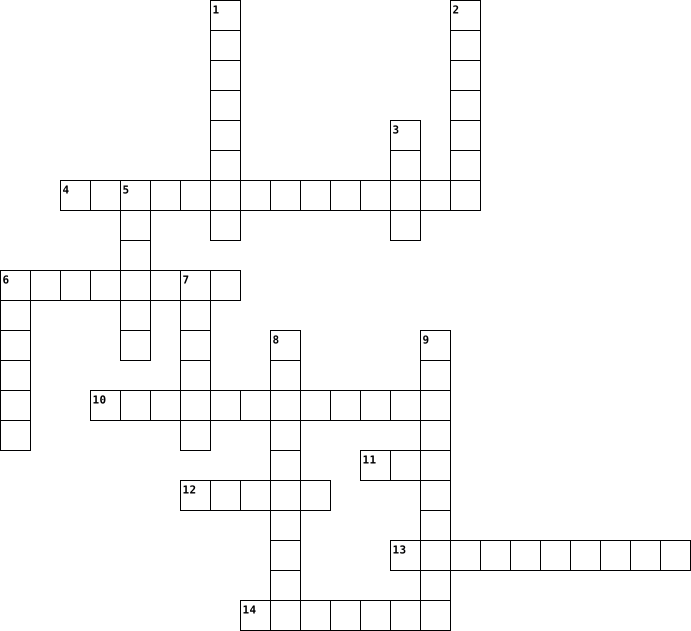
Across
- -- use artifacts to study people from long
- --- Geography studies landforms
- Physical Geographers take detailed ---
- is divided into --- main branches
- --- Geography is the study of people.
- Geographers help us improve our ---
- Physical Geographers keep careful ---
Down
- Geographers help us learn about people from
- Historians study try to understand what caused
- Human Geographers study people: --- and present
- Geographers help us design our --- and towns
- Human Geography focuses on ---
- Physical Geographers help us --- to changes
- Geographers must --- in smaller areas of
- --- study patterns in history
15 Clues: --- study patterns in history • Human Geography focuses on --- • --- Geography studies landforms • is divided into --- main branches • Geographers help us improve our --- • --- Geography is the study of people. • Physical Geographers keep careful --- • Physical Geographers take detailed --- • Geographers must --- in smaller areas of • ...
Unit 10 US History 2017-03-06

Across
- literary and artistic movement of the late 1800's and early 1900's
- Studied American birds – anatomy and behavior – naturalist
- poorly designed apartments that housed large numbers of people
- Fought for reforms in prisons and hospitals
- belief that people could transcend opr rise above material things in life – focused on nature
- NOT A REAL RAILROAD- system in place to transport fugitive/escaped slaves to freedom
- American Art School – focused on landscapes and man’s connection to nature
- New York 1848 – 1st public meeting about women’s rights
- Conductor on Underground RR – made 19 successful trips from South freeing slaves
- Americans that opposed immigration into the United States
- Major figure in Women’s movement – appeared on $1 coin in 1980s
Down
- Political organization that supported measures to make it difficult for foreigners to gain US citizenship
- Abolitionist – well spoken/written – started newspaper The North Star
- Prohibition – supported laws against the consumption of alcohol
- One of the founders of the Women’s Movement – Seneca Falls Convention – was Anti-Slavery and Women’s Rights
- Women’s rights movement included voting and shorter work day
- poem by Walt Whitman – considered to be the father of American Free Verse Poetry
- Abolitionist traveled country speaking against slavery
- American Author – wrote Hackberry Finn – gave insight into Southern culture
- Worked for equality for women – focused on women’s contribution to society
20 Clues: Fought for reforms in prisons and hospitals • Abolitionist traveled country speaking against slavery • New York 1848 – 1st public meeting about women’s rights • Americans that opposed immigration into the United States • Studied American birds – anatomy and behavior – naturalist • Women’s rights movement included voting and shorter work day • ...
US History Unit 4 2017-09-25

Across
- brought from foreign markets
- group of civilians trained to fight
- crops that could be sold easily in the markets of the colonies or overseas
- variety – different cultures all living and working together
- bosses, to keep slaves working hard
- route of trade that formed a triangle (England-West Indies –New England Colonies)
- King George declared that the Appalachian Mts. Were new western border
- learning assistants
- 1689 guaranteeing certain basic rights to all citizens
- established by settlers who had been given a charter
- Caribbean Basin is a region of the North Atlantic Ocean
- 1720-1740) “new birth” a movement that called for the strengthening of religious faith
- strict rules governing the behavior and punishment of enslaved Africans
- ended the American Revolution
- hills and forests of the Appalachian Mountains
Down
- the ability to read and write
- colonies directed ruled by the Great Britain (King)
- refers to the part of the trade where Africans, densely packed onto ships, were transported across the Atlantic to the West Indies.
- called for one general government
- colonies ruled by Proprietors
- region of flat, low lying plains along the east coast
- to sell abroad (outside of home country)
- war in Europe between Great Britain and France
- unions (with Native American Tribes)
- produced just enough to meet the needs of their families
- spread the idea of knowledge, reason and science
- trading illegally with other nations
- as a notion’s trade grows, its gold reserve increase and the nation becomes more powerful
28 Clues: learning assistants • brought from foreign markets • the ability to read and write • colonies ruled by Proprietors • ended the American Revolution • called for one general government • group of civilians trained to fight • bosses, to keep slaves working hard • unions (with Native American Tribes) • trading illegally with other nations • to sell abroad (outside of home country) • ...
Unit 1 US History 2017-09-28

Across
- an astronomical instrument used to determine latitude and longitude at sea by measuring angular distance, especially the altitudes of the sun, moon and stars
- an astronomical instrument instrument for taking the altitude of the sun or stars and for the solution of other problems in astronomy and navigation: Used by Greek astronomers from about 200 B.C. and by Arab astronomers from the Middle Ages until replaced by the Sextant.
- explorers who travelled the Mississippi River and were often fur trappers who traded with the Natives
- a major crop which is native to the Americas and can be made into flour and now, popular
- the people who lived in the Americas for thousands of years and flourished until Europeans invaded.
- along with Da Gama, Portuguese explorer who sailed around the tip of Africa
- the location of the land bridge that was glacier 20-30,000 years ago and is now sea
- led the first expedition to sail around the world in 1549. His crew was the first to circumnavigate the earth.
- How scientists believe the first people came from Asia to the Americas 20-30,000 years ago
- Resources compiled and interpreted from primary and secondary sources.
- explored the West Indies and the Caribbean in 1492 and never knew he didn’t reach Asia (East Indies)
- The Study of the process of history
- Native Americans believed no one could own this
- Native Americans believed everything, even rocks, had this
- explored Southwestern North America for Spain in 1540
- Copying work that is not your own without giving credit to the author
- brought to the New World by Europeans, these animals helped the Spanish conquer natives and changed the life of many Native Americans
Down
- genetic evidence used to determine when the first people came to North America
- small pox and typhoid for example, this killed many Natives, especially when Europeans gave the Natives contaminated blankets
- an early cash crop in the Southern Colonies of America, introduced to settlers by the Natives and adored in Europe.
- Europeans wanted to convert Native Americans to this belief
- Theory that the first humans came to the new world by following North Pacific coastlines from Asia into the Americas
- the recovery and study of physical remains from past human life and culture
- explorers and colonists who explored the east coast and then settled what became the 13 colonies under the rule of King George
- A first hand account of an event. Examples Declaration of Independence, Anne Frank’s Diary
- Spanish explorers, soldier-adventurers, who wanted to conquer the New World.
- Essential occupation for the earliest colonists for survival before they can plant and grow their crops.
- the exchange of goods and ideas between the New and the Old World
- the land Columbus was looking for
- History that took place before the development of writing
- English explorer who explored the East Coast of North America
- Motivation for European explorers, which reflected their individualistic societal beliefs
- source
- early explorers, conquistadors, who conquered Natives in south and Central America looking for gold, riches and slaves
- the first Europeans to land in the New World in 1001, but they did not settle there.
35 Clues: source • the land Columbus was looking for • The Study of the process of history • Native Americans believed no one could own this • explored Southwestern North America for Spain in 1540 • History that took place before the development of writing • Native Americans believed everything, even rocks, had this • Europeans wanted to convert Native Americans to this belief • ...
US History (1607-1877) 2017-05-21

Across
- a 13 day siege at a mission in San Antonio
- taxed glass, lead, paper, paint, and tea entering the colonies.
- The first cultural movement to unite the Thirteen Colonies.
- Act passed in 1766 just after the repeal of the Stamp Act.
- a war between citizens of the same country.
- a war fought from 1775-1783 and won by the 13 American colonies
- 1776 pamphlet by Thomas Paine
- 7th U.S. President
- They were meant to punish the Massachusetts colonists
- "no taxation without representation," introduced by Patrick Henry
- An act of 1689 granting freedom of worship to dissenters
- issued October 7, 1763, by King George III
- The last battle of the Revolutionary War, fought in 1781
- An armed rebellion by Virginia settlers led by Nathaniel Bacon
- The first bloodshed of the American Revolution
Down
- destroyed an entire shipment of tea sent by the East India Company.
- Turning point of the American Revolution
- a tariff on sugar, coffee, wines, and molasses.
- a land deal between the United States and France
- the first legislative body in colonial America
- the first constitution of the United States, on November 15 ,1777
- sent letters of complaints to the king and parliament
- The first permanent English settlement in North America, founded in 1607
- a series of Acts passed in the English Parliament in 1651,1660 & 1663
- 3rd U.S. President
- The first agreement for self-government in America.
26 Clues: 7th U.S. President • 3rd U.S. President • 1776 pamphlet by Thomas Paine • Turning point of the American Revolution • a 13 day siege at a mission in San Antonio • issued October 7, 1763, by King George III • a war between citizens of the same country. • the first legislative body in colonial America • The first bloodshed of the American Revolution • ...
US History (1607-1877) 2017-05-21

Across
- destroyed an entire shipment of tea sent by the East India Company.
- a tariff on sugar, coffee, wines, and molasses.
- An act of 1689 granting freedom of worship to dissenters
- "no taxation without representation," introduced by Patrick Henry
- The first agreement for self-government in America.
- a war between citizens of the same country.
- issued October 7, 1763, by King George III
- The last battle of the Revolutionary War, fought in 1781
- the first constitution of the United States, on November 15 ,1777
- An armed rebellion by Virginia settlers led by Nathaniel Bacon
- The first permanent English settlement in North America, founded in 1607
- Act passed in 1766 just after the repeal of the Stamp Act.
- The first bloodshed of the American Revolution
Down
- They were meant to punish the Massachusetts colonists
- Turning point of the American Revolution
- a 13 day siege at a mission in San Antonio
- a series of Acts passed in the English Parliament in 1651,1660 & 1663
- 3rd U.S. President
- a war fought from 1775-1783 and won by the 13 American colonies
- 1776 pamphlet by Thomas Paine
- The first cultural movement to unite the Thirteen Colonies.
- a land deal between the United States and France
- the first legislative body in colonial America
- sent letters of complaints to the king and parliament
- taxed glass, lead, paper, paint, and tea entering the colonies.
- 7th U.S. President
26 Clues: 3rd U.S. President • 7th U.S. President • 1776 pamphlet by Thomas Paine • Turning point of the American Revolution • a 13 day siege at a mission in San Antonio • issued October 7, 1763, by King George III • a war between citizens of the same country. • the first legislative body in colonial America • The first bloodshed of the American Revolution • ...
US History Crossword #1 2013-02-26

Across
- Preference for or dislike of something or someone
- words that have similiar meanings
- is to examine what two or more things have in common
- a crop grown by a farmer to be sold for money rather than for personal use
- a worker hired by a planter to watch over and direct the work of slaves
- a 1739 uprising of slaves in South Carolina, leading to the tightening of already harsh slave laws
- is to examine how two or more things are different
- obvious and intentional exaggeration
- the transatlantic system of trade in which goods, including slaves, were exchanged between Africa, England, Europe, the West Indies, and the colonies in North America
- a mountain range that stretches from eastern Canada south to Alabama
- Information spread with the intention to persuade readers
- a mill in which grain is ground to produce flour or meal
- a broad plateau that leads to the foot of a mountain range
- the point at which a waterfall prevents large boats from moving farther upriver
- a large group of families that claim a common ancestor
- a skilled worker who makes goods by hand; a craftsperson
Down
- a colonial region that ran along the Appalachian Mountains
- a farm that produces enough food for the family with a small additional amount for trade
- a series of laws passed by Parliament to ensure that England made money from its colonies' trade
- a variety of people
- A word with the same spelling but different meaning
- a vehicle with wide wheels, a curved bed, and a canvas cover used by American pioneers
- words that have opposite meanings
- to illegally import or export goods
- a plant grown in the Southern colonies that yields a deep blue dye
25 Clues: a variety of people • words that have similiar meanings • words that have opposite meanings • to illegally import or export goods • obvious and intentional exaggeration • Preference for or dislike of something or someone • is to examine how two or more things are different • A word with the same spelling but different meaning • ...
US History Review Crossword 2013-04-04

Across
- Branch of government that includes the President, Vice President, and cabinet.
- Peaceful religious group that founded Pennsylvania.
- Political body representing American interests and challenging British control.
- Forcing people to shelter soldiers in their homes.
- Ancient empire conquered by Pizarro.
- Branch of government that makes laws.
- A tax on all printed materials.
- Fifth president.
- Citizens that stayed loyal to Britain.
- Where Columbus first landed.
Down
- People who wanted to reform the church of England.
- First man(or his crew anyway) to circumnavigate the world.
- State that was annexed by the U.S.
- Famous for betraying the U.S. in the Revolutionary War.
- First settlement in North America (but it disappeared).
- This man helped Jamestown survive because of his great leadership.
- Spanish explorers.
- Branch of government that interprets the laws. Includes Supreme Court.
- Revolution Change from homemade items to factories and machines.
- President that annexed Texas, won the Mexican-American War, and negotiated for British Territory.
- First permanent settlement in North America.
- Guide and interpreter for Lewis & Clark.
- People who moved from place to place.
- Citizens that supported the war for independence.
- Old fort/mission where Davy Crockett and other men fought off Santa Anna's army for 12 days.
25 Clues: Fifth president. • Spanish explorers. • Where Columbus first landed. • A tax on all printed materials. • State that was annexed by the U.S. • Ancient empire conquered by Pizarro. • Branch of government that makes laws. • People who moved from place to place. • Citizens that stayed loyal to Britain. • Guide and interpreter for Lewis & Clark. • ...
US HISTORY - Jeopardy Review 2012-10-17

Across
- founded a colony for Quakers
- believe that everyone has an Inner Light
- Spanish Aristocrats
- People of Spanish/African descent
- Lake that was the site of the Aztec capital
- Leader of the Aztecs
- Antinomian woman
- Also known as King Philip
- Settlement in VA, led by John Smith
- Man who started the Society of Friends
Down
- Religious group who disliked Anglicans and believed in Purity of faith
- founded Rhode Island
- Name of the Strait that the first Americans came to N. America by
- Descendants of Spanish
- Aztec capital
- System of forced labor used by Spanish
- built flat topped pyramids with stairs leading to temples
- Puritan leader who wrote the "City on a hill"
- Settlement that disappeared leaving behind only the word Croaton
- Spanish explorer who helped destroy the Aztecs
- People of Spanish/Indian descent
21 Clues: Aztec capital • Antinomian woman • Spanish Aristocrats • founded Rhode Island • Leader of the Aztecs • Descendants of Spanish • Also known as King Philip • founded a colony for Quakers • People of Spanish/Indian descent • People of Spanish/African descent • Settlement in VA, led by John Smith • System of forced labor used by Spanish • Man who started the Society of Friends • ...
US HISTORY CH.9 2012-11-19

Across
- and only the fittest survive
- American statement that the government did not want colonies in China, but favored free trade there
- a form of non-traditional warfare generally involving small bands of fighters, relies on surprise attacks; attack and retreat.
- Cuba within the U.S. sphere
- form of nationalism
- a foreign policy based on human rights,
- the belief that life is a competitive
- privileged access by Britain, France,
- newspapers that used sensational headlines and exaggerated stories in order to promote readership
- governor of the Philippines who later
- Signed by Spain and the United States, officially ended the The Spanish-American War.
- restricted rights of newly freed Cubans
- human-made waterway linking the Atlantic to the Pacific across the isthmus of Panama
Down
- the policy in which strong nations control
- a Filipino nationalist
- owner of the New York Journal
- and Russia to China
- honor, and understanding
- President of the United States
- Theodore Roosevelt’s foreign policy
- countries or territories
- established a civil government in Puerto Rico
22 Clues: form of nationalism • and Russia to China • a Filipino nationalist • honor, and understanding • countries or territories • Cuba within the U.S. sphere • and only the fittest survive • owner of the New York Journal • President of the United States • Theodore Roosevelt’s foreign policy • the belief that life is a competitive • privileged access by Britain, France, • ...
Coach Marshall US History 2021-01-08

Across
- SIGNED BY PILGRIMS IN 1620 (pg 26)
- ENGLAND'S LEGISLATIVE BRANCH (pg 26)
- WHERE THE PILGRIMS SETTLED IN 1620 (pg 115)
- REFUSAL TO OBEY LAWS THAT ARE CONSIDERED UNJUST (pg 169)
- PEOPLE WHO OPPOSED THE CONSTITUTION (pg 248)
- GOVERNMENT MUST FOLLOW ESTABLISHED PROCEDURES IN TAKING ACTION AGAINST A CITIZEN (pg 264)
- 1783 ______ OF PARIS (pg 217)
- TURNING POINT BATTLE IN REVOLUTION (pg 201)
- MAIN AUTHOR OF THE DECLARATION OF INDEPENDENCE pg 181)
- CHANGES TO A DOCUMENT (pg 249)
- TWO-HOUSE LEGISLATURE (pg 227)
- SHAWNEE INDIAN CHIEF WHO TRIED TO BUILD A CONFEDERACY OF NATIVE AMERICANS (pg 333)
- RIGHTS THAT CAN'T BE TAKEN AWAY (pg 29)
Down
- THOSE REMAINING LOYAL TO THE KING (pg 195)
- INFORMATION DESIGNED TO INFLUENCE OPINION (pg 169)
- LETTER TO THE PEOPLE FROM WASHINGTON AT THE END OF HIS PRESIDENCY (pg 305)
- FATHER OF THE CONSTITUTION (pg 238)
- CITIZENS CHOOSE THEIR REPRESENTATIVES (pg256)
- CROPS THAT COULD EASILY BE SOLD IN MARKETS (pg 135)
- THREE FRENCH OFFICIALS DEMAND BRIBES DURING NEGOTIONS FOR A TREATY. (pg 309)
- GREATEST LAND PURCHASE IN HISTORY FOR $15 MILLION (pg 324)
- CAPTURING OF AMERICAN SHIPS AND FORCING THE CREW INTO THE BRITISH NAVY (pg 304)
- PEOPLE WHO SUPPORTED THE CONSTITUTION (pg 248)
- FORMAL REQUEST(PART OF FIRST AMENDMENT)(pg 179)
- INTRODUCTION (FIRST PART OF DECLARATION OF INDEPENDENCE)(pg 182)
- FOR IMPOSING_____ON US WITHOUT OUR CONSENT (pg 189)
- THOSE IN GOVERNMENT SUPPORTING MORE MILITARY SPENDING AND AGGRESSIVE ACTION (pg 334)
- PROHIBITS TRADE WITH ANOTHER COUNTRY (pg 331)
- HAMILTON AND BURR SQUARE OFF WITH PISTOLS WHERE HAMILTON DIES A DAY LATER (pg 327)
- WITHDRAW FROM THE UNION (pg 327)
30 Clues: 1783 ______ OF PARIS (pg 217) • CHANGES TO A DOCUMENT (pg 249) • TWO-HOUSE LEGISLATURE (pg 227) • WITHDRAW FROM THE UNION (pg 327) • SIGNED BY PILGRIMS IN 1620 (pg 26) • FATHER OF THE CONSTITUTION (pg 238) • ENGLAND'S LEGISLATIVE BRANCH (pg 26) • RIGHTS THAT CAN'T BE TAKEN AWAY (pg 29) • THOSE REMAINING LOYAL TO THE KING (pg 195) • WHERE THE PILGRIMS SETTLED IN 1620 (pg 115) • ...
US History 15-16 2021-01-15

Across
- inventor of the telephone
- grandson of "Tippecanoe"
- corrupt leader who cheated New York City out of millions of dollars
- America's most prolific inventor
- steel entrepreneur
- labor union leader
- first black to serve in the U.S. Congress
- shipping entrepreneur
- Southerners who supported southern governments
- assassinated at a train station months after being president
- political cartoonist who advocated reforms
Down
- associated with political corruption
- first president to be impeached
- oil-refining entrepreneur
- one of the most scandal-ridden presidential administrations
- the South's tobacco entrepreneur
- investment banker
- attempted to restrict the rights of former slaves
- secretary who brought about impeachment
- Northerners who moved to the South
20 Clues: investment banker • steel entrepreneur • labor union leader • shipping entrepreneur • grandson of "Tippecanoe" • inventor of the telephone • oil-refining entrepreneur • first president to be impeached • the South's tobacco entrepreneur • America's most prolific inventor • Northerners who moved to the South • associated with political corruption • ...
People From US History 2021-10-20

Across
- Senator South Carolina
- American nurse, humanitarian and author
- first African American to serve Congress in 1870
- Scottish-born inventor, scientist, and engineer who is credited with inventing and patenting the first practical telephone
- sworn in as President of the Confederacy in Mongomery Alabama
- first and longest-serving president of the American Federation of Labor
- American business magnate who built his wealth in railroads and shipping
- lead fellow antislavary settlers on a murderous raid in Kansas
- Soldier to win the Congressional Medal of Honor in the Civil War
Down
- immigrant from Chile and enlisted in the Navy
- had only one year of formal education
- President to take over after President Abraham Lincoln was killed
- the first US President to veto bills that banned iliterate immigrants from entering the US
- spokesperson for the abolition of slavery
- Senator from Kentucky
- 21st US President
- Commander of the Union Army
- Commander of the Confederate Army
- American business magnate and philanthropist
- lived in a free territory and appealed for his freedom after his owner died
20 Clues: 21st US President • Senator from Kentucky • Senator South Carolina • Commander of the Union Army • Commander of the Confederate Army • had only one year of formal education • American nurse, humanitarian and author • spokesperson for the abolition of slavery • American business magnate and philanthropist • immigrant from Chile and enlisted in the Navy • ...
US HISTORY LEAP REVIEW 2022-04-07

Across
- to cancel/take away a law
- lowered tax on molasses to cut down on smuggling, but allowed accused smugglers' goods to be taken without an arrest
- marked the end of France as a colonial power in North America
- first victim of Boston Massacre
- militia people who are ready quickly
- main cash crop in colonial America
- partnership with other powers/countries
- leaders of colonial boycotts
- land area the French and British fought over
- colonial leaders used this event as propaganda against the British
- closed Boston Harbor, banned town meetings
- illegal practice colonists used to avoid exclusively trading with the British
- OG British colonial town founded in 1607
- made alliances with Native Americans to form Rhode Island
- leader of the Green Mountain Boys
- received great help from this country
- important port city
- 1st battles of American Revolution
- religion with little tolerance for other beliefs
- Product that gets shipped INTO a country
- servant to get a ride to the colonies, these people would give 2+ years of their life
- religious group that formed the colony of Plymouth
- tax on all printed materials
- main fur that started French/Indian War
- Leader of Britain
- Natural rights (life, liberty, property)
- "remember the ladies"
- keeps ships from entering/leaving a harbor
- leader of the Sons of Liberty
- supporters of independence
- British General
- final battle of revolution
- main writer of Declaration of Independence
Down
- refuse to buy goods in protest
- most powerful group in eastern North America
- colonial General
- wrote the never implemented Albany Plan of Union
- between Africa, Europe and the Americas, forms a shape
- kicked out of Massachusetts for preaching as a woman
- Obvious pamphlet written by Thomas Paine
- nickname for British soldiers
- supporters of the crown
- America's Birthday
- American naval hero
- Act that taxed imported goods
- led a rebellion against the english
- winner of French and Indian war
- formal writing introduction
- sparked the Boston Tea Party
- semi-professional military group
- turning point of war
- Lousiana's then mother country, helped the colonies in the war
- Product that gets shipped OUT of a country
- Give me liberty or give me death guy
- the Proclamation of 1763 prohibited settlement past these mountains
- 19 year old french commander
- disguised herself as a man to fight for colonies
- Ben Franklin's call to unite the colonies during the French and Indian War
- colony founded by Dutch Traders, largest city in the US
- British policy of forcing colonists to only trade with the Mother Country
- harsh and terrible winter at this camp
- last chance petition colonists sent to King George
- product that makes a lot of money!
63 Clues: British General • colonial General • Leader of Britain • America's Birthday • American naval hero • important port city • turning point of war • "remember the ladies" • supporters of the crown • to cancel/take away a law • supporters of independence • final battle of revolution • formal writing introduction • leaders of colonial boycotts • sparked the Boston Tea Party • ...
A History of Us 2022-02-07

Across
- currency for Joe's Place
- Karaoke duet
- The only grocery store Isabelle loves
- Epic head tilt
- American Poet
- an award bestowed by KishiBashi
- Peninsula Roadtrip
- an elite tour
- gender neutral pet name
- preferred legume
- Capital city food truck
- world's greatest pizza, maybe
Down
- Classic film
- What I should have said was nothing
- Location of our 2nd kiss
- High praise for a comedic moment
- An alternative Lansing zoo
- Our best hike
- Lake Michigan getaway
- Desert playground
- Spring Break destination
- a playful left
- Where we fell in love with dolphins
- ZooDeMack eatery
- Isabelle's popstar moment
25 Clues: Classic film • Karaoke duet • Our best hike • American Poet • an elite tour • Epic head tilt • a playful left • ZooDeMack eatery • preferred legume • Desert playground • Peninsula Roadtrip • Lake Michigan getaway • gender neutral pet name • Capital city food truck • currency for Joe's Place • Location of our 2nd kiss • Spring Break destination • Isabelle's popstar moment • An alternative Lansing zoo • ...
US History Chapter 16 2022-02-01

Across
- A type of leisure time.
- Moody’s song leader.
- The innovation to keep food cold.
- Founder of the railroad industry.
- Connected the east and the west.
- A new source of power.
- Founder of Finance and Banking.
- Invented the telephone.
- The method of quickly writing information.
- This standardized sizes and color.
- It made the lower class dress as the rich.
Down
- All immigrants passed through here.
- Credited with inventing the lightbulb.
- Christian song leader.
- Nickname for the US.
- The movement of the population to the city.
- Founder of the steel industry.
- Rescue missions were established here.
- Founder of the first Standard Oil Company.
- Wrote the “Origin of Species”.
- The famous food producer.
- Famous evangelist from Chicago.
22 Clues: Nickname for the US. • Moody’s song leader. • Christian song leader. • A new source of power. • A type of leisure time. • Invented the telephone. • The famous food producer. • Founder of the steel industry. • Wrote the “Origin of Species”. • Founder of Finance and Banking. • Famous evangelist from Chicago. • Connected the east and the west. • The innovation to keep food cold. • ...
Topic #4 US History 2022-11-03

Across
- setting traditions for others to follow
- a treaty with Great Britain to ask them to leave American ships alone but they only left British forts in America
- first president of the United States
- three French agents wanted the Americans to apologize, pay a loan, and pay a bribe
- secretary of treasury
- a population count of the entire country done very 10 years
- a power that can be done by both state and nation government
- a power only given to the national government
- a congressional power specifically mentioned in the constitution
Down
- secretary of state
- slaves counted as three-fifths of a person
- Supreme Court chief justice
- a congressional power to act in non-specified areas of the constitution
- make sure not one branch gets all of the power
- people who believed in a strong national government
- speaker of the house
- vice president
- granted congress the pass all laws that are proper and necessary
- he came to the US trying to recruit American private citizens into the French army
- having one legislative branch
- a power reserved for the state
- having two legislative branches
22 Clues: vice president • secretary of state • speaker of the house • secretary of treasury • Supreme Court chief justice • having one legislative branch • a power reserved for the state • having two legislative branches • first president of the United States • setting traditions for others to follow • slaves counted as three-fifths of a person • ...
US History 1920s Project 2022-11-04

Across
- Social norms began to change in the 20s
- The generation in their 20s during the Great War
- Flew the Spirit of Saint Louis from New York to Paris
- Medical experimentation on people
- Acts were passed to limit this from specific countries
- Was a lawyer in the Scopes Monkey trials
- Greatly expanded by the passing of the 19th amendment
- Music publishers that wrote popular songs in the 1920s
- Formed the Curtis-Wright Aviation corporation
- Greater access to this allowed for appliances to become commonplace within the American home
- Granted citizenship to any native American in U.S.A. territory
Down
- When African Americans moved to the north for economic opportunities
- Was caused by a fear of Far-Left ideas including anarchism
- The era of new thinking that brought about jazz music and social changes
- Allowed for greater direct communication
- The name for what the 19th amendment brought into law
- Manufacturing technique developed to allow for easy and cheap production of goods
- Sought to form a nation in Africa for African Americans to move to
- Stars Like Charlie Chaplin came from this industry
- Allowed for the sharing of information with the average American
- Supported US neutrality and the Free Silver Movement
- scale
- First mass production car that was widely accessible
- allowed for greater purchasing and expanded the middle class
24 Clues: scale • Medical experimentation on people • Social norms began to change in the 20s • Allowed for greater direct communication • Was a lawyer in the Scopes Monkey trials • Formed the Curtis-Wright Aviation corporation • The generation in their 20s during the Great War • Stars Like Charlie Chaplin came from this industry • ...
US History Vocab Crossword 2022-11-03

Across
- agreed to evacuate line by June 1 1796
- a treaty that solved territorial desputes
- congress does not have the power to pass laws that override the constitution
- not in accordance with the constitution
- a participatory member of a political community
- an organization that candies to a certain group of people
- one who favors a strict constitution
- one who favors a loose constitution
- does not help or support either side
- created 16 federal court judgeships
- a group of the presidents top advisors
Down
- the rights and powers held by the individual states
- non-citizen of a community acquires citizenship of another country
- alcoholic beverage made from fermented grain
- limited speech critical of the government
- a diplomatic incident that resulted in the Quasi war
- a social change
- taxes on imported goods
- an american news publication
- paved the way to expand the federal government
- when a law or act gets sent back to the supreme court for review
- not foreign, occurs inside the country
22 Clues: a social change • taxes on imported goods • an american news publication • one who favors a loose constitution • created 16 federal court judgeships • one who favors a strict constitution • does not help or support either side • agreed to evacuate line by June 1 1796 • not foreign, occurs inside the country • a group of the presidents top advisors • ...
US History Ch 3 2022-09-28

Across
- to combine two previously separate things.
- A grant of land by the Federal Government especially for roads, railroads or agriculture colleges.
- A company tool to fight union demands by refusing to allow employees to enter the facility to work.
- The act of limiting, restricting, or keeping under control.
- A person who buys what is produced by an economy.
- - He went to work at age 12 and made his fortune in Steel.
- A policy that government should interfere as little as possible in the nation's economy.
- An organization that is authorized by law to carry on an activity but treated as though it were a single person
- One who puts money into a company in order to gain future financial reward
- Created one of the largest holding companies, U.S. Steel
- A company whose primary business is owning a controlling share in other companies.
- The total valus of all goods and services that a country produces.
Down
- The reduction in the cost of a good brought about especially by increased production at a given facility
- called the AFL, focused on promoting the interest of skilled workers
- An organization of common laborers and craft workers in a particular industry
- An agreement in which a company agrees to hire only union workers.
- A court order whereby one is required to do or to refrain from doing a specific act.
- Total control of a type of industry by one person or one company
- One who organizes, manages and assumes the risk of a business.
- Settling a dispute by agreeing to accept the decision of an impartial outsider
- Where did the Union Pacific and Central Pacific railroads meet.
- - at one point he owned about 90% of the oil refining industry.
- a decline in the volume of available moneyor credit that resule in lower prices.
- The act of being given out or disbursed to clients.
- A combination of firms or corporations formed by a legal agreement, especially to reduce competition
25 Clues: to combine two previously separate things. • A person who buys what is produced by an economy. • The act of being given out or disbursed to clients. • Created one of the largest holding companies, U.S. Steel • - He went to work at age 12 and made his fortune in Steel. • The act of limiting, restricting, or keeping under control. • ...
A History of Us 2021-07-06

Across
- WHERE WE ONLY STAY WITH GAY UNCLES
- YOUR FIRST NICKNAME FOR ME
- A WORD YOU LIKE TO HEAR ME SAY
- YOU THROUGH MY EYES
- WHERE WE FIRST SAW ALL OF EACH OTHER
- OUR FAVORITE LOCAL COFFEESHOP
- OUR FAVORITE BRUNCH SPOT
- WHERE WE WORKED TOGETHER
- WHERE WE GOT ENGAGED
- WHERE WE HAD OUR FIRST KISS
- HOW I TOLD YOU YOU'D ALWAYS FALL ASLEEP
- OUR ANNIVERSARY MONTH
- TOPIC OF CONVERSATION ON OUR 1ST DATE
Down
- ONE OF OUR FAVORITE ACTIVITIES TOGETHER
- OUR TINY LIBRARY GETAWAY
- OUR FAMILY NAME
- WHERE WE MET
- ONE OF OUR FAVORITE GAMES
- THE VENUE WHERE WE COULD HANG OUT IN THE BACK ROOM DURING GIGS
- WHERE WE DANCED TOGETHER IN CANTON
- WHAT I HOPE YOU NEVER FORGET
- LOCATION OF OUR MOST RECENT IN-PERSON DATE
- COUNTY COURTHOUSE WHERE WE GOT MARRIED
23 Clues: WHERE WE MET • OUR FAMILY NAME • YOU THROUGH MY EYES • WHERE WE GOT ENGAGED • OUR ANNIVERSARY MONTH • OUR TINY LIBRARY GETAWAY • OUR FAVORITE BRUNCH SPOT • WHERE WE WORKED TOGETHER • ONE OF OUR FAVORITE GAMES • YOUR FIRST NICKNAME FOR ME • WHERE WE HAD OUR FIRST KISS • WHAT I HOPE YOU NEVER FORGET • OUR FAVORITE LOCAL COFFEESHOP • A WORD YOU LIKE TO HEAR ME SAY • ...
US History STAAR Review 2021-05-04

Across
- the right to vote
- nickname for a person that supported a strong, central government
- woman responsible for prison reform (last name)
- movement against alcohol
- large farm in the South with many slaves
- established in Marbury v. Madison
- President that encouraged us to stay out of foreign wars
- amendment that abolished slavery
- the supreme law of the land
Down
- first form of self-government
- policy of forcing soldiers to serve in your army
- President during the War of 1812 (last name)
- belief that the U.S. was meant to expand west
- Confederate General
- nickname for the North in the Civil War
- favoring one region instead of the country as a whole
- to leave the Union
- location of a famous "Tea Party"
- wrote Common Sense (last name)
- President responsible for the Trail of Tears (last name)
- invention that increased slavery
- first English settlement (1607)
- turning point in the American Revolution
- immigrant group that escaped the potato famine
24 Clues: the right to vote • to leave the Union • Confederate General • movement against alcohol • the supreme law of the land • first form of self-government • wrote Common Sense (last name) • first English settlement (1607) • location of a famous "Tea Party" • invention that increased slavery • amendment that abolished slavery • established in Marbury v. Madison • ...
US History STAAR Review 2021-05-05

Across
- the right to vote
- nickname for a person that supported a strong, central government
- woman responsible for prison reform (last name)
- movement against alcohol
- large farm in the South with many slaves
- established in Marbury v. Madison
- President that encouraged us to stay out of foreign wars
- amendment that abolished slavery
- the supreme law of the land
Down
- first form of self-government
- policy of forcing soldiers to serve in your army
- President during the War of 1812 (last name)
- belief that the U.S. was meant to expand west
- Confederate General
- nickname for the North in the Civil War
- favoring one region instead of the country as a whole
- to leave the Union
- location of a famous "Tea Party"
- wrote Common Sense (last name)
- President responsible for the Trail of Tears (last name)
- invention that increased slavery
- first English settlement (1607)
- turning point in the American Revolution
- immigrant group that escaped the potato famine
24 Clues: the right to vote • to leave the Union • Confederate General • movement against alcohol • the supreme law of the land • first form of self-government • wrote Common Sense (last name) • first English settlement (1607) • location of a famous "Tea Party" • invention that increased slavery • amendment that abolished slavery • established in Marbury v. Madison • ...
US History Crossword #1 2020-11-18

Across
- colonists couldn't settle beyond the Appalachian mountains
- A combination of the Virginia and New Jersey Plan
- The absolute rule of one man or group
- a farmer's rebellion revealing the weaknesses of the AOC
- A meeting of women to discuss rights and emancipation
- People who are viewed as property
- Strong central government, weak states
- connected rivers and greatly impacted transportation
- large Christian movement that emphasized religious (Christian) freedom
- First government document of the Pilgrims
- Strong state governments, weak central government
Down
- transference of ideas, goods and people across the old and new world
- a riot that turned into a shooting of colonists by British soldiers
- Jackson forcefully removing natives from their lands
- left England to create new Christian churches
- Washington advising on how to run the government
- weak government unable to withstand many problems thrown at it
- purge the soul and world of evil
- "We hold these truths to be self evident that all men are created equal"
- a large amount of pride for one's nation
20 Clues: purge the soul and world of evil • People who are viewed as property • The absolute rule of one man or group • Strong central government, weak states • a large amount of pride for one's nation • First government document of the Pilgrims • left England to create new Christian churches • Washington advising on how to run the government • ...
US History - Voting Policy 2022-10-10

Across
- Voting by ______ vetoing makes voting accessible and possible for many Americans, like those overseas or with disabilities.
- Requiring voter ID is often used to ___________ against minority groups in the US. ID is not shown to prevent voter fraud but does prevent voting.
- Primary elections happen when?
- The __________ college has been criticized for its "winner takes all" approach and its ability to disregard the popular vote by the citizens. Many voters think it should be rebuilt or be massively changed.
- The act of dividing states to swing an election in either direction - something most voters are against.
- Presidential elections happen every ____ years, and presidents can only serve two terms, preventing pseudo-monarchies and dictatorships.
- and statistics, less than 0.003% of votes were fraudulent.
- Local elections are very ________ as they happen more often and are just as powerful locally as country-wide elections
- The current minimum age to vote is ________, and it was 21 before 1971.
Down
- To be an educated voter is a _____ job
- Political parties have many ________ and negative aspects. These include properly representing the populations and allowing for more sway to the party in charge.
- Molly believes that the min. voting age should be _______ to encourage life long voters and increased voter turnout.
- The US ______ _______ is one of the most important services used in the voting process
- Voting should be ______ as to allow more people to act on their constitutional right to vote
- Politicians should __________ their opponent and not see them as the enemy
- ______ board elections are important as they effect your child and local youth, as well as the upcoming workforce.
- The _____ is the elected official of your town and is very important to local politics due to possessing a large amount of local power.
- _______ issue voters vote based on a politicians stance on one political issue.
- Voting _____ was a major concern at the last election according to one party, but according to
- Multi issue voters need to keep up to date on multiple issues and determine the best ________ to vote for dependent on their beliefs and actions
20 Clues: Primary elections happen when? • To be an educated voter is a _____ job • and statistics, less than 0.003% of votes were fraudulent. • The current minimum age to vote is ________, and it was 21 before 1971. • Politicians should __________ their opponent and not see them as the enemy • _______ issue voters vote based on a politicians stance on one political issue. • ...
US History Fall Final 2023-12-15

Across
- An obsession with the purchasing of material goods.
- Migration to a new location
- The name of President Roosevelt's program for getting the United States out of the depression
- A strong feeling of pride in and devotion to one's country
- a rebirth or revival
- 1800s belief that Americans had the right to spread across the continent.
- Laws designed to enforce segregation of blacks from whites
- the social process of absorbing one cultural group into another
- Movement of African Americans from the South to the North for jobs.
- using children to work in factories and businesses
- a type of combat in which opposing troops fight from trenches facing each other.
- A law forbidding the sale of alcoholic beverages
- complaint
Down
- Basic rules and laws of a nation
- A policy of extending a country's power and influence through diplomacy or military force.
- land set aside for Native Americans to live.
- The development of industries for the machine production of goods.
- Separation of people based on racial, ethnic, or other differences
- groups are absorbed into the majority group by adopting the majority group's culture
- a forcible overthrow of a government
- Germany, Austria-Hungary, Italy
- A policy of favoring native-born individuals over foreign-born ones
- Complete control of a product or business by one person or group
- A person who wanted to end slavery
- Britain, France, Russia
- union An organization of workers that tries to improve working conditions, wages, and benefits for its members
- depression A time of economic disaster; started in the United States in 1929.
- when some people are owned by other people.
- A war between people of the same country.
- an agreement between 2 or more countries to help each other out in war
30 Clues: complaint • a rebirth or revival • Britain, France, Russia • Migration to a new location • Germany, Austria-Hungary, Italy • Basic rules and laws of a nation • A person who wanted to end slavery • a forcible overthrow of a government • A war between people of the same country. • when some people are owned by other people. • land set aside for Native Americans to live. • ...
US History 1800-1840 2023-11-27

Across
- Central Government is more efficient
- People being forcced into service
- Metting about goverment not working
- Limitations for the Government
- National Anthem
- War over impressment
- Two houses for Congress
- Ordinances that are northwest
- Court case over not getting job letter
- Land we bought from Napoleon
- People Against the Federalists
Down
- Our First Constitution
- Basis of the Star Spangled Banner
- Wars including Napoleon
- Battle fought even after the war of 1812 ended
- What the Supreme Court does
- Dont talk against the gov't
- Voting to Agree
- Another small revolution by veterans
- Helped Lewis and Clark
20 Clues: National Anthem • Voting to Agree • War over impressment • Our First Constitution • Helped Lewis and Clark • Wars including Napoleon • Two houses for Congress • What the Supreme Court does • Dont talk against the gov't • Land we bought from Napoleon • Ordinances that are northwest • Limitations for the Government • People Against the Federalists • Basis of the Star Spangled Banner • ...
US History Interim Review 2023-11-29

Across
- Word meaning signing/voting to Agree
- Fights fought by France under Napoleon's rule
- People that opposed a Federal government
- Decided an act of Congress was unconstitutional
- Papers arguing a strong federal government
- Mother who traveled with her baby with Louis and Clark
- Battle that borned the Star Spangled Banner
- Inciting people to rebel against the government
- Napoleon sold this land to the US
- Forcibly recruiting men into combat
Down
- Determines whether the something is constitutional
- Battle fought for but after the War of 1812
- US First Constitution
- Meeting that addressed the problems of the Articles of Confederation
- War over impressment between America and the British
- US National Anthem
- Daniel Shays led this attack
- First 10 amendments
- This created a bicameral congress
- Divided “Old Northwest”
20 Clues: US National Anthem • First 10 amendments • US First Constitution • Divided “Old Northwest” • Daniel Shays led this attack • This created a bicameral congress • Napoleon sold this land to the US • Forcibly recruiting men into combat • Word meaning signing/voting to Agree • People that opposed a Federal government • Papers arguing a strong federal government • ...
US History Chapter 6 2023-10-03

Across
- General who replaced Governor Hutchinson
- British general who failed to capture Washington at Trenton
- Where British troops fired on and killed several colonists
- Prime Minister who sympathized with the colonists
- Act that forced colonists to house British troops
- Where about 70 minutemen stood their ground against the British soldiers
- Said "Give me liberty, or give me death"
- Name for the colonists who fought for independence
- Colonists name for the unfair taxes placed on them by the British
- Colonists who remained faithful to England
- Helped George Washington drill the troops
Down
- Frenchman who became Washington's aide
- Suggested forming the first Committee of Correspondence
- Commander and Chief of the Colonial Army
- President of the Second Continental Congress and signer of the Declaration
- Leader of the Green Mountain Boys
- Provisional government established in 1774
- Where Washington and the troops spent a difficult winter
- Volunteer militia ready to fight at a moment's notice
- Taxes put on colonial imports from Britain
- Prime Minister who did not sympathize with the colonists
- Author of Common Sense
- Colonial General who captured Burgoyne's troops at Saratoga
- Place where the Patriots were hiding and storing ammunition
- Led committee to write the Declaration of Independence
- Event where disguised colonists threw tea into the harbor
- German mercenaries
27 Clues: German mercenaries • Author of Common Sense • Leader of the Green Mountain Boys • Frenchman who became Washington's aide • Commander and Chief of the Colonial Army • General who replaced Governor Hutchinson • Said "Give me liberty, or give me death" • Helped George Washington drill the troops • Provisional government established in 1774 • ...
US History Chapter 9 2023-10-25

Across
- President elected in 1828
- Plan passed by Congress to relocate Indians to Oklahoma
- New political party that opposed Jackson
- Another name for the Tariff of 1828
- Abolitionist who published "The Liberator"
- Conflict that involved Sac and Fox Indians
- Forced relocation of Cherokee Indians when 4000 died along the way
- Senator from Kentucky
- Nickname of William Henry Harrison
- Became President when Harrison died of pneumonia
Down
- Federally funded road from Maryland to Illinois
- The plan to lower import taxes for ten years
- The director of the Central Bank
- Abolitionist who published "The North Star"
- Hero of Tippecanoe who was elected President in 1840
- Closed meeting of political party leaders
- Preacher who started a slave rebellion in Virginia
- Another senator from South Carolina who debated for state's rights
- The idea that states could over-rule a federal law
- Law that allowed the President to use the military to enforce tariff laws
- Movement to end slavery in the U.S.
- Senator who gave a speech discouraging any secession from the Union
- Senator of South Carolina who opposed tariffs
- When a state breaks away from a nation
- Jackson's Vice-President who was elected President in 1836
25 Clues: Senator from Kentucky • President elected in 1828 • The director of the Central Bank • Nickname of William Henry Harrison • Another name for the Tariff of 1828 • Movement to end slavery in the U.S. • When a state breaks away from a nation • New political party that opposed Jackson • Closed meeting of political party leaders • Abolitionist who published "The Liberator" • ...
US history WEEK 21 2024-01-23

Across
- ______ crops, crops grown to sell for profit
- people loyal to England
- last name, secretary of treasury
- three words, colonist dumped tea into the Boston harbor
- _______ passage, slave route from Africa to the Americas
- group of people that wanted a strong central government during writing of Constitution
- Great ________, religious movement
- two words, Washington's winter camp
- ___________ Era, John Locke, Montesquieu
- _________ Rebellion, protests about taxes the alcoholic drink
- God, gold, and ______, reasons Europeans came to the new world
- _______ pot, the nickname of the Middle colonies
- ______Rebellion, proved Articles of Confederation were weak
- __________ of 1763, line (border) colonist could not cross to go west of Appalachian Mountains
- Battle of __________, place the British surrendered
- last name, secretary of State
- a change to the constitution
- term used to describe not being allowed to trade with anyone except mother country
- Treaty of _______, ended American Revolution, 1783
Down
- _______ neglect, time when England ignored the colonies
- group of people that wanted a Bill of Rights in the Constitution
- __________ Act, also known as the Coercive acts
- three words, letter sent to King George from the colonist asking for peace
- Battle of _______ turning point of the American Revolution
- first name of the writer of the Declaration of Independence
- three names, father of the American Navy
- first permanent English settlement, 1607
- people loyal to the colonies
- Boston ________, event when British soldiers fired on a crowd
- _______ compact, 1620
- last name of father of the Constitution
- _______ trade, shape, routes between Europe, Africa, the Americas
- tax on imports
33 Clues: tax on imports • _______ compact, 1620 • people loyal to England • people loyal to the colonies • a change to the constitution • last name, secretary of State • last name, secretary of treasury • Great ________, religious movement • two words, Washington's winter camp • last name of father of the Constitution • ___________ Era, John Locke, Montesquieu • ...
US History Chapter 7 2023-10-15

Across
- Government branch that enforces the law
- First President of the United States
- Warned the Convention that God must be included in the planning of the new Constitution
- First Secretary of the State and third President of the US
- Group that wanted states to have more power in governing the nation
- Compromise that only counted some of the slaves when counting population for representation
- Treaty that settled a border dispute between Spain and the US
- Political party that supported Thomas Jefferson
- Political party that wanted a stronger central government
- Chief Justice of the Supreme Court who established the authority to rule on the constitutionality of a law
- First Secretary of the Treasury
- America's first plan for government
Down
- Government branch that makes the laws
- Group of papers written in support of the new constitution
- First Supreme Court Chief Justice
- Meeting of 55 delegates who created a new Constitution
- One of the most important members of the delegation who contributed to forming the new Constitution
- Led a group of farmers in an uprising in 1787
- Plan for bicameral legislature that became the basis for our constitution
- Government branch that interprets the laws
- Location of the Constitutional Convention
- Second president and member of the Federalist Party
- First ten amendments to the Constitution
- Name for the government established by the new constitution
- Another name of the Connecticut Compromise
25 Clues: First Secretary of the Treasury • First Supreme Court Chief Justice • America's first plan for government • First President of the United States • Government branch that makes the laws • Government branch that enforces the law • First ten amendments to the Constitution • Location of the Constitutional Convention • Government branch that interprets the laws • ...