
us history Crossword Puzzles
Chapter 2 US History 2018-12-19

Across
- Navigators learn ship's location by charting the position of the stars
- Gave enslaved Africans a form of expression
- Montezuma's capital
- Named in honor of King Louis XIV
- First Europeans to make contact with North America
- Discovered the coast of Florida for Spain in 1512
- Huge fleet of warships
- Divided Atlantic Ocean between Spain and Portugal
- Built an observatory and founded a school of navigation
- Island where Columbus first landed
- Smaller, lighter, and easier to steer than the heavy galleons
- Large farms that grew just one kind of crop
- Scattering of people
- Sharing products between Europe and North America
Down
- First European to sail into the St. Lawrence River
- Slaves were brought from this region of the continent
- Slaves traveled with these around the necks
- Founded the Church of England
- His crew landed on the Labrador Peninsula in the year 1000
- Religious movement that began in Germany
- Document giving permission to start a colony
- Eriksson settled in this coastal area
- Voyage across the Atlantic Ocean that brought enslaved Africans
- Columbus's hometown
- The first people Columbus met after he landed on Hispaniola
- Conquered the entire Inca Empire
- Soldiers who led military expeditions in the Americas
- Sailed to present-day Mexico in 1519
- Natural resistence
- Columbus sailed for this nation
30 Clues: Natural resistence • Montezuma's capital • Columbus's hometown • Scattering of people • Huge fleet of warships • Founded the Church of England • Columbus sailed for this nation • Named in honor of King Louis XIV • Conquered the entire Inca Empire • Island where Columbus first landed • Sailed to present-day Mexico in 1519 • Eriksson settled in this coastal area • ...
US History vocab review 2019-10-24

Across
- negotiation between nations
- the ceremonial induction into a position
- a legal right to vote
- make changes for improvement to remove abuse and injustices
- something that aids or promotes well being
- incorporation of a formerly excluded group into a community
- the activity of building something again
- the act of forming or establishing something
- of a government with an authority exerting absolute control
- the state of being joined or united or linked
Down
- an assembly that makes, amends, or repeals the laws
- grant a pardon to
- exploitation by stronger country of weaker one
- a reformer who favors putting an end to slavery
- the state of being under control of another person
- an agreement for free trade between the US, Canada and Mexico
- formal separation from an alliance or federation
- refusal to have commercial dealings with some organization
- the body that formally selects the U.S. President
- assembly possessing high legislative powers
- a prescribed number
- a government tax on imports or exports
- the social process whereby cities grow
23 Clues: grant a pardon to • a prescribed number • a legal right to vote • negotiation between nations • a government tax on imports or exports • the social process whereby cities grow • the ceremonial induction into a position • the activity of building something again • something that aids or promotes well being • assembly possessing high legislative powers • ...
US History Spring 2024 2024-05-20

Across
- slave state that did not secede
- credit agreement in which monthly payments are made on item
- pensions for the elderly
- originally wrote the 27th Amendment
- fights legal battles for black Americans
- our 50th state
- billionaire who ran in third party for president
- first Arab nation to recognize Israel as a nation
- the desire for worldly goods
- agency to protect bank deposits
- March to the Sea
- second atomic bomb dropped on city on August 9, 1945
- electricity for poor areas; flood control
- made alcohol illegal
- elected president four times
- a defeated nation pays for the cost of war
- information spread to advance a cause
Down
- D-Day
- built by Germany to prevent escape to the West
- repealed the 18th Amendment
- capital of Confederacy
- established to aid farms
- 1865 to 1877 plan in the South
- federal agency created i n1920's to track down criminals
- requires a 5 day waiting period before a gun purchase
- immigrants helped to build the transcontinental railroad
- Roosevelt used to talk to America
- assassinated Abraham Lincoln
- guerilla fighters in Islamic countries
- Great Plains during the 1930's
- Lindbergh famous American pilot who became leading spokesperson for isolationism
- overseas program designed to send skilled volunteers to undeveloped countries
- elected president in 2016
- year of the Stock Market Crash
34 Clues: D-Day • our 50th state • March to the Sea • made alcohol illegal • capital of Confederacy • established to aid farms • pensions for the elderly • elected president in 2016 • repealed the 18th Amendment • assassinated Abraham Lincoln • the desire for worldly goods • elected president four times • 1865 to 1877 plan in the South • Great Plains during the 1930's • ...
US History Spring Review 2024-03-04

Across
- This person was an advocate for the mentally ill.
- Harriet Beecher Stowe wrote this book that motivated Northerners to join the abolition movement.
- Railroads and ___ helped reduce transportation costs and time to ship goods.
- Washington warned about making permanent ______ with other countries.
- This region was known for its farmlands and for mining valuable metals.
- These mountains made settling west of the 13 colonies difficult
- Pres. Davis: Federal Govt.'s policies made _____ necessary!
- The population of California increased fast due to this event.
- This was the Women's Convention location, founded by Elizabeth Cady Stanton.
- Pres. Lincoln: Southern states CANNOT leave the Union and it must be _______!
- Meaning to ignore or void. South Carolina "ignored" a tariff on imported goods.
Down
- Land acquired by defeating Mexico and signing a treaty.
- Colony founded in 1620, was one of the most Northern colony at that time.
- The Declaration of _____ was written to voice the inequalities between men's and women's rights.
- This colonial region's economy based on lumber and shipbuilding.
- Turning point of the American Revolution, convincing France to support the colonists.
- William Lloyd ______ believed that both slaves and free blacks faced discrimination in the North and South.
- This battle during the Civil War was the bloodiest 1 day battle.
- This group said the Constitution would limit govt. authority so that it can't abuse its powers.
- This immigrant group came to California for gold, but stayed and mainly worked on the Transcontinental. Railroad.
- These group of Acts were to punish the colonists due to the Boston Tea Party.
- Kansas-Nebraska Act allowed territories to vote if they wanted _____ or not.
- This branch of govt. rules laws to be constitutional or not.
23 Clues: This person was an advocate for the mentally ill. • Land acquired by defeating Mexico and signing a treaty. • Pres. Davis: Federal Govt.'s policies made _____ necessary! • This branch of govt. rules laws to be constitutional or not. • The population of California increased fast due to this event. • These mountains made settling west of the 13 colonies difficult • ...
US History Vocab Crossword 2024-08-22

Across
- A "rebirthing" era of time in European civilization following the Middle Ages that peaked in the 15th-16th century and marked the transition to modernity
- The exchange of goods and services without using money
- The first governing document of Plymouth Colony in which the settlers agreed to obey their government's laws
- A form of labor in which a person agrees to work for another person without salary for a certain amount of time in exchange for transportation, food, and shelter
- The study of historical information through audio/sound recorded interviews of people who have experienced the actual events
- A member of English Protestants who regarded the Reformation of the Church of England as incomplete and sought to regulate its forms of worship
- The transatlantic trade of crops, culture, technology, disease, and ideas between the Americas, Europe, Africa, and Asia
- A colony governed directly by the English crown
- A crop that is highly demanded and dominates the major part of our diet
- The political/economical system where the nobility divided lands among lesser nobles in exchange for military service
Down
- The unofficial British policy where they refrain from interfering in the American colonies’ politics and economy as long as it served British interests
- The process of reforming a Church institution or practice
- Farms specializing in crops raised mainly for sale
- Inheritance through the mother or female line
- A Spanish conqueror of the Americas
- The economical theory that a country should aquire as much wealth as possible by exporting more goods than it imports
- An English Separatist who journeys to a sacred place for religious reasons and established Plymouth Colony in 1620
- A colony of an inividual or group which was granted full rights of self-government by the British crown
- An agricultural crop which is grown to sell for major profit, not for individual use
- Anything that travels or migrates frequently
20 Clues: A Spanish conqueror of the Americas • Anything that travels or migrates frequently • Inheritance through the mother or female line • A colony governed directly by the English crown • Farms specializing in crops raised mainly for sale • The exchange of goods and services without using money • The process of reforming a Church institution or practice • ...
US HISTORY: 1960's 2023-04-11

Across
- war that many thought was unnecessary in asia
- introduced communist ideals to new Republic of China
- president that created Medicare and Great Society
- paranoid economic president
- president that first sent soldiers to Vietnam
- war between 2 major countries that wasn't an actual war
- bombing of church in south during civil rights
- went against conservative culture (think -culture)
- north vietnam ship attacks US ship
- famous British band named after an insect
- lgbtq riot that went against police, starts with stone
- protests against war, think of another word for against
- failed cuba invasion by USA
Down
- riot in the south that lead to civil rights act being passed
- book by friedan promoting feminism
- outlawed any type of discrimination for voters
- popular drug that started with l and is used as a hallucegenic
- new conservative political group
- protest during civil rights where black people would sit in white businesses during segregation
- green plant drug
- period of poor economy started in 1960-1961
- peaceful civil rights leader
- British band that made Bohemian Rapsody
- president that got assassinated in Texas
- social group that promoted peace and smoked a lot
25 Clues: green plant drug • paranoid economic president • failed cuba invasion by USA • peaceful civil rights leader • new conservative political group • book by friedan promoting feminism • north vietnam ship attacks US ship • British band that made Bohemian Rapsody • president that got assassinated in Texas • famous British band named after an insect • ...
Chapter 23 US History 2025-03-06

Across
- Government programs that attempt to eliminate poverty and revitalize urban areas.
- The invention that replaced the radio.
- A government policy to bring Native Americans to mainstream society by withdrawing recognition of Native American groups as legal entities.
- Something having an independent, separate, or self-contained existance.
- One of the first African American Rock'n'roll artists.
- A cultural separation between parents and their children.
- A marked rise in birthrate, such as occurred in the US following WWII.
- One who makes laws as a member of a legislative body for a political unit.
- A business that requires employees to join a union.
- A job in a field not requiring work clothes or protective clothing, such as sales.
Down
- A worker who performs manual labor, particularly work that requires clothing.
- A large corporation with overseas investment.
- An agreement in which a company agrees to hire only union members.
- A policy of balancing economic conservatism with some activism in other areas.
- A law making it illegal to require employees to join a union.
- A level of personal or family income below which one is classified as poor by the federal government.
- A gain is measured in money derived from capital or labor.
- Antisocial or criminal behavior of young people.
- Popular music is usually played on electronically amplified instruments.
- To change in a way that fits a standard or authority.
20 Clues: The invention that replaced the radio. • A large corporation with overseas investment. • Antisocial or criminal behavior of young people. • A business that requires employees to join a union. • To change in a way that fits a standard or authority. • One of the first African American Rock'n'roll artists. • A cultural separation between parents and their children. • ...
US History Regents Review 2025-06-02

Across
- Scandal that led to Nixon’s resignation
- 1964 law banning segregation in public places
- President who launched the “Great Society” programs
- This act outlawed monopolistic business practices in 1890
- Movement demanding the right to vote for women
- President who issued the Emancipation Proclamation
- Cold War policy to stop the spread of communism
- Address Famous speech by Lincoln at a Civil War cemetery
- Supreme Court case that upheld “separate but equal”
Down
- 1862 act giving free land to settlers in the West
- This“trust-busting” president also led the Rough Riders
- British economic policy that led to colonial unrest
- Author of the Declaration of Independence
- Landmark court case establishing judicial review
- The 1898 war that made the US an imperial power
- Law that allowed territories to decide slavery by popular sovereignty
- Civil rights leader who gave the “I Have a Dream” speech
- First ten amendments to the Constitution
- Foreign policy limiting European influence in the Western Hemisphere
- New Deal agency that insures bank deposits (abbr.)
20 Clues: Scandal that led to Nixon’s resignation • First ten amendments to the Constitution • Author of the Declaration of Independence • 1964 law banning segregation in public places • Movement demanding the right to vote for women • The 1898 war that made the US an imperial power • Cold War policy to stop the spread of communism • ...
US History Final Review 2025-05-14

Across
- An interracial organization founded in 1942 by James Farmer to confront urban segregation in the North.
- Harnessed water power to generate electricity and to help prevent disastrous floods in the Tennessee Valley.
- Provided a pension for retired workers and their spouses and aided people with disabilities. This act had three major parts: old-age insurance for retirees 85 or older and their spouses, unemployment compensation system, aid to families with dependent children and the disabled
- The code name for the research work to develop an atomic bomb that extended across the country.
- The agency that supervised the stock market and eliminated dishonest practices; it monitors the stock market and enforces laws regarding the sale of stocks and bonds.
- President Roosevelt's order to the navy to shoot German submarines on sight after a German submarine fired on U.S. destroyer Greer in the Atlantic on September 4, 1941
- A thermonuclear weapon even more destructive than the atomic bomb, with an estimated force of 1 million tons of TNT (67 times the power of the bomb dropped on Hiroshima).
- More than 7,600 Americans died and 110,000 Japanese died defending this city. The battle here was a chilling foretaste of what the Allies imaged the invasion of Japan’s home islands would be.
- The planned Allied invasion of Japan's home islands at the end of World War II, which was ultimately canceled when Japan surrendered after the atomic bombings of Hiroshima and Nagasaki, the Soviet declaration of war, and the invasion of Manchuria. The plan involved two main stages: Operation Olympic, an assault on Kyushu in November 1945, and Operation Coronet, a landing on Honshu in March 1946.
- Code name for the atomic bomb that was dropped on Nagasaki, leveling half the city; the second atomic bomb deployed by the United States against Japan.
- One of FDR’s “Three R’s” - economic ___.
- Germany, Italy, and Japan
- President Roosevelt's radio talks about issues of public concern - these informal talks made Americans feel as if the president were talking directly to them.
Down
- One of FDR’s “Three R’s” - ___ for the needy.
- The Roosevelt began sending lend-lease supplies to the Soviet Union when Hitler broke the agreement he had made in 1939 with Stalin not to go to war and invaded the Soviet Union.
- The code name for the atomic bomb dropped on Hiroshima, destroying the entire city.
- The joint declaration of war aims in which both Roosevelt and Churchill pledged the following: collective security, disarmament, self-determination, economic cooperation, and freedom of the seas.
- This act defined unfair labor practices and established the National Labor Relations Board (NLRB) to settle disputes between employers and employees.
- The Jewish American scientist that directed the research for the development of the atomic bomb.
- Sought to raise crop prices by lowering production, which the government achieved by paying farmers to leave a certain amount of every acre of land unseeded. The theory was that reduced supply would boost prices. This policy upset many Americans, who protested the destruction of food when many people were going hungry. It did, however, help raise farm prices and put more money in farmers’ pockets.
- An unprovoked air raid by the Japanese on Pearl harbor, the largest US naval base in the Pacific. In less than two hours, the Japanese had killed 2,403 Americas and wounded 1,178 more, sunk or damaged 21 ships, and severely damaged or destroyed more than 300 aircrafts. This surprise raid led to the US declaring war against Japan and joining WWII.
- Acronym for the association whose goal was to create as many jobs as possible - from construction jobs to positions in symphony orchestras. Headed by Harry Hopkins.
- This bill provided education and training for veterans, paid for by the federal government. The act also provided federal loan guarantees to veterans buying homes or farms or starting new businesses. Also known as the Servicemen’s Readjustment Act.
- Acronym for the agency designed to insure loans for building and repairing homes; continues to furnish loans for home mortgages and repairs today; created by the 1934 National Housing Act.
- The 1941 act that established a policy in which the president would lend or lease arms and other supplies to “any country whose defense was vital to the United States.” Roosevelt compared his plan to lending a garden hose to a neighbor whose house as on fire, asserting that this was the only sensible thing to do to prevent the fire from spreading to your own property.
- President Roosevelt’s team of carefully picked advisors - a select group of professors, lawyers, and journalists.
- Acronym for the agency designed to regulate banking and investment activities; shored up the banking system by reassuring individual depositors that their savings are protected against loss in the event of a bank failure.
- One of FDR’s “Three R’s” - financial ___.
28 Clues: Germany, Italy, and Japan • One of FDR’s “Three R’s” - economic ___. • One of FDR’s “Three R’s” - financial ___. • One of FDR’s “Three R’s” - ___ for the needy. • The code name for the atomic bomb dropped on Hiroshima, destroying the entire city. • The code name for the research work to develop an atomic bomb that extended across the country. • ...
US History to 1877 2025-05-16

Across
- Forced laborers in southern colonies
- Religious group that founded Pennsylvania
- First Secretary of Treasury
- King of England during the American Revolution
- French philosopher who defined separation of powers
- Turning point of the Civil War
- War between British and French in North America
- Colony founded for Catholics escaping persecution
- Invention that made cotton production cheaper
- Document signed by Pilgrims establishing self-government
- French noble who helped Americans during Revolutionary War
- Region including Connecticut, Massachusetts, and Rhode Island
- Reasons for exploration: Religion, Expanding Empires and __________
- Taxed imported goods that angered colonists
Down
- Document declaring independence from Great Britain
- Famous midnight rider who warned about British attack
- Economic system driving colonial expansion
- First representative assembly in North America
- Philosopher who influenced ideas about government rights
- First U.S. President and Commander-in-Chief
- Document ending French and Indian War
- Region including New York and Pennsylvania
- trade route connecting Europe, Africa, and Americas
- First permanent English settlement in North America
- Reason for exploration meaning "God"
25 Clues: First Secretary of Treasury • Turning point of the Civil War • Forced laborers in southern colonies • Reason for exploration meaning "God" • Document ending French and Indian War • Religious group that founded Pennsylvania • Economic system driving colonial expansion • Region including New York and Pennsylvania • First U.S. President and Commander-in-Chief • ...
US History 1600-1800 2022-12-15

Across
- wife of John Rolfe
- checks
- 55
- french gave us this during war
- first vice
- tribe of Pocahontas
- grown and sold
- liked Britain
- to approve
- trade route
- an affair
- liberty
Down
- state
- Valley
- bill of rights = amendments
- first successful colony
- second vice president
- activities aimed at weakening gov't
- house of representatives and __________
- introduction to
- name pilgrims ship
- 3/5
- boston
- bicameral means two _________
- by Betsy Ross
- credit for discovery of new world
26 Clues: 55 • 3/5 • state • Valley • checks • boston • liberty • an affair • first vice • to approve • trade route • by Betsy Ross • liked Britain • grown and sold • introduction to • wife of John Rolfe • name pilgrims ship • tribe of Pocahontas • second vice president • first successful colony • bill of rights = amendments • bicameral means two _________ • french gave us this during war • credit for discovery of new world • ...
US History Review Crossword 2025-02-24

Across
- Referring to the national government.
- Government where people elect representatives to make laws.
- A major change or overthrow of government, like the American fight for independence.
- Large Southern farm that used enslaved labor to grow cash crops.
- The growth of cities due to industrialization.
- Not taking sides in a conflict, as Washington advised in foreign affairs.
- The first ten amendments to the U.S. Constitution, protecting individual freedoms.
- First U.S. president, warned against political parties and foreign alliances.
- The supreme law of the United States, blueprint for our government, and, created in 1787.
- Wrote the Declaration of Independence, 3rd U.S. president.
- The British practice of forcing American sailors into their navy.
- A political unit with its own government, sharing power with the federal system.
- U.S. president known for the Indian Removal Act and opposing the national bank.
Down
- Division of government into legislative, executive, and judicial branches.
- Government by the people, with elected leaders.
- Someone who favors native-born citizens over immigrants.
- Landmark Supreme Court case that established judicial review.
- Invention that greatly increased cotton production and demand for enslaved labor.
- Farming, a major economic activity in the South.
- Land acquired by the U.S. after the Mexican-American War in 1848.
- System where power is shared between national and state governments.
- 1803 land deal that doubled the size of the U.S.
- Production of goods, a key industry in the North.
- The idea that states can ignore federal laws they deem unconstitutional.
- Inventor of the cotton gin and interchangeable parts.
- A tax on imported goods, often used to protect domestic industries.
- Belief that the U.S. was destined to expand westward.
27 Clues: Referring to the national government. • The growth of cities due to industrialization. • Government by the people, with elected leaders. • Farming, a major economic activity in the South. • 1803 land deal that doubled the size of the U.S. • Production of goods, a key industry in the North. • Inventor of the cotton gin and interchangeable parts. • ...
US Gov't/Civics/History 2025-01-16

Across
- Acquired from France in 1803, doubling the size of the U.S.
- Supreme law of the land
- Number of Representatives
- Name of our national anthem
- Freed slaves in Confederate States
- Length of term for Representatives
- Author of the Declaration of Independence
- First three words of the Constitution
- America's economic system
- Aimed to end racial discrimination and achieve equality for African Americans
- First president
- World War II adversaries
- Branch of government that makes laws
- First Postmaster General of the US
Down
- Ensures no branch becomes too powerful
- Year the Constitution was written
- First ten amendments
- Number of amendments
- Court Highest court in all the land
- Branch of government that enforces laws
- Head of the executive branch
- Length of term for Senators
- Father of the Constitution
- Number of Senators
- Branch of government that interprets laws
25 Clues: First president • Number of Senators • First ten amendments • Number of amendments • Supreme law of the land • World War II adversaries • Number of Representatives • America's economic system • Father of the Constitution • Name of our national anthem • Length of term for Senators • Head of the executive branch • Year the Constitution was written • Freed slaves in Confederate States • ...
US History 4 vocabulary 2024-11-25

Across
- informed the continental army
- apart of the coercive acts
- 12 colonies that met
- dumped over 340 tea chests into the Boston harbor
- greatest victory for the american forces
- a battle that took place from breed hill
- author of common sense
- Marion Organized Marion's Brigade
Down
- Cornwallis British general
- an experienced military officer from Prussia
- a very important British victory
- announcement that the colonies broke form great Britain
- local leader who could not tax the colonist without permission
- 47 page pamphlet
- a shooting/massacre against the British
- succsess on the seas to Naval hero
- last major battle of American Revolution
- main author of the declaration of independence
- colonist who chose to fight for independence from great Britain
- british military
- Great Britain recognized the independence of the united states
- a wealthy young Frenchman
- A Virginian that commanded the Army
23 Clues: 47 page pamphlet • british military • 12 colonies that met • author of common sense • a wealthy young Frenchman • Cornwallis British general • apart of the coercive acts • informed the continental army • a very important British victory • Marion Organized Marion's Brigade • succsess on the seas to Naval hero • A Virginian that commanded the Army • ...
US History Key Terms 2024-12-10

Across
- colony founded by William Penn as a haven for Quakers
- Tribe that was forced to march the "Trail of Tears"
- Branch of government that created the law
- the religious group that settled at Plymouth in 1620
- The opening statements of the Constitution
- colony that was created as a prison for debtors
- President during the Whisky Rebellion
- a tax on imports and exports
- President during the XYZ affair
- Hero of the Battle of New Orleans and 7th president
- the president that bought the Louisiana Territory
Down
- branch of government that interprets the law
- the turning point battle in the American Revolution
- President during the Era of Good Feelings
- final battle of the American Revolution
- Branch of government that enforces the law
- to cancel or ignore
- a political party that wants a strong central government
- the 1st permanent English colony in the new world
- On July 4th 1776 the United States declared their______________
- President during the war of 1812
21 Clues: to cancel or ignore • a tax on imports and exports • President during the XYZ affair • President during the war of 1812 • President during the Whisky Rebellion • final battle of the American Revolution • President during the Era of Good Feelings • Branch of government that created the law • Branch of government that enforces the law • ...
US History - Period 6 2026-02-04

Across
- process that turns iron into steel
- only Democratic president during the Gilded Age
- party that absorbed the Populist Party by 1896
- event that led to the ending of the Knights of Labor
- party of farmers & factory workers
- person who comes to another nation to live
- highest tariff until 21st century
- law that reformed the civil service
- inventor at Menlo Park
- his assassination ended spoils system
Down
- invention by Bell that will replace the telegraph
- railroad that connected the East and West coast in the 1860s
- strike at US Steel with Pinkerton strikebreakers
- term for the growth of cities
- wealthy steel tycoon
- coined this era the Gilded Age
- when a worker is banned from getting a job
- overcrowded building where the poor lived in
- wealthy oil tycoon
- term that means little or no government involvement in business (two words)
20 Clues: wealthy oil tycoon • wealthy steel tycoon • inventor at Menlo Park • term for the growth of cities • coined this era the Gilded Age • highest tariff until 21st century • process that turns iron into steel • party of farmers & factory workers • law that reformed the civil service • his assassination ended spoils system • when a worker is banned from getting a job • ...
US History 9/22 2025-09-22

Across
- – Branch of government that interprets laws.
- – Supreme power or authority.
- – Introduction to the Constitution stating its purpose.
- – Dividing government responsibilities among branches.
- – The first ten amendments protecting individual freedoms.
- – The idea that government gets its power from the people.
- – Branch of government that enforces laws.
- – A change or addition to the Constitution.
- – Document declaring independence from Britain.
- – The supreme law of the United States.
- – First President of the United States.
- – Supporter of the Constitution and strong central government.
Down
- – The first U.S. government plan before the Constitution.
- – System to keep government branches from becoming too powerful.
- – Branch of government that makes laws.
- – A government where people elect representatives.
- – Meeting where the Constitution was written.
- – To officially approve a document or law.
- – Sharing power between state and national governments.
- – Opponent of the Constitution fearing too much federal power.
20 Clues: – Supreme power or authority. • – Branch of government that makes laws. • – The supreme law of the United States. • – First President of the United States. • – To officially approve a document or law. • – Branch of government that enforces laws. • – A change or addition to the Constitution. • – Branch of government that interprets laws. • ...
10th US History Review 2026-01-14

Across
- hit and run tactics used by the VC/Vietminh
- liberal leaning justice in the 1960s
- help those who don't want to be communist
- assertive civil rights leader; ballot or bullet
- north vietnamese communist leader
- flammable jelly-like substance used by the USA
- 1950s rock star; groundbreaking
- united farm workers organizer; latino movement
- Great Society
- southern christian leadership conference
- failed invasion and takevoer of cuba
- major counter attack by the vietcong
- made accusations of communist infiltration in the government
- metaphor for division after ww2 between eastern and western europe
- generation after ww2; huge population surge
- tension between the USA and USSR from 1947-1991
- student noniolvent coordinating committee
- assassinated jfk
- nonviolent protests; eqality; "I have a dream"
- north atlantic treaty organization
- gradual withdrawal of soldiers from Vietnam
- Great Society
- new technology in the 1950s
Down
- fear of communism spreading in the USA
- integrated public schools 1954
- USSR leader during and after ww2; was at Yalta/Potsdam
- division at 38th parallel; stalemate
- defoliant that made it easier to see the enemy
- oakland based civil rights group; more militant
- if one country falls to communism, the next one will
- drill that 1950s students did
- this widened after the tet offensive
- cookie cutter housing after ww2 in new york
- wrote the feminist mystique
- invasion of south korea
- counterculture group; peace, love, rock n roll
- young, liberal, Massachusetts..."man on the moon" speech
- big three met to discuss division of germany after ww2
- 1950s expectation of mainstream America
- ww2 commander turned president; ended the Korean war
- refused to give up her seat 1955
41 Clues: Great Society • Great Society • assassinated jfk • invasion of south korea • wrote the feminist mystique • new technology in the 1950s • drill that 1950s students did • integrated public schools 1954 • 1950s rock star; groundbreaking • refused to give up her seat 1955 • north vietnamese communist leader • north atlantic treaty organization • division at 38th parallel; stalemate • ...
US History Knowledge Check 2025-08-15

Across
- The University that Mr. Underwood went to. GO HAWKS!
- The Bill of _______ - The initial 10 amendments to the US Constitution.
- Martin Luther _________ Jr. - Famous African American activist who believed in non-violent protest.
- ________ Armstrong - Famous jazz musician who rose to fame during the 1920s.
- The House that Mr. Underwood belongs to.
- Ida B. ________ - Influential African American Women Rights activist who helped form the NAACP.
- Last name of the President that signed the Emancipation Proclamation
- Last name of the President who was involved in the Watergate Scandal.
- Theodore "_________" Roosevelt - He was the 26th president.
- Herbert _________ - 31st President, he was in office at the start of the Great Depression.
- The last name of the Vice President and eventual president who took the office after Lincoln's assassination.
- John _______ - Enlightenment thinker, he inspired much of what the founding fathers believed in.
- The ________ Deal - The name given to FDR's social programs and government policies in response to the Great Depression.
- Frederick ________ - Former slave turned abolitionist, he was a leader for the fight to end slavery.
Down
- The name given to the US, Britain, Soviet Union, and France during World War II.
- The ________ Twenties - The nickname given to the 1920s in America that saw jazz, movies, flappers, and economics boom.
- The last name of the primary author of the Declaration of Independence.
- The amendment that made slavery unconstitutional except in the form on punishment.
- Last name of the first president of the United States.
- The name of the time period in US History from 1865-1877 following the Civil War.
- The first permanent English colony in North America.
- The last name of the "Father of the Constitution."
22 Clues: The House that Mr. Underwood belongs to. • The last name of the "Father of the Constitution." • The University that Mr. Underwood went to. GO HAWKS! • The first permanent English colony in North America. • Last name of the first president of the United States. • Theodore "_________" Roosevelt - He was the 26th president. • ...
IEW Vocab US History 2025-10-01

Across
- NOT friendly, unfavorable to one's well-being
- motionless with amazement or terror
- involving grave risk or danger. Soldiers ________fought for our nation's freedom.
- to become less violent or intense. The pain in my stomach began to _________ so I ate crackers.
- successful or thriving condition. I hoped our business idea would lead to __________.
- take for granted or suppose I ______everyone would show up since they said they would.
- uncomfortably strange Nancy Drew wondered why the car _________backed out of her driveway that night.
- a strong, fast, movement forward
- skillfully/cleverly Dad_______pulled the camper into the campsite
- intensely strong or violently. The tornado _________tore Dad's house down.
- watchfully/ cautiously/ looking out for danger Nancy Drew ______ watched for the suspect.
Down
- uselessly or unsuccessfully My mom ______ plants a garden each year.
- strong dislike that shows in action. After I learned she lied to me, I had _______towards her so I needed to forgive her.
- unavoidably: My brother would ______interrupt my party
- lacking caution/ unwise
- an effort or attempt We endeavored to find a dress for the party despite the thunderstorms.
- a pursuit to find something. The ________for gold didn't turn out so well.
- with deep respect. Worship time should be done ______.
- boldly or daringly She ________claimed she would beat her older brother at the race.
- with enthusiastic devotion/ diligence. I _________planned my dad's birthday party to make it very special for him.
20 Clues: lacking caution/ unwise • a strong, fast, movement forward • motionless with amazement or terror • NOT friendly, unfavorable to one's well-being • unavoidably: My brother would ______interrupt my party • with deep respect. Worship time should be done ______. • skillfully/cleverly Dad_______pulled the camper into the campsite • ...
US History Chapter 7 2025-10-27

Across
- : To formally charge a public official with misconduct
- : Site of Lee’s surrender
- : Bureau providing aid, schools, and legal protection to freed slaves
- : Peace Democrat who opposed Lincoln’s war policies
- : President who issued the Emancipation Proclamation
- : Democrat who supported the war to preserve the Union
- : Confederate commander known for holding his ground at Bull Run
- : Government act allowing paper currency
- : Confederate general and overall commander of the Confederate army
- : Union strategy to blockade ports and split the Confederacy
- : Diplomatic crisis threatening British neutrality
- : President elected after the Compromise of 1877
- : Decree freeing enslaved persons in rebelling states
- : Union admiral who captured New Orleans
- : Authorization given to act as a representative
- : Amendment abolishing slavery
- : Wearing down by constant harassment or attack
- : Lincoln’s speech dedicating a cemetery after the battle
- : Led the failed assault at Gettysburg
- : A person freed from slavery
Down
- : Law dividing South into five military districts
- : Civil-War-era water mine
- : The rebuilding of the South after the Civil War
- : Requiring people to serve in the military
- : Military blockade of a city to force surrender
- : Paper money first issued by the Union
- : Union general who became commander of the Union Army
- : Legal order ensuring a lawful imprisonment
- : Strategy of wearing down the enemy
- : President impeached for violating the Tenure of Office Act
- : Union general known for his “March to the Sea”
- : A pardon granted to a large group of people
- : Laws used in the South to control freedmen
- : Amendment granting citizenship and equal protection
- : Hard biscuit eaten by soldiers
- : Amendment granting voting rights regardless of race
- : Searching or raiding for food
37 Clues: : Site of Lee’s surrender • : Civil-War-era water mine • : A person freed from slavery • : Amendment abolishing slavery • : Searching or raiding for food • : Hard biscuit eaten by soldiers • : Strategy of wearing down the enemy • : Led the failed assault at Gettysburg • : Paper money first issued by the Union • : Government act allowing paper currency • ...
Unit 1: US History 2025-12-06

Across
- Spread of beliefs, foods, and technologies
- First permanent English settlement in North America
- Spanish system to convert Indigenous peoples
- England's first attempted colony that disappeared
- Treaty dividing exploration rights between Spain and Portugal
- Economic system where colonies enrich the mother country
- 1492 navigator who opened lasting contact between Europe and the Americas
- Early Jamestown leader who organized settlers
- 1680 Indigenous uprising against Spanish settlers
- Portuguese ship that improved long ocean travel
- Workers who traded years of service for passage
- French explorer who founded Quebec
- Voyage that brought Pilgrims to New England in 1620
- Oldest continuously occupied European settlement in the United States
- Spanish explorer who reached Florida
- Conquistador who defeated the Aztec Empire with Indigenous allies
Down
- Massive Indigenous population loss caused by disease
- Spanish priest who spoke against harsh treatment of Indigenous peoples
- Powhatan woman who mediated early English contact
- Staple crop supporting complex Indigenous societies
- Transfer of crops, animals, ideas, and diseases after 1492
- Puritan woman who challenged religious authority in Massachusetts
- Portuguese prince who supported early exploration
- Navigation tool used to measure latitude
- Economic system shaping alliances between Europeans and Native groups
- Farming practice directing water to crops
- Large scale farm system tied to coerced labor
- Extended family home used by eastern woodlands groups
- Carved figures expressing stories and identity
- Led the Spanish conquest of the Inca Empire
30 Clues: French explorer who founded Quebec • Spanish explorer who reached Florida • Navigation tool used to measure latitude • Farming practice directing water to crops • Spread of beliefs, foods, and technologies • Led the Spanish conquest of the Inca Empire • Spanish system to convert Indigenous peoples • Early Jamestown leader who organized settlers • ...
US History P1 CRM 2026-04-27

Across
- nonviolent civil rights protests where Black and white activists rode interstate buses into the segregated Southern U.S.
- Voting rights your ability to vote cannot be denied by race.
- Measure passes by the senate and president in 1964
- Protest for jobs and freedom
- Phroibited racial discrimination in defense industry.
- Founded on July 30 1965 by Lyndon b Johnson.
- Banned Literacy tests, and empowered the federal government to oversee voting regrisagtion.
- An African American Boy who was adubted and lynched
- Banned Poll tax which kept African American from voting
- African American revolutionary and Black nationalist leader
- Provides free or low cost health coverage
Down
- Aimed to abolish wage disparity
- Provides guarenteed monthly income to retirees, disabled workers and survivors.
- led by MLK and the southern Christian leadership conference.
- Civil space program ta studies earth and space.
- Enforced strict separation laws of the races
- created to oversee programs like Headstart, JJobs Crops and VISTA
- Citezenship rights for all people born or neutralized of both.
- African American students who became first to integrate central high school in Little Rock
- Aboishment of slavery an involuntary solitude exempt of the punishment of crime.
20 Clues: Protest for jobs and freedom • Aimed to abolish wage disparity • Provides free or low cost health coverage • Enforced strict separation laws of the races • Founded on July 30 1965 by Lyndon b Johnson. • Civil space program ta studies earth and space. • Measure passes by the senate and president in 1964 • An African American Boy who was adubted and lynched • ...
1850-1900 us history 2026-04-29

Across
- ended the war
- developed to end the war
- drove cattle to slaughters
- us aircraft carrier during the war
- us first choice of bombers during the war
- public institutions
- religious movement
- dollar diplomacy
- new advanced warfare gun
- huge goal for trade in middle america
- held cattle
- brought us into ww1
- if your grandpa could vote so can you
- long extended battles
Down
- big stick diplomacy
- us fighter during the war
- survival of the fittest
- japanese dreadnought
- moral diplomacy
- standard oil
- must be able to read
- popular battle lines along france
- how the other half lives
- the name given to the b29 that dropped the atomic bomb
- immigration in new york
- the jungle
- philippines, hawaii, guam
- first advanced fighter for the germans jet powered
- pay to vote
- major fleet for us navy
30 Clues: the jungle • pay to vote • held cattle • standard oil • ended the war • moral diplomacy • dollar diplomacy • religious movement • big stick diplomacy • public institutions • brought us into ww1 • japanese dreadnought • must be able to read • long extended battles • survival of the fittest • immigration in new york • major fleet for us navy • developed to end the war • how the other half lives • ...
chapter 3 us history 2021-12-13

Across
- member of Virginia state legislature
- gods given mandate to spread across north america
- started from Massachusetts raising taxes
- recommended removing the articles of confederation
- of the constitution caused a new government
- formed in opposition to jackson
- economic slowdown
- the last __ in the bill of rights limit national government power
- recitifys all issues
- tax on imported goods
Down
- supported the constitution
- hostility to immigrants
- allow freeblocks to enslaved people
- allowed projects to be made quicker
- opposed the constitution
- made to tell europe to stay off of latin land
- invented in 1807 and made shipping faster
- pride in ones country
- made to have people buy us goods instead of imported
- fundamental rights and privileges
- the first _ in the bill of rights protect individual rights
21 Clues: economic slowdown • recitifys all issues • pride in ones country • tax on imported goods • hostility to immigrants • opposed the constitution • supported the constitution • formed in opposition to jackson • fundamental rights and privileges • allow freeblocks to enslaved people • allowed projects to be made quicker • member of Virginia state legislature • ...
History of Us: 2 2022-01-11

Across
- Largest oilfield in the world in 1900's
- Movement of blacks to the North
- Steel inventor
- Another name for farm or small town life
- Working on high rise buildings
- User or purchaser of goods
- People who come from other countries
- Man made river used to carry water
- power source for trains in the 1800's
- Inventor of the assembly line
- Metal used for construction of buildings
Down
- Banned the sale or use of alcohol
- Gift from France in 1876
- Most popular car off the assembly line
- Famous gangster during Prohibition
- Island where all European immigrants came
- Invention that allowed skyscrapers
- Inventor of electric light and phonograph
- Mammal hunted for its' oil
- Person who worked on skyscrapers
- Boomtown in southern California
- Another name for city life
- State known for its' oil deposits
23 Clues: Steel inventor • Gift from France in 1876 • Mammal hunted for its' oil • User or purchaser of goods • Another name for city life • Inventor of the assembly line • Working on high rise buildings • Movement of blacks to the North • Boomtown in southern California • Person who worked on skyscrapers • Banned the sale or use of alcohol • State known for its' oil deposits • ...
US History Crossword Puzzle 2020-06-20

Across
- group opposed ratifying constitution
- how slaves counted in population
- deemed too weak to govern
- essay to support ratifying Constitution
- US minister to France (1785)
- decided states legislative representation
- first 10 amendments to constitution
- proposed government assume states debts
- unanimously elected president
- meeting to fix weak Articles
- allows punishment for threatening US
Down
- Washington's last warnings to America
- tax protest in Pennsylvania
- 3 Frenchmen gave demands to diplomats
- group supported ratifying constitution
- 2nd President and Federalist
- outlawed slavery in new territory
- revolt caused by heavy taxes
- opposed Hamilton and supported Jefferson
- treaty for Northwest natives' boundaries
20 Clues: deemed too weak to govern • tax protest in Pennsylvania • 2nd President and Federalist • revolt caused by heavy taxes • US minister to France (1785) • meeting to fix weak Articles • unanimously elected president • how slaves counted in population • outlawed slavery in new territory • first 10 amendments to constitution • group opposed ratifying constitution • ...
US History Crossword Puzzle 2020-06-20

Across
- group opposed ratifying constitution
- how slaves counted in population
- deemed too weak to govern
- essay to support ratifying Constitution
- US minister to France (1785)
- decided states legislative representation
- first 10 amendments to constitution
- proposed government assume states debts
- unanimously elected president
- meeting to fix weak Articles
- allows punishment for threatening US
Down
- Washington's last warnings to America
- tax protest in Pennsylvania
- 3 Frenchmen gave demands to diplomats
- group supported ratifying constitution
- 2nd President and Federalist
- outlawed slavery in new territory
- revolt caused by heavy taxes
- opposed Hamilton and supported Jefferson
- treaty for Northwest natives' boundaries
20 Clues: deemed too weak to govern • tax protest in Pennsylvania • 2nd President and Federalist • revolt caused by heavy taxes • US minister to France (1785) • meeting to fix weak Articles • unanimously elected president • how slaves counted in population • outlawed slavery in new territory • first 10 amendments to constitution • group opposed ratifying constitution • ...
US History Mod 8 2022-02-18

Across
- a fight over evolution and the role of science and religion in public schools
- making the manufature, sale, and transportation, of alcoholis beverages illegal
- a set of principles granting greater sexual freedom to men than to women
- the artistic movement that rejected traditional art
- an economic and political system based on a single-party government ruled by a dictatorship
- anti-german sentiment
- replacement president for harding after his death in 1923
- sprawl the result of growth in cities and transportation
- a popular artist in america after being injured in world war I
- a new fashion in the 1920's for woman
- the first american to win a nobel prize in literature
- a close friend to many oil executives to get oil-rich public land to himself
- formed a union strike on november 1 1919 and closed the mines for a month
Down
- a literal interpretation of the bible
- a name for a smuggler's practice of carrying liquor in the legs of boots
- prejudice against foreign-born people
- people who opposed any form of government
- an important composer of the period
- the acquisition of goods in ever-greater amounts
- The president's poker-playing cronies
- produced intensely colored canvases that captured the grandeur of new mexico
- someone who spoke quitely in saloons and nightclubs to obtain liquor
22 Clues: anti-german sentiment • an important composer of the period • a literal interpretation of the bible • prejudice against foreign-born people • The president's poker-playing cronies • a new fashion in the 1920's for woman • people who opposed any form of government • the acquisition of goods in ever-greater amounts • the artistic movement that rejected traditional art • ...
US History Mod 8 2022-02-18

Across
- prejudice against foreign-born people
- anti-german sentiment
- the result of growth in cities and transportation
- an important composer of the period
- an economic and political system based on a single-party government ruled by a dictatorship
- a fight over evolution and the role of science and religion in public schools
- people who opposed any form of government
- replacement president for harding after his death in 1923
- produced intensely colored canvases that captured the grandeur of new mexico
Down
- a literal interpretation of the bible
- the acquisition of goods in ever-greater amounts
- formed a union strike on november 1 1919 and closed the mines for a month
- The president's poker-playing cronies
- a set of principles granting greater sexual freedom to men than to women
- the first american to win a nobel prize in literature
- a close friend to many oil executives to get oil-rich public land to himself
- making the manufature, sale, and transportation, of alcoholis beverages illegal
- a name for a smuggler's practice of carrying liquor in the legs of boots
- a popular artist in america after being injured in world war I
- a new fashion in the 1920's for woman
- someone who spoke quitely in saloons and nightclubs to obtain liquor
- the artistic movement that rejected traditional art
22 Clues: anti-german sentiment • an important composer of the period • a literal interpretation of the bible • prejudice against foreign-born people • The president's poker-playing cronies • a new fashion in the 1920's for woman • people who opposed any form of government • the acquisition of goods in ever-greater amounts • the result of growth in cities and transportation • ...
US HISTORY - CHAPTER 6 2013-10-22

Across
- Proposed multiple time zones
- Negotiations between labor and management
- Founder of a Elevator Company
- Inject air into molten iron
- Had the same skill set
- Leader of the Knights of Labor
- Speaks for the workers
- Wealthy should donate money
- The railroad that crossed the United States
- Standard Oil Company founder
- Private parties free from government restrictions
- Rags to riches
- Invented the railway air brake
- To protect inventors ideas and products
- Invented by George Westinghouse
Down
- Largest labor organization
- Process to keep meat cold
- Control over an economic industry
- No jobs, no money
- Process in buying out suppliers to control more
- First president of AFL
- Invented the typewriter
- Alliance of trade and craft unions
- Process to merge companies producing similar products
- Invented by Alexander Bell
- Invented the light bulb
- Founded Vanderbilt University
- Suggested by C.F. Dowd
- Integrating suppliers and merging producers eliminated what
- A union of mine workers
30 Clues: Rags to riches • No jobs, no money • First president of AFL • Had the same skill set • Speaks for the workers • Suggested by C.F. Dowd • Invented the typewriter • Invented the light bulb • A union of mine workers • Process to keep meat cold • Largest labor organization • Invented by Alexander Bell • Inject air into molten iron • Wealthy should donate money • Proposed multiple time zones • ...
US Cross History Word 2014-02-27

Across
- Hand picked by Roosevelt, 27th President.
- 28th president of the United States.
- Head of US Honest Services.
- Preserving specific areas of wilderness.
- A term used to describe many progressive reforms.
- Federal Trade Commission.
- A bill originated from the citizens rather than lawmakers.
- Scientific studies on efficiency of work/
- Clayton's Act.
- National Association for Colored Women.
- The requirements that food and medicines be advertised properly.
- Senator have to be elected by public vote.
- Association for the Advancement of Colored People.
- Enabled voters to remove elected officials.
Down
- 26th president of the United States.
- Aimed to repair economic possibilities.
- Ban on alcoholic beverages
- An act that required all packed meat to be inspected.
- President of NAWSA.
- Follete Wisconsin Republican senator for 3 terms.
- Wrote about corruption in businesses and public life.
- A vote on an initiative.
- Illinois Factory Act
- Published "The Jungle".
- "Strong as a Bull Moose".
- Decentralized private banking system under Federal Control.
- Written by Upton Sinclair in 1906.
- A leading proponent of women's suffrage.
- Lead by Carrie Chapman
29 Clues: Clayton's Act. • President of NAWSA. • Illinois Factory Act • Lead by Carrie Chapman • Published "The Jungle". • A vote on an initiative. • Federal Trade Commission. • "Strong as a Bull Moose". • Ban on alcoholic beverages • Head of US Honest Services. • Written by Upton Sinclair in 1906. • 26th president of the United States. • 28th president of the United States. • ...
US History Study Crossword 2013-01-17

Across
- We didn't actually win this one. But we did, in a way.
- We da people
- We were totally innocent. Kinda. Not really.
- No way dude, that don't fly with me. Send it back to Congress
- Leave us alone now, please.
- "To the Victors"
- Sorry about the French-Indian War
- Stay neutral bros! I'm out!
- Mr Good Feelings
- Nobody likes me D:
- "O say can you see"
- Proportional or equal?
- Why does Jackson hate me so?
- Sure, I'll buy that. What? No, I don't really have permission... Oh well.
- pew-pew-pew
- I like dueling
- You can't do that! It's unconstitutional!
- Sincerely, Publius
Down
- This land is mine. And that land too. I'm sorry, but I'm gonna have to ask you to leave...
- I need a place to store my stacks 'o cash
- These are just intolerable!
- Hah, I'm still a judge, in your face Republicans!
- "And Tyler too!"
- Slaves are people too. Sort-of.
- George is sorry
- Get off my lawn!
- Whoops, forgot to add a few things!
- There was "Merry Weather" on his trip out West
- Dump it ALL in the river!
- You're in our navy now, Yankee scum.
30 Clues: pew-pew-pew • We da people • I like dueling • George is sorry • "To the Victors" • "And Tyler too!" • Mr Good Feelings • Get off my lawn! • Nobody likes me D: • Sincerely, Publius • "O say can you see" • Proportional or equal? • Dump it ALL in the river! • Leave us alone now, please. • These are just intolerable! • Stay neutral bros! I'm out! • Why does Jackson hate me so? • ...
US History Thourgh Film 2014-10-30

Across
- Skater, _____ Alva
- This type of journalism presents little to no well-researched news.
- The CDC uses a three sided approach to combat disease called _____________ triangle.
- People opposed to slavery were called this.
- When an epidemic spreads across the globe it is called a _________.
- Journalists attempt to remain neutral when covering the news. This is known as _________ reporting.
- Another side of the CDC triangle, concerned with where the virus is spreading.
- Actor Brad who played a Canadian that helped free Mr. Northrup.
- One of the skaters from the film we watched, Stacy __________.
- Skateboarding was originally associated with this action sport.
- State that Northrup was brought to after being kidnapped.
- Another name for Venice Beach, California, Lords of _________.
Down
- African country that recently made headlines for being free of Ebola.
- Most recent major U.S. city to have a doctor diagnosed with Ebola.
- Center for Disease ________, aka CDC.
- This nocturnal creature carries Ebola but is not harmed by the pathogen.
- Group whose values and norms differ from mainstream society.
- Northrup's profession.
- More people skateboard than play this organized sport.
- One side of the CDC triangle, another name for those that carry the disease.
- "12 _______ a Slave"
- Ebola is this type of pathogen.
- This line popularly divided North from South, or free from slave states.
- Name of the female slave that Northrup met in captivity.
- _________ Northrup
25 Clues: Skater, _____ Alva • _________ Northrup • "12 _______ a Slave" • Northrup's profession. • Ebola is this type of pathogen. • Center for Disease ________, aka CDC. • People opposed to slavery were called this. • More people skateboard than play this organized sport. • Name of the female slave that Northrup met in captivity. • ...
US History Ch 1 2022-08-14

Across
- suggested the legislature be divided into Two Houses.
- in drafting this Bill, James Madison relied heavily on the Virginia Declaration of rights.
- the 1st man to sign the Declaration of Independence.
- Powers specifically listed in the Constitution
- The total income produced by a given source.
- helped Virginia Thrive
- Opponents of the Constitution
- Powers NOT specifically listed in the Constitution.
- private investors who supported major projects to gain profit.
Down
- Created by Colonists to communicate with one another about British activities.
- a small ship that ranged from 70 to 90 feet long
- this divides the power between Branches of Government.
- What most colonists relied on for their livelihoods.
- agreed to work for 4 or more years in return for Ship's passage and basic needs.
- Founded the town of Providence
- led a secret expedition into the Louisiana Territory.
- wrote a collection of 85 essays.
- Banished for Massachusetts and help form the Rhode Island Colony
- 1st President under the new Constitution.
- Supporters of the Constitution
- Took office committed to limiting Government.
- Hired by Dutch Merchants and discovered what is now the Husdon River
- Men who led the expeditions to conquer the Americas
23 Clues: helped Virginia Thrive • Opponents of the Constitution • Founded the town of Providence • Supporters of the Constitution • wrote a collection of 85 essays. • 1st President under the new Constitution. • The total income produced by a given source. • Took office committed to limiting Government. • Powers specifically listed in the Constitution • ...
US History Vocab 5 2023-01-26

Across
- A religious gathering
- Spain gave claims to Florida and Pacific NW and US ceded SW claims to Spain
- An area where people cannot cross unless a toll is paid
- Folk hyms
- Severe economic downturn
- A society that is constantly moving
- Compromise: Allowed Missouri to join the Union as a slave state and and Maine as a non-slave state
- A machine that separates cotton fibers from seeds
- Revolution: the era of increasing production made by machines
- 2nd Great: 1800's religious movement of Protestants
- A gathering where people are brought back to religious life
- Religious subgroups
- Road: low spot in Appalachian mountain range that connected TN and KT
Down
- To give up
- Area West of the Appalachian mountain range
- The rate at which infant younger than 1 die
- The middle point of populations age
- Road: federally funded road from Maryland to Ohio
- Focusing on emotionally powerful teachings rather than formal ceremonies
- Canal: in NY completed in 1820's
- to give up
- Interchangeable: all parts are made to exact standard
22 Clues: Folk hyms • To give up • to give up • Religious subgroups • A religious gathering • Severe economic downturn • Canal: in NY completed in 1820's • The middle point of populations age • A society that is constantly moving • Area West of the Appalachian mountain range • The rate at which infant younger than 1 die • Road: federally funded road from Maryland to Ohio • ...
US History (1607-1877) 2017-05-21

Across
- a war between citizens of the same country.
- 7th U.S. President
- The first cultural movement to unite the Thirteen Colonies.
- The first permanent English settlement in North America, founded in 1607
- issued October 7, 1763, by King George III
- The first agreement for self-government in America.
- An armed rebellion by Virginia settlers led by Nathaniel Bacon
- a war fought from 1775-1783 and won by the 13 American colonies
- They were meant to punish the Massachusetts colonists
- the first legislative body in colonial America
- a tariff on sugar, coffee, wines, and molasses.
- The first bloodshed of the American Revolution
Down
- The last battle of the Revolutionary War, fought in 1781
- sent letters of complaints to the king and parliament
- a land deal between the United States and France
- Turning point of the American Revolution
- the first constitution of the United States, on November 15 ,1777
- 3rd U.S. President
- taxed glass, lead, paper, paint, and tea entering the colonies.
- 1776 pamphlet by Thomas Paine
- An act of 1689 granting freedom of worship to dissenters
- a 13 day siege at a mission in San Antonio
- "no taxation without representation," introduced by Patrick Henry
- Act passed in 1766 just after the repeal of the Stamp Act.
- destroyed an entire shipment of tea sent by the East India Company.
- a series of Acts passed in the English Parliament in 1651,1660 & 1663
26 Clues: 3rd U.S. President • 7th U.S. President • 1776 pamphlet by Thomas Paine • Turning point of the American Revolution • issued October 7, 1763, by King George III • a 13 day siege at a mission in San Antonio • a war between citizens of the same country. • the first legislative body in colonial America • The first bloodshed of the American Revolution • ...
US History 1607-1877 2017-05-21

Across
- Turning point of the American Revolutionary War
- No foreign alliances, stay neutral in wars, don't form political parties
- Destiny the 19th-century doctrine or belief that the expansion of the US throughout the American continents was both justified and inevitable.
- They boarded the ships and threw the chests of tea into Boston Harbor.
- Citizenship to Blacks
- 3rd President
- Land West of the Ohio River
- of Burgess the first legislative assembly in the American colonies.
Down
- Land bought by James Gadsden
- South v.s North
- Land bought for 15 million dollars
- Blacks right to vote
- 2nd President
- 16th U.S. President
- residents of free states to enforce the capture and return of fugitive slaves.
- Impressment of sailors, war with britain
- Released the 13 colonies from Britain
- Missouri become a permanent slave state
- Shot heard around the world
- Armed Rebellion during 1786-1787
- Abolished slavery
- Document that ended the Revolutionary War
- Battle that made French ally with the U.S
- The settlement became the first permanent English settlement in North America.
- protection for individual liberties
25 Clues: 2nd President • 3rd President • South v.s North • Abolished slavery • 16th U.S. President • Blacks right to vote • Citizenship to Blacks • Shot heard around the world • Land West of the Ohio River • Land bought by James Gadsden • Armed Rebellion during 1786-1787 • Land bought for 15 million dollars • protection for individual liberties • Released the 13 colonies from Britain • ...
US History 30 terms 2020-10-26

Across
- Responsible for the Missouri Compromise
- Helped protect Tariff and developed a federal government
- Mostly served to raise income for the national government
- Emerged in 1830 in opposition to President Andrew Jackson
- Eight President of the United States
- Served as the ninth president of the United States
- Warn European nations that the U.S. will not tolerate colonization or monarchy
- Elected seventh President
- Machin that separates cotton fiber from seed
- Political party gives government civil service jobs to its supporters
- Financial crises in the United States that created a major depression
- Establish in 1791 to serve as a repository for federal funds
- Political party's
- U.S. into war with Great Britain and established second bank of the U.S.
- Allowed Missouria to become a slave state and Maine to become a free state in 1854
Down
- Substitutes one for another
- Gave Congress power to establish a national bank
- Known for his inventing the cotton gin
- Sixth president of the United States
- Made to protect industry in northern U.S.
- Treaty Between the United States and Spain in 1819
- Longest artificial waterway
- Large making of products
- Granted unsettled land west of Mississippi in exchange for Indian lands
- Indian nation forced to give up lands
- transition to new manufacturing processes in U.S.
- Helped define the constitutional power of the federal government
- Road made by Federal government
- Was the tenth president of the United States in 1841
- Idea that promotes the interest of a national group
30 Clues: Political party's • Large making of products • Elected seventh President • Substitutes one for another • Longest artificial waterway • Road made by Federal government • Eight President of the United States • Sixth president of the United States • Indian nation forced to give up lands • Known for his inventing the cotton gin • Responsible for the Missouri Compromise • ...
US History Review Unit 2021-09-03

Across
- The __________ was included in the Constitution to assure Southerners that the North was not trying to rid the country of slavery.
- The 14th Amendment gave former slaves ____________.
- Enlightenment philosopher who argued that the best way to prevent an abuse of power was to separate the powers of government into three branches
- The idea that the judicial branch should be able to make sure that Presidential actions and Congressional laws are Constitutional
- In addition to poll taxes, Southern states used _____________ to deny the vote to African Americans.
- The idea of popular sovereignty says that the government gets its power to govern from the _________
- As the NIneteenth Century progressed, the North became increasingly __________ while the South remained agricultural.
- ___________ is characterized by the government representing the interests of the “little man” and decreasing the power of the federal government
- The court case that was used to justify having separate facilities for the different races
- Group that feared the Constitution would create too strong of a national government
- The idea of dividing government between the nation and state
- One of the precedents that George Washington set as the first President was to have a ____________ that advised him on political issues.
- The main dispute between those who favored "loose construction" and "strict construction" was over how much power the _____________ should have.
- The __________ were in support of the new Constitution.
- The colonists felt that because they weren’t __________ in Parliament, they should not have to pay taxes.
- The __________ helped slaves escape to the North.
- ___________ is the belief that America had the God-given right to expand to the Pacific Ocean
- The 13th Amendment _____________ the slaves.
- A series of compromises were proposed in the mid-1800s in order to keep the ____________ between slave and free states.
- The Civil War brought many changes to American society, including Westward expansion, the building of colleges and universities, and a _____________.
- One of Jackson’s policies as President was Indian Removal, most notably ordering what has since become known as the __________, forcing the Cherokee to move to Oklahoma.
- The __________ fought to end slavery in America.
- One way that the framers of the Constitution tried to address the divisive issue of slavery was to include an agreement that would allow the ______________ to continue for 20 years.
Down
- Common Sense, written by ________, was significant in convincing colonists that they needed to fight for independence.
- The court case in which the principle of judicial review was established
- To reassure the anti-Federalists that individual liberties would not be trampled on by the new national government, the Federalists agreed to add a ___________ to the Constitution.
- As America expanded westward, it came into conflict with the country of __________.
- Those who supported the idea of _______________ argued that the states shouldn't have to follow laws they deem unconstitutional. In the most extreme situation, they argued they could leave the union over it.
- The Second Great Awakening, with its focus on improvement, ushered in a wave of __________ such as creating public education, temperance, and improving mentalpatients’ treatment.
- One way that the framers of the Constitution tried to prevent mob rule was by creating the _________ which took choosing the President out of the hands of everyday citizens.
- Jackson’s strategy of rewarding his supporters with government jobs and appointments is known as the ___________.
- ___________ laws legalized segregation in the South after Reconstruction.
- Based on the Supreme Court decisions while he was Chief Justice, it can be concluded that _____________ wanted a strong national government.
- The __________ was included in the Constitution to address the discrepancy between Northern and Southern free populations.
- The Declaration of Independence includes such Enlightenment ideas as the equality of man, __________, and the government’s responsibility to protect the citizens’ rights.
- The Articles of Confederation had created a weak ______________, which the Constitution was trying to fix.
- The 15th Amendment granted ____________ to former slaves.
- The court case in which the right of the national government to regulate interstate commerce was established
- The Federalists supported a _____________ interpretation of the Constitution because they wanted to strengthen the national government.
39 Clues: The 13th Amendment _____________ the slaves. • The __________ fought to end slavery in America. • The __________ helped slaves escape to the North. • The 14th Amendment gave former slaves ____________. • The __________ were in support of the new Constitution. • The 15th Amendment granted ____________ to former slaves. • ...
US History Chapter 5 2021-06-24

Across
- land subdivided equally among sons
- Atlantic crossing in ship's hold
- servant working to "redeem" passage
- movement to revive religious feeling
- northern tribe dominating fur trade
- Catholic priest- first California mission
Down
- 1715 war in South Carolina
- trade between Europe, colonies, Africa
- re-evaluated traditions through reason
- Anglican revivalist-preached to thousands
- headed 1769 expedition to California
- fiery Puritan minister in Massachusetts
- published Poor Richard's Almanack
- population growth through reproduction
- belief in a non-intervening creator
- middle colony German-speaking immigrants
- newly arrived enslaved African people
- middle colony clannish Protestant immigrants
- forts in New Spain
- slavery system based on tasks
20 Clues: forts in New Spain • 1715 war in South Carolina • slavery system based on tasks • Atlantic crossing in ship's hold • published Poor Richard's Almanack • land subdivided equally among sons • belief in a non-intervening creator • servant working to "redeem" passage • northern tribe dominating fur trade • headed 1769 expedition to California • movement to revive religious feeling • ...
US History STAAR Review 2022-05-05

Across
- The right to life, liberty, pursuit of happines
- Power shared between the states and Nat'l govt.
- Site where Lee surrendered to Grant
- First shots of the Civil War
- To leave the union
- Example of self-govt
- The right to vote
- invented by Robert Fulton
- Turning point of the American Rev.
- Commander of the Continental Army
- American Rev. Naval war hero
- To cancel a law
- protects your right to bear arms
Down
- American colonist who fought for independence
- colonist that stayed loyal to the king
- Govt. goal to own land coast to coast
- Favored a strong central government
- Thomas Paine wrote this pamphlet
- A movement to try and stop the abuses of alcohol
- Marbury v. Madison created
- Refusing to buy goods from a certain country
- First permanent English settlement
- Time period after the Civil War
- Cherokee were force to leave there home
- laws in the south aimed at controlling freed slaves
25 Clues: To cancel a law • The right to vote • To leave the union • Example of self-govt • invented by Robert Fulton • Marbury v. Madison created • First shots of the Civil War • American Rev. Naval war hero • Time period after the Civil War • Thomas Paine wrote this pamphlet • protects your right to bear arms • Commander of the Continental Army • First permanent English settlement • ...
US History Final Crossword 2022-05-26

Across
- women suffrage
- Revolutionary War Hero
- treaty that ended WWI
- surrendered to Grant at Appomatox Courthouse
- Johnson/ became President after JFK was assassinated
- Cong/ communists in South Vietnam
- Truman fired this General during the Korean War
- Nations/ peace keeping body formed after WWII
- ban on alcohol
- disobedience/ includes boycotts, sit-ins, peaceful protests
- type of fencing ended the open range
- Union/ its collapse marked the end of the Cold War
- market/ crashed Oct, 29, 1929
Down
- dropped atomic bombs on Japan to end WWII
- Wrote Declaration of Independence
- put a little money down, pay the rest later
- Scopes/ tried for teaching evolution
- telegram brought U.S. into WWI
- abolished slavery
- X/ believed in violent protests
- of Rights/ first 10 amendments
- President during U.S. Civil War
- Deal/ FDR's plan to get America out of the Depression
- the goal of the hippies was to create this type of society
- Powers/ Germany, Italy, and Japan in WWII
- President blamed for the Great Depression
- Wall/ torn down in 1989
- Russia put missiles in this country in 1962
- scandal that forced Nixon to resign
- Harbor/ event brought U.S. into WWII
30 Clues: women suffrage • ban on alcohol • abolished slavery • treaty that ended WWI • Revolutionary War Hero • Wall/ torn down in 1989 • market/ crashed Oct, 29, 1929 • telegram brought U.S. into WWI • of Rights/ first 10 amendments • X/ believed in violent protests • President during U.S. Civil War • Wrote Declaration of Independence • Cong/ communists in South Vietnam • ...
US History - Macy Whitney 2017-11-30

Across
- Group organized in 1899 to investigate the conditions under which goods were made and sold and to promote safe working conditions and a minimum wage (abrivation)
- The right to vote
- Who dramatizing the Southern Pacific Railroad’s stranglehold on struggling California farmers in the novel The Octopus.
- Act In 1916, Congress passed an act which banned child labor in all states what was its name
- Belief that assimilating immigrants into American society would make them more loyal citizens
- Who though that thought that Christianity should be the basis of social reform
- Who shared a Noble peace prize
- Fiction writers put a human face on
Down
- Who opened the country’s first birth-control clinic
- Expansion of cities and/or an increase in the number of people living in them
- Movement that responded to the pressures of industrialization and urbanization by promoting reforms
- The large-scale introduction of manufacturing, advanced technical enterprises, and other productive economic activity into an area, society, country, etc.
- The 1920 constitutional amendment that gave women the right to vote
- Writer who uncovers and exposes misconduct in government or business
- The widespread participation of regular citizens in the political process and the inclusion of their concerns in political debates
- Is a tool used to clean manure and hay out of animals’ stables
- Process that allows citizens to approve or reject a law passed by a legislature
- The Eighteenth Amendment outlawed the production and sale of
- Process by which voters can remove elected officials from office before their term ends
- Another influential muckraker was Jacob Riis what did he do
- What lawyer help the state of Illinois to ban child labor
- Process in which citizens put a proposed new law directly on the ballot
22 Clues: The right to vote • Who shared a Noble peace prize • Fiction writers put a human face on • Who opened the country’s first birth-control clinic • What lawyer help the state of Illinois to ban child labor • Another influential muckraker was Jacob Riis what did he do • The Eighteenth Amendment outlawed the production and sale of • ...
US History - Macy Whitney 2017-11-30

Across
- What lawyer help the state of Illinois to ban child labor
- Process in which citizens put a proposed new law directly on the ballot
- Is a tool used to clean manure and hay out of animals’ stables
- Ida B. Wells,an African American teacher and journalist, helped form the
- Who though that thought that Christianity should be the basis of social reform
- The 1920 constitutional amendment that gave women the right to vote
- Belief that assimilating immigrants into American society would make them more loyal citizens
- Process by which voters can remove elected officials from office before their term ends
- Movement that responded to the pressures of industrialization and urbanization by promoting reforms
- Who shared a Noble peace prize
- The Eighteenth Amendment outlawed the production and sale of
- Who dramatizing the Southern Pacific Railroad’s stranglehold on struggling California farmers in the novel The Octopus.
Down
- By 1900,of all college students, nationwide, how many where women
- Act In 1916, Congress passed an act which banned child labor in all states what was its name
- Group organized in 1899 to investigate the conditions under which goods were made and sold and to promote safe working conditions and a minimum wage (abrivation)
- movement aimed at stopping alcohol abuse and the problems created by it
- Who opened the country’s first birth-control clinic
- The large-scale introduction of manufacturing, advanced technical enterprises, and other productive economic activity into an area, society, country, etc.
- Who voted in an election in Rochester, New York, an illegal act for which she was tried and ultimately convicted in federal court
- Another influential muckraker was Jacob Riis what did he do
- Writer who uncovers and exposes misconduct in government or business
- Process that allows citizens to approve or reject a law passed by a legislature
- Fiction writers put a human face on
- Expansion of cities and/or an increase in the number of people living in them
- The widespread participation of regular citizens in the political process and the inclusion of their concerns in political debates
- The right to vote
26 Clues: The right to vote • Who shared a Noble peace prize • Fiction writers put a human face on • Who opened the country’s first birth-control clinic • What lawyer help the state of Illinois to ban child labor • Another influential muckraker was Jacob Riis what did he do • The Eighteenth Amendment outlawed the production and sale of • ...
US History - Scavenger Hunt 2018-02-15

Across
- person who works for a cause to improve society
- person who leaves and enters another
- social problem
- once a slave, later spoke out on women's rights
- Falls location of Women's convention
- a time when people in a place in starve
- came to California looking for gold
- popular place to work
- made first steel plow
- reason immigrant left their country
- the city
Down
- leader in setup of public schools
- main crop of Ireland
- movement against drinking alcohol
- went to Massachusetts prison to give lessons
- invented a reaper
- leader in women's rights
- country area
- the right to vote
- immigrant from Northern Europe
- immigrant from Europe
21 Clues: the city • country area • social problem • invented a reaper • the right to vote • main crop of Ireland • popular place to work • made first steel plow • immigrant from Europe • leader in women's rights • immigrant from Northern Europe • leader in setup of public schools • movement against drinking alcohol • came to California looking for gold • reason immigrant left their country • ...
US History - Scavenger Hunt 2018-02-15

Across
- country area
- wrote for newspapers on equality
- invented a reaper
- went to Massachusetts prison to give lessons
- main crop of Ireland
- a time when people in a place in starve
- leader in women's rights
- movement against drinking alcohol
- the right to vote
- person who leaves and enters another
- reason immigrant left their country
- the city
- social problem
- came to California looking for gold
Down
- one reason why Germans left their country
- popular U.S.place for Irish immigrants to go to
- once a slave, later spoke out on women's rights
- immigrant from Europe
- made first steel plow
- leader in setup of public schools
- popular place to work
- person who works for a cause to improve society
- Falls location of Women's convention
- immigrant from Northern Europe
24 Clues: the city • country area • social problem • invented a reaper • the right to vote • main crop of Ireland • immigrant from Europe • made first steel plow • popular place to work • leader in women's rights • immigrant from Northern Europe • wrote for newspapers on equality • leader in setup of public schools • movement against drinking alcohol • reason immigrant left their country • ...
US History 2: Final 2023-05-26

Across
- This country remained divided in half, with a communist north and a democratic south even after the war in the 1950s.
- These were laws in the south that made segregation legal (second word is a black bird).
- ___________, or lying under oath, was one of the charges against Bill Clinton during his impeachment.
- The Bay of Pigs Invasion was conducted by this US agency to overthrow Fidel Castro, the Cuban's communist leader.
- Which Russian leader helped to end communism in the USSR through his policy of perestroika?
- What world leaders decided to do with Hitler since the world was experiencing the Great Depression and everyone wanted to avoid another WWI.
- This 1964 Act outlaws discrimination in education, employment, public spaces, and provided minorities with protections.
- President Truman pledged to support any nation fighting off communism with this doctrine named after him.
- Economic condition in the 1970s created by high inflation combined with recession.
- Gerald Ford is most remembered for writing one of these and excusing Nixon.
- Who was the winner of the 2000 Presidential Election (which was a mess because of the hanging chads.)
- What group of Americans did the US intern after the attack on Pearly Harbor?
- Defense spending by this president bankrupted the USSR, pushed the US national budget sky-high, and led to a recession for George HW Bush.
- The enemy during the Vietnam war was very hard to fight because they could blend in, had booby traps, secret tunnels, and seemed impossible to defeat.
Down
- This market and its overinflated prices and risky loans led to the 2008 financial crisis.
- On 9/11/01, terrorists used commercial __________ to attach the Twin Towers and the Pentagon.
- What is the name given to the treatment of Jews and other "undesirable" groups by the Nazis?
- Brown v. Board reversed "separate but equal" when it came to this:
- The student-led program to protest segregation on interstate transportation systems, in which civil rights workers took buses through the south.
- A resurgent conservative movement in the late 1970s and early 1980s.
- A policy that gives special consideration to women and minorities to make up for past discrimination
- What was America's response to the formation of the EU (European Union)?
- Which state did Bush get awarded all 25 electoral votes after a drawn out controversy in 2000?
- Students stormed the US Embassy of this nation and took 66 Americans hostage.
- Protest technique in which African Americans occupied a segregated establishment and demanded service. Generally used at diner counters.
- Nixon's campaign workers broke into what offices in the Watergate complex? The ___________ National Committee.
- This president (last name) signed DACA, the Affordable Care Act, and the 2009 Economic Stimulus Package while he was in office.
27 Clues: Brown v. Board reversed "separate but equal" when it came to this: • A resurgent conservative movement in the late 1970s and early 1980s. • What was America's response to the formation of the EU (European Union)? • Gerald Ford is most remembered for writing one of these and excusing Nixon. • ...
2nd Semester US History 2023-05-08

Across
- Easing hostile or strained relations with a foreign country
- Formed the United Farm Workers, lead a national grape boycott
- First American man in space
- Author of The Feminine Mystique and one of the founding members of the National Organization for Women
- This political ad helped Johnson win the 1964 election
- This was Truman's authorization to Congress to give European countries billions of dollars to rebuild after WWII
- Communist leader of North Vietnam
- This was a result of fears in the early 1950's that there were communist spies within the US government
- Leader of Italy during WWII
- What did the 24th amendment eliminate?
- This president had a foreign policy termed "Peace Through Strength" which spent $1.5 trillion in military build up against the Soviet Union
- Fear of communism taking over in America during the 1950's
- The idea that the US would go to the edge of war to oppose communism
- The decision to create the United Nations was made at this conference
- The idea that if one country fell to communism, other countries close by would also fall
- Term for Nixon gradually withdrawing troops out of South Vietnam
- The name of President Johnson's domestic policy
- first satellite launched into space by the Soviets
- The fall of this city to North Vietnam marked the end of American involvement there.
- A defense alliance originally formed to defend western Europe from Soviet aggression
- Created a military alliance between the USSR and Eastern Europe
- The southern state that was the focus of the Freedom Summer
- Her arrest led to the Montgomery Bus Boycott
Down
- He pardoned Nixon for any crimes that may have come out of the Watergate scandal
- Commander of all US troops in Europe during WWII, led the invasion of D-Day
- The first black student to integrate Ole Miss
- His murder galvanized the Civil Rights Movement
- This famous march eventually led to the passing of the 1965 Voting Rights Act
- Removed barriers of trading between Canada, Mexico, and America
- The leader of the Soviet Union responsible for building the Berlin Wall
- Nixon ordered US troops to invade this country in April of 1970 because Vietcong were hiding there
- Sometimes called hippies, this group often wore untraditional clothing, grew their hair out, lived in communes, and listened to folk music of the time.
- Name of the North African campaign
- This president raised taxes resulting in a budget surplus
- Name of Truman's domestic policy
- The invasion of this country by Hitler lead to the start of WWII
- Nixon resigned as president as a result of this scandal
- Failed attempt to invade and overthrow Cuban communist dictator Castro
- Keeping communism within its present territory through diplomatic, economic, and military actions
- The first mass produced suburb
- The name of President Kennedy's domestic policy
- President during the Iran hostage crisis
- Commander of all US troops in the Pacific
- The victory at this island provided the US with a base to attack Japan if needed
- Gave the "I Had a Dream" speech at the March on Washington
- Term used by Nixon to describe conservative Americans in the 60's and 70's
46 Clues: First American man in space • Leader of Italy during WWII • The first mass produced suburb • Name of Truman's domestic policy • Communist leader of North Vietnam • Name of the North African campaign • What did the 24th amendment eliminate? • President during the Iran hostage crisis • Commander of all US troops in the Pacific • Her arrest led to the Montgomery Bus Boycott • ...
US History Exam Review 2023-05-17

Across
- The period post-civil war where the focus was on rebuilding the nation
- Union soldiers were called this
- Southern General Thomas Jackson became known as this after the First Bull Run battle
- How the enslaved avoided work
- This battle ended the confederacy's hope of gaining British and French allies
- These southern congressmen were led by Henry Clay and they were one of the causes of the war of 1812
- These laws required people in the confederacy to serve in the army for at least 3 years
- This type of resistance is not secretly done such as running away
- Lincoln's famous speech honoring soldiers that died in battle and giving his vision for the country
- This land purchase under President Jefferson doubled the size of the United States
- This controversial book about slavery motivated abolitionists
- Ended slavery in the United States even though it did not happen immediately
- States choose for themselves
Down
- This is where the women's rights convention was held.
- This act made the Missouri compromise invalid
- This compromise helped keep the balance between free and slave states.
- Confederate soldiers were called this
- These states remained in the the Union and still supported slavery
- The official ending of slavery in Galveston Texas more than 2 years after the Emancipation Proclomation
- The Unions plan to end the war
- This president was known as the people's president.
- This was a result of the Indian Removal Act and many Natives died during it.
- This small Virginia town his where the Civil War officially ended
- This type of resistance is secretly done such as pretending to be sick
- This Union General marched his troops south across Georgia burning cities and crops
- This Massachusetts army was a brave African American group that served during the Civil War
26 Clues: States choose for themselves • How the enslaved avoided work • The Unions plan to end the war • Union soldiers were called this • Confederate soldiers were called this • This act made the Missouri compromise invalid • This president was known as the people's president. • This is where the women's rights convention was held. • ...
2nd Semester US History 2023-05-05

Across
- The leader of the Soviet Union responsible for building the Berlin Wall
- This president had a foreign policy termed "Peace Through Strength" which spent $1.5 trillion in military build up against the Soviet Union
- He pardoned Nixon for any crimes that may have come out of the Watergate scandal
- This famous march eventually led to the passing of the 1965 Voting Rights Act
- Commander of all US troops in Europe during WWII, led the invasion of D-Day
- The name of President Kennedy's domestic policy
- The first black student to integrate Ole Miss
- Author of The Feminine Mystique and one of the founding members of the National Organization for Women
- Leader of Italy during WWII
- Keeping communism within its present territory through diplomatic, economic, and military actions
- First American man in space
- The southern state that was the focus of the Freedom Summer
- Easing hostile or strained relations with a foreign country
- The idea that if one country fell to communism, other countries close by would also fall
- The invasion of this country by Hitler lead to the start of WWII
- first satellite launched into space by the Soviets
- The victory at this island provided the US with a base to attack Japan if needed
- The fall of this city to North Vietnam marked the end of American involvement there.
- Failed attempt to invade and overthrow Cuban communist dictator Castro
- The first mass produced suburb
- Name of the North African campaign
Down
- The name of President Johnson's domestic policy
- Removed barriers of trading between Canada, Mexico, and America
- Created a military alliance between the USSR and Eastern Europe
- President during the Iran hostage crisis
- This was a result of fears in the early 1950's that there were communist spies within the US government
- The idea that the US would go to the edge of war to oppose communism
- His murder galvanized the Civil Rights Movement
- Gave the "I Had a Dream" speech at the March on Washington
- Fear of communism taking over in America during the 1950's
- This was Truman's authorization to Congress to give European countries billions of dollars to rebuild after WWII
- Her arrest led to the Montgomery Bus Boycott
- Nixon ordered US troops to invade this country in April of 1970 because Vietcong were hiding there
- Term for Nixon gradually withdrawing troops out of South Vietnam
- Name of Truman's domestic policy
- Commander of all US troops in the Pacific
- A defense alliance originally formed to defend western Europe from Soviet aggression
- This president raised taxes resulting in a budget surplus
- Nixon resigned as president as a result of this scandal
- Term used by Nixon to describe conservative Americans in the 60's and 70's
- What did the 24th amendment eliminate?
- The decision to create the United Nations was made at this conference
- Formed the United Farm Workers, lead a national grape boycott
- Communist leader of North Vietnam
44 Clues: Leader of Italy during WWII • First American man in space • The first mass produced suburb • Name of Truman's domestic policy • Communist leader of North Vietnam • Name of the North African campaign • What did the 24th amendment eliminate? • President during the Iran hostage crisis • Commander of all US troops in the Pacific • Her arrest led to the Montgomery Bus Boycott • ...
US History Review Crossword! 2023-05-18

Across
- Apache leader who was eventually captured by the US
- term for Northerners who moved to the South to profit from Reconstruction
- this era was when alcohol was illegal
- the coolest history teacher everrr (or jus the one you got stuck with)
- Jane Addams is famous for creating a _ house in Chicago
- this is a term for a group of workers who organize and demand rights
- industry that Rockefeller influenced
- last name of TWO presidents we studied this year
- the US declared war on this country when they discovered the Zimmerman telegram
Down
- she was a Harlem Renaissance blues singer (first name only - last name is Smith)
- the supreme law of the US
- these laws were created after Reconstruction and targeted African Americans
- the term for when many people move to cities and cities grow
- president who chose to drop the atomic bomb
- another word for cloth or fabric, this industry dominated New England
- this was the era of economic hardship in the US
- the US entered World War II after this base was attacked
- a change to the Constitution
- his creation of the assembly line made cars for affordable (full name)
- president during World War 1
- this law was created to try to assimilate Native people
- Chief _ was forced to surrender at the end of the Nez Perce war
- this industry dominated Pittsburgh (hint: there's a football team named for this...)
- president who was assassinated by John Wilkes Booth
24 Clues: the supreme law of the US • a change to the Constitution • president during World War 1 • industry that Rockefeller influenced • this era was when alcohol was illegal • president who chose to drop the atomic bomb • this was the era of economic hardship in the US • last name of TWO presidents we studied this year • Apache leader who was eventually captured by the US • ...
US History Interim Review 2023-11-29

Across
- Word meaning signing/voting to Agree
- Fights fought by France under Napoleon's rule
- People that opposed a Federal government
- Decided an act of Congress was unconstitutional
- Papers arguing a strong federal government
- Mother who traveled with her baby with Louis and Clark
- Battle that borned the Star Spangled Banner
- Inciting people to rebel against the government
- Napoleon sold this land to the US
- Forcibly recruiting men into combat
Down
- Determines whether the something is constitutional
- Final battle of the War of 1812
- US First Constitution
- Meeting that addressed the problems of the Articles of Confederation
- War caused by impressment
- US National Anthem
- Daniel Shays led this attack
- First 10 amendments
- This created a bicameral congress
- Divided “Old Northwest”
20 Clues: US National Anthem • First 10 amendments • US First Constitution • Divided “Old Northwest” • War caused by impressment • Daniel Shays led this attack • Final battle of the War of 1812 • This created a bicameral congress • Napoleon sold this land to the US • Forcibly recruiting men into combat • Word meaning signing/voting to Agree • People that opposed a Federal government • ...
US History Chapter 10 2023-11-10

Across
- First female physician in the US
- Invented the cotton gin
- Where the last battle of the War of 1812 took place
- developed the reaping machine
- Policy prohibiting European nations from establishing new colonies in America
- Led a slave rebellion in Virginia
- Improved the power loom
- He opened the Erie Canal
- Political party created to compete against Andrew Jackson
- To break away from another state
- Developed the steamboat
- Used nitrous oxide to ease the pain of dental work
- Applied science
- Person who risks personal loss to create and market new ideas
Down
- Senator from Massachusettes who became a great orator
- Most significant development of the transportation revolution
- Chose the location of the transatlantic cable
- Author of the Star Spangled Banner
- Invented the steel-tipped plow
- Improved the sewing machine
- First state in the Northwest Territory to be admitted to the Union
- Invented the telegraph
- Invention that made New Orleans a major commercial port
- The ________________ cable was laid in 1858
24 Clues: Applied science • Invented the telegraph • Invented the cotton gin • Improved the power loom • Developed the steamboat • He opened the Erie Canal • Improved the sewing machine • developed the reaping machine • Invented the steel-tipped plow • First female physician in the US • To break away from another state • Led a slave rebellion in Virginia • Author of the Star Spangled Banner • ...
Chapter 8 US History 2023-11-07

Across
- To succeed or do well
- Pressure on a person or group to do something
- a thing of value often found in nature, that can be used to do or make something
- the right to vote
- something that follows the ideas set forth in the constituion
- to work out a deal
- the day-to-day business of a person or group
- To swear someone into office
- To gain something by purchasing or taking it
- a person who comes to live in a new country
- A representative from a country who works and problems with another country
- to send someone away from a country
Down
- Money paid to someone who lends money
- a person's beliefs or way of understanding something
- something that prevents goods or people from entering a country
- a group of advisers to the president
- showing a feeling of being better than others.
- An expression of opinion or intent voted on by a group
- someone who lives in one country but is a citizen of another
- a candidate who runs for office with another candidate who is running for a differentSuffrageon
- not siding with any particular person or group
- A person who has been selected to run for a political office
- address A speech a president gives to accept the presidency
- A document that is proof of money owed
- a person who is chosen to vote for the president and vice president
25 Clues: the right to vote • to work out a deal • To succeed or do well • To swear someone into office • to send someone away from a country • a group of advisers to the president • Money paid to someone who lends money • A document that is proof of money owed • a person who comes to live in a new country • the day-to-day business of a person or group • ...
US History Chapter 1 2023-12-05

Across
- a group of people from northern Africa
- buildings for Muslim prayer
- taught that people should live lives based on reason
- great Renaissance artist known as an inventor, engineer, and mapmaker
- plague that spread across Europe and killed 25 million people
- a form of government in which people rule themselves
- a philosopher and teacher who wrote a work called The Republic
- German man that created a printing press that could print an entire page at once
- ancestor or animal spirits on tall wooden poles
- clear and ordered thinking
- businesses in which a group of people invest together
- aboveground houses made of a heavy clay
Down
- confederation established by Cayuga, Mohawk, Oneida, Onondaga, and Seneca
- great Renaissance artist known as a painter, sculptor, and architect
- Musa Muslim king that helped Mali reach the height of its wealth, power, and fame
- pilgrimage to Mecca
- devout Muslim who supported education and learning
- trace ancestry through mothers, not fathers
- cone shaped shelters
- warriors who fought on horseback
- a great teacher who wanted to make people think and question their own beliefs
- underground ceremonial chambers
22 Clues: pilgrimage to Mecca • cone shaped shelters • clear and ordered thinking • buildings for Muslim prayer • underground ceremonial chambers • warriors who fought on horseback • a group of people from northern Africa • aboveground houses made of a heavy clay • trace ancestry through mothers, not fathers • ancestor or animal spirits on tall wooden poles • ...
US History: Interim Review 2023-11-30

Across
- Bicameral, senate and house of representatives
- you couldn't speak against the government
- divided up the northwest and set rules on how territories become states
- The first american constitution
- written by Francis Scott Key
- Jackson's men used cotton Bales as bullet proof shields
- wars fought by Napoleon
- layed the limitations to the government
- the supreme court checks if certain actions are constitutional or not
Down
- land bought from Napoleon
- supreme court case about unconstitutional jobs appointed by adams
- meeting about laws not working right
- british kidnapping americans to fight against Napoleon
- against the constitution
- caused by impressment
- a strong central government
- a woman that helped Lewis & clark
- a fort on the east coast in Maryland that was hevaly shelled by British ships from the Harbor
- rebellion started by veterans regarding taxes
- agreement to make something official
20 Clues: caused by impressment • wars fought by Napoleon • against the constitution • land bought from Napoleon • a strong central government • written by Francis Scott Key • The first american constitution • a woman that helped Lewis & clark • meeting about laws not working right • agreement to make something official • layed the limitations to the government • ...
Chapter 1 US History 2023-08-22

Across
- Conqueror of the Incas
- Leader of the Aztecs
- Created a school for navigators
- French Protestant settlers who were avoiding religious persecution
- French settlement established by Samuel de Champlain
- Conquered by Hernando Cortes
- Viking who landed in North America around 1000 A.D.
- America was named after this explorer
- Spanish ruler defeated by a pirate and a storm
- Defeated the Spanish Armada in 1588
- First European to reach the Pacific Ocean
- French explorer who discovered the St. Lawrence River
- European country that sponsored Columbus's voyages
- He Led a three-year expedition around the world
- Roman Catholic monk who started the Protestant Reformation
- Spanish explorers and conquerors
- Best-known city in the US with French heritage
Down
- Discovered the New World by accident
- Introduced the movable-type printing press
- First European to travel the length of Asia
- The supposed water route through North America to the Pacific
- Movement in the 1300s that emphasized the abilities of mankind
- Religious movement in the 1500s that greatly influenced the colonists of North America
- Queen of England who supported pirates
- Period of wars between the Christians and the Moslems
25 Clues: Leader of the Aztecs • Conqueror of the Incas • Conquered by Hernando Cortes • Created a school for navigators • Spanish explorers and conquerors • Defeated the Spanish Armada in 1588 • Discovered the New World by accident • America was named after this explorer • Queen of England who supported pirates • First European to reach the Pacific Ocean • ...
US History Chapter 4 2023-09-18

Across
- Author of Poor Richard's Almanac
- First professional composer born in America
- Helped introduce the smallpox inoculation
- Idea that the colonies existed solely for the good of the mother country
- Paddle-shaped board used to help children learn to read
- Two house legislative body
- Name given to the trade routes the colonies followed
- Largest group of settlers in the colonies
- Colonies with Congregational churches and town government
- Predicted an eclipse in 1789
- Most widely used textbook
Down
- School founded by Benjamin Franklin
- Roads that connected the major cities
- First regularly published weekly newspaper
- Thing that determined an individual's social class
- City founded by the Moravians
- Largest city in colonial America
- Natural pass through the Appalachian Mountains
- German immigrants with a zeal for missionary work
- The "bread colonies" with a mixture of town and county governments
- Colonies with Anglican churches and producers of rice and indigo
- Chief executive officer of each colony
22 Clues: Most widely used textbook • Two house legislative body • Predicted an eclipse in 1789 • City founded by the Moravians • Author of Poor Richard's Almanac • Largest city in colonial America • School founded by Benjamin Franklin • Roads that connected the major cities • Chief executive officer of each colony • Helped introduce the smallpox inoculation • ...
80s-Present US History 2024-05-17

Across
- Abbreviation for computers
- Weapons of Mass Destruction
- Natural Resource many of US wars is over
- Where 9/11 occurred
- Reality tv show that created a new popular genre never seen
- Large movie that was highest grossing for years
- One color that signifies the 1990s
- 1980s movie about an alien
- Routinely listed as one of the richest people in the world for decades
- Hurricane that destroyed New Orleans 2005
- Jones
- Famous Sega mascot and video game.
- Perhaps the greatest hockey player of all time
- Won 1989, 90 and 04 NBA Championships
Down
- US President Bill
- 1980s-90s Device that played cassette "tapes"
- State that determined 2000 US Presidental Election
- Father and Son Presidents
- Music Television Station with mass popularity
- Considered the first popular and sold console
- Park
- Platform that connects the world through the web
- Won the 97-98, 03 and 08 NHL Championship
- won 1984 World Series
- War US participated in 1991
- Perhaps the greatest NBA player of all time
- Type of vehicle that exploded in demand through today
27 Clues: Park • Jones • US President Bill • Where 9/11 occurred • won 1984 World Series • Father and Son Presidents • Abbreviation for computers • 1980s movie about an alien • Weapons of Mass Destruction • War US participated in 1991 • One color that signifies the 1990s • Famous Sega mascot and video game. • Won 1989, 90 and 04 NBA Championships • Natural Resource many of US wars is over • ...
PA and US history 2024-04-01

Across
- Deadliest 1 day battle in American history
- Only town in PA
- Supreme allied commander WWII
- US Rep. for PA 9th District
- 1st Republican President
- First President to be impeached
- Wrote “Art of the Deal”
- 1st Governor of PA
- Angel of the battlefield
- PA Punxsutawney whistlepig
- Hunters mecca in Hamburg PA
- Washington’s winter encampment
- 109th PA Legislative District Rep.
Down
- Famous civil war battle on PA soil
- Group that settled Pennsylvania
- Current speaker of the house
- PA tuxedo
- Winning Civil War general
- Famous soirée in Boston
- Father of constitution
- 1st Union ironclad ship
- Only President from PA
- A port on the Great Lakes
- Midnight rider
- Inventor of polio vaccine at University of Pittsburgh
25 Clues: PA tuxedo • Midnight rider • Only town in PA • 1st Governor of PA • Father of constitution • Only President from PA • Famous soirée in Boston • Wrote “Art of the Deal” • 1st Union ironclad ship • 1st Republican President • Angel of the battlefield • Winning Civil War general • A port on the Great Lakes • PA Punxsutawney whistlepig • US Rep. for PA 9th District • Hunters mecca in Hamburg PA • ...
US History Unit 3 2024-03-05

Across
- "Remember the ______!"
- Feeling a stronger connection to your part of the country
- More than 50 people died as a result of the actions of this man
- What the 49ers were looking for
- The trail that went from Independence, MO to the Pacific
- The best way to describe the economy of the North in the 1800s
- The widely held belief that the united states should spread across North America
- Added as a free state in a compromise
- A sentiment that was widespread during the "Era of Good Feelings"
Down
- Added as a slave state in a compromise
- The crop that was "king" in the South
- Indian Territory today
- William Henry Harrison's main feat as President
- Where the Mormons went
- "Stay out of our side of the world, Europe!" proclaimer
- The first to ascend to the Presidency
- What Andrew Jackson accused Clay and Adams of making
- Party opposed to "King Andrew"
- _________ system, or what Andrew would call "rotation in office"
- Trail of Tears marchers
20 Clues: Indian Territory today • "Remember the ______!" • Where the Mormons went • Trail of Tears marchers • Party opposed to "King Andrew" • What the 49ers were looking for • The crop that was "king" in the South • The first to ascend to the Presidency • Added as a free state in a compromise • Added as a slave state in a compromise • William Henry Harrison's main feat as President • ...
US History I Review 2024-06-11

Across
- doubled the size of the nation
- Manifest Destiny president
- division and sharing of power between the national and state governments
- supreme law of the land
- utilized vertical integration to build his Steel Empire
- gave U.S. effective control over Cuba for three decades
- policy of isolationism in the Western Hemisphere
- annexed in 1898
Down
- favoritism to native-born; anti-foreign
- purchased for the low price of $20 million to secure strategic foothold in Pacific
- separate spheres for men and women in the early 19th century. This refers to the woman’s sphere.
- “you scratch my back, I’ll scratch yours” in politics
- regionalism; differences and preferences for one's region that contribute to tension
- investigative journalists by modern standards; exposed corruption
- Chief Justice
- right to vote
- The Great Emancipator
- Democratic-Republican who disliked big gov't; Declaration of Independence
- King in the South
- to eradicate slavery
20 Clues: Chief Justice • right to vote • annexed in 1898 • King in the South • to eradicate slavery • The Great Emancipator • supreme law of the land • Manifest Destiny president • doubled the size of the nation • favoritism to native-born; anti-foreign • policy of isolationism in the Western Hemisphere • “you scratch my back, I’ll scratch yours” in politics • ...
US History Interim Review 2025-12-01

Across
- Manufacturing method where a product moved along a conveyor belt, and workers performed specific, repetitive tasks at different stations to build it.(two words)
- Journalism that exploits, distorts, or exaggerates the news to create sensations and attract readers. (two words)
- Pride in your country.
- Policy in which a strong nation seeks to dominate other countries politically, socially, religiously and/or economically.
- Founder of Hull House (two words)
- A return to the way of life before World War I, Warren Harding’s campaign promise(three words)
- Government programs designed to improve conditions of the depression.(two words)
- What did the 13th amendment do? (two words)
- Germany, Austria Hungary, Ottoman Empire.(two words)
- The movement of 6 million African Americans out of the south to the north and midwest.(two words)
- African American author known for his poems about the black experience in the U.S.(full name)
- An agreement to stop fighting 11-11-1918
- Corporations that combine to reduce competition and control prices (establishing a monopoly)
- When a large number of customers of a bank withdraw their deposits at the same time. (two words)
- Strong build up of armed forces to intimidate and threaten other nations.
- He resigned as Assistant Secretary of the Navy to lead the Rough Riders.(Full name)
- Aviator who in made the first solo nonstop flight across the Atlantic Ocean in 1927.(full name)
- Voters directly introduce bills to the legislature to be voted on.
- Founder of the National Association for the Advancement of Colored People, NAACP.(CHANGE NOW)(Full Name)
- Twentyfirst Amendment (three words)
- Nineteenth Amendment
- To make similar to another culture.
- Fear of communism in the U.S. after the Russian Revolution.(two words)
- What did the sixteenth amendment create? (two words)
- Book by Carnegie that described the responsibility of the rich to be philanthropists and help the poor. (three words)
- Voters can remove elected officials from office with a special election.
- main cause of the Great Depression.(two words)
- A person wanting to create change in the government, to restore economic opportunities, or to correct social injustices.
- Voters can push legislators to place a bill on the ballot for them to vote on.
- Highest tariff in U.S. history. It raised taxes on imports. (three words)
- Founder of Women’s Christian Temperance Union (WCTU)(two words)
- Parts of Oklahoma, Kansas, Colorado, New Mexico, and Texas that were hit hard drought, high winds, and poor farming techniques.(two words)
- Automatic firearm capable of sustained, rapid fire causing mass casualties (two words)
- Publisher of the New York World. He used yellow journalism to out sell Hearst.(last name)
- Wrote “The Jungle.” (two words)
- A forced return to Mexico of people of Mexican descent.(two words)
Down
- A group of 20,000 WWI veterans affected by the depression, and wanted their bonus that the government promised for their services. (two words)
- Publisher of the New York Journal. He used yellow journalism to try to out sell Pulitzer.(last name)
- A cultural, social, and artistic explosion of African American culture in Harlem, New York.(two words)
- Letter sent to Mexico from Germany requesting an alliance in exchange for land in the U.S that Mexico previously lost.(two words)
- Where immigrants lived when entering the U.S. They were taught English and how to get a job. (two words)
- The government does not get involved with the economy.
- People born in the U.S. who do not like immigrants since they are culturally different.
- Spanish Prime Minister who sent a letter to Cuba.Called President McKinley weak.(Last name)
- formed to fight at San Juan Hill in Cuba. Led by Roosevelt.(two words)
- Founded the Tuskegee Institute, he wanted African Americans to educate themselves.(CHANGE EVENTUALLY)(full name)
- Helped farmers, pushed for bimetallism, and government control of railroads. (two words)
- created to protect troops from machine guns.
- Where the unemployed and poor lived in the Depression
- Britain, France, Russia, Italy switches sides when the war starts, and the U.S in 1917
- John D. Rockefeller’s monopoly that owned 90% of all the oil companies in the U.S. (two words)
- Founder of the Back to Africa Movement.(full name)
- A journalist who exposed the problems of the time period.
- First Amendment
- Seventeenth Amendment (four words)
- The 22nd amendment limited the number of terms a president could serve to how many terms?
- Corruption in government. (Positions were given to friends instead of based on qualifications.)(three words)
- A government scandal involving a former U.S. Navy oil reserve in Wyoming that was secretly leased to a private oil company in 1921 (three words)
- A consumer buys products by promising to pay small, regular amounts over a period of time.
- Right of Suffrage for all men (two words)
- A stronger country taking over another country to expand its territory.
- Rights for all men (two words)
- Purchasing large items on credit, or installment buying, which allowed them to pay back in time.(three words)
- power and readiness to use military force if necessary. (three words)
- The steep fall in the prices of stocks due to widespread financial panic.(three words)
- urged Americans to stay and "civilize" the Philippines.(three words)
- Eighteenth Amendment
- Member countries promised to reduce arms, peacefully discuss arguments, and aid any member who was threatened.(three words)
- A group formed of countries based on mutual benefit.
- A company who has complete control over supply of a product or service.
70 Clues: First Amendment • Nineteenth Amendment • Eighteenth Amendment • Pride in your country. • Rights for all men (two words) • Wrote “The Jungle.” (two words) • Founder of Hull House (two words) • Seventeenth Amendment (four words) • Twentyfirst Amendment (three words) • To make similar to another culture. • An agreement to stop fighting 11-11-1918 • ...
US History Crossword Puzzle 2025-10-29

Across
- A person who fights in the ring with gloves
- A sense of self-importance
- Belief that one race is better than another
- Rules made by a government to keep order
- A large primate, like a gorilla or chimpanzee
- A color often linked to purity or light
- The process of fitting into a new culture
- Excessive force or hostility
- A word meaning to force or take violently
- To stand for or symbolize something
Down
- Control or influence over others
- A sudden change or overthrow of power
- A color often linked to darkness or strength
- The idea that one group should dominate others
- Someone who fights bravely in battles
- Not equal or unjust
- To prove or explain that something is right
- Using physical force to hurt or damage
- A fictional man raised by apes in the jungle
- A person who wins a contest or fight
20 Clues: Not equal or unjust • A sense of self-importance • Excessive force or hostility • Control or influence over others • To stand for or symbolize something • A person who wins a contest or fight • A sudden change or overthrow of power • Someone who fights bravely in battles • Using physical force to hurt or damage • A color often linked to purity or light • ...
Unit 4 US History 2024-10-10

Across
- Powers of the U.S. federal government not explicitly written in the Constitution but are assumed to be necessary to implement the expressed powers.
- A religious revival movement in the U.S. during the early 19th century, which emphasized individual salvation, personal faith, and social reforms, and had a lasting impact on American religion and social issues.
- The 1803 acquisition by the United States of the Louisiana territory from France, which doubled the size of the U.S. and expanded it westward.
- A tax or duty imposed by a government on imported or exported goods, often used to protect domestic industries.
- A U.S. foreign policy statement issued by President James Monroe in 1823, declaring that European nations should not interfere in the affairs of the Western Hemisphere.
- The movement to end slavery, which gained prominence in the U.S. during the 19th century, leading up to the Civil War and the eventual emancipation of enslaved people.
- Powers explicitly granted to the U.S. federal government by the Constitution, such as the power to tax, regulate commerce, and declare war.
- Loyalty to the interests of one's own region or section of the country, rather than the country as a whole; this was a major factor leading up to the American Civil War.
- A social movement that advocated for moderation or abstinence in the consumption of alcohol; it gained momentum in the 19th century and was a key part of social reform efforts in the U.S.
- To withdraw formally from a federation or body, especially a political state; famously, Southern states seceded from the Union before the Civil War.
- An economic plan championed by Henry Clay in the early 19th century that advocated for a strong banking system, protective tariffs, and federally funded internal improvements to promote industrial growth and national unity.
Down
- The act of freeing someone from slavery or oppression; in the U.S., it often refers to President Abraham Lincoln’s Emancipation Proclamation of 1863, which declared the freedom of slaves in Confederate states during the Civil War.
- The period of rapid industrial growth and technological innovation that began in the late 18th century and transformed economies from agrarian to industrial, particularly in the U.S. and Europe.
- The term used by supporters of Andrew Jackson to describe the alleged deal between John Quincy Adams and Henry Clay during the 1824 presidential election, where Adams was elected president by the House of Representatives and Clay became his Secretary of State.
- The basic physical and organizational structures and facilities (e.g., roads, bridges, water supply, and power grids) needed for the operation of a society.
- The idea that states can invalidate or nullify federal laws deemed unconstitutional; famously associated with the Nullification Crisis in the 1830s.
- The movement advocating for women's right to vote, which culminated in the passage of the 19th Amendment to the U.S. Constitution in 1920, granting women the right to vote.
- A political movement during the presidency of Andrew Jackson that emphasized greater democracy for the common man, expanding voting rights, and opposing elites.
- Act: A law passed in 1830 during Andrew Jackson's presidency that authorized the forced relocation of Native American tribes from their ancestral lands in the southeastern U.S. to territories west of the Mississippi River.
- The forced march of thousands of Native Americans, particularly the Cherokee, from their lands in the southeastern U.S. to designated Indian Territory (present-day Oklahoma), resulting in the deaths of thousands due to harsh conditions.
20 Clues: A tax or duty imposed by a government on imported or exported goods, often used to protect domestic industries. • Powers explicitly granted to the U.S. federal government by the Constitution, such as the power to tax, regulate commerce, and declare war. • ...
Chapter 16 US History 2025-02-10

Across
- established in the slums.
- another name for a refrigerated box
- This man invented the telephone(last name.
- It standardized sizes and designs
- This man assassinated Garfield in 1881(last name).
- This man beat Cleveland in the election of 1888(last name).
- The desire for worldly possessions and the belief that only possessions can bring happiness.
- He was known for steel(last name).
- This man invented the light bulb(last name).
- He was great in Banking and Finance(last name).
- He was Moodys song leader(last name)
Down
- He had a standard oil Company(last name).
- This man was a blind song writer(last name).
- He was a food producer(last name).
- He was known for railroads(last name).
- New Recreation and amusements appeared
- The movement of the population to the city
- who was not nominated for supporting policial corruption(last name).
- These people moved to ethnic cities and settled in.
- This man wrote Origin of Species(last name).
- famous evangelist and Preacher from Chicago(last name).
21 Clues: established in the slums. • It standardized sizes and designs • He was a food producer(last name). • He was known for steel(last name). • another name for a refrigerated box • He was Moodys song leader(last name) • He was known for railroads(last name). • New Recreation and amusements appeared • He had a standard oil Company(last name). • ...
Chapter 16 US History 2025-02-10

Across
- established in the slums.
- another name for a refrigerated box
- This man invented the telephone(last name.
- It standardized sizes and designs
- This man assassinated Garfield in 1881(last name).
- This man beat Cleveland in the election of 1888(last name).
- The desire for worldly possessions and the belief that only possessions can bring happiness.
- He was known for steel(last name).
- This man invented the light bulb(last name).
- He was great in Banking and Finance(last name).
- He was Moodys song leader(last name)
Down
- He had a standard oil Company(last name).
- This man was a blind song writer(last name).
- He was a food producer(last name).
- He was known for railroads(last name).
- New Recreation and amusements appeared
- The movement of the population to the city
- who was not nominated for supporting policial corruption(last name).
- These people moved to ethnic cities and settled in.
- This man wrote Origin of Species(last name).
- famous evangelist and Preacher from Chicago(last name).
21 Clues: established in the slums. • It standardized sizes and designs • He was a food producer(last name). • He was known for steel(last name). • another name for a refrigerated box • He was Moodys song leader(last name) • He was known for railroads(last name). • New Recreation and amusements appeared • He had a standard oil Company(last name). • ...
US History Chapter 16 2025-02-07

Across
- How many years was the Panic of ‘93?
- Who served two non-consecutive terms in this chapter?
- Who was the famous evangelist and preacher from Chicago?
- Who were the Republicans who did not support Blaine?
- What did Alexander Graham Bell invent?
- Who goes with the steel industry?
- What helped secretaries keep up with what they needed to write down?
- The desire for worldly possessions.
- Who was Moody’s song leader?
- What is the movement of the population of the city?
Down
- Who goes with the finance and banking industry?
- What began to be a common way of transportation in the city?
- What was a machine that helped out secretaries?
- Who goes with the food industry?
- Who goes with the oil industry?
- Who assassinated Garfield?
- Who was a blind, Christian songwriter?
- Unions used what to try and get better working conditions?
- Who goes with the railroad industry?
- Who wrote “Origin of Species”?
- Who invented the phonograph?
- What was a favorite sport at this time?
22 Clues: Who assassinated Garfield? • Who invented the phonograph? • Who was Moody’s song leader? • Who wrote “Origin of Species”? • Who goes with the oil industry? • Who goes with the food industry? • Who goes with the steel industry? • The desire for worldly possessions. • How many years was the Panic of ‘93? • Who goes with the railroad industry? • ...
US History Semester Review 2024-12-09

Across
- ________________ Railroad allowed for rapid settlement and growth of towns in the West.
- This act gave 160 acres to families to settle out West.
- Bolshevik & rise of Communism in Russia sparked the __________ in the 1920s leading to the Sacco & Vanzetti Trial.
- Led American Expeditionary Force in World War I.
- 1898 war that led to Cuban independence, and the acquisitions of Guam, Puerto Rico & Philippines, establishing US as a world power.
- The _________ Amendment allowed for direct election of senators.
- Everyone is equal under the law/Constitution.
- Many Irish immigrants in Gilded Age were discriminated against because they were Roman ________.
- After World War I, William __________ ran on the campaign of "Return to normalcy."
- Roosevelt's policy of diplomacy to use force (military) to gain access to Panama Canal Zone.
- Henry Ford revolutionized the car industry with his introduction of mass production through the ______________.
- Created the settlement house called the Hull House in Chicago.
- Roosevelt ___________ added to the Monroe Doctrine stated European countries could not come on our side of the globe.
- Group/organization of workers to advocate for better pay, working conditions, etc.
- The ___________ Amendment established direct income tax.
- U.S.S. ________ sunk in Havana harbor- use of yellow journalism to bring American into Spanish American War.
Down
- The ________ Anti-Trust Act allowed the US government to dissolve business monopolies, thus taking down Rockefeller.
- Gilded Age groups, led by a party boss, that used bribes, corruption and incentives to build infrastructure.
- Underground bars during the 1920s to get around Prohibition.
- Taft's _______________________ encouraged U.S. investment in Latin American businesses.
- 1920s woman with short hair, dresses & partying- rivaled the traditional role of women.
- The assassination of Arch-Duke Franz Ferdinand was the spark that got Europe into World War I.
- Promoted assimilation of American Indians to become more American.
- First solo non-stop trans-Atlantic flight.
- Industrialist that adopted Bessemer Process to revolutionize steel industry & used profits for philanthropy.
- Anti-Immigrant sentiment to protect the "Native born" Americans over immigrants.
- Set up the draft/conscription during World War I.
- Establishment of ______ ________ during elections pull votes from Republican & Democrat candidates.
- The passage of the Espionage & Sedition Acts limited _______ Amendment rights, especially during war time & established clear & present danger test.
- The __________ Policy allowed for opening trade with China in 1900.
- Passenger ship sunk by German U-Boats or submarines.
31 Clues: First solo non-stop trans-Atlantic flight. • Everyone is equal under the law/Constitution. • Led American Expeditionary Force in World War I. • Set up the draft/conscription during World War I. • Passenger ship sunk by German U-Boats or submarines. • This act gave 160 acres to families to settle out West. • The ___________ Amendment established direct income tax. • ...
US History 1st Semester 2024-12-18

Across
- first English colony in America
- Ben Franklin's plan of union during FR/IN War
- president rejecting a bill
- author of Declaration of Independence
- the captain of the British troops in Boston Massacre
- the plan for Constitution that benefited larger states
- the final battle of Revolutionary War
- the John that married Pocahontas
- the Treaty of _______ ended the Revolution
- a "tasty" rebellion that burned down Jamestown
- Resolution in Declaration beginning w/ "resolved"
- "Don't fire until you see the whites of their ____!"
- super religious group in 1600s Massachusetts
- not North Carolina, but _____________
Down
- third amendment: no ____ soldiers
- Battle that was turning point of Revolutionary War
- the "lost" colony
- Need to use bathroom? Fill out a ______.
- leader of the "Separatists" in Massachusetts
- president that signed 1965 Voting Rights Act
- VA governor that deployed young Washington
- also known as "Separatists," made a compact
- early vaccination method at Valley Forge
- Selma motto: "We Shall _________"
- John _____, a leader of Selma voting rights march
- "These are the times that try men's _____."
26 Clues: the "lost" colony • president rejecting a bill • first English colony in America • the John that married Pocahontas • third amendment: no ____ soldiers • Selma motto: "We Shall _________" • author of Declaration of Independence • the final battle of Revolutionary War • not North Carolina, but _____________ • Need to use bathroom? Fill out a ______. • ...
unit 3 us history 2025-09-11

Across
- Popular president of the 1960's
- long U.S. war in Asia
- scandal ending Nixon's presidency
- riders who tested bus laws
- Proposed equal rights amendment
- Health program for elderly
- theory about spread of communism
- city with a wall dividing east and west
- Mexican American movement
- supported Vietnam war
- created for environment protection
- 1968 surprise offensive
- Military conscription system
- nation of Islam speaker
- Civil rights leader
- pushed "great society" programs
Down
- farm worker activist chavez
- antiwar protesters
- feminist leader steinem
- supreme court desegregation case
- Famous 1965 march
- Resigned after Watergate
- separation by race
- Apollo 11 landing site
- oil embargo group
- court case on abortion
- conservative president of the 1980's
- Papers leaked about Vietnam
- site of missle crisis
- non violent lunch counter protests
30 Clues: Famous 1965 march • oil embargo group • antiwar protesters • separation by race • Civil rights leader • long U.S. war in Asia • site of missle crisis • supported Vietnam war • Apollo 11 landing site • court case on abortion • feminist leader steinem • 1968 surprise offensive • nation of Islam speaker • Resigned after Watergate • Mexican American movement • riders who tested bus laws • ...
Quarter 3 US History 2025-03-24

Across
- The South's economy was based on this cash crop
- This war was fought soon after Texas was added to the US
- This abolitionist tried and failed to take a Federal Arsenal
- When citizens stopped seeing themselves as Americans and started seeing which region of the country they belonged to instead.
- Compromise that kept the balance between free and slave states. Remember 36'30
- This canal in NY allowed for easy travel for Eastern Cities and Western Farms
- Similar to a rubber band, this is another name for the necessary and proper clause
- A movement started to get men to drink less
- This person sued MD regarding a national bank being placed. Established the Elastic or Necessary and Proper Clause
- This machine allowed for a certain cash crop to be extremely profitable for plantation owners in the South.
- A movement to end slavery
- The first name of a slave who sued for his freedom and the infamous ruling said that the MO compromise was unconstitutional and that Black people free or slave could not become citizens
Down
- Instead of replacing something that is broken, this allowed for parts to be used whenever they failed to repair instead of replace.
- Another term for the Fugitive Slave Act after a certain K9
- _____Destiny the belief that it was America's right to spread across the continent.
- To add into the country
- This and another state allowed for states to choose for themselves whether they would allow slavery
- In 1850 this deal between the parts of the US allowed CA to be a free state, DC to ban the slave trade, and a stronger Fugitive Slave Act
- Harriet Tubman's nickname
- Sometimes underground and sometimes above, it allowed for the rapid transportation of people and goods
- Led America's largest slave rebellion and when that failed, life for black people got a lot tougher as slave masters were fearful of their slaves rebelling.
21 Clues: To add into the country • Harriet Tubman's nickname • A movement to end slavery • A movement started to get men to drink less • The South's economy was based on this cash crop • This war was fought soon after Texas was added to the US • Another term for the Fugitive Slave Act after a certain K9 • This abolitionist tried and failed to take a Federal Arsenal • ...
US History Ch5 Vocab 2025-05-24

Across
- To revoke or annul a law or regulation.
- A colonist who remained loyal to the British Crown during the American Revolutionary War, often opposing the Patriots.
- An introductory statement or paragraph, often outlining the purpose or goals of a document, such as the Constitution.
- The relative social, professional, or other standing of someone or something; can refer to the condition or situation at a given time.
- A formal decision or statement made after careful consideration.
- An act of violent or open resistance to an established government or ruler.
- A way of dealing with a situation or problem; can refer to a method or strategy.
- Used to indicate that a term or label is often used, but may not be accurate or deserved.
- Training to improve strength or self-control; can also refer to the practice of enforcing rules.
- A refusal to buy or use goods and services as a form of protest.
- The income generated from business activities or taxes.
Down
- To meet or come across someone or something unexpectedly.
- A member of the colonial militia who was trained to be ready to fight at a minute's notice during the American Revolution.
- A colonist who supported independence from Britain and fought for American freedom during the Revolutionary War.
- A discussion or argument about a particular topic, where opposing viewpoints are presented and considered.
- Information, often biased or misleading, used to promote a political cause or point of view.
- A formal written request, typically signed by many people, asking for a specific action or decision.
- To break or disregard a law, rule, or agreement.
- To formally forbid something by law or regulation.
- A sculpture or model of a person, often used to mock or criticize.
- To take control of a place or position, often by force.
21 Clues: To revoke or annul a law or regulation. • To break or disregard a law, rule, or agreement. • To formally forbid something by law or regulation. • To take control of a place or position, often by force. • The income generated from business activities or taxes. • To meet or come across someone or something unexpectedly. • ...
US History Final (2) 2025-05-11

Across
- president who commanded Europe during WWII
- the Scopes Monkey Trial was a clash between this and creationism
- Lyndon B. Johnson's welfare program
- name of Teddy Roosevelt's calvary unit
- name of Germany, Japan, and Italy's alliance in WWII
- Lyndon B. Johnson declared a war on this
- divide between democratic and communist countries in Europe
- Susan B. Anthony fought for rights for this group
- first name of the general who led the Union to victory
- ended by the Thirteenth Amendment
- act that allowed Americans to buy cheap land in the west
- J.P. Morgan was the most powerful ______ in America
- the sinking of this ship started the Spanish-American War
- Richard Nixon was involved in this scandal
- last president to achieve a budget surplus
Down
- the "American Dream" was to become this
- turning point of the Civil War
- only president never elected president or vice president
- the government tried to improve society during this era
- declaration for Japan's unconditional surrender
- Teddy Roosvelt was nicknamed this
- Ronald Reagan led this movement
- president during WWI
- deadly Pacific battle that led to the atomic bomb
- president who embraced "laissez faire" economics in the 1920s
- Hawaiian naval base attacked by Japan
- type of journalism involving sensational and unfounded news
- act that allowed U.S. president to sell war material
- D-Day took place on these beaches
29 Clues: president during WWI • turning point of the Civil War • Ronald Reagan led this movement • Teddy Roosvelt was nicknamed this • ended by the Thirteenth Amendment • D-Day took place on these beaches • Lyndon B. Johnson's welfare program • Hawaiian naval base attacked by Japan • name of Teddy Roosevelt's calvary unit • the "American Dream" was to become this • ...
Q2 US History Interim 2025-11-11

Across
- These reforms prepared citizens for informed participation in democracy.
- This fashion symbolized freedom, modernity, and changing gender roles.
- Fostered mainstream appreciation for African American art and culture.
- The popularity of _________ reflected admiration for fame and individual achievement.
- The Progressive movement set a precedent for ________ intervention on social and economic issues.
- Laws like the ________ restricted civil liberties during World War I.
- Americans feared joining would entangle the U.S. in future foreign conflicts.
- In 1918, the U.S. returned to a policy of avoiding foreign entanglements.
- Efforts to improve city sanitation and housing conditions.
- Led to organized crime and secret bars known as speakeasies.
Down
- The 1920’s redefined the ___________ by emphasizing focus on personal success, wealth, and leisure.
- Wilson’s plan for world peace by preventing future wars.
- Legal milestone granting women the vote.
- Highlighted the conflict between modern science (modernism) and traditional religion (traditionalism).
- Widespread anger over political corruption and industrial exploitation led to the ________.
- Era of economic growth, vibrant culture, and social change.
- This group was excluded from most reforms, which maintained segregation.
- Demonstrated increased federal control over individual freedoms by making men join the military.
- Movement northward of African Americans for industrial jobs.
- increased personal freedom and mobility.
20 Clues: Legal milestone granting women the vote. • increased personal freedom and mobility. • Wilson’s plan for world peace by preventing future wars. • Efforts to improve city sanitation and housing conditions. • Era of economic growth, vibrant culture, and social change. • Movement northward of African Americans for industrial jobs. • ...
Women of US History 2026-05-19

Across
- She was such a powerful speaker that people sometimes climbed through windows just to hear her lectures.
- She was arrested for voting in the 1872 presidential election before women had the legal right to vote nationwide.
- She carried her baby son while helping guide the Lewis and Clark expedition across the American West.
- Her calculations were so trusted that astronaut John Glenn asked her to personally verify NASA’s computer numbers before his flight.
- Before becoming a famous writer, she worked as a streetcar conductor, singer, dancer, and journalist.
- She escaped slavery with her infant daughter and later successfully sued to recover her young son — one of the first Black women in America to win such a case against a white man.
- She claimed she once rode horseback for nearly 90 miles in a single day to deliver messages on the frontier.
- She became a doctor in Italy after building an international career as an anti-slavery speaker.
- After gaining her freedom, she became one of the first Black female property owners in Los Angeles and helped found the city’s first Black church.
- She worked as a cook and businesswoman in frontier mining towns after immigrating from China in the 1800s.
- Known as the “Angel of the Rockies,” she used her laundry business profits to help formerly enslaved people move west and start new lives.
- She kept a scrapbook of newspaper clippings about successful women long before she became famous herself.
Down
- She was the first Black woman to run for president from a major U.S. political party.
- She once shot the ash off a cigarette that her husband was holding from across the room.
- She helped write the famous “Declaration of Sentiments,” modeled after the Declaration of Independence.
- She answered a newspaper ad asking for applicants to the U.S. space program while finishing graduate school.
- Before her famous bus protest, she worked as a secretary investigating racial violence cases in the South.
- During the Civil War, she became the first woman in U.S. history to lead an armed military raid.
- She made far more money selling pies and meals to miners during the Gold Rush than many miners made digging for gold.
- She kept her maiden name after marriage, which was so unusual that women who did the same were later nicknamed “Lucy Stoners.”
- She was one of the first Black women to publish a short story in the United States.
- She was one of the first women in the United States to become an ordained minister with full denominational recognition.
- She helped run the Whitman Mission in the Oregon Territory and became part of one of the earliest Presbyterian churches in the Pacific Northwest.
- She traveled around the world in just 72 days to beat the fictional record from Jules Verne’s novel Around the World in Eighty Days.
24 Clues: She was one of the first Black women to publish a short story in the United States. • She was the first Black woman to run for president from a major U.S. political party. • She once shot the ash off a cigarette that her husband was holding from across the room. • ...
Sukhman Bapla 8E 2022-12-23
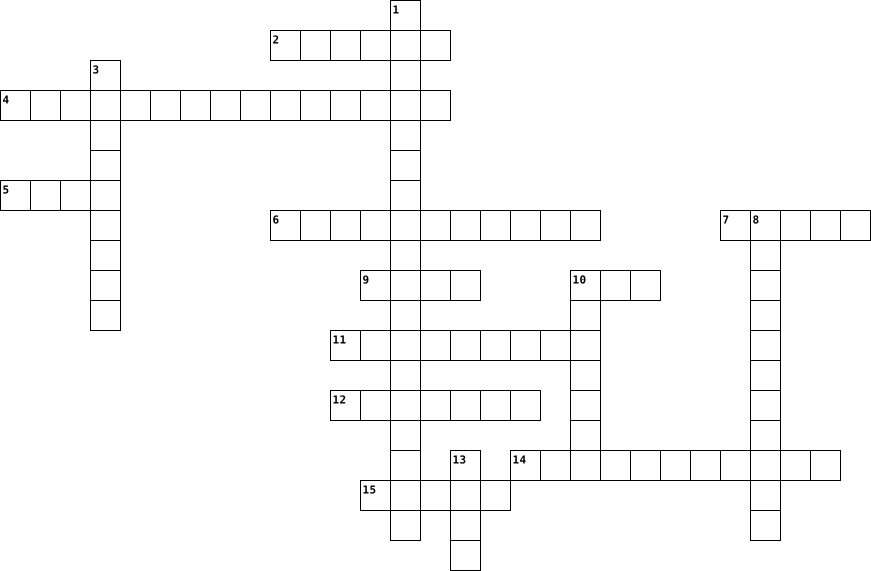
Across
- coming
- Calendar
- Evangelist
- Mary
- History
- Evangelist
- Our Creator
- Celebration
- Evangelist
- Jewish
- Son of God
Down
- Birth & Death
- Us
- Rebirth
- Story
- Evangelist
16 Clues: Us • Mary • Story • coming • Jewish • History • Rebirth • Calendar • Evangelist • Evangelist • Evangelist • Evangelist • Son of God • Our Creator • Celebration • Birth & Death
Jack's crossword puzzle 2024-04-28

Across
- what is another right that men are endowed by their Creator with? (3 words)
- The history of the present King of Great Britain is a history of repeated injuries and ____________.
- he has _______ our coast
- We hold these truths to be self-evident, that all men are created _____.
- for transporting us beyond Seas to be tried for pretended ________
- what is one right that men are endowed by their Creator with
Down
- he has done what to our towns?
- He has kept among us, in times of peace, Standing ______ without the Consent of our legislatures
- he has plundered are what?
- He has refused his Assent to ____, the most wholesome and necessary for the public good
- he has done what to the lives of our people?
- what of ours did he cut off from the rest of the world?
- what did he impose on us without our consent?
- for Quartering large bodies of _____ ______ among us
- what is another right that men are endowed by their Creator with?
15 Clues: he has _______ our coast • he has plundered are what? • he has done what to our towns? • he has done what to the lives of our people? • what did he impose on us without our consent? • for Quartering large bodies of _____ ______ among us • what of ours did he cut off from the rest of the world? • what is one right that men are endowed by their Creator with • ...
Roman Government (2026) 2023-12-05

Across
- first office of the cursus honorum
- period of Roman history that begins with Octavian/Augustus
- legendary founder of Rome
- the two chief magistrates
- men who carried the fasces
- earliest written code of Roman law
- official responsible for determinig the size of the population and for review of moral conduct
- branch of government that oversees the Courts
- magistrates who handled financial matters
- the sequence of offices in Roman politics
- poor people who helped an aristocrat in return for favors (and money)
- branch of government in Rome and US, lawmakers
- period of Roman history that begins with Romulus
Down
- period of Roman history that began in 509 BCE
- length of a consul's term in office
- Roman court of law
- branch of government in Rome and US, head of government
- magistrates who served as judges (peacekeepers)
- officials who protected the common people from oppression by the aristocracy
- the Senate and the People of Rome
- ex-consuls were expected to hold this job
- magistrates in charge of sewers, roads, bridges, etc. "partymeisters"
- a Latin word meaning "prestige"
- bundle of sticks & axe representing power of an elected official
- a "new man" or someone whose family was NOT involved in politics
25 Clues: Roman court of law • legendary founder of Rome • the two chief magistrates • men who carried the fasces • a Latin word meaning "prestige" • the Senate and the People of Rome • first office of the cursus honorum • earliest written code of Roman law • length of a consul's term in office • ex-consuls were expected to hold this job • magistrates who handled financial matters • ...
US History Crossword Puzzle 2013-04-30

Across
- wrote "Feminine Mystique"
- invented a vaccine for Polio
- took over Chinna in 1949, and made it communist
- bond between Soviet Union and it's satellite nations
- tried to get military numbers up. Gave free education, low cost mortgages, and provided jobs for soldiers
- Eisenhower'sidea that building Interstates were a threat to the Cold War
- theory of trying to stop spread of communism
- when lots of middle class whites moved to the suburbs
- gained citizenship in 1924, and taken off reservations in 1934
- social and literacy nonconformist, began hippy movement
- a senator from Wisconsin; accused everyone for being communist
Down
- were most new homes were built after WWII. Outside cities
- began in 1950's.Little Richard, Chuck Berry, Bill Haley, Buddy Holly, Elvis Presley
- decides to give aid to any nation tnat needs it after WWII
- countries dependent on Soviet Union
- wrote books in the 1940's and 1950's on raising children
- became US president in 1952, and was a WWII general
- more powerful than an atomic bomb. The United States developed the first one
- Central Intelligence Agency
- North Atlantic treaty organization
20 Clues: wrote "Feminine Mystique" • Central Intelligence Agency • invented a vaccine for Polio • North Atlantic treaty organization • countries dependent on Soviet Union • theory of trying to stop spread of communism • took over Chinna in 1949, and made it communist • became US president in 1952, and was a WWII general • bond between Soviet Union and it's satellite nations • ...
US History Extra Credit 2013-05-20

Across
- person sent to a foreign country in order to convert others to their religion
- trained citizens who serve as soldiers during an emergency
- first ten amendments to the Constitution; written list of freedoms guaranteed to citizens by the government
- economic policy under which a nation accumulates wealth by exporting more goods than it imports
- 1798 laws that allowed the government to imprison or deport aliens, and to prosecute its critics
- Gin machine invented in 1793 to separate the cotton fiber from its hard shell
- official ban or restriction on trade
- legal document giving certain rights to a person or company
- colonist who remained loyal to Britain during the Revolution
- framework for self-government of the Plymouth Colony signed on the ship the Mayflower in 1620
- declaration by the British king ordering all colonists to remain east of the Appalachian Mountains
- belief that the government has any power not forbidden by the Constitution
- 1765 law passed by Parliament that required colonists to pay taxes on printed materials
- British trade laws enacted by Parliament during the mid-1700s that regulated colonial commerce
Down
- person who favors native-born inhabitants over immigrants
- loyalty and devotion to one’s nation
- site in Virginia where Cornwallis’s army surrendered to Washington
- American name for the Coercive Acts, which Parliament passed in 1774 to control the colonies
- James Madison’s proposal for a bicameral legislature with representation based upon population
- 1820 agreement calling for the admission of Missouri as a slave state and Maine as a free state, and banning slavery in the Louisiana Purchase territory north of the 36°30'N latitude
- belief that the government is limited to powers clearly stated in the Constitution
- political system in which power is shared between the national government and state governments
- shift from manual labor to mechanized work that began in Great Britain during the 1700s and spread to the United States around 1800
- individual who agreed to work without wages for a period of time in exchange for transportation to the colonies
- system in which each branch of the government has the power to monitor and limit the actions of the other two
- English document from 1215 that limited the power of the king and provided basic rights for citizens
- William Paterson’s proposal for a unicameral legislature with each state having one vote
- English Puritans who sought religious freedom and founded Plymouth Colony in 1620
- policy of seizing people or property for military or public service
- in colonial Spanish America, king-appointed official who governs a province, colony, or country
30 Clues: loyalty and devotion to one’s nation • official ban or restriction on trade • person who favors native-born inhabitants over immigrants • trained citizens who serve as soldiers during an emergency • legal document giving certain rights to a person or company • colonist who remained loyal to Britain during the Revolution • ...
US History Crossword Puzzle 2014-01-08

Across
- the murder of an individual by a group or mob
- a network of people who helped thousands of slaves escape to the North
- forbids further colonization of the Americas
- mass migration of miners to California
- formally announced the colonies break with Britain
- a large farm usually specialized in growing a certain cash crop
- laws that enforced segregation in the South
- a group of English Protestants that wanted to purify the English Church of England
- economic system in which most businesses are privately owned
- French for "allow to do"
- first colony in America
- a country that is controlled by an outside government
Down
- the reporting of exaggerated stories in newspapers to increase sales
- a person who interprets the Constitution in a way that allows the federal government to take only those actions the Constitution does not specifically forbid it from taking
- mesoamerican Empire that rose in 400 BC
- American belief that the United States should expand across the continent to the Pacific Ocean
- cavalry regiment organized by President Theodore Roosevelt
- queen of Hawaii
- extending a nation's power by gaining territories
- a person who interprets the Constitution in a way that allows the federal government to take only those actions the Constitution specifically says it can take
- first 10 amendments to the constitution
- first national women's rights convention
- written by Thomas Paine
- militaristic Mesoamerican Empire formed in the 1400s
- led the Battle of the Little Bighorn
25 Clues: queen of Hawaii • written by Thomas Paine • first colony in America • French for "allow to do" • led the Battle of the Little Bighorn • mass migration of miners to California • mesoamerican Empire that rose in 400 BC • first 10 amendments to the constitution • first national women's rights convention • laws that enforced segregation in the South • ...
US History STARR 2 2014-04-22

Across
- an evil, unlawful, treacherous, or surreptitious plan formulated in secret by two or more persons; plot.
- of or characteristic of a group of individuals taken together
- official supervision of rivers, forests, and other natural resources in order to preserve and protect them through prudent management.
- one of the groups or classes into which things may be or have been classified.
- the act of contributing.
- to represent by or as if by painting; portray; delineate.
- to change (something) into a different form or properties; transmute; transform.
- serving to compose or make up a thing; component
- of, pertaining to, involving, or decided by competition.
- to seize as forfeited to the public domain; appropriate, by way of penalty, for public use.
Down
- cynical disposition, character, or belief.
- deeply rooted; firmly implanted or established
- something given or received as an equivalent for services, debt, loss, injury, suffering, lack, etc.; indemnity
- a combination or alliance, especially a temporary one between persons, factions, states, etc.
- commendation or honor given for some action, quality, etc.
- disposed to preserve existing conditions, institutions, etc., or to restore traditional ones, and to limit change.
- to acquire by force of arms; win in war
- to give (money, time, knowledge, assistance, etc.) to a common supply, fund, etc., as for charitable purposes.
- the culture and lifestyle of those people, especially among the young, who reject or oppose the dominant values and behavior of society.
- to serve as a memorial or reminder of: The monument commemorates the signing of the declaration of independence.
- to give (money, time, knowledge, assistance, etc.) to a common supply, fund, etc., as for charitable purposes.
- to arrange in a position of readiness, or to move strategically or appropriately.
- to establish the truth, accuracy, validity, or genuineness of; corroborate; verify.
- prepared, done, or acting with sole or chief emphasis on salability, profit, or success.
- to act together through a secret understanding, especially with evil or harmful intent.
25 Clues: the act of contributing. • to acquire by force of arms; win in war • cynical disposition, character, or belief. • deeply rooted; firmly implanted or established • serving to compose or make up a thing; component • of, pertaining to, involving, or decided by competition. • to represent by or as if by painting; portray; delineate. • ...
US History STARR 2 2014-04-22

Across
- an evil, unlawful, treacherous, or surreptitious plan formulated in secret by two or more persons; plot.
- of, pertaining to, involving, or decided by competition.
- one of the groups or classes into which things may be or have been classified.
- the act of contributing.
- serving to compose or make up a thing; component
- disposed to preserve existing conditions, institutions, etc., or to restore traditional ones, and to limit change.
- to serve as a memorial or reminder of: The monument commemorates the signing of the declaration of independence.
- to give (money, time, knowledge, assistance, etc.) to a common supply, fund, etc., as for charitable purposes.
- something given or received as an equivalent for services, debt, loss, injury, suffering, lack, etc.; indemnity
- to act together through a secret understanding, especially with evil or harmful intent.
- deeply rooted; firmly implanted or established
- of or characteristic of a group of individuals taken together
- to seize as forfeited to the public domain; appropriate, by way of penalty, for public use.
- to establish the truth, accuracy, validity, or genuineness of; corroborate; verify.
Down
- to represent by or as if by painting; portray; delineate.
- to give (money, time, knowledge, assistance, etc.) to a common supply, fund, etc., as for charitable purposes.
- to acquire by force of arms; win in war
- the culture and lifestyle of those people, especially among the young, who reject or oppose the dominant values and behavior of society.
- official supervision of rivers, forests, and other natural resources in order to preserve and protect them through prudent management.
- prepared, done, or acting with sole or chief emphasis on salability, profit, or success.
- to change (something) into a different form or properties; transmute; transform.
- commendation or honor given for some action, quality, etc.
- to arrange in a position of readiness, or to move strategically or appropriately.
- a combination or alliance, especially a temporary one between persons, factions, states, etc.
- cynical disposition, character, or belief.
25 Clues: the act of contributing. • to acquire by force of arms; win in war • cynical disposition, character, or belief. • deeply rooted; firmly implanted or established • serving to compose or make up a thing; component • of, pertaining to, involving, or decided by competition. • to represent by or as if by painting; portray; delineate. • ...
US History STARR 2 2014-04-22

Across
- a combination or alliance, especially a temporary one between persons, factions, states, etc.
- of, pertaining to, involving, or decided by competition.
- the culture and lifestyle of those people, especially among the young, who reject or oppose the dominant values and behavior of society.
- of or characteristic of a group of individuals taken together
- disposed to preserve existing conditions, institutions, etc., or to restore traditional ones, and to limit change.
- to give (money, time, knowledge, assistance, etc.) to a common supply, fund, etc., as for charitable purposes.
- something given or received as an equivalent for services, debt, loss, injury, suffering, lack, etc.; indemnity
- official supervision of rivers, forests, and other natural resources in order to preserve and protect them through prudent management.
- commendation or honor given for some action, quality, etc.
- to act together through a secret understanding, especially with evil or harmful intent.
Down
- to establish the truth, accuracy, validity, or genuineness of; corroborate; verify.
- to acquire by force of arms; win in war
- an evil, unlawful, treacherous, or surreptitious plan formulated in secret by two or more persons; plot.
- to seize as forfeited to the public domain; appropriate, by way of penalty, for public use.
- to give (money, time, knowledge, assistance, etc.) to a common supply, fund, etc., as for charitable purposes.
- to change (something) into a different form or properties; transmute; transform.
- the act of contributing.
- one of the groups or classes into which things may be or have been classified.
- cynical disposition, character, or belief.
- to serve as a memorial or reminder of: The monument commemorates the signing of the declaration of independence.
- prepared, done, or acting with sole or chief emphasis on salability, profit, or success.
- serving to compose or make up a thing; component
22 Clues: the act of contributing. • to acquire by force of arms; win in war • cynical disposition, character, or belief. • serving to compose or make up a thing; component • of, pertaining to, involving, or decided by competition. • commendation or honor given for some action, quality, etc. • of or characteristic of a group of individuals taken together • ...
US History STARR 2 2014-04-22

Across
- something given or received as an equivalent for services, debt, loss, injury, suffering, lack, etc.; indemnity
- to establish the truth, accuracy, validity, or genuineness of; corroborate; verify.
- to give (money, time, knowledge, assistance, etc.) to a common supply, fund, etc., as for charitable purposes.
- serving to compose or make up a thing; component
- to give (money, time, knowledge, assistance, etc.) to a common supply, fund, etc., as for charitable purposes.
- one of the groups or classes into which things may be or have been classified.
- an evil, unlawful, treacherous, or surreptitious plan formulated in secret by two or more persons; plot.
- to acquire by force of arms; win in war
- prepared, done, or acting with sole or chief emphasis on salability, profit, or success.
- of or characteristic of a group of individuals taken together
- disposed to preserve existing conditions, institutions, etc., or to restore traditional ones, and to limit change.
Down
- to act together through a secret understanding, especially with evil or harmful intent.
- the act of contributing.
- to change (something) into a different form or properties; transmute; transform.
- a combination or alliance, especially a temporary one between persons, factions, states, etc.
- the culture and lifestyle of those people, especially among the young, who reject or oppose the dominant values and behavior of society.
- official supervision of rivers, forests, and other natural resources in order to preserve and protect them through prudent management.
- to seize as forfeited to the public domain; appropriate, by way of penalty, for public use.
- to serve as a memorial or reminder of: The monument commemorates the signing of the declaration of independence.
- cynical disposition, character, or belief.
- commendation or honor given for some action, quality, etc.
- of, pertaining to, involving, or decided by competition.
22 Clues: the act of contributing. • to acquire by force of arms; win in war • cynical disposition, character, or belief. • serving to compose or make up a thing; component • of, pertaining to, involving, or decided by competition. • commendation or honor given for some action, quality, etc. • of or characteristic of a group of individuals taken together • ...
US History I Review 2014-05-05

Across
- This patriot made a daring ride to warn the colonists that the British were coming!
- These colonial settlers worked the land according to their region and relied on family members for help.
- General Cornwallis surrendered here at ____________, the last major battle of the Revolutionary War.
- These people study human behavior and cultures of the past by analyzing artifacts.
- This is the country that Francisco Coronado came from.
- This American Indian tribe lived in the Great Plains region.
- This colony was settled by the Quakers.
- Before the Civil War, this side had many factories, opposed slavery, and favored tariffs.
- This colony was known as the first permanent English settlement in 1607.
- The Civil War began with the attack on Fort ________ in South Carolina.
Down
- Under the Articles of Confederation, there was no common ________ in the United States.
- This North American region contains the Continental Divide.
- Thomas Jefferson purchased the Louisiana Territory from this country.
- Benjamin Banneker helped design the layout of this city.
- ___________________ Davis was the Confederate President during the Civil War.
- King George the third angered the colonists when he said that they could not move west of the Appalachian Mountains.
- This explorer claimed the Mississippi River Valley for France.
- Kentucky, Maryland, Missouri and Delaware were called _________ states during the Civil War.
- This North American region is wrapped around the Hudson bay.
- Before the Civil War, this side wanted slavery, was mainly agricultural, and opposed tariffs.
- These imaginary lines run north to south on a map.
- This colonial region specialized in shipbuilding and civic life revolved around the church and town meetings.
- Near this Virginia river evidence of life from 18,000 years ago was discovered.
- The Treaty of _______ was signed in the year 1783 and officially ended the American Revolution.
- These imaginary lines run east to west on a map.
25 Clues: This colony was settled by the Quakers. • These imaginary lines run east to west on a map. • These imaginary lines run north to south on a map. • This is the country that Francisco Coronado came from. • Benjamin Banneker helped design the layout of this city. • This North American region contains the Continental Divide. • ...
US History Semester Review 2015-12-17

Across
- refusal to buy or purchase
- checks & balances gives the power to do this to the President (reject!)
- Highest court in judicial branch, also a taco with sour cream & tomato
- mistreatment based on one's religion or race
- need one of these for a legal search under the 4th Amendment
- Act requiring soldiers to stay in citizens' homes
- product harvested by African slaves
- source that contains secondhand information, a textbook
- number of original colonies
- reasons for exploration, converting natives to Christianity
- Articles of Confederation were weak because they lacked this power
- period of social & political changes & who should govern people
- synonym for permission
- Enlightenment thinkers focused on these rights given to everyone by God.
- colony where first permanent settlement was (Jamestown FYI)
- first state in NW Territory, created 1803
- source that is an eyewitness account
- one of the Houses created by Great Compromise
Down
- reasons for exploration, finding gold and silver
- man responsible for taxing colonists, _____ III
- $ was set aside in NW Territory for this important part of society
- found in south, large farms where slaves often worked
- Act placing a tax on molasses and other sweets
- author of the Declaration & on the US nickel
- control & trade of this product led to conflicts among settlers
- common knowledge says July 4th is when this was signed
- place where many protests took place, (& tea overboard!)
- agricultural product that made Jamestown thrive
- President is in charge of this branch
- sharing power between states & federal government
- African & Backcountry settlers influenced our modern _____
- Act requiring tax to be paid on all printed materials
- people who were in charge of colonists pre-Revolution
- French & their Native Allies vs. British & allies = French & ____ War.
- 1st Amendment freedoms: speech, religion, assembly, petition & _____.
35 Clues: synonym for permission • refusal to buy or purchase • number of original colonies • product harvested by African slaves • source that is an eyewitness account • President is in charge of this branch • first state in NW Territory, created 1803 • mistreatment based on one's religion or race • author of the Declaration & on the US nickel • ...
US History Chapter 9 2021-01-16

Across
- Using the slogan "Food Will Win the War-Don't Waste It," it encouraged families to conserve food and grow their own vegetables
- (CPI) to "sell" the war to the American people.
- a truce, or an agreement to stop fighting.
- merchant ships and troop transports be gathered into groups
- with Wilson's support, created a new conscription system
- The space between opposing trenches
- commander of the American Expeditionary Force
- the heir to the Austro-Hungarian throne, the Archduke
- or a feeling of intense pride in one's homeland
- monetary compensation for all of the war damage it had caused.
Down
- (WTB), established in July 1917 to coordinate the production of war materials.
- This is the idea that the borders of countries should be based on ethnicity and national identity.
- or spying to acquire government
- NWLB attempted to mediate labor disputes that might otherwise lead to strikes.
- nationalism led to a crisis in south-eastern Europe in the region known as the...
- a telegram to the German ambassador in Mexico asking him to make an offer to the Mexican government
- the aggressive build-up of armed forces to intimidate and threaten other nations.
- goods prohibited from shipment to Germany and its allies.
- information designed to influence opinion.
- met the foreign- policy goa ls of both Germany and President Wilson by keeping the United States out of the war a little longer.
20 Clues: or spying to acquire government • The space between opposing trenches • a truce, or an agreement to stop fighting. • information designed to influence opinion. • commander of the American Expeditionary Force • (CPI) to "sell" the war to the American people. • or a feeling of intense pride in one's homeland • the heir to the Austro-Hungarian throne, the Archduke • ...
US History (1607-1877) 2017-05-21

Across
- sent letters of complaints to the king and parliament
- The last battle of the Revolutionary War, fought in 1781
- issued October 7, 1763, by King George III
- taxed glass, lead, paper, paint, and tea entering the colonies.
- 1776 pamphlet by Thomas Paine
- a 13 day siege at a mission in San Antonio
- a tariff on sugar, coffee, wines, and molasses.
- Turning point of the American Revolution
- The first agreement for self-government in America.
- a war fought from 1775-1783 and won by the 13 American colonies
- 7th U.S. President
- Act passed in 1766 just after the repeal of the Stamp Act.
Down
- The first permanent English settlement in North America, founded in 1607
- 3rd U.S. President
- the first legislative body in colonial America
- the first constitution of the United States, on November 15 ,1777
- a land deal between the United States and France
- An armed rebellion by Virginia settlers led by Nathaniel Bacon
- An act of 1689 granting freedom of worship to dissenters
- destroyed an entire shipment of tea sent by the East India Company.
- They were meant to punish the Massachusetts colonists
- "no taxation without representation," introduced by Patrick Henry
- The first bloodshed of the American Revolution
- The first cultural movement to unite the Thirteen Colonies.
- a series of Acts passed in the English Parliament in 1651,1660 & 1663
- a war between citizens of the same country.
26 Clues: 3rd U.S. President • 7th U.S. President • 1776 pamphlet by Thomas Paine • Turning point of the American Revolution • issued October 7, 1763, by King George III • a 13 day siege at a mission in San Antonio • a war between citizens of the same country. • the first legislative body in colonial America • The first bloodshed of the American Revolution • ...
US History (1607-1877) 2017-05-21

Across
- An armed rebellion by Virginia settlers led by Nathaniel Bacon
- The first cultural movement to unite the Thirteen Colonies.
- 7th U.S. President
- the first legislative body in colonial America
- The first bloodshed of the American Revolution
- They were meant to punish the Massachusetts colonists
- a war between citizens of the same country.
- 1776 pamphlet by Thomas Paine
- the first constitution of the United States, on November 15 ,1777
- An act of 1689 granting freedom of worship to dissenters
- issued October 7, 1763, by King George III
- a series of Acts passed in the English Parliament in 1651,1660 & 1663
- The last battle of the Revolutionary War, fought in 1781
- The first permanent English settlement in North America, founded in 1607
Down
- "no taxation without representation," introduced by Patrick Henry
- a 13 day siege at a mission in San Antonio
- a tariff on sugar, coffee, wines, and molasses.
- a land deal between the United States and France
- Turning point of the American Revolution
- destroyed an entire shipment of tea sent by the East India Company.
- The first agreement for self-government in America.
- a war fought from 1775-1783 and won by the 13 American colonies
- Act passed in 1766 just after the repeal of the Stamp Act.
- taxed glass, lead, paper, paint, and tea entering the colonies.
- 3rd U.S. President
- sent letters of complaints to the king and parliament
26 Clues: 7th U.S. President • 3rd U.S. President • 1776 pamphlet by Thomas Paine • Turning point of the American Revolution • a 13 day siege at a mission in San Antonio • issued October 7, 1763, by King George III • a war between citizens of the same country. • the first legislative body in colonial America • The first bloodshed of the American Revolution • ...
US History (1607-1877) 2017-05-21

Across
- sent letters of complaints to the king and parliament
- Act passed in 1766 just after the repeal of the Stamp Act.
- Turning point of the American Revolution
- The last battle of the Revolutionary War, fought in 1781
- They were meant to punish the Massachusetts colonists
- The first cultural movement to unite the Thirteen Colonies.
- the first constitution of the United States, on November 15 ,1777
- 3rd U.S. President
- "no taxation without representation," introduced by Patrick Henry
- taxed glass, lead, paper, paint, and tea entering the colonies.
- An act of 1689 granting freedom of worship to dissenters
- a war between citizens of the same country.
- The first permanent English settlement in North America, founded in 1607
Down
- 1776 pamphlet by Thomas Paine
- a tariff on sugar, coffee, wines, and molasses.
- a series of Acts passed in the English Parliament in 1651,1660 & 1663
- The first bloodshed of the American Revolution
- issued October 7, 1763, by King George III
- destroyed an entire shipment of tea sent by the East India Company.
- a land deal between the United States and France
- The first agreement for self-government in America.
- An armed rebellion by Virginia settlers led by Nathaniel Bacon
- a war fought from 1775-1783 and won by the 13 American colonies
- a 13 day siege at a mission in San Antonio
- the first legislative body in colonial America
- 7th U.S. President
26 Clues: 3rd U.S. President • 7th U.S. President • 1776 pamphlet by Thomas Paine • Turning point of the American Revolution • issued October 7, 1763, by King George III • a 13 day siege at a mission in San Antonio • a war between citizens of the same country. • The first bloodshed of the American Revolution • the first legislative body in colonial America • ...
US History 1607-1877 2017-05-21

Across
- The settlement became the first permanent English settlement in North America.
- 16th U.S. President
- Abolished slavery
- Citizenship to Blacks
- South v.s North
- Land bought by James Gadsden
- Document that ended the Revolutionary War
- Turning point of the American Revolutionary War
- Battle that made French ally with the U.S
- Released the 13 colonies from Britain
- Land West of the Ohio River
- Blacks right to vote
- Destiny the 19th-century doctrine or belief that the expansion of the US throughout the American continents was both justified and inevitable.
- Armed Rebellion during 1786-1787
- Land bought for 15 million dollars
- residents of free states to enforce the capture and return of fugitive slaves.
Down
- of Burgess the first legislative assembly in the American colonies.
- They boarded the ships and threw the chests of tea into Boston Harbor.
- 2nd President
- Shot heard around the world
- 3rd President
- No foreign alliances, stay neutral in wars, don't form political parties
- Missouri become a permanent slave state
- protection for individual liberties
- Impressment of sailors, war with britain
25 Clues: 2nd President • 3rd President • South v.s North • Abolished slavery • 16th U.S. President • Blacks right to vote • Citizenship to Blacks • Shot heard around the world • Land West of the Ohio River • Land bought by James Gadsden • Armed Rebellion during 1786-1787 • Land bought for 15 million dollars • protection for individual liberties • Released the 13 colonies from Britain • ...
US History of Expansion 2019-04-30

Across
- The explorer who discovered the New World was Christopher ________________
- In 1845, __________________ was annexed by the US.
- The first shot fired became known as the shot heard round the _____________.
- The ___________________ defeated the British and by 1783 signed the Treaty of Paris officially ending the war.
- The area of the disputed territory was called the ____________.
- By 1853, the US had accomplished __________________ Destiny.
- In 1607, England settlement of _____________________.
- On April 18th, 1775, a shot was fired between English soldiers and American militia. _______________ knows who fired it but it started the war.
- America declared __________________ from England on July 4th, 1776.
- John ____________ was the second US president from 1797-1801.
- In 1848, Mexico surrendered a large area of land which became known as the Mexican _________________.
- Spain was the first __________________ to control vast territories in the New World.
- English colonist began to rebel against English rules and would become the American _______________.
- The disputed territory was west of the ___________________ Mountains.
- The Louisiana Purchase _______________ the size of US territory.
- In 1846, the territory of ____________ became part of the US.
- The Pilgrims settled their colony for ________________ reasons.
- The three major European countries that controlled large areas of the Americas were England, Spain, and _____________.
- In 1819, Spain ceded ______________ to the US.
Down
- In 1497 ________________ began exploring North America.
- In 1620, the Pilgrims settled the colony of ___________________.
- Jamestown became the colony of ____________________.
- In 1803, Jefferson purchased the _________________ territory from _______________.
- Thomas _______________ became the third US president from 1801-1809.
- In 1789, George _______________ was inaugurated as the first US president.
- From 1607 to 1733, England controlled _______________ colonies.
- American England and the colonies defeated the French and took control of its ______________________ holdings.
- In 1846, the US declared war on __________________.
- The conflict became a war called the French and _______________ War.
- ____________________ were Spanish explorers who conquered empires in the New World for Spain.
- Explorers ____________ and Clark were sent to explore the new territory.
- In 1609 Henry Hudson explored North America for the ___________________.
- In 1753, _______________ erupted between England and France over territory.
- The pilgrim ship was called the _________________.
- Jamestown almost failed but became successful after the growing of ____________________.
- _____________ was the European country that began exploration of the New World.
36 Clues: In 1819, Spain ceded ______________ to the US. • In 1845, __________________ was annexed by the US. • The pilgrim ship was called the _________________. • In 1846, the US declared war on __________________. • Jamestown became the colony of ____________________. • In 1607, England settlement of _____________________. • ...
US History 1 Review 2017-12-12

Across
- A famous Enlightenment thinker
- The Great _____ was a colonial and English religious movement
- The Age of Reason was also known as the ______
- The first vice president
- Who sold Louisiana to America?
- Won the election of 1808
- The Seven Years' War started in the _____ Valley
- Lost the Seven Years' War
- Won the election of 1800
- A name for a person who lived in the colonies but liked England during the Revolutionary War
- Lewis and _____
- John Adams was a member of the _____ Party
- Started the first national bank
- The _______ convention was the end of the Federalist Party
Down
- Where did most French explorers go?
- "Sinners in the Hands of an Angry God"
- The treat of _____ Ended the War of 1812
- The Glorious _______
- The first name of a Spanish monk who defended Indians
- Salem ______ Trials
- Thomas Jefferson was the head of the Democratic ______
- Did not want to ratify the Constitution
- A system of British colonial control
- Lewis and his friend talked about this Indian tribe in their document
- Settled at Plymouth
- Started the war of 1812
- The _____ Compact
27 Clues: Lewis and _____ • The _____ Compact • Salem ______ Trials • Settled at Plymouth • The Glorious _______ • Started the war of 1812 • The first vice president • Won the election of 1808 • Won the election of 1800 • Lost the Seven Years' War • A famous Enlightenment thinker • Who sold Louisiana to America? • Started the first national bank • Where did most French explorers go? • ...
US History Unit 7 2017-11-06

Across
- to apply for or to
- Court System- interprets the laws passed by the Legislative Branch- decides if a law is Constitutional
- lawmaking branch of government
- something added to a document-change made to constitution
- proportional to each states population-Lower House
- fallen in value
- parts of the Constitution that describe the powers and responsibilities of each branch
- sharing power between federal and state governments
- freeing of individual enslaved persons
- Approve
Down
- government in which citizens rule through elected representatives
- Supporters of the new Constitution
- the roles of the three branches of government that check or limit the others so that no single branch can dominate the others
- America’s first constitution-provided for a new central government-where states gave up little of their power
- an agreement between two or more sides
- movement in the 1700s that promoted knowledge reason and science
- the office of the President-enforces the laws passed by the legislative branch –CEO
- corresponding in size
- plan of government
- special group of people selected by each states voters to select a President
- two-house legislature-to divide power of government
- period when economic activity is slowed
22 Clues: Approve • fallen in value • to apply for or to • plan of government • corresponding in size • lawmaking branch of government • Supporters of the new Constitution • an agreement between two or more sides • freeing of individual enslaved persons • period when economic activity is slowed • proportional to each states population-Lower House • ...
US History Ch1 Vocabulary 2016-08-23

Across
- Above ground house made of a heavy clay called adobe that were built by Native Americans of the southwestern United States.
- Muslim emperor of Mali.
- A great teacher, wanted to make people think and question their own beliefs.
- building used for Muslim prayer.
- Related to ancestry traced through the maternal, or mother’s, line.
- The climate and landscape that surrounds living things
- One of the greatest Renaissance artists.
- One of Songhai’s greatest rulers was Muhammad Ture, who chose the title Askia.
- teacher who taught that people should live lives based on reason.
- Developed a printing press that used movable type.
- A strip of land connecting Alaska with Russia that emerged from underwater around 38,000 BC.
- The common values and traditions of a society, such as language, government, and family relationships.
- a philosopher and teacher.
- warriors who fought on horseback in return for land from nobles.
Down
- a government in which rule themselves.
- a series of plagues that killed about 25 million people in Europe.
- One of the greatest Renaissance artists.
- start to exist, experience, or process.
- images of ancestors or animal spirits; often carved onto tall, wooden poles by Native American peoples of the Pacific Northwest.
- A group of people from northern Africa.
- cone-shaped shelters made of buffalo skins used by Native Americans in the Plains region.
- a business formed by a group of people who jointly make an investment and share in the profits and losses.
- referring to the cultures of ancient Greece or Rome.
- The first Americans who crossed from Asia into North America sometime between 38,000 and 10,000 BC.
- The movement of people from one region to another.
- A person who hunts animals and gathers wild plants to provide for his or her needs.
- A political confederation of five northeastern Native American nations of the Seneca, Oneida, Mohawk, Cayuga, and Onondaga that made decisions concerning war and peace.
- a pilgrimage to Mecca made by devout Muslims.
- clear and ordered thinking; Greek philosopher.
- Underground ceremonial chambers at the center of Anasazi communities.
30 Clues: Muslim emperor of Mali. • a philosopher and teacher. • building used for Muslim prayer. • a government in which rule themselves. • start to exist, experience, or process. • A group of people from northern Africa. • One of the greatest Renaissance artists. • One of the greatest Renaissance artists. • a pilgrimage to Mecca made by devout Muslims. • ...
US History 30 terms 2020-10-26

Across
- Responsible for the Missouri Compromise
- Helped protect Tariff and developed a federal government
- Mostly served to raise income for the national government
- Emerged in 1830 in opposition to President Andrew Jackson
- Eight President of the United States
- Served as the ninth president of the United States
- Warn European nations that the U.S. will not tolerate colonization or monarchy
- Elected seventh President
- Machin that separates cotton fiber from seed
- Political party gives government civil service jobs to its supporters
- Financial crises in the United States that created a major depression
- Establish in 1791 to serve as a repository for federal funds
- Political party's
- U.S. into war with Great Britain and established second bank of the U.S.
- Allowed Missouria to become a slave state and Maine to become a free state in 1854
Down
- Substitutes one for another
- Gave Congress power to establish a national bank
- Known for his inventing the cotton gin
- Sixth president of the United States
- Made to protect industry in northern U.S.
- Treaty Between the United States and Spain in 1819
- Longest artificial waterway
- Large making of products
- Granted unsettled land west of Mississippi in exchange for Indian lands
- Indian nation forced to give up lands
- transition to new manufacturing processes in U.S.
- Helped define the constitutional power of the federal government
- Road made by Federal government
- Was the tenth president of the United States in 1841
- Idea that promotes the interest of a national group
30 Clues: Political party's • Large making of products • Elected seventh President • Substitutes one for another • Longest artificial waterway • Road made by Federal government • Eight President of the United States • Sixth president of the United States • Indian nation forced to give up lands • Known for his inventing the cotton gin • Responsible for the Missouri Compromise • ...
Chapter 3 Us history 2023-09-13

Across
- 18th century intellectual movement
- americans 2nd largest ethnic group in the colonies
- neglect when britian relaxed its restrictions
- was the the governing body of britain
- passage the toughest part in the triangular trade
- men form the colonies who fought for britian
- of new england this covered the area from southern maine to nothern new jersey
- awakening religious revival movement of the 1700s
- in the colonies there was a goal to enrich great britain
- trade 3 part system to get slaves to the colonies
- rebellion slave uprising in the colonies
Down
- servants came from europe to be apprentices with familes to learn a trade
- act taxes on import to the colonies
- Britain's biggest rival in north america
- Crop grown mostly on plantations
- was a large large farm in the southern colonies
- attacked the french in ohio river valley
- franklin invented bi-focals
- acts meant to punish the colonists for illegal summggling of goods
- andros was named to rule over the dominion of new england
20 Clues: franklin invented bi-focals • 18th century intellectual movement • act taxes on import to the colonies • Crop grown mostly on plantations • was the the governing body of britain • Britain's biggest rival in north america • attacked the french in ohio river valley • rebellion slave uprising in the colonies • men form the colonies who fought for britian • ...