
world war 2 Crossword Puzzles
War world 1 2025-01-14

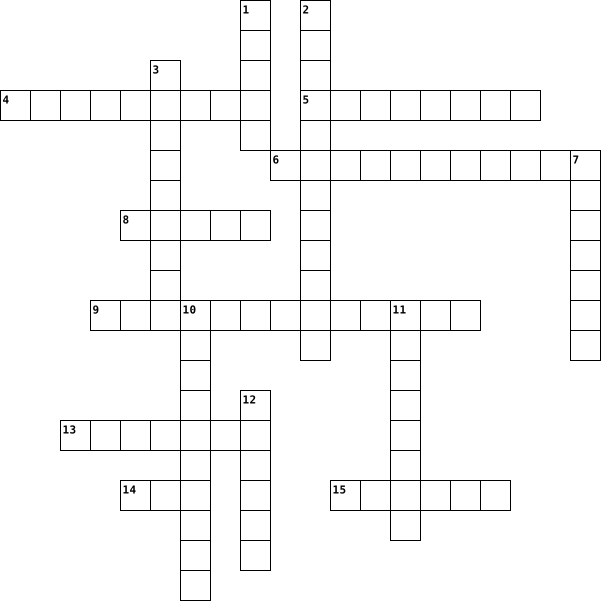
Across
- Small pesticides would go on the soldier's body causing them itchiness and distraction from the battle.
- Masks that wouldn't defend off against a poisonous gas from Overside
- The main bases where all the soldiers would be these bases were dirty muddy and to spread diseases.
- man's land The segment in between the trenches and the battlefield where will be covered in land mines and barbed wire.
- A one-time-only event where the two sides go together and celebrate this holiday in a truce.
- Small rodents, would go feed on soldier's corpses and the soldier's food.
- It was a high-power durable vehicle that I had a turn on that could shoot out big missiles.
- A chemical invented in World War I that caused liquid to go into soldiers' lungs and was eventually banned from war after World War I.
Down
- A small bomb where the soldier pulls a pin and throws it to a little piece of land and it blows up.
- A device where Soldiers will wear a backpack with a gasoline tank and a hose connected to it that would be able to shoot out fire.
- A underwater device that was used to destroy supplies during World War I.
- a gun invented in World War I that could fire out the 600 to 500 rounds of bullets per minute.
- Men who went out to the war and fought for us and other countries.
- Famous war dog that was originally a stray but was adopted by a soldier named Conroy.
14 Clues: Men who went out to the war and fought for us and other countries. • Masks that wouldn't defend off against a poisonous gas from Overside • A underwater device that was used to destroy supplies during World War I. • Small rodents, would go feed on soldier's corpses and the soldier's food. • ...
WWE 2025-10-22

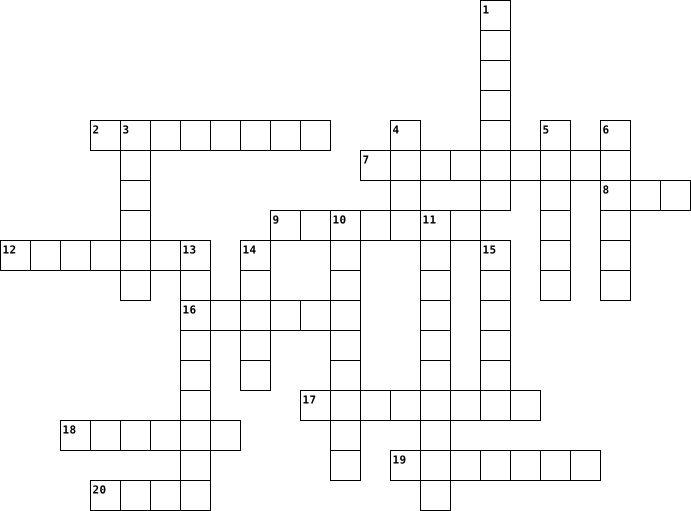
Across
- a major World War I battle fought from September 6–12, 1914, where French and British forces stopped the German army's advance on Paris
- a final demand or statement of terms, the rejection of which will result in retaliation or a breakdown in relations.
- a diplomatic alliance between Great Britain, France, and Russia in the years leading up to World War I, formed to counter the Triple Alliance of Germany, Austria-Hungary, and Italy
- a person or country that attacks another first.
- a mutual defense agreement between three countries, where each country promises military, economic, and political support to the others if attacked
- the capital and largest city of Bosnia and Herzegovina
- append or add as an extra or subordinate part, especially to a document.
Down
- a final demand or statement of terms, the rejection of which will result in retaliation or a breakdown in relations.
- the belief or desire of a government or people that a country should maintain a strong military capability and be prepared to use it aggressively to defend or promote national interests.
- a person, group, or country that supports another for a common cause, acting as a helper or partner
- a military charge or rush
- In World War I, the conflict between the Central Powers and Russia was characterized by massive, mobile battles across Eastern Europe that led to Russia's revolutionary collapse and withdrawal from the war in 1918
- a massive, complex process of organizing a nation's military and economy for war
- the main theater of war in World War I, fought primarily in northeastern France and Belgium
- a friendly understanding or informal alliance between states or factions.
15 Clues: a military charge or rush • a person or country that attacks another first. • the capital and largest city of Bosnia and Herzegovina • append or add as an extra or subordinate part, especially to a document. • a friendly understanding or informal alliance between states or factions. • ...
World War 1 Consolidation Crossword 2015-05-12

Across
- France, Britain, Russia, and Italy in 1915 after the war had begun.
- building up armed forces including army, navy, tanks, and aircraft.
- Alliance between Austria-Hungary, Italy, and Germany prior to World War 1.
- Country that changed sides during the war.
- Having pride in your country and willing to defend it.
- Also named the Ottoman Empire and a Central Power.
- Large, slow moving vehicles used to end trench warfare.
- Besides gunfire and artillery strikes, many soldiers died from this.
- The country responsible for Franz Ferdinand's death
Down
- Germany planned to invade France by moving through this country.
- Buiding up of an empire. Usually includes colonising other lands.
- Alliance between France, Britain, and Russia prior to World War 1.
- Germany, Austria-Hungary, Bulgaria, and Turkey (Ottoman Empire) in 1915 after the war had begun.
- Long narrow open tunnel used to hold soldiers fighting enemy.
- Site in Turkey of famous battle involving Australians
- Australian and New Zealand Army Corps
16 Clues: Australian and New Zealand Army Corps • Country that changed sides during the war. • Also named the Ottoman Empire and a Central Power. • The country responsible for Franz Ferdinand's death • Site in Turkey of famous battle involving Australians • Having pride in your country and willing to defend it. • Large, slow moving vehicles used to end trench warfare. • ...
Australia in World War 1 2012-10-10
Across
- 20,000 soldiers were promised from _______
- Tanks were first used by the
- were invented and were used as a modern weapon
- 25th ____ 1915, ANZAC Day
- The name of the alliance between France, Great Britain and Russia
- Who Australia fought alongside in World War 1
- The Royal Navy was involved in the war in the
- ____ warfare was when the soldiers hid and then charged at the enemy
Down
- Australian New Zealand Army Corps
- The group responsible for killing the Archduke Ferdinand and his wife.
- Famous ANZAC site in 1915
- Jack ______ and his donkey, famous Australian Soldier
- Posters to encourage men to enlist and join the war
- World War 1 Ended on the 11th of _____ 1918
- ______ Fisher was the Prime Minister of Australia at the time
15 Clues: Famous ANZAC site in 1915 • 25th ____ 1915, ANZAC Day • Tanks were first used by the • Australian New Zealand Army Corps • 20,000 soldiers were promised from _______ • World War 1 Ended on the 11th of _____ 1918 • Who Australia fought alongside in World War 1 • The Royal Navy was involved in the war in the • were invented and were used as a modern weapon • ...
Versailles & The Great Depression 2nd Partial Quiz Study Guide 2026-02-26

Across
- strong loyalty and pride in one’s nation
- government programs in the United States that created jobs during the Depression
- extreme rise in prices caused by printing too much money
- peace treaty that ended World War I and punished Germany
- principle that people choose their own nation and government
- situation when people cannot find jobs
Down
- democratic government in Germany after World War I
- sudden collapse of stock prices in 1929
- producing more goods than people can buy
- risky investment hoping to make quick profit
- financial payments Germany had to make after the war
- system where workers own the means of production
- clause that placed full responsibility for the war on Germany
- resources and tools used to produce goods and services
- general fall in prices due to low demand
15 Clues: situation when people cannot find jobs • sudden collapse of stock prices in 1929 • producing more goods than people can buy • strong loyalty and pride in one’s nation • general fall in prices due to low demand • risky investment hoping to make quick profit • system where workers own the means of production • democratic government in Germany after World War I • ...
Final Exam Review 2017-06-12

Across
- Treaty that ended World War I
- Banned discrimination in public places
- Dirty cramped city apartments
- Korean and Vietnam wars were this type of war
- America's government spy agency
Down
- First all black regiment
- June 6 1944
- policy to withdraw from world affairs
- Hatred towards Jews
- ban on Alcohol
- Number of Americans killed during the American Civil War
- President's plan to pull America out of the Great Depression
12 Clues: June 6 1944 • ban on Alcohol • Hatred towards Jews • First all black regiment • Treaty that ended World War I • Dirty cramped city apartments • America's government spy agency • policy to withdraw from world affairs • Banned discrimination in public places • Korean and Vietnam wars were this type of war • Number of Americans killed during the American Civil War • ...
Past US Presidents 2025-12-09

Across
- Known for his populist policies and expanding presidential power.
- Made the decision to use atomic bombs and helped shape post-war America.
- World War II general and U.S. president during a time of prosperity.
- Civil War general and president during the Reconstruction era after the war.
- Known for the New Deal and leading the country during the Great Depression.
- Created the Monroe Doctrine, warning European powers against interference in America.
- Led the country through the Civil War and abolished slavery in America.
Down
- Led America through World War I and helped found the League of Nations.
- Youngest elected president, famous for inspiring speeches and the space race.
- Second president and key diplomat during the American Revolution.
- Author of the Declaration of Independence and third U.S. president.
- First president of the United States and founding father of the nation.
- Former actor and governor, known for conservative policies and ending the Cold War.
- Fourth president, called the “Father of the Constitution” for his key role.
- First African American president, known for healthcare reform and diplomacy.
15 Clues: Second president and key diplomat during the American Revolution. • Known for his populist policies and expanding presidential power. • Author of the Declaration of Independence and third U.S. president. • World War II general and U.S. president during a time of prosperity. • Led America through World War I and helped found the League of Nations. • ...
Practice Makes Perfect 2017-02-21

Across
- year
- queen
- town
- rock
- war
- world
- high
- father
Down
- sister
- table
- horse
- friend
- small
- son
- leader
- soldier
- sailor
- king
18 Clues: son • war • year • town • rock • high • king • table • horse • queen • small • world • sister • friend • leader • sailor • father • soldier
German 2018-12-06

Across
- / Feminine version of the in Deutsch
- / Red in Deutsch
- / Blue in Deutsch
- / Who is the current “leader” of Deutschland
- / What union is Deutschland in
- / Which country borders Deutsch to the south west
- / Country to the north west of Deutschland
- / Man in Deutsch
Down
- / How to say the german language in german
- / How many provinces does Deutschland have
- / Masculine version of the in Deutsch
- / What was the relief program sent to western Berlin after World War 2 called
- / What continent is Deutschland in?
- / Which province is within another
- / Brown in Deutsch
- / Neuter version of the in Deutsch
16 Clues: / Red in Deutsch • / Blue in Deutsch • / Man in Deutsch • / Brown in Deutsch • / What union is Deutschland in • / Which province is within another • / Neuter version of the in Deutsch • / Feminine version of the in Deutsch • / What continent is Deutschland in? • / Masculine version of the in Deutsch • / How to say the german language in german • ...
Civics 2024-05-09

Across
- In what month do we vote for President?
- What is one right or freedom from the First Amendment?
- We elect a U.S. Representative for how many years?
- What is one right in the Declaration of Independence?
- Who is in charge of the executive branch?
- What territory did the United States buy from France in 1803?
- During the Cold War, what was the main concern of the United States?
- who is the first president?
- Who was President during World War I?
- Who is the “Father of Our Country”?
- Name one problem that led to the Civil War.
Down
- What is the supreme law of the land?
- Wjo is on the 50 cent coin
- How can you do your duty as a civillian?
- which branch deals with law?
- how many senators for each state?
- The Federalist Papers supported the passage of the U.S. Constitution. Name one of the writers.
- We elect a President for how many years?
- We elect a U.S. Senator for how many years?
- Who was President during the Great Depression and World War II?
20 Clues: Wjo is on the 50 cent coin • who is the first president? • which branch deals with law? • how many senators for each state? • Who is the “Father of Our Country”? • What is the supreme law of the land? • Who was President during World War I? • In what month do we vote for President? • We elect a President for how many years? • How can you do your duty as a civillian? • ...
Promise of World Peace Pp. 7-12 2025-05-12

Across
- Passing laws will not remove the root ___ of war. P. 8
- Universal acceptance of this spiritual principle is essential to any successful attempt to establish world peace. P.12
- This fundamental lack between peoples seriously undermines efforts towards world peace. P. 11
- How are the differences between followers of all __ to be resolved? P. 10
- This stems from an inner state supported by a spiritual or moral attitude. P. 11
- A major barrier to peace; an outrageous violation of dignity, retarding potentialities, corrupting its perpetrators, and blighting human progress. P. 9
- When this happens to peoples’ will to act, no progress can be made. P. 8
- Equality of these people is one of the most important, though less acknowledged, prerequisites of peace. P. 10
Down
- This class of people should receive first priority in education. P. 11
- Based on political agreements alone, the idea of collective security is a ____. p.11
- Because ignorance is the principal reason for peoples’ decline and fall, and the perpetuation of prejudice, this is the remedy. P. 10
- Because materialistic ideals fail to satisfy mankind’s needs, a fresh effort must be made to find ___. P. 7
- Love of all the world’s __ does not exclude love of one’s country. P. 10
- The advantage of the part in a world society is best served by promoting the advantage of the ___. P. 10
- A framework that is __ must be adopted to deal with war. P. 8
- Steps towards world __ give hopeful signs. P. 8
- Its abolition is a complex task requiring a new level of commitment to resolving issues p. 11
- Disparity between these classes keeps the world unstable and on the brink of war. P. 9
- Activities which nurture mutual affection and this sense need greatly to be increased. P. 10
- The United ___’s declarations and conventions have given hope to ordinary people. P. 9
20 Clues: Steps towards world __ give hopeful signs. P. 8 • Passing laws will not remove the root ___ of war. P. 8 • A framework that is __ must be adopted to deal with war. P. 8 • This class of people should receive first priority in education. P. 11 • Love of all the world’s __ does not exclude love of one’s country. P. 10 • ...
Cold War 2023-12-13

Across
- AFTER WORLD WAR II ENDED, WHO CONTINUED TO OCCUPY THE EASTERN EUROPEAN COUNTRIES?
- What was the 13-day event in 1962 where the U.S. and the U.S.S.R. almost went to nuclear war.
- WHO WAS THE LEADER OF THE SOVIET UNION DURING wORLD WAR II?
- WHAT IS THE EVENT WHERE THE U.S. AND THE U.S.S.R. HAD TENSE RELATIONS AND THE THREAT OF NUCLEAR WAR?
- A system of carrying supplies into East Berlin by plane day and night.
Down
- Who was the prime minister of great britan during the cold war.
- During the Cold War there were many areas of extreme tension. These were called?
- Who took over as dictator of Cuba in 1959 during the Cuban Revolution?
- There were 15 republics created when the soviet union fell but which country had the largest.
- New alliances established after World War II
- How long did the berlin airlift last
11 Clues: How long did the berlin airlift last • New alliances established after World War II • WHO WAS THE LEADER OF THE SOVIET UNION DURING wORLD WAR II? • Who was the prime minister of great britan during the cold war. • Who took over as dictator of Cuba in 1959 during the Cuban Revolution? • A system of carrying supplies into East Berlin by plane day and night. • ...
Cold War 2023-12-13

Across
- AFTER WORLD WAR II ENDED, WHO CONTINUED TO OCCUPY THE EASTERN EUROPEAN COUNTRIES?
- What was the 13-day event in 1962 where the U.S. and the U.S.S.R. almost went to nuclear war.
- WHO WAS THE LEADER OF THE SOVIET UNION DURING wORLD WAR II?
- WHAT IS THE EVENT WHERE THE U.S. AND THE U.S.S.R. HAD TENSE RELATIONS AND THE THREAT OF NUCLEAR WAR?
- A system of carrying supplies into East Berlin by plane day and night.
Down
- Who was the prime minister of great britan during the cold war.
- During the Cold War there were many areas of extreme tension. These were called?
- Who took over as dictator of Cuba in 1959 during the Cuban Revolution?
- There were 15 republics created when the soviet union fell but which country had the largest.
- New alliances established after World War II
- How long did the berlin airlift last
11 Clues: How long did the berlin airlift last • New alliances established after World War II • WHO WAS THE LEADER OF THE SOVIET UNION DURING wORLD WAR II? • Who was the prime minister of great britan during the cold war. • Who took over as dictator of Cuba in 1959 during the Cuban Revolution? • A system of carrying supplies into East Berlin by plane day and night. • ...
Independence Day 2017-07-15

Across
- Month we celebrate this
- What we wanted from King George that we had to fight for
- He had a famous ride
- First President and General in the fight for freedom
- 1976
- Fireworks show
Down
- Father of the Declaration of independence
- Lead in to the war... Boston __ (2 wds)
- Shot heard round the world
- Original capitol
- We celebrate with these at just after dark
11 Clues: 1976 • Fireworks show • Original capitol • He had a famous ride • Month we celebrate this • Shot heard round the world • Lead in to the war... Boston __ (2 wds) • Father of the Declaration of independence • We celebrate with these at just after dark • First President and General in the fight for freedom • What we wanted from King George that we had to fight for
Shifty Swifty's Halftime crossword 2024-07-02

Across
- An English hood (6)
- Someone who flies aircraft (7)
- Traditional British meat filled pastry (7)
- Person who delivers the ball in cricket (6)
- Central American country, famed for it's canal (6)
Down
- Espresso martini for example (8)
- Tabloid newspaper (3)
- Sport that includes bases and a mound(8)
- Opposite of bottom (3)
- World War 2 concrete defence building (7)
- Flaccid or limp (6)
11 Clues: An English hood (6) • Flaccid or limp (6) • Tabloid newspaper (3) • Opposite of bottom (3) • Someone who flies aircraft (7) • Espresso martini for example (8) • Sport that includes bases and a mound(8) • World War 2 concrete defence building (7) • Traditional British meat filled pastry (7) • Person who delivers the ball in cricket (6) • ...
Number The Stars 2024-05-17

Across
- Amusement park where the fireworks were
- The square where Peter was shot
- Living as a Jew in Copenhagen during World War 2
- City in Denmark
- Wants to protect Jews.
- The main month of the book
Down
- Loves cupcakes and fairy tales
- Country where German soldiers were not
- Uncle Henrik´s town
- The country that Copenhagen is in
10 Clues: City in Denmark • Uncle Henrik´s town • Wants to protect Jews. • The main month of the book • Loves cupcakes and fairy tales • The square where Peter was shot • The country that Copenhagen is in • Country where German soldiers were not • Amusement park where the fireworks were • Living as a Jew in Copenhagen during World War 2
14 2024-08-27

Across
- Horror mystery
- Wolves in human form
- World travel
- Serial killer
- Cybernetic future
- War of giants
- Immortal criminals
- Genius surgeon
- Motorcycle gang
Down
- Martial arts "... The Grappler"
- Battosai the manslayer
- AI love
- Dystopian future
- Psychic powers
- Mecha and comedy
- Sorceress Lina Inverse
- Cybernetic rebellion
- Treasure hunt
- Weapon meisters
- Assassin duo
- Exorcist battle
- Afterlife school
- School life
- War drama
- Family drama
25 Clues: AI love • War drama • School life • World travel • Assassin duo • Family drama • Treasure hunt • Serial killer • War of giants • Horror mystery • Psychic powers • Genius surgeon • Weapon meisters • Exorcist battle • Motorcycle gang • Dystopian future • Mecha and comedy • Afterlife school • Cybernetic future • Immortal criminals • Wolves in human form • Cybernetic rebellion • Battosai the manslayer • ...
The Cold War and the 1950s. 2025-04-14

Across
- democratic organization of countries created in 1947 that aligned themselves together for protection from a communist attack
- motto meaning "out of many, one"
- Created to investigate Communist influence.
- A literary movement started by a group of authors/poets that rejected the societal norms of the 1940s, 1950s, and 1960s.
- Fear and paranoia over Communist influence in American Society during the Cold War.
- Alliance between the Soviets and their Eastern European allies.
- The Imaginary Barrier that separated the Soviet Union from Western Europe.
- The policy used by Americans to prevent Communism from spreading
- First President during the Cold War that initiated containment.
- Dividing line between North Korea and South Korea. The 38th___
Down
- Couple executed for conspiracy to commit espionage as suspected communists.
- Ideology that stated if one country fell to Communism, all surrounding nations would fall to Communism.
- 1962 event which was the high point of nuclear tension between the US and Soviets.
- High population boom following World War 2. Also the name of the generation.
- The 327 day operation in which the US and British planes flew food and supplies into blockaded city
- The competition between the US and Soviet Union regarding Space Exploration and innovation.
- this plan extended efforts to prevent communist takeovers by providing economic aid to war torn countries in Europe.
- President during the Cuban Missile Crisis.
- First satellite in space. Launched in 1957.
- investigations led by a Senator based on accusations of suspected communists.
- Areas outside cities where people moved to looking for less crowded areas and cheaper homes.
- Supreme Commander of Allied Forces in WWII who was elected president in 1952.
- Created after WWII to help foster peace in the world.
- Creator of the Polio Vaccine.
- Ideology that advocates for classless society.
25 Clues: Creator of the Polio Vaccine. • motto meaning "out of many, one" • President during the Cuban Missile Crisis. • First satellite in space. Launched in 1957. • Created to investigate Communist influence. • Ideology that advocates for classless society. • Created after WWII to help foster peace in the world. • Dividing line between North Korea and South Korea. The 38th___ • ...
THE COLD WAR 2020-02-14

Across
- Despite criticism Truman remained committed to fight for a limited objective”containing communism” (two words)
- Known as flimsy evidence and irrational fears and damaging reputations unfounded changes
- Chambers claimed proved that he was telling the truth a jury agreed and convicted hiss was lying under oath
- Know as one of the most serious criticisms it can level against member
- Duck and cover might have made them safe not from nuclear radiation blast some survived but later die
- Best known to give European nations America aid to rebuild their economy (two words)
- Family built them to protect them from radiation (two words)
- The communist countries of Eastern Europe came to be called (two words)
- between the two countries that lasted from about 1946 to 1990 (two words)
- Willingness to go to the brink of war to force the other side to back down
- The long telegram gave raise in use of diplomatic and military action
- Used to be threatened with nuclear weapons if communists state tried to. Seize territory by force(two words)
Down
- the very first satellite to orbit the earth
- The world war 2 era had come to an end the Cold War was about to begin (two words)
- Declaring that world communism has as its sole purpose (two words)
- Between 1947 to 1951 over 6 million federal employees were screened for loyalty a term difficult to find (three words)
- He served in Roosevelt administration and sued him for libel chambers and have them secret documents from the star department(two words)
- Came to be known as he long telegram explaining his message on his views of the soviets(two words)
- This decision alarmed Soviet leaders who responded by organizing a military alliance
- The war against japan still raging turnan finally met Stalin at
20 Clues: the very first satellite to orbit the earth • Family built them to protect them from radiation (two words) • The war against japan still raging turnan finally met Stalin at • Declaring that world communism has as its sole purpose (two words) • The long telegram gave raise in use of diplomatic and military action • ...
Food Security 2021-09-05

Across
- something that is becoming scarce because of over population
- (two words)lack of an adequate food supply
- conflict
- the name for growing food
- (2 words)long term changes in weather events and patterns world wide
- introduced insects and plant species
- when the crops get covered in water
Down
- (2 words)the lack of access to clean water
- the process of taking salt out of water
- a solution to over using the land
- a country that grows sugarcane to produce biofuels
- a movement where the buyer goes directly to the producer
- when crops can not get enough water
- scarcity of this resource is number one concern
- crops are grown to produce this instead of food
- a crop that is effected by introduced pests
16 Clues: conflict • the name for growing food • a solution to over using the land • when crops can not get enough water • when the crops get covered in water • introduced insects and plant species • the process of taking salt out of water • (2 words)the lack of access to clean water • (two words)lack of an adequate food supply • a crop that is effected by introduced pests • ...
Europe Crossword 2021-12-15

Across
- Area of the world the United States is part of.
- Period in history when the Soviet Union and the United States threatened each other.
- The __________ Pact was allied with the Soviet Union.
- The large empire that ruled much of Europe thousands of years ago.
- __________ Warfare is how battles were fought in World War I.
- Group of people who were friends with the United States during the Cold War.
- Where the Soviet Union stored weapons, threatening America.
- Emperor of Russia
- Country that Russia is building troops up next to their border.
- Type of government that Russia adopted after their emperors.
- Leader of Germany during World War II.
- When something becomes less valuable and money becomes worth less.
- The Bishop of Rome and leader of the Catholic Church.
Down
- What people wanted at the end of the Soviet Union.
- Trying to build bigger and better weapons.
- The cruel leader of the Soviet Union who tried to take over Europe.
- The persecution of the Jews during World War II was known as this.
- Rich people who try to influence the government.
- In communism, everything is supposed to be ______.
- The ___ Death was a pandemic that spread across Europe and Asia during the mid 1300's.
- A large area of states and countries under one ruler.
- Current leader of Russia
- The average measurement of temperature, wind, rain, and snow in an area.
- The European ______________ is a group of countries that joined together to improve Europe.
- When the government took peoples' property and put it under government control.
- To act dishonestly in return for something.
26 Clues: Emperor of Russia • Current leader of Russia • Leader of Germany during World War II. • Trying to build bigger and better weapons. • To act dishonestly in return for something. • Area of the world the United States is part of. • Rich people who try to influence the government. • What people wanted at the end of the Soviet Union. • ...
World war 1 2025-05-03

Across
- What were the small tunnels that the men lived and fought in called?
- What was the condition that some men developed due to wet feet?
- What country did Germany invade that caused Britain to enter the war?
- What was one of the causes of World War 1 A__?
- What country did Germany want to invade?
- What was one of the causes of World War 1 I__?
- What was the stomach condition that killed many soldiers?
- What was the campaign that started on April 25th?
Down
- Franz _?
- What is the name for the alliance of Germany and Austria-Hungary?
- is another name for World War 1?
- What is the acronym used for the Australian and New Zealand soldiers?
- What was one of the causes of World War 1 A__?
13 Clues: Franz _? • is another name for World War 1? • What country did Germany want to invade? • What was one of the causes of World War 1 A__? • What was one of the causes of World War 1 A__? • What was one of the causes of World War 1 I__? • What was the campaign that started on April 25th? • What was the stomach condition that killed many soldiers? • ...
American History 1400s to 2005 2013-12-18

Across
- these were built by the Haida people to memorialize who they were when they lived
- the disease that killed millions of indigenous peoples when the first Spaniards arrived
- name of the war American citizens fought to forge their independence from England
- caused war with Mexico, and the belief that the United States borders should expand
- a period in time when the nation had to "rebuild" after war
- to set apart, typically because of race or religion
- a chemical used in warfare that caused mass destruction by exposing chemicals to the land
- a person who uses violence and fear to achieve their goals
Down
- a period in time when the "arms race" between the Soviet Union took place
- because of the Indian Removal Act the Cherokee were forced to move and it was called this
- a person who believes slavery is immoral
- this doubled the size of the United States
- American citizens were angry they had to pay these on Tea and threw the boxes overboard
- this invention created the expansion of more cotton land, and the need for more slaves
- name of the Hurricane that destroyed parts of Louisiana in 2005
- when this president was elected, the south seceded shortly after
- the murder of 6 million Jewish people in Europe
- the name of the servants who signed a contact to come over to the New World
- war in which a country was divided by the United States into 2 at the 38th parallel
- an island that the United States acquired during the Spanish-American War
20 Clues: a person who believes slavery is immoral • this doubled the size of the United States • the murder of 6 million Jewish people in Europe • to set apart, typically because of race or religion • a person who uses violence and fear to achieve their goals • a period in time when the nation had to "rebuild" after war • ...
Crossword Puzzle unit terms 2020-10-22

Across
- Commodore of the United States Navy
- Marx influenced the modern world
- Canal that's an artificial waterway
- Famous instrument maker
- Economic system on trade
- Revolution
- Japanese War
- Doctrine key part of U.S. foreign policy
- Japanese War with Russia
- AKA Honorable Restoration
- Establishment of a communist society
- Rebellion or War in China
Down
- Developed process for making steel
- Process of making an area more urban
- Social concept applied to biological
- A political and economic theory
- Rebellion was against foreigners
- __Destiny that was a belief
- Door policy with China
- Rebellion that took place in China
- Expending a countries power
- War with China and Western countries
- Invented the cotton gin
23 Clues: Revolution • Japanese War • Door policy with China • Famous instrument maker • Invented the cotton gin • Economic system on trade • Japanese War with Russia • AKA Honorable Restoration • Rebellion or War in China • __Destiny that was a belief • Expending a countries power • A political and economic theory • Marx influenced the modern world • Rebellion was against foreigners • ...
Philippines 2023-04-28

Across
- Gov-form of government
- His-they were killed for trying to convert people
- Over-Capital
- Eco-Philippine currency
- Cul-most popular sport
Down
- The Philippines is governed as a ___ state
- geo-Closely located and to the north
- Cul-unofficial national dish
- His-who invaded in 1941 during world war 2
- Geo-one of three islands
10 Clues: Over-Capital • Gov-form of government • Cul-most popular sport • Eco-Philippine currency • Geo-one of three islands • Cul-unofficial national dish • geo-Closely located and to the north • The Philippines is governed as a ___ state • His-who invaded in 1941 during world war 2 • His-they were killed for trying to convert people
A Serperate Peace Vocab 2025-03-06

Across
- "The idea of using the book was ___"
- Synonym:Goofy
- A World War 1 and 2 battle strategy. Used by the Germans
- The action of moving up and down
- A higher up
- Synonym: Revered
Down
- To get ones way with deception or flattery
- "Floridians become ____ by hurricanes"
- Synonym: Exhaust
- someone who plans secretly and tends to lie
10 Clues: A higher up • Synonym:Goofy • Synonym: Exhaust • Synonym: Revered • The action of moving up and down • "The idea of using the book was ___" • "Floridians become ____ by hurricanes" • To get ones way with deception or flattery • someone who plans secretly and tends to lie • A World War 1 and 2 battle strategy. Used by the Germans
American History 1400s to 2005 2013-12-18

Across
- the disease that killed millions of indigenous peoples when the first Spaniards arrived
- the name of the servants who signed a contact to come over to the New World
- caused war with Mexico, and the belief that the United States borders should expand
- a period in time when the nation had to "rebuild" after war
- name of the war American citizens fought to forge their independence from England
- the murder of 6 million Jewish people in Europe
- this invention created the expansion of more cotton land, and the need for more slaves
- to set apart, typically because of race or religion
- name of the Hurricane that destroyed parts of Louisiana in 2005
Down
- a person who believes slavery is immoral
- this doubled the size of the United States
- a period in time when the "arms race" between the Soviet Union took place
- a chemical used in warfare that caused mass destruction by exposing chemicals to the land
- because of the Indian Removal Act the Cherokee were forced to move and it was called this
- a person who uses violence and fear to achieve their goals
- these were built by the Haida people to memorialize who they were when they lived
- American citizens were angry they had to pay these on Tea and threw the boxes overboard
- when this president was elected, the south seceded shortly after
- an island that the United States acquired during the Spanish-American War
- war in which a country was divided by the United States into 2 at the 38th parallel
20 Clues: a person who believes slavery is immoral • this doubled the size of the United States • the murder of 6 million Jewish people in Europe • to set apart, typically because of race or religion • a person who uses violence and fear to achieve their goals • a period in time when the nation had to "rebuild" after war • ...
Civil War Crossword 2026-02-12

Across
- This was a major victory for the Union Army in the Western Theater of the American Civil War, and one of the bloodiest battles in American history, fought in southwestern Tennessee.
- This iconic location in Virginia marks the date April 9, 1865, when Confederate General Law surrendered to Union General Ulysses S. Grant, officially ending the Civil War.
- The person who led the Army of Northern Virginia.
- The person who was general in the Union Army during the American Civil War and one of the principal commanders of the Western Theater.
- The 18th President of the United States.
- The person who was a distinguished Union military officer in the American Civil War, governor of Maine, and educator.
- A distinguished Union general during the American Civil War, often hailed as the first "modern general."
- The largest and most notorious prisoner-of-war camp in the Confederate States of America during the Civil War.
- President of the Confederate States.
- This was the first battle of the American Civil War. After 34 hours of Confederate bombardment, the Union surrendered, marking the official start of the four-year war(2 words).
- A Confederate general during the American Civil War, and one of the most controversial commanders in the Army of Northern Virginia, he led the Gettysburg Charge, which ended in a disastrous defeat.
- Battlefield where Lincoln gave his famous address.
- An American military officer, politician, and engineer who served as Commander-in-Chief of the U.S. Army and the 24th Governor of New Jersey.
- A fortified city, guarding the last stretch of the Mississippi River under Confederate control.
- Confederate lieutenant general and military strategist during the American Civil War.
- A Confederate general during the American Civil War, and a key subordinate of General Robert E. Lee.
- The first major battle of Civil War (2 words).
- A U.S. Army officer and politician who rose to the rank of federal general during the American Civil War, served three terms as governor of Rhode Island, and was also an inventor and industrialist.
Down
- An executive order issued by the President during the Civil War, ordering the freeing of slaves in the rebellious Confederate states(2 words).
- A federal strategy formulated in 1861 aimed to defeat the Confederate States of America by crippling its economy(2 words).
- A high-ranking Union general during the American Civil War and a key figure in the subsequent Indian Wars.He was nicknamed "Little Phil."
- A distinguished Union major general during the American Civil War, best known for leading the Army of the Potomac and the disastrous defeat at the Battle of Chancellorsville.
- The only Native American to be promoted to brigadier general during the American Civil War, and also the last Confederate general to surrender
- A high-ranking officer in the U.S. Navy during the American Civil War, he was the first rear admiral, vice admiral, and admiral in U.S. Navy history.
- A city that the union captured and burned it down before withdrawing during the Civil War.
- The battle remains the deadliest single-day battle in American military history and a pivotal battle of the Civil War.
- This was a Confederate steam frigate that was burned and sunk in 1861. It was later salvaged by the Confederate States of America and converted into the ironclad warship USS Virginia.
- An ironclad warship, built for the U.S. Navy during the American Civil War, was the Navy's first warship of its kind.
- A famous Confederate major general and cavalry commander during the American Civil War, known for his exceptional reconnaissance skills.
- The 16th president of the United States.
- An Army officer and Oregon Senator.
31 Clues: An Army officer and Oregon Senator. • President of the Confederate States. • The 18th President of the United States. • The 16th president of the United States. • The first major battle of Civil War (2 words). • The person who led the Army of Northern Virginia. • Battlefield where Lincoln gave his famous address. • ...
American History 1400s to 2005 2013-12-18

Across
- name of the Hurricane that destroyed parts of Louisiana in 2005
- because of the Indian Removal Act the Cherokee were forced to move and it was called this
- the disease that killed millions of indigenous peoples when the first Spaniards arrived
- caused war with Mexico, and the belief that the United States borders should expand
- an island that the United States acquired during the Spanish-American War
- a period in time when the "arms race" between the Soviet Union took place
- war in which a country was divided by the United States into 2 at the 38th parallel
- a person who believes slavery is immoral
- to set apart, typically because of race or religion
Down
- name of the war American citizens fought to forge their independence from England
- when this president was elected, the south seceded shortly after
- this doubled the size of the United States
- a period in time when the nation had to "rebuild" after war
- the name of the servants who signed a contact to come over to the New World
- a person who uses violence and fear to achieve their goals
- a chemical used in warfare that caused mass destruction by exposing chemicals to the land
- American citizens were angry they had to pay these on Tea and threw the boxes overboard
- the murder of 6 million Jewish people in Europe
- these were built by the Haida people to memorialize who they were when they lived
- this invention created the expansion of more cotton land, and the need for more slaves
20 Clues: a person who believes slavery is immoral • this doubled the size of the United States • the murder of 6 million Jewish people in Europe • to set apart, typically because of race or religion • a person who uses violence and fear to achieve their goals • a period in time when the nation had to "rebuild" after war • ...
Historical Events 2023-09-05

Across
- - First Moon landing
- - Devastating 2005 storm
- - Symbolic end of the Cold War
- - Superpower standoff
- - 1930s economic crisis
- - Film industry hub
- - Accused Cold War spies
Down
- - Racial segregation in South Africa
- - Fight for voting rights
- - Reformation leader
- - World War with Axis Powers
- - End of WWII event
- - Conflict in Southeast Asia
- - Iconic 1969 music festival
- - Presidential scandal
15 Clues: - End of WWII event • - Film industry hub • - First Moon landing • - Reformation leader • - Superpower standoff • - Presidential scandal • - 1930s economic crisis • - Devastating 2005 storm • - Accused Cold War spies • - Fight for voting rights • - World War with Axis Powers • - Conflict in Southeast Asia • - Iconic 1969 music festival • - Symbolic end of the Cold War • ...
Unit 3: American Imperialism & WWI 2025-11-19

Across
- _____________ Darwinism - Among nations, as among individuals, the fittest survive and prevail.
- Treaty of ______________ (1919) - Ended World War I and held Germany mostly responsible for damages.
- ______________ - American War (1898) - War that began over conflicts in Cuba, ends with a United States victory.
- Theodore "___________" Roosevelt - 26th president who fought in the Spanish-American War and led expansion in Latin America.
- William ______________ - 25th president who was an imperialist and was assassinated in 1901.
- _____________ Amendment - It put Cuba under US protection and jurisdiction.
- Panama _____________ - Man-made waterway in Panama that the United States gains ownership.
Down
- The expansion of political, economic, cultural, media, and military influence beyond the boundaries of a nation.
- Pancho ___________ - Famous Mexican rebel who resisted American occupation of Mexico and led rebels during the Mexican Revolution.
- Woodrow ______________ - 28th president who led the nation during World War I.
- Treaty of _____________ (1898) - Officially ended the Spanish-American War.
- Manifest _______________ - The idea that America has a God-given right to expand.
- The U.S.S. ____________ - the battleship that exploded in the harbor of Havana, Cuba, and was an inciting incident of the Spanish-American War.
- Mark _________ - American author and member of the Anti-Imperialism League.
- ____________ Fever - Widespread disease that killed thousands in various outbreaks during the Spanish-American War.
- William Howard _____________ - 27th president who switched to dollar diplomacy and fought against monopolies.
16 Clues: Treaty of _____________ (1898) - Officially ended the Spanish-American War. • Mark _________ - American author and member of the Anti-Imperialism League. • _____________ Amendment - It put Cuba under US protection and jurisdiction. • Woodrow ______________ - 28th president who led the nation during World War I. • ...
INSPECTRUM 2013-02-14

Across
- Person born between early 60's and early 80's
- Person born between 1946 and 1964
- Fought in world war 1
Down
- stereotyping due to age
- Fought in world war 2
5 Clues: Fought in world war 2 • Fought in world war 1 • stereotyping due to age • Person born between 1946 and 1964 • Person born between early 60's and early 80's
World book night 2026-04-16

Across
- Container for books
- Creator of worlds
- (2 words) Sorting system for non-fiction books
- Anagram of "reading"
- Wikipedia defines this as "exemplary or particularly noteworthy"
- Opposite to day
- Subgenre made from the combination of 2 popular genres
- Scottish philanthropist
- Your first impression of the book
- Anagram for "pages"
Down
- The library's original purpose
- Unicorns and dragons
- To put into a category
- Get up to date on current events
- Our home
- Building blocks
- (2 words) Well read insect
- Singing in the library
- (2 words) Out of this world
19 Clues: Our home • Building blocks • Opposite to day • Creator of worlds • Container for books • Anagram for "pages" • Unicorns and dragons • Anagram of "reading" • To put into a category • Singing in the library • Scottish philanthropist • (2 words) Well read insect • (2 words) Out of this world • The library's original purpose • Get up to date on current events • Your first impression of the book • ...
Römer (Lorenzo, Carlo, Marius & Nelion) 2022-11-02

Across
- Was war einer der beliebtesten Orte Roms?
- Welcher Gott beherrschte das Meer?
- Was war eins der beliebtesten Amphitheater Roms?
- Welche war die 2 Frau von Caesar
- Was war Caesars Vorname?
- Was sind 20 franken in Rom?
- Wer hat Caesar umgebracht?
- Was schützt einen Legionär vor Pfeilen?
- Wer hat Rom gegründet?
Down
- Wer war der adoptive Sohn Caesars?
- Welche waren die reichsten Leute Roms?
- Welche war die letzte Frau Caesars?
- Was tranken die Sklaven in Rom?
- Was trugen die normalen Bürger Romes?
- Welcher war der berühmteste Kriegs-Anfuehrer?
- Welche Sprache sprachen die Römer?
- Was war das berühmteste Getränk Roms?
- Welcher Fluss fliesst durch Rom?
- Was umkreist die Stadt Rom?
- Wie hiess das Ding das Wasser fliessen lies?
20 Clues: Wer hat Rom gegründet? • Was war Caesars Vorname? • Wer hat Caesar umgebracht? • Was umkreist die Stadt Rom? • Was sind 20 franken in Rom? • Was tranken die Sklaven in Rom? • Welche war die 2 Frau von Caesar • Welcher Fluss fliesst durch Rom? • Wer war der adoptive Sohn Caesars? • Welcher Gott beherrschte das Meer? • Welche Sprache sprachen die Römer? • ...
World War 1 Vocabulary 2022-11-01

Across
- the defeated alliance of World War 1, made up of Germany, Austria-Hungary, Ottoman Empire, and Bulgaria
- a political movement that supported an authoritarian dictatorship
- a system where all property is owned by the government
- a political movement in Germany that supported a totalitarian government and racial supremacy
- founder of the Bolsheviks and leader of the Russian Revolution
- a ceasefire
- the Russian Communist party led by Vladimir Lenin
- Russian emperor before 1917
- larger countries taking over smaller countries for natural resources
Down
- first global conflict, fought between 1914 and 1918
- a group of communist countries, led by Russia, from the Russian Revolution until 1991
- the build up of armies in preparation to use them
- intense love of one's country
- this formally ended World War 1
- a union formed for the benefit of both (or all countries
- a pair of revolutions that overthrew the Russian czars and placed the Bolsheviks in power
- an economic downturn that is sustained over time
- the victorious alliance of World War 1, made up of Russia, Britain, France, US, and Italy
- the occupation, division, and colonization of Africa by European powers
- money paid by the losing country to the winning country
20 Clues: a ceasefire • Russian emperor before 1917 • intense love of one's country • this formally ended World War 1 • an economic downturn that is sustained over time • the build up of armies in preparation to use them • the Russian Communist party led by Vladimir Lenin • first global conflict, fought between 1914 and 1918 • a system where all property is owned by the government • ...
Jade Winters 2020-02-06

Across
- The relaxing of tension between the superpowers
- A competition between the Soviet Union and the United States to prove their superiority in technology (2 words)
- a name given to the Soviet Union and its communist controlled states in Eastern Europe such as Poland, East Germany, and Bulgaria. (2 words)
- said that the United States would help countries that were threatened by armed minorities or outside pressures. (2 words)
- President during the cold war, 33rd President (2 words)
- an alliance between the Soviet Union and other Eastern European communist nations. (2 words)
- Name for the United States and the Soviet Union in the Cold War.
- designed to shoot down ballistic missiles before they reach their targets. (3 words)
- Called the red telephone in 1963
- An economic theory in which collective ownership of property leads to a classless society.
- A nuclear bomb that is either lost, stolen, or accidentally launched that causes a nuclear accident. (2 words)
Down
- The term translates to "restructuring" in Russian.
- A threat was intended to prevent, or deter, anyone from attacking. (2 words)
- Republican senator from Wisconsin who capitalized on Cold War fears of Communism in the early 1950s (2 words)
- a movement in Poland to create a trade union that was not controlled by the communist party.
- Describes the growing divide between western democracies and Soviet-influenced states. (2 words)
- A crossing point between West Berlin and East Berlin when the Berlin Wall divided the city (2 words)
- A policy that allowed for more openness in the Soviet government as well as some level of freedom of speech.
- Philosophy named after Karl Marx.
- when the United States and the Soviet Union agreed to limit the number of nuclear weapons they made.
20 Clues: Called the red telephone in 1963 • Philosophy named after Karl Marx. • The relaxing of tension between the superpowers • The term translates to "restructuring" in Russian. • President during the cold war, 33rd President (2 words) • Name for the United States and the Soviet Union in the Cold War. • ...
American History Review Chapters 1-22 2026-02-09

Across
- A worldview and movement emphasizing emotion, imagination, nature, and individual experience over reason
- Fitzgerald Author of The Great Gatsby
- Severe economic downturn beginning in 1929
- Winthrop Puritan leader who described America as a “city upon a hill”
- The South American indigenous group known for their human sacrifices
- Almanac Benjamin Franklin’s popular publication filled with proverbs and practical advice
- Worldview rejecting universal truth claims in favor of individual interpretation
- African American leader who promoted vocational education and economic self-reliance after Reconstruction
- of Versailles Agreement that officially ended World War I
Down
- Growth of factories and machine-based production
- Douglass Former slave who became a leading abolitionist
- Constitutional ban on alcohol in the 1920s
- Period of rebuilding the South after the Civil War
- The right to vote
- When one company controls an entire industry
- President during World War I
- Agreement establishing self-government in Plymouth Colony
- English Protestants who aimed to “purify” the Church of England
- Religious revival movement in the 1700s
- Group who sought religious freedom and founded Plymouth Colony
- Belief that God created the world but does not intervene in human affairs
21 Clues: The right to vote • President during World War I • Fitzgerald Author of The Great Gatsby • Religious revival movement in the 1700s • Constitutional ban on alcohol in the 1920s • Severe economic downturn beginning in 1929 • When one company controls an entire industry • Growth of factories and machine-based production • Period of rebuilding the South after the Civil War • ...
Causes of The Vietnam War 2025-05-13

Across
- How did the U.S. help South Vietnam?
- The conflict in Vietnam that developed following the French defeat can best be described as this type of War.
- is the belief that if one country became a communist, other countries nearby would follow?
- Which President sent a half a million US combat troops to Vietnam?
- What did information did the us secretary of defense withhold?
- Who was the leader of the communist Vietnamese resistance movement?
- How much money did the war cost per year?
- Who was South Vietnam's “corrupt” leader?
Down
- Where is vietnam split?
- Describe the type of military force President Kennedy sent to Vietnam.
- Prior to world war 2, who owned Vietnam?
- What ship was reported to be attacked on august 4th?
- What country owned the boats that attacked A US navy destroyer and the uss maddox?
- What was the first Asian Nation to fall to Communism?
- Who was the us secretary of defense at this time?
15 Clues: Where is vietnam split? • How did the U.S. help South Vietnam? • Prior to world war 2, who owned Vietnam? • How much money did the war cost per year? • Who was South Vietnam's “corrupt” leader? • Who was the us secretary of defense at this time? • What ship was reported to be attacked on august 4th? • What was the first Asian Nation to fall to Communism? • ...
History WW1 project 2020-10-30

Across
- a very good idea.
- art that doesnt show something.
- a group of people who are ruling a country.
- an object made of used objects or buildings.
- with only 1 ruler.
Down
- helper of Lenin.
- a war in a large part of the world and pars participat.
- try to get the best weapons.
- hallways in the ground where the soldiers protected themselves.
- getting people in another country.
- communist.
- there is very little of it.
- countries who are central in a war.
- are people who help you(or country's).
14 Clues: communist. • helper of Lenin. • a very good idea. • with only 1 ruler. • there is very little of it. • try to get the best weapons. • art that doesnt show something. • getting people in another country. • countries who are central in a war. • are people who help you(or country's). • a group of people who are ruling a country. • an object made of used objects or buildings. • ...
Famous People 2023-05-10
Across
- British Prime Minister who served from 1979 to 1990 and was known for her conservative policies.
- American President who led the country through the Great Depression and World War II.
- American boxer and civil rights activist known for his political and social activism.
- Spanish artist known for his contributions to the development of Cubism.
- South African anti-apartheid revolutionary and politician who served as President of South Africa from 1994 to 1999.
- Teresa Albanian-Indian Catholic nun and missionary known for her work with the poor and sick in India.
- German-born physicist who developed the theory of relativity and made significant contributions to the development of atomic energy.
- American actress and cultural icon known for her beauty and talent.
- American President who played a key role in the Civil Rights Movement and the Cuban Missile Crisis.
- American civil rights leader and advocate of nonviolent protest.
Down
- American singer and cultural icon known as the "King of Rock and Roll."
- German dictator who led the country during World War II and was responsible for the Holocaust.
- American businessman and co-founder of Apple Inc.
- Chinese communist leader who led the country from 1949 until his death in 1976.
- Soviet dictator who led the country during World War II and was responsible for the deaths of millions of people.
- British Prime Minister who led the country during World War II.
- French-German theologian, philosopher, and physician known for his humanitarian work in Africa.
- American astronaut and the first person to walk on the moon.
- American businessman and co-founder of Microsoft Corporation.
- Indian independence leader and advocate of nonviolent civil disobedience.
20 Clues: American businessman and co-founder of Apple Inc. • American astronaut and the first person to walk on the moon. • American businessman and co-founder of Microsoft Corporation. • British Prime Minister who led the country during World War II. • American civil rights leader and advocate of nonviolent protest. • ...
Historical Events 2023-09-06

Across
- - End of WWII event
- - Devastating 2005 storm
- - Presidential scandal
- - Racial segregation in South Africa
- - Fight for voting rights
- - Superpower standoff
- - Symbolic end of the Cold War
- - Accused Cold War spies
Down
- - Reformation leader
- - Iconic 1969 music festival
- - 1930s economic crisis
- - World War with Axis Powers
- - Film industry hub
- - First Moon landing
- - Conflict in Southeast Asia
15 Clues: - End of WWII event • - Film industry hub • - Reformation leader • - First Moon landing • - Superpower standoff • - Presidential scandal • - 1930s economic crisis • - Devastating 2005 storm • - Accused Cold War spies • - Fight for voting rights • - Iconic 1969 music festival • - World War with Axis Powers • - Conflict in Southeast Asia • - Symbolic end of the Cold War • ...
The War of 1812 pgs. 360-367 2023-04-25

Across
- (2 words) This battle was an important victory for the United States in the War of 1812.
- (2 words) During the Battle of Lake Champlain British and U.S. troops fired annons at each other across this river.
- (3 words) This captain forced british ships on Lake Erie to surrender.
- (2 words) This doctrine warned other countries that the United States might act to protect te Western Hemisphere.
- When British soldiers captured American sailors and forced them to serve in the British Navy.
- (2 words) This person published the first dictionary of English that was uniquely American.
- (2 words) A painting of this famous president Dolley refused to leave with out.
Down
- On June 18, 1812 Congress decared war against this country.
- (2 words) This man was trying to keep the United States neutral during the war between Britain and France.
- (3 words) This man thought Tecumseh and his followers were a threat.
- (2 words)This first lady collected important documents and took them to safety when the British Army were headed to the White House.
- A devotion to one's country.
- (2 words)This man was elected president in 1808.
- (3 words) This lawyer watched the battle in the Baltimore Harbor.
- A economic success and security.
- An official statement of policy.
- (2 words) This man led an army that forced the British to retreat.
- Tecumseh was killed during this battlem but American Indian nations continued his fight.
- A Shawnee chief who wanted to unite all American Indian nations west of the Appalachian Mountains.
- (2 words) a Government's actions toward other nations.
- This created the most interest in the national flag of the United States
21 Clues: A devotion to one's country. • A economic success and security. • An official statement of policy. • (2 words)This man was elected president in 1808. • (2 words) a Government's actions toward other nations. • On June 18, 1812 Congress decared war against this country. • (3 words) This lawyer watched the battle in the Baltimore Harbor. • ...
Key People in World War I 2017-03-07

Across
- a British officer posted in the Middle East who played a role in the Arab revolt against the Ottoman Empire
- President of the United States during World War I
- the head of the British Navy until he was demoted in 1915
- a British nurse who was captured by the Germans and later executed
Down
- the person who shot Archduke Franz Ferdinand and his wife
- the Germans helped smuggle me into Russia where I successfully led a Revolution
- Sultan of the Ottoman Empire during World War I.
- Russian revolutionary who helped Lenin
- the emperor of Austria-Hungary at the start of the war.
- the czar in Russia at the start of the war who abdicated in 1917 and was murdered in 1918
- the emperor of Germany who was cousins with Czar Nicholas II of Russia and George V of Great Britain
- the French prime minister from 1917-1920
- the prime minister of Italy during World War I.
13 Clues: Russian revolutionary who helped Lenin • the French prime minister from 1917-1920 • the prime minister of Italy during World War I. • Sultan of the Ottoman Empire during World War I. • President of the United States during World War I • the emperor of Austria-Hungary at the start of the war. • the person who shot Archduke Franz Ferdinand and his wife • ...
American History 1400s to 2005 2013-12-18

Across
- to set apart, typically because of race or religion
- a person who uses violence and fear to achieve their goals
- name of the Hurricane that destroyed parts of Louisiana in 2005
- because of the Indian Removal Act the Cherokee were forced to move and it was called this
- caused war with Mexico, and the belief that the United States borders should expand
- a person who believes slavery is immoral
- the disease that killed millions of indigenous peoples when the first Spaniards arrived
- a period in time when the nation had to "rebuild" after war
- when this president was elected, the south seceded shortly after
- this invention created the expansion of more cotton land, and the need for more slaves
- an island that the United States acquired during the Spanish-American War
Down
- a chemical used in warfare that caused mass destruction by exposing chemicals to the land
- this doubled the size of the United States
- war in which a country was divided by the United States into 2 at the 38th parallel
- these were built by the Haida people to memorialize who they were when they lived
- American citizens were angry they had to pay these on Tea and threw the boxes overboard
- name of the war American citizens fought to forge their independence from England
- the name of the servants who signed a contact to come over to the New World
- the murder of 6 million Jewish people in Europe
- a period in time when the "arms race" between the Soviet Union took place
20 Clues: a person who believes slavery is immoral • this doubled the size of the United States • the murder of 6 million Jewish people in Europe • to set apart, typically because of race or religion • a person who uses violence and fear to achieve their goals • a period in time when the nation had to "rebuild" after war • ...
TCI 23: The Course and Conduct of World War I 2024-12-19

Across
- The largest and most heavily armored type of warship.
- A form of warfare in which armies conduct attacks on each other from opposition positions in fortified trenches.
- A type of cannon.
- In World War I, the final Allied offensive that brought about the end of the war.
- In World War I, the first U.S. military force to be deployed to France.
Down
- A law passed by Congress in 1917 to create a national draft.
- A person who physically fights a war.
- In World War I, an African American regiment of the U.S. Army.
- Soldiers who fight on foot.
- A weapon that contains a poisonous substance.
- A group of vessels or vehicles that travel together, often under the protection of an armed escort.
11 Clues: A type of cannon. • Soldiers who fight on foot. • A person who physically fights a war. • A weapon that contains a poisonous substance. • The largest and most heavily armored type of warship. • A law passed by Congress in 1917 to create a national draft. • In World War I, an African American regiment of the U.S. Army. • ...
TCI 23: The Course and Conduct of World War I 2024-12-19

Across
- A law passed by Congress in 1917 to create a national draft.
- In World War I, the first U.S. military force to be deployed to France.
- The largest and most heavily armored type of warship.
- Soldiers who fight on foot.
Down
- In World War I, the final Allied offensive that brought about the end of the war.
- A form of warfare in which armies conduct attacks on each other from opposition positions in fortified trenches.
- In World War I, an African American regiment of the U.S. Army.
- A weapon that contains a poisonous substance.
- A group of vessels or vehicles that travel together, often under the protection of an armed escort.
- A type of cannon.
- A person who physically fights a war.
11 Clues: A type of cannon. • Soldiers who fight on foot. • A person who physically fights a war. • A weapon that contains a poisonous substance. • The largest and most heavily armored type of warship. • A law passed by Congress in 1917 to create a national draft. • In World War I, an African American regiment of the U.S. Army. • ...
Der Tanzlehrer 2020-03-12

Across
- Verbindungselement
- Lidmann war Arbeitskollege von...
- Mullins Vorname lautet....
- Lidmannskrnkheit
- wie alt ist Lidmann
- nachbar von Mullin
- Aron Silberstein Zweite Nachname
- Mullin ist im Monat....geboren
- Mullin kommt aus der Stadt...
Down
- Silbersteins Vorname lautet ...
- Mullin war im 2.WK ein...
- Mullins Traumberuf
- Lidmann dachte Veronica wäre eine....
- Leitende Polizist
- Silberstein kommt aus
- Aron Silbersteins 2. Vorname
- Lidmann ist beruflich ein...
- Mullinstochter heisst
- Mullin wurde vom......ermordert
- wer ermittelt den Mord
- die Geschichte findet in ......statt
- Lidmannns Vorname lautet...
22 Clues: Lidmannskrnkheit • Leitende Polizist • Verbindungselement • Mullins Traumberuf • nachbar von Mullin • wie alt ist Lidmann • Silberstein kommt aus • Mullinstochter heisst • wer ermittelt den Mord • Mullin war im 2.WK ein... • Mullins Vorname lautet.... • Lidmannns Vorname lautet... • Aron Silbersteins 2. Vorname • Lidmann ist beruflich ein... • Mullin kommt aus der Stadt... • ...
Francisco Franco 2017-07-12

Across
- After his death, ____ ______ I took control of Spain as a monarchy.
- Franco saw combat in Morocco and against Abd-el-Krim during this war.
- He helped merge together the Carlist and the _______ Movements in the Spanish Civil War.
- In Operation ____, a potential successor was blown over a 5-story building.
- He built this prison to contain political prisoners after the Spanish Civil War.
- Politicians after his reign established the Pact of __________.
- He may have been responsible for the plane crash that killed Generals Mola and ________.
Down
- During the first moments of his rule, Spain experienced the Years of ______.
- The only trade union legal under his rule.
- To combat the communist Red Terror, Franco began a period known as the _____ ______.
- Using forced labor, he created a monument known as the Valley of the ______.
- He requested the bombing of this city, which was immortalized by Picasso.
- The color of the volunteer group that fought with the Axis during World War 2.
13 Clues: The only trade union legal under his rule. • Politicians after his reign established the Pact of __________. • After his death, ____ ______ I took control of Spain as a monarchy. • Franco saw combat in Morocco and against Abd-el-Krim during this war. • He requested the bombing of this city, which was immortalized by Picasso. • ...
Presidental Crossword Puzzle 2021-02-12

Across
- Author of the Declaration of Independence
- Cabinet member as Vice President under Donald Trump.
- 5th vice president and signer of the Declaration of Independence.
- 11th vice president who was and American politician and diplomat.
- Cabinet member as Attorney General under Barack Obama.
- 9th vice president serving under President Van Buren.
- Third U.S Secretary of State and cabinet member for John Adams.
- 14th vice president and a confederate general during the Civil War.
- 43th president and member of the Republican Party.
- Was elected four times and led the U.S through the Great Depression and World War 2
- Leader of the progressive Movement and led America through World War 1
- 15th vice president, American attorney, and politican from Maine.
- Union general who led the U.S to victory over the conferderate states
- Founding the Democratic Party and support of individual liberty
- First president of the United States
- Cabinet member as Vice President under Joe Biden.
- 18th vice president who successfully authored bills that outlawed slavery in Washington
- U.S stateman and spokesman for the slave-palntation system.
- Leader in the Continental Congress
- known for assuming the death of Zachary Taylor and becoming the 13th president.
Down
- American statesman, politician, economist, and member of the cabinets of George Washington.
- Was the 35th president until got assassinated in 1963
- 20th vice president and which then served as the 21st president.
- Cabinet member for Abraham Lincoln as the Secretary of State.
- Cabinet member under Franklin D. Roosevelt as Secretary of State
- fifth cheif justice of the Supreme Court and cabinet member for Andrew Jackson.
- Cabinet member under John F. Kennedy as Secretary of State
- 30th U.S Secretary of War and cabinet member under Ulysses S. Grant
- Known for the Gettysburg Address and abolishing slavery
- 3rd vice president who killed Alexander Hamilton.
30 Clues: Leader in the Continental Congress • First president of the United States • Author of the Declaration of Independence • 3rd vice president who killed Alexander Hamilton. • Cabinet member as Vice President under Joe Biden. • 43th president and member of the Republican Party. • Cabinet member as Vice President under Donald Trump. • ...
Trojan war 2023-10-30

Across
- guy who kidnapps helen
- animal that people crawl out of
- King of Mycenae
- culture
- years
- bribes paris
- author
- most beautiful woman in the world
- Symbol of the heart
Down
- King
- greek island
- country
- fight
- king
- war
- religious sancuary related to apollo
- prince of troy
17 Clues: war • King • king • fight • years • author • country • culture • greek island • bribes paris • prince of troy • King of Mycenae • Symbol of the heart • guy who kidnapps helen • animal that people crawl out of • most beautiful woman in the world • religious sancuary related to apollo
American History 1400s to 2005 2013-12-18

Across
- this invention created the expansion of more cotton land, and the need for more slaves
- the name of the servants who signed a contact to come over to the New World
- a chemical used in warfare that caused mass destruction by exposing chemicals to the land
- a person who believes slavery is immoral
- name of the Hurricane that destroyed parts of Louisiana in 2005
- a period in time when the nation had to "rebuild" after war
- the murder of 6 million Jewish people in Europe
- caused war with Mexico, and the belief that the United States borders should expand
- American citizens were angry they had to pay these on Tea and threw the boxes overboard
- a period in time when the "arms race" between the Soviet Union took place
- to set apart, typically because of race or religion
- a person who uses violence and fear to achieve their goals
Down
- name of the war American citizens fought to forge their independence from England
- this doubled the size of the United States
- the disease that killed millions of indigenous peoples when the first Spaniards arrived
- because of the Indian Removal Act the Cherokee were forced to move and it was called this
- when this president was elected, the south seceded shortly after
- these were built by the Haida people to memorialize who they were when they lived
- an island that the United States acquired during the Spanish-American War
- war in which a country was divided by the United States into 2 at the 38th parallel
20 Clues: a person who believes slavery is immoral • this doubled the size of the United States • the murder of 6 million Jewish people in Europe • to set apart, typically because of race or religion • a person who uses violence and fear to achieve their goals • a period in time when the nation had to "rebuild" after war • ...
choice 8 2023-03-30

Across
- United States military base on Hawaii that was bombed by Japan, bringing the United States into World War II. Pearl Harbor was attacked on December 7, 1941.
- This term meaning "Lightning War" described how Hitler conquered countries in a matter of weeks by crushing them with massive military power
- These series of laws, passed by the Nazis, targeted Jews by stripping them of their German citizenship and eventually of their humanity
- Provided US militarty aid to foreign nations without payment. Allowed the US to not be overextended in battle. Also brought the US closer to war
- This act officially created the Axis Powers of Germany, Italy, and Japan
- This form of government exercises complete control over the lives of its citizens economically, politically, and socially
- The core UN document on human rights; although it lacks the force of international law, it sets forth international norms regarding behavior by governments toward their own citizens and foreigners alike
- A series of conflicts in LA, California between American servicemen and young Mexican-Americans
- During this terrible time in Germany, the value of money plummeted and the cost of goods skyrocketed
Down
- This was the name of the Communist leader of the Soviet Union
- This absolute leader of Japan was considered a living god by his people
- ordered that all americans of japanese decent be confined in concentration camps for the purpose of national security.
- Under this socioeconomic system, all goods, services, and land are shared equally by the people and there is no more government
- also called Servicemen's Readjustment Act, U.S. legislation passed in 1944 that provided benefits to World War II veterans
- The World War II-era effort of black Americans to gain "a Victory over racism at home as well as Victory abroad."
- tried to keep the United States out of war, by making it illegal for Americans to sell or transport arms, or other war materials to belligerent nations
- Under this agreement, Adolf Hitler was given the Sudetenland by other major European powers, which only fueled his desire to take more
- In 1941 FDR passed it which prohibited discriminatory employment practices by fed agencies and all unions and companies engaged in war related work. It established the Fair Employment Practices Commission to enforce the new policy.
- were a group of African-American military pilots (fighter and bomber) who fought in World War II. They formed the 332nd Fighter Group and the 477th Bombardment Group of the United States Army Air Forces
- In this political and economic system, the government collects and distributes goods and services equally among citizens
20 Clues: This was the name of the Communist leader of the Soviet Union • This absolute leader of Japan was considered a living god by his people • This act officially created the Axis Powers of Germany, Italy, and Japan • A series of conflicts in LA, California between American servicemen and young Mexican-Americans • ...
Korean War 19 2024-04-16
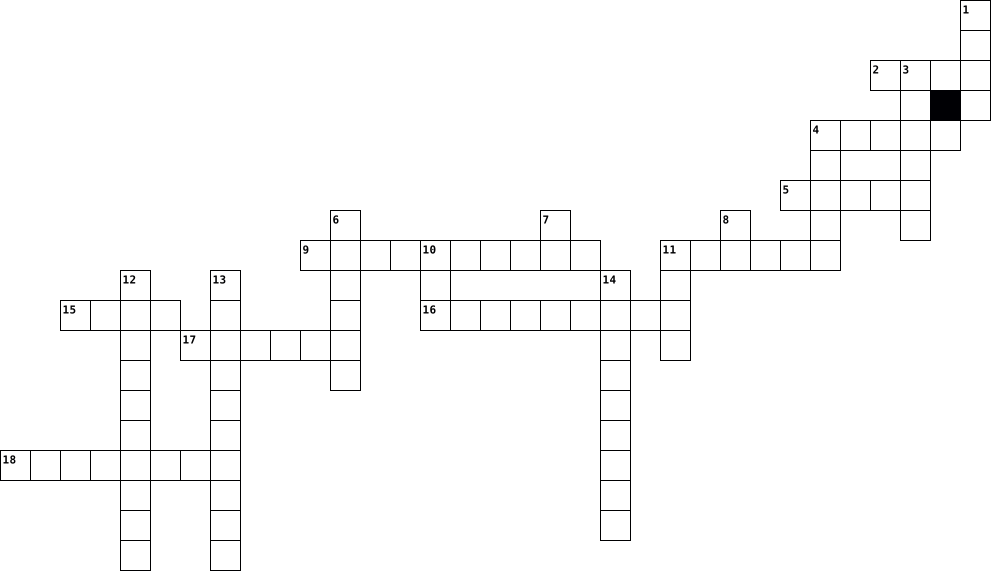
Across
- how many soldiers became prisoners of war
- how many tons of bombs were dropped
- how many north and south Kortroopsoups were killed before the war
- what temperatures would it reach
- how many US we injured in battle
- how many timeSeoul seoul captured
- when was China's first attack
- who was the US president during this time
- was it ever declared a war
Down
- how many south Korean members died
- how many North Korean soldiers went missing
- how many US soldiers died
- who was the president of china
- what percent of Pyongyang was destroyed
- what percent of deaths we civilian
- korea was ruled by japan till the end of which world war
- what year did the Korean War start
- fill-in-the-blank'no ---------- for victory'
- how long was the Korean war
- what was a major cause of injury
20 Clues: how many US soldiers died • was it ever declared a war • how long was the Korean war • when was China's first attack • who was the president of china • what temperatures would it reach • how many US we injured in battle • what was a major cause of injury • how many timeSeoul seoul captured • how many south Korean members died • what percent of deaths we civilian • ...
Countries 2024-03-25

Across
- have the smallest border on the earth
- did pizza
- have border with denmark
- Usa
Down
- make noodles
- have only border with spain
- was neutral in world war 2
- have border with russia and ukraine and small border with belarus
8 Clues: Usa • did pizza • make noodles • have border with denmark • was neutral in world war 2 • have only border with spain • have the smallest border on the earth • have border with russia and ukraine and small border with belarus
WW! 2025-05-16

Across
- between Germany and the Allies was the first step to ending World War I.
- a set of peace proposals put forth during World War I.
- invention that was break to stalemate
- signed in 1919, officially ended the war.
- The Central Powers in World War I were Germany, Austria-Hungary, the Ottoman Empire, and Bulgaria.
- was a secret diplomatic proposal made by German Foreign Secretary Arthur Zimmermann to Mexico in January 1917.
- the belief that a strong military is essential for a nation's strength and that military power should be used to achieve national goals.
- which killed 128 Americans, contributed to the US's eventual entry into the war in 1917.The
Down
- assassinated starting thewar
- green, brown, tan, and black. The specific colors and patterns used vary depending on the intended environment and the object being camouflaged.
- was characterized by trench warfare, a brutal and destructive style of fighting.eEasternFront
- invention in the water
- another word for trenches
13 Clues: invention in the water • another word for trenches • assassinated starting thewar • invention that was break to stalemate • signed in 1919, officially ended the war. • a set of peace proposals put forth during World War I. • between Germany and the Allies was the first step to ending World War I. • ...
Jiufen 2021-12-29

Across
- - a place people dig for gold
- - location of the gold ecological museum
- - one way to go to jiufen
- - people who occupied Jiufen during world war 2
Down
- - name of the theater in Jiufen
- - color of the waterfall
- - a kind of clothing
- - mining town in Northern Taiwan
- - a mountain near jiufen
9 Clues: - a kind of clothing • - color of the waterfall • - a mountain near jiufen • - one way to go to jiufen • - a place people dig for gold • - name of the theater in Jiufen • - mining town in Northern Taiwan • - location of the gold ecological museum • - people who occupied Jiufen during world war 2
Types of Journalism 2017-02-21

Across
- nonprofessional journalist
- news presented through graphics
- support viewpoints
- latest clothing design
- wild claims
- to add extra information
- live coverage of an event
- first person
- news captured by drones
- war zone
Down
- images
- conservation
- intended for radio or tv
- news presented through data
- entertainment world
- and finance business; stock markets
- rumors
- using devices to gather information
- required facts
19 Clues: images • rumors • war zone • wild claims • conservation • first person • required facts • support viewpoints • entertainment world • latest clothing design • news captured by drones • intended for radio or tv • to add extra information • live coverage of an event • nonprofessional journalist • news presented through data • news presented through graphics • and finance business; stock markets • ...
Jade Winters 2020-02-06

Across
- The relaxing of tension between the superpowers
- A competition between the Soviet Union and the United States to prove their superiority in technology (2 words)
- a name given to the Soviet Union and its communist controlled states in Eastern Europe such as Poland, East Germany, and Bulgaria. (2 words)
- said that the United States would help countries that were threatened by armed minorities or outside pressures. (2 words)
- President during the cold war, 33rd President (2 words)
- an alliance between the Soviet Union and other Eastern European communist nations. (2 words)
- Name for the United States and the Soviet Union in the Cold War.
- designed to shoot down ballistic missiles before they reach their targets. (3 words)
- Called the red telephone in 1963
- An economic theory in which collective ownership of property leads to a classless society.
- A nuclear bomb that is either lost, stolen, or accidentally launched that causes a nuclear accident. (2 words)
Down
- The term translates to "restructuring" in Russian.
- A threat was intended to prevent, or deter, anyone from attacking. (2 words)
- Republican senator from Wisconsin who capitalized on Cold War fears of Communism in the early 1950s (2 words)
- a movement in Poland to create a trade union that was not controlled by the communist party.
- Describes the growing divide between western democracies and Soviet-influenced states. (2 words)
- A crossing point between West Berlin and East Berlin when the Berlin Wall divided the city (2 words)
- A policy that allowed for more openness in the Soviet government as well as some level of freedom of speech.
- Philosophy named after Karl Marx.
- when the United States and the Soviet Union agreed to limit the number of nuclear weapons they made.
20 Clues: Called the red telephone in 1963 • Philosophy named after Karl Marx. • The relaxing of tension between the superpowers • The term translates to "restructuring" in Russian. • President during the cold war, 33rd President (2 words) • Name for the United States and the Soviet Union in the Cold War. • ...
The War of 1812 pgs. 360-367 2023-04-25

Across
- (2 words) This man led an army that forced the British to retreat.
- A devotion to one's country.
- Tecumseh was killed during this battlem but American Indian nations continued his fight.
- (2 words) a Government's actions toward other nations.
- (3 words) This captain forced british ships on Lake Erie to surrender.
- A Shawnee chief who wanted to unite all American Indian nations west of the Appalachian Mountains.
- (2 words) This battle was an important victory for the United States in the War of 1812.
- This created the most interest in the national flag of the United States
- (2 words) This doctrine warned other countries that the United States might act to protect te Western Hemisphere.
- An official statement of policy.
- (3 words) This man thought Tecumseh and his followers were a threat.
Down
- A economic success and security.
- (2 words)This man was elected president in 1808.
- (3 words) This lawyer watched the battle in the Baltimore Harbor.
- (2 words) This man was trying to keep the United States neutral during the war between Britain and France.
- (2 words)This first lady collected important documents and took them to safety when the British Army were headed to the White House.
- (2 words) A painting of this famous president Dolley refused to leave with out.
- (2 words) This person published the first dictionary of English that was uniquely American.
- When British soldiers captured American sailors and forced them to serve in the British Navy.
- (2 words) During the Battle of Lake Champlain British and U.S. troops fired annons at each other across this river.
- On June 18, 1812 Congress decared war against this country.
21 Clues: A devotion to one's country. • A economic success and security. • An official statement of policy. • (2 words)This man was elected president in 1808. • (2 words) a Government's actions toward other nations. • On June 18, 1812 Congress decared war against this country. • (3 words) This lawyer watched the battle in the Baltimore Harbor. • ...
American battles 2 2023-06-16

Across
- - Battle fought during the Korean War known for its strategic importance.
- - Revolutionary War battle fought near Boston, Massachusetts.
- - Civil War battle that resulted in the bloodiest single day of the war.
- - Revolutionary War battle that is considered a major American victory.
- - Revolutionary War battle that led to the surrender of the British army.
Down
- - Surprise attack on the U.S. naval base in Hawaii that brought the U.S. into World War II.
- - The first battle of the American Revolution.
- - Naval battle in the Pacific during World War II that turned the tide against Japan.
- - First major battle of the Civil War.
- - Civil War battle considered a turning point in the war.
10 Clues: - First major battle of the Civil War. • - The first battle of the American Revolution. • - Civil War battle considered a turning point in the war. • - Revolutionary War battle fought near Boston, Massachusetts. • - Revolutionary War battle that is considered a major American victory. • - Civil War battle that resulted in the bloodiest single day of the war. • ...
World War I Crossword 2018-12-17

Across
- The countries, germany, Austria-Hungary, and Italy are apart of this triple ____
- Powder Keg of Europe was known as the _____ region
- an act of violence against the opposing country’s public
- a territory that is under political control
- an age where people were thinking for themselves (against the crown )
- national relations also known as ____ affairs
- Germany and France got in a war where this place was the prize
- what country was in the Two Front War
- The man that assassinated Archduke Ferdinand
- where you have international relations is called ____ affairs
- when you add more land to country
- the London treaty (a peace treaty)
Down
- when you feel pride for your country
- State a geographical area separated by borders (a country)
- this plan was going against the two front war called ____ plan
- start of World War 1 is ____ 1914
- getting ready for attack, troops, weapons ext
- Who got assassinated arch duke _______
- when you want to govern yourself (starts with S)
- wanting to build up your army to be strong
- the countries in which got into world War One and its causes
- building these with other countries/nations will strengthen your power
- Interest when you want the best for your country
- Where arch duke and his wife was killed
24 Clues: start of World War 1 is ____ 1914 • when you add more land to country • the London treaty (a peace treaty) • when you feel pride for your country • what country was in the Two Front War • Who got assassinated arch duke _______ • Where arch duke and his wife was killed • wanting to build up your army to be strong • a territory that is under political control • ...
The Cold War 2023-12-13

Across
- What was the name of the alliance between the Soviet Union and other communist countries?
- What year was Germany reunified in?
- What theory stated that if one country falls to communism then others will too?
- Which side won the Korean War?
- Which side of Europe fell under communist rule during the Cold War?
- What country is 90 miles from the United States?
- When the Soviet Union collapsed 15 new countries were mad which one was the biggest?
- Who took over as dictator of Cuba in 1959 during the Cuban Revolution?
- During the Cold War there were many areas of extreme tension. These were called?
- What space program did Nikita Khrushchev launch.
- What was the capital of Germany?
- WHO WAS THE LEADER OF THE SOVIET UNION DURING WORLD WAR II?
Down
- The U.S and Great Britain started an airlift in response of the blockade.What was the airlift called?
- How long did the Berlin airlift last?
- AFTER WORLD WAR II ENDED, WHO CONTINUED TO OCCUPY THE EASTERN EUROPEAN COUNTRIES?
- Who attempted to assassinate Ronald Reagan?
- A COMPETITION FOR SCIENCE SUPERIORITY BETWEEN THE UNITED STATES & THE SOVIET UNION.
- A type of government that control everything
- What does North Atlantic Treaty Organization stand for?
- Which country helped Cuba after the U.S refused to sell them products?
20 Clues: Which side won the Korean War? • What was the capital of Germany? • What year was Germany reunified in? • How long did the Berlin airlift last? • Who attempted to assassinate Ronald Reagan? • A type of government that control everything • What country is 90 miles from the United States? • What space program did Nikita Khrushchev launch. • ...
Introduction to the Great Depression and World War II 2023-03-10

Across
- Way of collecting debt by banks during the Great Depression.
- Famous German dictator who launched World War ll by invading Poland.
- Last name of the president who founded the New Deal and was the first President in the United States during World War ll.
- Former Vice President and second president during World War ll.
Down
- Popular during the 1920's that was easily accumulated and extremely risky for banks during this time.
- Farms and factories were producing more goods than people had money for.
- Way for people to support the war from home in America.
- This country was under the leadership of Benito Mussolini.
- Genocide of Jews during World War ll.
- This hyphened phrase is the codename of Operation Neptune.
10 Clues: Genocide of Jews during World War ll. • Way for people to support the war from home in America. • This country was under the leadership of Benito Mussolini. • This hyphened phrase is the codename of Operation Neptune. • Way of collecting debt by banks during the Great Depression. • Former Vice President and second president during World War ll. • ...
Classical and Hellenistic Age of the Greeks 2024-11-22

Across
- this word means "of the Greeks, copy the Greeks, like the Greeks"
- "homeschool" teacher of Alexander the Great
- this League was headed by Sparta in the Pelopon. war.
- student of Socrates...wrote Republic
- the historian of the Peloponnesian War
- Father of Greek drama
- this region conquered Greece after the Pelopon. War.
- this "Great" conqueror subdued Greece and Persia
- the destructive Greek civil war that weakened the entire Greek world
Down
- Greek that began developing "modern" medical practices
- the leader of Athens during the Pelopon. War
- the Spartans win immortality here
- sculptor of the Statue of Zeus and the Parthenon
- happy Greek drama...political
- the temple of Athena in Athens
- this major empire invaded Greece twice...Greece gets the "W"
- philosopher...unexamined life not worth living...questioning
- developed a mathematical theorem for triangles
- this League was the Athenian led force in the Pelopon. War
- sad Greek drama
20 Clues: sad Greek drama • Father of Greek drama • happy Greek drama...political • the temple of Athena in Athens • the Spartans win immortality here • student of Socrates...wrote Republic • the historian of the Peloponnesian War • "homeschool" teacher of Alexander the Great • the leader of Athens during the Pelopon. War • developed a mathematical theorem for triangles • ...
WWI vocab 2025-02-27

Across
- Telegram secret massages
- spreading rumors to hurt or help specific people
- soilders spending days in a trench
- president willsons goal for peace
- building a strong military to prepare for war
- name of the German emperor
- for National groups to own their own land
- the treaty that ended world war one
- prepare for war
- someone who refuses to participate in war
Down
- paying for the things the Nation lost in a war
- policy of having nothing to do with foreign nations
- all young men In the US were required to register in the military
- undersea bouts ment for attacking
- citizen gave money to the government to pay for the war
- agree to stop fighting
- both sides aren’t strong enough to defeat each other
- pride in your country
- each side gives a demand to reach an agreement
- A US infantryman
20 Clues: prepare for war • A US infantryman • pride in your country • agree to stop fighting • Telegram secret massages • name of the German emperor • president willsons goal for peace • undersea bouts ment for attacking • soilders spending days in a trench • the treaty that ended world war one • for National groups to own their own land • someone who refuses to participate in war • ...
WWI vocab 2025-03-03

Across
- a US infantryman
- paying for the things they lost in a war
- -Bonds citizen gave money to the government to pay for the war
- both sides aren’t strong enough to defeat each other
- policy of haveing nothing to do with forighn nations
- president willsons goal for peace
- secret massages
- the treaty that ended world war one
- pride in your country
- building a strong military to prepare for war
Down
- name of the German emperor
- prepare for war
- solders spending days in a trench
- agree to stop fighting
- all young men In the US were required to register in the military
- for National groups to own their own land
- each side goves a demand to reach an agreement
- undersea bouts ment for attacking
- spreading rumors to hurt or help specific people
- someone who refuses to participate in war
20 Clues: prepare for war • secret massages • a US infantryman • pride in your country • agree to stop fighting • name of the German emperor • solders spending days in a trench • president willsons goal for peace • undersea bouts ment for attacking • the treaty that ended world war one • paying for the things they lost in a war • for National groups to own their own land • ...
Spanish-American War 2013-05-27

Across
- Major cash crop in Cuba
- Owner of the New York Journal during the war
- Largest factor contributing to casualties
- Removal of Spain for this sphere gave U.S. ability to create this canal
- Owner of the New York World during the war
- Besides malaria this disease led to many deaths
- location of the surrender
- System implemented by Weyler to "concentrate" Cubans
- Named give to African Americans who served in Guard units and fought
- The sinking of this ship helped push for war
- Queen of opposing country at the time
- Amendment that ensured that U.S. would not take control over Cuba
- Leader of the United States during this time
- Name given to those who "rebelled" against Spanish rule in Cuba
- McKinley's policy on how to deal with Spain
- A state of armed conflict between different nations or states or different groups within a nation or state
- This type of journalism was used very frequently through the war
- Type of imperialism that the Spanish had
- Other than Puerto Rico and Philippines what was acquired at the end of the war
Down
- U.S. naval commander who leader attacks on Philippines
- Capital of Philipines
- Act that gave U.S. direct control and power to set up gov't in Puerto Rico
- This letter criticized McKinley, intensified anti-Spanish feelings, and offended many Americans
- Group of men that Roosevelt lead in the war
- Where did the U.S. send a battleship to Cuba prior to the war
- The Treaty of ______ ended the war
- Amendment that restricted Cuba's sovereignty
- A collection of ships
- The war was fought over whose independence
- working with other countries to influence world affairs
- Length of the war in months
- Other than America, who was the other country in the war
- Military base granted to U.S. in Cuba shortly after the war
- Term referred to a state or territory partly controlled by another state but no internal affairs
- Other than Cuba where was this war fought
- A bite from this caused malaria
- agreement to quit fighting
- Cuban patriot who launched a war for independence
- Nationalist in Cuba who fought against colonial control
- An attitude of wildly enthusiastic often excessive nationalism
40 Clues: Capital of Philipines • A collection of ships • Major cash crop in Cuba • location of the surrender • agreement to quit fighting • Length of the war in months • A bite from this caused malaria • The Treaty of ______ ended the war • Queen of opposing country at the time • Type of imperialism that the Spanish had • Largest factor contributing to casualties • ...
US History Review 2023-03-06

Across
- The Great Plains is also known as America’s ***********
- This new technology allowed for messages to be sent long distances instantly
- The acronym for the reasons World War I started
- The sinking of a ship in Cuba and Yellow Journalism brought the United States into a war with this nation in 1898
- Andrew Carnegie and JD ********** are both examples of big business owners
- Trust Busters broke these up
- The main form of warfare in World War I
- The name of the investigative journalists who shed a light on the problems of the late 1800s in America
- Name of the Northern Army in the Civil War
- The name of the attempt to rebuild the South after the Civil War
- This proclamation stated that slavery was no longer legal in the Confederate States
- After 1890, most immigrants came to the United States from ******* Europe
- The name of the passenger liner sunk by Germany in WWI
Down
- The location of the canal that was dug by America and linked the Atlantic and Pacific Oceans
- The 19th Amendment gave women the right to
- This is what killed the most people in the Civil War and World War I
- The name of the telegram intercepted by the United States that got us into WWI
- Reason the Civil War was fought
- This railroad linked the East and West Coasts
- This amendment ended slavery in the United States
- Chicago and this town in Wisconsin both had fires on October 8, 1871
- The Plessy vs. ******** case ruled that segregation was legal.
- When people are divided based on the color of their skin
- The president behind the Square Deal
- These schools were where Native American children were taken to be assimilated into the United States.
- A form of farming where people rented farm and lived in perpetual poverty
- The name of the ships that the Germans used to sink ships in the ocean.
- The Battle of Little ******* is also known as Custer’s Last Stand
- The name of the ship that was sunk in 1898 and launched the United States into a war was the USS
- This invention brought light into homes and powers most of our appliances.
30 Clues: Trust Busters broke these up • Reason the Civil War was fought • The president behind the Square Deal • The main form of warfare in World War I • The 19th Amendment gave women the right to • Name of the Northern Army in the Civil War • This railroad linked the East and West Coasts • The acronym for the reasons World War I started • ...
The Iorn curtain 2024-05-10

Across
- a guarded concrete barrier that encircled West Berlin of the Federal Republic of Germany from 1961 to 1989, separating it from East Berlin and the German Democratic Republic
- met in Potsdam, Germany, from July 17 to August 2, 1945, to negotiate terms for the end of World War II
- proposed that the United States provide economic assistance to restore the economic infrastructure of postwar Europe
- a collected defense treaty established by the Soviet Union and seven other Soviet satellite states in Central and Eastern Europe
- a line separating two political or geographical areas
- Soviet revolutionary and politician who was the longest-serving leader of the Soviet Union from 1924 until his death in 1953 held power as General Secretary of the Communist Party of the Soviet Union
- a British statesman, soldier, and writer who served as Prime Minister of the United Kingdom twice, from 1940 to 1945 during the Second World War
- provided listeners behind the Curtain in the EasternBloc with uncensored news
Down
- a Soviet politician and ideologue. He has been described as the Soviet Union's "propagandist-in-chief"
- put up the Iron Curtain
- an intergovernmental military alliance of 32 member states—30 European and 2 North American
- a period of geopolitical tension between the United States and the Soviet Union and their respective allies
- the best-known Berlin Wall crossing point between East Berlin and West Berlin during the Cold War, as named by the Western Allies
- a political metaphor used to describe the political boundary dividing Europe into two separate areas
- a global conflict between two major alliances: the Allies and the Axis powers.
15 Clues: put up the Iron Curtain • a line separating two political or geographical areas • provided listeners behind the Curtain in the EasternBloc with uncensored news • a global conflict between two major alliances: the Allies and the Axis powers. • an intergovernmental military alliance of 32 member states—30 European and 2 North American • ...
Asian Countries 2026-05-12

Across
- One of two "doubly landlocked" countries in the world
- Defeated the US in a war during the 1970s
- Led by Kim Jong Un
- Contains the lowest lying land in the world 1443 ft below sea level
- Contains Mount Everest
- Led by the Taliban
- Finished their civil war in 2025
- Changed the spelling of their name to avoid confusion with a bird
- Used to be called East Pakistan
- Claims to be the real "Republic of China"
- Richest Asian country per capita
- Used to spell their country name with I's instead of Y's
- Has been unable to join the UN due to the US
- Used to have the 2nd largest empire in history
- Largest "Stan" country
- Former dictator, Pol Pot killed 1/4th of this countries population in 4 years
- Name is an acronym for the regions of the country
- Used to be called Burma
- Follows its own denomination of Christianity
Down
- The last country ruled by an Emperor
- Only Jewish country
- Has an exclave known as Nakhchivan
- Measures Gross Domestic Happiness (GDH) rather than GDP
- Split into two regions, one on the island of Borneo
- Used to be a US Territory
- Has the lowest birth rate in the world
- Contains over 17,000 islands
- Consists of 7 regions called Emirates
- Allied Japan in World War II
- The US invaded Iraq to protect this country
- Fighting a civil war against the Houthis
- The Hmong people fled to Minnesota from this country
- Led by the Saud family
- The largest communist country
- Has two unrecognized countries in their borders
- Used to be called Persia
- The most populated country
37 Clues: Led by Kim Jong Un • Led by the Taliban • Only Jewish country • Contains Mount Everest • Largest "Stan" country • Led by the Saud family • Used to be called Burma • Used to be called Persia • Used to be a US Territory • The most populated country • Contains over 17,000 islands • Allied Japan in World War II • The largest communist country • Used to be called East Pakistan • ...
World War II Puzzle 2023-04-20

Across
- Last chance German attack in Belgium (4 words)
- The invasion of this country by Germany and the Soviet
- Location of one of the worst concentration camps
- Commander of Allied forces in North Africa and in Europe
- Caused worldwide turmoil and the rise of powerful dictators.
- Ordered the use of atomic bombs against Japan (2 words)
Down
- City where the first atomic bomb was dropped
- started World War II.
- German bombing of London (3 words)
- American commander forced to leave the Philippines (2 words)
- Operation __ was the name of the invasion of France.
11 Clues: started World War II. • German bombing of London (3 words) • City where the first atomic bomb was dropped • Last chance German attack in Belgium (4 words) • Location of one of the worst concentration camps • Operation __ was the name of the invasion of France. • The invasion of this country by Germany and the Soviet • ...
Great War 2025-12-04

Across
- Forcing people by law to join the armed forces
- a new kind of conflict where nations mobilized their entire societies
- military strategy
- land between two opposing sides
- major contributing factor to World War
- an a agreement between the two opposing sides
Down
- payments imposed on Germany
- mobilize support for the war effort through various media
- groups of merchant ships that sailed together
- a four year period of trench warfare with ether side no stop
- major cause of World War I
- a German submarine
- a type of rigid airship
- PTSD for ww1 people
14 Clues: military strategy • a German submarine • PTSD for ww1 people • a type of rigid airship • major cause of World War I • payments imposed on Germany • land between two opposing sides • major contributing factor to World War • groups of merchant ships that sailed together • an a agreement between the two opposing sides • Forcing people by law to join the armed forces • ...
I love lucy 2022-04-21

Across
- who the show is named after
- ricky's agent
- lucy's mom Betty Ramsey and various characters
Down
- she was originally named Lillian
- is married to lucy
- Ramsey lucy's Neighbor
- she is the landlady to lucy
- is a world war 2 veteran
8 Clues: ricky's agent • is married to lucy • Ramsey lucy's Neighbor • is a world war 2 veteran • who the show is named after • she is the landlady to lucy • she was originally named Lillian • lucy's mom Betty Ramsey and various characters
Cuba Revolution and relationship with U.S. 2021-07-07

Across
- 1962 Cold War event wherein the Soviet Union, with the agreement of the Castro regime, placed intermediate and medium range ballistic missiles on the island of Cuba which were capable of striking all of the United States. (3 words)
- sociopolitical, military, and economic conflict between the world's Western capitalist democracies and its Eastern communist regimes from the end of World War II through 1991. (2 words)
- leader of the Soviet Union at the time of the Cuban Missile Crisis. (2 words)
- former president and later dictator of Cuba prior to the 1959 Cuban Revolution. (2 words)
Down
- an economic system wherein private ownership is largely forbidden and all industries and resources are under the control of the state.
- abridged name used to describe the former communist government of Russia during ghte Cold war; also known as the U.S.S.R. (2 wprds)
- the act of overthrowing an existing governing authority.
- president of the United States at the time of the Cuban Missile Crisis (2 words and letter)
- economic policy which blocks all trade with a given nation, typically du to safety and/or humanitarian concerns; are also enacted to sanction enemy nations.
- former communist dictator of Cuba who led the ouster of Fulencio Batista in the 1959 Cuban Revolution. (2 words)
10 Clues: the act of overthrowing an existing governing authority. • leader of the Soviet Union at the time of the Cuban Missile Crisis. (2 words) • former president and later dictator of Cuba prior to the 1959 Cuban Revolution. (2 words) • president of the United States at the time of the Cuban Missile Crisis (2 words and letter) • ...
U.S History 2017-04-02

Across
- system: First established by the Treaty of Fort Laramie (1851) and Fort Atkinson (1853), this system established boundaries for the territory of each tribe that would be overseen by the Bureau of Indian Affairs
- for fraud and bribery
- of Nations: International organization founded in 1919 to promote world peace but greatly weakened by the refusal of the United States to join. It proved ineffectual in stopping aggression by Italy, Japan, and Germany in the 1930s.
- and sedition acts: two laws, enacted in 1917 and 1918, that imposed harsh penalties on anyone interfering with or speaking against US participation in World War I.
- sumner: gave a speech in may 1856 called " the Crime Against Kansas" militant opponent of slavery, beat with a cane by Preston Brooks after the speech, collapsed unconscious and couldn't return to senate for 4 years, symbol throughout the north.
- stick diplomacy: Theodore Roosevelt's imperialist policy promoting the US as a world power. i.e.: treaty that ended the Russo-Japanese War; Open Door Policy with China; Panama Canal; world tour of the Great White Fleet; all of which gave rise to world-power status.
- points: The war aims outlined by President Wilson in 1918, which he believed would promote lasting peace
- amendment: An amendment to the U.S. Constitution, ratified in 1868, defining national citizenship and forbidding the states to restrict the basic rights of citizens or other persons.
- a farmer who worked without his own supplies in exchange for some of the harvest.
- nagger: Northerners who came to the south during the reconstruction era.
- Canal: Theodore Roosevelt's imperialist policy promoting the US as a world power. i.e.: treaty that ended the Russo-Japanese War; Open Door Policy with China; Panama Canal; world tour of the Great White Fleet; all of which gave rise to world-power status.
Down
- amendment: An amendment to the U.S. Constitution, ratified in 1870, prohibiting the restriction of voting rights "on account of race, color, or previous condition of servitude."
- migration: the migration of African Americans in the south to go north or mid west in 1910-1960
- and republicans were not listening to the people.
- People's party
- movement: Certificates sold by the United States government to pay for the war.
- Stevens: A Republican leader and one of the most powerful members of the United States House of Representatives. He was chairman of the House Ways and Means Committee,and a witty, sarcastic speaker and flamboyant party leader who dominated the House from 1861 until his death and wrote much of the financial legislation that paid for the American Civil War.
- service act: This 1917 law provided for the registration of all American men between the ages of 21 and 30 for a military draft.
- starts out west then spreads out
- system: Used in both the First and Second World Wars. Several cargo ships would together sail from Canada to the UK protected by naval escort ships.
- Nebraska act: Sen. Douglas wanted to divide the territory into the Nebraska Territory and the Kansas Territory; to gain support of the South, he decided slavery could be decided by popular sovereignty
- warfare: A form of warfare in which opposing armies fight each other from trenches dug in the battlefield. , Fighting with trenches, mines, and barbed wire. Horrible living conditions, great slaughter, no gains, stalemate, used in WWI.
- machines: organizations whose main goals were the rewards money, influence, prestige of getting and keeping power
23 Clues: People's party • for fraud and bribery • starts out west then spreads out • and republicans were not listening to the people. • nagger: Northerners who came to the south during the reconstruction era. • movement: Certificates sold by the United States government to pay for the war. • a farmer who worked without his own supplies in exchange for some of the harvest. • ...
Lesson 36 Vocab 2024-03-06

Across
- a key Soviet victory during World War II that ended Hitler's effort to conquer the USSR
- the alliance between Germany, Italy, and Japan during World War II
- the systematic, state-sponsored persecution and murder of Jews and other minority groups by the Nazis
- a large-scale military counterattack by a force that was previously on the defensive
- the countries that fought against the Central Powers during World War I and the countries that fought against the Axis Powers during World War II
- June 6, 1944, the day that the Allied invasion of German-occupied France began
- the systematic killing of a racial, political, or cultural group
Down
- the U.S. victory in World War II that positioned the Allies for an invasion of Japan
- the U.S. naval victory in the Pacific during World War II that stopped Japanese expansion and forced Japan to focus on defense
- a bomb with explosive power that comes from the energy suddenly released by splitting the nuclei of uranium or plutonium atoms
10 Clues: the systematic killing of a racial, political, or cultural group • the alliance between Germany, Italy, and Japan during World War II • June 6, 1944, the day that the Allied invasion of German-occupied France began • the U.S. victory in World War II that positioned the Allies for an invasion of Japan • ...
World War I Crossword Puzzle 2021-10-01

Across
- Balkan states fought over Turkish _________
- Wilson United States President during WWI
- Wire Wire used in trenches to trap enemies
- Fight between two armies on the ______field
- Gas New toxic weapon many opposed of
- Americas practice to avoid joining the war
- Grudges amongst nations caused by small conflicts
- Hand- Nationalist group in Serbia
- Powers- "Good side" of World War I
- Telegram Telegram which led U.S. into WWI
- Small Asian empire rising powerfully
- Wars Wars over Turkish territory
- Closest ally to Serbia with ethnic ties
- Slavic nation who doesn't like Austria
- Nicholas II Assassinated alongside his family
- mask Mask used to protect soldiers from poison gas
- Powers "Bad side" of World War I
Down
- Von Bismarck Known as the father of Germany
- war Country using all resources towards war
- Crisis Issues rise due to annexing of Bosnia
- Princip Killed the Austrian Archduke
- Crisis Balkan states issues in Morocco
- Von Richthofen 80 confirmed arial combat kills
- Empire Declining empire before WWI
- Ferdinand His assassination immidiately caused WWI
- Wilhelm II Leader of Germany during WWI
- Group of soldiers trained to fight in battle
- Gun Military tech of WWI which shot fast bullets
- Nation who lost the heir to their throne
- Main ally of AustriaHungary
30 Clues: Main ally of AustriaHungary • Wars Wars over Turkish territory • Powers "Bad side" of World War I • Hand- Nationalist group in Serbia • Empire Declining empire before WWI • Powers- "Good side" of World War I • Princip Killed the Austrian Archduke • Gas New toxic weapon many opposed of • Small Asian empire rising powerfully • Crisis Balkan states issues in Morocco • ...
World War I Crossword 2018-12-17

Across
- when you add more land to country
- Where arch duke and his wife was killed
- this plan was going against the two front war called ____ plan
- The man that assassinated Archduke Ferdinand
- where you have international relations is called ____ affairs
- national relations also known as ____ affairs
- an age where people were thinking for themselves (against the crown )
- the London treaty (a peace treaty)
- wanting to build up your army to be strong
- The countries, germany, Austria-Hungary, and Italy are apart of this triple ____
- building these with other countries/nations will strengthen your power
Down
- an act of violence against the opposing country’s public
- getting ready for attack, troops, weapons ext
- what country was in the Two Front War
- start of World War 1 is ____ 1914
- Who got assassinated arch duke _______
- when you feel pride for your country
- when you want to govern yourself (starts with S)
- Powder Keg of Europe was known as the _____ region
- the countries in which got into world War One and its causes
- a territory that is under political control
- Germany and France got in a war where this place was the prize
- Interest when you want the best for your country
- State a geographical area separated by borders (a country)
24 Clues: when you add more land to country • start of World War 1 is ____ 1914 • the London treaty (a peace treaty) • when you feel pride for your country • what country was in the Two Front War • Who got assassinated arch duke _______ • Where arch duke and his wife was killed • wanting to build up your army to be strong • a territory that is under political control • ...
Ethan's Puzzle 2023-03-12

Across
- The value that appears most often in a data set.
- Mt. Fuji is located in this country.
- Standard _________ is a measure of how spread out the values of a distribution are.
- The country with the largest population in the world
- The strongest muscle in the body
- The largest ocean in the world
- The country immediately to the south of the U.S.
- The average of the values in a data set.
- Korea is located on this continent.
- A ______ distribution is a probability distribution function that looks like a bell.
- The capital of Senegal
- A triangle that has three equal sides
Down
- Country through which the Rhine River flows
- The largest country in South America
- The country that is currently at war with Russia
- Coldest sea on earth
- The capital of Nova Scotia
- A triangle that has two equal sides
- The capital of Honduras
- ______ of a triangle equals 1/2 x base x height.
20 Clues: Coldest sea on earth • The capital of Senegal • The capital of Honduras • The capital of Nova Scotia • The largest ocean in the world • The strongest muscle in the body • A triangle that has two equal sides • Korea is located on this continent. • The largest country in South America • Mt. Fuji is located in this country. • A triangle that has three equal sides • ...
Bella's Crossword 2022-05-04

Across
- who convinced Americans to keep their money in banks
- who did the Harlem helfighters fight?
- who provided work for musicians and many more
- who was one the main allies
- what were Sacco & Vanzetti
- who were the first & only to have atomic weapons
- the ___ planted trees and fixed buildings all over the world
- where did the D-day invasion take place
- what was step two to end the great depression
- what was one of the main causes of the great depression
- who started working in factories in world war 2
- the __ hated Jews and threw them into camps and killed them
Down
- they put __ on cars & goods
- what was " the birth of a nation"
- what were palmer raids mostly going after
- what fully started the anti-alcohol movement
- who were locked into camps
- who did Germany first invade?
- the Tuskegee airmen were ___ to the bombers
- what was one thing AL Capone was?
20 Clues: who were locked into camps • what were Sacco & Vanzetti • they put __ on cars & goods • who was one the main allies • who did Germany first invade? • what was " the birth of a nation" • what was one thing AL Capone was? • who did the Harlem helfighters fight? • where did the D-day invasion take place • what were palmer raids mostly going after • ...
World War I Crossword 2018-12-17

Across
- where you have international relations is called ____ affairs
- an act of violence against the opposing country’s public
- national relations also known as ____ affairs
- when you feel pride for your country
- this plan was going against the two front war called ____ plan
- the countries in which got into world War One and its causes
- what country was in the Two Front War
- The countries, germany, Austria-Hungary, and Italy are apart of this triple ____
- Germany and France got in a war where this place was the prize
- a territory that is under political control
- Powder Keg of Europe was known as the _____ region
- Interest when you want the best for your country
- Who got assassinated arch duke _______
- start of World War 1 is ____ 1914
Down
- when you add more land to country
- getting ready for attack, troops, weapons ext
- the London treaty (a peace treaty)
- wanting to build up your army to be strong
- an age where people were thinking for themselves (against the crown )
- when you want to govern yourself (starts with S)
- The man that assassinated Archduke Ferdinand
- building these with other countries/nations will strengthen your power
- State a geographical area separated by borders (a country)
- Where arch duke and his wife was killed
24 Clues: when you add more land to country • start of World War 1 is ____ 1914 • the London treaty (a peace treaty) • when you feel pride for your country • what country was in the Two Front War • Who got assassinated arch duke _______ • Where arch duke and his wife was killed • wanting to build up your army to be strong • a territory that is under political control • ...
American Freedom Fighters 2013-12-09

Across
- Acronym for the national association for the advancement of colored people
- A program put into place by Franklin D. Roosevelt to help people during the great depression
- Rights that protect people's freedoms
- Separating different groups based on color, nationality, or religion
- Severe economic depression prior to WW II
- war for US independence from Great Britain
- To refuse to buy or participate in something as a way to protest
- War between the Allied powers of the US, Great Britain, and Russia against the Axis powers of Germany, Italy, and Japan
- War between the northern and southern states
- American patriots responsible for the Boston Tea Party
- Members of a suffrage movement
Down
- Protesting without using violence
- People who migrate out of their home county to work in another country
- To stop work in order to make an employer change
- Social reforms by Lyndon B. Johnson to help eliminate poverty and racial injustice
- Law that prohibits discrimination in voting
- Person who fought to abolish (end) slavery
- Bringing different groups together to live in peace with equal rights
- Group of different countries around the world to help continue peace and avoid another world war
- A war in Vietnam where the US was trying to stop the spread of communism
20 Clues: Members of a suffrage movement • Protesting without using violence • Rights that protect people's freedoms • Severe economic depression prior to WW II • war for US independence from Great Britain • Person who fought to abolish (end) slavery • Law that prohibits discrimination in voting • War between the northern and southern states • ...
AB1 Final Vocabulary Extavaganza 2024-12-12

Across
- We were running late for the train, but _____ we still managed to catch it
- It's clear from the failures of COP29 that we're ____ _____ when it comes to the climate (2)
- Our plans have changed so I'm calling the airline to ______ for another day. Hopefully it won't be too expensive.
- There's no time like the __________ to get things done.
- to steal goods from a place, typically in a time of war
- USB stick (2)
- an important component of getting rainwater off of your roof
- The _______ most popular singer in the world is Taylor Swift, but honestly, I don't understand the appeal.
- You're worried about the final exam coming up at the end of January, but ______ you will get a good grade.
- We call a germ a 'superbug' if it has built up ___ ____ (2) and therefore is more difficult to treat.
Down
- As a child, I liked to leave the house without socks. My parents often _____ me: they warned me angrily that I would catch a cold.
- a particular type of cyberattack that prevents you from accessing your device or data until you agree to pay a certain sum.
- Use a _____ to pour water from a large barrel into a smaller bottle.
- One rule about ______ is to keep the font large enough for people to read easily from far away.
- The particular window of time in which final evaluations are held during the academic year (2)
- The wheel ____ __ ___ __ (4) so many other inventions: cars but also pulleys and gears.
- Before pennicilin was invented, the _____ ____ was very high due to bacterial infection: infants in particular often died. (2)
- We saw a _____, a feature film that told the story of a real-life person, Lee Miller.
- Can you buy me some duty-free perfume? You have a long _______ in Amsterdam on your way to Copenhagen.
- At 84, Japan has the top ____ _____ in the world. May we all grow to be so old! (2)
20 Clues: USB stick (2) • There's no time like the __________ to get things done. • to steal goods from a place, typically in a time of war • an important component of getting rainwater off of your roof • Use a _____ to pour water from a large barrel into a smaller bottle. • We were running late for the train, but _____ we still managed to catch it • ...
Lesson 23 Key Terms (Word Bank) 2022-01-28

Across
- a weapon that contains a poisonous substance
- a law passed by Congress in 1917 to create a national draft
- soldiers who fight on foot
- a form of warfare in which armies conduct attacks on each other from opposition positions in fortified trenches
Down
- in World War I, the first U.S. military force to be deployed to France
- a person who physically fights a war
- a type of cannon
- in World War I, an African American regiment of the U.S. Army
- in World War I, the final Allied offensive that brought about the end of the war
- convoya group of vessels or vehicles that travel together, often under the protection of an armed escort
- the largest and most heavily armored type of warship
11 Clues: a type of cannon • soldiers who fight on foot • a person who physically fights a war • a weapon that contains a poisonous substance • the largest and most heavily armored type of warship • a law passed by Congress in 1917 to create a national draft • in World War I, an African American regiment of the U.S. Army • ...
ww2 2023-05-03
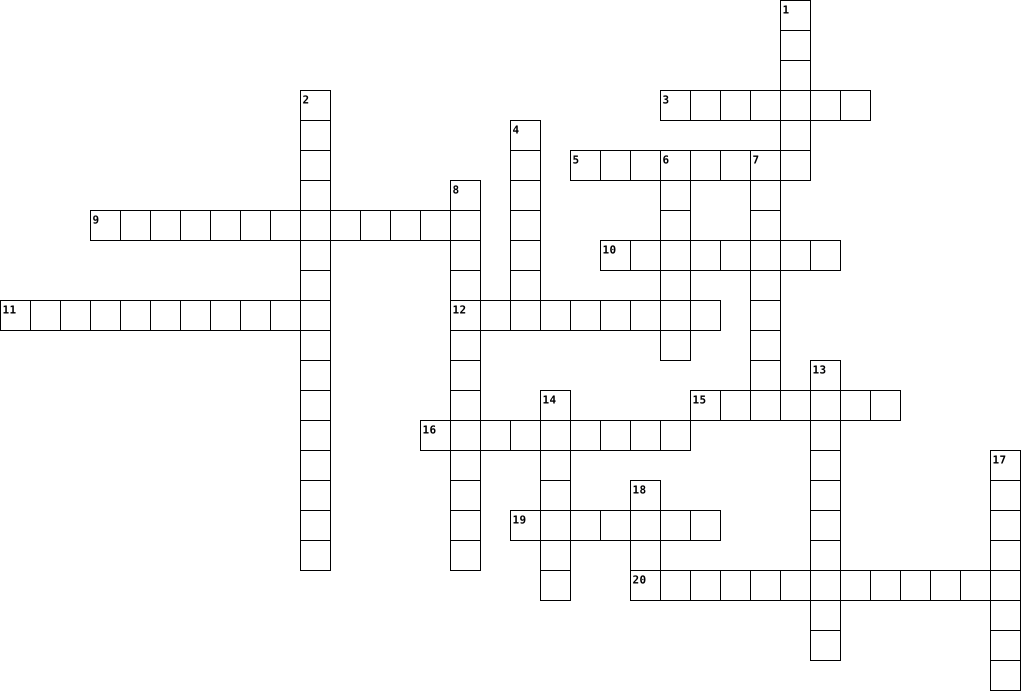
Across
- a political system headed by a dictator that calls for extreme nationalism
- something nice
- camp a camp where people are contained
- during world war 2 japanese suicide pilots
- giving into unjust demands in order to avoid conflict
- restricting the amount of an item an individual can have due
- garden garden planted by citizens to provide food for soldiers
- almost entirely nearly
- suit a mens suit with no vest no cuffs a short jacket
- camp a camp where men women and kids are executed
Down
- to make changes to an original work
- national policy of actively trading with foreign countries
- to take advantage of
- to be in control of to have full power
- materials items needed to fight a war
- to estimate lower than the real amount of value
- a farm especially in communist countries formed from many small holdings
- to prove or to show to be right or reasonable
- to be in state or position of command or control over others
- a signal or symbol used to represent something that is to be kept secret
20 Clues: something nice • to take advantage of • almost entirely nearly • to make changes to an original work • materials items needed to fight a war • to be in control of to have full power • camp a camp where people are contained • during world war 2 japanese suicide pilots • to prove or to show to be right or reasonable • to estimate lower than the real amount of value • ...
Braxton's crossword 2025 2025-04-01

Across
- how many years has it been since the first American war
- what state has the least population of the grey wolf
- when was the declaration issued
- where can you sleep in pods on a mountain
- leader during world war 2
- what teen started a free pop up shop
- where are wild fires happening in the united states
- are scientist trying to put grey wolfs back in California
- how many afghans endure food insecurity
- symbol of strength in usa
Down
- what is Afghnistan fighting what crisis
- what is the percentage of kids and teens ultra processed foods
- is all of us have Wolfe's
- how many nations require warning labels with high risk of foods
- what state has the biggest grey wolf population
- what animal almost went extinct in 1960
- does mexico and Canada have ranges for wolfs
- how many kids are malnourished
- is the guy on the back talking to a boy or a girl
- Armstrong first person to set foot on the moon
20 Clues: is all of us have Wolfe's • symbol of strength in usa • leader during world war 2 • how many kids are malnourished • when was the declaration issued • what teen started a free pop up shop • what is Afghnistan fighting what crisis • what animal almost went extinct in 1960 • how many afghans endure food insecurity • where can you sleep in pods on a mountain • ...
Colonial Connections 2024-09-18

Across
- They brought Santa, bagels, and donuts to the New World
- ______ Hutchinson was kicked out of the New England colonies
- House of _______, the oldest Northwestern assembly
- The first permanent British settlement
- John _________ coined "A city on a hill"
- Sailed to the New World on the Mayflower
- Founded by Roger Williams
- Treaty of __________ ended the Seven Years' War in 1763
- The first group to turn against slavery
Down
- The cash crop farmed in Jamestown
- Where the infamous Witch Trials of 1692 occurred
- The French and Indian War was part of The ________ Years' Wars
- Johnathan ________, a fire and brimstone preacher
- Colony founded by George Oglethorpe
- ____________ Bay Colonies, including Virginia and Maryland
- Ben __________ wrote Poor Richard's Almanac
- A famous preacher of the Great Awakening, George ________
- ________ Penn, the founder of Pennsylvania
- _______’s War was a Native American uprising from 1763-1766
19 Clues: Founded by Roger Williams • The cash crop farmed in Jamestown • Colony founded by George Oglethorpe • The first permanent British settlement • The first group to turn against slavery • John _________ coined "A city on a hill" • Sailed to the New World on the Mayflower • ________ Penn, the founder of Pennsylvania • Ben __________ wrote Poor Richard's Almanac • ...
History 2023-06-11

Across
- (Birthplace of democracy)
- (Norse seafarers)
- (Age of factories)
- (Cultural rebirth)
- (Overthrow of power)
- (Shakespearean era)
- (Land of pharaohs)
- (Atomic bomb site)
- (French military leader)
- (Asian conquerors)
- War (Tension between superpowers)
Down
- (Cultural rebirth)
- (Ancient empire)
- Rights (Movement for equality)
- (Ancient Mesoamerican civilization)
- (South American civilization)
- (Mesoamerican empire)
- (Revolutionary era)
- War (Global conflict)
- Road (Ancient trade route)
20 Clues: (Ancient empire) • (Norse seafarers) • (Cultural rebirth) • (Age of factories) • (Cultural rebirth) • (Land of pharaohs) • (Atomic bomb site) • (Asian conquerors) • (Revolutionary era) • (Shakespearean era) • (Overthrow of power) • (Mesoamerican empire) • War (Global conflict) • (French military leader) • (Birthplace of democracy) • Road (Ancient trade route) • (South American civilization) • ...
global 10 2023-05-28

Across
- Adopt to modern needs and technology
- To westernize
- condor where people disappeared
- of Afghanistan U.S allies invade to remove the taliban
- of the plaza de mayo mothers of missing peoples trying to find their missing ones
- peaceful protest against the government
- war united states invaded and occupied Nicaragua for the bananas
- influenza a disease during world war 1
- To develop industry
Down
- states bring connected
- violent revolt that lead to a bloody civil war
- of iraq Result of the attack of 9/11 terrorist attack
- movement The push for Indians to give up buying British textiles and to make their own cloth
- A government that is based on religion
- infectious disease that is spreading
- Palestine uprising/ attack on the Israelis
- salt march Gandhi marched to ocean to collect salt
- spring A sense of pro democracy protest around the Arab world
- Satya and Agraha fighting without violence. Methods including protecting and hit cooperating
- When something is being desperately needed
20 Clues: To westernize • To develop industry • states bring connected • condor where people disappeared • Adopt to modern needs and technology • infectious disease that is spreading • A government that is based on religion • peaceful protest against the government • Palestine uprising/ attack on the Israelis • When something is being desperately needed • ...
Key People in World War I 2017-03-07

Across
- the emperor of Austria-Hungary at the start of the war.
- the prime minister of Italy during World War I.
- the head of the British Navy until he was demoted in 1915
- the Germans helped smuggle me into Russia where I successfully led a Revolution
- Russian revolutionary who helped Lenin
- a British officer posted in the Middle East who played a role in the Arab revolt against the Ottoman Empire
Down
- the emperor of Germany who was cousins with Czar Nicholas II of Russia and George V of Great Britain
- a British nurse who was captured by the Germans and later executed
- the czar in Russia at the start of the war who abdicated in 1917 and was murdered in 1918
- the French prime minister from 1917-1920
- President of the United States during World War I
- the person who shot Archduke Franz Ferdinand and his wife
- Sultan of the Ottoman Empire during World War I.
13 Clues: Russian revolutionary who helped Lenin • the French prime minister from 1917-1920 • the prime minister of Italy during World War I. • Sultan of the Ottoman Empire during World War I. • President of the United States during World War I • the emperor of Austria-Hungary at the start of the war. • the person who shot Archduke Franz Ferdinand and his wife • ...
Facts-Crossword,Rémy R. 2020-05-11

Across
- The Park with the most visitors is the...
- ...which have become a tourist attraction
- between European settlers and Indians
- almost the same size as the Grand Canyon
- end of ... between British and Americans
- the first transcontinental...,opened in 1869
- ...were known for their woodcarving and including totem poles.
- ...have their own languages-almost 300 of them
Down
- ...is an Area of land that is managed by and belongs to a tribe alone
- the first African-American President
- was becoming a growing European power
- ...has the most National Parks(nine)
- one word from Native American languages
- The most widely spoken language of Native Americans
- world war 1 and 2 both ended with...for America
- home of the largest single-stem tree
- the US invented the concept of...
- US the second-most polluting country,after...
- The...of the prairies,deserts and coasts had very different lifestyles,culture,traditions and art.
19 Clues: the US invented the concept of... • the first African-American President • ...has the most National Parks(nine) • home of the largest single-stem tree • was becoming a growing European power • between European settlers and Indians • one word from Native American languages • almost the same size as the Grand Canyon • end of ... between British and Americans • ...
WWI vocab 2025-03-03

Across
- a US infantryman
- paying for the things they lost in a war
- -Bonds citizen gave money to the government to pay for the war
- both sides aren’t strong enough to defeat each other
- policy of haveing nothing to do with forighn nations
- president willsons goal for peace
- secret massages
- the treaty that ended world war one
- pride in your country
- building a strong military to prepare for war
Down
- name of the German emperor
- prepare for war
- solders spending days in a trench
- agree to stop fighting
- all young men In the US were required to register in the military
- for National groups to own their own land
- each side goves a demand to reach an agreement
- undersea bouts ment for attacking
- spreading rumors to hurt or help specific people
- someone who refuses to participate in war
20 Clues: prepare for war • secret massages • a US infantryman • pride in your country • agree to stop fighting • name of the German emperor • solders spending days in a trench • president willsons goal for peace • undersea bouts ment for attacking • the treaty that ended world war one • paying for the things they lost in a war • for National groups to own their own land • ...
Key People in World War I 2017-03-07

Across
- President of the United States during World War I
- the head of the British Navy until he was demoted in 1915
- the czar in Russia at the start of the war who abdicated in 1917 and was murdered in 1918
- the emperor of Austria-Hungary at the start of the war.
- the emperor of Germany who was cousins with Czar Nicholas II of Russia and George V of Great Britain
- a British officer posted in the Middle East who played a role in the Arab revolt against the Ottoman Empire
- Russian revolutionary who helped Lenin
Down
- the prime minister of Italy during World War I.
- the person who shot Archduke Franz Ferdinand and his wife
- the Germans helped smuggle me into Russia where I successfully led a Revolution
- the French prime minister from 1917-1920
- Sultan of the Ottoman Empire during World War I.
- a British nurse who was captured by the Germans and later executed
13 Clues: Russian revolutionary who helped Lenin • the French prime minister from 1917-1920 • the prime minister of Italy during World War I. • Sultan of the Ottoman Empire during World War I. • President of the United States during World War I • the emperor of Austria-Hungary at the start of the war. • the person who shot Archduke Franz Ferdinand and his wife • ...
WWI vocab 2025-03-03

Across
- a US infantryman
- paying for the things they lost in a war
- -Bonds citizen gave money to the government to pay for the war
- both sides aren’t strong enough to defeat each other
- policy of haveing nothing to do with forighn nations
- president willsons goal for peace
- secret massages
- the treaty that ended world war one
- pride in your country
- building a strong military to prepare for war
Down
- name of the German emperor
- prepare for war
- solders spending days in a trench
- agree to stop fighting
- all young men In the US were required to register in the military
- for National groups to own their own land
- each side goves a demand to reach an agreement
- undersea bouts ment for attacking
- spreading rumors to hurt or help specific people
- someone who refuses to participate in war
20 Clues: prepare for war • secret massages • a US infantryman • pride in your country • agree to stop fighting • name of the German emperor • solders spending days in a trench • president willsons goal for peace • undersea bouts ment for attacking • the treaty that ended world war one • paying for the things they lost in a war • for National groups to own their own land • ...
Full Cicada Moon 2023-02-14

Across
- Mimi and stacy got ______ for saying that girls should be allowed to take Shop class.
- stacy's crush.
- The Annual science fair.
- Mr.Dell was a ______ in World War 2.
- mimi's mom's ethnicity.
- first name of the author.
- mimi's dream career.
- the main character.
- class mimi wants to take instead of home ec.
- Mimi is very _________, never giving up.
- state the story takes place.
- item her father gives he before the dance.
- model of the ____ for the science groove.
Down
- the grumpy neighbor.
- a repeated three world phrase.
- Mr.Dells's dog.
- timothy gifts mimi this item.
- City Mimi moved from.
- Mimi's race or _____ is very confusing to some people.
- item mr.pease hands out to each student.
- Dessert Mimi and Stacy share.
- Mimi's best friend.
- Animals Mimi's mother raises in their backyard.
- Type of trivia mimi and stacy answer to get out of detention.
- Space Launch that Mimi watches.
- Item mimi buys her mom for her christmas.
26 Clues: stacy's crush. • Mr.Dells's dog. • Mimi's best friend. • the main character. • the grumpy neighbor. • mimi's dream career. • City Mimi moved from. • mimi's mom's ethnicity. • The Annual science fair. • first name of the author. • state the story takes place. • timothy gifts mimi this item. • Dessert Mimi and Stacy share. • a repeated three world phrase. • Space Launch that Mimi watches. • ...
WW2 2024-01-14

Across
- someone who went to battle in world war 2
- someone who had to leave where they lived to a safer place
- food that was saved in the war for emergencies
Down
- a safer place people evacuated to
- a piece of armour soldiers wore on their head
- something that was worn when there was a poisonous gas attack
- the country that started the war against Europe
7 Clues: a safer place people evacuated to • someone who went to battle in world war 2 • a piece of armour soldiers wore on their head • food that was saved in the war for emergencies • the country that started the war against Europe • someone who had to leave where they lived to a safer place • something that was worn when there was a poisonous gas attack
quiz 2014-10-23

Across
- Which is the largest country in the world?
- How is the illness called that scares the wold?
- Schwarzenegger Which Austrian is the main actor in the film terminator?
- Which country is in war with Russia?
- When did the second world war start?
- Obama Who is the president of the United States?
Down
- Which continent is the largest one?
- Where was the last football world champions ship?
- What’s the name of the Comic?
- How are do we called the native inhabitants of Australia?
- How won the football word champion ship in 2014?
- Armstrong Who was the first person on the moon?
- Which is the longest river in the world?
- What is the capital of France?
14 Clues: What’s the name of the Comic? • What is the capital of France? • Which continent is the largest one? • Which country is in war with Russia? • When did the second world war start? • Which is the longest river in the world? • Which is the largest country in the world? • How is the illness called that scares the wold? • Armstrong Who was the first person on the moon? • ...
AP World Ch. 23 Review 2026-04-14

Across
- What country in the world has the most polluted cities in the world?
- What has greatly increased Agricultural production to help feed the booming world population?
- What leader believed that the purpose of government was to apply the law of Allah as expressed through the Sharia?
- What is the “tree hugging” movement in India called?
- Where did the disease of AIDS first emerge?
- What book is credited with starting the 2nd wave of Environmentalism?
- What country claimed independence in 2011 after years of Civil War?
- What has left the world more vulnerable to pandemic outbreaks today?
- What agreement sought to reduce greenhouse gas emissions around the world?
- India’s film industry had an impact in the Soviet Union’s desire to westernize, what is it called?
Down
- What group relocated to Greece from Turkey after World War One?
- What was created to call for unity among Muslims and other religions, as well as condemning Terrorism?
- Ethnic cleansing happened all over the world, but what city in Croatia expelled over 20,000 non Serbian people?
- The Population boom occurred in what areas of Asia, Africa, the Middle East, and Latin America?
- What is the global environmental era that is often referred to as the “Garden of Eden” time period?
- New York and Tokyo are an example of what new concept?
- What means the recognition of the fact that one is black?
- What was the Soviet Union’s state religion?
- How many category 5 hurricanes were recorded in the Atlantic ocean in the first decade of the 21st century?
- Israel seized Arab territories including Jerusalem in this 1967 War?
- The term Fundamentalism was a religious term created from what country?
- What were liberated young women in Japan termed?
- What agreement between Mexico and the U.S. brought 4.5 million agricultural workers to the U.S. from Mexico?
23 Clues: What was the Soviet Union’s state religion? • Where did the disease of AIDS first emerge? • What were liberated young women in Japan termed? • What is the “tree hugging” movement in India called? • New York and Tokyo are an example of what new concept? • What means the recognition of the fact that one is black? • ...
9.13 Life on the home front: the changing role of women 2022-05-01

Across
- Before the war, Australian women were not allowed to serve in the ________.
- 18500 women joined this force by the end of the war.
- It was expected that women would return to these duties once the men returned from war.
- in 1946 (2).
- The number of female self-employed/
- The majority of working women were employed in __________, shops or family businesses.
Down
- Some women were involved in 'male traditional roles' including signallers, truck and ambulance drivers, telegraphers, aircraft ground staff or ________ __________(2).
- What type of roles were most common for women in the armed forces?
- When the war came closer to Australia women were encouraged to join the _________.
- About 3000 women were members (2).
- Approximately 35,000 women served in the _____.
- There was an expectation that once women were having children they would _______ from their jobs.
- Women were paid compared to men (2).
- The only exception of Australian women serving of shore.
- Women were not sent _________ to fight but were trained in many positions to enable men to join the overseas forces.
- In the middle of 1943, almost 200,000 were employed in roles that supported the ______ ______ (2).
16 Clues: in 1946 (2). • About 3000 women were members (2). • The number of female self-employed/ • Women were paid compared to men (2). • Approximately 35,000 women served in the _____. • 18500 women joined this force by the end of the war. • The only exception of Australian women serving of shore. • What type of roles were most common for women in the armed forces? • ...
World War I Crossword 2018-12-17

Across
- State a geographical area separated by borders (a country)
- Germany and France got in a war where this place was the prize
- Interest when you want the best for your country
- start of World War 1 is ____ 1914
- the countries in which got into world War One and its causes
- Who got assassinated arch duke _______
- wanting to build up your army to be strong
- Where arch duke and his wife was killed
- where you have international relations is called ____ affairs
- building these with other countries/nations will strengthen your power
- this plan was going against the two front war called ____ plan
- Powder Keg of Europe was known as the _____ region
Down
- national relations also known as ____ affairs
- what country was in the Two Front War
- The man that assassinated Archduke Ferdinand
- a territory that is under political control
- an age where people were thinking for themselves (against the crown )
- when you feel pride for your country
- The countries, germany, Austria-Hungary, and Italy are apart of this triple ____
- the London treaty (a peace treaty)
- an act of violence against the opposing country’s public
- when you want to govern yourself (starts with S)
- getting ready for attack, troops, weapons ext
- when you add more land to country
24 Clues: start of World War 1 is ____ 1914 • when you add more land to country • the London treaty (a peace treaty) • when you feel pride for your country • what country was in the Two Front War • Who got assassinated arch duke _______ • Where arch duke and his wife was killed • wanting to build up your army to be strong • a territory that is under political control • ...