
body parts Crossword Puzzles
Parts of the Body 2024-04-26

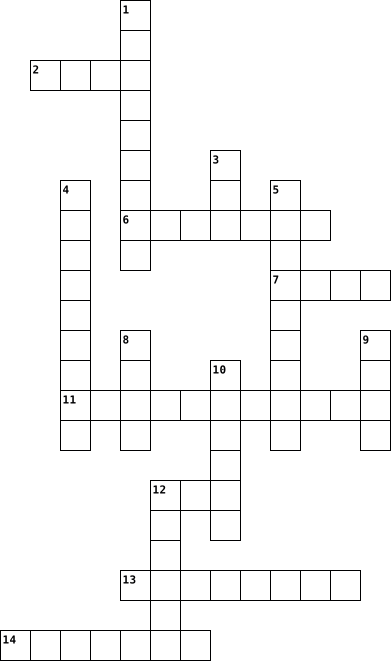
Across
- stretched out these would go around the Earth multiple times
- examples include the elbow, knee, fingers, and wrist
- the largest organ or part of the body
- these are protected by the ribs
Down
- body builders favorite part of the body
- connects to the Aorta
- the main conductor of the nervous system
- this organ produces bile
- there are over 200 of these in the body
9 Clues: connects to the Aorta • this organ produces bile • these are protected by the ribs • the largest organ or part of the body • body builders favorite part of the body • there are over 200 of these in the body • the main conductor of the nervous system • examples include the elbow, knee, fingers, and wrist • stretched out these would go around the Earth multiple times
THE HUMAN BODY PARTS 2025-02-25

Across
- You use it to see
- It is on your head
- You use it to hear
- The joint in the middle of your arm
- You have 10 of these on your feet
Down
- You use it to smell
- You use it them to chew food
- You have 10 of these on your hands
- You use eat to talk
- The joint in the middle of your arm
10 Clues: You use it to see • It is on your head • You use it to hear • You use it to smell • You use eat to talk • You use it them to chew food • You have 10 of these on your feet • You have 10 of these on your hands • The joint in the middle of your arm • The joint in the middle of your arm
Parts of the body 2024-07-16

Across
- 7
- 5
- 6
- 2
- 8
Down
- 9
- 4
- 3
- 1
9 Clues: 7 • 9 • 4 • 5 • 6 • 3 • 2 • 1 • 8
Functions of Body Parts 2025-05-08

Across
- Helps us walk, run, play, and jump.
- Used for smelling and breathing
- Where our eyes, ears, mouth and nose is?
- Used to move our head from side to side
Down
- Helps us taste, chew, swallow, and speak
- Helps us hold things, clap, write, and eat
- Helps us see and read everything around us
- Is the largest organ in the body
- Helps us hear music and sounds
9 Clues: Helps us hear music and sounds • Used for smelling and breathing • Is the largest organ in the body • Helps us walk, run, play, and jump. • Used to move our head from side to side • Helps us taste, chew, swallow, and speak • Where our eyes, ears, mouth and nose is? • Helps us hold things, clap, write, and eat • Helps us see and read everything around us
Parts of The Body 2025-09-15

Across
- The muscle that moves blood throughout our body
- The organ that gives our blood oxygen
- The organ that allows us to think and learn
- The largest organ in the body, what covers all of our bones, muscles, and organs to keep them inside our bodies
Down
- The body tissue that providess insulation to the body and organs
- The joint between our upper arm and clavicle (shoulder blade)
- Where two bones meet to create to allow movement
- What we use to move our bones
- What provides a hard structure to our body
9 Clues: What we use to move our bones • The organ that gives our blood oxygen • What provides a hard structure to our body • The organ that allows us to think and learn • The muscle that moves blood throughout our body • Where two bones meet to create to allow movement • The joint between our upper arm and clavicle (shoulder blade) • ...
PARTS OF THE BODY 2025-11-04

Across
- You use it to taste the food.
- The back part of your foot.
- The upper part of your leg.
- The back of your body.
- Connects your head to your shoulders.
Down
- Between your chest and hips.
- The lower part of your leg.
- You use it to bend your arm.
- You wear a ring on it.
9 Clues: You wear a ring on it. • The back of your body. • The lower part of your leg. • The back part of your foot. • The upper part of your leg. • Between your chest and hips. • You use it to bend your arm. • You use it to taste the food. • Connects your head to your shoulders.
Parts of the body 2020-12-07

Across
- to smile
- to count
- to watch the stars
- to brush
Down
- to eat
- to clap
- to walk
- to smell the flowers
- to listen to music
9 Clues: to eat • to clap • to walk • to smile • to count • to brush • to watch the stars • to listen to music • to smell the flowers
parts of the body 2023-06-01

Across
- you eat with this
- YOu smell with this
- the bigest finger on your hand
- this makes your body can move
Down
- lowest part of the face
- midle part of the armn
- the part of your arm that gives you the hability to rotate your full arm
- this hold your head
- put your shoes on it
9 Clues: you eat with this • YOu smell with this • this hold your head • put your shoes on it • midle part of the armn • lowest part of the face • this makes your body can move • the bigest finger on your hand • the part of your arm that gives you the hability to rotate your full arm
Parts of the Body 2021-04-29

Across
- j,;lsdkj;l hd
- jdksldi hsl;asdk
- hfkdls;l
- hdkdk
- jjuehsjkl
Down
- Get the
- hdkl;laskdj hdjdk
- hjskk
- hjll geety
9 Clues: hjskk • hdkdk • Get the • hfkdls;l • jjuehsjkl • hjll geety • j,;lsdkj;l hd • jdksldi hsl;asdk • hdkl;laskdj hdjdk
Parts of the body 2022-04-08

Across
- gtjro
- nrfei
- vnrj
- kgk
- jgtro
Down
- fueri
- ktor
- fvrjio
- vnrje
9 Clues: kgk • ktor • vnrj • gtjro • fueri • nrfei • vnrje • jgtro • fvrjio
body parts & health problems 2022-05-22

Across
- you have ..... in your mouth
- person whose job is to treat patients
- when your tooth hurts, you have a .....
- when your head hurts, you have a .....
Down
- you have ten ..... on your hands
- you need ..... to walk
- when you have a sore ....., it hurts when you drink
- the bottom part of leg
- very high temperature
9 Clues: very high temperature • you need ..... to walk • the bottom part of leg • you have ..... in your mouth • you have ten ..... on your hands • person whose job is to treat patients • when your head hurts, you have a ..... • when your tooth hurts, you have a ..... • when you have a sore ....., it hurts when you drink
Parts of the Body 2025-01-29

Across
- What I use to see.
- What I use to eat and talk.
- What I use to hear.
- I raise my _____ to answer a question.
- What I use to walk and run.
Down
- What I use to kick a soccer ball.
- What I use to smell.
- Where I put a helmet to ride my bike.
- what I use to throw a ball.
9 Clues: What I use to see. • What I use to hear. • What I use to smell. • What I use to eat and talk. • what I use to throw a ball. • What I use to walk and run. • What I use to kick a soccer ball. • Where I put a helmet to ride my bike. • I raise my _____ to answer a question.
Body Parts in Spanish 2023-10-18

Across
- CHEST
- MOUTH
- EAR
- NOSE
- SHOULDER
- ARM
Down
- CHEST
- STOMACH
- KNEE
- LEG
10 Clues: EAR • LEG • ARM • KNEE • NOSE • CHEST • CHEST • MOUTH • STOMACH • SHOULDER
Parts of a body 2024-03-20

Across
- it's behind your chest
- noga
- nos
- obraz
Down
- telo
- koleno
- ustnice
- glezenj
- lasje
9 Clues: nos • telo • noga • lasje • obraz • koleno • ustnice • glezenj • it's behind your chest
Parts of the body 2021-05-17

Across
- one of the five separate parts at the end of your foot.
- The part of your body between your hand and your arm.
- The part in the middle of your arm where it bends.
- The part of your leg that is just above your foot.
- The part of the body between your head and your shoulders.
Down
- One of the two flat parts on the ends of your legs that you stand on.
- where your arm joins your body next to your neck.
- He organ inside your body where food goes after it has been eaten and where it starts to be digested.
- The middle part of your leg where it bends.
9 Clues: The middle part of your leg where it bends. • where your arm joins your body next to your neck. • The part in the middle of your arm where it bends. • The part of your leg that is just above your foot. • The part of your body between your hand and your arm. • one of the five separate parts at the end of your foot. • ...
Parts of the Body 2022-11-10

Across
- used to grab and hold things
- the hair above our eye
- where our legs bend
- used for chewing food
- allows you to move and rotate your hand
Down
- where our food goes after we eat
- what we use to see
- used to hear music
- used to walk
9 Clues: used to walk • what we use to see • used to hear music • where our legs bend • used for chewing food • the hair above our eye • used to grab and hold things • where our food goes after we eat • allows you to move and rotate your hand
VM 141 Lab Quiz No. 1: Insect Morphology 2013-06-23

Across
- type of larvae
- number 8
- grouping of the body parts
- number 11
- number 14
- number 19
- number 20
- type of pupa
- number 13
- type of larvae
- number 5
- number 1
Down
- number 12
- number 10
- number 5
- number 18
- between two periods of moulting
- number 16
- number 15
- number 3
- number 9
- number 17
- number 4
- number 2
- number 7
25 Clues: number 5 • number 8 • number 3 • number 9 • number 4 • number 2 • number 7 • number 5 • number 1 • number 12 • number 10 • number 18 • number 16 • number 15 • number 11 • number 14 • number 19 • number 20 • number 17 • number 13 • type of pupa • type of larvae • type of larvae • grouping of the body parts • between two periods of moulting
Dal dottore 2022-08-30

Across
- eye
- shoulders
- back
- This person treats you if you are sick
- medicine
- burn
- to train
- must
- arm
- everywhere
- to go
- the flu
- stomach
Down
- throat
- This phrase is used about an ache
- tablet/pill
- the common cold
- to sprain
- head
- This phrase is used when multiple body parts are sore
- legs
- to recover
- pharmacist
23 Clues: eye • arm • back • head • burn • legs • must • to go • throat • the flu • stomach • medicine • to train • shoulders • to sprain • to recover • pharmacist • everywhere • tablet/pill • the common cold • This phrase is used about an ache • This person treats you if you are sick • This phrase is used when multiple body parts are sore
Words beginning with "bi-" 2023-04-03

Across
- (noun) refers to animals that walk on two legs.
- (noun) a type of mollusc (eg. oysters) that has its body inside two connected shells.
- (adj) used to refer to lenses divided into two distinct parts.
- (noun) sports competition that combines skiing and rifle shooting.
- (adj) having two biological parents of different races.
- (noun) the act of marrying someone while already being legally married to a person.
- (noun) an old type of aircraft with two sets of wings, one above the other.
- (adj) relating/consisting two things in which everything is either one thing or the other.
- (verb) to divide into two equal parts.
- (adj) involving two groups or countries.
- (adj) happening twice a year.
- (adj) having two parts (of a parliament, congress, etc.).
Down
- (adj) having two axes (real or imaginary straight lines going through the centre of a object that is spinning, or lines that divide a shape into two equal halves)
- (noun) two words separated by a conjunction that almost always appear in the same order.
- (adj) supported by or consisting of two political parties.
- (adj) having two cells.
- (noun) the day or year that is 200 years after a particular event, especially an important one.
- (adj) involving two people or organizations, or existing in two parts.
- (verb) to divide into two parts.
- (noun) _____ disorder. Mental condition when a person can at times be very depressed and at other times be very energetic.
20 Clues: (adj) having two cells. • (adj) happening twice a year. • (verb) to divide into two parts. • (verb) to divide into two equal parts. • (adj) involving two groups or countries. • (noun) refers to animals that walk on two legs. • (adj) having two biological parents of different races. • (adj) having two parts (of a parliament, congress, etc.). • ...
Bio Culminating 2022-01-25

Across
- air enters your lungs and oxygen from the air moves from your lungs to your body
- carry air to and from your lungs. Helps to moisturize the air you breathe and screen out foreign particles
- main artery that carries blood away from your heart to the rest of your body
- carry blood from the right side of the heart to the lungs
- Speaking and eating. Parts include lips, tongue, teeth, gums, salivary glands
- to move fresh air into your body while removing waste gases. A group of organs and tissues that work together to help you breathe
- to rid the body of carbon dioxide, the waste product of gas exchange in humans
- Cava- a large vein that carries blood to the heart from other areas of the body. It has two parts superior and inferior
- allows air to enter your body then filters debris and warms and moistens the air
Down
- two thick walled chambers that forcefully pump blood out of the heart
- a hallow tube that lets air pass from your pharynx to your trachea on the way to your lungs. It also connects your vocal cords
- sustains life by providing oxygen needed for metabolism and removing the by-product of these reactions, carbon dioxide
- carries air, food, and fluid down from the nose and mouth
- two thin walled chambers that receive blood from the veins
- as the heart muscle contracts and relaxes, this will open and close letting blood flow into the ventricles and out to the body at alternate times
- to carry air in and out of your lungs
- collect the oxygenated blood and carry it from the lungs back to the heart
- pump enough blood to deliver a continuous supply of oxygen and other nutrients to the brain and the other vital organs
18 Clues: to carry air in and out of your lungs • carries air, food, and fluid down from the nose and mouth • carry blood from the right side of the heart to the lungs • two thin walled chambers that receive blood from the veins • two thick walled chambers that forcefully pump blood out of the heart • ...
Insects 2020-09-22
Across
- a small bloodsucking insect that has no wings and a hard body.
- a small rounded beetle that is often brightly colored and spotted and feeds mostly on other insects.
- a tiny animal with eight legs that is related to the spider and attaches itself to humans and animals from which it sucks blood.
- the wormlike larva of an insect and usually a butterfly or moth.
- an insect with four wings that is related to the wasps, gathers pollen and nectar from flowers.
- a type of insect that actually looks like a stick.
- a small leaping insect noted for the chirping sound made by the males rubbing part of the wings together.
Down
- are insects that have long bodies, transparent wings, and large eyes.
- a winged insect you can see in your house.
- an insect with a flat body and long antennae that lives in most parts of the world.
- an insect that has a slender body and large colored wings covered with tiny overlapping scales and that flies mostly in the daytime.
- insect that usually flies at night and has mostly feathery antennae and stouter body, duller coloring, and smaller wings than the related butterflies.
- a usually long creeping or crawling animal that has a soft body.
- a small animal with eight legs and a body made up of two parts.
- insect that has hardened front wings. These front wings are not used for flying. Instead, they cover and protect a second pair of wings.
15 Clues: a winged insect you can see in your house. • a type of insect that actually looks like a stick. • a small bloodsucking insect that has no wings and a hard body. • a small animal with eight legs and a body made up of two parts. • a usually long creeping or crawling animal that has a soft body. • the wormlike larva of an insect and usually a butterfly or moth. • ...
Lesson 1 Vocabulary 2014-08-26

Across
- disposes of waste
- moves limbs
- transports nutrients gases and waste
- breaks down food to make it useful
- parts of a body system
- makes up organs
Down
- made up of bones
- allows humans to reproduce
- makes up tissue
- regulates behavior and maintains homeostatis
- make the body function and work properly
- fights viruses and bacteria
12 Clues: moves limbs • makes up tissue • makes up organs • made up of bones • disposes of waste • parts of a body system • allows humans to reproduce • fights viruses and bacteria • breaks down food to make it useful • transports nutrients gases and waste • make the body function and work properly • regulates behavior and maintains homeostatis
Nervous System 2021-05-13

Across
- The nervous tissue that conducts messages between the brain and the peripheral body parts.
- is the division of the nervous system containing all the nerves that lie outside of the central nervous system
- The part of the nervous system consisting of the brain and spinal cord.
- The white fatty membrane that protects the neuron.
- the region of the brain that controls involuntary activities.
- part of the neuron that receives nerve impulses and transmits them toward the cell body.
- variety of glial cells that keep peripheral nerve fibers alive.
- allow neurons to transmit electrical and chemical signals to other cells.
- An electrochemical pulse that moves along the membrane of a neuron.
- is the posterior stalk-like part of the brain that connects the cerebrum with the spinal cord
- are attached to bones by tendons, and they produce all the movements of body parts in relation to each other.
- The part of the brain containing motor and sensory centers: controls voluntary movement.
Down
- Part of the brain that monitors and adjusts body activities.
- triggers the release of neurotransmitters from the axon into the synapse.
- The chemicals responsible for extending the nerve impulse from one cell to the next one.
- Part of the brain, relay center between spinal cord and brain, reflex center.
- for example sweating as a response to an increase in temperature (involuntary actions).
- The junction between the axon and dendrite.
- The series of neurons that produces a single reaction in response to a stimulus.
- the functional unit of the nervous system. The cell receives and distributes nerve impulses.
20 Clues: The junction between the axon and dendrite. • The white fatty membrane that protects the neuron. • Part of the brain that monitors and adjusts body activities. • the region of the brain that controls involuntary activities. • variety of glial cells that keep peripheral nerve fibers alive. • An electrochemical pulse that moves along the membrane of a neuron. • ...
lesson 3 2022-10-24

Across
- part of the body, such as the brain or heart, that has a particular purpose
- that makes someone better or more likely to be more successful than others
- a person, a country, an object, an organization, etc.
- someone to die
- attractive or pleasant
- medical process of cutting into one’s body to repair or remove unhealthy parts
- make holes by using a tool or machine
- treatment in which doctors repair or remove the damaged or diseased parts of a patient’s body
- the middle part of the human body between the ribs and the hips
- put someone suddenly into a certain state because he or she gets a surpris
- try very hard over a period of time to do something, such as reaching a goal
Down
- make someone or something stronger or more powerful
- sudden event that causes death, injury, or damage
- a skin color which is whiter than usual because someone is ill or shocked
- promise that something will exist or happen
- give up something important or valuable willingly in order to gain something else that seems more important
- or correct
- many different people, things, etc.
- action that is taken to deal with a problem or achieve an aim
- the way of lasting for a long time or forever
- put a limit on the amount, size, or range of something
- enjoyable or comfortable
22 Clues: or correct • someone to die • attractive or pleasant • enjoyable or comfortable • many different people, things, etc. • make holes by using a tool or machine • promise that something will exist or happen • the way of lasting for a long time or forever • sudden event that causes death, injury, or damage • make someone or something stronger or more powerful • ...
CHAPTER 1: Introduction 2020-04-27

Across
- Age of Mammals
- allows direct inspection of hard parts or marked parts during performance
- middle of the body
- a plane that separates that anterior and posterior portion
- known as the “coal-bearing” period
- island contain its own assortment of species
- action or property of a part as it works in an organism
- electric record of muscles
- proposed mechanism of inheritance of acquired characteristics
- study of how decay and tissue disintegration affect fossilization
- chest supports the forelimbs
- molten rocks
- features that share common ancestry
- Age of Reptiles
- a plane that splits the left and right portion
- take its name from the Jura Mountains
- he felt that species were unchangeable
- to the front or belly
- Age of Fishes
Down
- repeated section
- a plane that divides the dorsal and ventral portion
- hips supports hindlimbs
- visible life
- produces new variations
- closest to the body
- a reproductive factory producing eggs and sperm
- importance of ecological analysis in the examination of a morphological system
- ancient rocks
- proposed the young age of Earth
- assortment of taxa
- special case of homology
- Darwin's Bulldog
- method of placing fossils in a relative sequence to each other
- sides of the body
- early life
- takes its name from rocks in Germany
- feature that simply look alike
- microorganism with nucleus and ability for sexual reproduction
- careful anatomical description of an animal’s structural design.
- farthest to the body
- features with similar function
- a kind of biological blueprint
42 Clues: early life • visible life • molten rocks • ancient rocks • Age of Fishes • Age of Mammals • Age of Reptiles • repeated section • Darwin's Bulldog • sides of the body • middle of the body • assortment of taxa • closest to the body • farthest to the body • to the front or belly • hips supports hindlimbs • produces new variations • special case of homology • electric record of muscles • ...
Week 1 Pt Care Vocab 2024-08-14

Across
- A specially trained doctor who diagnoses and treats cancer.
- The internal environment of the body that is compatible with life. A steady state that is created by all the body systems working together to provide a consistent and unvarying internal environment.
- Wavelike motion.
- Substances created by microorganisms, plants, or animals that are poisonous to humans.
- Protein substances, produced in the blood or tissues in response to a specific antigen, that destroy or weaken the antigen.
- A disease-causing organism.
- A broad, dome-shaped muscle used for breathing that separates the thoracic and abdominopelvic cavities.
- Contraction of the muscles, causing narrowing of the inside tube of the vessel.
- Rod-shaped structures found in the cell's nucleus; they contain genetic information.
Down
- Word parts that appear at the end of terms.
- An examination using a scope with a camera attached to the long, thin tube that can be inserted into the body.
- Process of viewing living tissue that has been removed for the purpose of diagnosis or treatment.
- Structures inside of the cell that have specific functions to maintain the cell.
- Substances that stimulate the production of an antibody when introduced into the body.
- Located between cells.
- A cell division process by which two daughter cells are formed from one parent cell.
- The study of disease.
- A physician specially trained in the nature and cause of disease.
- A rapidly dividing cancer cell that has little to no similarity to normal cells.
- Word parts that appear at the beginning of terms.
20 Clues: Wavelike motion. • The study of disease. • Located between cells. • A disease-causing organism. • Word parts that appear at the end of terms. • Word parts that appear at the beginning of terms. • A specially trained doctor who diagnoses and treats cancer. • A physician specially trained in the nature and cause of disease. • ...
Human Body 2017-10-19

Across
- the trunk of the human body
- each of the limbs on which a person or animal walks
- the part of the human body below the ribs and above the hips, often narrower than the areas above and below
- each of a series of slender curved bones, protecting inner organs
- a serious injury to a person's body
- to hurt (your ankle, knee, wrist, etc.) by turning it too far
- the joint connecting the foot with the leg
- the part of the body containing the digestive and reproductive organs
- a crack, hole, separation into parts or pieces etc., that is caused by damage, injury, or pressure
- the part of your body where your arm is connected
- temporary unconsciousness or confusion and other symptoms caused by a blow on the head
- the part of your body where your hand joins your arm
- either of the large, flat triangular bones which lie against the ribs in the upper back and provide attachments for the bone and muscles of the upper arm
- the part of a person's or animal's body connecting the head to the rest of the body
- the lower extremity of the leg below the ankle
- each of the two upper limbs
Down
- the front surface of a person's or animal's body between the neck and the stomach.
- a structure in the human or animal body at which two parts of the skeleton are fitted together
- a powerful stroke with a hand, weapon, or hard object
- wrench or twist the ligaments of (an ankle, wrist, or other joint) violently so as to cause pain and swelling but not dislocation
- a sudden short sound caused by a blow, especially on a door to attract attention or gain entry.
- an injury appearing as an area of discoloured skin on the body, caused by a blow or impact rupturing underlying blood vessels
- the rear surface of the human body from the shoulders to the hips
- the large bony frame near the base of the spine to which the hindlimbs or legs are attached in humans and many other vertebrates
- disturbance from a proper, original, or usual place
- the area of the body where your legs come together
- the end part of a person's arm beyond the wrist
- a short band of tough, flexible connective tissue which connects two bones or holds together a joint
- the bony frame formed by the ribs round the chest
- when it stops working properly because something inside prevents movement
- a flexible but inelastic cord of tissue attaching a muscle to a bone
- to make a hole or wound with a sharp-edged tool or object
32 Clues: the trunk of the human body • each of the two upper limbs • a serious injury to a person's body • the joint connecting the foot with the leg • the lower extremity of the leg below the ankle • the end part of a person's arm beyond the wrist • the part of your body where your arm is connected • the bony frame formed by the ribs round the chest • ...
Human Body 2017-10-19

Across
- a sudden short sound caused by a blow, especially on a door to attract attention or gain entry.
- the front surface of a person's or animal's body between the neck and the stomach.
- each of the limbs on which a person or animal walks
- an injury appearing as an area of discoloured skin on the body, caused by a blow or impact rupturing underlying blood vessels
- the rear surface of the human body from the shoulders to the hips
- disturbance from a proper, original, or usual place
- the bony frame formed by the ribs round the chest
- a short band of tough, flexible connective tissue which connects two bones or holds together a joint
- when it stops working properly because something inside prevents movement
- the part of the body containing the digestive and reproductive organs
- wrench or twist the ligaments of (an ankle, wrist, or other joint) violently so as to cause pain and swelling but not dislocation
- the part of your body where your hand joins your arm
- the trunk of the human body
- the part of your body where your arm is connected
- the joint connecting the foot with the leg
- to hurt (your ankle, knee, wrist, etc.) by turning it too far
Down
- to make a hole or wound with a sharp-edged tool or object
- the part of a person's or animal's body connecting the head to the rest of the body
- the end part of a person's arm beyond the wrist
- either of the large, flat triangular bones which lie against the ribs in the upper back and provide attachments for the bone and muscles of the upper arm
- temporary unconsciousness or confusion and other symptoms caused by a blow on the head
- a crack, hole, separation into parts or pieces etc., that is caused by damage, injury, or pressure
- a flexible but inelastic cord of tissue attaching a muscle to a bone
- a serious injury to a person's body
- the part of the human body below the ribs and above the hips, often narrower than the areas above and below
- a structure in the human or animal body at which two parts of the skeleton are fitted together
- the area of the body where your legs come together
- the large bony frame near the base of the spine to which the hindlimbs or legs are attached in humans and many other vertebrates
- the lower extremity of the leg below the ankle
- each of a series of slender curved bones, protecting inner organs
- a powerful stroke with a hand, weapon, or hard object
- each of the two upper limbs
32 Clues: the trunk of the human body • each of the two upper limbs • a serious injury to a person's body • the joint connecting the foot with the leg • the lower extremity of the leg below the ankle • the end part of a person's arm beyond the wrist • the bony frame formed by the ribs round the chest • the part of your body where your arm is connected • ...
Human body 2024-05-07

Across
- Carries oxygen-rich blood from your heart to your body
- In our skull
- We are made up of trillions of them
- The largest organ
- Carries electrical impulses between your brain and the rest of your body
- Allows us to breathe in oxygen and exhale out carbon dioxide
- Brings oxygen and nutrients to all the parts of the body so they can keep going
Down
- Produces enzymes that help to digest food, particularly protein
- Pumps blood and oxygen around the body
- Helps you move and lift heavy things
- Stores and concentrates biles from the liver
- Removes toxins and stores glucose maintaining blood sugar levels
- Gives shape and support to our body
- To digest food
- Filters your blood and removes waste also balancing the body's fluids
- Breaks down food with enzymes
16 Clues: In our skull • To digest food • The largest organ • Breaks down food with enzymes • Gives shape and support to our body • We are made up of trillions of them • Helps you move and lift heavy things • Pumps blood and oxygen around the body • Stores and concentrates biles from the liver • Carries oxygen-rich blood from your heart to your body • ...
Know It All Unit 4 2013-08-01

Across
- an arrangement of parts that gives form or support to something
- the case of bone that forms the skeleton of the head and face, and encloses the brain
- to surround or close in
- the joint between the foot and the leg
- the part of the body enclosed by the ribs
- a group of objects or units combined to form a whole and to move or work together
- one of the curved bones of the chest that help to support the body and protect the organs inside
- a place where two things (bones) or parts are joined
Down
- the joint between the human hand and the arm.
- to change from one substance, form, use, or unit to another
- a part of a person, plant, or animal that is made of cells and tissues and is very good at doing something
- the part of the body that curves outward below the waist on each side
- to curve or cause a change of shape
- the backbone
14 Clues: the backbone • to surround or close in • to curve or cause a change of shape • the joint between the foot and the leg • the part of the body enclosed by the ribs • the joint between the human hand and the arm. • a place where two things (bones) or parts are joined • to change from one substance, form, use, or unit to another • ...
Human Body 2017-10-19

Across
- the end part of a person's arm beyond the wrist
- the front surface of a person's or animal's body between the neck and the stomach.
- a powerful stroke with a hand, weapon, or hard object
- to make a hole or wound with a sharp-edged tool or object
- a crack, hole, separation into parts or pieces etc., that is caused by damage, injury, or pressure
- disturbance from a proper, original, or usual place
- the part of your body where your hand joins your arm
- an injury appearing as an area of discoloured skin on the body, caused by a blow or impact rupturing underlying blood vessels
- a serious injury to a person's body
- a flexible but inelastic cord of tissue attaching a muscle to a bone
- to hurt (your ankle, knee, wrist, etc.) by turning it too far
- the lower extremity of the leg below the ankle
- the bony frame formed by the ribs round the chest
- the large bony frame near the base of the spine to which the hindlimbs or legs are attached in humans and many other vertebrates
- a sudden short sound caused by a blow, especially on a door to attract attention or gain entry.
- each of the limbs on which a person or animal walks
- the part of the body containing the digestive and reproductive organs
Down
- the part of your body where your arm is connected
- the part of a person's or animal's body connecting the head to the rest of the body
- wrench or twist the ligaments of (an ankle, wrist, or other joint) violently so as to cause pain and swelling but not dislocation
- a short band of tough, flexible connective tissue which connects two bones or holds together a joint
- the area of the body where your legs come together
- either of the large, flat triangular bones which lie against the ribs in the upper back and provide attachments for the bone and muscles of the upper arm
- temporary unconsciousness or confusion and other symptoms caused by a blow on the head
- each of the two upper limbs
- when it stops working properly because something inside prevents movement
- the part of the human body below the ribs and above the hips, often narrower than the areas above and below
- the trunk of the human body
- each of a series of slender curved bones, protecting inner organs
- the joint connecting the foot with the leg
- a structure in the human or animal body at which two parts of the skeleton are fitted together
- the rear surface of the human body from the shoulders to the hips
32 Clues: each of the two upper limbs • the trunk of the human body • a serious injury to a person's body • the joint connecting the foot with the leg • the lower extremity of the leg below the ankle • the end part of a person's arm beyond the wrist • the part of your body where your arm is connected • the bony frame formed by the ribs round the chest • ...
Aquatic Science Review 2/3 2023-12-14

Across
- Lakes rich in nutrients, often due to human activities, leading to excessive plant growth, oxygen depletion, and reduced biodiversity.
- A lake with low nutrient levels, leading to low biodiversity and clear waters.
- The lowest level of a body of water, including the sediment surface and some organisms living at the bottom.
- The sunlit upper layer of a water body where photosynthesis can occur.
- Animals without a backbone that are visible to the naked eye.
- The open, well-lit surface area of a lake, away from the shore, where photosynthesis occurs and plankton thrive.
- The region of a lake or ocean near the shore where sunlight penetrates, supporting high levels of plant and animal life.
- Systems formed by the interaction of a community of organisms with their environment.
- Areas saturated by water where various plants and animals thrive.
- Pollution that comes from an unknown or diffuse source, such as runoff from various human activities.
- Measure of water clarity and the presence of sediments.
Down
- Water with a low salt concentration, typically less than 0.5 parts per thousand (ppt).
- Water that has a moderate concentration of salt, measuring between 0.5 and 30 parts per thousand (ppt).
- The deep, dark area of a lake where sunlight does not penetrate, resulting in low oxygen levels and minimal plant life.
- The emission of light by living organisms, often found in deep, dark oceanic zones.
- Pollution originating from a single identifiable source, like pipes, factories, or sewage treatment plants.
- The deeper, darker layer of a water body where sunlight cannot penetrate.
- Relating to the sea or saltwater environments with a salt concentration above 30 parts per thousand (ppt).
- A land area that drains into a stream or another body of water, acting like a funnel.
- Lakes with moderate nutrient levels, relatively clear waters, and higher biological productivity compared to oligotrophic lakes.
- All flowing natural waters; typically, "river" refers to a large stream.
- The degree of hotness or coldness of water.
- The concentration of dissolved salts in water.
23 Clues: The degree of hotness or coldness of water. • The concentration of dissolved salts in water. • Measure of water clarity and the presence of sediments. • Animals without a backbone that are visible to the naked eye. • Areas saturated by water where various plants and animals thrive. • The sunlit upper layer of a water body where photosynthesis can occur. • ...
CHAPTER 1: Introduction 2020-04-27

Across
- a kind of biological blueprint
- farthest to the body
- electric record of muscles
- proposed the young age of Earth
- special case of homology
- method of placing fossils in a relative sequence to each other
- feature that simply look alike
- Age of Mammals
- known as the “coal-bearing” period
- careful anatomical description of an animal’s structural design.
- action or property of a part as it works
- study of how decay and tissue disintegration affect fossilization
- a plane that divides the dorsal and ventral portion
- chest supports the forelimbs
- early life
- to the front or belly
- an organism
- features with similar function
- a plane that splits the left and right portion
Down
- Age of Reptiles
- molten rocks
- take its name from the Jura Mountains
- proposed mechanism of inheritance of acquired characteristics
- ancient rocks
- island contain its own assortment of species
- sides of the body
- allows direct inspection of hard parts or marked parts during performance
- Age of Fishes
- repeated section
- hips supports hindlimbs
- assortment of taxa
- a reproductive factory producing eggs and sperm
- features that share common ancestry
- he felt that species were unchangeable
- produces new variations
- importance of ecological analysis in the examination of a morphological system
- a plane that separates that anterior and posterior portion
- closest to the body
- Darwin's Bulldog
- middle of the body
- microorganism with nucleus and ability for sexual reproduction
- takes its name from rocks in Germany
- visible life
43 Clues: early life • an organism • molten rocks • visible life • ancient rocks • Age of Fishes • Age of Mammals • Age of Reptiles • repeated section • Darwin's Bulldog • sides of the body • assortment of taxa • middle of the body • closest to the body • farthest to the body • to the front or belly • hips supports hindlimbs • produces new variations • special case of homology • electric record of muscles • ...
Nutrition Quiz Review 2021-04-30

Across
- A stimulant found in coffee, tea, colas and chocolate
- The parts of fruits, vegetables, grains and beans that your body cannot digest.
- Elements needed in small quantities for forming healthy bones and teeth.
- Vitamins that dissolve in water, your body cannot store them. Vitamins B and C
- Nutrients your body uses to build, repair, and maintain cells and tissues.
- Vitamins that are stored in the body's fat until you need them. Vitamins A, D, E, and K.
- The psychological desire for food.
- an unsaturated fatty acid formed by the partial hydrogenation of vegetable oil, believed to raise blood cholesterol levels
- A nutrient that helps control the amount of fluid in your body.
Down
- The sugars and starches that occur naturally in foods (mainly in plants)
- Helps digest food, regulate body temperature, removes toxins, waste and cushions joints.
- A fatlike substance in food and a fatty substance in blood.
- Fats that remain liquid at room temperature.
- Fats that are solid at room temperature
- Substances in food that your body needs.
- The body's physical need for food.
- A unit of heat tat measures the amount of energy in food.
- Substances in food that help you body fight infection and use nutrients.
- The study of nutrients and how the body uses them.
- Nutrient that promotes healthy skin, keeps your body warm and makes up 60% of your brain.
20 Clues: The body's physical need for food. • The psychological desire for food. • Fats that are solid at room temperature • Substances in food that your body needs. • Fats that remain liquid at room temperature. • The study of nutrients and how the body uses them. • A stimulant found in coffee, tea, colas and chocolate • ...
Human Body 2014-09-16

Across
- hard organ made of connective tissue
- System breaks down food into nutrients that can be used by the body
- brings oxygen into the body ---the first part of the digestive system
- consisting of multiple cells
- tube that travels to the stomach
- blood cells type of blood cell that carries oxygen to all of the body cells
- send from one person or place to another
- System made up of bundles of long fibers
- Vessels a tube in which a body fluid circulates
- part of the respiratory system--brings oxygen into the body
- bag like organ that squeezes food to assist with digestion
Down
- colorless, sticky parts of the blood that help stop (clot) the bleeding
- System of or relating to circulation-- moving blood through out the body
- tube with rings where inhaled air from nose and mouth travel
- the hollow muscular organ located behind the sternum and between the lungs- pumps the blood through out the body--main organ of circulatory system
- having or consisting of a single cell
- long tube of muscles, adds digestive juices to break down food.
- two saclike respiratory organs in the chest of vertebrates
- system system pertaining to breathing
- System supports body and gives shape, helps you move, protects organs
- work with bones to help you move-- 3 types
- blood cells type of blood cell that protects the body from illness
22 Clues: consisting of multiple cells • tube that travels to the stomach • hard organ made of connective tissue • having or consisting of a single cell • system system pertaining to breathing • send from one person or place to another • System made up of bundles of long fibers • work with bones to help you move-- 3 types • Vessels a tube in which a body fluid circulates • ...
Unit 3 Concept 1 Notes 2021-01-19

Across
- the ability of body to maintain a stable internal environment despite changes in external conditions
- maintains homeostasis
- A nervous system (NS), where it takes in ALL sensory information
- rest and digest response
- sensory input
- connects spinal cord, brain and sensory organs throughout the body
Down
- motor output
- subdivision, voluntary
- fight or flight response
- Includes all parts of the NS outside the CNS
- subdivision, involuntary
- master control and communication of body
12 Clues: motor output • sensory input • maintains homeostasis • subdivision, voluntary • fight or flight response • rest and digest response • subdivision, involuntary • master control and communication of body • Includes all parts of the NS outside the CNS • A nervous system (NS), where it takes in ALL sensory information • ...
Main Organs of the Human Body 2024-08-14

Across
- Like two bean-shaped organs
- Help digest food
- Mucles voluntary control
- Controls the functions of the different parts of the body.
- Bahasa Indonesianya Joints
Down
- Very small hair in your nasal
- Covers,holds and protect the part of the body
- Bahasa inggrisnya menyerap
- Work for 24 hours in your body
- Supply oxygen to the blood stream
- When you are born, you have 300 of these organs.
- Hati in english
12 Clues: Hati in english • Help digest food • Mucles voluntary control • Bahasa inggrisnya menyerap • Bahasa Indonesianya Joints • Like two bean-shaped organs • Very small hair in your nasal • Work for 24 hours in your body • Supply oxygen to the blood stream • Covers,holds and protect the part of the body • When you are born, you have 300 of these organs. • ...
Respiratory and Circulatory, and Sister Systems 2022-11-15

Across
- large membranous tube reinforced by rings of cartilage
- distribute oxygen-rich blood to your body
- The activity,role, value and purpose
- rich blood after the blood gets oxygen
- the network of organs and tissues that help you breath
- where the lungs exchange oxygen and carbon dioxide
- blood vessels located throughout the body
- contracts and flattens and the chest cavity enlarges
Down
- made up of blood vessels
- Blood cells protect your body from infection
- Rate the number of times the heart beats
- the process of gas exchange called respiration
- transport blood, nutrients and oxygen
- blood cells carry oxygen from the lungs to all parts of the body
- poor blood returns from the body to the heart through the superior vena cava
- a fist-sized organ that pumps blood throughout your body
16 Clues: made up of blood vessels • The activity,role, value and purpose • transport blood, nutrients and oxygen • rich blood after the blood gets oxygen • Rate the number of times the heart beats • distribute oxygen-rich blood to your body • blood vessels located throughout the body • Blood cells protect your body from infection • the process of gas exchange called respiration • ...
Crossword 2015-04-28

Across
- Also called wind pipe
- tubes that carry blood from parts of your body to the heart
- arteries and veins are by networks of very narrow tubes calles__
- The main organ in our circulatory system
- Which gas makes up most of the air you breath in
- A group of similar__ come together to make a tissue
- breath using this part of your body
Down
- Different organs working together
- To stay alive your cells need__
- If body fights diseases
- Balloon like air sacs at the end of the bronchiole
- Germs that spread easily
- Different word for breathing
- Transports blood away from the body
14 Clues: Also called wind pipe • If body fights diseases • Germs that spread easily • Different word for breathing • To stay alive your cells need__ • Different organs working together • Transports blood away from the body • breath using this part of your body • The main organ in our circulatory system • Which gas makes up most of the air you breath in • ...
Primary 5 Systems 2020-09-13

Across
- ____________ of electricity do not allow electric current to flow through in the circuit.
- contains chlorophyll that absorbs light energy for photosynthesis.
- tiny openings that allow gases such as oxygen and carbon dioxide to enter or leave a plant
- Respiration is a process where plants or animals take in oxygen to release energy from digested food.
- photosynthesis is a process where ________ leaves use water and carbon dioxide to make food in the presence of sunlight
- the basic unit of life
- ___________ circuit allows electric current to flow through it.
Down
- system where the blood transport oxygen, digested food and water to all parts of a human body. The blood carries carbon dioxide and waste materials away from different parts of the human body
- food-carrying tubes transport food made in the _________ to the other parts of the plant (roots, stem, flowers and fruits)
- water-carrying tubes transport __________ and dissolved minerals from the roots to the other parts of the plant
- the cell membrane controls the substances that _______ or leaves the cells
11 Clues: the basic unit of life • ___________ circuit allows electric current to flow through it. • contains chlorophyll that absorbs light energy for photosynthesis. • the cell membrane controls the substances that _______ or leaves the cells • ____________ of electricity do not allow electric current to flow through in the circuit. • ...
Human Body Systems 2022-11-27

Across
- this is the strongest bone in the body
- The spinal cord is an important part of this system
- these are the muscles that will strengthen when you do sit ups
- this connects the larynx to the bronchus before reaching the lungs
- This system is responsible for making sure your heart is working
Down
- The system that helps keep the body structure and has 206 parts to it
- This system includes the mouth, stomach, and intestines
- this is something in the circulatory system that is located in the neck
- This system helps bring oxygen to your body
- Parts of this system include the quadriceps, biceps, triceps
10 Clues: this is the strongest bone in the body • This system helps bring oxygen to your body • The spinal cord is an important part of this system • This system includes the mouth, stomach, and intestines • Parts of this system include the quadriceps, biceps, triceps • these are the muscles that will strengthen when you do sit ups • ...
Water, Water everywhere 2025-03-06

Across
- energy from flowing water
- large mass of ice and snow
- water with high salt content
- long period without rainfall
- large water overflow onto land
- large body of saltwater
- flowing water from mountains to sea
Down
- drinkable water without salt
- harmful substances in water
- still body of water
- covers large parts of Earth's surface
- water stored underground
12 Clues: still body of water • large body of saltwater • water stored underground • energy from flowing water • large mass of ice and snow • harmful substances in water • drinkable water without salt • water with high salt content • long period without rainfall • large water overflow onto land • flowing water from mountains to sea • covers large parts of Earth's surface
Lenon Braedon Period 4 Game 1 2021-09-20

Across
- A Vertical plane running from front to back. This divides the body or any of its parts into right and left sides.
- Allows bones to make a sliding motion, either back and forth or side to side
- A joint in which the bones are connected by ligaments
- Formed where bones can moves about one another in many directions, but cannot rotate
- A horizontal plane dividing the body or any of its parts into upper and lower portions.
- Joints where a conical process fits into a socket and is held in place by ligaments
Down
- When one bone has a rounded end that fits into a concave cavity or another bone
- a freely moveable joint in which a bone moves around a central axis
- A vertical plane running from side to side. This divides the body or any of its parts into front and back portions.
- Allows only Extension and Flexion due to its anatomy
10 Clues: Allows only Extension and Flexion due to its anatomy • A joint in which the bones are connected by ligaments • a freely moveable joint in which a bone moves around a central axis • Allows bones to make a sliding motion, either back and forth or side to side • When one bone has a rounded end that fits into a concave cavity or another bone • ...
Muscular System: Estelle Giai 2024-03-01

Across
- You are less likely to -------- if you start an exercise problem slowly
- The organ that sends signals to parts of your body which control their functions and it's also the central control center
- Enables your bones to move
- steroids Taking these cause long-term health problems
- The part in your body where multiple(2 or more) bones meet to allow movement
- Found in digestive tract and in the walls of blood vessels
- The muscle that extends when you lift a weight
- A condition in which a tendon becomes inflamed
- A body tissue that has long cells that work when they're stimulated to create motion/movement
Down
- A connective tissue that attaches muscle to bone
- When your arm bends,the --------- muscle is the flexor
- A rigid body tissue which is also the structure for your body and has specialized bone cells
- Found in your heart and pumps blood around your body
- A muscle that bends part of your body is called a
- An injury a muscle or tendon is fractured or broken
- Muscle action that is not under your control
- Muscle action that is under your control
- The muscle that contracts when you lift a weight
- A muscle that straightens part of your body
19 Clues: Enables your bones to move • Muscle action that is under your control • A muscle that straightens part of your body • Muscle action that is not under your control • The muscle that extends when you lift a weight • A condition in which a tendon becomes inflamed • A connective tissue that attaches muscle to bone • The muscle that contracts when you lift a weight • ...
My Body 2025-04-21

Across
- is locked inside the head
- organs the body part or organ that help us to now about the world around us
- organs the parts of the body that we can see
- the food that we eat ghos
Down
- help us to breathe
- horse pumps blood and sends it to all parts of the body
- we smell with the help of our
- organs some organs are locked inside our bo
8 Clues: help us to breathe • is locked inside the head • the food that we eat ghos • we smell with the help of our • organs some organs are locked inside our bo • organs the parts of the body that we can see • horse pumps blood and sends it to all parts of the body • organs the body part or organ that help us to now about the world around us
Vocab chapter 6 CW 2023-09-21

Across
- what body systems are made up of
- body taking in oxygen and removing carbon dioxide
- widening of blood vessels
- provide movement of body parts to maintain posture and to produce heat
- chemical substances created by the body that control numerous body functions
- a natural sugar that is moved from the blood to the cells for energy
- a type of immunity that protects against a particular disease that is invading the body at a given time
Down
- building blocks of the body
- name for the condition in which all the body's systems are balanced
- where two bones meet
- physical and chemical processes that must be working at a steady level to maintain homeostasis
- narrowing of blood vessels
- a type of immunity that protects the body from disease in general
13 Clues: where two bones meet • widening of blood vessels • narrowing of blood vessels • building blocks of the body • what body systems are made up of • body taking in oxygen and removing carbon dioxide • a type of immunity that protects the body from disease in general • name for the condition in which all the body's systems are balanced • ...
Kupe 2023-01-24

Across
- a large body of water
- another word for canoe
- travel
- a story which has some exaggerated parts
Down
- a body of water between two islands
- a trait about being brave
- when people move permanently
- fate
- people you are related to
- Stole fisherman's bait
- a famous NZ shellfish
11 Clues: fate • travel • a large body of water • a famous NZ shellfish • another word for canoe • Stole fisherman's bait • a trait about being brave • people you are related to • when people move permanently • a body of water between two islands • a story which has some exaggerated parts
March 1, 2023 2023-02-28

Across
- shaker fill
- physicist Einstein
- pitching stat
- deepest Great Lake
- building block
- Noah's boat
- wiener dog
- even score
- trombone parts
- egg layer
- plains grazer
- blasting stuff
Down
- simple card game
- lynx or lion
- Patriot Ethan
- cowboy nickname
- inventor Whitney
- Houston player
- three letter rainbow color
- third president
- cattle call
- prolific inventor
- penny president
- body pump
24 Clues: body pump • egg layer • wiener dog • even score • shaker fill • cattle call • Noah's boat • lynx or lion • Patriot Ethan • pitching stat • plains grazer • Houston player • building block • trombone parts • blasting stuff • cowboy nickname • third president • penny president • simple card game • inventor Whitney • prolific inventor • physicist Einstein • deepest Great Lake • three letter rainbow color
WORD STUDY WEEK 1-2 TERM 2 2024-05-09

Across
- a place to live
- not expected
- acting
- Between 10 and 20
- looks good
- fix up
- hole in Something
- Not friend
- parts of a object
- gives ability to do something
- fights for the country
Down
- can be used
- A place that has families
- remade
- part of body
- like better
- Makes you feel guilt
- thanking others
- big number
- rhymes (sometimes)
20 Clues: remade • acting • fix up • looks good • big number • Not friend • can be used • like better • not expected • part of body • a place to live • thanking others • Between 10 and 20 • hole in Something • parts of a object • rhymes (sometimes) • Makes you feel guilt • fights for the country • A place that has families • gives ability to do something
C3.1 Integration of Body Systems 2026-03-18

Across
- Physiological processes and behaviors that follow an approximately 24-hour cycle.
- Brain structure primarily responsible for muscle control balance and movement coordination.
- The process of component parts of a system working together for a function.
- Hormone produced by the pineal gland that regulates the sleep schedule.
- The master gland that controls other endocrine glands and body functions.
- Part of the brain that connects the cerebrum and spinal cord.
- Receptors that monitor blood pressure by detecting stretch in the arteries.
- Chemical released at a synapse to stimulate another neuron or muscle fiber.
- A muscle or gland that carries out a response to a stimulus.
- Chemical messengers that carry instructions from one set of cells to another.
- Part of the brainstem that regulates stroke volume and heart rate.
- System of glands that release hormones to direct body processes.
- PROPERTIES New properties that result from interacting components but are not in individual parts.
- Neurons that connect sensory and motor neurons and form complex circuits.
Down
- Main control center that detects blood changes and stimulates the pituitary gland.
- Receptors that detect oxygen carbon dioxide and pH levels in the blood.
- The regulation and maintenance of a stable internal environment in the body.
- Neurons that convey messages from receptor cells to the central nervous system.
- The junction between two nerve cells where signals are transmitted.
- Organs of the endocrine system that manufacture and release hormones.
- Cells signaling to themselves to regulate their own activity.
- Endocrine gland near the brain center that produces melatonin.
- Coordination of different body systems to perform overall functions and sustain life.
- Neurons that send commands from the brain to muscles or glands.
- Hormone secreted by adrenal glands during stress to prepare for vigorous activity.
- An individual cell of the nervous system.
- ARC A simple fast neural pathway that processes involuntary responses.
- Branch-like parts of a neuron that receive signals from other neurons.
- Involuntary waves of muscle contraction that move food through the digestive system.
- Protective fatty coating that insulates electrical signals in nerve fibers.
30 Clues: An individual cell of the nervous system. • A muscle or gland that carries out a response to a stimulus. • Cells signaling to themselves to regulate their own activity. • Part of the brain that connects the cerebrum and spinal cord. • Endocrine gland near the brain center that produces melatonin. • Neurons that send commands from the brain to muscles or glands. • ...
Unit 7-list 1 2019-05-22

Across
- part of the body.
- scan that shows the body parts same as x-ray.
- something soft you sleep on it.
- relating to the law different.
- place where people live.
Down
- the movement from place to other with object example car.
- place to get data or enter to information.
- affect the person tasks, that he have thing less in his body.
- help people that dont have enough money .
- the new part add to your body in easy way manufacturing body part.
- you feel painful in any part of body.
11 Clues: part of the body. • place where people live. • relating to the law different. • something soft you sleep on it. • you feel painful in any part of body. • help people that dont have enough money . • place to get data or enter to information. • scan that shows the body parts same as x-ray. • the movement from place to other with object example car. • ...
Unit 7- Mohammed Abdullah 2019-05-21

Across
- scan that shows the body parts same as x-ray.
- place where people live.
- part of the body.
- Official help that given .
- the new part add to your body,artificial body part.
- the movement from place to other with object example car.
- condition that makes it difficult for someone to do the things that other people do,that he have thing less in his body.
Down
- enter to a information.
- relating to the law different.
- press you feel painful in any part of body.
- soft artificial fibers
11 Clues: part of the body. • soft artificial fibers • enter to a information. • place where people live. • Official help that given . • relating to the law different. • press you feel painful in any part of body. • scan that shows the body parts same as x-ray. • the new part add to your body,artificial body part. • the movement from place to other with object example car. • ...
-Fati Fati- -Skinny Mini- Break It Down 2022-02-19

Across
- supporting evidence for a claim
- force able to manipulate things
- claim supported by evidence
- The system that supports breathing
- transporting molecules to/from cells
- an answer to a question
- energy provided by molecules in the body
- taking food/breaking it down
Down
- releasing energy into cells is...
- sugar in your body
- new substances formed by atoms
- interacting parts forming a whole
- used to support/refute a claim...
- blocks of proteins built by molecules
- carbon and oxygen atoms make...
- a living category performing functions
- complex form of glucose
- organisms get this from air or water
18 Clues: sugar in your body • complex form of glucose • an answer to a question • claim supported by evidence • taking food/breaking it down • new substances formed by atoms • supporting evidence for a claim • force able to manipulate things • carbon and oxygen atoms make... • releasing energy into cells is... • interacting parts forming a whole • used to support/refute a claim... • ...
life and living 2025-02-20

Across
- Upper part of a stamen that contains the pollen grains
- Protects the developing whorl of a flower
- Thin layer of gases that surround the earth
- A branch of science that is concerned with classification
- Male parts of a flower
- A group of similar organisms that can mate and produce fertile offspring
- The bottom part of a pistil that contains the ovules
- The stalk that carries the anther
- linnaeus The Swedish scientist who invented the 7 level classification system
- The highest category in taxonomic classification
- Removal of waste products from the body
Down
- Living things interacting with their non living environment
- Coloured parts of a flower
- The female parts of a flower
- Thin layer of soil and rock covering the surface of Earth
- The nodule at the tip of the style that receives the pollen
- All the different living things on earth
- The tube that connects the ovule to the stigma
- Characteristics that help a living organism to survive in its environment
19 Clues: Male parts of a flower • Coloured parts of a flower • The female parts of a flower • The stalk that carries the anther • Removal of waste products from the body • All the different living things on earth • Protects the developing whorl of a flower • Thin layer of gases that surround the earth • The tube that connects the ovule to the stigma • ...
Intro to A&P Vocabulary 2024-08-13

Across
- The branch of biology that deals with the normal functions of living organisms and their parts.
- The study of the structure and organization of living organisms, including their systems, organs, and tissues.
- System that transmits nerve impulses between parts of the body, controlling responses and actions.
- The basic structural and functional units of all living organisms; the building blocks of life.
- The system involved in the intake of oxygen and the expulsion of carbon dioxide, primarily through the lungs.
- System that supports and protects the body and allows for movement.
- The system that circulates blood through the body, delivering oxygen and nutrients while removing waste products.
- Groups of similar cells that work together to perform a specific function within an organism.
Down
- The study of how disease processes affect the function of the body, integrating anatomy and physiology with the understanding of disease.
- The body's ability to maintain a stable internal environment despite changes in external conditions.
- Groups of organs that work together to perform complex functions necessary for life.
- The system that enables movement of the body and maintains posture.
- The set of life-sustaining chemical reactions that enable organisms to grow, reproduce, maintain their structures, and respond to their environments.
- Structures composed of two or more types of tissues that work together to carry out specific functions in the body.
- The system of glands that secrete hormones into the bloodstream to regulate various bodily functions.
15 Clues: The system that enables movement of the body and maintains posture. • System that supports and protects the body and allows for movement. • Groups of organs that work together to perform complex functions necessary for life. • Groups of similar cells that work together to perform a specific function within an organism. • ...
CHAPTER 1: Introduction 2020-04-27

Across
- closest to the body
- ancient rocks
- method of placing fossils in a relative sequence to each other
- hips supports hindlimbs
- sides of the body
- Age of Mammals
- to the front or belly
- a plane that divides the dorsal and ventral portion
- action or property of a part as it works in an organism
- early life
- repeated section
- Darwin's Bulldog
- allows direct inspection of hard parts or marked parts during performance
- middle of the body
- proposed the young age of Earth
- known as the “coal-bearing” period
- special case of homology
- a plane that splits the left and right portion
- produces new variations
- chest supports the forelimbs
- features that share common ancestry
Down
- takes its name from rocks in Germany
- a kind of biological blueprint
- visible life
- a plane that separates that anterior and posterior portion
- Age of Fishes
- molten rocks
- microorganism with nucleus and ability for sexual reproduction
- electric record of muscles
- study of how decay and tissue disintegration affect fossilization
- Age of Reptiles
- feature that simply look alike
- a reproductive factory producing eggs and sperm
- features with similar function
- proposed mechanism of inheritance of acquired characteristics
- take its name from the Jura Mountains
- island contain its own assortment of species
- farthest to the body
- he felt that species were unchangeable
- importance of ecological analysis in the examination of a morphological system
- careful anatomical description of an animal’s structural design.
- assortment of taxa
42 Clues: early life • visible life • molten rocks • ancient rocks • Age of Fishes • Age of Mammals • Age of Reptiles • repeated section • Darwin's Bulldog • sides of the body • middle of the body • assortment of taxa • closest to the body • to the front or belly • farthest to the body • hips supports hindlimbs • produces new variations • special case of homology • electric record of muscles • ...
2 2023-01-25

Across
- a home for children whose parents are dead
- the outer layer of an organ in the body, especially the brain
- medical operations that involve cutting open a person’s body
- the study and treatment of mental illnesses
- an official examination of a dead body by a specially trained doctor in order to discover the cause of death
- involving the process of thinking
- a person who studies or is an expert in one or more of the natural sciences
- a shy or nervous feeling that stops you from expressing your real thoughts or feelings
- a doctor who studies and treats diseases of the nerves
- the scientific study of drugs and their use in medicine
- a medical condition in which the skin and the white parts of the eyes become yellow, caused by disease of the liver or blood
- a specialist who treats a particular type of illness or problem, or who uses a particular type of treatment
Down
- the treatment of a physical problem or an illness
- medical operations performed on the nervous system, especially the brain
- marrow a soft substance that fills the hollow parts of bones
- the process of helping somebody to return to a normal, healthy life after they have been in prison or very ill
- a statement, letter, etc. that shows that something is true, correct or definite
- a condition or illness that causes problems with the way part of the body or brain works
- not reasonable or sensible; impossible to control
- in an early stage of development
20 Clues: in an early stage of development • involving the process of thinking • a home for children whose parents are dead • the study and treatment of mental illnesses • the treatment of a physical problem or an illness • not reasonable or sensible; impossible to control • a doctor who studies and treats diseases of the nerves • ...
PLTW 2.1.2-2.2.4 Final Exam Review Crossword Puzzle 2023-05-09

Across
- Blood Cells Group of cells responsible for fighting off infections and injuries
- Help organize genetic information using identification numbers ranging from 1-22.
- The bodies ability to sustain an internal stable environment.
- Removal of cells or tissues from your body using a medical instrument to study more closely under a microscope.
- A sequence of 3 mRNA bases that codes for one amino acid.
- System dermatologist use to assess skin conditions
- What disorder was Kai diagnosed with?
- The spread of cancerous cells to other tissues or parts of the body.
- Polymerase During transcription, DNA is is read by an enzyme called _____.
- Show the occurrence of a particular trait from one generation to the next.
Down
- DNA is house in your _________
- During Translation, small organelles called ____ read the mRNA sequence.
- _____ diagnosis Is your list of possible conditions based on your patients current symptoms.
- Your cancerous types of tumors.
- When all the amino acids coded for by a gene link, they fold, and this creates a functional _____.
- What do red blood cells carry to the rest of our body?
- Translation occurs where?
- Lumps/Masses of tissue caused by uncontrollable cell growth.
- ____ Illness that may last a lifetime.
- An example of a saturated fat.
- is used to sort and prioritize patients based on medical urgency.
- _____ Illness that develops suddenly and resolves in short amount of time.
- Tumors that are generally harmless, do not spread or invade other parts of your body.
- Group of cells responsible for blood clotting
- An example of an unsaturated fat.
25 Clues: Translation occurs where? • DNA is house in your _________ • An example of a saturated fat. • Your cancerous types of tumors. • An example of an unsaturated fat. • What disorder was Kai diagnosed with? • ____ Illness that may last a lifetime. • Group of cells responsible for blood clotting • System dermatologist use to assess skin conditions • ...
7th Grade Science Organs and Cell Organelles #1 2024-01-19

Across
- Organelle that uses photosynthesis to create glucose
- Breaks down wastes and old cells
- Largest bone in the human body
- Controls all parts of the cell
- Sends and Receives Messages
- Take oxygen away from the heart
- Organ that detoxifies and processes alcohol
- Strongest muscle in the human body
- Jelly-like substance that holds all organelles within the cell
- Storage center for the cell
Down
- Makes proteins
- Powerhouse of cell providing energy to cell
- Cell with NO nucleus
- Gives plant cell shape and provides support
- Reticulum Directly transports materials to the nucleus and can be rough or smooth
- Organ system that breaks down food
- largest organ on the human body
- Lets materials enter and leave cell
18 Clues: Makes proteins • Cell with NO nucleus • Sends and Receives Messages • Storage center for the cell • Largest bone in the human body • Controls all parts of the cell • Take oxygen away from the heart • largest organ on the human body • Breaks down wastes and old cells • Organ system that breaks down food • Strongest muscle in the human body • Lets materials enter and leave cell • ...
Biology #7th Grade 2023-01-30

Across
- What carries oxygen-rich blood from the heart to all parts of the body?
- What is the male reproductive part of a plant called?
- Transportation of food in plants is done by?
- What is the throbbing movement in our body called?
- Clotting in blood is formed because of the presence of?
Down
- What does a zygote develop into?
- In plants water is transported through?
- What is the female reproductive part of a plant called?
- What is the name of the red pigment present in red blood cells?
- What carries carbon dioxide-rich blood from all parts of the body back to the heart?
- What are the small thin tubes/vessels that are formed on further subdividing the arteries?
11 Clues: What does a zygote develop into? • In plants water is transported through? • Transportation of food in plants is done by? • What is the throbbing movement in our body called? • What is the male reproductive part of a plant called? • What is the female reproductive part of a plant called? • Clotting in blood is formed because of the presence of? • ...
Matabolism! 2024-03-26

Across
- building blocks of protein
- the body’s use of molecules for energy and growth
- The smallest that can live on its own
- the system in our body that takes in oxygen and takes out carbon dioxide
- A type of energy that takes in oxygen and releases carbon dioxide
- a group of atoms joined together in a very specific way.
- The system in your body that breaks down food
- chemical reaction between oxygen and glucose
- a collection of tissues that structurally form a functional unit specialized to perform a particular function.
Down
- a claim supported by facts
- carbon and oxygen atoms put together
- a molecule used to release energy
- the body system that transports molecules to and from all cells of the body
- A set of parts that make a complex whole
- A type of cell that receives and sends messages from the body to the brain and back to the body.
- What we breath
- large molecules that cause important functions inside of living things
17 Clues: What we breath • a claim supported by facts • building blocks of protein • a molecule used to release energy • carbon and oxygen atoms put together • The smallest that can live on its own • A set of parts that make a complex whole • chemical reaction between oxygen and glucose • The system in your body that breaks down food • the body’s use of molecules for energy and growth • ...
Bodies 2025-04-01

Across
- the joint where your arm bends
- the hard parts inside an animal's body
- the lower part of your face below your mouth
- the outer part of a person's or animal's body
- the back of your mouth and the inside of your neck
- the body part inside your head that you used to think feel and move
- the smooth layers on the ends of fingers and toes; a thin piece of metal with a flat top
- all things
- a small animal that has 6 legs and often has wings
Down
- the part that sticks out at the end of an animal
- a human feeling like happiness, anger, or joy
- the shortest and thickest finger on a human hand
- a piece or area of something
- the form something has such as round or square; the condition of something
- the heart, protective outer part of a body
- the part of a bird's body that is used to fly
- the part of your body between your hand and your arm
17 Clues: all things • a piece or area of something • the joint where your arm bends • the hard parts inside an animal's body • the heart, protective outer part of a body • the lower part of your face below your mouth • a human feeling like happiness, anger, or joy • the outer part of a person's or animal's body • the part of a bird's body that is used to fly • ...
human body systems 2024-01-29

Across
- your body support system
- makes you strong
- gets rid of waste products
- helps you breath
- dose not let you get a sickness again.
- makes you nervous
- your bodys outer layer
- makes you pee
Down
- helps get rid of food
- consits of the tissue
- a hormone that helps internal body parts
- the heart and blodd vessles
12 Clues: makes you pee • makes you strong • helps you breath • makes you nervous • helps get rid of food • consits of the tissue • your bodys outer layer • your body support system • gets rid of waste products • the heart and blodd vessles • dose not let you get a sickness again. • a hormone that helps internal body parts
Unit 1 & 2: Scientific Foundations and Biological Bases of Behavior 2020-03-26

Across
- Contains the nucleus and other parts of the cell needed to sustain its life
- A neurotransmitter that influences movement, learning and attention
- The level of depolarization at which an action potential is initiated
- Wirelike structure ending in the terminal buttons that extends from the cell body
- Pathological or traumatic damage to tissue
- An organelle in the cell body involved with protein synthesis
- The substructure within a cell body that contains the cell's DNA
- Structure in the limbic system important in processing memories
- A major inhibitory neurotransmitter; undersupply linked to seizures, tremors, and insomnia
- Involved in the control of our blood pressure, heart rate, and breathing
- A molecule that enhances the operation of a neurotransmitter
- Wrinkles in the brain
Down
- Located behind the frontal lobe but still on the top of the brain
- Neurotransmitters linked to pain control and to pleasure
- Structure in the limbic system responsible for directing maintenance activities
- A neurotransmitter that affects mood, hunger, sleep, and arousal
- Rootlike parts of the cell that stretch out from the cell body
- Connects the hindbrain with the midbrain and the forebrain
- An imaging technique that provides very high resolution structural images
- Process of neural firing
- A neurotransmitter that enables muscle action, learning and memory; an undersupply is linked with Alzheimer's disease
- An imaging technique that provides information regarding the localization of brain activity
- The space between the terminal buttons of one neuron and the dendrites of the next neuron.
- A molecule that blocks or inhibits the operation of a neurotransmitter
- Connects the hindbrain with the midbrain and the forebrain
25 Clues: Wrinkles in the brain • Process of neural firing • Pathological or traumatic damage to tissue • Neurotransmitters linked to pain control and to pleasure • Connects the hindbrain with the midbrain and the forebrain • Connects the hindbrain with the midbrain and the forebrain • A molecule that enhances the operation of a neurotransmitter • ...
CHAPTER 1: Introduction 2020-04-27

Across
- closest to the body
- ancient rocks
- method of placing fossils in a relative sequence to each other
- hips supports hindlimbs
- sides of the body
- Age of Mammals
- to the front or belly
- a plane that divides the dorsal and ventral portion
- action or property of a part as it works in an organism
- early life
- repeated section
- Darwin's Bulldog
- allows direct inspection of hard parts or marked parts during performance
- middle of the body
- proposed the young age of Earth
- known as the “coal-bearing” period
- special case of homology
- a plane that splits the left and right portion
- produces new variations
- chest supports the forelimbs
- features that share common ancestry
Down
- takes its name from rocks in Germany
- a kind of biological blueprint
- visible life
- a plane that separates that anterior and posterior portion
- Age of Fishes
- molten rocks
- microorganism with nucleus and ability for sexual reproduction
- electric record of muscles
- study of how decay and tissue disintegration affect fossilization
- Age of Reptiles
- feature that simply look alike
- a reproductive factory producing eggs and sperm
- features with similar function
- proposed mechanism of inheritance of acquired characteristics
- take its name from the Jura Mountains
- island contain its own assortment of species
- farthest to the body
- he felt that species were unchangeable
- importance of ecological analysis in the examination of a morphological system
- careful anatomical description of an animal’s structural design.
- assortment of taxa
42 Clues: early life • visible life • molten rocks • ancient rocks • Age of Fishes • Age of Mammals • Age of Reptiles • repeated section • Darwin's Bulldog • sides of the body • middle of the body • assortment of taxa • closest to the body • to the front or belly • farthest to the body • hips supports hindlimbs • produces new variations • special case of homology • electric record of muscles • ...
CHAPTER 1: Introduction 2020-04-27

Across
- closest to the body
- ancient rocks
- method of placing fossils in a relative sequence to each other
- hips supports hindlimbs
- sides of the body
- Age of Mammals
- to the front or belly
- a plane that divides the dorsal and ventral portion
- action or property of a part as it works in an organism
- early life
- repeated section
- Darwin's Bulldog
- allows direct inspection of hard parts or marked parts during performance
- middle of the body
- proposed the young age of Earth
- known as the “coal-bearing” period
- special case of homology
- a plane that splits the left and right portion
- produces new variations
- chest supports the forelimbs
- features that share common ancestry
Down
- takes its name from rocks in Germany
- a kind of biological blueprint
- visible life
- a plane that separates that anterior and posterior portion
- Age of Fishes
- molten rocks
- microorganism with nucleus and ability for sexual reproduction
- electric record of muscles
- study of how decay and tissue disintegration affect fossilization
- Age of Reptiles
- feature that simply look alike
- a reproductive factory producing eggs and sperm
- features with similar function
- proposed mechanism of inheritance of acquired characteristics
- take its name from the Jura Mountains
- island contain its own assortment of species
- farthest to the body
- he felt that species were unchangeable
- importance of ecological analysis in the examination of a morphological system
- careful anatomical description of an animal’s structural design.
- assortment of taxa
42 Clues: early life • visible life • molten rocks • ancient rocks • Age of Fishes • Age of Mammals • Age of Reptiles • repeated section • Darwin's Bulldog • sides of the body • middle of the body • assortment of taxa • closest to the body • to the front or belly • farthest to the body • hips supports hindlimbs • produces new variations • special case of homology • electric record of muscles • ...
Body Systems 2017-04-26

Across
- something that generates a response
- electrical signal of the nervous system
- system of heart, blood, and vessels used to transport nutrients and wastes
- system of bones and cartilage for support, protection and movement
- system that receives and sends electrical signals throughout your body
- automatic nervous system response
- 2 words- two or more organs that work together. digestive system is one of these
- another name for the circulatory system
- system that filters the blood at the kidneys, and removes wastes such as excess water, salts and urea
- system that consists of glands that regulates body functions, growth and development by sending chemical messengers through the blood stream
Down
- system made up of parts of other systems such as white blood cells, skin, and stomach acids to protect you from harmful organisms
- a disease causing organism
- system that allows body movement. voluntary for skeletal movement, involuntary for digestive organs and heart
- system composed of hair skin and nails. Protects you from invaders and prevents your insides from drying out
- a group of similar cells working together (epithelial, nervous,muscle, or connective
- the state of a stable (balanced) internal environment
- system composed of parts of other systems that rids the body of wastes
- system for bringing in and breaking down nutrients for absorption into the bloodstream
- chemical messenger of the endocrine system
- two or more tissue types working together to perform a specific function heart or brain are examples
- system that brings in oxygen and gets rid of waste carbon dioxide through the lungs
21 Clues: a disease causing organism • automatic nervous system response • something that generates a response • electrical signal of the nervous system • another name for the circulatory system • chemical messenger of the endocrine system • the state of a stable (balanced) internal environment • system of bones and cartilage for support, protection and movement • ...
U5 science 2023-11-30

Across
- to move from place to place in a circular path
- the large blood vessels that carry blood away from the heart
- a substance in red blood cells that helps carry oxygen throughout the body
- describes something made up of many cells
- the liquid that helps transport the solid parts of the blood from one part of the body to another
- a condition that happens when the walls of the arteries thicken and become less flexible
- condition that happens when deposits of plaque build up on the inside of the arteries
- forces made by one thing against another
- describing something that has had the oxygen removed
- small pieces
Down
- small blood vessels that connect arterioles to venules, which connect to veins
- pieces of cells that promote blood clotting
- the two lower chambers of the heart
- for, describes someone who is in charge of a duty or getting a job done
- something that occurs when germs enter someone's body and harm it
- describes something that is specific, unique, or special
- describes something that is related to or affects the lungs
- describes something that is related to or affects all parts of the body except the lungs
- a hard substance that builds up in blood vessels and limits the flow of blood
- mall blood vessels that connect capillaries to veins
- the small blood vessels that carry blood away from the heart
- describes things having to do with the heart and blood vessels
- the two upper chambers of the heart
23 Clues: small pieces • the two lower chambers of the heart • the two upper chambers of the heart • forces made by one thing against another • describes something made up of many cells • pieces of cells that promote blood clotting • to move from place to place in a circular path • mall blood vessels that connect capillaries to veins • ...
Structures, Functions, and Adaptations Test Unit Test 2026-03-24

Across
- The place where a plant or animal lives and finds what it needs to survive.
- Body parts inside an animal, like the heart or lungs, that help it live.
- A body part of a plant or animal that helps it survive.
- A body part or behavior that helps a plant or animal live in its environment.
- A behavior where an animal sleeps for a long time in winter to save energy.
- The job that a structure does to help a living thing stay alive.
- The part of a plant that takes in water and nutrients and holds the plant in place.
- When a plant grows toward light.
- An adaptation that helps an animal blend in so it is hard to see.
- Staying alive by getting food, water, air, and protection.
Down
- When roots grow down and stems grow up because of gravity.
- The plant part that makes food using sunlight.
- Materials in soil and food that living things need to grow and stay healthy.
- Something in the environment that causes a plant or animal to react.
- How a plant or animal reacts to a stimulus.
- A behavior where animals move to a new place to find food or warmer weather.
- The plant part that supports the plant and moves water and nutrients to the leaves.
- When water leaves a plant’s leaves as vapor to help cool the plant and move water.
- Body parts on the outside of an animal, like fur or wings, that help it survive.
- An adaptation where an animal looks like something dangerous so predators stay away.
20 Clues: When a plant grows toward light. • How a plant or animal reacts to a stimulus. • The plant part that makes food using sunlight. • A body part of a plant or animal that helps it survive. • When roots grow down and stems grow up because of gravity. • Staying alive by getting food, water, air, and protection. • ...
Elise HAHA 2021-07-21

Across
- dried clot
- chemical substances for the body to use or get rid of
- a tough band of white tissue
- top layer
- a tough band of tissue that holds bones together
Down
- oily medicine/semi solid greasy medicine
- lower layer
- organ in the body which
- muscles and bones
- a lump caused by blood
- middle layer
- long thin fibres that transmit Messages between your brain and other parts of your body
12 Clues: top layer • dried clot • lower layer • middle layer • muscles and bones • a lump caused by blood • organ in the body which • a tough band of white tissue • oily medicine/semi solid greasy medicine • a tough band of tissue that holds bones together • chemical substances for the body to use or get rid of • ...
Human Body Systems 2024-01-29

Across
- creates humans.
- helps you exercise.
- bring in oxygen and lets go of carbon dioxide.
- uses hair to protect you.
- fights off diseases.
- turns food into energy and then into waste.
Down
- protects the inside of your body with bones.
- removes waste from the body.
- brings oxygen to all of your body parts.
- cleans the blood and makes pee.
- creats hormones.
- this word is a feeling that you might have.
12 Clues: creates humans. • creats hormones. • helps you exercise. • fights off diseases. • uses hair to protect you. • removes waste from the body. • cleans the blood and makes pee. • brings oxygen to all of your body parts. • this word is a feeling that you might have. • turns food into energy and then into waste. • protects the inside of your body with bones. • ...
High Frequency Review 2022-01-09

Across
- a thought
- not very many
- a lot or many times
- body parts used for seeing
- the body part where your brain is
- a set of papers bound together
- of great value
- by the side of a path
- listen
- to think, but in the past
Down
- nearly, not quite
- you can write or draw on this
- a model to help you know what to do
- the right amount
- a thing that is not known for sure
- another word for dirt
- grabbed or stolen
- a set of people or things
18 Clues: listen • a thought • not very many • of great value • the right amount • nearly, not quite • grabbed or stolen • a lot or many times • another word for dirt • by the side of a path • to think, but in the past • a set of people or things • body parts used for seeing • you can write or draw on this • a set of papers bound together • the body part where your brain is • ...
Feeling Sick 2018-12-21

Across
- full of water
- when your body is too hot
- to get different parts of your body pressed to make pain go away
- hurt
- to rest
- to make better
Down
- has the right result
- the most important thing
- place above your eyes and below your hair
- pain in your head
- sick
- something you dry yourself with
- like when you are sleeping
13 Clues: sick • hurt • to rest • full of water • to make better • pain in your head • has the right result • the most important thing • when your body is too hot • like when you are sleeping • something you dry yourself with • place above your eyes and below your hair • to get different parts of your body pressed to make pain go away
Human body 2024-02-05

Across
- a group of organs that work together to preform a major function
- covers your body inside and out
- directs and controls the presses
Down
- is a stricter that is composed of different kinds of tissue
- provides and controls the body and connects all the parts
- can control or shorten
- small living parts of an organism
- a group of organs systems working together
- a group of cells that preforms the same function
9 Clues: can control or shorten • covers your body inside and out • directs and controls the presses • small living parts of an organism • a group of organs systems working together • a group of cells that preforms the same function • provides and controls the body and connects all the parts • is a stricter that is composed of different kinds of tissue • ...
Unit 7 2019-05-21

Across
- soft artificial fibers
- press you feel painful in any part of body.
- scan that shows the body parts same as x-ray.
- place where people live.
- part of the body.
- condition that makes it difficult for someone to do the things that other people do,that he have thing less in his body.
Down
- the new part add to your body,artificial body part.
- enter to a information.
- the movement from place to other with object example car.
- Official help that given .
- relating to the law different.
11 Clues: part of the body. • soft artificial fibers • enter to a information. • place where people live. • Official help that given . • relating to the law different. • press you feel painful in any part of body. • scan that shows the body parts same as x-ray. • the new part add to your body,artificial body part. • the movement from place to other with object example car. • ...
Unit 7-list 1 2019-05-22

Across
- affect the person tasks, that he have thing less in his body.
- the new part add to your body in easy way manufacturing body part.
- the movement from place to other with object example car.
- manufacturing part of the body.
- place to get data or enter to information.
Down
- something soft you sleep on it.
- scan that shows the body parts same as x-ray.
- you feel painful in any part of body.
- relating to the law different.
- Official help that given .
- place where people live.
11 Clues: place where people live. • Official help that given . • relating to the law different. • something soft you sleep on it. • manufacturing part of the body. • you feel painful in any part of body. • place to get data or enter to information. • scan that shows the body parts same as x-ray. • the movement from place to other with object example car. • ...
Speaking of Arthropods 2022-03-04

Across
- The longest part of an insect is the hind segment-the ___
- arthropods with eight legs and two other pairs of appendages are ____
- Shrimp, crabs, and wood lice all have hard shells; they are ___
- Ticks can spread a bacterial infection that causes joint swelling fever, and a rash; this infection is called ___
- An insect's legs and wings grow from its center section - the ___
- An insect has a hard outer covering called an ___
- an insect's compound eye is created from smaller parts called ____
- When a locust eats grass, it chews the blades with mouth parts called ___
Down
- A crab has a certain appendages that help it eat; these are called __
- If you see a many footed arthropod with a flat body and one pair of legs per body segment, it is a ___
- millipedes, crabs, and dust mites have many differences, but they all have an exoskeleton and jointed appendages. Therefore they are all ___
- Insects breathe through a tube called a ___
- An insect's head is formed from hard plates called _____
- A scientist who studies insects is called an ___
- An insect egg is transformed into an adult insect through the process of ___
- If you see a many-footed arthropod with a round body and two Paris of legs per body segment, it is a ___
- the front two segments of certain arthropods are fused together to form a __
17 Clues: Insects breathe through a tube called a ___ • A scientist who studies insects is called an ___ • An insect has a hard outer covering called an ___ • An insect's head is formed from hard plates called _____ • The longest part of an insect is the hind segment-the ___ • Shrimp, crabs, and wood lice all have hard shells; they are ___ • ...
Unit 1 Vocabulary 2025-09-17

Across
- Body parts that fish and some animals use to breathe underwater
- Animals that live part of their life in water and part on land
- The soft, light covering that helps birds fly and stay warm
- Body parts that birds and some insects use to fly
Down
- Round or oval objects from which young animals are born
- Small, flat pieces that cover the skin of fish and reptiles
- Animals that have hair or fur and feed their babies milk
- The thick hair that covers some animals’ bodies
- The outside covering of a person or animal’s body
9 Clues: The thick hair that covers some animals’ bodies • The outside covering of a person or animal’s body • Body parts that birds and some insects use to fly • Round or oval objects from which young animals are born • Animals that have hair or fur and feed their babies milk • Small, flat pieces that cover the skin of fish and reptiles • ...
human body systems 2024-01-29

Across
- your body support system
- makes you strong
- gets rid of waste products
- helps you breath
- dose not let you get a sickness again.
- makes you nervous
- your bodys outer layer
- makes you pee
Down
- helps get rid of food
- consits of the tissue
- a hormone that helps internal body parts
- the heart and blodd vessles
12 Clues: makes you pee • makes you strong • helps you breath • makes you nervous • helps get rid of food • consits of the tissue • your bodys outer layer • your body support system • gets rid of waste products • the heart and blodd vessles • dose not let you get a sickness again. • a hormone that helps internal body parts
CELLS 2017-02-01

Across
- BODY MEMBRANES COMPLEX OF VESICLES
- - ALSO CALLED CHROMOSOMES HOME
- - BEFORE MITOSIS BEGINS
- MEMBRANE - DOUBLE MEMBRANE
- - PARTS OF THE ENDOPLASMIC RETICULUM
- DNA STORES IN THIS STRUCTURE CALLED
- - THE PROTOPLASM ENCLOSED BY THE PLASMA
- - MEMBRANE BOUND ORGANELLE IN CYTOPLASM
Down
- - SECOND STAGE OF THE CELL CYCLE
- - HAVING A SURFACE FREE FROM IRREGULARITIES
- - THIRD STAGE OF THE CELL CYCLE
- - A SPHERICAL OR ELONGATED ORGANELLE
- WALL - RIGID OUTER MOST CELL LAYER FOUND IN PLANTS
- - STRUCTURE COMPOSE OF RNA
- - SMALL BODY IN THE NUCLEUS
- - UNCONTROLLED GROWTH
- - PLASTID THAT CONTAINS CHLOROPHYLL
- - MEMBRANE BOUND ORGANELLE
18 Clues: - BEFORE MITOSIS BEGINS • - UNCONTROLLED GROWTH • MEMBRANE - DOUBLE MEMBRANE • - STRUCTURE COMPOSE OF RNA • - SMALL BODY IN THE NUCLEUS • - THIRD STAGE OF THE CELL CYCLE • - MEMBRANE BOUND ORGANELLE • - SECOND STAGE OF THE CELL CYCLE • - ALSO CALLED CHROMOSOMES HOME • DNA STORES IN THIS STRUCTURE CALLED • - A SPHERICAL OR ELONGATED ORGANELLE • ...
Key term Crossword 2024-05-02

Across
- consuming water to restore hydration.
- organic substances that are required for essential processes in the body.
- period leading up to competition, state of training.
- the maximal amount that can be lifted in one repetition.
- SMART possible to complete
- training for a sustained period of time without rest.
- the ability to move and change direction quickly whilst maintaining control.
- classification of those with a BMI 30+
Down
- the use of weights/resistance to cause adaptation of the muscles.
- training using different intensities or over different terrains.
- movement towards the midline of the body.
- the ability to use different parts of the body together.
- continuous loss of body water interrupting the function of the body.
- lifestyle of irregular or no physical activity.
- movement that causes the angle at a joint to decrease.
- strong connective tissue that acts as a buffer between bones.
- a unit which measures heat or energy production in the body, expressed as kcal.
17 Clues: SMART possible to complete • consuming water to restore hydration. • classification of those with a BMI 30+ • movement towards the midline of the body. • lifestyle of irregular or no physical activity. • period leading up to competition, state of training. • training for a sustained period of time without rest. • movement that causes the angle at a joint to decrease. • ...
Body System 2021-05-31

Across
- Controls your who body
- That is in the nervous system
- To eat or disintegrate something in your body
Down
- Knows everything about your body
- Goes all around the body
- Includes bones and joints
- That includes all of the body systems
- Special parts of the body
8 Clues: Controls your who body • Goes all around the body • Includes bones and joints • Special parts of the body • That is in the nervous system • Knows everything about your body • That includes all of the body systems • To eat or disintegrate something in your body
GENETIC ENGINEERING CROSSWORD PUZZLE 2015-01-29

Across
- A medical emergency and can cause permanent neurological damage or death
- Part of a body that has a particular purpose
- A serious disease affecting older people
- The process of manipulating the genes of an organism
- Smallest unit of living matter that exist on its own
- transplantation Moving of an organ from one body to another
- Mass of cells that form the different parts of the body
Down
- Cells that make up of the functional parts of the brain and spine
- A peptide hormone produce by beta cells in the pancreas
- A particular abnormal condition that affects part or all of an organism
- The first cloned animal
- Possible effect
12 Clues: Possible effect • The first cloned animal • A serious disease affecting older people • Part of a body that has a particular purpose • The process of manipulating the genes of an organism • Smallest unit of living matter that exist on its own • A peptide hormone produce by beta cells in the pancreas • Mass of cells that form the different parts of the body • ...
Muscles-Emmie Lou 2021-02-17

Across
- muscles that you have control of
- longest muscle in your body
- Parts of the body to help you
- connects muscles to bones
- muscle above humorous
Down
- responsible for all the movement in your body
- muscles you have no control over
- muscles on your thighs
- soft muscles found in your stomach
- muscle found in heart
10 Clues: muscle found in heart • muscle above humorous • muscles on your thighs • connects muscles to bones • longest muscle in your body • Parts of the body to help you • muscles you have no control over • muscles that you have control of • soft muscles found in your stomach • responsible for all the movement in your body
Alvarez, Rae P.4 Game 3 2023-09-18

Across
- divides the body into right and left sides
- dorsal
- where the reproductive organs are
- above
- Where the spinal cord is
- divides the body into upper and lower parts
- where the brain is
Down
- contains the heart, lungs and other organs
- one main function of joints
- largest hollow space of the body
10 Clues: above • dorsal • where the brain is • Where the spinal cord is • one main function of joints • largest hollow space of the body • where the reproductive organs are • divides the body into right and left sides • contains the heart, lungs and other organs • divides the body into upper and lower parts
Tissues 2026-04-02

Across
- Helps in movement of body parts
- Tissue responsible for plant growth
- Covers and protects body surfaces
- Transports food in plants
- Tissue that provides flexibility and support
Down
- Connects and supports different tissues
- Carries messages in the body
- Tissue that gives strength with thick walls
- Tissue that stores food in plants
- Transports water in plants
10 Clues: Transports food in plants • Transports water in plants • Carries messages in the body • Helps in movement of body parts • Tissue that stores food in plants • Covers and protects body surfaces • Tissue responsible for plant growth • Connects and supports different tissues • Tissue that gives strength with thick walls • Tissue that provides flexibility and support
Principles of Exercise Unit 2025-10-23

Across
- strength + speed
- the ability to quickly change direction or body position while maintaining control
- if training stops or significantly decreases
- gradually increases the demands placed on the body
- the rate at which someone or something is able to move or operate
- the ability to use body parts together smoothly and efficiently
- raises heart rate and increases body's use of oxygen
- movement that works your body at a greater intensity than your usual level of daily activity
- ability to move a body part through a full range of motion at the joint
Down
- the body must be quickly challenged beyond its usual level of activity
- the ability to maintain stability
- the state of being physically healthy and capable of performing various activities
- what works for one person may not work for another, based on age and fitness levels
- intense, short bursts of activity
- when the body repairs and strengthens
- training must mimic the desired outcome.
16 Clues: strength + speed • the ability to maintain stability • intense, short bursts of activity • when the body repairs and strengthens • training must mimic the desired outcome. • if training stops or significantly decreases • gradually increases the demands placed on the body • raises heart rate and increases body's use of oxygen • ...
Evolution terms 2017-04-24

Across
- body part that does not seem to play a major role in an organism's life functions but was more important in the organism's ancestors.
- remains of evidence of an organisms that lived in the past
- body parts of different organisms that have a similar structure but may have different functions.
- process by which organisms best suited for the environment survive and reproduce.
- prokaryotic that make food by photosynthesis
Down
- the total genetic information of all members of the population.
- body parts that have a similar function but not similar structure.
- gasses that surround the earth
- process in which organisms uses oxygen to get energy from carbohydrates and other food molecules.
- the evolution of species form an existing species.
- early age of the development of an organism.
- an organism's ability to withstand the effects of a harmful agent.
12 Clues: gasses that surround the earth • early age of the development of an organism. • prokaryotic that make food by photosynthesis • the evolution of species form an existing species. • remains of evidence of an organisms that lived in the past • the total genetic information of all members of the population. • ...
Vitamins and Minerals 2015-11-11

Across
- vitamin that is necessary for muscles to work properly
- this mineral is found in whole grains,nuts,and seeds
- Vitamin that turns carbs into energy and produce red blood cells
- helps the body keep a balance of water in the blood and body tissues
- helps red blood cells carry oxygen to all parts of the body
- vitamin that forms collagen
- vitamin that helps blood clot
Down
- mineral that keeps your immune system strong and heal wounds
- mineral found in dairy, meats, and fish
- helps the body make red blood cells
- vitamin made with sunlight
- vitamin that helps prevents eye problems and night blindness
- vitamin found in vegetable oils, nuts, and green leafy vegetables
- develops strong bones and teeth
- Helps body turn food into energy
15 Clues: vitamin made with sunlight • vitamin that forms collagen • vitamin that helps blood clot • develops strong bones and teeth • Helps body turn food into energy • helps the body make red blood cells • mineral found in dairy, meats, and fish • this mineral is found in whole grains,nuts,and seeds • vitamin that is necessary for muscles to work properly • ...
Drama Crossword - Julienne 2023-03-08

Across
- language non verbal communication including facial expressions and gestures
- a line or movement of action that signals an actor to come in
- bending the body to the front side or rear
- to walk or move across the stage
- turning or pivoting of the body
- the art of acting without words
- giving the actor freedom to move around the stage
Down
- referring to all physical traffic or movement of the actors on the stage
- middle of the stage
- to move onto the stage
- the part of the stage towards the audience
- separates parts of the body
- the movement of any part of the body to help express an idea or emotion
- to leave the stage
- the area onstage furthest downstage
15 Clues: to leave the stage • middle of the stage • to move onto the stage • separates parts of the body • turning or pivoting of the body • the art of acting without words • to walk or move across the stage • the area onstage furthest downstage • the part of the stage towards the audience • bending the body to the front side or rear • giving the actor freedom to move around the stage • ...
Science Vocab 2025-02-21

Across
- an organism that lives in or on another organism, harming it
- organs that exchange carbon dioxide for oxygen in water
- does not have a backbone
- cannot be cut into equal halves
- shedding and replacing of an exoskeleton, skin, or feathers
- connects fetus to mother for nutrient and gas exchange
- animal that generates its body heat from the inside
- body parts are arranged in a circle around a center point
Down
- skeleton is on the inside of the body
- skeleton is on the outside of the body
- has a backbone
- can be split into left and right sides in only one way
- protective membrane that surrounds the embryo
- changes in form as animal becomes an adult
- animal that heats its body from its environment
15 Clues: has a backbone • does not have a backbone • cannot be cut into equal halves • skeleton is on the inside of the body • skeleton is on the outside of the body • changes in form as animal becomes an adult • protective membrane that surrounds the embryo • animal that heats its body from its environment • animal that generates its body heat from the inside • ...
Chapter 9: Introduction to Animals 2026-02-24

Across
- protective membrane that surrounds the embryo
- an organism that lives in or on another organism, harming it
- has a backbone
- cannot be cut into equal halves
- shedding and replacing of an exoskeleton, skin, or feathers
- skeleton is on the outside of the body
Down
- symmetry: body parts are arranged in a circle around a center point
- does not have a backbone
- skeleton is on the inside of the body
- symmetry: can be split into left and right sides in only one way
- changes in form as animal becomes an adult
- animal that heats its body from its environment
- animal that generates its body heat from the inside
- organs that exchange carbon dioxide for oxygen in water
- connects fetus to mother for nutrient and gas exchange
15 Clues: has a backbone • does not have a backbone • cannot be cut into equal halves • skeleton is on the inside of the body • skeleton is on the outside of the body • changes in form as animal becomes an adult • protective membrane that surrounds the embryo • animal that heats its body from its environment • animal that generates its body heat from the inside • ...
Module 3 Lesson 2: Biological Evidence 2023-10-23

Across
- body parts of organisms that are similar in structure and position but different in function
- body parts that have lost their original function through evolution
- body parts that perform a similar function but differ in structure
Down
- study of the development of embryos from fertilization to birth
- a feature shared by vertebrates in the early stages of development
- study of similarities and differences among structures of different species
- study of gene structure and function
7 Clues: study of gene structure and function • study of the development of embryos from fertilization to birth • a feature shared by vertebrates in the early stages of development • body parts that perform a similar function but differ in structure • body parts that have lost their original function through evolution • ...
digestion 2022-11-02

Across
- found in a wide array of both healthy and unhealthy foods
- where our food goes in
- this organ has 3 parts
- molecules that contain hydrocarbons
- basic building blocks of all living things
- the energy an object has because of its motion
- found in foods
Down
- has 4 parts
- muscular tube in ur throat
- energy stored in the bonds of atoms and molecules
- body uses it for energy
- good
12 Clues: good • has 4 parts • found in foods • where our food goes in • this organ has 3 parts • body uses it for energy • muscular tube in ur throat • molecules that contain hydrocarbons • basic building blocks of all living things • the energy an object has because of its motion • energy stored in the bonds of atoms and molecules • ...
Medical Terminology Ch.1 2020-08-14

Across
- frequent flow of loose bowels or watery stools
- localized response to injury or destruction of tissue
- lower than normal blood pressure
- abnormal passage usually to the surface of the body
- stomachache
- mature red blood cell
- loss of large amount of blood in a short time
- rapid onset severe course short duration
- between not within the parts of a tissue
- a word formed from major parts of compound word
- pertaining to interior lining of artery walls
- inflammation of the stomach
- identification of a disease
- surgical creation of excretory opening
- groove or cracklike sore of the skin
- any disease of the stomach
Down
- surgical puncture to remove fluid in abdomen
- surgical removal of appendix
- the process of producing xray to study injected blood vessels w medium to make them visable
- within the muscle
- inflammation of stomach and small intestine
- abnormal hardening of artery walls
- higher than normal blood pressure
- abnormal enlargement of liver
- swelling by abnormal accumulation of fluid in cells tissues or cavities in the body
- pain in the joints
- blue discoloration of skin from lack of oxygen in blood
- invasion of body by pathogenic organism
- specialist in diagnosing and treating skin disorders
- disease structure operation or procedure named for the person who discovered or described it first
30 Clues: stomachache • within the muscle • pain in the joints • mature red blood cell • any disease of the stomach • inflammation of the stomach • identification of a disease • surgical removal of appendix • abnormal enlargement of liver • lower than normal blood pressure • higher than normal blood pressure • abnormal hardening of artery walls • groove or cracklike sore of the skin • ...
Topic 8 and 9 Vocabulary 2021-11-08

Across
- when two or more organisms need the same limited resources to survive
- an organism that breaks down the bodies of dead organisms
- the chemical processes animals use to break down or build molecules
- an organism that needs to eat other organisms to survive
- a series of changes in a community of an ecosystem
- living parts of an ecosystem
- an animal that uses energy from their body to keep their body at a steady temperature
- an animal that eats only other animals, or products of other animals
- all organisms living in an ecosystem
- an organism that is too small to see
Down
- an animal that eats both plants and other animals
- the green substance in plant cells that absorbs light energy and helps the plant perform photosynthesis
- a model of the transfer of energy within a set of interconnected food chains
- an animal that eats other plants
- the living things and nonliving things in an area
- the process that plants use to make glucose using carbon dioxide, light, and water and producing oxygen
- a model that shows how matter and energy flow from one organism to another
- nonliving parts of an ecosystem
- an animal that depends on its environment to warm its body
- an organism that can make its own nutrients, usually with energy from the sun
- a series of events or processes that repeats over and over
21 Clues: living parts of an ecosystem • nonliving parts of an ecosystem • an animal that eats other plants • all organisms living in an ecosystem • an organism that is too small to see • an animal that eats both plants and other animals • the living things and nonliving things in an area • a series of changes in a community of an ecosystem • ...
flynn 2017-07-04

Across
- These men are servants of the Most God, who are telling you the way to be saved.
- For I am convinced that neither death nor life, neither angels nor…,
- Just as a body, though one, has many parts, but all its many parts form one body, so it is with….
- The crowd joined asked for what?
- neither the… nor the future
- A voice said to Saul ‘Saul, Saul why do you…me
- Jesus said to Saul ‘now go into the…
- Saul asked for the letters to the synagogues in
- What were Saul and Silas’ feet strapped in
- Saulid Saul fall off of?
Down
- Who caused Saul to fall off his horse
- “Because I am not a…, I do not belong to the body,”
- Meanwhile, Saul was still breathing out threats against the Lord’s disciples Acts:1-19
- How many days was Saul blind for?
- The men travelling with Saul stood there …Romans 8:31-39
- What dd in on the … against Saul and Silas.
- as it is written “For your sake we face death all day long; we are considered as… to be slaughtered.”
- The magistrates ordered them to be stripped and beaten with
- No, in all these things we are more than conquerors through him who… us.
- Who was Saul in the prison with 5 across ACTS 16:16-40
20 Clues: Saulid Saul fall off of? • neither the… nor the future • The crowd joined asked for what? • How many days was Saul blind for? • Jesus said to Saul ‘now go into the… • Who caused Saul to fall off his horse • What were Saul and Silas’ feet strapped in • What dd in on the … against Saul and Silas. • A voice said to Saul ‘Saul, Saul why do you…me • ...
The Circulatory System 2016-05-25

Across
- Picks up the oxygen and delivers it to cells in the body
- Damage to part of the heart muscle due to a lack of oxygen-rich blood supply
- The largest artery in the body
- A vessel that carries oxygen-rich blood to the body
- The alternating expansion and relaxation of the artery walls
- Pressure of the blood in the arteries
- The two lower chambers of the heart
- Main organ of the circulatory system
Down
- cells that fight disease
- Exchange materials between the blood and body cells
- Liquid part of the blood
- High blood pressure
- The two upper chambers of the heart
- Blood vessels that carry blood from various parts of the body to the heart
- Cell fragments that help form blood clots
15 Clues: High blood pressure • cells that fight disease • Liquid part of the blood • The largest artery in the body • The two upper chambers of the heart • The two lower chambers of the heart • Main organ of the circulatory system • Pressure of the blood in the arteries • Cell fragments that help form blood clots • Exchange materials between the blood and body cells • ...
Immune System 2020-03-15

Across
- white blood cells that have access to all parts of the body except brain and spinal cord
- engulf unwanted pathogens and can kill up to 100
- organisms that cause diseases
- provokes immune response against antigen
- produced when encounter an antigen
- chemicals released that makes body respond to it.
- develops antibodies to respond against an antigen
- non specific immunity that is body's first natural defense
- cells that contact with the outside environment
Down
- immunity with presence of B lymphocytes and T lymphocytes
- keep record of antigen for future reference
- patrol the body and after killing infectious cells, they die
- response that targets and kills cells inside our body that are infected
- invaders of the body, molecules found on pathogens
- chemicals that fit on antigens of pathogens
15 Clues: organisms that cause diseases • produced when encounter an antigen • provokes immune response against antigen • keep record of antigen for future reference • chemicals that fit on antigens of pathogens • cells that contact with the outside environment • engulf unwanted pathogens and can kill up to 100 • chemicals released that makes body respond to it. • ...
sci choice board 2025-02-16

Across
- does not have a backbone
- changes in form as animal becomes an adult
- symmetry: can be split into left and right sides in only one way
- protective membrane that surrounds the embryo
- an organism that lives in or on another organism, harming it
- symmetry: body parts are arranged in a circle around a center point
- connects fetus to mother for nutrient and gas exchange
- animal that heats its body from its environment
Down
- animal that generates its body heat from the inside
- skeleton is on the outside of the body
- shedding and replacing of an exoskeleton, skin, or feathers
- organs that exchange carbon dioxide for oxygen in water
- skeleton is on the inside of the body
- has a backbone
- cannot be cut into equal halves
15 Clues: has a backbone • does not have a backbone • cannot be cut into equal halves • skeleton is on the inside of the body • skeleton is on the outside of the body • changes in form as animal becomes an adult • protective membrane that surrounds the embryo • animal that heats its body from its environment • animal that generates its body heat from the inside • ...