
brawl stars Crossword Puzzles
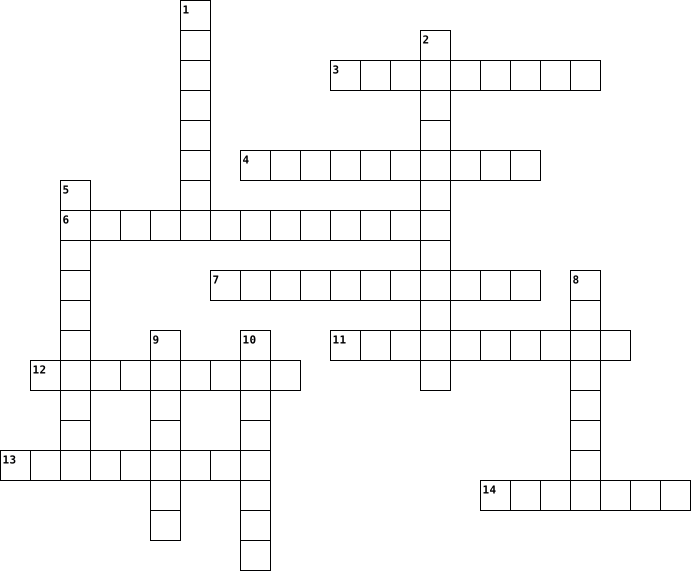
R&J Crossword Vocab Assignment 2022-05-02

Across
- a noisy quarrel or fight
- having unsuitable feminine qualities
- punishment in return for an injury or a wrong; unusual force or violence
- tastelessly gaudy; showy
- showing mercy or compassion
Down
- to reestablish friendship, to resolve a dispute
- The act of giving in to another
- fluent or persuasive speaking or writing
- a difficult, unpleasant, or embarrassing situation
- a disease that spreads quickly and kills many people
- removed forcibly from one's home country or place of residence
- brave and noble
12 Clues: brave and noble • a noisy quarrel or fight • tastelessly gaudy; showy • showing mercy or compassion • The act of giving in to another • having unsuitable feminine qualities • fluent or persuasive speaking or writing • to reestablish friendship, to resolve a dispute • a difficult, unpleasant, or embarrassing situation • a disease that spreads quickly and kills many people • ...
ALVC 22 English III 2023-01-13

Across
- (v/adj) to smuggle; to make, sell, or transport for sale illegally
- (adj) sorrowful; melancholy
- (n) an adventurous unconventional act
- (adj) troublesome or oppressive; burdensome
- (n) a fight or scuffle; a brawl
- (v) to search thoroughly; pillage
Down
- (adj) bold, shameless; impudent; also like brass
- (n) a complete or humiliating failure
- (n) a dilemma; any problem or puzzle
- (n) a conference, especially between enemies
- (n) waste parts especially of a butchered animal; rubbish
- (adj) secret; hidden; concealed
12 Clues: (adj) sorrowful; melancholy • (n) a fight or scuffle; a brawl • (adj) secret; hidden; concealed • (v) to search thoroughly; pillage • (n) a dilemma; any problem or puzzle • (n) a complete or humiliating failure • (n) an adventurous unconventional act • (adj) troublesome or oppressive; burdensome • (n) a conference, especially between enemies • ...
Galaxies 2018-02-26

Across
- unseen material that makes up most of the universe
- spiral galaxy with tight arms
- small spherical dense galaxies
- very spherical elliptical galaxy
- pinwheel galaxies with arms
- 50000-1 million stars in a group in a galaxy
- candle method to calculate distance to stars and galaxies
Down
- the galaxy we live in
- the flattened portion of a spiral galaxy
- when 1 galaxy engulfs another
- very elliptical galaxy
- very dense star left after a supernova
- group of less than 1000 galaxies
- type of galaxy they think milky way is
- group of 1000 of more galaxies
- the round center portion of a spiral galaxy
- 3.26 light years
- the outer stars of a galaxy not in the disk
18 Clues: 3.26 light years • the galaxy we live in • very elliptical galaxy • pinwheel galaxies with arms • when 1 galaxy engulfs another • spiral galaxy with tight arms • group of 1000 of more galaxies • small spherical dense galaxies • group of less than 1000 galaxies • very spherical elliptical galaxy • very dense star left after a supernova • type of galaxy they think milky way is • ...
Zak McVey 2022-05-17

Across
- some stars end as a __________
- we are in the ________ galaxy
- is a well known constellation
- a stars color indicates its ___________
- the ____ nebula is a remnant of a supernova
- are groups of stars that have regularly recognized positions
Down
- a star begins as a ______
- the sun is an _______ star
- massive stars become super ______
- the intrinsic brightness, independent of how it appears to us
- the great bear
11 Clues: the great bear • a star begins as a ______ • the sun is an _______ star • we are in the ________ galaxy • is a well known constellation • some stars end as a __________ • massive stars become super ______ • a stars color indicates its ___________ • the ____ nebula is a remnant of a supernova • are groups of stars that have regularly recognized positions • ...
Zak McVey 2022-05-17

Across
- some stars end as a __________
- we are in the ________ galaxy
- is a well known constellation
- a stars color indicates its ___________
- the ____ nebula is a remnant of a supernova
- are groups of stars that have regularly recognized positions
Down
- a star begins as a ______
- the sun is an _______ star
- massive stars become super ______
- the intrinsic brightness, independent of how it appears to us
- the great bear
11 Clues: the great bear • a star begins as a ______ • the sun is an _______ star • we are in the ________ galaxy • is a well known constellation • some stars end as a __________ • massive stars become super ______ • a stars color indicates its ___________ • the ____ nebula is a remnant of a supernova • are groups of stars that have regularly recognized positions • ...
Vallesmarineris 2013-09-10

Across
- Theres a joke about it
- Keeps you on earth
- Largest canyon in the solar system
- Space crafts that orbit the earth
- Energy in the core of the sun
- What are the life forms supposable on mars
- The only dwarf planet in our solar system
- Whats the red planet in the sky
- What are shooting stars
Down
- It was a mega storm on it
- Its endless
- Theres one in the centre of the solar system
- Our galaxy is the ...
- Who was the first man on the moon
- The movie paul is about one
- Fastest man made space craft
- How many rings does saturn have
- How many years for the stars light to get to you
- Bright things in the sky at night
19 Clues: Its endless • Keeps you on earth • Our galaxy is the ... • Theres a joke about it • What are shooting stars • It was a mega storm on it • The movie paul is about one • Fastest man made space craft • Energy in the core of the sun • How many rings does saturn have • Whats the red planet in the sky • Who was the first man on the moon • Space crafts that orbit the earth • ...
Gilmore Girls 2025-08-18

Across
- Independence Inn’s night manager
- Luke’s tough-guy nickname from his school days
- Stolen vessel that led to community service
- Lorelai’s floral avalanche—1,000 of them
- Headmaster of Chilton, with a name fit for a Southern city
- Lorelai’s canine companion with a flair for the dramatic
- Game show Michel was on
- Crafty container Logan nearly pilfers from the Gilmore home
- Holiday celebrated four times in one whirlwind day
- Stars Hollow’s no-nonsense mechanic
- Surname of Stars Hollow’s most persnickety merchant and town selectman
Down
- Rory's birth month
- Max Medina's classroom subject
- Luke’s right-hand man in the kitchen
- Richard’s comfort food request after losing Gran
- Jess’s Season 4 confession—three little words
- Stars Hollow’s punny cinema-slash-bookstore
- April's field trip destination
- Jess’s elusive dad
19 Clues: Rory's birth month • Jess’s elusive dad • Game show Michel was on • Max Medina's classroom subject • April's field trip destination • Independence Inn’s night manager • Stars Hollow’s no-nonsense mechanic • Luke’s right-hand man in the kitchen • Lorelai’s floral avalanche—1,000 of them • Stolen vessel that led to community service • Stars Hollow’s punny cinema-slash-bookstore • ...
galaxy puzzle 2025-03-27

Across
- the observation in physical cosmology that galaxies are moving away from Earth at speeds proportional to their distance.
- a tightly packed group of stars within a larger star formation
- star having a regular cycle of brightness with a frequency related to its luminosity
- he ratio of the speed of recession of a galaxy (due to the expansion of the universe) to its distance from the observer.
- a galaxy that emits up to thousands of times more energy than a normal galaxy.
- a huge collection of gas, dust, and billions of stars and their solar systems, held together by gravity.
Down
- a galaxy that does not have a distinct regular shape, unlike a spiral or an elliptical galaxy
- structure that consists of anywhere from hundreds to thousands of galaxies that are bound together by gravity
- a nearly spherical volume of thinly scattered stars, globular clusters of stars, and tenuous gas observed surrounding spiral galaxies
- are twisted collections of stars and gas that often have beautiful shapes.
- a smooth ellipsoidal or spherical appearance, and they have far less structure than spiral galaxies do
- a phenomenon where the wavelength of light is lengthened as it travels through expanding space.
- galaxy with a black whole in the center
- a disk component of the Milky Way that contains stars, gas, and dust in circular coplanar motion around the galactic center.
- a galaxy group that includes the Milky Way.
15 Clues: galaxy with a black whole in the center • a galaxy group that includes the Milky Way. • a tightly packed group of stars within a larger star formation • are twisted collections of stars and gas that often have beautiful shapes. • a galaxy that emits up to thousands of times more energy than a normal galaxy. • ...
The Stars 2024-02-28

Across
- The stellar core left behind after a dying star has exhausted its nuclear.
- The sequence of thermonuclear reactions that provides most of its energy radiation by hotter stars.
- Lies in the last stage of stellar evolution.
- The density of matter is so high that electrons cannot be packed closer together.
- The maximum mass which a star near the end of its life cycle can become a white dwarf.
- A rotating neutron stars observed to have pulses of radiation at very regular intervals.
Down
- A way of representing data using 0s and 1s.
- A region of cosmic gas and dust formed from the cast of outer layers of a dying star.
- When the density of matter is so high that neutrons cannot be packed.
- The neutron stars with ridiculously, powerful magnetic fields.
- Conserved when there is zero net torque applied a system, where the system is the object.
- The colossal explosion of a star.
- A star showing a sudden large increase in brightness and then slowly returning to its original state.
- Stars with mass less than about 2 times the mass of the sun.
14 Clues: The colossal explosion of a star. • A way of representing data using 0s and 1s. • Lies in the last stage of stellar evolution. • Stars with mass less than about 2 times the mass of the sun. • The neutron stars with ridiculously, powerful magnetic fields. • When the density of matter is so high that neutrons cannot be packed. • ...
Circumtriple Orbiting Planet in Orion the Hunter's Head 2021-11-29

Across
- The measurement used for larger distances in space, particularly for the distances between Earth and other star systems and galaxies
- When gases and dusts come together to form planets or stars
- The unit of measurement used for smaller distances in space
- The location in the disks where the planet is believed to be
- A famous constellation of a hunter where these stars live
- A star system where multiple stars orbit eachother
Down
- "Winds" created by stars that blow away excess gases and dust and send out radiation
- Region of dense gases and dust leftover from the birth of a star
- A planet orbiting three stars
- Star systems that contain more than three stars
- The name of the star system
11 Clues: The name of the star system • A planet orbiting three stars • Star systems that contain more than three stars • A star system where multiple stars orbit eachother • A famous constellation of a hunter where these stars live • When gases and dusts come together to form planets or stars • The unit of measurement used for smaller distances in space • ...
LP #1 2024-08-08

Across
- to make into a whole
- Mr. Beast without the YouTube views. A person who gives money or other help
- "omg I'm a Gemini" the study of the influence of the stars on humans.
- Being able to resist wear, breakage, deterioration
- the scientific study of the stars and space
- one who travels amongst the stars
- well-meaning and kindly
- Study of life
- A person who gains advantage from something
- A book writen about someone else
Down
- A book written about your own life
- able to withstand wear, pressure, or damage
- Where goods are made or assembled
- A Tesla
- to make products
- The study of microorganisms
- What you could get from a famous person
- suffer something painful or difficult patiently
18 Clues: A Tesla • Study of life • to make products • to make into a whole • well-meaning and kindly • The study of microorganisms • A book writen about someone else • Where goods are made or assembled • one who travels amongst the stars • A book written about your own life • What you could get from a famous person • able to withstand wear, pressure, or damage • ...
puci pover 2025-04-02

Across
- a világ legjobb játékosa brawl stars-ban
Down
- ki a másik legjobbb
2 Clues: ki a másik legjobbb • a világ legjobb játékosa brawl stars-ban
Week One vocabulary 2024-04-24

Across
- In low spirits due to loss of hope or courage.
- Sudden and unexpected.
- A rough, noisy fight.
- Not identified by name.
- A community-wide occurrence of an illness.
Down
- An agreement between parties where both/all make concessions.
- A disaster.
- A symbolic image or item used as an emblem of a nation, family, or organization.
- Filled with lively energy and excitement.
- Cause to become confused.
10 Clues: A disaster. • A rough, noisy fight. • Sudden and unexpected. • Not identified by name. • Cause to become confused. • Filled with lively energy and excitement. • A community-wide occurrence of an illness. • In low spirits due to loss of hope or courage. • An agreement between parties where both/all make concessions. • ...
SAT/LIT Vocab SET #1 2024-09-19

Across
- To free someone from blame or fault
- Present or appearing everywhere at once
- Incapable of producing any useful result; pointless
- A noisy disturbance or brawl
- Showing a lack of thought or intelligence; mindless
Down
- Reserved, modest, and shy
- To shock or excite someone into taking action
- Wicked or criminal in nature
- To express sorrow or discontent over something
- Enduring pain or hardship without showing emotion
10 Clues: Reserved, modest, and shy • Wicked or criminal in nature • A noisy disturbance or brawl • To free someone from blame or fault • Present or appearing everywhere at once • To shock or excite someone into taking action • To express sorrow or discontent over something • Enduring pain or hardship without showing emotion • Incapable of producing any useful result; pointless • ...
1st week 2021-09-01

Across
- a rough or noisy fight
- a widespread disease at a certain place and time
- sudden or unexpected
- low spirits from loss of hope
- an agreement or settlement
- an event causing sudden damage or suffering
Down
- cause someone to become perplexed and confused
- a symbolic object as a distinctive badge of a nation
- filled with or characterized by a lively energy or excitement
- not identified by name
10 Clues: sudden or unexpected • a rough or noisy fight • not identified by name • an agreement or settlement • low spirits from loss of hope • an event causing sudden damage or suffering • cause someone to become perplexed and confused • a widespread disease at a certain place and time • a symbolic object as a distinctive badge of a nation • ...
Astronomy Crossword 2023-01-25

Across
- Earth’s neighbor that is similar in size but much much hotter
- spheres of hot glowing gas and dust
- in between mars and jupiter lies this region of space with over 100,000 asteroids.
- a term for low mass stars
- The H in HR diagram stands for ___________________ .
- an explosion when a high mass star dies and blasts away the outer material
- this star system is closest to us.
- An area of intense gravitational attraction that even light cannot escape
Down
- the name of the galaxy that is closest to us
- A theory that explains the origin of the universe
- The extremely hot center of a star where nuclear fusion occurs
- small atoms combine to larger atoms and release incredible amounts of energy in a process called nuclear _____________ .
- The HR diagram graphs stars based on their __________ and luminosity.
- The most abundant element in the universe
- Red-shifting is one piece of evidence that shows our universe is …
- stellar nurseries
- The force responsible for the creation of stars. Also a force that keeps us on Earth.
- The name of our galaxy
18 Clues: stellar nurseries • The name of our galaxy • a term for low mass stars • this star system is closest to us. • spheres of hot glowing gas and dust • The most abundant element in the universe • the name of the galaxy that is closest to us • A theory that explains the origin of the universe • The H in HR diagram stands for ___________________ . • ...
Astronomy 2 Crossword Puzzle 2017-02-14

Across
- the brightnesss of a star when viewed from Earth
- arrangement of electromagnetic radiation- including radio waves
- how fast light travels
- large group of stars
Down
- the change in the wavelength of light due to an object moving towards an observer
- a contracting cloud of gas and dust; earliest stage of a stars life
- the brightness that a star would have at a distance of 32.6 light years from Earth
- a diagonal area on an H-R diagram that includes more than 90 percent of all stars
- the number of complete wavelengths that pass a point in a given time
- small stars located on the lower left on the H-R diagram
- stars 1000 times brighter than our Sun, shortest living stars
11 Clues: large group of stars • how fast light travels • the brightnesss of a star when viewed from Earth • small stars located on the lower left on the H-R diagram • stars 1000 times brighter than our Sun, shortest living stars • arrangement of electromagnetic radiation- including radio waves • a contracting cloud of gas and dust; earliest stage of a stars life • ...
Number The Stars Review 2014-12-14

Across
- Where Nazis are from
- The kind of necklace Ellen has
- Germany invaded this country and it started WWII
- X The king of Denmark
- The main character of Number the Stars
- Henrik Mrs. Johansen's brother
- Where Ellen and her family escape to
- The symbol of the Nazis
- What Kirsti's new shoes are made of
Down
- Death by fire
- He was engaged to marry Lise
- The city where Number the Stars takes place
- The code word Papa uses for Ellen
- The name of Annemarie's older sister
- Christian X rides this around Copenhagen each day
- The country where Number The Stars takes place
- The name of Annemarie's younger sister
- Birte The person who the fake funeral is for
18 Clues: Death by fire • Where Nazis are from • X The king of Denmark • The symbol of the Nazis • He was engaged to marry Lise • The kind of necklace Ellen has • Henrik Mrs. Johansen's brother • The code word Papa uses for Ellen • What Kirsti's new shoes are made of • The name of Annemarie's older sister • Where Ellen and her family escape to • The main character of Number the Stars • ...
The Fault In Our Stars 2021-02-24

Across
- The place that Augustus and Hazel go to visit.
- Who writes the book.
- A sickness that is common and treated mostly with chemotherapy.
- Where you go in an emergency and need medical help.
- Where you go to pay your respects when people die.
- The lights in the sky at night time.
- Who you go to see when you're sick.
Down
- A Wish The foundation referred to as genies in The Fault In Our Stars.
- Augustus puts these in his mouth but doesn't actually smoke them.
- Where Hazel meets Augustus.
- Main character of the book Fault In Our Stars also the name of a nut.
- When you can't see.
- What trees make that you need to breath.
- The main guy character in the book Fault In Our Stars rhymes with August.
- What you use to breathe.
15 Clues: When you can't see. • Who writes the book. • What you use to breathe. • Where Hazel meets Augustus. • Who you go to see when you're sick. • The lights in the sky at night time. • What trees make that you need to breath. • The place that Augustus and Hazel go to visit. • Where you go to pay your respects when people die. • Where you go in an emergency and need medical help. • ...
Science lesson 4.7 2021-11-17

Across
- boundless three dimensional extent in which objects and events has relative position and direction
- the star in which the earth orbits
- a galaxy
- make more dense or compact
- gravitationally bound groups of millions or billions of stars
- bound held together by gravitational forces
- an asterisk in the larger constellation of urea minor or also known as little bear
- a distinct individual thing
Down
- relating to the sky or space
- a group of stars forming a pattern that is traditionally named after its apparent form or identified with a mythological figure
- a prominent group of seven stars in the constellation
- a night light
- a fixed light in the night sky
- a theory that the universe began as a single piece of matter and exploded and expanded
- the universal force of attraction acting between all matter
15 Clues: a galaxy • a night light • make more dense or compact • a distinct individual thing • relating to the sky or space • a fixed light in the night sky • the star in which the earth orbits • bound held together by gravitational forces • a prominent group of seven stars in the constellation • the universal force of attraction acting between all matter • ...
Java Period 9/10 2025-09-04

Across
- J.P. Stevens is my 10th school.
- I once went sky diving off a mountain in switzerland.
- My brother is a decade younger than me.
- I have played the saxophone for 6 years.
- I flew on an airplane, and I became obsesses with flying after.
- I am in choir and my favorite color is pink.
- I have been dancing since I was three.
- I used to live in Jersey City and I moved to Edison my sophomore year.
- I saw my friends playing basketball once and I asked to join and I loved it.
- I went parasailing in upstate New York with my dad and it was one of the most fun experiences I've had.
- I am a freshman clarinet player in marching band.
- I have been to 2 concerts in Metlife Stadium.
- I have been to Lake George once.
Down
- I was born in Massachusetts and grew up in New Jersey.
- I once went to Florida for a 4 day volleyball tournament
- I spend 10 minutes everyday to go walk outside.
- I do taekwondo
- The best ice cream I have tried was in Alaska.
- I look North Indian even though I'm actually South Indian (telugu)
- I went to the Weeknd concert in Philadelphia this summer.
- I swim on the JPS swim team.
- I like to play games like asphalt and brawl stars.
- Over the summer, I visited 12 countries.
- I went boating in Kerala with my parents
- The sport that I enjoy the most has a bat, ball and is extremely popular in India.
- I once had a huge spider the size of my hand crawl on my face.
- I went to the beach to see fireworks for a holiday that occurs in July.
- I once accidently brushed my teeth with sunscreen
28 Clues: I do taekwondo • I swim on the JPS swim team. • J.P. Stevens is my 10th school. • I have been to Lake George once. • I have been dancing since I was three. • My brother is a decade younger than me. • I have played the saxophone for 6 years. • Over the summer, I visited 12 countries. • I went boating in Kerala with my parents • I am in choir and my favorite color is pink. • ...
Universe of vocabulary CarmenWallace Period 5th 2014-10-09

Across
- Way Galaxy-The huge grouping of stars that rotate around a center of which the Sun and the solar system are a part.
- luminous celestial body around which the Earth and other planets revolve;composed mainly of hydrogen an helium.
- Galaxy-A galaxy that does not fit into any category;a galaxy with very little symmetry.
- center-Rotational center of a huge galaxy such as the Milky Way Galaxy.
- Diagram-A plot of the surface temperature (color) of stars vs. their luminosity (brightness).
- Galaxy-A galaxy with bulge in the center and very distinct long arms winding around the center.
- Lanes-Bands of dust that appear as dark ribbons against the bright stars in a galaxy.
- Hole-An object with more than four solar masses squeezed into a ball only 10km across whose gravity is so strong that even light can not escape.
- Model-A representation of an object that is accurate in its proportions to the actual object.
Down
- space and the matter space contains.
- Galaxy-A galaxy with a bright center and very little dust or gas.
- Galaxy-Galaxy with a central bulge or bar with short arms,if any are present.
- of Light-How fast light travels,300,000km/sec.
- Mass-Used in astronomy as a standard unit to compare the size of other stars with our Sun.
- large grouping of stars in space.
- Arms-Areas of stars that spread out from the center of a spiral galaxy.
- cloud of gas and dust in insterstellar space;the location of star formation.
- death of a large star by explosion.
- self-luminouse celestial body consisting of a mass of gas held together by its own gravity in which the energy is generated by nuclear reactions in its interior.
19 Clues: large grouping of stars in space. • death of a large star by explosion. • space and the matter space contains. • of Light-How fast light travels,300,000km/sec. • Galaxy-A galaxy with a bright center and very little dust or gas. • Arms-Areas of stars that spread out from the center of a spiral galaxy. • ...
Vocabulary Set 3 2018-09-20

Across
- a loud fight
- happy to be with others; sociable
- boring; tiresome
Down
- to begin to grow; to sprout
- a valued article handed down through generations
- to put into groups according to a system
- to get off the subject, especially when speaking or writing
- easy to handle or train
8 Clues: a loud fight • boring; tiresome • easy to handle or train • to begin to grow; to sprout • happy to be with others; sociable • to put into groups according to a system • a valued article handed down through generations • to get off the subject, especially when speaking or writing
Romeo and Juliet 2026-05-21

Across
- Juliets Hot tempered cousin
- Romeo's family name
- The city where the story takes place
- What Romeo uses to end his life
Down
- Romeo's weapon and what Juliet uses to take her life
- The one who started the infamous street brawl
- Juliet's family name
- The ruler of Verona
8 Clues: Romeo's family name • The ruler of Verona • Juliet's family name • Juliets Hot tempered cousin • What Romeo uses to end his life • The city where the story takes place • The one who started the infamous street brawl • Romeo's weapon and what Juliet uses to take her life
Cosmos 2023-12-17

Across
- system of stars bound together by gravity
- Arrangement of stars
- space between galaxies
- dust clouds
- The * System
- Thanos' homeworld
- the bar
Down
- event horizon
- flying rock
- dwarf
- The yellow ball
- natural satellite
- Earth
- not the continent
- 1977 launch date, golden record
15 Clues: dwarf • Earth • the bar • flying rock • dust clouds • The * System • event horizon • The yellow ball • natural satellite • not the continent • Thanos' homeworld • Arrangement of stars • space between galaxies • 1977 launch date, golden record • system of stars bound together by gravity
life cycle of a star 2025-02-12

Across
- the collasal explosion of a supergiant
- where stars spend most of lives
- not even light can escape it
- the massive form of a red giant
- stage after a white dwarf
Down
- the fourth stage of a medium stars life
- core left behind after a supernova
- birthplace of stars
- the outcome of when stars like the sun exhaust their nuclear fuel
- the starting stage in a stars life(not the birth)
10 Clues: birthplace of stars • stage after a white dwarf • not even light can escape it • the massive form of a red giant • where stars spend most of lives • core left behind after a supernova • the collasal explosion of a supergiant • the fourth stage of a medium stars life • the starting stage in a stars life(not the birth) • ...
Milky Way 2025-09-16

Across
- - a region in space where gravity is so strong nothing can escape
- - the planet famous for its bright, icy rings
- - an instrument that makes distant objects in space appear closer
- - when one celestial body moves into the shadow of another
- -the invisible force that pulls objects toward eachother
- - the galaxy that contains our solar system
- - a powerful explosion marking the death of a star
- - the scientific study of stars, planets and the universe
Down
- - everything that exist: space, time, matter and energy
- - a group of stars forming a recognizable pattern in the universe
- - a massive system of stars, dust and gas bound by gravity
- - a small icy body that leaves a glowing tail when near the sun
- - a giant cloud of gas and dust where stars are born
- - a glowing ball of hot gases that shine with their own light
- - the distance light travels in one year
- - a rocky that orbits the sun, smaller than a planet.
- - a streak of light caused by a rock burning up in the earth's atmosphere
- - the path one objects take as it revolves around another
18 Clues: - the distance light travels in one year • - the galaxy that contains our solar system • - the planet famous for its bright, icy rings • - a powerful explosion marking the death of a star • - a giant cloud of gas and dust where stars are born • - a rocky that orbits the sun, smaller than a planet. • - everything that exist: space, time, matter and energy • ...
Brawl Stars (Do Not Type Spaces) 2025-04-17

Across
- Tick’s removed gadget
- The newest Super Rare Brawler
Down
- The name of Kit’s second gadget
- The first brawler to have a taunt mechanic
- The brawler unlocked on day 9 of the daily rewards
- The effect of Surge’s removed gadget
6 Clues: Tick’s removed gadget • The newest Super Rare Brawler • The name of Kit’s second gadget • The effect of Surge’s removed gadget • The first brawler to have a taunt mechanic • The brawler unlocked on day 9 of the daily rewards
Vocab 2021-10-20

Across
- shorter wavelengths in space
- gravitational bound stars and planets.
- One of the first element created
- a range of wavelengths in which electromagnetic radiation extends.
- One of the first elements created
- There are many galaxy's in the ___
- Discovered CMB in 1964.
- The creation of our universe.
- It disperses the light from an object into wavelength
Down
- electromagnetic radiation you can see with the human eye
- The study of the stars
- The greatest physicists of all time.
- He proved that there are galaxys beyond our own.
- radiation from all parts of outer space
- what makes things do work
- Thought nuclear fusion might be happening in our stars.
- How light shifts longer
17 Clues: The study of the stars • How light shifts longer • Discovered CMB in 1964. • what makes things do work • shorter wavelengths in space • The creation of our universe. • One of the first element created • One of the first elements created • There are many galaxy's in the ___ • The greatest physicists of all time. • gravitational bound stars and planets. • ...
Astronomy Review 2023-10-27

Across
- Known as 'the red planet.'
- The hottest planet in the solar system.
- The planet we live on.
- The smallest planet in the solar system.
- Creates stars.
- a small, icy object that orbits the sun and has a long "tail" of gas.
- A bright ball made of gas.
- The furthest planet from the solar system.
- An object that goes around the Earth.
Down
- A drawing made of the stars.
- Has lots and lots of stars.
- A planet with beautiful rings..
- The biggest planet in the solar system
- The fastest thing in the universe
- a rock in space.
- The 7th planet from the sun.
- The closest star to us.
17 Clues: Creates stars. • a rock in space. • The planet we live on. • The closest star to us. • Known as 'the red planet.' • A bright ball made of gas. • Has lots and lots of stars. • A drawing made of the stars. • The 7th planet from the sun. • A planet with beautiful rings.. • The fastest thing in the universe • An object that goes around the Earth. • The biggest planet in the solar system • ...
UNIT 9 madalyn dulen 2023-04-04

Across
- anything built on top of some other structure
- the sct of destroying something
- the sun
- to write or to engrave on something
- a note added to a finished letter, book, etc
- of or pertaining to the sun
- of or pertaining to the stars
- to cut into or between
Down
- a written, typed, or printed copy
- SCRIPT to write; a writing
- a number of fixed stars
- literally, to write down beforehand
- to build
- a very small animal whose body appears to be divided into three seperate parts, a head, a thorax, and an abdomen
- a room or place exposed to the sun's rays
- to cut; divided
- star or stars
17 Clues: the sun • to build • star or stars • to cut; divided • to cut into or between • a number of fixed stars • SCRIPT to write; a writing • of or pertaining to the sun • of or pertaining to the stars • the sct of destroying something • a written, typed, or printed copy • literally, to write down beforehand • to write or to engrave on something • a room or place exposed to the sun's rays • ...
Space puzzle 2024-02-25

Across
- A planetary object that circles around a planet
- A man made object in orbit around the earth
- Our planet
- A pattern of stars in the sky
- The red planet
- Cosmic snowball of gas and ice that orbits the sun
- A collection of stars
- Little rocks in orbit around the sun
Down
- The name of the space that surrounds us
- The outer most gas giant
- A Little Rock flying through space
- The biggest planet in our solar system
- The second planet from the sun
- The planet with big rings around
- The first planet from the sun
- Way Our galaxy
- Lots of shining objects in the night sky
17 Clues: Our planet • The red planet • Way Our galaxy • A collection of stars • The outer most gas giant • A pattern of stars in the sky • The first planet from the sun • The second planet from the sun • The planet with big rings around • A Little Rock flying through space • Little rocks in orbit around the sun • The biggest planet in our solar system • The name of the space that surrounds us • ...
The Fault In Our Stars 2021-02-24

Across
- What you use to breathe.
- A sickness that is common and treated mostly with chemotherapy.
- Where you go in an emergency and need medical help.
- Where you go to pay your respects when people die.
- A Wish The foundation referred to as genies in The Fault In Our Stars.
- The lights in the sky at night time.
- Who you go to see when you're sick.
- Who writes the book.
Down
- Augustus puts these in his mouth but doesn't actually smoke them.
- Group Where Hazel meets Augustus.
- Main character of the book Fault In Our Stars also the name of a nut.
- When you can't see.
- What trees make that you need to breath.
- The main guy character in the book Fault In Our Stars rhymes with August.
- The place that Augustus and Hazel go to visit.
15 Clues: When you can't see. • Who writes the book. • What you use to breathe. • Group Where Hazel meets Augustus. • Who you go to see when you're sick. • The lights in the sky at night time. • What trees make that you need to breath. • The place that Augustus and Hazel go to visit. • Where you go to pay your respects when people die. • ...
OD 4 - UNIT 1 2023-06-20

Across
- You look through it to make things that are far away look bigger.
- Any of the many small, rocky bodies that go around the sun.
- Very big.
- The sun and the planets that move around it.
- A vehicle that travels in space.
Down
- A very small spot, mark, or piece of something.
- Lived or stayed in a place.
- A piece of rock from space that hits the earth’s surface.
- A mass of ice and dust that moves around the sun
- Earth and all the stars, planets, and everything else in space.
- The big object that shines in the sky at night.
- A very large group of stars and planets.
- The small, bright lights that you see in the sky at night.
- A building where scientists can watch the stars, the weather, etc.
- A round, flat object.
15 Clues: Very big. • A round, flat object. • Lived or stayed in a place. • A vehicle that travels in space. • A very large group of stars and planets. • The sun and the planets that move around it. • A very small spot, mark, or piece of something. • The big object that shines in the sky at night. • A mass of ice and dust that moves around the sun • ...
Vocab words 2024-11-08

Across
- A unit of distance equal to 1000 pc
- The theory that large galaxies absorb smaller galaxies.
- A bright blue galaxy in which many new stars are forming
- The spherical region of a spiral galaxy containing a thin scattering of stars
- Nonluminous material that is detected only by its gravitational influence
- Star poor in atoms heavier than helium
Down
- An irregularly shaped cluster that contains fewer than 1000 galaxies
- Star rich in atoms heavier than helium
- A long strand of gas, dust, and stars drawn out of a galaxy
- A cluster containing more than 1000 galaxies
- Object used to map the spiral arms
- The cluster of about 40 nearby galaxies
- Long, spiral pattern of bright stars, star clusters, gas
- In astronomical usage, any atom heavier than helium.
- component All material confined to the plane of the galaxy.
15 Clues: Object used to map the spiral arms • A unit of distance equal to 1000 pc • Star rich in atoms heavier than helium • Star poor in atoms heavier than helium • The cluster of about 40 nearby galaxies • A cluster containing more than 1000 galaxies • In astronomical usage, any atom heavier than helium. • The theory that large galaxies absorb smaller galaxies. • ...
To Kill A Mockingbird - Vocabulary from Chapters 12, 13 and 14 2022-01-27

Across
- (of a person's face) to become red, from illness or strong emotion
- an argument, a fight
- to shout or yell
- not able to be endured or tolerated
- given by inheritance
- a person who sells goods illegally
- relating to the Christian church
- showing deep respect
- a long bench used to sit people in church
Down
- disappointed
- a change in the tone of pitch of the voice
- wriggle or twist the body from side to side
- a shade of blue
- mixed together
- to annoy someone by following them or asking constant questions
- appropriate for a "well-bred" and decorous woman
- a rough and noisy fight
- infuriating, extremely annoying
- in a scornful way, that shows disdain
19 Clues: disappointed • mixed together • a shade of blue • to shout or yell • an argument, a fight • given by inheritance • showing deep respect • a rough and noisy fight • infuriating, extremely annoying • relating to the Christian church • a person who sells goods illegally • not able to be endured or tolerated • in a scornful way, that shows disdain • a long bench used to sit people in church • ...
Shooting Stars 2021-03-16

Across
- Egans Mum
- Egans bag
- Dog toy
- Egans Home
- Egans Dog
- set Egans art
- Main character
Down
- tickets Egans luck
- Egans wepon
- Egans dad
- Egans book
- Egans crush
- Egans Friend
- food Egans food
14 Clues: Dog toy • Egans Mum • Egans bag • Egans dad • Egans Dog • Egans book • Egans Home • Egans wepon • Egans crush • Egans Friend • set Egans art • Main character • food Egans food • tickets Egans luck
Snow Stars 2022-02-25

Across
- that cute little bird
- your favorite ski resort
- Snow Stars jacket hue
- the hardest ski turns
- the ski method we want to throw in the garbage
- girl in the pink helmet
- your coach in Z language
- birthday boy
Down
- the animals that howl
- the BIG lift
- the new way to stop
- the action that turns our skis. Think Encanto.
- the little lift
- where polar bears keep their money
14 Clues: the BIG lift • birthday boy • the little lift • the new way to stop • the animals that howl • that cute little bird • Snow Stars jacket hue • the hardest ski turns • girl in the pink helmet • your favorite ski resort • your coach in Z language • where polar bears keep their money • the action that turns our skis. Think Encanto. • the ski method we want to throw in the garbage
Stars Unit 2024-04-12

Across
- planets that are cooler and consists of gases
- galaxy with arms around the outside of a lump
- planets made out of a rocky substance
- determines how long a star will live
- imaginary patterns of a group of stars
- large cloud of gas and dust
- galaxy without a shape
Down
- unit of measurement used to measure distances between stars
- used to measure distance to a nearby star
- brightness if it were a standard distance from Earth
- supergiant explodes into this
- star system with two stars
- brightness as seen from Earth
- young galaxy with a black hole for its center
14 Clues: galaxy without a shape • star system with two stars • large cloud of gas and dust • supergiant explodes into this • brightness as seen from Earth • determines how long a star will live • planets made out of a rocky substance • imaginary patterns of a group of stars • used to measure distance to a nearby star • planets that are cooler and consists of gases • ...
Malvernites Magazine Holiday Crossword, 2024 2024-11-24

Across
- brawl fought with cold, white "weapons"
- an animal's winter slumber
- holiday drink typically garnished with cinnamon
- Frosty the _______
- gush of air on a cold winter day
- celebration that starts the 365 day cycle
- hard candy associated with the holidays
- feeling of warmth and comfort
Down
- below 0° temperature, snowfall, relentless wind
- two weeks off of school during the month of December
- cozy place for small trinkets and gifts
- where you'd want to be during a snowstorm
- fluffy garments below the calf that keep you warm
13 Clues: Frosty the _______ • an animal's winter slumber • feeling of warmth and comfort • gush of air on a cold winter day • brawl fought with cold, white "weapons" • cozy place for small trinkets and gifts • hard candy associated with the holidays • where you'd want to be during a snowstorm • celebration that starts the 365 day cycle • ...
space 2024-03-14

Across
- the oldest star ever
- starts with m and is a dwarf planet
- the sun
- holds the stars,planets and everything
- Scuti the biggest star
- has a big red spot
- a hole in space where light is destroyed
- the biggest moon
Down
- measures distance in space
- group of stars
- holds planets and stars, we are in it
- keeps oxygen, nitrogen and trace elements in a planet.
- cross shown on the australian flag
- centauri the closest star other than the sun
14 Clues: the sun • group of stars • the biggest moon • has a big red spot • the oldest star ever • Scuti the biggest star • measures distance in space • starts with m and is a dwarf planet • cross shown on the australian flag • holds planets and stars, we are in it • holds the stars,planets and everything • a hole in space where light is destroyed • ...
space 2024-03-14

Across
- the oldest star ever
- starts with m and is a dwarf planet
- the sun
- holds the stars,planets and everything
- Scuti the biggest star
- has a big red spot
- a hole in space where light is destroyed
- the biggest moon
Down
- measures distance in space
- group of stars
- holds planets and stars, we are in it
- keeps oxygen, nitrogen and trace elements in a planet.
- cross shown on the australian flag
- centauri the closest star other than the sun
14 Clues: the sun • group of stars • the biggest moon • has a big red spot • the oldest star ever • Scuti the biggest star • measures distance in space • starts with m and is a dwarf planet • cross shown on the australian flag • holds planets and stars, we are in it • holds the stars,planets and everything • a hole in space where light is destroyed • ...
PHYSICS 2026-05-27

Across
- A huge group of stars and planets.
- A young star forming in space.
- A tool used to look at stars and planets.
- A cloud of gas and dust where stars form.
- A force that pulls objects together.
Down
- The study of space and stars.
- The path a planet follows around a star.
- System The Sun and all planets around it.
- Power that stars produce.
- Everything in space.
10 Clues: Everything in space. • Power that stars produce. • The study of space and stars. • A young star forming in space. • A huge group of stars and planets. • A force that pulls objects together. • The path a planet follows around a star. • A tool used to look at stars and planets. • A cloud of gas and dust where stars form. • System The Sun and all planets around it.
Stars Vocabulary 2026-02-23

Across
- small, extremely dense remnant of a star whose gravity is so immense that not even light can escape its gravitational field
- brightness an object would have if it were placed at a distance of 10 pc; classification system for stellar brightness that can be calculated when the actual distance to a star is known.
- large cloud of interstellar gas and dust that collapses on itself, due to its own gravity, and forms a hot, condensed object that will become a new star.
- massive explosion that occurs when the outer layers of a star are blown off.
- energy output from the surface of a star per second; measured in watts.
- classification system based on how bright a star appears to be; does not take distance into account so cannot indicate how bright a star actually is.
- a group of stars that form a pattern in the stars
- a spinning neutron star that exhibits a pulsing pattern.
Down
- collapsed, dense core of a star that forms quickly while its outer lakers are falling inwards, has a radius of about 10 km, a mass 1.4 to 3 times that of the Sun, and contains mostly neutrons.
- graph that relates stellar characteristics-class, mass, temperature, magnitude, diameter and luminosity.
- hot, condensed object at the center of a nebula that will become a new star when nuclear fusion reactions begin.
- in an H-R diagram, the broad, diagonal band that includes about 90 percent of all starts and runs from hot, luminous stars in the upper-left corner to cool, dim stars in the lower right corner.
- apparent positional shift of an object caused by the motion of the observer
- stars one or two stars that are bound together by gravity and orbit a common center of mass.
14 Clues: a group of stars that form a pattern in the stars • a spinning neutron star that exhibits a pulsing pattern. • energy output from the surface of a star per second; measured in watts. • apparent positional shift of an object caused by the motion of the observer • massive explosion that occurs when the outer layers of a star are blown off. • ...
Science Fiction 2015-03-10

Across
- Device that orbits a planet
- Genetically identical organism
- An unidentified flying object
- To move something using mental power
- A human-looking robot
- Imaginary creature from outer Space
- Rocky object orbiting the sun
- A spaceship designed to travel between stars or star systems
- A fictional being that is part-human, part-robot
- Assembly of stars, gas and dust
Down
- Occuring among or between stars
- An ideal and perfect place where everyone lives in harmony
- A being form another planet that has human characteristics
- Devices, machines and techniques
- Air or climate in a given place
- Having electronically powered organs
- The attraction of bodies toward the center of the earth
17 Clues: A human-looking robot • Device that orbits a planet • An unidentified flying object • Rocky object orbiting the sun • Genetically identical organism • Occuring among or between stars • Air or climate in a given place • Assembly of stars, gas and dust • Devices, machines and techniques • Imaginary creature from outer Space • To move something using mental power • ...
SCIENCE WORDS 2 2024-08-26

Across
- these planets are more rocky
- To go around something
- You make a wish on this when you see it in the night sky
- Balls of gas:
- separate the inner and outer planets
- This causes the 4 seasons
- earths natural satellite
- closest star to earth
Down
- ours has 8 planets: SolarSystem
- all existing matter and space considered as a whole
- home galaxy
- A group of stars that create a picture in the sky
- This takes the Earth 24 hours
- takes longer to orbit the sun
- a system of stars, gas, dust held together by gravitational attraction:
- a small rocky body orbiting the sun
- This takes the Earth 365 days
17 Clues: home galaxy • Balls of gas: • closest star to earth • earths natural satellite • To go around something • This causes the 4 seasons • these planets are more rocky • separate the inner and outer planets • takes longer to orbit the sun • This takes the Earth 24 hours • This takes the Earth 365 days • ...
James Taylor - Universe Vocabulary 2020-12-18

Across
- Light cannot escape from it.
- The collapsed center of a super-giant star.
- The widely believed theory of how the entire universe was created.
- The shift in position of a star in the span of 6 months.
- A star system that contains two stars.
- What the sun will end up as after becoming a red giant.
- Our galaxy.
- Everything in space, including stars, planets, and galaxies.
Down
- Study of the universe.
- A massive and powerful stellar explosion.
- Glowing white dots in the night sky.
- What the sun will eventually turn into before becoming a white dwarf.
- A large group of stars.
- A form of matter that takes up about 85% of the matter in the universe.
- A system in space that consists of stars, planets, and other cosmic objects (what the Milky Way is).
15 Clues: Our galaxy. • Study of the universe. • A large group of stars. • Light cannot escape from it. • Glowing white dots in the night sky. • A star system that contains two stars. • A massive and powerful stellar explosion. • The collapsed center of a super-giant star. • What the sun will end up as after becoming a red giant. • ...
Patriotic Crossword 2025-07-01

Across
- A bird that stands for America
- Another word for freedom
- Flies high on a pole and has stars and stripes
- Boom and sparkle in the sky on Independence Day
- The color of the stars on the American flag
- Marching with music to celebrate a special day
- There are 50 of these on the American flag
Down
- The background color behind the stars on the flag
- The month we celebrate Independence Day
- How you feel when you face something scary to help others
- People who protect our country
- What we celebrate on the Fourth of July
- One of the colors of the stripes on the U.S. flag
- There are 13 of these on the flag - some red and some white
- The country whose birthday we celebrate on the Fourth of July
15 Clues: Another word for freedom • A bird that stands for America • People who protect our country • The month we celebrate Independence Day • What we celebrate on the Fourth of July • There are 50 of these on the American flag • The color of the stars on the American flag • Flies high on a pole and has stars and stripes • Marching with music to celebrate a special day • ...
life cycle of a star 2025-01-09

Across
- a region of space having a gravitational field so intense that no matter or radiation can escape.
- in a high mass star whats the first stage
- hot ball of gas
- extremely high temps is the second step in what phase
- what phase do stars spend most their life
- T or F the escape velocity of a B.H. is greater than the speed of light
- 10% of a medium mass stars life
Down
- the end product of a white dwarf
- what is the first step in a low mass star
- Stage after a star exhausts its hydrogen fuel, often expanding into a red giant
- whats after the giant stage
- radius of 10km
- T or F stars stay in the same cycle from start to finish
- what forms inside the nebula
- final stage of a massive stars life
- the core left behind after a supernova
16 Clues: radius of 10km • hot ball of gas • whats after the giant stage • what forms inside the nebula • 10% of a medium mass stars life • the end product of a white dwarf • final stage of a massive stars life • the core left behind after a supernova • what is the first step in a low mass star • in a high mass star whats the first stage • what phase do stars spend most their life • ...
space 2024-03-14

Across
- the oldest star ever
- starts with m and is a dwarf planet
- the sun
- holds the stars,planets and everything
- Scuti the biggest star
- has a big red spot
- a hole in space where light is destroyed
- the biggest moon
Down
- measures distance in space
- group of stars
- holds planets and stars, we are in it
- keeps oxygen, nitrogen and trace elements in a planet.
- cross shown on the australian flag
- centauri the closest star other than the sun
14 Clues: the sun • group of stars • the biggest moon • has a big red spot • the oldest star ever • Scuti the biggest star • measures distance in space • starts with m and is a dwarf planet • cross shown on the australian flag • holds planets and stars, we are in it • holds the stars,planets and everything • a hole in space where light is destroyed • ...
Space 2024-03-14

Across
- The oldest star ever.
- Holds the stars,planets and everything.
- The closest star other than the sun.
- A hole in space where light is destroyed.
- Measures distance in space.
- The sun.
Down
- Starts with m and is a dwarf planet.
- Has a big red spot.
- Group of stars.
- Holds planets and stars, we are in it.
- The biggest moon.
- The biggest star.
- Keeps oxygen, nitrogen and trace elements in. a planet.
- Shown on the Australian flag.
14 Clues: The sun. • Group of stars. • The biggest moon. • The biggest star. • Has a big red spot. • The oldest star ever. • Measures distance in space. • Shown on the Australian flag. • Starts with m and is a dwarf planet. • The closest star other than the sun. • Holds planets and stars, we are in it. • Holds the stars,planets and everything. • A hole in space where light is destroyed. • ...
Week 14! 2023-05-19

Across
- many houses together, outside a city
- far away
- if you know sth. about sth., you're..?
- an arrangement of shapes, letters. It repeats.
- a tool to look at planets, stars
- very large
- a quick look, glance
Down
- to look at, admire the stars
- not liquid, not solid
- huge
- looks like or has fire
- group of stars that looks like something
- to burn the outside of sth.
13 Clues: huge • far away • very large • a quick look, glance • not liquid, not solid • looks like or has fire • to burn the outside of sth. • to look at, admire the stars • a tool to look at planets, stars • many houses together, outside a city • if you know sth. about sth., you're..? • group of stars that looks like something • an arrangement of shapes, letters. It repeats.
1st week 2021-09-01

Across
- a widespread occurrence
- an event causing grate and often sudden damage or suffering
- filled with or characterized.
- cus someone to become perplexed and confused anonymous not not identified bye name.
Down
- an agreement or a settlement.
- felling or showing profound hopelessness.
- sudden and unexpected.
- a heradil device or symbolic
- a rough or noisy fight or quarrel.
9 Clues: sudden and unexpected. • a widespread occurrence • a heradil device or symbolic • an agreement or a settlement. • filled with or characterized. • a rough or noisy fight or quarrel. • felling or showing profound hopelessness. • an event causing grate and often sudden damage or suffering • cus someone to become perplexed and confused anonymous not not identified bye name.
movies 2018-12-15
Across
- Author of Frenchman's Creek and Rebecca starring Fontaine
- Joseph Cotton and de Havilland star with her in The Snake Pit
- Stars opposite de Havilland in My Cousin Rachel
- Stars with Gable in a Civil War classic
- Olivia de Havilland with this matinee idol in Robin Hood
- Cotten and Fontaine in this month
- Fontaine and Cary Grant star in this suspenseful movie
- Walter Scott novel stars Fontaine
Down
- Hope and Fontaine star in this movie about an Italian lover
- Errol Flynn and de Havilland act in this pirate romance
- Fontaine stars with him in Jane Eyre
- Wrote poem inspiring film with Flynn and de Havilland
- Hitchcock thriller with Fontaine and Olivier
- Fontaine and Mario Lanza star in this musically titled movie
14 Clues: Cotten and Fontaine in this month • Walter Scott novel stars Fontaine • Fontaine stars with him in Jane Eyre • Stars with Gable in a Civil War classic • Hitchcock thriller with Fontaine and Olivier • Stars opposite de Havilland in My Cousin Rachel • Wrote poem inspiring film with Flynn and de Havilland • Fontaine and Cary Grant star in this suspenseful movie • ...
Lukos kryžiažodis 2023-05-24
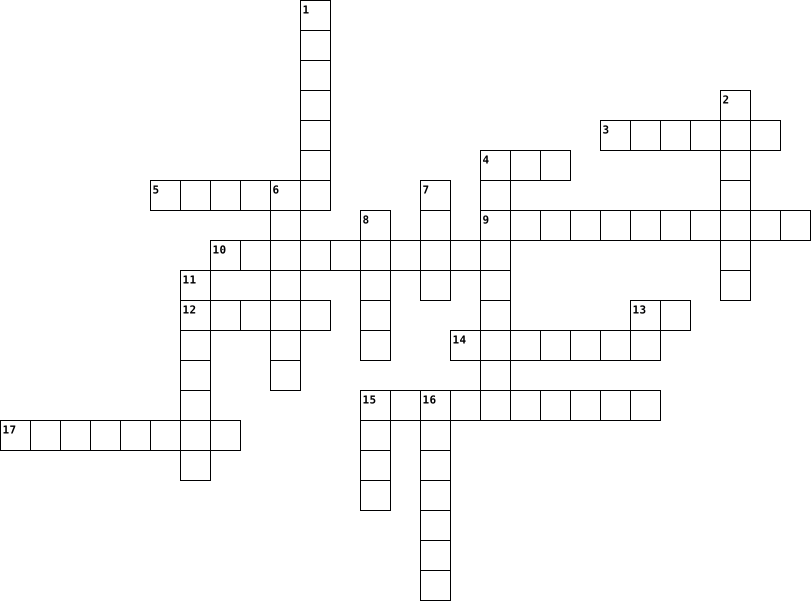
Across
- Koks yra visų laikų populiariausias žaidimas?
- Koks yra populiariausias žaidimas Roblox?
- Koks yra populiariausias telefonas pasaulyje?
- Kokią funkcija atlieka Ctrl+C?
- Kelintoje vietoje pagal populiarumą yra žaidimas Sims 4?
- Kokia garsi bendrovė buvo sukurta 1976 m?
- Kokia buvo įkurta kompanija 1947?
- Kuri kompanija buvo įkurta 1969 m?
- Kaip vadinasi kompiuterio ekranas?
- Koks yra vienas iš populiariausių offline žaidimų?
Down
- 2004 buvo sukurta programėlė, kokia?
- 1985 m. Buvo sukurta operacinė sistema?
- Koks yra mėgstamiausias kompiuterinis žaidimas 2023 m.?
- Kokia yra populiariausia filmų žiūrėjimo platforma?
- Kaip vadinamas žmogeliukas Roblox kuris neturi robux?
- Star Koks žaidimas buvo sukurtas 2018?
- Kokios kompanijos telefonai ir planšetės gali persilenkti?
- Koks yra nepopuliariausias telefonas 2023?
- Koks vardas buvo žmogaus kuris sukūrė Facebook programėle?
- 1997 buvo įkurta filmų žiūrėjimo platforma?
20 Clues: Kokią funkcija atlieka Ctrl+C? • Kokia buvo įkurta kompanija 1947? • Kuri kompanija buvo įkurta 1969 m? • Kaip vadinasi kompiuterio ekranas? • 2004 buvo sukurta programėlė, kokia? • Star Koks žaidimas buvo sukurtas 2018? • 1985 m. Buvo sukurta operacinė sistema? • Koks yra populiariausias žaidimas Roblox? • Kokia garsi bendrovė buvo sukurta 1976 m? • ...
Absolutely True Diary Vocabulary Part 2 2021-01-08

Across
- believed or reputed to be the case
- equally skillful with each hand
- filled with melancholy and despondency
- a person who rescues you from harm or danger
- pose a series of questions to
Down
- worn and broken down by hard use
- an offensive term for an offspring of parents of different races (especially of Caucasian and American Indian ancestry)
- a servile or fawning dependent
- a serious or difficult concern
- never-ceasing
- an abnormal new mass of tissue that serves no purpose
- quarrel or fight noisily, angrily or disruptively
- promise
13 Clues: promise • never-ceasing • pose a series of questions to • a servile or fawning dependent • a serious or difficult concern • equally skillful with each hand • worn and broken down by hard use • believed or reputed to be the case • filled with melancholy and despondency • a person who rescues you from harm or danger • quarrel or fight noisily, angrily or disruptively • ...
Vocabulary Puzzle Unit 5 2022-11-21

Across
- something that interferes with progress
- one aspect or side of a subject or problem
- having lost the power of feeling or movement
- to make peaceful or calm
- a brief statement giving a general view
- causing fear because of strangeness
- the length of time that something lasts
- to delay leaving; to linger, wait
- a series of notes clarifying or explaining
Down
- one living permanently in a given place
- a brawl, a noisy quarrel
- willful, stubborn
- the state of being faithful
- greedy; very hungry
- to act or work clumsily and awkwardly
- to talk or act in a noisy and threatening manner
- overly self-satisfied
- with a sharp point; keen and alert
- to prove incorrect
- deep and painful regret for one's past misdeeds
20 Clues: willful, stubborn • to prove incorrect • greedy; very hungry • overly self-satisfied • a brawl, a noisy quarrel • to make peaceful or calm • the state of being faithful • to delay leaving; to linger, wait • with a sharp point; keen and alert • causing fear because of strangeness • to act or work clumsily and awkwardly • one living permanently in a given place • ...
Crossword Lesson 5 2022-12-01

Across
- deep and painful regret for one's past misdeeds
- one living permanently in a given place
- to prove incorrect
- speech that is loud and threatening
- to delay leaving; to linger
- willful stubborn
- to make peaceful or calm; to soothe
- raising quickly to a high point and lasting for a short time
- to act or work clumsily and awkwardly
Down
- very hungry, greedy
- one of the cut surfaces of a gem
- an expression of opinion
- having lost the power of feeling or movement
- causing fear because of strangeness
- overly self-satisfied
- brief statement giving a general view of some subject, book, etc.
- something that interferes with progress
- a brawl, a noisy quarrel
- the length of time that something continues or lasts
- the state of being faithful
20 Clues: willful stubborn • to prove incorrect • very hungry, greedy • overly self-satisfied • an expression of opinion • a brawl, a noisy quarrel • to delay leaving; to linger • the state of being faithful • one of the cut surfaces of a gem • causing fear because of strangeness • speech that is loud and threatening • to make peaceful or calm; to soothe • to act or work clumsily and awkwardly • ...
unit 15 2016-03-13

Across
- to express agreement, approve
- open and responsive to ideas or suggestions
- irritation or humiliation caused by disappointment or frustration
- a wild uproar, din, or commotion
- to adapt to a new climate, environment, or situation
- sleepy, drowsy; inducing sleep
- unnatural, distorted; bizarre
- disagreeably harsh sounding; disorderly
- not inclined to speak, reserved; reluctant
- eager, earnest, devoted
- characterized by a ready flow of words; glib fluent
Down
- self satisfied; overly content
- slander or libel
- a noisy quarrel or brawl
- to make plain or clear, explain; to interpret
- to hold back; to put down or check by force
- intense, forceful, powerful
- to give up or resign something
- tasty, appetizing; pungent or salty, not sweet; inoffensive, respectable
- causing irritation, harsh; grinding or wearing down
20 Clues: slander or libel • eager, earnest, devoted • a noisy quarrel or brawl • intense, forceful, powerful • to express agreement, approve • unnatural, distorted; bizarre • self satisfied; overly content • sleepy, drowsy; inducing sleep • to give up or resign something • a wild uproar, din, or commotion • disagreeably harsh sounding; disorderly • ...
Vocabulary:Lesson 5 2022-03-23

Across
- (n.) a brawl, or, (v.) to wear away by rubbing
- (v.)to talk or act noisy and threatning in a way
- (n.) the length of time something lasts
- (adj.) causing fear because of strangness
- (v.) to dull the feelings of
- (v.) to delay leaving
- (n.) one living permanently in a given place
- (n.) a series of notes clarifying something
- (adj.) overly satisfied
- (adj.) stubborn
- (n.) the state of being faithful
Down
- (n.) a summary
- (adj.) with a sharp point
- (n.) something that interferes with progress
- (adj.) super hungry
- (v.) to prove incorrect
- (v.) to make peaceful
- (v.) to act or work clumsily and awkwardly
- (n.) one aspect or side of a subject or problem
- (n.) deep regret
20 Clues: (n.) a summary • (adj.) stubborn • (n.) deep regret • (adj.) super hungry • (v.) to make peaceful • (v.) to delay leaving • (v.) to prove incorrect • (adj.) overly satisfied • (adj.) with a sharp point • (v.) to dull the feelings of • (n.) the state of being faithful • (n.) the length of time something lasts • (adj.) causing fear because of strangness • ...
Unit 5 Words Maeve O´Brien 2026-01-16

Across
- A brawl or noisy quarrel
- To talk or act in a noisy and threatening way
- The length of time that someone continues or lasts
- Causing fear because of strangeness
- Having lost the power of feeling or movement
- To delay leaving
- One living permanently in a given place
- A series of notes clarifying or explaining something
- Overly self-satisfied, self-righteous
- Willful, stubborn
- The state of being faithful
Down
- A brief statement
- With a sharp point
- Something that interferes with progress
- Greedy; very hungry; eager for satisfaction
- To prove incorrect
- To make peaceful or calm; to soothe
- To act or work in a clumsily and awkwardly
- One aspect or side of a subject or problem
- Deep and painful regret for one´s past misdeeds
20 Clues: To delay leaving • A brief statement • Willful, stubborn • With a sharp point • To prove incorrect • A brawl or noisy quarrel • The state of being faithful • To make peaceful or calm; to soothe • Causing fear because of strangeness • Overly self-satisfied, self-righteous • Something that interferes with progress • One living permanently in a given place • ...
Unit 5 Words 2026-01-16

Across
- - A brawl or noisy quarrel
- - To talk or act in a noisy and threatening way
- - The length of time that something continues or lasts
- - Causing fear because of strangeness
- - Having lost the power or movement
- - To delay leaving
- - One living permanently in a given place
- - A series of notes clarifying something
- - Overly self satisfied
- - Willful or stubborn
- - The state of being faithful
Down
- - A brief statement giving a general view of something
- - With a sharp point: keen and alert
- - Something that interferes with progress
- - Greedy; very hungry
- - To prove incorrect
- - To make peaceful or calm
- - To act or work clumsily and awkwardly
- - One aspect or side of a subject or problem
- - Deep and painful regret for one's past misdeeds
20 Clues: - To delay leaving • - To prove incorrect • - Greedy; very hungry • - Willful or stubborn • - Overly self satisfied • - A brawl or noisy quarrel • - To make peaceful or calm • - The state of being faithful • - Having lost the power or movement • - With a sharp point: keen and alert • - Causing fear because of strangeness • - To act or work clumsily and awkwardly • ...
Unit 5 vocab words sophia 2026-01-16

Across
- a brawl or noisy quarrel
- to talk or act in a noisy and threatening way
- the length of time that something continues or lasts
- causing fear because of strangeness
- having lost the power of feeling or movement
- to delay leaving
- one living permanently in a given place
- a series of notes clarifying or explaining something
- overly self satisfied
- willful or stubborn
- the state of being faithful
Down
- a brief statement giving a general view of some subject
- with a sharp point
- something that interferes with progress
- greedy
- to prove incorrect
- to make peaceful or calm
- to act or work clumsily and awkwardly
- one aspect or side of a subject or problem
- deep and painful for ones past misdeeds
20 Clues: greedy • to delay leaving • with a sharp point • to prove incorrect • willful or stubborn • overly self satisfied • a brawl or noisy quarrel • to make peaceful or calm • the state of being faithful • causing fear because of strangeness • to act or work clumsily and awkwardly • something that interferes with progress • one living permanently in a given place • ...
GRADE SIX UNIT FIVE 2024-11-25

Across
- a noisy quarrel, or a brawl.
- to act in a noisy or threatening way.
- length of time.
- wierd, mysterious, creepy, or frightening
- unfeeling, insensible, or losing feeling or movement.
- to delay leaving, linger, to dawdle.
- resident, native, or one living in a place.
- explanation, description, or analysis of something.
- overly self-satisfied, or self-righteous.
- obstinate, unruly, NOT obedient, or stubborn.
- loyalty, faithfulness, or exactness.
Down
- outline or abstract.
- keen and alert, sharp and severe, or clever.
- failure, reversal, or unexpected loss or defeat.
- voracious, starved, or hungry, NOT well-fed, NOT satisfied.
- to prove that something is incorrect.
- to calm or sooth, NOT to ignite
- to miss up or ruin something.
- factor, element, angle, factor, or aspect.
- deep, painful regret about the past
20 Clues: length of time. • outline or abstract. • a noisy quarrel, or a brawl. • to miss up or ruin something. • to calm or sooth, NOT to ignite • deep, painful regret about the past • to delay leaving, linger, to dawdle. • loyalty, faithfulness, or exactness. • to act in a noisy or threatening way. • to prove that something is incorrect. • wierd, mysterious, creepy, or frightening • ...
Choice Board Vocab Words 2025-01-09

Across
- a brawl, a noisy quarrel
- to talk or act in a noisy and threatening way
- the length of time that something continues or lasts
- causing fear because of strangeness
- having lost the power of feeling or movement
- to delay leaving
- one living permanently in a given place
- a series of notes clarifying or explaining something
- overly self-satisfied
- willful, stubborn
- the state of being faithful
Down
- a brief statement giving a general view of some subject, book, etc
- with a sharp point
- something that interferes with a progress
- greedy
- to prove incorrect
- to make peaceful or calm
- to act or work clumsily and awkwardly
- one aspect or side of a subject or problem
- deep and painful regret for one's past misdeeds
20 Clues: greedy • to delay leaving • willful, stubborn • with a sharp point • to prove incorrect • overly self-satisfied • a brawl, a noisy quarrel • to make peaceful or calm • the state of being faithful • causing fear because of strangeness • to act or work clumsily and awkwardly • one living permanently in a given place • something that interferes with a progress • ...
Unit 15 Review 2025-04-16

Across
- a substance used to smooth or polish
- unnatural, distorted; bizarre
- causing irritation, harsh; grinding or wearing down
- to express agreement, approve
- to give up or resign something
- a noisy quarrel or brawl
- to hold back; to put down or check by force
- to adapt to a new climate, environment, or situation
- sleepy, drowsy; inducing sleep
- intense, forceful, powerful
- to cause such a feeling of irritation or humiliation
Down
- to make plain or clear, explain; to interpret
- eager, earnest, devoted
- a wild uproar, din, or commotion
- disagreeably harsh-sounding; disorderly
- self-satisfied; overly content
- not inclined to speak; reserved; reluctant
- open and responsive to ideas or suggestions
- tasty, appetizing; pungent or salty, not sweet; inoffensive, respectable
- characterized by a ready flow of words; glib, fluent
- slander or libel
- irritation or humiliation caused by disappointment or frustration
22 Clues: slander or libel • eager, earnest, devoted • a noisy quarrel or brawl • intense, forceful, powerful • unnatural, distorted; bizarre • to express agreement, approve • self-satisfied; overly content • to give up or resign something • sleepy, drowsy; inducing sleep • a wild uproar, din, or commotion • a substance used to smooth or polish • disagreeably harsh-sounding; disorderly • ...
Out of this world 2013-08-08

Across
- people that are in space
- the first man on the moon
- something that used to be a planet
- it has planets, stars and moons
- it's in the scienceworks
- you see it in the sky at night
Down
- it's the closest planet to the sun
- He discovered the sun spots and solar flares
- is the coldest planet in the solar system
- it is one of the gas giants
- there is lots of them
- it takes 27 days to orbit the earth
- it keeps us alive
- you use it to look up in the stars at night
- it's something we live on
- the first dog on moon
- one of jupiter's moon has water
17 Clues: it keeps us alive • there is lots of them • the first dog on moon • people that are in space • it's in the scienceworks • the first man on the moon • it's something we live on • it is one of the gas giants • you see it in the sky at night • it has planets, stars and moons • one of jupiter's moon has water • it's the closest planet to the sun • something that used to be a planet • ...
Vocab 2021-10-20

Across
- It disperses the light from an object into wavelength
- The creation of our universe.
- There are many galaxy's in the ___
- electromagnetic radiation you can see with the human eye
- The study of the stars
- radiation from all parts of outer space
- The greatest physicists of all time.
Down
- How light shifts longer
- a range of wavelengths in which electromagnetic radiation extends.
- Discovered CMB in 1964.
- One of the first element created
- what makes things do work
- He proved that there are galaxys beyond our own.
- Thought nuclear fusion might be happening in our stars.
- One of the first elements created
- shorter wavelengths in space
- gravitational bound stars and planets.
17 Clues: The study of the stars • How light shifts longer • Discovered CMB in 1964. • what makes things do work • shorter wavelengths in space • The creation of our universe. • One of the first element created • One of the first elements created • There are many galaxy's in the ___ • The greatest physicists of all time. • gravitational bound stars and planets. • ...
Vocab 2021-10-20

Across
- a range of wavelengths in which electromagnetic radiation extends.
- One of the first elements created
- Thought nuclear fusion might be happening in our stars.
- One of the first element created
- It disperses the light from an object into wavelength
- The greatest physicists of all time.
- what makes things do work
- radiation from all parts of outer space
Down
- How light shifts longer
- electromagnetic radiation you can see with the human eye
- The study of the stars
- shorter wavelengths in space
- The creation of our universe.
- Discovered CMB in 1964.
- hubble He proved that there are galaxys beyond our own.
- gravitational bound stars and planets.
- There are many galaxy's in the ___
17 Clues: The study of the stars • How light shifts longer • Discovered CMB in 1964. • what makes things do work • shorter wavelengths in space • The creation of our universe. • One of the first element created • One of the first elements created • There are many galaxy's in the ___ • The greatest physicists of all time. • gravitational bound stars and planets. • ...
The Fault In Our Stars 2021-02-24

Across
- Where Hazel meets Augustus.
- Augustus puts these in his mouth but doesn't actually smoke them.
- The main guy character in the book Fault In Our Stars rhymes with August.
- Where you go in an emergency and need medical help.
- Where you go to pay your respects when people die.
- A sickness that is common and treated mostly with chemotherapy.
Down
- Who you go to see when you're sick.
- The foundation referred to as genies in The Fault In Our Stars.
- The lights in the sky at night time.
- The place that Augustus and Hazel go to visit.
- What trees make that you need to breath.
- Who writes the book.
- What you use to breathe.
- When you can't see.
- Main character of the book Fault In Our Stars also the name of a nut.
15 Clues: When you can't see. • Who writes the book. • What you use to breathe. • Where Hazel meets Augustus. • Who you go to see when you're sick. • The lights in the sky at night time. • What trees make that you need to breath. • The place that Augustus and Hazel go to visit. • Where you go to pay your respects when people die. • Where you go in an emergency and need medical help. • ...
Space Crossword!!! 2024-12-02

Across
- Relating to stars.
- The stretching of objects near a black hole due to intense gravity.
- The star at the center of our solar system.
- A stellar explosion marking the death of a star.
- An area in space where gravity is so strong that nothing can escape.
- The force that keeps planets in orbit around the Sun.
Down
- A small rocky body that orbits the Sun.
- A prominent constellation also known as the Swan.
- The path one object takes around another in space.
- High-energy electromagnetic radiation, often emitted by stars and black holes.
- Hypothetical beings from other planets.
- Large celestial bodies that orbit a star.
- A group of stars forming a recognizable pattern in the sky.
- One of the presenters
- A vast collection of stars, gas, and dust bound together by gravity.
15 Clues: Relating to stars. • One of the presenters • A small rocky body that orbits the Sun. • Hypothetical beings from other planets. • Large celestial bodies that orbit a star. • The star at the center of our solar system. • A stellar explosion marking the death of a star. • A prominent constellation also known as the Swan. • The path one object takes around another in space. • ...
OD4 Unit1 2025-09-12

Across
- very big, very large
- a very big group of stars, gas, and dust in space
- big balls of hot gas that give light in the night sky
- lived in a place
- a vehicle made to travel in space
- all of space and everything in it
- a very small spot or piece of something
- a small icy object that moves around the Sun and has a long bright tail
Down
- a building with special equipment to watch stars and planets
- a small rocky object moving around the Sun
- a piece of rock from space that lands on Earth
- relating to the sun.
- a flat round shape like a plate
- a tool to look at far things like stars or planets
- the round object that moves around a planet (our Moon goes around Earth)
15 Clues: lived in a place • very big, very large • relating to the sun. • a flat round shape like a plate • a vehicle made to travel in space • all of space and everything in it • a very small spot or piece of something • a small rocky object moving around the Sun • a piece of rock from space that lands on Earth • a very big group of stars, gas, and dust in space • ...
Stars, Galaxies, and Universes 2020-12-17

Across
- Hypothetical form of energy, may make up as much as 71% of the energy in the universe.
- This is so dense that light cannot escape the gravity.
- Nuclear fusion in the star's core produces helium from hydrogen.
- Ball of glowing gas at very high temperature.
- Egg-shaped rotating galaxy.
- Galaxies that are not spiral or elliptical.
Down
- A large red-colored start that is collapsing inward on itself.
- The leftover material in the core after a supernova explosion.
- Two stars orbiting each other.
- Groups of up to a few thousand stars that are loosely held by gravity.
- All of the star systems, galaxies, gas and dust.
- The study of the universe.
- Biggest group of stars; may contain hundreds of thousands of stars.
- Matter that we can't see but know exists; does not emit electromagnetic radiation.
- Our galaxy
15 Clues: Our galaxy • The study of the universe. • Egg-shaped rotating galaxy. • Two stars orbiting each other. • Galaxies that are not spiral or elliptical. • Ball of glowing gas at very high temperature. • All of the star systems, galaxies, gas and dust. • This is so dense that light cannot escape the gravity. • A large red-colored start that is collapsing inward on itself. • ...
space 2024-03-14

Across
- the oldest star ever
- starts with m and is a dwarf planet
- the sun
- holds the stars,planets and everything
- Scuti the biggest star
- has a big red spot
- a hole in space where light is destroyed
- the biggest moon
Down
- measures distance in space
- group of stars
- holds planets and stars, we are in it
- keeps oxygen, nitrogen and trace elements in a planet.
- cross shown on the australian flag
- centauri the closest star other than the sun
14 Clues: the sun • group of stars • the biggest moon • has a big red spot • the oldest star ever • Scuti the biggest star • measures distance in space • starts with m and is a dwarf planet • cross shown on the australian flag • holds planets and stars, we are in it • holds the stars,planets and everything • a hole in space where light is destroyed • ...
Types of Stars (by Online Unit Studies) 2016-04-25

Across
- what is a rapidly spinning neutron star that emits energy in pulses?
- _______ stars are small stars.
- ______________ is the total amount of energy that a star radiates each second.
- What type of star is very small and super-dense (diameter of 5-10 miles?
- What is the most common type of star?
- List the seven main types of stars in order of decreasing temperature?
Down
- What is the largest known type of star?
- A ___________ star is a system of two stars that rotate around a common center.
- What color is an "M" star?*
- What are main sequence stars fueled by?
- What color is an "A" star?
- as a star begins to die, what type of star does it become?
12 Clues: What color is an "A" star? • What color is an "M" star?* • _______ stars are small stars. • What is the most common type of star? • What is the largest known type of star? • What are main sequence stars fueled by? • as a star begins to die, what type of star does it become? • what is a rapidly spinning neutron star that emits energy in pulses? • ...
Rayven 3 2023-01-31

Across
- atmosphere
- pic
- radiation-energy from stars
- of stars
- from pattern
- system-sun planets moons
- crater-hole from space rock
Down
- maps planit
- visible light and em radiation
- around object
- rock samples
11 Clues: pic • of stars • atmosphere • maps planit • from pattern • rock samples • around object • system-sun planets moons • radiation-energy from stars • crater-hole from space rock • visible light and em radiation
Chapter 2 Crossword 2022-02-01

Across
- Make up galaxies
- the hottest and fastest reaction
- Our Galaxy
- explains how stars and planets form
- Second stage of a large stars life
Down
- Baby star
- Created by expansion and cooling of the universe
- Last stage of a small stars life
- Made from a massive star
- Average star
10 Clues: Baby star • Our Galaxy • Average star • Make up galaxies • Made from a massive star • the hottest and fastest reaction • Last stage of a small stars life • Second stage of a large stars life • explains how stars and planets form • Created by expansion and cooling of the universe
Chapter 28/29 Tyler Ackerman 2018-05-22

Across
- Milky Way and neighboring galaxies
- 2nd planet from the sun
- Huge assemblage of stars
- Usually a stars ending
- Theory of how our universe began
Down
- Most familiar galaxy to us
- Groups of stars with names from antiquity
- 5th planet from the sun
- 4th planet from the sun
- A stars beginning
10 Clues: A stars beginning • Usually a stars ending • 5th planet from the sun • 2nd planet from the sun • 4th planet from the sun • Huge assemblage of stars • Most familiar galaxy to us • Theory of how our universe began • Milky Way and neighboring galaxies • Groups of stars with names from antiquity
Week 1 Vocabulary Crossword 2020-09-16

Across
- An event resulting in great loss and misfortune
- To cause someone to be confused emotionally
- Without or almost without hope
- To cause someone to be confused emotionally
Down
- Joyously unrestrained
- Having no name or identity or known source
- Exceedingly sudden and unexpected
- An accommodation in which both sides make sacrifices
- A special design or symbol representing an idea
- A widespread outbreak of an infectious disease
10 Clues: Joyously unrestrained • Without or almost without hope • Exceedingly sudden and unexpected • Having no name or identity or known source • To cause someone to be confused emotionally • To cause someone to be confused emotionally • A widespread outbreak of an infectious disease • An event resulting in great loss and misfortune • ...
Nov 5 2024-11-04

Across
- to act in a proper way
- to shine or give out light without a flame
- goods to be bought or sold
- singing or yelling loudly with your chest
Down
- when something is sad, disappointing, or has a bad effect
- in the space separating two objects
- using force or violence
- the subject of a sentence
- a rough or noisy fight
9 Clues: to act in a proper way • a rough or noisy fight • using force or violence • the subject of a sentence • goods to be bought or sold • in the space separating two objects • singing or yelling loudly with your chest • to shine or give out light without a flame • when something is sad, disappointing, or has a bad effect
Astronomy - CrossWord 2013-05-30

Across
- __________ the star the lager the life span.
- ____________ are areas of intense gravitational pressure.
- The Milky Way has what shape?
- The change in the wavelength of the light divided by the rest wavelength of the light.
- What are young stars called?
- What is the nucleus inside of?
- Milky Way is held together by _____?
- The beginning of the universe as we know it, most scientists say.
- Smaller the star the _______ the life span.
- What element does a mature star consist of?
Down
- Our ________ _______ is far away from the Milky way galaxy.
- _______ are cosmic energy engines that produce heat, light, ultraviolet rays, x-rays, and other forms of radiation.
- This expansion has been occuring since the universe was formed _____________ years ago in a very hot, dense event known as the Big Bang.
- What type of galaxy has no particular shape?
- Big stars consume fuel at a ______ pace.
- What is our galaxy called?
- What is the nearest star to the earth?
- Do mature stars become brighter or dimer as they burn?
- Space telescope that was carried into orbit by a Space Shuttle in 1990 and remains in operation.
19 Clues: What is our galaxy called? • What are young stars called? • The Milky Way has what shape? • What is the nucleus inside of? • Milky Way is held together by _____? • What is the nearest star to the earth? • Big stars consume fuel at a ______ pace. • Smaller the star the _______ the life span. • What element does a mature star consist of? • ...
Romeo and Juliet 2020-08-03

Across
- Romeo goes there after he is banished
- Juliet is promised to him
- Who kills Mercutio
- Another name for a sword
- Finish this line: He jests at scars that never felt a ...
- Tries to break up the first public brawl
- It begins the play
- What does Tybalt wish upon both houses?
- The place where the play is set
Down
- A fourteen line poem
- A medieval type of chemist
- Mercutio is stabbed under which part of his body
- The house of Capulet
- Laurence Who tries to stop the ancient feud by encouraging the union of Romeo and Juliet?
- Romeo's original infatuation
- A play on words
16 Clues: A play on words • Who kills Mercutio • It begins the play • A fourteen line poem • The house of Capulet • Another name for a sword • Juliet is promised to him • A medieval type of chemist • Romeo's original infatuation • The place where the play is set • Romeo goes there after he is banished • What does Tybalt wish upon both houses? • Tries to break up the first public brawl • ...
Outer Space 2023-09-24

Across
- Clouds of gas and dust in space. They can be places where new stars are born or where old ones explode.
- Small rocks or particles in space that can become meteors when they enter Earth's atmosphere.
- Imaginary or speculative beings from other planets or galaxies. People wonder if they exist somewhere in space.
- Icy objects that travel through space and have a bright tail when they come close to the sun. They're like cosmic snowballs.
- Tiny points of light in the night sky that are actually distant suns. They twinkle and form constellations.
- Hole A mysterious region in space where gravity is so strong that nothing, not even light, can escape from it.
- Vehicles designed for space travel, like rockets and space shuttles. They're used to explore and study space.
- Rocky objects that also orbit the sun but are smaller than planets. Some are in the asteroid belt between Mars and Jupiter.
Down
- Large, round objects that orbit the sun, like Earth, Mars, and Jupiter. They're different from stars because they don't twinkle.
- Another word for the universe as a whole, including everything in space, like stars, galaxies, and planets.
- Vast collections of stars, planets, and other objects in space. Our Milky Way is one of many galaxies in the universe.
- A tool that helps us see distant objects in space. It makes stars, planets, and galaxies look closer and clearer.
- Man-made objects that orbit Earth or other celestial bodies. They're used for communication, weather forecasting, and more.
- Planets that orbit stars outside our solar system. Scientists search for them to learn about other potential worlds.
- System Our sun and all the objects that orbit around it, including planets, moons, asteroids, and comets.
15 Clues: Small rocks or particles in space that can become meteors when they enter Earth's atmosphere. • Clouds of gas and dust in space. They can be places where new stars are born or where old ones explode. • System Our sun and all the objects that orbit around it, including planets, moons, asteroids, and comets. • ...
Vocab 7 2023-12-08

Across
- pilgrims who have undertaken a pilgrimage
- They was a ________ at the pub the other day
- Shakespeare write______
- They is never peace with my parent it always ___
- They told me to move_____because royalty was coming through
- Synonym;Speech,Antonym; speechlessness
Down
- Synonm;hostility , Antonyn;friendliness
- Synonm;Obstacle, Antonym;Clear,open
- Romeo was ______ after killing Tybalt
- This girl was ____ of me. She wanted my spot on the team.
10 Clues: Shakespeare write______ • Synonm;Obstacle, Antonym;Clear,open • Romeo was ______ after killing Tybalt • Synonym;Speech,Antonym; speechlessness • Synonm;hostility , Antonyn;friendliness • pilgrims who have undertaken a pilgrimage • They was a ________ at the pub the other day • They is never peace with my parent it always ___ • ...
Eng 1 Hon Vocab 2022-10-06

Across
- fight noisily, angrily, or disruptively
- liable to sudden or unpredictable change
- Having a humble opinion of oneself
- Inadequate in amount or degree
- befitting an important, or powerful person
Down
- indirect reference to
- having or wielding force or authority
- contented to a fault with oneself
- pleads for a person, cause, or idea
- a prod on a rider's heel used to urge a horse forward
10 Clues: indirect reference to • Inadequate in amount or degree • contented to a fault with oneself • Having a humble opinion of oneself • pleads for a person, cause, or idea • having or wielding force or authority • fight noisily, angrily, or disruptively • liable to sudden or unpredictable change • befitting an important, or powerful person • ...
vocab 6 8th grade 2023-02-07

Across
- to make or become confused, agitated or nervous
- a burst of gunfire or cannon shot, often as tribute or salute
- the force or speed with which something moves
- earlier, former
- striking, remarkable
Down
- wide-awake, alert, watchful
- a self-contradictory statement that on closer examination prove true
- extremely bad; glaring; scandalous, notorious
- to hate, dislike very much, loathe
- a noisy quarrel or fight
10 Clues: earlier, former • striking, remarkable • a noisy quarrel or fight • wide-awake, alert, watchful • to hate, dislike very much, loathe • extremely bad; glaring; scandalous, notorious • the force or speed with which something moves • to make or become confused, agitated or nervous • a burst of gunfire or cannon shot, often as tribute or salute • ...
space 2024-03-14

Across
- the oldest star ever
- starts with m and is a dwarf planet
- the sun
- holds the stars,planets and everything
- Scuti the biggest star
- has a big red spot
- a hole in space where light is destroyed
- the biggest moon
Down
- measures distance in space
- group of stars
- holds planets and stars, we are in it
- keeps oxygen, nitrogen and trace elements in a planet.
- cross shown on the australian flag
- centauri the closest star other than the sun
14 Clues: the sun • group of stars • the biggest moon • has a big red spot • the oldest star ever • Scuti the biggest star • measures distance in space • starts with m and is a dwarf planet • cross shown on the australian flag • holds planets and stars, we are in it • holds the stars,planets and everything • a hole in space where light is destroyed • ...
space 2024-03-14

Across
- the oldest star ever
- starts with m and is a dwarf planet
- the sun
- holds the stars,planets and everything
- Scuti the biggest star
- has a big red spot
- a hole in space where light is destroyed
- the biggest moon
Down
- measures distance in space
- group of stars
- holds planets and stars, we are in it
- keeps oxygen, nitrogen and trace elements in a planet.
- cross shown on the australian flag
- centauri the closest star other than the sun
14 Clues: the sun • group of stars • the biggest moon • has a big red spot • the oldest star ever • Scuti the biggest star • measures distance in space • starts with m and is a dwarf planet • cross shown on the australian flag • holds planets and stars, we are in it • holds the stars,planets and everything • a hole in space where light is destroyed • ...
Betsy Ross 2020-03-04

Across
- _______ told tale of her making the flag
- Widowed _____ times
- Was a patriotic _______
- Born in the month of ________
- Remarried to _____ Claypoole
- Town born in
- Amount of siblings
- Argued for ____ point stars
- Argued for stars in a ______
- Remarried to _______ Ashburn
Down
- Born in the month of_______
- Family known for their _____
- Had a total of ______ children
- Colony born on
- Visited by General ________
- Born into _______ family
- Father
- Mother
- Worked at _______ workshop
- First husband was ______ Ross
20 Clues: Father • Mother • Town born in • Colony born on • Amount of siblings • Widowed _____ times • Was a patriotic _______ • Born into _______ family • Worked at _______ workshop • Born in the month of_______ • Visited by General ________ • Argued for ____ point stars • Family known for their _____ • Remarried to _____ Claypoole • Argued for stars in a ______ • Remarried to _______ Ashburn • ...
Vocab 30.1 2020-10-15

Across
- bulge: Bar like shape where arms are attached
- 2 Stars: Found in the halo, bulge and contain even smaller traces of heavy elements
- arms: Dislike shape with a spiral bulge
- stars: Located in the giant branch HRD and pulsate in brightness because of expansion
Down
- gravitationally bound system of stars stellar remnants instellular gas, dust, and dark matter
- an alternative universe
- 1 Stars: In disk and arms have small amounts of heavy elements
- Massive Black Hole: Largest type of black hole with massive of quarters of billions
- spherical region where globular clusters are located
- Density Wave: Has spiral regions of alternating density, which rotate as a rigid pattern
- Light year
- Lyrae variables: are stars that have periods of pulsation between 1.5 hours to 1.2 days
- variables: pulsation dates between 1-100 days
13 Clues: Light year • an alternative universe • arms: Dislike shape with a spiral bulge • bulge: Bar like shape where arms are attached • variables: pulsation dates between 1-100 days • spherical region where globular clusters are located • 1 Stars: In disk and arms have small amounts of heavy elements • ...
Vocab 30.1 2020-10-15

Across
- bulge: Bar like shape where arms are attached
- 2 Stars: Found in the halo, bulge and contain even smaller traces of heavy elements
- arms: Dislike shape with a spiral bulge
- stars: Located in the giant branch HRD and pulsate in brightness because of expansion
Down
- gravitationally bound system of stars stellar remnants instellular gas, dust, and dark matter
- an alternative universe
- 1 Stars: In disk and arms have small amounts of heavy elements
- Massive Black Hole: Largest type of black hole with massive of quarters of billions
- spherical region where globular clusters are located
- Density Wave: Has spiral regions of alternating density, which rotate as a rigid pattern
- Light year
- Lyrae variables: are stars that have periods of pulsation between 1.5 hours to 1.2 days
- variables: pulsation dates between 1-100 days
13 Clues: Light year • an alternative universe • arms: Dislike shape with a spiral bulge • bulge: Bar like shape where arms are attached • variables: pulsation dates between 1-100 days • spherical region where globular clusters are located • 1 Stars: In disk and arms have small amounts of heavy elements • ...
Vocab 30.1 2020-10-15

Across
- bulge: Bar like shape where arms are attached
- 2 Stars: Found in the halo, bulge and contain even smaller traces of heavy elements
- arms: Dislike shape with a spiral bulge
- stars: Located in the giant branch HRD and pulsate in brightness because of expansion
Down
- gravitationally bound system of stars stellar remnants instellular gas, dust, and dark matter
- an alternative universe
- 1 Stars: In disk and arms have small amounts of heavy elements
- Massive Black Hole: Largest type of black hole with massive of quarters of billions
- spherical region where globular clusters are located
- Density Wave: Has spiral regions of alternating density, which rotate as a rigid pattern
- Light year
- Lyrae variables: are stars that have periods of pulsation between 1.5 hours to 1.2 days
- variables: pulsation dates between 1-100 days
13 Clues: Light year • an alternative universe • arms: Dislike shape with a spiral bulge • bulge: Bar like shape where arms are attached • variables: pulsation dates between 1-100 days • spherical region where globular clusters are located • 1 Stars: In disk and arms have small amounts of heavy elements • ...
Stars Crossword 2024-06-03

Across
- the colour of a very hot star
- the star in the center of our solar system
- means that stars do not move
- the colour of a medium temperature star
- another name for ursa minor
- the colour of a cooler temperature star
Down
- orbit around stars
- a group of stars that makes a pattern or shape in the sky
- the colour of a star tells us this
- another name for ursa major
- a ball of hot gas that gives off light
- number of stars in the universe
12 Clues: orbit around stars • another name for ursa major • another name for ursa minor • means that stars do not move • the colour of a very hot star • number of stars in the universe • the colour of a star tells us this • a ball of hot gas that gives off light • the colour of a medium temperature star • the colour of a cooler temperature star • ...
კროსვორდი თამაშების შესახებ 2025-10-31

Across
- რომელმა კომპანიამ გამოიგონა თამაში brawl stars?
Down
- ვინ გამოიგონა გამოიგონა პირველი კომპიუტერული თამაში?
2 Clues: რომელმა კომპანიამ გამოიგონა თამაში brawl stars? • ვინ გამოიგონა გამოიგონა პირველი კომპიუტერული თამაში?
Big Bang and Stellar Evolution 2020-10-05

Across
- whitedwarfs have this type of explosion when they die
- a method used to find the distance to stars
- the distance light travels in a year
- a body of gases that gives off light and heat
- occurs because light waves appear LONGER because a star is moving away
- when a spinning nebula flattens into a disc
- a plot of surface temperatures of stars vs apparent magnitude
- left over heat from the formation of the universe
- how bright a star would appear from 32.6 ly
Down
- the majority of stars fall on this band on an H-R diagram
- the apparent shift in the wavelength of light caused by the movement of the light source
- the process by which small atomic nuclei combine to form large atomic nuclei
- the brightness of a star as it appears from Earth
- when a star loses its outer gases, revealing its core
- a tremendous explosion that blows a star apart
- a device that separates light into different colors
- a cloud of gas and dust
- occurs because light waves appear LONGER because a star is moving closer
- a large group of stars bound together by gravity
19 Clues: a cloud of gas and dust • the distance light travels in a year • a method used to find the distance to stars • when a spinning nebula flattens into a disc • how bright a star would appear from 32.6 ly • a body of gases that gives off light and heat • a tremendous explosion that blows a star apart • a large group of stars bound together by gravity • ...
Galaxies 2022-05-20

Across
- the galaxy that includes our Solar System
- astronomical object held by gravity
- a luminous giant star of low or intermediate mass in a late phase of stellar evolution.
- collapsed core of a massive supergiant star
- flat disk
- a satellite galaxy of the Milky Way
- barred spiral galaxy with diameter of about 220,000 ly
- a powerful and luminous stellar explosion
Down
- circular/elongated
- a type of emission nebula consisting of an expanding, glowing shell of ionized gas ejected from red giant stars
- a radio galaxy, and one of the strongest radio sources in the sky.
- what stars are made of
- a stellar core remnant composed mostly of electron-degenerate matter
- largest stars in the universe in terms of volume
- no shape
- a star that is larger than eight solar masses during its regular main sequence lifetime
- a region of spacetime where gravity is so strong that nothing – no particles or even electromagnetic radiation such as light – can escape from it
- a disputed dwarf irregular galaxy in the Local Group
- spends most of its time on the main sequence as an orange, yellow, or blue-white dwarf star.
19 Clues: no shape • flat disk • circular/elongated • what stars are made of • astronomical object held by gravity • a satellite galaxy of the Milky Way • the galaxy that includes our Solar System • a powerful and luminous stellar explosion • collapsed core of a massive supergiant star • largest stars in the universe in terms of volume • ...
Large Star Cycle 2025-11-21

Across
- 3th stage in an low mass stars life
- 2nd stage in a stars life
- 2nd to last stage in a low mass star's life
- A Stars Formation
- Comes after a Red Giant
Down
- A small and incredibly dense celestial object
- A point in space where gravity is so strong that nothing can escape
- A catastrophic explosion in space
- Last stage in a low mass stars life
- 3th stage in a high mass stars life
10 Clues: A Stars Formation • Comes after a Red Giant • 2nd stage in a stars life • A catastrophic explosion in space • 3th stage in an low mass stars life • Last stage in a low mass stars life • 3th stage in a high mass stars life • 2nd to last stage in a low mass star's life • A small and incredibly dense celestial object • ...
Life cycle of a star 2025-05-14

Across
- being flat and circular in shape
- Bigger than galaxy
- much larger and bigger stars
- among the largest brightest stars
- Where we live
- A classification of star
- next stage of whitedwarf
Down
- vast cosmic systems of stars and planets
- joining two things
- brightness of an object
- hot remnant of star
- interaction between 2 nuclear particles
12 Clues: Where we live • joining two things • Bigger than galaxy • hot remnant of star • brightness of an object • A classification of star • next stage of whitedwarf • much larger and bigger stars • being flat and circular in shape • among the largest brightest stars • interaction between 2 nuclear particles • vast cosmic systems of stars and planets
Room13 2020-07-27

Across
- stars
- in the night
- have a stars
- is after what will happen
- whanau
Down
- a family
- new year
- celebration
- for eating
- is were people live
10 Clues: stars • whanau • a family • new year • for eating • celebration • in the night • have a stars • is were people live • is after what will happen
Outsiders crossword- Ian 2021-03-15

Across
- slang for a cigarette
- slang for I understand
- slang for a fight/brawl
- slang for knife
- slang for higher class
- Sodapop's best friend
- slang for laughs but could also mean shoes
- how did Ponyboy's parents die
- Sodapop's horse
- means stop talking
Down
- slang for cry
- slang for hood rat and poorer people
- where the story is set
- slang for beer
- the author of the novel
- where Dally used to live
- slapped Ponyboy when he came home left
- the girl that showed Ponyboy that not all Socs and greasers are the same
- slang for swear
- slang for girl
- slang for beat up
- slang for pick up
- the narrator of the story
- slang for police
24 Clues: slang for cry • slang for beer • slang for girl • slang for knife • slang for swear • Sodapop's horse • slang for police • slang for beat up • slang for pick up • means stop talking • slang for a cigarette • Sodapop's best friend • slang for I understand • where the story is set • slang for higher class • slang for a fight/brawl • the author of the novel • where Dally used to live • ...