
chemical reaction Crossword Puzzles
our first crossword of 2024 2024-01-02

Across
- during a chemical reaction, one or more reactants change into one or more different _________
- keeping something the same
- (2 words, no space) during a chemical reaction, atoms do not _________
- (2 words) the process that will create new substances
- something that will change in a chemical reaction
- my son's name
Down
- different substances have different _________
- (2 words) letters and numbers showing the types and number of atoms that repeat to make up a substance
- talking with somebody
- during a chemical reaction, the _________of the starting substances must be the same as the _________of the ending substances
- a substance that will change in a chemical reaction
- groups of atoms repeat to make up a _________
- small units of matter that combine to make up molecules
13 Clues: my son's name • talking with somebody • keeping something the same • different substances have different _________ • groups of atoms repeat to make up a _________ • something that will change in a chemical reaction • a substance that will change in a chemical reaction • (2 words) the process that will create new substances • ...
Raean Majd 2026-03-03

Across
- shows that enzyme active site is specific to its substrate
- a reaction that releases energy into the surrounding Reactants substances
- shows that enzyme active site molds to the substrate
- the sum of all chemical reactions that occur in a cell
- making large molecules from smaller molecules
- factors that increase enzymatic reaction
- substances that are produced from a chemical reaction
Down
- breaking down larger molecules into smaller molecules
- a reaction that absorbs energy from the surroundings
- the minimum energy required for a chemical reaction to occur
- substances that are involved in a chemical reaction Product
- inhibit enzymatic reactions
12 Clues: inhibit enzymatic reactions • factors that increase enzymatic reaction • making large molecules from smaller molecules • a reaction that absorbs energy from the surroundings • shows that enzyme active site molds to the substrate • breaking down larger molecules into smaller molecules • substances that are produced from a chemical reaction • ...
Crossword 3 by Remi 2021-02-17

Across
- _____________________ theory states that when suitable particles of the reactant hit each other, only a certain amount of collisions result in a perceptible or notable change.
- The topic of chemistry concerned with the rates (speed) of chemical reactions.
- A quantity that expresses heat and cold. It is the manifestation of thermal energy, present in all matter, due to the kinetic energy of particles.
- The reaction ______ is the speed at which a chemical reaction takes place.
- Chemical _________________ is the process or effect of simplifying a single chemical entity into two or more fragments.
- Substances consumed in the course of a chemical reaction.
- A small localized object to which can be ascribed several physical or chemical properties such as volume, density or mass.
- The atoms in molecules of this type of solids are arranged randomly. It literally means 'without shape'.
- A chemical that lowers the activation energy of a reaction, thereby speeding it up without actually being changed by it
- An electrically neutral group of two or more atoms held together by chemical bonds.
Down
- a non-toxic brittle metal, not very useful. When it is 10 degrees above the temperature of this room, it will melt.
- one of the four fundamental states of matter (the others being liquid, gas and plasma).
- A scientific instrument used to separate and measure spectral components of a physical phenomenon.
- The ___________________energy of an object is the energy that it possesses due to its motion. It is defined as the work needed to accelerate a body of a given mass from rest to its stated velocity.
- One of the two known elements that are liquid at room temperature. The other is mercury.
- The species formed from chemical reactions.
- The atoms in molecules of this type of solids are arranged in an orderly, predictable way
- A substance or compound added to a system to cause a chemical reaction.
- A state of decreased physiological activity in an animal, usually by a reduced body temperature and metabolic rate.
- A measure of the randomness of a system.
20 Clues: A measure of the randomness of a system. • The species formed from chemical reactions. • Substances consumed in the course of a chemical reaction. • A substance or compound added to a system to cause a chemical reaction. • The reaction ______ is the speed at which a chemical reaction takes place. • ...
Heat and Chemical Reactions 2017-06-25

Across
- The type of combustion that occurs when there is excess oxygen
- A product of combustion which turns limewater milky white
- The name given to a reaction in which a fuel is burnt
- What can be measured to determine whether a chemical reaction is exothermic or endothermic
- Chemical bonds are _______________ in endothermic reactions
- The type of combustion that occurs when there is a limited supply of oxygen
Down
- A chemical that produces energy when burnt
- An extremely fast exothermic reaction
- A Chemical reaction that absorbs energy from the surroundings
- A product of combustion sometimes seen as condensation
- A chemical reaction that releases energy to the surroundings
- Chemical bonds are _______________ in exothermic reactions
12 Clues: An extremely fast exothermic reaction • A chemical that produces energy when burnt • The name given to a reaction in which a fuel is burnt • A product of combustion sometimes seen as condensation • A product of combustion which turns limewater milky white • Chemical bonds are _______________ in exothermic reactions • ...
Chapter 8 2025-03-17

Across
- sum total of all chemical reactions occurring in a biological system at a
- Energy (Ea): amount of energy required to start a reaction
- Fit: enzyme changes shape when it binds substrate, altering shape of active
- Site: place on an enzyme where substrate binds
- substances formed as a result of the chemical reaction
- Reaction: complex molecules made from simple molecules
- Energy: energy of movement
- consume free energy (+DG)
- release free energy (-DG)
- Complex (ES): held together by hydrogen bonds, electrical
- State: reactive mode of the substrate (aka- reactant) after there has been
- catalytic RNA’s that speed up reactions involving their own nucleotides
- of Thermodynamics: apply to all matter and all energy transformations in the
- Energy: stored energy
Down
- Inhibitor: compete with natural substrate for binding sites
- Energy (G): usable energy that can do work
- time
- Inhibitor: bind to enzyme at site other than the active site
- Inhibitor: bind to enzyme-substrate complex, preventing release of products
- starting substances in a chemical reaction
- intermediate: unstable reactants with higher free energy
- input of energy to initiate the reaction
- or covalent bonds
- Equilibrium: balance between forward and reverse reactions
- (H): total energy
- capacity to do work, or the capacity for change
- Reaction: when atoms collide with enough energy to combine or change
- (S): measure of disorder in a system
- reactants
- Free Energy: (DG° )change in free energy of a reaction under standard
- changing the enzyme’s shape
- Reaction: complex molecules broken down to simpler ones
- Regulation: an effector binds an enzyme at a site different from the active
- bonding partners
34 Clues: time • reactants • bonding partners • or covalent bonds • (H): total energy • Energy: stored energy • consume free energy (+DG) • release free energy (-DG) • Energy: energy of movement • changing the enzyme’s shape • (S): measure of disorder in a system • input of energy to initiate the reaction • Energy (G): usable energy that can do work • starting substances in a chemical reaction • ...
Reactions Unit Vocabulary Review 2023-01-11

Across
- A homogeneous mixture of two or more substances
- A chemical bond that involves sharing a pair of electrons between atoms in a molecule; occurs between 2 or more nonmetals
- a measure of how acidic or basic a solution is
- ________ displacement (two words)reaction type: AB + CD --> AD + CB
- being the most concentrated solution possible at a given temperature
- Chemical Reaction in which energy is primarily given off in the form of heat
- A measurement of how much solute exists within a certain volume of solvent
- ________ displacement (two words) reaction type: A+BC->AC+B
- a compound that produces hydroxide ions in solution
- A small amount of solute in a large amount of solvent
- A solution that contains less than the maximum amount of dissolved solute in a concentration.
Down
- A pure substance made of only one kind of atom
- A substance made up of atoms of two or more different elements joined by chemical bonds
- A substance that increases the hydrogen ion concentration of a solution.
- reaction type: A+B-->AB
- (of a chemical reaction or compound) occurring or formed with absorption of heat
- reaction type: CxHy + O2 --> CO2 + H2O
- contains more dissolved solute than a saturated solution at the same temperature
- Formed when one or more electrons are transferred from one atom to another; occurs between metals and nonmetals
- A combination of two or more substances that are not chemically combined
- reaction type: AB --> A + B
- A measure of how much solute can dissolve in a given solvent at a given temperature.
22 Clues: reaction type: A+B-->AB • reaction type: AB --> A + B • reaction type: CxHy + O2 --> CO2 + H2O • A pure substance made of only one kind of atom • a measure of how acidic or basic a solution is • A homogeneous mixture of two or more substances • a compound that produces hydroxide ions in solution • A small amount of solute in a large amount of solvent • ...
Chemical Reactions 2023-02-16

Across
- an example of an endothermic reaction
- the energy released when a chemical compound reacts to produce new compounds
- a substance that participates in a chemical reaction
- a word that describes a chemical reaction that you see everyday
Down
- a chemical reaction in which energy is released to the surroundings as heat
- a substance that forms in a chemical reaction
- is released when forming bonds
- occur when substances go through chemical changes to form new substances
- when this is formed, it is a sign a chemical reaction has occurred
- a chemical reaction that requires energy input
- must be added to break bonds
11 Clues: must be added to break bonds • is released when forming bonds • an example of an endothermic reaction • a substance that forms in a chemical reaction • a chemical reaction that requires energy input • a substance that participates in a chemical reaction • a word that describes a chemical reaction that you see everyday • ...
Chemisty Crossword 2018-02-22

Across
- Change of state from a liquid to a solid
- description of how a substance interacts with other substances, such as acids;chemical properties are observable only when a chemical change occurs
- A compound that dissolves in water to form a solution with a pH higher than 7
- pure substance that cannot be broken down into other substances; substance made up of only one type of atom
- odorless gas;produced by incomplete combustion of chemicals containing carbon
- a substance that helps a chemical reaction to proceed more quickly
- amount of mass in a given volume of a substance
- a reaction that takes place when two or more substances react to form new substances
- mixing of a substance with air or water;this reduces the substance’s concentration
- process in which molecules move from an area of higher concentration to one of lower concentration
- cloudy mixture in which tiny particles of one substance are held within another and particles cannot be separated out from the other substance
- chemical reaction that occurs when oxygen reacts with a substance to form a new substance and give off energy
- chemical combination of two or more elements in a specific ratio
- Group 1 elements on the periodic table. the most reactive elements. Does not include hydrogen.
Down
- change of state from a liquid to a gas
- chemical reaction that absorbs energy
- principle that matter is not created or destroyed in a chemical reaction; the mass of the products always equals the mass of the reactants
- Group 2 elements on the periodic table. Not as reactive as group 1 but more reactive than all other groups.
- change of state from a gas to a solid
- an experiment in which all reactants and all products of a chemical reaction are accounted for
- The tiniest part of an element that represents said element. Contains a nucleus, and a balanced amount of protons and neutrons.
- chemical reaction that takes place in cells; food (sugar) reacts with oxygen to produce energy, water, and carbon dioxide
- The unit used in measuring an atom's mass.
- change that results when two or more substances react to create a different substance or substances; the new substances have completely different properties from the original ones
- change of state from a gas to a liquid
- A compound that dissolves in water to form a solution with a pH lower than 7.
26 Clues: chemical reaction that absorbs energy • change of state from a gas to a solid • change of state from a liquid to a gas • change of state from a gas to a liquid • Change of state from a liquid to a solid • The unit used in measuring an atom's mass. • amount of mass in a given volume of a substance • chemical combination of two or more elements in a specific ratio • ...
Year 9 Science Chemistry Introduction 2025-05-29

Across
- A starting substance in a chemical reaction.
- The smallest unit of an element.
- A pure substance made of only one kind of atom.
- Relating to chemistry or the interactions of substances.
- A neutral particle in the nucleus.
- A substance that changes color in acids or bases.
- Time taken for half of a radioactive substance to decay.
- A substance with a pH more than 7.
- Splitting of a heavy nucleus into two smaller ones.
- An element that is typically shiny and conducts electricity.
- A chemical reaction with oxygen that produces heat and light.
- A substance made of two or more elements chemically combined.
- Combining of two light nuclei into a heavier one.
- A negatively charged particle orbiting the nucleus.
Down
- Radiation that involves the emission of an electron.
- A substance formed in a chemical reaction.
- Type of reaction that involves changes in the nucleus.
- High energy electromagnetic radiation from a nucleus.
- A substance with a pH of 7.
- A type of radiation consisting of 2 protons and 2 neutrons.
- A positively charged particle in the nucleus.
- A reaction that absorbs heat.
- An atom or molecule with a charge.
- Two or more atoms chemically bonded together.
- An unstable isotope that emits radiation.
- A compound that reacts with acids to release CO₂.
- A substance with a pH less than 7.
- Atoms of the same element with different numbers of neutrons.
- A process in which substances change into new ones.
- A reaction that releases heat.
30 Clues: A substance with a pH of 7. • A reaction that absorbs heat. • A reaction that releases heat. • The smallest unit of an element. • An atom or molecule with a charge. • A neutral particle in the nucleus. • A substance with a pH less than 7. • A substance with a pH more than 7. • An unstable isotope that emits radiation. • A substance formed in a chemical reaction. • ...
Science crossword! 2025-03-09

Across
- A sugar that carbohydrates break into
- Ability to do something
- Substances after chemical reaction
- Unit measuring energy in food
- Chemical reaction in plants
- Chemical reaction that happens in all organisms
Down
- Substances undergo a chemical change
- Helps you solve chemical equations
- Substances before chemical reaction
- Changes in matter without changing chemical composition
10 Clues: Ability to do something • Chemical reaction in plants • Unit measuring energy in food • Helps you solve chemical equations • Substances after chemical reaction • Substances before chemical reaction • Substances undergo a chemical change • A sugar that carbohydrates break into • Chemical reaction that happens in all organisms • ...
Chemisty Crossword 2018-02-22

Across
- description of how a substance interacts with other substances, such as acids;chemical properties are observable only when a chemical change occurs
- process in which molecules move from an area of higher concentration to one of lower concentration
- amount of mass in a given volume of a substance
- pure substance that cannot be broken down into other substances; substance made up of only one type of atom
- cloudy mixture in which tiny particles of one substance are held within another and particles cannot be separated out from the other substance
- change of state from a gas to a solid
- a substance that helps a chemical reaction to proceed more quickly
- A compound that dissolves in water to form a solution with a pH lower than 7.
- Group 2 elements on the periodic table. Not as reactive as group 1 but more reactive than all other groups.
- chemical reaction that takes place in cells; food (sugar) reacts with oxygen to produce energy, water, and carbon dioxide
- an experiment in which all reactants and all products of a chemical reaction are accounted for
- The tiniest part of an element that represents said element. Contains a nucleus, and a balanced amount of protons and neutrons.
- change of state from a gas to a liquid
- Change of state from a liquid to a solid
Down
- Group 1 elements on the periodic table. the most reactive elements. Does not include hydrogen.
- change of state from a liquid to a gas
- change that results when two or more substances react to create a different substance or substances; the new substances have completely different properties from the original ones
- odorless gas;produced by incomplete combustion of chemicals containing carbon
- principle that matter is not created or destroyed in a chemical reaction; the mass of the products always equals the mass of the reactants
- a reaction that takes place when two or more substances react to form new substances
- chemical combination of two or more elements in a specific ratio
- chemical reaction that absorbs energy
- A compound that dissolves in water to form a solution with a pH higher than 7
- The unit used in measuring an atom's mass.
- chemical reaction that occurs when oxygen reacts with a substance to form a new substance and give off energy
- mixing of a substance with air or water;this reduces the substance’s concentration
26 Clues: chemical reaction that absorbs energy • change of state from a gas to a solid • change of state from a liquid to a gas • change of state from a gas to a liquid • Change of state from a liquid to a solid • The unit used in measuring an atom's mass. • amount of mass in a given volume of a substance • chemical combination of two or more elements in a specific ratio • ...
Chapter 8 Vocab 2021-02-16

Across
- equation symbols and formulas
- whole numbers
- reaction takes place in aqueous solution
- electric current
- equation meets two of three requirements for correct chemical equations
- solids from liquids
- reaction generally takes place when energy or heat is present
- reaction oxygen with light and heat
- reaction two different conversions happen simultaneously
Down
- reaction ions form two new compounds
- equation descriptive meaning that represents reactants
- reaction aka composition reaction
- series organized list
13 Clues: whole numbers • electric current • solids from liquids • series organized list • equation symbols and formulas • reaction aka composition reaction • reaction oxygen with light and heat • reaction ions form two new compounds • reaction takes place in aqueous solution • equation descriptive meaning that represents reactants • ...
Chemical Energy Revision Crossword 2024-03-03

Across
- A change in a substance that is reversible. (8)
- Something that cannot be created or destroyed, only transferred between stores. Examples are kinetic, thermal, nuclear... (6)
- The state of matter in which a substance has particles that slide over each other. (6)
- The law that describes how the amount of substance does not change during a chemical reaction - conservation of ____. (4)
- A substance that speeds up chemical reactions. (8)
- What a substance is if it has a pH of more than 7. (6)
- Something burned to release energy. (4)
- A reaction that transfers energy to the surroundings, so the temperature of the surroundings increases. (10)
- An exothermic reaction between a substance and oxygen in the air. The scientific word for burning. (10)
- What a substance is if it has a pH of less than 7. (4)
Down
- A change in a substance that is not reversible, and makes something new. (8)
- A reaction that takes in energy from the surroundings, so the temperature of the surroundings decreases. (11)
- The state of matter in which a substance has particles in a fixed, regular arrangement. (5)
- A substance that takes part in a chemical reaction. (8)
- The state of matter in which a substance has particles that move freely, randomly, and quickly. (3)
- A substance that is formed in a chemical reaction. (7)
- The pH of a substance after it has undergone a neutralisation reaction. (7)
17 Clues: Something burned to release energy. (4) • A change in a substance that is reversible. (8) • A substance that speeds up chemical reactions. (8) • What a substance is if it has a pH of more than 7. (6) • A substance that is formed in a chemical reaction. (7) • What a substance is if it has a pH of less than 7. (4) • ...
Enzyme crossword 2026-03-03

Across
- Substrates in a chemical reaction
- Make small molecules from large ones
- Reaction that absorbs free energy from surroundings
- Model that describes an active site with a complementary shape (use _ as spaces)
- Make large molecules from small ones
- Biological catalyst
- Minimum amount of energy needed to start a chemical reaction (use _ as spaces)
Down
- Reaction that releases free energy into the surroundings
- Molecules that reduce or stop an enzyme from functioning
- Sum of all chemical reactions in a cell/organism
- Model that describes an active site that changes shape when a substrate approaches (use _ as spaces)
- Organic molecules that help enzymes in functioning
- Substances created after chemical reaction
13 Clues: Biological catalyst • Substrates in a chemical reaction • Make small molecules from large ones • Make large molecules from small ones • Substances created after chemical reaction • Sum of all chemical reactions in a cell/organism • Organic molecules that help enzymes in functioning • Reaction that absorbs free energy from surroundings • ...
Toxins Word Search (I) 2026-03-09

Across
- to make sure both the reactant and product has the same amount of atoms.
- The number that represent moles in a chemical equation.
- Solid formed as a product in a chemical reaction.
- Mass of 1 mole of a chemical substance
- Law that states the mass of reactants and products are equal in a contained environment.
- (or replacement) reaction where 2 ions switch places.
- Unit of measurement in chemistry (not to be confused with a ground creature).
Down
- symbol that shows the reactants become the product in a chemical reaction.
- Chemical reaction where substances are combined to make 1 new substance.
- Reaction where 1 chemical is broken down into 2 or more chemicals.
- (or displacement) reaction where 1 ion switch places.
- ensures chemicals cannot enter or leave.
12 Clues: Mass of 1 mole of a chemical substance • ensures chemicals cannot enter or leave. • Solid formed as a product in a chemical reaction. • (or displacement) reaction where 1 ion switch places. • (or replacement) reaction where 2 ions switch places. • The number that represent moles in a chemical equation. • ...
Chemistry Crossword 2025-04-07

Across
- The loss of electrons in a chemical reaction.
- State of matter with fixed shape and volume.
- State of matter with no fixed shape or volume.
- A reaction where one element replaces another.
- Group 18 on the periodic table.
- An element with properties of both metals and nonmetals.
- A homogeneous mixture of two or more substances.
- A substance that donates hydrogen ions.
- Atoms of the same element with different numbers of neutrons.
- Eight valence electrons — a stable arrangement.
- Group 1 on the periodic table.
- The amount of heat needed to raise one gram by 1°C.
- Matter is not created or destroyed.
- A reaction that breaks compounds apart.
- Separates mixtures using boiling points.
- Stored energy.
- A solid that forms from a solution during a chemical reaction.
- Group 17 on the periodic table.
- A reaction that releases heat.
- A reaction that absorbs heat.
- A reaction between an acid and a base.
- A measure of the amount of matter.
- A measure of an atom's ability to attract electrons.
- A negatively charged ion.
- Positively charged particle in the nucleus.
- A bond formed between oppositely charged ions.
- A pure substance made of only one kind of atom.
- The kind of table used to organize elements.
- Energy of motion.
- Discovered the nucleus with the gold foil experiment.
- Type of change that does not alter chemical identity.
- A measure of how much space an object occupies.
- An atom or molecule with a charge; more or less electrons than protons.
- A positively charged ion.
- Elements that are shiny, malleable, and good conductors.
- The substance being dissolved in a solution.
- A bond formed when atoms share electrons.
- Elements that are dull, brittle, and poor conductors.
Down
- Layers of electrons around the nucleus.
- Gas turning into liquid.
- A substance that speeds up a chemical reaction.
- Group 2 on the periodic table.
- A solution with a pH of 7.
- A reaction involving exchange of ions.
- A type of metal found in the center of the periodic table.
- Mass divided by volume.
- A substance present before a chemical reaction.
- A reaction that combines substances.
- Number that tells how many atoms in a compound.
- A reaction with oxygen that produces heat and light.
- The gain of electrons in a chemical reaction.
- Solid directly changing to gas.
- A representation of a chemical reaction with arrows and + signs.
- A substance that accepts hydrogen ions.
- The scientist who proposed electrons orbit the nucleus.
- A mixture of two or more metals.
- A device to measure heat transfer.
- Change from liquid to gas throughout the liquid.
- The SI unit for the amount of substance.
- Tool used to measure temperature.
- Gas directly changing to solid.
- The substance doing the dissolving in a solution.
- A connection formed between atoms.
- State of matter with fixed volume but no fixed shape.
- Type of electrons involved in bonding.
- A horizontal row on the periodic table.
- A vertical column on the periodic table.
- Number in front of compounds in a chemical equation.
- The ability to conduct electricity.
- A measure of average kinetic energy.
- Negatively charged particle in an atom.
- A method to find unknown concentration.
- The smallest unit of an element.
- A combination of substances not chemically bonded.
- Change from liquid to gas at the surface.
- A diagram that shows an atom's valence electrons.
- The amount of solute that dissolves in solvent.
- Substance that changes color in acid or base.
- The ability to do work or cause change.
- Type of change where a new substance is formed.
- Neutral particle in an atom's nucleus.
- The dense center of an atom.
- A substance formed during a chemical reaction.
- Number of protons in an atom.
84 Clues: Stored energy. • Energy of motion. • Mass divided by volume. • Gas turning into liquid. • A negatively charged ion. • A positively charged ion. • A solution with a pH of 7. • The dense center of an atom. • A reaction that absorbs heat. • Number of protons in an atom. • Group 2 on the periodic table. • Group 1 on the periodic table. • A reaction that releases heat. • ...
Science Crossword 2016-12-11

Across
- A subatomic particle of about the same mass as a proton but without an electric charge, present in all atomic nuclei except those of ordinary hydrogen.
- A variable that is intentionally changes to observe its effect on the dependent variable.
- The extent to which a test accurately measures what it is supposed to measure.
- A chemical bond formed between two ions with opposite charges.
- A process that involves rearrangement of the molecular or ionic structure of a substance, as opposed to a change in physical form or a nuclear reaction.
- A particle smaller than an atom, or a cluster of such particles.
- A type of chemical reaction in which two or more simple substances combine to form a more complex product.
- Properties that describe how one substance reacts with another substance. Chemical properties may only be observed by reacting one chemical with another.
- The total number of protons and neutrons in a nucleus.
- The basic unit of a chemical element.
- The law that states when elements are arranged according to their atomic number, physical and chemical properties repeat.
- An element whose properties are intermediate between those of metals and solid nonmetals.
- The mass of an atom of a chemical element expressed in atomic mass units. It is approximately equivalent to the number of protons and neutrons in the atom (the mass number) or to the average number allowing for the relative abundances of different isotopes.
- A type of chemical reaction where two compounds react, and the positive ions (cation) and the negative ions (anion) of the two reactants switch places, forming two new compounds or products.
- Characteristic of a substance that is observed during a reaction in which the chemical composition or identity of the substance is changed.
- Tells us the number of atoms of each element in a compound.
- An atom or molecule with a net electric charge due to the loss or gain of one or more electrons.
- The symbolic representation of a chemical reaction in the form of symbols and formulae.
- Elements that form cations when compounds of it are in solution and oxides of the elements form hydroxides rather than acids in water.
- A chemical reaction that releases energy by light or heat. It is the opposite of an endothermic reaction.
- Of or denoting a process involving substances in different phases (solid, liquid, or gaseous).
- The group in an experiment or study that does not receive treatment by the researchers and is then used as a benchmark to measure how the other tested subjects do.
- The number of protons in the nucleus of an atom, which determines the chemical properties of an element and its place in the periodic table.
- One of the basic substances that are made of atoms of only one kind and that cannot be separated by ordinary chemical means into simpler substances.
- All atoms want 8 valence electrons like the noble gases.
- A proposition, or set of propositions, set forth as an explanation for the occurrence of some specified group of phenomena.
- A multiplier or factor that measures some property.
- A substance that takes part in and undergoes change during a reaction.
- A substance that is formed as the result of a chemical reaction.
Down
- One of the horizontal rows in the periodic table.
- The positively charged central core of an atom, consisting of protons and neutrons and containing nearly all its mass.
- A process or reaction in which the system absorbs energy from its surroundings.
- Regions of space around the nucleus of an atom where an electron is likely to be found.
- Type of chemical reaction in which a single compound breaks down into two or more elements or new compounds.
- Something that may or does vary or change.
- A stable subatomic particle occurring in all atomic nuclei, with a positive electric charge equal in magnitude to that of an electron, but of opposite sign.
- Each of two or more forms of the same element that contain equal numbers of protons but different numbers of neutrons in their nuclei, and hence differ in relative atomic mass but not in chemical properties; in particular, a radioactive form of an element.
- Any factor that remains unchanged and strongly influences values; also, a factor held constant to test the relative impact of an independent variable.
- Of the same kind; alike.
- A negatively charged ion.
- Occurs when the number of the different atoms of elements in the reactants side is equal to that of the products side.
- A type of chemical reaction where one element replaces another element in a compound.
- A usually reversible change in the physical properties of a substance, as size or shape.
- A type of chemical bond involving the sharing of electrons between atoms in a molecule.
- A positively charged ion, i.e., one that would be attracted to the cathode in electrolysis.
- The state or quality of being dense; compactness; closely set or crowded condition.
- Ion with more than one atom, has a charge, acts like a single unit.
- An exothermic reaction in which something reacts with oxygen.
- A substance that increases the rate of a chemical reaction without itself undergoing any permanent chemical change.
- A usually irreversible chemical reaction involving the rearrangement of the atoms of one or more substances and a change in their chemical properties or composition, resulting in the formation of at least one new substance.
- The event studied and expected to change when the independent variable is changed.
- An element or substance that is not a metal.
- An aspect of matter that can be observed or measured without changing it.
- Energy stored in the bonds of chemical compounds (atoms and molecules).
- Something made by combining two or more ingredients.
- A lasting attraction between atoms that enables the formation of chemical compounds.
- Sample of matter with both definite and constant composition with distinct chemical properties.
- Substance formed when two or more chemical elements are chemically bonded together.
- A variable that cannot be changed or is purposely not changed in an experiment.
- A stable subatomic particle with a charge of negative electricity, found in all atoms and acting as the primary carrier of electricity in solids.
- act or process of testing, a putting to proof by examination, experiment, etc.
61 Clues: Of the same kind; alike. • A negatively charged ion. • The basic unit of a chemical element. • Something that may or does vary or change. • An element or substance that is not a metal. • One of the horizontal rows in the periodic table. • A multiplier or factor that measures some property. • Something made by combining two or more ingredients. • ...
Science Crossword 2023-12-07

Across
- A positive subatomic particle
- object is not moving at rest
- For every action there is and equal and opposite reaction
- increasing
- how long? min, sec, hrs
- inside of an atom is what chemical reaction?
- what goes first in the calculator when calculating for speed?
- flow of current is what chemical reaction?
- under the name of the name of the element
- Outside the nucleus in the last ring
Down
- Magnesium and Titanium are a physical property of?
- Speed with a direction
- the steeper the line faster motion
- If heat is being transferred what chemical reaction is that?
- An object in motion stays in motion
- In the nucleus and is neutral
- Can be shiny or dull and are generally solids
- if a box is pushing to the left for 18 and right for 17 what force is that?
- a change in speed or direction
- Are negative and located in a cloud
20 Clues: increasing • Speed with a direction • how long? min, sec, hrs • object is not moving at rest • A positive subatomic particle • In the nucleus and is neutral • a change in speed or direction • the steeper the line faster motion • An object in motion stays in motion • Are negative and located in a cloud • Outside the nucleus in the last ring • ...
Chapter 8 2015-10-10

Across
- The energy that matter possesses as a result of its location or spatial arrangement (structure).
- A measure of disorder, or randomness.
- A metabolic pathway that releases energy by breaking down complex molecules to simpler molecules.
- a specific site of an enzyme that binds the substrate and that forms the pocket in which catalysis occurs.
- Thermal energy in transfer from one body of matter to another.
- A type of fit caused by entry of the substrate, the change in shape of the active site of an enzyme so that it binds more snugly to the substrate.
- The study of energy transformations that occur in a collection of matter.
- A chemical agent that selectively increases the rate of a reaction without being consumed by the reaction.
- type of inhibitor that reduces the activity of an enzyme by entering the active site in place of the substrate
- A metabolic pathway that consumes energy to synthesize a complex molecule from simpler molecules.
- Binding of a regulatory molecule to a protein at one site that affects the function of the protein at a different site
- Kinetic energy due to the random motion of atoms and molecules; energy in its most random form.
- An organic molecule serving as a cofactor. Most vitamins function as coenzymes in metabolic reactions.
- The reactant on which an enzyme works.
- The energy associated with the relative motion of objects. Moving matter can perform work by imparting motion to other matter.
Down
- A macromolecule serving as a catalyst, a chemical agent that increases the rate of a reaction without being consumed by the reaction.
- A type of inhibitor that reduces activity of an enzyme by binding to a location remote from the active site, changing the enzyme’s shape so that the active site no longer effectively catalyzes the conversion of substrate to product.
- The totality of an organism’s chemical reactions, consisting of catabolic and anabolic pathways, which manage the material and energy resources of the organism.
- A series of chemical reactions that either builds a complex molecule (anabolic pathway) or breaks down a complex molecule to simpler molecules (catabolic pathway
- Energy available in molecules for release in a chemical reaction; a form of potential energy.
- A nonspontaneous chemical reaction in which free energy is absorbed from the surroundings.
- A spontaneous chemical reaction in which there is a net release of free energy.
- Amount of energy that reactants must absorb before a chemical reaction will start
- A process that occurs without an overall input of energy; a process that is energetically favorable
- Any nonprotein molecule or ion that is required for the proper functioning of an enzyme.
- The portion of a biological system’s energy that can perform work when temperature and pressure are uniform throughout the system.
- Coupling that uses energy when released from an exergonic reaction to drive an endergonic reaction.
- An inhibition of metabolic control in which the end product of a metabolic pathway acts as an inhibitor of an enzyme within that pathway.
28 Clues: A measure of disorder, or randomness. • The reactant on which an enzyme works. • Thermal energy in transfer from one body of matter to another. • The study of energy transformations that occur in a collection of matter. • A spontaneous chemical reaction in which there is a net release of free energy. • ...
bio 2013-01-22

Across
- A compound that produces hydroxide ions in solution.
- Weak acids or bases that react with strong acids to prevent sudden changes in pH
- Element or compound entering a chemical reaction.
- Compound formed from combination of many monomers.
- Organisms that obtain energy from the food they consume.
- Element or compound produced by a chemical reaction.
- Mixture
- A substance that speeds up the rate of a chemical reaction.
- Compounds made of carbon, hydrogen, and oxygen atoms.
- Single sugar molecules.
- Monomer of nucleic acid made of a 5-carbon sugar, phosphate group and nitrogen base.
- Any compound that forms H+ ions in solution.
Down
- Reactant of enzyme-catalyzed reaction.
- Organisms that make their own food.
- Large macromolecule formed from monosaccharides.
- Proteins that act as biological catalysts.
- Macromolecules that contain nitrogen, carbon, hydrogen and oxygen.
- Small unit that joins together to form a polymer.
- Macromolecule made mainly from carbon and hydrogen atoms.
19 Clues: Mixture • Single sugar molecules. • Organisms that make their own food. • Reactant of enzyme-catalyzed reaction. • Proteins that act as biological catalysts. • Any compound that forms H+ ions in solution. • Large macromolecule formed from monosaccharides. • Element or compound entering a chemical reaction. • Small unit that joins together to form a polymer. • ...
Science Crossword 2023-12-07

Across
- A positive subatomic particle
- object is not moving at rest
- For every action there is and equal and opposite reaction
- increasing
- how long? min, sec, hrs
- inside of an atom is what chemical reaction?
- what goes first in the calculator when calculating for speed?
- flow of current is what chemical reaction?
- under the name of the name of the element
- Outside the nucleus in the last ring
Down
- Magnesium and Titanium are a physical property of?
- Speed with a direction
- the steeper the line faster motion
- If heat is being transferred what chemical reaction is that?
- An object in motion stays in motion
- In the nucleus and is neutral
- Can be shiny or dull and are generally solids
- if a box is pushing to the left for 18 and right for 17 what force is that?
- a change in speed or direction
- Are negative and located in a cloud
20 Clues: increasing • Speed with a direction • how long? min, sec, hrs • object is not moving at rest • A positive subatomic particle • In the nucleus and is neutral • a change in speed or direction • the steeper the line faster motion • An object in motion stays in motion • Are negative and located in a cloud • Outside the nucleus in the last ring • ...
Chemistry 2014-03-01

Across
- /the number one hint of a chemical reaction
- /solid,liquid,gas
- /the first column in the periodic table
- /When electron are taken from one another
- / no matter is not created or lost
- /when two liquids could be categorized as heterogeneous or homogenous
- /when heat is omitted from a chemical reaction
- /the second to last column on the periodic table
Down
- /when heat is kept in from a chemical reaction
- /the outer most shell of electrons
- /when oxygen is combined with other elements
- / occurs during a chemical reaction
- /the last column on the periodic table
- / 1-6 are acids, 8-14 are bases, 7 is neutral
14 Clues: /solid,liquid,gas • /the outer most shell of electrons • / no matter is not created or lost • / occurs during a chemical reaction • /the last column on the periodic table • /the first column in the periodic table • /When electron are taken from one another • /the number one hint of a chemical reaction • /when oxygen is combined with other elements • ...
Chemistry Crossword 2015-12-09

Across
- change of state from solid to liquid
- invisible negatively charged particle that orbits the n
- positively charged center of an atom; contains protons and neutrons
- liquid or paste that conducts electricity because it has ions
- a reaction that takes place when two or more substances react to form new substances
- substance made up of only one atom
- positively charged particle in the nucleus of an atom
- group of 18 elements in the periodic table;they are the most stable and unattractive elements
- anything with mass and that occupies space
- conductor through which electric current enters or leaves a device or material
- a chemical reaction that releases energy
- group 17 elements in the periodic table’;the most reactive non-metals
- neutral particle in the nucleus of an atom
- shiny malleable,ductile element that conducts electricity
Down
- description of a substance that can be pounded or rolled into sheets
- change of state from a solid to a gas or a gas to a solid
- an experiment in which all reactants and all products of a chemical reaction are accounted for
- group of atoms joined by covalent bonds
- a chemical reaction that absorbs energy
- an experiment in which one or more products of a chemical reaction can escape
- dull brittle element that does not connect electricity
- change of state from a liquid to a gas
- element that has both metallic and nonmetallic properties
- catalyst involved in chemical reactions in living things
24 Clues: substance made up of only one atom • change of state from solid to liquid • change of state from a liquid to a gas • group of atoms joined by covalent bonds • a chemical reaction that absorbs energy • a chemical reaction that releases energy • anything with mass and that occupies space • neutral particle in the nucleus of an atom • ...
Chemical Reactions 2022-04-29

Across
- a system that allows a reaction to escape
- a solid formed when two liquid solutions are mixed
- Another name for chemical reaction
- the process of substances changing into another substance
- a process that releases energy, hot
- saved
- the desired features of a design
- an early design of product
- a system that does not let a reaction escape
Down
- to retrieve waste material for it to be reused
- a substance before a reaction happens
- something that limits the solution of a problem
- the principle that mass is not created or destroyed during a chemical reaction
- a process that absorbs energy, cold
- the energy in the particles of a substance
- solid, liquid, or gas
- to mix into another substance
- the final substance at the end of a reaction
18 Clues: saved • solid, liquid, or gas • an early design of product • to mix into another substance • the desired features of a design • Another name for chemical reaction • a process that absorbs energy, cold • a process that releases energy, hot • a substance before a reaction happens • a system that allows a reaction to escape • the energy in the particles of a substance • ...
Chemical Reactions 2022-04-29

Across
- a system that allows a reaction to escape
- a solid formed when two liquid solutions are mixed
- Another name for chemical reaction
- the process of substances changing into another substance
- a process that releases energy, hot
- saved
- the desired features of a design
- an early design of product
- a system that does not let a reaction escape
Down
- to retrieve waste material for it to be reused
- a substance before a reaction happens
- something that limits the solution of a problem
- the principle that mass is not created or destroyed during a chemical reaction
- a process that absorbs energy, cold
- the energy in the particles of a substance
- solid, liquid, or gas
- to mix into another substance
- the final substance at the end of a reaction
18 Clues: saved • solid, liquid, or gas • an early design of product • to mix into another substance • the desired features of a design • Another name for chemical reaction • a process that absorbs energy, cold • a process that releases energy, hot • a substance before a reaction happens • a system that allows a reaction to escape • the energy in the particles of a substance • ...
Groups 7 and 8 2023-05-22

Across
- Sources of energy that create excess greenhouse gases when they are burned.
- The amount of product you actually get from performing a chemical reaction.
- The amount of energy required to make a reaction happen is called the ___ energy.
- The amount of product you should get from performing a chemical reaction.
- The ____ effect is the natural process that uses greenhouse gases to trap heat from the sun onto the planet like a blanket.
- The process of cutting down trees to make room for farms, houses, roads, etc.
- The capacity to do work or transfer heat
Down
- The speed at which reactants are converted into products is called the…
- The graph showing the CO2 levels in the atmosphere.
- The theory used to predict the rate at which chemical reactions take place.
- A substance that increases the rate of reaction without changing the product of the reaction
- The branch of chemistry that focuses on the heat that is absorbed or released during a chemical reaction.
- The process of measuring the amount of heat released or absorbed during a chemical reaction.
- The amount of energy in a system.
14 Clues: The amount of energy in a system. • The capacity to do work or transfer heat • The graph showing the CO2 levels in the atmosphere. • The speed at which reactants are converted into products is called the… • The amount of product you should get from performing a chemical reaction. • Sources of energy that create excess greenhouse gases when they are burned. • ...
Chemical Reactions 2024-09-29

Across
- substances that will form in a reaction
- folding paper is a ____ change
- when gas loses enough energy, it can change into a ___
- a chemical reaction creates a new substance because atoms ____
- found on the periodic table, cannot be broken down
- connection formed between two different atoms
- state of matter where electrons separate from nuclei
- state of matter that does not change shape or volume
Down
- change in color or smell can be ___ of a chemical reaction
- when liquid gains enough energy, it can change into a ____
- formed when two or more elements bond
- gas production is proof of a ___ change
- chemical bonds are formed between atoms'_____
- compound made of two hydrogen and one oxygen
- substances that will interact in a reaction
15 Clues: folding paper is a ____ change • formed when two or more elements bond • substances that will form in a reaction • gas production is proof of a ___ change • substances that will interact in a reaction • compound made of two hydrogen and one oxygen • chemical bonds are formed between atoms'_____ • connection formed between two different atoms • ...
Chemistry Crossword 2015-12-01

Across
- group of atoms joined by covalent bonds
- catalyst involved in chemical reactions in living things.
- group 17 elements in the periodic table; the most reactive non-metals.
- homogeneous mixture of two or more substances that look like one substance.
- cloudy mixture in which tiny particles of one substance are held within another, and the particles can be separated out.
- combination of pure substances, the components do not combine chemically and are not always in the same ratio.
- number of protons in the nucleus of one atom of an element
- positively charged center of atom; contains protons and neutrons.
- an experiment in which one or more products of a chemical reaction can escape.
- chemical reaction that occurs when oxygen reacts with a substance to form a new substance and give off energy.
- vertical column of elements in the periodic table; elements in the periodic table, elements in a family all have similar chemical properties.
- positively charged particle in the nucleus of an atom
Down
- Chemical combination of two or more elements in a specific ratio.
- invisible negatively charged particle that orbits the nucleus of an atom
- substance that reacts with another substance(s) in a chemical reaction to create new substances with different properties.
- change of state from solid to gas or from gas to solid.
- cloudy mixture in which tiny particles of one substance are held within another, and the particles cannot be separated out.
- characteristics that describe a particular substance
- change of state from gas to a solid
- change of state from a gas to liquid.
- new substance produced in a chemical reaction between reactants
- atom that has become electrically charged because it has lost or gained electrons.
- Pure substance that cannot be broken down into other substances.
- element that has both metallic and nonmetallic properties.
- substance that helps a chemical reaction to proceed more quickly.
25 Clues: change of state from gas to a solid • change of state from a gas to liquid. • group of atoms joined by covalent bonds • characteristics that describe a particular substance • positively charged particle in the nucleus of an atom • change of state from solid to gas or from gas to solid. • catalyst involved in chemical reactions in living things. • ...
Unit 2: Energy and Chemical Reactions 2024-05-28

Across
- a chemical equation that accounts for all atoms is said to be _____________
- the ability to bring about change
- this atom tends to have weak bonds with other atoms
- building block of all matter
- a bond where electrons are transferred and absorbed
- this type of energy is stored
- this energy is released when chemical bonds are forming
- 2nd strongest chemical bond
- strongest chemical bond
- weakest chemical bond
- a chemical reaction that transfers heat to its surroundings
- energy changing forms PE to KE
- this type of energy is stored in bonds of atoms
- the energy of vibrations traveling through particles
- energy moving from one object to another KE to KE
- a movement of electrons that results in a flash of light
Down
- another name (synonym) for transformation
- another name for heat energy
- a buildup of charges which increases PE
- two or more atoms that are chemically combined
- this energy increases when similar charges are in close range of each other
- a molecule that is a byproduct of a combustion chemical reaction
- a bond where electrons are shared
- the energy of motion
- the energy of stretched or compressed objects
- energy cannot be created nor destroyed
- the energy of the sun
- a chemical reaction that removes heat from its surroundings
- a force between two objects that are in contact with each other
- within any system most energies are converted to this energy
30 Clues: the energy of motion • the energy of the sun • weakest chemical bond • strongest chemical bond • 2nd strongest chemical bond • another name for heat energy • building block of all matter • this type of energy is stored • energy changing forms PE to KE • the ability to bring about change • a bond where electrons are shared • energy cannot be created nor destroyed • ...
chapter 2: chemistry of life 2018-04-03

Across
- / a macromolecule made of many monomers bonded together.
- / a substance that decreases the activation energy needed to start a chemical reaction, and increases the rate of the chemical reaction.
- / one particular type of atom, and it cannot be broken down into a simpler substance by ordinary chemical means.
- / a compound that releases a proton when it dissolves in water.
- / forms when atoms share a pair of electrons.
- / a substance made of atoms of different elements bonded together in a certain ratio.
- / a chemical reaction releases more energy than it absorbs.
- / an atom that has gained or lost one or more electrons.
- / the attraction among molecules stick to each other.
- / change substances into different substances by breaking and forming chemical bonds.
- / the amount of energy that will break a bond between two atoms.
- / catalysts for chemical reactions in living things.
- / a chemical reaction absorbs more energy than it releases.
- / molecules that contain carbon, hydrogen, oxygen, nitrogen, and sometimes sulfur.
- / chains of carbon atoms bonded to hydrogen atoms.
- / compounds that remove H+ ions from a solution.
- / the specific reactants that an enzyme acts one.
- / a homogeneous mixture.
Down
- / two or more atoms held together by covalent bonds.
- / the amount of energy that needs to be absorbed for a chemical reaction to start.
- / the substance that is present in the greater amount and that dissolves another substance.
- / reached when both the reactants and products are made at the same rate.
- / forms through the electrical force between oppositely charged ions.
- / polymers that are made up of monomers called nucleotides.
- / each subunit in the complete molecule.
- / a polymer made of monomers called amino acids.
- / molecules composed of carbon, hydrogen, and oxygen, and they include sugars and starches.
- / The smallest basic unit of matter.
- / nonpolar molecules that include fats, oils, and cholesterol.
- / a substance that dissolves in a solvent.
- / the attraction among molecules of different substances.
31 Clues: / a homogeneous mixture. • / The smallest basic unit of matter. • / each subunit in the complete molecule. • / a substance that dissolves in a solvent. • / forms when atoms share a pair of electrons. • / a polymer made of monomers called amino acids. • / compounds that remove H+ ions from a solution. • / the specific reactants that an enzyme acts one. • ...
Chemistry Review - Unit 4 2023-03-10

Across
- increasing this makes particles collide harder and react faster
- a reaction that always contains oxygen, carbon dioxide, and water
- a substance that lowers activation energy
- a reaction with only one product
- a reaction that releases energy
- making particles of reactants smaller will _____ surface are
- a reaction with only one reactant
- the replacement reaction with two compounds on each side
- a reaction that absorbs energy
Down
- the substance that you start with in a chemical reaction
- measure how many particles are in a solution
- balanced equations follow the law of conservation of ____.
- an equation with the same number of atoms, of each element, on both sides
- the amount of energy particles have to have in order to react
- the substances that you end with in a chemical reaction
- the numbers that you use to balance an equation
- the replacement reaction with one element and one compound on both sides
- the theory that tells us what reactants have to do to react
18 Clues: a reaction that absorbs energy • a reaction that releases energy • a reaction with only one product • a reaction with only one reactant • a substance that lowers activation energy • measure how many particles are in a solution • the numbers that you use to balance an equation • the substances that you end with in a chemical reaction • ...
Chapter 5 2022-05-06

Across
- matter that does not leave.
- new substance that form
- the amount of substance in a given volume.
- biological catalysts in your body.
- substances that undergo change
- any change that alters appearance
- increases the reaction rate by lowering the activation energy needed.
- more energy that is required breakthe bonds of reactants than is released.
- a number placed in front of a chemical formula in an equation.
- a way to show a chemical reaction, using symbols instead of words.
- matter than can escape or enter to the surroundings.
Down
- the minimum amount of energy needed to start a chemical reaction.
- a solid that forms liquids during chemical reactions.
- the energy released as the products form is greater than the energy required to break the bonds.
- when two elements trade places
- atoms that rearrange to form new substances
- a reaction that occurs when compounds break down into simpler products.
- when two or more elements or compounds combine to make a more complex substance.
18 Clues: new substance that form • matter that does not leave. • when two elements trade places • substances that undergo change • any change that alters appearance • biological catalysts in your body. • the amount of substance in a given volume. • atoms that rearrange to form new substances • matter than can escape or enter to the surroundings. • ...
Chapter 7 Vocab 2024-01-23

Across
- transfer of electrons between chemical species
- the number in front of the formula
- an amount of substance that contains as many objects
- releases energy by light or heat
- a new material formed in a chemical reaction
- A + BC → B + AC.
- a substance burns in the presence of Oxygen,
Down
- A + B → AB.
- AB + CD → AD + CB
- the energy stored in the bonds of chemical compounds.
- equation a representation of a chemical reaction using symbols of the elements to indicate the amount of substance
- a substance that undergoes changes during a reaction
- AB→A+B.
- accompanied by or requiring the absorption of heat.
- the ratio between the mass and the amount of substance
15 Clues: AB→A+B. • A + B → AB. • A + BC → B + AC. • AB + CD → AD + CB • releases energy by light or heat • the number in front of the formula • a new material formed in a chemical reaction • a substance burns in the presence of Oxygen, • transfer of electrons between chemical species • accompanied by or requiring the absorption of heat. • ...
Unit 3A Vocabulary 2023-02-13

Across
- Location on an enzyme where the substrate binds.
- Substrate; Substance that is changed during a chemical reaction.
- The breaking and forming of bonds between different substances during chemical changes.
- An energy-carrying molecule that carries/stores energy for cell functions; the main energy currency for the cell
- Reactions that break down larger molecules into simpler compounds.
- Reactions that build larger molecules from smaller ones.
- A reaction that overall absorbs more energy (in the form of heat or light) than it releases.
- A reaction that overall releases more energy (in the form of heat or light) than it absorbs.
Down
- (Usually a protein) that speeds up a biochemical reaction by lowering its activation energy.
- When an enzyme’s active site loses its specific shape, causing a loss in biological activity
- All of the chemical reactions within each cell of an organism.
- The amount of energy needed to make a chemical reaction start.
- Substances that speed up reactions without being permanently altered.
- Substance that is made during a chemical reaction.
14 Clues: Location on an enzyme where the substrate binds. • Substance that is made during a chemical reaction. • Reactions that build larger molecules from smaller ones. • All of the chemical reactions within each cell of an organism. • The amount of energy needed to make a chemical reaction start. • Substrate; Substance that is changed during a chemical reaction. • ...
Chemistry Bonus 2024-04-22

Across
- writing numbers as a product by stating to the power of
- absorbs heat
- state of being exact
- ion capable of accepting a proton
- made up of two or more separate elements
- converting units of measure into another
- basic unit of a chemical element
- a chemical bond formed when two atoms share electrons
- state of being correct
- relationship of substances reacting or forming a compound
- form in which something exist in
Down
- releases heat
- representation of a chemical reaction
- table of chemical elements
- electrons in the outermost shell of an atom
- chemical bond formed when an element gives up one or more electrons to another
- amount of substance containing the same number of chemical units
- heat involved during a chemical reaction
- hydrogen capable of giving a proton
- digits that mean something in a number
20 Clues: absorbs heat • releases heat • state of being exact • state of being correct • table of chemical elements • basic unit of a chemical element • form in which something exist in • ion capable of accepting a proton • hydrogen capable of giving a proton • representation of a chemical reaction • digits that mean something in a number • made up of two or more separate elements • ...
Chemisty Crossword 2018-02-22

Across
- cloudy mixture in which tiny particles of one substance are held within another and particles cannot be separated out from the other substance
- The unit used in measuring an atom's mass.
- Change of state from a liquid to a solid
- change of state from a gas to a solid
- The tiniest part of an element that represents said element. Contains a nucleus, and a balanced amount of protons and neutrons.
- odorless gas;produced by incomplete combustion of chemicals containing carbon
- pure substance that cannot be broken down into other substances; substance made up of only one type of atom
- amount of mass in a given volume of a substance
- A compound that dissolves in water to form a solution with a pH lower than 7.
- change of state from a liquid to a gas
- an experiment in which all reactants and all products of a chemical reaction are accounted for
- process in which molecules move from an area of higher concentration to one of lower concentration
- mixing of a substance with air or water;this reduces the substance’s concentration
Down
- change that results when two or more substances react to create a different substance or substances; the new substances have completely different properties from the original ones
- Group 2 elements on the periodic table. Not as reactive as group 1 but more reactive than all other groups.
- a substance that helps a chemical reaction to proceed more quickly
- chemical combination of two or more elements in a specific ratio
- a reaction that takes place when two or more substances react to form new substances
- chemical reaction that takes place in cells; food (sugar) reacts with oxygen to produce energy, water, and carbon dioxide
- Group 1 elements on the periodic table. the most reactive elements. Does not include hydrogen.
- description of how a substance interacts with other substances, such as acids;chemical properties are observable only when a chemical change occurs
- principle that matter is not created or destroyed in a chemical reaction; the mass of the products always equals the mass of the reactants
- chemical reaction that absorbs energy
- change of state from a gas to a liquid
- chemical reaction that occurs when oxygen reacts with a substance to form a new substance and give off energy
- A compound that dissolves in water to form a solution with a pH higher than 7
26 Clues: change of state from a gas to a solid • chemical reaction that absorbs energy • change of state from a gas to a liquid • change of state from a liquid to a gas • Change of state from a liquid to a solid • The unit used in measuring an atom's mass. • amount of mass in a given volume of a substance • chemical combination of two or more elements in a specific ratio • ...
Ch. 4 Vocab - Science 8 2018-11-07

Across
- An orderly, three-dimensional arrangement of ions.
- A reaction in which the energy released as the products form is greater than the energy required to break the bonds of the reactants.
- The attraction between two oppositely charged ions.
- A group of neutral atoms joined by covalent bonds.
- A(n) _________ ion is more than one atom that together have an overall positive or electric charge.
- A change in matter that produces one or more new substances.
- The force of attraction that holds atoms together as a result of the arrangement of the electrons between them.
- The attraction between nonmetal atoms as they share electrons.
- Any change that alters the form or appearance of a substance without changing it into a different substance.
- The symbol for an element surrounded by dots that represent valence electrons.
- Two oppositely charged ions bonded together with a neutral charge.
- An atom or group of atoms that have an electric charge.
- A covalent bond in which electrons are shared equally.
- A covalent bond in which 3 pairs of electrons are shared.
- A reaction in which two or more elements or compounds combine to make a more complex substance.
- When matter can enter from or escape to the surroundings during a reaction.
Down
- The law of conservation of ______ states that during a chemical reaction, matter is not created or destroyed.
- A covalent bond in which electrons are shared unequally.
- Numbers that tell you the ratio of elements in a compound.
- _____________ electrons have the highest energy levels, and are involved in chemical bonding.
- A reaction that occurs when one element replaces another, or when two elements trade places.
- When matter cannot enter or leave a reaction.
- A reaction that occurs when compounds break down into simpler substances.
- a compound that is made up of covalently bonded molecules.
- The new substances that form from a reaction.
- A group of symbols that shows the ratio of elements in a compound.
- A number placed in front of a chemical formula in an equation.
- Substances that undergo the chemical changes.
- A covalent bond in which 2 pairs of electrons are shared.
- A reaction in which the energy required to break the bonds of the reactants is greater than the energy released by the formation of the products.
- A solid that forms from liquids during a chemical reaction.
31 Clues: When matter cannot enter or leave a reaction. • The new substances that form from a reaction. • Substances that undergo the chemical changes. • An orderly, three-dimensional arrangement of ions. • A group of neutral atoms joined by covalent bonds. • The attraction between two oppositely charged ions. • A covalent bond in which electrons are shared equally. • ...
Bio CK12 1.14 Biochemical Reactions 2025-09-27

Across
- basic unit of structure and function of living things.
- In chemical reactions matter is always _______
- CH4
- sharing of electrons between two atoms that holds the atoms together
- Chemical reactions that take place inside living things
- substance that is present at the start of a chemical reaction.
- With no number in front of a chemical symbol, just ____ molecule is involved
Down
- In a chemical reaction, the _______ of each element does not change
- a representation of a chemical reaction that displays the reactants and products with chemical formulas; multiple reactants or products are separated with a plus sign, and reactants are separated from the products with a yield arrow.
- The same number of atoms of each _______ appears on each side of the arrow
- H20
- the simplest form of matter that has a unique set of properties.
- process that occurs when one or more substances, called reactants, is changed into one or more new substances, called products.
- study of life.
- ________ is a greenish gas and very poisonous
- CO2
- O2
17 Clues: O2 • H20 • CH4 • CO2 • study of life. • ________ is a greenish gas and very poisonous • In chemical reactions matter is always _______ • basic unit of structure and function of living things. • Chemical reactions that take place inside living things • substance that is present at the start of a chemical reaction. • ...
Lesson 11: Chemical Reactions Puzzle 2022-05-23

Across
- in a reaction between hydrogen and oxygen to form water, hydrogen and oxygen are called --?--
- boiling an egg is an example of this type of chemical reaction.
- this is the energy necessary to start a chemical reaction.
- it is a process that involves the rearrangement of atoms or a group of atoms to form new substances.
- because of the law of conservation of mass, a chemical equation must --?--
- burning wood is an example of this type of chemical reaction.
- the law of conservation of --?-- states that matter is neither created nor destroyed during a chemical reaction.
- melting ice is an example of physical change.
Down
- chemical reactions are represented by --?---
- it is a chemical reaction in which heat is absorbed.
- it is a chemical reaction in which heat is released to the environment.
- in a chemical reaction resulting in the formation of water, hydrogen and oxygen are called -?--
12 Clues: chemical reactions are represented by --?--- • melting ice is an example of physical change. • it is a chemical reaction in which heat is absorbed. • this is the energy necessary to start a chemical reaction. • burning wood is an example of this type of chemical reaction. • boiling an egg is an example of this type of chemical reaction. • ...
Unit 5 Vocabulary List 1 2014-03-27

Across
- without a clearly defined shape or form
- a reaction that releases heat to the surrounding area
- composed of crystals
- the one- or two-letter representation of an element; symbols are often derived from the Latin name of the element
- a characteristic of a substance that is measurable or observable during a chemical reaction; includes pH, heat of combustion, reactivity, etc.
- a chemical reaction between two compounds where the cations in two compounds switch the anions they are bonded to, resulting in two new compounds; also called double-displacement reactions
- a system that can exchange matter and energy with outside sources
- a system that cannot exchange matter or energy with anything outside it
Down
- the change in state from a solid directly to a gas without passing through the liquid state
- a reaction that absorbs energy in the form of heat
- a reaction in which one atom or ion in a compound is replaced by another atom or ion
- a set of symbols used to describe the elements within a substance
- a chemical reaction; a process that changes substances into new substances (related word: chemical reaction)
- a fundamental principle of science stating that mass cannot be created or destroyed in a closed system through ordinary chemical or physical means
- a reaction in which two or more elements or compounds combine to form a more complex compound
- solid particles that have been separated from a solution
16 Clues: composed of crystals • without a clearly defined shape or form • a reaction that absorbs energy in the form of heat • a reaction that releases heat to the surrounding area • solid particles that have been separated from a solution • a set of symbols used to describe the elements within a substance • a system that can exchange matter and energy with outside sources • ...
Chemical Reactions 2024-05-01

Across
- Reaction where many simple products are formed from the break down of a complex molecule
- Reaction where a substance loses electrons and gains oxygen
- Double displacement reaction where insoluble solid is formed due to the switching of ions
- Substances that react in a chemical reaction
- Decomposition reaction due to the addition of Electric current
- Substances produced in a chemical reaction
- Double displacement reaction where an acid and base react to form a salt and water
- Reaction where a single product is formed from two or more reactants
Down
- Reaction where two reacting molecules exchange ions in aqueous solution (6,12)
- Decomposition reaction due to the addition of Light
- Decomposition reaction due to the addition of heat
- Reaction where highly reactive metal displaces a less reactive metal from its salt solution
- Reaction where a substance gains electrons and gains hydrogen
- Process that leads to the formation of new substances
- Reaction 4 and 9 happen simultaneously
15 Clues: Reaction 4 and 9 happen simultaneously • Substances produced in a chemical reaction • Substances that react in a chemical reaction • Decomposition reaction due to the addition of heat • Decomposition reaction due to the addition of Light • Process that leads to the formation of new substances • Reaction where a substance loses electrons and gains oxygen • ...
Unit 5 Chemistry Vocab 2025-12-12

Across
- A compound made of of two non-metals
- A chemical reaction where 2 compounds switch one of their elements with the other compound. Either the cations have to switch or the anions.
- What the reactants produce after the chemical reaction has taken place
- A chemical reaction where one element switches with another element that is in a compound (zn(s) + cuso4(aq) → znso4(aq) + cu(s))
- A compound made up of one non-metal and a metal
- An atom that has a positive or negative charge because it has lost or gained an election
Down
- Certain non-metal elements on the periodic table that have a subscript of two when they stand alone
- A number that indicates the number of atoms in 1 molecule of the compound
- The chemical reaction where 2 or more elements come together to make 1 product
- A chemical reaction where hydrocarbon reacts with oxygen and always has the products of carbon dioxide, and water
- a pure substance formed when two or more different chemical elements are chemically bonded together in a fixed formula
- Number placed in front of the compound to show how many molecules of that substance
- The part of a chemical equation that is on the left side. The elements begin a chemical equation and react to produce something.
- The chemical reaction when one reactant breaks down into multiple products
14 Clues: A compound made of of two non-metals • A compound made up of one non-metal and a metal • What the reactants produce after the chemical reaction has taken place • A number that indicates the number of atoms in 1 molecule of the compound • The chemical reaction when one reactant breaks down into multiple products • ...
matter vocab 2024-05-16

Across
- a substance that's formed when 2 or more elements combine
- a chemical reaction that gives off heat energy
- when molecules have the ability to stick
- the smallest unit of an element that has the properties of it
- a change in matter that isn't chemically
- a chemical reaction that absorbs heat
- a measure of the average kinetic energy
- the forces that hold atoms together
- something that makes up space and has mass
- a combination of 2 or more substances that can be easily separated
- the study of the make up of all things
Down
- the amount of space that something takes up
- a pure substance that cannot be broken down any more
- ex) texture color odor melting point etc..
- a process that changes substances into a new one
- the amount of matter in an object
- a characteristic of a substance that is measurable during a chemical reaction
- the substances present before a chemical reaction occurs
18 Clues: the amount of matter in an object • the forces that hold atoms together • a chemical reaction that absorbs heat • the study of the make up of all things • a measure of the average kinetic energy • when molecules have the ability to stick • a change in matter that isn't chemically • ex) texture color odor melting point etc.. • something that makes up space and has mass • ...
Unit B Crossword 2017-11-13

Across
- chemical combination of two or more elements in a specific ratio
- ability of a substance to conduct electricity or heat
- group 2 elements in the periodic table;their reactivity is not as strong as that of alkali metals
- group 1 elements in the periodic table,not including hydrogen;the most reactive of the metals
- combination of symbols that represent a compound; the formula identifies the elements in the compound and the amount of each element
- invisible negatively charged particle that orbits the nucleus of an atom
- principle that matter is not created or destroyed in a chemical reaction; the mass of the products always equals the mass of the reactants
- an experiment in which all reactants and all products of a chemical reaction are accounted for
- substance that helps a chemical reaction to proceed more quickly
- measure of atomic mass; 1 amu is equal to 1/12th the mass of a carbon 12 atom
- pure substance that cannot be broken down into other substances; substance made up of only one type of atom
- orbit of electrons around he nucleus of an atom
Down
- cloudy mixture in which tiny particles of one substance are held within another and particles cannot be separated out from the other substance
- catalyst involved in chemical reactions in living things
- chemical reaction that absorbs energy
- mass of one atom of an element calculated from the total number of protons,neutrons, and electrons of that atom; measured inatomic mass units (amu)
- change that results when two or more substances react to create a different substance or substances; the new substances have completely different properties from the original ones
- chemical reaction that takes place in cells; food (sugar) reacts with oxygen to produce energy, water, and carbon dioxide
- smallest part of an element that is representative of that element; a neutral particle made up of a nucleus containing protons and neutrons, and in which the number of electrons equals the number of protons
- a solution in which water is the solvent
- number of protons in the nucleus of one atom of an element
- change of state from a gas to a liquid
- description of how a substance interacts with other substances, such as acids; chemical properties are observable only when a chemical change occurs
- slow chemical change that occurs when oxygen in the air reacts with a metal
- chemical reaction that occurs when oxygen reacts with a substance to form a new substance and give off energy
25 Clues: chemical reaction that absorbs energy • change of state from a gas to a liquid • a solution in which water is the solvent • orbit of electrons around he nucleus of an atom • ability of a substance to conduct electricity or heat • catalyst involved in chemical reactions in living things • number of protons in the nucleus of one atom of an element • ...
Bill Nye's Reaction 2013-01-27

Across
- the result of a chemical reaction
- a compound containing positive and negative ions.
- when opposite charged ions attract in a compound
- a group of light metals that are reactive.
- this group of elements are the most reactive elements on the periodic table.
- the result of an atom when it gains or loses an electron.
- soft metal elements that are highly reactive.
- a type of ion that acts like a single particle but is made up of multiple particles.
- when substances interact with each other creating a new substance with new properties.
- it occurs when two elements from two different compounds switch.
- a solution that is an electrolyte, and turns red litmus blue.
- the result of atoms bonding
Down
- a type of molecule the contains a covalent bond and two atoms joined together.
- when one element replaces another element within a compound.
- a bond created by chemicals share their atoms.
- gas elements that are stable and barely react to other chemicals.
- when a metal breaks down creating a chemical reaction in its environment
- the chemical that was originally used during a chemical reaction
- a solution that is an electrolyte, sour, and turns blue litmus red or neutralizes bases.
- an ionic compound that allows electricity to be conducted in a solution.
- when a solid is formed by the reaction of two solutions.
- a chemical reaction that burns or reacts quickly to oxygen.
22 Clues: the result of atoms bonding • the result of a chemical reaction • a group of light metals that are reactive. • soft metal elements that are highly reactive. • a bond created by chemicals share their atoms. • when opposite charged ions attract in a compound • a compound containing positive and negative ions. • when a solid is formed by the reaction of two solutions. • ...
Chemistry Review - Unit 4 2023-03-10

Across
- a reaction with only one reactant
- the numbers that you use to balance an equation
- a substance that lowers activation energy
- balanced equations follow the law of conservation of ____.
- measure how many particles are in a solution
- the substance that you start with in a chemical reaction
- a reaction that releases energy
Down
- the substances that you end with in a chemical reaction
- a reaction that always contains oxygen, carbon dioxide, and water
- the replacement reaction with two compounds on each side
- increasing this makes particles collide harder and react faster
- a reaction that absorbs energy
- the theory that tells us what reactants have to do to react
- the replacement reaction with one element and one compound on both sides
- a reaction with only one product
- the amount of energy particles have to have in order to react
- an equation with the same number of atoms, of each element, on both sides
- making particles of reactants smaller will _____ surface are
18 Clues: a reaction that absorbs energy • a reaction that releases energy • a reaction with only one product • a reaction with only one reactant • a substance that lowers activation energy • measure how many particles are in a solution • the numbers that you use to balance an equation • the substances that you end with in a chemical reaction • ...
Ch7 and 8 2024-10-16

Across
- increasing disorder of the universe
- Chemical reaction where larger molecules are turned into smaller molecules
- Chemical reaction that where the product has more energy than the reactant
- _______ Protein; loosely bound to surface of plasma membrane
- ______ transport; up its concentration gradient, requires engery
- cell secretes molecules into ECF
- _______ Energy; energy possess by structure or location
- a cell that has lower solute concentration than its environment is consider...
- Cell takes in molecules via vesicles
Down
- ________ reaction; Energy outward
- _______ protein; apart of plasma membrane
- Sum total of all chemical reactions in an organism
- ________ reaction; Energy inward
- ______ transport; down its concentration gradient
- _______ Energy; relative motion
- Cell engulfs a particle
16 Clues: Cell engulfs a particle • _______ Energy; relative motion • ________ reaction; Energy inward • cell secretes molecules into ECF • ________ reaction; Energy outward • increasing disorder of the universe • Cell takes in molecules via vesicles • _______ protein; apart of plasma membrane • ______ transport; down its concentration gradient • ...
Science vocab 2024-09-23

Across
- substances that participate In chemical reaction
- smallest part of a substance
- association of atoms
- change of DNA
- movement of molecules
- liquid to solution
- aqueous solution
- organic compounds
- substance after biological process occurs
- scientific concept
- change of a physical property
- data of how hot or cold it is
- sugar molecules
- proteins
- atoms bonded together
- molecules combined to form protein
Down
- substance made of two or more elements
- attraction of molecules of one kind
- molecules that regulate chemical reactions
- attraction of other molecules
- a chemical that gives off hydrogen ions
- speeds up chemical reaction
- chemical substance
- sweet substance
- quantitative property
- uneven distribution of electron density
- large class of chemical compounds
- anything that takes up space
- compounds of nitrogenous bases
29 Clues: proteins • change of DNA • sweet substance • sugar molecules • aqueous solution • organic compounds • liquid to solution • scientific concept • chemical substance • association of atoms • movement of molecules • quantitative property • atoms bonded together • speeds up chemical reaction • smallest part of a substance • anything that takes up space • attraction of other molecules • ...
Chapter 19 Terms 2023-04-20

Across
- to describe the gain of electrons
- reaction two or more substances combine to form another substance
- to describe the loss of electrons
- is a substance that speeds up a chemical reaction without being permanently changed itself
- is a change in which one or more substances are converted into new substances
- is a state in which forward and reverse reactions or processes proceed at equal rates
- states that atoms, ions, and molecules must collide in order to react
- occurs when a substance reacts with oxygen to produce energy in the form of heat and light
- the starting substances that react
Down
- are used to slow down the rates of chemical reactions or prevent a reaction from happening
- is a way to describe a chemical reaction using chemical formulas and other symbols
- is the rate at which reactants change into products
- mass in grams of one mole of a substance
- represent the number of units of each substance taking part in a reaction
- is the amount of a substance that contains 6.02 × 1 0 23 particles of that substance
- new products that are produced
- is an insoluble compound that comes out of solution during this type of reaction
17 Clues: new products that are produced • to describe the gain of electrons • to describe the loss of electrons • the starting substances that react • mass in grams of one mole of a substance • is the rate at which reactants change into products • reaction two or more substances combine to form another substance • ...
S3 Chemistry - Before Summer 2025-06-24

Across
- this notation represents atoms
- an atom with an atomic number of three
- substance which speeds up the reaction
- increase this to make the reaction go faster
- the atomic number
- going across the Periodic Table
- unreactive group of non-metals
- what happens to the concentration of reactants over time
- group seven
- decrease this to slow the reaction down
- these metals are very reactive with water
Down
- sign of a chemical reaction
- a new ________ is always made during a chemical reaction
- this type of reaction releases energy to the surroundings
- atom with an atomic number of seven
- the most accurate method of measuring a gas
- substance made up of only one type of atom
- the line this way represents a reaction at its fastest
- melting chocolate is an example of this type of change
- this type of reaction takes in energy from the surroundings
- the charge on an atom
- this number is equal to the number of protons and neutrons
- equal to the number of protons
23 Clues: group seven • the atomic number • the charge on an atom • sign of a chemical reaction • this notation represents atoms • unreactive group of non-metals • equal to the number of protons • going across the Periodic Table • atom with an atomic number of seven • an atom with an atomic number of three • substance which speeds up the reaction • decrease this to slow the reaction down • ...
Chemistry 2023-03-12

Across
- A substance that is dissolved in a solution
- The process by which a gas turns into a liquid
- The simplest form of matter that retains its properties
- A positively charged subatomic particle
- NUMBER The number of protons in the nucleus of an atom
- The ability of an atom to attract electrons to itself in a chemical bond
- The total number of protons and neutrons in an atom
- A type of chemical reaction that releases energy
- A substance that speeds up a chemical reaction
Down
- A substance that cannot be broken down into simpler substances by chemical means
- The process by which a liquid turns into a gas
- The smallest unit of an element
- A type of chemical bond formed when atoms share electrons
- A type of chemical reaction that requires energy
- The measure of how acidic or basic a substance is
- A type of chemical bond formed when atoms transfer electrons
- A negatively charged subatomic particle
- A type of mixture in which the particles are evenly distributed
- The center of an atom, containing protons and neutrons
19 Clues: The smallest unit of an element • A positively charged subatomic particle • A negatively charged subatomic particle • A substance that is dissolved in a solution • The process by which a liquid turns into a gas • The process by which a gas turns into a liquid • A substance that speeds up a chemical reaction • A type of chemical reaction that requires energy • ...
Chemistry Review 2021-04-08

Across
- AB+C < AC+B what are the substances to the right called?
- A change made to a substance that results in rearranged atoms to make a new substance
- A chemical reaction that gives off heat
- The chemical reaction where two separate atoms combine
- The chemical reaction where one molecule separates into two separate atoms
- A change that causes a liquid to become a gas but the molecule stays the same
Down
- AB+C < AC+B what are the substances to the left called?
- A substance made of two or more atoms held together in a chemical bond
- Data or observations that support scientific claim
- A chemical reaction that gets really cold
- The type of reaction that occurs when a car burns gasoline to make co2 and h2o
- The smallest unit of matter composed of protons, neutrons, and electrons
- A simple statement that answers a scientific question
- The ideas or concepts that connects the claim and the evidence
14 Clues: A chemical reaction that gives off heat • A chemical reaction that gets really cold • Data or observations that support scientific claim • A simple statement that answers a scientific question • The chemical reaction where two separate atoms combine • AB+C < AC+B what are the substances to the left called? • AB+C < AC+B what are the substances to the right called? • ...
Chemistry Crossword 2024-09-10

Across
- Weak acid found in vinegar
- Reacts vigorously with water, producing sparks and a purple-pink flame
- Chemical reaction in which a substance reacts rapidly with oxygen and gives off heat
- Weak base found in cleaning products
- Strong acid found in the stomach
- A measure of how readily an element participates in reactions
- Base that can dissolve in water
- Paper or solution that can turn a range of colours depending on the pH
- Turns milky white in the presence of carbon dioxide
- Dye that has a different colour in acids and bases
Down
- A thin layer of non-reactive chromium is placed over steel or iron
- Listed on the left of the arrow in a chemical equation
- Paper or solution that turns pink with an acid
- Chemical reaction that requires energy to occur
- Solution that turns pink when mixed with a base
- Strong acid found in car batteries
- A process where a metal is damaged or weakened by a chemical reaction
- Elements known as semi-metals
- A form of corrosion involving iron
- Burns with a bright white light
- Iron is coated with a layer of more reactive zinc
- The compound formed when a substance reacts with oxygen
- Chemical reaction that gives off energy (heat or light)
23 Clues: Weak acid found in vinegar • Elements known as semi-metals • Burns with a bright white light • Base that can dissolve in water • Strong acid found in the stomach • Strong acid found in car batteries • A form of corrosion involving iron • Weak base found in cleaning products • Paper or solution that turns pink with an acid • Chemical reaction that requires energy to occur • ...
Chemistry vocab review 2025-12-14

Across
- small number in a chemical formula that indicated the number of atoms of that element
- horizontal row on the periodic table
- electron found in the outermost energy level
- subatomic particle with a negative charge
- type of element found on the left side of the zig zag line on the periodic table
- substance made of only one type of atom
- substance made of two or more types of atoms that are chemically attached
- reaction that gives off heat
- property that can be observed without changing the identity of the substance
- subatomic particle that creates chemical bonds
- "ring" where electrons are likely to be found
- type of element touching the zig zag line of the periodic table
- reaction that absorbs heat
Down
- vertical column on the periodic table
- state of matter with the highest kinetic energy
- substance created in a chemical reaction
- property that is observed when a substance changes into something new
- element with 17 protons
- change from a gas to a liquid
- number of energy levels in an atom of uranium
- large number in front of a chemical formula
- substance with two more things that are not chemically attached
- number of valence electrons in helium
- subatomic particle in the nucleus with a positive charge
- substance at the start of a chemical reaction
25 Clues: element with 17 protons • reaction that absorbs heat • reaction that gives off heat • change from a gas to a liquid • horizontal row on the periodic table • vertical column on the periodic table • number of valence electrons in helium • substance made of only one type of atom • substance created in a chemical reaction • subatomic particle with a negative charge • ...
Redox Reaction 2025-06-11

Across
- Electrical potential difference in redox
- Electrode where oxidation occurs
- Mnemonic: Gain Electrons = Reduction
- Particle lost or gained in redox
- Mnemonic: Lose Electrons = Oxidation
- Agent that gains electrons
- Common redox reaction involving iron and oxygen
- Agent that loses electrons
- General term for metal decay via redox
Down
- Electrode where reduction occurs
- Device that uses redox reactions to generate electricity
- Short for reduction-oxidation reaction
- Type of cell where redox reactions produce energy
- Process using electric current to drive a redox reaction
- Loss of electrons in a chemical reaction
- Gain of electrons in a chemical reaction
16 Clues: Agent that gains electrons • Agent that loses electrons • Electrode where reduction occurs • Electrode where oxidation occurs • Particle lost or gained in redox • Mnemonic: Gain Electrons = Reduction • Mnemonic: Lose Electrons = Oxidation • Short for reduction-oxidation reaction • General term for metal decay via redox • Electrical potential difference in redox • ...
Chemistry 2017-09-13
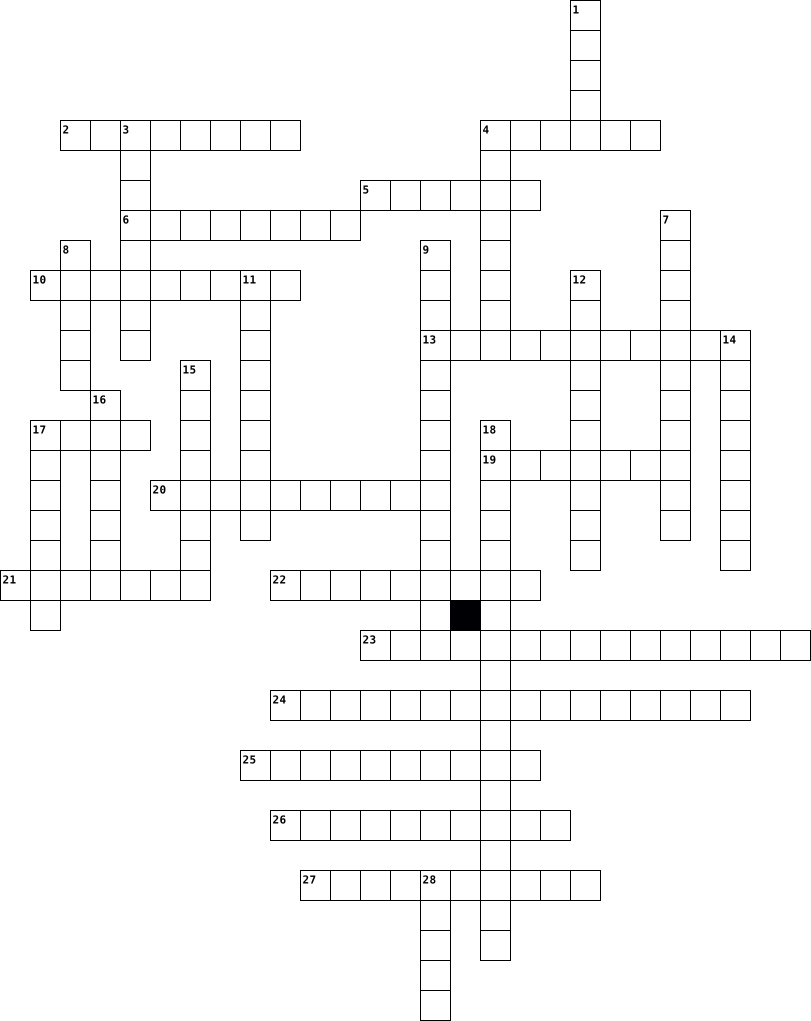
Across
- a chemical combination of two or more atoms of different elements
- Everything that exists in the universe is either made of matter or this, which does not occupy space or have mass
- Anything that occupies space, has physical and chemical properties
- an unstable mixture of two or more immiscible substances, plus an emulsifier
- a chemical reaction in which oxygen is subtracted from or hydrogen is added to a substance
- unstable physical mixture of undissolved particles in a liquid, glitter nail polish
- the basic unit of matter with a nucleus, that cannot be divided into simpler form
- 7 on the pH scale
- the tail of a surfactant molecule that is oil loving
- Physical ______ is a combination of substances held together by physical rather than chemical
- a molecule containing two or more atoms of the same element
- properties are characteristics that can only be determined by a chemical reaction
- 2wds. The study of all substances containing carbon
- physical _______ are characteristics that can be determined without a chemical reaction
- rapid oxidation of a substance with heat and light
- a substance that allows oil and water to mix
Down
- universal solvent
- a chemical combination of two or more atoms
- the simplest form of chemical matter
- the head of a surfactant molecule that is water loving
- aka oxidation-reduction, a chemical reaction which oxidation and reduction take place at the same time
- when one chemical changes it state of matter, it is called
- combining a substance with oxygen to produce oxide
- the separating of a substance into ions
- what is made when sugar is dissolved in water
- liquids that mix easily are known to be this
- a liquid used to dissolve a substance
- another name for bases is
- 2wds. The branch of chemistry that deals with products that do not contain carbon.
- Reducing _____ is a substance that adds hydrogen to a chemical compound or subtracts oxygen from a compound
30 Clues: universal solvent • 7 on the pH scale • another name for bases is • the simplest form of chemical matter • a liquid used to dissolve a substance • the separating of a substance into ions • a chemical combination of two or more atoms • liquids that mix easily are known to be this • a substance that allows oil and water to mix • what is made when sugar is dissolved in water • ...
Unit 5 Vocabulary List 1 2014-03-27

Across
- without a clearly defined shape or form
- a reaction that releases heat to the surrounding area
- composed of crystals
- the one- or two-letter representation of an element; symbols are often derived from the Latin name of the element
- a characteristic of a substance that is measurable or observable during a chemical reaction; includes pH, heat of combustion, reactivity, etc.
- a chemical reaction between two compounds where the cations in two compounds switch the anions they are bonded to, resulting in two new compounds; also called double-displacement reactions
- a system that can exchange matter and energy with outside sources
- a system that cannot exchange matter or energy with anything outside it
Down
- the change in state from a solid directly to a gas without passing through the liquid state
- a reaction that absorbs energy in the form of heat
- a reaction in which one atom or ion in a compound is replaced by another atom or ion
- a set of symbols used to describe the elements within a substance
- a chemical reaction; a process that changes substances into new substances (related word: chemical reaction)
- a fundamental principle of science stating that mass cannot be created or destroyed in a closed system through ordinary chemical or physical means
- a reaction in which two or more elements or compounds combine to form a more complex compound
- solid particles that have been separated from a solution
16 Clues: composed of crystals • without a clearly defined shape or form • a reaction that absorbs energy in the form of heat • a reaction that releases heat to the surrounding area • solid particles that have been separated from a solution • a set of symbols used to describe the elements within a substance • a system that can exchange matter and energy with outside sources • ...
Chemical Reactions 2016-10-31

Across
- The original substance
- One element replaces another element in a compound
- The minimum amount of energy to start a chemical reaction
- a chemical reaction that requires heat
Down
- Reaction: A chemical reaction in which heat is released to the surroundings
- Two ionic compounds exchange ions in solution to form two new compounds
- Changes the rate of a chemical rate of a chemical reaction w/o being used up or changed very much
- A compound decomposes into two or more simpler substances
- A substance that slows down or stops a chemical reaction
- Two or more substances combine to form a new compound
- The new substance
11 Clues: The new substance • The original substance • a chemical reaction that requires heat • One element replaces another element in a compound • Two or more substances combine to form a new compound • A substance that slows down or stops a chemical reaction • A compound decomposes into two or more simpler substances • The minimum amount of energy to start a chemical reaction • ...
Chemistry Christmas Extravaganza 2025-12-17

Across
- Element with a mass number of 12.
- Plant commonly associated with Christmas.
- How many gold rings were given on the 5th day of Christmas?
- Person made of frozen water.
- Bird in the pear tree.
- Compound with an Mr of 44 (2)
- In a solution, the number of molecules in a specific volume.
- The chemicals before the arrow in a chemical reaction.
- Element with a mass number of 24.
Down
- A liquid in which things dissolve.
- A chemical that dissolves.
- What is conserved in a chemical reaction?
- Compound with an Mr of 18
- The chemicals after the arrow in a chemical reaction.
- Period of time leading up to Christmas.
- Bird with red chest that appears in winter.
- Santa's first reindeer.
17 Clues: Bird in the pear tree. • Santa's first reindeer. • Compound with an Mr of 18 • A chemical that dissolves. • Person made of frozen water. • Compound with an Mr of 44 (2) • Element with a mass number of 12. • Element with a mass number of 24. • A liquid in which things dissolve. • Period of time leading up to Christmas. • Plant commonly associated with Christmas. • ...
Unit 5 Vocabulary List 1 2014-03-27

Across
- the one- or two-letter representation of an element; symbols are often derived from the Latin name of the element
- a reaction in which one atom or ion in a compound is replaced by another atom or ion
- a reaction that releases heat to the surrounding area
- a fundamental principle of science stating that mass cannot be created or destroyed in a closed system through ordinary chemical or physical means
- a system that can exchange matter and energy with outside sources
- a set of symbols used to describe the elements within a substance
- a chemical reaction; a process that changes substances into new substances (related word: chemical reaction)
- composed of crystals
Down
- a reaction in which two or more elements or compounds combine to form a more complex compound
- solid particles that have been separated from a solution
- a system that cannot exchange matter or energy with anything outside it
- a chemical reaction between two compounds where the cations in two compounds switch the anions they are bonded to, resulting in two new compounds; also called double-displacement reactions
- a reaction that absorbs energy in the form of heat
- a characteristic of a substance that is measurable or observable during a chemical reaction; includes pH, heat of combustion, reactivity, etc.
- the change in state from a solid directly to a gas without passing through the liquid state
- without a clearly defined shape or form
16 Clues: composed of crystals • without a clearly defined shape or form • a reaction that absorbs energy in the form of heat • a reaction that releases heat to the surrounding area • solid particles that have been separated from a solution • a system that can exchange matter and energy with outside sources • a set of symbols used to describe the elements within a substance • ...
chapter6 vocabulary 2013-11-19

Across
- a reaction in which 1 species is oxidized and another species is reduced
- a reaction in which a single compound brakes down to for 2 or more simpler substances
- a chemical reaction in which head is released to the surroundings
- a substance that forms a chemical reaction
Down
- a substance or molecule that participates in a chemical reaction
- the energy released when a chemical compound reacts to produce new compounds
- a representation of a chemical reaction that uses symbols to show the relationship between the reactants and the products
- an organic group that has one or more electrons available for bonding
- the oxidation reaction of an organic compound
- a reaction in which 1 element or radical takes the place of another element
- the process in which an electric current is used to produce a chemical reaction
11 Clues: a substance that forms a chemical reaction • the oxidation reaction of an organic compound • a substance or molecule that participates in a chemical reaction • a chemical reaction in which head is released to the surroundings • an organic group that has one or more electrons available for bonding • ...
Efrain - Chemistry 2019-10-17

Across
- substance that is formed as the result of a chemical reaction
- mass- mass of one atom
- property-a substance that is observed when its in a chemical reaction
- A thing that is composed into two or separate elements
- a wide glass container with a flat bottom and an edge for pouring, used in science laboratories
- of definite properties-Chemicals combining in specific amounts
- A substance that can be in solid form from a solution
- rope-one of many forms of a chemical element, for example, coal and graphite
- reactants are the starting materials in a chemical reaction
- a solution is a homogeneous mixture of two or more substances
Down
- Is the particle in the atomic nucleus with a mass
- property-Material does not change
- Mixture that is the same
- Famous for making the periodic table
- A part or aspect of something abstract
- a stable subatomic particle with a charge of negative electricity
- basic -building blocks of ordinary matter
- a stable subatomic particle occurring in all atomic nuclei
- Table-A table of the chemical elements arranged in order of atomic number
19 Clues: mass- mass of one atom • Mixture that is the same • property-Material does not change • Famous for making the periodic table • A part or aspect of something abstract • basic -building blocks of ordinary matter • Is the particle in the atomic nucleus with a mass • A substance that can be in solid form from a solution • A thing that is composed into two or separate elements • ...
Unit 6 Chemical Reaction 2022-04-29

Across
- process that involves rearrangement of the molecular or ionic structure of a substance.
- reactant that determines the amount of product formed (i.e. reactant that gets used up first).
- reaction in which two aqueous compounds, react to form a solid.
- Reaction in which electrons are transferred between compounds.
- loss of electrons.
- gain of electrons.
- a substance that is formed as the result of a chemical reaction. These are located to the right side of the yield sign.
- One reactant breaks down into to or more products.
Down
- reaction in which a compound reacts with oxygen gas to form water and carbon dioxide.
- reaction in which an acid reacts with a base to form water and a salt.
- the solid that is formed in the products of a precipitation reaction.
- ratio between the amounts in moles of any two compounds from a given reaction.
- reaction in which 2 compounds, combine to form 1 product.
- Substance that enters into and is altered in the course of a chemical reaction. Found on the left side of the yield sign.
- reactant in a chemical reaction with a greater amount than necessary, meaning it is not completely consumed.
- substance that has been dissolved in water.
16 Clues: loss of electrons. • gain of electrons. • substance that has been dissolved in water. • One reactant breaks down into to or more products. • reaction in which 2 compounds, combine to form 1 product. • Reaction in which electrons are transferred between compounds. • reaction in which two aqueous compounds, react to form a solid. • ...
Unit 10 Crossword 2021-05-06

Across
- In an endothermic reaction, these have higher energy
- The type of energy that the sun radiates
- A law of science that says that energy cannot be created or destroyed
- This process is the first step of any chemical reaction and requires energy
- The unit of energy
- The type of energy commonly referred to as heat
- On an energy diagram, the amount of energy needed to break the bonds of the reactants
- A reaction that absorbs heat from its surroundings
- A reaction that releases heat to its surroundings
Down
- Stored Energy
- The type of energy that has to do with vibration of air molecules
- In an exothermic reaction, these have higher energy
- The type of energy that is associated with electrons flowing through a wire
- Energy that is stored inside chemical bonds
- This process is the second step of any chemical reaction and releases energy
- Energy that is stored inside the nucleus of an atom
- The energy of motion
17 Clues: Stored Energy • The unit of energy • The energy of motion • The type of energy that the sun radiates • Energy that is stored inside chemical bonds • The type of energy commonly referred to as heat • A reaction that releases heat to its surroundings • A reaction that absorbs heat from its surroundings • In an exothermic reaction, these have higher energy • ...
science 2023-11-06

Across
- the combining of the constituent elements of separate material or abstract entities into a single or unified entity
- a reaction in which one element is substituted for another element
- a substance that speeds up a chemical reaction, or lowers the temperature or pressure needed
- symbolic representations of chemical reactions in which the reactants and the products are expressed
- substances initially present in a chemical reaction that are consumed during the reaction to make products
Down
- results when water losses from the body exceed water replacement
- a process in which one or more substances, the reactants, are converted to one or more different substances
- noting or pertaining to a chemical change that is accompanied by a liberation of heat
- a chemical reaction between substances
- product is a substance that is formed as the result of a chemical reaction
- a group of two or more atoms that form the smallest identifiable unit
- noting or pertaining to a chemical change that is accompanied by an absorption of heat
12 Clues: a chemical reaction between substances • results when water losses from the body exceed water replacement • a reaction in which one element is substituted for another element • a group of two or more atoms that form the smallest identifiable unit • product is a substance that is formed as the result of a chemical reaction • ...
Science competition 2019-03-11

Across
- Where scientists record results.
- Diagram to show the state of a substance.
- Burning.
- French chemist famous for the law of conservation of mass.
- Experimental variable which is measured.
- Explosive gas.
- Unit of force.
- Shows reactants and products in a chemical reaction.
- Point at which a solid becomes a liquid.
- Science graduates can expect to earn more of this.
Down
- Speeds up a chemical reaction.
- Two or more elements chemically bonded.
- Goggles help to ensure this.
- Point at which a liquid becomes a gas.
- Experimental variable which is changed.
- Solid, liquid or gas.
- Fuel with one carbon atom and four hydrogen atoms.
- Made in a chemical reaction.
- Liquid product of combustion.
- Sound, heat and light are types of this.
20 Clues: Burning. • Explosive gas. • Unit of force. • Solid, liquid or gas. • Goggles help to ensure this. • Made in a chemical reaction. • Liquid product of combustion. • Speeds up a chemical reaction. • Where scientists record results. • Point at which a liquid becomes a gas. • Two or more elements chemically bonded. • Experimental variable which is changed. • ...
Chemistry 2024-06-07

Across
- Atom or molecule with a net electric charge
- Atoms of the same element with different numbers of neutrons
- Negatively charged particle
- Two or more atoms bonded together
- Connection between atoms
- Positively charged particle
- Electrons in the outer shell of an atom
- Substance that speeds up a chemical reaction
- Pure substance consisting of one type of atom
Down
- Substance that donates protons
- Substance that accepts protons
- Center of an atom containing protons and neutrons
- Substance that dissolves a solute
- Substance dissolved in a solvent
- Neutral particle in the nucleus
- Substance composed of two or more elements
- Process of chemical change
- Table of elements
- Measure of acidity or basicity
- Basic unit of a chemical element
- Product of an acid-base reaction
21 Clues: Table of elements • Connection between atoms • Process of chemical change • Negatively charged particle • Positively charged particle • Substance that donates protons • Substance that accepts protons • Measure of acidity or basicity • Neutral particle in the nucleus • Substance dissolved in a solvent • Basic unit of a chemical element • Product of an acid-base reaction • ...
Bio U3 C1 Crossword 2026-01-12

Across
- Break down larger molecules into simpler compounds
- Build larger molecules from smaller ones
- Releases energy
- Substances that are changed during a chemical reaction
- The amount of energy needed to start a chemical reaction
- A location on an enzyme that specifically fits one substrate
- Substances that are changed during a chemical reaction
- All chemical reactions within each cell
Down
- The breaking/forming of bonds between different substances during chemical changs
- An enzyme's active site gets deformed and loses its biological activity
- Substances that are made during a chemical reaction
- Absorbs energy
- Enzyme that speeds up a reaction without being permanently altered
- Proteins that speed up reactions by lowering the activation energy
14 Clues: Absorbs energy • Releases energy • All chemical reactions within each cell • Build larger molecules from smaller ones • Break down larger molecules into simpler compounds • Substances that are made during a chemical reaction • Substances that are changed during a chemical reaction • Substances that are changed during a chemical reaction • ...
Chemistry Unit 2016-02-10

Across
- any combination of two or more elements
- the mass of the products in a chemical reaction must equal the mass of the reactants
- below the element symbol
- absorbs energy
- path taken by electrons
- energy released as heat
- example:Hydrogen
- example:Calcium
- example:Boron
- positive part in the nucleus
- 2,8,8,2
- the middle of an atom
- elements from top to bottom
Down
- what was put into a chemical reaction
- any combination of elements
- creator of Peroidic Table
- number of electrons
- farthest electron from the middle
- what represents an atom
- makes everything
- example:Helium
- elements from left to right
- formed by a chemical reaction
- makes up the Periodic Table
- neutral part in the nucleus
- fast and slow______.
26 Clues: 2,8,8,2 • example:Boron • absorbs energy • example:Helium • example:Calcium • makes everything • example:Hydrogen • number of electrons • fast and slow______. • the middle of an atom • what represents an atom • path taken by electrons • energy released as heat • below the element symbol • creator of Peroidic Table • any combination of elements • elements from left to right • ...
Noah Seger Unit 2 2025-03-21

Across
- cell membrane that allow substrates to flow
- movment of molucues from high constration to low constraition
- the movement of water molecules
- movement of cells moving
- something made of cells
- region where an enzyme binds
- structure for living organisms
- a group of cells to perform a function
- to function in the cell
- is a liquid that manages the compont of cell membrane
- mouluces that are formed in a chemical reaction
Down
- triggering a bioligical process
- water-lovinger
- where a protien loses its shape
- biomolecule that speeds up a chemical reaction
- when enyzme acts in a chemical reaction
- cells that move without energy
- a group of differnt organs
- two atoms bonded together
- is the basic unit of matter
- water fearing
- composed of different tissue
22 Clues: water fearing • water-lovinger • something made of cells • to function in the cell • movement of cells moving • two atoms bonded together • a group of differnt organs • is the basic unit of matter • region where an enzyme binds • composed of different tissue • cells that move without energy • structure for living organisms • triggering a bioligical process • ...
CR + P 2022-11-04

Across
- a light absorbing pigment, reflects green
- what reacts in a chemical reaction
- sugar
- how heterotrophs make get their energy.
- a pore in plants that control the gas exchange.
- where photosynthesis takes place
- atomic number eight on the periodic table
Down
- a reaction irreversible by physical means.
- the powerhouse of the cell
- energy as a result of electromagnetic radiation
- the process in which autotrophs make their food.
- what is produced by a chemical reaction
- an organism that cannot make its own food.
- Adenosine 5′-triphosphate (energy)
- A compound of one Carbon and two oxygen atoms
- an organism that makes it’s own food, self sufficient.
16 Clues: sugar • the powerhouse of the cell • where photosynthesis takes place • what reacts in a chemical reaction • Adenosine 5′-triphosphate (energy) • what is produced by a chemical reaction • how heterotrophs make get their energy. • a light absorbing pigment, reflects green • atomic number eight on the periodic table • a reaction irreversible by physical means. • ...
ur mom - miranda reyes 2021-10-25

Across
- a chemical reaction in which one element replaces another in a compound
- reactions that occur when two different atoms or molecules interact to form a different molecule or compound
- a representation of a chemical reaction using symbols of the elements to indicate the amount of substance, usually in moles, of each reactant and product
- occur when parts of two ionic compounds are exchanged, making two new compounds
- a substance that is present at the end of a chemical reaction.
- a character, usually a letter or number, that's printed slightly below and to the side of another character
- a substance that enters into and is altered in the course of a chemical reaction.
Down
- states that in a chemical reaction mass is neither created nor destroyed.
- a chemical reaction between substances, usually including oxygen and usually accompanied by the generation of heat and light in the form of flame
- a constant term related to the properties of a product.
- a reaction in which a compound breaks down into two or more simpler substances.
- identifies each constituent element by its chemical symbol and indicates the proportionate number of atoms of each element.
- an arrow that is placed after the reactant or reactants
13 Clues: a constant term related to the properties of a product. • an arrow that is placed after the reactant or reactants • a substance that is present at the end of a chemical reaction. • a chemical reaction in which one element replaces another in a compound • states that in a chemical reaction mass is neither created nor destroyed. • ...
Chemical Reactions 2025-04-24

Across
- / The starting materials in a chemical reaction.
- / A state of matter often released during a chemical reaction, like bubbles.
- / What happens when two or more substances combine to form something new.
- / A sign that a gas is forming during a chemical reaction.
- / The new substance(s) made after a chemical reaction.
Down
- / A liquid acid that reacts with baking soda in a popular experiment.
- / What a chemical reaction causes in the original substances.
- / A factor that can speed up or slow down a chemical reaction.
- / A base that fizzes when mixed with vinegar.
- / One of the signs that a chemical reaction has occurred if it changes.
10 Clues: / A base that fizzes when mixed with vinegar. • / The starting materials in a chemical reaction. • / The new substance(s) made after a chemical reaction. • / A sign that a gas is forming during a chemical reaction. • / What a chemical reaction causes in the original substances. • / A factor that can speed up or slow down a chemical reaction. • ...
METALS AND ACIDS 2024-05-14

Across
- This change can indicate a chemical reaction has occurred
- This metal is essential for healthy teeth and bones
- This gas is produced when metals are added to acids
- This is a group one metal that burns with a lilac flame in water
- This acid produces nitrates when added to metals
- This salt is produced when sulfuric acid is added to metals
- These can be produced when a chemical reaction takes place
Down
- This acid produces chloride salts when added to metals
- This has a pH of between 0 and 7
- This metal burns with an intense bright white light
- This change can happen if a chemical reaction has happened
- This form of energy can be released when a chemical reaction takes place
- This metal is found in table salt
- This can be emitted when a chemical reaction takes place
14 Clues: This has a pH of between 0 and 7 • This metal is found in table salt • This acid produces nitrates when added to metals • This metal is essential for healthy teeth and bones • This metal burns with an intense bright white light • This gas is produced when metals are added to acids • This acid produces chloride salts when added to metals • ...
Unit 9 💥 Reactions ☢️ 2024-05-28

Across
- - radioactive decay by emission of an alpha particle - 4/2 He
- - radioactive decay by emission of a gamma ray - 0/0 y
- - a chemical reaction in which two or more substances react to yield a single product
- - increases the hydroxide ion concentration in a solution (ends with OH)
- - a substance or molecule that participates in a chemical reaction; on the left side
- - a solid that forms and settles out of a liquid mixture
- - a nuclear reaction in which a heavy nucleus splits with the release of energy
- - a substance or molecule that is formed during a chemical reaction; on the right side
- - a chemical change in which a single compound is broken down into two or more simpler products
- - acid and base combine to form salt and water
Down
- - radioactive decay in which an electron is emitted - 0/-1 e
- - a chemical reaction that involves a substance rapidly combining with oxygen to form one or more oxides
- - law of __________ of mass states that mass cannot be created or destroyed
- - increases the hydrogen ion concentration of a solution (begins with H)
- - the amount of time it takes for one half of unstable nuclei to become stable
- - _______-displacement - one element takes the place of another element in a compound
- - a nuclear reaction in which 2 nuclei fuse to form a heavier nucleus with the release of energy
- - _______-displacement - ions of two compounds exchange places in an aqueous solution to form two new compounds
18 Clues: - acid and base combine to form salt and water • - radioactive decay by emission of a gamma ray - 0/0 y • - a solid that forms and settles out of a liquid mixture • - radioactive decay in which an electron is emitted - 0/-1 e • - radioactive decay by emission of an alpha particle - 4/2 He • - increases the hydroxide ion concentration in a solution (ends with OH) • ...
Chemistry Crossword 2024-04-21

Across
- Substances that are formed by a chemical change in a reaction
- The top point of a wave
- An equality statement in fraction form that helps you convert between units
- A shape of molecule where there are 3 electron domains around the central atom
- A type of reaction where a hydrocarbon reacts with oxygen gas to produce carbon dioxide and water vapor
- The distance between two consecutive points on a wave
- The amount of moles in volume of solution
- A shape of molecule where there are 4 electron domains around the central atom
- A region on the central atom of a molecule where electrons are most likely to be found (bonding and nonbonding electrons)
- A type of reaction that involves two ionic compounds where the cations switch places
- The unit of particles for an ionic compound
- A type of chemical reaction in which multiple substances form a single product
- The number of particles present in one mole of substance
- A shape of molecule where there are 3 bonds and 1 lone pair of electrons on the central atom
- A chemical substance that releases H+ ions in aqueous solutions
- A type of chemical reaction that involves a single element and an ionic compound where the single element switches places with the like element in the compound
- A bond formed when electrons are shared between two atoms
- A chemical substance that releases OH- ions in aqueous solutions
- The rate of occurrence of a wave
- The acronym that stands for Valence Shell Electron Pair Repulsion Theory
- A solution in which a solid is dissolved in water
- The geometry of where atoms are in relation to a central atom, only taking into account the bonding electrons
Down
- A solid that forms from a reaction between two aqueous solutions
- A type of electron that participates in bonding
- A number that indicates how many atoms are present in a molecule
- A type of chemical reaction in which a single substance breaks down into multiple substances
- A shape of molecule where there are 2 electron domains around the central atom
- The breakdown of ions in an aqueous solution
- Substances that are destroyed by a chemical change in a reaction
- A chart used to predict the states of matter of compounds
- A bond formed when electrons are transferred from one to another
- The arrangement of electrons in orbitals around the nucleus
- The unit of particles for an element
- A chemical reaction in which an acid and base react with one another to produce water and a salt solution
- The mass of a substance in grams
- A chart used to predict if a single replacement reaction will occur
- Electrons follow these pathways around the nucleus of the atom
- A number that indicates the charge of an ion
- Diagram that shows the valence electrons of an atom
- A number that indicates how many moles of a substance are present in a balanced chemical reaction
- A pair of electrons on the central atom of a molecule that do not participate in bonding
- The height of the wave
- The geometry of where atoms are in relation to a central atom, taking into account both bonds and lone pairs of electrons
- Reducing the number of moles of solute per unit volume of solution
- The bottom point of a wave
- The unit of particles for a covalent compound
46 Clues: The height of the wave • The top point of a wave • The bottom point of a wave • The mass of a substance in grams • The rate of occurrence of a wave • The unit of particles for an element • The amount of moles in volume of solution • The unit of particles for an ionic compound • The breakdown of ions in an aqueous solution • A number that indicates the charge of an ion • ...
ENDO & EXO Word Puzzle 2023-11-30

Across
- a link between atoms
- a written problem of chemical reactions
- molecules needed to break and repair bonds
- when molecules undergo a molecular rearrangement to produce a physical change
- a change of state from liquid to solid
- Delta H exothermic reaction
- things they start with
- a reaction that changes the physical properties of a substance or molecule
- Endothermic reaction
Down
- the ending thing
- the release of heat
- H Enthalpy change
- Delta H endothermic reaction
- unit of measurement equal to 1,000 joules
- take in heat
- an Endothermic reaction where heat is absorbed
16 Clues: take in heat • the ending thing • the release of heat • a link between atoms • Endothermic reaction • H Enthalpy change • things they start with • Delta H exothermic reaction • Delta H endothermic reaction • a change of state from liquid to solid • a written problem of chemical reactions • unit of measurement equal to 1,000 joules • molecules needed to break and repair bonds • ...
Bundle 2 Vocabulary Review 2021-03-22

Across
- The smallest particle of an element; made of protons, neutrons and electrons
- New substances created from 2 or more substances with different chemical and physical properties
- Shorthand notation system using chemical symbols and subscript numbers representing the type of chemical and number of atoms to form the smallest unit of a substance
- A number placed in front of a chemical symbol or formula that represents the the number of molecules
- A solid substance that is formed from a chemical reaction
- A substance produced by a chemical reaction
- Characteristics that can be observed or measured when undergoing a chemical change into a new substance
- Chemical formulas and symbols written to represent chemical reactions
- A single substance, either elements or compounds, with a definite definition and properties
- A characteristic that can be observed without changing the substance
- A substance that takes part in and undergoes a change in chemical reaction
- A measure of the amount of matter in an object
Down
- Scientific law stating that matter/mass can not be created or destroyed; mass of reactants and products must be equal
- Chemical and physical characteristics of a substance that can be observed and used to classify matter
- The process of changing one or more substances into new different substance(s)
- Materials made from natural substances that undergo chemical reactions
- Simplest unit of chemical compounds created from 2 or more atoms joined together
- The method of changing one or more substances
- A number below and to the right of a chemical symbol to represent the number of a specific type of atom present
- To prevent the loss of something
20 Clues: To prevent the loss of something • A substance produced by a chemical reaction • The method of changing one or more substances • A measure of the amount of matter in an object • A solid substance that is formed from a chemical reaction • A characteristic that can be observed without changing the substance • ...
Crossword 2014-08-19

Across
- A mixture of finely powdered aluminium and iron oxide that produces a very high temperature on combustion, used in welding and for incendiary bombs.
- Two or more reactants combine to form a single product.
- A chemical reaction where two reactant ionic compounds exchange ions to form two new product compounds with the same ions.
- A reaction in which soluble ions in separate solutions are mixed together to form an insoluble compound that settles out of solution as a solid.
- A relation stating that in a chemical reaction, the mass of the products equals the mass of the reactants.
- A chemical reaction expressed in words rather than chemical formulas.
- Interaction of two or more chemicals that produces one or more new chemical compounds, or alters the properties of the mixed chemicals.
Down
- The separation of a chemical compound into elements or simpler compounds
- A substance that takes part in and undergoes change during a reaction.
- Type of reaction where part of one reactant is replaced by another reactant.
- A substance that is formed as the result of a chemical reaction
- A red-brown metal, the chemical element of atomic number 29.
- A substance which has a molecular structure built up almost or completely from a large number of similar units bonded together
13 Clues: Two or more reactants combine to form a single product. • A red-brown metal, the chemical element of atomic number 29. • A substance that is formed as the result of a chemical reaction • A chemical reaction expressed in words rather than chemical formulas. • A substance that takes part in and undergoes change during a reaction. • ...
Chapter 13 Crossword By: Jacob Blanchard 2017-10-11

Across
- A chemical that donates a hydrogenion, H+.
- When two atoms are displaced in a formula
- Any substance that increases the rate of a chemical reaction
- A measure of the acidity of a solution
- The amount of energy required to pull 2 bonded atoms apart
Down
- When one atom is displaced in a formula
- The minimum amount of energy required in order for a chemical reaction to proceed
- A chemical reaction when there is a net release of energy
- Reaction where oxides are formed
- A chemical reaction where there is a net absorption of energy
- The new materials formed in a chemical reaction
11 Clues: Reaction where oxides are formed • A measure of the acidity of a solution • When one atom is displaced in a formula • When two atoms are displaced in a formula • A chemical that donates a hydrogenion, H+. • The new materials formed in a chemical reaction • A chemical reaction when there is a net release of energy • ...
Chemistry Crackers! 2025-06-16

Across
- A solid that forms from a solution during a chemical reaction
- Substance that speeds up a reaction without being used up
- A reaction where a more reactive element replaces a less reactive one
- Loss of electrons during a reaction
Down
- A reaction that releases heat
- Substances formed as a result of a chemical reaction
- Gain of electrons during a reaction
- A reaction that absorbs heat
- Substances that start a chemical reaction
- A symbolic representation of a chemical reaction
10 Clues: A reaction that absorbs heat • A reaction that releases heat • Gain of electrons during a reaction • Loss of electrons during a reaction • Substances that start a chemical reaction • A symbolic representation of a chemical reaction • Substances formed as a result of a chemical reaction • Substance that speeds up a reaction without being used up • ...
Chemistry Revision Crossword By Eli and Jack 2013-09-19

Across
- Chemicals that take part in a reaction
- Chemiclas produced in a chemical reaction
- A substance that releases hydrogen ions into an aqeous solution
- A reaction of a base and acid resulting in a salt and water
- An endothermic reaction that takes place in green plants, uses energy from sunlight to combine carbon dioxide and water to produce glucose and oxygen
- A chemical that changes colour to show wheather a substance is acidic, neutral or basic
- A biological catalyst that speeds up a reaction
Down
- A common indicator that turns red in the presence of an acid and blue in the presence of a base
- A green chemical in the chloroplast of green plants
- A term used to describe materials that store arbon in thei stucture
- A base that dissolves in water
- The term commonly used for sodium chloride, but covers any compound formed by a metal taking the place of a hydrogen atom in an acid
- A scale used to measure the concentration of H+ ions in a solution
- A soltion made of a base/alkali and water
- A chemical reaction in which glucose is broken down, releasing energy for use by the plant or animal
- A simple sugar formed by photosynthesis used in respiration
- Process in which chemicals move, caused by different concentrations of metals
- single celled organisms that live in water
- Rain that has acid such as nitric and sulfuric acid dissolved in it
- A substance that releases OH- ions
20 Clues: A base that dissolves in water • A substance that releases OH- ions • Chemicals that take part in a reaction • Chemiclas produced in a chemical reaction • A soltion made of a base/alkali and water • single celled organisms that live in water • A biological catalyst that speeds up a reaction • A green chemical in the chloroplast of green plants • ...
U3 Part 1: Reactions 2021-10-20

Across
- one element is replaced by another
- absorbs heat
- chemical breakdown
- releases heat
- measure of the quantity of moles in a reaction
- exploding
- mass remains the same
- number placed in front of a chemical symbol
- same amount of atoms on both sides
Down
- reactivity from highest to lowest
- two different atoms form a different compound
- solid that dissolves in liquid
- a substance that is present at the end of a chemical reaction
- knowing a product in advance
- when two ions bond together to form an insoluble salt
- two elements are replaced by another
- rearrange of molecular structure
- substance that undergoes change during a reaction
- two atoms
- does not dissolve in liquid
- aq s l g
- amounts in moles of any two compounds
22 Clues: aq s l g • two atoms • exploding • absorbs heat • releases heat • chemical breakdown • mass remains the same • does not dissolve in liquid • knowing a product in advance • solid that dissolves in liquid • rearrange of molecular structure • reactivity from highest to lowest • one element is replaced by another • same amount of atoms on both sides • two elements are replaced by another • ...
Elements, Mixtures and Compounds 2023-11-18

Across
- yellow metal used to make jewellery
- particle formed when atoms join together
- compound with formula H2O
- unusual metal found in thermometers
- hard, strong material eg. copper
- substance formed when 2 elements bond
- chemical used in a reaction
- chemical formed in a reaction
- describes elements such as helium, oxygen and hydrogen
- the table where elements are listed
Down
- element which we breathe in
- family of similar elements
- non metal used to purify water
- tiny particle which makes up all substances
- row across the Periodic Table
- compound which we breathe out
- simplest chemicals
- side of the Periodic Table where you find metals
- chemical change which makes new materials
- metal element found in food cans
- metal used to make ladders and windows
21 Clues: simplest chemicals • compound with formula H2O • family of similar elements • element which we breathe in • chemical used in a reaction • row across the Periodic Table • compound which we breathe out • chemical formed in a reaction • non metal used to purify water • hard, strong material eg. copper • metal element found in food cans • yellow metal used to make jewellery • ...
PHOTOSYNTHESIS 2026-03-11

Across
- Cell’s main energy molecule
- An individual packet of energy
- Movement of protons to power ATP production
- Membrane where light reactions occur
- Gas released when water is split in photosynthesis
- Chemical reaction involving both oxidation and reduction
- Splitting of water using light
- Protein that makes ATP using a proton gradient
- Gain of electrons in a chemical reaction
Down
- Series of proteins passing electrons for energy
- Sugar produced from photosynthesis
- Breaking a molecule using water
- Proton (H⁺) used to create a gradient
- Green pigment that absorbs light
- High-energy electron carrier in photosynthesis
- Loss of electrons in a chemical reaction
- Space inside a thylakoid where protons build up
- Fluid surrounding thylakoids in chloroplasts
- Pigment complex that captures light energy
- Reactions that convert CO₂ into sugar
20 Clues: Cell’s main energy molecule • An individual packet of energy • Splitting of water using light • Breaking a molecule using water • Green pigment that absorbs light • Sugar produced from photosynthesis • Membrane where light reactions occur • Proton (H⁺) used to create a gradient • Reactions that convert CO₂ into sugar • Loss of electrons in a chemical reaction • ...
tanner pollard 2017-10-04

Across
- description of a chemical reaction on which there is a net release of energy
- the new materials formed in a chemical reaction
- an ionic compound commonly formed from the reaction between an acid and a base
- the minimum energy required in order for a chemical reaction to proceed
- the process by which a reactant loses one or more electrons
- the reacting substances in a chemical reaction
Down
- matter is neither created nor destroyed during a chemical reaction
- a rapid exothermic oxidation-reduction reaction between a material and molecular oxygen
- the amount of energy required to pull two bonded atoms apart
- description of a chemical reaction in which there is a net absorption of energy
- a measure of the acidity of a solution; equal to the negative logarithm of the hydronium ion concentration
11 Clues: the reacting substances in a chemical reaction • the new materials formed in a chemical reaction • the process by which a reactant loses one or more electrons • the amount of energy required to pull two bonded atoms apart • matter is neither created nor destroyed during a chemical reaction • the minimum energy required in order for a chemical reaction to proceed • ...
Chemical reactions 2018-01-23

Across
- A change of state
- Substances produced by a chemical reaction
- A reaction that releases heat and light
- The side of the arrow products are found on
- When the amount of something remains the same
- What is needed for a thermal decomposition reaction
Down
- This happens to the atoms in a chemical reaction
- The side of the arrow reactants are found on
- Substances shown before the arrow in an equation.
- A reaction were a new substance is formed
- A store of chemical energy
- Another word for heat
12 Clues: A change of state • Another word for heat • A store of chemical energy • A reaction that releases heat and light • A reaction were a new substance is formed • Substances produced by a chemical reaction • The side of the arrow products are found on • The side of the arrow reactants are found on • When the amount of something remains the same • ...
Science vocabulary Chemistry 2017-11-14

Across
- pure substance formed when at least one metal and one non-metal combine.
- new substance produced in a chemical reaction.
- amount of mass in a given volume of a substance.
- Mass of one atom of an element calculated from the total number of protons,neutrons, and electrons of that atom
- a chemical reaction that absorbs energy.
- homogeneous mixture; mixture of two or more pure substances that look like one substance.
- Invisible negatively charged particle that orbits the nucleus of an atom.
- table in which the elements are organized by their physical and chemical properties.
- cloudy mixture in which tiny particles of one substance are held within another, and the particles can be separated out.
- pure substance that cannot be broken down into other substances; substance made up of only one type of atom
- an experiment in which one or more products of a chemical reaction can escape.
Down
- chemical reaction that occurs when oxygen reacts with a substance to form a new substance and give off energy.
- how easily a substance can be stretched into wire.
- element that has both metallic and nonmetallic properties.
- neutral particle in the nucleus of an atom.
- principle that matter is not created or destroyed in a chemical reaction; the mass of the products always equals the mass of the reactants
- chemical combination of two or more elements in a specific ratio
- Measure of atomic mass.
- description of how a substance interacts with other substances, such as acids;chemical properties are observable only when achemical change occurs
- change that results when two or more substances react to create a different substance.
- change of state from solid to liquid.
- Group 1 elements in the periodic table, not including hydrogen.
- brittle element that does not conduct electricity.
- substance that helps a chemical reaction to proceed more quickly.
- group 18 elements in the periodic table; the most stable and unreactive elements.
- atom that has become electrically charged because it has lost or gained electrons; a positive ion is an atom that has lost one or more electrons;a negative ion is an atom that has gained one or more electrons
26 Clues: Measure of atomic mass. • change of state from solid to liquid. • a chemical reaction that absorbs energy. • neutral particle in the nucleus of an atom. • new substance produced in a chemical reaction. • amount of mass in a given volume of a substance. • how easily a substance can be stretched into wire. • brittle element that does not conduct electricity. • ...
chemistry vocabulary 2025-04-28

Across
- releases heat
- the smallest unit of chemistry
- change no chemical changes
- connection between 2 surfaces
- something that cant be broken down any more
- undergoes change in a reaction
- property the reactiveness of a thing
- the quality of being hot
- the ability to work
- absorbs heat
- change when 1 substance turns into 2 or more substances
- 2 or more elements combined
- the amount of matter
- a branch of science dealing with substances
Down
- a substance that increases chemical reaction
- the result of an action or process
- forming as a whole
- the amount something holds
- a group of atoms bonded together
- can be weighed takes up space
- the response to a situation
- property observable characteristic
- how hot or cold a thing is
- a substance made from mixing 2 or more thing together
24 Clues: absorbs heat • releases heat • forming as a whole • the ability to work • the amount of matter • the quality of being hot • the amount something holds • how hot or cold a thing is • change no chemical changes • the response to a situation • 2 or more elements combined • connection between 2 surfaces • can be weighed takes up space • the smallest unit of chemistry • ...
ur mom 2021-10-25

Across
- identifies each constituent element by its chemical symbol and indicates the proportionate number of atoms of each element.
- states that in a chemical reaction mass is neither created nor destroyed.
- a chemical reaction in which one element replaces another in a compound
- a character, usually a letter or number, that's printed slightly below and to the side of another character
- a representation of a chemical reaction using symbols of the elements to indicate the amount of substance, usually in moles, of each reactant and product
- a substance that enters into and is altered in the course of a chemical reaction.
Down
- a chemical reaction between substances, usually including oxygen and usually accompanied by the generation of heat and light in the form of flame
- a reaction in which a compound breaks down into two or more simpler substances.
- a substance that is present at the end of a chemical reaction.
- a constant term related to the properties of a product.
- reactions that occur when two different atoms or molecules interact to form a different molecule or compound
- occur when parts of two ionic compounds are exchanged, making two new compounds
- an arrow that is placed after the reactant or reactants
13 Clues: a constant term related to the properties of a product. • an arrow that is placed after the reactant or reactants • a substance that is present at the end of a chemical reaction. • a chemical reaction in which one element replaces another in a compound • states that in a chemical reaction mass is neither created nor destroyed. • ...
Final Exam Review 1 2014-05-12

Across
- oxygen combines with a substance and releases energy in the form of heat and light.
- specifies the actual number of atoms of each element in one molecule or formula unit of the substance.
- referred to as ideal gas constant.
- a chemical reaction in which two or more substances react to produce a single product.
- a formula that shows the smallest whole-number ratio of the elements of a compound, and may or may not be the same as the actual molecular formula.
- is a statement that uses chemical formulas to show the identities and relative amounts of the substances involved in a chemical reaction.
- the study of quantitative relationships between the amounts of reactants used and products formed by a chemical reaction.
- which are the substances formed during the reaction.
Down
- process by which the atoms of one or more substances are rearranged to form different substances.
- is one in which a single compound breaks down into two or more elements or new compounds.
- left over reactants
- the mass in grams of one mole of any pure substance.
- states that the volume of a given amount of a gas held at constant temperature varies inversely with the pressure.
- starting substances
- the substance dissolved in a solution.
- states that the volume of a given mass of a gas is directly proportional to its kelvin temperature.
- is the SI base unit used to measure the amount of a substance.
- limits the extent of the reaction and, thereby, determines the amount of product.
- a solid produced during a chemical reaction in a solution.
- a ratio between the numbers of moles of any two substances in a balanced equation.
- 6.02 x 10²³
- a substance dissolved in a solution.
22 Clues: 6.02 x 10²³ • left over reactants • starting substances • referred to as ideal gas constant. • a substance dissolved in a solution. • the substance dissolved in a solution. • the mass in grams of one mole of any pure substance. • which are the substances formed during the reaction. • a solid produced during a chemical reaction in a solution. • ...
Final Exam Review 1 2014-05-12

Across
- oxygen combines with a substance and releases energy in the form of heat and light.
- specifies the actual number of atoms of each element in one molecule or formula unit of the substance.
- referred to as ideal gas constant.
- a chemical reaction in which two or more substances react to produce a single product.
- a formula that shows the smallest whole-number ratio of the elements of a compound, and may or may not be the same as the actual molecular formula.
- is a statement that uses chemical formulas to show the identities and relative amounts of the substances involved in a chemical reaction.
- the study of quantitative relationships between the amounts of reactants used and products formed by a chemical reaction.
- which are the substances formed during the reaction.
Down
- process by which the atoms of one or more substances are rearranged to form different substances.
- is one in which a single compound breaks down into two or more elements or new compounds.
- left over reactants
- the mass in grams of one mole of any pure substance.
- states that the volume of a given amount of a gas held at constant temperature varies inversely with the pressure.
- starting substances
- the substance dissolved in a solution.
- states that the volume of a given mass of a gas is directly proportional to its kelvin temperature.
- is the SI base unit used to measure the amount of a substance.
- limits the extent of the reaction and, thereby, determines the amount of product.
- a solid produced during a chemical reaction in a solution.
- a ratio between the numbers of moles of any two substances in a balanced equation.
- 6.02 x 10²³
- a substance dissolved in a solution.
22 Clues: 6.02 x 10²³ • left over reactants • starting substances • referred to as ideal gas constant. • a substance dissolved in a solution. • the substance dissolved in a solution. • the mass in grams of one mole of any pure substance. • which are the substances formed during the reaction. • a solid produced during a chemical reaction in a solution. • ...
My Chemical World Part 2 2026-03-04

Across
- a metal that is liquid at room temperature
- group ________ are the halogens
- what is being reacted together in a chemical reaction to produce products
- atoms are __________ as the number of positive protons and number of negative electrons are equal
- positively charged particle, atomic number is based on the number of these
- the first electron shell can hold up to ____ electrons
- compounds made up of 2 elements end in _____
- a COLUMN in the Periodic Table is referred to a _________
- Group 0/8 are called the _________ gases
- fizzes across water's surface, bursts into a lilac flame
- fizzing/effervescence is evidence a chemical reaction has happened because it signs that a _______ is given off
- a ROW in the Periodic Table is referred to a _________
- element needed in compounds made up of 3 elements ending in -ate or -ite
- simple substances that cannot be broken down further, made up of only one type of atom
- every electron shell that is not the first electron shell can hold up to _____ electrons
Down
- atomic number 33 (chemical symbol: As)
- When a solid is produced in a chemical reaction, it is known as a _______________ reaction
- negatively charged particles that sit within shells around the nucleus
- the middle section of the Periodic Table are called __________ metals
- heat energy released (temperature rise) from a chemical reaction is called an ____________ reaction .
- a _______ is the result of having combined reactants
- Group 1 is the ________ metals
- dividing the Periodic Table into metals and non-metals
- a Group 7 halogen that us used in toothpaste
- a Group 0/8 element used for display signs
25 Clues: Group 1 is the ________ metals • group ________ are the halogens • atomic number 33 (chemical symbol: As) • Group 0/8 are called the _________ gases • a metal that is liquid at room temperature • a Group 0/8 element used for display signs • compounds made up of 2 elements end in _____ • a Group 7 halogen that us used in toothpaste • ...
Final Exam Review 2014-05-12

Across
- oxygen combines with a substance and releases energy in the form of heat and light.
- the study of quantitative relationships between the amounts of reactants used and products formed by a chemical reaction.
- starting substances
- is the SI base unit used to measure the amount of a substance.
- states that the volume of a given amount of a gas held at constant temperature varies inversely with the pressure.
- referred to as ideal gas constant.
- process by which the atoms of one or more substances are rearranged to form different substances.
- a ratio between the numbers of moles of any two substances in a balanced equation.
- the mass in grams of one mole of any pure substance.
- a solid produced during a chemical reaction in a solution.
Down
- left over reactants
- is a statement that uses chemical formulas to show the identities and relative amounts of the substances involved in a chemical reaction.
- is one in which a single compound breaks down into two or more elements or new compounds.
- a chemical reaction in which two or more substances react to produce a single product.
- 6.02 x 10²³
- states that the volume of a given mass of a gas is directly proportional to its kelvin temperature.
- a formula that shows the smallest whole-number ratio of the elements of a compound, and may or may not be the same as the actual molecular formula.
- the substance dissolved in a solution.
- a substance dissolved in a solution.
- specifies the actual number of atoms of each element in one molecule or formula unit of the substance.
- limits the extent of the reaction and, thereby, determines the amount of product.
- which are the substances formed during the reaction.
22 Clues: 6.02 x 10²³ • left over reactants • starting substances • referred to as ideal gas constant. • a substance dissolved in a solution. • the substance dissolved in a solution. • the mass in grams of one mole of any pure substance. • which are the substances formed during the reaction. • a solid produced during a chemical reaction in a solution. • ...
Types Of Reactions - Rehan Shibu 10-R 2024-05-05

Across
- This reaction happens when one reactant gets oxidised and other gets reduced during a reaction.
- Special type of decomposition reaction in which the reactant gets decomposed by heat.
- reaction in which two or more substances combine to form a single new substance.
- It is a condition in which aerial oxidation of unsaturated fat present in food gives it an unpleasant flavour and odour.
- An inorganic compound that is made of copper and sulphur and is blue in colour.
- A chemical reaction in which a more reactive element displaces a less reactive element from its compound.
- Special types of decomposition reaction in which the reactant gets decomposed by electricity.
- This reaction happens when a substance loses oxygen during a reaction.
- chemical reactions in which the reactants absorb heat energy from the surroundings to form products.
Down
- This reaction is also called as precipitation reaction.
- This is a type of reaction where a single reactant breaks down to give simpler products.
- This is a type of decomposition reaction where a reactant is broken down to simpler products in the presence of light.
- Reactions in which heat is released along with the formation of products.
- the insoluble solid which settles down after the completion of the chemical reaction.
- this is a process in which metals are eaten up gradually by the action of air, moisture and chemicals on their surfaces.
- Any reaction that produces a precipitate.
- This reaction is defined as the addition of an oxygen element or the removal of a hydrogen element to a substance.
17 Clues: Any reaction that produces a precipitate. • This reaction is also called as precipitation reaction. • This reaction happens when a substance loses oxygen during a reaction. • Reactions in which heat is released along with the formation of products. • An inorganic compound that is made of copper and sulphur and is blue in colour. • ...
Crossword Unit B Enzo & Audrey 2018-11-12

Across
- a new substance produced in a chemical reaction between reactants
- Most reactive especially in air and water
- A substance that can be pounded or rolled into sheets
- Are characteristics that can be used to describe a substance
- Examples include reaction with acids, ability to burn and reaction with air
- is a chemical reaction that takes place in the cells in your body.
- Often liquid or gas at room temperature, not shiny, are not ductile or malleable
- a substance that reacts with another substance or in a chemical reaction to create a new substance with different properties or products
- Can be in between metals and non metals
- Gas turning into a solid is called _______
Down
- The most stable and unreactive
- Any solid that can be stretched into a long wire
- an atom or a group of atoms that has become electrically charged because it has lost or gained electrons.
- a change in colour, odour, formation of a solid or a gas and release or absorption of energy (heat)
- React to air and water, less reactive than alkali metals
- when non-metals combine, they produce a pure substance
- is a chemical reaction that occurs when oxygen reacts with a substance to form a new substance and gives off energy
- Examples include melting and freezing
- The average mass of an element in atomic mass units (amu)
- is a slow chemical change that occurs when oxygen in the air reacts with a metal.
- takes place when two or more substances combine to form new substances
- Examples include colour and lustre
- Most reactive non metals
- Solid at room temperature, malleable, have conductivity
- Pure substances formed as a result of the attraction between particles of opposite charges called ions
25 Clues: Most reactive non metals • The most stable and unreactive • Examples include colour and lustre • Examples include melting and freezing • Can be in between metals and non metals • Most reactive especially in air and water • Gas turning into a solid is called _______ • Any solid that can be stretched into a long wire • A substance that can be pounded or rolled into sheets • ...
Crossword 2024-04-28

Across
- ________ rate is dependent on several factors, namely, nature of reactants, temperature, and concentration.
- An ________ reaction is characterized by a negative ∆U.
- Complex molecules made up of long chains of amino acids which are compounds of carbon, hydrogen, oxygen, and nitrogen.
- ________ is the study of the energy changes that accompany all processes, whether chemical or physical.
- The ________ theory explains the effects of temperature and concentration on reaction rate.
- Energy required to raise the temperature of one gram of a substance by one degree Celsius is referred to as its heat capacity.
- It is the total heat absorbed in a process at constant pressure if only pressure-volume work is done.
- Amount of thermal energy in a system per unit temperature that cannot be used for useful effort.
- The setup used to determine energy change during a reaction.
- Hormone that moves glucose from the blood stream into the cells.
Down
- A polysaccharide that does not provide the body with energy or nutrients.
- ________ is the enthalpy shift that occurs when one mole of a chemical is produced from its standard state constituents.
- Increase in ________ increases reaction rates.
- A ________ equation is a statement of the chemical change and the energy change that accompanies the change.
- Chemical and physical changes that occur with the absorption of energy are ________ processes.
- Substances that change the speed of a reaction without causing permanent changes.
- The study of energy alterations that coincide with matter's chemical reactions.
- Time required to decrease the reactant concentration to one-half of the initial value.
- The symbol w represents the ________ performed by the system or on the system.
- A substance's constant volume heat capacity is also known as its ______ heat capacity.
20 Clues: Increase in ________ increases reaction rates. • An ________ reaction is characterized by a negative ∆U. • The setup used to determine energy change during a reaction. • Hormone that moves glucose from the blood stream into the cells. • A polysaccharide that does not provide the body with energy or nutrients. • ...
Crossword 2024-04-28

Across
- Complex molecules made up of long chains of amino acids which are compounds of carbon, hydrogen, oxygen, and nitrogen.
- ________ rate is dependent on several factors, namely, nature of reactants, temperature, and concentration.
- A polysaccharide that does not provide the body with energy or nutrients.
- Hormone that moves glucose from the blood stream into the cells.
- It is the total heat absorbed in a process at constant pressure if only pressure-volume work is done.
- The symbol w represents the ________ performed by the system or on the system.
- A ________ equation is a statement of the chemical change and the energy change that accompanies the change.
- ________ is the enthalpy shift that occurs when one mole of a chemical is produced from its standard state constituents.
- A substance's constant volume heat capacity is also known as its ______ heat capacity.
- The study of energy alterations that coincide with matter's chemical reactions.
Down
- Energy required to raise the temperature of one gram of a substance by one degree Celsius is referred to as its heat capacity.
- Increase in ________ increases reaction rates.
- Time required to decrease the reactant concentration to one-half of the initial value.
- An ________ reaction is characterized by a negative ∆U.
- ________ is the study of the energy changes that accompany all processes, whether chemical or physical.
- The ________ theory explains the effects of temperature and concentration on reaction rate.
- The setup used to determine energy change during a reaction.
- Substances that change the speed of a reaction without causing permanent changes.
- Chemical and physical changes that occur with the absorption of energy are ________ processes.
- Amount of thermal energy in a system per unit temperature that cannot be used for practical work.
20 Clues: Increase in ________ increases reaction rates. • An ________ reaction is characterized by a negative ∆U. • The setup used to determine energy change during a reaction. • Hormone that moves glucose from the blood stream into the cells. • A polysaccharide that does not provide the body with energy or nutrients. • ...
Xavier Marquez's Chemistry Crossword 2017-02-27

Across
- A group of two or more atoms covalently bonded together
- A numerical measure of a physical or chemical property
- When a single atoms replaces another element in a compound
- Compound A compound that contains exactly two different elements
- A new type of material through chemical reactions
- When a compound steals electrons from other atoms or compounds
- when a chemical species decreases its oxidation number
- When the chemical has a rapid combination with Oxygen
- Product of chemical compounds
- The amount of product obtained in a chemical reaction
Down
- A substance that goes through change but does not change permanently
- When two reactants switch places, forming two new compounds
- When a liquid forms a solid
- A substance that undergoes change
- Breakdown of a chemical compound
- Chemical decomposition produced by passing an electric current
- Containing water, typically as a solvent or medium.
- Equation The visual representation of a chemical reaction
- Only consists of 2 atoms
19 Clues: Only consists of 2 atoms • When a liquid forms a solid • Product of chemical compounds • Breakdown of a chemical compound • A substance that undergoes change • A new type of material through chemical reactions • Containing water, typically as a solvent or medium. • When the chemical has a rapid combination with Oxygen • ...
Science vocabulary 2013-12-13

Across
- mass cannot be created of destroyed
- a substance that is formed in a chemical reaction
- speeds up a chemical reaction
- when heat is released
- makes a new substance with new properties
Down
- a process in which one or more substances are transformed into others
- slows down a chemical reaction
- are the biological substances that act as catalysts and help complex reactions occur everywhere in life
- a symbolic representation of a chemical reaction
- when heat is absorbed
- a substance that takes part in a chemical reaction
11 Clues: when heat is absorbed • when heat is released • speeds up a chemical reaction • slows down a chemical reaction • mass cannot be created of destroyed • makes a new substance with new properties • a symbolic representation of a chemical reaction • a substance that is formed in a chemical reaction • a substance that takes part in a chemical reaction • ...