
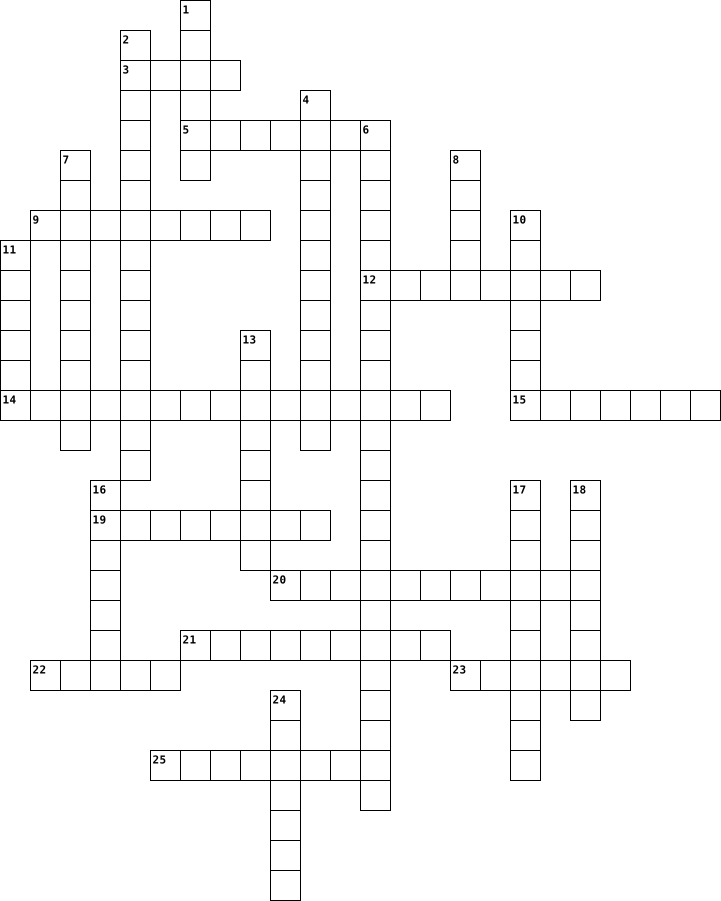
chemical reaction Crossword Puzzles
chemical reactions and equations 2021-06-10

Across
- Materials or substances that start a reaction
- A shorter way to show chemical reactions,using symbols instead of words
- States that during a chemical reaction,the matter cannot be created or destroyed.So the amount does not change.
- Material or substance produced in a reaction
- Is a number place in front of a chemical formula or symbol in a chemical equation
- In chemistry a one-letter or two-letter set of characters used to identify an element.
Down
- A type of reaction where elements in different compounds trade places or when an atom replaces another in a compound
- A combination of symbols that represent the elements in a compound
- Type of chemical reaction where a large,complex reactant compound breaks down into smaller,simpler products.
- Shows the number of a specific atom in a molecule or the ratio of elements in a compound
- A type of chemical reaction where two or more smaller reactants combine to form a larger,more complex product.
11 Clues: Material or substance produced in a reaction • Materials or substances that start a reaction • A combination of symbols that represent the elements in a compound • A shorter way to show chemical reactions,using symbols instead of words • Is a number place in front of a chemical formula or symbol in a chemical equation • ...
Chemistry crossword 2021-07-12

Across
- Fatty foods become rancid due to the process of __
- what type of reaction is represented by digestion in our body
- Oxide of which element is used as major ingredient in cement
- aqueous solution of sodium chloride is known as?
- Equation which doesn't follow the law of conservation of mass
- When Carbon Dioxide passes through lime water it turns lime water?
- plaster of paris changes to ___ on mixing with wate
- hydrogen gas burns with __ sound
- ___agent reduces the other reactant and oxidizes itself
- oxidation of fats and oils which makes the smell and taste bad is known as?
- __ gas is filled in packet of chips to prevent rancidity
Down
- Gas evolved when zinc reacts with dilute HCL
- What does the symbol (aq) represent in a chemical equation
- On heating calcium carbonate turns into calcium __
- we should never change __ of formula
- white silver chloride changes into ___colour when exposed to sunlight
- change in state is ___ reaction
- Respiration is example of _ reaction?
- PH stands for ___in German meaning power
- indicator is a substance whose smell varies depending on whether it is mixed with an acidic or basic solution
- brown flake substance acquires on the surface of iron after long exposure to moisture is ?
- ___Displacement reaction is a chemical reaction in which a more reactive element displaces a less reactive element from its compound
22 Clues: change in state is ___ reaction • hydrogen gas burns with __ sound • we should never change __ of formula • Respiration is example of _ reaction? • PH stands for ___in German meaning power • Gas evolved when zinc reacts with dilute HCL • aqueous solution of sodium chloride is known as? • Fatty foods become rancid due to the process of __ • ...
CW 03- Chemical Reaction Crossword 2024-01-25

Across
- 6.022 x 10^23
- Occurs when bonds between molecules are broken or formed
- Compound + Compound --> Compound + Compound
- Acid + Base → Salt (ionic compound) + water
- Neutral subatomic particle
- Hydrocarbon + Oxygen Gas → Carbon dioxide + Water Vapor
- H2O
- Liquid, Gas, Solid
- What is formed from a reactants
- The number to the left of an element
- Equivalent amounts of reactants to products
- Compound to elements
- Elements with a full valence shell
Down
- hydrogen and carbon atoms in different arrangements and amounts
- O2
- Number below and to the right of an element
- Negative subatomic particle
- Usually end with "OH"
- Multiple reactants to one product
- Change in color, production of a gas or solid
- Matter cannot be created nor destroyed
- What forms a product
- Made of protons, neutrons, and electrons
- Compound + element --> Compound + element
- BrINClHOF
- What everything is made of
- Positive subatomic particle
- A group of atoms
- Usually start with "H"
- Charged atom
30 Clues: O2 • H2O • BrINClHOF • Charged atom • 6.022 x 10^23 • A group of atoms • Liquid, Gas, Solid • What forms a product • Compound to elements • Usually end with "OH" • Usually start with "H" • Neutral subatomic particle • What everything is made of • Negative subatomic particle • Positive subatomic particle • What is formed from a reactants • Multiple reactants to one product • ...
CW 03- Chemical Reaction Crossword 2024-01-25

Across
- BrINClHOF
- What is formed from a reactants
- Elements with a full valence shell
- Occurs when bonds between molecules are broken or formed
- The number to the left of an element
- What forms a product
- Usually start with "H"
- Positive subatomic particle
- Liquid, Gas, Solid
- Charged atom
- Compound + element --> Compound + element
- Neutral subatomic particle
- Usually end with "OH"
- What everything is made of
- H2O
Down
- Compound to elements
- Acid + Base → Salt (ionic compound) + water
- Equivalent amounts of reactants to products
- hydrogen and carbon atoms in different arrangements and amounts
- Matter cannot be created nor destroyed
- Change in color, production of a gas or solid
- Multiple reactants to one product
- Negative subatomic particle
- Compound + Compound --> Compound + Compound
- O2
- A group of atoms
- 6.022 x 10^23
- Hydrocarbon + Oxygen Gas → Carbon dioxide + Water Vapor
- Made of protons, neutrons, and electrons
- Number below and to the right of an element
30 Clues: O2 • H2O • BrINClHOF • Charged atom • 6.022 x 10^23 • A group of atoms • Liquid, Gas, Solid • Compound to elements • What forms a product • Usually end with "OH" • Usually start with "H" • Neutral subatomic particle • What everything is made of • Negative subatomic particle • Positive subatomic particle • What is formed from a reactants • Multiple reactants to one product • ...
CW 03 - Chemical Reaction Crossword 2024-01-25

Across
- Center of an atom
- Replace 1 element
- Bond between a metal and a nonmetal
- Combination of molecules
- Neutral sub particle
- number in front of an element letter
- Positive sub particle
- Combination of sub particles
- Chemical equation where atoms are equivalent
- Chemical equation where atoms don't match
- Replace 2 elements
- Basic reaction
- Compound breaks down
- Reaction between acid and base
Down
- Best Teacher Ever!
- ctrl+,
- Negative sub particle
- What comes out of an equation
- Building blocks of nature
- BrINClHOF
- Combination on elements
- Chemical equation with words
- Positive ion
- Hydrogen + Carbon
- What goes into an equation
- Study of elements
- Starts with H-
- Negative ion
- Ends with -OH
- Makes things burn
- Bond between two nonmetal elements
31 Clues: ctrl+, • BrINClHOF • Positive ion • Negative ion • Ends with -OH • Starts with H- • Basic reaction • Center of an atom • Replace 1 element • Hydrogen + Carbon • Study of elements • Makes things burn • Best Teacher Ever! • Replace 2 elements • Neutral sub particle • Compound breaks down • Negative sub particle • Positive sub particle • Combination on elements • Combination of molecules • ...
Tireni's cross word 2025-12-19

Across
- process where one substance changes to another
- A nucleon without an electric charge
- Type of matter made of a single elemnt or compound
- change in state, not substance
- Total kinetic energy of all the particles in a substance
- Ability to burn, chemical reaction,
- Temperature at which a solid becomes liquid
- A result of a combination
- A pure chemical substance
- observant trait of matter such as conductivity or malleability
- A measure of chemical responsiveness
- protons in an atom
- A mixture that is not uniform throughout
Down
- Types of mixture where components are indistinguishable
- Result of manufacturing
- The falling to earth of any form of water
- Positively charged particle in an atom
- Two or more atoms bonded
- blocks of matter
- Currect carrierin a conductor
- Bubbles,rust, or heat release
- A chemical property related to fire
- The property of being dense
- temperature at which a liquid turns to a gas
- substances that changes in a chemical reaction
25 Clues: blocks of matter • protons in an atom • Result of manufacturing • Two or more atoms bonded • A result of a combination • A pure chemical substance • The property of being dense • Currect carrierin a conductor • Bubbles,rust, or heat release • change in state, not substance • Ability to burn, chemical reaction, • A chemical property related to fire • ...
chemistry 2025-11-17

Across
- Collective term for double and triple bond. 〇〇 bond.
- Separation of covalent bond. Each atom gaining one electron from the shared pair to form two free radicals.
- Separation technique used to separate substances such as ink.
- Chemical reaction that absorbs energy (decrease temperature) is called 〇〇 energy.
- Name of electrode where reduction occur.
- Tendency of a substance to evaporate at normal temperature.
- Change in physical states solid to gas.
- Some elements have different structural forms(ex.carbon).
- The minimum amount of energy required to initiate a chemical reaction is called 〇〇 energy.
- Chemical reaction that burn something.
Down
- Separation techniques used to separate mixture of liquid having different boiling point.
- Name of electrode where oxidation occur.
- Molecular geometry of methane.
- Reaction in which monomers bond together.
- Collective term for oxidation and reduction reactions is called 〇〇 reaction.
- Vertical column of elements in the periodic table.
- Exception of Lewis structure appeared in ib syllabus, other than copper.
- Functional group alcohol+carboxylic acid.
- Change in physical states gas to liquid.
- Accurate appratus used for measuing liquid in titration.
- Component in a solution. Dissolved in a solvent.
- Temperature that substances start to convert into liqid is called 〇〇 point.
- Non-charged subatomic particle existing in nucleus.
- Process of losing electron
24 Clues: Process of losing electron • Molecular geometry of methane. • Chemical reaction that burn something. • Change in physical states solid to gas. • Name of electrode where oxidation occur. • Name of electrode where reduction occur. • Change in physical states gas to liquid. • Reaction in which monomers bond together. • Functional group alcohol+carboxylic acid. • ...
Matter: Properties and Changes 2023-04-28

Across
- the mass per unit volume of a substance
- a number placed in front of an element symbol or chemical formula in an equation
- law that states that the total mass of reactants before a chemical reaction is the same as the total mass of the products after the chemical reaction
- a process in which atoms of one or more substances rearrange to form one or more new substances
- more energy is required to break the bonds of the reactants than is released when the products form.
- occurs when a substance reacts with another substance, changing it into a new substance
- a characteristic of matter that can be observed or measured without changing the identity of the matter
Down
- a change in matter in which the substances that make up the matter change into other substances with different chemical and physical properties
- a substance produced by a chemical reaction
- the energy released when atoms form bonds
- more energy is released when the products form than required to break the bonds in the reactants
- law that states that energy is always transferring, but energy is not created or destroyed.
- a starting substance in a chemical reaction
- the ability of a type of matter to burn easily
- occurs when substances react t oxidizing agents, changing it to a new substance
- the amount of matter in an object
- a characteristic of matter that can be observed as it changes to a different type of matter
- the amount of space a substance takes up
18 Clues: the amount of matter in an object • the mass per unit volume of a substance • the amount of space a substance takes up • the energy released when atoms form bonds • a substance produced by a chemical reaction • a starting substance in a chemical reaction • the ability of a type of matter to burn easily • ...
Chemistry 2023-04-26

Across
- a substance that makes a transfer of energy possible
- A process where heat energy is transmitted through collisions
- A reaction that proceeds in one direction only
- A substance that takes part in and undergoes change during a reaction
- a characteristic of a particular substance that can be observed in a chemical reaction
- Observable factors of a reaction
Down
- A reaction where part of a reactant replaces another
- A small part of matter
- When chemical bonds between atoms are formed or broken
- A liquid that can dissolve other substances
- The substance that a solvent dissolves
- Combined things where the individual elements remain distinct
- The speed at which the products are formed in a reaction
13 Clues: A small part of matter • Observable factors of a reaction • The substance that a solvent dissolves • A liquid that can dissolve other substances • A reaction that proceeds in one direction only • A reaction where part of a reactant replaces another • a substance that makes a transfer of energy possible • When chemical bonds between atoms are formed or broken • ...
Enzymes & Chemical Reactions 2022-10-17

Across
- changes in ___ can slow a chemical reaction
- speeds up a chemical reaction without being used up itself
- Without Enzymes, chemical reactions would occur too ___ to keep us alive and healthy.
- the substance that works with the enzyme
- The ______ ______ changes shape when a protein is denatured.
- Enzymes can be _________ at high temperatures
- the energy required to kick start a chemical reaction
Down
- the enzyme fits the substrate in a jigsaw precision
- ____ are biological catalysts
- Proteins consist of ____ chains
- in the lock and key model, the enzyme and substrate are a ___ fit
- Enzymes belong to this group of macromolecules
- reactions work ____ when an enzyme is present
- in this model the enzyme and substrate does not fit perfectly, but changes slightly to accommodate it
14 Clues: ____ are biological catalysts • Proteins consist of ____ chains • the substance that works with the enzyme • changes in ___ can slow a chemical reaction • reactions work ____ when an enzyme is present • Enzymes can be _________ at high temperatures • Enzymes belong to this group of macromolecules • the enzyme fits the substrate in a jigsaw precision • ...
Stoichiometry 2022-05-19

Across
- Any reactant that is used up first in a chemical reaction; it determines the amount of product that can be formed in the reaction.
- amount of substance
- A reagent present in a quantity that is more than sufficient to react with a limiting reagent; any reactant that remains after the limiting reagent is used up in a chemical reaction.
- The smallest unit into which a substance can be broken down without a change in composition, usually atoms, molecules, or ions
- Hypothesis Equal volumes of gases at the same temperature and pressure contain equal numbers of particles.
- portion of chemistry involving the calculation of quantities of substances involved in chemical reactions (and numerical relationships in chemical reactions)
Down
- a process in which the atoms of one or more substances are rearranged to form different substances
- A conversion factor derived from the coefficients of a balanced chemical equation interpreted in terms of moles
- Standard Temperature & Pressure
- Mass the mass of one mole of a substance
- the starting substance in a chemical reaction
- The amount of product that actually forms when the reaction is carried out in the laboratory
- The percent by mass of each element in a compound.
13 Clues: amount of substance • Standard Temperature & Pressure • Mass the mass of one mole of a substance • the starting substance in a chemical reaction • The percent by mass of each element in a compound. • The amount of product that actually forms when the reaction is carried out in the laboratory • ...
Writing Chemical Equations 2025-03-21

Across
- A change that does not produce new substances
- An ionic or covalent _________ forms when atoms rearrange their electrons and stick together
- Used in a chemical equation to separate the reactants from the products
- A chemical ___________ includes the chemical formulas, subscripts and coefficients of the products and the reactants
- The Law of Conservation of __________ states that the total mass of the reactants is equal to the total mass of the products
- Formed when two or more atoms chemically combine together
- The symbols on the periodic table represent one _______
- In a chemical reaction, substances react and form ______ substances
Down
- If there is more than one reactant or product, you will see them separated in the chemical equation with a ____ sign
- When chemical bonds between atoms ________, atoms will rearrange and form new bonds.
- Substances that exist after the reaction
- ______ of a chemical change could be a color change, gas production, precipitate formation, or a change in energy
- A molecule formed when two of the same type of atom bond together (usually nonmetals)
- A chemical _______ is used to represent the compounds in a universal way that is the same around the world in all languages
- Reactants are substances that exist ______ the reaction
- The three states of ________ are solids, liquids and gases
- A change in _____________ could be observed with a temperature change, or light/sound production. Caused when bonds break and reform.
17 Clues: Substances that exist after the reaction • A change that does not produce new substances • Reactants are substances that exist ______ the reaction • The symbols on the periodic table represent one _______ • Formed when two or more atoms chemically combine together • The three states of ________ are solids, liquids and gases • ...
chemistry crossword 2015-11-25

Across
- a material that electric charge can move through easily
- property- property that is measurable, whose value describes a state of a physical system. The changes in the physical properties of a system can be used to describe its transformations or evolutions between its momentary states.
- number- number of protons in the nucleus of one atom of an element
- combination of two or more elements in a specific ratio
- for producing electricity from chemical or solar energy
- description of a solid that can be be stretched into a long wire
- a cloudy mixture in which tiny particles of one substance are held within another and particles cannot be separated out from the other substance
- negatively charged particle that orbits the nucleus of an atom
- rate of which charged particles flow
- change-change that results when two or more substances react to create a different substance or substances.
- substance that cannot be broken down into other substances
- that dissolves in water to form a solution with PH higher than 7
- mass unit- measure of atomic mass; 1 amu is equal to 1/12th the mass of a carbon 12 atom
Down
- chemical change that occurs when oxygen in air reacts with metal
- electricity-electricity that flows continuously
- energy- energy stored in chemicals and released when chemicals react
- system- an experiment in which all reactants and all products of a chemical reaction are accounted for
- reaction that occurs when oxygen reacts with a substance to form a new substance and give off energy
- involved in chemical reactions in living things
- change-change that results when two or more substances react to create a different substance
- substance that helps a chemical reaction to proceed more quickly
- of the present of hydrogen ions in a solution
22 Clues: rate of which charged particles flow • of the present of hydrogen ions in a solution • electricity-electricity that flows continuously • involved in chemical reactions in living things • a material that electric charge can move through easily • combination of two or more elements in a specific ratio • for producing electricity from chemical or solar energy • ...
Matter and Chemistry Vocabulary Test 2014-12-02

Across
- A material that decreased the rate of a reaction
- The mass of an atom which is the sum of the protons and neutrons
- A characteristic of a pure substance that con be observed with out changing it into another substance
- A chart of the elements showing the repeating pattern of their properties
- An element that has some characteristics of both metals and nonmetals
- One of the elements in Groups 3 through 12 of the periodic table
- The ease and speed with which an element combines or reacts with other elements
- A family of very reactive elements whose atoms gain or share one electron
- Two or more substances that are mixed together but not chemically combined
- The measurement of how acidic or basic a substance is on a scale of 0 (very acidic) to 14 (very basic)
- A biological catalyst that lowers the activation energy of reactions in cells
- A reaction that absorbs energy in the form of heat (ex. Baking soda and vinegar)
- The ability of a material to be pulled out into a long wire
- A column of elements on the periodic table (18 total)
- A molecule consisting of two atoms
- The ability of an object to transfer heat or electricity
- A row of elements on the periodic table (7 total)
- The basic particle that forms elements
- A class of elements characterized by physical properties that include shininess, malleability, ductility and conductivity
- A substance formed as a result of a chemical reaction
- A single kind of matter that is pure and has a specific set of properties
- A formula that gives the elements in a compound and the ratio of atoms.
- A chemical change in which a substance combines with oxygen, as when iron oxidizes forming rust
- Negatively charged particle circling the nucleus of an atom
- A material that conducts electricity under certain conditions
- A system in which not matter is allowed to enter or leave
- A type of element whose physical properties are opposite of metals
- A family of uncreative elements whose atoms do not gain, lose, or share electrons
- A chemical reaction in which two or more simple substances combine to form a new, more complex substance
- The gradual wearing away of a metal element due to a chemical reaction
- A substance with a high quantity of OH- ions that tastes bitter, feels slippery, and turns red litmus paper blue
- A particle made of two or more atoms bonded together.
- An atom with the same number of protons and a different number of neutrons
- Particle in the nucleus of an atom with no charge
Down
- A reaction in which one element replaces another in a compound or when two elements in different compounds trade places
- An element in Group 2 of the periodic table
- The process in which substances undergo chemical changes that result in the formation of new substances
- A solid that forms from a solution during a chemical reaction
- A substance that enters into a chemical reaction
- The minimum amount of energy needed to get a chemical reaction started
- A characteristic of a pure substance that describes its ability to change into a different substance
- A mixture in which substances are evenly distributed throughout the mixture
- A change in which one or more substances combine or break apart to form new substances
- A mixture in which pure substances are unevenly distributed throughout the mixture
- An element in Group 1 of the periodic table
- A reaction that releases energy in the form of heat (ex. Burning)
- The ability of a material to be pounded into shapes
- The principle stating that matter is not created or destroyed during a chemical reaction
- A system in which mater can enter from or escape to the surroundings
- A chemical reaction that breaks down compounds into simpler products
- Anything that has mass and occupies space
- A material that increases the rate of a reaction by lowering the activation energy
- The number of protons in an atom
- Positively charged particle in the nucleus of an atom
- A change in a substance that does not change its identity
- The force that holds two atoms together
- A one or two letter abbreviation of an element found on the periodic table
- The study of the properties of matter and how matter changes
- A substance with a high quantity of H+ ions that tastes sour, reacts with metals and carbonates, turns blue litmus paper red
- A pure substance made of two or more elements chemically combined.
- A pure substance that cannot be broken down into other substances by chemical or physical means
61 Clues: The number of protons in an atom • A molecule consisting of two atoms • The basic particle that forms elements • The force that holds two atoms together • Anything that has mass and occupies space • An element in Group 2 of the periodic table • An element in Group 1 of the periodic table • A material that decreased the rate of a reaction • ...
Mr Terras CW 2 2023-05-01

Across
- An equation where the formula splits up left to right
- How deep something is
- A show of what combining certain elements creates
- A chemical equation where a single element or compound switches partners
- The upward force that makes things float in water
- Where you live
- The school you go to
- Left side of a chemical equation
- The amount of atoms in a gram of carbon-12
- Any substance that takes the shape of its contanier.
Down
- A number before a compound that shows how many of that compound, and the elements that make it, there are
- Accompanied by the absorption of heat
- The best SCHS science teacher
- What a chemical equation yields
- Mr Terras' favorite advice
- A chemical equation where two elements or compounds switch partners
- When two elements hook up, what is the equation called?
- How tightly packed a substances matter is
- Pick something up
- A reaction that releases heat
- A substance that speeds up a chemical reaction
21 Clues: Where you live • Pick something up • The school you go to • How deep something is • Mr Terras' favorite advice • The best SCHS science teacher • A reaction that releases heat • What a chemical equation yields • Left side of a chemical equation • Accompanied by the absorption of heat • How tightly packed a substances matter is • The amount of atoms in a gram of carbon-12 • ...
Doménica Cevallos - Oxidation 2022-01-20

Across
- when molecules undergo a molecular rearrangement to produce a physical change
- It is how a chemical reaction is represented in writing.
- electric accumulator
- It is the result of a chemical reaction or other situation, the result of a reactant
- is the process by which elements in a system undergo chemical changes to suffer a transformation
- are the particles with a negative elementary electric charge
Down
- It is when two or more substances enter in a reaction, the products are completely different from the reactants.
- An interaction of two people of connection
- It is the action that is exercised between people or an object.
- commonly used is carbamide peroxide in concentrations
- a substance that causes a chemical reaction
- it is the chemical element that the human being needs to live
12 Clues: electric accumulator • An interaction of two people of connection • a substance that causes a chemical reaction • commonly used is carbamide peroxide in concentrations • It is how a chemical reaction is represented in writing. • are the particles with a negative elementary electric charge • It is the action that is exercised between people or an object. • ...
Unit 2 Vocab 2023-10-03

Across
- biological catalysts
- process of maintaining stable internal environment within a cell/organism
- made up of a 5-carbon sugar, a phosphate group, and a nitrogenous base
- elements or compounds that enter into a chemical reaction
- It is the name known to the general public or is based on any language
- substance formed as a result of a chemical reaction
- unicellular organism that lacks a nucleus
- makes up macromolecules
- a group of closely related orders
- the first part of the scientific name in binomial nomenclature
- compound with an amino group on one end and a carboxyl group on the other end
- chemical reactions within an organism that build or break down substances
- group of similar organisms that can breed and produce fertile offspring
- more inclusive taxonomic category than a kingdom
- reproduction in which a single parent produces offspring
- a group of similar genera
- macromolecule made up of amino acids
- reproduction in which two parents produce unique offspring
- macromolecule made mostly from carbon and hydrogen atoms
- A name used by scientists
- a group of closely related families
- compound made up of carbon, hydrogen, and oxygen atoms
- energy that is needed to get a reaction started
Down
- trait that an organism has that allows for it to survive and reproduce at a greater rate
- classification system in which each species is assigned a two-part scientific name
- gives off heat
- sugar molecule
- a reaction that absorbs heat
- inherited from parents
- one set of chemicals into another set of chemicals
- carbohydrate made up of many monosaccharides
- a group of closely related classes
- substance that speeds up the rate of a chemical reaction
- a complex cell that has a nucleus
- large organic molecule made up of many atoms
- reactant of an enzyme-catalyzed reaction
- small chemical unit that makes up a polymer
- signal to which an organism responds
- largest and most inclusive group in classification
- macromolecules containing hydrogen, oxygen, nitrogen, carbon, and phosphorus
40 Clues: gives off heat • sugar molecule • biological catalysts • inherited from parents • makes up macromolecules • a group of similar genera • A name used by scientists • a reaction that absorbs heat • a group of closely related orders • a complex cell that has a nucleus • a group of closely related classes • a group of closely related families • signal to which an organism responds • ...
Crossword Puzzle for Chemistry 2025-05-13

Across
- Unit used to express atomic and molecular weight
- Particles involved in chemical bonding
- Substances that deal with PH levels of what?
- Homogeneous mixture of solute and solvent
- Grams per mole of a chemical compound
- Tells how many parts of each substance react
- Type of element like oxygen or sulfur
- A measure of how much solute is dissolved in a solution
- The process of releasing energy
- Analytical technique to convert units
- Positive or negative amounts on atoms
- Vertically arranged elements with similar properties
- Adding solvent to decrease concentration
- The conserved quantity in any chemical reaction
- Study of quantitative relationships in a chemical reaction
- A subatomic particle with a negative charge
- Physical form of matter with a definite volume and shape
- A phase of matter with no fixed shape but a fixed volume
- Differences in appearance, not composition
- Properties that depend on the number of particles, not their identity
Down
- Nuclear reaction where a nucleus splits
- Relating to electric and magnetic fields
- Molecular geometry is basically
- The ability of substances to be changed into new substances
- A substance that flows freely but is of constant volume
- A theory that explains reaction rate by particle collisions
- Nuclear reaction where atomic nuclei combine
- The fundamental SI unit system
- Number used to count atoms or molecules in a mole
- Measures the amount of matter in a substance
- Substance that increases the rate of a reaction without being consumed
- The ability of a substance to undergo specific chemical changes
- Smallest unit of an element that retains its identity
- Electrically neutral atom with a different number of neutrons
- ___ on the periodic table
- Particles in an atom with no charge
- Positively charged subatomic particle
- A combination of elements held together from what?
- The amount of space on the surface of a substance
- Classification of elements like Fe, Cu, or Zn
- Process of taking in energy
41 Clues: ___ on the periodic table • Process of taking in energy • The fundamental SI unit system • Molecular geometry is basically • The process of releasing energy • Particles in an atom with no charge • Grams per mole of a chemical compound • Type of element like oxygen or sulfur • Analytical technique to convert units • Positive or negative amounts on atoms • ...
chemistry 2025-04-04

Across
- a process where a substance loses electrons, gains oxygen, or loses hydrogen
- something done, felt, or thought in response to a situation or event.
- the smallest particle of a chemical element
- potential of hydrogen
- essential or characteristic part of something abstract.
- a means of solving a problem or dealing with a difficult situation
- different forms of the same element, characterized by having the same number of protons
Down
- a substance with particular chemical properties
- a substance that can neutralize acids
- a substance that dissolves another substance
- a substance that speeds up a chemical reaction without being consumed
- a thing that is composed of two or more separate elements
- an insoluble solid that forms and separates from a solution during a chemical reaction
- a chemical process where a species gains electrons or has its oxidation state decrease,
14 Clues: potential of hydrogen • a substance that can neutralize acids • the smallest particle of a chemical element • a substance that dissolves another substance • a substance with particular chemical properties • essential or characteristic part of something abstract. • a thing that is composed of two or more separate elements • ...
V K Krishna Menon College National Science Day Celebrations 28-02-2023 2023-02-26

Across
- machinery of a computer
- substance that makes a chemical reaction happen faster
- the smallest unit into which a substance can be divided without changing its chemical nature
- reaction causing rusting of iron
- the branch of medicine and biology concerned with immunity
- the scientific study of sight and light
- electronic system that records sound or stores information in high-quality
- scientific study of the way that the development of living things is controlled by qualities that have been passed on from parents to children
Down
- screen of a machine
- study of the relationship between living things and their surroundings
- chemical processes in plants or animals that change food into energy
- single celled microscopic animals
- a very small quantity of electromagnetic energy
- branch of physics that deals with heat, work, and temperature, and their relation to energy, entropy
- the form and structure of animals and plants
- this interaction determines the motion of planets, stars, galaxies,
- reaction in which a molecule of water breaks one or more chemical bonds
- machine used for counting
- science that employs the methods and principles of physics and chemistry in the study of astronomical objects
- computer network within an organization
20 Clues: screen of a machine • machinery of a computer • machine used for counting • reaction causing rusting of iron • single celled microscopic animals • computer network within an organization • the scientific study of sight and light • the form and structure of animals and plants • a very small quantity of electromagnetic energy • ...
Biochemistry Crossword 2012-09-12

Across
- a large macromolecule
- chemical bond to another molecule=polymer
- the unfolding of a protiens structure
- an organic compound
- an inhert carbohydrate (C6H10O5)
- waxy steroid or fat
- 1 sugar molecule
- increases rate of chemical reaction
- cleavage of chemical bonds
- either saturated or unsaturated fat
- consists of triglycerides
- a dissacharide sugar found in milk
- simple monosaccharide form in plants
- organic compound, table sugar
Down
- short polymers of amino acids
- cant dissolve in a liquid, or solid
- major component of cell membrane
- characteristic of all organic acids
- a simple poly compound
- 2 sugar molecules
- a side chain in a chemical group
- carbohydrate with a large number of glucose
- Taking water out
- 3 or more sugar molecules
- healthy foods
- is a fat or fatty acid
- C6H12O6 H-O=2:1
- proteins are polymer of:
- accelerates the chemical reaction
- a monosaccharide found in plants
30 Clues: healthy foods • C6H12O6 H-O=2:1 • Taking water out • 1 sugar molecule • 2 sugar molecules • an organic compound • waxy steroid or fat • a large macromolecule • a simple poly compound • is a fat or fatty acid • proteins are polymer of: • 3 or more sugar molecules • consists of triglycerides • cleavage of chemical bonds • short polymers of amino acids • organic compound, table sugar • ...
Science Module Vocabulary 2024-11-20

Across
- the amount of matter in an object
- a characteristic of matter That can be measured or observed without changing its physical appearance.
- the amount of space a substance takes up
- law that's states that energy is always transferring but energy is not created or destroyed.
- the mass per unit volume of a substance
- a number placed in front of an element symbol or chemical formula in an equation.
- a charecteristic of matter that can be observed as it changes to a different type of matter
- a process in which atoms of one or more substances rearrange to form one or more new substances.
- a substance producted by a chemical reaction
- a change in matter in which the substance that make up matter and changes into another substance with different chemical and physical substances
Down
- law that states the total mass of the reactants before a chemical reaction is the same as the total mass of the products after the chemical reaction
- the energy released when atoms form bonds.
- the ability of a type of matter to burn easily
- occurs when substance react with oxide agents changing it to a new substance
- more energy is required to is required to break the bonds of the reactants than is released when products form.
- occurs when substance reacts with another substance making a new substance
- more energy is released when the products from than is required to break the bonds in the reactants.
- a starting substance in a chemical reaction
18 Clues: the amount of matter in an object • the mass per unit volume of a substance • the amount of space a substance takes up • the energy released when atoms form bonds. • a starting substance in a chemical reaction • a substance producted by a chemical reaction • the ability of a type of matter to burn easily • ...
7th grade vocabulary 2024-10-09

Across
- made of more than one cell
- made of one cell
- the raw materials that go into a reaction
- the smallest unit of life
- a living thing
- a group of cells that work together
- a complex particle made of more than one atom
- solids, liquids, and gasses
- the ability to do work or cause change
- the variety of living things in a system
Down
- the parts or make-up of something
- the substances that are produced in a reaction
- a group of organs that work together
- a chemical reaction the releases energy in cells
- the purpose or job of something
- a segment of DNA that codes for a specific trait
- the smallest particle of matter
- a chemical reaction that captures the energy of the sun in glucose
- a group of tissues that work together
19 Clues: a living thing • made of one cell • the smallest unit of life • made of more than one cell • solids, liquids, and gasses • the purpose or job of something • the smallest particle of matter • the parts or make-up of something • a group of cells that work together • a group of organs that work together • a group of tissues that work together • the ability to do work or cause change • ...
Chapter 6 & 7 Vocabulary 2023-11-02

Across
- the force that holds cations and anions together
- numbers that appear before a formula in a chemical equation to show the relative proportions of each reactant and product
- a representation of a chemical reaction in which the reactants and products are expressed as formulas
- a diagram of an atom, ion or molecule in which each dot represents a valence electron
- an ion with a positive charge
- a chemical bond in which two atoms share a pair of valence electrons
- an atom or group of atoms that has a positive or negative charge
- the force that holds atoms or ions together as a unit
- a neutral group of atoms that are joined together by one or more covalent bonds
- the attraction between a metal cation and the shared electrons that surround it
Down
- a chemical reaction in which a compound breaks down into two or more simpler substances
- a mixture of two or more elements, at least one of which is a metal, that has the characteristic properties of a metal
- new substances formed as a result of a chemical reaction
- an ion with a negative charge
- notation that shows what elements a compound contains and the ratio of the atoms or ions of these elements in the compound
- a substance that undergoes change in a chemical reaction
16 Clues: an ion with a positive charge • an ion with a negative charge • the force that holds cations and anions together • the force that holds atoms or ions together as a unit • new substances formed as a result of a chemical reaction • a substance that undergoes change in a chemical reaction • an atom or group of atoms that has a positive or negative charge • ...
MYP1 Chemical reactions 2023-05-16

Across
- This can increase and also decrease in a chemical reaction
- this gas is made when fuels burn
- this word applies to a chemical reaction because you can undo the change
- this is the scientific word for burning
- keep our eyes safe during experiments
Down
- the acid we used in the lab, has the formula HCl
- this gas is made from a reaction between metal and acid
- this word means that you can change things back again
- we can detect this change ONLY using our eyes
- the equipment we used used for our chemical reactions
- we notice this when a gas is made in a chemical reaction
- this gas produces a squeeky pop when tested with a lit match
- melting ice is an example of this type of change
13 Clues: this gas is made when fuels burn • keep our eyes safe during experiments • this is the scientific word for burning • we can detect this change ONLY using our eyes • the acid we used in the lab, has the formula HCl • melting ice is an example of this type of change • this word means that you can change things back again • ...
Chemistry Unit 6 2022-12-01

Across
- the substance that is used up first in a reaction
- the amount of product that should be made in a chemical reaction
- the amount of a substance
- the percentage of collected product and predicted product
- the mass of an element or compound
Down
- the moles of a substance over the volume
- the amount of product that is collected after a chemical reaction
- the method of determining amounts of reactants and products
- the form that show the actual amounts of each element in a compound
- the mass of an element compared to the overall mass of the compound
- the simplest form of a chemical formula
- the substance that is remaining after a chemical reaction
12 Clues: the amount of a substance • the mass of an element or compound • the simplest form of a chemical formula • the moles of a substance over the volume • the substance that is used up first in a reaction • the substance that is remaining after a chemical reaction • the percentage of collected product and predicted product • ...
Chemical reactions + Energy transfers 2026-03-17

Across
- When a substance burns in oxygen
- A chemical reaction that releases more energy to make bonds
- Equipment used to measure temperature
- How thermal energy is transferred in a solid
- Left of the arrow in a chemical equation
- When a substance breaks down using heat
- Energy transfer that involves a force
- Energy associated with the speed of an object
Down
- unit of energy
- A chemical reaction that absorbs more energy to break bonds
- An object that easily allows the transfer of thermal energy
- Right of the arrow in a chemical equation
- Energy transfer that does not require particles
- Energy associated with magnets
- How thermal energy is transferred in fluids
- Energy associated with heat
- Ability of an object to do work
- A process where new different substances are made
- Equipment used to measure volume of gas
- A process where no new substances are made
- Energy stored in chemical bonds
- An object that does not allow the transfer of thermal energy
22 Clues: unit of energy • Energy associated with heat • Energy associated with magnets • Ability of an object to do work • Energy stored in chemical bonds • When a substance burns in oxygen • Equipment used to measure temperature • Energy transfer that involves a force • Equipment used to measure volume of gas • When a substance breaks down using heat • ...
Chemistry Study Guide 2016-02-10

Across
- Have properties that are crossed between metals and non-metals, they can partially conduct electricity which makes good computer chips
- When energy is released in the form of heat during a chemical reaction
- Something that is mixed together to cause a chemical reaction
- Atomic particles found around the nucleus and carry negative charge
- Electrons in the outer most orbital
- Any gas occupying Group 18 on the Periodic Table
- Atomic particles found in the nucleus and carry positive charge
- The positively charged center of the atom, extremely dense
- How much mass an atom has, how dense it is
- Regions of space outside the nucleus of an atom where an electron may exist
Down
- 2+ atoms of different elements, not all molecules are compounds but all compounds are molecules
- A solid material that is typically hard, shiny, malleable, fusible, and ductile, and are very good conductors of heat and electricity
- Mass is neither created nor destroyed in a chemical reaction. Beginning mass = end mass ; atoms are rearranged not destroyed or made
- A Russian chemist and inventor; created the Periodic Law and Table of Elements
- More than one atom of an element(s) combined to form something larger than the atom
- How many protons and electrons an element hass; numbers the element
- Something that is created after a chemical reaction
- A reaction that occurs in which a layer of metal is bonded to the surface of another substance, which is usually another metal
- The smallest part of an element; can not be broken down further
- When energy is absorbed and cooled down during a chemical reaction
- A natural substance that can not be broken down into simpler substances
- Atomic particles found in the nucleus and carry no charge
- A column of elements; 18 numbered groups but columns between 2 and 3 are not numbered
- Horizontal row on the periodic table; 1-8; similar elements in the same row
- Very poor conductor, brittle, can't be made into wire or thin sheets, and some non-metals are liquids
- A shortened version of the element name that represents it. Ex: Gold is Au
26 Clues: Electrons in the outer most orbital • How much mass an atom has, how dense it is • Any gas occupying Group 18 on the Periodic Table • Something that is created after a chemical reaction • Atomic particles found in the nucleus and carry no charge • The positively charged center of the atom, extremely dense • ...
Matter and its properties 2021-10-15

Across
- a column down a periodic table
- The simplest type of substance
- another name for a homogeneous mixture
- the type of change that results in a change in the identity of a substance or substances
- a solid formed by a chemical reaction between two liquids
- matter that has a uniform and definite composition
Down
- the amount of 3 dimensional space and object takes up
- Any part of a sample with uniform composition and properties
- the substances formed after a chemical reaction has occurred
- the substance present before a chemical reaction occurs
- a substance that can be broken down into simpler substances by chemical means
- a row across a periodic table
- a state of matter that has no definite shape and volume
13 Clues: a row across a periodic table • a column down a periodic table • The simplest type of substance • another name for a homogeneous mixture • matter that has a uniform and definite composition • the amount of 3 dimensional space and object takes up • the substance present before a chemical reaction occurs • a state of matter that has no definite shape and volume • ...
Unit one and two vocabulary 2024-09-26

Across
- the basic unit of a chemical element
- Chemical reactions that absorb energy
- The substances which participate in a chemical reaction
- stored in the bonds of chemical compounds
- a homogeneous mixture of two or more substances
- an uncharged atomic particle that has a mass nearly equal to that of the proton
- the process of transferring heat through air or liquid currents
- a stable subatomic particle with a charge of negative electricity
- ions that are positively charged
- the number of times a point on a wave passes a fixed reference point in one second
- a subatomic particle with a positive electrical charge
- when the number of protons exceeds the number of electrons
Down
- A form of a chemical element in which the atoms have the same number of protons and different neutronsanion ions that are negatively charged
- the transfer of energy through electromagnetic waves
- a reaction or process accompanied by the release of heat
- conserved property of certain subatomic particles that determines their electromagnetic interaction
- distance between corresponding points of two consecutive waves
- If an atom has a greater number of electrons than protons, it has a negative charge
- the study of the structure, properties, composition, reactions, and preparation of carbon containing compounds
- the process by which heat energy is transmitted through collisions between neighboring atoms or molecules
- a simple substance that cannot be broken down into smaller parts or changed into another substance
- a column in the periodic table of the chemical elements
- substances made from a chemical reaction
- a horizontal row of the periodic table
- a substance made up of two or more different chemical elements combined in a fixed ratio
25 Clues: ions that are positively charged • the basic unit of a chemical element • Chemical reactions that absorb energy • a horizontal row of the periodic table • substances made from a chemical reaction • stored in the bonds of chemical compounds • a homogeneous mixture of two or more substances • the transfer of energy through electromagnetic waves • ...
CHEMISTRY CROSSWORD 2024-05-03

Across
- a substance with a pH greater than 7
- the relationship between products and reactants in a chemical reaction to find quantitative data
- chemical reactions or physical change of state involving heat
- a unit of measure of large quantities of small atoms and molecules etc.
- substituting one element with another element
- when two parts of an ionic compound are exchanged to make two more new ones
- chemical compounds changing and breaking down
- a substance with a pH less than 7
Down
- expressing the required degree of accuracy with each digit of a number, starting with the first non-zero number
- describing properties of gases, like Charles' and Boyles'
- absorbtion of heat
- two or more substances in a homogeneous mixture
- release of heat
- relationship between heat and other forms of energy
- rearranging ionic or molecular structures of a substance
- when functional groups or atoms attract electrons to themselves
- a chemical reaction that uses heat, accompanied by oxygen
- non-chemically linked compounds of two or more chemical compontents
- chemical compounds producing simpler materials
- system of numbers, amounts, or elements in mathematics
20 Clues: release of heat • absorbtion of heat • a substance with a pH less than 7 • a substance with a pH greater than 7 • substituting one element with another element • chemical compounds changing and breaking down • chemical compounds producing simpler materials • two or more substances in a homogeneous mixture • relationship between heat and other forms of energy • ...
Water Properties 2022-12-20

Across
- two molecules in water
- contains protons, nuetrons, and protons
- study of the properties
- made of C,H and O
- a type of bond that holds water molecules
- atoms
- negatively charged particle
- the amount of energy needed to start a chemical reaction
- built out of monomers and covalent bonds
Down
- measurements of hydrogen ions
- made of C,H,O,N, and P
- Biology teacher
- Positively charged particle
- Eukaryotes
- study of living things
- the backbone of all the compounds
- the end result of chemical reaction
- react together to form products
- Nuetrally charged particle
- biological catalystes
20 Clues: atoms • Eukaryotes • Biology teacher • made of C,H and O • biological catalystes • two molecules in water • made of C,H,O,N, and P • study of living things • study of the properties • Nuetrally charged particle • Positively charged particle • negatively charged particle • measurements of hydrogen ions • react together to form products • the backbone of all the compounds • ...
Science 2022-03-06

Across
- energy of a chemical substance
- smallest unit of chemical compound
- something that reacts with something
- a pure substance
- a type of change
- something that can be observed
- weight
- a law of science
- hot boiling water
- something that takes up space
- when something is so hot it decomposes
- results of a reaction
Down
- cannot be created or destroyed
- solid liquid or gas
- how cold or hot something is
- other type of change than #6
- a reaction
- when two elements mix
- how reactive something is
19 Clues: weight • a reaction • a pure substance • a type of change • a law of science • hot boiling water • solid liquid or gas • when two elements mix • results of a reaction • how reactive something is • how cold or hot something is • other type of change than #6 • something that takes up space • cannot be created or destroyed • energy of a chemical substance • something that can be observed • ...
Science Vocab 2025-05-14

Across
- 32 for water
- Change from solid to gas
- Properties measurable without a reaction
- Solid to liquid, for one
- Solid formed in chemical reactions
- <7 pH
- Properties relating to chemical reactions
- Mass per unit volume
Down
- Refinement
- 212 for water
- Mixture
- A reaction of 2 substances to make a new substance
- Mix together
- "Start" of water cycle
- >7 pH
- Purpose of a sieve
16 Clues: <7 pH • >7 pH • Mixture • Refinement • 32 for water • Mix together • 212 for water • Purpose of a sieve • Mass per unit volume • "Start" of water cycle • Change from solid to gas • Solid to liquid, for one • Solid formed in chemical reactions • Properties measurable without a reaction • Properties relating to chemical reactions • A reaction of 2 substances to make a new substance
Chap.16 2013-01-01

Across
- an inhibitor; slows down decay by retarding the process that cause the decay
- The postive part of one compound unites with the negative part of another compound
- a substance that slows down down a chemical reaction
- Sum of the average atomic masses of the atoms or ions present in the formula of a compound
- Insoluble substance that crystallizes out of solution
- A substance formed as a result of a chemical change; substance to the right of a yeild sign in an equation
- A shorthand description of a chemical reaction; tells the reactants and products and their ratios
- The number placed in front of a symbol or formula; used in balancing chemical equations
- The sum of the aomic masses of the atoms in a molecule
- Energy is released or given off
- Energy is taken or absorbed
- A substance that increases the rate of a chemical reaction without being permanently changed itself
Down
- A chemical change in which two or more elements or compounds unite to form one compound
- One element displaces another from a compound
- A chemical change in which a substance breaks down or decomposes into other substances
- A substance that that undergoes a chemical change; substnce to the left of the yeild sign
16 Clues: Energy is taken or absorbed • Energy is released or given off • One element displaces another from a compound • a substance that slows down down a chemical reaction • Insoluble substance that crystallizes out of solution • The sum of the aomic masses of the atoms in a molecule • an inhibitor; slows down decay by retarding the process that cause the decay • ...
Unit 3 Vocabulary Mason Wood 2017-02-19

Across
- ion that does not participate in a reaction
- a solid produced during a chemical reaction in a solution
- a chemical reaction that occurs when a substance reacts with oxygen, releasing energy in the form of heat and light
- a substance that increases the rate of a chemical reaction by lowering activation energies but is not itself consumed in the reaction
- one or more substances dissolved in a solution
Down
- a uniform mixture that can contain solids, liquids, or gases, also called a homogeneous mixture
- a substance formed during a chemical reaction
- the change in concentration of a reactant or product per unit time, generally calculated and expressed in moles per liter per second
- a solution in which the solvent is water
- the starting substance in a chemical reaction
10 Clues: a solution in which the solvent is water • ion that does not participate in a reaction • a substance formed during a chemical reaction • the starting substance in a chemical reaction • one or more substances dissolved in a solution • a solid produced during a chemical reaction in a solution • ...
Chemistry crossword 2014-11-04

Across
- liquid,solid,gas are all _____'s of matter
- neutral particle in the nucleus of an atom
- positively charged particle in the nucleus of an atom
- substance reacts with another substance or substances in a chemical to create new substances with different properties
- pure substance formed when at least one metal and one non-metal combine
- pure substance that can't be broken down into other substances
- chemical combination of two or more elements in a specific ratio
- number of protons in the nucleus of one atom of an element
- horizontal row of elements in the periodic table
- an experiment in which all reactants and all products are accounted for
- mass of one atom of an element calculated from the total protons
- the first name of a man who experimented with the behavior of gases in the 1660's
- invisible negatively charged particle that orbits the nucleus of an atom
- a chemical reaction that releases energy
Down
- vertical column of elements in the periodic table
- a chemical reaction that absorbs energy
- slow chemical change that ocurs when oxygen in the air reacts with a metal
- pure substance formed when non-metals combine
- ability of a system to conduct electricity or heat
- what a chemical is made of ex 1 atom of ... and 1 atom of ...
- an experiment in which one or more products of a chemical reaction can escape
- atoms that have become electrically charged because of loss or gained electrons
- anything that has mass and occupies space
- how an element looks
- Workplace Hazardus Materials Information System
25 Clues: how an element looks • a chemical reaction that absorbs energy • a chemical reaction that releases energy • liquid,solid,gas are all _____'s of matter • neutral particle in the nucleus of an atom • anything that has mass and occupies space • pure substance formed when non-metals combine • Workplace Hazardus Materials Information System • ...
ayrika stasa-chapter 13 2016-10-12

Across
- energy transfers from reactants to surroundings
- a substance that is the result of the chemical reaction
- energy transfered to reactants from surroundings
- added to break bonds also, forming bonds releasing energy
- a substance that undergoes a chemical change
- ________ changes the rate of chemical reactions
- AB+C ->AC+B
Down
- AB+oxygen-> oxides of A and B+H2O
- AB->A+B
- if changed the equilibrium shifts to oppose change until new equilibrium is reached
- AB+CD->AD+CB
- when reaction and it's reverse act at the same rate
- the energy stored in molecules that can be released during a reaction
- A+B->AB
- reactions are quicker at higher ______
15 Clues: AB->A+B • A+B->AB • AB+C ->AC+B • AB+CD->AD+CB • AB+oxygen-> oxides of A and B+H2O • reactions are quicker at higher ______ • a substance that undergoes a chemical change • energy transfers from reactants to surroundings • ________ changes the rate of chemical reactions • energy transfered to reactants from surroundings • when reaction and it's reverse act at the same rate • ...
EXO/ENDO 2025-02-13

Across
- the process by which one or more substances change
- gives off heat and energy
- Absorbs heat and energy
- a chemical reaction where heat is absorbed
Down
- a substance produced during a chemical reaction
- a chemical reaction where heat is released
- the smallest unit of an element
- A substance that takes part in and undergoes change during a chemical reaction
- a group of atoms bonded together
- energy energy that comes from heat
10 Clues: Absorbs heat and energy • gives off heat and energy • the smallest unit of an element • a group of atoms bonded together • energy energy that comes from heat • a chemical reaction where heat is released • a chemical reaction where heat is absorbed • a substance produced during a chemical reaction • the process by which one or more substances change • ...
EXO/ENDO 2025-02-13

Across
- the process by which one or more substances change
- Absorbs heat and energy
- a group of atoms bonded together
- energy energy that comes from heat
- the smallest unit of an element
Down
- a chemical reaction where heat is absorbed
- A substance that takes part in and undergoes change during a chemical reaction
- a substance produced during a chemical reaction
- gives off heat and energy
- a chemical reaction where heat is released
10 Clues: Absorbs heat and energy • gives off heat and energy • the smallest unit of an element • a group of atoms bonded together • energy energy that comes from heat • a chemical reaction where heat is absorbed • a chemical reaction where heat is released • a substance produced during a chemical reaction • the process by which one or more substances change • ...
Nutrients Sec 3 NA/Combine 2022-02-28

Across
- Builds muscle
- Sugars and more..
- Composition of membrane
- The only non reducing sugar
- Chemical reaction where water is formed
Down
- Storage in mammals
- Most important biomolecule
- Plant sugar
- Need for cell wall
- sugar from milk
- Chemical reaction where water is needed
- Need in aerobic respiration
- Storage in plants
- 2x glucose
14 Clues: 2x glucose • Plant sugar • Builds muscle • sugar from milk • Sugars and more.. • Storage in plants • Storage in mammals • Need for cell wall • Composition of membrane • Most important biomolecule • Need in aerobic respiration • The only non reducing sugar • Chemical reaction where water is needed • Chemical reaction where water is formed
Chemistry - Matter and Change 2024-08-14

Across
- the ability of a substance to undergo a chemical change is call a ________ property
- measure of the amount of matter
- matter is measured with a
- potential energy is the energy possessed by a object due to its
- Exothermic is a process that _______ energy from surroundings
- during a chemical reaction the products and reactants have _____ mass
- after/during the reaction
Down
- before the reaction
- Endothermic is a process that _______ energy from surroundings
- mass is a measure of the amount of
- substance that is usually liquid at room temp
- law of _________ of matter
- kinetic energy is the energy of
- matter is anything with
- energy is always involved when _____ occur
15 Clues: before the reaction • matter is anything with • matter is measured with a • after/during the reaction • law of _________ of matter • measure of the amount of matter • kinetic energy is the energy of • mass is a measure of the amount of • energy is always involved when _____ occur • substance that is usually liquid at room temp • ...
TYPES OF CHEMICAL REACTIONS 2025-04-27

Across
- Sublimation of dry ice.
- Reaction between lead nitrate and potassium iodide present in aqueous solution.
- You don’t start with them, but you always end with them in a chemical reaction.
- Neither heat nor frost wakes me. Time is my weapon. Oils fall to my slow, invisible hand. What process am I?
- A chemical duet where one dancer loses electrons while the other gains them.
- Reaction of water with quick lime.
- A compound falls apart when things get too heated.
- A chemical reaction that takes place when electricity is passed through water.
Down
- It's a chemical dance where everything has a partner on both sides of the equation, no one gets left behind.
- Substances that disappear as bonds break and new matter forms.
- When bonds break and reform, giving birth to substances never seen before.
- A reaction in which a more reactive element replaces another element in a compound.
- A metal’s silent surrender to air and water.
- The insoluble substance formed when two aqueous solutions mix.
- In this class of reactions, the sum of the parts literally becomes the whole — think chemistry's way of addition.
- A blanketing gas used to store fresh sample of oil for a long time as it prevents oil from becoming rancid.
16 Clues: Sublimation of dry ice. • Reaction of water with quick lime. • A metal’s silent surrender to air and water. • A compound falls apart when things get too heated. • Substances that disappear as bonds break and new matter forms. • The insoluble substance formed when two aqueous solutions mix. • When bonds break and reform, giving birth to substances never seen before. • ...
Chemical Basis of Life 2022-08-31

Across
- Composed of simple sugars.
- Fats, oils, and waxes.
- The bond that forms between polar molecules.
- Electrolytes that release hydrogen ions H+.
- A reaction of molecules separating into smaller ones.
- The formula that represents the arrangement of atoms in a molecule.
- The resulting materials of a chemical reaction.
- Acids that RNA and DNA are composed of.
- A reaction of atoms combining into larger molecules.
- Atoms with the same atomic number but different atomic weights.
Down
- The formula that depicts the number of each type of atom in a molecule.
- The bond that forms when atoms share an electron unequally.
- Substances that release ions in water.
- Composed of amino acids.
- A scale indicating how acidic or basic a solution is.
- The bond that forms when one atom takes an electron from another.
- The bond that forms when atoms share an electron.
- Atoms that gain or lose an electron(s)
- The starting materials a chemical reaction.
- A "replacement" reaction. Atoms of different molecules trading positions in the other molecule.
- Substances that combine with hydrogen ions.
21 Clues: Fats, oils, and waxes. • Composed of amino acids. • Composed of simple sugars. • Substances that release ions in water. • Atoms that gain or lose an electron(s) • Acids that RNA and DNA are composed of. • Electrolytes that release hydrogen ions H+. • The starting materials a chemical reaction. • Substances that combine with hydrogen ions. • ...
Chemistry revision - Year 9 2013-08-17

Across
- What a reaction produces
- A reaction which requires energy
- The number of electrons in magnesium
- When an atom has too much energy and becomes unstable
- When a chemical reaction has the same number of atoms in its products and reactants
- Where the electrons in an atom are stored
- The number of atoms in 2HCl
- What a chemical reaction begins with
- Where the protons and neutrons in an atom are stored
- The same element with a different number of neutrons
- The type of radiation that does not eject a high energy particle
Down
- The charge of an electron
- The way electrons are organised
- The part of an atom with a positive charge
- The weight of an atom is the number of protons plus the number of ....
- The particle produced by radiation with two protons and two neutrons
- The type of radiation which changes a neutron to a proton
- A reaction which releases energy
- The name of the table where elements are listed
- The number of electrons in magnesium's outer shell
- The maximum number of electrons in the second electon shell
21 Clues: What a reaction produces • The charge of an electron • The number of atoms in 2HCl • The way electrons are organised • A reaction which requires energy • A reaction which releases energy • The number of electrons in magnesium • What a chemical reaction begins with • Where the electrons in an atom are stored • The part of an atom with a positive charge • ...
Chemistry 2017-02-08
Across
- even smaller than a molecule
- the shells of an atom
- a group of atoms
- two elements mixed together to create a new substance
- creator of the periodic table
- the center of all molecules
- the start of a chemical reaction, what creates a product
- a cold reaction
- share properties of metals and nonmetals
- conductors of heat and electricity, malleable, ductile
- the letters that represent the element name
- a full outer shell, far right side of periodic table
Down
- carries a positive charge
- number of electrons in outer shell
- number of protons and electrons
- all elements that go into reactions come out of the reaction with the same number
- a hot or heated reaction
- metal, nonmetal, and metalloid _____
- carries negative charge
- row(s) of periodic table
- not conductive, malleable, or ductile
- the outcome of a chemical reaction
- located below the symbol on the periodic table, add up protons and electrons
- negative charge and found in all atoms
- pure substance on the periodic table
25 Clues: a cold reaction • a group of atoms • the shells of an atom • carries negative charge • a hot or heated reaction • row(s) of periodic table • carries a positive charge • the center of all molecules • even smaller than a molecule • creator of the periodic table • number of protons and electrons • number of electrons in outer shell • the outcome of a chemical reaction • ...
Chemistry 2017-02-08

Across
- the outcome of a chemical reaction
- carries negative charge
- negative charge and found in all atoms
- the shells of an atom
- all elements that go into reactions come out of the reaction with the same number
- conductors of heat and electricity, malleable, ductile
- the start of a chemical reaction, what creates a product
- located below the symbol on the periodic table, add up protons and electrons
- metal, nonmetal, and metalloid _____
- number of electrons in outer shell
- row(s) of periodic table
- share properties of metals and nonmetals
- a hot or heated reaction
Down
- a full outer shell, far right side of periodic table
- the center of all molecules
- carries a positive charge
- creator of the periodic table
- a cold reaction
- not conductive, malleable, or ductile
- even smaller than a molecule
- a group of atoms
- pure substance on the periodic table
- number of protons and electrons
- the letters that represent the element name
- two elements mixed together to create a new substance
25 Clues: a cold reaction • a group of atoms • the shells of an atom • carries negative charge • row(s) of periodic table • a hot or heated reaction • carries a positive charge • the center of all molecules • even smaller than a molecule • creator of the periodic table • number of protons and electrons • the outcome of a chemical reaction • number of electrons in outer shell • ...
Chapter 4 Lesson 1 Observing Chemical Change 2024-01-10

Across
- the two kinds of properties of matter
- Type of Pharmacist that develops new drugs
- any change that alters the form of a substance
- type of superglue that forms super strong bonds when it comes into contact with water vapor
- substances that undergo the chemical changes
- paper that has been burned has undergone a
- metal a metal that acts like a plastic but is stronger then titanium
- honeybees drink this from flowers to make honey
- an example of a chemical change
Down
- type of reaction where energy is released
- the new substances formed from a chemical change
- the atoms rearrange to form new substances
- form of energy used in cooking
- a solid that forms from liquids during a chemical reaction
- type of reaction where energy is absorbed
15 Clues: form of energy used in cooking • an example of a chemical change • the two kinds of properties of matter • type of reaction where energy is released • type of reaction where energy is absorbed • the atoms rearrange to form new substances • Type of Pharmacist that develops new drugs • paper that has been burned has undergone a • substances that undergo the chemical changes • ...
Chemistry chapter 1 2021-08-21

Across
- is produced on reaction of sulphuric acid and zinc
- colour coating on rusting of iron
- used to nature of the substance
- is a reaction,a single reactant breaks down into simpler products
Down
- example of chemical reaction
- substance who take part in chemical reaction
- oxidation of fats and oils
- substance which is obtained after chemical reaction
- an insoluble solid that emerges from liquid solution
- can prevent corrosion
10 Clues: can prevent corrosion • oxidation of fats and oils • example of chemical reaction • used to nature of the substance • colour coating on rusting of iron • substance who take part in chemical reaction • is produced on reaction of sulphuric acid and zinc • substance which is obtained after chemical reaction • an insoluble solid that emerges from liquid solution • ...
9.1 Chemical Equations 2025-02-18

Across
- The substances formed as a result of the reaction.
- a process where substances change into different substances
- Cl2
- a symbolic representation of a chemical reaction
- →
- l
- aq
- N2
- Br2
- s
- g
- starting substances in a reaction.
Down
- O2
- an element that occurs naturally as two-atom molecules
- g l s and aq
- H2
- F2
- aq
- I2
19 Clues: → • l • s • g • O2 • H2 • F2 • aq • aq • N2 • I2 • Cl2 • Br2 • g l s and aq • starting substances in a reaction. • a symbolic representation of a chemical reaction • The substances formed as a result of the reaction. • an element that occurs naturally as two-atom molecules • a process where substances change into different substances
Types of Chemical reactions 2024-05-14

Across
- When an equation has equal number of atoms in both sides
- deterioration of metals by air moisture chemicals etc
- releasing heat to the surroundings.
- A solid formed from a chemical reaction that settles out a solution
- a single compound breaking down into simpler substances.
- a substance formed by the reactants
- reaction in which the reactant will break down by the absorption of the photons
- where two or more elements or compounds combine to form a single product.
Down
- absorbing heat from the surroundings.
- prevents rusting by zinc
- Exchange of two ionic compounds
- Chemical substances that react together to form substance
- A symbol used in chemical equations to show if a substance is a solid, a liquid, a gas, or an aqueous solution
- Gain of an electron or a decrease in the oxidation state of an atom
- One element replaced by another element
- gaining oxygen during a reaction by an atom molecule or ion
- a reaction in which oxidation and reduction take place simultaneously
- Oxidation commonly present in food
18 Clues: prevents rusting by zinc • Exchange of two ionic compounds • Oxidation commonly present in food • releasing heat to the surroundings. • a substance formed by the reactants • absorbing heat from the surroundings. • One element replaced by another element • deterioration of metals by air moisture chemicals etc • When an equation has equal number of atoms in both sides • ...
Chemical reactions 2021-10-05

Across
- acid acid with many solute particles
- an interaction between metal and it's environment
- acid eg. lemons, oranges, grapes
- a figure expressing the acidity or alkalinity of a solution
- has very few solute particles
- when things burn
- a substance that will undergo a chemical reaction in which a large amount of chemical energy is produced
- are the chemical ___ of acid
- acid + base = __ + water
- acid eg. nitric acid, sulfric acid
- opposite of an acid and feels soapy
- something that gives away hydrogen ions
- tell us whether a solution is acidic or basic
- the process or result of oxidizing or being oxidized
Down
- an acidic acid
- give out energy
- oxidized metal
- what is created in a chemical reaction
- ___ create a product
- for something to bbecome neutral
- absorb energy
- pH of 7
- has citric acid in it
23 Clues: pH of 7 • absorb energy • an acidic acid • oxidized metal • give out energy • when things burn • ___ create a product • has citric acid in it • acid + base = __ + water • are the chemical ___ of acid • has very few solute particles • for something to bbecome neutral • acid eg. lemons, oranges, grapes • acid eg. nitric acid, sulfric acid • opposite of an acid and feels soapy • ...
IB Chemistry 2023-03-01

Across
- C(g) -> C+ + e-(g)
- when Gibbs free energy negative, the reaction is
- increases rate of reaction by providing an alternative pathway
- when 1 mole of a gaseous ion dissolves in water to form an infinitely dilute solution
- reaction where products are more stable than reactants
- enthalpy of [] is a state change, not a chemical reaction
- the rate of reaction can be graphically calculated with the
- the distribution of energy among the particles in a system
- if the enthalpy of solution of a compound is negative, it is likely to be
- equation used to calculate activation energy/rate constant
- in a first order reaction, rate and concentration are...
Down
- the step in a reaction mechanism with the greatest activation energy
- when 1 mole of substance is completely burnt in excess oxygen
- what factor affects lattice enthalpy?
- for a reaction to be spontaneous, the change in total entropy has to be...
- the x axis of the maxwell boltzman distribution
- when 1 mole of covalent bonds are broken in a gaseous molecule
- when 1 mole of gaseous atoms are formed from the element in it's standard state
- bond breaking is...
- when 1 mole of a substance is formed from it's elements in it's standard state
- the order of a reaction can only be determined
- factor that affects both frequency of collisions and average kinetic energy
- the rule that states enthalpy change accompanying a chemical reaction is independent of route taken
- X(g) + e- -> X-(g)
24 Clues: C(g) -> C+ + e-(g) • X(g) + e- -> X-(g) • bond breaking is... • what factor affects lattice enthalpy? • the order of a reaction can only be determined • the x axis of the maxwell boltzman distribution • when Gibbs free energy negative, the reaction is • reaction where products are more stable than reactants • in a first order reaction, rate and concentration are... • ...
Chemistry Unit Review Crossword 2017-02-13

Across
- When atoms of different elements combine they form this
- Each numbered column on the Periodic table
- Number at the top of each element in the Periodic table
- Must be the same number of atoms of both sides of a chemical reaction
- This is at the center of an atom
- How electrons move around their shell
- mass Number at the bottom of each element in the Periodic table
- Chemical reaction that releases heat
- Chemical reaction that absorbs heat
- Combination of elements on the right side of a chemical equation
- A substance made up of one type of atom
- Brittle, not malleable or ductile, insulators
- Carry a neutral charge
Down
- Russian chemist and inventor, formulated Periodic Law
- Carry a positive charge
- Revolve around the outer shell of an atom
- Each horizontal row on the Periodic table
- Gaseous elements in Group 18 of the Periodic table
- Letter or pair of letters at the center of each element on the Periodic table
- Combination of elements
- Carry a negative charge
- When atoms of the same element combine they form this
- Shares characteristics of nonmetals and metals
- Shiny in appearance, malleable, ductile, conducts electricity
24 Clues: Carry a neutral charge • Carry a positive charge • Combination of elements • Carry a negative charge • This is at the center of an atom • Chemical reaction that absorbs heat • Chemical reaction that releases heat • How electrons move around their shell • A substance made up of one type of atom • Revolve around the outer shell of an atom • ...
Midterms Vocabulary Review 2021-12-10

Across
- An electron found on the outermost energy ring of an atom
- A substance made of atoms
- A table of the chemical elements arranged in an order
- A substance composed of 2 or more elements that are chemically combined together
- A measure on how easily an element will bond with other elements to form compounds
- The large number in front of a chemical symbol in reaction equations.
- A negatively charged particle
- A particle with no charge
- A positively charged particle
Down
- Has properties of both metals and nonmetals
- Causes a substance to change into an entirely different substance
- Consisting of three parts - protons, neutrons, and electrons
- Elements in the same vertical column of the periodic table
- Atoms of 2 or more elements, which are covalently bonded together.
- The number of protons in one atom of a particular element
- The quantity of matter contained in an atom of an element
- The process by which a substance changes to produce a different substance
- One of the starting substances in a chemical reaction
- One of the substances made during a chemical reaction
- Elements in the same horizontal column of the periodic table
20 Clues: A substance made of atoms • A particle with no charge • A negatively charged particle • A positively charged particle • Has properties of both metals and nonmetals • A table of the chemical elements arranged in an order • One of the starting substances in a chemical reaction • One of the substances made during a chemical reaction • ...
Unit 2 Steinbrunner 2023-04-05

Across
- the diffusion of water across a membrane
- what tissue makes when it is combined
- the region of an enzyme where substrate molecules bind and under go a chemical reaction
- the water loving head of a phospholipid
- when an active sites shape is changed
- a method of moving molecules across the membrane that does not require the cell to spend any energy
- when border patrol only allows certain molecules in or out of the cells
- the increase in the rate of chemical reaction by lowering its activation energy
- what all organ systems combine to make
Down
- the water fearing tail of a phospholipid
- reactant molecules that enzymes bind to
- when molecules naturally move from being clustered together to being spaced out
- cell membrane is made of these
- what all the organs make up
- what molecules combine to make
- An organized group of atoms
- proteins that speed up chemical reactions/lower the activation energy
- one of the main results in a chemical reaction
- what you get when cells combine
- when cells spend energy to move molecules across the membrane through a transport protein
- Basic units of mater
- basic unit of life
22 Clues: basic unit of life • Basic units of mater • what all the organs make up • An organized group of atoms • cell membrane is made of these • what molecules combine to make • what you get when cells combine • what tissue makes when it is combined • when an active sites shape is changed • what all organ systems combine to make • reactant molecules that enzymes bind to • ...
AAAAAAAAhhhhhhhhhhhhhhhh 2023-05-02

Across
- A number placed in front of a chemical symbol or formula
- A reaction that releases energy from the system to its surroundings
- to sketch something using lines
- The ability to float in water, air, or some other fluid
- My relationship status
- A substance that has no fixed shape and yields easily to external pressure; a gas or a liquid.
- a person's regular occupation, profession, or trade.
- A substance that increases the rate of a chemical reaction without itself undergoing any permanent chemical change.
- The distance from the top or surface to the bottom of something.
Down
- Chemical reactions that absorb (or use) energy overall
- The combination of ideas to form a theory or system
- A mathematical statement with an equal sign in it.
- A substance's mass per unit of volume
- A substance that takes part in and undergoes change during a reaction.
- A very important unit of measurement that chemists use
- The state or process of rotting
- An article or substance that is manufactured or refined for sale.
- Two of something
- The acronym for our high school
- To raise to a higher position or level.Entertainment an event, performance, or activity designed to entertain others.
20 Clues: Two of something • My relationship status • to sketch something using lines • The state or process of rotting • The acronym for our high school • A substance's mass per unit of volume • A mathematical statement with an equal sign in it. • The combination of ideas to form a theory or system • a person's regular occupation, profession, or trade. • ...
Friday Crossword 2025-03-27

Across
- the first attempt at framing a government for the United States
- something made up of 2 or more atoms bonded tightly together
- a type of chemical reaction that burns
- elements that conduct electricity poorly
- a pure substance whose molecules contain atoms of different elements
- elements that have properties of metals and nonmetals
- prone to big feelings
- to complete all the steps of schooling
- step by step
- this document was formed "in order to form a more union"
- foolish
- the branch of the government made of law makers
- the first ten amendments
- wise, showing good sense
Down
- a type of chemical reaction that breaks things down
- these are made to change part of the Constitution
- a process where substances undergo a chemical change
- the branch of the government made of law interpreters
- the ceremony at the completion of school
- a feeling
- these are formed when compounds are physically combined without changing their properties
- homogeneous mixtures of more than one substance
- a type of chemical reaction that puts things together
- one who has graduated
- elements that are lustrous and conduct electricity
- the branch of the government made of law enforcers
- exciting, outstanding
27 Clues: foolish • a feeling • step by step • prone to big feelings • one who has graduated • exciting, outstanding • the first ten amendments • wise, showing good sense • a type of chemical reaction that burns • to complete all the steps of schooling • elements that conduct electricity poorly • the ceremony at the completion of school • homogeneous mixtures of more than one substance • ...
Particles 2026-01-18

Across
- The number of protons in an atom’s nucleus
- A column in the periodic table
- The arrangement of electrons in an atom
- A tiny particle that makes up all matter
- A positively charged particle in the nucleus of an atom
- A type of element that is usually shiny and conducts electricity
- A type of element that is usually dull and does not conduct electricity
- A property that describes how a substance reacts with others
Down
- The force between negatively charged electrons and the positively charged nucleus
- The central part of an atom containing protons and neutrons
- A negatively charged particle that orbits the nucleus
- A property you can observe without changing the substance
- The starting substances in a chemical reaction
- A chart listing elements in order of atomic number
- A substance made up of only one type of atom
- A row in the periodic table
- The new substance formed in a chemical reaction
- A substance made of two or more different types of atoms joined together
- A sign that a chemical reaction has taken place, e.g., colour change, gas, or temperature change
- A particle in the nucleus with no electric charge
20 Clues: A row in the periodic table • A column in the periodic table • The arrangement of electrons in an atom • A tiny particle that makes up all matter • The number of protons in an atom’s nucleus • A substance made up of only one type of atom • The starting substances in a chemical reaction • The new substance formed in a chemical reaction • ...
Unit 6 Menu 2020-01-12

Across
- A physical property is a characteristic of matter that can be observed and measured without changing the chemical identity of the sample.
- A substance that takes part in and undergoes change during a reaction.
- Change An irreversible chemical reaction involving the rearrangement of the atoms of one or more substances and a change in their chemical properties or composition
- The absorption of heat
Down
- Equation An Unbalanced equations are equations for a chemical reaction in which the number of atoms for each element in the reaction and the total charge is different for both the reactants and the products.
- A substance separated from a solution or suspension by chemical or physical change.
- Property A change from one state to another without a change in chemical composition.
- A property or characteristic of a substance that is observed during a reaction in which the chemical composition or identity of the subject is changed
- Equation A balanced equation is an equation for a chemical reaction in which the number of atoms for each element in the reaction and the total charge is the same for both the reactants and the products.
- A substance produced during a chemical process.
10 Clues: The absorption of heat • A substance produced during a chemical process. • A substance that takes part in and undergoes change during a reaction. • A substance separated from a solution or suspension by chemical or physical change. • Property A change from one state to another without a change in chemical composition. • ...
HELLO WORLD 2012-11-26

Across
- a substance that decreases the rate of or stops completely a chemical reaction
- a substance that causes or accelerates a chemical reaction without itself being affected
- (2 words) don't have to pay in order to do work
- the set of life-sustaining chemical transformations within the cells of living organisms
- gain electron
- (2 words) the least amount of energy required to activate atoms or molecules to a state in which they can undergo a chemical reaction
- lose election
- energy of motion
Down
- yummy sandwich/sounds like a narrow channel
- the ability to do work
- the first law of ______________ is not to speak of _______________
- refers to the phase of metabolism in which simple substances are synthesized into the complex materials of living tissue
- (2 words) opposite of passive/sounds like to quote or give credit to
- pertaining to an effect produced on the biological function of a protein by a compound not directly involved in that function
- its symbol is U
- (abbreviation) one tent that tribal people live in
- LALALALALALALALALA
- refers to he metabolic breakdown of complex molecules into simpler ones, often resulting in a release of energy
- its symbol is S
- Miami ____
20 Clues: Miami ____ • gain electron • lose election • its symbol is U • its symbol is S • energy of motion • LALALALALALALALALA • the ability to do work • yummy sandwich/sounds like a narrow channel • (2 words) don't have to pay in order to do work • (abbreviation) one tent that tribal people live in • the first law of ______________ is not to speak of _______________ • ...
An Introduction to Organic Molecules 2022-11-18

Across
- Chemical properties describing high order and lattice formation on a microscopic basis. (adjective)
- The main part of a reaction. (noun)
- To separate, withdraw.(verb)
- How much of a chemical is found in a certain amount of liquid. (noun)
- A compound that originates from a similar molecule by a chemical reaction. (noun)
- The smell of compounds. (noun)
- Compound that only has single bonds. (adjective)
- Naturally occurring organic compounds with at least one nitrogen atom. (noun).
- Molecule with the same amount and type of atoms, but structured differently. (noun)
- A characteristic of a compound. (noun)
Down
- A chemical substance used to treat illnesses. (noun)
- An amount of something. (noun)
- Chemicals produced by humans rather than nature. (adjective).
- Chemicals that can be dispersed in a liquid. (adjective)
- The remaining materials after a reaction took place. (noun)
- The element organic chemistry is centered around. (noun)
- To separate a mixture of chemicals using boiling and condensing. (verb)
- A certain property that ring-shaped compounds can have. (adjective).
- Found plentiful, in ample amounts. (adjective)
- Resilient in nature, buoyant. (adjective)
- A compound that leads to addictive behavior. (noun)
- A large deposit of chemicals. (noun)
22 Clues: To separate, withdraw.(verb) • An amount of something. (noun) • The smell of compounds. (noun) • The main part of a reaction. (noun) • A large deposit of chemicals. (noun) • A characteristic of a compound. (noun) • Resilient in nature, buoyant. (adjective) • Found plentiful, in ample amounts. (adjective) • Compound that only has single bonds. (adjective) • ...
Chemical Reactions 2025-06-19

Across
- A chemical reaction in which a compound breaks down to form simpler compounds
- If energy is released during a chemical reaction
- Material that burns to transfer energy by heating.
- The scientific word for burning
- A starting substance in a chemical reaction
Down
- If energy is absorbed during a chemical reaction
- A substance that contains one type of atom
- A substance that is made in a chemical reaction
- Two or more elements chemically joined together
9 Clues: The scientific word for burning • A substance that contains one type of atom • A starting substance in a chemical reaction • A substance that is made in a chemical reaction • Two or more elements chemically joined together • If energy is absorbed during a chemical reaction • If energy is released during a chemical reaction • ...
Chemistry Crossword Puzzle 2013-06-17

Across
- the electrons in the outer most energy level of an atom
- a neutral group of atoms held together by a covalent bond
- elements that have properties of both nonmetals and metals
- having a regular, repeating pattern
- a column of elements on the periodic table
- the simplest molecules, consisting of two atoms bonding together
- made up of protons and neutrons, brain of a cell
- elements that are dull and poor conductors or thermal energy
- a pure substance that can't be separated or broken down into simpler substances
- charged particles that form during chemical changes
- the positively charged particles of the nucleus
Down
- a representation of an object
- the smallest particle into which an element can be divided and still be the same substance
- a short representation of a chemical element
- the substances formed from a chemical reaction
- the starting materials in a chemical reaction
- a substance that speeds up a reaction without being permanently changed
- elements that are shiny and are good conductors of thermal energy and electric current
- the forming of building a more complex substance or compound form elements or simpler compounds
- a horizontal row of elements on the periodic table
20 Clues: a representation of an object • having a regular, repeating pattern • a column of elements on the periodic table • a short representation of a chemical element • the starting materials in a chemical reaction • the substances formed from a chemical reaction • the positively charged particles of the nucleus • made up of protons and neutrons, brain of a cell • ...
Chemistry Crossword 2016-06-12

Across
- Combination of two or more atoms help together by covalent bonds.
- Suspension of small, solid particles formed during a chemical reaction.
- Subatomic particle that is neutral.
- Ability to be beaten or rolled into sheets without crumbling.
- Two elements combine to form a compound.
- Substance that has a pH of less than 7.
- Substance that has a pH of more than 7.
- Subatomic particle that has a negative charge.
Down
- Cloud-like energy level that surrounds the nucleus of an atom; occupied by one or more electrons.
- Coloured non-metals that are very reactive.
- Pure substance made from two or more elements that are combined together chemically.
- Central core in an atom composed of protons and neutrons.
- Combination or pure substances.
- Chemical reaction between an acid and a base that produces water and a salt.
- Subatomic particle that has a positive charge.
- Chemical reaction in which a compound or element rapidly combines with oxygen gas.
- Substance that has a pH of 7.
- Anything that has mass and takes up space.
- An atom or a group of atoms that has a positive or negative charge.
- Substance that cannot be broken down into any simpler substance by chemical means.
20 Clues: Substance that has a pH of 7. • Combination or pure substances. • Subatomic particle that is neutral. • Substance that has a pH of less than 7. • Substance that has a pH of more than 7. • Two elements combine to form a compound. • Anything that has mass and takes up space. • Coloured non-metals that are very reactive. • Subatomic particle that has a positive charge. • ...
AAAAAAAAhhhhhhhhhhhhhhhh 2023-05-02

Across
- A number placed in front of a chemical symbol or formula
- A reaction that releases energy from the system to its surroundings
- to sketch something using lines
- The ability to float in water, air, or some other fluid
- My relationship status
- A substance that has no fixed shape and yields easily to external pressure; a gas or a liquid.
- a person's regular occupation, profession, or trade.
- A substance that increases the rate of a chemical reaction without itself undergoing any permanent chemical change.
- The distance from the top or surface to the bottom of something.
Down
- Chemical reactions that absorb (or use) energy overall
- The combination of ideas to form a theory or system
- A mathematical statement with an equal sign in it.
- A substance's mass per unit of volume
- A substance that takes part in and undergoes change during a reaction.
- A very important unit of measurement that chemists use
- The state or process of rotting
- An article or substance that is manufactured or refined for sale.
- Two of something
- The acronym for our high school
- To raise to a higher position or level.Entertainment an event, performance, or activity designed to entertain others.
20 Clues: Two of something • My relationship status • to sketch something using lines • The state or process of rotting • The acronym for our high school • A substance's mass per unit of volume • A mathematical statement with an equal sign in it. • The combination of ideas to form a theory or system • a person's regular occupation, profession, or trade. • ...
Chem 2 Key Terms 2020-03-15

Across
- _______ distillation - a process for separating liquids by their boiling points. (10)
- A chemical that increases the rate of a reaction by reducing the activation energy. (8)
- Smoke particles released by burning hydrocarbon fuels (12)
- Water that can be safely drunk. (7)
- A factor that affects the rate of a reaction. (11)
- A chemical that fits the general formula CnH2n+2. (6)
- The source of the Earth's early atmosphere. (9)
- Much of the Earth's CO2 has dissolved into the ______ (6)
- A factor that affects the rate of a reaction. (13)
- A process for purifying copper using bacteria. (11)
- A substance made of one type of compound or element (4)
- A process for purifying copper using planats. (11)
Down
- Particles may react when they ________. (7)
- A mixture designed for a purpose (11)
- A factor that affects the rate of a reaction. (11)
- A system where atoms and energy cannot enter or leave. (6)
- The process that decreased CO2 in the air and replaced it with O2 (14)
- A process for splitting large hydrocarbons into smaller ones. (8)
- A chemical that fits the general formula CnH2n. (6)
- _________ energy - the minimum energy needed for particles to react. (10)
- A chemical made from a chain of repeating units (7)
21 Clues: Water that can be safely drunk. (7) • A mixture designed for a purpose (11) • Particles may react when they ________. (7) • The source of the Earth's early atmosphere. (9) • A factor that affects the rate of a reaction. (11) • A factor that affects the rate of a reaction. (11) • A factor that affects the rate of a reaction. (13) • ...
8th Grade Physics: Chemistry and Waves Review 2025-06-04

Across
- Table A chart that organizes elements by atomic number and properties.
- A disturbance that transfers energy through matter or space.
- Spectrum The part of the electromagnetic spectrum that we can see.
- A starting material in a chemical reaction.
- Positively charged particle in the nucleus of an atom.
- A combination of substances not chemically bonded.
- The smallest unit of matter that retains the properties of an element.
- Change A change in appearance, not in substance.
- A substance made of only one kind of atom.
- The number of waves that pass a point in a second.
Down
- A new substance formed in a chemical reaction.
- The distance between two wave crests.
- The height of a wave; related to energy.
- Mass divided by volume.
- When a wave’s energy is taken in by the material.
- Neutral particle found in the nucleus.
- Equation Symbols showing what happens in a chemical reaction.
- Number The total number of protons and neutrons in an atom’s nucleus.
- Two or more atoms bonded together.
- A substance formed when two or more elements are chemically joined.
- Tiny, negatively charged particle that orbits the nucleus.
- Change A change that produces a new substance.
22 Clues: Mass divided by volume. • Two or more atoms bonded together. • The distance between two wave crests. • Neutral particle found in the nucleus. • The height of a wave; related to energy. • A substance made of only one kind of atom. • A starting material in a chemical reaction. • A new substance formed in a chemical reaction. • Change A change that produces a new substance. • ...
Biology - Characteristics and Energy of Life 2019-09-17

Across
- The components of the environment that are living
- Respiration Chemical reaction that occurs in most cells that produces glucose for cell activities
- A sugar molecule that is an important energy source for life
- Maintaining a steady internal environment
- A chemical compound that releases energy in living organisms
- The components of the environment that are non-living
- Living organisms that cannot produce food so much consume it
- Part of a cell in autotrophs where photosynthesis occurs
- Chemical reaction in the cells of autotrophs that produces glucose
- Chemical processes in an organism to maintain life
Down
- Reaction that produces glucose in the absence of light deep in ocean hydrothermal vents
- Living organisms that can produce food through photosynthesis
- Passing on genetic traits from parent to offspring
- Creating new organisms from one or two parents
- The most important source of energy on Earth
- Part of a cell where cellular respiration occurs
- Building blocks of all living organisms
17 Clues: Building blocks of all living organisms • Maintaining a steady internal environment • The most important source of energy on Earth • Creating new organisms from one or two parents • Part of a cell where cellular respiration occurs • The components of the environment that are living • Passing on genetic traits from parent to offspring • ...
Chemistry 2026-03-09

Across
- _____ analysis: the process for converting between different units
- Au on the periodic table
- Reaction with the format A + B → AB
- Quantity measured with a graduated cylinder
- Compound with the chemical formula ZnNO3
- A measurement of concentration
- the number located at the bottom of each square on the periodic table
- Number 26 on the periodic table
- 6.022x10^23
Down
- Chemical formula for hydrochloric acid
- Something that is dissolved in a liquid to form a solution
- _____ burner: tool used for heating or burning substances
- Compound with the chemical formula HC2H3O2
- Chemical name for SO2
- A solid compound that is might be formed in a double replacement reaction
- Elements on the right side of the periodic table
- Compound containing metal and nonmetal elements
- Compounds like CO2 or H2O
- The smallest unit that matter can be divided into without changing properties
- One of the noble gases
20 Clues: 6.022x10^23 • Chemical name for SO2 • One of the noble gases • Au on the periodic table • Compounds like CO2 or H2O • A measurement of concentration • Number 26 on the periodic table • Reaction with the format A + B → AB • Chemical formula for hydrochloric acid • Compound with the chemical formula ZnNO3 • Compound with the chemical formula HC2H3O2 • ...
Biology Review 2025-05-06

Across
- Long period without rain/water
- When a cell splits twice
- Contains DNA and humans have 23 pairs
- Maintaining balance
- DNA sequence that has specific code
- A catalyst protein
- When a species gets replaced my another
- When a cell splits once
- Captures light energy and makes chemical energy
- Gradual changes in characteristics in organisms
- Smallest particle for living things
- Kills dangerous bacteria
- Destruction of forests
Down
- Organisms that use energy from the sun
- Same; BB, bb
- Weak gene, b
- Overflow of water
- Tolerance against something
- Quick energy
- Chemical reaction that uses oxygen
- DNA dupiclates itself
- When the ecosystem is stable
- When too many fishes are being caught
- Kills/repels pests
- speeds up chemical reactions
- when organisms depend on each other
- Different; Bb
- Strong Gene, B
- Chemical reaction that doesn't use oxygen
- Genetic information that stays in nucleus
30 Clues: Same; BB, bb • Weak gene, b • Quick energy • Different; Bb • Strong Gene, B • Overflow of water • Kills/repels pests • A catalyst protein • Maintaining balance • DNA dupiclates itself • Destruction of forests • When a cell splits once • When a cell splits twice • Kills dangerous bacteria • Tolerance against something • When the ecosystem is stable • speeds up chemical reactions • ...
element words 2022-09-17

Across
- A lead-antimony alloy is used in batteries
- brilliant reds its salts give to fireworks
- the chemical element of atomic number 18,
- chemical element with the symbol Hs
- cancer therapy.
- scientific study and research.
- heaviest chemical element of Group
- chemical element with the symbol Pb and atomic number 82.
- the chemical element of atomic number 41
Down
- the chemical element of atomic number 6
- the chemical element of atomic number 62,
- chemical element
- keeps a chain reaction under control
- the chemical element of atomic number 83
- he chemical element of atomic number 5,
- flares
- in the manufacture of photocells
- the chemical element of atomic number 16,
- he chemical element of atomic number 7
- the chemical element of atomic number 97
- the chemical element of atomic number 30
21 Clues: flares • cancer therapy. • chemical element • scientific study and research. • in the manufacture of photocells • heaviest chemical element of Group • chemical element with the symbol Hs • keeps a chain reaction under control • he chemical element of atomic number 7 • the chemical element of atomic number 6 • he chemical element of atomic number 5, • ...
Chemical Basis of Life 2022-08-31

Across
- The formula that represents the arrangement of atoms in a molecule.
- A reaction of molecules separating into smaller ones.
- Composed of simple sugars.
- The bond that forms between polar molecules.
- The bond that forms when atoms share an electron unequally.
- The formula that depicts the number of each type of atom in a molecule.
- Substances that combine with hydrogen ions.
- Substances that release ions in water.
- Fats, oils, and waxes.
Down
- A reaction of atoms combining into larger molecules.
- Atoms that gain or lose an electron(s)
- The bond that forms when one atom takes an electron from another.
- The starting materials a chemical reaction.
- Atoms with the same atomic number but different atomic weights.
- A scale indicating how acidic or basic a solution is.
- The resulting materials of a chemical reaction.
- The bond that forms when atoms share an electron.
- Electrolytes that release hydrogen ions H+.
- A "replacement" reaction. Atoms of different molecules trading positions in the other molecule.
- Acids that RNA and DNA are composed of.
- Composed of amino acids.
21 Clues: Fats, oils, and waxes. • Composed of amino acids. • Composed of simple sugars. • Atoms that gain or lose an electron(s) • Substances that release ions in water. • Acids that RNA and DNA are composed of. • The starting materials a chemical reaction. • Substances that combine with hydrogen ions. • Electrolytes that release hydrogen ions H+. • ...
Chemical Basis of Life 2022-08-31

Across
- Composed of simple sugars.
- The resulting materials of a chemical reaction.
- The starting materials a chemical reaction.
- Composed of amino acids.
- The bond that forms between polar molecules.
- A scale indicating how acidic or basic a solution is.
- Electrolytes that release hydrogen ions H+.
- Atoms with the same atomic number but different atomic weights.
- Fats, oils, and waxes.
- A "replacement" reaction. Atoms of different molecules trading positions in the other molecule.
- A reaction of atoms combining into larger molecules.
Down
- Acids that RNA and DNA are composed of.
- The formula that represents the arrangement of atoms in a molecule.
- The bond that forms when atoms share an electron unequally.
- Atoms that gain or lose an electron(s)
- A reaction of molecules separating into smaller ones.
- Substances that release ions in water.
- The bond that forms when atoms share an electron.
- The formula that depicts the number of each type of atom in a molecule.
- Substances that combine with hydrogen ions.
- The bond that forms when one atom takes an electron from another.
21 Clues: Fats, oils, and waxes. • Composed of amino acids. • Composed of simple sugars. • Atoms that gain or lose an electron(s) • Substances that release ions in water. • Acids that RNA and DNA are composed of. • The starting materials a chemical reaction. • Electrolytes that release hydrogen ions H+. • Substances that combine with hydrogen ions. • ...
Science 2019-02-13

Across
- reaction in a solution
- At 100 degrees Celsius
- When a physical state turns from a gas to a liquid
- gas-solid
- special mixture
- chemical reaction
- movement of a substance
- solid- gas
Down
- model states of matter
- small-large
- liquid-solid
- change of state
- When is comes smaller
- when energy is absorbed from surroundings
- solid-liquid
- physical change affecting the chemical substance
16 Clues: gas-solid • solid- gas • small-large • liquid-solid • solid-liquid • change of state • special mixture • chemical reaction • When is comes smaller • model states of matter • reaction in a solution • At 100 degrees Celsius • movement of a substance • when energy is absorbed from surroundings • physical change affecting the chemical substance • When a physical state turns from a gas to a liquid
Unit 3: Energy Flow 2023-05-17

Across
- Break down larger molecules into simpler compounds to a release in energy.
- Fluid-like substance that fills the space between the grana.
- If there is oxygen then the cell will go through a two-step process to obtain energy.
- Mostly proteins that speed up biochemical reactions by lowering the activation energy.
- Eats only meat.
- Absorbs energy.
- The breaking and forming of vonds between different substances during chemical changes.
- Substances that are made by a chemical reaction.
- Substances that are changed during a chemical reaction.
- Eats only vegetation.
- Build larger molecules from smaller ones it requires consuming energy to do it.
- Also called autotrophs.
- The overall process by which sunlight, water, and carbon dioxide are chemically converted into chemical energy stored in glucose.
- All of the chemical reactions within each cell of an organism.
- To convert the chemical energy in food to chemical energy stored in ATP.
Down
- Eats meat and vegetation.
- If there is not oxygen then the cell will go through a process in order to obtain energy.
- Pancake-like stacks of thylakoid membrane.
- Fluid-like substance that fills the space.
- Also called heterotrophs.
- Enzyme's active site gets deformed and loses its specific shape and loss of biological activity.
- Is the pigment that captures sunlight.
- Process of an organism making its own food using chemicals instead of sunlight like in photosynthesis.
- Releases energy.
- Folded membrane.
- An energy-carrying molecule that carries/stores energy for cell functions.
- The amount of energy needed to make a chemical reaction start.
- In the absence of oxygen, a cell will go through anaerobic respiration and a process called____.
- Eats dead materials.
- Substances that speed up reactions without being permanently altered.
- Fits only one substrate.
31 Clues: Eats only meat. • Absorbs energy. • Releases energy. • Folded membrane. • Eats dead materials. • Eats only vegetation. • Also called autotrophs. • Fits only one substrate. • Eats meat and vegetation. • Also called heterotrophs. • Is the pigment that captures sunlight. • Pancake-like stacks of thylakoid membrane. • Fluid-like substance that fills the space. • ...
Chap 8 Terms Name: _______ 2017-06-24

Across
- The amount of product expected when all of the limiting reactant has been consumed (2 words).
- Two compounds react to produce two new compounds; Cations switch places (2 words).
- Molecular oxygen is one of the reactants.
- Smallest whole numbers used to balance a chemical equation.
- Calculation of quantities of reactants and producs in a chemical reaction.
Down
- A reaction that changes chemical bonds, producing new chemicals.
- A reaction between a compound and an element resulting in another compound and another element (2 words).
- A single reactant yields several products.
- The reactant that produces the least amount of product (2 words).
- Same chemical in numerator and denominator; Actual yield over theoretical yield times 100(2 words).
- A chemical consumed by the reaction.
11 Clues: A chemical consumed by the reaction. • Molecular oxygen is one of the reactants. • A single reactant yields several products. • Smallest whole numbers used to balance a chemical equation. • A reaction that changes chemical bonds, producing new chemicals. • The reactant that produces the least amount of product (2 words). • ...
Changes in Matter 2016-10-25

Across
- butter will undergo this change in state when it is in the heat
- A chemical reaction is another name for a
- to find this in a substance, one must divide the mass by the volume
- a natural chemical change when several compounds combine with energy from the sun to produce new substances
- a chemical change when a slow combination of bright metal is combined with sulfur or another substance, producing a dark coating
- a chemical change that occurs when electricity breaks a compound into elements or simmer compounds
- forms new substances with new and different properties
- the SI unit of mass
- is the total energy of the motion of all the particles in an object
- a change in matter that produces one or more new substances
- a chemical change that occurs with a rapid combination of a fuel with oxygen produces heat, light and new substances
- a change in which energy is absorbed
- a measure of how hot or cold something is
- flammability and reactivity can only be ____ during a chemical reaction
Down
- what kind of chemical change occurs when a nail in your backyard begins to rust after it rains
- The fact that matter is not created or destroyed in any chemical or physical change
- this type of change is evident when a color changes
- when a substance undergoes a physical change it is a
- The ____ of the rock is twenty grams
- any change that alters ONLY the shape or form of matter
- alters the form or appearance of matter but does not turn the substance in the matter into a different substance
- a change which releases energy
- chemical properties describe the way ____ changes into new matter with different properties'
- physical properties can be observed without _____ them
- in a chemical change, a single substance breaks down into at least ___ or more substances to form different substances
- Is dissolving a physical change?
26 Clues: the SI unit of mass • a change which releases energy • Is dissolving a physical change? • The ____ of the rock is twenty grams • a change in which energy is absorbed • A chemical reaction is another name for a • a measure of how hot or cold something is • this type of change is evident when a color changes • when a substance undergoes a physical change it is a • ...
Chapter 4.2 and 4.3 Vocabulary 2011-12-16

Across
- A chemical reaction may be represented using a chemical _____
- A _____ equation shows the formulas of the reactants and products
- Pure substances with different properties from the reactants
- The law of _____ of mass states that the total mass of the products is always equal to the total mass of the reactants in a chemical reaction
- A ____ covalent compound contains two non-metal elements joined together by one or more covalent bonds
- A ______ chemical equation shows the identities of each pure substance involved as well as the matching # of atoms of each element on both sides of a chemical equation
- A _____ equation is a set of chemical symbols and formulas that identify the reactants and products in a chemical reaction
Down
- The small number written to the right of the symbol of an element
- One or more chemical changes that occur at the same time are called a chemical _____
- A _____ ion is composed of more than one type of atom joined by covalent bonds
- Pure substances
- Compounds composed of positive ions and negative ions are _____ compounds
12 Clues: Pure substances • Pure substances with different properties from the reactants • A chemical reaction may be represented using a chemical _____ • The small number written to the right of the symbol of an element • A _____ equation shows the formulas of the reactants and products • Compounds composed of positive ions and negative ions are _____ compounds • ...
Physical Science Review 2024-10-04

Across
- Equation: A symbolic representation of a chemical reaction using element symbols and formulas.
- The weighted average mass of an atom's protons and neutrons.
- An element that is typically shiny, malleable, and a good conductor of electricity.
- A substance that takes part in and undergoes change during a chemical reaction.
- A substance formed when two or more elements chemically combine.
- Electrons in the outermost energy level of an atom that determine its chemical properties.molecule
- Change:A change in a substance that does not alter its chemical composition.
- A horizontal row in the periodic table.
- Positively charged particle found in the nucleus of an atom.
- How easily a substance undergoes a chemical reaction, often releasing energy.
- A vertical column in the periodic table that contains elements with similar properties.
Down
- Two or more atoms bonded together.
- Change:A process that results in the formation of new chemical substances.
- A pure substance consisting of only one type of atom.
- A solid that forms from a solution during a chemical reaction.
- A combination of two or more substances that are not chemically bonded.
- A representation used to explain the structure or behavior of something, like an atom.
- An element that is typically brittle and a poor conductor of electricity.
- An element that has properties of both metals and nonmetals.
- Negatively charged particle that orbits the nucleus of an atom.
- Number: The number of protons in the nucleus of an atom, which determines the element.
- The central part of an atom, containing protons and neutrons.
- A subatomic particle with no charge, found in the nucleus of an atom.
23 Clues: Two or more atoms bonded together. • A horizontal row in the periodic table. • A pure substance consisting of only one type of atom. • The weighted average mass of an atom's protons and neutrons. • An element that has properties of both metals and nonmetals. • Positively charged particle found in the nucleus of an atom. • ...
U Pick Project 2022-06-19

Across
- conversion factor to go from mole to particles.
- is used to convert from one set of units to another.
- can neither be created or destroyed
- number placed in front of a formula to balance a chemical equation.
- the relationship between the relative quantities of substances taking part in a reaction or forming a compound, typically a ratio of whole integers.
- the maximum possible mass of a product that can be made in a chemical reaction.
- the amount of a substance that contains exactly 6.02214076 X10²³ elementary entities of the given substance.
- the sum of the total mass in grams of all the atoms that make up a mole of a particular molecule.
- the ratio between the amounts in moles of any two compounds involved in a balanced chemical reaction.
- present in excess in the chemical reaction.
Down
- which determines the lentgh of the reaction.
- measure of the amount of matter in an object
- ratio of actual yield to theoretical yield multiplied by 100
- numbers that come after a symbol and below.
- numbers with a plus or minus sign at the top right of the formula.
15 Clues: can neither be created or destroyed • numbers that come after a symbol and below. • present in excess in the chemical reaction. • which determines the lentgh of the reaction. • measure of the amount of matter in an object • conversion factor to go from mole to particles. • is used to convert from one set of units to another. • ...
balancing equations 2023-04-05

Across
- Anything that has mass and takes up space.
- type of chemical reaction in which two or more reactants form a single product
- shows that no mass was created or destroyed during the reaction
- substances produced after the reaction
- whole numbers that make chemical equations balanced
Down
- of mass/Chemical textbook that made a groundbreaking idea
- pure substance that is made of one type of atom
- reaction/a process in which the physical and chemical properties of substances change as new substances with diffeent physical and chemical properties are formed
- substances that present before a chemical equation
- mass cannot be____ or destroyed
10 Clues: mass cannot be____ or destroyed • substances produced after the reaction • Anything that has mass and takes up space. • pure substance that is made of one type of atom • substances that present before a chemical equation • whole numbers that make chemical equations balanced • of mass/Chemical textbook that made a groundbreaking idea • ...
Science 2019-02-13

Across
- model states of matter
- chemical reaction
- When a physical state turns from a gas to a liquid
- when energy is absorbed from surroundings
- movement of a substance
- solid- gas
- solid-liquid
- small-large
- At 100 degrees Celsius
Down
- gas-solid
- When is comes smaller
- liquid-solid
- change of state
- reaction in a solution
- physical change affecting the chemical substance
- special mixture
16 Clues: gas-solid • solid- gas • small-large • liquid-solid • solid-liquid • change of state • special mixture • chemical reaction • When is comes smaller • model states of matter • reaction in a solution • At 100 degrees Celsius • movement of a substance • when energy is absorbed from surroundings • physical change affecting the chemical substance • When a physical state turns from a gas to a liquid
Chap 8 Terms Name: _______ 2017-06-24

Across
- Two compounds react to produce two new compounds; Cations switch places (2 words).
- Smallest whole numbers used to balance a chemical equation.
- The reactant that produces the least amount of product (2 words).
- A reaction that changes chemical bonds, producing new chemicals.
Down
- The amount of product expected when all of the limiting reactant has been consumed (2 words).
- A reaction between a compound and an element resulting in another compound and another element (2 words).
- A chemical consumed by the reaction.
- Molecular oxygen is one of the reactants.
- Same chemical in numerator and denominator; Actual yield over theoretical yield times 100(2 words).
- A single reactant yields several products.
- Calculation of quantities of reactants and producs in a chemical reaction.
11 Clues: A chemical consumed by the reaction. • Molecular oxygen is one of the reactants. • A single reactant yields several products. • Smallest whole numbers used to balance a chemical equation. • A reaction that changes chemical bonds, producing new chemicals. • The reactant that produces the least amount of product (2 words). • ...
Stoichiometry 2024-01-08

Across
- The reactant that is completely consumed in a chemical reaction.
- 6.022 x 10^23
- A substance that participates in a chemical reaction and undergoes a change in composition.
- The simplest whole-number ratio of atoms in a compound.
- The actual number of atoms of each element in a molecule.
- The reactant that remains after the reaction is complete.
Down
- The ratio of moles of one substance to another in a balanced chemical equation.
- A unit of measurement used to express amounts of a chemical substance.
- The branch of chemistry that studies the quantitative relationships between the reactants and products in chemical reactions.
- The mass of one mole of a substance (grams per mole).
- A substance that's formed as a result of a chemical reaction.
11 Clues: 6.022 x 10^23 • The mass of one mole of a substance (grams per mole). • The simplest whole-number ratio of atoms in a compound. • The actual number of atoms of each element in a molecule. • The reactant that remains after the reaction is complete. • A substance that's formed as a result of a chemical reaction. • ...
Chemical Reactions 2025-10-10

Across
- Made of protons, neutrons, and electrons.
- Substances that are combined in a chemical reaction.
- No new substance is formed.
- Examples of these include NaCl, H2O, and CO2.
- Uses chemical reactions to solve problems.
- The results in a chemical reaction.
Down
- A new substance is formed.
- Uses chemical reactions to make new materials.
- Speeds up a chemical reaction.
- We use these to identify substances.
10 Clues: A new substance is formed. • No new substance is formed. • Speeds up a chemical reaction. • The results in a chemical reaction. • We use these to identify substances. • Made of protons, neutrons, and electrons. • Uses chemical reactions to solve problems. • Examples of these include NaCl, H2O, and CO2. • Uses chemical reactions to make new materials. • ...
Chem 2026-02-01

Across
- exchange of ions between 2 compounds
- an atom replaces another in a compound
- substance formed during a chemical reaction
- when a substance is dissolved in water
- symbolic representation of a chemical reaction
- one substance breaks down into 2 or more substances
- 2 or more substances combine
- a substance combines with oxygen and releases energy
- a solid formed from the reaction of 2 aqueous solutions
Down
- when the number of atoms in the reactants is the same as the product
- process where atoms rearrange to form new substances
- acid-base reaction where the result is a Ph close to 7
- substance before a reaction occurs
- represents the number of particles needed
- represents the number of atoms in an element
15 Clues: 2 or more substances combine • substance before a reaction occurs • exchange of ions between 2 compounds • an atom replaces another in a compound • when a substance is dissolved in water • represents the number of particles needed • substance formed during a chemical reaction • represents the number of atoms in an element • symbolic representation of a chemical reaction • ...
Chemistry 2022-02-10

Across
- when balancing chemical equations, the formula that comes before the arrow
- a particle with a negative electric charge
- when balancing equations, the formula that comes after the arrow
- a more exact amount of how many atoms of each element in a molecule
- the base unit of amount of substance
- a positively charged ion
- a mathematical function describing the location and wave-like behavior of an electron in an atom
- the first reactant that is used up in a reaction
- an atom or molecule with a net electrical charge
- a particle with a positive electric charge
Down
- a reaction or process that releases energy/heat
- the basic ratio of a formula of an molecule
- a substance that speeds up a chemical reaction
- a measure of how badly an atom wants electrons
- the theory that nothing can be created or destroyed only changed
- a particle with a neuton charge/no electric charge
- an electron in the outer shell associated with an atom
- what is leftover after the reaction stops
- a negatively charged ion
- a reaction or process that absorbs energy/heat
20 Clues: a positively charged ion • a negatively charged ion • the base unit of amount of substance • what is leftover after the reaction stops • a particle with a negative electric charge • a particle with a positive electric charge • the basic ratio of a formula of an molecule • a substance that speeds up a chemical reaction • a measure of how badly an atom wants electrons • ...
Chemistry crossword 2015-11-19

Across
- A cloudy mixture that can be separated
- most unreactive non metal
- contains only non-metal elements
- indicates the mass of one atom in an element
- a organic catalyst
- Anything that has mass or occupies space
- substance A substance that is made up of one kind of matter
- A chemical reaction that absorbs heat energy
- has different substances but are not visible
- workplace hazardous information system
- anything on the periodic table
- A cloudy mixture that cannot be separated
- elements that have both metal and non-metal properties
Down
- most reactive non metals
- Contains metal and non-metal elements
- the result of the mixture of the reactants
- ability to burn,reaction with acid
- most reactive metals when exposed to H2O AND CO2
- most reactive metals
- colour,lustre,boiling point,melting point
- the number that indicates the number of protons in the elements nucleus
- a chemical reaction that releases heat energy
- are the materials that start a reaction
- are substances that helps a reaction process speed up
- A substance that contains more than one pure substance
25 Clues: a organic catalyst • most reactive metals • most reactive non metals • most unreactive non metal • anything on the periodic table • contains only non-metal elements • ability to burn,reaction with acid • Contains metal and non-metal elements • A cloudy mixture that can be separated • workplace hazardous information system • are the materials that start a reaction • ...
Chemical Basis of Life 2022-08-31

Across
- The bond that forms between polar molecules.
- The bond that forms when one atom takes an electron from another.
- A "replacement" reaction. Atoms of different molecules trading positions in the other molecule.
- Atoms with the same atomic number but different atomic weights.
- Electrolytes that release hydrogen ions H+.
- Composed of simple sugars.
- The bond that forms when atoms share an electron unequally.
- The resulting materials of a chemical reaction.
- The bond that forms when atoms share an electron.
- The formula that depicts the number of each type of atom in a molecule.
- A reaction of atoms combining into larger molecules.
- Fats, oils, and waxes.
- A reaction of molecules separating into smaller ones.
Down
- A scale indicating how acidic or basic a solution is.
- The starting materials a chemical reaction.
- Substances that release ions in water.
- Substances that combine with hydrogen ions.
- The formula that represents the arrangement of atoms in a molecule.
- Composed of amino acids.
- Acids that RNA and DNA are composed of.
- Atoms that gain or lose an electron(s)
21 Clues: Fats, oils, and waxes. • Composed of amino acids. • Composed of simple sugars. • Substances that release ions in water. • Atoms that gain or lose an electron(s) • Acids that RNA and DNA are composed of. • The starting materials a chemical reaction. • Substances that combine with hydrogen ions. • Electrolytes that release hydrogen ions H+. • ...
Chemistry 2017-02-08
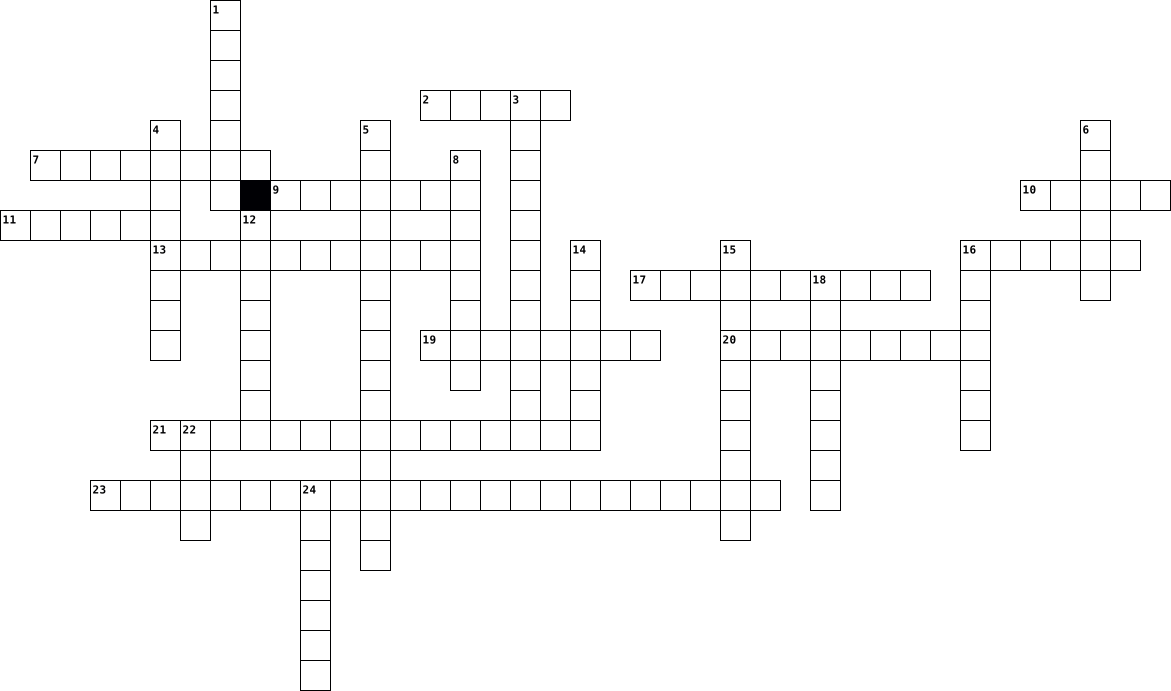
Across
- conductors of heat and electricity, malleable, ductile
- two elements mixed together to create a new substance
- the shells of an atom
- metal, nonmetal, and metalloid _____
- the letters that represent the element name
- a cold reaction
- row(s) of periodic table
- a hot or heated reaction
- not conductive, malleable, or ductile
- share properties of metals and nonmetals
- number of electrons in outer shell
- all elements that go into reactions come out of the reaction with the same number
Down
- pure substance on the periodic table
- number of protons and electrons
- a full outer shell, far right side of periodic table
- creator of the periodic table
- carries a positive charge
- negative charge and found in all atoms
- a group of atoms
- carries negative charge
- located below the symbol on the periodic table, add up protons and electrons
- the outcome of a chemical reaction
- the start of a chemical reaction, what creates a product
- even smaller than a molecule
- the center of all molecules
25 Clues: a cold reaction • a group of atoms • the shells of an atom • carries negative charge • row(s) of periodic table • a hot or heated reaction • carries a positive charge • the center of all molecules • even smaller than a molecule • creator of the periodic table • number of protons and electrons • the outcome of a chemical reaction • number of electrons in outer shell • ...
Chemistry 2022-12-30

Across
- how much matter a substance contains
- standard international unit of measure for temperature
- new substance formed by a chemical reaction
- tool used to measure the mass of matter
- chemical reaction absorbing energy from the surroundings
- chemical reaction that gives off energy
Down
- objects that float in water or other fluids
- substance with a density of 1
- how much space matter takes up
- substance that is being changed in a chemical reaction
10 Clues: substance with a density of 1 • how much space matter takes up • how much matter a substance contains • tool used to measure the mass of matter • chemical reaction that gives off energy • objects that float in water or other fluids • new substance formed by a chemical reaction • standard international unit of measure for temperature • ...
Chemical Reactions 2022-11-30

Across
- Large number written in front of elements in a formula
- A substance formed when 2 or more elements or compounds are mixed together but not bonded
- Substances that you start with that change in a chemical reaction
- A substance formed when 2 or more elements are chemically bonded together
- A reaction that releases more energy than it uses (hot)
- States that the mass of the reactants equals the mass of the products
- A substance that changes its form or phase but remains the same substance
Down
- When different substances combine to form new substances
- Contains just one type of atom
- A reaction that absorbs more energy than it releases (cold)
- A substance that changes into a completely different substance with different properties
- A solid that is produced in a chemical reaction
- New substances that result from a chemical reaction
- Small number written after an element symbol
14 Clues: Contains just one type of atom • Small number written after an element symbol • A solid that is produced in a chemical reaction • New substances that result from a chemical reaction • Large number written in front of elements in a formula • A reaction that releases more energy than it uses (hot) • When different substances combine to form new substances • ...
Chemisty of Life 2023-12-03

Across
- compound
- barrier
- found in the cell nucleus
- hydrogen reacting with oxygen
- speeds up metabolism
- absorbed
- connecting
- maintaining a ________ is very important for your health.
- bond that holds atoms together
- blood vessels
Down
- stable
- reactants of an enzyme-catalyzed reaction
- weak bond
- atoms; negatively or positively charged
- speeds up the reaction
- FE
- attachment
- ______ goes into a chemical reaction
- nucleic acid
- released energy
- reactants
21 Clues: FE • stable • barrier • compound • absorbed • weak bond • reactants • attachment • connecting • nucleic acid • blood vessels • released energy • speeds up metabolism • speeds up the reaction • found in the cell nucleus • hydrogen reacting with oxygen • bond that holds atoms together • ______ goes into a chemical reaction • atoms; negatively or positively charged • ...
Unit 7 2020-12-08

Across
- the maximum energy point along the reaction path
- qualitatively explains how chemical reactions occur and why reaction rates differ for different reactions
- slows down reaction rate or prevents reaction from happening
- a substance that speeds up a chemical reaction, but is not consumed by the reaction
- If a stress is applied to a system at equilibrium the system shifts in the direction that relieves the stress
- change in concentration of a reactant or product per unit of time
- measure of degree of randomness as particles move
Down
- Products can react to re-form the reactants
- the minimum energy that must be input to a chemical system with potential reactants to cause a chemical reaction
- Rate of forward reaction equals rate of reverse reaction and the concentrations of products and reactants remain unchanged
10 Clues: Products can react to re-form the reactants • the maximum energy point along the reaction path • measure of degree of randomness as particles move • slows down reaction rate or prevents reaction from happening • change in concentration of a reactant or product per unit of time • a substance that speeds up a chemical reaction, but is not consumed by the reaction • ...
Unit 7 Chemistry-Bridgette Griffin 2022-05-05

Across
- qualitatively explains how chemical reactions occur and why reaction rates differ for different reactions
- measure of degree of randomness as a particles move
- If a stress is applied to a system at equilibrium the system shifts in the direction that relieves the stress
- the minimum energy that must be input to a chemical system with potential reactants to cause a chemical reaction
Down
- a substance that speeds up a chemical reaction, but is not consumed by the reaction
- Rate of forward reaction equals rate of reverse reaction and the concentrations of products and reactants remain unchanged
- Products can react to re-form the reactants
- the maximum energy point along the reaction path
- change in concentration of a reactant or product per unit of time
- slows down reaction rate or prevents reaction from happening
10 Clues: Products can react to re-form the reactants • the maximum energy point along the reaction path • measure of degree of randomness as a particles move • slows down reaction rate or prevents reaction from happening • change in concentration of a reactant or product per unit of time • a substance that speeds up a chemical reaction, but is not consumed by the reaction • ...
Chemical Reactions 2024-12-11

Across
- Combines parts to form a whole
- Number placed low in an equation.
- Pure elements.
- Chemical bond of transferring atoms
- What is going to go through a chemical reaction.
- Substance of two or more elements.
- A group of atoms with electric charge.
Down
- Fuel + Oxygen
- Measures property.
- Chemical bond of sharing atoms.
- Breaking down materials.
- AB+CD = AD+CB
- A+BC = AC+B
- What went through the reaction.
14 Clues: A+BC = AC+B • Fuel + Oxygen • AB+CD = AD+CB • Pure elements. • Measures property. • Breaking down materials. • Combines parts to form a whole • Chemical bond of sharing atoms. • What went through the reaction. • Number placed low in an equation. • Substance of two or more elements. • Chemical bond of transferring atoms • A group of atoms with electric charge. • ...
The Berocca Mystery 2023-03-08

Across
- A substance that turns red litmus paper blue
- An acid found naturally in citrus fruits
- A place where you can get prescription medicine
- A compound that contains both the metal and the carbonate anion
- A chemical compound consisting of cations & anions
- A chemical that gives off hydrogen ions
- CO2
Down
- A process that leads to a chemical transformation of one set of chemical substance to another
- A chemical compound that changes its colour in presence of an acid or a base
- Another name for baking soda
- A type of tablet that breaks up when you drop it in water
- A chemical element with the symbol H
- A chemical reaction that happens if you mix an acid & a base
- A chemical that dissolves in water and makes acids less acidic
- What country is Ling from?
15 Clues: CO2 • What country is Ling from? • Another name for baking soda • A chemical element with the symbol H • A chemical that gives off hydrogen ions • An acid found naturally in citrus fruits • A substance that turns red litmus paper blue • A place where you can get prescription medicine • A chemical compound consisting of cations & anions • ...
49 2025-11-30

Across
- Process at constant pressure
- Minimum energy to remove electron
- Transition between solid, liquid, gas
- Minimum energy required to react
- Natural tendency of process to occur
- Device for measuring heat flow
- Heat capacity per unit mass
- Absorbs heat from surroundings
- Process at constant volume
- Ratio of products to reactants at balance
Down
- Heat absorbed or released during phase change
- Energy available to do work
- Energy change during chemical reaction
- Releases heat to surroundings
- Process with no heat exchange
- Energy required to raise temperature
- Energy transfer by force over distance
- Process at constant temperature
- Speeds up reaction without being used up
- Study of heat in chemical processes
- Determines direction of reaction shift
- Total enthalpy change independent of steps
- SI unit of energy
23 Clues: SI unit of energy • Process at constant volume • Energy available to do work • Heat capacity per unit mass • Process at constant pressure • Releases heat to surroundings • Process with no heat exchange • Device for measuring heat flow • Absorbs heat from surroundings • Process at constant temperature • Minimum energy required to react • Minimum energy to remove electron • ...
Photosynthesis and Cellular Respiration 2021-08-18

Across
- C₆H₁₂O₆
- Cellular respiration when oxygen is present
- what we breathe in
- a substance present at the start of a chemical reaction
- Cellular respiration when oxygen is not present
- vital for all life
- the sequences of enzyme-catalyzed reactions by which relatively large molecules in living cells are broken down, or degraded
- the process by which the body utilizes the energy released by catabolism to synthesize complex molecules
- captures light
- known as the powerhouse of the cell
- consisting of living cells
Down
- a metabolic process
- the second part of cellular respiration and produces 4 atp
- the process to turn light into chemical energy
- a plastid where photosynthesis takes place
- chemical pathways
- the strength to do work
- animals and humans exhale this
- energy-carrying molecule found in the cells of all living things
- a result of a chemical reaction
- A transport chain
21 Clues: C₆H₁₂O₆ • captures light • chemical pathways • A transport chain • what we breathe in • vital for all life • a metabolic process • the strength to do work • consisting of living cells • animals and humans exhale this • a result of a chemical reaction • known as the powerhouse of the cell • a plastid where photosynthesis takes place • Cellular respiration when oxygen is present • ...