
chemical reaction Crossword Puzzles
Lesson 1-3 Quiz Review 2024-01-10

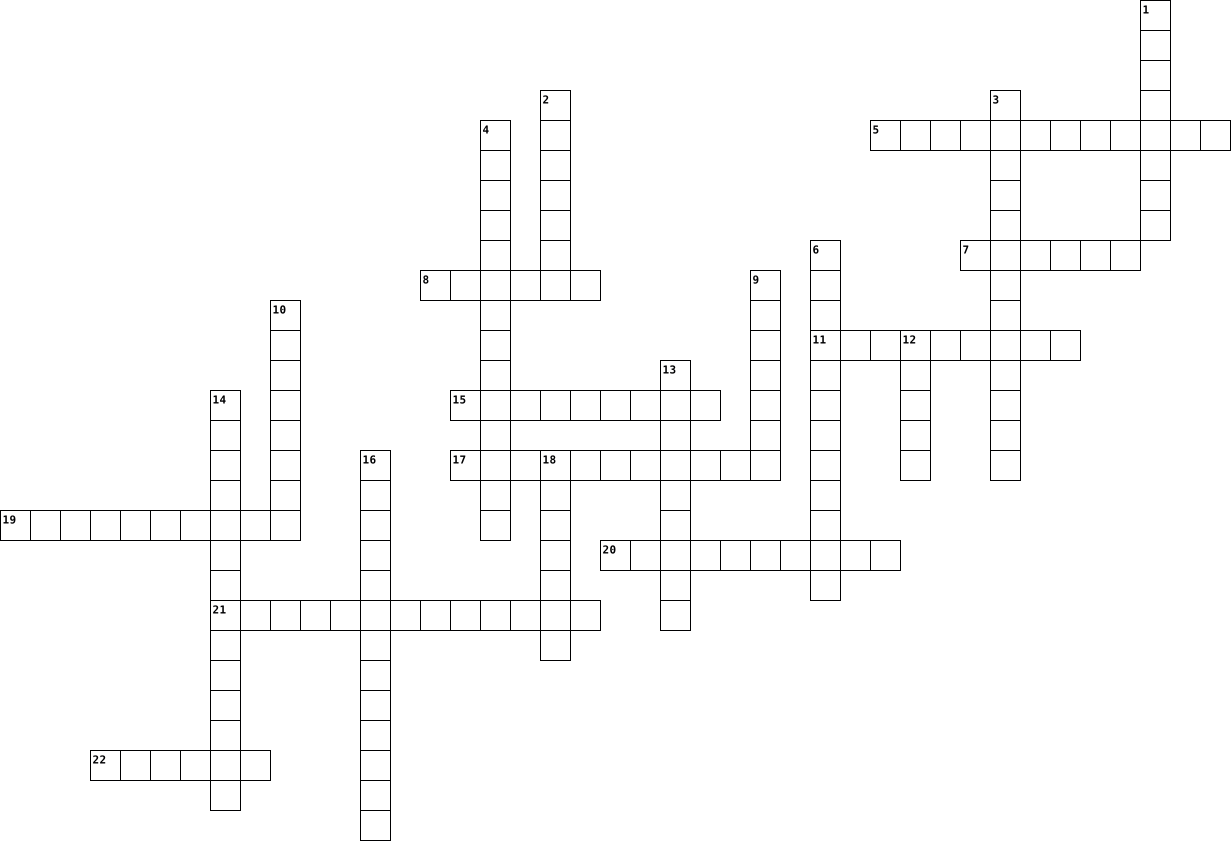
Across
- A small-sized number on the bottom right of the symbol. It refers to the number of atoms of the element.
- The elements or molecules that you end up with after a chemical reaction.
- In a combustion engine this is the stroke that compresses the gas air mixture.
- A number placed in front of a chemical formula to balance a chemical equation.
- In a combustion engine this is the name of the stroke that pulls a gas/air mixture into the cylinder.
- A measure of the average kinetic energy of all particles that make up that objects matter.
- This is the fuel source that rockets use and that doesn't produce carbon dioxide as an exhaust.
- In a combustion engine this is the name of the stroke in which a combustion reaction occurs.
Down
- A process in which one or more substances, the reactants, are converted to one or more different substances, the products.
- a name for energy associated with a machine including the motion of a machine's parts or the machine itself.
- The energy related to an object or particles motion.
- A type of chemical reaction that requires a fuel, oxidizer, and source of heat. This type of reaction produces heat, water vapor, and carbon dioxide.
- When energy is used to move an object from one place to another.
- The total energy associated with the temperature of an object, or the movement of microscopic particles that make it up.
- The elements or molecules that you start with in a chemical reaction.
- In a combustion engine this is the stroke that pushes all of the exhaust out of the cylinder.
16 Clues: The energy related to an object or particles motion. • When energy is used to move an object from one place to another. • The elements or molecules that you start with in a chemical reaction. • The elements or molecules that you end up with after a chemical reaction. • In a combustion engine this is the stroke that compresses the gas air mixture. • ...
Tkai 2022-03-08

Across
- Calculations
- mole to mass
- mass of 1 mole of a substance
- the maximum of product that could be producd based on the limiting reaction
- lowest whole tatio of elements
- calculations involving the mass relationships of elements in compounds
- utiple of an empirical formula
- Remember that the coefficients of reactants and products can represent # of atoms as well as the # of moles that reacted.
Down
- You can use the coefficients in a balanced chemical equation to these
- the substance that is not used up completely in a reaction
- determining the number of moles produced from a reaction, you must first begin with a balanced equation
- is the quantitative relationship between the amount of reactants used and the amount of products formed.
- the substance the will used up first in a chemical reaction
- the mass of 1 mole of a substance
- the measured amount of a product obtained from a reaction
15 Clues: Calculations • mole to mass • mass of 1 mole of a substance • lowest whole tatio of elements • utiple of an empirical formula • the mass of 1 mole of a substance • the measured amount of a product obtained from a reaction • the substance that is not used up completely in a reaction • the substance the will used up first in a chemical reaction • ...
Form 2021-08-27

Across
- amount of energy needed to change a to quantity (mole or gram) from solid to liquid.
- made up of particles such as atoms, occupies a place in space is in constant motion, and has a mass.
- visible by the naked eye.
- consists of a regular repetition of a group of atoms in three dimensional space.
- forces of attraction or repulsion between neighbouring particles (ions, atoms, molecules).
- a chemical reaction during which heat energy is absorbed from the surroundings.
- is the form of energy an object or particle has as a result of its motion.
Down
- a chemical reaction during which heat energy is released to the surroundings.
- stored energy.
- a neutrally charged group of atoms held together by chemical bonds.
- the lowest temperature possible (-273.15 oC).
- so small it is only visible with a microscope.
- liquifying or melting a substance.
- the heat transfer by a system during a chemical reaction.
14 Clues: stored energy. • visible by the naked eye. • liquifying or melting a substance. • the lowest temperature possible (-273.15 oC). • so small it is only visible with a microscope. • the heat transfer by a system during a chemical reaction. • a neutrally charged group of atoms held together by chemical bonds. • ...
Body Systems and Homeostasis Jacory P. 2023-03-15

Across
- The systems that make up the human body
- When the output of a system amplifies the system
- The system associated with breathing
- When the body responds to changes in internal and external environments
- The system associated with breaking down food that you have previously eaten
- The system associated with offspring
- Tissues that make up the muscle
- The system composed of muscle fibers
- The system that moves blood through out the body
Down
- Food being broken down by the body with chemical processes occurring
- The product of a reaction leads to an increase in that reaction
- The glands and organs that release hormones into your blood
- The product of a reaction leads to an decrease in that reaction
- Your bodys´ central frame work
- The process your body goes through to maintain equilibrium
- Made by glands in the body
- Vessels that carry low oxygenated blood to be reoxygenated
- Vessels that carry blood through the body
- Food being broken down by the body without chemical processes occurring
- The system that controls things like what you feel and is responsible for your bodys´ movements
20 Clues: Made by glands in the body • Your bodys´ central frame work • Tissues that make up the muscle • The system associated with breathing • The system associated with offspring • The system composed of muscle fibers • The systems that make up the human body • Vessels that carry blood through the body • When the output of a system amplifies the system • ...
Chemical and Physical Changes 2023-10-26

Across
- what we use to represent chemical reactions
- molecules move freely
- when a liquid changes to a solid
- what the reaction ends with
- matter changes, but no new substance is formed
- What a reaction starts with
- the number in front of chemical formulas to tell how many molecules there are
- when a gas changes to a liquid
- has mass and takes up space
- type of reaction that absorbs energy from its surroundings
- type of reaction that releases energy to its surroundings
- matter changes so that a new substance is formed
Down
- what is added to make state of matter change
- anything that describes an item
- matter cannot be created or destroyed, it can change forms
- molecules are fluid
- the small number to tell how many specific atoms are in a molecule
- when a solid goes to a gas
- molecules are tightly packed together
- when a liquid changes to a gas
- when a solid changes to a liquid
- anything that proves a change has happened
- when a gas changes to a solid
23 Clues: molecules are fluid • molecules move freely • when a solid goes to a gas • what the reaction ends with • What a reaction starts with • has mass and takes up space • when a gas changes to a solid • when a liquid changes to a gas • when a gas changes to a liquid • anything that describes an item • when a liquid changes to a solid • when a solid changes to a liquid • ...
Chapter 13 Caroline Davis 2020-10-19

Across
- a chemical that donates a hydrogen atom
- a chemical that accepts a hydrogen atom
- if changed, the equilibrium shifts to oppose change, until new equilibrium is reached.
- when there is a net absorption of energy during a chemical reaction
- when there is a net release of energy during a chemical reaction
Down
- minimum energy required to overcome the intentional breaking of bonds in reactants.
- The amount of energy required to pull two bonded atoms apart.
- a substance that lowers the activation energy of a chemical reactant, which causes the reaction to happen faster.
- how quickly the concentration of reactions decreases and how quickly and concentration of products increases.
- when reaction and it’s reverse act at the same rate.
10 Clues: a chemical that donates a hydrogen atom • a chemical that accepts a hydrogen atom • when reaction and it’s reverse act at the same rate. • The amount of energy required to pull two bonded atoms apart. • when there is a net release of energy during a chemical reaction • when there is a net absorption of energy during a chemical reaction • ...
The Law of Conservation of Mass 2025-09-17

Across
- A substance made up of matter with a specific composition, like water or salt.
- Anything that has mass and takes up space.
- The lightest element and the first one on the periodic table.
- Types of matter with a uniform makeup, such as elements or compounds.
- The law that matter is not created or destroyed during a chemical reaction.
- Two or more atoms bonded together, like H₂O or O₂.
Down
- The starting materials in a chemical reaction.
- The new substances formed after a chemical reaction takes place.
- The smallest unit of an element that still has the properties of that element.
- What happens to atoms during a chemical reaction—they change places but are not destroyed.
10 Clues: Anything that has mass and takes up space. • The starting materials in a chemical reaction. • Two or more atoms bonded together, like H₂O or O₂. • The lightest element and the first one on the periodic table. • The new substances formed after a chemical reaction takes place. • Types of matter with a uniform makeup, such as elements or compounds. • ...
Lizz 2.1 vocab 2021-10-26

Across
- absorbs heat energy
- a chemical process
- a change in matter
Down
- gives off heat energy
- found during chemical reaction
- takes up some amount of space
- a chemical reaction
- before chemical reaction occurs
8 Clues: a chemical process • a change in matter • a chemical reaction • absorbs heat energy • gives off heat energy • takes up some amount of space • found during chemical reaction • before chemical reaction occurs
Conceptual Chemistry Semester 2 Ch.3 & 9 2012-07-14

Across
- A scientific law stating that there is no detectable change in the amount of mass present before and after a chemical reaction.
- The Law of Mass Conservation tells us that the total number of individual atoms must be __________ on each side of the arrow in a chemical equation.
- In a chemical equation, elements/molecules in this state of matter are identified with a lower-case 'l'.
- In a chemical equation, elements/molecules in this state of matter are identified with a lower-case 'g'.
- A new material that is formed in a chemical reaction, appearing AFTER the arrow in a chemical equation.
- In a chemical equation, elements/molecules in this state of matter are identified with a lower-case 's'.
- A starting material in a chemical reaction, appearing BEFORE the arrow in a chemical equation.
Down
- A scientific law stating that elements combine in definite mass ratios to form compounds.
- The method which we applied during an activity this week to collect carbon dioxide gas.
- A symbolic representation of a chemical reaction.
10 Clues: A symbolic representation of a chemical reaction. • The method which we applied during an activity this week to collect carbon dioxide gas. • A scientific law stating that elements combine in definite mass ratios to form compounds. • A starting material in a chemical reaction, appearing BEFORE the arrow in a chemical equation. • ...
unit 6B vocabulary 2017-04-06

Across
- substance combines with another substance
- changes the form of an object
- symbols, numbers, parenthesis, dashes, and brackets
- mass is conserved over time
- first column, very reactant
- change during a reaction
- odorless & colorless
Down
- outer shell of an atom
- the result of a chemical reaction
- attraction between atoms
- a chemical reaction in the form of symbols and formulas
11 Clues: odorless & colorless • outer shell of an atom • attraction between atoms • change during a reaction • mass is conserved over time • first column, very reactant • changes the form of an object • the result of a chemical reaction • substance combines with another substance • symbols, numbers, parenthesis, dashes, and brackets • ...
Energy and ATP 2023-08-16

Across
- the ability to do work
- the energy needed to start a reaction
- compound that stores energy
- reaction gains electrons
- lost a phosphorus and releases ADP
- a fixed shape
- reduces the amount of energy needed for a reaction
Down
- a type of energy in the form of heat
- no shape
- the ingredients to the chemical reaction
- reaction loses electrons
- what you get at the end of the reaction
- speeds up reactions without being changed or destroyed
- takes the shape on the container
14 Clues: no shape • a fixed shape • the ability to do work • reaction loses electrons • reaction gains electrons • compound that stores energy • takes the shape on the container • lost a phosphorus and releases ADP • a type of energy in the form of heat • the energy needed to start a reaction • what you get at the end of the reaction • the ingredients to the chemical reaction • ...
Evidence of Chemical Reactions 2024-11-13

Across
- Also known as combustion, is a chemical reaction where a substance reacts with oxygen gas, releasing energy in the form of light and heat
- A change in matter that can change the form of the matter without changing the chemical composition of it (examples: melting, freezing, evaporating, etc.)
- Observations that indicate a chemical change or reaction. These changes can occur due to various factors such as temperature changes, light given off, or the formation of bubbles1. For example, leaves changing color in the fall
- A result of a chemical reaction caused by the release of a gas
- The solid created from a solution in which a chemical reaction has occurred
- A change that occurs due to a chemical reaction in which substances combine or decompose to form one or more different substances
Down
- In a chemical reaction, a change in thermal energy can occur due to the breaking or formation of chemical bonds12345. When the chemical bonds of the reactants are broken, excess energy is released, causing heat to be discharged/absorbed and leading to an increase/decrease in temperature
- A process in which one or more substances are converted to one or more different substances
- A chemical reaction that produces heat and light
9 Clues: A chemical reaction that produces heat and light • A result of a chemical reaction caused by the release of a gas • The solid created from a solution in which a chemical reaction has occurred • A process in which one or more substances are converted to one or more different substances • ...
Biochemistry Crossword 2023-05-05

Across
- water sticks to other water molecules.
- what goes into a chemical reaction; on the left of arrow
- proteins that catalyze chemical reactions by lowering the activation energy for the reaction to occur.
- has a high pH (more than 7)
- what is produced in a chemical reaction; on the right of the arrow
- structural part, controls chemical reactions, transport and defense
- solvent water dissolves most other polar substances like salt and sugar.
- action when water is pulled upward against gravity inside the xylem of a plant stem.
- quick energy source and part of plant cell walls
- long term energy source, insulation, protection, and part of cell membrane
Down
- strong ______ bonds hold the H to the O inside one water molecule.
- water has a high ___ __ ______ because it takes alot of heat to change phase from liquid to gas.
- weak _____ bonds hold one water molecule to another
- water molecules can float lightweight objects like a paper clip due to this property.
- water sticks to glass or other materials.
- acid genetic information that controls the cell
- the place on an enzyme where the subtrate and enzyme connect
- the property that means water can act like a magnet with + and - ends.
- has a low pH (less than 7)
19 Clues: has a low pH (less than 7) • has a high pH (more than 7) • water sticks to other water molecules. • water sticks to glass or other materials. • acid genetic information that controls the cell • quick energy source and part of plant cell walls • weak _____ bonds hold one water molecule to another • what goes into a chemical reaction; on the left of arrow • ...
Chemistry Crossword Final Project (MM) 2021-05-18

Across
- a change of one or more substances into new substances
- a reaction in which a compound breaks down into two or more simpler substances
- a strong base
- an electron in the outermost energy level of an atom; electrons that are gained or lost to form ions
- in a covalent compound, electrons are ____ between two atoms
- group 17 nonmetal
- an indicator solution that is clear in acids and neutral solutions, but turns pink in basic solutions
- a substance that changes color in the presence of acids or bases
- indicator paper that turns red in the presence of acids or blue in the presence of bases
- a reaction in which two or more reactants combine to form a single product
- chemical reaction that absorbs energy
- any compound that conducts electricity when melted or dissolved in water
- in an ionic compound, electrons are ____ from the metal to the nonmetal
- a number placed in front of the substances of a chemical equation to indicate how many are involved
- ____ acids and bases are found at the far ends of the pH scale
- ____ acids and bases are found towards the middle of the pH scale
- a type of compound that contains nonmetals only
- a substance that undergoes a chemical change
- a reaction in which a hydrocarbon reacts with oxygen to produce carbon dioxide and water
- a strong acid
- a type of element that loses electrons to form an ion
Down
- a substance that produces hydroxide ions when dissolved in water
- Group 1 metal
- an organic compound that consists of hydrogen and carbon
- atoms gain or lose electrons to become ___
- a displacement reaction in which the positive and negative portions of two ionic compounds are interchanged
- a number used to indicate how many atoms of a given element are in a compound
- a scale from 0 to 14 that measures the strength of acids and bases
- an ion that consists of two or more different elements
- Group 2 metal
- the smallest particle of an element
- a type of element that gains electrons to form an ion
- Group 18 element with a full valence shell
- a substance that produces hydrogen ions when dissolved in water
- a displacement reaction in which one element takes the place of another in a compound
- a positive ion
- a type of compound formed between a metal and a nonmetal
- chemical reaction that releases energy
- a combination of chemical symbols that show what elements make up a compound and the number of atoms of each element
- a chemical combination of two or more different elements
- rule that states that atoms become stable by having eight electrons in their outer energy level
- a new substance formed when substances undergo a chemical change
- a negative ion
- an atom or group of atoms that has a charge because of the loss or gain of electrons
44 Clues: Group 1 metal • a strong base • Group 2 metal • a strong acid • a positive ion • a negative ion • group 17 nonmetal • the smallest particle of an element • chemical reaction that absorbs energy • chemical reaction that releases energy • atoms gain or lose electrons to become ___ • Group 18 element with a full valence shell • a substance that undergoes a chemical change • ...
Science 7 Semester Exam Post-Review 2022-01-13

Across
- subatomic particle that defines the element
- has gained or tends to gain electrons
- model that is useful, but not accurate in showing electrons in circular orbits
- a number used to balance a chemical equation
- charge of ions that have gained electrons
- discovered the nucleus through a “gold foil” experiment
Down
- subatomic particle with negligible mass and negative charge
- charge of ions that have lost electrons
- subatomic particle that has mass but no charge
- a number used to indicate numbers of atoms in a chemical formula
- an “ingredient” or substance used in a reaction
- same protons, different neutrons
- based on data, explains and predicts
- has lost or tends to lose electrons
- a substance produced by a chemical reaction
- type of change where new substances are produced
16 Clues: same protons, different neutrons • has lost or tends to lose electrons • based on data, explains and predicts • has gained or tends to gain electrons • charge of ions that have lost electrons • charge of ions that have gained electrons • subatomic particle that defines the element • a substance produced by a chemical reaction • a number used to balance a chemical equation • ...
unit 2 2022-01-20

Across
- or more atoms held by chemical bonds
- of matter in something
- object that has a definite shape and volume
- volume but no definite shape
- property: characteristic of matter that you can see without changing the identity of the substances it makes up
- of solids,liquids,and gases
- created by two or more elements that are chemically joined in a combination
- change:size,shape,form, state of matter, which the matter’s identity stays the same
- that takes up space
Down
- substance that is created by one kind of atom
- matter occupies
- to catch fire
- per unit volume
- property:ability or inability to change into one or more substances
- of conservation of mass: that the total mass before a chemical reaction is the is similar as total mass after a chemical reaction
- definite shape or volume
- substance dissolves in another
- change:change in matter which the substances that make up matter change into substances that have different chemical and physical properties
18 Clues: to catch fire • matter occupies • per unit volume • that takes up space • of matter in something • definite shape or volume • of solids,liquids,and gases • volume but no definite shape • substance dissolves in another • or more atoms held by chemical bonds • object that has a definite shape and volume • substance that is created by one kind of atom • ...
This Week in Science 2025-01-10

Across
- The little numbers in a chemical equation
- The big numbers (in front) in a chemical equation
- CO2 is the formula for what?
- What kind of system was the egg and vinegar demonstration
- Chemically speaking, what is cottage cheese
- Mass is conserved in a ______ system
- When creating a design, these are your goals
- In a chemical reaction, mass can appear to disappear in what form?
Down
- A molecule made of two or more elements
- When creating a design, these are holding you back
- An unexpected difference (you expected 10 but got 8)
- A gas that holds in heat
- When you create an illustration of a reaction
- The _______ Agreement is a group of countries working against climate change
- Country with the highest CO2 discharges
- The arrow in a chemical equation
16 Clues: A gas that holds in heat • CO2 is the formula for what? • The arrow in a chemical equation • Mass is conserved in a ______ system • A molecule made of two or more elements • Country with the highest CO2 discharges • The little numbers in a chemical equation • Chemically speaking, what is cottage cheese • When creating a design, these are your goals • ...
types of reactions 2024-05-06

Across
- a chemical reaction in which oxygen is added to or hydrogen is removed from an element, molecule or a compound.
- chemical reaction in which a reaction between any combustible substance and an oxidiser takes place in order to form an oxidised product.
- type of reaction between an acid and a base to give salt and water as the products.
Down
- type of reaction which involves two or more substances to combine with each other
- another name for combination reaction
- type of reaction when a more reactive element displaces a less reactive element
- type of reaction which one reactant breaks down to form two or more products
- type of chemical reaction occurring in an aqueous solution where two ionic bonds combine, resulting in the formation of an insoluble salt
- The reaction in which hydrogen is gained or oxygen is lost
- type of reaction in which oxidation and reduction take place simultaneously
10 Clues: another name for combination reaction • The reaction in which hydrogen is gained or oxygen is lost • type of reaction in which oxidation and reduction take place simultaneously • type of reaction which one reactant breaks down to form two or more products • type of reaction when a more reactive element displaces a less reactive element • ...
Complete this Crossword 2023-03-08

Across
- What gas found in air is one of the reactants in an oxidation reaction?
- It is produced when copper carbonate gets heated up
- Poisonous gas that gets formed when there is not enough oxygen for combustion
- This substance is formed with carbon dioxide when methane gas is completely burnt in air
- The colour of magnesium oxide
- The colour of blue cobalt chloride paper in the presence of water
- This is a type of oxidation reaction
Down
- This is the solid that dissolves in a solvent
- Burning magnesium is an example of this type of reaction
- The mass of the products of a chemical reaction is the same as the mass of what?
- The colour of iodine vapour
- Type of combustion that happens when there is plenty of oxygen
- What turns cloudy when carbon dioxide is present
- This is a type of physical change
- It is conserved in a chemical reaction
15 Clues: The colour of iodine vapour • The colour of magnesium oxide • This is a type of physical change • This is a type of oxidation reaction • It is conserved in a chemical reaction • This is the solid that dissolves in a solvent • What turns cloudy when carbon dioxide is present • It is produced when copper carbonate gets heated up • ...
Law of Conservation of Mass 2022-02-05

Across
- when two or more substances react
- the amount of space a substance occupies
- a group of atoms bonded together
- the basic unit of a chemical element
- a specific kind of matter with properties
- when something is made
- water
- the relationship between the mass and its volume
Down
- when something is broken or unable to be fixed
- a _______ reaction
- speed of an object or the change over time
- frozen water
- air
- law of ________ of mass
- quantity of matter; weight
- anything that occupies space and has a mass
- products turn to reactants
- enforcement of rules
- applying a force to move matter
19 Clues: air • water • frozen water • a _______ reaction • enforcement of rules • when something is made • law of ________ of mass • quantity of matter; weight • products turn to reactants • applying a force to move matter • a group of atoms bonded together • when two or more substances react • the basic unit of a chemical element • the amount of space a substance occupies • ...
Law of Conservation of Mass 2022-02-05

Across
- the amount of space a substance occupies
- a _______ reaction
- when something is made
- enforcement of rules
- quantity of matter; weight
- a specific kind of matter with properties
- law of ________ of mass
- applying a force to move matter
- the relationship between the mass and its volume
- when two or more substances react
- water
Down
- air
- frozen water
- a group of atoms bonded together
- speed of an object or the change over time
- the basic unit of a chemical element
- when something is broken or unable to be fixed
- anything that occupies space and has a mass
- products turn to reactants
19 Clues: air • water • frozen water • a _______ reaction • enforcement of rules • when something is made • law of ________ of mass • quantity of matter; weight • products turn to reactants • applying a force to move matter • a group of atoms bonded together • when two or more substances react • the basic unit of a chemical element • the amount of space a substance occupies • ...
Science Crossword 2015-12-03

Across
- the condition of being transparent.
- Bonds chemical bond that involves the sharing of electron pairs between atoms
- Chemical
- any of the almost spherical concentric regions of matter that make up the earth and its atmosphere
- the regions of the surface, atmosphere, and hydrosphere of the earth
- the regions of the surface, atmosphere, and hydrosphere of the earth
- Chemical reaction thats is releases energy
- Forms into a gas
- a part or aspect of something abstract, especially one that is essential or characteristic.
- basic unit of a chemical element
Down
- each of two or more forms of the same element that contain equal numbers of protons but different numbers of neutrons
- all the waters on the earth's surface, such as lakes and seas
- to pass into or through a substance
- falling from the atmosphere
- the name given to a horizontal row of the periodic table.
- a solid material that is typically hard, shiny,
- water that collects as droplets on a cold surface when humid air is in contact with it.
- What Term us up on the periodic table
- Off Runs off buildings
- Chemical reaction that absorbs energy
20 Clues: Chemical • Forms into a gas • Off Runs off buildings • falling from the atmosphere • basic unit of a chemical element • to pass into or through a substance • the condition of being transparent. • What Term us up on the periodic table • Chemical reaction that absorbs energy • Chemical reaction thats is releases energy • a solid material that is typically hard, shiny, • ...
Chemical Foundation of Life 2024-10-07

Across
- a bond that holds two atoms together by sharing valence electrons
- one of the small units that make up polymers
- a chemical reaction that releases energy to the surroundings
- an exothermic biological reaction in organisms in which smaller molecules are produced from larger ones
- negative charge particle in an atom
- a type of carbohydrate that could be glucose, fructose etc
- a biological molecule that speeds up chemical reactions in living things
- the random spreading out of particles from high concentration to low concentration
- an atom or molecule with a charge
- an endothermic biological reaction in organisms in which larger molecules are formed from smaller ones
- positive charge particle found in the nucleus of an atom
- substance with a unique, fixed composition that consists of two or more elements
- organic compound polymer made up of amino acids
Down
- energy needed to start a chemical reaction
- organic compound polymer such as sugar or starch
- small molecule (monomer) that is a building block of proteins
- a long chain molecule made of smaller units joined together
- a mixture in which the composition is not uniform throughout the mixture
- natural polymer of monomers of glucose and makes up structures in living things, such as the cell wall in plants
- a chemical reaction that absorbs energy from the surroundings
- compound found in living things that contains mainly carbon
- when the molecules of a substance are attracted (and stick slightly) to the molecules of a different substance
- a mixture in which the composition is uniform throughout the mixture
- neutral particle found in the nucleus of an atom
- pure substance that cannot be broken down into other types of substances
- the positively charged center of the atom consisting of protons and neutrons
- a molecule that has an imbalance of charge because the shared valence electrons in the covalent bond are not shared equally
27 Clues: an atom or molecule with a charge • negative charge particle in an atom • energy needed to start a chemical reaction • one of the small units that make up polymers • organic compound polymer made up of amino acids • organic compound polymer such as sugar or starch • neutral particle found in the nucleus of an atom • ...
7th Grade Chemistry 2024-04-16

Across
- a chemical change that happens when certain metals react with O2
- the smallest unit that makes up all matter
- the name of the element with the symbol Cl
- a physical property that shows shininess
- anything with mass and volume that takes up space
- negatively charged particles in an atom
- a chemical property that can be shown by running a pH test
- made when two or more different elements are chemically bonded
- the formula to find this physical property is d=m/v
Down
- positively charged particles in an atom
- the name of the element with the symbol Na
- the name of the element with the symbol O
- the name of the element with the symbol C
- a new solid formed during a chemical reaction
- a physical property that turns water into ice
- the name of the element with the symbol H
- properties that can be observed using the 5 senses
- particles in an atom with no positive or negative charge
- properties that are only observed in a chemical reaction
19 Clues: positively charged particles in an atom • negatively charged particles in an atom • a physical property that shows shininess • the name of the element with the symbol O • the name of the element with the symbol C • the name of the element with the symbol H • the name of the element with the symbol Na • the smallest unit that makes up all matter • ...
Changes to Matter 2021-01-20

Across
- Gas ______ are a sign of a chemical reaction.
- Hydrogen is an example of an element.
- In a ________ change, a new substance is formed.
- A _______ is a combination of at least two atoms.
- The most common element in the atmosphere is _________.
- Earth's _____ is made mostly of oxygen and silicon.
- A pencil breaking is an example of a ______ change.
- In a chemical change, a ____ substance is formed.
Down
- In a chemical change, a new ________ is formed.
- A substance made of one thing is called a _____ substance.
- A solid formed by two liquids in a chemical reaction.
- The two most common elements on Earth's crust are ______ and silicon.
- Nitrogen is the most common element in the _________.
- A pure _______ is made of just one thing.
- A _______ is a molecule with more than one type of element.
- The element He on the Periodic Table
- The two most common elements on Earth's crust are oxygen and _______.
17 Clues: The element He on the Periodic Table • Hydrogen is an example of an element. • A pure _______ is made of just one thing. • Gas ______ are a sign of a chemical reaction. • In a chemical change, a new ________ is formed. • In a ________ change, a new substance is formed. • A _______ is a combination of at least two atoms. • ...
Chemical Science Y10 SBAB Xword 2025-05-23

Across
- a methane (CH4) molecule has 3 _____ atoms
- most reactive metal in the metal activity series
- a chemical ______ is a written expression of a chemical reaction
- where electrons are usually located
- elements that are too cool to react
- during a chemical reaction, ______ break and reform
- a metal reacting with an ____ will produce hydrogen gas and a salt
- Cu is ____ reactive than Mg
- the metal in table salt
Down
- the rule that requires 8 electrons in the outer shell of an atom
- Group ___ elements have 2 electrons on the outer shell
- common name for Group 1 elements
- contain two or more atoms bonded together
- the law of _________ of mass states that matter cannot be destroyed nor created
- chemical _______ must always be balanced
- least reactive metal in the metal activity series
16 Clues: the metal in table salt • Cu is ____ reactive than Mg • common name for Group 1 elements • where electrons are usually located • elements that are too cool to react • chemical _______ must always be balanced • contain two or more atoms bonded together • a methane (CH4) molecule has 3 _____ atoms • most reactive metal in the metal activity series • ...
morgan foster burkholder science evergreen high school 2017-10-10

Across
- where one or more new compounds are formed by the rearrangement of atoms
- a reaction where there is a net absorption of energy
- a substance that lowers the activation energy of a chemical reaction
- a reaction where you look for the plus sign on the product side
Down
- a reaction where there is oxides created
- a reaction where there is a net release of energy
- a chemical that accepts a hydrogen ion H+
- the amount of energy needed to pull two bonds apart
- a chemical that donates a hydrogen ion H+
- a reaction where you look for the plus sign on the reactant side
10 Clues: a reaction where there is oxides created • a chemical that accepts a hydrogen ion H+ • a chemical that donates a hydrogen ion H+ • a reaction where there is a net release of energy • the amount of energy needed to pull two bonds apart • a reaction where there is a net absorption of energy • a reaction where you look for the plus sign on the product side • ...
Blanca cortez chapter 13 2019-03-07

Across
- Substance that increases the rate of a chemical reaction without itself being consumed by the reaction.
- A reaction between an acid and a base.
- A polyatomic ion made by removing a proton from a water molecule.
- An ionic compound commonly formed from the reaction between an acid and a base.
- Description of a solution in which the hydronium ion concentration is equal to the hydroxide ion concentration.
Down
- The deterioration of a metal, typically caused by atmospheric oxygen.
- The reacting substances in a chemical reaction.
- Description of a chemical reaction in which there is a net absorption of energy.
- that donates hydrogen ions.
- A substance that accepts a hydrogen ion.
10 Clues: that donates hydrogen ions. • A reaction between an acid and a base. • A substance that accepts a hydrogen ion. • The reacting substances in a chemical reaction. • A polyatomic ion made by removing a proton from a water molecule. • The deterioration of a metal, typically caused by atmospheric oxygen. • ...
Science Crossword 2015-12-03

Across
- the condition of being transparent.
- Bonds chemical bond that involves the sharing of electron pairs between atoms
- Chemical
- any of the almost spherical concentric regions of matter that make up the earth and its atmosphere
- the regions of the surface, atmosphere, and hydrosphere of the earth
- the regions of the surface, atmosphere, and hydrosphere of the earth
- Chemical reaction thats is releases energy
- Forms into a gas
- a part or aspect of something abstract, especially one that is essential or characteristic.
- basic unit of a chemical element
Down
- each of two or more forms of the same element that contain equal numbers of protons but different numbers of neutrons
- all the waters on the earth's surface, such as lakes and seas
- to pass into or through a substance
- falling from the atmosphere
- the name given to a horizontal row of the periodic table.
- a solid material that is typically hard, shiny,
- water that collects as droplets on a cold surface when humid air is in contact with it.
- What Term us up on the periodic table
- Off Runs off buildings
- Chemical reaction that absorbs energy
20 Clues: Chemical • Forms into a gas • Off Runs off buildings • falling from the atmosphere • basic unit of a chemical element • to pass into or through a substance • the condition of being transparent. • What Term us up on the periodic table • Chemical reaction that absorbs energy • Chemical reaction thats is releases energy • a solid material that is typically hard, shiny, • ...
Chemistry Vocab 2021-01-25

Across
- Property - A characteristic of a substance that describes its potential to change when interacting with other substances (reactivity with air or water, combustibility, flammability).
- The characteristic of being able to attract because of an electrical force
- The characteristic of a slow moving sticky substance
- Point - Temperature at which a liquid substance becomes a gas.
- The ability to be hammered or pressed down
- - Capacity of an acid to react with a base, measured by the number of hydrogen atoms that can be replaced by a base.
- - A solid substance that forms from a chemical reaction that takes place in a liquid solution.
- - Measure of the amount of matter in an object.
- The ability to produce electricity
- - A chemical substance that produces hydroxide ions in solution and tastes bitter.
- - A chemical substance that produces hydrogen ions in solution and tastes sour.
- The ability to be drawn out into thin wires
Down
- The ability to rust do to oxygen
- Change - Process where one or more substances are altered into new and different substances.
- Reaction - Combining substances so that new substances are formed that are not separated by normal chemical means. The new substances have properties different from those of the original substances.
- Point - Temperature at which a solid substance becomes a liquid.
- - The readiness of a substance to produce hydrogen ions.
- - The amount of matter in a defined volume. (density = mass/volume)
- Change - A type of change in which the form of matter is altered but one substance is not transformed into another.
- - Chemical reaction in which thermal energy is released.
- - Chemical reaction in which thermal energy is absorbed.
- - The external features of a substance.
- - Property of a substance relating to how easily it reacts with other substances.
- - The readiness of a substance to produce hydroxide ions.
- - Property of a substance defining how easily it ignites and burns.
- Property - A measurable characteristic (size, shape, or state ) of matter not involving interactions with other substances (as color, hardness, boiling point).
- - Measure of acidity or basicity of a substance.
- - The characteristic smell of a substance.
- - The amount of space an object occupies.
29 Clues: The ability to rust do to oxygen • The ability to produce electricity • - The external features of a substance. • - The amount of space an object occupies. • The ability to be hammered or pressed down • - The characteristic smell of a substance. • The ability to be drawn out into thin wires • - Measure of the amount of matter in an object. • ...
Biology 2021-04-14
Across
- Organic molecules such as proteins, nucleic acids, carbohydrates, and fats.
- A specialized protein that catalyzes (speeds up) the chemical reactions of a cell.
- Polysaccharide made up of a chain of glucose (monosaccharide) molecules
- The reactant , molecule upon which an enzyme acts
- lipid that is a solid at room temperature
- A carbon based molecule made by living things.
- process of adding a water molecule in the protein molecule to break it apart into amino acids. Now the body can use the amino acids to make its own proteins.
- modify (enzymes) especially by heat, acid, alkali, or ultraviolet radiation so that all of the original properties are removed or diminished.(doesn't match the active site any longer)
- are macromolecules that always contain carbon, hydrogen, and oxygen.
- molecule consisting of CH and a little O includes: fats, oils and waxes. monomer is a glycerol and three fatty acids.
Down
- enzyme that speeds up chemical reaction by lowering the activation energy
- a word used to describe a molecule that contains the element
- the strength of a solution.
- A polymer of 3 or more monosaccharides, formed by dehydration reactions.
- A lipid made of a phosphate group and two fatty acids; Consists of a hydrophilic polar head and two hydrophobic non-polar tails; forms cell membranes.
- A carbohydrate (C₆H₁₂O₆) produced by photosynthesis. It is the form of sugar that is used by the body for energy.
- a chemical substance formed as a result of a chemical reaction
- When something ends in -ose it is said to be a?
- a chemical substance that is present at the start of a chemical reaction (will be broken down)
- The building block of carbohydrate; a single sugar.
- Primary source of energy
- A smaller unit that is the BUILDING BLOCK of a polymer.
22 Clues: Primary source of energy • the strength of a solution. • lipid that is a solid at room temperature • A carbon based molecule made by living things. • When something ends in -ose it is said to be a? • The reactant , molecule upon which an enzyme acts • The building block of carbohydrate; a single sugar. • A smaller unit that is the BUILDING BLOCK of a polymer. • ...
Regents Review Important Vocab 2024-06-05

Across
- the amount of energy needed to start a reaction and form an activated complex from reactants
- a cell that requires electricity to cause a nonspontaneous chemical reaction to occur
- the gain of electrons and the loss of oxidation number
- one of two or more different forms of an element in the same phase
- the length of time for half of a given sample of a radioisotope to decay
- the stable valence electron configuration of eight electrons
- a measure of the attraction of a nucleus for a bonded electron
- the positively charged particle in the nucleus of an atom
- the substance being dissolved
- a substance that produces hydronium ions (H3O+) as the only positive ion when dissolved in water
- a mixture in which the substances are not uniformly distributed
- the changing of a nucleus of one element into that of a different element
- the phase change in which a gas changes directly into a solid
- the nuclear reaction that combines light nuclei into a heavier nucleus
- a substance formed in a chemical reaction shown on the right of a reaction arrow
- a solution that contains more solute than can dissolve in a saturated solution at a given temperature
- the site in an electrochemical cell where oxidation occurs
- the attraction of a hydrogen atom in one molecule for a N O or F atom in another molecule
- a measure of the disorder or randomness of a system
- organic compound containing only carbon and hydrogen
- a phase of matter without definite shape or volume
- the state in which the electrons of an atom occupy the lowest available energy levels
- matter is neither created nor destroyed in chemical reactions
- a measure of how much solute will dissolve in a certain amount of solvent at a specific temperature
- the property of metals that allows them to be hammered into shapes
- a _________ bond is formed by the unequal sharing of a pair of electrons between two nuclei
- base a substance that produces hydroxide ions (OH-) as the only negative ion when dissolved in water
- one of a homologous series of unsaturated hydrocarbons that contain one double bond
- a condition in which the rates of opposing reactions are equal
- a reaction in which the composition of a substance is changed
- one of a homologous series of unsaturated hydrocarbons that contain one triple bond
- an element that has both metallic and nonmetallic properties
- the reaction between an acid and a base that produces water and a salt
- the loss of electrons and an increase in oxidation state
- the organic reaction in which many small units are joined together to form a long chain
- the reaction of an alkali and a fat to produce glycerol and a soap
- a phase of matter with definite volume but no definite shape
- a covalently bonded group of atoms that have a net electric charge
- an _________________ organic compound contains one or more double or triple bonds
Down
- a horizontal row on the periodic table
- a mixture in which the substances are uniformly distributed
- an electrochemical cell in which a spontaneous chemical reaction causes a flow of electrons
- a bond formed by the sharing of electrons between two nuclei
- a diagram that shows valence electrons as dots around the atomic symbol
- a unit that describes 6.02x10²³ particles of something
- the measure of the average kinetic energy of a substance’s particles
- the phase change in which solid particles gain enough energy to turn into the liquid phase (also known as melting)
- a chemical reaction that releases heat shown by a negative heat of reaction
- a substance whose water solution conducts an electric current
- a __________ organic compound contains only single covalent bonds
- one of a homologous series of saturated hydrocarbons
- _____________ solution: a solution containing the maximum amount of solute that can be dissolved at a given temperature
- the laboratory process of determining the concentration of an unknown solution by a reaction with a solution of known concentration
- a substance composed to two or more elements that are chemically combined in definite proportions by mass
- the phase change in which a solid changes directly into a gas
- the simplest whole number ratio in which atoms combine to form compounds
- the site in an electrochemical cell where reduction occurs
- an unstable nucleus that is radioactive
- a part of a voltaic cell that connects two containers and allows the flow of ions
- a reaction in which one element replaces a less reactive element in a compound
- a starting substance in a reaction shown on the left of a reaction arrow
- the nuclear reaction that splits large nuclei into smaller nuclei and neutrons
- the subatomic particle located in the nucleus that has a mass of 1 and no charge
- the total number of protons and neutrons in the nucleus of an atom
- a change that does not alter the chemical properties of the substance
- a chemical reaction that absorbs heat shown by a positive heat of reaction
- a transmutation caused by bombarding a nucleus with a high-energy particle such as a neutron or an alpha particle
- substances that cannot be broken down or decomposed into simpler substances by chemical means
- a vertical column on the periodic table
- a __________ bond is formed by the equal sharing of a pair of electrons between two nuclei
- the region in an atom where an electron is most likely to be located
- the number of protons in the nucleus of an atom
- the electrons in the outer energy level of an atom
- the amount of energy needed to remove the most loosely held electron from a neutral atom
- a chemical reaction between an alcohol and an acid to produce an ester and water
- the substance that dissolves the solute
- _____________ solution: a solution in which more solute can be dissolved at a given temperature
- an ________ bond is formed by the transfer of electrons from one atom to another
- the state in which the electrons of an atom occupy higher energy levels while the lower energy levels are not filled.
- compounds with the same molecular formula but different structural arrangements
80 Clues: the substance being dissolved • a horizontal row on the periodic table • an unstable nucleus that is radioactive • a vertical column on the periodic table • the substance that dissolves the solute • the number of protons in the nucleus of an atom • a phase of matter without definite shape or volume • the electrons in the outer energy level of an atom • ...
Chemistry Crossword 2017-12-05

Across
- a reaction that takes place when two or more substances react to for
- the sum of the number of protons and neutrons in an atom
- metals that have a density of 5 or higher (e.g., copper, zinc, lead, mercury, cadmium,nickel); heavy metals are one type of substance monitored to determine water quality
- change that results when two or more substances react to create a different substance or substances; the new substances have completely different properties from the original ones
- ability to do work
- group 2 elements in the periodic table; their reactivity is not as strong as that of the alkali metals.
- group 17 elements in the periodic table;the most reactive non-metals
- combination of symbols that represent a compound; the formula identifies the elements in the compound and the amount of each element
- stance that helps a chemical reaction to proceed more quickly
- chemical combination of two or more elements in a specific ratio
- group 1 elements in the periodic table, not including hydrogen; the most reactive of the metals
- pure substance formed when at least one metal and one non-metal combine
- ability of a substance to conduct electricity or heat
- slow chemical change that occurs when oxygen in the air reacts with a metal
Down
- major source: motor vehicles
- pure substance that cannot be broken down into other substances; substance made up of only one type of atom
- compounds whose molecules do not contain carbon, also included as inorganic compounds are carbon dioxide, carbon monoxide, carbonates, and cyanides
- catalyst involved in chemical reactions in living things
- mass of one atom of an element calculated from the total number of protons,neutrons, and electrons of that atom; measured in atomic mass units (amu)
- chemial reaction that absorbs energy
- description of how a substance interacts with other substances, such as acids;chemical properties are observable only when a chemical change occurs
- an experiment in which all reactants and all products of a chemical reaction are accounted for
- combustion chemical reaction that occurs when oxygen reacts with a substance to form a new substance and give off energy
- (COg) colourless, odourless gas;produced by incomplete combustion of chemicals containing carbon (e.g.
- number of protons in the nucleus of one atom of an element
- atom that has become electrically charged because it has lost or gained electrons; a positive ion is an atom that has lost one or more electrons;a negative ion is an atom that has gained one or more electrons
26 Clues: ability to do work • major source: motor vehicles • chemial reaction that absorbs energy • ability of a substance to conduct electricity or heat • the sum of the number of protons and neutrons in an atom • catalyst involved in chemical reactions in living things • number of protons in the nucleus of one atom of an element • ...
chemistry 2020-12-17

Across
- substances on the left side of a chemical reaction
- has the same number of protons but different number of neutrons
- a solid that forms from a solution during a chemical reaction
- The smallest particle of an element is a
- has a neutral charge
Down
- has a negative charge
- number in front of a chemical compound is called?
- reaction a change in matter that produces a new substance
- has a positive charge
- melting example of physical change
10 Clues: has a neutral charge • has a negative charge • has a positive charge • melting example of physical change • The smallest particle of an element is a • number in front of a chemical compound is called? • substances on the left side of a chemical reaction • reaction a change in matter that produces a new substance • ...
chemistry 2019-04-30

Across
- substance that changes during a reaction
- a process requiring the absorption of heat
- changes affecting the form of a substance
- the action or process of precipitating a substance from a solution
- rapid chemical combination of a substance with oxygen
Down
- substance formed as a result of a chemical reaction
- process accompanied by the release of heat
- when a chemical substance combines
- a chemical reaction in which an acid and base react with each other
- smallest particle
10 Clues: smallest particle • when a chemical substance combines • substance that changes during a reaction • changes affecting the form of a substance • process accompanied by the release of heat • a process requiring the absorption of heat • substance formed as a result of a chemical reaction • rapid chemical combination of a substance with oxygen • ...
Tkai 2022-03-08

Across
- Calculations
- mole to mass
- mass of 1 mole of a substance
- the maximum of product that could be producd based on the limiting reaction
- lowest whole tatio of elements
- calculations involving the mass relationships of elements in compounds
- utiple of an empirical formula
- Remember that the coefficients of reactants and products can represent # of atoms as well as the # of moles that reacted.
Down
- You can use the coefficients in a balanced chemical equation to these
- the substance that is not used up completely in a reaction
- determining the number of moles produced from a reaction, you must first begin with a balanced equation
- is the quantitative relationship between the amount of reactants used and the amount of products formed.
- the substance the will used up first in a chemical reaction
- the mass of 1 mole of a substance
- the measured amount of a product obtained from a reaction
15 Clues: Calculations • mole to mass • mass of 1 mole of a substance • lowest whole tatio of elements • utiple of an empirical formula • the mass of 1 mole of a substance • the measured amount of a product obtained from a reaction • the substance that is not used up completely in a reaction • the substance the will used up first in a chemical reaction • ...
Tkai 2022-03-08

Across
- Calculations
- mole to mass
- mass of 1 mole of a substance
- the maximum of product that could be producd based on the limiting reaction
- lowest whole tatio of elements
- calculations involving the mass relationships of elements in compounds
- utiple of an empirical formula
- Remember that the coefficients of reactants and products can represent # of atoms as well as the # of moles that reacted.
Down
- You can use the coefficients in a balanced chemical equation to these
- the substance that is not used up completely in a reaction
- determining the number of moles produced from a reaction, you must first begin with a balanced equation
- is the quantitative relationship between the amount of reactants used and the amount of products formed.
- the substance the will used up first in a chemical reaction
- the mass of 1 mole of a substance
- the measured amount of a product obtained from a reaction
15 Clues: Calculations • mole to mass • mass of 1 mole of a substance • lowest whole tatio of elements • utiple of an empirical formula • the mass of 1 mole of a substance • the measured amount of a product obtained from a reaction • the substance that is not used up completely in a reaction • the substance the will used up first in a chemical reaction • ...
Chemical Reactions 2025-05-25

Across
- A type of reaction which gets hot. It's NOT endothermic
- A chemical which speeds up a reaction without being used up
- Fill in the blank: Decreasing the particle size increases the _____ of reaction
- Fill in the blank: When a dilute acid isn't reacting fast enough, you may need to increase the _________
- Fill in the blank: In a chemical reaction where gas is produced, you might hear fizzing and see __________
Down
- Fill in the blank: We put milk in the fridge to slow down a reaction by decreasing the ____________
- A type of reaction which is easy to undo
- Fill in the blank: When a chemical reaction happens you may see a _______ change
- A type of reaction which is hard to undo
9 Clues: A type of reaction which is easy to undo • A type of reaction which is hard to undo • A type of reaction which gets hot. It's NOT endothermic • A chemical which speeds up a reaction without being used up • Fill in the blank: Decreasing the particle size increases the _____ of reaction • ...
Law of Conservation of Mass 2022-02-05

Across
- enforcement of rules
- water
- a _______ reaction
- a specific kind of matter with properties
- applying a force to move matter
- the amount of space a substance occupies
- when something is made
- air
- products turn to reactants
Down
- speed of an object or the change over time
- law of ________ of mass
- quantity of matter; weight
- a group of atoms bonded together
- when something is broken or unable to be fixed
- anything that occupies space and has a mass
- frozen water
- the basic unit of a chemical element
- the relationship between the mass and its volume
- when two or more substances react
19 Clues: air • water • frozen water • a _______ reaction • enforcement of rules • when something is made • law of ________ of mass • quantity of matter; weight • products turn to reactants • applying a force to move matter • a group of atoms bonded together • when two or more substances react • the basic unit of a chemical element • the amount of space a substance occupies • ...
Photosynthesis & Respiration 2022-11-01

Across
- to run all of the cell’s organism’s processes. The output of respiration.
- The process in which plants use sunlight, with water and oxygen
- The chemical that makes plants green.
- The chemical formula for water.
- The green organelles inside of a plant cell, and is responsible for carrying out photosynthesis.
- The organelle that is responsible for creating energy for the cell to use; also where most of respiration occurs.
- Where a small amount of respiration occurs.
Down
- The starting substances to start a chemical reaction, (Input).
- An organism that doesn't make its own food.
- The process by which plants and animals use glucose and oxygen.
- A producer that makes its own food and is the start of a food web
- The beginning of the food chain; uses photosynthesis
- The chemical formula for glucose.
- The chemical formula for carbon dioxide.
- The end results of a chemical reaction (Output).
15 Clues: The chemical formula for water. • The chemical formula for glucose. • The chemical that makes plants green. • The chemical formula for carbon dioxide. • An organism that doesn't make its own food. • Where a small amount of respiration occurs. • The end results of a chemical reaction (Output). • The beginning of the food chain; uses photosynthesis • ...
Chemical Reactions and Equations 2016-07-13

Across
- The substance that are formed as a result of chemical reaction.
- A chemical equation which contains an equal number of atoms of each element on both side of the equation.
- Double displacement are __________ in nature.
- A process which involves gain of hydrogen or loss of oxygen.
- Formation of nitric oxide from nitrogen and oxygen at 3000 C is an example of _______ reaction.
- The oxidation of fats and oils in a food resulting into an unpleasant smell and taste.
Down
- A chemical ________ is a symbolic representation of a chemical change.
- The substance which take part in a chemical reaction.
- A process which involves gain of oxygen or loss of hydrogen.
- ____________ reaction are oxidation reactions and are of exothermic nature.
10 Clues: Double displacement are __________ in nature. • The substance which take part in a chemical reaction. • A process which involves gain of oxygen or loss of hydrogen. • A process which involves gain of hydrogen or loss of oxygen. • The substance that are formed as a result of chemical reaction. • ...
chemical reactions 2025-01-25

Across
- the breakdown of a substance into 2 or more simple substances
- if the energy released in a chemical reaction is primarily in the form of heat
- when 1 element replaces another in a compound
- a substance that prevents certain chemical reactions
- when 2 or more substances combine in a chemical reaction to form another substance
- an insoluble solid that forms when 2 ionic compounds in solution are combined
Down
- a reaction that requires energy in the form of heat
- in a chemical equation, the substances that react
- #s in front of the symbols and formulas in an equation
- a substance that speeds up a chemical reaction w/out itself being permanently changed
10 Clues: when 1 element replaces another in a compound • in a chemical equation, the substances that react • a reaction that requires energy in the form of heat • a substance that prevents certain chemical reactions • #s in front of the symbols and formulas in an equation • the breakdown of a substance into 2 or more simple substances • ...
SCIENCE CROSSWORD PUZZLE 2024-09-03

Across
- Organ which stores the bile juice secreted by liver temporarily.
- The process by which plants make their food using sunlight, water and carbon dioxide.
- The bouncing back of light from a surface.
- Part of human eye which is responsible for the color of the eye.
- A substance that increases the rate of a chemical reaction without being consumed.
- A process that leads to chemical changes in matter.
- The part of plant which is responsible for exchange of gases.
- Type of mirror which is used in side mirrors of cars.
Down
- The path of light is always ________.
- Type of reaction in which heat is evolved.
- The enzyme present in saliva.
- The phenomenon of bending of light when moving from one medium to another.
- The insoluble salts produced during a reaction are called ___________.
- The glands present in the wall of stomach.
- Type of reaction in which two or more elements combine to form a compound.
15 Clues: The enzyme present in saliva. • The path of light is always ________. • Type of reaction in which heat is evolved. • The glands present in the wall of stomach. • The bouncing back of light from a surface. • A process that leads to chemical changes in matter. • Type of mirror which is used in side mirrors of cars. • ...
Chemistry Crossword 2015-11-19

Across
- Homogeneous mixture
- A system of easy-to-see warning symbols on hazardous materials
- Mass of one atom of an element calculated by total number of protons, neutrons, and electrons of that atom
- An element in which its properties are between those of metals and solid nonmetals
- substance that helps a chemical reaction to proceed faster
- Neutral particle in the nucleus of an atom
- Invisible negatively charged particle that orbits the nucleus of an atom
- Second group of elements in the periodic table; not as reactive as those in the first group
- Positively charged particle in the nucleus of an atom
- A chemical reaction that absorbs heat energy
- Change of state from a gas to a solid
- Chemical combination of two or more elements in a specific ration
Down
- Change of state from a solid to a liquid
- Pure substance that cannot be broken down into other substances; made up of only one type of atom
- Slow chemical change that occurs when oxygen in the air reacts with a metal
- Vertical column of elements in the periodic table
- Group of atoms joined by covalent bonds
- ability of a substance to conduct electricity or heat
- Change of state from a gas to liquid
- Horizontal row of elements in the periodic table
- First group of elements in the periodic table; most reactive of the metals
- A chemical reaction that releases heat energy
- Group 17 elements in the Periodic Table of Elements; most reactive nonmetals
- Catalyst involved in a chemical reactions within living things
- Anything that has a mass and occupies space
25 Clues: Homogeneous mixture • Change of state from a gas to liquid • Change of state from a gas to a solid • Group of atoms joined by covalent bonds • Change of state from a solid to a liquid • Neutral particle in the nucleus of an atom • Anything that has a mass and occupies space • A chemical reaction that absorbs heat energy • A chemical reaction that releases heat energy • ...
Unit B Crossword- Hudson Cordwell 9S 2017-11-11

Across
- Chemical reaction that occurs when oxygen reacts with a substance to form a new substance and give off energy
- Change of state from a liquid to a gas
- Change that results when two or more substances react to create a different substance or substances
- Orbit of electrons around the nucleus of an atom
- An experiment in which all reactants and all products of a chemical reaction are accounted for
- Number of protons in the nucleus of one atom of an element
- Principle that matter is not created or destroyed in a chemical reaction
- A system of easy to see warning symbols on hazardous materials
- Group of atoms joined by covalent bonds
- Group of atoms atoms acting as one
Down
- Change of state from a gas to a liquid
- Catalyst involved in chemical reactions in living things
- Group 1 elements in the periodic table, not including hydrogren
- Group 2 elements in the periodic table
- The most reactive non-metals
- Slow chemical change that occurs when oxygen in the air reacts with a metal
- Change of state from a solid to a liquid
- Anything that has mass and occupies space
- Mass of one atom of an element calculated from the total number of protons,neutrons, and electrons of that atom
- A solution in which water is the solvent
- The most stable and unreactive elements
- Cloudy mixture in which tiny particles of one substance are held within another and particles cannot be separated from the other substance
- Combination of symbols that represent a compound
- The smallest part of an element that is representative of that element
- Chemical combination of two or more elements in a specific ratio
25 Clues: The most reactive non-metals • Group of atoms atoms acting as one • Change of state from a gas to a liquid • Change of state from a liquid to a gas • Group 2 elements in the periodic table • The most stable and unreactive elements • Group of atoms joined by covalent bonds • Change of state from a solid to a liquid • A solution in which water is the solvent • ...
Life's Processes Vocab assignment 2025-03-20

Across
- A chemical reaction that turns sunlight, carbon dioxide, & water in plant cells into glucose & oxygen.
- What comes out of a chemical reaction(the output).
- Matter cannot be created or destroyed, only changed.
- A chemical reaction that turns oxygen and glucose into ATP energy, water, and carbon dioxide.
Down
- A process where a set of substances undergo a chemical change to form a different substance.
- A change that can be observed without changing a substance's chemical composition.
- A simple sugar that carbs break into.
- The ability to do something.
- What goes into a chemical reaction(the input).
9 Clues: The ability to do something. • A simple sugar that carbs break into. • What goes into a chemical reaction(the input). • What comes out of a chemical reaction(the output). • Matter cannot be created or destroyed, only changed. • A change that can be observed without changing a substance's chemical composition. • ...
Conceptual Chemistry Semester 2 Ch.3 & 9 2012-07-14

Across
- The Law of Mass Conservation tells us that the total number of individual atoms must be __________ on each side of the arrow in a chemical equation.
- In a chemical equation, elements/molecules in this state of matter are identified with a lower-case 'g'.
- A scientific law stating that elements combine in definite mass ratios to form compounds.
- A starting material in a chemical reaction, appearing BEFORE the arrow in a chemical equation.
Down
- A symbolic representation of a chemical reaction.
- A scientific law stating that there is no detectable change in the amount of mass present before and after a chemical reaction.
- A new material that is formed in a chemical reaction, appearing AFTER the arrow in a chemical equation.
- The method which we applied during an activity this week to collect carbon dioxide gas.
- In a chemical equation, elements/molecules in this state of matter are identified with a lower-case 'l'.
- In a chemical equation, elements/molecules in this state of matter are identified with a lower-case 's'.
10 Clues: A symbolic representation of a chemical reaction. • The method which we applied during an activity this week to collect carbon dioxide gas. • A scientific law stating that elements combine in definite mass ratios to form compounds. • A starting material in a chemical reaction, appearing BEFORE the arrow in a chemical equation. • ...
Law of Conservation of Mass 2022-02-05

Across
- when two or more substances react
- the amount of space a substance occupies
- a group of atoms bonded together
- the basic unit of a chemical element
- a specific kind of matter with properties
- when something is made
- water
- the relationship between the mass and its volume
Down
- when something is broken or unable to be fixed
- a _______ reaction
- speed of an object or the change over time
- frozen water
- air
- law of ________ of mass
- quantity of matter; weight
- anything that occupies space and has a mass
- products turn to reactants
- enforcement of rules
- applying a force to move matter
19 Clues: air • water • frozen water • a _______ reaction • enforcement of rules • when something is made • law of ________ of mass • quantity of matter; weight • products turn to reactants • applying a force to move matter • a group of atoms bonded together • when two or more substances react • the basic unit of a chemical element • the amount of space a substance occupies • ...
Law of Conservation of Mass 2022-02-05

Across
- when two or more substances react
- the amount of space a substance occupies
- a group of atoms bonded together
- the basic unit of a chemical element
- a specific kind of matter with properties
- when something is made
- water
- the relationship between the mass and its volume
Down
- when something is broken or unable to be fixed
- a _______ reaction
- speed of an object or the change over time
- frozen water
- air
- law of ________ of mass
- quantity of matter; weight
- anything that occupies space and has a mass
- products turn to reactants
- enforcement of rules
- applying a force to move matter
19 Clues: air • water • frozen water • a _______ reaction • enforcement of rules • when something is made • law of ________ of mass • quantity of matter; weight • products turn to reactants • applying a force to move matter • a group of atoms bonded together • when two or more substances react • the basic unit of a chemical element • the amount of space a substance occupies • ...
Chapter 13 Caroline Davis 2020-10-19

Across
- a chemical that donates a hydrogen atom
- a chemical that accepts a hydrogen atom
- if changed, the equilibrium shifts to oppose change, until new equilibrium is reached.
- when there is a net absorption of energy during a chemical reaction
- when there is a net release of energy during a chemical reaction
Down
- minimum energy required to overcome the intentional breaking of bonds in reactants.
- The amount of energy required to pull two bonded atoms apart.
- a substance that lowers the activation energy of a chemical reactant, which causes the reaction to happen faster.
- how quickly the concentration of reactions decreases and how quickly and concentration of products increases.
- when reaction and it’s reverse act at the same rate.
10 Clues: a chemical that donates a hydrogen atom • a chemical that accepts a hydrogen atom • when reaction and it’s reverse act at the same rate. • The amount of energy required to pull two bonded atoms apart. • when there is a net release of energy during a chemical reaction • when there is a net absorption of energy during a chemical reaction • ...
Exothermic, Endothermic Infromation 2023-11-30

Across
- heat is released
- When NH4NO3 dissolves in water...
- What type of reaction happens in a hand warmer
- Is the equation 6CO2+6H2O→C6H12O6+6O2 endothermic or exothermic
- Is respiration an endothermic or exothermic reaction?
- The triangle stands for...
- heat is absorbed
- What happens to energy when bonds are Broken
Down
- Reaction between Carbon and Oxygen
- Evaporation is an endothermic reaction because...
- Iron oxide + carbon
- Baking bread and cooking an egg are examples of...
- Is photosynthesis an exothermic or endothermic reaction?
- the amount of heat absorbed in a reaction
- If a chemical reaction is EXOTHERMIC, the temperature would...
- What happens to energy when bonds are formed
16 Clues: heat is released • heat is absorbed • Iron oxide + carbon • The triangle stands for... • When NH4NO3 dissolves in water... • Reaction between Carbon and Oxygen • the amount of heat absorbed in a reaction • What happens to energy when bonds are formed • What happens to energy when bonds are Broken • What type of reaction happens in a hand warmer • ...
Matter and it's Properties 2025-08-23

Across
- a change that alters the form or appearance of a substance but not its chemical identity or composition
- a property that depends on the amount of matter present
- the smallest unit of an element
- a new substance formed at the end of a chemical reaction
- a homogeneous mixture where one or more substances are uniformly dissolved into another substance
- a physical combination of two or more substances where each substance retains its own chemical identity and properties
- a property of a substance that can be observed or measured without changing its chemical composition or identity
- a pure substance that cannot be broken down into simpler substances by ordinary chemical means
- a combination of two or more substances where the composition is not uniform throughout
- has a definite volume but indefinite shape
Down
- a substance or mixture with a uniform composition and properties throughout its entire volume
- has a definite shape and definite volume
- a starting material that undergoes a chemical change to become a new substance
- anything that has mass and takes up space
- the amount of matter in an object
- a pure substance formed when two or more different chemical elements are chemically bonded together
- has an indefinite shape and indefinite volume
- a property that does not depend on the amount of matter present
- a property that is the inherent ability of a substance to undergo a chemical change or reaction
19 Clues: the smallest unit of an element • the amount of matter in an object • has a definite shape and definite volume • anything that has mass and takes up space • has a definite volume but indefinite shape • has an indefinite shape and indefinite volume • a property that depends on the amount of matter present • a new substance formed at the end of a chemical reaction • ...
unit 2 2022-01-20

Across
- or more atoms held by chemical bonds
- of matter in something
- object that has a definite shape and volume
- volume but no definite shape
- property: characteristic of matter that you can see without changing the identity of the substances it makes up
- of solids,liquids,and gases
- created by two or more elements that are chemically joined in a combination
- change:size,shape,form, state of matter, which the matter’s identity stays the same
- that takes up space
Down
- substance that is created by one kind of atom
- matter occupies
- to catch fire
- per unit volume
- property:ability or inability to change into one or more substances
- of conservation of mass: that the total mass before a chemical reaction is the is similar as total mass after a chemical reaction
- definite shape or volume
- substance dissolves in another
- change:change in matter which the substances that make up matter change into substances that have different chemical and physical properties
18 Clues: to catch fire • matter occupies • per unit volume • that takes up space • of matter in something • definite shape or volume • of solids,liquids,and gases • volume but no definite shape • substance dissolves in another • or more atoms held by chemical bonds • object that has a definite shape and volume • substance that is created by one kind of atom • ...
Thermochemistry 2013-04-22

Across
- System+ Surroundings
- The study of heat changes during chemical reactions
- The energy change in an overall chemical reaction is equal to the sum of the energy changes in the individual reactions comprising it.
Down
- The transfer of kinetic energy between objects of different temperature
- when heat is release from a chemical reaction
- The measure of kinetic energy between particles
- when heat is needed for a chemical reaction
- everything else not being studied
- potential energy change of a system during a chemical change or physical change
- Part of the universe being studied
10 Clues: System+ Surroundings • everything else not being studied • Part of the universe being studied • when heat is needed for a chemical reaction • when heat is release from a chemical reaction • The measure of kinetic energy between particles • The study of heat changes during chemical reactions • The transfer of kinetic energy between objects of different temperature • ...
Chemical Equations Crossword 2022-11-17

Across
- An equation has unequal atoms on both sides
- Number of Hydrogen in water
- (Goes with 7) cannot be created or destroyed
- ___ of conservation of mass
- Number of Oxygen in water
- (Goes with 11) Law that states matter
- Anything that takes up space or has mass
Down
- Compounds before the chemical reaction occurs
- Compound(s) after the reaction occurs
- What does the arrow represent in the chemical equation?
- An equation has equal atoms on both sides
- Type of equation used for chemical reactions
12 Clues: Number of Oxygen in water • Number of Hydrogen in water • ___ of conservation of mass • Compound(s) after the reaction occurs • (Goes with 11) Law that states matter • Anything that takes up space or has mass • An equation has equal atoms on both sides • An equation has unequal atoms on both sides • (Goes with 7) cannot be created or destroyed • ...
Balancing Equations 2023-04-03

Across
- When one side of the equation is not equal to the other
- When both sides of the equation are equal
- The elements and compounds before a chemical reaction
- A group of atoms bonded together
- The elements and compounds after a chemical reaction
Down
- the symbolic representation of a chemical reaction
- tells you the number of atoms of that element
- A number placed in front of a formula to balance a chemical equation
- The basic unit of a chemical element
- Anything that has mass and takes up space
10 Clues: A group of atoms bonded together • The basic unit of a chemical element • When both sides of the equation are equal • Anything that has mass and takes up space • tells you the number of atoms of that element • the symbolic representation of a chemical reaction • The elements and compounds after a chemical reaction • The elements and compounds before a chemical reaction • ...
Chemical reactions 2024-04-30

Across
- Reactions in which heat energy is absorbed
- Reaction where one or a group of atoms is displaced by a more reactive atom or group of atoms
- Type of decomposition reaction where the compound decomposes on exposure to light
- Eating up of metals as a result of exposure to air, moisture or other gasses
- Reactions in which heat is released along with the products
- Substance that helps speed up the chemical reaction
- Process which involves loss of oxygen or gain of hydrogen
Down
- Chemical equation using symbols and formulae for reactants and products
- Substance that gives hydrogen or gains oxygen
- Substance that gives oxygen or gains hydrogen
- Reaction where a single substance decomposes to give 2 or more substances
- Reaction in which insoluble salts are formed
- Reaction where two or more substances combine to form a single substance
- Equalize number of atoms on either side of the equation using the smallest coefficients
- Process which involves gain of oxygen or loss of hydrogen
- Oxidation of oils or fats in food resulting in bad smell or taste
16 Clues: Reactions in which heat energy is absorbed • Reaction in which insoluble salts are formed • Substance that gives hydrogen or gains oxygen • Substance that gives oxygen or gains hydrogen • Substance that helps speed up the chemical reaction • Process which involves gain of oxygen or loss of hydrogen • Process which involves loss of oxygen or gain of hydrogen • ...
Chemical reactions and propeprties of matter 2024-02-16

Across
- Adding a rock in to a cup of water lead to a change in________ this is a type of physical property.
- When a screw deteriorates is a sign of _____.
- which type of properties are characteristics that can be observed or measured without changing
- is a type of change in which a new substance is formed.
- is a chemical reaction where the substances reacting release energy as heat.
- The ability of matter to burn is known as____.
Down
- During a chemical reaction bubbles can be produced the is known as ________.
- reaction is a process in which one or more substances are converted or mixed to form a new one.
- are the species formed.
- are properties that describe how a substance behaves during a chemical reaction.
- is any chemical reaction that absorbs heat.
- are starting materials
12 Clues: are starting materials • are the species formed. • is any chemical reaction that absorbs heat. • When a screw deteriorates is a sign of _____. • The ability of matter to burn is known as____. • is a type of change in which a new substance is formed. • During a chemical reaction bubbles can be produced the is known as ________. • ...
Chemical Equations Crossword 2022-11-17

Across
- An equation has unequal atoms on both sides
- Number of Hydrogen in water
- (Goes with 7) cannot be created or destroyed
- ___ of conservation of mass
- Number of Oxygen in water
- (Goes with 11) Law that states matter
- Anything that takes up space or has mass
Down
- Compounds before the chemical reaction occurs
- Compound(s) after the reaction occurs
- What does the arrow represent in the chemical equation?
- An equation has equal atoms on both sides
- Type of equation used for chemical reactions
12 Clues: Number of Oxygen in water • Number of Hydrogen in water • ___ of conservation of mass • Compound(s) after the reaction occurs • (Goes with 11) Law that states matter • Anything that takes up space or has mass • An equation has equal atoms on both sides • An equation has unequal atoms on both sides • (Goes with 7) cannot be created or destroyed • ...
Chapter 2: The Chemistry of Living Things 2025-02-03

Across
- single strong of 3 to 100 amino acids
- an important class of lipids
- leads to loss of biological function
- key element of organic molecules
- nitrogenous base in the structure of RNA
- has two additional phosphate groups
- substance that speeds the rate of a chemical reaction without being altered or consumed by the reaction
- fructose
Down
- found between molecules
- dehydration synthesis process
- atoms of the same element that have a different number of neutrons.
- strongest chemical bond in nature
- Give off energy that is radiation
- two monosaccharides linked together
- help biochemical reactions to occur, do not change the final result of the reaction
15 Clues: fructose • found between molecules • an important class of lipids • dehydration synthesis process • key element of organic molecules • strongest chemical bond in nature • Give off energy that is radiation • two monosaccharides linked together • has two additional phosphate groups • leads to loss of biological function • single strong of 3 to 100 amino acids • ...
Chemical Reactions Review 2024-04-23

Across
- letters and numbers showing the types and number of atoms that make up a substance
- something that can be observed about a substance, such as color, smell, or boiling point
- the tiny pieces that all matter is made of
- a substance that lowers the activation energy of a chemical reaction
- an ending substance that is made during a chemical reaction
- a process in which atoms rearrange to form new substances
Down
- the amount of energy required to create a chemical reaction
- something that is made of all the same atoms or groups of atoms
- a strong force of attraction holding two or more atoms together
- a starting substance that is part of a chemical reaction
- a group of atoms joined together in a particular way
11 Clues: the tiny pieces that all matter is made of • a group of atoms joined together in a particular way • a starting substance that is part of a chemical reaction • a process in which atoms rearrange to form new substances • the amount of energy required to create a chemical reaction • an ending substance that is made during a chemical reaction • ...
Chemical Reactions 2023-04-03

Across
- an ending substance that is made during a chemical reaction
- a process in which atoms rearrange to form new substances (two words)
- Building block of all matter
- to change the order or position of something
- something that is made of all the same atoms or groups of atoms
- a group of atoms joined together in a particular way
- a starting substance that is part of a chemical reaction
Down
- letters and numbers showing the types and number of atoms that repeat to make up a substance (two words)
- something that can be observed about a substance, such as color, smell, or boiling point
- A chemical reaction that produces heat as a product
- A chemical reaction that absorbs heat from its environment
11 Clues: Building block of all matter • to change the order or position of something • A chemical reaction that produces heat as a product • a group of atoms joined together in a particular way • a starting substance that is part of a chemical reaction • A chemical reaction that absorbs heat from its environment • an ending substance that is made during a chemical reaction • ...
chem puzzle 2021-12-11

Across
- a reaction in which two reactants combine to form one product.
- the symbolic representation of a chemical reaction in the form of symbols and formula
- high-temperature exothermic redox chemical reaction between a fuel and an oxidant, usually atmospheric oxygen, that produces oxidized, often gaseous products, in a mixture termed as smoke.
- the species formed from chemical reactions
- a substance or compound added to a system to cause a chemical reaction
- a chemical reaction in which one element is replaced by another in a compound
Down
- a chemical process involving the exchange of bonds between two reacting chemical species which results in the creation of products with similar or identical bonding affiliations.
- the process or effect of simplifying a single chemical entity into two or more fragments.
- a list of elements in decreasing order of their reactivity.
9 Clues: the species formed from chemical reactions • a list of elements in decreasing order of their reactivity. • a reaction in which two reactants combine to form one product. • a substance or compound added to a system to cause a chemical reaction • a chemical reaction in which one element is replaced by another in a compound • ...
Chem Lesson 2 Puzzle 2025-02-18

Across
- smallest unit of matter
- the product of their combination synthesis reaction. Write the balanced chemical equation for the reaction.
- usually a group of 2 or more non-metals bonded together
- the ability of a substance to dissolve in a solvent, forming a homogeneous solution
- you want: Moles of CaCO₃.
- the simplified version of a chemical reaction that shows only the species involved in the reaction
- Given: 10 grams of calcium carbonate (CaCO₃).
- You are given two reactants: Aluminum (Al) and Sulfur (S).
- a list of metals ranked by their ability to displace another metal in a compound
Down
- a reaction in which a substance reacts with oxygen to produce energy, typically in the form of heat or light. Common products are carbon dioxide and water
- a reaction that involves the transfer of electrons; seen in electrochemical cells
- gains electrons and gains hydrogen while losing oxygen
- a type of reaction where two or more substances combine; form a new substance
- a mole to mole ratio needed
- loses electrons and gains oxygen while losing hydrogen
15 Clues: smallest unit of matter • you want: Moles of CaCO₃. • a mole to mole ratio needed • Given: 10 grams of calcium carbonate (CaCO₃). • gains electrons and gains hydrogen while losing oxygen • loses electrons and gains oxygen while losing hydrogen • usually a group of 2 or more non-metals bonded together • You are given two reactants: Aluminum (Al) and Sulfur (S). • ...
Changes to Matter 2021-01-20

Across
- Gas ______ are a sign of a chemical reaction.
- Hydrogen is an example of an element.
- In a ________ change, a new substance is formed.
- A _______ is a combination of at least two atoms.
- The most common element in the atmosphere is _________.
- Earth's _____ is made mostly of oxygen and silicon.
- A pencil breaking is an example of a ______ change.
- In a chemical change, a ____ substance is formed.
Down
- In a chemical change, a new ________ is formed.
- A substance made of one thing is called a _____ substance.
- A solid formed by two liquids in a chemical reaction.
- The two most common elements on Earth's crust are ______ and silicon.
- Nitrogen is the most common element in the _________.
- A pure _______ is made of just one thing.
- A _______ is a molecule with more than one type of element.
- The element He on the Periodic Table
- The two most common elements on Earth's crust are oxygen and _______.
17 Clues: The element He on the Periodic Table • Hydrogen is an example of an element. • A pure _______ is made of just one thing. • Gas ______ are a sign of a chemical reaction. • In a chemical change, a new ________ is formed. • In a ________ change, a new substance is formed. • A _______ is a combination of at least two atoms. • ...
unit 2 2022-01-20

Across
- or more atoms held by chemical bonds
- of matter in something
- object that has a definite shape and volume
- volume but no definite shape
- property: characteristic of matter that you can see without changing the identity of the substances it makes up
- of solids,liquids,and gases
- created by two or more elements that are chemically joined in a combination
- change:size,shape,form, state of matter, which the matter’s identity stays the same
- that takes up space
Down
- substance that is created by one kind of atom
- matter occupies
- to catch fire
- per unit volume
- property:ability or inability to change into one or more substances
- of conservation of mass: that the total mass before a chemical reaction is the is similar as total mass after a chemical reaction
- definite shape or volume
- substance dissolves in another
- change:change in matter which the substances that make up matter change into substances that have different chemical and physical properties
18 Clues: to catch fire • matter occupies • per unit volume • that takes up space • of matter in something • definite shape or volume • of solids,liquids,and gases • volume but no definite shape • substance dissolves in another • or more atoms held by chemical bonds • object that has a definite shape and volume • substance that is created by one kind of atom • ...
Balancing Chemical Equations Station Lab Crossword 2022-10-05

Across
- Something that takes up space.
- Shows that something was created or destroyed.
- Means that a reaction is taking place in an equation.
- Matter cannot be created or ________.
- Before chemical reaction.
- Need to be equal on both sides of the equation.
Down
- Shows nothing was created or destroyed.
- Law of __________ of mass
- After chemical reaction.
- event that changes matter
10 Clues: After chemical reaction. • Law of __________ of mass • event that changes matter • Before chemical reaction. • Something that takes up space. • Matter cannot be created or ________. • Shows nothing was created or destroyed. • Shows that something was created or destroyed. • Need to be equal on both sides of the equation. • ...
Morgan T 2025-02-13

Across
- The total kinetic (motion) energy o
- chemical reaction
- a state of matter that has a definite shape and volume
- The process by which one or more substances
- releases heat
Down
- Reaction A chemical reaction in which heat is absorbed
- A substance that takes part in and undergoes
- A substance produced during a chemical reaction
- a substance that takes part in and undergoes change during a reaction
- a substance or matter in a state in which it will expand freely
- a type of matter with specific properties that make it less rigid
11 Clues: releases heat • chemical reaction • The total kinetic (motion) energy o • The process by which one or more substances • A substance that takes part in and undergoes • A substance produced during a chemical reaction • a state of matter that has a definite shape and volume • Reaction A chemical reaction in which heat is absorbed • ...
Science vocabularly (no spaces in words) 2020-10-19

Across
- A chemical change that causes the release of heat
- Cannot be created or destroyed, but may change form
- A chemical change accompanied by the loss of heat
- How much exposed area a solid object has
- Something that increases the rate of the reaction but does not undergo change
Down
- The small text in a chemical formula next to an element showing how much of the element is present.
- How tightly packed the reactants are
- The result of a chemical reaction
- Cannot be created or destroyed
- Something that undergoes a change during a chemical reaction
10 Clues: Cannot be created or destroyed • The result of a chemical reaction • How tightly packed the reactants are • How much exposed area a solid object has • A chemical change that causes the release of heat • A chemical change accompanied by the loss of heat • Cannot be created or destroyed, but may change form • Something that undergoes a change during a chemical reaction • ...
Kinetics Of Homogeneous Reaction 2024-11-08

Across
- the reaction may classified based upon the_ _ _ of reaction
- hydrogenation of_ _ _ is a catalytic reaction which makes use of nickel catalyst
- catalytic reactions are those reaction are involve the use of_ _ _ _ _ to enhance the reaction rates
- order of reaction is entirely an_ _ _
- the molecularity of reaction must be a_ _ _
- the molecularity of reaction is a_ _ _ to satisfy the experimental findings
- A reaction of which the sum of order with respect to the reactants participated in the reaction is two is called a_ _ _ _ reaction
- the reaction may classified based upon the _ _ _ as exothermic and endothermic reaction
- A single reaction is one which represnted by a single_ _ _ _ equation and a single rate of equation
Down
- elementary reactions are _ _ _ step reaction
- the reaction are also classified as reversibal and irreversibal based upon whether they proceed in one obth the_ _ _ _
- A_ _ _ reaction is one which takes place in only one phase
- whereas nonelementary reaction are _ _ _ _
- many chemical reaction proceed through a number of steps and each individual is called as an_ _ _ _
- A reaction of which overall order of reaction is one is called_ _ _
- A non-chain reaction is one in which an intermediate is formed in the _ _ _ _ when then disappears as it reacts further to yeild product
- order of reaction may be a whole number or a _ _ _
17 Clues: order of reaction is entirely an_ _ _ • whereas nonelementary reaction are _ _ _ _ • the molecularity of reaction must be a_ _ _ • elementary reactions are _ _ _ step reaction • order of reaction may be a whole number or a _ _ _ • A_ _ _ reaction is one which takes place in only one phase • the reaction may classified based upon the_ _ _ of reaction • ...
Chemical Reactions and Physical Changes Crossword 2022-09-05

Across
- making a _____ reaction in science.
- there is three different _____ of matter.
- the new substance formed after the chemical reaction.
- a state where the substance is runny.
- in chemical changes a new _____ is formed.
- when you heat a liquid up to 100°.
- a state of matter where the particles are spread out to fill the space it's in.
Down
- in _____ changes no new substance forms.
- a state where the particles are close together.
- the substance that we start with for science.
- a chemical reaction that occurs when a new substance combines with oxygen and makes heat.
11 Clues: when you heat a liquid up to 100°. • making a _____ reaction in science. • a state where the substance is runny. • in _____ changes no new substance forms. • there is three different _____ of matter. • in chemical changes a new _____ is formed. • the substance that we start with for science. • a state where the particles are close together. • ...
Physical Science Review 2022-12-01

Across
- Type of chemical reaction in which one substance breaks down into two or more substances
- The temperature at which the pressure of the vapor of a liquid is equal to the external pressure acting on the surface of the liquid
- The smallest particle of an element that still retains the properties of the element
- Compound that has water chemically attached to its atoms and written into its chemical formula
- Particle with an electric charge of 1-
- Substance with atoms that are all alike
- Sum of the number of protons and neutrons in an atom's nucleus
- A substance that speeds up a chemical reaction
Down
- Force that holds atoms together in a compound
- State of matter where particles are aligned in a crystalline structure
- Type of bond formed when atoms share electrons
- Pattern of investifation procedures that helps scientist test a hypothesis
- Positive particles in the nucleus of an atom
- Anything that takes up space and has mass
- Substances that slows down or prevents a chemical reaction from occurring
15 Clues: Particle with an electric charge of 1- • Substance with atoms that are all alike • Anything that takes up space and has mass • Positive particles in the nucleus of an atom • Force that holds atoms together in a compound • Type of bond formed when atoms share electrons • A substance that speeds up a chemical reaction • ...
Biology Vocab 2016-10-18

Across
- a chemical bond formed between 2 ions with opposite charges.
- a measure of the hydrogen ion concentration of a solution.
- the building blocks of all biological proteins
- macromolecular biological catalysts.
- a substance capable of initiating or speeding up a chemical reaction.
- a substance made up of atoms with the same number of protons.
- very large and complex organic molecules that contain the genetic code for that organism.
- a chemical reaction in which 2 molecules combine to form a larger molecule with the elimination of small molecule.
- like a key into a rock, only the correct size and shape of the substrate(key) would fit into the active site(key Hole) of the enzyme.
- naturally occurring molecules that include fats, waxes,fat-soluble vitamins, and others.
Down
- the basic unit of matter.
- a chemical reaction that builds up molecules by losing water molecules.
- natural compound of carbon, hydrogen, and oxygen.
- a chemical bond formed by the sharing of 1 or more electrons.
- a molecule that may react chemically to another molecule of the same type.
- larger biological polymers which are made up of smaller monomers linked together.
- a molecule composed of polymers and amino acids joined together by peptide bonds.
- the sticking together of alike molecules.
- a chain of 2 or more simple sugars.
- a weak chemical bond between an electronegative atom and a hydrogen atom.
- a substance made up from many smaller sub-unit, especially joined together.
- the sticking together of unlike molecules.
- smallest unit of an element or compound, made up of 2 or more atoms.
23 Clues: the basic unit of matter. • a chain of 2 or more simple sugars. • macromolecular biological catalysts. • the sticking together of alike molecules. • the sticking together of unlike molecules. • the building blocks of all biological proteins • natural compound of carbon, hydrogen, and oxygen. • a measure of the hydrogen ion concentration of a solution. • ...
Chemistry 2021-10-08
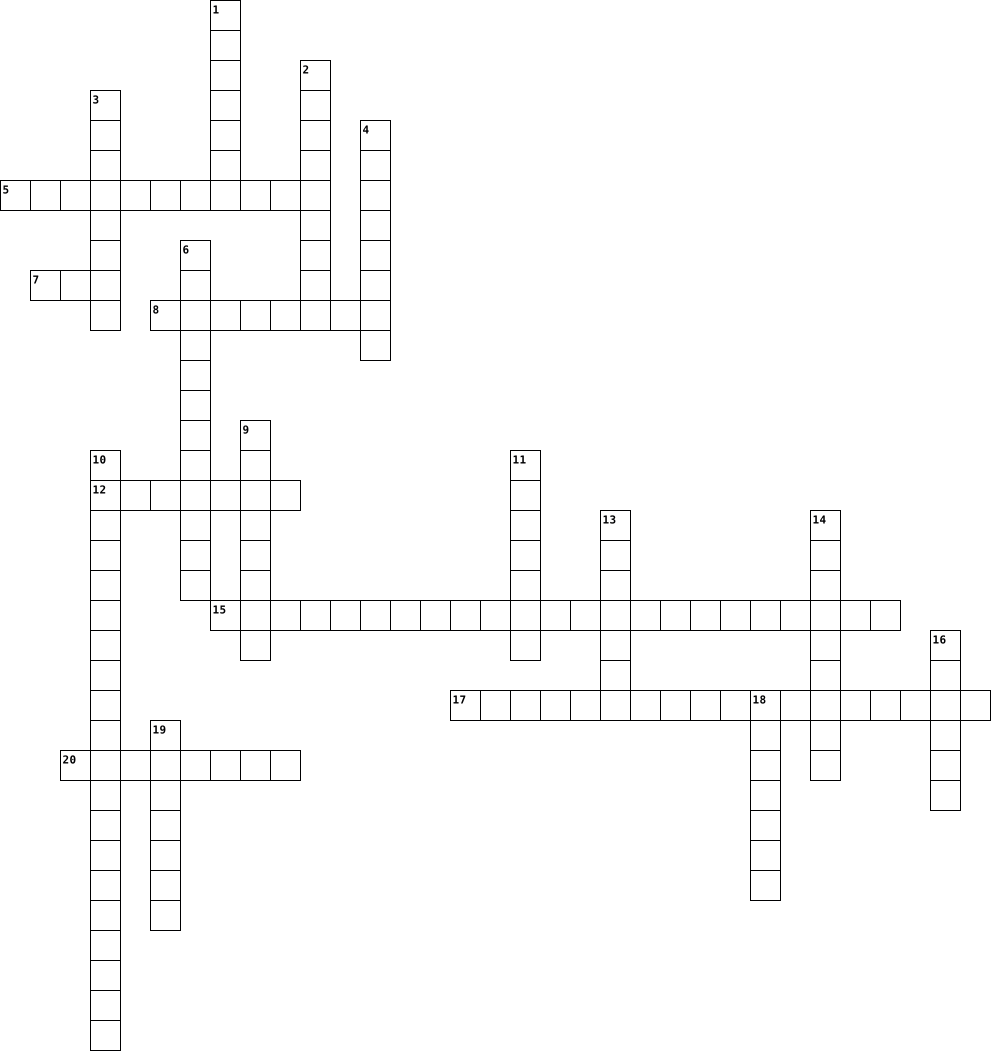
Across
- A solid that forms during a chemical reaction that takes place in a solution.
- An atom that has lost or gained an electrons and therefore has an electrical charge.
- a solution, the substance that dissolves.
- A pure substance that is made up of only one kind of atom
- The scientific principle that matter is neither created nor destroyed during a chemical change.
- A mixture in which substances are distributed evenly. (You cannot see the different parts)
- A homogeneous mixture in which one substance completely dissolves in another substance
Down
- The elements or compounds produced by a chemical reaction.
- Used to describe a material that can be hammered or beaten into thin sheets.
- A substance that is present at the beginning of a chemical reaction
- A pure substance that forms when two or more elements are held together by a chemical bond; Every molecule of a compound is the same.
- A vertical column of elements in the periodic table- can show number of valence electrons.
- An element that usually is a gas or brittle solid at room temperature, is not malleable or ductile, is a poor conductor of heat and electricity, and typically is dull.
- A mixture in which substances are not distributed evenly. (You can see the different parts)
- A combination of two or more substances that are not chemically combined.
- Hard substance that will break or shatter easily.
- An element that has physical and chemical properties of both metals and nonmetals; can be a semi-conductor.
- A horizontal row of elements in the periodic table- shows number of electron shells for an element.
- In a solution, the substance that does the dissolving
- The ability of a substance to be pulled into a wire.
20 Clues: a solution, the substance that dissolves. • Hard substance that will break or shatter easily. • The ability of a substance to be pulled into a wire. • In a solution, the substance that does the dissolving • A pure substance that is made up of only one kind of atom • The elements or compounds produced by a chemical reaction. • ...
Matter Puzzle 2 2019-09-04

Across
- a way to separate a mixture in which one layer is carefully poured off of another layer
- tending to vaporize easily
- a unit of energy equal to 3.6 million joules
- a law stating that energy can be neither created nor destroyed
- an energy unit equivalent to 1000 little-c calories
- the energy of a body that is associated with its position or the arrangement of it parts
- the capacity to do work
- a change in which matter does not change its composition, even though its appearance might change
- energy associated with the motion of an object
- describes a process that releases heat energy
- a method of separating a mixture composed of a solid and a liquid in which the mixture is poured through filter paper held in a funnel to capture the solid component.
Down
- describes a process that absorbs heat energy
- a way to separate mixtures in which the mixture is heated to boil off the more volatile component
- the result of a force acting on a distance
- reaction the process by which one or more substances transform into different substances via a chemical change
- a final substance produced in a chemical reaction; represented on the right side of a chemical equation
- a type of kinetic energy associated with the temperature-dependent random movement of atoms and molecules
- a measure of its thermal energy
- scale of temperature setting 0 at the freezing point of a concentrated salt water solution and 96 at the normal body temperature.
- the transfer or exchange of thermal energy caused by a temperature difference
- energy energy associated with the flow of electric charge
- an initial substance in a chemical reaction, represented on the left side of a chemical equation
22 Clues: the capacity to do work • tending to vaporize easily • a measure of its thermal energy • the result of a force acting on a distance • describes a process that absorbs heat energy • a unit of energy equal to 3.6 million joules • describes a process that releases heat energy • energy associated with the motion of an object • ...
Unit 2: Thermochemistry 2025-04-02

Across
- change from a liquid state to a solid state
- portion of matter undergoing a chemical or physical change being studied
- A -------process where a chemical reaction or physical change absorbs heat
- change from liquid state to gaseous state
- study of measuring the amount of heat absorbed or released during a chemical reaction or a physical change
- A ------process where a chemical reaction or physical change that releases heat
- and enthalpy ------ id the heat released or absorbed by a system under constant pressure during a chemical or physical process
- process of measuring the amount of heat involved in a chemical or physical process
- change from a gaseous state directly to a solid state
Down
- energy of a moving body
- Whos law states that if a process can be represented as the sum of several steps, the enthalpy change of the process equals the sum of the enthalpy changes of the steps
- change from solid state directly to gaseous state
- change from a solid state to a liquid state
- all matter other than the system being studied
- The transfer of thermal energy between two bodies
- energy of a particle or system of particles derived from relative position, composition, or condition
- A ------- calorimeter is a device designed to measure the energy change for processes occurring under conditions of constant volume.
- sum of a system’s internal energy and the mathematical product of its pressure and volume
- change from a gaseous to a liquid state
- energy transfer due to changes in external, macroscopic variables such as pressure and volume; or causing matter to move against an opposing force
- The capacity to supply heat or do work.
21 Clues: energy of a moving body • change from a gaseous to a liquid state • The capacity to supply heat or do work. • change from liquid state to gaseous state • change from a liquid state to a solid state • change from a solid state to a liquid state • all matter other than the system being studied • change from solid state directly to gaseous state • ...
Chemistry Exam 2023-05-09

Across
- Subatomic particles found inside the nucleus of every atom
- An element that possesses a preponderance of properties in between, or that are a mixture of, those of metals and nonmetals
- A substance with two or more atoms
- Releases energy from its surroundings
- variable that changes as a result of the independent variable manipulation
- 6.022 × 10
- A small particle with a negative charge that is found in all atoms.
- A form of a chemical element in which the atoms have the same number of protons but with a different number of neutrons.
- Composed by a single element or compound
- The process of using electricity to split water into hydrogen and oxygen
- A stable subatomic particle occurring in all atomic nuclei, with a positive electric charge equal in magnitude to that of an electron, but of opposite sign.
- Fundamental items that can't be easily broken into smaller pieces
Down
- A variable that isn't changed by other variables
- A substance that takes part in and undergoes changes in a reactions
- Opaque, lustrous elements that are good conductors of heat and electricity.
- Process used by plants and other organisms to convert light energy into chemical reaction.
- A process in which sugars are transformed into a new product through chemical reactions
- Russian Chemist and inventor is known for formulating the periodic law
- The same number of each type of atom on both sides of the equation
- Reaction that absorbs energy
- A force that acts from the outside
- A column of elements in the periodic table of the chemical elements.
- A substance that is present at the end of a chemical reaction.
- A row of chemical elements
- a substance made from two or more different elements that have been chemically joined.
25 Clues: 6.022 × 10 • A row of chemical elements • Reaction that absorbs energy • A substance with two or more atoms • A force that acts from the outside • Releases energy from its surroundings • Composed by a single element or compound • A variable that isn't changed by other variables • Subatomic particles found inside the nucleus of every atom • ...
Word Wall Words #2 (24-25) 2024-10-10

Across
- The basic particle from which all elements are made; the smallest particle of an element that has the properties of that element.
- A mixture that features distinct components that can be easily seen and sorted.
- A chemical bond formed when two atoms share electrons to form a chemical bond.
- A neutral group of two or more atoms held together by covalent bonds.
- A pure substance that cannot be broken down into other substances by chemical or physical means.
- The universal measuring system based on units of tens.
- Able to be changed or adapted.
- The variable that changes as a result of the independent variable manipulation.
- A substance formed as a result of a chemical reaction.
- A reaction that releases energy, usually in the form of heat.
- A substance made of two or more different elements chemically combined in a specific ratio or proportion.
Down
- The practice of using less of a resource so that it can last longer.
- A mixture containing a solvent and at least one solute that has the same properties throughout; a mixture in which one substance dissolves another.
- A measure of how much matter is in an object.
- A mixture that often looks the same throughout the entire mixture.
- A reaction that absorbs energy.
- The electrons that are in the highest energy level of an atom and that are involved in chemical bonding.
- The measurement of how much mass of a substance is contained in a given volume.
- The variable you manipulate or vary in an experimental study to explore its effects.
- The amount of space that matter occupies.
- The attraction between ions with opposite charges. The atoms gain or lose electrons to form a chemical bond.
21 Clues: Able to be changed or adapted. • A reaction that absorbs energy. • The amount of space that matter occupies. • A measure of how much matter is in an object. • The universal measuring system based on units of tens. • A substance formed as a result of a chemical reaction. • A reaction that releases energy, usually in the form of heat. • ...
Combustion 2026-02-10

Across
- Relation to atoms or an atom
- make something go on fire
- relating to or consisting of molecules.
- Something formed after a chemical reaction
- a matter
- relating to chemistry, or the interactions of substances as studied in chemistry.
- Becoming rusty
- a substance that takes part in and undergoes change during a reaction.
- a process that involves rearrangement of the molecular
- the discharging of a gun or other weapon.
Down
- starting a combustion
- When there isn't enough oxygen to allow the fuel fully react with the oxygen.
- solid liquid gas
- Process of burning something
- An action peformed when you feel an emotion
15 Clues: a matter • Becoming rusty • solid liquid gas • starting a combustion • make something go on fire • Relation to atoms or an atom • Process of burning something • relating to or consisting of molecules. • the discharging of a gun or other weapon. • Something formed after a chemical reaction • An action peformed when you feel an emotion • ...
Balancing Chemical Equations Station Lab Crossword 2022-10-05

Across
- Before chemical reaction.
- Means that a reaction is taking place in an equation.
- Law of __________ of mass
- Shows nothing was created or destroyed.
Down
- Shows that something was created or destroyed.
- Something that takes up space.
- Matter cannot be created or ________.
- After chemical reaction.
- event that changes matter
- Need to be equal on both sides of the equation.
10 Clues: After chemical reaction. • Before chemical reaction. • event that changes matter • Law of __________ of mass • Something that takes up space. • Matter cannot be created or ________. • Shows nothing was created or destroyed. • Shows that something was created or destroyed. • Need to be equal on both sides of the equation. • ...
Balancing Equations 2023-10-10

Across
- An equation incorrectly written
- A equation correctly written
- The start of a reaction
- The movement of mass
- Anything with mass taking up space
- The end result of a reaction
Down
- A chemical reaction with products, an arrow, and reactants
- Something that can’t be created or destroyed
- The stuff that make everything
- The chemical reaction occurring
10 Clues: The movement of mass • The start of a reaction • A equation correctly written • The end result of a reaction • The stuff that make everything • An equation incorrectly written • The chemical reaction occurring • Anything with mass taking up space • Something that can’t be created or destroyed • A chemical reaction with products, an arrow, and reactants
Oxidation Puzzle 2025-08-13

Across
- Describes a chemical equation with equal atoms on both sides.
- A substance that causes or speeds up a reaction (e.g., oxidizing ____).
- Matter with uniform properties; can be an element or compound.
- Chemical process involving the loss of electrons.
- Vertical column in the periodic table with similar properties.
- Negatively charged subatomic particles involved in bonding.
Down
- Starting material in a chemical reaction.
- Pure substances made of one type of atom (e.g., gold, oxygen).
- Two or more atoms bonded together (e.g., H₂O).
- Property of an ion or particle (positive or negative).
- Substance formed in a chemical reaction.
11 Clues: Substance formed in a chemical reaction. • Starting material in a chemical reaction. • Two or more atoms bonded together (e.g., H₂O). • Chemical process involving the loss of electrons. • Property of an ion or particle (positive or negative). • Negatively charged subatomic particles involved in bonding. • Describes a chemical equation with equal atoms on both sides. • ...
tania 2.1 vocab 2021-10-28

Across
- chemical reaction that gives off heat energy
- in a chemical reaction the arrow usually points away from the reactant
- a chemical reaction that obsons heat energy
- a process that changes substance into new substance
Down
- reaction a process that changes substance into new substance
- the result of a chemical reaction
- a change in matter that does not affect its chemical composition
- material that has mass and takes up some amount of spaces
8 Clues: the result of a chemical reaction • a chemical reaction that obsons heat energy • chemical reaction that gives off heat energy • a process that changes substance into new substance • material that has mass and takes up some amount of spaces • reaction a process that changes substance into new substance • ...
Chemistry vocabulary 2021-01-26

Across
- The ability to be drawn out into thin wires
- Property - A measurable characteristic (size, shape, or state ) of matter not involving interactions with other substances (as color, hardness, boiling point).
- - Chemical reaction in which thermal energy is absorbed.
- - Measure of acidity or basicity of a substance.
- - The readiness of a substance to produce hydroxide ions.
- Reaction - Combining substances so that new substances are formed that are not separated by normal chemical means. The new substances have properties different from those of the original substances.
- The amount of space an object occupies.
- Change - Process where one or more substances are altered into new and different substances.
- - Chemical reaction in which thermal energy is released.
- The amount of matter in a defined volume. (density = mass/volume)
- The characteristic of being able to attract because of an electrical force
- - Property of a substance relating to how easily it reacts with other substances.
- The ability to be hammered or pressed down
Down
- - The readiness of a substance to produce hydrogen ions.
- Point - Temperature at which a liquid substance becomes a gas.
- - The external features of a substance.
- - A chemical substance that produces hydroxide ions in solution and tastes bitter.
- The ability to rust do to oxygen
- Point - Temperature at which a solid substance becomes a liquid.
- - A solid substance that forms from a chemical reaction that takes place in a liquid solution.
- Change - A type of change in which the form of matter is altered but one substance is not transformed into another.
- Property - A characteristic of a substance that describes its potential to change when interacting with other substances (reactivity with air or water, combustibility, flammability).
- Measure of the amount of matter in an object.
- - Property of a substance defining how easily it ignites and burns.
- - The characteristic smell of a substance.
- - A chemical substance that produces hydrogen ions in solution and tastes sour.
- - Capacity of an acid to react with a base, measured by the number of hydrogen atoms that can be replaced by a base.
- The ability to produce electricity
- The characteristic of a slow moving sticky substance
29 Clues: The ability to rust do to oxygen • The ability to produce electricity • - The external features of a substance. • The amount of space an object occupies. • - The characteristic smell of a substance. • The ability to be hammered or pressed down • The ability to be drawn out into thin wires • Measure of the amount of matter in an object. • ...
Matter Puzzle 2 2019-09-04

Across
- the transfer or exchange of thermal energy caused by a temperature difference
- energy energy associated with the flow of electric charge
- scale of temperature setting 0 at the freezing point of a concentrated salt water solution and 96 at the normal body temperature.
- describes a process that releases heat energy
- tending to vaporize easily
- the capacity to do work
- describes a process that absorbs heat energy
- the result of a force acting on a distance
- a way to separate mixtures in which the mixture is heated to boil off the more volatile component
- a way to separate a mixture in which one layer is carefully poured off of another layer
Down
- a change in which matter does not change its composition, even though its appearance might change
- a law stating that energy can be neither created nor destroyed
- the energy of a body that is associated with its position or the arrangement of it parts
- an initial substance in a chemical reaction, represented on the left side of a chemical equation
- a type of kinetic energy associated with the temperature-dependent random movement of atoms and molecules
- a measure of its thermal energy
- an energy unit equivalent to 1000 little-c calories
- reaction the process by which one or more substances transform into different substances via a chemical change
- energy associated with the motion of an object
- a method of separating a mixture composed of a solid and a liquid in which the mixture is poured through filter paper held in a funnel to capture the solid component.
- a unit of energy equal to 3.6 million joules
- a final substance produced in a chemical reaction; represented on the right side of a chemical equation
22 Clues: the capacity to do work • tending to vaporize easily • a measure of its thermal energy • the result of a force acting on a distance • describes a process that absorbs heat energy • a unit of energy equal to 3.6 million joules • describes a process that releases heat energy • energy associated with the motion of an object • ...
Chemical Reactions Vocabulary 2023-11-05

Across
- A sample of matter, either a single element or single compound that has definite chemical and physical properties
- Chemical _________ uses chemical symbols and numbers to represent a given substance
- Process in which atoms are rearranged and chemical bonds are broken and formed to produce a change in the substance
- Ability to cause change
- A group of atoms held together by chemical bonds
Down
- A substance that forms in a chemical reaction
- A substance that participates in a chemical reaction
- Smallest unit of an element that maintains properties of element
- Chemical _________ is a representation of the chemical reaction that uses symbols to show the relationship between reactants and products
- A combination of two or more substances that are not chemically combined
10 Clues: Ability to cause change • A substance that forms in a chemical reaction • A group of atoms held together by chemical bonds • A substance that participates in a chemical reaction • Smallest unit of an element that maintains properties of element • A combination of two or more substances that are not chemically combined • ...
Alora 2.1 vocab 2021-10-26

Across
- reaction that gives off heat
- substances present before a chemical reaction
- absorbs heat energy
- chemical reaction
Down
- changes substances into new substances
- substances formed during a chemical reaction
- change in matter
- material that has mass
8 Clues: change in matter • chemical reaction • absorbs heat energy • material that has mass • reaction that gives off heat • changes substances into new substances • substances formed during a chemical reaction • substances present before a chemical reaction
Chem 1 Chapter 11 Vocabulary 2023-02-16

Across
- a chemical equation that does not indicate the relative amounts of the reactants and products
- reaction a chemical change in which an element or a compound reacts with oxygen, often producing energy in the form of heat and light
- a chemical change in which one element replaces a second element in a compound
- an equation that shows dissolved ionic compounds as dissociated free ions
- a substance that speeds up the reaction but is not used up in the reaction
- a number placed in front of a chemical symbol or formula
- a chemical change in which one element replaces a second element in a compound
Down
- a chemical change in which two or more substances react to form a single new substance
- lists elements in order of decreasing reactivity.
- a chemical change in which a single compound breaks down into two or more simpler products
- representation of a chemical reaction
11 Clues: representation of a chemical reaction • lists elements in order of decreasing reactivity. • a number placed in front of a chemical symbol or formula • an equation that shows dissolved ionic compounds as dissociated free ions • a substance that speeds up the reaction but is not used up in the reaction • ...
Science Revision - Atoms Elements and Compounds 2025-05-08

Across
- What element has the chemical symbol Mg
- What element has the chemical symbol C
- Used to separate elements in compounds using heat
- What element has the chemical symbol O
Down
- Complete the word equation: Calcium + Carbon + Oxygen → Calcium _________
- Complete the word equation: Iron + Sulfur → Iron ______
- What element has the chemical symbol Fe
- What element has the chemical symbol Au
- What element has the chemical symbol Br
- To check if a chemical reaction has happened you can see if a ___ has been given off.
- To check if a chemical reaction has happened you can see if there is a change of _______.
11 Clues: What element has the chemical symbol C • What element has the chemical symbol O • What element has the chemical symbol Fe • What element has the chemical symbol Mg • What element has the chemical symbol Au • What element has the chemical symbol Br • Used to separate elements in compounds using heat • Complete the word equation: Iron + Sulfur → Iron ______ • ...
Biochemistry Crossword 2016-09-12

Across
- The primary sugar in the blood as well as a large energy source for the body's cells
- Compound consisting of two or more amino acids, linked in a chain
- Bonds together with other molecules to form a polymer
- Carbohydrate that can be decomposed into two or more molecules
- Two sugar groups chemically bonded together
- Made up of small molecules to form a bigger molecule, a chemical compound arranged in a basic repeating structure
- Acid Composed of a chain of carbon atoms bonded with hydrogen atoms
- Also known as "The Sugars"
- a disaccharide that is present in milk
- A polysaccharide that mostly occurs in plant tissue
- Also known as table sugar
- Group The factor that makes amino acids different from each other
- A chemical reaction consisting of loss of a water molecule
- Cholesterol is the most abundant and important ______ in the body
Down
- The chemical formula of this is C3H8O3
- Acid Small organic molecules that have a hydrogen atom, a carboxyl group and an "R' group
- Contains a phosphate group in its middle, a lipid
- A sugar that isn't decomposable into a simpler sugar
- A polysaccharide that contains chains of glucose monomers
- A substance that increases the chance of a chemical reaction, however, it doesn't show any permanent change
- A type of protein, all end in "ase"
- Naturally occurring, derived from natural materials
- Water is used to break down a compound, chemical reaction
- Doesn't dissolve
- The process of changing a proteins molecular structure
- The most abundant steroid in the body
- fats A fat that is solid at room temperature
- Commonly written as C(=O)OH
- fat A fat that is liquid at room temperature
- It's chemical formula is C6H12O6
30 Clues: Doesn't dissolve • Also known as table sugar • Also known as "The Sugars" • Commonly written as C(=O)OH • It's chemical formula is C6H12O6 • A type of protein, all end in "ase" • The most abundant steroid in the body • The chemical formula of this is C3H8O3 • a disaccharide that is present in milk • Two sugar groups chemically bonded together • ...
Option B Biochem 2023-10-11

Across
- Cycle A series of chemical reactions in cellular respiration that generates ATP through the oxidation of acetyl-CoA.
- A change in the genetic material of an organism.
- A molecule involved in protein synthesis and various cellular processes.
- The basic building block of nucleic acids, consisting of a sugar, phosphate group, and a nitrogenous base
- A coenzyme that carries electrons in specific biochemical reactions.
- The sum of all chemical reactions that occur within an organism.
- The process of creating an identical copy of DNA.
- A coenzyme that carries electrons in various biochemical reactions.
- The process of slowing down or blocking a chemical reaction.
- The molecule that encodes genetic information in all living organisms.
- The breakdown of stored fat into fatty acids and glycerol.The molecule that encodes genetic information in all living organisms.
- A cellular structure involved in protein synthesis.
Down
- The final stage of cellular respiration, where ATP is produced through electron transport and chemiosmotic coupling.
- The synthesis of glucose from non-carbohydrate sources.
- A biological molecule, often a protein, that acts as a catalyst to accelerate chemical reactions in living organisms.
- The specific molecule upon which an enzyme acts, forming an enzyme-substrate complex during a chemical reaction.
- The process of synthesizing a protein from an mRNA template.
- An organic cofactor, usually derived from vitamins, that enhances the activity of specific enzymes.
- A substance that increases the rate of a chemical reaction without being consumed in the process.
- A non-protein molecule or ion that aids the function of an enzyme.
- The process of copying genetic information from DNA into RNA.
- A molecule that stores and transfers energy within cells.
- The initial step in glucose metabolism, breaking glucose into two pyruvate molecules.
23 Clues: A change in the genetic material of an organism. • The process of creating an identical copy of DNA. • A cellular structure involved in protein synthesis. • The synthesis of glucose from non-carbohydrate sources. • A molecule that stores and transfers energy within cells. • The process of synthesizing a protein from an mRNA template. • ...
Option B Biochem 2023-10-11

Across
- Cycle A series of chemical reactions in cellular respiration that generates ATP through the oxidation of acetyl-CoA.
- A change in the genetic material of an organism.
- A molecule involved in protein synthesis and various cellular processes.
- The basic building block of nucleic acids, consisting of a sugar, phosphate group, and a nitrogenous base
- A coenzyme that carries electrons in specific biochemical reactions.
- The sum of all chemical reactions that occur within an organism.
- The process of creating an identical copy of DNA.
- A coenzyme that carries electrons in various biochemical reactions.
- The process of slowing down or blocking a chemical reaction.
- The molecule that encodes genetic information in all living organisms.
- The breakdown of stored fat into fatty acids and glycerol.The molecule that encodes genetic information in all living organisms.
- A cellular structure involved in protein synthesis.
Down
- The final stage of cellular respiration, where ATP is produced through electron transport and chemiosmotic coupling.
- The synthesis of glucose from non-carbohydrate sources.
- A biological molecule, often a protein, that acts as a catalyst to accelerate chemical reactions in living organisms.
- The specific molecule upon which an enzyme acts, forming an enzyme-substrate complex during a chemical reaction.
- The process of synthesizing a protein from an mRNA template.
- An organic cofactor, usually derived from vitamins, that enhances the activity of specific enzymes.
- A substance that increases the rate of a chemical reaction without being consumed in the process.
- A non-protein molecule or ion that aids the function of an enzyme.
- The process of copying genetic information from DNA into RNA.
- A molecule that stores and transfers energy within cells.
- The initial step in glucose metabolism, breaking glucose into two pyruvate molecules.
23 Clues: A change in the genetic material of an organism. • The process of creating an identical copy of DNA. • A cellular structure involved in protein synthesis. • The synthesis of glucose from non-carbohydrate sources. • A molecule that stores and transfers energy within cells. • The process of synthesizing a protein from an mRNA template. • ...
Chemistry project by Gregorius,Steven,Diego 2025-04-14

Across
- change a change in which a new chemical substance forms
- atoms of the same element that have a different numbers of neutrons
- reaction a process in which chemical change takes place
- Oxides and hydroxides of metals
- the physical change from solid to liquid
- a unit of two or more atoms held together by covalent bonds
- another name for a positive ion
- a very tiny piece of matter making up everything
- soluble bases
- they can be drawn out into wires
- a chemical that shows by its colour whether a substance is acidic or alkaline
- a mixture obtained when a solute is dissolved in a solvent
- a starting chemical for a reaction
- a substance that allows heat or electricity to pass through it easily
- a poor conductor of heat or electricity
- does not react easily
Down
- substance containing only one type of atom; it can't be broken
- can be bent and pressed into shape
- a substance in which two or more elements are chemically combined
- a solution with a low amount of solute dissolved in a solvent
- non metal compounds in water
- a solution with a high amount of solute dissolved in a solvent
- a reaction with acid that gives water as well as a salt
- : a charged atom or group of atoms formed by the gain or loss of one or more electrons
- the smallest particles that we can't break down any further
- a mixture where at least one other substance is added to a metal to improve its property
- a chemical made in a chemical reaction
- reacts with substances it comes into contact with
- the process in which particles mix by colliding with eachother and bouncing off in all directions
- another name for a negative ion
30 Clues: soluble bases • does not react easily • non metal compounds in water • Oxides and hydroxides of metals • another name for a positive ion • another name for a negative ion • they can be drawn out into wires • can be bent and pressed into shape • a starting chemical for a reaction • a chemical made in a chemical reaction • a poor conductor of heat or electricity • ...
Chemistry 2023-04-26

Across
- the consistent arrangement of atoms within a molecule
- when a chemical reaction absorbs heat (energy)
- large particle with no charge which makes up atoms
- The positive or negative charge of an atom or molecule
- when a chemical reaction releases heat (energy)
- building blocks of all matter
- when two or more atoms join together
Down
- large positively charged particle which makes up atoms
- small particle with a negative charge which orbits the nucleus of atoms
- When a chemical reaction produces a solid and a liquid
- a substance with a high pH
- a substance with a low pH
12 Clues: a substance with a low pH • a substance with a high pH • building blocks of all matter • when two or more atoms join together • when a chemical reaction absorbs heat (energy) • when a chemical reaction releases heat (energy) • large particle with no charge which makes up atoms • the consistent arrangement of atoms within a molecule • ...
Module 2 Chemistry of Life Crossword 2023-09-15

Across
- Something that has a mass and a volume
- The ability to do work
- A large molecule composed of smaller substances
- Macromolecule with an element formula of CH2O
- The monomers of a protein
- A chemical reaction that occurs in plants used to create energy that the plants uses to create proteins
- The Combonation of two or more elements to create a molecule
Down
- Two or more elements that have bonded together
- The result of a chemical reaction
- The monomers of nucleic acids
- Macromolecule used for building muscle and most bodily functions
- The substance being changed in a chemical reaction
12 Clues: The ability to do work • The monomers of a protein • The monomers of nucleic acids • The result of a chemical reaction • Something that has a mass and a volume • Macromolecule with an element formula of CH2O • Two or more elements that have bonded together • A large molecule composed of smaller substances • The substance being changed in a chemical reaction • ...
Chemistry [11.1a - 12.3a] 2022-12-02
![Chemistry [11.1a - 12.3a] crossword puzzle](/image/9000484.svg?size=30&stroke_width=1)
Across
- Compounds are swapped
- Form of equation in which the law of conservation of mass is upheld
- Written representation of a chemical reaction
- A substance is broken down into two or more other substances
- Hydrocarbon reacts with Oxygen to produce Carbon Dioxide and water
- These are also known as Synthesis reactions
Down
- Single elements are swapped
- Study of calculations in chemical equations
- Amount of product that is produced
- Maximum amount of product that could be produced
- Substance used to speed up reactions
- Equation that shows dissolved compounds as free ions
12 Clues: Compounds are swapped • Single elements are swapped • Amount of product that is produced • Substance used to speed up reactions • Study of calculations in chemical equations • These are also known as Synthesis reactions • Written representation of a chemical reaction • Maximum amount of product that could be produced • Equation that shows dissolved compounds as free ions • ...
Chemistry in Seventh Grade 2026-03-10

Across
- two or more atoms chemically combined
- the long name of an element
- the result of atoms rearranging in a reaction
- the number of molecules
- the shorthand way or writing an element name
- smallest piece of an element
Down
- when atoms rearrange to make products
- a chemical reaction written out
- what comes together in a chemical reaction
- the written form of a molecule
- expresses the number of atoms in a formula
11 Clues: the number of molecules • the long name of an element • smallest piece of an element • the written form of a molecule • a chemical reaction written out • when atoms rearrange to make products • two or more atoms chemically combined • what comes together in a chemical reaction • expresses the number of atoms in a formula • the shorthand way or writing an element name • ...
Types of Chemical Reactions 2024-05-19

Across
- - Numbers indicating the quantity of reactants/products.
- bond - Attraction holding atoms together.
- - Two or more substances form one product.
- - One element replaces another.
- - Gain of electrons.
- - Substances that undergo change.
- - Equal atoms on both sides of an equation.
- equation - Representation of a chemical reaction.
Down
- - Reaction absorbing heat.
- - Loss of electrons.
- - Small numbers indicating the number of atoms.
- displacement - Exchange of ions between two compounds.
- - Group of atoms bonded together.
- - Single compound breaks down.
- - Substances formed in a reaction.
- of Conservation of Mass - Mass is neither created nor destroyed.
- - Dissolved in water.
- - Insoluble solid formed in a solution.
- - Reaction releasing heat.
- - Substance speeding up a reaction.
20 Clues: - Loss of electrons. • - Gain of electrons. • - Dissolved in water. • - Reaction absorbing heat. • - Reaction releasing heat. • - Single compound breaks down. • - One element replaces another. • - Group of atoms bonded together. • - Substances that undergo change. • - Substances formed in a reaction. • - Substance speeding up a reaction. • - Insoluble solid formed in a solution. • ...
Acid and base/Rigo Herrera 2019-04-01

Across
- tiny particles of one liquid
- mixture
- base electrons and acids
- chemical compound
- A measure
- reducing the concentration
- foundation
- chemical reaction
- Hydrogen atom
Down
- mixable
- base basic solution
- ratio
- ion negativity charged molecule
- another substance
- ion H30
- concentration of substance
- solution Ph7
17 Clues: ratio • mixable • mixture • ion H30 • A measure • foundation • solution Ph7 • Hydrogen atom • chemical compound • another substance • chemical reaction • base basic solution • base electrons and acids • concentration of substance • reducing the concentration • tiny particles of one liquid • ion negativity charged molecule
Chemical reactions 2025-02-02

Across
- A bond that includes only metals.
- A __________ reaction also always produces CO2 and H2O.
- The more an object moves, the more ________ ________ it has.
- The number of protons in a nucleus
- is a reaction in which a compound breaks down into two or more simpler substances
- An alkali metal is a metal in Group I of the periodic table.
- what type of bond is NaBr - Sodium Bromide?
- occurs when a part of two ionic compounds is exchanged and makes two new components
- most basic unit of matter
- A + B → AB.
Down
- atom's outermost electrons.
- negatively charged subatomic particle
- a chemical bond formed when two atoms share two electrons
- reaction in which one element is substituted for another element in a compound.
- a row (left to right) of the periodic table.
- result of a chemical reaction.
- Nitric acid reacts with sodium carbonate to form sodium nitrate, ca,rbon dioxide and water.
- substance that gets dissolved in a solvent.
18 Clues: A + B → AB. • most basic unit of matter • atom's outermost electrons. • result of a chemical reaction. • A bond that includes only metals. • The number of protons in a nucleus • negatively charged subatomic particle • substance that gets dissolved in a solvent. • what type of bond is NaBr - Sodium Bromide? • a row (left to right) of the periodic table. • ...