
chemical reaction Crossword Puzzles
Matter Properties 2025-02-05

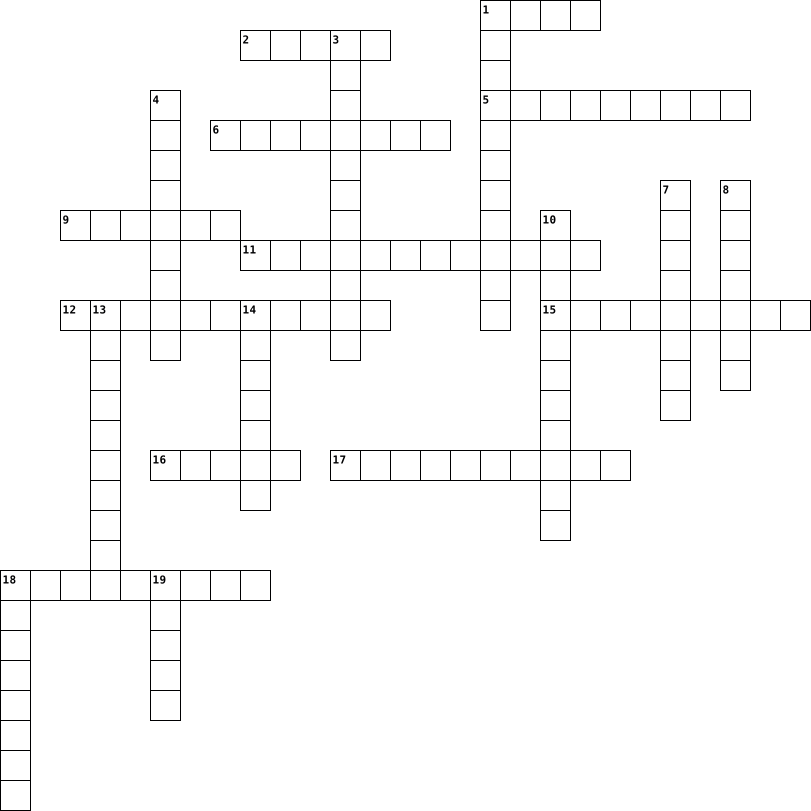
Across
- a measure of acidity or basicity
- how easily a substance ignites or catches fire
- the feel of the surface of the matter
- the amount of "stuff" matter
- is the degree to which a substance can harm living things
- how matter smells
- the ability to exert magnetic force
- how easily matter bends without breaking
- the general form of matter
- the gradual destruction of an object by chemical reaction
- how well matter transfers electricity or heat
- how matter reflects light
Down
- how hot or cold the matter is
- corrosion due to a reaction with oxygen
- how difficult it to scratch
- the temperature a solid will melt
- how easily a substance undergoes a chemical reaction
- how well a substance dissolves into a substance
- matter's dimension or length x width x height
- the temperatire at which liquid evaporates
- is the degree to which a substance can harm living things
21 Clues: how matter smells • how matter reflects light • the general form of matter • how difficult it to scratch • the amount of "stuff" matter • how hot or cold the matter is • a measure of acidity or basicity • the temperature a solid will melt • the ability to exert magnetic force • the feel of the surface of the matter • corrosion due to a reaction with oxygen • ...
Stereochemistry - 1 2025-10-13

Across
- M.F. C12H10
- plant hormone that promotes cell elongation, division, and differentiation
- most intense peak in a mass spectrum
- thermal elimination reaction - alcohols to olefins via xanthates
- diagram showing electronic states of a molecule and transitions
- quinoline synthesis by heating an aniline with glycerol, strong acid (sulfuric acid), and an oxidizing agent like nitrobenzene
- shift of a spectral absorption to a longer wavelength
- a chemical designed to kill, repel, or manage insect populations
- Species having an unshared electron pair
- Efficiency of a chemical reaction
- benzene ring fused to a pyridine ring
- yellow, lemon-scented liquid
Down
- σ-bond migration across a π-bonded system
- centre of chirality
- Bis(2-chloroethyl) sulfide
- fats and oils reacted with a strong alkali
- type of pericyclic reaction
- Thermodynamic term indicates Ability to accept a proton
- molecule with cumulative double bonds
- highly toxic, persistent organochlorine insecticide
20 Clues: M.F. C12H10 • centre of chirality • Bis(2-chloroethyl) sulfide • type of pericyclic reaction • yellow, lemon-scented liquid • Efficiency of a chemical reaction • most intense peak in a mass spectrum • molecule with cumulative double bonds • benzene ring fused to a pyridine ring • Species having an unshared electron pair • σ-bond migration across a π-bonded system • ...
Sadia Ahidjo 2022-03-08

Across
- is a conversion factor between compounds in a chemical reaction, that is derived from the coefficients of the compounds in a balanced equation
- A chemical reaction is a process that leads to the chemical transformation of one set of chemical substances to another
- the lowest wheel # racial element within a compound.
- of 1 mole of substance
- maximum amount of product that can be produced based on the limiting reactant.
- is a unit of mass in the metric system defined as one thousandth (1 x 10⁻³) of a kilogram.
Down
- the ratio of the actual yield to the theoretical yield
- reactant that runs out first in a chemical reaction.
- multiple of an empirical formula
- the study of ratios within chemical reaction
10 Clues: of 1 mole of substance • multiple of an empirical formula • the study of ratios within chemical reaction • reactant that runs out first in a chemical reaction. • the lowest wheel # racial element within a compound. • the ratio of the actual yield to the theoretical yield • maximum amount of product that can be produced based on the limiting reactant. • ...
Sadia Ahidjo 2022-03-08

Across
- is a conversion factor between compounds in a chemical reaction, that is derived from the coefficients of the compounds in a balanced equation
- A chemical reaction is a process that leads to the chemical transformation of one set of chemical substances to another
- the lowest wheel # racial element within a compound.
- of 1 mole of substance
- maximum amount of product that can be produced based on the limiting reactant.
- is a unit of mass in the metric system defined as one thousandth (1 x 10⁻³) of a kilogram.
Down
- the ratio of the actual yield to the theoretical yield
- reactant that runs out first in a chemical reaction.
- multiple of an empirical formula
- the study of ratios within chemical reaction
10 Clues: of 1 mole of substance • multiple of an empirical formula • the study of ratios within chemical reaction • reactant that runs out first in a chemical reaction. • the lowest wheel # racial element within a compound. • the ratio of the actual yield to the theoretical yield • maximum amount of product that can be produced based on the limiting reactant. • ...
Chapter 2 Crossword (Includes terms from Chapter 1) 2024-09-08

Across
- Negatively charged particle.
- Energy needed to start a chemical reaction.
- Smallest unit of a compound.
- Large macromolecule formed from monosaccharides.
- Process in which a cell from two parents unite to create a new organism.
- Macromolecule containing carbon, hydrogen, oxygen, nitrogen, and phosphorus.
- A weak acid or base that helps prevent sharp, sudden changes in pH.
- Protein that acts as a biological catalyst.
- A large compound formed from combinations of many monomers.
- Monomer of nucleic acids. Composed of a 5-carbon sugar, nitrogenous base, and a phosphate group.
- Set of chemical reactions through which an organism builds up or breaks down materials as it carries out its life processes.
- Macromolecule made up of carbon and hydrogen. Fats, oils, and waxes.
- A substance combined of two or more elements.
- A substance that speeds up the rate of a chemical reaction.
- Basic unit of matter.
- An element or compound that is produced by a chemical reaction.
- A bond formed when electrons are transferred.
- Compound that produces hydroxide ions in solution.
- An atom that has a charge.
- An element or compound that enters into a chemical reaction.
Down
- Change over time.
- System used to indicate the concentration of hydrogen ions
- Process by which organisms maintain a stable internal environment.
- A signal in which an organism responds.
- Double-stranded nucleic that contains the sugar deoxyribose.
- Substance consisting of one type of atom.
- Macromolecule that is made up of carbon, hydrogen, oxygen, and nitrogen.
- Reactant of an enzyme-catalyzed reaction.
- Process where a single parent reproduces by itself.
- Compound made up of carbon, hydrogen, and oxygen. Major source of energy for living organisms.
- Single-stranded nucleic acid that contains the sugar ribose.
- Single sugar molecule
- Center of the atom that contains the neutrons and protons.
- Monomer of proteins. Compound of amino group, carboxyl group, and an R-group.
- Compound that forms hydrogen ions in a solution.
- A bond formed when electrons are shared.
- Small unit that can join together with other small units to form polymers.
37 Clues: Change over time. • Single sugar molecule • Basic unit of matter. • An atom that has a charge. • Negatively charged particle. • Smallest unit of a compound. • A signal in which an organism responds. • A bond formed when electrons are shared. • Substance consisting of one type of atom. • Reactant of an enzyme-catalyzed reaction. • Energy needed to start a chemical reaction. • ...
Sadia Ahidjo 2022-03-08

Across
- is a conversion factor between compounds in a chemical reaction, that is derived from the coefficients of the compounds in a balanced equation
- A chemical reaction is a process that leads to the chemical transformation of one set of chemical substances to another
- the lowest wheel # racial element within a compound.
- of 1 mole of substance
- maximum amount of product that can be produced based on the limiting reactant.
- is a unit of mass in the metric system defined as one thousandth (1 x 10⁻³) of a kilogram.
Down
- the ratio of the actual yield to the theoretical yield
- reactant that runs out first in a chemical reaction.
- multiple of an empirical formula
- the study of ratios within chemical reaction
10 Clues: of 1 mole of substance • multiple of an empirical formula • the study of ratios within chemical reaction • reactant that runs out first in a chemical reaction. • the lowest wheel # racial element within a compound. • the ratio of the actual yield to the theoretical yield • maximum amount of product that can be produced based on the limiting reactant. • ...
Sadia Ahidjo 2022-03-08

Across
- is a conversion factor between compounds in a chemical reaction, that is derived from the coefficients of the compounds in a balanced equation
- A chemical reaction is a process that leads to the chemical transformation of one set of chemical substances to another
- the lowest wheel # racial element within a compound.
- of 1 mole of substance
- maximum amount of product that can be produced based on the limiting reactant.
- is a unit of mass in the metric system defined as one thousandth (1 x 10⁻³) of a kilogram.
Down
- the ratio of the actual yield to the theoretical yield
- reactant that runs out first in a chemical reaction.
- multiple of an empirical formula
- the study of ratios within chemical reaction
10 Clues: of 1 mole of substance • multiple of an empirical formula • the study of ratios within chemical reaction • reactant that runs out first in a chemical reaction. • the lowest wheel # racial element within a compound. • the ratio of the actual yield to the theoretical yield • maximum amount of product that can be produced based on the limiting reactant. • ...
Chemistry Crossword 2022-11-17

Across
- an ion with a negative electrical charge.
- ion ion comprised of two or more atoms.
- chemical species formed when two or more atoms form a chemical bond.
- a mathematical relationship or rule expressed in symbols.
- chemical reaction in which a radical removes a proton from a molecule.
- ion with a positive electrical charge.
- chemical compound containing two different elements.
Down
- a substance that cannot be subdivided using chemical means; identified by the number of protons in its atoms.
- Compound molecule that contains covalent chemical bonds.
- ion molecules that contain two atoms that are chemically bonded
- Compound compound formed by ions bonding together due to electrostatic forces (differing electronegativity values).
- reaction between triglycerides and either sodium hydroxide or potassium hydroxide to form a fatty acid salt called soap and glycerol.
- chemical species formed by two or more atoms that share chemical bonds such that they form one unit.
- the devising or choosing of names for things, especially in a science or other discipline.
- natural mixture of polycyclic aromatic hydrocarbons
15 Clues: ion with a positive electrical charge. • ion ion comprised of two or more atoms. • an ion with a negative electrical charge. • natural mixture of polycyclic aromatic hydrocarbons • chemical compound containing two different elements. • Compound molecule that contains covalent chemical bonds. • a mathematical relationship or rule expressed in symbols. • ...
Chemistry Crossword 2022-11-17

Across
- Natural mixture of polycyclic aromatic hydrocarbons
- Compound formed by ions bonding together due to electrostatic forces (differing electronegativity values).
- Reaction between triglycerides and either sodium hydroxide or potassium hydroxide to form a fatty acid salt called soap and glycerol.
- Chemical reaction in which a radical removes a proton from a molecule.
- Chemical species formed by two or more atoms that share chemical bonds such that they form one unit.
- A mathematical relationship or rule expressed in symbols.
- Molecule that contains covalent chemical bonds.
Down
- Molecules that contain two atoms that are chemically bonded
- Ion comprised of two or more atoms.
- Chemical compound containing two different elements.
- Chemical species formed when two or more atoms form a chemical bond.
- The devising or choosing of names for things, especially in a science or other discipline.
- Ion with a positive electrical charge.
- An ion with a negative electrical charge.
- A substance that cannot be subdivided using chemical means; identified by the number of protons in its atoms.
15 Clues: Ion comprised of two or more atoms. • Ion with a positive electrical charge. • An ion with a negative electrical charge. • Molecule that contains covalent chemical bonds. • Natural mixture of polycyclic aromatic hydrocarbons • Chemical compound containing two different elements. • A mathematical relationship or rule expressed in symbols. • ...
Photosynthesis 2021-11-17

Across
- What is needed for a chemical reaction to occur
- water and ___ are the reactants in the photosynthesis equation
- a green pigment that allows the plant to absorb sunlight.
- food that is produced during photosynthesis
- The organelles where photosynthesis takes place.
- Process in which plants make food and produce oxygen.
Down
- photosynthesis is a ___ reaction
- gives the plant energy
- released by the plant
- similar to the human circulatory system
- Substances formed in a chemical reaction.
11 Clues: released by the plant • gives the plant energy • photosynthesis is a ___ reaction • similar to the human circulatory system • Substances formed in a chemical reaction. • food that is produced during photosynthesis • What is needed for a chemical reaction to occur • The organelles where photosynthesis takes place. • Process in which plants make food and produce oxygen. • ...
~Chapter~13 ~Madison~Spaulding~ 2021-12-01

Across
- Bases ____ protons.
- ~when reaction and its reverse act at the same rate.
- How quickly the concentration of reactions decreases and how quickly the concentration of a product decreases.
- Increasing ______ favors the reaction that produces less gas "soda".
Down
- increasing the concentration of one substance favors the reaction that produces less of the substance.
- Acids ____ protons.
- ~ AB + Oxygen ----> oxides of A an B + H2O.
- chemical reactions can be reversed.
- An ____ is a chemical that accepts a Hydrogen Ion H4
- Increasing ______ favors the reaction that absorbs energy.
- A ____ is a chemical that donates a Hydrogen Ion H4
11 Clues: Acids ____ protons. • Bases ____ protons. • chemical reactions can be reversed. • ~ AB + Oxygen ----> oxides of A an B + H2O. • A ____ is a chemical that donates a Hydrogen Ion H4 • ~when reaction and its reverse act at the same rate. • An ____ is a chemical that accepts a Hydrogen Ion H4 • Increasing ______ favors the reaction that absorbs energy. • ...
Photosynthesis 2021-06-29

Across
- organism that makes its own food from sunlight.
- organism that needs to consume other organisms for food.
- CO2
- name for the molecule plants create to store chemical energy (tastes sweet!)
- energy stored in the bonds of chemical compounds.
Down
- green pigment located in Cholorplasts.
- process by which plants turn sunlight into chemical energy.
- the end result of a chemical reaction (what is made).
- Adenosine Triphosphate
- the "ingredients" of a chemical reaction.
- H2O
11 Clues: CO2 • H2O • Adenosine Triphosphate • green pigment located in Cholorplasts. • the "ingredients" of a chemical reaction. • organism that makes its own food from sunlight. • energy stored in the bonds of chemical compounds. • the end result of a chemical reaction (what is made). • organism that needs to consume other organisms for food. • ...
Balancing Chemical Reactions 2021-09-14

Across
- Uses chemical formulas and symbols
- when two or more substances make a new one
- The little numbers below the line
- The big numbers before the chemicals
- The chemical reaction before the arrow
Down
- little letters in parenthesis
- Starting mass of reactants product
- The chemical reaction after the arrow
- What the arrow means
- The physical substance that takes up space
10 Clues: What the arrow means • little letters in parenthesis • The little numbers below the line • Starting mass of reactants product • Uses chemical formulas and symbols • The big numbers before the chemicals • The chemical reaction after the arrow • The chemical reaction before the arrow • when two or more substances make a new one • The physical substance that takes up space
Difference Between Physical and Chemical Properties 2019-11-18

Across
- A ___ change is one of the signs of chemical change.
- A new ___ is one of the signs of chemical change.
- The solid that forms/appears when two clear liquids are combined.
- ___ formation is one of the signs of chemical change.
- A material created when one substance is dissolved in another. When we see this word it usually means a substance is dissolved in water.
- An “(l)” in a chemical or physical change equation means the matter is in its ___ phase.
- A material in its aqueous phase is dissolved in something else (usually ___).
- An “(aq)” in a chemical or physical change equation means the matter is in its ___ phase.
- An “(s)” in a chemical or physical change equation means the matter is in its ___ phase.
- Describes an object or material that allows all visible light to pass through.
- Describes a chemical reaction which gives-off heat to its surroundings (“feels” warm or hot to the touch).
- An “(g)” in a chemical or physical change equation means the matter is in its ___ phase.
Down
- A ___ property may only be observed by changing the chemical identity (chemical composition) of a substance.
- A ___ property is an aspect of matter that can be observed or measured without changing the chemical composition of the matter.
- Set of physical and/or chemical characteristics unique to a substance or material that distinguishes it from other substances or materials.
- A ___ change is one of the signs of chemical change.
- Describes an object or material that allows some visible light to pass through.
- Describes a chemical reaction which pulls-in heat from its surroundings (“feels” cool or cold hot to the touch).
- Describes an object or material that blocks visible light from passing through.
- The arrow symbol in a chemical or physical change equation means a ___ is occurring.
- One of the signs of chemical change.
- When a substance or material ___ in another it disappears.
22 Clues: One of the signs of chemical change. • A new ___ is one of the signs of chemical change. • A ___ change is one of the signs of chemical change. • A ___ change is one of the signs of chemical change. • ___ formation is one of the signs of chemical change. • When a substance or material ___ in another it disappears. • ...
Unit 6 Vocab 2022-03-22

Across
- a reaction in which one element is substituted for another element in a compound.
- reaction a process that involves rearrangement of the molecular or ionic structure of a substance, as opposed to a change in physical form or a nuclear reaction.
- the process of burning something.
- the closing down or dismissal of an assembly, partnership, or official body.
Down
- in a chemical reaction mass is neither created nor destroyed
- a reaction in which the positive and negative ions of two ionic compounds exchange places to form two new compounds.
- the action or process of precipitating a substance from a solution.
- a substance that takes part in and undergoes change during a reaction.
- the construction of complex chemical compounds from simpler ones.
- Equation a representation of a chemical reaction using symbols of the elements to indicate the amount of substance, usually in moles, of each reactant and product.
- an article or substance that is manufactured or refined for sale.
- the state or process of rotting; decay.
12 Clues: the process of burning something. • the state or process of rotting; decay. • in a chemical reaction mass is neither created nor destroyed • the construction of complex chemical compounds from simpler ones. • an article or substance that is manufactured or refined for sale. • the action or process of precipitating a substance from a solution. • ...
Heat Change In Reaction 2023-06-09

Across
- Exothermic reaction _______ heat
- What happen to the surrounding temperature when exothermic reaction occur?
- What does delta symbol mean?
- Why our hand feel warm when detergent powder in palm in contact with water? What type of chemical reaction that occur?
Down
- What is the unit for heat of reaction?
- Endothermic reaction _______ heat
- Why our hand feel cold when applying hand sanitizer? What type of chemical reaction that occur?
- What is the delta symbol for endothermic reaction?
- What happen to the surrounding temperature when endothermic reaction occur?
- What is the delta symbol for exothermic reaction?
10 Clues: What does delta symbol mean? • Exothermic reaction _______ heat • Endothermic reaction _______ heat • What is the unit for heat of reaction? • What is the delta symbol for exothermic reaction? • What is the delta symbol for endothermic reaction? • What happen to the surrounding temperature when exothermic reaction occur? • ...
Vocab bingo 2025-01-31

Across
- the liquid phase to the gas phase
- something by making it simpler or easier to see product: an ending substance that is made during a chemical
- able to cause damage
- the relative size of things
- something that can be observed about a substance,
- reaction: a process in which atoms rearrange to form
- the tiny pieces that all matter—all the stuff in the
- a starting substance that is part of a chemical reaction
- point: the temperature at which a substance changes
Down
- an object, diagram, or computer program that helps us
- to change the order or position of something
- an ending substance that is made during a chemical
- groups of atoms
- substances
- something that is made of all the same atoms
- the solid phase to the liquid phase
- point: the temperature at which a substance changes
- as color, smell, or boiling point
- made of
19 Clues: made of • substances • groups of atoms • able to cause damage • the relative size of things • the liquid phase to the gas phase • as color, smell, or boiling point • the solid phase to the liquid phase • to change the order or position of something • something that is made of all the same atoms • something that can be observed about a substance, • ...
Crossword 2021-03-27

Across
- Reactant that determines the amount of product.
- Product unused in a chemical reaction.
- Moles can be used to do this to a chemical formula.
- This form is the scientific notation of a number.
- Represents a compound.
Down
- Made during a chemical reaction.
- Mass of solute found in a given volume of solution.
- Found on the left-hand side of a chemical equation.
- A constant with a value of 6.02 x 10²³ per mole.
- Represents an element.
- Unit for chemical amount.
- Adding more of this increases a solutions concentration.
12 Clues: Represents an element. • Represents a compound. • Unit for chemical amount. • Made during a chemical reaction. • Product unused in a chemical reaction. • Reactant that determines the amount of product. • A constant with a value of 6.02 x 10²³ per mole. • This form is the scientific notation of a number. • Mass of solute found in a given volume of solution. • ...
Hannah Wilson 2021-03-04

Across
- when reaction and it's reverse act at the same rate
- no atoms are gained or lost during any reaction
- net absortion of energy
- a measure of the concentration of hydronium
- a substance that lowers the activation energy of a chemical reaction
Down
- produces oxides
- a chemical that accecpts a hydrogen ion
- the amount of energy required to pull two bonded atoms apart
- a chemical that donates a hydrogen ion
- reaction where there is a net release of energy
10 Clues: produces oxides • net absortion of energy • a chemical that donates a hydrogen ion • a chemical that accecpts a hydrogen ion • a measure of the concentration of hydronium • no atoms are gained or lost during any reaction • reaction where there is a net release of energy • when reaction and it's reverse act at the same rate • ...
Photosynthesis crossword 2024-01-28

Across
- The result of a chemical reaction
- This light provides energy
- Dioxide It is one of the reactants
- It brings the water to the leaves
- needed for a chemical reaction to take place
- Energy Something that goes into the leaves
Down
- Sugar made from a plant
- A chemical reaction that occurs
- It makes the leaves green
- It is another one of the reactants
10 Clues: Sugar made from a plant • It makes the leaves green • This light provides energy • A chemical reaction that occurs • The result of a chemical reaction • It brings the water to the leaves • Dioxide It is one of the reactants • It is another one of the reactants • needed for a chemical reaction to take place • Energy Something that goes into the leaves
Metabolism crossword 2022-02-16

Across
- in air
- a source
- arguing
- a argument about science
- type of food
- like atoms
- a process
- helps growth
- transports oxygen
Down
- a reaction
- a fact
- molecules building blocks of proteins carbondioxide molecule
- process of food
- chemical reaction through oxygen
- body system
- a reason
- molecule releases energy
- storage molecule
18 Clues: in air • a fact • arguing • a source • a reason • a process • a reaction • like atoms • body system • type of food • helps growth • process of food • storage molecule • transports oxygen • a argument about science • molecule releases energy • chemical reaction through oxygen • molecules building blocks of proteins carbondioxide molecule
Chemical Equilibrium 2023-11-25

Across
- (a two words phrase)a reaction that is the opposite of the original reaction which causes the reactants to reform into the original material.
- (a three word phrase)it shows the relationship among the equilibrium constant,temperature,and standard enthalpy change of a reaction
- (a two word phrase)a principle states that if a system at equilibrium is disturbed,the equilibrium will shift to minimize the disturbing influence.
- the factor which can both shift equilibrium and change equilibrium constat
- a state of balance in a reversible chemical reaction when the rates of reaction in both directions are equal.
- (a two word phrase)Equilibria for which all substances are in the same phase.
- (a two word phrase)a chemical reaction that results in an equilibrium mixture of reactants and products and that can either react forward or backward
- (a two word phrase) A condition when all concentrations= 1M, partial pressure= 1, and under P= 1bar.
- once equilibrium achieved, the amount of each reactant and product remains_______.
- (a two words phrase)an equation that links the reaction rate with concentrations or pressures of reactants and constant parameters
- (a two word phrase)a numerical value found by substituting reactant and product concentrations or partial pressures at any point during a reaction into the equilibrium-constant expression.
Down
- (a two words phrase)the pressure exerted by a specific component in a mixture of gases.
- (a two word phrase)a numerical value of the ratio of concentrations or partial pressures of reactants and products when equilibrium is reached
- _____ are more favored at equilibrium when K>1.
- (a three word phrase)its change of a reaction determines whether the reaction is spontaneous or not
- the equilibrium-constant in one reaction is the ______ of the one in its reverse reaction.
- the concentration of which as well as liquid is not included in equilibrium expression
- if ΔG is negative, the forward reaction is ____
- (a two word phrase)Equilibria for which substances are in two or more phases.
- _____ are more favored at equilibrium when K<1.
20 Clues: _____ are more favored at equilibrium when K>1. • if ΔG is negative, the forward reaction is ____ • _____ are more favored at equilibrium when K<1. • the factor which can both shift equilibrium and change equilibrium constat • (a two word phrase)Equilibria for which all substances are in the same phase. • ...
Crossword 2021-03-27

Across
- Reactant that determines the amount of product.
- Product unused in a chemical reaction.
- Moles can be used to do this to a chemical formula.
- This form is the scientific notation of a number.
- Represents a compound.
Down
- Made during a chemical reaction.
- Mass of solute found in a given volume of solution.
- Found on the left-hand side of a chemical equation.
- A constant with a value of 6.02 x 10²³ per mole.
- Represents an element.
- Unit for chemical amount.
- Adding more of this increases a solutions concentration.
12 Clues: Represents an element. • Represents a compound. • Unit for chemical amount. • Made during a chemical reaction. • Product unused in a chemical reaction. • Reactant that determines the amount of product. • A constant with a value of 6.02 x 10²³ per mole. • This form is the scientific notation of a number. • Mass of solute found in a given volume of solution. • ...
Basic Chemistry 2024-09-13

Across
- A radioactive isotope that emits radiation during decay (p. 28).
- A reaction that breaks chemical bonds by adding water (p. 38).
- A space region around the nucleus where electrons are likely to be found (p. 26).
- Reaction A reaction where a compound breaks down into simpler substances (p. 36).
- Energy Energy of motion (p. 24).
- Bond A bond is formed by sharing electrons between atoms (p. 32).
- A positively charged particle in the nucleus (p. 25).
- The substance that dissolves the solute in a solution (p. 29).
- A negatively charged particle outside the nucleus (p. 25).
- Reaction A reaction that releases energy (p. 37).
- The smallest unit of a compound with its properties (p. 28).
- A homogeneous mixture of substances (p. 29).
- Number The number of protons and neutrons in an atom’s nucleus (p. 27).
- The capacity to do work or cause change (p. 24).
- A substance that cannot be chemically broken down further (p. 25).
- The amount of a substance in a given volume (p. 37).
- An element that tends to lose electrons and form positive ions (p. 34).
- A negatively charged ion (p. 32).
- Physical combinations of substances not chemically bonded (p. 29).
- A positively charged ion (p. 32).
- Table A chart of elements arranged by atomic number, showing repeating properties (p. 25).
- A substance that reduces hydrogen ion concentration (p. 39).
- Energy Stored energy (p. 24).
- A substance that increases hydrogen ion concentration (p. 39).
Down
- Bond The force holding atoms together in molecules or compounds (p. 31).
- A substance that speeds up a reaction without being consumed (p. 38).
- The smallest unit of matter retaining element properties (p. 25).
- A mixture of large particles that settle out over time (p. 30).
- A reaction where a compound breaks into simpler substances (p. 36).
- The loss of electrons from a substance (p. 36).
- An atom’s tendency to attract electrons in a bond (p. 34).
- A substance formed from two or more chemically bonded elements (p. 28).
- A solution that resists pH changes (p. 41).
- Reaction A reaction where parts of two reactants are exchanged to form new products (p. 36).
- Bond A weak bond between a proton in one molecule and an electronegative atom in another (p. 34).
- Energy The minimum energy required to start a reaction (p. 52).
- Shell The outermost electron shell of an atom (p. 31).
- Reaction A reaction that absorbs energy (p. 37).
- A biological catalyst that speeds up reactions (p. 51).
- Reaction A process that transforms one set of chemicals into another (p. 35).
- Substances that change in a chemical reaction (p. 35).
- Reaction A reaction where two or more substances form a new compound (p. 36).
- An atom or molecule with an electric charge due to lost or gained electrons (p. 32).
- Number The number of protons in an atom's nucleus (p. 27).
- Energy Energy that travels in waves (e.g., light) (p. 24).
- Atoms of the same element with different neutron numbers (p. 27).
- Anything with mass and volume (p. 24).
- Substances formed by a chemical reaction (p. 35).
- A mixture with small particles that stay dispersed and don’t settle out (p. 30).
- A measure of a solution's acidity or basicity (p. 40).
50 Clues: Energy Stored energy (p. 24). • Energy Energy of motion (p. 24). • A negatively charged ion (p. 32). • A positively charged ion (p. 32). • Anything with mass and volume (p. 24). • A solution that resists pH changes (p. 41). • A homogeneous mixture of substances (p. 29). • The loss of electrons from a substance (p. 36). • The capacity to do work or cause change (p. 24). • ...
Unit 2 Biology Vocab 2022-09-28

Across
- Using light energy to create glucose
- First step of photosynthesis
- In chloroplasts and helps absorb light
- Second step of respiration
- Type of organism that can produce its own food
- Process of breaking down glucose
- Molecule with two phosphates
- Anything that has mass
- Second step of respiration
- Substance created during a chemical reaction
Down
- Second step of photosynthesis
- Nutrient used in proteins
- Site of photosynthesis
- First step of respiration
- Surrounds Earth
- Organism where the second and third steps of respiration occur
- Used in nucleic acid
- The substance at the beginning of a chemical reaction
- Oxygen is present
19 Clues: Surrounds Earth • Oxygen is present • Used in nucleic acid • Site of photosynthesis • Anything that has mass • Nutrient used in proteins • First step of respiration • Second step of respiration • Second step of respiration • First step of photosynthesis • Molecule with two phosphates • Second step of photosynthesis • Process of breaking down glucose • ...
Chem 2021-11-08

Across
- a concise way of expressing information symbolically
- a measure of the number of moles of a product formed in relation to the reactant consumed
- the process of transforming a dissolved substance into an insoluble solid
- reaction in which the conversion of reactants to products and the conversion of products to reactants occur simultaneously
Down
- a chemical reaction using the names of the substances involved.
- ingredients of a chemical reaction
- A numerical measure of a physical or chemical property that is constant for a system under specified conditions
- process with an increase in the enthalpy H of the system
- species formed by a chemical reaction
- a reaction or process accompanied by the release of heat.
10 Clues: ingredients of a chemical reaction • species formed by a chemical reaction • a concise way of expressing information symbolically • process with an increase in the enthalpy H of the system • a reaction or process accompanied by the release of heat. • a chemical reaction using the names of the substances involved. • ...
Terms 2016-10-06

Across
- Atoms with the same number of protons but different number of neutrons
- the ratio of the mass of an object to its volume
- part of the experiment that is not being tested and is used for comparison
- chemical reaction where a metal is exposed to a nonmetal
- substance consisting of two or more substances mixed together (not in fixed proportions and not with chemical bonding)
- positively charged subatomic particles found on the nucleus
- something you assume you know
- subatomic particle that is not charged and located in the nucleus of the atom
- series of nuclear fission
- mixture than looks the same throughout
- occurs in nature, humans use for enjoyment
- chemical reaction, when something is exposed to oxygen and changes
- a change in the form of a substance but not its chemical composition
- where the electrons are found in a nucleus
- A substance formed by the combination of elements in fixed proportions.
- resistant to flow
- the center of an atom where the protons and neutrons are located
- small nuclei combine to form a large one, occurs naturally on the sun
- nature can regenerate as fast as the resources are used by humans.
- A homogeneous mixture
Down
- process that an unstable isotopes emit energy in the form of radiation.
- atom that has a positive or negative charge
- negative charged particles, part of an atom
- the smallest particle of an element that retains its identity in a chemical reaction
- variable changed by the scientist; what the investigator is testing, found on x- axis
- a substance capable of dissolving other substances
- the energy in the nucleus of an atom
- mixture that you can distinguish the parts, uneven throughout
- matter that has the same composition and properties throughout, element or compound
- deposits of organic materials, formed from decayed plants and animals that have been converted to useful products
- a variable that is not changed
- resources that cannot regenerate within the time period that they are consumed.
- a chemical reaction that creates heat and light
- a series of steps used by scientists/people to help find solutions to problems and/or questions
- type of change where a substance changes into a new substance
- A nuclear reaction in which a large nuclei breaks into smaller ones. This process occurs in nuclear power plants and atomic bombs.
36 Clues: resistant to flow • A homogeneous mixture • series of nuclear fission • something you assume you know • a variable that is not changed • the energy in the nucleus of an atom • mixture than looks the same throughout • occurs in nature, humans use for enjoyment • where the electrons are found in a nucleus • atom that has a positive or negative charge • ...
Chapter 7 section 1&2 2022-10-31

Across
- the heat change during the course of a reaction (also known as heat of reaction): can be either exothermic (a negative value) or endothermic (a positive value)
- change a process or chemical reaction which takes in heat from the surroundings; ΔH has a positive value
- a change in the physical state of a substance or the physical nature of a situation that does not involve a change in the chemical substance(s) present
- a diagram that shows the energy levels of the reactants and products in a chemical reaction and shows whether the reaction is exothermic or endothermic
Down
- the energy required to start a chemical reaction – for a reaction to take place the colliding particles must possess at least this amount of energy
- the energy required to break a particular type of covalent bond
- change a process or chemical reaction in which heat energy is produced and released to the surroundings; ΔH has a negative value
- the thermal (heat) content of a system
- a change in which a new substance is formed
9 Clues: the thermal (heat) content of a system • a change in which a new substance is formed • the energy required to break a particular type of covalent bond • change a process or chemical reaction which takes in heat from the surroundings; ΔH has a positive value • ...
Difference Between Physical and Chemical Properties 2019-11-18

Across
- A ___ property may only be observed by changing the chemical identity (chemical composition) of a substance.
- An “(aq)” in a chemical or physical change equation means the matter is in its ___ phase.
- The arrow symbol in a chemical or physical change equation means a ___ is occurring.
- A ___ change is one of the signs of chemical change.
- Set of physical and/or chemical characteristics unique to a substance or material that distinguishes it from other substances or materials.
- A new ___ is one of the signs of chemical change.
- A material created when one substance is dissolved in another. When we see this word it usually means a substance is dissolved in water.
- ___ formation is one of the signs of chemical change.
- Describes an object or material that blocks visible light from passing through.
- A material in its aqueous phase is dissolved in something else (usually ___).
- The solid that forms/appears when two clear liquids are combined.
- Describes a chemical reaction which pulls-in heat from its surroundings (“feels” cool or cold hot to the touch).
- Describes an object or material that allows some visible light to pass through.
Down
- An “(s)” in a chemical or physical change equation means the matter is in its ___ phase.
- Describes an object or material that allows all visible light to pass through.
- Describes a chemical reaction which gives-off heat to its surroundings (“feels” warm or hot to the touch).
- A ___ property is an aspect of matter that can be observed or measured without changing the chemical composition of the matter.
- One of the signs of chemical change.
- When a substance or material ___ in another it disappears.
- A ___ change is one of the signs of chemical change.
- A “(g)” in a chemical or physical change equation means the matter is in its ___ phase.
- An “(l)” in a chemical or physical change equation means the matter is in its ___ phase.
22 Clues: One of the signs of chemical change. • A new ___ is one of the signs of chemical change. • A ___ change is one of the signs of chemical change. • A ___ change is one of the signs of chemical change. • ___ formation is one of the signs of chemical change. • When a substance or material ___ in another it disappears. • ...
Elements, Compounds and Mixtures by Noushi 2015-05-14

Across
- These are the substances formed after or due to the chemical reaction.
- These are a group of atoms of different elements. They can join together or be bonded by a chemical reaction.
- This is a good method for separating dissolved substances.
- The table of elements
- Water that collects in the form of droplets when the humid air is in contact with it.
- This reacts with oxygen in the air to produce non-metal oxides.
- This is the change of state when liquid becomes solid. Example: this occurs when water turns into ice.
- This is the movement of gas or solute molecules from a region of higher concentration to a region of lower concentration until they are equal.
- A ____________ is when two liquids react to make a solid.
- These contain molecules of the same type.
- This is a change of state where solid turns into liquid state. Example: this occurs when ice changes to water.
- This is the amount of solid that can dissolve in a solvent till it becomes saturated or concentrated.
Down
- _____________ is another name for burning.
- This is the reaction between iron and sulphur.
- ____________ is made from different substances that are not chemically joined.
- _______________ is a method for separating a liquid from a mixture of two or more liquids.
- What metal has the highest reaction in the reactivity series?
- These are substances that undergo change in a chemical reaction.
- This is the change of state from liquid to gas or vapour.
- Least reactive metal in the Reactivity series.
20 Clues: The table of elements • These contain molecules of the same type. • _____________ is another name for burning. • This is the reaction between iron and sulphur. • Least reactive metal in the Reactivity series. • A ____________ is when two liquids react to make a solid. • This is the change of state from liquid to gas or vapour. • ...
Thermochemistry: Energy, Systems, and Enthalpy Changes 2014-06-11

Across
- The type of energy associated with the random motion of atoms and molecules.
- Formed during chemical reactions as reagents are consumed.
- The amount of heat per unit mass required to raise the temperature by one degree Celsius.
- The type of energy stored within the bonds of chemical substances.
- The enthalpy it takes for 1 mole of a substance to react fully.
- A system that may exchange energy but not matter with the surroundings.
- A graph or diagram used to depict energy changes in a chemical reaction.
- A substance that takes part in and undergoes change during a reaction.
- we assume that dilute aqueous solutions have the same density as what substance.
- The study of energy changes that accompany physical, chemical or nuclear changes in matter.
- The technological process of measuring energy changes in a chemical system.
- When a reaction can be in a forward or backward reaction it is considered what?
- An ideal system in which neither matter nor energy can move in or out.
- Represents the maximum total potential energy point in a change.
- The type of energy stored within the collection of neutrons and protons in the atom.
- What is 22.4Lpermol at STP
- The mass of a given substance (chemical element or chemical compound) divided by its amount of substance in kg/mol.
- Hand warmers rely on _____?
- When the change in enthalpy is positive energy is _____?
Down
- When the change in enthalpy is negative energy is _____?
- "the heat evolved or absorbed in a chemical process is the same whether the process takes place in one or in several steps".
- In Hess's Law question's, equations can be _____ or multiplied.
- The change of enthalpy from the formation of 1 mole of the compound from its constituent elements, with all substances in their standard states at 1 atmosphere (1 atm or 101.3 kPa).
- When the electronic structure of molecules is changed.
- We assume that heat absorbed by the container is_____?
- A device in which fuel is burned inside an insulated container to measure heat transfer during chemical reactions.
- The capacity to do work.
- Use these to convert moles in a chemical equation.
- Energy available by virtue of an object's position.
- This is a measure of the average kinetic energy in a given system.
- When the arrangement of protons and neutrons in the nucleus changes.
- Any process in which heat has to be supplied to the system from the surroundings.
- The type of energy associated with the flow of electrons.
- The energy from the system released to or absorbed from surroundings.
- A system that may exchange both mass and energy.
- All matter around a system that is capable of absorbing or releasing thermal energy.
- The energy hump that a reaction must get over before new bonds can form.
- Any process that gives off heat, or an output of energy.
- Whose number is this, 6.0x10^23?
- A measure of the transfer of thermal energy from on system to another.
40 Clues: The capacity to do work. • What is 22.4Lpermol at STP • Hand warmers rely on _____? • Whose number is this, 6.0x10^23? • A system that may exchange both mass and energy. • Use these to convert moles in a chemical equation. • Energy available by virtue of an object's position. • When the electronic structure of molecules is changed. • ...
Reactivity 2025-12-09

Across
- The process of turning into crystals.
- A salt that is made from hydrochloric acid.
- A salt that is made from sulfuric acid.
- A chemical reaction in which energy is transferred to the environment.
- A salt that is made from carbonic acid.
- In a liquid state
Down
- A salt that is made from citric acid.
- Rocks or minerals that contain a metal compound.
- A compound formed when a metal reacts with an acid.
- A chemical reaction in which energy is transferred from the environment.
- A reaction in which a more reactive metal "pushes out" a less reactive one from a compound.
- How quickly or slowly a chemical reacts.
- A salt that is made from nitric acid.
- Metal oxides are known as _______________.
14 Clues: In a liquid state • A salt that is made from citric acid. • The process of turning into crystals. • A salt that is made from nitric acid. • A salt that is made from sulfuric acid. • A salt that is made from carbonic acid. • How quickly or slowly a chemical reacts. • Metal oxides are known as _______________. • A salt that is made from hydrochloric acid. • ...
Topic 17 SAQ 2021-01-19

Across
- Means does not dissolve
- Diluting an acid moves the pH closer to this
- The kind of change which does not involve the formation of a new substance
- Substance spread on fields to neutralise acidic soil
- Acidic solution you put on your chips
- A chemical which speeds up a chemical reaction but is not used up
- The change of state from liquid to gas
- Alkaline substances turn pH paper this colour
- Kind of reaction which increases the pH of an acid towards 7
Down
- Salt formed by reacting potassium hydroxide and hydrochloric acid (9,8)
- A biological catalyst
- Gas which burns with a pop
- The change of state from solid to liquid
- Always made in a chemical reaction (3,9)
14 Clues: A biological catalyst • Means does not dissolve • Gas which burns with a pop • Acidic solution you put on your chips • The change of state from liquid to gas • The change of state from solid to liquid • Always made in a chemical reaction (3,9) • Diluting an acid moves the pH closer to this • Alkaline substances turn pH paper this colour • ...
Photosynthesis 2024-11-29

Across
- cell that helps to form the stoma in a leaf, to allow gases in and out
- particles spread out from a high concentration to a low concentration
- hole in leaf, formed between two guard cells
- substance made from elements
- release of energy in the presence of oxygen
- green part of a cell that contains chlorophyll
- plant cell that is adapted to form hollow tubes to transport water
Down
- sugar made in photosynthesis
- a chemical reaction in which carbon dioxide and water is converted to glucose an oxygen
- substance that changes in a chemical reaction to form products
- the property of dissolving in water
- green pigment that absorbs light
- substance made during chemical reaction
- large, insoluble carbohydrate made by plants to store energy
14 Clues: sugar made in photosynthesis • substance made from elements • green pigment that absorbs light • the property of dissolving in water • substance made during chemical reaction • release of energy in the presence of oxygen • hole in leaf, formed between two guard cells • green part of a cell that contains chlorophyll • ...
Conservation of Mass 2022-10-19

Across
- when atoms form they form these.
- substances result from a chemical reaction
- have a fixed volume but not a fixed shape
- substances undergoing change in a chemical reaction
- does not have a fixed shape or volume
- the amount of matter in an object or substance.
- of Conservation of Mass, the total mass of the reactants will always equal the total mass of the products.
Down
- anything that takes up space and has mass
- a substance with a fixed shape and volume
- Change, a change in the physical properties of a substance
- the building blocks of matter
- Change, when a chemical reaction takes place and at least one new product is made
12 Clues: the building blocks of matter • when atoms form they form these. • does not have a fixed shape or volume • anything that takes up space and has mass • a substance with a fixed shape and volume • have a fixed volume but not a fixed shape • substances result from a chemical reaction • the amount of matter in an object or substance. • ...
Conservation of Mass 2022-10-19

Across
- anything that takes up space and has mass
- When a chemical reaction takes place and at least one new product is made, not reversible
- A change in the physical properties of a substance, is reversible
- does not have a fixed shape or volume
- when atoms form they form these.
- the amount of matter in an object or substance.
- substances result from a chemical reaction
Down
- the building blocks of matter
- a substance with a fixed shape and volume
- substances undergoing change in a chemical reaction
- The Law of __________ of Mass says that the total mass of the reactants will always equal the total mass of the products.
- have a fixed volume but not a fixed shape
12 Clues: the building blocks of matter • when atoms form they form these. • does not have a fixed shape or volume • a substance with a fixed shape and volume • anything that takes up space and has mass • have a fixed volume but not a fixed shape • substances result from a chemical reaction • the amount of matter in an object or substance. • ...
Chemistry Crossword 2015-11-19

Across
- has lustre, malleable, conductive, and ductile
- change from a gas to a solid
- a cloudy mixture that can be separated
- heat is absorbed during a chemical reaction
- not as reactive as alkali but are still very reactive
- an experiment where all the elements created in the reaction are counted for
- most stable and nonreactive elements
- compounds that only include non-metals
- designed to keep protect those who may encounter these elements at work
- compounds that include at least one metal
- most reactive non-metals
Down
- when oxygen reacts with a metal and the metal begins to decompose
- most reactive metals
- invented the billiard ball method for the atom
- Invented the raisin bun theory for the atom
- change from a liquid to a gas
- a type of mixture where you can see the different substances that make up the item (a cookie)
- developed the theory that there was electron shells around a nucleus
- heat is released during a chemical reaction
- an experiment where one or more elements may escape in a chemical reaction
- change in the physical appearance or state that does not change composition
- believed the atom resembled a planetary model
- a mixture that appears to be one substance
- change from a solid to a liquid
- a cloudy mixture that can not be separated
25 Clues: most reactive metals • most reactive non-metals • change from a gas to a solid • change from a liquid to a gas • change from a solid to a liquid • most stable and nonreactive elements • a cloudy mixture that can be separated • compounds that only include non-metals • compounds that include at least one metal • a mixture that appears to be one substance • ...
Proteins 2022-04-29

Across
- The protein that speeds up chemical reactions and are known as biological catalysts.
- The substances that the enzyme works upon in the reaction.
- When the enzyme changes shape that results in them no longer binding to the substrate and it will affect the rate of the reaction.
- The substance produced at the end of the reaction.
- Proteins that are chemical messengers.
- Proteins that fight back infections.
- Part of the enzyme on where the substrate binds to in a reaction.
Down
- This is made in the Ribosome.
- Where the reaction breaks down larger substrates into smaller products.
- Where the reaction builds up smaller substrates into larger products.
- Where the enzyme is most active in a reaction.
- The building blocks that make proteins.
12 Clues: This is made in the Ribosome. • Proteins that fight back infections. • Proteins that are chemical messengers. • The building blocks that make proteins. • Where the enzyme is most active in a reaction. • The substance produced at the end of the reaction. • The substances that the enzyme works upon in the reaction. • ...
Photosynthesis 2021-04-20

Across
- What catches the sunlight in the plant
- The sugar that is created in photosynthesis
- The type of reaction that occurs during photosynthesis
- Start the chemical reaction
- Comes from the sun
Down
- The organelle that houses chlorphyll
- Carries glucose for the plant
- What is made in the chemical reaction
- Carries water up the stem for distribution
- Lets gases into the leaves
10 Clues: Comes from the sun • Lets gases into the leaves • Start the chemical reaction • Carries glucose for the plant • The organelle that houses chlorphyll • What is made in the chemical reaction • What catches the sunlight in the plant • Carries water up the stem for distribution • The sugar that is created in photosynthesis • The type of reaction that occurs during photosynthesis
Tanya Jauregui 2017-02-27

Across
- chemical decomposition produced by passing an electric current through a liquid or solution containing ions.
- a type of chemical reaction where two compounds react, and the positive ions (cation) and the negative ions (anion) of the two reactants switch places, forming two new compounds or products
- of reaction where two reactants exchange ions to form two new compounds
- a multiplier or factor that measures some property.
- the process of burning something.
- the process or result of oxidizing or being oxidized.
Down
- the combination of ideas to form a theory or system.
- a substance that takes part in and undergoes change during a reaction.
- a type of chemical reaction where an element reacts with a compound and takes the place of another element in that compound.
- a compound or substance that has been purified or prepared, especially artificially.
- the state or process of rotting; decay.
- a thing or person that is the result of an action or process.
- consisting of two atoms
- the action or fact of making a specified thing smaller or less in amount, degree, or size.
14 Clues: consisting of two atoms • the process of burning something. • the state or process of rotting; decay. • a multiplier or factor that measures some property. • the combination of ideas to form a theory or system. • the process or result of oxidizing or being oxidized. • a thing or person that is the result of an action or process. • ...
Forces 2023-12-05

Across
- ivfeoowbowoiwbowbf
- when two forces are the same strength but act in opposite direction
- ufgegghigwhoiwhuw
- buwgfwvfuwlfblfbwlubwufiwfiwh
- thigbggbegwlgnwlnglwng
- the ability to do work, which is the ability
- fwbwbgbwlbwkfjeb
- hfwifiyegfougwoufg
- hfoehbiwbifbifhqihfi
Down
- ibkvhvhivfrr,.
- energy including atoms and molecules contained in the bonds of chemical compounds
- ihihgvwnwnkws
- hwifuwbfkwfuwbufbwf
- ehgpiehgoeighoihegh
- ugwufekfvuwvfu
- fwipbwibieblie
- fttdfigigihyy
- fuiwgfiwgfuwgfowgfuw
- iowbfvfkuewoufgwuf
- uwfbofnfownsvfjwlnv
20 Clues: ihihgvwnwnkws • fttdfigigihyy • ibkvhvhivfrr,. • ugwufekfvuwvfu • fwipbwibieblie • fwbwbgbwlbwkfjeb • ufgegghigwhoiwhuw • ivfeoowbowoiwbowbf • hfwifiyegfougwoufg • iowbfvfkuewoufgwuf • hwifuwbfkwfuwbufbwf • ehgpiehgoeighoihegh • uwfbofnfownsvfjwlnv • fuiwgfiwgfuwgfowgfuw • hfoehbiwbifbifhqihfi • thigbggbegwlgnwlnglwng • buwgfwvfuwlfblfbwlubwufiwfiwh • the ability to do work, which is the ability • ...
Chemistry B Rubric Work 2021-05-20

Across
- the amount of a substance in a certain volume of solution
- accompanied by the release of heat
- a molecule or other entity that can donate a proton or accept an electron pair in reactions
- the ionized or ionizable constituents of a living cell, blood, or other organic matter
- a law stating that the volume of an ideal gas at constant pressure is directly proportional to the absolute temperature
- is the process by which an unstable atomic nucleus loses energy by radiation
- Make a liquid thinner or weaker by adding water or another solvent to it
- not forming a homogeneous mixture when added together
- gamma rays
- the splitting of a molecule into smaller molecules, atoms, or ions, especially by a reversible process
- a subatomic particle with the same mass as an electron and a numerically equal but positive charge
- the quantity of a product that is obtained from a chemical reaction
Down
- any chemical solution which has a precisely known concentration
- the process of measuring the amount of heat released or absorbed during a chemical reaction
- the transition state of a reaction resembles either the reactants or the products, to whichever it is closer in energy.
- the quantity of a product obtained from the complete conversion of the limiting reactant in a chemical reaction
- Accompanied by or requiring the absorption of heat
- a law stating that the pressure of a given mass of an ideal gas is inversely proportional to its volume at a constant temperature
- present in a high proportion relative to other substances; having had water or other diluting agent removed or reduced
- a nuclear reaction in which a heavy nucleus splits spontaneously or on impact with another particle, with the release of energy
- the ion H3O+, consisting of a protonated water molecule and present in all aqueous acids
- The relationship between the relative quantities of substances taking part in a reaction or forming a compound, typically a ratio of whole integers
- a radioactive isotope
- The change of an alkaline solution to neutral by titration of an acid solution
24 Clues: gamma rays • a radioactive isotope • accompanied by the release of heat • Accompanied by or requiring the absorption of heat • not forming a homogeneous mixture when added together • the amount of a substance in a certain volume of solution • any chemical solution which has a precisely known concentration • ...
Thermochemistry Intro. 2025-12-17

Across
- Everything outside of the system is called the _______________.
- Materials with a ______ specific heat capacity will change temperature more quickly.
- If a reaction releases heat, q is _______________.
- In an exothermic chemical equation, "Heat" or amount of kJ is written on this side of the arrow.
- The unit of measurement for energy, abbreviated as "J."
- If a reaction absorbs heat, it feels ___________.
- Once the metal and water reach the same temperature, they have reached thermal ______.
- Temperature is the measurement of average _______________.
- The amount of energy required to raise the temperature of 1 gram of a substance by 1°C.
- This law states that energy cannot be created or destroyed, only transferred.
- If a reaction absorbs heat, q is ________________.
- A reaction that absorbs heat from its surroundings is called ______________.
- The metric unit typically used to measure temperature in this unit.
Down
- The heat released by a system is equal to the heat ______ by its surroundings.
- Between wood (Cp = 2.03) and aluminum (Cp = 0.92), the material that heats up faster in the sun.
- The amount of energy transferred to or from a substance when changing temperatures.
- An insulated device used to measure the absorption or release of heat in a chemical or physical process.
- In the calorimetry equation -q(sys) = q(surr), the negative sign indicates that energy is being ______.
- The specific part of the universe being studied in a reaction, usually the chemicals themselves.
- The science of measuring the heat flow into or out of a system for chemical and physical processes.
- To ensure the temperature is uniform throughout the water in a calorimeter, you must do this to the mixture.
- In an endothermic chemical equation, "Heat" or amount of kJ is written on this side of the arrow.
- In a calorimetry experiment, the "system" is typically the ______, while the water is the "surroundings".
- Of the following metals—Antimony, Aluminum, Chromium, and Gold—the one with the lowest specific heat. (see table in U6N1 notes)
- If a reaction releases heat, it feels ___________.
- A unit of energy and heat is ___________.
- Materials with a ______ specific heat capacity will change temperature more slowly.
27 Clues: A unit of energy and heat is ___________. • If a reaction absorbs heat, it feels ___________. • If a reaction releases heat, q is _______________. • If a reaction releases heat, it feels ___________. • If a reaction absorbs heat, q is ________________. • The unit of measurement for energy, abbreviated as "J." • ...
Kate Smola-chapter 12 2020-02-27

Across
- of mass conservation No atoms are gained or lost during any reaction.
- what comes after a chemical change
- can indicate a chemical change
- reaction where there is a net absorption of energy.
- Most reactions go faster at what temperature?
Down
- what impacts the reaction process
- is needed to break bonds
- reaction where there is a net release of energy
- Increasing the concentration increases the number of
- not all collisions lead to
10 Clues: is needed to break bonds • not all collisions lead to • can indicate a chemical change • what impacts the reaction process • what comes after a chemical change • Most reactions go faster at what temperature? • reaction where there is a net release of energy • reaction where there is a net absorption of energy. • Increasing the concentration increases the number of • ...
Science, Physics and Math Crossword 9th Grade 2025-09-30

Across
- - Two or more atoms bonded together.
- - Smallest unit of an element.
- - Substance producing hydroxide ions in solution.
- - Positively charged particle in nucleus.
- - Neutral particle in nucleus.
- - Central part of an atom.
- - Mixture with uniform composition.
- - Negatively charged particle orbiting nucleus.
- - Substance producing hydrogen ions in solution.
- - Principle that matter is not created or destroyed.
- - Atom of same element with different neutrons.
- - Substance speeding up reaction.
- table - Arrangement of elements by atomic number.
- - Substance that dissolves the solute.
- - Electrons in outer shell of atom.
- - Bond formed by transfer of electrons.
- number - Number of protons in an atom.
- - Reaction releasing energy.
- - Atom with a positive or negative charge.
- - Negatively charged ion.
- - Force holding atoms together.
- - Bond formed by sharing electrons.
Down
- - Substance dissolved in a solvent.
- - Mixture with non-uniform composition.
- - Substance formed from two or more elements.
- - Positively charged ion.
- - Reaction absorbing energy.
- - Substance present before reaction.
- - Vertical column in periodic table.
- - Number showing atom count in formula.
- equation - Representation of a chemical reaction.
- - Horizontal row in periodic table.
- - Number before formula showing molecules.
- mass - Sum of protons and neutrons.
- - Substance formed after reaction.
- - Pure substance of one type of atom.
- - Evenly mixed homogeneous mixture.
- - Combination of substances not chemically bonded.
- - Substance changing color with pH.
- - Bond between metal atoms.
40 Clues: - Positively charged ion. • - Negatively charged ion. • - Central part of an atom. • - Bond between metal atoms. • - Reaction absorbing energy. • - Reaction releasing energy. • - Smallest unit of an element. • - Neutral particle in nucleus. • - Force holding atoms together. • - Substance speeding up reaction. • - Substance formed after reaction. • ...
Chemistry 2013-05-06
Across
- of Vaporation The Heat (or Enthalpy) of Vaporization is the quantity of heat that must be absorbed if a certain quantity of liquid is vaporized at a constant temperature.
- Characteristics Any of a class of organic compounds corresponding to the inorganic salts and formed from an organic acid and an alcohol.
- with acids A chemical reactions produce by an acid which effects leveled upon polyester elastomers.
- Heat- The heat required to raise the temperature of the unit mass of a given substance by a given amount (usually one degree).
- Combining lighter atomic nuclei to form a heavier nucleus, energy are released.
- Any of numerous organic compounds, such as benzene and methane that contain only carbon and hydrogen.
- reaction- A spontaneous reaction is a reaction that doesn't require.
- reduction reactions A reaction in which electrons are transferred from a donor (the reducing agent) to an acceptor molecule (the oxidizing agent).
- Gas Temperature The ideal gas temperature scale is based on the fact that all gases become ideal in the limit of zero pressure.
- Of a chemical reaction or compound occurring or formed with the evolution of heat
- Mass A number equal to the sum of the atomic masses of the atoms in a molecule.
Down
- prefixes hydro means water or H2O and hydrocarbon prefix is number of carbon atoms in water.
- Reactions- a chemical reaction and its reverse proceed at equal rates.
- Molecules A molecule may be said to have.
- Change A whole reaction is negative.
- The act or process of splitting into parts.
- Accompanied by or requiring the absorption of heat.
- Composition The percent composition of a component in a compound is the percent of the total mass of the compound that is due to that component.
- Fission A nuclear reaction in which a heavy nucleus splits spontaneously or on impact with another particle, with the release of energy
- A concentration unit, defined to be the number of moles of solute divided by the number of liters of solution.
- of energy Because energy is defined via work, the SI unit for energy is the same as the unit of work
21 Clues: Change A whole reaction is negative. • Molecules A molecule may be said to have. • The act or process of splitting into parts. • Accompanied by or requiring the absorption of heat. • reaction- A spontaneous reaction is a reaction that doesn't require. • Reactions- a chemical reaction and its reverse proceed at equal rates. • ...
Unit 10 - Thermochemistry 2024-06-04

Across
- Foam cups are excellent heat ____
- Specific heat ____ - amount of heat it takes to raise the temperature of a substance by 1 C
- A branch of science that deals with the relationship between forms of energy
- Type of reaction where heat is absorbed
- Energy: The ability to do work or transfer ____
- Heat capacity depends on the object's ____ and chemical composition
- The quantity of heat that raises the temperature of 1 g of pure water 1 C
- Heat of ___: liquid to solid
- A _____ Calorie is equal to 1000 calories
- A measure of the disorder or randomness
- Speeds up reactions
- Energy used to cause an object that has mass to move
Down
- SI unit for temp.
- Heat of ____ - the amount of heat necessary to vaporize one mole of one gram of a given liquid
- Heat of ____ - gas to liquid
- Heat change in a reaction
- ___ energy is the minimum amount of energy needed to start a chemical reaction
- Type of reaction where heat is released
- The accurate/precise measurement of heat change for chemical and physical processes
- 1 _____ = 1000 Joules
- A liquid with a specific heat capacity of 4.18
- SI unit for heat
- Measure of average kinetic energy of the particles in a sample of matter
- Heat of ___ - the heat absorbed by one mole or one gram of a substance in melting from a solid to a liquid
24 Clues: SI unit for heat • SI unit for temp. • Speeds up reactions • 1 _____ = 1000 Joules • Heat change in a reaction • Heat of ____ - gas to liquid • Heat of ___: liquid to solid • Foam cups are excellent heat ____ • Type of reaction where heat is absorbed • Type of reaction where heat is released • A measure of the disorder or randomness • A _____ Calorie is equal to 1000 calories • ...
Part B. Crossword Puzzle 2026-02-02

Across
- Gain of electrons in a reaction
- Loss of electrons in a reaction
- Reaction responsible for browning of cooked food
- Electron-transfer reaction type
- Process by which plants make food using sunlight
Down
- Reaction that uses water to break chemical bonds
- Series of chemical reactions that break down food
- Proteins that speed up digestion reactions
- Process that releases energy from glucose in cells
- Gas released during photosynthesis
10 Clues: Gain of electrons in a reaction • Loss of electrons in a reaction • Electron-transfer reaction type • Gas released during photosynthesis • Proteins that speed up digestion reactions • Reaction that uses water to break chemical bonds • Reaction responsible for browning of cooked food • Process by which plants make food using sunlight • ...
Conservation of Mass 2022-10-19

Across
- anything that takes up space and has mass
- __________change when a chemical reaction takes place and at least one new product is made
- __________change in the physical properties of a substance
- does not have a fixed shape or volume
- when atoms form they form these.
- the amount of matter in an object or substance.
- substances result from a chemical reaction
Down
- the building blocks of matter
- a substance with a fixed shape and volume
- substances undergoing change in a chemical reaction
- The Law of __________ of Mass says that the total mass of the reactants will always equal the total mass of the products.
- have a fixed volume but not a fixed shape
12 Clues: the building blocks of matter • when atoms form they form these. • does not have a fixed shape or volume • a substance with a fixed shape and volume • anything that takes up space and has mass • have a fixed volume but not a fixed shape • substances result from a chemical reaction • the amount of matter in an object or substance. • ...
Enzyme 2026-03-03

Across
- flexible active site that changes shape, or conforms, to the substrate as they bond together
- enzymes require an additional organic non-protein molecule
- the energy required to start any reaction
- building up or synthesis
- substance that promote this breakdown
- the substances formed as a result of a chemical reaction
Down
- one that has a net release of free energy
- the active site as having a set shape
- substances present at the beginning of a reaction that get changed
- the sum of all the chemical reactions occurring in that cell
- one that absorbs free energy from the surroundings
- chemical or biological molecules that regulate chemical reactions by slowing down or blocking them from occurring
12 Clues: building up or synthesis • the active site as having a set shape • substance that promote this breakdown • one that has a net release of free energy • the energy required to start any reaction • one that absorbs free energy from the surroundings • the substances formed as a result of a chemical reaction • enzymes require an additional organic non-protein molecule • ...
enzymes 2026-03-03

Across
- absorbs free energy from the surroundings.
- at has a net release of free energy.
- the starting substances in a chemical reaction
- making large molecules from smaller ones
- sum of all the chemical reactions occurring in cell
- active site as having a set shape
- biological catalyst
- new substances formed as a result of the reaction
Down
- flexible active site that changes shape
- Organic cofactors
- The energy required to start any reaction
- breaking down large molecules into smaller ones
- inhibit the activity of enzymes
13 Clues: Organic cofactors • biological catalyst • inhibit the activity of enzymes • active site as having a set shape • at has a net release of free energy. • flexible active site that changes shape • making large molecules from smaller ones • The energy required to start any reaction • absorbs free energy from the surroundings. • the starting substances in a chemical reaction • ...
Electrochemistry 2020-05-18

Across
- A chemical reaction is a process in which the identity of at least one substance changes
- is an element or compound that loses an electron to an electron recipient in a redox chemical reaction
- is a substance that has the ability to oxidize other substances
- transfer occurs when an electron relocates from an atom or molecule to another such chemical entity
- if its oxidation number increases
Down
- is a type of chemical reaction in which the oxidation states of atoms are changed
- is the loss of electrons during a reaction by a molecule, atom or ion.
- sometimes referred to as oxidation number
- if its oxidation number decreases
- reaction in which atoms have their oxidation state changed
10 Clues: if its oxidation number decreases • if its oxidation number increases • sometimes referred to as oxidation number • reaction in which atoms have their oxidation state changed • is a substance that has the ability to oxidize other substances • is the loss of electrons during a reaction by a molecule, atom or ion. • ...
Equilibrium Crossword 2018-04-03

Across
- the amount of energy that must be absorbed by reactants before a reaction can occur; an energy hump that normally exists between the reactants and products
- a theory of reaction rates stating that effective collisions between reactant molecules must take place in order for the reaction to occur
- the equilibrium expression for a chemical equation that represents the dissolving of an ionic compound in solution
- the ratio, at equilibrium, of the concentrations of the products raised to their stoichiometric coefficients divided by the concentrations of the reactants raised to their stoichiometric coefficients
Down
- biological catalysts that increase the rates of biochemical reaction
- the amount of reactant that changes to product in a given period of time. Also defined as the amount of a product that forms in a given period of time.
- a substance that increases the rate of a chemical reaction but is not consumed by the reaction
- a reaction that is able to proceed in both the forward and reverse directions
- a principle stating that when chemical system at equilibrium is disturbed, the system shifts in a direction that minimizes the disturbance
- in a chemical reaction, the condition in which the rate of the forward reaction equals the rate of the reverse reaction
- the solubility of a substance in units of moles per liter
11 Clues: the solubility of a substance in units of moles per liter • biological catalysts that increase the rates of biochemical reaction • a reaction that is able to proceed in both the forward and reverse directions • a substance that increases the rate of a chemical reaction but is not consumed by the reaction • ...
Elements, Compounds and Mixtures 2015-05-14

Across
- A ____________ is when two liquids react to make a solid.
- This is the change of state from liquid to gas or vapour.
- This is a good method for separating dissolved substances.
- These are the substances formed after or due to the chemical reaction.
- What metal has the highest reaction in the reactivity series?
- _____________ is another name for burning.
- This is the amount of solid that can dissolve in a solvent till it becomes saturated or concentrated.
- This is a change of state where solid turns into liquid state. Example: this occurs when ice changes to water.
- This reacts with oxygen in the air to produce non-metal oxides.
- This is the reaction between iron and sulphur.
- Water that collects in the form of droplets when the humid air is in contact with it.
Down
- This is the change of state when liquid becomes solid. Example: this occurs when water turns into ice.
- These contain molecules of the same type.
- Least reactive metal in the Reactivity series.
- __________ is a method for separating a liquid from a mixture of two or more liquids.
- The table of elements.
- These are substances that undergo change in a chemical reaction.
- ____________ is made from different substances that are not chemically joined.
- This is the movement of gas or solute molecules from a region of higher concentration to a region of lower concentration until they are equal.
- These are a group of atoms of different elements. They can join together or be bonded by a chemical reaction.
20 Clues: The table of elements. • These contain molecules of the same type. • _____________ is another name for burning. • Least reactive metal in the Reactivity series. • This is the reaction between iron and sulphur. • A ____________ is when two liquids react to make a solid. • This is the change of state from liquid to gas or vapour. • ...
chapter 13 morgan miller 2016-10-12

Across
- anything that lowers activation energy but still has the same result
- the breaking down (opposite of synthesis)
- energy transfers to reactants from surroundings (cool)
- must be added to break bonds
- chemical that donates a hydrogen ion
- energy transfers from reactants to surroundings (heat)
- chemical that gains a hydrogen ion
- when a reaction and its reverse act at the same rates
Down
- chemical change were oxides are formed
- separates into one compound
- the energy stored in a molecule that can be released during a reaction
- a substance that undergoes a chemical change
- a substance that is the result of the chemical change
13 Clues: separates into one compound • must be added to break bonds • chemical that gains a hydrogen ion • chemical that donates a hydrogen ion • chemical change were oxides are formed • the breaking down (opposite of synthesis) • a substance that undergoes a chemical change • a substance that is the result of the chemical change • ...
Types of Reactions : Crossword 2025-04-24

Across
- Reaction that absorbs energy usually in the form of heat from their surroundings
- When the ions of two compounds exchange places in an aqueous solution to form two new compounds
- A single compound breaks down into two or more simpler substance
- Chemical process in which a substance reacts rapidly with oxygen gas releasing energy in the form of heat and light
- Reaction that releases energy to its surroundings, usually in the form of heat
- Decomposition Reaction which takes place due to the passing of electricity through a compound
Down
- The substance getting reduced is also called
- When one element replaces another in a compound, resulting in a new element and a new compound
- Reaction in which electrons are transferred between two reactants, resulting in changes in their oxidation states
- Two or more substances combine to form a single product
- The substance getting oxidised is also called
- When an equation has equal amount of same atoms on both the sides
- Combining power of an element
- Substance that undergoes a chemical change and are found on the left side of the chemical equation
- Substance that is formed after a chemical changer and are found on the right side of the equation
15 Clues: Combining power of an element • The substance getting reduced is also called • The substance getting oxidised is also called • Two or more substances combine to form a single product • A single compound breaks down into two or more simpler substance • When an equation has equal amount of same atoms on both the sides • ...
Physical and Chemical Changes 2017-09-24

Across
- Original substances combining together.
- ABC ---> A + B + C. This is an example of ___________ reactions.
- Process of depositing a layer of zinc on iron
- oxide Another term used for rust.
- Formation of insoluble substance after combination of two chemical solutions.
- the process through which a layer of rust covers substances made of iron due to humid weather.
Down
- In a __________ change, the substance undergoes changes in its physical properties such as size, shape colour, state of matter.
- reaction Another name for chemical change.
- Evolution of gas is confirmed by presence of _________ in the liquid.
- All burning reactions are _________ as heat is released.
- Reactions where heat is absorbed are known as ________ reactions.
- A + B ---> ABC. Thus is an example of ____________ reaction.
- A new substance formed as a result of a chemical reaction.
13 Clues: oxide Another term used for rust. • Original substances combining together. • reaction Another name for chemical change. • Process of depositing a layer of zinc on iron • All burning reactions are _________ as heat is released. • A new substance formed as a result of a chemical reaction. • A + B ---> ABC. Thus is an example of ____________ reaction. • ...
Chemical Reaction Crossword Puzzle 2022-10-13

Across
- Equation that uses symbols
- Reaction in which two elements form a compound
- Reaction in which a compound breaks down into elements
- compound that balances charges
- Equation that uses words
- A reaction with oxygen
- Equation that represents a chemical reaction
Down
- A metal in a compound is replaced by a more ____ metal
- Element where just the symbol is written
- Reaction between an acid and base
10 Clues: A reaction with oxygen • Equation that uses words • Equation that uses symbols • compound that balances charges • Reaction between an acid and base • Element where just the symbol is written • Equation that represents a chemical reaction • Reaction in which two elements form a compound • A metal in a compound is replaced by a more ____ metal • ...
Unit 2 Jena Heitkamp 2023-04-04

Across
- The location where the enzymes and substrate bind together
- a method to move more molecules across the membrane
- combined to form an entire cell
- The basic unit of life
- a molecule contains one hydrophilic and two hydrophobic
- The chemical reaction of an organism metabolism are made by proteins
- the part of an enzyme reaction that is specially acted upon by the enzyme
- the diffusion of water
- water loving
- molecules organized which are organelles that make the cell work
- a build up of all energy required to activate the reaction
Down
- combines to form a fully functional organism
- only allows certain things to pass threw it
- not water loving
- they are combined organelles
- molecules naturally move from being clustered to spread out
- They combined to make organ cells
- the breaking up of a protein
- The molecule that are released from the enzymes at the end of the chemical reaction
- Tissue have to form to make organs
- occurs when cells spend energy
- a type of animals species
22 Clues: water loving • not water loving • The basic unit of life • the diffusion of water • a type of animals species • they are combined organelles • the breaking up of a protein • occurs when cells spend energy • combined to form an entire cell • They combined to make organ cells • Tissue have to form to make organs • only allows certain things to pass threw it • ...
Semester 1 Crossword Extra Credit 2023-12-12

Across
- Rapid chemical combination Of Oxygen Heat and light.
- Breaking And changing size of a object.
- Sub particle.Adam that has no charge and Found in the nucleus.
- A pulse B Forms AB
- A substance that undergoes change in a reaction.
- A group of atoms that bear one or more positive or negative electrical charge.
- table Has all the elements on it.
- Two elements are substituted
- Orbitals With a negative charge.
Down
- One element is substituted for another.
- Bond A bond that occurs when a nonmetal in a metal.
- If the energy that went into breaking bonds is greater than the energy Exothermic reaction that release heat
- element located on the right side of the perotic table
- Rearrangement of atoms of one or more substance.
- the degree of compactness of a substance.
- A representation of a chemical reaction using symbols.
- Equal numbers of protons.But different number of neutrons in their nucleus.
- (of a reaction or process) accompanied by or requiring the absorption of heat.
- The atoms and molecules produced by the action
- Found.On the left side of the periodic table.
20 Clues: A pulse B Forms AB • Two elements are substituted • Orbitals With a negative charge. • table Has all the elements on it. • One element is substituted for another. • Breaking And changing size of a object. • the degree of compactness of a substance. • Found.On the left side of the periodic table. • The atoms and molecules produced by the action • ...
Kinetics/Equilibrium 2024-04-21

Across
- Process that leads to the chemical transformation when two things are combined
- A group of atoms bonded together.
- Forceful contact of two or more things coming into contact with one another
- Occurring at the beginning or first
- Measurement of energy in thermodynamic system
- Reaction or process accompanied by or requiring the release of heat
- Amount of matter something has
- Amount of space that an object or substance occupies
- Increase in the rate of a chemical reaction due to an added substance
- Substance that is in a gaseous or vaporous state of matter
- Intensity of heat in an object or substance
Down
- An object in the form of energy that is possesses due to its motion
- Group of two or more atoms held together
- An attraction between atoms
- There is no net change in the concentrations of reactants and products
- Reaction or process accompanied by or requiring the absorption of heat
- Unit of pressure can be used with 0.0821
- If a substance can dissolve in certain fluids
- Force per unit area
- A quantity that does not change in amount
20 Clues: Force per unit area • An attraction between atoms • Amount of matter something has • A group of atoms bonded together. • Occurring at the beginning or first • Group of two or more atoms held together • Unit of pressure can be used with 0.0821 • A quantity that does not change in amount • Intensity of heat in an object or substance • ...
(: Mcgoon vocab :) 2024-09-17

Across
- Positive and negative, like a battery or magnet :)
- a type of bond normally found in metals
- the simplest form of carbohydrate
- a molecule roviding energy for cellular process
- one/single
- the building blocks of protein
- a chemical reaction using the acidity in H2O to break things down
- simple sugar
- protein
- many/multiple
- a carb composed of many (number 15)
- a substance that hurries chem reactions w/out being used up
- a substance formed from introducing a reactant
- a chemical reaction where two combine to one, releasing water
- amino acid
- a very very large molecule
Down
- a weak bond, mainly between dna bases
- A small molecule that can join others to form a poly___
- the energy needed to start a chem reaction
- a substance causing a reaction
- A large molecule made from repeating ____mers
- hormone
- large
- found in steak, and many other living creatures, but also in some plants
- water
- a sugar or starch used for energy, lovely lovely sugar
- carbon based bond with other elements essential for life
- with/together
- enzyme
29 Clues: large • water • enzyme • hormone • protein • one/single • amino acid • simple sugar • many/multiple • with/together • a very very large molecule • a substance causing a reaction • the building blocks of protein • the simplest form of carbohydrate • a carb composed of many (number 15) • a weak bond, mainly between dna bases • a type of bond normally found in metals • ...
Crossword 2014-11-06

Across
- the smallest part of an element that is representative of the element
- change of state from solid to a gas
- metal dull,brittle element that does not conduct electricity
- change of state from a solid to a liquid
- characteristics that can be used to describe a substance
- formula combination of symbols that represent a compound
- metals group 1 element in the periodic table, not including hydrogen; most reactive of the metals
Down
- substance that helps a chemical reaction to proceed more quickly
- is anything has mass and occupies space
- reaction chemical reaction that absorbs energy
- group 17 elements in the periodic table; the most reactive non-metals
- table a table in which the elements are organized by their physical and chemical properties
- fourth state of matter
13 Clues: fourth state of matter • change of state from solid to a gas • is anything has mass and occupies space • change of state from a solid to a liquid • reaction chemical reaction that absorbs energy • characteristics that can be used to describe a substance • formula combination of symbols that represent a compound • ...
Polymer 2022-01-13

Across
- A normal product for cars
- What happens when iron products are soaked in seawater
- Chemical products we often use in our daily life
- This is a substance or material consisting of very large molecules
- an atom, molecule, or ion that has at least one unpaired valence electron.
Down
- a chemical species that forms bonds with nucleophiles by accepting an electron pair
- a chemical or chemical compound that initiates a chemical reaction
- in chemistry, an atom or molecule that in chemical reaction seeks a positive center
- in chemistry, any substance that increases the rate of a reaction without itself being consumed.
- chemical raw materials that can be obtained from specific trees
10 Clues: A normal product for cars • Chemical products we often use in our daily life • What happens when iron products are soaked in seawater • chemical raw materials that can be obtained from specific trees • a chemical or chemical compound that initiates a chemical reaction • This is a substance or material consisting of very large molecules • ...
Exo/Endo crossword puzzel 2025-02-13

Across
- To strike or hit somebody or something with any amount of force.
- A measure of how much matter is present in a substance.
- A chemical reaction when heat is absorbed.
- Transfer of energy through electromagnetic waves.
- movement of heat though a solid object; also occurs when objects are touching.
Down
- movement through liquids and gases.
- A substance that takes part in and undergoes change during a chemical reactant.
- reaction A chemical reaction in which heat is released.
- The process by which one or more substances change to produce one or more different substances.
- A substance produced during a chemical reaction.
10 Clues: movement through liquids and gases. • A chemical reaction when heat is absorbed. • A substance produced during a chemical reaction. • Transfer of energy through electromagnetic waves. • A measure of how much matter is present in a substance. • reaction A chemical reaction in which heat is released. • To strike or hit somebody or something with any amount of force. • ...
Atoms, Elements, Compounds & Molecules 2023-01-30

Across
- a sign (arrow) that separates the reactants from the products in a chemical equation
- the molecule(s) that react in any chemical reaction
- two or more substances combined, but not chemically (only physically)
- the simplest type of pure substance that cannot be broken down any further
- a number that comes before a molecule and tells how many total molecules there are
- a shorthand way of representing the name or a molecule or compound
- two or more atoms, of different elements only, chemically combined
Down
- a reaction that absorbs (uses) heat, the temperature decreases
- a substance made up of only one type of particle (ex: elements and compounds)
- a shorthand way of representing the name of an element
- two or more atoms, of the same or different element, chemically combined
- a reaction that releases (gives off) energy in the form of heat, the temperature increases
- the new molecule(s) that are produced after a chemical reaction takes place
- a small number to the lower right of a chemical symbol that tells how many atoms there are for an element
- the smallest part of an element that has the properties of the element
15 Clues: the molecule(s) that react in any chemical reaction • a shorthand way of representing the name of an element • a reaction that absorbs (uses) heat, the temperature decreases • a shorthand way of representing the name or a molecule or compound • two or more atoms, of different elements only, chemically combined • ...
Unit 1 Crossword 2024-01-17

Across
- biomolecule that enzymes are a part of
- term that means it contains carbon
- enzymes make a reaction go _______
- lipids, carbohydrates, proteins, and nucleic acids are called
- the monomer of lipids
- single subunits
- term for nonliving things
- protein's function is to _______ with muscle?
- lipids deal with which type of energy storage?
- speeds up a chemical reaction
- Energy, the energy needed for a reaction to happen
- information, nucleic acid's main function is to store & transmit
- pH lower than 7
- the activation energy ______ when an catalyst
- an example of carbohydrates
- a factor that affects enzyme activity
- when an enzyme cannot work no more
Down
- the monomer of nucleic acids
- multiple subunits together
- pH higher than 7
- enzymes have been also known as a ____ & key
- the reactant that binds to the enzyme
- Acids, the monomer of proteins
- what is released after a chemical reaction is complete
- what the active site is a part of
- an example of protein
- pH = 7
- the enzyme changes ________ when it is denatured
- Acids, biomolecule that stores genetic information
- Site, what the substrate binds to
- another name for monosaccharides
- the main source of energy
- disaccharide means ____ sugars
- acids, three (3) are needed in a triglyceride
- a form of nucleic acids
- what undergoes change during a chemical reaction (ingredients)
- amino acids are joined by which bonds?
- biomolecule responsible for insulation & waterproof
- term for living things
- an example of lipids
40 Clues: pH = 7 • single subunits • pH lower than 7 • pH higher than 7 • an example of lipids • the monomer of lipids • an example of protein • term for living things • a form of nucleic acids • term for nonliving things • the main source of energy • multiple subunits together • an example of carbohydrates • the monomer of nucleic acids • speeds up a chemical reaction • Acids, the monomer of proteins • ...
Biomolecules Ch. 2 2025-02-04

Across
- A large compound formed from the combinations of many monomers
- Element or compound produced by a chemical reaction
- A measurement system used to indicate the concentration of hydrogen ions in solution
- The smallest units that can join together with other small units to form polymers
- The smallest units of most compounds
- Large molecules formed from monosaccharides
- A compound with an amino group on one end and a carboxyl group on the other end
- A single sugar molecule
- A substance that speeds up the rate of a chemical reaction
- Energy needed to get a reaction started
- A macromolecule made mainly from carbon and hydrogen atoms, includes fats and oils
- A compound that produces hydroxide ions in solution(pH greater than 7)
- Macromolecules that contain carbon, hydrogen, oxygen and nitrogen, used for growth and repair
- Element or compound that enters into a chemical reaction
- A nucleic acid that contains the sugar deoxyribose
- Compounds that form hydrogen ions in solution(pH less than 7)
Down
- A monomer of nucleic acids made up of a sugar, a phosphate group and a nitrogenous base
- Proteins that act as biological catalysts
- Macromolecules containing hydrogen, oxygen, nitrogen, carbon and phosphorus
- Process that changes one set of chemicals into another set of chemicals
- Compounds made up of carbon, hydrogen and oxygen atoms, a major source of quick energy
- Olive oil contains mostly these types of fatty acids
- A single stranded nucleic acid that contains the sugar ribose
- The reactant of an enzyme-catalyzed reaction
- The basic units of matter
25 Clues: A single sugar molecule • The basic units of matter • The smallest units of most compounds • Energy needed to get a reaction started • Proteins that act as biological catalysts • Large molecules formed from monosaccharides • The reactant of an enzyme-catalyzed reaction • A nucleic acid that contains the sugar deoxyribose • ...
Photosynthesis 2022-10-13

Across
- THE CHEMICAL REACTION WHEN PLANTS MAKE ENERGY
- WHAT IS CO2
- THE THING THAT CAUSES THE CHEMICAL REACTION
- WHAT HUMANS BREATH
Down
- THE ORGANELLE WHERE PHOTOSYNTHESIS OCCURS
- WHAT IS SUGAR
- THE NEW SUBSTANCE(S) AFTER THE REACTION
- GREEN PIGMENT THAT ALLOWS THE PLANT TO ABSORB ENERGY
- SOMETHING WITH LEAFS
- WHAT SUGAR IS USED FOR
- WHAT IS H2O
11 Clues: WHAT IS CO2 • WHAT IS H2O • WHAT IS SUGAR • WHAT HUMANS BREATH • SOMETHING WITH LEAFS • WHAT SUGAR IS USED FOR • THE NEW SUBSTANCE(S) AFTER THE REACTION • THE ORGANELLE WHERE PHOTOSYNTHESIS OCCURS • THE THING THAT CAUSES THE CHEMICAL REACTION • THE CHEMICAL REACTION WHEN PLANTS MAKE ENERGY • GREEN PIGMENT THAT ALLOWS THE PLANT TO ABSORB ENERGY
chemical reaction 2023-01-23

Across
- of a gas
- in Odor.
- is emitted
- of gas
Down
- of an odor.
- is Being Produced.
- change
7 Clues: change • of gas • of a gas • in Odor. • is emitted • of an odor. • is Being Produced.
Science Vocab 2023-11-16

Across
- the substance that takes part in and undergoes change during a reaction
- the process by which cells derive energy from glucose
- the community or group of living organisms that live in and interact with each other
- the process in which organism’s use sunlight to synthesize food
- a pigment that gives plants their green color
- H2O
Down
- the process in which glucose is broken down to produce energy
- the source of energy for use and storage at the cellular level
- The basic unit of all plants
- The basic unit of all animals
- the chemical substances which are formed due to a chemical reaction between two or more chemical substances
- C6 H12 O6
- any type of energy generated by the sun
- a tiny pore in a plant leaf surrounded by a pair of guard cells
- plant cell organelles that convert light energy into relatively stable chemical energy via the photosynthetic process
- membrane-bound cell organelles that generate most of the chemical energy needed to power the cell's biochemical reactions
- CO2
- O2
- an usually flattened green outgrowth from the stem of a vascular plan
19 Clues: O2 • CO2 • H2O • C6 H12 O6 • The basic unit of all plants • The basic unit of all animals • any type of energy generated by the sun • a pigment that gives plants their green color • the process by which cells derive energy from glucose • the process in which glucose is broken down to produce energy • the source of energy for use and storage at the cellular level • ...
Enzyme Choice 2021-10-21

Across
- small molecules that are the building blocks of proteins
- the base on which an organism lives the soil is the substrate of most seed plants
- accompanied by the release of energy
- The minimum energy required for a reaction to occur
- the ability to do work
- a substance that enters into and is altered in the course of a chemical reaction
- a substance produced by a living organism which acts as a catalyst to bring about a specific biochemical reaction
- a chemical substance formed as a result of a chemical reaction
Down
- any of the group of organic compounds consisting of carbon, hydrogen, and oxygen
- a region on the surface of an enzyme whose shape permits binding only of a specific molecular substrate that then undergoes catalysis
- a temporary molecule formed when an enzyme comes into perfect contact with its substrate
- a ketonic simple sugar found in many plants
- An organic compound formed when two amino acids are joined by a peptide bond
- the main type of sugar in the blood
- a chemical bond formed between two molecules when the carboxyl group of one molecule reacts with the amino group of the other molecule
- accompanied by or requiring the absorption of
16 Clues: the ability to do work • the main type of sugar in the blood • accompanied by the release of energy • a ketonic simple sugar found in many plants • accompanied by or requiring the absorption of • The minimum energy required for a reaction to occur • small molecules that are the building blocks of proteins • a chemical substance formed as a result of a chemical reaction • ...
Mixtures/Solutions and Chemical Change 2022-01-10

Across
- - A mixture in which particles can be seen and easily separated by settling or filtration
- - Mixture that has a solvent and at least one solute that has the same properties throughout; a mixture in which one substance is dissolved in another
- - Mixture that contains small, undissolved particles that don't settle out
- Reaction - A reaction that releases energy; usually in the form of heat
- Change - A change in which one or more substances combine or break apart to form new substances
- - How slowly or quickly something happens
- Change - A change that alters the form or appearance of a material, but doesn't make the material into another substance
Down
- - The part of a solution that is usually present in the largest amount and can dissolve a solute
- - When a substance fully disappears into another substance to form a solution
- - A measure of how much solute can dissolve in a given solvent at a given temperature
- - The part of a solution that is dissolved by a solvent
- - A substance that is formed as a result of a chemical reaction
- Two or more substances that are together in the same place, but their atoms aren't chemically bonded
- - A substance that enters into a chemical reaction
- Reaction - A reaction that absorbs energy
15 Clues: Reaction - A reaction that absorbs energy • - How slowly or quickly something happens • - A substance that enters into a chemical reaction • - The part of a solution that is dissolved by a solvent • - A substance that is formed as a result of a chemical reaction • Reaction - A reaction that releases energy; usually in the form of heat • ...
Lesson 1.4: Law of Conservation of Mass 2025-09-15

Across
- the amount of matter in an object.
- a description of a reaction using element symbols and chemical formulas.
- the substances resulting from a chemical reaction.
- a chart of the elements arranged into rows and columns according to their physical and chemical properties.
- law that states that the total mass of the reactants before a chemical reaction is the same as the total mass of the products after the chemical reaction.
Down
- a small particle that is the building block of matter.
- a process in which atoms of one or more substances rearrange to form one or more new substances.
- the starting materials in a chemical reaction.
- a system where matter cannot enter or leave but energy can be exchanged.
9 Clues: the amount of matter in an object. • the starting materials in a chemical reaction. • the substances resulting from a chemical reaction. • a small particle that is the building block of matter. • a description of a reaction using element symbols and chemical formulas. • a system where matter cannot enter or leave but energy can be exchanged. • ...
Thermochemistry 2015-02-08

Across
- These types of reactions are always exothermic
- The unit used for energy
- The type of energy that is measured in thermochemistry
- During an exothermic the temperature of the surroundings _____________
- On the x-axis of an enthalpy level diagram
- Must be reached for a reaction to take place
- When this metal is added to an acid an exothermic reaction takes place
- Net gain in energy from reactants to products
- Can be used to measure energy flow in or out of a reaction
- The process of an ionic compound splitting into it's ions when it is dissolved in water
- Cannot be created or destroyed only transferred
- The unit used when measuring mass
- When bonds are __________ energy is released from the reaction
Down
- In a chemical equation (aq) stands for ________
- The symbol used in chemistry to represent change
- The place from which phase changes and reactions absorb energy
- Used to measure the volume of a solution
- The numbers that represent molar ratios in chemical equations
- Used to measure temperature
- When this chemical is added to ammonium thiocyanate the test-tube gets very cold
- The lowest temperature on the kelvin scale
- This phase change is endothermic
- Calculated using mass/volume
- The lowest energy state of water
- These do not appear in a balanced ionic equation
- Has one of the highest specific heat capacities
26 Clues: The unit used for energy • Used to measure temperature • Calculated using mass/volume • This phase change is endothermic • The lowest energy state of water • The unit used when measuring mass • Used to measure the volume of a solution • On the x-axis of an enthalpy level diagram • The lowest temperature on the kelvin scale • Must be reached for a reaction to take place • ...
Physical and Chemical Reactions 2018-05-31

Across
- made up of two or more seperate elements
- water vapour turning into liquid
- a group of 2 or more atoms that are grouped togethor
- transformation of a chemical substance to another
- when liquid boils
- changing a solid to its original or new form
- elements are divided into these different things
- smallest unit of ordinary matter
- a single particle
- Molecules colliding by kinetic energy
- when liquid bubbles and turns into vapour
- liquid boils and turns in vapour
- a type of dimensional pattern of particles
- substance made up of only one atoms
- a substance that is very fragile and could change unpredictably
- when 2 or more atoms are connected
Down
- a molecule joined with two or more of the same atoms
- the outcome of a reaction
- a molecule that is grouped and also bonded to others
- a dangerous thing to breathe in
- this affect can be used to move particles around faster
- a substance that undergoes change during a reaction
- a grouped up table which divides different types of elements into groups
- materials being damaged
- solids skips liquid
- consisting of 2 atoms
- a enzyme that fastens the reaction rate
- plastics and elastomers
- its given to a row of elements
- a chemical that helps speed up reactions
30 Clues: when liquid boils • a single particle • solids skips liquid • consisting of 2 atoms • materials being damaged • plastics and elastomers • the outcome of a reaction • its given to a row of elements • a dangerous thing to breathe in • water vapour turning into liquid • smallest unit of ordinary matter • liquid boils and turns in vapour • when 2 or more atoms are connected • ...
Chemical Reactions - Terms 2025-02-12

Across
- The smallest bit of matter that keeps its identity
- Substances that form naturally below the surface
- The material made from a chemical reaction
- When only one element is swapped in a reaction
- When the number of _____________ changes, it creates an isotope
- The number of protons in the element
- When the number of neutrons changes, it creates a _________________.
- The term used for elements that are not metals or non-metals
- Have no mass; Are negatively charged
- The number of protons and neutrons in the nucleus of an atom added together
- Lack all the metal attributes
- When a element becomes negatively charged
- A mixture that is poorly mixed
Down
- When a element becomes positively charged
- When two or more elements are swapped in a reaction
- Matter that can be separated through physical means
- When two elements combine into something unique
- Matter that can only be separated through chemical reactions
- When two or more elements combine together
- When a compound breaks down into its original parts
- The amount of mass per unit of volume
- The amount of space that a substance / object takes up
- The material consumed during a chemical reaction
- A change in the electrical charge
- A mixture that is well mixed
- Is anything that has mass, and takes up space
26 Clues: A mixture that is well mixed • Lack all the metal attributes • A mixture that is poorly mixed • A change in the electrical charge • The number of protons in the element • Have no mass; Are negatively charged • The amount of mass per unit of volume • When a element becomes positively charged • When a element becomes negatively charged • ...
Pamela Iza 2022-01-18

Across
- The minimum amount of energy that is required to activate atoms or molecules to a condition in which they can undergo chemical transformation or physical transport.
- One substance is transformed into one or more different substances.
- Is someone or something unique, distinctive or definite.
- is the form of an object or its external boundary, outline, or external surface, as opposed to other properties such as color, texture, or material type.
- Is typically the chemical species being observed in a chemical reaction.
- Large molecules composed of one or more chains of amino acids.
- Is a system composed of many components which may interact with each other.
Down
- Are organic molecules that act as catalysts for chemical reactions,they accelerate the rate of reaction.
- Is the region of an enzyme where substrate molecules bind and undergo a chemical reaction.
- Is a substance that speeds up a chemical reaction, or lowers the temperature or pressure needed to start one.
- An action or something that ties together, attaches or holds down.
- A model for enzyme-substrate interaction.
12 Clues: A model for enzyme-substrate interaction. • Is someone or something unique, distinctive or definite. • Large molecules composed of one or more chains of amino acids. • An action or something that ties together, attaches or holds down. • One substance is transformed into one or more different substances. • ...
IPC Crossword 2026-03-27

Across
- Metallic property allow substance to be pulled into a thin wire
- the sum of protons and neutrons
- A negatively charge subatomic particle
- The type of cell commonly used to make a battery
- Experiment that lead to discovery that atoms have a nucleus
- Number of atoms having same mass in grams as atomic mass
- The vector product of mass and velocity
- SI unit of force
- Periodic Family that includes F and Cl
- Radiation particle with 2 protons and 2 neutrons
- A collision in which total KE is not conserved
- Nuclear reaction in which atoms are split
- Newton's Law best expressed as F=ma
Down
- The most common measure of concentration in chemistry
- Type of reaction having the form A + B = C
- Resistance to change in motion. Same as mass.
- Type of reaction in which electrons are gained
- The substance dissolved by a solvent
- The electrode at which oxidation occurs
- electrons in the highest energy level
- A relative measure of how hard an atom pulls on shared electrons
- Chemical reaction equation that is not yet balanced
- The most important piece of lab safety PPE
- Material in nuclear reaction, typically water, that slows down neutrons
- Equation for gravitational potential energy
- Theory that is used to model chemical reaction rates
- A change in this is responsible for induction of electrical current
27 Clues: SI unit of force • the sum of protons and neutrons • Newton's Law best expressed as F=ma • The substance dissolved by a solvent • electrons in the highest energy level • A negatively charge subatomic particle • Periodic Family that includes F and Cl • The electrode at which oxidation occurs • The vector product of mass and velocity • Nuclear reaction in which atoms are split • ...
Mixtures/Solutions and Chemical Change 2022-01-10

Across
- / A measure of how much solute can dissolve in a given solvent at a given temperature
- / The part of a solution that is dissolved by a solvent
- / The part of a solution that is usually present in the largest amount and can dissolve a solute
- / A substance that enters into a chemical reaction
- Reaction / A reaction that absorbs energy
- Change / A change in which one or more substances combine or break apart to form new substances
Down
- / A substance that is formed as a result of a chemical reaction
- / A mixture in which particles can be seen and easily separated by settling or filtration
- / When a substance fully disappears into another substance to form a solution
- / Two or more substances that are together in the same place, but their atoms aren't chemically bonded
- / Mixture that has a solvent and at least one solute that has the same properties throughout; a mixture in which one substance is dissolved in another
- Reaction / A reaction that releases energy; usually in the form of heat
- / How slowly or quickly something happens
- Change / A change that alters the form or appearance of a material, but doesn't make the material into another substance
- / Mixture that contains small, undissolved particles that don't settle out
15 Clues: / How slowly or quickly something happens • Reaction / A reaction that absorbs energy • / A substance that enters into a chemical reaction • / The part of a solution that is dissolved by a solvent • / A substance that is formed as a result of a chemical reaction • Reaction / A reaction that releases energy; usually in the form of heat • ...
Review of Combustion 2020-04-15

Across
- A substance containing Hydrogen and Carbon only.
- A chemical made in a a reaction.
- An example of a fuel made from barley or maize.
- A gas product of incomplete combustion.
- A liquid product of combustion.
- A process where there is not enough Oxygen.
- An example of a fuel which is a gas and used in Bunsen.
- The scientific name for burning.
Down
- A chemical at the start of a reaction.
- A gas product of combustion.
- A substance that can be burned to release energy.
- A reaction in which Oxygen is gained.
- A reactant in the form of a gas needed for combustion.
- A reaction that releases a large amount of heat energy.
14 Clues: A gas product of combustion. • A liquid product of combustion. • A chemical made in a a reaction. • The scientific name for burning. • A reaction in which Oxygen is gained. • A chemical at the start of a reaction. • A gas product of incomplete combustion. • A process where there is not enough Oxygen. • An example of a fuel made from barley or maize. • ...
Regents Review Important Vocab 2024-06-05

Across
- the phase change in which solid particles gain enough energy to turn into the liquid phase (also known as melting)
- a unit that describes 6.02x10²³ particles of something
- the total number of protons and neutrons in the nucleus of an atom
- the site in an electrochemical cell where reduction occurs
- the substance that dissolves the solute
- a substance that produces hydronium ions (H3O+) as the only positive ion when dissolved in water
- the stable valence electron configuration of eight electrons
- the nuclear reaction that splits large nuclei into smaller nuclei and neutrons
- a substance whose water solution conducts an electric current
- the region in an atom where an electron is most likely to be located
- the length of time for half of a given sample of a radioisotope to decay
- a substance formed in a chemical reaction, shown on the right of a reaction arrow
- a measure of the disorder or randomness of a system
- the state in which the electrons of an atom occupy higher energy levels while the lower energy levels are not filled.
- the changing of a nucleus of one element into that of a different element
- the site in an electrochemical cell where oxidation occurs
- the attraction of a hydrogen atom in one molecule for a N, O, or F atom in another molecule
- the reaction of an alkali and a fat to produce glycerol and a soap
- a substance composed to two or more elements that are chemically combined in definite proportions by mass
- a _________ bond is formed by the unequal sharing of a pair of electrons between two nuclei
- a mixture in which the substances are not uniformly distributed
- the subatomic particle located in the nucleus that has a mass of 1 and no charge
- a measure of the attraction of a nucleus for a bonded electron
- one of two or more different forms of an element in the same phase
- the electrons in the outer energy level of an atom
- the positively charged particle in the nucleus of an atom
- a starting substance in a reaction, shown on the left of a reaction arrow
- a mixture in which the substances are uniformly distributed
- the phase change in which a gas changes directly into a solid
- one of a homologous series of saturated hydrocarbons
- a transmutation caused by bombarding a nucleus with a high-energy particle, such as a neutron or an alpha particle
- a part of a voltaic cell that connects two containers and allows the flow of ions
- an unstable nucleus that is radioactive
- a chemical reaction that releases heat, shown by a negative heat of reaction
- the property of metals that allows them to be hammered into shapes
Down
- an ________ bond is formed by the transfer of electrons from one atom to another
- substances that cannot be broken down or decomposed into simpler substances by chemical means
- the amount of energy needed to remove the most loosely held electron from a neutral atom
- the substance being dissolved
- a phase of matter without definite shape or volume
- a reaction in which the composition of a substance is changed
- a chemical reaction between an alcohol and an acid to produce an ester and water
- matter is neither created nor destroyed in chemical reactions
- a cell that requires electricity to cause a nonspontaneous chemical reaction to occur
- the state in which the electrons of an atom occupy the lowest available energy levels
- a chemical reaction that absorbs heat, shown by a positive heat of reaction
- a condition in which the rates of opposing reactions are equal
- a solution that contains more solute than can dissolve in a saturated solution at a given temperature
- an _________________ organic compound contains one or more double or triple bonds
- one of a homologous series of unsaturated hydrocarbons that contain one double bond
- a bond formed by the sharing of electrons between two nuclei
- a phase of matter with definite volume but no definite shape
- the amount of energy needed to start a reaction and form an activated complex from reactants
- a measure of how much solute will dissolve in a certain amount of solvent at a specific temperature
- the number of protons in the nucleus of an atom
- a change that does not alter the chemical properties of the substance
- the simplest whole number ratio in which atoms combine to form compounds
- a horizontal row on the periodic table
- the loss of electrons and an increase in oxidation state
- _____________ solution: a solution in which more solute can be dissolved at a given temperature
- a __________ organic compound contains only single covalent bonds
- the phase change in which a solid changes directly into a gas
- a __________ bond is formed by the equal sharing of a pair of electrons between two nuclei
- the nuclear reaction that combines light nuclei into a heavier nucleus
- organic compound containing only carbon and hydrogen
- the gain of electrons and the loss of oxidation number
- a covalently bonded group of atoms that have a net electric charge
- a reaction in which one element replaces a less reactive element in a compound
- the organic reaction in which many small units are joined together to form a long chain
- the measure of the average kinetic energy of a substance’s particles
- one of a homologous series of unsaturated hydrocarbons that contain one triple bond
- a diagram that shows valence electrons as dots around the atomic symbol
- base, a substance that produces hydroxide ions (OH-) as the only negative ion when dissolved in water
- the reaction between an acid and a base that produces water and a salt
- an electrochemical cell in which a spontaneous chemical reaction causes a flow of electrons
- _____________ solution: a solution containing the maximum amount of solute that can be dissolved at a given temperature
- the laboratory process of determining the concentration of an unknown solution by a reaction with a solution of known concentration
- an element that has both metallic and nonmetallic properties
- compounds with the same molecular formula but different structural arrangements
- a vertical column on the periodic table
80 Clues: the substance being dissolved • a horizontal row on the periodic table • the substance that dissolves the solute • a vertical column on the periodic table • an unstable nucleus that is radioactive • the number of protons in the nucleus of an atom • a phase of matter without definite shape or volume • the electrons in the outer energy level of an atom • ...
Unit 3 Enzymes and Week 8 Bio Terms 2026-01-11

Across
- What you start with in a reaction
- What you end with in a reaction
- Required to start a reaction
- lys-
- These kinds of reactions are typically endergonic
- All of the chemical reactions within each cell of an organism.
- loc
- medi-, meso-
- Where an enzyme binds a substrate
- meta-, muta-
- -ichthyes
- Reactions that build larger molecules from smaller ones.
- When an enzyme's active site is deformed causing it to malfunction, this is called?
- A reaction that requires energy
- An example of an endergonic reaction
- Extreme changes in this can cause an enzyme to denature.
- Another name for a substrate
Down
- A reaction that releases energy
- macro-, mega-
- These kinds of reactions are typically exergonic
- mar-
- high _____ can also cause an enzyme to denature.
- Proteins that speed up biochemical reactions by lowering the activation energy are called?
- Reactions that break down larger molecules into more simpler ones.
- True or False: Enzymes are unchanged in a reaction and can be used over and over again.
- -itis
- This is what an enzyme reduces to help chemical reactions go faster.
- telo-
- An example of an exergonic reaction
- Enzymes have an active site that can only bind ___ substrate.
- What does the abbreviation rxn mean?
- leuco- or leuk-
32 Clues: loc • lys- • mar- • -itis • telo- • -ichthyes • medi-, meso- • meta-, muta- • macro-, mega- • leuco- or leuk- • Required to start a reaction • Another name for a substrate • A reaction that releases energy • What you end with in a reaction • A reaction that requires energy • What you start with in a reaction • Where an enzyme binds a substrate • An example of an exergonic reaction • ...
Chemistry Bonus 2024-05-07

Across
- a mixture where individual particles can't be distinguished.
- elements that do not exist in nature as single atoms but as two atoms bonded together
- a device used to measure the energy absorbed or released as heat in a chemical reaction.
- who created the first periodic table
- substance that is dissolved
- a set of four variables used to describe the location of electrons within an atom
- microscopic particles are dispersed evenly in another substance
- substance that does the dissolving
- a substance that speeds up a chemical reaction without itself undergoing any chemical change.
- occurs when the reaction rates of a reversible reaction for the forward and reverse reactions are equal.
- discovered the proton
Down
- a mixture that is not uniform
- number defined by the amount of protons in the nucleus
- a standard unit that stands for 6.02 x 10^23
- rule that states atoms will gain, lose, or share valence electrons to attain 8 valence electrons
- the mass of an atom given in amu
- a substance that increases the concentration of hydrogen ions in an aqueous solution.
- solution is boiled to separate liquids
- length of time it takes for half of the radioactive atoms of a specific radioactive isotope to decay
- name of elements in the column all the way to the right on the periodic table
- stated the uncertainty principle
21 Clues: discovered the proton • substance that is dissolved • a mixture that is not uniform • the mass of an atom given in amu • stated the uncertainty principle • substance that does the dissolving • who created the first periodic table • solution is boiled to separate liquids • a standard unit that stands for 6.02 x 10^23 • number defined by the amount of protons in the nucleus • ...
Biomolecules 2025-04-29

Across
- releases energy by breaking down glucose and other foods in the presence of oxygen
- an organic compound that is a major component of dipids and a building block for the fat in the body
- a large molecule made up of monomers that are joined together
- fat tissues that help keep an organism warm
- uses energy of the sun to synthesize organic compounds
- makes a reaction start faster
- another name for a biomolecule needed by all living things
- proteins that act as a catalyst to accelerate a reaction
- occurs within a cell or between cells that regulates cell function
- destruction of an enzyme by tempture or other factors
Down
- a restricted regoin of an enzyme molecule which binds the subrate
- molecule inside cells that contains genetic information
- a molecule that has all genetic imformation of an organism
- used for fast energy and spikes isolation levels
- the minimum amount of energy required for chemical reactions to occur
- a molecule that can be bonded to another identical molecule,the smallest part of a biomulecule
- the substance an enzyme acts on
- the end result of a biological or chemical process,what was made or created
- substances found in all living things that are necessary for biological process
- a substance that is present at the start of a chemical reaction and is altered during the reaction
20 Clues: makes a reaction start faster • the substance an enzyme acts on • fat tissues that help keep an organism warm • used for fast energy and spikes isolation levels • destruction of an enzyme by tempture or other factors • uses energy of the sun to synthesize organic compounds • molecule inside cells that contains genetic information • ...
Technical Term 2021-01-06

Across
- donates hydroxide ions
- substance increasing the rate of a chemical reaction
- the chemical reaction in which energy is given off in the form of heat
- the tendency of dissimilar particles or surfaces to stick to one another
- a chemical substance formed as a result of a chemical reaction
- an organic compound that is made of one or more chains of amino acids
Down
- made up of atoms that are held together by chemical bonds.
- a type of vaporization that occurs on the surface of a liquid as it changes into the gas phase
- a substance that dissolves a solute resulting in a solution
- any substance that cannot be broken down into simpler substances
- they turn litmus paper red and phenolphthalein colorless
- atom that has a positive or negative charge
12 Clues: donates hydroxide ions • atom that has a positive or negative charge • substance increasing the rate of a chemical reaction • they turn litmus paper red and phenolphthalein colorless • made up of atoms that are held together by chemical bonds. • a substance that dissolves a solute resulting in a solution • ...
chemistry 5,6 2025-11-10

Across
- an ion of 2 or more bonded ions (PO₄) has the prefix hypo or suffixes ite or ate (usually contain oxygen)
- (Valence shell electron Repulsion) theory that Molecules will make a shape that Spreads the Valance electrons out as far as possible.
- change changes of a substance from solid to liquid or liquid to gas
- vibrate but don't change position
- When a substance gets smaller due to lowering temperature or energy.
- flow (change position)
- a molecule shape where there are 2 atoms bonded to a center atom at an angle
- more collisions there are between molecules. the more heat the substance can hold.
- of matter -. all molecules are in Motion, more motion means more heat.
- dissolve covalent molecules but not ionic
- a molecule shape where there are 3 bonds all pointing at a downward angle
- burning
- Change that affects the type of Molecule or atoms in a Substance.
- a compound where the electrons are not shared equally Creating a molecule with a slightly positive & negative side.
- when a substance gets larger due to rise temperature/energy
- a compound made of 2 elements
Down
- a molecule made with a Covalent bond that shares electrons evenly
- Change in State, Shape, Size when the Molecules stay the same.
- the substances coming out of a chemical reaction
- a molecule shape where the atoms make a flat triangle
- a molecule shape where there are 4 points
- the measure of mass per volume (changes at different temperatures)
- the substances going into a chemical reaction
- a reaction that gets cold (absorbs heat)
- dissolve both polar Molecules & non polar ionic polar covalent
- a reaction that gives off heat
- flow and spread out to fill its space
- - the creation of a solid from liquids or gasses without temperature drop to freezing.
- chemical equation a chemical formula that showing a reaction how many of each molecule or element come into and go out of a reaction
- a molecule shape where the atoms are straight because there are 2 double bonds to a center atom
30 Clues: burning • flow (change position) • a compound made of 2 elements • a reaction that gives off heat • vibrate but don't change position • flow and spread out to fill its space • a reaction that gets cold (absorbs heat) • a molecule shape where there are 4 points • dissolve covalent molecules but not ionic • the substances going into a chemical reaction • ...
Physical Science Final 2019-05-13

Across
- A liquid substance capable of dissolving other substances
- the formation of products from reactants
- The product of an object's mass and velocity
- a measure of the force exerted by a gas above a liquid
- A combination of chemical symbols and numbers to represent a substance
- horizontal row in the periodic table
- a process that occurs when an unstable atomic nucleus changes into another more stable nucleus by emitting radiation
- A change in matter that produces one or more new substances
- positively charged ion (lost electrons)
- The temperature at which a liquid changes to a gas
- A chemical reaction in which energy is absorbed.
- positively charged particle that determines the type of element
- A negatively charged ion (gained electrons)
- Distance and direction of an object's change in position from the starting point.
- a type of collision in which the kinetic energy after the collision is less than the kinetic energy before the collision
- A measure of the average energy of motion of the particles of a substance.
- How readily a substance combines chemically with other substances.
- The original chemical reactant in a radioactive decay equation which decays into daughter elements.
- Electrons on the outermost energy level (shell) of an atom
- Energy that is radiated or transmitted in the form of rays or waves or particles.
- A liquid's resistance to flowing
- Energy needed to get a reaction started
- a push or pull on an object
- A measurement of how much solute exists within a certain volume of solvent
- the amount of matter in an object
- substance that speeds up the rate of a chemical reaction by lowering activation energy
- For a reaction to occur, the particles must collide, they must collide with the appropriate orientation, and they must collide with sufficient energy.
- A device used to measure current in a circuit
- forces of attraction between molecules
- A substance made up of atoms of two or more different elements joined by chemical bonds
- How far an object moves
- Vertical column in the periodic table
- one-half the distance between the nuclei of two atoms of the same element when the atoms are joined
- Creation of energy by joining the nuclei of two atoms.
- A quantity that has magnitude and direction
- center of an atom contains protons and neutrons
- Forces that produce a nonzero net force, causes acceleration
- The measurement of the outer surface of an object.
- length of time required for half of the radioactive atoms in a sample to decay
- Zero net force causes constant velocity (can be at rest or moving)
- A substance produced in a chemical reaction
Down
- A pure substance made of only one kind of atom
- A physical quantity that has magnitude only.
- The tendency of an object to resist a change in motion
- The splitting of an atomic nucleus to release energy.
- unit of electric current
- the process by which one or more substances change to produce one or more different substances
- the amount of matter in an object
- The temperature at which a solid becomes a liquid
- the force of gravity on an object
- The reaction that forms reactants from products.
- A situation in which two objects in close contact exchange energy.
- A chemical substance that is present at the start of a chemical reaction
- Isotopes that have unstable nuclei and undergo radioactive decay.
- The distance an object travels per unit of time
- Chemical Reaction in which energy is given off, primarily in the form of heat
- SI unit of force
- A representation of a chemical reaction that uses symbols to show the relationship between the reactants and the products
- small portion of matter
- A change in a substance that does not involve a change in the identity of the substance
- The overall force on an object when all the individual forces acting on it are added together
- the ability of an atom to attract electrons when the atom is in a compound
- one in which there is no net loss of total kinetic energy
- When a stress is applied to a system at equilibrium, the equilibrium shifts to relieve the stress
- A flow of electric charge.
- How readily a substance combines chemically with other substances.
- the speed and direction of a moving object
- a change from one state (solid or liquid or gas) to another without a change in chemical composition
- Change in velocity divided by the time it takes for the change to occur can be speeding up, slowing down, or changing direction
- the force that acts on the surface of a liquid and that tends to minimize the area of the surface
- the energy an object has due to its motion
- the force that holds two atoms together
- In a chemical reaction, the state in which the rate of the forward reaction equals the rate of the reverse reaction, so that the relative concentrations of the reactants and products do not change with time.
- Every object in the universe attracts every other object
- the change in concentration of a reactant or product per unit time
- the powerful attractive force that binds protons and neutrons together in the nucleus
- A substance that is dissolved in a solution.
- a changing magnetic field creates an electric current
- A substance made up of atoms of two or more different elements joined by chemical bonds
- the number of protons in an atom
- change in momentum
- The chemical product in a radioactive decay equation produced from decayed parent elements.
82 Clues: SI unit of force • change in momentum • small portion of matter • How far an object moves • unit of electric current • A flow of electric charge. • a push or pull on an object • A liquid's resistance to flowing • the number of protons in an atom • the amount of matter in an object • the force of gravity on an object • the amount of matter in an object • ...
exothermic/endothermic 2025-02-13

Across
- absorbs heat
- the substances formed as a result of a chemical reaction.
- group of atoms bonded together
- a substance that is present at the beginning of a chemical reaction.
Down
- releases heat
- a pure substance made up of two or more different chemical elements that are chemically bonded together in a fixed ratio
- energy a energy that in a object that gives temperature
- known as thermal energy
- gives you strength to do daily stuff in your life
- reaction
10 Clues: reaction • absorbs heat • releases heat • known as thermal energy • group of atoms bonded together • gives you strength to do daily stuff in your life • energy a energy that in a object that gives temperature • the substances formed as a result of a chemical reaction. • a substance that is present at the beginning of a chemical reaction. • ...
Signs of Chemical Reactions 2025-05-01

Across
- Lightest state of matter
- Moisture ex) H2O
- Smell
- Type of reaction releasing heat
- the starting materials in a reaction
- emission of light by a substance not due to heating
- pocket of gas in a solid/liquid
- Cannot be reversed
- which one substance or molecule is reduced and another oxidised
Down
- a substance that is present at the end of a chemical reaction
- Increase in temperature
- Decrease in temperature
- Can be reversed
- Degree/Intensity of heat
- Shade
- Forms in which matter can exist
- Type of reaction absorbing heat
17 Clues: Shade • Smell • Can be reversed • Moisture ex) H2O • Cannot be reversed • Increase in temperature • Decrease in temperature • Lightest state of matter • Degree/Intensity of heat • Forms in which matter can exist • Type of reaction releasing heat • Type of reaction absorbing heat • pocket of gas in a solid/liquid • the starting materials in a reaction • ...
yolenskie jules 2022-03-08

Across
- a process that leads to the leads to the chemical transformation
- of 1 mole of a substance
- the mass of a product that can be made in a chemical equation
- a formula giving the number of atoms of each of the elements present in one molecule
Down
- representation of a chemical reaction
- a reactant that is used up
- a number placed in front of formula to balance a chemical equation
- involves using relationships between reactants and products in a chemical reaction
- actual/theoretical x 100
- a ratio between the number of moles of any 2 substances in a chemical reaction
10 Clues: actual/theoretical x 100 • of 1 mole of a substance • a reactant that is used up • representation of a chemical reaction • the mass of a product that can be made in a chemical equation • a process that leads to the leads to the chemical transformation • a number placed in front of formula to balance a chemical equation • ...
chemistry crossword puzzle 2022-04-03

Across
- a simplified representation of solids, liquids and gases
- a change that does not result in a new substance being produced
- clusters of atoms
- when a metal reacts with the chemicals in its environment
- the chemical reaction in plants that converts carbon dioxide and water into oxygen and glucose using energy from the Sun
- any chemical reaction where a substance burns in oxygen to produce light and heat
- a change that results in a new substance being formed
- able to be stretched to form a wire
- substances made up of only one type of atom
Down
- a table that shows all the known elements
- the substances formed in chemical reactions
- the smallest building blocks of matter
- a mixture in which one substance is dissolved in another
- the characteristics of a substance
- easily crumbled or shattered
- a simple chemical equation where chemicals are represented by their names
- a change of state from solid to gas
- mixture of a metal with other metals or non-metals
- able to be hammered or bent into new shapes
19 Clues: clusters of atoms • easily crumbled or shattered • the characteristics of a substance • a change of state from solid to gas • able to be stretched to form a wire • the smallest building blocks of matter • a table that shows all the known elements • the substances formed in chemical reactions • able to be hammered or bent into new shapes • ...
science cross word 2018-11-17

Across
- rows
- material that cannot be broken down into any simpler substance
- Slow chemical reaction involving oxygen in air reacting with metal
- a chemical reaction which releases heat
- The material at the start of the reaction
- solid to gas
- forms news substance. The new material has new properties from the original properties
- art magician, part scientist.They did event tools that are still used today
- 2 or more elements combined
- the material produced
- Everything was made up of Earth, Air, Water, and Fire
- particles that are so small its difficult to separate
Down
- no new substance only the state of the substance changes
- a reaction that absorbs heat
- gas to liquad
- You can see the different substances that make up the mixture
- the total mass or the protons and neutrons
- The different substances that make it up are not separately visible
- have both metal and non-metal property's
- It has only one proton, one electron and No neutrons
- gas to solid
- Accidentally discovered,used to make pot, coins, jewelry, and tools.
- are positively charged in the nucleus
23 Clues: rows • solid to gas • gas to solid • gas to liquad • the material produced • 2 or more elements combined • a reaction that absorbs heat • are positively charged in the nucleus • a chemical reaction which releases heat • have both metal and non-metal property's • The material at the start of the reaction • the total mass or the protons and neutrons • ...
CHEM 2026-01-05

Across
- everything in the universe that is not the system
- name of compound NaCl
- compound with either same empirical formula or the simple whole-number multiple of its empirical formula
- compound with the lowest whole-number ratio of atoms or moles
- representative particles of a substance- 6.022 x 10^23 particles
- How many moles are in 176 grams of calcium carbonate (CaCO₃)
- total energy contained in a system
- type of reaction where a single compound is broken into two or more products
Down
- measure of the amount of solute that is dissolved in a given quantity of solvent
- a compound composed of hydrogen and carbon
- part of the universe on which you focus your attention
- substances present after reaction
- reactant that determines the amount of product that can be produced
- bonds are broken when molecules collide with energy
- substances present before reaction
- calculation of quantities in chemical reactions
- number of moles of solute dissolved in 1 liter of solution
- ratio of the actual theoretical yield of a reaction
- used to balance chemical equations
- reactions that release net energy into the surroundings
20 Clues: name of compound NaCl • substances present after reaction • substances present before reaction • used to balance chemical equations • total energy contained in a system • a compound composed of hydrogen and carbon • calculation of quantities in chemical reactions • everything in the universe that is not the system • bonds are broken when molecules collide with energy • ...
Photosynthesis and Cellular Respiration 2022-09-21

Across
- fuels that are produced from plant or animal matter
- equation symbolic representation of a chemical reaction (2 wds.)
- place in plant cells where photosynthesis takes place
- the process by which producers use energy from the sun to make sugar
- that which occupies space and has mass
- place where a significant portion of cellular respiration takes place
- process organisms use to release energy from sugars in the absence of oxygen
- a measure of the rate of conversion of the sun's energy into matter by the producers in an ecosystem
Down
- starting substances in a chemical reaction
- process that uses oxygen to release the energy stored in food molecules (2 wds.)
- microscopic photosynthetic organisms that live near the sunlit surface of nearly all freshwater and saltwater environments.
- substances formed in a chemical reaction
- process in which atoms are rearranged to produce new substances (2 wds.)
- the ability to do work
14 Clues: the ability to do work • that which occupies space and has mass • substances formed in a chemical reaction • starting substances in a chemical reaction • fuels that are produced from plant or animal matter • place in plant cells where photosynthesis takes place • equation symbolic representation of a chemical reaction (2 wds.) • ...
Electrochemistry 2024-09-26

Across
- A list of elements arranged in order of their standard electrode potentials.
- The branch of chemistry that deals with the relationship between electrical energy and chemical reactions.
- The extra voltage required in an electrolytic cell to drive a non-spontaneous reaction beyond its theoretical value.
- An electrochemical cell that uses electrical energy to drive non-spontaneous chemical reactions.
- Conductance (Conductivity) The ability of an electrolyte solution to conduct electricity, measured in siemens per meter (S/m).
- A mathematical equation that relates the electrode potential to the concentrations of the reactants and products in a cell.
- The amount of electric charge carried by one mole of electrons, approximately equal to 96,485 coulombs.
- A reaction in which oxidation and reduction occur simultaneously, involving the transfer of electrons.
- A substance that dissociates into ions in solution, allowing the solution to conduct electricity.
- The electrode where oxidation (loss of electrons) occurs in an electrochemical cell.
- The ability of an electrode to gain or lose electrons, measured in volts.
- The deterioration of a metal as a result of chemical reactions with its environment, often involving electrochemical processes.
- A law that states the limiting molar conductivity of an electrolyte is the sum of the contributions of its individual ions.
Down
- The process of using electrical energy to drive a non-spontaneous chemical reaction.
- Cell A rechargeable electrochemical cell, such as a lead-acid battery, which can be recharged and used multiple times.
- A type of electrochemical cell that generates electrical energy from spontaneous redox reactions.
- The electrode where reduction (gain of electrons) occurs in an electrochemical cell.
- The electrode potential of a half-cell under standard conditions (1 M concentration, 298 K temperature, and 1 atm pressure).
- The conductance of an electrolyte solution divided by its concentration, used to compare the conductive abilities of different electrolytes.
- A device that generates electrical energy from chemical reactions or uses electrical energy to cause chemical changes.
- The gain of electrons by a species in a chemical reaction.
- The loss of electrons by a species in a chemical reaction.
- A device used in galvanic cells to maintain electrical neutrality by allowing the flow of ions between two half-cells.
- A conductor through which electric current enters or leaves an electrochemical cell.
- A non-rechargeable electrochemical cell that provides energy until its reactants are used up (e.g., a dry cell or alkaline battery).
- A process in which a metal is deposited onto a surface by passing an electric current through an electrolytic solution.
- of Electrolysis Laws that quantify the relationship between the amount of substance produced or consumed at an electrode and the quantity of electric charge passed through the cell.
- (SHE) A reference electrode with a defined potential of 0 volts, used as a standard for measuring electrode potentials in electrochemical cells.
- An electrochemical cell that generates electricity through the continuous reaction of a fuel (such as hydrogen) with an oxidant (such as oxygen).
- (EMF) The voltage difference between two electrodes in an electrochemical cell.
30 Clues: The gain of electrons by a species in a chemical reaction. • The loss of electrons by a species in a chemical reaction. • The ability of an electrode to gain or lose electrons, measured in volts. • A list of elements arranged in order of their standard electrode potentials. • (EMF) The voltage difference between two electrodes in an electrochemical cell. • ...
physical science 2023-05-17

Across
- direct contact
- increasing
- chemical reaction in which energy is primarily given off
- energy of motion
- transfer of heat as a result of moving currents
- anything that has mass and takes up space
- total energy of motion and position
- molecules in a sample of matter
- energy from the sun
Down
- fossil fuel
- describes a reaction that absorbs energy
- energy stored due to an objects position
- energy electrically charged particles moving
- ability to cause change
- shrink or become smaller
- chemical reaction that absorbs energy from surrondings
- nonrenewable energy source
- occurring raw material
- energy stored in chemical bonds
- movement of thermal energy from a substance
20 Clues: increasing • fossil fuel • direct contact • energy of motion • energy from the sun • occurring raw material • ability to cause change • shrink or become smaller • nonrenewable energy source • energy stored in chemical bonds • molecules in a sample of matter • total energy of motion and position • describes a reaction that absorbs energy • energy stored due to an objects position • ...
Chemical Reactions 2023-11-20

Across
- The smallest particle of matter made up of protons, neutrons, and electrons.
- Substances that are combined to form products in a chemical reaction.
- A change in state of matter where no new substance is formed.
- More than one atom combined to form a substance
- A scientist who uses chemical reactions to solve problems.
- The result of substances being combined in a chemical reaction.
Down
- Chemicals combining to cause new substances to be formed.
- A scientist who uses chemical reactions to make new materials.
- A chemical that makes a chemical reaction happen faster.
- Characteristics of matter that can be used to identify substances.
10 Clues: More than one atom combined to form a substance • A chemical that makes a chemical reaction happen faster. • Chemicals combining to cause new substances to be formed. • A scientist who uses chemical reactions to solve problems. • A change in state of matter where no new substance is formed. • A scientist who uses chemical reactions to make new materials. • ...
CROSSWORD PUZZLE PHYSICAL SCIENCE 2022-06-10

Across
- Remains at rest or in uniform motion in the same straight line unless acted upon by some external force
- An empirical physical constant; used in calculating the gravitational attraction between two objects
- Earth is the center of the universe
- Formed from a chemical reaction
- Newton's Second Law of Motion is the Law of __________
- Largest moon of Jupiter
Down
- An __________ reaction is any chemical reaction that absorbs heat from its environment.
- Happens on March 21; also known as the spring season
- __________ Gravitation
- A substance that increases the rate of a chemical reaction without itself undergoing any permanent chemical change
10 Clues: __________ Gravitation • Largest moon of Jupiter • Formed from a chemical reaction • Earth is the center of the universe • Happens on March 21; also known as the spring season • Newton's Second Law of Motion is the Law of __________ • An __________ reaction is any chemical reaction that absorbs heat from its environment. • ...
Chemical and Physical Changes 2023-10-26

Across
- what we use to represent chemical reactions
- molecules move freely
- when a liquid changes to a solid
- what the reaction ends with
- matter changes, but no new substance is formed
- What a reaction starts with
- the number in front of chemical formulas to tell how many molecules there are
- when a gas changes to a liquid
- has mass and takes up space
- type of reaction that absorbs energy from its surroundings
- type of reaction that releases energy to its surroundings
- matter changes so that a new substance is formed
Down
- what is added to make state of matter change
- anything that describes an item
- matter cannot be created or destroyed, it can change forms
- molecules are fluid
- the small number to tell how many specific atoms are in a molecule
- when a solid goes to a gas
- molecules are tightly packed together
- when a liquid changes to a gas
- when a solid changes to a liquid
- anything that proves a change has happened
- when a gas changes to a solid
23 Clues: molecules are fluid • molecules move freely • when a solid goes to a gas • what the reaction ends with • What a reaction starts with • has mass and takes up space • when a gas changes to a solid • when a liquid changes to a gas • when a gas changes to a liquid • anything that describes an item • when a liquid changes to a solid • when a solid changes to a liquid • ...