
chemical reaction Crossword Puzzles
Maddie Roberts 2025-05-23

Across
- a substance formed when two or more chemical elements combine in a fixed ratio
- structure of an atom
- has a pH greater than 7
- a charged atom or molecule
- Atoms with the same number of protons but different numbers of neutrons
- Vertical columns on the periodic table
- a variable that stands alone and isn't changed by the other variables you are trying to measure
- consist of a nucleus proton and neutron
- a negatively charged ion
- Horizontal row on the periodic table
- relies on another variable
- A substance with high electrical conductivity, luster, and malleability,
- A scale that says how acidic or basic something is
- Circles around the nucleus
- Releases heat
Down
- a conclusion reached on a basis of evidence and reasoning
- observing something
- Takes heat in
- a representation of a chemical compound
- changes appearance after a reaction
- A mass of an atom
- unpaired valence electrons
- Lacks characteristic of a metal
- Shares valence electrons with other atoms
- a chemical that gives off hydrogen ions
- the number of a chemical
- A chemical reaction between an acid and a base
- forms a new substance when a reaction happens
- Electrons in the outer shell of an atom
- an orbit that electrons follow around an atom's nucleus.
30 Clues: Takes heat in • Releases heat • A mass of an atom • observing something • structure of an atom • has a pH greater than 7 • the number of a chemical • a negatively charged ion • unpaired valence electrons • a charged atom or molecule • relies on another variable • Circles around the nucleus • Lacks characteristic of a metal • changes appearance after a reaction • ...
Kamryn Ruetz Chapter 13 2016-10-12

Across
- A substance that is the result of a chemical change
- Na+CaF2 to Ca+NaF
- A chemical that accepts a hydrogen ion
- The energy stored in molecules that can be released during a reaction
- AgF+CaCl2 to AgCl+CaF2
- Fe+O2 to Fe2O3
Down
- When reaction and it's reverse act at the same rate
- C2H4+O2 to CO2+H2O
- If changed the equilibrium shifts to oppose change, until new equilibrium is reached
- Must be added to break bonds
- Energy that transfers from reactants to surroundings
- A substance that undergoes a chemical change
- MgO to Mg+O2
- Energy that is transfered to reactants from surroundings
- A chemical that donates a hydrogen ion
15 Clues: MgO to Mg+O2 • Fe+O2 to Fe2O3 • Na+CaF2 to Ca+NaF • C2H4+O2 to CO2+H2O • AgF+CaCl2 to AgCl+CaF2 • Must be added to break bonds • A chemical that accepts a hydrogen ion • A chemical that donates a hydrogen ion • A substance that undergoes a chemical change • When reaction and it's reverse act at the same rate • A substance that is the result of a chemical change • ...
Chemistry 2025-02-18

Across
- A chemical reaction where one compound breaks down into two or more simpler substances
- The number of particles in one mole equal to 6.022 × 10²³
- A chemical reaction where two or more substances combine to form a single product
- Reaction A reaction where two compounds exchange ions forming two new compounds
- The mass of one mole of a substance measured in grams per mole (g/mol)
- A reaction where a substance reacts with oxygen releasing energy in the form of heat and light
Down
- Matter cannot be created or destroyed in a chemical reaction the mass of the reactants equals the mass of the products
- The simplest whole-number ratio of atoms in a compound
- Reaction A reaction where one element replaces another in a compound
- The actual number of atoms of each element in a molecule of a compound
- A unit that measures the amount of a substance equal to 6.022 × 10²³ particles
11 Clues: The simplest whole-number ratio of atoms in a compound • The number of particles in one mole equal to 6.022 × 10²³ • Reaction A reaction where one element replaces another in a compound • The actual number of atoms of each element in a molecule of a compound • The mass of one mole of a substance measured in grams per mole (g/mol) • ...
Chemical Reactions 2022-10-27

Across
- Engineer, a scientist who uses chemical reaction to solve problems
- a chemical that makes a chemical reaction happen faster
- Scientist, A scientist who uses chemical reactions to make new materials
- the smallest particle of matter made up of protons, neutrons, and electrons
Down
- more than one atom combined to form a substance
- Change, a change in state of matter where no new substance is formed
- the result of substances being combined in a chemical reaction
- substances that are combined to form products in a chemical reaction
- Change, Chemicals combining to cause new substances to be formed
- characteristics of matter that can be used to identify substances
10 Clues: more than one atom combined to form a substance • a chemical that makes a chemical reaction happen faster • the result of substances being combined in a chemical reaction • Change, Chemicals combining to cause new substances to be formed • characteristics of matter that can be used to identify substances • ...
Chemical Reactions Crossword 2023-11-20

Across
- 6.02x10²³
- Calculate the mass, in grams, of 3.00 moles of calcium chloride. (round to the nearest tenth)
- the unit of mass for subatomic particles
- What is the molar mass of Al2O3? (nearest whole number with units)
- a group of atoms bonded together
- a standard scientific unit for measuring large quantities of very small entities such as atoms or molecules
- the volume of one mole of gas
- an extremely small piece of something – can refer to either atoms or molecules
- the relationship between the relative quantities of substances taking part in a reaction or forming a compound
- the reactant that restricts the amount of product that can be made in a chemical reaction
Down
- the lightest of the subatomic particles
- a weighted average of the isotopes of a particular element
- the subatomic particle with a positive charge
- How many moles are present in 100 g of Al? (round to the nearest hundredth)
- How many molecules are in 108 grams of water? (rounded to the nearest hundredth)
- the basic unit of a chemical element
- The number of molecules of oxygen required to react with 2 moles of propane in a complete combustion reaction.
- the reactant that there is extra of in a chemical reaction.
- atoms of the same type with different numbers of neutrons
19 Clues: 6.02x10²³ • the volume of one mole of gas • a group of atoms bonded together • the basic unit of a chemical element • the lightest of the subatomic particles • the unit of mass for subatomic particles • the subatomic particle with a positive charge • atoms of the same type with different numbers of neutrons • a weighted average of the isotopes of a particular element • ...
Photosynthesis 2021-02-25

Across
- a molecule containing chlorophyll
- surrounds the chloroplast
- NADP+/NADPH
- sugar
- compound found in the chloroplasts of plants
- a structure that is bound to the light-dependent site
- where energy is generated
- allows plants to grow
- does not require light to have a reaction
- how plants get their energy to produce glucose
Down
- the chemical reactions that converts carbon dioxide and other compounds into glucose
- ADP/ATP
- a substance that enters into and is altered in the course of a chemical reaction
- manufactured in the leaves from excess glucose
- light being absorbed and converted to chemical energy
- the substance in which plants grow
16 Clues: sugar • ADP/ATP • NADP+/NADPH • allows plants to grow • surrounds the chloroplast • where energy is generated • a molecule containing chlorophyll • the substance in which plants grow • does not require light to have a reaction • compound found in the chloroplasts of plants • manufactured in the leaves from excess glucose • how plants get their energy to produce glucose • ...
sec 2 2026-04-09

Across
- Mass per unit volume of a substance
- Space occupied by matter
- Measure of matter in an object
- Loss of electrons in a reaction
- Force exerted per unit area
- Change of solid directly to gas without liquid phase
- Reaction that absorbs heat
- Amount of solute in a given volume of solution
- Process where liquid changes to gas at the surface
- Solid formed from a solution during a chemical reaction
- State where forward and reverse reactions balance
Down
- Gain of electrons in a reaction
- Separation technique using boiling and condensation
- Combination of two or more substances not chemically bonded
- Separation method using a porous barrier
- Reaction between acid and base producing salt and water
- Scale used to measure acidity or alkalinity
- Reaction that releases heat
- A mixture of metals
- Measure of hotness or coldness
20 Clues: A mixture of metals • Space occupied by matter • Reaction that absorbs heat • Force exerted per unit area • Reaction that releases heat • Measure of matter in an object • Measure of hotness or coldness • Gain of electrons in a reaction • Loss of electrons in a reaction • Mass per unit volume of a substance • Separation method using a porous barrier • ...
Chemistry Reaction Rate Vocabulary 2025-04-11

Across
- the average kinetic energy of the particles in a sample of matter
- the sum of all the surfaces on each side of a three-dimensional shape
- the minimum amount of energy required to start a chemical reaction
- a chemical reaction in which energy is released to the surroundings as heat
- the expression that shows how the rate of formation of product depends on the concentration of all species other than the solvent that take part in a reaction
- the theory that states that the number of new compounds formed in a chemical reaction is equal to the number of molecules that collide, multiplied by a factor that corrects for low-energy collisions
Down
- the rate at which a chemical reaction takes place; measured by the rate of formation of the product or the rate of disappearance of the reactants
- the amount of a particular substance in a given quantity of a mixture, solution, or ore
- a substance that changes the rate of a chemical reaction without being consumed or changed significantly
- a chemical reaction that requires energy input
10 Clues: a chemical reaction that requires energy input • the average kinetic energy of the particles in a sample of matter • the minimum amount of energy required to start a chemical reaction • the sum of all the surfaces on each side of a three-dimensional shape • a chemical reaction in which energy is released to the surroundings as heat • ...
Lucas Da Silva 2022-03-08

Across
- the number in front of the formula
- he symbolic representation of a chemical reaction in the form of symbols and formula
- a lowest nuber ration of elements within a compound
- mass of 1 mole of a substance
- 6.022 x 10^23
- a conversion factor between compounds in a chemical reaction
Down
- the percent ratio of actual yield to the theoretical yield
- multiple of an empirical formula
- A measure of a chemical reaction's efficiency, as a ratio of moles of product to moles of reactant.
- is a reactant in a chemical reaction that determines the amount of product that is formed
- the study of ratios within chemical reactions
11 Clues: 6.022 x 10^23 • mass of 1 mole of a substance • multiple of an empirical formula • the number in front of the formula • the study of ratios within chemical reactions • a lowest nuber ration of elements within a compound • the percent ratio of actual yield to the theoretical yield • a conversion factor between compounds in a chemical reaction • ...
Crossword 2013-06-08

Across
- The speed at which a reaction occurs
- The starting materials for a chemical reaction
- External energy added to help the reaction occur
- When one element replaces a second element in a compound
- Produces energy in the form of heat and light
Down
- A single compound that breaks down into two or more simpler products
- A chemical change involving the exchange of positive ions between two compounds
- A substance that speeds up the reaction
- Substances formed by the chemical reaction
- Two or more substances react to form a single new substance
10 Clues: The speed at which a reaction occurs • A substance that speeds up the reaction • Substances formed by the chemical reaction • Produces energy in the form of heat and light • The starting materials for a chemical reaction • External energy added to help the reaction occur • When one element replaces a second element in a compound • ...
photosynthesis 2012-10-02

Across
- cell layer in plants that contain chloroplasts
- where Calvin cycle occurs
- conversion of solar energy in to chemical energy
- photosynthesis used by desert plants
- energy molecule made during the light reaction
- green pigment in plants
- coenzyme made during the light reaction
- organisms that make their own food
- aka consumers
- product of CO2Fixation phase in Calvin cycle
Down
- energy used by plants
- site of light absorption and electron excitation
- where light reaction occurs
- reaction that converts CO2 in to carbohydrate (6,5)
- organelle that conducts photosynthesis
- hole in the leaf that lets oxygen diffuse out and CO2 in
- molecule that is split during light reaction
- pumps H+ ions in to thylakoid as electrons move along
- reaction of oxidation and reduction combined
- 5 carbon molecule
- product of CO2 Reduction phase in Calvin cycle
21 Clues: aka consumers • 5 carbon molecule • energy used by plants • green pigment in plants • where Calvin cycle occurs • where light reaction occurs • organisms that make their own food • photosynthesis used by desert plants • organelle that conducts photosynthesis • coenzyme made during the light reaction • molecule that is split during light reaction • ...
Intro to Biology Review #1! 2023-02-06

Across
- Cellular ___ makes ATP
- Internal "jelly filling" of a cell
- Cells are surrounded & protected by a ___
- Staying alive by maintaining balance
- Organelle that controls the cell
- One complete living thing
Down
- Give more, get more = ___ Feedback Loop
- Organelle that stores water
- Organelle that makes energy
- When cells refuse to die
- "The Study of Life"
- Cells all working together
- Things that begin a chemical reaction
- Results of a chemical reaction
- Smallest unit of life
- Give more, get less = ___ Feedback Loop
16 Clues: "The Study of Life" • Smallest unit of life • Cellular ___ makes ATP • When cells refuse to die • One complete living thing • Cells all working together • Organelle that stores water • Organelle that makes energy • Results of a chemical reaction • Organelle that controls the cell • Internal "jelly filling" of a cell • Staying alive by maintaining balance • ...
Vocab 2023-02-02

Across
- an object that helps us understand
- group of atoms joined together
- something that can be observed
- relative to size
- can damage
- change position
- helps plants grow
Down
- Made during a chemical reaction
- atoms rearrange into new a new form
- repeating atoms that link together
- made of all the same atoms
- types and numbers of atoms that repeat
- temperature that changes into solid
- tiny pieces that all matter
- a temperature that changes liquid into gas
- part of a chemical reaction
16 Clues: can damage • change position • relative to size • helps plants grow • made of all the same atoms • tiny pieces that all matter • part of a chemical reaction • group of atoms joined together • something that can be observed • Made during a chemical reaction • an object that helps us understand • repeating atoms that link together • atoms rearrange into new a new form • ...
Energy Changes (Exothermic and Endothermic Reactions) 2023-06-07

Across
- In an exothermic reaction the energy change is ............ as energy is released
- The temperature of the surroundings .......... in an exothermic reaction
- In an endothermic reaction the energy change is ............ as energy is absorbed
- A type of reaction where the reactants have more energy than the products
- The name of the chemicals that are made in a chemical reaction
- An endothermic reaction that happens in plants
Down
- What is the energy needed to start a reaction called?
- A type of reaction that absorbs energy from the surroundings
- The name of the chemicals that react together in a chemical reaction
- An exothermic reaction that happens in all living things to release energy
- The temperature of the surroundings .......... in an endothermic reaction
11 Clues: An endothermic reaction that happens in plants • What is the energy needed to start a reaction called? • A type of reaction that absorbs energy from the surroundings • The name of the chemicals that are made in a chemical reaction • The name of the chemicals that react together in a chemical reaction • ...
Final Crossword Puzzle 2023-04-21

Across
- The letter(s)found in an element box to represent that element.
- This is the same as the number of protons.
- Cations ______ an electron.
- Protons are...
- The middle of an atom.
- NaCl (ionic)
- compounds with a metal and nonmetal
- This is found by adding the particles in the nucleus.
- N2O5 (covalent)
- This has a charge because it gained or lost electrons.
- A reaction that absorbs energy.
- Neutral (pH of 7)
- IF4(covalent)
- The safety flame appears ________.
- Protons, neutrons, and electrons are called...
- Anions ______an electron.
- Chemical Symbol Au
- The negative particle found outside the nucleus of an atom
- When turning on a bunsen burner you want to start with a ______ flame.
- The second electron shell can hold this many.
- The fist electron shell can hold this many.
- A negative ion.
- If the amount of electrons and protons match in an atom it is...
- If the amount of protons and neutrons match in an atom it is...
- Chemical Symbol N
- Chemical Symbol K
- Electrons and Protons are the ______ particles.
Down
- Chemical Symbol Cl
- The electrons in the outermost shell.
- Chemical Symbol H
- The atomic mass is found at the ______of an element's box.
- below 7 pH
- Li3P (ionic)
- The atomic number is found at the _______of an element's box.
- Hydrogen has this many protons.
- NO (covalent)
- To turn ____the gas make sure it is an L shape.
- When using a bunsen burner you should wear ________ goggles.
- Before turning on a bunsen burner you should turn the collar to make sure the ______ are closed.
- An endothermic reaction feels _______to touch.
- The first letter in a chemical symbol is uppercase. The second is_______.
- Uses dots to show the amount of valence electrons
- Most acidic (pH of 0)
- An exothermic reaction feels ______to touch.
- The nucleus it made of neutrons and ________.
- Has numbers on it that determine if something is acidic or basic based off the potential hydrogen.
- above 7 pH
- Chemical Symbol B
- The neutral particle found in the nucleus.
- A postive ion.
- Chemical Symbol He
- 7 pH
- compounds with two nonmetals
- A reaction that releases energy.
- Carbon has this many valence electrons.
55 Clues: 7 pH • below 7 pH • above 7 pH • Li3P (ionic) • NaCl (ionic) • NO (covalent) • IF4(covalent) • Protons are... • A postive ion. • N2O5 (covalent) • A negative ion. • Chemical Symbol H • Neutral (pH of 7) • Chemical Symbol B • Chemical Symbol N • Chemical Symbol K • Chemical Symbol Cl • Chemical Symbol Au • Chemical Symbol He • Most acidic (pH of 0) • The middle of an atom. • Anions ______an electron. • ...
matter vocab 2024-05-23

Across
- the amount of space the objects take up
- a characteristic of a substance that can be observed or measured without changing the identity
- absorbing heat- hot
- the ability to do work
- a group of atoms bonded together
- a substance that changes in a chemical reaction
- a substance that cannot be broken down into similar substance by chemical means
- typically large body of matter with no defined shape
- to attract water molecules together
- a link between atoms in molecules or compounds
- the chemical substance Which are formed from 2 or more chemical substances
Down
- a substance made by mixing other substances together
- a rearrangement of atoms or molecules
- releasing heat-cold
- a change of materials into another, new chemicals are formed
- the study of matter
- a condition of being hot
- a thing that is composed of two or more separate elements
18 Clues: absorbing heat- hot • releasing heat-cold • the study of matter • the ability to do work • a condition of being hot • a group of atoms bonded together • to attract water molecules together • a rearrangement of atoms or molecules • the amount of space the objects take up • a link between atoms in molecules or compounds • a substance that changes in a chemical reaction • ...
matter 2023-01-18
Across
- usually a one- or two letter set of charaters that is used to identify a element
- the chemical products created in chemical reaction
- A combanation of symbols that shows the ratio of elements in a compound
- A process in which substances undergo chemical changes
- the number of protons and neutrons in the nucleus
- A substance that takes part in and undergos change during a reaction
- the central core of an atom,containing protons and usually neutrons
- A combanation of two or more atoms that are bonded together
- a display of chemical elements to organize
- A symbolic representation of a chemical reaction in form of symbols
- the smallest particle of an element
- two or more substances that are mixed together but not chemicaly combined
- electrons in the outer shell of an atom
- the number of protons in the nucleus determines location in the periodic table
- A transfer of electrons between a metal and a nonmetal
- small positively charged particle in the nucleus of an atom
- a tiny negitivity charged high-energy particle that moves in the space outside the nucleus of an atom
Down
- particles smaller than atoms:protons neutrons or electron
- A change that alters the form or appearence of a substance but does not make the material into another substance
- A stubstance made of two or more elements chemically combined
- A change in matter that produces new stubstances
- the force that holds two atoms together
- A single kind of matter that has distinct physical and chemical properties
- anything that has mass and occupies space
- chemical bond with shared electrons between two nonmetals
- A numeral or constant quantity placed before and multiplying the variable
- A region of negative charge surrounding an atomic nucleus
- atomic mass unit-number of protons and neutrons
- A substance that cannot be broken down into other substances by chemical or physical means
- small uncharted particle in the nucleus of an atom
30 Clues: the smallest particle of an element • the force that holds two atoms together • electrons in the outer shell of an atom • anything that has mass and occupies space • a display of chemical elements to organize • atomic mass unit-number of protons and neutrons • A change in matter that produces new stubstances • the number of protons and neutrons in the nucleus • ...
Chemistry Crossword Puzzle 2022-06-15

Across
- The amount of each atom within the molecule or formula unit
- a type of change that cannot be reversed, occurs on a molecular level.
- the type of yield found by stoichiometry.
- the result of a chemical reaction/equation.
- the total mass of a chemical compound.
- The number in a chemical reactions indicating the relative amount of each particle present before and after the reaction. The mole ratio is derived by comparing these numbers
- The relationship between the quantities of reactants and products before, during, and following chemical reactions.
- a standard scientific unit for measuring large quantities of very small entities such as atoms, molecules, and particles
Down
- Reactions that occur when two different atoms or molecules interact to form a different molecule or compound.
- The number used as the conversion factor for going from moles to particles (or vice versa).
- what must be done to a chemical equation to maintain the law of conservation of mass.
- A reaction that occurs when one reactant breaks down into two or more products.
- the reactant that determines the maximum amount of product that can be made.
- a type of change that is reversible.
- consisting of multiple atoms.
15 Clues: consisting of multiple atoms. • a type of change that is reversible. • the total mass of a chemical compound. • the type of yield found by stoichiometry. • the result of a chemical reaction/equation. • The amount of each atom within the molecule or formula unit • a type of change that cannot be reversed, occurs on a molecular level. • ...
energy changes 2013-05-18

Across
- These types of reactions are used in chemical cool packs used in sports
- The decomposition of ammonium chloride is an example fo this type of reaction
- An example of an everyday endothermic reaction
- This means 'without water'
- An exanple of a reversible reaction showing a colour change from blue to white involves this compound
- An exothermic reaction gives .... heat
- In chemical reactions this cannot be created or destroyed
Down
- This would be present in an equation of a reversible reaction
- An endothermic reaction takes ... heat
- An example of an everyday exothermic reaction
- These types of reactions are used in hand warmers
11 Clues: This means 'without water' • An endothermic reaction takes ... heat • An exothermic reaction gives .... heat • An example of an everyday exothermic reaction • An example of an everyday endothermic reaction • These types of reactions are used in hand warmers • In chemical reactions this cannot be created or destroyed • ...
dfg 2025-04-21

Across
- The small number showing how many atoms in a formula.
- A reaction that takes in heat.
- A change that creates one or more new substances.
- An equation where the atoms don't match on both sides.
- The force particles create when they hit the walls of a container.
- An equation where the number of atoms is the same on both sides.
- A solid formed when two solutions react.
- When a gas cools and becomes a liquid.
- What happens when particles move apart when heated.
- When metals react slowly with air or water.
- When a liquid turns into a solid.
- A chemical equation written in words.
Down
- A reaction that gives off heat.
- A change that does not create a new substance.
- The big number showing how many molecules or units.
- A reaction in plants that makes glucose from sunlight.
- The amount of matter in an object.
- A chemical equation using symbols and formulas.
- A burning reaction with oxygen.
- A reaction in cells that releases energy from glucose.
- When a solid changes straight into a gas.
- The substance made in a reaction.
- A state of matter that spreads out to fill any space.
- What happens when particles come closer when cooled.
- The starting substance in a reaction.
- When a liquid turns into a gas.
- A state of matter that flows and takes the shape of its container.
27 Clues: A reaction that takes in heat. • A reaction that gives off heat. • A burning reaction with oxygen. • When a liquid turns into a gas. • The substance made in a reaction. • When a liquid turns into a solid. • The amount of matter in an object. • The starting substance in a reaction. • A chemical equation written in words. • When a gas cools and becomes a liquid. • ...
Biology Crossword Puzzle 2025-01-15

Across
- a process in which one or more substances are converted to one or more different substances
- a subatomic particle with a positive charge
- a chemical bond that involves the sharing of electrons to form electron pairs
- a homogeneous mixture where one substance is evenly and completely distributed into another substance
- the basic unit of an element, is the building block of everything
- the substance being dissolved when forming a solution
- an elementary particle that has a negative charge of electricity and travels around the nucleus of an atom
- a combination of two or more substances in any proportion
- a substance that releases hydroxide ions into solutions
- a molecule made up of amino acids linked together by covalent bonds
- the smallest particle of a substance that has all of the physical and chemical properties of that substance
- a substance made up of two or more different chemical elements
- a solution that can resist pH change upon the addition of an acidic or basic components
- a biological molecule composed of carbon, hydrogen, and oxygen atoms
Down
- a region on an enzyme that binds to a protein or other substance during a reaction
- the positively charged center of the atom consisting of protons and neutrons
- a molecule that is the basic building block of the nucleic acids DNA and RNA
- a subatomic particle with a neutral charge
- a substance that is present at the start of a chemical reaction
- an atom or molecule that is charged due to a difference in number of electrons and protons
- a substance with the ability to dissolve other substances to form a solution
- a substance that acts as a catalyst in living organisms
- a substance that is present at the end of a chemical reaction
- large molecules formed by joining smaller organic molecules together
- a large molecule made up of many repeating compounds called monomers
- an atom with the same amount of protons but different amount of neutrons
- the fundamental building blocks of proteins
- a substance that speeds up a chemical reaction without being consumed during the reaction
- the reactants that bind to an enzyme
- a substance that releases hydrogen ions into solutions
30 Clues: the reactants that bind to an enzyme • a subatomic particle with a neutral charge • a subatomic particle with a positive charge • the fundamental building blocks of proteins • the substance being dissolved when forming a solution • a substance that releases hydrogen ions into solutions • a substance that acts as a catalyst in living organisms • ...
Enzyme crossword 2026-03-03

Across
- reaction that absorbs free energy from the surroundings
- sum of all chemical reactions occurring in a cell
- the minimum energy required to start a chemical reaction
- a model describing a flexible active site that changes shape to the substrate
- breaking down large molecules into smaller ones
- a model describing the active site having a set shape
Down
- making large molecules from smaller ones
- reaction that has a net release of free energy
- substrates in a catalysed reaction
- organic cofactors
- substances released after the enzyme reaction
- molecules that reduces or stop the enzyme from functioning
12 Clues: organic cofactors • substrates in a catalysed reaction • making large molecules from smaller ones • substances released after the enzyme reaction • reaction that has a net release of free energy • breaking down large molecules into smaller ones • sum of all chemical reactions occurring in a cell • a model describing the active site having a set shape • ...
Biology 2026-03-03

Across
- a reaction that absorbs free energy from the surroundings
- the sum of all chemical reactions in a cell
- the energy required to start any reaction
- the active site changes shape or conforms to the substrate
- the process of breaking down large molecules into smaller ones
- the active site has a set shape
Down
- the process of making large molecules from smaller ones
- a reaction that has a net release of free energy
- starting substances in a chemical reaction that undergo change
- organic cofactors
- the new substances formed as a result of the reaction
- reduce or stop the enzyme from functioning
12 Clues: organic cofactors • the active site has a set shape • the energy required to start any reaction • reduce or stop the enzyme from functioning • the sum of all chemical reactions in a cell • a reaction that has a net release of free energy • the new substances formed as a result of the reaction • the process of making large molecules from smaller ones • ...
Chemical Equations 2022-02-01

Across
- Rate or ___ depend on number and efficiency of the collision
- Stoichiometry comes from the greek word stoicheion meaning _____ and measure
- This is the condition that needs to be met
- Reaction rate increases as ______ surface increases
- Study of substances in balanced equations
Down
- A balanaced equation indicates the ______ of substances.
- Reaction ____ is the measure of how quickly a chemical reaction occurs
- We measure reaction rate in units of this
- In this reaction, atoms are neither destroyed nor created
- Proteins in living things that act as catalysts
- Catalysts can do this to reaction rates
11 Clues: Catalysts can do this to reaction rates • We measure reaction rate in units of this • Study of substances in balanced equations • This is the condition that needs to be met • Proteins in living things that act as catalysts • Reaction rate increases as ______ surface increases • A balanaced equation indicates the ______ of substances. • ...
Glossary 2016-10-23

Across
- Chemicals produce in a chemical reaction. they are written on the right hand side o the arrow
- A type of sugar produced by photosynthesis with chemical formula
- The term commonly used for sodium chloride but covers any compound formed by a metal taking the place of the hydrogen atom in an acid
- Respiration A reaction that uses oxygen to release energy stored in glucose
- Hydrated iron
- A reaction of an acid with a base forming a salt and water
- A process in which chemicals move caused by different concentrations of the chemical
Down
- equation Simple written description of what is happening in a reaction
- Endothermic reaction that takes place in green plants. Uses energy from sunlight to combine water and carbon dioxide and produces glucose and oxygen gas.
- The break down of metals due to their reaction with other chemicals
- rain Rain that has acids such as nitric acid and sulfurie acid dissolved in it
- A biological catalyst that speeds up a reaction
12 Clues: Hydrated iron • A biological catalyst that speeds up a reaction • A reaction of an acid with a base forming a salt and water • A type of sugar produced by photosynthesis with chemical formula • The break down of metals due to their reaction with other chemicals • equation Simple written description of what is happening in a reaction • ...
Chemistry Crossword 2026-04-01

Across
- substance that consists of only one type of atom
- the new substance at the end of a chemical reaction
- of two or more elements
- change- 2 or more substances create a new substance
- change- change in a substance without creating a new substance
- building block of life
- 2 or more atoms bonded together
Down
- The substance before the chemical reaction has accured
- of conservation of mass-mass is neither created or destroyed
- formula-shows elements found in a chemical substance and how many of each atom there is in that substance
- a solid that comes from a liquid substance in a chemical reaction
- mass-the quality of matter contained in an atom of an element
12 Clues: building block of life • of two or more elements • 2 or more atoms bonded together • substance that consists of only one type of atom • the new substance at the end of a chemical reaction • change- 2 or more substances create a new substance • The substance before the chemical reaction has accured • of conservation of mass-mass is neither created or destroyed • ...
Chemical Reactions Vocabulary 2025-11-11

Across
- The physical form of matter - solid, liquid or gas.
- A change that occurs when the spacing or interactions between paticles in a substance change or the particles mix with other particles.
- The amount of matter in an object.
- A process that absorbs energy (turns cold).
- An insoluble solid formed when two liquid solutions are mixed.
- A process that releases energy (produces heat).
- The original substances present before a reaction takes place.
Down
- A symbolic representation of the reactants and products in a chemical reaction.
- Saved; neither gained nor lost.
- The scientific law that mass is neither created nor destroyed during a chemical reaction.
- The total energy of motion of the particles in a sample of a substance.
- A process during which a substance changes into one or more new substances.
- To mix into another substance at the molecular level.
- The final substances present at the end of a chemical reaction.
14 Clues: Saved; neither gained nor lost. • The amount of matter in an object. • A process that absorbs energy (turns cold). • A process that releases energy (produces heat). • The physical form of matter - solid, liquid or gas. • To mix into another substance at the molecular level. • An insoluble solid formed when two liquid solutions are mixed. • ...
Unit 2 Jacob Simons 2023-04-05

Across
- movement of molecules from a region of low concentration to a high
- large complex molecules
- the basic unit of life
- a small structure in a cell
- the basic unit of a chemical element
- part of an organism that performs a specific function
- minimum quantity of energy in order for a species to undergo a chemical reaction
- water loving
- a group of atoms bonded together
- when a protein is changed from its natural quality
- Proteins that accelerate chemical reactions
Down
- a reactant in a chemical reaction
- a group of cells that work together to perform a specific function
- water fearing
- the ability of the cell to control what comes in or out of the cell
- The part of the enzyme where the substrate binds
- A fat that contain phosphorus
- A living thing that has an organized structure
18 Clues: water loving • water fearing • the basic unit of life • large complex molecules • a small structure in a cell • A fat that contain phosphorus • a group of atoms bonded together • a reactant in a chemical reaction • the basic unit of a chemical element • Proteins that accelerate chemical reactions • A living thing that has an organized structure • ...
CC8 Acid and Alkali 2017-02-13

Across
- The result when a solute dissolves in a solvent
- Substances that neutralise acids to form salt and water only
- Colour indicator goes when in acid
- Hydroxide ion (OH-) donor
- A solid that is unable to dissolve in a solvent
- An insoluble solid that forms during a preciptation reaction
- A solid that will dissolve in a solvent
- Symbol (s) used in chemical equations
Down
- Symbol (aq) used in chemical equations
- Substance that is able to dissolve in a solvent
- a reaction where hydrogen ions react with hydroxide ions to form water
- the measure of how soluble something is
- gives a green colour with indicator
- Hydrogen ion (H+) donor
- A liquid that can cause a solid to dissolve
- Symbol (l) used in chemical equations
- Symbol (g) used in chemical equations
- Colour methyl orange goes in alkali solutions
18 Clues: Hydrogen ion (H+) donor • Hydroxide ion (OH-) donor • Colour indicator goes when in acid • gives a green colour with indicator • Symbol (l) used in chemical equations • Symbol (g) used in chemical equations • Symbol (s) used in chemical equations • Symbol (aq) used in chemical equations • the measure of how soluble something is • A solid that will dissolve in a solvent • ...
Matter 2024-02-27
Across
- has mass and takes up space
- chemical formula for water
- change in _____ is an indicator of chemical reaction
- positively charged subatomic particle
- exothermic reactions _____ bonds
- change that produces a new substance
- an insoluable solid in a liquid solution
- releases energy
- endothermic reactions ____ bonds
Down
- number of protons in an element
- smallest unit of matter
- chemical formula for carbon dioxide
- absorbs energy
- group of atoms bonded together
- chemical formula for salt
- evaporating water is a ______ change
- neutrally charged subatomic particle
- burning wood is a ______ change
- negatively charged subatomic particle
19 Clues: absorbs energy • releases energy • smallest unit of matter • chemical formula for salt • chemical formula for water • has mass and takes up space • group of atoms bonded together • number of protons in an element • burning wood is a ______ change • exothermic reactions _____ bonds • endothermic reactions ____ bonds • chemical formula for carbon dioxide • ...
Lucas Da Silva 2025-04-22

Across
- the number in front of the formula
- he symbolic representation of a chemical reaction in the form of symbols and formula
- a lowest nuber ration of elements within a compound
- mass of 1 mole of a substance
- 6.022 x 10^23
- a conversion factor between compounds in a chemical reaction
Down
- the percent ratio of actual yield to the theoretical yield
- multiple of an empirical formula
- A measure of a chemical reaction's efficiency, as a ratio of moles of product to moles of reactant.
- is a reactant in a chemical reaction that determines the amount of product that is formed
- the study of ratios within chemical reactions
11 Clues: 6.022 x 10^23 • mass of 1 mole of a substance • multiple of an empirical formula • the number in front of the formula • the study of ratios within chemical reactions • a lowest nuber ration of elements within a compound • the percent ratio of actual yield to the theoretical yield • a conversion factor between compounds in a chemical reaction • ...
Lucas Da Silva 2022-03-08

Across
- the number in front of the formula
- he symbolic representation of a chemical reaction in the form of symbols and formula
- a lowest nuber ration of elements within a compound
- mass of 1 mole of a substance
- 6.022 x 10^23
- a conversion factor between compounds in a chemical reaction
Down
- the percent ratio of actual yield to the theoretical yield
- multiple of an empirical formula
- A measure of a chemical reaction's efficiency, as a ratio of moles of product to moles of reactant.
- is a reactant in a chemical reaction that determines the amount of product that is formed
- the study of ratios within chemical reactions
11 Clues: 6.022 x 10^23 • mass of 1 mole of a substance • multiple of an empirical formula • the number in front of the formula • the study of ratios within chemical reactions • a lowest nuber ration of elements within a compound • the percent ratio of actual yield to the theoretical yield • a conversion factor between compounds in a chemical reaction • ...
Lucas Da Silva 2022-03-08

Across
- the number in front of the formula
- he symbolic representation of a chemical reaction in the form of symbols and formula
- a lowest nuber ration of elements within a compound
- mass of 1 mole of a substance
- 6.022 x 10^23
- a conversion factor between compounds in a chemical reaction
Down
- the percent ratio of actual yield to the theoretical yield
- multiple of an empirical formula
- A measure of a chemical reaction's efficiency, as a ratio of moles of product to moles of reactant.
- is a reactant in a chemical reaction that determines the amount of product that is formed
- the study of ratios within chemical reactions
11 Clues: 6.022 x 10^23 • mass of 1 mole of a substance • multiple of an empirical formula • the number in front of the formula • the study of ratios within chemical reactions • a lowest nuber ration of elements within a compound • the percent ratio of actual yield to the theoretical yield • a conversion factor between compounds in a chemical reaction • ...
9.4 Combustion Reactions 2025-03-04

Across
- some organisms use this instead of oxygen for cellular respiration
- second product in a combustion reaction
- another name for methane
- combustion in the cells of living organisms
- CH4
- a chemical reaction where a substance rapidly reacts with oxygen, typically producing heat and light
- third product of a combustion reaction
Down
- C3H8
- second reactant in a combustion reaction
- C8H18
- what we call combustion in everyday language
- first product in a combustion reaction
- a molecule that cells use to power various functions
- first reactant in a combustion reaction
- C6H12O6
15 Clues: CH4 • C3H8 • C8H18 • C6H12O6 • another name for methane • first product in a combustion reaction • third product of a combustion reaction • second product in a combustion reaction • first reactant in a combustion reaction • second reactant in a combustion reaction • combustion in the cells of living organisms • what we call combustion in everyday language • ...
Biology Vocabulary Crossword 2024-09-29

Across
- A type of organic molecule made of sugar molecules, providing energy to cells.
- The minimum energy needed for a chemical reaction to occur.
- A network of membranes involved in protein and lipid synthesis.
- The substance on which an enzyme acts during a chemical reaction.
- The substances formed as a result of a chemical reaction.
- An organelle in plant cells that converts sunlight into energy through photosynthesis.
- A storage sac within a cell that holds various substances, such as nutrients or waste
- A chemical reaction that releases energy, often producing heat.
- Whip-like structures that help some cells move.
- The gel-like substance inside a cell where organelles are located.
- The cellular structure that synthesizes proteins by translating mRNA.
- A molecule, such as DNA or RNA, that carries genetic information.
- A simple carbohydrate that provides energy to cells.
- A chemical reaction that absorbs energy, often resulting in a temperature drop.
Down
- A building block of lipids, consisting of long chains of carbon and hydrogen.
- The basic unit of nucleic acids, consisting of a sugar, a phosphate group, and a base.
- A protein that speeds up chemical reactions in the body.
- A carbohydrate made of two monosaccharides linked together.
- An organelle that processes and packages proteins for export from the cell.
- A large molecule made of amino acids that performs various functions in the body.
- A three-carbon molecule that combines with fatty acids to form lipids.
- A carbohydrate made of many monosaccharides linked together.
- The simplest form of sugar, serving as a building block for carbohydrates.
- A type of fat that contains no double bonds between carbon atoms, typically solid at room temperature.
- The membrane-bound organelle that contains the cell's genetic material.
- A type of organic molecule that includes fats and oils, important for energy storage.
- The building blocks of proteins, used by the body for growth and repair.
- A rigid outer layer that provides support and protection to plant cells.
- The protective barrier that surrounds a cell, controlling what enters and exits.
- A type of fat that contains one or more double bonds between carbon atoms, usually liquid at room temperature.
30 Clues: Whip-like structures that help some cells move. • A simple carbohydrate that provides energy to cells. • A protein that speeds up chemical reactions in the body. • The substances formed as a result of a chemical reaction. • The minimum energy needed for a chemical reaction to occur. • A carbohydrate made of two monosaccharides linked together. • ...
Adin's Chemistry Crossword 2021-02-19

Across
- The percent of product produced in a reaction
- A substance that other materials disolve in to form a solution
- A homogeneous mixture of two or more substances
- The ratio of atoms in a compound
- A sector of Chemistry that deals with quantitative relationships between elements in a compound and between the reactants and products in a chemical reaction
- A substance that is present at the beginning of a chemical reaction
- The amount in moles of two substances in any given chemical reaction
- A reactant that is used up completely
Down
- A measurement of an amount of substance
- This shows the mole relationships of reactants and products
- Mass of a substance
- This is a number that relates to the number of a mole
- A molecule that is capable of forming a covalent bond with an electron pair
- To decrease the concentration of a solute in a solution
14 Clues: Mass of a substance • The ratio of atoms in a compound • A reactant that is used up completely • A measurement of an amount of substance • The percent of product produced in a reaction • A homogeneous mixture of two or more substances • This is a number that relates to the number of a mole • To decrease the concentration of a solute in a solution • ...
Lucas Da Silva 2022-03-08

Across
- the number in front of the formula
- he symbolic representation of a chemical reaction in the form of symbols and formula
- a lowest nuber ration of elements within a compound
- mass of 1 mole of a substance
- 6.022 x 10^23
- a conversion factor between compounds in a chemical reaction
Down
- the percent ratio of actual yield to the theoretical yield
- multiple of an empirical formula
- A measure of a chemical reaction's efficiency, as a ratio of moles of product to moles of reactant.
- is a reactant in a chemical reaction that determines the amount of product that is formed
- the study of ratios within chemical reactions
11 Clues: 6.022 x 10^23 • mass of 1 mole of a substance • multiple of an empirical formula • the number in front of the formula • the study of ratios within chemical reactions • a lowest nuber ration of elements within a compound • the percent ratio of actual yield to the theoretical yield • a conversion factor between compounds in a chemical reaction • ...
Chemical reactions 2016-02-25

Across
- The reacting substances are known as
- Heat is evolved during
- The shorthand representation of chemical reaction is
- The reaction which produces insoluble salts
- Name the gas evolved when lead nitrate is heated.
- The name of N2O
- The term used for oxidation of fats and oils.
- The unbalanced chemical equation is known as
Down
- Coating of zinc over iron is
- Some crystals of copper sulphate were dissolved in water.The color of the solution obtained would be.
- AlCl3.
- Color of silver chloride.
- The digestion of food in the is an example of
- Fe2O3.xH2O is called as
- The type of reaction in which one element replaces another element in a compound.
- Color of PbO.
- Addition of oxygen to substance is called as
- Color of Pb(NO3)2
- The new substance produced is known as
19 Clues: AlCl3. • Color of PbO. • The name of N2O • Color of Pb(NO3)2 • Heat is evolved during • Fe2O3.xH2O is called as • Color of silver chloride. • Coating of zinc over iron is • The reacting substances are known as • The new substance produced is known as • The reaction which produces insoluble salts • Addition of oxygen to substance is called as • ...
Chem 2023-04-28

Across
- The substances that are formed as a result of a chemical reaction.
- The transfer of heat energy through electromagnetic waves, such as light or infrared radiation.
- The energy an object possesses due to its motion.
- The transfer of heat energy through a material or between materials that are in direct contact with each other.
- The study of the relationship between chemical reactions and heat energy.
- The SI unit of energy, equal to the work done when a force of one newton is applied over a distance of one meter.
- The starting materials in a chemical reaction that undergo a change to form products.
- The amount of heat energy required to raise the temperature of a unit mass of a substance by one degree Celsius or one Kelvin.
Down
- The amount of heat energy required to convert a substance from a liquid to a gas at constant temperature and pressure.
- The transfer of heat energy by the movement of a fluid, such as air or water, from one place to another.
- The amount of heat energy required to raise the temperature of one gram of water by one degree Celsius.
- The SI unit of temperature, equal to the Celsius temperature plus 273.15 degrees.
- A chemical reaction or process that releases heat energy into its surroundings.
- A chemical reaction or process that absorbs heat energy from its surroundings.
- The part of the total energy of a system that is related to its temperature and represents the sum of the kinetic energy and potential energy of its particles.
- The unit of temperature based on the freezing and boiling points of water.
- The measurement of heat energy transferred during a chemical or physical change.
- The energy transferred between objects that are at different temperatures.
- The amount of heat energy required to convert a substance from a solid to a liquid at constant temperature and pressure.
19 Clues: The energy an object possesses due to its motion. • The substances that are formed as a result of a chemical reaction. • The study of the relationship between chemical reactions and heat energy. • The unit of temperature based on the freezing and boiling points of water. • The energy transferred between objects that are at different temperatures. • ...
Biology A Unit 2 Lesson 6: Chemical Reactions 2022-08-20

Across
- a specialized protein that speeds up a chemical reaction
- a substance involved in a chemical reaction
- the energy input required to start a chemical reaction (2 words)
- a model of a chemical reaction (2 words)
- the output of a chemical reaction
- a change that releases more energy than it absorbs
Down
- a process in which the chemical arrangement of a substance changes (2 words)
- a change that absorbs more energy than it releases
8 Clues: the output of a chemical reaction • a model of a chemical reaction (2 words) • a substance involved in a chemical reaction • a change that absorbs more energy than it releases • a change that releases more energy than it absorbs • a specialized protein that speeds up a chemical reaction • the energy input required to start a chemical reaction (2 words) • ...
Types of Reaction 2024-05-06

Across
- The process of adding water molecules to a substance or compound, often resulting in a hydrated form of the compound or a change in its physical properties
- Any chemical reaction in which the oxidation state of atoms changes, involving the transfer of electrons between reactants
- The opposite of synthesis, where a single compound breaks down into two or more simpler substances
- When two soluble substances in a solution combine to form an insoluble product, which then settles out of the solution
- When an acid reacts with a base to produce water and a salt
- The process of combining two or more substances to form a more complex compound or product, often accompanied by the release of energy
- When two or more substances combine to form a single product
Down
- A rapid chemical reaction between oxygen and a fuel, often producing heat and light
- Chemical reaction in which a compound is broken down by reacting with water, often resulting in the cleavage of bonds within the compound and the formation of two or more new compounds
- The chemical reaction involving the loss of electrons or an increase in oxidation state, often resulting in the addition of oxygen or the removal of hydrogen
- The opposite of oxidation, involving the gain of electrons or a decrease in oxidation state
- The development of unpleasant odors and flavors in fats and oils due to the breakdown of their chemical structure, often caused by exposure to oxygen, light, or heat
- The process of increasing the rate of a chemical reaction by adding a substance known as a catalyst, which remains unchanged at the end of the reaction and often lowers the activation energy required for the reaction to occur
- Process used to produce alcoholic beverages like wine and beer, as well as certain food products like yogurt and sauerkraut, typically involving the breakdown of sugars by microorganisms such as yeast or bacteria
- When one element replaces another element in a compound, often in the form of an element reacting with a compound
15 Clues: When an acid reacts with a base to produce water and a salt • When two or more substances combine to form a single product • A rapid chemical reaction between oxygen and a fuel, often producing heat and light • The opposite of oxidation, involving the gain of electrons or a decrease in oxidation state • ...
WWWW 2023-10-06

Across
- A way to represent a chemical reaction with symbols and numbers.
- The substances formed as a result of a chemical reaction.
- The starting substances in a chemical reaction.
- Rapid burning with oxygen, often producing heat and light.
- __Equations: Adjusting coefficients to ensure atoms are conserved.
Down
- A process that changes substances into new ones.
- A factor that affects reaction speed; higher temps make reactions faster.
- Breaking down a compound into simpler substances.
- Combining substances to make a more complex one.
- A substance that speeds up a reaction without being used up in the process.
10 Clues: The starting substances in a chemical reaction. • A process that changes substances into new ones. • Combining substances to make a more complex one. • Breaking down a compound into simpler substances. • The substances formed as a result of a chemical reaction. • Rapid burning with oxygen, often producing heat and light. • ...
Enzyme 2024-11-16

Across
- The substance produced at the end of an enzyme-catalyzed reaction.
- When chemicals are mixed together this happens.
- This word means relating to biology or living organisms.
- The part of the enzyme where the substrate binds.
- This word means 'not permanent'.
- A molecule that speeds up chemical reactions in the body.
Down
- This word means to make something new.
- A...........is a chemical that can speedup any chemical reaction.
- This word means to hold together or to stick together.
- The substance on which an enzyme acts.
- Enzymes are not changed by the reaction, so they can be.........
- A molecule formed when the substrate binds to the enzyme is called enzyme-substrate.....
12 Clues: This word means 'not permanent'. • This word means to make something new. • The substance on which an enzyme acts. • When chemicals are mixed together this happens. • The part of the enzyme where the substrate binds. • This word means to hold together or to stick together. • This word means relating to biology or living organisms. • ...
Unit 2 Vocab 2 2025-10-30

Across
- of Matter Matter isn’t created or destroyed, even in a spooky reaction.
- A magical (or chemical) mixture that causes change.
- Change A process where new substances form — like when vinegar and baking soda react!
- Equation Shows equal numbers of atoms on both sides — proving matter is conserved.
- Invisible like gas released during some reactions.
Down
- Signs that a chemical change happened — color, bubbles, light, or temperature change.
- A witch’s bubbling pot — or a container for a chemical reaction!
- Change A change in appearance only — like ice melting into water.
- The scientist of Halloween, mixing mysterious ingredients together! |
- Orange Halloween symbol — might even take part in a fizzy reaction!
- System A reaction where gases or vapors can escape into the air.
- System A setup where no matter can enter or escape during an experiment.
12 Clues: Invisible like gas released during some reactions. • A magical (or chemical) mixture that causes change. • A witch’s bubbling pot — or a container for a chemical reaction! • System A reaction where gases or vapors can escape into the air. • Change A change in appearance only — like ice melting into water. • ...
yareli 1.2 2021-10-27

Across
- chemical that abs orbs heat energy
- in feraction between molecules that causes a chemical that cause a chemical change, converting an existing substanc into new substance
- the substsnces present before a chemical reaction accruin a chemical reaction the arrow usally point away from the reactint
- material that has mas and takes up some amout of space
- a change matter that dose not affect it's chemical compostion
Down
- a chemical process that changes a substance into a new substance
- chemical reaction that give off heat energy
- the substances that are formed during a chemical reaction a chemical reaction the arrows point to word the product
8 Clues: chemical that abs orbs heat energy • chemical reaction that give off heat energy • material that has mas and takes up some amout of space • a change matter that dose not affect it's chemical compostion • a chemical process that changes a substance into a new substance • ...
Jillian-chemistry 2019-10-18

Across
- amount of space an object takes up
- the building blocks of everything
- the ability to do work
- when multiple atoms combine
- a substance that is created from a chemical reaction
- of the same kind
- change of a gas to a liquid to a gas
- a property that is measurable and color able
- an atom that has become charged due to the loss or gain of electron
- what you started with
- what you get after a chemical reaction
- the mass of an atom or element
Down
- substance that does the dissolving in the solution
- anything that has mass and volume
- combination of atoms formed by a covalent bond
- the person who made the periodic table
- any material that react with an element
- a positively cared particle in the nucleus of an atom
- when a reaction turns into jelly or a solid
- base unit of an element
20 Clues: of the same kind • what you started with • the ability to do work • base unit of an element • when multiple atoms combine • the mass of an atom or element • anything that has mass and volume • the building blocks of everything • amount of space an object takes up • change of a gas to a liquid to a gas • the person who made the periodic table • ...
Nao Iwashima 2022-11-30

Across
- - K
- - g
- - Zn
- - H
- - the left side of the chemical reaction
- - Na
- formula mass - Mr
- - the amount of space that a substance or object occupies, or that is enclosed within a container.
- - the right side of the chemical reaction
- - the smallest particle
- - s
- - NH3
- dioxide - CO2
- - number of units in one mole of any substance (defined as its molecular weight in grams), equal to 6.02214076 × 10 to the power of 23
Down
- - the relationship between the relative quantities of substances taking part in a reaction or forming a compound, typically a ratio of whole integers.
- - Mg
- - everyone's favorite subject
- - can be measured in g/dm³ or mol/dm³
- - the second smallest particle
- - composed of two or more elements
- - should be prioritized when during an experiment
- - a liquid mixture in which the minor component (the solute) is uniformly distributed within the major component
- - O2
23 Clues: - K • - g • - H • - s • - Mg • - Zn • - Na • - O2 • - NH3 • dioxide - CO2 • formula mass - Mr • - the smallest particle • - everyone's favorite subject • - the second smallest particle • - composed of two or more elements • - can be measured in g/dm³ or mol/dm³ • - the left side of the chemical reaction • - the right side of the chemical reaction • - should be prioritized when during an experiment • ...
Physical and Chemical Changes and Reactions 2024-01-30

Across
- In a ball and stick model, this represents the bonds.
- A change in size, shape, form, or state of matter in which the matter's identity stays the same.
- The starting substances in a chemical reaction.
- Speed up chemical reactions.
- A characteristic of matter that can be observed as it changes to a different type of matter.
- A change in matter in which the substances that make up the matter change into other substances with new physicacharacteristicl properties.
Down
- A process in which atoms of one or more substances rearrange to form one or more new substances.
- The substances produced by the chemical reaction.
- A characteristic of matter that you can observe or measure without changing the identity of the matter.
- Slow or stop a chemical reaction.
- A strong force of attraction holding atoms together in a molecule.
- Speed up chemical reactions in living cells.
- In a ball and stick model, this represents the atoms.
- Two or more atoms that are held together by bonds and act as a unit.
14 Clues: Speed up chemical reactions. • Slow or stop a chemical reaction. • Speed up chemical reactions in living cells. • The starting substances in a chemical reaction. • The substances produced by the chemical reaction. • In a ball and stick model, this represents the bonds. • In a ball and stick model, this represents the atoms. • ...
Science 2022-09-20

Across
- A change in a substance that does not change its identity of the substance.
- a substance that takes part in and undergoes change during a reaction.
- The tendency of energy to disperse and become less available to do work
- An attraction between molecules of different substances
- A substance produced in a chemical reaction
- A pure substance made from two or more elements that are chemically combined.
- Molecule with partial charges. Mixes with water.
- The process by which particles in solution are evenly distributed throughout the solvent by Brownian motion.
- A substance that slows down or stops a chemical reaction
- a biomolecule composed of carbon, hydrogen, and oxygen with a ration of about two hydrogen atoms and one oxygen atom for every carbon atom
- Energy-rich organic compounds, such as fats, oils, and waxes, that are made of carbon, hydrogen, and oxygen.
- The smallest particle of a covalently bonded An attractive between two atoms as a result of sharing or transferring valence electrons.
- A type of protein that speeds up a chemical reaction in a living thing
- a measurement of the average speed of particles within a substance.
Down
- substance that speeds up the rate of a chemical reaction
- A substance that can produce hydroxide ions or accept hydrogen ions in solution
- A change in a substance that results in one or more new substances being formed that have different physical and chemical properties than those of the original substance.
- Attraction between molecules of the same substance
- monomer of nucleic acids made up of a 5-carbon sugar, a phosphate group, and a nitrogenous base
- Compounds that contain carbon
- An attractive between two atoms as a result of sharing or transferring valence electrons.
- compound
- Building blocks of matter
- the physical stuff that makes up the universe
- A substance that can produce hydrogen ions in solution
- the process by which one substance, the solute, is broken up into smaller pieces by and distributed
- Building blocks of protein
- A pure substance made of only one kind of atom
- the ability to do work
29 Clues: compound • the ability to do work • Building blocks of matter • Building blocks of protein • Compounds that contain carbon • A substance produced in a chemical reaction • the physical stuff that makes up the universe • A pure substance made of only one kind of atom • Molecule with partial charges. Mixes with water. • Attraction between molecules of the same substance • ...
Macromolecule Crosword 2022-11-15

Across
- outcome of chemical reaction
- Mactomolecule composed of many monomers
- a type of catalyst for biological reactions
- possible monomer for a carbonhydrate
- what happens to an enzyme if conditions are not ideal
- part of an enzyme where substrate attaches
- the reactant of an enzyme reaction
- "giant molecule"
- Type of macromolecule used for long-term energy storage
- Type of macromolecule with lots of different jobs in a cell
Down
- Compound containing mostly carbon (may contain other elements)
- Type of macromolecule used for short-term energy storage
- DNA and RNA are examples
- transformation of one set of chemicals into different chemicals
- monomer for a protien
- a measure of how acidic or basic something is
- small part of a polymer
- a substance that speeds up a chemical reaction
- monomer for a nucleic acid
19 Clues: "giant molecule" • monomer for a protien • small part of a polymer • DNA and RNA are examples • monomer for a nucleic acid • outcome of chemical reaction • the reactant of an enzyme reaction • possible monomer for a carbonhydrate • Mactomolecule composed of many monomers • part of an enzyme where substrate attaches • a type of catalyst for biological reactions • ...
2.2/2.4 Chemical Reactions and Enzymes Vocab 2022-11-20

Across
- elements or compounds created by a chemical reaction
- reactant of an enzyme-catalyzed reaction
- attraction between molecules that are the same substance
- force of attraction between different kinds of molecules
- substance that speeds up the chemical reaction rate
- hydrogen atom and another atom that have a weak attraction
Down
- energy that is needed to get a reaction started
- elements or compounds that combine into a chemical reaction
- set of steps that transforms one set of chemicals into another
- protein catalyst that speeds up the specific biological reactions rate
10 Clues: reactant of an enzyme-catalyzed reaction • energy that is needed to get a reaction started • substance that speeds up the chemical reaction rate • elements or compounds created by a chemical reaction • attraction between molecules that are the same substance • force of attraction between different kinds of molecules • ...
crossword 2022-10-21

Across
- colorless transparent odorless liquid
- chemical reaction
- living organism involing the production of energy
- organell found in large number of most cells
- colorless odorless reactive gas
- light from sun
- a substance wich participate in a chemical reaction
- energy molocule
Down
- colorless odorless gas
- a organell in plants
- involves green pigment chlorophyll and generates oxygen
- inside
- outside
- energy of body cells
14 Clues: inside • outside • light from sun • energy molocule • chemical reaction • a organell in plants • energy of body cells • colorless odorless gas • colorless odorless reactive gas • colorless transparent odorless liquid • organell found in large number of most cells • living organism involing the production of energy • a substance wich participate in a chemical reaction • ...
Physical and Chemical Reaction 2023-11-23

Across
- Two or more elements chemically combined together
- The reactants can be turned back to the products
- A reaction where new compounds are formed
- Chemical symbol is Na
Down
- Chemical symbol is C
- A liquid compound containing 2 Hydrogen atoms and 1 Oxygen atom
- Chemical symbol is O
- Chemical symbol is Mg
- A reaction where NO new compounds are formed
- Made up of one type of atom only
- Particles are tightly packed together
11 Clues: Chemical symbol is C • Chemical symbol is O • Chemical symbol is Mg • Chemical symbol is Na • Made up of one type of atom only • Particles are tightly packed together • A reaction where new compounds are formed • A reaction where NO new compounds are formed • The reactants can be turned back to the products • Two or more elements chemically combined together • ...
CC8 Acid and Alkali 2017-02-13

Across
- A liquid that can cause a solid to dissolve
- An insoluble solid that forms during a preciptation reaction
- Hydroxide ion (OH-) donor
- Symbol (g) used in chemical equations
- Symbol (aq) used in chemical equations
- Symbol (s) used in chemical equations
- Colour indicator goes when in acid
- A solid that will dissolve in a solvent
- A solid that is unable to dissolve in a solvent
- The result when a solute dissolves in a solvent
- Hydrogen ion (H+) donor
Down
- Substances that neutralise acids to form salt and water only
- the measure of how soluble something is
- a reaction where hydrogen ions react with hydroxide ions to form water
- Colour methyl orange goes in alkali solutions
- gives a green colour with indicator
- Substance that is able to dissolve in a solvent
- Symbol (l) used in chemical equations
18 Clues: Hydrogen ion (H+) donor • Hydroxide ion (OH-) donor • Colour indicator goes when in acid • gives a green colour with indicator • Symbol (g) used in chemical equations • Symbol (s) used in chemical equations • Symbol (l) used in chemical equations • Symbol (aq) used in chemical equations • the measure of how soluble something is • A solid that will dissolve in a solvent • ...
not generated 2.3&2.4 2022-10-07

Across
- 4 valence electrons, sixth element
- 2 or more chemically bonded atoms
- energy needed to start a reaction
- speeds up chemical reactions
- sugar
- makes up polymers
- made from amino acids
- process to make polymers
- fat, oil, or wax
Down
- ending element or compound
- starting element or compound
- polymers of nucleotides
- active site to speed up reaction
- from reactants to products
- made from monomers
- amino group and carboxyl group
- giant molecules
- reactants in a catalyst sped up reaction
- catalysts in cell
- make up nucleicacids
20 Clues: sugar • giant molecules • fat, oil, or wax • makes up polymers • catalysts in cell • made from monomers • make up nucleicacids • made from amino acids • polymers of nucleotides • process to make polymers • ending element or compound • from reactants to products • starting element or compound • speeds up chemical reactions • amino group and carboxyl group • active site to speed up reaction • ...
not generated 2.3&2.4 2022-10-07

Across
- 4 valence electrons, sixth element
- 2 or more chemically bonded atoms
- energy needed to start a reaction
- speeds up chemical reactions
- sugar
- makes up polymers
- made from amino acids
- process to make polymers
- fat, oil, or wax
Down
- ending element or compound
- starting element or compound
- polymers of nucleotides
- active site to speed up reaction
- from reactants to products
- made from monomers
- amino group and carboxyl group
- giant molecules
- reactants in a catalyst sped up reaction
- catalysts in cell
- make up nucleicacids
20 Clues: sugar • giant molecules • fat, oil, or wax • makes up polymers • catalysts in cell • made from monomers • make up nucleicacids • made from amino acids • polymers of nucleotides • process to make polymers • ending element or compound • from reactants to products • starting element or compound • speeds up chemical reactions • amino group and carboxyl group • active site to speed up reaction • ...
Sedimentary Rock Crossword 2023-11-21

Across
- Double decomposition reaction with water
- Laying down of sediment carried by wind
- Formed from shells and bodies of underwater organisms
- Denoting rocks composed of broken pieces
- Loss of electrons during a reaction by molecule
- Precipitation of a binding material around grains
- How sedimentary is formed
- process of alternate freezing and thawing
- Physical process of rubbing whereby particles of rock
- Chemical reaction of carbon dioxide to give carbonates
Down
- The property possessed by a shape that has angles
- Formed due to the expansion of rocks
- Process breaking rocks apart
- material which is the result of weathering and decompostion of rocks
- Process changes the composition of rocks
- Materials that have been moved from their place of origin
- Grouping objects or events on their similarities
- Any substance that has defined composition
- The process of eroding or being eroded by wind,water, etc.
- The exertion of force on something
20 Clues: How sedimentary is formed • Process breaking rocks apart • The exertion of force on something • Formed due to the expansion of rocks • Laying down of sediment carried by wind • Double decomposition reaction with water • Process changes the composition of rocks • Denoting rocks composed of broken pieces • process of alternate freezing and thawing • ...
1225 2025-11-16

Across
- Heat needed to vaporize substance
- Process at constant volume
- Energy change during chemical reaction
- Determines direction of reaction shift
- Transition between solid, liquid, gas
- Heat needed to melt substance
- Heat capacity per unit mass
- Process at constant temperature
- Process at constant pressure
- Absorbs heat from surroundings
- Natural tendency of process to occur
- Ratio of products to reactants at balance
- Energy required to raise temperature
- Energy transfer by force over distance
- Energy available to do work
Down
- Device for measuring heat flow
- Process with no heat exchange
- Speeds up reaction without being used up
- Minimum energy to remove electron
- Study of heat in chemical processes
- Heat absorbed or released during phase change
- Releases heat to surroundings
- SI unit of energy
- Minimum energy required to react
- Total enthalpy change independent of steps
25 Clues: SI unit of energy • Process at constant volume • Heat capacity per unit mass • Energy available to do work • Process at constant pressure • Process with no heat exchange • Heat needed to melt substance • Releases heat to surroundings • Device for measuring heat flow • Absorbs heat from surroundings • Process at constant temperature • Minimum energy required to react • ...
Balancing Chemical Equations 2024-12-13

Across
- the opposite of synthesis
- small number to the right of an element symbol
- chemical representation of a reaction
- chemical substance after the reaction
- number to the left of the formula
- this happens to matter in a chemical reaction
- a group of 2 or more elements forming a new substance
Down
- substances on the left of the equation
- 2 or more element forming one new substance
- substance dissolved in water
- symbolic representation of a substance
11 Clues: the opposite of synthesis • substance dissolved in water • number to the left of the formula • chemical representation of a reaction • chemical substance after the reaction • substances on the left of the equation • symbolic representation of a substance • 2 or more element forming one new substance • this happens to matter in a chemical reaction • ...
Xword clues chapter 19-20 2016-03-21

Across
- bond formed when atoms share electrons
- substances that form as a result of a reaction
- substances that exist before the reaction begins
- a reaction that releases heat energy
- symbol with dots to show electron in outer energy level
- large protein molecules that change the rate of a reaction in your body so that cells can work properly
- a charged atom
- the group of elements that have stable outer energy levels
- bond in which electrons are shared unevenly
- pure substance containing two or more elements that are bonded
- energy needed to start a reaction
- chemical symbols and numbers that shows type and how many of each element are present
Down
- bonds when metal atoms share pooled electrons
- how fast a reaction occurs
- a process that produces a new substance
- a reaction that absorbs heat energy
- a polar covalent molecule with two hydrogen atoms, one oxygen atom
- force that holds two atoms together
- tells chemists the reactants, products, physical state, and proportions of each substance present
- shows the number of atoms of an element present in a compound
- the law that states: in a closed system, mass of reactants must equal the mass of product
- amount of substance present in a certain volume
- bond formed by two charged atoms (usually a metal and a nonmetal)
- type of change that produces a new substance
- neutral particle formed when atoms share electrons
25 Clues: a charged atom • how fast a reaction occurs • energy needed to start a reaction • a reaction that absorbs heat energy • force that holds two atoms together • a reaction that releases heat energy • bond formed when atoms share electrons • a process that produces a new substance • bond in which electrons are shared unevenly • type of change that produces a new substance • ...
S&S Chemistry 6 2021-07-25

Across
- vessel used for high temp. chemical reactions.
- change directly from solid to gas.
- jar with conical body and cylindrical neck.
- reaction reaction with absorption of heat.
- reaction - separation of a substance.
- reaction product of one is a reactant in the next.
- point temperature where solid turns liquid.
- purify by boiling and condensing.
Down
- burner gas burner used in laboratories.
- point temp. when a liquid boils at sea level.
- point temperature where liquid turns solid.
- reaction one molecule is added to another.
- reaction reaction with release of heat.
- reaction with oxygen to give heat and light.
- flat-bottomed jar made of glass.
15 Clues: flat-bottomed jar made of glass. • purify by boiling and condensing. • change directly from solid to gas. • reaction - separation of a substance. • burner gas burner used in laboratories. • reaction reaction with release of heat. • reaction one molecule is added to another. • reaction reaction with absorption of heat. • jar with conical body and cylindrical neck. • ...
Think? Yeah, Think! 2019-11-28

Across
- der waals A weak distance-dependent interaction between
- A curve on a diagram joining points representing states or conditions with a constant value of temperature
- An electrically neutral group of two or more atoms held together by chemical bonds
- The calculation of reactants and products in a chemical reaction
- A law stating that equal volumes of gases at the same temperature and pressure contain equal numbers of molecules
- A unit of amount in chemistry for substances such as atoms, molecules, etc
- A rapid chemical combination of a substance with oxygen, involving the production of heat and light
- The reactant in a chemical reaction that limits the amount of product that can be formed
Down
- The smallest unit of ordinary matter
- A force exerted by the substance per unit area on another substance
- The intermingling of substances by the natural movement from high to low surface
- The breakdown of a single entity into two or more fragments
- The mass of a sample of that compound divided by the amount of substance in that sample, measured in moles
- The substances initially present in a chemical reaction
- Simplified formula of compounds
- A precious shiny grayish-white metal with a chemical element of atomic number 47.
16 Clues: Simplified formula of compounds • The smallest unit of ordinary matter • der waals A weak distance-dependent interaction between • The substances initially present in a chemical reaction • The breakdown of a single entity into two or more fragments • The calculation of reactants and products in a chemical reaction • ...
Chemistry in Biology 2014-12-18

Across
- substance composed of two or more elements
- water molecules are attracted to other substances
- a solution that resists changes in pH when acid is added to it
- water molecules are attracted to other water molecules
- substance made by an enzyme from its substrate
- substance made of one type of atom
- bond chemical bond between oppositely charged ions
- bond bond between a hydrogen atom and a negatively charged atom
- molecule has both a positively and negatively charged end
- having a pH of less than 7
Down
- basic unit of an element
- energy amount of energy required for a chemical reaction
- electron electron that can form a chemical bond
- particle with a neutral charge in an atom
- group of atoms bonded together
- protein molecule that is a biological catalyst
- starting substance in a chemical reaction
- positively charged particle in an atom
18 Clues: basic unit of an element • having a pH of less than 7 • group of atoms bonded together • substance made of one type of atom • positively charged particle in an atom • particle with a neutral charge in an atom • starting substance in a chemical reaction • substance composed of two or more elements • substance made by an enzyme from its substrate • ...
chapter 2 - the chemistry of life 2025-09-18

Across
- Acid a biological macromolecule storing genetic information, DNA or RNA
- the smallest unit of an element that retains its properties
- a substance that increases reaction rate without being consumed
- the simplest form of sugar, such as glucose or fructose
- a complex carbohydrate composed of many monosaccharide units
- a substance formed when two or more elements are chemically bonded
- the basic building blocks of nucleic acids, composed of a sugar, phosphate, and nitrogenous base
- a protein that speeds up chemical reactions in biological systems
- a fatty, oily, or waxy organic compound used for energy storage and structural components
- Bond the chemical bond linking amino acids in a protein chain
- a neutral subatomic particle in the nucleus of an atom
- a substance that accepts hydrogen ions, pH greater than 7
- a pure substance made of only one kind of atom
- variants of an element with differing numbers of neutrons
- a positively charged subatomic particle in the nucleus
- tending to repel water; nonpolar molecules
- an atom or molecule with a net electric charge due to loss or gain of electrons
- a substance that releases hydrogen ions in solution, pH less than 7
- Reaction process where substances are transformed into different substances
Down
- large complex molecules such as proteins, nucleic acids, carbohydrates, and lipids
- tending to mix with or be attracted to water; polar molecules
- a group of atoms bonded together representing the smallest fundamental unit of a chemical compound
- the substance upon which an enzyme acts during a chemical reaction
- an organic compound consisting of carbon, hydrogen, and oxygen, providing energy
- Bond a weak attraction between a hydrogen atom and an electronegative atom in another molecule
- a negatively charged subatomic particle orbiting the nucleus
- Bond a chemical bond where atoms share pairs of electrons
- Bond a chemical bond formed through the electrostatic attraction between oppositely charged ions
- Energy the minimum energy required to start a chemical reaction
- Scale a scale measuring the acidity or alkalinity of a solution
- Shell the region around an atom's nucleus where electrons are likely to be found
- Acid the building blocks of proteins, containing an amino group and a carboxyl group
- a molecule composed of amino acids that performs many functions within organisms
- relating to compounds containing carbon, typically associated with living organisms
- a type of lipid involved in cell membrane structure and precursor to hormones
35 Clues: tending to repel water; nonpolar molecules • a pure substance made of only one kind of atom • a neutral subatomic particle in the nucleus of an atom • a positively charged subatomic particle in the nucleus • the simplest form of sugar, such as glucose or fructose • Bond a chemical bond where atoms share pairs of electrons • ...
Biology Vocabulary Crossword 2024-09-29

Across
- A carbohydrate made of many monosaccharides linked together.
- The gel-like substance inside a cell where organelles are located.
- A protein that speeds up chemical reactions in the body.
- A type of fat that contains no double bonds between carbon atoms, typically solid at room temperature.
- The building blocks of proteins, used by the body for growth and repair.
- An organelle that processes and packages proteins for export from the cell.
- A simple carbohydrate that provides energy to cells.
- An organelle in plant cells that converts sunlight into energy through photosynthesis.
- The membrane-bound organelle that contains the cell's genetic material.
- A three-carbon molecule that combines with fatty acids to form lipids.
- A carbohydrate made of two monosaccharides linked together.
- A chemical reaction that absorbs energy, often resulting in a temperature drop.
- The cellular structure that synthesizes proteins by translating mRNA.
- The basic unit of nucleic acids, consisting of a sugar, a phosphate group, and a base.
Down
- A type of organic molecule made of sugar molecules, providing energy to cells.
- A large molecule made of amino acids that performs various functions in the body.
- The protective barrier that surrounds a cell, controlling what enters and exits.
- Whip-like structures that help some cells move.
- The simplest form of sugar, serving as a building block for carbohydrates.
- A chemical reaction that releases energy, often producing heat.
- The substance on which an enzyme acts during a chemical reaction.
- A storage sac within a cell that holds various substances, such as nutrients or waste
- A type of fat that contains one or more double bonds between carbon atoms, usually liquid at room temperature.
- The substances formed as a result of a chemical reaction.
- A rigid outer layer that provides support and protection to plant cells.
- A network of membranes involved in protein and lipid synthesis.
- A type of organic molecule that includes fats and oils, important for energy storage.
- A molecule, such as DNA or RNA, that carries genetic information.
- The minimum energy needed for a chemical reaction to occur.
- A building block of lipids, consisting of long chains of carbon and hydrogen.
30 Clues: Whip-like structures that help some cells move. • A simple carbohydrate that provides energy to cells. • A protein that speeds up chemical reactions in the body. • The substances formed as a result of a chemical reaction. • The minimum energy needed for a chemical reaction to occur. • A carbohydrate made of two monosaccharides linked together. • ...
Thermochemistry Vocabulary 2022-12-09

Across
- power derived from the utilization of physical or chemical resources,especially to provide light and heat or to work machines
- the transfer of kinetic energy from one medium or object to another, or from an energy source to a medium or object
- the energy stored in the chemical bonds of a substance
- the heat absorbed by one mole of that substance as it is converted from a solid to a liquid
- an apparatus for measuring the amount of heat involved in a chemical reaction of the process
- the degree or intensity of heat present in a substance or object especially according to a comparative scale and shown by a thermometer or perceived by touch
- the branch of chemistry concerned with the quantities of heat evolved or absorbed during chemical reactions
- a thermodynamic quantity equivalent to the total heat content of a system. It is equal to the internal energy of the system plus the product of pressure and volume
- the process of measuring the amount of heat released or absorbed during a chemical reaction
- the energy possessed by a body by virtue of its position relative to others, stresses within itself, electric charge, and other factors
Down
- energy which a body possesses by virtue of being in motion
- (of a reaction or process) accompanied by or requiring the absorption of heat
- the SI unit of work or energy, equal to the work done by a force of one newton when its point of application moves one meter in the direction of action of the force, equivalent to one 3600th pf a watt-hour
- the heat absorbed by one mole of that substance
- the heat required to raise the temperature of the unit mass of a given substance by a given amount (usually one degree)
- (of a reaction or process) accompanied by the release of heat
- energy can neither be created nor destroyed, only converted from one form of energy to another
- a unit of energy equivalent to the heat energy needed to raise the temperature of 1 gram of water by 1 degree celsius
- the heat absorbed by one mole of that substance
- the change in the enthalpy of a chemical reaction that occurs at a constant pressure
- the heat energy given out when on m of a substance burns completely in oxygen
21 Clues: the heat absorbed by one mole of that substance • the heat absorbed by one mole of that substance • the energy stored in the chemical bonds of a substance • energy which a body possesses by virtue of being in motion • (of a reaction or process) accompanied by the release of heat • (of a reaction or process) accompanied by or requiring the absorption of heat • ...
How do scientists know when substances change? 2026-01-18

Across
- substance that dissolves
- solid substance breaks into tiny, invisible pieces and spreads out evenly in a liquid
- reaction when something burns, reacting with oxygen to make heat and light
- liquid that does the dissolving
- substances that are present at the beginning of a chemical reaction
- liquid, like water, heats up and changes into a gas called water vapor, rising into the air
- how hot or cold something feels, measured by a thermometer
- changes substances mix and create a completely new substance with different properties
- changes when something looks or feels different (like its shape, size, texture, or state of matter) but is still the exact same substance
- reaction a chemical change that happens when a substance absorbs energy from light, like sunlight, making its molecules get excited and rearrange to form new substances
- substances combine to make another substance
Down
- reaction a compound splits into two or more elements or simpler compounds
- the new substance formed at the end of a chemical reaction
- when invisible water vapor (a gas) in the air gets cold and changes back into tiny liquid water droplets
- a type of matter (stuff) that has its own special properties
- pushing or pulling force spread out over a certain area
- how much solute is mixed into a liquid (like water) to make it strong or weak
- a chemical that tastes sour, feels slippery, can burn or dissolve things (like strong cleaners), makes blue litmus paper turn red, and gives away tiny particles called hydrogen ions (H+)
- new mixture that forms
- scale a number line from 0 to 14 that measures how acidic (sour) or basic/alkaline (bitter/soapy) a liquid is
- of conservation of mass matter can't be created or destroyed, it just changes form, so the total amount of stuff stays the same before and after an event like melting ice or mixing ingredients
- reaction when substances (called reactants) mix and rearrange their atoms to form brand new substances (called products) with different properties
- anything that takes up space (has volume) and has weight (mass)
- a substance that feels slippery (like soap), tastes bitter, has a pH above 7, and can accept tiny particles called hydrogen ions (protons) from acids
24 Clues: new mixture that forms • substance that dissolves • liquid that does the dissolving • substances combine to make another substance • pushing or pulling force spread out over a certain area • the new substance formed at the end of a chemical reaction • how hot or cold something feels, measured by a thermometer • ...
Jolie Huffman / Chapter 13 2019-03-03

Across
- Description of a solution in which the hydroxide ion concentration is higher than the hydronium ion concentration also sometimes called alkaline.
- Description of a chemical reaction in which there is a net absorption of energy.
- Description of a solution in which the hydronium ion concentration is higher than the hydroxide ion concentration.
- Description of a chemical reaction in which there is a net release of energy.
- A substance that accepts hydrogen ions.
Down
- A representation of a chemical reaction in which reactants are written to the left of an arrow that points toward the products on the right. (2 words)
- A rapid exothermic oxidation-reduction reaction between material and molecular oxygen.
- The reacting substances in a chemical reaction.
- The new materials formed in a chemical reaction.
- Description of a solution in which the hydronium ion concentration is equal to the hydroxide ion concentration.
10 Clues: A substance that accepts hydrogen ions. • The reacting substances in a chemical reaction. • The new materials formed in a chemical reaction. • Description of a chemical reaction in which there is a net release of energy. • Description of a chemical reaction in which there is a net absorption of energy. • ...
Hannahs crossword 2024-05-15

Across
- water, sun, air, gas, solids, people
- change boiling an egg and baking a cake
- the amount of space occupied by a sample of matter
- source of nuclear energy
- amount of matter in an object
- the release of heat
- the measure of hotness of coldness
- Carbon, hydrogen, helium, oxygen
Down
- A substance that takes part and undergoes change in a reaction
- a substance made by mixing other substances
- an action performed or feeling experienced
- digestion, combustion, and cutting an onion
- the warmth of the sun and baking in the oven
- a substance that increases the rate of a chemical reaction without causing permanent damage
- water molecules
- property
- the strength and ability needed to undergo physical and mental activity
- electronics, food, airlines,clothing, and beverages
18 Clues: property • water molecules • the release of heat • source of nuclear energy • amount of matter in an object • Carbon, hydrogen, helium, oxygen • the measure of hotness of coldness • water, sun, air, gas, solids, people • an action performed or feeling experienced • change boiling an egg and baking a cake • a substance made by mixing other substances • ...
Photosynthesis and Cellular Respiration (W) 2019-01-10

Across
- ___ is the green pigment in plants and is contained in chloroplasts.
- The process of photosynthesis is a ___.
- Photosynthesis takes place in the___.
- These are the chemicals that are produced by the reaction.
- Photosynthesis changes ___ energy to chemical energy.
- Photosynthesis occurs in plants and some ___.
- These are the big numbers in a chemical equation.
- These are the little numbers in a chemical equation.
Down
- For humans, plants are the first step in the ___.
- These are the chemicals that go into a chemical reaction.
- ___ and water react in the presence of light energy to produce glucose and oxygen.
- H2O
- Photosynthesis results in energy stored as ___.
- C6H12O6
- O2
- This is the specific process within photosynthesis that produces glucose.
- Humans get their food ultimately from ___.
- ___ carbon dioxide molecules plus ___ water molecules in the presence of sunlight produces one glucose molecule and ___ oxygen molecules.
18 Clues: O2 • H2O • C6H12O6 • Photosynthesis takes place in the___. • The process of photosynthesis is a ___. • Humans get their food ultimately from ___. • Photosynthesis occurs in plants and some ___. • Photosynthesis results in energy stored as ___. • For humans, plants are the first step in the ___. • These are the big numbers in a chemical equation. • ...
Chemistry 2022-03-18

Across
- Has a definite volume and shape
- Substance that is dissolved into a solvent
- A chemical reaction in which the oxidizing agent is losing oxygen and the reducing agent is gaining oxygen simultaneously
- mutually soluble, meaning they can be mixed together to form a stable solution
- A substance that is made of only one type of atom or molecule
- A stable physical mixture of 2 or more substances
- Radicals Causes inflammation
- that dissolves another substance to form a solution
- the rapid oxidation of a substance, accompanied by the production of heat and light
- Is the study of substances containing Carbon
- A change in chemical and physical properties
- raises pH to allow product penetration
- special type of oil used in water-resistant lubricants for the skin and nail polish dryers
- Are determined by the reaction it has with others
- Science that deals with matter and its changes
- Is the study of substances not containing Carbon
- Chemical reaction that release a significant amount of heat
- Any substance that occupies space and has a mass ReducingAgent A substance that adds hydrogen to a chemical compound or subtracts oxygen from the
- The basic unit of matter and the smallest chemical component of an element
Down
- liquids that are not capable of being mixed together
- Has a definite volume and no definite shape
- A chemical combination of 2 or more atoms in a definite or fixed proportion
- A change in physical properties
- unstable physical mixture of 2 or more immiscible substances that will not stay together until united by an emulsifier
- Orbit the atom and has a negative charge
- a physical combination of matter in any proportion
- unstable physical mixture of undissolved particles in a liquid
- Size, Shape, Color, Density, and Weight
- a substance that releases oxygen
- oxygen to produce an oxide
- Has no definite volume or shape
- A chemical reaction that combines a substance with oxygen to produce an Oxide
- substance that allows oil and water to mix or emulsify
- Subatomic particle with no charge
- Subatomic particle with a Positive Charge
- Most simple form of chemical matter
- The center of an Atom and contains Protons and Neutrons
37 Clues: oxygen to produce an oxide • Radicals Causes inflammation • A change in physical properties • Has a definite volume and shape • Has no definite volume or shape • a substance that releases oxygen • Subatomic particle with no charge • Most simple form of chemical matter • raises pH to allow product penetration • Size, Shape, Color, Density, and Weight • ...
Chemistry Crossword 2019-06-09

Across
- group 17 elements in the periodic table; the most reactive non-metals
- group of atoms joined by covalent bonds
- number of protons in the nucleus of one atom of an element
- substance made of only one kind of matter, which has a unique set of properties
- chemical combination of two or more elements in a specific ratio
- chemical reaction that absorbs energy
- pure substance that cannot be broken down into other substances; substance made up of only one type of atom
- combination of symbols that represent a compound; the formula identifies the elements in the compound and the amount of each element
- vertical column of elements in the periodic table; elements in a family all have similar chemical properties; also called a family
- mass of one atom of an element calculated from the total number of protons, neutrons, and electrons of that atom; measured in atomic mass units (amu)
- chemical reaction that occurs when oxygen reacts with a substance to form a new substance and give off energy
- new substance produced in a chemical reaction between reactant
Down
- substance that reacts with another substance or substances in a chemical reaction to create new substances with different properties
- change that results when two or more substances react to create a different substance or substances; the new substances have completely different properties from the original ones
- element that has both metallic and non-metallic properties
- shiny, malleable, ductile element that conducts electricity
- the smallest part of an element that is representative of that element; a neutral particle made up of a nucleus containing protons and neutrons, and in which the number of electrons equals the number of protons
- pure substance formed when at least one metal and one non-metal combine
- group 18 elements in the periodic table; the most stable and unreactive elements
- heterogeneous mixture; mixture in which the different substances that make up the mixture are visible
- horizontal row of elements in the periodic table
- combination of pure substances; unlike a compound, the components of a mixture do not combine chemically and are not always in the same ratio
- vertical column of elements in the periodic table; elements in a family all have similar chemical properties; also called a group
- slow chemical change that occurs when oxygen in the air reacts with a metal
24 Clues: chemical reaction that absorbs energy • group of atoms joined by covalent bonds • horizontal row of elements in the periodic table • number of protons in the nucleus of one atom of an element • element that has both metallic and non-metallic properties • shiny, malleable, ductile element that conducts electricity • ...
Sadia Ahidjo 2022-03-08

Across
- is a conversion factor between compounds in a chemical reaction, that is derived from the coefficients of the compounds in a balanced equation
- A chemical reaction is a process that leads to the chemical transformation of one set of chemical substances to another
- the lowest wheel # racial element within a compound.
- of 1 mole of substance
- maximum amount of product that can be produced based on the limiting reactant.
- is a unit of mass in the metric system defined as one thousandth (1 x 10⁻³) of a kilogram.
Down
- the ratio of the actual yield to the theoretical yield
- reactant that runs out first in a chemical reaction.
- multiple of an empirical formula
- the study of ratios within chemical reaction
10 Clues: of 1 mole of substance • multiple of an empirical formula • the study of ratios within chemical reaction • reactant that runs out first in a chemical reaction. • the lowest wheel # racial element within a compound. • the ratio of the actual yield to the theoretical yield • maximum amount of product that can be produced based on the limiting reactant. • ...
Chemical Reactions 2025-03-18

Across
- Reaction where an element replaces another in a compound.
- Reaction where reactants join to form one product.
- Table used to identify precipitation reactions.
- Ensuring equal atoms on both sides of an equation.
Down
- Reaction where a single reactant breaks into products.
- Reaction forming an insoluble compound from two solutions.
- Series used to predict displacement reactions.
- Substances formed as a result of a reaction.
- Substances that start a chemical reaction.
- Representation of a chemical reaction using words.
10 Clues: Substances that start a chemical reaction. • Substances formed as a result of a reaction. • Series used to predict displacement reactions. • Table used to identify precipitation reactions. • Reaction where reactants join to form one product. • Representation of a chemical reaction using words. • Ensuring equal atoms on both sides of an equation. • ...
Cell Chemistry 2013-04-13

Across
- a process where solvent molecules move through a semipermeable membrane
- a process where one substance penetrates into the interior of another material
- the acronym for deoxyribonucleic acid
- threadlike bodies consisting of chromatin that carry the genes in a linear order
- transport the movement of ions or molecules across a cellular membrane requiring the consumption of energy
- Reaction a chemical reaction is a chemical change which forms new substances
- diffusion a process by which substances are transported across cell membranes
- transport transport that doesn’t use energy
- phenyl
- the chemical reaction that occurs between fuel and an oxidizing agent
- a set of chemical reactions used by plants using light for energy
- a polypeptide of molecule made up of polypeptides
- Respiration the oxidation of organic compounds
- a substance that provides nourishment for growth or metabolism
- acid the building blocks of proteins
- acids a carboxylic acid with a long side chain of hydrocarbons
- when particles move from areas of high concentration to areas of low concentration
- the positively charged center of an atom
Down
- a chemical species that is formed when two or more atoms join together
- adenosine triphosphate
- an organic molecule made up of a nucleotide base
- a sugar having many different forms
- the state or degree of being acid
- a measurement of the amount of solute dissolved in a liquid
- an organelle in the cytoplasm that functions in energy production
- defining structure of an element which cannot be broken by any chemical means
- compounds that are generally soluble in organic solvents
- to produce carbohydrates by photosynthesis
- a class of organic compounds
- any gaseous envelope or medium
- reproduction reproduction not involving the union of gametes
- a protein that functions as a catalyst for chemical reactions
- the ability to work
- a carbohydrate characterized by a sweet taste
- to cause a solute to pass into solution
- dioxide a colorless, odorless, incombustible gas
36 Clues: phenyl • the ability to work • adenosine triphosphate • a class of organic compounds • any gaseous envelope or medium • the state or degree of being acid • a sugar having many different forms • acid the building blocks of proteins • the acronym for deoxyribonucleic acid • to cause a solute to pass into solution • the positively charged center of an atom • ...
Chapter 2 Essential Vocabulary Crossword 2022-09-27

Across
- negative ion formed by an atom gaining one or more electron
- positively charged particle that resides in the atom's nucleus
- anything that has mass and occupies space
- substance composed of molecules consisting of atoms of at least two different elements
- 1 of 118 substances that can't break down into smaller substances
- power derived from the utilization of physical or chemical resources, especially to provide light & heat or to work machines
- molecule that takes part in a chemical reaction
- negatively charged subatomic particle that resides outside the nucleus in electron orbital
- condition in the course of a reversible chemical reaction in which no net change in amounts of reactants & products occurs
- chemical bond that forms between ions with opposite charges
- 1 or more forms of an element that have different numbers of neutrons
- a strong bond formed between two atoms of the same of different elements; forms when electrons are shared between atoms
- stored energy that depends upon the relative position of various parts of a system
- ability of some elements to attract electrons, acquiring partial negative charges in molecules & creating partial positive charges on the hydrogen atoms
Down
- outermost shell of an atom
- chemical bond in which two pairs of electrons are shared between two atoms
- the smallest unit of matter that retains all the chemical properties of an element
- a formula which shows the arrangement of atoms in the molecule of a compound
- positive ion formed by an atom losing one or more electrons
- very weak interaction between molecules due to temporary charges attracting atoms that are very close together
- molecule that is result of chemical reaction
- weak bond between slightly positively charged hydrogen atoms & slightly negatively charged atoms in other molecules
- 2 or more atoms chemically bonded together
- atom or chemical group that doesn't contain equal numbers of protons & electrons
24 Clues: outermost shell of an atom • anything that has mass and occupies space • 2 or more atoms chemically bonded together • molecule that is result of chemical reaction • molecule that takes part in a chemical reaction • negative ion formed by an atom gaining one or more electron • positive ion formed by an atom losing one or more electrons • ...
Semester 1 Crossword Extra Credit 2023-12-12

Across
- Two elements are substituted
- A pulse B Forms AB
- A group of atoms that bear one or more positive or negative electrical charge.
- Bond If the energy that went into breaking bonds is greater than the energy Exothermic reaction that release heat
- A representation of a chemical reaction using symbols.
- (of a reaction or process) accompanied by or requiring the absorption of heat.
- Sub particle.Adam that has no charge and Found in the nucleus.
- the degree of compactness of a substance.
- The atoms and molecules produced by the action
- element located on the right side of the perotic table
Down
- Breaking And changing size of a object.
- Rearrangement of atoms of one or more substance.
- One element is substituted for another.
- Orbitals With a negative charge.
- Rapid chemical combination Of Oxygen Heat and light.
- Found.On the left side of the periodic table.
- A substance that undergoes change in a reaction.
17 Clues: A pulse B Forms AB • Two elements are substituted • Orbitals With a negative charge. • Breaking And changing size of a object. • One element is substituted for another. • the degree of compactness of a substance. • Found.On the left side of the periodic table. • The atoms and molecules produced by the action • Rearrangement of atoms of one or more substance. • ...
Key terms 2024-09-13

Across
- A type of reaction that breaks down molecules into smaller units, releasing energy.
- A mixture where particles are dispersed throughout but may settle over time.
- A chemical reaction where a compound breaks down into simpler substances.
- The substances formed as a result of a chemical reaction.
- A lipid that is an essential component of cell membranes.
- The tendency of a substance to undergo chemical reactions.
- The building blocks of polymers.
- Large molecules composed of amino acids; essential for all living organisms.
- Related to the chemical processes that occur within a living organism.
- Atoms or molecules that have gained or lost electrons, resulting in a charge.
- A scale used to measure the acidity or basicity of a solution, ranging from 0 to 14.
- Proteins that act as biological catalysts in living organisms.
- Neutral particles found in the nucleus of an atom.
- A region around the nucleus where electrons are likely to be found.
- A substance that accepts hydrogen ions (H⁺) in a solution.
- A radioactive form of an element, often used in medical imaging or treatments.
- The basic units of matter and the defining structure of elements.
- Substances dissolved in a solvent to form a solution.
- A substance that speeds up a chemical reaction without being consumed.
- Negatively charged particles that orbit the nucleus of an atom.
- The amount of a substance in a given volume of solution.
- A common sugar composed of glucose and fructose.
- A measure of the concentration of a solution, expressed in moles per liter.
- Pure substances consisting of only one type of atom.
- A type of lipid with a structure composed of four fused rings.
- Adenosine triphosphate, the primary energy carrier in cells.
- Anything that has mass and takes up space.
Down
- A simple sugar that is an important energy source in living organisms.
- A type of mixture where one substance is dissolved evenly in another.
- A simple sugar found in many plants; a component of sucrose.
- Large molecules made up of repeating units called monomers.
- The starting substances in a chemical reaction.
- Compounds formed by the reaction of an acid and a base.
- The protection provided by fluids in the body to reduce impact.
- A measure of the average kinetic energy of the particles in a substance.
- Positively charged particles found in the nucleus of an atom.
- A unit measuring the amount of a substance, equivalent to 6.022 × 10²³ particles.
- Combinations of two or more substances that are not chemically bonded.
- The process of maintaining a stable internal environment in an organism.
- A reaction that absorbs energy from its surroundings.
- A substance that donates hydrogen ions (H⁺) in a solution.
- A type of reaction that builds larger molecules from smaller ones.
- A group of naturally occurring molecules including fats, oils, and waxes.
- A mixture where particles are dispersed throughout but do not settle out.
- A component of ATP, involved in energy transfer in cells.
- Substances that help maintain a stable pH in a solution.
- H₂O, a molecule essential for life, acting as a solvent and temperature regulator.
- A measure of an atom’s ability to attract and hold electrons in a chemical bond.
- The ability to do work or cause change.
- The substance on which an enzyme acts.
50 Clues: The building blocks of polymers. • The substance on which an enzyme acts. • The ability to do work or cause change. • Anything that has mass and takes up space. • The starting substances in a chemical reaction. • A common sugar composed of glucose and fructose. • Neutral particles found in the nucleus of an atom. • Pure substances consisting of only one type of atom. • ...
Crossword Puzzle Ch.2 2023-09-20

Across
- A substance that is present before a chemical reaction and takes part in it, usually shown on the left-hand side of a chemical equation.
- Basic building blocks of matter.
- An interaction between two atoms as a result of sharing or transferring valence electrons.
- A change in a substance that results in one or more new substances being formed that have different physical and chemical properties than those of the original substance.
- The process by which particles in solutions are evenly distributed throughout the solvent by Brownian motion.
- The process by which one substance,the solute,is broken up into smaller pieces by and distributed within a second substance, the solvent.
- A substance that can produce hydrogen ions or accept hydrogen ions in solution.
- A class of non organic compounds that are insoluble in water and used for energy storage and cell membranes in living storage.
- The substances formed during a chemical reaction, usually indicated on the right-hand side of a chemical equation.
- The tendency of energy to disperse and become less available to do work.
- Changes that don't change a matter's identity.
- A measure of the average speed of the particles within a substance.
- Organic compounds made of carbons, hydrogens, and oxygens.
- A natural occurring catalyst, usually protein.
- The smallest particle of a covalent bonded compound.
- A class of organic compounds that serve as the building blocks of proteins.
Down
- A compound made of two or more elements chemically combined.
- The attraction of particles in one substance for particles in a different substance.
- A substance that binds to an enzyme and reduces its activity, thus slowing a chemical reaction that the enzyme catalyses.
- The attraction between like particles within polar substances.
- A substance that can produce hydrogen ions in solution.
- A substance that changes the rate of a chemical reaction but is not itself used up or affected by the reaction.
- Pure substances made of only one kind of atom.
- Simple carbohydrates.
- Immaterial stuff that gets things done.
- Quality of molecules having an uneven distribution of electrical charge,resulting in some regions of a molecule having negative charge while others are positive.
- Molecules that contain carbon convalently bonded to other elements.
- The physical stuff that makes up the universe.
- A class of organic compounds that serve as the building blocks for the information storage molecules DNA and RNA.
29 Clues: Simple carbohydrates. • Basic building blocks of matter. • Immaterial stuff that gets things done. • Pure substances made of only one kind of atom. • Changes that don't change a matter's identity. • The physical stuff that makes up the universe. • A natural occurring catalyst, usually protein. • The smallest particle of a covalent bonded compound. • ...
Will Biomolecules and Enzymes 2020-10-22

Across
- part of the enzyme where the substrate binds
- Chemical process that occurs inside a living thing to maintain life
- energy input to start a reaction
- Enzymes that break down starch into sugar
- fat molecules with atleast one double bond
- Enzymes cause _____ energy to be used in a reaction
- Biomolecules made up of many monomers joined together
Down
- reactant of an enzyme catalyzed reaction
- polymers made up of many monosaccharides
- fat molecules with no double bonds
- Enzymes that break down proteins into amino acids
- Enzymes that break down lipids into fatty acids
- a single atom or molecule that is able to join with other monomers to make polymers
- substance that speeds up a chemical reaction
- The binding of substrates to the specific shape of enzymes
- Simple organic compound and the building blocks for protein
- Process modifying the molecular structure of a protein
17 Clues: energy input to start a reaction • fat molecules with no double bonds • reactant of an enzyme catalyzed reaction • polymers made up of many monosaccharides • Enzymes that break down starch into sugar • fat molecules with atleast one double bond • part of the enzyme where the substrate binds • substance that speeds up a chemical reaction • ...
National 5 Chemistry - Whole Course 2023-03-24

Across
- The functional group of the carboxylic acids
- A base that produces carbon dioxide when neutralised is a metal __________
- Fertilisers must contain Nitrogen, Potassium and/or ___________
- The loss of electrons
- This type of radiation is a high energy wave
- A reaction which takes in energy
- A chemical which speeds up a chemical reaction without being used
- Alkenes rapidly ___________ bromine water
Down
- A method to extract highly reactive metals from ores(e.g. Aluminium)
- Silicon dioxide is a covalent __________
- Metal __________. Produced when metals react with water.
- Cycloalkanes are ____________
- To be used in titration calculations, results must be ____________
- A negative subatomic particle
- As chain length increases, solubility ____________
- Radiation that is attracted to the negative plate
- An 8 carbon alkane
- What bonding is present in Magnesium Oxide
- The Ostwald reaction is catalysed by this
19 Clues: An 8 carbon alkane • The loss of electrons • Cycloalkanes are ____________ • A negative subatomic particle • A reaction which takes in energy • Silicon dioxide is a covalent __________ • The Ostwald reaction is catalysed by this • Alkenes rapidly ___________ bromine water • What bonding is present in Magnesium Oxide • The functional group of the carboxylic acids • ...
Basic Chemistry 2024-09-13

Across
- A radioactive isotope that emits radiation during decay (p. 28).
- A reaction that breaks chemical bonds by adding water (p. 38).
- A space region around the nucleus where electrons are likely to be found (p. 26).
- Reaction A reaction where a compound breaks down into simpler substances (p. 36).
- Energy Energy of motion (p. 24).
- Bond A bond is formed by sharing electrons between atoms (p. 32).
- A positively charged particle in the nucleus (p. 25).
- The substance that dissolves the solute in a solution (p. 29).
- A negatively charged particle outside the nucleus (p. 25).
- Reaction A reaction that releases energy (p. 37).
- The smallest unit of a compound with its properties (p. 28).
- A homogeneous mixture of substances (p. 29).
- Number The number of protons and neutrons in an atom’s nucleus (p. 27).
- The capacity to do work or cause change (p. 24).
- A substance that cannot be chemically broken down further (p. 25).
- The amount of a substance in a given volume (p. 37).
- An element that tends to lose electrons and form positive ions (p. 34).
- A negatively charged ion (p. 32).
- Physical combinations of substances not chemically bonded (p. 29).
- A positively charged ion (p. 32).
- Table A chart of elements arranged by atomic number, showing repeating properties (p. 25).
- A substance that reduces hydrogen ion concentration (p. 39).
- Energy Stored energy (p. 24).
- A substance that increases hydrogen ion concentration (p. 39).
Down
- Bond The force holding atoms together in molecules or compounds (p. 31).
- A substance that speeds up a reaction without being consumed (p. 38).
- The smallest unit of matter retaining element properties (p. 25).
- A mixture of large particles that settle out over time (p. 30).
- A reaction where a compound breaks into simpler substances (p. 36).
- The loss of electrons from a substance (p. 36).
- An atom’s tendency to attract electrons in a bond (p. 34).
- A substance formed from two or more chemically bonded elements (p. 28).
- A solution that resists pH changes (p. 41).
- Reaction A reaction where parts of two reactants are exchanged to form new products (p. 36).
- Bond A weak bond between a proton in one molecule and an electronegative atom in another (p. 34).
- Energy The minimum energy required to start a reaction (p. 52).
- Shell The outermost electron shell of an atom (p. 31).
- Reaction A reaction that absorbs energy (p. 37).
- A biological catalyst that speeds up reactions (p. 51).
- Reaction A process that transforms one set of chemicals into another (p. 35).
- Substances that change in a chemical reaction (p. 35).
- Reaction A reaction where two or more substances form a new compound (p. 36).
- An atom or molecule with an electric charge due to lost or gained electrons (p. 32).
- Number The number of protons in an atom's nucleus (p. 27).
- Energy Energy that travels in waves (e.g., light) (p. 24).
- Atoms of the same element with different neutron numbers (p. 27).
- Anything with mass and volume (p. 24).
- Substances formed by a chemical reaction (p. 35).
- A mixture with small particles that stay dispersed and don’t settle out (p. 30).
- A measure of a solution's acidity or basicity (p. 40).
50 Clues: Energy Stored energy (p. 24). • Energy Energy of motion (p. 24). • A negatively charged ion (p. 32). • A positively charged ion (p. 32). • Anything with mass and volume (p. 24). • A solution that resists pH changes (p. 41). • A homogeneous mixture of substances (p. 29). • The loss of electrons from a substance (p. 36). • The capacity to do work or cause change (p. 24). • ...
Lindsey Wade- Chapter 13 2016-10-10

Across
- a substance that is the result of the chemical change
- breaking down of compounds
- building or creating a compound
- two changes to new team
- energy transfers from reactants to surroundings
- the energy stored in molecules that can be released during a reaction
Down
- AB+Oxygen -> oxides of A+B
- these are rearranged during a chemical reaction
- one changes to new team
- change the substance
- must be added to break bonds
- two types (endothermic and exothermic)
- energy transfers from surroundings to reactants
- a substance that undergoes a chemical change
- forming bonds releases __________
15 Clues: change the substance • one changes to new team • two changes to new team • AB+Oxygen -> oxides of A+B • breaking down of compounds • must be added to break bonds • building or creating a compound • forming bonds releases __________ • two types (endothermic and exothermic) • a substance that undergoes a chemical change • these are rearranged during a chemical reaction • ...
Paxton Dill 4.1.3 Enzymes 2024-02-07

Across
- an 7 on pH scale
- breaks down starch into maltose
- name of the hypothesis that helps explain enzyme functioning
- a substance that increases the rate of a chemical reaction.
- chemical reactions done by living organisms
- enzymes speed up reactions
- build or add molecules
- enzymes interact with specific substrates
- area of the enzyme that fits around the substrate
- an enzyme that is denatured reversible
- breaks down proteins into smaller polypeptide units
Down
- 0 on pH scale
- enzymes break molecules apart
- 14 on pH scale
- what activates a enzyme
- many enzymes end in what
- enzymes change shape after a reaction occurs
- substrate turns into this after the enzyme lets it go
- molecule the enzyme will work on
- energy needed to begin a reaction
- Breakdown of polymers into monomers
- change in pH, and Change in Temp.
- Made of Amino Acids
- many substrates end in what
- Percentage of hydrogen ions in a solution
25 Clues: 0 on pH scale • 14 on pH scale • an 7 on pH scale • Made of Amino Acids • build or add molecules • what activates a enzyme • many enzymes end in what • enzymes speed up reactions • many substrates end in what • enzymes break molecules apart • breaks down starch into maltose • molecule the enzyme will work on • energy needed to begin a reaction • change in pH, and Change in Temp. • ...
Chemistry 2025-12-12

Across
- substance that speeds up a chemical reaction
- law of conservation of mass
- a state of balance
- fundamental way to express solution concentration
- Specific wavelengths to quantify it instrument
- chemical bonds, electrons
- the most common reaction is between aluminum and iron oxide producing aluminum oxide and molten iron
- rusting, batteries, corrosion
- synthetic,superheavy, group 4 transition metal
Down
- substance formed by the electrostatic attraction between oppositely charged particles
- carbon -carbon double bonds
- ideal gas law
- solids,glass,rubber their atoms randomly arranged
- example of this hydrogen has a state of +1 and oxygen has a state of -2
- element with the highest boiling point in the periodic table (about 5930*c
- form of photoluminescence
- cyanogenic glycoside
- reaction carbon-carbon bonds ____ reagent
- name conical laboratory flask
- Who won the first Nobel prize in chemistry last name no Van
20 Clues: ideal gas law • a state of balance • cyanogenic glycoside • form of photoluminescence • chemical bonds, electrons • carbon -carbon double bonds • law of conservation of mass • name conical laboratory flask • rusting, batteries, corrosion • reaction carbon-carbon bonds ____ reagent • substance that speeds up a chemical reaction • Specific wavelengths to quantify it instrument • ...
Understanding DNA 2025-10-13

Across
- Molecules made up of many joined amino acids
- Nitrogen-containing molecules used to build up proteins
- A chemical element or vitamin needed to help an enzyme work well
- The molecule which attaches itself to an enzyme so a chemical reaction can readily take place
- A string of amino acids that form a molecule with a biological function
- A spiral shape
Down
- A unit made up of a phosphate, a sugar and a base
- Describes molecules attracted to water
- One of adenine, guanine, cytosine, thymine, uracil
- Describes molecules repelled by water
- Large molecules made up of repeating sub-units
- Any chemical which speeds up or slows down a reaction without itself being chemically changed in the reaction
- Single strands of nucleic acid
- Biochemical catalysts
- Double strands of nucleic acid
- Molecules made up of two joined amino acids
16 Clues: A spiral shape • Biochemical catalysts • Single strands of nucleic acid • Double strands of nucleic acid • Describes molecules repelled by water • Describes molecules attracted to water • Molecules made up of two joined amino acids • Molecules made up of many joined amino acids • Large molecules made up of repeating sub-units • ...
Biochemistry 2016-09-16

Across
- A substance formed as a result of a chemical reaction
- Broken down to provide energy.
- (2 words) Region of an enzyme into which a particular substrate fits.
- a starting substance in a chemical reaction
- (2 words)the minimum amount of energy required to start a chemical reaction
- Carbohydrates that are made up of more than two monosaccharides
- A very large organic molecule composed of many smaller molecules
- (2 words) Building blocks of protein
- A molecule that is made up of amino acids and that is needed to build and repair body structures and to regulate processes in the body.
- A single-stranded nucleic acid that passes along genetic messages
- a substance that initiates or accelerates a chemical reaction without itself being affected
- A double-stranded, helical nucleic acid molecule capable of replicating and determining the inherited structure of a cell's proteins.
- Energy-rich organic compounds, such as fats, oils, and waxes, that are made of carbon, hydrogen, and oxygen.
Down
- The molecule upon which an enzyme acts.
- (2 words) Measurement system used to indicate acids and bases; runs from 0-14
- Molecule with partial charges. Mixes with water
- A single sugar molecule such as glucose or fructose, the simplest type of sugar
- (2 words)A change in which one or more substances are converted into new substances.
- A substance that increases the hydrogen ion concentration of a solution.
- A type of protein that speeds up a chemical reaction in a living thing
- A building block of DNA, consisting of a five-carbon sugar covalently bonded to a nitrogenous base and a phosphate group.
- Attraction between molecules of the same substance
- The subunit that serves as the building block of a polymer.
- (2 words) Biological macromolecule that stores genetic information
- A substance that decreases the hydrogen ion concentration in a solution.
- A long molecule consisting of many similar or identical monomers linked together.
- An attraction between molecules of different substances
27 Clues: Broken down to provide energy. • (2 words) Building blocks of protein • The molecule upon which an enzyme acts. • a starting substance in a chemical reaction • Molecule with partial charges. Mixes with water • Attraction between molecules of the same substance • A substance formed as a result of a chemical reaction • ...
Crossword on Organic reaction mechanisms 2021-02-04

Across
- This is caused in the form of light by absorption of heat.
- This is a thermodynamic quantity in which is a measure of the degree of disorder within any given system.
- This is the lowest amount of energy required to make the atoms or molecules undergo reactions.
- electrons to form a covalent bond.
- This is the phase in which both reactants and products are present in concentrations that do not have any further tendency to change over time, so that there is no apparent change in the system's properties.
- This is when two substituents are removed from a molecule by a one or two step mechanism.
- This is a process that increases the co ordination number and oxidative state of a metal centre
- An object or molecule does not possess symmetry.
- A broad type of reaction when the carbon skeleton of a molecule is changed to give a structural isomer of the initial molecule.
Down
- This reaction inlcudes a transfer of electrons between two species.
- This is a reaction where the results is one pi bond being converted into a sigma pond or the other way round
- These are mirror images of each other but are not identical to each other.
- A substance which speeds up reactions when added.
- A chemical reaction between an acid and a base.
- Any chemical reactions which include free moving radicals.
- This is when one fuctional group in a chemical compound is replaced by another functional group.
- When energy is absorbed from the surroundings into a system, which causes an the standard enthalpy change to a positive value.
- A chemical species that forms bonds with nucleophiles by accepting an electron pair.
- This happens when a molecule rearranges itself to form one or more products.
- The simplest reaction in which two or more molecules join to form a bigger one.
- When energy is transferred to the surroundings resulting in the standard enthalpy change to be a negative value.
- This is a chemical species which
22 Clues: This is a chemical species which • electrons to form a covalent bond. • A chemical reaction between an acid and a base. • An object or molecule does not possess symmetry. • A substance which speeds up reactions when added. • This is caused in the form of light by absorption of heat. • Any chemical reactions which include free moving radicals. • ...
Vocabulary for Chapter 2 2022-09-20

Across
- a bio-molecule composed of carbon, hydrogen, and oxygen with a ration of about two hydrogen atoms and one oxygen atom for every carbon atom
- A substance produced in a chemical reaction
- Attraction between molecules of the same substance
- A type of protein that speeds up a chemical reaction in a living thing
- The smallest particle of a covalent bonded compound
- substance that speeds up the rate of a chemical reaction
- Molecule with partial charges. Mixes with water.
- the process by which one substance, the solute, is broken up into smaller pieces by and distributed
- Simple carbohydrates
- Building blocks of protein
- An attractive between two atoms as a result of sharing or transferring valence electrons.
- the physical stuff that makes up the universe
- A substance that can produce hydroxide ions or accept hydrogen ions in solution
- A pure substance made of only one kind of atom
- a substance that takes part in and undergoes change during a reaction.
Down
- The tendency of energy to disperse and become less available to do work
- A substance that slows down or stops a chemical reaction
- A change in a substance that does not change its identity of the substance.
- The process by which particles in solution are evenly distributed throughout the solvent by Brownian motion.
- A pure substance made from two or more elements that are chemically combined.
- the ability to do work
- A change in a substance that results in one or more new substances being formed that have different physical and chemical properties than those of the original substance.
- a measurement of the average speed of particles within a substance.
- Compounds that contain carbon
- Energy-rich organic compounds, such as fats, oils, and waxes, that are made of carbon, hydrogen, and oxygen.
- A substance that can produce hydrogen ions in solution
- monomer of nucleic acids made up of a 5-carbon sugar, a phosphate group, and a nitrogenous base
- Building blocks of matter
- An attraction between molecules of different substances
29 Clues: Simple carbohydrates • the ability to do work • Building blocks of matter • Building blocks of protein • Compounds that contain carbon • A substance produced in a chemical reaction • the physical stuff that makes up the universe • A pure substance made of only one kind of atom • Molecule with partial charges. Mixes with water. • ...
Chemistry 2016-02-10
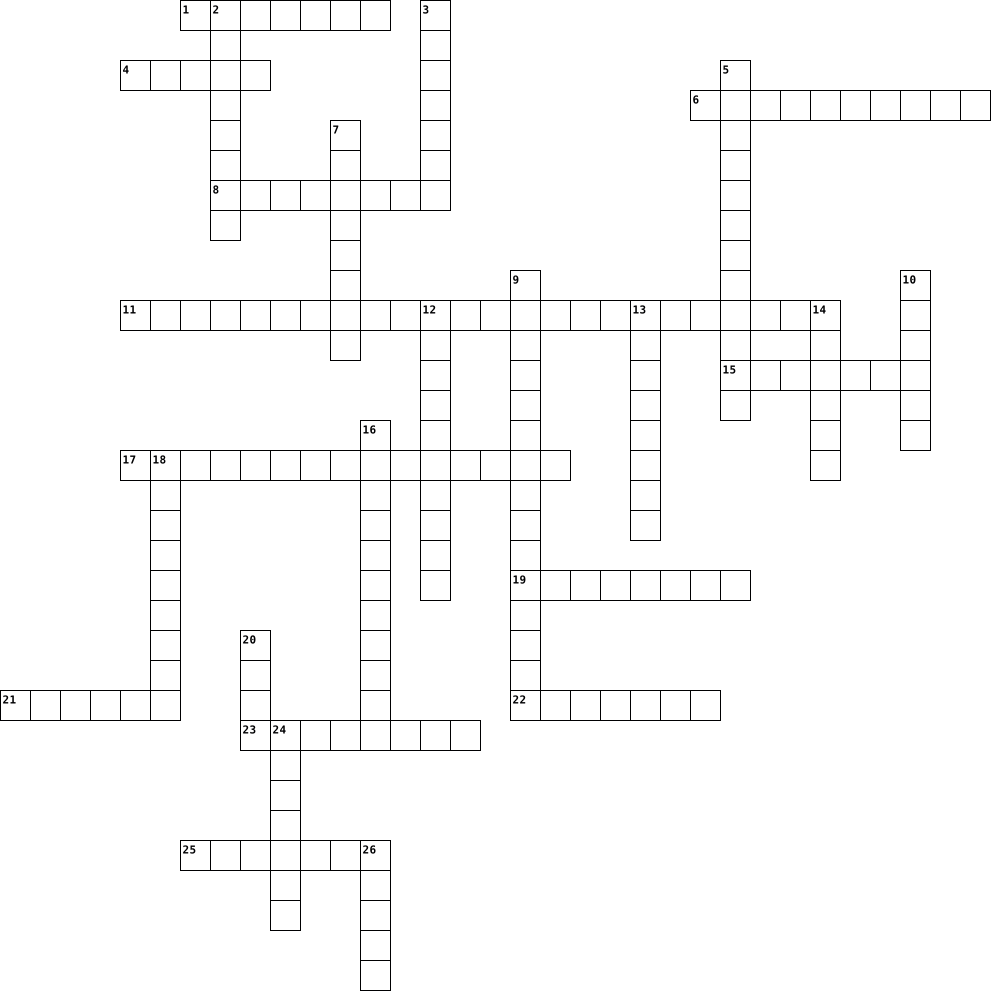
Across
- what is formed after a chemical reaction
- conductor of electricity can be melted
- the mass of an atom
- great stability and low reaction rates
- mass stays the same after a chemical reaction
- basic substance made of atoms
- developed periodic table
- two or more elements to combine
- horizontal row
- part of the nucleus and has no charge
- smallest possible substance
- putting a thin layer of metal over something
Down
- changes when combined
- central part of an atom
- tells how many protons are in an atom
- travels around nucleus and has negative charge
- the electron in the outer most orbital
- part of the nucleus has a positive charge
- produces heat
- lacks characteristics of a metal
- abbreviation of an element
- absorbs heat
- between a metal and a nonmetal
- smallest unit of any amount of matter
- ring of an atom
- column
26 Clues: column • absorbs heat • produces heat • horizontal row • ring of an atom • the mass of an atom • changes when combined • central part of an atom • developed periodic table • abbreviation of an element • smallest possible substance • basic substance made of atoms • between a metal and a nonmetal • two or more elements to combine • lacks characteristics of a metal • ...
Dylan's Crossword 2018-01-25

Across
- transition from liquid to solid
- the substance formed of a chemical reaction
- the negatively charged atom in every element
- unit of measure for temperature on an absolute scale
- colorless and odorless. we drink it every day
- sugar
- the amount of energy that it takes to move en electron to form a atom, to later form a cation
- the substance in which dissolves inside another liquid
Down
- two or more chemicals acting together to form another substance
- nitric oxide
- electrons the number of negatively charged atoms on the outermost orbital
- NO2
- Sodium Chloride
- a way to identify how they are sorted vertically on a periodic table
- a way to identify how many orbitals are in the Bohr model
- dinitrogen penoxide
- used to make literally everything in the universe
- strontium nitride
- amount of production produced from a chemical reaction
- the non-charged atom in every element
20 Clues: NO2 • sugar • nitric oxide • Sodium Chloride • strontium nitride • dinitrogen penoxide • transition from liquid to solid • the non-charged atom in every element • the substance formed of a chemical reaction • the negatively charged atom in every element • colorless and odorless. we drink it every day • used to make literally everything in the universe • ...
Crossword Unit Two 2023-04-04

Across
- An organism that doesn't love water
- Basic unit of matter
- The reaction in a chemical reaction
- all things combined together to make this
- when it takes a long time to build up energy
- Where molecules move to lower concentrated areas
- Combine to form cells
- special proteins that lower activation energy
- an organism that likes water
- make up an organ system
- when an emzyme changes shape and no longer fits in the active site
- A type of diffusion that involves water
- ONly allowing certain molecules to pass
Down
- combine to make an organism
- a transport method that doesn't use energy
- contains a hydrophilic head and two hydrophobic tails
- When cells spend energy to move molecules
- A special region on an enzyme
- The outcome of a chemical reaction
- Combined atoms form these
- combine to form various tissues
- combine to form organs
22 Clues: Basic unit of matter • Combine to form cells • combine to form organs • make up an organ system • Combined atoms form these • combine to make an organism • an organism that likes water • A special region on an enzyme • combine to form various tissues • The outcome of a chemical reaction • An organism that doesn't love water • The reaction in a chemical reaction • ...
Unit 2 Crossword 2026-03-26

Across
- A type of diffusion involving water
- Made of tissues
- The spot on an enzyme where the substrate fits
- Water loving
- When the active site changes shape and substrate can no longer fit
- Movement from up to down
- When only certain states of matter can pass through something
- The energy required to activate a reaction
- Made of organ systems
Down
- Water hating
- The part that fits into an Enzyme to cause a chemical reaction
- When molecules naturally move from where they are higher concentrated to areas where they are lower concentrated
- A structure made of home hydrophilic head and 2 hydrophilic tails; it makes up the cell membrane
- Made of organs
- Made of molecules
- Made of atoms
- Proteins
- The outcome of a chemical reaction
- Made of cells
- Movement from down to up
- Smallest unit of matter
- Made of organelles
22 Clues: Proteins • Water hating • Water loving • Made of atoms • Made of cells • Made of organs • Made of tissues • Made of molecules • Made of organelles • Made of organ systems • Smallest unit of matter • Movement from up to down • Movement from down to up • The outcome of a chemical reaction • A type of diffusion involving water • The energy required to activate a reaction • ...
Chemical Reactions and The Law of Conservation of Mass 2025-05-05

Across
- One element changes places
- A type of reaction in which the system ABSORBS energy
- Is a positive charge
- EACH ElEMENT that are present in a compound
- A type of reaction that RElEASES energy
- EACH COMPOUND that is present
- The basic unit of a chemical element
- Substances created by chemical change
- Products are ALWAYS CO2 and H2O
- Anything that has mass and take up space
Down
- means "to break apart"
- Two or more substances combine to form a new substance
- Is a negative charge
- Occurs between two iconic compounds
- Substances that are destroyed by the chemical change
15 Clues: Is a negative charge • Is a positive charge • means "to break apart" • One element changes places • EACH COMPOUND that is present • Products are ALWAYS CO2 and H2O • Occurs between two iconic compounds • The basic unit of a chemical element • Substances created by chemical change • A type of reaction that RElEASES energy • Anything that has mass and take up space • ...
States of matter 2025-11-05

Across
- .... process, the substance only changes its form
- chemical reaction
- the particles in solids and liquids are always ....
- opposite of melting
- some substance are mixed together and change form a new substance
- a solid substance
- .... wood is chemical reaction
Down
- change of state
- particles move slower and closer together
- all matter is made up of ....
- its particle are always moving
- a substance that is a gas
- the particles are close together but not packed in regular pattern
- in a .... the particles are packed tightly together
- when a liquid loses .... energy the particles slow down and move together
15 Clues: change of state • chemical reaction • a solid substance • opposite of melting • a substance that is a gas • all matter is made up of .... • its particle are always moving • .... wood is chemical reaction • particles move slower and closer together • .... process, the substance only changes its form • the particles in solids and liquids are always .... • ...
CHEMICAL REACTION AND EQUATION 2024-06-30

Across
- - The no. of atoms in an element
- EQUATION- It is a way to represent a chemical reaction
- DISPLACEMENT REACTION - When 2 substance displace each other
- REACTION- When one substance gets displaced in a reaction
- REACTION - When both oxidation and reduction happens in a reaction
- REACTION - When a substance decomposes in a reaction
- REACTION - When two substance react to combine forming a new substance
Down
- - When atom/atoms of hydrogen gets added to a substance in a reaction
- - When atom/atoms of oxygen gets added to a substance In a reaction
- - Spoiling of food due to exposition to oxygen
10 Clues: - The no. of atoms in an element • - Spoiling of food due to exposition to oxygen • REACTION - When a substance decomposes in a reaction • EQUATION- It is a way to represent a chemical reaction • REACTION- When one substance gets displaced in a reaction • DISPLACEMENT REACTION - When 2 substance displace each other • ...
Quiz 1 2017-05-18

Across
- The industrial name for a concentrated solution of sodium chloride in water
- The conductors used to carry current into and out of a solution, they could be graphite rods for example
- A substance that brings about the reduction of another substance
- A poor conductor of heat or electricity
- The process of breaking down an ionic compound by passing an electric current through it
- The process of coating one metal with another
- Any reaction in which electrons are transferred
Down
- A chemical reaction in which a substance loses oxygen or gains electrons
- The positive electrode
- An exothermic chemical reaction in which the reactant combines with oxygen to form an oxide
- The liquid through which the current is passed during electrolysis
- A chemical reaction in which a substance gains oxygen or loses electrons
- A substance that allows heat or electricity to pass through it quite easily
- A substance that brings about the oxidation of another substance
- The negative electrode
15 Clues: The positive electrode • The negative electrode • A poor conductor of heat or electricity • The process of coating one metal with another • Any reaction in which electrons are transferred • A substance that brings about the oxidation of another substance • A substance that brings about the reduction of another substance • ...
Crossword Homework 2012-10-09

Across
- Substance that increases the rate of a chemical reaction by lowering the activation energy without being chemicalally changed by the reaction.
- Area of chemistry concerned with the speed, or rate, at which chemical reactions proceed.
- A measure of the warmth or coldness of an object or substance with reference to some standard value.
- Change in the concentration of reactants and products per unit time as a reaction proceeds
Down
- Difference between the energy of an activated complex and the energy of the reactants of a chemical reaction; energy with which particles must collide in order to react.
- Heat content of a system at constant pressure.
- Substance that decreases the rate of a chemical reaction.
- Theory that suggests an explanation of chemical reactions bases upon the collisions of particles and the orientation and energy with which they collide.
- The normal force applied to a unit area of a surface
- Expression that relates the rate of a reaction to the concentration of substances involved in the reaction
10 Clues: Heat content of a system at constant pressure. • The normal force applied to a unit area of a surface • Substance that decreases the rate of a chemical reaction. • Area of chemistry concerned with the speed, or rate, at which chemical reactions proceed. • Change in the concentration of reactants and products per unit time as a reaction proceeds • ...
science 2022-05-02

Across
- female ruler
- the combination of ideas to form a theory or system
- a substance that increases the rate of a chemical reaction without itself undergoing any permanent chemical change.
- not alone
- a multiplier or factor that measures some property
- reacts
- male ruler
- things you buy
- animal that digs in the ground
Down
- the ability or tendency to float in water or air or some other fluid.
- the distance from the top or surface to the bottom of something
- liquid
- decay
- alone
- (of a reaction or process) accompanied by or requiring the absorption of heat
- best school ever
- the quantity per unit volume, unit area, or unit length
- a statement of the equality of two mathematical expressions
- the thing you get on while skiing minus the word ski
- (of a reaction or process) accompanied by the release of heat.
- greatly impress or amuse
21 Clues: decay • alone • liquid • reacts • not alone • male ruler • female ruler • things you buy • best school ever • greatly impress or amuse • animal that digs in the ground • a multiplier or factor that measures some property • the combination of ideas to form a theory or system • the thing you get on while skiing minus the word ski • the quantity per unit volume, unit area, or unit length • ...
Chemistry final 2022-05-31

Across
- common acid
- acid with formula CH3COOH
- a metal breaking down with oxygen
- releases energy
- solar energy
- strange result
- unreactive gas
- bottom of the test tube
- acid + base
- a reaction where one element replaces another in a molecule
- baking soda
- test for carbon dioxide
- ion with more than one atom
- absorbs energy
- period 4 alkali earth
Down
- metal + acid
- a law which shall not be broken
- paper which measures pH
- two or more elements chemically combined
- makes things rust faster
- in a chemical reaction the atoms are......
- a synthetic reaction of life
- left side of a chemical equation
- a molecule is broken to smaller pieces
- made from incomplete combustion
- produced in the decomposition of a carbonate
- can be separated physically
- a type of fuel which is causing global warming
- On the periodic table
- common base
- 3 protons
31 Clues: 3 protons • common acid • acid + base • baking soda • common base • metal + acid • solar energy • strange result • unreactive gas • absorbs energy • releases energy • On the periodic table • period 4 alkali earth • paper which measures pH • bottom of the test tube • test for carbon dioxide • makes things rust faster • acid with formula CH3COOH • can be separated physically • ion with more than one atom • ...