
chemical reaction Crossword Puzzles
8th grade review 2018-12-17

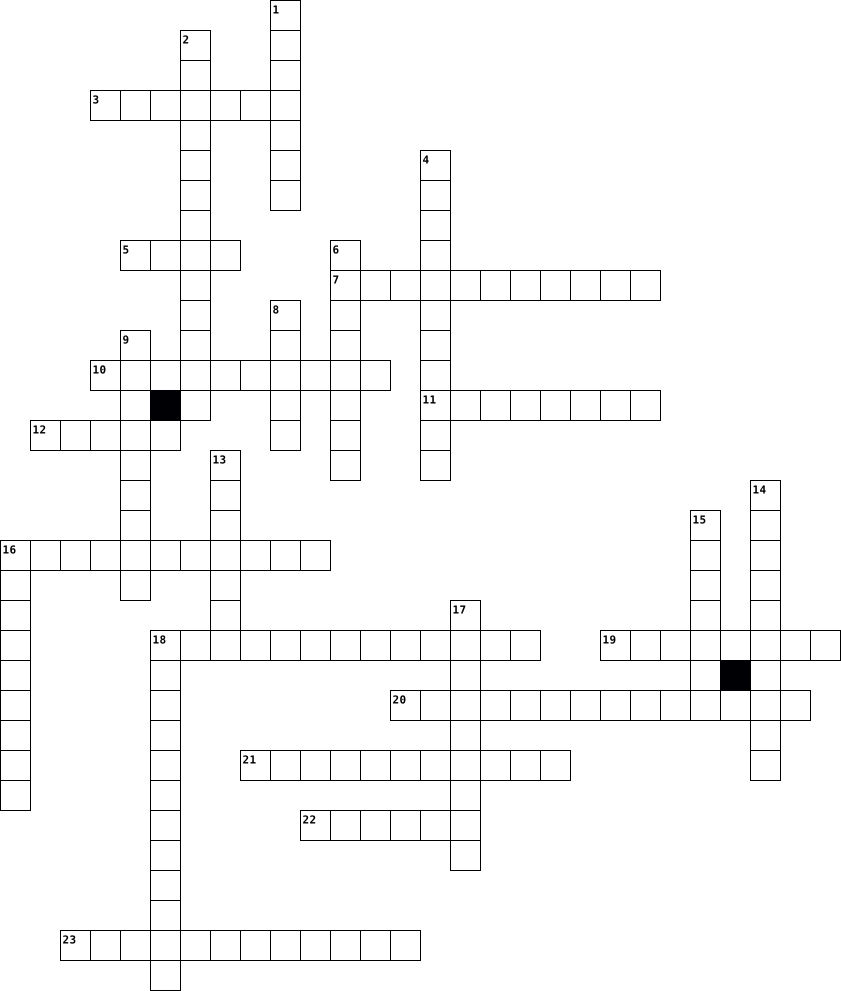
Across
- _________= distance / time
- warm ocean currents originate here
- stored energy
- determines the atoms reactivity
- atoms that are in the same ________ will behave similarly
- warmer air rises because it is _______ dense than cooler air
- this group on the periodic table has 7 valence electrons
- positively charged particle
- particle with no charge
- a tendency to do nothing or remain unchanged (1st law)
- energy of motion
Down
- this group on the periodic table has a full outer shell
- Newtons __________ law. F=ma
- color change is an example of a _____________ reaction
- an object that is acted on by unbalanced forces will ___________________________.
- H2O is an example of a chemical ____________
- a push or a pull on an object
- negatively charged particle that orbits the nucleus
- the speed of something in a given direction
- _________= mass / volume
- for every action, there is an equal and opposite reaction. Newtons __________ law.
21 Clues: stored energy • energy of motion • particle with no charge • _________= mass / volume • _________= distance / time • positively charged particle • Newtons __________ law. F=ma • a push or a pull on an object • determines the atoms reactivity • warm ocean currents originate here • the speed of something in a given direction • H2O is an example of a chemical ____________ • ...
Unit 1 2021-11-09

Across
- state of matter in which particles are tightly packed and barely moving
- able to dissolve
- a special type of mixture in which one substance dissolves
- state of matter in which particles are arranged apart and moving a bit
- starting substance in a chemical reaction
- when particles are rearranged to form a new substance
- unable to dissolve
- substance created from a chemical reaction
- two or more materials combined
- when a solute breaks into tiny, invisible pieces in a solvent
Down
- when a solution cannot dissolve any more solute
- liquid substance in which a solute dissolves
- characteristics of matter
- smallest particle of matter
- a solution with a small amount of solute
- substance that dissolves
- a group of atoms connected together
- state of matter in which particles are very spread out and moving a lot
- a solution with a high amount of solute
- a small piece or part of something
20 Clues: able to dissolve • unable to dissolve • substance that dissolves • characteristics of matter • smallest particle of matter • two or more materials combined • a small piece or part of something • a group of atoms connected together • a solution with a high amount of solute • a solution with a small amount of solute • starting substance in a chemical reaction • ...
Chemistry Bonus 2023-04-25

Across
- brittle, poor conductor, dull
- discovered the elctron
- a reaction that releases heat and warms surroundings
- discovered the nuetron
- discovered the proton and nucleus
- digits of a number used for accuracy starting with the first nonzero digit
- a device used to measure calories
- good conductor, malleable ,ductile,lustrous
- a mixture where individual particles can't be distinguished
- Silicon, Boron, Germanium, Arsenic, Antimony, Tellurium, Astatine, Polonium
- how strongly atoms attract bonding electrons to themselves
Down
- the temperature and pressure where a substance becomes a supercritical fluid
- a reaction that absorbs heat and cools surroundings
- metals tend to ____ electrons in chemical reactions
- phase change from gas to solid
- a mixture that isn't uniform
- standard scientific unit of measurement
- phase change from solid to gas
- nonmetals tend to ____ electrons in chemical reactions
- a mixture containing particles that settle out
20 Clues: discovered the elctron • discovered the nuetron • a mixture that isn't uniform • brittle, poor conductor, dull • phase change from gas to solid • phase change from solid to gas • discovered the proton and nucleus • a device used to measure calories • standard scientific unit of measurement • good conductor, malleable ,ductile,lustrous • ...
Unit 2 Nicholas Ellis 2023-04-04

Across
- when tissues combine they make this
- diffusion of water
- forms the basis of cell membranes
- fits into the active site
- energy required to activate the reaction
- multiple organ systems
- if the temperature of the active site or its ph levels are different then the shape of the active site will change shape
- proteins that speed up chemical reactions
- no energy is used with this transportation
- site the substrate fits into this
- controls what enters cells
Down
- when organs combine they make this
- moves from high concentration to love concentration
- fears water
- likes water
- when energy is used with this transportation
- result of the chemical reaction
- when atoms combine they make this
- cells combine to make these
- when Molecules combine they make this
- the basic units of matter
- organelles combine and make this also called the basic unit of life
22 Clues: fears water • likes water • diffusion of water • multiple organ systems • fits into the active site • the basic units of matter • controls what enters cells • cells combine to make these • result of the chemical reaction • forms the basis of cell membranes • when atoms combine they make this • site the substrate fits into this • when organs combine they make this • ...
Matter and Interactions 2021-10-04

Across
- absorbs heat causing the temperature to drop
- releases heat causing the temperature to increase
- a change or reaction that creates a new substanceenergy ability to do work
- can't be broken down into a simpler substance
- a new substance is created
- substances that are combined to start a chemical reaction
- ability to do work
- a change that could be size or shape
- transfer of heat by the movement of a fluid
- energy of motion
Down
- made of two or more different elements
- two or more atoms
- smallest particle of matter
- the ability to dissolve
- this property doesn't change if the amount of the substance changes
- a measure of hotness or coldness
- states of matter
- a form of energy
- transfer of heat between two objects that are directly touching
- amount of matter
- anything thatn has mass and takes up space
21 Clues: states of matter • a form of energy • amount of matter • energy of motion • two or more atoms • ability to do work • the ability to dissolve • a new substance is created • smallest particle of matter • a measure of hotness or coldness • a change that could be size or shape • made of two or more different elements • anything thatn has mass and takes up space • ...
Cells 2024-01-23
Across
- control center
- The basic structural and functional
- Glucose in food reacts with oxygen
- The parts of a cell
- cell that holds the cell together
- Compounds that can be added together to make proteins
- they are organelles that produce food
- The joining together of the male genetic material and the female genetic material
- breaks down food and cell waste
- chemical reaction a plant carries out in order
- single-celled bacteria
- requires energy to move
- The cell’s powerhouse
Down
- The movement of things
- Organism that is composed
- The cell’s transport organelle
- Large molecules
- The cell’s packaging and sorting
- Moving things inside and outside
- A protective double membrane
- chemical reactions that allow a cell to survive
- storage bubbles
- containing all the organelles
- Protein-making factories in a cell
- reaction where energy is released
25 Clues: control center • Large molecules • storage bubbles • The parts of a cell • The cell’s powerhouse • The movement of things • single-celled bacteria • requires energy to move • Organism that is composed • A protective double membrane • containing all the organelles • The cell’s transport organelle • breaks down food and cell waste • The cell’s packaging and sorting • ...
Gabe McGlinch Unit 2 2025-03-24

Across
- made up of many atoms
- the energy needed to start a chemical reaction
- a molecule with one hydrophilic head and 2 hydrophobic tails
- molecules moving from being clustered to spaced out
- made up of cells
- made up of cells
- when the cell spends energy to move molecules across the membrane
- the building block of life made of many organelles
- allows certain molecules in and out
- the reacting molecule that binds to an enzyme
- the building block of matter
Down
- combines organ systems
- dislikes water
- likes water
- made up of organs
- a state in which the enzyme can no longer perform any chemical reactions
- made up of many molecule
- moving molecules naturally without spending energy
- the part of the enzyme the substrate bonds to
- protein makes up your metabolism
- the results of an enzyme reaction
- diffusion of water across the cell membrane
22 Clues: likes water • dislikes water • made up of cells • made up of cells • made up of organs • made up of many atoms • combines organ systems • made up of many molecule • the building block of matter • protein makes up your metabolism • the results of an enzyme reaction • allows certain molecules in and out • diffusion of water across the cell membrane • ...
Grade 11 Chemistry 2025-10-02

Across
- Tool used to measure temperature
- Two or more atoms bonded together
- Uniform mixture of two or more substances
- Process that separates liquids by boiling points
- Color of universal indicator in a neutral solution
- Technique to determine concentration using a standard solution
- Process that absorbs heat from surroundings
- Starting substance in a chemical reaction
- Negatively charged subatomic particle
Down
- Metal that rusts easily when exposed to air and water
- Element with the chemical symbol Na
- Small cylindrical glass container used in labs
- Solid changing directly to gas
- Lightest element; part of water and many compounds
- Substance that speeds up a reaction but isn’t used up
- Change of liquid to gas at the surface
- Dye that changes color in acids/bases
- Gas humans breathe in that plants release
- Gas used in balloons because it’s lighter than air
- Smallest unit of matter
- Scientist who organized the periodic table
21 Clues: Smallest unit of matter • Solid changing directly to gas • Tool used to measure temperature • Two or more atoms bonded together • Element with the chemical symbol Na • Dye that changes color in acids/bases • Negatively charged subatomic particle • Change of liquid to gas at the surface • Uniform mixture of two or more substances • Gas humans breathe in that plants release • ...
Grade 11 Chemistry 2025-10-02

Across
- Gas humans breathe in that plants release
- Uniform mixture of two or more substances
- Tool used to measure temperature
- Process that separates liquids by boiling points
- Scientist who organized the periodic table
- Technique to determine concentration using a standard solution
- Element with the chemical symbol Na
- Starting substance in a chemical reaction
- Smallest unit of matter
- Two or more atoms bonded together
Down
- Dye that changes color in acids/bases
- Color of universal indicator in a neutral solution
- Negatively charged subatomic particle
- Substance that speeds up a reaction but isn’t used up
- Solid changing directly to gas
- Lightest element; part of water and many compounds
- Process that absorbs heat from surroundings
- Metal that rusts easily when exposed to air and water
- Gas used in balloons because it’s lighter than air
- Change of liquid to gas at the surface
- tube Small cylindrical glass container used in labs
21 Clues: Smallest unit of matter • Solid changing directly to gas • Tool used to measure temperature • Two or more atoms bonded together • Element with the chemical symbol Na • Dye that changes color in acids/bases • Negatively charged subatomic particle • Change of liquid to gas at the surface • Gas humans breathe in that plants release • Uniform mixture of two or more substances • ...
Chemical Reaction - Nick Pelland 2017-10-10

Across
- A chemical that donates a hydrogen ion
- A chemical that accepts a hydrogen ion
- There is a net absorption of energy
- One or more new compounds are formed as a result of the rearrangement of atoms
- The amount of energy required to pull two bonded atoms apart
Down
- No atoms are gained or lost during any reaction
- There is a net release of energy
- A substance that lowers the activation energy of a chemical reaction, which allows for the reaction to proceed at a faster rate
- The minimum energy required to overcome the initial breaking of bonds in reactants
- can behave as an acid or a base
10 Clues: can behave as an acid or a base • There is a net release of energy • There is a net absorption of energy • A chemical that donates a hydrogen ion • A chemical that accepts a hydrogen ion • No atoms are gained or lost during any reaction • The amount of energy required to pull two bonded atoms apart • ...
Chemical reaction And equations 2022-05-08

Across
- what kind of process is respiration?
- which gas can be Used for storage?
- the process of reduction involves removal of
- when ferrous sulphate is heated strongly it undergoes decomposition to form ferric oxide as a main product accompanied by a change in colour from green to
- the process in which metals are eaten up by action of air,moisture Or a chemical on the surface
- which type of reaction is this ? 2Na+2H2O=2NaOH+H2
- precipitation in which energy is given out
Down
- what type of chemical reaction takes place when electricity is passed through water
- a substance added to food containing oils And fats
- the condition produced by aerial oxidation of fats And oils in foods marked by unpleasant smell And taste
10 Clues: which gas can be Used for storage? • what kind of process is respiration? • precipitation in which energy is given out • the process of reduction involves removal of • a substance added to food containing oils And fats • which type of reaction is this ? 2Na+2H2O=2NaOH+H2 • what type of chemical reaction takes place when electricity is passed through water • ...
chemical reaction and equation 2025-07-02

Across
- - formed after heating green coloured solid
- - used in black and white photography
- - type of reaction in which energy is released
- - the type of reaction involves splitting of substance into two products
Down
- - the reaction in whcih insoluble residue is formed
- - used for white washing
- - slow eating away of metals
- - slow oxidation of food materials
- - yellow residue formed after heating white coloured salt
- - the colour of silver after corrosion
10 Clues: - used for white washing • - slow eating away of metals • - slow oxidation of food materials • - used in black and white photography • - the colour of silver after corrosion • - formed after heating green coloured solid • - type of reaction in which energy is released • - the reaction in whcih insoluble residue is formed • ...
Chemical Reaction and Equations 2023-05-07

Across
- Most decomposition reactions are also called as-
- Which type of decomposition reactions are used in black and white photography
- when lead nitrate decomposes the brown fumes produced are of -
- the process of corrosion of iron is called-
Down
- What substance decomposes to form quicklime and carbon dioxide
- when iron corrodes which coloured coating is seen
- when ferrous sulphate is decomposed which reaction is involved in it
- oxidation of metals is known as -
- _______ can be used to prevent corrosion
- ________ is formed when silver articles reacts with sulphur in air
10 Clues: oxidation of metals is known as - • _______ can be used to prevent corrosion • the process of corrosion of iron is called- • Most decomposition reactions are also called as- • when iron corrodes which coloured coating is seen • What substance decomposes to form quicklime and carbon dioxide • when lead nitrate decomposes the brown fumes produced are of - • ...
The Rate Of Reaction 2022-05-17

Across
- Highly concentrated acid is called ___ acid.
- When no more gas is seen, all the reactants have ___.
- There is more collisions in ___ temperatures
- The ___ of acid determines the speed of reaction.
- ___ surface area are slower to react.
- We can use ___ to explain the effect of concentration.
- What is used to measure gas?
- The ___ of hydrogen is increased when the temperature is increased.
- ___ move all the time.
- Washing powders that contain enzymes are called ___ washing powders.
- When loaf is cut into slices, the surface area ___.
- Catalysts ___ up a reaction.
- What do you do to make the test fair?
- The name of the salt made in the reaction Sulfur + Nitric acid
- If the line on the graph is ___, the reaction is fast.
- ___ allow a reaction to go faster without changing the reaction.
Down
- ___ are formed as a waste product in reactions inside the cells of plants
- Catalysts are often used in ___ processes.
- Hydrogen ___ form during reactions.
- Reaction takes place because the particles are ___
- Another word for biological catalysts.
- What do you call the result that does not fit the pattern?
- The ___ area of a reaction determines the speed.
- What does the catalyst increase
- The speed at which a chemical reaction takes place is the rate of ___?
- ___ concentration of acid allows a reaction to be faster.
- Calcium + Hydrochloric acid -- Calcium chloride + ?
- ___ dioxide is an example of a catalyst.
- Insoluble substances is left as ___.
- Many cars have catalystic ___ to their exhaust systems.
- Not concentrated acid is called ___ acid.
- In magnesium ribbon, more ___ are available to react.
32 Clues: ___ move all the time. • What is used to measure gas? • Catalysts ___ up a reaction. • What does the catalyst increase • Hydrogen ___ form during reactions. • Insoluble substances is left as ___. • ___ surface area are slower to react. • What do you do to make the test fair? • Another word for biological catalysts. • ___ dioxide is an example of a catalyst. • ...
Matter & Energy Cycles 2026-02-10

Across
- excess gas released by plants; used by all organisms
- acid organic molecules that contain genetic information
- site the region on an enzyme that binds to a substrate
- process by which energy is stored in chemical bonds of organic molecules such as carbohydrates
- substances produced at the end of a chemical reaction; right of arrow
- an element that cycles throughout all spheres of Earth, one of those needed for a molecule to be considered organic
- an element and gaseous molecule necessary for cellular respiration
- respiration process by which chemical energy stored in nutrients is released for use in cells
- organic molecules that store energy
- the molecule an enzyme matches up with to cause the biochemical reactions
- organelle that is the site of photosynthesis
- dioxide gas exhaled by animals; used by plants only
- an organic molecule made up of amino acids, aid in growth and repair
- a molecule taken into plants through their roots, necessary for photosynthesis
Down
- specifically shaped proteins that speed up the rate of chemical reactions
- an organic molecule necessary for the production of ATP
- organic molecules made up of simple sugars, used for fast energy
- organelle that is the site of cellular respiration
- high energy molecules generated during cell respiration
- these molecules contain the elements carbon, hydrogen, and oxygen
- combining simple molecules into complex ones
- an element that is not usable in its gaseous state, must be fixed to be used by plants
- substances required at the start of a chemical reaction; left of arrow
- dioxide an inorganic molecule removed from the atmosphere by plants and released as a waste product by animals
24 Clues: organic molecules that store energy • combining simple molecules into complex ones • organelle that is the site of photosynthesis • organelle that is the site of cellular respiration • dioxide gas exhaled by animals; used by plants only • excess gas released by plants; used by all organisms • an organic molecule necessary for the production of ATP • ...
Chemistry Vocabulary 2022-02-18

Across
- The part of the atom with a positive charge
- The most reactive group of metals on the periodic table
- The smallest unit of matter that forms an element
- The heaviest part of an atom
- The least reactive group on the periodic table
- The results of a chemical reaction
- The smallest part of an atom
Down
- An atom that has lost or gained one or more electrons
- Where the protons and neutrons are found in a atom
- Substance used to cause a chemical reaction
- The base unit of amount of a substance as determined by the International System of Units
- Electrons in the outermost shell of an atom
- Elements that have the same atomic number but different number of neutrons
- The study of substances and their behaviors
- A substance composed of two or more chemical elements
15 Clues: The heaviest part of an atom • The smallest part of an atom • The results of a chemical reaction • The part of the atom with a positive charge • Substance used to cause a chemical reaction • Electrons in the outermost shell of an atom • The study of substances and their behaviors • The least reactive group on the periodic table • ...
Unit 3: Matter Vocabulary 2024-10-31

Across
- A molecule made of two or more DIFFERENT types of atoms
- A process where the producers use sunlight, carbon dioxide, and water to make glucose.
- A simple sugar made by producers during photosynthesis
- Energy in the form of heat
- A change in state of matter from liquid to gas
- The simplest form of matter - made of only one type of atom
- Something produced during a chemical reaction
- The number of protons in a an atom.
Down
- Two or more atoms joined (chemically bonded) together
- A change in state of matter from gas to liquid
- The smallest unit of a chemical element
- When matter increases or decreases in energy, resulting in a change of state
- Anything that has mass and takes up space
- Energy associated with motion
- A substance that enters into a chemical reaction
15 Clues: Energy in the form of heat • Energy associated with motion • The number of protons in a an atom. • The smallest unit of a chemical element • Anything that has mass and takes up space • Something produced during a chemical reaction • A change in state of matter from gas to liquid • A change in state of matter from liquid to gas • ...
Plants elements and more! 2024-04-04

Across
- an assortment of elements
- neutral subatomic particles
- the total protons and neutrons
- electrons on the outer ring of the electron cloud
- reaction to gravity
- a change in a plant
- the total number of protons or electrons
- positively charged subatomic particles
Down
- reaction to water
- an assortment of protons neutrons and electrons
- reaction to touch
- negatively charged subatomic particles
12 Clues: reaction to water • reaction to touch • reaction to gravity • a change in a plant • an assortment of elements • neutral subatomic particles • the total protons and neutrons • negatively charged subatomic particles • positively charged subatomic particles • the total number of protons or electrons • an assortment of protons neutrons and electrons • ...
BIOLOGY 2026-03-03

Across
- ABSORBS ENERGY FROM SURROUNDINGS
- SUM OF ALL CHEMICAL REACTIONS OCCURING IN THE CELL
- ENERGY REQUIRED TO START REACTION
- ACTIVE SITE THAT CHANGES SHAPE
- LARGE MOLECULES INTO SMALLER ONES
- ACTIVE SITE HAS A SET SHAPE
Down
- LARGE MOLECULES FROM SMALLER ONES
- NET RELEASE OF FREE ENERGY
- SUBSTRATES IN CATALYSED REACTION
- ORGANIC COFACTORS
- MOLECULES FORMED AFTER A REACTION
- REDUCE/STOP ENZYME FUNCTION
12 Clues: ORGANIC COFACTORS • NET RELEASE OF FREE ENERGY • REDUCE/STOP ENZYME FUNCTION • ACTIVE SITE HAS A SET SHAPE • ACTIVE SITE THAT CHANGES SHAPE • ABSORBS ENERGY FROM SURROUNDINGS • SUBSTRATES IN CATALYSED REACTION • LARGE MOLECULES FROM SMALLER ONES • MOLECULES FORMED AFTER A REACTION • ENERGY REQUIRED TO START REACTION • LARGE MOLECULES INTO SMALLER ONES • ...
Chapter 8: Energy From Electron 2017-03-25

Across
- a measure of the chemical potential for a redox reaction to occur.
- Device that converts chemical energy of fuel directly into electrical energy.
- is energy that is collected from renewable resources.
- A conductor used to establish electrical contact with a nonmetallic part of a circuit
- produces chemical changes at the electrodes.
- is a specialized semiconductor diode that converts visible light into direct current.
- is a proposed system of delivering energy using hydrogen
- is gain of electrons.
Down
- is a system for the direct conversion of chemical energy to electrical energy.
- is an electrochemical cell that uses the transfer of electros in redox reaction to supply an electric current.
- A substance that does not conduct electricity at low temperature but does so at higher temperatures.
- is a non- rechargeable electrochemical battery.
- A serious of galvanic cells that are wired together constitutes a __________.
- A type of energy fueled by the transfer of electrons from positive and negative points within a conductor.
- is loss of electrons.
15 Clues: is loss of electrons. • is gain of electrons. • produces chemical changes at the electrodes. • is a non- rechargeable electrochemical battery. • is energy that is collected from renewable resources. • is a proposed system of delivering energy using hydrogen • a measure of the chemical potential for a redox reaction to occur. • ...
Chapter 2 Vocab- Chemistry 2020-09-04

Across
- the quantity of 3-d space within a closed surface
- the substance formed from a chemical reaction
- a physically distinctive form of matter
- phase of matter where a substance has. no set volume or shape
- the amount of matter an object has
- a substance made up of one type of atom
- phase of matter where a substance has a set volume but no set shape
- a substance made up of two or more types of atoms
Down
- the columns of elements on the periodic table
- the physical combination of substances
- matter which has a constant chemical composition
- a condensable gas
- a substance that takes part in a chemical reaction
- the rows of elements on the periodic table
- phase of matter where a substance has a set volume and set shape
15 Clues: a condensable gas • the amount of matter an object has • the physical combination of substances • a physically distinctive form of matter • a substance made up of one type of atom • the rows of elements on the periodic table • the columns of elements on the periodic table • the substance formed from a chemical reaction • matter which has a constant chemical composition • ...
Chemistry Terms 2024-01-04

Across
- ability to be dissolved into another substance.
- Property/An observable and measurable physical characteristic.
- substance that undergoes a change during the reaction.
- Point/ The temperature where a solid turns to a liquid.
- Point/The temperature where a liquid changes to a gas.
Down
- produced from a chemical reaction
- of Conservation of Mass/ Mass cannot be created or destroyed within a closed system.
- Equations/A representation of a chemical reaction using symbols to represent elements in the reaction.
- Reaction/Changes that elements or compounds undergo to form a new substance.
9 Clues: produced from a chemical reaction • ability to be dissolved into another substance. • substance that undergoes a change during the reaction. • Point/The temperature where a liquid changes to a gas. • Point/ The temperature where a solid turns to a liquid. • Property/An observable and measurable physical characteristic. • ...
U3S2 Vocabulary Bonus Point Opportunity 2021-12-06

Across
- The number of atoms or molecules in one mole of a substance, equal to 6.023 × 10^23.
- The quantity of a product that is obtained from a chemical reaction.
- A reactant that is totally consumed when the chemical reaction is completed.
Down
- A ____ is the ____ between the amounts in moles of any two compounds involved in a chemical reaction.
- The amount of product resulting from a perfect chemical reaction.
- The percent ratio of actual yield to the theoretical yield.
- The relationship between the relative quantities of substances taking part in a reaction or forming a compound, typically a ratio of whole integers.
- A reactant present in an amount greater than that required to combine with all of the limiting reactant.
8 Clues: The percent ratio of actual yield to the theoretical yield. • The amount of product resulting from a perfect chemical reaction. • The quantity of a product that is obtained from a chemical reaction. • A reactant that is totally consumed when the chemical reaction is completed. • ...
Block Chemistry Review 2022-12-13

Across
- came up with the plum pudding model and discovered electrons
- negatively charged subatomic particle
- an atom with a charge
- the elements or compounds that are found on the left side of a chemical equation
- these elements are ductile, malleable, shiny, and are good conductors
- gas used to fill balloons
- has a definite volume but takes the shape of its container
- outermost electrons
- an atom with a negative charge
- takes the shape and volume of its container
- these are the groups or columns on the periodic table
- energy due to motion
- came up with the idea that there was a solid positively charged nucleus
- has only one proton
- elements or compounds that are found on the right side of a chemical equation
- aqueous (aq)
- type of compound that occurs between two nonmetals
- reaction type produces a salt and water
- temperature scale that has boiling water at 100 and freezing water at 0
- has a different number of neutrons than normal
- has a definite shape and volume
- temperature scale used here in the US
- equation that only shows the participating elements in a precipitation reaction
- reaction where reactants are broken down into smaller parts
- type of reaction that produces a solid
- these elements have no charge
- 6.022x10^23
- an atom with a positive charge
- represents the number of protons
- set of elements that have varying charges
- 79 protons in its nucleus
- neutrally charged subatomic particle
Down
- the end result is different than the start
- these elements have a negative 1 charge
- reaction type that produces carbondioxide and water
- this table contains all the known elements
- energy due to position
- liquid metal at room temperature
- symbolic representation of a chemical reaction
- series of steps used to solve problems
- the measure of energy in molecules
- group one on the periodic table
- these elements have properties of both metals and nonmetals
- element has the chemical symbol B
- protons plus neutrons
- father of the periodic table of the elements
- produces hydroxide ions when dissolved in water
- has a molar mass of 16g
- system of writing numbers where the first number has to be between 1 and 10 and is multiplied by 10^x
- these are the rows on the periodic table
- group two on the periodic table
- type of compound that occurs between a metal and a nonmetal
- reaction that puts two or more things together to make something new
- temperature scale that stars from absolute 0
- mass per unit of volume unit g/cm^3
- the flow of energy
- number equal to 6.022x10^23
- positively charged subatomic particle
- produces hydrogen atoms when dissolved in water
59 Clues: 6.022x10^23 • aqueous (aq) • the flow of energy • outermost electrons • has only one proton • energy due to motion • an atom with a charge • protons plus neutrons • energy due to position • has a molar mass of 16g • gas used to fill balloons • 79 protons in its nucleus • number equal to 6.022x10^23 • these elements have no charge • an atom with a negative charge • ...
Chapter18 Vocab 2023-01-20

Across
- A way of representing atoms or molecules by showing electrons as dots surrounding the element symbol.
- Elements combine to form chemical compounds that are often divided into two categories.
- a way of presenting information about the chemical proportions of atoms that constitute a particular chemical compound or molecule
- Electrons can take on any energy within an unfilled band.
- A Nonpolar Covalent Bond is created when atoms share their electrons equally.
- A polar covalent bond is a covalent bond in which the atoms have an unequal attraction for electrons and so the sharing is unequal.
- Chemical reactions result when the electrons of various atoms rearrange themselves so that there is a net attractive force between atoms called chemical bonds.
- Chemical reactions result when the electrons of various atoms rearrange themselves so that there is a net attractive force between atoms called chemical bonds.
- The sharing of a pair of electrons represents a single covalent bond, usually just referred to as a single bond.
- any of a group of rare gases that include helium, neon, argon, krypton, xenon, and sometimes radon and that exhibit great stability and extremely low reaction rates.
Down
- built up from the level closest to the nucleus outward.
- a molecule that has a charge on one side of the molecule, that is not cancelled out.
- Atoms have equal number of electrons and protons with a net charge equal to zero.
- type of linkage formed from the electrostatic attraction between oppositely charged ions in a chemical compound.
- adjacent atoms will form multiple bonds with each other.
- a group of atoms bonded together, representing the smallest fundamental unit of a chemical compound that can take part in a chemical reaction.
- when an electron relocates from an atom or molecule to another such chemical entity.
- consists of the mutual sharing of one or more pairs of electrons between two atoms.
- an atom or molecule with a net electric charge due to the loss or gain of one or more electrons.
- a substance made from two or more different elements that have been chemically joined.
20 Clues: built up from the level closest to the nucleus outward. • adjacent atoms will form multiple bonds with each other. • Electrons can take on any energy within an unfilled band. • A Nonpolar Covalent Bond is created when atoms share their electrons equally. • Atoms have equal number of electrons and protons with a net charge equal to zero. • ...
Acids, Alkalis and Bases 2013-10-03

Across
- an insoluble metal oxide
- an indicator that shows a range of colours corresponding to the pH scale
- a soluble base
Down
- a reaction where equal amounts of acid and alkali react
- an indicator that shows whether a chemical is an acid or an alkali
- the neutral liquid made during a neutralisation reaction
- a chemical made during a reaction between an acid and a metal compound
- a common lab acid
- a common lab alkali
- a corrosive liquid
10 Clues: a soluble base • a common lab acid • a corrosive liquid • a common lab alkali • an insoluble metal oxide • a reaction where equal amounts of acid and alkali react • the neutral liquid made during a neutralisation reaction • an indicator that shows whether a chemical is an acid or an alkali • a chemical made during a reaction between an acid and a metal compound • ...
Vocab 6B 2017-04-06

Across
- the result of a chemical reaction.
- The alkali metals are a group of elements in the periodic table. They are all in the
- A chemical formula is a way of expressing information about the proportions of atoms that constitute a particular chemical compound, using a single line of chemical element symbols, numbers, and sometimes also other symbols, such as parentheses, dashes, brackets, commas and plus (+) and minus (−) signs.
- A chemical equation is the symbolic representation of a chemical reaction in the form of symbols and formulas.
- Gases The noble gases make a group of chemical elements with similar properties. Under standard conditions, they are all odorless, colorless, monatomic gases with very low chemical reactivity. The six noble gases that occur naturally are helium (He), neon (Ne), argon (Ar), krypton (Kr), xenon (Xe), and the radioactive radon (Rn).
Down
- Physical changes occur when objects or substances undergo a change that changes the physical form of a composition but not the chemical composition.
- column of the periodic table. They are extremely reactive.
- Chemical changes occur when a substance combines with another to form a new substance, called synthesis or, alternatively, decomposes into two or more different substances. These processes are called chemical reactions and, in general, are not reversible except by further chemical reactions.
- The law of conservation of mass or principle of mass conservation states that for any system closed to all transfers of matter and energy, the mass of the system must remain constant over time, as system mass cannot change quantity if it is not added or removed. Hence, the quantity of mass is "conserved" over time.
- a substance that takes part in and undergoes change during a reaction.
- An electron in an outer shell of an atom that can participate in forming chemical bonds with other atoms.
- bond A chemical bond is a lasting attraction between atoms that enables the formation of chemical compounds.
12 Clues: the result of a chemical reaction. • column of the periodic table. They are extremely reactive. • a substance that takes part in and undergoes change during a reaction. • The alkali metals are a group of elements in the periodic table. They are all in the • ...
RATES OF REACTION 2026-01-19

Across
- A CHEMICAL THAT SPEEDS UP A REACTION BY LOWERING THE ACTIVATION ENERGY
- ANOTHER NAME FOR HOW OFTEN SOMETHING HAPPENS
- WHAT A REACTION MAKES
- HOW MUCH IS DISSOLVED IN A LIQUID
- IF YOU HEAT SOMETHING UP THIS INCREASES
- INCREASING THIS MEANS THERE IS MORE SPACE FOR COLLISIONS TO HAPPEN
- THE MINIMUM AMOUNT OF ENERGY NEEDED TO GET A REACTION TO START (10,6)
- INCREASING THIS MAKES PARTICLES CLOSER TOGETHER
- WHEN REACTATNS TURN INTO PRODUCTS
Down
- INCREASING THIS MEANS PARTICLE MOVE FASTER
- HOW FAST A REACTION GOES
- ANOTHER NAME FOR HITTING EACH OTHER
- A POWDER HAS A HIGH ONE OF THESE (7,4)
- WHAT YOU START WITH IN A REACTION
14 Clues: WHAT A REACTION MAKES • HOW FAST A REACTION GOES • HOW MUCH IS DISSOLVED IN A LIQUID • WHAT YOU START WITH IN A REACTION • WHEN REACTATNS TURN INTO PRODUCTS • ANOTHER NAME FOR HITTING EACH OTHER • A POWDER HAS A HIGH ONE OF THESE (7,4) • IF YOU HEAT SOMETHING UP THIS INCREASES • INCREASING THIS MEANS PARTICLE MOVE FASTER • ANOTHER NAME FOR HOW OFTEN SOMETHING HAPPENS • ...
Introduction to Matter Pt. 2 2023-09-01

Across
- use of electricity to break a compound into elements
- rapid combination of a fuel with oxygen
- a measure of how hot or cold something is
- alters the form of matter but does not change into a different substance
- a change in which energy is absorbed
- a measure of the force of gravity
- the amount space that matter occupies
- combination of a substance with oxygen
- releases energy
- change that occurs when lighting a match
- a measure of the mass of a material in a given volume
Down
- matter is not created or destroyed in a chemical or physical change
- a substance transforms into another substance
- the amount of matter in an object
- iron objects can be separated from a mixture by using a
- to measure the properties of matter
- the total energy of the motion of all of the particles in an object
- a chemical that reacts with blood
- a chemical reaction is another name for a chemical __
- length x width x height =
- energy stored in the chemical bonds between atoms
- mass divided by volume = __
22 Clues: releases energy • length x width x height = • mass divided by volume = __ • the amount of matter in an object • a chemical that reacts with blood • a measure of the force of gravity • to measure the properties of matter • a change in which energy is absorbed • the amount space that matter occupies • combination of a substance with oxygen • ...
Energy Crossword 2024-02-06

Across
- After chemical reaction
- Direct contact
- Solid to liquid
- Thermal
- Cold or hot
- Electricity flow
- Electricity can't flow
Down
- Change during reaction
- Releases energy by light or heat
- Movement of a heated fluid
- Absorbs heat from its surroundings
- Energy from space
12 Clues: Thermal • Cold or hot • Direct contact • Solid to liquid • Electricity flow • Energy from space • Change during reaction • Electricity can't flow • After chemical reaction • Movement of a heated fluid • Releases energy by light or heat • Absorbs heat from its surroundings
Science Review Game (Basic Chemistry Vocab) 2021-12-08

Across
- "Matter is neither created nor destroyed"- Used to describe chemical equations.
- The type of element that can be have luster, cam be a conductor, and can be brittle
- another word for shiny (generally used to describe elements)
- The unit of measurement to measure the mass of subatomic particles.
- The name for the outermost particles of an atom.
- The changing of chemical composition
- to not be shiny
- A new solid being formed (Chemical Reactions)
- This refers to what certain subatomic particles sort themselves into (these subatomic particles have almost no mass).
- Anything of something that is of one unit or one subatomic particle.
Down
- This word refers to the characteristics, traits or ________ of atoms.
- The word on the Periodic Table that signifies an assortment/organization of elements in vertical fashion.
- The parts or elements before their reaction in a chemical equation.
- This guarantees/proves that a chemical reaction has taken place.
- The visual representation of showing an element's structure.
- the side of which (on the Periodic Table) that contains elements with more Valence Electrons.
- One of the two parts of an atom, this part has the most variety of subatomic particles.
- This word changes depending on the amount of outermost subatomic particles.
- the side of which all metals (on the Periodic Table) are located.
- This subatomic particle determines most of the mass in an atom, and does not have a positive charge
20 Clues: to not be shiny • The changing of chemical composition • A new solid being formed (Chemical Reactions) • The name for the outermost particles of an atom. • The visual representation of showing an element's structure. • another word for shiny (generally used to describe elements) • This guarantees/proves that a chemical reaction has taken place. • ...
Speeding up or slowing down reactions 2025-08-24

Across
- opposite of hot
- the theory stating that particles involved in a chemical reaction must collide in order to react
- a catalyst in living organisms
- smaller reactant pieces have a larger...
Down
- the number of active molecules in a set volume of solution
- mild temperature typically of water
- not cold
- the measure of the amount of heat
- increases reaction rate by phycially making the reactants bump together more often
- increases the reaction rate without itself undergoing chemical change
10 Clues: not cold • opposite of hot • a catalyst in living organisms • the measure of the amount of heat • mild temperature typically of water • smaller reactant pieces have a larger... • the number of active molecules in a set volume of solution • increases the reaction rate without itself undergoing chemical change • ...
Photosynthesis and Respiration 2023-01-24

Across
- the substances formed because of a chemical reaction
- the source of all energy in a chemical molecule
- the starting substances in a chemical reaction
- a process in which atoms rearranged to produce new substances
- is a reactant of cellular respiration
- this is the organelle in the plant cell responsible for photosynthesis
Down
- what is another word for glucose
- the organelle in animal cells that is responsible for cellular respiration
- this is one of the products of photosynthesis
- is a product of cellular respiration
- is one of the reactants of photosynthesis
11 Clues: what is another word for glucose • is a product of cellular respiration • is a reactant of cellular respiration • is one of the reactants of photosynthesis • this is one of the products of photosynthesis • the starting substances in a chemical reaction • the source of all energy in a chemical molecule • the substances formed because of a chemical reaction • ...
unit 4 vocab 2024-03-27

Across
- a small sized number on the bottom right of the symbol
- a process in which one or more substance are coverted to one or more different substances
- a formula giving the proportions of the elements present in a compound
- a formula giving the number of atoms of each of the elements present in one molecule
- the mass of the system must remain constant over time, the quantity can neither be added nor be removed
- artificial execution of chemical reactions to obtain one or several products
- an ionic compound
- tells you by mass what percent of each element is present in a compound
Down
- exchanges the cations of two ionic compounds
- a scale used to meaure the acidity or basicity of aques solutions
- ratio between the mass and the amount of substance of any sample of said compounds
- simplifying a single chemical entity into 2 or more fragments
- a chemical reaction in which acids and bases react with an equivalent quantity of eachother
- species formed from chemical reactions
- gives off hydrogen ions in water and forms salts by combining with different metals
- a substance that can accept hydrogen ions in water and can neutralize acids
- a chemical reaction that occurs between a fuel and an oxidizing agent that produces energy, usually in the form of heat or light
- a number placed infront of a chemical symbol or formula that shows how many atoms are in the reactant
18 Clues: an ionic compound • species formed from chemical reactions • exchanges the cations of two ionic compounds • a small sized number on the bottom right of the symbol • simplifying a single chemical entity into 2 or more fragments • a scale used to meaure the acidity or basicity of aques solutions • a formula giving the proportions of the elements present in a compound • ...
Pure and Impure Substances 2022-11-15

Across
- (the process of using electricity to split water into hydrogen and oxygen.)
- (molecule, a group of two or more atoms that form the smallest identifiable unit into which a pure substance can be divided and still retain the composition and chemical properties of that substance.)
- (as in chemical element so search for chemical element)
- (a chemical reaction)
- (is a combination of two words “mono”, and “atomic” means a single atom)
Down
- (look for a chemistry definition)
- (consisting of three atoms.)
- (a compound substance - search that)
- (consisting of two atoms.)
- (it's a property, so look for meanings for physical property)
- (chemistry definition needed)
11 Clues: (a chemical reaction) • (consisting of two atoms.) • (consisting of three atoms.) • (chemistry definition needed) • (look for a chemistry definition) • (a compound substance - search that) • (as in chemical element so search for chemical element) • (it's a property, so look for meanings for physical property) • ...
Energy Crossword 2024-02-06

Across
- After chemical reaction
- Direct contact
- Solid to liquid
- Thermal
- Cold or hot
- Electricity flow
- Electricity can't flow
Down
- Change during reaction
- Releases energy by light or heat
- Movement of a heated fluid
- Absorbs heat from its surroundings
- Energy from space
12 Clues: Thermal • Cold or hot • Direct contact • Solid to liquid • Electricity flow • Energy from space • Change during reaction • Electricity can't flow • After chemical reaction • Movement of a heated fluid • Releases energy by light or heat • Absorbs heat from its surroundings
"Energy Transformations in Living Organisms: From Sunlight to Cellular Fuel" 2025-04-11

Across
- Organelle in plant cells where photosynthesis happens.
- Does not require oxygen
- Simple sugar used by cells for energy
- Process where plants use sunlight to make food.
- Requires oxygen
- Organism that eats other organisms for energy
- Starting materials in a chemical reaction.
- Organelle where cellular respiration occurs; "powerhouse" of the cell.
Down
- Substances made from a chemical reaction
- Two reactions linked; one releases energy, the other uses it
- Process of breaking down food to release energy
- Organism that makes its own food (like plants)
- Main energy molecule used by cells
13 Clues: Requires oxygen • Does not require oxygen • Main energy molecule used by cells • Simple sugar used by cells for energy • Substances made from a chemical reaction • Starting materials in a chemical reaction. • Organism that eats other organisms for energy • Organism that makes its own food (like plants) • Process of breaking down food to release energy • ...
Science 2024-10-17

Across
- a representation of a chemical reaction using symbols of the elements to indicate the amount of substance of each reactant and product
- a change of matter from one form to another without a change in chemical properties; only physical changes
- change that occurs when one or more substances change into entirely new substances with different properties
- states that the mass of an object, or collection of objects new changes, no matter how the parts are rearranged
- a substance or molecule that is formed in a chemical reaction; the final output
Down
- Reaction happens when two or more substances combine in ways that make new substances form that have different properties from the beginning materials
- a substance or molecule that participates in a chemical reaction; the ingredients that you start with
- a solid formed by a change in a solution, often due to a chemical reaction or change in temperature
8 Clues: a substance or molecule that is formed in a chemical reaction; the final output • a solid formed by a change in a solution, often due to a chemical reaction or change in temperature • a substance or molecule that participates in a chemical reaction; the ingredients that you start with • ...
Physical and Chemical Changes Crossword 2025-11-05

Across
- Scrambling or frying an ____ is an example of a chemical change.
- Cutting paper is this kind of change.
- A reaction that produces heat or light.
- The ability of a substance to burn.
- A change in which matter keeps it's identity.
Down
- What you get when you divide mass and volume.
- Process of solid changing directly into a gas.
- Change that forms a new substance.
- A change in ____ is a clue that a chemical reaction occured.
- Ice melting is a change in this state.
- What forms on metal when it reacts with oxygen.
11 Clues: Change that forms a new substance. • The ability of a substance to burn. • Cutting paper is this kind of change. • Ice melting is a change in this state. • A reaction that produces heat or light. • What you get when you divide mass and volume. • A change in which matter keeps it's identity. • Process of solid changing directly into a gas. • ...
Chapter 3 Vocabulary 2026-01-05

Across
- Chemical reactions that release energy
- Chemical reactions that absorb energy
- How tightly or loosely packed molecules are in a substance
- A substance's capability of being dissolved
- A solid form produced by the reaction of two solutions
Down
- How likely a substance is to catch fire
- Another word for characteristics
- Measures how quickly a substance will undergo a chemical reaction
- The temperature at which a solid becomes a liquid
- The temperature at which a liquid becomes a gas
- A liquid (often water) in which a substance is dissolved
11 Clues: Another word for characteristics • Chemical reactions that absorb energy • Chemical reactions that release energy • How likely a substance is to catch fire • A substance's capability of being dissolved • The temperature at which a liquid becomes a gas • The temperature at which a solid becomes a liquid • A solid form produced by the reaction of two solutions • ...
stoichiometry 2025-10-26

Across
- Step The Step that determines the rate or extent of a reaction.
- of Mass a Principle stating that matter is neither created nor destroyed.
- Equation An Equation with equal numbers of each atom on both sides.
- Yield Ratio of actual to theoretical yield × 100.
- Coefficient The Number in front of a chemical formula in a balanced equation.
- Reactant Reactant left over after a reaction.
- Formula Actual number of atoms in a molecule.
- Ratio Ratio of moles of substances in a balanced equation.
- Reactant Reactant that controls the amount of product formed.
- Number Number of particles in a mole (6.022×10²³).
Down
- Mass Mass corresponding to the empirical formula of a compound.
- Formula The simplest whole-number ratio of atoms in a compound.
- Factor A Factor that limits the amount of product or the speed of reaction.
- Quantitative relationships between reactants and products.
- Yield The Maximum amount of product possible.
- Reaction Reaction of a substance with oxygen, producing energy.
- Reaction A single compound breaks down into two or more products.
- Quotient Ratio of product and reactant concentrations at any point.
- Yield Amount of product actually obtained.
- Mass Mass of one mole of a substance.
20 Clues: Mass Mass of one mole of a substance. • Yield Amount of product actually obtained. • Yield The Maximum amount of product possible. • Reactant Reactant left over after a reaction. • Formula Actual number of atoms in a molecule. • Yield Ratio of actual to theoretical yield × 100. • Number Number of particles in a mole (6.022×10²³). • ...
Stoichiometry 2024-03-28

Across
- unit of volume
- really big numbers are easier to use in scientific ___________________
- how much of a chemical is needed or will be produced in a reaction
- one unit of a compound is called a _________ unit
- balance the chemical __________ first
- unit of mass
- changing something into something else
Down
- number of atoms in a compound
- number of molecules in a mole equals ___________'s number
- one thing divided by another
- number of molecules needed for or produced by a reaction
- ______________ analysis uses units to help set up mathematical equations
- conservation of _____________
13 Clues: unit of mass • unit of volume • one thing divided by another • number of atoms in a compound • conservation of _____________ • balance the chemical __________ first • changing something into something else • one unit of a compound is called a _________ unit • number of molecules needed for or produced by a reaction • number of molecules in a mole equals ___________'s number • ...
Chapter 2 Crossword Puzzle 2023-11-17

Across
- When a plant converts carbon dioxide into oxygen
- Otherwise known as "bonding capacity"
- The unit of measurement used for neutron mass and proton mass
- Atoms that have either a positive or negative charge
- The name for a positively charged ion
- The final molecules of a chemical reaction
- An atom's attraction for the electrons of a covalent bond
- Starting molecules of a chemical reaction
- The name for a negatively charged ion
- Anything that takes up space and has mass
- A compound formed by ionic bonds
Down
- Two atomic forms of an element that differ in number of neutrons
- Represents the average kinetic energy of molecules
- The clinging of one substance to another
- Subatomic particles that have a positive charge
- Two or more atoms held together by covalent bonds
- Fill in the blank: A _____ bond forms when a hydrogen atom covalently bonded to one electronegative atom is also attracted to another electronegative atom
- The amount of heat required to raise the temperature of one gram of water by one degree celsius
- Fill in the Blank: Chemical _____ is reached when the forward and reverse reaction rates are equal.
- Substance that cannot be broken
- Substance consisting of two or more elements in a fixed ratio
- Subatomic particles that have no electrical charge
- Subatomic particles that have a negative charge
- Smallest unit of matter that still retains the properties of an element
- the capacity to cause change
25 Clues: the capacity to cause change • Substance that cannot be broken • A compound formed by ionic bonds • Otherwise known as "bonding capacity" • The name for a positively charged ion • The name for a negatively charged ion • The clinging of one substance to another • Starting molecules of a chemical reaction • Anything that takes up space and has mass • ...
7th Grade Science Vocabulary Final 2025-04-14

Across
- The physical appearance of an organism, based on its genotype.
- A characteristic or feature of an organism.
- refers to living things
- A community of living organisms interacting with their environment.
- Structures in cells that contain DNA and determine traits.
- A substance formed as a result of a chemical reaction.
- The variety of life in a particular habitat or ecosystem.
- A substance that participates in a chemical reaction.
- A section of DNA that controls a specific trait.
- The passing of traits from parents to offspring.
- The genetic makeup of an organism.
Down
- The process by which plants make food from sunlight, water, and carbon dioxide.
- A process where substances combine or break apart to make new substances.
- Mass The idea that mass cannot be created or destroyed in a chemical reaction.
- A group of the same species living in the same area.
- All the populations of different species living in an area.
- The process by which cells use oxygen to produce energy from food.
- A more complex cell with a nucleus (like plant and animal cells).
- A tool used to predict the likelihood of traits in offspring.
- A simple cell without a nucleus (like bacteria).
- refers to non-living things in an ecosystem.
- The idea that all living things are made of cells, and that cells are the basic unit of life.
- The molecule that carries genetic information.
23 Clues: refers to living things • The genetic makeup of an organism. • A characteristic or feature of an organism. • refers to non-living things in an ecosystem. • The molecule that carries genetic information. • A simple cell without a nucleus (like bacteria). • A section of DNA that controls a specific trait. • The passing of traits from parents to offspring. • ...
Enzymes 2019-05-23

Across
- What is the enzyme in your mouth called?
- A chemical substance formed as a result of a chemical reaction.
- What are insoluble in water?
- What is the enzyme in the pancreas that digests fat?
- What is the name for destroying the properties of molecule by heat or acidity?
- Forms the cell membrane of all cells
- Occurs when peptide bonds liking amino acids together are broken when water is added to the bond
- What is the name for all the chemical reactions within the cell?
- organic molecules, derived from water soluble vitamins (B1, B2, Niacin), that are needed for the enzyme activity
- What is the process of breaking down food called?
- 3-carbon "backbone" of a triglyceride
- What is the perfect temperature, light and moisture for growth and reproduction called?
Down
- Provides long term energy storage of sugar in animals
- What is the digestive enzyme that breaks down proteins into amino acids?
- acids Monomer of proteins
- organic molecules (coenzymes) (example)
- Speed of reaction e.g. turnover
- What describes the intensity of heat in the atmosphere or a substance?
- What is the substance in which an enzyme acts on?
- Proteins are extended, strand like, and stable
- Substances that regulate and accelerate the rate of biochemical reactions but are not used up or changed in those reactions are called
- What substance made by living beings acts as a catalyst to bring about a biochemical reaction?
22 Clues: acids Monomer of proteins • What are insoluble in water? • Speed of reaction e.g. turnover • Forms the cell membrane of all cells • 3-carbon "backbone" of a triglyceride • organic molecules (coenzymes) (example) • What is the enzyme in your mouth called? • Proteins are extended, strand like, and stable • What is the substance in which an enzyme acts on? • ...
Chemical Reactions and Matter 2025-10-21

Across
- this process occurs when atoms and molecules are rearranged and form one or more new substances
- this state of matter that has a fixed shape and volume
- the process occurs when a substance's appearance is altered, but the substance is not changed
- the simplest particle of matter
- this type of system allows matter to enter and exit
- the right side of the arrow in a chemical equation
- this can never be created or destroyed
- this state of matter takes the shape of its container but has a fixed volume
- this type of reaction absorbs heat and causes the surroundings to get colder
- the big number in a chemical equation which tells us how many molecules we are working with
- this state of matter takes the shape and volume of its container
Down
- the small number in a molecular formula which tells us how many atoms are in a molecule
- two or more atoms chemically bonded together form this
- this property describes how a substance interacts with fire
- ____________ of matter; these help us identify something unknown
- atoms and molecules do this in a chemical reaction
- this type of reaction releases heat and causes the surroundings to get hotter
- this unit's anchoring phenomenon
- this term refers to how much matter is in a given space
- this type of system is sealed, so matter cannot leave or enter and mass stays the same
- the gas coming from the bath bomb when dropped in water
21 Clues: the simplest particle of matter • this unit's anchoring phenomenon • this can never be created or destroyed • atoms and molecules do this in a chemical reaction • the right side of the arrow in a chemical equation • this type of system allows matter to enter and exit • two or more atoms chemically bonded together form this • ...
S&S Chemistry 7 2021-08-28

Across
- Non-superimposable mirror-image molecules
- Has identical substituents on the same side of a double bond.
- Reaction with a positive or increasing Gibbs free energy
- A measure of the freedom of motion in a system.
- Reaction with a negative or decreasing Gibbs free energy.
- The field of chemistry that describes the properties of a system at equilibrium.
- Has identical substituents on opposite sides of a double bond.
- The heat given off or absorbed during the course of a reaction.
Down
- The available energy in a chemical reaction.
- An electron-deficient atom or molecule.
- Reaction whose rate is dependent on the concentration of one reactant.
- Reaction whose rate is dependent on the concentration of two reactants.
- An electron rich atom or molecule.
- Gain of electron by an atom or molecule
- Loss of electron by an atom or molecule
15 Clues: An electron rich atom or molecule. • An electron-deficient atom or molecule. • Gain of electron by an atom or molecule • Loss of electron by an atom or molecule • Non-superimposable mirror-image molecules • The available energy in a chemical reaction. • A measure of the freedom of motion in a system. • Reaction with a positive or increasing Gibbs free energy • ...
Equilibrium 2024-06-10

Across
- a type of reaction involving the release of energy
- anything in front of the arrow will...?
- the increase in rate of a chemical reaction due to an added substance
- one of the factors that affect equilibrium (adding or removing a reactant or product within a equation)
- a type of reaction involving the gain of energy
- one of the factors that affect equilibrium (only affects heat)
Down
- anything behind the arrow will...?
- principle of chemistry used to predict the effect of a change in conditions on chemical equilibrium
- the state in which opposing forces are equal
- the minimum amount of energy required for a reaction to occur
- one of the factors that affect equilibrum (less volume = more pressure)
11 Clues: anything behind the arrow will...? • anything in front of the arrow will...? • the state in which opposing forces are equal • a type of reaction involving the gain of energy • a type of reaction involving the release of energy • the minimum amount of energy required for a reaction to occur • one of the factors that affect equilibrium (only affects heat) • ...
U3S2 vocabulary bonus point 2021-11-10

Across
- the relationship between the relative quantities of substances taking part in a reaction or forming a compound, typically a ratio of whole integers.
- number of units in one mole of any substance, equal to 6.02214076 × 10²³.
- the quantity of a product obtained from the complete conversion of the limiting reactant in a chemical reaction
Down
- reactant in a chemical reaction that determines the amount of product that is formed
- quantity of a product that is obtained from a chemical reaction
- a reactant present in an amount in excess of that required to combine with all of the limiting reactant
- the amount of the coefficient of any substances in a chemical reaction
- percent ratio of actual yield to the theoretical yield
8 Clues: percent ratio of actual yield to the theoretical yield • quantity of a product that is obtained from a chemical reaction • the amount of the coefficient of any substances in a chemical reaction • number of units in one mole of any substance, equal to 6.02214076 × 10²³. • reactant in a chemical reaction that determines the amount of product that is formed • ...
Don't show this to Mr. Law 2024-12-17

Across
- letters and numbers showing the number and type of atoms that repeat to make up a substance
- an ending substance that is created during a chemical reaction
- a process in which atoms rearrange to form new substances
- Mr. Law, who is very handsome, should be a _____ for his rope climbing gym
- a starting substance that is part of a chemical reaction
Down
- contrary to popular belief, atoms do not get yeeted during a chemical reaction, but they do get ______________
- something that is made of all the same atoms or groups of atoms
- we know if substances are different if they have different _______
- something that can be observed about a substance, such as texture, resistance to breakage, or color
- Mr. Scott and his wife own their home, which means they own a piece of ________
- the parts of a substance that rearrange to make a new substance in a chemical reaction
- an object, diagram, or computer program that helps us understand something by making it simpler or easier to see
- you know those dumb YouTube channels where someone just sits there watching someone else content and reacts to it? Well there's this NEW react YouTube channel I found but it's hosted by a nest of ants. Can you guess what the channel is named? It's ______.
13 Clues: a starting substance that is part of a chemical reaction • a process in which atoms rearrange to form new substances • an ending substance that is created during a chemical reaction • something that is made of all the same atoms or groups of atoms • we know if substances are different if they have different _______ • ...
Vocabulary Review 2015-01-29

Across
- – matter made up of two or more substances that are not joined chemically
- – a change in a substance that does not change the chemical makeup
- - a chemical change that is accompanied by an absorption of heat.
- - a description of a chemical reaction using chemical formulas
- - a homogenous mixture in which one substance is completely dissolved into another
- – a method of separating solids from liquids in a solution.
- – the smallest unit of a compound - Made of the same types of atoms.
- the ratio of mass to the volume of a substance
- – the scientific principle that matter is neither created nor destroyed
- - negative charge outside the nucleus of an atom.
- variable that is changed by the scientist.
- - the group in an experiment or study that does not receive treatment
- – a chart that organizes information about all the known elements
- the variable being tested in a scientific experiment.
- – particle having no charge, mass slightly greater than that of a proton.
- – an element that does not conduct heat or electricity
- - a view or judgment formed about something,
- - two or more different elements join together chemically.
- – a mixture in which substances are evenly distributed
- – in a solution, the substance that dissolves
- - an element that conducts heat and electricity well, is shiny, and can be hammered
- - it is the sum of the protons and neutrons of an atom.
- - a procedure for accomplishing or approaching something
- - a positively charged elementary particle that is in the nuclei of the atom.
- – a substance that is present at the beginning of chemical reaction
- – the tendency of a substance to undergo chemical changes
- - a force that holds atoms together in molecules
Down
- – anything that has mass and volume
- - a group of subjects who are exposed to the variable under study
- - a piece of information used as evidence
- - idea or explanation tested through study and experimentation
- – a gas that rarely reacts with other elements
- – a process by which elements and compounds combine to form a new substance
- – a horizontal row in a periodic table
- a conclusion reached on the basis of evidence and reasoning
- a mixture in which substances are not distributed evenly
- - smallest part of element, composed of a nucleus proton, neutron and, electron.
- – an atom that has lost or gained electrons and therefore has an electrical charge
- - substance that cannot be broken down into simpler substances.
- - number of protons in the nucleus of each atom of a given element
- - in favor of or against one thing, person, or group compared with another
- – a substance that is produced during a chemical reaction.
- – a change that results in the formation of a new substance or substances
- – in a solution, the substance that does the dissolving
- – a solid that forms during a chemical reaction that takes place in a solution
- – an element that has some properties of both metals and nonmetals
- - a chemical change that is accompanied by a release of heat.
- – a vertical column in a periodic table; also called a chemical family
48 Clues: – anything that has mass and volume • – a horizontal row in a periodic table • - a piece of information used as evidence • variable that is changed by the scientist. • - a view or judgment formed about something, • – in a solution, the substance that dissolves • – a gas that rarely reacts with other elements • the ratio of mass to the volume of a substance • ...
Chemistry Review 2013-05-23

Across
- unit of measure for volume
- the gaining of electrons in a reaction
- H, N, O, Cl, I, Br, and F all have this in common
- measure the average kinetic energy
- if HCl is an acid, Cl is its ___________
- ionic compounds _______ electrons
- when electrons are equally distributed around a molecule
- the mass of one mole of any element
- metals that lose one electron
- unshared electrons in Lewis dot structures
- water has a pH of __________
- the point in a reaction where all atoms are combined
- formed when nonmetals gain electron
- a compound that dissolves in water
- the compound in a reaction that prevents more product from being made
- The shape of carbon dioxide
- the name of SO
- elements with 2 valence electrons
- a reaction that absorbs energy
- slows down a chemical reaction
- the loss of electrons in a reactions
Down
- bases turn litmus paper ________
- these have a -1 oxidation state
- A + B AB
- a substance dissolved in water
- energy of motion
- covalent prefix for 6
- the oxidation number of nitrogen in nitrate
- the number of bonds in a molecule of oxygen
- the oxidation number of carbon in cyanide
- two or more elements chemically combined
- _______ accept protons
- AB --> A + B
- the shape of carbon tetrachloride
- the most reduced formula for a compound
- the overall energy change in a reaction
- ionic compounds have a(n) ___________ charge
- formed when a reaction produces an insoluble compound
- using a more reactive metal to protect another metal
- _________ donate protons
- used to determine if single replacement reactions take place
- coating nickel with a layer of zinc
- compounds that dissociate in water and conduct electricity
- the oxidation number of chromium in dichromate
- speeds up a chemical reaction
- this measure the hydrogen ion concentration
- a reaction that has a negative enthalpy
- elements that do not react with anything
- transition metals require this when naming
- these compounds create a sea of electrons
- acids taste _____
- formed when metals lose electrons
- This has a definite volume or shape
- __________ acids completely dissociate in water
- covalent compounds ______ electrons
55 Clues: A + B AB • AB --> A + B • the name of SO • energy of motion • acids taste _____ • covalent prefix for 6 • _______ accept protons • _________ donate protons • unit of measure for volume • The shape of carbon dioxide • water has a pH of __________ • metals that lose one electron • speeds up a chemical reaction • a substance dissolved in water • a reaction that absorbs energy • ...
A.J. chapter 13 2021-12-01

Across
- these are above 7 on the PH scale
- a reaction with net absorption of energy
- is
- these are bellow on the PH scale
- the outside part or uppermost layer of something
- when increasing the temperature the reaction
Down
- a reaction with a net release of energy
- when reaction and it’s reverse act at the same rate.
- a substance that lowers theactivation energy of a chemical reaction,
- when this is added to a gas reaction time slows down
- is a 0 on the PH scale
11 Clues: is • is a 0 on the PH scale • these are bellow on the PH scale • these are above 7 on the PH scale • a reaction with a net release of energy • a reaction with net absorption of energy • when increasing the temperature the reaction • the outside part or uppermost layer of something • when reaction and it’s reverse act at the same rate. • ...
Kennedi Keifer Chapter 13 2016-10-11

Across
- a substance that is the result of the chemical change
- when the pH is less than 7 the solution is
- must be added to break bonds
- cannot be changed in a compound
- same chemical reactions can be reversed
- energy is transferred to reactants from surroundings
- changes the rate of chemical reactions
- a substance that undergoes a chemical change
Down
- if you change anything, the equilibrium shifts
- is a measure of the concentration of hydronium ions
- chemical that donates a hydrogen ion
- the energy stored in molecules that can be released during a reaction
- energy is transferred from reactants to surroundings
- big numbers in front of compounds
- chemical that accepts a hydrogen ion
15 Clues: must be added to break bonds • cannot be changed in a compound • big numbers in front of compounds • chemical that donates a hydrogen ion • chemical that accepts a hydrogen ion • changes the rate of chemical reactions • same chemical reactions can be reversed • when the pH is less than 7 the solution is • a substance that undergoes a chemical change • ...
Titration and Concentration 2021-07-05

Across
- The type of flask used to hold the reaction.
- Showing real effort to work out how much chemical is in this volume (cryptic)
- The long measuring device used to add the acid.
- A chemical that produces hydrogen ions when added to water.
- 6x10^23 molecules
Down
- A corrosive, lava like mixed but without extreme value. (cryptic)
- A high precision way of measuring volume.
- A chemical used to determine the endpoint of the reaction.
- A small bird with an allowed amount of food measuring an unknown. (cryptic)
- The volume of chemical added from the burette
10 Clues: 6x10^23 molecules • A high precision way of measuring volume. • The type of flask used to hold the reaction. • The volume of chemical added from the burette • The long measuring device used to add the acid. • A chemical used to determine the endpoint of the reaction. • A chemical that produces hydrogen ions when added to water. • ...
Chemistry cross word puzzle 2022-03-08

Across
- Mass of one mole of a substance
- the maxium amount of product that can be produced based on the limiting reactants
- a number places in front of a chemical symbol or fomula
- study of ratio's within chemical reactions
- sharing of valence electrons to obtain an octet
- a substance that takes part and changes during a chemical reaction
Down
- small unit of matter
- a number to change one set of units
- ions held together by attractive forces
- substance that will b eused up first in a chemical reaction
10 Clues: small unit of matter • Mass of one mole of a substance • a number to change one set of units • ions held together by attractive forces • study of ratio's within chemical reactions • sharing of valence electrons to obtain an octet • a number places in front of a chemical symbol or fomula • substance that will b eused up first in a chemical reaction • ...
Chemistry 2021-10-18
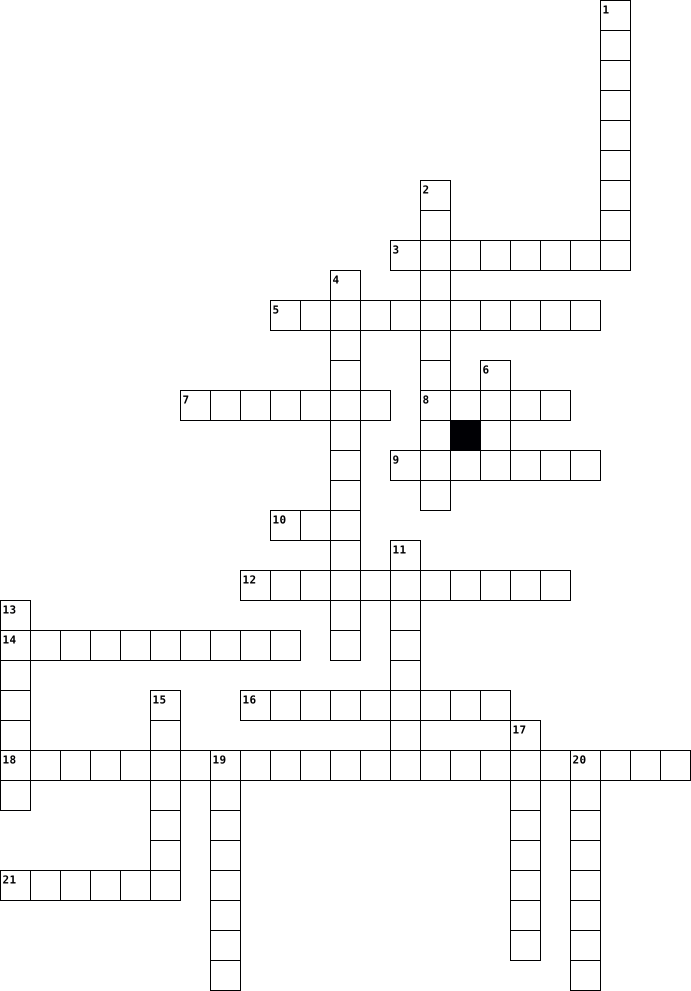
Across
- a pure substance that forms when two or more elements are held together by a chemical bond (every molecule of a compound is the same)
- a solid that forms during a chemical reaction that takes place in a solution.
- a combination of two or more substances that are not chemically combined.
- elements classified by physical properties that include shininess, malleability,ductile and conductivity.
- a pure substance that is made up of only one kind of atom.
- an atom that has lost or gained an electrons and therefore has an electrical charge.
- a mixture in which substances are distributed evenly ( you cannot see the different parts)
- the tendency of a substance to undergo chemical change.
- used to describe a material that can be hammered or beaten into thin sheets.
- a scientific principle that matter is neither created nor destroyed during a chemical change.
- in a solution , the substance that dissolves.
Down
- an element that has physical and chemical properties both metals and nonmetals can be semi-conducter
- a vertical column of elements in the periodic table shows number of valance electrons.
- a mixture in which substances are not distributed evenly (you can see the different parts)
- the smallest component of an element having the chemical properties of the element ( smallest unit of matter)
- a substance that is present at the beginning of a chemical reaction.
- hard substance that will break or shatter easily.
- he ability of a substance to be pulled into a wire.
- a homogeneous mixture in which one substance completely dissolves in.
- an element that usually is a gas or brittle solid at room temperature is not malleable or ductile is a poor conductor of heat and electricity and typically is dull.
- a group of two or more atoms held together by chemical bonds.
21 Clues: in a solution , the substance that dissolves. • hard substance that will break or shatter easily. • he ability of a substance to be pulled into a wire. • the tendency of a substance to undergo chemical change. • a pure substance that is made up of only one kind of atom. • a group of two or more atoms held together by chemical bonds. • ...
Atoms and molecules class 9 AV 2020-10-25

Across
- laws of chemical combination
- an ion with a negative charge
- a reference to calculate atomic mass
- atomic mass 14
- element with symbol Ca
- a metal with valency +1
- the Latin name for sodium
- = number of electrons
- = 6.022 × 10^23 particles .
- have atoms of same chemical properties
Down
- number of atoms in a molecule of an element
- A positively charged ion
- combination of different atoms in a fixed ratio by mass
- smallest particles of all the matter
- a monoatomic gas
- gave the atomic theory
- remains unchanged before and after a chemical reaction
- gases that do not react at all
- atomicity of oxygen
19 Clues: atomic mass 14 • a monoatomic gas • atomicity of oxygen • = number of electrons • element with symbol Ca • gave the atomic theory • a metal with valency +1 • A positively charged ion • the Latin name for sodium • = 6.022 × 10^23 particles . • laws of chemical combination • an ion with a negative charge • gases that do not react at all • a reference to calculate atomic mass • ...
67 project 2025-11-19

Across
- - A BIOMOLECULE THAT IS USED FOR ENERGY AND MADE UP OF SUGARS (MONOSACCHARIDES).
- - ADENINE TRIPHOSPHATE THE ENERGY MOLECULE THAT RESULTS FROM THE
- CONCENTRATION TO AND AREA OF LOWER WATER CONCENTRATION.
- COMPARED WITH ANOTHER SOLUTION.
- COMPARED WITH ANOTHER SOLUTION.
- - SOLUTION THAT HAS A LOWER CONCENTRATION OF DISSOLVED
- - THE MOVEMENT OF MOLECULES IN A FLUID OR GAS FROM A REGION OF HIGHER CONCENTRATION TO A
- - A BIOMOLECULE THAT IS OFTEN AN ENZYME TO SPEED UP CHEMICAL REACTIONS IN CELLS. MADE FROM
- DEPENDENT REACTION AND POWERS THE LIGHT INDEPENDENT REACTION
- ACIDS - A BIOMOLECULE THAT CARRIES GENETIC INFORMATION – INCLUDES DNA AND RNA
- - MOVEMENT OF WATER MOLECULES ACROSS A SEMIPERMEABLE MEMBRANE FROM AND AN AREA OF HIGHER
- OF LOWER CONCENTRATION.
Down
- - SOLUTION THAT HAS A HIGHER CONCENTRATION OF DISSOLVED
- RESPIRATION - RELEASES CHEMICAL ENERGY FROM SUGARS AND OTHER
- -A BIOMOLECULE THAT IS USED FOR ENERGY STORAGE AND INSULATION/PROTECTION. MADE OF TRIGLYCERIDES.
- ACIDS.
- - SOLUTION THAT HAS AN EQUAL CONCENTRATION OF DISSOLVED PARTICLES
- - A PROCESS THAT CAPTURES ENERGY FROM SUNLIGHT TO MAKE SUGAR THAT STORE CHEMICAL
- BASED MOLECULES TO MAKE ATP WHEN OXYGEN IN PRESENT.
- WITH ANOTHER SOLUTION.
20 Clues: ACIDS. • WITH ANOTHER SOLUTION. • OF LOWER CONCENTRATION. • COMPARED WITH ANOTHER SOLUTION. • COMPARED WITH ANOTHER SOLUTION. • BASED MOLECULES TO MAKE ATP WHEN OXYGEN IN PRESENT. • - SOLUTION THAT HAS A LOWER CONCENTRATION OF DISSOLVED • - SOLUTION THAT HAS A HIGHER CONCENTRATION OF DISSOLVED • CONCENTRATION TO AND AREA OF LOWER WATER CONCENTRATION. • ...
Unit 5 Crossword 2024-12-09

Across
- a substance with two or more elements
- a chemical reaction between substances always resulting in water and carbon dioxide
- the reaction of simple substances resulting in a compound
- an element consisting of two atoms
- a reaction where one element replaces another in a compound
- the small number below the element that tells how many atoms that element has
- a charged particle
Down
- a reaction where a compound breaks down into simpler substances
- a substance(s) that is there since the start of the reaction and changes as the reaction goes on
- a reaction in which the ions of the compounds exchange
- a number placed in front of an element that tells how many atoms of that element are present
- the substance(s) that are the result of the reaction and arre present in the end
- the transferring of electrons between atoms
- the sharing of electrons between atoms
14 Clues: a charged particle • an element consisting of two atoms • a substance with two or more elements • the sharing of electrons between atoms • the transferring of electrons between atoms • a reaction in which the ions of the compounds exchange • the reaction of simple substances resulting in a compound • a reaction where one element replaces another in a compound • ...
ENTHALPY 2023-11-10

Across
- Energy during exothermic reaction
- When a substance is burnt in excess oxygen under standard condition
- Unit of energy of enthalpy change
- Enthalpy Change of Hydration
- Energy during endothermic reaction
- Enthalpy when gaseous ions join to form solid
- Technique used to measure enthalpy
- Bond Making
- Enthalpy when water is formed by the reaction of acid and base under standard condition
Down
- Enthalpy when one mole of ion turns to gas
- Thermal stability down Group 2 carbonates
- Law that states that total enthalpy in a chemical reaction is independent of route taken as long as initial and final conditions are the same
- Energy cycle used to calculate lattice energy
- Solubility down Group 2 Sulfates
- Enthalpy when reactants react to give products under standard condition
- Enthalpy when a compound is formed from its constituent elements under standard condition
- When an ionic solid is dissolved in water under standard condition
17 Clues: Bond Making • Enthalpy Change of Hydration • Solubility down Group 2 Sulfates • Energy during exothermic reaction • Unit of energy of enthalpy change • Energy during endothermic reaction • Technique used to measure enthalpy • Thermal stability down Group 2 carbonates • Enthalpy when one mole of ion turns to gas • Energy cycle used to calculate lattice energy • ...
Gabriel 2022-03-08

Across
- multiple of an empirical formula
- 2 nonmetal atoms with prefixes
- the substance that will be used up in the first chemical reaction
- the ratio of a coefficient in a reaction
Down
- the maximum amount of product that can be produced based on the limited reactant
- it converts from one unit to another
- study of ratios in chemical reactions
- lowest whole number ratio of elements within a compound
- mass of one mole of a substance
- a chemical unit that is defined as 6.02 x 10^23
- metal and non metal & crisscross charges
11 Clues: 2 nonmetal atoms with prefixes • mass of one mole of a substance • multiple of an empirical formula • it converts from one unit to another • study of ratios in chemical reactions • metal and non metal & crisscross charges • the ratio of a coefficient in a reaction • a chemical unit that is defined as 6.02 x 10^23 • lowest whole number ratio of elements within a compound • ...
Photosynthesis 2022-06-02

Across
- Energy, Energy from the sun that reaches Earth as visible light, ultraviolet light, and infrared radiation (heat).
- Organelle in plant cells used to make food. It contains a light-trapping pigment called Chlorophyll.
- Long chains of glucose stored in plants.
- A substance produced as a result of a chemical change.
- A clear colorless gas that is a waste product of plants during photosynthesis.
- Energy, Energy that is stored within a molecule.
Down
- A chemical reaction during which plants convert energy from the Sun to chemical energy; the reaction converts carbon dioxide and water to sugar and oxygen.
- A substance that takes part in and undergoes change during a reaction.
- Dioxide, A clear odorless gas which plants use as a raw material in photosynthesis.
- A simple sugar made by plants during photosynthesis. Plants store long chains of glucose as Starch.
- A light-trapping pigment in the chloroplasts of plant cells.
11 Clues: Long chains of glucose stored in plants. • Energy, Energy that is stored within a molecule. • A substance produced as a result of a chemical change. • A light-trapping pigment in the chloroplasts of plant cells. • A substance that takes part in and undergoes change during a reaction. • A clear colorless gas that is a waste product of plants during photosynthesis. • ...
Concept Check #6 Crossword 2023-03-13

Across
- the location of photosynthesis
- with oxygen
- without oxygen
- the process in which glucose is converted to ATP
- the equation for cellular respiration
- the process in which plants convert light energy into chemical energy using carbon dioxide, water, and energy from the sun
Down
- the outputs of a chemical reaction
- the energy currency of the cell
- the inputs of a chemical reaction
- the first step of aerobic cellular respiration; occurs in the cytoplasm; produces two ATP and two molecules of pyruvate
- the organelles in which cellular respiration occurs
11 Clues: with oxygen • without oxygen • the location of photosynthesis • the energy currency of the cell • the inputs of a chemical reaction • the outputs of a chemical reaction • the equation for cellular respiration • the process in which glucose is converted to ATP • the organelles in which cellular respiration occurs • ...
Science Hw Guide Feb 16th 2023-02-16

Across
- occurs when light passes outward through space without
- electrons move from one bit to another atom
- when a chemical reaction takes in energy
- Resources that people use up faster than nature can replace them
- energy coming from the nucleus of the atom
- when heat rises up
- when heat transfers due to contact
Down
- energy that is stored
- resources that can be replaced by natural processes
- when a chemical reaction gives off energy
- energy in the form of motion
- is energy from the vibrations of atoms
- changing energy levels in an atom
13 Clues: when heat rises up • energy that is stored • energy in the form of motion • changing energy levels in an atom • when heat transfers due to contact • is energy from the vibrations of atoms • when a chemical reaction takes in energy • when a chemical reaction gives off energy • energy coming from the nucleus of the atom • electrons move from one bit to another atom • ...
Faiq Crossword 2023-11-15

Across
- A chemical reaction in which a substance reacts with oxygen - the reaction is exothermic.
- A reaction involving both reduction and oxidation
- A decrease in oxidation number of an atom or ion durinf a reaction
- The name given to the takes place when metals and alloys are chemically process that attacked by oxygen, water or any other substances found in their immediate environment
- A substance that oxidises another substance during a redox reaction and is itself reduced during the reaction
Down
- A reaction in which a more reactive element displaces a less reactive element from a solution of its salt
- The chemical reaction by ehich biological cells release the energy stored in glucose for use by the cell or the body
- elements from the central region of the Periodic Table they are hard,strong,dense metals that form compounds that are often coloured
- A substance that reduces another substance during a redox reaction and is itself oxidised during the reaction
- A term used to describe oxidised organic material (food) - usually involving a bad smell
10 Clues: A reaction involving both reduction and oxidation • A decrease in oxidation number of an atom or ion durinf a reaction • A term used to describe oxidised organic material (food) - usually involving a bad smell • A chemical reaction in which a substance reacts with oxygen - the reaction is exothermic. • ...
words 2023-10-03

Across
- substances that are made up
- group of atoms
- Chemical Reaction mass
- equation using symbols
- soild luigd gas
- letter
- produce or prove
- event account of an event
- made by mixing
- divere in character or content
Down
- of the same kind
- solving a problem
- a part aspect of something
- a thing is composed of two or more
- an ariticle or substance
- number or letter
- assets in excess
- reaction a reaction
- a relationship between people
19 Clues: letter • group of atoms • made by mixing • soild luigd gas • of the same kind • number or letter • produce or prove • assets in excess • solving a problem • reaction a reaction • Chemical Reaction mass • equation using symbols • an ariticle or substance • event account of an event • a part aspect of something • substances that are made up • a relationship between people • ...
Physical & Chemical Changes 2019-03-29

Across
- the type of change you have when you dissolve salt in water
- a physical change can sometimes involve this happening
- a solid forming inside a liquid
- a sign of a chemical change
- a form of energy that can be produced during a reaction
Down
- an everyday example of a slow chemical change
- this gas will turn limewater milky
- the chemicals you start with in a reaction
- this gas will make a glowing splint relight
- this gas will make a lighted splint go pop
- things that are broken and made during a chemical change
11 Clues: a sign of a chemical change • a solid forming inside a liquid • this gas will turn limewater milky • the chemicals you start with in a reaction • this gas will make a lighted splint go pop • this gas will make a glowing splint relight • an everyday example of a slow chemical change • a physical change can sometimes involve this happening • ...
Cool Chemistry Crossword 2017-02-09

Across
- solid, shiny, good conductor of heat and electricity
- (on the P.T) this is what each vertical row on the table is called
- mass approximately the number of protons and neutrons in an atom (add these together and you'll find it)
- gas all of these gasses have a full outer orbital shell
- one of the 118 that make up the Periodic Table
- the middle of an atom, powerhouse
- doesn't carry a negative charge, but a ____ charge
- of Conservation of Mass the mass of products in a chemical reaction must equal the mass of the reactants
- electron outermost energy level of an atom
- share characteristics of both
- the absorption of heat
Down
- Mendeleev Russian, discovered the Periodic Law
- H2O is an example of this
- during a chemical reaction the reactants are formed into these
- abbreviation of an element, usually related to the name and typically has only two letters
- (on the P.T) this is what each horizontal row on the table is called
- the release of heat
- brittle not malleable or ductile, poor conductor of heat and electricity
- a mixture composed of two or more separate elements
- a group of atoms linked together to make a substance
- doesn't really carry any sort of charge, it's just ___
- a substance that undergoes a change during a chemical reaction
- carries a ___ charge (not a positive one)
- shell of an atom
24 Clues: shell of an atom • the release of heat • the absorption of heat • H2O is an example of this • share characteristics of both • the middle of an atom, powerhouse • carries a ___ charge (not a positive one) • electron outermost energy level of an atom • Mendeleev Russian, discovered the Periodic Law • one of the 118 that make up the Periodic Table • ...
Chemistry, Semester 2 2022-05-26

Across
- An abbreviation scientists use to discuss rounding
- when two substances combine in a chemical reaction into one substance
- dioxide SO2
- positively charged ions, typically metals
- a type of reaction that involves burning fuel in O2 to produce carbon dioxide and water
- how selfish an element is when trying to share
- Mg
- This group's number is really reactive with water
- most of the elements on the periodic table are these
- when naming compounds, you are always adding this to the end of your halogens
- these bonds dissolve extremely well in water
- these gasses are very nonreactive, and are given an aristocratic title
- a solution that has gone beyond it's saturation point
- Commonly are cleaning products, like drain cleaner
- A solution that cannot dissolve any more
- oxygen, sulfur, krypton and bromine are all this
Down
- you never change these when balancing a chemical reaction
- use this to convert between grams and moles
- the only numbers we change while balancing a chemical equation
- number of significant figures in 0.052035
- this periodic property is the only one that increases as you go down and to the left on the periodic table
- the "dissolver"
- raising this could make solids dissolve better in your solution
- an avogadro's number of something
- negatively charged ions, typically nonmetals
- moles of solute per liters of solution
- the "dissolved"
- Has sour taste
- the act of making a solution less concentrated
29 Clues: Mg • dioxide SO2 • Has sour taste • the "dissolver" • the "dissolved" • an avogadro's number of something • moles of solute per liters of solution • A solution that cannot dissolve any more • number of significant figures in 0.052035 • positively charged ions, typically metals • use this to convert between grams and moles • negatively charged ions, typically nonmetals • ...
Friday Crossword 2024-04-04

Across
- an element needed for breathing
- a pure substance whose molecules contain different atoms from different elements
- the region of Texas we live in
- to identify or describe clearly
- the coast in the south east of Texas
- a river that creates the border with Oklahoma
- a type of chemical reaction that breaks molecules into separate elements
- one type of organism
- related to one kind of thing
- the base for all life, and half of CO2
- the most abundant element in the atmosphere
- the most populous city in Texas
- homogeneous mixtures of more than one susbtance
- texas's capital
- the second most populous Texan city
- a particular subject about which a person is an expert
Down
- the state along the eastern Texas border
- this is formed when compounds are physically combined without changing their properties
- a national park in west Texas
- something made up of two or more atoms bonded tightly together
- a person with special knowledge in a particular area
- a region famous for caverns and lakes
- the western most city in Texas
- the condition of easy recognition or close relationship
- well known
- the name of the princess from our literature
- the type of chemical reaction used in photosynthesis
- a type of chemical reaction that is used when you burn rocket fuel
- to get to know
- a river along Texas's southern border
- where the stars are big and bright
31 Clues: well known • to get to know • texas's capital • one type of organism • related to one kind of thing • a national park in west Texas • the region of Texas we live in • the western most city in Texas • an element needed for breathing • to identify or describe clearly • the most populous city in Texas • where the stars are big and bright • the second most populous Texan city • ...
Mixtures and Solutions Vocabulary 2024-03-04

Across
- a quantity of matter
- capable of being dissolved
- reflect on the results
- a solution in which the solvent cannot dissolve any more solute
- a solution containing little solute
- a pure material that is not a mixture
- the change of state from gas to liquid
- a substance that dissolves in a solvent to form a solution
- the natural form of some solid substances. The physical shape can help to identify a substance
- a mixture of one or more substances dissolved in solvent
- the change of state from liquid to gas
- the process in which substances change to make one or more new substances that have different properties from the original ones
- the substances created or resulting from a chemical reaction
- a substance in which a solute dissolves in to form a solution
- two or more material put together
- not capable of being dissolved
Down
- a solution containing a lot of solute
- the change of state from liquid to solid
- the change of state from solid to liquid
- the ratio of solute to solvent in a solution
- to all agree on something
- the process of a substance becoming incorporated uniformly into another
- a solution that contains more solute then it normally would at given temperature or pressure
- one of the starting substances in a chemical reaction
- mass per unit volume, sink or float
- a solid substance that forms after a chemical reaction occurs
26 Clues: a quantity of matter • reflect on the results • to all agree on something • capable of being dissolved • not capable of being dissolved • two or more material put together • a solution containing little solute • mass per unit volume, sink or float • a solution containing a lot of solute • a pure material that is not a mixture • the change of state from gas to liquid • ...
The Science of Chemistry 2024-09-10

Across
- Substances are consumed during a chemical reaction
- A process where substances are transformed
- The energy of motion
- A statement that describes something observable in nature
- The transfer of energy
- A change when only the appearance of a substance is changed
- A combination of two or more things
- Takes up space and has mass
- An approach to explain something using multiple steps
- A mixture different and seperate
- A measure of energy
- The result of chemical changes
- A substances characteristics that determine how it reacts with other substances
- The ability to work
- The branch of science that studies matter and the changes it goes through.
- A substances characteristics that can be observed without changing its's chemical identity
- A pure substance
Down
- A curve showing the effect of heating or cooling on a substance
- State of matter with volume but no fixed shape
- A mixture uniform through
- Have formulas and have definite compositions
- A possible explanation for something that can be tested
- A factor that can change in an experiment
- A reaction that releases heat
- State of matter without fixed shape or volume
- When molecules stay in place
- A reaction to absorbs heat
- State of matter with fixed molecules
- Substance with two or more chemically bonded elements
- Solid that forms when two substances mix
- Made of protons electrons and neutrons
- An explanation for some aspect of the natural world that has been proven
32 Clues: A pure substance • A measure of energy • The ability to work • The energy of motion • The transfer of energy • A mixture uniform through • A reaction to absorbs heat • Takes up space and has mass • When molecules stay in place • A reaction that releases heat • The result of chemical changes • A mixture different and seperate • A combination of two or more things • ...
IDK 2023-02-09

Across
- What is the central characteristic of the Scientific Method?
- What is the energy that comes from the temperature of a heated substance?
- Also called "Stored Energy".
- Compound found mainly in living things.
- Substance that form as a result of chemical reaction.
- What is the main element in Organic Compounds?
- Science that explains "Why" things happen.
- Constant fact of nature that describes "What" happens in nature.
- What is the most common chemical substance on planet Earth?
- Where is Acidity measured?
- The sum of all the biochemical reaction in organism.
- What is the ability to do work?
- What is the force that holds molecules together?
- Concentration of Hydronium Ions in a solution.
Down
- What is a pure Substance?
- Study of the interactions between life and physical environment.
- Occurs when we use our senses.
- Approach to studying the natural world that involves formulating hypotheses.
- Energy that's possessed due to its motion.
- Comprises all types of water resources.
- What is the protective blanket composed of gasses that surrounds the Earth?
- Everything that affects an organism during its lifetime.
- A substance that starts a chemical reaction.
- Energy of electro magnetic waves.
- It seeks to understand the natural world.
- Also known as "Knowledge".
- Where does life operate?
- Has a low concentration.
- What is the study of energy?
- What is the International System unit for Work or Energy?
30 Clues: Where does life operate? • Has a low concentration. • What is a pure Substance? • Also known as "Knowledge". • Where is Acidity measured? • Also called "Stored Energy". • What is the study of energy? • Occurs when we use our senses. • What is the ability to do work? • Energy of electro magnetic waves. • Comprises all types of water resources. • ...
ATP and PHOTOSYNTHESIS 2022-12-05

Across
- Another name for Autotroph
- The organelle where photosynthesis takes place
- The substances present at the start of a reaction that are written on the left side of the arrow in the equation.
- An energy-carrying molecule (energy carrier) found in the cells of all living things.
- One of the products of photosynthesis
- The substances formed during the reaction, are written on the right side of the arrow.
- The number of phosphate groups the ATP molecule contains
- During photosynthesis light is converted into this type of energy.
- One of the reactants of photosynthesis; it is a gas (TWO-WORDS)
- The sum of all the chemical reactions that take place in a cell or in a living organism.
- Microscopic autotrophs that are the main producers in marine ecosystems
- The process by which atoms or groups of atoms are reorganized into new substances. (TWO-WORDS)
Down
- An organism that digests food (eats other organisms) as a source of energy
- An organism that uses energy to make its own food
- One of the reactants of photosynthesis
- ATP is this type of biological macromolecule. (TWO-WORDS)
- The green pigment that traps the light; it is found in the cells of most of the autotrophs.
- Another name for Heterotroph
- The number of phosphate groups the ATP molecule contains
- One of the products of photosynthesis; it is a gas
- It is required for all cellular activities
- The molecule formed when a phosphate group is removed from the ATP molecule
22 Clues: Another name for Autotroph • Another name for Heterotroph • One of the products of photosynthesis • One of the reactants of photosynthesis • It is required for all cellular activities • The organelle where photosynthesis takes place • An organism that uses energy to make its own food • One of the products of photosynthesis; it is a gas • ...
Electrochemistry 2024-11-17

Across
- A substance that conducts electricity when dissolved in water.
- Coating a metal object with another metal using electric current.
- The branch dealing with stationary electric charges.
- Chemical species that participate in electron transfer reactions.
- Thermal effects accompanying electrochemical reactions.
- Difference in ion concentration across a membrane driving movement.
- Volumetric chemical analysis involving electric potential measurements.
- Migration of charged particles in a fluid under an electric field.
- Device that generates electricity through redox reactions.
- Energy associated with charged particles in motion.
- Purifying metals using electrolysis.
- Physics involving electricity and magnetism interrelation.
- Using electricity to synthesize chemical compounds.
- Formation of a substance on an electrode from its solution.
- Movement of liquid through a membrane under an electric field.
- Loss of electrons by a substance during an electrochemical reaction.
- Study of electric charges in motion.
Down
- Study of chemical processes that involve the movement of electrons.
- Region where electric and magnetic fields interact.
- Electric potential due to charge separation in a static field.
- Overall neutrality of charge in a solution or system.
- Measure of a material's ability to conduct electricity.
- Voltage difference driving the flow of electrons in a circuit.
- Study of the rates of reactions influenced by electric fields.
- A ranking of elements based on their standard electrode potentials.
- Separation of ions through a semi-permeable membrane using electric current.
- Methods of analyzing chemical compositions using electricity.
- Production of electric current via changing magnetic fields.
- Removal of substances from a solution by electrolysis.
- Gain of electrons by a substance during an electrochemical reaction.
30 Clues: Purifying metals using electrolysis. • Study of electric charges in motion. • Region where electric and magnetic fields interact. • Energy associated with charged particles in motion. • Using electricity to synthesize chemical compounds. • The branch dealing with stationary electric charges. • Overall neutrality of charge in a solution or system. • ...
Bio 2022-09-21

Across
- What's made in a chemical equation
- a reaction in plants that only happens in light
- What transports electrons
- is the second carrier for electrons
- The gas layer surrounding a planet
- a cycle used to break down glucose even further
- recycles NADH back to NADP+
Down
- What's combining in an chemical equation
- The element with the atomic number of 6
- What's used as energy in a cell
- a reaction in plants that only happen in the dark.
- How plants create energy
- the states of ____ are liquid solid and gas
13 Clues: How plants create energy • What transports electrons • recycles NADH back to NADP+ • What's used as energy in a cell • What's made in a chemical equation • The gas layer surrounding a planet • is the second carrier for electrons • The element with the atomic number of 6 • What's combining in an chemical equation • the states of ____ are liquid solid and gas • ...
science cross word puzzle 2025-04-15

Across
- a process where plants take sunlight to change carbon dioxide and water into oxygen and glucose
- an ending substance that is made during chemical reaction
- something that results in a process
- a type of atom that makes up carbon dioxide
- matter matter that makes up the nonliving parts of a ecosystem
- the part of a cell where cellular respiration happens
- all living and non living things
- the chemical reaction between oxygen and glucose
- a type of energy storage molecule
- a organism that gets energy storage molecules by braking down dead matter
- a set of interacting parts forming a complex whole
Down
- a type of energy storage molecules made of many glucose molecules connected together
- a molecule that releases energy
- the tiny pieces of all matter
- a part of the cell where photosynthesis happens
- a molecule made of carbon and oxygen atoms
- a starting substance that is part of a chemical reaction
- living things such as plants, animals, and bacteria
- a closed ecosystem made by humans
- matter that makes up living and dead organisms in a ecosystem
- a organism that needs to eat to get energy
- a molecule that organisms use to release energy
- an organism that can make there own energy storage molecules
- a type of energy storage molecule
- a group of atoms joined together in a particular way
- something required for a process
- to link 2 or more things
- the ability to make things move or change
28 Clues: to link 2 or more things • the tiny pieces of all matter • a molecule that releases energy • something required for a process • all living and non living things • a closed ecosystem made by humans • a type of energy storage molecule • a type of energy storage molecule • something that results in a process • the ability to make things move or change • ...
Natural Science 2024-08-05

Across
- mixture a mixture in which the different components can be distinguished. homogeneous mixture a mixture in which the different components cannot be distinguished.
- a chemical reaction that happens when some metal substances such as iron combine with oxygen in the presence of water. pure substance a type of matter which contains only one type of component.
- a connecting wire, usually made of copper, wrapped in plastic covering.
- a type of matter which contains two or more pure substances.
- the component of an electric circuit which provides the electricity.
- a material which allows electrical charges to move.
- a method used to separate liquids that have different boiling points in homogeneous mixtures.
- a method used to separate solids from liquids in homogeneous mixtures. fermentation a chemical reaction that happens in some living things, such as yeast and bacteria.
Down
- a method used to separate solids from liquids, or solids with different size particles, in heterogeneous mixtures.
- reactions these happen when atoms react and group together differently.
- the component of an electric circuit which transforms electricity into another type of energy.
- circuit a closed path through which electricity flows.
- a chemical reaction that happens when objects or substances are burned. compass a device with a magnetic needle that always points north. We use it to orient ourselves.
- a method used to separate substances of different density in heterogeneous mixtures.
- current the flow of electrical charges through materials.
- the force of attraction exerted by magnets.
- another word for a homogeneous
- an object which can attract other objects made of iron and other magnetic metals.
- a material which does not allow electrical charges to move.
19 Clues: another word for a homogeneous • the force of attraction exerted by magnets. • a material which allows electrical charges to move. • circuit a closed path through which electricity flows. • current the flow of electrical charges through materials. • a material which does not allow electrical charges to move. • ...
Study guide 2024-01-18

Across
- change in this makes a different element
- more electrons
- what group are alkali metals in
- least powerful radiation wave
- what cellular respiration makes
- what produces oxygen
- noble gases
- most powerful radiation wave
- reaction that takes place inside the nucleus
Down
- protons + neutrons 2 words
- AB+O-->AO+B
- AB-->A+B
- where chemical reaction takes place
- most reactive group
- neutral charge
15 Clues: AB-->A+B • AB+O-->AO+B • noble gases • more electrons • neutral charge • most reactive group • what produces oxygen • protons + neutrons 2 words • most powerful radiation wave • least powerful radiation wave • what group are alkali metals in • what cellular respiration makes • where chemical reaction takes place • change in this makes a different element • ...
Unit 2: Biomolecules Key Words 2024-08-13

Across
- Proteins that living organisms use to maintain their shape or structural integrity. Examples of this substance are keratin, collagen, actin and myosin.
- The act of substances attaching to each other or when chemicals join together.
- The part of the enzyme where the substrate binds during a reaction.
- Lipids that contain carbohydrate residues and are often found in the walls of bacteria and fungi.
- A biological catalyst that speeds up a specific chemical reaction in a cell. This substance is usually a protein and can be reused to assist the completion of multiple reactions.
- The main type of sugar in the blood and is the major source of energy for the cell.
- Lipids made up of a unit of glycerol linked to three fatty acids.
- The process that causes proteins or nucleic acids to lose their folded structure.
Down
- Proteins that move materials across the cell membrane, allowing compounds to be transported into and out of cells.
- A thin, flat sheet membrane made of two layers of phospholipids.
- A molecule that is produced by a living organism.
- An irregular shaped region within a prokaryotic cell that ocntains most of all of the cell's genetic material.
- A waxy, fat-like substance made in the liver and found in the blood and in all cells in the body. This substance is important for good health and is needed for making cell walls, tissues, hormones, vitamin D and bile acid.
- A rigid layer of polysaccharides lying outside the plasma membrane of the cells of plants, fungi and bacteria.
- A thin, semipermeable membrane that surrounds all living cells and separates the cell's interior from the outside environment.
- Molecules that comprise of protein and carbohydrate chains that are involved in many physiological functions including immunity.
- A molecule created by a chemical reaction catalyzed by a particular enzyme.
- Speeds up chemical reactions without being consumed or changed by the reaction.
- Substance that bind to enzymes and prevent them from carrying out chemical reactions.
- A substance in which an enzyme reacts to create final product.
20 Clues: A molecule that is produced by a living organism. • A substance in which an enzyme reacts to create final product. • A thin, flat sheet membrane made of two layers of phospholipids. • Lipids made up of a unit of glycerol linked to three fatty acids. • The part of the enzyme where the substrate binds during a reaction. • ...
Vocabulary Review 2015-01-29

Across
- – a substance that is present at the beginning of chemical reaction
- - a positively charged elementary particle that is in the nuclei of the atom.
- – a gas that rarely reacts with other elements
- – a vertical column in a periodic table; also called a chemical family
- variable that is changed by the scientist.
- - a piece of information used as evidence
- - number of protons in the nucleus of each atom of a given element
- - the group in an experiment or study that does not receive treatment
- the ratio of mass to the volume of a substance
- – a method of separating solids from liquids in a solution.
- – a change in a substance that does not change the chemical makeup
- - in favor of or against one thing, person, or group compared with another
- – an atom that has lost or gained electrons and therefore has an electrical charge
- - an element that conducts heat and electricity well, is shiny, and can be hammered
- - a procedure for accomplishing or approaching something
- – the scientific principle that matter is neither created nor destroyed
- a conclusion reached on the basis of evidence and reasoning
- – particle having no charge, mass slightly greater than that of a proton.
- – in a solution, the substance that dissolves
- – a horizontal row in a periodic table
- - smallest part of element, composed of a nucleus proton, neutron and, electron.
- - idea or explanation tested through study and experimentation
- – the tendency of a substance to undergo chemical changes
- – an element that does not conduct heat or electricity
Down
- - a group of subjects who are exposed to the variable under study
- – a solid that forms during a chemical reaction that takes place in a solution
- - a chemical change that is accompanied by an absorption of heat.
- – a process by which elements and compounds combine to form a new substance
- – a chart that organizes information about all the known elements
- - it is the sum of the protons and neutrons of an atom.
- a mixture in which substances are not distributed evenly
- - negative charge outside the nucleus of an atom.
- - a chemical change that is accompanied by a release of heat.
- the variable being tested in a scientific experiment.
- - a homogenous mixture in which one substance is completely dissolved into another
- – a change that results in the formation of a new substance or substances
- - a force that holds atoms together in molecules
- – a mixture in which substances are evenly distributed
- - a description of a chemical reaction using chemical formulas
- - two or more different elements join together chemically.
- – matter made up of two or more substances that are not joined chemically
- - a view or judgment formed about something,
- – the smallest unit of a compound - Made of the same types of atoms.
- – anything that has mass and volume
- – an element that has some properties of both metals and nonmetals
- – in a solution, the substance that does the dissolving
- – a substance that is produced during a chemical reaction.
- - substance that cannot be broken down into simpler substances.
48 Clues: – anything that has mass and volume • – a horizontal row in a periodic table • - a piece of information used as evidence • variable that is changed by the scientist. • - a view or judgment formed about something, • – in a solution, the substance that dissolves • – a gas that rarely reacts with other elements • the ratio of mass to the volume of a substance • ...
Vocab 2025-04-11

Across
- reaction: When photosynthesis and cellular respiration require one another to occur
- molecule of sugar produced by photosynthesis
- the starting substance of a chemical reaction
- use the sugars they produce within their own cells
- respiration: creates energy in the form of ATP from the sugar produced by photosynthesis
- an energy currency; it can be recharged through respiration
- the end result in a chemical reaction
Down
- part of the plant cell where photosynthesis occurs.
- is the process by which green plants use sunlight, carbon dioxide, and water to make their own food and release oxygen.
- the powerhouse of the cell
- Respiration that occurs WITHOUT oxygen
- Respiration that occurs WITH oxygen
- breath in oxygen and consume the sugars produced by photosynthesis
13 Clues: the powerhouse of the cell • Respiration that occurs WITH oxygen • the end result in a chemical reaction • Respiration that occurs WITHOUT oxygen • molecule of sugar produced by photosynthesis • the starting substance of a chemical reaction • use the sugars they produce within their own cells • part of the plant cell where photosynthesis occurs. • ...
Photosynthesis Crossword Puzzle 2023-10-27

Across
- independent reactions some that dose not need light
- distributes water to the plant
- things the are formed in the reaction this is due to the _____ that allows the plant to absorb sunlight
- the process that plants use to make food
- a _____ due to a chemical reaction
- the pigment that makes plants green
Down
- a ______ to make a chemical reaction
- dependent reactions something that dose need light
- form O2 released from plants
- _______, which are found it plant cells were the food making reaction takes place
10 Clues: form O2 released from plants • distributes water to the plant • a _____ due to a chemical reaction • the pigment that makes plants green • a ______ to make a chemical reaction • the process that plants use to make food • dependent reactions something that dose need light • independent reactions some that dose not need light • ...
Simple Chemical Reactions 2021-11-16

Across
- a change in which a new substance is formed
- the salt which is produced when lithium reacts with nitric acid
- the salt which is produced when sodium reacts with hydrochloric acid
- what does the state symbol aq represent?
- substances that react together, shown before the arrow in an equation
- the gas produced when metal carbonates react with acid
- are chemical changes normally reversible or irreversible?
- are physical changes normally reversible or irreversible?
- apart from a salt, what else is produced when metal oxide reacts with acid
Down
- a change that changes the physical properties of the substance, but no new substance is formed
- the tendency of a substance to undergo a chemical reaction
- the salt produced when you react magnesium oxide with nitric acid
- what does the state symbol l represent
- the gas produced when metal carbonates are heated
- we use this in science to heat chemicals in experiments
- the test for hydrogen gas
- if carbon dioxide is bubbles through limewater, the limewater turns....?
- this is produced when we react metals with oxygen
- substances formed in a chemical reaction, shown after the reaction arrow in an equation
- what does the state symbol g represent?
- what does the state symbol s represent
- we wear these in science to protect our eyes when doing experiments
- the liquid we bubble gas through to test for carbon dioxide
- the salt which is produced when lead reacts with sulphuric acid
- the gas produced when acid reacts with metals
25 Clues: the test for hydrogen gas • what does the state symbol l represent • what does the state symbol s represent • what does the state symbol g represent? • what does the state symbol aq represent? • a change in which a new substance is formed • the gas produced when acid reacts with metals • the gas produced when metal carbonates are heated • ...
Consumer Chemistry 2014-08-05

Across
- ion of oxygen
- element that can combine to itself
- chemical reaction producing heat
- used in pencil
- Cn H2n plus 1
- strongest carbon allotrope
- a chemical reaction in which two or more molecules combine to form larger molecules that contain repeating structural units
- made of carbon and hydrogen
- compounds with carbon
- shortest ratio of molecular formula
- molecules with the same molecular formula but different chemical structures
- makes reaction faster
- Cn H2n
- A hydrocarbon molecule containing one or more double or triple bonds, and can thus absorb more hydrogen atoms.
- also known as alkynes
- scent of defacation
- urea experiment
- coined the word "organic" on chemistry
- rings forming aromatic compounds
- soap eperiment
Down
- shortened stuctural formula
- building up rule
- groups of molecules
- ability of atoms to bond to itself
- prefix for "six"
- Cn H2n plus 2
- pure carbon allotrope
- simplest alkane
- C5 H10
- close-chained carbons
- experiment by Wohler
- The science of the composition, structure, properties, and reactions of matter, especially of atomic and molecular systems
- used by Chevreul to make soaps
- Allotrope of carbon C60-C80
- Pharmaceutical Industry
- containing two double bonds
- also known as alkenes
- distinctive smell or odor
- theory stating that all organisms have vital forces
- the black core of a pencil
- outermost shell of an atom with bond ready electrons
41 Clues: C5 H10 • Cn H2n • ion of oxygen • Cn H2n plus 2 • Cn H2n plus 1 • used in pencil • soap eperiment • simplest alkane • urea experiment • building up rule • prefix for "six" • groups of molecules • scent of defacation • experiment by Wohler • pure carbon allotrope • compounds with carbon • close-chained carbons • makes reaction faster • also known as alkynes • also known as alkenes • Pharmaceutical Industry • ...
Micah Pennington Physical Science Crossword 2019-03-08

Across
- the process by which a reactant loses one or more electrons
- a measure of the acidity of a solution
- description of a chemical reaction in which there is a net absorption of energy
- any substance that increases the rate of a chemical reaction with itself being consumed by the reaction
Down
- description of a solution in which the hydroxide ion concentration is higher than the hydronium ion concentration
- description of a chemical reaction in which there is a net release of energy
- a substance that accepts hydrogen ions
- description of a solution in which the hydronium ion concentration is equal to the hydroxide ion concentration
- description of a solution in which the hydronium ion concentration is higher than the hydroxide ion concentration
- a substance that donates hydrogen ions
10 Clues: a substance that accepts hydrogen ions • a measure of the acidity of a solution • a substance that donates hydrogen ions • the process by which a reactant loses one or more electrons • description of a chemical reaction in which there is a net release of energy • description of a chemical reaction in which there is a net absorption of energy • ...
Mole and Stoichiometry 2022-02-08

Across
- The total amount of grams in a molecule
- The result of a chemical reaction
- H3PO4 + 3KOH → K3PO4 + 3H2O is an example of a chemical ________
- Is represented by Avogadro's number
Down
- When both sides of a chemical equation are equal then the equation is _______
- Is represented by the number one
- Is represented by the number 22.4 in stoichiometry
- Can be used to predict the amount of things that will be made in a chemical reaction
- Relates the amount of two substances in a chemical equation
9 Clues: Is represented by the number one • The result of a chemical reaction • Is represented by Avogadro's number • The total amount of grams in a molecule • Is represented by the number 22.4 in stoichiometry • Relates the amount of two substances in a chemical equation • H3PO4 + 3KOH → K3PO4 + 3H2O is an example of a chemical ________ • ...
science crosword 2025-03-17

Across
- a chemical raction that happens with sunlight, carbon dioxide, and water in plant cells to make glucose and oxygen molucles
- the substance after the chemical reaction
- a process where a set of substances go through a chemical change from substance to subsctance
- C6H12+O6->6CO2+6H2O
Down
- changes that occur in matter without changing its chemical composition
- what can not be mage or destroyed but only changed
- the substance before the chemical reaction
- the ability to do something
- a type of suger that plants make
9 Clues: C6H12+O6->6CO2+6H2O • the ability to do something • a type of suger that plants make • the substance after the chemical reaction • the substance before the chemical reaction • what can not be mage or destroyed but only changed • changes that occur in matter without changing its chemical composition • ...
Chemical Equations 2025-02-13

Across
- When both sides of a chemical equation have the same number of atoms
- Basic building block of everything
- The elements or compounds after a chemical reaction
- When the sides of a chemical equation have different numbers of atoms
- The amount of matter in an object
Down
- The scientist responsible for creating the Law of Conservation of Mass
- Two or more elements chemically bonded together
- The elements or compounds before a chemical reaction
- Anything that takes up space and has mass
- Made up of one type of atom
10 Clues: Made up of one type of atom • The amount of matter in an object • Basic building block of everything • Anything that takes up space and has mass • Two or more elements chemically bonded together • The elements or compounds after a chemical reaction • The elements or compounds before a chemical reaction • ...
Mid chem 2022-03-08

Across
- The lowest whole number ratio of a element within a compound
- Add coefficients to the front of certain substances in a chemical reaction
- Max amount of product that can be produced based on the limiting reactant
- Allows you to covert from one substance to another
- Study of ratios within chemical reactions
- Mass of one mole of a substance
Down
- The percent ratio of actual yield to the theoretical yield
- The basic unit of a chemical element
- The substance that will be used up first in chemical reaction
- Multiple of an empirical formula
10 Clues: Mass of one mole of a substance • Multiple of an empirical formula • The basic unit of a chemical element • Study of ratios within chemical reactions • Allows you to covert from one substance to another • The percent ratio of actual yield to the theoretical yield • The lowest whole number ratio of a element within a compound • ...
chem crossword 2022-03-08

Across
- the substance that will be used up first in a chemical reaction
- 6.022x10^23
- the study of ratios within chemical reactions
- mass of one mole of a substance
- the percent ratio of the actual yield to the theoretical yield
- the mass of a product actually obtained from the reaction
Down
- the maximum amount of product that can be produced based on the limiting reactant
- a substance that enters into and is altered in the course of a chemical reaction
- a reactant present in an amount in excess of that required to combine with all of the limit reactant
- allows you to convert from one substance to another
10 Clues: 6.022x10^23 • mass of one mole of a substance • the study of ratios within chemical reactions • allows you to convert from one substance to another • the mass of a product actually obtained from the reaction • the percent ratio of the actual yield to the theoretical yield • the substance that will be used up first in a chemical reaction • ...
Chemistry Crossword 2025-03-10

Across
- A substance that accepts protons or donates hydroxide ions (OH⁻).
- A substance that speeds up a chemical reaction without being consumed.
- An atom or molecule with a net electric charge due to loss or gain of electrons.
- The SI unit for measuring the amount of substance.
- A substance that donates protons (H⁺) in a chemical reaction.
Down
- A state of matter with no fixed shape or volume.
- A substance that takes part in and undergoes change during a chemical reaction.
- A mixture of two or more metals.
- An atom with the same number of protons but a different number of neutrons.
- The force that holds atoms together in a molecule.
10 Clues: A mixture of two or more metals. • A state of matter with no fixed shape or volume. • The force that holds atoms together in a molecule. • The SI unit for measuring the amount of substance. • A substance that donates protons (H⁺) in a chemical reaction. • A substance that accepts protons or donates hydroxide ions (OH⁻). • ...
Chemical reactions 2013-03-07

Across
- New chemical formed in a chemical reaction
- Substances that attack metals, stonework and skin
- A change when the products can be turned back into the reactants
- A reaction where new substances are formed
Down
- A change where no new substances are formed.
- A gas which is given off when metals react with acids
- The scientific word for burning
- Substance formed when iron or steel reacts with oxygen and water
- Chemicals that join together to form a new substance
- A chemical that goes cloudy when carbon dioxide is bubbled through it
10 Clues: The scientific word for burning • New chemical formed in a chemical reaction • A reaction where new substances are formed • A change where no new substances are formed. • Substances that attack metals, stonework and skin • Chemicals that join together to form a new substance • A gas which is given off when metals react with acids • ...
Brooklyn Camacho 2021-03-02

Across
- The process in which a metal deteriorates through oxidation
- A chemical that accepts a hydrogen ion
- Where no atoms are lost or gained during any reaction
- If changed, the equilibrium shifts to oppose change until new equilibrium is reached
Down
- Reduction reactions involve the transfer of an electron
- When water behaves as an acid, what does it lose?
- A substance that lowers the act of energy of a chemical reaction
- Uses electric energy to produce a chemical change
- A chemical that donates a hydrogen ion
- A measure of the concentration of hydronium ions
10 Clues: A chemical that accepts a hydrogen ion • A chemical that donates a hydrogen ion • A measure of the concentration of hydronium ions • When water behaves as an acid, what does it lose? • Uses electric energy to produce a chemical change • Where no atoms are lost or gained during any reaction • Reduction reactions involve the transfer of an electron • ...
Science Crossword 7 2021-10-13

Across
- information that powers your claim
- changes to the physical properties, reversible
- changes to the physical and chemical properties
- physical or chemical characteristics used to describe or identify a substance
- a solid formed from a chemical reaction of 2 liquids
- able to go through a change then back to its original state
Down
- a process where substances combine to male new substances
- a property you can only observe when matter changes a from a chemical reaction
- a property you can observe without changing the substance
- seeing something and making noted about it
10 Clues: information that powers your claim • seeing something and making noted about it • changes to the physical properties, reversible • changes to the physical and chemical properties • a solid formed from a chemical reaction of 2 liquids • a process where substances combine to male new substances • a property you can observe without changing the substance • ...
Photosynthesis crossword 2024-10-08

Across
- what is needed for a chemical reaction to happen.
- A green pigment that allows plants to absorb sunlight.
- What is formed from a chemical reaction
- The process in which plants make oxygen and glucose.
- the gas product that comes out of photosynthesis this chemical compound is O2
Down
- the organelle where photosynthesis happens.
- This type of energy comes from the sun and is used in photosynthesis
- This liquid is a reactant used in photosynthesis
- Photosynthesis uses this gas as a reactant.
- Tgis is the chemical compound of glucose
10 Clues: What is formed from a chemical reaction • Tgis is the chemical compound of glucose • the organelle where photosynthesis happens. • Photosynthesis uses this gas as a reactant. • This liquid is a reactant used in photosynthesis • what is needed for a chemical reaction to happen. • The process in which plants make oxygen and glucose. • ...
Photosynthesis crossword 2024-10-08

Across
- what is needed for a chemical reaction to happen.
- A green pigment that allows plants to absorb sunlight.
- What is formed from a chemical reaction
- The process in which plants make oxygen and glucose.
- the gas product that comes out of photosynthesis this chemical compound is O2
Down
- the organelle where photosynthesis happens.
- This type of energy comes from the sun and is used in photosynthesis
- This liquid is a reactant used in photosynthesis
- Photosynthesis uses this gas as a reactant.
- Tgis is the chemical compound of glucose
10 Clues: What is formed from a chemical reaction • Tgis is the chemical compound of glucose • the organelle where photosynthesis happens. • Photosynthesis uses this gas as a reactant. • This liquid is a reactant used in photosynthesis • what is needed for a chemical reaction to happen. • The process in which plants make oxygen and glucose. • ...
Science 2025-03-09

Across
- State of matter Has no fixed shape or volume
- Elements that are good conductors of electricity.
- The amount of matter in an object
- A change in which a new substance is formed
- A material's tendency to break or shatter when subjected to stress
- A process that occurs when a liquid turns into a vapor
- A reaction that often results in the release of heat or light
- A chemical change involving the reaction of a metal with oxygen
- The process of a liquid turning into a solid
Down
- This kind of change involves a change in shape or form but not in chemical composition
- Scientific term for the study of the properties of matter
- The change from a gas to a liquid
- The temperature at which a solid turns into a liquid
- The process by which a solid changes directly to a gas
- The basic unit of matter
- State of matter that keeps its shape
- State of matter that is Charged Particles
- The degree of hotness or coldness of a substance
- State of matter that keeps the shape of it's container
19 Clues: The basic unit of matter • The change from a gas to a liquid • The amount of matter in an object • State of matter that keeps its shape • State of matter that is Charged Particles • A change in which a new substance is formed • State of matter Has no fixed shape or volume • The process of a liquid turning into a solid • The degree of hotness or coldness of a substance • ...
CHEMISTRY DISCUSSION 2 2025-02-23

Across
- You have a 6.0 M solution of sodium chloride (NaCl) and need a 3.0 L of a 2.0 M NaCl solution. How many liters of the 6.0 M NaCl solution are required?
- ions that remain unchanged in a chemical reaction
- capable of dissolving in liquid
- HCl + NaOH ---> NaCl + H2O (type of reaction)
- AgCl in the reaction: AgNO3(aq)+ NaCl(aq) ---> AgCl(s) + NaNO3(aq)
- the loss of one or more electrons
Down
- formula that gives relative # of atoms
- formula that shows actual # of atoms
- the gain of one or more electrons
- CH4 + 2O2 ---> CO2 + 2H2O (type of reaction)
- 2H2 + O2 ---> 2H2O (type of reaction)
- CaCO3 ---> CaO + CO2 (type of reaction)
- How many grams are in 3.0 x 10^23 molecules of water? (nearest whole number)
- the reactant that determines maximum amount of product in a reaction
14 Clues: capable of dissolving in liquid • the gain of one or more electrons • the loss of one or more electrons • formula that shows actual # of atoms • 2H2 + O2 ---> 2H2O (type of reaction) • formula that gives relative # of atoms • CaCO3 ---> CaO + CO2 (type of reaction) • CH4 + 2O2 ---> CO2 + 2H2O (type of reaction) • HCl + NaOH ---> NaCl + H2O (type of reaction) • ...