
chemical reaction Crossword Puzzles
Exam 3 Crossword 2021-03-24

Across
- Balancing chemical equations is consistent with the law of (3 words)
- A test tube is hot to the touch. The reaction occurring inside the test tube is ...
- A symbol that tells us the chemical is dissolved in water
- In this type of chemical reaction, an "aggressive" element bumps out a cation or H (2 words)
- One of the reactants is molecular oxygen. This type of chemical reaction is known as ...
Down
- We balance a reaction by using the smallest whole number ...
- Mass in grams of one mol of a pure substance (2 words)
- elements and compounds are always
8 Clues: elements and compounds are always • A symbol that tells us the chemical is dissolved in water • We balance a reaction by using the smallest whole number ... • Mass in grams of one mol of a pure substance (2 words) • Balancing chemical equations is consistent with the law of (3 words) • ...
Stoichiometry 2022-02-09

Across
- can also be known as a coefficient
- Mass mass of a given substance
- metric unit represented by the number 22.4 which is equal to mole
- Avogadro's number
- can be found on the right side of a formula
- there is an equal number of atoms on each side of a chemical reaction
Down
- Ratio properties of reactants and products used in a chemical equation
- relationship between quantities of substances in a chemical equation
- symbolic representation of a chemical reaction
- can be found on the left side of a chemical equation
10 Clues: Avogadro's number • can also be known as a coefficient • Mass mass of a given substance • can be found on the right side of a formula • symbolic representation of a chemical reaction • can be found on the left side of a chemical equation • metric unit represented by the number 22.4 which is equal to mole • ...
science crosword 2025-03-17

Across
- a chemical raction that happens with sunlight, carbon dioxide, and water in plant cells to make glucose and oxygen molucles
- the substance after the chemical reaction
- a process where a set of substances go through a chemical change from substance to subsctance
- C6H12+O6->6CO2+6H2O
Down
- changes that occur in matter without changing its chemical composition
- what can not be mage or destroyed but only changed
- the substance before the chemical reaction
- the ability to do something
- a type of suger that plants make
9 Clues: C6H12+O6->6CO2+6H2O • the ability to do something • a type of suger that plants make • the substance after the chemical reaction • the substance before the chemical reaction • what can not be mage or destroyed but only changed • changes that occur in matter without changing its chemical composition • ...
science crosword 2025-03-17

Across
- a chemical raction that happens with sunlight, carbon dioxide, and water in plant cells to make glucose and oxygen molucles
- the substance after the chemical reaction
- a process where a set of substances go through a chemical change from substance to subsctance
- C6H12+O6->6CO2+6H2O
Down
- changes that occur in matter without changing its chemical composition
- what can not be mage or destroyed but only changed
- the substance before the chemical reaction
- the ability to do something
- a type of suger that plants make
9 Clues: C6H12+O6->6CO2+6H2O • the ability to do something • a type of suger that plants make • the substance after the chemical reaction • the substance before the chemical reaction • what can not be mage or destroyed but only changed • changes that occur in matter without changing its chemical composition • ...
Nuclear Power 2020-05-04

Across
- a nuclear reaction in which atoms are split into smaller parts
- a negatively charged subatomic particle
- the self-sustaining reaction spread by neutrons which occurs in nuclear reactors
- the smallest particle of a substance that can exist by itself
- chemical element Pu
- a species of atoms having the same number of protons
- having or producing a powerful and dangerous form of energy called radiation
- element He, involved in nuclear fusion
- a type of nuclear fuel that contains more of the radioactive isotope
- they are present in every atom and contain the protons and neutrons
- relating to the nucleus of an atom
Down
- an important number for an atom, that can be estimated by adding the number of protons and neutrons
- a positively charged subatomic particle
- element H, used in nuclear fusion
- atoms of elements with different numbers of neutrons
- a neutral subatomic particle
- refers to the number of protons an atom has (e.g. 6 for C)
- a nuclear reaction in which a nucleus is merged with another one
- a type of nuclear fuel that contains less of the radioactive isotope
- chemical element U
20 Clues: chemical element U • chemical element Pu • a neutral subatomic particle • element H, used in nuclear fusion • relating to the nucleus of an atom • element He, involved in nuclear fusion • a positively charged subatomic particle • a negatively charged subatomic particle • atoms of elements with different numbers of neutrons • ...
Chemistry Unit Review Crossword 2017-02-08

Across
- Negative Charge
- Positive Charge
- Energy is released or give off
- Absorb energy so feels colder
- The ingredients before the reaction begins
- The number atoms present BEFORE and AFTER a reaction takes place
- Motion & Chemical Reactions
- Made up of atoms
- (on the P.T.) each numbered row is a...
- A solid material that is typically hard, shiny, malleable, fusible, and ductile, with good electrical and thermal conductivity
- gaseous elements helium, neon, argon, krypton, xenon, and radon are...
- Most important part of an atom
Down
- The ingredients produced after reaction takes place
- Subatomic particles, neutral charge
- formed a shared pair, bond
- (on the P.T.) a column of elements in the periodic table of the chemical elements.
- Something that is composed of two or more separate element, a mixture
- Mendeleev One of creators of periodic table
- Really small, source of nuclear energy
- They intermediate between those of metals and solid nonmetals. They are electrical semiconductors
- What this is called if repeatedly goes around and around
- An element or substance that is not a metal
- mass The weight of an element
- Element abbreviation
- There are 118 of these
25 Clues: Negative Charge • Positive Charge • Made up of atoms • Element abbreviation • There are 118 of these • formed a shared pair, bond • Motion & Chemical Reactions • Absorb energy so feels colder • mass The weight of an element • Energy is released or give off • Most important part of an atom • Subatomic particles, neutral charge • Really small, source of nuclear energy • ...
Biology Chapter 2 Terms - Brendan Warren 2018-10-01

Across
- Pure substance made up of only one kind of atom
- A substance that provides an alternate route from reactants to products that doesn't require as much energy
- Molecules that have a central carbon bonded to four groups
- Simple carbohydrates
- A class of organic compounds that serve as the building blocks for the information storage molecules DNA and RNA
- Changes that don't change a matter's identity
- A substance produced by a living organism that acts as a catalyst to bring about a specific reaction
- A substance that is formed as the result of a chemical reaction
- The joining of two different substances due to attractive forces that hold them
- Stored chemical energy that holds two atoms together
Down
- Changes that change a matter's identity
- The measure of average speed of particles within a substance
- Organic compounds made of carbons, hydrogens, and oxygens
- A substance that takes part in and undergoes change during a reaction
- The tendency of energy to disperse
- Non-polar molecules
- A pure substance made of two or more element chemically combined
- Ability to do work
- The attraction of molecules for each other
- Basic building block of matter
20 Clues: Ability to do work • Non-polar molecules • Simple carbohydrates • Basic building block of matter • The tendency of energy to disperse • Changes that change a matter's identity • The attraction of molecules for each other • Changes that don't change a matter's identity • Pure substance made up of only one kind of atom • Stored chemical energy that holds two atoms together • ...
chemistry 2025-05-28

Across
- A bond where atoms share electrons
- A positively charged subatomic particle
- A substance formed from two or more elements
- Atoms of the same element with different numbers of neutrons
- Solid changing directly to gas
- The substance in which a solute is dissolved
- A bond where atoms share electrons
- A solid that forms from a solution during a reaction
- Substance that speeds up a chemical reaction
- Symbolic representation of a chemical reaction
- Mass per unit volume
- Two or more atoms bonded together
- Substance that speeds up a chemical reaction
- Loss of electrons
- Gain of electrons
- Electrons in the outer shell of an atom
Down
- A solution with a pH of 7
- A negatively charged subatomic particle
- When a liquid becomes a gas
- An atom with a net electric charge
- Type of change that creates a new substance
- Table that arranges elements by atomic number
- Gases in Group 18
- When a solid becomes a liquid
- A substance that accepts protons
- A subatomic particle with no charge
- Amount of matter in an object
- A homogeneous mixture
- The substance that is dissolved
- Connection between atoms
- Unstable atoms that emit radiation
31 Clues: Gases in Group 18 • Loss of electrons • Gain of electrons • Mass per unit volume • A homogeneous mixture • Connection between atoms • A solution with a pH of 7 • When a liquid becomes a gas • When a solid becomes a liquid • Amount of matter in an object • Solid changing directly to gas • The substance that is dissolved • A substance that accepts protons • ...
Chemistry of Life Crossword Puzzle 2019-02-06

Across
- compound that produces hydrogen ions in solution
- scale a scale from 0 to 14 reflecting the concentration of hydrogen ions in solution
- attraction between molecules of the same substance
- smallest unit of most compounds
- basic unit of matter
- substance made up of only one kind of atom
- energy energy needed to get a reaction started
- particles with no charge
- element or compound produced by a chemical reaction
- large compound formed from combinations from many monomers
Down
- mixture of water and non-dissolved materials
- bond bond formed by the sharing of electrons between atoms
- positively charged particles
- protein that acts as a biological catalyst
- negatively charged particle; located outside the atomic nucleus
- small unit that can form together with other small units to create a polymer
- compound that forms hydrogen ions in solution
- substance that speeds up the rate of a chemical reaction element/substance made up of only one kind of atom
- atoms of the same element that contain different number of neutrons
- atom or group of atoms that has acquired a positive or negative charge as a result of gaining or losing electrons
20 Clues: basic unit of matter • particles with no charge • positively charged particles • smallest unit of most compounds • protein that acts as a biological catalyst • substance made up of only one kind of atom • mixture of water and non-dissolved materials • compound that forms hydrogen ions in solution • energy energy needed to get a reaction started • ...
Chemistry- bio 2015-09-22

Across
- large number of similar units bonding together.
- living organism in order to maintain life.
- very large number of atoms, such as proteins, acids.
- class of organic compounds that are fatty acids.
- protein- forms hair and finger nails.
- unit of a nucleic acid
- process of breaking down food in the body.
- absorption of heat.
- molecule that decreases activity.
- acids- simple organic compound containing carboxyl.
Down
- scale of 7 is neutral.
- a molecule that can be bonded, into other identical molecules.
- reaction- transformation of one molecule to a different molecule.
- protein- control movement such as proteins help control contraction.
- protein- accelerates the speed of a chemical reaction such as (digestive)
- large group of organic compounds occurring in foods and living tissues.
- energy- quantity of energy that reacts to species.
- release of heat.
- acid- DNA OR RNA
- components of body tissue, such as, hair, nails and antibodies.
- protein- parts of the body used by cells in cellular respiration.
- substance produced by a living organisms that acts like a biochemical reaction.
- bonding- attraction between atoms, that contain two or more.
- protein- regulates the amount of sugar in the blood.
24 Clues: release of heat. • acid- DNA OR RNA • absorption of heat. • scale of 7 is neutral. • unit of a nucleic acid • molecule that decreases activity. • protein- forms hair and finger nails. • living organism in order to maintain life. • process of breaking down food in the body. • large number of similar units bonding together. • class of organic compounds that are fatty acids. • ...
Atoms and The Periodic Table Crossword 2023-10-04

Across
- The process in which one or more substances are converted into a new substance.
- Anything that has mass and takes up space.
- a group of atoms that are bonded together.
- Elements that have the properties of both metals and nonmetals.
- Subatomic particle without a charge.
- The element with the atomic number of 8.
- The chemicals that are present at the start of a chemical reaction.
- A substance’s odor is considered a ___________ property.
- Subatomic particle with a negative charge.
- Smallest particle that retains an element’s properties.
- The result of a chemical reaction.
Down
- The _______ point is the temperature in which a substance will turn from a liquid to a solid.
- The measure of a substances ability to break down over time.
- Any substance that cannot be broken into a simpler substance.
- The law of ______________ of matter states that matter is neither created or destroyed.
- The Bohr model is also known as the __________ model.
- measure of a substance’s ability to ignite or burn.
- Noble gases are known as ___________.
- Elements that are poor conductors and contain no luster.
- Subatomic particle with a positive charge.
20 Clues: The result of a chemical reaction. • Subatomic particle without a charge. • Noble gases are known as ___________. • The element with the atomic number of 8. • Anything that has mass and takes up space. • a group of atoms that are bonded together. • Subatomic particle with a positive charge. • Subatomic particle with a negative charge. • ...
reaction rate crossword 2021-04-29

Across
- an equation that relates reaction rate and concentration of reactants
- increasing this will raise the average kinetic energy
- states that for a chemical reaction to occur, the reacting particles must collide with one another.
- substance that speeds up a chemical reaction without being consumed
Down
- a sequence of elementary steps by which a chemical reaction occurs.
- a type of catalyst in a different phase as the reactant
- for a chemical reaction to occur it must have sufficient energy and _____
7 Clues: increasing this will raise the average kinetic energy • a type of catalyst in a different phase as the reactant • a sequence of elementary steps by which a chemical reaction occurs. • substance that speeds up a chemical reaction without being consumed • an equation that relates reaction rate and concentration of reactants • ...
Thermochemistry vocab 2023-04-28

Across
- substance at the start of a chemical reaction.
- a process that releases heat.
- a unit of energy, work, and heat.
- the result of atom movement.
- base unit of temperature.
- Heat required to induce vaporization.
- transfer of thermal heat through direct contact.
- energy contained in a process for its temperature.
- a branch of chemistry concerned with quantities of heat produced and absorbed during chemical reactions.
- substance that results from a chemical reaction.
- the amount of heat required to raise the temperature of 1 gram of substance 1 degree Celsius.
- A process that absorbs heat.
Down
- used to measure the amount of heat transfer.
- An energy unit approximate to the amount of energy required to release one gram of water.
- energy that comes from a source and travels through space at the speed of light.
- transfer of thermal heat through the movement of a liquid or gas.
- unit for measuring temperature, smaller scale.
- process in which a solid becomes a liquid, molecules become less organized.
- energy produced by motion.
19 Clues: base unit of temperature. • energy produced by motion. • the result of atom movement. • A process that absorbs heat. • a process that releases heat. • a unit of energy, work, and heat. • Heat required to induce vaporization. • used to measure the amount of heat transfer. • substance at the start of a chemical reaction. • unit for measuring temperature, smaller scale. • ...
Crossword Project 2025-11-19

Across
- - A BIOMOLECULE THAT IS USED FOR ENERGY AND MADE UP OF SUGARS (MONOSACCHARIDES).
- - ADENINE TRIPHOSPHATE THE ENERGY MOLECULE THAT RESULTS FROM THE
- CONCENTRATION TO AND AREA OF LOWER WATER CONCENTRATION.
- COMPARED WITH ANOTHER SOLUTION.
- COMPARED WITH ANOTHER SOLUTION.
- - SOLUTION THAT HAS A LOWER CONCENTRATION OF DISSOLVED
- - THE MOVEMENT OF MOLECULES IN A FLUID OR GAS FROM A REGION OF HIGHER CONCENTRATION TO A
- - A BIOMOLECULE THAT IS OFTEN AN ENZYME TO SPEED UP CHEMICAL REACTIONS IN CELLS. MADE FROM
- DEPENDENT REACTION AND POWERS THE LIGHT INDEPENDENT REACTION
- ACIDS - A BIOMOLECULE THAT CARRIES GENETIC INFORMATION – INCLUDES DNA AND RNA
- - MOVEMENT OF WATER MOLECULES ACROSS A SEMIPERMEABLE MEMBRANE FROM AND AN AREA OF HIGHER
- OF LOWER CONCENTRATION.
Down
- - SOLUTION THAT HAS A HIGHER CONCENTRATION OF DISSOLVED
- RESPIRATION - RELEASES CHEMICAL ENERGY FROM SUGARS AND OTHER
- -A BIOMOLECULE THAT IS USED FOR ENERGY STORAGE AND INSULATION/PROTECTION. MADE OF TRIGLYCERIDES.
- ACIDS.
- - SOLUTION THAT HAS AN EQUAL CONCENTRATION OF DISSOLVED PARTICLES
- - A PROCESS THAT CAPTURES ENERGY FROM SUNLIGHT TO MAKE SUGAR THAT STORE CHEMICAL
- BASED MOLECULES TO MAKE ATP WHEN OXYGEN IN PRESENT.
- WITH ANOTHER SOLUTION.
20 Clues: ACIDS. • WITH ANOTHER SOLUTION. • OF LOWER CONCENTRATION. • COMPARED WITH ANOTHER SOLUTION. • COMPARED WITH ANOTHER SOLUTION. • BASED MOLECULES TO MAKE ATP WHEN OXYGEN IN PRESENT. • - SOLUTION THAT HAS A LOWER CONCENTRATION OF DISSOLVED • - SOLUTION THAT HAS A HIGHER CONCENTRATION OF DISSOLVED • CONCENTRATION TO AND AREA OF LOWER WATER CONCENTRATION. • ...
Metabolism Glossary 2022-02-18

Across
- Air+water molecule
- Group of glucose molecules
- Oxygen+glucose chemical reaction
- Reaction creates a new substance
- Proves evidence supports the claim
- System we use to breathe
- System to break down food
- Building blocks of protein
- Molecule that releases energy
- It's measured in joules
Down
- Group of atoms
- Name of this unit
- Used to support a claim
- Claim supported by evidence
- Hearts system
- Proposed answer
- Half carbon atoms
- What you get from Fish+Meat
- Intertwining parts of a machine
19 Clues: Hearts system • Group of atoms • Proposed answer • Name of this unit • Half carbon atoms • Air+water molecule • Used to support a claim • It's measured in joules • System we use to breathe • System to break down food • Group of glucose molecules • Building blocks of protein • Claim supported by evidence • What you get from Fish+Meat • Molecule that releases energy • ...
Crossword Puzzle Chemisty 2025-12-04

Across
- Speeds up a chemical reaction
- Physical combination of substances
- Biological polymer of amino acids
- Negatively charged ion
- Measure of disorder
- Smallest unit of an element
- Process where substances change
- Same formula, different structure
Down
- Substance that dissolves another
- Negatively charged subatomic particle
- Resists changes in pH
- Same element, different neutron number
- Molecule that binds to a metal center
- Metal mixture
- Atom or molecule with charge
- Method to determine concentration
- Scale for acidity
- Region where an electron is likely found
- Positively charged ion
19 Clues: Metal mixture • Scale for acidity • Measure of disorder • Resists changes in pH • Negatively charged ion • Positively charged ion • Smallest unit of an element • Atom or molecule with charge • Speeds up a chemical reaction • Process where substances change • Substance that dissolves another • Biological polymer of amino acids • Method to determine concentration • ...
Science and Fun 2024-07-01

Across
- The process by which green plants use sunlight to synthesize foods. (14 letters)
- A substance that speeds up a chemical reaction without being consumed. (8 letters)
- A reaction where an acid and a base react to form water and a salt. (14 letters)
- A type of lens that converges light rays. (4 letters)
- The process of breaking down food into simple substances. (9 letters)
- The process of eliminating waste materials from the body. (9 letters)
- The bending of light when it passes through different mediums. (10 letters)
- An optical device that refracts light. (4 letters)
Down
- The process of light bouncing back from a surface. (10 letters)
- The movement of substances in the circulatory system. (11 letters)
- The process by which organisms convert oxygen and glucose into energy. (11 letters)
- A solid formed from a solution in a chemical reaction. (12 letters)
- A set of colors produced when light is dispersed. (8 letters)
- A reaction where a substance combines with oxygen. (9 letters)
- The separation of light into colors. (9 letters)
15 Clues: The separation of light into colors. (9 letters) • An optical device that refracts light. (4 letters) • A type of lens that converges light rays. (4 letters) • A set of colors produced when light is dispersed. (8 letters) • A reaction where a substance combines with oxygen. (9 letters) • The process of light bouncing back from a surface. (10 letters) • ...
MATTER AND ENERGY IN ECOSYSTEMS 2025-07-26

Across
- an organism that needs to eat in order to get energy storage molecules (such as starch and fat)
- an ending substance that is made during a chemical reaction
- a closed ecosystem made by humans
- the part of a cell where cellular respiration happens
- Matter matter that makes up the nonliving parts of an ecosystem, such as air, water, and rOCKS
- living things, such as plants, animals, and bacteria
- all the living and nonliving things interacting in a particular area
- Dioxide a molecule made of carbon and oxygen atoms (CO2)
- a sugar molecule that organisms can use to release energy, and that is made of carbon, hydrogen, and oxygen atoms (C6H12O6)
Down
- the process by which plants and other producers use energy from sunlight to change carbon dioxide and water into oxygen and glucose (an energy storage molecule)
- the part of a cell where photosynthesis happens
- an organism that can make its own energy storage molecules (such as glucose)
- an organism that gets energy storage molecules by breaking down dead matter
- a type of energy storage molecule
- Matter matter that makes up the living and dead organisms in an ecosystem
- Respiration the chemical reaction between oxygen and glucose that releases energy into cells
- a type of atom (a tiny piece) that makes up molecules such as carbon dioxide and energy storage molecules
- a starting substance that is part of a chemical reaction
18 Clues: a closed ecosystem made by humans • a type of energy storage molecule • the part of a cell where photosynthesis happens • living things, such as plants, animals, and bacteria • the part of a cell where cellular respiration happens • Dioxide a molecule made of carbon and oxygen atoms (CO2) • a starting substance that is part of a chemical reaction • ...
Chemical Reactions 2023-02-01

Across
- - substance that cannot be broken down into simpler substances
- - substance that is made of two or more different elements
- – moving the particles around increases the exposure of reactants to one another
- – substance that affects the reaction rate without being used up in the reaction
- – energy is absorbed (in)
- - substance that goes through a chemical change
- – energy is released (out)
- – this looks like reactants are “more crowded” together
- – a mixture’s ingredients are so evenly distributed that it’s difficult to distinguish one ingredient from another
Down
- - properties can vary because the composition is not fixed (can change)
- – how fast reactants turn to products
- – energy stored in the chemical bonds of a substance
- - matter with exactly the same composition throughout
- – increasing this will increase the exposure of reactants to one another
- – raising this will make particles to move faster and collide more often
- – a substance that is the result of a chemical change
- - heterogeneous mixture that separates into layers over time
- - the mixture has parts that are noticeably different from one another
- - when substances dissolve and form a homogeneous mixture
19 Clues: – energy is absorbed (in) • – energy is released (out) • – how fast reactants turn to products • - substance that goes through a chemical change • – energy stored in the chemical bonds of a substance • - matter with exactly the same composition throughout • – a substance that is the result of a chemical change • – this looks like reactants are “more crowded” together • ...
Chemical reactions 2022-01-10

Across
- A number that indicates the number of atoms in the particle of a substance.
- Atom, ion or molecule.
- The smallest particle of a chemical element that can exist.
- A process in which one or more substances, the reactants, are converted to one or more different substances, the products.
Down
- A form of matter that has constant chemical composition and characteristic properties. It cannot be separated into components without breaking chemical bonds. It is composed of one type of particle.
- The starting materials in a chemical reaction.
- It's a written representation, using numbers and symbols, of the process that occurs during a chemical reaction.
- A substance that is formed as the result of a chemical reaction.
- An expression that states the number and type of atoms present in a particle of a substance.
9 Clues: Atom, ion or molecule. • The starting materials in a chemical reaction. • The smallest particle of a chemical element that can exist. • A substance that is formed as the result of a chemical reaction. • A number that indicates the number of atoms in the particle of a substance. • ...
Max puzzle 2022-03-21

Across
- solub
- alloy
- dissolve
- mass
- neutralize
- diamond
- weaker with water
- chemical solution
Down
- mix
- homomixture
- sugar dissolbe
- changes in reaction
- makes items up
- used to solve
- sour taste
15 Clues: mix • mass • solub • alloy • diamond • dissolve • neutralize • sour taste • homomixture • used to solve • sugar dissolbe • makes items up • weaker with water • chemical solution • changes in reaction
Carbohydrates 2023-10-12

Across
- Starch and fibers are what kind of carbohydrates
- BLANK is a simple carbohydrate
- Stabilizersancer, thickener
- millard reaction is determined by BLANK and temperature
- cell walls of plants
- consists of two sugar molecules chemically bonded together
Down
- carbohydrates are mainly produced by blank
- improves sweetness, flavor enhancer
- food storage of animals
- the basic unit of carbohydrates
- reduces crystallization during freezing
- Carbohydrates are made up of Carbon, Blank and Oxygen
- Polysaccharide means
- Blank Reaction is a chemical reaction between sugars and amino acids
- food storage of plants
15 Clues: Polysaccharide means • cell walls of plants • food storage of plants • food storage of animals • Stabilizersancer, thickener • BLANK is a simple carbohydrate • the basic unit of carbohydrates • improves sweetness, flavor enhancer • reduces crystallization during freezing • carbohydrates are mainly produced by blank • Starch and fibers are what kind of carbohydrates • ...
Organic cross word puzzle 2021-02-04

Across
- A step-by-step description of the overall chemical reaction (9)
- Change in stereochemistry/configuration for SN2 product (9)
- Planar structure of carbocations r free radicals (8)
- Carbocation most favourable to SN1 reaction (8)
- Postulation that favours synthesis of a compound due to the stability of its substituted carbocation (11)
- Functional group formed as a result of the loss of hydrogen atom and a leaving group (6)
- A one step, one substrate substitution reaction (12)
- A rule that determines the choice E1 product (8)
- A thermodynamic state property that drives substitution reaction (8)
- The characteristic of a substrate, nucleophile or a leaving group which could determine its substitution reaction mechanism (4)
- An industrial method used to generate free radical (11)
- The rate determining step for a substitution nucleophilic unimolecular reaction (10)
- a reaction set up in a repeating motion (involves radicals) (5)
Down
- Functional groups (Double bonds) on adjacent carbons (in a 1, 2 position) (7)
- A reaction step to generate radicals (10)
- different forms of a compound’s structural arrangement because of hyperconjugation or the overlapping or filling of orbitals. (9)
- A two step, two substrate substitution reaction (11)
- A base with high affinity for hydrogen atom (favours Elimination) (8)
- An atom or molecule with one or more unpaired electrons but capable of independence existence (7)
- Preference of one isomer over another in an addition (16)
- This cationic substrate can carry out different type of substitution reaction depending on its leaving group or solvent used. (9)
- A thermodynamic state property that drives elimination reaction (7)
- Property of a solvent which could affect substitution nucleophilic reaction (8)
- A type of carbocation more favourable to SN2 reaction (7)
- A base ready to donate its electron pair (Favors Substitution) (5)
- In terms of substrate size, this could hinder the attack of a nucleophile (6)
26 Clues: A reaction step to generate radicals (10) • Carbocation most favourable to SN1 reaction (8) • A rule that determines the choice E1 product (8) • Planar structure of carbocations r free radicals (8) • A two step, two substrate substitution reaction (11) • A one step, one substrate substitution reaction (12) • An industrial method used to generate free radical (11) • ...
Organic reaction mechanism cross word puzzle 2021-02-04

Across
- A step-by-step description of the overall chemical reaction (9)
- Change in stereochemistry/configuration for SN2 product (9)
- Planar structure of carbocations r free radicals (8)
- Carbocation most favourable to SN1 reaction (8)
- Postulation that favours synthesis of a compound due to the stability of its substituted carbocation (11)
- Functional group formed as a result of the loss of hydrogen atom and a leaving group (6)
- A one step, one substrate substitution reaction (12)
- A rule that determines the choice E1 product (8)
- A thermodynamic state property that drives substitution reaction (8)
- The characteristic of a substrate, nucleophile or a leaving group which could determine its substitution reaction mechanism (4)
- An industrial method used to generate free radical (11)
- The rate determining step for a substitution nucleophilic unimolecular reaction (10)
- a reaction set up in a repeating motion (involves radicals) (5)
Down
- Functional groups (Double bonds) on adjacent carbons (in a 1, 2 position) (7)
- A reaction step to generate radicals (10)
- different forms of a compound’s structural arrangement because of hyperconjugation or the overlapping or filling of orbitals. (9)
- A two step, two substrate substitution reaction (11)
- A base with high affinity for hydrogen atom (favours Elimination) (8)
- An atom or molecule with one or more unpaired electrons but capable of independence existence (7)
- Preference of one isomer over another in an addition (16)
- This cationic substrate can carry out different type of substitution reaction depending on its leaving group or solvent used. (9)
- A thermodynamic state property that drives elimination reaction (7)
- Property of a solvent which could affect substitution nucleophilic reaction (8)
- A type of carbocation more favourable to SN2 reaction (7)
- A base ready to donate its electron pair (Favors Substitution) (5)
- In terms of substrate size, this could hinder the attack of a nucleophile (6)
26 Clues: A reaction step to generate radicals (10) • Carbocation most favourable to SN1 reaction (8) • A rule that determines the choice E1 product (8) • Planar structure of carbocations r free radicals (8) • A two step, two substrate substitution reaction (11) • A one step, one substrate substitution reaction (12) • An industrial method used to generate free radical (11) • ...
Crossword Puzzle: Chemical vs Physical Changes 2021-10-27

Across
- Able to be undone.
- A smaller component that makes up matter.
- A change in a substance that does not change its molecules or identity, could be a change in state.
- A process that involves rearrangement of molecules into new molecules.
Down
- A usually irreversible change involving a change in chemical properties, resulting in the formation of a new substance.
- A substance that is made during a chemical reaction.
- A substance that undergoes change during a chemical reaction.
- Any characteristic or quality that is measurable and describes how something is or looks.
8 Clues: Able to be undone. • A smaller component that makes up matter. • A substance that is made during a chemical reaction. • A substance that undergoes change during a chemical reaction. • A process that involves rearrangement of molecules into new molecules. • Any characteristic or quality that is measurable and describes how something is or looks. • ...
M4 Chemistry Crossword 2013-04-25

Across
- The substance that is dissolved in the creation of a solution
- The most reactive metal
- A (disproven) theoretical substance that was thought to be released in combustion
- Electron ______; the energy released when an electron is added to a neutral atom to become negative
- Atomic ______ is equal to half the distance between two nuclei of the same element
- A chemical equation that only shows ions that have a change in quantity
- In chemistry, the number 6.02x10^23 is named after this physicist
- A branch of chemistry that studies the quantities of different substances in chemical reactions
- C6H12O6
- The number of moles of a substance per litre of a solution
- The point in a titration at which the indicator changes colour
- Substance with a loosely attached water molecule
- A reaction in which two or more substances react to form one new compound
- Negatively charged particle
- The 17th group in the periodic table
- The currently accepted model of the atom
- Type of chemical reaction that involves the absorption of heat
- A substance that has lost an electron
Down
- A(n) ______ of an element contains 6.02x10^23 atoms
- A reaction in which a compound breaks down into the two or more substances that formed it
- Formula for a compound using the lowest possible ratio of ions present
- Strong intermolecular bonds
- Name for an element that occurs in nature as a gas, with 2 atoms joined
- Name for CH3COO
- There are several of these in every sublevel of an atom
- Occurs when a nucleus absorbs a neutron and splits into two nuclei
- A proton donor
- Compound containing an O2 molecule
- Subscript in a chemical equation that denotes a solution
- Used to measure the absorbance of light of a substance
- A reaction involving a change in the oxidation number of atoms
- Weak intermolecular dispersion forces
- A positively charged ion
- Ion that is present in every base
- A charged atom
- In quantum mechanics, the name for a He^2+ particle
36 Clues: C6H12O6 • A proton donor • A charged atom • Name for CH3COO • The most reactive metal • A positively charged ion • Strong intermolecular bonds • Negatively charged particle • Ion that is present in every base • Compound containing an O2 molecule • The 17th group in the periodic table • Weak intermolecular dispersion forces • A substance that has lost an electron • ...
Biology: Chemistry of Life 2025-09-11

Across
- measured by the pH scale
- one particular type of atom
- a polymer made of amino acids
- A reaction that absorbs more energy than it releases
- nonpolar molecules such as fats and oils
- substance made up of atoms often bonded to other atoms
- smallest basic unit of matter
- substances changed during a chemical reaction
- a compound that releases a hydrogen ion when it dissolves in water
- a compound that removes hydrogen ions from a solution
- A reaction that releases more energy than it absorbs
- High specific heat means water resists changes in _________
- neutral particle in an atom's nucleus
- A __________ bond is an attraction between a slightly positive hydrogen ion and a slightly negative atom
- a mixture of substances that is the same throughout
- ______acids are chains of carbon atoms bonded to hydrogen atoms
- an atom that has gained or lost one or more electrons
- Polymers made up of nucleotides are __________ acids
- a large molecule made of many monomers
- group of molecules with a carbon base including sugars
Down
- a catalyst for chemical reactions in living things
- positively charged particle in an atom's nucleus
- particles that determine the properties of the element
- substances made by chemical reactions
- a specific reactant for an specific enzyme
- subunit of a complete molecule (like a link in a chain)
- the attraction among molecules of different substances
- a substance that dissolves in a solvent
- A __________bond forms when atoms share a pair of electrons
- negatively charged particle outside of the nucleus of an atom
- a substance that increases the rate of a chemical reaction
- the substance that is present in the greater amount is a solution and dissolves another substance
- water is a ________molecule, meaning it has a positive region and a negative region
- Sodium chloride is held together by _________ bonds
- two or more atoms held together by covalent bonds
- ______energy is the amount of energy that will break a bond between two atoms
- the attraction among molecules of a substance
37 Clues: measured by the pH scale • one particular type of atom • a polymer made of amino acids • smallest basic unit of matter • substances made by chemical reactions • neutral particle in an atom's nucleus • a large molecule made of many monomers • a substance that dissolves in a solvent • nonpolar molecules such as fats and oils • a specific reactant for an specific enzyme • ...
Virtual 2016-03-29

Across
- An enzyme speeds up the rate of a chemical reaction by ___________ the activation energy needed for the reaction.
- How many codons code for five amino acids?
- The process in the cell cycle in which DNA is copied
- One problem when a cell grows too large is that its _____ increases faster than its surface area
- dividing When normal cells are going through mitosis, what do they do when the cells touch each other?
- What is the diffusion of water?
- An enzyme lowers activation energy to speed up what?
- What type of cell does NOT have a nucleus?
- Converts glucose into ATP
- What macromolecule's function is long term energy storage?
- A mutation that is an insertion or deletion causes every amino acid from that point on to be changed. What's that kind of mutation called?
- Acid What macromolecule's function is to carry genetic information?
- In mitosis, how does the number of chromosomes in the daughter cells compare to the number in the mother cell?
Down
- Aparatus What organelle processes and packages substances in the cell?
- What's the movement of particles from an area of high concentration to an area of low concentration?
- What's the process called that can enable a one celled zygote to grow into a multi-cellular organism with many different kinds of cells?
- What type of cell DOES have a nucleus?
- What two factors can affect the effect of an enzyme?
- What is the name of the process in which the cell uses info from the mRNA to produce proteins?
- Mitosis in humans results in cells that have ______ chromosomes
- Mitosis results in the formation of _____ genetically identical cells.
- The amount of energy NEEDED for a chemical reaction to take place
- What is the process by which organisms maintain a constant internal environment?
- What macromolecule's function is to speed up the rate of chemical reactions?
- What's the name of the proteins that regulates the cell cycle?
25 Clues: Converts glucose into ATP • What is the diffusion of water? • What type of cell DOES have a nucleus? • How many codons code for five amino acids? • What type of cell does NOT have a nucleus? • What two factors can affect the effect of an enzyme? • The process in the cell cycle in which DNA is copied • An enzyme lowers activation energy to speed up what? • ...
Chapter 2 Vocabulary Quiz 2018-08-31

Across
- / Substance that speeds up the rate of a chemical reaction by lowering the activation energy.
- / Subatomic particle that has a neutral charge.
- / Positively charges subatomic particle.
- / Process that changes one set of chemicals into another.
- / Substance that forms hydrogen ions (H+) when dissolved in water. Hint: pH is less than 7.
- / Substance that produces hydroxide ions (OH-) when dissolved in water. Hint: pH is greater than 7.
- / Type of bond formed from the transfer of electrons.
- / Bonds that link amino acids together.
- / Weak acid or base that is used to prevent sharp changes in pH.
- / When water molecules stick to each other.
- / Negatively charged subatomic particle.
- / Macromolecule containing carbon, hydrogen, oxygen, nitrogen, and phosphorus. Examples are DNA and RNA.
- / Binds to an enzyme at the active site. Reactants of enzyme-catalyzed reactions.
- / Measures the acidity of a solution and ranges from 0 to 14. Tests for acids and bases.
- / When water molecules stick to other substances.
- / Substance that does the dissolving.
- / A protein that acts as a biological catalyst speeding up reactions in cells.
- / Type of nucleic acid- makes proteins.
Down
- / Macromolecule made of CHO with a 1:2:1 ratio, used for short term energy.
- / Substance that is being dissolved.
- / Weak attraction between oppositely charged regions of nearby molecules.
- / Monomer of nucleic acids.
- / The starting substances in a chemical reaction.
- / Energy required to start a chemical reaction.
- / The process of forming polymers by linking monomers.
- / Monomer of a carbohydrate. "ONE" sugar.
- / Macromolecule made of CHO, used for long term energy.
- / Building blocks of proteins.
- / The substance that is produced by a chemical reaction.
- / Smaller units or smaller molecules. Building blocks of bigger molecules.
- / Type of bond formed from the sharing of electrons.
- / Macromolecule that contains carbon, hydrogen, oxygen, nitrogen, & sometimes sulfur.
- / Smallest unit of matter.
- / Molecule made from repeating units of smaller molecules all covalently bonded together.
- / Forms organic molecules. Forms 4 covalent bonds.
- / Type of nucleic acid- genetic material.
36 Clues: / Monomer of nucleic acids. • / Smallest unit of matter. • / Building blocks of proteins. • / Substance that is being dissolved. • / Substance that does the dissolving. • / Bonds that link amino acids together. • / Type of nucleic acid- makes proteins. • / Positively charges subatomic particle. • / Monomer of a carbohydrate. "ONE" sugar. • ...
Max puzzle 2022-03-21

Across
- dissolve
- diamond
- changes in reaction
- mass
- chemical solution
- neutralize
Down
- alloy
- homomixture
- solub
- sugar dissolbe
- makes items up
- weaker with water
- sour taste
- used to solve
- mix
15 Clues: mix • mass • alloy • solub • diamond • dissolve • sour taste • neutralize • homomixture • used to solve • sugar dissolbe • makes items up • weaker with water • chemical solution • changes in reaction
Chapter 13- Emily Fischer 2021-03-04

Across
- a process that involves rearrangement of the molecular or ionic structure of a substance, as opposed to a change in physical form or a nuclear reaction
- The amount of energy required to pull two bonded atoms apart
- a chemical that donates a hydrogen ion
- a chemical that accepts a hydrogen ion
- a net release of energy
Down
- a net absorption of energy
- one or more new compounds are formed as a result of the rearrangement of atom
- Dependent on the collision of the molecules
- when reaction and its reverse act at the same rate
- a substance that lowers the activation energy of a chemical reaction
10 Clues: a net release of energy • a net absorption of energy • a chemical that donates a hydrogen ion • a chemical that accepts a hydrogen ion • Dependent on the collision of the molecules • when reaction and its reverse act at the same rate • The amount of energy required to pull two bonded atoms apart • a substance that lowers the activation energy of a chemical reaction • ...
Unit 2 - Biochemistry 2020-10-22

Across
- compound that releases hydrogen ions (H+) in solution
- monomer of carbohydrate; also known as a simple sugar
- reactant in an enzymatic reaction
- measure of the hydrogen ion (H+) concentration of a solution
- type of anabolic reaction in which two or more atoms or molecules bond, resulting in the formation of a larger molecule
- lipid compound composed of a glycerol molecule bonded with three fatty acid chains
- atom with an overall positive or negative charge
- specific type of covalent bond formed by dehydration synthesis between two amino acids
- subatomic particle having a negative charge and nearly no mass; found orbiting the atom’s nucleus
- change in the structure of a molecule through physical or chemical means, typically effecting the active site of enzyme rendering them ineffective
- smallest unit of an element that retains the unique properties of that element
- class of organic compounds composed of one or more phosphate groups, a pentose sugar, and a base
- sum of the number of protons and neutrons in the nucleus of an atom (two words)
- one or more substances produced by a chemical reaction
- number of protons in the nucleus of an atom
- chemical bond in which two atoms share electrons, thereby completing their valence shells (two words)
- nucleotide containing ribose and an adenine base that is essential in energy transfer
- building block of proteins; characterized by an amino and carboxyl functional groups and a variable side-chain (two words)
- one of the variations of an element in which the number of neutrons differ from each other, but the number of protons are the same
Down
- substance that increases the rate of a chemical reaction without itself being changed in the process
- substance that contains both carbon and hydrogen (two words)
- large molecule formed by covalent bonding
- type of “bond” in which a positive hydrogen nucleus is attracted to an adjacent negatively charged nucleus – as seen between water molecuels (two words)
- lipid compound composed of four hydrocarbon rings bonded to a variety of other atoms and molecules
- specific protein type that catalyzes chemical reactions
- class of organic compounds that are composed of many amino acids linked together by peptide bonds
- compound consisting of more than two carbohydrate monomers bonded by dehydration synthesis
- macromolecule made of deoxyribose-containing nucleotides that stores genetic information
- class of nonpolar organic compounds built from hydrocarbons and distinguished by the fact that they are not soluble in water
- class of organic compounds built from sugars, molecules containing carbon, hydrogen, and oxygen, and the Hydrogen and Oxygen are found in a 2:1 ratio
- heavy subatomic particle having no electrical charge and found in the atom’s nucleus
- an ion with a positive charge
- ribose-containing macromolecule composed of nucleotides that helps translate the genetic code into a protein
- heavy subatomic particle having a positive charge and found in the atom’s nucleus
- an ion with a negative charge
- outermost electron shell of an atom which dictates bonding between atoms
- pair of carbohydrate monomers bonded by dehydration synthesis
- compound that accepts hydrogen ions (H+) in solution or releases hydroxide ions (OH-)
- substance composed of two or more different elements joined by chemical bonds
- type of reaction in which one or more bonds within a larger molecule are broken, resulting in the release of smaller molecules or atoms
- one or more substances that enter into the reaction
41 Clues: an ion with a positive charge • an ion with a negative charge • reactant in an enzymatic reaction • large molecule formed by covalent bonding • number of protons in the nucleus of an atom • atom with an overall positive or negative charge • one or more substances that enter into the reaction • compound that releases hydrogen ions (H+) in solution • ...
Chemical Reactions 2022-04-13

Across
- number placed in front of the product or reactant
- a chemical or molecule that participates in a chemical reaction, left side of equation
- Displacement, when ions in 2 compounds switch places and form 2 new compounds
- when a compound breaks down into 2 or more elements/compounds
- Solution, water that contains one or more dissolved substance
- a small-sized number on the bottom right of the symbol
Down
- Replacement, when an element switches with another similar element in a compound
- when two or more elements combine to form a compound
- arrow in between chemical equation
- a chemical or molecule that is formed in a chemical reaction, right side of equation
- when a hydrocarbon reacts with oxygen and produces carbon dioxide gas and water
11 Clues: arrow in between chemical equation • number placed in front of the product or reactant • when two or more elements combine to form a compound • a small-sized number on the bottom right of the symbol • when a compound breaks down into 2 or more elements/compounds • Solution, water that contains one or more dissolved substance • ...
The Chemistry of Wordplay 2022-12-26

Across
- Mass of a particular isotope of an atom
- The sum of atomic masses of the elements in a compound
- The sum of the products of the relative atomic masses and percent
- It is the numbers before the chemical formulas on the reactant and product side of the equation
- The relative ratios of elements in a compound
Down
- It shows what happens in a chemical reaction.
- A substance that takes part in and undergoes change during a reaction
- The exact numbers of atoms that form a compound
- It is a substance that is present at the end of a chemical reaction
- It is named after an Italian lawyer
10 Clues: It is named after an Italian lawyer • Mass of a particular isotope of an atom • It shows what happens in a chemical reaction. • The relative ratios of elements in a compound • The exact numbers of atoms that form a compound • The sum of atomic masses of the elements in a compound • The sum of the products of the relative atomic masses and percent • ...
Owen Cromly Chapter 13 2019-02-27

Across
- The deterioration of a metal, typically caused by atmospheric oxygen.
- A substance that donates hydrogen ions.
- Description of a solution in which the hydroxide ion concentration is higher than the hydronium ion concentration; also sometimes called alkaline.
- A reaction between an acid and a base.
- The process by which a reactant loses one or more electrons.
- The new materials formed in a chemical reaction.
Down
- Description of a chemical reaction in which there is a net release of energy.
- Description of a solution in which the hydronium ion concentration is higher than the hydroxide ion concentration.
- The amount of energy required to pull two bonded atoms apart, which is the same as the amount of energy released when the two atoms are brought together into a bond.
- The reacting substances in a chemical reaction.
10 Clues: A reaction between an acid and a base. • A substance that donates hydrogen ions. • The reacting substances in a chemical reaction. • The new materials formed in a chemical reaction. • The process by which a reactant loses one or more electrons. • The deterioration of a metal, typically caused by atmospheric oxygen. • ...
science crosword 2025-03-17

Across
- a chemical raction that happens with sunlight, carbon dioxide, and water in plant cells to make glucose and oxygen molucles
- the substance after the chemical reaction
- a process where a set of substances go through a chemical change from substance to subsctance
- C6H12+O6->6CO2+6H2O
Down
- changes that occur in matter without changing its chemical composition
- what can not be mage or destroyed but only changed
- the substance before the chemical reaction
- the ability to do something
- a type of suger that plants make
9 Clues: C6H12+O6->6CO2+6H2O • the ability to do something • a type of suger that plants make • the substance after the chemical reaction • the substance before the chemical reaction • what can not be mage or destroyed but only changed • changes that occur in matter without changing its chemical composition • ...
science crosword 2025-03-17

Across
- a chemical raction that happens with sunlight, carbon dioxide, and water in plant cells to make glucose and oxygen molucles
- the substance after the chemical reaction
- a process where a set of substances go through a chemical change from substance to subsctance
- C6H12+O6->6CO2+6H2O
Down
- changes that occur in matter without changing its chemical composition
- what can not be mage or destroyed but only changed
- the substance before the chemical reaction
- the ability to do something
- a type of suger that plants make
9 Clues: C6H12+O6->6CO2+6H2O • the ability to do something • a type of suger that plants make • the substance after the chemical reaction • the substance before the chemical reaction • what can not be mage or destroyed but only changed • changes that occur in matter without changing its chemical composition • ...
science crosword 2025-03-17

Across
- a chemical raction that happens with sunlight, carbon dioxide, and water in plant cells to make glucose and oxygen molucles
- the substance after the chemical reaction
- a process where a set of substances go through a chemical change from substance to subsctance
- C6H12+O6->6CO2+6H2O
Down
- changes that occur in matter without changing its chemical composition
- what can not be mage or destroyed but only changed
- the substance before the chemical reaction
- the ability to do something
- a type of suger that plants make
9 Clues: C6H12+O6->6CO2+6H2O • the ability to do something • a type of suger that plants make • the substance after the chemical reaction • the substance before the chemical reaction • what can not be mage or destroyed but only changed • changes that occur in matter without changing its chemical composition • ...
science crosword 2025-03-17

Across
- a chemical raction that happens with sunlight, carbon dioxide, and water in plant cells to make glucose and oxygen molucles
- the substance after the chemical reaction
- a process where a set of substances go through a chemical change from substance to subsctance
- C6H12+O6->6CO2+6H2O
Down
- changes that occur in matter without changing its chemical composition
- what can not be mage or destroyed but only changed
- the substance before the chemical reaction
- the ability to do something
- a type of suger that plants make
9 Clues: C6H12+O6->6CO2+6H2O • the ability to do something • a type of suger that plants make • the substance after the chemical reaction • the substance before the chemical reaction • what can not be mage or destroyed but only changed • changes that occur in matter without changing its chemical composition • ...
Chemical Reactions Vocab 2024-08-21

Across
- property that describes the mass of a certain volume of matter
- characteristic of matter
- a group of two or more atoms that are held together by chemical bonds, unique composition and structure
- when matter changes its physical state(Solid,liquid,gas)
- property of object that describes its ability to ignite
- a new substance that forms during a chemical reaction
- physical form matter takes as determined by the arrangement and motion of its atoms and molecules
Down
- substance that exists before a chemical reaction takes place and changes as a result of that action
- process in which one or more new substances form from one or more other substances
- property that describes how well one substance dissolves in another substance
- matter that has a constant chemical composition and characteristics
- an individual particle of an element
- property that produces a smell
13 Clues: characteristic of matter • property that produces a smell • an individual particle of an element • a new substance that forms during a chemical reaction • property of object that describes its ability to ignite • when matter changes its physical state(Solid,liquid,gas) • property that describes the mass of a certain volume of matter • ...
Unit 4 Review 2026-03-02

Across
- Burning wood and rotting bananas are examples of this type of change
- These are located on the left side of a chemical equation
- A reaction that absorbs heat energy and feels cold
- The organelle in autotrophs that creates sugar molecules
- A reaction that releases heat energy and feels hot
- A chemical equation where the number of atoms is equal on both sides
- The number of carbon atoms needed for one cycle of cellular respiration
Down
- The organelle that processes sugars to recharge energy molecules
- Melting ice and shredding paper are examples of this type of change
- The gas that stomata take in from the atmosphere
- The pigment inside a chloroplast that absorbs light energy
- The type of respiration used to create energy when no oxygen is available
- These are located on the right side of a chemical equation
13 Clues: The gas that stomata take in from the atmosphere • A reaction that absorbs heat energy and feels cold • A reaction that releases heat energy and feels hot • The organelle in autotrophs that creates sugar molecules • These are located on the left side of a chemical equation • The pigment inside a chloroplast that absorbs light energy • ...
Chapter 2 Vocabulary Quiz 2018-08-31

Across
- / Positively charges subatomic particle.
- / Molecule made from repeating units of smaller molecules all covalently bonded together.
- / Substance that is being dissolved.
- / Forms organic molecules. Forms 4 covalent bonds.
- / Macromolecule made of CHO with a 1:2:1 ratio, used for short term energy.
- / Smaller units or smaller molecules. Building blocks of bigger molecules.
- / A protein that acts as a biological catalyst speeding up reactions in cells.
- / Monomer of a carbohydrate. "ONE" sugar.
- / Type of nucleic acid- makes proteins.
- / Negatively charged subatomic particle.
- / Building blocks of proteins.
- / When water molecules stick to other substances.
- / Monomer of nucleic acids.
- / Smallest unit of matter.
- / Energy required to start a chemical reaction.
- / The starting substances in a chemical reaction.
- / Type of bond formed from the sharing of electrons.
- / Weak acid or base that is used to prevent sharp changes in pH.
- / Macromolecule containing carbon, hydrogen, oxygen, nitrogen, and phosphorus. Examples are DNA and RNA.
- / Substance that does the dissolving.
Down
- / Binds to an enzyme at the active site. Reactants of enzyme-catalyzed reactions.
- / Subatomic particle that has a neutral charge.
- / Measures the acidity of a solution and ranges from 0 to 14. Tests for acids and bases.
- / Process that changes one set of chemicals into another.
- / Type of nucleic acid- genetic material.
- / When water molecules stick to each other.
- / The substance that is produced by a chemical reaction.
- / The process of forming polymers by linking monomers.
- / Bonds that link amino acids together.
- / Substance that speeds up the rate of a chemical reaction by lowering the activation energy.
- / Type of bond formed from the transfer of electrons.
- / Macromolecule that contains carbon, hydrogen, oxygen, nitrogen, & sometimes sulfur.
- / Substance that produces hydroxide ions (OH-) when dissolved in water. Hint: pH is greater than 7.
- / Substance that forms hydrogen ions (H+) when dissolved in water. Hint: pH is less than 7.
- / Macromolecule made of CHO, used for long term energy.
35 Clues: / Monomer of nucleic acids. • / Smallest unit of matter. • / Building blocks of proteins. • / Substance that is being dissolved. • / Substance that does the dissolving. • / Type of nucleic acid- makes proteins. • / Bonds that link amino acids together. • / Positively charges subatomic particle. • / Type of nucleic acid- genetic material. • ...
Organic cross word puzzle 2021-02-03

Across
- A step-by-step description of the overall chemical reaction (9)
- Change in stereochemistry/configuration for SN2 product (9)
- Planar structure of carbocations r free radicals (8)
- Carbocation most favourable to SN1 reaction (8)
- Postulation that favours synthesis of a compound due to the stability of its substituted carbocation (11)
- The result of the loss of hydrogen atom and a leaving group (6)
- A one step, one substrate substitution reaction (12)
- A rule that determines the choice E1 product (8)
- A thermodynamic state property that drives substitution reaction (8)
- A characteristic which affects a nucleophile or a leaving group in a reaction i.e. substitution (4)
- A method used to generate free radical (11)
- The rate determining step for a substitution nucleophilic unimolecular reaction (10)
- a reaction set up in a repeating motion (involves radicals) (5)
Down
- Functional groups (Double bonds) on adjacent carbons (in a 1, 2 position) (7)
- A reaction step to generate radicals (10)
- different forms of a compound’s structural arrangement because of hyperconjugation or the overlapping or filling of orbitals. (9)
- A two step, two substrate substitution reaction (11)
- A base with high affinity for hydrogen atom (favours Elimination) (8)
- An atom or molecule with one or more unpaired electrons but capable of independence existence (7)
- Preference of one isomer over another in an addition (16)
- This substrate can carry out different type of reaction depending on leaving group or solvent used. (9)
- A thermodynamic state property that drives elimination reaction (7)
- Property of a solvent which could affect substitution nucleophilic reaction (8)
- A type of carbocation more favourable to SN2 reaction (7)
- A base ready to donate its electron pair (Favors Substitution) (5)
- In terms of substrate size, this could hinder the attack of a nucleophile (6)
26 Clues: A reaction step to generate radicals (10) • A method used to generate free radical (11) • Carbocation most favourable to SN1 reaction (8) • A rule that determines the choice E1 product (8) • Planar structure of carbocations r free radicals (8) • A two step, two substrate substitution reaction (11) • A one step, one substrate substitution reaction (12) • ...
SCI Crossword 2016-01-10

Across
- the output of a chemical reaction
- A hard solid substance used throughout history
- a system that does allow transfers of mass in/out of the system
- when matter is changed from one form into another the total amount of mass stays the same.
Down
- a system that does not allow transfers of mass in/out of the system
- the substances you use to form a chemical reaction
- a mashine with a rapidly rotating container that applies centrifugal force to it's contents.
- Usually a gas because it does not contain metal
- the speed of a substance in a chemical reaction
- A mix of different metals/other materials
10 Clues: the output of a chemical reaction • A mix of different metals/other materials • A hard solid substance used throughout history • Usually a gas because it does not contain metal • the speed of a substance in a chemical reaction • the substances you use to form a chemical reaction • a system that does allow transfers of mass in/out of the system • ...
Unit 2 Vocabulary 2016-09-11

Across
- mass is neither created nor destroyed during a chemical reaction-it is conserved
- another state of matter that can occur in the form of lightning and in stars
- anything that has mass and takes up space
- the new substances that are formed in a chemical reaction
Down
- matter with a uniform and unchanging composition
- the ability of a substance to combine with or change into one or more other substances
- the starting substances in a chemical reaction
- a seperation technique that is based on differences in the boiling points of the substances involved
- two or more different elements that are combined chemically
- a measurement that reflects the amount of matter
10 Clues: anything that has mass and takes up space • the starting substances in a chemical reaction • matter with a uniform and unchanging composition • a measurement that reflects the amount of matter • the new substances that are formed in a chemical reaction • two or more different elements that are combined chemically • ...
Sam Miller - Chapter 13 Crossword 2020-10-16

Across
- An ____ is a chemical that donates a hydrogen ion, H+.
- ____ acids and bases do not ionize completely in water.
- a substance that lowers the activation energy of a chemical reaction, which allows for the reaction to proceed at a faster rate.
- when reaction and it’s reverse act at the same rate.
- When water behaves as a base, what does it gain?
- _____ acids and bases ionize completely in water.
Down
- the amount of energy required to pull two bonded atoms apart
- A ____ is a chemical that accepts a hydrogen ion, H+.
- Add hydroxide ions, OH–, and the solution is _____.
- Add hydronium ions, H3O+, and the solution is _____.
10 Clues: When water behaves as a base, what does it gain? • _____ acids and bases ionize completely in water. • Add hydroxide ions, OH–, and the solution is _____. • when reaction and it’s reverse act at the same rate. • Add hydronium ions, H3O+, and the solution is _____. • A ____ is a chemical that accepts a hydrogen ion, H+. • ...
science crosword 2025-03-17

Across
- a chemical raction that happens with sunlight, carbon dioxide, and water in plant cells to make glucose and oxygen molucles
- the substance after the chemical reaction
- a process where a set of substances go through a chemical change from substance to subsctance
- C6H12+O6->6CO2+6H2O
Down
- changes that occur in matter without changing its chemical composition
- what can not be mage or destroyed but only changed
- the substance before the chemical reaction
- the ability to do something
- a type of suger that plants make
9 Clues: C6H12+O6->6CO2+6H2O • the ability to do something • a type of suger that plants make • the substance after the chemical reaction • the substance before the chemical reaction • what can not be mage or destroyed but only changed • changes that occur in matter without changing its chemical composition • ...
science crosword 2025-03-17

Across
- a chemical raction that happens with sunlight, carbon dioxide, and water in plant cells to make glucose and oxygen molucles
- the substance after the chemical reaction
- a process where a set of substances go through a chemical change from substance to subsctance
- C6H12+O6->6CO2+6H2O
Down
- changes that occur in matter without changing its chemical composition
- what can not be mage or destroyed but only changed
- the substance before the chemical reaction
- the ability to do something
- a type of suger that plants make
9 Clues: C6H12+O6->6CO2+6H2O • the ability to do something • a type of suger that plants make • the substance after the chemical reaction • the substance before the chemical reaction • what can not be mage or destroyed but only changed • changes that occur in matter without changing its chemical composition • ...
Chemistry Vocabulary 2022-02-18

Across
- Substance used to cause a chemical reaction
- Elements that have the same atomic number but different number of neutrons
- the base unit of amount of a substance as determined by the International System of Units
- The most reactive group of metals on the periodic table
- Electrons in the outermost shell of an atom
- A substance composed of two or more chemical elements
Down
- The smallest unit of matter that forms a element
- The part of the atom with a positive charge
- The least reactive group on the periodic table
- An atom that has lost or gained one or more electrons
- The results of a chemical reaction
- Where the protons and neutrons are found in a atom
- The heaviest part of an atom
- The smallest part of an atom
14 Clues: The heaviest part of an atom • The smallest part of an atom • The results of a chemical reaction • The part of the atom with a positive charge • Substance used to cause a chemical reaction • Electrons in the outermost shell of an atom • The least reactive group on the periodic table • The smallest unit of matter that forms a element • ...
Unit 8.4 Chemical Equations 2024-09-24

Across
- the observation when an acid reacts with a metal
- the type of splint used to test the presence of oxygen gas
- When a chemical has pH 7
- The product formed when Magnesium oxide reacts with hydrochloric acid
- the acid that reacts with zinc to form zinc sulfate
- the method used in lab to react acid and alkali
- the type of reaction when acid reacts with alakali
Down
- When silver nitrate and calcium chloride reacts
- the liquid used to test the presence of carbon dioxide gas
- the acid that reacts with Calcium hydroxide to form calcium nitrate
- Gas released when magnesium reacts with acid
- the chemical used to identify the completion of reaction for acid and alkali
- when a chemical has pH lower than 7
- the colour of copper sulfate
14 Clues: When a chemical has pH 7 • the colour of copper sulfate • when a chemical has pH lower than 7 • Gas released when magnesium reacts with acid • When silver nitrate and calcium chloride reacts • the method used in lab to react acid and alkali • the observation when an acid reacts with a metal • the type of reaction when acid reacts with alakali • ...
Emelie Lane 2024-02-09

Across
- after catalyzing a reacion enzymes are unchanged and can be used again.
- True or false is denaturing reversible?
- Enzymes are_____?
- pH between 0-7
- What is a lipids main function
- complex enzyme binds to substrate at the active site
- what changes a enzymes structure that starts with P?
- When a enzyme is denatured can it go back?
- pH of 7
- what are enzymes made of?
- what is Nuclaic Acids main function.
- substance that sows down or stops the rate of the reaction
Down
- Where to enzymes and substrates attach?
- What is the function of pepsin?
- what do you end up with at the end of a chemical reaction
- What is the function of pancreatic amylase?
- What can change an enzyme that starts with T
- are enxymes needed for metabolism?
- What happens to the active site once it is denatured?
- energy The energy needed to get a reaction started
- Do tempatures increase or decrease for enzyme to denurterate
- pH beween 7-14
- do enzymes cause speed up or slow down?
- What is a carbs main functions
- What activities do enzymes activate?
- What is proteins main function
26 Clues: pH of 7 • pH between 0-7 • pH beween 7-14 • Enzymes are_____? • what are enzymes made of? • What is a lipids main function • What is a carbs main functions • What is proteins main function • What is the function of pepsin? • are enxymes needed for metabolism? • What activities do enzymes activate? • what is Nuclaic Acids main function. • Where to enzymes and substrates attach? • ...
Biology test 2 2024-10-11

Across
- When something can be both polar and nonpolar
- Membrane proteins "hook" together
- Most traffic across the cell membranes occur by
- Molecule that CAN dissolve in the lipid bilayer
- Absorbs energy from its surroundings and is nonspontaneous
- Reaction that breaks down complex molecules into simpler compounds
- Where Glycolysis occurs
- Proteins that speed up chemical reactions
- Where ETC occurs
- Diffusion across membrane that DOES require ATP
- First step of cellular respiration
Down
- Releases energy and is spontaneous
- Cells engulf a particle or organism within a vesical
- A pocket or groove in the enzyme structure where the substrate goes
- the reactant an enzymes acts on
- Diffusion across membrane that DOESN'T require ATP
- Second step of cellular respiration
- cells "gulp" droplets of fluid or water within a vesicle
- Reaction that build complex molecules from simpler ones
- the totality of an organism's chemical reaction
- Diffusion of water cells
- Membranes have to be what?
- energy available to do work
- Where Kreb Cycle occurs
- Molecule that CAN'T dissolve in the lipid bilayer
- How a cell acts on a signal
- Third step of cellular respiration
27 Clues: Where ETC occurs • Where Kreb Cycle occurs • Where Glycolysis occurs • Diffusion of water cells • Membranes have to be what? • energy available to do work • How a cell acts on a signal • the reactant an enzymes acts on • Membrane proteins "hook" together • Releases energy and is spontaneous • Third step of cellular respiration • First step of cellular respiration • ...
2.5 crossword 1 2024-04-01

Across
- Formed at the end if a chemical reaction
- When Hydrochloric acid and Sodium ________ react a precipitate forms
- A solid formed when two solutions react
- For a reaction to occur two particles must _________
- This increases the kinetic energy of particles
- In this type of reaction the temperature increases
- Seen when gas is produced in a reaction
Down
- The minimum energy for a reaction to occur
- Used to measure the change of colour or light intensity
- Used to measure the production of gas
- When solids are turned into a ________ they react more quickly
- This speeds up reactions without being used up
- Prevents gas escaping
- A measure of how many particles are present in a volume
14 Clues: Prevents gas escaping • Used to measure the production of gas • A solid formed when two solutions react • Seen when gas is produced in a reaction • Formed at the end if a chemical reaction • The minimum energy for a reaction to occur • This speeds up reactions without being used up • This increases the kinetic energy of particles • ...
chemistry crossword 2017-11-09

Across
- group 17 in the periodic table
- pure substance that cannot be broken down
- releases energy
- a description of how a substance reacts with another substance
- smallest part of an element that is representative of that element
- substance that helps a reaction proceed more quickly
- principle that mass is the same in reactants and products
- change of state from gas to solid
- measure of atomic mass amu
- chemical reaction that occurs when oxygen reacts and gives off energy
- atom that has become electrically charged
- mass of one atom of an element
- amount of mass in a given volume
Down
- group 2 elements in the periodic table
- pure substance formed with at least one metal and one non metal
- anything that has mass and takes up space
- change of state from a liquid to solid
- absorbs energy
- a reaction that takes place when two or more substances form a new substance
- an experiment in which all reactants and products are accounted for
- group 1 elements in the periodic table
- ability to conduct electricity
- chemical combination of two or more elements
- invisible negatively charged particle
- number number of protons and neutrons in an element
25 Clues: absorbs energy • releases energy • measure of atomic mass amu • group 17 in the periodic table • ability to conduct electricity • mass of one atom of an element • amount of mass in a given volume • change of state from gas to solid • invisible negatively charged particle • group 2 elements in the periodic table • change of state from a liquid to solid • ...
Biology Vocab 2013-09-20

Across
- Water molecules are attracted to themselves.
- A type of protein that speeds up a reaction.
- Very small and are found in everything that has mass.
- The substance that gets broken down in a solution.
- Provides energy and structure for organisms.
- Negatively charged, found orbiting the outside of an atom.
- The outcome when an enzyme and substrate combine.
- Molecule When a molecule has a slight charge.
- A homogenous mixture.
- Result of two elements covalently bonded.
- Positively charged, found in the nucleus of an Atom.
- Site The special point where the substrate and enzyme combine to create a chemical reaction.
- Undergoes a change in a chemical reaction.
- Acid A macromolecule, it stores and sends genetic info.
Down
- A combination of two elements.
- Not charged, found in the nucleus.
- Water is known as the “Universal _ _ _ _ _ _ _”
- A substances that combines with an enzyme to be broken up or combined.
- When water molecules stick to other substances.
- Defends us from germs and stores amino acids.
- Waxes,fats, and steroids are all examples of this.
- Enzyme is an example of this.
- Found on the periodic table, cannot be broken down.
23 Clues: A homogenous mixture. • Enzyme is an example of this. • A combination of two elements. • Not charged, found in the nucleus. • Result of two elements covalently bonded. • Undergoes a change in a chemical reaction. • Water molecules are attracted to themselves. • A type of protein that speeds up a reaction. • Provides energy and structure for organisms. • ...
Chemistry of Life Crossword Puzzle 2019-02-06

Across
- scale scale a scale from 0 to 14 reflecting the concentration of hydrogen ions in solution
- compound that produces hydrogen ions in solution
- small unit that can form together with other small units to create a polymer
- particles with no charge
- energy energy needed to get a reaction started
- positively charged particles
- negatively charged particle; located outside the atomic nucleus
- compound that forms hydrogen ions in solution
- atom or group of atoms that has acquired a positive or negative charge as a result of gaining or losing electrons
- substance made up of only one kind of atom
- atoms of the same element that contain different number of neutrons
Down
- mixture of water and non-dissolved materials
- element or compound produced by a chemical reaction
- smallest unit of most compounds
- bond bond formed by the sharing of electrons between atoms
- large compound formed from combinations from many monomers
- attraction between molecules of the same substance
- substance that speeds up the rate of a chemical reaction element/substance made up of only one kind of atom
- basic unit of matter
- protein that acts as a biological catalyst
20 Clues: basic unit of matter • particles with no charge • positively charged particles • smallest unit of most compounds • substance made up of only one kind of atom • protein that acts as a biological catalyst • mixture of water and non-dissolved materials • compound that forms hydrogen ions in solution • energy energy needed to get a reaction started • ...
Chemistry of Life Crossword Puzzle 2019-02-06

Across
- a scale from 0 to 14 reflecting the concentration of hydrogen ions in solution
- particles with no charge
- compound that forms hydrogen ions in solution
- compound that produces hydrogen ions in solution
- atom or group of atoms that has acquired a positive or negative charge as a result of gaining or losing electrons
- attraction between molecules of the same substance
- negatively charged particle; located outside the atomic nucleus
- large compound formed from combinations from many monomers
- element or compound produced by a chemical reaction
- bond formed by the sharing of electrons between atoms
- substance made up of only one kind of atom
Down
- small unit that can form together with other small units to create a polymer
- positively charged particles
- energy needed to get a reaction started
- smallest unit of most compounds
- atoms of the same element that contain different number of neutrons
- mixture of water and non-dissolved materials
- substance that speeds up the rate of a chemical reaction element/substance made up of only one kind of atom
- basic unit of matter
- protein that acts as a biological catalyst
20 Clues: basic unit of matter • particles with no charge • positively charged particles • smallest unit of most compounds • energy needed to get a reaction started • protein that acts as a biological catalyst • substance made up of only one kind of atom • mixture of water and non-dissolved materials • compound that forms hydrogen ions in solution • ...
Chapter 2 Crossword (Includes terms from Chapter 1) 2024-09-08

Across
- Single sugar molecule
- Change over time.
- Large macromolecule formed from monosaccharides.
- An element that has a different number of neutrons than other elements of the same type.
- Compound made up of carbon, hydrogen, and oxygen. Major source of energy for living organisms.
- Protein that acts as a biological catalyst.
- Smallest unit of a compound.
- Reactant of an enzyme-catalyzed reaction.
- Macromolecule containing carbon, hydrogen, oxygen, nitrogen, and phosphorus.
- Single-stranded nucleic acid that contains the sugar ribose.
- Macromolecule that is made up of carbon, hydrogen, oxygen, and nitrogen.
- A large compound formed from combinations of many monomers.
- Monomer of proteins. Compound of amino group, carboxyl group, and an R-group.
- A substance that speeds up the rate of a chemical reaction.
- Set of chemical reactions through which an organism builds up or breaks down materials as it carries out its life processes.
- Attraction of molecules of the same substance.
- Basic unit of life. Collection of living matter enclosed by a barrier that separates the cell from its surroundings.
- Attraction of molecules of different substances.
- An element or compound that is produced by a chemical reaction.
- Center of the atom that contains the neutrons and protons.
- Monomer of nucleic acids. Composed of a 5-carbon sugar, nitrogenous base, and a phosphate group.
Down
- Double-stranded nucleic that contains the sugar deoxyribose.
- Process where a single parent reproduces by itself.
- A bond formed when electrons are transferred.
- Small unit that can join together with other small units to form polymers.
- Substance consisting of one type of atom.
- System used to indicate the concentration of hydrogen ions
- Process that changes one set of chemicals into a different set.
- Process in which a cell from two parents unite to create a new organism.
- A substance combined of two or more elements.
- Negatively charged particle.
- Compound that produces hydroxide ions in solution.
- An element or compound that enters into a chemical reaction.
- Process by which organisms maintain a stable internal environment.
- Energy needed to start a chemical reaction.
- Macromolecule made up of carbon and hydrogen. Fats, oils, and waxes.
- An atom that has a charge.
- Basic unit of matter.
- Compound that forms hydrogen ions in a solution.
- Material composed of two or more elements that is not chemically bonded.
- A bond formed when electrons are shared.
- A signal in which an organism responds.
- A weak acid or base that helps prevent sharp, sudden changes in pH.
43 Clues: Change over time. • Single sugar molecule • Basic unit of matter. • An atom that has a charge. • Negatively charged particle. • Smallest unit of a compound. • A signal in which an organism responds. • A bond formed when electrons are shared. • Substance consisting of one type of atom. • Reactant of an enzyme-catalyzed reaction. • Protein that acts as a biological catalyst. • ...
Atomic structure & the periodic table 2025-09-30

Across
- the process whereby small amounts of dissolved substances are separated by running a solvent
- an area in an atom, around its nucleus, where electrons orbit
- atoms that have the same number of protons but different number of neutrons i.e. they have the same atomic number but a different mass number
- a material such as absorbent paper
- solution the mixture made by adding a soluble substance to water
- a charged particle produced by the loss or gain of electrons
- a tiny positive particle found inside the nucleus of an atom
- table an arrangement of elements in the order of their atomic numbers, forming groups and periods
- equation n equation that helps you see how much of each substance is involved in a chemical reaction by showing the chemical symbols and formulae of all the reactants and products involved
- a substance made up of only one type of atom. An element cannot be broken down chemically into any simpler substance
- number the number of protons in an atom. It is sometimes called the proton number
- a dense particle found in the nucleus of an atom. It is electrically neutral (no charge)
- a substance made when two or more elements are chemically bonded together
- of mass of law the total mass of the products formed in a reaction is equal to the total mass of the reactants
Down
- the very small and dense central part of an atom that contains protons and neutrons
- the smallest part of an element that can still be recognised as that element
- number the number of protons plus neutrons in the nucleus of an atom
- symbol equation an equation using symbols and in which there are equal numbers of each type of atom on either side of the equation
- structure a set of numbers to show the arrangement of electrons in their shells (or energy levels)
- all the elements in the columns (labelled 1 to 7 and 0) in the periodic table
- equation a way of describing what happens in a chemical reaction by showing the names of all reactants and the products they form
- a tiny particle with a negative charge. Electrons orbit the nucleus of atoms or ions in shells
- symbols the abbreviations used in balanced symbol equations to show if reactants and products are solid (s), liquid (l), gas (g)or dissolved in water (aq)
- gases the very unreactive gases found in Group 0 of the periodic table. Their atoms have very stable electronic structures
- a substance we start with before a chemical reaction takes place
- a substance made as a result of a chemical reaction
- fuel made from animal or plant products
27 Clues: a material such as absorbent paper • fuel made from animal or plant products • a substance made as a result of a chemical reaction • a charged particle produced by the loss or gain of electrons • a tiny positive particle found inside the nucleus of an atom • an area in an atom, around its nucleus, where electrons orbit • ...
Unit 02 2024-09-04

Across
- A number in front of any chemical formula in a chemical equation showing the number of molecules involved in the reaction.
- Formulas written on the right side of the yield ( → ) are the new substances formed in a chemical reaction.
- Describes what happens in a chemical reaction. The equation identifies the starting materials (reactants) and resulting substances (product) in formula form.
- states that mass cannot be created or destroyed.
Down
- A change in which a substance (or substances) is changed into one or more new substances with different properties than the original substances.
- A substance composed of two or more DIFFERENT element.
- Two or more atoms joined together. The atoms can be the same element or different elements.
- Formulas written on the left side of the yield ( → ) are the starting substances in a chemical reaction.
- A way to show the number and type of atoms in a compound or a molecule with symbols and numbers.
- A small number that is written below the normal line of letters to show the number of atoms of each element is present in a substance.
10 Clues: states that mass cannot be created or destroyed. • A substance composed of two or more DIFFERENT element. • Two or more atoms joined together. The atoms can be the same element or different elements. • A way to show the number and type of atoms in a compound or a molecule with symbols and numbers. • ...
camie coney 2016-10-07

Across
- A substance that is the result of the chemical change
- A substancethat accepts hydrogen ions
- A meaure of the acidity of the acidity of a solution
- The amount of enegry required to pull two bond atom aparts
- Energy transfer from reactants to surrounding
- Must be added to break bonds
- Ion A polyatomic ion made adding a proton (hydrogen ion) to a water molecule
- A substance that donates hydrogens ions
- Also sometimes called alkaline
Down
- An ionic compound commonly formed from the reaction between an acid and a base
- A represetation of a chemical reaction
- Ion A polyatomic ion made by removing a proton ( hydrogen ion) from a water molecule.
- Energy is transferred to reactants from surrounding
- A substance that undergoes a chemical change
14 Clues: Must be added to break bonds • Also sometimes called alkaline • A substancethat accepts hydrogen ions • A represetation of a chemical reaction • A substance that donates hydrogens ions • A substance that undergoes a chemical change • Energy transfer from reactants to surrounding • Energy is transferred to reactants from surrounding • ...
Reduction and Oxidising 2023-11-13

Across
- a compound of iodine with another element or group, especially a salt of the anion
- a chemical reaction where heat is absorbed
- the process of transformation
- a process that involves rearrangement of the molecular or ionic structure of a substance
Down
- an exothermic reaction in which substances react with oxygen
- the chemical reaction by biological cells release energy stored in glucose for use by the cell or body
- a stable subatomic particle with a charge of negative electricity
- the process or result of being oxidized
- the decrease of oxidation number
- the force exerted per unit area
10 Clues: the process of transformation • the force exerted per unit area • the decrease of oxidation number • the process or result of being oxidized • a chemical reaction where heat is absorbed • an exothermic reaction in which substances react with oxygen • a stable subatomic particle with a charge of negative electricity • ...
Matter and Energy 2023-06-02

Across
- The transfer of thermal energy through electromagnetic waves
- A chemical reaction that absorbs energy
- The sum/total kinetic energy of an object
- In an endothermic reaction, the temperature of the surroundings will ___________.
- The transfer of thermal energy through physical contact of particles
- The transfer of thermal energy due to the differences of densities within a fluid (liquid or gas)
Down
- A chemical reaction that releases energy
- In an exothermic reaction, the temperature of the surroundings will __________.
- The law of __________ of energy states that energy can never be created or destroyed, only transferred.
- The average kinetic energy of an object
10 Clues: A chemical reaction that absorbs energy • The average kinetic energy of an object • A chemical reaction that releases energy • The sum/total kinetic energy of an object • The transfer of thermal energy through electromagnetic waves • The transfer of thermal energy through physical contact of particles • ...
Term 4 Units: Electricity and Metals & Acids 2019-05-24

Across
- the reason why copper is displaced in this reaction (Iron + copper sulfate --> iron sulfate + copper) is because it is less
- A circuit made up of only one loop.
- Lead + sulfuric acid --> __________ + hydrogen
- Chemical reaction of an element with oxygen
- A chemical compound formed from the reaction of an acid with a metal
- The current in the branches of a parallel circuit will be the ______ current of the circuit
- the most reactive out of these 3 metals: Zinc, Iron and Copper
- Regarding potential difference in series circuits, the more cells, the ______ the potential difference
Down
- potential difference across the battery will be _____ to the potential difference across components in the circuit
- The current is the ____ anywhere in a series circuit
- A circuit made up of two or more loops
- Group 1 metals react in this manner when in water
- resistance = Potential difference ÷ ________.
- If a metal is less reactive in a displacement reaction, then this will happen
14 Clues: A circuit made up of only one loop. • A circuit made up of two or more loops • Chemical reaction of an element with oxygen • resistance = Potential difference ÷ ________. • Lead + sulfuric acid --> __________ + hydrogen • Group 1 metals react in this manner when in water • The current is the ____ anywhere in a series circuit • ...
~🍃🍄emma a🍄🍃~ Quarterly Review 💅 2022-03-21

Across
- something that is the same throughout
- something that can dissolved in the solvent, for example water
- when there is more solvent in the solute
- metallic substance composed of two or more elements, as either a compound or a solution
- something that is different throughout
- when there is more Solute then the solvent
- when two or more substances are combined, but they are not combined chemically
- any substance that is consumed or used up during the reaction
Down
- two or more atoms joined together
- anything that is greater than 7 on the pH scale he range of mass or volume of a chemical reaction or process
- something that can dissolve other substances
- the number at the bottom (there are two words but they are written as one)
- something that can dissolved
- the substance that is produced by a chemical reaction
- anything below the pH scale of 7
15 Clues: something that can dissolved • anything below the pH scale of 7 • two or more atoms joined together • something that is the same throughout • something that is different throughout • when there is more solvent in the solute • when there is more Solute then the solvent • something that can dissolve other substances • the substance that is produced by a chemical reaction • ...
Chemical reactions and equations. 2024-04-29

Across
- zinc coating on metals to prevent corrosion
- type of decomposition where sunlight is used
- type of decomposition where heat is used
- type of reaction where hydrogen is gained or oxygen is lost.
- type of reaction where hydrogen is lost or oxygen is gained
- eating up of metals
- the substances that react together in a chemical reactions
- 2 compounds exchange ions to form new compounds
Down
- 2 or more substances combine to form a single substance
- equation where the no of atoms of each element is same on lhs and rhs
- 1 or a group of atoms of a compound is replaced by another group of atoms
- the oxidation of oils or fats in food resulting in bad taste and smell
- the end products of a chemical reaction
- type of decomposition where electricity is used
- its a process in which 1 or more substances react to form new substances with new properties
15 Clues: eating up of metals • the end products of a chemical reaction • type of decomposition where heat is used • zinc coating on metals to prevent corrosion • type of decomposition where sunlight is used • type of decomposition where electricity is used • 2 compounds exchange ions to form new compounds • 2 or more substances combine to form a single substance • ...
Biology Chapter 2 Terms - Brendan Warren 2018-10-01

Across
- Simple carbohydrates
- Basic building block of matter
- Molecules that have a central carbon bonded to four groups
- The tendency of energy to disperse
- Pure substance made up of only one kind of atom
- Stored chemical energy that holds two atoms together
- A substance that takes part in and undergoes change during a reaction
- Organic compounds made of carbons, hydrogens, and oxygens
- The attraction of molecules for each other
- Changes that change a matter's identity
- Non-polar molecules
- A substance produced by a living organism that acts as a catalyst to bring about a specific reaction
Down
- A substance that is formed as the result of a chemical reaction
- The joining of two different substances due to attractive forces that hold them
- A class of organic compounds that serve as the building blocks for the information storage molecules DNA and RNA
- The measure of average speed of particles within a substance
- Changes that don't change a matter's identity
- Ability to do work
- A substance that provides an alternate route from reactants to products that doesn't require as much energy
- A pure substance made of two or more element chemically combined
20 Clues: Ability to do work • Non-polar molecules • Simple carbohydrates • Basic building block of matter • The tendency of energy to disperse • Changes that change a matter's identity • The attraction of molecules for each other • Changes that don't change a matter's identity • Pure substance made up of only one kind of atom • Stored chemical energy that holds two atoms together • ...
General Biochemistry 2025-01-04

Across
- Signaling molecules regulating physiology.
- Complex formed during catalysis.
- A metabolic pathway breaking down glucose for energy.
- Maintains pH stability in solutions.
- Energy currency of the cell.
- Molecules with the same formula but different structures.
- Nonprotein molecule aiding enzyme activity.
- Essential organic molecules required in small amounts.
- Acids Building blocks of proteins.
- Gain of electrons in a reaction.
- Hydrophobic molecules, main component of cell membranes.
- Nucleic acid involved in protein synthesis.
- Measure of hydrogen ion concentration.
- Reaction involving water to break bonds.
- Simple sugar used in cellular respiration.
- Transport Chain transferring electrons to produce ATP.
- Genetic material storing hereditary information.
Down
- Property of molecules having nonsuperimposable mirror images.
- Steroid involved in membrane fluidity.
- Sugars providing energy and structural support.
- Basic unit of DNA and RNA.
- Site Region where substrate binds to an enzyme.
- Water diffusion across a semipermeable membrane.
- Sum of chemical processes in the body.
- Macromolecule made of amino acids.
- Molecule with both positive and negative charges.
- Component of cell membranes with hydrophobic tails.
- Loss of electrons in a reaction.
- Protein carrying oxygen in blood.
- Biological catalyst that speeds up chemical reactions.
30 Clues: Basic unit of DNA and RNA. • Energy currency of the cell. • Complex formed during catalysis. • Loss of electrons in a reaction. • Gain of electrons in a reaction. • Protein carrying oxygen in blood. • Macromolecule made of amino acids. • Acids Building blocks of proteins. • Maintains pH stability in solutions. • Steroid involved in membrane fluidity. • ...
Organic cross word puzzle 2021-02-03

Across
- A step-by-step description of the overall chemical reaction (9)
- Change in stereochemistry/configuration for SN2 product (9)
- Planar structure of carbocations r free radicals (8)
- Carbocation most favourable to SN1 reaction (8)
- Postulation that favours synthesis of a compound due to the stability of its substituted carbocation (11)
- The result of the loss of hydrogen atom and a leaving group (6)
- A one step, one substrate substitution reaction (12)
- A rule that determines the choice E1 product (8)
- A thermodynamic state property that drives substitution reaction (8)
- A characteristic which affects a nucleophile or a leaving group in a reaction i.e. substitution (4)
- A method used to generate free radical (11)
- The rate determining step for a substitution nucleophilic unimolecular reaction (10)
- a reaction set up in a repeating motion (involves radicals) (5)
Down
- Functional groups (Double bonds) on adjacent carbons (in a 1, 2 position) (7)
- A reaction step to generate radicals (10)
- different forms of a compound’s structural arrangement because of hyperconjugation or the overlapping or filling of orbitals. (9)
- A two step, two substrate substitution reaction (11)
- A base with high affinity for hydrogen atom (favours Elimination) (8)
- An atom or molecule with one or more unpaired electrons but capable of independence existence (7)
- Preference of one isomer over another in an addition (16)
- This substrate can carry out different type of reaction depending on leaving group or solvent used. (9)
- A thermodynamic state property that drives elimination reaction (7)
- Property of a solvent which could affect substitution nucleophilic reaction (8)
- A type of carbocation more favourable to SN2 reaction (7)
- A base ready to donate its electron pair (Favors Substitution) (5)
- In terms of substrate size, this could hinder the attack of a nucleophile (6)
26 Clues: A reaction step to generate radicals (10) • A method used to generate free radical (11) • Carbocation most favourable to SN1 reaction (8) • A rule that determines the choice E1 product (8) • Planar structure of carbocations r free radicals (8) • A two step, two substrate substitution reaction (11) • A one step, one substrate substitution reaction (12) • ...
Unit 2 2022-03-25

Across
- makes up living things
- is made from the emzymes
- combines to form organs
- combine to form cells
- something alive
- changed from the original state
- does not need energy to move
- located in the cell membrane
- makes chemical reactions happen faster in living things
- energy that starts a chemical reaction
- repels from water
Down
- lets certain things pass-through
- chemical formula that goes into the emzyme
- pulls apart
- type of diffusion that involves water
- requires cellular energy
- combination of atoms
- attracted to water
- basic unit of life
- where the enzyme and substrate meet to make the product
- makes up the organ system
- makes a functioning organism
22 Clues: pulls apart • something alive • repels from water • attracted to water • basic unit of life • combination of atoms • combine to form cells • makes up living things • combines to form organs • is made from the emzymes • requires cellular energy • makes up the organ system • does not need energy to move • located in the cell membrane • makes a functioning organism • ...
Chemistry 2016-02-11
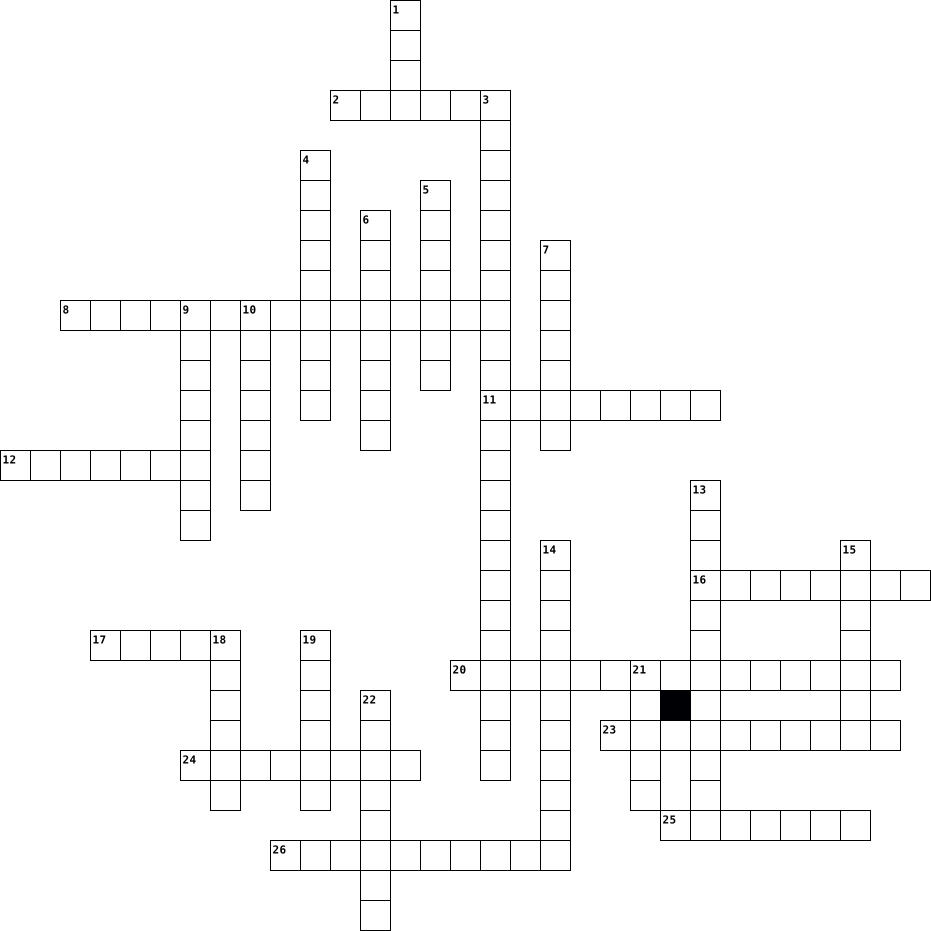
Across
- abbreviation of element
- outermost electron in shell
- what's reacted upon
- coating
- smallest particle in a chemical element
- column on the P.T
- created periodic table
- mass of an atomic particle
- two or more elements combined
- the result of a chemical reaction
- energy given off
Down
- smallest part of a substance
- energy cannot be created or destroyed
- mixture of metal and nonmetal
- neutral charge
- negative charge
- one ring in a shell
- odorless colorless low chemical reactivity
- a substance that cannot be broken down
- number of electrons
- energy absorbed
- center of atom
- positively charged
- rows on the P.T
- hard, shiny, opaque, conductive
- not conductive, brittle
26 Clues: coating • neutral charge • center of atom • negative charge • energy absorbed • rows on the P.T • energy given off • column on the P.T • positively charged • one ring in a shell • what's reacted upon • number of electrons • created periodic table • abbreviation of element • not conductive, brittle • mass of an atomic particle • outermost electron in shell • smallest part of a substance • ...
Science 2023-05-02

Across
- if you drive too fast you ____
- where kids go to learn
- amount of a chemical substance
- force that resists sliding around
- a dual
- production of chemical compounds
- hydrogen and oxygen in water are _____
- process of breaking down materials
- always things to float
- to raise up
Down
- The answer to a multiplication problem
- mathematical statement
- number in front of the formula
- any kind of liquid is a ____
- a substance that changes a chemical reaction
- absorbs energy
- how much space an object takes up
- releases energy
- something that is deep has ____
- if you aren't married or dating your __
- you can play a lot of things with this
21 Clues: a dual • to raise up • absorbs energy • releases energy • mathematical statement • where kids go to learn • always things to float • any kind of liquid is a ____ • if you drive too fast you ____ • number in front of the formula • amount of a chemical substance • something that is deep has ____ • production of chemical compounds • force that resists sliding around • ...
Photosynthesis Crossword Puzzle 2023-10-27

Across
- It is the organelle that takes place in light-dependent reactions.
- It is the organelle that takes place in light-independent reactions.
- reaction It does not need sunlight to produce food for the plant.
- The organelle where photosynthesis happens.
- reaction It does need sunlight to produce food for the plant.
Down
- Substances that take part in and undergoes changes in a chemical reaction.
- The new substance that is created in a chemical reaction.
- One of the products that photosynthesis produces.
- A pigment that makes a leaf color green.
- A process that plants use to create food.
10 Clues: A pigment that makes a leaf color green. • A process that plants use to create food. • The organelle where photosynthesis happens. • One of the products that photosynthesis produces. • The new substance that is created in a chemical reaction. • reaction It does need sunlight to produce food for the plant. • ...
Chemical reactions 2022-01-10

Across
- A form of matter that has constant chemical composition and characteristic properties. It cannot be separated into components without breaking chemical bonds. It is composed of one type of particle.
- A substance that is formed as the result of a chemical reaction.
- An expression that states the number and type of atoms present in a particle of a substance.
- It's a written representation, using numbers and symbols, of the process that occurs during a chemical reaction.
- The smallest particle of a chemical element that can exist.
- The starting materials in a chemical reaction.
Down
- A number that indicates the number of atoms in the particle of a substance.
- A process in which one or more substances, the reactants, are converted to one or more different substances, the products.
- Atom, ion or molecule.
9 Clues: Atom, ion or molecule. • The starting materials in a chemical reaction. • The smallest particle of a chemical element that can exist. • A substance that is formed as the result of a chemical reaction. • A number that indicates the number of atoms in the particle of a substance. • ...
STARBASE #7 (day 4) 2016-02-20

Across
- in graphing, it refers to the general direction in which a line points. It is usually referenced as upward or downward.
- A chemical reaction in which energy is released in the form of heat.
- The scale named after Swedish astronomer Anders Celsius, according to which the temperature difference between the reference temperatures of freezing (0˚) and boiling points (100˚) of water are divided into 100 degrees.
- A change resulting from a chemical reaction in which bonds are broken and new bonds are formed between different atoms in a substance.
Down
- The characteristics of a substance that can change without involving a change in chemical composition.
- A change in physical properties that does not affect the chemical nature of a substance. Examples include changes in texture, shape, size, color, odor, volume, mass, weight, and density.
- A reaction in which light is emitted but no heat is emitted.
- A chemical reaction that absorbs energy in the form of heat.
- A shorthand way to write numbers that are either very large or very small by using powers of ten.
- Shows how many times to multiply the number by itself, used in scientific notation.
10 Clues: A reaction in which light is emitted but no heat is emitted. • A chemical reaction that absorbs energy in the form of heat. • A chemical reaction in which energy is released in the form of heat. • Shows how many times to multiply the number by itself, used in scientific notation. • ...
Stoichiometry 2024-04-17

Across
- Amount of product you get if the reaction proceeds perfectly
- compares theoretical yield to actual yield
- 6.022*10^23 representative particles
- sum of all atomic mass in a molecule (in u)
- The reactant that is completely used up, determining the amount of product formed.
Down
- NA = 6.022141 × 10^23
- mass (in g) per mole of molecule
- he branch of chemistry that deals with the quantitative relationships between the amounts of reactants and products in a chemical reaction.
- The substance that is in excess and remains after the reaction is complete.
- The actual amount of a product obtained in a chemical reaction.
10 Clues: NA = 6.022141 × 10^23 • mass (in g) per mole of molecule • 6.022*10^23 representative particles • compares theoretical yield to actual yield • sum of all atomic mass in a molecule (in u) • Amount of product you get if the reaction proceeds perfectly • The actual amount of a product obtained in a chemical reaction. • ...
Max puzzle 2022-03-21

Across
- solub
- alloy
- dissolve
- mass
- neutralize
- diamond
- weaker with water
- chemical solution
Down
- mix
- homomixture
- sugar dissolbe
- changes in reaction
- makes items up
- used to solve
- sour taste
15 Clues: mix • mass • solub • alloy • diamond • dissolve • neutralize • sour taste • homomixture • used to solve • sugar dissolbe • makes items up • weaker with water • chemical solution • changes in reaction
Chemical reactions 2022-01-10

Across
- A form of matter that has constant chemical composition and characteristic properties. It cannot be separated into components without breaking chemical bonds. It is composed of one type of particle.
- A substance that is formed as the result of a chemical reaction.
- An expression that states the number and type of atoms present in a particle of a substance.
- It's a written representation, using numbers and symbols, of the process that occurs during a chemical reaction.
- The smallest particle of a chemical element that can exist.
- The starting materials in a chemical reaction.
Down
- A number that indicates the number of atoms in the particle of a substance.
- A process in which one or more substances, the reactants, are converted to one or more different substances, the products.
- Atom, ion or molecule.
9 Clues: Atom, ion or molecule. • The starting materials in a chemical reaction. • The smallest particle of a chemical element that can exist. • A substance that is formed as the result of a chemical reaction. • A number that indicates the number of atoms in the particle of a substance. • ...
Extension Activity 2023-01-27

Across
- a substance that is present at the end of a chemical reaction
- matter can be neither created nor destroyed
- a substance that is present at the start of a chemical reaction.
- the amount of pure and dry product yielded in a reaction
- a number placed in front of a chemical symbol or formula
- symbolic representations of chemical reactions in which the reactants and the products are expressed in terms of their respective chemical formula
Down
- If the number of atoms of each element in reactants is not equal to the number of atoms of each element present in product
- a small number written at the bottom of the symbol.
- a chemical equation in which mass is conserved and there are equal numbers of atoms of each element on both sides of the equation
9 Clues: matter can be neither created nor destroyed • a small number written at the bottom of the symbol. • the amount of pure and dry product yielded in a reaction • a number placed in front of a chemical symbol or formula • a substance that is present at the end of a chemical reaction • a substance that is present at the start of a chemical reaction. • ...
Chemical reactions 2022-01-10

Across
- A number that indicates the number of atoms in the particle of a substance.
- Atom, ion or molecule.
- The smallest particle of a chemical element that can exist.
- A process in which one or more substances, the reactants, are converted to one or more different substances, the products.
Down
- A form of matter that has constant chemical composition and characteristic properties. It cannot be separated into components without breaking chemical bonds. It is composed of one type of particle.
- The starting materials in a chemical reaction.
- It's a written representation, using numbers and symbols, of the process that occurs during a chemical reaction.
- A substance that is formed as the result of a chemical reaction.
- An expression that states the number and type of atoms present in a particle of a substance.
9 Clues: Atom, ion or molecule. • The starting materials in a chemical reaction. • The smallest particle of a chemical element that can exist. • A substance that is formed as the result of a chemical reaction. • A number that indicates the number of atoms in the particle of a substance. • ...
Extension Activity 2023-01-27

Across
- a substance that is present at the end of a chemical reaction
- matter can be neither created nor destroyed
- a substance that is present at the start of a chemical reaction.
- the amount of pure and dry product yielded in a reaction
- a number placed in front of a chemical symbol or formula
- symbolic representations of chemical reactions in which the reactants and the products are expressed in terms of their respective chemical formula
Down
- If the number of atoms of each element in reactants is not equal to the number of atoms of each element present in product
- a small number written at the bottom of the symbol.
- a chemical equation in which mass is conserved and there are equal numbers of atoms of each element on both sides of the equation
9 Clues: matter can be neither created nor destroyed • a small number written at the bottom of the symbol. • the amount of pure and dry product yielded in a reaction • a number placed in front of a chemical symbol or formula • a substance that is present at the end of a chemical reaction • a substance that is present at the start of a chemical reaction. • ...
Crossword Puzzle: Chemical vs Physical Changes 2021-11-10

Across
- Able to be undone.
- A smaller component that makes up matter.
- A change in a substance that does not change its molecules or identity, could be a change in state.
- A process that involves rearrangement of molecules into new molecules.
Down
- A usually irreversible change involving a change in chemical properties, resulting in the formation of a new substance.
- A substance that is made during a chemical reaction.
- A substance that undergoes change during a chemical reaction.
- Any characteristic or quality that is measurable and describes how something is or looks.
8 Clues: Able to be undone. • A smaller component that makes up matter. • A substance that is made during a chemical reaction. • A substance that undergoes change during a chemical reaction. • A process that involves rearrangement of molecules into new molecules. • Any characteristic or quality that is measurable and describes how something is or looks. • ...
Unit 6B by Samyam Dhakal 4th Period 2017-04-10

Across
- The noble gases make a group of chemical elements with similar properties. Under standard conditions, they are all odorless, colorless, monatomic gases with very low chemical reactivity. The six noble gases that occur naturally are helium (He), neon (Ne), argon (Ar), krypton (Kr), xenon (Xe), and the radioactive radon (Rn).
- Physical changes occur when objects or substances undergo a change that changes the physical form of a composition but not the chemical composition.
- A chemical equation is the symbolic representation of a chemical reaction in the form of symbols and formulas.
- A chemical formula is a way of expressing information about the proportions of atoms that constitute a particular chemical compound, using a single line of chemical element symbols, numbers, and sometimes also other symbols, such as parentheses, dashes, brackets, commas and plus (+) and minus (−) signs.
- An electron in an outer shell of an atom that can participate in forming chemical bonds with other atoms.
- column of the periodic table. They are extremely reactive.
Down
- The law of conservation of mass or principle of mass conservation states that for any system closed to all transfers of matter and energy, the mass of the system must remain constant over time, as system mass cannot change quantity if it is not added or removed. Hence, the quantity of mass is "conserved" over time.
- Chemical changes occur when a substance combines with another to form a new substance, called synthesis or, alternatively, decomposes into two or more different substances. These processes are called chemical reactions and, in general, are not reversible except by further chemical reactions.
- the result of a chemical reaction
- The alkali metals are a group of elements in the periodic table. They are all in the
- a substance that takes part in and undergoes change during a reaction.
- A chemical bond is a lasting attraction between atoms that enables the formation of chemical compounds.
12 Clues: the result of a chemical reaction • column of the periodic table. They are extremely reactive. • a substance that takes part in and undergoes change during a reaction. • The alkali metals are a group of elements in the periodic table. They are all in the • A chemical bond is a lasting attraction between atoms that enables the formation of chemical compounds. • ...
6B Vocab. 2017-04-06

Across
- The alkali metals are a group of elements in the periodic table. They are all in the
- The result of a chemical reaction.
- A chemical bond is a lasting attraction between atoms that enables the formation of chemical compounds.
- An electron in an outer shell of an atom that can participate in forming chemical bonds with other atoms.
- Physical changes occur when objects or substances undergo a change that changes the physical form of a composition but not the chemical composition.
- A chemical equation is the symbolic representation of a chemical reaction in the form of symbols and formulas.
- A chemical formula is a way of expressing information about the proportions of atoms that constitute a particular chemical compound, using a single line of chemical element symbols, numbers, and sometimes also other symbols, such as parentheses, dashes, brackets, commas and plus (+) and minus (−) signs.
- A substance that takes part in and undergoes change during a reaction.
Down
- The law of conservation of mass or principle of mass conservation states that for any system closed to all transfers of matter and energy, the mass of the system must remain constant over time, as system mass cannot change quantity if it is not added or removed. Hence, the quantity of mass is "conserved" over time.
- The noble gases make a group of chemical elements with similar properties. Under standard conditions, they are all odorless, colorless, monatomic gases with very low chemical reactivity. The six noble gases that occur naturally are helium (He), neon (Ne), argon (Ar), krypton (Kr), xenon (Xe), and the radioactive radon (Rn).
- Chemical changes occur when a substance combines with another to form a new substance, called synthesis or, alternatively, decomposes into two or more different substances. These processes are called chemical reactions and, in general, are not reversible except by further chemical reactions.
- column of the periodic table. They are extremely reactive.
12 Clues: The result of a chemical reaction. • column of the periodic table. They are extremely reactive. • A substance that takes part in and undergoes change during a reaction. • The alkali metals are a group of elements in the periodic table. They are all in the • A chemical bond is a lasting attraction between atoms that enables the formation of chemical compounds. • ...
Revision (XI grade) 2024-12-27

Across
- A substance that speeds up a reaction without being consumed.
- Constant The ratio of the concentrations of products to reactants at equilibrium, symbolized as 𝐾𝑐
- Rate The speed at which reactants are converted into products.
- Chatelier The principle that explains how a system at equilibrium responds to changes in conditions.
- Pathway: The step-by-step sequence of a chemical reaction.
- Equilibrium involving reactants and products in different phases.
- A state in which the forward and reverse reactions occur at the same rate
- Equilibrium where all reactants and products are in the same phase.
Down
- Theory The theory that chemical reactions occur when particles collide with sufficient energy and proper orientation.
- Area Increasing this factor speeds up reactions involving solids.
- Describes equilibrium where reactions are ongoing but balanced.
- Reaction: The reaction that forms products from reactants.
- Affects the equilibrium of gaseous reactions by altering the number of particle collisions.
- A factor that increases reaction rate by providing particles with more kinetic energy.
- Energy Energy associated with the motion of particles.
- Increasing this factor generally increases the reaction rate by providing more particles to collide.
- Quotient: Symbolized as 𝑄c it predicts the direction a reaction will proceed relative to
- A reaction that can proceed in both forward and backward directions.
- System A system where no matter enters or leaves, allowing equilibrium to occur.
- Energy The minimum energy required for a reaction to occur.
20 Clues: Energy Energy associated with the motion of particles. • Reaction: The reaction that forms products from reactants. • Pathway: The step-by-step sequence of a chemical reaction. • Energy The minimum energy required for a reaction to occur. • A substance that speeds up a reaction without being consumed. • ...
Chemical Reactions 2022-03-15

Across
- the substances produced at the end of the reaction
- a reaction in which a substance reacts with oxygen gas, releasing energy in the form of light and heat
- a reaction in which one element is substituted for another element in a compound
- the substances that go into a chemical reaction
- reactants combine to form a single product
Down
- occur when chemical bonds between atoms are formed or broken
- a chemical substance is transformed into one or more different substances
- a single reactant breaks down into simpler ones
8 Clues: reactants combine to form a single product • a single reactant breaks down into simpler ones • the substances that go into a chemical reaction • the substances produced at the end of the reaction • occur when chemical bonds between atoms are formed or broken • a chemical substance is transformed into one or more different substances • ...
States of Matter 2019-02-13

Across
- Solids, Liquids and Gases
- Is a chemical reaction that is accompanied by the absorption of heat, or an organism that generates heat to maintain its temperature.
- the transition of a substance directly from the solid to the gas phase
- Geological process in which sediments, soil and rocks are added to a landform or land mass
- is a chemical reaction that releases energy through light or heat
- is the net movement of molecules from a region of higher concentration to a region of lower concentration
- Where the liquid goes into the solid phase
- type of homogeneous mixture composed of two or more substances
Down
- Where things come closer together
- a liquid as it changes into the gas phase
- affecting the form of a chemical substance, but not its chemical composition
- Water which collects as droplets on a cold surface when humid air is in contact with it
- the creation of a solid from a solution
- Heating up to extreme heat before bubbling
- Where things spread further apart
- Where the solid moves into the liquid stage
16 Clues: Solids, Liquids and Gases • Where things come closer together • Where things spread further apart • the creation of a solid from a solution • a liquid as it changes into the gas phase • Heating up to extreme heat before bubbling • Where the liquid goes into the solid phase • Where the solid moves into the liquid stage • ...
Chemistry 2021-03-09

Across
- amount of matter an object contains
- matter changes makeup and properties
- A chemical reaction that releases energy
- To prevent the loss of something
- observed without matter changing
- amount of mass in a given space
Down
- matter maintains properties after change
- ability of a substance to burn
- A chemical reaction that absorbs energy
- observed when matter changes to become an entirely new substance.
- matter can't be created or destroyed
11 Clues: ability of a substance to burn • amount of mass in a given space • To prevent the loss of something • observed without matter changing • amount of matter an object contains • matter changes makeup and properties • matter can't be created or destroyed • A chemical reaction that absorbs energy • matter maintains properties after change • ...
Unit 5 Vocab 2022-11-21

Across
- one reactant that breaks down into simpler products
- sharing of electrons between two elements
- There are 7 of them, and you must put the subscript 2 after it.
- a substance that is made of two or more elements.
- an element that goes through a change during chemical reaction
Down
- a single element that switches places with one in a compound
- CxHy+O2 -> Co2 + H2O
- a number next to an element that describes amount
- two compound reactants switch elements
- a number that is placed in front of a chemical formula
- a substance that forms after going through a chemical reaction.
- two or more elements combine to create a product
- a transfer of electrons between a metal and a non-mental
- an atom that does not gain or lose electrons
14 Clues: CxHy+O2 -> Co2 + H2O • two compound reactants switch elements • sharing of electrons between two elements • an atom that does not gain or lose electrons • two or more elements combine to create a product • a number next to an element that describes amount • a substance that is made of two or more elements. • one reactant that breaks down into simpler products • ...
Form 1 Chemistry Review 2025-08-06

Across
- A substance with a pH greater than 7.
- A method for separating mixtures of colors or dyes.
- A solution with a large amount of solute.
- Anything that has mass and occupies space.
- A reaction where a substance gains oxygen.
- A combination of two or more substances not chemically combined.
- A type of burner used in chemistry labs.
- The temperature at which a liquid turns into a solid.
- The amount of matter in an object.
- Formed from the reaction between an acid and a base.
- A substance that can destroy or damage other substances on contact.
- A substance that takes part in a chemical reaction.
- A solution with a small amount of solute.
- A compound containing NO₃⁻ ions.
- A chemical reaction that produces heat and light.
- The component of a solution that dissolves the solute.
- The amount of space a substance occupies.
- A pure substance made of only one kind of atom.
- The table organizing all known elements.
- A group of atoms bonded together.
- The temperature at which a solid becomes a liquid.
- A container used for stirring, mixing, and heating liquids.
- A method to separate insoluble solids from liquids.
- Mass per unit volume of a substance.
- The process of gas turning into a liquid.
- Pouring off a liquid to leave behind a solid or heavier liquid.
- A solid that forms and settles out of a liquid mixture.
- A substance with a pH less than 7.
Down
- The substance that is dissolved in a solution.
- A reaction that releases heat.
- Used to measure and transfer small volumes of liquid accurately.
- The temperature at which a liquid becomes a gas.
- A homogeneous mixture of solute and solvent.
- Used to separate mixtures based on boiling points.
- A substance formed in a chemical reaction.
- A reaction that absorbs heat.
- A small glass container used to hold substances during experiments.
- Used to channel liquids or fine-grained substances into containers.
- Used to separate a soluble solid from a liquid by heating.
- The process where a solid turns directly into gas.
- A device that separates mixtures by spinning.
- A compound containing CO₃²⁻ ions.
- A three-legged stand used to support equipment.
- A substance made from two or more elements chemically bonded.
- The visible, gaseous part of a fire.
- The smallest unit of an element.
- A place where scientific experiments are carried out.
- A reaction between an acid and a base to form salt and water.
- A reaction where a substance loses oxygen.
- Used to determine if a substance is acidic or basic.
- The study of matter and the changes it undergoes.
- A base that dissolves in water.
52 Clues: A reaction that absorbs heat. • A reaction that releases heat. • A base that dissolves in water. • A compound containing NO₃⁻ ions. • The smallest unit of an element. • A compound containing CO₃²⁻ ions. • A group of atoms bonded together. • The amount of matter in an object. • A substance with a pH less than 7. • The visible, gaseous part of a fire. • ...
Marco 2.1 vocab 2021-10-27

Across
- a change in matter
- a chemical reaction
- the substances formed during a chemical reaction reactant a substance befire a chemical reaction
Down
- a checmical reaction that absorbs heat
- reaction a chamical change in process
- a chemical reaction
- a material that has mass
7 Clues: a change in matter • a chemical reaction • a chemical reaction • a material that has mass • reaction a chamical change in process • a checmical reaction that absorbs heat • the substances formed during a chemical reaction reactant a substance befire a chemical reaction
8th Grade Sci Cross Word Puzzel 2021-10-19

Across
- the small number under an atom to show the specific number of atoms it has.
- when both sides of a chemical equation are equal in atom count and types
- The creation of elements rearranging to make a different molecule
- the symbol that shows the chemical reaction within the molecule
Down
- The big number on the left of a molecule's(or atom's) representation to show how many of it there are.
- when the sides of a chemical equation have unequal numbers of atoms.
- Left side of a chemical equation
- Right side of a chemical equation
- The law that states matter cannot be created or destroyed.
- the equation showing the chemical reaction and change within molecules
10 Clues: Left side of a chemical equation • Right side of a chemical equation • The law that states matter cannot be created or destroyed. • the symbol that shows the chemical reaction within the molecule • The creation of elements rearranging to make a different molecule • when the sides of a chemical equation have unequal numbers of atoms. • ...
photosynthesis 2022-05-02

Across
- pigment that gives plants their green color,
- provides the hydrogen needed to form glucose
- Plants convert carbon dioxide to oxygen
- formed by green plants from carbon dioxide and water during the process of photosynthesis
- allow plants to have strong, upright structures
- released as a byproduct
Down
- plant cell organelles that convert light energy into relatively stable chemical energy via the photosynthetic process.
- involves two reactants, carbon dioxide and water.
- glucose and oxygen
- carbon dioxide and water
- a process used by plants and other organisms to convert light energy into chemical energy that, through cellular respiration,
- The energy from light causes a chemical reaction that breaks down
12 Clues: glucose and oxygen • released as a byproduct • carbon dioxide and water • Plants convert carbon dioxide to oxygen • pigment that gives plants their green color, • provides the hydrogen needed to form glucose • allow plants to have strong, upright structures • involves two reactants, carbon dioxide and water. • ...
7th Grade Monday Crossword Puzzle 2025-11-21

Across
- identifies the color or texture of a substance
- the amount of matter in an object
- type of change when a new substance is formed
- a change in shape no new substance formed
- word used to describe why something sinks or floats in water
Down
- formed at the end of chemical reaction
- number of hydrogen atoms in water
- test used to determine if a gas will burn or not
- part of a chemical reaction that combines to form a new substance
- if something sinks in water we say it is _____ dense than water
- state of matter in which particles a far apart
- type of system gases can escape from
12 Clues: number of hydrogen atoms in water • the amount of matter in an object • type of system gases can escape from • formed at the end of chemical reaction • a change in shape no new substance formed • type of change when a new substance is formed • identifies the color or texture of a substance • state of matter in which particles a far apart • ...
States of Matter 2019-02-13

Across
- Solids, Liquids and Gases
- Is a chemical reaction that is accompanied by the absorption of heat, or an organism that generates heat to maintain its temperature.
- the transition of a substance directly from the solid to the gas phase
- Geological process in which sediments, soil and rocks are added to a landform or land mass
- is a chemical reaction that releases energy through light or heat
- is the net movement of molecules from a region of higher concentration to a region of lower concentration
- Where the liquid goes into the solid phase
- type of homogeneous mixture composed of two or more substances
Down
- Where things come closer together
- a liquid as it changes into the gas phase
- affecting the form of a chemical substance, but not its chemical composition
- Water which collects as droplets on a cold surface when humid air is in contact with it
- the creation of a solid from a solution
- Heating up to extreme heat before bubbling
- Where things spread further apart
- Where the solid moves into the liquid stage
16 Clues: Solids, Liquids and Gases • Where things come closer together • Where things spread further apart • the creation of a solid from a solution • a liquid as it changes into the gas phase • Heating up to extreme heat before bubbling • Where the liquid goes into the solid phase • Where the solid moves into the liquid stage • ...
Vocab 6.B Diego Valera 2017-04-07

Across
- a substance that takes part in and undergoes change during a reaction.
- column of the periodic table. They are extremely reactive.
- A chemical formula is a way of expressing information about the proportions of atoms that constitute a particular chemical compound, using a single line of chemical element symbols, numbers, and sometimes also other symbols, such as parentheses, dashes, brackets, commas and plus (+) and minus (−) signs.
- A chemical equation is the symbolic representation of a chemical reaction in the form of symbols and formulas.
- Chemical changes occur when a substance combines with another to form a new substance, called synthesis or, alternatively, decomposes into two or more different substances. These processes are called chemical reactions and, in general, are not reversible except by further chemical reactions.
- the result of a chemical reaction.
- The alkali metals are a group of elements in the periodic table. They are all in the
Down
- The law of conservation of mass or principle of mass conservation states that for any system closed to all transfers of matter and energy, the mass of the system must remain constant over time, as system mass cannot change quantity if it is not added or removed. Hence, the quantity of mass is "conserved" over time.
- A chemical bond is a lasting attraction between atoms that enables the formation of chemical compounds.
- Physical changes occur when objects or substances undergo a change that changes the physical form of a composition but not the chemical composition.
- An electron in an outer shell of an atom that can participate in forming chemical bonds with other atoms.
- The noble gases make a group of chemical elements with similar properties. Under standard conditions, they are all odorless, colorless, monatomic gases with very low chemical reactivity. The six noble gases that occur naturally are helium (He), neon (Ne), argon (Ar), krypton (Kr), xenon (Xe), and the radioactive radon (Rn).
12 Clues: the result of a chemical reaction. • column of the periodic table. They are extremely reactive. • a substance that takes part in and undergoes change during a reaction. • The alkali metals are a group of elements in the periodic table. They are all in the • A chemical bond is a lasting attraction between atoms that enables the formation of chemical compounds. • ...
Vocabulary 6B period 01 Colton Andrews 2017-04-06

Across
- - The alkali metals are a group of elements in the periodic table. They are all in the
- - A chemical formula is a way of expressing information about the proportions of atoms that constitute a particular chemical compound, using a single line of chemical element symbols, numbers, and sometimes also other symbols, such as parentheses, dashes, brackets, commas and plus (+) and minus (−) signs.
- - the result of a chemical reaction.
- - Chemical changes occur when a substance combines with another to form a new substance, called synthesis or, alternatively, decomposes into two or more different substances. These processes are called chemical reactions and, in general, are not reversible except by further chemical reactions.
- - The law of conservation of mass or principle of mass conservation states that for any system closed to all transfers of matter and energy, the mass of the system must remain constant over time, as system mass cannot change quantity if it is not added or removed. Hence, the quantity of mass is "conserved" over time.
- - A chemical bond is a lasting attraction between atoms that enables the formation of chemical compounds.
Down
- - A chemical equation is the symbolic representation of a chemical reaction in the form of symbols and formulas.
- - An electron in an outer shell of an atom that can participate in forming chemical bonds with other atoms.
- - The noble gases make a group of chemical elements with similar properties. Under standard conditions, they are all odorless, colorless, monatomic gases with very low chemical reactivity. The six noble gases that occur naturally are helium (He), neon (Ne), argon (Ar), krypton (Kr), xenon (Xe), and the radioactive radon (Rn).
- - Physical changes occur when objects or substances undergo a change that changes the physical form of a composition but not the chemical composition.
- column of the periodic table. They are extremely reactive.
- - a substance that takes part in and undergoes change during a reaction.
12 Clues: - the result of a chemical reaction. • column of the periodic table. They are extremely reactive. • - a substance that takes part in and undergoes change during a reaction. • - The alkali metals are a group of elements in the periodic table. They are all in the • ...
Vocab 6B 2017-04-04

Across
- a substance that takes part in and undergoes change during a reaction.
- Physical changes occur when objects or substances undergo a change that changes the physical form of a composition but not the chemical composition.
- An electron in an outer shell of an atom that can participate in forming chemical bonds with other atoms.
- A chemical equation is the symbolic representation of a chemical reaction in the form of symbols and formulas.
- The alkali metals are a group of elements in the periodic table. They are all in the
Down
- The noble gases make a group of chemical elements with similar properties. Under standard conditions, they are all odorless, colorless, monatomic gases with very low chemical reactivity. The six noble gases that occur naturally are helium (He), neon (Ne), argon (Ar), krypton (Kr), xenon (Xe), and the radioactive radon (Rn).
- column of the periodic table. They are extremely reactive.
- The law of conservation of mass or principle of mass conservation states that for any system closed to all transfers of matter and energy, the mass of the system must remain constant over time, as system mass cannot change quantity if it is not added or removed. Hence, the quantity of mass is "conserved" over time.
- Chemical changes occur when a substance combines with another to form a new substance, called synthesis or, alternatively, decomposes into two or more different substances. These processes are called chemical reactions and, in general, are not reversible except by further chemical reactions.
- A chemical bond is a lasting attraction between atoms that enables the formation of chemical compounds.
- the result of a chemical reaction.
- A chemical formula is a way of expressing information about the proportions of atoms that constitute a particular chemical compound, using a single line of chemical element symbols, numbers, and sometimes also other symbols, such as parentheses, dashes, brackets, commas and plus (+) and minus (−) signs.
12 Clues: the result of a chemical reaction. • column of the periodic table. They are extremely reactive. • a substance that takes part in and undergoes change during a reaction. • The alkali metals are a group of elements in the periodic table. They are all in the • A chemical bond is a lasting attraction between atoms that enables the formation of chemical compounds. • ...
Unit 5 Crossword Puzzle 2022-11-21

Across
- substance present at the start of a chemical reaction
- one reactant breaks down into multiple/simpler products
- small numbers that are a part of the compound's formula
- any hydrocarbon reacting with oxygen releases heat, carbon dioxide, and water
- number written in front of a chemical equation
Down
- replacement two reacting compounds switch an element (their "partners")
- replacement one element switches places with another element in a compound
- a non-metal will share its valence electrons with another non-metal
- substance present at the end of a chemical reaction
- a metal will transfer its valence electrons with another non-metal
- when atoms gain or lose electrons
- have no fear of ice cold bears
- 2 or more elements combined
- 2 or more elements combine to make one product
14 Clues: 2 or more elements combined • have no fear of ice cold bears • when atoms gain or lose electrons • 2 or more elements combine to make one product • number written in front of a chemical equation • substance present at the end of a chemical reaction • substance present at the start of a chemical reaction • one reactant breaks down into multiple/simpler products • ...
Year 9 Science 2023-11-07

Across
- A change in which atoms are rearranged to create a new substance
- Type of circuit where each component is connected on its own branch
- A chemical .... shows how many atoms of each elements are in a compound
- One or two letter code used to identify the elements on the periodic table
- The closed path through which the electrical charge can flow
- The product in this reaction: carbon + oxygen = ....
- Type of circuit where the components are connected in a line
- There are more than a hundred substances shown in the periodic table, which cannot be broken into any smaller parts
- Group 8 of the periodic table- unreactive gases, which include helium and krypton
- The amount of mass in a given volume
- A chemical reaction with oxygen that gives out light and heat
- You would use this piece of equipment when leaving things out to dry or evaporate
- When pouring substances into narrow openings, you would use this piece of equipment
- The least reactive metal on the reactivity series
- When all the connections in a circuit are joined and the flow of charge is not interrupted, the circuit is ....
- Similar to a spoon, this item is used to scoop, scrape and transfer substances
- A change which transfers energy to the surroundings
- Two or more connected cells in an electrical circuit
- Group 1 of the periodic table- reactive metals, which include lithium and rubidium
- The name given to the horizontal rows on the periodic ta The elements on the periodic table are organised depending on this
- The resulting substances in a chemical reaction
- Type of reaction where one metal takes the position of another
- When a chemical reaction occurs, .... is transferred to or from the surroundings
- Group 7 of the periodic table- reactive non-metals, which include fluorine and iodine
- The smallest part of a chemical element
- This is required within an electrical circuit to move the charge and create a current
- Named after the German chemist Robert Bunsen
- A possible source of danger (something you check before conducting an experiment)
- This narrow tube is commonly used in practical work in science. It can hold small amounts of substances
- A reaction which transfers energy from the surroundings
Down
- Method of separating a solution to recover the dissolved substance
- The elements on the periodic table are organised depending on this
- This shallow, transparent dish is often used to grow cell cultures such as bacteria and fungi
- Use this piece of equipment to measure the volume of a liquid
- Equipment used to measure voltage
- The number on the periodic table that represents the number of protons in an atom’s nucleus
- A material that will reduce electrical energy passing through it
- A single battery in an electrical circuit
- Method of separating dissolved and not dissolved substances in a solution
- A device or part of a circuit
- When measuring temperature, you would use a ....
- Unit of measurement for voltage
- A nutrient that is used by the body for growth and repair
- Something that can be used to complete or break a circuit connection
- This specialised paper helps separate substances such as sand and water
- A nutrient that is used by the body as the main source of energy
- When observing a chemical reaction, you might feel the chemicals change in
- The starting substances in a chemical reaction
- The name given to the vertical columns on the periodic table
- A type of flask with a triangular shape
- This piece of electronic equipment measures mass
- Equipment used to measure the flow of electrons in a circuit
- The flow of electric charge in a circuit
- Unit of measurement for current
- A substance made of two or more atoms chemically joined together
- This piece of equipment is a three-legged stand
- A substance that does not take part in chemical reactions
- A material that will allow energy (heat or electrical) to pass through it easily.
- The solution used to test for starch
- Protective equipment worn in a lab
- To stir substances, you would use a ....
- The elements on the right-hand side of the table are all ....
- This safety equipment is used to protect your eyes during practical work
- This piece of equipment comes in different sizes and is used to transport liquid.
64 Clues: A device or part of a circuit • Unit of measurement for voltage • Unit of measurement for current • Equipment used to measure voltage • Protective equipment worn in a lab • The amount of mass in a given volume • The solution used to test for starch • A type of flask with a triangular shape • The smallest part of a chemical element • The flow of electric charge in a circuit • ...