
chemical reaction Crossword Puzzles
Chapter Three Crossword 2019-03-30

Across
- The substance on which the enzyme acts.
- The inhibitor binds to the enzyme's active site.
- The reaction product inhibits the enzyme's activity.
- The inhibitor does not permanently stop the enzyme from functioning.
- The maximum rate of reaction when the enzyme is saturated with substrate.
- To alter the structure a protein by breaking the bonds.
- The intermediate formed when a substrate interacts with the active site of an enzyme.
- The minimum energy required to allow a chemical reaction.
Down
- A process that uses the conditions of one component to regulate the activity of another.
- An enzyme's active site has a very specific shape that allows a specific molecule to fit.
- A measure of acidity in a substance.
- Operating within the cell.
- An enzyme that is attached to a inert, insoluble subtance.
- What is left after the enzyme and substrate bind.
- The number of chemical conversations of the substrate molecules per second at a catalytic site.
- To prevent an enzyme from functioning in a normal manner.
- Protein molecules that act as biological catalysts.
- A region on an enzyme that binds to a protein or substrate.
- Operating outside the cell.
- A substance which prevents an enzyme from functioning in a normal manner.
20 Clues: Operating within the cell. • Operating outside the cell. • A measure of acidity in a substance. • The substance on which the enzyme acts. • The inhibitor binds to the enzyme's active site. • What is left after the enzyme and substrate bind. • Protein molecules that act as biological catalysts. • The reaction product inhibits the enzyme's activity. • ...
Nuclear Crossword 2023-10-16

Across
- Japanese city where the first atomic bomb was dropped
- charged atoms
- Decay, the emission of energy in the form of ionizing radiation
- smallest part of an element that retain the properties of that element
- any of the chemical elements that lie beyond uranium in the periodic table
- Decay, nothing to the mass and adds 1 to the number of protons
- Reaction, a series of chemical reactions where the products of the reaction contribute to the reactants of another reaction
- energy that comes from a source and travels through space at the speed of light
- Boy, first atomic weapon
Down
- 2 or more things combining
- Number, number of protons
- release of energy from the decay of the nuclei and other kinds of atoms and isotopes
- Life, amount of time it takes for one half of the radioactive isotopes to decay
- Decay, subtracts 4 to the mass and 2 to the number of protons
- Decay, nothing to the mass and number of protons
- dividing or splitting something into 2 or more parts
- Curie, discovered the elements polonium and radium
- a variation of an element that possesses the same atomic number but a different mass number
- Number, number of protons plus number of neutrons
- Japanese city where the second atomic bomb was dropped
- Electrons, outmost electrons
- Man, implosion type nuclear weapon with a solid plutonium core
22 Clues: charged atoms • Boy, first atomic weapon • Number, number of protons • 2 or more things combining • Electrons, outmost electrons • Decay, nothing to the mass and number of protons • Number, number of protons plus number of neutrons • Curie, discovered the elements polonium and radium • dividing or splitting something into 2 or more parts • ...
Catalysis and surface chemistry 2025-11-03

Across
- The common surface between the two phases where the adsorbed molecules concentrate is called the ......
- The catalyst is ....... chemically at the end of the reaction.
- releasing heat as surface energy decreases (∆H is negative).
- The juice extracted from the cane is treated with animal charcoal for the ----- of the coloring agent.
- poisonous gases get ---- at the surface of the coal.
- ----- Weak, van der Waals forces hold molecules to the surface.
- The accumulation of molecules on a surface.
- substances upon whose surface the change of concentration occurs is called .....
- It means constant temperature.
- retards the rate of a chemical reaction.
Down
- ...... the catalyst is present in the same phase as the reactants.
- --- by which molecules or atoms are released from a solid surface into a gas or liquid phase.
- Does adsorption increase with temperature?
- ........ Manufacture of ammonia using iron as a catalyst.
- Adsorption ------- with pressure, reaches a maximum, and becomes constant.
- ----- is a substance that changes the speed of a reaction.
- Chemistry is the study of the chemical phenomena that occur at the surface.
- -----is a bulk phenomenon, while adsorption is a surface phenomenon.
- The two primary methods used for predicting the adsorption capacity of a given material are known as the ------and Langmuir isotherms.
- ------cannot be reversed and occurs at high temperatures initially; specific in nature.
20 Clues: It means constant temperature. • retards the rate of a chemical reaction. • Does adsorption increase with temperature? • The accumulation of molecules on a surface. • poisonous gases get ---- at the surface of the coal. • ........ Manufacture of ammonia using iron as a catalyst. • ----- is a substance that changes the speed of a reaction. • ...
Jordan Smith 2022-03-08

Across
- study of ratios within a chemical reaction
- the maximum amount of product that can be produced based on the limiting reactant
- base unit of amount of a substance
- allows you to convert from one substance to another
- number of units in one mole of any substance
- is to compare two things
- multiple of an emperical formula
Down
- substance that will be used up in a chemical reaction
- is to compare three or more things
- mass of one mole of a substance
- the lowest whole number ratio within a compound of elements
11 Clues: is to compare two things • mass of one mole of a substance • multiple of an emperical formula • is to compare three or more things • base unit of amount of a substance • study of ratios within a chemical reaction • number of units in one mole of any substance • allows you to convert from one substance to another • substance that will be used up in a chemical reaction • ...
Chapter 2 2025-02-05

Across
- the color that symbolizes good AQI (air quality index)
- The systematic name of the compound for water
- in a chemical reaction, these appears after the arrow
- V in VOCs
- the systematic name of the compound CCl4 (write the name without space)
Down
- phase change from gas to liquid
- the pollutant composed of oxygen
- the lowest region of the atmosphere where we live
- a chemical reaction where oxygen is reacted with other materials releasing a large amount of energy
- added to increase kinetic energy or molecular movements
- NOx and SOx are _____________ pollutants
11 Clues: V in VOCs • phase change from gas to liquid • the pollutant composed of oxygen • NOx and SOx are _____________ pollutants • The systematic name of the compound for water • the lowest region of the atmosphere where we live • in a chemical reaction, these appears after the arrow • the color that symbolizes good AQI (air quality index) • ...
Extracting metals 2023-07-07

Across
- is a chemical reaction that involves the loosing of electrons
- the name of the gas produced when metal reacts with an acid
- what is the name of the acid if the formula is HCl
- chemical decomposition produced by passing an electric current through a liquid or solution containing ions.
Down
- is a chemical reaction that involves the gaining of electrons by one of the atoms involved in the reaction between two chemicals
- we use this element to reduce a less reactive metal out of its ore
- a naturally occurring solid material from which a metal or valuable mineral can be extracted profitably
- is a reaction when more reactive metal displace less reactive metal out of its ore
8 Clues: what is the name of the acid if the formula is HCl • the name of the gas produced when metal reacts with an acid • is a chemical reaction that involves the loosing of electrons • we use this element to reduce a less reactive metal out of its ore • is a reaction when more reactive metal displace less reactive metal out of its ore • ...
Modified Vocabulary Review Part 4 2016-06-01

Across
- A charged atom
- Can be measured on a scale from 0-14
- Shows the reactants and the products of a chemical reaction (2 Words)
- A reaction where energy is released (2 Words)
- Turns litmus paper red, the formula always begins with “H”
- A reaction between and acid and a base, produces salt and water
- A bond that shares electrons (between 2 nonmetals) (2 Words)
- A negatively charged ion
Down
- A reaction where energy is absorbed (2 Words)
- A bond between two metals (2 Words)
- A positively charged ion
- A bond that donates/accepts electrons (between a metal and a nonmetal) (2 Words)
- Turns pink in the presence of phenolphthalein, ends in OH
13 Clues: A charged atom • A positively charged ion • A negatively charged ion • A bond between two metals (2 Words) • Can be measured on a scale from 0-14 • A reaction where energy is absorbed (2 Words) • A reaction where energy is released (2 Words) • Turns pink in the presence of phenolphthalein, ends in OH • Turns litmus paper red, the formula always begins with “H” • ...
chemistry 2019-06-23

Across
- negatively charged particle in an atom
- code of one or two letters that represent an element
- an electron in the outer shell of an atom
- set of chemical symbols that represent a compound
- a chemical bond in which electrons are shared
- the number of protons in an atom
- change in form of matter that does not result in a new substance being produced
- positively charged particle in an atom
- a chemical bond in which electrons are transferred from one atom to another
- small, dense region of an atom made up of protons and neutrons
- a pure substance of one type of atom
Down
- matter that is composed of two or more separate elements
- the basic building block of matter
- a change in which chemical bonds are broken or formed resulting in a new substance being produced
- process in which one or more substances are changed into one or more different substances
- the number of protons plus neutrons in an atom
- the subatomic particle with no net charge
- the smallest unit of a chemical compound that can take part in a chemical reaction
18 Clues: the number of protons in an atom • the basic building block of matter • a pure substance of one type of atom • negatively charged particle in an atom • positively charged particle in an atom • an electron in the outer shell of an atom • the subatomic particle with no net charge • a chemical bond in which electrons are shared • ...
SoundWaves Unit 20 Year 5 2019-08-29

Across
- to be startled
- a location
- to be considerate, helpful
- to combine
- to apply
- to practice
- a goal
- rude
- to help
- to share
- to understand
- to avoid
Down
- contains literature
- income
- to quit
- a void
- an app, or a process
- destroy
- manners
- to be still
- an individual in care
- a chemical reaction
22 Clues: rude • income • a void • a goal • to quit • destroy • manners • to help • to apply • to share • to avoid • a location • to combine • to practice • to be still • to understand • to be startled • contains literature • a chemical reaction • an app, or a process • an individual in care • to be considerate, helpful
Heat Vocab Puzzle 2025-07-23

Across
- A branch of chemistry that studies the heat transfer associated with chemical reactions and physical changes of state
- A unit of energy which is equal to Newtons.
- The area around the substance that is absorbing or releasing the heat.
- A chemical reaction in which its products absorb energy.
- A measure of how much energy is needed to raise 1 gram of the substance by 1 degree celsius.
- A visual representation of energy in a chemical reaction. Reactants are shown on the left side and products are shown on the right.
- The ability of an object to transfer heat from one part of itself to another by conduction. This is a result of atomic or molecular motion.
Down
- A chemical reaction in which energy is released into the surroundings.
- A form of energy related to the motion of atoms and molecules. It can be transferred by conduction, convection, or radiation.
- The transfer and distribution of heat energy from atom to atom within a material, such as copper wire or a frying pan.
- The substance that is absorbing or releasing the heat.
- Electromagnetic waves that directly transport energy in all directions through space.
- An extensive property that is a measure of the average kinetic energy of molecules and atoms. It determines the spontaneous heat flow, which is always from hot to cold.
- Amount of heat needed to raise the temperature of one gram of water by one degree Celsius.
- The transfer of heat by the physical motion of masses of fluid (liquids and gases) by changes in density of the fluid
15 Clues: A unit of energy which is equal to Newtons. • The substance that is absorbing or releasing the heat. • A chemical reaction in which its products absorb energy. • A chemical reaction in which energy is released into the surroundings. • The area around the substance that is absorbing or releasing the heat. • ...
Mester 1 Vocabulary 2022-03-03

Across
- a reactant in a chemical reaction undergoes a change and becomes this
- The change of state from gas to liquid
- for something to become a gas it must be heated past its __________ point
- when a liquid turns straight into gas/vapor form
- Changes in state are often __________
- The change of state from a solid straight to a gas
Down
- the change in state from gas to solid
- have a definite volume but change shape by flowing
- a reaction in which CO2, water and sunlight turn into Oxygen gas and sugar
- a solid forming in a liquid, a sign of a reaction
- A substance that speeds up a reaction without being consumed
- has a definite volume and shape, the molecules are attached
- a reaction in which oxygen is involved
13 Clues: the change in state from gas to solid • Changes in state are often __________ • The change of state from gas to liquid • a reaction in which oxygen is involved • when a liquid turns straight into gas/vapor form • a solid forming in a liquid, a sign of a reaction • have a definite volume but change shape by flowing • The change of state from a solid straight to a gas • ...
Module 2 Vocabulary 2022-03-15

Across
- a starting substance in a chemical reaction.
- the amount of space a substance takes up.
- a substance produced by a chemical reaction.
- the amount of matter in an object.
- a number placed in front of an element symbol or chemical formula in an equation.
- a change in matter in which the substances that make up the matter change into other substances with different chemical and physical properties.
- more energy is required to break the bonds of the reactants than is released when products form.
- occurs when a substance reacts with another substance, changing it into a new substance.
- more energy is released when the products form than is required to break the bonds in the reactants.
- a characteristic of matter that can be observed or measured without changing the identity of the matter.
Down
- the energy released when atoms form bonds.
- occurs when substances react with oxidizing agents, changing them to a new substance.
- the ability of a type of matter to burn easily.
- a characteristic of matter that can be observed as it changes to a different type of matter.
- a process in which atoms of one or more substances rearrange to form one or more new substances.
- the mass per unit volume of a substance.
16 Clues: the amount of matter in an object. • the mass per unit volume of a substance. • the amount of space a substance takes up. • the energy released when atoms form bonds. • a starting substance in a chemical reaction. • a substance produced by a chemical reaction. • the ability of a type of matter to burn easily. • ...
Science Vocab 2023-11-13

Across
- 2 or more atoms joined together, these can be the same or different types of atoms
- the process of rearranging small molecules made up larger repairing chains of molecules called polymers
- consists of only one type of atom and cannot be broken down into smaller substants
- the smallest unit of chemical elements matter is made up of these tiny particles
- a chemical change that occurs when 2 or more substances combine to make a new substance
- arrangement of the parts of something such as the stem of a plant or the atoms in molecules
- A ride between 2 sets of measurements
- A characteristics of a material that depends on the type and arrangement of atoms
- any substance made bye humans from a chemical reaction to for new materials
Down
- A material or substance found in nature and used by humans to meet a need
- A substance that cannot be broken down by microorganisms
- the way the part of an atom are put together
- A long chain of sometimes thousands of molecules
- a chain of linked molecules made up of groups of repeating atoms
- A substance that can be broken down by microorganisms
- A tiny piece of matter to small to be seen
16 Clues: A ride between 2 sets of measurements • A tiny piece of matter to small to be seen • the way the part of an atom are put together • A long chain of sometimes thousands of molecules • A substance that can be broken down by microorganisms • A substance that cannot be broken down by microorganisms • a chain of linked molecules made up of groups of repeating atoms • ...
Atoms, Elements and Compounds 2021-03-02

Across
- building blocks of matter
- a strong force of attraction holding atoms together in a molecule or crystal, resulting from the sharing or transfer of electrons
- anything that has mass and takes up space
- a sample of matter with both definite and constant composition and distinct chemical properties
- a pure substance that cannot be broken down into any other substance
Down
- formula a set of chemical symbols showing the elements present in a compound and their relative proportions, and in some cases the structure of the compound
- a combination of many different elements, but they are not chemically combined and can be separated physically
- a group of atoms bonded together, representing the smallest fundamental unit of a chemical compound that can take part in a chemical reaction.
- divide or cause to divide into distinct elements
- more than one element has been combined through a chemical reaction to form a new substance
10 Clues: building blocks of matter • anything that has mass and takes up space • divide or cause to divide into distinct elements • a pure substance that cannot be broken down into any other substance • more than one element has been combined through a chemical reaction to form a new substance • ...
Unit 1 Matter Crossword Review 2014-09-08

Across
- A homogenous material consisting of one particular kind of matter.
- A substance which can not be broken down by chemical means.
- Matter that has similar properties throughout.
- A reaction in which energy must be supplied.
- Two or more materials which do NOT chemically combine.
- A _____________ property depends on the amount of material.
- A ____________ property depends on observations.
- A _________ change affects the appearance of matter.
Down
- A homogenous mixture containing a solute mixed uniformly throughout,
- A reaction in which energy is given off.
- Two or more elements which are chemically combined in a fixed ratio.
- The chemical _________ can be used in place of the name of the element.
- Matter that has different properties.
13 Clues: Matter that has different properties. • A reaction in which energy is given off. • A reaction in which energy must be supplied. • Matter that has similar properties throughout. • A ____________ property depends on observations. • A _________ change affects the appearance of matter. • Two or more materials which do NOT chemically combine. • ...
Chapter 13 - Anastasia Baker 2017-02-15

Across
- - A polyatomic ion made by removing a proton from a water molecule.
- - The deterioration of a metal, typically caused by atmospheric oxygen.
- -
- - The minimum energy required in order for a chemical reaction to proceed.
Down
- - The process by which a reactant gains one or more electron.
- - A rapid exothermic oxidation-reduction reaction between a material and molecular oxygen.
- - Matter is neither created nor destroyed during a chemical reaction.
- - A measure of the acidity of a solution
- - The amount of energy required to pull two bonded atoms apart, which is the same as the amount of energy released when the two atoms are brought together into a bond.
- - The process by which a reactant loses one or more electron.
- - A substance that donates hydrogen ions.
11 Clues: - • - A measure of the acidity of a solution • - A substance that donates hydrogen ions. • - The process by which a reactant gains one or more electron. • - The process by which a reactant loses one or more electron. • - A polyatomic ion made by removing a proton from a water molecule. • - Matter is neither created nor destroyed during a chemical reaction. • ...
Cheimcal reactions cross word 2025-01-26

Across
- formed by a chemical change or reaction
- starting material in a reaction that undergo change in chemical to make an new product
- replaces 1 element in a compound
- when2 2 or more reactants or substances combine to make a new product
Down
- when 2 or more compounds combine to form 1 compound
- a substance that releases a large amount of energy when reacted with oxygen
- when a compound breaks down into 2 simpler substances
- when an element displaces or pushes away and element that isn't as reactive
- 2 inonic compounds exchange making 2 new ones
- when 2 or more reactants convert into 1 or more different products
- 2 or more elements or compounds combine to make a more complex element or compound
11 Clues: replaces 1 element in a compound • formed by a chemical change or reaction • 2 inonic compounds exchange making 2 new ones • when 2 or more compounds combine to form 1 compound • when a compound breaks down into 2 simpler substances • when 2 or more reactants convert into 1 or more different products • ...
Chemistry 2023-02-08

Across
- the final results of a reaction
- starting materials of a reaction.
- the liquid in which a solid substance dissolves.
- the symbol for the element sodium
- the chemical name for lime water
- the solid substance formed by mixing two soluble liquids.
- change from liquid to solid
- changes in which new substances are formed.
- mixture of solute and solvent
- a substance that dissolves in a liquid
Down
- the element with the symbol K
- one of the gases formed on burning candle
- reaction in which solid substances are formed while two soluble liquids are mixed.
- basic unit of matter
- change change of states is an example of this type of change.
- change from solid to gas
- the paper used in the identification test for water
17 Clues: basic unit of matter • change from solid to gas • change from liquid to solid • the element with the symbol K • mixture of solute and solvent • the final results of a reaction • the chemical name for lime water • starting materials of a reaction. • the symbol for the element sodium • a substance that dissolves in a liquid • one of the gases formed on burning candle • ...
Chemical reactions 2026-02-02

Across
- How many electrons in the outer shell of elements in group 3
- Atomic mass is the number of Protons AND ______
- Protons and Neutrons are in this part of the atom
- These are in shells outside the nucleus
- A type of reaction where a substance is broken down
- Atoms cannot be created or _________
- Element, Group 2 period 3
- Atomic number is also the number of what part of the nucleus
Down
- Left hand side of the arrow
- In a chemical reaction we say the atoms are
- Group 0 is also known as
- Atomic number 13
- Group 7 is also known as
- Right hand side of the arrow
- The British spelling, atomic number 16
- A reaction that gives out heat
- Group 1 elements are known as
17 Clues: Atomic number 13 • Group 0 is also known as • Group 7 is also known as • Element, Group 2 period 3 • Left hand side of the arrow • Right hand side of the arrow • Group 1 elements are known as • A reaction that gives out heat • Atoms cannot be created or _________ • The British spelling, atomic number 16 • These are in shells outside the nucleus • ...
Test Vocab Review #1 2016-03-10

Across
- Longest wavelength of visible light.
- Shortest wavelength of visible light.
- SO32-.
- Electrons are equally shared in this kind of covalent bond.
- This is the kind of spectrum we see when an atom emits specific wavelengths of light resulting in a spectrum with certain bands of color and many gaps.
- A positively charge ion.
- Can be represented using chemical formula.
- HSO4-.
- Smallest major section/category of elements on the Periodic Table.
- Has the chemical properties of an element.
Down
- Listed on the periodic table.
- Have some/many of the properties of their constituent particles.
- Chemicals that come-out-of a chemical reaction.
- PO43-.
- One row on the Periodic Table.
- One column on the Periodic Table.
- Highest frequency light.
- Of the same kind.
- NH4+.
19 Clues: NH4+. • SO32-. • PO43-. • HSO4-. • Of the same kind. • Highest frequency light. • A positively charge ion. • Listed on the periodic table. • One row on the Periodic Table. • One column on the Periodic Table. • Longest wavelength of visible light. • Shortest wavelength of visible light. • Can be represented using chemical formula. • Has the chemical properties of an element. • ...
Enzymes and Photosynthesis 2024-08-27

Across
- Membrane-bound structures within chloroplasts that contain chlorophyll and are the site of the light-dependent reactions in photosynthesis.
- The series of reactions in photosynthesis that take place in the stroma of chloroplasts and do not require light; these reactions convert carbon dioxide and other compounds into glucose.
- A stack of thylakoids within the chloroplast of plant cells, where light-dependent reactions of photosynthesis take place.
- The green pigment in plants and algae that absorbs light energy used to carry out photosynthesis.
- An organelle found in plant and algae cells where photosynthesis occurs, containing chlorophyll and other pigments.
- A protein that acts as a catalyst to speed up chemical reactions in the body without being consumed in the process.
- A type of chemical reaction that requires the input of energy to proceed, typically absorbing energy from its surroundings.
Down
- Referring to something that occurs or is located within a cell.
- Energy The minimum amount of energy required to start a chemical reaction.
- The fluid-filled space surrounding the thylakoids in chloroplasts, where the Calvin cycle of photosynthesis takes place.
- Referring to something that occurs or is located outside of a cell.
- An energy carrier molecule produced in the light-dependent reactions of photosynthesis and used in the Calvin cycle to help convert carbon dioxide into glucose.
- The process by which plants, algae, and some bacteria convert light energy, water, and carbon dioxide into glucose and oxygen.
- The primary energy carrier in cells, used to power various cellular processes.
- A type of chemical reaction that releases energy, usually in the form of heat.
15 Clues: Referring to something that occurs or is located within a cell. • Referring to something that occurs or is located outside of a cell. • Energy The minimum amount of energy required to start a chemical reaction. • The primary energy carrier in cells, used to power various cellular processes. • ...
Stoichiometry Crossword 2022-11-29

Across
- the lowest whole number ratio of ions represented in an ionic compound
- tells you by mass what percent of each element is present in a compound
- a process in which reactants react chemically and convert into products by chemical transformation
- an atom or group of atoms in which the number of electrons is different from the number of protons
- the chemical formula that gives the total number of atoms of each element in each molecule of a substance
- a ratio (or fraction) that represents the relationship between two different units and is always equal to 1
- the mass equivalent of Avogadro's number of atoms of an element; mass per mole
Down
- the numerical relationship between the quantities of reacting substances that corresponds to the laws of stoichiometry.
- substances that are made up of only one kind of particle and have a fixed or constant structure
- uses the relationship between reactants and products in a chemical reaction to determine quantitative data
- the chemical formula of a compound that gives the simplest ratio of elements in a compound rather than the total number of atoms in the molecule
- scientific unit that measures the mass of a substance (has a value of 6.023 x 10 )
- a compound that absorbs water molecules from its environment and includes them as part of its structure
- basic building block of chemistry; the smallest part of a substance that cannot be broken down chemically
- reaction an equation where the number of atoms of each type in the reaction is the same on both the reactant and product sides
- number of units in one mole of any substance (defined as its molecular weight in grams), equal to 6.023 × 10
16 Clues: the lowest whole number ratio of ions represented in an ionic compound • tells you by mass what percent of each element is present in a compound • the mass equivalent of Avogadro's number of atoms of an element; mass per mole • scientific unit that measures the mass of a substance (has a value of 6.023 x 10 ) • ...
Enzymes 2024-04-09

Across
- At higher substrate concentrations, increasing the amount of substrate cannot increase the rate of reaction as active sites of enzyme molecules are _________.
- enzymes are biological catalysts that speed up the rate of chemical reactions by lowering the __________ ______ of a chemical reaction, without being chemically altered in the reaction
- As temperature increases beyond optimum temperature, enzyme is _________. The enzyme loses its 3D shape and active site is unable to bind to the substrate. Rate of reaction thus decreases.
- the shape of the substrate is _____________ to the shape of the active site of the enzyme
- Reaction rate is its maximum at enzyme _______ temperature/pH.
- the part of an enzyme has a specific shape into which the substrate(s) fit exactly
- the substrate binds to the active site of the enzyme, forming an ______-_________ _______
Down
- enzymes are required in _____ _______ because they remain chemically unchanged in the reactions they catalyse and can be reused
- in the ‘____ ___ ___’ hypothesis, the substrate is the “key”, while the enzyme is the “lock”
- Denaturation is ____________ even when temperature is lowered. At extremely high temperatures, the enzyme is completely denatured and the rate of reaction drops to zero.
- As temperature increases, enzyme and substrate gain _______ ______ and they collide more often, increasing the formation of enzyme substrate complex thus increase rate of reaction. Rate of reaction doubles with every 10°C rise in temperature.
- At low temperatures, enzymes are ________ and the rate of reaction is low. Substrate and enzyme molecules have little kinetic energy, hence the frequency of collision is low. In addition, most substrate molecules do not contain sufficient energy to overcome the activation energy required to start a reaction.
12 Clues: Reaction rate is its maximum at enzyme _______ temperature/pH. • the part of an enzyme has a specific shape into which the substrate(s) fit exactly • the shape of the substrate is _____________ to the shape of the active site of the enzyme • the substrate binds to the active site of the enzyme, forming an ______-_________ _______ • ...
Cell Energy Crossword Puzzle 2021-03-09

Across
- "cellular ___"; releases chemical energy from glucose and repackages it into ATP
- chemical reaction that turns light energy into chemical energy
- organelle where photosynthesis happens
- required to accomplish tasks
Down
- how cells get ATP without oxygen
- organelle where cellular respiration happens
- requirements for photosynthesis: light, carbon dioxide, and ___
- chemical energy is stored in this molecule
- contains smaller amounts of chemical energy than glucose
- required gas for cellular respiration
10 Clues: required to accomplish tasks • how cells get ATP without oxygen • required gas for cellular respiration • organelle where photosynthesis happens • chemical energy is stored in this molecule • organelle where cellular respiration happens • contains smaller amounts of chemical energy than glucose • chemical reaction that turns light energy into chemical energy • ...
chemical reactions 2017-05-30

Across
- Smaller reactants have greater_______________,making it easier for them to react
- Two or more simple substances combine to form a more complex product
- A single compound breaks down into two or more elements or new compounds
- Products are always carbon dioxide and water
- lead(II) nitrate and potassium iodide to form potassium nitrate and lead iodide
Down
- Higher_______________provide more energy for the systems in which reactants react
- For the following chemical reaction: zinc + iron sulfate ---> zinc sulfate + iron, the products are___________
- __________ is always a reactant in a combustion reaction
- magnesium + zinc sulfate magnesium sulfate + zinc
- For following chemical reaction: calcium + bromine ---> calcium bromide, the reactants are_______________
10 Clues: Products are always carbon dioxide and water • magnesium + zinc sulfate magnesium sulfate + zinc • __________ is always a reactant in a combustion reaction • Two or more simple substances combine to form a more complex product • A single compound breaks down into two or more elements or new compounds • ...
Rates of Reaction lesson 2021-10-13

Across
- This is measured using a stop watch to find out the rate of reaction
- A substance that is formed in a chemical reaction. Formed after a successful collision.
- The number of times per second
- This speeds up the rate of the reaction without being used up in the reaction
- A substance that takes part in and undergoes change during a reaction. These particles collide during a reaction
- The speed of the reaction
Down
- This factor increases the rate of reaction by making the particles move around quicker. This means they collide more frequently and with more energy.
- When reactant particles bump into each other
- area This factor increases the rate of reaction. Powder has a greater___________than small and large chips
- Is a biological catalyst
- This factor increases the rate of reaction and is used to define the amount of particles in a certain volume
11 Clues: Is a biological catalyst • The speed of the reaction • The number of times per second • When reactant particles bump into each other • This is measured using a stop watch to find out the rate of reaction • This speeds up the rate of the reaction without being used up in the reaction • ...
Enzymes!! 2026-03-03

Across
- absorbs free energy from the surroundings
- sum of all the chemical reactions occuring in a cell
- energy required to start any reaction
- a flexible active site that changes shape and conforms to the substrate as they bond together
- reactants with more stored energy than the products of the reaction
- describes the active site as having a set shape
Down
- have products with more stored energy than the reactants of the reaction
- reaction that has a net release of free energy
- substrates in a catalysed reaction that has a specific 3d shape that are compatible with their substrate(s)
- non-protein organic molecule that binds with an enzyme to activate it and facilitate biochemical reactions
- the end substance from a specific reaction
- reduce or stop the enzyme from functioning
12 Clues: energy required to start any reaction • absorbs free energy from the surroundings • the end substance from a specific reaction • reduce or stop the enzyme from functioning • reaction that has a net release of free energy • describes the active site as having a set shape • sum of all the chemical reactions occuring in a cell • ...
photosynthesis by jocelyn 2022-01-11

Across
- is the ‘waste’ product.
- Photosynthesis is a _______ reaction.
- produced in the leaves is transported to all other parts of the plant to be used as food.
- Chloroplasts contain the green chemical.
- is the absorbed by the roots and transported to the leaves.
- carbon dioxide is takein in by the plant through tiny openings on the leaves.
- Is the useful product for plants.
- Chlorophyll ______ the energy from sunlight that allows carbon dioxide and water to react.
Down
- Photosynthesis takes place in reaction.
- Plants use _____ energy from the Sun to power photosynthesis.
- Living things need energy to _______ and to carry out activities .
- Photosynthesis takes place in plant cells.
- In which organisms does photosynthesis happen?
13 Clues: is the ‘waste’ product. • Is the useful product for plants. • Photosynthesis is a _______ reaction. • Photosynthesis takes place in reaction. • Chloroplasts contain the green chemical. • Photosynthesis takes place in plant cells. • In which organisms does photosynthesis happen? • is the absorbed by the roots and transported to the leaves. • ...
Equilibria 2016-08-04

Across
- its effect of the position of equilibrium is dependent upon the number of moles of gas
- used for the reactants and products when a chemical reaction involves just gases
- _________ equilibrium occurs when the rate of the forward reaction and backwards reaction are equal
- total pressure of a system is equal to the sum of the ________ pressures of each of the gases
- altering this quantity will change the Kc value for a particular reaction
Down
- an equilibrium reaction involving reactants and products which are in the same phase
- a principle which concerns the effect of changing conditions on the position of equilibrium
- decreasing temperature decreases yield in an __________ reaction
- Kc is the ___________ constant
- Reactants or products are unable to enter or leave
- how position of equilibrium is changed by the addition of a catalyst
- [ ] represents the equilibrium concentration in ___ dm-3
- A reactant or product which has a (g) in a symbol equation
13 Clues: Kc is the ___________ constant • Reactants or products are unable to enter or leave • [ ] represents the equilibrium concentration in ___ dm-3 • A reactant or product which has a (g) in a symbol equation • decreasing temperature decreases yield in an __________ reaction • how position of equilibrium is changed by the addition of a catalyst • ...
Chapter 13 Georgia Chupurdy 2019-09-28

Across
- must be moving fast enough to overcome the energy
- reacts faster
- one or more new compounds are formed
Down
- when water behaves like an acid
- is also known as activation energy
- no atoms are gained or lost during any reaction
- reaction that has an absorption of energy
- how quickly the concentration of reactants decrease
- reaction that has a net release of energy
- a substance that lowers the activation energy of a chemical reaction
10 Clues: reacts faster • when water behaves like an acid • is also known as activation energy • one or more new compounds are formed • reaction that has an absorption of energy • reaction that has a net release of energy • no atoms are gained or lost during any reaction • must be moving fast enough to overcome the energy • how quickly the concentration of reactants decrease • ...
Properties and Changes 2024-10-04

Across
- Change in ___ such as turning red to yellow is a chemical change.
- Where a substance falls on the pH scale.
- When a liquid turns into a solid.
- Properties that you can observe without a change happening.
- A substance's ability to burn.
- Change in ___ is a sign of a chemical change such as becoming hotter.
- When a solid turns into a liquid.
Down
- A new solid that is formed in a chemical reation.
- The smell of something.
- The ability to react with another element or substance.
- The ability for electricity to flow through an object.
- How shiny an object is.
- When a liquid turns to a gas.
- Properties you can only observe during a chemical reaction.
14 Clues: The smell of something. • How shiny an object is. • When a liquid turns to a gas. • A substance's ability to burn. • When a liquid turns into a solid. • When a solid turns into a liquid. • Where a substance falls on the pH scale. • A new solid that is formed in a chemical reation. • The ability for electricity to flow through an object. • ...
Crossword Puzzle Chapter 2 2023-09-20

Across
- A substance that is present before a chemical reaction and takes part in it, usually shown on the lefthand side of a chemical equation.
- The building block of matter; the smallest possible particle of an element.
- An attraction between two atoms as a result of sharing or transferring valence electrons.
- A change in a substance that results in one or more new substances being formed that have different physical and chemical properties than those of the original substance.
- The process by which particles in solution are evenly distributed throughout the solvent by Brownian motion.
- The process by which one substance, the solute, is broken up into smaller pieces by and distributed within a second substance, the solvent.
- A substance that can produce hydroxide ions (OH+) or accept hydrogen ions (H+) in solution.
- A class of nonpolar organic compounds that are in soluble in water and are used for energy storage and cell membranes in living things.
- The substances formed during a chemical reaction, usually indicated on the righthand side of a chemical equation.
- The tendency of energy to disperse and become less available to do work.
- A chang e in a substance that does not change the identity of the substance (e.g., a change of form or state).
- A measurement of the average speed of the particles within a substance.
- An organic compound comprised of the elements carbon, hydrogen, and oxygen; includes sugars, starch and cellulose.
- A naturally occurring catalyst, usually a protein.
- The smallest particle of a covalently bonded compound.
- A class of organic compounds that serve as the building blocks of proteins.
Down
- A pure substance made from two or more elements that are chemically combined.
- The attraction of particles in one substance for particles in a different substance.
- A substance that binds to an enzyme and reduces its activity, thus slowing a chemical reaction that the enzyme catalyzes.
- The attraction between like particles within polar substances.
- A substance that can produce hydrogen ions (H+) in solution.
- A substance that changes the rate of a chemical reaction but is not itself used up or affected by the reaction.
- A pure substance made of only one kind of atom.
- A class of simple organic compounds important in living things as a source of both energy and structure.
- The ability to do work. Especially in biology, the driver of the physical and chemical processes necessary for life.
- Quality of molecules having an uneven distribution of electrical charge, resulting in some regions of a molecule having negative charge while others are positive.
- A covalently bonded compound containing the element carbon.
- The physical stuff that makes up the universe. Anything that occupies space and has mass.
- A class of organic compounds that serve as the building blocks for the information storage molecules DNA and RNA.
29 Clues: A pure substance made of only one kind of atom. • A naturally occurring catalyst, usually a protein. • The smallest particle of a covalently bonded compound. • A substance that can produce hydrogen ions (H+) in solution. • A covalently bonded compound containing the element carbon. • The attraction between like particles within polar substances. • ...
Quiz on Photosynthesis 2023-03-03

Across
- Green pigment that absorbs sunlight.
- Lets gases in or out of the plant.
- Chemical reaction that plants use to make food.
- Organisms do this process to produce glucose for energy.
- The substance/chemical needed to create a reaction.
Down
- Carries glucose to the plant.
- The outcome or new substance that was made by reactants.
- When reactants have combined or reacted and created a new product/substance.
- Distributes water throughout the plant.
- Organelle that contains chlorophyll.
10 Clues: Carries glucose to the plant. • Lets gases in or out of the plant. • Green pigment that absorbs sunlight. • Organelle that contains chlorophyll. • Distributes water throughout the plant. • Chemical reaction that plants use to make food. • The substance/chemical needed to create a reaction. • The outcome or new substance that was made by reactants. • ...
Year 7 science revision 2017-06-11

Across
- A substance made of one type of atom only.
- A large mass at the centre of a solar system (if there are other bodies present) that produces heat and light.
- Allows light to pass through but is not completely clear.
- The total mass of reactants before a reaction is equal to the total mass of products after a reaction because no atoms can be created or destroyed so the mass must remain unchanged
- A substance containing two or more different elements.
- The process of burning by heat.
- The change of state from a solid to a gas.
- Process by which a wave changes speed and sometimes direction upon entering a denser or less dense medium.
- A group of similar cells that carry out the same function.
- A substance formed in a chemical reaction.
- The organs responsible for gas exchange in mammals, birds, reptiles and amphibians.
- A group of different tissues that work together to carry out a particular function.
- Where photosynthesis happens.
- The number of waves produced each second.
- Force exerted over an area.
- The Earth's only natural satellite
Down
- Force that resists one object moving through or over something.
- The force acting on an object due to the pull of gravity from a massive object like a planet.
- Reaction in which energy is given out to the surroundings.
- When the total force in opposite directions are equal in magnitude.
- A pair of muscles that act on a joint. As one contracts, the other one relaxes.
- The movement of particles from an area of high concentration to an area of low concentration.
- Sound with a frequency greater than 20,000 Hz (20 kHz).
- Gives out light.
- The smallest part of an element that can exist.
- The maximum height of a wave from the middle of the wave to its crest or trough.
- A collection of two or more atoms held together by chemical bonds.
- The jelly like substance where the chemical reactions in a cell take place.
- A push or a pull. The unit of force is the newton (N).
29 Clues: Gives out light. • Force exerted over an area. • Where photosynthesis happens. • The process of burning by heat. • The Earth's only natural satellite • The number of waves produced each second. • A substance made of one type of atom only. • The change of state from a solid to a gas. • A substance formed in a chemical reaction. • ...
HBS 6 Crossword Puzzle 2021-12-03

Across
- a disease in which the airways of the lungs narrow
- Any microorganism which causes disease
- third line of defense, the body produces immune cells to fight disease
- white blood cells! there are two types
- a reaction caused when the immune system is overly sensitive
- a chemical that kills bacteria or slows their growth
- the second line of defense, causes inflammation
Down
- molecules that the body uses to recognize anything as part of your body or foreign
- A condition where the body produced too little insulin or cannot process it properly
- weakened or killed pathogens that trigger the immune response and help build immunity
- a lymphocyte which identifies pathogens, and can distinguish one pathogen from another
- the body's ability to destroy pathogens before they cause disease
- A chemical that is responsible for the symptoms of allergies
- The type of protection where antibodies are given to a person, but the person can't make them themselves
- A chemical which is produced by some pathogens and can affect cells
- a substance that enables the body to take glucose from blood
- reaction where the body can produce its own antibodies to fight disease
- anything that causes an allergy
- White blood cell which engulfs pathogens
19 Clues: anything that causes an allergy • Any microorganism which causes disease • white blood cells! there are two types • White blood cell which engulfs pathogens • the second line of defense, causes inflammation • a disease in which the airways of the lungs narrow • a chemical that kills bacteria or slows their growth • ...
Water Engine 2025-05-11

Across
- High-pressure container used to store hydrogen or gas in vehicles.
- Gas produced alongside hydrogen during electrolysis; can be released or reused.
- Energy model based on the large-scale production and use of clean hydrogen.
- Amount of carbon dioxide released, often linked to fossil fuel use.
- Device that converts hydrogen into electricity, with water vapor as the only byproduct.
- Chemical reaction that releases energy through the oxidation of a fuel.
- Process that uses electric current to split water into hydrogen and oxygen.
- Energy generated from endless sources like the sun or wind.
- A light, flammable gas used as a clean fuel after being extracted from water.
- Substance that speeds up a chemical reaction without being consumed.
Down
- Transformation of one form of energy (chemical, electrical, etc.) into another.
- Vehicle that uses hydrogen as its main energy source.
- Method of introducing a fluid (fuel or gas) into an engine.
- Ratio of consumed energy converted into useful output.
- Set of measures to prevent risks related to hydrogen use.
- Motor powered by electricity that drives a vehicle’s wheels.
- Force exerted by a gas; essential for storing compressed hydrogen.
- Ability of a system to endure while respecting the environment.
- Device used to produce hydrogen from water via electrolysis.
19 Clues: Vehicle that uses hydrogen as its main energy source. • Ratio of consumed energy converted into useful output. • Set of measures to prevent risks related to hydrogen use. • Method of introducing a fluid (fuel or gas) into an engine. • Energy generated from endless sources like the sun or wind. • Motor powered by electricity that drives a vehicle’s wheels. • ...
chemical reactions 2017-05-30

Across
- magnesium + zinc sulfate magnesium sulfate + zinc
- Smaller reactants have greater_______________,making it easier for them to react
- Products are always carbon dioxide and water
- For following chemical reaction: calcium + bromine ---> calcium bromide, the reactants are_______________
Down
- For the following chemical reaction: zinc + iron sulfate ---> zinc sulfate + iron, the products are___________
- lead(II) nitrate and potassium iodide to form potassium nitrate and lead iodide
- Two or more simple substances combine to form a more complex product
- A single compound breaks down into two or more elements or new compounds
- Higher_______________provide more energy for the systems in which reactants react
- __________ is always a reactant in a combustion reaction
10 Clues: Products are always carbon dioxide and water • magnesium + zinc sulfate magnesium sulfate + zinc • __________ is always a reactant in a combustion reaction • Two or more simple substances combine to form a more complex product • A single compound breaks down into two or more elements or new compounds • ...
Photosynthesis 2023-11-14

Across
- process in which plants use sunlight, water and carbon dioxide to make their own food.
- acts as a source of energy that helps the plants grow
- place where dark reaction occurs
- a reaction that converts light energy to chemical energy, produces ATP and NAPDH
Down
- synthesis part of photosynthesis, energy from the sun is converted to the chemical energy of sugars
- where photosynthesis occurs
- absorbs light energy from the sun and is responsible for the plants green pigment
- A product of photosynthesis
- a liquid that enters the roots of a plant and travels to the leaves
- when light dependent reaction splits water into oxygen, hydrogen, and electrons
10 Clues: where photosynthesis occurs • A product of photosynthesis • place where dark reaction occurs • acts as a source of energy that helps the plants grow • a liquid that enters the roots of a plant and travels to the leaves • when light dependent reaction splits water into oxygen, hydrogen, and electrons • ...
chemistry 5 2024-05-15

Across
- Bond Chemical bond formed by the transfer of electrons.
- Bond Covalent bond with equal sharing of electrons.
- Bond Bond formed by the attraction between free floating valence electrons and positively charged metal ions.
- Reaction where a single compound breaks down into two or more elements or new compounds.
Down
- Bond Covalent bond with unequal sharing of electrons.
- Displacement Reaction where one element replaces another in a compound.
- der Waals Forces Weak attractions between molecules or parts of molecules.
- Bond Chemical bond formed by the sharing of electrons.
- Displacement Reaction where ions exchange between two compounds.
- Bond Weak bond between a hydrogen atom and another electronegative atom.
10 Clues: Bond Covalent bond with equal sharing of electrons. • Bond Covalent bond with unequal sharing of electrons. • Bond Chemical bond formed by the sharing of electrons. • Bond Chemical bond formed by the transfer of electrons. • Displacement Reaction where ions exchange between two compounds. • ...
kemmy 2.1 vocad 2021-10-26

Across
- chemical composition
- space
- arrows
- substance presents
Down
- heat energy
- chemical reaction
- chemical change
7 Clues: space • arrows • heat energy • chemical change • chemical reaction • substance presents • chemical composition
Rates of Reaction lesson 2021-10-13

Across
- This factor increases the rate of reaction and is used to define the amount of particles in a certain volume
- This factor increases the rate of reaction by making the particles move around quicker. This means they collide more frequently and with more energy.
- The speed of the reaction
- This is measured using a stop watch to find out the rate of reaction
- A substance that takes part in and undergoes change during a reaction. These particles collide during a reaction
Down
- When reactant particles bump into each other
- A substance that is formed in a chemical reaction. Formed after a successful collision.
- Is a biological catalyst
- This factor increases the rate of reaction. Powder has a greater___________than small and large chips
- This speeds up the rate of the reaction without being used up in the reaction
- The number of times per second
11 Clues: Is a biological catalyst • The speed of the reaction • The number of times per second • When reactant particles bump into each other • This is measured using a stop watch to find out the rate of reaction • This speeds up the rate of the reaction without being used up in the reaction • ...
puzzle 02 2024-06-10

Across
- acid is product of reaction between naphthalene and KMnO4 in acidic medium
- is primary aromatic amine
- IUPAC name is Benzene-1,3-diol
- acid is the product of kolbe schmidtt reaction
- compound used to make mothballs
- value is usually measured as milligram of KOH per gram of sample (mg KOH/g fat)
Down
- is the aroamtic hydrocarbon.
- is The product reaction of an benzene with chloromethane using a strong lewis acid catalyst
- also known as carbolic acid
- is the condition produced by aerial oxidation of unsaturated fats present in foods
- gives positve tollens test
- is the chemical bond present in cyclopropane
- chloride product of reaction of benzoic acid with SOCl2.
13 Clues: is primary aromatic amine • gives positve tollens test • also known as carbolic acid • is the aroamtic hydrocarbon. • IUPAC name is Benzene-1,3-diol • compound used to make mothballs • is the chemical bond present in cyclopropane • acid is the product of kolbe schmidtt reaction • chloride product of reaction of benzoic acid with SOCl2. • ...
Clash of Labs 2024-05-20

Across
- The energy an object has due to its position.
- A laboratory technique used to determine the concentration of a substance in a solution.
- The acceleration of a chemical reaction by a catalyst.
- The decomposition of a compound using an electric current.
- The study of the three-dimensional arrangement of atoms in molecules.
- Isomer of a molecule that differs from another isomer by the rotation of a single bond in the molecule.
- The curve of fastest descent between two points is a
- Discovered the photoelectric effect
- The transition of a substance directly from the solid to the gas phase without passing through the intermediate liquid phase.
- Hydrogen spectral series in the infrared region (from n to n=3)
- Temperature and pressure at which the three phases of that substance coexist in thermodynamic equilibrium.
- Composed of different constituents or dissimilar components.
Down
- The chemical breakdown of a compound due to reaction with water.
- Elementary particle in the standard model of particle physics (125,11 ± 0,11 GeV ATLAS 2023))
- The gain of electrons by an atom or molecule.
- The process of organizing elements or structures in a periodic arrangement.
- Reduction of aromatic rings in an amine solvent.
- Compounds containing metal-carbon bonds.
- The branch of chemistry concerned with the chemical effects of light.
19 Clues: Discovered the photoelectric effect • Compounds containing metal-carbon bonds. • The energy an object has due to its position. • The gain of electrons by an atom or molecule. • Reduction of aromatic rings in an amine solvent. • The curve of fastest descent between two points is a • The acceleration of a chemical reaction by a catalyst. • ...
Vocab 2025-11-10

Across
- Table - A chart that arranges all chemical elements
- - change of pattern
- - elements with a mix of metals and nonmetals
- - represents elements with the same number of electrons shells
- - cannot be broken down simpler
- Metals - soft, shiny, and highly reactive metals
- behavior - description of ways a substance can change
Down
- - substance undergo a chemical reaction
- / Family - collection of elements
- Mendeleev - organized elements by atomic weight
- - an element that's shiny
- - lack properties of metals
12 Clues: - change of pattern • - an element that's shiny • - lack properties of metals • - cannot be broken down simpler • / Family - collection of elements • - substance undergo a chemical reaction • - elements with a mix of metals and nonmetals • Mendeleev - organized elements by atomic weight • Metals - soft, shiny, and highly reactive metals • ...
Dapo Odusanya 2022-03-08

Across
- a bond between 2
- the number of protons in the nucleus of an atom, which determines the chemical properties of an element and its place in the periodic table.
- a molecule is formed from the covalent bond
- the relationship between the relative quantities of substances taking part in a reaction or forming a compound, typically a ratio of whole integers.
- the coefficient in a balanced equation
Down
- maxium amount of product that can be produced based on the limiting reaction
- a single electron or one of two or more electrons in the outer shell of an atom that is responsible for the chemical properties of the atom.
- how much product is obtained compared to the maximum possible mass.
- mass of one mole of a substance
- reactant that runs out first in a chemical reaction
10 Clues: a bond between 2 • mass of one mole of a substance • the coefficient in a balanced equation • a molecule is formed from the covalent bond • reactant that runs out first in a chemical reaction • how much product is obtained compared to the maximum possible mass. • maxium amount of product that can be produced based on the limiting reaction • ...
unit 2 vocab 2023-10-04

Across
- subunit of which nucleic acids are composed made up of a 5carbon sugar a phosphate group and a nitrogenous base
- elements or compounds that enter into a chemical reaction
- acid compound with an amino group on one end and a carboxyl group on the other end
- compound made up of carbon hydrogen and oxygen atoms type of nutrient that is the major source of energy for the body
- acid macromolecules containing hydrogen oxygen nitrogen carbon and phosphorus
- made up of amino acids
- macromolecule made mostly from carbon and hydrogen atoms includes fats oils and waxes
- molecules composed of many monomers makes up macromolecules
Down
- a complex carbohydrate made up of many monosaccharides
- large organic molecule made up of many atoms like proteins
- simple sugar molecule
- small chemical unit that makes up a polymer
- reaction process that changes or transforms one set of chemicals into another set of chemicals
13 Clues: simple sugar molecule • made up of amino acids • small chemical unit that makes up a polymer • a complex carbohydrate made up of many monosaccharides • elements or compounds that enter into a chemical reaction • large organic molecule made up of many atoms like proteins • molecules composed of many monomers makes up macromolecules • ...
Science Crossword 2022-12-14

Across
- the combining power of an element, especially as measured by the number of hydrogen atoms it can displace or combine with.
- a thing or person that is the result of an action or process.
- compounds made up of ions that form charged particles when an atom (or group of atoms) gains or loses electrons
- processes in which chemical species break up into simpler parts.
- A molecule or polymer with a single backbone the longest continuous chain of atoms bonded to each other, exclusive of all others, that comprise a polymer.
- a stable subatomic particle occurring in all atomic nuclei, with a positive electric charge equal in magnitude to that of an electron, but of opposite sign.
- a compound or substance that has been purified or prepared, especially artificially.
- the mutual sharing of one or more pairs of electrons between two atoms.
- a chemical bond formed when one atom gives up one or more electrons to another atom.
Down
- describe molecules and polyatomic ions that have one atom in center and four atoms at the corners of a tetrahedron
- occur when parts of two ionic compounds are exchanged, making two new compounds.
- an action performed or a feeling experienced in response to a situation or event.
- a stable subatomic particle with a charge of negative electricity, found in all atoms and acting as the primary carrier of electricity in solids
- a kind of molecular geometry in which the central atom has two lone pairs of electrons and is associated with two bond pairs
- the basic unit of a chemical element.
- a reaction in which one element is substituted for another element in a compound.
- consists of a central atom connected to three atoms arranged in a triangular pattern around the central atom.
- an arrangement of elements in a particular form, figure, or combination.
- the process by which one or more chemical reactions are performed with the aim of converting a reactant or starting material into a product or multiple products.
- a substance that takes part in and undergoes change during a reaction
- any atom or group of atoms that bears one or more positive or negative electrical charges.
21 Clues: the basic unit of a chemical element. • a thing or person that is the result of an action or process. • processes in which chemical species break up into simpler parts. • a substance that takes part in and undergoes change during a reaction • the mutual sharing of one or more pairs of electrons between two atoms. • ...
Term 3 Revision Crossword 2023-09-27

Across
- and lower course
- Red or green plants growing on rocks, breaking them down slowly through chemical weathering.
- Forces - Natural physical processes contributing to weathering.
- Natural mounds on riverbanks.
- The movement of weathered materials by agents such as water, wind, or ice.
- Course - Characterized by steep terrain and vertical erosion.
- Contamination of soil by chemicals or pollutants, often resulting from industrial or mining activities.
- Agents: Wind, water, and ice.
- Formed where rivers flow into seas, involving deposition and the splitting of the river into smaller channels.
- A chemical reaction occurring in silicate-rich rocks like granite and sandstone, turning them into clay when exposed to water.
- Formed when increased water speed increases downward erosion.
- Activities like burrowing/digging weaken soil and expose rocks to various weathering processes.
- The process of clearing large areas of forests, often for purposes such as agriculture, construction, or logging, which exposes the underlying soil.
- Deep valleys formed by downward erosion.
Down
- Sudden drops in river gradient.
- Chemical reaction involving carbon dioxide (CO₂) dissolving in rainwater, forming carbonic acid (H₂CO₃) and changing the composition of rocks.
- Faster-flowing sections without a sudden drop in height.
- The process of breaking down rocks and soil by natural forces.
- A farming practice where a single crop is grown continuously in the same area, leading to the depletion of specific nutrients in the soil and increased soil erosion risk.
- A farming method that involves planting different crops in a specific order or cycle to maintain soil fertility and reduce erosion.
- Forces - Weathering caused by plants, animals, and human activities.
- The settling of eroded materials in new locations.
- Activities like construction, mining, and agriculture impact land and can increase weathering.
- Common in dry areas with extreme day-night temperature differences, causing the outer layers of rocks to peel away.
- Forces - Chemical reactions that weaken and break down rocks.
- The materials (e.g., sand, stone, silt) carried by a river.
- The excessive feeding of animals on a particular area of land, leading to the removal of vegetation and soil vulnerability.
- The weathering reaction in iron-rich rocks, leading to the formation of reddish iron oxide (rust).
- Thaw Action
- The path of a river, including upper, middle, and lower sections.
30 Clues: Thaw Action • and lower course • Natural mounds on riverbanks. • Agents: Wind, water, and ice. • Sudden drops in river gradient. • Deep valleys formed by downward erosion. • The settling of eroded materials in new locations. • Faster-flowing sections without a sudden drop in height. • The materials (e.g., sand, stone, silt) carried by a river. • ...
Thermochemistry 2013-04-20

Across
- difference between potential energy of products and reactants
- the potential change of a system during processes such as a chemical reaction or a physical change
- the study of energy and energy transfer
- absorption of energy
- everything else in the universe
Down
- release of energy
- reaction between a hydrocarbon and oxygen to give off CO2 and H2O
- the study of energy involved in chemical reactions
- energy of motion
- a part of the universe being studied and observed
10 Clues: energy of motion • release of energy • absorption of energy • everything else in the universe • the study of energy and energy transfer • a part of the universe being studied and observed • the study of energy involved in chemical reactions • difference between potential energy of products and reactants • reaction between a hydrocarbon and oxygen to give off CO2 and H2O • ...
Cheese 2017-01-05

Across
- To change the rate of chemical reaction
- Used to form produce distinct flavors of different types of cheese
- It is used as a storage place to store milk; it has rennin in that makes cheese
- Are protein molecule that have the ability to change the rate of the chemical reaction.
Down
- The remaining liquid
- Conatainer that holds liquids
- Milk protein
- forms different basis of simplest form type of cheese
- The solid portion of the milk
- The stomach lining
10 Clues: Milk protein • The stomach lining • The remaining liquid • Conatainer that holds liquids • The solid portion of the milk • To change the rate of chemical reaction • forms different basis of simplest form type of cheese • Used to form produce distinct flavors of different types of cheese • It is used as a storage place to store milk; it has rennin in that makes cheese • ...
Scientific Crossword 2024-02-25

Across
- A chemical reaction that releases energy
- A force that pulls objects towards the center of the Earth
- A type of energy produced by the nucleus of an atom
- The study of Earth and its atmosphere
Down
- The building blocks of proteins
- The study of living things
- A substance that changes the rate of a chemical reaction
- The smallest unit of matter
- The process by which living organisms develop from an embryo
- The basic unit of heredity
10 Clues: The study of living things • The basic unit of heredity • The smallest unit of matter • The building blocks of proteins • The study of Earth and its atmosphere • A chemical reaction that releases energy • A type of energy produced by the nucleus of an atom • A substance that changes the rate of a chemical reaction • ...
Balancing Equations 2026-02-09

Across
- the equation does not show that matter wasn't transformed
- the states of matter of an substance changes
- Anything that takes up space and has mass
- the substances before the arrow
- the substances after the arrow
- the equation shows that matter was only transformed
- a French chemist that helped contribute the understanding of chemical change
Down
- the reaction of a new chemical forming
- of Mass Matter can only be transformed
- the symbol of the reaction of the reactants
10 Clues: the substances after the arrow • the substances before the arrow • the reaction of a new chemical forming • of Mass Matter can only be transformed • Anything that takes up space and has mass • the symbol of the reaction of the reactants • the states of matter of an substance changes • the equation shows that matter was only transformed • ...
Science 2024-12-17

Across
- The substances that are formed in a chemical reaction
- Process by which a green plant makes its own foo
- Distributes water to the plant
- The factory where photosynthesis happens
- Organelle that contains chlorophyll
Down
- The chemical needed for a reaction to take place
- Pigment which absorbs the sun’s energy
- Type of energy that comes from the Sun
- Carries the glucose to the plant for its life processes
- Lets gases in and out of the leaf
10 Clues: Distributes water to the plant • Lets gases in and out of the leaf • Organelle that contains chlorophyll • Pigment which absorbs the sun’s energy • Type of energy that comes from the Sun • The factory where photosynthesis happens • The chemical needed for a reaction to take place • Process by which a green plant makes its own foo • ...
VOCAB Terms 2025-11-07

Across
- This is an atoms positive charge
- This is the smallest piece of an element
- this is the transfer of heat through waves
- This makes up all of the periodic table
- This allows the passage of heat
Down
- This is the atoms negative charge
- This doesn't allow heat to pass through
- This is what is created by a chemical reaction
- This is the part of an atom with no electric charge
- This is what makes up a chemical reaction
10 Clues: This allows the passage of heat • This is an atoms positive charge • This is the atoms negative charge • This doesn't allow heat to pass through • This makes up all of the periodic table • This is the smallest piece of an element • This is what makes up a chemical reaction • this is the transfer of heat through waves • This is what is created by a chemical reaction • ...
Chemical Reaction Vocabulary 2024-10-16

Across
- Change change of matter from one form to another without a change in chemical properties
- a substance or a molecule that participates in a chemical reaction (the elements you start with)
- Equation representation of a chemical reaction using symbols of elements to show the amount of each reactant and product
- a substance or a molecule that is formed in a chemical reaction (final output)
- Reaction when two or more substances that combine in ways that make new substances that have different properties
Down
- solid formed by a change in a solution due to a chemical reaction or a change in temperature
- Change change that occurs when one or more substances change into a new substance
- of Conservation of Mass states that the mass of an object or a collection of objects have new changes no matter how the parts are arranged
8 Clues: a substance or a molecule that is formed in a chemical reaction (final output) • Change change that occurs when one or more substances change into a new substance • Change change of matter from one form to another without a change in chemical properties • solid formed by a change in a solution due to a chemical reaction or a change in temperature • ...
Thermochemistry 2025-01-14

Across
- Chemical reaction that releases heat into the surroundings.
- Endothermic reaction that occurs in plants.
- Study of heat change when chemical reactions take place.
Down
- Exothermic reaction that occurs in animals.
- A device that measures change in temperature during exothermic and endothermic reactions.
- Chemical reaction that absorbs heat from the surroundings.
6 Clues: Exothermic reaction that occurs in animals. • Endothermic reaction that occurs in plants. • Study of heat change when chemical reactions take place. • Chemical reaction that absorbs heat from the surroundings. • Chemical reaction that releases heat into the surroundings. • A device that measures change in temperature during exothermic and endothermic reactions.
Crossword Puzzle 2021-03-11

Across
- Transfer of an electron to a higher atomic orbital.
- Repetitive variation.
- The process of increasing the rate of a chemical reaction.
- A collection of chemical reactions that converts a mixture of carbon monoxide and hydrogen into liquid hydrocarbons.
- Discovery by Heike Kamerlingh Onnes.
- Raw material.
- MHD wave mode.
- Combustible hydrocarbon liquid.
- The quantitative property that must be transferred to an object in order to perform work on, or to heat, the object.
Down
- Representation of an object.
- A soft, silvery-white alkali metal.
- Balance.
- 1918 Physics Nobelist.
- Inelastic scattering of photons by matter
- Can convert chemical energy directly to electrical energy.
- Number 74.
- One of the four fundamental states of matter.
- A compound of nitrogen and hydrogen.
- Form of electromagnetic radiation.
19 Clues: Balance. • Number 74. • Raw material. • MHD wave mode. • Repetitive variation. • 1918 Physics Nobelist. • Representation of an object. • Combustible hydrocarbon liquid. • Form of electromagnetic radiation. • A soft, silvery-white alkali metal. • A compound of nitrogen and hydrogen. • Discovery by Heike Kamerlingh Onnes. • Inelastic scattering of photons by matter • ...
Chapter 13-Chandler Ruetz 2016-10-12

Across
- measure of hydromium ions
- donates a hydrogen ion
- accepts a hydrogen ion
- AB-> A+B
- result of a chemical change
- must be added to break bonds
- displacement A+BC-> AC+B
- A+B-> AB
Down
- energy released during a reaction
- change the substance
- AB+oxygen-> oxides of A and B
- substance that undergoes a chemical change
- transfers from reactants to surroundings
- transfers from surroundings to reactants
- displacement AD+BC-> AC+BD
15 Clues: AB-> A+B • A+B-> AB • change the substance • donates a hydrogen ion • accepts a hydrogen ion • displacement A+BC-> AC+B • measure of hydromium ions • displacement AD+BC-> AC+BD • result of a chemical change • must be added to break bonds • AB+oxygen-> oxides of A and B • energy released during a reaction • transfers from reactants to surroundings • ...
Vocabulary 2021-09-14

Across
- In any chemical process, matter is neither lost or gained. (Sometimes stated as matter is not created or destroyed).
- Random kinetic energy possessed by objects in a material
Down
- The speed at which a chemical reaction occurs.
- The number placed in front of a compound to balance a chemical equation.
- a chemical equation where the number of atoms of each element are the same on both sides.
- The number of atoms of a particular element in a chemical reaction.
- The measure of the quantity of matter.
- This is the rate at which a substance undergoes a chemical change.
8 Clues: The measure of the quantity of matter. • The speed at which a chemical reaction occurs. • Random kinetic energy possessed by objects in a material • This is the rate at which a substance undergoes a chemical change. • The number of atoms of a particular element in a chemical reaction. • The number placed in front of a compound to balance a chemical equation. • ...
Test Vocab Review #1 2016-03-10

Across
- Highest frequency light.
- Electrons are equally shared in this kind of covalent bond.
- Of the same kind.
- PO43-.
- NH4+.
- Shortest wavelength of visible light.
- Chemicals that come-out-of a chemical reaction.
- SO32-.
- Longest wavelength of visible light.
Down
- Have some/many of the properties of their constituent particles.
- HSO4-.
- One column on the Periodic Table.
- Listed on the periodic table.
- This is the kind of spectrum we see when an atom emits specific wavelengths of light resulting in a spectrum with certain bands of color and many gaps.
- Smallest major section/category of elements on the Periodic Table.
- Can be represented using chemical formula.
- A positively charge ion.
- Has the chemical properties of an element.
- One row on the Periodic Table.
19 Clues: NH4+. • HSO4-. • PO43-. • SO32-. • Of the same kind. • Highest frequency light. • A positively charge ion. • Listed on the periodic table. • One row on the Periodic Table. • One column on the Periodic Table. • Longest wavelength of visible light. • Shortest wavelength of visible light. • Can be represented using chemical formula. • Has the chemical properties of an element. • ...
chemistry 2023-07-06

Across
- amount of electrons in hydrogen
- atomic number 109
- unit for mass
- what group are called halogens
- a single covalent bond
- what orbits the nucleus in shells?
- chemical reaction that produces heat
- it has no charge
- current largest source of renewable energy in the electricity sector
Down
- two or more atoms chemically bonded together
- what variable is the one you measure
- speeds up a reaction
- a mixture of two or more metals
- the particles are more spread out
- atomic number of 62
- surname of discoverer of the nucleus
- word meaning unreactive
17 Clues: unit for mass • it has no charge • atomic number 109 • atomic number of 62 • speeds up a reaction • a single covalent bond • word meaning unreactive • what group are called halogens • amount of electrons in hydrogen • a mixture of two or more metals • the particles are more spread out • what orbits the nucleus in shells? • what variable is the one you measure • ...
Photosynthesis 2022-08-29

Across
- from food
- a substance produced in a chemical reaction
- the process by which plants use the sun's energy to convert water and carbon dioxide into sugars, which they use for food, changes radiant energy to chemical energy
Down
- an essential gas for plants in order to make their own food
- from the sun
- small opening (pore) in the lower epidermis of a plant that allows for respiration or gasses to exchange...ex: Oxygen, Carbon Dioxide and Water Vapor
- a green pigment found in the chloroplasts of plants, algae, and some bacteria that absorbs radiant energy
- the name for the substances that start a chemical reaction
- sugar; made during photosynthesis; main source of energy for plants and animals
- plant tissue that transports water and minerals from the roots to the leaves / flowers
- a gas that is the waste product in photosynthesis
11 Clues: from food • from the sun • a substance produced in a chemical reaction • a gas that is the waste product in photosynthesis • the name for the substances that start a chemical reaction • an essential gas for plants in order to make their own food • sugar; made during photosynthesis; main source of energy for plants and animals • ...
Respiration Crossword 2014-11-08

Across
- /2 or more things added together in a chemical reaction
- /often mixed up with respiration
- reaction / respiration is a ____________
- /respiration and ___________ are similar
Down
- /_____ respiration produces energy and oxygen
- /happens in every cell in your body
- /produced by combustion but not respiration
- /mixes with glucose to produce energy
8 Clues: /often mixed up with respiration • /happens in every cell in your body • /mixes with glucose to produce energy • reaction / respiration is a ____________ • /respiration and ___________ are similar • /produced by combustion but not respiration • /_____ respiration produces energy and oxygen • /2 or more things added together in a chemical reaction
Matter 2014-02-05

Across
- A reaction in which energy must be supplied.
- Two or more materials which do NOT chemically combine.
- A _____________ property depends on the amount of material.
- The chemical _________ can be used in place of the name of the element.
- Matter that has similar properties throughout.
- A homogenous material consisting of one particular kind of matter.
Down
- A _________ change affects the appearance of matter.
- Matter that has different properties.
- A substance which can not be broken down by chemical means.
- A ____________ property depends on observations.
- A reaction in which energy is given off.
- Two or more elements which are chemically combined in a fixed ratio.
- A homogenous mixture containing a solute mixed uniformly throughout,
13 Clues: Matter that has different properties. • A reaction in which energy is given off. • A reaction in which energy must be supplied. • Matter that has similar properties throughout. • A ____________ property depends on observations. • A _________ change affects the appearance of matter. • Two or more materials which do NOT chemically combine. • ...
Unit 1 Matter 2014-09-08

Across
- A _________ change affects the appearance of matter.
- Two or more elements which are chemically combined in a fixed ratio.
- A reaction in which energy must be supplied.
- A homogenous material consisting of one particular kind of matter.
- A homogenous mixture containing a solute mixed uniformly throughout,
- A _____________ property depends on the amount of material.
- A reaction in which energy is given off.
Down
- Matter that has similar properties throughout.
- Two or more materials which do NOT chemically combine.
- Matter that has different properties.
- The chemical _________ can be used in place of the name of the element.
- A ____________ property depends on observations.
- A substance which can not be broken down by chemical means.
13 Clues: Matter that has different properties. • A reaction in which energy is given off. • A reaction in which energy must be supplied. • Matter that has similar properties throughout. • A ____________ property depends on observations. • A _________ change affects the appearance of matter. • Two or more materials which do NOT chemically combine. • ...
Unit 1 2024-10-28

Across
- How a substance interacts with fire
- Characteristic of a substance that doesn't change
- Describes a material that can dissolve in a particular substance
- Made of one type of material throughout
- Describes a material that does NOT dissolve in something else
- Matter can get in or out
Down
- A blend of two or more substances
- Has Mass an takes up space
- When a solid dissolves in a liquid, the solid breaks apart into particles too small to see and it mixes completely in the liquid
- The substances you start with in a chemical reaction
- The new substances that occur after a chemical reaction
- How much matter in a certain space
- Matter cannot get in or out
13 Clues: Matter can get in or out • Has Mass an takes up space • Matter cannot get in or out • A blend of two or more substances • How much matter in a certain space • How a substance interacts with fire • Made of one type of material throughout • Characteristic of a substance that doesn't change • The substances you start with in a chemical reaction • ...
Crossword Puzzle Title 2025-12-11

Across
- this is different for every substance
- where the rust did not get its oxygen
- the source of atoms for a chemical reaction
- the name of the pipe system in Westfield, probably
- how Chicken Nugget gets your attention
- a quick way to show the atoms that make up a molecule
Down
- a substance made from rearranging the atoms of other substances
- how atoms are made into new substances
- how new substances are made
- get kicked around during a chemical reaction
- something that is made of all the same atoms or groups of atoms
- where the rust got its oxygen
- a group of atoms joined together in a particular way
13 Clues: how new substances are made • where the rust got its oxygen • this is different for every substance • where the rust did not get its oxygen • how atoms are made into new substances • how Chicken Nugget gets your attention • the source of atoms for a chemical reaction • get kicked around during a chemical reaction • the name of the pipe system in Westfield, probably • ...
Chemistry 2017-09-27

Across
- / shape of molecule eg CO2
- / charged particle formed when an atom or group of atoms gains or loses electrons
- / group name for Group 7
- / giant structure of covalent substances eg SiO2, diamond
- / neutral subatomic particle
- / shape of molecule eg H2O
- / type of bond involving shared pair of electrons
- / electrons that can move easily from one atom to another
- / shape of molecule eg NH3
Down
- / postively charged subatomic particle
- / atoms with same atomic number but different mass numbers
- / negatively charged subatomic particle
- / shape of molecule eg CH4
- / average mass of all isotopes of a particular element
- / reaction in which energy is given out
- / location of protons and neutrons
- / ion which does not take part in the overall reaction
- / substance which speeds up a chemical reaction but is not used up
18 Clues: / group name for Group 7 • / shape of molecule eg CO2 • / shape of molecule eg CH4 • / shape of molecule eg H2O • / shape of molecule eg NH3 • / neutral subatomic particle • / location of protons and neutrons • / postively charged subatomic particle • / reaction in which energy is given out • / negatively charged subatomic particle • ...
chemical reactions 2017-05-30

Across
- Smaller reactants have greater_______________,making it easier for them to react
- lead(II) nitrate and potassium iodide to form potassium nitrate and lead iodide
- Higher_______________provide more energy for the systems in which reactants react
- __________ is always a reactant in a combustion reaction
Down
- magnesium + zinc sulfate magnesium sulfate + zinc
- Products are always carbon dioxide and water
- Two or more simple substances combine to form a more complex product
- A single compound breaks down into two or more elements or new compounds
- For the following chemical reaction: calcium + bromine ---> calcium bromide, the reactants are_______________
- For the following chemical reaction: zinc + iron sulfate ---> zinc sulfate + iron, the products are___________
10 Clues: Products are always carbon dioxide and water • magnesium + zinc sulfate magnesium sulfate + zinc • __________ is always a reactant in a combustion reaction • Two or more simple substances combine to form a more complex product • A single compound breaks down into two or more elements or new compounds • ...
RRP2 2022-06-01

Across
- the difference in potential energy between products and reactants
- a substance with a pH greater than 7
- a product of gamma decay that behaves like a particle but is not considered a particle
- a substance with a pH less than 7
- a type of chemical reaction that involves both oxidation (losing electrons) and reduction (gaining electrons)
- an acronym for the organization that sets the rules for naming organic compounds
- a substance that lowers activation energy for a chemical reaction
Down
- an organic compound containing only carbon and hydrogen
- a type of cell that can either be voltaic or electrolytic
- the process of undergoing a nuclear reaction (Radioactive _____)
10 Clues: a substance with a pH less than 7 • a substance with a pH greater than 7 • an organic compound containing only carbon and hydrogen • a type of cell that can either be voltaic or electrolytic • the process of undergoing a nuclear reaction (Radioactive _____) • the difference in potential energy between products and reactants • ...
Chapter 2: Chemical Reactions 2026-03-11

Across
- To look closely at something to find out the truth or gather evidence.
- A group of atoms joined together in a specific way.
- Observable characteristics used to identify a substance, like color or smell.
- A reddish-brown substance formed when iron reacts with oxygen and water.
Down
- The process where atoms rearrange to form new substances.
- A unique type of matter that has the same properties throughout.
- The ending materials that are created by a chemical reaction.
- Tiny particles that make up all matter and cannot be created or destroyed.
- To pull apart and change the arrangement of atoms.
- The starting materials that enter a chemical reaction.
10 Clues: To pull apart and change the arrangement of atoms. • A group of atoms joined together in a specific way. • The starting materials that enter a chemical reaction. • The process where atoms rearrange to form new substances. • The ending materials that are created by a chemical reaction. • A unique type of matter that has the same properties throughout. • ...
Chapters 6, 7 and 8 2025-03-26

Across
- this type of plant reduces photorespiration by separating carbon fixation and the calvin cycle in space
- this enzyme site is the region of an enzyme where the substrate binds and the reaction occurs
- the byproduct for this type of fermentation has brewing applications
- inorganic ions that temporarily bind to the enzyme
- this process includes light reactions and the calvin cycle
- this type of energy is from the sun and used in photosynthesis
- the fundamental particle of light and other forms of electromagnetic radiation
- RNA molecules that have catalytic activity, can facilitate chemical reactions
- this enzyme site is a separate binding site apart from the active site, where certain regulators bind to modulate enzyme activity
- the byproduct of this type of fermentation has implications for muscle function
- organic molecules that participate in the reaction but are left unchanged
- these reactions are spontaneous (-ΔG), the reactants have more free energy than products, and energy is released
- this process includes glycolysis, pyruvate breakdown, the citric acid cycle, and oxidative phosphorylation
- this law of thermodynamics states that energy cannot be created or destroyed
- the name of this type of plant refers to 3PG (3-Carbon), the first organic molecule made in the calvin cycle
Down
- this type of energy is stored in ATP and is used for various cellular processes
- can create its own food from inorganic substances, “producers”
- losing electrons
- these reactions are not spontaneous (+ΔG), the reactants have less free energy than products, and energy is required
- cannot produce its own food and must rely on other organisms for nutrition, “consumers”
- the sum of all chemical reactions occurring in an organism
- this type of plant reduces photorespiration by separating carbon fixation and the calvin cycle in time
- this is thermal energy generated by cellular processes, which helps to maintain body temperature
- the attachment of a phosphate group to a molecule or an ion
- this law of thermodynamics is related to entropy
- this happens to plants in hot and dry conditions where O2 competes with CO2 for binding with RuBP
- the chemical breakdown of a compound due to reaction with water
- gaining electrons
- the energy of movement, including muscle contractions
- biological catalysts that speed up chemical reactions
- this type of energy is seen in moving electrons and nerve impulses
31 Clues: losing electrons • gaining electrons • this law of thermodynamics is related to entropy • inorganic ions that temporarily bind to the enzyme • the energy of movement, including muscle contractions • biological catalysts that speed up chemical reactions • the sum of all chemical reactions occurring in an organism • ...
Chemical Reactions 2016-03-28

Across
- A sign that a chemical reaction has happened is a change in _ _ _ _ _ _.
- After a chemical change, the substance you are left with are what?
- A shorthand way to represent a chemical change is to use a what?
- Zinc only contains one type of atom so it is called a what?
- Hydrogen and Carbon Dioxide are what?
Down
- This is the process of reacting something with oxygen to create an oxide.
- The substances you start with are called what?
- Carbon Dioxide is make up of two elements, carbon and oxygen, so it is called a what?
- For combustion to take place, you need a fuel, heat and what?
- If a gas is formed in a chemical reaction you will see what?
- Gravel is made up of different substances but you can easily separate them. This is called a what?
11 Clues: Hydrogen and Carbon Dioxide are what? • The substances you start with are called what? • Zinc only contains one type of atom so it is called a what? • If a gas is formed in a chemical reaction you will see what? • For combustion to take place, you need a fuel, heat and what? • A shorthand way to represent a chemical change is to use a what? • ...
chemical reactions 2017-05-30

Across
- magnesium + zinc sulfate magnesium sulfate + zinc
- __________ is always a reactant in a combustion reaction
- Two or more simple substances combine to form a more complex product
- For the following chemical reaction: zinc + iron sulfate ---> zinc sulfate + iron, the products are___________
Down
- lead(II) nitrate and potassium iodide to form potassium nitrate and lead iodide
- For following chemical reaction: calcium + bromine ---> calcium bromide, the reactants are_______________
- Smaller reactants have greater_______________,making it easier for them to react
- Products are always carbon dioxide and water
- A single compound breaks down into two or more elements or new compounds
- Higher_______________provide more energy for the systems in which reactants react
10 Clues: Products are always carbon dioxide and water • magnesium + zinc sulfate magnesium sulfate + zinc • __________ is always a reactant in a combustion reaction • Two or more simple substances combine to form a more complex product • A single compound breaks down into two or more elements or new compounds • ...
chemical reactions 2017-05-30

Across
- Higher_______________provide more energy for the systems in which reactants react
- __________ is always a reactant in a combustion reaction
- Smaller reactants have greater_______________,making it easier for them to react
- lead(II) nitrate and potassium iodide to form potassium nitrate and lead iodide
- Two or more simple substances combine to form a more complex product
- A single compound breaks down into two or more elements or new compounds
Down
- magnesium + zinc sulfate magnesium sulfate + zinc
- For the following chemical reaction: calcium + bromine ---> calcium bromide, the reactants are_______________
- Products are always carbon dioxide and water
- For the following chemical reaction: zinc + iron sulfate ---> zinc sulfate + iron, the products are___________
10 Clues: Products are always carbon dioxide and water • magnesium + zinc sulfate magnesium sulfate + zinc • __________ is always a reactant in a combustion reaction • Two or more simple substances combine to form a more complex product • A single compound breaks down into two or more elements or new compounds • ...
chemical reactions 2017-05-30

Across
- For the following chemical reaction: calcium + bromine ---> calcium bromide, the reactants are_______________
- Two or more simple substances combine to form a more complex product
- magnesium + zinc sulfate magnesium sulfate + zinc
- For the following chemical reaction: zinc + iron sulfate ---> zinc sulfate + iron, the products are___________
Down
- A single compound breaks down into two or more elements or new compounds
- lead(II) nitrate and potassium iodide to form potassium nitrate and lead iodide
- Higher_______________provide more energy for the systems in which reactants react
- Products are always carbon dioxide and water
- __________ is always a reactant in a combustion reaction
- Smaller reactants have greater_______________,making it easier for them to react
10 Clues: Products are always carbon dioxide and water • magnesium + zinc sulfate magnesium sulfate + zinc • __________ is always a reactant in a combustion reaction • Two or more simple substances combine to form a more complex product • A single compound breaks down into two or more elements or new compounds • ...
Reactions and energy 2021-02-22

Across
- A simple sugar made up of carbon, hydrogen and oxygen
- A group of atoms bonded together
- A watery fluid that fills up the rest of the cell
- A reaction where a fuel reacts with oxygen and releases energy
- A reaction that transforms light energy into chemical energy
Down
- one of the structures within a cell that performs a particular job or function, such as the nucleus or mitochondria
- A substance that can burn, releasing energy
- a type of organelle within a cell that stores water, nutrients and wastes
- A substance made up of two or more types of atom bonded together
- A substance formed by a chemical reaction
10 Clues: A group of atoms bonded together • A substance formed by a chemical reaction • A substance that can burn, releasing energy • A watery fluid that fills up the rest of the cell • A simple sugar made up of carbon, hydrogen and oxygen • A reaction that transforms light energy into chemical energy • A reaction where a fuel reacts with oxygen and releases energy • ...
chapter 9 review 2014-01-13

Across
- 6.02x10^23
- the calculation of quantities in chemical reactions as a subject of chemistry
- limits or determines the product that can be formed in a reaction
- recheck your work
- the amount of matter that an object contains
- look at
- solving for the unknown
- the amount of product that actually forms when the reaction is carried out in the lab
Down
- the ratio of the actual yield to the theoretical expressed as a percent
- is a maximum amount of product that could be formed from given amount of reactant
- the space occupied by sample matter
- volume 22.4L
- an atom
- the reactant the is not completely used up in the reaction
- group of measurements
15 Clues: an atom • look at • 6.02x10^23 • volume 22.4L • recheck your work • group of measurements • solving for the unknown • the space occupied by sample matter • the amount of matter that an object contains • the reactant the is not completely used up in the reaction • limits or determines the product that can be formed in a reaction • ...
9.2 Combination Reactions 2025-02-24

Across
- this planet is covered with hematite
- magnetite was used to make early examples of this
- forms from the combination of a metal oxide and water
- black rust
- a combination reaction has two or more of these
- another word for limonite
- a combination reaction has one of these
- a chemical reaction in which two or more reactants combine to form one product
Down
- limonite forms when a lot of this is present
- red rust
- forms from the combination of two nonmetals
- forms form the combination of a metal and a nonmetal
- magnetite forms when there is a lot of this present
- forms from the combination of a metal and oxygen
- yellow rust
15 Clues: red rust • black rust • yellow rust • another word for limonite • this planet is covered with hematite • a combination reaction has one of these • forms from the combination of two nonmetals • limonite forms when a lot of this is present • a combination reaction has two or more of these • forms from the combination of a metal and oxygen • ...
Chemistry - what can we remember 2012-11-11

Across
- what does pH mean?
- these break when a compound changes form.
- what is the name for CO2.
- pH of 7.5 to 14.
- what is the name for H2O.
- types of change were it is the same compound but appears different.
- colour of neutral on a pH meter.
- colour of base on a pH meter.
Down
- another name for a prediction.
- pH of 6.5 to 7.5.
- reaction where heat is being taken in to the reaction.
- a method is a list of instruction we intend to complete; this is what we have done.
- sour tasting.
- type of change where the compound is changing.
- a reaction which the heat is being removed.
- colour of acid on a pH meter.
16 Clues: sour tasting. • pH of 7.5 to 14. • pH of 6.5 to 7.5. • what does pH mean? • what is the name for CO2. • what is the name for H2O. • colour of acid on a pH meter. • colour of base on a pH meter. • another name for a prediction. • colour of neutral on a pH meter. • these break when a compound changes form. • a reaction which the heat is being removed. • ...
unit 2 week 2 Vocabulary 2021-09-17

Across
- the number of atoms of a particular element in a chemical reaction
- in any chemical process, matter is neither lost or gained. (sometimes stated as matter is not created or destroyed
- the number placed in front of a compound to balance a chemical equation
Down
- a chemical equation where the number of atoms of each element are the same on both sides
- energy random kinetic energy possessed by objects in a material
- the speed at which a chemical reaction occurs
- this is the rate at which a substance undergoes a chemical change
- the measure of the quantity of matter
8 Clues: the measure of the quantity of matter • the speed at which a chemical reaction occurs • energy random kinetic energy possessed by objects in a material • this is the rate at which a substance undergoes a chemical change • the number of atoms of a particular element in a chemical reaction • the number placed in front of a compound to balance a chemical equation • ...
Chemical Reactions 2023-05-10

Across
- Reaction in which the more reactive substance takes place of the less reactive one
- Rusting of metal.
- Reaction in which two or more substaces react to form a new substance
Down
- Reaction in which acids and bases react to produce salt and water
- Reaction in which susbtance naturally reacts with external enviroment overtime
- The non-soluble solid matter formed after a chemical reaction
- A type of chemical reaction in which the reactant ions exchange places to form new products
7 Clues: Rusting of metal. • The non-soluble solid matter formed after a chemical reaction • Reaction in which acids and bases react to produce salt and water • Reaction in which two or more substaces react to form a new substance • Reaction in which susbtance naturally reacts with external enviroment overtime • ...
chemical reactions 2017-05-30

Across
- Products are always carbon dioxide and water
- Smaller reactants have greater_______________,making it easier for them to react
- Two or more simple substances combine to form a more complex product
- magnesium + zinc sulfate magnesium sulfate + zinc
- Higher_______________provide more energy for the systems in which reactants react
Down
- lead(II) nitrate and potassium iodide to form potassium nitrate and lead iodide
- For following chemical reaction: calcium + bromine ---> calcium bromide, the reactants are_______________
- __________ is always a reactant in a combustion reaction
- A single compound breaks down into two or more elements or new compounds
- For the following chemical reaction: zinc + iron sulfate ---> zinc sulfate + iron, the products are___________
10 Clues: Products are always carbon dioxide and water • magnesium + zinc sulfate magnesium sulfate + zinc • __________ is always a reactant in a combustion reaction • Two or more simple substances combine to form a more complex product • A single compound breaks down into two or more elements or new compounds • ...
chemical reactions 2017-05-30

Across
- __________ is always a reactant in a combustion reaction
- magnesium + zinc sulfate magnesium sulfate + zinc
- Products are always carbon dioxide and water
- Two or more simple substances combine to form a more complex product
Down
- For the following chemical reaction: zinc + iron sulfate ---> zinc sulfate + iron, the products are___________
- For the following chemical reaction: calcium + bromine ---> calcium bromide, the reactants are_______________
- lead(II) nitrate and potassium iodide to form potassium nitrate and lead iodide
- A single compound breaks down into two or more elements or new compounds
- Smaller reactants have greater_______________,making it easier for them to react
- Higher_______________provide more energy for the systems in which reactants react
10 Clues: Products are always carbon dioxide and water • magnesium + zinc sulfate magnesium sulfate + zinc • __________ is always a reactant in a combustion reaction • Two or more simple substances combine to form a more complex product • A single compound breaks down into two or more elements or new compounds • ...
chemical reactions 2017-05-30

Across
- Smaller reactants have greater_______________,making it easier for them to react
- magnesium + zinc sulfate magnesium sulfate + zinc
- A single compound breaks down into two or more elements or new compounds
Down
- For the following chemical reaction: zinc + iron sulfate ---> zinc sulfate + iron, the products are___________
- For the following chemical reaction: calcium + bromine ---> calcium bromide, the reactants are_______________
- Higher_______________provide more energy for the systems in which reactants react
- Two or more simple substances combine to form a more complex product
- lead(II) nitrate and potassium iodide to form potassium nitrate and lead iodide
- Products are always carbon dioxide and water
- __________ is always a reactant in a combustion reaction
10 Clues: Products are always carbon dioxide and water • magnesium + zinc sulfate magnesium sulfate + zinc • __________ is always a reactant in a combustion reaction • Two or more simple substances combine to form a more complex product • A single compound breaks down into two or more elements or new compounds • ...
Chemical Reactions Crossword 2025-05-21

Across
- the relative size of things
- a group of atoms joined together in a particular way
- a starting substance that is part of a chemical reaction
- an ending substance that is made during a chemical reaction
- something that is made of all the same atoms or groups of atoms
Down
- to change the order or position of something
- letters and numbers showing the types and number of atoms that repeat to make up a substance
- something that can be observed about a substance, such as color, smell, or boiling point
- a process in which atoms rearrange to form new substances
- the tiny pieces that all matter is made of
10 Clues: the relative size of things • the tiny pieces that all matter is made of • to change the order or position of something • a group of atoms joined together in a particular way • a starting substance that is part of a chemical reaction • a process in which atoms rearrange to form new substances • an ending substance that is made during a chemical reaction • ...
THIS 2021-06-20

Across
- PLOIDY OF MEIOCYTES
- ELEMENT LOCATED IN THE 5TH PERIOD AND 17TH GROUP
- SCIENTIST WHO PROPOSED THE PLUM PUDDING MODEL OF ATOM
- SUBSTANCE THAT ALTER THE RATE OF A REACTION WITHOUT TAKING PART IN THE REACTION
- PART OF THE BRAIN THAT CONTROLS BODY TEMPERATURE
- OHM'S LAW STATES THAT CURRENT IS DIRECTLY PROPORTIONAL TO _______
- MIRRORS USED IN SIDE VIEW MIRRORS OF CARS
- INSECTS BELONG TO THIS PHYLUM
- FORCE X PERPENDICULAR DISTANCE= _____
Down
- BASE PAIR BONDED TO ADENINE
- A TYPE OF MUSCLE FIBRE
- BODY THAT ABSORBS AND EMITS RADIATIONS OF ALL FREQUENCIES
- TYPE OF CHEMICAL REACTION WHERE A SINGLE COMPLEX COMPOUND IS BROKEN INTO SMALLER, SIMPLER PRODUCTS
- LAW LAW THAT STATES P1V1=P2V2
- POINT OF ATTACHMENT IN A CHROMOSOME
- RATE OF CHANGE OF VELOCITY
- OPTICAL ISOMER THAT ROTATES PPL TO THE LEFT IS CALLED _______
- H2S2O7
18 Clues: H2S2O7 • PLOIDY OF MEIOCYTES • A TYPE OF MUSCLE FIBRE • RATE OF CHANGE OF VELOCITY • BASE PAIR BONDED TO ADENINE • LAW LAW THAT STATES P1V1=P2V2 • INSECTS BELONG TO THIS PHYLUM • POINT OF ATTACHMENT IN A CHROMOSOME • FORCE X PERPENDICULAR DISTANCE= _____ • MIRRORS USED IN SIDE VIEW MIRRORS OF CARS • ELEMENT LOCATED IN THE 5TH PERIOD AND 17TH GROUP • ...
Chemistry 2017-10-18
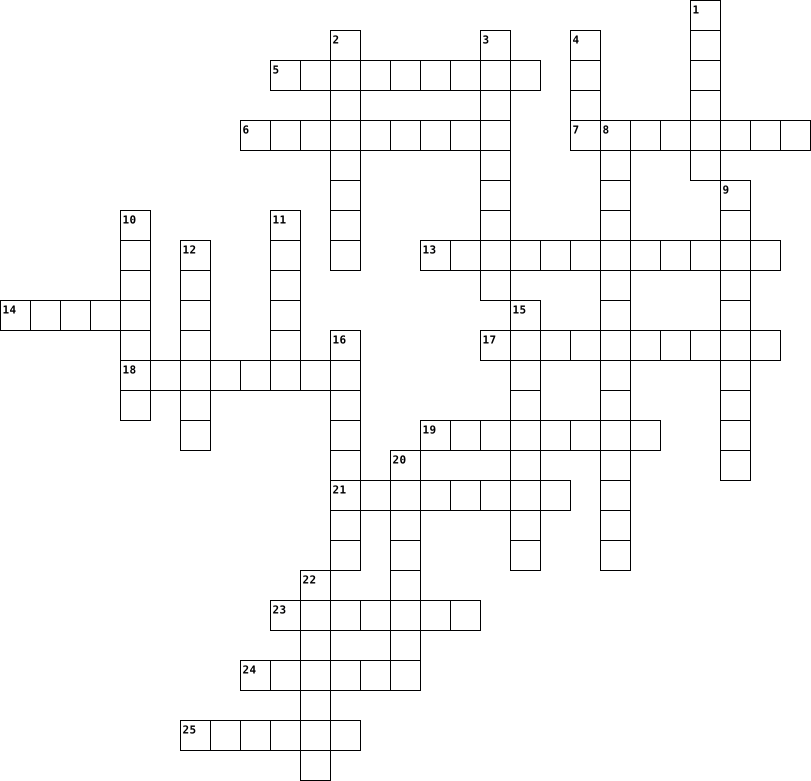
Across
- Bendable
- particle Particles of matter that are smaller than a hydrogen atom
- character The level of reactivity of a metal
- The ability to transmit heat, electricity, or sound
- Gases Name of Group 18
- Brittle and non-conductable
- properties A property of a substance during a reaction in which the chemical composition or identity of the substance is changed
- Name of Group 17
- Neutral charge
- Positively charged
- Conductive and malleable
- metals Name of Group 1
Down
- A group of elements with similar chemical properties
- earth metals Name of Group 2
- Negatively charged
- The smallest component of an element
- force The attraction between opposite forces
- Semi-conductable
- electrons Electrons on the outermost shell
- radius The distance from the nucleus to the edge of the atom
- The center of an atom
- When two or more chemical elements are chemically bonded together
- The periodic table is made up of ________
- Synonym for shiny
- Fragile or frail
25 Clues: Bendable • Neutral charge • Semi-conductable • Name of Group 17 • Fragile or frail • Synonym for shiny • Negatively charged • Positively charged • The center of an atom • Gases Name of Group 18 • metals Name of Group 1 • Conductive and malleable • Brittle and non-conductable • earth metals Name of Group 2 • The smallest component of an element • The periodic table is made up of ________ • ...
Mr Terras CW 2 2023-05-07

Across
- The school you go to
- An equation that absorbs heat
- An equation that divorces elements or compounds
- The left side of a chemical equation
- Where you live
- An equation that releases heat
- A substance that takes the shape of its container
- How tightly packed the matter in a substance is
- A chemical equation that combines two substances
Down
- A number before a element/compound that shows how much of that substance there is
- The upward force that allows objects to float in water
- A show of what certain combinations of elements or compounds creates
- The amount of atoms in 12 grams of Carbon-12
- An equation where two elements switch partners
- Pick something up
- When a single compound or element changes partners
- The best science teacher in SCHS
- How deep something is
- Mr Terras' favorite advice
- What a chemical equation creates
- A substance that speeds up a chemical reaction
21 Clues: Where you live • Pick something up • The school you go to • How deep something is • Mr Terras' favorite advice • An equation that absorbs heat • An equation that releases heat • The best science teacher in SCHS • What a chemical equation creates • The left side of a chemical equation • The amount of atoms in 12 grams of Carbon-12 • An equation where two elements switch partners • ...
Science Crossword Puzzle (Form 3) 2025-01-09

Across
- — A series of repeating events
- — Automatic body response
- — Organ producing insulin
- — Ability to store electric charge
- — Water movement across a semipermeable membrane
- — Visible electromagnetic wave
- — Natural environment of an organism
- — Optical device refracting light
- — Combination of two or more atoms
- — The basic unit of life
- — Male reproductive cell
- — Simple carbohydrate compound
- — Gas changing to liquid
- — Bending of light
- — Size or extent of a quantity
Down
- — Process of ovum formation
- — Emission of light by a substance
- — Substance increasing reaction rate without permanent change
- — Essential nutrient for body tissues
- — Anything with mass and volume
- — Force of attraction between masses
- — Group of cells with similar function
- — Study of substances and reactions
- — Phenomenon related to electric charge
- — Chemical substance regulating body processes
- — Electrical component limiting current
- — Biological catalyst speeding up chemical reactions
- — The ability to do work
- — A disturbance transferring energy
- — Smallest unit of matter in chemical elements
30 Clues: — Bending of light • — The basic unit of life • — Male reproductive cell • — The ability to do work • — Gas changing to liquid • — Automatic body response • — Organ producing insulin • — Process of ovum formation • — A series of repeating events • — Visible electromagnetic wave • — Simple carbohydrate compound • — Size or extent of a quantity • — Anything with mass and volume • ...
Science Crossword 2022-12-14

Across
- the combining power of an element, especially as measured by the number of hydrogen atoms it can displace or combine with.
- a thing or person that is the result of an action or process.
- compounds made up of ions that form charged particles when an atom (or group of atoms) gains or loses electrons
- processes in which chemical species break up into simpler parts.
- A molecule or polymer with a single backbone the longest continuous chain of atoms bonded to each other, exclusive of all others, that comprise a polymer.
- a stable subatomic particle occurring in all atomic nuclei, with a positive electric charge equal in magnitude to that of an electron, but of opposite sign.
- a compound or substance that has been purified or prepared, especially artificially.
- the mutual sharing of one or more pairs of electrons between two atoms.
- a chemical bond formed when one atom gives up one or more electrons to another atom.
Down
- describe molecules and polyatomic ions that have one atom in center and four atoms at the corners of a tetrahedron
- occur when parts of two ionic compounds are exchanged, making two new compounds.
- an action performed or a feeling experienced in response to a situation or event.
- a stable subatomic particle with a charge of negative electricity, found in all atoms and acting as the primary carrier of electricity in solids
- a kind of molecular geometry in which the central atom has two lone pairs of electrons and is associated with two bond pairs
- the basic unit of a chemical element.
- a reaction in which one element is substituted for another element in a compound.
- consists of a central atom connected to three atoms arranged in a triangular pattern around the central atom.
- an arrangement of elements in a particular form, figure, or combination.
- the process by which one or more chemical reactions are performed with the aim of converting a reactant or starting material into a product or multiple products.
- a substance that takes part in and undergoes change during a reaction
- any atom or group of atoms that bears one or more positive or negative electrical charges.
21 Clues: the basic unit of a chemical element. • a thing or person that is the result of an action or process. • processes in which chemical species break up into simpler parts. • a substance that takes part in and undergoes change during a reaction • the mutual sharing of one or more pairs of electrons between two atoms. • ...
Science Crossword 2022-12-14

Across
- the combining power of an element, especially as measured by the number of hydrogen atoms it can displace or combine with.
- a thing or person that is the result of an action or process.
- compounds made up of ions that form charged particles when an atom (or group of atoms) gains or loses electrons
- processes in which chemical species break up into simpler parts.
- A molecule or polymer with a single backbone the longest continuous chain of atoms bonded to each other, exclusive of all others, that comprise a polymer.
- a stable subatomic particle occurring in all atomic nuclei, with a positive electric charge equal in magnitude to that of an electron, but of opposite sign.
- a compound or substance that has been purified or prepared, especially artificially.
- the mutual sharing of one or more pairs of electrons between two atoms.
- a chemical bond formed when one atom gives up one or more electrons to another atom.
Down
- describe molecules and polyatomic ions that have one atom in center and four atoms at the corners of a tetrahedron
- occur when parts of two ionic compounds are exchanged, making two new compounds.
- an action performed or a feeling experienced in response to a situation or event.
- a stable subatomic particle with a charge of negative electricity, found in all atoms and acting as the primary carrier of electricity in solids
- a kind of molecular geometry in which the central atom has two lone pairs of electrons and is associated with two bond pairs
- the basic unit of a chemical element.
- a reaction in which one element is substituted for another element in a compound.
- consists of a central atom connected to three atoms arranged in a triangular pattern around the central atom.
- an arrangement of elements in a particular form, figure, or combination.
- the process by which one or more chemical reactions are performed with the aim of converting a reactant or starting material into a product or multiple products.
- a substance that takes part in and undergoes change during a reaction
- any atom or group of atoms that bears one or more positive or negative electrical charges.
21 Clues: the basic unit of a chemical element. • a thing or person that is the result of an action or process. • processes in which chemical species break up into simpler parts. • a substance that takes part in and undergoes change during a reaction • the mutual sharing of one or more pairs of electrons between two atoms. • ...
Chemistry Exam Review 2023-01-04

Across
- The most electronegative element
- Nonmetals in group 17, create +1 ions
- A substance that changes color in acidic or basic conditions
- Measure of a given amount of solute dissolved in the solvent
- The products of a chemical reaction
- The fundamental unit of temperature without negative values
- This variable, along with temperature, determine the state of matter of a substance
- A formula that shows the lowest whole number ration of elements in a compound
- This molecular model shows bonds and valence electrons
- Measure of electrical current
- This 3D geometry results from a molecule with 4 electron-dense areas an no lone pairs
- Columns on the PT, where elements have similar properties
- These types of compounds have low melting points
- Chemical solution with a pH less than 7
- Subatomic particle that determines identity of element
- a type of radiation used in cancer treatment that can be stopped by aluminum
- The variable is what is gathered/measured in a study
Down
- A measure of being close to an accepted value
- Measurement that is would be the same with any amount of the substace
- A region of probability where you are likely to find an electron
- Different versions of an atom indicated by number of neutrons
- Temperature change is ________ of a chemical reaction
- The father of the periodic table
- A molecule with 3 carbons, and at least one double bond
- The measurement of masses and chemical quantities through a chemical reaction
- Molecules in this state of matter vibrate in a fixed location
- A molecule or bond with unequal sharing of electrons
- Model of the atom that shows how electrons have different energy levels as it orbits the nucleus
- Different solid versions of a substance
- These electrons are involved in ionization and bonding
- The process of gaining electrons in batteries
- Elements become increasingly ____________ as they increase in mass
- This model illustrates that atoms have a dense nucleus but are mostly empty space
- This scientist's number indicates the number of particles in a mole
- When N, F, or O bonding with this element it creates the strongest intermolecular force
- Indicates the substance is dissolved in water
36 Clues: Measure of electrical current • The most electronegative element • The father of the periodic table • The products of a chemical reaction • Nonmetals in group 17, create +1 ions • Different solid versions of a substance • Chemical solution with a pH less than 7 • A measure of being close to an accepted value • The process of gaining electrons in batteries • ...
Pandemic Crossroads 2020-07-07

Across
- Number of protons in nucleus of an atom
- Reactant of enzyme-catalyzed reaction
- Chemical reaction that requires heat
- Used to measure mass
- The father of Western medicine
- Made up of two or more different substances combined physically
- Mixture in which composition is not uniform
- Study of viruses and viral diseases
- Product of photosynthesis
- Series of genes that determine hereditary characteristics
- Scientific ________ is a hypothesis that has not been disproven after many years of rigorous testing
- Little packets of light
- Discovered penicillin
- Substance that changes rate of a chemical reaction
- Having two genes at corresponding loci
- Carrying out est to determine outcome
- Substances composed of only one type of atom
- Invented food preservation by pasteurization
- Founder of quantum mechanics
- Change that occurs in inherited trait of a population over generations
- Acids in genes
- Scientist that studies fungi
- Fundamental substance consisting of only one kind of atom
- Physical expression of genes
- Discovered DNA’s structure and replication mechanism
Down
- Process of maintaining balance
- Particle theory of light was formulated by what scientist
- Discovered the chemical elements radium and polonium and made numerous pioneering contributions to the study of radioactive elements
- Self feeders
- Energy in motion
- Smallest unit that carries on life function
- Maximum number of electrons 2nd shell can hold
- Study of fish
- Invented two-part naming system used to classify all lifeforms
- Charge an element becomes and number of electrons it loses or gains
- Bond formed by sharing of electrons between atoms
- Theory of this proposes that speed of light is the ultimate speed limit
- Disease spreader
- Founded the science of genetics
- Organelle that makes protein
- Eye protection
- Process where one or more substances are converted to product
- Authored On the Origin of Species
- Diffusion across membrane
- Point about which lever rotates
- Protein catalyst
- Frameshift or missense
- Genetic constitution of individual
- Statement based on a hypothesis about condition that should exist if the hypothesis is correct
- Light waves are what kind of waves
- Body response to disease
51 Clues: Self feeders • Study of fish • Eye protection • Acids in genes • Energy in motion • Disease spreader • Protein catalyst • Used to measure mass • Discovered penicillin • Frameshift or missense • Little packets of light • Body response to disease • Product of photosynthesis • Diffusion across membrane • Organelle that makes protein • Founder of quantum mechanics • Scientist that studies fungi • ...
Chemistry Midterm Study Guide Chapter 1 Vocab 2026-01-05

Across
- The amount of matter in an object; usually measured in grams or kilograms
- the branch of science that deals with the identification of the substances of which matter is composed
- – A reaction or process that absorbs energy, usually as heat, from its surroundings.
- Model – A representation of an object, system, or process used to explain and predict phenomena
- – A solid solution of two or more metals (or a metal and another element) that has metallic properties (e.g., steel, brass).
- of Conservation of Mass – Mass cannot be created or destroyed in a chemical reaction; the total mass of reactants equals the total mass of products.
- – Matter that has a uniform and definite composition; can be an element or compound.
- – A substance that evaporates easily at normal temperatures.
- Change – A change in which one or more substances are transformed into new substances with different properties
- – Descriptions of matter that do involve numbers (e.g., mass, volume, temperature).
- Anything that has mass and takes up space
- Property – A characteristic of a substance that describes its ability to change into a new substance (e.g., flammability, reactivity).
- – The mass of a substance per unit volume (Density = Mass ÷ Volume).
Down
- – A characteristic of matter that can be observed or measured
- Change – A change that affects the form of a substance but does not change its chemical identity (e.g., melting, cutting).
- Property – A characteristic of a substance that can be observed without changing its chemical composition (e.g., color, density, melting point).
- Reaction – A process in which substances (reactants) change chemically to form new substances (products).
- Solution – A solution where water is the solvent.
- – A pure substance made of two or more elements chemically combined in a fixed ratio.
- – A reaction or process that releases energy, usually as heat, to its surroundings.
- – A combination of two or more substances that are not chemically bonded and can be separated physically.
- – Descriptions of matter that do not involve numbers (e.g., color, texture, odor).
- – A symbolic representation of the elements in a compound and their proportions (e.g., H₂O, CO₂).
- – A homogeneous mixture where one substance (solute) is dissolved in another (solvent).
- – The capacity to do work or produce change; can be stored (potential) or in motion (kinetic).
- – The substance that is dissolved in a solution.
- – A pure substance made of only one type of atom.
27 Clues: Anything that has mass and takes up space • – The substance that is dissolved in a solution. • Solution – A solution where water is the solvent. • – A pure substance made of only one type of atom. • – A substance that evaporates easily at normal temperatures. • – A characteristic of matter that can be observed or measured • ...
enzymes 2021-10-25

Across
- this type of bond is when the H2O is removed from the molecules
- a very important part of the enzymes optimal condition
- these are the building blocks for proteins
- this reaction releases energy while bonding the substrates
- A very important part of the enzymes condition
- this reaction absorbs energy while bonding the substrates
- speeds up the chemical reaction
Down
- creates the enzymes
- this is the category of molecules that protein is in
- these help speed up the process of building and breaking down molecules
- best conditions for enzymes to work in
- building area
- building blocks for the product
- final result
- this is when an enzyme dies from its bad conditions
15 Clues: final result • building area • creates the enzymes • building blocks for the product • speeds up the chemical reaction • best conditions for enzymes to work in • these are the building blocks for proteins • A very important part of the enzymes condition • this is when an enzyme dies from its bad conditions • this is the category of molecules that protein is in • ...
Dapo Odusanya 2022-03-08

Across
- maxium amount of product that can be produced based on the limiting reaction
- mass of one mole of a substance
- a single electron or one of two or more electrons in the outer shell of an atom that is responsible for the chemical properties of the atom.
- the number of protons in the nucleus of an atom, which determines the chemical properties of an element and its place in the periodic table.
- how much product is obtained compared to the maximum possible mass.
Down
- the coefficient in a balanced equation
- reactant that runs out first in a chemical reaction
- the relationship between the relative quantities of substances taking part in a reaction or forming a compound, typically a ratio of whole integers.
- a molecule is formed from the covalent bond
- a bond between 2
10 Clues: a bond between 2 • mass of one mole of a substance • the coefficient in a balanced equation • a molecule is formed from the covalent bond • reactant that runs out first in a chemical reaction • how much product is obtained compared to the maximum possible mass. • maxium amount of product that can be produced based on the limiting reaction • ...
Seasonal Allergies 2018-01-23

Across
- Symptom resulting from swelling of the nasolacrimal tube
- Swelling of these can cause ear stuffiness
- Agent to which the immune system overreacts
- Common name for seasonal allergies
- Chemical mediator leading to symptoms
Down
- Substance whose production is increased to flush out agents causing an allergic reaction
- Inflammation of the nose caused by an allergic reaction
- Common allergen responsible for seasonal allergies
- Primary source of chemical mediators leading to symptoms
- Symptom resulting from irritation of the nasal mucosa
10 Clues: Common name for seasonal allergies • Chemical mediator leading to symptoms • Swelling of these can cause ear stuffiness • Agent to which the immune system overreacts • Common allergen responsible for seasonal allergies • Symptom resulting from irritation of the nasal mucosa • Inflammation of the nose caused by an allergic reaction • ...
photosynthesis station 2023-03-21

Across
- The ending material of a chemical reaction
- animals and humans breathe in
- A structure in a plant cell that contains chlorophyll; Site of photosynthesis
- Starting Material of a chemical reaction
- 60% of ___ is in our body
Down
- A green substance contains in the chloroplast of plant leaves that captures energy in sunlight
- Plants use energy in sunlight to create their own food
- A sugar molecule
- What gives us radiant energy
- dioxide Animals and Humans breathe out
10 Clues: A sugar molecule • 60% of ___ is in our body • What gives us radiant energy • animals and humans breathe in • Starting Material of a chemical reaction • dioxide Animals and Humans breathe out • The ending material of a chemical reaction • Plants use energy in sunlight to create their own food • ...
Photosynthesis 2022-12-07

Across
- A green pigment that absorbs sunlight
- A product of photosynthesis
- A reactant of photosynthesis that consists of oxygen and Hydrogen
- The thing needed to trigger a chemical reaction
Down
- A process in which green plants absorb sunlight to create glucose
- Substances formed in a chemical reaction
- A type of energy emitted from the sun
- Organelles that contain chlorophyll
- A reactant of photosynthesis that consists of carbon and oxygen
- A type of sugar and a product of photosynthesis
10 Clues: A product of photosynthesis • Organelles that contain chlorophyll • A green pigment that absorbs sunlight • A type of energy emitted from the sun • Substances formed in a chemical reaction • A type of sugar and a product of photosynthesis • The thing needed to trigger a chemical reaction • A reactant of photosynthesis that consists of carbon and oxygen • ...