
chemistry/ Crossword Puzzles
Get to Know Your STEM Professors! 2019-08-26
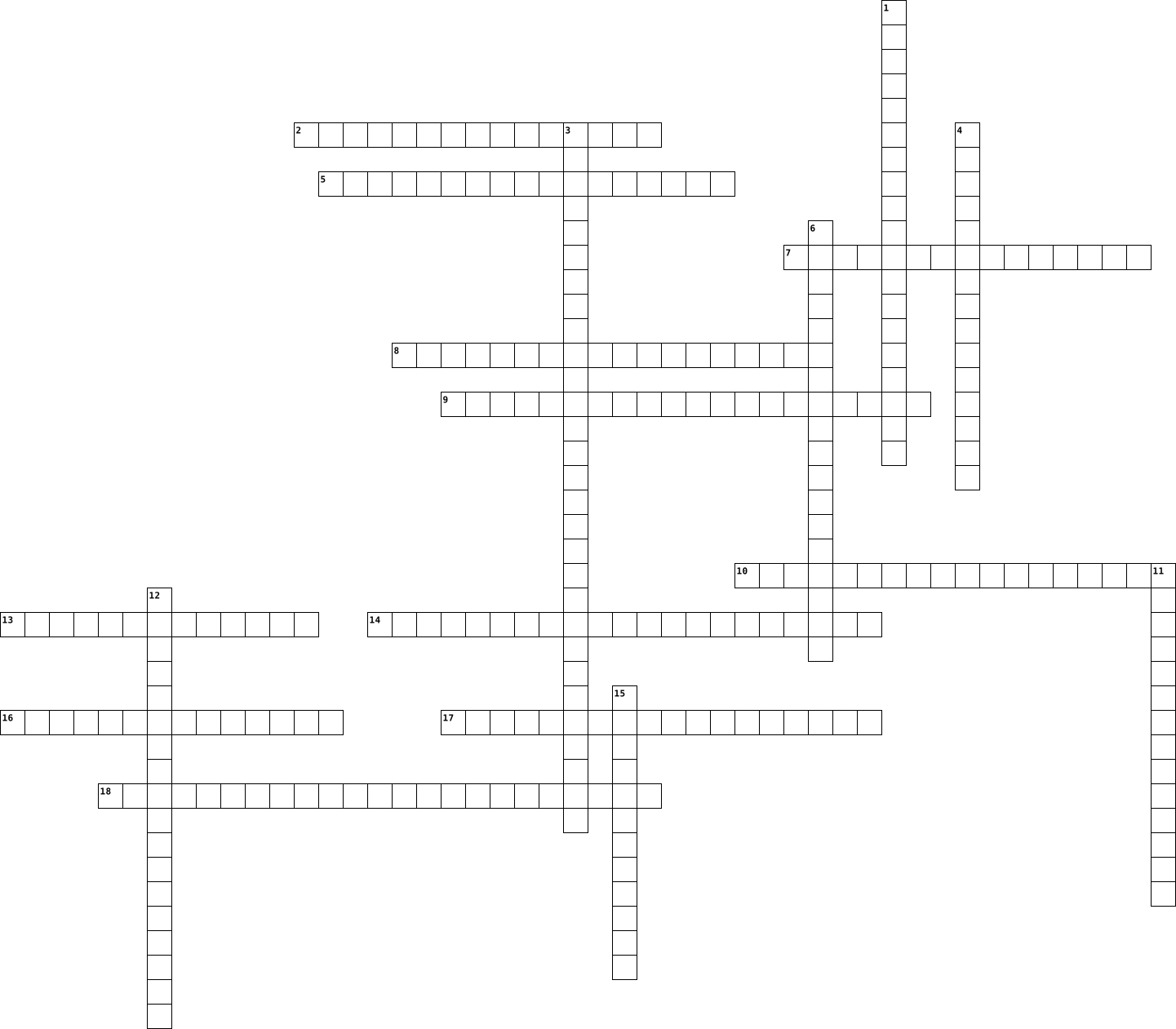
Across
- This Biology professor teaches Biological Foundations II and botany and directed the undergraduate research program RISE which ended recently.
- This professor is a psychologist who until recently, served as the Director of the Office of Accessibility Services (OAS).
- This Biology professor teaches the ORI 100 course for the STEM Learning Community as well as Biological Foundations I and Nutrition. She is also a co-advisor for the Tri-Beta Biological Honor Society.
- This person is from Virginia and is the newest professor in the Department of Biology. He teaches Anatomy & Physiology.
- This Biology Professor is the coordinator of the STEM Learning Community, faculty advisor for the Minority Association of Pre-health Students (MAPS), and President of the Barry University Chapter of Sigma Xi, The Scientific Research Honor Society.
- This person is a professor in the Department of Psychology and teaches courses such as Research Methods & Analysis in Psychology I & II.
- This Biology professor has been at Barry for 27 years. She teaches Anatomy and Biology of Crime.
- This professor is the Chair of the Department of Biology. She teaches Biological Foundations I and Introduction to Microbiology this semester. She is also the faculty advisor for the Pre-vet Club.
- This Chemistry professor teaches Organic Chemistry and Biochemistry.
- This professor teaches Chemistry 111 and 112 and directs a chemistry outreach program called COACH.
- This Biology professor teaches Microbiology, Virology and Biological Foundations I. He is also the faculty advisor for the Pre-physician Assistant Club.
Down
- This professor teaches College Chemistry I and II and is fondly known as Ms. T. by her students.
- This person is a former Barry Biology student who teaches Biological Foundations I and Anatomy. She is also the coordinator of ROADS, an undergraduate research club.
- This person is an Anatomy professor and is also the faculty advisor for the Barry chapter of the American Medical Student Association (AMSA), a pre-med student organization.
- This person is a sociologist by training and serves as Dean of the College of Arts & Sciences, overseeing all of the academic units within that college, including the STEM disciplines.
- This Biology professor conducts cancer biology research and teaches Biological Foundations II and Cell Biology.
- This Math & Computer Science professor teaches precalculus I and II and is also the assistant chair of that department.
- This Biology professor teaches Anatomy and also oversees the core aquarium facility (located in the Siena building, 3rd floor) which is used by students and faculty for research and the marine biology course.
18 Clues: This Chemistry professor teaches Organic Chemistry and Biochemistry. • This professor teaches College Chemistry I and II and is fondly known as Ms. T. by her students. • This Biology professor has been at Barry for 27 years. She teaches Anatomy and Biology of Crime. • ...
Get to Know Your STEM Professors! 2019-08-26
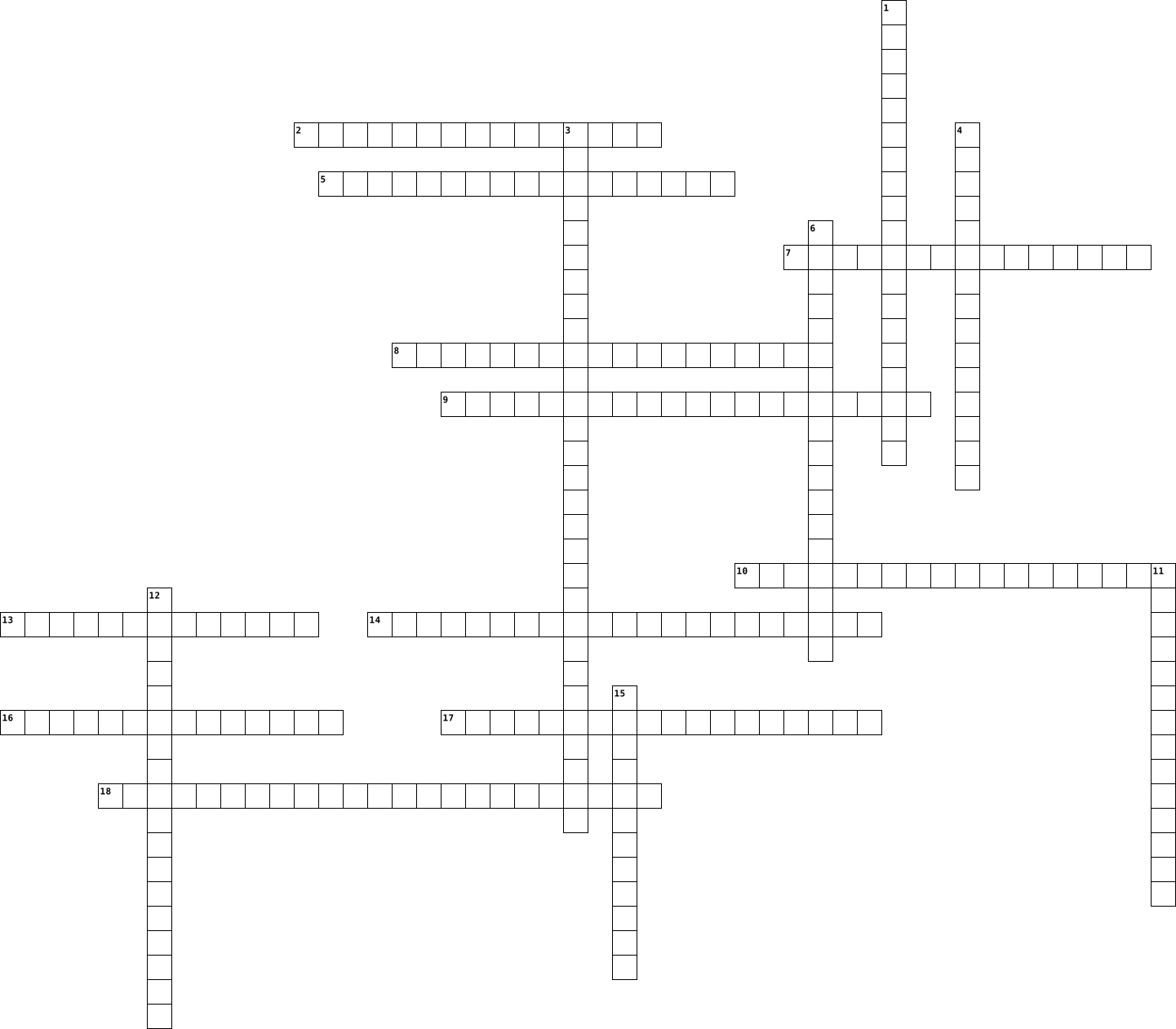
Across
- This Biology professor teaches Biological Foundations II and botany and directed the undergraduate research program RISE which ended recently.
- This professor is a psychologist who until recently, served as the Director of the Office of Accessibility Services (OAS).
- This Biology professor teaches the ORI 100 course for the STEM Learning Community as well as Biological Foundations I and Nutrition. She is also a co-advisor for the Tri-Beta Biological Honor Society.
- This person is from Virginia and is the newest professor in the Department of Biology. He teaches Anatomy & Physiology.
- This Biology Professor is the coordinator of the STEM Learning Community, faculty advisor for the Minority Association of Pre-health Students (MAPS), and President of the Barry University Chapter of Sigma Xi, The Scientific Research Honor Society.
- This person is a professor in the Department of Psychology and teaches courses such as Research Methods & Analysis in Psychology I & II.
- This Biology professor has been at Barry for 27 years. She teaches Anatomy and Biology of Crime.
- This professor is the Chair of the Department of Biology. She teaches Biological Foundations I and Introduction to Microbiology this semester. She is also the faculty advisor for the Pre-vet Club.
- This Chemistry professor teaches Organic Chemistry and Biochemistry.
- This professor teaches Chemistry 111 and 112 and directs a chemistry outreach program called COACH.
- This Biology professor teaches Microbiology, Virology and Biological Foundations I. He is also the faculty advisor for the Pre-physician Assistant Club.
Down
- This professor teaches College Chemistry I and II and is fondly known as Ms. T. by her students.
- This person is a former Barry Biology student who teaches Biological Foundations I and Anatomy. She is also the coordinator of ROADS, an undergraduate research club.
- This person is an Anatomy professor and is also the faculty advisor for the Barry chapter of the American Medical Student Association (AMSA), a pre-med student organization.
- This person is a sociologist by training and serves as Dean of the College of Arts & Sciences, overseeing all of the academic units within that college, including the STEM disciplines.
- This Biology professor conducts cancer biology research and teaches Biological Foundations II and Cell Biology.
- This Math & Computer Science professor teaches precalculus I and II and is also the assistant chair of that department.
- This Biology professor teaches Anatomy and also oversees the core aquarium facility (located in the Siena building, 3rd floor) which is used by students and faculty for research and the marine biology course.
18 Clues: This Chemistry professor teaches Organic Chemistry and Biochemistry. • This professor teaches College Chemistry I and II and is fondly known as Ms. T. by her students. • This Biology professor has been at Barry for 27 years. She teaches Anatomy and Biology of Crime. • ...
Get to Know Your STEM Professors! 2019-08-26
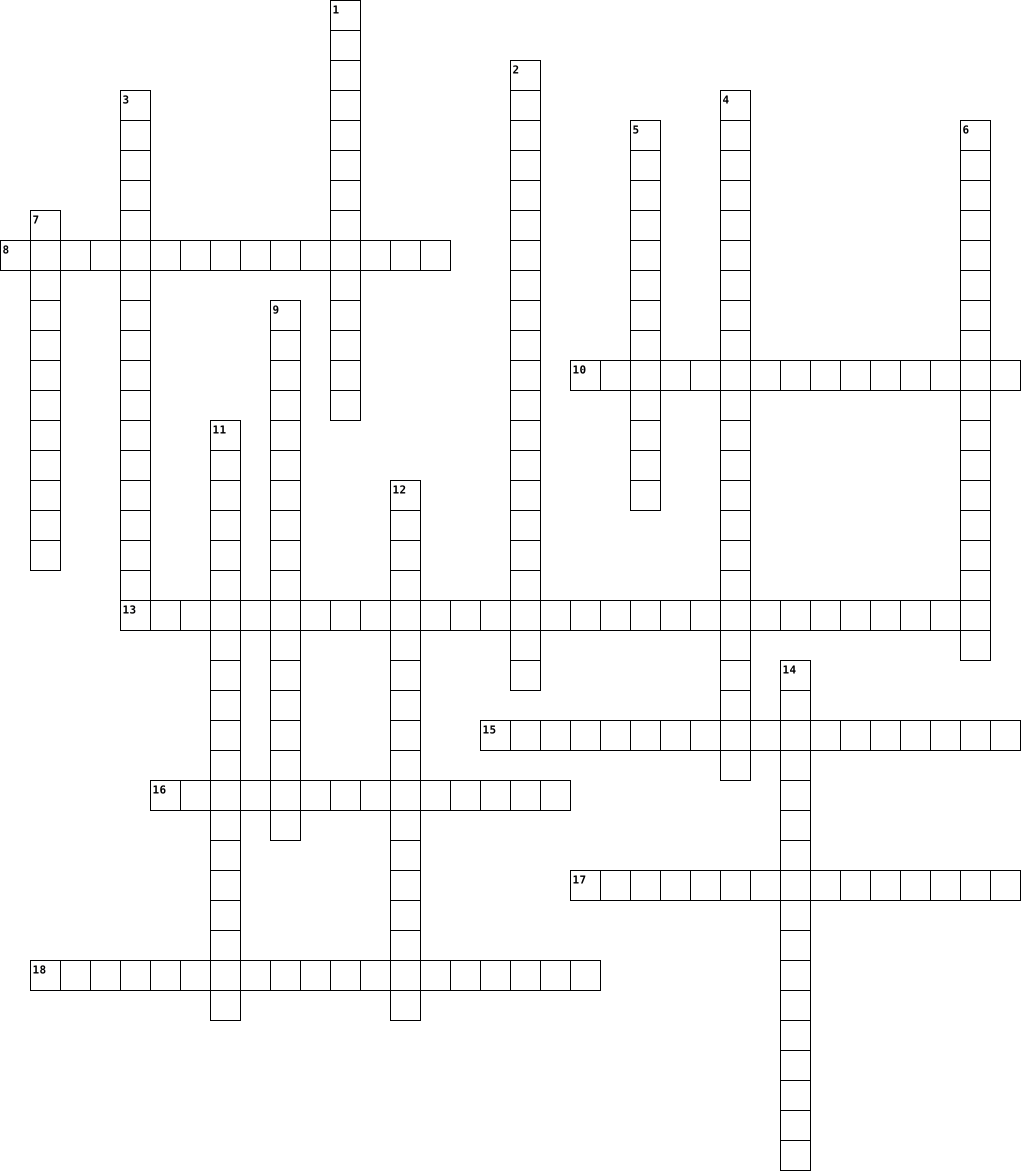
Across
- This person is an Anatomy professor and is also the faculty advisor for the Barry chapter of the American Medical Student Association (AMSA), a pre-med student organization.
- This Biology professor teaches Biological Foundations II and botany and directed the undergraduate research program RISE which ended recently.
- This person is a former Barry Biology student who teaches Biological Foundations I and Anatomy. She is also the coordinator of ROADS, an undergraduate research club.
- This person is from Virginia and is the newest professor in the Department of Biology. He teaches Anatomy & Physiology.
- This Biology professor conducts cancer biology research and teaches Biological Foundations II and Cell Biology.
- This Biology professor teaches the ORI 100 course for the STEM Learning Community as well as Biological Foundations I and Nutrition. She is also a co-advisor for the Tri-Beta Biological Honor Society.
- This professor teaches College Chemistry I and II and is fondly known as Ms. T. by her students.
Down
- This Chemistry professor teaches Organic Chemistry and Biochemistry.
- This professor is the Chair of the Department of Biology. She teaches Biological Foundations I and Introduction to Microbiology this semester. She is also the faculty advisor for the Pre-vet Club.
- This person is a professor in the Department of Psychology and teaches courses such as Research Methods & Analysis in Psychology I & II.
- This Biology professor teaches Microbiology, Virology and Biological Foundations I. He is also the faculty advisor for the Pre-physician Assistant Club.
- This Biology professor has been at Barry for 27 years. She teaches Anatomy and Biology of Crime.
- This professor teaches Chemistry 111 and 112 and directs a chemistry outreach program called COACH.
- This Biology professor teaches Anatomy and also oversees the core aquarium facility (located in the Siena building, 3rd floor) which is used by students and faculty for research and the marine biology course.
- This Math & Computer Science professor teaches precalculus I and II and is also the assistant chair of that department.
- This Biology Professor is the coordinator of the STEM Learning Community, faculty advisor for the Minority Association of Pre-health Students (MAPS), and President of the Barry University Chapter of Sigma Xi, The Scientific Research Honor Society.
- This person is a sociologist by training and serves as Dean of the College of Arts & Sciences, overseeing all of the academic units within that college, including the STEM disciplines.
- This professor is a psychologist who until recently, served as the Director of the Office of Accessibility Services (OAS).
18 Clues: This Chemistry professor teaches Organic Chemistry and Biochemistry. • This professor teaches College Chemistry I and II and is fondly known as Ms. T. by her students. • This Biology professor has been at Barry for 27 years. She teaches Anatomy and Biology of Crime. • ...
Staff at Sunnyslope 2025-03-28

Across
- Honor English Teacher 3-4
- Sunnyslope Mascot
- Basketball Coach
- Coach
- Counselor
- PE teacher
- Chemistry Teacher
- Geometry Teacher
Down
- Heritage Spanish Teacher
- Journalism Teacher
- Assistant Principle
- History Teacher
- Geometry Teacher
- Principle
- Biology Teacher
15 Clues: Coach • Principle • Counselor • PE teacher • History Teacher • Biology Teacher • Geometry Teacher • Basketball Coach • Geometry Teacher • Sunnyslope Mascot • Chemistry Teacher • Journalism Teacher • Assistant Principle • Heritage Spanish Teacher • Honor English Teacher 3-4
school 2021-03-03

Across
- drawing
- writing school lesson
- place to study
- education sports
- write assignment
- sing
Down
- experiment
- knowledge of the lesson
- elements compounds
- formula
- cooking
- technology study
- to write something
- energy and force
- living organisms
15 Clues: sing • drawing • formula • cooking • experiment • place to study • technology study • education sports • energy and force • living organisms • write assignment • elements compounds • to write something • writing school lesson • knowledge of the lesson
school 2021-03-03

Across
- drawing
- writing school lesson
- place to study
- education sports
- write assignment
- sing
Down
- experiment
- knowledge of the lesson
- elements compounds
- formula
- cooking
- technology technology study
- to write something
- energy and force
- living organisms
15 Clues: sing • drawing • formula • cooking • experiment • place to study • energy and force • living organisms • write assignment • education sports • elements compounds • to write something • writing school lesson • knowledge of the lesson • technology technology study
Science and technology 2021-07-21

Across
- the study of weather and climate.
- a person who dispenses medicinal drugs and advises medicinal drugs and advises on their uses.
- a person who has trained in and practices medicinal science
- the study of matter, energy, force and motion.
- a skilled person who designs, builds or maintains engines, buildings, bridges and roads.
- knowledge the information produced from the study of science.
- phenomena the things happen in nature
- a person trained in chemistry.
Down
- the study of life.
- the study of composition and chemical properties of substances.
- an animal doctor.
- the application of scientific knowledge
- a person trained in physics
- the study of planets and stars in the universe.
- The systematic study of nature and how it affects us and our environment.
15 Clues: an animal doctor. • the study of life. • a person trained in physics • a person trained in chemistry. • the study of weather and climate. • phenomena the things happen in nature • the application of scientific knowledge • the study of matter, energy, force and motion. • the study of planets and stars in the universe. • ...
Chemistry Crossword 2015-11-09

Across
- The name of the bond that involves the overlap of P orbitals
- The element with the highest electronegativity using the Pauling scale
- Ozone is an_____ of oxygen
- Stage 3 of mass spectrometry
- The smallest of the alkynes
- Tendency of an atom to attract electrons to itself when chemically combined to another atom
- A _____ series is a family of compounds with the same functional group
- The name for the NH2 functional group
Down
- A store of chemical potential energy
- What block is uranium found in on the periodic table
- The chain reaction in free radical substitution occurs in the_____ step
- The process that causes a positive ion to split into pieces during mass spectrometry
- The catalyst used in catalytic cracking
- The second stage in electrophilic addition involves a _____ intermediate
- In a reaction between an alcohol and a carboxylic acid water and an _____ are products
- Apart from branched alkanes what type of compound is formed from catalytic cracking
- The first step in a mechanism
- The type of C-C bond found in ethane
- The chemical formula of potassium cyanide
19 Clues: Ozone is an_____ of oxygen • The smallest of the alkynes • Stage 3 of mass spectrometry • The first step in a mechanism • A store of chemical potential energy • The type of C-C bond found in ethane • The name for the NH2 functional group • The catalyst used in catalytic cracking • The chemical formula of potassium cyanide • ...
Chemistry Review 2017-11-15

Across
- Number / It defines the isotopes
- that makes up everything
- reaction/ A reaction involving the partials in the nucleus of an atom that can change one element into another element
- charged partials
- Model/A model that shows what an atom looks like
- is in the nucleus of the atom
- Metal /Groups 3 through 12 on the periodic table
- He was a famous chemist
Down
- An element that lacks metal proprieties
- that have the same number of protons and different number's of neutrons
- Level /An electrons movement
- model / This shows the atoms energy level
- Rows of the periodic table
- Negatively charged partials
- on the periodic table
- He discovered patterns in the periodic table
- Mass/ The average mass of an atom
- Table / An arrangement of the elements
- An atoms center
19 Clues: An atoms center • charged partials • on the periodic table • He was a famous chemist • that makes up everything • Rows of the periodic table • Negatively charged partials • Level /An electrons movement • is in the nucleus of the atom • Number / It defines the isotopes • Mass/ The average mass of an atom • Table / An arrangement of the elements • ...
Chemistry Crossword 2018-04-09

Across
- determines the number of energy levels.
- if the numbers of atoms for each element are the same on both the reactants and product the equation is _________.
- reactivity is determined by an element’s ___________.
- on the left side of the “staircase”, good conductors of heat, malleable and ductile.
- on the right side of the “staircase”,does not conduct heat/electricity, brittle and dull.
- tells you how many atoms of that element are present.
- a substance that forms in a chemical reaction.
- the smallest unit of matter.
- has a neutral charge and is located in the nucleus.
- where most of the mass in an atom is located.
- have properties of both metals and nonmetals.
- The law of conservation of _____ states that _____ cannot be created or destroyed.
Down
- elements in the same ______ share similar physical and chemical properties.
- a substance or molecule that participates in a chemical reaction.
- non-reactive group, group 18.
- tells you how many molecules of that particular compound you have.
- a group of two or more atoms that are chemically bonded together. Ex. H2O
- has a negative charge and is located in a cloud outside of the nucleus.
- this subatomic particle identifies an element.
19 Clues: the smallest unit of matter. • non-reactive group, group 18. • determines the number of energy levels. • where most of the mass in an atom is located. • have properties of both metals and nonmetals. • a substance that forms in a chemical reaction. • this subatomic particle identifies an element. • has a neutral charge and is located in the nucleus. • ...
Environmental Chemistry 2012-11-07

Across
- Bioaccumulating contaminant found in the Great Lakes
- This chemical was once widely used as an anesthetic
- These intermolecular forces are responsible for waters high surface tension
- By planting more of these, we can help reduce carbon dioxide in the atmosphere
- Ozone is a part of this level of the atmosphere
- A procedure used to determine the unknown concentration of an substance, by carefully adding a specific amount of a substance of which the concentration is known
- A type of mite that is responsible for CCD in bees
- Ozone depleting contaminant
- Occupational expose to this element (Pb) is the main cause of poisoning
- Phenolphthalein is an example of this
- This gas is primarily responsible for acid rain
Down
- The most abundant gas in Earth's atmosphere
- This chemical is a carbon atom triple bonded to a nitrogen
- This chemical (CCL4)is both a greenhouse gas and an ozone depleting substance
- Also known as, Quicksilver
- Water contaminated with this element (number 33) is a serious concern worldwide
- Nerve gas An extremely lethal nerve agent
- These rays emitted from the sun can have cancerous effects on humans
- This chemical is known to cause birth defects
19 Clues: Also known as, Quicksilver • Ozone depleting contaminant • Phenolphthalein is an example of this • Nerve gas An extremely lethal nerve agent • The most abundant gas in Earth's atmosphere • This chemical is known to cause birth defects • Ozone is a part of this level of the atmosphere • This gas is primarily responsible for acid rain • ...
Chemistry Vocabulary 2013-10-30

Across
- resist mixing with or be impervious to
- a thing or substance used for installation in particular
- a liquid or gel that contains ions and can be decomposed by electrolysis e.g. that is presented in a battery
- having a surplus of electrons; having a lower electric potential
- the quantity of a particular substance that can dissolve a particular solvent
- the degree to which a specific material conducts electricity calculated as the ratio of the current density in the material to the electric field that causes the flow of current
- refers to a separation of electric charge leading to a molecule or its chemical groups; having an electric dipole or multipole moment
- a chemical compound in which ions are held together in a lattice structure by ionic bonds
- an atom or molecule with a net electric charge due to the loss or gain of one or more electrons
Down
- charge having a deficiency of electrons; having a higher electric potential.
- a form of energy resulting from the existence of charged particles (such as electrons or protons), either statically as an accumulation of charge or dynamically as a current
- able to be dissolved, especially in water
- the temp at which a given solid will melt
- the symmetrical three-dimensional arrangement of atoms inside a crystal.
- point the temperature at which a liquid boils and turns to vapor
- a chemical bond that involves the sharing
- store electrical energy in
- become or cause to become incorporated into a liquid so as to form a solution.
- a material in which heat, electric charge or both can flow readily
19 Clues: store electrical energy in • resist mixing with or be impervious to • able to be dissolved, especially in water • the temp at which a given solid will melt • a chemical bond that involves the sharing • a thing or substance used for installation in particular • having a surplus of electrons; having a lower electric potential • ...
Chemistry Crossword 2013-12-09

Across
- when all substances in a compound are combined with oxygen, which then produces carbon dioxide and water.
- The compounds that are formed when a reaction goes to completion.
- two or more chemical species combine to form a more complex product.
- when an element or ion moves out of one compound and into another - that is, one element is replaced by another in a compound.
- cause a substance to be deposited in solid form from a solution.
- Chemical equation for a reaction which lists only those species participating in the reaction.
- the minor component in a solution, dissolved in the solvent.
- a solution in water.
- a chemical reaction between two compounds where the positive ion of one compound is exchanged with the positive ion of another compound.
- A spectator ion is an ion that exists as a reactant and a product in a chemical equation.
- able to dissolve other substances.
- Yield is the quantity of product obtained from a reaction.
- indicates the number of atoms of this element in the chemical compound.
- the number that normally appears at the beginning of a term in a chemical equation.
Down
- separation of a substance into two or more substances that may differ from each other and from the original substance.
- a substance formed when two or more chemical elements are chemically bonded together.
- the force that holds atoms together.
- Equation a symbolic representation of a chemical reaction. The reactant entities are normally given on the left side while the product entities are given on the right side. The equation represents soluble ionic compounds as separate ions.
- a substance that takes part in and undergoes change during a reaction.
19 Clues: a solution in water. • able to dissolve other substances. • the force that holds atoms together. • Yield is the quantity of product obtained from a reaction. • the minor component in a solution, dissolved in the solvent. • cause a substance to be deposited in solid form from a solution. • The compounds that are formed when a reaction goes to completion. • ...
Chemistry Crossword 2013-12-09

Across
- indicates the number of atoms of this element in the chemical compound.
- a solution in water.
- the force that holds atoms together.
- when all substances in a compound are combined with oxygen, which then produces carbon dioxide and water.
- A spectator ion is an ion that exists as a reactant and a product in a chemical equation.
- two or more chemical species combine to form a more complex product.
- when an element or ion moves out of one compound and into another - that is, one element is replaced by another in a compound.
- Chemical equation for a reaction which lists only those species participating in the reaction.
- a substance that takes part in and undergoes change during a reaction.
- Equation a symbolic representation of a chemical reaction. The reactant entities are normally given on the left side while the product entities are given on the right side. The equation represents soluble ionic compounds as separate ions.
- The compounds that are formed when a reaction goes to completion.
- a substance formed when two or more chemical elements are chemically bonded together.
- Yield is the quantity of product obtained from a reaction.
- the minor component in a solution, dissolved in the solvent.
Down
- a chemical reaction between two compounds where the positive ion of one compound is exchanged with the positive ion of another compound.
- cause a substance to be deposited in solid form from a solution.
- separation of a substance into two or more substances that may differ from each other and from the original substance.
- able to dissolve other substances.
- the number that normally appears at the beginning of a term in a chemical equation.
19 Clues: a solution in water. • able to dissolve other substances. • the force that holds atoms together. • Yield is the quantity of product obtained from a reaction. • the minor component in a solution, dissolved in the solvent. • cause a substance to be deposited in solid form from a solution. • The compounds that are formed when a reaction goes to completion. • ...
Chemistry Vocabulary 2021-09-14

Across
- of an atom number of protons minus electrons
- spectroscopy used to measure mass to ratio
- in the periodic table columns on periodic table
- table of elements
- two or more types of atoms in the periodic table that have the same atomic number
- Substance that cannot be chemically broken
- attract shared electrons
- energy amount of energy to remove bound electron
- membrane-bound organelle
- Stable isotope of hydrogen
- positive charged ion
Down
- radius measurement size of its atom
- tendency for an atom
- number total number of protons and neutrons in a nucleus
- cloud system of electron surrounding the nucleus of an atom
- horizontal rows on periodic table
- particle with positive charge
- Particle with negative charge
- negative charged ion
- particle with no charge
- composed of two or more separate elements
21 Clues: table of elements • tendency for an atom • negative charged ion • positive charged ion • particle with no charge • attract shared electrons • membrane-bound organelle • Stable isotope of hydrogen • particle with positive charge • Particle with negative charge • horizontal rows on periodic table • radius measurement size of its atom • composed of two or more separate elements • ...
Chemistry Vocab 2021-01-14

Across
- Data in words rather than in numbers
- Numerical measurements rather than its words
- Experimental value minus the accepted value, divided by the accepted value and then multiplied by 100
- System of electrons surrounding the nucleus of an atom
- The heat required to raise the temperature of the mass of a given substance by given amount
- Method that expresses the number multiplied by 10 and the appropriate power
- A science that deals with the structure and properties
Down
- Sum of the protons and neutrons in the nucleus of an atom
- Number of protons in the nucleus in an atom
- Reaction in which the nuclei of one atom combines with the nuclei of another to form a larger nuclei
- Smallest particle of a substance that can exist by itself
- The ability to work without mistakes
- A solid that is produced by a chemical reaction in solution
- a number that express a magnitude to a specified degree of accuracy
- Group 18 in the periodic table with a full outer shell
- The quality of being exact
- Atoms with same number of protons but not the same number of neutrons
- Element with the properties of both metals and nonmetala
- Mass per unit of volume
19 Clues: Mass per unit of volume • The quality of being exact • Data in words rather than in numbers • The ability to work without mistakes • Number of protons in the nucleus in an atom • Numerical measurements rather than its words • System of electrons surrounding the nucleus of an atom • Group 18 in the periodic table with a full outer shell • ...
Chemistry revision 2021-02-24

Across
- the central core of an atom
- sea involved in metallic bonds
- property of a metal
- metals
- how easily a substance can share electrons
- brittle, poor conductor, water soluble
- shiny, ductile, malleable, conductor
- more than one atom
- where electrons are shared
- positively charged nucleon
Down
- outer shell electron
- neutral nucleon
- negatively charged particle
- electrons are found in these
- positively charged ion
- column on the table where elements share properties
- metal & nonmetal
- ____ metal
- row on the table where elements share properties
- negatively charged ion
20 Clues: metals • ____ metal • neutral nucleon • metal & nonmetal • more than one atom • property of a metal • outer shell electron • positively charged ion • negatively charged ion • where electrons are shared • positively charged nucleon • the central core of an atom • negatively charged particle • electrons are found in these • sea involved in metallic bonds • shiny, ductile, malleable, conductor • ...
Chemistry crossword 2022-09-07

Across
- worn on eyes during lab
- what type of pants should be worn during a lab
- The toe on your shoe during a lab should be
- Used when pulling the liquid up a pipet
- What should you use when you catch fire and can't reach the shower
- ______burner
- used to contain spilled chemicals
- If the fire is too big for fire extinguisher
- Always stir using a ______
- Glass container used to mix chemicals
Down
- what type of thermometer is used
- What color should the flame on a Bunsen burner
- What should you use if there is a big fire
- Big bottle of chemicals
- When there is a medical emergency other than ms.Reese who should you go get
- Who should handle spilled chemicals
- where do you place a used thermometer
- Where do you put your bag during a lab
- worn around the torso during lab
19 Clues: ______burner • worn on eyes during lab • Big bottle of chemicals • Always stir using a ______ • what type of thermometer is used • worn around the torso during lab • used to contain spilled chemicals • Who should handle spilled chemicals • where do you place a used thermometer • Glass container used to mix chemicals • Where do you put your bag during a lab • ...
Chemistry Vocabulary 2021-12-08

Across
- Atomic mass unit
- number of molecules
- Go up and down (columes)
- 3rd ring
- no new substance
- More reactive
- properties of metals and nonmetals
- In nucleus,no charge
- Electricity and heat doesn't pass through
- Found on the left side of the periodic table
Down
- new substance
- 2 Nacl
- can be pulled into wire
- Can be bent or hammered into a sheet
- is the smallest part of an matter
- tell how many atoms
- Electrons cloud,negative
- not shinny
- More stable
19 Clues: 2 Nacl • 3rd ring • not shinny • More stable • new substance • More reactive • Atomic mass unit • no new substance • number of molecules • tell how many atoms • In nucleus,no charge • can be pulled into wire • Go up and down (columes) • Electrons cloud,negative • is the smallest part of an matter • properties of metals and nonmetals • Can be bent or hammered into a sheet • ...
Chemistry Christmas 2021-12-15

Across
- cookies
- capitalism
- water
- wrap
- funplace
- happy
- fest
- chomp
Down
- sing
- slopes
- 4
- santa
- chilly
- conceal
- ice
- circle
- candy
- cold
- candy
- joy
20 Clues: 4 • ice • joy • sing • wrap • fest • cold • santa • water • happy • candy • candy • chomp • slopes • chilly • circle • cookies • conceal • funplace • capitalism
Chemistry Activity 2021-07-15

Across
- Early Indian philosophers classified matter in the form of five basic elements
- 78°c is the boiling point of
- The temperature at which a solid melts to become a liquid at the atmospheric pressure is called its
- Liquids that evaporate rapidly
- ___ causes the temperature of a substance to remain constant while it is undergoing a change in its state.
- What forms when one substance dissolves into another substance
- The colour of vapours formed in sublimation of iodine is
- The most dense state of matter is
- The term in which amount of water vapour in the air is expressed
- Smallest particle of an element
- Tendency to decrease volume when some outside force is applied
Down
- Solid where atoms form a periodic arrangement
- The name chromatography is derived from a Greek word ___ which means colour
- Process by which components of air are separated
- As the temperature rises, particles move
- Reverse of Condensation
- It is formed at low temperature, when atoms clump together
- Kinetic energy is directly proportional to
- Intermixing of particles of two or more substances on their own
19 Clues: Reverse of Condensation • 78°c is the boiling point of • Liquids that evaporate rapidly • Smallest particle of an element • The most dense state of matter is • As the temperature rises, particles move • Kinetic energy is directly proportional to • Solid where atoms form a periodic arrangement • Process by which components of air are separated • ...
Chemistry Vocab 2023-12-18

Across
- negative charge
- tendency of an atom
- compactness of a substance.
- variants of chemical elements
- sharing of electrons between atoms
- relating to an orbit
- colorless, odorless gas
- is a unit of length
- identification of the substances
Down
- part or aspect of somethingmetal
- derived from living organism
- maximum concentration of a solute
- properties of an alkali
- relating to, composed of
- ratio of whole integers.
- a stable subatomic particle
- atomic number 19
- unit of measurement
- production of chemical compounds
19 Clues: negative charge • atomic number 19 • tendency of an atom • unit of measurement • is a unit of length • relating to an orbit • properties of an alkali • colorless, odorless gas • relating to, composed of • ratio of whole integers. • compactness of a substance. • a stable subatomic particle • derived from living organism • variants of chemical elements • part or aspect of somethingmetal • ...
carbohydrate chemistry 2023-10-17

Across
- first carbon atom in glucose in ring structure is called as (8)
- scientist showed glucose in pyranose ring structure (7)
- polysaccharide that cannot be digested (9)
- non reducing disaccharide (7)
- example of cardiac glycoside (9)
- pentose sugar of RNA (6)
- heteropolysaccharide that does not contain uronic acid (14)
- rotation of plane polarized light to the right (14)
- seven carbon ketose monosaccharide (13)
- anticoagulant heteropolysaccharide (7)
Down
- OH gp of anomeric C condensed with non carbohydrate (9)
- tautomerism of glucose in alkaline medium (7)
- nonsulfated heteropolysaccharide present in synovial fluid (14)
- one of the monosaccharide of milk sugar (9)
- simplest aldose monosaccharide (14)
- isomerism of glucose and galacotose (6)
- animal starch (8)
- polysaccharide used for renal function test (6)
- change in specific rotation to 52.5 (12)
19 Clues: animal starch (8) • pentose sugar of RNA (6) • non reducing disaccharide (7) • example of cardiac glycoside (9) • simplest aldose monosaccharide (14) • isomerism of glucose and galacotose (6) • seven carbon ketose monosaccharide (13) • anticoagulant heteropolysaccharide (7) • change in specific rotation to 52.5 (12) • polysaccharide that cannot be digested (9) • ...
Kmcalister - chemistry 2019-10-17

Across
- something mainly made up by an atom
- takes part in a reaction
- something with small amounts of liquid in them
- mass of an atom
- when something forms into a liquid
- chemicals combined in specific amounts
- when something is changed and cannot be changed back
- final result that is used
- something that changes in color, shape, etc.
Down
- when you don’t use your senses
- created periodic table
- attraction to something different
- atoms bonded together
- a rack holding test tubes
- point where it boils
- result of something
- when you use your senses
- mendeleev’s creation
- main part of an element
19 Clues: mass of an atom • result of something • point where it boils • mendeleev’s creation • atoms bonded together • created periodic table • main part of an element • takes part in a reaction • when you use your senses • a rack holding test tubes • final result that is used • when you don’t use your senses • attraction to something different • when something forms into a liquid • ...
Ocean Chemistry 2020-11-06

Across
- one atom in a water molecule
- the amount of matter in objects
- the temperature on a surface
- a chemical compund
- an inorganic substance
- natural element
- the decrease of pH in the Earth's oceans
- the removal process of rocks, soils and etc.
- gas that has been dissolved into another material
- the study of chemical processes in living organisms
- the amount of salt
Down
- the study of inorganic compounds
- a thin, distinct layer in a large body of water
- the study of organic compounds
- CO2
- the space an object contains
- mass/volume
- two hydrogens and one oxygen
- a solute in a gaseous, liquid, or solid that dissolves a solvent and changes into a solution
19 Clues: CO2 • mass/volume • natural element • a chemical compund • the amount of salt • an inorganic substance • one atom in a water molecule • the temperature on a surface • the space an object contains • two hydrogens and one oxygen • the study of organic compounds • the amount of matter in objects • the study of inorganic compounds • the decrease of pH in the Earth's oceans • ...
Ocean Chemistry 2020-11-05

Across
- chemical element with the symbol N and atomic number 7
- temperature of water near or on the surface
- saltiness or amount of salt dissolved in a body of water
- degree of compactness of a substance
- study of the structure, properties, composition, reactions, and preparation of carbon-containing compounds
- branch of science that explores the chemical processes within and related to living organisms
- action of surface processes that removes soil, rock, or dissolved material from one location to another
- gas produced by burning carbon and organic compounds and by respiration
Down
- process where a solute in gaseous, liquid, or solid phase dissolves in a solvent to form a solution
- quantity of three-dimensional space enclosed by a closed surface
- field covers all chemical compounds except the myriad of organic compounds
- decrease in pH due to atmosphere taking up carbon dioxide
- kilogram
- substance composed of the chemical elements hydrogen and oxygen and existing in gaseous, liquid, and solid states
- temperature gradient in water in which a layer above and below an area are different temperatures
- naturally occurring inorganic element or compound having an orderly internal structure
- chemical compound consisting of an ionic assembly of cations and anions
- chemical element with the symbol O and atomic number 8
- natural gas in solution with crude oil in the reservoir under reservoir temperature and pressure conditions
19 Clues: kilogram • degree of compactness of a substance • temperature of water near or on the surface • chemical element with the symbol N and atomic number 7 • chemical element with the symbol O and atomic number 8 • saltiness or amount of salt dissolved in a body of water • decrease in pH due to atmosphere taking up carbon dioxide • ...
Basic Chemistry 2024-09-16

Across
- bears a positive electrical charge
- stored energy
- travels in waves
- Anything that occupies space and has mass
- directly involved in moving matter
- increasing temperature of a substance
- composed of more or less identical particles
- Element Table
- carbon, oxygen, hydrogen, and nitrogen
- one or two letter chemical Symbol
Down
- particles are present in high numbers
- form stored in the bonds of chemical substance
- transfer of one or more electrons
- nucleus positively charged
- from the movement of charged particle.
- Capacity to do work
- Positive Charge
- Negative Charge
- energy in action
19 Clues: stored energy • Element Table • Positive Charge • Negative Charge • travels in waves • energy in action • Capacity to do work • nucleus positively charged • transfer of one or more electrons • one or two letter chemical Symbol • bears a positive electrical charge • directly involved in moving matter • particles are present in high numbers • increasing temperature of a substance • ...
Chemistry bonus 2023-05-01

Across
- What is the formula of copper 1 chloride
- A mixture that isn't uniform
- Who made the rule that electrons must occupy all of the orbitals of a sublevel before pairing begins
- Which part of the atom did JJ Tomson discover?
- Are metals or nonmetals good conductors
- How strongly an atom attracts electrons
- How do you separate sand and water
- What is the formula of potassium fluoride
- Microscopic particles that are dispersed evenly
Down
- What kinds of mixture is air
- Simplest unit of a covalent bond
- What charge does Protons release?
- Phase change from gas to solid
- How close a series of measurements are to each other
- Elements that form a covalent bond
- How close an accepted value is to a measured value
- Protons + Neutrons =
- What happens to the freezing point of a solution when more solute is added
- Constant variable in Charles Law
- How do you separate sand and water
20 Clues: Protons + Neutrons = • What kinds of mixture is air • A mixture that isn't uniform • Phase change from gas to solid • Simplest unit of a covalent bond • Constant variable in Charles Law • What charge does Protons release? • Elements that form a covalent bond • How do you separate sand and water • How do you separate sand and water • How strongly an atom attracts electrons • ...
Chemistry Crossword 2023-04-25

Across
- a mixture containing particles that settle out if left undisturbed
- sharing of electrons by atoms so that all atoms involved achieve a filled valence level.
- the temperature at which the EVP is equal to standard atmospheric pressure
- diffusion through a tiny opening
- biological catalysts that speed up the rate of reactions in the body
- a description of an element's tendency to undergo chemical reactions.
- equation shows only those reactants and products that are the new materials formed from the chemical reaction
- transfer of electrons between atoms, resulting in cations and anions
- change in heat of the products from the reactantsCatalyst- a substance speeds up a chemical reaction without itself undergoing any chemical change.
- atoms will gain, lose, or share valence e- to attain a 8 valence electrons
Down
- the random movement of gas molecules from an area of higher concentration to an area of lower concentration
- microscopic particles are dispersed evenly in another substance
- the amount of heat/energy to 1 gram of a substance by 1 degrees C.
- transition of a substance directly from solid to gas
- the temperature and pressure at which the solid, liquid, and gas forms of a substance coexist.
- the total amount of energy; movement
- transition of a substance directly from gas to solid
- a measure of how strongly atoms attract bonding e- to themselves. The higher the number, the greater the attraction for e-.
- point- the point on a phase diagram in which two phases of a substance become indistinguishable from each other, a supercritical fluid. Supercritical fluids have the characteristics of both liquids and gases.
19 Clues: diffusion through a tiny opening • the total amount of energy; movement • transition of a substance directly from solid to gas • transition of a substance directly from gas to solid • microscopic particles are dispersed evenly in another substance • a mixture containing particles that settle out if left undisturbed • ...
Chemistry Fun! 2022-12-12

Across
- someone who studies naturals sciences
- Takes up space
- rotating water made by opposing currents
- in the center of the cell
- study of matter
- the amount of matter something has
- hissing sound made during chemical reactions
- need it to breath
- A natural movement of air
- table contains all the world's elements!
Down
- part of the natural world
- often a sign of chemical reactions
- when something explodes
- the basic unit of a chemical element
- a column of air
- basic unit of life
- makes up everything
- power to do work
- a charged atom
19 Clues: Takes up space • a charged atom • a column of air • study of matter • power to do work • need it to breath • basic unit of life • makes up everything • when something explodes • part of the natural world • in the center of the cell • A natural movement of air • often a sign of chemical reactions • the amount of matter something has • the basic unit of a chemical element • ...
Chemistry Fun! 2022-12-12

Across
- someone who studies naturals sciences
- Takes up space
- rotating water made by opposing currents
- in the center of the cell
- study of matter
- the amount of matter something has
- hissing sound made during chemical reactions
- need it to breath
- A natural movement of air
- table contains all the world's elements!
Down
- part of the natural world
- often a sign of chemical reactions
- when something explodes
- the basic unit of a chemical element
- a column of air
- basic unit of life
- makes up everything
- power to do work
- a charged atom
19 Clues: Takes up space • a charged atom • a column of air • study of matter • power to do work • need it to breath • basic unit of life • makes up everything • when something explodes • part of the natural world • in the center of the cell • A natural movement of air • often a sign of chemical reactions • the amount of matter something has • the basic unit of a chemical element • ...
chemistry crossword 2022-12-09

Across
- what element has an atomic number of 27 neutron subatomic particle found in the nucleus
- what element has an atomic mass of 4.0026
- what element has an atomic mass of 22.990
- what is the atomic number of niobium
- what is the atomic mass of krypton
- what group is oxygen in on the periodic table
- what element is Pb on the periodic table
- what element is Sn on the periodic table
- what element has an atomic mass of 12.011
Down
- what element is Zn on the periodic table
- what element has an atomic mass of 47.88
- what element has an atomic number of 1
- what abbreviation does gold have
- what is the atomic number of iron
- what group is Mercury in on the periodic table
- how much groups are there on the periodic table
- what element has an atomic mass of 20.179
- what element has an atomic mass of 196.59
- what element has an atomic number of 47
19 Clues: what abbreviation does gold have • what is the atomic number of iron • what is the atomic mass of krypton • what is the atomic number of niobium • what element has an atomic number of 1 • what element has an atomic number of 47 • what element is Zn on the periodic table • what element has an atomic mass of 47.88 • what element is Pb on the periodic table • ...
Chemistry Vocab 2022-12-07

Across
- In a atom and has a negative charge
- Verticle columns in the periodic table
- Horozontal row in the periodic table
- Protons and nutrons inside
- # of protons and electrons in a element
- Same mass as a proton
- New substance formed
- Table of elements ordered by atomic #
- Change in size,shape,or state of matter
- Tells # of molecules
Down
- Mix of metal and non-metal
- Outer layer of electrons
- Goupe of electrons circling the nucleus
- Atom with a positive charge
- Shows the # of atoms
- Brittle,dull,insulator
- Majority of the periodic table
- Levles of electrons
- New substance and properties
19 Clues: Levles of electrons • Shows the # of atoms • New substance formed • Tells # of molecules • Same mass as a proton • Brittle,dull,insulator • Outer layer of electrons • Mix of metal and non-metal • Protons and nutrons inside • Atom with a positive charge • New substance and properties • Majority of the periodic table • In a atom and has a negative charge • ...
MODERN CHEMISTRY 2025-03-18

Across
- The smallest unit of an element that can exist alone or in molecules is an ________.
- Lavoisier named this element.
- medal During his lifetime, Lavoisier was awarded a _______ by the King of France for his work on urban street lighting (1766)
- Lavoisier improved the quality of______.
- A nuclear particle with no electrical charge is called a .
- A positively charged particle found in the nucleus of an atom is called a __________.
- This element and nuclear elements glow in the dark.
- He helped overturn the phlogiston theory.
- Lavoisier was guillotined during the French ___________on May 8, 1794.
Down
- They have a positive charge of one (+1) and a mass of 1 atomic mass unit (amu).
- chemistry it is the science that describes how substances interact through chemical reactions. It also explains the structure, composition, and properties of substances.
- Lavoisier is credited with discovering the role of ________ in combustion.
- Protons are one of the three main particles that make up an atom. The other two particles are neutrons and______________.
- This element is used in nuclear power plants and reactors as nuclear fuel.
- Lovoisier created the numbering system that we use in our modern ___________ table.
- This element is mainly found in stars.
- This is the most common element in the universe, but it's rare on Earth.
- Glass in his base status is actually a _________.
- Lavoisier was on the committee that developed the ______ system, which is based on the meter.
- Anotine Lavoisier was born in_______, France.
20 Clues: Lavoisier named this element. • This element is mainly found in stars. • Lavoisier improved the quality of______. • He helped overturn the phlogiston theory. • Anotine Lavoisier was born in_______, France. • Glass in his base status is actually a _________. • This element and nuclear elements glow in the dark. • ...
Chemistry Review 2025-05-15

Across
- Dull, brittle elements to the right of the staircase
- How likely an atom is to undergo chemical change
- Outermost electrons involved in bonding
- Overall structure or connection between atoms
- Shiny, conductive elements on the left of the table
- Bond formed by transferring electrons
- Type of reaction where a compound breaks into smaller parts
- Negatively charged particle outside the nucleus
- Atom with same protons but different neutrons
- Vertical column on the periodic table
Down
- Tendency to attract electrons in a bond
- Two or more atoms chemically joined
- Equation with equal atoms on both sides
- Shared electron pair forms this type of bond
- Type of chemical reaction where smaller parts build a compound
- Positively charged particle in the nucleus
- Horizontal row on the periodic table
- Center of the atom
- Electrically neutral subatomic particle
19 Clues: Center of the atom • Two or more atoms chemically joined • Horizontal row on the periodic table • Bond formed by transferring electrons • Vertical column on the periodic table • Tendency to attract electrons in a bond • Equation with equal atoms on both sides • Outermost electrons involved in bonding • Electrically neutral subatomic particle • ...
Chemistry Project 2025-10-16

Across
- the random movement of particles from high to low concentration.
- the process by which particles spread evenly in a medium.
- the energy gained by particles as temperature increases.
- the smallest unit of an element.
- the negatively charged subatomic particle.
- the closely packed, regular structure of solids.
- a pure substance made of two or more elements chemically combined.
- the change of state directly from solid to gas.
- the process where liquid changes to gas at 100 °C.
- the point where a liquid changes to gas.
Down
- the change of state from gas to liquid.
- a mixture of substances not chemically combined.
- the temperature where melting happens in reverse.
- the type of curve showing temperature vs. time when heating.
- the neutral particle found in the nucleus.
- the positively charged subatomic particle.
- the central part of an atom containing protons and neutrons.
- the change of state from solid to liquid at a fixed temperature.
- the state of matter with freely moving particles and no fixed shape.
- the state of matter with particles that vibrate in fixed positions.
20 Clues: the smallest unit of an element. • the change of state from gas to liquid. • the point where a liquid changes to gas. • the neutral particle found in the nucleus. • the negatively charged subatomic particle. • the positively charged subatomic particle. • the change of state directly from solid to gas. • a mixture of substances not chemically combined. • ...
M3 Chemistry 2025-11-20

Across
- The substances that are made in a reaction.
- The subatomic particle with a neutral charge.
- The subatomic particle with a positive charge.
- The smallest particle of matter that still maintains its propertires.
- The substances that go into a chemical reaction.
- The way to write out a chemical reaction.
- The combination of letters and numbers that represents a compound or molecule.
- The big number that represents how many molcules are present.
Down
- The law of _____________ says matter cannot be created or destroyed.
- Substances put together but not chemically attached.
- A single type of chemical.
- Multiple atoms bonded together.
- Where you can find all of the different types of chemical building blocks organized.
- H2O
- The small number that you are not allowed to change!
- What holds molecules and compounds together.
- CO2
- Multiple atoms of different types bonded together.
- The subatomic particle with a negative charge.
19 Clues: H2O • CO2 • A single type of chemical. • Multiple atoms bonded together. • The way to write out a chemical reaction. • The substances that are made in a reaction. • What holds molecules and compounds together. • The subatomic particle with a neutral charge. • The subatomic particle with a positive charge. • The subatomic particle with a negative charge. • ...
Chemistry Review 2025-11-16

Across
- Small number after element in a formula
- Change that doesn't rearrange atoms, like cutting
- Particle that determines the element
- Anything that has mass and takes up space
- Shared by atoms in molecules to become stable
- Reaction releasing heat (gets hot)
- Causes matter to change states
- A pure substance, type of atom
- Center of the atom containing neutrons protons
Down
- Number in front of formula telling you how many molecules
- A chemical _________ rearranges atoms to form new substances
- Change that does rearrange atoms, like baking a cake
- smallest uncuttable piece of matter
- Formed from a chemical reaction
- Reaction absorbing heat (gets cold)
- Changes into a product in chemical reaction
- Atoms bonded together such as H2O
- Atoms can become ______ when their electron shell is full
- Conservation of matter states that ______ doesn't change in reaction
19 Clues: Causes matter to change states • A pure substance, type of atom • Formed from a chemical reaction • Atoms bonded together such as H2O • Reaction releasing heat (gets hot) • smallest uncuttable piece of matter • Reaction absorbing heat (gets cold) • Particle that determines the element • Small number after element in a formula • Anything that has mass and takes up space • ...
Wash Quality 2025-10-01

Across
- Low surface tension assists with this process.
- This type of water decreases the effectiveness of high pH chemistry.
- Due to seasonal changes, you will need to use more high pH chemistry when there is an excess of this type of contaminant.
- The point in the tunnel when high-pH is ideal.
- Excess use of this remover can build up in wraps and affect wash quality.
- This is the second step when determining the cause of a wash quality problem.
- The location in a foam generator where a tuffy should be first packed before proceeding (using a tool such as a long screw driver.
- This type of pad is used in the foam generator body.
- Applying too much bug remover can cause a pH imbalance leading to this look on cars.
- This type of tension allows a liquid's surface to resist an external force, much like a thin skin or elastic sheet.
- This clamp allows access into the foam generator body where pads are packed.
- This line mixes with liquid to create foam.
- This is used to lubricate vehicle surfaces and increase dwell time of chemistry.
- This element of cleaning requires mechanical action from cloths and brushes, as well as pressurized water.
- This scale is used to measure how acidic or basic a liquid is, and is indicated by a number from 0 to 14.
- This is the third step when determining the cause of a wash quality problem.
- This element of cleaning should be addressed last when troubleshooting wash quality issues.
- High surface tension helps this process.
Down
- This changes seasonally and could affect the other four elements of cleaning a vehicle.
- The point in the tunnel when low-pH is ideal.
- This occurs when the molecules of one substance are more attracted to each other than they are to a surrounding substance.
- This type of surface tension causes water to spread, making it ideal for cleaning.
- This element of cleaning addresses the use of city water, RO, and ROR water. (two words)
- This element of cleaning deals with how long a chemical application remains on a vehicle as well as conveyor speed.
- These apply Unity Chemistry to vehicles.
- It is important to do this with high and low pH to continue producing clean, dry, and shiny vehicles.
- This is the first step when determining the cause of a wash quality problem.
- This line mixes with air to create foam.
- This type of water is pure and has been treated by reverse osmosis.
- This is the fourth and final step when determining the cause of a wash quality problem.
- This type of surface tension causes water to bead, making it ideal for drying.
31 Clues: These apply Unity Chemistry to vehicles. • This line mixes with air to create foam. • High surface tension helps this process. • This line mixes with liquid to create foam. • The point in the tunnel when low-pH is ideal. • Low surface tension assists with this process. • The point in the tunnel when high-pH is ideal. • ...
Englsch test teil1 2013-03-13

Across
- auf jn. Zugehen
- weltweit, auf der ganzen Welt
- (Haus-) arbeit
- besonders, vor allem
- unerwüncht, ungewollt
- Chemie
- auf jn. Stehen
- Gliederung
Down
- Physik
- Freund finden, sich anfreunden
- heimlich
- Trauerfeier, Beerdigung
- Lebensstiel
- Kerze
- vergehen, vorrübergehen
15 Clues: Kerze • Physik • Chemie • heimlich • Gliederung • Lebensstiel • (Haus-) arbeit • auf jn. Stehen • auf jn. Zugehen • besonders, vor allem • unerwüncht, ungewollt • Trauerfeier, Beerdigung • vergehen, vorrübergehen • weltweit, auf der ganzen Welt • Freund finden, sich anfreunden
School Subjects 2021-07-09

Across
- animals,nature
- musical instruments
- bottles,materials
- constitution
- new language,alphabet
- mainlands,landscape
- atom,proton
- paints,paper
Down
- programms,password
- writers,novels
- ruler,shapes
- trainers,sport suit
- numbers,mathematical symbols
- copybook,rules
- past,wars
15 Clues: past,wars • atom,proton • ruler,shapes • constitution • paints,paper • animals,nature • writers,novels • copybook,rules • bottles,materials • programms,password • musical instruments • trainers,sport suit • mainlands,landscape • new language,alphabet • numbers,mathematical symbols
STEM Careers of the Day 2025-08-01

Across
- This type of engineer designs power plants and tools which use radioactivity
- A "_____" practitioner helps treat human patients and diagnose illnesses
- Design houses using art and science
- Studies rocks; helps with resource extraction and natural disaster prevention
- Explore human history by analyzing physical artifacts
- A scientist who uses analysis to investigate crime scenes
- A biologist who studies life in our oceans and lakes
- Use biology and chemistry to do research
Down
- An engineer who works on building physical things, like robots and cars
- A doctor for pets
- Engineers who use chemistry and process engineering to scale manufacturing
- Engineers that design electronic components (hardware and software)
- Goes up into space
- These scientists design, process, and characterize "_________"
- This engineer designs bridges, roads, & buildings
15 Clues: A doctor for pets • Goes up into space • Design houses using art and science • Use biology and chemistry to do research • This engineer designs bridges, roads, & buildings • A biologist who studies life in our oceans and lakes • Explore human history by analyzing physical artifacts • A scientist who uses analysis to investigate crime scenes • ...
课程表 2017-09-21

Across
- 法语
- 电脑
- 历史
- 美术
- 汉语
- 午饭
- 化学
- 体育
Down
- 英语
- 生物
- 地理
- 物理
- 戏剧
- 科学
- 课间休息
15 Clues: 法语 • 英语 • 生物 • 地理 • 电脑 • 物理 • 戏剧 • 历史 • 科学 • 美术 • 汉语 • 午饭 • 化学 • 体育 • 课间休息
school subjects 2023-05-17

Across
- economics class
- world explorer
- the worst language
- singing
- sports
- potions, oxgen
- streingt,speed
Down
- human body and nature
- what happend in the past
- human body
- acting class
- programmation
- nature
- painting class
- numbers
15 Clues: nature • sports • singing • numbers • human body • acting class • programmation • world explorer • painting class • potions, oxgen • streingt,speed • economics class • the worst language • human body and nature • what happend in the past
Chapter 2 A&P 2020-11-04

Across
- two or more different elements chemically bonded together
- an ion that has additional electrons
- carries no electrical charge
- two or more atoms chemically joined together
- anything that has more and takes up space
- smallest functional particle of an element
- fundamental substance of matter
- oppositely charged ions attract
- atoms share electrons
- atoms of the element with the same atomic number, but different atomic weights
- number of protons in the atom
Down
- single positive charge
- single negative charge
- make up 99.9% of our body
- slightly positive end of a polar molecule weakly attracts to the slightly negative end of another molecule
- make up less than .1% of our body
- an ion that is deficient in electrons
- sum of protons and neutrons in one atom
- the science that exams the composition and interactions of matter
- atoms equally share electrons
- atom that readily gains or lose electrons
- chemistry of living things
- unequal sharing of electrons
23 Clues: atoms share electrons • single positive charge • single negative charge • make up 99.9% of our body • chemistry of living things • carries no electrical charge • unequal sharing of electrons • atoms equally share electrons • number of protons in the atom • fundamental substance of matter • oppositely charged ions attract • make up less than .1% of our body • ...
Lab Week 2023 2023-03-13

Across
- we legally stab you
- ill clean what others wont
- we never eat of our plates
- a vampires heaven
- like a cape but cooler
- rare and elusive creature in the lab
- your in good hands
- he threw this at me, it was a salt
- a blanket for your hands
- Stat test in hematology
- always a foot up on the competition
- I can see you a 100X better
Down
- what happens when a nurse draws blood
- We like to cha cha SLIDE
- we can give you a pap on the back
- the candy man
- If i havent has it up to here with you dont want it
- you sit on me, but not in a lab
- call me
- our lines are like mcdonalds ice cream machines, always down
- send me all your love
- Ran in chemistry as a stat test
- glad to not hear my name after 3 years
23 Clues: call me • the candy man • a vampires heaven • your in good hands • we legally stab you • send me all your love • like a cape but cooler • Stat test in hematology • We like to cha cha SLIDE • a blanket for your hands • ill clean what others wont • we never eat of our plates • I can see you a 100X better • you sit on me, but not in a lab • Ran in chemistry as a stat test • ...
chemistry 2021-04-26

Across
- exploration and production sector: collecting data and _______ wells.
- Midstream is the sector in which the _______ of crude or refined petroleum products occurs through pipeline, oil tanker, barge, truck, or rail.
- The sector in which the refining, processing, and purifying of oil and natural gasses occurs.
- Oil and natural gas combine to create a liquid called _______.
- The downstream process pushes finished products such as: gas, lubricants, waxes, fuel, and kerosene out of storage and into the _______.
- The upstream oil sector is also known as the _______ and (4) (E&P) sector.
Down
- The three sectors of the oil and gas industry are: _______, midstream, and downstream
- The main objectives of the midstream process are transporting and _______ the discovered oil and gas.
- The upstream oil sector is also known as the (3) and _______ (E&P) sector.
- _______ links upstream and downstream.
- (low/high) oil prices are an advantage to downstream and petrochemical activities, as they are crushing upstream economics.
11 Clues: _______ links upstream and downstream. • Oil and natural gas combine to create a liquid called _______. • exploration and production sector: collecting data and _______ wells. • The upstream oil sector is also known as the (3) and _______ (E&P) sector. • The upstream oil sector is also known as the _______ and (4) (E&P) sector. • ...
Chemistry 2022-06-07

Across
- plumbum in statement
- F in periodic table
- we breathe
- SO4
- hydrogen peroxide
- acid and alkaline
Down
- safety for your eyes
- proton number and neutron number
- chemotherapy
- who is gonna score in chemistry?
- potential of hydrogen
11 Clues: SO4 • we breathe • chemotherapy • hydrogen peroxide • acid and alkaline • F in periodic table • safety for your eyes • plumbum in statement • potential of hydrogen • proton number and neutron number • who is gonna score in chemistry?
chemistry 2023-01-11

Across
- would turn blue in universal indicator
- would turn red in universal indicator
- when something can dissolve in a liquid
- only one type of atom
- what a some substances dissolve in
- get progressively more reactive the further down you go
Down
- this is what all the known elements are displayed
- more then one type of atom that aren't chemically bonded
- more than one type of atom
- can dissolve in water
- gets less reactive the further down you go
11 Clues: only one type of atom • can dissolve in water • more than one type of atom • what a some substances dissolve in • would turn red in universal indicator • would turn blue in universal indicator • when something can dissolve in a liquid • gets less reactive the further down you go • this is what all the known elements are displayed • ...
Chemistry 2020-05-21

Across
- Precious grey metal (6)
- Smallest particle of an element (4)
- positive particle (7)
- precious yellow metal (4)
- subatomic particle(7)
Down
- negative particle (9)
- Wire in electrical fire (7)
- two or more elements bonded (8)
- Atomic number 78 (8)
- precious gem (7)
- two or more of any atoms bonded (8)
11 Clues: precious gem (7) • Atomic number 78 (8) • negative particle (9) • positive particle (7) • subatomic particle(7) • Precious grey metal (6) • precious yellow metal (4) • Wire in electrical fire (7) • two or more elements bonded (8) • Smallest particle of an element (4) • two or more of any atoms bonded (8)
Chemistry 2021-01-04

Across
- A smallest Piece of Matter
- A type of atom
- amount of stuff in an object
- positive Charge
- Shape will not change
Down
- Has Mass and Volume
- the amount of space
- Negative Charge
- No Charge
- Moves freely
- Takes the shape of the container
11 Clues: No Charge • Moves freely • A type of atom • Negative Charge • positive Charge • Has Mass and Volume • the amount of space • Shape will not change • A smallest Piece of Matter • amount of stuff in an object • Takes the shape of the container
Chemistry 2021-01-04

Across
- A state of matter with no fixed shape or volume
- A negatively charged subatomic particle
- A free-flowing substance that has volume
- The number of protons in the nucleus of an atom
- The total of Protons and Neutrons in the nucleus
Down
- A positively charged subatomic particle
- A stable shape, unlike liquid
- A pure substance made up of one type of atom only
- The mass of an atom
- An uncharged subatomic particle
- Anything that has mass and volume, anything that takes up space
11 Clues: The mass of an atom • A stable shape, unlike liquid • An uncharged subatomic particle • A positively charged subatomic particle • A negatively charged subatomic particle • A free-flowing substance that has volume • A state of matter with no fixed shape or volume • The number of protons in the nucleus of an atom • The total of Protons and Neutrons in the nucleus • ...
CHEMISTRY 2021-03-11

Across
- bond which results from the sharing of electron pairs between atoms
- measure of the ability of an atom in a compound to attract electrons from another atom in the compound
- particles with a net electrical charge
- a positively charged ion
- horizontal row of the periodic table
- group in the periodic table consisting of five chemically related elements: fluorine (F), chlorine (Cl), bromine (Br), iodine (I), and astatine (At)
Down
- ions formed from a single atom
- electrons in the outermost shell that are available to be lost, gained, or shared in the formation of chemical compounds
- type of chemical bond in which valence electrons are lost from one atom and gained by another
- process by which one or more substances are changed into one or more different substances
- distance from the atom’s nucleus to the outer edge of the electron cloud
11 Clues: a positively charged ion • ions formed from a single atom • horizontal row of the periodic table • particles with a net electrical charge • bond which results from the sharing of electron pairs between atoms • distance from the atom’s nucleus to the outer edge of the electron cloud • ...
Chemistry 2021-03-09

Across
- amount of matter an object contains
- matter changes makeup and properties
- A chemical reaction that releases energy
- To prevent the loss of something
- observed without matter changing
- amount of mass in a given space
Down
- matter maintains properties after change
- ability of a substance to burn
- A chemical reaction that absorbs energy
- observed when matter changes to become an entirely new substance.
- matter can't be created or destroyed
11 Clues: ability of a substance to burn • amount of mass in a given space • To prevent the loss of something • observed without matter changing • amount of matter an object contains • matter changes makeup and properties • matter can't be created or destroyed • A chemical reaction that absorbs energy • matter maintains properties after change • ...
Chemistry 2023-04-25

Across
- a giant covalent structure where each carbon atom is bonded to 4 others
- group 7 are known as the...
- an atom with charge
- bonding between a metal and non-metal
- a neutral particle in an atom
- the number of electrons on the outer shell is the same as the ________ number
Down
- different atoms that are chemically bonded together forms a...
- group 1 elements are known as the __________ metals
- ionic compounds have high ___________ and boiling points
- bonding between two non-metals
- an atom of the same element with a different number of neutrons is called an...
11 Clues: an atom with charge • group 7 are known as the... • a neutral particle in an atom • bonding between two non-metals • bonding between a metal and non-metal • group 1 elements are known as the __________ metals • ionic compounds have high ___________ and boiling points • different atoms that are chemically bonded together forms a... • ...
Chemistry 2015-08-13

Across
- Everything in the universe is made of this
- main areas of study within chemistry,although many overlaps
- therefore affects all aspects of life, and most natural events
- use of mathematics and computers to understand the principles behind observed chemical behaviour and to design and predict the properties of new compounds.
Down
- is anything that has both mass and volume.
- identification of the components and composition of materials
- substances and the processes occurring in living things
- is the amount of space an object takes up
- is the measure of the amount of matter
- all substances not classified as organic, mainly those that do not contain carbon
- the properties and changes of matter and their relation in energy
- study of carbon-containing compounds
12 Clues: study of carbon-containing compounds • is the measure of the amount of matter • is the amount of space an object takes up • is anything that has both mass and volume. • Everything in the universe is made of this • substances and the processes occurring in living things • main areas of study within chemistry,although many overlaps • ...
Chemistry 2015-04-19

Across
- The combination of two or more substances to form a compound or atoms and molecules join together directly to produce larger molecules
- A compound that dissolves in water to produce hydroxide ions in the solution
- A reaction involving the breaking up of a compound or one substance into two or more simpler substances
- Occurs when elements in different compounds display each other or change partners
- A compound that dissolves in water to produce hydrogen ions
- A reaction which involves a change in partners
Down
- Bases are also called?
- Job which develops medicine formulations
- A representation of a chemical reaction in which the formula of the reactant are connected to the formula of the product by an arrow
- An electrochemical process
- A measure of how acidic or basic a solution is
11 Clues: Bases are also called? • An electrochemical process • Job which develops medicine formulations • A reaction which involves a change in partners • A measure of how acidic or basic a solution is • A compound that dissolves in water to produce hydrogen ions • A compound that dissolves in water to produce hydroxide ions in the solution • ...
Chemistry 2022-03-25

Across
- Iq2s the first element in the Periodic Table.
- Is Calcium Sulfate soluble or insoluble.
- What are the rows called.
- An atom with an electric charge, either formed by a loss or gain in electrons.
- What does purple mean on a Ph scale
- What are columns called.
Down
- What is the name of this cross word.
- What is the name of the element with the letter K.
- What type of water do we use for fitrartion.
- Substance made from ONE TYPE of atom.
- What noble gas begins with K.
11 Clues: What are columns called. • What are the rows called. • What noble gas begins with K. • What does purple mean on a Ph scale • What is the name of this cross word. • Substance made from ONE TYPE of atom. • Is Calcium Sulfate soluble or insoluble. • What type of water do we use for fitrartion. • Iq2s the first element in the Periodic Table. • ...
Chemistry 2022-03-25

Across
- Iq2s the first element in the Periodic Table.
- Is Calcium Sulfate soluble or insoluble.
- What are the rows called.
- An atom with an electric charge, either formed by a loss or gain in electrons.
- What does purple mean on a Ph scale
- What are columns called.
Down
- What is the name of this cross word.
- What is the name of the element with the letter K.
- What type of water do we use for fitrartion.
- Substance made from ONE TYPE of atom.
- What noble gas begins with K.
11 Clues: What are columns called. • What are the rows called. • What noble gas begins with K. • What does purple mean on a Ph scale • What is the name of this cross word. • Substance made from ONE TYPE of atom. • Is Calcium Sulfate soluble or insoluble. • What type of water do we use for fitrartion. • Iq2s the first element in the Periodic Table. • ...
Chemistry! 2022-04-12

Across
- Smallest possible unit into which matter can be divided, while still maintaining its properties
- The smallest particle in a chemical element or compound that has the chemical properties of that element or compound.
- negatively charged particle
- The mass of a given atom or molecule. Number of protons and neutrons added together.
- A mixture that does not appear to be the same throughout.
- a particle with no charge
Down
- A mixture that appears to be the same throughout.
- number The number of protons in the nucleus of an atom.
- Simplest form of pure substance.They cannot be broken into anything else by physical or chemical means.
- Two or more substances that are not chemically combined with each other and can be separated by physical means. The substances in the mixture retain their individual properties.
- positively charged particle
11 Clues: a particle with no charge • negatively charged particle • positively charged particle • A mixture that appears to be the same throughout. • number The number of protons in the nucleus of an atom. • A mixture that does not appear to be the same throughout. • The mass of a given atom or molecule. Number of protons and neutrons added together. • ...
Chemistry 2022-04-13

Across
- a row of chemical elements
- the amount of space an object takes up
- two elements formed together
- the center of an atom
- shiny and reflective
- the ability to become another object when pressed
- can hold electricity
Down
- a substance that cannot be decomposed into another substance
- a positive electric charge
- a way of how it happens and reacts
- reaction a change of physical form
11 Clues: shiny and reflective • can hold electricity • the center of an atom • a row of chemical elements • a positive electric charge • two elements formed together • a way of how it happens and reacts • reaction a change of physical form • the amount of space an object takes up • the ability to become another object when pressed • ...
Chemistry 2023-08-13

Across
- pouring from one container into another
- the action of being moved apart.
- holding as much water as can be absorbed
- a body temperature that is above normal.
- a substance that flows freely.
- particles filling the whole container.
- liquid that has gone through the process of filtration
Down
- firm and stable in shape.
- a substance made by mixing other substances together.
- remove unwanted particles
- a small discrete amount of something.
11 Clues: firm and stable in shape. • remove unwanted particles • a substance that flows freely. • the action of being moved apart. • a small discrete amount of something. • particles filling the whole container. • pouring from one container into another • holding as much water as can be absorbed • a body temperature that is above normal. • ...
chemistry 2023-08-13

Across
- firm and stable in shape
- a small discrete amount of something
- liquid that has gone through a process of filtration
- a body temperature above normal
- pouring from one container into another
Down
- the action of being moved apart
- holding as much water as can be absorbed
- a substance made by mixing other substances together
- remove unwanted items
- a substance that flows freely
- particles filling the the whole container
11 Clues: remove unwanted items • firm and stable in shape • a substance that flows freely • the action of being moved apart • a body temperature above normal • a small discrete amount of something • pouring from one container into another • holding as much water as can be absorbed • particles filling the the whole container • a substance made by mixing other substances together • ...
Chemistry 2023-12-15

Across
- type of mixture that is a solution
- type of separation for compounds
- pure substance that can not be broken down
- study of elements, molecules, compounds
- type of mixture that is easy to identify parts
Down
- tiniest piece of an element
- two or more atoms from the same element chemically combined
- type of mixture that has a solvent and a solute
- type of separation for mixtures
- physically combined molecules, elements, and/or compounds
- two or more atoms from different elements chemically combined
11 Clues: tiniest piece of an element • type of separation for mixtures • type of separation for compounds • type of mixture that is a solution • study of elements, molecules, compounds • pure substance that can not be broken down • type of mixture that is easy to identify parts • type of mixture that has a solvent and a solute • ...
Chemistry 2024-03-03

Across
- the subatomic, positively charged particles in the nucleus of an atom
- the temperature at which a solid will change into a liquid
- “the basic building blocks of matter”
- substance which cannot be broken down into simpler substances
- measure of the quantity of matter in an object
Down
- the small, dense, central part of an atom containing all the positive charge and virtually all of the atom's mass
- gases are all odorless, colorless nonmetals , shells are full of valence electrons.
- a column in the periodic table of the chemical elements.
- change change in which a substance becomes a different substance with different composition/properties
- a horizontal row in which all the elements in that row have valence electrons in the same energy level.
- mass the total mass of particles of matter in an atom
11 Clues: “the basic building blocks of matter” • measure of the quantity of matter in an object • mass the total mass of particles of matter in an atom • a column in the periodic table of the chemical elements. • the temperature at which a solid will change into a liquid • substance which cannot be broken down into simpler substances • ...
Chemistry 2024-10-07

Across
- A substance that increases the rate of a chemical reaction without being consumed in the process.
- The basic unit of a chemical element, consisting of a nucleus made of protons and neutrons, surrounded by electrons.
- The branch of physical chemistry that deals with the relationships between heat, work, temperature, and energy in chemical processes.
- A group of two or more atoms bonded together, representing the smallest fundamental unit of a chemical compound.
- A type of chemical bond formed when two atoms share one or more pairs of electrons.
- A scale used to specify the acidity or basicity of an aqueous solution, ranging from 0 (very acidic) to 14 (very basic), with 7 being neutral.
- A type of chemical bond formed through the electrostatic attraction between oppositely charged ions, typically involving the transfer of electrons from one atom to another.
Down
- A substance, typically a liquid, that dissolves a solute, resulting in a solution; water is the most common solvent.
- A measure of the tendency of an atom to attract a bonding pair of electrons, influencing the type of bond formed.
- The part of chemistry that deals with the quantitative relationships between the substances involved in chemical reactions.
- An atom or molecule that has gained or lost one or more electrons, resulting in a net electric charge.
11 Clues: A type of chemical bond formed when two atoms share one or more pairs of electrons. • A substance that increases the rate of a chemical reaction without being consumed in the process. • An atom or molecule that has gained or lost one or more electrons, resulting in a net electric charge. • ...
Chemistry 2024-06-13

Across
- The insoluble substance formed during a chemical reaction
- change in which new substance and new properties are formed
- Reaction in which a more reactive metal displaces a less reactive metal
- Substances that are formed as a result of a chemical reaction
- Reaction in which a single compound breaks into two or more elements or compounds
Down
- Reaction in which heat is released
- A shorter way to show chemical reactions using symbols instead of words
- A process that occurs when atoms or groups of atoms lose electrons.
- substance that take place in reaction
- Spoilage of food
- reaction in which oxidation and reduction both takes places simultaneously
11 Clues: Spoilage of food • Reaction in which heat is released • substance that take place in reaction • The insoluble substance formed during a chemical reaction • change in which new substance and new properties are formed • Substances that are formed as a result of a chemical reaction • A process that occurs when atoms or groups of atoms lose electrons. • ...
Chemistry 2025-05-08

Across
- The amount of liquid
- a mixture where a substance is dissolved in a liquid
- the substance that gets dissolved
- the liquid that does the dissolving
- two or more substances mixed but not chemically joined
Down
- a substance made of two or more elements chemically joined
- can dissolve in a liquid
- separating solids from liquids using a filter
- the smallest part of an element that makes up everything
- cannot dissolve in a liquid
- a substance made of only one type of atom
11 Clues: The amount of liquid • can dissolve in a liquid • cannot dissolve in a liquid • the substance that gets dissolved • the liquid that does the dissolving • a substance made of only one type of atom • separating solids from liquids using a filter • a mixture where a substance is dissolved in a liquid • two or more substances mixed but not chemically joined • ...
Chemistry 2025-11-05

Across
- A state of matter that has NO SHAPE
- An example of a solid
- when two or more different atoms combine with each other
- A state of matter that keeps its shape
- An example of a gas
Down
- An example of a liquid
- A state of matter that can flow
- the study of science that deals with the identification of matter and how matter interacts
- tiny, microscopic pieces of matter that are made up of protons, neutrons, and electrons
- when two or more of the same type of atom combine with each other
- anything that takes up space
11 Clues: An example of a gas • An example of a solid • An example of a liquid • anything that takes up space • A state of matter that can flow • A state of matter that has NO SHAPE • A state of matter that keeps its shape • when two or more different atoms combine with each other • when two or more of the same type of atom combine with each other • ...
Chemistry 2025-05-23

Across
- Like air, no shape
- The powerhouse of the cell
- has a shape
- The study of matter
- stays on top of water
Down
- we drink it everyday
- flows, like water or juice
- the smallest part of everything
- put things together
- makes things warm or hot
- makes things cold
11 Clues: has a shape • makes things cold • Like air, no shape • put things together • The study of matter • we drink it everyday • stays on top of water • makes things warm or hot • flows, like water or juice • The powerhouse of the cell • the smallest part of everything
way up 3 lesson 28 2022-01-31

Across
- an order, especially one given by a soldier
- to tell someone that you will certainly do something
- Her cousin is a .......... at a local university.
- an object or machine that has been invented for a particular purpose:
- If you believe in yourself you have a lot of .... .
- scientists usually do scientific ............. .
- extroverted,friendly
Down
- a level of quality, size, importance
- Try to drive carefully so that you don't cause an ....... .
- If you aren't happy about the food in a restaurant, you should ......... to the manager.
- The pupils will do an ........... during chemistry lesson.
- The chemistry teacher will ......... an experiment in class.
- Students must make an ....... to get good marks.
- relating with science
- Susan tried to ............. her brother to enter the competition.
15 Clues: extroverted,friendly • relating with science • a level of quality, size, importance • an order, especially one given by a soldier • Students must make an ....... to get good marks. • scientists usually do scientific ............. . • Her cousin is a .......... at a local university. • If you believe in yourself you have a lot of .... . • ...
Chemistry Basics 2022-08-24

Across
- State of matter with neither fixed volume nor shape
- State of matter with fixed volume but not fixed shape
- Positively charged
- Neutral pH
- Energy of position
- Mixture that is not uniform
- Substances that form in a chemical reaction
- Charge on an electron
- Charge on a proton
Down
- Charge on a neutron
- State of matter with fixed shape and volume
- Substance made up of only one type of atoms
- Mixture that is uniform
- Energy of motion
- Negatively charged
- An Avogadro’s number of particles
- Term for the center of the atom
- Substances that get used up in a chemical reaction
- Scale for determining the acidity or basicity of a solution
19 Clues: Neutral pH • Energy of motion • Positively charged • Negatively charged • Energy of position • Charge on a proton • Charge on a neutron • Charge on an electron • Mixture that is uniform • Mixture that is not uniform • Term for the center of the atom • An Avogadro’s number of particles • State of matter with fixed shape and volume • Substance made up of only one type of atoms • ...
!Chemistry Crossword! 2022-12-07

Across
- makes up electron cloud
- is potassium stable or reactive
- center of atom
- shown by light, gas, color, temp, or
- # of atoms
- she is always neutral, who is she?
- what does the atomic number represent
- atomic mass= 51.996
Down
- what do the periods represent on lesft side of table
- surrounds nucleus
- what do groups/families represent on top of table
- atomic numer 5
- # of molecules
- She is always negative, she is smaller than the others who is she
- He
- defines element
- how many valance electrons does helium have
- What has 40 protons and neutrons combined
- 3 energy levels 1 valance electron
- H2O
20 Clues: He • H2O • # of atoms • atomic numer 5 • # of molecules • center of atom • defines element • surrounds nucleus • atomic mass= 51.996 • makes up electron cloud • is potassium stable or reactive • she is always neutral, who is she? • 3 energy levels 1 valance electron • shown by light, gas, color, temp, or • what does the atomic number represent • What has 40 protons and neutrons combined • ...
chemistry crossword 2022-12-09

Across
- what element has an atomic number of 27 neutron subatomic particle found in the nucleus
- what element has an atomic mass of 4.0026
- what element has an atomic mass of 22.990
- what is the atomic number of niobium
- what is the atomic mass of krypton
- what group is oxygen in on the periodic table
- what element is Pb on the periodic table
- what element is Sn on the periodic table
- what element has an atomic mass of 12.011
Down
- what element is Zn on the periodic table
- what element has an atomic mass of 47.88
- what element has an atomic number of 1
- what abbreviation does gold have
- what is the atomic number of iron
- what group is Mercury in on the periodic table
- how much groups are there on the periodic table
- what element has an atomic mass of 20.179
- what element has an atomic mass of 196.59
- what element has an atomic number of 47
19 Clues: what abbreviation does gold have • what is the atomic number of iron • what is the atomic mass of krypton • what is the atomic number of niobium • what element has an atomic number of 1 • what element has an atomic number of 47 • what element is Zn on the periodic table • what element has an atomic mass of 47.88 • what element is Pb on the periodic table • ...
chemistry crossword 2022-12-09

Across
- what element has an atomic number of 27 neutron subatomic particle found in the nucleus
- what element has an atomic mass of 4.0026
- what element has an atomic mass of 22.990
- what is the atomic number of niobium
- what is the atomic mass of krypton
- what group is oxygen in on the periodic table
- what element is Pb on the periodic table
- what element is Sn on the periodic table
- what element has an atomic mass of 12.011
Down
- what element is Zn on the periodic table
- what element has an atomic mass of 47.88
- what element has an atomic number of 1
- what abbreviation does gold have
- what is the atomic number of iron
- what group is Mercury in on the periodic table
- how much groups are there on the periodic table
- what element has an atomic mass of 20.179
- what element has an atomic mass of 196.59
- what element has an atomic number of 47
19 Clues: what abbreviation does gold have • what is the atomic number of iron • what is the atomic mass of krypton • what is the atomic number of niobium • what element has an atomic number of 1 • what element has an atomic number of 47 • what element is Zn on the periodic table • what element has an atomic mass of 47.88 • what element is Pb on the periodic table • ...
Chemistry Crossord 2017-03-04

Across
- It is the temperature and pressure at which the solid, liquid, and vapor phases of a pure substance can coexist in equilibrium.
- It is defined as the pressure exerted by a vapor in thermodynamic equilibrium with its condensed phases (solid or liquid) at a given temperature in a closed system.
- It is the attractive force exerted upon the surface molecules of a liquid by the molecules beneath that tends to draw the surface molecules into the bulk of the liquid and makes the liquid assume the shape having the least surface area.
- They are solids formed when molecules are weakly bound (can der Waals force) together in a lattice pattern or array that repeats throughout the crystal.
- It is the action or property of like molecules sticking together, being mutually attractive.
- They are the attractive forces between molecules. They are responsible for the nonideal behavior of gases.
- It is the pressure exerted by a fluid at equilibrium at a given point within the fluid, due to the force of gravity.
- It is a weak bond between two molecules resulting from an electrostatic attraction between a proton in one molecule and an electronegative atom in the other.
- It is the weakest intermolecular force. It is a temporary attractive force that results when the electrons in two adjacent atoms occupy positions that make the atoms form temporary dipoles.
Down
- It is the temperature at and above which vapor of the substance cannot be liquefied, no matter how much pressure is applied.
- It is the temperature at which the vapor pressure of a liquid equals the external pressure surrounding the liquid.
- It is the pressure required to liquefy a gas at its critical temperature.
- It is a type of solid that lacks definition in shape, pattern and long-range order.
- When the system is heated, energy is transferred into it. In response to the energy it receives, the system changes, for example by increasing its temperature. A plot of the temperature versus time is called the _____________.
- It is the pressure required to liquefy a gas at its critical temperature.
- They are the forces that hold together the atoms making up a molecule or compound. They contain all types of chemical bonds.
- (Type of Solid) It is a solid material whose constituents (such as atoms, molecules, or ions) are arranged in a highly ordered microscopic structure, forming a crystal lattice that extends in all directions.
- It is the ability to form instantaneous dipoles. It is a property of matter. It determines the dynamical response of a bound system to external fields, and provides insight into a molecule's internal structure.
- It is the measurement of the flow properties of a material expressed as its resistance to flow.
- It is the tendency of dissimilar particles or surfaces to cling to one another.
20 Clues: It is the pressure required to liquefy a gas at its critical temperature. • It is the pressure required to liquefy a gas at its critical temperature. • It is the tendency of dissimilar particles or surfaces to cling to one another. • It is a type of solid that lacks definition in shape, pattern and long-range order. • ...
Efrain - Chemistry 2019-10-17

Across
- substance that is formed as the result of a chemical reaction
- mass- mass of one atom
- property-a substance that is observed when its in a chemical reaction
- A thing that is composed into two or separate elements
- a wide glass container with a flat bottom and an edge for pouring, used in science laboratories
- of definite properties-Chemicals combining in specific amounts
- A substance that can be in solid form from a solution
- rope-one of many forms of a chemical element, for example, coal and graphite
- reactants are the starting materials in a chemical reaction
- a solution is a homogeneous mixture of two or more substances
Down
- Is the particle in the atomic nucleus with a mass
- property-Material does not change
- Mixture that is the same
- Famous for making the periodic table
- A part or aspect of something abstract
- a stable subatomic particle with a charge of negative electricity
- basic -building blocks of ordinary matter
- a stable subatomic particle occurring in all atomic nuclei
- Table-A table of the chemical elements arranged in order of atomic number
19 Clues: mass- mass of one atom • Mixture that is the same • property-Material does not change • Famous for making the periodic table • A part or aspect of something abstract • basic -building blocks of ordinary matter • Is the particle in the atomic nucleus with a mass • A substance that can be in solid form from a solution • A thing that is composed into two or separate elements • ...
Organic Chemistry 2020-03-26

Across
- The alcohol with three carbons
- Also known as CFC, it is a pollutant that destroys the ozone layer.
- Methane with one chlorine atom attached to it
- Compounds that only have single bonds
- Breaking down a longer chain of alkane into a shorter alkane and alkene
- A component in a car that converts pollutants produced into less harmful products
- A homologous series with the function group COOH
- Using yeast to break down glucose into ethanol and carbon dioxide
- A homologous series with the function group C-C
Down
- Combustion without sufficient oxygen
- Compounds that have at least one double or triple bond
- Fruit smelling compound that is made by reacting carboxylic acid with alcohol
- A homologous series with the functional group OH
- A petroleum fraction used to make road surfaces
- Chemicals made from the petroleum fractions, mostly from naphtha
- A molecule containing only carbon and hydrogen atoms
- The layer of O3 that lays high in the atmosphere
- Compounds that have the same molecular formula but different structural formula
- A homologous series with the function group C=C
19 Clues: The alcohol with three carbons • Combustion without sufficient oxygen • Compounds that only have single bonds • Methane with one chlorine atom attached to it • A petroleum fraction used to make road surfaces • A homologous series with the function group C=C • A homologous series with the function group C-C • A homologous series with the functional group OH • ...
Solutions Chemistry 2021-10-06

Across
- chemistry involving the element carbon "C", also H,O,N
- has lots of free Hydrogen ions H+ in solution
- a unstable liquid, liquid mixture that has a special chemical that keeps them "mixed"
- usually the solid substance dissolved in a solution
- a type of mixture that is temporary, usually cloudy, like muddy water
- a type of change that is generally easier to fix, crumbled paper, shredded eraser crumbs, froze, melted
- a type of change where a reaction has taken place, burnt, corroded, digested exploded are words to look for
- a chemical that allows unsimilar substances to form an emulsion
- neutral particle inside the nucleus, help to add "weight" to the atomic mass
- positive particles inside the nucleus, atomic number based on
Down
- an atom with a positive charge, a positive ion
- another "nerdy" word for base
- an atom with a negative charge, a negative ion
- liquid, liquid substances that doesn't mix. Oil and water would be a good example
- has lots of free Hydroxide ion in solution OH-
- liquid, liquid mixture that does mix well. Example oil and gas
- negative particles found outside of the nucleus, very small and virtually no mass
- a type of mixture that is stable, usually clear, like sugar water
- the liquid part of the solution, generally a lot more of it than the other substance
- scale used to measure strength of acids, bases and neutral solutions
20 Clues: another "nerdy" word for base • has lots of free Hydrogen ions H+ in solution • an atom with a positive charge, a positive ion • an atom with a negative charge, a negative ion • has lots of free Hydroxide ion in solution OH- • usually the solid substance dissolved in a solution • chemistry involving the element carbon "C", also H,O,N • ...
Organic Chemistry 2023-04-17

Across
- the product of hydration
- 1,4 isomer
- isomers that differ only in the 3-D arrangement of atoms
- adding water to an alkene
- benzene as a substituent
- methylbenzene
- aminobenzene
- aromatic compounds contain a ___ ring
- alkanes are ____ in water
- 1,3 isomer
- hydroxybenzene
Down
- adding hydrogen to an alkene
- adding a halogen to an alkene
- a secondary alcohol is oxidized to a ketone
- contain a sulfhydryl group
- alcohols have a ___ group
- hydrocarbons having only C-C and C-H single bonds
- compounds that contain a carbon-carbon double bond
- 1,2 isomer
19 Clues: 1,4 isomer • 1,2 isomer • 1,3 isomer • aminobenzene • methylbenzene • hydroxybenzene • the product of hydration • benzene as a substituent • adding water to an alkene • alcohols have a ___ group • alkanes are ____ in water • contain a sulfhydryl group • adding hydrogen to an alkene • adding a halogen to an alkene • aromatic compounds contain a ___ ring • ...
Chemistry Bonus 2023-05-02

Across
- phase change directly from gas to solid
- Point point at which the temperature and pressure at a solid, liquid, and gas form a substance coexist.
- To find ΔT, you must ____ the initial temperature from the final temperature
- the study of how heat is converted between forms of energy and how it is affected
- The mass of a substance is measured in ____
- calorie 4.18 Joules equals...
- heat is absorbed
- ___ is symbolized by the letter q.
- Calorie one kcal equals...
- Change The transition of one state of matter to another (EX. solid-> liquid)
- point supercritical liquid
Down
- phase change directly from solid to gas
- a substance that speeds up a chemical reaction without going through any chemical change
- the measure of temperature used mainly by America
- biological catalysts
- heat Unit for this is J/g x *C; symbolized as Csp
- heat is released
- Solids ____ to liquids
- Heat is measured as this
- liquids _____ to gases
20 Clues: heat is released • heat is absorbed • biological catalysts • Solids ____ to liquids • liquids _____ to gases • Heat is measured as this • point supercritical liquid • Calorie one kcal equals... • calorie 4.18 Joules equals... • ___ is symbolized by the letter q. • phase change directly from solid to gas • phase change directly from gas to solid • ...
Chemistry bonus 2023-05-01

Across
- What is the formula of copper 1 chloride
- A mixture that isn't uniform
- Who made the rule that electrons must occupy all of the orbitals of a sublevel before pairing begins
- Which part of the atom did JJ Tomson discover?
- Are metals or nonmetals good conductors
- How strongly an atom attracts electrons
- How do you separate sand and water
- What is the formula of potassium fluoride
- Microscopic particles that are dispersed evenly
Down
- What kinds of mixture is air
- Simplest unit of a covalent bond
- What charge does Protons release?
- Phase change from gas to solid
- How close a series of measurements are to each other
- Elements that form a covalent bond
- How close an accepted value is to a measured value
- Protons + Neutrons =
- What happens to the freezing point of a solution when more solute is added
- Constant variable in Charles Law
- How do you separate sand and water
20 Clues: Protons + Neutrons = • What kinds of mixture is air • A mixture that isn't uniform • Phase change from gas to solid • Simplest unit of a covalent bond • Constant variable in Charles Law • What charge does Protons release? • Elements that form a covalent bond • How do you separate sand and water • How do you separate sand and water • How strongly an atom attracts electrons • ...
Chemistry 1 2013-03-08

Across
- the second product formed in neutralisation along with a salt
- contains only one type of atom
- blue litmus paper will be this colour in an acid
- has the chemical formula CO2
- orbit the nucleus in shells
- blue litmus paper will be this colour in a neutral solution
- does not react chemically with other elements
- has chemical symbol C
- has a pH value above 7
Down
- number of the group in the periodic table with highly reactive non-metals
- gas given of when an acid reacts with a metal
- neither an acid nor a base
- acid found in your stomach
- name given to the inert gases in group 8 of the periodic table
- carbon dioxide is given off when metal reacts with this liquid
- a chemical that changes colours in acids or bases
- contains two or more elements chemically bonded
- in the nucleus of an atom are protons and ___________
- an atom that has lost or gained an electron
19 Clues: has chemical symbol C • has a pH value above 7 • neither an acid nor a base • acid found in your stomach • orbit the nucleus in shells • has the chemical formula CO2 • contains only one type of atom • an atom that has lost or gained an electron • gas given of when an acid reacts with a metal • does not react chemically with other elements • ...
Bio chemistry 2013-11-05

Across
- the simplest amino acid
- the addition of water in order to break a bond
- an example of globular protein
- the reaction in which molecules join
- made up of glusose and galactose
- the most harmful type of lipid
- a cholesterol derivative
Down
- where phosphlipids are found
- a polymer of beta-glucose
- the shape of amylose
- found in liver and muscle cells
- sequence of amino acids in a polypeptide
- the bonds between two cellulose molecules
- joins with 3 fatty acids to make tryglyceride
- an example of fibrous protein
- made upof fructose and glucose
- stored in chloroplasts and starch grains
- the bonds that link glycerol to fatty acids in tryglycerides
- the bond which connects amino acids
19 Clues: the shape of amylose • the simplest amino acid • a cholesterol derivative • a polymer of beta-glucose • where phosphlipids are found • an example of fibrous protein • an example of globular protein • made upof fructose and glucose • the most harmful type of lipid • found in liver and muscle cells • made up of glusose and galactose • the bond which connects amino acids • ...
chemistry crossword 2015-11-25

Across
- a material that electric charge can move through easily
- property- property that is measurable, whose value describes a state of a physical system. The changes in the physical properties of a system can be used to describe its transformations or evolutions between its momentary states.
- number- number of protons in the nucleus of one atom of an element
- combination of two or more elements in a specific ratio
- for producing electricity from chemical or solar energy
- description of a solid that can be be stretched into a long wire
- a cloudy mixture in which tiny particles of one substance are held within another and particles cannot be separated out from the other substance
- negatively charged particle that orbits the nucleus of an atom
- rate of which charged particles flow
- change-change that results when two or more substances react to create a different substance or substances.
- substance that cannot be broken down into other substances
- that dissolves in water to form a solution with PH higher than 7
- mass unit- measure of atomic mass; 1 amu is equal to 1/12th the mass of a carbon 12 atom
Down
- chemical change that occurs when oxygen in air reacts with metal
- electricity-electricity that flows continuously
- energy- energy stored in chemicals and released when chemicals react
- system- an experiment in which all reactants and all products of a chemical reaction are accounted for
- reaction that occurs when oxygen reacts with a substance to form a new substance and give off energy
- involved in chemical reactions in living things
- change-change that results when two or more substances react to create a different substance
- substance that helps a chemical reaction to proceed more quickly
- of the present of hydrogen ions in a solution
22 Clues: rate of which charged particles flow • of the present of hydrogen ions in a solution • electricity-electricity that flows continuously • involved in chemical reactions in living things • a material that electric charge can move through easily • combination of two or more elements in a specific ratio • for producing electricity from chemical or solar energy • ...
Chemistry Crossword 2018-02-12

Across
- the basic unit of a chemical element.
- a substance formed when two or more chemical elements are chemically bonded together.
- the amount or sample of a chemical substance that contains as many constitutive particles.
- the property of having poles or being polar.
- a chemical property that describes the tendency of an atom to attract a shared pair of electrons towards itself.
- mass/volume
- a combination of two or more pure substances in which each pure substance retains its individual chemical properties.
- a substance that cannot be broken down into simpler substances by chemical means.
- involves a reaction between any combustible material and an oxidizer to form an oxidized product.
- a substance that takes part in and undergoes change during a reaction.
Down
- a chemical compound composed of ions held together by electrostatic forces termed ionic bonding.
- a type of reaction in which multiple reactants combine to form a single product.
- a formula giving the proportions of the elements present in a compound but not the actual numbers or arrangement of atoms.
- the table of elements is called the ____ ____.
- a type of chemical reaction where an element reacts with a compound and takes the place of another element in that compound.
- _____ is made out of atoms.
- a formula giving the number of atoms of each of the elements present in one molecule of a specific compound.
- a type of reaction in which multiple reactants combine to form a single product.
- the science that deals with the composition and properties of substances and various elementary forms of matter.
- a molecular bond, is a chemical bond that involves the sharing of electron pairs between atoms.
20 Clues: mass/volume • _____ is made out of atoms. • the basic unit of a chemical element. • the property of having poles or being polar. • the table of elements is called the ____ ____. • a substance that takes part in and undergoes change during a reaction. • a type of reaction in which multiple reactants combine to form a single product. • ...
Chemistry Christmas 2021-12-15

Across
- candy
- cold
- capitalism
- sing
- circle
- happy
- funplace
- ice
- santa
- chilly
Down
- slopes
- chomp
- conceal
- water
- fest
- 4
- wrap
- cookies
- candy
- joy
20 Clues: 4 • ice • joy • cold • fest • sing • wrap • candy • chomp • water • happy • candy • santa • slopes • circle • chilly • conceal • cookies • funplace • capitalism
Chemistry Review 2021-12-17

Across
- substance that there is most of
- method of separating solids from liquid
- the temperature when a solid turns to a liquid
- when molecules are far apart and move easily
- method of separating solids of different size
- substances change from one state to another
- you can see the individual substances
- a homogeneous mixture of metals
- separating liquids of different densities
- when molecules are close together
Down
- uniform mixtures of substances
- method of separating metals in mixtures.
- you cannot see the individual substances
- separating gas from a liquid or solid
- contains more than one pure substance
- when molecules have a little bit of room to move
- the temperature when a liquid turns to a gas
- what gets dissolved in the solvent
- method of separating a liquid from a solid
19 Clues: uniform mixtures of substances • substance that there is most of • a homogeneous mixture of metals • when molecules are close together • what gets dissolved in the solvent • separating gas from a liquid or solid • contains more than one pure substance • you can see the individual substances • method of separating solids from liquid • method of separating metals in mixtures. • ...
chemistry vocabulary 2023-09-26

Across
- a column in the periodic table of the chemical elements
- radius the internuclear distance between the two hydrogen atoms in an H2 molecule is measured to be 74pm
- an element that has properties that are intermediate between those of metals and nonmetals
- The physical and chemical properties of the elements are periodic functions of their atomic numbers
- elements that have partially filled d orbitals
- Elements in which all the inner shells are complete but outer shell is incomplete
- a horizontal row of the periodic table
- any of the elements fluorine, chlorine, bromine, iodine, and astatine, occupying group VIIA (17) of the periodic table
Down
- Russian chemist and inventor
- any of a class of substances characterized by high electrical and thermal conductivity as well as by malleability, ductility, and high reflectivity of light
- the amount of energy required to remove an electron from an isolated atom or molecule
- any of the six chemical elements that make up Group 1 (Ia) of the periodic table
- a chemical element that lacks the charictoristicts of a metal
- makes bonding between atoms possible.
- a positively charged ion
- an atom or molecule with a net electric charge due to the loss or gain of one or more electrons.
- a negatively charged ion
- Easily ionized
- a group of rare gases that include helium, neon, argon, krypton, xenon, and usually radon and that exhibit great stability and extremely low reaction rates
19 Clues: Easily ionized • a positively charged ion • a negatively charged ion • Russian chemist and inventor • makes bonding between atoms possible. • a horizontal row of the periodic table • elements that have partially filled d orbitals • a column in the periodic table of the chemical elements • a chemical element that lacks the charictoristicts of a metal • ...
Chemistry Periodicity 2023-12-03

Across
- includes solids, liquids, and gases with 7 valence electrons
- series of elements that produce a spark when struck
- an alkaline earth element
- increases the rate at which equilibrium is achieved
- series of elements that are all radioactive
- first ionization energy refers to removal of an ___
- describes Xe, Rn, He, Ne, and Kr
- the most electronegative element
- element with the highest first ionization energy
- electron affinity ___ from left to right
Down
- element with the largest atomic radius
- type of bond with a big different in electronegativity
- P, S, As, and Se in increasing size
- dull, brittle, do not conduct electricity
- principle that states dynamic equilibrium is disturbed by changing the conditions, the position of equilibrium shifts to counteract the change to reestablish an equilibrium
- ionization energies are always ___
- the rates of the forward and reverse reactions are equal
- atomic radii ___ with increasing MW across a period
- have both high electrical and high thermal conductivity
19 Clues: an alkaline earth element • describes Xe, Rn, He, Ne, and Kr • the most electronegative element • ionization energies are always ___ • P, S, As, and Se in increasing size • element with the largest atomic radius • electron affinity ___ from left to right • dull, brittle, do not conduct electricity • series of elements that are all radioactive • ...
Chemistry (#1) 2024-01-13

Across
- Group 1
- The main block of the periodic table
- 1st block of the period table
- The group that Silicon is a part of
- The point at which a solid will melt
- The amount of energy it takes to remove an electron from an atom/molecule
- The total number of electrons that an atom must lose or gain to form a bond with other atoms
- Group 2
- All chemicals in Block D
Down
- The 3rd block of the periodic table
- The block of a periodic table that is seperate from the rest
- The organized array of chemical elements
- The point at which liquids boils and turns into vapor
- The amount of mass per unit of volume
- An atom's ability to attract shared electrons
- The number of protons in an atom
- The change in a neutral atom gains an atom
- The total distance from the nucleus of an atom to the outermost orbital
- Group 18
19 Clues: Group 1 • Group 2 • Group 18 • All chemicals in Block D • 1st block of the period table • The number of protons in an atom • The 3rd block of the periodic table • The group that Silicon is a part of • The main block of the periodic table • The point at which a solid will melt • The amount of mass per unit of volume • The organized array of chemical elements • ...
Chemistry Vocab 2023-09-23

Across
- a negatively charged ion
- They are reactive, electropositive, divalent metals, and form basic oxides which react with water to form comparatively insoluble hydroxides.
- any of a class of substances characterized by high electrical and thermal conductivity as well as by malleability, ductility, and high reflectivity of light.
- rare gases that include helium, neon, argon, krypton, xenon, and usually radon and that exhibit great stability and extremely low reaction rates
- elements that have partially filled d orbitals
- a positively charged ion
- a horizontal row of elements on the periodic table.
- devised the periodic table
- The physical and chemical properties of the elements are periodic functions of their atomic numbers
- an element whose properties are intermediate between those of metals and solid nonmetals
- a vertical column in the Periodic Table
Down
- a measure of an atom's ability to attract shared electrons to itself.
- a chemical element that lacks the characteristics of a metal.
- They are reactive nonmetallic elements that form strongly acidic compounds with hydrogen from which simple salts can be made.
- The elements of group 1 and group 2 and the elements from group 13 to group 18 of the periodic table are known as representative elements
- They are very reactive, electropositive, monovalent metals forming strongly alkaline hydroxides.
- an atom or molecule with a net electric charge due to the loss or gain of one or more electrons
- the total distance from the nucleus of an atom to the outermost orbital of its electron.
- the amount of energy required to remove an electron from an isolated atom or molecule
19 Clues: a negatively charged ion • a positively charged ion • devised the periodic table • a vertical column in the Periodic Table • elements that have partially filled d orbitals • a horizontal row of elements on the periodic table. • a chemical element that lacks the characteristics of a metal. • a measure of an atom's ability to attract shared electrons to itself. • ...
Chemistry Vocab 2024-05-13

Across
- the struggle between individuals of the same or different species for food, space, light, etc.
- Another name for a homogeneous mixture.
- a tiny, nonliving particle that invades and then reproduces inside a living cell
- the quality of water that makes it able to dissolve more substances than any other solvent can
- The substance that is doing the dissolving when making a solution.
- basic unit of structure and function in living things
Down
- the tightness across the surface of water that is caused by the polar molecules pulling on one another
- the ability of a substance to combine chemically with another substance
- The tendency of water molecules to stick to each other.
- Attraction between opposite poles
- symbiotic relationship in which one member of the association benefits and the other is neither helped nor harmed
- a symbiotic relationship in which one organism benefits and the other is harmed; example: dog and heartworms
- matter that has the same chemical composition through- out and cannot be separated into its parts by physical means; examples: elements and compounds
- a symbiotic relationship between two organisms in which both organisms benefit; example: clown fish and sea anemone
- The substance that is dissolved when making a solution.
- states that all organisms are made up of one or more cells, the cell is the basic unit of life, and all cells come from other cells
- fossils of widely distributed organisms that lived during only one short period
- the tendency of water to stick to other substances
- animal that carries pathogens from person to person
19 Clues: Attraction between opposite poles • Another name for a homogeneous mixture. • the tendency of water to stick to other substances • animal that carries pathogens from person to person • basic unit of structure and function in living things • The tendency of water molecules to stick to each other. • The substance that is dissolved when making a solution. • ...
Chemistry Crossword 2025-02-27

Across
- Tungsten at 3,400 degrees Celsius
- Constant number of atoms in a mole
- Negatively charged ion
- What happens to a reducing agent in a reaction
- Number The number of protons within the nucleus
- g/dm^3
- Positively charged ion
- Gases that don't have any reactions
- At least two atoms chemically bonded together
- Most reactive element on the periodic table
Down
- State of matter most common in the human body
- Highest energy state of matter
- Particle that composes all matter
- What happens to an oxidising agent in a reaction
- Material w/ free-flowing electrons
- Most common gas in the atmosphere
- Bond type of Hydrogen gas
- Center of an atom
- Turns atoms into anions
19 Clues: g/dm^3 • Center of an atom • Negatively charged ion • Positively charged ion • Turns atoms into anions • Bond type of Hydrogen gas • Highest energy state of matter • Tungsten at 3,400 degrees Celsius • Particle that composes all matter • Most common gas in the atmosphere • Constant number of atoms in a mole • Material w/ free-flowing electrons • Gases that don't have any reactions • ...
Chemistry Revision 2025-08-01

Across
- colour that universal indicator turns in water
- chemical with a pH of more than 7
- chemical with a pH of less than 7
- Basic substance that neutralises acids in the mouth
- Black carbon solid produced in incomplete combustion
- An alkane with 8 carbons
- colour litmus paper turns in a base
- Acid that forms nitrate salts
- Medication that neutralises stomach acid
- Chemical reaction where a substance reacts with oxygen to release heat
Down
- An alkane with 1 carbon
- chemical with a pH of 7
- Acid that forms chloride salts
- Liquid used to test for carbon dioxide
- Gas required for combustion to occur
- Product of an acid-base reaction (not water)
- Type of combustion that happens when there is not enough oxygen
- colour litmus paper turns in an acid
- Acid that forms sulfate salts
19 Clues: An alkane with 1 carbon • chemical with a pH of 7 • An alkane with 8 carbons • Acid that forms nitrate salts • Acid that forms sulfate salts • Acid that forms chloride salts • chemical with a pH of more than 7 • chemical with a pH of less than 7 • colour litmus paper turns in a base • Gas required for combustion to occur • colour litmus paper turns in an acid • ...
Chemistry Crossword 2025-07-29

Across
- compounds that contain carbon
- the ultimate building blocks of matter
- no definite volume
- consist of oxygen and one other element
- used the word atom which means indivisible
- atoms of the same elements
- composed of atoms of mpre than one element
- compounds that do not contain carbon
- proton acceptor
- electrons shared
- proton donor
Down
- electrons shared
- possess Tyandal effect
- the greek word of atom
- heterogeneous mixture of two or more
- mixture consists of only one phase
- simplest form of an substance
- states that all matter is composed of four elements
- number number of protons
- homogeneous mixture of two or more substances
20 Clues: proton donor • proton acceptor • electrons shared • electrons shared • no definite volume • possess Tyandal effect • the greek word of atom • number number of protons • atoms of the same elements • compounds that contain carbon • simplest form of an substance • mixture consists of only one phase • heterogeneous mixture of two or more • compounds that do not contain carbon • ...
Research Open House 2024-10-04

Across
- Kinesiology
- Chemistry
- Biology
- Psychology
- Sociology
Down
- Physics & Astronomy
- French
- Envioronmental Science
- Architecture
- Communication Studies
- Computer Science
11 Clues: French • Biology • Chemistry • Sociology • Psychology • Kinesiology • Architecture • Computer Science • Physics & Astronomy • Communication Studies • Envioronmental Science
science crossword 2023-03-10

Across
- the action of depositing something.
- relating to chemistry, or the interactions of substances as studied in chemistry.
- a famous Aussie landmark in Kiama
- the envelope of gases surrounding the earth or another planet.
- the fall of rain.
Down
- relating to physics or the operation of natural forces generally.
- the breakdown of rocks into smaller pieces
- the gradual destruction or diminution of something.
- a rock formed by sediments
- chemical substance that can be evaporated
- relating to biology or living organisms.
11 Clues: the fall of rain. • a rock formed by sediments • a famous Aussie landmark in Kiama • the action of depositing something. • relating to biology or living organisms. • chemical substance that can be evaporated • the breakdown of rocks into smaller pieces • the gradual destruction or diminution of something. • the envelope of gases surrounding the earth or another planet. • ...
John Dalton 2014-05-14

Across
- u mess with these in chemistry
- passed down from generation to generation
- what keeps the satellites are in
- made the 3 laws of physics
- when one color looks like another you are ________
- what someone is called when they live in Britain
- the U.S dropped a ____ bomb on japan
- what someone will thinks what will happen during a experiment
- what you call a boy sibling
Down
- what it is called when you mix two things
- when someone is really good in school they are a
- what it is called when you combine different things
- the stuff the you see flying around in the air
- what your teacher is called
- someone who studies whether would be called a
- earth water fire air are
- a person that goes and gets stories for the newspaper
- scientists work in a
- what a chemistry teacher is called
- 9th month of the year
- what everything is made up of
21 Clues: scientists work in a • 9th month of the year • earth water fire air are • made the 3 laws of physics • what your teacher is called • what you call a boy sibling • what everything is made up of • u mess with these in chemistry • what keeps the satellites are in • what a chemistry teacher is called • the U.S dropped a ____ bomb on japan • what it is called when you mix two things • ...
classifying Matter 2021-10-07

Across
- All atoms in the group are the same type
- to form a solution by mixing evenly
- anything that has mass and takes up space
- matter with a composition that is always the same
- a black solid
- matter that can vary in composition
- elements consist of only one type of atom
- the combination of symbols and numbers that represent a compound
- a type of mixture in which the individual substances are evenly mixed
Down
- firm and stable in shape; not liquid or fluid.
- the chemical formula for carbon dioxide
- relating to chemistry, or the interactions of substances as studied in chemistry
- has 8 protons
- compounds are atoms of different elements
- a substance that consists of just one type of atom
- is a substance, but not an element
- is a small particle that is a building block of matter
- between metals and nonmetals on the periodic table
- a type of substance containing atoms of two or more different elements chemically bonded together
- 13 protons
20 Clues: 13 protons • has 8 protons • a black solid • is a substance, but not an element • to form a solution by mixing evenly • matter that can vary in composition • the chemical formula for carbon dioxide • All atoms in the group are the same type • compounds are atoms of different elements • anything that has mass and takes up space • elements consist of only one type of atom • ...