
chemistry/ Crossword Puzzles
Chemistry Vocab Words 2023-09-29

Across
- A change in which one or more new types of matter form
- the ability for a metal to be formed into a variety of shapes
- a gas turns into a liquid
- often melts at room temperature, does not produce heat or electricity, and is fragile
- process that results in the phase transition of a substance from a solid to a liquid
- A change in which no new substances are formed, change in the shape and size can be reversed easily
- is one of the four fundamental states of matter that have neither volume nor shape
- It represents the element in 1 or 2 letters
- a horizontal row of the periodic table
- depends only on the type of matter in a sample
- state with a definite volume but no fixed shape
- definite shapes and volumes
- A substance that is pure and is one kind of particle
- Atomic number = Number of protons
- A substnace's ability to react with other substances
- A mixture that is not combined, You can take off parts of the mixture
- They look like metals, they conduct heat and electricity
- A class of elements that have shininess, malleability, ductility, and conductivity, most are solid at room temperature
- occur when chemical bonds between atoms are formed or broken
Down
- A system that has elements in order by atomic number
- used by of the five senses, description of an object
- are a group of 15 chemical elements that are silver in color and can tarnish when exposed to oxygen in the air
- A solid that forms during a chemical reaction in a solution
- is the process in which a liquid state changes into a gas
- are chemical elements under the second-to-right column in the periodic table,that forms a salt when it reacts with metal
- They are all in the second column of the periodic table
- A mixture that is blended well that you cannot change it and it’s the same as before
- a column in the periodic table of the chemical elements
- changes when the size of the sample changes
- are a series of metallic elements whose atomic numbers start from 89 and end at 103
- is the amount of space occupied by a sample of matter
- When two or more elements combined
- are small and are made up of a few even smaller particles. It is made up are electrons, protons, and neutrons
- any of the elements found in columnoulumn of the periodic table
- When 2 or more substances merge together without losing their original substance
- phase change of a substance from a liquid state to a solid
- Only contains one atom and on the periodic table
- have atoms with a full outer shell of electrons, do not tend to react with other elements, the last column of the periodic table
- The sum of protons and neutrons in a single atom
- Anything that has mass and occupies space
- a element that is a combination of some metal and some nonmetal elements
41 Clues: a gas turns into a liquid • definite shapes and volumes • Atomic number = Number of protons • When two or more elements combined • a horizontal row of the periodic table • Anything that has mass and occupies space • changes when the size of the sample changes • It represents the element in 1 or 2 letters • depends only on the type of matter in a sample • ...
Chemistry Project Crossword 2023-10-01

Across
- Least reactive metal in reactivity series
- Loss of electrons in electrolysis
- Solid non-metal which conducts electricity
- The type of reaction electrolysis is
- Liquid which undergoes electrolysis
- Used over the option of steel in power cables' inside
- Where reduction occurs
- Electricity can be used purposely to decompose this(Two words, hyphenated)
- An equation which shows the electron transfer at an electrode.
- Element other than carbon which makes for inert electrodes
- synthetic insulator
- Most reactive metal in reactivity series
Down
- The charge of an Anode
- A fuel cell used to produce electricity where the only chemical product is water
- Gain of electrons in electrolysis
- Where oxidation occurs
- An importance use of electrolysis which can be done when the electrodes are not inert.
- Stream of electrons; used in electroplating to coat metals with other metals
- Common acronym for redox
- Carry currents in liquid in electrolysis (plural)
- Carry current through wires and electrodes (plural)
- The kind of energy given out in a great deal during the burning of hydrogen in oxygen
22 Clues: synthetic insulator • The charge of an Anode • Where oxidation occurs • Where reduction occurs • Common acronym for redox • Gain of electrons in electrolysis • Loss of electrons in electrolysis • Liquid which undergoes electrolysis • The type of reaction electrolysis is • Most reactive metal in reactivity series • Least reactive metal in reactivity series • ...
Chemistry Root Words 2023-11-28

Across
- Iso=equal and topos=place
- pro=for and positive attribute
- neutr=neither
- orbi=circle
- dec
- Electr=eletrial
- Valentia=strengh
- tri
- oid=like
- hexa
- mono
- poly=many
Down
- tetra
- hepta
- co=jointy
- Com=with or together
- octa
- nuc=kernal or center
- penta
- suffix of second element in binary compounds
- di
- A=not and tomo=cut
- non
- rule of eight
24 Clues: di • dec • tri • non • octa • hexa • mono • tetra • hepta • penta • oid=like • co=jointy • poly=many • orbi=circle • neutr=neither • rule of eight • Electr=eletrial • Valentia=strengh • A=not and tomo=cut • Com=with or together • nuc=kernal or center • Iso=equal and topos=place • pro=for and positive attribute • suffix of second element in binary compounds
Matte and Chemistry 2023-11-02

Across
- pure substance made of only one kind of atom
- definite volume and shape
- verticle columns on periodic table
- horizontal rows of elements
- subatomic particle that has no charge
- blend of two or more kinds of matter
- smallest unit of element that maintains properties of elemt
- solid,liquid,gas,plasma
- mass of chemical element
- mixtures uniform in composition
- the combining power of an element
- subatomic particle that has a positive charge
Down
- positively charged region at the center of atom
- the change of a state from a liquid to a gas
- definite volume but indefinite shape
- a tabular army of the chemical elements
- the change of a state from a solid to liquid
- a subatomic particle that has a negative charge
- mixtures that are not uniform
- has neither definite volume nor shape
- substance able to disolve
- number of protons in the nucleus of an atom
- substance made from the atoms of 2 or more elements
23 Clues: solid,liquid,gas,plasma • mass of chemical element • definite volume and shape • substance able to disolve • horizontal rows of elements • mixtures that are not uniform • mixtures uniform in composition • the combining power of an element • verticle columns on periodic table • definite volume but indefinite shape • blend of two or more kinds of matter • ...
Year 8 Chemistry 2023-11-01

Across
- A stable subatomic particle occurring in all atomic nuclei.
- Means Shiny
- is a substance that is chemically joined or exists as its own element.
- A change in matter that does not form new substances
- Rust
- A liquid mixture with a solute and solvent.
- Means Stretchy
- A change in matter that forms one or more new substances.
- two or more elements that have chemically joined together.
- Things that make up an object
- Alloy a mixture of two or more metals, and may even include non metal elements.
- are the smallest blocks of matter that form all our objects - these are made out of individual atoms!
- is a chemical reaction with a Hydrocarbon and oxygen to produce Carbon dioxide and water. This reaction releases heat and light.
Down
- A combination of substances that can be physically separated.
- The new substances formed by a reaction are called
- able to dissolve in other substances
- hold molecules together and create temporary connections that are essential to life.
- In all living cells, Oxygen reacts with sugar to produce Carbon dioxide and water.
- a chemical process in which substances act mutually on each other and are changed into different substances, or one substance changes into other substances.
- What we breathe out
- the minor component in a solution, dissolved in the solvent
- Meaning flat and bendy
- is a reaction that combines Carbon dioxide and water to produce Sugar and Oxygen under the presence of Sunlight.
- A subatomic particle of about the same mass as a proton but without an electric charge.
- is a reaction with metals and oxygen to produce a metal oxide. This is a very slow reaction.
- An attractive force that holds two atoms together
- Atoms with the same number of protons and electrons make one
- The substances that react with each other are called
- A group of atoms bonded together
- The smallest particle of an element
- Will react with a metal to produce a metal salt hydrogen.
31 Clues: Rust • Means Shiny • Means Stretchy • What we breathe out • Meaning flat and bendy • Things that make up an object • A group of atoms bonded together • The smallest particle of an element • able to dissolve in other substances • A liquid mixture with a solute and solvent. • An attractive force that holds two atoms together • The new substances formed by a reaction are called • ...
Unit 2 Chemistry 2023-11-09

Across
- substance formed by the chemical combination of two or more elements in definite proportions
- the measurement of the amount of solute dissolved in a fixed amount of the solution
- A liquid substance capable of dissolving other substances
- A reaction that ABSORBS energy in the form of heat, it is required to start the reaction
- The ease and speed with which an element combines, or reacts, with other elements and compounds.
- the process in which atoms are rearranged to produce new substances
- A reaction that releases energy in the form of heat
- A group of atoms bonded together
- mixture in which two or more substances are so completely blended that it looks like it is made of only one substance
- A substance formed/produced in a chemical reaction
- A combination of chemical symbols and numbers to represent a substance
- A reaction of an acid with a base, yielding a solution that is not as acidic or basic as the starting solutions were.
- a mixture consisting of tiny particles that are intermediate in size between those in solutions and those in suspensions and that are suspended in a liquid, solid, or gas
- A sample of matter, either a single element or a single compound, that has definite chemical and physical properties
- A mixture in which particles can be seen and easily separated by settling or filtration
Down
- Matter is not created nor destroyed in any chemical or physical change
- A substance that is being dissolved in a solution
- the ability of one substance to dissolve in another at a given temperature and pressure
- a mixture in which the composition is uniform throughout
- A system in which both energy and matter can be exchanged between the system and its surroundings
- A mixture that is not uniform in composition; components are not evenly distributed throughout the mixture
- A combination of two or more substances that are not chemically combined
- A representation of a chemical reaction that uses symbols to show the relationship between the reactants and the products
- A system in which mass is conserved inside the system but energy can enter or leave the system freely
- substances that participate in a chemical reaction, the starting substances
25 Clues: A group of atoms bonded together • A substance that is being dissolved in a solution • A substance formed/produced in a chemical reaction • A reaction that releases energy in the form of heat • a mixture in which the composition is uniform throughout • A liquid substance capable of dissolving other substances • ...
Chemistry and Silly 2023-11-08

Across
- 3 bonds no lone pair
- referred to as pie
- 6.022E23
- type of jacket
- non metal bond
- F has the highest
- outershell
- kerr will never lose
- K in baseball
- mass minus protons
- used to weigh
- 35 protons
- 3p6
- PH is less than 7
- “I bat lefty but throw righty”
Down
- K is always a
- the acid of HCl
- mix of two animals
- very very cold
- glass container
- reactant that will run out first
- second highest paid after qb
- dots in a lewis structure
- marjories favorite word
- heat is absorbed
- form of cheese and tires
- person who performs magic
- to lose electrons
- known as “The Great Bambino”
- products are always CO2 and H20
- water’s density
- lost the world series this year
- KOH is a
- mass divided by volume
- Saints dog mascot name
35 Clues: 3p6 • 6.022E23 • KOH is a • outershell • 35 protons • K is always a • K in baseball • used to weigh • very very cold • type of jacket • non metal bond • the acid of HCl • glass container • water’s density • heat is absorbed • to lose electrons • F has the highest • PH is less than 7 • mix of two animals • referred to as pie • mass minus protons • 3 bonds no lone pair • kerr will never lose • mass divided by volume • ...
Grade 9 Chemistry 2023-11-16

Across
- The gas produced when a metal reacts with an acid
- This was used by Rutherford to discover the nucleus
- He discovered the neutron
- When a metal reacts with water a metal _______ is formed
- Ice melting is an example of this kind of reaction
- This element has the symbol K
- The number that tells you how many protons are in an atom
- This element has the symbol Na
- A pale yellow gas that is a halogen
- One of the alkali metals
- These particles have a positive charge
Down
- A chemical reaction in which energy is given out
- These particles have a negative charge
- Any reaction where a substance combines with oxygen
- This element has the symbol C
- This is used to measure temperature changes
- The number that tells you the number of protons and neutrons in an atom
- One of the noble gases
- Another term for burning
- A yellowish green gas that is a halogen
20 Clues: One of the noble gases • Another term for burning • One of the alkali metals • He discovered the neutron • This element has the symbol C • This element has the symbol K • This element has the symbol Na • A pale yellow gas that is a halogen • These particles have a negative charge • These particles have a positive charge • A yellowish green gas that is a halogen • ...
Chemistry - MT 1 2023-12-07

Across
- particles of light
- a negatively charged ion
- unit of energy
- a positively charged ion
- elements found between metals and nonmetals
- bonds formed when atoms share electrons
- a mixture in which substances are evenly distributed throughout the mixture
- a horizontal row of elements on the periodic table
- 0 kelvin
- elements found to the left side of the periodic table
Down
- a reaction that absorbs energy in the form of heat
- group 1 elements
- group 17 elements
- smallest particle of an element
- Avogadro's number of anything
- anything that has mass and takes up space
- groups of two or more atoms held together by chemical bonds
- elements found at the far right side of the periodic table
- a chemical reaction that gives off heat
- groups 3-12 on the periodic table
- the study of the properties of matter and how matter changes
- bonds resulting from the attraction between oppositely charged ions
- atoms of the same element with different numbers of neutrons
- a region in an atom where there is a high probability of finding electrons
- a number written slightly below and to the right of a chemical symbol that shows how many atoms of an element are in a compound
25 Clues: 0 kelvin • unit of energy • group 1 elements • group 17 elements • particles of light • a negatively charged ion • a positively charged ion • Avogadro's number of anything • smallest particle of an element • groups 3-12 on the periodic table • a chemical reaction that gives off heat • bonds formed when atoms share electrons • anything that has mass and takes up space • ...
Chemistry Names (Difficult!!) 2023-11-15

Across
- Mo
- Na
- SF6
- Density close to gold (W)
- Au
- CO
- CH4
- N2O3
- means five
Down
- CO2
- I3
- Element in organic compounds
- Pb
- Br2
- U
- Metal melts at 88F
- means three
- Used in lights
- Ag
- means four
20 Clues: U • Mo • I3 • Na • Pb • Au • CO • Ag • CO2 • SF6 • Br2 • CH4 • N2O3 • means five • means four • means three • Used in lights • Metal melts at 88F • Density close to gold (W) • Element in organic compounds
Crossword Puzzle Chemistry 2023-12-12

Across
- atomic particle with no charge
- atomic particle with a negative charge
- center of an atom with neutrons and protons
- a metal is a material that, when freshly prepared, polished, or fractured, shows a lustrous appearance, and conducts electricity and heat relatively well
- formed between two or more atoms by the transfer of one or more electrons between atoms
- a substance that flows freely but is of constant volume
- a negativily charged ion
- a covalent bonded set of two or more atoms, or of a metal complex, that can be considered to behave as a single unit and that has a net charge that is not zero
- a connection between two surfaces or objects that have been joined together, especially by means of an adhesive substance, heat, or pressure
- a substance or matter in a state in which it will expand freely to fill the whole of a container
- a chemical bond formed when electrons are shared between two atoms
Down
- the electrons in the outermost shell, or energy level, of an atom
- an element or substance that is not a metal
- process of a solid transforming into a liquid
- a positively charged ion
- a covalent bond between two atoms where the electrons forming the bond are unequally distributed
- atomic particle with a positive charge
- a metalloid is a type of chemical element which has a preponderance of properties in between, or that are a mixture of, those of metals and nonmetals
- firm and stable in shape; not liquid or fluid.
- a type of bond that occurs when two atoms share a pair of electrons with each other
20 Clues: a positively charged ion • a negativily charged ion • atomic particle with no charge • atomic particle with a negative charge • atomic particle with a positive charge • an element or substance that is not a metal • center of an atom with neutrons and protons • process of a solid transforming into a liquid • firm and stable in shape; not liquid or fluid. • ...
Chemistry Vocabulary Review 2023-12-13

Across
- The topic of naming ions and compounds; involves identifying the name or formula
- _____ diagrams are used to show the order of orbitals are filled when writing electron configurations
- A substance made up of multiple atoms bonded together
- After electrons get excited, they release energy called atomic ______ to return to their original energy level
- The agreement of a set of measurements with the true/right value
- _______ of a chemical reaction are signs that the reaction has occurred. These include a change in odor, emission of energy, and gas production
- The percent __________ describes the relative amounts of the elements in compound, which helps show the compound’s makeup
- Measures heat and can be measured in 3 different units: Kelvin, Celsius, and Fahrenheit
- Nuclear _______ can be found as three types, Alpha, Beta, and Gamma.
- Matter can be found in four main _____, solid, liquid, gas, and plasma. This describes the phase that the matter is in.
- This type of formula is the simplified version of a chemical formula
- A version of an atom that has the same number or protons but a different number of neutrons
- Percent _____ shows how accurate/correct your experimental data is compared to the known, accepted value.
- Safety ______ are a type of lab equipment, used to protect the eyes from fumes, chemicals, and/or glass.
- ______ electrons are the electrons found in the outermost shell of an atom
- The ____ of reaction measures the speed at which a chemical reaction happens
- The scientific field that is centered around the study of matter
- This type of element is a good conductor that is malleable and ductile, and typically a cation
Down
- The _______ Table is an organized array that features all of the elements, organized by atomic number.
- A tightly bound group of atoms that form a single unit with a charge
- Light can be modeled as a ____, which has a wavelength, amplitude, and frequency
- Scientific ______ is a way to report numbers in the form _.______ x 10_
- Lab ___ describes the materials and tools used when performing an experiment
- The SI unit for amount in a sample. The number of particles in one of these is equal to Avogadro’s Number
- This type of bond occurs between a metal and a nonmetal and involves the giving of electrons
- _____ Particles are smaller pieces within atoms, namely protons, neutrons, and electrons
- This is a bonding theory that helps to identify electron pair geometry and molecular geometry of a compound
- This type of element is a poor conductor that is brittle and dull, and typically an anion
- The Scientific _______ is a process with 6 steps that is important for all scientific discoveries
- Describes how much matter is fit into a certain amount of space.
- The _____ Spectrum includes waves of various wavelengths and frequencies, ranging from Gamma rays to radio waves
- A cylindrical glass container that can be used to store, heat, and mix substances
- Components of an atom in which electrons are held. Types are s, p, d, f, and g
- This type of bond occurs between two nonmetals and involves the sharing of electrons
- A chemical _____ outlines the reactants and products of a reaction separated by an arrow; acts as a recipe
- Anything that has mass and takes up space
36 Clues: Anything that has mass and takes up space • A substance made up of multiple atoms bonded together • The agreement of a set of measurements with the true/right value • Describes how much matter is fit into a certain amount of space. • The scientific field that is centered around the study of matter • ...
Grade 9 Chemistry 2023-11-22

Across
- An example of an endothermic process
- The chemical name for rust
- This is formed when calcium reacts with hydrochloric acid
- 20% of the air is this gas
- An element with the chemical symbol Be
- Group 8 elements are known as .........
- This is where you find electrons
- Group 7 elements are known as the........
- This is formed when charcoal burns
- How many electrons fit in the second shell
- Group 1 elements are known as the......
- Rusting is this type of reaction
- One of the noble gases
- He discovered the proton
- A type of fuel
Down
- These are found inside the nucleus
- This material can be used instead of glass to measure temperature changes in chemical reactions
- This substance added to citric acid is an endothermic reaction
- These are found on the right-hand side of the Periodic Table
- These atomic particles have no charge
- How many electrons fit in the first shell
- In an endothermic reaction, the temperature .......
- These are on the left-hand side of the Periodic Table
- An element with the chemical symbol Si
- chloride Dissolving this chemical is an endothermic process
- One of the alkali metals
- In an exothermic reaction the temperature .........
- This is formed with the combustion of hydrogen
- He discovered the electron
- This is needed for combustion
30 Clues: A type of fuel • One of the noble gases • One of the alkali metals • He discovered the proton • The chemical name for rust • 20% of the air is this gas • He discovered the electron • This is needed for combustion • This is where you find electrons • Rusting is this type of reaction • These are found inside the nucleus • This is formed when charcoal burns • ...
unit 2- chemistry 2023-09-25

Across
- The arrangement of electrons in an atom
- - with no mass that carries a quantum energy
- consists of all radiation
- atoms that determine the chemical properties of an element and it’s on the outer orbital
- atom/atoms with either a positive or negative charge
- The shortest distance between equivalent points on a continuous wave Energy-sublevel- The energy levels contained within a principal energy level.
- an equation that shows the atomic and mass number
- particle with 2 protons and 2 neutrons
- ion with a negative charge
- a form of energy that travels through space
- minimum amount of energy
- number of waves that pass a given point
- the rays and particles emitted by live materials
Down
- a process where substances emit radiation
- rule- atoms share, lose, or gain electrons to be stable
- Major energy levels of an atom
- lowest energy state of an atom
- Particle- high-speed charge that is emitted during the decay
- A model that uses dots to represent pairs or lines for the bond and it shows how electrons are arranged
- ion with a positive charge
- Ray- high speed with no electrical charge
21 Clues: minimum amount of energy • consists of all radiation • ion with a positive charge • ion with a negative charge • Major energy levels of an atom • lowest energy state of an atom • particle with 2 protons and 2 neutrons • The arrangement of electrons in an atom • number of waves that pass a given point • a process where substances emit radiation • ...
REVISION IN CHEMISTRY 2023-05-23

Across
- solid turns into gas
- is used to separate solids of different sizes
- a technique used to get salt from seawater
- an indicator of a chemical change - formed when mixing baking soda and vinegar
- the substance that didn't pass the filter paper
- the process of breaking down solute
- the dissolving substance
- the substance being dissolved
- has a North pole and a South pole
- an indicator of a chemical change - an example is the ripening of fruits
- a common example of a magnetic material
- measure of how hot or cold an object is
- gas turns into solid
- liquid turns into gas
- the ability of a liquid to mix with another liquid to form a solution
- a type of change that produces a new substance
Down
- the ability to reduce the volume of something when pressure is applied.
- a type of solution that reached the maximum amount of dissolved solute
- unit of temperature
- is anything that has mass and volume
- is the property that is definite for solids but indefinite for liquids and gases
- is the space occupied by the matter
- particles are compact
- is compressible
- gas turns into liquid
- combination of a solute and a solvent
- a tool to measure temperature
- the substances that passed through the filter paper
- is used to separate solid + liquid mixture
- solid turns into liquid
- a mixture with two or more visible parts or layers
- liquid turns into solid
- an indicator of a chemical change - an example is the smell of a decaying body
- a type of change that does not produce any new substance
- particles are sliding past one another
35 Clues: is compressible • unit of temperature • solid turns into gas • gas turns into solid • particles are compact • gas turns into liquid • liquid turns into gas • solid turns into liquid • liquid turns into solid • the dissolving substance • the substance being dissolved • a tool to measure temperature • has a North pole and a South pole • is the space occupied by the matter • ...
Chemistry & Chemical Safety 2023-08-22

Across
- material that is capable of igniting and burning
- abbreviated O/W emulsion; oil droplets emulsified in water
- alcohols that evaporate easily
- a substance that causes an increase in cellular mutations, some of which are harmful but others which have little or no effect on the body’s function; may cause cancer but not always
- chemical reaction that requires the absorption of energy or heat from an external source for the reaction to occur
- the smallest chemical components (often called particles) of an element
- required by law for all products sold include safety information about products compiled by the manufacturer, including hazardous ingredients, safe use and handling procedures, proper disposal guidelines, and precautions to reduce the risk of accidental harm or overexposure
- a stable, uniform mixture of two or more substances
- a measure of the acidity and alkalinity of a substance
- also known as bases; compounds that react with acids to form salts
- an ingredient that brings two normally incompatible materials together and binds them into a uniform and fairly stable mixture
- an ion with a negative electrical charge
- a colorless liquid or white crystals with a strong unpleasant odor that is used in permanent waving solutions
- the abbreviation used for potential hydrogen.
- the substance that is dissolved in a solution
- abbreviated W/O emulsion; water droplets emulsified in oil
- colorless gas with a pungent odor that is composed of hydrogen and nitrogen
- the simplest form of chemical matter; an element cannot be broken down into a simpler substance without a loss of identity
- an atom or molecule that carries an electrical charge
- chemical reaction that releases a significant amount of heat
- sweet, colorless, oily substance used as a solvent and as a moisturizer in skin and body creams
- abbreviated VOCs; compounds that contain carbon (organic) and evaporate very easily (volatile)
- liquids that are mutually soluble, meaning that they can be mixed together to form stable solutions
- subatomic particles with no charge
- a substance that causes or is believed to cause cancer
Down
- also known as redox; a chemical reaction in which the oxidizing agent is reduced (by losing oxygen) and the reducing agent is oxidized (by gaining oxygen)
- a solution that has a pH below 7
- rapid oxidation of a substance accompanied by the production of heat and light
- a contraction of surface active agents; substances that allow oil and water to mix, or emulsify
- an alpha hydroxy acid used in exfoliation and to lower the pH of products
- molecule containing two or more atoms of the same element in definite (fixed) proportions
- the substance that dissolves the solute and makes a solution
- special type of oil used in hair conditioners, water-resistant lubricants for the skin, and nail polish dryers
- abbreviated AHAs; acids derived from plants (mostly fruit) that are often used to exfoliate the skin
- a chemical combination of matter in definite (fixed) proportions
- an unstable physical mixture of two or more immiscible substances (substances that normally will not stay mixed) plus a special ingredient called an emulsifier
- when acids are mixed with alkalis in equal proportions, balancing the total pH and forming water (H2O) and a salt
- a change in the form or physical properties of a substance without a chemical reaction or the creation of a new substance
- unstable physical mixtures of undissolved particles in a liquid
- substances that should not be mixed or even stored near each other
- a substance that releases oxygen
- a substance that adds hydrogen to a chemical compound or subtracts oxygen from the compound
- characteristics that can be determined without a chemical reaction and that do not cause a chemical change in the substance
- liquids that are not capable of being mixed together to form stable solutions
- a change in the chemical composition or makeup of a substance
- material that is capable of igniting and burning, and easier to ignite than combustible material
- a solution that has a pH above 7
- characteristics that can be determined only by a chemical reaction and a chemical change in the substance
- the separation of an atom or molecule into positive and negative ions
- subatomic particles with a negative charge
- a very strong alkali used in chemical products and cleaners; commonly known as lye
- alkaline substances used to neutralize acids or raise the pH of many hair products
- easily absorbs moisture; in chemistry terms, capable of combining with or attracting water (water-loving)
- any substance that occupies space and has mass
- subatomic particles with a positive charge
- an ion with a positive electrical charge
- science that deals with the composition, structures, and properties of matter and how matter changes under different conditions
- a chemical combination of two or more atoms in definite (fixed) proportions
58 Clues: alcohols that evaporate easily • a solution that has a pH below 7 • a substance that releases oxygen • a solution that has a pH above 7 • subatomic particles with no charge • an ion with a negative electrical charge • an ion with a positive electrical charge • subatomic particles with a negative charge • subatomic particles with a positive charge • ...
Introduction to Chemistry 2023-08-22

Across
- a proposed explanation for an observation that should be an if/then statement
- measure of how close a series of measurements are to one another, irrespective of the actual value
- measures of values or counts and are expressed as numbers
- procedure or process that is used to test a hypothesis
- the area that deals with the mechanism, rate, energy transfer that occurs when matter undergoes a change
- the study of the composition of matter and the changes that matter undergoes
- the area of study that focuses on the composition of matter
- this is based in what you see and wondering what is happening
- the study of chemicals that, in general, do not contain carbon
- the variable that you change
Down
- research that is directed toward a practical goal or application
- scientist interprets data to answer hypothesis, can take several experiments or several trails for the to come up with
- data that approximates and characterizes information based on the 5 senses
- measure of how close a measurement comes to the actual or true value of whatever is measured
- the variable that you observe
- a logical, systematic approach to the solution of a scientific problem
- the study of processes that take place in living organisms
- the pursuit of chemical knowledge for its own sake
- Well tested explanation for a broad set of obsevations
- any variable that could have been changed, now must remain the same to get consistent and accurate data
- the study of all chemicals containing carbon
- concise statement that summarizes the results of many observations and experiments
22 Clues: the variable that you change • the variable that you observe • the study of all chemicals containing carbon • the pursuit of chemical knowledge for its own sake • procedure or process that is used to test a hypothesis • Well tested explanation for a broad set of obsevations • measures of values or counts and are expressed as numbers • ...
Chemistry Word Puzzle 2023-08-22

Across
- a solid material that is typically hard, shiny, malleable, fusible, and ductile, with good electrical and thermal conductivity
- an element intermediate in properties between the typical metals and nonmetals
- a gaseous, liquid or solid mixture that has the same proportions of its components throughout a given sample.
- consist of oxygen and one other element
- a heterogeneous mixture of a finely distributed solid in a liquid.
- a substance that can neutralize the acid by reacting with hydrogen ions.
- a type of matter that has no defined shape or volume.
- a homogenous mixture of two or more substances in relative amounts that can be varied continuously up to what is called the limit of solubility.
- a method of separating mixtures based on differences in their volatilities in a boiling liquid mixture.
- a chemical substance that neutralizes alkalis, dissolves some metals, and turns litmus red; typically, a corrosive or sour-tasting liquid of this kind.
Down
- a bond exclusively between metals.
- a substance that flows freely but is of constant volume, having a consistency like that of water or oil.
- a substance made from two or more different elements that have been chemically joined.
- a chemical bond that involves the sharing of electrons to form electron pairs between atoms.
- a mixture in which the composition is not uniform throughout the mixture.
- an element or substance that is not a metal.
- made up of the negative ion (anion) of an acid and the positive ion (cation) of a base.
- a homogeneous non crystalline substance consisting of large molecules or ultramicroscopic particles of one substance dispersed through a second substance.
- firm and stable in shape; not liquid or fluid.
- a chemical compound composed of ions held together by electrostatic forces termed ionic bonding.
20 Clues: a bond exclusively between metals. • consist of oxygen and one other element • an element or substance that is not a metal. • firm and stable in shape; not liquid or fluid. • a type of matter that has no defined shape or volume. • a heterogeneous mixture of a finely distributed solid in a liquid. • ...
Chemistry Unit 3 2023-12-21

Across
- equipment used to test pH value of an acid or alkali
- element symbol Li
- reaction when a more reactive element dsiplaces a less reactive element
- a base that can be dissolved in water
- _________ change that can be reversed
- reaction when energy is given out to the surrounding
- _______indicator used to test for an acid or alkali
- element symbol Ca
- _________ acid with a chemical formula HNO3
- state symbol (s)
Down
- element symbol Mg
- element in group 3 on the reactivity series
- ________ acid with a chemical formula HCl
- ___________ change that cannot be reverse
- reaction when energy is taken in from the surroundings
- most reactive element on the reactivity series
- _________ paper used to test for an acid of alkali
- least reactive element on the reactivity series
- ___________ acid with a chemical formulae H2SO4
- can go back to what you started with
- state symbol (l)
- state symbol (g)
22 Clues: state symbol (l) • state symbol (g) • state symbol (s) • element symbol Mg • element symbol Li • element symbol Ca • can go back to what you started with • a base that can be dissolved in water • _________ change that can be reversed • ________ acid with a chemical formula HCl • ___________ change that cannot be reverse • element in group 3 on the reactivity series • ...
Organic Chemistry Crossword 2024-05-12

Across
- compound containing two OH groups
- donates an electron pair
- "electron loving"
- IMF based on surface area
- apparatus with a light that is used to check for specific rotation
- the only reversible aromatic reaction
- amphoteric molecule
- non carbon or hydrogen atoms
- terrible leaving group in SN2/E2
- the flow of electrons in a pi bond or orbital
- reaction where a pi bond is broken
- accepts an electron pair
- carbon with four different attachments
Down
- the mixing of atomic orbitals to form new hybrid orbitals
- hydrocarbons with (E)/(Z) notation
- synthetic fats
- building block of the phospholipid bilayer
- second step of bromination
- separation of charges
- halid electrophile in SN2
- hydrocarbons with carbons that are held together by single bonds
- reaction where a pi bond is formed
- "nucleus loving"
23 Clues: synthetic fats • "nucleus loving" • "electron loving" • amphoteric molecule • separation of charges • donates an electron pair • accepts an electron pair • IMF based on surface area • second step of bromination • halid electrophile in SN2 • non carbon or hydrogen atoms • terrible leaving group in SN2/E2 • compound containing two OH groups • hydrocarbons with (E)/(Z) notation • ...
Chemistry Benchmark Review 2024-05-09

Across
- number of valence electrons of oxygen
- moles divided by liters
- Al2(SO4)3 contains how many sulfate ions?
- the number of significant digits in 1.0002
- a bond type that exists between a metal and nonmetal.
- a student measures a 15mL sample to be 23mL. The student checks again and gets 23mL. The student checks a third time and gets 23mL. Accurate or Precise?
- Celsius + 273.15
- four carbon dioxide molecules would contain how many oxygen atoms?
- number of protons oxygen atoms have.
- molar mass of water (in words)
- The current model of the atom
- Sulfur-32 has less __________ than Sulfur-34.
- 3x10^5
Down
- A + B = AB (a chemical reaction type where two things become one)
- equilibrium: a balance of products and __________.
- the number of carbon atoms it takes to make a single C4H10.
- This, along with pressure, increases when temperature increases.
- a formula often used in lab to describe accuracy of your result.
- a bond type that shares electrons
- triphosphorus pentanitride
- measures the hydrogen ion concentration, below 7 is acidic
- the molecular geometry of water
- The solid sphere/billiard ball model was the first model of the _____.
- formula for aluminum chloride.
- the pressure inside an container that contains two gases, each at 250 psi
25 Clues: 3x10^5 • Celsius + 273.15 • moles divided by liters • triphosphorus pentanitride • The current model of the atom • molar mass of water (in words) • formula for aluminum chloride. • the molecular geometry of water • a bond type that shares electrons • number of protons oxygen atoms have. • number of valence electrons of oxygen • Al2(SO4)3 contains how many sulfate ions? • ...
Chemistry- Semester 2 2024-05-16

Across
- this law expresses the relationship between pressure, temperature, and volume
- substance which is neither acidic or basic
- universal solvent
- a heat transfer when warm rises from from cooler either from gases or liquids
- contains more dissolved solute than a saturated solution (crystals are formed)
- a solution with a relatively high concentration
- element present in all acids
- a number written in front of a reactant or product of a chemical equation
- solute that dissolves in a solvent
- homogeneous mixtures
- a solution with a relatively low concentration
- substances that are formed as a result of a chemical reaction
- weak base used to neutralize stomach acidity
Down
- a form of energy
- this variable has units of mL or L
- contains less dissolved solute that a saturated (more solute can be dissolved)
- a heat transfer when there is no contact between the heat source and the object being heat
- it has never been this cold= zero K
- contains the maximum amount of dissolved solute in a solvent
- the substance that takes part in or undergoes change in a chemical reaction
- the ability to do work or supply heat
- the unit that represents the amount of a substance
- a heat transfer when two objects are in contact with each other
- experimental measurement of the amount of products obtained from a chemical reaction
- this law describes the relationship between pressure and volume of a gas
- law that talks about how volume and temperature are directly proportional
26 Clues: a form of energy • universal solvent • homogeneous mixtures • element present in all acids • this variable has units of mL or L • solute that dissolves in a solvent • it has never been this cold= zero K • the ability to do work or supply heat • substance which is neither acidic or basic • weak base used to neutralize stomach acidity • ...
EOG Review Chemistry 2024-05-16

Across
- an element that conducts heat and electricity, mostly solids
- the smallest unit of an element that has all the properties
- an element that does not conduct electricity or heat, mostly gases
- electrons that are located in the outermost shell of an atom
- the number of protons contained in each nucleus
- a substance that cannot be broken down into a simpler substance
- a mixture that is uniform and you cannot see the individual substances
- a chart that organizes information about all the known elements according to their properties
- a vertical column on the periodic table
- gas, smoke, color change, formation of a precipitate, change in temperature
- a pure substance that is made of two or more elements that are chemically combined
Down
- a scientific law that states that during a chemical reaction, matter cannot be created or destroyed but an be changed into a different form
- a change that can be reversed and nothing new formed
- a mixture that is not uniform ad the components can be visibly distinquished
- anything that has mas and takes up space
- an element that has some properties of a metal and some of a nonmetal
- a horizontal row on the periodic table
- describes how likely an element is to form bonds with other elements
- a change that cannot be reversed and something new with different properties is created
- chemical formula(s) to the right of the arrow in a chemical equation
- the smallest unit of a compound that has all the properties
- chemical formula(s) to the left of the arrow in a chemical equation
22 Clues: a horizontal row on the periodic table • a vertical column on the periodic table • anything that has mas and takes up space • the number of protons contained in each nucleus • a change that can be reversed and nothing new formed • the smallest unit of an element that has all the properties • the smallest unit of a compound that has all the properties • ...
Chemistry Bonus Crossword 2024-04-23

Across
- an atom that accepts electrons in an SD reaction is being __
- HNO3 is an example of what?
- this scientist is credited with discovering the nucleus
- substances that are volatile vaporize easily
- when two or more reactants combine to make a single product
- the ______ effect is when light is reflected from dispersed particles in a colloid
- as temperature decreases, pressure ________
- a substance goes directly from a gas to a solid
- how many sig figs are in the number: 2340.
- larger gases move slower whereas smaller gases move ______
- how close a series of measurements are to each other
- separating alcohol from water is an example of _____
Down
- the smallest ratio of cations to anions is called _________
- atoms of the same element with a different number of neutrons
- liquids of the periodic table include Bromine and _______
- liquids _______ to gases
- when written out, reversible reactions have a ______
- many ionic compounds are ________ in water
- a ______ reaction is where more energy is used to break apart the solute
- the change in heat of the products from the reactants
20 Clues: liquids _______ to gases • HNO3 is an example of what? • many ionic compounds are ________ in water • how many sig figs are in the number: 2340. • as temperature decreases, pressure ________ • substances that are volatile vaporize easily • a substance goes directly from a gas to a solid • when written out, reversible reactions have a ______ • ...
Unit 9 Chemistry 2024-04-24

Across
- The amount of pressure of individual elements or compounds that make up the pressure of the entire system
- When the equilibrium of a system is disturbed, the system will adjust to reestablish equilibrium
- How close or far apart the molecules are to each other
- The idea that a chemical reaction occurs when two particles collide
- A table that shows the initial, change, and equilibrium amounts in a reaction
- The resulting chemicals from a reaction
- The starting chemicals
- The reduction of excess by consuming it
- A substance not involved in the reaction that increases the rate of reaction
- The expression that shows how the reaction is before reaching equilibrium
- The reduction of deficit by making more
- When the reaction is balanced and stops producing reactants or pdocuts
Down
- The energy at which a reaction begins
- A reaction that can go forwards and backwards
- A reaction that loses energy over time
- The expression that shows what the reaction will look like at equilibrium
- The increase in energy from the energy in the reactants to the activation complex
- A reaction that completely consumes the reactants
- A transformation from one chemical to another
- A reaction that gains energy over time
20 Clues: The starting chemicals • The energy at which a reaction begins • A reaction that loses energy over time • A reaction that gains energy over time • The resulting chemicals from a reaction • The reduction of excess by consuming it • The reduction of deficit by making more • A reaction that can go forwards and backwards • A transformation from one chemical to another • ...
Chemistry Vocabulary Crossword 2024-05-16

Across
- positively-charged atomic particle
- the number of protons in an atom
- type of reaction in which one reactant becomes two or more products
- the results of a chemical reaction
- a homogeneous mixture in which one substance is dissolved
- if a reaction absorbs heat, it is ______
- type of equation which shows only the ions which participate in the reaction
- the affinity of an atom for electrons
- the movement of gas particles through a small hole
- type of electron in the outermost energy level
- the reagent that determines the yield of products
- the calculation of quantities in chemical reactions
- atom with a positive charge
Down
- when the forward and reverse reactions rates are equal
- the energy required for a chemical reaction to happen
- a mixture with large particles that do not dissolve
- a substance that changes color in the presence of an acid or base
- type of bond in which electrons are shared
- a quantity equal to Avogadro's number
- atoms with different numbers of neutrons
- a measure of the amount of solute dissolved in a solvent
- when a solution contains the maximum amount of solute, it is _____
- the type of acid that is a proton donor
- a row across the periodic table
- substance that speeds up a chemical reaction
- the heat flow of a system at constant pressure
- the simplest type of any substance
- turning a liquid into a gas through evaporation
- region of space where an electron is most likely found
- element in group 7A on the periodic table
30 Clues: atom with a positive charge • a row across the periodic table • the number of protons in an atom • positively-charged atomic particle • the results of a chemical reaction • the simplest type of any substance • a quantity equal to Avogadro's number • the affinity of an atom for electrons • the type of acid that is a proton donor • if a reaction absorbs heat, it is ______ • ...
Chemistry reference table 2024-05-20

Across
- 7 carbon atoms
- 2260j/g*k
- HCl
- Highest vapor pressure
- Least active metal
- q=mc^t
- 14u
- HNO3(aq)
- R-OH
- 146 atomic radius
- 10^-6
- R-O-R'
- n
- Methyl orange 3.0
- Red to blue
Down
- B+
- Moles over liters
- element with the highest electronegativity
- 101.3 kpa or 1 atm
- CnH2n+2
- 1 carbon atom
- g as in mass
- In all organic compounds
- Amount of substance
- Least active nonmetal
- Most active metal
26 Clues: n • B+ • HCl • 14u • R-OH • 10^-6 • q=mc^t • R-O-R' • CnH2n+2 • HNO3(aq) • 2260j/g*k • Red to blue • g as in mass • 1 carbon atom • 7 carbon atoms • Moles over liters • 146 atomic radius • Most active metal • Methyl orange 3.0 • 101.3 kpa or 1 atm • Least active metal • Amount of substance • Least active nonmetal • Highest vapor pressure • In all organic compounds • element with the highest electronegativity
Chemistry revision crossword 2024-07-01

Across
- The maximum mass of a solute that will dissolve in 100g of a solvent at a fixed temperature.
- The electrostatic attraction between positively charged metal ions and the negatively charged sea of delocalised electrons.
- A technique used to separate an insoluble solid from a solution.
- bond The electrostatic attraction between oppositely charged ions.
- a subatomic particle with a mass of approximately 1/1840.
- A technique used to separate pure water from salt solution.
- A small group of covalently bonded atoms.
- Atoms with the same number of protons but a different number of neutrons.
- A piece of apparatus used to add a variable volume of a solution to the reaction vessel.
- The electrostatic attraction between a shared pair of electrons and the nuclei of two atoms.
- A type of equation that must be comprised of chemical formulae, showing the reactants and products of a reaction.
- When a solid changes state to form a gas.
- The structure found in diamond.
- a subatomic particle with a charge of +1.
Down
- Dissolves in water.
- The structure found in ionically bonded substances.
- A substance that released hydrogen ions in solution.
- The number of protons in an atom of carbon.
- The structure found in small covalently bonded substances.
- The insoluble solid that is collected on the filter paper.
- A technique used to separate liquids with similar boiling points.
- A soluble base.
- Made up of protons, neutrons and electrons.
- point The temperature at which a substance will melt or freeze.
- The solution which passes through filter paper and is collected.
- A column of elements in the Periodic Table which share similar chemical properties.
- A row of elements in the Periodic Table.
- Does not dissolve in water.
- A number calculated by dividing the distance travelled by a spot of dye by the distance reached by the solvent front.
- The process whereby particles mix and spread out over time, moving from a higher to a lower concentration.
- The number of neutrons in an atom of fluorine.
- A substance where the hydrogen from an acid has been replaced with another positive ion such as a metal or ammonium ion.
- A substance which neutralises alkalis.
- A charged particle.
- An acid which only slightly dissociates into hydrogen ions in solution.
- A technique used to separate different dyes in a solution.
36 Clues: A soluble base. • Dissolves in water. • A charged particle. • Does not dissolve in water. • The structure found in diamond. • A substance which neutralises alkalis. • A row of elements in the Periodic Table. • A small group of covalently bonded atoms. • When a solid changes state to form a gas. • a subatomic particle with a charge of +1. • ...
Chemistry Honors Elements 2024-08-01

Across
- W
- Lv
- Au
- Mo
- Zr
- At
- Xe
- La
- Sr
- Rn
- Ir
- Cs
- Cd
- Sb
- Hg
- Th
- Pd
- In
- Rb
Down
- Pa
- Te
- Fl
- Os
- Ag
- I
- Sn
- Pu
- Np
- Pt
- U
- Bi
- Fr
- Ba
- Pb
- Ra
- Po
36 Clues: W • I • U • Pa • Te • Fl • Os • Lv • Ag • Au • Sn • Pu • Mo • Np • Zr • At • Xe • Pt • La • Sr • Bi • Rn • Ir • Fr • Ba • Pb • Cs • Cd • Sb • Hg • Ra • Th • Po • Pd • In • Rb
Intro to chemistry 2024-03-27

Across
- ______ expands to occupy space
- when solids are removed from a liquid via ____
- what color is the safety flame?
- where does the word 'chromatography' come from?
- The weight of an object can be called?
- _________ maintains its shape
- what is used to burn stuff?
- the procedure to make discoveries.
- what container does ice melt the slowest?
- When something decreases in size
- after doing an experiment you need to do a scientific ______
- _____ adapts to the shape of the object its put into
- What anagram is used when using the Bunsen burner
- something that can't dissolve
- how many states of matter is there
- a substance that dissolves a solute
Down
- The scientific word for 'burning'
- you can speed up a dissolving process by ______ it
- _________ the amount of the object
- the _____ gas is in the taps at the chemistry lab
- you need to ____ the right amount to make the experiment work
- when something expands
- we use _____ to boil water
- changing state from solid to liquid
- you need a _____ to make sure the tables do not get burned
- wearing ____ will prevent stuff getting into your eyes
- the result of two substances mixed together.
- Changing state from a solid to a gas
- _____ is the name for a solid that forms into a liquid during a chemical reaction
- something that is used to dissolve in a solvent.
- you need to ___ long hair back
31 Clues: when something expands • we use _____ to boil water • what is used to burn stuff? • _________ maintains its shape • something that can't dissolve • ______ expands to occupy space • you need to ___ long hair back • what color is the safety flame? • When something decreases in size • The scientific word for 'burning' • _________ the amount of the object • ...
Chemistry grade X 2024-03-18

Across
- Be adalah lambang atau singkatan dari unsur
- unsur yang berbeda dengan jumlah neutron yang sama disebut
- ilmuwan yang melakukan percobaan spektrum hidrogen untuk teori atom
- gabungan dari dua unsur atau lebih
- jika jumlah elektron > jumlah proton karena penerimaan elektron kondisi ini disebut
- unsur yang memiliki kulit terluar 2 maka termasuk kedalam periode ke
- jika jumlah proton > jumlah elektron karena pelepasan elektron kondisi ini disebut
- jika unsur-unsur disusun berdasarkan kenaikan nomor massa atom, sifat unsur tersebut akan berulang pada unsur kedelapan merupakan hukum oktaf yang dikemukakan oleh
- alat di laboratorium yang digunakan untuk memindahkan zat cair
- alat di laboratorium untuk mengambil zat yang berbentuk padat dan berukuran kecil
Down
- campuran yang tidak dapat dibedakan antara zat-zat yang tercampur di dalamnya
- minyak dan air adalah contoh campuran ini yang disebut sebagai
- unsur yang memiliki elektron valensi 5 maka termasuk kedalam golongan
- alat di laboratorium yang membantu untuk memasukkan larutan ke tempat yang berisi sampel bahan kecil
- C adalah lambang atau singkatan dari unsur
- golongan VIII A atau gas mulia dikenal dengan golongan yang sangat ... dibandingkan dengan golongan lainnya
- sebutan untuk golongan IA yang terletak di paling kiri dari tabel periodik
- unsur sama (jumlah proton sama), tetapi massa berbeda (jumlah neutron berbeda) disebut
- bilangan determinan untuk menentukan posisi elektron dalam atom
- TIDAK ADA dua elektron dalam orbital yang sama memiliki empat bilangan kuantum yang sama merupakan larangan dari
20 Clues: gabungan dari dua unsur atau lebih • C adalah lambang atau singkatan dari unsur • Be adalah lambang atau singkatan dari unsur • unsur yang berbeda dengan jumlah neutron yang sama disebut • minyak dan air adalah contoh campuran ini yang disebut sebagai • alat di laboratorium yang digunakan untuk memindahkan zat cair • ...
Chemistry and Biology 2024-02-16

Across
- point temperature at which a liquid becomes a gas
- Has no apparent current function
- A substance that cannot be broken down by chemical means
- Type of ionic compound
- Positively charged particles
- Negatively charge particles
- linked by amino acids.
- Most abundant element.
- The combination of alleles that give rise to a phenotype
Down
- results to two identical daughter cells.
- Produce hydrogen ions in solution
- used to describes different versions genes
- A malleable, conductive, and ductile substance.
- When two opposing reactions happens at the same time
- The science of classifying things
- atoms of an element with different masses.
- Might be calibrated in Fahrenheit or centigrade
- an atom or molecule with a net electrical charge
- The component of solution present in larger amount
- combination of two or more atoms
20 Clues: Type of ionic compound • linked by amino acids. • Most abundant element. • Negatively charge particles • Positively charged particles • Has no apparent current function • combination of two or more atoms • Produce hydrogen ions in solution • The science of classifying things • results to two identical daughter cells. • used to describes different versions genes • ...
Chemistry of Life 2023-10-16

Across
- water can dissolve most substances
- able to dissolve substances
- solutions that have a pH below 7
- why is controlling pH important for the body
- the movement of water within the spaces of a porous material due to the forces of adhesion, cohesion, and surface tension.
- solutions with more hydroxide ions than hydrogen
- property that allows water to stick to other things
- an equal amount of hydrogen and hydroxide ions
- property that allows water to stick to water
- strong connector within water molecule
- important property that allows light to go into a body of water
- A mixture (ex:sugar and water)
- A weak connector between water molecules
Down
- water has the potential for what type of ions
- pH represents a factor of 10 in what type of scale
- the property of the surface of a liquid that allows it to resist an external force, due to the cohesive nature of its molecules.
- water is a temperature stabilizer because it has the ability to absorb a lot of
- a weak acid or base that prevents sharp sudden pH spikes
- What is the pH of pure water
- electrons are gained, lost, or transferred
- solutions with pH above 7
- Oil and water will create a
- energy is stored inside
- particles that can be dissolved
- unequal sharing of electrons
25 Clues: energy is stored inside • solutions with pH above 7 • able to dissolve substances • Oil and water will create a • What is the pH of pure water • unequal sharing of electrons • A mixture (ex:sugar and water) • particles that can be dissolved • solutions that have a pH below 7 • water can dissolve most substances • strong connector within water molecule • ...
Chemistry Revision Crossword 2024-04-21

Across
- The weight of the nucleus is known as the Atomic _______
- When an atom _______ electrons it becomes negatively charged
- When two or more different atoms bond
- When two or more atoms bond together
- The type of bond formed between non-metals
- Electrons in the outer-most shell of an atom
- The substances that are formed in a chemical reaction
- An atom that has gained or lost electrons
- Negatively charged particle in an atom
- Elements that sit between the metals and non-metals
Down
- The substances that combine in a chemical reaction
- When an atom _______ electrons it becomes positively charged
- The type of bond formed between a metal and non-metal
- Positively charged particle in an atom
- The atomic particle with a neutral charge
- The large group of metals in the middle of the Periodic Table
- Pure substances in the Periodic Table
- The gasses in Group 8
- The smallest particle of matter
- Elements are positioned on the Periodic Table in order of Atomic _______
- Increases down Groups but decreases across Periods
21 Clues: The gasses in Group 8 • The smallest particle of matter • When two or more atoms bond together • When two or more different atoms bond • Pure substances in the Periodic Table • Positively charged particle in an atom • Negatively charged particle in an atom • The atomic particle with a neutral charge • An atom that has gained or lost electrons • ...
Chemistry Bonus crossword 2024-04-24

Across
- all the noble gases (except for helium) have 8 of them
- an equation for finding out how much mass/moles of an element it takes for a reaction to occur
- the most reactive nonmetal
- the only metal that's insoluble when reacting with acetate
- melting and boiling
- phosphorus the least reactive nonmetal
- a nonmetal that is soluble no matter what it bonds to
- the gas law where volume is constant
- the gas law where pressure is constant
- when two nonmetals bond
Down
- the group on the periodic table of elements with 7 valence electrons
- a property of metals
- a type of reaction that usually ends with C02 and H20
- the most reactive metal
- freezing and condensation
- the heat required to raise the temperature of the unit mass of a given substance by a given amount.
- the gas law where temperature is constant
- the only metal that's liquid at room temperature
- the least reactive metal
- when a metal and a nonmetal bond
20 Clues: melting and boiling • a property of metals • the most reactive metal • when two nonmetals bond • the least reactive metal • freezing and condensation • the most reactive nonmetal • when a metal and a nonmetal bond • the gas law where volume is constant • phosphorus the least reactive nonmetal • the gas law where pressure is constant • the gas law where temperature is constant • ...
Chemistry Study Guide 2024-06-12

Across
- n=1 is the ___ energy shell
- in a(n) ___, each substance maintains its own properties and composition
- atoms are made up of three ___ ___; electrons, protons and neutrons
- the base unit of measurement for temperature
- ___ properties depend on sample size, ex: shape, volume, mass
- electrons ___ energy when they decay and fall to more stable units
- the closeness of a measurement to the true value
- matter composed of two or more elements that can be separated
- the oxidation ___ increases when an element loses electrons
- a chemical property defined by a substance's ability to harm an organism
- two or more atoms covalently bonded
- ___ forces: the attraction between molecules
- a chemical property defined by the readiness of a chemical to change
- when naming compounds, a(n) ___ is used to represent the subscript of an element in a covalent bond
- a chemical property defined by how much heat is given off when a substance burns
- the electron geometry of a compound with one or two domains
- the ___ represents where electrons could be within an atom
- the result of a permanent dipole
- different substances are chemically ___ in compounds but not in mixtures
- the ___ agent is reduced in a redox reaction
- ___-___ forces: attraction between polar molecules/ permanent dipole
- ___-___ forces: attraction between an ion and a polar molecule
- ___ dipole: when electrons are temporarily more concentrated in one place
- observable events or occurrences
- anything that has mass or takes up space
- the ___ agent is oxidized in a redox reaction
- the only chemical reaction that cannot be redox
- a type of nuclear reaction where two nuclei are combined
- ___ bonds don't belong to any one location
- the base unit of measurement for time
- ___ molecule: composed of only two atoms covalently bonded
- ___ ___ forces: temporary attraction between nonpolar molecules or noble gas
- an ion made of more than one nonmetal but with only one type of charge (ends in -ite or -ate)
- the U.S. ___ System is used by the United States and two other countries
- a type of nuclear reaction where a nucleus is split
- measures the force of gravity on an object
- bonding between H and N, O or F
- metals that contain one kind of cation
- a molecule will have a permanent dipole if the molecular arrangement is ___
- it consists of one single element or type of compound
- electrons ___ energy when they are energized and jump to higher orbits
- ___ forces: the attraction between atoms
- when an element gains electrons in a redox reaction
- ___ properties don't depend on sample size, ex: magnetism, melting points, density
- the ___ System of Units is the primary system used by scientists and includes the 7 base units of measurement
- ___ change: matter moving into different phases without the matter itself changing
- the ___ System is based to the power of 10
Down
- the electron geometry of a compound with four domains
- the base unit of measurement for mass/weight
- a gas changing to a solid
- in a heterogeneous mixture, compounds are mixed ___ within the substance
- a(n) ___ bond is between a metal (cation) and a nonmetal (anion)
- Alkali metals are extremely ___
- the molecular shape of a compound with three bonded atoms and 1 lone electron pair
- a solid changing to a gas
- when an element loses electrons in a redox reaction
- every atom is described by four ___ ___
- the result of an instantaneous or induced dipole
- ___ change: when the molecular structure of a substance is changed
- a model of an atom that can determine the polarity of a molecule
- a substance that cannot be broken down
- a(n) ___ bond is between two nonmetals
- a separation of positive and negative charges
- two different elements ionically bonded (ends in -ide)
- measures the amount of matter an object has
- ___ science investigates and explains natural phenomena
- a chemical property defined by the irreversible damage of a material due to a chemical reaction
- ___ reactions produce energy by changing elements' identities
- a basic particle representing a quantum of energy (E)
- ___ radiation: a form of light that that moves in a wavelike motion
- ___ dipole: a polar molecule repels an atom's or nonpolar molecule's electrons
- l represents the ___ ___ quantum number
- a(n) ___ reaction involves the transfer of electrons
- a chemical property defined by the ability of a compound to be broken down into elements or other compounds
- the molecular shape of a compound with two bonded atoms and two lone electron pairs
- ___ observations are verified by experimentation or experience rather than theory
- carbon-14 is a(n) ___ of carbon
- ice floats in water because ice is less ___ than water
- fission is ___ powerful than fusion
- ___ forces: the weakest of all molecular interactions (A.K.A Van der Waal's Forces)
- the the tendency of an atom to attract electrons
- the consistency of a set of measurements
- the electron geometry of a compound with three domains
- ___ dipole: occurs when two atoms in a molecule have vary different electronegativities. One atom attracts electrons more than another, becoming more -, while the other atom becomes more +
- measures the amount of space and object occupies, ex: gallons, fluid ounces, liters
- the net charge within a molecule
- the base unit of measurement for length
- a chemical property defined by how easily a substance can light on fire
- in a homogeneous mixture, compounds are mixed ___ within the substance
- mass is not affected by ___, but weight is
- the base unit of measurement for volume
91 Clues: a gas changing to a solid • a solid changing to a gas • n=1 is the ___ energy shell • Alkali metals are extremely ___ • carbon-14 is a(n) ___ of carbon • bonding between H and N, O or F • the result of a permanent dipole • observable events or occurrences • the net charge within a molecule • two or more atoms covalently bonded • fission is ___ powerful than fusion • ...
Chemistry FINAL Crossword 2024-06-07

Across
- when the 3-D structure of a proton breaks down due to heat or pH
- the amount of matter in an object
- able to dissolve other substances
- known for his law of gases
- a dissolved substance
- solution that dissolves in water to form solution that conducts electric current
- where acid & base concentration is determined by measuring how much acid & base is required to neutralize it
- solid solution containing 2 or more metals
- reaction by absorbing heat
- of the same kind or similar in nature
- has a pH less than 7
Down
- the point where a solution can dissolve no more
- reaction be release of heat
- relating to or denoting chemical bonds formed by the sharing of electrons between atoms.
- substance consisting of particles substantially larger than atoms or ordinary molecules
- 2 substances that mix to form a homogeneous mixture
- total moles in a solute per liter of solution
- a state in which opposing forces or influences are balanced
- unit of measurement that contains 6.02x10²³
- number of digits in value
20 Clues: has a pH less than 7 • a dissolved substance • number of digits in value • known for his law of gases • reaction by absorbing heat • reaction be release of heat • the amount of matter in an object • able to dissolve other substances • of the same kind or similar in nature • solid solution containing 2 or more metals • unit of measurement that contains 6.02x10²³ • ...
Chemistry Unit 8 2024-06-07

Across
- Distribution of electrical charge among the atoms connected by a chemical bond
- Insoluble solid that emerges from a liquid solution
- Composition is not uniform throughout the mixture
- An example would be water
- the particles in a colloid scatter the beams of light that are directed at them
- Solution process with water as a solvent
- The number of moles of solute in one liter of solution
- When the particles in a solvent settle out unless constantly being stirred
- Amount of substance to create a saturated solution at a specific temp, amount of solvent
- An example would be a rock
Down
- liquids that aren't soluble in each other
- Composition is uniform throughout the mixture
- On the line
- Capable of being dissolved
- A homogeneous mixture that has two or more substances in one phase
- opposite of concentrated
- the measure of the amount of solute in a amount of solvent or solution
- A separation of ions that occurs when a ionic compound dissolves
- An example would be air
- Intermediate size particles
- Process of molecules surround and interact with solute ions or molecules
21 Clues: On the line • An example would be air • opposite of concentrated • An example would be water • Capable of being dissolved • An example would be a rock • Intermediate size particles • Solution process with water as a solvent • liquids that aren't soluble in each other • Composition is uniform throughout the mixture • Composition is not uniform throughout the mixture • ...
ISB 102 Chemistry 2022-04-11

Across
- Ingredient that attracts water and cause water to be held into the skin
- What UV rays penetrates the skin longer and causes collagen breakdown
- Known as a cleansing agent used to remove oil and or dirt
- What is known as a universal solvent
- Oil and oil-soluble substance used to provide a protective coating to the ski
- Anything that occupies space.
- A product that has been formulated with a thickening agent to increase its viscosity
- Smallest complete unit of an element
- Means a product that is less likely to provoke an allergic reaction
- What measurement indicates whether a substance is acidic, neutral or alkaline
- Can’t take or dissolve more of the solute than it already holds at a given temperature
- Product packaged under pressure and blended with a propellant inside a container—usually a can
- Contains a large quantity of the solute compared to the quantity of the solvent
- What is the smallest particle of a compound
- The scientific study of mater and the physical and chemical changes affecting it
- Refers to a product that is likely to clog pores
- What is the liquid part of a solution referred to as
- What is the government authority that is responsible for regulating cosmetics
- Deals with all matter that is now or once was alive.
- What part of an atom has a negative charge
- What part of an atom has a neutral charge
- What part of an atom has a positive charge
- What is chemically created by uniting 2 elements
Down
- Has definite weight and volume, but no shape
- Used to cover (mask) undesirable odors in the product or impart a pleasant smell
- Protects the skin from UVA and UBV rays or sun exposure
- A simple unit of a carbohydrate
- A finely ground mixture of inorganic and organic substances, sifted and mixed until free of coarse particles
- What are used by the body to store energy and play a key role in metabolism
- A mixture of two or more non-mixable substances united w/the help of a binder
- What type of water contains very few minerals
- Term used to describe an ingredient that has an affinity for oil
- The basic unit of matter that cannot be broken down into simpler substances by any chemical reaction
- What is the solid part of a solution referred to as
- Mixture of organic substances and a medicinal agent usually found in a semi-solid form or paste
- Ingredient used to maintain microbiological integrity and quality during manufacturing and to extend product shelf-life
- The study of chemical reactions, such as growth, reproduction and respiration that occur within a living organism
- The promotion and advertising of cosmetics and other products is regulated by
- Ingredients used in skin treatment products in order to bleach areas of hyperpigmentation.
- Has definite weight, volume and shape
- Formed when two or more compounds are blended mechanically rather than chemically
- How are products ingredients listed on the label
- Used to remove excess cleanser, soothe the skin and rebalance skin’s PH
43 Clues: Anything that occupies space. • A simple unit of a carbohydrate • What is known as a universal solvent • Smallest complete unit of an element • Has definite weight, volume and shape • What part of an atom has a neutral charge • What part of an atom has a negative charge • What part of an atom has a positive charge • What is the smallest particle of a compound • ...
Chemistry - Recap (SL) 2024-08-21

Across
- - The electrons in the outermost shell of an atom.
- - Type of bond formed by the sharing of electrons between atoms.
- - The phase transition from solid to gas without passing through the liquid state.
- - A compound that contains water molecules within its crystal structure.
- - The table that organizes elements by their chemical properties.
- - Atoms of the same element with different numbers of neutrons.
- - The energy required to remove one mole of electrons from one mole of gaseous atoms.
- - Type of bond formed by the transfer of electrons.
- - A reaction where an atom gains electrons.
- - The attraction between atoms that allows the formation of chemical substances.
Down
- - The study of the rates of chemical reactions.
- - The SI unit for the amount of substance.
- - A substance that speeds up a chemical reaction without being consumed.
- - The number of particles in one mole of a substance.
- - A subatomic particle with a negative charge.
- - The number of protons in an atom's nucleus.
- - The simplest whole-number ratio of elements in a compound.
- - A subatomic particle with no charge found in the nucleus.
- - A reaction where an atom loses electrons.
- - A type of reaction that absorbs heat from the surroundings.
20 Clues: - The SI unit for the amount of substance. • - A reaction where an atom loses electrons. • - A reaction where an atom gains electrons. • - The number of protons in an atom's nucleus. • - A subatomic particle with a negative charge. • - The study of the rates of chemical reactions. • - The electrons in the outermost shell of an atom. • ...
Chemistry Vocabulary (1) 2024-09-09

Across
- The amount of space something occupies
- Table of Elements A chart of the chemical elements that displays them in horizontal rows in order of increasing atomic number and in vertical columns according to similarity of the chemical properties of their atoms
- Two or more substances that are NOT chemically combined
- The amount of matter in an object
- A group of two or more atoms that bond together
- number The number of protons in the nucleus of an atom. This number is also equal to the number of electrons in an atom
- Anything that has mass and takes up space (it has volume)
- A type of subatomic particle with no charge (they are neutral). They are found in the nucleus of an atom
- A type of subatomic particle with a positive charge. They are found in the nucleus of an atom
- The amount of mass per unit of volume
- The maximum amount of solute that can dissolve in a known quantity of solvent at a certain temperature
Down
- property A characteristic of a substance that may be observed when the substance engaged in a chemical reaction
- A type of subatomic particle with a negative charge. They orbit the nucleus of an atom
- The branch of science that studies the properties of matter and how matter interacts with energy
- mass The sum of protons and neutrons in an atom
- A pure substance that contains two or more substances that are chemically bonded in a fixed ratio
- A pure substance made of only one kind of atom
- A homogeneous mixture of one or more solutes (solids) in a solvent (liquid)
- Each of two or more forms of the same element that contain equal numbers of protons but different numbers of neutrons
- property A characteristic of matter that can be observed without any change to the chemical identity of the sample
- The building blocks of matter. They are made up of protons, neutrons, and electrons
- An atom or molecule with a net electric charge due to the loss or gain of one or more electron
22 Clues: The amount of matter in an object • The amount of mass per unit of volume • The amount of space something occupies • A pure substance made of only one kind of atom • mass The sum of protons and neutrons in an atom • A group of two or more atoms that bond together • Two or more substances that are NOT chemically combined • ...
Chemistry Comes Alive 2024-09-11

Across
- – anything that occupies space and has a mass. (pg. 24)
- globular proteins that act as biological catalysts (pg.51)
- structural units of nucleic acids (pg. 53)
- – the type of energy that results from the movement of charged particles. (pg.24)
- regions around the nucleus in which a given electron or electron pair is likely to be found. (pg.26)
- homogeneous mixtures of components that may be gases, liquids, or solids(pg.29)
- the process when atoms or molecules form a larger, more complex molecule (pg.36)
- a substance that releases hydrogen ions in detectable amounts. (pg.39)
- this type of energy is stored in the bonds of chemical substances (pg.24)
- Substance composed of two or more component physically intermixed (pg. 29)
- a group of molecules that contain sugars and starches. (pg. 43)
- - a common waste product of protein breakdown in the body (pg.40)
- - the study of the chemical composition and reactions of living matter (pg.38)
- sum of the atomic weights of the elements or compound (pg.29)
- the products of energy-absorbing in a reaction (pg.37)
- modified triglycerides. (pg.47)
- The tendency of an atom in a molecule to attract the shared pair of electrons towards itself. (pg.34)
- chemical bond that involves the sharing of electrons to form electron pairs between atoms (pg.32)
- atoms with the same number of protons but differing numbers of neutrons.(pg.27)
- – energy in motion (pg. 24)
- -Radioactive isotopes of an element is called a (pg.28)
- chemical systems that regulate homeostasis of acid base balance. (pg.41)
- an electrically neutral chemical compound consisting of cations and anions connected by an ionic bond (pg. 39)
- the substance present on the greatest amount (pg. 29)
- – the center of an atom containing protons and neutrons (pg.25)
Down
- energy directly involved in moving matter (pg.24)
- a single chain structure containing 3-7 carbon atoms. (pg.43)
- polymers of simple sugars linked together by dehydration synthesis
- – the ability to put matter into motion. (pg. 24)
- the substance present in the smallest amount (pg.29)
- a chemical bond between atoms formed by the transfer of one or more electrons from one atom to the other is (pg.32)
- a translucent mixture of tiny particles dispersed in another medium (pg.30)
- The substance on which an enzyme act (pg.52)
- The time required for a radioisotope to lose one-half of its activity (pg.28)
- a substance that increases the rate of reaction, but can be recovered, unchanged at the end
- the storage carbohydrate formed by plants (pg.43)
- Solution concentrations are typically designated in terms of percent or (pg.40)
- the type of reaction when energy is released (pg.37)
- – the process of atomic decay (pg. 28)
- two or more atoms held together by a chemical bond (pg. 28)
- proton acceptors; they take up hydrogen ions in detectable amounts. (pg. 39)
- when two or more atoms of the same element are chemically bind together, they form a (pg.28)
- - large arrays of cations and anions held together by ionic bonds(pg.32)
- formed when two monosaccharides are joined by dehydration synthesis (pg.43)
- substances that conduct an electrical current in solution (pg. 39)
- stored energy (pg. 24)
- chainlike molecules made of many similar units (monomers), joined together by dehydration synthesis (pg.42)
- unique substances that cannot be broken down into simpler substances by ordinary chemical methods. (pg.25)
- heterogenous mixtures with large visible solutes that tend to mix out (pg.30)
- - an atom’s outermost energy level (pg.31)
- the storage carbohydrate of animal tissues (pg.43)
51 Clues: stored energy (pg. 24) • – energy in motion (pg. 24) • modified triglycerides. (pg.47) • – the process of atomic decay (pg. 28) • structural units of nucleic acids (pg. 53) • - an atom’s outermost energy level (pg.31) • The substance on which an enzyme act (pg.52) • energy directly involved in moving matter (pg.24) • – the ability to put matter into motion. (pg. 24) • ...
Chemistry Basic Concepts 2024-09-15

Across
- Value of the Avogadro’s number now compared to the era of O-16 scale
- What happens to Oxygen gas on reacting with Fluorine gas
- Oxidation state of Phosphorous in Phosphorous trioxide
- Millilitres of 0.1 N NaOH for neutralizing 10 mL of Oxalic acid solution having 6.3 g of dihydrate in 250 mL
- Number of the different oxidation states of Sulphur in Disulphurous acid
- Final molarity when solvent from 500 mL of 1M solution vaporises till volume becomes 100 mL
- The concentration unit independent of the temperature of the solution
- How many litres of blood has 2.5 milli moles of glucose if glucose concentration is 0.9 g/L
- Mass of thiosulphate ion in gram produced when 2.85 moles of Sulphur disproportionate in alkali
- The number of milli equivalents in 1 mL of 1 M KCN when converted to dioxides of Carbon and Nitrogen
- Number of milli equivalents in 5.5 milli moles of Manganese Sulphate converted to Manganese di oxide
- Moles of Plumbic oxide consumed by 4 moles of Manganese ion converting to Permanganate
Down
- Term for the reaction of Chlorine with hot concentrated alkali
- How does the mass of a sample of Blue Vitriol noted by ordinary Chemical Balance using aluminium weights compare with the actual value
- Oxidation state of Fe in the brown ring complex
- Milli Moles of precipitate formed when 30 milli moles of Barium Chloride reacts with 12 milli moles of Sodium Phosphate
- Moles of acidified Potassium Permanganate for oxidation of ten moles of Sulphite ion
- The maximum volume of 2 M Altrose solution possible using 9 litres of 1 M and 7 litres of 5M solutions
- Oxidation state of carbon in Formaldehyde
- The atomicity of Sulphur vapour if its relative density with respect to CO is 9.14
20 Clues: Oxidation state of carbon in Formaldehyde • Oxidation state of Fe in the brown ring complex • Oxidation state of Phosphorous in Phosphorous trioxide • What happens to Oxygen gas on reacting with Fluorine gas • Term for the reaction of Chlorine with hot concentrated alkali • Value of the Avogadro’s number now compared to the era of O-16 scale • ...
Konstantinos Chemistry Vocab 2024-05-06

Across
- two or more atoms held together by bonds
- man made
- ability of a material to let heat or electricity flow through them
- vertical column on Periodic Table
- ability to react chemically with others elements
- number Infront of a chemical formula
- horizontal row on Periodic Table
- ability of substances to be turned into thin sheets
- particle with a positive charge
- characteristic of a substance that cannot be observed without changing the identity of the substance
- attraction between two opposite poles
Down
- substance that is doing the dissolving
- particle with a neutral charge
- simple substances
- temperature a substance has to be to change from liquid to solid
- total number of protons and neutrons
- particle with a negative charge
- ability to dissolve into another substance
- temperature that is needed to turn a substance from a solid to liquid
- smallest particle of an element
- element in the first group the the periodic table
21 Clues: man made • simple substances • particle with a neutral charge • particle with a negative charge • smallest particle of an element • particle with a positive charge • horizontal row on Periodic Table • vertical column on Periodic Table • total number of protons and neutrons • number Infront of a chemical formula • attraction between two opposite poles • ...
Chemistry of Life 2024-08-19

Across
- a special type of protein that changes the rate of a chemical reaction
- a pure substance that cannot be broken down into other substances; building blocks of all matter
- deoxyribonucleic acid, it is the carrier of genetic information.
- a complex carbohydrate made up of smaller carbohydrates called monosaccharides
- the basic subunit, building block, or monomer of a nucleic acid
- a molecule that is made of many bonded subunits (monomers)
- a large, complex polymer composed of carbon, hydrogen, oxygen, nitrogen, and sometimes sulfur
- a molecule that is made of many bonded subunits called nucleotides
- ribonucleic acid; a nucleic acid that plays an important role in the production of proteins
- a substance that increases the speed of a chemical reaction without being consumed in the process
- a lipid that contains phosphorus and is a structural component in cell membranes
- a self-regulating process that allows organisms to maintain stability and adjust to conditions that are best for survival.
Down
- all of the chemical reactions that occur within an organism
- the simplest forms of sugar and the building block or monomer from which all carbohydrates are built
- small subunit of a molecule that bond to form larger molecules
- a chain of amino acids that are linked together by peptide bonds
- monosaccharide that is the main source of energy for living organisms.
- a large biomolecule made mostly of carbon and hydrogen with a small amount of oxygen
- a solution that forms H+ ions in water, pH is less than 7
- the basic building block or monomer of protein
- a solution that forms OH- ions in water; PH greater than 7
- a biomolecule composed of carbon, hydrogen, and oxygen
- a polysaccharide that is the main structural component of plant cell walls
- a covalent bond formed between the amino acids of proteins
- measure of how acidic or basic a substance is
25 Clues: measure of how acidic or basic a substance is • the basic building block or monomer of protein • a biomolecule composed of carbon, hydrogen, and oxygen • a solution that forms H+ ions in water, pH is less than 7 • a molecule that is made of many bonded subunits (monomers) • a solution that forms OH- ions in water; PH greater than 7 • ...
Chemistry comes alive 2024-09-10

Across
- a group of molecules that contain sugars and starches. (pg. 43)
- – the process of atomic decay (pg. 28)
- - a common waste product of protein breakdown in the body (pg.40)
- - large arrays of cations and anions held together by ionic bonds(pg.32)
- when two or more atoms of the same element are chemically bind together, they form a_____ (pg.28)
- The tendency of an atom in a molecule to attract the shared pair of electrons towards itself. (pg.34)
- – energy in motion (pg. 24)
- The substance on which an enzyme act (pg.52)
- the type of reaction when energy is released (pg.37)
- – the type of energy that results from the movement of charged particles. (pg.24)
- A combination of two or more atoms held together by a chemical bond (pg. 28)
- chemical systems that regulate homeostasis of acid base balance. (pg.41)
- the substance present on the greatest amount (pg. 29)
- the storage carbohydrate of animal tissues (pg.43)
- a substance that increases the rate of reaction, but can be recovered, unchanged at the end
- – the ability to put matter into motion. (pg. 24)
- a translucent mixture of tiny particles dispersed in another medium (pg.30)
- modified triglycerides. (pg.47)
- a single chain structure containing 3-7 carbon atoms. (pg.43)
- unique substances that cannot be broken down into simpler substances by ordinary chemical methods. (pg.25)
- – the center of an atom containing protons and neutrons (pg.25)
- the products of energy-absorbing in a reaction (pg.37)
- a chemical bond between atoms formed by the transfer of one or more electrons from one atom to the other is (pg.32)
- this type of energy is stored in the bonds of chemical substances (pg.24)
- the process when atoms or molecules form a larger, more complex molecule (pg.36)
- heterogenous mixtures with large visible solutes that tend to mix out (pg.30)
Down
- stored energy (pg. 24)
- with the same number of protons but differing numbers of neutrons.(pg.27)
- - chainlike molecules made of many similar units (monomers), joined together by dehydration synthesis (pg.42)
- The time required for a radioisotope to lose one-half of its activity (pg.28) - 2 words
- Solution concentrations are typically designated in terms of percent or (pg.40)
- – anything that occupies space and has a mass. (pg. 24)
- sum of the atomic weights of the elements or compound (pg.29)
- -Radioactive isotopes of an element is called a (pg.28)
- structural units of nucleic acids (pg. 53)
- - the study of the chemical composition and reactions of living matter (pg.38)
- - an atom’s outermost energy level (pg.31)
- the substance present in the smallest amount (pg.29)
- - proton acceptors; they take up hydrogen ions in detectable amounts. (pg. 39)
- the storage carbohydrate formed by plants (pg.43)
- homogeneous mixtures of components that may be gases, liquids, or solids(pg.29)
- a substance that releases hydrogen ions in detectable amounts. (pg.39)
- proteins that act as biological catalysts (pg.51)
- formed when two monosaccharides are joined by dehydration synthesis (pg.43)
- energy directly involved in moving matter (pg.24)
- - polymers of simple sugars linked together by dehydration synthesis
- Substance composed of two or more component physically intermixed (pg. 29)
- substances that conduct an electrical current in solution (pg. 39)
- regions around the nucleus in which a given electron or electron pair is likely to be found. (pg.26)
- a salt is an electrically neutral chemical compound consisting of cations and anions connected by an ionic bond (pg. 39)
50 Clues: stored energy (pg. 24) • – energy in motion (pg. 24) • modified triglycerides. (pg.47) • – the process of atomic decay (pg. 28) • structural units of nucleic acids (pg. 53) • - an atom’s outermost energy level (pg.31) • The substance on which an enzyme act (pg.52) • the storage carbohydrate formed by plants (pg.43) • – the ability to put matter into motion. (pg. 24) • ...
Chemistry comes alive 2024-09-10

Across
- the storage carbohydrate formed by plants (pg.43)
- the substance present on the greatest amount (pg. 29)
- stored energy (pg. 24)
- homogeneous mixtures of components that may be gases, liquids, or solids(pg.29)
- - the study of the chemical composition and reactions of living matter (pg.38)
- chemical bond that involves the sharing of electrons to form electron pairs between atoms (pg.32)
- - proton acceptors; they take up hydrogen ions in detectable amounts. (pg. 39)
- a substance that increases the rate of reaction, but can be recovered, unchanged at the end
- A combination of two or more atoms held together by a chemical bond (pg. 28)
- regions around the nucleus in which a given electron or electron pair is likely to be found. (pg.26)
- the substance present in the smallest amount (pg.29)
- a chemical bond between atoms formed by the transfer of one or more electrons from one atom to the other is (pg.32)
- The tendency of an atom in a molecule to attract the shared pair of electrons towards itself. (pg.34)
- sum of the atomic weights of the elements or compound (pg.29)
- when two or more atoms of the same element are chemically bind together, they form a_____ (pg.28)
- - chainlike molecules made of many similar units (monomers), joined together by dehydration synthesis (pg.42)
- a salt is an electrically neutral chemical compound consisting of cations and anions connected by an ionic bond (pg. 39)
- – the ability to put matter into motion. (pg. 24)
- this type of energy is stored in the bonds of chemical substances (pg.24)
- a group of molecules that contain sugars and starches. (pg. 43)
- unique substances that cannot be broken down into simpler substances by ordinary chemical methods. (pg.25)
- – energy in motion (pg. 24)
- a single chain structure containing 3-7 carbon atoms. (pg.43)
- modified triglycerides. (pg.47)
- substances that conduct an electrical current in solution (pg. 39)
- the type of reaction when energy is released (pg.37)
Down
- – the process of atomic decay (pg. 28)
- heterogenous mixtures with large visible solutes that tend to mix out (pg.30)
- - large arrays of cations and anions held together by ionic bonds(pg.32)
- - polymers of simple sugars linked together by dehydration synthesis
- The substance on which an enzyme act (pg.52)
- The time required for a radioisotope to lose one-half of its activity (pg.28) - 2 words
- the process when atoms or molecules form a larger, more complex molecule (pg.36)
- - a common waste product of protein breakdown in the body (pg.40)
- a substance that releases hydrogen ions in detectable amounts. (pg.39)
- -Radioactive isotopes of an element is called a (pg.28)
- chemical systems that regulate homeostasis of acid base balance. (pg.41)
- with the same number of protons but differing numbers of neutrons.(pg.27)
- structural units of nucleic acids (pg. 53)
- energy directly involved in moving matter (pg.24)
- proteins that act as biological catalysts (pg.51)
- – the type of energy that results from the movement of charged particles. (pg.24)
- Substance composed of two or more component physically intermixed (pg. 29)
- a translucent mixture of tiny particles dispersed in another medium (pg.30)
- the products of energy-absorbing in a reaction (pg.37)
- Solution concentrations are typically designated in terms of percent or (pg.40)
- formed when two monosaccharides are joined by dehydration synthesis (pg.43)
- – the center of an atom containing protons and neutrons (pg.25)
- the storage carbohydrate of animal tissues (pg.43)
- – anything that occupies space and has a mass. (pg. 24)
- - an atom’s outermost energy level (pg.31)
51 Clues: stored energy (pg. 24) • – energy in motion (pg. 24) • modified triglycerides. (pg.47) • – the process of atomic decay (pg. 28) • structural units of nucleic acids (pg. 53) • - an atom’s outermost energy level (pg.31) • The substance on which an enzyme act (pg.52) • the storage carbohydrate formed by plants (pg.43) • energy directly involved in moving matter (pg.24) • ...
Basic Chemistry Vocabulary 2024-10-23

Across
- Subatomic particle, neutral
- Subatomic particle, atomic number, positively charged
- Horizontal rows of the periodic table
- Group 18: Nonreactive gases
- Anything that takes up space and has a mass
- State of matter no definite volume or shape
- Forming a skin or film due to cohesion
- Substance dissolved into another in a solution
- Center or core of an atom
- Mixture looking the same throughout
Down
- Attractive force between molecules (ex. Water)
- Mixture looking different throughout
- Smallest unit of matter
- Protons + Neutrons
- Subatomic particle, negatively charged
- Cannot be broken down into any other substances
- State of matter a definite volume but no shape
- Vertical columns of the periodic table
- Orderly arrangement of elements based on chemical properties and reactivity
- State of matter definite shape and volume
- Element 1: The most reactive element with 0 neutrons
- Liquid portion of a solution (does the dissolving)
22 Clues: Protons + Neutrons • Smallest unit of matter • Center or core of an atom • Subatomic particle, neutral • Group 18: Nonreactive gases • Mixture looking the same throughout • Mixture looking different throughout • Horizontal rows of the periodic table • Subatomic particle, negatively charged • Vertical columns of the periodic table • Forming a skin or film due to cohesion • ...
chemistry of life 2024-10-15

Across
- a non toxic sweet tasting and viscous fluid
- a polysaccharide that is made up of a chain of glucose molecules joined together in covalent bonds
- basic building blocks of nucleic acids
- a chemical your body produces when your cells break down carbohydrates for energy
- any external solution that has the same solute concentration and water concentration
- the movement of molecules or ions across a cell membrane
- the process which a phagocyte surrounds and destroys foreign substances and remove dead cells
- the movement of water molecules from a solution with high to low concentration of water molecules
- compound lipids consisting of phospholic acids nitrogen base alochol and fatty acids
- chemical substances required by the body to sustain basic functions and are optimally obtained by eating
Down
- an oragnic compound such as sugar or starch and is used to store energy
- an extensively branched glucose polymer that animals use as an energy reserve
- a process by which the cell takes in the fluids along with dissolved small molecules
- a water insoluble polysaccharide made up of thousands of glucose molecules
- the building blocks of the fat in our bodies and in the food we eat
- any self regulating process by which biological systems tend to maintain stability
- the natural movement of particles from an area of higher concentration to area of lower concentration
- a type of membrane transport that does not require energy to move substances
- any external solution that has a high solute concentration and low water concentration
- a chemical process that occurs in plants algae and some types of bacteria where exposed to sunlight
20 Clues: basic building blocks of nucleic acids • a non toxic sweet tasting and viscous fluid • the movement of molecules or ions across a cell membrane • the building blocks of the fat in our bodies and in the food we eat • an oragnic compound such as sugar or starch and is used to store energy • a water insoluble polysaccharide made up of thousands of glucose molecules • ...
Chemistry Crossword Puzzle 2024-09-27

Across
- includes helium, krypton, neon, and more
- distance between wave crests
- the letter representation of an element
- the smallest part of an element
- type of charged particle
- lowest amount of frequency
- highest amount of frequency
- type or structure that deals with the valence electrons
- horizontal row on the periodic table
- positively charged particle
- positively charged item of the nucleus
- type of diagram that has up and down arrows
- number of waves that pass a certain point per unit of time
- chemical substance that cannot be broken down
Down
- theory that all substances are composed of atoms
- number of protons in the nucleus of an atom
- where protons and neutrons stay
- the whole arrangement of elements
- same protons different neutrons
- outer layer of electrons
- negatively charged particle
- negatively charged item in a nucleus
- vertical row on the periodic table
- total number of protons and neutrons in the nucleus of an atom
- neutral charge in a nucleus
25 Clues: outer layer of electrons • type of charged particle • lowest amount of frequency • negatively charged particle • highest amount of frequency • positively charged particle • neutral charge in a nucleus • distance between wave crests • where protons and neutrons stay • same protons different neutrons • the smallest part of an element • the whole arrangement of elements • ...
Chemistry extra credit 2025-01-28

Across
- A chemical reaction in which a substance loses electrons.
- A measure of the acidity or alkalinity of a solution.
- A chemical reaction in which a substance gains electrons.
- A mixture in which one substance dissolves in another.
- A particle with no charge, found in the nucleus of an atom.
- A combination of two or more substances that are not chemically bonded.
- A vertical column in the periodic table, containing elements with similar properties.
- A substance made of two or more different types of atoms bonded together.
- A substance that undergoes a chemical reaction.
- A substance that is dissolved in a solvent to form a solution.
- A substance that speeds up a chemical reaction without being consumed in the process.
- A substance made of only one type of atom.
- A positively charged particle found in the nucleus of an atom.
- Atoms of the same element that have different numbers of neutrons.
Down
- The process of a liquid turning into a gas at the surface.
- A substance produced as a result of a chemical reaction.
- Two or more atoms bonded together.
- A reaction that absorbs heat from its surroundings.
- A principle that mass is neither created nor destroyed in a chemical reaction.
- An atom or molecule with a charge, either positive (cation) or negative (anion).
- The process of a gas turning into a liquid.
- A solution that is neither acidic nor basic, with a pH of 7.
- A substance that accepts hydrogen ions (H⁺) or releases hydroxide ions (OH⁻) in solution.
- The smallest unit of matter, made up of protons, neutrons, and electrons.
- The force that holds atoms together in a molecule or compound.
- A horizontal row in the periodic table of elements.
- A reaction that releases heat into its surroundings.
- A negatively charged particle that orbits the nucleus of an atom.
- A substance that releases hydrogen ions (H⁺) in solution.
29 Clues: Two or more atoms bonded together. • A substance made of only one type of atom. • The process of a gas turning into a liquid. • A substance that undergoes a chemical reaction. • A reaction that absorbs heat from its surroundings. • A horizontal row in the periodic table of elements. • A reaction that releases heat into its surroundings. • ...
Lessons in Chemistry 2025-02-14

Across
- One of the girls?
- Fruity name
- First date ever
- What you are to _
- Anniversary month
- Loyal fan
- We have to take turns to
- Best coffee or bird?
- Childhood YouTuber
- Much appreciated
Down
- Your eyes in the summer
- The hall pass
- Our first connection
- Presidential school?
- I hate, you love
- _ Alex
- A Rising Steam name?
- A term of endearment
- Said before the first bite
- Your eyes in the winter
- Our song
- _ To tango, or the game we never finished
- Our dinner spot
23 Clues: _ Alex • Our song • Loyal fan • Fruity name • The hall pass • First date ever • Our dinner spot • I hate, you love • Much appreciated • One of the girls? • What you are to _ • Anniversary month • Childhood YouTuber • Our first connection • Presidential school? • A Rising Steam name? • A term of endearment • Best coffee or bird? • Your eyes in the summer • Your eyes in the winter • We have to take turns to • ...
CHEMISTRY CROSSWORD PUZZLE 2024-11-14

Across
- is the smallest component of an element that retains all of the chemical properties of that element.
- a long chain of monosaccharides linked by covalent bonds.
- readily absorb excess H+ or OH–, keeping the pH of the body carefully maintained in the aforementioned narrow range.
- can form four covalent bonds to create an organic molecule.
- positive ions are formed by losing electrons.
- found in fruit.
- a reaction in which the removal of a water molecule occurs.
- reside in the nucleus of an atom.
- is a negatively charged particle that travels in the space around the nucleus.
- occupies space and has mass
Down
- part of lactose, or milk sugar.
- are simple sugars, the most common of which is glucose.
- also called biological.
- large molecules necessary for life that are built from smaller organic molecules.
- are those substances that readily donate OH–.
- Another type of strong chemical bond between two or more atoms.
- are biomolecules with which most consumers are somewhat familiar.
- are substances that provide hydrogen ions (H+) and lower pH, whereas bases provide hydroxide ions (OH–) and raise pH.
- is the storage form of glucose in humans and other vertebrates, and is made up of monomers of glucose
- is the stored form of sugars in plants and is made up of amylose and amylopectin.
20 Clues: found in fruit. • also called biological. • occupies space and has mass • part of lactose, or milk sugar. • reside in the nucleus of an atom. • are those substances that readily donate OH–. • positive ions are formed by losing electrons. • are simple sugars, the most common of which is glucose. • a long chain of monosaccharides linked by covalent bonds. • ...
Chemistry Crossword Project 2024-11-20

Across
- The measure of average kinetic energy of particles in a sample
- combination of two or more substances that do not chemically react with each other
- A negatively charged ion
- a state of matter characterized by particles that are packed closely together
- No charge, and located in the Nucleus
- Weighted average of all naturally occurring isotopes
- Unit of Temperature
- Gas turns into water
- Solid Turns into gas
- The furthest electron from the nucleus
Down
- Center of the atom
- temperature at which its vapor pressure is equal to the pressure of its surrounding environment
- Weakest type of intermolecular force
- Water turns to gas
- the smallest unit of matter
- an ion, or charged particle, with a positive charge
- Anther name for protons
- a substance formed by the chemical union of two or more different chemical elements
- Have the same number of protons and different number of neutrons
- C = Q / (m × ΔT)
20 Clues: C = Q / (m × ΔT) • Center of the atom • Water turns to gas • Unit of Temperature • Gas turns into water • Solid Turns into gas • Anther name for protons • A negatively charged ion • the smallest unit of matter • Weakest type of intermolecular force • No charge, and located in the Nucleus • The furthest electron from the nucleus • an ion, or charged particle, with a positive charge • ...
Chemistry Crossword 2 2024-11-20

Across
- hydrocarbon with hydroxyl group (-OH)
- compounds with the same formula, different structure
- hydrocarbon with a triple bond(s)
- hydrocarbon has double or triple bonds; can hold more hydrogen
- spontaneous mixing in open space
- caused by collisions of particles on container walls
- compound with carbon and hydrogen only
- hydrocarbon with all single bonds
- in an experiment, variable changed on purpose
Down
- in an experiment, same for all trials
- representative of the speed of gas particles
- in an experiment, variable measured or observed
- study of carbon containing compounds
- amount of particles in a gas cloud
- amount of space taken up by gas cloud
- hydrocarbon with a double bond(s)
- hydrocarbon with –COOH group
- hydrocarbon has all single bonds; full of hydrogen
- spontaneous escaping through small opening
- in an experiment, comparison group
20 Clues: hydrocarbon with –COOH group • spontaneous mixing in open space • hydrocarbon with a double bond(s) • hydrocarbon with a triple bond(s) • hydrocarbon with all single bonds • amount of particles in a gas cloud • in an experiment, comparison group • study of carbon containing compounds • in an experiment, same for all trials • amount of space taken up by gas cloud • ...
Chemistry of life 2024-11-05

Across
- the process by which plants used chlorophyll to trap sunlight energy and use it to produce carbohydrates
- organisms that use energy to synthesize their own food
- solution the concentration of solutes outside a cell is low
- the raw materials needed for the cell metabolism
- solution outside a cell is equal
- a chain of amino acids held together by peptide bonds
- a form of endocytosis in which liquid droplets are engulfed by cells
- the form of carbohydrates storage in animals
- a permanet change in a protein shape
- artificial lipid vesicles
Down
- the process by which polypeptides are produced at the ribosomes
- the loss of electrons from an atom or molecule
- nutrients made up of a single sugar molecule or many sugar molecules
- acid an organic molecule that is half of a glucose molecule with the molecule formula
- large molecules that are made by joining severals separate units
- the movement of the molecules from an area of higher concentration to an area of lower concentration
- a large carbohydrate molecule used by plants to store energy
- the carbohydrate that forms the cell walls of plant cells
- the addition of one or more phosphate groups to a molecule
- transport involves the use of cell energy to move materials across a cell membrane
- to disrupt amino acid bonds
21 Clues: artificial lipid vesicles • to disrupt amino acid bonds • solution outside a cell is equal • a permanet change in a protein shape • the form of carbohydrates storage in animals • the loss of electrons from an atom or molecule • the raw materials needed for the cell metabolism • a chain of amino acids held together by peptide bonds • ...
Biology and Chemistry 2024-11-10

Across
- Galvenais cilvēka elpošanas sistēmas orgāns.
- Kurš orgāns kontrolē visu pārējo orgānu un sistēmu darbību?
- Molekula, kas pārraida nervu impulsus starp neironiem.
- Vielu grupa, kas paātrina ķīmiskās reakcijas organismā.
- Zinātne, kas pēta mikroskopiskus organismus.
- Galvenais pigments, kas piešķir augiem to zaļo krāsu.
- Kura molekula transportē enerģiju šūnās?
- Kā sauc šūnas dzīves cikla pēdējo posmu?
- Orgāns, kurā zīdītājiem notiek gāzes apmaiņa.
- Galvenais ogļhidrātu sadalīšanās produkts organismā.
- Galvenais elements, kas atrodams kaulos un zobos.
- elements ar atomu skaitu 1.
- Kura molekula ir universāls enerģijas avots visām šūnām?
- Process, kurā ūdens pārvietojas caur daļēji caurlaidīgu membrānu.
Down
- molekulas, kas piešķir ēdienam garšu.
- Elpošanas orgāni zivīs.
- Zinātne par augu uzbūvi, funkcionēšanu un dzīvībai svarīgo darbību.
- Ūdenī atrodams ķīmiskais elements.
- Proteīns, kas transportē skābekli asinīs.
- Kā sauc molekulu sadalīšanas procesu gremošanas sistēmā?
- Vairogdziedzera ražots hormons, kas ietekmē vielmaiņu.
- Elements, kas piešķir rūsai oranžsarkano krāsu.
- dziedzeris Kurš cilvēka orgāns ražo insulīnu?
- Kā sauc procesu, kas notiek augu šūnās un nodrošina tās ar barības vielām?
- Zinātne, kas pēta vielu struktūru, īpašības un reakcijas.
- Kāds process nodrošina iedzimtas informācijas pārraidi?
- Lielākā šūna cilvēka ķermenī.
- Ķīmisks elements, kas ir organisko savienojumu pamatā.
- Molekula, kas satur organisma ģenētisko informāciju.
- smadzenes Galvenais cilvēka hematopoētiskais orgāns.
30 Clues: Elpošanas orgāni zivīs. • elements ar atomu skaitu 1. • Lielākā šūna cilvēka ķermenī. • Ūdenī atrodams ķīmiskais elements. • molekulas, kas piešķir ēdienam garšu. • Kura molekula transportē enerģiju šūnās? • Kā sauc šūnas dzīves cikla pēdējo posmu? • Proteīns, kas transportē skābekli asinīs. • Galvenais cilvēka elpošanas sistēmas orgāns. • ...
Christmas Chemistry Retrieval 2024-12-17

Across
- the name for a liquid that a substance dissolves into
- the day exactly one week after Christmas day
- season in Australia when it is Christmas
- scientist with a big beard and known as the 'father' of the modern Periodic Table
- most reactive element in group 7
- the element found in all acids
- Santa's third reindeer
- a vegetable served with Christmas dinner that is named after the capital of Belgium
- type of solution if the number of days of Christmas were a pH number
- Group 0 element and Superman's home planet
- an element brought by one of the 'Three Wise Men'
- total number of presents given in 12 Days of Christmas Hint: not quite a year in days
- sub-atomic particle with a negative charge
- a process to separate liquids with different boiling points
- sub-atomic particle with a positive charge
Down
- metal element which was found in Argentina (Hint: use periodic table symbols that are close to those in Argentina)
- reaction when a molecule loses oxygen
- a type of calendar usually with twenty-four doors
- an early model of the atom which was similar to a Christmas pudding
- the only metal element which is a liquid at room temperature - also a planet
- in 'OILRIG', what does the 'O' stand for?
- gas formed from burning fossil fuels that causes acid rain
- a column in the Periodic Table
- Scandanavian country that gives a massive Christmas tree to the UK every year as thanks for the help given in Second World War
- another name for the elements found in Group O
- Santa will get covered by this sooty element when he goes down a chimney
- water cooled glass tube which converts gas to liquid in distillation
- number of ghosts that visit Scrooge in 'A Christmas Carol'
- a row in the Periodic Table
- maximum number of electrons that can go in the second or third shell
- another name for Father Christmas
31 Clues: Santa's third reindeer • a row in the Periodic Table • a column in the Periodic Table • the element found in all acids • most reactive element in group 7 • another name for Father Christmas • reaction when a molecule loses oxygen • season in Australia when it is Christmas • in 'OILRIG', what does the 'O' stand for? • Group 0 element and Superman's home planet • ...
Year 9 Chemistry 2024-12-17

Across
- Name of the reaction where a more reactive metal takes the place of a less reactive metal in a compound
- one of the products of a reaction between an acid and an alkali, with water
- Positively charged particle in the nucleus of an atom
- One of the substances present at the start of a reaction
- Has a pH above 7 and tastes bitter
- A reaction that releases heat to the surrounding
- A measure of how much of a substance there is
- What we call oxygen when it binds to a non-oxygen element
- The process in which particles spread out through a liquid or gas
Down
- A substance that increases the rate of a reaction
- Atomic number 1, released when a metal reacts with an acid
- The interaction of 2 or more substances to create a new substance
- Indicator that changes colour based on what pH a substance is
- The name of the reaction that occurs when something burns
- Name of the reaction between an acid and an alkali
- Formed when a metal or alkali reacts with Sulphuric acid
- A metal that will not react with acids or water
- What everything is made of
- Has a pH below 7 and tastes sour
- Where electrons reside
20 Clues: Where electrons reside • What everything is made of • Has a pH below 7 and tastes sour • Has a pH above 7 and tastes bitter • A measure of how much of a substance there is • A metal that will not react with acids or water • A reaction that releases heat to the surrounding • A substance that increases the rate of a reaction • ...
Chemistry Review: Bonding 2025-03-06

Across
- a substance with constant composition that can be broken down into elements by chemical processes
- a positively charged particle in an atomic nucleus
- the total number of protons and neutrons in the atomic nucleus of an atom
- the change of substances into other substances through a reorganization of the atoms; a chemical reaction.
- the material of the universe
- a negatively charged particle that occupies the space around the nucleus of an atom
- atoms of the same element (the same number of protons) that have different numbers of neutrons. They have identical atomic numbers but different mass numbers.
- a change in the form of a substance, but not in its chemical nature; chemical bonds are not broken in a physical change.
- the observation that atoms of nonmetals form the most stable molecules when they are surrounded by eight electrons (to fill their valence orbitals)
- the tendency of an atom in a molecule to attract shared electrons to itself
- elements that have both metallic and non-metallic properties.
- the force that holds two atoms together in a compound
- an element that does not exhibit metallic characteristics. Chemically, a typical nonmetal accepts electrons from a metal.
- the electrons in the outermost occupied principal quantum level of an atom
Down
- the number of protons in the nucleus of an atom; each element has a unique atomic number
- a vertical column of elements having the same valence electron configuration and similar chemical properties.
- the small, dense center of positive charge in an atom
- a chart showing all the elements arranged in columns in such a way that all the elements in a given column exhibit similar chemical properties
- neutral particle contained in the nucleus of the particle, slightly more massive than a proton but has no charge.
- the science that deals with the materials of the universe and the changes that these materials undergo.
- an atom or a group of atoms that has a net positive or negative charge.
- the fundamental unit of which elements are composed
- an element that gives up electrons relatively easily and is typically lustrous, malleable, and a good conductor of heat and electricity.
- a positive ion
- a substance that cannot be decomposed into simpler substances by chemical or physical means. It consists of atoms all having the same atomic number. Graphite- carbon based: material that makes up pencil “lead”
- a bonded collection of two or more atoms of the same element or different elements
- a negative ion
27 Clues: a positive ion • a negative ion • the material of the universe • a positively charged particle in an atomic nucleus • the fundamental unit of which elements are composed • the small, dense center of positive charge in an atom • the force that holds two atoms together in a compound • elements that have both metallic and non-metallic properties. • ...
General Chemistry 2 2025-02-23

Across
- Is the transfer of thermal energy between two bodies that are a different temperatures and is not equal to thermal energy.
- Occur from an ordered state to a more random arrangement
- Is a mathematical expression that show how the rate of reaction depends on the concentration of the reactants
- Is a thermodynamic term used to refer to the maximum work available for a process until the system comes into equilibrium with its surroundings
- Speed up the rate o a chemical reaction by providing an alternate route for the reaction to occur with lower activation energy
- Explains why different reactions occur at different rates and suggests ways to change the rate of reaction
- Are solid featuring highly ordered arrangement of their particles
- Is of the same phase as that of the reactants products
- Is the study of energy or heat flow that accompanies a chemical reaction and/or physical transformation.
- Equation A chemical equation that shows the value and direction of heat involved in reactions
- Measures the flow of energy (as heat) between the system and its surroundings
- Uses a catalyst that is of different phase that of the reactants and products
Down
- The scientific study of the interaction of heat and other types of energy
- Is the difference between the energy of the transition state and the energy of the reactants
- Are solidsin which the particle are not arrange in any specific order
- A process called seeding
- Are particles that ionize in a solutions
- Has an appreciable effect on the solubility of gas-liquid solutions, but has no affect on the solubility of solid salts to water
- Only tells wether a reaction will occur or not.
- Is a process though which a solvent flows though a semipermeable membrane
- Is an insulator apparatus that contains water or any liquid of known heat capacity
- Law States that the total enthalpy of a chemical reaction is the sum of the enthalpy changes for the steps of the reaction
- Having lower concentration of solute than other osmotic pressure than a surrounding medium
- Is the study of the rate of chemical reactions,including the mechanism by which a reaction occurs and the different factors that affects it
- Is the amount of pressure required to stop osmosis
- Is the force used to transfer energy between a system and its surroundings and is needed to create heat and the transfer of thermal energy
- Having a higher concentration of solutes than another solution or having excessive tension
- Is the part of the universe being studied to which attention is focused
- Is a measure of molecular randomness or disorder
- Is the study of tquantitative relationshiphip between reactants in a chemical reactions
- The amount of heat absorbed or released by a chemical reaction at constant atmospheric pressure.
31 Clues: A process called seeding • Are particles that ionize in a solutions • Only tells wether a reaction will occur or not. • Is a measure of molecular randomness or disorder • Is the amount of pressure required to stop osmosis • Is of the same phase as that of the reactants products • Occur from an ordered state to a more random arrangement • ...
CAST Chemistry Vocabulary 2025-02-28

Across
- neither positive nor negative
- the property of matter that is responsible for electrical phenomena, existing in a positive or negative form
- the electrons in the outermost shell, or energy level, of an atom
- simplified drawings of how valence electrons are arranged around atoms in a molecule
- the amount of matter
- an atom that has an equal number of protons and electrons, resulting in a neutral or zero electric charge
- an ordered arrangement of the chemical elements into rows ("periods") and columns ("groups")
- a stable subatomic particle with a positive electric charge
- mass is neither created nor destroyed in chemical reactions
Down
- result from the attraction between oppositely charged ions
- the release of energy from the decay of the nuclei of certain kinds of atoms and isotopes
- relating to or denoting chemical bonds formed by the sharing of electrons between atoms
- substance's mass per unit of volume
- a chemical element that mostly lacks distinctive metallic properties
- the tendency of an atom to attract electrons in a molecule
- a subatomic particle with a negative electric charge
- the ability of a solid, liquid, or gaseous chemical substance to dissolve in solvent and form a solution
- elements that are typically shiny, hard, and good conductors of heat and electricity
- the interatomic linkage that results from the sharing of an electron pair between two atoms
- an atom or molecule with a net electric charge due to the loss or gain of one or more electrons
20 Clues: the amount of matter • neither positive nor negative • substance's mass per unit of volume • a subatomic particle with a negative electric charge • result from the attraction between oppositely charged ions • the tendency of an atom to attract electrons in a molecule • a stable subatomic particle with a positive electric charge • ...
Chemistry & Chemical Safety 2025-03-20

Across
- material that is capable of igniting and burning
- abbreviated O/W emulsion; oil droplets emulsified in water
- alcohols that evaporate easily
- a substance that causes an increase in cellular mutations, some of which are harmful but others which have little or no effect on the body’s function; may cause cancer but not always
- chemical reaction that requires the absorption of energy or heat from an external source for the reaction to occur
- the smallest chemical components (often called particles) of an element
- required by law for all products sold include safety information about products compiled by the manufacturer, including hazardous ingredients, safe use and handling procedures, proper disposal guidelines, and precautions to reduce the risk of accidental harm or overexposure
- a stable, uniform mixture of two or more substances
- a measure of the acidity and alkalinity of a substance
- also known as bases; compounds that react with acids to form salts
- an ingredient that brings two normally incompatible materials together and binds them into a uniform and fairly stable mixture
- an ion with a negative electrical charge
- a colorless liquid or white crystals with a strong unpleasant odor that is used in permanent waving solutions
- the abbreviation used for potential hydrogen.
- the substance that is dissolved in a solution
- abbreviated W/O emulsion; water droplets emulsified in oil
- colorless gas with a pungent odor that is composed of hydrogen and nitrogen
- the simplest form of chemical matter; an element cannot be broken down into a simpler substance without a loss of identity
- an atom or molecule that carries an electrical charge
- chemical reaction that releases a significant amount of heat
- sweet, colorless, oily substance used as a solvent and as a moisturizer in skin and body creams
- abbreviated VOCs; compounds that contain carbon (organic) and evaporate very easily (volatile)
- liquids that are mutually soluble, meaning that they can be mixed together to form stable solutions
- subatomic particles with no charge
- a substance that causes or is believed to cause cancer
Down
- also known as redox; a chemical reaction in which the oxidizing agent is reduced (by losing oxygen) and the reducing agent is oxidized (by gaining oxygen)
- a solution that has a pH below 7
- rapid oxidation of a substance accompanied by the production of heat and light
- a contraction of surface active agents; substances that allow oil and water to mix, or emulsify
- an alpha hydroxy acid used in exfoliation and to lower the pH of products
- molecule containing two or more atoms of the same element in definite (fixed) proportions
- the substance that dissolves the solute and makes a solution
- special type of oil used in hair conditioners, water-resistant lubricants for the skin, and nail polish dryers
- abbreviated AHAs; acids derived from plants (mostly fruit) that are often used to exfoliate the skin
- a chemical combination of matter in definite (fixed) proportions
- an unstable physical mixture of two or more immiscible substances (substances that normally will not stay mixed) plus a special ingredient called an emulsifier
- when acids are mixed with alkalis in equal proportions, balancing the total pH and forming water (H2O) and a salt
- a change in the form or physical properties of a substance without a chemical reaction or the creation of a new substance
- unstable physical mixtures of undissolved particles in a liquid
- substances that should not be mixed or even stored near each other
- a substance that releases oxygen
- a substance that adds hydrogen to a chemical compound or subtracts oxygen from the compound
- characteristics that can be determined without a chemical reaction and that do not cause a chemical change in the substance
- liquids that are not capable of being mixed together to form stable solutions
- a change in the chemical composition or makeup of a substance
- material that is capable of igniting and burning, and easier to ignite than combustible material
- a solution that has a pH above 7
- characteristics that can be determined only by a chemical reaction and a chemical change in the substance
- the separation of an atom or molecule into positive and negative ions
- subatomic particles with a negative charge
- a very strong alkali used in chemical products and cleaners; commonly known as lye
- alkaline substances used to neutralize acids or raise the pH of many hair products
- easily absorbs moisture; in chemistry terms, capable of combining with or attracting water (water-loving)
- any substance that occupies space and has mass
- subatomic particles with a positive charge
- an ion with a positive electrical charge
- science that deals with the composition, structures, and properties of matter and how matter changes under different conditions
- a chemical combination of two or more atoms in definite (fixed) proportions
58 Clues: alcohols that evaporate easily • a solution that has a pH below 7 • a substance that releases oxygen • a solution that has a pH above 7 • subatomic particles with no charge • an ion with a negative electrical charge • an ion with a positive electrical charge • subatomic particles with a negative charge • subatomic particles with a positive charge • ...
My Chemistry Puzzle 2025-02-22

Across
- the d-block elements with typical metallic properties and are often referred to as
- a measure of the ability of an atom in a chemical compound to attract electrons from another atom in the compound
- Ce
- the elements of Group 17 of the periodic table
- Fr
- the horizontal columns of the periodic table
- the elements of Group 2 of the periodic table
- a negative ion
- The energy change that occurs when an electron is required by a neutral atom
- Lu
- an atom or group of bonded atoms that has a positive or negative charge
- the physical and chemical properties of the elements are periodic functions of their atomic numbers.
- an arrangement of the elements in order of their atomic numbers so that elements with similar properties fall in the same column, or group.
- the elements of Group 1 of the periodic table
- developed a method that led to the determination of standard relative atomic masses
Down
- Lr
- p-block elements together with the s-block elements
- element 6
- the electrons available to be lost, gained or shared in the formation of chemical compounds
- the vertical columns of the periodic table
- element 30
- Na
- the 14 elements with atomic numbers from 58 (cerium, Ce) to 71 (lutetium, Lu).
- element 7
- the 14 elements with atomic numbers from 90(thorium, Th) to 103 (lawrencium, Lr).
- the energy required to remove one electron from a neutral atom of an element
- element 1
- element 90
- the elements of Group 18 of the periodic table
- a positive ion
30 Clues: Lr • Ce • Na • Fr • Lu • element 6 • element 7 • element 1 • element 30 • element 90 • a negative ion • a positive ion • the vertical columns of the periodic table • the horizontal columns of the periodic table • the elements of Group 2 of the periodic table • the elements of Group 1 of the periodic table • the elements of Group 17 of the periodic table • ...
Unit 1 Chemistry 2025-01-24

Across
- A measure of the average kinetic energy of the particles in a substance
- A substance's characteristics that determine how it reacts with other substances
- State of matter without fixed shape or volume
- A type of reaction that absorbs heat
- Substances that are consumed during a chemical reaction
- An explanation for some aspect of the natural world that has been well supported
- A type of reaction that releases heat
- An approach to investigate something using multiple steps
- State of matter with fixed molecules
- A statement that describes something observable in nature that is true
- A possible explanation for something that can be tested
- Substances formed when two or more elements chemically bond together
- Pure substances consisting of only one type of atom
- Anything that has mass and occupies space
- Solid that forms when two substances mix
- State of matter with volume but no fixed shape
- A substance's characteristics that can be observed without changing it's chemical identity
Down
- Substances produced as a result of a chemical reaction
- A change when only the appearance of a substance is changed
- The energy of motion
- A factor that can change in an experiment
- The capacity to do work or produce heat
- A process in which substances are transformed
- A curve showing the effect of heating or cooling on a substance
- Substances with a direct molecular composition that are produced by or used in a chemical process
- The smallest unit of an element, consisting of protons, neutrons, and electrons
- The form of energy that flows between substances due to a temperature difference
- A type of mixture where components are not uniformly distributed
- A type of Mixture where the composition is uniform throughout
- The branch of science that studies composition, structure, and properties of substances
- The theoretical temperature at which all particle motion stops
- A combination of two or more substances that are not chemically bonded
32 Clues: The energy of motion • A type of reaction that absorbs heat • State of matter with fixed molecules • A type of reaction that releases heat • The capacity to do work or produce heat • Solid that forms when two substances mix • A factor that can change in an experiment • Anything that has mass and occupies space • State of matter without fixed shape or volume • ...
Organic Chemistry II 2025-04-07

Across
- butanoyl chloride + methanol
- Reaction type that forms secondary alcohols from ketones.
- A very common condensation polymer which we also made.
- Apparatus set-up for continuous heating/further oxidation.
- Reaction type that forms ketones.
- The addition of H2 to an alkene.
- Reacts violently and exothermically with water.
- Non-superimposable, mirror-image isomers.
- The formula for a common reducing agent.
- This ester we made has a wintergreen/'Deep Heat' smell.
- Benedict's solution starts as this colour.
- Apparatus set-up to separate a product from the reaction mixture.
- A carbon with four different atoms and/or groups of atoms.
Down
- An ion with both positive and negative charges simultaneously.
- Oxidises aldehydes but not alcohols.
- Bromine water is decolourised by this.
- Piece of glassware that water keeps cool during reflux/distillation.
- An amide bond between amino acids.
- The ability of one substance to mix with another substance (typically liquids), forming a homogeneous mixture.
- My cat's name.
- propanoic acid + ethanol (and heat and conc. sulfuric acid)
- This molecule's enantiomers either cures morning sickness or causes birth defects.
- A larger molecule is broken down into smaller components by the addition of water.
23 Clues: My cat's name. • butanoyl chloride + methanol • The addition of H2 to an alkene. • Reaction type that forms ketones. • An amide bond between amino acids. • Oxidises aldehydes but not alcohols. • Bromine water is decolourised by this. • The formula for a common reducing agent. • Non-superimposable, mirror-image isomers. • Benedict's solution starts as this colour. • ...
Medical Laboratory Chemistry 2025-04-04

Across
- adjust an instrument accuracy
- cough, runny nose, inflamed eyes, sore throat, fever, and a red, blotchy skin rash
- a laboratory tool used to accurately measure and transfer small volumes of liquid
- swollen, painful salivary glands, fever, headache, fatigue, and appetite loss
- an enzyme family crucial for nervous system function
- a compound or mixture added to a system to cause a chemical reaction, or to test if one occurs
- the activities and practices involved in keeping laboratory equipment in good working order
- any condition that disrupts the normal chemical processes, structures, or functions of an organism or cell, often leading to observable signs and symptoms
- the liquid portion of blood
Down
- contagious viral infection preventable by vaccine and best known by its distinctive red rash
- a common piece of laboratory glassware used for storing, mixing, and measuring liquids
- a simple sugar which is an important energy source in living organisms
- a waxy, fat-like substance found in the blood
- rapidly rotating container that separate fluids of different densities or liquids from solids
- medical name for what is commonly known as chickenpox.
- a disease characterized by inflammation of the liver
- a hormone produced by the placenta during pregnancy
- the data and findings obtained from experiments or analyses
- protein-rich liquid that separates out when blood coagulates
- a psychoactive depressant
20 Clues: a psychoactive depressant • the liquid portion of blood • adjust an instrument accuracy • a waxy, fat-like substance found in the blood • a hormone produced by the placenta during pregnancy • a disease characterized by inflammation of the liver • an enzyme family crucial for nervous system function • medical name for what is commonly known as chickenpox. • ...
Chemistry Vocabulary Crossword 2025-04-09

Across
- Two or more different types of atoms (elements) chemically combined
- An expression that shows the elements in a compound with their subscripts. Example CH4
- The negative subatomic particle.
- A type of matter that has the same composition throughout; matter with a particular chemical makeup.
- A characteristic of matter that can be observed or measured without changing the identity of the substance. For example, mass or state of matter.
- A type of matter in which the individual substances are NOT evenly mixed together. Example: pizza
- A process that changes substances into new substances.
- The substances present before a chemical reaction occurs.
- A substance that is made of only one kind of atom.
- The substances formed during a chemical reaction.
Down
- Matter (mass) cannot be created or destroyed, it can only be rearranged.
- Two or more atoms joined together.
- A characteristic of matter that can be observed only as it changes to a different type of matter. For example: burning.
- A symbolic representation of a chemical reaction. Example 2H2+ O2 + --> 2H2O
- A small particle that is the building block of matter.
- The neutral subatomic particle.
- A change in only the physical properties of a substance. Does not result in a new substance.
- A type of mixture in which the individual substances are evenly mixed together. Example: milk
- A one or two letter abbreviation for an element name.
- The positive subatomic particle.
- Anything that has mass and takes up space (volume).
21 Clues: The neutral subatomic particle. • The negative subatomic particle. • The positive subatomic particle. • Two or more atoms joined together. • The substances formed during a chemical reaction. • A substance that is made of only one kind of atom. • Anything that has mass and takes up space (volume). • A one or two letter abbreviation for an element name. • ...
Chemistry 2 Final 2025-05-28

Across
- The denominator in the formula for molarity.
- Solutions with a higher pOH are more ______________.
- Reversible reaction equations have two of these. Also, launched from bendy sticks with strings.
- The universal solvent.
- The numerator for the unit of molar mass. Sounds a bit like it was the second that invented the telephone.
- Like a mole, but for eggs.
- 6.022 x 10^23
- Element of the cation associated with acids.
- Properties altered by concentration of solutes.
- The number in a chemical reaction equation that describes the number of molecules involved.
- When the conditions of a reversible reaction is changed, equilibrium will shift to ___________. Also granite in a kitchen.
- A sweet-tasting solute.
- M.
- Anion concentration increased by a base. Also, "_____ no,"
- Both acids and bases tend to be this, especially in relation to metals.
- A mixture with constituents that are evenly distributed.
Down
- The molar mass of this element is 30.974.
- ____________ weight: the mass of the average atom for a specific element. Found on the periodic table.
- As concentration of solute increases, freezing point goes ______________.
- Acids or Bases that dissociate completely.
- The lucky number indicating a neutral value (based on a negative logarithm).
- A verb. When the constituents of a molecule break apart in solution, they __________________.
- The point at which a reversible reaction's product and reactant concentrations stabilize. Also a Bavarian folk metal band.
- A mixture with constituents that are unevenly distributed.
- Amount of solute per volume. Focus and you will find the answer.
- Any substance that cannot be dissolved.
- Action of solutes in solvent. Faster whether shaken or stirred.
27 Clues: M. • 6.022 x 10^23 • The universal solvent. • A sweet-tasting solute. • Like a mole, but for eggs. • Any substance that cannot be dissolved. • The molar mass of this element is 30.974. • Acids or Bases that dissociate completely. • The denominator in the formula for molarity. • Element of the cation associated with acids. • Properties altered by concentration of solutes. • ...
Chemistry Regents Review 2025-05-30

Across
- when bonds are broken energy is…
- what chemical reaction has an element that replaces another element, leaving the 2nd element alone?
- what metal electrode does oxidation occur?
- which molecules are symmetrical?
- what are all the elements left of the staircase called?
- if 2 gases have the same pressure, temp, and volume they also have the same number of…
- what element indicates that the compound is organic?
- when energy is released the reaction is…
- what is it called when a reaction happens on its own and not forced?
- what are the group of stable elements called?
- what forces exist between gases?
- what is it called when a heavy nucleus is split and forms energy?
Down
- what are the electrons on the outermost shell called?
- what mixture are all particles spread out equally and you cant see the different parts?
- what chemical reaction breaks down a compound into multiple, smaller pieces?
- which model discovered electrons orbit the nucleus in circular paths?
- acids are proton/H+…
- what type of bonding has the strongest IMFs?
- which hydrocarbons are saturated?
- solutes and solvents have to have the ____ polarities in order to mix.
- what method separates a solid from a liquid?
- as kinetic energy increases, potential energy stays…
- the ____ surface area the reactants have the more collisions.
- what bond is formed with a metal and non-metal?
- what is a solution called when it still has room for more solute to dissolve?
- what connects 2 solutions in a voltaic cell?
- what substance separates into ions when dissolved in water?
- what is it called when 2 nuclei are combined to create 1 and energy?
28 Clues: acids are proton/H+… • when bonds are broken energy is… • which molecules are symmetrical? • what forces exist between gases? • which hydrocarbons are saturated? • when energy is released the reaction is… • what metal electrode does oxidation occur? • what type of bonding has the strongest IMFs? • what method separates a solid from a liquid? • ...
Chemistry & Chemical Safety 2025-05-20

Across
- Sweet, colorless, oily substance used as a solvent and as a moisturizer in skin and body creams
- Substances that allow oil and water to mix, or emulsify
- Also known as bases; compounds that react with acids to form salts
- Prolonged, repeated, or long-term exposure that can cause sensitivity
- Characteristics that can be determined only by a chemical reaction and involve a chemical change in the substance
- Molecule containing two or more atoms of the same element in definite (fixed) proportions
- Subatomic particles with a negative charge
- Also known as compounds; a chemical combination of two or more atoms of different elements in definite (fixed) proportions
- A stable, uniform mixture of two or more substance
- The basic unit of matter, with a nucleus at the center surrounded by negatively charged electrons that move around the nucleus in orbits.
- A substance that releases oxygen
- Liquids that are mutually soluble, meaning that they can be mixed together to form stable solutions
- Chemical reaction that requires the absorption of energy or heat from an external source for the reaction to occur
- A chemical combination of matter in definite (fixed) proportions
- A substance that may cause cancer but not always
- Having an affinity for or an attraction to fat and oils (oil-loving)
- A physical combination of matter in any proportion
- A substance that adds hydrogen to a chemical compound or subtracts oxygen from the compound
- Alkaline substances used to neutralize acids or raise the pH of many hair products
- Liquids that are not capable of being mixed together to form stable solutions
- A change in the form or physical properties of a substance, without a chemical reaction or the creation of a new substance
- The separation of an atom or molecule into positive and negative ions
- A very strong alkali used in chemical products and cleaners; commonly known as lye
Down
- A solution that has a pH above 7
- Alcohols that evaporate easily, such as isopropyl alcohol
- An ion with a positive electrical charge
- An unstable physical mixture of two or more immiscible substances (substances that normally will not stay mixed) plus a special ingredient called an emulsifier
- Characteristics that can be determined without a chemical reaction and do not involve a chemical change in the substance
- A solution that has a pH below 7
- The science that deals with the composition, structures, and properties of matter and how matter changes under different conditions.
- A substance that causes or is believed to cause cancer
- Easily absorbs moisture; in chemistry terms, capable of combining with or attracting water (water-loving)
- Substances that should not be mixed or even stored near each other
- Subatomic particles with a positive charge
- Rapid Oxidation of a substance accompanied by the production of heat and light
- Special type of oil used in hair conditioners, water-resistant lubricants for the skin, and nail polish dryers
- The simplest form of chemical matter and contains only one type of atom.
- The substance that dissolves the solute and makes the solution
- An atom or molecule that carries an electrical charge
- Chemical reaction that releases a significant amount of heat
- Required by law for all products sold; include safety information about products compiled by the manufacturer, including hazardous ingredients, safe use handling procedures, proper disposal guidelines, and precautions to reduce the risk of accidental harm or overexposure
- A colorless liquid or white crystals with a strong, unpleasant odor that is used in permanent waving solutions
- Colorless gas with a pungent odor that is composed of hydrogen and nitrogen
- An ingredient that brings two normally incompatible materials together and binds them into a uniform and fairly stable mixture
- A change in the chemical composition or makeup of a substance
- Any substance that occupies space and has mass (weight).
- Subatomic particles with no charge
- Unstable physical mixtures of undissolved particles in a liquid
- A chemical combination of two or more atoms in definite (fixed) proportions
- An ion with a negative electrical charge
- An alpha hydroxy acid used in exfoliation and to lower the pH of products
- The substance that is dissolved in a solution
52 Clues: A solution that has a pH above 7 • A solution that has a pH below 7 • A substance that releases oxygen • Subatomic particles with no charge • An ion with a positive electrical charge • An ion with a negative electrical charge • Subatomic particles with a positive charge • Subatomic particles with a negative charge • The substance that is dissolved in a solution • ...
Year 8 Chemistry 2025-05-21

Across
- Has 5 protons
- A process in which substances change into new substances
- The substance in which the solute dissolves
- An element that is dull and does not conduct electricity
- A substance made of only one type of atom
- A method used to separate an insoluble solid from a liquid
- A substance with a pH less than 7
- Two or more substances that are not chemically joined
- A space where protons, neutrons, and electrons are found
- The law that states mass is not lost or gained in a chemical reaction
- Has an atomic mass of 14 and makes up most of the air
- A method used to separate mixtures based on boiling points
Down
- Has an atomic mass of 12
- A chemical change that forms new substances
- Has 8 protons
- The substance that dissolves in a solvent
- The type of table that organizes elements by atomic number
- Has 2 protons and is a noble gas
- A method used to separate a dissolved solid from a liquid
- The chemical reaction of iron with oxygen and water
- A substance made when two or more elements chemically combine
- A mixture where a solute is dissolved in a solvent
- A substance with a pH of exactly 7
- A type of element that is shiny and conducts electricity
- A substance with a pH more than 7 and dissolves in water
25 Clues: Has 5 protons • Has 8 protons • Has an atomic mass of 12 • Has 2 protons and is a noble gas • A substance with a pH less than 7 • A substance with a pH of exactly 7 • The substance that dissolves in a solvent • A substance made of only one type of atom • A chemical change that forms new substances • The substance in which the solute dissolves • ...
Chemistry Crossword Crossing 2025-05-16

Across
- Neutral group of atoms held by covalent bonds
- Covalent bond sharing two electron pairs
- Ordered 3D arrangement of ions
- Substance formed when two or more elements are chemically bonded
- Covalent bond sharing one electron pair
- Anything that has mass and takes up space
- Distinct forms of matter like solid, liquid, gas
- Characteristic describing ability to undergo chemical change
- The basic unit of a chemical element
- Atom or molecule with a net electric charge
- Attraction or repulsion between charges
- A positively charged ion
Down
- Atoms aim for eight valence electrons
- Molecule made of only two atoms
- Covalent bond sharing three electron pairs
- Characteristic observed without changing identity
- Bond from electrostatic attraction of ions
- Bond involving shared electron pairs
- Substance with two or more components not chemically bonded
- Outermost electrons involved in bonding
- A pure substance made of only one type of atom
- Simplest ratio of ions in ionic compound
- Covalent bond with unequal electron sharing
- A negatively charged ion
24 Clues: A negatively charged ion • A positively charged ion • Ordered 3D arrangement of ions • Molecule made of only two atoms • Bond involving shared electron pairs • The basic unit of a chemical element • Atoms aim for eight valence electrons • Outermost electrons involved in bonding • Covalent bond sharing one electron pair • Attraction or repulsion between charges • ...
Chemistry Review Crossword 2025-05-09

Across
- Cl belongs to the ________ family.
- Protons + neutrons = ______________.
- Na belongs to the _______ metals family.
- In a _______ change, a new substance is made.
- Smallest possible piece of an element.
- Any particle that doesn't have a charge is ________.
- Substance with one type of atom.
- Inventor of the periodic table.
- Substance with more than one type of atom.
- A change where energy is released.
- Element that forms a positive ion.
- Element that forms a negative ion.
- Negative particle outside the nucleus.
- Elements like K and Na have symbols from their original ________ names.
Down
- __________ electrons are in the outermost shell.
- In a _______ change, no new substance is made.
- Only family with a full valence shell.
- Another word for an electron orbital.
- Atom or molecule with a charge.
- A ________ compound does not contain ions.
- A change where energy is absorbed.
- Positive particle in the nucleus.
- An metal that can have more than one charge is _________.
- Another name for a homogeneous mixture.
- When you heat a substance it gains __________.
25 Clues: Atom or molecule with a charge. • Inventor of the periodic table. • Substance with one type of atom. • Positive particle in the nucleus. • Cl belongs to the ________ family. • A change where energy is absorbed. • A change where energy is released. • Element that forms a positive ion. • Element that forms a negative ion. • Protons + neutrons = ______________. • ...
group 2 Chemistry 2025-10-14

Across
- - Compounds with the same molecular formula but different structural formula
- - Large molecules of hydrocarbons are split up into smaller ones, with the help of a catalyst
- - burns easily
- reaction - One atom or group of atoms is replaced by another atom or group of atoms
- - a substance can quickly turn into a gas or vapor.
- - Saturated hydrocarbons with only single bonds between carbon atoms
- - the temperature which the substances boils
- - A porous mineral
Down
- - a fluid that resists flowing easily due to internal friction between its molecules.
- - the temperature which a solid substances melts
- - a process used to separate a mixture of liquids based on their different boiling points
- - the family of organic compounds with the OH function group, ethanol is example
- - A way to break molecules into smaller ones
- - An exothermic reaction in which the reactant combines with oxygen to form an oxide; also called burning
- - A type of plastic
- - A family of unsaturated hydrocarbons
- - the industrial process of separating and converting crude oil into useful products like gasoline, diesel, jet fuel, lubricants, and petrochemicals
- - substances that undergo combustion (or another chemical reaction) to produce energy that can be used for heating, electricity, movement, or other work
- acids - a family of organic acids which have the COOH functional group
- - When no more solute can dissolve in it at a specific temperature
20 Clues: - burns easily • - A porous mineral • - A type of plastic • - A family of unsaturated hydrocarbons • - A way to break molecules into smaller ones • - the temperature which the substances boils • - the temperature which a solid substances melts • - a substance can quickly turn into a gas or vapor. • - When no more solute can dissolve in it at a specific temperature • ...
CHEMISTRY CROSSWORD PUZZLE 2025-07-21

Across
- A negatively charged particle that moves around the nucleus.
- A phenomenon where a compound exists in two forms by the shifting of a hydrogen atom and a double bond.
- The chemical decomposition of a substance by passing electric current through it.
- A substance with a sour taste and pH less than 7; turns blue litmus red.
- "Makes up most of the air we breathe, but we can't use it directly."
- A neutral particle found in the nucleus of an atom.
- An energy level where electrons revolve around the nucleus in an atom.
- The process of forming solid crystals from a solution.
- Mass per unit volume; determines how heavy something is for its size.
- A unit of concentration defined as moles of solute per liter of solution.
- A state in a chemical reaction where forward and reverse reactions occur at the same rate.
- The amount of space an object or substance occupies.
- A fixed circular path in Bohr’s model where electrons revolve around the nucleus.
Down
- A chemical reaction in which a substance burns in oxygen to release heat.
- Regions in an atom where there is a high probability of finding electrons.
- Substance that speeds up a reaction without being used up
- A combination of two or more substances that do not chemically combine.
- Two or more atoms bonded together.
- The existence of an element in more than one physical form in the same state (like diamond )
- The smallest unit of matter that retains the properties of an element.
- Unequal sharing of electrons in a molecule causes this type of charge separation.
- A slow chemical reaction between iron, water, and oxygen.
- A mixture of two or more metals, or a metal and a non-metal.
- The process in which a single ligand forms multiple bonds with a central metal ion.
- Atom or molecule with an electric charge.
- A heavy, poisonous metal.
- A solid substance with a regular and repeating arrangement of particles.
- The mixing of atomic orbitals to form new orbitals for bonding.
- A pure substance made up of only one type of atom.
- A reaction involving both oxidation and reduction."
30 Clues: A heavy, poisonous metal. • Two or more atoms bonded together. • Atom or molecule with an electric charge. • A pure substance made up of only one type of atom. • A neutral particle found in the nucleus of an atom. • A reaction involving both oxidation and reduction." • The amount of space an object or substance occupies. • ...
CHEMISTRY CROSSWORD PUZZLE 2025-07-21

Across
- "Makes up most of the air we breathe, but we can't use it directly."
- A slow chemical reaction between iron, water, and oxygen.
- A negatively charged particle that moves around the nucleus.
- A chemical reaction in which a substance burns in oxygen to release heat.
- An energy level where electrons revolve around the nucleus in an atom.
- The mixing of atomic orbitals to form new orbitals for bonding.
- A combination of two or more substances that do not chemically combine.
- The process of forming solid crystals from a solution.
- Relationship Similarity between certain elements diagonally placed in the periodic table, like lithium and magnesium.
- A pure substance made up of only one type of atom.
- The process in which a single ligand forms multiple bonds with a central metal ion.
- The chemical decomposition of a substance by passing electric current through it.
- A substance with a sour taste and pH less than 7; turns blue litmus red.
- A unit of concentration defined as moles of solute per liter of solution.
Down
- Tendency of an atom to attract a shared electron pair in a chemical bond.
- A phenomenon where a compound exists in two forms by the shifting of a hydrogen atom and a double bond.
- A neutral particle found in the nucleus of an atom.
- The smallest unit of matter that retains the properties of an element.
- Mass per unit volume; determines how heavy something is for its size.
- The existence of an element in more than one physical form in the same state (like diamond )
- The amount of space an object or substance occupies.
- A fixed circular path in Bohr’s model where electrons revolve around the nucleus.
- Affinity The energy change when an atom gains an electron to form a negative ion.
- Regions in an atom where there is a high probability of finding electrons.
- moment Moment A measure of the separation of positive and negative charges in a molecule; usually shown in Debye.
- Unequal sharing of electrons in a molecule causes this type of charge separation.
- A state in a chemical reaction where forward and reverse reactions occur at the same rate.
- A mixture of two or more metals, or a metal and a non-metal.
- Two or more atoms bonded together.
- A solid substance with a regular and repeating arrangement of particles.
30 Clues: Two or more atoms bonded together. • A pure substance made up of only one type of atom. • A neutral particle found in the nucleus of an atom. • The amount of space an object or substance occupies. • The process of forming solid crystals from a solution. • A slow chemical reaction between iron, water, and oxygen. • ...
Grade 11 Chemistry 2025-10-02

Across
- Tool used to measure temperature
- Two or more atoms bonded together
- Uniform mixture of two or more substances
- Process that separates liquids by boiling points
- Color of universal indicator in a neutral solution
- Technique to determine concentration using a standard solution
- Process that absorbs heat from surroundings
- Starting substance in a chemical reaction
- Negatively charged subatomic particle
Down
- Metal that rusts easily when exposed to air and water
- Element with the chemical symbol Na
- Small cylindrical glass container used in labs
- Solid changing directly to gas
- Lightest element; part of water and many compounds
- Substance that speeds up a reaction but isn’t used up
- Change of liquid to gas at the surface
- Dye that changes color in acids/bases
- Gas humans breathe in that plants release
- Gas used in balloons because it’s lighter than air
- Smallest unit of matter
- Scientist who organized the periodic table
21 Clues: Smallest unit of matter • Solid changing directly to gas • Tool used to measure temperature • Two or more atoms bonded together • Element with the chemical symbol Na • Dye that changes color in acids/bases • Negatively charged subatomic particle • Change of liquid to gas at the surface • Uniform mixture of two or more substances • Gas humans breathe in that plants release • ...
Grade 11 Chemistry 2025-10-02

Across
- Gas humans breathe in that plants release
- Uniform mixture of two or more substances
- Tool used to measure temperature
- Process that separates liquids by boiling points
- Scientist who organized the periodic table
- Technique to determine concentration using a standard solution
- Element with the chemical symbol Na
- Starting substance in a chemical reaction
- Smallest unit of matter
- Two or more atoms bonded together
Down
- Dye that changes color in acids/bases
- Color of universal indicator in a neutral solution
- Negatively charged subatomic particle
- Substance that speeds up a reaction but isn’t used up
- Solid changing directly to gas
- Lightest element; part of water and many compounds
- Process that absorbs heat from surroundings
- Metal that rusts easily when exposed to air and water
- Gas used in balloons because it’s lighter than air
- Change of liquid to gas at the surface
- tube Small cylindrical glass container used in labs
21 Clues: Smallest unit of matter • Solid changing directly to gas • Tool used to measure temperature • Two or more atoms bonded together • Element with the chemical symbol Na • Dye that changes color in acids/bases • Negatively charged subatomic particle • Change of liquid to gas at the surface • Gas humans breathe in that plants release • Uniform mixture of two or more substances • ...
Chemistry Word puzzle 2025-10-17

Across
- A column in the periodic table.
- The smallest particle of an element.
- Particles with a negative charge.
- A substance that speeds up a reaction.
- A substance that dissolves in water.
- Particles in the nucleus with no charge.
- The number of protons in an atom.
- A chart of all known elements.
- A charged atom.
- A mixture that looks the same throughout.
Down
- A substance made of only one type of atom.
- The substance that does the dissolving in a solution.
- A row in the periodic table.
- Particles with a positive charge.
- The substance being dissolved in a solution.
- A change that produces new substances.
- A bond where electrons are transferred.
- A Process where a solid changes directly into a gas.
- A mixture where you can see the different parts.
- A bond where electrons are shared.
20 Clues: A charged atom. • A row in the periodic table. • A chart of all known elements. • A column in the periodic table. • Particles with a positive charge. • Particles with a negative charge. • The number of protons in an atom. • A bond where electrons are shared. • The smallest particle of an element. • A substance that dissolves in water. • A substance that speeds up a reaction. • ...
chemistry ch 4 2025-10-28

Across
- a positively or negatively charged particle
- Covalent Bond- a Covalent bond where each side of the atom has a positive and negative charges.
- negative ion
- must have a neutral charge.
- (Size of atom)
- the process of losing or gaining elections. to formions.
- (electron) diagrams the valence electrons of an atom
- Every atom wants" a full outer valance shell of 8 elections.
- 2 atoms share 2 sets of electrons.
- a positively charged ion
- - Bonds formed between Atoms that share a pair of electrons
- bond created when I atom takes an electron away from another atom creating Oppositely charged particles that bond strongly.
- are more stable than the elements that make then
- a measure of how strongly an atom attracts loose electrons.
Down
- the amount of energy needed to Ionization energy - the ar remove an electron from 1 atom of the element.
- strong bonds between I or more cations and I or more anions (an electron is lost from I and taken. by the other
- Molecules-A Molecule made of 2 of the Same atom. H2, N2, O2, F2, Cl2, B2, I2, Atz )
- Molecule made of Z of the same atom
- covalent bond - a covalent bond where I side of the Molecule is slightly positive & the other slightly negative.
- a negatively charged particle
- 2 atoms share 3 sets of electrons
- bond. bond created when 2 atoms Share a pain of electrons.
- positive ion
- an atom that lost or gained an electron
24 Clues: negative ion • positive ion • (Size of atom) • a positively charged ion • must have a neutral charge. • a negatively charged particle • Molecule made of Z of the same atom • an atom that lost or gained an electron • a positively or negatively charged particle • 2 atoms share 3 sets of electrons • 2 atoms share 2 sets of electrons. • ...
Forensics and Chemistry 2025-11-13

Across
- [8] tool marks created from two objects rubbing against each other
- [4] ___alkane, a hydrocarbon containing a group 7 element
- [12] Evidence not accepted as valid in court
- [9] solution used for visualising fingerprints that turns pink/purple
- [6] functional group with the formula C-CO-C and ending in -one
- [6] the term for two molecules with the same formula but different structures and properties
- [5] a type of isomer caused by the rotation of hydrocarbon bonds in a molecule
- [3] the alternative name for Z isomer molecules
- [7] Free from bacteria and other living microorganisms
- [7] an atom with a single unpaired electron
- [7] an object collected for forensic analysis
- [4] a small particle made up of protons, electrons, and neutrons
- [6] a piece of PPE worn to protect items when touching them
- [2,4] a piece of evidence that is still in the location it was found
Down
- [6] a potential source of harm
- [5] An act introduced in 2002 to protect people handling hazardous substances at work
- [7] A class A drug, ___ Bear (2023 film)
- [9] type of powder used to dust for prints on a dark background
- [5] A small piece of evidence that may be unintentionally left at a scene
- [7] The R in FDR, left by guns at a crime scene
- [6] a piece of evidence that isn't visible without enhancement
- [5] A type of search pattern that involves starting in the centre of an imaginary circle and moving outwards
- [10] ___ of evidence, the documentation that tracks a piece of evidence through an investigation
- [13] the unwanted transfer of material to a piece of evidence
- [7] a method used to collect footprints and tool marks
- [4] tool used to collect liquid samples such as blood
- [8] a hydrocarbon containing at least one benzene ring
- [5] the governing body that sets chemical standard, including naming conventions
28 Clues: [6] a potential source of harm • [7] A class A drug, ___ Bear (2023 film) • [7] an atom with a single unpaired electron • [12] Evidence not accepted as valid in court • [7] an object collected for forensic analysis • [7] The R in FDR, left by guns at a crime scene • [3] the alternative name for Z isomer molecules • [4] tool used to collect liquid samples such as blood • ...
Crossword for Chemistry 2025-11-21

Across
- Mendeleev's Periodic Table was organized by increasing ______ ____
- A metal in the fifteenth group on the periodic table
- A Lanthanide
- An Actinide (hint: it’s green)
- Nonmetals have ___ melting points
- Metals These groups are malleable and ductile.
- Metals This group is the most reactive type of metals
- What is the charge of a noble gas ion?
- This type of element is an excellent Conductor of heat and electricity
- A transition metal found in group twelve of the periodic table
- Creator of the first Periodic Table
- A nonmetal in the sixteenth group on the periodic table
- This group has high melting and boiling points.
- What is the charge of a halogen?
- Noble Gases are colorless, odorless, and _________
Down
- What is the charge of an Alkaline Earth Metal?
- A metalloid in the fifteenth group on the periodic table
- How many valence electrons are in an atom of Carbon?
- Most reactive non-metal on the periodic table
- First person to create a periodic table organized by atomic number
- This type of element shares properties with both Metals and nonmetals
- What is the charge of an Alkali Metal?
- This group is the only group that contains liquids, solids, AND gases.
- Halogens are found in this group number
- ________ are all radioactive
- Alkaline Earth Metals oxidize in ___
- How many Valence electrons are in an atom of oxygen?
- Least reactive metal on the periodic table
- Alkaline Earth Metals make up this group number
- Alkali Metals make up this group number
30 Clues: A Lanthanide • ________ are all radioactive • An Actinide (hint: it’s green) • What is the charge of a halogen? • Nonmetals have ___ melting points • Creator of the first Periodic Table • Alkaline Earth Metals oxidize in ___ • What is the charge of an Alkali Metal? • What is the charge of a noble gas ion? • Halogens are found in this group number • ...
Y10 Organic Chemistry 2025-12-18

Across
- Reaction that turns ethanol into ethanoic acid (vinegar)
- Extracting gas from shale rock using high-pressure water and chemicals
- Process of joining monomers to form a long chain plastic
- Process of breaking down long-chain hydrocarbons into shorter ones
- Reaction where a halogen atom replaces a hydrogen atom in an alkane
- Describes a molecule containing only single carbon-carbon bonds
- A major use of ethanol in paints, glues, and perfumes
- Saturated hydrocarbons containing only single bonds
- The main constituent of natural gas
Down
- Anaerobic respiration by yeast used to produce alcohol
- Describes liquids that mix completely to form a uniform solution
- The functional group -OH found in alcohols
- Describes a molecule containing at least one double bond
- A measure of how difficult it is to pour a liquid
- Water used to test for alkenes; turns from orange to colourless
- Reaction of a fuel with oxygen to release heat energy
- Unsaturated hydrocarbons containing a carbon-carbon double bond
- Chemistry branch dealing with carbon compounds found in living things
- Alcohol produced by fermentation or the hydration of ethene
- A complex mixture of hydrocarbons also known as crude oil
- Compounds with the same molecular formula but different structural formulae
- The monomer used to manufacture the plastic polythene
- A fuel blend of petrol and ethanol
23 Clues: A fuel blend of petrol and ethanol • The main constituent of natural gas • The functional group -OH found in alcohols • A measure of how difficult it is to pour a liquid • Saturated hydrocarbons containing only single bonds • Reaction of a fuel with oxygen to release heat energy • The monomer used to manufacture the plastic polythene • ...
IGCSE Chemistry Terms 2026-01-15

Across
- The average mass of the isotopes of an element compared to 1/12th of the mass of an atom of ¹²C.
- A reaction where only one product is formed.
- The water molecules present in hydrated crystals.
- A solution containing the maximum concentration of a solute dissolved in the solvent at a specified temperature.
- Different atoms of the same element that have the same number of protons but different numbers of neutrons.
- A substance containing no water.
- Coal, natural gas and petroleum.
- A strong electrostatic attraction between nuclei of two bonding atoms and shared pair of electrons.
- An acid that is completely dissociated in aqueous solution.
- A liquid or solution that has passed through a filter.
- The negative electrode where reduction takes place.
- The net movement of particles from a region of their higher concentration to a region of their lower concentration (down a concentration gradient), as a result of their random movement.
- A substance that reduces another substance and is itself oxidised.
- Reactions involving simultaneous oxidation and reduction.
- Gain of oxygen or loss of electrons/an increase in oxidation number.
- A large molecule built up from many smaller molecules called monomers.
- Loss of oxygen or gain of electrons/a decrease in oxidation number.
- The number and type of different atoms in one molecule.
- Metals that have high densities, high melting points, form coloured compounds, and often act as catalysts.
- Has molecules in which one or more carbon-carbon bonds are not single bonds (e.g., C=C double bonds).
- The total number of protons and neutrons in the nucleus of an atom.
- The reaction between carbon dioxide and water to produce glucose and oxygen in the presence of chlorophyll and using energy from light.
- A family of similar compounds with similar chemical properties due to the presence of the same functional group.
- A substance that is chemically combined with water.
Down
- An acid that is partially dissociated in aqueous solution.
- The decomposition of an ionic compound, when molten or in aqueous solution, by the passage of an electric current.
- A substance that dissolves a solute.
- The minimum energy that colliding particles must have to react.
- A substance that oxidises another substance and is itself reduced.
- Compounds with the same molecular formula, but different structural formulae.
- A substance that remains after evaporation, distillation, filtration or any similar process.
- Has molecules in which all carbon-carbon bonds are single bonds.
- A mixture of a metal with other elements.
- The sum of the relative atomic masses. (Relative formula mass will be used for ionic compounds).
- Compounds that contain hydrogen and carbon only.
- The number of protons in the nucleus of an atom.
- The transfer of thermal energy during a reaction. ΔH is negative for exothermic reactions and positive for endothermic reactions.
- The electrostatic attraction between the positive metal ions in a giant metallic lattice and a 'sea' of delocalised electrons.
- The positive electrode where oxidation takes place.
- A substance that conducts electricity when it is in a molten (liquid) state or dissolved in water (aqueous solution) that undergoes electrolysis.
- A strong electrostatic attraction between oppositely charged ions.
- A reaction where one atom or group of atoms is replaced by another atom or group of atoms.
- A substance that is dissolved in a solvent.
- Oxides that react with acids and with bases to produce a salt and water.
- The simplest whole number ratio of the different atoms or ions in a compound.
- An atom or group of atoms that determine the chemical properties of a homologous series.
- A mixture of one or more solutes dissolved in a solvent.
- Proton acceptors.
- Proton donors.
- The unit of amount of substance; one mole contains 6.02 × 10²³ particles (e.g., atoms, ions, molecules); this number is the Avogadro constant.
50 Clues: Proton donors. • Proton acceptors. • A substance containing no water. • Coal, natural gas and petroleum. • A substance that dissolves a solute. • A mixture of a metal with other elements. • A substance that is dissolved in a solvent. • A reaction where only one product is formed. • Compounds that contain hydrogen and carbon only. • ...
Chemistry Extra Credit 2026-01-16

Across
- part of the atom where protons and neutrons are found
- electrons found in the outer shell of an atom
- the small numbers in a chemical formula that cannot be changed
- the large number in front of a chemical formula that is used to balance a chemical equation
- unit of measurement is g/mL or g/cm3, measures how tightly packed particles are
- mass cannot be created or ( ) in a chemical reaction
- Has an atomic mass of about 27 and is in group 13
- element with 15 protons, 15 electrons, 16 neutrons
- reaction that releases heat and feels hot
- Substance with a low pH due to a high concentration of H+
- post-transition metal that has 50 protons and 50 electrons
Down
- Has 4 valence electrons and an atomic mass of 12.011
- Symbol is Co
- A liquid transition metal with 80 protons
- element in group 1 with 20 neutrons
- Only element with 0 neutrons
- type of mixture where the substances are not evenly mixed
- element found in table salt and swimming pools
- water ( ), used to find the volume of an irregularly shaped object
- Substance with a high pH due to a high concentration of OH-
- Noble Gas with 2 protons
- starting substances in a chemical reaction (like the ingredients)
- Symbol is Na
23 Clues: Symbol is Co • Symbol is Na • Noble Gas with 2 protons • Only element with 0 neutrons • element in group 1 with 20 neutrons • A liquid transition metal with 80 protons • reaction that releases heat and feels hot • electrons found in the outer shell of an atom • element found in table salt and swimming pools • Has an atomic mass of about 27 and is in group 13 • ...
Atomic Structure 2017-09-25

Across
- Experiment used by JJ Thomson
- Number of points in Dalton's Atomic Theory
- Said electrons move in energy levels
- Discovered Electrons
- located outside the nucleus
- Father of Chemistry
- Experiment used by Ernest Rutherford
- Created the first Atomic Theory
- Worked a lot with gases
Down
- Location of protons and neutrons
- Positively charged
- No charge
- Name of Dalton's model, a ball
- Discovered protons
- First name for atoms
- Created the Plum Pudding model
- Name of energy levels
17 Clues: No charge • Positively charged • Discovered protons • Father of Chemistry • Discovered Electrons • First name for atoms • Name of energy levels • Worked a lot with gases • located outside the nucleus • Experiment used by JJ Thomson • Name of Dalton's model, a ball • Created the Plum Pudding model • Created the first Atomic Theory • Location of protons and neutrons • ...
8.1-8.5 revision 2021-11-07

Across
- the face of the book
- on the chemistry classes you do this
- fruits, vegetables on thr painting
- what`s going on in the book
- a pre-picture
- poems
- didn`t live up expectations
- smth that gives creativity
Down
- author
- the novel usually consists of...
- helps to clean the floor
- mix
- laughg
- nature on the painting
- everybody wants smth because it`s... to have it
- be quickly
- dirty and unclean in the room
17 Clues: mix • poems • author • laughg • be quickly • a pre-picture • the face of the book • nature on the painting • helps to clean the floor • smth that gives creativity • what`s going on in the book • didn`t live up expectations • dirty and unclean in the room • the novel usually consists of... • fruits, vegetables on thr painting • on the chemistry classes you do this • ...
Science 2022-05-19

Across
- property Change that cannot be reversed
- particles are flowing around freely
- Smallest particle
- The ability to dissolve in water
- What different sided magnets do
- What comes up must come down
- Particles are tight together and hardly moving
- Particles are closer together
Down
- property Change that can be reversed
- Builds up matter
- What mass makes up
- Degree of intensity
- Negatively charged particle
- Positively charged particle
- Neutral charged particle
- Building block of chemistry
- What holds all subatomic particles
17 Clues: Builds up matter • Smallest particle • What mass makes up • Degree of intensity • Neutral charged particle • Negatively charged particle • Positively charged particle • Building block of chemistry • What comes up must come down • Particles are closer together • What different sided magnets do • The ability to dissolve in water • What holds all subatomic particles • ...
Wedding 2025-02-23

Across
- the third member of their family
- Toms degree
- number of years together
- The football team they support
- Toms middle name
- Amys middle name
- Amy’s eye colour
Down
- Amy’s favourite flower
- Where did Tom propose?
- maid of honours relation to the bride
- Grooms favourite hobby
- The month tom proposed
- Grooms best man
- Mother of the brides name
- The street they live on
- Stag do location
- Where the couple are going on honyemoon
17 Clues: Toms degree • Grooms best man • Stag do location • Toms middle name • Amys middle name • Amy’s eye colour • Amy’s favourite flower • Where did Tom propose? • Grooms favourite hobby • The month tom proposed • The street they live on • number of years together • Mother of the brides name • The football team they support • the third member of their family • maid of honours relation to the bride • ...
Wedding 2025-02-23

Across
- The month tom proposed
- The football team they support
- Amy’s favourite flower
- maid of honours relation to the bride
- Where did Tom propose?
- Amys middle name
- Toms degree
- number of years together
Down
- Where the couple are going on honyemoon
- The street they live on
- Mother of the brides name
- Toms middle name
- Grooms best man
- Amy’s eye colour
- the third member of their family
- Stag do location
- The school where they met
17 Clues: Toms degree • Grooms best man • Toms middle name • Amy’s eye colour • Amys middle name • Stag do location • The month tom proposed • Amy’s favourite flower • Where did Tom propose? • The street they live on • number of years together • Mother of the brides name • The school where they met • The football team they support • the third member of their family • ...
CHEMISTRY QUIZ- 10TH 2012-12-05

Across
- It is formed when you mix metals.
- One synthetic element named after a prize.
- Most elements are __________
- Particle accelerator for superheavy elements.
- Atomic radius _______ as you move down a group.
- Energy requiered to remove an electron
- Early chemists tried to perfom this nuclear reaction.
- One of the basic 6 elements
- It is in a class by itself
- Here we can find nuclear reactions today.
Down
- Another name for group 17
- They react with water to form alkaline solutions.
- It decreases as you move down a group.
- When a star dies.
- Original explosion of the universe according to theories.
- Most unreactive group
- All are radioactive
- These are revealed by the arrangement of the periodic table
- Elements created by men.
- Symbol of one element found in the spectra of stars
20 Clues: When a star dies. • All are radioactive • Most unreactive group • Elements created by men. • Another name for group 17 • It is in a class by itself • One of the basic 6 elements • Most elements are __________ • It is formed when you mix metals. • It decreases as you move down a group. • Energy requiered to remove an electron • Here we can find nuclear reactions today. • ...
Ryan's Chemistry Crossword 2013-02-19
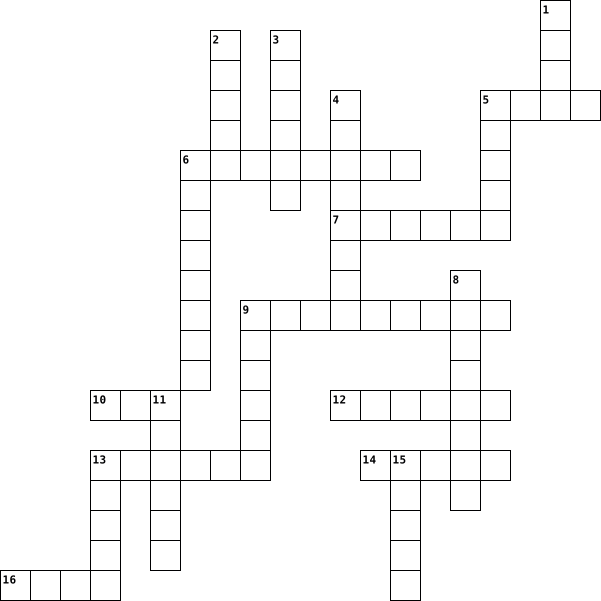
Across
- The "wood stick" that joins elements to make a compound.
- The ___________ table of elements.
- This element is "O" on the periodic table.
- This element is "Mg" on the periodic table.
- Molecules that will fill the container that it is put in.
- This element is "C" on the periodic table.
- This element is "Ag" on the periodic table.
- This compound is called "H20".
- This element is "Au" on the periodic table.
Down
- This element is "Fe" on the periodic table.
- This compound is made up of 3 oxygen molecules.
- Molecules that are not as densly packed and fit the container.
- This element is "H" on the periodic table.
- The fifth element.
- This element is "K" on the periodic table.
- This element is "N" on the periodic table.
- All living things are made up of ___________.
- This element is "S" on the periodic table.
- Tightly packed molecules that have a strong attraction.
- These are the smallest types of molecules.
20 Clues: The fifth element. • This compound is called "H20". • The ___________ table of elements. • This element is "H" on the periodic table. • This element is "K" on the periodic table. • This element is "O" on the periodic table. • This element is "N" on the periodic table. • This element is "S" on the periodic table. • This element is "C" on the periodic table. • ...
Chemistry crossword 1 2013-02-21

Across
- / the connection between atoms in a molecule (noun)
- / to make something become hot or warm, or to become hot or warm (verb)
- / a chemical reaction in which heat is absorbed (adjective)
- / to make clothes using wool and two long needles to join the wool into rows (verb)
- / a hard, black substance that is dug from under the ground and burnt as fuel (noun)
- / a dry substance made of many extremely small, loose grains (noun)
- / an iron object that makes pieces of iron or steel move towards it (noun)
- burner / a small device that burns gas to produce a flame which is used to heat things in scientific work and experiments (noun)
- / an atom or small group of atoms which has an electrical charge because it has added or lost one or more electrons (noun)
- / to make a liquid stronger or purer by heating it until it changes to a gas and then cooling it so that it changes back into a liquid (verb)
- / to cook something in hot oil or fat or to be cooked in hot oil or fat (verb)
- / a very small spot or a very small amount of something (noun)
Down
- / a substance that dissolves another to form a solution (noun)
- / to use fuel to produce heat or energy (verb)
- / to change from a solid into a liquid because of heat (verb)
- / a change which happens when two substances are put together (noun)
- / a substance that is a combination of two or more elements (noun)
- / to produce light (verb)
- / to become less hot, or to make something become less hot (verb)
- / a sticky sweet, made by boiling sugar and butter together (noun)
20 Clues: / to produce light (verb) • / to use fuel to produce heat or energy (verb) • / the connection between atoms in a molecule (noun) • / a chemical reaction in which heat is absorbed (adjective) • / to change from a solid into a liquid because of heat (verb) • / a substance that dissolves another to form a solution (noun) • ...
Organic Chemistry Quiz 2013-12-17

Across
- What type of compound has the condensed formula CH3CH(CH3)COCH3?
- The colour of bromine water after shaking with a liquid alkene for a few minutes.
- The systematic name for the alkane with a chain of nine carbon atoms.
- What is the systematic name for acetylene (C2H2)?
- In (E)-1,2-dibromopentene, on which side of the C=C bond do the bromine atoms lie?
- The name of the ring structure found in the penicillin family of antibiotics (4-6)?
- Common name given to the medicine derived from 2-hydroxybenzoic acid (salicylic acid).
- What is the name given to an equal mixture of two optical isomers?
- For what kind of series do successive members differ by CH2?
- The name given to the process whereby s and p orbitals of an atom combine to form new orbitals with a different spatial arrangement.
- What do we call the 109½° angle?
- The name given to the bonded atom pair found in aldehydes, ketone and carboxylic acids.
Down
- The name given to a type of alcohol where the hydroxyl group is attached to a carbon attached to two other carbon atoms.
- The name given to stereoisomers which are mirror images.
- What are the position-indicating numbers in a systematic name called?
- The systematic name for wood alcohol.
- The type of bond formed when the atomic orbitals of two atoms overlap axially (on the line of their centres)?
- What is the systematic name for diethyl ether (an anaesthetic)?
- The shorter name given to lysergic acid diethylamide.
- The type of isomerism shown by 1-chloropropane and 2-chloropropane.
- The organic product of the reaction between an acid chloride and an alcohol.
- Common name for propane-1,2,3-triol?
22 Clues: What do we call the 109½° angle? • Common name for propane-1,2,3-triol? • The systematic name for wood alcohol. • What is the systematic name for acetylene (C2H2)? • The shorter name given to lysergic acid diethylamide. • The name given to stereoisomers which are mirror images. • For what kind of series do successive members differ by CH2? • ...
Chemistry Unit Review 2014-03-09

Across
- A push or a pull that acts on an object.
- It takes the shape of the container, has a fixed volume and its particles slip and slide past each other.
- the tendency for objects to rise or float in a fluid.
- The property of thickness or thinness in a fluid; the resistance of fluid to flow.
- The strength with which the particles of an object or fluid attract each other.
- Anything that has mass and volume.
- From solid straight to gas.
- It takes the shape of the container, it doesn't have a fixed volume and its particles move freely and quickly.
- From gas to liquid.
- The amount of space applied over a given area on an object.
Down
- Any form of matter that can flow.
- the spacing of particles in material.
- From liquid to solid.
- It has a definite shape, fixed volume, its particles are tightly together and vibrating.
- From liquid to gas.
- The amount of space an object takes up.
- From gas straight to solid.
- The amount of water an object contains.
- Another property that can affect flow, since it refers to the attraction or joining of two different objects or fluids to each other.
- From solid to liquid.
20 Clues: From liquid to gas. • From gas to liquid. • From liquid to solid. • From solid to liquid. • From gas straight to solid. • From solid straight to gas. • Any form of matter that can flow. • Anything that has mass and volume. • the spacing of particles in material. • The amount of space an object takes up. • The amount of water an object contains. • ...
Crossword about Chemistry 2014-02-06

Across
- - dispersive phase
- - HCO3
- - CaSO
- - one of the most common types of chemical reactions / broken into smaller chemical species.
- - is from ALUMEN or ALUM
- - expressing large numbers into small numbers
- - concentration of solute per liter of solution
- - abbreviation of Titanium
- bonding - the attractive ford that exist between atoms and hold them together
- - smallest particle / atiomos
- - used to measure a any liquid in the lab
- - kalinum (latin name)
- - is used for jewelries and tableware
- - anything that has mass and occupies spaces
Down
- - H O
- - used in deep sea diving for balloons for low temperature research
- - is used in themometer and as de-worming powder
- - a tendency of an atoms in a molecule to attract electrons
- molecules are far apart to one another
- - when matter do not change its original composition
- - most central of Sciences
- - the attractive ford that exist between atoms and hold them together
- - a complete transfer of electron from one atom to another
- - open to new ideas
- - father of science
- - atom of the same elements with the same number of protons but differ in atomic mass
- - has no definite shape but it adopts the shape of the container
- - abbreviation of Osmium
- - it has mass, volume and shape
- - concentration of solute per kilogram of solution
30 Clues: - H O • - HCO3 • - CaSO • - dispersive phase • - open to new ideas • - father of science • - kalinum (latin name) • - is from ALUMEN or ALUM • - abbreviation of Osmium • - most central of Sciences • - abbreviation of Titanium • - smallest particle / atiomos • - it has mass, volume and shape • - is used for jewelries and tableware • molecules are far apart to one another • ...
Chemistry Fall Review 2013-12-09

Across
- Found on the periodic table and cannot be separated out to a more pure form.
- A group of elements with the same number of valence electrons, and similar characterics including reactivity.
- Family with 3 valence electrons.
- Type of physical property that does not depend on the amount of mass of a substance.
- Discovered the modern periodic table.
- An amount equal to 6.02 x 10^23.
- Type of mixture that cannot be easily separated such as Kool-aid, generally a solution.
- Family with an oxidation number of -3.
- Type of physical property that depends on the amount of mass of a substance.
- Good conductor of heat and electricity, malleable, shiny.
- Your current science class.
- Mass is neither created nor destroyed, it just changes forms. Basis for the chemical reaction--what goes in must come out (5 words).
- Has an atomic mass of 12.011.
- Many data points that are closely grouped together.
- Has the atomic symbol Na.
- Compressible, atoms move quickly and have a large amount of space between them--no fixed shape or volume.
- A physical property defined at mass/volume and has units of g/ml org/cm^2.
- Used gold foil experiment to determine that most of an atom's mass is in the nucleus.
- Establishes identity of the element.
- Conroe high school mascot.
- Has an atomic number of 17.
- An element that has lost or gained electrons.
Down
- Negative particle of an atom.
- A negative ion.
- Variations of an element with different numbers of neutrons.
- Vertical columns of elements on the periodic table.
- Most reactive family of elements (2 words).
- Type of mixture that can be easily separated such as chunky peanut butter, or stew.
- The densely packed middle of an atom.
- Dull, brittle, most are gases, poor conductors of heat and electricity.
- Change that results in new compounds.
- Hypothesized that electrons traveled in discrete orbits around the nucleus.
- The mass of one mole of an element and is equal to its atomic mass in grams (2 words).
- The combination of 2 or more substances that does not result in a chemical change.
- The result of a chemical reaction.
- The number of protons and neutrons in the nucleus (2 words).
- 2 or more molecules or elements chemically bound to each other and can only be changed by a chemical reaction.
- The number of protons in an element (2 words).
- Chemical family that does not react (2 words).
- Attaining the intended target.
- Has the atomic symbol Xe.
- Property that can be observed by the 5 senses.
- Published the first periodic table in which the elements are arranged by atomic.
- Not compressible, atoms are closely packed and only move slightly--has a fixed shape and volume.
- What goes into a chemical reaction.
- A positive ion.
- When 2 or more elements come together and bind chemically.
- Horizontal rows of elements on the periodic table.
- State in which we live.
- Slightly compressible, atoms slide past one another--no fixed shape, but does have a fixed volume.
50 Clues: A negative ion. • A positive ion. • State in which we live. • Has the atomic symbol Xe. • Has the atomic symbol Na. • Conroe high school mascot. • Your current science class. • Has an atomic number of 17. • Negative particle of an atom. • Has an atomic mass of 12.011. • Attaining the intended target. • Family with 3 valence electrons. • An amount equal to 6.02 x 10^23. • ...
Environmental Chemistry Crossword 2013-12-06

Across
- a substance with a low pH
- rain caused by chemicals going into clouds turning into rain.
- a mixture of plant compounds extracted from certain lichens
- component of an antioxidant enzyme that helps prevent decay of cell function
- stuff added to plants to make them grow faster
- crucial part of red blood cells that regulate oxygen transport
- is done by releasing powdered calcium carbonate from aircraft.
- fuel made from the remains of swamp vegetation.
- a disease caused by lice.
- a child hood disease associated with a low protein diet
- a disease resulting from a lack of vitamin C
- a major component of thyroid hormones which regulate metabolism
- a chemical used to control pests
- a place where many organisms have the same food source.
Down
- a substance that absorbs oxides
- a substance with a high pH
- German word that means strength
- research on acid precipitation
- concentration of DDT going up the food chain
- helps regulate nerve signals and muscle activity involved in protein formation required regulate the acid base balance.
- a swelling of the thyroid gland at the base of the neck
- latin word that means poison
- a chemical that changes colour to indicate whether a substance is an acid or base
- dichlorodiphenyltrichloroethane
24 Clues: a substance with a low pH • a disease caused by lice. • a substance with a high pH • latin word that means poison • research on acid precipitation • a substance that absorbs oxides • German word that means strength • dichlorodiphenyltrichloroethane • a chemical used to control pests • concentration of DDT going up the food chain • a disease resulting from a lack of vitamin C • ...
Organic Chemistry 2 2014-01-26

Across
- Popeye’s girlfriend is one, so is butter
- Water has one of these atoms
- Tiny ocean plants
- Edible energy
- Bearded table maker
- A way CO2 is released by animals
- structural plant fiber
- Sulfuric_______, dehydrates sugar
- Carbon based
- “Many _______” Polymer in scientist speak
- _________ Carbonate, of Shells and chalk
Down
- Number one on the charts
- Periodic square filler
- Monosaccharide found in fruit
- how leaves make sugars
- What’s up
- Lighting and beans can fix it
- _________fuels, blamed for climate change
- A gang of atoms
- C12H22O11
- Complex sugars often stored in root cellars and roots.
- What molecules are made of
- __________ monoxide...gasp
23 Clues: What’s up • C12H22O11 • Carbon based • Edible energy • A gang of atoms • Tiny ocean plants • Bearded table maker • Periodic square filler • how leaves make sugars • structural plant fiber • Number one on the charts • What molecules are made of • __________ monoxide...gasp • Water has one of these atoms • Monosaccharide found in fruit • Lighting and beans can fix it • ...