
civil war Crossword Puzzles
Civil war 2025-04-17

Across
- A plan that would divide the remainder of the Louisiana purchase into two territories Kansas and Nebraska.
- A relative of him responded strongly.
- The anti slavery novel written by Harriet Beecher Stowe.
- made it a crime to help runaway slaves and allowed officials to arrest those slaves in free areas.
- Began when him and his army took over the arsenal in Harpers Ferry.
- A federal outpost in charleston South Carolina.
- Developed a two part strategy.
- He first addressed the issue of Dred scott's citizenship.
- A graduate of the U.S Military Academy.
- ships heavily armored with iron.
- The idea that political power belongs to the people.
- favors the interest of one section or region.
Down
- Had a great deal of experience as Polk's secretary of state.
- formally withdrawing from the union.
- Had a little experience but he stood against the spread of slavery.
- Had hoped to be the commanding general of Mississippi's troops.
- A political party united against the spread of slavery in the west.
- A enslaved person who sued for his freedom.
- A document stating that neither slavery nor involuntary servitude shall ever exist.
- Had supported the idea of building a railroad to the pacific ocean.
- California was able to enter the union as a free state.
- was the first major battle of the civil war.
- A slaveholder but he opposed the Kansas Nebraska act in 1854.
- Which supported the Wilmot Proviso.
- Criticised pro slavery people in Kansas.
25 Clues: Developed a two part strategy. • ships heavily armored with iron. • Which supported the Wilmot Proviso. • formally withdrawing from the union. • A relative of him responded strongly. • A graduate of the U.S Military Academy. • Criticised pro slavery people in Kansas. • A enslaved person who sued for his freedom. • was the first major battle of the civil war. • ...
Civil War 2024-03-08

Across
- the states between the North and the South that were divided over whether to stay in the Union or join the Confederacy
- to free from slavery
- to give official approval to
- an order issued by President Lincoln on January 1, 1863, declaring enslaved people in the Confederate states to be free
- Union soldiers
- a continuous rise in the price of goods and services
- the right of an accused person to appear in court so a judge can determine whether he or she is being imprisoned lawfully
- armored naval vessel
- the selection of persons for required military service
- a piece of U.S. paper money first issued by the North during the Civil War
- war on all aspects of an enemy’s life
Down
- cut off an area by means of troops or warships to stop supplies or people from coming in or going out; to close off a country’s ports
- a speech by President Abraham Lincoln in 1863 at the site of the Battle of Gettysburg in memory of the Union soldiers who had died trying to protect the ideals of freedom upon which the nation was founded
- another name for the Confederate States of America, made up of the 11 states that seceded from the Union
- ship that sails into and out of a blockaded area
- a military person killed, wounded, or captured
- occupying a strong defensive position
- a war between opposing groups of citizens from the same country
- a village in Virginia that was the site of the Confederate surrender to Union forces under the command of General Ulysses S. Grant
- Confederate soldiers
20 Clues: Union soldiers • to free from slavery • armored naval vessel • Confederate soldiers • to give official approval to • occupying a strong defensive position • war on all aspects of an enemy’s life • a military person killed, wounded, or captured • ship that sails into and out of a blockaded area • a continuous rise in the price of goods and services • ...
Civil War 2024-04-11

Across
- main union general
- the main confederate general
- the states that stayed neutral in the war, they kept slaves but did not secede
- a battle that took place on the Mississippi river
- the act of sealing off a place to prevent people or goods from entering or leaving
- someone who fights to stop slavery
- the battle which led to a union win and gave them a base for the rest of the war
- the first official battle of the civil war
- the president at the time of the civil war
- a military strategy proposed by the union where they blocked off the entire south
- the bloodiest battle
- the southern states that seceded because they wanted to keep slavery
Down
- issued by lincoln, freed all slaves that were in seceded states
- regiment that led the assault on fort wagner
- the first engagement of ironclad warships
- when a states leaves the country
- the battle where the union stopped the confederacy from advancing to maryland
- the war fought between the Confederacy and the Union
- the northern side of the war that was against slavery
- where a battle takes place
- the union fort that was attacked by confederacy
21 Clues: main union general • the bloodiest battle • where a battle takes place • the main confederate general • when a states leaves the country • someone who fights to stop slavery • the first engagement of ironclad warships • the first official battle of the civil war • the president at the time of the civil war • regiment that led the assault on fort wagner • ...
Civil War 2024-04-04

Across
- The Union General who is known for his successful capture of Atlanta, Georgia.
- This battle proved to both the Union and Confederates that the Civil War would not be short.
- The bloodiest battle of the Civil War; also referred to as the "High Water Mark of The Rebellion".
- A Confederate general that had a great defense against the charges at Fredricksburg.
- The Confederate General who fleed the scene at Gettysburg.
- The first ironclad warship used by the Union Army.
- This Union general made two costly charges during Fredricksburg and the charges are known as "The Mud March".
- This battle left the Union with control over the Mississippi River and _______, Mississippi.
- The Civil War saw its end after Robert E. Lee's surrender here.
- A presidential proclamation that President Lincoln passed in hopes of ending slavery.
- The fort which held the battle that officially began the Civil War.
- Known for being the stone wall of the Confederate generals.
- This Union General is known for his impressive tactical commanding at the Battle of Vicksburg
- This historical city is known for the Confederate prison built there in 1864 which held a total of over 45,000 Union captive troops.
- This battle is said to be the deadliest one-day battle in history.
Down
- A Confederate General who was labeled a “scalawag” for telling Southern people to support the Republican Party.
- The one and only president for the Confederate States of America; wrote the two volume series about his time during war called "The Rise and Fall of The Confederate Government", published in 1881.
- The creek associated with the battles after the attack on Fort Sumter.
- A pronounced Senator of Oregon, famous for his exclamation at the battle of Ball's Bluff , “We will rally the people, the loyal people, of the whole country,”.
- Known for his appearance at Cedar Creek and his destruction of Shenandoah
- The ironclad warship used by the Confederate Army during the Civil War.
- This Union general was awarded the Medal of Honor for "conspicuous gallantry" for his bayonet charge at Gettysburg.
- This Confederate general went through Indian Removal as a Native American Cherokee.
- James Garfield gave the name "Rock of Chickmauga" to this Union General and has a statue of him in Washington D.C.
- The _______ Campaign was a battle that lasted about four months and led to the capture of _______, Georgia..
- This Union General's habit of delaying his attacks removed him of command of the Army of The Potomac.
- The President of the U.S. and Commander in Chief for the Union throughout the Civil War.
- This Union General led the Army of the Potomac following General Ambrose Burnside in 1863.
- A battle strategy formed by Union General Windfield Scott in the early Civil War.
- A Union Navy commander famous for his performance during the Battle of Mobile Bay in 1864.
- A Confederate General known for his famous charge during the third day of Gettysburg.
31 Clues: The first ironclad warship used by the Union Army. • The Confederate General who fleed the scene at Gettysburg. • Known for being the stone wall of the Confederate generals. • The Civil War saw its end after Robert E. Lee's surrender here. • This battle is said to be the deadliest one-day battle in history. • ...
Civil War 2024-04-17

Across
- In 1881 this man wrote a series called “The Rise and Fall of The Confederate Government” to tell about what happened during this time. He was also the only president for the Confederate States of America
- This battle started when the Confederate Army launched a surprise attack on the Union forces, which led the Confederates to not be able to hold their position and gave the Union to victory.
- The Union general led an inexperienced troop during the First Bull Run and he is known for his capture of Atlanta, Georgia
- McClellan In the November of 1863, this Union general was relived of command by president Abraham Lincoln
- The _____ Campaign was a battle that had a duration of about four months. Located in Georgia, this town got captured shortly after the campaign
- Proclamation President Lincoln passed this proclamation to hopefully end slavery, after Antientam
- Plan A war strategy made by the Union general Winfield Scott
- Fought in the small town of _____ in Pennsylvania, this three day bloody battle had many casualties and was called the war's turning point. Ending in a Union victory
- Awarded the Medal of Honor for his “daring heroism and great tenacity in holding his position on the Little Round Top against repeated assaults,” this Union general dogged many deaths, given how many wounded he had by the end of this war
- Sumter This place declared the start of The Civil war
- This Confederate general had amazing defense against the Union during the battle of Fredericksburg. He intercepted Union battle plans that helped the Confederate win
- Known for his exquisite sideburns, this union general helped in the battle of Fredericksburg where his forces failed their many attempts of defeating Lee’s defense, famously getting a bridge named after him, and he commanded a wing of the Army of the Potomac. His magnificent facial hair (called sideburns) got their modern name from his last name Burnside.
- Given his nickname as a “Stonewall” this Confederate General had many skillful tactics during the Civil War
- Leaving the Union with control over the Mississippi river and a town in Virginia, this battle made it difficult for either side to win, given its location so the Confederates surrendered
- This Confederate general served as Robert E. Lees second-in-command. After telling people to support the republican party, he got called “scalawag”
Down
- The only American Indian to have the rank of Brigadier General during the Civil War, the last Confederate General to surrender, and fought in numerous important battles. He engaged in Wilson Creek, Bird Creek, Pea Ridge, and Cabin Creek. He was a cavalry commander and raider around and in Indian territory.
- A Confederate general who was one of the most controversial leaders in the whole war. Famous for his charge during the third day of Gettysburg and his distinguished shoulder-length brown hair
- this battle got its name from a small creek running through the battlefield. Ended in a confederate victory.
- In 1861 was a brigadier general for the Union Army, commanding the division of the Army of the Potomac, understudying General George McClellan.
- The man known for his famous quote, “Da*m the torpedoes! Four bells, Captain Drayton, go ahead. Jouett, full speed.” Claiming victory at the battle of Mobile Bay in 1864, he led his ship through a swarm of torpedoes, while they took fire from the Confederate at shore.
- President of the United States, was commander in chief for the Union army. His main goal was to preserve the Union side throughout the Civil War.
- A famous Union general who had extraordinary tactical commands while in the Battle of Vicksburg, and he led the Union Armies to victory, over taking the confederacy in the Civil War
- The only sitting United States senator to ever die in combat, he was a pronounced Senator of Oregon, and famously died in the Battle of Ball's Bluff, with his famous quote “We will rally the people, the loyal people, of the whole country”
- The civil war ended after Robert E Lee. surrendered here
- During the short time this prison was up and running in the small town of _____ during the Civil war, approximately 45,000 Union soldiers were confined there. Most died from diseases, bad sanitation, overcrowding,or not having enough to eat.
- Commander for the Army of Northern Virginia, most successful of the Southern armies during this war, and a man who fled the scene at the Battle of Gettysburg
- A Civil War iron clade ship, first used by the Union Army
- This Union general goes by “the Rock of Chickamauga” given by James Garfield, has his own statue in Washington D.C. and first commanded a cavalry brigade in an attack of Virginia
- With the great horse Rienzi, this Union general rode into battle, saving the day. He got a poem written after him and he has a known name for his destruction at Shenandoah.
- A Civil War iron clade ship, that was used by the confederacy
- Known to be one of deadliest one-day battles in history. This showed that the Union could stand against the Confederate
31 Clues: Sumter This place declared the start of The Civil war • The civil war ended after Robert E Lee. surrendered here • A Civil War iron clade ship, first used by the Union Army • Plan A war strategy made by the Union general Winfield Scott • A Civil War iron clade ship, that was used by the confederacy • ...
Civil War 2021-09-02

Across
- Who was the confederate spy turned actress?
- Who did the south elect as their president
- what was the south afraid that Lincoln was going to abolish?
- What was the first state to secede in 1860?
- Who was the most vital general before Robert E. Lee. arrived?
- What battle was the one at which confederate general Albert Johnston?
- What did the union have more mileage of which let them easily transport goods?
- What was the name of Harriet Beecher Stowe's Groundbreaking novel?
- who was the core general of the North?
- which side of the war had a greater population
Down
- What was the name of Harriet Tubman’s network for rescuing slave
- Which Union general was later the democratic presidential nominee in 1864?
- What was Henry Haleck’s Nickname for his expertise in the military?
- Who is famous for saying “forget the torpedoes, full speed!”
- What did the Confederacy Elect Jefferson Davis as in 1861?
- Who won the battle of the bull run?
- Who was the assistant of Robert E. Lee, with the nickname from him, “Old Was Horse”?
- Which civil war nurse later founded the Red Cross?
- Was the Union general Stonewall Jackson beat at the First Battle of Bull Run?
- What was Harriet Tubman’s main activism purpose after the civil war, besides african american rights?
20 Clues: Who won the battle of the bull run? • who was the core general of the North? • Who did the south elect as their president • Who was the confederate spy turned actress? • What was the first state to secede in 1860? • which side of the war had a greater population • Which civil war nurse later founded the Red Cross? • ...
Civil War 2021-09-03

Across
- the southern states
- southern states which slavery was legal
- where battle is fought
- war between citizens
- control by majority of members
- an offensive against an enemy
- operation aimed at achieving a goal
- person who wanted to eliminate slavery
- troops trained to fight on horseback
- region north of mason-dixon line
Down
- freedom of choice
- states of being allied
- submit to there authority
- statement that is emphatic
- government with central and regional authorities
- person who is in an army
- successful ending in a contest
- being/joined into a single entity
- authorities direction to do something
- entry into an area
20 Clues: freedom of choice • entry into an area • the southern states • war between citizens • states of being allied • where battle is fought • person who is in an army • submit to there authority • statement that is emphatic • an offensive against an enemy • control by majority of members • successful ending in a contest • region north of mason-dixon line • being/joined into a single entity • ...
Civil war 2022-01-11

Across
- Over 23,000 casualties
- did not want slaves
- surrenders to Grant. All of Mississippi River is now in Union control
- Union solders wore ___ uniforms in the Civil War.
- Confederate solders wore ___ uniforms in the Civil War
- enters Washington D.C. in disguise because of unrest
- American Confederate general best known for his service
- 2nd battle(same as first place)
- where it ended
- allowed Union troops to penetrate the Confederate interior.
- Commanded the Union army
- At least 620,000 lost
- cavalry commander in the American Civil War and the American Indian Wars
- Southern army name
- the place they fought
- divide between the North and the South
- first important victory for the Union
- How long was this going on for
Down
- Over 165,000 soldiers participate in the largest battle in the Western Hemisphere.
- wife of President Abraham Lincoln
- first state to secede from the union
- plan for an independent nation
- 1.9 million out of 4.7 million votes cast
- Gun used in the Civil War
- freedom for more than four million
- given command of all Union troops
- what month is started in
- The Civil War was the first ___ war.
- 16th President
- 1st battle
- The Fourteenth Amendment (1868) granted
- to stop trade
- He is a stonewall
- 1st water battle
- the 13th Amendment to the Constitution
- American abolitionist and political activist. Born into slavery
- refusing to see his troops suffer any further
- wanted slaves
- when was the gettysburg address spoken
- Northern army name
40 Clues: 1st battle • to stop trade • wanted slaves • 16th President • where it ended • 1st water battle • He is a stonewall • Southern army name • Northern army name • did not want slaves • At least 620,000 lost • the place they fought • Over 23,000 casualties • what month is started in • Commanded the Union army • Gun used in the Civil War • plan for an independent nation • How long was this going on for • ...
civil war 2022-10-26

Across
- a certificate of manumission issued to freed slaves
- a clause exempting certain classes of people or things from the requirements of a piece of legislation affecting their previous rights
- a thing that has been rebuilt after being damaged or destroyed.
- restrictive laws designed to limit the freedom of African Americans and ensure their availability as a cheap labor force after slavery was abolished during the Civil War.
- combine (one thing) with another so that they become a whole.
- Lead the underground railroad
- is an American white supremacist, right-wing terrorist
- the act of seizing for public use or of impressing into public service.
- a person who behaves badly but in an amusingly mischievous rather than harmful way
- a crop produced for its commercial value rather than for use by the grower.
- Occurred due to blacks being enslaved
Down
- the systematic separation of people into racial or other ethnic groups in daily life.
- a political candidate who seeks election in an area where they have no local connections.
- the state of being deprived of a right or privilege, especially the right to vote.
- goods that have been imported or exported illegally.
- a formerly enslaved person who has been released from slavery
- a tax levied on every adult, without reference to income or resources.
- giving a part of each crop as rent.
- ends the legal authority that a parent has over a child who is under 18.
- restrictive laws designed to limit the freedom of African Americans and ensure their availability as a cheap labor force
20 Clues: Lead the underground railroad • giving a part of each crop as rent. • Occurred due to blacks being enslaved • a certificate of manumission issued to freed slaves • goods that have been imported or exported illegally. • is an American white supremacist, right-wing terrorist • a formerly enslaved person who has been released from slavery • ...
Civil War 2022-05-06

Across
- the south was fighting to keep ______
- Sherman's plan that required troops to destroy all southern property that they came across
- the proclamation given by Lincoln that freed the slaves in the Southern states
- the law that protected people from unfair arrest and imprisonment without trial, the one that Lincoln constantly ignored during war
- the general nicknamed Unconditional Surrender ____
- this killed more soldiers during war than the guns
- Lee's great mistake at Gettysburg
- deadliest battle in America
- more soldiers, the navy, more money, manufacturing, etc. were advantages of the ______
- Lee ______ at Appomattox Courthouse
Down
- the battle in which Grant laid siege for 45 days
- both the Monitor and the Merrimack were this kind of ship
- deadliest day of battle in America
- Lincoln called the Emancipation proclamation a ________
- the president of the confederacy, who was arrested for treason but not put on trial
- the first all black Massachusetts regiment
- the amendment that freed the slaves in the South
- his election was the final push to start the war
- better leaders, more morale, didn't have to win, etc. were advantages of the _______
- The plan devised by the north to kill the south's economy
- where the first shots of the Civil war happened
- the South had better ____
- second turning point of the war
- John Wilkes Booth ________ Lincoln
- the association founded by Clara Barton during the war
- countries of this continent no longer wanted to engage in the war after it was made about slavery
26 Clues: the South had better ____ • deadliest battle in America • second turning point of the war • Lee's great mistake at Gettysburg • deadliest day of battle in America • John Wilkes Booth ________ Lincoln • Lee ______ at Appomattox Courthouse • the south was fighting to keep ______ • the first all black Massachusetts regiment • where the first shots of the Civil war happened • ...
Civil War 2022-11-30

Across
- related operations aimed at achieving a particular goal
- the southern states that seceded from the United States in 1861
- a war measure isolating an area of importance to the enemy
- of or having to do with the southern Confederacy during the American Civil War
- a member of the Union Army or Confederate army during the American Civil War
- bringing death
- the region of the United States lying to the north of the Mason-Dixon line
- the state of being allied
- troops trained to fight on horseback
- a fortified military post where troops are stationed
- freedom of choice
Down
- Civil War War between south and north
- an offensive against an enemy
- Run away from
- civilians trained as soldiers, not part of the regular army
- a statement that is emphatic and explicit
- withdraw from an organization or polity
- region where a battle is being (or has been) fought
- the United States
- having an arsenal or guns
- the orientation of those who favor government by the people
- oppose, as in hostility or a competition
22 Clues: Run away from • bringing death • the United States • freedom of choice • having an arsenal or guns • the state of being allied • an offensive against an enemy • troops trained to fight on horseback • Civil War War between south and north • withdraw from an organization or polity • oppose, as in hostility or a competition • a statement that is emphatic and explicit • ...
Civil War 2022-11-29

Across
- Bloodiest Battle
- President that campaigned under Westward Expansion
- First battle
- Led the Confederate Army
- US won and acquired NM and CA
- amendment ended slavery.
- name of the Union plan to defeat the Confederates.
- belief it was their divine right to own everything from the East Coast to the West Coast
- CW begins
- North took MS River
- Burned ATL to the ground
- residents would vote to determine the slave/free status of their state
Down
- Bloodiest single day battle
- where lee surrendered to Grant. Ending the CW.
- First conflict fought between pro vs. anti slavery people.
- president of the CSA
- right to trial
- CW ends
- Lee surrendered to him
- Sherman led Union on a path of destruction from the Carolinas to Savannah,GA.
20 Clues: CW ends • CW begins • First battle • right to trial • Bloodiest Battle • North took MS River • president of the CSA • Lee surrendered to him • Led the Confederate Army • amendment ended slavery. • Burned ATL to the ground • Bloodiest single day battle • US won and acquired NM and CA • where lee surrendered to Grant. Ending the CW. • President that campaigned under Westward Expansion • ...
Civil War 2022-09-16

Across
- union general who was fired after he wouldn't attack
- compromise in 1820 that added two new states
- president during civil war
- reason California was added to the union so quickly
- last name of the writer of Uncle Tom's cabin
- Union general who led the army at the end of the war
- state which contained the capital of the Confederacy
- the union's first ironclad ship
- slave who sued for his freedom
- time after the Civil war in which southern states were brought back into the union
- Major battle in SE Pennsylvania
Down
- president of the confederate states of america
- Battle site meaning "place of peace"
- major crop of the southern states
- man responsible for raiding the federal arsenal at Harper's Ferry, VA
- first major battle of the war just outside Washington DC
- confederate who led an ill-fated charge at Gettysburg
- name for the southern states who seceded
- _ kansas; period of violence between pro and anti slavery factions
- head of Confederate army
- last name of the man who shot and killed the president
21 Clues: head of Confederate army • president during civil war • slave who sued for his freedom • the union's first ironclad ship • Major battle in SE Pennsylvania • major crop of the southern states • Battle site meaning "place of peace" • name for the southern states who seceded • compromise in 1820 that added two new states • last name of the writer of Uncle Tom's cabin • ...
Civil War 2025-10-24

Across
- States The four slave states (Delaware, Maryland, Kentucky, and Missouri) that remained in the Union during the Civil War.
- of 1850 Five separate bills that admitted California as a free state, created Utah and New Mexico territories with popular sovereignty, and included the Fugitive Slave Act.
- Proviso A proposal by Representative David Wilmot of Pennsylvania in 1846 to completely ban slavery in any new territories acquired from Mexico.
- Rights The political principle that individual states should have significant power and authority, often used to defend slavery.
- Turner’s Rebellion A violent uprising of slaves in Virginia being led by Nat Turner. This led to an increase in tensions and fear surrounding the issue of slavery.
- Slave Act A law requiring law enforcement throughout the US to arrest runaway slaves and return them to their owners, with harsh penalties for those who refused to help.
- Law The temporary rule by military authorities over civilian populations, used by Lincoln in Maryland to keep it in the Union.
- The growing division and loyalty to one's own region (North or South) rather than to the nation as a whole.
- Railroad An organized network of individuals who helped hide and move runaway slaves north to freedom in Canada.
- Debates (1858) A series of public debates between Abraham Lincoln and Stephen Douglas during the Illinois Senate race, focused on the slavery issue.
Down
- A person who advocated for the immediate end of slavery throughout the United States.
- Kansas" The period of violent conflict between pro-slavery and anti-slavery settlers in Kansas Territory during the 1850s.
- States of America The independent nation declared by the secessionist Southern states in February 1861, with Jefferson Davis as president.
- Soil Party A political party formed in 1848 by anti-slavery Whigs and Democrats who opposed expanding slavery to western territories.
- Act (1854) Legislation that created Kansas and Nebraska territories and repealed the Missouri Compromise, allowing popular sovereignty on slavery.
- The act of formally withdrawing from the Union, first done by South Carolina on December 20, 1860.
- Brown's Raid An 1859 attack on the federal armory at Harpers Ferry, Virginia, led by abolitionist John Brown in an attempt to start a slave rebellion.
- Compromise An agreement that admitted Missouri as a slave state and Maine as a free state, while banning slavery in future states north of Missouri's southern border.
- Sumter The federal fort in Charleston Harbor where the Civil War officially began when Confederate forces bombarded it in April 1861.
- Scott Decision (1857) A Supreme Court ruling that declared African Americans were not US citizens and could not sue in federal courts, and that Congress could not ban slavery in territories.
20 Clues: A person who advocated for the immediate end of slavery throughout the United States. • The act of formally withdrawing from the Union, first done by South Carolina on December 20, 1860. • The growing division and loyalty to one's own region (North or South) rather than to the nation as a whole. • ...
Civil war 2025-05-13

Across
- Actor who assasinated Abraham Lincoln
- Battle between ironclad ships
- Union prison camp in illinois
- Name for southern sympathizers in the North
- Role of women during the civil war
- Union general played a role in the capture of atlanta
- Confederate ship that attacked union merchant vessels
- Movement to end slavery in the united states
- Civil wars impact on native americans
- Nickname for the southern economy economy during the war
- Location where Lincoln was assasinated
- Civil wars effect on industrialization in the North
- Union general criticized for his cautiousness in battle
- Commanded the Army of Northern virginia
- organization to oppose reconstruction and african american rights
- Civil wars lasting legacy on American society
- Location of the confederate surrender
- Union capital throughout the civil war
- General who replaced McClellan after antietam
- Encouraged African Americans to join the union army
- Nickname for confederate soldiers
- Nickname for union soldiers
- Union admiral who captured new orleans
- requiring escaped slaves to return to their owners
- Term for southern democrats regaining political power after reconstruction
- Strategy to blockaded southern ports and control Mississipi river
- union victory that helped secure Lincolns re-election 1864
- First shots of the civil war were fired
- Confederate prison camp infamous for its harsh conditions
- Confederate spy who provided valuable intelligance
Down
- allowed the conscription of men into the Union army
- Amendment that abolished slavery in the united states
- Battle fought in pennsylvania
- laws to restrict african american rights
- Gave the union control of the Mississippi river
- Later became 18th president of the united states
- Abolitionist who led a raid on harpers ferry
- Focused on defending territory and seeking foreign support
- Main issue that divided the North and South
- Impact of the civil war on federal authority
- Term for mandatory military service during the war
- amendment that granted African American men the right to vote.
- Routes to help enslaved people escape to freedom
- Civil war focused on rebuilding the south
- First state to secede from the union
- General who earned his nickname at bull run
- Speech lincoln gave to honor fallen soldiers
- Created to assist freed slaves and poor whites
- The nurse who who founded the American red cross
- Book that exposed the horrors of slavery
- amendment granted citizenship to all persons born in the U.S
- Union ship that defeated the Alabama
- President of the confederate states of America
- Man supreme court case denied African Americans citizenship
- Economic condition of the south after war
- Known for high casualties and union victory in Tenessee
- Confederate cavalry commander known for his daring raids
- president of the United states during the civil war
- known for his bravery and nicknamed "Stonewall
- States that stayed in union but allowed slavery
60 Clues: Nickname for union soldiers • Battle fought in pennsylvania • Battle between ironclad ships • Union prison camp in illinois • Nickname for confederate soldiers • Role of women during the civil war • First state to secede from the union • Union ship that defeated the Alabama • Actor who assasinated Abraham Lincoln • Civil wars impact on native americans • ...
Civil War 2026-02-11

Across
- The first major Battle of the Civil War, in which the Confederates left with an overwhelming victory over General Irwin McDowell and the Union.
- A Union steam frigate that was destroyed in Norfolk, Virginia, to prevent its capture. The Confederacy rebuilt it, renaming it the CSS Virginia.
- A Union General during the war, this person became known as 'The Rock of Chickamauga'. He never lost a battle and led troops in battles in Chickamauga and Nashville.
- American politician and lawyer, this person served in Congress for Illinois and later Oregon until he was killed in the Battle of Ball's Bluff while leading a Union army regiment, becoming the first and only sitting US senator to be killed in a military engagement
- The only Native American to achieve the rank of general during the Civil War. He was a part of the Cherokee Nation, and was the last Confederate General to surrender.
- A Confederate General during the Civil War, this general is known primarily by his nickname after his courageous leadership in the Battle of Bull Run.
- Union General who famously defeated Jubal Early's troops multiple times. He is heavily criticized for his tactics in 'The Burning' in which he burned down 400 miles of Confederate barns, mills, factories, and railroads.
- The place where General Robert E. Lee of the Confederacy surrendered to Union General Ulysses S. Grant, beginning the end of the American Civil War.
- A prominent Union General, this person led Union forces in the Peninsula Campaign. He was perceived at being to cautious and unwilling to attack and lose men in any fight he was not 100% sure of winning.
- The 16th President of the United States, he led the US through the American Civil War, defeating the Confederate States and helping to abolish slavery
- Issued by Abraham Lincoln, this declaration made slavery fully illegal in the Union and Confederacy, giving them all freedom, and the option to join the Union Army.
- A Confederate Cavalry General, known for his bold scouting and daring attacks, he was nicknamed 'the eyes and ears of the Confederate Army', although he is often blamed for the Confederate loss at Gettysburg.
- This Battle began with a Confederate surprise attack, which was later annihilated by Union reinforcements, ending in a costly victory for the Union and General Grant's forces, in the process killing a high ranking Confederate General, giving the Union a critical advance into the Confederacy.
- A notorious Confederate Prison, famous for holding tens of thousands of Union Soldiers, many of which died from disease, starvation, and overcrowding. The prison commander was tried and hanged for war crimes.
Down
- The leader of the Union Army at the end of the war, leading them to a victory over the confederates. He became known as the most successful general of the war, and later became US president.
- Another Union General known for his absurd facial hair and his defeats in the Battle of Crater and Fredericksburg, being known as being a failed general.
- A Confederate General, this person is famous for his roles in the Battle of Antietam and Chickamauga, but is also known for criticizing Confederate tactics at the Battle of Gettysburg
- A Union General, this person became famous for leading a heroic bayonet charge at the Battle of Gettysburg which awarded him the Medal of Honor. He later became the governor of Maine.
- The place of the opening engagement of the Civil War, where Confederates bombarded and captured the military location located in Charleston, South Carolina.
- A Union General, famous for his victory in the Battle of Williamsburg where he received the nickname 'Fighting Joe'. He was defeated by Robert E. Lee at the Battle of Chancellorsville
- A Union Admiral, this person is famous for capturing New Orleans and Mobile Bay. They became the first full Admiral in US Navy history.
- A major city which was captured by Union General Sherman, capturing a vital Confederate railway, and was led in the Battles of Peachtree Creek and Jonesboro.
- This person was a union General who famously ld troops in the Battle of Bull Run, Vicksburg, Shiloh, and famously led the great March to the Sea from Atlanta to Savannah.
- Confederate General and leader during the Civil War. He is famously known as the most famous, successful, and influencial Confederate General of the Civil War.
- Another Confederate General, who most famously led a massive bayonet charge which failed horribly during the Battle of Gettysburg.
- The first major battle on Union soil, this battle took part between Confederate General Robert E. Lee and Union General George McClellan. It remains the single bloodiest day in American history. While the Union had more casualties, they ultimately won, making this battle a major turning point in the war.
- This Battle in Pennsylvania is widely considered the turning point in the Civil War, with a major Union victory, ending the Confederate invasion of the North, and a major blow to the Confederacy whilst boosting Union morale.
- The Union navy's first ironclad warship, famous for its revolutionary revolving turret. It famously fought the CSS Virginia at the Battle of Hampton Roads.
- The first and only president of the Confederate States of America, leading the confederates in the American Civil War
- A Union strategy designed to strangle the Confederacy, splitting it in two at the Mississippi River with a major naval blockade.
- This Battle was won by the Union, securing the Mississippi River, splitting the Confederacy in two, and blocking off Confederate supplies and reinforcements.
31 Clues: The first and only president of the Confederate States of America, leading the confederates in the American Civil War • A Union strategy designed to strangle the Confederacy, splitting it in two at the Mississippi River with a major naval blockade. • ...
Civil War 2025-10-01

Across
- Blocking off ports
- States that left the US during the war
- Give up
- In the constitution
- Civil_
- Who fought in battle
- Cotton fields
- President during the war
Down
- Problem between sides
- Rebuilding
- Soldiers who fight on foot
- Fight between opposing sides
- States in the US during the war
- Withdrawing from a Union
- Was legal in the South
- Get rid of
- Recruiting soldiers
- 5 dollar bill
- Things given to you by law
- Guns used in war
20 Clues: Civil_ • Give up • Rebuilding • Get rid of • 5 dollar bill • Cotton fields • Guns used in war • Blocking off ports • In the constitution • Recruiting soldiers • Who fought in battle • Problem between sides • Was legal in the South • Withdrawing from a Union • President during the war • Soldiers who fight on foot • Things given to you by law • Fight between opposing sides • ...
Civil War 2026-01-12

Across
- – A large weapon used in battles.
- – A person who cares for sick or injured soldiers.
- – A person who fights in an army.
- – The right to live without being owned or controlled.
- – A group of soldiers.
- – A time without war.
- – The side that fought to keep the United States united.
- – A fight between two armies.
- A war fought between people from the same country.
- – A fight between countries or groups.
- – A strong building used for protection in war.
- – To choose a leader or decision.Uniform – Special clothing worn by soldiers.
- – The act of setting enslaved people free.
- – A gun used by soldiers during the Civil War.
Down
- – The U.S. president during the Civil War.
- – A leader of an army.
- – The southern states that wanted to break away.
- – A system where people were owned and forced to work.
- – When soldiers walk together in lines.
- – A message sent to family from soldiers at war.
- – A person who wanted to end slavery.
- – The side that fought to form its own country.
- – The leader of the United States.
- – Small amounts of food given to soldiers.
- – A place where soldiers lived during the war.
- – The northern states that wanted the country to stay together.
- – A symbol used to represent a country or group.
27 Clues: – A time without war. • – A leader of an army. • – A group of soldiers. • – A fight between two armies. • – A large weapon used in battles. • – A person who fights in an army. • – The leader of the United States. • – A person who wanted to end slavery. • – A fight between countries or groups. • – When soldiers walk together in lines. • – The U.S. president during the Civil War. • ...
Civil War 2026-03-20

Across
- all the people who are born around the same time
- a way to get from one place to another
- to gather or collect crops at the end of a season
- another name for the United States
- to agree to stop fighting because you know you won't win
- to move forward
- an unsettled area or an area where people do not live
- things that are wrong and that make people suffer
- having the power to make your own decisions and to do what you want
- moved away or moved back where you came from
- collect information about an enemy, often while in enemy territory
Down
- leader in an army
- areas of land
- helps people with matters that deal with the law
- the city where a state or country's government meets
- a fight between two armies or navies
- talk about expressed different opinions or points of view about something
- act of entering a place by force
- materials or things that people need to survive
- buildings where people use machines to make large number of goods to sell
- practice of owning people and forcing them to work often without pay
- to stay alive
- Harriet Tubman ran away from her owners
23 Clues: areas of land • to stay alive • to move forward • leader in an army • act of entering a place by force • another name for the United States • a fight between two armies or navies • a way to get from one place to another • Harriet Tubman ran away from her owners • moved away or moved back where you came from • materials or things that people need to survive • ...
Civil war 2026-04-29

Across
- to-leave
- Organized-medicines-and-supplies-and-delivers-it-to-the-battle
- when-lee-surrendered-to-grant
- forced- military-service
- replaced-McClellan-as-the-head-of-the-Potomac
- cut-of-Lee's-escape-to-North-Carolina
- The-president-during-the-civil-war
- unit-of-free-African-Americans
- people-that-sympathize-with-the-south-but-live-in-the-north
- Three-large-units-marched-to-attack-the-union's-center
- people-against-slavery
- where-Lee-surrendered-to-Grant
Down
- freed-slaves-in-the-confederate-states
- states-that-have-slavery-but-are-still-in-the-union
- the-president-of-the-Confederacy
- A-series-of-attacks-to-capture-Richmond
- a-speech-said-by-Lincoln-about-the-battle-of-Gettysburg
- heart-of-the-civil-war
- freeing-of-slaves
- Protection-against-unlawful-imprisonment
20 Clues: to-leave • freeing-of-slaves • heart-of-the-civil-war • people-against-slavery • forced- military-service • when-lee-surrendered-to-grant • unit-of-free-African-Americans • where-Lee-surrendered-to-Grant • the-president-of-the-Confederacy • The-president-during-the-civil-war • cut-of-Lee's-escape-to-North-Carolina • freed-slaves-in-the-confederate-states • ...
Civil War 2026-04-30

Across
- The United States; the Northern states.
- Slave states ( Delaware, Maryland, Kentucky, Missouri) that did not secede from the Union.
- The formal withdrawal of southern states from the Union.
- Escaped slaves, or those siezedby the Union army, who were considered confiscated wartime property.
- A 1863 order by president Lincoln freeing slaves in Confederate-held territory.
- A northerner who opposed the war and supported the South
- A set of artillery cannons
Down
- soldiers trained to fight on foot.
- The period after the war when the nation was rebuilding and reuniting
- Slang for surgeon.
- soldiers who fought on horseback
- Small, waist-high barriers built to protect soldiers from fire.
- A sewing kit used by soldiers.
- A two-wheeled carriage holding ammunition.
- The period before the Civil War.
- Placing the interest of one's own regions ahead of the nation as a whole.
- A soldier who was killed,would, captured, or missing.
- A person who supported the immediate end of slavery.
- soldiers stationed in small groups ahead of the main army to warn of enemy approach.
- A honerary promotion in rank, usually for merit.often without pay.
20 Clues: Slang for surgeon. • A set of artillery cannons • A sewing kit used by soldiers. • soldiers who fought on horseback • The period before the Civil War. • soldiers trained to fight on foot. • The United States; the Northern states. • A two-wheeled carriage holding ammunition. • A person who supported the immediate end of slavery. • ...
Civil War 2026-05-06

Across
- Union general known for total war
- Long trench warfare campaign
- Union victory gaining Mississippi control
- First major land battle, Union defeat
- Site of Lee's surrender
- Famous African American regiment
- Notorious Confederate prison camp
- Lincoln's speech on national purpose
- Northern states remaining in the US
- Confederate commanding general
- Forced military service, draft riots
- Confederate general killed by friendly fire
- Freed slaves in Confederate states
- First battle between ironclad ships
- Turning point, halted Lee's invasion
- Destroying resources to weaken the enemy
Down
- Union commanding general
- Southern states seceding from the Union
- Northern Democrats opposing the war
- Violent opposition to the draft in NYC
- Surprise Confederate attack in Tennessee
- Amendment outlawing slavery
- Nurse who founded the Red Cross
- Armored warships like Monitor and Merrimack
- Confederate victory, Stonewall Jackson wounded
- First battle of the Civil War
- Lincoln's wartime re-election
- Bloodiest single day of the war
- Sherman's destructive campaign through Georgia
- Union strategy to blockade the South
30 Clues: Site of Lee's surrender • Union commanding general • Amendment outlawing slavery • Long trench warfare campaign • First battle of the Civil War • Lincoln's wartime re-election • Confederate commanding general • Nurse who founded the Red Cross • Bloodiest single day of the war • Famous African American regiment • Union general known for total war • Notorious Confederate prison camp • ...
Civil War 2026-05-13

Across
- Midwesterners that sympathized with the South
- destroying civilian and economic resources
- Slave states that did not join the Confederacy
- Commanded the Confederate army
- Battle that fully turned the tide of war against the Confederacy
- Order to free slaves in Confederate states
- Confederate general who died at Chancellorsville
- Ships heavily armored with iron
Down
- The freeing of slaves
- Union general very successful in the west
- First major battle
- Constitutional protection against unlawful imprisonment
- Escaped slaves
- Union general who assembled the Army of the Potomac
- Bloodiest day in US history
- Where Lee surrendered to Grant
- Idea that Great Britain would support the Confederacy
- Lincoln's speech praising Union soldier's sacrifices
- Where the Civil War began
- Battle that gave Union control of Mississippi River valley
20 Clues: Escaped slaves • First major battle • The freeing of slaves • Where the Civil War began • Bloodiest day in US history • Commanded the Confederate army • Where Lee surrendered to Grant • Ships heavily armored with iron • Union general very successful in the west • destroying civilian and economic resources • Order to free slaves in Confederate states • ...
Civil War 2026-05-01

Across
- The effort by the North to keep ships from entering or leaving Southern ports
- Withdrawal from the Federal government of the United States
- To formally approve or sanction
- A Northerner; someone loyal to the Federal government of the United States
- Escaped slaves who fled to the Union lines for protection
- the states that seceded from the United States of America to form their own nation
- Sovereignty This doctrine was stuck out during the debate over slavery in the territories
- Manufacturing goods from raw materials
- line a symbolic division between free states and slave states
Down
- Troops, like the National Guard, who are only called out to defend the land in an emergency
- Someone who wishes to abolish or get rid of slavery
- Party A political party created in the 1850s to prevent the spread of slavery to the territories
- States The states of Maryland, Delaware, Kentucky, and Missouri
- Crop A crop such as tobacco or cotton which was grown to be sold for cash
- Party The major political party in America willing to let slavery spread
- Freedom from slavery
- A branch of the military using ships to conduct warfare
- Loyal to the government of the United States
- To lie in wait for an unexpected attack
- Party A political party generally against slavery and its expansion into the territories
20 Clues: Freedom from slavery • To formally approve or sanction • Manufacturing goods from raw materials • To lie in wait for an unexpected attack • Loyal to the government of the United States • Someone who wishes to abolish or get rid of slavery • A branch of the military using ships to conduct warfare • Escaped slaves who fled to the Union lines for protection • ...
Civil War 2026-05-07

Across
- A war within its own country
- The term used for new soldiers
- The surgical procedure to cut off someone's limbs
- The soldier standing guard
- The president who freed the slaves
- A wagon that carried injured soldiers
- A place where weapons are stored
- An unexpected attck
- The Southern States
- A branch of military mounted on horses
- The blade that went on the front of a soldier's gun
Down
- The lowest rank in the military
- Sailer who carries explosives
- The Northern States
- African American who was in forced labor
- The new bullet that was used in the war
- To give up or admit defeat
- A soldier who was wounded, killed, or missing in action
- A branch in the military that was on the water
- Someone loyal to the Union or North
20 Clues: The Northern States • An unexpected attck • The Southern States • To give up or admit defeat • The soldier standing guard • A war within its own country • Sailer who carries explosives • The term used for new soldiers • The lowest rank in the military • A place where weapons are stored • The president who freed the slaves • Someone loyal to the Union or North • ...
American History 2026-02-11

Across
- Nicknamed the Sultan of Swat
- “Father of the Constitution” James ___
- Civil War president
- The ship that brought the Pilgrims
- Native American tribe a U.S. helicopter was named after
- Iconic cracked symbol of American independence
- Infamously worst American-made car
- The Great Depression president
Down
- First permanent English settlement
- Trail traveled by pioneers heading west
- Nickname of the SR-71 reconnaissance aircraft
- Name of Thomas Jefferson’s Virginia estate
- Harbor attacked on Dec. 7, 1941
- Site of Lincoln’s famous Civil War address
- What steak sauce was created during the Civil War in 1862?
- Known as the “Forgotten War”
- First President of the United States
- Explorer who reached the Pacific in 1805
18 Clues: Civil War president • Nicknamed the Sultan of Swat • Known as the “Forgotten War” • The Great Depression president • Harbor attacked on Dec. 7, 1941 • First permanent English settlement • The ship that brought the Pilgrims • Infamously worst American-made car • First President of the United States • “Father of the Constitution” James ___ • ...
CW Homefront 2022-05-06

Across
- this act passed during the Civil War provided land for new universities
- occupation first made available to women during the Civil War
- this act passed during the Civil War gave free land to any citizen
- a legal principle that prevents holding persons without trial
- term that means freeing of slaves
- President of the CSA
- term that described escaped slaves that made it to Union lines
- northern democrats who opposed the war and wanted peace
Down
- forcing people into the army
- An all black regiment from this state proved the effectiveness of black soldiers in the Civil War
- city in which there was a large anti-draft riot in 1863
- the main cause of death of Civil War soldiers
- President of the USA
- this term, meaning a rise in the price of everything, was experienced by both sides as they struggled to pay for the war
14 Clues: President of the USA • President of the CSA • forcing people into the army • term that means freeing of slaves • the main cause of death of Civil War soldiers • city in which there was a large anti-draft riot in 1863 • northern democrats who opposed the war and wanted peace • occupation first made available to women during the Civil War • ...
ABC BOOK CROSSWORD 2023-04-11

Across
- A human being being owned by another
- Type of Aaea used for battles
- Term used to describe the other side
- Loyal to the Confederate States
- A military specialization
- Battle of a city
- Public Speaker
- An animal used in the Civil War
- Officers equipment
- A Confederate general
- Being there for anyone
- A Charge
- The Civil War currency
Down
- Electing someone
- Land in America
- Agreement
- Type of weapon
- Type of hand held gun
- A state
- An act in the Civil War on states
- US Military Academy
- US Army Corps
- A plant used for medicine
- French Infantry unit
- Led by Lincoln
- The 17th President
26 Clues: A state • A Charge • Agreement • US Army Corps • Type of weapon • Public Speaker • Led by Lincoln • Land in America • Electing someone • Battle of a city • Officers equipment • The 17th President • US Military Academy • French Infantry unit • Type of hand held gun • A Confederate general • Being there for anyone • The Civil War currency • A military specialization • A plant used for medicine • ...
Civil War Uniforms: Facts and Stats 2015-04-26

Across
- type of gun used by a Civil War soldier
- supported by a belt and cross belt
- type of hat worn by a Civil War soldier
- used to carry water
- number of rounds a cartridge box can hold
- material a Civil War soldier's coat was made of
Down
- a well trained soldier could fire this many shots in a minute
- used to fire a civil war gun
- material a Civil War soldier's shoes were made of
- used to carry rations and other items
- could be attached to end of gun to allow for close combat
- cost, in dollars, to equip a Civil War soldier (in 1861)
12 Clues: used to carry water • used to fire a civil war gun • supported by a belt and cross belt • used to carry rations and other items • type of gun used by a Civil War soldier • type of hat worn by a Civil War soldier • number of rounds a cartridge box can hold • material a Civil War soldier's coat was made of • material a Civil War soldier's shoes were made of • ...
civil war crossword puzzle 2023-02-21

Across
- nickname of battle of mannassass
- boats designed to get past blockades
- main union general
- 620,000 _______ in the cival war
- how the south made money
- preventing goods from entering or leaving
- president of the confederate
- used by sherman in his march through through the south
- main confederate general
- deadliest battle
Down
- president of the union
- how the north made money
- loser of the cival war
- the first battle of the civil war
- winner of the civil war
- the court house where the cival war "ended"
- skin color
- submarine
- used by plantation owners
- freed himself and other slaves through a ship
20 Clues: submarine • skin color • deadliest battle • main union general • president of the union • loser of the cival war • winner of the civil war • how the north made money • how the south made money • main confederate general • used by plantation owners • president of the confederate • nickname of battle of mannassass • 620,000 _______ in the cival war • the first battle of the civil war • ...
Civil War Figures 2022-11-30

Across
- 16th president of the assasinated by John Wilkes Booth
- confederate general during the civil war and surrendered to Ulysses S. Grant
- abolitionist who escaped slavery from Maryland and worked in a shipyard
- United States Army officer during the American Civil War. He was the Union commander in the first battle of the American Civil War at Fort Sumter in April 1861
- president of the Confederate States of America from 1861 to 1865
- a former stage actor who assassinated Abraham Lincoln in Ford's Theater in 1865
Down
- negotiated the Treaty of Ghent years before the civil war
- wrote uncle toms cabin to expose what slavery truly was
- served as a union general in the civil war aka Tecumseh
- formed the New England anti-slavery society eventually becoming the American anti-slavery society
- created the compromise of 1850
- confederate general known for his prowess and bravery nicknamed "stonewall"
- famous abolitionist who led slaves to freedom using the underground railroad
- union general during the civil war
- "free man" who plead his freedom with supreme court
15 Clues: created the compromise of 1850 • union general during the civil war • "free man" who plead his freedom with supreme court • 16th president of the assasinated by John Wilkes Booth • wrote uncle toms cabin to expose what slavery truly was • served as a union general in the civil war aka Tecumseh • negotiated the Treaty of Ghent years before the civil war • ...
Civil War Crossword by Queen McCormick APUSH Prd 8 2023-01-03

Across
- Commander of Union forces in the Civil War
- A battle considered to be the turning point of the Civil War
- Northern Democrats who opposed the Civil War
- An ambassador that helped to keep the British from recognizing the Confederacy
- First and only president of the Confederate States of America
- A Union strategy for the establishment of a blockade around the Confederacy
- Ironclad chips
- 16th U.S President/U.S President of 1861
Down
- Amendment passed in December 1865 and abolished slavery in the U.S
- Battle fought for control of the Mississippi River
- Proclamation to free the slaves in the Confederacy
- A fundamental right in the Constitution that allows a person to know why they were arrested/charged
- Election between Lincoln and McClellan
- Man who assasinated Abraham Lincoln
- Bloodiest war with nearly 5,000 men killed and more than 23,000 casualties
- A law for American citizens to acquire a homestead of land in the West
- Location of the first battle in the Civil War
- Commander of the Northern Virginia Army
18 Clues: Ironclad chips • Man who assasinated Abraham Lincoln • Election between Lincoln and McClellan • Commander of the Northern Virginia Army • 16th U.S President/U.S President of 1861 • Commander of Union forces in the Civil War • Northern Democrats who opposed the Civil War • Location of the first battle in the Civil War • Battle fought for control of the Mississippi River • ...
Civil War Crossword 2023-02-22

Across
- The main Confederate Military leader who is famously known for leading the Confederate States into seceding.
- Said to be the bloodiest battle of the war, and was considered the turning point of the Civil War
- The act of which enslaved African Americans were forced to work for little to no pay, also said to be the main reason of the start to the American Civil War
- A series of underground and above ground tunnels, that helped African American Slaves escape to the North.
- an act of sealing off a place to prevent goods or people from entering of leaving
- The court case of Dred Scott when he brought his owner to the supreme court for making him work in slavery in a free state
- The first all black military regiment
- Considered the main Union Officer that went on to be the 18th president of the United States of America
- A small local army of civilians to be used in emergencies
- What General Sherman did when he surrounded Atlanta
- To formally withdraw from a membership in a political state
Down
- Sherman was a Union general that led the famous Sherman's March that destroyed anything they passed all the way to Atlanta
- The president of the Union States, was said to be the person who freed the slaves
- A document that ended slavery in Confederate States (Not Boarder States)
- a word meaning "before a war"
- A person who favors the abolition of slavery
- The South's name in the American Civil War
- Clothing for a soldier on either side of the war
- The main rifle used by both the North and the South in the American Civil War
- The North's name in the American Civil War
20 Clues: a word meaning "before a war" • The first all black military regiment • The South's name in the American Civil War • The North's name in the American Civil War • A person who favors the abolition of slavery • Clothing for a soldier on either side of the war • What General Sherman did when he surrounded Atlanta • A small local army of civilians to be used in emergencies • ...
10th grade civil war 2019-07-03

Across
- Legal buying and selling of Africans and African Americans as human chattel
- President during the Civil War, known as the Great Emancipator
- Site of two battles where the first shots of the war were fired in Charleston, South Carolina
- Slave states that did not join the Confederacy
- Speech delivered by President Lincoln in Pennsylvania
- The post-war era in which Confederate States were brought back into the union
- To do away with
- The leaving of the union by Confederate States
- A military attack or blockade of a city
- An Act that allowed Kansas and Nebraska to choose whether they would allow slavery
- Compulsory enrollment in the army
- Land where battles are fought
- A state where slavery is illegal
- Assassinated Abraham Lincoln following the Civil War
- The last battle of the American Civil War
Down
- Executive order that freed slaves in the United States
- A kind of conflict rising in the 1800s involving large conscripted armies
- The seceding slave-states during the Civil War
- The freeing of the slaves
- Commander of the Confederate States Army
- The states of Virginia, West Virginia, Maryland, and Pennsylvania, and Washington D.C., as well as coastal seaports of North Carolina
- Soldiers of the Confederacy
- Famous battle fought in Tennessee
- Happened at Appomattox Courthouse and ended the war
- The bloodiest single-day battle in American history
- Federal army during the Civil War that fought against the Confederacy
- Large farms, often specializing in cotton or tobacco, usually worked by African slaves
- To release from slavery
- A person who performs events from history, particularly wars and battles
- Prominent Union Army general and later U.S. president
30 Clues: To do away with • To release from slavery • The freeing of the slaves • Soldiers of the Confederacy • Land where battles are fought • A state where slavery is illegal • Famous battle fought in Tennessee • Compulsory enrollment in the army • A military attack or blockade of a city • Commander of the Confederate States Army • The last battle of the American Civil War • ...
Civil War 2023-11-08

Across
- someone who works for women's rights
- all men are able to vote
- Executive order by Lincoln to force the rebellous states to rejoin the union or free slaves
- first battle of the civil war
- sight of the end of the civil war
- period of time following the civil war
- network of safe houses used to find freedom
- 11 states who seceded from the union
- 18th president of the united states
- Speech Lincoln gave to dedicate a cemetery
- outlawed slavery in the united states
Down
- 16th president of the united states
- Former slave wrote an autobiography abolitionist
- equal protection under the law for all citizens
- period of time before the civil war
- 17th president of the united states
- Who wrote Uncle Tom's Cabin?
17 Clues: all men are able to vote • Who wrote Uncle Tom's Cabin? • first battle of the civil war • sight of the end of the civil war • 16th president of the united states • period of time before the civil war • 17th president of the united states • 18th president of the united states • someone who works for women's rights • 11 states who seceded from the union • ...
ABC BOOK CROSSWORD 2023-04-11

Across
- A human being being owned by another
- Type of Aaea used for battles
- Term used to describe the other side
- Loyal to the Confederate States
- A military specialization
- Battle of a city
- Public Speaker
- An animal used in the Civil War
- Officers equipment
- A Confederate general
- Being there for anyone
- A Charge
- The Civil War currency
Down
- Electing someone
- Land in America
- Agreement
- Type of weapon
- Type of hand held gun
- A state
- An act in the Civil War on states
- US Military Academy
- US Army Corps
- A plant used for medicine
- French Infantry unit
- Led by Lincoln
- The 17th President
26 Clues: A state • A Charge • Agreement • US Army Corps • Type of weapon • Public Speaker • Led by Lincoln • Land in America • Electing someone • Battle of a city • Officers equipment • The 17th President • US Military Academy • French Infantry unit • Type of hand held gun • A Confederate general • Being there for anyone • The Civil War currency • A military specialization • A plant used for medicine • ...
ABC BOOK CROSSWORD 2023-04-11

Across
- A human being being owned by another
- Type of Aaea used for battles
- Term used to describe the other side
- Loyal to the Confederate States
- A military specialization
- Battle of a city
- Public Speaker
- An animal used in the Civil War
- Officers equipment
- A Confederate general
- Being there for anyone
- A Charge
- The Civil War currency
Down
- Electing someone
- Land in America
- Agreement
- Type of weapon
- Type of hand held gun
- A state
- An act in the Civil War on states
- US Military Academy
- US Army Corps
- A plant used for medicine
- French Infantry unit
- Led by Lincoln
- The 17th President
26 Clues: A state • A Charge • Agreement • US Army Corps • Type of weapon • Public Speaker • Led by Lincoln • Land in America • Electing someone • Battle of a city • Officers equipment • The 17th President • US Military Academy • French Infantry unit • Type of hand held gun • A Confederate general • Being there for anyone • The Civil War currency • A military specialization • A plant used for medicine • ...
10th grade civil war 2019-07-03

Across
- Soldiers of the Confederacy
- Happened at Appomattox Courthouse and ended the war
- Speech delivered by President Lincoln in Pennsylvania
- Federal army during the Civil War that fought against the Confederacy
- The freeing of the slaves
- The bloodiest single-day battle in American history
- Land where battles are fought
- To release from slavery
- Commander of the Confederate States Army
- Site of two battles where the first shots of the war were fired in Charleston, South Carolina
- The last battle of the American Civil War
- An Act that allowed Kansas and Nebraska to choose whether they would allow slavery
- The leaving of the union by Confederate States
- The states of Virginia, West Virginia, Maryland, and Pennsylvania, and Washington D.C., as well as coastal seaports of North Carolina
- Compulsory enrollment in the army
Down
- Assassinated Abraham Lincoln following the Civil War
- Executive order that freed slaves in the United States
- The post-war era in which Confederate States were brought back into the union
- To do away with
- A state where slavery is illegal
- Slave states that did not join the Confederacy
- President during the Civil War, known as the Great Emancipator
- Prominent Union Army general and later U.S. president
- A person who performs events from history, particularly wars and battles
- A military attack or blockade of a city
- The seceding slave-states during the Civil War
- Large farms, often specializing in cotton or tobacco, usually worked by African slaves
- A kind of conflict rising in the 1800s involving large conscripted armies
- Legal buying and selling of Africans and African Americans as human chattel
- Famous battle fought in Tennessee
30 Clues: To do away with • To release from slavery • The freeing of the slaves • Soldiers of the Confederacy • Land where battles are fought • A state where slavery is illegal • Famous battle fought in Tennessee • Compulsory enrollment in the army • A military attack or blockade of a city • Commander of the Confederate States Army • The last battle of the American Civil War • ...
Civil War 2025-01-23

Across
- The side that won the Civil War
- Fort that the Confederacy bombed that started the Civil War
- Name of the Union attack plan
- Number of years the Civil War lasted
- State that saw fighting over a rigged election
- 16th president of the United States
- Sued for his freedom
Down
- Most troops lost in battle
- Abolitionist who raided Harper's Ferry
- To set free
- Main cause of the Civil War
- Name of the Confederacy defense plan
- President of the Confederate States of America
- To withdraw or leave
14 Clues: To set free • To withdraw or leave • Sued for his freedom • Most troops lost in battle • Main cause of the Civil War • Name of the Union attack plan • The side that won the Civil War • 16th president of the United States • Name of the Confederacy defense plan • Number of years the Civil War lasted • Abolitionist who raided Harper's Ferry • ...
Texas and the Civil War 2025-02-11

Across
- Provided citizenship to former slaves and people born in America
- laws passed in the south just after the civil war aimed at controlling freedmen and enabling plantation owners to exploit African American workers
- War fought between the North and South from 1861-1865
- June 19, 1865; the date slaves were declared free in Texas
- a white Southerner who joined the Republican Party (anti-slavery party) after the Civil War
- Abolished (ended) slavery in the United States
- A military draft
Down
- A soldier in the southern army during the Civil War who opposed the abolishment of slavery and fought against the Union.
- a Northerner who moved to the South after the Civil War
- rebuilding of the South after the Civil War
- Citizens cannot be denied the right to vote because of race, color , or were previously enslaved
- Loyalty to one's own region of the country, rather than to the nation as a whole
- A person who works fields rented from a landowner and pays the rent and repays loans by turning over to the landowner a share of the crops.
- the freeing of slaves
- a soldier of the Union Army during the American Civil War
15 Clues: A military draft • the freeing of slaves • rebuilding of the South after the Civil War • Abolished (ended) slavery in the United States • War fought between the North and South from 1861-1865 • a Northerner who moved to the South after the Civil War • a soldier of the Union Army during the American Civil War • June 19, 1865; the date slaves were declared free in Texas • ...
Second Semester Texas History Crossword Puzzle 2021-05-18

Across
- This was transported to northern markets along cattle trails.
- These helped on cattle drives/ trails and had a very difficult job.
- Major cash crop in Texas
- The US _______ War led to the US acquiring the Mexican Cession
- One of the two major political parties in the United States that favors less government involvement and spending.
- Another name for North during the Civil War
- Equal rights organization for African Americans that was established during the Civil Rights Era.
- During the Civil War, Texas sided with the _______ states of America.
- Also called The Great War.
- _________ was the era after the Civil War where southern states were readmitted to the Union.
- Country that existed from 1836-1845.
- Oil was discovered here in 1901.
Down
- Equal rights organization for Hispanic Americans that was established during the Civil Rights Era.
- President of Texas who established the Texas Navy
- First president of Texas.
- Established the Texas Railroad Commission
- The ______ of Texas was a major cause of the US Mexican War.
- The ____________was a conflict between the Northern and Southern States in the US.
- One of the two major political parties in the United States that favors more government involvement and spending.
- The ________ of 1850 finalized the borders of Texas.
- Major conflict between the Allied and Axis powers.
- Transported cattle and were helped regulated by James Hogg.
- Major industry in Texas that experiences a boom and bust cycle.
- Leader of Germany during World War II.
- Immigrant group to Texas that experienced discrimination during the World Wars.
25 Clues: Major cash crop in Texas • First president of Texas. • Also called The Great War. • Oil was discovered here in 1901. • Country that existed from 1836-1845. • Leader of Germany during World War II. • Established the Texas Railroad Commission • Another name for North during the Civil War • President of Texas who established the Texas Navy • ...
Civil War 2026-05-07

Across
- River the US targeted to take control of during the Civil War
- Famous battle in Pennsylvania considered a turning point in the war.
- Political party of Abraham Lincoln
- Number of Confederate states
- Name of a border state that stayed part of the United States during the Civil War
- First state to secede from United States
- The Union states made 32 x more of this product than the Confederate states
- The act of a state leaving the United States
- Name for the document that freed enslaved people in the Confederate states
- Location of first attack by the Confederate states on the US
Down
- Name of the woman who ran away from enslavement and then served in the Union Army in the Civil War
- Name of the man who escaped from enslavement on a ship called the planter and later went on to serve in the US Congress as a representative for the state of South Carolina
- Another name for the states that seceded during the Civil War
- Amendment that ended slavery in the US
- Name of Confederate President
- City that served as the capital of the Confederacy
- Name of the first Major Battle of the Civil War
- First word in the secret network that helped enslaved people escape from enslavement
- Name of the battle that the USA won just prior to Lincoln issuing the Emancipation Proclamation
19 Clues: Number of Confederate states • Name of Confederate President • Political party of Abraham Lincoln • Amendment that ended slavery in the US • First state to secede from United States • The act of a state leaving the United States • Name of the first Major Battle of the Civil War • City that served as the capital of the Confederacy • ...
Civil War Crossword 2024-04-15

Across
- - ________ was a general officer in the Confederate States Army during the American Civil War. He played a prominent role in nearly all military engagements in the Eastern theater of the war until his death.
- - _______ was an American soldier, businessman, educator, and author. He served as a general in the Union Army during the American Civil War, achieving recognition for his command of military strategy as well as criticism for the harshness against his troops.
- Run - ___ ____ was the first major battle of the American Civil War. It was also called the Battle of First Manassas by Confederate forces. The battle was fought in Prince William County, Virginia, just north of the city of Manassas and about thirty miles west-southwest of Washington, D.C
- - ______ was a Confederate States Army general during the American Civil War. He was a cavalry commander known for his mastery of reconnaissance.
- - _____ was an American politician, lawyer, and US Army officer. In his political career, he served in the U.S. House of Representatives from Illinois and later as a U.S. Senator from Oregon.
- - _______ was a career United States Army officer and a Union general in the American Civil War. He also has a poem written about him.
Down
- - ______ was an American military officer, politician, and the 18th president of the United States, who served from 1869 to 1877. He led the Union Army to victory in the American Civil War in 1865 and briefly served as U.S. Secretary of War
- - _______ was the final major military action in the Vicksburg campaign of the American Civil War.
- - _________ was an American lawyer, politician, and statesman, who served as the 16th president of the United States, from 1861 until his assassination in 1865
- - ________ was an American college professor from Maine who volunteered during the American Civil War to join the Union Army. He became a highly respected and decorated Union officer, reaching the rank of brigadier general.
- - ______ was an American general in the Union Army during the American Civil War and one of the principal commanders in the Western Theater.
- - ______ was the president of the Confederated States of America. He represented Mississippi in the United States Senate and the House of Representatives as a member of the Democratic Party before the American Civil War.
- - _____, also known as the Battle of Pittsburg Landing, was a major battle in the American Civil War. The fighting took place in southwestern Tennessee, which was part of the war's Western Theater
- - ____ was a Confederate general during the American Civil War, toward the end of which he was appointed the overall commander of the Confederate States Army
- - _______ or the Battle of Sharpsburg, took place during the American Civil War on September 17, 1862, between Confederate General Robert E. Lee's Army of Northern Virginia and Union Major General George B. McClellan's Army of the Potomac near Sharpsburg, Maryland, and Antietam Creek.
15 Clues: - _______ was the final major military action in the Vicksburg campaign of the American Civil War. • - _______ was a career United States Army officer and a Union general in the American Civil War. He also has a poem written about him. • ...
Civil War 2023-04-25

Across
- a Civil War battle in Tennessee in which the Union army gained greater control over the Mississippi River valley
- a Union victory in the Civil War that marked the bloodiest single-day battle in U.S. military history
- Confederate efforts to use the importance of southern cotton to Britain’s textile industry to persuade the British to support the Confederacy in the Civil War
- Eighteenth president of the United States, he received a field promotion to lieutenant general in charge of all Union forces after leading a successful campaign in the West. He accepted General Lee’s surrender of Confederate forces at Appomattox Courthouse, ending the Civil War.
- Delaware, Kentucky, Maryland, and Missouri; slave states that lay between the North and the South and did not join the Confederacy during the Civil War
- the first major battle of the Civil War, resulting in a Confederate victory; showed that the Civil War would not be won easil
- a series of Civil War battles in which Confederate army successes forced the Union army to retreat from Richmond, Virginia, the Confederate capital
Down
- American general, he served as commander in the Mexican War and used a two-part strategy against the South in the Civil War; he wanted to destroy the South’s economy with a naval blockade and gain control of the Mississippi River.
- a Civil War battle in which the Confederate army forced most of the Union army out of Virginia
- American army general put in charge of Union troops and later removed by Lincoln for failure to press Lee’s Confederate troops in Richmond
- American Confederate general, he led the Shenandoah Valley campaign and fought with Lee in the Seven Days’ Battles and the First and Second Battles of Bull Run.
- a federal outpost in Charleston, South Carolina, that was attacked by the Confederates in April 1861, sparking the Civil War
- American soldier, he refused Lincoln’s offer to head the Union army and agreed to lead Confederate forces. He successfully led several major battles until his defeat at Gettysburg, and he surrendered to the Union’s commander General Grant at Appomattox Courthouse.
- a warship that is heavily armored with iron
14 Clues: a warship that is heavily armored with iron • a Civil War battle in which the Confederate army forced most of the Union army out of Virginia • a Union victory in the Civil War that marked the bloodiest single-day battle in U.S. military history • a Civil War battle in Tennessee in which the Union army gained greater control over the Mississippi River valley • ...
The 1800s 2021-06-22

Across
- The territory the US bought from France in 1803
- The Star-Spangled _________ was about a battle during the War of 1812
- We celebrate this holiday to celebrate the last slaves who were freed by the Northern soldiers in Texas
- The ________ separated from the North to establish a different country
- The ocean the US expanded to in the 1800s
- We celebrate _______ Day to remember the struggles workers fought and fight for
- He was the President during the Civil War
Down
- One problem that led to the Civil War
- The 13th ____________ stopped slavery in the US
- The _________ won the Civil War
- She fought for civil rights
- We celebrate ________ Day to remember all soldiers who died during wars
- The Emancipation ___________ freed the slaves in the south
- The ________ war was one war the US fought in the 1800s
14 Clues: She fought for civil rights • The _________ won the Civil War • One problem that led to the Civil War • The ocean the US expanded to in the 1800s • He was the President during the Civil War • The territory the US bought from France in 1803 • The 13th ____________ stopped slavery in the US • The ________ war was one war the US fought in the 1800s • ...
TN History Unit 6 2024-01-23

Across
- The act of withdrawing formally from membership of the Union.
- This battle had the single bloodiest day of fighting during the Civil War.
- This actor assassinated Abraham Lincoln at Ford's Theatre.
- Northern Democrats that supported the Union but wanted to preserve slavery.
- The government of the states that seceded from the Union.
- Became the top general of the Confederacy after Virginia seceded.
- Confederate General who founded the Ku Klux Klan.
- This decree ended slavery in the Southern states.
- This is the courthouse Lee surrendered to Grant and ended the Civil War.
Down
- The ineffective Union General that was fired for calling Lincoln a "gorilla."
- At the Battle of Gettysburg, this charge resulted in a loss of half of the soldiers who participated in it.
- The Union's final top general that defeated the Confederacy's General Lee.
- Was president of the United States during the Civil War.
- Confederate General who was General Lee's "right arm."
- This was the bloodiest battle of the war and the turning point of the Civil War.
- The Confederacy started the Civil War when they attacked this fort.
- General Winfield Scott came up with this plan to take New Orleans and the Mississippi River.
17 Clues: Confederate General who founded the Ku Klux Klan. • This decree ended slavery in the Southern states. • Confederate General who was General Lee's "right arm." • Was president of the United States during the Civil War. • The government of the states that seceded from the Union. • This actor assassinated Abraham Lincoln at Ford's Theatre. • ...
The Civil War 2016-05-02

Across
- Confederate general at Fort Sumter and First Bull Run
- commanding general of the Union army for a short period; nominated by the Democrats to run against Lincoln in the election of 1864
- commanding general of the Union army at the start of the Civil War; created the Anaconda Plan
- members of Lincoln's own party who criticized Lincoln for making the war about preserving the Union rather than about slavery
- (Union victory) the bloodiest day of the Civil War; Lincoln soon after issued the Emancipation Proclamation
- (1861) the first federal income tax in American history; used to raise money for the Union
- the first meeting of ironclads in the Civil War; navies would shift from wooden ships to ironclads after the battle
- (November 19, 1863) three-minute speech given by Lincoln at a dedication speech for a battlefield cemetery; regarded as one of the finest speeches of all time
- (Union victory) the surrender of General Lee and the Army of Northern Virginia; signaled the beginning of the end of the Civil War
- failed maneuver by Confederate soldiers on Union soldiers positioned on high ground on the final day of the Battle of Gettysburg
- executive order issued by Abraham Lincoln which declared all slaves in the Confederate states to be free if those states did not return to the Union by the end of the year
- a war between citizens of the same country fighting for control over that country
- (Union victory) victory helped Lincoln win the election of 1864; Sherman burned almost the entire city before starting his March to the Sea
- drafting men for military service
- (Union victory) cut off railroad supply line to the capital at Richmond; Lee retreated and Confederate government officials evacuated Richmond
- (Union victory) Union gained control of the Mississippi River; cut off Confederate communications and supplies from west of the Mississippi River; often considered the turning point in the war along with Gettysburg
Down
- ("Copperheads") favored ending the war, whether it meant welcoming the seceded states back into the Union along with slavery or letting the southern states remain separate
- Union general famous for his "total war" strategy in the Atlanta Campaign
- (Union victory) more casualties than any other battle in the Civil War; often considered the turning point in the war
- (1863) law drafting Union men ages 20-45 for 3 years of military service; each state had a quota of soldiers to provide
- President of the United States of America during the Civil War; issued the Emancipation Proclamation; assassinated by John Wilkes Booth in 1865
- President of the Confederate States of America during the Civil War
- Confederate commanding general of the Army of Northern Virginia; earned victories at the Battle of Seven Days, Second Bull Run, Fredericksburg, Chancellorsville; surrendered at Appomattox Court House
- (Confederate victory) the start of the Civil War
- a Confederate corps commander in the Army of Northern Virginia; earned his nickname at First Bull Run; shot by friendly fire at Chancellorsville and died from pneumonia
- Confederate commander of the Western Department of the Confederate Army; killed in the Battle of Shiloh
- commanding general of the Union army for the latter half of the Civil War
- (April 14, 1865) assassinated Abraham Lincoln at Ford's Theater in Washington
- (Confederate victory) the first major land battle of the Civil War; General Thomas Jackson earned the nickname "Stonewall"
- Winfield Scott's plan to blockade Confederate ports, take control of the Mississippi River, and capture the Confederate capital at Richmond, VA
- the southern region of the United States which broke away, forming their own nation; often called the "rebels"
31 Clues: drafting men for military service • (Confederate victory) the start of the Civil War • Confederate general at Fort Sumter and First Bull Run • President of the Confederate States of America during the Civil War • Union general famous for his "total war" strategy in the Atlanta Campaign • commanding general of the Union army for the latter half of the Civil War • ...
Civil War 2016-04-02

Across
- The name of ships that were encased with iron.
- How long the civil war lasted.
- This killed more soldiers than battle injuries.
- Site of the bloodiest one-day battle in the Civil War.
- The army in the southern states.
- The north had plenty of these.
- The south had plenty of this.
- The nickname of the Confederate army.
- The army in the northern states.
Down
- The location where Robert E. Lee surrendered.
- The location where the Civil War began.
- The nickname of the Union army.
- The commander of the Union army.
- The reason that the Civil War began.
- The commander of the Confederate army.
15 Clues: The south had plenty of this. • How long the civil war lasted. • The north had plenty of these. • The nickname of the Union army. • The commander of the Union army. • The army in the southern states. • The army in the northern states. • The reason that the Civil War began. • The nickname of the Confederate army. • The commander of the Confederate army. • ...
Civil War Unit 2025-05-29

Across
- Last name of Union General and eventually 18th president
- this side won the Civil War
- the number of years the Civil War lasted
- last name of Confederate Army leader
- this side fought to keep the institution of slavery
- this person was president during the Civil War
- ________________ Proclamation Lincoln signed by Lincoln ending slavery
Down
- name of theatre where Lincoln was assassinated
- called white gold of the South
- the first state to secede from the Union
- amendment that officially abolished slavery
- to leave or withdraw
- Last name of Abraham Lincoln's killer
- the number of confederate states that seceded
- Bloodiest battle in the Civil War
15 Clues: to leave or withdraw • this side won the Civil War • called white gold of the South • Bloodiest battle in the Civil War • last name of Confederate Army leader • Last name of Abraham Lincoln's killer • the first state to secede from the Union • the number of years the Civil War lasted • amendment that officially abolished slavery • ...
ABC BOOK CROSSWORD 2023-04-11

Across
- A human being being owned by another
- Type of Aaea used for battles
- Term used to describe the other side
- Loyal to the Confederate States
- A military specialization
- Battle of a city
- Public Speaker
- An animal used in the Civil War
- Officers equipment
- A Confederate general
- Being there for anyone
- A Charge
- The Civil War currency
Down
- Electing someone
- Land in America
- Agreement
- Type of weapon
- Type of hand held gun
- A state
- An act in the Civil War on states
- US Military Academy
- US Army Corps
- A plant used for medicine
- French Infantry unit
- Led by Lincoln
- The 17th President
26 Clues: A state • A Charge • Agreement • US Army Corps • Type of weapon • Public Speaker • Led by Lincoln • Land in America • Electing someone • Battle of a city • Officers equipment • The 17th President • US Military Academy • French Infantry unit • Type of hand held gun • A Confederate general • Being there for anyone • The Civil War currency • A military specialization • A plant used for medicine • ...
English Battles 2024-05-09

Across
- Marlborough defeated French in Bavaria
- Norman conquest of England
- First major battle of English Civil War
- Scots king killed invading England
- Alfred the Great defeated the Danes
- Battle that ended Wars of the Roses
- Scots under Bruce defeated English
- Harold II defeated Vikings
- Cromwell crushed the Scots
Down
- Turning point in English Civil War
- Final battle of English Civil War
- Small British force held off Zulus
- Nelson's triumph over Napoleon
- Last battle fought on English soil
- Bloodiest battle on English soil
- Wellington defeated Napoleon
- Decisive English victory in France
- Athelstan defeated Norse invaders
- Royalists routed in North England
- Britons rallied against the Danes
20 Clues: Norman conquest of England • Harold II defeated Vikings • Cromwell crushed the Scots • Wellington defeated Napoleon • Nelson's triumph over Napoleon • Bloodiest battle on English soil • Final battle of English Civil War • Athelstan defeated Norse invaders • Royalists routed in North England • Britons rallied against the Danes • Turning point in English Civil War • ...
Citizenship Review 2013-05-31

Across
- territory bought from France
- wrote the Declaration of Independence
- advises President
- of 1812 war fought in 1800's
- War war between North and South
- War i fought in 1900's
- Americans lives inAmerica first
- makes laws
Down
- sold as slaves
- in charge of executive branch
- number of years the President serves
- change to COnstitution
- month we elect the President
- hundred number of senators
- of Rights first ten amendments
- led to Civil War
16 Clues: makes laws • sold as slaves • led to Civil War • advises President • change to COnstitution • War i fought in 1900's • hundred number of senators • territory bought from France • month we elect the President • of 1812 war fought in 1800's • in charge of executive branch • of Rights first ten amendments • War war between North and South • Americans lives inAmerica first • ...
Ch 4 American History 2023-10-20

Across
- the city under siege for 9 months
- union war plan by Winfield Scott
- abolished slavery
- a reading and writing test formerly used in some Southern states to prevent African Americans form voting
- 16th president; president during the Civil War
- "separate, but not equal"
- laws denying most legal rights to newly freed slaves
- photographer during the Civil War
- a negative term for Northern who moved to the South after the Civil War
- warships covered with protective iron plates
- a government in which the people rule by their own consent
- a sum of money to be paid before a person could vote
- first and only Confederate president
- bloodiest battle of the Civil War
- a radical republican
Down
- tax paid to the state, federal, and local government based on income earned over the past year
- a law to disqualify African Americans voters by allowing the vote only to men whose fathers and grandfathers had vote before 1866 and 1867
- known as the "KKK"
- states created laws to segregate blacks from whites in the South, violence against blacks was widespread
- a negative term for a Southern white who supported the Republican Party after the Civil War
- a system in which a farmer tends to a portion of a planters land in return for a share of the crop
- he created the cotton gin
- Missouri, Tennessee, Maryland, Delaware
- the date the Confederates forces surrender at Vicksburg
- capital of Virginia
25 Clues: abolished slavery • known as the "KKK" • capital of Virginia • a radical republican • "separate, but not equal" • he created the cotton gin • union war plan by Winfield Scott • the city under siege for 9 months • photographer during the Civil War • bloodiest battle of the Civil War • first and only Confederate president • Missouri, Tennessee, Maryland, Delaware • ...
Cival War 2021-03-02

Across
- Name for when a state left the union
- Name of Confederate flag
- Battle of the Bull ___
- Color of the Union uniform
- The north was called by this "uniting" name
- President during the Civil War
- Color of the Confederate uniform
- First state to leave the Union (Abbreviated)
Down
- Assassin of Lincoln
- The last battle of the Civil War was The Battle of ______ Ranch
- Where the Civil War started (Abbreviated)
- Major Confederate general
- Population of the south
- Civil ___
- The anaconda plan was fighting for control of the ______ river
15 Clues: Civil ___ • Assassin of Lincoln • Battle of the Bull ___ • Population of the south • Name of Confederate flag • Major Confederate general • Color of the Union uniform • President during the Civil War • Color of the Confederate uniform • Name for when a state left the union • Where the Civil War started (Abbreviated) • The north was called by this "uniting" name • ...
The Civil War 2016-05-02

Across
- (1861) the first federal income tax in American history; used to raise money for the Union
- Confederate commanding general of the Army of Northern Virginia; earned victories at the Battle of Seven Days, Second Bull Run, Fredericksburg, Chancellorsville; surrendered at Appomattox Court House
- (Union victory) victory helped Lincoln win the election of 1864; Sherman burned almost the entire city before starting his March to the Sea
- the first meeting of ironclads in the Civil War; navies would shift from wooden ships to ironclads after the battle
- Confederate general at Fort Sumter and First Bull Run
- ("Copperheads") favored ending the war, whether it meant welcoming the seceded states back into the Union along with slavery or letting the southern states remain separate
- (Union victory) Union gained control of the Mississippi River; cut off Confederate communications and supplies from west of the Mississippi River; often considered the turning point in the war along with Gettysburg
- (Union victory) the surrender of General Lee and the Army of Northern Virginia; signaled the beginning of the end of the Civil War
- (November 19, 1863) three-minute speech given by Lincoln at a dedication speech for a battlefield cemetery; regarded as one of the finest speeches of all time
- commanding general of the Union army for a short period; nominated by the Democrats to run against Lincoln in the election of 1864
- a Confederate corps commander in the Army of Northern Virginia; earned his nickname at First Bull Run; shot by friendly fire at Chancellorsville and died from pneumonia
- commanding general of the Union army for the latter half of the Civil War
- (Union victory) cut off railroad supply line to the capital at Richmond; Lee retreated and Confederate government officials evacuated Richmond
Down
- (1863) law drafting Union men ages 20-45 for 3 years of military service; each state had a quota of soldiers to provide
- the southern region of the United States which broke away, forming their own nation; often called the "rebels"
- executive order issued by Abraham Lincoln which declared all slaves in the Confederate states to be free if those states did not return to the Union by the end of the year
- (Confederate victory) the start of the Civil War
- commanding general of the Union army at the start of the Civil War; created the Anaconda Plan
- (Union victory) the bloodiest day of the Civil War; Lincoln soon after issued the Emancipation Proclamation
- Confederate commander of the Western Department of the Confederate Army; killed in the Battle of Shiloh
- members of Lincoln's own party who criticized Lincoln for making the war about preserving the Union rather than about slavery
- (April 14, 1865) assassinated Abraham Lincoln at Ford's Theater in Washington
- drafting men for military service
- President of the Confederate States of America during the Civil War
- Winfield Scott's plan to blockade Confederate ports, take control of the Mississippi River, and capture the Confederate capital at Richmond, VA
- Union general famous for his "total war" strategy in the Atlanta Campaign
- (Union victory) more casualties than any other battle in the Civil War; often considered the turning point in the war
- President of the United States of America during the Civil War; issued the Emancipation Proclamation; assassinated by John Wilkes Booth in 1865
- (Confederate victory) the first major land battle of the Civil War; General Thomas Jackson earned the nickname "Stonewall"
- failed maneuver by Confederate soldiers on Union soldiers positioned on high ground on the final day of the Battle of Gettysburg
- a war between citizens of the same country fighting for control over that country
31 Clues: drafting men for military service • (Confederate victory) the start of the Civil War • Confederate general at Fort Sumter and First Bull Run • President of the Confederate States of America during the Civil War • Union general famous for his "total war" strategy in the Atlanta Campaign • commanding general of the Union army for the latter half of the Civil War • ...
The Civil War 2016-05-02

Across
- ("Copperheads") favored ending the war, whether it meant welcoming the seceded states back into the Union along with slavery or letting the southern states remain separate
- failed maneuver by Confederate soldiers on Union soldiers positioned on high ground on the final day of the Battle of Gettysburg
- (April 14, 1865) assassinated Abraham Lincoln at Ford's Theater in Washington
- (Union victory) Union gained control of the Mississippi River; cut off Confederate communications and supplies from west of the Mississippi River; often considered the turning point in the war along with Gettysburg
- commanding general of the Union army at the start of the Civil War; created the Anaconda Plan
- (Confederate victory) the start of the Civil War
- (1863) law drafting Union men ages 20-45 for 3 years of military service; each state had a quota of soldiers to provide
- Confederate general at Fort Sumter and First Bull Run
- (Union victory) victory helped Lincoln win the election of 1864; Sherman burned almost the entire city before starting his March to the Sea
- Union general famous for his "total war" strategy in the Atlanta Campaign
- a Confederate corps commander in the Army of Northern Virginia; earned his nickname at First Bull Run; shot by friendly fire at Chancellorsville and died from pneumonia
- (Union victory) the bloodiest day of the Civil War; Lincoln soon after issued the Emancipation Proclamation
- commanding general of the Union army for a short period; nominated by the Democrats to run against Lincoln in the election of 1864
- (Union victory) cut off railroad supply line to the capital at Richmond; Lee retreated and Confederate government officials evacuated Richmond
- the first meeting of ironclads in the Civil War; navies would shift from wooden ships to ironclads after the battle
Down
- President of the Confederate States of America during the Civil War
- a war between citizens of the same country fighting for control over that country
- (Union victory) the surrender of General Lee and the Army of Northern Virginia; signaled the beginning of the end of the Civil War
- members of Lincoln's own party who criticized Lincoln for making the war about preserving the Union rather than about slavery
- executive order issued by Abraham Lincoln which declared all slaves in the Confederate states to be free if those states did not return to the Union by the end of the year
- Confederate commanding general of the Army of Northern Virginia; earned victories at the Battle of Seven Days, Second Bull Run, Fredericksburg, Chancellorsville; surrendered at Appomattox Court House
- (1861) the first federal income tax in American history; used to raise money for the Union
- President of the United States of America during the Civil War; issued the Emancipation Proclamation; assassinated by John Wilkes Booth in 1865
- (Confederate victory) the first major land battle of the Civil War; General Thomas Jackson earned the nickname "Stonewall"
- Confederate commander of the Western Department of the Confederate Army; killed in the Battle of Shiloh
- (November 19, 1863) three-minute speech given by Lincoln at a dedication speech for a battlefield cemetery; regarded as one of the finest speeches of all time
- commanding general of the Union army for the latter half of the Civil War
- drafting men for military service
- Winfield Scott's plan to blockade Confederate ports, take control of the Mississippi River, and capture the Confederate capital at Richmond, VA
- (Union victory) more casualties than any other battle in the Civil War; often considered the turning point in the war
- the southern region of the United States which broke away, forming their own nation; often called the "rebels"
31 Clues: drafting men for military service • (Confederate victory) the start of the Civil War • Confederate general at Fort Sumter and First Bull Run • President of the Confederate States of America during the Civil War • commanding general of the Union army for the latter half of the Civil War • Union general famous for his "total war" strategy in the Atlanta Campaign • ...
civil war (Jarred Sarrosa) 2017-02-13

Across
- another advantage of the north.
- final major military action in the vicksburg campaign.
- Union strategy to conquer south.
- the savannah campaign.
- one of the advantages of the north.
- was an American stage actor who assassinated President Abraham Lincoln at Ford's Theatre in Washington, D.C. on April 14, 1865.
- president of the confederacy.
- a change to the Constitution (1865) that abolished slavery in US (made it illegal)
- during the civil war, the union came to mean the government and armies of the north.
- a writ requiring a person under arrest to be brought before a judge or into court, especially to secure the person's release unless lawful grounds are shown for their detention.
- general for the confederacy.
- july 1st-3rd 1863 union leaders defended general lee. a turning point battle during the civil war.
Down
- general for the union later became 18th president.
- South Carolina, April 12-14, 1861,start of the civil war.
- president during the civil war.
- one of the last battles of the civil war, April 9, 1865.
- a special order by president lincoln on January 1st, 1863 declaring slaves in confederate sates to be free
- Maryland, September 16-18, 1862 bloodiest single day in American military history, 23,000 died.
- the war that divides america in the 1860s.
- founded by clara barton in 1881.
- another name for the confederate states of america, made up of the 11 states that seceded from the union
- separate from union.
22 Clues: separate from union. • the savannah campaign. • general for the confederacy. • president of the confederacy. • president during the civil war. • another advantage of the north. • Union strategy to conquer south. • founded by clara barton in 1881. • one of the advantages of the north. • the war that divides america in the 1860s. • ...
Civil War Review 2024-05-14

Across
- general Robert E. Lee surrendered his army to Union general Ulysses S. Grant
- the first major battle of the American Civil War
- largest slave auction ever on American soil
- part of the Union's summer Atlanta Campaign
- a member of a band of antislavery guerrillas in Kansas and Missouri before and during the American Civil War.
- a military campaign of the American Civil War conducted through Georgia
- the bombardment of Fort Sumter near Charleston
- the final major military action in the Vicksburg campaign
- a network of secret routes and safe houses used by slaves trying to get to freedom
Down
- reorganizing the Southern states after the Civil War
- Proclamation issued by Lincoln, freeing all slaves in areas still at war with the Union
- escaping slaves
- Confederate general Joseph E. Johnston's troops line the mountain's crest to repulse the advance of Union general William T. Sherman
- a set of beliefs favoring the interests of established inhabitants against those of immigrants
- blockade the south, divide the confederacy, take the capitol
- also known as the Battle of Pittsburg Landing, allowed Union troops to penetrate the Confederate interior
- a farmer who owns his own piece of land
- restrictive laws designed to limit the freedom of African Americans and ensure their availability as a cheap labor force
- involved the first major opposed river crossing in the nation's history
- the turning point battle of the Civil War
- halted Confederate momentum on the battlefield
21 Clues: escaping slaves • a farmer who owns his own piece of land • the turning point battle of the Civil War • largest slave auction ever on American soil • part of the Union's summer Atlanta Campaign • halted Confederate momentum on the battlefield • the bombardment of Fort Sumter near Charleston • the first major battle of the American Civil War • ...
Ch 4 American History 2023-10-20

Across
- known as the "KKK"
- abolished slavery
- photographer during the Civil War
- a negative term for a Southern white who supported the Republican Party after the Civil War
- "separate, but not equal"
- a government in which the people rule by their own consent
- capital of Virginia
- laws denying most legal rights to newly freed slaves
- a reading and writing test formerly used in some Southern states to prevent African Americans form voting
- the city under siege for 9 months
- warships covered with protective iron plates
- states created laws to segregate blacks from whites in the South, violence against blacks was widespread
- 16th president; president during the Civil War
Down
- a negative term for Northern who moved to the South after the Civil War
- a radical republican
- union war plan by Winfield Scott
- a system in which a farmer tends to a portion of a planters land in return for a share of the crop
- a law to disqualify African Americans voters by allowing the vote only to men whose fathers and grandfathers had vote before 1866 and 1867
- tax paid to the state, federal, and local government based on income earned over the past year
- the date the Confederates forces surrender at Vicksburg
- bloodiest battle of the Civil War
- Missouri, Tennessee, Maryland, Delaware
- first and only Confederate president
- he created the cotton gin
- a sum of money to be paid before a person could vote
25 Clues: abolished slavery • known as the "KKK" • capital of Virginia • a radical republican • "separate, but not equal" • he created the cotton gin • union war plan by Winfield Scott • photographer during the Civil War • bloodiest battle of the Civil War • the city under siege for 9 months • first and only Confederate president • Missouri, Tennessee, Maryland, Delaware • ...
Civil War 2022-05-17

Across
- Massacre location involving John Brown
- Announcement freeing slaves
- Slave sued for freedom at the Supreme Court
- 16th President
- Southern States during the Civil War
- Union General
- American Nurse and Hero
- Plantation and Farm workers of the south
- Author of Uncle Tom's Cabin
Down
- Act of withdrawing from an organization
- Bloodiest battle location of the Civil War
- Confederate General
- Northern states during the Civil War
- New political party in America in 1860
- Act to end a system or practice
- A Northern abolitionist party
- Cash crop of the south
- President of the Confederacy
- Plan to suppress the Confederacy
19 Clues: Union General • 16th President • Confederate General • Cash crop of the south • American Nurse and Hero • Announcement freeing slaves • Author of Uncle Tom's Cabin • President of the Confederacy • A Northern abolitionist party • Act to end a system or practice • Plan to suppress the Confederacy • Northern states during the Civil War • Southern States during the Civil War • ...
Civil War Crossword 2023-03-06

Across
- Courthouse where the war was ended
- The percent of African Americans fighting in the war
- First state to secede from the North
- To withdraw from a group
- Improved communication over distance
- The amount of years the civil war lasted for
- The living conditions for the soldiers
- President during the war
- African americans in the south
Down
- Another name for the north
- Bloodiest day of battle
- The percent of the population that died during the war
- Ended slavery
- First name of the Head general for the union
- "____ man's war, poor man's fight"
- First name of the Head general for confederates
- The amount of millions of people that fought in the war
- Those who fought for the south
- Battle which was the turning point in the war
- The biggest killer during the civil war
20 Clues: Ended slavery • Bloodiest day of battle • To withdraw from a group • President during the war • Another name for the north • Those who fought for the south • African americans in the south • Courthouse where the war was ended • "____ man's war, poor man's fight" • First state to secede from the North • Improved communication over distance • The living conditions for the soldiers • ...
Civil War 2023-04-26

Across
- the constitutional protection against unlawful imprisonment
- American Confederate general, he led the Shenandoah Valley campaign and fought with Lee in the Seven Days’ Battles and the First and Second Battles of Bull Run
- the first major battle of the Civil War, resulting in a Confederate victory; showed that the Civil War would not be won easily
- a Civil War battle in Tennessee in which the Union army gained greater control over the Mississippi River valley
- a federal outpost in Charleston, South Carolina, that was attacked by the Confederates in April 1861, sparking the Civil War
- an escaped slave who joined the Union army during the Civil War
- a series of battles between Union and Confederate forces in northern and central Virginia that delayed the Union capture of Richmond
- freeing of the slaves
- Eighteenth president of the United States, he received a field promotion to lieutenant general in charge of all Union forces after leading a successful campaign in the West. He accepted General Lee’s surrender of Confederate forces at Appomattox Courthouse, ending the Civil War.
- a Union victory in the Civil War that marked the bloodiest single-day battle in U.S. military history
- a warship that is heavily armored with iron
Down
- an order issued by President Abraham Lincoln freeing the slaves in areas rebelling against the Union; took effect January 1, 1863
- a Union Civil War victory that turned the tide against the Confederates at Gettysburg, Pennsylvania
- a group of northern Democrats who opposed abolition and sympathized with the South during the Civil War
14 Clues: freeing of the slaves • a warship that is heavily armored with iron • the constitutional protection against unlawful imprisonment • an escaped slave who joined the Union army during the Civil War • a Union Civil War victory that turned the tide against the Confederates at Gettysburg, Pennsylvania • ...
Civil war Unit 2023-01-12

Across
- The name given to the states that stayed loyal to the United States government
- - A term used to describe people who supported the Union.
- A long gun with a smooth bore that soldiers shot from the shoulder.
- - A nickname given to people in the South supporting the Confederate States.
- - A nickname for southern whites who supported the Republican Party.
- The side of an army or military unit.
- - A person who wanted to eliminate or "abolish" slavery.
- A cap worn by civil war soldiers.
- - Large caliber firearms like cannons and mortars.
- - A nickname for people from the North as well as Union soldiers.
Down
- A long blade or knife attached to the end of a musket. Soldiers would use it like a spear in close combat.
- - A nickname for the South.
- - An ankle high shoe worn by soldiers during the Civil War.
- states - These states were slave states that did not leave the Union, but largely supported the cause of the Confederates. They included Missouri, Kentucky, Maryland, and Delaware
- A soldier that is wounded or killed during battle
- Crackers eaten by civil war soldiers made from flour, water, and salt.
- An army of citizens used during emergencies.
- western theater - The fighting during the Civil War that took place west of the Appalachian Mountains. It eventually included the fighting in Georgia and the Carolinas as well.
- - A nickname for northerners who were against the Civil War.
- - When the southern states chose to leave the United States and to no longer be a part of the country.
- - A large farm in the southern United States. Before the Civil War many of the workers on plantations were enslaved.
21 Clues: - A nickname for the South. • A cap worn by civil war soldiers. • The side of an army or military unit. • An army of citizens used during emergencies. • A soldier that is wounded or killed during battle • - Large caliber firearms like cannons and mortars. • - A person who wanted to eliminate or "abolish" slavery. • ...
The Civil War Times 2025-05-19

Across
- Act Legislation that led to "Bleeding Kansas".
- A soldier from the Southern states.
- The name of the Southern states that seceded from the Union.
- The Union military's chief
- Someone who wanted to end slavery.
- Confederate president
- General Robert E.
- Civil War battle that was a turning point
Down
- Lincoln's order that freed slaves in Confederate territory.
- The State that first seceded from the Union
- The site where the first shots of the Civil War were fired.
- The President, during the Civil War
- Fought at Gettysburg (general).
- The name for the Northern states.
- The institution that was a major cause of the Civil War.
15 Clues: General Robert E. • Confederate president • The Union military's chief • Fought at Gettysburg (general). • The name for the Northern states. • Someone who wanted to end slavery. • The President, during the Civil War • A soldier from the Southern states. • Civil War battle that was a turning point • The State that first seceded from the Union • ...
Civil War Stuff 2025-01-10

Across
- the 28th state annexed to the USA in 1845
- forming of SECTIONS of people who think like each other
- land was mostly farming
- _____ Americans did not have basic human rights until after the Civil War
- wanted to keep slavery
- wanted to get rid of slavery
- the main cash crop grown in the south
- location of the first battle of Civil War
- the Missouri ____ said states below the 36 latitude would be slave states
Down
- Texas black learn about freedom in Galveston
- agriculture and growing things to eat
- train tracks and trains made it faster to mover around
- the act of blocking supplies from flowing
- New__ was/is one of Americas largest cities
- U.S. president during the Civil War
- Large guns that shoot bowling ball sized bullets
- had big cities and coal mining
- last battle of the Civil War in Texas
18 Clues: wanted to keep slavery • land was mostly farming • wanted to get rid of slavery • had big cities and coal mining • U.S. president during the Civil War • agriculture and growing things to eat • the main cash crop grown in the south • last battle of the Civil War in Texas • the 28th state annexed to the USA in 1845 • the act of blocking supplies from flowing • ...
Terms Of The Civil War 2025-05-08

Across
- In this term it means attacking another place. So for example the eastern offensive was tried by the union to push towards Richmond and offensive means attacking a certain area.
- was a pre civil war event where John Brown led a raid on the town with escaped slaves. He tried to do an uprising and failed but he died as a martyr after he got hung.
- was an event led by General Sherman. This march was from Atlanta georgia to Savannah,Georgia were they destroyed all of the land and was just doing total war.
- was referencing the one earlier introduced by general scott to cut off the south's trade with the world in thus causing the south's economy to completely self destruct
- was post civil war America were people tried to rebuild and reunite after the war in an effort to save what was left of America and rebuild the missing parts.
- is man in the army who gives out supplies
- completely severed the south's global trade and was a big effect on the war. A lot of the world depended on cotton at the time and the south was the major producer but since they were cut off they couldn’t make nearly as much money and this gave the north a severe advantage.
- was important to the civil war because he was the south’s president and led them. He was a good president for the young union but still had a big impact on the war
- another major pre civil war event. But these 2 were presidential candidates that argued the moral issue of slavery.
- was what the confederate soldiers called the union ones often which is interesting because the south wanted freedom.
- is a fort located in the Carolina’s this was also the site of the first battle of the civil war. Fort Sumter is an island fort and got heavily bombarded by the south it was a northern loss.
Down
- is a state that was formed during the civil war because one part of virginia wanted to be free of slavery so they split off from the rest of the state
- was a major state for the war almost all of the war in the west was in this state including the famous battle of Shiloh mentioned earlier.
- that you are a southerner that supports slavery. Like for example the army of the south was named the confederate army and they were known as the confederacy.
- was passed by Abraham Lincoln on January 1st 1863. This act freed all enslaved people and made them free this is also means that if the south won they could reverse this act.
- is a small town in Pennsylvania and also the most important site of the war. Gettysburg was a major turning point in the war because if they lost that battle they would have lost the war.
- one of the most important battles of the war happened in Mississippi were whoever gained the city gained the Mississippi river which was crucial in the end the union won the battle.
- This act was passed pre civil war but in some cases this was seen as the start. But this act let the territories of Nebraska and Kansas vote on if they wanted slavery or not which led to bleeding kansas
- one of the most famous union generals in the time he was a very good war general and president and helped the union greatly win the war with his tactics.
- happened in the battle of gettysburg where the south general Pickett lead a charge at the union forces and had major casualties for the south and was the main reason the union won the battle of gettysburg
- was a major battle in the civil war that occured in Tennessee were the union army was surprised by the south army and lost a lot of men in this surprise attack
- was connected to the civil war because it was a major battle in the war and it was also the bloodiest battle in the entire war and a battle fought on American soil. The battle happened in Sharpsburg, Maryland and was a very important battle of the war.
- were a pivotal invention right before the civil war. This was a new form of naval combat and made it so that they could fight in protection and behind iron.
- was instituted by the union and confederacy. It automatically entered every young man in the country and they could be bought out and then shipped out to war for both sides and eventually free black men were also drafted
24 Clues: is man in the army who gives out supplies • another major pre civil war event. But these 2 were presidential candidates that argued the moral issue of slavery. • was what the confederate soldiers called the union ones often which is interesting because the south wanted freedom. • ...
Civil war crossword 2023-05-18

Across
- a fort in South Carolina that was the site of an attack by the African Americans 54th Massachusetts regiment in 1863
- an 1863 declaration by president Lincoln freeing enslaved African Americans in confederate territory
- an 1862 civil war battle in Tennessee that ended in a union victory
- a Virginia town that was the site of the confederate surrender 1865
- was the first major battle of the civil war;fought in Virginia in 1861; also called battle of manassas
- the speech made by president Lincoln in 1863 after the battle of Gettysburg
- a tax on peoples earnings
- an 1863 civil war battle in Pennsylvania that ended in a union victory and stopped the confederate invasion of the north
- to surround and blockade an enemy town or position with troops in order to force it to surrender
Down
- a northerner who opposed using force to keep the southern states in the union
- an ironclad warship used by confederates in attempt to break the union blockade
- an 1863 civil war battle in Virginia; important victory for the confederacy
- an African American unit in the union army
- a rise in prices and a decrease in the value of money
- an ironclad union warship
- a law that requires people of a certain age to enlist in the military
- the right not to be held in prison without first being charged with a specific crime
- an 1862 civil war battle in Maryland; also called the battle of sharpsburg
- an 1862 civil war battle in Virginia; one of the unions worst defeats
- the failed confederate charge during the 3rd day of the battle of Gettysburg
20 Clues: an ironclad union warship • a tax on peoples earnings • an African American unit in the union army • a rise in prices and a decrease in the value of money • an 1862 civil war battle in Tennessee that ended in a union victory • a Virginia town that was the site of the confederate surrender 1865 • a law that requires people of a certain age to enlist in the military • ...
APUSH crossword puzzle 2023-05-15

Across
- deal, programs developed to help the economy recover during the great depression
- of rights, document that consists of the first 10 amendments
- amendment, gave black men the right to vote
- era after the civil war
- removal act, passed by andrew jackson for the removal of american indians and forced then to move out west
- drafted after the Articles of Confederation failed
- stormed the shores of france during WW2
- revolution, war for colonist to gain freedom from British Rule
- president during the great depression and some of WW2 and created the new deal
Down
- harbor, reason why the US joined WW2
- president during the civil war
- first president of the US
- name of the period when alcohol was not sold produced or manufactured
- v madison, established judicial review
- was shot during his presidency during the 1960s
- amendment, abolished slavery under the constitution
- war, war between the confederacy and union
- tea party, 92,000 pounds of tea were dumped due to the taxation of tea
- amendment, women gained the right to vote
- years war, another name for the french and indian war
20 Clues: era after the civil war • first president of the US • president during the civil war • harbor, reason why the US joined WW2 • v madison, established judicial review • stormed the shores of france during WW2 • amendment, women gained the right to vote • war, war between the confederacy and union • amendment, gave black men the right to vote • ...
Unit 7 Conflict Crossword Puzzle 2021-02-08

Across
- a place that troops stay, sometimes fought over during wars.
- Lincoln, the president of the Union during the Civil War and emancipated the slaves.
- war, a war between opposing groups of citizens of the same country.
- fact or process of being set free from legal, social, or political restrictions; liberation. Abraham Lincoln did this for slaves.
- a system of enforced servitude in which some people are owned by other people. This was the southern Lifestyle.
- confederacy, the side that was made up of the southern states.
- a policy of not taking sides in a conflict, France did this for the Civil war.
- a person who is not in the military
- a large farm worked by slaves, the main source of economy for the south.
- , the formal withdrawal of states or regions from a nation
Down
- Sumter, the first battle of the Civil War, where the first shots of the Civil War were fired.
- Davis, the president of the Confederacy during the Civil War
- an act or means of sealing off a place to prevent goods or people from entering or leaving.
- Hunley, a submarine of the Confederates, first combat submarine to sink an enemy warship.
- a military force that is raised from the civil population to supplement a regular army in an emergency.
- Slave Act, a law that made it a crime to help runaway slaves; allowed for the arrest of escaped slaves in areas where slavery was illegal and required their return to slaveholders
- S. Grant, a Union general whose troops won several important battles on southern soil
- Code, a system of dots and dashes that represent the alphabet, which was used by Lincoln that changed the way battles were fought.
- a law requiring people of a certain age to serve in the military.
- Scott, a slave who sued for their freedom after they argued that they became free when they lived in a free territory. (They caused the fugitive slave act)
- of 1860, the election Lincoln won that began to cause unsettlement in the southern states which led to succession which led to the Civil War.
- a person who wanted to end slavery in the United States
- E. Lee, a Confederate general who defeated the Union at the Second Battle of Bull Run. Although he eventually surrendered to a certain Union general, thus ending the war.
- a place where ships load and unload their goods
- , the side that was made up of the northern states.
25 Clues: a person who is not in the military • a place where ships load and unload their goods • , the side that was made up of the northern states. • a person who wanted to end slavery in the United States • , the formal withdrawal of states or regions from a nation • Davis, the president of the Confederacy during the Civil War • ...
Texas and the Civil War 2026-05-13

Across
- Disease and ______________ was the number one cause of death during the Civil War.
- The Civil War began on ____________ 12, 1861 and ended on ___________ 9, 1865.
- The North's plan to defeat the Confederacy included controlling this river.
- The North had more miles of this than the South
- This was a coarse loose fitting fabric made by Southern women.
- Focusing on what would benefit a region rather than the nation.
- The capital of the Confederacy was ___________, Virginia.
- These immigrants did not have slaves and did not support the Confederacy.
- In the 1850s the new ____________ party spread across the North. They were opposed to slavery.
- His surrender at Appomattox Court House ended the Civil War
- This city’s location next to Mexico provided a way for the Confederacy to ship and receive needed goods.
- The ______________ Act required all men 18 – 35 to serve in the Confederate Army.
- He refused to pledge loyalty to the Confederacy and was impeached.
- At the end of the war President Lincoln appointed Andrew Jackson ___________ as the new governor.
- This was the major cause of the Civil War.
- On October 4, 1862 the Union took this coastal city, but the Confederates recaptured it on January 1, 1863.
- The North maintained a ______________ on the entire Confederate coastline
Down
- He was the president of the Confederacy
- The ______________ Proclamation stated that all slaves in the Confederate states were free.
- Texans who did not support the Confederacy were known as this.
- Milton M. ___________ was one of 16 African Americans to be awarded the Medal of Honor in the Civil War.
- The Civil War began when Confederate forces fired on this fort in Charleston, South Carolina.
- His Texas Rangers cavalry force became famous during the Civil War.
- These people often hanged Unionists without a trial
- He was the most successful Union General. He later became president
- African Americans supported the __________ recognizing that a Northern victory would mean an end to slavery.
- The South's economy was based on _____________ agriculture.
- His election in 1860 led to the secession of South Carolina.
- The people of Texas voted to approve ____________ by a large majority.
- He became governor after Sam Houston was removed from the office.
- About 2/3 of Texas soldiers were in the _______ as their Texas lifestyle prepared them well for this service.
- More than 700,000 ___________ on both sides died in the Civil War
- He was a governor of Texas who joined the Confederate Army after his term ended
33 Clues: He was the president of the Confederacy • This was the major cause of the Civil War. • The North had more miles of this than the South • These people often hanged Unionists without a trial • The capital of the Confederacy was ___________, Virginia. • His surrender at Appomattox Court House ended the Civil War • ...
Terms Of The Civil War 2025-05-08

Across
- In this term it means attacking another place. So for example the eastern offensive was tried by the union to push towards Richmond and offensive means attacking a certain area.
- was a pre civil war event where John Brown led a raid on the town with escaped slaves. He tried to do an uprising and failed but he died as a martyr after he got hung.
- was an event led by General Sherman. This march was from Atlanta georgia to Savannah,Georgia were they destroyed all of the land and was just doing total war.
- was referencing the one earlier introduced by general scott to cut off the south's trade with the world in thus causing the south's economy to completely self destruct
- was post civil war America were people tried to rebuild and reunite after the war in an effort to save what was left of America and rebuild the missing parts.
- is man in the army who gives out supplies
- completely severed the south's global trade and was a big effect on the war. A lot of the world depended on cotton at the time and the south was the major producer but since they were cut off they couldn’t make nearly as much money and this gave the north a severe advantage.
- was important to the civil war because he was the south’s president and led them. He was a good president for the young union but still had a big impact on the war
- another major pre civil war event. But these 2 were presidential candidates that argued the moral issue of slavery.
- was what the confederate soldiers called the union ones often which is interesting because the south wanted freedom.
- is a fort located in the Carolina’s this was also the site of the first battle of the civil war. Fort Sumter is an island fort and got heavily bombarded by the south it was a northern loss.
Down
- is a state that was formed during the civil war because one part of virginia wanted to be free of slavery so they split off from the rest of the state
- was a major state for the war almost all of the war in the west was in this state including the famous battle of Shiloh mentioned earlier.
- that you are a southerner that supports slavery. Like for example the army of the south was named the confederate army and they were known as the confederacy.
- was passed by Abraham Lincoln on January 1st 1863. This act freed all enslaved people and made them free this is also means that if the south won they could reverse this act.
- is a small town in Pennsylvania and also the most important site of the war. Gettysburg was a major turning point in the war because if they lost that battle they would have lost the war.
- one of the most important battles of the war happened in Mississippi were whoever gained the city gained the Mississippi river which was crucial in the end the union won the battle.
- This act was passed pre civil war but in some cases this was seen as the start. But this act let the territories of Nebraska and Kansas vote on if they wanted slavery or not which led to bleeding kansas
- one of the most famous union generals in the time he was a very good war general and president and helped the union greatly win the war with his tactics.
- happened in the battle of gettysburg where the south general Pickett lead a charge at the union forces and had major casualties for the south and was the main reason the union won the battle of gettysburg
- was a major battle in the civil war that occured in Tennessee were the union army was surprised by the south army and lost a lot of men in this surprise attack
- was connected to the civil war because it was a major battle in the war and it was also the bloodiest battle in the entire war and a battle fought on American soil. The battle happened in Sharpsburg, Maryland and was a very important battle of the war.
- were a pivotal invention right before the civil war. This was a new form of naval combat and made it so that they could fight in protection and behind iron.
- was instituted by the union and confederacy. It automatically entered every young man in the country and they could be bought out and then shipped out to war for both sides and eventually free black men were also drafted
24 Clues: is man in the army who gives out supplies • another major pre civil war event. But these 2 were presidential candidates that argued the moral issue of slavery. • was what the confederate soldiers called the union ones often which is interesting because the south wanted freedom. • ...
War/Reconstruction Era 2017-05-22

Across
- A slave that runs away from their master.
- Crops grown for money rather than food.
- President of the Confederacy during the Civil War.
- Withdrawal from the federal government.
- Discriminatory laws passed by states to restrict black's rights.
- A law that ended slavery in all the American colonies.
- A term used to describe the the time after the Civil War when the south needed to be "rebuilt".
- Document that freed all slaves within the United States.
- The man who murdered Abraham Lincoln.
- Large farm where cash crops are grown.
- The location that Lincoln was assassinated at.
- Discrimination directed at someone due to their race.
- A state of armed conflict between two nations or within one nation.
- State of bondage where minorities are owned by other people and forced to work.
- Reform movement that strived to obtain slave's rights.
Down
- The law that states that the government cannot restrict citizens of their natural rights.
- Separation of a group from the dominant majority.
- A network of secret routes used by slaves.
- American general that commanded the confederate army in the Civil War.
- 16th president of the U.S,led through Civil War.
- Internal conflict fought on American soil.
- Many states in the south seceded to make this country.
- The first black senator voted into office.
- Political party that was created to prevent the spread of slavery.
- The part of the country that stayed loyal to the Federal government during the Civil War.
25 Clues: The man who murdered Abraham Lincoln. • Large farm where cash crops are grown. • Crops grown for money rather than food. • Withdrawal from the federal government. • A slave that runs away from their master. • A network of secret routes used by slaves. • Internal conflict fought on American soil. • The first black senator voted into office. • ...
Ch 4 American History 2023-10-20

Across
- the city under siege for 9 months
- union war plan by Winfield Scott
- abolished slavery
- a reading and writing test formerly used in some Southern states to prevent African Americans form voting
- 16th president; president during the Civil War
- "separate, but not equal"
- laws denying most legal rights to newly freed slaves
- photographer during the Civil War
- a negative term for Northern who moved to the South after the Civil War
- warships covered with protective iron plates
- a government in which the people rule by their own consent
- a sum of money to be paid before a person could vote
- first and only Confederate president
- bloodiest battle of the Civil War
- a radical republican
Down
- tax paid to the state, federal, and local government based on income earned over the past year
- a law to disqualify African Americans voters by allowing the vote only to men whose fathers and grandfathers had vote before 1866 and 1867
- known as the "KKK"
- states created laws to segregate blacks from whites in the South, violence against blacks was widespread
- a negative term for a Southern white who supported the Republican Party after the Civil War
- a system in which a farmer tends to a portion of a planters land in return for a share of the crop
- he created the cotton gin
- Missouri, Tennessee, Maryland, Delaware
- the date the Confederates forces surrender at Vicksburg
- capital of Virginia
25 Clues: abolished slavery • known as the "KKK" • capital of Virginia • a radical republican • "separate, but not equal" • he created the cotton gin • union war plan by Winfield Scott • the city under siege for 9 months • photographer during the Civil War • bloodiest battle of the Civil War • first and only Confederate president • Missouri, Tennessee, Maryland, Delaware • ...
Ch 4 American History 2023-10-20

Across
- a government in which the people rule by their own consent
- first and only Confederate president
- 16th president; president during the Civil War
- capital of Virginia
- states created laws to segregate blacks from whites in the South, violence against blacks was widespread
- known as the "KKK"
- photographer during the Civil War
- laws denying most legal rights to newly freed slaves
- a reading and writing test formerly used in some Southern states to prevent African Americans form voting
- tax paid to the state, federal, and local government based on income earned over the past year
- a negative term for Northern who moved to the South after the Civil War
- a system in which a farmer tends to a portion of a planters land in return for a share of the crop
- a law to disqualify African Americans voters by allowing the vote only to men whose fathers and grandfathers had vote before 1866 and 1867
Down
- "separate, but not equal"
- the date the Confederates forces surrender at Vicksburg
- abolished slavery
- warships covered with protective iron plates
- a radical republican
- bloodiest battle of the Civil War
- Missouri, Tennessee, Maryland, Delaware
- a sum of money to be paid before a person could vote
- he created the cotton gin
- union war plan by Winfield Scott
- the city under siege for 9 months
- a negative term for a Southern white who supported the Republican Party after the Civil War
25 Clues: abolished slavery • known as the "KKK" • capital of Virginia • a radical republican • "separate, but not equal" • he created the cotton gin • union war plan by Winfield Scott • bloodiest battle of the Civil War • photographer during the Civil War • the city under siege for 9 months • first and only Confederate president • Missouri, Tennessee, Maryland, Delaware • ...
CIVIL WAR 2021-11-04

Across
- What was a crucial success for the Union
- What place had 2 major battles in it?
- What part of california did they fight in?
- Who was leader in the abolitionist movement?
- Who led the Union to victory over the confederacy in the American Civil War.?
- What side wanted to end slavery?
- Which person led the south to war?
Down
- What happend during April 12, 1861 – April 9, 1865?
- What side wanted to keep slavery?
- What was the fourth battle during the civil war?
- Who was the president during the civil war?
- What did the north try to end?
- What was the first battle during the civil war?
- What did africans americans want for them selves?
- 23,000 men died in what place?
15 Clues: What did the north try to end? • 23,000 men died in what place? • What side wanted to end slavery? • What side wanted to keep slavery? • Which person led the south to war? • What place had 2 major battles in it? • What was a crucial success for the Union • What part of california did they fight in? • Who was the president during the civil war? • ...
CIVIL WAR 2021-11-05

Across
- What happend during April 12, 1861 – April 9, 1865?
- Which person led the south to war?
- What side wanted to end slavery?
- What did africans americans want for them selves?
- What place had 2 major battles in it?
- What part of california did they fight in?
- Who led the Union to victory over the confederacy in the American Civil War.?
- Who was the president during the civil war?
Down
- What was the first battle during the civil war?
- What was the fourth battle during the civil war?
- What did the north try to end?
- 23,000 men died in what place?
- What side wanted to keep slavery?
- Who was leader in the abolitionist movement?
- What was a crucial success for the Union
15 Clues: What did the north try to end? • 23,000 men died in what place? • What side wanted to end slavery? • What side wanted to keep slavery? • Which person led the south to war? • What place had 2 major battles in it? • What was a crucial success for the Union • What part of california did they fight in? • Who was the president during the civil war? • ...
The Civil war 2025-04-14

Across
- The central issue that divided the North and South.
- Site of a major turning point battle in 1863.
- The period after the war to rebuild and reunite the nation.
- The southern states that seceded from the U.S.
- A person who wanted to end slavery.
- The northern states during the Civil War.
- A strategy used by the Union to cut off Southern ports.
Down
- The location where the Civil War officially ended.
- The act of freeing enslaved people.
- A type of armored warship used in the Civil War.
- Commander of the Confederate Army.
- The bloodiest single-day battle in American history.
- Union general who accepted Lee’s surrender.
- U.S. president during the Civil War.
- To withdraw from a country or union.
15 Clues: Commander of the Confederate Army. • The act of freeing enslaved people. • A person who wanted to end slavery. • U.S. president during the Civil War. • To withdraw from a country or union. • The northern states during the Civil War. • Union general who accepted Lee’s surrender. • Site of a major turning point battle in 1863. • ...
Civil war 2025-04-15

Across
- – The central issue that divided the North and South.
- Site of a major turning point battle in 1863.
- – The period after the war to rebuild and reunite the nation.
- – The southern states that seceded from the U.S.
- – A person who wanted to end slavery.
- – The northern states during the Civil War.
- – A strategy used by the Union to cut off Southern ports.
Down
- – The location where the Civil War officially ended.
- – The act of freeing enslaved people.
- – A type of armored warship used in the Civil War.
- – Commander of the Confederate Army.
- – The bloodiest single-day battle in American history.
- – Union general who accepted Lee’s surrender.
- – U.S. president during the Civil War.
- – To withdraw from a country or union.
15 Clues: – Commander of the Confederate Army. • – The act of freeing enslaved people. • – A person who wanted to end slavery. • – U.S. president during the Civil War. • – To withdraw from a country or union. • – The northern states during the Civil War. • Site of a major turning point battle in 1863. • – Union general who accepted Lee’s surrender. • ...
The Battle of Antietam 2025-03-31

Across
- He was the 16th president of the United States
- The bloodiest battle during the Civil War
- The attack on Fort_____in 1861 officially began the Civil War
- A woman who worked as a nurse during the Civil War
- Jackson This Confederate leader engaged the Union near Miller's cornfield
Down
- Union troops aimed to attack at this church first during the battle
- Sumter The first shots of the Civil War were fired at this fort in April 1861
- The idea that people are free from slavery
- Stop someone from getting or seeing something
- When someone declares or says something
- His actions prevented a potential Confederate victory on Union territory
- She became a Union spy and led slaves to freedom
- The____Amendment abolished slavery throughout the United States
- Take a chance on someone or something
- General Robert E. Lee decided to march his army into _____, marking their first entry onto Union soil
- The battle at Antietam became one of the most____confrontations of the Civil War
16 Clues: Take a chance on someone or something • When someone declares or says something • The bloodiest battle during the Civil War • The idea that people are free from slavery • Stop someone from getting or seeing something • He was the 16th president of the United States • She became a Union spy and led slaves to freedom • A woman who worked as a nurse during the Civil War • ...
Unit 10: Reconstruction Introduction Crossword 2025-02-23

Across
- John Wilkes _____ was the Southern actor who killed President Lincoln
- Newly freed slaves were known by this term
- One of the main reasons the Civil War was fought
- Confederate states had to write new state _____________s
- The Side that lost the Civil War
- Southern governments were once again lead by wealthy former ________, the same people as before
- This amendment abolished slavery once and for all in America
- the home state of President Andrew Johnson
Down
- The period of time after the Civil War when Southern states were brought back into the Union
- Southern states passed "black _____" to limit the rights and freedoms of African Americans
- President Andrew Johnson was the first president to be ________ed by Congress
- Last name of the man who became president after the death of Lincoln
- Last name of the president during the Civil War
- Confederate states had to repeal this act
- The Freedmen's ______ was designed to provide food and medical care to freed people
- The effectiveness of the Freedmen's Bureau was limited by ______ refusing to take land from plantation owners
- The side that won the Civil War
17 Clues: The side that won the Civil War • The Side that lost the Civil War • Confederate states had to repeal this act • Newly freed slaves were known by this term • the home state of President Andrew Johnson • Last name of the president during the Civil War • One of the main reasons the Civil War was fought • Confederate states had to write new state _____________s • ...
Civil War Vocab 2023-02-02

Across
- first major battle of the civil war
- when 11 former states withdrew from the union
- battle in Pennsylvania ("turning point")
- war tactic used by union to prevent trading for the south in their ports
- states under president power during civil war
- system where landlord allowed payment from tenant through crops
- bloodiest battle in civil war
- Former enslaved person who has been released
- alliance that went against the union
Down
- american commander, known for trial of tears
- 16th President of the U.S.
- northerns trying to profit from the south after the civil war
- Issued in 1865 by Abraham Lincoln
- article in the constitution
14 Clues: 16th President of the U.S. • article in the constitution • bloodiest battle in civil war • Issued in 1865 by Abraham Lincoln • first major battle of the civil war • alliance that went against the union • battle in Pennsylvania ("turning point") • american commander, known for trial of tears • Former enslaved person who has been released • ...
Kaiya Nakamoto 2025-05-16

Across
- The industry being dominated by machine manufacturing
- Where genral Lee surrenderd
- rebuilding the southern states after the civil war
- 16th President of the U.S.
- the assassin of Abe Lincoln
- 7th U.S. President
- Relocation of native tribes to west of the Mississippi River
- Laws after the Civil War that restricted the rights of newly freed African Americans
Down
- a machine for separating cotton from its seeds.
- abolished slavery
- Union general during the Civil War
- Conferate general during the Civil War
- where Lincoln got assassinated
- a federal agency created in 1865 to assist former slaves and poor whites in the South after the Civil War
- between War the country
15 Clues: abolished slavery • 7th U.S. President • between War the country • 16th President of the U.S. • Where genral Lee surrenderd • the assassin of Abe Lincoln • where Lincoln got assassinated • Union general during the Civil War • Conferate general during the Civil War • a machine for separating cotton from its seeds. • rebuilding the southern states after the civil war • ...
The Civil War 2016-05-02

Across
- (1861) the first federal income tax in American history; used to raise money for the Union
- drafting men for military service
- Confederate general at Fort Sumter and First Bull Run
- (Confederate victory) the start of the Civil War
- ("Copperheads") favored ending the war, whether it meant welcoming the seceded states back into the Union along with slavery or letting the southern states remain separate
- (Union victory) cut off railroad supply line to the capital at Richmond; Lee retreated and Confederate government officials evacuated Richmond
- a Confederate corps commander in the Army of Northern Virginia; earned his nickname at First Bull Run; shot by friendly fire at Chancellorsville and died from pneumonia
- (Union victory) more casualties than any other battle in the Civil War; often considered the turning point in the war
- Confederate commanding general of the Army of Northern Virginia; earned victories at the Battle of Seven Days, Second Bull Run, Fredericksburg, Chancellorsville; surrendered at Appomattox Court House
- Confederate commander of the Western Department of the Confederate Army; killed in the Battle of Shiloh
- President of the United States of America during the Civil War; issued the Emancipation Proclamation; assassinated by John Wilkes Booth in 1865
- (Union victory) Union gained control of the Mississippi River; cut off Confederate communications and supplies from west of the Mississippi River; often considered the turning point in the war along with Gettysburg
- (November 19, 1863) three-minute speech given by Lincoln at a dedication speech for a battlefield cemetery; regarded as one of the finest speeches of all time
- Winfield Scott's plan to blockade Confederate ports, take control of the Mississippi River, and capture the Confederate capital at Richmond, VA
- a war between citizens of the same country fighting for control over that country
- (Union victory) victory helped Lincoln win the election of 1864; Sherman burned almost the entire city before starting his March to the Sea
Down
- (1863) law drafting Union men ages 20-45 for 3 years of military service; each state had a quota of soldiers to provide
- commanding general of the Union army for the latter half of the Civil War
- (Union victory) the surrender of General Lee and the Army of Northern Virginia; signaled the beginning of the end of the Civil War
- (Confederate victory) the first major land battle of the Civil War; General Thomas Jackson earned the nickname "Stonewall"
- Union general famous for his "total war" strategy in the Atlanta Campaign
- members of Lincoln's own party who criticized Lincoln for making the war about preserving the Union rather than about slavery
- the first meeting of ironclads in the Civil War; navies would shift from wooden ships to ironclads after the battle
- (April 14, 1865) assassinated Abraham Lincoln at Ford's Theater in Washington
- executive order issued by Abraham Lincoln which declared all slaves in the Confederate states to be free if those states did not return to the Union by the end of the year
- (Union victory) the bloodiest day of the Civil War; Lincoln soon after issued the Emancipation Proclamation
- failed maneuver by Confederate soldiers on Union soldiers positioned on high ground on the final day of the Battle of Gettysburg
- commanding general of the Union army at the start of the Civil War; created the Anaconda Plan
- President of the Confederate States of America during the Civil War
- commanding general of the Union army for a short period; nominated by the Democrats to run against Lincoln in the election of 1864
- the southern region of the United States which broke away, forming their own nation; often called the "rebels"
31 Clues: drafting men for military service • (Confederate victory) the start of the Civil War • Confederate general at Fort Sumter and First Bull Run • President of the Confederate States of America during the Civil War • commanding general of the Union army for the latter half of the Civil War • Union general famous for his "total war" strategy in the Atlanta Campaign • ...
Civil war crossword 2018-03-08

Across
- The former gov. of Texas, was forced to resign after refusing to pledge to confederacy.
- To break apart or fall down suddenly
- The first shots fired in the civil war between the union and the confederacy
- A coarse, loosely woven, homemade fabric
- No soldier can be quartered into any civilian house during wartime or peace.
- Right to bear arms
- Union president elected in 1860.
- Freedom of speech, religion, press, assembly, petitioning.
- A famous confederate calvary unit, they had to bring everything but horses.
- Forced enrollment into the military.
- Of central importance.
- To make payment for something
- An area that was very important to the union as it would allow them to travel into central Texas.
- To cause something to continue without changing
- As a whole or in general.
- A person who supported the union during the civil war.
Down
- The main Union general during the civil war.
- What the union put on the confederate ports during the civil war.
- The civilian world in wartime.
- No unreasonable search or seizure without fair reason.
- The position that the federal government should not interfere with states exercising their constitutional powers.
- What the southern states did from the union.
- The president of the confederacy during the civil war.
- The economy in the south was based off of __________ and slavery.
- focus on the interests of ones own region
- A member of a volunteer committee organized to punish criminals.
- The main Confederate general during the civil war.
- A local law or piece of legislation
- Free from outside control, self governing
- Drug used for fighting malaria and fevers.
30 Clues: Right to bear arms • Of central importance. • As a whole or in general. • To make payment for something • The civilian world in wartime. • Union president elected in 1860. • A local law or piece of legislation • To break apart or fall down suddenly • Forced enrollment into the military. • A coarse, loosely woven, homemade fabric • focus on the interests of ones own region • ...
Crossword Assigment 2022-10-27
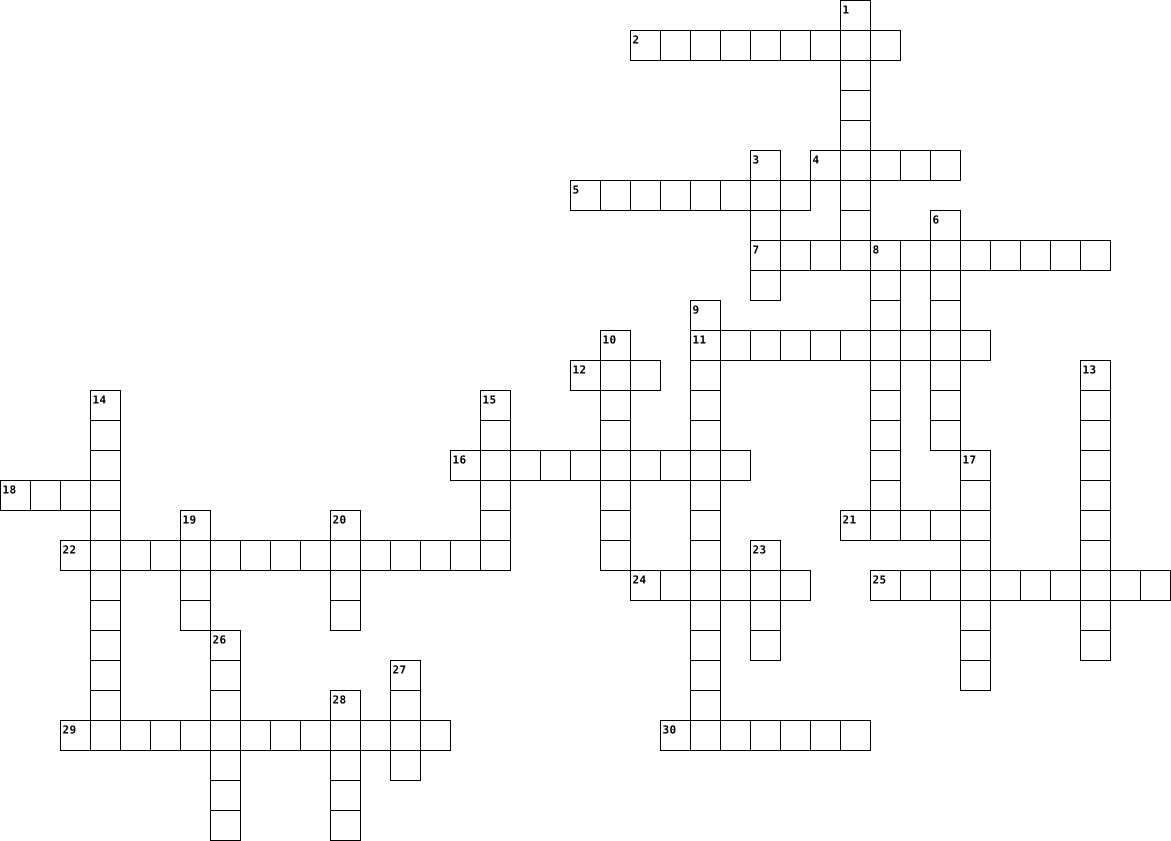
Across
- - Located at the mississipi river
- Barton - Risked her life to bring supplies to soldiers in the fileds during the civil war
- - The deadliest one-day battle in american miltiary history
- (what is it? What could wealthy people do on both sides?)
- - Where Robert E Lee Surrendered
- Inaugural Address significance- Called out slavery as the reason for war
- of 1850 - The Fugative Slave act was ammended and the slave trade in Washington D.C was Abolished.
- Wilkes Booth - Assassion of Aberham Lincon
- Tom’s Cabin - One of the best selling books of the 1900’s about Slavery and Shared the ideas of injustices in Slavery
- debates (what did this do for Lincoln?) - It Reincigorated Lincons Political Career and shot him into the spotlight
- E Lee - Robert E Lee commanded the army of Northern Virginia and the most sucsessful enemy during the civil war
- - The Battlefeild & the place of the turning point of the civil war
- – deadly landscape if the civil war
- Brady - photographer of the civil war
Down
- - used to destroy ships
- to the Sea (who led it? What kind of war is this?)
- Compromise (3 parts and how did Thomas Jefferson feel about it?) -
- Compromise - When there was unsuccessful proposal to enshrine slavery
- Act (what did it do and what was the result?) - Repealed the Missouri Compromise and created new territories for Popular Sovereignty
- Plan - To restrict the south of new supplies and force them to abolish slavery
- Address significance - invoked the Principles of human equaltiy
- Proclamation (who was freed and what part of the world would not help the Confederacy because of this?) - They freed slaves for a miltiary mesure so the south wouldnt get upset
- Sumner Caning - This is when A Pro slavery Democrat from the south used a walking cane to attack senator Charles Sumner
- of 1860 (who won and what did it lead to?) - Abe Lincon Won the Election and this lead to the civil war.
- Brown’s raid - The death of 16 men during the raid of a Federal army in virginia
- Sumter - The site of the first battle of the civil war
- Scott court case result- Upheld Slavery in the United States and denied the lagality of Black citizenship in America aswell as the Missouri act as unconstitonial
- Grant -
- Run - the first land battle of the civil war
- Ball - The Long range accuarcy on the
30 Clues: Grant - • - used to destroy ships • - Where Robert E Lee Surrendered • - Located at the mississipi river • – deadly landscape if the civil war • Ball - The Long range accuarcy on the • Brady - photographer of the civil war • Wilkes Booth - Assassion of Aberham Lincon • Run - the first land battle of the civil war • to the Sea (who led it? What kind of war is this?) • ...
school 2026-05-27

Across
- An 1863 declaration by President Lincoln freeing enslaved African Americans in Confederate Territory.
- An 1863 Civil War battle in Virginia; important victory for the Confederacy but stone wall Jackson was unfortunately killed by his own soldiers.
- To set free.
- president of the union
- To surround and blockade an enemy town or position with troops to force it to surrender.
- An 1864 Civil war battle in Maryland; also called the Battle of Sharpsburg.
Down
- dangerouse people
- The shutting of a port to keep people or supplies from moving in or out.
- To withdraw from membership in a group.
- biggest war in american history
- A New or the first type/kind of metal battle ship.
- The spark of the Civil war from the confederate firing first.
- government by consent of the governed.
- A slave state that remained in the union during the civil war.
- General Grant led and was able to get control of the Mississippi.
- An 1863 Civil War battle in Pennsylvania that ended in a Union victory and stopped the Confederate invasion of the North.
16 Clues: To set free. • dangerouse people • president of the union • biggest war in american history • government by consent of the governed. • To withdraw from membership in a group. • A New or the first type/kind of metal battle ship. • The spark of the Civil war from the confederate firing first. • A slave state that remained in the union during the civil war. • ...
Chapter 4 American History 2023-10-20

Across
- Lincoln wanted to___
- Capital of the confederacy
- Equal rights
- Lincoln was a___
- War Hero
- General of the confederacy
- First shots fired
- Turning point of civil war
- Johnson reconstruction plan was more__
- Lincolns plans for reconstruction
- First state to secede
Down
- Scott Winfiled
- Freed slaves
- African Americans right to vote
- cautious
- Warships covered in ironplates
- Andrew Johnson was a ___
- __went up in flames
- Thaddeus Stevens was a__
- Lincolns main goal
- Bloodiest war
- was a radical republican
- Assasinated lincoln
- First marked the civil war
- The confederacy was in __
- __was a border state
26 Clues: cautious • War Hero • Freed slaves • Equal rights • Bloodiest war • Scott Winfiled • Lincoln was a___ • First shots fired • Lincolns main goal • __went up in flames • Assasinated lincoln • Lincoln wanted to___ • __was a border state • First state to secede • Andrew Johnson was a ___ • Thaddeus Stevens was a__ • was a radical republican • The confederacy was in __ • Capital of the confederacy • ...
Civil War Vocab 2023-03-07

Across
- Ending slavery
- Freeing of slaves
- The civil war president
- Soldiers on foot
- The involuntary service of others
- The south
- A stopping point at land or sea to stop enemies
- Large Firearms
- After the war
- To give up on a war
Down
- Killing of a high official
- The north
- The most famous civil war battle
- An unexpected attack
- The plan of cutting out the south
- A wounded or killed soldier in battle
- Soldiers at sea
- To leave the union
- A nickname for union soldiers
- A small fight
20 Clues: The north • The south • A small fight • After the war • Ending slavery • Large Firearms • Soldiers at sea • Soldiers on foot • Freeing of slaves • To leave the union • To give up on a war • An unexpected attack • The civil war president • Killing of a high official • A nickname for union soldiers • The most famous civil war battle • The plan of cutting out the south • ...
Civil War Crossword 2023-10-19

Across
- the bloodiest battle of the civil war
- the main goal of the north at the beginning of the war was to _______ the union
- The main strategy of the union
- who was the president of the union during the civil war
- the bloodiest single day in U.S. history
- the overall winner of the civil war
- the states between the north and south
- the south wanted to_______ their way of life
- the nickname given to the south by the north
- the man considered to be the president of the confederacy
Down
- the first state to leave the union
- the 18th president of the United States
- an act issued by Abraham Lincoln abolishing slavery in the south
- the man who led a group of soldiers that held a strong position on the far left of Little Round Top during The Battle Of Gettysbur
- the founder of the American Red Cross
- the battle that started the civil war
- the south’s main labor force
- the nickname given to the north by the south
- the confederacy’s top ranking military general
19 Clues: the south’s main labor force • The main strategy of the union • the first state to leave the union • the overall winner of the civil war • the bloodiest battle of the civil war • the founder of the American Red Cross • the battle that started the civil war • the states between the north and south • the 18th president of the United States • ...
3 2024-04-03

Across
- this was the main impact on African Americans with the end of Reconstruction
- granted citizenship to former slaves
- they gained power in the south because of scandals and the Panic of 1873
- the country we got land from to complete Manifest Destiny
- what problem 3 pre-war compromises tried to solve
- freed the slaves
- granted the right to vote to former slaves
- the power of the federal government did this because of the Civil War
- line under PA that divided North and South
- what states disregarded that led to tension before the Civil War
- this was Lincoln's early goal in the Civil War
Down
- this was set up to help former slaves in the south
- what was Dred Scott asking for?
- this convinced many northerners to help runaways
- this speech reinforced the principles the nation was founded on
- belief God wanted the US to spread from sea to sea
- his court case said slaves were not citizens
- this order changed why the Civil War was being fought
- this helped slaves escape north
19 Clues: freed the slaves • what was Dred Scott asking for? • this helped slaves escape north • granted citizenship to former slaves • granted the right to vote to former slaves • line under PA that divided North and South • his court case said slaves were not citizens • this was Lincoln's early goal in the Civil War • this convinced many northerners to help runaways • ...
The Civil War (Nathan Aguero) 2017-02-21

Across
- one of the advantages of the north.
- final major military action in the vicksburg campaign.
- another advantage of the north.
- july 1st-3rd 1863 union leaders defended general lee. a turning point battle during the civil war.
- a writ requiring a person under arrest to be brought before a judge or into court, especially to secure the person's release unless lawful grounds are shown for their detention.
- president during the civil war.
- during the civil war, the union came to mean the government and armies of the north.
- a special order by president lincoln on January 1st, 1863 declaring slaves in confederate sates to be free
- Maryland, September 16-18, 1862 bloodiest single day in American military history, 23,000 died.
- general for the confederacy.
Down
- South Carolina, April 12-14, 1861,start of the civil war.
- the savannah campaign.
- a change to the Constitution (1865) that abolished slavery in US (made it illegal)
- general for the union later became 18th president.
- was an American stage actor who assassinated President Abraham Lincoln at Ford's Theatre in Washington, D.C. on April 14, 1865.
- president of the confederacy.
- founded by clara barton in 1881.
- separate from union.
- one of the last battles of the civil war, April 9, 1865.
- another name for the confederate states of america, made up of the 11 states that seceded from the union
- the war that divides america in the 1860s.
- Union strategy to conquer south.
22 Clues: separate from union. • the savannah campaign. • general for the confederacy. • president of the confederacy. • another advantage of the north. • president during the civil war. • founded by clara barton in 1881. • Union strategy to conquer south. • one of the advantages of the north. • the war that divides america in the 1860s. • ...
Reconstruction Crossword 2022-02-28

Across
- President Johnson who never lost an election and couldn’t do this until he was 20 years old
- Amendment added to the Constitution that gave citizens equal protection under the law
- Many Republicans thought President Johnson was this
- House of Representatives did this to President Johnson during his presidency
- War that divided America and ended in 1865 (two words no spaces)
- Person who taught Andrew Jackson how to write in his 20s
- Last name of man who opposed slavery and helped with Johnson impeachment
- Last name of U.S President during Civil War
- College Thadeus Stevens graduated from in 1814
- Amendment gave male Africans the right to vote
Down
- During Reconstruction, many people thought this should happen to Confederate leaders
- Many of these remained after Civil War, who would do the work of slaves that were free
- President Johnson was not afraid to use this presidential power
- Horrible event involving Africans forced to work on plantations that ended after Civil War
- Amendment added to Constitution that abolished slavery in all states
- Last name of U.S President after Lincoln
- Type of foot Thadeus Stevens had
- time period following the Civil War
- Reconstruction Act did this to the south
- Term given to some Republicans after Civil War who wanted South to be punished; they thought blacks were entitled to same political rights as whites
- Both Presidents Lincoln and Johnson and Stevens grew up in this way
21 Clues: Type of foot Thadeus Stevens had • time period following the Civil War • Last name of U.S President after Lincoln • Reconstruction Act did this to the south • Last name of U.S President during Civil War • College Thadeus Stevens graduated from in 1814 • Amendment gave male Africans the right to vote • Many Republicans thought President Johnson was this • ...
Ch 4 American History 2023-10-20

Across
- the city under siege for 9 months
- union war plan by Winfield Scott
- abolished slavery
- a reading and writing test formerly used in some Southern states to prevent African Americans form voting
- 16th president; president during the Civil War
- "separate, but not equal"
- laws denying most legal rights to newly freed slaves
- photographer during the Civil War
- a negative term for Northern who moved to the South after the Civil War
- warships covered with protective iron plates
- a government in which the people rule by their own consent
- a sum of money to be paid before a person could vote
- first and only Confederate president
- bloodiest battle of the Civil War
- a radical republican
Down
- tax paid to the state, federal, and local government based on income earned over the past year
- a law to disqualify African Americans voters by allowing the vote only to men whose fathers and grandfathers had vote before 1866 and 1867
- known as the "KKK"
- states created laws to segregate blacks from whites in the South, violence against blacks was widespread
- a negative term for a Southern white who supported the Republican Party after the Civil War
- a system in which a farmer tends to a portion of a planters land in return for a share of the crop
- he created the cotton gin
- Missouri, Tennessee, Maryland, Delaware
- the date the Confederates forces surrender at Vicksburg
- capital of Virginia
25 Clues: abolished slavery • known as the "KKK" • capital of Virginia • a radical republican • "separate, but not equal" • he created the cotton gin • union war plan by Winfield Scott • the city under siege for 9 months • photographer during the Civil War • bloodiest battle of the Civil War • first and only Confederate president • Missouri, Tennessee, Maryland, Delaware • ...
Civil War Test Review 2026-04-28

Across
- The deadliest battle of the Civil War
- The first state to secede
- The _________-Nebraska Act left the issue of slavery up to the voters in the state
- this word means 'to leave, withdraw, pull away'
- This stated that only slaves held in states that are 'in rebellion' were free
- '____________ states'had slaves but stayed with the North
- General of the Confederate Army
- The president of the Confederacy
- Abraham Lincoln was elected president in 18___
Down
- A radical abolitionist who tried to start a rebellion at Harpers Ferry
- General of the Union Army towards the end of the Civil War
- the ________ compromise (1820) established a line across the country -- north of it was free, South of it was slave states
- Where the first fighting of the Civil war happened
- This Supreme Court decision stated that slavery could exist anywhere, and even free blacks had no rights
- The North was called the ___________ during the Civil War
- The South was called the ________________ during the Civil War
16 Clues: The first state to secede • General of the Confederate Army • The president of the Confederacy • The deadliest battle of the Civil War • Abraham Lincoln was elected president in 18___ • this word means 'to leave, withdraw, pull away' • Where the first fighting of the Civil war happened • The North was called the ___________ during the Civil War • ...
Unit 5: A Changing America & the Civil War 2025-02-16

Across
- formally leaving a group
- complete control of others
- separates seed from cotton
- granted to Nevada in 1964
- time period before Civil War
- ending slavery
- Supreme Court said slaves not citizens
Down
- giving up something to get something
- change to the Constitution
- led a slave revolt
- site of Civil War beginning
- _____ railroad
- site of Civil War end
- extreme abolitionist
- plan to blockade the South
15 Clues: _____ railroad • ending slavery • led a slave revolt • extreme abolitionist • site of Civil War end • formally leaving a group • granted to Nevada in 1964 • complete control of others • change to the Constitution • plan to blockade the South • separates seed from cotton • site of Civil War beginning • time period before Civil War • giving up something to get something • ...
Civil War Review 2026-05-05

Across
- The BLANK consisted of 23 states located mostly to the NORTH and west that opposed seceding from the United States. Abraham Lincoln was the President.
- Confederate commander of the Army of Northern Virginia, offered command of Union forces at the beginning of the war, but chose not to fight against Virginia, urged Southerners to accept defeat at the end of the war and reunite as Americans
- This siege/battle lasted 48 days and gave the Union full control of the Mississippi River which divided the Confederacy.
- True or False: The Union utilized the railroad and industry during the War. It was one of their advantages.
- former enslaved African American who promoted the Civil War by creating the United States Colored Troops
- True or False: The Confederacy had weaker military leaders than the Union.
- A general of the Union forces who defeated Robert E. Lee's confederate army
- President of the United States who opposed the spread of slavery and was determined to preserve the Union, by force is necessary
Down
- The BLANK consisted of 11 states in the SOUTH that supported states' rights and the practice of slavery. They seceded from the United States. Jefferson Davis was the President.
- Who escaped to freedom on a Confederate ship, then became a sailor/naval captain for the Union?
- THIS was a proclamation issued by Abraham Lincoln that made "freeing the slaves" the new focus of the Civil War; many freed African Americans joined the Union army
- Where was the first conflict of the Civil War
- Who was a civil war nurse that went on to start the American Red Cross? During the war, she was known as the Angel of the Battlefield.
- What word means to withdraw or separate from?
- What was the first state to secede from the Union?
- The battle of BLANK is known as the TURNING POINT of the Civil War. Union forces repel Lee's invasion of the North in this small town in southern Pennsylvania, after gaining control of the high ground of the battlefield.
- The nickname of a skilled Confederate general from Virginia who dies after being accidentally shot by Confederate soldiers
- President of the Confederate States of America
- The Civil War ended WHERE?
- The BLANK states consisted of slave states that remained in the Union
- The Battle of WHAT was the first major battle of the Civil War
21 Clues: The Civil War ended WHERE? • Where was the first conflict of the Civil War • What word means to withdraw or separate from? • President of the Confederate States of America • What was the first state to secede from the Union? • The Battle of WHAT was the first major battle of the Civil War • The BLANK states consisted of slave states that remained in the Union • ...
Civil War 2021-11-02

Across
- Northern troops, or Union soldiers, were also called this
- A common food eaten by soldiers.
- The winner of the Civil War.
- A Union general who was overly cautious - to Lincoln's disliking.
- The number of years the Civil War lasted.
- This act made all men between the ages of 20 and 45 liable to be called for military service.
- The bloodiest day of battle in the Civil War.
- Lincoln gives a heartfelt speech to honor the soldiers that died there.
- Warships covered with protective iron plates.
- They served as spies, took over businesses while the men were away, ran farms and plantations worked in fields, factories, and the government and formed groups to send supplies to troops.
Down
- The place where Lee surrendered to Grant on April 9th, 1865.
- Granted freedom to all African Americans in areas of rebellion against the Union in 1863.
- Soldiers spent up to 10 hours a day doing this.
- The capital of the Confederates.
- The North's most important advantage in the Civil War.
- The Civil War originally was about keeping the Union together, but eventually changed into a fight to end this.
- The capital of the Union.
- Confederate president.
18 Clues: Confederate president. • The capital of the Union. • The winner of the Civil War. • A common food eaten by soldiers. • The capital of the Confederates. • The number of years the Civil War lasted. • The bloodiest day of battle in the Civil War. • Warships covered with protective iron plates. • Soldiers spent up to 10 hours a day doing this. • ...
Civil War 2024-11-21

Across
- Famous who abolitionist escaped slavery and wrote an Autobiography
- Famous speech delivered by Lincoln, after the Civil War
- Last battle of the Civil War
- Idea that the United States was destined by God to expand and control North America.
- Famous speech that declared the foundation of the Confederacy
- First state to secede from the United States
- Famous anti-slavery newspaper
- A marked period of violence due to the Missouri Compromise
- Allowed new territories joining as states to decide if they would allow slavery
Down
- Famous abolitionist who aided runaway slaves on the Underground railroad and served as a spy during the Civil War
- Famous battle that turned the outcome of the War
- A law that prevented abolitionist from aiding runaway slaves, and forced captured runaway slaves back to the south.
- Famous president during the Civil War
- Famous abolitionist and women's right activist who escaped slavery
- A war between the seceded states and the United States, over state's rights and slavery.
- A group of states that left the United States
- Freed slaves who were in the Confederacy
- Anti-slavery group
- states in the north who were loyal to the United States
19 Clues: Anti-slavery group • Last battle of the Civil War • Famous anti-slavery newspaper • Famous president during the Civil War • Freed slaves who were in the Confederacy • First state to secede from the United States • A group of states that left the United States • Famous battle that turned the outcome of the War • Famous speech delivered by Lincoln, after the Civil War • ...
Causes of the civil war 2024-04-12

Across
- One of the leading causes; a major conflict between the north and south
- The proclamation that made slaves free
- Rights applied to particular states
- the confederate general
- The region that supported slavery
- agricultural and pro-slavery
Down
- Fort in SC placed under siege
- the union general
- The man who declared that the Missouri Compromise was unconstitutional
- Rights applied to the US as a whole
- The president during the civil war
- Front-loaded, over-the-shoulder gun
- First engagement of ironclad warships during the Civil War
- Political party based in the north
- Industrialized and anti-slavery
- the war that sparked the Emancipation proclamation
- The region that didn't support slavery
- The first major battle of the civil war
- The bloodiest battle
- Political party based in the south
20 Clues: the union general • The bloodiest battle • the confederate general • agricultural and pro-slavery • Fort in SC placed under siege • Industrialized and anti-slavery • The region that supported slavery • The president during the civil war • Political party based in the north • Political party based in the south • Rights applied to the US as a whole • ...
Civil War Cross word Zepps 2023-04-06

Across
- When a person is murdered for political reasons.
- A canvas bag that many Civil War soldiers used to carry their food.
- A nick for a person who had a stone face in the civil war.
- A nickname for the South.
- Commutation A commutation was when a person could pay a fee rather than be drafted into the army. This angered poorer people who could not pay the fee and had no choice but to fight. An ankle high shoe worn by soldiers during the Civil War.
- A soldier that is wounded or killed during battle.
- Crackers eaten by Civil War soldiers made from flour, water, and salt.
- A long blade or knife attached to the end of a musket. Soldiers would use it like a spear in close combat.
- Another name for the Confederate States of America or the South. The Confederacy was a group of states that left the United States to form their own country.
Down
- An attempt to stop people and supplies from going in or out of a port.
- Was One of the best generals in the civil war.
- Before the battle occurs.
- A person who wants to end slavery.
- One who kills for money.
- A warship that is fully covered and protected by iron cladding.
- A northerner who moved to the South during the reconstruction in order to become rich.
- Soldiers on foot.
- A nickname for United States paper money that was first used in 1862. It got its name from the green ink used in printing.
- The side of an army or military unit.
- Last name of the girl who started the red cross.
- A cap worn by Civil War soldiers(Bonus).
21 Clues: Soldiers on foot. • One who kills for money. • Before the battle occurs. • A nickname for the South. • A person who wants to end slavery. • The side of an army or military unit. • A cap worn by Civil War soldiers(Bonus). • Was One of the best generals in the civil war. • When a person is murdered for political reasons. • Last name of the girl who started the red cross. • ...