
earth day Crossword Puzzles
🌏 Earth Day 2021 🌏 Crossword Puzzle (Easy) 2021-04-19

Across
- The date of Earth Day was chosen to appeal to ____ students
- When was the first Earth Day? 19___
- John F. ______ played a role in early efforts to promote environmental conservation.
Down
- Earth Day is on ______ 22
- Other countries know Earth Day as "International ______ Earth Day."
- The theme of Earth Day 2021 is ____ Our Earth
- Each year, the Earth Day _____ changes.
7 Clues: Earth Day is on ______ 22 • When was the first Earth Day? 19___ • Each year, the Earth Day _____ changes. • The theme of Earth Day 2021 is ____ Our Earth • The date of Earth Day was chosen to appeal to ____ students • Other countries know Earth Day as "International ______ Earth Day." • ...
Moon Phase and Tides Vocab Review 2025-04-10

Across
- Tides with the greatest tidal range, occurs on a full and new moon.
- More of the illuminated (lighted by the sun) half of the moon can be seen each night, it seems to grow bigger.
- When the Earth is between the sun and moon and all of the moon’s surface facing Earth is illuminated.
- A moon phase where more than half, but not all, of the moon's surface is illuminated, appearing as a bulge or hump.
- When the ocean level is at it's lowest point, occurs twice per day.
- When the ocean level is at it's highest point, occurs twice per day.
- Periodic rise and fall of sea levels, primarily caused by the gravitational pull of the Moon.
- When an object spins on it's axis, gives Earth day and night which takes 24 hours.
- A lunar phase where half of the Moon's visible surface is illuminated, occurring roughly halfway between the new moon and full moon phases.
Down
- a raised area in the ocean caused by the gravitational pull of the moon
- The orbital motion of a planet or moon around another star or planet.
- Less of the illuminated side of the moon can be seen each night, seems to be shrinking.
- The moon is between the Earth & the sun, dark side faces Earth, we see the moon as a dark circle.
- The phase of the moon when less than half is visible, appearing as a thin, curved slice of light.
- Different forms that the moon takes in its appearance from earth.
- Tides with a smaller difference between high and low tides, occurs on the quarter moons.
- The difference in height between high and low tides.
- One complete revolution of the moon around Earth that take approximately 28-29 days.
18 Clues: The difference in height between high and low tides. • Different forms that the moon takes in its appearance from earth. • Tides with the greatest tidal range, occurs on a full and new moon. • When the ocean level is at it's lowest point, occurs twice per day. • When the ocean level is at it's highest point, occurs twice per day. • ...
Genesis 1-3 2023-06-06

Across
- On the third day, God separated the __________ ground from the seas.
- On the second day, God separated the ___________ above and below
- Tempted Adam and Eve disobey God and eat from the tree of the knowledge of good and evil
- God created the garden of __________ for human beings.
- On the fifth day, God filled the sky with ___________ and the seas with living creatures.
- On the first day, God separated the __________ from the dark.
- How did God create all things?
- Tasked with tending the garden and naming the animals
- It was not good for Adam to be alone so God created a ___________
Down
- God created Adam out of the ________ of the ground.
- On the seventh day, God ceased His work and ________________.
- On the fourth day, God filled the heavens with the _______ and stars.
- On the sixth day, God filled the earth with ___________ of the field and humans.
- Eve was created from Adam's _________. This shows how man and woman are to be a team in God's plan
- After creating on each day, God described His creation as ___________
- in the beginning God ____________the heavens and earth.
- Man and women are created in the _________ of God
17 Clues: How did God create all things? • Man and women are created in the _________ of God • God created Adam out of the ________ of the ground. • Tasked with tending the garden and naming the animals • God created the garden of __________ for human beings. • in the beginning God ____________the heavens and earth. • ...
Science: A Year in Review 2023-01-01

Across
- Consider the question, "what is the effect of mass on acceleration?" What is the independent variable.
- On a cold winter day, the ecliptic will be very ___________
- The arch-shaped (rainbow) path the Sun takes through the sky.
- The ___________ plane is the invisible shelf that all the planets sit on, making them line up?
- Because the Earth is really far away from the Sun, the lines of light are almost perfectly _______________.
- What season is it if the sun's altitude is very low causing its energy to be very indirect and spread out?
- The winter ___________ marks the first day of want and is the shortest day of the year
- During OUR summer solstice, the Sun is 90 degrees above the tropic of _____________
- If the northern hemisphere is pointed TOWARDS the Sun, what season will it be in Centralia
- The tilt of the Earth causes each hemisphere to receive DIFFERENT amounts of direct ____________ at different times of the year!
- These are the two days a year where day and night are the same length
- The force that pulls masses towards one another
- Is there ever a "no shadow" day in Centralia?
- If you drop a cannon ball and a baseball from a tall tower, which one will hit the ground first due to Earth's gravity?
- if the Southern hemisphere is pointed TOWARDS the Sun, what season will it be in Centralia
Down
- Which hemisphere receives more sunlight during fall/spring
- To explain the reasons for seasons, lunar phases and eclipses, you MUST understand that light from the Sun hits Earth in ____________ and parallel lines
- ___________ noon is the time of the day when the sun is at its highest point in the sky
- If the distance between two objects increases, the strength of gravity pulling them together will:
- If the Earth had no _________, we would not have seasons
- The ANGLE of the Sun (or moon!) from the Earth. NOT how far away the Sun is!!!
- What is it called when one object moves in a circular orbit around another
- Which variable is the "effect" that a scientist observes/ measures
- During a hot, summer day, The sun's energy will be very direct and ______________
- The sun always sets in this direction
- If you make a shadow plot and it looks like a straight line, what season could it be?
- If conditions are perfect, the gravity of a planet or star may pull another object into a circular path around itself called an: _________________
- What is it called when one object spins around its own axis?
28 Clues: The sun always sets in this direction • Is there ever a "no shadow" day in Centralia? • The force that pulls masses towards one another • If the Earth had no _________, we would not have seasons • Which hemisphere receives more sunlight during fall/spring • On a cold winter day, the ecliptic will be very ___________ • ...
Solar Crossword 2012-05-15

Across
- A ........ of time
- oval type shape
- 180°
- the closest point towards the Earth
- Happens twice a year when the sun reaches its
- the plane passing through the equator of the Earth
- north, south, east, west
- P.M.
- 0° and 360°
- 3D semi circle
- slow top wobbling on top of the Earth
- 90°
- point in the sky
Down
- the furtherest point away from the Earth
- 24hours
- compass points
- The seasons are caused by the Earth's .......
- invisible model in the sky
- the path of the sun
- A.M.
- day the sun and the seasons
- the motion of the Earth
- hand widths
- 1 year
- maths term for average
- highest point in the sky
- 270°
27 Clues: 90° • 180° • A.M. • P.M. • 270° • 1 year • 24hours • hand widths • 0° and 360° • compass points • 3D semi circle • oval type shape • point in the sky • A ........ of time • the path of the sun • maths term for average • the motion of the Earth • north, south, east, west • highest point in the sky • invisible model in the sky • day the sun and the seasons • the closest point towards the Earth • ...
Space 2026-04-13

Across
- Large pieces of rock and metal orbiting the sun
- First human to walk on the moon
- Path of the Earth going around the sun
- Star closest to Earth
- Smallest planet and closest to the sun
- Gigantic balls of burning gases
- Holds us to Earth
- Gathers info from space and sends back to us
- Farthest planet from the sun
- Groups of stars
- Planet with 27 moons
Down
- Biggest planet
- Planet with rings of ice and dust
- Large rock that orbits a planet
- What the sun is the center of
- Third planet from the sun
- Planet with temps over 800 degrees
- Number of minutes for sun's light to reach Earth
- Looks like a red star
- People who study space
- As Earth moves around its orbit the ____ change
- Composed of gas, dust and stars
- Number of times Earth spins each day
23 Clues: Biggest planet • Groups of stars • Holds us to Earth • Planet with 27 moons • Star closest to Earth • Looks like a red star • People who study space • Third planet from the sun • Farthest planet from the sun • What the sun is the center of • Large rock that orbits a planet • First human to walk on the moon • Gigantic balls of burning gases • Composed of gas, dust and stars • ...
Geography 1 Chapter 1 Crossword 2024-10-02

Across
- the frozen water part of the Earth system
- all living organisms and ecosystems
- days when the sun reaches its highest or lowest point
- the lines of latitude parallel to the equator
- the solid part of Earth, including rocks and soil
- a day where day and night are equal lengths
- the layer of gasses surrounding the Earth
Down
- Processes in which the output of a system influences its own input.
- all water bodies, including oceans, rivers, and glaciers
- Energy emitted by the Sun in the form of electromagnetic waves
- shape of the earth
- 23.5 degrees
- A system in which energy can enter and leave, but matter cannot.
- measurement north/south of the equator
- measurement east/west of the prime meridian
15 Clues: 23.5 degrees • shape of the earth • all living organisms and ecosystems • measurement north/south of the equator • the frozen water part of the Earth system • the layer of gasses surrounding the Earth • measurement east/west of the prime meridian • a day where day and night are equal lengths • the lines of latitude parallel to the equator • ...
Integrated Science Vocabulary: Chapter 3 2025-10-26

Across
- all of Earth’s water
- conditions of the atmosphere in an area over a long period of time
- plants lose water from leaves through evaporation
- sediment is moved from one place to another
- the change of state from liquid to gas
- cycle the movement of water on and around the Earth
- solid part of Earth
- water vapor cools and forms tiny drops of water
Down
- any form of water that falls from clouds to Earth
- cycle process in which rocks are created, changed, destroyed, and formed again
- breaking down rock into sediment
- mixture of gases surrounding the Earth
- contains all living things
- sediment is deposited/dropped in a new place
- day-to-day conditions in the atmosphere in an area
15 Clues: solid part of Earth • all of Earth’s water • contains all living things • breaking down rock into sediment • mixture of gases surrounding the Earth • the change of state from liquid to gas • sediment is moved from one place to another • sediment is deposited/dropped in a new place • water vapor cools and forms tiny drops of water • ...
ENVIRONMENT 2021-06-25
Across
- The domain of Water
- Human component that helps to study
- Theme of our environmental day.
- Modify the environment for his needs
- Hard top layer of the Earth crust
Down
- Manmade component connects places
- How earth holds the atmosphere
- Exchange of goods with no money
- interaction of all living organism
- protects the harmful rays of sun
- world environment day
- Thin layer of air
- Narrow zone where 3 elements meet
- Natural component helps to breath
- Environment is __ and manmade
- Basic life support
16 Clues: Thin layer of air • Basic life support • The domain of Water • world environment day • Environment is __ and manmade • How earth holds the atmosphere • Exchange of goods with no money • Theme of our environmental day. • protects the harmful rays of sun • Manmade component connects places • Narrow zone where 3 elements meet • Natural component helps to breath • ...
Lakota 1 and 2 2022-09-20

Across
- moon
- good
- day
- star
- boy
- red
- girl
- yellow
- man
- water
- grandchild
Down
- people
- first man
- buffalo
- eagle
- house
- earth
- sun
- woman
- dog
20 Clues: day • boy • red • sun • man • dog • moon • good • star • girl • eagle • house • earth • woman • water • people • yellow • buffalo • first man • grandchild
Science Vocab 2024-10-27

Across
- conditions of the atmosphere in an area over a long period of time
- water vapor cools and forms tiny drops of water
- All of earth’s water
- sediment is moved from one place to another
- the change of state from liquid to gas
- Solid part of the earth
- plants lose water from leaves through evaporation
Down
- any form of water that falls from clouds to earth
- process in which rocks are created, changed, destroyed, and formed again
- the movement of water on and around earth
- breaking down rock into sediment
- mixture of gases surrounding earth
- contains all living things
- sediment is deposited/dropped into a new place
- day-to-day conditions in the atmosphere in an area
15 Clues: All of earth’s water • Solid part of the earth • contains all living things • breaking down rock into sediment • mixture of gases surrounding earth • the change of state from liquid to gas • the movement of water on and around earth • sediment is moved from one place to another • sediment is deposited/dropped into a new place • water vapor cools and forms tiny drops of water • ...
Science Vocabulary Homework Choice Board -B. Loperbey 10/30/25 2025-10-27

Across
- all of the Earth's water
- conditions of the atmosphere in an area over a long period of time
- plants lose water from leaves through evaporation
- sediment is moved from one place to another
- the change of state from liquid to gas
- cycle the movement of water on and around the Earth
- solid part of the Earth
- water vapor cools and forms tiny drops of water
Down
- any form of water that falls from clouds to Earth
- cycle process in which rocks are created, changed, destroyed, and formed again
- breaking down rock into sediment
- mixture if gases surrounding the Earth
- contains al living things
- sediment is deposited / dropped in a new place
- day to day conditions in the atmosphere in an area
15 Clues: solid part of the Earth • all of the Earth's water • contains al living things • breaking down rock into sediment • mixture if gases surrounding the Earth • the change of state from liquid to gas • sediment is moved from one place to another • sediment is deposited / dropped in a new place • water vapor cools and forms tiny drops of water • ...
Day and Night 2023-01-18

Across
- The Earth does this and makes day and night.
- It happens when the Earth faces the Sun.
- It reflects the light from Sun and we can see it at night.
- It happens when the Sun just appears in the sky.
Down
- The day and night keep changing because of the spinning of Earth.
- The highest position of the Sun in the sky during the day.
- It happens when the Sun almost disappears in the sky.
- The thing that give off light to the Earth during the day.
- It happens when the Earth does not face the Sun.
9 Clues: It happens when the Earth faces the Sun. • The Earth does this and makes day and night. • It happens when the Earth does not face the Sun. • It happens when the Sun just appears in the sky. • It happens when the Sun almost disappears in the sky. • The highest position of the Sun in the sky during the day. • The thing that give off light to the Earth during the day. • ...
Creation Story 2024-09-23

Across
- Which day did God create and separate the light from the darkness?
- What did God create "In the beginning"?
- After God made humans, He looked at everything He had made and called it good.
- What did God do on the seventh day?
- Which day did God create the earth and the sea?
- What did God want the Earth to bring forth on the third day?
Down
- God made us in His and likeness.
- Fill in the blank: "God made the and separated it separated the water".
- What did God call "day"?
- The greater of the two lights is the .
- What book of the Bible is the first creation story in?
- What did God call "night"
- How many great lights did God make?
- God gave this to the human beings over all other animals.
- God made these on the fifth day.
15 Clues: What did God call "day"? • What did God call "night" • God made these on the fifth day. • What did God do on the seventh day? • How many great lights did God make? • God made us in His and likeness. • What did God create "In the beginning"? • The greater of the two lights is the . • Which day did God create the earth and the sea? • ...
Week 32 Spelling List 2020-05-26

Across
- 3rd
- animal or monster
- 1st
- color
- another word for the earth
- opposite of late
Down
- the day you were born
- a drawing
- the planet we live on
- a person who throws to the batter, a jar
- the day before Friday
- I ___________ in school.
12 Clues: 3rd • 1st • color • a drawing • opposite of late • animal or monster • the day you were born • the planet we live on • the day before Friday • I ___________ in school. • another word for the earth • a person who throws to the batter, a jar
Climate 2012-09-03

Across
- high latitudes
- patterns of the weather of period of time
- mid latitudes
- middle earth
- how close to coat
- height of the land
- hot and dry ecosystem
Down
- direction of wind
- location on earth
- day to day conditions
- in which we live
- sea below france
12 Clues: middle earth • mid latitudes • high latitudes • in which we live • sea below france • direction of wind • location on earth • how close to coat • height of the land • day to day conditions • hot and dry ecosystem • patterns of the weather of period of time
astronomy 2022-05-09

Across
- Southernmost point of orbital path
- the imaginary shell we draw around the Earth which shows how we view objects in space
- The time from one vernal equinox to next
- the daily progress of the sun and stars across the sky
- observation, theory, prediction, observation,
- Northernmost point of orbital path
- study of the universe
- when the moon passes between the Earth and sun, blocking the sun
- 23 hours and 56 minutes, the time it takes for the Earth to rotate on its axis
- Lies directly over the South Pole of the Earth
Down
- The path that the sun makes through the sky
- combination of day length and sunlight angle
- Lies directly over the North Pole of the Earth, contains the North Star “Polaris”
- The twelve constellations the Sun moves through during the year
- Projection of the Earth’s Equator into space
- caused by the way light from the sun shines or does not shine on the moon
- when the earth's orbit blocks the sun from the moon
- what we consider a 24-hour day
18 Clues: study of the universe • what we consider a 24-hour day • Southernmost point of orbital path • Northernmost point of orbital path • The time from one vernal equinox to next • The path that the sun makes through the sky • combination of day length and sunlight angle • Projection of the Earth’s Equator into space • observation, theory, prediction, observation, • ...
Seasons 2023-10-31

Across
- Solstice: Shortest day of the year
- The tilt of Earth's axis is always pointing towards this
- When the Fall Equinox occurs
- solstice Longest day of the year
- When the Summer solstice happens
- The 23.5 __ of the Earth causes seasons
- A regular change in temperature that repeats itself every year
Down
- When the Winter Solstice occurs
- Earth takes 365 to complete a __ around the sun
- The imaginary line around which the Earth spins
- 2 days of the year where nighttime and daytime are equal
- When the Spring equinox occurs
- Spinning of Earth on its axis
13 Clues: When the Fall Equinox occurs • Spinning of Earth on its axis • When the Spring equinox occurs • When the Winter Solstice occurs • solstice Longest day of the year • When the Summer solstice happens • Solstice: Shortest day of the year • The 23.5 __ of the Earth causes seasons • Earth takes 365 to complete a __ around the sun • The imaginary line around which the Earth spins • ...
Space Crossword 2024-04-09

Across
- the nearest star to our solar system
- has a massive storm the size of Earth on it
- the neartest star to Earth
- the time for Earth to go around the sun
- the planet that has ring
- the 8th and blue planet
- the 7th planet
- the 1st planet
- what a light year measures
- the space telescope
Down
- earth's twin planet
- the red planet
- the time for Earth to spin on its axis
- 365 days
- all the planets could fit inside this planet
- the units to measure the distance from the Sun to Earth
- planet discovered in 1930
- 24 hours
18 Clues: 365 days • 24 hours • the red planet • the 7th planet • the 1st planet • earth's twin planet • the space telescope • the 8th and blue planet • the planet that has ring • planet discovered in 1930 • the neartest star to Earth • what a light year measures • the nearest star to our solar system • the time for Earth to spin on its axis • the time for Earth to go around the sun • ...
Astronomy Crossword 2023-12-06

Across
- longest day of the year.
- Sun Earth Moon.
- Shortest day of the year.
- Sun Moon Earth.
- Moon Sun Earth.
- tides Higher high tides and lower low tides.
- No tidal changes.
Down
- A galaxy that seems to have arms that SPIRAL out.
- The tilt angle of the earth.
- A galaxy that usually takes on a oval shape.
- An elliptical path usually taken around a planet or star.
11 Clues: Sun Earth Moon. • Sun Moon Earth. • Moon Sun Earth. • No tidal changes. • longest day of the year. • Shortest day of the year. • The tilt angle of the earth. • A galaxy that usually takes on a oval shape. • tides Higher high tides and lower low tides. • A galaxy that seems to have arms that SPIRAL out. • An elliptical path usually taken around a planet or star.
Astronomy Crossword 2023-12-06

Across
- longest day of the year.
- Sun Earth Moon.
- Shortest day of the year.
- Sun Moon Earth.
- Moon Sun Earth.
- tides Higher high tides and lower low tides.
- No tidal changes.
Down
- A galaxy that seems to have arms that SPIRAL out.
- The tilt angle of the earth.
- A galaxy that usually takes on a oval shape.
- An elliptical path usually taken around a planet or star.
11 Clues: Sun Earth Moon. • Sun Moon Earth. • Moon Sun Earth. • No tidal changes. • longest day of the year. • Shortest day of the year. • The tilt angle of the earth. • A galaxy that usually takes on a oval shape. • tides Higher high tides and lower low tides. • A galaxy that seems to have arms that SPIRAL out. • An elliptical path usually taken around a planet or star.
Our Solar System 2017-05-31

Across
- The time it takes for a planet to make one full rotation.
- The half of Earth above the equator.
- The four planets closest to the Sun.
- The first day of summer.
- The layers of gas surrounding a planet, moon or Sun.
- The force of attraction between all objects in the universe.
- The distance north or south of the equator.
Down
- The four gaseous planets farthest from the Sun.
- An invisible line dividing Earth into hemispheres.
- The half of Earth below the equator.
- The distance across the center of a planet.
- An invisible line around which a planet rotates.
- The first day of winter.
- The path of a moon around a planet or a planet around the Sun.
- A person who travels into space.
- The time it takes for a planet to make one full revolution around the Sun.
16 Clues: The first day of winter. • The first day of summer. • A person who travels into space. • The half of Earth below the equator. • The half of Earth above the equator. • The four planets closest to the Sun. • The distance across the center of a planet. • The distance north or south of the equator. • The four gaseous planets farthest from the Sun. • ...
Solar System 2021-10-28
Across
- The largest planet in the solar system.
- The ____ belt is located between Mars and Jupiter.
- The closest planet to the Sun, and it is also the hottest.
- The time it takes a planet to rotate on its _____ is equal to a day on that planet.
- The seventh planet from the Sun.
- This planet takes the longest to travel around the Sun.
- This lasts 365 days on the Earth.
- These objects are believed to be left over from the beginning of the solar system.
- The path the planets take when traveling around the Sun.
- The Earth has one, but other planets have many of them.
- This planet takes about the same time as the Earth to rotate on its axis one time.
Down
- The beginning of the solar system was about 4.6 _______ years ago.
- The galaxy our solar system is located.
- This planet has the longest day, taking 243 Earth days to rotate one time.
- The Sun and the objects that travel around it.
- It is the closest star to Earth made up of mostly helium and hydrogen.
- The planet famous for its many rings.
- This planet is inhabited by people, 93 million miles from the Sun.
- The total number of planets.
19 Clues: The total number of planets. • The seventh planet from the Sun. • This lasts 365 days on the Earth. • The planet famous for its many rings. • The galaxy our solar system is located. • The largest planet in the solar system. • The Sun and the objects that travel around it. • The ____ belt is located between Mars and Jupiter. • ...
Night/Day and the Seasons 2021-10-28

Across
- it takes 365 _______ to complete one revolution around the Sun
- summers have ______ days, but shorter
- Ms. Sapp is the ________ teacher ever
- the Earth ________ around the Sun
- winters have _______ days, but longer nights
- what is responsible for night and day
Down
- the longest/shortest day in a year falls on the Summer/Winter __________
- the Earth is at a ______ of 23.5 degrees
- the line around the Earth that receives the most sunlight
- what is responsible for the seasons
- an imaginary line in which the Earth rotates around
- it takes 24 _______ for the Earth to rotate once
12 Clues: the Earth ________ around the Sun • what is responsible for the seasons • summers have ______ days, but shorter • Ms. Sapp is the ________ teacher ever • what is responsible for night and day • the Earth is at a ______ of 23.5 degrees • winters have _______ days, but longer nights • it takes 24 _______ for the Earth to rotate once • ...
7L Earth and Moon 2023-04-19

Across
- 24 hours.
- The Earth has this and it gives us seasons.
- The phase of the Moon when we cannot see the lit-up side.
- A shape like a ball.
- The phase of the Moon when it looks like a bright, full circle.
- Gives out its own light.
- The star that the Earth orbits around.
- Anything that orbits a planet.
- The time it takes a planet to go around the Sun.
Down
- Our planet.
- The Earth spins around its axis.
- 28 days Time Moon takes for one orbit around the Earth.
- The different shapes the Moon as seen from Earth.
- An imaginary line around the middle of the Earth.
- Lunar ______ When the Moon moves into the shadow of the Earth.
- The path that a planet takes around the Sun.
- A natural satellite that orbits the Earth.
- A _______ year, every 4 years.
18 Clues: 24 hours. • Our planet. • A shape like a ball. • Gives out its own light. • Anything that orbits a planet. • A _______ year, every 4 years. • The Earth spins around its axis. • The star that the Earth orbits around. • A natural satellite that orbits the Earth. • The Earth has this and it gives us seasons. • The path that a planet takes around the Sun. • ...
Astronomy Crossword 2023-12-06

Across
- longest day of the year.
- Sun Earth Moon.
- Shortest day of the year.
- Sun Moon Earth.
- Moon Sun Earth.
- tides Higher high tides and lower low tides.
- No tidal changes.
Down
- A galaxy that seems to have arms that SPIRAL out.
- The tilt angle of the earth.
- A galaxy that usually takes on a oval shape.
- An elliptical path usually taken around a planet or star.
11 Clues: Sun Earth Moon. • Sun Moon Earth. • Moon Sun Earth. • No tidal changes. • longest day of the year. • Shortest day of the year. • The tilt angle of the earth. • A galaxy that usually takes on a oval shape. • tides Higher high tides and lower low tides. • A galaxy that seems to have arms that SPIRAL out. • An elliptical path usually taken around a planet or star.
Patterns of Earth & Sky Science Test Review 2025-12-15

Across
- A push or pull that can make an object move, stop, or change direction
- Observations or measurements recorded in an investigation
- A scientist who studies stars, planets, and other objects in the universe
- An object made by a person such as a tool, pottery, or decoration
- Away from Earth
- To make a picture in your mind using information from different sources
- Towards Earth
- A period of time when Earth completes 1 orbit around the Sun
- An arrangement of stars as seen from Earth
- A repeated set of events (synonym: pattern)
- When Earth spins on its axis causing day and night
- The force that pulls us towards Earth’s center
- The imaginary line that runs from the north pole to the south pole of the Earth
- Something that happens in a regular or repeated way (synonym: cycle)
- Information that supports an answer to a question
Down
- An attempt to find out about something
- A description of how something works or why something happens
- A period time equal to 24 hours
- Using your senses to notice and learn about something
- Scientists who study people from long ago and their activities
- Moving around something
- Shows what the measurement of a model is in real life
- Using evidence to explain what might happen
- The only star in our solar system
- When Earth orbits the Sun
- A physical representation of something else; used to answer questions about the real world
- Any huge object in space that gives off heat and light
- When Earth faces away from the sun
- When Earth faces the sun
29 Clues: Towards Earth • Away from Earth • Moving around something • When Earth faces the sun • When Earth orbits the Sun • A period time equal to 24 hours • The only star in our solar system • When Earth faces away from the sun • An attempt to find out about something • An arrangement of stars as seen from Earth • Using evidence to explain what might happen • ...
Earth and Space Crossword 2024-08-04

Across
- The number of moon phases.
- The imaginary line passing from North pole to South pole.
- Process of Earth orbiting the Sun.
- To "decrease in size" or "get smaller".
- Can be natural or artificial.
- 24 of these in one day.
- The 5th planet from the Sun.
- The colour of the moon during a lunar eclipse.
- The imaginary line that separates the Northern and Southern Hemipsheres.
- The furthest planet from the Sun.
- An event that occurs when the moon is positioned between the Sun and Earth, casting a shadow.
- The phase where the moon is at its biggest and brightest.
Down
- The Earth is divided into two of these.
- The name of the phase when the moon is positioned between the Sun and the Earth.
- Region of the shadow where we see a partial eclipse.
- What all planets do around the Sun.
- The number of seasons that occur in one year.
- An event that occurs when the moon is positioned opposite to the Sun, casting a shadow on Earth.
- The phase when three quarters of the Moon is lit up.
- To "increase in size" or "become bigger".
- It increases the closer to the Equator.
- The season that occurs when the Earth is tilted towards the Sun.
- Region of the shadow where we see a total eclipse.
- When there is an extra day in a year.
- The season that occurs when the Earth is tilted away from the Sun.
- Process of Earth spinning on its axis.
26 Clues: 24 of these in one day. • The number of moon phases. • The 5th planet from the Sun. • Can be natural or artificial. • The furthest planet from the Sun. • Process of Earth orbiting the Sun. • What all planets do around the Sun. • When there is an extra day in a year. • Process of Earth spinning on its axis. • The Earth is divided into two of these. • ...
Sunlight Patterns & Seasons 2022-10-30

Across
- Light that strikes Earth's surface at a slanted angle spreading out over a large area.
- The day or longest or shortest light.
- The season that starts in June in the northern hemisphere.
- The season that starts in June in the southern hemisphere.
- The area on Earth that receives the most direct sunlight.
- Earth's farthest point from the sun.
- Month when Earth is closest to the sun.
Down
- No sunset here in June (two words).
- Light that strikes Earth's surface at a right angle covering a small surface.
- The time that sunlight shines on a location.
- The day with equal sunlight and darkness.
- The season that starts in September in the southern hemisphere.
- Seasons are caused by the ____ of sunlight on Earth's surface.
- Earth's closest point to the sun.
- The season that starts in September in the northern hemisphere.
- The motion of Earth going around the sun that takes a year.
- The motion of Earth turning that takes 24 hours.
- The imaginary line that goes through Earth around which it spins.
18 Clues: Earth's closest point to the sun. • No sunset here in June (two words). • Earth's farthest point from the sun. • The day or longest or shortest light. • Month when Earth is closest to the sun. • The day with equal sunlight and darkness. • The time that sunlight shines on a location. • The motion of Earth turning that takes 24 hours. • ...
Planetary Science 2021-03-10

Across
- Daylight hours are longer and solar angle is much higher.
- Day of the year when daylight and nighttime hours are exactly equal.
- Imaginary lines that run horizontally (left and right) around Earth.
- The system of gases surrounding Earth.
- Daylight hours are shorter and solar angle is much lower.
- An imaginary axle going through the North and South Pole; is tilted 23.5 degrees.
- How far something is above the ground.
Down
- Path of one object around another; such as the path of Earth around the Sun.
- Day of the year when the North Pols is leaning either completely toward or completely away from the Sun, creating either the longest or shortest day of the year.
- A star and all of the planets, moons, and other objects that orbit that star (2 words).
- It takes Earth 24 hours (1 day) to make one complete ______.
- The angle that sunlight shines on a surface (2 words).
- The system of water (solid, liquid, and gas) that is found on, below, or above Earth's surface.
- Found at 0 degrees latitude.
14 Clues: Found at 0 degrees latitude. • The system of gases surrounding Earth. • How far something is above the ground. • The angle that sunlight shines on a surface (2 words). • Daylight hours are longer and solar angle is much higher. • Daylight hours are shorter and solar angle is much lower. • It takes Earth 24 hours (1 day) to make one complete ______. • ...
World Geography Crossword 2015-01-22

Across
- Is very closely related to elevation
- Language, religion, social groups, government, and economic activities define this
- cycle: Keeps water rates constant
- Describes a places location in relation to another place
- Effect: Earth rotates east, global winds are displaced
- They study of weather
- Prevailing winds blow this way because of the Coriolis Effect
- Earth travels in an orbit every ______ days
- Supports Life
- Made of plates
- The Tropic of _______________ is the southern most latitude to receive the sun’s direct waves
- The part of Earth that is covered by water
- The earth tilts on this
- Climates in high latitudes are the _______________ on earth
- Earth rotates on its axis one time each…
Down
- Earths revolution and its tilt in relation to the result in…
- Moves warm and cold water
- Made of hot, dense rock
- The condition of the atmosphere in a certain place at a specific time
- dioxide: Traps heat in the atmosphere
- A group of plants and animals that depend on each other and their surroundings for survival
- June 21, Northern hemisphere’s longest day of sunlight
- When plates squeeze past the earth’s surface and create bends in layers of rock called
- A fertile, yellow-gray soil that can provide mineral rich soil
- Part of Earth made of land
- Map making
- At the equator is a narrow, generally windless band called
- March 21, the sun’s rays fall directly on the equator
- Part of the Earth made of iron and nickel
29 Clues: Map making • Supports Life • Made of plates • They study of weather • Made of hot, dense rock • The earth tilts on this • Moves warm and cold water • Part of Earth made of land • cycle: Keeps water rates constant • Is very closely related to elevation • dioxide: Traps heat in the atmosphere • Earth rotates on its axis one time each… • Part of the Earth made of iron and nickel • ...
Seasons, moon phases and eclipses 2026-03-11

Across
- When the moon appears to be 100% illuminated
- the closest star to Earth
- Unit of measurement for how far North or South an area us
- Another name for the moon
- When the Earth casts a shadow on the moon, turning it red
- Another term for Fall
- When the moon appears to grow larger each night
- The imaginary line that runs laterally across our Earth, dividing it into 2 different hemispheres
- When the moon is less than 50% illuminated from our perspective on Earth
- An object remains unchanged unless pushed or pulled upon by an outside force
- the next one of these that occurs in Hawaii will not be for another 80 years
- When the amount of night and day are equal
Down
- Marks the start of summer or winter, either the longest or shortest day of the year
- Unit of measurement for the height of an area or geological feature
- When the moon is 1/4 of the way through its orbit around Earth
- Tides with the largest tidal range
- This season begins in March
- The coolest season of the year
- the hottest season of they year
- Tides with the smallest tidal range
- The force that keeps things "grounded" on Earth
- The best football team in the NFL
- When the moon appears to grow small each night
- The object that orbits Earth, roughly 250,000 miles away
- When the moon is more than 50% illuminated from our perspective on Earth
- The month Mr. K and Mr. Cheek were both born
26 Clues: Another term for Fall • the closest star to Earth • Another name for the moon • This season begins in March • The coolest season of the year • the hottest season of they year • The best football team in the NFL • Tides with the largest tidal range • Tides with the smallest tidal range • When the amount of night and day are equal • When the moon appears to be 100% illuminated • ...
Dehart 2 MD 2025-02-02

Across
- 11.2 km/s
- earth’s wobble
- northern and southern ones have different temps
- just beneath lithosphere
- separation into different densities
- time from noon until noon
- most abundant element in earth
Down
- crust and top of mantle
- 23.5 degrees
- earth is closer to sun
- around March 21st
- caused by rotation of liquid core
- earth is farther from sun
- 1300 miles thick
- movement earth does in 1 day
15 Clues: 11.2 km/s • 23.5 degrees • earth’s wobble • 1300 miles thick • around March 21st • earth is closer to sun • crust and top of mantle • just beneath lithosphere • earth is farther from sun • time from noon until noon • movement earth does in 1 day • most abundant element in earth • caused by rotation of liquid core • separation into different densities • ...
Earth Sun and Moon Vocabulary 2024-09-23

Across
- The period of the moon when the visible surface of the moon decreases.
- In summer and winter. The Earth has the longest day/night or shortest day/night depending upon which hemisphere you are in.
- The season experienced when that hemisphere of Earth is tilted in toward the sun.
- The season experienced when that hemisphere of Earth is tilted away from the sun.
- The time (twice each year) at which the day and night are of equal length (~ Sept. 22 and March 20).
- the lighter part of a shadow where light is partially blocked.
Down
- When more of the Moon's lighted side becomes visible.
- The blocking of sunlight to Earth that occurs when the moon is directly between the sun and Earth.
- An imaginary line that passes through Earth's center at the North and South poles, about which Earth rotates.
- the very darkest part of the moon's shadow.
- The spinning motion of a planet on its axis.
- When the Shadow of Earth falls on the Moon.
12 Clues: the very darkest part of the moon's shadow. • When the Shadow of Earth falls on the Moon. • The spinning motion of a planet on its axis. • When more of the Moon's lighted side becomes visible. • the lighter part of a shadow where light is partially blocked. • The period of the moon when the visible surface of the moon decreases. • ...
World Geography Crossword 2015-01-22

Across
- Part of the Earth made of iron and nickel
- Language, religion, social groups, government, and economic activities define this
- At the equator is a narrow, generally windless band called
- dioxide Traps heat in the atmosphere
- They study of weather
- Earth rotates on its axis one time each…
- Is very closely related to elevation
- The part of Earth that is covered by water
- Supports Life
- March 21, the sun’s rays fall directly on the equator
- June 21, Northern hemisphere’s longest day of sunlight
- cycle Keeps water rates constant
- The earth tilts on this
- Made of hot, dense rock
Down
- Made of plates
- Climates in high latitudes are the _______________ on earth
- Effect Earth rotates east, global winds are displaced
- Describes a places location in relation to another place
- A group of plants and animals that depend on each other and their surroundings for survival
- The Tropic of _______________ is the southern most latitude to receive the sun’s direct waves
- Map making
- Part of Earth made of land
- Moves warm and cold water
- hundred sixty five Earth travels in an orbit every ______ days
- The condition of the atmosphere in a certain place at a specific time
- When plates squeeze past the earth’s surface and create bends in layers of rock called
- Earths revolution and its tilt in relation to the result in…
- Prevailing winds blow this way because of the Coriolis Effect
- A fertile, yellow-gray soil that can provide mineral rich soil
29 Clues: Map making • Supports Life • Made of plates • They study of weather • The earth tilts on this • Made of hot, dense rock • Moves warm and cold water • Part of Earth made of land • cycle Keeps water rates constant • dioxide Traps heat in the atmosphere • Is very closely related to elevation • Earth rotates on its axis one time each… • Part of the Earth made of iron and nickel • ...
Science 2020-02-11

Across
- When the Earth is closest to the sun
- What hot always goes to
- When the moon gets smaller
- When the moon gets larger
- The transfer of heat by the movement of warmed matter
- Moon is almost full
- The path the earth takes around the sun
- Our star in the solar system
- Has almost the same diameter as Earth.
- longest day of the year
- Caused by the Earth's tilt
- Uses electromagnetic rays
Down
- Equal amount of daylight and darkness
- The Earth turning
- transfer of energy by direct contact of objects with different temperatures
- What cold air does
- Moon is completely dark
- What hot air does
- When the Earth is tilted toward the sun
- Moon is just a sliver
- Number of days it takes the earth to make one revolution
21 Clues: The Earth turning • What hot air does • What cold air does • Moon is almost full • Moon is just a sliver • What hot always goes to • Moon is completely dark • longest day of the year • When the moon gets larger • Uses electromagnetic rays • When the moon gets smaller • Caused by the Earth's tilt • Our star in the solar system • When the Earth is closest to the sun • ...
SUN-MOON-EARTH SYSTEM 2015-05-12

Across
- LONGER NIGHTS THAN DAYS
- MOON CASTS A SHADOW ON THE EARTH
- RISING OF THE WATER LEVEL
- REASON WHY SEASONS CHANGE
- MOVEMENT OF THE EARTH AROUND THE SUN
- EARTH CASTS A SHADOW ON THE MOON
- THE ONLY NATURAL SATELLITE OF THE EARTH
Down
- FALLING OF THE WATER LEVEL
- IMAGINARY LINE WHICH SEPARATES THE DAY AND NIGHT ZONES
- THE CENTER OF THE SOLAR SYSTEM
- EQUAL DAYS AND NIGHTS
- LATIN NAME FOR MOON
- KNOWN AS THE BLUE PLANET
- SPINNING OF THE EARTH ON ITS OWN AXIS
- LONGER DAYS THAN NIGHTS
15 Clues: LATIN NAME FOR MOON • EQUAL DAYS AND NIGHTS • LONGER NIGHTS THAN DAYS • LONGER DAYS THAN NIGHTS • KNOWN AS THE BLUE PLANET • RISING OF THE WATER LEVEL • REASON WHY SEASONS CHANGE • FALLING OF THE WATER LEVEL • THE CENTER OF THE SOLAR SYSTEM • MOON CASTS A SHADOW ON THE EARTH • EARTH CASTS A SHADOW ON THE MOON • MOVEMENT OF THE EARTH AROUND THE SUN • ...
Toshkoshi Ch'at'agha Vocabulary 2025-04-03

Across
- Blue Skies
- Easter day
- The snow is melting
- It is warm out
- Bumble Bee
- Look after yourself
- Earth day
- Growth
Down
- Hockey
- First Thunder
- April Winds
- Green
- Easter
- Easter Bunny
- Flowers
- Rain
16 Clues: Rain • Green • Hockey • Easter • Growth • Flowers • Earth day • Blue Skies • Easter day • Bumble Bee • April Winds • Easter Bunny • First Thunder • It is warm out • The snow is melting • Look after yourself
'Tis the Season to Learn About Space 2025-12-03

Across
- The time when the Sun disappears below the horizon in the evening.
- What we see above Earth at night, including stars, the Moon, and planets.
- A symbol that shows directions on a map.
- The movement of Earth around the Sun that takes about one year.
- When the lit part of the Moon is getting smaller each night.
- The repeating pattern of Moon phases that lasts about 29 days.
- A huge ball of hot gases that gives off light and heat.
- A small, rocky planet like Earth, Venus, Mars, or Mercury.
- The direction where the Sun sets.
- The line where Earth and the sky seem to meet.
- The curved shape of the Moon when only a thin slice is lit.
- The Sun and all the planets, moons, and other objects that orbit it.
- An imaginary line through Earth that it spins around.
- The direction on Earth toward the South Pole.
- The shape of the lit part of the Moon seen from Earth.
- When the lit part of the Moon is getting larger each night.
- A dark shape made when light is blocked by an object.
- A large body that orbits a star and does not make its own light.
- The phase when more than half, but not all, of the Moon’s face is lit.
- The spinning of Earth on its axis that causes day and night.
Down
- The phase when the Moon’s lit side faces away from Earth.
- The phase when half of the Moon’s face is lit on the left side.
- The direction or tilt at which light hits an object.
- An object that gives off light, such as the Sun or a lamp.
- The four main directions on a compass (north, south, east, and west).
- A natural object that orbits a planet.
- A group of stars that forms a pattern in the sky.
- The phase when the entire face of the Moon is lit.
- The middle of the day when the Sun is highest in the sky and shadows are shortest.
- The time when the Sun appears in the sky in the morning.
- The time of day when the Sun is moving lower in the west and shadows point east.
- The phase when half of the Moon’s surface facing Earth is lit and appears on the right side.
- The direction where the Sun rises.
- The path one object takes as it moves around another in space.
- The direction on Earth toward the North Pole.
- The time of day when the Sun is rising and shadows are long and point west.
- A large planet made mostly of gas (Jupiter, Saturn, Uranus, Neptune).
- A region beyond Neptune filled with icy objects and dwarf planets.
38 Clues: The direction where the Sun sets. • The direction where the Sun rises. • A natural object that orbits a planet. • A symbol that shows directions on a map. • The direction on Earth toward the North Pole. • The direction on Earth toward the South Pole. • The line where Earth and the sky seem to meet. • A group of stars that forms a pattern in the sky. • ...
Weather crossword 2026-04-13

Across
- the amount of hot or cold the day is
- the area that is after the atmosphere
- the area where satellites circle the earth
- A characteristic of a continent
- type of pressure when the sky is sunny with no clouds
- the area that is where planets are
- type of pressure when the sky is cloudy and raining
Down
- monthly temperature
- the third to last layer in space
- the space around earth where humans can live
- the second to last area before the last layer
- a wet and humid place on earth
- fast moving air
- the temperature of the day
- the opposite of a warm climate
- the opposite of wet
- how warm the weather is
17 Clues: fast moving air • monthly temperature • the opposite of wet • how warm the weather is • the temperature of the day • a wet and humid place on earth • the opposite of a warm climate • A characteristic of a continent • the third to last layer in space • the area that is where planets are • the amount of hot or cold the day is • the area that is after the atmosphere • ...
EARTHS MOVEMENTS & SCIENTIFIC INVESTIGATION - G5 2024-12-15

Across
- To turn around in a circle, like a top or the Earth turning on its axis.
- A mobile robot that explores the surfaces of planets and moons.
- Instrument used by astronomers to see faraway objects
- To watch something closely.
- A big, hot ball of gas in space that gives light and heat to Earth.
- The time when the Sun is shining, and it’s light outside.
- A launch vehicle to take things like satellites, telescopes and humans into space
- The time it takes the Earth to go all the way around the Sun once.
- The planet we live on; it’s round and has land, water, and air.
- An invisible line that the Earth spins around.
- The final, valid answer to the research question after investigation was done.
- The time when the Sun is not shining, and it’s dark outside.
- A statement, giving your own answer to a research question.
- A round object that goes around the Earth and shines at night because it reflects the sun’s light.
Down
- A device in space, used for communication, weather forecasting and research.
- Place where they live and conduct experiments and research
- A question about how things are working after observing something closely.
- To conduct experiments in order to find valid answers to research question
- A way to measure time; there are 24 hours in a day.
- The path that one object, like Earth, takes to go around another, like the Sun.
20 Clues: To watch something closely. • An invisible line that the Earth spins around. • A way to measure time; there are 24 hours in a day. • Instrument used by astronomers to see faraway objects • The time when the Sun is shining, and it’s light outside. • Place where they live and conduct experiments and research • ...
Chapter 11 2023-04-26

Across
- object that orbits a bigger object
- most basic unit of time
- splits light in a spectrum
- V2____missile
- orbit, satellite stays above same point of earth
- level of detail
- away from earth
Down
- Russian astronaut
- satellites that relay phone calls
- orbit, Hohmann
- rocket motor
- sun-______
- satellite, Hubble space telescope
- used to slow satellite to change orbit
- rocket engines
- chinese astronaut
- dog on Sputnik 2
- equal night
- time taken to complete an orbit
- near earth
- orbit, travels perpendicular to equator
21 Clues: sun-______ • near earth • equal night • rocket motor • V2____missile • orbit, Hohmann • rocket engines • level of detail • away from earth • dog on Sputnik 2 • Russian astronaut • chinese astronaut • most basic unit of time • splits light in a spectrum • time taken to complete an orbit • satellites that relay phone calls • satellite, Hubble space telescope • object that orbits a bigger object • ...
Space Words by Ella N 2022-04-29

Across
- ice ball and dust ball
- The turning of earth
- Heavens or skies
- A star formation
- Space ship
- Sun
- The study of space
- All things in space
Down
- A car is in
- small rocky objects that orbit the sun
- The path a planet travels around the sun
- a single turn
- something to see the stars
- shooting star
- Earth is spinning on a
- moon
- Earth is in its own milky way
- The measuring of space
- Day to night
- a man made or natural object
20 Clues: Sun • moon • Space ship • A car is in • Day to night • a single turn • shooting star • Heavens or skies • A star formation • The study of space • All things in space • The turning of earth • ice ball and dust ball • Earth is spinning on a • The measuring of space • something to see the stars • a man made or natural object • Earth is in its own milky way • small rocky objects that orbit the sun • ...
science revision: solar system 2018-05-21

Across
- only planet suitable for life
- icy gas giant
- eclipse when moon goes into shadow of earth
- closest planet to sun
- when we can nearly see all of moon
- when we can start seeing more of moon
- when earth goes into shadow of moon
- when southern hemisphere is closest to sun
- only place where astronauts have been
- coldest planet
Down
- red planet
- gas giant next to earth
- when we can see all of moon
- when we cant see the moon at all
- when part of earth you are on is facing sun
- largest planet
- when northern hemisphere is closest to sun
- star
- when we can see half of moon
- planet with rings
- when part of earth you are on is facing away from sun
- not considered a planet anymore
22 Clues: star • red planet • icy gas giant • largest planet • coldest planet • planet with rings • closest planet to sun • gas giant next to earth • when we can see all of moon • when we can see half of moon • only planet suitable for life • not considered a planet anymore • when we cant see the moon at all • when we can nearly see all of moon • when earth goes into shadow of moon • ...
Brooklynn's space crossword puzzle 2022-04-29

Across
- relating to the heavens or skies
- a spaceship to travel in space
- ice and dust ball
- the path a planet travels around the sun
- has to do with the moon
- a measure of distance in space
- small rocky objects that orbit the sun
- a straight line around which Earth turns on
- the turning of earth
- a kind of star formation
- Earth is in its own, milky way
Down
- shooting stars
- a single turn the Earth makes every year that in its orbit around the sun
- Earth, space and all things in it
- turns from day to night
- something to see the stars with
- movement, something that moves around
- a man-made object that orbits Earth
- the study of space
- has to do with the sun
20 Clues: shooting stars • ice and dust ball • the study of space • the turning of earth • has to do with the sun • turns from day to night • has to do with the moon • a kind of star formation • a spaceship to travel in space • a measure of distance in space • Earth is in its own, milky way • something to see the stars with • relating to the heavens or skies • Earth, space and all things in it • ...
Spelling List 35 2023-04-20

Across
- Thomas’s birthday is in this month
- the town we live in
- the only cousin who is married
- papa’s name
- Christmas is in this month
- nana’s name
- a planet close to earth
- all the boys lived in this town
- the country above ours
- Tyler’s second sister
- Valentine’s day is in this month
Down
- a holiday with spooky things
- the day after Tuesday
- Tyler’s first sister
- the day after Monday
- the town where Bailey lives
- the day before Sunday
- a holiday in December
- an uncle with two boys
- the first town Thomas lived in
20 Clues: papa’s name • nana’s name • the town we live in • Tyler’s first sister • the day after Monday • the day after Tuesday • the day before Sunday • a holiday in December • Tyler’s second sister • an uncle with two boys • the country above ours • a planet close to earth • Christmas is in this month • the town where Bailey lives • a holiday with spooky things • the only cousin who is married • ...
Tides 2024-09-13

Across
- periodic rise and fall of the sea surface.
- This color flag is shown on the beach when there are hazardous conditions and strong rip currents
- we compare a tide to a wave, the low tide would be this
- This color flag is shown on the beach when hazardous marine life is possible
- The term used when the moon is closest to the earth during its orbit
- These type of tides occur when the sun and moon are at right angles to each other.
- These type of tides occur when the sun. moon, and earth are in alignment.
- difference between the high tide and the low tide in one day.
- zone that is submerged under high tide and exposed to air at low tide
- we compare a tide to a wave, the high tide would be this
- point of Earth closest to the moon is called this
- of tide that has two high tides and two low tides each tidal day, but the heights of the two high tides,low tides are not equal.
- of tide that has one high and low tide each day.
- these type of daily tides there is a higher high tide, a lower high tide, a higher low tide and a lower low tide.
Down
- of tide that has two high and two low tides a day.
- This force that causes the water of the ocean to shifts away from the center of rotation
- we compare a tide to a wave, the tidal range would be this
- the attraction between two masses is known as this
- bulge,The egg-shaped water envelop that surrounds the Earth is known as a
- point furthest from the moon is called the
- zone that never is submerged but does get splashed by waves or ocean spray
- The term used when the earth is closest to the sun during its orbit
- tides occur how often every month
- A tide can be seen as a global-scale
- celestial body has the greatest gravitational effect on the earth
25 Clues: tides occur how often every month • A tide can be seen as a global-scale • periodic rise and fall of the sea surface. • point furthest from the moon is called the • of tide that has one high and low tide each day. • point of Earth closest to the moon is called this • the attraction between two masses is known as this • ...
The 6 Creative Days in the Bible 2020-06-27

Across
- Day 2: "God called the expanse ____ . And there was evening and there was morning, a second day." (Gen 1:8)
- Day 7: "...And he [God] began to ____ on the seventh day from all of his work that he had been doing."
- Day 6: "Let us make ____ in our image."
- "And God went on to create the man in his image ... male and ___ he created them." (Gen 1:27)
- "This is a ___of the heavens and the earth in the time they were created." (Gen 2: 4)
Down
- Also on Day 1, "God called the light Day, but the darkness he called _____ " (Gen 1:5)
- Day 3: God created dry land and "the earth began to produce ___ ." (Gen 1:12)
- Day 5: God created the ____ . (Gen 1: 21)
- Day 4: God created luminaries to light the day and night. The one that shines during the day is the ___ . (Gen 1:16)
- God's original purpose for humans was to live on the ____ and fill and take care of it,
- Day 1: The first thing created on Day 1 (Gen 1:3)
11 Clues: Day 6: "Let us make ____ in our image." • Day 5: God created the ____ . (Gen 1: 21) • Day 1: The first thing created on Day 1 (Gen 1:3) • Day 3: God created dry land and "the earth began to produce ___ ." (Gen 1:12) • "This is a ___of the heavens and the earth in the time they were created." (Gen 2: 4) • ...
Gadola 4 Chloe Karnoupakis 2025-01-31

Across
- Spinning of Earth.
- Speed to leave gravity.
- Distance from equator.
- Solid center of Earth.
- Thick middle layer.
- Crust-mantle boundary.
- Farthest from Sun.
- Layer separation by density.
- Rigid outer layer.
Down
- Liquid metal layer.
- Seafloor crust layer.
- Closest to Sun.
- One noon-to-noon cycle.
- Shortest daylight day.
- Outer layer of Earth.
15 Clues: Closest to Sun. • Spinning of Earth. • Farthest from Sun. • Rigid outer layer. • Liquid metal layer. • Thick middle layer. • Seafloor crust layer. • Outer layer of Earth. • Distance from equator. • Shortest daylight day. • Solid center of Earth. • Crust-mantle boundary. • Speed to leave gravity. • One noon-to-noon cycle. • Layer separation by density.
EARTHS MOVEMENTS & SCIENTIFIC INVESTIGATION - G5 2024-12-15

Across
- To turn around in a circle, like a top or the Earth turning on its axis.
- A mobile robot that explores the surfaces of planets and moons.
- Instrument used by astronomers to see faraway objects
- To watch something closely.
- A big, hot ball of gas in space that gives light and heat to Earth.
- The time when the Sun is shining, and it’s light outside.
- A launch vehicle to take things like satellites, telescopes and humans into space
- The time it takes the Earth to go all the way around the Sun once.
- The planet we live on; it’s round and has land, water, and air.
- An invisible line that the Earth spins around.
- The final, valid answer to the research question after investigation was done.
- The time when the Sun is not shining, and it’s dark outside.
- A statement, giving your own answer to a research question.
- A round object that goes around the Earth and shines at night because it reflects the sun’s light.
Down
- A device in space, used for communication, weather forecasting and research.
- Place where they live and conduct experiments and research
- A question about how things are working after observing something closely.
- To conduct experiments in order to find valid answers to research question
- A way to measure time; there are 24 hours in a day.
- The path that one object, like Earth, takes to go around another, like the Sun.
20 Clues: To watch something closely. • An invisible line that the Earth spins around. • A way to measure time; there are 24 hours in a day. • Instrument used by astronomers to see faraway objects • The time when the Sun is shining, and it’s light outside. • Place where they live and conduct experiments and research • ...
Space and earth cross word 2016-11-20

Across
- axis the time on which an object rotates
- telescope a telescope that uses a convex lens to concentrate light from a distance object
- system made of all the planets that orbits our sun
- the path an object follows as it moves around another object
- a day when earths axis is the most toward or away from the sun
- an optical instrument designed to make a distance object appear near
- the motion of one object around another object
- the earth only natural satellite
Down
- any small object orbited larger object
- life that originates earth
- a fourth planet from the sun and the second smallest in the solar system
- any location outside earth atmosphere
- refers anything related to the moon
- is a day when earth rotation axis is leaving along earth orbites
14 Clues: life that originates earth • the earth only natural satellite • refers anything related to the moon • any location outside earth atmosphere • any small object orbited larger object • axis the time on which an object rotates • the motion of one object around another object • system made of all the planets that orbits our sun • ...
Tides 2024-09-13

Across
- This causes the water of the ocean to shifts away from the center of rotation
- Spring tides occur how often every month
- The point of Earth closest to the moon is called this
- Type of tide that has two high tides and two low tides each tidal day, but the heights of the two high tides are not equal.
- Tidal zone that never is submerged but does get splashed by waves or ocean spray
- the attraction between two masses is known as this
- These type of tides occur when the sun and moon are at right angles to each other.
- If we compare a tide to a wave, the high tide would be this
- A tide can be seen as a global-scale
- The point furthest from the moon is called the
- This color flag is shown on the beach when hazardous marine life is possible
- bulge, The egg-shaped water envelop that surrounds the Earth is known as a
- This color flag is shown on the beach when there are hazardous conditions and strong rip currents
Down
- The periodic rise and fall of the sea surface.
- The term used when the earth is closest to the sun during its orbit
- If we compare a tide to a wave, the tidal range would be this
- This celestial body has the greatest gravitational effect on the earth
- Type of tide that has one high and low tide each day.
- Tidal zone that is submerged under high tide and exposed to air at low tide
- The term used when the moon is closest to the earth during its orbit
- Type of tide that has two high and two low tides a day.
- These type of tides occur when the sun. moon, and earth are in alignment.
- In these type of daily tides there is a higher high tide, a lower high tide, a higher low tide and a lower low tide.
- The difference between the high tide and the low tide in one day.
- If we compare a tide to a wave, the low tide would be this
25 Clues: A tide can be seen as a global-scale • Spring tides occur how often every month • The periodic rise and fall of the sea surface. • The point furthest from the moon is called the • the attraction between two masses is known as this • The point of Earth closest to the moon is called this • Type of tide that has one high and low tide each day. • ...
World Geo Crossword 2017-04-06

Across
- tallest mountain in the world
- the driest continent on Earth
- a modern-day city-state within France
- an imaginary line that runs vertically around the Earth
- The biggest ocean in the world
- sphere of earth containing rock
- This country used to be called Rhodesia
- Most volcanoes are in this volcanic region
Down
- a small country bordering Mexico
- geographically the largest country on Earth
- Highest mountain in the world
- largest country in South America
- imaginary line that runs horizontally around the Earth
- this country has the same name as a bird
- Largest island off Africa
- the longest river
- The largest desert in the world
- this country's name means "Land of the rising sun"
- a piece of rock orbiting earth
- the most populous country in the world
- A collection of countries in Northern Europe
- The biggest island on Earth
- this cape is a dangerous place for ships to pass
- the gas that surrounds earth
24 Clues: the longest river • Largest island off Africa • The biggest island on Earth • the gas that surrounds earth • Highest mountain in the world • tallest mountain in the world • the driest continent on Earth • a piece of rock orbiting earth • The biggest ocean in the world • The largest desert in the world • sphere of earth containing rock • a small country bordering Mexico • ...
World Geo Crossword 2017-04-06

Across
- This country used to be called Rhodesia
- an imaginary line that runs vertically around the Earth
- the longest river
- A collection of countries in Northern Europe
- imaginary line that runs horizontally around the Earth
- The largest desert in the world
- this country has the same name as a bird
- The biggest ocean in the world
- sphere of earth containing rock
- The biggest island on Earth
- this cape is a dangerous place for ships to pass
Down
- the most populous country in the world
- Largest island off Africa
- a piece of rock orbiting earth
- Highest mountain in the world
- the gas that surrounds earth
- Most volcanoes are in this volcanic region
- the driest continent on Earth
- largest country in South America
- a modern-day city-state within France
- a small country bordering Mexico
- geographically the largest country on Earth
- tallest mountain in the world
- this country's name means "Land of the rising sun"
24 Clues: the longest river • Largest island off Africa • The biggest island on Earth • the gas that surrounds earth • Highest mountain in the world • the driest continent on Earth • tallest mountain in the world • a piece of rock orbiting earth • The biggest ocean in the world • The largest desert in the world • sphere of earth containing rock • largest country in South America • ...
Earth Day Crossword 2022-04-01

Across
- To turn something into something else
- To use something again
- The Earth is a ____
- A color that represents nature and the 3 "R"s
- A tall plant that you could grow to help the Earth
Down
- Something you could ride on short trips
- The planet we live on
- Using your own feet to go place to place
- To put something in the ground so it will grow
- The month that Earth Day is in
- To use less of something
11 Clues: The Earth is a ____ • The planet we live on • To use something again • To use less of something • The month that Earth Day is in • To turn something into something else • Something you could ride on short trips • Using your own feet to go place to place • A color that represents nature and the 3 "R"s • To put something in the ground so it will grow • ...
World Earth Day 2013-04-02

Across
- The opposite of litter
- The surroundings in which a person, animal or plant lives
- The top most layer of the Earth is called?
- To reuse an item again
- A living thing that is not able to move itself
Down
- A group of trees
- Another word for garbage
- H2O
- Using carefully, avoiding wastage
- Coal, oil and water are all _______ resources
- Day April 22 is celebrated as
11 Clues: H2O • A group of trees • The opposite of litter • To reuse an item again • Another word for garbage • Day April 22 is celebrated as • Using carefully, avoiding wastage • The top most layer of the Earth is called? • Coal, oil and water are all _______ resources • A living thing that is not able to move itself • The surroundings in which a person, animal or plant lives
Solar System 2024-01-17
Across
- Noche
- Tierra
- Neptuno
- Hidrosfera
- Sistemasolar
- Geosfera
- Otoño
Down
- Invierno
- Atmósfera
- Marte
- Mercurio
- Venús
- Día
- Urano
- Verano
- Sol
- Saturno
- Jupiter
- Primavera
19 Clues: Día • Sol • Marte • Noche • Venús • Otoño • Saturno • Mercurio • Urano • Neptuno • Verano • Primavera • Tierra • Hidrosfera • Geosfera • Invierno • Atmósfera • Jupiter • Sistemasolar
Earth Week Crossword SHC 2025-04-08

Across
- Earth Day has a _____ every year
- The _____ was formed because of Earth Day.
- Earth day went global in 19__.
- SF Residents can request a ____ Recology kitchen pail to store food scraps in the kitchen.
- The Great Barrier Reef is the only living structure visible from ___.
- Every ______, the equivalent of a garbage truck full of clothes is burned or buried in a landfill.
- Dry conditions lead to more _____.
- The U.S. generates 4.9 pounds of waste per person per ___.
Down
- Food scraps, soiled paper, and yard trimmings go into the ____ bin.
- Plastic takes ______ to decompose
- ______________was the first city in the nation to establish a large-scale food composting program, starting in the 1990s.
- Recycling one aluminum can saves enough energy to run a TV for ___ hours.
- ______ is a major contributor to global warming, responsible for 8-10% of global emissions, more that aviation and shipping combined.
- A significant amount of plastic ends up in the ____.
- ___’s goal is to become the world’s first zero waste Airport
15 Clues: Earth day went global in 19__. • Earth Day has a _____ every year • Plastic takes ______ to decompose • Dry conditions lead to more _____. • The _____ was formed because of Earth Day. • A significant amount of plastic ends up in the ____. • The U.S. generates 4.9 pounds of waste per person per ___. • ___’s goal is to become the world’s first zero waste Airport • ...
Earth's Moon 2021-05-03

Across
- how the moon appears to observers on Earth
- the darkest part of a shadow
- the amount of moonlight seen from Earth is decreasing
- the time it takes for one rotation of Earth
- the number of Earth days for one rotation of the moon
- the phase that occurs when the near side is fully lit
- the side of the moon never seen from Earth
- the phase where the moon is a sliver of light
- one object moving around another object
- a natural satellite
Down
- one object in space casts a shadow on another object
- the force that pulls the moon towards Earth
- the amount of moonlight seen from Earth is increasing
- an object that orbits another object
- less than a full circle
- the quarter moon that is waning
- the number of moons that orbit Earth
- spinning on an axis
- the source of the moon's light
- the phase when the near side of the moon is dark
20 Clues: spinning on an axis • a natural satellite • less than a full circle • the darkest part of a shadow • the source of the moon's light • the quarter moon that is waning • an object that orbits another object • the number of moons that orbit Earth • one object moving around another object • how the moon appears to observers on Earth • the side of the moon never seen from Earth • ...
Gabriella Sibaja - Earth Science 2021-11-24

Across
- Bottom half of the Earth's topic area
- Sun shining directly on Earth
- The light scource for all planets
- The top half of the Earth's polar zone
- A ray of light
- The path around the moon, Earth, ect.
- What the Earth takes 365 1/4 days to do
- Sun shinging undirectly on Earth
Down
- The top half of the world's tropic zone
- Morning and night are the shortest or longest
- THe bottom half of the worlds polar zone
- What the Earth does in one day
- The place we live on
- Imaginary line going through the Earth from W/E
- The 4 different types of waether that we get
- This is eaual to 12 months or 365 1/4 days
- How big and angle is
- When morning and daytime have the same # of hrs
- Distance between the equator from the N/S
- The star on the top of the Earth : Polaris
20 Clues: A ray of light • The place we live on • How big and angle is • Sun shining directly on Earth • What the Earth does in one day • Sun shinging undirectly on Earth • The light scource for all planets • Bottom half of the Earth's topic area • The path around the moon, Earth, ect. • The top half of the Earth's polar zone • The top half of the world's tropic zone • ...
It's Just a Matter of Time! 2020-05-14

Across
- 11:30 could also be read as ?-past 11.
- The name of the time between midnight and noon.
- She was born ? a Tuesday.
- The time it takes for the earth to orbit (go around) the sun once.
- Time ? when you're having fun!
- The hand which shows the number of minutes.
- This day is named after our star.
- We usually eat lunch ? 11:45 am.
- 10:15 could also be read as a ? past 10.
- There are ? months in a year.
- 60 ? in a minute
- A ? year is when we add an extra day to one of the months.
- 12:00 in the night is called ?
- This day is named after the moon.
Down
- 2 ? no a clock
- 1 ? on a clock
- In a leap year, this month has 29 days.
- 60 ? in an hour
- The hand which shows the number of hours.
- 24 ? in a day
- This day is named after the planet Saturn.
- This period of time is named after the moon.
- The time it takes for the earth to rotate (spin) once.
- The name of the time between noon and midnight.
- I was born ? May.
- 12:00 midday (at lunch) is also known as ?
26 Clues: 24 ? in a day • 2 ? no a clock • 1 ? on a clock • 60 ? in an hour • 60 ? in a minute • I was born ? May. • She was born ? a Tuesday. • There are ? months in a year. • Time ? when you're having fun! • 12:00 in the night is called ? • We usually eat lunch ? 11:45 am. • This day is named after our star. • This day is named after the moon. • 11:30 could also be read as ?-past 11. • ...
creation 2023-11-28

Across
- the ________ of Eden
- who created earth?
- _______ live in farms and zoos
- _______ is the opposite of dark
- breakfast is a meal you have in the __________
Down
- god created _____
- Adam and _____
- the _________ story
- after day there is ______
- _____ is the opposite of light
- after night there is ____
- ______ grow in the garden
12 Clues: Adam and _____ • god created _____ • who created earth? • the _________ story • the ________ of Eden • after day there is ______ • after night there is ____ • ______ grow in the garden • _____ is the opposite of light • _______ live in farms and zoos • _______ is the opposite of dark • breakfast is a meal you have in the __________
Holidays 2023-06-20
Across
- Day It is a holiday to honor and thank military veterans for their service.
- Day It is a holiday that promotes environmental awareness and protection of the Earth.
- Day It is a holiday to honor and show gratitude to fathers and father figures.
- Day It is a holiday that commemorates the declaration of independence of a country.
- It is a holiday that commemorates the resurrection of Jesus Christ.
- Day It is a holiday that honors the contributions of workers and the labor movement.
- It is a holiday that celebrates the birth of Jesus Christ.
- Patrick's Day It is a holiday associated with Irish culture, often celebrated with parades and wearing green.
- Year's Day It is the first day of the year, celebrated with fireworks and parties.
Down
- Day It is a holiday for expressing love and affection to others, often with cards or gifts.
- Day It is a holiday dedicated to celebrating and honoring children.
- Day It is a holiday that celebrates the founding or independence of a nation.
- It is a holiday when families come together to give thanks and enjoy a meal.
- Day It is a holiday to remember and honor those who have died in military service.
- It is a holiday where people dress up in costumes and go trick-or-treating.
- Day It is a holiday to show appreciation and love for mothers and mother figures.
16 Clues: It is a holiday that celebrates the birth of Jesus Christ. • Day It is a holiday dedicated to celebrating and honoring children. • It is a holiday that commemorates the resurrection of Jesus Christ. • Day It is a holiday to honor and thank military veterans for their service. • It is a holiday where people dress up in costumes and go trick-or-treating. • ...
Earth Day Crossword 2023-04-21

Across
- All living and non-living things in the environment
- prevention of injury, decay, waste, or loss
- Average weather conditions of a region
- Lowering the amount of resources used
- Contamination of air, water and land
Down
- Layer of gas that shields the Earth from UV rays
- Capable of being maintained for long periods of time
- Produced without using synthetic materials
- Fuel derived from plant and animal materials
- Type of energy created from sun rays
- to use again
11 Clues: to use again • Type of energy created from sun rays • Contamination of air, water and land • Lowering the amount of resources used • Average weather conditions of a region • Produced without using synthetic materials • prevention of injury, decay, waste, or loss • Fuel derived from plant and animal materials • Layer of gas that shields the Earth from UV rays • ...
Earth Day 2018 2018-06-11

Across
- responsable
- s'arrêter pour faire (qqc)
- rid of, jeter (se défaire de)
- jeter (se défaire de)
- de manière responsable
- comportement
- santé/état de santé
Down
- manifestations
- déchets
- s'arrêter de faire (qqc)
- environnement
11 Clues: déchets • responsable • comportement • environnement • manifestations • santé/état de santé • jeter (se défaire de) • de manière responsable • s'arrêter de faire (qqc) • s'arrêter pour faire (qqc) • rid of, jeter (se défaire de)
Earth Day 2022 2022-04-19

Across
- One of the 3 Rs, related to keeping things in minimum
- It covers most of Earth
- What Vedant said (June)
- Something gamers never touch, related to meadows
- One of the 3 Rs, giving waste new lives
Down
- NOT temperature, "change"
- The type of place we live in
- Contains 78% nitrogen
- An organization that is not a government
- One of the 3 Rs, related to rejected things
- NOT climate, If you break it into half, one part means "everything shall go at one point of time"
11 Clues: Contains 78% nitrogen • It covers most of Earth • What Vedant said (June) • NOT temperature, "change" • The type of place we live in • One of the 3 Rs, giving waste new lives • An organization that is not a government • One of the 3 Rs, related to rejected things • Something gamers never touch, related to meadows • One of the 3 Rs, related to keeping things in minimum • ...
'Earth Day' Crossword 2022-03-05

Across
- A group of islands or an area of sea in which there are many small island (AKA Indonesia)
- This country had the most CO2 emissions in 2020
- the natural organisms, flora or fauna constitute and sustain a particular area
- The swear word that is also an obstruction across a river
- Cow farts (also a pollutant)
Down
- the dodo bird
- species of the bird in the film 'Rio'
- This is what sank the Titanic.
- the BSJ organisation that deals with all things environment-related
- The ancient settlement of Mesopotomia was located between Tigress and Euphrates. What were these two things?
- He speaks for the trees
11 Clues: the dodo bird • He speaks for the trees • Cow farts (also a pollutant) • This is what sank the Titanic. • species of the bird in the film 'Rio' • This country had the most CO2 emissions in 2020 • The swear word that is also an obstruction across a river • the BSJ organisation that deals with all things environment-related • ...
Earth day puzzle 2024-04-22

Across
- The excessive use of material things, including food and natural resources
- Convert waste into reusable material.
- Cutting down of forests leading to increased erosion and slower soil regeneration.
- The disappearance of all members of a species from Earth
Down
- A lifestyle that meets the needs of the present without compromising the ability of future generations to meet their own needs; in other words, living a life that only uses what is needed and readily available
- A method of resource conservation that involves using products more that once
- Species with a small population that are in danger of becoming extinct
- The process of making new products from materials that were used in another product
- A process that allows the organic material in solid waste to be decomposed and reintroduced into the soil, often as fertilizer.
- An area that provides an organism with its basic needs for survival.
- A mixture of gases that surrounds our planet
11 Clues: Convert waste into reusable material. • A mixture of gases that surrounds our planet • The disappearance of all members of a species from Earth • An area that provides an organism with its basic needs for survival. • Species with a small population that are in danger of becoming extinct • The excessive use of material things, including food and natural resources • ...
Earth day crossword 2025-04-23

Across
- means to keep
- something that makes work easier
- means to make something old into new
- someplace were some creature lives
- to take away something
- means to use less of something
Down
- the planet that we live on
- things that we use to build
- something that you can use again
- means to put something there that is not supposed to be there
- it is the weather we have
11 Clues: means to keep • to take away something • it is the weather we have • the planet that we live on • things that we use to build • means to use less of something • something that you can use again • something that makes work easier • someplace were some creature lives • means to make something old into new • means to put something there that is not supposed to be there
science word puzzle 2021-11-18

Across
- the planet we live on
- another word for fall
- the season that starts on march 20
- the affect of the earth revolving around the sun
- the object that the earth revolves around
Down
- when earth is facing opposite of the sun
- when u have same amount of day and night hours
- when earth is facing towards the sun
- the longest day of the year
- the thing that rotate around the earth
10 Clues: the planet we live on • another word for fall • the longest day of the year • the season that starts on march 20 • when earth is facing towards the sun • the thing that rotate around the earth • when earth is facing opposite of the sun • the object that the earth revolves around • when u have same amount of day and night hours • ...
Greek Mythology 2023-03-16

Across
- Day
- Night
- Agriculture
- Hunting
- Sky
- War
- Love
- Sea
- Wisdom
- Lightning
Down
- Magic
- Doorways
- Queen
- Blacksmith
- Sun
- Pit
- Earth
- Wine
- Messenger
19 Clues: Day • Sun • Sky • Pit • War • Sea • Love • Wine • Magic • Queen • Night • Earth • Wisdom • Hunting • Doorways • Messenger • Lightning • Blacksmith • Agriculture
FOSSILS & SUN, EARTH, MOON 2025-04-30

Across
- liquid extracted from rocks.
- hard materials found in Earth.
- The source of all materials that we use.
- one information that we can NOT get from a fossil of leaves.
- remains of animals and plants that were once alive.
- gases found in Earth.
Down
- Earth spins around
- the smallest than Sun and Earth
- the path Earth takes to go around the Sun.
- oil extracted from these.
- the center in Solar System.
- The part of Earth experiences that the Sun is away.
- The part of Earth experiences when the Sun shines.
- an imaginary line where Earth spins
14 Clues: Earth spins around • gases found in Earth. • oil extracted from these. • the center in Solar System. • liquid extracted from rocks. • hard materials found in Earth. • the smallest than Sun and Earth • an imaginary line where Earth spins • The source of all materials that we use. • the path Earth takes to go around the Sun. • The part of Earth experiences when the Sun shines. • ...
jacobsatmosphere 2024-01-31

Across
- this happens when heat rises and cold air sinks, creating a circular effect
- the overall conditions of an area
- the bottom layer of the atmosphere
- layer that stops meteors and meteorites
- water parts of Earth
- the increase in world wide temperatures
- the ___effect happens when heat builds up due to too much carbon dioxide
- the movement of heat and energy outward due to waves
- the most dangerous greenhouse gas (we breathe it out)
- living sphere of Earth
- type of pollution that we can actually see where it comes from
Down
- the air____ is the highest near the surface
- the second layer of the atmosphere from the surface
- the stratosphere is also called the _layer
- gases and air around the Earth
- makes up 78% of the atmosphere
- top layer of the atmosphere
- also called lithosphere, solid Earth
- type of pollution that we cannot see the actual source or origin
- makes up around 20% of atmosphere and we breathe this
- the day to day conditions of an area
21 Clues: water parts of Earth • living sphere of Earth • top layer of the atmosphere • gases and air around the Earth • makes up 78% of the atmosphere • the overall conditions of an area • the bottom layer of the atmosphere • also called lithosphere, solid Earth • the day to day conditions of an area • layer that stops meteors and meteorites • the increase in world wide temperatures • ...
Weather 2026-04-22

Across
- seasons are __ in each hemisphere
- places that are closer to the __ do not experience winter like Wyoming
- in summer, the sun's rays hit Earth more __
- the __ of the sun's rays changes throughout the year
- when Earth orbits the sun once, that is one __
- a __ climate is cold year-round
- this planet has no seasons because it does not have a tilt
- in a mountain climate, precipitation depends on __
- Earth is divided into northern and southern __
Down
- a __ climate is near the equator
- when Earth turns on its axis once, that is one __
- short-term atmospheric conditions
- the two days of the year when day and night are equal in length
- a __ climate has little rain
- long-term atmospheric conditions
- the winter __ is the shortest day of the year
- seasons are caused by the __ of the Earth's axis
- instead of four seasons, places near the equator experience __ and dry seasons
- Wyoming's climate is __, meaning the winters are cold and summers are hot
- one factor that influence climate is how close the area is to an __
20 Clues: a __ climate has little rain • a __ climate is cold year-round • a __ climate is near the equator • long-term atmospheric conditions • seasons are __ in each hemisphere • short-term atmospheric conditions • in summer, the sun's rays hit Earth more __ • the winter __ is the shortest day of the year • when Earth orbits the sun once, that is one __ • ...
Ecology 2024-05-13

Across
- warm areas that receive direct sunlight all year long
- an abundance of this is damaging the Ozone Layer
- the last mass extinction happened 65 ___ years ago
- event where multiple species go extinct
- level of Earth where all life exists
- molecule composed of 3 atoms of oxygen
- cold areas where the sun’s rays strike Earth at a low angle
- this man begun the field of ecology
Down
- Fuels coal,oil and natural gas
- burning Fossil Fuels releases this
- The Ozone Layer protects earth from _____ radiation from the sun
- year-after-year conditions of temperature
- study of interactions of organisms
- even a small amount of UV is harmful in the form of this
- Gases in the atmosphere that trap energy from the sun, heating up Earth
- day-to-day condition of the atmosphere
16 Clues: Fuels coal,oil and natural gas • burning Fossil Fuels releases this • study of interactions of organisms • this man begun the field of ecology • level of Earth where all life exists • molecule composed of 3 atoms of oxygen • day-to-day condition of the atmosphere • event where multiple species go extinct • year-after-year conditions of temperature • ...
Astro Ch 1 review 2025-09-08

Across
- solstice , Longest day of the year in the Northern Hemisphere.
- , Sun’s yearly path across the sky.
- , Spinning of a planet on its axis.
- sphere , Imaginary sky dome with stars fixed on it.
- , Darkest part of a shadow.
- moon , Thin curved sliver of moon’s light.
- celestial pole, Sky point directly above Earth’s South Pole.
- year , Earth’s orbit time relative to fixed stars.
- eclipse , Only part of the celestial body is covered.
- celestial pole ,Sky point directly above Earth’s North Pole.
- eclipse , Earth casts a shadow on the moon.
- moon ,Moon phase with no visible light from Earth.
- The current North Star.
- , Moon’s growing light phase.
- month , Moon’s orbit time relative to stars.
- , Slow wobble of Earth’s rotational axis.
Down
- month , Time between two new moons.
- year , Distance light travels in one year.
- ,Star groupings that form imaginary patterns.
- , 12-sign belt along the ecliptic.
- year ,Time from one vernal equinox to the next.
- equinox , Spring day when night and day are equal.
- equinox ,Fall day when night and day are equal.
- solstice , Shortest day of the year in the Northern Hemisphere.
- day , Time from one noon to the next.
- equator , Sky’s projection of Earth’s equator.
- eclipse ,,Entire celestial body is obscured.
- moon , Entire face of the moon is lit.
- ,Lighter, outer part of a shadow.
- ,Everything that exists—space, time, matter, and energy.
- day , Time Earth takes to rotate once relative to stars.
- , Moon’s shrinking light phase.
32 Clues: The current North Star. • , Darkest part of a shadow. • , Moon’s growing light phase. • , Moon’s shrinking light phase. • ,Lighter, outer part of a shadow. • , 12-sign belt along the ecliptic. • month , Time between two new moons. • , Sun’s yearly path across the sky. • , Spinning of a planet on its axis. • day , Time from one noon to the next. • ...
Earth Day Puzzle 2021-04-22

Across
- this would be in a dumpster
- things that can be used again
- This is what is causing icebergs to thaw.
Down
- This is where most animal live.
- children like to climb these
- This is what we celebrate on April 23.
- turtle die because of this
- This kills animals and is bad for nature.
- We live on this.
- our cars use this to work
- We do this with cans and paper.
11 Clues: We live on this. • our cars use this to work • turtle die because of this • this would be in a dumpster • children like to climb these • things that can be used again • This is where most animal live. • We do this with cans and paper. • This is what we celebrate on April 23. • This kills animals and is bad for nature. • This is what is causing icebergs to thaw.
Earth Day- Nemeš 2022-06-19

Across
- not depleted when used.
- decaying organic material used as a plant fertilizer.
- to reprocess materials so that they can be used again
- a substance that has poisonous effects on the environment.
- the action of clearing a wide area of trees.
- to use something again more than once
Down
- a synthetic material that take a very long time to degrade.
- to not develop or change something
- The name of our planet. The third planet from the sun.
- the natural organisms, flora, and fauna in a particular area
- the weather conditions in an area.
11 Clues: not depleted when used. • to not develop or change something • the weather conditions in an area. • to use something again more than once • the action of clearing a wide area of trees. • decaying organic material used as a plant fertilizer. • to reprocess materials so that they can be used again • The name of our planet. The third planet from the sun. • ...
Earth Day Crossword 2024-03-26

Across
- Material which breaks down over time is called what?
- What company added a spout to its lids to replace the need for straws in its cold drink cups?
- The breakdown of larger plastics releases what into the environment?
- How many million tonnes of plastic make their way into the ocean each year?
- What is the minimum price (pence) a business must charge for a plastic carrier bag?
Down
- Cups bottles and carrier bags can be made from this material
- What alternative material can a reusable drinks bottle be made out of?
- What drinks bottle changed colour from green to clear to make it more recyclable?
- We can reduce plastic waste by reducing the amount of ..... use plastics?
- By 2050 plastic will likely outweigh what in the sea?
- What is the minimum number of years plastic can take to decompose?
11 Clues: Material which breaks down over time is called what? • By 2050 plastic will likely outweigh what in the sea? • Cups bottles and carrier bags can be made from this material • What is the minimum number of years plastic can take to decompose? • The breakdown of larger plastics releases what into the environment? • ...
Earth Day Crossword 2024-03-26

Across
- We can reduce plastic waste by reducing the amount of ..... use plastics?
- How many million tonnes of plastic make their way into the ocean each year?
- The breakdown of larger plastics releases what into the environment?
- What alternative material can a reusable drinks bottle be made out of?
- What is the minimum number of years plastic can take to decompose?
Down
- Material which breaks down over time is called what?
- By 2050 plastic will likely outweigh what in the sea?
- What company added a spout to its lids to replace the need for straws in its cold drink cups?
- Cups bottles and carrier bags can be made from this material
- What drinks bottle changed colour from green to clear to make it more recyclable?
- What is the minimum price (pence) a business must charge for a plastic carrier bag?
11 Clues: Material which breaks down over time is called what? • By 2050 plastic will likely outweigh what in the sea? • Cups bottles and carrier bags can be made from this material • What is the minimum number of years plastic can take to decompose? • The breakdown of larger plastics releases what into the environment? • ...
Earth day crossword 2024-04-29

Across
- plastic
- recycle
- saveenergy
- savetheplanet
- reuse
Down
- savewater
- paper
- bike
- metal
- glass
- reduce
11 Clues: bike • paper • metal • glass • reuse • reduce • plastic • recycle • savewater • saveenergy • savetheplanet
Earth Day Everyday! 2025-04-29

Across
- made April 22 the official Earth Day
- scientist who studies how living things live together in nature
- to turn old things into new things instead of throwing them away
- made to be thrown away
- everything surrounding a living thing
Down
- to use less of something
- had the idea for Earth Day
- to use something again
- an organization that creates laws to protect the air and water
- harmful things in the environment
- April 22
11 Clues: April 22 • to use something again • made to be thrown away • to use less of something • had the idea for Earth Day • harmful things in the environment • made April 22 the official Earth Day • everything surrounding a living thing • an organization that creates laws to protect the air and water • scientist who studies how living things live together in nature • ...
8th Grade Unit 8 Test Review 2025-01-09

Across
- If the moon were half the size it is now, the tidal variations on Earth would be _______ than they are now.
- Both the waters closest to the moon AND the waters on the direct opposite of Earth will be at _________ at the same time.
- A person's ______ is higher on Earth than on the moon because the force of gravity is greater on Earth.
- The moon revolves around the sun about once a ______.
- The Earth is closest to the sun in winter, which is strange because it is still our coldest month, this is because the our continent is tilted ______ from the sun and gets less direct sunlight.
- This moon phase follows a full moon.
- This moon is visible when the moon is between the Earth and the Sun. It appears completely shadowed.
- This event occurs when a new moon passes between sun and Earth completely blocking the sun from view.
- Earth's orbit around the sun takes this shape.
- We can see the different shapes of the moon because the light from the sun is ________ off the surface of the moon.
Down
- The sun and moon both impact the tides on Earth, the sun has more mass than the moon but the moon is much closer to Earth so its ______________ is stronger.
- To create a ______ showing the phases of the moon, you must include the Earth, Sun and our moon.
- When the moon is completely in Earth's shadow opposite the sun this event occurs.
- Earth is moving around the sun in an ______, while the moon is in orbit, moving around Earth.
- The difference between a solar and lunar eclipse is the _______ of Earth and the moon.
- This is the season when the land is tilted away from the sun.
- Fishing might be best when the moon is between the sun and Earth (new moon) and the _____ is coming to be highest.
- The sun appears to do this across the sky from east to west each day because Earth is spinning on its axis.
- If Earth's rotation slowed down significantly, a day on Earth would be _______.
- When a hemisphere is pointed away from the sun it is receiving more _______ sunlight.
20 Clues: This moon phase follows a full moon. • Earth's orbit around the sun takes this shape. • The moon revolves around the sun about once a ______. • This is the season when the land is tilted away from the sun. • If Earth's rotation slowed down significantly, a day on Earth would be _______. • ...
chapter 7 & 8 2019-01-29

Across
- of earth is covered in ice
- Way earths galaxy
- time of rain to create the oceans
- release of a gas or vapor
- second largest
- stars are spheres of
- salt water that covers most of the earth's surface
- the earth is
- maps projection
- cloud of gas and dust in outer space
- accretion took
- giant large star of high luminosity and low surface temperature.
- finding one's way by observing the sun, moon, and stars.
- half
- earth
Down
- universe beginning
- earth age
- speed equivalent to one nautical mile per hour
- of the ocean is covered in ice
- smallest ocean
- imaginary line that one day is on the east side of the line and the following day is on the west side.
- a person who draws or produces maps.
- line about which a body rotates.
- first ocean formed when
- of the land is covered in ice
- pseudocylindrical, equal-area, composite map projection used for world maps
- mile unit measuring distances at sea(1.15 miles/1.8 km)
- ocean formation
- largest ocean
29 Clues: half • earth • earth age • the earth is • largest ocean • smallest ocean • second largest • accretion took • maps projection • ocean formation • universe beginning • Way earths galaxy • stars are spheres of • first ocean formed when • release of a gas or vapor • of earth is covered in ice • of the land is covered in ice • of the ocean is covered in ice • line about which a body rotates. • ...
Tides Seasons 2023-11-16

Across
- is the outer region of the planets shadow
- of the moon is what causes the tide
- is the longest and shortest day
- eclipse is a solar eclipse where the edge of the sun is visible
- quarter moon also causes a neap tide.
- is the spin of the earth.
- eclipse is the earth directly in front of the moon
- is the path of the moons shadow on the earth.
- is when day is equal to night
Down
- is the right side illumination of the moon.
- is when the moon is closest in orbit.
- is the amount of days it takes for the lunar cycle
- is the imaginary line of latitude.
- is the dark inner region of the planets shadow
- moon is 3/4 of the way full
- tides occurs when the moon in new or full.
- is the left side of the moon being illuminated.
- is the orbit of the earth.
- locked means there is no rotation.
- tide occurs when the moon is in it's first quarter.
20 Clues: is the spin of the earth. • is the orbit of the earth. • moon is 3/4 of the way full • is when day is equal to night • is the longest and shortest day • is the imaginary line of latitude. • locked means there is no rotation. • of the moon is what causes the tide • is when the moon is closest in orbit. • quarter moon also causes a neap tide. • ...
Earth, Sun & Moon CW 2 2022-03-09

Across
- type of eclipse that occurs when Earth or the Moon partially blocks light from the Sun
- decreasing in size.
- to spin around an axis
- Moon phase in which all of the Moon appears to be illuminated.
- Moon phase in which more than half of the Moon appears to be illuminated.
- when one celestial body blocks light from another
- type of eclipse that occurs when the moon moves into Earth’s shadow
- the outermost part of the Sun’s atmosphere that can be seen during a total solar eclipse
- the path of a celestial body (such as a moon or a planet) around a larger celestial body.
- one of the two days of the year in which the length of the day is equal to the length of the night
- to brighten with light.
- the part of Earth located north of the equator
- amount of energy from the Sun that a location receives in a day.
- Moon phase in which exactly half of the Moon appears to be illuminated (occurs when the Moon has gone three quarters of the way around Earth)
- the state of the atmosphere at a given time and place
- the measure of how cold or hot something is
Down
- Moon phase in which less than half of the Moon appears to be illuminated
- increasing in size
- to move around another object
- a location’s distance north or south of the equator
- type of eclipse that occurs when the view of the Sun from Earth is blocked by the moon
- the amount of solar energy striking a location in a single hour
- Four divisions of the year marked by weather patterns and daylight hours
- the longest day of the year
- the part of Earth located south of the equator
- the shortest day of the year
- In the Northern Hemisphere, the winter solstice occurs around _________ 21
- Moon phase in which none of the Moon appears to be illuminated.
- In the Northern Hemisphere, the summer solstice occurs around ________ 21
- type of eclipse that occurs when Earth or the Moon fully blocks light from the Sun
- Moon phase in which exactly half of the Moon appears to be illuminated (occurs when the Moon has gone one quarter of the way around Earth).
- an imaginary line around which an object rotates
32 Clues: increasing in size • decreasing in size. • to spin around an axis • to brighten with light. • the longest day of the year • the shortest day of the year • to move around another object • the measure of how cold or hot something is • the part of Earth located south of the equator • the part of Earth located north of the equator • an imaginary line around which an object rotates • ...
Alisa's Vocabulary Crossword Puzzle 2013-09-11

Across
- a large body of saltwater smaller than an ocean
- a big land mass
- a low area below hills, uplands, or mountains
- lines of latitude
- is a drawing of all or part of the earth
- imaginary lines that runs east to west. Its main line is the equator
- when the earth makes a full rotation on its axis
- lines of longitude
- a unit of latitude and longitude used to locate places on the earth
- a sign that represents something
Down
- a large body of saltwater
- a lot of plants growing in one place
- an area of land completely surrounded by water but is not big enough to be called a continent
- the time it takes for the earth to make a full revolution around the sun
- a map book that shows all the countries of the world
- a dry area of land with very little precipitation
- height above sea level
- the longest or shortest day of the year
- wet, spongy land that normally has certain types of trees and vegetation growing
- a small fertile area in a desert
20 Clues: a big land mass • lines of latitude • lines of longitude • height above sea level • a large body of saltwater • a sign that represents something • a small fertile area in a desert • a lot of plants growing in one place • the longest or shortest day of the year • is a drawing of all or part of the earth • a low area below hills, uplands, or mountains • ...
Unit 6 Terms 2024-02-20

Across
- reconciled the Heliocentric model with the church and developed the Law's of Planetary Motion
- Way, our galaxy!
- Interpretation, “Days” in the Hebrew text can be interpreted as longer periods of time, ‘epochs’, extends the creation process from literal days to longer times, aligning with modern evidence for age of the planet
- the path which a planet within the solar system follows around the center, similar to what we call orbits
- A model of the solar system with Earth at the center
- one of the first astronomers to develop a truly heliocentric model of the solar system
- created a geocentric model of the solar system that explained this apparent motion of the planets
- Discourse concerning the stars, mystical, superstitious
- of Age Interpretation, Recent creation in the last 10,000 years, Earth and universe created to ‘appear’ millions/billions of years old, aligns age of Earth with scientific evidence for Earth’s age
- Book published by Ptolemy presenting his model of the solar system
- solstice, day when the sun is most directly over head and the first day of summer
- The scientific study of the planets and stars of the universe, their movements, patterns, composition, and evolution
Down
- the model developed by Copernicus based on his 7 axioms, sun in the center
- Earth Interpretation, Creation took place over six 24 hour days, age of Earth is 6,000-10,000 years based on OT genealogy,
- Interpretation, Translates ‘days’ as not actual amounts of time, but references for communicating better with the audience of the time, views Genesis more as a narrative, rather than a text to be taken literally, topical, not chronological
- a secondary path of movement that planets follow in addition to their deferent
- measured the circumference of Earth using a stick and a shadow
- Clusters, spherical groups of older stars that are found in the halo
- Eclipse, evidence for earth being a sphere where Earth casts a curved shadow on the moon
- stars, stars in the sky that did not move in perfect circles, known today as planets
- a statement or proposition which is regarded as being established, accepted, or self-evidently true
21 Clues: Way, our galaxy! • A model of the solar system with Earth at the center • Discourse concerning the stars, mystical, superstitious • measured the circumference of Earth using a stick and a shadow • Book published by Ptolemy presenting his model of the solar system • Clusters, spherical groups of older stars that are found in the halo • ...
Astronomy Crossword 2021-11-29

Across
- The planet farthest from the sun with the longest year (248 earth years) (now called a "dwarf planet")
- Found between Mars and Jupiter
- The red planet due to iron oxide
- The shape of a planets's orbit
- First planet to be located with the help of a telescope
- The planet closest to the sun with the shortest year (88 earth days)
- The largest planet with the shortest day (one day every 10 hours)
Down
- The distance light travels in one Earth year (about 6 trillion miles)
- Planet in our solar system that is less dense than water
- The phase of the moon where the moon cannot be seen
- Caused when the moon blocks out the sun or the earth blocks out the moon
- The planet with the hottest surface temperature
- Planet with 13 known moons
- Star that is 93 million miles from earth
- A place where no molecules are present
15 Clues: Planet with 13 known moons • Found between Mars and Jupiter • The shape of a planets's orbit • The red planet due to iron oxide • A place where no molecules are present • Star that is 93 million miles from earth • The planet with the hottest surface temperature • The phase of the moon where the moon cannot be seen • First planet to be located with the help of a telescope • ...
Sun-Earth-Moon System 2025-04-30

Across
- Earth is farthest from the sun in...
- German astronomer in 1543 that presented the heliocentric model
- Ancient belief that the Earth was at the center and the sun revolved around the Earth
- This is due to Earth's rotation around its axis
- The moon's _______ takes about 27.3 days
- Was convicted of heresy for defending the Heliocentric model
- Earth's _______ is slightly elliptical or oval shaped
- The moon is a natural what to Earth?
- Model that placed the Sun at the center of the solar system
Down
- Earth is closest to the sun in...
- We have these today due to the relative motions of the Sun, Earth, and Moon
- The moon's _______ takes about 27.3 days
- Earth rotates and revolves in which direction?
- The sun sets in...
- This is due to Earth's full revolution around the sun
- This is elliptical and it inclined about 5 degrees from the elliptical plane Earth is apart of
- The sun rises in...
- This is due to the Moon's revolution and rotation around Earth
- Earth _______ around the sun
- Earth rotates on this every 24 hours
20 Clues: The sun sets in... • The sun rises in... • Earth _______ around the sun • Earth is closest to the sun in... • Earth is farthest from the sun in... • The moon is a natural what to Earth? • Earth rotates on this every 24 hours • The moon's _______ takes about 27.3 days • The moon's _______ takes about 27.3 days • Earth rotates and revolves in which direction? • ...
space... 2023-02-12
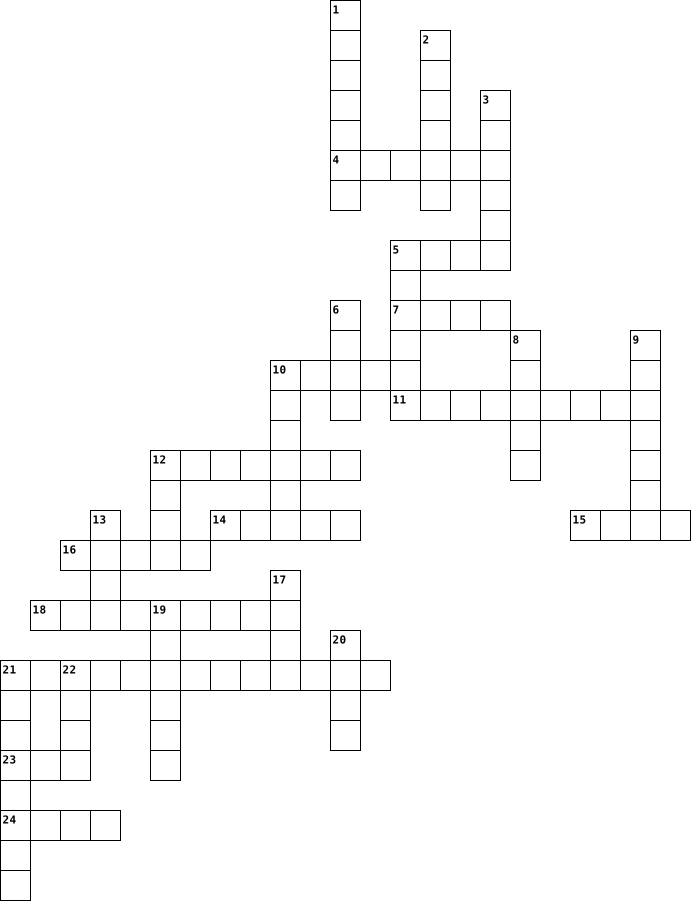
Across
- a GD school color
- extremely hot dense mass of gases
- orbits around earth
- the second GD school color
- stars give off light, heat and
- there is no seasonal change at this place o the earth
- has only one moon
- when the whole surface of the moon is visible to earth
- the moon cycles through phases once a
- when one part of the earth turns away from the sun
- set of stars that make a pattern
- a huge hot ball that gives off heat
- the earth's gravity pulls you
Down
- when one part of the earth faces the sun
- gradually change direction throughout the day based on the sun direction
- gravity is a force that pulls objects to the
- this seasons has the longest days
- the moon rotates on an
- there is no gravity in
- used to determine the time of day before clocks and watches
- the North Pole leans away from the sun in December
- the sun rises in the
- when the sun rises its light cast ______ shadows that point to the west
- the sun sets in the
- the number of hours of sunlight everyday of the year on the equator
- the number of seasons
- What is the Groton dunstable mascot
- shadows become longer as the hour approaches
28 Clues: a GD school color • has only one moon • orbits around earth • the sun sets in the • the sun rises in the • the number of seasons • the moon rotates on an • there is no gravity in • the second GD school color • the earth's gravity pulls you • stars give off light, heat and • set of stars that make a pattern • extremely hot dense mass of gases • this seasons has the longest days • ...
Nicholas' Geography Crossword 2013-09-12

Across
- The time when the sun is farthest form the equator on Jn 21 or Dec 21
- An area of land in very hot climates, that consists of only sand or gravel with no vegetation
- A large tank, natural, or artificial lake used to store water for agricultural use
- the hemisphere of Earth that contains the most land
- Any of seven large continuous land masses that constitute most of the dry land on Earth
- A piece of land surrounded by water
- Height above sea level
- Half of and earth
- An imaginary line joining points on Earth's surface that are all of equal distance north or south of the equator
- A very large expanse of sea
Down
- The half of the earth that is west of the prime meridian.
- A division of the year based on distinctive weather conditions
- A time of equal day and night everywhere on earth
- A time period of 24 hours
- A triangular tract of sediment deposited at the mouth of a river
- A mountain or hill that has a crater in which lava and molten rock are being erupted from the core of the earth
- A group of islands
- A place on the coast where vessels may find shelter
- An area of low-lying, uncultivated ground where water collects
- Circle The line of latitude at 66º30º N
20 Clues: Half of and earth • A group of islands • Height above sea level • A time period of 24 hours • A very large expanse of sea • A piece of land surrounded by water • Circle The line of latitude at 66º30º N • A time of equal day and night everywhere on earth • the hemisphere of Earth that contains the most land • A place on the coast where vessels may find shelter • ...
8th Grade Unit 8 Test Review 2021-03-03

Across
- If the moon were half the size it is now, the tidal variations on Earth would be _______ than they are now.
- Both the waters closest to the moon AND the waters on the direct opposite of Earth will be at _________ at the same time.
- A person's ______ is higher on Earth than on the moon because the force of gravity is greater on Earth.
- The moon revolves around the sun about once a ______.
- The Earth is closest to the sun in winter, which is strange because it is still our coldest month, this is because the our continent is tilted ______ from the sun and gets less direct sunlight.
- This moon phase follows a full moon.
- This moon is visible when the moon is between the Earth and the Sun. It appears completely shadowed.
- This event occurs when a new moon passes between sun and Earth completely blocking the sun from view.
- Earth's orbit around the sun takes this shape.
- We can see the different shapes of the moon because the light from the sun is ________ off the surface of the moon.
Down
- The sun and moon both impact the tides on Earth, the sun has more mass than the moon but the moon is much closer to Earth so its ______________ is stronger.
- To create a ______ showing the phases of the moon, you must include the Earth, Sun and our moon.
- When the moon is completely in Earth's shadow opposite the sun this event occurs.
- Earth is moving around the sun in an ______, while the moon is in orbit, moving around Earth.
- The difference between a solar and lunar eclipse is the _______ of Earth and the moon.
- This is the season when the land is tilted away from the sun.
- Fishing might be best when the moon is between the sun and Earth (new moon) and the _____ is coming to be highest.
- The sun appears to do this across the sky from east to west each day because Earth is spinning on its axis.
- If Earth's rotation slowed down significantly, a day on Earth would be _______.
- When a hemisphere is pointed away from the sun it is receiving more _______ sunlight.
20 Clues: This moon phase follows a full moon. • Earth's orbit around the sun takes this shape. • The moon revolves around the sun about once a ______. • This is the season when the land is tilted away from the sun. • If Earth's rotation slowed down significantly, a day on Earth would be _______. • ...
End of the Year Earth Science Crossword 2024-12-17

Across
- The line of 0° longitude passing through Greenwich, England
- Light from an object moving away from Earth
- The slightly flattened shape of Earth
- A device that proves Earth's rotation
- A tool that breaks light into a spectrum of colors
- A rocky planet, like Earth or Mars
- The curving of winds and ocean currents due to Earth's rotation
- Events caused by shadows cast by the Earth
- The rate of change in a field value
- Any object that orbits a planet, natural or man-made
- The Sun and all objects that orbit it
- The point directly above an observer’s head
- A large group of stars, dust, and gas held together by gravity
- Lines that measure distance north or south of the Equator
- The distance light travels in one year
- The line where the sky meets the ground
- The time of day when the Sun is highest in the sky
- The southernmost point on Earth
- Icy objects that produce a glowing tail as they orbit the Sun
- The day when daylight and nighttime are equal
- The perceived movement of objects in the sky
- A measure of how stretched an orbit is
- Sunlight that hits Earth at a 90-degree angle
- The layer of the atmosphere above the troposphere
- Natural objects in the sky, like stars, planets, and moons
- The boundary between the troposphere and stratosphere
- The boundary between the stratosphere and mesosphere
- The speed of an object
- A massive ball of gas undergoing nuclear fusion
- The lowest layer of Earth’s atmosphere
- A Sun-centered model of the solar system
- An Earth-centered model of the solar system
- Earth’s natural satellite
Down
- The theory that explains the origin of the universe
- Closest point in a planet’s orbit around the Sun
- The northernmost point on Earth
- The atmospheric layer where meteors burn up
- Lines that measure distance east or west of the Prime Meridian
- The boundary between the mesosphere and thermosphere
- A line connecting points of equal temperature
- The average level of the ocean’s surface
- Earth’s solid outer layer
- The outermost atmospheric layer with very high temperatures
- Fixed points that determine the shape of an ellipse
- A region where the same standard time is used
- A recognizable group of stars forming a pattern
- The changing appearance of the Moon as it orbits Earth
- The path a planet takes around the Sun
- A space rock that hits Earth’s surface
- The layer of gases surrounding Earth
- The galaxy that contains our solar system
- The day with the most daylight in the Northern Hemisphere
- A line connecting points of equal air pressure
- A line connecting points of equal value
- A tool used to measure the altitude of stars
- All of Earth’s water
- All of space, time, and matter
- An imaginary line halfway between the North and South Poles
- The line that separates one calendar day from the next
- The latitude where the Sun is directly overhead on December 21
- A star located above Earth’s North Pole
- A gas giant, like Jupiter or Saturn
- The day with the least daylight in the Northern Hemisphere
- Tides caused by the alignment of the Sun and Moon
- A region of space between Mars and Jupiter with many small rocky objects
- The latitude where the Sun is directly overhead on June 21
- A force of attraction between objects
- Caused by Earth’s tilt and revolution around the Sun
- Earth’s yearly orbit around the Sun
- The spinning of Earth on its axis, causing day and night
- The height of a celestial object above the horizon
- The process that powers stars by combining hydrogen into helium
72 Clues: All of Earth’s water • The speed of an object • Earth’s solid outer layer • Earth’s natural satellite • All of space, time, and matter • The northernmost point on Earth • The southernmost point on Earth • A rocky planet, like Earth or Mars • The rate of change in a field value • A gas giant, like Jupiter or Saturn • Earth’s yearly orbit around the Sun • ...
Holidays 2023-06-19
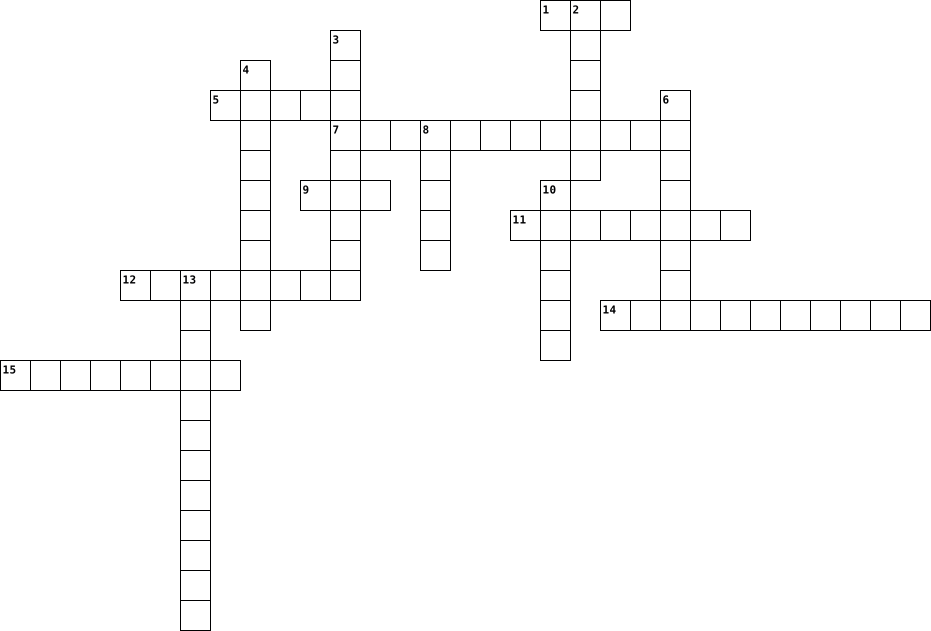
Across
- Year's Day Marks the beginning of the new year
- Day Honors the contributions of workers
- Day Celebrates the nation's independence
- Patrick's Day Celebrates Irish culture and heritage
- Day Honors mothers and motherhood
- Day Honors fathers and fatherhood
- Day A day to express love and friendship
- Day Honors military veterans and their service
Down
- Celebrates the resurrection of Jesus Christ
- Celebrates the birth of Jesus Christ
- A fun holiday with costumes and trick-or-treating
- Day Commemorates those who died serving the country
- Day Raises awareness for environmental protection
- of July Celebrates the United States' independence
- A day of giving thanks and sharing a meal
15 Clues: Day Honors mothers and motherhood • Day Honors fathers and fatherhood • Celebrates the birth of Jesus Christ • Day Honors the contributions of workers • Day Celebrates the nation's independence • Day A day to express love and friendship • A day of giving thanks and sharing a meal • Celebrates the resurrection of Jesus Christ • ...
Earth and the Universe 2021-03-25

Across
- Half of the Earth is in the shade. There it is ___________.
- Earth takes one whole ________ to go round the sun.
- There are four of these and they change during the year.
- The Earth is one of the ________ in our solar system.
- The time when there is natural sunlight.
- The path of Earth around the sun.
Down
- All the planets go around the sun but it does not _________.
- For the Earth to spin on itself it takes ________hours.
- Earth spins on this invisible line.
- It is the biggest object in our solar system.
- After four years we have to add a day. This is called ____ year.
- How many planets are in our solar system.
12 Clues: The path of Earth around the sun. • Earth spins on this invisible line. • The time when there is natural sunlight. • How many planets are in our solar system. • It is the biggest object in our solar system. • Earth takes one whole ________ to go round the sun. • The Earth is one of the ________ in our solar system. • ...
Earth Science 2023-07-09

Across
- A PHENOMENON THAT OCCURS WHEN THE EARTH PASSES BETWEEN THE SUN AND THE MOON.
- ECLIPSE THE EVENT THAT OCCURS WHEN THE MOON PASSES BETWEEN THE SUN AND THE EARTH.
- THE EARTH’S SOUTHERN HALF EXPERIENCES THIS SEASON DURING DECEMBER.
- THE PATH FOLLOWED BY EARTH AROUND THE SUN.
- THE TIME WHEN DAY AND NIGHT ARE OF EQUAL LENGTH.
- HEMISPHERE THE EARTH’S SOUTHERN HALF.
- HEMISPHERE THE EARTH’S NORTHERN HALF.
- THE EARTH’S SOUTHERN HALF EXPERIENCES THIS SEASON DURING JUNE.
- THE EARTH’S NORTHERN HALF EXPERIENCES THIS SEASON DURING SEPTEMBER.
- THE EARTH’S SOUTHERN HALF EXPERIENCES THIS SEASON DURING MARCH.
Down
- THE EARTH’S MOVEMENT IN A CIRCULAR PATH AROUND THE SUN.
- THE EARTH’S MOVEMENT AROUND THE SUN.
- THE POINT AT WHICH THE EARTH IS FARTHEST FROM THE SUN.
- THE EARTH’S NORTHERN HALF EXPERIENCES THIS SEASON DURING JUNE.
- THE POINT AT WHICH THE EARTH IS CLOSET TO THE SUN.
- THE EARTH’S MOVEMENT AROUND ITS OWN AXIS.
- THE EARTH’S MOVEMENT THAT CAUSES DAY AND NIGHT.
17 Clues: THE EARTH’S MOVEMENT AROUND THE SUN. • HEMISPHERE THE EARTH’S SOUTHERN HALF. • HEMISPHERE THE EARTH’S NORTHERN HALF. • THE EARTH’S MOVEMENT AROUND ITS OWN AXIS. • THE PATH FOLLOWED BY EARTH AROUND THE SUN. • THE EARTH’S MOVEMENT THAT CAUSES DAY AND NIGHT. • THE TIME WHEN DAY AND NIGHT ARE OF EQUAL LENGTH. • THE POINT AT WHICH THE EARTH IS CLOSET TO THE SUN. • ...
planet crossword 2021-05-26

Across
- - Its has a ring around it.
- - We live on it.m space into earth.
- - A rock that comes fro
- - The biggest planet.
- - closest planet to earth.
- - The closest to the sun.
- - It travels around space.
- - It comes out an night on earth.
Down
- - It takes 365 day to travel around earth.
- - Are big rocks floating around spaces.
- - Is is blue.
- - Is red.
- - A dwarf planet.
- - The coldest planet.
14 Clues: - Is red. • - Is is blue. • - A dwarf planet. • - The biggest planet. • - The coldest planet. • - A rock that comes fro • - The closest to the sun. • - closest planet to earth. • - It travels around space. • - Its has a ring around it. • - It comes out an night on earth. • - We live on it.m space into earth. • - Are big rocks floating around spaces. • ...
Creation 2015-09-19

Across
- In the beginning, _____ made the heaven and earth.
- And let _____ fly in the air above the earth.
- God named the dry land ______.
- On the fifth day, God created the large _____.
- God said, "Let us make human beings in our _____."
- God named the _____ day and the darkness night.
Down
- And God saw that it was _____.
- Some plants will make grain for seeds. Others will make _____ with seeds in it.
- On the ______ day, God rested.
- The first book of the Bible is ______.
- God named the air _____.
11 Clues: God named the air _____. • And God saw that it was _____. • On the ______ day, God rested. • God named the dry land ______. • The first book of the Bible is ______. • And let _____ fly in the air above the earth. • On the fifth day, God created the large _____. • God named the _____ day and the darkness night. • In the beginning, _____ made the heaven and earth. • ...
CW-Seasons 2025-05-06

Across
- Caused by the revolution of the Earth around the Sun which is 365 ¼ days
- Sun more concentrated & intense due to perpendicular angle resulting in warmer Summer
- Caused by the tilt of the Earth’s axis. Summer = we tilt toward; Winter = we tilt away
- The regular, repeating path of one object around another
- Earth rotates and revolves the opposite direction of a clock’s hands
- Imaginary line running though N & S poles of Earth
- To spin on axis
- 23.5o tilt that causes seasons
Down
- Imaginary line runs around center of earth at 0 degrees separating N & S hemispheres
- Egg or football shaped path the planets take around the sun
- One object travels around another object. Ex. Moon goes around Earth in ≅ 28 days
- Sun at low angle results in diffused, weak light & cooler temps in Winter
- Half of the Earth divided into N & S halves by the Equator
- Earth’s tilt most extreme toward (Longest Day Summer) and away from sun (Longest Night Winter)
- Equal day & night because Earth’s tilt = 0; Spring & Fall
15 Clues: To spin on axis • 23.5o tilt that causes seasons • Imaginary line running though N & S poles of Earth • The regular, repeating path of one object around another • Equal day & night because Earth’s tilt = 0; Spring & Fall • Half of the Earth divided into N & S halves by the Equator • Egg or football shaped path the planets take around the sun • ...