
earth day Crossword Puzzles
Winter Solstice 2024-12-19

Across
- Molecules are moving slower. Consequently, it feels _____.
- In 13 days, you may hear "_____ ___ ____" as you go about your day.
- A single ice crystal that often has a six-sided geometric shape. They say that no two of these are the same!
- Due to the weather, you should wear a ______.
- The day before a holiday. For example "New Year's ____" and "All Hallow's ___" or "Christmas ___."
- The winter _______ is the shortest day of the year.
- Solid water.
- The coldest season of the year.
Down
- Injury caused to skin tissue after exposure to the cold.
- Since the lake is _______, we can walk across it.
- Water vapor freezes into crystals and then falls as _____.
- Ice ______ help you glide across the ice.
- At the end of the year, it is winter in the _______ hemisphere of the Earth.
- Sometimes it's so cold that if you leave water outside, it will _______!
- Although it is winter for us at the end of the year, it is summer in the ________ hemisphere of the Earth.
- If this man goes too close to fire, he'll melt.
16 Clues: Solid water. • The coldest season of the year. • Ice ______ help you glide across the ice. • Due to the weather, you should wear a ______. • If this man goes too close to fire, he'll melt. • Since the lake is _______, we can walk across it. • The winter _______ is the shortest day of the year. • Injury caused to skin tissue after exposure to the cold. • ...
CREATION 2024-04-29

Across
- On the second day, God created the _____ to separate the waters above from the waters below.
- God created the heavens and the _____.
- The first woman created by God, made from Adam's rib.
- On the sixth day, God created _____ and _____.
- God created _____ on the fifth day.
Down
- On the fourth day, God created the _____ and the _____.
- The first day of creation, God said, "Let there be _____."
- God created the _____ on the third day.
- God rested on the _____ day.
- The first man created by God.
10 Clues: God rested on the _____ day. • The first man created by God. • God created _____ on the fifth day. • God created the heavens and the _____. • God created the _____ on the third day. • On the sixth day, God created _____ and _____. • The first woman created by God, made from Adam's rib. • On the fourth day, God created the _____ and the _____. • ...
Geography 2021-03-12

Across
- a non renewable energy source
- what we need to create energy and products from the earth
- who contributes to earth overshoot day
- a resource that never renews
- this industry involves extracting resources from the earth
- manage resources properly so they dont run out
- global warming causes this
Down
- how many resources you use up
- a constantly renewing resource
- a resource that doesnt deplete in our lifetime
- when fossil fuels are burned they release this
- something we have to do to be sustainable
- a type of fossil fuel
13 Clues: a type of fossil fuel • global warming causes this • a resource that never renews • how many resources you use up • a non renewable energy source • a constantly renewing resource • who contributes to earth overshoot day • something we have to do to be sustainable • a resource that doesnt deplete in our lifetime • when fossil fuels are burned they release this • ...
yara's cross word puzzle 2024-02-28

Across
- moon-getting bigger
- vapor-the gases state of water
- turn on an axis
- time between sunrise and sunset on earth
- amount of material in something
- to use again
Down
- moon-getting smaller
- time between sunset and sunrise on earth
- a building that houses a telescope
- shape of the viable pat of the moon
- group of billions of stars.earth is in the milky way
- a mass of ice rock,and gas orbiting the sun
- mixture of gasses surrounding earth
13 Clues: to use again • turn on an axis • moon-getting bigger • moon-getting smaller • vapor-the gases state of water • amount of material in something • a building that houses a telescope • shape of the viable pat of the moon • mixture of gasses surrounding earth • time between sunset and sunrise on earth • time between sunrise and sunset on earth • ...
Biblical sabbath 2025-01-25

Across
- Only those who does the_____of God can enter Heaven.
- Those who____to God hear what God says
- Keep the____day holy
- Which day is the biblical sabbath?
- In how many days did God create the Heavens & earth?
- What kinds of blessings do we receive when we keep the Sabbath?
Down
- Use to show Which day the week begins with
- The Ten commandments are in the book of?
- Which day of the week did Jesus resurrect?
- The day after the sabbath (7th day)
- How many books in the bible are used to explain this subject?
- Use this to show definition of Saturday & Sunday
12 Clues: Keep the____day holy • Which day is the biblical sabbath? • The day after the sabbath (7th day) • Those who____to God hear what God says • The Ten commandments are in the book of? • Use to show Which day the week begins with • Which day of the week did Jesus resurrect? • Use this to show definition of Saturday & Sunday • ...
Reason For Seasons CrossWord Puzzle 2023-12-04

Across
- the parallel of latitude 23°26ʹ north
- The degree that the earth is tilted
- The revolution around the sun
- an imaginary line about which a body rotates.
- the parallel of latitude 23°26ʹ south
- sunlight that is concentrated
- During summer when the northern hemisphere is tilted towards the sun, the sunlight is
- an imaginary line drawn around the earth equally distant from both poles
- happens during winter when the sun is positioned lower in the sky, and there are fewer daylight hours.
- the measure of hotness or coldness expressed in terms of any of several scales, including Fahrenheit and Celsius
- a bright star that can be seen in the sky in the north
- the part of the Earth's surface between the Tropic of Cancer and the Tropic of Capricorn; characterized by a hot climate
Down
- in a direction opposite to that in which the hands of a clock rotate as viewed from in front
- sunlight that is more unconcentrated
- the period of darkness in each twenty-four hours
- The planet that we live on
- the mild temperature areas located between the subtropical and the polar regions
- The period of light in a twenty-four-hour period
- the star around which the earth moves and that provides light and heat for the earth:
- the time taken by the earth to make one revolution around the sun
20 Clues: The planet that we live on • The revolution around the sun • sunlight that is concentrated • The degree that the earth is tilted • sunlight that is more unconcentrated • the parallel of latitude 23°26ʹ north • the parallel of latitude 23°26ʹ south • an imaginary line about which a body rotates. • the period of darkness in each twenty-four hours • ...
Simple Present Tense 2025-08-31

Across
- I___ up at 7:00 a.m. every day. (get)
- Hema ___ badminton every evening. (play)
- The baby ___ all day. (cry)
- What ____ so good? (smell)
- The nurse ____ of my grandfather. (take care)
- My granny ___ delicious lasagne.(cook)
- If it ___ today, we will get stuck. (rain)
- Amy rarely ___ her room.(leave)
- The Principal _______ to speak to Raj. (want )
Down
- The teacher ____ the parents today. (meet)
- The flight ____ at 8 o’clock in the morning. (leave)
- The movie ____ within a few minutes. (start)
- There___ the topper of our school. (come)
- Cows ___ us milk.(give)
- Tony ___ to guitar lessons every Sunday. (go)
- The Earth ____ around the Sun. (revolve)
- The dogs ___ at night.(bark)
- The birds ___ all day long. (chirp)
- The fluffy clouds ___ around.(move)
- The boys ___ hard to get good grades. (study)
20 Clues: Cows ___ us milk.(give) • What ____ so good? (smell) • The baby ___ all day. (cry) • The dogs ___ at night.(bark) • Amy rarely ___ her room.(leave) • The birds ___ all day long. (chirp) • The fluffy clouds ___ around.(move) • I___ up at 7:00 a.m. every day. (get) • My granny ___ delicious lasagne.(cook) • Hema ___ badminton every evening. (play) • ...
Chap 1 & 2 Vocab 2025-01-14

Across
- line on a map that connects points of equal elevation
- set of horizontal and vertical lines on a map
- angle that describes the distance east or west of the prime meridian
- study of the earth's air and weather
- spinning of the earth or other or other object in space
- system of measurement used by scientists
- the point farthest south on the earth
- vertical distance between contour and lines on a topographic map
- study of the earth oceans
- part of a map that shows the major compass directions
- list of map symbols and their meanings
- imaginary line through the earth that connects the North and South poles
- small underwater research vessel
- point farthest north on the earth
- the study of outer space and the objects in it
- short lines that point toward the center of a depression on a topographic map
- drawings that show parts of the earth surface as seen from
- study of the solid parts of the earth
- that describes the distance north or south of the equator
Down
- area that has the same clock time
- known amount used for measuring
- map that shows the shape and elevation of the land surface
- Scientist who studies the solid parts of earth and how they change
- half of the earth
- one of seven major land areas of the earth
- lline of zero degree longitude
- unit for measuring angles in a circle or sphere
- scientist who studies the air and weather
- line of longitude
- a scientist who studies outer space and objects in it
- imaginary line that defines the start of the day
- part of a map that shows the relationship between map distance and actual
- studies the earth's land, water, air, and outer space.
- line of latitude
- scientist who studies the oceans
- line of zero degrees latitude halfway between the poles.
36 Clues: line of latitude • half of the earth • line of longitude • study of the earth oceans • lline of zero degree longitude • known amount used for measuring • small underwater research vessel • scientist who studies the oceans • area that has the same clock time • point farthest north on the earth • study of the earth's air and weather • the point farthest south on the earth • ...
Earth 2024-04-22

Across
- There ______ types of hemisphere.
- The imaginary line that divides the Earth into two equal halves, north and south.
- The imaginary line around which the Earth rotates
- his movement causes the changing of seasons.
Down
- This movement causes the cycle of day and night.
- The path that the Earth follows as it orbits around the Sun.
- How many spheres is the Earth divided into?
- four How many hours does it take to finish one rotation?
- This season is typically characterized by longer days, warmer temperatures, and blooming flowers. .
- another word for tilted.
- year The revolution of earth takes how many year to complete its movement around earth.
11 Clues: another word for tilted. • There ______ types of hemisphere. • How many spheres is the Earth divided into? • his movement causes the changing of seasons. • This movement causes the cycle of day and night. • The imaginary line around which the Earth rotates • four How many hours does it take to finish one rotation? • ...
FUN AND LEARN 2024-10-07

Across
- Capital of Maharastra
- Term used for Earth moving around sun
- Crop grown in South
- The only planet that has life
- water getting heated due to sun is
- Largest state
- The layer which protect us from sunrays
- During day, plants take ____ to grow
- Fruit grown in Jammu and Kashmir
Down
- Means relating to people and society
- Largest planet of our solar system
- When we don't see moon in sky
- A water body formed naturally by collection
- Smallest state
- Crop grown in Centre
- _makes maps easy to read
- Capital of India
- Tiger eats me
- Crop grown in North
19 Clues: Largest state • Tiger eats me • Smallest state • Capital of India • Crop grown in South • Crop grown in North • Crop grown in Centre • Capital of Maharastra • _makes maps easy to read • When we don't see moon in sky • The only planet that has life • Fruit grown in Jammu and Kashmir • Largest planet of our solar system • water getting heated due to sun is • ...
ASL 1 Review 2023-09-13

Across
- everything on earth has _____
- another word for hard at work
- Earth, country, state, ______
- when I'm learning math, I get ______
- the starter to a question
- opposite of night
- your parent's sibling's children are your _______
- opposite of son
- you go to school to get an ___________
- the place you get food on campus
Down
- opposite of understand
- the color of coffee
- a similar sign to funny
- a popular conjunction
- the opposite of opaque
- sign for "What are you doing?" or "You like to do what?"
- something you do with friends
- Opposite of knowing
- we learn ASL to communicate with ____ people
19 Clues: opposite of son • opposite of night • the color of coffee • Opposite of knowing • a popular conjunction • opposite of understand • the opposite of opaque • a similar sign to funny • the starter to a question • everything on earth has _____ • another word for hard at work • Earth, country, state, ______ • something you do with friends • the place you get food on campus • ...
Moon,Earth,Sun,And Tides Crossword 2019-03-04

Across
- Tide / a less than average tide occurring at the first and third quarters of the moon
- / The four natural divisions of the year based on changes in temperature due to the varied amounts of sunlight; caused by the tilt of Earth during revolution (23.5 degrees)
- / the natural satellite of the earth, visible (chiefly at night) by reflected light from the sun.
- / The regular rise and fall of the ocean's surface influenced by the moon's gravity pulling on earth
- Moon / The lighted side has almost disappeared.
- eclipse / when the moon passes between the earth and sun (an eclipse of the sun occurs.) the moon looks black or you can't see it.
- Tide / When the tidal range is greatest. (full moon and new moon)
- / moving around another object in space
- / describes phases following a new moon, as more of the Moon's lighted side becomes visible
Down
- / The luminous star around which Earth and other planets revolve; made mainly of hydrogen and helium
- Quarter Moon / The Moon is a quarter of the way around Earth. This is sometimes called a half Moon.
- / The imaginary line through Earth that extends from the North Pole to the South Pole and is the center of Earth's rotation (23.5 degrees)
- / How many low tides and high tides are in a day
- eclipse / When the earth and moon are in a direct line - the moon moves into the Earth's shadow. The moon can look red.
- Moon / The moon is between the Sun and Earth. You can't see the lighted half of the Moon.
- / spins
- / as the Earth spins, it also _________ around the Sun. At the same time, the Moon is also ____________ around the Earth.
- / describes phases that occur after a full moon, as the visible lighted side of the Moon grows smaller
- / A curved path followed by a celestial object as it revolves around another object
- / the force that attracts a body toward the center of the earth, or toward any other physical body having mass.
- Moon / The Moon is now halfway around Earth. You can see all of its lighted side.
- Quarter moon / The Moon is three-quarters of the way around Earth.
22 Clues: / spins • / moving around another object in space • / How many low tides and high tides are in a day • Moon / The lighted side has almost disappeared. • Tide / When the tidal range is greatest. (full moon and new moon) • Quarter moon / The Moon is three-quarters of the way around Earth. • ...
The Story of Creation 2024-06-29

Across
- Plants that produce food and oxygen
- What did the Spirit of God hover over
- Aquatic animals
- To bring into existence
- Creatures with feathers that can fly
- Points of light seen in the night sky
- The time when it's dark
- Creatures
- Opposite of night
Down
- God said let there be what?
- Nature's night light
- The Planet we live on
- Tall plants with trunks
- Essential for animals and humans
- The expanse of space above us
- The opposite of working
- Large bodies of salt water
- Light source for the day
- The soil part of the earth's surface
- The blue above
20 Clues: Creatures • The blue above • Aquatic animals • Opposite of night • Nature's night light • The Planet we live on • Tall plants with trunks • To bring into existence • The opposite of working • The time when it's dark • Light source for the day • Large bodies of salt water • God said let there be what? • The expanse of space above us • Essential for animals and humans • ...
Seasons 2013-02-07

Across
- It is winter when a hemisphere is tilted __________ from the sun.
- If Earth's axis was straight up and down, we would have different weather, but we would not have _________.
- The Earth's axis has a ________ of about 23.5 degrees.
- The top half of the Earth is called the Northern _____________.
- The Earth rotates, or spins in place, but it also __________, or orbits, around the Sun.
- Earth's ____________ causes day and night. (Rotation or revolution?)
- This is the name for the path that the Earth follows as it revolves around the Sun.
Down
- The imaginary pole that goes through the middle of the Earth from North to South is called Earth's ________.
- It takes 365 days, or one ________ for the Earth to make one complete revolution around the Sun.
- When it is summer in the Northern Hemisphere, it is winter in the _________________ Hemisphere.
- If the Earth didn't rotate, we wouldn't have _________ or nights.
- Like the Earth and the Sun, ____________ orbit around the nucleus in an atom.
- The Earth ___________ once every 24 hours.
- It is summer when a hemisphere is tilted _________ the sun.
14 Clues: The Earth ___________ once every 24 hours. • The Earth's axis has a ________ of about 23.5 degrees. • It is summer when a hemisphere is tilted _________ the sun. • The top half of the Earth is called the Northern _____________. • It is winter when a hemisphere is tilted __________ from the sun. • If the Earth didn't rotate, we wouldn't have _________ or nights. • ...
Care for Creation 2023-12-08

Across
- Being in _______ with each other can resemble Adam and Eve before the Fall
- when we care for creation we are putting God and our ______ first
- Care for Earth and God's creation is a form of _____
- St. _______ of Assisi preached that all of nature and animals were a part of God's kingdom
- Careful and responsible management of someone or something
- _______ warming affects everyone and everything, including glaciers or animals
- Reduce, _____, Recycle
- _______ Justice best compliments this topic because it is a duty for all of us to partake in caring
- _______ Work of Mercy upholding this topic is "instruct the ignorant"
Down
- The Earth and human life are ______
- As a _____, we can participate in beach clean-ups or planting fundraisers
- It is morally ______ to kill animals inhumanely
- Another word for a duty of ours.
- God created Earth _____ for humans and animals to live and thrive
- _____ Day is on April 22 every year
- "Blessed are the meek, for they will inherit the Earth"
16 Clues: Reduce, _____, Recycle • Another word for a duty of ours. • The Earth and human life are ______ • _____ Day is on April 22 every year • It is morally ______ to kill animals inhumanely • Care for Earth and God's creation is a form of _____ • "Blessed are the meek, for they will inherit the Earth" • Careful and responsible management of someone or something • ...
T. Tyrianna's Crossword 2022-01-24

Across
- person who takes care of sick animals
- repulsed
- lock-necked animal
- house pet; an enemy of dogs
- 7-11 employee
- month of Songkran
- beautiful weather; a symbol for gay pride
- She has something I want. I feel _________.
- Today is a perfect beach day. It's ________.
- feeling of exhaustion
- first day of the week
Down
- flightless arctic bird
- start of the weekend
- last month of the year
- holiday for trick-or-treating
- largest mammal on earth
- cares for sick people in a hospital
- educates the youth
- A hobby Taylor Swift and I share
- human coffee maker
20 Clues: repulsed • 7-11 employee • month of Songkran • lock-necked animal • educates the youth • human coffee maker • start of the weekend • feeling of exhaustion • first day of the week • flightless arctic bird • last month of the year • largest mammal on earth • house pet; an enemy of dogs • holiday for trick-or-treating • A hobby Taylor Swift and I share • cares for sick people in a hospital • ...
Springtime in April 2025-03-17

Across
- Trees grow these each spring:
- Water drops
- Word associated with spring:
- what animal predicts spring?
- April showers bring May_____?
- In spring plants do this
- worn in rain:
- What month does spring start?
- April birth flower
- Flowers begin to:
- trees begin to:
Down
- sing
- yellow dust produced by a plant
- Prank day celebrated in spring:
- April zodiac
- In spring Bees are ____.
- Spring starts with the Vernal:
- Spawn in spring
- The birthstone for April
- _____ day is celebrated in spring.
- springtime festival celebrated on May 1st.
- hatch in spring
- What tree symbolizes spring?
- Old English word for Spring.
24 Clues: sing • Water drops • April zodiac • worn in rain: • Spawn in spring • hatch in spring • trees begin to: • Flowers begin to: • April birth flower • In spring Bees are ____. • The birthstone for April • In spring plants do this • Word associated with spring: • what animal predicts spring? • What tree symbolizes spring? • Old English word for Spring. • Trees grow these each spring: • ...
The Moon, Earth and the Sun 2025-10-14

Across
- The path the Earth follows around the Sun
- The Moon’s shape seems to change because of this
- The imaginary line Earth spins around
- The natural satellite that orbits Earth
- The movement of Earth around the Sun, taking one year
Down
- When the Moon passes between the Sun and Earth
- The spinning of Earth on its axis, causing day and night
- The bright part of the Moon we see from Earth is lit by this
- The reason Earth has different seasons
9 Clues: The imaginary line Earth spins around • The reason Earth has different seasons • The natural satellite that orbits Earth • The path the Earth follows around the Sun • When the Moon passes between the Sun and Earth • The Moon’s shape seems to change because of this • The movement of Earth around the Sun, taking one year • ...
Unit 2 Crossword 2020-11-10

Across
- when light from the Sun is hitting the side of the moon facing away from the Earth
- the partial or complete blocking of light of one celestial object by another
- innermost layer of the Sun
- all matter in space including planets, stars, and galaxies
- can only be viewed during an eclipse; means crown
- when a planet or moon travels around the body it is orbiting one time
- imaginary line going right through the center of earth from "top" to "bottom"
- the largest planet in our solar system
- light is decreasing until a new moon is reached
- system of millions or billions of stars held together by gravity
Down
- rise and fall of sea levels caused by gravitational forces from the Moon, the Sun, and the rotation of the Earth
- the day-to-day variation of the atmosphere's condition locally
- an imaginary line around the middle of the planet
- the variation of weather conditions over long periods of time
- when a planet or moon spins on its axis one time
- system a collection of planets and their moons that orbit a star
- light is increasing until the full moon is reached
17 Clues: innermost layer of the Sun • the largest planet in our solar system • light is decreasing until a new moon is reached • when a planet or moon spins on its axis one time • an imaginary line around the middle of the planet • can only be viewed during an eclipse; means crown • light is increasing until the full moon is reached • ...
Christmas Crossword 2024-12-04

Across
- you open this on christmas
- A drink people usually drink
- You light this on fire and get good smells
- Something you use to crack hard nuts
- when someone is born
- you open this from a present
- Came to earth to save us
- these jingle
Down
- Red and white
- an emotion around this day
- A puddig people eat
- A man that delivers present
- these have antlers
- Somehting people often cook
- we celebrate this day on December 25
- works for santa
- people kiss under this
17 Clues: these jingle • Red and white • works for santa • these have antlers • A puddig people eat • when someone is born • people kiss under this • Came to earth to save us • an emotion around this day • you open this on christmas • A man that delivers present • Somehting people often cook • A drink people usually drink • you open this from a present • Something you use to crack hard nuts • ...
Hach Earth Day 2023 2023-04-14

Across
- Reduce, Reuse, ______
- Power obtained by harnessing the energy of the wind
- Decayed organic material used as fertilizer
- Innovation, People, & Environment make up Hach's 3 pillars of _____
- Site for the disposal and burying of waste materials
Down
- Capable of being decomposed by bacteria or other living organisms
- Prevention of wasteful use of a resource
- A resource that can be replenished naturally
- The introduction of harmful materials into the environment
- A fuel that has been formed in the past from remains of living organisms
- Power obtained by harnessing the energy of the sun's rays
11 Clues: Reduce, Reuse, ______ • Prevention of wasteful use of a resource • Decayed organic material used as fertilizer • A resource that can be replenished naturally • Power obtained by harnessing the energy of the wind • Site for the disposal and burying of waste materials • Power obtained by harnessing the energy of the sun's rays • ...
Earth Day Crossword Puzzle 2025-04-08

Across
- I turn these off when I'm not using them in my room
- What do you do with plastic bottles, cardboard and tin cans to help our Earth
- Green friends who stand tall, give us clean air and shade
- I try to ______ water and energy by using less of it to save the environment
- I use this less when brushing my teeth or washing dishes in the sink
Down
- A kind of energy that comes from the sun
- I don't waste food and eat my _____ the next day for lunch
- I help to pick up _____ in the park or by the streets to keep it clean
- Rain, sunny, snowy or dry - it changes a lot when our Earth gets too warm
- When I go grocery shopping, I will bring my own ____ to store my items bought
- The planet that we all live on and need to protect
11 Clues: A kind of energy that comes from the sun • The planet that we all live on and need to protect • I turn these off when I'm not using them in my room • Green friends who stand tall, give us clean air and shade • I don't waste food and eat my _____ the next day for lunch • I use this less when brushing my teeth or washing dishes in the sink • ...
Earth Day Crossword Puzzle 2022-03-23

Across
- similar to the weather
- Something that can be used many times
- each animal or human may have a different one
- all humans need them
- Destroying a part of a forest
Down
- make less of something
- Making a place dirty
- something they dig underground to find
- The Special Planet
- Something that can be turned new again
- Something that is very handy
11 Clues: The Special Planet • Making a place dirty • all humans need them • make less of something • similar to the weather • Something that is very handy • Destroying a part of a forest • Something that can be used many times • something they dig underground to find • Something that can be turned new again • each animal or human may have a different one
Unit 3 Solar System 2023-10-24

Across
- average sized star at the center of our solar system that has average temperature
- spin or turn on an axis once; causes day and night for the Earth
- predictable pattern of the moon’s changing appearance.
- Lunar phase halfway between a full moon and a new moon
- natural satellite that revolves around a planet
- when the moon appears to shrink or get smaller; from full to new moon
- the 3rd planet from the Sun; where we live
- rise and fall of sea levels caused by the pull of gravity between the Earth, Sun, and Moon
Down
- four divisions of the year caused by the Earth revolving around the sun
- Highest high tides and lowest low tides; after a full or new moon
- The moon is seen as completely illuminated when the Earth is between the Moon and the Sun
- Lunar phase halfway between a new moon and a full moon
- Lower high tides and higher low tides; after a 1st or 3rd quarter moon
- when the moon appears to grow or get bigger; from new to full moon
- the Moon appears invisible from Earth when it is between the Earth and the Sun
- when an object goes completely around another object one time; causes the Earth’s seasons to change.
- imaginary line that an object rotates around
17 Clues: the 3rd planet from the Sun; where we live • imaginary line that an object rotates around • natural satellite that revolves around a planet • Lunar phase halfway between a new moon and a full moon • predictable pattern of the moon’s changing appearance. • Lunar phase halfway between a full moon and a new moon • ...
Creation Myth Crossword Puzzle 2021-09-28

Across
- The starry sky.
- Heavenly light.
- The youngest and the titan that did not fear Uranus.
- The Night.
- The region beneath the earth.
- Earthly light.
Down
- The 6th child of Rhea.
- The empty void.
- The god of love and attraction.
- The one that rose from the sea foam.
- The sterile sea.
- The sister of Cronus and wife.
- The wife of the 6th child of Rhea.
- The Ash-tree nymphs, and a race of Giants.
- The Earth.
15 Clues: The Night. • The Earth. • Earthly light. • The empty void. • The starry sky. • Heavenly light. • The sterile sea. • The 6th child of Rhea. • The region beneath the earth. • The sister of Cronus and wife. • The god of love and attraction. • The wife of the 6th child of Rhea. • The one that rose from the sea foam. • The Ash-tree nymphs, and a race of Giants. • ...
Pollution 2026-01-18

Across
- the ground and soil on Earth
- light material that does not break down easily
- liquid we drink and use every day
- vehicles that cause smoke and pollution
- a long body of flowing water
- what we breathe
- not dirty
- not clean
Down
- when the Earth becomes dirty or unhealthy
- dirty air from fires, cars, or factories
- a large body of salty water
- unwanted or unused things
- things people throw away
- living beings that are not people
- a place where things are made
15 Clues: not dirty • not clean • what we breathe • things people throw away • unwanted or unused things • a large body of salty water • the ground and soil on Earth • a long body of flowing water • a place where things are made • liquid we drink and use every day • living beings that are not people • vehicles that cause smoke and pollution • dirty air from fires, cars, or factories • ...
crazy kyra 2014-11-19

Across
- , which month comes after march?
- ,which month is the last month of the year and also santa visits us in this month
- ,opposite of short
- ,which is the first month of the year?
- ,which month comes after april
- ,when is kyras birthday
- ,anya keeps ****ing her head
- , something in we have in our jackets and pants
Down
- ,day of the week that starts with 'm'
- , there are 365 days in a ****
- ,how many months in a year
- ,which planet takes 1 year to go around the sun?
- ,how many days in a week?
- ,what day comes after monday
- ,what day comes before monday
- ,colour of apples
- ,colour of the sky
- ,which month is the 7th month of the year
- ,kyra's favourite colour
19 Clues: ,colour of apples • ,opposite of short • ,colour of the sky • ,when is kyras birthday • ,kyra's favourite colour • ,how many days in a week? • ,how many months in a year • ,what day comes after monday • ,anya keeps ****ing her head • ,what day comes before monday • , there are 365 days in a **** • ,which month comes after april • , which month comes after march? • ...
Nature 2020-04-25

Across
- We need to ______ and take care of the Earth.
- I save _______ by turning off the lights.
- We have flowers, fruits, vegetables and other ________ in our garden.
- We live on planet _______.
- Dogs and cats are types of _________.
Down
- Reduce, Reuse, ________.
- Plants, trees and birds are part of _______.
- The month that we celebrate Earth Day
- Together, we can _____ the Earth.
- The ____ is so bright, I have to wear dark glasses.
10 Clues: Reduce, Reuse, ________. • We live on planet _______. • Together, we can _____ the Earth. • The month that we celebrate Earth Day • Dogs and cats are types of _________. • I save _______ by turning off the lights. • Plants, trees and birds are part of _______. • We need to ______ and take care of the Earth. • The ____ is so bright, I have to wear dark glasses. • ...
Lesson 1 Vocabulary Crossword Puzzle 2023-10-11

Across
- a set of numbers that together describe the exact location of something, such as a place on a map
- where a place is located in relation to another place
- a very large, unbroken area of land
- the seven largest areas of land on earth
- the directions on a compass rose, such as southeast, that are located between the cardinal directions
- the precise point where a place is located on Earth
- an element of a map that shows how a unit of distance on the map relates to actual distance on the surface of earth
- longitude that is labeled 0 degrees, from which all other degrees of longitude are measured. the prime meridian passes through greenwich, england.
- the four main directions on a compass rose north, south, east, and west
Down
- the line of latitude that circles earth exactly midway between the north and south poles
- the meridian of longitude located at 180º. by international agreement, the date is one day earlier to the east of this line
- an imaginary line between the north and south poles that crosses the equator at right angles
- the spinning motion of earth around its axis
- one complete trip by earth around the sun
- a change in the shape, size, or position of a place when it is shown on a map
- a way of representing the spherical Earth on a flat surface
- an imaginary line around earth that runs parallel to the equator
- a box or other display on a map that explains the meaning of the symbols used on the map
- one half of a sphere; earth can be divided into eastern and western or into northern and southern
- an imaginary line that runs from the north pole to the south pole through the center of earth
- a small diagram used to indicate directions on a map
21 Clues: a very large, unbroken area of land • the seven largest areas of land on earth • one complete trip by earth around the sun • the spinning motion of earth around its axis • the precise point where a place is located on Earth • a small diagram used to indicate directions on a map • where a place is located in relation to another place • ...
Space Science Unit Crossword 2023-02-20

Across
- This term takes the earth 1 day or 24 hours to complete and is done by earth spinning on its axis.
- These objects are made of small and large rocks and are found in the space between Mars and Jupiter.
- These are the results we get from earth revolving around the sun.
- This is what the moon gravity gives us.
- The term used when we are starting to see less and less of the moon (Full moon - New moon)
- This is roughly the amount of time it takes for the moon to revolve around the Earth (The actual time is 28 days).
- These planets are larger, have a gaseous surface and are farther from the sun.
- This term takes the Earth 1 year or 365 days to complete and is done so by earth going completely around the sun.
Down
- These objects rotate on their axis, orbit around a star, and are located in the Milky Way Galaxy.
- This is the moon phase that occurs when the moon is between the earth and the sun.
- This is the result we get because of earth rotating on its axis.
- These planets are smaller, have a rocky surface and are closer to the sun.
- The term used when we are starting to see more and more of the moon (New moon - Full moon)
- The name of our home galaxy and where all the night time stars we see are located.
- This is the number of stars we have in our solar system.
- This is the moon phase that occurs when the earth is between the sun and the moon.
- These objects are made of ice and dust and orbit out past Neptune.
- The only star in our solar system and the closest star to earth.
- This is a rock that does not light up. It reflects light from the sun as it revolves around the earth.
19 Clues: This is what the moon gravity gives us. • This is the number of stars we have in our solar system. • This is the result we get because of earth rotating on its axis. • The only star in our solar system and the closest star to earth. • These are the results we get from earth revolving around the sun. • ...
Moon Phase Crossword 2025-10-08

Across
- becoming less bright, intense, or strong
- An object that revolves around another object in space
- Moon phase in which less than half of the Moon appears to be illuminated.
- More than half but less than fully illuminated
- the different shapes of the moon you see from Earth
- the regular rise and fall of the ocean's surface influenced by the moon's gravity pulling on earth
- When one hemisphere is tilted toward the Sun it experiences more direct rays from the Sun that strike Earth at higher angles (closer to 90 degrees) causes warmer temperatures.
- when the sun is on the opposite side of Earth from you
- Occurs when the Moon passes directly between the Sun and Earth and casts a shadow over part of Earth
- describes phases following a new moon, as more of the Moon's lighted side becomes visible
Down
- the blocking of sunlight to the moon that occurs when Earth is directly between the sun and the moon
- When one hemisphere is tilted away from the Sun it experiences indirect rays from the Sun that strike Earth at lower angles cause cooler temperatures.
- the time required for Earth to rotate once on its axis
- The partial or total blocking of one object in space by another
- The tendency of an object to resist a change in motion
- Caused by indirect/direct sunlight and Earth's tilt
16 Clues: becoming less bright, intense, or strong • More than half but less than fully illuminated • the different shapes of the moon you see from Earth • Caused by indirect/direct sunlight and Earth's tilt • the time required for Earth to rotate once on its axis • An object that revolves around another object in space • The tendency of an object to resist a change in motion • ...
Convection Currents 2021-04-16

Across
- Day, What the Earth is called today.
- The outermost layer.
- The continenets ______ out over time.
- What the Earth was called 225 million years ago.
- climatology was one such _______.
Down
- Where Alfred Wegner died.
- What the Earth was called 150 million years ago.
- Origin of Continents and Oceans, The name of the book Wegner published in 1912.
- Wegner first got a doctorate in ______.
- The densest layer of the Earth.
10 Clues: The outermost layer. • Where Alfred Wegner died. • The densest layer of the Earth. • climatology was one such _______. • Day, What the Earth is called today. • The continenets ______ out over time. • Wegner first got a doctorate in ______. • What the Earth was called 150 million years ago. • What the Earth was called 225 million years ago. • ...
Bill Nye Space Crossword 2022-02-15

Across
- Ten tons of what hit Earth each day.
- A group of stars.
- What travels 300,000 km every second?
- Humans are made up of 65% of ______.
Down
- Earth has a _____ of 40,000 km.
- The red spot on Jupiter is a ___ bigger than Earth.
- The North Star is also called _____.
- A ______ is 9.5 trillion km.
- What has a lot of iron and silicon.
- What are made mostly from hydrogen and helium.
10 Clues: A group of stars. • A ______ is 9.5 trillion km. • Earth has a _____ of 40,000 km. • What has a lot of iron and silicon. • Ten tons of what hit Earth each day. • The North Star is also called _____. • Humans are made up of 65% of ______. • What travels 300,000 km every second? • What are made mostly from hydrogen and helium. • ...
Geography Vocabulary Crossword 2021-01-26

Across
- The northern frigid zone.
- The parallel of latitude that is approximately 23¹/₂ degrees north of the equator.
- A half of the earth that is on the north side.
- The exact place somewhere or something is on earth.
- Where something is in relation to something else.
- A line along the 180th meridian designated as the place where each calendar day begins.
- A half of the earth that is on the east side.
Down
- The parallel of latitude that is approximately 23¹/₂ degrees south of the equator.
- The imaginary lines going east to west.
- A compass showing all the cardinal directions.
- The imaginary lines going north to south.
- An imaginary line that is at 0 degrees and goes through Greenwhich England.
- A half of the earth that is on the west side.
- A half of the earth that is on the south side.
- An imaginary circular band dividing the surface of a body into two usually equal and symmetrical parts.
- The southern frigid zone.
16 Clues: The northern frigid zone. • The southern frigid zone. • The imaginary lines going east to west. • The imaginary lines going north to south. • A half of the earth that is on the west side. • A half of the earth that is on the east side. • A compass showing all the cardinal directions. • A half of the earth that is on the south side. • ...
Earth, Sun, Moon and stars 2021-04-07

Across
- New moon is also known as _____.
- The moon is a _______.
- _____ are countless.
- Revolving of the earth around the sun brings about the change in _____.
- _______ promotes burning.
Down
- Day and night caused due to ______.
- The moon is seen at ____.
- Earth is the _____ planet that has life.
- _____ is our mother planet.
- _____ rises in the east and sets in the west .
10 Clues: _____ are countless. • The moon is a _______. • The moon is seen at ____. • _______ promotes burning. • _____ is our mother planet. • New moon is also known as _____. • Day and night caused due to ______. • Earth is the _____ planet that has life. • _____ rises in the east and sets in the west . • Revolving of the earth around the sun brings about the change in _____.
Galaxies 2023-12-20

Across
- Galaxy with arms
- Oval shaped galaxy
- The Earth _______ the Sun
- 1 day = 1 _______________
- our galaxy
Down
- a collection of gas, dust, stars, a solar system, all held together by the invisible force of gravity
- The star closest to Earth
- Galaxy with no shape
- made up of all celestial objects that orbit the sun
- Our planet is called
10 Clues: our galaxy • Galaxy with arms • Oval shaped galaxy • Galaxy with no shape • Our planet is called • The star closest to Earth • The Earth _______ the Sun • 1 day = 1 _______________ • made up of all celestial objects that orbit the sun • a collection of gas, dust, stars, a solar system, all held together by the invisible force of gravity
The Earth and The Sky 2025-12-24

Across
- It is made up of land and water.
- A waterbody on the earth.
- It shines brightly during the day.
- hot and dry sandy land
- It is present everywhere but we cannot see.
- It is roof of the earth.
Down
- We have dinner at
- Flatlands are called
- White and grey clouds bring
- They twinkle at in the night sky.
10 Clues: We have dinner at • Flatlands are called • hot and dry sandy land • It is roof of the earth. • A waterbody on the earth. • White and grey clouds bring • It is made up of land and water. • They twinkle at in the night sky. • It shines brightly during the day. • It is present everywhere but we cannot see.
science crossword 2022-10-19

Across
- the ___ orbits the earth
- ____ make patterns in the sky
- during the ___ you can see the stars
- the earth takes one ___ to spin around
Down
- during the ___ you can see the sun
- the earth ___ the sun
- ___ pulls you down to earth.
- the moon orbits the earth every ___
8 Clues: the earth ___ the sun • the ___ orbits the earth • ___ pulls you down to earth. • ____ make patterns in the sky • during the ___ you can see the sun • the moon orbits the earth every ___ • during the ___ you can see the stars • the earth takes one ___ to spin around
TTS BAHASA INGGRIS 2026-02-22

Across
- THE FARMER USUALLY PLANTS RICE IN
- TIGER AND LION LIVE IN THE. . . .
- EARTH TAKE A DAY TO MAKE . . . .
- WE CAN SEE IT IN THE NIGHT
- MILKY WAY
- PELANGI
Down
- THE BIGGEST PLANET IN THE SOLAR SYSTEM
- A VERY LARGE AREA OF THE LAND
- SUN IS A STAR BECAUSE IT HAS ITS OWN. . .
- ELO AND PROGO
- SUMBING, SINDORO, SLAMET, MERBABU, MERAPI
- GOBI IS THE NAME OF. . . .
- A VERY LARGE AREA OF THE SEA
- KALIMANTAN IS THE BIGGEST. . . .
- SATELLITE OF EARTH
15 Clues: PELANGI • MILKY WAY • ELO AND PROGO • SATELLITE OF EARTH • GOBI IS THE NAME OF. . . . • WE CAN SEE IT IN THE NIGHT • A VERY LARGE AREA OF THE SEA • A VERY LARGE AREA OF THE LAND • EARTH TAKE A DAY TO MAKE . . . . • KALIMANTAN IS THE BIGGEST. . . . • THE FARMER USUALLY PLANTS RICE IN • TIGER AND LION LIVE IN THE. . . . • THE BIGGEST PLANET IN THE SOLAR SYSTEM • ...
Coordinate Systems 2014-02-14

Across
- Math of dealing with area and shape of Earth
- 430 day _____ cycle
- American Organ. that uses UTM for mapping needs
- Origin of center of mass of the Earth
- __Coordinates with x,y,z axis
- Geocentric, geodetic, and ____ latitudes
- X and Y or _ and _ (2 wrd)
- Hypothetical shape of Earth
- _____ Height= ellipsoid height-geoidal height (h-N)
- Most projections cannot avoid this
- Organ. that maintains ITRS
- The "Conventional ____ System" (CTS)
- Not latitude
- Location of zero meridian
- K factor also known as ____ factor
- Deflection of the ____
Down
- 72,126.21 feet from Peak Station
- Universal Transverse ____
- Flat reference surface
- Case that has high distortion over large area
- Distance between latitude and longitude (km)
- Total number of UTM zones
- Other name for ellipsoidal height
- Type of projection you may put ice cream in
- 'W' of WGS84
- Holy sounding leveling (_____ leveling)
- Newtons first edition thesis on the ellipsoid (1687)
- In ____ ____ coodinate system, UTM is not used
- Caused by the force of the moon
- Earth ain't no sphere, it is a(n) ____
30 Clues: 'W' of WGS84 • Not latitude • 430 day _____ cycle • Flat reference surface • Deflection of the ____ • Universal Transverse ____ • Total number of UTM zones • Location of zero meridian • X and Y or _ and _ (2 wrd) • Organ. that maintains ITRS • Hypothetical shape of Earth • __Coordinates with x,y,z axis • Caused by the force of the moon • 72,126.21 feet from Peak Station • ...
Space 2014-05-28

Across
- / A group of stars
- / How much matter contains
- / A star that flares
- / Center of our Solar System
- / A rock orbiting a sun/star
- Way / Our galaxy
- / Gaseous area surrounding a planet
- / Smallest particle of any element
- / The compactness of matter
- / A small frozen mass of ice and dust revolving around a sun
- / A cloud of gas and dust
- / When the view of one object is block by another object
- / The path that an object takes
Down
- Year / The distance a ray of light can travel
- / A super bright explosion of a star
- / We have many man made object orbiting the Earth
- / One orbits Earth
- / A group of stars, gas, and dust held by gravity
- / 92 known of them
- / An object from space that falls into the Earth
- / Earth is our _____
- / Negative particle
- Rays / Extremely hazardous rays
- / When the sun shines on us
- / When the moon faces us
- Flare / Eruptions on the Suns surface
- Star / A star that orbits another star
- Hole / Region of space from which nothing, including light, can escape
28 Clues: Way / Our galaxy • / A group of stars • / One orbits Earth • / 92 known of them • / Negative particle • / A star that flares • / Earth is our _____ • / When the moon faces us • / A cloud of gas and dust • / How much matter contains • / The compactness of matter • / When the sun shines on us • / Center of our Solar System • / A rock orbiting a sun/star • Rays / Extremely hazardous rays • ...
bible fun 2016-07-26

Across
- Jesus attended this wedding feast
- His blood cried out from the ground
- Jesus's Mother's name in Hebrew
- woman who laughed at what angels said
- Fisherman that Jesus called to be a disciple
- Earth will shake at the last days of earth.
- what early Christians had to display
- an apostle who was a gentile and physician
- Warned Pharaoh
- Eating fruit caused her to wear animal skins
- What angels blow when Jesus comes again
- Jesus loved this apostle
Down
- slept with his father's wife
- Jesus's first miracle
- His name means red earth
- Got a mark of protection from God
- Often killed for telling what God has said.
- Believed GOD his son could be resurrected
- God's day of rest from Genesis became one of the 10 Commandments
- of Galilee Did miracles close to this sea
- The book that foretells what will come
- old testament dreamer-spent time in jail.
- Road to Damascus
- Mediator between God and human beings on earth
- Tax collector whom Jesus called
- new Queen, old queen Vashti
- How all Christians show to others
27 Clues: Warned Pharaoh • Road to Damascus • Jesus's first miracle • His name means red earth • Jesus loved this apostle • new Queen, old queen Vashti • slept with his father's wife • Jesus's Mother's name in Hebrew • Tax collector whom Jesus called • Jesus attended this wedding feast • Got a mark of protection from God • How all Christians show to others • His blood cried out from the ground • ...
P5 Exercise 2024-12-17

Across
- type of mixture which has the largest particle
- process which causes rain fall
- earth movement that causes change in seasons
- this gas is required in food making process on plant
- energy that utilize heat from inside of the earth
- the direction of your shadow after 12 PM
- reaction when water and oil could mix
- one revolution of the moon around the earth is called a....
- one of the simple machines
- heat transfer using flow of liquid
- this greenhouse gas is the result of fermentation of cow's dung
Down
- the most abundant gas in the atmosphere
- one of separation method to separate solid over liquid
- the hottest planet on the solar system
- water is one of universal ....., because it can dissolve many substances
- if a material allow heat to easily get through, it is a good...
- separation funnel is used to separate liquid with different ....
- CO2 is an example of .... gases
- separation method that utilize the difference in boiling point
- earth movement that causes day and night
20 Clues: one of the simple machines • process which causes rain fall • CO2 is an example of .... gases • heat transfer using flow of liquid • reaction when water and oil could mix • the hottest planet on the solar system • the most abundant gas in the atmosphere • the direction of your shadow after 12 PM • earth movement that causes day and night • ...
GEOGRAPHY: Topic 1 Lesson 1-2 2022-09-21

Across
- Imaginary lines around Earth to help locate places on its surface.
- Process in which water, ice, or wind remove small pieces of rock and move them somewhere else
- A layer that is 18 miles of rocks and minerals.
- The study of the human and nonhuman features of Earth.
- Between the cardinal directions.
- A point at which days are longest in one hemisphere and shortest in the other.
- Process involving huge blocks of Earth's crust and upper mantle.
- Main line of longitude, located in Greenwich, England.
- Process depositing, or dropping, eroding material.
- point at which, everywhere on Earth, day and night are nearly equal in length.
- Average weather of a place over many years.
Down
- North, East, South, West
- Complete journey around the Earth of 365 days.
- Middle latitude.
- in Earth's crust.
- Sphere of super-hot metal.
- Movement of Earth's water from surface to atmosphere.
- The process that breaks rocks down into tiny pieces.
- Position in degrees east to west of the Prime Meridian.
- A thick, rocky layer of Earth's layers.
20 Clues: Middle latitude. • in Earth's crust. • North, East, South, West • Sphere of super-hot metal. • Between the cardinal directions. • A thick, rocky layer of Earth's layers. • Average weather of a place over many years. • Complete journey around the Earth of 365 days. • A layer that is 18 miles of rocks and minerals. • Process depositing, or dropping, eroding material. • ...
GEOGRAPHY: Lesson 1-2 2022-09-21

Across
- The study of the human and nonhuman features of Earth.
- Process involving huge blocks of Earth's crust and upper mantle.
- Movement of Earth's water from surface to atmosphere.
- Between the cardinal directions.
- Main line of longitude, located in Greenwich, England.
- North, East, South, West
- Middle latitude.
Down
- Complete journey around the Earth of 365 days.
- A point at which days are longest in one hemisphere and shortest in the other.
- in Earth's crust.
- Average weather of a place over many years.
- Imaginary lines around Earth to help locate places on its surface.
- A thick, rocky layer of Earth's layers.
- The process that breaks rocks down into tiny pieces.
- A point at which, everywhere on Earth, day and night are nearly equal in length.
- Sphere of super-hot metal.
- Position in degrees east to west of the Prime Meridian.
- Process depositing, or dropping, eroding material.
- A layer that is 18 miles of rocks and minerals.
- Process in which water, ice, or wind remove small pieces of rock and move them somewhere else
20 Clues: Middle latitude. • in Earth's crust. • North, East, South, West • Sphere of super-hot metal. • Between the cardinal directions. • A thick, rocky layer of Earth's layers. • Average weather of a place over many years. • Complete journey around the Earth of 365 days. • A layer that is 18 miles of rocks and minerals. • Process depositing, or dropping, eroding material. • ...
English 2024-08-02

Across
- the birthday cake usually use
- biggest animal in earth
- have 22 players in one field
- seems like computer but can carry it everywhere
- this animal have long neck
- people age 13-19
- old or aging
Down
- big city in country
- have winter summer spring and autumn
- people age 20-21
- planet we live in
- we need this 8 glass a day
- be only one,not like other
- the place that people go to work
- not hard
15 Clues: not hard • old or aging • people age 20-21 • people age 13-19 • planet we live in • big city in country • biggest animal in earth • we need this 8 glass a day • be only one,not like other • this animal have long neck • have 22 players in one field • the birthday cake usually use • the place that people go to work • have winter summer spring and autumn • ...
GK 2025-06-19

Across
- What we drink to stay healthy
- The organ we think with
- Where planets and stars exist
- Heavy rain with thunder and lightning
- The planet we live on
- Living thing that grows from soil
- A model of the Earth
- Opposite of night
Down
- Female ruler of a kingdom
- Giant sea mammal that spouts water
- What birds use to fly
- Where sand meets the ocean
- Earth's natural satellite
- Large striped wild cat
- White fluffy things in the sky
15 Clues: Opposite of night • A model of the Earth • What birds use to fly • The planet we live on • Large striped wild cat • The organ we think with • Female ruler of a kingdom • Earth's natural satellite • Where sand meets the ocean • What we drink to stay healthy • Where planets and stars exist • White fluffy things in the sky • Living thing that grows from soil • ...
Aussie Animals 2026-03-23

Across
- this animal has square poo!
- Eats ecaliptas leaves all day!!!!!
- known for its abilaty to mimic sounds
- most venomous snake in the world
- this mammal has a duck bill
- native australian dog
- largest flightless bird
Down
- strongest bite for size worldwide
- this bird laughs like us
- Happiest animal on earth
- this lizard can run on two legs
- this animal is super spiky
- this commen spider has a red back
- most dangerous bird on earth
- these mamals hop like bunnys
15 Clues: native australian dog • largest flightless bird • this bird laughs like us • Happiest animal on earth • this animal is super spiky • this animal has square poo! • this mammal has a duck bill • most dangerous bird on earth • these mamals hop like bunnys • this lizard can run on two legs • most venomous snake in the world • strongest bite for size worldwide • ...
Astronomy Puzzle by Josef Orosz 2020-09-09

Across
- When the moon blocks the sun
- the center of the dark part on the sun(sunspot)
- When there is a full moon there is the greatest tide difference
- this is tilted and how the earth rotates
- the earth does this around the sun
- A zone that has a lot of tide action
- When a celestial body blocks a light source in space
- The moon changes how it looks in the sky
- A shadow from earth on the moon
Down
- The earth does this to make day and night
- A zone that during low tide isnt covered but during high tide is covered
- Something in space that tracks earth
- A eclipse when the moon appears darkened in the earth's shadow
- This makes 1 year when it is finished
- How the water moves closer or farther from the water based on the moon
- When there is the least difference between tides
16 Clues: When the moon blocks the sun • A shadow from earth on the moon • the earth does this around the sun • Something in space that tracks earth • A zone that has a lot of tide action • This makes 1 year when it is finished • this is tilted and how the earth rotates • The moon changes how it looks in the sky • The earth does this to make day and night • ...
Vocabulary Review 2024-04-03

Across
- have a defined shape and defined volume
- when you go from liquid to solid
- material that does let energy through
- more dense than water
- dissolves in water
- when you go from liquid to gas
- a record of weather
- material that doesn't let energy through
Down
- doesn't dissolve in water
- what it is like outside right now
- Rain
- less dense that water
- causes day/night and shadows
- when you go from solid to liquid
- the first planet
- the only planet with life
- 24 hours
17 Clues: Rain • 24 hours • the first planet • dissolves in water • a record of weather • less dense that water • more dense than water • doesn't dissolve in water • the only planet with life • causes day/night and shadows • when you go from liquid to gas • when you go from liquid to solid • when you go from solid to liquid • what it is like outside right now • material that does let energy through • ...
How do we measure time? 2024-12-02

Across
- Twelve months make this.
- To turn around quickly.
- Sixty seconds make this.
- The path of a planet around the Sun.
- One hundred years.
- An area with the same time.
- Ten years.
- Twelve o'clock at night.
- Sixty minutes make this.
Down
- An invisible line that Earth spins on.
- The shortest unit of time.
- Two weeks.
- Twelve o'clock in the middle of the day.
- Seven days make this.
- To add a number to itself a few times.
- About 30 days make this.
- Twenty-four hours make this.
17 Clues: Two weeks. • Ten years. • One hundred years. • Seven days make this. • To turn around quickly. • Twelve months make this. • Sixty seconds make this. • About 30 days make this. • Twelve o'clock at night. • Sixty minutes make this. • The shortest unit of time. • An area with the same time. • Twenty-four hours make this. • The path of a planet around the Sun. • ...
Mid-Autumn Festival 2024-09-11

Across
- a group of persons unified by marriage
- a day or period of celebration
- feeling
- a kind of offering to the moon
- a device containing gun powder
- optimist
- the third season of the year
Down
- a day of festivity
- a small cardboard that contains explosives
- happiness and sunshine
- a lamp with transparent case
- sacrifice
- a burrowing, gregarious, plant-eating mamma
- the natural satellite of the earth
- a flattened structure of a higher plant
15 Clues: feeling • optimist • sacrifice • a day of festivity • happiness and sunshine • a lamp with transparent case • the third season of the year • a day or period of celebration • a kind of offering to the moon • a device containing gun powder • the natural satellite of the earth • a group of persons unified by marriage • a flattened structure of a higher plant • ...
Seasons Waylon Shaw 2020-11-16

Across
- lean, the earth is tilted at a 23.5 degrees
- oval, not circular.
- one lap around the sun, this this takes 365 days or 1 year to happen.
- line through the center of the earth. rotation: one full spin around the axis. one full
- orbiting the sun effects the seasons.
- the four quarters of a year on earth caused by the tilt and direct sunlight.
- half of the earth.
Down
- orbit: the path around the earth is
- the seasons)
- path an object in space takes around another
- and southern hemisphere.
- the 2 days of the year when the amount of daylight is the most and least. december 21st has the least amount of daylight hours. june 21st has the most.
- equals 24 hours or a full day.
- an imaginary line that divides the
14 Clues: the seasons) • half of the earth. • oval, not circular. • and southern hemisphere. • equals 24 hours or a full day. • an imaginary line that divides the • orbit: the path around the earth is • orbiting the sun effects the seasons. • lean, the earth is tilted at a 23.5 degrees • path an object in space takes around another • ...
World History 2022-01-11

Across
- largest city in Greece
- rebirth
- he discovered present-day Rio de Janeiro
- trade between 3 ports or regions
- a machine for printing texts or pictures
- brought the spread of guns, contagious diseases, and alcohol
Down
- divided the newly-discovered lands
- the loss of central political control
- Earth and planets revolve around the sun
- wrote the famous book "The Prince"
- twin brothers
- monster of Crete
- created smallpox vaccine
- the universe with the earth at the center
- introduced printing to Europe
15 Clues: rebirth • twin brothers • monster of Crete • largest city in Greece • created smallpox vaccine • introduced printing to Europe • trade between 3 ports or regions • divided the newly-discovered lands • wrote the famous book "The Prince" • the loss of central political control • Earth and planets revolve around the sun • he discovered present-day Rio de Janeiro • ...
Tricky Words from Mrs Wong 2021-10-15

Across
- If you're naughty, you'll get into ___
- Who does it belong to - ___ is it?
- The opposite of late
- A word meaning 'two things'
- Opposite of question
- The first meal of the day
- The opposite of old
- She birthed me
- Opposite of son
- The planet we live on
- Oh my, I want a ___ of pie!
- The month of Mommy's birthday
- To transport something is to ___ it
- The photographer took my ___.
- This sits on top of your neck
Down
- The day after today
- When you're really certain of something
- We celebrate Christmas in this month
- The day after Friday
- The opposite of same
- When something is funny, you do this
- Hurry up and get ___ to go to school!
- When you have all you need
- The opposite of ugly
- Did you ___ another tooth?
- Harper is this to me
- The day after Monday
- The United States is one of these
- A dog, cat, horse, or mouse
29 Clues: She birthed me • Opposite of son • The day after today • The opposite of old • The day after Friday • The opposite of late • The opposite of same • Opposite of question • The opposite of ugly • Harper is this to me • The day after Monday • The planet we live on • The first meal of the day • When you have all you need • Did you ___ another tooth? • A word meaning 'two things' • ...
Earth rotation 2025-03-08

Across
- when the earth is spinning
- imaginary horizontal line
- Bottom of a compass
- AN object orbiting earth
- An imaginary line from the poles
Down
- THe way the earth rotates viewed from the North Pole
- When you cant see the sun
- Top and bottom of the earthen
- Top of a compass
- When you can see the sun
10 Clues: Top of a compass • Bottom of a compass • AN object orbiting earth • When you can see the sun • When you cant see the sun • imaginary horizontal line • when the earth is spinning • Top and bottom of the earthen • An imaginary line from the poles • THe way the earth rotates viewed from the North Pole
Reasons for the Season 2023-10-03

Across
- Each of the four divisions of the year
- To go around another object;orbit
Down
- Longest/shortest day of the year
- Spinning Motion
- The star Earth orbits
- When there is 12 hours of day and nighttime
- The planet we live on
- Half of a sphere
8 Clues: Spinning Motion • Half of a sphere • The star Earth orbits • The planet we live on • Longest/shortest day of the year • To go around another object;orbit • Each of the four divisions of the year • When there is 12 hours of day and nighttime
Seek the 'light'! :-) 2021-05-16

Across
- When the sun, the earth and the moon come in a straight line an ____ is said to have taken place.
- Had there been no _________, the sky would have appeared dark during the day.
- When a planet or star passes behind the moon that state is called _____.
- The ____ part of the shadow cast by an opaque object is called the umbra.
Down
- A lunar eclipse is seen only on a ___ moon night.
- A solar eclipse is seenonly on a ___ mooon day.
- The day on whih the sun reaches exactly overhead is called the ___ shadow day.
- During a lunar eclipse the shadow of the _____ falls on the moon.
- Only the umbra is formed with a ______ source of light.
- The ____ colour in the sunlight is scattered the most.
- ______ is the partially shaded outer region of the shadow cast by an opaque object
11 Clues: A solar eclipse is seenonly on a ___ mooon day. • A lunar eclipse is seen only on a ___ moon night. • The ____ colour in the sunlight is scattered the most. • Only the umbra is formed with a ______ source of light. • During a lunar eclipse the shadow of the _____ falls on the moon. • When a planet or star passes behind the moon that state is called _____. • ...
GEOGRAPHY:Topic1 Lesson1-2 2022-09-21

Across
- A point at which days are longest in one hemisphere and shortest in the other.
- Sphere of super-hot metal.
- A layer that is 18 miles of rocks and minerals.
- The study of the human and nonhuman features of Earth.
- North, East, South, West
- Imaginary lines around Earth to help locate places on its surface.
- A thick, rocky layer of Earth's layers.
- Middle latitude.
- Process in which water, ice, or wind remove small pieces of rock and move them somewhere else
- Movement of Earth's water from surface to atmosphere.
- Process depositing, or dropping, eroding material.
- Process involving huge blocks of Earth's crust and upper mantle.
Down
- in Earth's crust.
- The process that breaks rocks down into tiny pieces.
- Main line of longitude, located in Greenwich, England.
- A point at which, everywhere on Earth, day and night are nearly equal in length.
- Position in degrees east to west of the Prime Meridian.
- Complete journey around the Earth of 365 days.
- Between the cardinal directions.
- Average weather of a place over many years.
20 Clues: Middle latitude. • in Earth's crust. • North, East, South, West • Sphere of super-hot metal. • Between the cardinal directions. • A thick, rocky layer of Earth's layers. • Average weather of a place over many years. • Complete journey around the Earth of 365 days. • A layer that is 18 miles of rocks and minerals. • Process depositing, or dropping, eroding material. • ...
MARS 2023-05-03

Across
- mars looks ___ but is is cold
- we have a ___ on earth
- mars had ____ in ancient past
- mars is the _____ planet from the sun
- mars nickname is ________
- mars is actually what?
- mars measures to be ____ miles long
Down
- what is mars named after?
- mars has ____ today
- every winter a layer of carbon dioxide frost covers___
- a day on mars is_____
- mars two moons called ______
- mars has what?
- when was mars formed?
- mars is smaller than ____
15 Clues: mars has what? • mars has ____ today • a day on mars is_____ • when was mars formed? • we have a ___ on earth • mars is actually what? • what is mars named after? • mars nickname is ________ • mars is smaller than ____ • mars two moons called ______ • mars looks ___ but is is cold • mars had ____ in ancient past • mars measures to be ____ miles long • ...
Memory Cafe 1/22 2025-12-26

Across
- – The area beyond Earth
- – Orbits a star like the Sun
- – Object that goes around a planet
- – Earth's nighttime companion in the sky
- – What you see above during the day
- – Ice and dust that orbits the Sun
- – Twinkles in the night sky
- – Huge group of stars
Down
- – Vehicle that flies into space
- – Our home planet
- – Rocky object in space
- – The bright star that gives us light
- – Person who travels to space
- – The red planet
- – Path a planet or satellite follows
15 Clues: – The red planet • – Our home planet • – Huge group of stars • – The area beyond Earth • – Rocky object in space • – Twinkles in the night sky • – Orbits a star like the Sun • – Person who travels to space • – Vehicle that flies into space • – Object that goes around a planet • – Ice and dust that orbits the Sun • – What you see above during the day • ...
World Environment Day 2025-06-29

Across
- Essential natural resource, often polluted
- Layer that protects Earth from UV rays
- The natural world around us
- Use items again to reduce waste
- Our home planet
- Contamination of air, water, or soil
- Month when World Environment Day is celebrated
Down
- Unwanted or unusable materials
- Variety of life in the world
- Energy from the sun
- Gives oxygen and absorbs carbon dioxide
- Process of converting waste into reusable material
- Color symbolizing eco-friendliness
- Action encouraged to grow more trees
- Invisible gas we breathe
15 Clues: Our home planet • Energy from the sun • Invisible gas we breathe • The natural world around us • Variety of life in the world • Unwanted or unusable materials • Use items again to reduce waste • Color symbolizing eco-friendliness • Action encouraged to grow more trees • Contamination of air, water, or soil • Layer that protects Earth from UV rays • ...
bible fun 2012-08-11

Across
- Jesus attended this wedding feast
- His blood cried out from the ground
- Jesus's Mother's name in Hebrew
- woman who laughed at what angels said
- Fisherman that Jesus called to be a disciple
- Earth will shake at the last days of earth.
- what early Christians had to display
- an apostle who was a gentile and physician
- Warned Pharaoh
- Eating fruit caused her to wear animal skins
- What angels blow when Jesus comes again
- Jesus loved this apostle
Down
- slept with his father's wife
- Jesus's first miracle
- His name means red earth
- Got a mark of protection from God
- Often killed for telling what God has said.
- Believed GOD his son could be resurrected
- God's day of rest from Genesis became one of the 10 Commandments
- of Galilee Did miracles close to this sea
- The book that foretells what will come
- old testament dreamer-spent time in jail.
- Road to Damascus
- Mediator between God and human beings on earth
- Tax collector whom Jesus called
- new Queen, old queen Vashti
- How all Christians show to others
27 Clues: Warned Pharaoh • Road to Damascus • Jesus's first miracle • His name means red earth • Jesus loved this apostle • new Queen, old queen Vashti • slept with his father's wife • Jesus's Mother's name in Hebrew • Tax collector whom Jesus called • Jesus attended this wedding feast • Got a mark of protection from God • How all Christians show to others • His blood cried out from the ground • ...
GEO:Topic 1 Lesson 1-2 2022-09-21

Across
- A point at which, everywhere on Earth, day and night are nearly equal in length.
- Middle latitude.
- Between the cardinal directions.
- Sphere of super-hot metal.
- Process involving huge blocks of Earth's crust and upper mantle.
- North, East, South, West
Down
- Movement of Earth's water from surface to atmosphere.
- Main line of longitude located in Greenwich England.
- Process depositing, or dropping, eroding material.
- A thick, rocky layer of Earth's layers.
- The study of the human and nonhuman features of Earth.
- Imaginary lines around Earth to help locate places on its surface.
- Process in which water, ice, or wind remove small pieces of rock and move them somewhere else
- Seams in Earth's crust.
- Complete journey around the Earth of 365 days.
- A layer that is 18 miles of rocks and minerals.
- Position in degrees east to west of the Prime Meridian.
- The process that breaks rocks down into tiny pieces.
- A point at which days are longest in one hemisphere and shortest in the other.
- Average weather of a place over many years.
20 Clues: Middle latitude. • Seams in Earth's crust. • North, East, South, West • Sphere of super-hot metal. • Between the cardinal directions. • A thick, rocky layer of Earth's layers. • Average weather of a place over many years. • Complete journey around the Earth of 365 days. • A layer that is 18 miles of rocks and minerals. • Process depositing, or dropping, eroding material. • ...
Space Video by Bill Nye (DJC) 2022-02-15

Across
- 9.5 Trillion km is called
- miles it takes to et from earth to The sun
- meteors that hit the earth every day
- Jupiters red spot
- north star
Down
- constellation connected to the north Star
- We are made of
- future north star
- Jupiter's spot is bigger than...?
- Speed of light is 300 00 Km per...?
10 Clues: north star • We are made of • future north star • Jupiters red spot • 9.5 Trillion km is called • Jupiter's spot is bigger than...? • Speed of light is 300 00 Km per...? • meteors that hit the earth every day • constellation connected to the north Star • miles it takes to et from earth to The sun
GEO:Topic 1 Lesson 1-2 2022-09-21

Across
- Between the cardinal directions.
- Imaginary lines around Earth to help locate places on its surface.
- Middle latitude.
- Position in degrees east to west of the Prime Meridian.
- Movement of Earth's water from surface to atmosphere.
- Complete journey around the Earth of 365 days.
- North, East, South, West
- Sphere of super-hot metal.
- A thick, rocky layer of Earth's layers.
- A point at which days are longest in one hemisphere and shortest in the other.
- Main line of longitude located in Greenwich England.
- The process that breaks rocks down into tiny pieces.
Down
- A point at which, everywhere on Earth, day and night are nearly equal in length.
- Process involving huge blocks of Earth's crust and upper mantle.
- The study of the human and nonhuman features of Earth.
- Process depositing, or dropping, eroding material.
- Seams in Earth's crust.
- A layer that is 18 miles of rocks and minerals.
- Process in which water, ice, or wind remove small pieces of rock and move them somewhere else
- Average weather of a place over many years.
20 Clues: Middle latitude. • Seams in Earth's crust. • North, East, South, West • Sphere of super-hot metal. • Between the cardinal directions. • A thick, rocky layer of Earth's layers. • Average weather of a place over many years. • Complete journey around the Earth of 365 days. • A layer that is 18 miles of rocks and minerals. • Process depositing, or dropping, eroding material. • ...
Moon, Earth, and Sun 2023-02-28

Across
- A what last about 3.5 days
- A what last about 29.5 days
- What side of the moon do we always see
- What is the last quarter of the moon phase called
- what force is responsible for the earth's revolution
- What is the moon called when it's fully lit
- The earth's what causes day and night
- what is the 4th phase of the lunar cycle
- This is the 8th phase in the lunar cycle
- Tides are affected by what gravity
- How does the moon revolve around the earth
Down
- When light is being taken away from the moon
- The earth's what causes seasons
- When light is being added to the moon
- What is the first stage of the lunar cycle called
- What occurs when the sun, earth, and moon are in a straight line
- The tides are caused by the moons what
- The earth spins on its' what
- What occurs when the sun, earth, and moon are at a right-degree angle
- The moon shines because it does what with the suns light
20 Clues: A what last about 3.5 days • A what last about 29.5 days • The earth spins on its' what • The earth's what causes seasons • Tides are affected by what gravity • When light is being added to the moon • The earth's what causes day and night • What side of the moon do we always see • The tides are caused by the moons what • what is the 4th phase of the lunar cycle • ...
Crossword 1 2024-08-08

Across
- planet currently near venus in the early evening sky
- common fruit grows on trees
- a planet currently seen in the west in the early evening
- a company that makes pencils and paints
- The most important point on the compass
- a five fingered appendage on the end of your arms
- a wall mounted device for telling the time
- the longest break from lessons in the school day
- Maori for land of the long white cloud
- a red planet visible from earth
- a place where children gather to learn
Down
- liquid which makes up lakes rivers and even the sea
- A colour, combination of blue and red
- a meal made from any variety of ingredients served hot in a bowl
- large surface for the teacher to use chalk on
- a ringed planet visible from earth
- generally two slices of bread with filling
- Current Main Lesson
- standard unit of measurement in NZ for distance
- the largest planet visible from earth
- A satellite of earth which orbits once per month
21 Clues: Current Main Lesson • common fruit grows on trees • a red planet visible from earth • a ringed planet visible from earth • A colour, combination of blue and red • the largest planet visible from earth • Maori for land of the long white cloud • a place where children gather to learn • a company that makes pencils and paints • The most important point on the compass • ...
Space Video by Bill Nye (DJC) 2022-02-15

Across
- 9.5 Trillion km is called
- miles it takes to et from earth to The sun
- meteors that hit the earth every day
- Jupiters red spot
- north star
Down
- constellation connected to the north Star
- We are made of
- future north star
- Jupiter's spot is bigger than...?
- Speed of light is 300 00 Km per...?
10 Clues: north star • We are made of • future north star • Jupiters red spot • 9.5 Trillion km is called • Jupiter's spot is bigger than...? • Speed of light is 300 00 Km per...? • meteors that hit the earth every day • constellation connected to the north Star • miles it takes to et from earth to The sun
Subject Enrichment-2024 Class- IV Subject- Science 2024-01-23

Across
- A special instrument to study heavenly bodies
- Indian name of Planet Mercury
- Innermost layer of the earth
- The movement of the earth around the Sun
- The fixed path on which Planets move
- A Planet with rings
Down
- India's first artificial satellite
- A dwarf Planet
- The layer of Earth we live on
- This causes day and night
10 Clues: A dwarf Planet • A Planet with rings • This causes day and night • Innermost layer of the earth • Indian name of Planet Mercury • The layer of Earth we live on • India's first artificial satellite • The fixed path on which Planets move • The movement of the earth around the Sun • A special instrument to study heavenly bodies
Global Warming 2021-05-04

Across
- widely used macro-debris
- degradation of the environment
- a home for now
- on a global scale
- the atmosphere of a place
- harmful rising of
- most commonly emitted through pollution
- refers to harmful materials
Down
- removal of trees
- a measure that changes day by day
- produces a lot of emissions through burning coal
- harmful materials emitted
- the make up of the air
- gases that are emitted
- ever-increasing gas in our atmosphere
15 Clues: a home for now • removal of trees • on a global scale • harmful rising of • the make up of the air • gases that are emitted • widely used macro-debris • harmful materials emitted • the atmosphere of a place • refers to harmful materials • degradation of the environment • a measure that changes day by day • ever-increasing gas in our atmosphere • most commonly emitted through pollution • ...
Year 4: 2nd Round 2023-11-17

Across
- Country of the pharaohs.
- Draw straight lines with this.
- Opposite of cooked.
- Opposite of close.
- A person who travels to space.
- Our planet.
- A mountain that spills out lava.
Down
- A _______ brings letters.
- Brown with a long neck.
- A person who travels on holiday.
- In what month do we celebrate Independence Day?
- A land surrounded by ocean.
- A book where you write about your life each day.
- A baby sheep.
- Vowel letters.
15 Clues: Our planet. • A baby sheep. • Vowel letters. • Opposite of close. • Opposite of cooked. • Brown with a long neck. • Country of the pharaohs. • A _______ brings letters. • A land surrounded by ocean. • Draw straight lines with this. • A person who travels to space. • A person who travels on holiday. • A mountain that spills out lava. • In what month do we celebrate Independence Day? • ...
Astronomy Review Vocabulary 2023-01-03

Across
- when more than half of the moon is illuminated (lit up)
- area between the latitude lines of the Tropic of Cancer and the Tropic of Capricorn
- path that planets and other objects in our around the Sun
- The point along the Earth's orbit when it is closest to the Sun
- when none of the moon is illuminated
- line of latitude found at 66.5°
- how the particles are packed in an object
- this hemisphere of the Earth has its summer solstice around June 21st
- Planets that CAN NOT clear the neighborhood around its orbit!
- a force that pulls objects towards each other
- ________ of the Earth causes Seasons
- piece of an asteroid or comet that is found within Earth’s Atmosphere
- when it is summer in the Northern Hemisphere Sunlight is directed on the Tropic of _________
- collections of ice, dust, and rock that are found in the Kuiper Belt and Oort Cloud
- _______ equinox is the first day of fall
- season when your shadows are the longest
- small rocky objects that orbit the Sun
Down
- this hemisphere of the Earth has its vernal equinox around Sep 21st
- longest and shortest days of the year
- tides caused when the Sun, Moon and the Earth are in a straight line
- areas on Earth with drastic changes in seasons
- tendency of an object to resist a change in motion
- When the light on Earth is less concentrated and hits a larger area
- when an object spins on its axis
- space occupied by an object
- a push or a pull
- measurement of how much gravity is acting on an object
- first day of spring
- when less than half of the moon is illuminated (lit up)
- _______ cycle is the amount of time it takes the Moon to go through all of its phases
- when half of the moon is illuminated
- Tides with least difference between high and low tides
- line of latitude found at 0°
- amount of matter in an object
34 Clues: a push or a pull • first day of spring • space occupied by an object • line of latitude found at 0° • amount of matter in an object • line of latitude found at 66.5° • when an object spins on its axis • when none of the moon is illuminated • ________ of the Earth causes Seasons • when half of the moon is illuminated • longest and shortest days of the year • ...
Geography Vocab 2 2016-09-27

Across
- Are created by the sun's revolution around the earth.
- Typically divided by political boundaries--but not always! 4 of them. Eastern, Central, Pacific, and Mountain
- What causes seasons. It takes the earth 365 days to complete this entire revolution around the Sun.
- Regions that reflect human feelings and attitudes.
- These areas have the most variation in terms of seasons. This is because the amount of solar radiation reaching them changes greatly throughout the year.
- Occurs twice a year during the earth's revolution around the sun. Occurs twice each year when the Earth's poles are not pointed towards or away from the Sun. Equal amount of sunlight and darkness during a 24 hour period.
- Where the Prime Meridian is located (longitude line). This is where GMT, or Universal Time is measure from in relation to time zones.
- The earth's water. 97% is salt water. Desalinization is the process of removing salt from the water. Examples of a natural phenomenon--tsunamis, hurricanes, and typhoons
Down
- Occurs once every 24 hours. The earth is at a constant tilt of 23 1/2 degrees.
- Biosphere, Hydrosphere, Lithosphere (Geosphere), and Atmosphere.
- Line that runs North to South. Runs on the opposite side of the world from the Prime Meridian. Cross going east to west you lose a day, and if you from from west to east to gain a day.
- Energy that is produced in the form of rays by the sun. Some of it makes it's way to the earth, and some is reflect back into the atmosphere.
- that receives the most direct sunlight. This means this area is the most consistent in terms of seasons and temperature. These are found in the low latitudes near the equator.
- that receive only a small amount of the sun's rays because of the tilt and curvature of the earth. It is very cold here.
- Earth rotates East to West, and is divided into 24 time zones. This is because their is 24 hours in a day.
- This region has one or more common features that make it different from surrounding areas.
- Occurs twice a year during the earth's revolution around the sun. When the earth's poles point at the greatest angle toward or away from the sun.
17 Clues: Regions that reflect human feelings and attitudes. • Are created by the sun's revolution around the earth. • Biosphere, Hydrosphere, Lithosphere (Geosphere), and Atmosphere. • Occurs once every 24 hours. The earth is at a constant tilt of 23 1/2 degrees. • This region has one or more common features that make it different from surrounding areas. • ...
R&W Valentine's Crossword 2022-02-01

Across
- The 'O' in "XOXO"
- Sweet confection
- Cane-derived sweetener
- Former WWE Superstar Brett "The Hitman"
- Largest US greeting card manufacturer
- "BE MINE" or "HUG ME" candy
- Courtney of the band "Hole"
- Sweet bee product
- "Down, down, do your dance" shuffle
- Subject of "Pale Blue Dot" photo taken on Valentine's Day 1990
- "So What" pop diva
- Duo or pair
- "I love you", en Español
Down
- Russell Stover specialty
- Gene Simmons, Paul Stanley, et al.
- Feeling of liking or fondness
- Hawkeye projectile
- A rosy, winged child (like Cupid)
- Seal's "Kiss from a"
- Video sharing website launched on Valentine's Day 2005
- Longest-wavelength visible light color
- "Sweets for the sweet" Shakespeare tragedy
- Became the 48th US state on Valentine's Day 1912
- Limerick, Haiku, or Sonnet
24 Clues: Duo or pair • Sweet confection • The 'O' in "XOXO" • Sweet bee product • Hawkeye projectile • "So What" pop diva • Seal's "Kiss from a" • Cane-derived sweetener • Russell Stover specialty • "I love you", en Español • Limerick, Haiku, or Sonnet • "BE MINE" or "HUG ME" candy • Courtney of the band "Hole" • Feeling of liking or fondness • A rosy, winged child (like Cupid) • ...
T2 Week 10 Butterflies & Grasshoppers 2015-06-15

Across
- pretty, lovely
- there was a volcano eruption or ______________
- crucial. Freedom day song... “It’s very __________ to you and me. It’s very ___________ to Gurindji.”
- when your body is stung by electrivity
- when you did something without meaning to do it
- in a happy way
- “Every year we __________ Gurindji Freedom day from the part
- crunchie, mars bars, snickers etc
- my favourite movie is Pitch _________
Down
- straight away!
- we read books to find out __________ about things
- The injury was very __________
- the planet we live on
- food in a recipe
- the day you were born
- The ___________ of being mad is you will go to the office
- something people read to find out news
- my dog was ________ by a snake
- a piece of writing in a newspaper
- what you have with tea
20 Clues: straight away! • pretty, lovely • in a happy way • food in a recipe • the planet we live on • the day you were born • what you have with tea • The injury was very __________ • my dog was ________ by a snake • a piece of writing in a newspaper • crunchie, mars bars, snickers etc • my favourite movie is Pitch _________ • when your body is stung by electrivity • ...
C 2022-07-31

Across
- word on a gift tag
- the opposite of yes
- Largest country on Earth
- sign-off for a sweetheart's letter
- title for a king or queen
- not pre-recorded
- one of ten on one's hands
- no more
- the first w in www
- gambling business
- something hush hush
- gems made from carbon
Down
- abbreviated title for a surgeon
- into infinity
- to perform very well on stage
- queenly, kingly, princely, or princessly
- fool me this many times, shame on me
- together
- not even once
- first place's prize
- a pretty sunrise or mountain range
- exclusive
- permit needed to drive
- not me
- churches have one every Sunday
- the day after the day after yesterday
- what a phone does at the end of the day
27 Clues: not me • no more • together • exclusive • into infinity • not even once • not pre-recorded • gambling business • word on a gift tag • the first w in www • the opposite of yes • first place's prize • something hush hush • gems made from carbon • permit needed to drive • Largest country on Earth • title for a king or queen • one of ten on one's hands • to perform very well on stage • ...
Morning Sunshine 2023-10-13

Across
- what the planet spins on
- planet that takes 687 days to go around the Sun
- Hemisphere tilted away from the Sun in the winter
- when the Earth is facing the sun, it is ____.
- the shape the Earth makes around the Sun
- do all countries on Earth experience seasons at the same time?
- the path Earth takes around the Sun
Down
- what can we predict using sunrise and sunset times?
- shortest day of the year
- when are days shorter?
- the Earth's axis is not straight up and down but ___.
- hemisphere that we live in
12 Clues: when are days shorter? • what the planet spins on • shortest day of the year • hemisphere that we live in • the path Earth takes around the Sun • the shape the Earth makes around the Sun • when the Earth is facing the sun, it is ____. • planet that takes 687 days to go around the Sun • Hemisphere tilted away from the Sun in the winter • ...
misconceptions 2021-11-28

Across
- each of the twelve named periods into which a year is divided
- the period of darkness in each twenty-four hours; the time from sunset to sunrise
- 23.5 degrees north
- the planet on which we live
- the time or date (twice each year) at which the sun reaches its maximum or minimum declination, marked by the longest and shortest days
- location on the surface of the earth (or of a celestial object) which is the southern end of the axis of rotation
- the time taken by the earth to make one revolution around the sun.
- the action of rotating around an axis or center.
- A ____ is the length of time which elapses between the Sun reaching its highest point in the sky two consecutive times.
- an imaginary line about which a body rotates
- the curved path of a celestial object or spacecraft around a star, planet, or moon, especially a periodic elliptical revolution.
- a view or opinion that is incorrect because based on faulty thinking or understanding.
Down
- 23.5 degrees south
- location on the surface of the earth (or of a celestial object) which is the northern end of the axis of rotation .
- an imaginary line drawn around the earth equally distant from both poles, dividing the earth into northern and southern hemispheres and constituting the parallel of latitude 0°.
- a regular oval shape, traced by a point moving in a plane so that the sum of its distances from two other points (the foci) is constant, or resulting when a cone is cut by an oblique plane which does not intersect the base
- the degree or intensity of heat present in a substance or object, especially as expressed according to a comparative scale and shown by a thermometer or perceived by touch
- the movement of an object in a circular or elliptical course around another or about an axis or center.
- the time or date (twice each year) at which the sun crosses the celestial equator, when day and night are of approximately equal length
- _______ is the brightest star in the constellation Ursa Minor, the little bear (also known as the Little Dipper)
- the star around which the earth orbits
21 Clues: 23.5 degrees south • 23.5 degrees north • the planet on which we live • the star around which the earth orbits • an imaginary line about which a body rotates • the action of rotating around an axis or center. • each of the twelve named periods into which a year is divided • the time taken by the earth to make one revolution around the sun. • ...
misconceptions 2021-11-28

Across
- each of the twelve named periods into which a year is divided
- the period of darkness in each twenty-four hours; the time from sunset to sunrise
- 23.5 degrees north
- the planet on which we live
- the time or date (twice each year) at which the sun reaches its maximum or minimum declination, marked by the longest and shortest days
- location on the surface of the earth (or of a celestial object) which is the southern end of the axis of rotation
- the time taken by the earth to make one revolution around the sun.
- the action of rotating around an axis or center.
- A ____ is the length of time which elapses between the Sun reaching its highest point in the sky two consecutive times.
- an imaginary line about which a body rotates
- the curved path of a celestial object or spacecraft around a star, planet, or moon, especially a periodic elliptical revolution.
- a view or opinion that is incorrect because based on faulty thinking or understanding.
Down
- 23.5 degrees south
- location on the surface of the earth (or of a celestial object) which is the northern end of the axis of rotation .
- an imaginary line drawn around the earth equally distant from both poles, dividing the earth into northern and southern hemispheres and constituting the parallel of latitude 0°.
- a regular oval shape, traced by a point moving in a plane so that the sum of its distances from two other points (the foci) is constant, or resulting when a cone is cut by an oblique plane which does not intersect the base
- the degree or intensity of heat present in a substance or object, especially as expressed according to a comparative scale and shown by a thermometer or perceived by touch
- the movement of an object in a circular or elliptical course around another or about an axis or center.
- the time or date (twice each year) at which the sun crosses the celestial equator, when day and night are of approximately equal length
- _______ is the brightest star in the constellation Ursa Minor, the little bear (also known as the Little Dipper)
- the star around which the earth orbits
21 Clues: 23.5 degrees south • 23.5 degrees north • the planet on which we live • the star around which the earth orbits • an imaginary line about which a body rotates • the action of rotating around an axis or center. • each of the twelve named periods into which a year is divided • the time taken by the earth to make one revolution around the sun. • ...
Science Study Guide 2021-10-26

Across
- to orbit
- when Earth completes one rotation
- where the sun rises
- an imaginary line that goes through the North and South poles.
- units used when using a triple beam balance
Down
- length x width x height
- another word for spins
- the amount of force (gravity) used to keep you on Earth
- where the sun sets
- when the Earth completes a full orbit
- amount of matter inside something
11 Clues: to orbit • where the sun sets • where the sun rises • another word for spins • length x width x height • when Earth completes one rotation • amount of matter inside something • when the Earth completes a full orbit • units used when using a triple beam balance • the amount of force (gravity) used to keep you on Earth • ...
Earth Structure Crossword 2021-04-03

Across
- The solid, outer layer of the Earth that makes up the plates
- The layer of Earth between the liquid outer core and the asthenosphere
- A place on the surface of the Earth where two plates move toward each other, and the oceanic plate plunges beneath the other tectonic plate
- The layer of the Earth between the crust and the core
- The boundary between two tectonic plates that are sliding past each other
- The transfer of thermal energy by the movement of a hot liquid or gas
- A long, undersea mountain range along the floor of oceans where two plates are spreading apart
- The process by which new oceanic lithosphere forms at a mid-ocean ridge as magma rises to fill the crack left by diverging plates
- The name for the single landmass composed of all of the present day continents that existed about 250 million years ago
- The boundary between two tectonic plates that are moving away from each other
Down
- The central part of the Earth below the mantle, composed mostly of iron
- The modern theory that explains that the surface of the Earth is made up of lithospheric plates that move and change shape
- The thin and outermost layer of the Earth above the mantle
- The layer of Earth between the mesosphere and the lithosphere
- The boundary between two tectonic plates that are colliding with each other
- The separating of the Earth into layers
- The catastrophe in Earth history about 4 billion years ago when most of this element melted and sank
17 Clues: The separating of the Earth into layers • The layer of the Earth between the crust and the core • The thin and outermost layer of the Earth above the mantle • The solid, outer layer of the Earth that makes up the plates • The layer of Earth between the mesosphere and the lithosphere • The transfer of thermal energy by the movement of a hot liquid or gas • ...
Chapter 1-1 Earth in Space Crossword 2014-02-05

Across
- Earth's path around the sun.
- Earth's rotation on it's __________ causing day and night.
- __________ occurs mainly because of the difference in how much the moon pulls on different parts of earth.
- The Study of Space
- When the earth is directly between the earth and moon.
- The movement of one object around another object is called a __________.
- The force of __________ pulls the moon and earth toward each other.
Down
- Round pits on the moon.
- When the moon passes between the earth and the sun.
- Earth's spinning is called __________.
10 Clues: The Study of Space • Round pits on the moon. • Earth's path around the sun. • Earth's spinning is called __________. • When the moon passes between the earth and the sun. • When the earth is directly between the earth and moon. • Earth's rotation on it's __________ causing day and night. • The force of __________ pulls the moon and earth toward each other. • ...
Work Work 2021-07-28
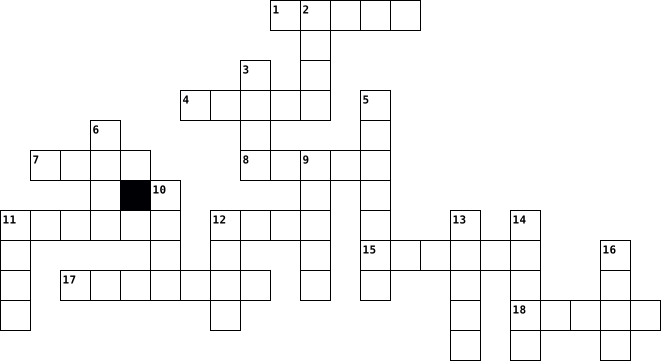
Across
- coconut
- earth
- the lockers are
- day and
- a nice wind
- costing no money
- opposite of multiply
- opps
- not dirty
Down
- a place where you swim
- ouch
- not inside
- to clean up the leaves
- to say hello
- organized
- you use the oven for this
- not real
- not wrong
- sand, ocean, hot
- to have fun
20 Clues: ouch • opps • earth • coconut • day and • not real • organized • not wrong • not dirty • not inside • a nice wind • to have fun • to say hello • the lockers are • costing no money • sand, ocean, hot • opposite of multiply • a place where you swim • to clean up the leaves • you use the oven for this
The Earth's Movements: Day, Night, and Seasons 2024-11-19

Across
- The path the Earth follows around the sun.
- The invisible line that the Earth spins on.
- The period when a part of the Earth is facing the sun.
- The spinning of Earth on its axis.
- The period when a part of the Earth is turned away from the sun.
Down
- The imaginary line around the middle of the Earth.
- The time it takes for one complete revolution around the sun.
- The full journey the Earth makes around the sun.
- The angle of Earth's axis that causes seasons.
- The changes in weather patterns throughout the year due to Earth's tilt.
10 Clues: The spinning of Earth on its axis. • The path the Earth follows around the sun. • The invisible line that the Earth spins on. • The angle of Earth's axis that causes seasons. • The full journey the Earth makes around the sun. • The imaginary line around the middle of the Earth. • The period when a part of the Earth is facing the sun. • ...
SPACE PHYSICS INTRO WORKSHEET 2024-04-17

Across
- earth's spin axis is tilted with respect to its orbital plane. AND THIS CAUSES .......
- THE EARTH REVOLVES AROUND THE SUN...... IN 365 DAYS
- THE DAY AND NIGHT ARE CAUSED BY THE EARTH'S....
- SPINS IN ........ DIRECTION
- THE MOVEMENT OF THE EARTH AROUND THE SUN IS CALLED...
Down
- THIS IS WHEN THE HALF OF THE EARTH IS IN THE SHADOW, FACING AWAY FROM THE SUN
- THE EARTH COMPLETES ONE REVOLUTION AROUND THE SUN IN A .....
- THE AERTH IS ..... ON ITS AXIS
- THE EARTH HAVE ...... SEASONS ACROSS THE YEAR
- The earth rotates on its axis from....
10 Clues: SPINS IN ........ DIRECTION • THE AERTH IS ..... ON ITS AXIS • The earth rotates on its axis from.... • THE EARTH HAVE ...... SEASONS ACROSS THE YEAR • THE DAY AND NIGHT ARE CAUSED BY THE EARTH'S.... • THE EARTH REVOLVES AROUND THE SUN...... IN 365 DAYS • THE MOVEMENT OF THE EARTH AROUND THE SUN IS CALLED... • ...
Kindergarten Earthstrong Crossword 2023-08-10

Across
- Astronauts Come Here
- To Use Over Again
- Comes From Nature
- Comes Out At Day
- We Live Here
- Comes Out At Night
Down
- Body Of Water
- Dry Part Of The Earth
- Creatures In The Wild
- There Are 9 Of Them
10 Clues: We Live Here • Body Of Water • Comes Out At Day • To Use Over Again • Comes From Nature • Comes Out At Night • There Are 9 Of Them • Astronauts Come Here • Dry Part Of The Earth • Creatures In The Wild
atmosphere 2025-01-15

Across
- forms a protective layer around the planet
- keep earth warm at night and cool during the day
- layer of the stratosphere that is closest to the ground
- layer layer of the stratosphere with a high concentration of ozone
- waves how energy travels from the sun to the earth
- protects earth from gamma and x-ray radiation
- substance heats up and gets less dense
- above 80 km and extends to space
Down
- the ozone layer is located here
- thermal energy traveling in waves or rays
- stream narrow belt of strong winds
- a layer of electrically charged particles in the thermosphere
- light reflecting off a particle and going in all directions
- group of chemical compounds used refrigerators,air conditioners, ECT
- contains the lower portion of the ionosphere
- thermal energy going through a material by touch
- outer most layer of the atmosphere
- radiation a type of energy that comes to the earth from the sun
18 Clues: the ozone layer is located here • above 80 km and extends to space • outer most layer of the atmosphere • stream narrow belt of strong winds • substance heats up and gets less dense • thermal energy traveling in waves or rays • forms a protective layer around the planet • contains the lower portion of the ionosphere • protects earth from gamma and x-ray radiation • ...
Unit 2 Exam Review 2022-09-27

Across
- The __________ ___________ effect is caused by a landform like a mountain trapping the moisture on one side and creating a dry, arid climate on the other side
- People _______ the environment by changing it to meet their needs.
- the average weather of an area over long periods of time.
- High latitudes typically have ________ climates.
- __________ to large bodies of water help to stabilize climate. (5 factors of climate)
- specific days throughout the year that signify both the longest and shortest days of the year relative to daylight.
- includes all the water on earth making up rivers, lakes, oceans, and glaciers
- The act of movement of the earth around the sun.(responsible for our 365 1/4th day-long year)
- The higher your _______, the colder it gets (5 factors of climate)
- specific days throughout the year where the earth receives equal amounts of daytime and night time.
- land surrounded by water on 3 sides.
- Middle latitudes typically have _________ climates.
- Wind and ocean _______ helps to distribute hot air and water around the globe.(5 factors of climate) landforms ________ like mountains trap moisture on one side, the windward side, and create a more arid climate on the other side leeward (5 factors of climate)
- a group of islands, like Hawaii
Down
- low latitudes typically have ______ climates.
- made up of all the gases on earth
- body of water feeding into a larger body of water.
- People _______ to the environment by changing the way they live to survive or live more comfortably in a particular environment.
- inlet of water almost complete enclosed by land.
- made up of living plants and animals on earth
- Climate is generally hotter the closer you are to the equator (5 factors of Climate)
- the circular movement of an object around an axis.(responsible for our 24-hour day)
- Different places on earth receive different amounts of sunlight because the earth is ______ on its axis 23.5 degrees
- hill or mountain characterized by its flat top, often called mesas in Texas.
- Includes non-living soil, rocks, and minerals.
- People ________ on the environment by using its resources to fulfill their needs
- snapshot of the atmospheric conditions at a specific time and place.
- a fanlike area at the mouth of a river where sediment is deposited.
28 Clues: a group of islands, like Hawaii • made up of all the gases on earth • land surrounded by water on 3 sides. • low latitudes typically have ______ climates. • made up of living plants and animals on earth • Includes non-living soil, rocks, and minerals. • inlet of water almost complete enclosed by land. • High latitudes typically have ________ climates. • ...
all summer in a day 2025-02-10

Across
- It is blank because there is no sun.
- The girl who saw the sun every day on earth.
- when you feel down or upset.
- The planet that Margo was born.
- something thats from the sky looks like tear drop.
- The blank don't believe that Margo saw the sun everyday
- comes out 1 day every 7 years for 2 hours.
Down
- The kids are blank because they don't seelight
- like at nighttime with the light off.
- The second planet from the sun.
- Margos class locked her in here and forgot.
11 Clues: when you feel down or upset. • The second planet from the sun. • The planet that Margo was born. • It is blank because there is no sun. • like at nighttime with the light off. • comes out 1 day every 7 years for 2 hours. • Margos class locked her in here and forgot. • The girl who saw the sun every day on earth. • The kids are blank because they don't seelight • ...
Creationtide 2025-09-09

Across
- forbidden fruit
- This religion describes the god Brahma splitting a lotus flower, with parts becoming the heavens, earth, and sky
- Popular band told the creation story
- In the beginning God created the ______ and the earth
- On the 4th day, He made the sun, moon and ______
Down
- Original man
- The same creation story is shared by Christianity and ________
- Colourful archway for hope
- the ____ and the bees - one story of how we are created!
- the big bang theory was first proposed by Georges Lemaître, who was a physicist and a ______
- On this day, He rested
11 Clues: Original man • forbidden fruit • On this day, He rested • Colourful archway for hope • Popular band told the creation story • On the 4th day, He made the sun, moon and ______ • In the beginning God created the ______ and the earth • the ____ and the bees - one story of how we are created! • The same creation story is shared by Christianity and ________ • ...
Science Crossword Puzzle 2016-05-11

Across
- No plant life and less than 50cm of precipitation per year.
- Water filled cave.
- Is one organism.
- Largest biome in Canada.
- Consume only plants.
- The earth can be split into _ different biomes.
- Are the ''recyclers" and connect the biotic and abiotic factors together.
- In a community where a species lives.
- 200cm+ of precipitation per year (hint: type of forest).
- Organisms of the same species living in the same area at the same time.
- Consume both plants and animals.
- Blanket of air surrounding earth.
- Harmful decomposer (hint: Starts with the letter E).
- Water+Carbon Dioxide+Sunlight+Sugar+Oxygen= _ _ _ _ _ _ _ _ _ _ _ _ _ _
- All populations of different species that interact in a given area.
- Helpful decomposer (hint: Used when baking).
- The non-living factors of an ecosystem.
- A place on earth, through which energy flows and nutrients cycle.
- Dominant species are cacti.
Down
- Consume only other animals.
- N_t_r_l S_l_c_i_n
- Cold, dry and becomes wet and marshy in summertime.
- "Hunter"
- All of the water on earth. (big hint: Manitoba Hydro)
- Local conditions that change day to day even hour to hour.
- 15-150 cm of precipitation per year.
- Special structural and/or behavioral changes that occur over time.
- A large area with characteristics climate, soil, plants and animals.
- Refers to the average weather pattern of a region.
- Living things competing for resources.
- Solid material, non-living (rocks, soil, dirt, sand, water, air, sun, ...)
- All the places on earth where life can exist.
- M_ _ i_ _ i_g (hint: type of adaptation)
- The living factors of an ecosystem.
- Dominant species is grass.
- limestone covers _% if the earths surface.
- Organisms that can make their own food to supply the matter and energy they need.
- Organism being hunted.
- Eat dead or decaying plant or animal matter.
- Organisms that cannot make their own food, and so consume others' matter for energy.
40 Clues: "Hunter" • Is one organism. • Water filled cave. • N_t_r_l S_l_c_i_n • Consume only plants. • Organism being hunted. • Largest biome in Canada. • Dominant species is grass. • Consume only other animals. • Dominant species are cacti. • Consume both plants and animals. • Blanket of air surrounding earth. • The living factors of an ecosystem. • 15-150 cm of precipitation per year. • ...
Climate lesson 1-5 terms 2025-10-23

Across
- A large circular system of ocean currents created by wind and Earth’s rotation.
- the day-to-day conditions of the air in a place, such as temperature, wind, and rain.
- A stream of moving ocean water, like a river within the sea.
- The distance north or south of the Equator, measured in degrees.
- A loop of moving air or liquid caused by warm material rising and cool material sinking.
- The flat, imaginary surface made by Earth’s orbit around the Sun.
- How closely packed the particles of a substance are.
- The tilt of Earth’s axis (about 23.5°), which causes the seasons.
- The temperature at which a liquid turns to solid (for water, 0°C or 32°F).
- A climate near the ocean, where temperatures are mild and humidity is higher.
- The transfer of heat through direct contact (like touching a hot metal pan).
- The transfer of energy through waves, such as heat from the Sun reaching Earth through space.
Down
- The continuous circulation of ocean water that moves heat around the planet.
- The average weather conditions of a place over a long time (like years or decades).
- The path an object takes as it moves around another object in space (like Earth around the Sun).
- A climate far from the ocean, with hot summers and cold winters.
- How salty ocean water is.
- The energy that comes from the Sun, which warms Earth and powers weather and life.
- How strong or powerful something is; in science, it often means how much energy hits a certain area.
- The main wind patterns that blow steadily in the same direction around Earth.
- The curving of moving air and water on Earth due to its rotation.
- The transfer of heat through moving fluids (liquids or gases) as warm parts rise and cool parts sink.
- The four parts of the year (spring, summer, fall, winter) caused by Earth’s tilt and orbit around the Sun.
23 Clues: How salty ocean water is. • How closely packed the particles of a substance are. • A stream of moving ocean water, like a river within the sea. • A climate far from the ocean, with hot summers and cold winters. • The distance north or south of the Equator, measured in degrees. • The curving of moving air and water on Earth due to its rotation. • ...
Crossword Puzzle - Jaewoo Park 2025-09-26

Across
- Small water droplets that is near the ground.
- The transfer of the heat energy through direct physical contact
- The second layer of the Earth’s atmosphere. There is an ozone layer that protects us from the harmful UV rays from the sun. Without it, life would be dangerous.
- This happens when warmer air go inside to the colder air.
- All water in the Earth such as ocean, river, and lake.
- The outside layer of Earth’s atmosphere. There is almost no air. That’s the reason why satellites orbit here.
- The solid part that include interior and exterior of the Earth.
- Water that from the rain, snow, sleet, and hail.
- The thing that is deliberately changed or manipulated in an experiment to observe its effect on another variable. It's the "cause" in a cause-and-effect relationship.
- The day that have same time of day and night
- All community living things on Earth.
- A large body of air with same temperature and humidity
- The lowest layer of Earth’s atmosphere. Weather happens there such as clouds, rain, snow, stroms, and wind.
Down
- Temperature that dew happen
- This happens when cold air mass go into to the warm air mass
- The thing that changes as a result of the independent variable manipulation.
- A variable that is kept “constant” or unchanged during an experiment to ensure that the results are not influenced by factors other than the independent variable being tested.
- The fourth layer of Earth’s atmosphere.It’s very hot. Aurora happen in thermosphere.
- This happens when warmer air go inside to the colder air.
- A type of heat transfer that happens through water and air
- Weight of the air in atmosphere
- The third layer of Earth’s atmosphere. Meteors burn up here. That’s the reason they don’t reach Earth.
- The Layer of gases that surrounding Earth or another planets such as Mars and Venus
23 Clues: Temperature that dew happen • Weight of the air in atmosphere • All community living things on Earth. • The day that have same time of day and night • Small water droplets that is near the ground. • Water that from the rain, snow, sleet, and hail. • All water in the Earth such as ocean, river, and lake. • A large body of air with same temperature and humidity • ...
Creation 2024-06-01

Across
- Named the animals (4) (Gen 2:19)
- These were made on day six (8,6) (Gen 1:24)
- The heavens declare this aspect of God (5) (Psalm 19:1)
- On the fifth day, God created things that live here (5) (Gen 1:21)
- Describes the earth just after creation (4) (Gen 1:2)
- God called this heaven (9) (Gen1:8)
- This was called night (8) (Gen 1:5)
- Described as “great” (6) (Gen 1:21)
- Its seed is in itself (5) (Gen 1:12)
- Made on the fourth day (5) (Gen 1:16)
- A word for bird (4) (Gen 1:20)
Down
- creatures were commanded to do this (8) (Gen 1:22)
- Formed from Adam’s rib (5) (Gen 2:23)
- This was to rule the day (7,5) (Gen 1:16)
- God did this on the seventh day (6) (Gen 2:2)
- This was created on the third day (5) (Gen 1:11)
- This was made in the image of God (3) (Gen 1:26)
- This was “upon the face of the deep” (8) (Gen 1:2)
- Man was to have this over all creation (8) (Gen 1:28)
- There was no rain: this watered the ground (4) (Gen 2:6)
20 Clues: A word for bird (4) (Gen 1:20) • Named the animals (4) (Gen 2:19) • God called this heaven (9) (Gen1:8) • This was called night (8) (Gen 1:5) • Described as “great” (6) (Gen 1:21) • Its seed is in itself (5) (Gen 1:12) • Formed from Adam’s rib (5) (Gen 2:23) • Made on the fourth day (5) (Gen 1:16) • This was to rule the day (7,5) (Gen 1:16) • ...
Patterns in the Sky 2024-01-02

Across
- This planet's mass is 14.54 times greater than Earth's mass
- The time that it takes to orbit the Sun
- This planet orbits the Sun the fastest
- On Earth this is 365.26 days
- This planet has the lowest density
Down
- The planet with the longest period of rotation
- Name the object that revolves around the Earth
- The closest star to Earth
- The planet that is furthest from the sun and has the longest period of revolution
- Name the planet with the largest diameter
- This is the action of spinning on an axis
- 24 hours on Earth is equal to 1 ______
12 Clues: The closest star to Earth • On Earth this is 365.26 days • This planet has the lowest density • This planet orbits the Sun the fastest • 24 hours on Earth is equal to 1 ______ • The time that it takes to orbit the Sun • Name the planet with the largest diameter • This is the action of spinning on an axis • The planet with the longest period of rotation • ...
Lord's Prayer 2022-07-02

Across
- doing
- ending
- this day
- be done
- ___
- parental unit
- the ____
- to make a sandwich
Down
- is the ___
- God lives
- _____
- ___us
- thou name
- that do us harm
- _____ come
- the ____
- you are done praying
17 Clues: ___ • _____ • ___us • doing • ending • be done • this day • the ____ • the ____ • God lives • thou name • is the ___ • _____ come • parental unit • that do us harm • to make a sandwich • you are done praying
History of Rockets - CT Crossword 2020-06-04

Across
- Falcon 9 is a SpaceX _____.
- The International Space Station is 250 (feet, yards, miles, or parsecs) above the earth.
- Which country launched the first artificial earth satellite.
- Which people invented the first rocket?
- The first stage of the SpaceX rocket landed on a _____ in the Atlantic.
- _____ Newton published laws of motion.
- First name of first man to orbit earth.
Down
- Last name of first american to orbit the earth.
- Stan's ____ of the day.
- First private company to launch astronauts into space.
- What brand of electric car did the Spacex astronauts ride to the rocket? (look up online if necessary)
- V-2 rockets were used to bomb this city.
- International Space ______.
- First name of first man to step on the moon.
14 Clues: Stan's ____ of the day. • Falcon 9 is a SpaceX _____. • International Space ______. • _____ Newton published laws of motion. • Which people invented the first rocket? • First name of first man to orbit earth. • V-2 rockets were used to bomb this city. • First name of first man to step on the moon. • Last name of first american to orbit the earth. • ...
Eclipse 2021-05-05

Across
- The Moon gets this many centimetres further from Earth each year
- Who thought wolves were chasing the Sun and Moon across the sky?
- Name of the darkest shadow cast by the Moon or Earth
- Year Einstein became a celebrity
- 71% of Earth is covered in _____
- Studies show this many vegetable portions a day is ideal
- Scientist who eventually proved Einstein right
Down
- You might see this type of glow worm glowing in June
- The colour of light with the most energy
- The name of the helicopter CURRENTLY ON MARS
- Point during an eclipse when the Moon completely covers the Sun
- The Egyptian god of the Sun
- The shape the Moon traces around Earth is an ______
- Colour of a total lunar eclipse
14 Clues: The Egyptian god of the Sun • Colour of a total lunar eclipse • Year Einstein became a celebrity • 71% of Earth is covered in _____ • The colour of light with the most energy • The name of the helicopter CURRENTLY ON MARS • Scientist who eventually proved Einstein right • The shape the Moon traces around Earth is an ______ • ...
Something 2025-07-21

Across
- McChicken
- Lebron
- What planet do we live in
- Made a shot
- Indiana Fever
- Slam the ball in the bucket
- Caitlin Clark
- Lebrons number
- Lakers
- Three point shot
- Basketball
Down
- Bright sky
- Dark sky
- Caitlin Clark number
- Most hated Brawler
- Bricked
- 67
- Who created brawl stars
- What game is Grow a Garden in
- Men basketball
20 Clues: 67 • Lebron • Lakers • Bricked • Dark sky • McChicken • Bright sky • Basketball • Made a shot • Indiana Fever • Caitlin Clark • Lebrons number • Men basketball • Three point shot • Most hated Brawler • Caitlin Clark number • Who created brawl stars • What planet do we live in • Slam the ball in the bucket • What game is Grow a Garden in