
earth day Crossword Puzzles
The Creation Story. 2016-04-19

Across
- what was planted in Eden.
- what day did he rest on
- who made the Earth.
Down
- what was made along side the Earth on the first day
- Light and Dark.
- what day was the morning and evening made on.
- what was Heaven named before Heaven.
7 Clues: Light and Dark. • who made the Earth. • what day did he rest on • what was planted in Eden. • what was Heaven named before Heaven. • what day was the morning and evening made on. • what was made along side the Earth on the first day
The Solar System 2014-11-30

Across
- The only planet with life.
- It is the blue planet
- It has rings.
- One of many large rocks that circle the sun
- The sun and planets that move around it
- A machine that has been sent into space and goes around the Earth, moon etc, used for radio, television, and other electronic communication
- An object in space that leaves a bright line behind it in the sky
- The large, bright star that shines in the sky during the day and provides light and heat for the Earth
Down
- It is the 7th planet.
- Everything that exists, including stars,space, etc
- It is not a planet any more.
- Spacecraft
- It is the red planet.
- It has a great red spot.
- The planet next to Earth.
- The curved path followed by a moon, planet or artificial satellite as it travels around another body in space
- It is the planet closest to the sun.
- A large, round object in space that moves around the sun or another star
18 Clues: Spacecraft • It has rings. • It is the 7th planet. • It is the blue planet • It is the red planet. • It has a great red spot. • The planet next to Earth. • The only planet with life. • It is not a planet any more. • It is the planet closest to the sun. • The sun and planets that move around it • One of many large rocks that circle the sun • ...
Via Valentines 2025-02-13

Across
- chicken, food you are always craving
- cabin, our first trip together
- smile, something I love
- tv, our favorite type of show
- best food ever, what was consumed on our seconds valentines day
- date, must do soon
- hakkore, the best place on earth
- spot you want to visit together
- the only poetry I can write
- top 10 favorite activities
Down
- the better option
- the location of our most recent trip together
- monster, best nickname in the world
- peak, the location of our third valentines day
- and slug, our alter egos
- snack you want
- shoes that I always have to take off
- the better type of gummy
- and a movie, Our first valentines celebration
- sauce, something a introduced you to
- the location of our second valentines day
21 Clues: snack you want • the better option • date, must do soon • smile, something I love • and slug, our alter egos • the better type of gummy • top 10 favorite activities • the only poetry I can write • tv, our favorite type of show • cabin, our first trip together • spot you want to visit together • hakkore, the best place on earth • monster, best nickname in the world • ...
Space Crossword 2024-11-07

Across
- Opposite of West
- Goodnight
- How does the earth move
- What happens when its time to go to sleep
Down
- Opposite of East
- When the goes down
- There are different
- What does the earth spin on
- The is beatiful
- Goodmorning
10 Clues: Goodnight • Goodmorning • The is beatiful • Opposite of East • Opposite of West • When the goes down • There are different • How does the earth move • What does the earth spin on • What happens when its time to go to sleep
Science 2018-04-02

Across
- Earth's tilt and revolution around the sun causes ______.
- system A star and all the objects that move around it.
- We can see the stars by using a _______.
- When the Northern Hemisphere is tilted toward the sun, it is ____.
- Mercury, Venus, Earth and Mars are all inner _____.
Down
- Earth spins or rotates on a tilted ______.
- Orion is a _______ that we can see in winter.
- The different shapes of the moon that we see are ______.
- The sun is a medium-sized _____ that gives heat to Earth.
- Day and night happen because Earth ______.
- It takes Earth about 365 days to _____ the sun.
11 Clues: We can see the stars by using a _______. • Earth spins or rotates on a tilted ______. • Day and night happen because Earth ______. • Orion is a _______ that we can see in winter. • It takes Earth about 365 days to _____ the sun. • Mercury, Venus, Earth and Mars are all inner _____. • system A star and all the objects that move around it. • ...
Night and Day/Moon Recap 2016-02-01

Across
- a period of 24 hours
- the number of days it takes for the Earth to orbit round the sun (3(number), 4)
- this is where the sun rises
- the coldest season in a year
- People on Earth see this moon as completely bright
- this is where the sun set
Down
- the time in a 24 hours period when the sun is out
- the hottest season in a year
- the planet that we live on
- People on Earth see this moon as completely dark
- the length of time it takes for the Earth to rotate on its axis(2(number), 5)
- The period in a 24 hours period when there is no sunlight
12 Clues: a period of 24 hours • this is where the sun set • the planet that we live on • this is where the sun rises • the hottest season in a year • the coldest season in a year • People on Earth see this moon as completely dark • the time in a 24 hours period when the sun is out • People on Earth see this moon as completely bright • ...
Seasons 2022-03-18

Across
- who has summer when the north pole tilts away from the sun
- what takes 24 hours
- what season comes after winter?
- what season comes after summer?
- who has summer when the north pole tilts toward the sun
- what takes 365 days?
- what season is it in the northern hemisphere when the north pole tilts away from the sun
Down
- when the earth goes around the sun
- what the northern hemisphere gets during winter
- when the earth spins on its axis
- divides the earth into two hemispheres
- what season is it in the northern hemisphere when the north pole tilts toward the sun?
- what the northern hemisphere gets during summer
- the two halves of the earth
14 Clues: what takes 24 hours • what takes 365 days? • the two halves of the earth • what season comes after winter? • what season comes after summer? • when the earth spins on its axis • when the earth goes around the sun • divides the earth into two hemispheres • what the northern hemisphere gets during winter • what the northern hemisphere gets during summer • ...
Chapter 1-1 Earth in Space Crossword 2014-02-05

Across
- The Study of Space
- __________ occurs mainly because of the difference in how much the moon pulls on different parts of earth.
- Earth's rotation on it's __________ causing day and night.
- When the moon passes between the earth and the sun.
- Earth's spinning is called __________.
Down
- When the earth is directly between the earth and moon.
- The force of __________ pulls the moon and earth toward each other.
- Earth's path around the sun.
- The movement of one object around another object is called a __________.
- Round pits on the moon.
10 Clues: The Study of Space • Round pits on the moon. • Earth's path around the sun. • Earth's spinning is called __________. • When the moon passes between the earth and the sun. • When the earth is directly between the earth and moon. • Earth's rotation on it's __________ causing day and night. • The force of __________ pulls the moon and earth toward each other. • ...
Christmas Crossword 2020-12-06

Across
- Jesus lived here with Heavenly Father before He came to Earth
- Jesus' father on Earth
- Angels told me of Jesus' birth while I watched over my sheep
- The reason for Christmas
- There was no room at the inn, so Baby Jesus and His family slept here
- We sang songs of joy to announce the Christchild
- Something I can do to thank Baby Jesus
Down
- Baby Jesus' first bed
- We followed a special star to find the Baby Jesus
- We celebrate Jesus' birth on this special day
- Jesus' mother on Earth
- This is the city where Jesus was born
- One of the animals in the stable might have been a...
- I was a sign for all that Baby Jesus had come to Earth
14 Clues: Baby Jesus' first bed • Jesus' father on Earth • Jesus' mother on Earth • The reason for Christmas • This is the city where Jesus was born • Something I can do to thank Baby Jesus • We celebrate Jesus' birth on this special day • We sang songs of joy to announce the Christchild • We followed a special star to find the Baby Jesus • ...
Astronomy- Knowianna 2016-10-27

Across
- the largest part of the moons shadow
- the darkest part of the moons shadow
- appears to move from east to west
- the tendency of an object to resist a change in motion
- states that every object in the universe attracts every other object
- occurs when the moon passes directly between earth and the sun
- moves from west to east
Down
- causes day and night
- causes seasons
- occurs at a full moon when earth is directly between the moon and the sun
- an object that orbits a star
- caused by the motions of the moon around earth
- the path of one object as it revolves around another object in space
- an imaginary line that an object rotates on
14 Clues: causes seasons • causes day and night • moves from west to east • an object that orbits a star • appears to move from east to west • the largest part of the moons shadow • the darkest part of the moons shadow • an imaginary line that an object rotates on • caused by the motions of the moon around earth • the tendency of an object to resist a change in motion • ...
Ever-Changing Moon Vocabulary 2024-01-11

Across
- large dark grey areas that are smooth on the surface of the moon
- cycle the four-week period during which the Moon orbits Earth one time and goes through all of its phase
- to light up
- one spin of the plant on its axis
- one full orbit around an object
- moon, any phase of the moon that has more than half of its face illuminated
- a dark area produced by an orbit coming between light and surface
Down
- when the face of the moon looks larger each day
- a regular repeating path that one object takes around another object or center of gravity
- information that is not represented by numbers but by characteristic or description
- when the face of the moon looks smaller each day
- caused by the way the sun light hits the Earth according to the Earth's axis
- eclipse an eclipse in which the moon appears darkened as it passes into the Earth's shadow
- information that can be counted or measured or given a numerical value
- an invisible line going North/South through Earth
15 Clues: to light up • one full orbit around an object • one spin of the plant on its axis • when the face of the moon looks larger each day • when the face of the moon looks smaller each day • an invisible line going North/South through Earth • large dark grey areas that are smooth on the surface of the moon • a dark area produced by an orbit coming between light and surface • ...
Science 2018-04-02

Across
- Day and night happen because Earth ______.
- Mercury, Venus, Earth and Mars are all inner _____.
- Orion is a _______ that we can see in winter.
- The different shapes of the moon that we see are ______.
- The sun is a medium-sized _____ that gives heat to Earth.
- Earth's tilt and revolution around the sun causes ______.
- It takes Earth about 365 days to _____ the sun.
Down
- A star and all the objects that move around it.
- We can see the stars by using a _______.
- When the Northern Hemisphere is tilted toward the sun, it is ____.
- Earth spins or rotates on a tilted ______.
11 Clues: We can see the stars by using a _______. • Day and night happen because Earth ______. • Earth spins or rotates on a tilted ______. • Orion is a _______ that we can see in winter. • A star and all the objects that move around it. • It takes Earth about 365 days to _____ the sun. • Mercury, Venus, Earth and Mars are all inner _____. • ...
Noah and The Flood 2013-09-02

Across
- On what month did the water recede until
- How many cubits wide was the Ark
- What type of leaf was it
- How many days did water flood the Earth
- How many more days after the dove came back was he sent out again
- Who did the Lord wish to wipe off the Earth
- How many pair(s) of every kind of unclean animals were there
- Noah's Son
- What did God establish with Noah and his sons
- How Old was Noah When the Flood Came
- How did the Lord clean the Earth
- Noah's Son
Down
- On what month of Noah's six hundred and first year did the water dry up
- How many days after the flood receded, did Noah open a window
- Who did the Lord find favor in
- How many cubits high was the Ark
- Number of Each Creature on the Ark
- What is a sign of this covenant
- On what day did the Ark come to rest on the mountains
- How many cubits long was the Ark
- What type of wood was the Ark made out of
- What did the dove eventually bring back from outside the Ark
- Noah's Son
- What type bird did Noah send out to find an area to perch
- On what day of Noah's six hundred and first year did the water dry up
25 Clues: Noah's Son • Noah's Son • Noah's Son • What type of leaf was it • Who did the Lord find favor in • What is a sign of this covenant • How many cubits wide was the Ark • How many cubits high was the Ark • How many cubits long was the Ark • How did the Lord clean the Earth • Number of Each Creature on the Ark • How Old was Noah When the Flood Came • ...
Integrated End of Unit 1 Key Terms 2023-11-21

Across
- power by water
- day we run out of resources earth can regenerate in a year
- energy obtained from heat in the earth
- precipitation with low pH
- chemical that attached to oil and causes it to disperse or sink
- energy obtained from sun
- energy obtained from wind
- occurs when all of the people abandon the town
- term used to describe lack of rain and/or water resources
- unit of measure used to measure land use
- land available for production
- term used to endure long into the future
Down
- summed group of a species such as people
- contains oil spills
- term used for when we will reach the maximum amount of oil from the ground
- term used to describe amount of impact we have on the environment
- day admiral Roggeveen discovered the remote island in the pacific
- process of restoring land that has been modified from mining processes
- a resource that cannot replenish faster than it is used
- people of easter island
- measured by birth and death rates
- another word for oil, sued in the manufacturing of many products
- process of extracting ore from the earth
- occurs when there is misuse of common and public resources
- important cycle disrupted when all the trees on easter island were cut down
- energy obtained from heating waste
- statues built and worshiped by the Rapa Nui
27 Clues: power by water • contains oil spills • people of easter island • energy obtained from sun • precipitation with low pH • energy obtained from wind • land available for production • measured by birth and death rates • energy obtained from heating waste • energy obtained from heat in the earth • summed group of a species such as people • process of extracting ore from the earth • ...
Lesson 10- Earth's motions (use the decimal points & numbers) 2022-10-18

Across
- A day is added to this year to make up for the extra six hours in a revolution
- This motion changes the north star.
- It also called the vernal equinox. _____ equinox
- Earth's rotation takes this amount of time.
- Nutation changes Earth's tilt up to this amount.
- The length of the cycle for nutation
- How far over does the earth's axis tilt?
- How long 1 Precession takes.
- Our current north star
- This happens to the south and north pole because the Earth rotates.
Down
- It also called the autumnal equinox. _____ equinox
- This Earth motion happens because mainly because of the moon's tilted orbit.
- The moon's orbit is tilted this much.
- This happens to the equator because the Earth rotates.
- During this event, the Earth is tilted toward or away from the sun
- In days, how long does one revolution last.
- It is a synonym for orbit.
- In years, how long does one revolution last
18 Clues: Our current north star • It is a synonym for orbit. • How long 1 Precession takes. • This motion changes the north star. • The length of the cycle for nutation • The moon's orbit is tilted this much. • How far over does the earth's axis tilt? • Earth's rotation takes this amount of time. • In days, how long does one revolution last. • ...
Moon Earth and Sun Crossword 2022-10-06

Across
- The invisible line that earth spins around
- the appearance of the moon becoming larger
- moon changes this every day because of its orbit and reflection
- flat dark planes lower in elevation on the moon
- what causes objects to move on a slope
- the lowest point of a tide
- an event where the sun crosses the celestial equator
- the motion around another object
- occurring when the moon comes in a direct line between the sun and earth
- the curved sickle shape of the moon
- A circle that has been squashed
- the action of light bouncing off of a surface
- the tides with maximum range usually occurring around a new or full moon
Down
- the bottom half of earth
- occurs when the earth comes in a direct line between the sun and moon
- the shadow cast by earth or moon over an area where an eclipse is happening
- the dark central part of a sunspot
- the highest point of a tide
- the bowl shaped dent in an astronomical body usually caused by a collision of another astronomical body
- for the moon to be in a phase where it is larger than a semicircle but smaller than a circle
- the appearance of the moon becoming smaller
- planets do this around a larger mass of gravity
- the top half of earth
- the spinning of a planet
- the moderate waves occurring when the sun and moon are at 90 degree angles
- changes every 3 months and there are 4 of on earth
- an event where earth is most north or south
27 Clues: the top half of earth • the bottom half of earth • the spinning of a planet • the lowest point of a tide • the highest point of a tide • A circle that has been squashed • the motion around another object • the dark central part of a sunspot • the curved sickle shape of the moon • what causes objects to move on a slope • The invisible line that earth spins around • ...
Astronomy 2023-11-20

Across
- Eclipse SME
- Fusion A nuclear reaction
- Does not exist in space
- Causes years
Down
- Causes day/night cycle
- The earth is a ___
- Tides Unusually strong tides
- Tides Unusually weak tides
- Eclipse SEM
- the earth has a ___ on its axis
10 Clues: Causes years • Eclipse SME • Eclipse SEM • The earth is a ___ • Causes day/night cycle • Does not exist in space • Fusion A nuclear reaction • Tides Unusually weak tides • Tides Unusually strong tides • the earth has a ___ on its axis
Religion Final product 2023-11-28

Across
- what did the onceler cut the trees down to make
- Act of using a product again for its original purpose
- plants need to survive
- Release of harmful substances into the environment
- What do people need every day to survive
Down
- Sea turtle species known for its greenish skin and endangered status
- Container used for collecting recyclables at home
- who created the earth
- first Womanon earth
- First Man on earth
- reduce, re-use,.......
- A natural disaster that has lava
12 Clues: First Man on earth • first Womanon earth • who created the earth • plants need to survive • reduce, re-use,....... • A natural disaster that has lava • What do people need every day to survive • what did the onceler cut the trees down to make • Container used for collecting recyclables at home • Release of harmful substances into the environment • ...
Titan 2025-02-17

Across
- Named after immortal ____ of greek mythology
- One day is nearly ____ earth days.
- Larger than what planet?
- Mystery gas it contains that nobody knows where it came from.
- Has a very dense ______.
- Saturn's largest moon.
- Only world besides Earth that has standing ___.
Down
- It's atmosphere is primarily ___.
- It's crust is made of ____.
- It has a water cycle akin to what planet?
- Light from the sun takes about ____ minutes to reach Titan.
- Molecules in high atmosphere are split apart by the sun's _____
12 Clues: Saturn's largest moon. • Larger than what planet? • Has a very dense ______. • It's crust is made of ____. • It's atmosphere is primarily ___. • One day is nearly ____ earth days. • It has a water cycle akin to what planet? • Named after immortal ____ of greek mythology • Only world besides Earth that has standing ___. • ...
General Knowledge (Hard) 2026-03-16

Across
- Imaginary line dividing Earth in half
- Invisible layer of air surrounding the Earth
- Deep winter sleep some animals take
- How plants turn sunlight into food
- Animal that sleeps during the day and hunts at night
Down
- Hunter of the animal kingdom
- How animals hide by blending into surroundings
- When birds fly south for the winter
- Animal that only eats meat
- Massive space rock crashing into earth
- When wind and water slowly wear away rock
- Study of the living things
12 Clues: Animal that only eats meat • Study of the living things • Hunter of the animal kingdom • How plants turn sunlight into food • When birds fly south for the winter • Deep winter sleep some animals take • Imaginary line dividing Earth in half • Massive space rock crashing into earth • When wind and water slowly wear away rock • Invisible layer of air surrounding the Earth • ...
Gravity, Rotation, & Revolution 2025-11-07

Across
- the Earth revolves around the __________
- if the mass increases the gravity ___________________
- the moon revolves around the __________________
- an object's spinning on an axis
- an object going around another object
Down
- Earth's revolution around the Sun gives us ______________
- the amount of matter in something
- the Earth's ______ is tilted at 23.5 degrees.
- Revolve around the Sun
- the Earth rotates every 24 giving us _______ and night
- the Sun has ________ gravitational pull than the moon
- a force that pulls objects towards each other
12 Clues: Revolve around the Sun • an object's spinning on an axis • the amount of matter in something • an object going around another object • the Earth revolves around the __________ • the Earth's ______ is tilted at 23.5 degrees. • a force that pulls objects towards each other • the moon revolves around the __________________ • ...
crossword puzzle 2021-09-24

Across
- representing that the earth is the center
- other planets far far away
- tell that it is night
- representing that the sun is the center
- thing that holds everything
- a special book
- tells us that is is day
- to say that one no longer hold a belief
Down
- Bellarmine says that we should not tell lies because they follow the bible
- someone who studies religion
- related to churches
- one of the leading of the catholic church
- someone who practiced religious practices
- religious messenger
- someone that teaches in a college
- thing we live on
- an astronomer
17 Clues: an astronomer • a special book • thing we live on • related to churches • religious messenger • tell that it is night • tells us that is is day • other planets far far away • thing that holds everything • someone who studies religion • someone that teaches in a college • representing that the sun is the center • to say that one no longer hold a belief • ...
BG2 Nate Haynes 2025-01-31

Across
- the outermost layer of the earth
- day the time it takes for Earth to rotate on its axis so that the sun appears in the same position in the sky.
- a geographic coordinate that measures how far east or west a point is on Earth.
- a thick layer of hot, dense rock that sits between the Earth's crust and core.
Down
- a half of the earth, usually as divided into northern and southern halves by the equator, or into western and eastern halves by an imaginary line passing through the poles.
- the point in the orbit of a planet when it is closest to the sun.
- the slow movement of the axis of a spinning body around another axis due to a torque acting to change the direction of the first axis.
- core the solid, innermost layer of Earth, made up of mostly iron and nickel.
- equinox the day when the sun is directly above the equator, making day and night equal in length.
9 Clues: the outermost layer of the earth • the point in the orbit of a planet when it is closest to the sun. • core the solid, innermost layer of Earth, made up of mostly iron and nickel. • a thick layer of hot, dense rock that sits between the Earth's crust and core. • a geographic coordinate that measures how far east or west a point is on Earth. • ...
Earth, the Moon, and the Stars Crossword Puzzle 2024-03-01

Across
- A force of attraction that pulls objects without them touching. Earth’s gravity pulls objects near its surface toward Earth’s center
- A curved path that an object makes around another object.
- A unit of measurement used to describe distances between stars in space. One light-year is the distance that light travels in one year.
- The streak of light that a chunk of rock falling from space toward Earth produces
- Getting smaller. The lit part of the moon is waning for about two weeks after a full moon.
- brightness A measurement describing how bright a star looks from Earth.
- To spin. Earth rotates around its axis.
- The imaginary line that Earth rotates around. Earth’s axis goes through the middle of Earth from the North Pole to the South Pole.
- new moonThe moon when it cannot be seen. The moon is a new moon at the beginning of its cycle of phases.
- A telescope that uses lenses to collect and focus light.
- A telescope that works in space, beyond Earth’s atmosphere.
- A section of the sky that has a recognizable star pattern. Some star patterns, such as the Big Dipper, are part of larger constellations.
Down
- Growing slowly. The lit part of the moon is w axing for about two weeks after a new moon.
- A part of the world where the same standard time is used. There are 24 time zones in the world, one for each hour in the day.
- An area of darkness that forms when light from any source is blocked. Shadows caused by the sun change in regular patterns.
- A telescope that uses a curved mirror to collect and focus light.
- A scientist who studies objects and energy in space.
- The different shapes of the lit part of the moon seen from Earth. The pattern of changing moon phases is caused by the moon revolving around Earth.
- A telescope that uses an antenna to collect radio waves.
- A complete spin. Earth makes one rotation every 24 hours.
- The moon when it appears as a full circle. The moon is a full moon halfway through its cycle of phases.
- A tool that uses the shadow cast by an object in sunlight to keep track of time during the day.
- A clear object that refracts light. Some lenses refract light so that light rays focus. Other lenses refract light so that light rays spread apart.
23 Clues: To spin. Earth rotates around its axis. • A scientist who studies objects and energy in space. • A telescope that uses an antenna to collect radio waves. • A telescope that uses lenses to collect and focus light. • A curved path that an object makes around another object. • A complete spin. Earth makes one rotation every 24 hours. • ...
Unit 18 Crossword Puzzle 2022-04-27

Across
- listened
- alive
- mix
- knowledge
- planet
Down
- reason
- bother
- not the same
- beginning of day
- respond
10 Clues: mix • alive • reason • bother • planet • respond • listened • knowledge • not the same • beginning of day
8th Grade End-of-Year Review -- Space 2022-05-17

Across
- the tide with the least difference between consecutive low and high tides
- a galaxy in which the stars and gas clouds are concentrated mainly in one or more spiral arms.
- a star and all the other objects that revolve around it
- the standard unit that astronomers use to measure the size of stars
- describes phases following a new moon, as more of the Moon's lighted side becomes visible
- Solar system model based on the belief that the sun is the center of the universe
- the time required for Earth to rotate once on its axis
- the spinning motion of a object on its axis
- the tide with the greatest difference between consecutive low and high tides
- phase when the moon is located directly between the earth and sun
- A sudden eruption of intense high-energy radiation from the sun's surface
- line above which polar day (24 hours of daylight) and polar night (24 hours of darkness) are possible
- the distance light travels in one year
- an object that revolves around another object in space
- the blocking of sunlight to Earth that occurs when the moon is directly between the sun and Earth.
- A region of the solar system that is just beyond the orbit of Neptune and that contains small rocky bodies and dwarf planets
- describes phases following the full moon during which the visible surface of the moon decreases
Down
- regions close to the equator which receive direct sunlight nearly all year
- areas of gas on the sun's surface that are cooler than the gases around them
- A galaxy shaped like a round or flattened ball, generally containing only old stars
- The average distance between Earth and the sun, used to measure distances in the solar system
- A force of attraction between objects that is due to their masses.
- the difference in levels of ocean water at high tide and low tide
- An oval shape as opposed to a circular shape
- A model of the universe in which Earth is at the center of the revolving planets and stars.
- phase when the entire side facing Earth is illuminated
- the time or date (twice each year) at which the sun crosses the celestial equator, when day and night are of equal length (about September 22 and March 20).
- A galaxy that has an undefined shape, large numbers of young stars, and greats amounts of gas and dust
- the blocking of sunlight to the moon that occurs when Earth is directly between the sun and the moon
- An object that orbits the sun and is spherical, but has not cleared the area of its orbit.
- A loop of gas that protrudes from the sun's surface, linking parts of sunspot regions
- either of the two times of the year when the sun is at its greatest distance from the celestial equator
- the movement of an object around another object
33 Clues: the distance light travels in one year • the spinning motion of a object on its axis • An oval shape as opposed to a circular shape • the movement of an object around another object • phase when the entire side facing Earth is illuminated • the time required for Earth to rotate once on its axis • an object that revolves around another object in space • ...
Earth 2020-05-08

Across
- The border between two tectonic plates.
- Outermost layer of earth.
- a supercontinent that existed during the late Paleozoic and early Mesozoic eras.
- Is the only liquid layer of the earth consists of mostly iron and nickel.
- The formation of new areas of oceanic crust.
- is a dropped zone where the plates are pulling apart.
- States that continents shift position on Earth's surface.
Down
- An extremely hot, solid sphere of mostly iron and nickel at the center of the earth.
- where two plates slide past each other.
- The rigid outer part of the earth, consisting of the crust and upper mantle.
- States that the earth's outer layer, or lithosphere, is broken into several large slabs called plates, and the plates slowly move around the planet.
- Where two plates are pushing toward each other.
- Is an underwater mountain range.
- Two plates that are moving apart from each other.
- Semisolid rock is located directly below the crust.
15 Clues: Outermost layer of earth. • Is an underwater mountain range. • where two plates slide past each other. • The border between two tectonic plates. • The formation of new areas of oceanic crust. • Where two plates are pushing toward each other. • Two plates that are moving apart from each other. • Semisolid rock is located directly below the crust. • ...
Earth 2021-10-14

Across
- Two plates moving side to side
- The second layer of earth
- Non fracturing plate tension
- The last layer of earth
- Two plates compressing
- When plates collide
- Plates straining to move away from each other
- The part of the crust under the lithosphere
Down
- The upper-crust lower-crust seperator
- The first layer of earth
- The part of the crust under the plates
- The third layer of earth
- Formed when plates collide underwater
- Two rocks stressing against each other
- Two rock surfaces moving against each other
15 Clues: When plates collide • Two plates compressing • The last layer of earth • The first layer of earth • The third layer of earth • The second layer of earth • Non fracturing plate tension • Two plates moving side to side • The upper-crust lower-crust seperator • Formed when plates collide underwater • The part of the crust under the plates • Two rocks stressing against each other • ...
Earth 2023-06-29

Across
- A vast body of saltwater that covers a significant portion of the Earth's surface, such as the Pacific, Atlantic, or Indian Ocean.
- A large mass of ice that moves slowly over land, shaping the landscape over thousands of years, like the Greenland Ice Sheet.
- A vast, treeless Arctic region with low temperatures, frozen subsoil, and short growing seasons, like the Siberian Tundra.
- A high and steep natural elevation on the Earth's surface, often with rocky peaks, like the Himalayas or the Rocky Mountains.
- A piece of land that is almost completely surrounded by water but connected to the mainland, like the Iberian Peninsula.
- A landmass smaller than a continent and surrounded by water, like Hawaii or the Maldives.
- A large underground chamber or cave, often formed by the dissolution of limestone or other soluble rocks.
Down
- A deep, narrow valley with steep sides, often carved by a river, like the Grand Canyon in the United States.
- A barren and dry landscape with little or no vegetation, such as the Sahara Desert or the Gobi Desert.
- The gradual wearing away or weathering of the Earth's surface by wind, water, or other natural processes.
- One of the seven large landmasses on Earth, such as Africa, Asia, Europe, North America, South America, Australia, or Antarctica.
- A large area covered with many trees and various plants, often home to diverse wildlife, like the Amazon Rainforest or Boreal Forest.
- A flat or gently sloping elevated area with steep sides, often found between mountains, like the Colorado Plateau.
- A mountain or hill with a crater or vent through which lava, rock fragments, and gases erupt from the Earth's interior.
- A natural flowing watercourse that typically leads to a lake, sea, or ocean, like the Nile, Amazon, or Mississippi River.
15 Clues: A landmass smaller than a continent and surrounded by water, like Hawaii or the Maldives. • A barren and dry landscape with little or no vegetation, such as the Sahara Desert or the Gobi Desert. • The gradual wearing away or weathering of the Earth's surface by wind, water, or other natural processes. • ...
Earth 2023-06-29

Across
- A large mass of ice that moves slowly over land, shaping the landscape over thousands of years, like the Greenland Ice Sheet.
- A flat or gently sloping elevated area with steep sides, often found between mountains, like the Colorado Plateau.
- A vast, treeless Arctic region with low temperatures, frozen subsoil, and short growing seasons, like the Siberian Tundra.
- A natural flowing watercourse that typically leads to a lake, sea, or ocean, like the Nile, Amazon, or Mississippi River.
- A mountain or hill with a crater or vent through which lava, rock fragments, and gases erupt from the Earth's interior.
- A barren and dry landscape with little or no vegetation, such as the Sahara Desert or the Gobi Desert.
- A high and steep natural elevation on the Earth's surface, often with rocky peaks, like the Himalayas or the Rocky Mountains.
- A vast body of saltwater that covers a significant portion of the Earth's surface, such as the Pacific, Atlantic, or Indian Ocean.
Down
- A piece of land that is almost completely surrounded by water but connected to the mainland, like the Iberian Peninsula.
- One of the seven large landmasses on Earth, such as Africa, Asia, Europe, North America, South America, Australia, or Antarctica.
- A large area covered with many trees and various plants, often home to diverse wildlife, like the Amazon Rainforest or Boreal Forest.
- A deep, narrow valley with steep sides, often carved by a river, like the Grand Canyon in the United States.
- A large underground chamber or cave, often formed by the dissolution of limestone or other soluble rocks.
- A landmass smaller than a continent and surrounded by water, like Hawaii or the Maldives.
- The gradual wearing away or weathering of the Earth's surface by wind, water, or other natural processes.
15 Clues: A landmass smaller than a continent and surrounded by water, like Hawaii or the Maldives. • A barren and dry landscape with little or no vegetation, such as the Sahara Desert or the Gobi Desert. • A large underground chamber or cave, often formed by the dissolution of limestone or other soluble rocks. • ...
earth 2014-11-30

Across
- a rich country of the world where most people enjoy a high standard of living
- the ancient remains of plants and animals that are stored underground in the form of coal as a natural gas
- land dominated by grass vegetation
- a community of organisms interacting with one another and with the environment in which they live
- a poor country of the world where many people have a low standard of living
- the home of a community of animals or plants or the location in which they prefer to live
- earths metallic centre
- the direction a slope faces
- a mountain formed by an eruption of material through the earths crust
Down
- the values and coustoms of a particular country
- a measure of the total value of the goods and services produced in a country over a year, also reffered to as gross national income
- a good or service sent from one country to another
- species of animals or plants that have not been seen in the world during the last 50 years
- molten rock that reaches the earths surface
- a process caused by advances in technology which involves the web of interrelationships that have formed between countries, companions, people, recource, cultures and money
15 Clues: earths metallic centre • the direction a slope faces • land dominated by grass vegetation • molten rock that reaches the earths surface • the values and coustoms of a particular country • a good or service sent from one country to another • a mountain formed by an eruption of material through the earths crust • ...
Earth 2024-05-21

Across
- the centre of the earth
- boundary plates that rub against each other
- when big waves come after a earthquake
- maori word for tsunami
- what is the power of earthquakes measured
- mountain that magma comes out of
- shaking of the earth
- name of the plates on the earths crust
Down
- boundary plates that move away from each other
- boundary plates that come towards each other
- maori word for volcano
- maori god of earthquakes
- comes out of a volcano when it erupts
- which layer of the earth is the magma held in
- the top layer of the earths structure
15 Clues: shaking of the earth • maori word for volcano • maori word for tsunami • the centre of the earth • maori god of earthquakes • mountain that magma comes out of • comes out of a volcano when it erupts • the top layer of the earths structure • when big waves come after a earthquake • name of the plates on the earths crust • what is the power of earthquakes measured • ...
Intro Astro Lecture #3 2024-09-26

Across
- Phase of the Moon where the surface of the moon facing Earth is not Illuminated
- Apparent motion of the Sun against the stars
- What year BCE the zodiac was developed
- A pattern of stars that is not a constellation
- Longest and Shortest days of the year
- The unincluded 13th zodiacal constellation
- A belief that the movement of the planets, stars and the moon have meaning and influence on people’s lives.
- Phases of the moon where it appears to disappear
- The amount of constellation in the celestial sphere
- Day named after the Roman god Sol
- Apparent reversed motion of a planet among the constellations
- Season where the Earth is closest to the Sun
- The reason the Earth has its seasons
Down
- A region of the sky
- Days where the Sun rises and sets precisely due East and due West
- The point where the moon is closest to the Earth
- A collection of beliefs or practices mistakenly regarded as being based on scientific method
- An observational science that studies celestial objects and phenomena
- A coordinate system that centers around the observer
- Misconception about what causes the phases of the moon
- The point where the moon is farthest from Earth
- Phase of the Moon where the surface of the moon facing Earth is fully Illuminated
- Season where the Earth is farthest from the Sun
- The pursuit and application of knowledge of the natural and social world based on evidence
- Phases of the moon where it appears to reappear
- A coordinate system that centers on the Earth
- Amount in degrees each zodiac takes up in the ecliptic
27 Clues: A region of the sky • Day named after the Roman god Sol • The reason the Earth has its seasons • Longest and Shortest days of the year • What year BCE the zodiac was developed • The unincluded 13th zodiacal constellation • Apparent motion of the Sun against the stars • Season where the Earth is closest to the Sun • A coordinate system that centers on the Earth • ...
FRANCISCANPREACHER - GENESIS 2024-05-02

Across
- God took this from the first man to form the first woman.
- there was one tree God asked our first parents not to eat of--the tree of___?
- God gave light a name.
- What God did on the seventh day.
- God gave darkness a name.
- in the beginning, He created heavens and earth.
Down
- the first thing God created after heaven and earth.
- God formed the first man our of this.
- the first woman God created.
- the garden of delight that God created in the beginning.
- the patriarch God asked to build the Ark.
- the first man God created.
- the sign God put in the sky as a remembrance of his covenant with Noah.
13 Clues: God gave light a name. • God gave darkness a name. • the first man God created. • the first woman God created. • What God did on the seventh day. • God formed the first man our of this. • the patriarch God asked to build the Ark. • in the beginning, He created heavens and earth. • the first thing God created after heaven and earth. • ...
Our Place in Space 2020-05-06

Across
- The different seasons are caused by the ______ of the Earth on it's axis
- A group of stars that form a recognisable pattern
- The type of reactions that occur in stars
- The Earth ________ on it's axis
- What the half of Earth that is facing away from the Sun experiences
- During summer the days are ___________
- The time taken for a planet to complete one revolution around the Sun
- During winter the sunlight strikes Earth's surface with _____ intensity
- The number of minutes it takes light from the sun to reach Earth
- The season experienced in Australia when the southern hemisphere is leaning towards the sun
- The Earth _______ around the Sun
- The Earth spins from _______ to East
- The fifth biggest planet in our solar system
- The time taken for a planet to rotate on it's axis
Down
- A star map that aids in locating particular stars in the night sky
- A rocky object circling a planet that does not produce it's own light
- The scientific study of stars, planets and other celestial objects
- The galaxy our solar system is in (2 words)
- An imaginary line running through Earth
- The asteroid belt is located between Mars and _________
- The outer planets that consist of huge balls of gas with small rocky cores (2 words)
- During summer the sun rises ________ in the sky
- The shape of Earth's orbit around the Sun.
- The season experienced in Australia when the southern hemisphere is leaning away from the sun
- The force that keeps planets orbiting around the Sun
- The name given to the path a planet takes whilst revolving
- Massive burning ball of hydrogen gas
27 Clues: The Earth ________ on it's axis • The Earth _______ around the Sun • The Earth spins from _______ to East • Massive burning ball of hydrogen gas • During summer the days are ___________ • An imaginary line running through Earth • The type of reactions that occur in stars • The shape of Earth's orbit around the Sun. • The galaxy our solar system is in (2 words) • ...
Weather and Climate 2013-02-18

Across
- Study of cyclones, hail-storms, blizzards or bushfires.
- The layer of the atmosphere that stretches from ground level to 16km above the earth. Weather happens here.
- Called hurricanes in America and typhoons in Asia.
- The lines on a weather map joining places of equal atmosphere pressure.
- The name used in the United States for tropical cyclones.
- The warming of the atmosphere that has been attributed to the burning of fossil fuel.
- An intense fire which may generate strong winds that throw burning ember ahead of the main fire.
- Are fluffy, white piles that often evaporate. They can also turn into cumulonimbus clouds.
- Strong upwards air currents.
- the flat land on either side of a river that is covered with water during times if high run-off and floods
Down
- The state of the atmosphere, averaged over a long period of time.
- the band of gases surrounding the earth.
- Water returning to the earth in the form of rain. Hail, sleet or snow.
- A complex word for weather maps.
- Called tropical cyclones in Australia.
- The day to day condition of the atmosphere.
- water is heated by the sun and absorbed into the atmosphere as water vapour
- Clouds that are found between about 2.5 and 6 kilometres above the ground.
- where some satellites orbit. It extends for perhaps 10 000 km.
- Covered with Water.
20 Clues: Covered with Water. • Strong upwards air currents. • A complex word for weather maps. • Called tropical cyclones in Australia. • the band of gases surrounding the earth. • The day to day condition of the atmosphere. • Called hurricanes in America and typhoons in Asia. • Study of cyclones, hail-storms, blizzards or bushfires. • ...
Mr. Goldsbury Climate Change 2025-06-11

Across
- A loop where warming causes more warming (like melting ice).
- A period or process related to factories and machines, often linked with rising pollution.
- A type of fuel (like coal or oil) that releases CO₂ when burned.
- A measure of how much sunlight a surface reflects.
- Man-made chemicals that damage the ozone layer and trap heat.
- A powerful greenhouse gas released by farming and garbage.
- The average weather over a long time in one area.
- Day-to-day conditions like sun, rain, or wind.
- Huge sheets of ice that melt and raise sea levels.
Down
- The average height of the ocean, which rises as ice melts.
- Gases released into the air by cars, factories, or burning fuels.
- The “CO₂” part of carbon dioxide, a major greenhouse gas.
- A key part of carbon dioxide, a gas that causes global warming.
- To take in energy or heat, like gases absorbing infrared.
- The process where gases trap heat around Earth, keeping it warm.
- To bounce energy away, like ice or clouds can do with sunlight.
- Energy from Earth or the Sun that travels in waves.
- When ice turns to water, often because of warming.
- A type of heat energy that Earth gives off into the atmosphere.
- Short for carbon dioxide, a main cause of climate change.
20 Clues: Day-to-day conditions like sun, rain, or wind. • The average weather over a long time in one area. • A measure of how much sunlight a surface reflects. • When ice turns to water, often because of warming. • Huge sheets of ice that melt and raise sea levels. • Energy from Earth or the Sun that travels in waves. • ...
sun, moon, and earth crossword 2023-11-01

Across
- when the light is going away
- the fourth moon phase
- the tide in which the water is low
- the coldest season
- when the moon is out
- the 2nd quarter (think about it!)
- the hottest season
- revolves around the earth in 28 days
Down
- when the sun is out
- the tide in which the water is high up
- the first moon phase
- the earth revolves around this
- when the light is appearing
- the 2nd biggest moon phase
- when you cant see the moon
- the smallest moon phase
16 Clues: the coldest season • the hottest season • when the sun is out • the first moon phase • when the moon is out • the fourth moon phase • the smallest moon phase • the 2nd biggest moon phase • when you cant see the moon • when the light is appearing • when the light is going away • the earth revolves around this • the 2nd quarter (think about it!) • the tide in which the water is low • ...
Lilli K Crossword Puzzel 2025-01-21

Across
- A think which is the opposite of the sun
- A person who is the opposite of a boy
- One day a week where there is no school
- In what language is that crossword puzzel
- TOWER A think which you can see in Paris
- A think where wie live
Down
- A think which you use every day
- A think which every student likes
- A think which you can make music
- A think which can hurt you
- A think where we sleep every day
- A think you have 8 h every day
12 Clues: A think where wie live • A think which can hurt you • A think you have 8 h every day • A think which you use every day • A think which you can make music • A think where we sleep every day • A think which every student likes • A person who is the opposite of a boy • One day a week where there is no school • A think which is the opposite of the sun • ...
Earth, Moon and Sun DMS 2024 2024-02-13

Across
- the imaginary line on Earth that separates the Northern and Southern hemispheres
- the imaginary line that the Earth is tilted on
- the Earth's tilt and revolution around the Sun causes this
- another word for the season autumn
- season when Sun's rays are more direct
- another word for revolve
- season when Sun's rays are indirect or more at an angle
- the Earth ____________ once every 24 hours causing day and night
Down
- the Sun's _____________ pull keeps Earth in orbit
- happens in Spring and Fall when we have 12 hours of daylight and 12 hours of darkness
- happens in summer and winter and days are longest and shortest
- the Earth __________ around the Sun
12 Clues: another word for revolve • another word for the season autumn • the Earth __________ around the Sun • season when Sun's rays are more direct • the imaginary line that the Earth is tilted on • the Sun's _____________ pull keeps Earth in orbit • season when Sun's rays are indirect or more at an angle • the Earth's tilt and revolution around the Sun causes this • ...
Climate Change 2023-03-21

Across
- what is the warmest climate zone?
- infrared light and redirect it back toward Earth, which keeps Earth warm
- If Earth did not have an atmosphere,some of the sun’s light would hit Earth and be absorbed to become thermal energy, which would warm the ground.
- Long-term, average weather over a large area.
- A result or effect of an action or conditiongas in the atmosphere has increased at about the same rate as global temperature increases.
- Coal, oil, and natural gas formed from the fossilized, buried remains of plants and animals that lived millions of years ago.
- day to day variation of the atmosphere's condition locally.
Down
- A result or effect of an action or condition
- Process of gases in the atmosphere like carbon dioxide, methane, and water vapor that
- radiation.
- Gases in the atmosphere like carbon dioxide, methane, and water vapor that absorb
11 Clues: radiation. • what is the warmest climate zone? • A result or effect of an action or condition • Long-term, average weather over a large area. • day to day variation of the atmosphere's condition locally. • infrared light and redirect it back toward Earth, which keeps Earth warm • Gases in the atmosphere like carbon dioxide, methane, and water vapor that absorb • ...
Grade 5M - Solar System Scientists 2017-05-07

Across
- This freezing cold dwarf planet has a surface temperature between -228 to -230 degrees celsius
- This dark, cold and windy planet takes 165 earth years to complete one orbit around the sun
- The smallest planet in the solar system
- The force that keeps the planets in orbit around the sun
- A day on this planet is longer than a year! (That is, it takes longer to rotate on its axis than it takes to orbit around the sun)
- One year on this planet is the same as 687 earth days
Down
- This planet has seven rings, made of chunks of ice and rock
- The largest planet in the solar system, where 1 day is 10 hours and 1 year equals about 12 earth years
- The third planet from the sun and fifth largest in the solar system
- There are ... planets in our solar system
- This planet appears to spin on its side
11 Clues: The smallest planet in the solar system • This planet appears to spin on its side • There are ... planets in our solar system • One year on this planet is the same as 687 earth days • The force that keeps the planets in orbit around the sun • This planet has seven rings, made of chunks of ice and rock • ...
Prime Day 2022 2022-05-27

Across
- Receiving this makes everyone happy
- Customer's look out for this
- Payments made easy
- Keeps you connected with your peers
- The list you empty on Prime Day
- Prime Day 2022 Theme
Down
- Biggest shopping spree
- Endless opportunities to grab it during Prime Day
- God on Earth
- The key to the biggest discounts
10 Clues: God on Earth • Payments made easy • Prime Day 2022 Theme • Biggest shopping spree • Customer's look out for this • The list you empty on Prime Day • The key to the biggest discounts • Receiving this makes everyone happy • Keeps you connected with your peers • Endless opportunities to grab it during Prime Day
earth 2020-05-10

Across
- wet area (i think)
- rainy forest
- animals
- plants
- where an animal lives
- directional device
- breaking down
- dry area
- safe
Down
- an area with lots of trees
- bugs
- near extinction
- humans
- food plants
- how a plant eats
15 Clues: bugs • safe • humans • plants • animals • dry area • food plants • rainy forest • breaking down • near extinction • how a plant eats • wet area (i think) • directional device • where an animal lives • an area with lots of trees
Earth 2012-10-10

Across
- The particle that Earth originally was
- The centre of the Earth creates a _______ field that keeps intergalactic rays from travelling into our atmosphere
- Earth is the only planet to have _______ plates
- Earth is around four point ____ billion years old
- The name astronomers gave to Earth's moon
- The shape of Earth is considered to be an oblate spheroid or an _______
- Earth is the _____ planet from the sun
- Earth's core is mainly made out of ______ and iron
- The atmosphere is mostly made out of nitrogen, oxygen, carbon dioxide and _____
Down
- Earth's most special feature
- Troposphere, stratosphere, _________, thermosphere, exosphere
- Earth's latin name
- Water escaped the cracks in the _____ to form water vapour
- That layer of the atmosphere that ascends into space
- The nitrogen and oxygen in the thermosphere absorb _______ and change it to heat
15 Clues: Earth's latin name • Earth's most special feature • The particle that Earth originally was • Earth is the _____ planet from the sun • The name astronomers gave to Earth's moon • Earth is the only planet to have _______ plates • Earth is around four point ____ billion years old • Earth's core is mainly made out of ______ and iron • ...
earth 2015-02-17

Across
- us humans live on this layer
- solid rock to the core
- earths lithosphere broken into seperate sections called
- has 3 sections
- flow from the lithosphere
- contains liquid metal
- outer core contains this
Down
- contains a sold ball
- uppermost layer of the mantle
- results from movement in the outer core
- inner core contains this
- hot air rising, cooling, and falling
- soft layer of rock that can bend like plastic
- touching a stove and being burned
- heat from a fire
15 Clues: has 3 sections • heat from a fire • contains a sold ball • contains liquid metal • solid rock to the core • inner core contains this • outer core contains this • flow from the lithosphere • us humans live on this layer • uppermost layer of the mantle • touching a stove and being burned • hot air rising, cooling, and falling • results from movement in the outer core • ...
Earth 2022-06-22

Across
- the thickest section of the earth
- the plate that NZ sits on
- area of land directly above the focus of the earthquake
- a series of waves cause by earthquakes
- the thickest type of crust
- Magma that has come to the surface of the earth
- there are 3 different types of _______
Down
- the most dense type of crust
- A slab of rock made up of crust and upper mantle
- hot liquid rock in the core of our earth
- the active volcano located south of Taupō
- caused by 2 things rubbing together
- the thinnest layer of earth
- a natural disaster caused by friction
- rocks formed by magma
15 Clues: rocks formed by magma • the plate that NZ sits on • the thickest type of crust • the thinnest layer of earth • the most dense type of crust • the thickest section of the earth • caused by 2 things rubbing together • a natural disaster caused by friction • a series of waves cause by earthquakes • there are 3 different types of _______ • hot liquid rock in the core of our earth • ...
Earth 2023-06-17

Across
- The remains or traces of ancient plants and animals preserved in rocks, providing evidence of past life on Earth.
- A solid, natural material made up of minerals, often found on the Earth's surface or underground.
- A large body of saltwater that covers most of the Earth's surface, comprising different regions such as the Atlantic and Pacific.
- The long-term pattern of weather conditions in a particular region, including temperature, humidity, and precipitation.
- A rapidly rotating column of air that is in contact with both the surface of the Earth and a cumulonimbus cloud.
- A series of enormous ocean waves caused by an underwater earthquake, volcanic eruption, or landslide.
- One of the large landmasses on Earth, typically divided by geographical boundaries such as oceans and mountains.
Down
- A mountainous vent in the Earth's crust that erupts and releases molten rock, gases, and ash from beneath the surface.
- An extended period of time with little or no rainfall, leading to water shortages and impacts on ecosystems and agriculture.
- A large mass of ice that moves slowly down a slope or valley, often reshaping the landscape as it advances.
- A community of living organisms, including plants, animals, and microorganisms, and their physical environment in which they interact.
- The process of wearing away or removing soil, rock, or other materials from the Earth's surface through natural forces.
- The condition of the atmosphere at a particular place and time, including factors such as temperature, precipitation, and wind.
- A fracture or crack in the Earth's crust where rocks on either side have moved or slipped past each other.
- A large, rigid slab of the Earth's lithosphere that fits together with other plates to form the Earth's surface.
15 Clues: A solid, natural material made up of minerals, often found on the Earth's surface or underground. • A series of enormous ocean waves caused by an underwater earthquake, volcanic eruption, or landslide. • A fracture or crack in the Earth's crust where rocks on either side have moved or slipped past each other. • ...
Earth 2023-06-29

Across
- A barren and dry landscape with little or no vegetation, such as the Sahara Desert or the Gobi Desert.
- A flat or gently sloping elevated area with steep sides, often found between mountains, like the Colorado Plateau.
- A vast, treeless Arctic region with low temperatures, frozen subsoil, and short growing seasons, like the Siberian Tundra.
- A vast body of saltwater that covers a significant portion of the Earth's surface, such as the Pacific, Atlantic, or Indian Ocean.
- A high and steep natural elevation on the Earth's surface, often with rocky peaks, like the Himalayas or the Rocky Mountains.
- A landmass smaller than a continent and surrounded by water, like Hawaii or the Maldives.
- A large underground chamber or cave, often formed by the dissolution of limestone or other soluble rocks.
Down
- A natural flowing watercourse that typically leads to a lake, sea, or ocean, like the Nile, Amazon, or Mississippi River.
- A large area covered with many trees and various plants, often home to diverse wildlife, like the Amazon Rainforest or Boreal Forest.
- The gradual wearing away or weathering of the Earth's surface by wind, water, or other natural processes.
- One of the seven large landmasses on Earth, such as Africa, Asia, Europe, North America, South America, Australia, or Antarctica.
- A deep, narrow valley with steep sides, often carved by a river, like the Grand Canyon in the United States.
- A mountain or hill with a crater or vent through which lava, rock fragments, and gases erupt from the Earth's interior.
- A piece of land that is almost completely surrounded by water but connected to the mainland, like the Iberian Peninsula.
- A large mass of ice that moves slowly over land, shaping the landscape over thousands of years, like the Greenland Ice Sheet.
15 Clues: A landmass smaller than a continent and surrounded by water, like Hawaii or the Maldives. • A barren and dry landscape with little or no vegetation, such as the Sahara Desert or the Gobi Desert. • The gradual wearing away or weathering of the Earth's surface by wind, water, or other natural processes. • ...
Earth & 2023-05-30

Across
- relationships of animals & environment
- one benefits but not the other
- G1, S, G2
- has 80 bones in its division
- cytoplasm dividing
- accessory organs to help digest food
- cells dividing
Down
- both organisms benefit
- system of muscles
- salivary enzyme
- enzyme in the stomach
- first stage of mitosis
- breaking down food & absorbing nutrients
- one benefits the other is not harmed
- smallest living unit of an organism
15 Clues: G1, S, G2 • cells dividing • salivary enzyme • system of muscles • cytoplasm dividing • enzyme in the stomach • both organisms benefit • first stage of mitosis • has 80 bones in its division • one benefits but not the other • smallest living unit of an organism • one benefits the other is not harmed • accessory organs to help digest food • relationships of animals & environment • ...
outer space 2023-05-04

Across
- 1,281,485 orbits space _______
- mercury is the ________ planet
- ______ has 6 rings
- we are trting to ____ on mars
- _______ has 62 moons
- _____ the last terrestrial planet
- saturn is the most ___________ planet
- Meteoriods have __ orbit
- pluto has ____ moons
- the swiftest planet is ________
- earth has 8 billion _______
- venus has the ________ day
- jupiter has a great ___ spot
- neptune is the _______ planet
Down
- largest planet is _______
- Deimos is the _______ moon
- uranus is a _______ planet
- dwarf plants have _______
- 3,870 orbit _______
- 14 million ______ can fit into the sun
- _______ the hottest planet
- Smaller than our moon _______
- biggest moon _________
- this planet _______ is the windiest planet
- small little planets _____
- They have no orbit _______
26 Clues: ______ has 6 rings • 3,870 orbit _______ • _______ has 62 moons • pluto has ____ moons • biggest moon _________ • Meteoriods have __ orbit • largest planet is _______ • dwarf plants have _______ • Deimos is the _______ moon • uranus is a _______ planet • _______ the hottest planet • small little planets _____ • They have no orbit _______ • venus has the ________ day • ...
Week 10 4th Period 2021-11-01

Across
- solstice the longest day of the year
- like an underwater river
- partially frozen rain
- to win a battle and take control
- to have stopped someone's plan for success
- the point at which the curve of the earth can by seen
- soldiers
- a medical condition caused by freezing the skin
- a widespread lack of food
- having an advantage
- to mix
- how one earns a living
- vertical measure of the earth
Down
- to sleep for a season
- strong
- having to do with the weather
- having to do with the earth's natural energy
- the loss of land due to weather
- to carry across water
- describing something recent
- weak
21 Clues: weak • strong • to mix • soldiers • having an advantage • to sleep for a season • partially frozen rain • to carry across water • how one earns a living • like an underwater river • a widespread lack of food • describing something recent • having to do with the weather • vertical measure of the earth • the loss of land due to weather • to win a battle and take control • ...
Crosswords Puzzle 2022-12-04

Across
- mass of hot burning gases
- holds the planets in their place
- days of equal day and night
- imaginary line that splits Earth into two equal halves
- largest nebula in the universe
Down
- a day in a year when a place has either longest or shortest period of daylight
- country which has the world's largest tropical rainforest
- an emergent tree which grows in a tropical rainforest
- dwarf planet
- the length of time Earth takes to orbit the Sun
10 Clues: dwarf planet • mass of hot burning gases • days of equal day and night • largest nebula in the universe • holds the planets in their place • the length of time Earth takes to orbit the Sun • an emergent tree which grows in a tropical rainforest • imaginary line that splits Earth into two equal halves • country which has the world's largest tropical rainforest • ...
Climate & Climate Change Crossword - Holly Jaros 2020-04-27

Across
- Earth's condition of the atmosphere at a certain place and time where it varies day to day (includes temperature, humidity, pressure, wind, etc.)
- The areas that are north and south of the equator. (The closer to the equator, the more direct radiation from the sun.)
- Result of uneven heating on Earth's surface, gravity, Coriolis Effect, and the location of the continents
- The ability of a surface to reflect away solar radiation. Different surfaces absorb different amounts of radiation (ie. white ice caps will reflect heat while dark paved streets will absorb more radiation.)
- Global winds that blow consistently from the same direction (ie. wind in CO often blows from the SW.)
- Consists of all life on Earth and where life exists (including land, water, and the atmosphere.)
- All the water at and near the surface of the earth, 97% of which is in oceans.
Down
- An eleven-year cycle where the sun emits more ultraviolet radiation that can affect the climate across the globe.
- Influence climate; carbon dioxide (greenhouse gas) and sulfur dioxide are emitted, dust and ash are spewed which can block the sun, which causes the Earth to cool.
- Part of the greenhouse effect; Infrared radiation from the earth can be absorbed by greenhouse gases and re-emitted.
- Caused by how the Sun heats the Earth (high temps in tropics cause evaporation; cool air sinks, warms, absorbs the moisture then creates subtropical deserts; warm, wet air rises, cools, then rains; dry air I pushed towards the poles.)
- A gas that contributes to global warming, concentrations have increased exponentially since the industrial revolution due to burning fossil fuels and it's a product of cellular respiration in humans and animals.
- Heat is retained in Earth's atmosphere by carbon dioxide, methane, water vapor, and other gases. Without this, the earth would not be habitable for humans.
- Gases such as carbon dioxide, methane, nitrous oxide, water vapor, and ozone in the atmosphere.
- The gases that surround the earth.
- The ability of one molecule of a given greenhouse gas to contribute to warming.
- Altitude; the geographic features of a location(higher altitude = colder temps, lower altitude = warmer temps.) These features affect the climate of the location.
- The average conditions in a location, based on long periods of time.
- Organic circulation of carbon from the atmosphere into organisms and back again.
- The solid part of the earth (mantle and crust.)
20 Clues: The gases that surround the earth. • The solid part of the earth (mantle and crust.) • The average conditions in a location, based on long periods of time. • All the water at and near the surface of the earth, 97% of which is in oceans. • The ability of one molecule of a given greenhouse gas to contribute to warming. • ...
Miss Laaker's Unit One Vocabulary 2020-09-22

Across
- when the tides are the deepest
- to revolve
- happens every 4 years when we add a day to our calendar
- when over half the moon is lit
- a place that is empty of all matter
- to grow bigger
- the lighter part of the shadow cone
- when the moon completely covers the sun creating total darkness
- when the sun in at the highest position in the sky
- the darkest part of a shadow cone
- changes in the ocean levels caused by the gravitational pulls of the Sun and Moon
- factors in an experiment that change; 3 kinds: independent, dependent, and controlled
- an educated guess
- a process of figuring out the answer to a question
- when the Moon comes between the Sun and the Earth
- when the amount of day and night are equal
- another word for the season of Fall
Down
- when the Earth comes between the Sun and Moon
- the dividing line between the light and dark sides on the moon
- when the sun is mostly covered by the moon
- when the tides are the shallowest
- to become smaller
- a natural body that revolves around a planet
- technology invented for space that we use on Earth
- the traditional beliefs, legends, or customs of people
- to spin
- when less than half the moon is lit
- to spread out
28 Clues: to spin • to revolve • to spread out • to grow bigger • to become smaller • an educated guess • when the tides are the deepest • when over half the moon is lit • when the tides are the shallowest • the darkest part of a shadow cone • a place that is empty of all matter • the lighter part of the shadow cone • when less than half the moon is lit • another word for the season of Fall • ...
Patterns of Earth and Sky Vocab 2024-09-30

Across
- The direction opposite of down; where the sky is
- A bright object in the sky that shines at night
- A constellation that represents a sea monster in Greek mythology
- The spinning of an object around its own axis, like how Earth spins to create day and night
- Facts or information that help prove something is true
- A small version or example used to show how something works
- A design or arrangement that repeats
- The complete journey an object makes around another object, like Earth around the Sun
- The direction towards the ground or floor
- System The Sun and all the planets that move around it
Down
- A constellation named after a flying horse in Greek mythology
- The force that pulls objects toward each other, like how Earth pulls us down
- A scientist who studies stars and planets
- A group of stars that forms a shape or picture in the sky
- The big, bright star that gives us light and warmth during the day
- The distance across a circle from one side to the other, passing through the center
- A famous constellation that is often called "The Hunter."
- To imagine or picture something in your mind
- A constellation that looks like a lion and is visible in the spring
- The path an object takes as it moves around another object in space
20 Clues: A design or arrangement that repeats • A scientist who studies stars and planets • The direction towards the ground or floor • To imagine or picture something in your mind • A bright object in the sky that shines at night • The direction opposite of down; where the sky is • Facts or information that help prove something is true • ...
Inside the Earth 2020 2020-11-20

Across
- As an object heats up its density is ____ and it floats.
- The largest layer of the Earth.
- The kind of rock that makes up the continental crust is called?
- The process of going under another continent is called.
- ____ are an example of indirect evidence that scientists use to learn about the inside of the Earth.
- Earthquakes produce ____ waves that scientists use to study the inside of the Earth.
- An example of radiation is ____ that we feel outside every day.
- The middle of the Earth is called the.
- _____ samples are an example of direct evidence that scientists use to learn about the inside of the Earth.
- We think the heat that causes the convection currents in the mantle comes from the Earth's ____.
- The outer core of the Earth is in this phase of matter.
- Hot things become less dense and _____ in a convection current.
- At the mid-ocean _____ new crust is made.
- Heat transfer by mixing of hot and cold fluids.
- The layer of the Earth we live on.
Down
- As an object cools down its density ______ and it falls.
- The kind of rock that makes up the oceanic crust is called?
- The process of new crust being made is called sea-floor______
- The part of the mantle that is the soft part where convection currents occur.
- The name for the single landmass millions of years ago.
- One of the pieces of evidence that Wegener had suggested that the continents had moved.
- As you go deeper into the Earth both temperature and pressure ____.
- At the _____ old crust is pulled under the less dense crust.
- Heat transfer by touching.
- This is a kind of evidence that you can see and touch.
- The layer of the core we think is a solid iron ball.
- The measure of an object's mass and volume is called?
27 Clues: Heat transfer by touching. • The largest layer of the Earth. • The layer of the Earth we live on. • The middle of the Earth is called the. • At the mid-ocean _____ new crust is made. • Heat transfer by mixing of hot and cold fluids. • The layer of the core we think is a solid iron ball. • The measure of an object's mass and volume is called? • ...
Chant at the Moon Day Crossword 2024-07-11

Across
- the phase of the Moon when it is getting fuller
- "When the Moon hits your eye like a big pizza pie, that's ____."
- Popular wisdom holds that the Moon is made of ___ ___.
- the first human to walk on the Moon
- The Moon is in ____ ____ with the Earth, meaning that the Moon always shows Earth the same face.
- The second full moon in a month is called a ___ ___.
- a Pagan ritual called "___ ___ the Moon"
- The Moon is Earth's only permanent natural _____.
Down
- The moment when the Moon is closest to the Earth is called a ___ ____.
- An earthquake on the Moon is called a _____.
- If the Moon is between the Earth and the Sun in its orbit, then the back side of the Moon is lit up and the side facing the Earth is in darkness; this is called a ___ ____.
- The Moon's orbit around our planet is shaped like a slightly squashed circle known as an ____.
- The full moon of January is often called the ___ Moon.
- these mythological beasts are human during the day but turn into wolves by the light of the Moon
- The first spacecraft to reach the Moon was called ___ ___.
- when the Sun and Moon are aligned on opposite sides of the Earth
- The Moon is smaller than the Earth and therefore has less ____.
- A popular conspiracy theory argues that the moon is ____.
- Japanese folk tradition says that this animal lives in the Moon pounding rice cakes
- The rise and fall of the ___ on Earth is caused by the Moon.
- this bald super villain from a popular kid's movie franchise stole the Moon
21 Clues: the first human to walk on the Moon • a Pagan ritual called "___ ___ the Moon" • An earthquake on the Moon is called a _____. • the phase of the Moon when it is getting fuller • The Moon is Earth's only permanent natural _____. • The second full moon in a month is called a ___ ___. • Popular wisdom holds that the Moon is made of ___ ___. • ...
Gundungurra Word List - 1st column 2025-02-24

Across
- sun [boon yahl]
- Dreaming [doo wih]
- fire
- bird
- ancestors [boo rin gill ing]
- fire stick [done done]
Down
- black cockatoo
- eldest brother [dyih dyoong]
- earth [dah our re]
- gumtree
- bush [bah wah]
- river
- night
- father
- day [boo rahl]
15 Clues: fire • bird • river • night • father • gumtree • black cockatoo • bush [bah wah] • day [boo rahl] • sun [boon yahl] • earth [dah our re] • Dreaming [doo wih] • fire stick [done done] • eldest brother [dyih dyoong] • ancestors [boo rin gill ing]
Vocabulary of Parts of the Solar System 2026-01-14

Across
- To move around another object
- A big, round object in space that moves around the Sun
- The system made of the Sun and everything that moves around it
- A huge group of stars and planets held together by gravity
- The force that pulls objects together in space
- The star at the center of our solar system
Down
- The name of the North Star
- A star that stays in the same place in the sky
- An object that moves around a planet
- Earth spins once every one of these
- The galaxy our solar system is in
- A tool that shows days, months, and years
- The movement Earth makes to create day and night
13 Clues: The name of the North Star • To move around another object • The galaxy our solar system is in • Earth spins once every one of these • An object that moves around a planet • A tool that shows days, months, and years • The star at the center of our solar system • A star that stays in the same place in the sky • The force that pulls objects together in space • ...
SCIENCE 6_REVIEW TERM II 2026-03-26

Across
- The planet we live on.
- Movement of the Earth spinning on its axis.
- Happens when a part of Earth faces the Sun.
- Facts or observations that show something is true.
Down
- The shape of the Earth.
- The closest planet to the Sun.
- Earth moving around the Sun.
- Time taken for Earth to orbit the Sun once.
8 Clues: The planet we live on. • The shape of the Earth. • Earth moving around the Sun. • The closest planet to the Sun. • Time taken for Earth to orbit the Sun once. • Movement of the Earth spinning on its axis. • Happens when a part of Earth faces the Sun. • Facts or observations that show something is true.
Solar System Crossword 2021-09-13

Across
- when the northern hemisphere is tilted toward the sun, it is this season in North America
- gas that gives Neptune and Uranus their blue-green color
- Earth's spinning on its axis that causes day and night
- shape of Earth's orbit
- planet that rotates on its side
- sometimes called Earth's twin
- often called the red planet
- planet with an orbit that intersects the orbit of the dwarf planet Pluto
- length of time for Earth to orbit the sun once
- planet with little or no atmosphere because the solar winds blow it away
- an orbit around the sun
- all outer planets are composed mainly of this type of matter
- number of moons orbiting Mercury and Venus
- when the northern hemisphere is tilted away from the sun, it is this season in North America
- space object that was reclassified as a dwarf planet in 2006
Down
- largest planet in the solar system
- this planet has the largest volcano in the solar system, Olympus Mons
- length of time for Earth to spin on its axis once
- planet with an atmosphere that consists mainly of nitrogen and oxygen
- name of Earth's moon
- planet with the largest ring system
- where many asteroids are found; separates the inner and out planets
- contains over 99% of the mass of the solar system
- huge storm on Jupiter
- a natural satellite
25 Clues: a natural satellite • name of Earth's moon • huge storm on Jupiter • shape of Earth's orbit • an orbit around the sun • often called the red planet • sometimes called Earth's twin • planet that rotates on its side • largest planet in the solar system • planet with the largest ring system • number of moons orbiting Mercury and Venus • length of time for Earth to orbit the sun once • ...
Climate Change 2023-03-21

Across
- Process of gases in the atmosphere like carbon dioxide, methane, and water vapor that absorb infrared light and redirect it back toward Earth, which keeps Earth warm.
- Day-to-day variation of the atmosphere’s condition locally.
- fuels Coal,oil, and natural gas formed from the fossilized, buried remains of plants and animals that lived millions of years ago.
- are near the equator
- Gases in the atmosphere like carbon dioxide,methane,and water vapor that absorb infrared radiation.
- Tell you the temperature
- Long-term, average weather over a large area.
Down
- energy that is derived from natural sources
- Temperature of the earth
- Changes the weather every 3 months
10 Clues: are near the equator • Temperature of the earth • Tell you the temperature • Changes the weather every 3 months • energy that is derived from natural sources • Long-term, average weather over a large area. • Day-to-day variation of the atmosphere’s condition locally. • Gases in the atmosphere like carbon dioxide,methane,and water vapor that absorb infrared radiation. • ...
Motion & Alignment 2023-08-11

Across
- the time required for the Earth to orbit once around the sun - 365 1/4 day
- imaginary line that passes through the Earth's center from the North to the South
- A force of attraction between objects that is due to their masses
- A force of attraction between objects that is due to their masses.
- the time required for Earth to rotate once on its axis
- the direction of Earth's orbit of the sun
Down
- moving around another object in space
- The shape of Earth's orbit
- short period of climate change in an area caused by the tilt of Earth's axis as Earth revolves around the sun. (winter, summer, autumn, spring)
- spinning on an axis
- Earths path as it revolves around the sun
11 Clues: spinning on an axis • The shape of Earth's orbit • moving around another object in space • the direction of Earth's orbit of the sun • Earths path as it revolves around the sun • the time required for Earth to rotate once on its axis • A force of attraction between objects that is due to their masses • A force of attraction between objects that is due to their masses. • ...
The Creation of the Earth 2026-01-17

Across
- This person in our class only has brothers.
- How many "days" did it take to create everything on the Earth?
- What was the first thing Jesus Christ created when he was creating the Earth?
- what was the last thing Jesus Christ created before he rested and sanctified the seventh day?
- what did Jesus Christ call the darkness?
- This person in our class is the oldest child in his family.
Down
- Who created the Earth?
- what did Jesus Christ call the light?
- This person in our class has a dad who was in the bishopric and a brother who sometimes blesses the sacrament.
- How many "days" did Jesus rest?
10 Clues: Who created the Earth? • How many "days" did Jesus rest? • what did Jesus Christ call the light? • what did Jesus Christ call the darkness? • This person in our class only has brothers. • This person in our class is the oldest child in his family. • How many "days" did it take to create everything on the Earth? • ...
Crossword #3 2023-02-16

Across
- war plane
- Usually used in living rooms
- Every day
- Has human life
- 4x4 Vehicle
- Has soldiers involved
- Mobile Device
Down
- Long travel distance
- Human being
- Sport involving Touchdowns
- Has planets
- Physical altercation
- Sport involving dunks
- Breathable
- Sport involving Fighting
15 Clues: war plane • Every day • Breathable • Human being • Has planets • 4x4 Vehicle • Mobile Device • Has human life • Long travel distance • Physical altercation • Sport involving dunks • Has soldiers involved • Sport involving Fighting • Sport involving Touchdowns • Usually used in living rooms
Boone - Chapter 1 Lesson 4 Astronomy 2021-11-09

Across
- Moon->Earth->Sun
- The side of the moon that always faces away from the Earth
- Earth->Moon->Sun
- The darkest part of the moon's shadow
Down
- The different shapes of the moon you see from the Earth
- Always faces the Earth
- Happens when an object comes between the sun and a third object
- On the moon it is the same length as a month on Earth
- The light part of the moon's shadow
9 Clues: Moon->Earth->Sun • Earth->Moon->Sun • Always faces the Earth • The light part of the moon's shadow • The darkest part of the moon's shadow • On the moon it is the same length as a month on Earth • The different shapes of the moon you see from the Earth • The side of the moon that always faces away from the Earth • ...
Earth Motion Vs Other Planets 2022-05-13

Across
- What is the coldest planet?
- What planet has the longest days at 243 Earth days?
- What phenomena is caused by Earths tilt?
- What planet has the most tilt?
- How long does one Earth revolution take?
- How long does an Earth rotation take?
Down
- What planet has the longest year at 60,190 Earth days
- What planet has the shortest days at 9h 55m?
- What is the hottest planet?
- What planet has a tilt of 23.5 degrees?
- What planet has the shortest year at 88 Earth days
11 Clues: What is the coldest planet? • What is the hottest planet? • What planet has the most tilt? • How long does an Earth rotation take? • What planet has a tilt of 23.5 degrees? • What phenomena is caused by Earths tilt? • How long does one Earth revolution take? • What planet has the shortest days at 9h 55m? • What planet has the shortest year at 88 Earth days • ...
Back to School 2025-04-11

Across
- big & yellow
- carry your stuff
- math
- Place to learn
- first day of school
- write
Down
- study
- earth
- Use them to cut
- learn from them
- learn to read
- measuring stick
- color
13 Clues: math • study • earth • color • write • big & yellow • learn to read • Place to learn • Use them to cut • learn from them • measuring stick • carry your stuff • first day of school
Weather vs Climate 2021-08-13

Across
- day to day state of the atmosphere
- Life-threatening/ Dangerous
- Person who studies the atmospheric conditions (weatherman)
- Horizontal line across the center of the Earth
- Describes the long term weather conditions
Down
- a state of being
- Northern and Southern most points on earth
- Patterns for certain areas
8 Clues: a state of being • Patterns for certain areas • Life-threatening/ Dangerous • day to day state of the atmosphere • Northern and Southern most points on earth • Describes the long term weather conditions • Horizontal line across the center of the Earth • Person who studies the atmospheric conditions (weatherman)
SOCIAL STUDIES VOCABULARY 2013-09-10

Across
- Land mass, land mass above sea level
- Rose diagram of directions
- Height above sea level
- Circle line of latitude that marks the boundary of the arctic
- Sadness
- Extent or amount
- 20 hours, sunrise to sunset
- Misleading alterations
- parallel of latitude encircling Antarctica
- Directions The directions of north, west, east, and south
- Dry area
- Fall
Down
- Hemisphere Eastern half of the earth
- Book of maps
- Boxing the compass in the action of naming all thirty-two principal points of the compass in clockwise order
- Map with contour map
- Height above location
- Point in orbit farthest from the sun
- Line for measuring coordinates
- Imaginary circle around earth
20 Clues: Fall • Sadness • Dry area • Book of maps • Extent or amount • Map with contour map • Height above location • Height above sea level • Misleading alterations • Rose diagram of directions • 20 hours, sunrise to sunset • Imaginary circle around earth • Line for measuring coordinates • Hemisphere Eastern half of the earth • Land mass, land mass above sea level • ...
♻️🌍Earth Day🌍♻️ 2023-04-06

Across
- Harmful Materials
- Save the _!
- Animals that no longer exist
- To turn something old into something new
- Natural reproduction in nature
- Where sharks live
- Intro of harmful materials into the environment
- Birds, fish, deer, etc.
- What bottles are made up of
- Woody, tall plant
- 2019 Trend amongst many people
Down
- An interaction between social & economic factors
- Month Earth Day is celebrated
- Protect animals and spaces from harm
- What you drink
- Using less of something
- What you breathe
- Bad air
- To use again
- Smoke coming from cars
- What we are in the galaxy
- Trash thrown on ground
- Solid part of the Earth
23 Clues: Bad air • Save the _! • To use again • What you drink • What you breathe • Harmful Materials • Where sharks live • Woody, tall plant • Smoke coming from cars • Trash thrown on ground • Using less of something • Birds, fish, deer, etc. • Solid part of the Earth • What we are in the galaxy • What bottles are made up of • Animals that no longer exist • Month Earth Day is celebrated • ...
Creation 2012-07-16

Across
- Venomous reptile
- The opposite of good
- What God started with?
- The start of something
- What Adam and Eve did in the creation myth
- where we celebrate Jesus and Gods story’s
- Things that grow in the ground and we depend on these
- Not allowed
- Gods little helpers
- What is an apple, banana and orange?
Down
- First man alive
- What God did on the last day
- First girl alive
- The land we live on
- What the sun makes
- An explosion
- The original bringing into existence of the universe by God.
- A story that is not always true
- Creator of Earth and is our father
- First book in the bible
20 Clues: Not allowed • An explosion • First man alive • Venomous reptile • First girl alive • What the sun makes • The land we live on • Gods little helpers • The opposite of good • What God started with? • The start of something • First book in the bible • What God did on the last day • A story that is not always true • Creator of Earth and is our father • What is an apple, banana and orange? • ...
Earth, Moon and Sun DMS 2024 2024-02-13

Across
- the imaginary line that the Earth is tilted on
- the Earth's tilt and revolution around the Sun causes this
- season when Sun's rays are more direct
- happens in Spring and Fall when we have 12 hours of daylight and 12 hours of darkness
- the Sun's _____________ pull keeps Earth in orbit
- the Earth ____________ once every 24 hours causing day and night
Down
- another word for the season autumn
- season when Sun's rays are indirect or more at an angle
- happens in summer and winter and days are longest and shortest
- the Earth __________ around the Sun
- the imaginary line on Earth that separates the Northern and Southern hemispheres
- another word for revolve
12 Clues: another word for revolve • another word for the season autumn • the Earth __________ around the Sun • season when Sun's rays are more direct • the imaginary line that the Earth is tilted on • the Sun's _____________ pull keeps Earth in orbit • season when Sun's rays are indirect or more at an angle • the Earth's tilt and revolution around the Sun causes this • ...
Environment 2022-05-07

Across
- Convert waste into reusable material
- The biggest animal in the ocean
- Excessive "tree feeling" makes animals become homeless
- A rocklife formation in the sea. It's made by tiny animals (pl)
- Day Celebration all over the world to help this planet. People pick up trash and plant trees on April 22nd
Down
- The globe is getting hotter and hotter.
- The Earth is in trouble. Find a synonym for the Earth and one for "prblems".
- If animals don't have a place to live, they will die out. It already happened to mammuts and dinosaurus.
- It's represented by two crossed bones and a skull. Very dangerous
- Water sorrounded by land
10 Clues: Water sorrounded by land • The biggest animal in the ocean • Convert waste into reusable material • The globe is getting hotter and hotter. • Excessive "tree feeling" makes animals become homeless • A rocklife formation in the sea. It's made by tiny animals (pl) • It's represented by two crossed bones and a skull. Very dangerous • ...
Earth 2026-03-30

Across
- The rest of the Earth is covered with _______.
- As of June 2025 there are 12,952 _______ in orbit!
- One _______ lasts 365.25 days.
- A _______ on Earth lasts a little under 24 hours.
Down
- Earth has just one _______.
- It is covered with 70% _______.
- The moon controls the Earth's _______.
- It is the only world to support _______.
- Earth is the _______ planet from the Sun!
9 Clues: Earth has just one _______. • One _______ lasts 365.25 days. • It is covered with 70% _______. • The moon controls the Earth's _______. • It is the only world to support _______. • Earth is the _______ planet from the Sun! • The rest of the Earth is covered with _______. • A _______ on Earth lasts a little under 24 hours. • ...
Earth, Moon, and Sun 2024-03-15

Across
- when the moon is swollen on one side
- the first astronaut group named by NASA
- the phases of the moon shrinking
- summer is the longest day, winter is the shortest day
- two days a year when daytime and nighttime hours are equal
- the first American in space
- the first artificial satellite in space (Russian)
- the only star in Earth's solar system
- a season in the Northern hemisphere in which the North Pole is tilted away from the sun
Down
- a season in the Northern hemisphere in which the North Pole is tilted toward the sun
- the name of the space shuttle that exploded after liftoff in 1986
- when the Earth, Moon, and Sun line up and one blocks the other, can be lunar or solar
- the first man to set foot on the moon
- the alternate rising and falling of the sea, usually twice in each lunar day at a particular place, due to the attraction of the moon and sun
- a tiny sliver of the moon
- the phases of the moon growing
- an invisible line between the North and South poles that goes through the center of Earth
17 Clues: a tiny sliver of the moon • the first American in space • the phases of the moon growing • the phases of the moon shrinking • when the moon is swollen on one side • the first man to set foot on the moon • the only star in Earth's solar system • the first astronaut group named by NASA • the first artificial satellite in space (Russian) • ...
What causes day and night? 2025-10-07

Across
- when light from the sun hists the earth
- the earth is like a spinning_______
- the time after the sun sets
- this never stops rotating
- spins around
Down
- time after the sun rises
- the earth does this
- we see them at night
- the planet we live on
9 Clues: spins around • the earth does this • we see them at night • the planet we live on • time after the sun rises • this never stops rotating • the time after the sun sets • the earth is like a spinning_______ • when light from the sun hists the earth
Merry Christmas 2024-12-26

Across
- central part of the city
- a penalty during gameplay
- an Irish fairy
- chalk marks on baseball diamond
- Earth Day month
- to go on a trip
Down
- plot with flowers or vegetables
- sound made to signal the end of a period
- intermission
- area of play marked with paint
- day after Thanksgiving
- a spicy Indian dish or sauce
12 Clues: intermission • an Irish fairy • Earth Day month • to go on a trip • day after Thanksgiving • central part of the city • a penalty during gameplay • a spicy Indian dish or sauce • area of play marked with paint • plot with flowers or vegetables • chalk marks on baseball diamond • sound made to signal the end of a period
Astro crossword puzzle 2025-02-20

Across
- Competition between the US and SU
- Keeps us from flying away
- Longest day of the year
- Shortest day of the year
- Rocky planets
Down
- Caused by Earth's rotation
- Fire disaster
- Big Gas planets
- When rock fall into Earth's atmosphere
- Caused by the Moon's gravity and Sun and Earth rotation
- Space lab
- Caused by Earth's tilt
12 Clues: Space lab • Fire disaster • Rocky planets • Big Gas planets • Caused by Earth's tilt • Longest day of the year • Shortest day of the year • Keeps us from flying away • Caused by Earth's rotation • Competition between the US and SU • When rock fall into Earth's atmosphere • Caused by the Moon's gravity and Sun and Earth rotation
Science Crossword Challenge (get it right, win a prize!) 2020-06-19

Across
- American, Industrial or one year
- Rocks with fossils
- Biggest planet, greatest god
- Ours is "milky"
- Diamond, for example; or talc
- The end of a species
- Wall of water made by earthquakes
- Transformed by heat and pressure
- Mars has two, Venus none
- Roman god of war
- Rocks made of magma
Down
- Rocky, warm, small
- Planets of many moons, rings, gas
- Study of how Earth's plates move
- The "happy" part of an atom
- Bad stuff on land, air and sea
- Symbol of Mott Hall
- The study of objects beyond Earth
- The longest day
- Gases that keep Earth warm, like CO2
- Outer rock belt
- Spinning in astronomy
22 Clues: Ours is "milky" • The longest day • Outer rock belt • Roman god of war • Rocky, warm, small • Rocks with fossils • Symbol of Mott Hall • Rocks made of magma • The end of a species • Spinning in astronomy • Mars has two, Venus none • The "happy" part of an atom • Biggest planet, greatest god • Diamond, for example; or talc • Bad stuff on land, air and sea • American, Industrial or one year • ...
009 2024-07-01

Across
- Trees that lose their leaves in fall.
- Event when multiple meteors are observed.
- Measure of heat.
- Seasonal movement of animals.
- Process by which plants make food using sunlight.
- Changes in weather and daylight.
- Our planetary system.
- Period of dormancy in animals.
- Climate conditions at a particular time and place.
Down
- Breakdown of organic matter.
- Study of weather and climate.
- Layer of gases surrounding Earth.
- Regions of Earth where life exists.
- Community of living organisms.
- Material that retains heat.
- Force that attracts objects toward one another.
- Leaves of trees and plants.
- Large system of stars.
- Green pigment in plants.
- Time when day and night are of equal length.
20 Clues: Measure of heat. • Our planetary system. • Large system of stars. • Green pigment in plants. • Material that retains heat. • Leaves of trees and plants. • Breakdown of organic matter. • Study of weather and climate. • Seasonal movement of animals. • Community of living organisms. • Period of dormancy in animals. • Changes in weather and daylight. • Layer of gases surrounding Earth. • ...
Unit 1 Week 3 2025-09-10

Across
- What living things have
- Hard part of the Earth
- A single move when walking
- A big body of water surrounded by land
- A long line of color
- A flower with thorns
- Smart from learning and experience
- A day on the calendar
- A sudden "ah-choo!"
- A round model of the Earth
Down
- Flies through the sky with wings
- Good or bad fortune
- To move toward someone
- What you do when you are happy
- A school level or a mark on work
- Glide on ice with special shoes
- What rises from fire
- Something not new
- Small white grains often eaten with meals
- Very good or okay
20 Clues: Something not new • Very good or okay • Good or bad fortune • A sudden "ah-choo!" • What rises from fire • A long line of color • A flower with thorns • A day on the calendar • Hard part of the Earth • To move toward someone • What living things have • A single move when walking • A round model of the Earth • What you do when you are happy • Glide on ice with special shoes • ...
MEW 2025-09-16

Across
- A place where people live
- Person who teaches students
- Small raised land
- The planet we live on
- Place for learning
- Invisible, needed to breathe
- Entry of a room
- We drink it every day
- Precious yellow metal
- Played for fun
- Female ruler
- Shows directions and places
Down
- One who learns
- Above the earth
- Frozen water
- Water body surrounded by land
- Gives heat and light
- A musical composition
- Lets in light and air
- Moving to music
- Sound that pleases the ear
- White or gray in the sky
- Male ruler
- Symbol of a country
- Flows from mountain to sea
25 Clues: Male ruler • Frozen water • Female ruler • One who learns • Played for fun • Above the earth • Moving to music • Entry of a room • Small raised land • Place for learning • Symbol of a country • Gives heat and light • A musical composition • Lets in light and air • The planet we live on • We drink it every day • Precious yellow metal • White or gray in the sky • A place where people live • ...
Roots 11-20 2021-08-22

Across
- speak
- to bring into existence
- a stainless steel bottle that keeps your water cool on a hot summer day
- write
- an animal that feeds on plants
- a science that deals with the history of the earth and its life especially as recorded in rocks
- fasten
- birth
- a piece of equipment or furniture that is fixed in position in a building or vehicle
- say or read aloud
Down
- plant
- an account of someone's life written by someone else
- blood
- a disease of the blood
- carry
- move from one place to another
- the act/ manner/ or process of carrying on
- earth
- water
- lead
20 Clues: lead • plant • blood • speak • carry • write • birth • earth • water • fasten • say or read aloud • a disease of the blood • to bring into existence • move from one place to another • an animal that feeds on plants • the act/ manner/ or process of carrying on • an account of someone's life written by someone else • a stainless steel bottle that keeps your water cool on a hot summer day • ...
Planets Crossword 2014-10-06

Across
- A group of stars, dust and gas held together by gravity
- We can use this to see the stars?
- Our galaxy
- We live on ______
- The red planet
- An alien's spaceship
- A rock that orbits the Sun
- The Sun gives ________
- Halley's________
- There are billions of these in the universe
Down
- Who says "to infinity and beyond"?
- Amount of time it takes the Earth to spin once on its axis
- Furthest away from the Sun
- a chocolate bar
- The closest planet to the Sun
- Can fly to the moon
- A planet with rings
- Who can walk on the moon?
- It comes out at night
- The moon is covered in these
20 Clues: Our galaxy • The red planet • a chocolate bar • Halley's________ • We live on ______ • Can fly to the moon • A planet with rings • An alien's spaceship • It comes out at night • The Sun gives ________ • Who can walk on the moon? • Furthest away from the Sun • A rock that orbits the Sun • The moon is covered in these • The closest planet to the Sun • We can use this to see the stars? • ...
Science Stem Vocab 2026-02-18

Across
- opening in the Earth's surface
- gases surrounding the Earth
- air particles pushing down
- measures air pressure
- sudden shaking of the ground
Down
- measures and records data from an earthquake
- conditions over long period of time
- day to day variations of atmosphere
- measures wind speed
- measures amount of rain
- scientist that studies the atmosphere
- molten rock
- outermost layer of the planet
13 Clues: molten rock • measures wind speed • measures air pressure • measures amount of rain • air particles pushing down • gases surrounding the Earth • sudden shaking of the ground • outermost layer of the planet • opening in the Earth's surface • conditions over long period of time • day to day variations of atmosphere • scientist that studies the atmosphere • ...
Eclipses-Oliver Wells 2024-03-25

Across
- Totality lasts________
- When the order is sun, moon, earth and the moon blocks out the sun it is called an_____________
- The phase of the moon during a lunar eclipse
- When the moon only partly blocks out the sun
- When the moon blocks out the sun entirely
- the shadow from the earth blocks out the ____ during a lunar eclipse
- The partial shadow during an eclipse
- The phase of the moon during a solar eclipse
Down
- When the order is Sun, earth, moon
- A total solar eclipse happens in the same place about once every________
- A solar eclipse happens during the ___
- The darkest part of the shadow during an eclipse
- a lunar eclipse happens during the _____
- the shadow from the _____ blocks out the moon during a lunar eclipse
- When the moon is in the furthest part of its orbit and there is a ring of light around the moon
- When the sun, moon, and earth line up it is called an_______
- the moon blocks out the___ during a solar eclipse
17 Clues: Totality lasts________ • When the order is Sun, earth, moon • The partial shadow during an eclipse • A solar eclipse happens during the ___ • a lunar eclipse happens during the _____ • When the moon blocks out the sun entirely • The phase of the moon during a lunar eclipse • When the moon only partly blocks out the sun • The phase of the moon during a solar eclipse • ...
EU Astronomy review 2022-01-11

Across
- the attractional force between two objects. What keeps us on earth.
- what fuels a star and makes the light and energy
- a streak of light seen when a space rock enters earth's atmosphere and burns up
- a rocky object orbiting the sun between jupiter and mars
- earth spinning on its axis giving us day and night.
- the cyclic rise and fall of local sea level due to the moon's gravity.
- how bright a star is and how much energy it gives off.
- a chunk of ice and rock orbiting the outer solar system near the sun
- earth spins on its
Down
- a cloud of dust and gas in space.
- earth orbiting the sun giving us a year.
- the degree of ovalness of a celestial body's orbit.
- a model where the earth is in the center of the universe.
- an oval
- a ball of gas that is fueled by nuclear fusion.
- caused by the tilt of earth's axis and the revolution around the sun.
- a model where the sun is in the center of our solar system.
17 Clues: an oval • earth spins on its • a cloud of dust and gas in space. • earth orbiting the sun giving us a year. • a ball of gas that is fueled by nuclear fusion. • what fuels a star and makes the light and energy • the degree of ovalness of a celestial body's orbit. • earth spinning on its axis giving us day and night. • how bright a star is and how much energy it gives off. • ...
Earth's Movement and Seasons 2013-03-12

Across
- a half of the earth
- the act or process of moving or turning around a central point
- the curved path an object follows as is goes around something else
- one of the four periods the year is commonly divided
- one side is higher than the other
Down
- one of the two times of the year when the sun is farthest north or south of the equator
- an imaginary circle around the middle of the earth
- the action of moving around something in a path that is similar to a circle
- a day when day and night are the same length
- the imaginary line that the earth turns around
10 Clues: a half of the earth • one side is higher than the other • a day when day and night are the same length • the imaginary line that the earth turns around • an imaginary circle around the middle of the earth • one of the four periods the year is commonly divided • the act or process of moving or turning around a central point • ...
Space Science 2025-02-12

Across
- This is the star in the solar system that Earth revolves around.
- is an imaginary line that divides the Earth into the Northern and Southern Hemisphere.
- Made out of dust and ice.
- The spring Equinox is in this month
- the force that holds everything in space.
- this is the coldest season of the year
- a group of planets located close to the sun and is made of rocks.
Down
- _______ 21 is the longest day of the year and represents the summer solstice.
- When it is winter in the north, what season will be in the south?
- a group of stars, dust and gas tightly bound by gravity.
- is an imaginary line that passes vertically through the north and South Pole of the Earth.
- This is when there is equal amount of day and night.
12 Clues: Made out of dust and ice. • The spring Equinox is in this month • this is the coldest season of the year • the force that holds everything in space. • This is when there is equal amount of day and night. • a group of stars, dust and gas tightly bound by gravity. • This is the star in the solar system that Earth revolves around. • ...
Unit 1 Crossword 2025-10-10

Across
- A division of the year marked by changes in weather and daylight.
- The time when the sun is at its greatest distance from the equator.
- The spinning of Earth on its axis, causing day and night.
- The time when day and night are of equal length.
Down
- An imaginary line around which Earth rotates, tilted at 23.5 degrees.
- The angle of Earth’s axis, which affects the intensity of sunlight received.
- Earth's orbit around the sun, taking about 365.25 days.
- Energy Energy from the sun that influences temperature and climate.
- The distance north or south of the equator, measured in degrees.
- Zone Regions of Earth divided by temperature and precipitation patterns.
10 Clues: The time when day and night are of equal length. • Earth's orbit around the sun, taking about 365.25 days. • The spinning of Earth on its axis, causing day and night. • The distance north or south of the equator, measured in degrees. • A division of the year marked by changes in weather and daylight. • ...
Science Review 2024-03-12

Across
- Acceleration = a change in ____________
- The circular path of the planets around the Sun. Caused by the Sun's HUGE gravity
- Newton's third law: For every action/ force, there is an _________ but opposite reaction
- Newton's second law: an object's acceleration depends on its _________ and the size of the FORCE acting on it
- Moving energy
- The summer ___________ is when the norther hemisphere receives the most direct sunlight of the year. The longest day of the year
- Light is predictable! Light from the sun strikes the Earth in straight and ___________ lines!
- Stored energy. The higher it is, the more it has.
- This force pulls ALL objects with mass TOWARDS each other. It is what holds the moon in orbit around the sun
- When the moon is waxing (getting bigger) which side is lit up?
- Which object in the solar system has the MOST gravity?
- All life is made of ____________
- Newton's first law: The only way to change the motion of an object is to apply an unbalanced ________
- All forces come in ___________
Down
- The lunar cycle takes about a ___________.
- The moon doesn't actually light up! It only __________ sunlight
- The more ____________ an object has, the stronger its gravity
- What is the study of living things called?
- The ____________ solstice is when the northern hemisphere receives the least amount of sunlight. Longest night of the year
- The ability to make change. Also, all living things need to be able to produce their own!
- When the sun is 90 degrees to the equator, it is either ________ or Fall. Also, day and night are the exact same length
- The two days of the year when day and night are the exact same number of hours
- The ____________ of the sun, the moon and Earth determines which phase we see
- This word means the same thing as an object's MASS/ how much "stuff" it is made of
- The reason earth has seasons is that its axis is __________. This causes one half of the Earth to get more direct sunlight than the other
25 Clues: Moving energy • All forces come in ___________ • All life is made of ____________ • Acceleration = a change in ____________ • The lunar cycle takes about a ___________. • What is the study of living things called? • Stored energy. The higher it is, the more it has. • Which object in the solar system has the MOST gravity? • ...
The Reason for Seasons 2022-12-01

Across
- What shape is the Earth?
- In our diagrams, the Earth's axis should always point towards which side of the paper?
- Which hemisphere is pointing more directly towards the Sun during Summer in Australia?
- The path of the Sun through the sky
- the ____________ solstice is the shortest and darkest day of the year.
- The winter solstice occurs when the Sun is directly above the tropic of _____________.
- The equator divides the globe into two equal _________________
- The two days of the year where day and night are the same length
- The summer solstice occurs when the Sun is directly above the tropic of ___________.
- The tropic of capricorn is the furthest _________ you can go and have the Sun be directly over your head.
- Things light can pass through are transparent. Objects light cannot pass through are _____________
- The ___________ equinox on March 21 marks the beginning of Spring in the northern hemisphere.
Down
- Which hemisphere of the Earth is point more directly towards the Sun during OUR summer?
- The _____________ of cancer is the most northern latitude you would see the Sun at an altitude of 90 degrees.
- These day mark the beginning of Summer or Winter
- During the winter months, the altitude of the Sun is very __________ which means the energy will be more spread out over a larger area, making it colder
- Sunlight hits Earth in straight and ____________ lines.
- Local __________ is the point where the sun is at its highest point in the sky. Also marks the line of symmetry on a shadow plot.
- The invisible line that the Earth rotates around
- As altitude decreases, the energy from the Sun becomes more __________ out causing it to be darker and colder.
- The equinoxes occur when the Sun is directly above the ____________
- During summer, the energy of the Sun is very _____________, which will make it very hot!
- Which hemisphere is pointing more directly towards the Sun during Spring and Fall?
- You would use a _____________ plot to find the altitude of the sun (NEVER look directly into the Sun!)
- Earth's axis is always pointed towards the _________ direction in space.
25 Clues: What shape is the Earth? • The path of the Sun through the sky • These day mark the beginning of Summer or Winter • The invisible line that the Earth rotates around • Sunlight hits Earth in straight and ____________ lines. • The equator divides the globe into two equal _________________ • The two days of the year where day and night are the same length • ...
The Sun 2022-03-23

Across
- The _________ is a star.
- When the Earth faces away from the Sun.
- The _________ orbits the Sun.
- When the Earth faces the Sun.
Down
- The _________ orbits the Earth.
- the sun gives out ______.
- The Sun is a______.
- The Sun is a big ball of _____.
- the sun gives out ______.
9 Clues: The Sun is a______. • The _________ is a star. • the sun gives out ______. • the sun gives out ______. • The _________ orbits the Sun. • When the Earth faces the Sun. • The _________ orbits the Earth. • The Sun is a big ball of _____. • When the Earth faces away from the Sun.
Rotation of the Earth 2022-09-15

Across
- This word means spins (gira): ____________.
- The Earth _______________ or spins.
- One rotation takes one _________.
- The Earth's axis is ________________.
Down
- It takes______________for the Earth to do one rotation.
- Earth is a _______________.
- The Earth rotates around its __________.
- The Earth's rotation causes the cycle of __________________.
8 Clues: Earth is a _______________. • One rotation takes one _________. • The Earth _______________ or spins. • The Earth's axis is ________________. • The Earth rotates around its __________. • This word means spins (gira): ____________. • It takes______________for the Earth to do one rotation. • The Earth's rotation causes the cycle of __________________.
Holidays 2023-10-30
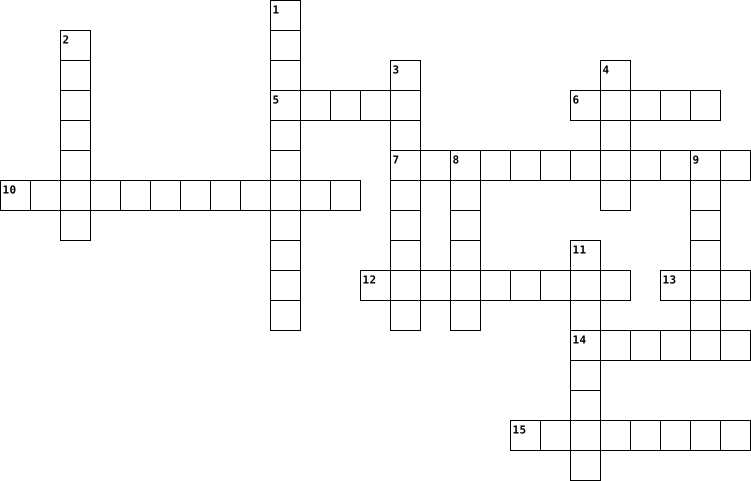
Across
- Day A day to raise awareness about environmental protection and conservation.
- Day A day to honor and celebrate the achievements of workers and labor movements.
- Day A patriotic holiday in the United States with fireworks and parades.
- A time to express gratitude and enjoy a special meal with family and friends.
- A fun holiday where people dress up in costumes and collect candy.
- Year's Day The start of a new year, marked by fireworks, parties, and resolutions.
- A holiday celebrating the resurrection of Jesus with egg hunts and special services.
- A Jewish holiday celebrated with the lighting of the menorah and gifts.
Down
- Day A day to show love and affection to others, often with cards and gifts.
- A month of fasting, prayer, and reflection for Muslims.
- A festive holiday celebrated with gifts and decorations, honoring the birth of Jesus.
- Gras A lively and colorful celebration with parades, masks, and festivities.
- A Hindu festival of lights, symbolizing the victory of light over darkness.
- New Year The beginning of the lunar new year, marked with parades and traditional customs.
- Day A day to honor and thank military veterans for their service.
15 Clues: A month of fasting, prayer, and reflection for Muslims. • Day A day to honor and thank military veterans for their service. • A fun holiday where people dress up in costumes and collect candy. • A Jewish holiday celebrated with the lighting of the menorah and gifts. • Day A patriotic holiday in the United States with fireworks and parades. • ...
Patterns in the Sky 2024-12-06

Across
- what we have when we face away from the sun
- the moon phase where it is all lit up
- something that repeats predictably
- the moon is covered with these
Down
- the force that holds the moon near the earth
- when the moon casts a shadow on Earth
- it gives the earth light and heat energy
- Orbits the Earth every 28 days
- what the moon is made of
- this lasts 24 hours
10 Clues: this lasts 24 hours • what the moon is made of • Orbits the Earth every 28 days • the moon is covered with these • something that repeats predictably • when the moon casts a shadow on Earth • the moon phase where it is all lit up • it gives the earth light and heat energy • what we have when we face away from the sun • the force that holds the moon near the earth
asdasdasdas 2026-03-24

Across
- — The sun appears to set in this direction.
- — Earth’s axis is this, not straight.
- — Earth spins around this imaginary line.
- — The direction Earth turns when viewed from above the North Pole.
- — This movement causes day and night.
- — These are caused by Earth’s tilt and revolution.
Down
- — Light that reaches Earth from the sun.
- — One half of Earth.
- — This movement takes about one year.
- — The sun appears to rise in this direction.
10 Clues: — One half of Earth. • — Earth’s axis is this, not straight. • — This movement takes about one year. • — This movement causes day and night. • — Light that reaches Earth from the sun. • — Earth spins around this imaginary line. • — The sun appears to set in this direction. • — The sun appears to rise in this direction. • — These are caused by Earth’s tilt and revolution. • ...
Earth, Sun and Moon 2022-05-17

Across
- The ____ is a star
- We can see the moon at ____.
- People and animals____ on planet Earth.
- Earth is a ____.
- We live on planet____.
Down
- The moon is a ____.
- Planet Earth has soil,____ and air.
- We can see the sun in the ____.
8 Clues: Earth is a ____. • The ____ is a star • The moon is a ____. • We live on planet____. • We can see the moon at ____. • We can see the sun in the ____. • Planet Earth has soil,____ and air. • People and animals____ on planet Earth.