
energy Crossword Puzzles
Paisley 2022-12-12

Across
- The "stuff" that makes up all materials in objects that have mass
- An interaction between two object that physically come into contact
- Pusing
- Basic building block of matter
- Energy associated with temperature of an object
- The movement of energy
- The conversion of energy from one form to another
Down
- Energy of motion
- Pulling
- Two objects physically touch
- Specific path that circles the nucleus
- Stored energy
- Energy carried by sound waves
- Measured in watts
- The ability to do work
- A push or a pull
16 Clues: Pusing • Pulling • Stored energy • Energy of motion • A push or a pull • Measured in watts • The movement of energy • The ability to do work • Two objects physically touch • Energy carried by sound waves • Basic building block of matter • Specific path that circles the nucleus • Energy associated with temperature of an object • The conversion of energy from one form to another • ...
Paisley 2022-12-12

Across
- The "stuff" that makes up all materials in objects that have mass
- An interaction between two object that physically come into contact
- Pusing
- Basic building block of matter
- Energy associated with temperature of an object
- The movement of energy
- The conversion of energy from one form to another
Down
- Energy of motion
- Pulling
- Two objects physically touch
- Specific path that circles the nucleus
- Stored energy
- Energy carried by sound waves
- Measured in watts
- The ability to do work
- A push or a pull
16 Clues: Pusing • Pulling • Stored energy • Energy of motion • A push or a pull • Measured in watts • The movement of energy • The ability to do work • Two objects physically touch • Energy carried by sound waves • Basic building block of matter • Specific path that circles the nucleus • Energy associated with temperature of an object • The conversion of energy from one form to another • ...
Energy Unit Crossword Puzzle 2025-10-27

Across
- Heat energy
- The transfer of energy through direct contact.
- Radiation travels in...
- Slowest moving particles (state of matter)
- The average kinetic energy in a substance.
- Particles are spreading out
Down
- Heat is measured in...
- Movement energy
- Fastest moving particles (state of matter)
- The transfer of energy through currents.
- Particles are moving closer to each other
- Medium moving particles (state of matter)
- The transfer of thermal energy. (Measured in Joules)
- The transfer of energy through air.(Indirect contact)
- Temperature is measured in...
- Convection travels through...
16 Clues: Heat energy • Movement energy • Heat is measured in... • Radiation travels in... • Particles are spreading out • Temperature is measured in... • Convection travels through... • The transfer of energy through currents. • Particles are moving closer to each other • Medium moving particles (state of matter) • Fastest moving particles (state of matter) • ...
Yash's quiz 2023-05-24

Across
- In which change is energy transferred from the surroundings to the substance?
- Particles go from very close to far apart
- An object will maintain its kinetic energy unless _____ changes
- This type of bonding usually has high melting points
- An object related to diffusion
- When an object falls it _____ kinetic energy
- energy that an object may have based on their size, shape, position, or even material they are made from.
- making liquid particles stop moving but instead vibrate
- When two atoms share electrons
- Takes the shape of the container
- Concept of covalent bonding
Down
- This usually does not release energy
- A substance that may not have a fixed shape or size
- Process of gas turning into a liquid
- Energy that is associated with motion
- Type of bonding between metal atoms
- process of close particles going far apart
- Usually releases energy
- What state of matter is slime
19 Clues: Usually releases energy • Concept of covalent bonding • What state of matter is slime • An object related to diffusion • When two atoms share electrons • Takes the shape of the container • Type of bonding between metal atoms • This usually does not release energy • Process of gas turning into a liquid • Energy that is associated with motion • ...
Fluid dynamics 2022-05-11

Across
- ratio of a change in fluid volume to a change in pressure
- speed of a fluid moving in a particular direction
- thickness of a fluid
- concentration of force in an area
- energy is never lost, only converted from one form to another
- moving energy
- the study of blood flow throughout the body
- behind fluid flow
- vessel that has higher pressure
Down
- pressure exerted by a fluid due to its weight
- to move in a stream, continually changing position or direction
- change in fluid volume over time
- a substance that flows and conforms to the shape of their containers
- KE + PE
- concentration of force in an area
- resting energy, static pressure waiting to be conformed to another form of energy
- ability to accomplish work
- total amount of energy transformed from one form to another
- rate at which energy is transferred from one part of the system to another
- joules/second
20 Clues: KE + PE • moving energy • joules/second • behind fluid flow • thickness of a fluid • ability to accomplish work • vessel that has higher pressure • change in fluid volume over time • concentration of force in an area • concentration of force in an area • the study of blood flow throughout the body • pressure exerted by a fluid due to its weight • ...
Biology Crossword Puzzle 2022-12-13

Across
- bunches of proteins that span the thylakoids membrane and allow H+ to pass
- ATP, Photosynthesis, pigment, chlorophyll, thylakoid, stroma, NADP+, light-dependent reactions, Light independent reactions, Photosystem, ATP-Synthase, Electron transport chain, Calvin Cycle, Chloroplast, Heterotrophs, Autotrophsm, C4-Plants, CAM-Plants
- an organisms deriving its energy from complex organic substances
- reactions in photosynthesis that don’t require light
- the light-independent reactions of photosynthesis where ATP and NADPH is used to build high-energy compounds like sugar
- Green plant organelle where light energy is turned into chemical energy through photosynthesis
- A method where plants convert light energy and use it to power reactions to make sugars and starches
- series of electron carrier proteins that transport high energy electrons during ATP which rates reactions
- a strategy that plants use, where carbon dioxide will become incorporated into organic acids during photosynthesis
- bunches of proteins and chlorophyll found in thylakoids
Down
- the cytoplasm of the chloroplast; fluid of chloroplast
- reactions that photosynthesis use energy from light to produce ATP and NADPH
- an organisms that can form energy from inorganic substances like carbon
- molecule that carries high-energy electrons to the rest of the plant
- an important pigment in plants and other similar organisms
- cells used to store and release energy
- light absorbing molecules used to gather the sun's energy
- saclike green membranes found in the chloroplast
- plants that have a specialized chemical pathway that helps them capture very low levels of carbon dioxide and pass it to the Calvin cycle
19 Clues: cells used to store and release energy • saclike green membranes found in the chloroplast • reactions in photosynthesis that don’t require light • the cytoplasm of the chloroplast; fluid of chloroplast • bunches of proteins and chlorophyll found in thylakoids • light absorbing molecules used to gather the sun's energy • ...
Biology Crossword Puzzle 2022-12-13

Across
- bunches of proteins that span the thylakoids membrane and allow H+ to pass
- ATP, Photosynthesis, pigment, chlorophyll, thylakoid, stroma, NADP+, light-dependent reactions, Light independent reactions, Photosystem, ATP-Synthase, Electron transport chain, Calvin Cycle, Chloroplast, Heterotrophs, Autotrophsm, C4-Plants, CAM-Plants
- an organisms deriving its energy from complex organic substances
- reactions in photosynthesis that don’t require light
- the light-independent reactions of photosynthesis where ATP and NADPH is used to build high-energy compounds like sugar
- Green plant organelle where light energy is turned into chemical energy through photosynthesis
- A method where plants convert light energy and use it to power reactions to make sugars and starches
- series of electron carrier proteins that transport high energy electrons during ATP which rates reactions
- a strategy that plants use, where carbon dioxide will become incorporated into organic acids during photosynthesis
- bunches of proteins and chlorophyll found in thylakoids
Down
- the cytoplasm of the chloroplast; fluid of chloroplast
- reactions that photosynthesis use energy from light to produce ATP and NADPH
- an organisms that can form energy from inorganic substances like carbon
- molecule that carries high-energy electrons to the rest of the plant
- an important pigment in plants and other similar organisms
- cells used to store and release energy
- light absorbing molecules used to gather the sun's energy
- saclike green membranes found in the chloroplast
- plants that have a specialized chemical pathway that helps them capture very low levels of carbon dioxide and pass it to the Calvin cycle
19 Clues: cells used to store and release energy • saclike green membranes found in the chloroplast • reactions in photosynthesis that don’t require light • the cytoplasm of the chloroplast; fluid of chloroplast • bunches of proteins and chlorophyll found in thylakoids • light absorbing molecules used to gather the sun's energy • ...
Biology Crossword Puzzle 2022-12-13

Across
- bunches of proteins and chlorophyll found in thylakoids
- the light-independent reactions of photosynthesis where ATP and NADPH is used to build high-energy compounds like sugar
- word bank:ATP, Photosynthesis, pigment, chlorophyll, thylakoid, stroma, NADP+, light-dependent reactions, Light independent reactions, Photosystem, ATP-Synthase, Electron transport chain, Calvin Cycle, Chloroplast, Heterotrophs, Autotrophsm, C4-Plants, CAM-Plants
- an organisms that can form energy from inorganic substances like carbon
- A method where plants convert light energy and use it to power reactions to make sugars and starches
- an important pigment in plants and other similar organisms
- reactions in photosynthesis that don’t require light
- bunches of proteins that span the thylakoids membrane and allow H+ to pass
Down
- series of electron carrier proteins that transport high energy electrons during ATP which rates reactions
- molecule that carries high-energy electrons to the rest of the plant
- Green plant organelle where light energy is turned into chemical energy through photosynthesis
- light absorbing molecules used to gather the sun's energy
- plants that have a specialized chemical pathway that helps them capture very low levels of carbon dioxide and pass it to the Calvin cycle
- a strategy that plants use, where carbon dioxide will become incorporated into organic acids during photosynthesis
- reactions that photosynthesis use energy from light to produce ATP and NADPH
- cells used to store and release energy
- an organisms deriving its energy from complex organic substances
- saclike green membranes found in the chloroplast
- the cytoplasm of the chloroplast; fluid of chloroplast
19 Clues: cells used to store and release energy • saclike green membranes found in the chloroplast • reactions in photosynthesis that don’t require light • the cytoplasm of the chloroplast; fluid of chloroplast • bunches of proteins and chlorophyll found in thylakoids • light absorbing molecules used to gather the sun's energy • ...
2023 ENERGY AWARENESS CROSSWORD 2023-07-25

Across
- A device commonly used in industry to heat water into steam for heating, power generation, or other processes. (6)
- An initiative common in the industrial sector to reduce waste and increase recycling. (7, 5)
- Structures built to harness the power of water for energy. (4)
- The force that water in motion creates, useful for generating electricity. (5)
- A primary gas emitted by human activities that companies aim to reduce. (6)
- A type of resource that companies aim to use less due to its limited availability. (9)
- A clean energy source capturing heat from the Earth's interior. (10)
- A type of technology that allows for more reliable, secure, and efficient energy use. (5, 4)
Down
- A type of renewable energy generated from organic materials. (7)
- The type of energy associated with objects in motion. (6)
- The form of energy that has the ability to do work. (6)
- The heat absorbed or released during a phase change, which is critical in industrial processes. (6, 4)
- An initiative to increase the use of post-consumer waste in products. (6, 8)
- Devices crucial for capturing steam in many industrial processes. (5, 5)
- Legislation designed to limit the amount of greenhouse gases that can be emitted. (3, 2, 3)
- An energy conservation practice involving reducing unnecessary energy use.
- Measurement of the electrical efficiency of a load, crucial in managing electricity consumption. (5, 6)
- A sustainability initiative common among companies to reduce energy consumption and carbon footprint. (4, 4)
- A process of replacing old equipment with more energy-efficient versions. (7)
19 Clues: The form of energy that has the ability to do work. (6) • The type of energy associated with objects in motion. (6) • Structures built to harness the power of water for energy. (4) • A type of renewable energy generated from organic materials. (7) • A clean energy source capturing heat from the Earth's interior. (10) • ...
Photosynthesis+Celleur Resperation Crossword 2025-01-21

Across
- Processes that do not require oxygen, like anaerobic respiration or fermentation
- synthase: An enzyme that synthesizes ATP from ADP and inorganic phosphate, powered by a proton gradient across the thylakoid membrane.
- membrane: The membrane of the mitochondrion where the electron transport chain and ATP synthase are located.
- The main pigment in plants that absorbs light for photosynthesis
- cycle:A series of reactions in the mitochondrial matrix that produce electron carriers and CO2 from pyruvate.
- The innermost part of the mitochondrion where the Krebs cycle occurs.
- Processes that build complex molecules from simpler ones, requiring energy.
- Processes that require oxygen, like aerobic respiration.
Down
- The final electron acceptor in aerobic respiration and a product of photosynthesis.
- transport chain: In cellular respiration, the chain that transfers electrons from NADH and FADH2 to produce ATP.
- The process by which plants, algae, and some bacteria convert light energy into chemical energy stored in glucose.
- The first stage of cellular respiration, where glucose is broken down into pyruvate.
- respiration: The process of converting biochemical energy from nutrients into ATP, involving glycolysis, the Krebs cycle, and the electron transport chain.
- The product formed when ATP loses a phosphate group, releasing energy.
- Processes that break down molecules to release energy.
- energy: Energy that is released from molecules, often used in cellular functions like movement or synthesis.
- Molecules that absorb light energy, crucial for photosynthesis.
- dioxide: A waste product of cellular respiration and a substrate in photosynthesis.
- energy: Energy that is stored in molecules like glucose.
19 Clues: Processes that break down molecules to release energy. • Processes that require oxygen, like aerobic respiration. • energy: Energy that is stored in molecules like glucose. • Molecules that absorb light energy, crucial for photosynthesis. • The main pigment in plants that absorbs light for photosynthesis • ...
December Exam Review 2022-12-02

Across
- stored energy
- 1/100
- 1000
- includes numbers
- SI unit for force
- SI unit of distance
- measure of the amount of matter
- father of modern physics
- explanation of WHY things happen
- energy of motion
- factor that doesn't change
- 100
- energy carried by light
- description of HOW things happen
- energy stored in bonds of molecules
- rate at which an object moves
- the measured effect in an experiment
- makes work easier
- gravitational force
- ratio of mass to volume
- rate of change of velocity
Down
- measure of how close a series of measurements are to one another
- the distance from starting position to ending position
- spinning on an axis
- energy stored in the nucleus
- descriptive data
- moving around an object
- SI unit for work and energy
- famous for theories of force; greatest physicist
- transfer of energy by applying a force
- SI unit for mass
- in a repeating pattern
- group not tested
- force between touching objects
- manipulated variable
- measure of how close measurement are to the actual value
- tendency of an object to resist a change in motion
- energy of moving particles
38 Clues: 100 • 1000 • 1/100 • stored energy • includes numbers • descriptive data • SI unit for mass • energy of motion • group not tested • SI unit for force • makes work easier • spinning on an axis • SI unit of distance • gravitational force • manipulated variable • in a repeating pattern • moving around an object • energy carried by light • ratio of mass to volume • father of modern physics • ...
Heat and Temperature Crossword puzzle 2023-05-03

Across
- No definite volume or shape
- The measure of the average amount of kinetic energy of the particles of a substance
- Devices that do not use electricity
- The most abundant form of ordinary matter in the universe
- The energy transferred from one substance to another as a result of a temperature difference
- Definite volume but no fixed shape
- Can energy be created or destroyed?
- Water with no dissolved impurities
- Somethings ability to cause change
- The amount of heat needed to make an object produce a unit change in its temperature.
- Using words (adjectives, verbs, adverbs) to express observations
- Numerically expressing observations
Down
- Particles of matter are held together by?
- No definite volume or shape
- Definite volume and shape
- The total kinetic energy of all the particles of a substance
- The measurement of heat using numbers
- The energy a particle possesses because of its motion
- Anything that has mass and takes up space
- The tendency for matter to change its shape in response to temperature
- Devices that use electricity
- The most compressible state of matter
- Very little compressibility
- The least compressible state of matter
24 Clues: Definite volume and shape • No definite volume or shape • No definite volume or shape • Very little compressibility • Devices that use electricity • Definite volume but no fixed shape • Water with no dissolved impurities • Somethings ability to cause change • Devices that do not use electricity • Can energy be created or destroyed? • Numerically expressing observations • ...
Forces And Motion Crossword 2021-01-28

Across
- stored energy in a body or system due to its position.
- the transfer of energy by electromagnetic waves. The sun is Earth’s main source of electromagnetic waves.
- the exact location of an object.
- the overall force(s) acting on an object.
- energy of motion.
- to put forth as strength
- a material that heat can move through easily like aluminum, steel and other metals.
- the change in position of an object.
Down
- the tendency for an object to keep doing what it is doing
- push or pull
- remaining steady and unchanged
- two or more substances are mixed together but not combined chemically
- flow of thermal (heat) energy between things that are touching.
- a force that attracts (pulls) all objects to the center of the Earth
- the line or course along which something moves.
- the ability to do work
- the transfer of thermal (heat) energy by the movement of liquids or gases.
- measures how fast an object is moving in a given amount of time.
- measures how fast an object is moving (speed) AND the direction in which it is moving
- the amount of matter (“stuff”) -in an object.
20 Clues: push or pull • energy of motion. • the ability to do work • to put forth as strength • remaining steady and unchanged • the exact location of an object. • the change in position of an object. • the overall force(s) acting on an object. • the amount of matter (“stuff”) -in an object. • the line or course along which something moves. • ...
vocabulary 2021-03-10

Across
- organic matter builds up
- a community of living things
- organism that eats other organisms
- movement of water
- broad leaf
- can be used to trace flow of energy
- is a partly closed body of water
- gets food by breaking down dead things
- a place where the climate depends on the animals
- a place an organism lives within a ecosystem
- area of land that is saturated
- the feeding relationships
- uses energy to make its food
- biome with grassy field
- eats both plants and meat
- movement of nitrogen
Down
- ability to cause change
- anything with mass
- a push or pull
- has low average temp
- the 1st ones in that area
- is an event that changes an ecosystem
- when energy changes
- of conservation of mass mass cant be created or destroyed
- eats meat
- trees with evergreen needles
- the slow development of change of a community
- of conservation of energy states energy can't be created or destroyed
- eats plants
- transfer of energy
- the path of energy transferred through producers and consumers
- biomes very dry
- the variation of a species within a area
33 Clues: eats meat • broad leaf • eats plants • a push or pull • biomes very dry • movement of water • anything with mass • transfer of energy • when energy changes • has low average temp • movement of nitrogen • ability to cause change • biome with grassy field • organic matter builds up • the 1st ones in that area • the feeding relationships • eats both plants and meat • a community of living things • ...
Vocabulary (unit six) 2021-03-10

Across
- organic matter builds up
- a community of living things
- organism that eats other organisms
- movement of water
- broad leaf
- can be used to trace flow of energy
- is a partly closed body of water
- gets food by breaking down dead things
- a place where the climate depends on the animals
- a place an organism lives within a ecosystem
- area of land that is saturated
- the feeding relationships
- uses energy to make its food
- biome with grassy field
- eats both plants and meat
- movement of nitrogen
Down
- ability to cause change
- anything with mass
- a push or pull
- has low average temp
- the 1st ones in that area
- is an event that changes an ecosystem
- when energy changes
- of conservation of mass mass cant be created or destroyed
- eats meat
- trees with evergreen needles
- the slow development of change of a community
- of conservation of energy states energy can't be created or destroyed
- eats plants
- transfer of energy
- the path of energy transferred through producers and consumers
- biomes very dry
- the variation of a species within a area
33 Clues: eats meat • broad leaf • eats plants • a push or pull • biomes very dry • movement of water • anything with mass • transfer of energy • when energy changes • has low average temp • movement of nitrogen • ability to cause change • biome with grassy field • organic matter builds up • the 1st ones in that area • the feeding relationships • eats both plants and meat • a community of living things • ...
Matter & Energy CW 2 2021-09-07

Across
- average weather conditions in an area over time
- process that changes atmospheric nitrogen into compounds usable by living things
- organisms that do not need to eat other organisms to obtain energy
- single path model showing how energy flows in an ecosystem
- to set free
- multi path model of energy transfer showing how the food chains in a community are interconnected
- animals that hunt other animals
- animals that are hunted
- process using chemical energy in matter to make food
Down
- series of chemical reactions that convert light energy, water, and carbon dioxide into the food-energy molecule glucose and give off oxygen
- process during which water vapor changes into liquid water
- __________ factors are living things in an ecosystem
- unicellular organisms without a membrane-bound nucleus
- water that falls from clouds to Earth’s surface
- layer of gases surrounding Earth
- organisms that must eat other organisms for energy
- process during which liquid water changes into water vapor
- _________ factors are nonliving things in an ecosystem
- living and nonliving things in a given area
- model showing the amount of energy available in each step of a food chain
- cannot be separated by chemical means
21 Clues: to set free • animals that are hunted • animals that hunt other animals • layer of gases surrounding Earth • cannot be separated by chemical means • living and nonliving things in a given area • average weather conditions in an area over time • water that falls from clouds to Earth’s surface • organisms that must eat other organisms for energy • ...
science classwork June 3 2021-06-03

Across
- shortest electromagnetic wavelength
- something that conducts energy very well
- the force resisting a sliding object
- an object that turns electrical energy into mechanical energy
- how fast something is moving
- a rocky object orbiting the sun
- an element that is in between a metal and a non-metal
- negatively charged particals in an atom
- the energy of heat
- how much heat something has
- an object that turns mechanical energy into electrical energy
Down
- something that doesn't conduct energy well
- a object from space that goes through earths atmosphere
- how many protons an atom has
- a point where an object spins
- when on celestial body blocks a source of illumination
- a object in space that cant classify as a planet
- the energy of motion
- neutral particals in an atom
- the temperature where all molecules stop moving
- the force between two objects
- where the metalloids are found on the periodic table and also separates the metals and the non-metals
- smallest unit of matter
- particals in an atom that are positively charged
- a magnet that works using electricity
25 Clues: the energy of heat • the energy of motion • smallest unit of matter • how much heat something has • how many protons an atom has • neutral particals in an atom • how fast something is moving • a point where an object spins • the force between two objects • a rocky object orbiting the sun • shortest electromagnetic wavelength • the force resisting a sliding object • ...
Science 2023-11-28

Across
- The force exerted by a gas or liquid that is displaced.
- energy is the ____ to perform work.
- E = mc^2 is the equation that expresses the relationship between mass and ___.
- matter cannot be created or destroyed, only changed in form
- equation used to calculate momentum.
- friction is a force that resists _____.
- Tensile strength is the amount of ____ that an object can withstand.
- A continuous pull on an object.
- energy cannot be _____ or destroyed, only changed in form
- A force that resists movement
Down
- A ____ force is a push or a pull on an object.
- The scientific definition of work is force times ____.
- the movement of mass in a particular direction
- The law of conservation of momentum states that all changes of momentum must be ____.
- Friction can be damaging because is can produce what?
- amount of work done in a given period of time
- Force is directly related to the ____ of an object.
- mass and ___ are two quantities that affect an object's momentum.
- ____ energy is energy that is stored.
- G = 9.8m/sec^2 is the mathematical equation for _____.
- ____ energy is energy that is being used
- Energy is the ability to perform ____.
22 Clues: A force that resists movement • A continuous pull on an object. • energy is the ____ to perform work. • equation used to calculate momentum. • ____ energy is energy that is stored. • Energy is the ability to perform ____. • friction is a force that resists _____. • ____ energy is energy that is being used • amount of work done in a given period of time • ...
Chemistry Unit 1 Terms 2026-01-08

Across
- 2 or more visible phases with each phase having different properties
- process that absorbs energy from surroundings
- smallest unit of an element that maintains the properties of that element
- Capacity to do work or transfer heat
- separates a solid from a liquid
- gas like variable shape and volume and has very high kinetic energy
- Kinetic energy, energy of motion
- Fixed volume and variable shape, particles can move around but stay close
- Fixed volume and shape, particles vibrate but cant move around
- Measure of the amount of matter
- physical combination of 2 or more substances
Down
- A gaseous substance which turns solid or liquid at room temperature
- Study of the composition, structure, and properties of matter
- pure substance made up of only one type of atom
- Potential energy, energy possessed based on position, composition or condition
- process that releases energy into surroundings
- only 1 visibly distinct phase which has the same properties throughout
- have properties of both metals and nonmetals
- Variable volume and shape, particles move around and separate
- substance made up of atoms from 2 or more elements
- Amount of space that is occupied
21 Clues: separates a solid from a liquid • Measure of the amount of matter • Amount of space that is occupied • Kinetic energy, energy of motion • Capacity to do work or transfer heat • have properties of both metals and nonmetals • physical combination of 2 or more substances • process that absorbs energy from surroundings • process that releases energy into surroundings • ...
Chemistry Vocabulary Crossword - Emely Pozos P4 2024-09-26

Across
- Absorption of heat energy.
- Ability to do work.
- Made of neutrons and protons.
- The horizontal row on the periodic table.
- A negatively charged subatomic, found outside the nucleus.
- The study of changes in energy and heat.
- A positively charged subatomic, found in the nucleus.
- The distance between two wave crests.
- The arrangement of an element's electrons during ground state.
- The amount of neutrons and protons put together.
- The amount of energy needed to move an electron to another energy level.
- An atom with a positive or negative charge.
Down
- A diagram of the valence electrons as dots.
- The electrons on the outer side of an atom.
- Equal to the amount of protons in the nucleus.
- The smallest particle of an element.
- An atom with a positive charge.
- Release of heat energy.
- The amount of energy it takes to increase 1 gram by 1C'.
- The difference in temperature due to energy transfer.
- A subatomic particle with no positive nor negative charge.
- The amount of disorder and randomness in atoms.
- The vertical column on the periodic table.
- An atom with a negative charge.
- The spectrum with the specific types of waves.
25 Clues: Ability to do work. • Release of heat energy. • Absorption of heat energy. • Made of neutrons and protons. • An atom with a positive charge. • An atom with a negative charge. • The smallest particle of an element. • The distance between two wave crests. • The study of changes in energy and heat. • The horizontal row on the periodic table. • ...
MP3 Crossword puzzle 2024-02-09

Across
- A plants response to gravity
- The process where a plant converts radiant energy to chemical energy
- A plants response to water
- Gas that plants produce during photosynthesis
- This is many food chains together
- The arrows in a food chain represent the flow of this
- Food that plants produce during photosynthesis
- Pignment that gives leaves their green color
- During digestion chemical energy is transformed in to this energy
- Organelle that photosynthesis takes place in
Down
- A plants response to light
- Pore on the bottom of leaves that release gases
- Gas that plants use for photosynthesis
- The first consumer in a food chain
- During exercise chemical energy is transformed into this
- A plants response to touch
- Food chains always begin with a what
- energy from the sun
18 Clues: energy from the sun • A plants response to light • A plants response to water • A plants response to touch • A plants response to gravity • This is many food chains together • The first consumer in a food chain • Food chains always begin with a what • Gas that plants use for photosynthesis • Pignment that gives leaves their green color • ...
chapter 14 2024-05-09

Across
- Electric energy generated by the movement of water.
- Chemical potential energy obtained from renewable organic materials.
- Stored energy that can be used later.
- An energy resource easily replaced by natural methods.
- A fuel that has formed from the remains of plants and animals that lived in the past, including coal, petroleum (oil), and natural gas.
- Mechanical energy in rising and falling tides.
Down
- An energy resource that is not replaced naturally.
- Energy from the wind can be used to turn turbine blades attached to generators.
- Energy produced by the sun.
- The sum of the kinetic energy and all the forms of potential energy in a system.
- Energy that an object possesses due to its motion.
- Thermal energy that originates deep within the earth’s interior.
- Energy produced by nuclear reactions.
- The ability to do work.
14 Clues: The ability to do work. • Energy produced by the sun. • Stored energy that can be used later. • Energy produced by nuclear reactions. • Mechanical energy in rising and falling tides. • An energy resource that is not replaced naturally. • Energy that an object possesses due to its motion. • Electric energy generated by the movement of water. • ...
Unit 4 Vocab (Index Cards) 2017-12-12

Across
- is a material that transfers heat very well
- a fixed point where a bar pivots in a lever
- measures temperature
- acceleration in a circular motion
- the location of an object
- the rate at which velocity changes
- is equal to the amount of energy needed to raise the temperature of 1 g of water by 1*C
- the measure of how far something moves in a given time
- a simple machine that has a bar that pivots at a fixed point
- a comparison of a machine’s work output with the work input
- the total kinetic energy of all particles in a substance
- is a measure of the average kinetic energy of all the particles in an object
- of Matter states that all of the particles that make up matter are constantly in motion
- the tendency of all objects to resist a change in motion
- a material that is a poor conductor of heat
- the energy that an object has due to its position, condition, or chemical composition
- a simple machine that is a straight, slanted surface
- the number of times the machine multiplies the input force
- Point a location to which you compare other locations
- a push or pull
Down
- the transfer of energy as heat from one substance to another
- a simple machine that is made of a wheel connected to a smaller cylindrical object
- equally spaced units between two points
- occurs when energy changes from one form into another form
- states that energy cannot be created or destroyed
- the energy transferred from an object at a higher temperature to an object at a lower temperature
- any device that helps people do work by changing the way work is done
- a simple machine that has a grooved wheel that holds a rope or a cable
- speed in a specific direction
- a quantity that has both size and direction
- the sum of an object’s kinetic energy and potential energy
- a change in position over time
- the ability to cause change
- the energy of an object that is due to motion
- the transfer of energy as heat by the movement of a liquid or gas
- the combination of all forces acting on an object
- the transfer of energy by electromagnetic waves
37 Clues: a push or pull • measures temperature • the location of an object • the ability to cause change • speed in a specific direction • a change in position over time • acceleration in a circular motion • the rate at which velocity changes • equally spaced units between two points • is a material that transfers heat very well • a fixed point where a bar pivots in a lever • ...
Focused Physical Science Vocab Study 1.2.1 & 2.1.1 2024-01-20

Across
- The energy related to an object's position, its shape, or the arrangement of its particles.
- The energy related to an object's motion.
- A wave that consists of both electric and magnetic field components, which vibrate perpendicular to each other; also called a light wave.
- A judgment (decision) that is based on analyzing data and is reached by reasoning.
- Each repetition of a scientific experiment.
- A property of matter that can be either positive or negative and that causes particles to experience an attractive force when near a particle of opposite charge or a repulsive force when near a particle of the same charge.
- The data that either supports or does not support a hypothesis.
- Pieces of collected information or measurements.
- Energy stored in an object that is determined by the object's mass, its height (altitude), and the acceleration due to gravity at the object's location.
- Based on observations and results from experiments rather than on inference.
- The energy stored in an atom's nucleus due to the fundamental forces that hold its particles together.
- A planned series of actions that test whether an idea is true.
- Anything that takes up space and has mass.
- The energy of an object due to its chemical bonds and the arrangement of its particles.
- Energy that travels as an electromagnetic wave; also called light energy.
- Potential energy of an object due to its location within a magnetic field.
Down
- Potential energy due to the distortion of an object or system.
- Able to be trusted.
- An orderly process of gathering and thoroughly examining facts and testing them to find out whether they can explain something that happens.
- One of the three particles that make up atoms: an electron, a proton, or a neutron.
- The energy of an object or a system due to the total kinetic energy of its particles.
- The dense center of an atom, made up of protons and neutrons.
- Close to the actual value.
- A statement that proposes a testable explanation for a natural phenomenon.
- The ability to cause change in matter.
- Energy that moves through matter as a sound wave resulting from the vibrations of particles that make up the matter.
- Energy generated by a flow of electrons.
- Exact.
- A factor that can change during an investigation or in nature.
29 Clues: Exact. • Able to be trusted. • Close to the actual value. • The ability to cause change in matter. • Energy generated by a flow of electrons. • The energy related to an object's motion. • Anything that takes up space and has mass. • Each repetition of a scientific experiment. • Pieces of collected information or measurements. • ...
Puzzle 17: Photosynthesis & Forms of Energy 2026-05-27

Across
- Stored energy found in food, batteries, and fuels that is released during chemical changes.
- A form of energy produced by vibrating objects that can be heard by our ears.
- A form of energy that flows from a hotter region to a colder region, raising temperatures.
- An environmental factor where increasing the brightness of a lamp causes a plant to produce food faster.
- The tiny cell structure in a plant cell that contains the green pigment needed to make food.
- The form of energy that flows through a closed circuit to operate appliances like fans or lamps.
- A term used to describe any object or component that provides or gives out a form of energy.
- Stored energy found in a stretched rubber band or a compressed metal spring.
- The specific gas that enters through tiny leaf openings for a plant to carry out food production.
Down
- The form of energy from a lamp or the sun that green plants need to carry out food production.
- The green pigment found in leaves that is essential for absorbing light during food production.
- The process where green plants use light, carbon dioxide, and water to produce sugar and release a gas.
- Stored energy possessed by an object due to its high position above the ground.
- The form of energy possessed by any moving object, like a running child or a rolling marble.
- An object or material that takes in or absorbs a form of energy from its surroundings.
- Chlorophyll is required in leaves to __________ from the sun so the plant can carry out photosynthesis.
- The primary natural source of light energy that plants use to make food during the day.
- The process where energy changes from one form to another, such as stored energy in food becoming movement energy.
- A basic need absorbed by roots from the soil to be used as a raw material for food production.
- Unlike fungi, green plants can __________ because they possess a specific green pigment to capture sunlight.
- Tiny openings located mostly on the underside of a leaf that allow gases to move in and out.
- The gas released by green leaves into the surroundings as a byproduct during food production.
22 Clues: Stored energy found in a stretched rubber band or a compressed metal spring. • A form of energy produced by vibrating objects that can be heard by our ears. • Stored energy possessed by an object due to its high position above the ground. • An object or material that takes in or absorbs a form of energy from its surroundings. • ...
Forces And Motion Crossword 2021-01-28

Across
- remaining steady and unchanged
- the tendency for an object to keep doing what it is doing
- measures how fast an object is moving in a given amount of time.
- the overall force(s) acting on an object.
- a force that attracts (pulls) all objects to the center of the Earth
- the transfer of thermal (heat) energy by the movement of liquids or gases.
- energy of motion.
- push or pull
- to put forth as strength
Down
- flow of thermal (heat) energy between things that are touching.
- stored energy in a body or system due to its position.
- the exact location of an object.
- two or more substances are mixed together but not combined chemically
- the transfer of energy by electromagnetic waves. The sun is Earth’s main source of electromagnetic waves.
- measures how fast an object is moving (speed) AND the direction in which it is moving
- the amount of matter (“stuff”) -in an object.
- the line or course along which something moves.
- the change in position of an object.
- a material that heat can move through easily like aluminum, steel and other metals.
- the ability to do work
20 Clues: push or pull • energy of motion. • the ability to do work • to put forth as strength • remaining steady and unchanged • the exact location of an object. • the change in position of an object. • the overall force(s) acting on an object. • the amount of matter (“stuff”) -in an object. • the line or course along which something moves. • ...
Forces And Motion Crossword 2021-01-28

Across
- two or more substances are mixed together but not combined chemically
- the overall force(s) acting on an object.
- the amount of matter (“stuff”) -in an object.
- to put forth as strength
- the transfer of thermal (heat) energy by the movement of liquids or gases.
- a material that heat can move through easily like aluminum, steel and other metals.
- the tendency for an object to keep doing what it is doing
- a force that attracts (pulls) all objects to the center of the Earth
- stored energy in a body or system due to its position.
- the exact location of an object.
Down
- measures how fast an object is moving (speed) AND the direction in which it is moving
- energy of motion.
- flow of thermal (heat) energy between things that are touching.
- push or pull
- the change in position of an object.
- measures how fast an object is moving in a given amount of time.
- the transfer of energy by electromagnetic waves. The sun is Earth’s main source of electromagnetic waves.
- remaining steady and unchanged
- the ability to do work
- the line or course along which something moves.
20 Clues: push or pull • energy of motion. • the ability to do work • to put forth as strength • remaining steady and unchanged • the exact location of an object. • the change in position of an object. • the overall force(s) acting on an object. • the amount of matter (“stuff”) -in an object. • the line or course along which something moves. • ...
Matter & Energy CW 2 2021-09-07

Across
- _________ factors are nonliving things in an ecosystem
- animals that are hunted
- model showing the amount of energy available in each step of a food chain
- process using chemical energy in matter to make food
- layer of gases surrounding Earth
- average weather conditions in an area over time
- living and nonliving things in a given area
- unicellular organisms without a membrane-bound nucleus
- organisms that do not need to eat other organisms to obtain energy
- process during which water vapor changes into liquid water
- water that falls from clouds to Earth’s surface
- process during which liquid water changes into water vapor
Down
- __________ factors are living things in an ecosystem
- series of chemical reactions that convert light energy, water, and carbon dioxide into the food-energy molecule glucose and give off oxygen
- multi path model of energy transfer showing how the food chains in a community are interconnected
- organisms that must eat other organisms for energy
- animals that hunt other animals
- single path model showing how energy flows in an ecosystem
- to set free
- cannot be separated by chemical means
- process that changes atmospheric nitrogen into compounds usable by living things
21 Clues: to set free • animals that are hunted • animals that hunt other animals • layer of gases surrounding Earth • cannot be separated by chemical means • living and nonliving things in a given area • average weather conditions in an area over time • water that falls from clouds to Earth’s surface • organisms that must eat other organisms for energy • ...
Matter & Energy CW 1 2021-09-03

Across
- _________ factors are nonliving things in an ecosystem
- animals that are hunted
- model showing the amount of energy available in each step of a food chain
- process using chemical energy in matter to make food
- layer of gases surrounding Earth
- average weather conditions in an area over time
- living and nonliving things in a given area
- unicellular organisms without a membrane-bound nucleus
- organisms that do not need to eat other organisms to obtain energy
- process during which water vapor changes into liquid water
- water that falls from clouds to Earth’s surface
- process during which liquid water changes into water vapor
Down
- __________ factors are living things in an ecosystem
- series of chemical reactions that convert light energy, water, and carbon dioxide into the food-energy molecule glucose and give off oxygen
- multi path model of energy transfer showing how the food chains in a community are interconnected
- organisms that must eat other organisms for energy
- animals that hunt other animals
- single path model showing how energy flows in an ecosystem
- to set free
- cannot be separated by chemical means
- process that changes atmospheric nitrogen into compounds usable by living things
21 Clues: to set free • animals that are hunted • animals that hunt other animals • layer of gases surrounding Earth • cannot be separated by chemical means • living and nonliving things in a given area • average weather conditions in an area over time • water that falls from clouds to Earth’s surface • organisms that must eat other organisms for energy • ...
Nuclear Reactions, Rate of Reactions & Endo/Exothermic Reactions 2023-04-26

Across
- Decreasing the space for the same number of particles = More Collisions & Greater Chance of a Reaction
- Nuclear Reactions Release ______ Energy Than Chemical Reactions
- Related to Heat
- Reactants have Less Energy than the Products, Temperature Decreases, Thermal Energy is Absorbed
- Each time a nucleus splits, it releases more neutrons, which can go on and cause more reactions to occur and will continue to happen.
- The time that it takes half the nuclei in a sample to decay
- Means Out
- How can the surface area of a solid be increased
- Means In
- Any reaction involving a solid takes place where
Down
- Lowers the Activation Energy
- How can Radioactivity be detected
- The splitting of a nucleus into smaller nuclei and the release of energy
- Increasing Contact Points = More Collisions & Greater Chance of a Reaction
- More Particles in the Same Space = More Collisions & Greater Chance of a Reaction
- Two smaller nuclei created when a nucleus splits
- Occurs when a stable isotope is struck by a neutron
- Reactants have More Energy than the Product, Temperature Increases, Thermal Energy is Released
- Increasing Energy = Particles move Faster = More Collisions & Greater Chance of a Reaction
- An example of an Endothermic Reaction
- Process Happens in the Sun’s Core
- An example of an Exothermic Reaction
- Smaller nuclei join together to form larger nuclei and energy is released
23 Clues: Means In • Means Out • Related to Heat • Lowers the Activation Energy • How can Radioactivity be detected • Process Happens in the Sun’s Core • An example of an Exothermic Reaction • An example of an Endothermic Reaction • Two smaller nuclei created when a nucleus splits • How can the surface area of a solid be increased • Any reaction involving a solid takes place where • ...
8th Grade Sci Review 2023-10-12

Across
- How we measure energy
- The main component of an organic molecule
- What come together in a chemical reaction
- Food is defined as giving us what?
- A food molecule; a lipid
- When muscles do work without getting enough of this, sometimes lactic acid builds up
- Where chemical energy is stored in molecules
- A big part of organic molecules and its ion is what we quantify to measure acidity
- The organ with the most fat
- What results from a chemical reaction
- Energy is ___ in animal tissues for use later
- What matter does during a chemical reaction
- What are you?
Down
- "I'm going to ___ this class!"
- The second part of a scientific investigation
- Moving your arm is this kind of energy
- The smallest unit of matter (what elements are)
- What is produced during the reaction that turns food to energy
- A good scientific question is specific and ____?
- What kind of thermal energy do we see in our body?
- Energy is the ability to do what?
- A food molecule; found in muscle tissue
- A food molecule; sugar is an example
- What part of an experiment is making graphs?
24 Clues: What are you? • How we measure energy • A food molecule; a lipid • The organ with the most fat • "I'm going to ___ this class!" • Energy is the ability to do what? • Food is defined as giving us what? • A food molecule; sugar is an example • What results from a chemical reaction • Moving your arm is this kind of energy • A food molecule; found in muscle tissue • ...
Kinetic Theory of Matter 2023-11-10

Across
- the state of matter that takes the shape of the container it is in
- the unit used to measure energy
- the state of matter is determined by the ___ between particles
- the total kinetic energy in the particles of a substance
- thermal energy depends upon the amount of ___ in the substance
- the volume of a gas is not ___.
- the particles in a solids have a(n) ___ arrangement
- particles in matter are ___ with one another
- particles in a liquid can ___ past each other
- the average kinetic energy of the particles of a substance
Down
- the energy of motion
- particles in liquids and gases have a(n) ___ arrangement
- the state of matter in which the particles have the least amount of kinetic energy
- particles in matter are in ___, random motion
- the temperature at which particle motion is so slow that no additional thermal energy can be removed
- all matter is composed of small particles
- the state of matter in which the particles are farthest apart
- particles in a solid have the ___ attraction
- the kinetic theory explain the physical properties of matter in terms of the ___ of its particles
- the transfer of thermal energy
20 Clues: the energy of motion • the transfer of thermal energy • the unit used to measure energy • the volume of a gas is not ___. • all matter is composed of small particles • particles in a solid have the ___ attraction • particles in matter are ___ with one another • particles in matter are in ___, random motion • particles in a liquid can ___ past each other • ...
renwbal 2024-12-25

Across
- / Renewable plants grown for food and materials.
- / The practice of protecting and managing resources.
- / The natural world that surrounds us.
- / A renewable resource essential for drinking and agriculture.
- / A renewable energy source derived from the sun.
- / The power needed to do work or cause change.
- / Renewable resources found in animal populations.
- / Organic material used as a renewable energy source.
- / A nonrenewable sedimentary rock often used in construction.
- / A nonrenewable fossil fuel used for energy production.
- / Electricity generated using the movement of water.
- / Using resources in a way that meets present and future needs.
Down
- / Nonrenewable solid substances found in nature.
- / Nonrenewable resources formed from ancient organic matter.
- / A radioactive element used in nuclear energy.
- / Energy created by moving air.
- / The process of reusing materials to conserve resources.
- / Materials from nature used by humans.
- / Nonrenewable resources mined from the Earth.
- / A liquid fossil fuel extracted from the Earth.
- / A type of resource that cannot be quickly replenished.
- / A nonrenewable gaseous fossil fuel.
- / A type of resource that replenishes naturally over time.
- / Energy harnessed from ocean tides.
- / Heat energy sourced from within the Earth.
- / Renewable natural areas providing wood and oxygen.
26 Clues: / Energy created by moving air. • / Energy harnessed from ocean tides. • / A nonrenewable gaseous fossil fuel. • / The natural world that surrounds us. • / Materials from nature used by humans. • / Heat energy sourced from within the Earth. • / Nonrenewable resources mined from the Earth. • / The power needed to do work or cause change. • ...
Science 2025-10-22

Across
- a material that conducts electrons easily
- a temporary magnet made by passing electric current through a wire coiled around an iron bar
- the energy of motion or energy in use
- light energy that bounces off objects
- transfer of thermal energy by electromagnetic waves
- flow of electrons from negatively charge objects to positively charged objects
- clear material that changes light rays passing through it
- charge obtained by an object when it gains or loses electrons
- path along which electrons can flow
- a material that resist flow of electrons in some way
- energy an object has because of its place or condition
Down
- transfer of heat when mixing a liquid and a gas
- an element of sound determined by the speed the sounds waves move
- transfer of thermal energy from one substance to another
- attraction or repulsion due to their charges
- direct transfer of heat between objects that touch
- a material that does not carry electrons
- bending of light when they pass through an object
- the loudness of a sound
- ability to cause changes in matter
- the average kinetic energy of all the molecules in an object
21 Clues: the loudness of a sound • ability to cause changes in matter • path along which electrons can flow • the energy of motion or energy in use • light energy that bounces off objects • a material that does not carry electrons • a material that conducts electrons easily • attraction or repulsion due to their charges • transfer of heat when mixing a liquid and a gas • ...
Photosynthesis 2023-10-02

Across
- where cellular respiration mostly takes place
- stores water and food
- produces and transports protein cells
- plants need this for energy
- the part of the food chain that gets their energy from the primary consumer
- allows some things to come in and out of the cell
- creates protein cells
- the part of the food chain that gets their energy from the secondary consumer
- the part of the food chain that gets their energy from the producer
- plants release this
- the amount of energy that goes from animal to animal
- contains DNA
- we breathe this out
Down
- multiple food chains
- the result of cellular respiration
- the jellylike substance holding the organelles
- the sugar plants make
- that are broken in foods when we digest for energy
- the part of the food chain that gets their energy directly form the sun
- plants collect this with their roots
- animal cells do this process for extra energy
- collects the sunlight
- the process in which plants make their own food
- collects carbon dioxide and releases oxygen in the plant
- breaks down dead animals
25 Clues: contains DNA • plants release this • we breathe this out • multiple food chains • stores water and food • the sugar plants make • collects the sunlight • creates protein cells • breaks down dead animals • plants need this for energy • the result of cellular respiration • plants collect this with their roots • produces and transports protein cells • ...
Nuclear Energy Crossword 2024-10-27

Across
- Radioactive material has ___ atoms.
- ___ initial construction costs
- Gamma rays are stopped by __&
- Nuclear ___ can be a problem with power plants
- An unstable substance releases what?
- Alpha particles are stopped by ___
- A radioactive element.
- Nuclear energy is not entirely ___
- In fission, it does not split ___ every time
- Common product of fusion and fission.
- What is the size of a beta particle?
- Beta particles have ___ electrons
- Gamma decay does not ___ the mass number
- Nuclear energy produces ___ amount of energy
- Nuclear waste has to be treated ___
Down
- Atoms combining
- How fast is a gamma ray?
- Alpha particles have ___ protons and neutrons
- Fusion creates...
- Gamma rays are a form of ___ energy
- Beta particles are stopped by ___
- Splitting of atoms
- After decaying, radioactive atoms become more ___
- Power plants can have high long-term ___
- Nuclear energy is ___ compared to other sources
- What is the size of an Alpha particle?
- ___ attacks can be a big issue with power plants
- Nuclear energy has low ___ of greenhouse gas
- Fusion is the power source of...
- Nuclear energy produces ___ amounts pollution
- Mining of uranium can be ___
- Common product of fission.
32 Clues: Atoms combining • Fusion creates... • Splitting of atoms • A radioactive element. • How fast is a gamma ray? • Common product of fission. • Mining of uranium can be ___ • Gamma rays are stopped by __& • ___ initial construction costs • Fusion is the power source of... • Beta particles are stopped by ___ • Beta particles have ___ electrons • Alpha particles are stopped by ___ • ...
Unit 2 Key Terms Review 2025-10-13

Across
- shows energy flow through a single path
- Consumer that eats producers
- energy from the sun
- all living organisms in an area
- eats decomposing matter
- nutrient movement through Earth
- water below surface
- all living things on Earth
- Respiration that uses oxygen to release energy
- water flow over land
- Consumer that eats secondary consumers
- eats other organisms
- eats animals
- eats plants and animals
- solid part of Earth
- chemicals organisms need to live
- converts sunlight to food
- eats plants
- ability to do work
- feeding step in food chain
Down
- breaks down dead matter
- underground water layers
- Productivity that is energy left after use by producers
- same species in an area
- process trapping heat in atmosphere
- Consumer that eats primary consumers
- Respiration that energy without oxygen
- community plus environment
- all water on Earth
- make own food via photosynthesis
- complex network of interconnetected food chains
- study of interactions among organisms and environment
- layer containing ozone
- total living material
- single living thing
- Productivity that is the total captured energy
- layer of gases surrounding Earth
- pyramid that shows energy loss between levels
38 Clues: eats plants • eats animals • all water on Earth • ability to do work • energy from the sun • water below surface • single living thing • solid part of Earth • water flow over land • eats other organisms • total living material • layer containing ozone • breaks down dead matter • same species in an area • eats decomposing matter • eats plants and animals • underground water layers • ...
Chapters 1 & 2 Anatomy/Physiology 2019-09-18

Across
- compounds = Compounds that contain carbon
- = The center of atom containing protons and neutrons
- energy = stored energy
- bonds = Form when a hydrogen atom, already covalently linked to one eletronegative atom, is attracted by another electron hungry atom, so a bridge forms between them.
- energy = Energy directly involved in moving matter
- = Substances composed of tow or more components physically intermixed.
- = Fat molecules made of 4 interlocking hydrocarbon rings
- and Unsaturated = Fatty acids that contain one or more double bonds between carbon atoms
- energy = energy stored in the bonds of chemical substances
- = bitter taste, feels slippery, high pH and are proton acceptors
- = double sugars formed when 2 monosaccharides are joined by dehydration synthesis
- = Fatty acids or their derivatives that are insoluble in water but soluble in organic solvents
- energy = Energy that travels in waves
- = simple sugars. single chain or single ring structures containing from 3-7 carbon atoms
- = The capacity to do work, or tho put matter into motion
- reactions = Reactions that release energy
- = Heterogenous mixtures with large, often visible solutes that tend to settle out.
- energy = Results from the movement of charged particles
- = Basic structural material of the body
Down
- = Sour taste, dissolves metals, low pH
- = A nucleic acid found in all living cells that carries the organism's hereditary information
- = Iconic compound containing cations other than H+ and anions other than hydroxyl ion (OH-)
- = When two or more different kinds of atoms bind
- reactions = The products of energy absorbing
- = commonly known as fats when solid or oils when liquid
- = The relative concentration of hydrogen ions in various body fluids is measured in concentration units.
- = A combination of two or more atoms held together by chemical bonds
- = Polymers of simple sugars linked together by dehydration synthesis
- = High -energy molecule that stores the energy we need to do just about everything we do.
- compounds = all other chemicals in the body besides Carbon.
- = Homogenous mixtures of components that may be gases, liquids or solids.
- energy = energy in action
- = Diglycerides with phosphorus containing group and two, rather than 3 fatty acid chains.
- = A group of molecules that include sugars and starches
- = Chainlike molecules made of similar or repeating units (monomers), which are joined together by dehydration synthesis
- = one singular group of units
- = part of atom that bears a negative charge.
- Bonds = Electrons may be shared to fill its outer electron shell
- = The number and kinds or reacting substances
- = Nucleic acid that contains ribose and the bases A< G< < and U. It carries out DNA's instructions for protein synthesis
40 Clues: energy = stored energy • energy = energy in action • = one singular group of units • energy = Energy that travels in waves • = Sour taste, dissolves metals, low pH • = Basic structural material of the body • compounds = Compounds that contain carbon • reactions = Reactions that release energy • reactions = The products of energy absorbing • ...
Energy and Energy Transfer Crossword 2021-11-23

Across
- energy that is transferred between two objects that are at different temperatures
- potential mechanical energy stored in an object when work is performed to change its shape
- energy of motion
- one form of energy changing to another form
- potential energy stored in the chemical bonds of substances
- any region in which a noncontact force has an effect
- total kinetic energy of all the particles that make up an object
- kinetic energy caused by the vibration of particles in a medium, such as steel, water, or air
- potential energy stored in the nucleus of an atom
Down
- kinetic energy of electromagnetic waves, which include visible light, x rays, and microwaves
- stored energy based on its relative position within a system or its condition
- the passing of energy from one object to another
- measure of the average kinetic energy of all the particles in an object
13 Clues: energy of motion • one form of energy changing to another form • the passing of energy from one object to another • potential energy stored in the nucleus of an atom • any region in which a noncontact force has an effect • potential energy stored in the chemical bonds of substances • total kinetic energy of all the particles that make up an object • ...
7.1: Energy and Energy Transformations 2025-10-01

Across
- The space surrounding an object where a non-contact force can be observed.
- A machine that converts kinetic energy into electrical energy.
- A type of force that applies a push or pull without physically touching the object.
- Objects which apply forces on each other are said to interact with each other.
- Transformation, When energy flows from one object to another, one type of energy can be changed into another type of energy.
- in Time, A modeling idea where you look at a snapshot in time. With a model you can look at any moment you choose, like pausing a video.
Down
- Energy carried by moving things
- The space around a magnet where certain objects experience a non-contact force. This force can only be detected using objects which can interact with magnets.
- energy that is carried through wires and can cause things to change
- it takes to make an object move or create another kind of change.
- Transfer, when objects interact through a force, energy can be passed from one object to another.
- It is energy that is stored in a system.
- The area around Earth where there is a detectable gravitational force. This field applies an attractive force to objects directed towards Earth’s center
- A push or a pull on an object.
14 Clues: A push or a pull on an object. • Energy carried by moving things • It is energy that is stored in a system. • A machine that converts kinetic energy into electrical energy. • it takes to make an object move or create another kind of change. • energy that is carried through wires and can cause things to change • ...
Energy Types and Sources 2025-02-17

Across
- Energy made by an objects height and weight; gravitational.
- Clean, renewable; uses flowing water and dams.
- Uses uranium in fission reactors to make electricity.
- Type of kinetic energy we can hear.
- A types of biomass fuel; made from corn.
- Energy that depends on an objects mass and velocity.
Down
- A solid fossil fuel made from old trees and plants.
- A liquid fossil fuel; nonrenewable; oil.
- These energy sources can be replenished as it is used.
- Renewable but dependent on sunny weather.
- Potential energy stored in a spring or rubber band.
- Geothermal is powered by this from inside the Earth.
- Light energy that travels by electromagnetic waves.
- Potential energy in the bonds between atoms.
- This energy source is harnessed with tall turbines.
- The heat energy in molecules.
16 Clues: The heat energy in molecules. • Type of kinetic energy we can hear. • A liquid fossil fuel; nonrenewable; oil. • A types of biomass fuel; made from corn. • Renewable but dependent on sunny weather. • Potential energy in the bonds between atoms. • Clean, renewable; uses flowing water and dams. • A solid fossil fuel made from old trees and plants. • ...
Vocab words 2023-04-28

Across
- it is the scientific measurement of the heat energy involved in a chemical reaction or physical process
- it is the transfer of heat energy between two objects or substances that are in physical contact with each other without any movement of the substances as a whole
- A form of energy that is transferred from one object or substance to another temperature of difference between them
- it is the SI unit of energy, work, and heat
- it is a unit of temperature used in the international system of units
- it is the branch of chemistry that deals with the study of the heat energy involved in chemical reactions in physical processes
- it is the transfer of heat, energy by the motion of a fluid due to differences in temperature within the fluid
- are these substances or molecules that undergo a chemical change in a chemical reaction
- The amount of heat energy required to melt a given amount of substance at its melting point while keeping its temperature constant
Down
- Amount of heat required to convert a given amount of substance from liquid to gas
- the amount of heat energy required to raise the temperature of a unit mass of a substance by 1 degree C or 1 kelvin at a constant pressure
- refers to a process or reaction that releases heat or energy into its surroundings
- it is the energy an object possesses due to its motion
- it is a unit of temperature commonly used in the metric system
- it refers to a process or reaction that absorbs heat or energy from its surrounding
- it is the energy that comes from the movement of particles in a substance or system
- it is the transfer of heat energy through electromagnetic, waves or particles without the need for a medium or direct contact between objects
- it is a unit of energy commonly used in nutrition in thermodynamics
- are the new substances or molecules that are formed as a result of the chemical change
19 Clues: it is the SI unit of energy, work, and heat • it is the energy an object possesses due to its motion • it is a unit of temperature commonly used in the metric system • it is a unit of energy commonly used in nutrition in thermodynamics • it is a unit of temperature used in the international system of units • ...
Energy and Material Resources 2016-05-28

Across
- The percentage of energy that is used to preform work.
- An energy-rich substance formed from the remains of organisms.
- Heat from Earth's interior.
- Material that blocks heat transfer between the air inside and outside a building.
- A resource that is either always available or is naturally replaced relatively quickly.
- energy-rich chemical compound that contains carbon and hydrogen atoms.
- A change from one form of energy to another; also called a energy coversion.
- Energy from the sun
- A compound made from oil.
- Liquid fossil fuel;oil
- The process of buring a fuel
Down
- Electricity produced using the energy of flowing water.
- The central core of an atom that contains the procons and neutons.
- The practice of reducing.
- A mixture of gasoline and alcohol.
- A substance that provides energy as the result of a chemical change.
- The splitting of an atom's nucleus into two smaller nuclei and neutron.
- Fuel made from living things.
- The part of a nuclear reactor.
- The daily rise and fall of Earth's waters on its coastlines.
- A uranium rod that undergoes fission in s nuclear reactor.
- The combining of two nuclei to produce a single larger nucleus and much energy.
- A factory in which crude oil is heated and seperated into fuels and other prodcuts
- A dangerous condition in which fuel rods inside a nuclear reactor melt.
24 Clues: Energy from the sun • Liquid fossil fuel;oil • The practice of reducing. • A compound made from oil. • Heat from Earth's interior. • The process of buring a fuel • Fuel made from living things. • The part of a nuclear reactor. • A mixture of gasoline and alcohol. • The percentage of energy that is used to preform work. • Electricity produced using the energy of flowing water. • ...
Eco-Friendly Homes 2021-05-31

Across
- You can save energy, water, and reduce waste.
- Color associated with being eco-friendly.
- ________ homes to easily capture the suns solar energy and ________ homes to allow the use of wind ventilation.
- This can be placed in faucets and shower heads to reduce wasting water.
- Pump that cam minimize heating/cooling costs by up to 80%.
- This light bulb lasts 10,000 hours.
- Use this to capture sun energy.
- Label on appliances that use less water.
- Going green takes effort and can be time-consuming.
- Adding this to your home will keep thermal equilibrium from your home to the outside at a minimum.
Down
- 70% of hot water needs can be supplied using this.
- ________ aluminum and steal can save about 95% of energy than getting new raw material.
- Camera used to see where your house needs more insulation.
- 8.71% of primary energy came from renewable sources in 2019.
- Best type of light bulb to get the most light for the least amount of energy used.
- Eco-friendly homes became normalized instead of being only for luxuries.
- Adding this to your home will keep airflow at a minimum.
- Had the highest use of primary energy coming from renewable sources in 2019.
- Uses more energy and material to build than a small home.
- Worst type of light bulb that uses a lot of energy.
20 Clues: Use this to capture sun energy. • This light bulb lasts 10,000 hours. • Label on appliances that use less water. • Color associated with being eco-friendly. • You can save energy, water, and reduce waste. • 70% of hot water needs can be supplied using this. • Worst type of light bulb that uses a lot of energy. • Going green takes effort and can be time-consuming. • ...
energy crossword puzzle 2022-03-25

Across
- what involves breaking up an atoms nucleus?
- ___ is a liquid fossil fuel with a thick vicious texture
- what is the cleanest fossil fuel? what is relatively abundant in the US?
- fossil fuels are an example of this
- the energy in the form of waves of the electromagnetic spectrum... it is a form of kinetic energy
- the energy stored in forces hiding atomic nuclei together
- the energy associated with the movement and flow of electrons
- what is the most commonly used fossil fuel for electricity generation
- what is the common process used for converting stored chemical energy into forms we can use for other things?
Down
- what is a mixture of many different hydrocarbons called?
- wind,solar,geothermal are examples of this
- what is the formation of the compression of dead plant material?
- a new form of extraction called ________________ has become quite controversial
- energy of an object due to its position or shape
- some atoms are________
- the energy that is required to move or change an object's position
- what involves joining 2 atomic nucleai?
- the energy of motion
- the energy stored in chemical bonds between atoms and molecules
- fossil fuels are formed from the remains of organisms living ________ of years ago
- what is the type of coal mining used when coal deposits are near the surface?
21 Clues: the energy of motion • some atoms are________ • fossil fuels are an example of this • what involves joining 2 atomic nucleai? • wind,solar,geothermal are examples of this • what involves breaking up an atoms nucleus? • energy of an object due to its position or shape • what is a mixture of many different hydrocarbons called? • ...
Chapter 17 Extra Credit 2023-04-03

Across
- Stores electrical energy by maintaining separation between oppositely charged particles
- Work preformed against the electric force to move a charge from a reference point to a specific point
- Areas of high potential around a point charge are ___ to/from it
- Force is constant and ___ to change in energy
- Equipotential lines make ___ circles around a point charge
- In a uniform electric field, the strength of the field is ___ everywhere
- How much charge accumulates on one plate per volt applied across the plates
- An equipotential ___ is a 3D version of equipotential lines
- Charged particles in an electric field will ___ in electric potential energy
- The scalar unit, J/C is also known as ___
- All physical systems seek ___ energy states
Down
- The difference in work done against electric forces to move a charge between two points
- The potential energy for charges infinitely far from each other approaches ___
- Potential energy is ___, which means the signs only show increase or decrease
- Material found between the plates of a capacitor; electrons can not cross it
- Change in potential energy is the ___ done by conservative forces
- An ___ line is a line where the electric potential is constant
- ___ potential energy is associated with a charge due to its position in an electric field
- The units of capacitance
- The stored energy of a capacitor can be released in a ___ of current
20 Clues: The units of capacitance • The scalar unit, J/C is also known as ___ • All physical systems seek ___ energy states • Force is constant and ___ to change in energy • Equipotential lines make ___ circles around a point charge • An equipotential ___ is a 3D version of equipotential lines • An ___ line is a line where the electric potential is constant • ...
Fourth Grade Science Test #1 2025-09-26

Across
- measure of a wave's strength
- not letting light through
- loud sound has this
- stored energy; examples include coal, battery
- negative part of an atom
- A buildup of charges on an object.
- giving off light
- form of energy that is released when an object vibrates
- A dark area from which light is blocked.
- red, orange, yellow, green, blue, violet
- examples of this type of energy include flowing river, sound, light, boiling water, closed electrical circuit
- the ability to do work
- process of changing one form of energy to another, important to all life, happens through chemosynthesis and photosynthesis
- The bouncing back of light when it hits a surface through which it cannot pass.
- material that cannot easily transfer energy
Down
- measured from one crest of a wave to another
- flow of electrons along a path
- the loudness or softness of sound
- highest point of a wave
- the highness or lowness of a sound
- all matter is made of these particles
- Allowing light to pass through, scatters it
- material that can easily transfer energy
- particles that make up all matter, smaller than a molecule
- material that transmits light
- machine which converts mechanical energy into electrical energy
- The bending of a wave as it passes at an angle from one medium to another
- a complete circuit through which electricity flows
28 Clues: giving off light • loud sound has this • the ability to do work • highest point of a wave • negative part of an atom • not letting light through • measure of a wave's strength • material that transmits light • flow of electrons along a path • the loudness or softness of sound • the highness or lowness of a sound • A buildup of charges on an object. • ...
energy and natural resources 2026-03-26

Across
- things from the earth we need or use to meet a need or improve our lives
- heat energy directly from tapping into the earth
- pollution that entered from a single source
- materials consumed to produce energy types
- water that is usable for human consumption and daily activities
- the amount of work produced compared to the amount of energy useddone without waste of energy or time
- law that says energy is neither made nor destroyed but only transformed
- the loss of topsoil and the ability to sustain plant life turning what was once good land into a desert
- environmental protection agency
- pollution that entered the water from a wide spread area
- energy from biologic matter such as alcohol in gasoline being made from corn
- the ability to do work
Down
- energy from breaking atomic bonds/splitting atoms
- safe haven for wildlife
- the removal of trees in a forest without replanting
- made from the incomplete decomposition of plant material over centuries includes coal & oil
- the number of organisms the environment can support
- resources that can not be replenished in a lifetime such as from coal, petroleum
- energy such as comes from the sun, water, and wind
- natural resource mined for profit
- ability to continue as present level
- land that can support farming
- US law protecting water sources from pollution
23 Clues: the ability to do work • safe haven for wildlife • land that can support farming • environmental protection agency • natural resource mined for profit • ability to continue as present level • materials consumed to produce energy types • pollution that entered from a single source • US law protecting water sources from pollution • ...
creamy crossword pot 2025-10-28

Across
- Law of Conservation of Matter/Energy
- Mass Conductor
- mixture Chemical Reaction Products
- Potential Energy Thermal Energy
- Convection Physical Change
- number Solids/liquids/gases/plasma Chemical Energy
Down
- substance Kinetic energy Periodic Table
- mixture Physical Reaction Reactants
- Density Temperature
- Physical Property Gravitational Potential Energy
- Radiation Chemical Change
- Chemical Properties Mechanical Energy
- States of matter Insulator
- Matter Heat
14 Clues: Matter Heat • Mass Conductor • Density Temperature • Radiation Chemical Change • States of matter Insulator • Convection Physical Change • Potential Energy Thermal Energy • mixture Chemical Reaction Products • mixture Physical Reaction Reactants • Law of Conservation of Matter/Energy • Chemical Properties Mechanical Energy • substance Kinetic energy Periodic Table • ...
EE Activity 1.1 and 1.2 Terms and Definitions 2024-08-28

Across
- A natural fuel such as coal or gas formed in the geological past from the remains of living organisms.
- The surroundings in which a person, animal, or plant lives
- A resource that cannot be replaced once used
- The flow of electrical power or charge
- Reduction in the amount of energy consumed in a process or system
- Capable of being maintained at a steady level without exhausting natural resources or causing severe ecological damage
- A resource that can be replaced when needed
Down
- Gas usually found within the vicinity of petroleum reserves
- The process of controlling resources
- Energy created by friction between vibrating atoms and molecules
- Any significant change in measures of climate
- The rate at which work is performed or energy is expended
- The ability to bring a desired result with the least waste of time, energy, or material
- Energy produced by mechanical devices
- the ability to do work
- Energy visible to the eye
- The potential energy locked within a system and released during a chemical reaction.
- Energy associated with the flow of electrons
18 Clues: the ability to do work • Energy visible to the eye • The process of controlling resources • Energy produced by mechanical devices • The flow of electrical power or charge • A resource that can be replaced when needed • A resource that cannot be replaced once used • Energy associated with the flow of electrons • Any significant change in measures of climate • ...
CELLULAR RESPIRATION 2025-09-11

Across
- a molecule made from sugar during breaking down for energy.
- when cells use oxygen to turn food into energy.
- the movement of ions (like hydrogen) across a membrane to make energy (ATP).
- a simple cell without a nucleus.
- a helper molecule that helps enzymes do their job.
- a tiny living thing that moves and eats with its shape-changing body.
- the total gain left after subtracting any losses or costs.
- producing or giving something.
Down
- a cell that has a nucleus.
- an enzyme that helps make (synthesize) a molecule.
- when cells make energy without using oxygen.
- a molecule that carries energy from broken-down food into the energy-making cycle.
- chemicals with phosphorus that give energy to cells.
- poisonous chemical that can stop cells from making energy.
- tiny living things turning food or sugar into gas, alcohol, or acid.
- process of breaking down sugar into pyruvate to make energy.
- when a substance loses electrons, often by joining with oxygen.
- a protein that speeds up chemical reactions in the body.
18 Clues: a cell that has a nucleus. • producing or giving something. • a simple cell without a nucleus. • when cells make energy without using oxygen. • when cells use oxygen to turn food into energy. • an enzyme that helps make (synthesize) a molecule. • a helper molecule that helps enzymes do their job. • chemicals with phosphorus that give energy to cells. • ...
Unit 4 Energy Review 2026-05-06

Across
- When a force causes an object to move in the direction of the force.
- The total kinetic energy of all the particles in an object.
- Heat transfer through direct contact (touching).
- A material that slows down the flow of heat or electricity (Example: Styrofoam).
- The Law of __________ of Energy states energy cannot be created or destroyed.
- Most wires are made out of this type of metal.
- In the KE formula, this value must be squared before multiplying.
- Heat always moves from hot to cold until the object reaches the ____ temperature.
- This type of potential energy increases as height from the ground increases.
Down
- Heat transfer that occurs only in fluids (liquids and gases).
- Homes and businesses are wired this way.
- The energy of motion.
- The sum of an object’s kinetic and potential energy (KE + PE).
- The unit of measurement for energy.
- Potential energy stored in the bonds of food, batteries, or fuel.
- Stored energy based on an object's position or shape.
- Heat transfer that travels through empty space in waves.
- Measured with a thermometer.
18 Clues: The energy of motion. • Measured with a thermometer. • The unit of measurement for energy. • Homes and businesses are wired this way. • Most wires are made out of this type of metal. • Heat transfer through direct contact (touching). • Stored energy based on an object's position or shape. • Heat transfer that travels through empty space in waves. • ...
Unit 3 Vocabulary 2023-05-16

Across
- (usually a protein) that speeds up a biochemical reaction by lowering its activation energy
- Get energy from living or non-living organisms. examples: animals, fungus, people.
- Eat only meat example-polar bear
- A reaction that overall releases more energy (in the form of heat or light than it absorbs.
- Reactions that build larger molecules from smaller ones
- A catabolic process that makes a limited amount of ATP from glucose without an electron transport chain and that produces a characteristic end product, such as ethyl alcohol or lactic acid.
- (substrate) A substance that is changed during a chemical reaction
- The synthesis of organic compounds by bacteria or other living organisms using energy derived from reactions involving inorganic chemicals, typically in the absence of sunlight.
- energy Energy needed to get a chemical reaction started
- A green pigment, present in all green plants and in cyanobacteria, responsible for the absorption of light to provide energy for photosynthesis. Its molecule contains a magnesium atom held in a porphyrin ring.
- Process that releases energy by breaking down glucose and other food molecules in the presence of oxygen
- Substance that speeds up the rate of a chemical reaction without being permanently altered
- A reaction that overall absorbs more energy (in the form of heat or light) than it releases.
- Pancake-like stacks of thylakoid membrane
- A substance that is made in a chemical reaction
- Eat meat and vegetation example-raccoons
Down
- The membrane of the mitochondria that is the site of electron transport and chemiosmosis.
- Requires oxygen
- Eat only vegetation
- The overall process by which sunlight (solar/light energy) chemically converts water and carbon dioxide into chemical energy stored in glucose (a sugar/carbohydrate) (this happens on the leaf of a plant)
- Reactions The breaking and forming of bonds between different substances during chemical changes
- Is without oxygen; usually w/short-spurt, high-energy activities
- site Location on an enzyme where the substrate binds
- Non-living portion
- Reactions that break down larger molecules into simpler compounds.
- All of the chemical reactions that occur within an organism
- Eat dead materials example-vultures
- Fluid-like substance that fills the space between the grana
- They get energy from non-living sources most capture energy during photosynthesis to make simple sugars.
- A substance present in all living cells that provides energy for many metabolic processes and is involved in making RNA.
- When an enzyme's active site loses its specific shape, causing a loss in biological activity
31 Clues: Requires oxygen • Non-living portion • Eat only vegetation • Eat only meat example-polar bear • Eat dead materials example-vultures • Eat meat and vegetation example-raccoons • Pancake-like stacks of thylakoid membrane • A substance that is made in a chemical reaction • site Location on an enzyme where the substrate binds • ...
Forms of Energy Crossword 2015-01-09

Across
- movement of heat by direct contact
- the amount of energy an object has based on its weight and height
- energy of position; stored energy that is not causing changes now but could cause changes.
- the bouncing back of light from a surface
- is a type of wave energy which can be sensed by the eyes and always travels away from the source. Often associated with heat or thermal energy
- the energy found in a substance due to the arrangement of its particles
- The ability to do work
- material that does not allow electricity to flow through it
Down
- heat moved when warm air rises
- energy of motion
- the energy that an object has due to its motion or position
- the energy of sound waves as they travel
- how high or low a sound is
- Electricity comes from the movement of charged particles, such as electrons
- the bending of light as it moves through one material
- number of compressions that move past a certain point in a certain amount of time
- material that allows electricity to flow through it
17 Clues: energy of motion • The ability to do work • how high or low a sound is • heat moved when warm air rises • movement of heat by direct contact • the energy of sound waves as they travel • the bouncing back of light from a surface • material that allows electricity to flow through it • the bending of light as it moves through one material • ...
Thermochemistry 2022-12-12

Across
- the SI unit of work or energy
- the quantity of heat required to raise the temperature of one gram
- the quantitative property that is transferred to a body or to a physical system.
- of fusion the quantity of heat necessary to change 1 g of a solid to a liquid
- device for measuring the heat developed during a mechanical, electrical, or chemical reaction
- the sum of the internal energy
- A measurement of the energy content of food
- the study of chemical reactions and the energy changes that involve heat.
- stored in the chemical bonds of a substance
- of vaporization the heat absorbed by one mole of a substance
Down
- stored energy that depends upon the relative position of various parts of a system
- the thermal aspects in order to examine its physical and chemical changes
- absorption of heat
- heat energy given out when one mole of a substance
- the measurement of energy in a thermodynamic system
- the energy an object has because of its motion.
- reaction in which energy is released in the form of light or heat
- degree of hotness or coldness of an object
- the transfer of kinetic energy from one medium or object to another
19 Clues: absorption of heat • the SI unit of work or energy • the sum of the internal energy • degree of hotness or coldness of an object • A measurement of the energy content of food • stored in the chemical bonds of a substance • the energy an object has because of its motion. • heat energy given out when one mole of a substance • ...
Chapter 3 and Chapter 4 (Part 1) 2021-09-17

Across
- total amount of living tissue within a given trophic level
- series of organisms in which energy is transferred from one organism to another
- It shows the mass of producers that are needed to support
- Show the relative amount of energy available at each trophic level of a food chain or web
- capture energy from nonliving sources and convert it into forms that living cells can use
- obtain energy and nutrients by eating plant, leaves, roots, seeds, or fruits
- chemically break down organic matter
Down
- kill and eat other animals
- chemical energy is used to produce carbohydrates
- eat both plants and other animals
- producers of energy rich compounds that can be used later by organisms
- consume carcasses of other animals that have been killed by predators or other causes
- using solar/light energy in combination with carbon dioxide and water converted into oxygen and energy-rich carbohydrates
- chew or grind detritus into small pieces
- also called heterotrophs, acquire energy from other organisms
- network of feeding interactions through which both energy and matter move
- the steps in a food web or chain
17 Clues: kill and eat other animals • the steps in a food web or chain • eat both plants and other animals • chemically break down organic matter • chew or grind detritus into small pieces • chemical energy is used to produce carbohydrates • It shows the mass of producers that are needed to support • total amount of living tissue within a given trophic level • ...
Energy and States of Matter Crossword 2025-02-24

Across
- Particles move freely
- Fixed shape and fixed volume
- Freezing, condensation, and deposition are examples of energy ______
- Particles slide past each other
- Positive changes in speed over time
- Liquid to a solid
- The type of potential energy dependent on mass, height, and gravity
- Gas to a liquid
- Energy in motion
- Liquid to a gas
Down
- Slowing down over time
- Particles vibrate in place
- Gas to a solid
- Fixed volume, fills shape of container
- How fast something moves
- Solid to a gas
- Solid to a liquid
- No fixed volume or shape
- Transfer of energy
- Energy stored due to position
- Faster particles means higher pressure and ______Increases Melting, evaporation, and sublimation are examples of energy _____
21 Clues: Gas to a solid • Solid to a gas • Gas to a liquid • Liquid to a gas • Energy in motion • Solid to a liquid • Liquid to a solid • Transfer of energy • Particles move freely • Slowing down over time • How fast something moves • No fixed volume or shape • Particles vibrate in place • Fixed shape and fixed volume • Energy stored due to position • Particles slide past each other • ...
67 1920 T4 Vocabulary Crosswords 2020-03-23

Across
- Unit of measurement for electric power.
- Flow of electric energy.
- Refers to electricity generation by plant or animal materials.
- A material that resists electric current.
- A device that increases or decreases voltage.
- A closed path through which electric current flows.
- Refers to electricity supplied by the power company.
- Refers to electricity generation by heat from the Earth.
- A form of energy that powers appliances by a circuit.
- Driving force of electric energy.
- Amount of electric energy consumed every second.
- A measure of how much energy is converted into another form that is useful.
Down
- A facility that generates electricity.
- A device that transmits electricity over large distances.
- Amount of electric energy used in one hour.
- Refers to energy sources that takes millions of years to replenish.
- A facility that transfers electricity to households.
- A material that allows electric current to pass.
- Refers to electricity generation by water.
- Refers to electricity generation by sunlight.
- A form of energy stored in bonds between atoms.
- An act of saving something or using something wisely.
- Unit of measurement for electric current.
- Refers to electricity generation by air movements.
24 Clues: Flow of electric energy. • Driving force of electric energy. • A facility that generates electricity. • Unit of measurement for electric power. • A material that resists electric current. • Unit of measurement for electric current. • Refers to electricity generation by water. • Amount of electric energy used in one hour. • Refers to electricity generation by sunlight. • ...
Combined Science Paper Focus Topics 2021-04-01

Across
- The type of potential energy stored in our food
- Energy divided by time equals
- A type of radiation used by TV remotes
- A type of radiation used for tanning
- A wave that exists in both the electric and magnetic field
- A measure of how much mass is in a certain volume
- The type of potential energy that increases the higher up you are
- These are very spread out and move quickly in a gas
- A type of radiation used for sterilising surgical instruments
- The type of potential energy stored inside the nucleus
- A type of radiation that humans can see
Down
- The type of energy involved in movement
- The distance from a point on a wave to the exact next same point
- How often a wave passes a point each second
- The type of energy that can change a temperature
- A range of values
- A type of radiation used for cooking and in mobile phones
- A measurement of energy much larger than a Joule
- A word for energy that is 'wasted' and spread s out into the environment
- The state of matter with the lowest density
20 Clues: A range of values • Energy divided by time equals • A type of radiation used for tanning • A type of radiation used by TV remotes • The type of energy involved in movement • A type of radiation that humans can see • How often a wave passes a point each second • The state of matter with the lowest density • The type of potential energy stored in our food • ...
Chemistry Chapter 11 2014-03-06

Across
- series the actinides
- stream of tiny packets of energy
- have behaviors of metals and nonmetals
- energy levels how the atoms is organized
- elements elements in groups 1-7
- configuration electron arrangement
- diagram orbital diagram
- atoms have the same set of discrete energy levels
- principal energy levels divided
- energy energy required to remove an electron from an individual atom in the gas phase
- mechanical model mathematical analysis created by Schrodinger that created a new model that applied equally to all atoms
- size when the atom increases or decreases
- Exclusion Principle an atomic orbital can hold a maximum of two electrons and those two electrons must have opposite spins
- lustrous appearance and the ability to change shape without breaking
Down
- group elements representative elements
- series the lanthanides
- the distance between two consecutive wave peaks
- radiation energy is being transmitted from one place to another by light
- electrons the electrons in the outermost principal energy level of an atom
- indicates how many wave peaks pass a certain point per given period
- electrons inner electrons
- the electron can be found inside the sphere
- lustrous and good conductors of heat and electricity
23 Clues: series the actinides • series the lanthanides • diagram orbital diagram • electrons inner electrons • elements elements in groups 1-7 • principal energy levels divided • stream of tiny packets of energy • configuration electron arrangement • group elements representative elements • have behaviors of metals and nonmetals • energy levels how the atoms is organized • ...
Machines and Motion Lesson 1-8 2023-11-28

Across
- The force exerted by a gas or liquid that is displaced.
- energy is the ____ to perform work.
- E = mc^2 is the equation that expresses the relationship between mass and ___.
- matter cannot be created or destroyed, only changed in form
- equation used to calculate momentum.
- friction is a force that resists _____.
- Tensile strength is the amount of ____ that an object can withstand.
- A continuous pull on an object.
- energy cannot be _____ or destroyed, only changed in form
- A force that resists movement
Down
- A ____ force is a push or a pull on an object.
- The scientific definition of work is force times ____.
- the movement of mass in a particular direction
- The law of conservation of momentum states that all changes of momentum must be ____.
- Friction can be damaging because is can produce what?
- amount of work done in a given period of time
- Force is directly related to the ____ of an object.
- mass and ___ are two quantities that affect an object's momentum.
- ____ energy is energy that is stored.
- G = 9.8m/sec^2 is the mathematical equation for _____.
- ____ energy is energy that is being used
- Energy is the ability to perform ____.
22 Clues: A force that resists movement • A continuous pull on an object. • energy is the ____ to perform work. • equation used to calculate momentum. • ____ energy is energy that is stored. • Energy is the ability to perform ____. • friction is a force that resists _____. • ____ energy is energy that is being used • amount of work done in a given period of time • ...
Chemistry Vocabulary Crossword - Emely Pozos P4 2024-09-26

Across
- Made of neutrons and protons.
- Release of heat energy.
- An atom with a positive or negative charge.
- The amount of neutrons and protons put together.
- The distance between two wave crests.
- The arrangement of an element's electrons during ground state.
- Ability to do work.
- The horizontal row on the periodic table.
- An atom with a positive charge.
- An atom with a negative charge.
- The smallest particle of an element.
- Equal to the amount of protons in the nucleus.
- A subatomic particle with no positive nor negative charge.
- A positively charged subatomic, found in the nucleus.
- The vertical column on the periodic table.
Down
- The study of changes in energy and heat.
- The electrons on the outer side of an atom.
- The spectrum with the specific types of waves.
- The amount of disorder and randomness in atoms.
- A negatively charged subatomic, found outside the nucleus.
- The amount of energy it takes to increase 1 gram by 1C'.
- Absorption of heat energy.
- A diagram of the valence electrons as dots.
- The amount of energy needed to move an electron to another energy level.
- The difference in temperature due to energy transfer.
25 Clues: Ability to do work. • Release of heat energy. • Absorption of heat energy. • Made of neutrons and protons. • An atom with a positive charge. • An atom with a negative charge. • The smallest particle of an element. • The distance between two wave crests. • The study of changes in energy and heat. • The horizontal row on the periodic table. • ...
Weather 2022-03-07
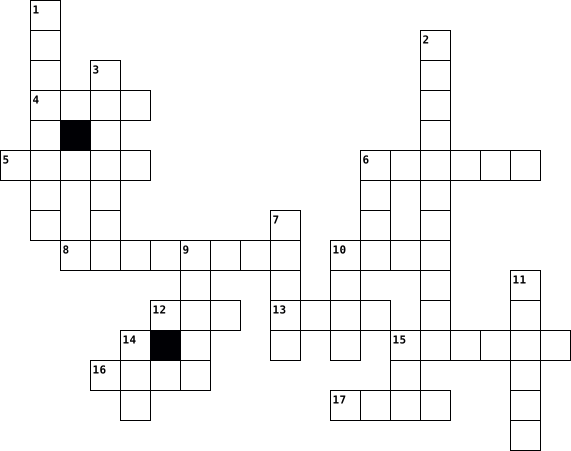
Across
- Flaky, frozen precipitation
- An absence of clouds
- When water becomes a solid
- A weather prediction
- Energy of moving atoms and molecules
- Clouds that are close to the surface
- Liquid precipitation
- Spring, Summer, Winter and Fall are the four...
- A lack of heat energy
- Movement of air
Down
- Force pushing on a surface
- A measure of heat energy
- Powerful, spinning storm
- Very Small
- Energitic weather with wind and precipitation
- Mass of water aerosols in the sky
- Ice falling from a thunderstorm
- When there are a lot of clouds
- Excessive heat energy
- Source of all of earth's energy
20 Clues: Very Small • Movement of air • An absence of clouds • A weather prediction • Liquid precipitation • Excessive heat energy • A lack of heat energy • A measure of heat energy • Powerful, spinning storm • Force pushing on a surface • When water becomes a solid • Flaky, frozen precipitation • When there are a lot of clouds • Ice falling from a thunderstorm • Source of all of earth's energy • ...
Unit 2 Vocab 2022-09-25

Across
- uses light energy to convert CO2 and H2O into glucose
- all macromolecules
- anything that takes up space
- substances created during a chemical reaction
- creates the energy that the cells need
- the site of photosynthesis
- living things
- rocks/soil
- used by living things to store and release energy
- oxygen is not present
Down
- eat autotrophs to get energy
- water
- uses the reactions from light reactions to create glucose
- uses chlorophyll to capture light energy
- proteins and nucleic acids
- recyles nutrients back into the nonliving environments
- substances at the beginning of a chemical reaction
- air
- nucleic acids and phosphates
- oxygen is present
20 Clues: air • water • rocks/soil • living things • oxygen is present • all macromolecules • oxygen is not present • proteins and nucleic acids • the site of photosynthesis • eat autotrophs to get energy • anything that takes up space • nucleic acids and phosphates • creates the energy that the cells need • uses chlorophyll to capture light energy • substances created during a chemical reaction • ...
Measurement 2020-10-28

Across
- Unit of mass
- Emission from unstable atoms
- An important prefix multiplier
- Characteristic manner of wave interaction
- Reproducibility in measurements
- Independent of amount
- Up! Up! Up!
- Transition from low to high (energy states)
- System gains energy
- The reason for sub-level energy differention
- An expression of the uncertainty
- No, no! We can't have the same number!
Down
- Determines light's brightness
- Determined by extent of systematic errors
- Component of cathode rays
- Type of energy
- Famous statement of complementarity
- SI unit
- Differ in nuclear component
- Have no uncertainty
- Determinant of orbital shapes
- A unit of energy
22 Clues: SI unit • Up! Up! Up! • Unit of mass • Type of energy • A unit of energy • Have no uncertainty • System gains energy • Independent of amount • Component of cathode rays • Differ in nuclear component • Emission from unstable atoms • Determines light's brightness • Determinant of orbital shapes • An important prefix multiplier • Reproducibility in measurements • An expression of the uncertainty • ...
Sustainability 2019-11-11

Across
- reusing something
- cutting down trees
- such as bushfire, earthquake and tsunami
- ice
- solid, nonrenewable source of energy
- the power to do something
- something you can make more of
- using stuff
- energy from breaking atoms
Down
- rock holding valuable materials
- relating to the sun
- natural change in climate sped up by human activity
- layer between earth and space
- movement of water between earth and sky
- all sorts of nonrenewable energy
- ability to keep going
- gases that are bad for the environment
- liquid, nonrenewable source of energy
- a natural material that we use
- adding waste to the water , land and air
20 Clues: ice • using stuff • reusing something • cutting down trees • relating to the sun • ability to keep going • the power to do something • energy from breaking atoms • layer between earth and space • something you can make more of • a natural material that we use • rock holding valuable materials • all sorts of nonrenewable energy • solid, nonrenewable source of energy • ...
38 2024-07-29

Across
- Houston-based oil company
- Clothing company in San Antonio
- Oilfield services in Houston
- Private oil company in Dallas
- Chemical company in Houston
- Engineering in Irving
- Oil and gas in The Woodlands
- Hospitality and entertainment giant
- Electronics in Angleton
- Retail chain headquartered in Grapevine
- Energy company in Houston
- Specialty contracting services
- Houston-based energy
Down
- Houston-based energy firm
- Energy company in Houston
- Independent oil producer
- LNG company in Houston
- Petroleum refiner in Dallas
- Theater chain in Plano
- Midstream energy in Houston
- Oilfield equipment provider
- Energy infrastructure
- Top cancer center and research
- Semiconductors in Dallas
- Apparel in Houston
25 Clues: Apparel in Houston • Houston-based energy • Engineering in Irving • Energy infrastructure • LNG company in Houston • Theater chain in Plano • Electronics in Angleton • Independent oil producer • Semiconductors in Dallas • Houston-based energy firm • Houston-based oil company • Energy company in Houston • Energy company in Houston • Petroleum refiner in Dallas • Midstream energy in Houston • ...
Biology Crossword 2025-08-22

Across
- the energy stored in the chemical bonds of gluocse
- a factor that starts with L affects photosynthesis
- _____ is the ability to be able to do work
- the sugar produced
- produce proteins
- The smallest unit
- contain energy
- control centre of cell
- Hormones target specific _____ through receptors
- 5% of australian population have ____
- how plants produce energy
Down
- keeping body temperature good
- dioxide we breathe out
- a by product
- site where photosynthesis happens
- the boundary of a cell
- energy is stored in the bonds of a chemical called ____ ____
- a group of atoms bonded together
- any living thing is called ______
- carries our genetics
20 Clues: a by product • contain energy • produce proteins • The smallest unit • the sugar produced • carries our genetics • dioxide we breathe out • the boundary of a cell • control centre of cell • how plants produce energy • keeping body temperature good • a group of atoms bonded together • site where photosynthesis happens • any living thing is called ______ • ...
The Physics of Roller Coasters 2021-03-19

Across
- a push or pull on a system causing movement
- resistance to motion
- energy energy in an object due to motion
- something that limits: budgets,schedules, size
- A group discussion for different ideas
- a location in space
- change how fast or the direction of moving
- energy a form of motion energy
Down
- energy energy of position waiting to move
- regining a solution to address a failure point
- educated guess about what will happen
- person who designs innovative solutions
- the ability to do work
- the strength to stand or endure, be firm
- force pulling objects toward center of Earth
- consistently good performance, good quality
- a model for those that come later
- the speed of an obect and the direction it moves
18 Clues: a location in space • resistance to motion • the ability to do work • energy a form of motion energy • a model for those that come later • educated guess about what will happen • A group discussion for different ideas • person who designs innovative solutions • the strength to stand or endure, be firm • energy energy in an object due to motion • ...
Introduction to Chapter 8: Cellular Energy 2015-11-24

Across
- all of the chemical reactions in a cell
- does not require oxygen
- process in which glucose is broken down in the cytoplasm
- catabolic pathway in which molecules are broken down for energy
- flattened, saclike membranes
- occurs in cytoplasm and produces ATP in an anaerobic pathway
- an enzyme
- light-absorbing colored molecules
- requires oxygen
- 2nd phase of photosynthesis in which energy is stored in organic molecules
- ability to do work
Down
- includes Krebs cycle and electron transport
- fluid-filled space outside grana
- study of flow and transformation of energy
- stacks of thylakoids
- anabolic pathway in which light energy is converted to chemical energy
- most important biomolecule that provides energy for the cell
- process in which pyruvate is broken down into carbon dioxide
18 Clues: an enzyme • requires oxygen • ability to do work • stacks of thylakoids • does not require oxygen • flattened, saclike membranes • fluid-filled space outside grana • light-absorbing colored molecules • all of the chemical reactions in a cell • study of flow and transformation of energy • includes Krebs cycle and electron transport • ...
Energy & Power Terms 2016-01-31

Across
- the energy associated with the random, disordered motion of molecules. It is separated in scale from the macroscopic ordered energy associated with moving objects; it refers to the invisible microscopic energy on the atomic and molecular scale.
- The total amount of energy and matter in the Universe remains constant, merely changing from one form to another. The First Law of Thermodynamics (Conservation) states that energy is always conserved, it cannot be created or destroyed.
- energy is a property of objects which can be transferred to other objects or converted into different forms, but cannot be created or destroyed.
- the SI unit of work or energy, equal to the work done by a force of one newton when its point of application moves one meter in the direction of action of the force, equivalent to one 3600th of a watt-hour.
- energy that is collected from resources which are naturally replenished on a human timescale, such as sunlight, wind, rain, tides, waves, and geothermal heat.
- a force is said to do work if, when acting on a body, there is a displacement of the point of application in the direction of the force
- natural resource that will never run out so if we take advantage of the greatest natural resources will not be depleted and will continue to exist, such as water, sunlight, tidal energy, ocean energy and wind energy.
- the kinetic energy of an object is the energy that it possesses due to its motion. It is defined as the work needed to accelerate a body of a given mass from rest to its stated velocity. Having gained this energy during its acceleration, the body maintains this kinetic energy unless its speed changes.
Down
- the unit of power
- the rate of doing work. It is equivalent to an amount of energy consumed per unit time. In the SI system, the unit of power is the joule per second (J/s), known as the watt in honour of James Watt, the eighteenth-century developer of the steam engine.
- energy sources that have no undesired consequences such for example fossil fuels or nuclear energy. Alternative energy sources are renewable and are thought to be "free" energy sources. They all have lower carbon emissions, compared to conventional energy sources.
- fossil fuels: coal, petroleum, and natural gas. Carbon is the main element in fossil fuels. For this reason, the time period that fossil fuels formed (about 360-300 million years ago) is called the Carboniferous Period.
- a result of gravity pulling downwards. The gravitational constant, g, is the acceleration of an object due to gravity. This acceleration is about 9.8 meters per second on earth. The formula for potential energy due to gravity is PE = mgh.
- a natural fuel such as coal or gas, formed in the geological past from the remains of living organisms.
- the entropy of an isolated system always increases, and is often called the law of increased entropy. Entropy (S) is disorder or chaos in a system. In other words, entropy measures the energy in a system unavailable for work.
- organic matter derived from living, or recently living organisms. Biomass can be used as a source of energy and it most often refers to plants or plant-based materials which are not used for food or feed, and are specifically called lignocellulosic biomass .
- a thermodynamic quantity representing the unavailability of a system's thermal energy for conversion into mechanical work, often interpreted as the degree of disorder or randomness in the system.
17 Clues: the unit of power • a natural fuel such as coal or gas, formed in the geological past from the remains of living organisms. • a force is said to do work if, when acting on a body, there is a displacement of the point of application in the direction of the force • ...
Q3 + Matter, Energy, Weather 2025-01-07

Across
- These are made of water droplets and ice crystals so small they float in the atmosphere.
- energy of movement.
- matter with a definite volume but no definite shape.
- You can change an object’s state of matter by adding or removing this.
- Tool that measures wind speed
- a material through which thermal energy flows easily.
- The transfer of thermal energy by electromagnetic waves
- Adding the potential plus kinetic energy of the atoms that make up the object gives you this kind of energy.
- a decrease in a material’s volume when its temperature decreases.
- Temperature at which the air is fully saturated
- anything that has mass and takes up space.
- gas to solid
- air mass that forms over water
- Any kind of water that falls from the atmosphere.
- An instrument that contains a thermometer, barometer, anemometer and radio transmitter.
- Air moving from high to low pressure
- the ability to do work.
- this kind of severe weather is common at cold fronts
Down
- Where the ozone layer is located
- air mass that forms over land
- The transfer of thermal energy by the movement of particles from one part of a material to another.
- Tool that measures air pressure
- A tropical storm with winds exceeding 119 km/h. Also called a tropical cyclone.
- Tool that measures air temperature
- The movement of thermal energy from a warmer object to a cooler object.
- This measures the average kinetic energy of the atoms that make up a material.
- solid to liquid
- an increase in a material’s volume when its temperature increases.
- matter that has a definite shape and a definite volume.
- The atmospheric layer closest to Earth’s surface
- liquid to gas
- The transfer of thermal energy between materials by the collisions of particles
- a material through which thermal energy does not flow easily.
- gas to liquid
- solid to gas
- energy stored because of its position or state.
- Expresses the amount of water vapour in the air.
- The atmospheric conditions and short-term changes at a certain place and time.
- matter that has no definite volume and no definite shape.
- Adding the potential plus kinetic energy of an object gives you this kind of energy.
- energy stored in the bonds that hold atoms and molecules together.
- liquid to solid
42 Clues: solid to gas • gas to solid • liquid to gas • gas to liquid • solid to liquid • liquid to solid • energy of movement. • the ability to do work. • air mass that forms over land • Tool that measures wind speed • air mass that forms over water • Tool that measures air pressure • Where the ozone layer is located • Tool that measures air temperature • Air moving from high to low pressure • ...
Chemistry Final Review On Unit 7 - Thermochemistry! 2024-04-16

Across
- If the products have ________ potential energy than the reactants, then the reaction is exothermic.
- The molar heat of fusion equation does not include/measure _____________, even though the specific heat equation does.
- On an endothermic energy diagram, the value of the enthalpy will be ____________.
- The Law Of _______________ Of Energy states that energy is neither destroyed or created … merely transformed!
- Molar Heat Of Fusion has to do with the phase change from a ___________ to a liquid.
- A _______________ is a piece of equipment designed to measure energy released or absorbed during a chemical reaction/phase change.
- If the products have ________ potential energy than the reactants, then the reaction is endothermic.
- System to Surroundings … ____________
- Gas to Solid (Refer to Phase Changes) …. __________________
- Bigger molecules tend to have higher _____________ energy.
- Surroundings to the System … ________________
- Energy is defined as the ability to do __________.
- __________________ is found by subtracting the potential energy of the transition state from the potential energy of the reactants.
- 1 kilojoule (KJ) is equal to ______________ joules. (In words, not numbers.
Down
- Solid to Gas (Refer to Phase Changes) …
- When you boil pasta, that is a __________ change. The composition of the pasta itself does not change, rather, the pasta just becomes edible.
- In the specific heat equation, the unit associated with Delta T is always degrees ____________.
- When kinetic energy is low, ____________________ is
- Associated with the motion of particles. This is ____________.
- Heat is directly ___________ to Delta T.
- In the specific heat equation, to find Delta T, you subtract the initial temperature from the final temperature. Is this statement TRUE or FALSE? (Answer here goes in crossword) ____________.
- A Big “C” calorie can also be called a _________________. (Not the abbreviation, full name).
- Cooking an egg sunny side up is an example of a ______________ reaction. The egg is changing its composition, which is how one can tell what type of reaction this is …
- When potential energy is low, ________________ is abundant.
- Energy always transfers from hot to cold substances. Is this statement true or false? ______________
- On an exothermic energy diagram, the value of the enthalpy will be ______________.
- ________________ is defined as the measure of energy released or absorbed during a chemical reaction/phase change.
- 1 Big “C” Calorie is equal to __________________ (in words, not number) little “c” calories.
- In the specific heat equation, the “m” that measures mass takes the unit of _________ in any given equation.
- Molar Heat Of Solidification has to do with the phase change from a ________________ to a solid.
30 Clues: System to Surroundings … ____________ • Solid to Gas (Refer to Phase Changes) … • Heat is directly ___________ to Delta T. • Surroundings to the System … ________________ • Energy is defined as the ability to do __________. • When kinetic energy is low, ____________________ is • Bigger molecules tend to have higher _____________ energy. • ...
Photosynthesis 2024-02-19

Across
- have a short wavelength
- How does CO2 get into plants
- have a long wavelength
- photosynthesis takes place in the
- location where light energy is converted to chemical energy
- photons have various amounts of energy that travels on
- are the power house of the cell
- is represented as the following chemical formula C6H12O6
Down
- light energy is converted into...
- make their own food from the sun
- when chlorophyll is hit by photons, they experience a higher energy level which is known as an ... state
- is when plants capture energy from the sun and convert it into food
- is are byproducts of photosynthesis
- pockets of kinetic energy
- dependent captures energy from the sun and use that energy to make ATP and NADPH
- where production of sugar occurs
16 Clues: have a long wavelength • have a short wavelength • pockets of kinetic energy • How does CO2 get into plants • are the power house of the cell • make their own food from the sun • where production of sugar occurs • light energy is converted into... • photosynthesis takes place in the • is are byproducts of photosynthesis • photons have various amounts of energy that travels on • ...
chapter 18 vocab 2021-11-18

Across
- process that releases hydrogen by using an electric current to break down water molecules
- a decive that converts hydrogen or another fel into electricity
- electricity generated by the combustion og organic materials
- electricty generated from the energy of moving water
- a technology that uses the heat of the sun to generate electricity
- a power plant that uses wind turbine to generate electricity
- energy produced from organic materials
- a metal box that absorbs the suns energy to heat water or air
Down
- a device that converts solar energy directly into electricity
- using the design of a building to collect,store,and distribute the suns energy
- the process of changing the solar energy stored in the ocean to electric power
- renewable energy that generated deep within the earth
- the use f technology to collect,store,amd distribute the suns energy
- fuel from organic sources
- a network of pipes that circulate water from the ground back into the ground
- turbine a device that converts the winds kinetic energy into ekectrical energy
- electricity generated from the movement of the tides
17 Clues: fuel from organic sources • energy produced from organic materials • electricty generated from the energy of moving water • electricity generated from the movement of the tides • renewable energy that generated deep within the earth • electricity generated by the combustion og organic materials • a power plant that uses wind turbine to generate electricity • ...
Health 2022-11-21
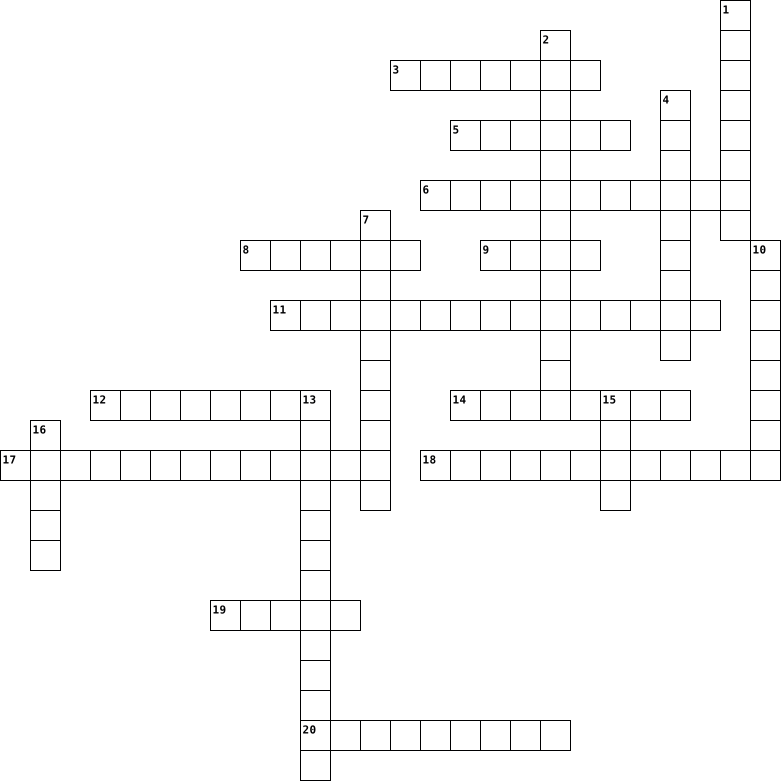
Across
- helps muscles contract
- gives the ability to work
- makes hormones and builds cells
- increases the chance of chronic disease
- store energy and insulate your body
- improve blood cholesterol
- help support growth
- decides how much food you want to eat
- gives you energy
- is a decrease in bone strenght
- increases weight and size
- raise bad cholesterol
Down
- water has them
- helps fuel your body for health
- helps the body function
- converts food into energy
- is the amount of energy released
- lower heart diseases
- helps flow oxygen through the body
- flushes and hydrates your body
20 Clues: water has them • gives you energy • help support growth • lower heart diseases • raise bad cholesterol • helps muscles contract • helps the body function • gives the ability to work • converts food into energy • improve blood cholesterol • increases weight and size • flushes and hydrates your body • is a decrease in bone strenght • helps fuel your body for health • ...
Vocab 2024-05-10

Across
- an energy resource that is not replaced naturally
- an energy resource that is easily replaced by natural methods
- electrical energy generated by the movement of water
- thermal energy that originates deep within the earth's interior
- energy produced by the sun
- the ability to do work
Down
- energy produced by nuclear reactions
- a fuel that has formed from the remains of plants and animals that lived in the past
- chemical potenial energy obtained from renewable organic materials
- Stored energy that can be used later
- energy that an object possesses due to its motion
- energy from the wind; can be used to turn turbine blades that are attached to generators
- mechanical energy in rising and falling tides
- the sum of the kinetic energy and all the forms of potential energy in a system
14 Clues: the ability to do work • energy produced by the sun • energy produced by nuclear reactions • Stored energy that can be used later • mechanical energy in rising and falling tides • an energy resource that is not replaced naturally • energy that an object possesses due to its motion • electrical energy generated by the movement of water • ...
Kiyara Pacheco, 05/10/24,Crossword Puzzle,Phy211 2024-05-11

Across
- electrical energy generated by the movement of water
- chemical potential energy obtained from renewable organic materials
- stored energy that can be used later
- an energy resource that is easily replaced by natural methods
- a fuel that has formed from the remains of plants and animals that lived in the past, including coal, petroleum (oil), and natural gas
- mechanical energy in rising and falling tides
Down
- an energy resource that is not replaced naturally
- energy from the wind can be used to turn turbine blades that are attached to generators
- energy produced by the sun
- the sum of the kinetic energy and all the forms of potential energy in a system
- energy that an object possesses due to its motion
- thermal energy that originates deep within the earth’s interior
- energy produced by nuclear reactions
- the ability to do work
14 Clues: the ability to do work • energy produced by the sun • stored energy that can be used later • energy produced by nuclear reactions • mechanical energy in rising and falling tides • an energy resource that is not replaced naturally • energy that an object possesses due to its motion • electrical energy generated by the movement of water • ...
Chapter 14 Vocabulary 2024-05-14

Across
- electrical energy created by the movement of water
- chemical potential energy obtained from renewable organic materials
- stored energy that can be used later
- an energy resource that is quickly replaced by natural methods
- a fuel that has formed from the remains of plants and animals that lived in the past, including coal,petroleum,and natural gas
- mechanical energy in rising and falling tides
Down
- an energy resource that is not replaced naturally
- energy from the wind can be used to turn turbine blades that are attached to generators
- energy produced by the sun
- the sum of kinetic energy and all forms of potential energy in a system
- energy that an object possesses due to its motion
- thermal energy that originates in the interior of the earth
- energy produced by nuclear reactions
- the ability to do work
14 Clues: the ability to do work • energy produced by the sun • stored energy that can be used later • energy produced by nuclear reactions • mechanical energy in rising and falling tides • an energy resource that is not replaced naturally • energy that an object possesses due to its motion • electrical energy created by the movement of water • ...
CONVERSION AND CONSERVATION OF ENERGY 2025-04-29

Across
- The energy of the sun
- The energy transformation that occurs in the water cycle when water vapor changes to liquid
- The phenomenon where electric energy transforms into thermal energy
- The natural cycle that describes the movement of water in different states
- The process of converting light energy into chemical energy.
- This law states that energy cannot be created or destroyed, only transformed
- The energy generated from the movement of electrons
Down
- The type of energy associated with motion.
- A common renewable energy source derived from the wind.
- This type of energy is released during nuclear fission
- Law stating that energy cannot be created or destroyed
- The type of energy stored in an object due to its position or state
- The sources of chemical energy in a frog's body obtained from?
- The fossil fuel derived from ancient plants
14 Clues: The energy of the sun • The type of energy associated with motion. • The fossil fuel derived from ancient plants • The energy generated from the movement of electrons • This type of energy is released during nuclear fission • Law stating that energy cannot be created or destroyed • A common renewable energy source derived from the wind. • ...
Exam Prep Crossword 2021-03-10

Across
- The energy of something in motion.
- A device that swings back and forth using the force of gravity.
- It is at the ____ of each swing where a pendulum has all potential energy and no kinetic energy.
- A _______ inclined plane is much easier to use than a shorter inclined plane.
- An object that is higher up will have _____ PE than an object that is lower.
- The ______ the inclined plane, the more force required to move an object up it.
- The force that pulls everything down on Earth.
- In addition to placing an object higher, adding _____ _______ to the object will also increase its PE.
- An object that is higher will hit the ground with more _____ than an object that is lower.
Down
- When a pendulum is swinging up, it is ______ potential energy and losing kinetic energy.
- As a pendulum swings, the most kinetic energy will be when it reaches the _____ of the swing.
- The energy that is stored in something.
- An example of an ________ plane is a ramp used to move something from a low position to a higher position.
- When a pendulum is swinging down, it is ______ potential energy and gaining kinetic energy.
- If two objects are moving at the same speed, the one with _____ _______ will have more kinetic energy.
- An inclined plane that is ____ steep will be easier to use than an inclined plane that is very steep.
- Kinetic energy is the energy of an object that is in ________.
- The _____ an object is travelling, the more kinetic energy it will have.
18 Clues: The energy of something in motion. • The energy that is stored in something. • The force that pulls everything down on Earth. • Kinetic energy is the energy of an object that is in ________. • A device that swings back and forth using the force of gravity. • The _____ an object is travelling, the more kinetic energy it will have. • ...
Unit 4 Cellular Energy Vocab 2025-10-14

Across
- reaction- Reaction that converts light energy into chemical energy.
- reaction- Reaction that takes place within the stroma.
- The natural compound present in green plants that gives them color.
- Respiration- The process of cellular respiration takes place in the presence of oxygen gas to produce energy from food.
- Respiration- Type of respiration through which cells can break down sugars to generate energy in the absence of oxygen.
- A substance produced during a chemical reaction.
- Energy- Energy from the sun that reaches earth as visible light.
- Monosaccharide sugar that is produced in photosynthesis and used during cellular respiration for energy production.
Down
- Flattened sacs inside a chloroplast bounded by pigment membranes on which the light reactions of photosynthesis takes place.
- The primary molecule in which energy is stored in chemical bonds for future use n cellular processes.
- The chemical process of converting light energy into chemical energy
- Reaction- The process by which one or more substances change to produce one or more different substances.
- The anaerobic process of energy production that results in the formation of pyruvic acid from the breakdown of glucose
- Cycle- a chemical reaction occuring in the mitochondria, through which all living cells produce energy in aerobic respiration.
- Energy- Energy stored in the particles that make up food, fuel and other matter.
- Respiration- The chemical process of converting chemical energy (ATP) into an alternative chemical energy (ATP)
- A substance that takes part in and undergoes change during a reaction.
17 Clues: A substance produced during a chemical reaction. • reaction- Reaction that takes place within the stroma. • Energy- Energy from the sun that reaches earth as visible light. • The natural compound present in green plants that gives them color. • The chemical process of converting light energy into chemical energy • ...
Biology Crossword Puzzle 2022-12-13

Across
- bunches of proteins that span the thylakoids membrane and allow H+ to pass
- ATP, Photosynthesis, pigment, chlorophyll, thylakoid, stroma, NADP+, light-dependent reactions, Light independent reactions, Photosystem, ATP-Synthase, Electron transport chain, Calvin Cycle, Chloroplast, Heterotrophs, Autotrophsm, C4-Plants, CAM-Plants
- an organisms deriving its energy from complex organic substances
- reactions in photosynthesis that don’t require light
- the light-independent reactions of photosynthesis where ATP and NADPH is used to build high-energy compounds like sugar
- Green plant organelle where light energy is turned into chemical energy through photosynthesis
- A method where plants convert light energy and use it to power reactions to make sugars and starches
- series of electron carrier proteins that transport high energy electrons during ATP which rates reactions
- a strategy that plants use, where carbon dioxide will become incorporated into organic acids during photosynthesis
- bunches of proteins and chlorophyll found in thylakoids
Down
- the cytoplasm of the chloroplast; fluid of chloroplast
- reactions that photosynthesis use energy from light to produce ATP and NADPH
- an organisms that can form energy from inorganic substances like carbon
- molecule that carries high-energy electrons to the rest of the plant
- an important pigment in plants and other similar organisms
- cells used to store and release energy
- light absorbing molecules used to gather the sun's energy
- saclike green membranes found in the chloroplast
- plants that have a specialized chemical pathway that helps them capture very low levels of carbon dioxide and pass it to the Calvin cycle
19 Clues: cells used to store and release energy • saclike green membranes found in the chloroplast • reactions in photosynthesis that don’t require light • the cytoplasm of the chloroplast; fluid of chloroplast • bunches of proteins and chlorophyll found in thylakoids • light absorbing molecules used to gather the sun's energy • ...
Biology Crossword Puzzle 2022-12-13

Across
- bunches of proteins that span the thylakoids membrane and allow H+ to pass
- ATP, Photosynthesis, pigment, chlorophyll, thylakoid, stroma, NADP+, light-dependent reactions, Light independent reactions, Photosystem, ATP-Synthase, Electron transport chain, Calvin Cycle, Chloroplast, Heterotrophs, Autotrophsm, C4-Plants, CAM-Plants
- an organisms deriving its energy from complex organic substances
- reactions in photosynthesis that don’t require light
- the light-independent reactions of photosynthesis where ATP and NADPH is used to build high-energy compounds like sugar
- Green plant organelle where light energy is turned into chemical energy through photosynthesis
- A method where plants convert light energy and use it to power reactions to make sugars and starches
- series of electron carrier proteins that transport high energy electrons during ATP which rates reactions
- a strategy that plants use, where carbon dioxide will become incorporated into organic acids during photosynthesis
- bunches of proteins and chlorophyll found in thylakoids
Down
- the cytoplasm of the chloroplast; fluid of chloroplast
- reactions that photosynthesis use energy from light to produce ATP and NADPH
- an organisms that can form energy from inorganic substances like carbon
- molecule that carries high-energy electrons to the rest of the plant
- an important pigment in plants and other similar organisms
- cells used to store and release energy
- light absorbing molecules used to gather the sun's energy
- saclike green membranes found in the chloroplast
- plants that have a specialized chemical pathway that helps them capture very low levels of carbon dioxide and pass it to the Calvin cycle
19 Clues: cells used to store and release energy • saclike green membranes found in the chloroplast • reactions in photosynthesis that don’t require light • the cytoplasm of the chloroplast; fluid of chloroplast • bunches of proteins and chlorophyll found in thylakoids • light absorbing molecules used to gather the sun's energy • ...
Biology Crossword Puzzle 2022-12-13

Across
- bunches of proteins and chlorophyll found in thylakoids
- the light-independent reactions of photosynthesis where ATP and NADPH is used to build high-energy compounds like sugar
- word bank:ATP, Photosynthesis, pigment, chlorophyll, thylakoid, stroma, NADP+, light-dependent reactions, Light independent reactions, Photosystem, ATP-Synthase, Electron transport chain, Calvin Cycle, Chloroplast, Heterotrophs, Autotrophsm, C4-Plants, CAM-Plants
- an organisms that can form energy from inorganic substances like carbon
- A method where plants convert light energy and use it to power reactions to make sugars and starches
- an important pigment in plants and other similar organisms
- reactions in photosynthesis that don’t require light
- bunches of proteins that span the thylakoids membrane and allow H+ to pass
Down
- series of electron carrier proteins that transport high energy electrons during ATP which rates reactions
- molecule that carries high-energy electrons to the rest of the plant
- Green plant organelle where light energy is turned into chemical energy through photosynthesis
- light absorbing molecules used to gather the sun's energy
- plants that have a specialized chemical pathway that helps them capture very low levels of carbon dioxide and pass it to the Calvin cycle
- a strategy that plants use, where carbon dioxide will become incorporated into organic acids during photosynthesis
- reactions that photosynthesis use energy from light to produce ATP and NADPH
- cells used to store and release energy
- an organisms deriving its energy from complex organic substances
- saclike green membranes found in the chloroplast
- the cytoplasm of the chloroplast; fluid of chloroplast
19 Clues: cells used to store and release energy • saclike green membranes found in the chloroplast • reactions in photosynthesis that don’t require light • the cytoplasm of the chloroplast; fluid of chloroplast • bunches of proteins and chlorophyll found in thylakoids • light absorbing molecules used to gather the sun's energy • ...
Samarha's puzzle 2022-02-18

Across
- The same time we do work on one end, the other end does work on the load.
- =Work done against another force, work done to change the speed of an object.
- The pivot point.
- In incline plane.
- can be depressed as the ratio of useful work output to total work input.
- =The rate at which work is done.
- The law of —— of energy states ————
- Energy= Energy of motion.
Down
- A kind of lever that can be used to change the direction of force.
- energy= work is done energy changes this is known as
- =Unit for work/energy.
- advantage= output distance ratio.
- =the ability to do work.
- a device used to multiply forces.
- =unit of power.
- Energy= stored energy.
16 Clues: =unit of power. • The pivot point. • In incline plane. • =Unit for work/energy. • Energy= stored energy. • =the ability to do work. • Energy= Energy of motion. • =The rate at which work is done. • advantage= output distance ratio. • a device used to multiply forces. • The law of —— of energy states ———— • energy= work is done energy changes this is known as • ...
10CW-Energy Vocab 2024-02-20

Across
- PE stored in chemical bonds
- Changing from one energy type to another. (ex. Sun→plant chem → human→ heat)
- Moving energy; depends on mass and speed
- Same energy moving from one object to another. (Ex. stove→pot→water)
- PE stored in stretchy material
- KE & PE (Ex. machines)
- Energy is not created or destroyed…it only changes forms
Down
- Heat energy
- PE of height; depends on mass and height
- Stored energy or energy of height depends on mass and height
- KE moves in waves to your ears
- Radiant waves (Ex. Light, UV, x-ray)
- Energy from sun
- KE moving electrons
- The ability to do work
15 Clues: Heat energy • Energy from sun • KE moving electrons • KE & PE (Ex. machines) • The ability to do work • PE stored in chemical bonds • KE moves in waves to your ears • PE stored in stretchy material • Radiant waves (Ex. Light, UV, x-ray) • PE of height; depends on mass and height • Moving energy; depends on mass and speed • Energy is not created or destroyed…it only changes forms • ...
VR8 Energy Crossword 2023-03-07

Across
- is one force that causes KE to become lost
- Type of system that is physically impossible on Earth
- Energy Input x Energy Efficiency =______________
- Total Energy - GPE = _______
- Type of system that has a dotted line (energy in/out)
- units for mass
- collision where both KE and momentum are conserved
- total momentum before will equal the total momentum__________.
- means "move" in Latin
Down
- collision where momentum is conserved but KE is dissipated
- an example of a lost energy
- energy based on height
- relationship between mass and GPE
- Output energy will always be _____ than input energy
- what energy efficiency is measured in
15 Clues: units for mass • means "move" in Latin • energy based on height • an example of a lost energy • Total Energy - GPE = _______ • relationship between mass and GPE • what energy efficiency is measured in • is one force that causes KE to become lost • Energy Input x Energy Efficiency =______________ • collision where both KE and momentum are conserved • ...
Work, Energy and Power Crossword 2026-01-22

Across
- A quantity, like energy or work, that has magnitude but no direction.
- Stored energy.
- Metric unit for energy.
- Product of force and displacement.
- Energy stored in a spring.
- The ratio of useful work output to the total energy input.
- The law stating that energy cannot be created or destroyed, only transformed.
Down
- KE + PE.
- Metric unit for power.
- The study of energy transformations, particularly involving heat.
- Energy related to height.
- Rate of doing work.
- Energy of motion.
- Force that turns work into heat.
- While work is a scalar, the force and displacement used to calculate it are this type of quantity.
15 Clues: KE + PE. • Stored energy. • Energy of motion. • Rate of doing work. • Metric unit for power. • Metric unit for energy. • Energy related to height. • Energy stored in a spring. • Force that turns work into heat. • Product of force and displacement. • The ratio of useful work output to the total energy input. • The study of energy transformations, particularly involving heat. • ...
Unit 3 Vocabulary 2023-05-16

Across
- A green pigment, present in all green plants and in cyanobacteria, responsible for the absorption of light to provide energy for photosynthesis. Its molecule contains a magnesium atom held in a porphyrin ring.
- A catabolic process that makes a limited amount of ATP from glucose without an electron transport chain and that produces a characteristic end product, such as ethyl alcohol or lactic acid.
- They get energy from non-living sources most capture energy during photosynthesis to make simple sugars.
- The membrane of the mitochondria that is the site of electron transport and chemiosmosis.
- Requires oxygen
- Eat only meat example-polar bear
- Reactions that break down larger molecules into simpler compounds.
- (substrate) A substance that is changed during a chemical reaction
- (usually a protein) that speeds up a biochemical reaction by lowering its activation energy
- Process that releases energy by breaking down glucose and other food molecules in the presence of oxygen
- Pancake-like stacks of thylakoid membrane
- Eat dead materials example-vultures
- All of the chemical reactions that occur within an organism
- Non-living portion
- A reaction that overall releases more energy (in the form of heat or light than it absorbs.
Down
- The synthesis of organic compounds by bacteria or other living organisms using energy derived from reactions involving inorganic chemicals, typically in the absence of sunlight.
- When an enzyme's active site loses its specific shape, causing a loss in biological activity
- Reactions The breaking and forming of bonds between different substances during chemical changes
- The overall process by which sunlight (solar/light energy) chemically converts water and carbon dioxide into chemical energy stored in glucose (a sugar/carbohydrate) (this happens on the leaf of a plant)
- A substance that is made in a chemical reaction
- Get energy from living or non-living organisms. examples: animals, fungus, people.
- site Location on an enzyme where the substrate binds
- Substance that speeds up the rate of a chemical reaction without being permanently altered
- Is without oxygen; usually w/short-spurt, high-energy activities
- A reaction that overall absorbs more energy (in the form of heat or light) than it releases.
- energy Energy needed to get a chemical reaction started
- Eat only vegetation
- Fluid-like substance that fills the space between the grana
- Reactions that build larger molecules from smaller ones
- Eat meat and vegetation example-raccoons
- A substance present in all living cells that provides energy for many metabolic processes and is involved in making RNA.
31 Clues: Requires oxygen • Non-living portion • Eat only vegetation • Eat only meat example-polar bear • Eat dead materials example-vultures • Eat meat and vegetation example-raccoons • Pancake-like stacks of thylakoid membrane • A substance that is made in a chemical reaction • site Location on an enzyme where the substrate binds • ...
Exam 2 Review A 2026-03-02

Across
- biological catalyst used to speed up chemical reactions by lowing activation energy
- Site of photosynthesis; organelle where electrons and energy are put into CO2 to yield sugars
- The powerhouse of the cell; organelle where sugar and oxygen are consumed to generate energy in the form of ATP
- any reaction that requires energy
- energy of the university is constant; ______ Law of Thermodynamics
- Vesicle of enzymes that break down biomolecules and convert toxic H2O2 (hydrogen peroxide) into water
- the energy required in order to “activate” the chemical reaction
- any reaction that requires the input of energy
- degree of disorder; unusable thermal (heat) energy
- Vesicle of digestive enzymes used to break down pathogens, toxins, or old/broken molecules
- jelly-like fluid containing cytosol, water, salts, organic molecules, and organelles
- Rigid structure outside the cell membrane that provides support and protection; absent in animal cells
- any reaction that releases energy
Down
- Membranous “bubbles” that store or carry materials around the cell
- ________ Inhibitors bind to somewhere else on an enzyme to reduce its efficiency
- ________ Inhibitors bind to the enzyme’s active site, blocking the substrate
- the sum of all the chemical reactions in an organism
- every energy transfer increases the entropy in the universe; during every energy transfer some is lost in the form of heat; ______ Law of Thermodynamics
- Site of protein synthesis that is present in all cells; where RNA sequences are translated to produce the corresponding sequence of amino acids (proteins)
- building up a molecule which requires energy
- Free energy available to your system/chemical reaction
- breaking down a molecule to release energy
- ______ apparatus is complex of flattened sacs and associated vesicles that function in modifying, sorting, and packaging proteins and lipids
- net of protein fibers throughout the cell that support the membrane, serve as highways for vesicles and proteins, and generally hold everything in place
- theory that ancient Mitochondria and Chloroplast ancestors were once free-living bacteria, but evolved to live solely within eukaryotic cells
- storage organelle to hold water and other materials; In plant cells, it is much larger and helps maintain structure and internal pressure
- any reaction that occurs without the input of energy
- Double-membrane enclosed organelle in exclusive to eukaryotes that contains chromosomes, replicates and transcribes DNA and RNA, and synthesizes ribosomes
- Phospholipid bilayer that separates a cell from its environment
- reactant that the enzyme acts on
- ___________ reticulum is a network of membrane-enclosed sacs that manufacture, process, and transport proteins and lipids and detoxifies molecules
31 Clues: reactant that the enzyme acts on • any reaction that requires energy • any reaction that releases energy • breaking down a molecule to release energy • building up a molecule which requires energy • any reaction that requires the input of energy • degree of disorder; unusable thermal (heat) energy • the sum of all the chemical reactions in an organism • ...
Chapter 18 Crossword Puzzle 2021-11-17

Across
- fuel from organic sources
- generated from the energy of moving water
- using the design of a building to collect, store, and distribute the sun's energy
- a metal box that absorbs the sun's energy to heat water or air
- a power plant that uses wind turbines to generate electricity
- the use of technology to collect, store, and distribute the sun's energy
- the process of changing the solar energy stored in the ocean to electric power
- a type of renewable energy that is generated deep within the earth
Down
- a network of pipes that circulates water from the ground and back into the ground
- a device that converts solar energy directly into electricity
- a technology that uses the heat from the sun to generate electricity
- electricity generated from the movement of the tides
- electricity generated by the combustion of organic materials
- the energy produced from organic materials
- a device that converts the wind's kinetic energy into electrical energy
- a process that releases hydrogen by using an electric current to break down water molecules
- a device that converts hydrogen or another fuel into electricity
17 Clues: fuel from organic sources • generated from the energy of moving water • electricity generated from the movement of the tides • the energy produced from organic materials • electricity generated by the combustion of organic materials • a device that converts solar energy directly into electricity • ...
Chapter 18 2021-11-15

Across
- a power plant that uses wind turbines to generate electricity
- a device that converts hydrogen or another fuel into electricity
- the energy produced from organic materials
- fuel from organic sources
- the process of changing the solar energy stored in the ocean to electric power
- electricity generated from the movement of the tides
- a device that converts the wind's kinetic energy into electrical energy
- type of renewable energy that is generated deep within the earth
- a network of pipes that circulates water from the ground and back into the the ground
- electricity generated from the energy of moving water
Down
- a metal box that absorbs the sun's energy to heat water or air
- a device that converts solar energy directly into electricity
- using the design of a building to collect, store, and distribute the sun's energy
- a process that releases hydrogen by using an electric current to break down water molecules
- the use of technology to collect, store, and distribute the sun's energy
- electricity generated by the combustion of organic material
- a technology that uses the heat of the sun to generate electricity
17 Clues: fuel from organic sources • the energy produced from organic materials • electricity generated from the movement of the tides • electricity generated from the energy of moving water • electricity generated by the combustion of organic material • a power plant that uses wind turbines to generate electricity • ...
Forms of Energy Crossword 2015-01-09

Across
- energy of motion
- the bending of light as it moves through one material
- the energy of sound waves as they travel
- the energy found in a substance due to the arrangement of its particles
- the bouncing back of light from a surface
- energy of position; stored energy that is not causing changes now but could cause changes.
- the energy that an object has due to its motion or position
- material that does not allow electricity to flow through it
- material that allows electricity to flow through it
- Electricity comes from the movement of charged particles, such as electrons
Down
- number of compressions that move past a certain point in a certain amount of time
- the amount of energy an object has based on its weight and height
- is a type of wave energy which can be sensed by the eyes and always travels away from the source. Often associated with heat or thermal energy
- how high or low a sound is
- heat moved when warm air rises
- movement of heat by direct contact
- The ability to do work
17 Clues: energy of motion • The ability to do work • how high or low a sound is • heat moved when warm air rises • movement of heat by direct contact • the energy of sound waves as they travel • the bouncing back of light from a surface • material that allows electricity to flow through it • the bending of light as it moves through one material • ...
Biology Crossword Puzzle 2022-12-13

Across
- bunches of proteins that span the thylakoids membrane and allow H+ to pass
- ATP, Photosynthesis, pigment, chlorophyll, thylakoid, stroma, NADP+, light-dependent reactions, Light independent reactions, Photosystem, ATP-Synthase, Electron transport chain, Calvin Cycle, Chloroplast, Heterotrophs, Autotrophsm, C4-Plants, CAM-Plants
- an organisms deriving its energy from complex organic substances
- reactions in photosynthesis that don’t require light
- the light-independent reactions of photosynthesis where ATP and NADPH is used to build high-energy compounds like sugar
- Green plant organelle where light energy is turned into chemical energy through photosynthesis
- A method where plants convert light energy and use it to power reactions to make sugars and starches
- series of electron carrier proteins that transport high energy electrons during ATP which rates reactions
- a strategy that plants use, where carbon dioxide will become incorporated into organic acids during photosynthesis
- bunches of proteins and chlorophyll found in thylakoids
Down
- the cytoplasm of the chloroplast; fluid of chloroplast
- reactions that photosynthesis use energy from light to produce ATP and NADPH
- an organisms that can form energy from inorganic substances like carbon
- molecule that carries high-energy electrons to the rest of the plant
- an important pigment in plants and other similar organisms
- cells used to store and release energy
- light absorbing molecules used to gather the sun's energy
- saclike green membranes found in the chloroplast
- plants that have a specialized chemical pathway that helps them capture very low levels of carbon dioxide and pass it to the Calvin cycle
19 Clues: cells used to store and release energy • saclike green membranes found in the chloroplast • reactions in photosynthesis that don’t require light • the cytoplasm of the chloroplast; fluid of chloroplast • bunches of proteins and chlorophyll found in thylakoids • light absorbing molecules used to gather the sun's energy • ...
Science words 2023-10-10

Across
- The law of conservation of ____ states that when one form of energy is transformed to another no energy is lost in the process
- The release of energy from without using oxygen
- An organism that can make its own food
- ____ is the process by which molecules at the surface of liquid water absorb enough energy to change to a gas
- The green photosynthesis pigment found in the chloroplast of plant algae and some bacteria is
- Able to create their own food in the form of glucose an energy giving sugar
- An organism that can make its own food
- An organism that cannot make its own food such as the sea urchin or otter is a consumer or a
- The process in which oxygen and glucose undergo a complex series of chemical reactions inside cells releasing energy
- The law of conservation of ____ states that matter is neither created nor destroyed during any chemical or physical change
Down
- A diagram called an ____ shows the amount of energy that moves from one feeding level to another in a food wed
- Obtain energy by feeding on other organisms
- It's like to have a specific ___ in a system
- A break down biotic wastes and dead organisms returning the raw materials to the ecosystem
- The plants, soil, rocks, water, ____of the system
- Air is the ____ of oxygen
- A series of events in which one organism eats another and obtains energy and nutrients
- Cells capture energy in sunlight and use it to make food in a process
- Consist of many overlapping food chains in an ecosystem
- Autotrophs carry out photosynthesis to _____ their own glucose
20 Clues: Air is the ____ of oxygen • An organism that can make its own food • An organism that can make its own food • Obtain energy by feeding on other organisms • It's like to have a specific ___ in a system • The release of energy from without using oxygen • The plants, soil, rocks, water, ____of the system • Consist of many overlapping food chains in an ecosystem • ...
Physics 2025-06-27

Across
- Energy is C___________
- Unit of Force
- Unit of Power
- Generating electricity using water
- Energy store of movement
- Another name for heat energy
- When you speed up
- Another name for potential difference
- Unit of energy
Down
- Energy store associated with height
- Will not run out
- Energy store associated with food and batteries
- Unit of potential difference
- how many grams in a kilogram
- What does the M stand for in MW
- how many centimetres in a metre
- Safety devise in a plug
17 Clues: Unit of Force • Unit of Power • Unit of energy • Will not run out • When you speed up • Energy is C___________ • Safety devise in a plug • Energy store of movement • Unit of potential difference • how many grams in a kilogram • Another name for heat energy • What does the M stand for in MW • how many centimetres in a metre • Generating electricity using water • ...
Lopez's 2016-12-06

Across
- Cycle Energy gets stored in organic molecules
- an organism that makes its own food
- Occurs in Cytoplasm
- light energy that is found in cells
- chemical energy/ inorganic substances
- requiring absence of free oxygen
- light to provide energy for photosynthesis
- Cycle a series of chemical reactions used by all aerobic organisms
- two phosphate groups that is formed in living cells
Down
- relating to, involving, or requiring free oxygen
- Fluid filled space outside of grana
- light energy converted into chemical energy
- an organelle found in large numbers in most cells
- Biological molecules that provide energy
- an organism that rely on autotrophs for food
- Acid occurs in animal cells
- sac the membrane
17 Clues: sac the membrane • Occurs in Cytoplasm • Acid occurs in animal cells • requiring absence of free oxygen • Fluid filled space outside of grana • an organism that makes its own food • light energy that is found in cells • chemical energy/ inorganic substances • Biological molecules that provide energy • light to provide energy for photosynthesis • ...
Matter 2022-09-22
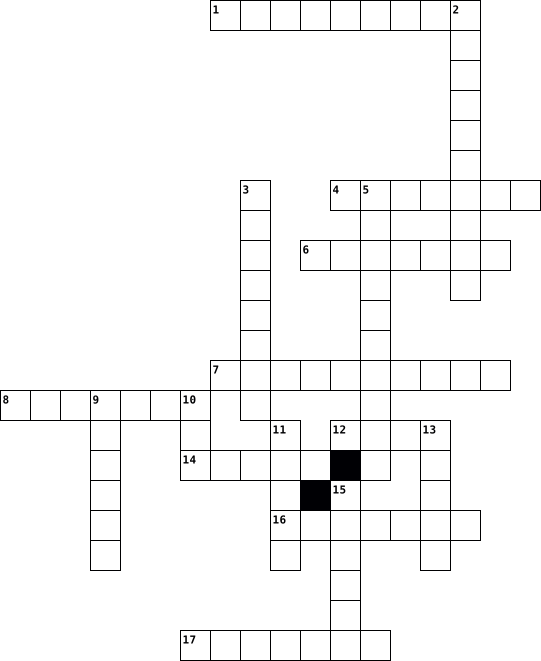
Across
- The ability of an object to attract to a magnet
- The ability to sink or float
- Heat energy
- The ability to dissolve
- when we take away heat energy
- The amount of matter in an object
- matter with a set volume and set shape
- an increase in heat energy
- 2 things combined that can be easily separated
Down
- energy from movement
- 2 things combined and 1 dissolved evenly
- energy from moving electrons
- matter with a set volume and no set shape
- matter with no set volume and no set shape
- energy that allows our eyes to see
- energy that allows us to hear
- Anything that has mass and takes up space
17 Clues: Heat energy • energy from movement • The ability to dissolve • an increase in heat energy • The ability to sink or float • energy from moving electrons • when we take away heat energy • energy that allows us to hear • The amount of matter in an object • energy that allows our eyes to see • matter with a set volume and set shape • 2 things combined and 1 dissolved evenly • ...
SCI CROSS 2023-12-17

Across
- A natural indicator.
- Laws of motion
- A push or pull
- A hardest carbon
- You use it to see your bones
- A shiny metal
- Green plants that transforms light energy into chemical energy
- Type of energy from the sun
- Hey I am an element but I have no neutron
Down
- Land, air, and water that get's dirty and is harmful to living things.
- energy Power or energy that can be released from the nucleus of an atom.
- monoxide. A poisonous, harmful gas
- energy Energy due to motion
- An opening in the Earth's crust which throws hot gases, magma, and ashes.
- Atom bomb
- It conducts electricity.
- It is a mixture of two colours
17 Clues: Atom bomb • A shiny metal • Laws of motion • A push or pull • A hardest carbon • A natural indicator. • It conducts electricity. • Type of energy from the sun • energy Energy due to motion • You use it to see your bones • It is a mixture of two colours • monoxide. A poisonous, harmful gas • Hey I am an element but I have no neutron • ...