
enlightenment Crossword Puzzles
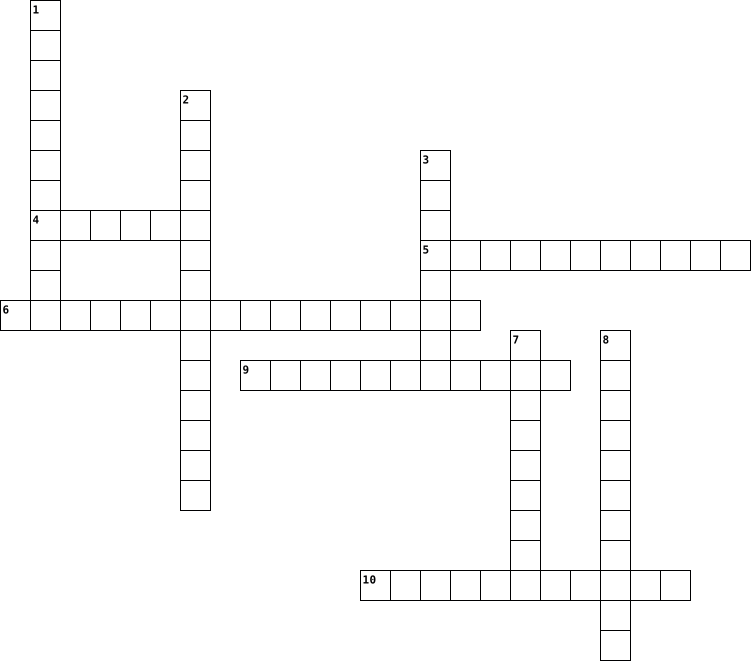
Road to Revolution 2024-01-18

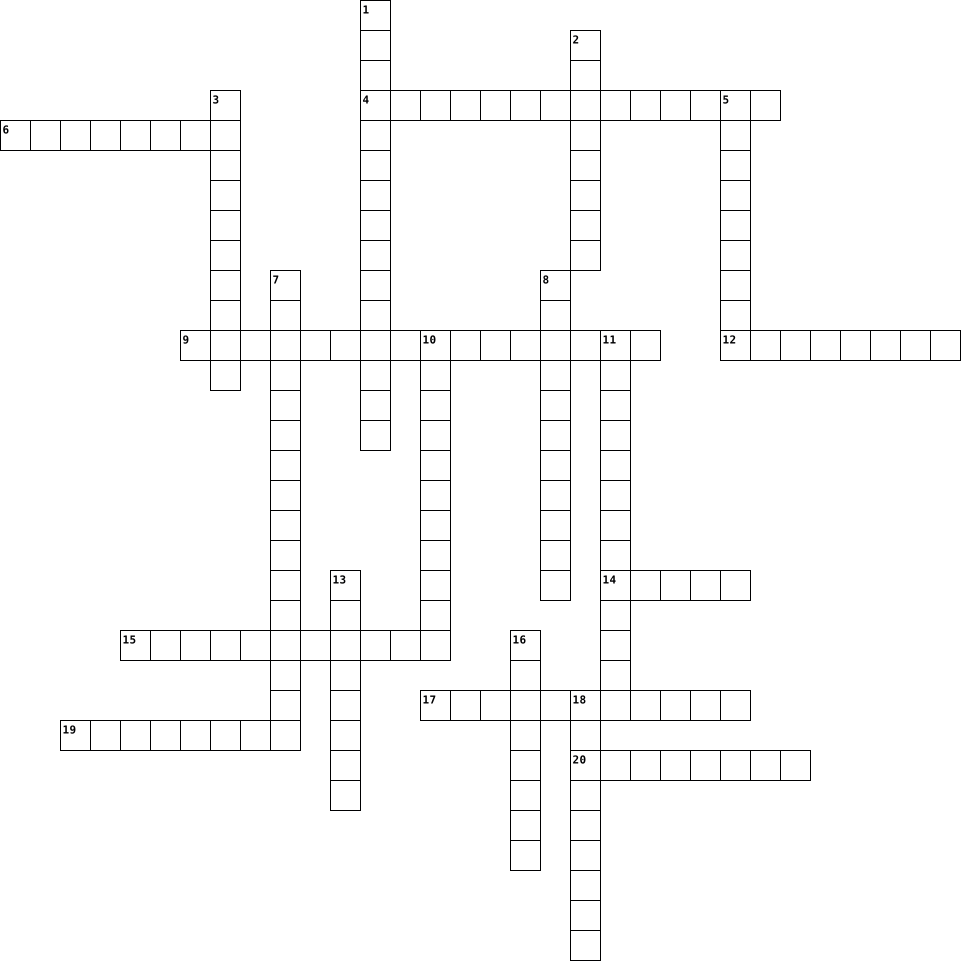
Across
- A refusal to buy or use goods and services as a form of protest
- the lawmaking body of British government
- colonists were angry about taxation without THIS
- idea that the government must follow procedures established by law and guaranteed by the Constitution (Enlightenment idea)
- a formal meeting of government representatives
- the Articles of Confederation only had this branch
- people who opposed the Constitution and wanted a bill of rights
- England had a lot of this after fighting a war with France
- In 1770 British troops killed 4 American colonists here
- A series of laws passed in 1774 to punish colonists for the Tea Party
- A system in which power is divided between the national and state governments
Down
- the Enlightenment thinker whose ideas show up in the Declaration of Independence
- First 10 amendments to the Constitution
- "they have been endowed by their Creator with certain inalienable rights, and among these are life, __________, and the pursuit of happiness"
- a movement that emphasized science and reason as guides to help see the world more clearly. Led to new ideas about government and politics
- the idea that the law applies to everyone, even those who govern (Enlightenment idea)
- supporters of the Constitution
- the primary author of the Declaration of Independence
- A set of things that people believe they should be free to do without restrictions (Enlightenment idea)
- Under the Articles of Confederation, the government lacked the power to do this
- Formal approval
- "We hold these truths to be self-evident, that all men are created _________"
22 Clues: Formal approval • supporters of the Constitution • First 10 amendments to the Constitution • the lawmaking body of British government • a formal meeting of government representatives • colonists were angry about taxation without THIS • the Articles of Confederation only had this branch • the primary author of the Declaration of Independence • ...
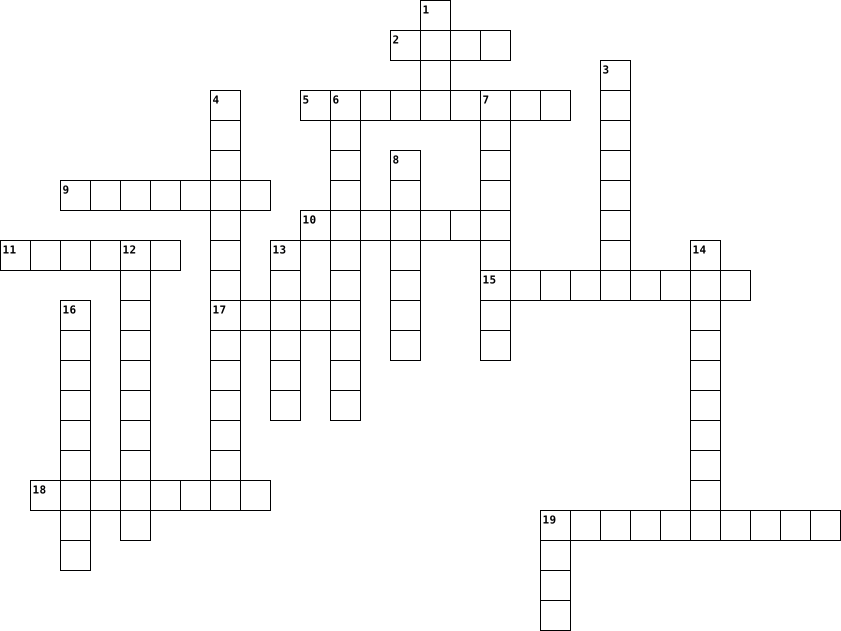
The Enlightenment 2023-05-05
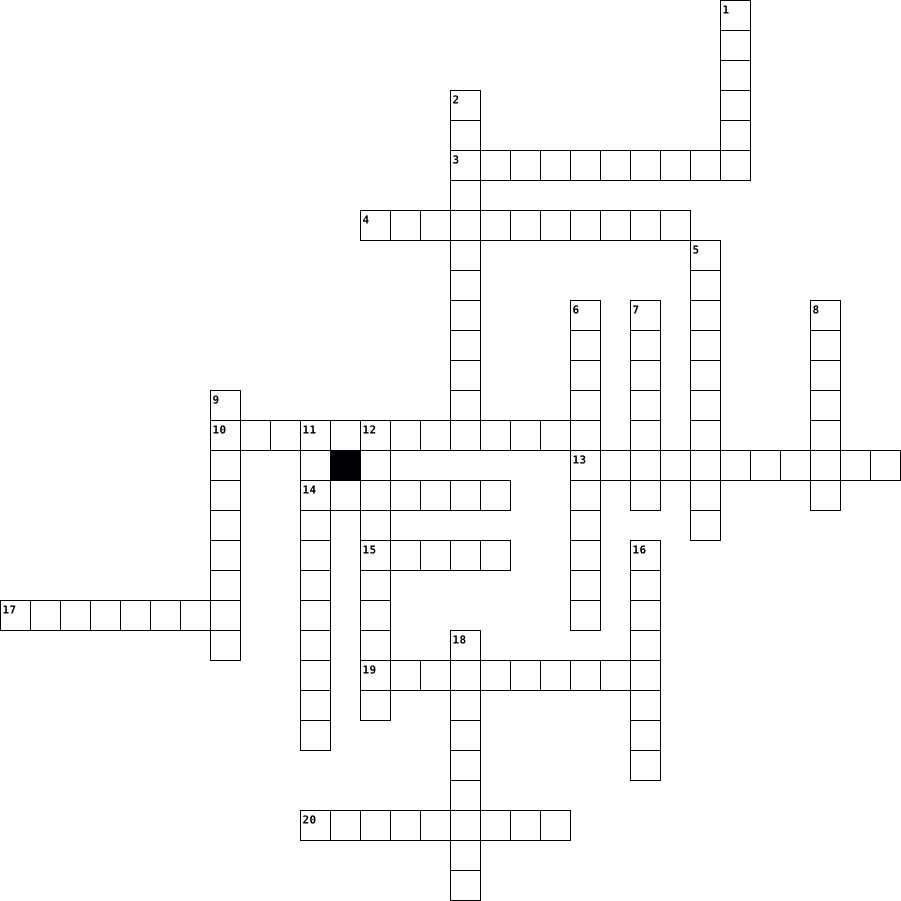
Across
- Where did the Enlightenment originate?
- Political activist, wrote "The Crisis," moved to the colonies based on a recommendation from 6 across
- Founding father, who was a writer, scientist and inventor
- English mathematician, he was a key figure during the Scientific Revolution and the Enlightenment
- When did the enlightenment end?
Down
- Written by 5 across
- What caused the start of the Enlightenment?
- French writer that advocates for the freedom of speech, freedom of religion, and separation of church and state
- English philosopher named one of the most influential Enlightenment thinkers
- When did the Enlightenment begin?
10 Clues: Written by 5 across • When did the enlightenment end? • When did the Enlightenment begin? • Where did the Enlightenment originate? • What caused the start of the Enlightenment? • Founding father, who was a writer, scientist and inventor • English philosopher named one of the most influential Enlightenment thinkers • ...
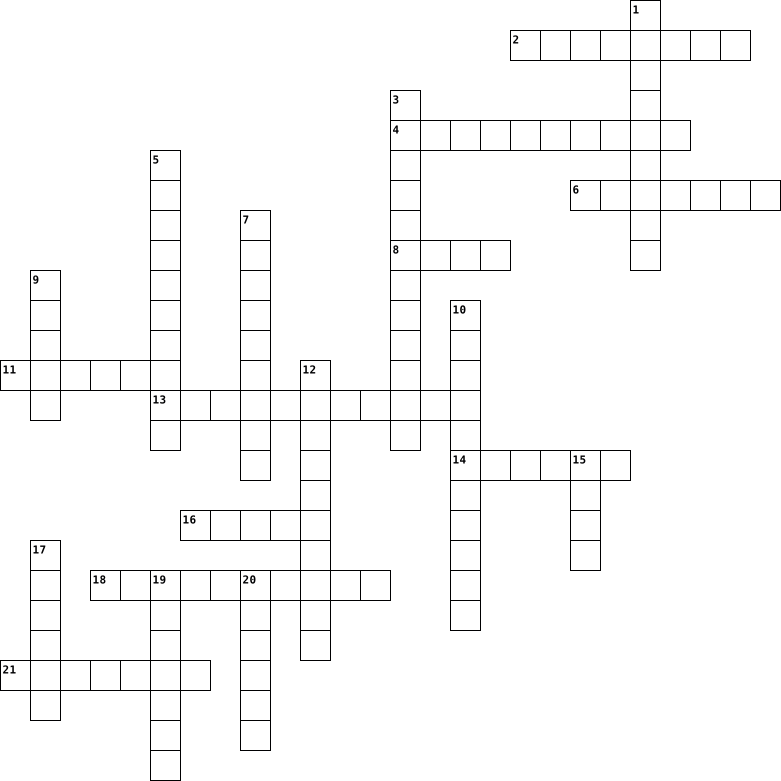
Enlightenment Philosophers 2022-01-17
Across
- philosopher that owned a law firm
- place Baruch Spinoza was born
- philosopher that wrote De Principio Individui
- Philosopher that worked on Treatise On The Emendation Of Intellect
- the collage that Rene Descartes went to
- I think ______ I am
- place where Voltaire was born
- Theological-Political_______
- place where immanual Kant was born and raised
Down
- Philosopher that wrote Enquiry Concerning Human Understanding
- Philosopher that got the fellow of the royal society award
- fictitious letters ______
- a branch of philosophy that deals with time, space, knowing, and identity.
- philosopher that wrote Discourse on the Method
- place where Gottfried Wilhelm Leibniz was born
- on the Principle of the _______
- the university that Hugo Grotius went to.
- Enquiry Concerning the _____ of Morals
- the place David Hume was born
- philosopher that wrote Critique of pure reason
20 Clues: I think ______ I am • fictitious letters ______ • Theological-Political_______ • place Baruch Spinoza was born • the place David Hume was born • place where Voltaire was born • on the Principle of the _______ • philosopher that owned a law firm • Enquiry Concerning the _____ of Morals • the collage that Rene Descartes went to • the university that Hugo Grotius went to. • ...
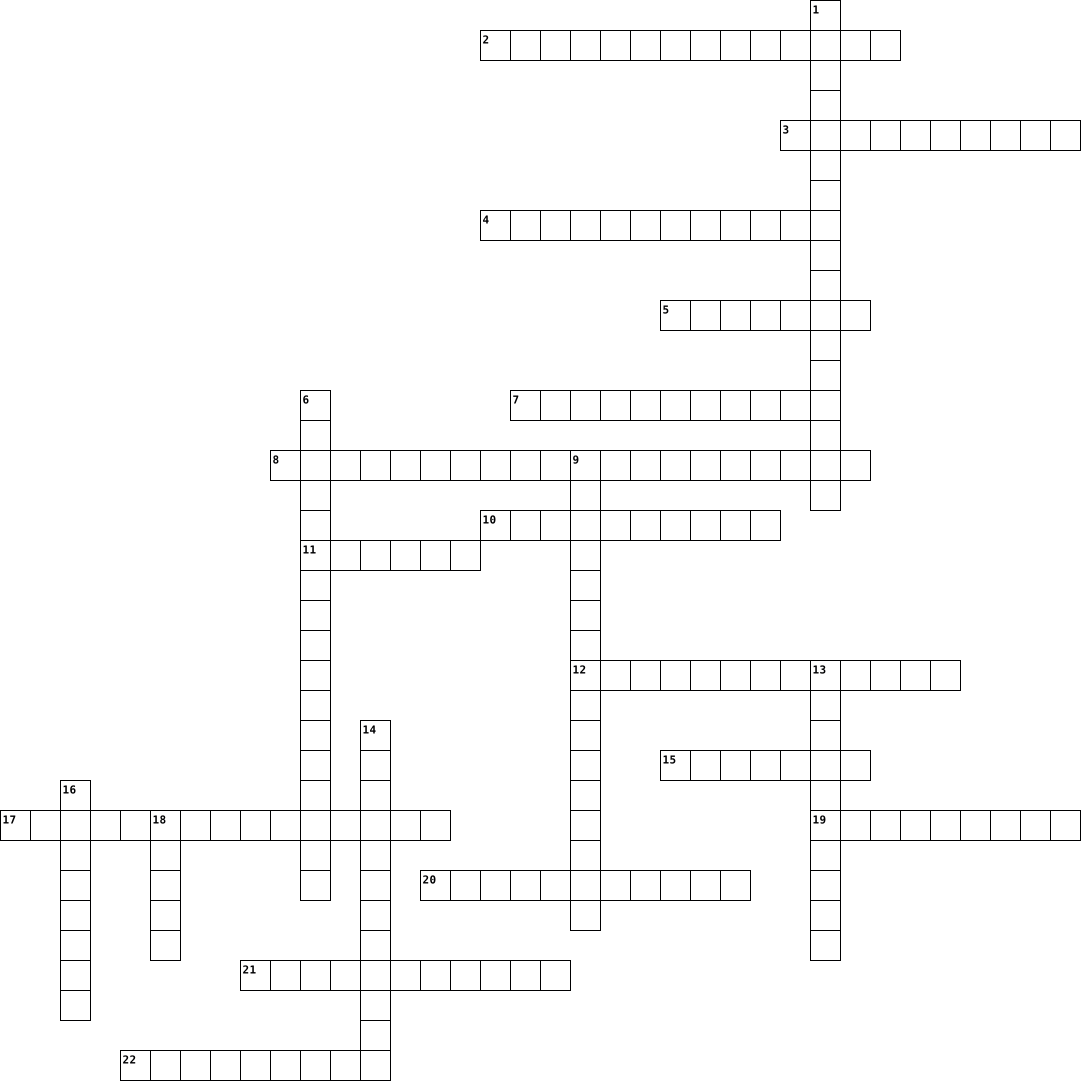
The Enlightenment 2013-11-12
Across
- a french philospher that i dont know about
- despot a form of absoulte monarchy that accepted enligthenment ideas
- faire a policy that allows businesses to operate with very little interference from the government
- Locke English philiospher that argued that people were good and theorized natural right,he rejected absolute monarchys
- II austrian monarch that traveled in disguise among his subjects to learn of their problems
- a period of time in which people applied reasons to everyday things and started thinking 4 themselves
- contract an agreement made by people to give up their freedom in exchange for an organized society
- Madison 4th president sometimes refered to as the father of the constituon,something seperation of powers
- suppresion of the public speech or other public communication,which was done by burning and banning books as well as jailing others in the enlightment age
- a period of artistic style that used exaggerated motion and clear, easily interpreted detail
Down
- the Great russian monarch that aboloished tortue
- Rousseau french philospher who is often referred to as the father of the french revolutionan wrote the book:The Social Contract
- french enlightenment thinker
- the Great Prussian monarch that allowed free press and urged religious tolerance
- informal social gatherings
- french thinker who developed the ideas of seperation of powers,checks and balances and minority rights
- a person who offers views or theories on profound questions in ethics, metaphysics, logic, and other related fields.
- smith Scottish philospher who focused on using natural law to reform the economy and urged the policy of laissez faire
- hobbes english enlightment thinker who argued that people were cruel and selfish by nature and needed to be controlled by an absolute monarchy
- law-rules that govern natural forces such as gravity
- style of composition arising in 18th-century France, often viewed as an extension of the baroque, and characterized by a high degree of ornamentation and lightness of expression.
21 Clues: informal social gatherings • french enlightenment thinker • a french philospher that i dont know about • the Great russian monarch that aboloished tortue • law-rules that govern natural forces such as gravity • despot a form of absoulte monarchy that accepted enligthenment ideas • the Great Prussian monarch that allowed free press and urged religious tolerance • ...
The Enlightenment 2013-11-11
Across
- Agreement among members of society
- The practice of officially examining books,movies and etc.
- The father of the constitution who designed the 3 branches of government
- Emperor of the holy roman empire
- A prison engaged or learned in philosophy
- His philosophy influenced the french revolution
- The intellectuals of the 18th century Enlightenment
- A style of art, especially architecture and decorative art, that originated in France in the early 18th century
- A philosophical movement of the 18th century in Europe
- A style of European architecture
- the author of the Declaration of the Independence
- Scottish economist who advocated pirate enterprises and free trade
- French philosopher who concluded that liberty could be best safeguarded by separation of powers
- English philosopher, scientist, and historian, best known for his political philosophy
- English philosopher who believed that a government's power comes form the people
Down
- Russian empire who greatly increase
- King of Prussia
- A form of absolute monarchy or despotism in which rulers were influenced by the Enlightenment
- A body of law held to be derived from nature
- A policy of attitued of lettings things take their own course
- French writer who was the embodiment of 8th century enlightenment
- A large room such as drawing room used for receiving entertaining guest
22 Clues: King of Prussia • Emperor of the holy roman empire • A style of European architecture • Agreement among members of society • Russian empire who greatly increase • A prison engaged or learned in philosophy • A body of law held to be derived from nature • His philosophy influenced the french revolution • the author of the Declaration of the Independence • ...
The Enlightenment 2013-11-11

Across
- French writer who was the embodiment of 8th century enlightenment
- A style of art, especially architecture and decorative art, that originated in France in the early 18th century
- A form of absolute monarchy or despotism in which rulers were influenced by the Enlightenment
- English philosopher who believed that a government's power comes form the people
- the most renowned and the longest-ruling female leader of Russia
- A prison engaged or learned in philosophy
- King of Prussia
- the author of the Declaration of the Independence
- French philosopher who concluded that liberty could be best safeguarded by separation of powers
Down
- Agreement among members of society
- A policy of attitued of lettings things take their own course
- A body of law held to be derived from nature
- A large room such as drawing room used for receiving entertaining guest
- A philosophical movement of the 18th century in Europe
- The father of the constitution who designed the 3 branches of government
- Scottish economist who advocated pirate enterprises and free trade
- His philosophy influenced the french revolution
- The intellectuals of the 18th century Enlightenment
- English philosopher, scientist, and historian, best known for his political philosophy
- A style of European architecture
- The practice of officially examining books,movies and etc.
- Emperor of the holy roman empire
22 Clues: King of Prussia • A style of European architecture • Emperor of the holy roman empire • Agreement among members of society • A prison engaged or learned in philosophy • A body of law held to be derived from nature • His philosophy influenced the french revolution • the author of the Declaration of the Independence • The intellectuals of the 18th century Enlightenment • ...
The Enlightenment 2013-09-02
Across
- there were ___________ at work in Europe.
- moved easily in these aristocratic circles.
- the earth rotates on its axis beneath the unmoving sun.
- of sedition or blasphemy quickly found themselves imprisoned.
- ____ and communication improved during the renaissance.
- and catholics denounced each other as followers of satan.
- the goal of the ________ humanists was to recapture some of the pride, breadth of spirit, and creativity of the ancient greek and romans.
- the despotism of ______ exercising far greater powers than any medieval king.
- in Italy and France a group of thinkers.
Down
- whether pamphlets or scholary volumes were subject to prior censorship by both church and state, oftern working hand in hand.
- their principal targets were ____
- sooner or later many eurppeans would begin to weary of the _______ and warfare carried out in the name of the absolute truth.
- developed the belief that tradition could and should be used to promote change.
- were painfully aware that they were paying taxes.
- was torn by which-hunts and wars of religion, and imperial conquest.
- it was among those very idle ______ that the french enlightenment philosophers were to find some of their earliest and most enthusiastic follwers.
- which tried to challenge the twin authorities of church and state banned.
- begun to move from rural estates to the towns in search of increased freedom and prosperity.
- europeans were _______ but europes institutions were not keeping pace with that change.
- frequently refered to as "doctors'.
20 Clues: their principal targets were ____ • frequently refered to as "doctors'. • in Italy and France a group of thinkers. • there were ___________ at work in Europe. • moved easily in these aristocratic circles. • were painfully aware that they were paying taxes. • the earth rotates on its axis beneath the unmoving sun. • ...
THE ENLIGHTENMENT 2013-09-08
Across
- WESTERN CHRISTIAN WHO IS NOT A MEMBER OF A CATHOLIC CHURCH
- MIDDLE CLASS
- AGE OF REASON
- BEING EVERYWHERE AT THE SAME TIME
- CRUEL AND OPPRESSIVE RULE
- SPECIFIC TENET OR DOCTRINE
- FRANCOIS-MARIE AROUET
- ACTION OF SUBDUING SOMEONE OR SOMETHING BY FORCE
- ABSOLUTE POWER
Down
- WITHDRAW OR DISAVOW A STATEMENT
- BELIEF OR NOTION NOT BASED ON REASON OR KNOWLEDGE
- RATIONAL INVESTIGATION OF THE TRUTHS AND IDEAS
- CLASS HOLDING EXCEPTIONAL RANK AND PRIVILEGES
- FARM LABORER
- ITALIAN ASTRONOMER
- I THINK THEREFORE I AM
- UNWILLINGNESS TO ACCEPT VIEW OR BELIEFS
- INHERITED BY BIRTHRIGHT
- GROUP OF THINKERS
- GREEK PHILOSOPHER
20 Clues: MIDDLE CLASS • FARM LABORER • AGE OF REASON • ABSOLUTE POWER • GROUP OF THINKERS • GREEK PHILOSOPHER • ITALIAN ASTRONOMER • FRANCOIS-MARIE AROUET • I THINK THEREFORE I AM • INHERITED BY BIRTHRIGHT • CRUEL AND OPPRESSIVE RULE • SPECIFIC TENET OR DOCTRINE • WITHDRAW OR DISAVOW A STATEMENT • BEING EVERYWHERE AT THE SAME TIME • UNWILLINGNESS TO ACCEPT VIEW OR BELIEFS • ...
Enlightenment Review 2012-11-06

Across
- used satire; fought for freedom of speech and religion
- conflict caused by British policies and influenced by philosophes' ideas
- civilization corrupts people's natural goodness; greatest good for the greatest number of people
- sun-centered theory; proposed by Copernicus
- explained the law of universal gravitation
- challenged previously held ideas about science and nature
- enlightened rulers who attempted social reforms
- proposed separation of powers (checks and balances)
- written by Thomas Jefferson; drew heavily on ideas from Locke
- social contract; believe all humans were naturally selfish and wicked
- declared women should have the same political rights as men
- argued against the use of cruel and unusual punishment
Down
- promoted self-government; three natural rights
- edited and published the first Encyclopedia
- enlightened despot who ruled Russia
- ran influential salon during the Enlightenment period
- earth-centered view of the universe
- proposed the heliocentric theory
- ruled Austria as an enlightened despot; abolished serfdom
- enlightened despot who ruled Prussia
- believe in progress for society
21 Clues: believe in progress for society • proposed the heliocentric theory • enlightened despot who ruled Russia • earth-centered view of the universe • enlightened despot who ruled Prussia • explained the law of universal gravitation • edited and published the first Encyclopedia • sun-centered theory; proposed by Copernicus • promoted self-government; three natural rights • ...
Enlightenment Review 2012-11-06

Across
- used satire; fought for freedom of speech and religion
- conflict caused by British policies and influenced by philosophes' ideas
- civilization corrupts people's natural goodness; greatest good for the greatest number of people
- sun-centered theory; proposed by Copernicus
- explained the law of universal gravitation
- challenged previously held ideas about science and nature
- enlightened rulers who attempted social reforms
- proposed separation of powers (checks and balances)
- written by Thomas Jefferson; drew heavily on ideas from Locke
- social contract; believe all humans were naturally selfish and wicked
- declared women should have the same political rights as men
- argued against the use of cruel and unusual punishment
Down
- promoted self-government; three natural rights
- edited and published the first Encyclopedia
- enlightened despot who ruled Russia
- ran influential salon during the Enlightenment period
- earth-centered view of the universe
- proposed the heliocentric theory
- ruled Austria as an enlightened despot; abolished serfdom
- enlightened despot who ruled Prussia
- believe in progress for society
21 Clues: believe in progress for society • proposed the heliocentric theory • enlightened despot who ruled Russia • earth-centered view of the universe • enlightened despot who ruled Prussia • explained the law of universal gravitation • edited and published the first Encyclopedia • sun-centered theory; proposed by Copernicus • promoted self-government; three natural rights • ...
Revolution + Enlightenment 2016-02-23

Across
- wrote the Encyclopedia, or Classified dictionary of the Sciences,Arts, and Trades.
- Universe with the Sun at the center
- says that every object in the universe is attracted to every other object by gravity
- A new art style that emphasized grace, charm, and gentle action
- argued that the planets’ orbits around the sun was elliptical, not circular
- argued that people had adopted laws and government to preserve their property and became enslaved by the government
- universe with the Earth at the center
- accurately described the individual organs and general structure of the human body
- ( 1740 to 1748) was fought in three areas of the world
- one of the best educated and most cultured monarchs of the time
- french word meaning “philosopher”
- One of the greatest composers of all time, wrote The Marriage of Figaro, Don Giovanni, and several other operas
- argued that the sun not the Earth was the center of the universe
- a contract through which the entire society agrees to be governed by its general will
- system of thought based off the belief that reason in the chief source of knowledge
- argued that punishments should not be exercises in brutality
Down
- discovered mountains on Earth’s moon, four moons revolving jupiter, and sunspots
- worked to centralized and strengthen the state
- argued for equality between men and women
- the executive, legislative, and judicial powers of the government limit and and control each other in a system of checks and balances
- proceeding for the particular to the general
- the volume of a gas varies with the pressure exerted on it
- showed that the heart, not the liver, was the beginning point for the circulation of blood
- rulers tried to govern by Enlightenment principles while maintaining their royal powers
- came up with the universal law of gravitation
- Ruled russia from 1762 to 1796
- came up with separation of powers
- A war that began when Prussia did not recognize Austria's female leader and proceeded to invade Silesia
- said that mind and matter were completely separate
- argued that every person was born with a tabula rasa, or blank mind
- a systematic procedure for collecting and analyzing evidence
- said that people should learn about nature by using inductive reasoning
- egg-shaped orbits with the sun at the end of the ellipse not the center
- doctrine stating that the state should leave the economy alone
- started Methodism which led him to bring the “glad tidings” of salvation
- drawing rooms of the wealthy upper class where conversations about new ideas by philosophes took place
- believed that the state should not interfere with economic matters
37 Clues: Ruled russia from 1762 to 1796 • came up with separation of powers • french word meaning “philosopher” • Universe with the Sun at the center • universe with the Earth at the center • argued for equality between men and women • proceeding for the particular to the general • came up with the universal law of gravitation • worked to centralized and strengthen the state • ...
The Enlightenment 2023-02-21

Across
- a person who rules with absolute power
- parties where people met to discuss new ideas
- proved heliocentric theory using math, discovered elliptical orbits of planets
- introduced a vaccine for smallpox
- believed in separation of powers and checks and balances
- the people who presented new ways of thinking during the enlightenment
- the theory that the earth is the center of the universe
- believed in criminal justice and no cruel unusual punishment
- had new idea of heliocentric theory
- developed laws of gravity and motion
- found craters on the moon and supported heliocentric theory
Down
- looked at bacteria, discovered first living cell, made microscope better
- believed everyone is born with certain rights and that everyone is equal
- was the father of chemistry, helped discover atomic theory
- developed scientific method with descartes
- to know something one did not know before
- the theory that the sun is the center of the universe
- believed in freedom of speech and religion
- developed scientific method with bacon
- believed women should have an equal education ot men
20 Clues: introduced a vaccine for smallpox • had new idea of heliocentric theory • developed laws of gravity and motion • a person who rules with absolute power • developed scientific method with bacon • to know something one did not know before • developed scientific method with descartes • believed in freedom of speech and religion • parties where people met to discuss new ideas • ...
The Enlightenment 2020-10-07

Across
- a synonym for absolute monarch
- along with Francis Bacon, he supported the scientific method
- wrote A Vindication of the Rights of Woman in which she said women should be educated like men
- used math to prove the heliocentric theory
- type of art that reflected the lifestyles of the rich
- wrote On Crimes and Punishments; he believed that punishments should fit crimes and that laws should exist to promote social order
- the founder of modern chemistry
- wrote Leviathan; he proposed the social contract theory
- the theory that the sun is the center of the universe
- tool used by Antonie Von Leeuwenhoek to study microorganisms
- wrote satires and was a supporter of freedom of speech and religion
Down
- an Enlightenment thinker
- perfected the telescope and studied acceleration
- the first person to propose the heliocentric theory
- the theory that the earth is the center of the universe
- type of art that reflected Greek and Roman values and was a backlash to the lifestyle of the aristocracy
- wrote The Social Contract; he believed that governments were responsible to the people they governed
- developed a vaccine for smallpox
- wrote Two Treatises on Government; he believed in the social contract and the idea that people are born with natural rights of life, liberty, and property
- a social gathering where philosophes would share their ideas
20 Clues: an Enlightenment thinker • a synonym for absolute monarch • the founder of modern chemistry • developed a vaccine for smallpox • used math to prove the heliocentric theory • perfected the telescope and studied acceleration • the first person to propose the heliocentric theory • type of art that reflected the lifestyles of the rich • ...
The Enlightenment 2020-10-30

Across
- contributed the idea of separation of power later known as checks and balances.
- Helped develop the scientific method, was big on proving things mathematically.
- created the first vaccine.
- discovered that matter was made up of small primary particles that join together.
- improved the telescope and used to discover that Jupiter had 4 moons and the sun and moon were not made of perfect substance.
- the agreement between members of a society to cooperate and make decisions to benefit the people as a whole.
- mathematically proved planets revolve around the sun in an eclipse.
- believed people should hand over their rights to a strong authoritarian government. - Social contract
- believed in a people run government. If the government does not provide basic rights the people have the right to overthrow the government.
- scientific tool used to see far away objects such as stars and planets.
- women's rights, they should get an education and enter into male-dominated fields.
- Contributed to the scientific method and empiricism - proving things experimentally.
Down
- theory that the earth is the center of the universe.
- a period of time when people began to question accepted beliefs and started to observe and discover new things.
- discovered that the earth was not the center of the universe - heliocentric theory
- tolerance and reason, believed strongly in basic freedoms such as freedom of speech and religion.
- discovered the laws of motion, gravity, and force.
- french word for "philosopher". People who would use reason and experimentation in their everyday lives. Many of their ideas inspired future evens such as the French Revolution and ideas in the Declaration of Independence.
- theory that the sun is the center of the universe.
- social gatherings where they would discuss ideas of the enlightenment.
- scientific tool used to see small things not visible to the human eye.
- believed in individual freedom and a direct democracy formed and run by the people.
- Was against cruel and unusual punishments and torture. Believed the punishment should fit the crime.
23 Clues: created the first vaccine. • discovered the laws of motion, gravity, and force. • theory that the sun is the center of the universe. • theory that the earth is the center of the universe. • mathematically proved planets revolve around the sun in an eclipse. • social gatherings where they would discuss ideas of the enlightenment. • ...
Enlightenment Era 2021-03-15

Across
- Political leader who wrote the Declaration of Independence.
- She wrote the classic novel Frankenstein.
- Set of books to which many scholars of Europe contributed articles and essays.
- Russian ruler admired by philosophes.
- Name of the ten amendments added to the Constitution.
- Creator of the law of gravity.
- Social gatherings where scientists, philosphers, and other intellecutals discussed ideas.
- Type of music that emerged in the Enlightenment Era.
- Creator of the geocentric theory.
- Creator of the heliocentric theory.
Down
- Theory that states that the stars and planets move around the sun.
- Name of the novel written by Samuel Richardson. Considered the true first English novel.
- A logical procedure for gathering and testing ideas.
- He created the Encyclopedia.
- Artistic style of the late 1700s.
- Name of monarchs who embraced the new ideas of the Enlightenment spirit.
- Agreement by which people created a government.
- Theory that says that the moon, sun, and planets move around the Earth.
- He believed that humans were born with three natural human rights--life, liberty, and property.
- Philosopher who argued that torture should be abolished.
20 Clues: He created the Encyclopedia. • Creator of the law of gravity. • Artistic style of the late 1700s. • Creator of the geocentric theory. • Creator of the heliocentric theory. • Russian ruler admired by philosophes. • She wrote the classic novel Frankenstein. • Agreement by which people created a government. • A logical procedure for gathering and testing ideas. • ...
The Enlightenment 2021-09-09

Across
- England was a ______ before the Glorious Revolution where the king had more power than anyone else.
- He led England as a republic and made laws like no drinking, dancing or gambling. He eventually began to rule as a dictator.
- Small gatherings of men and women in France during the Enlightenment where people discussed science, politics and religion.
- A professional army led by Oliver Cromwell that helped parliament win the English Civil War.
- This side supported parliament during the English Civil War and was made up of working and middle class people as well as Puritans.
- A contract signed by King John that limited the king's power.
- He was the king after Charles II. He believed in Divine right and refused to work with parliament. He was replaced by his daughter.
- The two targets of the Enlightenment were the __________ Church and the King.
- He was known as the "Merry Monarch" because he liked to party. He cancelled the Blue Laws.
- II He was the English king who implemented trial by jury and common law.
- This side supported the king during the English Civil War and was made up of mostly wealthy nobles.
- The belief that the king was chosen by God and should therefore have absolute power.
- A French philosopher who believe humans are born good and wrote about a social contract where people give up some rights in return for protection.
- The ____ is when parliament replaces James II with his daughter Mary. She agrees to obey parliament.
- A document issued in 1628 that limited the king's power. It was signed by Charles I.
- The time period when the authority of the church and king was questioned. Also known as the Age of Reason.
- He became king following James I and started the English Civil War. He was beheaded in 1649.
Down
- It consisted of 28 volumes and included articles from leading philosophes covering nearly every subject. It was edited by Denis Diderot and Jean Le Rond D'Alembert.
- Mary ____ was a British writer who argued for the rights of women during the Enlightenment.
- He was a French philosopher who was a strong supporter of Freedom of Speech.
- The ____ Amendment Act stated that when someone is arrested, they must know what they are being charged with.
- The time period before the Enlightenment where people began to look for proof.
- The first king in the Stuart line who strongly believed in the Divine Right of Kings and battled with the Puritans.
- This English philosopher believed people were born evil and that a strict government must be put into place to control them.
- This document gave parliament more power than the king and stated that the king couldn't dissolve parliament and no Catholic could rule England.
- He is the most influential Enlightenment philosopher who believed that all people are born free and equal with 3 natural rights.
- He was a French philosophe who was influenced by John Locke. He believed that government should be made up of 3 branches of government who each had equal amounts of power.
- The ___ is the idea that people give up some of their rights in return for protection from the government.
- Following the Glorious Revolution, England became a ____ Monarchy where the powers of the king/queen were restricted by the constitution and laws of the country.
- He was known as ____ the Conqueror. He claimed the throne of England following the Battle of Hastings and began centralizing the English government.
30 Clues: A contract signed by King John that limited the king's power. • II He was the English king who implemented trial by jury and common law. • He was a French philosopher who was a strong supporter of Freedom of Speech. • The two targets of the Enlightenment were the __________ Church and the King. • ...
the enlightenment 2021-09-23

Across
- method of measurement,
- freedom of speech and religion
- believed Britain was best governed
- wanted the king as ruler
- experimental method
- wanted women's rights
- used the microscope
- favored the idea of self-government and criticized absolute monarchy
- smallpox vaccine
- free government guided by general
- sun is center of the solar system
Down
- heliocentric theory
- scientific methods
- and observation
- against the death penalty
- the telescope
- laws of motion and gravity
- founder of modern chemistry
- mathematical theories
- earth is the center of solar system
20 Clues: the telescope • and observation • smallpox vaccine • scientific methods • heliocentric theory • experimental method • used the microscope • wanted women's rights • mathematical theories • method of measurement, • wanted the king as ruler • against the death penalty • laws of motion and gravity • founder of modern chemistry • freedom of speech and religion • free government guided by general • ...
The Enlightenment 2021-09-23

Across
- parties where people met to discuss new ideas
- invented the scientific method
- perfected the telescope
- engaged the use of the scientific method
- fonder of chemistry
- invented the heliocentric theory
- that thought everyone should have natural rights
- people who presented new ways of thinking
- the earth is in the center of the solar system
- there should be separation of power
- a style of characterized art by use soft lines and colors
- also believed in the social contract
Down
- used the microscope to look at micro organize and bacteria
- law to prove the heliocentric theory
- method a discovery of the world
- The sun is in the center of the solar system
- thought on crimes and punishments
- contract that will give up rights and freedom
- a person that rules will absolutely power
- a style of characterized art by using dull colors and strong lines
- women's rights
- Freedom of speech and religion
- Made a vaccine for smallpox
- law of gravity and motion
- believed in the social contract
25 Clues: women's rights • fonder of chemistry • perfected the telescope • law of gravity and motion • Made a vaccine for smallpox • invented the scientific method • Freedom of speech and religion • method a discovery of the world • believed in the social contract • invented the heliocentric theory • thought on crimes and punishments • there should be separation of power • ...
Enlightenment Ideas 2021-09-15

Across
- He thought governments should be elected by the people.
- "no man need be afraid of another"
- What did Galileo discover around the 6th Planet in our solar system?
- Rousseau believed this idea was difficult to obtain.
- Voltaire believed this was important for government.
- Words that describe the Natural Rights of man.
- according to Locke, the government is supposed to protect what?
- Wrote the Leviathan
- John Locke Refuted This.
- This freedom was important to criticize the government.
Down
- Who said all people are born free and equal?
- Hobbes argued for this type of government.
- Galileo was this
- Galileo discovered four moons around what?
- Hobbes argued that people are what?
- What kind of government would happen without religious people?
- The moon has over 100,000 of these
- This group disagreed with the heliocentric model
- This came from comparing ourselves to others' achievements.
- Montesquieu believed in governments should have this type of power.
20 Clues: Galileo was this • Wrote the Leviathan • John Locke Refuted This. • "no man need be afraid of another" • The moon has over 100,000 of these • Hobbes argued that people are what? • Hobbes argued for this type of government. • Galileo discovered four moons around what? • Who said all people are born free and equal? • Words that describe the Natural Rights of man. • ...
Enlightenment Thinkers 2022-06-30

Across
- Father of the Scientific Method
- Credited with laws of thermodynamics and calculus
- Analytic geometry and Father of Modern Philosphy; "I think therefore I am."
- Developed smallpox vaccine
- British theologian, founded Methodism
- Discovered moon's cratered surface and Jupiter's 4 moons; improved on Dutch telescope
- Protestant religious leader of pietism movement
- Developed heliocentric worldview
- German Lutheran theologian; founder of pietism movement
- Father of Chemistry
- Founded modern anatomy
- Sinner in the Hands of an Angry God sermon
- Father of Liberalism; gov't exists to promote public good; tabula rasa
Down
- Named the heart
- Author of The Social Contract
- German reformer and Protestant Christian pioneer
- criticized Catholics, wrote 20k letters and 2k books
- Discovered oxygen and carbonated water
- Discovered oxygen's role in combustion
- American Christian leader of Methodist movement
- Father of Toxicology
- pantheist
- astronomer: found orbits of planets are elliptical
- Criticizes French gov't and advocate for separation of powers
24 Clues: pantheist • Named the heart • Father of Chemistry • Father of Toxicology • Founded modern anatomy • Developed smallpox vaccine • Author of The Social Contract • Father of the Scientific Method • Developed heliocentric worldview • British theologian, founded Methodism • Discovered oxygen and carbonated water • Discovered oxygen's role in combustion • ...
Enlightenment Crossword 2018-02-09

Across
- These provided a place for women and men to congregate for intellectual discourse.
- A formal meeting or series of meetings for discussion between delegates, especially those from a political party or labor union or from within a particular discipline.
- An implicit agreement among the members of a society to cooperate for social benefits, for example by sacrificing some individual freedom for state protection.
- The intellectuals of the 18th-century Enlightenment.
- The belief in the existence of a supreme being, specifically of a creator who does not intervene in the universe.
- An act of vesting the legislative, executive, and judicial powers of government in separate bodies.
- A form of government in the 18th century in which absolute monarchs pursued legal, social, and educational reforms inspired by the Enlightenment.
- A form of government in which a monarch acts as head of state within the parameters of a written or blended constitution.
- An economic system in which private business operates in competition and largely free of state control.
- A doctrine in political theory that government is created by and subject to the will of the people.
- An English philosopher and physician, commonly known as the "Father of Liberalism".
- A system that divides up power between a strong national government and smaller local governments.
- A tribunal presided over by a judge, judges, or a magistrate in civil and criminal cases.
- A policy or attitude of letting things take their own course, without interfering.
Down
- An English writer, philosopher, and advocate of women's rights.
- A British Law, passed by the Parliament of Great Britain in 1689 that declared the rights and liberties of the people and settling the succession in William III and Mary II following the Glorious Revolution of 1688.
- A Francophone Genevan philosopher, writer, and composer of the 18th century.
- A French Enlightenment writer, historian and philosopher famous for his wit, his attacks on the established Catholic Church.
- The elected head of a republican state.
- A form of democracy in which people decide policy initiatives directly.
- Was a French lawyer, man of letters, and political philosopher who lived during the Age of Enlightenment.
- An English philosopher who is considered one of the founders of modern political philosophy.
- This style is characterized by soft colors and curvy lines, and depicts scenes of love, nature, amorous encounters, light-hearted entertainment, and youth.
- A European intellectual movement of the late 17th and 18th centuries emphasizing reason and individualism rather than tradition.
- An Italian criminologist, jurist, philosopher, and politician, who is widely considered as the most talented jurist and one of the greatest thinkers of the Age of Enlightenment.
25 Clues: The elected head of a republican state. • The intellectuals of the 18th-century Enlightenment. • An English writer, philosopher, and advocate of women's rights. • A form of democracy in which people decide policy initiatives directly. • A Francophone Genevan philosopher, writer, and composer of the 18th century. • ...
The Enlightenment 2023-10-30

Across
- Philosopher known for his ideas on social contract and natural state of man.
- Astronomer known for the heliocentric model of the solar system.
- Concept related to ownership and possession of assets.
- Physicist who formulated the laws of motion and universal gravitation.
- Philosopher famous for the statement "I think, therefore I am."
- Theory that places the Sun at the center of the solar system.
- Gathering places for intellectuals and writers during the Enlightenment.
- Political and philosophical ideology promoting individual rights and freedoms.
- A belief in a creator God who does not intervene in the world.
- Movement advocating for gender equality and women's rights.
- A philosophical stance that questions or doubts the validity of knowledge claims.
- Encyclopedist who played a role in the Enlightenment's spread of knowledge.
- Philosophical approach that stresses empirical observation and scientific methodology.
- Political philosophy that advocates for limits on government power through a constitution.
- Economic thinkers who focused on natural economic laws.
- Cultural and artistic movement emphasizing emotion and individual expression.
Down
- A binding agreement or legal document specifying rights and obligations.
- Belief that the Earth is the center of the universe.
- The principle of separating religion from government and public affairs.
- Philosophical approach that highlights the role of reason and logic in acquiring knowledge.
- Philosopher whose ideas influenced modern concepts of individual rights and government.
- A religious movement emphasizing individual piety and personal experience.
- Philosophical approach that emphasizes knowledge gained through sensory experience.
- Historical periods of mass persecution and trials of individuals accused of witchcraft.
- Philosophical approach that emphasizes knowledge gained through sensory experience.
- Enlightenment thinker famous for his advocacy of freedom of thought.
- Philosopher and scientist who championed the scientific method.
- Intellectual and social gatherings where Enlightenment ideas were discussed.
- Intellectuals of the Enlightenment who advocated for reason and knowledge.
- Economist and philosopher associated with the invisible hand and free markets.
30 Clues: Belief that the Earth is the center of the universe. • Concept related to ownership and possession of assets. • Economic thinkers who focused on natural economic laws. • Movement advocating for gender equality and women's rights. • Theory that places the Sun at the center of the solar system. • A belief in a creator God who does not intervene in the world. • ...
Enlightenment Crossword 2023-09-26

Across
- Wrote "Second treatise on Civil Government"
- Wrote "The Leviathan"
- the theory that there is an agreement between the governing and the governed
- the refusal to comply with certain laws or to pay taxes and fines
- parties where people met to discuss new ideas
- the revival of a classical style
- theory that the sun is the center of the solar system
- A person who rules with absolute power
- The writer of "Principa Mathematica"
- Dutch microscopist, first to observe bacteria and protozoa
Down
- a system in which multiple groups share decision making power
- to know something one did not know before
- Wrote "The Spirit of the Laws"
- A figure from the middle ages who argued against the possibility of there being other worlds
- Fought for womens rights
- Wrote "The Wealth Of Nations"
- Wrote "Letters Concerning the English Nation
- the theory that the earth is the center of the solar system
- The people who presented new ways of thinking during the enlightenment
- the federal principle or system of government
20 Clues: Wrote "The Leviathan" • Fought for womens rights • Wrote "The Wealth Of Nations" • Wrote "The Spirit of the Laws" • the revival of a classical style • The writer of "Principa Mathematica" • A person who rules with absolute power • to know something one did not know before • Wrote "Second treatise on Civil Government" • Wrote "Letters Concerning the English Nation • ...
The Enlightenment 2023-09-26

Across
- Wrote the book On the Spirit of Laws.
- people who present new ways of thinking during the enlightenment.
- Used microscope to find micro-organisms.
- A person who rules with absolute power.
- Wrote the book On Crimes and Punishments.
- created the 3 laws of motion.
- proposed the heliocentric theory.
- created the first vaccine for smallpox.
- Wrote the book Two Treaties of Government.
- Brought up the idea of women receiving education.
Down
- created the scientific method.
- to know something one did not know before.
- Wrote the book The Social Contract.
- a party where people would discuss new ideas.
- Wrote the book Candide.
- Used math to prove Copernicus's theory.
- Created analytic Geometry(Added algebra to geometry)
- Wrote the Leviathan.
- The earth revolves around the solar system
- a system in which multiple groups share decisions making and power.
- The sun revolves around the solar system.
- Proved that the planets weren't perfect spheres and Jupiter's four moon.
22 Clues: Wrote the Leviathan. • Wrote the book Candide. • created the 3 laws of motion. • created the scientific method. • proposed the heliocentric theory. • Wrote the book The Social Contract. • Wrote the book On the Spirit of Laws. • Used math to prove Copernicus's theory. • A person who rules with absolute power. • created the first vaccine for smallpox. • ...
Revolution & Enlightenment 2024-02-06

Across
- Child prodigy in the musical composer world
- Last name of the founder of trigonometry
- The first 10 amendments of our Constitution; include our rights
- Gave us the idea for the 3 branches of govt.
- A room in a wealthy house used for gossip
- Maria ___ was denied entry into the Berlin Academy
- Believed everyone was born with a tabula rasa "blank mind"
- This theory states that the sun is the center of the universe
- A tax on legal documents
- This theory states that the earth is the center of the universe
- According to Johannes Kepler, the earth moves in these types of orbits
- Thomas ___ was the primary author of the Declaration of Independence
- ___ Wollstonecraft believed men and women should be equals
- During this time, Prussia had this rank in terms of army size
Down
- The country that helped us beat the British for our independence
- Responsible for the scientific method
- Galileo discovered that Jupiter had this # of moons
- The British had this # of colonies in North America
- The First Continental Congress met here
- The French word for philosopher
- This George led the Continental Army
- Wrote a 28 volume Encyclopedia
- Harvey & Vesalius discovered that this organ was where blood circulated from
- Openly criticized Christianity
- John Wesley founded this faction of Christianity
- Last name of the man responsible for the decimal system
26 Clues: A tax on legal documents • Wrote a 28 volume Encyclopedia • Openly criticized Christianity • The French word for philosopher • This George led the Continental Army • Responsible for the scientific method • The First Continental Congress met here • Last name of the founder of trigonometry • A room in a wealthy house used for gossip • ...
Europe Enlightenment 2023-10-23

Across
- believed that a better understanding of the world would improve people's lives
- A logical procedure for testing ideas
- believed that people could improve themselves
- was passionately committed to individual freedom
- wanted to abolish torture
- style that borrowed ideas from greece and rome
- fought for tolerance, reason, freedom of religion, and freedom of speech
- movement based on reason and thought
- reasoned that the planets went around the sun
- non religious
Down
- tried to improve the status of women
- meetings where philosophes would converse ideas
- idea that the earth is the center of the universe
- invented the barometer
- created the laws of gravity
- invented the mercury thermometer
- french word for philosophers
- created boyles laws
- the cultural and intellectual capital of europe
- idea that the planets went around the sun
20 Clues: non religious • created boyles laws • invented the barometer • wanted to abolish torture • created the laws of gravity • french word for philosophers • invented the mercury thermometer • tried to improve the status of women • movement based on reason and thought • A logical procedure for testing ideas • idea that the planets went around the sun • ...
Revolution & Enlightenment 2026-01-14

Across
- Galileo determined that there were this # of moons on Jupiter
- A room in a wealthy house where politics and other ideas were talked about; required an invite
- The # of volumes in Diderot's "Encyclopedia"
- This act was a tax on legal documents
- This country helped the U.S. gain its independence from England
- According to the heliocentric theory, this is the center of the universe
- The location of the first Continental Congress meeting
- This Thomas was the author of the Declaration of Independence
- Andreas Vesalius and William Harvey determined this organ was the starting point for circulation
- Isaac Newton had this # of motion laws
- Said everyone was born with a blank slate ("tabula rasa")
- This Enlightenment thinker openly criticized Christianity
Down
- This group of people served as officers in the Prussian army
- Child prodigy in music and composing
- The theory that the Earth is the center of the universe
- The Treaty of __ ended the war between France and England (French & Indian War)
- This guy was behind the scientific method
- Women made up this percentage of astronomers
- Francois Viete created this version of math
- The # of British colonies in North America
- This George was the leader of the Continental Army
- John Wesley started this religious denomination
- Simon Stevin created this system
- Montesquieu called for this # of govt. branches
24 Clues: Simon Stevin created this system • Child prodigy in music and composing • This act was a tax on legal documents • Isaac Newton had this # of motion laws • This guy was behind the scientific method • The # of British colonies in North America • Francois Viete created this version of math • The # of volumes in Diderot's "Encyclopedia" • ...
Enlightenment Era 2025-12-16

Across
- System of government where power is divided into branches
- Philosopher who believed in the social contract and popular sovereignty
- Agreement between people and their government
- Group with political power and privileges
- Belief that God created the world but does not interfere
- Period of intellectual growth emphasizing science and reason
- Belief that reason and logic should guide thinking
- Belief that rulers are chosen by God
- Idea that people should govern themselves
- Principle that government’s authority comes from the people
Down
- Belief that knowledge comes from observation and experience
- Idea that all people are born free and equal
- Enlightenment thinker who supported freedom of speech and religion
- System where laws apply equally to everyone
- Rights people are born with
- Form of government ruled by a king or queen
- Enlightenment thinker who believed government exists to protect natural rights
- Large reference work edited by Diderot
- French thinker who promoted separation of powers
- Form of government where citizens vote
20 Clues: Rights people are born with • Belief that rulers are chosen by God • Large reference work edited by Diderot • Form of government where citizens vote • Group with political power and privileges • Idea that people should govern themselves • System where laws apply equally to everyone • Form of government ruled by a king or queen • ...
Enlightenment Revolutions 2025-12-16

Across
- The Dutch leader asked to come take the throne from James II&VII in England
- The emperor of the second French Empire
- The device developed by the French to quickly and painlessly execute people
- The treaty that brought an end to the American Revolutionary War.
- The first incident in the American colonies where the British fired on civilians
- The belief that there is some kind of unknowable being who made the universe
- The American colonists loyal to the British Empire.
- The American colonists loyal to the new colonial government.
- The set of laws passed by Napoleon that restricted the rights of women, among other things.
- Someone who claims to be the monarch of a country, though they are not crowned as king
- The English king during the time of the American Revolutionary War.
- The proletarian workers group active in France before/during the Revolution
Down
- The French prison that was taken over on July 14, 1789
- A faction of the National Assembly in France; led by Robespierre
- The leader of the English parliament; created after the Glorious Revolution
- The French Queen who was misquoted as saying 'Let them eat cake'
- Supporters of King James & his son after the Glorious Revolution
- The idea of removing the Monarchs from power completely, giving all power to the people.
- The first king of the Hanoverian Dynasty in England.
- The name given to the British army soldiers.
20 Clues: The emperor of the second French Empire • The name given to the British army soldiers. • The American colonists loyal to the British Empire. • The first king of the Hanoverian Dynasty in England. • The French prison that was taken over on July 14, 1789 • The American colonists loyal to the new colonial government. • ...
Enlightenment Vocabulary 2025-02-05

Across
- the changing or suppression or prohibition of speech or writing that is deemed subversive of the common good
- a government that is guided by a constitution, which is a set of rules or principles that define the government's legal limits
- in French social structure, represented the middle class, peasants, and wage workers, and made up the majority of the population
- the idea that the Sun is at the center of the solar system and that the Earth and other planets revolve around it
- the government's authority comes from the people
- a system of government where a single ruler (usually a king or queen) rules alone with complete authority over the state and government
- a form of government in which a small group of people hold most or all political power
Down
- a judicial procedure and institution that was established by the papacy and some secular governments to combat heresy, blasphemy, and witchcraft
- the theory that humans formed societies by agreeing to give up some freedoms and accept authority in exchange for protection of their remaining rights and the social order
- a systematic process for acquiring knowledge through observation, experimentation, and analysis
- the power of the monarch (king or queen) is limited in some way, usually by a constitution or similar document
- a model that divides the government into separate branches, each of which has separate and independent powers
- in French social structure, the clergy, who were people, including priests, who ran both the Catholic church and some aspects of the country
- individual rights that are not dependent on the laws or customs of any particular culture or government, and so are universal, fundamental and inalienable
- a policy of minimum governmental interference in the economic affairs of individuals and society
- a monarch’s claim that the right to rule comes directly from God and not from the people
- a French word that means "philosopher" and was used by 18th century French Enlightenment thinkers to describe themselves
- a cultural and art movement that characterized Europe from the early seventeenth to mid-eighteenth century
- also spelled tsar; the title of the supreme monarch of Russia from 1547 until 1917
- a list of the most important rights to the citizens of a country
20 Clues: the government's authority comes from the people • a list of the most important rights to the citizens of a country • also spelled tsar; the title of the supreme monarch of Russia from 1547 until 1917 • a form of government in which a small group of people hold most or all political power • ...
Enlightenment Age 2026-05-13

Across
- Composer and preformer of the messiah
- A French Philosophes who wrote The Social Contract
- Hobbes wanted a _______ ______
- Pioneer of the public concert
- All men are born ____
- Wrote music for plays specifically Marriage of Figaro
- John Locke inspired the ________
- "I have made philosophy the lawmaker of my empire"
- Believed in protection of rights
- Rousseaus believed in ______ Will
- Composer of Mass in B Minor
Down
- Writer of the Leviathan
- Enlightenment Thinker
- Galileo believed in the _________ Theory
- Believed governmental power should be separated
- Took power after her husband died
- Under house arrest for the last years of his life
- Voltaire was _____
- Inspired The Leviathan
- Locke was ______
20 Clues: Locke was ______ • Voltaire was _____ • Enlightenment Thinker • All men are born ____ • Inspired The Leviathan • Writer of the Leviathan • Composer of Mass in B Minor • Pioneer of the public concert • Hobbes wanted a _______ ______ • John Locke inspired the ________ • Believed in protection of rights • Took power after her husband died • Rousseaus believed in ______ Will • ...
Crossword of the enlightenment 2023-10-18

Across
- Reasoning conducted or assessed according to strict principles of validity.
- the process of receiving or giving systematic instruction, especially at a school or university.
- a king
- It start from the late 17th century to the ending of the Napoleonic Wars in 1815
- Someone that give his free time to help or contribute on a cause…
- Theological position that attempted to define the natural world and man's relationship to god through the application of Enlightenment ideals such as reason, rationality, and other
Down
- Love of wisdom
- A word that means to know and the enlightenment were using it a lot in secondary think'"ing
- A famous french writers of the Enlightenment
- the beginning of the Enlightenment
- a important philosopher
- the state of being free within society from oppressive restrictions imposed by authority on one's way of life, behavior, or political views.
- A political and moral philosophy based on the rights of the individual,
- individual liberty and religious tolerance, in opposition to an absolute monarchy and the fixed dogmas of the Church
- An government that give the right to vote to the citizen
15 Clues: a king • Love of wisdom • a important philosopher • the beginning of the Enlightenment • A famous french writers of the Enlightenment • An government that give the right to vote to the citizen • Someone that give his free time to help or contribute on a cause… • A political and moral philosophy based on the rights of the individual, • ...
Enlightenment 2024-05-20

Across
- An example of THIS Enlightenment idea is the 3 branches of government
- Which Enlightenment philosopher believed people were naturally nasty, brutish, and selfish?
- Supreme law of the United States
- The Enlightenment inspired ___________________ and participating in government in the United States
- Which Enlightenment philosopher believed people were naturally reasonable, peaceful, and moral?
- Rights that belong to all humans from birth
Down
- The American Revolution inspired the __________ Revolution.
- Intellectual movement emphasizing reason, individualism, and skepticism
- An example of protection of citizens’ natural rights in the U.S. Constitution
- Locke supported this type of government
- Hobbes believed people would always be at _______ with each other
11 Clues: Supreme law of the United States • Locke supported this type of government • Rights that belong to all humans from birth • The American Revolution inspired the __________ Revolution. • Hobbes believed people would always be at _______ with each other • An example of THIS Enlightenment idea is the 3 branches of government • ...
Transformations in Europe 2026-05-05

Across
- person with unlimted control over their nation
- birthplace of the Renaissance
- a change in thinking emphasizing individual rights and government changes
- Enlightenment thinker who beleieved in religious tolerance/freedom and separation of church and state
- payments to the church in exchange for forgiveness of sins
- enlightenment thinker who supported absolute monarchs
- enlightenment thinker who emphasized natural rights - life, liberty, and property
Down
- religious movement challenging the power of the Catholic Church
- movement that emphasized reason and observation
- Germon Monk who posted his 95 Theses of issues with the catholic church
- invention that increased book production and helped spread ideas faster/easier
- the power to rule comes from God
- someone who buys art; Medici Family
- a rebirth in thinking and art
14 Clues: birthplace of the Renaissance • a rebirth in thinking and art • the power to rule comes from God • someone who buys art; Medici Family • person with unlimted control over their nation • movement that emphasized reason and observation • enlightenment thinker who supported absolute monarchs • payments to the church in exchange for forgiveness of sins • ...
21.2 Enlightenment Crossword 2016-04-22

Across
- elegant drawing rooms for wealthy upper class members so they can meet and discuss the ideas of the Philosophes
- Wollstonecraft was an English writer, philosopher, and advocate of women's rights.
- These were the intellectuals of the 18th-century Enlightenment
- His most famous work for the Enlightenment was the Encyclopedia
- contract a theory or model originating during the Age of Enlightenment.
- Let people do what they want
- Smith was a Scottish moral philosopher and pioneer.
- One government with three Separate Powers
Down
- of powers By preventing any one person or group from gaining too much power, this system provides the greatest freedom and security for the state.
- an 18th century philosophical movement of intellectuals who greatly impresses with the achievements of the Scientific Revolution
- 18th-century artistic movement and style, affecting many aspects of the arts
- Argued that people had adopted laws and government in order to preserve their private property.
- rejects the supernatural aspects of religion.
- was a French Enlightenment writer, historian, and philosopher.
14 Clues: Let people do what they want • One government with three Separate Powers • rejects the supernatural aspects of religion. • Smith was a Scottish moral philosopher and pioneer. • These were the intellectuals of the 18th-century Enlightenment • was a French Enlightenment writer, historian, and philosopher. • ...
8th Grade Unit 1 2025-08-31

Across
- Leader of France's Reign of Terror
- Whitefield and the Wesley brothers were part of the ____ club at Oxford
- Enlightenment thinker who thought man was too corrupt to rule themselves
- Napoleon was born on the island of _______.
- John Locke believed humans were born with the natural rights of life, _____, and property
- Lewis and Clark began their expedition in St. Louis and went to the _____ Ocean
- The _____ estate included the bourgeoisie
- Enlightenment philosopher who promoted three branches of government
- Great Awakening preacher who wrote Sinners in the Hands of an Angry God
Down
- Members of France's first estate
- The ______ Purchase doubled the size of the United States.
- Enlightenment philosopher who wrote The Social Contract
- French Enlightenment philosopher who promoted freedom of religion
- Third president of the United States
- Great Awakening preacher who preached in open air to large crowds
15 Clues: Members of France's first estate • Leader of France's Reign of Terror • Third president of the United States • The _____ estate included the bourgeoisie • Napoleon was born on the island of _______. • Enlightenment philosopher who wrote The Social Contract • The ______ Purchase doubled the size of the United States. • ...
Enlightenment Vocabulary 2020-12-09

Across
- the belief that kings and queens have a God-given right to rule, and that rebellion against them is a sin
- The original lawmaking branch of the English government that is made up of the House of Lords and the House of Commons
- A government in which the king or queen the unchecked authority to do whatever they want without any restrictions
- to get something from a source
- a system - formed by institutions, organizations, customs, and beliefs - that helps maintain accepted ways of behaving
- a representative
- A government in which the power of the king or queen is restricted by a governing body such as Parliament
- the ability of the mind to think clearly and understand; logic
- a person who specializes in a specific academic subject; an expert
- Disloyalty to a country by helping an enemy
- in the Christian Church, people, such as priests, who carry out religious duties
- favoring large or widespread changes
- to accept different beliefs or practices
Down
- a series of laws that protect the liberties and freedoms of citizens
- a fake name, frequently used by authors
- the practice of removing or prohibiting books, art, films, or other media that the government finds offensive, immoral, or harmful
- The attractive force existing between any two objects that have mass; the force that pulls objects together
- A situation in which a disease spreads to many people in an area or region
- an agreement among individuals in a society and a ruler or government; individuals give up some of their freedoms in exchange for protection by the rule or government
- the gravitational force that occurs between the Earth and other bodies; the force acting to pull objects toward Earth
- the division of responsibilities among multiple branches of government
- a type of advanced mathematics focused on the study of change
- a person who represents a government in its relationship with other governments
- rights that all people are born with and that cannot be taken away by the government
- a person who tends to see the worst in a situation or who believes the worst will happen
- To establish or start something
- requiring absolute obedience to a rule or government; not allowing personal freedom
27 Clues: a representative • to get something from a source • To establish or start something • favoring large or widespread changes • a fake name, frequently used by authors • to accept different beliefs or practices • Disloyalty to a country by helping an enemy • a type of advanced mathematics focused on the study of change • ...
The Enlightenment 2020-10-29

Across
- A place provided for women and men to congregate
- helped spread the scientific method and is from England
- Believed in social equality for women
- Believed in freedom of religion
- Created the social contract theory
- Made a small pox vaccine
- used to investigate small objects
- Used math to help prove the heliocentric theory true
- Theory that the earth revolves around the sun
- helped spread and create the scientific method and is from France
- Created the 3 laws of motion
- Theory that the earth is in the center of the universe
Down
- people who hoped to apply science and reasoning to all aspects of society
- The father of modern criminal law
- Agreement among the members of society to cooperate for social benefits
- Invented a version of the telescope and used it to prove the heliocentric theory
- First person to propose the heliocentric theory
- He thought men were born selfish and wicked but thought that they could improve
- revolution Early modern period where modern science transformed the views of nature
- made the book The Spirit Of The Laws
- was used to see the planets and stars up close
- Founder of modern chemistry
- Believed men were born selfish and wicked
23 Clues: Made a small pox vaccine • Founder of modern chemistry • Created the 3 laws of motion • Believed in freedom of religion • The father of modern criminal law • used to investigate small objects • Created the social contract theory • made the book The Spirit Of The Laws • Believed in social equality for women • Believed men were born selfish and wicked • ...
The Enlightenment 2020-10-29

Across
- believed in separation and division of power
- believed that with mathematics and logic a theory could be proved (scientific method)
- created vaccine to stop small pox
- created a law that smaller primary elements join together to create different particles
- Perfected the telescope said the moon had an uneven, rough surface
- an agreement between everyone in a society to give freedom for security
- Mathematician that supported Copernicus's ideas with math
- believed that men will always turn on men and that is why we need a government that has complete control on what we do
- believed that the purpose of the government is to protect the natural rights of the people, (life liberty property)
- a tool perfected by Galileo used to observe the sky
- wrote, "a vindicated the rights of women"
- thought that by observing and experimenting you can come to a more reliable conclusion (scientific method)
Down
- theory that the earth is the center of the universe
- series of events that marked the emergence and importance of modern science
- this astronomer born in Poland created the heliocentric theory
- believed that the government must protect the people's basic rights
- said that the same force ruled the motion of the planets and all matter on earth and in space
- intellectuals who provided reason and new ideas
- theory that sun is the center of the universe
- small parties, used to spread ideas and learn about new things
- a tool used to see and observe things that aren't visible to the human eye
- believed that a good government was formed freely by the people
- believed that government should seek the greater good of the people
23 Clues: created vaccine to stop small pox • wrote, "a vindicated the rights of women" • believed in separation and division of power • theory that sun is the center of the universe • intellectuals who provided reason and new ideas • theory that the earth is the center of the universe • a tool perfected by Galileo used to observe the sky • ...
Enlightenment Vocabulary 2020-11-26

Across
- a mischievous and often poor and raggedly clothed youngster
- a fundamental change in political organization; especially the overthrow or renunciation of one government or ruler and the substitution of another by the governed
- the actions or practice of suppressing or deleting as objectionable
- a person who reigns over a kingdom or empire; such as a sovereign ruler
- lacking something needed or desirable; especially : suffering extreme poverty
- to appropriate (something, such as property entrusted to one's care) fraudulently to one's own use
- a difficult, precarious, or entrapping position
- marked by baseness or grossness; vile, wretched, dirty, filthy
- a philosophical movement of the 18th century marked by a rejection of traditional social, religious, and political ideas and an emphasis on rationalism
- one exercising power tyrannically : a person exercising absolute power in a brutal or oppressive way
- to bring into agreement; to grant or give especially as appropriate, due, or earned
- ardent, passionate
Down
- feeling or showing extreme discouragement, dejection, or depression
- disagreeing especially with an established religious or political system, organization, or belief
- displaying great diversity or variety; versatile
- marked by forbearance or endurance; acceptance
- of or relating to principles of right and wrong in behavior; ethical
- having or showing shrewdness and an ability to notice and understand things clearly : mentally sharp or clever
- the act or state of being of being unable or unwilling to endure something; or the act or state of being of being unwilling to grant or share social, political, or professional right
- formal emancipation from slavery
- to amend or improve by change of form or removal of faults or abuses; to put or change into an improved form or condition
- the quality or state of being marked by filthiness and degradation from neglect or poverty
- to obtain from a person by force, intimidation, or undue or illegal power
- to establish by legal and authoritative act; especially to make into law
- a systematic exposition or argument in writing including a methodical discussion of the facts and principles involved and conclusions reached
25 Clues: ardent, passionate • formal emancipation from slavery • marked by forbearance or endurance; acceptance • a difficult, precarious, or entrapping position • displaying great diversity or variety; versatile • a mischievous and often poor and raggedly clothed youngster • marked by baseness or grossness; vile, wretched, dirty, filthy • ...
Enlightenment Crossword 2021-09-23

Across
- A logical procedure for testing and gathering ideas
- Believed different punishments for different crimes, and no torture
- Made mathematical law governs planet motion
- Believed In equal power of branches of government, started checks and balances
- Analytic geometry "I think, therefore I am"
- Believed in all freedom, religious, speech, tolerance and reason
- Parties where people met to discuss new ideas
- A style of art with dull colors and string lines, subjects battle scenes, greek and roman art
- A style of art, with soft lines and pastels colors, happy scenes and wealthy subjects
- People who presented new ways of thinking in the enlightenment
- Earth centered theory
- A ruler with absolute power and authority
Down
- Used microscope and found bacteria, and blood cells
- Made Heliocentric theory
- he believed people were born equal, in life, liberty and property
- Made telescope To learn about space (The heavens)
- Made vaccine to small pox
- Believed in individual rights and democracy, and people needed society and government for control
- Made laws of gravity
- A theory there is a agreement between the governed and the government
- believed women should be educated like men and advocated for women's rights
- Empiricism/experimental method
- Made Boyles law, founder of chemistry
- Sun centered theory
- Made the social contract
25 Clues: Sun centered theory • Made laws of gravity • Earth centered theory • Made Heliocentric theory • Made the social contract • Made vaccine to small pox • Empiricism/experimental method • Made Boyles law, founder of chemistry • A ruler with absolute power and authority • Made mathematical law governs planet motion • Analytic geometry "I think, therefore I am" • ...
the enlightenment 2021-09-23

Across
- discovered and popularized the scientific method
- contract theory that there is and agreement between the governing and the governed
- a person who rules with absolute power
- invented the telescope and used it to prove the heliocentric theory
- discovered the laws of motion and gravity and invented calculus
- discovered that planets revolve around the sun
- art containing the real world and war
- theory about the sun in the middle of the solar system
- method is a way of learning new things
- believed women should have equal rights to men
- life liberty and property are the most important things
- English surgeon discovered smallpox vaccine
Down
- discovered that the volume of a gas decreases with increasing pressure
- influence criinal law and remoformed in wester europe
- believed above all in the efficacy of reason
- a party where people discuss new things
- people that made a new way of thinking
- theory about the earth is the middle of the solar system
- believed that Britain had the best run of government
- leviathan or the matter form and power of a commonwealth
- used math to prove the heliocentric theory
- art containing rich people usually happy
- developed rules for deductive reasoning
- prefectied the microscope
- e didn't think that one leader should lead a country and states should have their own power
25 Clues: prefectied the microscope • art containing the real world and war • a person who rules with absolute power • people that made a new way of thinking • method is a way of learning new things • a party where people discuss new things • developed rules for deductive reasoning • art containing rich people usually happy • used math to prove the heliocentric theory • ...
The Enlightenment 2021-09-23

Across
- believed laws existed for social power, not punishment for crimes
- earth is the center of the solar system
- developed the laws of motion and gravity
- wrote A Vindication of the Rights of Woman
- using logic and reasoning to do an experiment
- the place people would meet at for social gatherings
- what french writers were called/people who met together to talk about new ideas
- published two treatises on government
- is a style of art characterized by dull colors and mostly battle scenes
- developed the scientific method and empiricism
- believed that civilization corrupted people's natural goodness
- used math to prove the heliocentric theory correct
Down
- used the microscope to study red blood cells and bacteria
- came up with the heliocentric theory
- person who rules with absolute power
- wanted freedom of religion and freedom of speech
- believed society was naturally selfish and wicked
- people handing over their rights to a strong leader in return for order
- the style of art characterized by pastel colors and happy scenes of aristocrats
- sun is the center of the solar system
- perfected the telescope
- developed the scientific method and analytical geometry
- founder of modern chemistry
- believed in the social contract but still believed people could learn from experience
- developed the smallpox vaccine
25 Clues: perfected the telescope • founder of modern chemistry • developed the smallpox vaccine • came up with the heliocentric theory • person who rules with absolute power • sun is the center of the solar system • published two treatises on government • earth is the center of the solar system • developed the laws of motion and gravity • wrote A Vindication of the Rights of Woman • ...
Enlightenment Crossword 2022-03-31

Across
- the sun is the center of the universe
- through reason, all truths can be found
- Swiss-French philosophe
- John ___
- a medieval peasant legally bound to live on a lord’s estate
- ___ method
- 1776, Declaration of ___
- checks and ___
- real name François Marie Arouet
- main artistic style of the late 1700s
Down
- French philosophers
- author of "The Spirit of Laws"
- ruler of Russia from 1762 to 1796
- author of "A Vindication of the Rights of Woman"
- European art style of the 1600s and early 1700s
- Hobbes' social ___
- Thomas ___
- ___ Newton
- ___ Galilie
- Bill of ___
20 Clues: John ___ • Thomas ___ • ___ method • ___ Newton • ___ Galilie • Bill of ___ • checks and ___ • Hobbes' social ___ • French philosophers • Swiss-French philosophe • 1776, Declaration of ___ • author of "The Spirit of Laws" • real name François Marie Arouet • ruler of Russia from 1762 to 1796 • the sun is the center of the universe • main artistic style of the late 1700s • ...
Enlightenment Philosophers 2022-01-17

Across
- philosopher that owned a law firm
- place Baruch Spinoza was born
- philosopher that wrote De Principio Individui
- Philosopher that worked on Treatise On The Emendation Of Intellect
- the collage that Rene Descartes went to
- I think ______ I am
- place where Voltaire was born
- Theological-Political_______
- place where immanual Kant was born and raised
Down
- Philosopher that wrote Enquiry Concerning Human Understanding
- Philosopher that got the fellow of the royal society award
- fictitious letters ______
- a branch of philosophy that deals with time, space, knowing, and identity.
- philosopher that wrote Discourse on the Method
- place where Gottfried Wilhelm Leibniz was born
- on the Principle of the _______
- the university that Hugo Grotius went to.
- Enquiry Concerning the _____ of Morals
- the place David Hume was born
- philosopher that wrote Critique of pure reason
20 Clues: I think ______ I am • fictitious letters ______ • Theological-Political_______ • place Baruch Spinoza was born • the place David Hume was born • place where Voltaire was born • on the Principle of the _______ • philosopher that owned a law firm • Enquiry Concerning the _____ of Morals • the collage that Rene Descartes went to • the university that Hugo Grotius went to. • ...
The Enlightenment 2022-03-07

Across
- a sudden, violent, and illegal seizure of power from a government.
- executed because people were sick of the reign of terror
- napoleons greatest triumph
- light-hearted, married to Louis XVI, spent lots of money on gambling
- the direct vote of all the members of an electorate on an important public question such as a change in the constitution.
- executed for murder
- not bound by traditional constraints
- The people in this estate had access to high offices and exemptions from paying taxes. This was 10% of the French lands. It provided education services to the poor. Gave 2% of its income to the government. The roman catholic church lived there
- executed for righting the declaration of rights for women
Down
- 97% of the population. Lacked privileges. The middle class made up the first group and the workers of Frances citizens made up the second group and the peasants made up the third group. Were heavily taxed.
- a machine with a heavy blade sliding vertically in grooves, used for beheading people.
- Having extreme views on a particular subject; wanting extreme change
- Rich nobles lived there. This estate was 2% of the French population. Owned 20% of the land. And almost paid no taxes
- Nobility
- The working middle-class
- leader, unprepared, easily bored, indecisive
- Tending or disposed to maintain existing views, conditions, or institutions
- mode of rule or management
- executed for being in the second estate
- An assertion(argument) that presents a specific view and must be proven with research
20 Clues: Nobility • executed for murder • The working middle-class • napoleons greatest triumph • mode of rule or management • not bound by traditional constraints • executed for being in the second estate • leader, unprepared, easily bored, indecisive • executed because people were sick of the reign of terror • executed for righting the declaration of rights for women • ...
The Enlightenment 2021-09-19

Across
- A philosophe who wrote The Social Contract and Discourse on the Origins of the inequality of Mankind.
- A doctrine with its most known French name meaning "to let people do what they want."
- An artistic style that replaced baroque in the 1730s; it was highly secular, emphasizing grace, charm, and gentle action
- An essay written by John Locke in which he argued that every person was born with a tabula rasa, or blank mind.
- The name given to the intellectuals of the enlightenment.
- An English philosopher widely regarded as one of the most influential Enlightenment thinkers and commonly known as the "Father of Liberalism".
- A Scottish philosopher who is viewed as one of the founders of the modern social science of economics.
- A way to run a government, having three branches of said government have checks and balances over each other. This is used in the American government.
- An English mathematician, physicist, astronomer, theologian, and author who came up with the gravitational theory in 1665, or 1666.
- A French group who were interested in identifying the natural economic laws that governed human society.
Down
- A philosophe who created the idea of "Separation of Powers" and stated that England had 3 branches of government.
- A group of historically related denominations of Protestant Christianity.
- The application of the scientific method to an understanding of all life.
- A novelist who used realistic social themes in his novels about people without morals who survive by their wits. He is best known for The History of Tom Jones, a Foundling.
- A 28-volume collection of knowledge which is also known as Classified Dictionary of the Sciences, Arts, and Trades.
- A painting made by a French artist that was made when Rococo was at its peak.
- An English philosopher, considered to be one of the founders of modern political philosophy and known for writing Leviathan along with viewing all humans as naturally born selfish, greedy, and evil.
- A book that argues for a social contract and rule by an absolute sovereign. It was written during the English Civil War and is also known as The Matter, Forme and Power of a Commonwealth Ecclesiasticall and Civil.
- A philosophe who wrote Encyclopedia
- The concept that an entire society agrees to be governed by its general will and all individuals should be forced to abide by it since it represents what is best for the entire community.
- A French painter whose art most evidently shows Rococo.
- A philosophe who was a strong religious tolerator who also championed Deism
- An Anglican minister who created Methodism based off of his life and teachings.
- An eighteenth-century religious philosophy based on reason and natural law.
- The elegant urban drawing rooms where, in the eighteenth century, writers, artists, aristocrats, government officials, and wealthy middle-class people gathered to discuss the ideas of the philosophes
25 Clues: A philosophe who wrote Encyclopedia • A French painter whose art most evidently shows Rococo. • The name given to the intellectuals of the enlightenment. • A group of historically related denominations of Protestant Christianity. • The application of the scientific method to an understanding of all life. • ...
The Enlightenment 2016-02-23

Across
- elegant drawing rooms of the wealthy upper class
- conceived the heliocentric theory
- Law one of the first scientists to conduct controlled experiments
- discovered sunspots and mountains of the moon
- belief that reason is the chief source of knowledge
- other word for philosopher
- wrote and thought about the mind
- II made prussia a major european power in the eighteenth century
- advanced the strongest statement for women’s rights
- reasoning proceeding from the particular to the general
- experienced a mystical experience in which god’s grace assured him salvation
- argued the universal law of gravitation
- created inductive reasoning
- a new artistic style that had spread all over europe
- argued that people adopt laws and government in order to preserve their private property
- argued that all people are born with a tabula rasa or blank mind
- the Great ruled russia from 1762 to 1796
Down
- and Harvey dissected human bodies to depict human anatomy
- a famous composer and songwriter
- Succession prussia attacking maria theresa for silesia
- Theresa inherited the throne of austria in 1740
- method a procedure for collecting and analyzing evidence
- universe earth at the center of the universe
- contract when an entire society agrees to be governed by its general will
- faire to let people do what they want
- one of the contributors to laissez-faire
- of powers executive legislative and judicial branch
- identified three basic kinds of governments
- universe sun at the center of the universe
- law of gravitation Isaac Newton created this theory in why planetary bodies continue their elliptical orbits around the sun
- created the world’s first encyclopedia
- absolutism a new type of monarchy
- discovered that planet orbits were not circular but elliptical
- argued that punishments should not be brutal
- Years’ War a global war in which alliances were formed and broke out in europe, india and north america
35 Clues: other word for philosopher • created inductive reasoning • a famous composer and songwriter • wrote and thought about the mind • conceived the heliocentric theory • absolutism a new type of monarchy • faire to let people do what they want • created the world’s first encyclopedia • argued the universal law of gravitation • one of the contributors to laissez-faire • ...
The Enlightenment 2020-01-23

Across
- contract : an implicit agreement among the members of a society to cooperate for social benefits
- Galilei : an Italian astronomer, physicist and engineer, sometimes described as a polymath or the "father of observational astronomy"
- : a European intellectual movement of the late 17th and 18th centuries emphasizing reason and individualism rather than tradition
- : belonging or pertaining to a revival of classic styles or something that is held to resemble classic styles, as in art, literature, music
- Locke : English philosopher and physician, widely regarded as one of the most influential of Enlightenment thinkers and commonly known as the "Father of Liberalism".
- Newton : an English mathematician, physicist, astronomer, theologian, and author who is widely recognized as one of the most influential scientists of all time and as a key figure in the scientific revolution.
- Revolution : a series of events that marked the emergence of modern science during the early modern period, when developments in mathematics, physics, astronomy, biology and chemistry transformed views of society about nature
- : a belief or theory that opinions and actions should be based on reason and knowledge rather than on religious belief or emotional response.
- : belief in the existence of a creator who does not intervene in the universe
- method : this method involves making observations, forming questions, making hypotheses, doing an experiment, analyzing the data, and forming a conclusion
- de Montesquieu : a French judge, man of letters, and political philosopher and the principal source of the theory of separation of powers, which is implemented in many constitutions throughout the world.
- theory : a theory in which the Sun, Moon, stars, and planets all orbit the Earth
Down
- : a French Enlightenment writer, historian, and philosopher famous for his wit, his criticism of Christianity, as well as his advocacy of freedom of speech, freedom of religion, and separation of church and state.
- theory : a theory in which the Earth and planets revolve around the Sun at the center of the Solar System
- Rousseau : a Genevan philosopher, writer and composer whose political philosophy influenced the progress of the Enlightenment throughout Europe and the development of modern political, economic and educational thought.
- the Great : reigned from 1762 to 1796, expanded the Russian Empire, improved administration, and vigorously pursued the policy of Westernization.
- : one of the deistic or materialistic writers and thinkers of the 18th century French Enlightenment.
- : A salon is a gathering of people under the roof of an inspiring host, held partly to amuse one another and partly to refine the taste and increase the knowledge of the participants through conversation.
- : relating to or denoting a style of European architecture, music, and art of the 17th and 18th centuries that followed mannerism and is characterized by ornate detail.
- despot : is an authoritarian leader who exercises his political power according to the principles of the Enlightenment.
- Wollstonecraft : an English writer, philosopher, and advocate of women's rights.
21 Clues: : belief in the existence of a creator who does not intervene in the universe • Wollstonecraft : an English writer, philosopher, and advocate of women's rights. • theory : a theory in which the Sun, Moon, stars, and planets all orbit the Earth • contract : an implicit agreement among the members of a society to cooperate for social benefits • ...
Enlightenment Review 2012-11-06

Across
- proposed the heliocentric theory
- ran influential salon during the Enlightenment period
- believe in progress for society
- enlightened despot who ruled Russia
- written by Thomas Jefferson; drew heavily on ideas from Locke
- edited and published the first Encyclopedia
- declared women should have the same political rights as men
- sun-centered theory; proposed by Copernicus
Down
- challenged previously held ideas about science and nature
- civilization corrupts people's natural goodness; greatest good for the greatest number of people
- enlightened despot who ruled Prussia
- promoted self-government; three natural rights
- argued against the use of cruel and unusual punishment
- ruled Austria as an enlightened despot; abolished serfdom
- proposed separation of powers (checks and balances)
- enlightened rulers who attempted social reforms
- explained the law of universal gravitation
- conflict caused by British policies and influenced by philosophes' ideas
- earth-centered view of the universe
- used satire; fought for freedom of speech and religion
- social contract; believe all humans were naturally selfish and wicked
21 Clues: believe in progress for society • proposed the heliocentric theory • enlightened despot who ruled Russia • earth-centered view of the universe • enlightened despot who ruled Prussia • explained the law of universal gravitation • edited and published the first Encyclopedia • sun-centered theory; proposed by Copernicus • promoted self-government; three natural rights • ...
Enlightenment Crossword 2013-06-02

Across
- considered a founder of the scientific method
- demonstrated that blood circulates through the body
- Greek who believed the earth was the center of the universe
- Greek anatomy expert
- philosophy stating motion is caused by direct physical collision
- created laws on gravity (the "apple guy")
- founder of microbiology; the study of "teeny, tiny things"
- pioneered deductive reasoning; "I think, therefore I am" man
- the belief that irregular events that go against theoretical models were aberrations
- a series of laws on gases are named after him
- he created the first research center specifically for astronomy
Down
- improved telescope and tried for heresy by the Catholic Church
- confirmed Copernicus sun theory, made 3 laws on planetary motion
- Discredited Galen's works on the body, wrote a book on anatomy, studied corpses
- philosophy that stressed the active powers of matter
- founder of modern Chemistry: created the Table of Elements
- his works were in the field of magnetics, made the first pendulum
- philosophers started using mathematics in their equations to a larger extent
- physician, botonist, alchemist, and astrologer
- founder of heliocentric theory; sun as center of universe
20 Clues: Greek anatomy expert • created laws on gravity (the "apple guy") • considered a founder of the scientific method • a series of laws on gases are named after him • physician, botonist, alchemist, and astrologer • demonstrated that blood circulates through the body • philosophy that stressed the active powers of matter • ...
The Enlightenment 2013-09-02

Across
- there were ___________ at work in Europe.
- moved easily in these aristocratic circles.
- the earth rotates on its axis beneath the unmoving sun.
- of sedition or blasphemy quickly found themselves imprisoned.
- ____ and communication improved during the renaissance.
- and catholics denounced each other as followers of satan.
- the goal of the ________ humanists was to recapture some of the pride, breadth of spirit, and creativity of the ancient greek and romans.
- the despotism of ______ exercising far greater powers than any medieval king.
- in Italy and France a group of thinkers.
Down
- whether pamphlets or scholary volumes were subject to prior censorship by both church and state, oftern working hand in hand.
- their principal targets were ____
- sooner or later many eurppeans would begin to weary of the _______ and warfare carried out in the name of the absolute truth.
- developed the belief that tradition could and should be used to promote change.
- were painfully aware that they were paying taxes.
- was torn by which-hunts and wars of religion, and imperial conquest.
- it was among those very idle ______ that the french enlightenment philosophers were to find some of their earliest and most enthusiastic follwers.
- which tried to challenge the twin authorities of church and state banned.
- begun to move from rural estates to the towns in search of increased freedom and prosperity.
- europeans were _______ but europes institutions were not keeping pace with that change.
- frequently refered to as "doctors'.
20 Clues: their principal targets were ____ • frequently refered to as "doctors'. • in Italy and France a group of thinkers. • there were ___________ at work in Europe. • moved easily in these aristocratic circles. • were painfully aware that they were paying taxes. • the earth rotates on its axis beneath the unmoving sun. • ...
Enlightenment crossword 2013-11-12

Across
- English philosopher who developed natural rights and rejected absolute monarchs
- informal social gathering
- Principle author of the deceleration of independence,who believed in equality for all
- style of composition arising in 18th-century France, often viewed as an extension of the baroque, and characterized by a high degree of ornamentation and lightness of expression.
- a policy that allows for little interference of the government in business matters
- russian monarch that aboloished tortue
- French Philosopher known for his wit and satristic works
- French thinker who developed the ideas of separation of powers,checks and balances and minority rights
- Scottish Philosopher who focused on using natural law to reform economy and urged the policy of laissez faire
Down
- 4th U.S. president who is referred to as the father of the constitution,applied separation of powers to government
- French enlightenment thinker
- Enlightenment thinker who argued that people were cruel and selfish by nature and need to be governed by absolute monarchies
- a period of artistic style that used exaggerated motion and clear, easily interpreted detail
- a person who offers views or theories on profound questions in ethics, metaphysics, logic, and other related fields.
- a form of absoulte monarchy that accepted enligthenment ideas
- an agreement made by people to limit their rights in exchange for organized society
- monarch that went in disguise among their subjects to learn of their problems
- Prussian monarch that allowed free press and urged religious tolerance
- the suppression of public communication or public speech
- The age of reason where people started applied reason to everyday problems
- philosopher who is often referred to as the father of the french revolution,wrote the book: The Social Contract
- rules that govern natural forces such as gravity
22 Clues: informal social gathering • French enlightenment thinker • russian monarch that aboloished tortue • rules that govern natural forces such as gravity • the suppression of public communication or public speech • French Philosopher known for his wit and satristic works • a form of absoulte monarchy that accepted enligthenment ideas • ...
Enlightenment Crossword 2024-01-26

Across
- The state of being unequal
- The suppression of information.
- The ability or willingness to tolerate something.
- Having the power to put plans or laws into effect.
- The thinker behind the idea of the social contract.
- 43rd Holy Roman Emperor and brother of Mary Antoinette.
- Someone who rules with unlimited power.
- The act or process of changing a religious, political, or societal institution for the better.
- The thinker behind the idea of natural rights.
- Supreme power or authority.
- The thinker behind the idea of the separation of the church and the state.
- Set of rules that are created and are enforceable by governmental institutions to regulate behavior.
- King of Prussia who also was a supporter of Voltaire.
- The idea that individuals and their rights are important.
- Unwillingness to accept views, beliefs, or behavior that differ from one's own.
- The thinker behind the idea of separation of powers.
- The rights that are not dependent on the laws and are inalienable.
- The right to live.
- To have an effect on someone or something.
- The right to own things.
- Voltaire's most famous novel.
Down
- A person engaged or learned in philosophy.
- The state of being equal.
- Appropriate to a court or judge.
- Book made by John Locke.
- Events women set up to help spread Enlightenment ideas.
- A fundamental change in political organization.
- An even distribution.
- A Movement in the 1700s that emphasized reason.
- Having the power to make laws.
- Empress of Russia who was a supporter of Voltaire.
- The idea that people can use reason to understand and improve the world.
- The thinker behind the idea of absolute sovereign.
- The right to speak freely.
- The right to be free.
- The inability or unwillingness to tolerate something.
- Hobbes's most famous book.
- Book made by Rousseau.
- A group of people dedicated to solving the problems of the world.
- Concept that was used to challenge the divine right of kings.
40 Clues: The right to live. • An even distribution. • The right to be free. • Book made by Rousseau. • Book made by John Locke. • The right to own things. • The state of being equal. • The state of being unequal • The right to speak freely. • Hobbes's most famous book. • Supreme power or authority. • Voltaire's most famous novel. • Having the power to make laws. • The suppression of information. • ...
DECODING ENLIGHTENMENT 2024-04-26

Across
- Scottish philosopher interested in the experience-based nature of human knowledge
- Monarchy but like intense
- Working class population, according to Marx
- Thomas Jefferson’s favorite type of document
- Female ruler of Prussia
- Established Anglican Relgion or the subject of John Locke’s interest in 1753
- Martin Luther came up with 95 of them
- Something too many people lack these days and the name of Thomas Paine’s book
- 2-Across’s kind of philosophy
Down
- Horror novel written by Mary Shelley, or a spooky Halloween costume
- Public sphere location, or where you might find this magazine ;)
- Where you might play a racket sport or make an oath
- Subject of a massacre in Paris in or a hit broadway musical?
- Rousseau's birthplace
- What Galileo used to see the stars
- OG Bible
- I think _________ I am
- Free market alternative to communism
- Location of deadly earthquake in 1755
- Satircally optimistic novella by Voltaire
20 Clues: OG Bible • Rousseau's birthplace • I think _________ I am • Female ruler of Prussia • Monarchy but like intense • 2-Across’s kind of philosophy • What Galileo used to see the stars • Free market alternative to communism • Martin Luther came up with 95 of them • Location of deadly earthquake in 1755 • Satircally optimistic novella by Voltaire • ...
Enlightenment Crossword 2024-05-22

Across
- Wears glasses and is a bit overweight
- Everybody is born good,free,and innocent
- Object stolen and used to make fire
- A skeptical attitude; doubt as to the truth of something.
- Main character and better leader in the book
- Belief or theory that opinions and actions should be based on reason and knowledge rather than on religious belief or emotion
- Had idea of the blank slate
- “We can use this to call others. Have a meeting. They'll come when they hear us.” (Golding 16)
- Introduced separation of powers and influenced US government
- The ability or willingness to tolerate something, in particular the existence of opinions or behavior that one does not neces
- Represents evil, original sin, and/or the negative aspects of human nature.
Down
- The theory that all knowledge is derived from sense-experience.
- Life,Librity,Property
- How did the conch break
- Belief in the existence of a supreme being, specifically of a creator who does not intervene in the universe
- Killed piggy with boulder
- Reason/Logic vs Tradition/Superstition
- Mistaken for beast and killed by the boys
- Arrogant and power hungry character
- had common sense crusade against superstition and prejudice and in favor of religious toleration
- Name of Jacks group of boys
- Believed in total monarchy government
22 Clues: Life,Librity,Property • How did the conch break • Killed piggy with boulder • Name of Jacks group of boys • Had idea of the blank slate • Object stolen and used to make fire • Arrogant and power hungry character • Wears glasses and is a bit overweight • Believed in total monarchy government • Reason/Logic vs Tradition/Superstition • Everybody is born good,free,and innocent • ...
The Enlightenment 2022-10-19

Across
- what did England emerge as after defeating the armada
- what country had 131 ships leave in july 1588
- defeated a muslim fleet in 1509
- the age of exploration made scientists study what
- what proved that england gained all power in england in 1688
- first constitution of the US
- who re-established the catholic church in england
- shows the US needs a strong government
- where did the portuguese settle to grow sugar
- what was the protest towards british tax
- said all people are born free and equal
- treaty of west phalia
- first sugar plantations in 16th century
Down
- the idea to buy your way into heaven
- what colony was first established by england in 1607
- corruption peaked under this person
- what did 90% of the native pop. die from
- the original leader of protestant reformation
- portuguese established sea trade with who
- what tactics did the colonists use
- believed in freedom of press and fought of civial liberties
- said people are cruel and selfish
- which empire had access to domesticated animals
- all trade must go through england
- where did the french begin to explore in the 1600's
25 Clues: treaty of west phalia • first constitution of the US • defeated a muslim fleet in 1509 • said people are cruel and selfish • all trade must go through england • what tactics did the colonists use • corruption peaked under this person • the idea to buy your way into heaven • shows the US needs a strong government • said all people are born free and equal • ...
Enlightenment Puzzle 2023-05-26

Across
- Morals and rules that cannot be changed no matter what
- Symbolizes evilness in human nature
- He is saying that we should all respect one another no matter what religion you are because in the end we are all humans
- He concentrated on the sacredness of the social contract and believed God to be the sovereign
- When you are born neither good nor bad
- when laws and rules are decided on by the people not the government
- Symbolizes unity and togetherness
- He believed in the Protestant Parliament against the Roman Catholic King James II and he published a book on it
- A supreme ruler, especially a monarch that Thomas Hobbes believed there should be one of
- Rousseau influenced the first line “We the people,”
- Symbolizes primalness
Down
- Humans should all be treated equally, the only way out of this was to create a supreme ruler
- The Enlightenment taught people to be ________ of others beliefs and ideologies
- A biblical sea monster associated with the devil that Thomas Hobbes named his book after. Represents the government.
- Someone who believes in a single god who created the world but does not act to influence events
- Symbolizes rescue and responsibility
- Symbolizes intelligence in Piggy
- An agreement among the members of a society to cooperate for social benefits
- He believed that individuals were so fearful that they avoided violence and war
- Purposeful, determined and unwavering person
- Complete and unrestricted government power, usually in the hands of one person
21 Clues: Symbolizes primalness • Symbolizes intelligence in Piggy • Symbolizes unity and togetherness • Symbolizes evilness in human nature • Symbolizes rescue and responsibility • When you are born neither good nor bad • Purposeful, determined and unwavering person • Rousseau influenced the first line “We the people,” • Morals and rules that cannot be changed no matter what • ...
The Enlightenment 2023-09-26

Across
- Wrote the book On the Spirit of Laws.
- people who present new ways of thinking during the enlightenment.
- Used microscope to find micro-organisms.
- A person who rules with absolute power.
- Wrote the book On Crimes and Punishments.
- created the 3 laws of motion.
- proposed the heliocentric theory.
- created the first vaccine for smallpox.
- Wrote the book Two Treaties of Government.
- Brought up the idea of women receiving education.
Down
- created the scientific method.
- to know something one did not know before.
- Wrote the book The Social Contract.
- a party where people would discuss new ideas.
- Wrote the book Candide.
- Used math to prove Copernicus's theory.
- Created analytic Geometry(Added algebra to geometry)
- Wrote the Leviathan.
- The earth revolves around the solar system
- a system in which multiple groups share decisions making and power.
- The sun revolves around the solar system.
- Proved that the planets weren't perfect spheres and Jupiter's four moon.
22 Clues: Wrote the Leviathan. • Wrote the book Candide. • created the 3 laws of motion. • created the scientific method. • proposed the heliocentric theory. • Wrote the book The Social Contract. • Wrote the book On the Spirit of Laws. • Used math to prove Copernicus's theory. • A person who rules with absolute power. • created the first vaccine for smallpox. • ...
Enlightenment Vocabulary 2024-09-11

Across
- a French word that means "philosopher" and was used by 18th century French Enlightenment thinkers to describe themselves
- a monarch’s claim that the right to rule comes directly from God and not from the people
- a systematic process for acquiring knowledge through observation, experimentation, and analysis
- the power of the monarch (king or queen) is limited in some way, usually by a constitution or similar document
- a cultural and art movement that characterized Europe from the early seventeenth to mid-eighteenth century
- a form of government in which a small group of people hold most or all political power
- the theory that humans formed societies by agreeing to give up some freedoms and accept authority in exchange for protection of their remaining rights and the social order
- the changing or suppression or prohibition of speech or writing that is deemed subversive of the common good
- a government that is guided by a constitution, which is a set of rules or principles that define the government's legal limits
- individual rights that are not dependent on the laws or customs of any particular culture or government, and so are universal, fundamental and inalienable
Down
- a judicial procedure and institution that was established by the papacy and some secular governments to combat heresy, blasphemy, and witchcraft
- a policy of minimum governmental interference in the economic affairs of individuals and society
- a system of government where a single ruler (usually a king or queen) rules alone with complete authority over the state and government
- in French social structure, represented the middle class, peasants, and wage workers, and made up the majority of the population
- a model that divides the government into separate branches, each of which has separate and independent powers
- in French social structure, the clergy, who were people, including priests, who ran both the Catholic church and some aspects of the country
- the government's authority comes from the people
- the idea that the Sun is at the center of the solar system and that the Earth and other planets revolve around it
- also spelled tsar; the title of the supreme monarch of Russia from 1547 until 1917
- a list of the most important rights to the citizens of a country
20 Clues: the government's authority comes from the people • a list of the most important rights to the citizens of a country • also spelled tsar; the title of the supreme monarch of Russia from 1547 until 1917 • a form of government in which a small group of people hold most or all political power • ...
The Enlightenment 2025-10-31

Across
- absolutist ruler who used Enlightenment ideas to modernize Russia
- basic human rights you’re born with, not given by leaders
- argued government power should be divided to prevent abuse
- said government should reflect the general will of the people
- argued women deserve equal education and opportunity
- led the Encyclopedie to spread science, tech, and new ideas
- era when science and reason challenged old traditions and power
- sharp critic of censorship who defended free speech and tolerance
- focusing on public life and government without church control
- using reasoning to explore big questions about society and ethics
Down
- idea that government power comes from the people
- massive Enlightenment project sharing knowledge with the public
- dividing government into branches to prevent abuse
- agreement where people form government to protect rights
- ruler with absolute power who used reforms but kept control
- ability to express opinions without punishment from government
- economist who said markets work best with competition and limited rules
- believed people have natural rights government must protect
- using logic and evidence instead of tradition or superstition
- social gathering where people debated new ideas and shared knowledge
20 Clues: idea that government power comes from the people • dividing government into branches to prevent abuse • argued women deserve equal education and opportunity • agreement where people form government to protect rights • basic human rights you’re born with, not given by leaders • argued government power should be divided to prevent abuse • ...
Enlightenment Philosophers 2025-12-09

Across
- the will of the majority
- wrote the book "On the Spirit of Laws"
- Wollstonecraft's daughter famous for writing "Frankenstein"
- another name for the Enlightenment
- Wrote the book "Letters of the English"
- Voltaire praised this type of government because of the civil liberties it provided the people.
- a necessary evil to carry out the General Will.
- the people agree to be ruled and the ruler provides "safety."
- wrote the book "Leviathan" where he discusses that a ruler gets his power from the people.
- wrote the book "The Social Government" where he talked about theories of government.
Down
- Intellectual movement that stressed reason, thought, and the power of individuals
- wrote the book "Two Treatises on Government" where he discusses human nature.
- existed to preserve social order, not avenge crimes.
- Religious intolerance, unjust taxation, and governmental absolutism where the abuses of this former French Government.
- Advocated for women's rights such as education and entering male dominated work force.
- His philosophy discussed how laws must be based upon natural rights and be made for all and not for one.
- Idea from Montesquieu that the government should divide the power. "Power should be a check to power."
- The ability to practice whichever faith you choose. This philosophy came from Voltaire.
- Italian philosophe who focused on the justice system.
- Locke believed people were born with these: Life, Liberty, and property
- these forms of government use Rousseau's philosophy to justify totalitarian rule.
21 Clues: the will of the majority • another name for the Enlightenment • wrote the book "On the Spirit of Laws" • Wrote the book "Letters of the English" • a necessary evil to carry out the General Will. • existed to preserve social order, not avenge crimes. • Italian philosophe who focused on the justice system. • Wollstonecraft's daughter famous for writing "Frankenstein" • ...
The Enlightenment 2026-01-21

Across
- The belief that the senses are the source of all knowledge
- Locke believed that the three unalienable rights were life, liberty, and this
- Saying the same things twice using different words
- This paradox involving a ship questions identity
- His razer (rule) states the most simple explanation is the best
- The belief that reality is subjective and dependent on human consciousness
- It started as a debating society, but became the most radical group of the French Revolution
- Reasoning where you use evidence to find the most likely conclusion
- During the French Revolution, an oath was sworn on this sporting court
- Hume used this bird to show that inductive reasoning cannot be trusted.
- The estate that paid the most taxes
- These qualities (such as color, temperature) Locked argued were unessential to an object
- A character based argument based on proving credibility
- He wrote the Leviathan and argued that human nature was violent
- famously said “I think; therefore, I am.”
- He believed that matter did not exist and the Enlightenment was causing moral decay
- These qualities (such as size, shape, number) Locke argued were essential to an object
- The belief that the human mind is the source of all knowledge
- Hume’s argument that neither inductive or deductive reasoning is valid is known as Hume’s ______
- Descartes said the search for truth was like looking through a barrel of these
- Reasoning from a pattern
Down
- This paradox proves that motion does not exist.
- The study of being
- He inspired the French Revolution and believed that human nature was primarily good
- This intellectual movement in the 17th century emphasized the importance of human reason
- Persuasive speaking and writing
- Descartes famous phase: ___________ cargo sum.
- The belief that the mind and body are separate and a spiritual plane of reality exists
- The month that Robespierre died (Remember– the French used a different calendar).
- Reasoning by testing an example against a rule
- An emotion based argument
- The belief that their is no separate "mind”-- only a body
- Prussian philosopher who argued that human consciousness are bound by time and space
- The prison that was stormed during the French Revolution
- The drink that popularized the Enlightenment
- Descartes famous Mind _______ problem
- His fork tried to prove that logic could not possibly exist
- A flaw in logic
- A logic based argument based on facts and statistics
- A self contradictory statement or idea
- The belief that reality is objective
- He led the Reign of Terror and eventually lost his head
- An English philosopher who argued that secondary qualities of being only existed in the mind and believed that all humans had rights
43 Clues: A flaw in logic • The study of being • Reasoning from a pattern • An emotion based argument • Persuasive speaking and writing • The estate that paid the most taxes • The belief that reality is objective • Descartes famous Mind _______ problem • A self contradictory statement or idea • famously said “I think; therefore, I am.” • The drink that popularized the Enlightenment • ...
Enlightenment Crossword 2026-02-20

Across
- What object is closest to earth in the three solar system theories.
- The supreme court is consisted of ______ people.
- How many articles are in the constitution.
- Father of modern chemistry, created _____ Law.
- Believers of science and god.
- Disproved Galileo's discoveries on the Heliocentric Theory.
- What object is furthest from the center in the three solar system beliefs.
- The ruler of absolute power.
- Promoted equality for women.
- New way of thinkers.
- The belief the center of the universe is the earth.
Down
- Who has the right to create a new government if the old government fails?
- To know something previously unknown.
- Discovered the Heliocentric theory.
- The belief the center of the universe is the sun.
- Created the Social Contract Theory.
- Discovered ellipses orbit pattern.
- The place Philosophes gather.
- Father of physics.
- Invented vaccines.
20 Clues: Father of physics. • Invented vaccines. • New way of thinkers. • The ruler of absolute power. • Promoted equality for women. • The place Philosophes gather. • Believers of science and god. • Discovered ellipses orbit pattern. • Discovered the Heliocentric theory. • Created the Social Contract Theory. • To know something previously unknown. • ...
The Enlightenment 2020-10-31

Across
- the man who invented the telescope
- an invention used to make things appear closer
- the father of liberalism
- The man who made the first vaccine
- the man who created the scientific method
- A time period in which modern science developed greatly
- the man who proved, through math, that planets were formed in eclipses
- the man who believed that the people in a society should make their own laws
- The theory meaning the sun is the center of the universe
- an agreement between the people and the government
Down
- an invention used to see things that arent visible to the human eye
- One of the first modern chemists
- Intellectuals of the 18th century enlightenment
- a place provided for people to discuss and congregate
- a man greatly considered one of the most talented jurists and great thinker of the enightenment
- the man who developed the theory that the sun was the center of the universe
- the theory meaning the earth is the center of the universe
- the man who made separation of powers a thing
- the man who discovered gravity's laws
- a man who advocated for the freedom of speech and press during the enlightenment
- the man who said ¨I think therefore I am¨
- one of the first women to fight for women's rights
- the man who wrote the Leviathan
23 Clues: the father of liberalism • the man who wrote the Leviathan • One of the first modern chemists • the man who invented the telescope • The man who made the first vaccine • the man who discovered gravity's laws • the man who created the scientific method • the man who said ¨I think therefore I am¨ • the man who made separation of powers a thing • ...
The Enlightenment 2021-09-23

Across
- Method of discovering knowledge about the natural world based on making falsifiable predictions
- Model where the earth is in the center of the solar system
- He thought seperation of power would lead to an individual or group gaining control
- She fought for womens' rights
- He thought humans where naturally selfish and wicked. Book - Leviathan
- He created the heliocentric model
- Parties where people meet to discuss new ideas
- He created geometry and said "I think, therefore, I am"
- Model where the sun is in the center of the solar system
- He perfected the telescope and he discovered spots on the sun
- He encouraged the use of the scientific method
- A person who presented new ways of thinking during the Enlightenment
- He invented modern chemistry
Down
- He theorized that a certain mathematical law governs planetary motion
- Paintings where it depicted aristocrats
- A person with absolute power
- He used the microscope to study microorganisms
- He invented the small pox vaccine
- He thought the only good government was created by the people and guided by general will
- He developed laws of motion and gravity
- Paintings where it depicted reality and had a Greek and Roman art style
- He believed everyone should have the freedom of speech and freedom of belief
- He thought violence shouldn't be used
- He favored self government and he thought all people were born free with equal rights.
- contract theory that there is an agreement between the government will make decisions in the interest of the best people
25 Clues: A person with absolute power • He invented modern chemistry • She fought for womens' rights • He invented the small pox vaccine • He created the heliocentric model • He thought violence shouldn't be used • Paintings where it depicted aristocrats • He developed laws of motion and gravity • He used the microscope to study microorganisms • ...
The Enlightenment 2021-09-23

Across
- philosophe who thought people needed an absolute monarch for everyday life
- person who created the scientific method
- philosophe who believed in freedom of speech and freedom of religion
- creator of the heliocentric theory
- art that typically depicted happy scenes with wealthy aristocrats
- art that typically depicted battle scenes and more realistic topics
- founder of modern chemistry
- used the microscope in detail for the first time
- earth-centered theory
- made the laws of motion and gravity
- creator of the mathematical laws that govern planetary motion
- philosophe who believed that the punishment for a crime should match the extent of the crime
Down
- philosophe who believed in the separation of powers and checks and balances
- a person who rules with absolute power
- created a vaccine for smallpox
- philosophe who wrote the social contract
- sun-centered theory
- made the experimental method (empiricism)
- a logical procedure for gathering and testing ideas
- womens rights advocate
- people who presented a new way of thinking during the enlightenment
- philosophe who believed people were born with natural rights
- person who perfected the telescope
- the theory that there is an agreement between the governing and the governed
- parties where people met to discuss new ideas
25 Clues: sun-centered theory • earth-centered theory • womens rights advocate • founder of modern chemistry • created a vaccine for smallpox • creator of the heliocentric theory • person who perfected the telescope • made the laws of motion and gravity • a person who rules with absolute power • philosophe who wrote the social contract • person who created the scientific method • ...
The Enlightenment 2021-09-23

Across
- natural rights, life, liberty, property
- a person who rules with absolute power
- experimental method, encourages the use of the scientific method
- vaccine for smallpox
- abolishment of torture
- parties where people met to discuss new ideas
- separation of powers
- the people who presented new ways of thinking during the enlightenment
- he believed the sun was the center of the solar system
- a style of art characterized by dull colors and strong lines, often battle scenes
- social contract theory
- Mathematical laws for planetary motion
Down
- theory that the earth is the center of the solar system
- theory that the sun is the center of the solar system
- theory that there is an agreement between the governing and the governed
- freedom of speech and religion
- scientific method
- father of modern chemistry
- he protected the telescope
- laws of motion and gravity
- observes bacteria through a microscope
- individual freedom
- Descartes discovery
- woman's equality
- a style of art characterized by soft lines and colors
25 Clues: woman's equality • scientific method • individual freedom • Descartes discovery • vaccine for smallpox • separation of powers • abolishment of torture • social contract theory • father of modern chemistry • he protected the telescope • laws of motion and gravity • freedom of speech and religion • a person who rules with absolute power • observes bacteria through a microscope • ...
The Enlightenment 2023-02-06

Across
- Austrian empress who unified her nation after her father's death
- Term for a government in which a monarch's power is limited by a Constitution that gives rights to people.
- (1533-1603) Queen of England and Ireland between 1558 and 1603. She was an absolute monarch and is considered to be one of the most successful rulers of all time.
- acceptance of other groups, such as religious groups
- Term for the ruler of Russia (Peter the Great)
- A political system in which the supreme power lies in a body of citizens who can elect people to represent them
- The rights of "life, liberty and property" that John Locke argued for.
- a person who rises in opposition or armed resistance against an established government or ruler.
- Term for an 18th Century monarch who accepted some of the ideas of the enlightenment.
- Theory that society gives up certain rights to the government in exchange for protection and other benefits.
- Book by Thomas Hobbes about society that argues for a social contract. Take its name from a biblical sea monster.
- Term for authority in a state or government and can be held by the people or by a single ruler.
Down
- This was the empress of Russia who continued Peter's goal to Westernizing Russia, created a new law code, and greatly expanded Russia
- The concept often claimed by absolute monarchs that their power comes from God and there will is God's.
- Prussian king of the 18th century; attempted to introduce Enlightenment reforms into Germany; built on military and bureaucratic foundations of his predecessors; introduced freedom of religion; increased state control of economy.
- (1527-1598) King of Spain from 1556 to 1598. Absolute monarch who helped lead the Counter Reformation by persecuting Protestants in his holdings. Also sent the Spanish Armada against England.
- Massive palace built by King Louis XIV outside of Paris that housed the nobles and showed off his massive power.
- a government ruled by a king or queen had absolute power.
- A grant of land made by Spain to a settler in the Americas, including the right to use Native Americans as laborers on it
- a forcible overthrow of a government or social order in favor of a new system.
- (1533-1584) earned his nickname for his great acts of cruelty directed toward all those with whom he disagreed, even killing his own son. He became the first ruler to assume the title Czar of all Russia.
- (1638-1715) Known as the Sun King, he was an absolute monarch that completely controlled France. One of his greatest accomplishments was the building of the palace at Versailles.
- a movement that emphasized science and reason as guides to help see the world more clearly
- (1672-1725) Russian tsar (r. 1689-1725). He enthusiastically introduced Western languages and technologies to the Russian elite, moving the capital from Moscow to the new city of St. Petersburg.
- people who share a culture and a territory
- A "hands off" or "let do" government economic policy argued for by Adam Smith in Wealth of Nations.
- Term for a monarch holding total power (not having to share with a legislature) over a nation.
27 Clues: people who share a culture and a territory • Term for the ruler of Russia (Peter the Great) • acceptance of other groups, such as religious groups • a government ruled by a king or queen had absolute power. • Austrian empress who unified her nation after her father's death • The rights of "life, liberty and property" that John Locke argued for. • ...
Enlightenment Review 2023-03-31

Across
- used to behead people in French Revolution
- fortress prison in Paris
- life, liberty and the pursuit of happiness
- one of the French estates
- Palace of king Louis XVI
- wrote the declaration of independence
- 3 branches of government
- tea party
- wife of Louis XVI
- laissez-faire
- law making branch of government
- helped Americans gain independence
- the age of enlightenment was also called the age of
Down
- journey from Africa to Americas for slaves
- no taxation without _______
- _______, tobacco, coffee, and cotton
- life, liberty and property
- social contract
- Emperor who took over after French Revolution
- court system branch of government
- freedom of religion
- American general in the American Revolution
- trade route of slavery trade
- one of the French estates
- main reason colonists rebelled
25 Clues: tea party • laissez-faire • social contract • wife of Louis XVI • freedom of religion • fortress prison in Paris • Palace of king Louis XVI • 3 branches of government • one of the French estates • one of the French estates • life, liberty and property • no taxation without _______ • trade route of slavery trade • main reason colonists rebelled • law making branch of government • ...
The Enlightenment 2023-05-19

Across
- Monarch rules without consulting a legislature
- Said political sovereignty came from the will of the people
- Estate made up of nobility
- Estate made up of the clergy
- cataloged entries in The Encyclopedia
- More people did this in the Enlightenment
- Monarch rules and gives limited power to a legislature
- The local language or dialect of the masses
- Said sovereignty could be revoked if the government violated laws of the country
- The most influential philosophe of the Enlightenment
- The goal was to apply __ thought to human existence
- Wrote "The Wealth of Nations"
Down
- where philosophes hung out
- Philosophe who annotated Mathematical Princples
- The French merchant "middle" class
- a Paris prison
- Estate made up of everyone other than clergy and nobility
- vow that the National Assembly wouldn't stop meeting until fair laws were passed for everyone
- Wrote Mathematical Principles
- After the French Revolution, democracy in France lasted for 9 ___
- Monarch is a head of state but legislature rules
- coined the era "The Enlightenment"
- Crowns himself emperor
- French king at the start of the Revolution
- Russia's enlightened despot
25 Clues: a Paris prison • Crowns himself emperor • where philosophes hung out • Estate made up of nobility • Russia's enlightened despot • Estate made up of the clergy • Wrote Mathematical Principles • Wrote "The Wealth of Nations" • The French merchant "middle" class • coined the era "The Enlightenment" • cataloged entries in The Encyclopedia • More people did this in the Enlightenment • ...
Enlightenment Thinking 2023-05-30

Across
- intense loyalty to others who speak your language and/or share your culture
- Agreement between members of a society to cooperate for the collect benefit
- Writer of pamphlet Common Sense
- Philosopher best known for ideas on checks and balances and separation of powers
- Scientist who theorized universal gravity
- The belief that humans are born with certain rights
- Idea that a human's natural instincts govern their reasoning and behavior
- Enlightenment thinker who believed in natural rights
- The belief that Earth is at the center of the universe
- Wrotes a book on the social contract
- Influential pamphlet in the American Revolution, arguing for independence
Down
- Convention led to advocate for women's rights, participants rewrote a section of the Declaration of Independence
- British female novelist and advocate of women's rights
- A belief that there is a creator (God), but the creator does not interfere in events
- Enlightenment thinker who believed humans needed strict government to prevent chaos
- French playwright best known for writing Declaration of the Rights of Woman and of the Female Citizen
- Government with a constitution
- The belief that the Sun is at the center of the universe
- Enlightenment thinker best known for Francis Bacon is most famous for his philosophy of science, focusing on inductive reasoning
- Way of thinking that emphasized humans as opposed to divine figures or gods
20 Clues: Government with a constitution • Writer of pamphlet Common Sense • Wrotes a book on the social contract • Scientist who theorized universal gravity • The belief that humans are born with certain rights • Enlightenment thinker who believed in natural rights • British female novelist and advocate of women's rights • The belief that Earth is at the center of the universe • ...
Enlightenment/Revolution 2013-03-28

Across
- The concept that stated monarchs recieve their power from God.
- A Holy Roman Emperor that tried, but failed, to change Europe's religion to Catholisism.
- Mid-1500's; people beganto challenge traditional authorities and stated a new war of thinking.
- Certain powers are held by the federal government.
- He believed people were naturally happy, tolerant, and reasonable and had natural rights.
- A fleet made by Phillip II to England and backfired.
- The idea that the earth is at the center of the universe.
- called the Age of Reason.
Down
- Ruler of Spain, Charles I son, caused the Court of Blood.
- A document issued by Henry IV that allowed colonists to choose to follow the Catholic or Protestant faith.
- He thought people naturally solitary, poor, nasty, brutish and short.
- This set geographic boundaries for the new US.
- A tax on newspaper, legal documents, and oher public papers.
- A ruler that has complete power over their people.
- said government should have a seperation of powers.
- The idea that the Sun is the middle of the universe.
- the bringing of modern western ideas, cultures, and customs.
- First to use a telescope and came in direct conflict with the church because os his ideas.
- a republican government based on the sommon good of all people.
- A French Calvanist Protestant.
20 Clues: called the Age of Reason. • A French Calvanist Protestant. • This set geographic boundaries for the new US. • A ruler that has complete power over their people. • Certain powers are held by the federal government. • said government should have a seperation of powers. • The idea that the Sun is the middle of the universe. • ...
The Enlightenment 2013-11-12

Across
- of or pertaining to the musical period following the Renaissance, extending roughly from 1600 to 1750.
- Smith 1723–90, Scottish economist.
- Madison 1751–1836, 4th president of the U.S. 1809–17.
- a drawing room or reception room in a large house.
- a person who offers views or theories on profound questions in ethics, metaphysics, logic, and other related fields.
- The Great 1729–17, queen of Russia
- 1689--1755, French political philosopher.
- the act or practice of censoring.
- 1694–1778, French philosopher, historian, satirist, dramatist, and essayist.
- Contract an agreement for mutual benefit between an individual or group and the government or community as a whole.
- a homophonic musical style of the middle 18th century, marked by a generally superficial elegance and charm and by the use of elaborate ornamentation and stereotyped devices.
Down
- Law a principle or body of laws considered as derived from nature, right reason, or religion and as ethically binding in human society.
- a philosophical movement of the 18th century, characterized by belief in the power of human reason and by innovations in political, religious, and educational doctrine.
- II 1765-1790, king of Austria
- 1712–78, French philosopher, author, and social reformer; born in Switzerland.
- faire the theory or system of government that upholds the autonomous character of the economic order, believing that government should intervene as little as possible in the direction of economic affairs.
- Locke 1632–1704, English philosopher.
- Despot powerful rulers who reigned during the enlightened despotism times in the 18th century.
- The Great 1740–1786, king of Prussia
- any of the popular French intellectuals or social philosophers of the 18th century, as Diderot, Rousseau, or Voltaire.
- Hobbes 1588–1679, English philosopher and author.
21 Clues: II 1765-1790, king of Austria • the act or practice of censoring. • Smith 1723–90, Scottish economist. • The Great 1729–17, queen of Russia • The Great 1740–1786, king of Prussia • Locke 1632–1704, English philosopher. • 1689--1755, French political philosopher. • Hobbes 1588–1679, English philosopher and author. • a drawing room or reception room in a large house. • ...
The Enlightenment 2013-11-11

Across
- A philosophical movement of the 18th century in Europe
- The father of the constitution who designed the 3 branches of government
- A policy of attitued of lettings things take their own course
- A large room such as drawing room used for receiving entertaining guest
- Scottish economist who advocated pirate enterprises and free trade
- A prison engaged or learned in philosophy
- A style of art, especially architecture and decorative art, that originated in France in the early 18th century
- King of Prussia
- The practice of officially examining books,movies and etc.
- the author of the Declaration of the Independence
- A style of European architecture
Down
- A body of law held to be derived from nature
- A form of absolute monarchy or despotism in which rulers were influenced by the Enlightenment
- His philosophy influenced the french revolution
- The intellectuals of the 18th century Enlightenment
- French writer who was the embodiment of 8th century enlightenment
- Russian empire who greatly increase
- English philosopher who believed that a government's power comes form the people
- English philosopher, scientist, and historian, best known for his political philosophy
- French philosopher who concluded that liberty could be best safeguarded by separation of powers
- Agreement among members of society
- Emperor of the holy roman empire
22 Clues: King of Prussia • Emperor of the holy roman empire • A style of European architecture • Agreement among members of society • Russian empire who greatly increase • A prison engaged or learned in philosophy • A body of law held to be derived from nature • His philosophy influenced the french revolution • the author of the Declaration of the Independence • ...
The Enlightenment 2013-11-11

Across
- Agreement among members of society
- A body of law held to be derived from nature
- The intellectuals of the 18th century Enlightenment
- His philosophy influenced the french revolution
- A policy of attitued of lettings things take their own course
- A prison engaged or learned in philosophy
- English philosopher, scientist, and historian, best known for his political philosophy
- The father of the constitution who designed the 3 branches of government
- A philosophical movement of the 18th century in Europe
- the author of the Declaration of the Independence
Down
- Scottish economist who advocated pirate enterprises and free trade
- The practice of officially examining books,movies and etc.
- A style of art, especially architecture and decorative art, that originated in France in the early 18th century
- Russian empire who greatly increase
- French philosopher who concluded that liberty could be best safeguarded by separation of powers
- A large room such as drawing room used for receiving entertaining guest
- King of Prussia
- A form of absolute monarchy or despotism in which rulers were influenced by the Enlightenment
- English philosopher who believed that a government's power comes form the people
- French writer who was the embodiment of 8th century enlightenment
- A style of European architecture
- Emperor of the holy roman empire
22 Clues: King of Prussia • A style of European architecture • Emperor of the holy roman empire • Agreement among members of society • Russian empire who greatly increase • A prison engaged or learned in philosophy • A body of law held to be derived from nature • His philosophy influenced the french revolution • the author of the Declaration of the Independence • ...
The Enlightenment 2013-11-13

Across
- a period of artistic style.
- a person who offers views on profound questions in ethics, metaphysics, logic and other related fields.
- father of the constitution.
- allows businesses to operate with very little interference from the government.
- french philosopher who wrote the book the social contract.
- style of composition arising on 18th centuary france.
- french enlightenment writer, his attacks on the established catholic church, and his advocacy of freedom of religion, freedom of expression, and seperation of church and state.
- a period of time in which people applied reasons to everyday things and started thinking for themselves.
- aurged that peoople were cruel and selfish by nature and needed to be controlled by an absolute monarch.
- scottish philosopher who focused on using natural law to reform the economy and aurged the policy of laissez faire.
- an agreement made by the people to give up their freedom in exchange for an organized society.
Down
- suppression of the public speech or other public communications, which was done by burning and banning books as well as jailing the others in the enlightenment age.
- principle author of the decleration of independence who believed in equality for all.
- french enlightenment thinker.
- french thinker who developed the ideas of seperation of powers, checks and balances and minority rights.
- russian monarch
- prussian monarch that allowed free press and urged religious tolerance.
- a form of absolute monarcies that accepted enlightenment ideas.
- rules that govern natural forces such as gravity.
- informal social gatherings.
- english philosopher that argued that people were good at theorized natural right, he rejected absolute monarchies.
- austian monarch.
22 Clues: russian monarch • austian monarch. • a period of artistic style. • father of the constitution. • informal social gatherings. • french enlightenment thinker. • rules that govern natural forces such as gravity. • style of composition arising on 18th centuary france. • french philosopher who wrote the book the social contract. • ...
The Enlightenment 2015-11-23

Across
- A written document that Americans live by today
- axes on non-british goods imported to American colonies.
- saw tolerance as a great value
- the amount of branches in our government.
- A system of government the new USA nation designed before the constitution
- thought there are three types of government
- taxes on all printed material.
- believed parliament had too much power.
Down
- An intellectual movement taking place in the 16th and 17th century
- Colonies did this as a way of saying to the British that all this taxing must stop
- a peace treaty signed in 1783
- believed virtue exists in the state of nature but lost in society.
- This jumped up to 80% of men and 60% of women.
- Ensured people that America would not turn into a monarchy
- 5 killed
- When Britain shuts down black market and smuggling, this occurs.
- a prime minister who enforced the king's laws
- Now people focused on this word rather than the nation as a whole.
- This was what the colonies were striving for.
- this is what the colonists resorted to when the British banned certain goods.
20 Clues: 5 killed • a peace treaty signed in 1783 • saw tolerance as a great value • taxes on all printed material. • believed parliament had too much power. • the amount of branches in our government. • thought there are three types of government • a prime minister who enforced the king's laws • This was what the colonies were striving for. • ...
The Enlightenment 2017-01-17

Across
- Locke earned this degree in June 1658
- rohan Voltaire to be beaten up by thugs by this man
- Rousseau was brought up by this figure
- Rousseau's family trade line was
- Montesquieu influenced the ____ founding fathers
- he died october 28th 1704 (was 72)
- Montesquieu was considered champion of this
- he died 2nd of july 1778 (was 66)
- he died 10th of febuary 1755 (was 66)
Down
- Rousseau was born in this citystate
- John locke was called this
- Montesquieu was counselor of this parliament
- Locke's family moved here
- Rousseau was entered here after his death
- Voltaire's father got him this job as the secretary of the new french ____
- he died 30th of may 1778 (was 83)
- Voltaire was born in this capitol also known as the "city of love"
- Montesquieu was sent to this type of school
- Locke earned this degree in February 1656
- Voltaire had trouble with the french
20 Clues: Locke's family moved here • John locke was called this • Rousseau's family trade line was • he died 30th of may 1778 (was 83) • he died 2nd of july 1778 (was 66) • he died october 28th 1704 (was 72) • Rousseau was born in this citystate • Voltaire had trouble with the french • Locke earned this degree in June 1658 • he died 10th of febuary 1755 (was 66) • ...
Revolution & Enlightenment 2016-02-23

Across
- came up with 3 types of branches
- letting people do what they want
- egg-shaped orbits
- major conflict inn 1740
- entire society agrees to be governed by its general will
- Prussica and France vs. Austria and Great Britain
- discovered that the heart was the beginning point for the circulation of blood
- inherited throne in 1740
- one of the best educated and most cultured monarchs of the time
- wrote about uncertainty of existence
- most famous of all composters
- based on the belief that reason is the chief source of knowledge
- executive, legislative, judicial
- described the human body and organs
- person who developed the scientific method
- his ideas influenced the intellectuals of the Enlightenment
- helped destroy the ptolemaic system
Down
- said punishments should not be brutal
- volumes of gas changes based on pressure
- proceeding from the particular to the general
- made the first encyclopedia
- sun is at the center
- a procedure for collecting and analyzing evidence
- explained all motion in the universe
- powerful, graceful, grandeur, bring out the best of the subjects of their art, the people
- why planets continue their orbits around the sun
- new type of monarchy that emerged in the eighteenth century
- ruled Russia from 1762 to 1796
- viewed as one of the founders of the modern social science of economics
- English writer, advanced the strongest statement for the rights of women
- earth is at the center
- thought about the heliocentric universe
- argued that people had adopted laws and government in order to preserve their private property
- discovered mountains on moon
- another word for philosopher
- elegant drawing rooms of the wealthy upper class’s great urban houses
- work was the most famous new religious and evangelical movement
37 Clues: egg-shaped orbits • sun is at the center • earth is at the center • major conflict inn 1740 • inherited throne in 1740 • made the first encyclopedia • discovered mountains on moon • another word for philosopher • most famous of all composters • ruled Russia from 1762 to 1796 • came up with 3 types of branches • letting people do what they want • executive, legislative, judicial • ...
Enlightenment Crossword 2022-03-29

Across
- the belief that truth could be discovered through logic or reasoning.
- the belief that people should be able to practice whatever they believed in.
- what Rousseau believed would guide a good government.
- a philosopher dedicated to individual freedom.
- a French writer who believed Britain was the most well governed country in his day.
- A new perspective of the natural world.
- social gatherings held by hostesses where various people discusses ideas.
- A movement that reached its height in the 1700s and brought change to western civilization.
- King Louis 16 was one of these.
- a philosopher who invented the encyclopedia
- Francois Marie Arouet. He fought for many things such as freedom of religion.
Down
- believed to be the source of the government's power.
- the philosopher who ruled Russia from 1762 to 1796.
- certain unalienable rights
- an agreement between society and the government.
- a structure of government where power is divided among different branches.
- ;beliefs
- an enlightenment thinker who believes people are born free and equal; associated with natural rights.
- an enlightenment thinker who believed that people should hand over their rights to a ruler; associated with social contract.
- This justifies a monarch's rule.
20 Clues: ;beliefs • certain unalienable rights • King Louis 16 was one of these. • This justifies a monarch's rule. • A new perspective of the natural world. • a philosopher who invented the encyclopedia • a philosopher dedicated to individual freedom. • an agreement between society and the government. • the philosopher who ruled Russia from 1762 to 1796. • ...
Enlightenment Crossword 2023-10-01

Across
- Only caring about yourself
- Unchanged principles, discovered through reason, that govern all human conduct
- 1st and last name of Ms. Stearns' favorite Harry Potter Character
- Opposite of bad
- Key person who ridiculed leaders and believed religion shouldn't be too strict
- Instances where people revolt against their government
- A time when people used reason to find truths about humanity
- The name of Ms. Stearns' dog
- Party where Enlightenment ideas could be discussed
Down
- Restricting access to ideas and information
- His ideas supported the French Revolution and he valued education
- Known for disagreeing with Hobbes
- Common language
- Core opinions and values
- Key person who fought for gender equality
- A state of being equal
- Key person who believes people are naturally selfish
- One of the ways people disguised their enlightenment writings
- "You have the ____ to remain silent!"
- Used to find truths about humanity
20 Clues: Common language • Opposite of bad • A state of being equal • Core opinions and values • Only caring about yourself • The name of Ms. Stearns' dog • Known for disagreeing with Hobbes • Used to find truths about humanity • "You have the ____ to remain silent!" • Key person who fought for gender equality • Restricting access to ideas and information • ...
The Enlightenment 2023-09-26

Across
- Wrote the book On the Spirit of Laws.
- people who present new ways of thinking during the enlightenment.
- Used microscope to find micro-organisms.
- A person who rules with absolute power.
- Wrote the book On Crimes and Punishments.
- created the 3 laws of motion.
- proposed the heliocentric theory.
- created the first vaccine for smallpox.
- Wrote the book Two Treaties of Government.
- Brought up the idea of women receiving education.
Down
- created the scientific method.
- to know something one did not know before.
- Wrote the book The Social Contract.
- a party where people would discuss new ideas.
- Wrote the book Candide.
- Used math to prove Copernicus's theory.
- Created analytic Geometry(Added algebra to geometry)
- Wrote the Leviathan.
- The earth revolves around the solar system
- a system in which multiple groups share decisions making and power.
- The sun revolves around the solar system.
- Proved that the planets weren't perfect spheres and Jupiter's four moon.
22 Clues: Wrote the Leviathan. • Wrote the book Candide. • created the 3 laws of motion. • created the scientific method. • proposed the heliocentric theory. • Wrote the book The Social Contract. • Wrote the book On the Spirit of Laws. • Used math to prove Copernicus's theory. • A person who rules with absolute power. • created the first vaccine for smallpox. • ...
enlightenment/imperialism 2024-01-30

Across
- General Will
- rule by an emperor
- Meeting at which the major European powers negotiated and formalized claims to territory in Africa
- was a strong advocate of freedom of speech and religious belief
- a country or area in which another country has power to affect developments although it has no formal authority
- a building for manufacturing things typically on rivers
- people give up their rights to a strong ruler in exchange for law and order
- the idea that kings got their authority from god\
- came up with natural rights
- people live together in society in accordance with an agreement that establishes moral and political rules
- he came up with the idea of separation of powers
Down
- a production process that breaks the manufacture of a good into steps that are completed in a pre-defined sequence
- discovered gravity
- the process of objectively establishing facts through testing and experimentation
- "the bridge to nobility", because it allowed people to convert their wealth into power due to the new ideas introduced during the Enlightenment
- invented the steam engine
- that the sun is at the center of the solar system
- the process of making an area more urban
- he invented the telescope and law of inertia
- someone who starts their own business
20 Clues: General Will • discovered gravity • rule by an emperor • invented the steam engine • came up with natural rights • someone who starts their own business • the process of making an area more urban • he invented the telescope and law of inertia • he came up with the idea of separation of powers • that the sun is at the center of the solar system • ...
Absolutism & Enlightenment 2024-02-28

Across
- was an eighteenth-century English writer, philosopher, and advocate of women's rights and education.
- the agreement by which people define and limit their individual rights, thus creating an organized society or government.
- a French lawyer, man of letters, and political philosopher who lived during the Age of Enlightenment.
- the idea that a monarch's right to rule came from God, which meant that no one was allowed to question them
- 1650-1800, time when European philosophers rethink government, religion, and the economy
- government where a monarch has absolute, unlimited power
- the most renowned and the longest-ruling female leader of Russia, reigning from 9 July [O.S. 28 June] 1762 until her death in 1796 at the age of 67.
- Parliamentary act which separated powers, limited the monarch's powers, created democratic elections and free speech
- A Genevan philosopher, writer, and composer of the 18th century. His political philosophy influenced the French Revolution as well as the overall development of modern political, sociological, and educational thought.
Down
- the rights that all people are born with - according to John Locke, the rights of life, liberty, and property.
- Russian czar who westernized and modernized Russia
- was an English philosopher and physician regarded as one of the most influential of Enlightenment thinkers and known as the "Father of Classical Liberalism".
- The unique cultural identity of a people based on common language, religion, and national symbols (could also be pride in your country)
- an intellectual of the Enlightenment
- having legislative, executive, and judicial powers separate
- measures designed to prevent any one branch of government from dominating the others.
- English queen who ruled for 45 years, improved England by promoting capitalism and mercantilism, created a Golden Age, however she died without an heir
- one of the 18th-century European monarchs who were inspired by Enlightenment ideas to rule justly and respect the rights of their subjects.
- known by his nom de plume, a French Enlightenment writer, historian and philosopher famous for his wit, his attacks on the established Catholic Church, and his advocacy of freedom of religion, freedom of expression, and separation of church and state.
- french monarch for 72 years, called himself the Sun King, created the palace of Versailles
20 Clues: an intellectual of the Enlightenment • Russian czar who westernized and modernized Russia • government where a monarch has absolute, unlimited power • having legislative, executive, and judicial powers separate • measures designed to prevent any one branch of government from dominating the others. • ...
Enlightenment Crossword 2025-02-11

Across
- The power of the mind to think or understand
- To give someone greater knowledge
- A system of government by the whole population or social order
- A French enlightenment writer,historian, and philosopher famous for his advocacy of civil liberties
- A forcible overthrow of a goverment or social order
- The study of the structure and behavior of the physical and natural world
- Jean-Jacques _ _ _ _ _ _ _ _ ,A genevan philosopher who influenced the Enlightement with political philosophy
- David _ _ _ _ , a Scottish Enlightmement philosopher, historian, economist, and essayist
- Relating to society or its organization
- The exercise of absolute power, especially in a cruel way
- The ability to tolerate the existence of opinions or behavior
- A general encyclopedia published in France between 1751 and 1772
- The state of being equal in rights and opportunities
- A belief that opinions and actions should be based on reason rather than religious
- Charles-Louis _ _ _ _ _ _ _ _ _ _ _,A French judge,man of letters, and political philosopher
Down
- A skeptical attitude, doubting the truth of something
- The theory that all knowledge is derived from sense-experience
- The state of being free within society without restrictions
- John _ _ _ _ _ ,An english philosopher known as one the most influential Enlightement thinkers
- A system of thought attaching prime importance to human rather than divine
- Denis _ _ _ _ _ _, a French philosopher , art critic, writer, and was best known for serving as co-founder of the encyclopedie
- The study of the fundamental nature of knowledge
- A detailed analysis and assessment of something
- Immanuel _ _ _ _, A German philosopher who is a central figure in modern philosophy
- Make change in something in order to improve it
- The principle of separation of the state from religious institutions
- Legal,social, or ethical principles of freedom
- A written or spoken agreement
- Foward movement twaord a destination or goals
- A regular social gathering, especially of writers and artist
30 Clues: A written or spoken agreement • To give someone greater knowledge • Relating to society or its organization • The power of the mind to think or understand • Foward movement twaord a destination or goals • Legal,social, or ethical principles of freedom • A detailed analysis and assessment of something • Make change in something in order to improve it • ...
The Enlightenment 2025-03-13

Across
- A religious movement inspired by Martin Luther that began as an attempt to reform the Roman Catholic Church and ultimately lead to a split between Catholics and Protestants
- Born with rights that include life, liberty, and property; according to Locke, they are to be protected by the government
- Enlightenment thinker who argued that education should be available to all people and encouraged women to pursue male dominated professions (law, medicine, etc.)
- A secular artistic style featuring landscapes, exhibiting the nobility at leisure; light, superficial, and highly criticized by philosophes
- French political philosopher who advocated the separation of executive, legislative and judicial powers as well as for checks and balances between the branches of government
- Italian astronomer who constructed a telescope to study the stars; supported the heliocentric theory based on his observations, but later recanted under threat of torture by the church
- English political philosopher who argued that people have natural rights to life, liberty and property; emphasized that the purpose of government is to protect natural rights
- Disciplined approach to discovery; involves identifying a problem or question through observation, forming and testing a hypothesis, and stating conclusions based on observations or data
- A means of disguising ideas in works of fiction
- Smith Scottish economist who emphasized the laissez-faire principle of little to no government interference with business and commerce
- French economic thinkers who emphasized who opposed mercantilism and embraced laissez-faire
- Empress of Russia and Enlightened despot who supported religious tolerance and opposed torture; crushed a peasant revolt and strengthened serfdom
- An intellectual movement that emphasized science and reason and the power of individuals to solve problems
- English mathematician and scientist who discovered the law of universal gravitation
- An agreement between the people and their government signifying the peoples' willingness to be governed in exchange for their needs being met by the government; can be broken if the contract is violated
- English politician and writer who urged scientists to rely on data from experimentation and to reject unsupported ideas
- French mathematician who called for everything should be doubted and proved by reason
- French philosopher who encouraged freedom of speech, separation of church and state, and the right to practice one's faith free of persecution; exiled for a time as a result of his ideas
- Rules discoverable by reason, governed by forces such as gravity and magnetism.
- English political philosopher who emphasized that people were naturally selfish and wicked; an all powerful monarch must keep order
- Absolute rulers who embraced Enlightenment ideals and who supported various reforms, though without any intention of giving up personal power
Down
- A system by which each branch of government limits power of other branches; prevents any one branch from accumulating too much power
- Hapsburg Emperor of Austria and Enlightened despot who traveled in disguise among his population to better relate to their problems; abolished serfdom and ordered that peasants be paid for their labor; his reforms were opposed by nobles and cancelled following his death
- Long held belief that the Earth was the center of the Universe; the idea that the sun, moon, and the planets all moved in circular paths around the Earth
- Restriction on access to ideas and information
- Idea that the earth and the other planets revolve around the sun; proposed by Copernicus and supported by Galileo
- Leading philosophe who published the Encyclopedia, a compilation of essays and articles from many leading scholars; though censored, the Encyclopedia helped spread Enlightenment ideas to educated people throughout Europe.
- Idea that government not interfere with business
- An artistic style celebrating ideas and themes from ancient Greece and Rome; emphasized civic duty and love of country; inspiration behind the Capitol and Jefferson Memorial
- Enlightenment thinker who emphasized the equality of all persons, direct democracy, and more freedom
- The division of power among the legislative, executive, and judicial branches of government
- A large published collection of Enlightenment ideas; helped spread Enlightenment ideas to educated people all over Europe; rejected by the French government and the Catholic church
- Ruler of Prussia and Enlightened despot who believed a ruler should act like a father to his people and a "servant of the state;" promoted religious freedom, reduced censorship, abolished torture; opposed serfdom but tolerated it for fear of upsetting the nobility
- An economic system in which production, price, and wage decisions are determined naturally through the free interaction between producers and consumers
- An economic policy emphasizing self-sufficiency of nations through government measures
- A group of "radical" French thinkers who emphasized applying human reason to address problems in all aspects of life
- An artistic style characterized by extravagant, ornate, or over-the-top design; utilized dark shadows, robust individuals, and movement; emphasized Catholicism and monarchy
- Informal social gathering featuring writers, artists, scientists, philosophes, and others; helped spread Enlightenment ideas
38 Clues: Restriction on access to ideas and information • A means of disguising ideas in works of fiction • Idea that government not interfere with business • Rules discoverable by reason, governed by forces such as gravity and magnetism. • English mathematician and scientist who discovered the law of universal gravitation • ...
Enlightenment Review 2025-10-16

Across
- The era leading into the Enlightenment.
- For the Enlightenment writers, logic and ____________ were the keys to understanding human society.
- Wrote The Spirit of Laws. Believed that government should be in pieces.
- Thomas Hobbes’ lived through this event in his country that impacted his view of humans.
- In Europe before the Enlightenment, this institution had authority over the theories of the universe.
- Englishman who wrote Leviathan? Had a pessimistic view of human nature.
- French term meaning, ‘lovers of wisdom.’ Another name for a French Enlightenment Thinker.
- Social gathering, informal, philosophes and others gathered to exchanged ideas
- Informal social gatherings at which writers, artists, philosophes and others exchanged ideas.
- Model with the Sun at the center.
- Restriction on access to ideas and information
- an agreement in which people gave up freedom to the government to avoid chaos
- This man believed that all people deserve the right to Life, liberty, and property.
- Denis Diderot is well-known for his creation of this one-stop source of knowledge.
Down
- Model with the Earth at the center.
- privileges that belongs to all humans from birth, such as life, liberty, and property
- Satirist who targeted the Catholic Church and the French monarchy/government.
- In Spirit of the Laws, Montesquieu discussed this idea, which we call Checks and Balances in the USA.
- Polish astronomer who concluded that the sun is the center of the universe around which Earth and the other planets revolve.
- Economist, masterpiece was An Inquiry into the Nature and Causes of the Wealth of Nation, argued for free markets with little to do with the government, very influential
20 Clues: Model with the Sun at the center. • Model with the Earth at the center. • The era leading into the Enlightenment. • Restriction on access to ideas and information • Wrote The Spirit of Laws. Believed that government should be in pieces. • Englishman who wrote Leviathan? Had a pessimistic view of human nature. • ...
DECODING ENLIGHTENMENT 2024-04-26

Across
- Scottish philosopher interested in the experience-based nature of human knowledge
- Monarchy but like intense
- Working class population, according to Marx
- Thomas Jefferson’s favorite type of document
- Female ruler of Prussia
- Established Anglican Relgion and a subject of John Locke’s interest in 1753
- Martin Luther came up with 95 of them
- Something too many people lack these days and the name of Thomas Paine’s book
- 8-Across’s kind of philosophy
Down
- Horror novel written by Mary Shelley, or a spooky Halloween costume
- Public sphere location, or where you might find this magazine ;)
- Where you might play a racket sport or make an oath
- Victims of a massacre in Paris or the name of a hit broadway musical?
- Rousseau's birthplace
- What Galileo used to see the stars
- OG Bible
- I think _________ I am
- Free market alternative to communism
- Location of deadly earthquake in 1755
- Satircally optimistic novella by Voltaire
20 Clues: OG Bible • Rousseau's birthplace • I think _________ I am • Female ruler of Prussia • Monarchy but like intense • 8-Across’s kind of philosophy • What Galileo used to see the stars • Free market alternative to communism • Martin Luther came up with 95 of them • Location of deadly earthquake in 1755 • Satircally optimistic novella by Voltaire • ...
DECODING ENLIGHTENMENT 2024-04-26

Across
- Scottish philosopher interested in the experience-based nature of human knowledge
- Monarchy but like intense
- Working class population, according to Marx
- Thomas Jefferson’s favorite type of document
- Female ruler of Prussia
- Established Anglican Relgion and a subject of John Locke’s interest in 1753
- Martin Luther came up with 95 of them
- Something too many people lack these days and the name of Thomas Paine’s book
- 2-Across’s kind of philosophy
Down
- Horror novel written by Mary Shelley, or a spooky Halloween costume
- Public sphere location, or where you might find this magazine ;)
- Where you might play a racket sport or make an oath
- Victims of a massacre in Paris or the name of a hit broadway musical?
- Rousseau's birthplace
- What Galileo used to see the stars
- OG Bible
- I think _________ I am
- Free market alternative to communism
- Location of deadly earthquake in 1755
- Satircally optimistic novella by Voltaire
20 Clues: OG Bible • Rousseau's birthplace • I think _________ I am • Female ruler of Prussia • Monarchy but like intense • 2-Across’s kind of philosophy • What Galileo used to see the stars • Free market alternative to communism • Martin Luther came up with 95 of them • Location of deadly earthquake in 1755 • Satircally optimistic novella by Voltaire • ...
Enlightenment Vocab 2025-01-16

Across
- The British monarch during the American Revolution.
- A French leader who rose to power during the French Revolution.
- An empire that spanned southeastern Europe and parts of the Middle East.
- A key philosopher of the Enlightenment, best known for his work on the social contract.
- Religious officials in hierarchical churches.
- The document outlining the basic laws and structure of a government.
- An economist who is a foundational figure in the development of capitalism.
- The first ten amendments to the U.S. Constitution.
- A large-scale uprising in China against foreign influence and imperialism.
- A Russian empress who enlightened Russia in the 18th century.
- Individuals who study philosophy.
- Scientist who formulated laws of motion and universal gravitation.
- Belief that reason is the primary source of knowledge.
- A British tax law imposing a fee on paper products.
- A philosopher burnt at the stake for challenging the Catholic Church’s teachings.
- A Swiss philosopher known for his work on the social contract.
- The belief that God exists in all things.
- The hope that human progress and reason will lead to a better future.
- The rights inherent to all individuals, such as life, liberty, and property.
- A sudden, forceful change in government.
- An American political figure who strongly influenced the founding of the U.S.
- Rights that cannot be surrendered, sold, or transferred.
- A work that compiled the collective knowledge of the Enlightenment.
- A type of economic system where supply and demand drive production.
- Astronomer who revolutionized views of the universe with his heliocentric theory.
- A movement for gender equality, especially in political and social spheres.
Down
- A French writer who advocated for civil liberties.
- Universal principles that govern the natural world.
- Strong desire or drive to achieve something.
- A group who deny the traditional doctrine of the Trinity.
- The suppression or restriction of speech or information.
- A system where government power is restricted by law.
- A term used for the belief that human reason and logic should guide actions.
- British laws that restricted colonial trade in the American colonies.
- A French philosopher and writer known for his critical writings.
- European rulers who embraced Enlightenment ideals in their reigns.
- A belief system that asserts a rational, impersonal God.
- The theoretical agreement between the ruler and the ruled in political philosophy.
- A political ideology that emphasizes pride in one’s country.
- A concept in philosophy asserting that humans are born with a blank mind.
- A document that declared the American colonies’ independence from Britain.
- An individual who remains loyal to a government or authority.
- A servant bound to the land during feudal times.
- A hands-off economic policy.
- A religious group known for their pacifism and commitment to social justice.
- Religious institution that played a central role in European life, often clashing with Enlightenment ideals.
- A political system where the monarch has absolute power.
- A gathering of intellectuals to discuss ideas during the Enlightenment.
- Freedom from oppression or undue control by government.
49 Clues: A hands-off economic policy. • Individuals who study philosophy. • A sudden, forceful change in government. • The belief that God exists in all things. • Strong desire or drive to achieve something. • Religious officials in hierarchical churches. • A servant bound to the land during feudal times. • A French writer who advocated for civil liberties. • ...
The Enlightenment 2025-03-27

Across
- defying the laws of
- goes well w/ eggs
- a recanting coward
- the Age of Reason
- It's just a theory, a heliocentric theory
- I sense this might be a tough one
- men are the worst
- be reasonable
- modern day libertarian
- get your hair done here
Down
- what did you do during quarantine??
- a rock solid theory
- one must cultivate one's own garden
- I think, therefore I am
- the subject of a Wicked song
- the founding fathers were locked in on this guy
- an informal communal agreement
- la capitale des Lumières
- I do not agree with a word you say
- you know how to ball
- the apple DOESN'T fall far from the tree
21 Clues: be reasonable • goes well w/ eggs • the Age of Reason • men are the worst • a recanting coward • defying the laws of • a rock solid theory • you know how to ball • modern day libertarian • I think, therefore I am • get your hair done here • la capitale des Lumières • the subject of a Wicked song • an informal communal agreement • I sense this might be a tough one • ...
Enlightenment Vocab 2025-04-19

Across
- Belief in God or spiritual values
- A gathering of delegates in 1787 in Philadelphia to address the weaknesses of the Articles of Confederation and draft a new constitution
- Too powerful or cruel
- The idea that government power comes from the people
- Even the president has to follow it
- A time when people used reason and science to improve life and government
- Rights that can’t be taken away
- Even occurred as a result of the British tea tax
- The 13 Colonies the British Conquered
- Being a good and honest person
- Tax on imported sugar and Molasse's products
Down
- Fairness; making sure people are treated equally and their rights are protected
- Acts done in response to rising rebellion in colonies
- Term coined after the Townshend Acts
- The right to evolve a government
- The idea that the most votes decide
- Rules about right and wrong that help people make good choices
- The way something is done or carried out regularly
- Name of the British Army
- Careful thinking and problem-solving
- The freedom to make your own choices and live how you want
- Rights people are born with, life, and freedom
- An agreement between the people and their government
- A government where the people have the power
24 Clues: Too powerful or cruel • Name of the British Army • Being a good and honest person • Rights that can’t be taken away • The right to evolve a government • Belief in God or spiritual values • The idea that the most votes decide • Even the president has to follow it • Term coined after the Townshend Acts • Careful thinking and problem-solving • The 13 Colonies the British Conquered • ...
Enlightenment Thinkers 2025-09-16

Across
- English thinker who believed in strong monarchy to prevent chaos
- U.S. state known as the 'Sunshine State'
- Country with the world’s largest population (as of 2025)
- Philosopher from France who wrote Declaration of the Rights of Woman (First name Olympe)
- Italian reformer who opposed torture and capital punishment
- Scottish economist who wrote The Wealth of Nations
- thousand seven hundred seventy-six Year the Declaration of Independence was signed
- Philosopher who said 'I think, therefore I am'
- French writer who fought for freedom of speech and religion
- Prussian king who ruled as an Enlightened despot
Down
- Streaming service that released Stranger Things
- English philosopher who argued for natural rights: life, liberty, property
- American writer of Common Sense
- Singer of Anti-Hero and Shake It Off
- French thinker who promoted separation of powers in government
- Swiss thinker who emphasized education and the 'general will'
- Russian ruler who embraced Enlightenment ideas while expanding her empire
- English thinker who promoted the scientific method through observation and experimentation
- English feminist who argued for women’s education
- French editor of the Encyclopédie
20 Clues: American writer of Common Sense • French editor of the Encyclopédie • Singer of Anti-Hero and Shake It Off • U.S. state known as the 'Sunshine State' • Philosopher who said 'I think, therefore I am' • Streaming service that released Stranger Things • Prussian king who ruled as an Enlightened despot • English feminist who argued for women’s education • ...
Buddhism terms 2024-11-26

Across
- enlightened one
- an important tree
- the collection of Buddhist scriptures
- a spiritual leader
- craving or desire
- a group of monks
- infinite light
- to enlighten people around you
- Buddhist reject it
- a meditative discipline
Down
- ancient sound
- a symbol of the universe
- state of enlightenment
- abrubt awakening
- a monk
- words spoken by the buddha
- meditation to get enlightenment
- suffering or unsatisfactory
18 Clues: a monk • ancient sound • infinite light • enlightened one • abrubt awakening • a group of monks • an important tree • craving or desire • a spiritual leader • Buddhist reject it • state of enlightenment • a meditative discipline • a symbol of the universe • words spoken by the buddha • suffering or unsatisfactory • to enlighten people around you • meditation to get enlightenment • ...
Enlightenment 2012-10-21

Across
- Longest ruler of France
- The idea that monarchs are god's representatives
- King of England 1199
- Westernized Russia.
- an act declaring the rights of the subject.
- where the monarch's is restricted by the people
- king or queen who has unlimited power.
Down
- A bloodless revolution
- Document which limits the king's power
- Modernization
- Empress of Russia, renowned for longest female ruler of Russia
11 Clues: Modernization • Westernized Russia. • King of England 1199 • A bloodless revolution • Longest ruler of France • Document which limits the king's power • king or queen who has unlimited power. • an act declaring the rights of the subject. • where the monarch's is restricted by the people • The idea that monarchs are god's representatives • ...
Enlightenment 2012-10-21

Across
- Westernized Russia.
- king or queen who has unlimited power.
- an act declaring the rights of the subject.
- King of England 1199
- Modernization
Down
- Empress of Russia, renowned for longest female ruler of Russia
- The idea that monarchs are god's representatives
- Longest ruler of France
- A bloodless revolution
- where the monarch's is restricted by the people
- Document which limits the king's power
11 Clues: Modernization • Westernized Russia. • King of England 1199 • A bloodless revolution • Longest ruler of France • king or queen who has unlimited power. • Document which limits the king's power • an act declaring the rights of the subject. • where the monarch's is restricted by the people • The idea that monarchs are god's representatives • ...
Enlightenment 2023-10-15

Across
- A single complete turn
- Make change for improvement to remove abuse and injustice
- The system or form by which a community is ruled
- Inspired and reflected Enlightenment values in its recognition of the rights and equality of individuals
- Is known primarily for a single work—An Inquiry into the Nature and Causes of the Wealth of Nations (1776)
- Branch Part of U.S. government responsible for carrying out laws.
Down
- of Speech Right guaranteed by the 1st Amendment to the US Constitution
- Philosophers The use and celebration of reason, the power by which humans understand the universe and improve their own condition
- The quality of being a single thing or person
- Was a brilliant satirical portrait of French, particularly Parisian, civilization, supposedly as seen through the eyes of two Persian travelers
- A European intellectual movement of the 17th and 18th centuries in which ideas concerning God, reason, nature, and humanity
- His thought marked the end of the European Enlightenment (the “Age of Reason”)
12 Clues: A single complete turn • The quality of being a single thing or person • The system or form by which a community is ruled • Make change for improvement to remove abuse and injustice • Branch Part of U.S. government responsible for carrying out laws. • of Speech Right guaranteed by the 1st Amendment to the US Constitution • ...
Enlightenment 2020-09-29

Across
- created the first encyclopedia
- discussion parties
- popular art people went to concerts for
- hosted “discussion parties”
- belief that monarchs are chosen by God
Down
- impact of the Enlightenment
- used emotion to move music to a new style
- advocated for more opportunities for women
- attacked by enlightenment philosophes
- monarchs who listened to new ideas and made efforts to improve the citizens lives
- economic model based on desire to make profit
11 Clues: discussion parties • impact of the Enlightenment • hosted “discussion parties” • created the first encyclopedia • attacked by enlightenment philosophes • belief that monarchs are chosen by God • popular art people went to concerts for • used emotion to move music to a new style • advocated for more opportunities for women • economic model based on desire to make profit • ...
Enlightenment 2026-01-28

Across
- Method used to gain reliable knowledge through observation
- Moral philosophy focused on outcomes and happiness
- Scientific study of society and social behavior
- European intellectual movement based on reason and logic
- Agreement giving government its authority
Down
- Philosophy that reality is governed by natural laws
- Belief that reason explains beliefs and phenomena
- Kant’s universal moral command
- Individual ability to act and make choices
- Social forces that shape human behavior
- Economic system critiqued by Karl Marx
11 Clues: Kant’s universal moral command • Economic system critiqued by Karl Marx • Social forces that shape human behavior • Agreement giving government its authority • Individual ability to act and make choices • Scientific study of society and social behavior • Belief that reason explains beliefs and phenomena • Moral philosophy focused on outcomes and happiness • ...