
environmental economics Crossword Puzzles
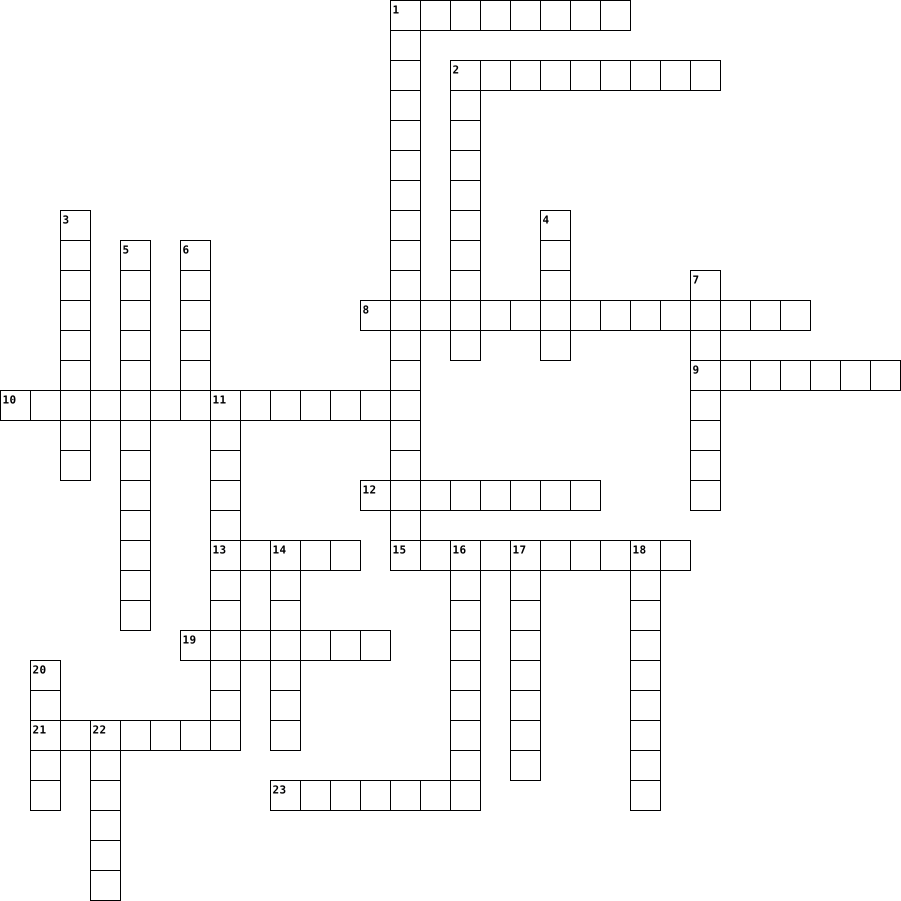
Economics Vocabulary 2025-02-03

Across
- Desire for goods, services or intangible items that can only be acquired by spending money – items like a car, or a haircut, or a patent
- All the components needed for production including natural resources, labor, capital goods, and expertise
- Something’s usefulness and the degree to which wants are satisfied
- The study of behavior and decision-making of individuals and businesses in an economy
- The making of products from raw materials and other inputs like labor, machinery, and tools
- The total amount of goods and services used by an economy
- The loss of potential gain from among other alternatives, when one alternative is chosen
- The study of how individuals and societies make decisions about resources, production, distribution, exchange, and consumption of goods and services, given unlimited and competing wants, and given the scarcity of resources
- Choosing between two things that can’t be had or done at the same time; so it’s giving up something you want in exchange for something else you want, often as a compromise
Down
- Want Desires that don’t require money to be obtained, like talking to a friend
- Reducing the amount of money spent in order to save money
- A good or service that has a benefit (or utility) to society, has value and therefore can be traded and exchanged using money, and has some degree of scarcity
- The increase in the general level of prices in an economy
- The using of goods and services by people or by the economy in general
- To categorize, sort, and transport goods to all their final destinations as efficiently, inexpensively, and carefully as possible
- The physical assets used to produce goods and services, including machinery, equipment, buildings, and tools
- The decrease in the general level of prices in an economy
- Materials and substances found in nature that are used for economic gain, including air, water, sun, fertile land, plants, timber, fossil fuels, and minerals
- One who actually uses the product or service (also called the final user, or final customer)
- The study of the behavior, performance, structure, and decision-making of an economy as a whole
- The reality that people’s wants always exceed the resources available to fulfill those wants
21 Clues: Reducing the amount of money spent in order to save money • The increase in the general level of prices in an economy • The decrease in the general level of prices in an economy • The total amount of goods and services used by an economy • Something’s usefulness and the degree to which wants are satisfied • ...
geography + economics 2025-06-11

Across
- alterations to the naturl world and both natural and human process affect it
- measures how countrys run through stsattiscis such as life expectancy and literacy rates
- finanical effects that an event or policy change has on an economy, region or country.
- the total value of assests that a person owns at any point of time that appreciates in value
- the amount of people who are not in a job but are actively seeking employment
- finiancial gains obtained by individuals over a specific person, typically a year
- the effect an organisations actions that affect the wellbeing of a community
- the process of using resources in a way that ensure they will be available for future generations
- an alteration to the environment, whether positive or negative, resulting from human activities or actions
- how long someone is expected to live for in a region
- the unequal distribution of wealth or income in a society
Down
- a numerical statistic that measures how equal a country distributes wealth
- measure how people are feeling, not just statistics based data
- the surrounds on earth, including both living and non living elements
- a standard of measure of value added through the production of goods and services
- an incerase in price of goods and services
- total number of deaths per 1000 births
- the state of being comfortable healthy and happy in all aspects of life
- the total amount of people who can read and write
- force a total number of people who are able to work and are either employed or seeking employment
- a measure of a countrys economic output per person calcularted by the total value of goods and services
21 Clues: total number of deaths per 1000 births • an incerase in price of goods and services • the total amount of people who can read and write • how long someone is expected to live for in a region • the unequal distribution of wealth or income in a society • measure how people are feeling, not just statistics based data • ...
Economics Crossword 2025-06-23

Across
- What happens when quantity supplied is greater than quantity demanded
- All other factors held constant
- A person who sells goods(not supplier)
- Study of choices and scarcity
- Government charge on goods
- What does the W stand for in Sircwite?
- A decrease in price for a complementary good results in a what for the demand
- A change in what causes movement along the demand curve?
- A person who buys goods
- What does the I stand for in Catpises?
- Tax added to goods at sale\
Down
- What does the A stand for in Catpises?
- What does the S stand for in Sircwite?
- What happens when quantity supplied is less than quantity demanded
- An increase in demand causes the demand curve to shift to the…
- The point where supply meets demand
- “The higher the price, the larger the quantity produced” This is the law of…
- The place where buyers and sellers exchange goods and services
- Cost The next best choice given up
- A decrease in supply causes the supply curve to shift to the…
20 Clues: A person who buys goods • Government charge on goods • Tax added to goods at sale\ • Study of choices and scarcity • All other factors held constant • The point where supply meets demand • Cost The next best choice given up • What does the A stand for in Catpises? • What does the S stand for in Sircwite? • A person who sells goods(not supplier) • ...
Economics Review 2025-08-22

Across
- "Gifts of Nature"; natural resources
- Utility is the capacity to be __
- All economies must decide what to ___, how to __, and for whom to __.
- when people perform tasks that they can do most efficiently
- the tools, equipment, and factories used in production
- a risk taker; person who starts a business.
- Factors of __ are the resources required to make things
- Tangible products that satisfy needs and/or wants
- The fundamental economic problem
- The study of how people make choices
- Things that would make your life better, but you most likely wouldn't die without them.
Down
- a location where buyers and seller exchange goods and services
- For something to have __, it must be scarce and have utility.
- The __ market is where economic resources are exchanged.
- dollar value of all final goods and services; a measure of economic health
- a measure of the amount of output by a given number of people
- the accumulation of goods that someone has
- people with all their efforts, abilities, and knowledge
- Value is worth that can be expressed in __
- Work done by people such as barbers, housecleaners, and bakers.
- The __ of value is the situation where some necessities are free while some wants are very expensive.
- The __ market is where individuals spend money to buy goods.
- Things that are necessary for survival
- The __ flow of economic activity shows how individuals, markets, and businesses are interconnected.
24 Clues: Utility is the capacity to be __ • The fundamental economic problem • "Gifts of Nature"; natural resources • The study of how people make choices • Things that are necessary for survival • the accumulation of goods that someone has • Value is worth that can be expressed in __ • a risk taker; person who starts a business. • Tangible products that satisfy needs and/or wants • ...
Economics Review 2025-08-15

Across
- the machinery used to run a business
- a series of questions that are asked to a group of people to gather information about a public opinion
- when a business focuses on producing one or few products to be more efficient in the area
- having a job the returns income for the work provided
- when a business outperforms another with cheaper or better products
- an economic decision made because of scarcity
- the natural resources used in the production of a business
- the money paid
- the amount of money a business earns after taking away the expenses that it has to pay
- how scarce resources are distributed among producers
- the performance of an economy evaluated based on a number of objectives
- the innovation of individuals who combine the three factors of production to create a new product or service
- things that we physically cannot survive without
- a person or business who sells or trades goods and services
- economic resources that are a part of a business
- sending goods to another country
- the economic problem of society having unlimited wants but limited resources to support them
- the study of how how people use resources to satisfy their needs and wants
- the general increase in prices of goods and services
Down
- the amount of money a person who borrows money will have to pay the bank on top of the original amount borrowed
- a type of scarcity, the problem that arises due to the overall lack of a resource; it is finite
- the way participants in an economy rely on each other to provide the goods and services they cannot produce themselves
- a type of scarcity, the problem that arises due to our unlimited wants yet limited resources to fufil them
- someone who is ignored or not accepted by the people around them
- a business or person who employs workers to produce goods and services
- natural or made materials that can be used to produce goods and services, can be divided into the four factors of production
- services performed by others for consumers
- the percentage of people who are unemployed out of all the people who are able to work
- a person or business who purchases or trades for goods and services
- a person who works for a business or organisation
- the exchange of resources among buyers and sellers
- a plan for achieving goals
- the total value of goods/sevices produced in a country over a year, three words
- products traded within the market, items
- what you miss out on when making a choice, the next best unchosen option
- the level of wealth, material goods, comfort and life necessities in a geographical area
- the human resources used to help a business run
- bringing in goods from another country
- the activity of buying, selling or exchanging goods or services between people or countries
39 Clues: the money paid • a plan for achieving goals • sending goods to another country • the machinery used to run a business • bringing in goods from another country • products traded within the market, items • services performed by others for consumers • an economic decision made because of scarcity • the human resources used to help a business run • ...
Economics Vocabulary 2025-09-12

Across
- How much people want something
- Property Things people own themselves
- How people use money and resources to get what they need and want
- Goods sent out to other countries
- When prices go up
- People who buy and use things
- Trading goods without money
- Enterprise System People can choose what to make, sell, and buy
- Money a business makes after costs
- How much of something is available
- People who make or grow things
- How much work is done in a time
- Things that are nice to have but not needed
- Things we must have to live (food, water, shelter)
- Work someone does for others
Down
- Money people earn
- Economy People buy and sell freely
- of Labor Splitting jobs into smaller tasks
- The things made or sold
- Not enough of something
- Focusing on one skill or job
- Cost The thing you give up when you choose something else
- Objects you can touch and buy
- Money used to buy things
- Goods brought into a country
25 Clues: Money people earn • When prices go up • The things made or sold • Not enough of something • Money used to buy things • Trading goods without money • Focusing on one skill or job • Goods brought into a country • Work someone does for others • People who buy and use things • Objects you can touch and buy • How much people want something • People who make or grow things • ...
Economics Crossword 2025-10-15

Across
- Refers to the surge in the demand for housing and residential property.
- Exists when there are many buyers and sellers who are too small to affect price and who offer a homogenous or highly similar good in the market.
- Shows the different quantities the seller is willing to sell at various prices.
- Payment for public goods and services by citizens.
- Is a good which a consumer tends to buy more of when income increases.
- Refers to the quantity of goods that a seller is willing to offer for sale.
- Includes all the inhabitants of a particular town, area, or country.
- Refers to the lowest wage permitted by law below which if paid by employer will subject him to penalty from the government.
- Is a Filipino who works in a foreign country.
- Is a person's liking or preference.
- Is a fixed regular payment, typically paid on a daily or weekly basis, made by an employer to an employee.
- Is a market where a few sellers account for most of or total production.
- Refers to the purchasing power of a person's money income. This is the amount of goods and services one can buy with the income.
- Is where securities of corporations are traded.
- Is the portion of income earned that is not spent on consumption or taxes.
- Refers to the competitive environment in which buyers and sellers operate.
- Are those which are used in place of each other.
Down
- Is a market where there is a sole producer of a product, for which there are no close substitutes.
- This measures the responsiveness of demand to a change in the price of the good.
- Basic factors of production enabling the processing of products towards higher stages.
- Measures how the quantity demanded changes as consumer income changes.
- Exists when quantity demanded is equal to quantity supplied.
- Work for less than 40 hours.
- Government-provided facilities for public use that society and the economy cannot do without.
- Is a type of imperfect competition where firms sell differentiated products which are highly substitutable but are not perfect substitutes.
- Is a change in the entire demand or supply curve, due to a change in a non price determinant of demand or supply.
- The highest price that the seller can charge for the good being sold, normally set by the government.
- Is a means of interaction between buyers and sellers for trading or exchange. It is where the consumer buys and the seller sells.
- Are factors other than price that also can influence the demand for or supply of a good.
- Payment for the use of land belonging to a landowner.
30 Clues: Work for less than 40 hours. • Is a person's liking or preference. • Is a Filipino who works in a foreign country. • Is where securities of corporations are traded. • Are those which are used in place of each other. • Payment for public goods and services by citizens. • Payment for the use of land belonging to a landowner. • ...
International Economics 2025-11-24

Across
- A high form of integration where member nations share policies and often a currency.
- A deliberate downward adjustment of a fixed exchange rate.
- Sudden currency changes that a floating system helps absorb.
- An exchange rate determined by demand and supply for a currency.
- When one country can produce more output from the same resources than another.
- The reduction or removal of trade barriers.
- A system where the government sets and maintains the value of the currency.
- Records investment flows and foreign asset transactions.
- Advantage gained through innovation, productivity or strategy (Porter).
- A fall in the value of a currency.
- A country’s natural resources, labour and capital that influence what it can trade.
- The amount Australians owe to overseas lenders.
- The composition and direction of Australia’s exports and imports over time.
- The ability to meet international financial obligations without excessive foreign debt.
- A deliberate upward adjustment of a fixed exchange rate.
Down
- When one country can produce a good at a lower opportunity cost than another.
- When a central bank intervenes to influence the value of a currency.
- Model showing income flows in an open economy with injections and leakages.
- Full employment and low inflation within the economy.
- The value of exports minus imports of goods.
- Increasing cooperation between countries through trade agreements.
- When debits in the current account exceed credits.
- An increase in the value of a currency.
- Record of all financial transactions between a country and the world.
- Trade without tariffs, quotas, or subsidies.
- The value of one currency in terms of another.
- Overseas funds invested into Australian assets or businesses.
- An economy that engages in international trade and financial flows.
- Part of the BOP recording trade, income and transfers.
- The ratio of export prices to import prices.
30 Clues: A fall in the value of a currency. • An increase in the value of a currency. • The reduction or removal of trade barriers. • The value of exports minus imports of goods. • Trade without tariffs, quotas, or subsidies. • The ratio of export prices to import prices. • The value of one currency in terms of another. • The amount Australians owe to overseas lenders. • ...
Economics Puzzle 2025-11-06

Across
- Country Keynes was born in
- Smith believed trade benefits
- A person who studies money and markets
- Trade between nations should be
- What motivates workers and businesses to improve
- Smith believed competition leads to lower
- of Nations Book Adam Smith is known for
- People working for their own gain help society
- The amount of goods available for sale
- Government should only provide defense, welfare, and public
- Type of policy he believed should manage the economy
- His ideas were opposite to those of Adam
- Smith said that labor creates
- Smith & John Maynard Keynes
Down
- He worked for the British
- Governments should control the level of total in the economy
- He is known as the father of
- John Maynard’s last name
- of Glasgow University Adam Smith went to
- Saving too much could hurt the
- The economic system Smith
- Smith believed that people acted out of self
- Subject Smith studied before turning to economics
- Smith Father of economics
- Where Adam Smith was born
25 Clues: John Maynard’s last name • He worked for the British • The economic system Smith • Where Adam Smith was born • Country Keynes was born in • Smith & John Maynard Keynes • He is known as the father of • Smith Father of economics • Smith believed trade benefits • Smith said that labor creates • Saving too much could hurt the • Trade between nations should be • ...
Economics Final 2026-01-06

Across
- When one person or company controls everything
- Using fewer resources than an economy is capable of using
- Interest on top of interest
- A tax on imported goods
- When supply and demand are equal
- A required payment to the government
- A constant price
- GDP measured in current prices
- Minimum allowed price
- Limited goods and services to meet unlimited wants
- GDP measured in constant, unchanging prices
- A price that changes depending on quantity produced
Down
- The extra benefit of adding one unit
- When someone takes time to look for a job
- The most desirable alternative given up as a result of a decision
- The act of giving up one benefit in order to gain another
- When supply is higher than demand
- When demand is higher than supply
- the degree to which a demand or supply is sensitive to changes in price or income
- Maximum allowed price
- Someone who wants a job but has given up looking
- A general increase in prices across an economy
- When a few large firms control a market
- The extra cost of adding one unit
- When you maximize the output of goods and services
25 Clues: A constant price • Maximum allowed price • Minimum allowed price • A tax on imported goods • Interest on top of interest • GDP measured in current prices • When supply and demand are equal • When supply is higher than demand • When demand is higher than supply • The extra cost of adding one unit • The extra benefit of adding one unit • A required payment to the government • ...
Economics Vocabulary 2026-02-20

Across
- Through their purchases, consumers determine what goods and services will be produced
- Is the amount of a good or service that consumers are willing and able to buy at a certain price.
- Rising of prices
- What is given up when a choice is made
- The amount of a good or service that producers are willing and able to sell at a certain price.
- Inability to satisfy all wants at the same time
- Interaction of consumers, businesses, and markets
- Selecting an item or action from a set of alternatives
- Rivalry between producers/sellers of a good or service
- Using goods and services
- Earnings after all expenses have been paid.
- Amount of money exchanged for a good or service
- Following after
Down
- Markets that are allowed to operate without undue interference from the government.
- The combination of resources to make goods or provide services
- A form of business organization with two or more owners who share the risks and the profits.
- Distribution
- A form of business organization with one owner who takes all the risks and all the profits.
- Pieces/parts
- Person who takes a risk to produce goods and services in search of a profit
- A form of business organization that is authorized by law to act as a legal person regardless of the number of owners
- Things that motivate or incite people to change a behavior
- Factors used in the production of goods and services
23 Clues: Distribution • Pieces/parts • Following after • Rising of prices • Using goods and services • What is given up when a choice is made • Earnings after all expenses have been paid. • Inability to satisfy all wants at the same time • Amount of money exchanged for a good or service • Interaction of consumers, businesses, and markets • ...
Economics Review 2026-04-24

Across
- The price where supply and demand are equal
- Control of the money supply and interest rates
- Money the government spends on goods and services
- When government revenue exceeds spending
- The amount of goods and services money can buy
- How responsive quantity demanded is to price changes
- A curve showing the relationship between tax rates and tax revenue
- The point where quantity supplied equals quantity demanded
- The amount of a good consumers are willing and able to buy at different prices
- A tax system where higher incomes pay a higher percentage
- Money collected by the government from taxes
- As price increases quantity supplied increases
- An economy where decisions are made by consumers and producers
- Income remaining after taxes
- The amount of a good producers are willing and able to sell at different prices
- GDP measured using current prices
- Government-set limits on prices
- A graph showing trade-offs between two goods
- The central bank of the United States
- A tax placed on goods at the point of sale
- The total amount of money the government owes
- A good that can replace another good
Down
- The use of taxes and government spending to influence the economy
- A legal minimum price set above equilibrium
- An increase in an economy’s ability to produce goods and services
- A tax that takes a larger percentage of income from low-income earners
- The total value of final goods and services produced in a country
- When government spending exceeds government revenue
- GDP adjusted for inflation
- A tax on imported goods
- The cost of borrowing money
- When quantity supplied is greater than quantity demanded
- As price increases quantity demanded decreases
- Demand that does not change much when price changes
- The value of the next best alternative that is given up
- An economy with both market and government involvement
- Principle The idea that choosing one option means giving up another
- When quantity demanded is greater than quantity supplied
- A legal maximum price set by the government
- Limited resources with unlimited wants
- A sustained increase in the overall price level
41 Clues: A tax on imported goods • GDP adjusted for inflation • The cost of borrowing money • Income remaining after taxes • Government-set limits on prices • GDP measured using current prices • A good that can replace another good • The central bank of the United States • Limited resources with unlimited wants • When government revenue exceeds spending • ...
Economics Crossword 2026-04-16

Across
- What occurs when the average price level increases but at a decreasing rate than before?
- The __ can intervene in different ways to alleviate different forms of unemployment depending on where they stem from.
- _ is the sustained increase in average price level of goods/services in an economy.
- According to the natural rate of unemployment, full employment does not mean that everyone in the __ population is willing to work.
- _ Inflation is caused by excess demand in the economy.
- Increase in investment causes the ____ Demand (AD) curve to shift to the right
- What kind of unemployment is caused by a mismatch between jobs and skills? __ Unemployment
- Economic Growth can occur in Long run and __ run
- An increase in economic growth usually leads to higher standards of __ for people.
- State of the economy when growth rates are: 6%, 4%, −2%, −7%, −5%.
Down
- Consumers are impacted in inflation due to the decrease in __ power
- Air pollution is the example of negative ____
- In SRPC, there is always __ and Structural unemployment.
- Unemployment has diverse effects on the economy. In firms long-term unemployment may lead to a loss in Production __, leading to a decrease in supply.
- The Monetarist model states a decrease in money supply causes _.
- Increase in the cost of production causes _ inflation.
- A situation where people are actively looking for jobs but cannot find work.
- Alfred is a pensioner over the age of 70, which means he isn't a part of the __ force
- Economic Growth in Long Run involves the factor of __
- Economic growth is measured by the increase in a country’s total __ over time.
- Investment in infrastructure and technology can help improve economic __.
21 Clues: Air pollution is the example of negative ____ • Economic Growth can occur in Long run and __ run • Economic Growth in Long Run involves the factor of __ • Increase in the cost of production causes _ inflation. • _ Inflation is caused by excess demand in the economy. • In SRPC, there is always __ and Structural unemployment. • ...
marketing 2015-10-02

Across
- includes the money
- process of developing,promoting, and distributing products
- business focuses on satisfying customer needs and wants
- strategy of offset business risks
- multiplier effect, meaning the portion for the money
- group of customers with shared needs and wants
- amount of money remaining from revenues after all expenses are paid
- unavoidable weather conditions
- study of the economics of the entire society
Down
- involves the locations and methods used to make products available
- known as natural resources
- growing division of marketing field that focuses on the business
- study of relationships between individual consumers
- possibility of financial gain or loss or personal injury
- human resources
15 Clues: human resources • includes the money • known as natural resources • unavoidable weather conditions • strategy of offset business risks • study of the economics of the entire society • group of customers with shared needs and wants • study of relationships between individual consumers • multiplier effect, meaning the portion for the money • ...
Mata Pelajaran 2013-02-05
Across
- Geography or nature studies
- Five Principles
- Indonesian
- Economics
- Flag-raising ceremony
- Sport
- Religion
- Mathematics
- Cooking
- History
- Biology
Down
- Science
- Education
- Art of sound
- Chemistry
- English
- Physics
- Art
- Regional Language
- Algebra
- Technology
- Sewing
- Health
- Music
- Timetable
25 Clues: Art • Sport • Music • Sewing • Health • Science • English • Physics • Algebra • Cooking • History • Biology • Religion • Education • Chemistry • Economics • Timetable • Indonesian • Technology • Mathematics • Art of sound • Five Principles • Regional Language • Flag-raising ceremony • Geography or nature studies
vocab 2024-01-05

Across
- marginal
- using
- person
- equipment
- survival
- takes away
- worker
- study
- value
- one factor
- anything
- tool
Down
- land
- method
- additional
- economic
- factor
- factors of
- main factors
- desire
- not using
- process
- resources
- act of buyers
- change
25 Clues: land • tool • using • study • value • method • factor • person • desire • change • worker • process • economic • marginal • survival • anything • equipment • not using • resources • additional • factors of • takes away • one factor • main factors • act of buyers
spanish 2025-10-22

Across
- ( test,quiz)
- (school)
- (classmate)
- (physics)
- (geography)
- (stadium)
- (trimester,qaurter)
- (music)
- (bookstore)
- ( computer science)
- (home)
- (biology)
- (test, exam)
- ( university)
Down
- (cafeteria)
- (homework)
- ( schedule)
- (economics)
- (course)
- (accounting)
- (laboratory)
- (sciences)
- (class)
- (library)
- (semester)
- (spanish)
- (art)
27 Clues: (art) • (home) • (music) • (class) • (school) • (course) • (physics) • (stadium) • (library) • (spanish) • (biology) • (homework) • (sciences) • (semester) • (cafeteria) • ( schedule) • (economics) • (classmate) • (geography) • (bookstore) • ( test,quiz) • (accounting) • (laboratory) • (test, exam) • ( university) • (trimester,qaurter) • ( computer science)
40 - 41 vocab 2025-11-05

Across
- biblioteca (library)
- (art)
- escuela (school)
- (university; college)
- (labratory)
- (computer science)
- (Spanish)
- estadio (stadium)
- (classmate)
- (economics)
- (schedule)
- (class)
- cafeteria (cafeteria)
- (bookstore)
Down
- (music)
- (biology)
- (test; quiz)
- (sciences)
- (course)
- (trimester; quarter)
- (test; exam)
- casa (house; home)
- (homework)
- (accounting)
- (geography)
- (physics)
- (semester)
27 Clues: (art) • (music) • (class) • (course) • (biology) • (Spanish) • (physics) • (sciences) • (homework) • (schedule) • (semester) • (labratory) • (geography) • (classmate) • (economics) • (bookstore) • (test; quiz) • (test; exam) • (accounting) • escuela (school) • estadio (stadium) • casa (house; home) • (computer science) • biblioteca (library) • (trimester; quarter) • (university; college) • cafeteria (cafeteria)
adam smith 2025-10-31

Across
- first to write
- writing
- have value
- belief
- book published
- philosopher
Down
- criticism
- ideas
- period
- other writing
- taught at
- school
- economics father
- born
- passed away
15 Clues: born • ideas • period • school • belief • writing • criticism • taught at • have value • passed away • philosopher • other writing • first to write • book published • economics father
LU7 TH 2 Part 1 2025-09-26

Across
- oppilaanohjaus
- kotitalous
- jälki-istunto
- erityisopettaja
- kirjallisuus
Down
- käsityöt
- lukujärjestys
- luokanvalvoja
- oppiaine
- terveystieto
- lounastauko
- fysiikka
- rehtori
- oppitunti
- maantieto
15 Clues: rehtori • käsityöt • oppiaine • fysiikka • oppitunti • maantieto • kotitalous • lounastauko • terveystieto • kirjallisuus • lukujärjestys • luokanvalvoja • jälki-istunto • oppilaanohjaus • erityisopettaja
Business definitions Week 1 2025-02-20

Across
- Selling your goods or services overseas
- This is a part of economics that concentrates on the actions of individuals and groups, rather than of whole economics
- Rapid,or out of control inflation. It usually only occurs during wars or during severe political instability
- A market where only a few firms control the percentage of total sales.
Down
- A logo,brand name, or phrase legally registered by one company.
- An official legal document confirming that an individual or company has the sole right to make, use or sell a particular invention
- Buying goods or services from overseas and bringing them into the country
- A part of economics that seeks to simplify and show the progress of whole economics rather than focus on individuals or groups(see microeconomics)
- The movement of cash into and out of a business.
- The amount of profit remaining after deductions such as tax have been made
10 Clues: Selling your goods or services overseas • The movement of cash into and out of a business. • A logo,brand name, or phrase legally registered by one company. • A market where only a few firms control the percentage of total sales. • Buying goods or services from overseas and bringing them into the country • ...
editing videos 2020-10-26

Across
- allergi
- laga mat,koka
- lektion
- tilltalande,lockande
- få,några
- mat
- varm,tillagad,kokt
- for tillgodose,ordna(åt)
- ha med sig
- ingrediens
Down
- läcker,jättegod'
- tro
- hälsosam
- mata
- economics huslig ekonomi
- matlagning
- vitlök
- kräva
18 Clues: tro • mat • mata • kräva • vitlök • allergi • lektion • hälsosam • få,några • matlagning • ha med sig • ingrediens • laga mat,koka • läcker,jättegod' • varm,tillagad,kokt • tilltalande,lockande • economics huslig ekonomi • for tillgodose,ordna(åt)
Béla (Zoltán) 22 Aug 2024 2024-08-20

Across
- - feltéve, ha
- ... economics - technika óra
- - zord, barátságtalan
- - logikátlan
- - összefüggéstelen, zavaros
- - képtelen
- - mez
- - alkalmatlan
- - elkoboz
- ... exam - szigorlat
Down
- - haladó
- - olvashatatlan
- ... chicken - sült csirke
- - személytelen
- - rosszul felszerelt
- - kellemetlen, kényelmetlen, alkalmatlan
- - nem praktikus
- - bántalmazott
18 Clues: - mez • - haladó • - elkoboz • - képtelen • - logikátlan • - feltéve, ha • - alkalmatlan • - személytelen • - bántalmazott • - olvashatatlan • - nem praktikus • - rosszul felszerelt • ... exam - szigorlat • - zord, barátságtalan • ... chicken - sült csirke • - összefüggéstelen, zavaros • ... economics - technika óra • - kellemetlen, kényelmetlen, alkalmatlan
Say it in Kiswahili 2013-03-12

Across
- Child
- Parent
- Cooperative Economics
- Collective Work & Responsibility
- Student
- Hello
- See you later
Down
- Teacher
- What's the news
- Self-Determination
- Goodbye
- Faith
- Creativity
- Unity
- Purpose
15 Clues: Child • Faith • Hello • Unity • Parent • Teacher • Goodbye • Student • Purpose • Creativity • See you later • What's the news • Self-Determination • Cooperative Economics • Collective Work & Responsibility
Chapter 6 APES Crossword 2022-05-20

Across
- Values not usually included in price of goods and services
- A trio of goals made up of economic advancement, environmental protection, and social equity.
- Economic progress that maintains resources for the future.
- The study of good and bad.
- Application of ethical standards to relationships between people and nonhuman entities
- Total monetary value of final goods and services a nation produces each year.
- Ensemble of knowledge, beliefs, values, etc
- The use of natural resources for economic advancement.
- Corporates mislead consumers into thinking the company is acting more sustainable than it actually is.
- Those who maintain that there exist objective notions of right and wrong that hold across cultures and contexts.
- People who judge actions in terms of their effects on whole ecological systems.
Down
- Holds that we should protect the natural environment in a pristine, unaltered way.
- To value something for the pragmatic benefits it brings us if we put it to use.
- To believe that something has a right to exist and is valuable for its own sake.
- Study of how people decide to use potentially scarce resources to provide goods and services that are in demand.
- People who have a human-centered view of our relationship with the environment.
- Perspective that ascribes intrinsic value to certain living things.
- The perception of the world.
- Uses surveys to determine how much people are willing to pay to protect or restore a resource.
- are People who believe that ethics do and should vary with social context.
20 Clues: The study of good and bad. • The perception of the world. • Ensemble of knowledge, beliefs, values, etc • The use of natural resources for economic advancement. • Values not usually included in price of goods and services • Economic progress that maintains resources for the future. • Perspective that ascribes intrinsic value to certain living things. • ...
Joaquin Diaz-B3 2025-05-30

Across
- Farming pattern by distance (5IDK)
- Moving out of a country (2CC)
- Place’s physical features (1CC)
- Cultures blending together (3IDK)
- Housing near a city (7CC)
- Map comparison tool that helps us understand spatial patterns (1VIT)
- Traditional small-group culture (3CC)
- Adopting some cultural traits (3IDK)
- Farming tech that increased food production but caused environmental issues (5VIT)
- Power to rule independently, defining a state’s control (4VIT)
- Jobs using raw materials (6CC)
- Spread of cultural traits, explaining how ideas move worldwide (3VIT)
- Model showing population changes and helps predict growth (2VIT)
- Move far by short steps (2IDK)
- Total value of goods and services showing economic strength (6VIT)
- Business area outside city (7IDK)
- Moving into a country (2CC)
- Jobs making finished products (6CC)
Down
- Non-workers compared to workers (2IDK)
- Growth of cities affecting economics, housing, and environment (7VIT)
- Environment allows choices people make (1IDK)
- Farming that needs a lot of labor (5IDK)
- People with shared culture (4CC)
- Place to switch transport types (6IDK)
- Modern widespread culture (3CC)
- Farming to feed yourself (5CC)
- Force that divides a country (4IDK)
- Political area with borders (4CC)
- Land use rules (7IDK)
- How tech shrinks distance and speeds up connections (1IDK)
- Farming to sell food (5CC)
- Businesses clustering together (6IDK)
- Location compared to others (1CC)
- Rural area past suburbs (7CC)
- Area stuck between conflict (4IDK)
35 Clues: Land use rules (7IDK) • Housing near a city (7CC) • Farming to sell food (5CC) • Moving into a country (2CC) • Moving out of a country (2CC) • Rural area past suburbs (7CC) • Farming to feed yourself (5CC) • Jobs using raw materials (6CC) • Move far by short steps (2IDK) • Modern widespread culture (3CC) • Place’s physical features (1CC) • People with shared culture (4CC) • ...
John Maynard Keynes 2026-03-06

Across
- Won the ____ Smith prize in 1909
- He believed we should _________ government spending
- What John Maynard Keynes was best known for
- How he emphasized the importance of government intervention
- Where Keynes was Born
Down
- The type of economics Keynes founded
- The style of modern-day economics he laid out the foundation for
- Writes the general theory of employment, ________, and money
8 Clues: Where Keynes was Born • Won the ____ Smith prize in 1909 • The type of economics Keynes founded • What John Maynard Keynes was best known for • He believed we should _________ government spending • How he emphasized the importance of government intervention • Writes the general theory of employment, ________, and money • ...
English 2024-03-28

Across
- People who care for environmental
- The process of decomposing organic waste using microorganisms
- Agency that develops innovative policies and research strategies related to the environment that transforms research results into political decisions to realize sustainable development both in the Asia-Pacific region and globally
- One of the renewable energy using solar
- The most biodiverse places on Earth, filled with more species of animals than any other habitat on land
- An award for cities in Indonesia that successful in cleanliness and urban environmental management, organized by the Ministry of Environment and Forestry
- Country that Jerhemy Owen has visited for their bestest system to decompost and recycling waste
- The figure who saved the north coast of Kendal by planting mangroves and ever received appreciation for the Kalpataru award from the Ministry of Environment and Forestry in 2020
- The largest waste disposal site (TPA) in Indonesia is managed by the DKI Jakarta Provincial Government
- One of product that made by Joseph Wijaya
- How many types of pollution?
Down
- The result of fermentation of organic kitchen waste into ingredients that have many benefits for nature and humans
- Jerhemy Owen activity which he's invited to jog while also protecting the environment
- Product that Bali Earth Friends Foundation made
- An environmentalist group from Indonesia
- One of the 3R's
- An inspiring environmental activist from US who continuously advocates for environmental protection
- The month of International Environmental Day
- An environmentalist from Sweden, known for challenging world leaders to immediately take action to mitigate climate change
- Little hero from Gresik, active in dealing with polluting waste in the river and also made Germany aware to stop throwing garbage in our country
- Sustainable Development Goals
- Place that the biggest cleanup happens
- Program that Melati and Isabel Wijsen created in Bali
- The first Integrated Waste Processing Site that still under construction and focuses on sorting waste and recycling
24 Clues: One of the 3R's • How many types of pollution? • Sustainable Development Goals • People who care for environmental • Place that the biggest cleanup happens • One of the renewable energy using solar • An environmentalist group from Indonesia • One of product that made by Joseph Wijaya • The month of International Environmental Day • ...
Subject integration 2026-06-06

Across
- or pull acting on an object. (Physics) — 5
- composition in verse. (English) — 4
- material in living organisms. (Biology) — 3
- for Information Technology. (IT) — 2
- Clues
- levy on income or goods. (Economics) — 3
- particle of an element. (Chemistry) — 4
- of exchange. (Economics) — 5
- unit of life. (Biology) — 4
- period that has already happened. (History) — 4
- microorganism. (Biology) — 5
Down
- needed for growth and repair of the body. (Biology) — 5 (PROTEIN shortened intersection variant may be adapted)
- and selling activity. (Commerce/Management) — 5
- used in place of a noun. (English Grammar) — 7
- Clues
- written for a computer. (IT) — 4
- body of a state. (Political Science/Hindi) — 5
17 Clues: Clues • Clues • unit of life. (Biology) — 4 • of exchange. (Economics) — 5 • microorganism. (Biology) — 5 • written for a computer. (IT) — 4 • composition in verse. (English) — 4 • for Information Technology. (IT) — 2 • particle of an element. (Chemistry) — 4 • levy on income or goods. (Economics) — 3 • or pull acting on an object. (Physics) — 5 • ...
Functions 2026-03-13

Across
- Protection against osmotic stress
- Movement of substances across membrane
- Retention of nutrients in inclusions
- Ability to adhere to surfaces
- Attachment to environmental surfaces
- Chemical reactions in cells
- Movement along magnetic fields
- Generation of cellular energy
- Ability of bacteria to cause disease
- Persistence in unfavorable conditions
- Ability to withstand antibiotics
- Protection against ion changes
- Endospore returning to active cell
Down
- Ability to grow on surfaces
- Ability of bacteria to move
- Defense against environmental stress
- Process performed by ribosomes
- Ability to float using gas vesicles
- DNA copying process
- Movement of genes between cells
20 Clues: DNA copying process • Ability to grow on surfaces • Ability of bacteria to move • Chemical reactions in cells • Ability to adhere to surfaces • Generation of cellular energy • Process performed by ribosomes • Movement along magnetic fields • Protection against ion changes • Movement of genes between cells • Ability to withstand antibiotics • Protection against osmotic stress • ...
“No Free Lunch” 2022-03-14

Across
- is the study of how we make decisions in a world in which resources are limited
- the demand for a good or service is greater than the availability of the good or service, the problem of limited resources
- trees, metals, and fuel are examples
- there is a fixed amount of something
- the purchase or use of a good or service
- off Decision that must be made when choosing between items
- the act of making a good
- necessary for survival
Down
- cost value of the next best alternative that was given up when an economic choice was made
- the movement of goods and services
- because of scarcity, we make these every day
- the law of economics that states businesses will produce more when things can be sold at a higher price and fewer things when prices are low
- there is an endless amount of something
- the law of economics that says buyers will buy more when prices are low and buy less when prices are high
- economic system in which the means of production are owned by private citizens
- something we would like to have but do not have to have
16 Clues: necessary for survival • the act of making a good • the movement of goods and services • trees, metals, and fuel are examples • there is a fixed amount of something • there is an endless amount of something • the purchase or use of a good or service • because of scarcity, we make these every day • something we would like to have but do not have to have • ...
Chemistry crossword puzzle 2020-05-25

Across
- nitrogen
- sugar
- kilogram
- meltingpoint
- distillation
- heterogenous
- inorganic
- polymer
- excitation
- chromatography
- color
- one
- alcohol
- homogenous
- gas
- environmental
- ampere
- biochemistry
- water
- butane
- liquid crystal
- industrial
- centimeter
- bakingsoda
- volume
- liquid
Down
- kelvin
- floatation
- analytical
- organic
- strange
- electro-degenerate
- neutron-degenerate
- elements
- solid
- photogenic
- two
- covalent
- boilingpoint
- plasma
- plasma
- second
- physical
- covalent
- three
- mass
- methane
- candela
- density
- metallic
- ionic
- salt
52 Clues: one • two • gas • mass • salt • sugar • color • solid • three • water • ionic • kelvin • plasma • plasma • second • ampere • butane • volume • liquid • organic • strange • polymer • alcohol • methane • candela • density • nitrogen • kilogram • elements • covalent • physical • covalent • metallic • inorganic • floatation • analytical • excitation • photogenic • homogenous • industrial • centimeter • bakingsoda • meltingpoint • distillation • heterogenous • boilingpoint • biochemistry • ...
School subjects 2022-08-19

Across
- Tyska
- Bild
- Hemkunskap
- Träslöjd
- Fysik
- Kemi
Down
- Syslöjd
- Franska
- Biologi
- Idrott
- Matte
- Spanska
- Svenska
13 Clues: Bild • Kemi • Tyska • Matte • Fysik • Idrott • Syslöjd • Franska • Biologi • Spanska • Svenska • Träslöjd • Hemkunskap
“No Free Lunch” 2022-03-14

Across
- is the study of how we make decisions in a world in which resources are limited
- the demand for a good or service is greater than the availability of the good or service, the problem of limited resources
- trees, metals, and fuel are examples
- there is a fixed amount of something
- the purchase or use of a good or service
- off Decision that must be made when choosing between items
- the act of making a good
- necessary for survival
Down
- cost value of the next best alternative that was given up when an economic choice was made
- the movement of goods and services
- because of scarcity, we make these every day
- the law of economics that states businesses will produce more when things can be sold at a higher price and fewer things when prices are low
- there is an endless amount of something
- the law of economics that says buyers will buy more when prices are low and buy less when prices are high
- economic system in which the means of production are owned by private citizens
- something we would like to have but do not have to have
16 Clues: necessary for survival • the act of making a good • the movement of goods and services • trees, metals, and fuel are examples • there is a fixed amount of something • there is an endless amount of something • the purchase or use of a good or service • because of scarcity, we make these every day • something we would like to have but do not have to have • ...
“No Free Lunch” 2022-03-14

Across
- something we would like to have but do not have to have
- cost value of the next best alternative that was given up when an economic choice was made
- trees, metals, and fuel are examples
- the demand for a good or service is greater than the availability of the good or service, the problem of limited resources
- the movement of goods and services
- economic system in which the means of production are owned by private citizens
Down
- there is an endless amount of something
- there is a fixed amount of something
- the purchase or use of a good or service
- the act of making a good
- necessary for survival
- because of scarcity, we make these every day
- the law of economics that says buyers will buy more when prices are low and buy less when prices are high
- is the study of how we make decisions in a world in which resources are limited
- the law of economics that states businesses will produce more when things can be sold at a higher price and fewer things when prices are low
- Decision that must be made when choosing between items
16 Clues: necessary for survival • the act of making a good • the movement of goods and services • there is a fixed amount of something • trees, metals, and fuel are examples • there is an endless amount of something • the purchase or use of a good or service • because of scarcity, we make these every day • Decision that must be made when choosing between items • ...
Economics Rocks 2021-06-08

Across
- What does it mean when the Unemployment rate is 5% or less?.
- The value of the next-best alternative.
- What is it called when GDP is low, so unemployment is high?.
- What is it called when the FED uses its power to increase or decrease the money. supply?
- The study of the behavior and decision making of an economy as a whole.
- actions by Congress to increase or decrease aggregate demand to fight inflation, recession, or stagflation is called?.
- The study of how people try to satisfy their needs and wants with limited resources.
- The desire, ability, and willingness to buy a product.
- The point where the supply curve and the demand curve cross is called….
- When a change in price causes a big change in quantity demanded
- Which of the 5 C’s of creditworthiness definitions is this “the consumers,what they need to pay and how much there making ratio”.
- What is it called when a lender determines that you will default on your debt obligations, or how worthy you are to receive new credit?.
- The idea that there are a limited. amount of resources to meet unlimited wants and needs.
- The amount of a product offered for sale at all available prices.
- What is it called when you calculate how many dollars worth of goods and services are made in a country over time (typically one year).
Down
- When a change in price causes only a little change in quantity demanded
- What is the name of the people who prefer fewer or even no trade restrictions?.
- The study of the behavior and decision making of individuals and businesses.
- Which of the 5 C’s of creditworthiness definitions is this”The amount of money the consumers have total”?.
- What is it called when prices are not going up too quickly?.
- The Fourth Largest source of federal revenue is called?.
- What is it called when there is a Recession and Inflation happening at the same time?.
- Which of the 5 C’s of creditworthiness definitions is this “the consumers past credit spendings”?.
- Which of the 5 C’s of creditworthiness definitions is this “something for something so if the person/bank gives you money they have something that they know you will want back so theyll keep it till you pay them back”.
- spending of social security is called...
25 Clues: The value of the next-best alternative. • spending of social security is called... • The desire, ability, and willingness to buy a product. • The Fourth Largest source of federal revenue is called?. • What does it mean when the Unemployment rate is 5% or less?. • What is it called when GDP is low, so unemployment is high?. • ...
Economics final 2021-06-10

Across
- Inside the production possibilities curve not using all resources fully
- When people with larger incomes pay a higher percentage of their incomes in taxes
- A determinant of supply
- The demand line on a graph showing the increase and decrease of prices based on quantity demanded
- The amount or number of a material
- How much business is one to produce at different prices
- Works by expanding the money supply faster than usual
- The sum of all people aged 16 or above who are either employed or actively seeking employment
- Consists of human-created assets
- Limited in amount
- How demand curves slope from left to right
Down
- A ___is a person who starts a new business.
- The action of helping or doing work for
- A determinant of demand
- A government set maximum price for a product
- The amount of money expected, required, or given in payment for something
- A state in which opposing forces or influences are balanced
- When people with lower incomes pay a higher percent of their incomes in taxes
- When quantity demanded is greater than quantity supplied
- Mandatory spending is simply all spending that does not take place through appropriations legislation
- When quantity supplied is greater than quantity demanded
- The exchange of goods and services
- A tax on imports to limit international trade The action of buying and selling goods and services
- A regular gathering of people for the purchase and sale of provisions
- The factor of production that is workers
25 Clues: Limited in amount • A determinant of demand • A determinant of supply • Consists of human-created assets • The amount or number of a material • The exchange of goods and services • The action of helping or doing work for • The factor of production that is workers • How demand curves slope from left to right • A ___is a person who starts a new business. • ...
Economics Final 2021-06-09

Across
- ________________ is an example of a normal healthy econnomy
- The stock with the highest risk but greatest potential rewards is?
- ____________is the power to increase or decrease the “money supply” (the amount of money circulating through the United States)
- What is the idea that there are a limited amount of resources to meet unlimited wants and needs?
- ______________ just means “total” demand.
- Fighting high inflation and recessions are two main goals of the_______
- The maximum amount of money you should spend on housing in 1 month should be ___ of your monthly income
- ___is how many dollars worth of goods and services are made in a country over time (typically one year)
- the value of the next-best alternative is an?
- the study of how people try to satisfy their needs and want with limited resources is?
- The ___________ states that consumers will buy more of a product at lower prices and less at higher prices
- ____________ is the Actions by Congress to increase or decrease aggregate demand to fight inflation, recession, or stagflation.
- The ___________shows the quantities demanded at all possible prices
- Using your money for things that matter to you is?
- __________ is the concept that an increasing consumption of goods is greatly beneficial to the economy was an intentional shift from product utility to desires
Down
- Prices rising too rapidly is Indicated by an?
- A “shrinking” economy producing fewer goods and services than before is an example of a?
- ______is the amount of a product offered for sale at all available prices
- the study of the behavior and decision-making of individuals and businesses is?
- the study of the behavior and decision-making of an economy as a whole is?
- True or false, when making a budget you want to get as close as possible to the 50/30/20 rule
- _____________is shown by drawing a very flat demand curve
- the desire, ability, and willingness to buy a product is?
- How many ways can congress increase or decrease aggregate demand
- Recession + Inflation is?
25 Clues: Recession + Inflation is? • ______________ just means “total” demand. • Prices rising too rapidly is Indicated by an? • the value of the next-best alternative is an? • Using your money for things that matter to you is? • _____________is shown by drawing a very flat demand curve • the desire, ability, and willingness to buy a product is? • ...
Economics 123654987 2022-08-29

Across
- The percentage of workers who are interested in working. (dash symbol to divide 2 words)
- Known as the biggest trade deal in the world, it has mainly lost its power since the US withdrew from the trade deal in early 2017 (dash symbols to divide 3 words)
- Post tax income (dash symbols to divide 2 words)
- Extra benefits levied to an employee, such as a company car (dash symbol to divide 2 words)
- when an individual is willing to work more hours but the business is unable to give it
- this will increase if consumers are spending more on business products (dash symbol to divide 2 words)
- The revenue that the government takes in order to run the government
- Human resources, lawyers, teachers
- Conditions of overseas countries to buy and sell imports and exports (Acronym)
- the 'amount' of as good and service that a producer can provide, will fluctuate with the amount of the good or service demanded and price
- A factor that considers the amount of individuals that are in a country (dash symbol to divide 2 words)
- to govern a country or state
- Trade agreement between Australia and Asia-Pacific (acronym)
- the cost of 'foregoing' a resource for the value of the next best alternative (dash symbol to divide 2 words)
- Graphical representation of the production of two goods or services (Acronym)
- the 'want' for a specific good or service from the public, will fluctuate with the amount of the good and service including price
- the type of unemployment that occurs with a fundamental shift in the economy
- a market comprised of price-takers that seeks to dominate the market (dash symbol to divide 2 words)
- Anything of value than an individual or business owns
- Financial institution that allows loans, deposits and withdrawals
- A type of unemployment that occurs due to the factors of the individual, such as a criminal record
- The sector that involves the government in the circular flow model (dash symbol to divide 2 words)
- A measure of human development in a country (Acronym)
- A good or service that is desired in order to provide satisfaction to the user, but which is not necessary for survival or to meet the basic standard of living in a community.
- Trade agreement between Australia, New Zealand and several other South-Eastern nations (acronym)
- Resources that can create more resources, computers, hammers, machinery
- An organisation, enterprise or business engaged in the production and trade of goods and services, usually for profit.
- buying goods from another country
- a living standard that is defined through economic growth and the contribution of GDP for the individual
- the type of Tax on a good
- the type of unemployment that is happens when an individual is between two jobs
- a series of circumstances that influence the production of a good or service
- the system by which goods and services are produced, sold and bought in a country
- Multilateral trade agreement between 15 Indo-Pacific nations, including Japan, China, Japan and South Korea (acronym)
- percentage of individuals who are aged 15 and over who are either employed or willing to work (dash symbol to divide 2 words)
- Income deducted from interest rates, the higher the interest rate, the lower the ______ income (dash symbol to divide 2 words)
- a statutory authority body that regulates market fairness and competition in Australia, synonymous with the Competition and consumer act 2010 (acronym)
- Materials that are bought from overseas to manufacture resources, then export said resources (Acronym)
- a type of trade agreement which involves multiple countries
- a type of trade agreement between two countries
- Pay as you go (acronym)
- A demand-side factor that increases business confidence and is characterised by the consumer’s optimism of their future (dash symbol to divide 2 words)
- The firms section of the circular flow model (dash symbol to divide 2 words)
- when two countries exchange goods
- The perceived fairness of the way scarce resources are used and the way the benefits of production are distributed.
Down
- The total supply of goods and services in a economy (dash symbol to divide 2 words)
- the use of goods and services by households
- in the ad formula, this is represented by the letter c (dash symbol to divide 2 words)
- Natural resources defined by geography, coal, wood, rivers
- a type of trade agreement which involves several countries in one region
- the type of unemployment where the individual removes themselves from the workforce and the unemployment data
- Efficiency of resources being allocated to the production of goods and services.
- the logic where goods and services are in a natural shortage of supply (dash symbol to divide 2 words)
- Closer Economic Relations Trade Agreement (acronym)
- The sector that involves imports and exports (dash symbol to divide 2 words)
- A sector of the economy composed of businesses and non-government organisations that use their surplus funds to achieve goals rather than distribute these funds to the owners. Not-for-profit organisations often exist in the form of charities, service organisations and clubs. (dash symbols to divide 3 words)
- ______ curve
- The total demand of an economy represented by the GDP (dash symbol to divide 2 words)
- regular deposits into an employee’s account that will grow through appreciation until the employee’s withdrawal or retirement.
- A graph that dictates the productional efficiency of two products. (dash symbols to divide 3 words)
- A type of leakage from the financial sector.
- Quantified economic activity of a nation (Acronym)
- selling goods to another country
- allocating money towards a specific sector for profit
- the state where companies and brands compete against one another to maximise profits
- A type of unemployment that occurs at certain times of the year
- Government-promoted spending on the acquisition of goods and services (dash symbol to divide 2 words)
- Things that add money to the circular flow model
- living standards that cannot be conventionally measured (dash symbol to divide 2 words)
- A type of unemployment that occurs when the Aggregate demand for an economy decreases.
- a market with homogenous products and a universal selling and buying game that its easy to enter (dash symbol to divide 2 words)
- in the ad formula, this is represented by the letter i (dash symbol to divide 2 words)
- Government-promoted spending on capital resources, roads and means of supply (dash symbol to divide 2 words)
- Business know-how
- A trade agreement (acronym)
- Describes the means by which the forces of demand and supply determine prices and the allocation of scarce resources between competing uses. (dash symbol to divide 2 words)
- The consumer section of the circular flow model (dash symbol to divide 2 words)
- consumption that is either private or corporate
- the type of Tax against the companies based on profits
- _____ rates
- Things that remove money from the circular flow model
- a strict market with a few competitors that is difficult to enter, price takers
82 Clues: _____ rates • ______ curve • Business know-how • Pay as you go (acronym) • the type of Tax on a good • A trade agreement (acronym) • to govern a country or state • selling goods to another country • buying goods from another country • when two countries exchange goods • Human resources, lawyers, teachers • the use of goods and services by households • ...
Fundamental Economics 2022-09-22

Across
- system in which economic decisions are left up to producers and consumers
- what motivate individuals, businesses, and gov't to undertake or avoid an action
- distribution of goods
- how individuals, businesses, and gov'ts choose to use limited resources
- the way a country organizes economic activity
- gifts of nature we use to produce goods and services
- result of people having unlimited wants and limited resources
- comparing marginal costs and marginal benefits of a choice or action
- change in total benefit received from one more unit
- total satisfaction gained from consuming a good or service
- economic model that illustrates possible production combinations
- resources used to produce goods and services
Down
- individuals concentrate on a single activity or an area of expertise
- knowledge and skills people gain from education
- what to produce, how to produce, for whom to produce
- efficiency with which goods and services are produced
- when a resource, good, or service becomes unavailable
- system in which decision about production and consumption are made by a central authority
- change in total cost paid for one more unit
- the tools and equipment used in production
- economic system in which both gov't and individuals play important roles
- act of willingly trading one item or service for another
- way a person lives that can increase with education/training
- the point where marginal benefit equals marginal costs
- value of the next best choice that is given up when making a choice
25 Clues: distribution of goods • the tools and equipment used in production • change in total cost paid for one more unit • resources used to produce goods and services • the way a country organizes economic activity • knowledge and skills people gain from education • change in total benefit received from one more unit • what to produce, how to produce, for whom to produce • ...
Business Economics 2022-10-31

Across
- Coal is an example of __ factors of production
- Type of economy that uses elements of all three
- level of income
- How much something is worth
- Created as a result of process
- of money
- A person who employ workers to producer goods
- The type of money that circulates in different
- Macroeconomics deals with
- Consumer's desire and willingness to pay a price
- Putting money aside to spend on a later date
- Valuable things to pay some goods or service
- The money used to start a business
- A picture or a symbol representing a business
Down
- Action of buying and selling goods and services
- services
- Knowledge about the production, consumption,
- People who buy your product
- Where buyers and sellers interact
- Goods and services sold to other countries
- The study of individual
- The sudden rise in price
- necessary for survival
- good
- Amount of money required to pay for a good or
- The situation that exists when there are not enough resources to meet human wants
- A luxury item
- Reward paid for unskilled labour
- The money paid to the government depending on
- Input factor classified as skilled, semiskilled and unskilled
30 Clues: good • services • of money • A luxury item • level of income • necessary for survival • The study of individual • The sudden rise in price • Macroeconomics deals with • People who buy your product • How much something is worth • Created as a result of process • Reward paid for unskilled labour • Where buyers and sellers interact • The money used to start a business • ...
Business Economics 2022-10-31

Across
- Coal is an example of __ factors of production
- Type of economy that uses elements of all three
- level of income
- How much something is worth
- Created as a result of process
- of money
- A person who employ workers to producer goods
- The type of money that circulates in different
- Macroeconomics deals with
- Consumer's desire and willingness to pay a price
- Putting money aside to spend on a later date
- Valuable things to pay some goods or service
- The money used to start a business
- A picture or a symbol representing a business
Down
- Action of buying and selling goods and services
- services
- Knowledge about the production, consumption,
- People who buy your product
- Where buyers and sellers interact
- Goods and services sold to other countries
- The study of individual
- The sudden rise in price
- necessary for survival
- good
- Amount of money required to pay for a good or
- The situation that exists when there are not enough resources to meet human wants
- A luxury item
- Reward paid for unskilled labour
- The money paid to the government depending on
- Input factor classified as skilled, semiskilled and unskilled
30 Clues: good • services • of money • A luxury item • level of income • necessary for survival • The study of individual • The sudden rise in price • Macroeconomics deals with • People who buy your product • How much something is worth • Created as a result of process • Reward paid for unskilled labour • Where buyers and sellers interact • The money used to start a business • ...
Business Economics 2022-10-31

Across
- Coal is an example of __ factors of production
- Type of economy that uses elements of all three
- level of income
- How much something is worth
- Created as a result of process
- of money
- A person who employ workers to producer goods
- The type of money that circulates in different
- Macroeconomics deals with
- Consumer's desire and willingness to pay a price
- Putting money aside to spend on a later date
- Valuable things to pay some goods or service
- The money used to start a business
- A picture or a symbol representing a business
Down
- Action of buying and selling goods and services
- services
- Knowledge about the production, consumption,
- People who buy your product
- Where buyers and sellers interact
- Goods and services sold to other countries
- The study of individual
- The sudden rise in price
- necessary for survival
- good
- Amount of money required to pay for a good or
- The situation that exists when there are not enough resources to meet human wants
- A luxury item
- Reward paid for unskilled labour
- The money paid to the government depending on
- Input factor classified as skilled, semiskilled and unskilled
30 Clues: good • services • of money • A luxury item • level of income • necessary for survival • The study of individual • The sudden rise in price • Macroeconomics deals with • People who buy your product • How much something is worth • Created as a result of process • Reward paid for unskilled labour • Where buyers and sellers interact • The money used to start a business • ...
Business Economics 2022-10-31

Across
- Coal is an example of __ factors of production
- Type of economy that uses elements of all three
- level of income
- How much something is worth
- Created as a result of process
- of money
- A person who employ workers to producer goods
- The type of money that circulates in different
- Macroeconomics deals with
- Consumer's desire and willingness to pay a price
- Putting money aside to spend on a later date
- Valuable things to pay some goods or service
- The money used to start a business
- A picture or a symbol representing a business
Down
- Action of buying and selling goods and services
- services
- Knowledge about the production, consumption,
- People who buy your product
- Where buyers and sellers interact
- Goods and services sold to other countries
- The study of individual
- The sudden rise in price
- necessary for survival
- good
- Amount of money required to pay for a good or
- The situation that exists when there are not enough resources to meet human wants
- A luxury item
- Reward paid for unskilled labour
- The money paid to the government depending on
- Input factor classified as skilled, semiskilled and unskilled
30 Clues: good • services • of money • A luxury item • level of income • necessary for survival • The study of individual • The sudden rise in price • Macroeconomics deals with • People who buy your product • How much something is worth • Created as a result of process • Reward paid for unskilled labour • Where buyers and sellers interact • The money used to start a business • ...
Business Economics 2022-10-31

Across
- Coal is an example of __ factors of production
- Type of economy that uses elements of all three
- level of income
- How much something is worth
- Created as a result of process
- of money
- A person who employ workers to producer goods
- The type of money that circulates in different
- Macroeconomics deals with
- Consumer's desire and willingness to pay a price
- Putting money aside to spend on a later date
- Valuable things to pay some goods or service
- The money used to start a business
- A picture or a symbol representing a business
Down
- Action of buying and selling goods and services
- services
- Knowledge about the production, consumption,
- People who buy your product
- Where buyers and sellers interact
- Goods and services sold to other countries
- The study of individual
- The sudden rise in price
- necessary for survival
- good
- Amount of money required to pay for a good or
- The situation that exists when there are not enough resources to meet human wants
- A luxury item
- Reward paid for unskilled labour
- The money paid to the government depending on
- Input factor classified as skilled, semiskilled and unskilled
30 Clues: good • services • of money • A luxury item • level of income • necessary for survival • The study of individual • The sudden rise in price • Macroeconomics deals with • People who buy your product • How much something is worth • Created as a result of process • Reward paid for unskilled labour • Where buyers and sellers interact • The money used to start a business • ...
Business Economics 2022-10-31

Across
- Coal is an example of __ factors of production
- Type of economy that uses elements of all three
- level of income
- How much something is worth
- Created as a result of process
- of money
- A person who employ workers to producer goods
- The type of money that circulates in different
- Macroeconomics deals with
- Consumer's desire and willingness to pay a price
- Putting money aside to spend on a later date
- Valuable things to pay some goods or service
- The money used to start a business
- A picture or a symbol representing a business
Down
- Action of buying and selling goods and services
- services
- Knowledge about the production, consumption,
- People who buy your product
- Where buyers and sellers interact
- Goods and services sold to other countries
- The study of individual
- The sudden rise in price
- necessary for survival
- good
- Amount of money required to pay for a good or
- The situation that exists when there are not enough resources to meet human wants
- A luxury item
- Reward paid for unskilled labour
- The money paid to the government depending on
- Input factor classified as skilled, semiskilled and unskilled
30 Clues: good • services • of money • A luxury item • level of income • necessary for survival • The study of individual • The sudden rise in price • Macroeconomics deals with • People who buy your product • How much something is worth • Created as a result of process • Reward paid for unskilled labour • Where buyers and sellers interact • The money used to start a business • ...
Economics 1 2022-09-12

Across
- A five-step procedure that assists in making the most appropriate choice among competing alternatives
- The means through which goods and services are made available to consumers
- People who work to produce goods and services in a business; also known as workforce or labour
- A product or service that consumers no longer want because it has become outdated or outmoded or has been replayed by a new or improved product
- When consumers have the power to choose where they will buy goods and services, and how much they will pay for them
- Patrons of a particular store or business
- A person who takes risks and starts a venture to solve a problem or to take advantage of an opportunity; a person who provides an innovative product or service to meet a consumer want or need
- Assistance provided, usually in return for payment, that satisfies needs or wants of consumers
- The quantity of a good or service that consumers are willing and able to buy
- Mutually dependent; relying on others who also rely on you
- The economic principle that supply goes up when prices go up, and comes down when prices come down
- The quantity of a good or service that producers can provide, determined by the costs of producing it and by the price people are willing to pay for it
- A charitable organization or charity that does not seek profit from the operations of the business and raises funds for a specific goal
- The amount of money that is required for each stage of production
- Expenditures that help a business generate revenue; assets that are consumed in the process of generating revenue
Down
- An individual or business that makes a product or provides services
- An independent association of persons who utilize the goods and services offered and come together to meet their economic, social, and cultural needs and goals
- A situation in which two or more businesses try to sell the same type of product or service to the same customer
- Resources such as equipment, a building, or money, that are used to produce goods and services
- Any business that employs fewer than 500 people
- Another name for economic resource
- Quantity of goods and materials kept on hand
- The raw materials that come from the earth, the water, and the air
- The reward that an owner receives for taking risks. It is the money left over from sales after the costs and expenses of operating a business have been paid. The income that is left from sales after all costs and expenses are paid
- The economic principle that demand goes up when prices come down, and comes down when prices go up
- An organization, often a charitable organization, that does not seek to make a profit from the operations of the business
- When businesses are in control and can charge high prices and raise prices when costs go up
- Items not necessary for survival but that adds pleasure and comfort to life
- The value of a product or service expressed in dollars and cents and is determined by many factors, including supply and demand
- A person who buys goods and services. Also referred to as a customer
- Any location where producers and consumers come together to engage in the buying or selling of goods and services
- Items necessary for survival such as food, clothing, or shelter
- Having the ability to pay all debts and meet financial obligations
- The way business and government work together to provide goods and services to consumers, and ensures that a country’s resources will not be overstretched
- Items that can be seen and touched
35 Clues: Another name for economic resource • Items that can be seen and touched • Patrons of a particular store or business • Quantity of goods and materials kept on hand • Any business that employs fewer than 500 people • Mutually dependent; relying on others who also rely on you • Items necessary for survival such as food, clothing, or shelter • ...
Econic Economics 2022-06-08

Across
- The study of the production, distribution and consumption of goods and services is called _______ .
- _______ ensures that you know what you are getting into when you deal with lenders and creditors.
- _____ is an economic situation caused by a rise in prices for goods and services.
- In the U.S. you are considered _______ if you work for your uncle 12 hours a week for free.
- A tax system where we all pay the same amount of taxes is ________.
- The economist that believed governments have to be in control of everyone’s wealth in order to have economic equality between people was ____.
- Served 18 years as the Chairman of the Federal Reserve ______.
- The measurement of services and goods that is produced over a certain amount time is called ______.
- We rely on other countries and others rely on us to provide products and services creates economic ________.
- The main purpose of ____ in our economy allows us to buy, sell and exchange a specific product.
- Monetary payments that are distributed to aged and disabled Americans is called ___.
- Unbalanced activity between supply and demand causes ____ on our economy.
- A economy with slow growth, high unemployment and rising cost is in a state of ________ .
- The measurement of services and goods that is produced over a certain amount time is called ______.
- ___ consists of valuable assets and products family members transfer from generation to generation.
Down
- ___ signed the Federal Reserve Act that created a decentralized central bank.
- A graph that show the demand for final goods and services in an economy at a given time ________.
- Goods like washing machines, a private jet and your corvette are ___ goods.
- Financial policy that is usually taken when inflation is high _______.
- Non-essential government spending that shows up in a budget is considered _____.
- The ____ is what the US pays out and gets back form other countries when it trades internationally.
- Trade barrier lovers and protectors of domestic industry ____.
- __ is a type of medical insurance for low income people.
- ______ was a Noble prize winner know for theories on economic stabilization policy.
- The __shows where the economy is and the difference between what the can and does produce in the business cycle.
25 Clues: __ is a type of medical insurance for low income people. • Trade barrier lovers and protectors of domestic industry ____. • Served 18 years as the Chairman of the Federal Reserve ______. • A tax system where we all pay the same amount of taxes is ________. • Financial policy that is usually taken when inflation is high _______. • ...
Economics 2 2022-06-15
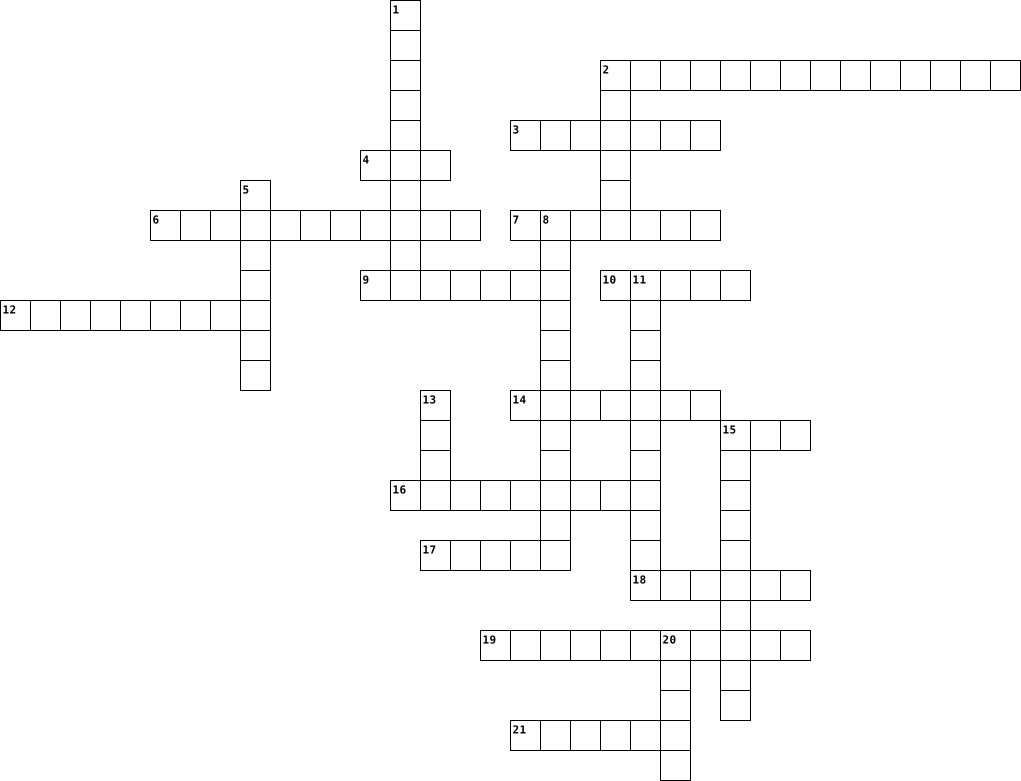
Across
- kids get in for half-price
- produce more with this please
- interference
- market failure
- The Rolling Stones can't get no
- everyone produces same good in this market
- it's where price ceilings are
- we are in it currently
- well we have too much
- AVC + AFC
- comparing apples and oranges only one way
- pay for work
- in perfect competition it's all the same
- income tax is this type
- the only reason for production
Down
- you should only do this part of production
- "The___________ science."
- when MR = 0 you maximize this
- CS + PS
- Supply says to demand, "we meet again."
- MC looks like this symbol
- everyone gets this efficiency
- enlightened economist
23 Clues: CS + PS • AVC + AFC • interference • pay for work • market failure • well we have too much • enlightened economist • we are in it currently • income tax is this type • "The___________ science." • MC looks like this symbol • kids get in for half-price • produce more with this please • when MR = 0 you maximize this • it's where price ceilings are • everyone gets this efficiency • ...
Economics Terms 2019-04-04

Across
- It is the aggregate of total flow of goods and services produced by an economy in a year(Use abbreviation)
- refer to commercial loans with a minimum three-year maturity that can be raised from lenders from overseas where interest rates are lower than in India(Use abbreviation)
- These are inferior goods that people consume more even if the price rises
- ported product, the tax levied at the point of entry into the importing country
- Deliberate downward adjustment to value of a country’s currency relative other currencies
- Is an individual who sells shares in a hope that the stock's price would fall
- In this form of market, there are a small number of firms that have more than 40% of the market share
- It is a type of market structure having one seller and many buyers
- The principle of non-intervention of government in economic affairs
- The degree of responsiveness of quantity demanded or supplied to a change in price
- ratio of cash in hands, exclusive of cash balance maintained by ranks to meet required CRR, but no excess reserves(Use abbreviation)
Down
- It is a measure of inflation, or price change, arrived at after regularly measuring the prices of a slew of wholesale goods(Use abbreviation)
- Decline in the general price level of goods and services leading to rise in the value (purchasing power)
- Which policy does central bank use to influence the course of an economy through decisions on money supply and interest rate
- The term refers to Govt selling its equity stake in companies it owns
- GDP plus net factor income from abroad(Use abbreviation)
- Refers to the ratio which banks have to maintain with the RBI as the certain percentage of their holdings of cash and their time liabilities(Use abbreviation)
- Is an individual who buys shares in a hope that the stock's price would rise
- It is a measure of inflation, or price change, arrived at after regularly measuring the prices of a slew of household goods and services.(Use abbreviation)
- It is a trade measure that shows the value of a country’s imports of goods and services to be higher than the value of its exports(Use abbreviation)
- Which policy does Govt use to influence the course of an economy through decisions on taxes and spending
21 Clues: GDP plus net factor income from abroad(Use abbreviation) • It is a type of market structure having one seller and many buyers • The principle of non-intervention of government in economic affairs • The term refers to Govt selling its equity stake in companies it owns • These are inferior goods that people consume more even if the price rises • ...
Economics Crossword 2019-10-11

Across
- A medium of exchange whose value derives entirely from its official status as a means of payment.
- A medium of exchange with no intrinsic value whose ultimate value is guaranteed by a promise that it can be converted into valuable goods.
- This shows the relationship between the aggregate price level and the quantity of aggregate output supplied that would exist if all prices, including nominal wages, were fully flexible.
- When aggregate output is below potential output.
- A good used as a medium of exchange that has intrinsic value in other uses
- refers to the way in which the individual pursuit of self interest can lead to good results for society as a whole.
- Any asset that can easily be used to purchase goods and services
- Nominal wages that are slow to fall even in the face of high unemployment and slow to rise even in the face of labor shortages.
- The total value of financial assets in the economy that are considered money.
- The social science that studies the production, distribution, and consumption of goods and services.
- Government debt held by individuals and institutions outside the government.
Down
- Government spending and taxation rules that cause fiscal policy to be automatically expansionary when the economy contracts and automatically contractionary when the economy expands.
- The level of real GDP the economy would produce if all prices, including nominal wages, were fully flexible
- When aggregate output is above potential output.
- are rules set by the Federal Reserve that determine the minimum reserve ratio for banks
- not enough of the resources are available to satisfy all the various ways a society wants to use them.
- Fiscal policy that reduces aggregate demand.
- The combination of inflation and falling aggregate output.
- An economy in which decisions about production and consumption are made by individual producers and consumers.
- Fiscal policy that increases aggregate demand.
- An event that shifts the short-run aggregate supply curve is a ___________
- An event that shifts the aggregate demand curve is a ______________.
- anything that offers rewards to people who change their behavior.
- A phenomenon in which many of a bank’s depositors try to withdraw their funds due to fears of a bank failure.
24 Clues: Fiscal policy that reduces aggregate demand. • Fiscal policy that increases aggregate demand. • When aggregate output is above potential output. • When aggregate output is below potential output. • The combination of inflation and falling aggregate output. • Any asset that can easily be used to purchase goods and services • ...
Africa Economics 2020-03-27

Across
- ______ means that the land is good for farming.
- The type of currency in Nigeria is called a ______.
- Rates _______ ____ is how much one persons currency to anothers.
- The _____ is and important thing to countries because it is the total number of outputs of goods and services produced in a year.
- When you focus on one thing and becoming the expert it is called _________.
- The type of currency in Kenya is called a ______.
- ______ is the type of paper and coins used to purchase things.
- A economy that is completely controlled by the government is called ________.
- The type of currency in South Africa is called a _______.
- Kenya put a _______ on exported goods.
Down
- South Africa put a ______ on how much they could export.
- A perfect economy with no government control is called a ________ economy.
- __________ start businesses to give more people jobs.
- This economy gets the best of both world with it having some government control and some freedom it is called a __________ economy.
- When investing in ________ this can improve your GDP.
- Chad is a _________ country.
- _______ is the process of trading without using money.
- When investing in ______ capital it can raise your unemployment rate.
- Nigeria put a _______ on Cuba for trade.
- There are not many ________ economies that go off of beliefs and customs.
20 Clues: Chad is a _________ country. • Kenya put a _______ on exported goods. • Nigeria put a _______ on Cuba for trade. • ______ means that the land is good for farming. • The type of currency in Kenya is called a ______. • The type of currency in Nigeria is called a ______. • __________ start businesses to give more people jobs. • ...
Economics Puzzle 2020-10-28

Across
- Businesses are interested in knowing their
- Are expenses that the owners of a business must incur whether they produce nothing, a tittle, or a lot
- Shows the data found in the market demand schedule
- Is a tax on the production or sale of a specific good or service
- Are the price of the resources needed to produced a good or service
- When a change in price leads to a relatively smaller change in the quantity demanded
- A graph that shows how much of a good or service an individual producer is willing and able to offer for sale at each price
- Shows the data from the market supply schedule
- Are goods that consumers demand more of when their incomes rise
- The level of production where it realizes the greatest amount of profit
- The willing ness to buy a good or service and the ability to pay for it
- Which states that the marginal benefit from using each additional unit of a good
- States that producers are willing to sell more of a good or service at a higher price that they are at a lower price
- A change in the amount of a product that a consumer will buy because the purchasing power of his or her income changes
- Are business costs that vary as the level of production output changes
- Goods and services that can be used in place of other goods and services to satisfy consumer
Down
- Is the income a business receives from selling a product
- Is the added revenue per unit of output
- A graph that shows how much of a good
- Businesses find the
- The use of one product increases the use of another product, the two products
- The willingness and ability of producers to offer goods and services for sale
- The act of controlling business behavior through a set of rules or laws, can also effect supply
- The pattern of behavior that occurs when consumers react to a change in the price of a good or service by buying a substitute product
- Consumers buy more of it
- When a change in price, either up or down, leads to a relatively larger change in the quantity demanded
- Are goods that consumers demand less of when their incomes rise
27 Clues: Businesses find the • Consumers buy more of it • A graph that shows how much of a good • Is the added revenue per unit of output • Businesses are interested in knowing their • Shows the data from the market supply schedule • Shows the data found in the market demand schedule • Is the income a business receives from selling a product • ...
Economics Project 2020-11-11

Across
- represent the potential benefits an individual, investor, or business misses out on when choosing one alternative over another.
- a method of production whereby an entity focuses on the production of a limited scope of goods to gain a greater degree of efficiency.
- assumes minimum cost for the production of a good or service, maximum output, and maximum surplus from the operation of the market.
- an economic concept that refers to man-made elements employed to produce goods or services.
- the social science that studies the implications of incentives and decisions, specifically about how those affect the utilization and distribution of resources
- the knowledge, skill, training, and experience that individuals need to produce goods and services within their economy.
- The transfer of ownership, property or business from the government to the private sector is termed privatization.
- an individual who pays some amount of money for the thing required to consume goods and services.
- a condition where different economic firms seek to obtain a share of a limited good by varying the elements of the marketing mix: price, product, promotion and place.
- where one thing increases and another must decrease.
- an economic system in which economic decisions and the pricing of goods and services are guided by the interactions of a country's individual citizens and businesses.
- The effectiveness of productive effort, especially in industry, as measured in terms of the rate of output per unit of input.
- a marketplace where securities, commodities, derivatives and other financial instruments are traded.
- is the ability of people of a society to take economic actions.
- an economic system in which private actors own and control property in accord with their interests, and demand and supply freely set prices in markets in a way that can serve the best interests of society.
- products bought for consumption by the average consumer
- an economic system in which a central authority, such as a government, makes economic decisions regarding the manufacturing and the distribution of products.
- The action of helping or doing work for someone
- an absence of excessive fluctuations in the overall economy.
- is the social science that studies how people interact with things of value.
- an increase in the production of economic goods and services, compared from one period of time to another.
- natural assets (raw materials) occurring in nature that can be used for economic production or consumption.
- an act of trading goods or services between two or more parties without the use of money
- a system where the government, rather than the free market, determines what goods should be produced, how much should be produced, and the price at which the goods are offered for sale.
- physical assets that a company uses in the production process to manufacture products and services that consumers will later use.
- when all goods and factors of production in an economy are distributed or allocated to their most valuable uses and waste is eliminated or minimized.
- a graph that shows all of the different combinations of output that can be produced given current resources and technology.
- an individual who creates a new business, bearing most of the risks and enjoying most of the rewards.
- The activity of setting up a business or businesses, taking on financial risks in the hope of profit.
- the total satisfaction received from consuming a good or service.
Down
- items that satisfy human wants and provide utility,
- the marketplace where final goods or services are sold to businesses and the public sector.
- demonstrates how money moves through society. Money flows from producers to workers as wages and flows back to producers as payment for products.
- The state of being in short supply.
- an area of the production, distribution and trade, as well as consumption of goods and services by different agents.
- what is used in the production process to produce output—that is
- someone who creates and supplies goods or services.
- economic system is based on customs, history and time-honored beliefs.
- an economic system blending elements of a market economy with elements of a planned economy, free markets with state interventionism, or private enterprise with public enterprise.
- refers to the action of a government taking control of a company or industry, which generally occurs without compensation for the loss of the net worth of seized assets and potential income.
- a market in which companies buy the factors of production or the resources they need to produce their goods and services.
- the difference between the revenue a business has received from its outputs and the opportunity costs of its inputs.
- the separation of tasks in any economic system or organisation so that participants may specialize
- an expert who studies the relationship between a society's resources and its production or output.
- A stock or supply of money, materials, staff, and other assets that can be drawn on by a person or organization in order to function effectively.
- a measure of the benefit provided by a good or service to an economic agent.
- the interconnected worldwide economic activities that take place between multiple countries.
- the concept or idea of fairness in economics, particularly in regard to taxation or welfare economics.
- is the science of modeling technology change, markets and value creation including business models.
- a branch of economics that studies how an overall economy—the market or other systems that operate on a large scale—behaves.
- the ability of individuals and families to maintain sufficient income to consistently meet their basic needs
- The division of resources into shares or portions.
- a contractual agreement in which a borrower receives something of value now and agrees to repay the lender at a later date
- a system of production where goods and services are produced directly for use, in contrast to a capitalist economic system, where goods and services are produced to generate profit (and therefore indirectly for use).
- a composition of systems, institutions, procedures, social relations or infrastructures whereby parties engage in exchange.
- any object that is generally accepted as payment for goods and services and repayment of debts in a given country or socio-economic context.
56 Clues: The state of being in short supply. • The action of helping or doing work for someone • The division of resources into shares or portions. • items that satisfy human wants and provide utility, • someone who creates and supplies goods or services. • where one thing increases and another must decrease. • products bought for consumption by the average consumer • ...
Economics puzzle 2020-03-31

Across
- Condition when there is no work.
- A thing that participates in the free exchange for other things.
- When do you borrow money.
- A document indicating the money due for the goods sold, for the work performed.
- Possible danger.
- Making the creation of any product.
- Obligatory, individually gratuitous payment levied on organizations and individuals.
- Spending money on their production, materials.
- Bank payment card.
- A capitalist commercial or industrial enterprise, usually a business association of entrepreneurs.
- A set of systems and elements working as a whole to achieve a common goal.
- Pay for work.
- Sphere of commodity circulation, turnover.
Down
- Regular visitor, buyer, customer.
- Work together, take part in a common cause.
- Demand for goods by the buyer.
- Accumulation of money.
- Insolvency of a person or company.
- Rivalry, the struggle to achieve the highest benefits, advantages.
- Cost in money, fee.
- The process of transporting goods from a source location to a predetermined destination.
- Transportation of goods (passengers) from one place to another.
- Money paid for something.
- Money received from the company.
- The amount for which income exceeds costs.
- The amount of resources used in the process of economic activity for a certain time period.
- Decree of state power.
- Metal and paper signs, which are a measure of the value of the sale
- Financial and credit organization, producing various types of operations with money.
29 Clues: Pay for work. • Possible danger. • Bank payment card. • Cost in money, fee. • Accumulation of money. • Decree of state power. • When do you borrow money. • Money paid for something. • Demand for goods by the buyer. • Condition when there is no work. • Money received from the company. • Regular visitor, buyer, customer. • Insolvency of a person or company. • ...
Economics Glossary 2020-04-28

Across
- An organization that sells goods
- Where actions by one party have impacts on another, particularly economically.
- The study of how people use scarce resources to satisfy needs and wants
- Final users of goods and services to satisfy their needs and wants
- Basic units used to make goods and services
- Reward for the use of resources
- A system which allows private ownership of the factors of production
- Physical items used by consumer and services for a profit
- Situation where demand is greater than supply
- Equipment used to make goods and services
- Institution which handles money for households and firms
- Ability to combine all resources to make something (plan, recipe, system etc)
- chain Complex group of firms in many countries each producing a component of a final product.
- Organisations that make goods and services
- Payment earned by entrepreneurs
- Money paid at a particular rate for the money lent
- Compulsory government levy
- Goods and services which we desire but don’t need
- Income flows which are added to the Circular Flow of Income model (investment, govt. spending, exports)
- Goods and services sold overseas
- Income flows that are removed from the Circular Flow model. (savings, tax, imports)
- National Company A company which operates in several countries with its headquarters in the parent country. (Apple)
Down
- Goods and services bought from overseas
- Basic necessities for life
- of production Raw materials used to make goods and services (land, labour, capital & enterprise)
- All human effort, both physical and intellectual
- That part of earnings not spent
- Organization with authority to make decisions for the population
- National Company A company that operates in many countries with independent headquarters in each.(McDonalds)
- An economy where people produce only enough goods and services for their own family
- Cost The cost of the next-best alternative opportunity
- Financial assistance given to people by the Government
- Action of only doing one part of the process
- market Place where factors of production are bought and sold.
- Payment per hour for labour
- All resources provided by nature
- Place where goods and services are bought and sold.
- A system where factors of production are owned by the government
- market Place where goods and services are bought and sold (Coles, Seek.com, Fremantle markets) Same as Market
- Payment per year for labour
- Payment for use of land
- A system where all factors of production, distribution and consumption of goods and services are controlled by the government
- Purchase of new capital
- Actions done for consumers by producers
- Used to pay for goods and services
45 Clues: Payment for use of land • Purchase of new capital • Basic necessities for life • Compulsory government levy • Payment per hour for labour • Payment per year for labour • That part of earnings not spent • Reward for the use of resources • Payment earned by entrepreneurs • An organization that sells goods • All resources provided by nature • Goods and services sold overseas • ...
Economics Glossary 2020-04-28

Across
- National Company A company that operates in many countries with independent headquarters in each.(McDonalds)
- Payment for use of land
- The study of how people use scarce resources to satisfy needs and wants
- All resources provided by nature
- Payment earned by entrepreneurs
- Money paid at a particular rate for the money lent
- An economy where people produce only enough goods and services for their own family
- Goods and services bought from overseas
- Goods and services which we desire but don’t need
- All human effort, both physical and intellectual
- Where actions by one party have impacts on another, particularly economically.
- A system where factors of production are owned by the government
- Ability to combine all resources to make something (plan, recipe, system etc)
- Institution which handles money for households and firms
- Payment per hour for labour
- Situation where demand is greater than supply
- Organisations that make goods and services
- Goods and services sold overseas
- That part of earnings not spent
- Reward for the use of resources
- Organization with authority to make decisions for the population
Down
- An organization that sells goods
- Used to pay for goods and services
- market Place where goods and services are bought and sold (Coles, Seek.com, Fremantle markets) Same as Market
- Basic units used to make goods and services
- Action of only doing one part of the process
- Financial assistance given to people by the Government
- A system where all factors of production, distribution and consumption of goods and services are controlled by the government
- Place where goods and services are bought and sold.
- Physical items used by consumer and services for a profit
- A system which allows private ownership of the factors of production
- Cost The cost of the next-best alternative opportunity
- Payment per year for labour
- chain Complex group of firms in many countries each producing a component of a final product.
- Equipment used to make goods and services
- market Place where factors of production are bought and sold.
- Income flows which are added to the Circular Flow of Income model (investment, govt. spending, exports)
- Income flows that are removed from the Circular Flow model. (savings, tax, imports)
- Basic necessities for life
- Compulsory government levy
- Actions done for consumers by producers
- of production Raw materials used to make goods and services (land, labour, capital & enterprise)
- Purchase of new capital
- National Company A company which operates in several countries with its headquarters in the parent country. (Apple)
- Final users of goods and services to satisfy their needs and wants
45 Clues: Payment for use of land • Purchase of new capital • Basic necessities for life • Compulsory government levy • Payment per year for labour • Payment per hour for labour • Payment earned by entrepreneurs • That part of earnings not spent • Reward for the use of resources • An organization that sells goods • All resources provided by nature • Goods and services sold overseas • ...
Economics Glossary 2020-04-28

Across
- National Company A company that operates in many countries with independent headquarters in each.(McDonalds)
- Raw materials used to make goods and services (land, labour, capital & enterprise)
- Payment for use of land
- Goods and services which we desire but don’t need
- Ability to combine all resources to make something (plan, recipe, system, etc.)
- Reward for the use of resources
- Physical items used by consumer and services for a profit
- Compulsory government levy
- Basic units used to make goods and services
- Money paid at a particular rate for the money lent
- Final users of goods and services to satisfy needs and wants
- Situation where demand is greater than supply
- All resources provided by nature
- Place where goods and services are bought and sold.
- Payment per year for labour
- Payment per hour for labour
- The study of how people use scarce resources to satisfy needs and wants
- Complex group of firms in many countries each producing a component of a final product.
- Place where factors of production are bought and sold
- Financial assistance is given to people by the Government
Down
- Organization with authority to make decisions for the population
- Income flows which are added to the Circular Flow of Income model (investment, govt. spending, exports)
- Goods and services bought from overseas
- Where actions by one party have impacts on another, particularly economically.
- Goods and Services sold overseas
- Income flows that are removed from the Circular Flow Model. (savings, tax, imports)
- Institute which handles money for households and firms
- Used to pay for goods and services
- All human effort, both physical and intellectual
- Cost The cost of the next-best alternative opportunity
- Purchase of new capital
- That part of earnings not spent
- A system where all factors of production, distribution and consumption of goods and services are controlled by the government
- Place where goods and services are bought and sold (Coles, Seek.com, Fremantle markets) Same as Market
- A company which operates in several countries with its headquarters in the parent country. (Apple)
- Basic necessities for life
- Action of only doing one part of the process
- Organisations that make goods and services
- A system which allows private ownership of the factors of production
- An economy where people produce only enough goods and services for their own family
- Payment earned by entrepreneurs
- A system where factors of production are owned by the government
- Equipment used to make goods and services
- Actions done for consumers by producers
- An organisation that sells goods
45 Clues: Purchase of new capital • Payment for use of land • Compulsory government levy • Basic necessities for life • Payment per year for labour • Payment per hour for labour • That part of earnings not spent • Reward for the use of resources • Payment earned by entrepreneurs • Goods and Services sold overseas • All resources provided by nature • An organisation that sells goods • ...
ECONOMICS GLOSSARY 2020-04-29

Across
- Financial assistance given to people by the Government
- The study of how people use scarce resources to satisfy needs and wants
- An organization that sells goods
- Goods and services sold overseas
- Place where goods and services are bought and sold.
- Action of only doing one part of the process
- Situation where demand is greater than supply
- of production Raw materials used to make goods and services (land, labour, capital & enterprise)
- An economy where people produce only enough goods and services for their own family
- All resources provided by nature
- Compulsory government levy
- A system where factors of production are owned by the government
- Goods and services bought from overseas
- Used to pay for goods and services
- Reward for the use of resources
- Equipment used to make goods and services
- Income flows that are removed from the Circular Flow model. (savings, tax, imports)
- Physical items used by consumer and services for a profit
- Actions done for consumers by producers
- Place where factors of production are bought and sold.
- Place where goods and services are bought and sold (Coles, Seek.com, Fremantle markets) Same as Market
- Payment per year for labour
- National Company A company which operates in several countries with its headquarters in the parent country. (Apple)
Down
- Payment per hour for labour
- Organization with authority to make decisions for the population
- Purchase of new capital
- A system where all factors of production, distribution and consumption of goods and services are controlled by the government
- A company that operates in many countries with independent headquarters in each.(McDonalds)
- Income flows which are added to the Circular Flow of Income model (investment, govt. spending, exports)
- Goods and services which we desire but don’t need
- Organisations that make goods and services
- The cost of the next-best alternative opportunity
- All human effort, both physical and intellectual
- Payment for use of land
- Money paid at a particular rate for the money lent
- Where actions by one party have impacts on another, particularly economically.
- Basic necessities for life
- A system which allows private ownership of the factors of production
- That part of earnings not spent
- Ability to combine all resources to make something (plan, recipe, system etc)
- Final users of goods and services to satisfy their needs and wants
- Payment earned by entrepreneurs
- basic units used to make goods and services
- chain Complex group of firms in many countries each producing a component of a final product.
- Institution which handles money for households and firms
45 Clues: Purchase of new capital • Payment for use of land • Basic necessities for life • Compulsory government levy • Payment per hour for labour • Payment per year for labour • That part of earnings not spent • Reward for the use of resources • Payment earned by entrepreneurs • An organization that sells goods • Goods and services sold overseas • All resources provided by nature • ...
Economics Glossary 2020-04-29

Across
- Goods and services bought from overseas
- Place where goods and services are bought and sold (Coles, Seek.com, Fremantle markets) Same as Market
- The study of how people use scarce resources to satisfy needs and wants
- Place where goods and services are bought and sold.
- Ability to combine all resources to make something (plan, recipe, system etc)
- Organization with authority to make decisions for the population
- Income flows which are added to the Circular Flow of Income model (investment, govt. spending, exports)
- Reward for the use of resources
- An economy where people produce only enough goods and services for their own family
- A company that operates in many countries with independent headquarters in each.(McDonalds)
- The cost of the next-best alternative opportunity
Down
- Goods and services sold overseas
- Where actions by one party have impacts on another, particularly economically.
- company which operates in several countries with its headquarters in the parent country.
- Financial assistance given to people by the Government
- A system where factors of production are owned by the government
- Final users of goods and services to satisfy their needs and wants
- Situation where demand is greater than supply
- A system which allows private ownership of the factors of production
- Complex group of firms in many countries each producing a component of a final product.
- Income flows that are removed from the Circular Flow model. (savings, tax, imports)
- A system where all factors of production, distribution and consumption of goods and services are controlled by the government
22 Clues: Reward for the use of resources • Goods and services sold overseas • Goods and services bought from overseas • Situation where demand is greater than supply • The cost of the next-best alternative opportunity • Place where goods and services are bought and sold. • Financial assistance given to people by the Government • ...
economics words 2021-02-04

Across
- someone who starts a business
- something used for a business
- to pay back for using money
- a number of things you can have
- goods a item used for making things
- tax charged on money form working
- the study on how to use money
- a shop that makes the product
- somewhere where u can sell your own goods
- a number of things available
- money paid to the government
- a number of products people buy
Down
- someone who works for the manager
- doing good in a business
- an item you can find a lot of places
- different people doing different jobs
- someone who starts a business
- tax on items you buy
- a place who has a rivalry with another shop
- money you pay back
- a number on the total amount you have together
- an item hard to find
- someone who buys a product
- money in the bank that u take slowly
24 Clues: money you pay back • tax on items you buy • an item hard to find • doing good in a business • someone who buys a product • to pay back for using money • a number of things available • money paid to the government • someone who starts a business • something used for a business • someone who starts a business • the study on how to use money • a shop that makes the product • ...
Liberal Economics 2021-01-14

Across
- Reagan said economic prosperity is achieved by lowering taxes forthese people
- The kind of liberals that suggest Adam Smith was right all along (or Keanu Reeves in the Matrix...)
- Policy that controls the central bank rate
- Term for a period a negative economic growth
- What the Roosevelt’s deal was
- Super-fast, super-huge inflation Roosevelt Depression era US president
- Term that refers to a precipitous drop in the stock market
- Policy that controls government spending and taxation
- Inflationary ________; when the constant need for more wages and higher prices sends inflation out of control
Down
- Term for one company having total control over consumers" access to a product
- Depression era agency that built many of the roads and trails in America’s national parks
- Something you might join as a worker to be able to force your employer to treat you better
- in the market
- An economist that proposed an alternative Keynes’ ideas
- _______ state: term for the government providing people with unemployment insurance, health care, old age pensions, etc.
- When you buy stocks on this, you’re borrowing money
- The “trickle-down” president
- You can get a huge one if you are constantly engaging in deficit spending
- Economist that influenced America’s approach to dealing etc. with the Great Depression
- The depression ultimately resulted in America moving in this direction on the economic spectrum
- What really ended the Great Depression
21 Clues: in the market • The “trickle-down” president • What the Roosevelt’s deal was • What really ended the Great Depression • Policy that controls the central bank rate • Term for a period a negative economic growth • When you buy stocks on this, you’re borrowing money • Policy that controls government spending and taxation • ...
Economics Terms 2021-01-26

Across
- money business firms make
- difference between revenues
- out, one sector drives down other sectors
- of production, resources from households
- similar to tabular
- expenditures, goods and services total
- cost, cost of something
- withdraw or borrow money
- flow model, shows nations economic functions
- payment for labor
- surplus, too much money
- Model, simple relationship between variables
Down
- payments, payment with no repayment
- goods make other goods
- combining resources, labor, and capital
- deficit, spend money, get money back
- market, collection of financial institutions
- graph, shows amounts
- possibility curve, competition between two commodities
- makes goods and services
- natural resources
- payment for owner's property
22 Clues: natural resources • payment for labor • similar to tabular • graph, shows amounts • goods make other goods • cost, cost of something • surplus, too much money • withdraw or borrow money • makes goods and services • money business firms make • difference between revenues • payment for owner's property • payments, payment with no repayment • deficit, spend money, get money back • ...
Economics Terms 2021-01-26

Across
- simple relationships between variables
- government makes too much money
- max amount of 2 commodities
- government spends too much money
- money business firms make
- visual of economic functions
- payments for using owner's property
- goods used for other goods
- collection of financial institutions
Down
- government involvement with no repayment
- human effort that makes goods
- total of household spending
- natural resources
- difference between revenues
- same as tabular
- specific tabular model
- resources required from households
- cost of an item
- combining resources, labor, and capital
- payment for labor
20 Clues: same as tabular • cost of an item • natural resources • payment for labor • specific tabular model • money business firms make • goods used for other goods • total of household spending • difference between revenues • max amount of 2 commodities • visual of economic functions • human effort that makes goods • government makes too much money • government spends too much money • ...
Economics Vocab 2021-08-27

Across
- a retirement plan that requires an employer to make contributions to funds
- interest on a loan or deposit calculated based on both principal and interest
- the change in price of an asset
- amount a lender charges a borrower
- monetary charge for the privilege of borrowing money
- unchanging rate charged on a liability
- the chance a outcomes actual gain will differ from the expected return
- something a person or company owns
- money put aside for future use
- a bank product that earns interest on a lump-sum deposit that's been untouched
Down
- taxes required on specific goods or services
- a non-profit financial institution controlled by it's members
- trading in very short-term debt investments
- a type of tax that governments impose on incomes generated by business and individuals
- consumption tax imposed by the government on the sale of goods and services
- a contract, where an individual receives financial protection
- a risk management strategy that mixes a wide variety of investments within a portfolio
- ability to borrow money with the understanding that you'll pay later
- an asset or item acquired with the goal of generating income
- an amount of money borrowed by one party from another
20 Clues: money put aside for future use • the change in price of an asset • amount a lender charges a borrower • something a person or company owns • unchanging rate charged on a liability • trading in very short-term debt investments • taxes required on specific goods or services • monetary charge for the privilege of borrowing money • ...
Economics - A.K. 2021-03-23

Across
- an action provided in exchange for money
- the total value of all goods and services produced in one country in one year
- a person who provides, or produces goods or services
- a request for a certain good or service
- land, labor, capital, entreprenuers
- an economy using barter and trade
- short in supply
- an economy where the government answers all the economic decisions
- send goods or services to another country for sale
Down
- an expert at something
- resources that come from nature
- goods used to make other goods and services
- how to produce,what to produce, whom to produce for
- goods or services available to consumers
- a person who buys goods and services
- individuals and their skills, knowledge, training, and experience
- ane economy where nboth the government and citizens make the economic decisions
- an economy where the prices of goods and services are determined by supply and demand
- television, video games, toys
- objects that satisfy consumers wants and needs
- bring goods or services into a country from abroad
- food, water, shelter
22 Clues: short in supply • food, water, shelter • an expert at something • television, video games, toys • resources that come from nature • an economy using barter and trade • land, labor, capital, entreprenuers • a person who buys goods and services • a request for a certain good or service • an action provided in exchange for money • goods or services available to consumers • ...
Economics AW 2021-03-23

Across
- a general increase in prices and fall in the purchasing value of money
- the reduction in supply of circulated money in any economy.
- send goods or services to a different country
- consumer's desire to purchase goods
- the branch of knowledge concerned with the production
- an economy that the people have little to no say in
- the amount of something in stock for buying
- something you don't need
- the final value of the goods and services produced
- a period of economic contraction, where businesses see less demand and begin to lose money
- someone who buys goods of services
Down
- to trade for goods and services
- a person who organizes and operates a business
- dividing the factors of production into four categories
- asset prices appear to be based on implausible or inconsistent views about the future
- goods or services from different countries
- an economy that lets answer the factors of production
- an expert
- to switch a good or service for another good or service as payment without money
- the owe of money
- an economy combines aspects of both capitalism and socialism
- an limit of goods that needs to be sold
- someone who makes goods or services
- a long recession
- something you have to have to live
25 Clues: an expert • the owe of money • a long recession • something you don't need • to trade for goods and services • something you have to have to live • someone who buys goods of services • consumer's desire to purchase goods • someone who makes goods or services • an limit of goods that needs to be sold • goods or services from different countries • ...
Economics Vocab 2021-04-29

Across
- economists look at the big picture
- outputs such as books and cars
- quality of life based off of possessions of necessities and luxuries
- not enough resources
- used to make goods
- land, water, fish, animals
- comparing the marginal benefit to the marginal cost
- works that produce goods or services
- someone who creates their own business
- resources necessary to produce goods and services
- the total value of all of the goods produced in a country in one year
Down
- theory that explains human economic behavior
- economists look at the small picture
- food, water, shelter
- outputs like haircuts and repairs
- deciding to do one thing or another
- the additional satisfaction after producing additional output
- goods used to make other goods
- entertainment, fun, phone
- the best use of your time and money after you decide to do one thing rather than the other
- the additional cost of producing extra output
21 Clues: used to make goods • food, water, shelter • not enough resources • entertainment, fun, phone • land, water, fish, animals • outputs such as books and cars • goods used to make other goods • outputs like haircuts and repairs • economists look at the big picture • deciding to do one thing or another • economists look at the small picture • works that produce goods or services • ...
economics crossword 2023-02-03

Across
- physical objects such as clothes or shoes
- any human-made resource that is used to create other goods and services
- a graph that shows alternative ways to use an economy's resources
- an item that we desire but that is not essential to survival
- the most desirable alternative given up as a result of a decision
- goods that last
- limited quantities of resources to meet unlimited wants
- resources that are used to make goods and services
- the skills and knowledge gained by a worker through education and experience
- using fewer resources than an economy is capable of using
Down
- the line on a production possibilities graph that shows the maximum possible output
- a situation in which a good or service is unavailable
- using resources in such a way as to maximize the production of goods and services
- land, labor, and capital; the three groups of resources that are used to make all goods and services
- to an economist, the alternative that is given up because of a decision
- deciding whether to do or use one additional unit of some resource
- the effort that people devote to a task for which they are paid
- an alternative that we sacrifice when we make a decision
- all human-made goods that are used to produce other goods and services; tools and buildings
- an ambitious leader who combines land, labor, and capital to create and market new goods and services
- a phrase that refers to the trade-offs that nations face when choosing whether to produce more or less military or consumer goods
- the study of how people seek to satisfy their needs and wants by making choices
- dollar value of a final product
- actions or activities that one person performs for another
- something like air, food, and shelter that is necessary for survival
25 Clues: goods that last • dollar value of a final product • physical objects such as clothes or shoes • resources that are used to make goods and services • a situation in which a good or service is unavailable • limited quantities of resources to meet unlimited wants • an alternative that we sacrifice when we make a decision • ...
Economics Crossword 2023-03-06

Across
- Alternative choices.
- When the benefits are greater than or equal to the costs of the decision.
- A condition that results from society not having enough resources to produce all of the things they would like.
- A diagram representing various combinations of goods and services an economy can produce when ALL of the resources are in use.
- Where products are bought and sold.
- A location or mechanism that allows buyers and sellers to exchnage goods or services.
- Market structure that has all the conditions of perfect competition, but products are not identical.
- Where the Factors of Production are bought and sold.
- Items that improve everyday life.
- This is caused by an increase in population, expansion of stock of capital, technological improvements, and an increase in productivity.
- Occurs when two people willingly trade one item for another.
Down
- Business owned by two or more individuals
- Market structure with only one seller of a particular product.
- Recognized by the law as a separate legal entity; owned by stockholders.
- Business owned by a single individual.
- Market structure in which few large sellers dominate the industry.
- The study of how economies satisfy unlimited wants with limited resources.
- A way of comparing the costs of an action to the benfits recieved.
- Items that are REQUIRED for everyday life.
- People of the workforce.
- Tools, equipment,machinery and factories used in production.
- Market structure characterized by a large number of buyers and sellers who exchange IDENTICAL products.
- Next best alternative. (What is given up when a choice is made).
- Individuals who take a risk in order to profit,create jobs, and improve society.
- Natural Resources
25 Clues: Natural Resources • Alternative choices. • People of the workforce. • Items that improve everyday life. • Where products are bought and sold. • Business owned by a single individual. • Business owned by two or more individuals • Items that are REQUIRED for everyday life. • Where the Factors of Production are bought and sold. • ...
Economics Crossword 2023-02-27

Across
- The amount of goods available for consumers
- Essentials such as food,water, shelter
- Used to help produce the goods ex.equipment
- Can be seen but not touched
- Goods that aren't used anymore for people with a higher income
- A business that relies on other businesses to stay in business
- To shows or advertise what you need to obtain a better version of yourself
- Assistance provided for a payment technically can not be touched
- The ones who purchase the goods
Down
- Being assigned the task you are the best at to help decrease the time it takes to produce something
- Products that work well together ex. Hotdog and ketchup
- The creation of a good/service to help benefit people and to make a profit
- A good that can replace another
- Not needed items usually on the expensive side
- Increased price of a good as time goes on
- A new product no one has seen before
- Employees
- Customer desire to purchase
- To help make life more enjoyable
- Raw Materials taken from the earth
- Items needed to survive
- The ones who help supply the goods
- Not needed anymore or outclassed by newer products
- Taking an existing product and making it better
- Business or people that buy from another company
25 Clues: Employees • Items needed to survive • Customer desire to purchase • Can be seen but not touched • The ones who purchase the goods • A good that can replace another • To help make life more enjoyable • Raw Materials taken from the earth • The ones who help supply the goods • A new product no one has seen before • Essentials such as food,water, shelter • ...
Economics Crossword 2023-02-25

Across
- The people or businesses that actually purchase the goods
- Raw materials that we get from the earth, water, and air
- A person who uses goods or services
- An economic system that tends to follow the same evolutionary course
- A downward trend in the business cycle where there is a decline in production and employment
- Where quantity supplied and quantity demanded are equal
- People that work to produce goods & services in a business
- The level of Maslow’s Hierarchy of Needs that refers to self-respect
- Something that is __________ cannot be perceived by touch
- The amount of goods and services businesses are willing and able to sell at certain prices
- Goods that are used together
- A product or service that consumers no longer want
- An economic system that focuses on common good over profits
Down
- Changes that occur to the real GDP because of alternating periods of expansion and contraction
- An individual or business that makes a product
- Goods that can be used to replace each other
- The first level of Maslow’s Hierarchy of Needs
- Items necessary for survival
- The people or businesses that actually purchase the goods
- The stage in the business cycle when the economy reaches its maximum productive output
- People that work to produce goods & services in a business
- The amount of goods and services people are willing and able to buy at certain prices
- Dry cleaning is a _______
- An economic system where there are more products in the market, creating a wider variety for consumers to choose from
- A major downturn in the business cycle characterized by sharp and sustained declines in economic activity
- The value of a particular currency decreases over time with _________
26 Clues: Dry cleaning is a _______ • Items necessary for survival • Goods that are used together • A person who uses goods or services • Goods that can be used to replace each other • An individual or business that makes a product • The first level of Maslow’s Hierarchy of Needs • A product or service that consumers no longer want • ...
Economics Review 2023-03-03

Across
- Ceilings;a legally established maximum price.
- business owned by stockholders who share in its profits but are not personally responsible for its debts
- Federal Reserve Bank:Central bank of the United States; Which conducts Monetary Policy
- person who organizes and operates a business or businesses, taking on greater than normal financial risks in order to do so.
- (Resource) Market:Where you work to make your income: Restaurant, Factories, Retail Stores, Schools, Hospitals
- market structure in which a few large firms dominate a market
- work
- Competition: a market structure in which many firms sell products that are similar but not identical
- A plan for making and spending money
- Competition:theoretical market structure characterized by a large number of well-informed independent buyers and sellers who exchange identical products and have freedom of entry and exit
- Equipment, machinery, and Factories used in production
Down
- money is:money backed by a government's decree that it be accepted as a means of payment.
- Economy;An economy in which production is based on customs and traditions and economic roles are typically passed down from one generation to the next.
- Poritas:All things being equal
- Policy: Government policy that attempts to manage the economy by controlling taxing and spending.
- that must be given up when one choice is made rather than another
- Wants but limited resources
- economy:economic system in which decisions on production and consumption of goods and services are based on voluntary exchange in markets
- of exchange;used in transactions between individuals, businesses, financial institutions, & gov'ts
- economy:an economy in which production, investment, prices, and incomes are determined centrally by a government.
- Market:Where you purchase goods: McDonalds Restaurant, Walmart Store, Lowes Store, Belk's in the Mall etc.
- cost:whatever must be given up to obtain some item
- Economy:an economic system combining private and public enterprise.
- of value:belief that money saved today will purchase a similar amount of goods/services in the future.
- A market in which there are many buyers but only one seller.
25 Clues: work • Wants but limited resources • Poritas:All things being equal • A plan for making and spending money • Ceilings;a legally established maximum price. • cost:whatever must be given up to obtain some item • Equipment, machinery, and Factories used in production • A market in which there are many buyers but only one seller. • ...
Economics & Business 2023-03-30

Across
- The process that involves all the countries of the world being linked together, resulting in an exchange
- To take money from a bank or financial institution with the intention of paying it back over a period of time with interest
- Planner A professional who assists customers with planning their finances
- Saving for retirement - contributions are made by the employer and employee
- The organised exchange of goods, services or resources between buyers and sellers
- Budget When government revenue is less than government expenditure
- Agreement An agreement made directly at the enterprise level between employers and employees about wages and working conditions
- Focusing on the production of a particular good or service in order to produce it more efficiently
- A market in which shares in publicly listed companies are bought and sold
- Cost The cost of the next best alternative use of resources
- Performance How well an economy is performing measured by whether it is achieving its economic objectives
Down
- The way scarce resources are distributed among producers, and how scarce goods and services are divided among consumers
- Advantage When a business is able to outperform similar businesses in a market. The ability to outperform may be due to factors such as skilled personnel, the ability to reduce costs and ability to improve quality
- When the general level of prices paid for goods and services over a certain period of time increases
- The way in which participants in the economy, such as producers and consumers, rely on each other to produce and consume goods and services
- Rates The amount a borrower must pay to the lender for the use of assets such as money- usually expressed as a percentage for the total amount borrowed
- Choices Considering alternatives to make the best decision, weighing up costs and benefits of each potential course of action
- Standards The level of wealth, material goods, comfort and life necessities available to people living in a geographical area
- of Scale Producing larger quantities of a good or service that results in reduced
- A set of economic and political ideas stating that private individuals should own productive resources such as land and capital from which they can earn profit
- Having limited resources to achieve unlimited needs and wants
- Buying, selling or exchanging goods or services between people, countries
22 Clues: Cost The cost of the next best alternative use of resources • Having limited resources to achieve unlimited needs and wants • Budget When government revenue is less than government expenditure • Planner A professional who assists customers with planning their finances • A market in which shares in publicly listed companies are bought and sold • ...
Vocabulary: Economics 2023-04-24

Across
- the sum of the notes, coins and deposits in banks & financial institution
- money available after paying taxes that you can choose how to use
- HDI
- Supply is greater than market demand
- GDP with the effects of inflation removed
- goods that can be used as a alternative
- merging of firms at the same stage of production
- goods that are perceived to have a negative impactt on society
- goods that are purchased to support/go with another product
- when an increase in the scale of production results in increased average costs
- take a higher % of income as tax from higher earners
- Government expenditure is greater than its income for that year
- Taxation on spending (VAT, excise duties, import taxes)
- system of trade through swapping items
- unemployment associated with people that are between jobs
- cost of borrowing money
- Limits on the number of imports of certain products
- good provided by government that everybody benefits from
- Small number of businesses that dominate the industry
- Fixed costs + Variable costs = _____costs
Down
- private costs + external costs
- Total Demand in the economy (expenditure + exports + investment + government spending)
- total revenue/number of product/services sold.
- not enough resources to support the population
- Methods of restricting imports and possibly increasing exports.
- private benefits + external benefits
- the government's bank, responsible for issuing money, setting interest rates.
- payment based on quantity produced
- point at which the supply and demand curves intersect
- A person who owns a business by themselves
- total cost/output
- organisation of workers that negotiate wages, working conditions & hours
- money made from sales
- limited availability of resources
- Goods bought into a country
- goods that consumers demand less of as incomes increase
- Money given to businesses/industries to attract investment
- unemployment linked to the boom & bust cycles of the economy
- responsiveness of quantity supplied or demanded in relation to changes in price
- land, labour, capital, enterprise
- Taxes placed on imports
- A ban on the import of a product/products from a certain country
42 Clues: HDI • total cost/output • money made from sales • Taxes placed on imports • cost of borrowing money • Goods bought into a country • private costs + external costs • limited availability of resources • payment based on quantity produced • land, labour, capital, enterprise • Supply is greater than market demand • private benefits + external benefits • ...
Economics Review 2023-05-01

Across
- the struggle among producers for the dollars of consumers
- an organization that uses resources to produce a product, which it then sells
- planned economy the central government alone decides how to answer all three key economic questions
- of living level of economic prosperity
- enterprise an economic system characterized by private or corporate ownership of capital goods; investments that are determined by private decision rather than by state control; and determined in a free market
- economy an economy that relies on habit, custom, or ritual to decide what to produce, how to produce it, and whom to distribute it to
- economies another name for centrally planned economies
- the financial gain made in a transaction
- a social and political philosophy based on the belief that democratic means should be used to evenly distribute wealth throughout a society
- and expectation that encourages people to behave a certain way
Down
- hand term economist use to describe the self-regulating nature of the marketplace
- a person or group of people living in the same residence
- an arrangement that allows buyers and sellers to exchange thing
- economy economic decisions are made by individuals and are based on exchange, or trade
- economy market based economic systems in which government plays a limited role
- period of change in which an economy moves away from a centrally planned economy toward a market-based system
- net set of government programs that protect people experiencing unfavorable economic conditions
- system the method used by a society to produce and distribute goods and services
- one's own personal gain
- to sell state-run firms to individuals
- a political system characterized by a centrally planned economy with all economic and political power resting in the hands of the central government
21 Clues: one's own personal gain • of living level of economic prosperity • to sell state-run firms to individuals • the financial gain made in a transaction • economies another name for centrally planned economies • a person or group of people living in the same residence • the struggle among producers for the dollars of consumers • ...
Fashon & Economics 2023-05-29

Across
- Which end of the economic skale does America fall on?
- What form of adviretising encourges you to buy a product because everyone else does?
- What is one of the things that can influence you as a consumer?
- The wealth and resources of a country or region, especially in terms of the production and consumption of goods and services?
- The protection or promotion of the interests of consumers?
- Who designed Audrey Hepburn's Iconic little black dress from Breakfast at Tiffany's?
- The variety of life in the world or in a particular habitat or ecosystem?
- Which economy is it where reasources are publicly owned?
- What is the name of the oldest luxury fashion house still in operation?
- What style of dress did 70's fashion designer Diane Von Furstenberg make popular?
Down
- The money paid as a Tax?
- Withdraw from commercial or social relations with (a country, organization, or person) as a punishment or protest?
- What form of advirtisements uses celebrity indoursement to sway consumers?
- Supple's consumers?
- What do people demand in a consumerism?
- A financial gain, especially the difference between the amount earned and the amount spent in buying, operating, or producing something?
- What sort of eceonomy does Canada have?
- The position or status of being a citizen of a particular country?
- The brand H&M was originally founded in which country?
- What style of hat was famously worn by Humphrey Bogart in Casablanca?
20 Clues: Supple's consumers? • The money paid as a Tax? • What do people demand in a consumerism? • What sort of eceonomy does Canada have? • Which end of the economic skale does America fall on? • The brand H&M was originally founded in which country? • Which economy is it where reasources are publicly owned? • The protection or promotion of the interests of consumers? • ...
Economics Crossword 2023-06-01

Across
- The opposite of Microeconomics
- A period of economic decline is known as ___
- This is the amount a lender charges a borrower which is expressed as a percentage of the amount loaned.
- For example, a lifeguard wouldn't work during the winter. This unemployment is___
- This relates to government revenue, such as taxes.
- The central bank of the United States.
- Short for Gross Domestic Product
- What you are giving up when you chose one thing over another
- Resources that come from places such as buildings and factories are known as ___.
- The amount of something produced by someone
- The amount of a product that is wanted
Down
- The opposite of this is the deposit multiplier.
- This relates to money and currency.
- The type of unemployment where a person doesn't have the right skills for the job
- Opposite of recession
- Dues that people have to pay to the government
- ___ unemployment is when a person is looking for a job voluntarily
- Natural resources such as water, that come from ___
- The state of not having a job.
- The system that allows countries to gain resources from other countries
- A stable source of money
- ___ is the action of spending funds
- A state of balance on graphs
- This is the process of putting money towards something in hopes of earning a profit.
- The amount of a product that is being made
25 Clues: Opposite of recession • A stable source of money • A state of balance on graphs • The opposite of Microeconomics • The state of not having a job. • Short for Gross Domestic Product • This relates to money and currency. • ___ is the action of spending funds • The central bank of the United States. • The amount of a product that is wanted • ...
Economics Puzzle 2023-05-30

Across
- The way goods and services are produced, bought, and sold
- When there is too much money and it becomes worthless
- To exchange goods or services without the use of money
- actions or activities that one person performs for another
- Goods and services sold to other countries.
- costs the highest-valued alternative that must be forgone when a choice is made
- anything that is used to produce goods or services
- the tools, equipment, machinery, and factories used in the production of goods and services
- the cost of producing one more unit of a good.
- "gifts of nature" or natural resources not created by humans
Down
- goods and services purchased from other countries
- giving up one thing in favor of another
- tangible products that we use to satisfy our wants and needs
- when there is not enough of something to satisfy how much everyone wants of it.
- people who buy goods and services
- of production land, labor, capital, entrepreneurship
- An economic system in which people choose freely what to buy and sell
- decision choice in which you weigh the costs and benefits of each option
- How much is available
- Any item that can be traded for goods or services
- Job done for money
- How much people want
- How much an item costs
- line Production method that breaks down a complex job into a series of smaller tasks
- a person who starts up and takes on the risk of a business
25 Clues: Job done for money • How much people want • How much is available • How much an item costs • people who buy goods and services • giving up one thing in favor of another • Goods and services sold to other countries. • the cost of producing one more unit of a good. • goods and services purchased from other countries • Any item that can be traded for goods or services • ...
Economics Crossword 2023-05-22

Across
- Total revenue minus total cost
- What you expect prices to do in the future can influence your buying habits today.
- Trends and fashions that are highly desirable to the consumer
- A market in which there are many buyers but only one seller.
- The application of scientific knowledge for practical purposes
- Fixed costs plus variable costs
- The change in consumption resulting from a change in real income
- Price x Quantity
- An establishment formed to carry on commercial enterprise
- When consumers react to an increase in a good's price by consuming less of that good and more of other goods
Down
- A legal minimum on the price at which a good can be sold
- A business owned by one person
- A legal maximum on the price at which a good can be sold
- A business owned by stockholders who share in its profits but are not personally responsible for its debts
- A table that shows the relationship between the price of a good and the quantity demanded
- A focus on a particular activity or area of study
- A market structure in which a few large firms dominate a market
- A graph of the relationship between the price of a good and the quantity supplied
- Money received, especially on a regular basis, for work or through investments.
- The cost of producing one more unit of a good
- A business in which two or more persons combine their assets and skills
21 Clues: Price x Quantity • Total revenue minus total cost • A business owned by one person • Fixed costs plus variable costs • The cost of producing one more unit of a good • A focus on a particular activity or area of study • A legal minimum on the price at which a good can be sold • A legal maximum on the price at which a good can be sold • ...
Economics Crossword 2013-06-13

Across
- What you have left over when you have met all requirements for something.
- Businesses are controlled by private owners for profit.
- The highest Number your stock had all year.
- when you are careful about money.
- Dependant nations: Indian Reservations in the U.S.
- Open market. Prices are based on what consumers want.
- A piece of a company you can buy, sell, or trade on the stock market.
- Analysis: Pro’s and Con’s about a product or business.
- When two companies put out the same product and the price will go up or down depending on how the product sells.
- The amount of money you have to pay on top of spending money you don’t have.
- Making a product appealing to the buyers.
- The amount of money you have in a bank account.
- Sirius XM radio stock symbol.
- The top of the pyramid.
Down
- Something you earn by working for it.
- HealthCare: When the government provides healthcare with certain benefits for everyone.
- Personality Disorder: A personality disorder, associated with Millennials.
- The stock exchange in New York.
- Card: Plastic money. If you aren’t careful you can go over your limit.
- A picture or logo that represents something.
- The study of our money systems.
- People spend $26.00 on brightly colored outfits for this holiday.
- If you don’t pay something off on time you get money added to your debt.
- Where stock brokers pile into to buy, sell, and trade.
- Your personal space.
- Something you are born with.
- any one born between the years 1980 and 2000.
- A website where you can see what’s going on in the stock market.
- When your amount of money is too small.
29 Clues: Your personal space. • The top of the pyramid. • Something you are born with. • Sirius XM radio stock symbol. • The stock exchange in New York. • The study of our money systems. • when you are careful about money. • Something you earn by working for it. • When your amount of money is too small. • Making a product appealing to the buyers. • ...
Economics Vocab 2013-02-10

Across
- sum of tangible economic goods that are scarce, useful, and transferable from be person to another
- "there is no such thing as a free lunch"
- lack of resources in the production of products Society is demanding
- work or labor
- separation of work into a number of different tasks to be preformed by different workers
- the study how people try to fill continuous demands with scarce resources
- the ability for a product to be good and useful to the consumer
- something that is not essential to survival, but many would still like to have it
- cost of the next best alternative use of money, time, or resources making a choice.
- economy where owned businesses have the freedom to operate for a profit with limited government intervention.
- contradiction between a high priced item and Low priced one.
- tools, equipment, factories used in the production of the final product; another word for money when raised selling stock
- measured amount of output given specific factors
- alternative choices
- risk taking individual in search of profit; the starter of a business
- "gifts of nature"; not created by man
- Land, Labor, Capital, and entrepreneurs; all are important parts that contribute to make goods or services (3 words )
- a product that does not last three years
- first basic question to ask when making business decisions; "____ what to produce"
- assignments of tasks to the workers, factories, regions, or nations that can perform them more efficiently.
- a product that last for years when regularly used
Down
- introduced the idea that the division of labor led to the great prosperity of Britain and defined the wealth of a nation as the same of the goods produced by the people.
- the final basic question; deals with the receiver; "____ to produce"
- a product intended for the buyer to use
- during a one year period, a phrase meaning the value of all goods and services produced within that year. (3 words)
- quality of life based on ownership of necessities and luxuries.
- where factors are bought and sold
- where goods and services are sold
- diagram representing the maximum combinations of goods an economy can produce when all productive resources are fully employed.
- a basic requirement to ensure ones survival
- a simplified version of a complex concept or behavior expressed in the form of an equation, graph, or illustration.
- meeting place that allows buyers and sellers to come together and do business
- the second basic question, deals with production; "____ to produce"
- change in a nations total output of goods and services
- worth of the product
- sum of people's skills, abilities, health, knowledge, and motivation
- tangible economic product that is useful, rela qa
- people with all their abilities to contribute to the work force
38 Clues: work or labor • alternative choices • worth of the product • where factors are bought and sold • where goods and services are sold • "gifts of nature"; not created by man • a product intended for the buyer to use • "there is no such thing as a free lunch" • a product that does not last three years • a basic requirement to ensure ones survival • ...
Economics Vocabulary 2013-12-18

Across
- Name Word, picture, or logo on a product that helps consumers distinguish it from similar products.
- Part of the business cycle during which economic activity is slowing down.
- The state of legally having been declared unable to pay off debts owed with available income.
- Economy System in which the government controls the factors of production and makes all decisions about their use.
- Production process in which machines do the work and people oversee them.
- Workers Category of workers employed in crafts, manufacturing, and nonfarm labor.
- Bargaining Process by which unions and employers negotiate the conditions of employment.
- Person who acts as a go-between for buyers and sellers of stocks and bonds
- Offices and agencies of the government that each deal with a specific area.
- Account Account in which deposited funds can be withdrawn at any time by writing a check.
- A set of rules describing how stock will be sold and dividends paid.
- Labor Force Total number of people 16 years old or older who are either employed or actively seeking work.
- Principle System of taxation in which those who use a particular service support it with taxes in proportion to the benefit they receive; those who do not use a service do to pay taxes for it.
- Something of value that a borrower lets lender claim if a loan is not repaid.
- Sovereignty The role of the consumer as ruler of the market when determining the types of goods and services produced.
- Union and management submit the issues they cannot agree on to a third party for a final decision.
- Costs Fees involved in arranging for a mortgage or in transferring ownership of property.
- Taking over industries by governments without paing for them
- Analysis A financial process in which a business estimates the cost of any action and compares it with the estimated benefits of that action.
- Economic system in which private individuals own the factors of production.
- Flow of Income and Output Economic model that pictures income as flowing continuously between businesses and consumers.
- Summation of all the individual parts in the economy.
- Warehouse Store Store that carries a limited number of brands and items in large quantities and is less expensive that grocery stores.
- Indicators Economic indicators that usually change at the same time as changes in overall business activity.
- Economic pressure exerted by unions urging ht public not to purchase the goods or services produced by a company.
- Clearing Method by which a check that has been deposited in one institution is transferred to the issuer’s depository institution.
- Surplus Situation when the amount of government receipts is larger than its expenditures during the fiscal year.
Down
- Exchange of goods and services for other goods and services.
- Market “Underground” or illegal market in which goods are traded at prices above their legal maximum prices or in which illegal goods are sold.
- Advantage Ability of a country to produce a product at a lower opportunity cost than another country.
- of Trade Difference between the value of a nation’s exports and its imports.
- Teller Machine Unit that allows consumers to do their banking without the help of a teller.
- Same as peak.
- Arrangement among groups of industrial businesses to reduce international competition by controlling the price, production, and distribution of goods.
- Percentage Rate Cost of credit expressed as a yearly percentage.
- of Deposit Time deposits that state the amount of the deposit, maturity, and rate of interest being paid.
- Socialism System that supports revolution as a means to overthrow capitalism and bring about socialist goals; the entire economy is controlled by a central government; also called communism.
- Line Production system in which the good being produced moves on a conveyor belt past workers who perform individual tasks in assembling it.
- Shop Company in which employees are not required to join the union, but must pay union dues.
- Fluctuations Ups and downs in a economy.
- Store Store open 16 to 24 hours a day, carrying a limited selection of relatively higher-priced items
- of Distribution Routes by which goods are moved from producers to consumers.
- to Entry Obstacles to competition that prevent others from entering a market.
- Type of business organization owned by many people but treated by law as though it were a person; it can own property, pay taxes, make contracts, and so on.
- Account Credit extended to a consumer allowing the consumer to buy goods or services from a particular company and to pay for them later.
- Year Year used as a point of comparison for other years in a series of statistics.
- Bank Bank whose main functions are to accept deposits, lend funds, and transfer funds among banks, individuals, and businesses.
- Shop Company in which only union members could be hired.
- Charter License to operate granted to a corporation by the state where it is established.
- Principle Principle of taxation in which those with higher incomes pay more taxes than those with lower incomes, regardless of the number of government services they use.
- Good A product often used with another product.
- Advertising Advertising that attempts to persuade consumers that a product is different from and superior to any other.
- Supply Curve A graphed line showing the relationship between the aggregate quantity supplied and the average of all prices as measured by the implicit GPD price deflator.
- Shopping Getting information on the types and prices of products available from different stores and companies.
- Exclusive right to sell, publish, or reproduce creative works for a specified number of years.
- and Switch Ad that attracts consumers with a low-priced product, then tried to sell them a higher-priced product.
- Legislation Federal and state laws passed to prevent new monopolies from forming and to break up those that already exist.
- Loss Decrease in value of an asset from the time it was bought to the time it was sold.
- Large Corporation made up of smaller corporations dealing in related businesses.
- Rivalry amount producers or seller of similar goods and services to win more business.
- Movement to educate buyers about the purchases they make and to demand better and safer products from manufacturers.
- Deposits Funds deposited in a bank that can be withdrawn at any time by presenting a check.
- All items to which a business or household holds legal claim.
- American Free Trade Agreement (CAFTA) Trade agreement designed to reduce tariff barriers between Costa Rica, El Salvador, Guatemala, Honduras, Nicaragua, the Dominican Republic and the United States.
- Advantage Ability of one country to produce more output per unit of input than can another country.
- of Incorporation Document listing basic information about a corporation that is filed with the state where the corporation will be headquartered.
- Money A medium of exchange such as cattle or gems that has value as a commodity or good aside from its value as money.
- Term used by Karl Marx for his idealized society in which no government in necessary.
- Stock Shares of ownership in a corporation that give stockholders voting rights and a portion of future profits (after holders of preferred stock are paid).
69 Clues: Same as peak. • Fluctuations Ups and downs in a economy. • Good A product often used with another product. • Summation of all the individual parts in the economy. • Shop Company in which only union members could be hired. • Exchange of goods and services for other goods and services. • Taking over industries by governments without paing for them • ...
Economics Quiz 2013-12-11

Across
- Difference between actual level of GDP and the productive potential of an economy.
- Output per unit of input employed.
- The sector of the economy that produces services.
- The abbreviation of income elasticity of demand.
- A period when there is a particulary deep and long fall in output.
- Medium of exchange by swapping one good for another.
- Idea that we should create “the greatest happiness of the greatest number”.
- The chart that shows quantity demanded or supplied at various prices.
- Supply curves are _____ sloping.
- Specialization of workers
- Type of economic model with time as a variable.
- Shape of the PPF because not all resources are as productive for various uses.
- Type of unemployment when there is insufficient demand in the economy
- Price where there is neither excess demand nor excess supply.
- Fish stocks or forests
- A special type of inferior good where demand increases when price increases.
- A measure of the price level in an economy.
Down
- Values unadjusted for the effects of inflation
- Inflation caused by increases in the cost of production in the economy.
- Type of factor of production.
- Type of demand when a good is demanded for two or more distinct uses.
- Latin for “all things being equal”.
- The benefits forgone of the next best alternative.
- Another word for surplus.
- Method of making a theory, testing it and coming to a conclusion.
- Unemployment that is short and in-between jobs.
- This type of good is provided by the government because it is not provided by market mechanism.
- When the demand of one good is the result of the demand for another good.
- Goods which are scarce because their use has an economic cost.
- Spending which is not generated by households in the circular flow of income.
- One of the actors of an economic system.
- Small rises in the price level over a long period of time.
- When the responsiveness of quantity is proportionally greater than the change in price.
- Economic activity which goes unreported to tax authorities.
34 Clues: Fish stocks or forests • Another word for surplus. • Specialization of workers • Type of factor of production. • Supply curves are _____ sloping. • Output per unit of input employed. • Latin for “all things being equal”. • One of the actors of an economic system. • A measure of the price level in an economy. • Values unadjusted for the effects of inflation • ...
Economics Crossword 2014-10-22

Across
- statement that attempts to describe the world as it is
- consumers want more of a good or service than producers are willing to make available
- state of economy when prices have risen 20% or more
- increase in price with quality of goods remaining the same
- stock that is associated with companies that operate in major consumer dependent industries
- ability to produce a good at lower opportunity cost
- what consumers are willing and able to buy at different prices
- group of buyers and sellers
- slope of a line
- those of think at the margin
- whatever must be given up to obtain it
- when the income exceeds than production cost
- what producers are willing and able to sell at different prices
- company's net worth
- increase in price with quality of goods remaining the same
- when the production or consumption of a good affects bystanders
- stock with low market price due to historical earnings
Down
- goods that are inversely affected by income
- stock that is of very high risk
- study of households and firms make decisions and interact
- study of economic wide phenomena
- advantage to produce a good using fewer input
- incremental adjustments to existing plan
- minimum legal price a producer can sell a product
- statement that is an opinion on how the world works
- something that induces a person to act
- when supply equals demand
- most typical stock
- goods that demand increase with income and decrease with income
- volume the number of shares being bought and traded
30 Clues: slope of a line • most typical stock • company's net worth • when supply equals demand • group of buyers and sellers • those of think at the margin • stock that is of very high risk • study of economic wide phenomena • whatever must be given up to obtain it • something that induces a person to act • incremental adjustments to existing plan • ...
Economics Crossword 2014-10-22

Across
- statement that attempts to describe the world as it is
- group of buyers and sellers
- what consumers are willing and able to buy at different prices
- minimum legal price a producer can sell a product
- goods that are inversely affected by income
- slope of a line
- incremental adjustments to existing plan
- statement that is an opinion on how the world works
- volume the number of shares being bought and traded
- stock that is of very high risk
- stock that is associated with companies that operate in major consumer dependent industries
- goods that demand increase with income and decrease with income
- advantage to produce a good using fewer input
Down
- company's net worth
- increase in price with quality of goods remaining the same
- something that induces a person to act
- study of economic wide phenomena
- ability to produce a good at lower opportunity cost
- when supply equals demand
- whatever must be given up to obtain it
- those of think at the margin
- study of households and firms make decisions and interact
- when the production or consumption of a good affects bystanders
- increase in price with quality of goods remaining the same
- state of economy when prices have risen 20% or more
- most typical stock
- when the income exceeds than production cost
- stock with low market price due to historical earnings
- what producers are willing and able to sell at different prices
- consumers want more of a good or service than producers are willing to make available
30 Clues: slope of a line • most typical stock • company's net worth • when supply equals demand • group of buyers and sellers • those of think at the margin • stock that is of very high risk • study of economic wide phenomena • something that induces a person to act • whatever must be given up to obtain it • incremental adjustments to existing plan • ...
Economics Crossword 2015-05-20

Across
- Purchase, cost or amount paid
- Tax imposed on imported goods and service
- Opposite of d_ _ r _ c _ a_ i _ n
- Very bad economy rate
- Introduced as a tax in Australia in July 2012
- Natural resources
- People that don’t work
- The study of the economic systems of who countries or large regions
- People whose wants are satisfied by consuming a good or a service
- Prices rise crazy
- Only company that sells goods and services
- Extra credit added on to the borrowed money initially that needs to be paid back
- Particular area of business or industry
- Individuals and family units
- Survival is very hard
- Who decides the outcomes of Australia’s interest rate
- A lot of competitors
- Sum of all wages to be paid to employees
- Payments received by businesses from selling goods and services
- When _ _ _ p _ y and _ _ _ a _ _d meet
- The amount of money considered necessary to live
- Rivals
- Monetary value of all goods and services
- Day RBA decides interest rates
- Number between 0.? and ?.1
- Rise in the general level of prices paid for goods and services over a period of time
- Excellent economy rate
Down
- The small view of economic
- Someone who has skills to sell
- Your wage
- Not a lot of competition
- Becoming larger or extensive
- Financial charge
- Trend going down
- All natural, human, human-made aids to production of goods and services
- Action of spending mostly used by government
- Outputs and inputs
- Assistance from federal parliament
- Sacrificing to do something else
- Not enough
- The difference between total revenue and full cots
- Sum or total value of all spending or demand on final goods and services produced by a nation and measured over a period of time
- Making money from overseas
- Producer or investment goods that help lift productive capacity and make other labour and natural resources more productive
- When earning a specific amount of income you belong in this table
- Discretionary income
- A managers biggest pay
- Bananas are $9 a kilo
- China’s having more babies
- Downturn phase of the business cycle
- RBA is responsible
- 0.80
- When the trend is going up
- Unfilled work offers
- Degree of income or wealth
- Need or want of expressed by the spending income
- Involves those members of the labour force
- Divided into fifths
- A government institution created in 1995
- Reduction of the general level of prices in an economy
- An increase in the success of a business or country’s economy
- Genreal direction of a market or of the price of an asset
62 Clues: 0.80 • Rivals • Your wage • Not enough • Financial charge • Trend going down • Natural resources • Prices rise crazy • Outputs and inputs • RBA is responsible • Divided into fifths • Discretionary income • A lot of competitors • Unfilled work offers • Very bad economy rate • Survival is very hard • Bananas are $9 a kilo • People that don’t work • A managers biggest pay • Excellent economy rate • ...
ECONOMICS VOCABULARY 2015-11-26

Across
- resources raw materials used to make goods
- money, buildings, machines, supplies needed by a business
- system for producing, distributing, and consuming goods and services
- private ownership of business, citizens control factors of production
- high unemployment, low literacy rate and GDP, poor health care
- workers who create goods or perform services
- owners and workers
- people who perform an act for others
- central control/ownership of industry, sets wages and prices
Down
- makes products from natural resources
- people who start businesses
- sale of goods in large quantities to retailers
- nation which has good employment, education, and health care, high GDP
- ability to read and write
- takes natural resources form the earth
- sale of goods to individual consumers in small quantities
- death rate of babies under age of one
- products made in an economy
- people who buy goods and services
- total measure of the value of all goods and services for a country
- total government control of all factors of production, classless society
- act performed for others like doctors, teachers, police
22 Clues: owners and workers • ability to read and write • people who start businesses • products made in an economy • people who buy goods and services • people who perform an act for others • makes products from natural resources • death rate of babies under age of one • takes natural resources form the earth • resources raw materials used to make goods • ...
Economics #2 2015-05-11

Across
- An economic measure of output per unit of input. Inputs include labor and capital, while output is typically measured in revenues and other GDP components such as business inventories.
- situation where a change in one factor causes an equal or proportional change in another factor
- is a fundamental principle of economic theory which states that, all else equal, an increase in price results in an increase in quantity supplied
- households- people living under one roof are considered a
- a good with a negative cross elasticity of demand, in contrast to a substitute good. This means a good's demand is increased when the price of another good is decreased.
- If the price increase had no impact whatsoever on the quantity demanded, the medication would be considered perfectly
- The branch of economics that analyzes the market behavior of individual consumers and firms in an attempt to understand the decision-making process of firms and households.
- A marketplace where factors of production such as labor, capital, and resources are purchased and sold
- is a measure used in economics to show the responsiveness, or elasticity, of the quantity demanded of a good or service to a change in its price, ceteris paribus.
- An asset or item that is purchased with the hope that it will generate income or appreciate in the future
- refers the degree to which individuals (consumers/producers) change their demand/amount supplied in response to price or income changes
- market- where goods and services produced by businesses are sold to households
Down
- A microeconomic law that states, all other factors being equal, as the price of a good or service increases, consumer demand for the good or service will decrease, and vice versa.
- interdependence- is a consequence of specialization, or the division of labor, and is almost universal
- A model of an economy showing the interactions between households and business firms as they exchange goods and services and resources in markets.
- clearing - is the price of a good or service at which quantity supplied is equal to quantity demanded
- An intermediary instrument used to facilitate the sale, purchase or trade of goods between parties
- classification of its economic policy aims
- used to describe many excess assets including income, profits, capital and goods
- when the price of an item is set below the equilibrium rate determined by supply and demand,
- deals with organization, management, expansion and strategy.
- quantity of goods or services produced in a given time period, by a firm, industry, or country," whether consumed or used for further production
- is the quantity of payment or compensation given by one party to another in return for goods or services.
- - are two goods that could be used for the same purpose
- are what is used in the production process in order to produce output—that is, finished goods
25 Clues: classification of its economic policy aims • - are two goods that could be used for the same purpose • households- people living under one roof are considered a • deals with organization, management, expansion and strategy. • market- where goods and services produced by businesses are sold to households • ...
Economics Vocabulary 2016-11-14

Across
- The difference between the cost of your products and the amount of money earned
- Intangible acts bought, sold, or exchanged
- The part of economics concerned with single factors and the effects of individual decisions
- A person who purchases and uses something
- Taking a risk and starting a business on your own
- The price of a commodity when sold in a given market
- Tangible things bought, sold, and exchanged
- The degree of wealth and material comfort available to a person or community
- Anything with monetary value that can be used for your business
- An economic system where a country's trade and industry are controlled by private owners for profit rather than the state
- How much of a product people overall want or need
- Added value to a product
Down
- A state where the market supply and demand balance each other and prices become stable
- This measures the amount of goods and services(or real gross domestic product) produced by an hour of labor
- A supply of money, materials, and other assets used for a business to function effectively
- The part of economics concerned with large-scale economic factors
- How much of a product is available
- The basic structures and facilities needed for a society or enterprise to function
- A person, group, or country that makes things to sell
- The rate at which the prices for goods and services rises and falls, and how valuable money is
- The total value of goods produced and services provided in a country during one year
- When there is not enough supply for the demand
22 Clues: Added value to a product • How much of a product is available • A person who purchases and uses something • Intangible acts bought, sold, or exchanged • Tangible things bought, sold, and exchanged • When there is not enough supply for the demand • Taking a risk and starting a business on your own • How much of a product people overall want or need • ...
Economics Definitions 2016-09-11

Across
- An economy where resources are allocated (mostly) by the market mechanism
- A renewable resource that is being consumed so that it will not run out
- Goods are exchanged for other goods, as opposed to using cash
- The amount of a good purchased at a given price in a given time period
- The potential of not having basic necessities, like healthcare.
- Sharing out in a given way
- State/Government Sector
- Money received in exchange for labour, goods or services
- Values that are not adjusted for inflation
- The factor of production that includes all natural resources
- The benefits lost when not consuming the next best alternative
- Producing a specific good/service and trading the surplus amounts
- Resources that are not scarce, and have no opportunity cost
- Goods that can be used in place of the other, for example, pepsi and coca-cola
Down
- Any convenient set of arrangements by which buyers and sellers communicate to exchange goods/services
- An economy where resources are allocated (mostly) by the government/state
- Someone who seeks out profitable opportunities and tries to exploit them
- Goods that can be used and will be replaced
- An increase in an economy's output
- Goods that may be consumed together
- The idea that the worlds resources are finite
- Goods that are used to manufacture more goods/services, such as factories, machinery, etc.
- Use of research and development to create new products, or improve old ones
- The sector of the economy where raw materials are used to create goods/services
- The difference between the price paid for a good/service, and the price the consumer was prepared to pay
- Figures that have been adjusted for Inflation
- The value that is usually known as 100, and used to compare with other values
- The benefit gained from consuming a good/service
28 Clues: State/Government Sector • Sharing out in a given way • An increase in an economy's output • Goods that may be consumed together • Values that are not adjusted for inflation • Goods that can be used and will be replaced • The idea that the worlds resources are finite • Figures that have been adjusted for Inflation • The benefit gained from consuming a good/service • ...
Economics Crossword 2016-05-09

Across
- a sum of money granted by the government or a public body to assist an industry or business so that the price of a commodity or service may remain low or competitive
- the amount by which the cost of a country's imports exceeds the value of its exports
- used by the government of a country to achieve macroeconomic objectives like inflation, consumption, growth and liquidity
- a state or situation in which something needed cannot be obtained in sufficient amounts.
- the state of being scarce or in short supply
- the theory or practice of shielding a country's domestic industries from foreign competition by taxing imports
- an increase in the value of one currency in terms of another
- a measure of average income per person in a country.
- the total value of goods produced and services provided in a country during one year
- the state or quality of producing something
- the ability of an individual or group to carry out a particular economic activity more efficiently than another individual or group
- is the only global international organization dealing with the rules of trade between nations
- the pointed top of a mountain
- a period of temporary economic decline during which trade and industrial activity are reduced
- the action of becoming larger or more extensive
- is an agreement among the United States, Canada and Mexico designed to remove tariff barriers between the three countries
- a state of limited competition, in which a market is shared by a small number of producers or sellers
- American economist and statistician best known for his strong belief in free-market capitalism.
- an index of the variation in prices paid by typical consumers for retail goods and other items
- the state of being useful, profitable, or beneficial
- the lowest wage permitted by law or by a special agreement
- a situation when the price charged is more than or less than the equilibrium price determined by market forces of demand and supply
- the system by which the value of a currency was defined in terms of gold, for which the currency could be exchanged
- Modern capitalism owes its roots to Adam Smith and his Wealth of Nations, which many consider the single most important economic work in history.
Down
- a situation in which income exceeds expenditures
- a policy or attitude of letting things take their own course
- a general increase in prices and fall in the purchasing value of money
- the amount to which a person has a right
- a thing that rouses activity or energy in someone or something
- international trade left to its natural course without tariffs, quotas, or other restrictions
- a situation when the price charged is more than or less than the equilibrium price determined by market forces of demand and supply
- an economic system in which private business operates in competition and largely free of state control.
- an individual retirement account allowing a person to set aside after-tax income up to a specified amount each year
- the ability of an individual or group to carry out a particular economic activity (such as making a specific product) more efficiently than another activity
- the central bank of the United States. It was created by the Congress to provide the nation with a safer, more flexible, and more stable monetary and financial system
- Series of statistical figures, such as the consumer price index or the gross domestic product, used by economists to predict future economic activity
- an examination of the additional benefits of an activity compared to the additional costs of that activity
- an amount of something left over when requirements have been met
- For an individual, it represents the properties owned, less any debt the person has. For a company, net worth is the value of the company.
- the condition in which virtually all who are able and willing to work are employed
- the exclusive possession or control of the supply or trade in a commodity or service.
- the use of government spending and taxation to influence the economy
- an author and economist who is well-known for his stance that national governments should attempt to smooth out the effects of expansion and contraction in the business cycle by using fiscal and monetary policy
- well-known for his numerous contributions in the field of economics and political philosophy.
- an account that is used to set aside funds to be used in an emergency
- an economic and political system in which a country's trade and industry are controlled by private owners for profit, rather than by the state
- a political theory derived from Karl Marx, advocating class war and leading to a society in which all property is publicly owned and each person works and is paid according to their abilities and needs.
- a political and economic theory of social organization that advocates that the means of production, distribution, and exchange should be owned or regulated by the community as a whole.
- a long, narrow open container for animals to eat or drink out of
- a formal authorization or proposition
50 Clues: the pointed top of a mountain • a formal authorization or proposition • the amount to which a person has a right • the state or quality of producing something • the state of being scarce or in short supply • the action of becoming larger or more extensive • a situation in which income exceeds expenditures • a measure of average income per person in a country. • ...
Economics Vocabulary 2017-03-21

Across
- Formal contract to repay borrowed money with an interest and fixed intervals
- seller faces no competition, as he is the sole seller of goods with no close substitute
- Laws in a city or town that designates separate areas for residency and for business
- is a type of license that a party acquires to allow them to have access to a business's
- is a type of monopoly that exists as a result of the high fixed costs or startup costs of operating a business in a specific industry
- describes a market structure where competition is at its greatest possible level
- Formal organization of producers that agree to coordinate prices and production
- Money and other valuables belonging to an individual or business
- type of security that signifies ownership in a corporation and represents a claim on part of the corporation's assets and earnings.
- An agreement among firms to change one price for the same good
- a liability is defined as the future sacrifices of economic benefits that the entity is obliged to make to other entities as a result of past transactions or other past events
- Oligopoly is a market structure in which a small number of firms has the large majority of market share
Down
- An agreement among firms to divide the market, set prices, or limit productions
- an extra benefit supplementing an employee's salary
- government license that gives the holder exclusive rights to a process, design or new invention for a designated period of time
- is a type of imperfect competition such that many producers sell products that are differentiated from one another and hence are not perfect substitutes
- is the process of distinguishing a product or service from others, to make it more attractive to a particular target market
- a raw material or primary agricultural product that can be bought and sold, such as copper or coffee.
- Share of earnings given as payment
- Portion of corporate profits paid out to stock holders
20 Clues: Share of earnings given as payment • an extra benefit supplementing an employee's salary • Portion of corporate profits paid out to stock holders • An agreement among firms to change one price for the same good • Money and other valuables belonging to an individual or business • Formal contract to repay borrowed money with an interest and fixed intervals • ...
Economics & Geography 2017-06-11

Across
- a good or service that is desired in order to provide satisfaction to the user, but which is not necessary for survival
- plates: the outer layer of Earth's surface are broken into large pieces called...
- a good or service that is required to survive
- money needs to be able to be carried around
- a factor of production that includes all employees that a business needs to produce goods and services
- the movement of people from rural areas to cities
- a factor of production that includes all the money, machinery and buildings businesses use to produce goods and services
- tectonic plates that are being pushed into another are known as....
- a factor of production that includes all natural resources that a business uses
- individuals and businesses involved in the production of goods and services
- a person or a group that is the final user of goods and services produced within an economy
- tectonic plates that are being pulled apart are known as....
Down
- governments raise money by....
- a factor of production that includes a business’s ability to combine land, labour and capital to make a profit
- an isolated hill on a plain
- money needs to be able to last
- lines on a map that run east to west
- the amount of goods and services that are available; the amount of goods that producers are willing to offer for sale
- a good or service that is provided to all members of society
- lines on a map that run north to south
20 Clues: an isolated hill on a plain • governments raise money by.... • money needs to be able to last • lines on a map that run east to west • lines on a map that run north to south • money needs to be able to be carried around • a good or service that is required to survive • the movement of people from rural areas to cities • ...
Economics & Geography 2017-06-11

Across
- a factor of production that includes all employees that a business needs to produce goods and services
- a person or a group that is the final user of goods and services produced within an economy
- the movement of people from rural areas to cities
- tectonic plates that are being pushed into another are known as....
- a factor of production that includes all the money, machinery and buildings businesses use to produce goods and services
- a good or service that is required to survive
- a good or service that is desired in order to provide satisfaction to the user, but which is not necessary for survival
- individuals and businesses involved in the production of goods and services
- governments raise money by....
- a factor of production that includes all natural resources that a business uses
- money needs to be able to last
Down
- a good or service that is provided to all members of society
- tectonic plates that are being pulled apart are known as....
- a factor of production that includes a business’s ability to combine land, labour and capital to make a profit
- lines on a map that run east to west
- plates: the outer layer of Earth's surface are broken into large pieces called...
- an isolated hill on a plain
- lines on a map that run north to south
- money needs to be able to be carried around
- the amount of goods and services that are available; the amount of goods that producers are willing to offer for sale
20 Clues: an isolated hill on a plain • governments raise money by.... • money needs to be able to last • lines on a map that run east to west • lines on a map that run north to south • money needs to be able to be carried around • a good or service that is required to survive • the movement of people from rural areas to cities • ...
Review Economics 2017-11-30

Across
- Guarantees equal standard of living for everyone
- Nations use ____to determine how to use their limited resources effectively
- How much of a good or service a producer is willing and able to produce at different prices.
- people’s knowledge, efforts, and skills used in their work
- the ______produces cars and health care
- The US has the ______national economy in the world
- Corporations and other private firms make the majority of ____decisions
- Found in rural, under-developed countries–
- The point at which the supply and demand curve meet is known as the___ and quantity
- When the price is low, demand ______ and businesses produce more goods
- Resources recognize the need for new goods or service
- (FDA)regulatory agency
- used to produce goods and services (buildings, materials, and equipment)
Down
- Resources raw materials found in nature that are used to produce goods
- Businesses and consumers decide what they will produce and purchase and in what quantities
- some form of private enterprise exists but the state owns major resources
- When the demand is ____, competitors see opportunity in the market.
- An individual’s need or desire for a good or service at a given price.
- A supply and demand graph is a _____ of supply and demand.
- The graph can help _____ the performance of the product over time
- a _____ market economy does not exist
- Example of a mixed economy
- shortage of resources
- and example of a natural resource
- Combination of a market and a command economy
- When the price is_____ the equilibrium price, fewer people are willing to buy
- Schools and other public ______ services
27 Clues: shortage of resources • (FDA)regulatory agency • Example of a mixed economy • and example of a natural resource • a _____ market economy does not exist • the ______produces cars and health care • Schools and other public ______ services • Found in rural, under-developed countries– • Combination of a market and a command economy • ...
Economics Crossword 2018-09-27

Across
- Set of factors or events by which poverty, once started, is likely to continue unless there is outside intervention.
- All the natural resources (including land/space) used in the production of a good or service.
- Average age of death for people in a nation.
- prizes, money, or other material gain awarded for a desired behavior.
- The state of owing money.
- Quantification of the economic value of a worker's skill set.
- Combined value of all goods and services bought, sold, and produced in a year.
- Period of no or negative economic growth (negative GDP growth rate) that last more than six months.
- Also "third world" nations, these countries host a high level of extreme poverty and many citizens lack access to basic healthcare and infrastructure.
- Condition of being unequal (economic inequality)
- The use of monetary or fiscal policy changes to kickstart growth in the economy.
- It's very difficult for people to escape poverty
Down
- Mainly free enterprise but government sets and organizes programs intended to promote economic progress and consumer safety.
- Refers to property or other assets that have no proven ownership.
- Refers to "first world" countries, states where nearly all citizens have access to infrastructure, healthcare, clean water, and technology; little to no extreme poverty.
- average number of children born per family in a nation.
- Benefits guaranteed to an individual.
- The term for the basic physical systems of a business or nation.
- An increase in the capacity of an economy to produce goods and services.
- Measures the rate of people seeking work that are unable to find it in a giving economy.
- The creative minds (inventors) and business people who are essential to the development or improvement.
- percent of a population that can read at a primary school level or higher.
- An overall measure the well being of a person in a given nation, as a measure of their capacity for the economic growth and stability.
- All the man-made resources used in the production of a good or service - includes money, equipment, and partially finished goods used to produce a good or service.
- All the human labor required for the production and distribution.
25 Clues: The state of owing money. • Benefits guaranteed to an individual. • Average age of death for people in a nation. • Condition of being unequal (economic inequality) • It's very difficult for people to escape poverty • average number of children born per family in a nation. • Quantification of the economic value of a worker's skill set. • ...
Economics Crossword 2018-09-27

Across
- Combined value of all goods and services bought, sold, and produced in a year.
- Refers to property or other assets that have no proven ownership.
- Measures the rate of people seeking work that are unable to find it in a giving economy.
- All the man-made resources used in the production of a good or service - includes money, equipment, and partially finished goods used to produce a good or service.
- The term for the basic physical systems of a business or nation.
- All the human labor required for the production and distribution.
- Also "third world" nations, these countries host a high level of extreme poverty and many citizens lack access to basic healthcare and infrastructure.
- The state of owing money.
- Period of no or negative economic growth (negative GDP growth rate) that last more than six months.
- percent of a population that can read at a primary school level or higher.
- The creative minds (inventors) and business people who are essential to the development or improvement.
- Refers to "first world" countries, states where nearly all citizens have access to infrastructure, healthcare, clean water, and technology; little to no extreme poverty.
Down
- Condition of being unequal (economic inequality)
- Quantification of the economic value of a worker's skill set.
- Mainly free enterprise but government sets and organizes programs intended to promote economic progress and consumer safety.
- average number of children born per family in a nation.
- The use of monetary or fiscal policy changes to kickstart growth in the economy.
- prizes, money, or other material gain awarded for a desired behavior.
- Set of factors or events by which poverty, once started, is likely to continue unless there is outside intervention.
- An overall measure the well being of a person in a given nation, as a measure of their capacity for the economic growth and stability.
- Average age of death for people in a nation.
- All the natural resources (including land/space) used in the production of a good or service.
- It's very difficult for people to escape poverty
- An increase in the capacity of an economy to produce goods and services.
- Benefits guaranteed to an individual.
25 Clues: The state of owing money. • Benefits guaranteed to an individual. • Average age of death for people in a nation. • Condition of being unequal (economic inequality) • It's very difficult for people to escape poverty • average number of children born per family in a nation. • Quantification of the economic value of a worker's skill set. • ...
Economics Vocabulary 2022-04-11

Across
- The reduction of industrial activity or capacity in a region or economy.
- An individual that has an idea and intends to execute on that idea, usually to disrupt the current market with a new product or service.
- A name for a market which is dominated by a few sellers, and therefore has less competition.
- The process of putting a decision or plan into effect; execution.
- An amalgamation or joining of two or more firms into an existing firm or to form a new firm.
- Reduction of the general level of prices in an economy.
- A general increase in prices and fall in the purchasing value of money.
- A system or policy of economic self-sufficiency aimed at removing the need for imports.
- A contract by which property is conveyed to a person for a specified period, usually for rent.
- An efficiency or ease with which an asset or security can be converted into ready cash without affecting its market price.
Down
- A condition or state in which economic forces are balanced.
- A period of temporary economic decline during which trade and industrial activity are reduced, generally identified by a fall in GDP.
- The legal procedure for satisfying claims against a mortgagor in default who has not redeemed the mortgage: satisfaction may be obtained from the proceeds of a forced sale of the property.
- The reduction in value of a fixed asset due to use, obsolescence.
- An increase in the supply of money and credit designed to cause such an increase.
- An economic system (or part of a system) is ripe to be transformed into something else or heading towards decline.
- An official ban on trade or other commercial activity with a particular country.
- The process of items shrinking in size or quantity, or even sometimes reformulating or reducing quality, while their prices remain the same or increase.
- The theory that inflation is caused by an excess quantity of money in an economy.
- Based or operating abroad in places where the tax system is more advantageous than that of the home country.
- Exchange (goods or services) for other goods or services without using money.
- The yearly income earned from an investment. It’s often expressed as a percentage.
22 Clues: Reduction of the general level of prices in an economy. • A condition or state in which economic forces are balanced. • The reduction in value of a fixed asset due to use, obsolescence. • The process of putting a decision or plan into effect; execution. • A general increase in prices and fall in the purchasing value of money. • ...
Economics Crossword 2021-12-03

Across
- special skill, training and knowledge
- owned and ran by one person
- a barrier to advancement in a profession
- working toward a common goal
- compensation by an hourly wage
- form of partnership like general partnership
- intervention in a process or relationship
- an association of 2 people
- advantageous economic or working condititions
- formed to protect their rights and interest
Down
- permits issued by government
- basing some of a company's process or service
- earning higher average salaries
- work organize by a body of employees
- an entity aimed at carrying on commerical enterprise
- to settle a dispute
- intersection of the supply and demand
- performed manual labor
- a sum of money paid
- education increases productivity
20 Clues: to settle a dispute • a sum of money paid • performed manual labor • an association of 2 people • owned and ran by one person • permits issued by government • working toward a common goal • compensation by an hourly wage • earning higher average salaries • education increases productivity • work organize by a body of employees • special skill, training and knowledge • ...