
forms of energy Crossword Puzzles
Energy and It's Uses 2023-02-06

Across
- Energy that travels in waves/vibrations
- energy of electricity
- energy of heat
- Breaks a light into the colors of the rainbow
- The light coming from the sun. Solar power is the conversion of energy from sunlight into electricity
Down
- When an object takes in the light; light does not pass through or bounce back
- energy of movement
- Energy that solar panels transform and plants use in photosynthesis
- The bouncing of light
- The bending or breaking of light
- The forms of energy
11 Clues: energy of heat • energy of movement • The forms of energy • The bouncing of light • energy of electricity • The bending or breaking of light • Energy that travels in waves/vibrations • Breaks a light into the colors of the rainbow • Energy that solar panels transform and plants use in photosynthesis • ...
Energy and It's Uses 2023-02-06

Across
- Energy that travels in waves/vibrations
- energy of electricity
- energy of heat
- Breaks a light into the colors of the rainbow
- The light coming from the sun. Solar power is the conversion of energy from sunlight into electricity
Down
- When an object takes in the light; light does not pass through or bounce back
- energy of movement
- Energy that solar panels transform and plants use in photosynthesis
- The bouncing of light
- The bending or breaking of light
- The forms of energy
11 Clues: energy of heat • energy of movement • The forms of energy • The bouncing of light • energy of electricity • The bending or breaking of light • Energy that travels in waves/vibrations • Breaks a light into the colors of the rainbow • Energy that solar panels transform and plants use in photosynthesis • ...
Unit 2 test 2022-11-15

Across
- Two Types of Mechanical energy are (___ and ____)
- The caloric theory of matter stated that heatwas stores in materials as a _____ between the atoms
- Has one of he highest specific heats of most natural materials
- The amount of energy it takes to raise on gram of water by 1 degree celcius
- A living reaction is respinse to a stimulus causeing a systen ti stavikize : a _____ feedback loop
- A state in which all parts are equal
- The ______ theory of heat stated that heat energy was the result of atomic motion
- The ability of an organism to maintain a stabke internal state despite changes in the world outside
- The caloric theory of heat was found to be false , and the ______ theory of heat became accepeted
- Energy that is responsible for an objects tempature
- The best explanatio supported by evidence of something in the natural world
- Device used for specific heat
- Energy can be _______ to different forms of energy
- Energy due to the objects position
- A unit for measuring energy, 4.2 of these equals 1 calorie
- The movement of thermal energy through a material is called thermal ____
- The amount of energy required to raise the temp of 1 gram of mass of a substance by 1 degree celcius
Down
- Heat energy only flows from _______ areas of heat
- Land heats _____ than water
- A peice of hot metal is placed in a cup of cold water, _________ is not used in calculating the quanity of heat lost by the metal
- Energy within an object due to its motion and position
- Energy of motion
- Controlled by thermal energy and is the physical expression of heat energy
- A great potential for low-carbon dioxide electric power generation with a heat engine is ______
- The measure of kinetic molecular energy in a system
- Energy is neither created or destroyed, but rather is is _________
- This resistance to motion converts Mechanical Kinetic energy into heat energy
- Materials tha are good at preventing energy transfer are called ________
- Enrgy that comes from the flow of thermal energy between object
- The greater the ____ of an object, the more heat it takes to change its tempature
30 Clues: Energy of motion • Land heats _____ than water • Device used for specific heat • Energy due to the objects position • A state in which all parts are equal • Heat energy only flows from _______ areas of heat • Two Types of Mechanical energy are (___ and ____) • Energy can be _______ to different forms of energy • The measure of kinetic molecular energy in a system • ...
Chapter 9 2025-10-17

Across
- the oxidized and reduced forms of flavin adenine dinucleotide another electron carrier
- the oxidized and reduced forms of nicotinamide adenine dinucleotide a major electron carrier
- anaerobes organisms that can make ATP by aerobic respiration if oxygen is present or by fermentation if oxygen is absent
- reactions chemical reactions that involve the transfer of electrons from one reactant to another
- matrix the compartment of the mitochondrion enclosed by the inner membrane
- investment the phase of glycolysis where ATP is consumed to prepare glucose for splitting
- the organelle where the citric acid cycle and oxidative phosphorylation occur
- phosphorylation the formation of ATP by the direct transfer of a phosphate group to ADP from an intermediate substrate
- capture the phase of glycolysis where ATP and NADH are produced
- phosphorylation the production of ATP using energy derived from the redox reactions of an electron transport chain
Down
- the process in which energy stored in a hydrogen ion gradient is used to drive cellular work like ATP synthesis
- space the narrow region between the inner and outer mitochondrial membranes
- motive force the potential energy stored in the form of an electrochemical gradient across a membrane
- acid fermentation the conversion of pyruvate to lactate regenerating NAD+
- fermentation the conversion of pyruvate to ethanol and carbon dioxide regenerating NAD+
- respiration the catabolic pathways that break down organic molecules for the production of ATP
- synthase a protein complex that uses the energy of an H+ gradient to make ATP
- the metabolic pathway that breaks down glucose into two molecules of pyruvate
- dehydrogenase the enzyme complex that converts pyruvate to acetyl CoA
- acid cycle a metabolic cycle that completes the breakdown of acetyl CoA to carbon dioxide releasing energy carriers
- anaerobes organisms that are poisoned by oxygen and must use fermentation or anaerobic respiration
- CoA a molecule that enters the citric acid cycle formed from pyruvate
22 Clues: capture the phase of glycolysis where ATP and NADH are produced • dehydrogenase the enzyme complex that converts pyruvate to acetyl CoA • CoA a molecule that enters the citric acid cycle formed from pyruvate • acid fermentation the conversion of pyruvate to lactate regenerating NAD+ • matrix the compartment of the mitochondrion enclosed by the inner membrane • ...
TYPES OF ENERGY 2024-01-23

Across
- THE TOTAL KINETIC AND POTENTIAL ENERGY OF ALL THE PARTICLES OF AN OBJECT (PRODUCES HEAT)
- THE POTENTIAL ENERGY STORED IN THE NUCLEUS OF AN ATOM
- THE ENERGY OF STRETCHED OR COMPRESSED ITEMS
- THE ENERGY OF ELECTRIC CHARGES
- THE ENERGY OF LIGHT AND OTHER FORMS OF RADIATION, WHICH TRAVELS THROUGH SPACE AS WAVES
- THE ABILITY TO DO WORK OR CAUSE CHANGE
- KINETIC OR POTENTIAL ENERGY ASSOCIATED WITH THE MOTION OR POSTITION OF AN OBJECT
- THE LAW THAT STATES THAT ENERGY CANNOT BE CREATED OR DESTROYED
Down
- A CHANGE FROM ONE FORM OF ENERGY TO ANOTHER
- POTENTIAL ENERGY THAT DEPENDS ON THE HEIGHT OF AN OBJECT
- THE ENERGY AN OBJECT HAS DUE TO ITS POSITION; ALSO THE INTERNAL STORED ENERGY OF AN OBJECT SUCH AS ENERGY STORED IN CHEMICAL BONDS
- ENERGY THAT AN OBJECT HAS DUE TO MOTION
- A FORM OF POTENTIAL ENERGY THAT IS STORED IN CHEMICAL BONDS BETWEEN ATOMS
13 Clues: THE ENERGY OF ELECTRIC CHARGES • THE ABILITY TO DO WORK OR CAUSE CHANGE • ENERGY THAT AN OBJECT HAS DUE TO MOTION • A CHANGE FROM ONE FORM OF ENERGY TO ANOTHER • THE ENERGY OF STRETCHED OR COMPRESSED ITEMS • THE POTENTIAL ENERGY STORED IN THE NUCLEUS OF AN ATOM • POTENTIAL ENERGY THAT DEPENDS ON THE HEIGHT OF AN OBJECT • ...
Thermal Energy (Vocab 4 & 5) 2022-10-03

Across
- The total kinetic and potential energy of all the particles of an object.
- An increase in the size of a substance when its temperature is increased.
- Energy cannot be created or destroyed, it can only change forms.
- The transfer of energy by electromagnetic waves.
- A circular movement of a fluid (gas or liquid) caused by the cycle of warm fluid rising and cool fluid sinking.
- A material that does not transfer thermal energy easily - it resists the gain or loss of temperature.
- The energy that is transferred from a warmer object to a cooler object.
- A measure of how hot (or cold) something is.
- A state of matter that has a definite shape and volume.
Down
- An decrease in the size of a substance when its temperature is decreased.
- Finding ways to use less energy or to use energy more efficiently.
- Stored energy due to the position or shape of an object or its particles.
- The energy due to the motion of an object or its particles.
- For 1 gram of a substance, the amount of energy required to raise its temperature by 1 Kelvin.
- A state of matter that has no definite shape or volume.
- The transfer of thermal energy by the circulation or movement of a liquid or gas.
- A state of matter that has a definite volume but no definite shape.
- The transfer of thermal energy from one particle of matter to another.
- A measure of the average kinetic energy of the particles in an object.
- A material that transfers thermal energy easily.
20 Clues: A measure of how hot (or cold) something is. • The transfer of energy by electromagnetic waves. • A material that transfers thermal energy easily. • A state of matter that has no definite shape or volume. • A state of matter that has a definite shape and volume. • The energy due to the motion of an object or its particles. • ...
What's the matter? 2021-05-03

Across
- Products with new characteristic properties are formed as a result of this type of change
- Energy is never created or destroyed; it is only ___.
- If a substance is made up of only one type of matter, and it is uniform or constant throughout, we describe the substance as ____.
- The study of matter and its properties.
- Sodium and chlorine are elements but when they are chemically combined, they form a ____, which is a type of pure substance made of more than one type of atom.
- The number of grams of water I would have if I melted twenty grams of ice
- Two hydrogen atoms, each bonded to one oxygen atom, make up a water ____.
- The fact that there are equal numbers of atoms of the same element on either side of a chemical equation proves the Law of _____ of Mass.
- Chemical symbols for one of these can be found on the period table; also a pure substance that is made up of only one type of matter.
- Forces that hold atoms together in a molecule; get broken when a substance goes through a chemical change
Down
- Made of a single element and is the smallest particle that still has all of the characteristic properties of the element
- Occurs when reactants form production.
- A property of matter that can be used for identification purposes because it doesn't change for a specific substance is known as a ____ property.
- Solids, liquids, gases, and plasma are the four naturally occurring ones
- Heating up water to the point that it turns into water vapor is an example of a ___ change.
- Matter and energy do not leave this type of a system.
- Potential energy and ___ energy are the two major forms of energy. All of types of energy are just sub-sets of those two forms.
- Has mass, is made of atoms, and takes up space.
- The general name for the materials you start off with during a chemical reaction; found on the left side of a chemical equation.
- The ability to cause change
20 Clues: The ability to cause change • Occurs when reactants form production. • The study of matter and its properties. • Has mass, is made of atoms, and takes up space. • Energy is never created or destroyed; it is only ___. • Matter and energy do not leave this type of a system. • Solids, liquids, gases, and plasma are the four naturally occurring ones • ...
Photosynthesis and Cellular Respiration 2022-05-05

Across
- byproduct of photosynthesis
- Pigment which absorbs solar energy and drives photosynthesis
- Small openings on the leaf where carbon dioxide enters
- Organelles which carry on photosynthesis
- main source of energy for cells and an important part of aerobic respiration
- organisms that obtain energy from other living things
- requiring an absence of free oxygen
- chemical changes in organic substrates through the action of enzymes
Down
- pathway which breaks down glucose into two three-carbon compounds and generates energy
- convert chemical energy from oxygen molecules or nutrients into adenosine triphosphate, and then release waste products
- requiring free oxygen
- cycle that uses light to create energy
- organism that can make its own food
- the colorless fluid surrounding the grana within the chloroplast
- A membrane within the stroma which forms flattened stacks
- Stacks of thylakoids
16 Clues: Stacks of thylakoids • requiring free oxygen • byproduct of photosynthesis • organism that can make its own food • requiring an absence of free oxygen • cycle that uses light to create energy • Organelles which carry on photosynthesis • organisms that obtain energy from other living things • Small openings on the leaf where carbon dioxide enters • ...
Science Vocab (chapter 14) 2024-05-09

Across
- a fuel that has formed from the remains of plants and animals that lived in the past, including coal, petroleum (oil), and natural gas
- energy produced by nuclear reactions
- energy that an object possesses due to its motion
- thermal energy that originates deep within the earth’s interior
- energy from the wind; can be used to turn turbine blades that are attached to generators
- mechanical energy in rising and falling tides
- the sum of the kinetic energy and all the forms of potential energy in a system
- an energy resource that is easily replaced by natural methods
Down
- the ability to do work
- an energy resource that is not replaced naturally
- energy produced by the sun
- electrical energy generated by the movement of water
- stored energy that can be used later
- chemical potential energy obtained from renewable organic materials
14 Clues: the ability to do work • energy produced by the sun • energy produced by nuclear reactions • stored energy that can be used later • mechanical energy in rising and falling tides • an energy resource that is not replaced naturally • energy that an object possesses due to its motion • electrical energy generated by the movement of water • ...
Grade 7 Energy Review 2026-02-12

Across
- Energy from flowing water used to generate electricity.
- A change from one form of energy to another.
- Energy transferred by electromagnetic waves.
- A common insulating material in winter clothing.
- The main energy change in a toaster.
- Liquids and gases are classified as this.
- Thermal energy depends on this.
- The main energy change in a solar panel.
- Energy carried by moving electric charges.
- Stored energy due to position or condition.
- The starting energy in a battery-powered toy.
- The motion energy at the bottom of a hill.
- Energy spreading into the environment as unusable heat.
- Energy carried by sunlight.
- Energy stored in a stretched or compressed object.
- A good conductor of heat.
- Heat transfer through direct contact.
- Materials that slow heat transfer.
- Energy from moving air.
- A diagram showing energy inputs and outputs.
- Circular movement of warm and cool fluids.
- The useful output of a flashlight.
- Energy from the sun.
- Unintended energy produced by friction.
Down
- The natural direction of heat flow.
- Energy due to an object’s height.
- The law stating energy cannot be created or destroyed.
- Energy produced by vibrations.
- Heat transfer that does not require matter.
- The ability to cause change or do work.
- Energy source that can be naturally replaced quickly.
- Coal, oil, and natural gas are examples of these.
- Energy of motion.
- Total kinetic energy of particles in a substance.
- Transfer of thermal energy between objects.
- Energy lost as sound or heat in machinery.
- The energy that goes into a system.
- The main energy change in a speaker.
- Energy source that forms over millions of years.
- The transfer of energy by particle collision.
- Energy from heat inside the Earth.
- The stored energy at the top of a roller coaster.
- Heat always moves from warmer to ______ objects.
- Energy stored in chemical bonds.
- Energy that combines kinetic and potential energy.
- The energy that comes out of a system.
- Materials that allow heat to move easily.
- Energy from moving water turning turbines.
- Heat transfer through movement of fluids.
- Measure of average kinetic energy of particles.
50 Clues: Energy of motion. • Energy from the sun. • Energy from moving air. • A good conductor of heat. • Energy carried by sunlight. • Energy produced by vibrations. • Thermal energy depends on this. • Energy stored in chemical bonds. • Energy due to an object’s height. • Energy from heat inside the Earth. • Materials that slow heat transfer. • The useful output of a flashlight. • ...
Jake Lee 2014-02-25

Across
- SI derived unit of power, equal to one joule per seconds
- Force that does zero net work on a particle that travels along any closed path in a n isolated system
- the total amount of energy in an isolated system remains constant, although it may change forms
- Extra energy of an object possesses due to its motion
- Binding Energy of an object consisting of loose material, held together by gravity alone
- work one system does on another system
- Effectiveness of a machine and is defined as the ration of mechanical advantage to velocity ratio
- Any device that only requires the application of a single force to work
- Unit of energy often used also in theoretical physics as a unit of mass
- Energy of a body or a system due to the position of the body or the arrangement of the particles of the system
- SI unit of energy
Down
- Rate at which work is performed or energy is transmitted
- Factor by which a mechanism multiplies the force put into it
- 1 newton meter=1kg times meters squared divided by seconds squared
- Unit of energy used globally in the power, steam generation and heating and air conditioning industries
- unit of energy and mechanical work in the centimeter gram second system of units
- Amount of energy transferred by a force
- Flat surface whose endpoints are at different heights
- Wheel with a groove along its edge for holding a rope
- energy which causes or is released by the physical
20 Clues: SI unit of energy • work one system does on another system • Amount of energy transferred by a force • energy which causes or is released by the physical • Extra energy of an object possesses due to its motion • Flat surface whose endpoints are at different heights • Wheel with a groove along its edge for holding a rope • ...
Energy 2022-03-04

Across
- form of energy that is reflected or emitted in the form of electrical and magnetic waves that can travel through space
- at the peak of its path, the sphere pauses for just a second and has gravitational potential energy, before it converts back to kinetic energy as it moves toward the other spheres
- total energy
- energy stored in objects that are above the earth's surface
- the ability to cause change
- heat that comes from fire, the sun, etc.; used to heat objects.
- energy stored in objects being compressed or stretched
- comes from outlets and power plants, used to power electronics
Down
- energy can never be created nor destroyed, it can only change forms
- comes from releasing energy from the nucleus of an atom, used in nuclear power plants.
- energy in motion
- cones from a variety of sources; used for communication
- stored energy
- light that comes from the sun and light bulbs, used to see
- energy stored in chemical bonds of compounds
15 Clues: total energy • stored energy • energy in motion • the ability to cause change • energy stored in chemical bonds of compounds • energy stored in objects being compressed or stretched • cones from a variety of sources; used for communication • light that comes from the sun and light bulbs, used to see • energy stored in objects that are above the earth's surface • ...
impossible crossword 2022-06-14

Across
- the buildup of charge on a object
- how nuch stuff is in an object, measured in grams
- two plates slidng pat eachother.
- can be used repeatdely like solar panels
- a unit of energy
- energy in movment
- when you ___ your phone
- an area from nthe manteel where lava rises up and forms volcanoes.
Down
- seans ___ smell
- how hot or cold something is
- tectonic_
- where earthquake begins
- inner outer core
- when heat transfers between objects
- when heat radiates onto an object
- thermal energy from hot to cold
16 Clues: tectonic_ • seans ___ smell • inner outer core • a unit of energy • energy in movment • where earthquake begins • when you ___ your phone • how hot or cold something is • thermal energy from hot to cold • two plates slidng pat eachother. • the buildup of charge on a object • when heat radiates onto an object • when heat transfers between objects • ...
impossible crossword 2022-06-14

Across
- the buildup of charge on a object
- how nuch stuff is in an object, measured in grams
- two plates slidng pat eachother.
- can be used repeatdely like solar panels
- a unit of energy
- energy in movment
- when you ___ your phone
- an area from nthe manteel where lava rises up and forms volcanoes.
Down
- seans ___ smell
- how hot or cold something is
- tectonic_
- where earthquake begins
- inner outer core
- when heat transfers between objects
- when heat radiates onto an object
- thermal energy from hot to cold
16 Clues: tectonic_ • seans ___ smell • inner outer core • a unit of energy • energy in movment • where earthquake begins • when you ___ your phone • how hot or cold something is • thermal energy from hot to cold • two plates slidng pat eachother. • the buildup of charge on a object • when heat radiates onto an object • when heat transfers between objects • ...
Unit One Vocab 2025-09-01

Across
- Energy transferred between objects of different temperatures that moves from warm to cool.
- The material through which a wave travels.
- Average kinetic energy of all particles in a material, measured in degrees.
- The ability of a system to do work; required for changes to happen within a system.
- The thermal energy exchange between two objects of different temperatures.
- A form of energy made by vibrations and requires a medium to travel.
- Rapid movement back and forth.
- The total kinetic energy of tiny particles that make up matter; related to heat.
Down
- Heat transfer caused by the rising of hotter, less dense fluids and the falling of cooler fluids.
- The transfer of energy by the movement of electromagnetic waves or subatomic particles.
- Distinct forms of matter known in everyday experience: solid, liquid, and gas.
- Transfer of thermal energy that occurs when substances of different temperatures touch.
- Anything that has volume and mass.
- A circular movement of fluids caused by rising of hotter, less dense fluid and falling of cooler fluid.
- A group of interacting, interrelated, or interdependent elements forming a complex whole.
- Energy disturbances that transfer energy through a medium or space.
- A scientific statement, e.g., conservation of energy stating energy cannot be created or destroyed.
17 Clues: Rapid movement back and forth. • Anything that has volume and mass. • The material through which a wave travels. • Energy disturbances that transfer energy through a medium or space. • A form of energy made by vibrations and requires a medium to travel. • The thermal energy exchange between two objects of different temperatures. • ...
Forms of Government 2020-09-18

Across
- - CITIZENS MET REGULARLY IN A POPULAR ASSEMBLY TO DISCUSS ISSUES AND COTE FOR LEADERS
- - A SYSTEM OF RULE WHERE ONE PERSON OR A SMALL GROUP OF PEOPLE CAN HOLD UNLIMITED POWER OVER GOVERNMENT
- - A TYPE OF DEMOCRACY IN WHICH ELECTED OFFICIALS REPRESENT A GROUP OF PEOPLE
- - THE GOVERNMENT IS HEAD BY ONE PERSON SUCH AS A KING AND QUEEN WHO HAVE SUPREME AUTHORITY
- - A SYSTEM OF GOVERNMENT THAT IS CENTRALIZED AND DICTATORIAL AND REQUIRES COMPLETE SUBSERVIENCE TO THE STATE
- - OCCURRING OR PERSISTING OVER A LONG PERIOD OF TIME
- - A SYSTEM OF GOVERNMENT BY ONE PERSON THAT HAS ABSOLUTE POWER
Down
- - A BODY OF FUNDAMENTAL PRINCIPLES
- - SOVEREIGNTY OR ULTIMATE AUTHORITY THAT RESTS IN A SINGLE NATIONAL GOVERNMENT
- - RELATING TO OR DENOTING A CONFEDERATION LIMITED MONARCHY WHERE THE ROYALTY HAVE LIMITED POWERS
- - AN INDIRECT FORM OF DEMOCRACY THAT PLACES POLITICAL DECISION MAKING AT LEAST ONE STEP AWAY FROM THE PEOPLE
- - A SYSTEM OF DEMOCRATIC GOVERNANCE OF A STATE WHERE THE EXECUTIVE DERIVES ITS DEMOCRATIC LEGITIMACY FROM ITS ABILITY TO COMMAND THE CONFIDENCE OF THE LEGISLATURE
- - GOVERNMENT DIVIDES POWER OVER PEOPLE AND TERRITORY BETWEEN A NATIONAL GOVERNMENT AND SMALLER REGIONAL LEVELS OF GOVERNMENT
- - SYSTEM OF GOVERNMENT IN WHICH PRIESTS RULE IN THE SAME OF GOD OR A GOD
- - FORM OF GOVERNMENT IN WHICH POWER IS HELD BY NOBILITY
- - RULE BY A FEW OR AN ARISTOCRACY
16 Clues: - RULE BY A FEW OR AN ARISTOCRACY • - A BODY OF FUNDAMENTAL PRINCIPLES • - OCCURRING OR PERSISTING OVER A LONG PERIOD OF TIME • - FORM OF GOVERNMENT IN WHICH POWER IS HELD BY NOBILITY • - A SYSTEM OF GOVERNMENT BY ONE PERSON THAT HAS ABSOLUTE POWER • - SYSTEM OF GOVERNMENT IN WHICH PRIESTS RULE IN THE SAME OF GOD OR A GOD • ...
Forms of government 2020-09-17

Across
- people rule by the laws of a constitution
- people elected vote on people to represent
- all the power is in the government
- rule by a king or queen
- a form of government enforced by force
- one person with absolute power
- have no religion or belief
- the government gets its power from independent states
- the highest class runs the society
- the general government has most of the power
- a small group of wealthy people rule
Down
- rule by people
- small group has all the power
- an older form of government ran by a few people
- rule by one person under a religion
- people vote on government decisions
16 Clues: rule by people • rule by a king or queen • have no religion or belief • small group has all the power • one person with absolute power • all the power is in the government • the highest class runs the society • rule by one person under a religion • people vote on government decisions • a small group of wealthy people rule • a form of government enforced by force • ...
Forms of Government 2020-09-21

Across
- central government gets its authority from the independent states
- completely regulated by the state
- type of democracy founded on the principle of elected officials representing a group of people
- Abolute rule for that persons entire life, passed down among families
- sovereign power is distributed
- a governement having a chief of state who is not a monarch, in modern times is usually a president.
- people mandated to represent the state from religious institutions and religious dignitaries
- a government in which power is vested in a minority consisted of those believed to be the best qualified
- governing system in which a single central government has total power over all of its other political subdivisions
Down
- Absolute rule is concentrated into a dictator or group of people
- supreme legislative body of a major political unit
- government run by the people
- a government in which a small group exercises contol especially for curropt and selfish purposes
- government set off of religion
- compound mode of government that combines a general government with regional governments in a single political system
- a government in which one person posseses unlimited power
16 Clues: government run by the people • sovereign power is distributed • government set off of religion • completely regulated by the state • supreme legislative body of a major political unit • a government in which one person posseses unlimited power • Absolute rule is concentrated into a dictator or group of people • ...
Forms of Government 2020-09-20

Across
- legislative body of government
- national government of the United States
- has total power over all of the other political subdivisions
- rule by a few, wealthy, powerful groups or family
- government that often maintains or takes power by force
- supreme political power
- government headed by one person: king or queen
- rule by the people
- lead by god
Down
- people elect representatives to vote on their behalf
- central government of independent states
- separation of government
- no individual freedom
- rule of the best
- separation of power
- elected officials representing a group of people
16 Clues: lead by god • rule of the best • rule by the people • separation of power • no individual freedom • supreme political power • separation of government • legislative body of government • central government of independent states • national government of the United States • government headed by one person: king or queen • elected officials representing a group of people • ...
Forms of learning 2021-02-28

Across
- ____ learning occurs through observing behavior of others and imitating those
- Both classical and operant conditions are forms of ____ learning
- Who coined the term "law of effect"
- ___noticed that children learn through imitating adults
- forms/types of learning are mainly of ___ types
- First thinker to study how learning influences behaviour
- Skinners experiment was done with______
- For classical conditioning___ conducted a study involving dogs in which he trained dog to associate sound of bell with presence of a piece of meat
Down
- Bandura tested his theory with ___
- ___ is an automated learning with no human intervention
- ___ learning are the most common type of learning
- ___ conditioning is the learning process by which behaviour are reinforced thus strengthening a response
- Learning is a change in behavior that results from ___
- in learning ___ changes in relation to stimuli in environment
- person known for doing experiment in operant conditioning
- learning is an ___ function
16 Clues: learning is an ___ function • Bandura tested his theory with ___ • Who coined the term "law of effect" • Skinners experiment was done with______ • forms/types of learning are mainly of ___ types • ___ learning are the most common type of learning • Learning is a change in behavior that results from ___ • ___ is an automated learning with no human intervention • ...
FORMS OF BULLYING 2021-03-08

Across
- donner une claque, une gifle
- répandre (des rumeurs)
- des menaces
- faire honte à quelqu'un
- exclure quelqu'un
- impoli
- voler
Down
- menacer
- méchant/mauvais
- exprès/intentionnellement
- frapper
- se moquer
- endommager/nuire
- des gestes
- détruire
- des rumeurs
16 Clues: voler • impoli • menacer • frapper • détruire • se moquer • des gestes • des menaces • des rumeurs • méchant/mauvais • endommager/nuire • exclure quelqu'un • répandre (des rumeurs) • faire honte à quelqu'un • exprès/intentionnellement • donner une claque, une gifle
Forms of punishment 2015-05-24

Across
- For the awful murder he’d committed he was sentenced to life ..... .
- In some Arab countries ..... punishment still exists.-People are whipped in public for the wrong things they had done.
- He got ..... with punishment again. He should have been penalised for what he did.
- Tom was ..... for a car theft. He will spend two years behind bars.
- If you have a police ..... , you may be banned from holding some public functions, for example you can’t be a teacher.
- I got a ..... and some penalty points for speeding yesterday.
- The suspect was ..... for questioning.
- We were ..... entry to Israel because we had a stamp from Egypt in our passports.
- The journalist’s article was ..... . Some of his views were too radical for the country’s political regime.
Down
- She didn’t have good performance at work and was ..... for promotion.
- The teacher was ..... by the school principal for neglecting her duties.
- The young offender was put on ..... for two years. He has to report to a ..... officer every week.
- Finally, he was ..... off without any punishment. There was no real evidence against him.
- He was ..... from school for cheating during an exam.
- My son played truant. Now he will be ..... for two weeks. Apart from school he will not go out anywhere.
- The judge gave him a ..... sentence taking his young age into consideration.
16 Clues: The suspect was ..... for questioning. • He was ..... from school for cheating during an exam. • I got a ..... and some penalty points for speeding yesterday. • Tom was ..... for a car theft. He will spend two years behind bars. • For the awful murder he’d committed he was sentenced to life ..... . • ...
Forms of punishment 2015-05-24

Across
- The judge gave him a ..... sentence taking his young age into consideration.
- For the awful murder he’d committed he was sentenced to life ..... .
- We were ..... entry to Israel because we had a stamp from Egypt in our passports.
- If you have a police ..... , you may be banned from holding some public functions, for example you can’t be a teacher.
- I got a ..... and some penalty points for speeding yesterday.
- The suspect was ..... for questioning.
Down
- In some Arab countries ..... punishment still exists.-People are whipped in public for the wrong things they had done.
- The journalist’s article was ..... . Some of his views were too radical for the country’s political regime.
- She didn’t have good performance at work and was ..... for promotion.
- The teacher was ..... by the school principal for neglecting her duties.
- My son played truant. Now he will be ..... for two weeks. Apart from school he will not go out anywhere.
- Finally, he was ..... off without any punishment. There was no real evidence against him.
- The young offender was put on ..... for two years. He has to report to a ..... officer every week.
- Tom was ..... for a car theft. He will spend two years behind bars.
- He was ..... from school for cheating during an exam.
- He got ..... with punishment again. He should have been penalised for what he did.
16 Clues: The suspect was ..... for questioning. • He was ..... from school for cheating during an exam. • I got a ..... and some penalty points for speeding yesterday. • Tom was ..... for a car theft. He will spend two years behind bars. • For the awful murder he’d committed he was sentenced to life ..... . • ...
Forms of punishment 2015-05-24

Across
- We were ..... entry to Israel because we had a stamp from Egypt in our passports.
- He was ..... from school for cheating during an exam.
- If you have a police ..... , you may be banned from holding some public functions, for example you can’t be a teacher.
- The teacher was ..... by the school principal for neglecting her duties.
- In some Arab countries ..... punishment still exists.-People are whipped in public for the wrong things they had done.
- Tom was ..... for a car theft. He will spend two years behind bars.
- I got a ..... and some penalty points for speeding yesterday.
- My son played truant. Now he will be ..... for two weeks. Apart from school he will not go out anywhere.
Down
- The journalist’s article was ..... . Some of his views were too radical for the country’s political regime.
- Finally, he was ..... off without any punishment. There was no real evidence against him.
- The judge gave him a ..... sentence taking his young age into consideration.
- For the awful murder he’d committed he was sentenced to life ..... .
- The young offender was put on ..... for two years. He has to report to a ..... officer every week.
- He got ..... with punishment again. He should have been penalised for what he did.
- The suspect was ..... for questioning.
- She didn’t have good performance at work and was ..... for promotion.
16 Clues: The suspect was ..... for questioning. • He was ..... from school for cheating during an exam. • I got a ..... and some penalty points for speeding yesterday. • Tom was ..... for a car theft. He will spend two years behind bars. • For the awful murder he’d committed he was sentenced to life ..... . • ...
Forms of punishment 2015-05-24

Across
- The journalist’s article was ..... . Some of his views were too radical for the country’s political regime.
- I got a ..... and some penalty points for speeding yesterday.
- The teacher was ..... by the school principal for neglecting her duties.
- If you have a police ..... , you may be banned from holding some public functions, for example you can’t be a teacher.
- Tom was ..... for a car theft. He will spend two years behind bars.
- The judge gave him a ..... sentence taking his young age into consideration.
- We were ..... entry to Israel because we had a stamp from Egypt in our passports.
Down
- The young offender was put on ..... for two years. He has to report to a ..... officer every week.
- The suspect was ..... for questioning.
- She didn’t have good performance at work and was ..... for promotion.
- In some Arab countries ..... punishment still exists.-People are whipped in public for the wrong things they had done.
- Finally, he was ..... off without any punishment. There was no real evidence against him.
- For the awful murder he’d committed he was sentenced to life ..... .
- He got ..... with punishment again. He should have been penalised for what he did.
- He was ..... from school for cheating during an exam.
- My son played truant. Now he will be ..... for two weeks. Apart from school he will not go out anywhere.
16 Clues: The suspect was ..... for questioning. • He was ..... from school for cheating during an exam. • I got a ..... and some penalty points for speeding yesterday. • Tom was ..... for a car theft. He will spend two years behind bars. • For the awful murder he’d committed he was sentenced to life ..... . • ...
Forms of Learning 2017-09-06

Across
- learning a continuous function
- a linear classifier with a hard threshold
- make predictions based on a single most probable hypothesis
- evaluate the accuracy of a learning algorithm
- calculates the probability of each hypothesis
- simplest and yet most successful forms of machine learning
- _____ suggests choosing the simplest consistent hypotheses
- a collection of units connected together
- this ensemble method performs better than individual methods
Down
- feeds its outputs back into its own inputs
- connections only in one direction
- brain cells
- single-layer neural network
- most common unsupervised learning network
- can represent all Boolean functions
- a function that tells how bad the error is
16 Clues: brain cells • single-layer neural network • learning a continuous function • connections only in one direction • can represent all Boolean functions • a collection of units connected together • a linear classifier with a hard threshold • most common unsupervised learning network • feeds its outputs back into its own inputs • a function that tells how bad the error is • ...
Forms of Government 2018-09-05

Across
- Type of system that has a weak central government and gives power to the states
- Ruler of a Monarch
- A government ruled by religion
- Type of system that shares power with the central and state gov
- has a strong legislative branch called Parliament but a weak executive branch
- A Monarchy that has Unlimited Power
- Strong central government
- Ruler of an Autocracy
- the form of government in Cuba
- Ruled by a small group of wealthy men
Down
- Ruled by the People
- A Monarchy that has limited Power
- Type of Democracy Ancient Greece had
- Type of government Ancient Rome had
- One Single Ruler
- the form of government in Venezuela
16 Clues: One Single Ruler • Ruler of a Monarch • Ruled by the People • Ruler of an Autocracy • Strong central government • A government ruled by religion • the form of government in Cuba • A Monarchy that has limited Power • Type of government Ancient Rome had • the form of government in Venezuela • A Monarchy that has Unlimited Power • Type of Democracy Ancient Greece had • ...
Energy and It's Uses 2023-02-06

Across
- Energy that travels in waves/vibrations
- energy of electricity
- energy of heat
- Breaks a light into the colors of the rainbow
- The light coming from the sun. Solar power is the conversion of energy from sunlight into electricity
Down
- When an object takes in the light; light does not pass through or bounce back
- energy of movement
- Energy that solar panels transform and plants use in photosynthesis
- The bouncing of light
- The bending or breaking of light
- The forms of energy
11 Clues: energy of heat • energy of movement • The forms of energy • The bouncing of light • energy of electricity • The bending or breaking of light • Energy that travels in waves/vibrations • Breaks a light into the colors of the rainbow • Energy that solar panels transform and plants use in photosynthesis • ...
Periodic Table Vocabulary Crossword 2025-11-24

Across
- group seventeen
- ability to lose electrons
- able to be flattened
- the energy needed to remove an electron
- outermost electrons
- properties of both metals and nonmetals
- group one
- group eighteen
- attraction of an atom to its electrons
- able to be pulled in a wire
Down
- group two
- horizontal row
- what forms when an atom loses electrons
- changes with gaining or losing electrons
- ordered the periodic table by atomic mass
- dull, brittle
- ordered the periodic table by atomic number
- shiny and flexible
- vertical column
- what forms when an atom gains electrons
- half the distance between identical atoms bonded together
21 Clues: group two • group one • dull, brittle • horizontal row • group eighteen • group seventeen • vertical column • shiny and flexible • outermost electrons • able to be flattened • ability to lose electrons • able to be pulled in a wire • attraction of an atom to its electrons • what forms when an atom loses electrons • the energy needed to remove an electron • ...
George energy puzzle 2016-05-20

Across
- like a crowbar
- stored energy
- like a ramp
- moves sediments into other location
- can't be destroyed but can change forms
- like an axe
Down
- breaks down rocks
- non living
- heat travels through water
- like a bike
- two metal objects combined with electricity
- motion of waves
- like an elevator
- like a drill
- living
- pushes or pulls an object
16 Clues: living • non living • like a bike • like a ramp • like an axe • like a drill • stored energy • like a crowbar • motion of waves • like an elevator • breaks down rocks • pushes or pulls an object • heat travels through water • moves sediments into other location • can't be destroyed but can change forms • two metal objects combined with electricity
impossible crossword 2022-06-14

Across
- the buildup of charge on a object
- how nuch stuff is in an object, measured in grams
- two plates slidng pat eachother.
- can be used repeatdely like solar panels
- a unit of energy
- energy in movment
- when you ___ your phone
- an area from nthe manteel where lava rises up and forms volcanoes.
Down
- seans ___ smell
- how hot or cold something is
- tectonic_
- where earthquake begins
- inner outer core
- when heat transfers between objects
- when heat radiates onto an object
- thermal energy from hot to cold
16 Clues: tectonic_ • seans ___ smell • inner outer core • a unit of energy • energy in movment • where earthquake begins • when you ___ your phone • how hot or cold something is • thermal energy from hot to cold • two plates slidng pat eachother. • the buildup of charge on a object • when heat radiates onto an object • when heat transfers between objects • ...
impossible crossword 2022-06-14

Across
- the buildup of charge on a object
- how nuch stuff is in an object, measured in grams
- two plates slidng pat eachother.
- can be used repeatdely like solar panels
- a unit of energy
- energy in movment
- when you ___ your phone
- an area from nthe manteel where lava rises up and forms volcanoes.
Down
- seans ___ smell
- how hot or cold something is
- tectonic_
- where earthquake begins
- inner outer core
- when heat transfers between objects
- when heat radiates onto an object
- thermal energy from hot to cold
16 Clues: tectonic_ • seans ___ smell • inner outer core • a unit of energy • energy in movment • where earthquake begins • when you ___ your phone • how hot or cold something is • thermal energy from hot to cold • two plates slidng pat eachother. • the buildup of charge on a object • when heat radiates onto an object • when heat transfers between objects • ...
impossible crossword 2022-06-14

Across
- the buildup of charge on a object
- how nuch stuff is in an object, measured in grams
- two plates slidng pat eachother.
- can be used repeatdely like solar panels
- a unit of energy
- energy in movment
- when you ___ your phone
- an area from nthe manteel where lava rises up and forms volcanoes.
Down
- seans ___ smell
- how hot or cold something is
- tectonic_
- where earthquake begins
- inner outer core
- when heat transfers between objects
- when heat radiates onto an object
- thermal energy from hot to cold
16 Clues: tectonic_ • seans ___ smell • inner outer core • a unit of energy • energy in movment • where earthquake begins • when you ___ your phone • how hot or cold something is • thermal energy from hot to cold • two plates slidng pat eachother. • the buildup of charge on a object • when heat radiates onto an object • when heat transfers between objects • ...
Vitamins & Minerals Crossword 2015-11-12

Across
- turns food into energy
- makes red blood cells
- is part of every cell in body
- prevents eye problems night blindness
- brain and nerve function
- helps body to collect calcium
- converts carbs to energy and is necessary for the heart
- found in milk, strong bones
- keeps immune system strong
Down
- helps blood clot
- helps reed blood cells carry around body
- turns carbs into energy
- is needed to make DNA
- forms collagens
- helps scars heal
- helps muscles and nerves function
16 Clues: forms collagens • helps blood clot • helps scars heal • makes red blood cells • is needed to make DNA • turns food into energy • turns carbs into energy • brain and nerve function • keeps immune system strong • found in milk, strong bones • is part of every cell in body • helps body to collect calcium • helps muscles and nerves function • prevents eye problems night blindness • ...
Electron Vocabulary Review 2022-11-04

Across
- model of the atom where electrons are placed in specific energy levels
- element with noble gas shorthand notation [Ar]3d10 4s2 4p1
- energy traveling through space as waves
- group of elements with their last electron in the p6 orbital
- element with electron configuration of 1s2 2s2 2p6 3s1
- distance in meters between corresponding crests on a wave
- negative elementary particle found on energy levels in atoms
- all forms of electromagnetic radiation
- when an electron has gained energy
- way of showing an atom's electrons with letters and numbers
Down
- another term for electron shells
- particle in its lowest energy level
- effect where electrons are ejected while light shines on metals
- (4 letters) order of orbital shapes from smallest to largest
- electrons in the outer level used for bonding
- the number of waves that pass in one second
- element with electron configuration 1s 2s2 2p4
- when an electron returns to its lowest energy level it must give one off
18 Clues: another term for electron shells • when an electron has gained energy • particle in its lowest energy level • all forms of electromagnetic radiation • energy traveling through space as waves • the number of waves that pass in one second • electrons in the outer level used for bonding • element with electron configuration 1s 2s2 2p4 • ...
Physical Science 5.2 Review 2015-01-15

Across
- entire universe except the system
- this law of thermodynamics states that natural processes tend to go only one way, toward less usable energy and greater disorder
- branch of physics that deals with thermal energy, heat, and their relationships to other forms of energy and energy transfer
- heat flows through materials and between objects in direct contact
- device that automatically regulates temperature
- device that radiates heat
Down
- this law of thermodynamics states that the energy gained by a system is equal to the energy lost by its surroundings
- matter being studied
- this is inside a thermostat that responds to temperature changes
- a measure of the amount of disorder in a system
- transfer of energy as radiant energy
- transfer of heat by moving fluids
- another name for vacuum bottle
- forced-warm-air systems warms air with a _________
- constructed first thermostat
15 Clues: matter being studied • device that radiates heat • constructed first thermostat • another name for vacuum bottle • entire universe except the system • transfer of heat by moving fluids • transfer of energy as radiant energy • a measure of the amount of disorder in a system • device that automatically regulates temperature • forced-warm-air systems warms air with a _________ • ...
Unit One Vocab 2025-09-01

Across
- Distinct forms of matter known in everyday experience: solid, liquid, and gas.
- Transfer of thermal energy that occurs when substances of different temperatures touch.
- A circular movement of fluids caused by rising of hotter, less dense fluid and falling of cooler fluid.
- Energy transferred between objects of different temperatures that moves from warm to cool.
- Rapid movement back and forth.
- Energy disturbances that transfer energy through a medium or space.
- Average kinetic energy of all particles in a material, measured in degrees.
Down
- The transfer of energy by the movement of electromagnetic waves or subatomic particles.
- The material through which a wave travels.
- A form of energy made by vibrations and requires a medium to travel.
- Heat transfer caused by the rising of hotter, less dense fluids and the falling of cooler fluids.
- A group of interacting, interrelated, or interdependent elements forming a complex whole.
- Anything that has volume and mass.
- The total kinetic energy of tiny particles that make up matter; related to heat.
- The ability of a system to do work; required for changes to happen within a system.
- A scientific statement, e.g., conservation of energy stating energy cannot be created or destroyed.
- The thermal energy exchange between two objects of different temperatures.
17 Clues: Rapid movement back and forth. • Anything that has volume and mass. • The material through which a wave travels. • Energy disturbances that transfer energy through a medium or space. • A form of energy made by vibrations and requires a medium to travel. • The thermal energy exchange between two objects of different temperatures. • ...
Chapter 2 2023-11-17

Across
- makes up all living things
- is a liquid that is a homogeneous mixture
- two atomic forms of an element that differ
- the capacity to cause change
- avrg kinetic energy
- a negatively charged ion
- final molecules of chem rxn
- no electrical charge
- the smallest unit of matter
- why molecules stay together
- starting molecules of chem rxn
Down
- clinging of one substance to a 2nd
- bonding capacity
- 2 atoms that are held together
- dissolving agent of a solution
- a positively charged ion
- a negative charge
- a positive charge
- what are on the periodic table?
- the strongest type of bond between atoms
20 Clues: bonding capacity • a negative charge • a positive charge • avrg kinetic energy • no electrical charge • a positively charged ion • a negatively charged ion • makes up all living things • final molecules of chem rxn • the smallest unit of matter • why molecules stay together • the capacity to cause change • 2 atoms that are held together • dissolving agent of a solution • ...
Big Ideas 10-11-Forms of Energy and Energy Transformations 2022-06-01

Across
- the total energy of motion and position of an object
- to bounce light, sound, or heat off a surface
- to push away from
- to pull together
- energy that is stored in matter and that can be released by a chemical reaction
- a form of energy that can travel through space and travels in electromagnetic waves
- to change from one form of energy to another
- a material that readily allows electric charges to pass through it and therefore carries electricity well
- an electrical circuit that is not complete because of a broken path that is not allowing the electrical current to flow
- a material that resists the flow of electric charge and therefore does not conduct electricity well
Down
- the total kinetic energy of the particles that make up a substance
- energy caused by the movement of electric charges
- the buildup of electric charges on an object
- the bending of light as it passes from one substance to another
- the ability to cause changes in matter
- a form of energy that is carried as waves in vibrating matter
- the relative frequency (high or low) of a sound
- to take up or store energy without reflecting or transmitting that energy
- the action of moving or causing to move back and forth or from side to side very quickly
- a complete electrical connection around which current flows or circulates
20 Clues: to pull together • to push away from • the ability to cause changes in matter • the buildup of electric charges on an object • to change from one form of energy to another • to bounce light, sound, or heat off a surface • the relative frequency (high or low) of a sound • energy caused by the movement of electric charges • ...
Earth/Space Science 2022-05-02

Across
- rock that forms when magma cools and hardens
- explosive release of energy from the sun
- daily changes in the level of ocean water
- Jupiter, Saturn, Uranus, and Neptune
- mixture of mostly invisible gases that surrounds Earth
- all the liquid water on Earth
- mostly solid, rocky part of Earth
- dark areas that form on the surface of the sun
- cycle of warm air rising and cool air sinking
- solid outer layer of Earth
- rock that forms from sediment
- plate boundary where plates slide past each other
- A large group of stars and nebulae
- A small, body of ice, rock, and cosmic dust
Down
- plate boundary where plates move away
- plate boundary where plates collide
- all living things on Earth
- process by which sediment is moved around
- Small, rocky bodies that revolve around the sun
- theory that explains Earth's moving plates
- all frozen water on Earth
- Mercury, Venus, Earth, and Mars
- rock that forms from pressure and heat
23 Clues: all frozen water on Earth • all living things on Earth • solid outer layer of Earth • all the liquid water on Earth • rock that forms from sediment • Mercury, Venus, Earth, and Mars • mostly solid, rocky part of Earth • A large group of stars and nebulae • plate boundary where plates collide • Jupiter, Saturn, Uranus, and Neptune • plate boundary where plates move away • ...
Tyson Rosenbeck 2023-02-08

Across
- a wide gently sloped cone that forms from flows of lava
- a cuplike hollow that forms at the top of a volcano around the vent
- continents drifting
- ridges at sea floor
- a very hot part of the earths mantle
- the idea that earth is broken into plates
- device that can identity earthquakes
- the layer beneath the earths crust
- horizontal layers
Down
- steep sided cone that forms from explosive eruptions
- central opening of a volcano
- directly above the focus of an earthquake
- magma on land
- The point where the earthquake starts and rocks begin to slide past eachother
- vibration the spreads out away from the focus
- crack in the earths crust
- amount of energy released by an earthquake
- heat below the earths surface
- rocky surface
- shaking of earths crust after the shaking of an earthquake
- sliding of a denser ocean plate under another plate when they collide
- hot molten rock
22 Clues: magma on land • rocky surface • hot molten rock • horizontal layers • continents drifting • ridges at sea floor • crack in the earths crust • central opening of a volcano • heat below the earths surface • the layer beneath the earths crust • a very hot part of the earths mantle • device that can identity earthquakes • directly above the focus of an earthquake • ...
Chapter 3 Vocabulary Review 2014-10-23

Across
- Natural processes that recycle nutrients in various chemical forms from the nonliving environment to living organisms and then back to the nonliving environment
- Series of organisms in which each eats or decomposes the preceding one
- Consumer organism that feeds on detritus, parts of dead organisms, and castoff fragments and wastes of living organisms
- Cyclic movement of carbon in different chemical forms from the environment to organisms and then back to the environment
- Complex process that occurs in the cells of most living organisms, in which nutrient organic molecules such as glucose (C6H12O6) combine with oxygen (O2) to produce carbon dioxide (CO2), water (H2O), and energy
- Cyclic movement of phosphorus in different chemical forms from the environment to organisms and then back to the environment
- Organism that feeds only on primary consumers
- Rate at which all the plants in an ecosystem produce net useful chemical energy; equal to the difference between the rate at which the plants in an ecosystem produce useful chemical energy (gross primary productivity) and the rate at which they use some of that energy through cellular respiration
- Animal that can use both plants and other animals as food sources
- Form of cellular respiration in which some decomposers get the energy they need through the breakdown of glucose (or other nutrients) in the absence of oxygen.
- Plant–eating organism
- Zone of the earth where life is found
- Complex process that takes place in cells of green plants. Radiant energy from the sun is used to combine carbon dioxide (CO2) and water (H2O) to produce oxygen (O2), carbohydrates (such as glucose, C6H12O6), and other nutrient molecules
- Natural effect that releases heat in the atmosphere near the earth's surface
- Cyclic movement of nitrogen in different chemical forms from the environment to organisms and then back to the environment
- nonliving
- Organism that feeds on some or all parts of plants (herbivore) or on other producers
- Cyclic movement of sulfur in various chemical forms from the environment to organisms and then back to the environment
- Innermost layer of the atmosphere. It contains about 75% of the mass of earth’s air and extends about 17 kilometers (11 miles) above sea level
- Second layer of the atmosphere, extending about 17–48 kilometers (11–30 miles) above the earth’s surface. It contains small amounts of gaseous ozone (O3), which filters out about 95% of the incoming harmful ultraviolet radiation emitted by the sun
Down
- any form of life
- Animals that feed on animal–eating animals
- Organism that digests parts of dead organisms, and cast–off fragments and wastes of living organisms by breaking down the complex organic molecules in those materials into simpler inorganic compounds and then absorbing the soluble nutrients
- Gases in the earth’s lower atmosphere (troposphere) that cause the greenhouse effect
- Organism that uses solar energy (green plants) or chemical energy (some bacteria) to manufacture the organic compounds it needs as nutrients from simple inorganic compounds obtained from its environment
- Organic matter produced by plants and other photosynthetic producers
- Whole mass of air surrounding the earth
- Biogeochemical cycle that collects, purifies, and distributes the earth’s fixed supply of water from the environment to living organisms and then back to the environment
- Rate at which an ecosystem’s producers capture and store a given amount of chemical energy as biomass in a given length of time
- Process in which certain organisms (mostly specialized bacteria) extract inorganic compounds from their environment and convert them into organic nutrient compounds without the presence of sunlight
- Natural processes that recycle nutrients in various chemical forms from the nonliving environment to living organisms and then back to the nonliving environment
- Diagram representing the flow of energy through each trophic level in a food chain or food web
- Organism that cannot synthesize the organic nutrients it needs and gets its organic nutrients by feeding on the tissues of producers or of other consumers
- All organisms that are the same number of energy transfers away from the original source of energy (for example, sunlight) that enters an ecosystem
- Earth’s liquid water (oceans, lakes, other bodies of surface water, and underground water), frozen water (polar ice caps, floating ice caps, and ice in soil, known as permafrost), and water vapor in the atmosphere
- Group of individual organisms of the same species living in a particular area
- Organism that cannot synthesize the organic nutrients it needs and gets its organic nutrients by feeding on the tissues of producers or of other consumers
- Complex process that occurs in the cells of most living organisms, in which nutrient organic molecules such as glucose (C6H12O6) combine with oxygen (O2) to produce carbon dioxide (CO2), water (H2O), and energy.
- One or more communities of different species interacting with one another and with the chemical and physical factors making up their nonliving environment
- Biological science that studies the relationships between living organisms and their environment
- Complex network of many interconnected food chains and feeding relationships
- Populations of all species living and interacting in an area at a particular time
- Animal that feeds on other animals
- Organism that uses solar energy (green plants) or chemical energy (some bacteria) to manufacture the organic compounds it needs as nutrients from simple inorganic compounds obtained from its environment
- living organisms
45 Clues: nonliving • any form of life • living organisms • Plant–eating organism • Animal that feeds on other animals • Zone of the earth where life is found • Whole mass of air surrounding the earth • Animals that feed on animal–eating animals • Organism that feeds only on primary consumers • Animal that can use both plants and other animals as food sources • ...
Energy Menu Project 2021-10-20

Across
- is the energy that is generated and measured by heat.
- Energy cannot be created or destroyed, but it can be transported from one place to another and transferred between systems.
- is one of the distinct forms in which matter can exist.
- is a measure of how hot or cold an object is.
- is the kind of energy in moving things. It is something you possess when in motion.
- is transferred by heating by; radiaton, conduction, and convection.
Down
- is a measure of the ability of a material to allow the flow of heat from its warmer surface.
- is the conversion of one form of energy into another, or the movement of energy from one place to another.
- energy exists in many different types of forms.
- is the sum of all types of engergies a body can have.
10 Clues: is a measure of how hot or cold an object is. • energy exists in many different types of forms. • is the energy that is generated and measured by heat. • is the sum of all types of engergies a body can have. • is one of the distinct forms in which matter can exist. • is transferred by heating by; radiaton, conduction, and convection. • ...
Lesson 3-4 Crossword pages 23-38 2022-10-17

Across
- Energy _______________ takes place when energy moves from object to another
- A nucleus splits into smaller fragments
- When fuel is _____________ in engines the nergy in these fuels can be used to make cars run.
- Energy a type of potential energy stored in the nucleus.
- Electrical energy is the form of energy used to power lights, ______________, and audio systems.
- There is a certain amount of energy in the universe and we cannot make more of it or ____________ any that exists.
- _______________ or oil is another source of chemical energy and is converted to gasoline.
- Energy transformation and energy transfer sometimes occur at the same time are ____________the same things.
- ________________________ radiation is a form of kinetic energy that travels through space in waves such as in xrays, microwaves, ultrasounds.
- no matter how energy is transformed or transferred the _____________ amount of energy in a system does not change
- Either energy moves from one place to another or changes ______________ but none is created or destroyed
- The type of energy in the food you eat, cells in your body, and in the subtances that make a glowstick glow.
- The energy of electric charges
- The energy an object has due to its motion, shape, position, or a combination of these factors
- When one object loses energy another object must ____________ it
Down
- Many of the processes that we rely on daily involve _____________ transformations
- Plants us chemical energy when they perform _________________________
- All matter is made up of particles called _________
- Small nuclei combine to form a larger nuclei
- A _____________ consists of something with mass suspended on an arm or pole that swings back and forth.
- Energy can ________ once or multiple times
- The transfer of energy into thermal energy of an object
- The processes of heat are called conduction, _________, and radiation
- the weight of an object and its _______________ above the ground are related to its graviational energy
- energy The total potential and kinetic energy of particles in an object.
- in any type of wave energy passes through matter without moving the ______________ to a new place
- One of the most common energy transformations is ____________ to kinetic energy
- As you accelerate downhill the potential energy _________________________
- The law of conservation of energy is a factor in both energy transfer and ______________ transformation.
- You find mechanical energy by __________ potential and kinetic energy together
30 Clues: The energy of electric charges • A nucleus splits into smaller fragments • Energy can ________ once or multiple times • Small nuclei combine to form a larger nuclei • All matter is made up of particles called _________ • The transfer of energy into thermal energy of an object • Energy a type of potential energy stored in the nucleus. • ...
Yellowstone Project Vocab. 2021-02-01

Across
- eats smaller animals
- representation of matter and energy in forms of food
- breaks down dead/decaying organisms
- non living
- feeds on other animals
- eaten by bigger animals
Down
- represents what eats what things
- uses sunlight to create energy
- eats plants and animals for energy
- living
- feeds on plants
- feeds on both animals and plants
12 Clues: living • non living • feeds on plants • eats smaller animals • feeds on other animals • eaten by bigger animals • uses sunlight to create energy • represents what eats what things • feeds on both animals and plants • eats plants and animals for energy • breaks down dead/decaying organisms • representation of matter and energy in forms of food
Physical Science Chapter 16 Vocab 2022-11-04

Across
- a measure of the kinetic energy of the particles in an object
- a heat engine in which the fuel burns outside the engine
- A material that conducts thermal energy poorly
- the transfer of thermal with no overall transfer of matter within a material or between materials that are touching
- any device that converts thermal energy into work
- a heat engine in which the fuel burns inside the engine
- the transfer of thermal energy when particles of a fluid move from one place to another
- a heating system that heats any rooms from one central location
- thermal energy discharged into an area at a lower temperature without being converted into useful work
- the study of conversions between thermal energy and other forms of energy
- a device that uses work to transfer thermal energy from a colder area to a warmer area
- instrument used to measure thermal energy released or absorbed during a chemical or physical change16.2
- a temperature of zero kelvins
Down
- the transfer of energy by waves moving through space
- the increase in volume of a material when its temperature increases
- the amount of heat needed to raise the temperature of one gram of a material by one degree Celsius
- a fluid that vaporizes and condenses inside the tubing of a heat pump
- circulation of a fluid in a loop as the fluid alternately heats and cools down
- the transfer of thermal energy from one object to another because of a difference in temperature
- a material that conducts energy well
20 Clues: a temperature of zero kelvins • a material that conducts energy well • A material that conducts thermal energy poorly • any device that converts thermal energy into work • the transfer of energy by waves moving through space • a heat engine in which the fuel burns inside the engine • a heat engine in which the fuel burns outside the engine • ...
8th grade physics 2024-03-13

Across
- A push or pull acting upon an object
- The ability to do work or cause a change
- The force of attraction between two objects due to their masses.
- The unit of pressure
- The work is done in one second
- The change in momentum of an object
- A mechanical device that stores potential energy when compressed or stretched.
- The force that opposes the motion of an object when it comes into contact with another surface.
- The unit of power
- The transformation of energy
- The unit of work
Down
- Type of energy that is stored and can be converted into other forms of energy.
- The amount of force applied to a given area
- The principle that energy cannot be created or destroyed
- The force exerted by a stretched object, such as a rope or spring
- The unit of force
16 Clues: The unit of work • The unit of force • The unit of power • The unit of pressure • The transformation of energy • The work is done in one second • The change in momentum of an object • A push or pull acting upon an object • The ability to do work or cause a change • The amount of force applied to a given area • The principle that energy cannot be created or destroyed • ...
Energy 2026-02-20

Across
- when you add heat to water
- energy that is made from moving air
- this transformation involves chemical energy turning into light eneergy
- a device that stores chemical energy to power other things
- energy stored in Fuel, Batteries, and food
- energy made from the sun
- sound and light energy are forms of this
Down
- rhymes with mood
- when you strum a ukulele, it makes _____ energy
- this transformation involves electricity turning into light and heat energy
- this energy is made when you move something
- this transformation involves chemical energy turning into light sound and kinrtic energy
- this transformation involves chemical energy and electricity turning into light, sound and heat energy
- energy that moves from one object to another
14 Clues: rhymes with mood • energy made from the sun • when you add heat to water • energy that is made from moving air • sound and light energy are forms of this • energy stored in Fuel, Batteries, and food • this energy is made when you move something • energy that moves from one object to another • when you strum a ukulele, it makes _____ energy • ...
Chapter 8 2013-06-17

Across
- Formation of two piruvate by glycolysis and enters in the inner compartment of a mitochondrion.
- Metabolic pathway that breaks down carbohydrates to produce ATP by using oxygen.
- Two three carbon intermediates
- The direct transfer of a phosphate group from a substrate to ADP.
- Oxygen requiring.
- Anaerobic pathway that breaks down glucose, forms ethanol and ATP.
- Break down carbohydrates in the dough and release CO2
- Contribute to endurance, they make ATP by aerobic respiration.
- Occurring in the absence of oxygen.
Down
- Transfer of a phosphate group to a recipient molecule.
- Digest lactose in milk, to ferment dairy products.
- Third stage of aerobic respiration.
- First stage of aerobic respiration and fermentation.
- Carry energy that can be used to drive endergonic reactions.
- The second stage of aerobic respiration.
- Three carbon end product of glycolysis.
- An anaerobic metabolic pathway by which cells harvest energy from organic molecules.
- Anaerobic pathway that breaks down glucose, forms ATP and lactate.
- Cause botulism and dies when exposed to oxygen.
- Sustain short, intense bursts of speed.
20 Clues: Oxygen requiring. • Two three carbon intermediates • Third stage of aerobic respiration. • Occurring in the absence of oxygen. • Three carbon end product of glycolysis. • Sustain short, intense bursts of speed. • The second stage of aerobic respiration. • Cause botulism and dies when exposed to oxygen. • Digest lactose in milk, to ferment dairy products. • ...
Food Web Vocabulary #4 2023-12-11

Across
- single-cell organisms like amoebas
- highest number of species
- plant-eaters
- growth where members drastically change
- network of threads that absorb nutrients and energy from rotting matter
- to shed
- eat both plants and meat
Down
- can trap the sun's energy by photosynthesis
- basic method of making more cells
- produce and release chemicals that rot down bodies
- meat-eaters
- sponges, insects, fish, birds, and mammals
- eats the dead and dying bits of plants and animals
- flows from the sun through plants to animals
- simplest life forms with no nucleus
15 Clues: to shed • meat-eaters • plant-eaters • eat both plants and meat • highest number of species • basic method of making more cells • single-cell organisms like amoebas • simplest life forms with no nucleus • growth where members drastically change • sponges, insects, fish, birds, and mammals • can trap the sun's energy by photosynthesis • flows from the sun through plants to animals • ...
Energy Vocab 2022-11-14

Across
- Anything that moves uses ___ energy.
- Energy is the ability to ____ and the power to cause change
- Scientists learn about all forms of energy by observing their cause and ___.
- Sound cannot occur if the particles in the air don't ____.
- The ___ provides us with thermal and light energy.
- Some other examples of light energy come from fire and ____.
Down
- Thermal energy is the total energy of moving ____.
- Another term for electrical energy is ____.
- Sound energy travels in ___.
- Heat is a form of energy that causes particles to move ____.
- All activities require _____
11 Clues: Sound energy travels in ___. • All activities require _____ • Anything that moves uses ___ energy. • Another term for electrical energy is ____. • Thermal energy is the total energy of moving ____. • The ___ provides us with thermal and light energy. • Sound cannot occur if the particles in the air don't ____. • ...
CROSSWORD 2020-01-17

Across
- is one which results in a net decrease in temperature because it absorbs heat from the surroundings and stores the energy in the bonds formed in the reaction
- is a mathematical relationship obtained by comparing reaction rates with reactant concentrations
- is a decrease in volume due to the lower internal pressure
- is the process of measuring the amount of heat released or absorbed during a chemical reaction
- is a chemical change which forms new substances
- the minimum amount of energy that is required to activate atoms or molecules to a condition in which they can undergo chemical transformation or physical transport
- is a chemical reaction wherein the rate does not vary with the increase or decrease in the concentration of the reactants
- is a chemical reaction that releases energy through light or heat
- refers to the amount of a substance per defined space
- is the study of the heat energy which is associated with chemical reactions and/or physical transformations
Down
- is a force exerted by the substance per unit area on another substance
- are substances initially present in a chemical reaction that are consumed during the reaction to make products
- refers to the spatial dilation of a material that occurs upon changes in its composition
- is the quantity of three-dimensional space occupied by a liquid, solid, or gas
- is the branch of physical chemistry that is concerned with understanding the rates of chemical reactions
- the speed at which a chemical reaction proceeds
- the branch of physical science that deals with the relations between heat and other forms of energy
- is a reaction that proceeds at a rate that depends linearly on only one reactant concentration
- is always defined in terms or reactant (not product) concentrations
- is the sum of the internal energy added to the product of the pressure and volume of the system
20 Clues: the speed at which a chemical reaction proceeds • is a chemical change which forms new substances • refers to the amount of a substance per defined space • is a decrease in volume due to the lower internal pressure • is a chemical reaction that releases energy through light or heat • is always defined in terms or reactant (not product) concentrations • ...
Physics Vocabulary- Energy 2017-10-04

Across
- A form of energy from charged particles
- Energy Energy an object possesses when in motion
- (Acoustic) Energy A form of energy associated with the vibration of matter
- Energy Energy that is stored in the bonds of chemical compounds; released during a chemical reaction, often in the form of heat
- Energy Energy an object possesses when at rest
- Potential Energy Energy an object possesses because of its position in a gravitational field
- Energy the use of nuclear reactions to generate heat
Down
- A measure of the average kinetic energy of the particles in a system
- Energy A form of energy that is reflected from objects in the form of electrical and magnetic waves
- Causes hotter, less dense material to rise and colder, denser materials to fall due to gravity
- the process by which heat or electricity is directly transmitted through two objects (These objects have to be directly touching each other)
- The emission of energy through electromagnetic waves
- A form of energy that can be transferred from one object to another or even created at the expense of the loss of other forms of energy
- Energy Energy that comes from heat
- Potential Energy Potential energy that is stored as a result of deformation in an elastic object, such as stretching of a spring
- of Conservation of Energy states that the total energy of an isolated system in a given frame of reference remains constant
16 Clues: Energy Energy that comes from heat • A form of energy from charged particles • Energy Energy an object possesses when at rest • Energy Energy an object possesses when in motion • The emission of energy through electromagnetic waves • Energy the use of nuclear reactions to generate heat • A measure of the average kinetic energy of the particles in a system • ...
Physics 2023-12-15
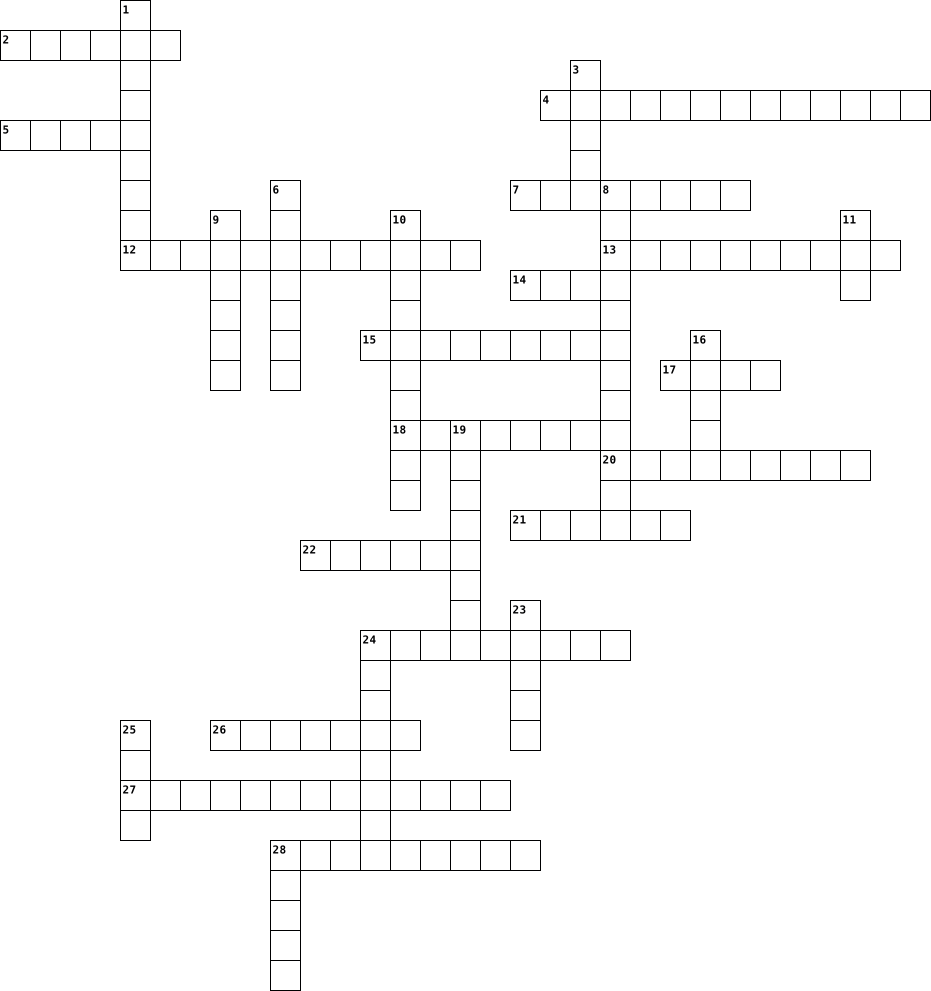
Across
- More generally, power is the rate of energy transfer by any ______.
- All energy, such as nuclear, chemical, internal, and electrical, that is not mechanical energy is classified as __________ energy.
- Work is not done on an object unless the object is moved with the action of a ____.
- Work is done only when components of a force are ______ to a displacement
- Work is done on an object when a force causes a __________ of the object
- Elastic potential energy depends on distance __________ or stretched
- power = work ÷ ____ interval
- the work you do on the car is equal to the ______ of the force
- the product of the component of a force along the direction of displacement and the magnitude of the displacement
- Although the amount of mechanical energy is ________, mechanical energy itself can change form.
- Machines with different power _____ do the same amount of work in different time intervals.
- The net work done on a body equals its ______ in kinetic energy
- Gravitational potential energy depends on ______ from a zero level
- the energy associated with an object because of the position, shape, or condition of the object
- the energy of an object that is due to the object’s motion
- potential energy the potential energy stored in the gravitational fields of interacting bodies
- elastic potential energy = 1/2 × spring constant × (distance compressed or ________)^2
Down
- Mechanical energy is not _______in the presence of friction
- a quantity that measures the rate at which work is done or energy is transformed
- potential energy that is stored in any compressed or stretched object
- Energy conservation occurs even when _________ varies
- The symbol k is called the ______ constant, or force constant.
- energy that the sum of kinetic energy and all forms of potential energy
- ___ work = change in kinetic energy
- Kinetic energy is a scalar quantity, and the SI unit for kinetic energy is the ____.
- Work is _______ when the force is in the direction opposite the displacement.
- Potential energy is ______energy
- Work is ______ when the component of force is in the same direction as the displacement.
- The ____ of work is important
- power = force × ______
30 Clues: power = force × ______ • power = work ÷ ____ interval • The ____ of work is important • Potential energy is ______energy • ___ work = change in kinetic energy • Energy conservation occurs even when _________ varies • the energy of an object that is due to the object’s motion • Mechanical energy is not _______in the presence of friction • ...
forms of goverment 2025-08-25

Across
- ruled by a group.
- ruled by state and central.
- republic, citizens elect representitives.
- monarchy, limited by constitution.
- system, states and central have equal power.
- single leader.
- religion is infused in government.
- system, states have more power than central.
- single leader has absolute power.
- central government has most power.
Down
- government, governments power is limited by law.
- total control.
- of law, everybody is held acountable.
- people rule.
- state is responsible for itself.
- born in to royalty.
- of power, divides responsibility among branches.
17 Clues: people rule. • total control. • single leader. • ruled by a group. • born in to royalty. • ruled by state and central. • state is responsible for itself. • single leader has absolute power. • monarchy, limited by constitution. • religion is infused in government. • central government has most power. • of law, everybody is held acountable. • republic, citizens elect representitives. • ...
Q3 Recovery Pack - Vocabulary 2022-03-28

Across
- A dense sphere of solid iron and nickel at the center of Earth.
- A state of matter that has a definite volume but no definite shape.
- made up of vibrating electric and magnetic fields that can move through the space at the speed of light
- In a wave, the distance between the highest crest and the resting position
- The energy that is transferred from a warmer object to a cooler object.
- Circular flow of a gooey mixture of rocks and magma in the mantle caused by that mixture being heated by the core of the Earth.
- electromagnetic waves with the 2nd longest wavelengths and 2nd lowest frequencies
- A layer of solid rock that forms Earth's outer surface; the main elements in the rock are oxygen and silicon.
- An increase in the size of a substance when its temperature is increased
- The energy due to the motion of an object or its particles.
- The transfer of energy by electromagnetic waves
- Conduction, Convection, Radiation
- A wave that moves through some type of matter
- The matter through which a wave travels
- A layer of molten iron and nickel that surrounds the inner core of Earth.
- An decrease in the size of a substance when its temperature is decreased
- a type of rock that forms from magma or lava that cools and hardens
- A layer of hotter rock located below the Earth's crust; the rock here contains more magnesium and iron.
- a solid in which the atoms are arranged in a pattern that repeats again and again
- a naturally occurring, inorganic solid that has a crystal structure and a definite chemical composition
- A circular movement of a fluid (gas or liquid) caused by the cycle of warm fluid rising and cool fluid sinking.
- the combination of two or more waves that results in a single wave
- For 1 gram of a substance, the amount of energy required to raise its temperature by 1 Kelvin (same as 1 degree Celsius).
- electromagnetic waves with the shortest wavelengths and highest frequencies
- electromagnetic waves with the 2nd shortest wavelengths and 2nd highest frequencies
- electromagnetic waves with the wavelengths a little shorter than visible light and frequencies a little higher than visible light
- electromagnetic waves with the longest wavelengths and lowest frequencies
- the bending of a wave as it moves around an obstacle
- A state of matter that has no definite shape or volume.
- A measure of how hot (or cold) something is; specifically, a measure of the average kinetic energy of the particles in an object.
- Energy cannot be created or destroyed, it can only change forms.
- A series of processes on the surface and inside Earth that slowly changes rocks from one kind to another
- A wave that travels perpendicular (at right angles) to the direction of the the wave source's motion
- The number of times a wave repeats in a given amount of time
- A wave that travels in the same direction as wave source's motion
- Finding ways to use less energy or to use energy more efficiently.
- The transfer of thermal energy by the circulation or movement of a liquid or gas
- A process of heat transfer where the warm part of a fluid rises and the cool part of that fluid sinks.
Down
- A material that does not transfer thermal energy easily - it resists the gain or loss of temperature.
- occurs when two waves combine to form a wave with smaller amplitude then the original waves
- a type of rock that forms when particles from other rocks or the remains of plants and animals are pressed and cemented together
- A mountain or hill having an opening that blasts out magma (lava), rocks, and gas from the earth's crust.
- A state of matter that has a definite shape and volume.
- the wave energy is transferred to the material it hits
- electromagnetic waves that you can see
- A disturbance that transfers energy from place to place
- The total kinetic and potential energy of all the particles of an object.
- small, solid pieces of material that come from rocks or living things
- The transfer of thermal energy from one particle of matter to another
- a type of rock that forms from an existing rock that is changed by heat, pressure, or chemical reactions
- A type of energy that can travel without a medium
- A completely empty space, containing no particles of matter
- The distance a wave travels before it starts to repeat it's motion
- Stored energy due to the position or shape of an object or its particles.
- the bending of a wave as it enters a new medium at an angle
- A material that transfers thermal energy easily
- occurs when two waves combine to form a wave with greater amplitude then the original waves
- A pure substance made of only one kind of atom; also the smallest, most basic part of something.
- A wave of energy that travels through the Earth, away from an earthquake in all directions.
- the complete range of electromagnetic waves placed in order of increasing frequency
- electromagnetic waves with the wavelengths a little longer than visible light and frequencies a little lower than visible light
- the process by which atoms are arranged to form a material with a crystal structure
- A sudden and violent shaking of the ground caused by the cracking, shifting, and moving of the earth's crust.
- an increase in the amplitude of a vibration that occurs when external vibrations match an object's natural frequency
- a wave that appears to stand (stay) in one place, even though it is really two waves interfering
- the wave bounces off and goes in a new direction
66 Clues: Conduction, Convection, Radiation • electromagnetic waves that you can see • The matter through which a wave travels • A wave that moves through some type of matter • The transfer of energy by electromagnetic waves • A material that transfers thermal energy easily • the wave bounces off and goes in a new direction • A type of energy that can travel without a medium • ...
Work, KE,PE and Conservation of Energy 2021-05-10

Across
- conservation total energy of an isolated system is constant
- power work done in a time interval divided by the time interval
- when a force acts on something that undergoes a displacement from one position to another
- force force that does work that depends on path
- differential is the total differential of a function and requires the use of partial derivatives if the function involves more than one dimension
- point position where the assumed conservative, net force on a particle, given by the slope of its potential energy curve, is zero
- negative of the work done acting between two points in space
- function of position, energy possessed by an object relative to the system considered
Down
- graph of a particle’s potential energy as a function of position
- energy source that is not renewable, but is depleted by human consumption
- quantity one that cannot be created or destroyed, but may be transformed between different forms of itself
- force force that does work independent of path
- position where the velocity a particle, in one-dimensional motion, changes sign
- energy source that is replenished by natural processes, over human time scales
- energy energy of motion, one-half an object’s mass times the square of its speed
- rate of doing work
- energy sum of the kinetic and potential energies
- theorem net work done on a particle is equal to the change in its kinetic energy
- work work done by all the forces acting on an object
19 Clues: rate of doing work • force force that does work independent of path • force force that does work that depends on path • energy sum of the kinetic and potential energies • work work done by all the forces acting on an object • conservation total energy of an isolated system is constant • power work done in a time interval divided by the time interval • ...
Energy Crossword 2015-04-21

Across
- the potential energy stored in the nucleus of an atom
- a rapid reaction between oxygen and fuel that results in fire; the proccess of burning fuel to produce thermal energy
- the energy of stretched or compressed objects
- a form of energy that travels through space as waves
- energy that an object has due to its motion
- the rule that energy cannot be created or destroyed
- kinetic or potential energy associated with the motion or position of an object
- the energy of moving electrical charges
Down
- potential energy that depends on the height of an object
- stored energy that results from the position or shape of an object
- the process of changing one form of energy to another
- the total potential and kinetic energy of the particles in an object
- a material such as coal that forms over millions of years from the remains of ancient plants and animals
- the ability to do work or cause change; the ability to move an object some distance
14 Clues: the energy of moving electrical charges • energy that an object has due to its motion • the energy of stretched or compressed objects • the rule that energy cannot be created or destroyed • a form of energy that travels through space as waves • the potential energy stored in the nucleus of an atom • the process of changing one form of energy to another • ...
Energy 2022-03-28

Across
- change in speed or direction
- anything that isn't matter
- Newton's first law
- a push or pull
- energy that depends on position
Down
- energy changing forms
- energy of motion
- how much matter a thing has
- movement
- measured in pounds
10 Clues: movement • a push or pull • energy of motion • Newton's first law • measured in pounds • energy changing forms • anything that isn't matter • how much matter a thing has • change in speed or direction • energy that depends on position
Energy 2013-11-26

Across
- Power from the Sun.
- a slippery liquid that comes from minerals as well as animal and vegetable fat.
- The energy that is stored within atoms.
- energy that has been stored ready to be used.
- when phones are charged they are charged with________.
- Colorless gas found in natural gas and petroleum; used as a fuel.
- Used for hydro-power & drinking.
- Moving air used to create energy.
Down
- Fossil fuel consisting of carbonized vegetable matter burned to generate energy.
- Power from water.
- Solar, Wind, Hydro and Bio-mass are forms of _____________ energy.
- energy that is been used right now.
- Heat inside the earth.
- Plant materials and animal waste used as fuel.
- Used for nuclear fuels.
15 Clues: Power from water. • Power from the Sun. • Heat inside the earth. • Used for nuclear fuels. • Used for hydro-power & drinking. • Moving air used to create energy. • energy that is been used right now. • The energy that is stored within atoms. • energy that has been stored ready to be used. • Plant materials and animal waste used as fuel. • ...
Briana energy puzzle 2016-05-20

Across
- change direction of force fixed pulley changes direction or force.
- energy all matter is small up of tiny particales held together by forces
- is used in different forms.
- energy collects energy from the suns radiant.
- is something that is not used properly.
- is when you recycle you can use again.
- is a split object apart.
Down
- bonds.
- plane is a sloppy surface easy to move objects.
- a increase force,decrease effort,holds things together.
- and axle is the wheel goes threw the post is an axle
- some geothermal energy comes from warm water and lock near earths surface.
- fuels is when the energy released by the fuels as they burn is converted to
- hydroelectric plants use the energy of flowers water at h moves.
- fossil buried under layers of dirt.
- is a living or recently living organizes we can use energy as resourses.
- is a rigid object or bar that pivots around a fixed point.
17 Clues: bonds. • is a split object apart. • is used in different forms. • fossil buried under layers of dirt. • is when you recycle you can use again. • is something that is not used properly. • energy collects energy from the suns radiant. • plane is a sloppy surface easy to move objects. • and axle is the wheel goes threw the post is an axle • ...
Types_of_Energy 2024-11-25

Across
- The type of energy produced when an object vibrates, creating waves that travel through a medium like air or water.
- The transfer of energy when a force is applied to an object causing it to move.
- The rate at which energy is transferred or work is done.
- A type of Energy from sources that can be replenished naturally, such as solar, wind, and water.
- The type of energy of moving electric charges, which powers devices like lights and computers.
- The type of energy related to the temperature of an object, caused by the motion of its particles.
- The total energy of motion and position in an object.
- The ability to do work or cause change; it can exist in various forms such as heat, light, and motion.
- The type of Potential Energy stored in an object because of its height above the ground.
- The type of Energy carried by electromagnetic waves, including visible light.
- The type of energy stored in the nucleus of an atom, released during nuclear reactions like fission or fusion.
Down
- A type of Energy from sources that cannot be replaced quickly, like coal, oil, and natural gas.
- A force that opposes motion and converts kinetic energy into thermal energy.
- The energy of motion; any object that is moving has kinetic energy.
- Type of Energy stored in the bonds of chemical compounds, such as in food or fuel.
- Stored energy due to an object’s position, condition, or composition.
- The type of Potential Energy stored in objects that can be stretched or compressed, such as springs or rubber bands.
- A form of thermal energy transfer from a hotter object to a cooler one.
18 Clues: The total energy of motion and position in an object. • The rate at which energy is transferred or work is done. • The energy of motion; any object that is moving has kinetic energy. • Stored energy due to an object’s position, condition, or composition. • A form of thermal energy transfer from a hotter object to a cooler one. • ...
Bio Ch. 4 2023-11-21

Across
- chemical energy is used to produce carbohydrates and sulfur compounds
- organisms that rely on other organisms for energy and nutrients
- a series of organisms in which energy is transferred from one organism to another
- each step in the food chain or web (each part of the pyramid)
- can capture energy from nonliving sources and convert it into forms living cells can use
- only certain types of bacteria can convert nitrogen gas into ammonia
- elements that an organism needs to sustain life
- must acquire energy from other organisms, usually by eating them
- models that show the relative amount of energy or matter in each trophic level
Down
- a nutrient whose supply limits productivity
- first producers of energy-rich compounds that can be used later by other organisms
- when matter flows from one trophic level to another and elements are recycled within and among ecosystems
- network of feeding interactions through which both energy and matter move
- converting nitrates into nitrogen gas
- tiny floating algea
- small pieces of dead and decaying plant and animal remains
- uses energy to convert carbon dioxide and water into oxygen and carbohydrates
- the total amount of living tissue within a given trophic level
18 Clues: tiny floating algea • converting nitrates into nitrogen gas • a nutrient whose supply limits productivity • elements that an organism needs to sustain life • small pieces of dead and decaying plant and animal remains • each step in the food chain or web (each part of the pyramid) • the total amount of living tissue within a given trophic level • ...
Solar Power 2019-06-11

Across
- a phenomenon which can produce light, heat, and power
- environmentally friendly, will not die out
- a branch of physics which studies the conversion of different energy forms
- power which is produced by chemical or physical resources
Down
- solar power is a type of _______ energy
- the emission of energy as electromagnetic waves
- exposure to sun rays
- cell that produces electrical energy from solar energy
- panel a flat plane who's purpose is to absorb sun rays and convert them to electricity
- the source of solar power
- the smallest compound of an element
- a unit of electrical energy
12 Clues: exposure to sun rays • the source of solar power • a unit of electrical energy • the smallest compound of an element • solar power is a type of _______ energy • environmentally friendly, will not die out • the emission of energy as electromagnetic waves • a phenomenon which can produce light, heat, and power • cell that produces electrical energy from solar energy • ...
Chapter 8 2013-06-17

Across
- Cause botulism and dies when exposed to oxygen.
- Break down carbohydrates in the dough and release CO2
- Metabolic pathway that breaks down carbohydrates to produce ATP by using oxygen.
- Two three carbon intermediates
- Third stage of aerobic respiration.
- The second stage of aerobic respiration.
- First stage of aerobic respiration and fermentation.
- Contribute to endurance, they make ATP by aerobic respiration.
- An anaerobic metabolic pathway by which cells harvest energy from organic molecules.
- Anaerobic pathway that breaks down glucose, forms ATP and lactate.
- Occurring in the absence of oxygen.
Down
- Digest lactose in milk, to ferment dairy products.
- Sustain short, intense bursts of speed.
- Oxygen requiring.
- The direct transfer of a phosphate group from a substrate to ADP.
- Carry energy that can be used to drive endergonic reactions.
- Anaerobic pathway that breaks down glucose, forms ethanol and ATP.
- Formation of two piruvate by glycolysis and enters in the inner compartment of a mitochondrion.
- Transfer of a phosphate group to a recipient molecule.
- Three carbon end product of glycolysis.
20 Clues: Oxygen requiring. • Two three carbon intermediates • Third stage of aerobic respiration. • Occurring in the absence of oxygen. • Sustain short, intense bursts of speed. • Three carbon end product of glycolysis. • The second stage of aerobic respiration. • Cause botulism and dies when exposed to oxygen. • Digest lactose in milk, to ferment dairy products. • ...
Energy Crossword Puzzle 2026-02-04

Across
- nuclear reaction that takes place in the stars
- this type of enrgy flows in waves
- stored energy that is released when chemicals combine
- energy that can be changed from one form to another
- powerplants use this type of energy
- energy from the vibrations of atoms that form a wave based on compressions and rarefractions
- the spectrum that includes all forms of light
- material that lets energy flow through
Down
- occurs when stored energy from the nucleus is released
- material that srops energy from flowing through
- energy from random vibrating atoms
- when one electron moves from one atom to another
12 Clues: this type of enrgy flows in waves • energy from random vibrating atoms • powerplants use this type of energy • material that lets energy flow through • the spectrum that includes all forms of light • nuclear reaction that takes place in the stars • material that srops energy from flowing through • when one electron moves from one atom to another • ...
Choice Board 2022-09-27

Across
- second step of anaerobic respriation
- Adenosine phosphate, unchanged energy storage molecule with 2 phosphates
- first step of aerobic resp breaks down glucose
- process of resp and energy
- sphere of the earth, all gases surrounding earth
- nutrient forms the backbone for all macro macromolecules
- sphere of earth, all rocks and soil
- sphere of the earth, all living things on earth
- describes a situation in which oxygen is present
- second step of photosynthesis uses energy in ATP and NADPH
- type of organism that eat other orgasimns to get energy
- process of breaking down glucose to make ATP
- second step of aerobic resp releases CO2
- pigment in choloplast used to trap light energy duing photosynthesis
Down
- nutrient used in proteins
- type of organism that is able to make its own food
- site of photosynthesis
- describes a situation in which oxygen is not present
- process of using light energy to make food
- type of organism that breaks down compounds
- first step of photosynthesis uses sunlight
- anything that has mass and takes up space
- adensine triphosphate, changed energy storage
- third step of photosynthesis
- uses in phosphates
- sphere of earth, water
- at the beinning of a chemical reaction
- substance created durign chemical reaction
28 Clues: uses in phosphates • site of photosynthesis • sphere of earth, water • nutrient used in proteins • process of resp and energy • third step of photosynthesis • sphere of earth, all rocks and soil • second step of anaerobic respriation • at the beinning of a chemical reaction • second step of aerobic resp releases CO2 • anything that has mass and takes up space • ...
Energy sources 2024-03-01

Across
- thick black liquid
- nonrenewable and forms within the earth over millions of year
- energy made from flowing water
- wind solar geothermal hydroelectric tidal biomass
- energy from the sun
- energy from any material that comes from plants
- naturally renew or replenish themselves
- to use something again
- generated during nuclear fission
- produced by the natural rise and fall of tides
Down
- fossil fuels coal oil natural gas fracking and nuclear
- mineral formed from plants that have been fossilized
- captured with wind turbines
- DO NOT naturally renew or replenish themselves
- to make it like new
- layer in earths stratosphere which absorbs most of ultraviolet radiation
- careful maintenance and upkeep of a natural resource
- heat energy from deep within the earth
- a gas that contributes to greenhouse gases by effect by absorbing carbon dioxide
- to convert waste into reusable material
20 Clues: thick black liquid • to make it like new • energy from the sun • to use something again • captured with wind turbines • energy made from flowing water • generated during nuclear fission • heat energy from deep within the earth • naturally renew or replenish themselves • to convert waste into reusable material • DO NOT naturally renew or replenish themselves • ...
Forms of punishment 2015-05-24

Across
- I got a ..... and some penalty points for speeding yesterday.
- The teacher was ..... by the school principal for neglecting her duties.
- He was ..... from school for cheating during an exam.
- Tom was ..... for a car theft. He will spend two years behind bars.
- The journalist’s article was ..... . Some of his views were too radical for the country’s political regime.
Down
- Finally, he was ..... off without any punishment. There was no real evidence against him.
- The judge gave him a ..... sentence taking his young age into consideration.
- In some Arab countries ..... punishment still exists.-People are whipped in public for the wrong things they had done.
- For the awful murder he’d committed he was sentenced to life ..... .
- He got ..... with punishment again. He should have been penalised for what he did.
- She didn’t have good performance at work and was ..... for promotion.
- If you have a police ..... , you may be banned from holding some public functions, for example you can’t be a teacher.
- The young offender was put on ..... for two years. He has to report to a ..... officer every week.
- My son played truant. Now he will be ..... for two weeks. Apart from school he will not go out anywhere.
- The suspect was ..... for questioning.
- We were ..... entry to Israel because we had a stamp from Egypt in our passports.
16 Clues: The suspect was ..... for questioning. • He was ..... from school for cheating during an exam. • I got a ..... and some penalty points for speeding yesterday. • Tom was ..... for a car theft. He will spend two years behind bars. • For the awful murder he’d committed he was sentenced to life ..... . • ...
forms of goverment 2020-09-18

Across
- relating to a system of government that is centralized and dictatorial and requires complete subservience to the state.
- a state in which supreme power is held by the people and their elected representatives, and which has an elected or nominated president rather than a monarch.
- something unrelated to religion.
- a form of government with a monarch at the head.
- a system of government by one person with absolute power.
- having or relating to a system of government in which several states form a unity but remain independent in internal affairs.
- a person chosen or appointed to act or speak for another or others.
- length of a complex vector unchanged.
- a country governed by a dictator.
Down
- the highest legislature, consisting of the sovereign, the House of Lords, and the House of Commons.
- a system of government in which priests rule in the name of God or a god.
- the highest class in certain societies, especially those holding hereditary titles or offices.
- relating to or denoting a confederation.
- a small group of people having control of a country, organization, or institution.
- a body of fundamental principles or established precedents according to which a state or other organization is acknowledged to be governed.
- a system of government by the whole population or all the eligible members of a state, typically through elected representatives.
16 Clues: something unrelated to religion. • a country governed by a dictator. • length of a complex vector unchanged. • relating to or denoting a confederation. • a form of government with a monarch at the head. • a system of government by one person with absolute power. • a person chosen or appointed to act or speak for another or others. • ...
Forms of Government 2023-09-21

Across
- A ___________________ government is a loose association of states or regions with limited central authority.
- _______________ is a form of government where power is held by the people, typically through elected representatives.
- Democracy has free _______.
- A positive of autocracy is that it is _____.
- In a _________________ government, the ruling party or individual has total control over every aspect of society.
- A criticism of democracy is that it is _____.
- A ___________________ government is one in which the constitution serves as the supreme law of the land and limits the powers of government.
- A ___________________ government is characterized by a single ruler who inherits their position, often as a king or queen.
- _________________ is a form of government where power is concentrated in the hands of a small, elite group.
Down
- A ___________________ is ruled by religious leaders or institutions.
- A state must have government, population, defined territory, and ____.
- Rule by one person
- A ___________________ government combines elements of both democracy and monarchy, often with a monarch serving as a ceremonial figurehead.
- In a ________________ system of government, power is divided between a central authority and regional entities or states.
- A form of government in which elected representatives govern on behalf of the people.
- Traditionally, democracy has been the least _______ form of government.
16 Clues: Rule by one person • Democracy has free _______. • A positive of autocracy is that it is _____. • A criticism of democracy is that it is _____. • A ___________________ is ruled by religious leaders or institutions. • A state must have government, population, defined territory, and ____. • Traditionally, democracy has been the least _______ form of government. • ...
Forms of Prose 2023-09-11

Across
- the story of a real person's life, written by another person
- reason for reading
- a universal message about life
- a fictional story that is longer than twenty pages but shorter that one hundred
- putting events in sequence, or the order in which they happened
- a fictional prose narrative that is less than twenty pages
- written or spoken language in its ordinary form
- recall what you already know to help you understand something new
Down
- the imaginary people or animals in a story
- the vantage point from which a story is told
- the story of a person's life written by that person
- a story with no known author that has been passed on from generation to another orally
- the time and place in which the story is set
- a fictional story that is more than one hundred pages long
- writing that deals with real people, events, and places
- a prose account that is made up rather than true
16 Clues: reason for reading • a universal message about life • the imaginary people or animals in a story • the vantage point from which a story is told • the time and place in which the story is set • written or spoken language in its ordinary form • a prose account that is made up rather than true • the story of a person's life written by that person • ...
Forms of Government 2024-08-03

Across
- the group of people that make the decisions to govern a country/state
- a government run by religious leaders
- system A form of government in which states have most power and unite to accomplish common goals.
- the power, or authority, to run a country
- A government ruled by a few powerful people (usually rich)
- system System of government in which all power is invested in a central (national/federal) government.
- to be in charge of; to control or rule
- a regional territory that is part of a country
- Liberty the freedom to think and act without government interference or fear of unfair legal treatment
- government (also called federal or central) the government that is responsible for decisions concerning the ENTIRE country (not just a city/state)
Down
- government by the people through VOTING
- a system of government where citizens vote for other citizens to represent them in government
- a form of government led by a King/Queen where power is passed down through family
- system a system of government in which power is divided between a central authority and a number of individual states
- strict obedience of the government at the expense of freedoms
- a form of government led by one person with unlimited power (ex. dictatorship)
16 Clues: a government run by religious leaders • to be in charge of; to control or rule • government by the people through VOTING • the power, or authority, to run a country • a regional territory that is part of a country • A government ruled by a few powerful people (usually rich) • strict obedience of the government at the expense of freedoms • ...
Forms of Speech 2023-06-05

Across
- A word that shows action in a sentence
- noun Nouns that name more than one person, place, etc.
- We _____ (hope/hoped)that you succeed.
- Word that is used to sescribe name of place, person, thing or idea
- Pronouns are used in place of
- _____ are you angry wth me?(Fill with Adverb)
- I swa a ____ of fish near the beach.(shoal/ colony)
- Tom is _____ than Dave.(fast)
- Mira is never sad. She is _____ happy.( Fill it with adverb)
- Noun Specific name of a place or person
Down
- Word imputting characterstic to noun or pronoun
- Find the adjective and place it in crossword: There are shiny stars in the sky.
- Nouns that can be counted
- Nobody _____ (know/knows) where he lives
- My brother is a kind person. He did the work all by ______.(herself/himself)
- Word that describe or modify a verb, adjective or entire sentence
16 Clues: Nouns that can be counted • Pronouns are used in place of • Tom is _____ than Dave.(fast) • A word that shows action in a sentence • We _____ (hope/hoped)that you succeed. • Nobody _____ (know/knows) where he lives • Noun Specific name of a place or person • _____ are you angry wth me?(Fill with Adverb) • Word imputting characterstic to noun or pronoun • ...
Chemistry vocab 2016-10-13

Across
- the ability to preform work
- a commonly used atomic model
- number of protons in the nucleus
- smallest amount of radiant energy
- behavior of electrons in an atom
- the smallest particle of an element
- orbits the nucleus
- when an atom gains or looses an electron
- the process of unstable nucleus releasing energy
- x-rays
- made of protons and electrons
- electron orbital
- electromagnetic radiation from a source
- different forms of the same element
- dividing into two or more parts
Down
- makes up part of the nucleus
- used to express atomic weight
- a popular video game, also the decay rate of a isotope
- how much energy an object can have
- the distribution of electrons
- the process of unstable nucleus releasing energy
- represents a quantum of light
- number of times an event occurs
- the number of protons and electrons in a nucleus
- positive charge of energy in an atom
- where an atom is located a a certain time
- the distance between crests; sound wave
- the joining of multiple things to form one entity
28 Clues: x-rays • electron orbital • orbits the nucleus • the ability to preform work • makes up part of the nucleus • a commonly used atomic model • used to express atomic weight • the distribution of electrons • represents a quantum of light • made of protons and electrons • number of times an event occurs • dividing into two or more parts • number of protons in the nucleus • ...
Energy Crossword 2015-04-21

Across
- a material such as coal that forms over millions of years from the remains of ancient plants and animals
- potential energy that depends on the height of an object
- the process of changing one form of energy to another
- kinetic or potential energy associated with the motion or position of an object
- energy that an object has due to its motion
- stored energy that results from the position or shape of an object
Down
- a rapid reaction between oxygen and fuel that results in fire; the proccess of burning fuel to produce thermal energy
- the energy of moving electrical charges
- the rule that energy cannot be created or destroyed
- the energy of stretched or compressed objects
- a form of energy that travels through space as waves
- the potential energy stored in the nucleus of an atom
- the total potential and kinetic energy of the particles in an object
- the ability to do work or cause change; the ability to move an object some distance
14 Clues: the energy of moving electrical charges • energy that an object has due to its motion • the energy of stretched or compressed objects • the rule that energy cannot be created or destroyed • a form of energy that travels through space as waves • the process of changing one form of energy to another • the potential energy stored in the nucleus of an atom • ...
Energy Glossary 2022-05-23

Across
- energy, energy possessed by a moving object
- energy, energy that travels as vibrating waves and can be heard by our ears as sound
- energy, energy stored inside an atom
- potential energy, stored energy of an object that is held above the Earth’s surface
- process in which green plants convert light energy into chemical energy
- unit of measurement for energy
- potential energy, energy stored within a stretched or compressed object, like a spring or elastic material
Down
- this is done whenever an object is moved or is forced to change shape
- energy, energy that causes charged particles to move
- energy, stored energy possessed by an object, such as elastic potential energy of a squashed spring
- the ability to make a change happen; different forms include heat energy, light energy and sound energy
- energy, form of energy that is visible, such as that produced by the Sun
- energy, a measure of the total kinetic energy possessed by particles in a substance
- energy, energy stored within a substance such as fuel or food that may be released when the substance is burnt or digested
14 Clues: unit of measurement for energy • energy, energy stored inside an atom • energy, energy possessed by a moving object • energy, energy that causes charged particles to move • this is done whenever an object is moved or is forced to change shape • process in which green plants convert light energy into chemical energy • ...
Solar Power 2019-06-10

Across
- the source of solar power
- cell that produces electrical energy from solar energy
- power which is produced by chemical or physical resources
- solar power is a type of _______ energy
- a unit of electrical energy
- environmentally friendly, will not die out
Down
- the emission of energy as electromagnetic waves
- exposure to sun rays
- a branch of physics which studies the conversion of different energy forms
- a flat plane who's purpose is to absorb sun rays and convert them to electricity
- the smallest compound of an element
- a phenomenon which can produce light, heat, and power
12 Clues: exposure to sun rays • the source of solar power • a unit of electrical energy • the smallest compound of an element • solar power is a type of _______ energy • environmentally friendly, will not die out • the emission of energy as electromagnetic waves • a phenomenon which can produce light, heat, and power • cell that produces electrical energy from solar energy • ...
Grade 8 Science Crossword 2019-10-01

Across
- Lowest point of a wave
- Light coming from a light source
- surge Abnormal rise of water due to tropical cyclone
- effect The movement and speed of typhoons is affected by the _______
- When water-saturated granular material temporarily loses its solid structure and becomes fluid-like
- Caused by rocks pulled together by diverging plates.
- Force that opposes the motion of an object
- faulting Type of faulting which is found along divergent zones
- rainbands Main spiral bands of a typhoon
- Height of crest or depth of trough
- Distance between crest and and its succeeding crest; same goes between trough and its succeeding trough
- Heat transfer through the movement of fluids with different temperatures
- Highest point of a wave
Down
- Point on the ground directly above focus
- Transfer of energy by electromagnetic waves
- Image forms behind the retina of the eye.
- Mature tropical cyclone that develops in western part of North Pacific Ocean
- Transfer of energy as a result of temperature difference between two objects
- Energy transfer between two objects either by collision or contact
- waves Vibrations sent travelling through the ground by earthquakes
- Faulting which happens when the crust is compared.
- The result of two or more waves that meet
- If the human eye is too "long" and image forms in front of retina
- cyclone "Typhoon" "hurricane" are some of those considered under _______
24 Clues: Lowest point of a wave • Highest point of a wave • Light coming from a light source • Height of crest or depth of trough • Point on the ground directly above focus • rainbands Main spiral bands of a typhoon • Image forms behind the retina of the eye. • The result of two or more waves that meet • Force that opposes the motion of an object • ...
Transforming Electrical Energy Crossword 2017-02-07

Across
- there was a lot of _______ in this presentation.
- Energy describes the amount of _______ to make certain changes in any system
- this type of energy is made up of positive and negative charged electrons.
- our topic is transforming electrical ______.
- there are many forms of energy such as electrical, thermal, _______, mechanical, electromagnetic, sound, and chemical.
- a container that carries one or more cells of energy
Down
- we hoped you learned _____ from this presentation.
- chemical to ________ is heat.
- vacuums use _________ energy.
- opposite of wires or cable.
- this type of energy can be found in food
- this type of energy is used in a toaster.
12 Clues: opposite of wires or cable. • chemical to ________ is heat. • vacuums use _________ energy. • this type of energy can be found in food • this type of energy is used in a toaster. • our topic is transforming electrical ______. • there was a lot of _______ in this presentation. • we hoped you learned _____ from this presentation. • ...
Unit 2 Eden Barga 2023-04-04

Across
- water fearing
- combined tissues
- diffusion with water
- proteins that lower the amount of activation energy needed for metabolism to occur
- allowing certain molecules in or out of a cell
- combined atoms
- combined cells
- the substrate after the chemical reaction
- using energy to move molecules across the cell membrane
- combined organelles and is considered the basic unit of life
Down
- basic unit of matter such as carbon or hydrogen
- moving from a highly concentrated area to a lower concentrated area
- all the organs such as the digestive system
- water loving
- moving molecules across the membrane without using energy
- combined molecules
- all the organ systems
- when the active site's shape has changed
- the special region on enzymes where the substrate goes
- reactants
- energy required to start metabolism
- a molecule with a hydrophilic head and two hydrophobic tails and forms the cell membrane
22 Clues: reactants • water loving • water fearing • combined atoms • combined cells • combined tissues • combined molecules • diffusion with water • all the organ systems • energy required to start metabolism • when the active site's shape has changed • the substrate after the chemical reaction • all the organs such as the digestive system • allowing certain molecules in or out of a cell • ...
Cells & Organelles 2025-10-22

Across
- controls which substances pass in & out of cell
- network of membranes that produce many substances
- clear, gel-like fluid, fills cell & holds organelles
- cell's recycling center
Down
- captures energy from sunlight & forms energy cells use for food
- powerhouse of the cell, converts energy from food to energy for cell
- large water filled sacs floating in cytoplasm, store water, food, and waste
- makes proteins
- type of microscope that use beams of electrons
- command center of cell
- type of microscope that uses two lenses
- warehouse of cell
- rigid layer that surrounds plant cells
13 Clues: makes proteins • warehouse of cell • command center of cell • cell's recycling center • rigid layer that surrounds plant cells • type of microscope that uses two lenses • type of microscope that use beams of electrons • controls which substances pass in & out of cell • network of membranes that produce many substances • clear, gel-like fluid, fills cell & holds organelles • ...
Energy and Light Crossword 2017-09-08

Across
- the capacity for doing work
- curving inwards
- the distance between two corresponding points of two consecutive waves
- energy stored in the bonds of chemical compounds
- the energy that an object possesses due to it’s position above the Earth
- coming from the sun
- a form of energy resulting from the flow of electric charge
- curving or bulging outwards
Down
- the point in space where parallel light waves meet after bouncing off a curved mirror or passing through a curved lense
- light bounces bounces of an object
- stored energy as the result of a compression of a spring
- the number of crests of a wave that move past a given point in a given unit of time
- the energy that an object possesses due to it’s motion
- a range of different wavelengths of light and other forms of energy
- the change in direction of a wave travelling from one medium to another
15 Clues: curving inwards • coming from the sun • the capacity for doing work • curving or bulging outwards • light bounces bounces of an object • energy stored in the bonds of chemical compounds • the energy that an object possesses due to it’s motion • stored energy as the result of a compression of a spring • a form of energy resulting from the flow of electric charge • ...
Chemical Reaction Vocabulary 2023-11-07

Across
- this reaction is classified as _________.
- Is a way to show a chemical reaction, using symbols instead of words.
- This states that during a chemical reaction, matter is not created or destroyed.
- These cells in your body contain thousands of biological catalyst called _______.
- Is a number placed in front of a chemical formula in an equation.
- It increases the reaction rate by lowering the activation energy needed.
- Is a material used to decrease the rate of a chemical reaction is an ________.
- Is a substance that undergo the chemical changes.
- When one element replaces another element in a compound, or if two elements in different compounds trade places, the reaction is called a ___________.
- Is the amount of a substance in a given volume.
- Is a reaction that occurs when compounds break down into simpler products.
Down
- It is the minimum amount of energy needed to start a chemical reaction.
- Is any change that alters the form or appearance of a substance but does not change it into another substance.
- Is a change in matter that produces one or more new substances.
- Is more energy is required to break the bonds of the reactants than is released by the formation of the products.
- This means matter can enter from or escape to the surroundings.
- It is a solid that forms from liquids during a chemical reaction.
- Is the new substance that forms when 2 substances or more are combined.
- Is the energy released as the products form is greater than the energy required to break the bonds of the reactants.
- In chemistry when two or more elements or compounds combine to make a more complex
- This means matter does not enter or leave.
21 Clues: this reaction is classified as _________. • This means matter does not enter or leave. • Is the amount of a substance in a given volume. • Is a substance that undergo the chemical changes. • Is a change in matter that produces one or more new substances. • This means matter can enter from or escape to the surroundings. • ...
Unit 2 Eden Barga 2023-04-04

Across
- water fearing
- combined tissues
- diffusion with water
- proteins that lower the amount of activation energy needed for metabolism to occur
- allowing certain molecules in or out of a cell
- combined atoms
- combined cells
- the substrate after the chemical reaction
- using energy to move molecules across the cell membrane
- combined organelles and is considered the basic unit of life
Down
- basic unit of matter such as carbon or hydrogen
- moving from a highly concentrated area to a lower concentrated area
- all the organs such as the digestive system
- water loving
- moving molecules across the membrane without using energy
- combined molecules
- all the organ systems
- when the active site's shape has changed
- the special region on enzymes where the substrate goes
- reactants
- energy required to start metabolism
- a molecule with a hydrophilic head and two hydrophobic tails and forms the cell membrane
22 Clues: reactants • water loving • water fearing • combined atoms • combined cells • combined tissues • combined molecules • diffusion with water • all the organ systems • energy required to start metabolism • when the active site's shape has changed • the substrate after the chemical reaction • all the organs such as the digestive system • allowing certain molecules in or out of a cell • ...
What is energy? 2023-06-20

Across
- energy is not created nor lost, but it is _______
- the energy between protons and neutrons
- the process of changing energy from one kind to another
Down
- the force that causes things to move
- the unit for measuring energy
- E=mc2
- an object made up of chemical components has _____ energy
- kinds of energy are called "energy ______"
- the state of existing in something as permanent
- energy is the ability to do ______
10 Clues: E=mc2 • the unit for measuring energy • energy is the ability to do ______ • the force that causes things to move • the energy between protons and neutrons • kinds of energy are called "energy ______" • the state of existing in something as permanent • energy is not created nor lost, but it is _______ • the process of changing energy from one kind to another • ...
Chapter 5 Vocab 2020-12-21

Across
- Kinetic or potential energy associated with the motion or position of an object.
- The energy of light and other forms of radiation.
- The total energy of the particles in a substance or material.
- The energy of stretched or compressed objects.
- The ability to do work or cause change.
- The potential energy stored in the nucleus of an atom.
Down
- Energy that an object has due to its motion.
- Potential energy that depends on the height of an object.
- Energy that is stored and held in readiness.
- The energy of moving electric charges.
- The potential energy stored in chemical books.
11 Clues: The energy of moving electric charges. • The ability to do work or cause change. • Energy that an object has due to its motion. • Energy that is stored and held in readiness. • The potential energy stored in chemical books. • The energy of stretched or compressed objects. • The energy of light and other forms of radiation. • ...
Electronics 2016-10-31

Across
- law States that voltage is equal to the product of current and resistance
- The speed that electrons flow
- Draws power in a circuit
- Insulators have a high _______
- Named after an Italian physicist who invented the electric battery
- When force is used to relocate an object a certain distance
- Calculated by using the formula of power in divided by power out
- induction Discovered by Michael Faraday in 1831
- The rate of doing work
Down
- Named after a French physicist
- Path that a current goes through
- circuit Includes more than one path for a current to flow through
- energy Energy due to the moving of electric charges
- circuit There is only one path for a current to flow through in this type of circuit
- Metals or anything that has less resitance
- A type of energy that comes naturally or is produced
- The depiction of the electric potential energy per unit charge
- Exists in many forms like mechanical, kinetic or potential
- The unit for measuring electrical resistance
19 Clues: The rate of doing work • Draws power in a circuit • The speed that electrons flow • Named after a French physicist • Insulators have a high _______ • Path that a current goes through • Metals or anything that has less resitance • The unit for measuring electrical resistance • induction Discovered by Michael Faraday in 1831 • ...
Energy Crossword 2024-04-16

Across
- The law of ______ of energy says energy cannot be created or destroyed; it only changes forms.
- The type of energy that a moving object has
- Compression waves moving through a material (usually air); music is an example of it.
- Energy transferred to an object by a force
- Waves that come from space; includes gamma waves and ultraviolet waves
- Energy present in the nucleus of an atom; this type of energy is present in the stars like the Sun
Down
- A term that includes potential energy and kinetic energy
- The only form of energy that can be seen; produced by fire, a lamp, or a phone screen.
- Energy from moving electrons; found in a lamp, TV, or cell phone.
- Energy produced by the motion of electric charges
- Energy usage over time
- A type of potential energy stored in bonds of chemical compounds; batteries have this type of energy.
- Energy from the motion of atoms/molecules; a hot cup of coffee has this type of energy.
- This type of potential energy is stored in objects above the Earth's surface
14 Clues: Energy usage over time • Energy transferred to an object by a force • The type of energy that a moving object has • Energy produced by the motion of electric charges • A term that includes potential energy and kinetic energy • Energy from moving electrons; found in a lamp, TV, or cell phone. • Waves that come from space; includes gamma waves and ultraviolet waves • ...
Energy 2024-05-30

Across
- there are different ___ of energy
- nrg a stretched elastic band stores
- ability to do work
- nrg stored in an object by particular position
- nrg due to a motion in a body
- this nrg holds the nucleus together
- use of force to move an object
- nrg a blender or dryer uses
- nrg from gamma waves or x waves
- nrg comes from different ______
- nrg from speakers or a horn
Down
- this nrg comes from the sun
- nrg cannot be __ or destroyed
- SI unit of energy
- nrg from moving charged electrons
- a warm object has more ____ nrg than a cold
- stored in bonds of chemicals
- plants convert sunlight to chemical nrg
- the law of ___of nrg
- using electrical nrg the fan makes __
20 Clues: SI unit of energy • ability to do work • the law of ___of nrg • this nrg comes from the sun • nrg a blender or dryer uses • nrg from speakers or a horn • stored in bonds of chemicals • nrg cannot be __ or destroyed • nrg due to a motion in a body • use of force to move an object • nrg from gamma waves or x waves • nrg comes from different ______ • there are different ___ of energy • ...
Transforming Electrical Energy 2017-02-07

Across
- this type of energy can be found in food
- this type of energy is made up of positive and negative charged electrons.
- there was a lot of _______ in this presentation.
- opposite of wires or cable.
- there are many forms of energy such as electrical, thermal, _______, mechanical, electromagnetic, sound, and chemical.
Down
- Energy describes the amount of _______ to make certain changes in any system
- we hoped you learned _____ from this presentation.
- a container that carries one or more cells of energy
- vacuums use _________ energy.
- our topic is transforming electrical ______.
- chemical to ________ is heat.
- this type of energy is used in a toaster.
12 Clues: opposite of wires or cable. • vacuums use _________ energy. • chemical to ________ is heat. • this type of energy can be found in food • this type of energy is used in a toaster. • our topic is transforming electrical ______. • there was a lot of _______ in this presentation. • we hoped you learned _____ from this presentation. • ...
Space Systems 2022-07-13

Across
- a nuclear reaction in which nuclei fuse together to form heavier nuclei and release energy
- the curved path of a celestial object around a star, planet, or moon
- A planet covers the same amount of space in the same amount of time no matter the point in its orbit
- a system of stars, together with gas and dust, held together by gravitational attraction
- A planet’s orbital period is proportional to the size of its orbit
- the largest star in terms of volume; spectral class K or M
- the physical universe beyond the earth’s atmosphere
- a core of a star that is composed of mostly electron-degenerate matter
Down
- a catastrophic explosion that ejects most of the star’s mass
- the different wavelengths of energy produced by a light source
- more than 100 substances that cannot be chemically broken down or reduced
- Planets move in elliptical orbits with the Sun as the focus
- a way to describe the expansion of the universe.
- a region in space with a gravitational pull so large that nothing can escape; forms after a supernova if the star has enough energy
- the emission of energy as electromagnetic waves
- an object of small radius but large density, made up of mostly neutrons; forms after a supernova
- a giant cloud of dust and gas in space
- a star with low or intermediate mass; surface temperature 5000K or less
- a ring-shaped nebula formed from expanding gas around an aging star
- a chemical process in which two or more substances work together and are changed into different substances
20 Clues: a giant cloud of dust and gas in space • the emission of energy as electromagnetic waves • a way to describe the expansion of the universe. • the physical universe beyond the earth’s atmosphere • the largest star in terms of volume; spectral class K or M • Planets move in elliptical orbits with the Sun as the focus • ...
Ecology part 1 2024-05-09

Across
- the layer of gases surrounding Earth
- the process in which the Sun’s energy is converted into chemical energy
- visible forms of radiant energy
- the form of energy transferred during heating and cooling
- all of Earth’s water in solid, liquid, and gas form
- an organism that makes it own energy rich food compounds using the Sun’s energy
- an ecosystem that is maintained through natural processes
- an organism that obtains its energy from consuming other organisms
- energy that travels through empty space
Down
- Earth’s solid outer layer
- the zone around Earth where life can exist
- living things, their remains, and features such as nests, associated with their activities
- the ability to maintain an ecological balance
- the process by which sugar and oxygen are converted into carbon dioxide and water, to provide energy for the cell
- all the living organisms and their physical and chemical environment
- the non-living physical and chemical components of an ecosystem
16 Clues: Earth’s solid outer layer • visible forms of radiant energy • the layer of gases surrounding Earth • energy that travels through empty space • the zone around Earth where life can exist • the ability to maintain an ecological balance • all of Earth’s water in solid, liquid, and gas form • the form of energy transferred during heating and cooling • ...
Science 7 (Physics) 2024-06-18

Across
- lowest temperature possible
- amount of space taken up by an object
- travles through space in waves; visible is one form of this energy
- electromagnetic radiation with the shortest wavelength
- total potential and kinetic energy of particles in an object; heat energy
- opposes the motion of objects that touch as they move past each other
- tool used to measure volume of liquids and irregularly shaped solids
- a push or pull on an object
- tool used to measure mass
- measure of the average kinetic energy of particles in a substance; how hot or cold something is
- electromagnetic radiation with the longest wavelength
- energy stored in the object as a result of its position or shape
- substance that does not allow for the transfer of thermal or electrical energy
Down
- substance that allows for the transfer of thermal or electrical energy
- a group of related elements that function together; can be open or closed
- tendency of an object to resist a change in motion
- a transfer of energy done on an object to change its position or speed
- tool used to measure length
- downward force pulling objects toward earth’s center
- overall force acting on an object after all the forces are combined
- change in speed or direction
- the energy an object has because of its motion
- the capacity for doing work; can exist in many forms
- tool used to measure temperature
- any material that attracts iron and materials that contain iron
25 Clues: tool used to measure mass • tool used to measure length • lowest temperature possible • a push or pull on an object • change in speed or direction • tool used to measure temperature • amount of space taken up by an object • the energy an object has because of its motion • tendency of an object to resist a change in motion • ...
36.Art Movements 2023-08-12

Across
- Style with fragmented, geometric forms.
- Combining elements of Suprematism and Cubism.
- Highly detailed, lifelike representation.
- Emotionally charged art movement.
- Art movement inspired by prehistoric imagery.
- Art movement focused on the visual use of letters.
- Art movement inspired by the beauty of moonlight.
- Art movement emphasizing black culture and identity.
- Celebrating the world of the working class.
- Simplified, clean lines and forms.
- Blending reality and fantasy seamlessly.
- Art movement focused on engaging the senses.
- Using tiny dots to create vibrant images.
- Avant-garde art movement emphasizing experimentation.
- Reaction against conceptual art and postmodernism.
- Movement involving kinetic art and optical effects.
- Art movement focused on the fundamental elements.
- Postmodern reaction to abstract art.
- Art movement celebrating love and passion.
- Abstract movement focusing on basic geometric forms.
- Bold colors and spontaneous brushwork.
- Engaging the sense of touch in art.
- Art movement from the island of Capri.
- Bold and daring artistic style.
- Dissecting objects into geometric shapes.
- Art movement characterized by intricate patterns.
- Raw, unfiltered art created outside the mainstream.
- Capturing movement and energy in art.
- Personal interpretation of reality.
- Blending form and color in simplified ways.
- Hyperrealistic art movement founded by Chuck Close.
- Polish art movement emphasizing simplified forms.
- Dutch art movement emphasizing individual expression.
- Emotional, non-representational art.
- Modern take on the impasto technique.
- Depicting reality with meticulous detail.
- Art movement focused on emotional realism.
Down
- Dreams and the subconscious in art.
- Art movement exploring cosmic and existential themes.
- English movement emphasizing energy and motion.
- Exploring the depths of human emotions
- Art movement questioning societal norms.
- Revival of classical art and culture.
- Conveying emotion through distorted forms.
- Geometric abstraction emphasizing color.
- Ornate and dramatic style.
- Depicting ordinary life accurately.
- Rejected traditional artistic values.
- Celebrating speed, technology, and modernity.
- Art movement inspired by magical and mystical themes.
- Art movement inspired by Zen philosophy.
- Fusion of Cubism and Futurism.
- Dutch art movement rejecting romanticism.
- The exploration of art from Spanish-speaking countries.
- Italian movement using natural and organic materials.
- Glamorous, geometric designs.
- Using geometric shapes and primary colors.
- Return to classical art and forms.
- Artists influenced by Post-Impressionism.
- Expressive art capturing the artist's energy.
- Russian art movement focused on the depiction of rays.
- Art movement emphasizing light and color.
- Dutch art movement focusing on geometric abstraction.
- Celebrating everyday objects and icons.
- Large-scale public art with social messages.
65 Clues: Ornate and dramatic style. • Glamorous, geometric designs. • Fusion of Cubism and Futurism. • Bold and daring artistic style. • Emotionally charged art movement. • Simplified, clean lines and forms. • Return to classical art and forms. • Dreams and the subconscious in art. • Depicting ordinary life accurately. • Engaging the sense of touch in art. • ...
Physics Test Crossword 2021-12-02

Across
- Weight is always measured in
- Ball in the air
- Unit for energy transferred
- energy of an object because it's moving
- Unit for force
- 0.5 x spring constant x extention²
Down
- transfer of energy stores into less useful forms
- energy charge stored in a magnet
- All machines are 100% effective
- = Work done/time
- unit for distance moved
11 Clues: Unit for force • Ball in the air • = Work done/time • unit for distance moved • Unit for energy transferred • Weight is always measured in • All machines are 100% effective • energy charge stored in a magnet • 0.5 x spring constant x extention² • energy of an object because it's moving • transfer of energy stores into less useful forms
GayB Energy Crossword 2018-02-26

Across
- Light and heat given off by the sun.
- A substance that provides enough energy such as light, motion, or electricity.
- Heat from sun heat being trapped by windows.
- Made from water, biomass, and natural gas.
- Heat from Earth's interior.
- Electricity produced by flowing water.
- What solar panels are made up of.
- What oil only supports 5% of.
- A factory which crude oil is heated and separating fuel and other products.
- Energy conversion that occurs when a car engine burns gasoline.
- What happens when fuel rods produce too much heat
- Compounds made from oil.
- The combining of an atom's nucleus into two nuclei
- Only used as 2.2% of energy in America.
Down
- The combining of two atomic nuclei.
- What coal, natural gas energy is.
- What solar, wind, and geothermal energy is.
- Besides solar energy this energy comes from the sun.
- What coal supports only 1% of.
- What solar space heating resembles.
- Adding alcohol to gasoline forms this.
- Chemical compounds that contain carbon and hydrogen atoms.
- The largest collective renewable energy source in America.
- Energy that comes from movement of a turbine.
- Layer that traps heat and decreases the amount of heating energy a house needs
- What oil is mainly used for.
- Wood, plant parts, manure, and food wastes can be used as this.
- What wind energy blows on to start an electric current.
- Mostly used source of electricity in America.
29 Clues: Compounds made from oil. • Heat from Earth's interior. • What oil is mainly used for. • What oil only supports 5% of. • What coal supports only 1% of. • What coal, natural gas energy is. • What solar panels are made up of. • The combining of two atomic nuclei. • What solar space heating resembles. • Light and heat given off by the sun. • Adding alcohol to gasoline forms this. • ...
Energy 2022-03-04

Across
- comes from a variety of sources; used most often for communication
- comes from outlets and power plants; used to power electrical devices.
- type of potential energy stored in objects that are above Earth's surface
- form of energy that is reflected or emitted in form of electrical and magnetic waves that can travel through space
- the ability to cause change
- firewood is an example of what type of potential energy
Down
- stored energy
- energy can never be created or destroyed, it can only change forms
- light that comes from the sun and light bulbs; used to see as a power source
- the total amount of kinetic and potential energy in a system.
- energy in motion
- type of potential energy stored in chemical bonds or compounds
- comes from releasing energy from the nucleus of an atom; used n nuclear power plants
- type of potential energy stored in objects being compressed or stretched
- a spring is an example of what type of potential energy
- heat that comes from fire, sun, etc.; used to heat objects
16 Clues: stored energy • energy in motion • the ability to cause change • a spring is an example of what type of potential energy • firewood is an example of what type of potential energy • heat that comes from fire, sun, etc.; used to heat objects • the total amount of kinetic and potential energy in a system. • type of potential energy stored in chemical bonds or compounds • ...
Chapter 2 2023-11-17

Across
- the number of protons in an elements nucleus
- two or more atoms held together by covalent bonds constitute a:
- smallest unit of matter
- positively charged
- decay spontaneously, giving off particles and energy
- two atomic forms of an element
- outermost shell of atom
- attractions that hold atoms close together
- number of electrons required to complete the atom
Down
- number sum of protons plus neutrons in the nucleus
- sharing of two pairs of electrons
- used to measure neutron and proton mass
- have no electrical charge
- negatively charged
- capacity to cause change
- the energy that matter has because of its location or structure
- the sharing of a pair of valence electrons by two atoms
- sharing of one pair of electrons
- atoms total mass
- electrons that occupy the valence shell
20 Clues: atoms total mass • negatively charged • positively charged • smallest unit of matter • outermost shell of atom • capacity to cause change • have no electrical charge • two atomic forms of an element • sharing of one pair of electrons • sharing of two pairs of electrons • used to measure neutron and proton mass • electrons that occupy the valence shell • ...
Current Electricity Vocab 2024-04-15

Across
- a flow of electrons that alternates in direction in an electric circuit
- the controlled flow of electrons through a conductor
- a device that converts light energy from any light source directly into electrical energy
- a continuous path in which electrons can flow
- a device in an electric circuit that controls the flow of electrons by opening or closing the circuit
- an electric cell that can be recharged
- a resource that cannot be replaced as quickly as it is consumed
- any biological material (including plants and animals)
Down
- a flow of electrons in one direction through an electric circuit
- the rate at which electrical energy is produced or used
- a device that converts chemical energy into electrical energy
- the energy provided by the flow of electrons in an electric circuit
- the SI unit for measuring electrical energy usage; the use of one kilowatt of power for one hour
- a natural energy resource that is unlimited, or can be replenished by natural processes in a relatively short period of time
- comparison of the energy output of a device with the energy supplied
- an electric cell that may only be used once
- the part of an electric circuit that converts electrical energy into other forms of energy
17 Clues: an electric cell that can be recharged • an electric cell that may only be used once • a continuous path in which electrons can flow • the controlled flow of electrons through a conductor • any biological material (including plants and animals) • the rate at which electrical energy is produced or used • a device that converts chemical energy into electrical energy • ...