
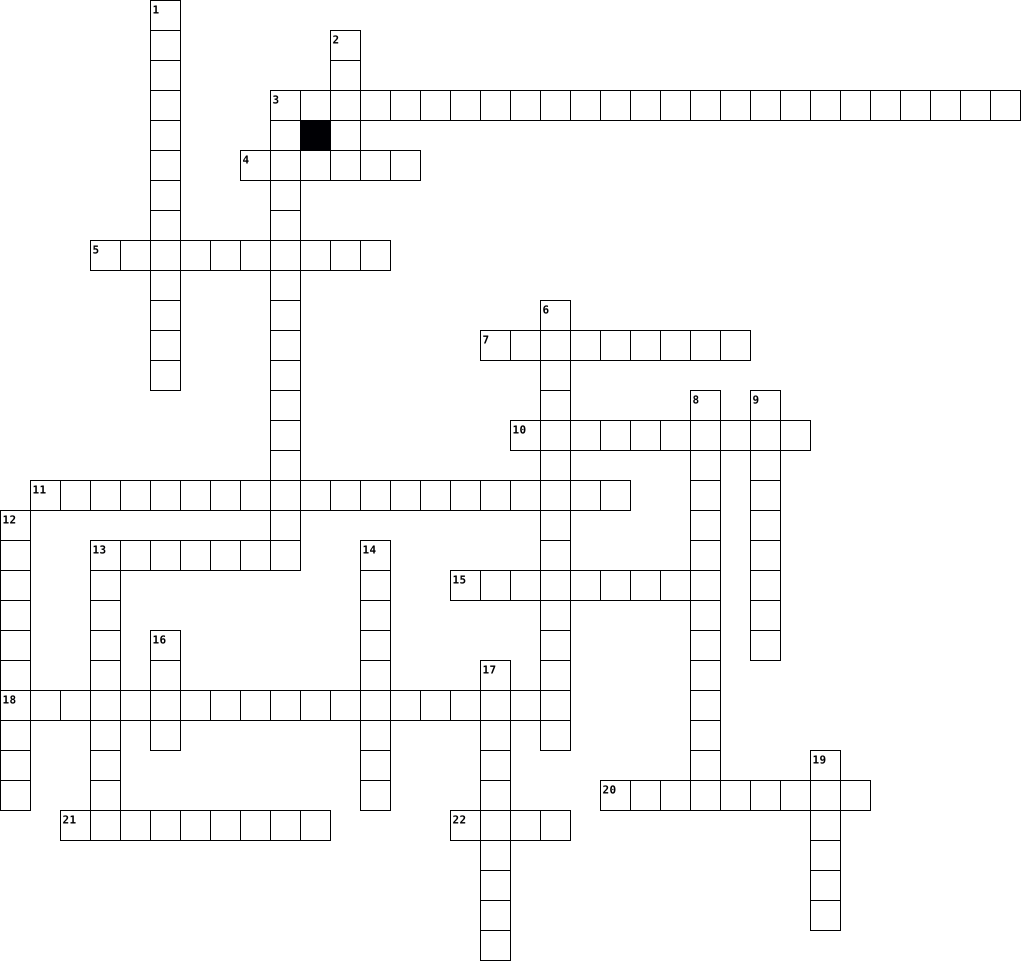
forms of energy Crossword Puzzles
Envir-Science 2022-05-20

Across
- Resources. oil, natural gas, coal, and nuclear energy.
- Scientific study of interactions among organisms and between organisms and their environment.
- solution, surrounded by a membrane
- how close the repeated measurements of a sample are to one another
- resources-biomass energy (such as ethanol), hydropower, geothermal power, wind energy, and solar energy
- the ability to do work or transfer heat
- the amount of energy used when a 1-watt electrical device is turned on for 1 second
- number- the number of protons in the nucleus of a particular element
- the diversity of life forms in an environment
- derived from human activities
- system -a system in which matter and energy exchanges do not occur across boundaries
- biological community of interacting organisms and their physical environment.
- -a highly organized living entity that consists of the four types of macromolecules and other substances in a
- capital-the world's stocks of natural assets which include geology, soil, air, water and all living things
Down
- cycling-a system where energy and matter are transferred between living organisms and non-living parts of the environment.
- services-the provision of resources essential for life, including food, clean water, shelter, and medicines as well as stabilizing environmental processes such as purification of air and water, flood control, and nutrient cycling
- a particular location on Earth with interacting biotic and abiotic components
- close a measured value is to the actual or true value
- diversity- a measure of the genetic variation among individuals in a population
- nonliving
- energy -the energy of motion
- -living
- energy- potential energy stored in chemical bonds
- reaction -a reaction that occurs when atoms separate from molecules or recombine with other
- resources-materials from the Earth that are used to support life and meet people's needs
- contaminating material that pollutes.
26 Clues: -living • nonliving • energy -the energy of motion • derived from human activities • solution, surrounded by a membrane • contaminating material that pollutes. • the ability to do work or transfer heat • the diversity of life forms in an environment • energy- potential energy stored in chemical bonds • close a measured value is to the actual or true value • ...
heat and thermal dynamics 2025-04-15

Across
- process A process where the temperature remains constant
- Change The process where a substance transitions between solid, liquid, and gas states, often involving transfer of heat
- A measure of disorder or randomness in a system.
- The transfer of heat through the movement of fluids (liquids or gases) due to temperature differences
- A unit of measurement for heat energy.
- A material that readily conducts heat
- The transfer of heat through direct contact (primarily in solids)
- Energy The total kinetic energy of the particles in a substance, encompassing both its temperature and the amount of matter.
- Expansion The tendency of matter to change in size in response to temperature changes
- Heat The amount of energy absorbed or released during a phase change without changing the temperature
- Law of Thermodynamics entropy of a perfect crystal at absolute zero is zero
Down
- Law of Thermodynamics energy is conserved (neither created nor destroyed), it can only change forms
- The study of energy transformations and how energy relates to heat
- The transfer of heat through electromagnetic waves, like the heat from the sun.
- the energy transferred between objects or systems due to a temperature difference.
- Heat Capacity The amount of energy needed to raise the temperature of 1 gram of a substance by 1 degree celsius
- A material that poorly conducts heat
- A unit of Heat
- Law of Thermodynamics entropy (disorder) in an isolated system always increases
- Energy The energy of motion, including the movement of atoms and molecules.
- A measure of the average kinetic energy of the particles in a substance, indicating how hot or cold something is.
21 Clues: A unit of Heat • A material that poorly conducts heat • A material that readily conducts heat • A unit of measurement for heat energy. • A measure of disorder or randomness in a system. • process A process where the temperature remains constant • The transfer of heat through direct contact (primarily in solids) • ...
Combustion and Chemical reactions 2026-02-11

Across
- Two or more atoms joined together.
- Tiny particles and gases released during burning.
- A new substance made in a reaction.
- A gas often produced during combustion.
- Energy that makes things warmer.
- The idea that mass is not created or destroyed.
- A rule in science that is always true.
- The smallest unit of an element.
- A gas needed for most burning reactions.
Down
- A chemical reaction that releases heat and light.
- The visible, glowing part of a fire.
- A gas that can form when something burns.
- A starting substance in a chemical reaction.
- A process where substances change into new substances.
- The ability to cause change.
- A substance that burns to release energy.
- A change that forms a new substance.
- Energy you can see, often produced during burning.
- The amount of matter in something.
- The process of starting a combustion reaction.
20 Clues: The ability to cause change. • Energy that makes things warmer. • The smallest unit of an element. • Two or more atoms joined together. • The amount of matter in something. • A new substance made in a reaction. • The visible, glowing part of a fire. • A change that forms a new substance. • A rule in science that is always true. • A gas often produced during combustion. • ...
Energy Crossword Puzzle 2021-12-09

Across
- Energy stored inside an atom.
- A measure of the total kinetic energy possessed by particles in a substance.
- Energy possessed by a moving object.
- Process in which green plants convert light energy into chemical energy.
- Energy that travels as vibrating waves and can be heard by our ears as sound.
- Energy stored within a stretched or compressed object like a spring or elastic material.
- Unit of measurement for energy.
Down
- Energy that causes charged particles to move.
- Energy stored within a substance such as fuel or food that may be released when the substance is burnt or digested.
- Stored energy of an object that is held above the Earth’s surface.
- Stored energy possessed by an object such as elastic potential energy into chemical energy.
- Form of energy that is visible such as that produced by the sun.
- The ability to make a change happen; different forms include heat energy light energy and sound energy.
- This is done whenever an object is moved or is forced to change shape.
14 Clues: Energy stored inside an atom. • Unit of measurement for energy. • Energy possessed by a moving object. • Energy that causes charged particles to move. • Form of energy that is visible such as that produced by the sun. • Stored energy of an object that is held above the Earth’s surface. • This is done whenever an object is moved or is forced to change shape. • ...
Energy Review Crossword Puzzle 2021-03-19

Across
- breaks down atoms where energy is released and can be used
- located above oil deposits
- energy in transformed state: electricity
- derived from sources that will run out or will not be replenished in our lifetime
- coal, oil, natural gas
- the second most used energy type
- the ability to do work
- a solid, combustible mineral made of carbon, formed from organic matter after millions of years of compression
Down
- forms that can be used directly as they appear in nature: fossil fuels
- one of the few countries that can be self-sustained (produces 117% of its own usage)
- wind, solar, hydroelectric
- energy in the nucleus, or core, of an atom
- wood and other biomass
- an energy source that can easily be replenished
- atoms are fused with one another where energy is released and can be used
15 Clues: wood and other biomass • coal, oil, natural gas • the ability to do work • located above oil deposits • wind, solar, hydroelectric • the second most used energy type • energy in transformed state: electricity • energy in the nucleus, or core, of an atom • an energy source that can easily be replenished • breaks down atoms where energy is released and can be used • ...
Light 5.3 SOL 2022-02-18

Across
- a straw in water appears __
- transparent objects allow __ light through.
- light has an __ field
- Valley between two waves.
- Opposite of reflection
- light is a form of __
- light can bounce off an object or __
- Opposite of refraction
- light travels in __ waves
- __ is all colors being absorbed
Down
- crest-to-crest
- visible light is on the __ spectrum.
- __ has the shortest wavelength
- acronym to remember colors of visible light
- __ is all colors being reflected
- top of a wave
- the greater the __, the greater the amount of energy.
- rainbow forms by light getting __
- __ has the longest wavelength
- light can be absorbed as __
20 Clues: top of a wave • crest-to-crest • light has an __ field • light is a form of __ • Opposite of reflection • Opposite of refraction • Valley between two waves. • light travels in __ waves • a straw in water appears __ • light can be absorbed as __ • __ has the longest wavelength • __ has the shortest wavelength • __ is all colors being absorbed • __ is all colors being reflected • ...
GayB Energy Crossword 2018-02-26

Across
- Only used as 2.2% of energy in America.
- Energy conversion that occurs when a car engine burns gasoline.
- Light and heat given off by the sun.
- The combining of an atom's nucleus into two nuclei
- Mostly used source of electricity in America.
- Layer that traps heat and decreases the amount of heating energy a house needs
- What solar, wind, and geothermal energy is.
- The combining of two atomic nuclei.
- What solar space heating resembles.
- Heat from sun heat being trapped by windows.
- Chemical compounds that contain carbon and hydrogen atoms.
- Compounds made from oil.
Down
- The largest collective renewable energy source in America.
- What oil is mainly used for.
- What oil only supports 5% of.
- Wood, plant parts, manure, and food wastes can be used as this.
- What solar panels are made up of.
- Heat from Earth's interior.
- What coal, natural gas energy is.
- Energy that comes from movement of a turbine.
- Adding alcohol to gasoline forms this.
- What happens when fuel rods produce too much heat
- A substance that provides enough energy such as light, motion, or electricity.
- Made from water, biomass, and natural gas.
- Besides solar energy this energy comes from the sun.
- A factory which crude oil is heated and separating fuel and other products.
- What coal supports only 1% of.
- Electricity produced by flowing water.
- What wind energy blows on to start an electric current.
29 Clues: Compounds made from oil. • Heat from Earth's interior. • What oil is mainly used for. • What oil only supports 5% of. • What coal supports only 1% of. • What solar panels are made up of. • What coal, natural gas energy is. • The combining of two atomic nuclei. • What solar space heating resembles. • Light and heat given off by the sun. • Adding alcohol to gasoline forms this. • ...
GayB Energy Crossword 2018-02-26

Across
- Energy that comes from movement of a turbine.
- The combining of two atomic nuclei.
- What oil only supports 5% of.
- Light and heat given off by the sun.
- Made from water, biomass, and natural gas.
- Electricity produced by flowing water.
- Heat from sun heat being trapped by windows.
- Compounds made from oil.
- What wind energy blows on to start an electric current.
- Besides solar energy this energy comes from the sun.
- What coal supports only 1% of.
Down
- Layer that traps heat and decreases the amount of heating energy a house needs
- The largest collective renewable energy source in America.
- Energy conversion that occurs when a car engine burns gasoline.
- What solar panels are made up of.
- What solar, wind, and geothermal energy is.
- What happens when fuel rods produce too much heat
- What coal, natural gas energy is.
- A factory which crude oil is heated and separating fuel and other products.
- Adding alcohol to gasoline forms this.
- The combining of an atom's nucleus into two nuclei
- Mostly used source of electricity in America.
- Wood, plant parts, manure, and food wastes can be used as this.
- Only used as 2.2% of energy in America.
- Chemical compounds that contain carbon and hydrogen atoms.
- What solar space heating resembles.
- A substance that provides enough energy such as light, motion, or electricity.
- Heat from Earth's interior.
- What oil is mainly used for.
29 Clues: Compounds made from oil. • Heat from Earth's interior. • What oil is mainly used for. • What oil only supports 5% of. • What coal supports only 1% of. • What solar panels are made up of. • What coal, natural gas energy is. • The combining of two atomic nuclei. • What solar space heating resembles. • Light and heat given off by the sun. • Adding alcohol to gasoline forms this. • ...
Science Extra Credit - Daxton Tackett 2024-02-22

Across
- measures the number of oscillations produced in a certain amount of time
- has different forms; gravitational, electrical, mechanical, sound, light, chemical, and thermal
- the energy of motion and moving parts
- the energy of charge particles call electrons
- the process of sediment moving from one place to another
- energy we can feel such as heat
- a back-and-forth or up-and-down motion that travels from one place to another with a certain speed and direction
- light changes directions slightly when it passes from one material to another
- the dropping off and settling of sediment
Down
- when light waves bounce off a surface
- the process of rock being broken down naturally
- an energy form of vibrations that we can hear
- water, plants, sunlight, wind, animals and geothermal are examples of this type of resource
- light that is part of the electromagnetic spectrum that you can see
- can change an objects direction, shape, speed and temperature
- when the atoms in matter absorb light
- small pieces of broken down rock
- the energy of an object, substance, or system in motion
- a force applied over a distance
- when sound waves reflect off an object
20 Clues: energy we can feel such as heat • a force applied over a distance • small pieces of broken down rock • when light waves bounce off a surface • the energy of motion and moving parts • when the atoms in matter absorb light • when sound waves reflect off an object • the dropping off and settling of sediment • an energy form of vibrations that we can hear • ...
Vocab crossword part 1 2024-05-07

Across
- the ability to maintain an ecological balance
- living things, their remains, and features such as nests, associated with their activities
- the process by which sugar and oxygen are converted into carbon dioxide and water, to provide energy for the cell
- Earth’s solid outer layer
- an organism that obtains its energy from consuming other organisms
- the non-living physical and chemical components of an ecosystem
- all of Earth’s water in solid, liquid, and gas form
- all the living organisms and their physical and chemical environment
- visible forms of radiant energy
Down
- energy that travels through empty space
- the layer of gases surrounding Earth
- an organism that makes it own energy rich food compounds using the Sun’s energy
- an ecosystem that is maintained through natural processes
- the zone around Earth where life can exist
- the form of energy transferred during heating and cooling
- the process in which the Sun’s energy is converted into chemical energy
16 Clues: Earth’s solid outer layer • visible forms of radiant energy • the layer of gases surrounding Earth • energy that travels through empty space • the zone around Earth where life can exist • the ability to maintain an ecological balance • all of Earth’s water in solid, liquid, and gas form • an ecosystem that is maintained through natural processes • ...
Unit 2 2022-01-21

Across
- speed with direction
- forces acting on an object are balanced
- momentum is not created or destroyed; it remains constant
- also known as the law of inertia
- a pendulum is an example of this
- the beach is an example of this system
- sum of kinetic energy and all forms of potential energy
- SI unit for power
- P=w/t
- stored energy
- energy in motion
Down
- car crash is an example of this type of collision
- system a thermos is the closest example of this system
- p=m*v
- force that acts upwards on an object
- bowling ball hitting the pins is an example of this type of collision
- a water bottle is an example of this system
- push or pull
- the more mass, the more it has of this
- SI unit kg
- SI unit for work
- pushing a wall and the wall pushing back on you
- the ability to do work
- F=ma
- creates a change in momentum
- w=F*d
26 Clues: F=ma • p=m*v • P=w/t • w=F*d • SI unit kg • push or pull • stored energy • SI unit for work • energy in motion • SI unit for power • speed with direction • the ability to do work • creates a change in momentum • also known as the law of inertia • a pendulum is an example of this • force that acts upwards on an object • the more mass, the more it has of this • the beach is an example of this system • ...
Chapter 6 by Jazmin Todd 2018-04-20

Across
- A measure of the disorder of a system.
- The quantity of heat required to change the temperature.
- Heat transfer that involves the movement of warmer gases or liquids to cooler surroundings.
- When a surface emits more energy than it absorbs the temp will ______.
Down
- All forms of matter generally ______ when cooled.
- Heat transfer in which molecules remain in relatively restricted locations.
- The process by which thermal energy is transferred by electromagnetic waves.
- When a surface absorbs more energy than it emits, the temp. will ____.
- A material's ability to absorb and radiate thermal energy is indicated by what?
- All forms of matter generally _____ when heated.
10 Clues: A measure of the disorder of a system. • All forms of matter generally _____ when heated. • All forms of matter generally ______ when cooled. • The quantity of heat required to change the temperature. • When a surface absorbs more energy than it emits, the temp. will ____. • When a surface emits more energy than it absorbs the temp will ______. • ...
Energy 2024-05-30

Across
- there a different ___ of energy
- nrg a stretched elastic band stores
- ability to do work
- nrg stored in an object by particular position
- nrg due to a motion in a body
- this nrg holds the nucleus together
- use of force to move an object
- nrg a blender or dryer uses
- nrg from gamma waves or x waves
- nrg comes from different ______
- nrg from speakers or a horn
Down
- this nrg comes from the sun
- nrg cannot be __ or destroyed
- SI unit of energy
- nrg from moving charged electrons
- a warm object has more ____ nrg than a cold
- stored in bonds of chemicals
- plants convert sunlight to chemical nrg
- the law of ___of nrg
- using electrical nrg the fan makes __
20 Clues: SI unit of energy • ability to do work • the law of ___of nrg • this nrg comes from the sun • nrg a blender or dryer uses • nrg from speakers or a horn • stored in bonds of chemicals • nrg cannot be __ or destroyed • nrg due to a motion in a body • use of force to move an object • there a different ___ of energy • nrg from gamma waves or x waves • nrg comes from different ______ • ...
Energy - Chapter 30 2024-03-21

Across
- energy cannot be created or destroyed, but change from one form to another
- diagrams that are used to show how much energy is transferred into useful and not useful forms
- stored energy waiting to do work
- the energy moving things have
- energy that is not useful and lost to surrounding areas
Down
- energy is the ability to do _______
- form of energy that is the biggest loss in homes
- a method used to prevent heat loss in homes
- how much energy is transferred into useful forms by an appliance
9 Clues: the energy moving things have • stored energy waiting to do work • energy is the ability to do _______ • a method used to prevent heat loss in homes • form of energy that is the biggest loss in homes • energy that is not useful and lost to surrounding areas • how much energy is transferred into useful forms by an appliance • ...
M.E.L.T.S. 2024-12-01

Across
- Energy you can see
- When a circuit is incomplete and energy isn't flowing
- What sound produces
- A source that is powered by an electric circuit
- What turns a circuit on or off
- Energy that is caused by flowing electrons
- Energy you can hear
- What causes an electrical circuit to work (power source)
- Material that allows electricity to flow between things
Down
- Rapid movement caused by contact
- Energy from heat
- Energy that moves
- When a circuit is complete and energy is flowing
- Work
- Energy moving between two forms
15 Clues: Work • Energy from heat • Energy that moves • Energy you can see • What sound produces • Energy you can hear • What turns a circuit on or off • Energy moving between two forms • Rapid movement caused by contact • Energy that is caused by flowing electrons • A source that is powered by an electric circuit • When a circuit is complete and energy is flowing • ...
Chapter 8 2013-06-17

Across
- reactant in the calvin cycle
- anaerobic pathway that breaks down glucose and forms ethanol and ATP
- glycolisis takes place
- reducing agent to donate electrons
- second stage occurs here
- anaerobic pathway that breaks down glucose and forms lactate and ATP
- transfer of a phosphate group to a molecule
- part of the second stage of aerobic respiration
- anaerobic metabolic pathway by which cells harvest energy
Down
- organic molecule with three carbon backbone
- product of the respiration
- reactant in glycolisis
- break down of glucose to produce ATP
- uses oxygen
- first stage of saerobic and anaerobic fermentation
- organic cofactor
- acid transport the C atoms
- product of the aerobic respiration
- 3 carbon sugar
- without oxygen
20 Clues: uses oxygen • 3 carbon sugar • without oxygen • organic cofactor • reactant in glycolisis • glycolisis takes place • second stage occurs here • product of the respiration • acid transport the C atoms • reactant in the calvin cycle • reducing agent to donate electrons • product of the aerobic respiration • break down of glucose to produce ATP • organic molecule with three carbon backbone • ...
GayB Energy Crossword 2018-02-26

Across
- Light and heat given off by the sun.
- The largest collective renewable energy source in America.
- What solar panels are made up of.
- A substance that provides enough energy such as light, motion, or electricity.
- Layer that traps heat and decreases the amount of heating energy a house needs
- What oil is mainly used for.
- What happens when fuel rods produce too much heat
- What solar, wind, and geothermal energy is.
- The combining of an atom's nucleus into two nuclei
- What wind energy blows on to start an electric current.
- Besides solar energy this energy comes from the sun.
- Heat from sun heat being trapped by windows.
- Energy that comes from movement of a turbine.
Down
- Adding alcohol to gasoline forms this.
- A factory which crude oil is heated and separating fuel and other products.
- Chemical compounds that contain carbon and hydrogen atoms.
- Energy conversion that occurs when a car engine burns gasoline.
- What coal supports only 1% of.
- Compounds made from oil.
- The combining of two atomic nuclei.
- Wood, plant parts, manure, and food wastes can be used as this.
- What solar space heating resembles.
- Heat from Earth's interior.
- What oil only supports 5% of.
- Electricity produced by flowing water.
- What coal, natural gas energy is.
- Mostly used source of electricity in America.
- Made from water, biomass, and natural gas.
- Only used as 2.2% of energy in America.
29 Clues: Compounds made from oil. • Heat from Earth's interior. • What oil is mainly used for. • What oil only supports 5% of. • What coal supports only 1% of. • What solar panels are made up of. • What coal, natural gas energy is. • The combining of two atomic nuclei. • What solar space heating resembles. • Light and heat given off by the sun. • Adding alcohol to gasoline forms this. • ...
Energy Types/Transformations 2023-12-13

Across
- a form of energy releases into forms of electrons
- a form of energy associated with gravity
- The change of one form of energy to another form of energy
- a form of energy that releases Longitudinal waves
Down
- a form of energy that is the movement of an object
- a form of energy released from the core of atoms
- a form of energy that is based on the position of the object
- a form of energy that has already been transferred
- a form of energy that releases heat
- a form of energy that releases into light
- a form of energy that is temporarily compressed
11 Clues: a form of energy that releases heat • a form of energy associated with gravity • a form of energy that releases into light • a form of energy that is temporarily compressed • a form of energy released from the core of atoms • a form of energy releases into forms of electrons • a form of energy that releases Longitudinal waves • ...
Bonus Griffin LeBlanc 2024-05-01

Across
- For a PH of 7 you need strong acid and strong ____.
- the change in heat of the products from the reactants.
- adding energy is ____.
- a substance that speeds up a chemical reaction without undergoing any chemical change.
- the temperature and pressure at which the solid, liquid and gas forms of a substance coexist.
- the measure of the kinetic energy of particles in a sample of matter.
- substance that donates a proton.
- transition of a substance directly from solid to gas.
- More particles = _____ pressure
- Liquids ____ to form solids.
Down
- a device used to measure the energy absorbed or released as heat in a chemical reaction.
- transition of a substance directly from gas to solid.
- ATM pressure measured with a _____.
- biological catalysts that speed up the rate of reactions in the body
- releasing energy is ___.
- a compound that can act as either an acid or base.
- the total amount of energy.
- the amount of heat to raise 1 gram of substance by 1 degree C.
- substance that accepts a proton.
- Gases ___ to form liquids.
20 Clues: adding energy is ____. • releasing energy is ___. • Gases ___ to form liquids. • the total amount of energy. • Liquids ____ to form solids. • More particles = _____ pressure • substance that accepts a proton. • substance that donates a proton. • ATM pressure measured with a _____. • a compound that can act as either an acid or base. • ...
Chapter 2 Vocabulary Quiz 2018-08-31

Across
- / Positively charges subatomic particle.
- / Molecule made from repeating units of smaller molecules all covalently bonded together.
- / Substance that is being dissolved.
- / Forms organic molecules. Forms 4 covalent bonds.
- / Macromolecule made of CHO with a 1:2:1 ratio, used for short term energy.
- / Smaller units or smaller molecules. Building blocks of bigger molecules.
- / A protein that acts as a biological catalyst speeding up reactions in cells.
- / Monomer of a carbohydrate. "ONE" sugar.
- / Type of nucleic acid- makes proteins.
- / Negatively charged subatomic particle.
- / Building blocks of proteins.
- / When water molecules stick to other substances.
- / Monomer of nucleic acids.
- / Smallest unit of matter.
- / Energy required to start a chemical reaction.
- / The starting substances in a chemical reaction.
- / Type of bond formed from the sharing of electrons.
- / Weak acid or base that is used to prevent sharp changes in pH.
- / Macromolecule containing carbon, hydrogen, oxygen, nitrogen, and phosphorus. Examples are DNA and RNA.
- / Substance that does the dissolving.
Down
- / Binds to an enzyme at the active site. Reactants of enzyme-catalyzed reactions.
- / Subatomic particle that has a neutral charge.
- / Measures the acidity of a solution and ranges from 0 to 14. Tests for acids and bases.
- / Process that changes one set of chemicals into another.
- / Type of nucleic acid- genetic material.
- / When water molecules stick to each other.
- / The substance that is produced by a chemical reaction.
- / The process of forming polymers by linking monomers.
- / Bonds that link amino acids together.
- / Substance that speeds up the rate of a chemical reaction by lowering the activation energy.
- / Type of bond formed from the transfer of electrons.
- / Macromolecule that contains carbon, hydrogen, oxygen, nitrogen, & sometimes sulfur.
- / Substance that produces hydroxide ions (OH-) when dissolved in water. Hint: pH is greater than 7.
- / Substance that forms hydrogen ions (H+) when dissolved in water. Hint: pH is less than 7.
- / Macromolecule made of CHO, used for long term energy.
35 Clues: / Monomer of nucleic acids. • / Smallest unit of matter. • / Building blocks of proteins. • / Substance that is being dissolved. • / Substance that does the dissolving. • / Type of nucleic acid- makes proteins. • / Bonds that link amino acids together. • / Positively charges subatomic particle. • / Type of nucleic acid- genetic material. • ...
Energy Vocabulary 2025-12-12

Across
- the type of energy that has motion
- thermal energy transfer that moves between solid objects
- __________ potential energy is created by something being above the ground
- to change forms
- thermal energy transfer that moves in waves
- the ability to do work
- a material that does not allow energy to flow through it easily
Down
- Law of __________ of energy states that energy cannot be created or destroyed
- a material that allows energy to flow through it easily
- thermal energy transfer created by warm air or water rising and cool air or water sinking
- to move from one place or object to another
- _________ energy is heat
12 Clues: to change forms • the ability to do work • _________ energy is heat • the type of energy that has motion • to move from one place or object to another • thermal energy transfer that moves in waves • a material that allows energy to flow through it easily • thermal energy transfer that moves between solid objects • ...
Tesla's roof 2018-01-10

Across
- of the greatest importance to the way things might happen
- the power from something such as electricity or oil
- costing a lot of money
- derived from the sun
- capable of being replaced by natural ecological cycles
- not expensive
- a person who buys goods or a service
- costing little money
- to collect
- strength
Down
- to put electricity into an electrical device such as a battery:
- something that covers
- to cause something to exist
- causing little or no damage to the environment and therefore able to continue for a long time
- the covering that forms the top of a building
- a means of carrying or transporting something
- goal, aim
- what covers a roof
- to work with
- a device for producing electrical energy from chemical energy
20 Clues: strength • goal, aim • to collect • to work with • not expensive • what covers a roof • derived from the sun • costing little money • something that covers • costing a lot of money • to cause something to exist • a person who buys goods or a service • the covering that forms the top of a building • a means of carrying or transporting something • ...
Space Systems 2022-07-13

Across
- a ring-shaped nebula formed from expanding gas around an aging star
- a way to describe the expansion of the universe.
- A planet covers the same amount of space in the same amount of time no matter the point in its orbit
- a chemical process in which two or more substances work together and are changed into different substances
- the curved path of a celestial object around a star, planet, or moon
- the different wavelengths of energy produced by a light source
- the physical universe beyond the earth’s atmosphere
- a catastrophic explosion that ejects most of the star’s mass
- the largest star in terms of volume; spectral class K or M
- a giant cloud of dust and gas in space
- an object of small radius but large density, made up of mostly neutrons; forms after a supernova
- a nuclear reaction in which nuclei fuse together to form heavier nuclei and release energy
Down
- A planet’s orbital period is proportional to the size of its orbit
- a core of a star that is composed of mostly electron-degenerate matter
- a system of stars, together with gas and dust, held together by gravitational attraction
- Planets move in elliptical orbits with the Sun as the focus
- a region in space with a gravitational pull so large that nothing can escape; forms after a supernova if the star has enough energy
- the emission of energy as electromagnetic waves
- a star with low or intermediate mass; surface temperature 5000K or less
- more than 100 substances that cannot be chemically broken down or reduced
20 Clues: a giant cloud of dust and gas in space • the emission of energy as electromagnetic waves • a way to describe the expansion of the universe. • the physical universe beyond the earth’s atmosphere • the largest star in terms of volume; spectral class K or M • Planets move in elliptical orbits with the Sun as the focus • ...
Eleanor's crossword 2024-05-15

Across
- The degrees of hotness or coldness in an object
- A substance that can't be broken
- The amount of space in an object
- The smallest unit in an element
- you need this to do things
- change in matter that doesn't affect its chemical composition
- The amount of matter in an object
- when a new substance was made
Down
- The substances that are formed during a chemical reaction
- Material that has mass and takes up some amount of space
- 2 or more atoms joined together
- A combination of 2 or more substances
- The study of changes in matter
- A chemical reaction that absorbs heat energy
- The transfer of thermal energy
- Chemical reaction that gives off heat energy
- A characteristic that can be observed
- A pure substance that forms when 2 or more different elements combine
18 Clues: you need this to do things • when a new substance was made • The study of changes in matter • The transfer of thermal energy • 2 or more atoms joined together • The smallest unit in an element • A substance that can't be broken • The amount of space in an object • The amount of matter in an object • A combination of 2 or more substances • A characteristic that can be observed • ...
Energy & Heat 2025-02-09

Across
- heat will _______ flow from cold to hot
- matter with closely packed particles and low movement
- heat _______ from hot to cold
- up/down or back/forth motion of waves
- thermal energy cycles of hot fluids rising & cold fluids sinking due to density differences
- energy stored in the nucleus of radioactive atoms
- absolute _______; absolutely no thermal energy in matter
- the traveling of energy from one place to another
- matter with particles far apart and high movement
- the amount of space something takes up
- heat flows from hot to cold until they are the _______ temperatures
- heat energy
- particles that move _______ produce slower temperatures
- means to "conserve" or "keep"
- particles that move _______ produce hotter temperatures
- matter going from solid to liquid
- thermal energy that travels through contact
- the passing of thermal energy
- energy stored in the bonds of atoms
- energy stored in stretchy material such as rubber
Down
- energy that travels through space
- energy from a flow of electrons
- motion energy
- matter going from gas to liquid
- a property of matter that comes in many forms; sound, light, heat
- energy cannot be created or destroyed, only
- the amount of particles something has
- matter with loose particles that flow
- two forces pulled toward each other based on mass and distance in between
- stored energy
- the average kinetic energy of a substance
- energy of an object; whether moving or still
- matter going from liquid to gas
- "light waves"; both visible and invisible
- materials will never ________ temperatures
- matter going from liquid to solid
- can describe gas and liquids; they "flow"
- energy that is passed by particles bumping into each other
- anything with mass and volume
- the amount of particles per volume occupied
- energy that humans can see with their eyes
41 Clues: heat energy • motion energy • stored energy • heat _______ from hot to cold • means to "conserve" or "keep" • the passing of thermal energy • anything with mass and volume • energy from a flow of electrons • matter going from gas to liquid • matter going from liquid to gas • energy that travels through space • matter going from liquid to solid • matter going from solid to liquid • ...
BIO crossword puzzle 2022-12-14

Across
- The fluid portion of the chloroplast outside of the thylakoids
- Sac of photosynthetic pigment
- molecules used by plants to gather the sun's energy
- Reactions in photosynthesis that require light to produce energy
- A raw material used in photosytnehsis
- Reactions in photosynthesis that do not require light
- A compound that looks nearly like ATP except it includes two phosphate groups unlike ATP's 3 phosphate groups
- A 5 carbon sugar
Down
- A series of electron carrying proteins that transport high-energy electrons to during ATP generating Rxns a cluster of proteins that span across the thylakoid membrane which allow H+ to pass through.
- The process in which plants convert sunlight into chemical energy
- light independent reaction of photosynthesis in which high energy compounds are built from ATP and NADPH
- The principle pigment of green plants
- Comes in many forms including light, heat, and electricity
- One of two catalysts of photosynthesis
- A stack of thylakoids
- A cluster of chlorophyll and proteins found in thylakoid
- Accepts and holds two high energy electrons along with a hydrogen ion
- A compound that is used to store and release energy
18 Clues: A 5 carbon sugar • A stack of thylakoids • Sac of photosynthetic pigment • The principle pigment of green plants • A raw material used in photosytnehsis • One of two catalysts of photosynthesis • molecules used by plants to gather the sun's energy • A compound that is used to store and release energy • Reactions in photosynthesis that do not require light • ...
Thermochemistry 2020-05-01

Across
- the quantity of energy transferred as heat during a chemical reaction
- heat transfer by currents in the air or water
- energy of motion, energy being used
- a reaction that takes in energy from its surroundings and feels cold
- the SI unit of heat as well as all other forms of energy
Down
- the amount of energy required to raise the temperature of one gram of a substance by one kelvin
- energy that comes from heat and the vibration of atoms and molecules
- Stored energy, energy waiting to be used
- a measure of the degree of randomness of the particles, such as molecules, in a system
- heat transfer by touch
- the study of the transfers of energy as heat that accompany chemical reactions and physical changes
- the energy in a system that is available for work; a system's capacity to do useful work
- heat transfer by electromagnetic energy
- Enter your initials and class period after the j (Suzi Smith in 5th period would be jSS5
14 Clues: heat transfer by touch • energy of motion, energy being used • heat transfer by electromagnetic energy • Stored energy, energy waiting to be used • heat transfer by currents in the air or water • the SI unit of heat as well as all other forms of energy • energy that comes from heat and the vibration of atoms and molecules • ...
Energy Crossword 2024-10-10

Across
- the ability to do work (cause an object to move) or cause change
- the potential energy stored in the nucleus of an atom
- a form of energy that travels through space as waves
- the process of changing one form of energy to another
- when force is exerted on an object which causes it to move
- energy that an object has due to its motion
- a form of potential energy that is stored in chemical bonds
Down
- stored energy that results from the position or shape of an object
- the total potential & kinetic energy of the particles in an object
- the rate at which work is done or the rate at which one form of energy transforms to another
- the energy of moving electrical charges
- a material, such as coal that forms over millions of years from the remains of ancient plants and animals
- energy associated with the position & motion of an object=PE + KE
- potential energy that depends on the height of an object
14 Clues: the energy of moving electrical charges • energy that an object has due to its motion • a form of energy that travels through space as waves • the potential energy stored in the nucleus of an atom • the process of changing one form of energy to another • potential energy that depends on the height of an object • ...
Chapter 2 Vocabulary Quiz 2018-08-31

Across
- / Substance that speeds up the rate of a chemical reaction by lowering the activation energy.
- / Subatomic particle that has a neutral charge.
- / Positively charges subatomic particle.
- / Process that changes one set of chemicals into another.
- / Substance that forms hydrogen ions (H+) when dissolved in water. Hint: pH is less than 7.
- / Substance that produces hydroxide ions (OH-) when dissolved in water. Hint: pH is greater than 7.
- / Type of bond formed from the transfer of electrons.
- / Bonds that link amino acids together.
- / Weak acid or base that is used to prevent sharp changes in pH.
- / When water molecules stick to each other.
- / Negatively charged subatomic particle.
- / Macromolecule containing carbon, hydrogen, oxygen, nitrogen, and phosphorus. Examples are DNA and RNA.
- / Binds to an enzyme at the active site. Reactants of enzyme-catalyzed reactions.
- / Measures the acidity of a solution and ranges from 0 to 14. Tests for acids and bases.
- / When water molecules stick to other substances.
- / Substance that does the dissolving.
- / A protein that acts as a biological catalyst speeding up reactions in cells.
- / Type of nucleic acid- makes proteins.
Down
- / Macromolecule made of CHO with a 1:2:1 ratio, used for short term energy.
- / Substance that is being dissolved.
- / Weak attraction between oppositely charged regions of nearby molecules.
- / Monomer of nucleic acids.
- / The starting substances in a chemical reaction.
- / Energy required to start a chemical reaction.
- / The process of forming polymers by linking monomers.
- / Monomer of a carbohydrate. "ONE" sugar.
- / Macromolecule made of CHO, used for long term energy.
- / Building blocks of proteins.
- / The substance that is produced by a chemical reaction.
- / Smaller units or smaller molecules. Building blocks of bigger molecules.
- / Type of bond formed from the sharing of electrons.
- / Macromolecule that contains carbon, hydrogen, oxygen, nitrogen, & sometimes sulfur.
- / Smallest unit of matter.
- / Molecule made from repeating units of smaller molecules all covalently bonded together.
- / Forms organic molecules. Forms 4 covalent bonds.
- / Type of nucleic acid- genetic material.
36 Clues: / Monomer of nucleic acids. • / Smallest unit of matter. • / Building blocks of proteins. • / Substance that is being dissolved. • / Substance that does the dissolving. • / Bonds that link amino acids together. • / Type of nucleic acid- makes proteins. • / Positively charges subatomic particle. • / Monomer of a carbohydrate. "ONE" sugar. • ...
Module 3: Weather - Vocabulary 2025-02-13

Across
- wind patterns that circulate air throughout the globe due to warm air rising at the equator and cold air sinking at the poles.
- an instrument used to measure wind speed.
- water that is pulled by gravity across land’s surface, it is unabsorbed water from rain, snowmelt, irrigation or other sources
- a front that forms where warm air moves over cold, denser air.
- a large body of air where there is the same temperature and moisture content throughout.
- the amount of water vapor in the air.
- how much salt is dissolved in a liquid
- a front that forms where cold air moves under warm air, which is less dense, and pushes the warm air up.
- forms when a cold air mass meets a warm air mass.
- any form of water that falls to the Earth’s surface.
- the movement of air caused by differences in air pressure.
- a mixture of gasses that surrounds a planet or moon.
- the curving of the path of a moving object due to Earth’s rotation.
- how much the air above you weighs.
- the ratio of the amount of water vapor in the air to the maximum amount of water vapor the air can hold at a temperature.
- an instrument that measures atmospheric pressure.
- the change of state from a gas to a liquid.
Down
- the transfer of energy as heat through a material or from one material to another through direct contact.
- the increased cooling that a wind can cause
- the temperature at which water vapor condenses due to saturation.
- occurs because the atmosphere allows more sunlight in than it lets heat escape.
- a front that forms when a warm air mass is caught between two colder air masses.
- the continuous process by which water moves from Earth’s surface to the atmosphere and back, driven by energy from the sun and gravity; also called the water cycle
- wind patterns determined by unequal heating of geographical features
- an instrument that measures and indicates temperature.
- a gradual increase in average global temperature due to an increase in certain atmospheric gasses.
- the relationship between the mass of the substance and how much space it takes up (volume)
- a horizontal movement of ocean water caused by wind and occurs at, or near, the ocean’s surface.
- the transfer of thermal energy by the circulation or movement of a liquid or gas.
- the transfer of energy as electromagnetic waves.
30 Clues: how much the air above you weighs. • the amount of water vapor in the air. • how much salt is dissolved in a liquid • an instrument used to measure wind speed. • the increased cooling that a wind can cause • the change of state from a gas to a liquid. • the transfer of energy as electromagnetic waves. • forms when a cold air mass meets a warm air mass. • ...
Science 2021-11-26

Across
- neutral charge
- continuos physical force exerted on or against
- two or more forms of the same element that contains equal number of proton but different number of neutrons
- Negative charge
- store energy
- what it contains periódic tables
- large body of matter with no definirte shape
- Were we have elements
- path between two or more points along which an eléctrica current can be carried
- Positive charge
Down
- hot or high temperature
- smallest particle of a chemical element that can exist
- strenght or energy
- degree of compactness of a substance
- process that make planta for having food
- energy someone possesses when is in motion
- the centre of the atom
- quantity of motion of a moving body
- physical quantity that expresses hot and cold
- amount of space something occupies
20 Clues: store energy • neutral charge • Negative charge • Positive charge • strenght or energy • Were we have elements • the centre of the atom • hot or high temperature • what it contains periódic tables • amount of space something occupies • quantity of motion of a moving body • degree of compactness of a substance • process that make planta for having food • ...
Science thingy 2022-03-04

Across
- energy in motion
- a negatively charged sub-atomic particle
- electrical and magnetic waves
- a neutrally charged sub-atomic particle
- A law that states "Energy can not be created nor destroyed, it can only chnge forms"
- the ability to work
Down
- total sum of potential, kinetic, and thermal energy
- stored energy
- activity using energy or effort done in order to achieve a purpose/result.
- the best science teacher ever
- material that conducts electricity well
- comes from outlets; used to power electrical devices
- energy mostly used for communication
- a positively charged sub-atomic particle
- material that does not conduct electricity well
- Light that comes from the sun and lightbulbs; used to see as a power source
16 Clues: stored energy • energy in motion • the ability to work • the best science teacher ever • electrical and magnetic waves • energy mostly used for communication • material that conducts electricity well • a neutrally charged sub-atomic particle • a positively charged sub-atomic particle • a negatively charged sub-atomic particle • material that does not conduct electricity well • ...
Energy crossword puzzle 2019-03-08

Across
- the process by which heat or electricity is directly transmitted through a substance when there is a difference of temperature or of electrical potential between adjoining regions, without movement of the material.
- a change from one state (solid or liquid or gas) to another without a change in chemical composition.
- the internal energy of an object due to the kinetic energy of its atoms and/or molecules.
- energy which a body possesses by virtue of being in motion
- the energy possessed by a body by virtue of its position relative to others, stresses within itself, electric charge, and other factors.
- power that an object gets from its position and motion.
Down
- the movement caused within a fluid by the tendency of hotter and therefore less dense material to rise, and colder, denser material to sink under the influence of gravity, which consequently results in transfer of heat.
- a material whose internal electric charges do not flow freely; very little electric current will flow through it under the influence of an electric field.
- an object or type of material that allows the flow of an electrical current in one or more directions.
- a system primarily designed to supply energy-services to end-users.
- a principle stating that energy cannot be created or destroyed, but can be altered from one form to another.
- the branch of physical science that deals with the relations between heat and other forms of energy (such as mechanical, electrical, or chemical energy), and, by extension, of the relationships between all forms of energy.
- the degree or intensity of heat present in a substance or object, especially as expressed according to a comparative scale and shown by a thermometer or perceived by touch.
- the emission of energy as electromagnetic waves or as moving subatomic particles, especially high-energy particles which cause ionization.
- the heat required to raise the temperature of the unit mass of a given substance by a given amount (usually one degree).
15 Clues: power that an object gets from its position and motion. • energy which a body possesses by virtue of being in motion • a system primarily designed to supply energy-services to end-users. • the internal energy of an object due to the kinetic energy of its atoms and/or molecules. • ...
Energy Resources 2013-11-12

Across
- IS A FOSSIL FUEL THAT OFTEN FORMS ON TOP OF PETROLEUM
- IS A SOLID FOSSIL FUEL
- LIQUID FOSSIL FUEL
- HEAT ENERGY WITHIN THE EARTH
- OIL, COAL, AND NATURAL GASES ARE CONSIDERED THIS
- ENERGY FROM THE SUN
- ENERGY MOVING AIR CONTAINS ENERGY
- MATTER FORMED FROM PLANTS AND ANIMALS THAT CONTAINS STORED ENERGY
Down
- ENERGY THAT COME FROM THE NUCLEI OF ATOMS
- MOVING WAVES TO GENERATE ELECTRICITY
- NATURAL RESOURCES THAT PROVIDE PEOPLE WITH ENERGY
11 Clues: LIQUID FOSSIL FUEL • ENERGY FROM THE SUN • IS A SOLID FOSSIL FUEL • HEAT ENERGY WITHIN THE EARTH • ENERGY MOVING AIR CONTAINS ENERGY • MOVING WAVES TO GENERATE ELECTRICITY • ENERGY THAT COME FROM THE NUCLEI OF ATOMS • OIL, COAL, AND NATURAL GASES ARE CONSIDERED THIS • NATURAL RESOURCES THAT PROVIDE PEOPLE WITH ENERGY • IS A FOSSIL FUEL THAT OFTEN FORMS ON TOP OF PETROLEUM • ...
Cellular Respiration 2013-06-13

Across
- Third stage of aerobic respiration.
- Nicotinamide adenine dinucleotide.
- Negatively charged subatomic particle that occupies orbitals around the atomic nucleus.
- First stage of aerobic respiration and fermentation.
- Anaerobic pathway that breaks down glucose, forms ethanol and ATP.
- Double-membraned organelle of ATP formation.
- Oxygen-requiring.
Down
- Metabolic pathway that breaks down carbohydrates to produce ATP by using oxygen.
- Direct transfers of a phosphate group from a substrate to ATP.
- Primarily of carbon, hydrogen and oxygen.
- The second stage of aerobic respiration.
- Three-carbon end product of glycolysis.
- An anaerobic metabolic pathway by which cells harvest energy from organic molecules.
- Anaerobic pathway that breaks down glucose, forms ATP and lactate.
- Adenosine triphosphate.
- Lipid with 1,2 or 3 fatty acid tails attached to a glycerol.
- A capacity to do work.
- The sum of physiological processes that move O2 from surroundings to metabolically active tissues in the body and CO2 from tissues to the outside.
- Flavin adenine dinucleotide.
- The semifluid matrix between a cell's plasma membrane and its nucleus.
20 Clues: Oxygen-requiring. • A capacity to do work. • Adenosine triphosphate. • Flavin adenine dinucleotide. • Nicotinamide adenine dinucleotide. • Third stage of aerobic respiration. • Three-carbon end product of glycolysis. • The second stage of aerobic respiration. • Primarily of carbon, hydrogen and oxygen. • Double-membraned organelle of ATP formation. • ...
science crossword 2020-05-04

Across
- is made from resources that nature will replace, like wind, water and sunshine
- All living things and all machines use mechanical energy to do work
- is the stored energy an object has because of its position or state
- you get when electrons flow from place to place
- is heat that comes from inside Earth
- A type of energy that happens when molecules inside of an object move faster
- Wind power is an alternative energy source
Down
- is light, heat, and other forms of energy given off by the Sun
- is the energy an object has due to its motion
- is energy that is stored in the bonds between atoms and molecules
- What you need to do everything
- resources are natural resources that cannot be replaced after they are used
- is a form of energy which our sense of sight can detect
- It is energy that is stored in the bonds between atoms and molecules
- is a type of energy made by vibrations
15 Clues: What you need to do everything • is heat that comes from inside Earth • is a type of energy made by vibrations • Wind power is an alternative energy source • is the energy an object has due to its motion • you get when electrons flow from place to place • is a form of energy which our sense of sight can detect • ...
Chapter 14 Vocab 2024-05-10

Across
- Believed by most to have been formed from the remains of plants and animals that lived in the past, 80% of the energy from nonrenewable resources, and includes coal, oil, and natural gas.
- Energy produced by nuclear fission reactions
- The ability to do work
- Heat energy that originates deep within the earth’s interior
- Chemical potential energy obtained from renewable organic materials
- Energy sources that are not easily replaced naturally
- The sum of any kinetic energy and all the forms of potential energy in a system
Down
- The energy produced from the rising and falling tides of water on the earth
- The energy produced from the sun
- A source of energy that is easily replaced by natural methods
- Electrical energy generated by the movement of water
- The energy produced from the sun
- The energy that objects possess due to their motion
- The stored energy of an object that can be produced later
14 Clues: The ability to do work • The energy produced from the sun • The energy produced from the sun • Energy produced by nuclear fission reactions • The energy that objects possess due to their motion • Electrical energy generated by the movement of water • Energy sources that are not easily replaced naturally • The stored energy of an object that can be produced later • ...
Physical and Chemical Changes 2012-08-30

Across
- a solid formed during a chemical change
- a state of matter that is incompressible and holds their shape
- an increase in size, growing
- a state of matter that is compressible and fill their container
- the change of state from liquid to solid
- a change of state from gas to solid
- a change of state where a gas is cooled and forms a liquid
- not able to be compressed or squashed (referring to particles)
- the change of state when a solid is heated and forms a liquid
- a state of matter that is incompressible and flows to take the shape of their container
Down
- a change of state where a liquid is heated and changes to a gas within the liquid
- a decrease in size, shrinking
- describes a process that gives off energy in the form of heat, light and sound energy
- another name for freezing, change of state from liquid to solid
- a process where two liquids or two gases mix due to the motion of their particles
- describes a process that absorbs energy from the surroundings
- the change of state where a liquid changes to a gas at the surface of the liquid
- a mixture where the substances are mixed on the atomic level
- unable to be split (referring to particles)
- a change of state from solid to gas
20 Clues: an increase in size, growing • a decrease in size, shrinking • a change of state from gas to solid • a change of state from solid to gas • a solid formed during a chemical change • the change of state from liquid to solid • unable to be split (referring to particles) • a change of state where a gas is cooled and forms a liquid • ...
Properties of Atoms & Molecules Unit 4 Vocabulary Review 2022-10-31

Across
- symbolic representation of a chemical reaction
- reaction in which one substance takes the place of another
- the rate or speed at which a chemical reaction takes place
- atoms or molecules formed by a chemical reaction
- matter and energy cannot be created or destroyed; they can only change forms
- reaction in which energy is stored
- atoms or molecules present at the beginning of a chemical reaction
- reaction in which two substances trade places
- reaction in which energy is released
Down
- catalyst in a different phase from the reactants
- a molecule breaks apart into two or more atoms
- two or more atoms combine to form a molecule
- occurs when atomic bonds are formed or broken
- energy stored in a molecule's bonds
- catalyst involved in biological functions
- substance that increases the reaction rate by lowering activation energy
- catalyst in the same phase as the reactants
- the energy required for a chemical reaction to take place
- substance that slows down the reaction rate
19 Clues: reaction in which energy is stored • energy stored in a molecule's bonds • reaction in which energy is released • catalyst involved in biological functions • catalyst in the same phase as the reactants • substance that slows down the reaction rate • two or more atoms combine to form a molecule • occurs when atomic bonds are formed or broken • ...
Energy Forms and Uses 2015-03-23

Across
- Energy from running water is used to generate electricity in ___________ stations.
- ___________ energy is stored energy.
- Chemical energy is energy stored in food, fuels and inside _________.
- __________energy is the form of energy a moving object posseses.
- The energy stored in most of our energy resources is derived in some ways from the ______________.
- In power stations that use fuels, chemical energy in the fuel is converted to heat and kinetic energy, which is converted to ____________ energy by the generator.
- ___________ potential energy is the energy stored in an elastic spring or string when stretched or compressed.
- Modern windmills, called wind turbines, use ______ energy to generate electricity.
Down
- ____________ potential energy is the energy stored by objects due to their positions. It depends on the height at which an onject is raised.
- Food and fuels, such as oil, natural gas and coal, are common __________ of energy.
- Energy cannot be created or destroyed. It can be __________ from one form to another.
- During photosynthesis, light energy is converted to ___________ energy stored in plants.
- Heat energy flows from an object with a higher temperature to one with a _________ temperature.
13 Clues: ___________ energy is stored energy. • __________energy is the form of energy a moving object posseses. • Chemical energy is energy stored in food, fuels and inside _________. • Energy from running water is used to generate electricity in ___________ stations. • Modern windmills, called wind turbines, use ______ energy to generate electricity. • ...
Energy Transformations 2022-11-06

Across
- The energy of an object that is due to its motion
- An instrument that is used to measure temperature
- The kinetic energy of an objects particles
- Is the ability of an object to cause change
- An energy source that can be easily reproduced or replaced by nature
- This theory states that energy cannot be created or destroyed it can only change forms
- A material that is a poor conductor of heat. Some examples are wood, paper, and plastic foam
- Sum of and objects kinetic energy and potential energy
- Transfer of energy as heat from one substance to another through direct contact
Down
- This theory states that all of the particles that make up matter are constantly in motion
- The energy that an object has due to its position, condition, or chemical composition
- This takes place when energy changes from one form into another form
- An energy source that cannot be produced, grown, or restored as fast as it is used
- Energy transferred from an object at a higher temperature to an object at a lower temperature
- A way heat can be transferred, the transfer of energy by electromagnetic waves
- A material that transfers heat very well, example are metals
16 Clues: The kinetic energy of an objects particles • Is the ability of an object to cause change • The energy of an object that is due to its motion • An instrument that is used to measure temperature • Sum of and objects kinetic energy and potential energy • A material that transfers heat very well, example are metals • ...
Energy crossword puzzle 2022-03-29

Across
- energy of an object has because of it's
- a process that converts chemical energy into different forms, (AKA burning).
- the most commonly used fossil fuel for electricity.
- a mix of a bunch of different hydrocarbons.
- is also known as petroleum.
- involves the movement of molecules.
- the___________is considered the worst man-made ecological disaster.
Down
- big it is, or how heavy it is.
- __________are formed from organisms
- when atoms emit subatomic particles to stabilize themselves.
- the super-heated pipe water passes through
- the energy of motion.
- lived millions of years ago.
- this type of energy is stored in forces it also hold atomic nuclei together.
- the compression of dead plant materials.
15 Clues: the energy of motion. • is also known as petroleum. • lived millions of years ago. • big it is, or how heavy it is. • __________are formed from organisms • involves the movement of molecules. • energy of an object has because of it's • the compression of dead plant materials. • the super-heated pipe water passes through • a mix of a bunch of different hydrocarbons. • ...
Energy 2022-12-13
Across
- energy cannot be created or destroyed it can only change forms
- the ability to do work
- the transfer of energy as heat by the movement of a liquid or gas
- the number of waves that pass a point in a given amount of time, usually one second
- the time required for identical parts of consecutive waves to pass a given point
- when energy changes from one form to another
- equal to the amount of energy needed to raise the temperature of 1 g of water by 1 degree C
- a measure of how far particles in the medium move from their rest position
- vibrations of electric and magnetic fields
- the speed that waves travel depends n the properties of the medium
- a material that is a poor conductor of energy as heat
- the energy transferred from an object at a higher temperature to an object at a lower temperature
Down
- the total kinetic energy of all of the particles in a substance
- the rate at which work is done
- particles move back and forth in the same direction that the wave travels
- waves that require a medium
- particles move perpendicularly to the direction the wave travels
- a material that transfers heat as energy very well
- the ratio of useful output energy to input energy
- the transfer of energy as heat through matter by direct contact
- the transfer of energy by electromagnetic waves
- the use of force to move an object some distance
- the distance from any point on a wave to the next identical point on the same wave
- the material through which a wave can travel
24 Clues: the ability to do work • waves that require a medium • the rate at which work is done • vibrations of electric and magnetic fields • when energy changes from one form to another • the material through which a wave can travel • the transfer of energy by electromagnetic waves • the use of force to move an object some distance • ...
Physical Science Ch 15 Thermodynamics Crossword Puzzle 2025-01-27

Across
- States that entropy would be at its minimum value at absolute zero.
- The sum of the kinetic energy of all the particles within an object.
- A material through which thermal energy does not easily move.
- Movement of thermal energy as fluids move
- A device that enables scientists to measure the thermal energy transferred in reactions and between systems.
- A temperature scale with the freezing point of water is 273.15 and the boiling point is 373.15
- States that energy can flow from a colder object to a warmer object only if something does work
- The measure of the hotness or coldness of a substance.
- A material through which thermal energy moves easily.
- The study of thermal energy and heat and how they relate to work and other forms of energy.
- A temperature scale with the freezing point of water is 32 degrees and the boiling point is 212 degrees.
Down
- The energy required to raise the temperature of 1 g of a substance 1 degree Celsius.
- States that energy cannot be created or destroyed but only transferred between objects or transformed.
- Any property that changes predictability with changes in temperature.
- Movement of energy in the form of electromagnetic waves.
- Dutch scientist who developed the first accurate thermometer.
- Movement of electric charge or thermal energy through an object or from object to object through direct contact.
- Called an absolute temperature scale.
- Movement of thermal energy from an area of higher temperature to one of lower temperature
- A temperature scale with the freezing point of water is 0 degrees and the boiling point is 100 degrees.
20 Clues: Called an absolute temperature scale. • Movement of thermal energy as fluids move • A material through which thermal energy moves easily. • The measure of the hotness or coldness of a substance. • Movement of energy in the form of electromagnetic waves. • A material through which thermal energy does not easily move. • ...
Energy Crossword 2016-05-09

Across
- A main source of energy for the human body
- A form of energy which produces lower levels of energy compared to other forms.
- Process that completes wind energy conversion
- Moving energy within an object
- A type of energy that warms the planet
Down
- Energy generated from running or moving water
- Tiny particles that build the universe
- Stored energy with potential future use
- The ability to do work
- Where does all energy come from?
10 Clues: The ability to do work • Moving energy within an object • Where does all energy come from? • Tiny particles that build the universe • A type of energy that warms the planet • Stored energy with potential future use • A main source of energy for the human body • Energy generated from running or moving water • Process that completes wind energy conversion • ...
Energy, Forces and Simple Machines 2014-07-03
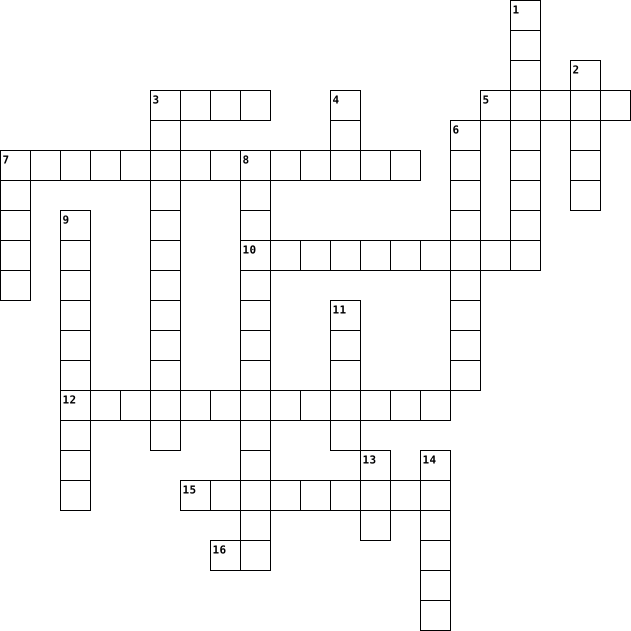
Across
- This is done whenever an object is moved or is forced to change shape
- The simple machine used to increase or decrease effort
- Machines that have a single or no moving parts
- Simple machines provide us with a __________ advantage, to make our work simpler
- A simple machine that does not move to accomplish its task
- Simple machines can change the _________ of force
- decreasing the effort required, simple machines ________ the distance over which it is applied
Down
- Stored energy possessed by an object
- A simple machine used to cut through things
- Simple machine found in a door knob
- Where most of the energy on Earth originates from
- When we conserve energy and use it wisely, it is known as being energy _________
- Converts rotational motion to linear motion
- Energy stored within a substance such as fuel or food that may be released when the substance is burnt or digested
- Energy that causes particles to move
- Unit of meaurement for energy
- There are ____ kinds of simple machines
- The ability to make change happen, different forms include heat light and sound
18 Clues: Unit of meaurement for energy • Simple machine found in a door knob • Stored energy possessed by an object • Energy that causes particles to move • There are ____ kinds of simple machines • A simple machine used to cut through things • Converts rotational motion to linear motion • Machines that have a single or no moving parts • ...
Arrangements of Electrons in Atoms 2022-10-26

Across
- emission of electrons from a metal when light shines on the metal
- the four bands of light through a prism
- three dimensional region around the nucleus
- radiation a form of energy that exhibits wavelike behavior
- a particle of electromagnetic radiation having zero mass and carrying a quantum of energy
- λ
- lowest energy state of an atom
Down
- the continuous range of frequencies of electromagnetic radiation
- higher potential energy than ground state
- all forms of electromagnetic radiation
- v
- the minimum quantity of energy that can be lost or gained
12 Clues: v • λ • lowest energy state of an atom • all forms of electromagnetic radiation • the four bands of light through a prism • higher potential energy than ground state • three dimensional region around the nucleus • the minimum quantity of energy that can be lost or gained • radiation a form of energy that exhibits wavelike behavior • ...
Enzymes and Metabolism 2021-10-25

Across
- Energy that is being used
- A spontaneous reaction
- All reactions that occur in a cell
- Substances that occur in a reaction
- Amount of energy to start a reaction
- Substance that forms as a result of a reaction
Down
- Pathways that break down complex molecules
- A nonspontaneous reaction
- Pathways that consume energy
- Energy that is stored
- Amount of disorder in a system
11 Clues: Energy that is stored • A spontaneous reaction • A nonspontaneous reaction • Energy that is being used • Pathways that consume energy • Amount of disorder in a system • All reactions that occur in a cell • Substances that occur in a reaction • Amount of energy to start a reaction • Pathways that break down complex molecules • Substance that forms as a result of a reaction
Chemistry Vocabulary 2013-10-02

Across
- a solid formed in a solution
- substance that slows or stops a chemical reaction
- electrons on the outermost energy level
- forms when two atoms are sharing electrons
- states that energy cannot be created or destroyed
- the amount of electrons that will fit on the first energy level
- a process in which one or more substances undergoes a change to make something new
- is determined by the number of protons in an atom
- charged particles that form from chemical reactions
- uses chemical symbols and formulas to describe a chemical reaction
Down
- reaction where energy is given off
- substances formed in a chemical reaction
- force that holds two atoms together
- minimum amount of energy needed to start a reaction
- states that mass can not be created or destroyed
- substance that speeds up a reaction
- reaction where energy is absorbed
- starting material in a chemical reaction
- shorthand way to use chemical symbols and numbers
19 Clues: a solid formed in a solution • reaction where energy is absorbed • reaction where energy is given off • force that holds two atoms together • substance that speeds up a reaction • electrons on the outermost energy level • substances formed in a chemical reaction • starting material in a chemical reaction • forms when two atoms are sharing electrons • ...
Chapter 2, 1-17 Key Terms Crossword 2021-09-14

Across
- adding energy to go from liquid to gas
- a substance with a changeable shape and volume
- adding energy to go from solid to liquid
- the model explaining that matter takes one of four distinct forms
- materials made of just one type of particle
- adding energy to go from solid (directly) to liquid
- subtracting energy to go from liquid to solid
- a substance with an unchangeable shape and volume
- a substance with a changeable shape but unchangeable volume
- anything that occupies space and has mass
Down
- a substance with a changeable shape and volume, but made up of high temperature ionized particles
- subtracting energy to go from gas to liquid
- a form of vaporization, going from liquid to gas while surface particles gain enough energy to totally escape its liquid
- physical combinations of two or more substances
- a form of vaporization, going from liquid to gas over an atmospheric pressure
- subtracting energy to go from gas (directly) to solid
- the measurement of particles' average kinetic energy in an object
17 Clues: adding energy to go from liquid to gas • adding energy to go from solid to liquid • anything that occupies space and has mass • subtracting energy to go from gas to liquid • materials made of just one type of particle • subtracting energy to go from liquid to solid • a substance with a changeable shape and volume • physical combinations of two or more substances • ...
ME Thermodynamics 1 Exam 1 2022-02-06

Across
- Quantity of matter or a region in space chosen for study
- Liquid mass fraction to the total mass of the mixture
- Vapour mass fraction to the total mass of the mixture
- State of balance
- Microscopic forms of energy
- Process from solid to liquid
Down
- Type of intensive properties of a system
- Region where temperatures is above the saturation temperature
- Macroscopic forms of energy
- Process during which there is no heat transfer
10 Clues: State of balance • Macroscopic forms of energy • Microscopic forms of energy • Process from solid to liquid • Type of intensive properties of a system • Process during which there is no heat transfer • Liquid mass fraction to the total mass of the mixture • Vapour mass fraction to the total mass of the mixture • Quantity of matter or a region in space chosen for study • ...
Atmosphere Vocabulary 2019-03-05

Across
- puffy cloud forming below 2000 m
- high, often wispy clouds made up of ice crystals that form at heights of 6000 m
- layered cloud forming below 2000 m
- all solid and liquid forms of water that fall from clouds
- occurs when a volume of air reaches the maximum amount of water vapor
- layer of Earth’s atmosphere in which most weather takes place and air pollution collects
Down
- the layer of gases that surrounds Earth
- transfer of energy by the flow of a heated substance
- layer of Earth’s atmosphere that is located above the tropopause and is made up primarily of concentrated ozone
- energy transfer that occurs when molecules collide
- amount of water vapor in air
- energy transfer through space by visible light, ultraviolet radiation, and other forms of electromagnetic waves
12 Clues: amount of water vapor in air • puffy cloud forming below 2000 m • layered cloud forming below 2000 m • the layer of gases that surrounds Earth • energy transfer that occurs when molecules collide • transfer of energy by the flow of a heated substance • all solid and liquid forms of water that fall from clouds • ...
Nutrition Crossword Health Nathan Gutzmann 2021-09-07

Across
- prevents constipation, reduces colon cancer risk, prevents heart disease
- process of maintaining a steady-state inside body
- helps with the functioning of heart and water balance
- carbs, fats, proteins, vitamins, minerals and water
- supply energy and repair and grow body tissue
- fat solid at room temp
- chemical process by which your body breaks down food to release energy
- necessary for healthy red blood cells
- helps to form and maintain bones
Down
- fat liquid at room temp
- supply energy to your bodies functions
- when red blood cells don't have enough hemoglobin
- maintains water balance in the body
- unit of energy
- supplies energy, forms cells, maintains body temp and protects nerves
15 Clues: unit of energy • fat solid at room temp • fat liquid at room temp • helps to form and maintain bones • maintains water balance in the body • necessary for healthy red blood cells • supply energy to your bodies functions • supply energy and repair and grow body tissue • process of maintaining a steady-state inside body • when red blood cells don't have enough hemoglobin • ...
EnviSci 2021-09-07

Across
- rate at which energy is used
- the outer mantle of the solid earth
- the act of noting or detecting phenomenon by the senses
- a pure substance
- a solution with a pH higher than 7
- unit of work
- stores energy, forms cell membrane, carries messages
- the concentration of hydronium ions in a solution
- a widely accepted hypotheses
- the ability to do work
- anything that takes up space and has mass
- done when force is applied to an object over a distance
- the study of interactions between life and its physical environment
- a solution with a pH lower than 7
Down
- the main element in organic compounds
- the vast majority of our people directly dependent on the nature resources of their country for their basic needs
- a suggested explanation based on evidence
- comprises all types of water resources
- a substance that forms as a result of a chemical reaction.
- where life operates
- process for developing knowledge
- a substance that starts a chemical reaction
- small particle of an element
- means knowledge
- a test that is used to rule out a hypothesis
- a substance that consists of two or more elements
- method: based on gathering observable empiral and measurable evidence
- developing new knowledge
- the protective blanket of gases surrounding the earth
- the sum of all the biochemical reactions in an organism
30 Clues: unit of work • means knowledge • a pure substance • where life operates • the ability to do work • developing new knowledge • rate at which energy is used • small particle of an element • a widely accepted hypotheses • process for developing knowledge • a solution with a pH lower than 7 • a solution with a pH higher than 7 • the outer mantle of the solid earth • ...
Unit 4 Crossword 2025-09-29

Across
- This element has the largest atomic radius of the alkaline earth metals.
- This element has the highest ionization energy in period 4.
- This element has the smallest ionization energy in the period with electrons in the third energy level.
- This element is named after the “father of the periodic table.”
- This element is the halogen in period 5.
- The only metal that is a liquid at room temperature
- This is the least electronegative element with four occupied energy levels (least other than the Noble Gas)
- This element has the highest ability to pull electrons of neighboring atoms.
- This element is a semiconductor in period four and is in the same family as Carbon.
- This element has six valence electrons in the fourth energy level.
- This element has the highest melting point on the periodic table at 3,422 deg C/6,192 deg F
- This element has the largest ionization energy of the alkali metals.
Down
- This rare radioactive element is NOT named after Pennsylvania.
- This element is a metal in period 3 that touches the “stairstep”
- This is the noble gas with the least occupied energy levels.
- This element is not an Alkali metal but has one valence electron
- The only nonmetal that is a liquid at room temperature
- This element is in period 5 and is a stable, non-reactive gas.
- This is the metalloid located in period 3.
- This element is in period 5 and the group that forms +1 ions
- This element forms an ion with a charge of -2 and its valence electrons are found in the third energy level.
- Ms. Doherty’s favorite element; the solid (freezes at -219 deg C/-361 deg F) is a light sky blue color; the electron transport chain would not work without it
- This element makes up 78% of the air we breathe and has an electron configuration of [He]2s22p3
- The most reactive metal in period 6.
- A neutral atom of this element has 24 total electrons.
25 Clues: The most reactive metal in period 6. • This element is the halogen in period 5. • This is the metalloid located in period 3. • The only metal that is a liquid at room temperature • The only nonmetal that is a liquid at room temperature • A neutral atom of this element has 24 total electrons. • This element has the highest ionization energy in period 4. • ...
Unit 3 Ecology part 2 2021-03-24

Across
- phototrophs convert light energy into chemical energy
- 2 hydrogen atoms
- significant changes in global temperature
- transfers energy from glucose to cells
- the environment outside of the cell has a higher concentration of solutes than the cell
- phosphorus moves through the lithosphere, hydrosphere, and biosphere
- symbol O atomic number 8
- molecule passes through a cell wall via a concentration gradient
- simple sugar
- spreading something widely
Down
- path that water follows in different states
- nitrogen is inter-converted in the environment and in living organisms
- network of lipids and proteins that forms the boundary between a cell's contents and the outside of the cell
- chemical reaction that transfers energy to cells
- has a lower concentration of solutes than another solution
- CO2
- carbon compounds are inter-converted in the environment
- molecules are travelling against a concentration gradient.
- when its effective osmole concentration is the same as that of another solution
19 Clues: CO2 • simple sugar • 2 hydrogen atoms • symbol O atomic number 8 • spreading something widely • transfers energy from glucose to cells • significant changes in global temperature • path that water follows in different states • chemical reaction that transfers energy to cells • phototrophs convert light energy into chemical energy • ...
Our Weather & Water Unit 4 Vocabulary Review 2021-01-29

Across
- another name given to a hurricane
- special radar that measures velocity as well as distance
- winds that blow consistently in one direction
- large amount of air with uniform temperature and humidity
- where air masses are not moving
- storm forming over the ocean with winds from 39-73mph
- cumulonimbus clouds forming a thunderstorm
- funnel cloud that forms over water
- air mass that forms over land
- cooler air over the water moving toward land
- where colder air replaces warmer air on the ground
- name for a tropical cyclone that forms over the Indian Ocean
- a spiraling cloud that does not touch the ground
- cold air mass that forms over polar regions
Down
- the wall of clouds surrounding the eye of a hurricane
- where a warm air mass is trapped between two cold air masses
- energy wave created by rapid expansion and contraction of air inside a cloud, resulting in thunder
- warm air mass that forms over tropical regions
- where warmer air replaces colder air on the ground
- frequency of sound or light changes as an object approaches or moves away from the observer
- very high, fast-moving air currents
- cooler air over land moving toward the water
- area with consistently little or no wind, air moving vertically
- spiraling storm forming over the ocean with winds from 25-38mph
- name for a tropical cyclone that forms over the Northwest Pacific Ocean
- location where two air masses meet
- formed when several tropical storm cells combine over the ocean
- air mass that forms over water
- center about which a hurricane rotates
- storm forming over the ocean with winds greater than 74mph
- sudden rise in sea level due to movement of a hurricane
- electrically charged particles
32 Clues: air mass that forms over land • air mass that forms over water • electrically charged particles • where air masses are not moving • another name given to a hurricane • location where two air masses meet • funnel cloud that forms over water • very high, fast-moving air currents • center about which a hurricane rotates • cumulonimbus clouds forming a thunderstorm • ...
Chapter 2 Vocab 2023-10-04

Across
- major energy carrying molecule in the cell
- smallest unit that performs all life processes
- maintenance of a stable internal environment
- an energy storing molecule that cant mix with H20
- organism that makes its own food
- a change that affects an organisms activity
- forms much of the cell membrane
- made up of amino acids
- called the blueprints of life
- having 1 parent
Down
- a molecule made of sugars
- having 2 parents
- breaks down dead organisms for energy
- passing of traits from one generation to another
- sum of all chemical activities in an organism
- organism that eats other organisms
16 Clues: having 1 parent • having 2 parents • made up of amino acids • a molecule made of sugars • called the blueprints of life • forms much of the cell membrane • organism that makes its own food • organism that eats other organisms • breaks down dead organisms for energy • major energy carrying molecule in the cell • a change that affects an organisms activity • ...
KINETIC 2022-03-03

Across
- - we are...
- - burning material, the sun, and electricity are all forms of...
- - what moves us forward
- - tailor made
- - long lasting
- - a group of people linked in a common purpose
- - not stagnant
Down
- - simply the best
- - our mascot
- - synonym for jump
- - M in SMART Goals
- - motion creating energy
- - just for you
- - to advance in your progress and growth
14 Clues: - we are... • - our mascot • - tailor made • - just for you • - long lasting • - not stagnant • - simply the best • - synonym for jump • - M in SMART Goals • - what moves us forward • - motion creating energy • - to advance in your progress and growth • - a group of people linked in a common purpose • - burning material, the sun, and electricity are all forms of...
Chapter 14 Vocab 2024-05-09

Across
- The energy that objects possess due to their motion
- Energy sources that are not easily replaced naturally
- The energy produced from the sun
- The sum of any kinetic energy and all the forms of potential energy in a system
- The ability to do work
- Believed by most to have been formed from the remains of plants and animals that lived in the past, 80% of the energy from nonrenewable resources, and includes coal, oil, and natural gas.
Down
- The energy produced from the rising and falling tides of water on the earth
- The energy produced from the sun
- Energy produced by nuclear fission reactions
- The stored energy of an object that can be produced later
- Heat energy that originates deep within the earth’s interior
- Electrical energy generated by the movement of water
- Chemical potential energy obtained from renewable organic materials
- A source of energy that is easily replaced by natural methods
14 Clues: The ability to do work • The energy produced from the sun • The energy produced from the sun • Energy produced by nuclear fission reactions • The energy that objects possess due to their motion • Electrical energy generated by the movement of water • Energy sources that are not easily replaced naturally • The stored energy of an object that can be produced later • ...
Physical Science 5.2 Review 2015-01-15

Across
- forced-warm-air systems warms air with a _________
- this law of thermodynamics states that the energy gained by a system is equal to the energy lost by its surroundings
- branch of physics that deals with thermal energy, heat, and their relationships to other forms of energy and energy transfer
- transfer of energy as radiant energy
- entire universe except the system
- device that radiates heat
- constructed first thermostat
- a measure of the amount of disorder in a system
Down
- transfer of heat by moving fluids
- another name for vacuum bottle
- this is inside a thermostat that responds to temperature changes
- matter being studied
- this law of thermodynamics states that natural processes tend to go only one way, toward less usable energy and greater disorder
- heat flows through materials and between objects in direct contact
14 Clues: matter being studied • device that radiates heat • constructed first thermostat • another name for vacuum bottle • transfer of heat by moving fluids • entire universe except the system • transfer of energy as radiant energy • a measure of the amount of disorder in a system • forced-warm-air systems warms air with a _________ • ...
Nutrition Crossword Health Nathan Gutzmann 2021-09-08

Across
- prevents constipation, reduces colon cancer risk, prevents heart disease
- process of maintaining a steady-state inside body
- helps with the functioning of heart and water balance
- carbs, fats, proteins, vitamins, minerals and water
- supply energy and repair and grow body tissue
- fat solid at room temp
- chemical process by which your body breaks down food to release energy
- necessary for healthy red blood cells
- helps to form and maintain bones
Down
- fat liquid at room temp
- supply energy to your bodies functions
- when red blood cells don't have enough hemoglobin
- maintains water balance in the body
- unit of energy
- supplies energy, forms cells, maintains body temp and protects nerves
15 Clues: unit of energy • fat solid at room temp • fat liquid at room temp • helps to form and maintain bones • maintains water balance in the body • necessary for healthy red blood cells • supply energy to your bodies functions • supply energy and repair and grow body tissue • process of maintaining a steady-state inside body • when red blood cells don't have enough hemoglobin • ...
Cell Crossword 2025-11-13

Across
- A rigid outer layer found in plants and it provides protection.
- A eukaryatic cell wtih a rigid cell wall.
- The power house of a cell
- The momvement of water across a semipermeable membrane.
- A cell organelle that packages protein.
- Eukaryotic cell that forms animal tissue
- It makes protein
- A substance or material allows liquids or gasses to pass through it.
- The central part of an atom or eukaryotic cell that contains the genetic material.
- A membrane-bound organelle in cells that forms a network.
Down
- Its in green plant cells and it performs photsynthesis.
- The basic structural and functional unit of all living organisms.
- A membrane allows certain substances to pass through while blocking others.
- The material or protoplasm within a living cell, excluding the nucleus.
- The semipermeable membrane surronding the cytoplasm of a cell.
- An organelle in the cytoplasm
- A space within the cytoplasm of a cell
- Convert light energy into chemical energy.
- The network of protein.
- Not allowing liquids or gas to pass through it.
- Deoxyribonucleic acid
21 Clues: It makes protein • Deoxyribonucleic acid • The network of protein. • The power house of a cell • An organelle in the cytoplasm • A space within the cytoplasm of a cell • A cell organelle that packages protein. • Eukaryotic cell that forms animal tissue • A eukaryatic cell wtih a rigid cell wall. • Convert light energy into chemical energy. • ...
Atmosphere Vocabulary 2019-03-05

Across
- puffy cloud forming below 2000 m
- layered cloud forming below 2000 m
- layer of Earth’s atmosphere in which most weather takes place and air pollution collects
- all solid and liquid forms of water that fall from clouds
- energy transfer that occurs when molecules collide
Down
- high, often wispy clouds made up of ice crystals that form at heights of 6000 m
- transfer of energy by the flow of a heated substance
- layer of Earth’s atmosphere that is located above the tropopause and is made up primarily of concentrated ozone
- the layer of gases that surrounds Earth
- amount of water vapor in air
- occurs when a volume of air reaches the maximum amount of water vapor
- energy transfer through space by visible light, ultraviolet radiation, and other forms of electromagnetic waves
12 Clues: amount of water vapor in air • puffy cloud forming below 2000 m • layered cloud forming below 2000 m • the layer of gases that surrounds Earth • energy transfer that occurs when molecules collide • transfer of energy by the flow of a heated substance • all solid and liquid forms of water that fall from clouds • ...
Unit 7 Lesson 3 and 4 Vocabulary Review 2025-04-22

Across
- any material that attracts iron or iron made objects
- determine if an object is magnetic via alignment or random assortment
- a device that turns electrical devices on and off
- a temporary magnet created by being placed a strong magnetic
- a force that pushes or pulls magnet due to spinning electrons
- negatively charged subatomic particle
- uses energy, converting electrical energy into other forms of energy
- electrical charges have more than one path that they can follow
Down
- The area surrounding a magnet where the forces are exerted
- a material that can be turned into a magnet; a permanent magnet
- The north and south poles of the magnet with opposing charges
- voltage = current x resistance
- a source of energy that converts chemical energy into electrical energy
- all parts of the circuit are connected in a row that form one path
- source converts one type of energy into electrical energy
- a complete, closed path which electric charges can flow.
- an iron core wrapped with electrical wire
17 Clues: voltage = current x resistance • negatively charged subatomic particle • an iron core wrapped with electrical wire • a device that turns electrical devices on and off • any material that attracts iron or iron made objects • a complete, closed path which electric charges can flow. • source converts one type of energy into electrical energy • ...
VOCABULARY REVISION 2020-06-09

Across
- fuels coal, oil, gas are the forms of this energy
- bad health caused by having too little food
- without drivers
- forms of energy can be produced as quickly as they are used
Down
- have a lot of spaces
- without money
- a very poor and crowded area
- illegal activities
- too many people living in a small place will cause this problem
- abundant, there is a lot of it available
10 Clues: without money • without drivers • illegal activities • have a lot of spaces • a very poor and crowded area • abundant, there is a lot of it available • bad health caused by having too little food • fuels coal, oil, gas are the forms of this energy • forms of energy can be produced as quickly as they are used • too many people living in a small place will cause this problem
Circuit Electricity 2015-01-14

Across
- the derived unit for electric potential, electric potential difference (voltage), and electromotive force.
- energy
- the SI unit of electrical resistance
- transformed into other
- diagrams that use symbols to represent the different components of the
- Any device that transforms electrical energy into other forms of energy.
- what electric current is measured in.
Down
- a conductor through which electricity enters or leaves an object
- Any device that transforms electrical energy into other...
- the relationship of current, voltage, and resistance
- the amount of charge passing a point in a conductor every second.
- A complete pathway that allows electrons to flow.
- the flow of charged particles in a complete circuit.
- a device having a designed resistance to the passage of an electric current.
- the difference of electrical potential between two points.
- a device capable of either generating electrical energy from chemical reactions or facilitating chemical reactions through the introduction of electrical energy.
- the refusal to accept or comply with something
17 Clues: energy • transformed into other • the SI unit of electrical resistance • what electric current is measured in. • the refusal to accept or comply with something • A complete pathway that allows electrons to flow. • the relationship of current, voltage, and resistance • the flow of charged particles in a complete circuit. • ...
Global Warming Vocabulary 2024-12-11

Across
- Energy that is generated by the heat of water and steam that is found deep underground
- Is a natural resource that cannot be used up or it is one that can be replaced within a human life span
- The long-term shifts in temperatures and weather patterns.
- A chemical element that naturally occurs in all organic compounds and is found in all forms of life
- Heat within the earth
- A chemical reaction that produces heat and light
- The amount of carbon dioxide released into the air because of your own energy needs
- A process that occurs when gasses in Earth's atmosphere trap the Sun's heat
- A chemical compound that is usually in the form of a gas
- A natural substance formed from the buried remains of ancient organisms that can be used aenergyource of energ
- Are natural materials that cannot be replaced after they are used
- A very small pellet of plastic that serves as raw material in the manufacture of plastic products
Down
- Something that is found in nature and can be used by people
- Electricity generated by moving water
- The increase in Earth's average temperature over a long period of time
- The clearing or cutting down of forests
- An organic material made from plants and animals (microorganisms).
- It is light, heat, and other forms of energy given off by the Sun
- Is an alternative energy source that is powered by air
- Substances released into the air and are measured by their concentrations, or parts per million, in the atmosphere
20 Clues: Heat within the earth • Electricity generated by moving water • The clearing or cutting down of forests • A chemical reaction that produces heat and light • Is an alternative energy source that is powered by air • A chemical compound that is usually in the form of a gas • The long-term shifts in temperatures and weather patterns. • ...
Biochemical crossword puzzle 2024-09-17

Across
- endothermic process
- a constant temperature and chemical composition and almost overall absence of oxygen
- a biogeochemical process through which nitrogen is converted into many forms
- a passive process that requires no energy expense by the plant
- Liquid or solid water falling from clouds
- monomers are covalently bonded together and a water molecule is produced
- Liquid molecules that gain energy
- Dynamic and really interactive with the climate and environment
Down
- It is a cycle with no beginning or end
- Flammable gaseous substance and colorless
- levels of dissolved nutrients, such as oxygen and carbon dioxid
- Colorless, waxy solid
- converts ammonia to nitrite and then to nitrate
- the process of converting nitrogen compounds, such as nitrate, into gaseous forms like nitrogen oxides and nitrogen gas.
- It's a type of gas that is colorless and tasteless
- You breathe it in
16 Clues: You breathe it in • endothermic process • Colorless, waxy solid • Liquid molecules that gain energy • It is a cycle with no beginning or end • Flammable gaseous substance and colorless • Liquid or solid water falling from clouds • converts ammonia to nitrite and then to nitrate • It's a type of gas that is colorless and tasteless • ...
key terms 2021-11-30

Across
- / a chemical process that organisms use to get energy from food
- / when cellular machines read RNA
- / provides energy for organisms
- / a mistake in the replication process
- / when a cell makes a copy of DNA that has a few modifications and it’s one strand.
- / acid single strand of nucleic acid
- / chemical reactions when living organisms use stored energy
- / nucleic acid made of a chain of nucleotides
Down
- / when 2 copies of DNA have been created
- / pairs of nucleotides
- / chemical process for storing energy
- synthesis / a chemical reaction that forms a peptide bond
- / one of 4 prongs of tRNA are 3 unattached bases
- / 3 consecutive nucleotides
- / When ATP reacts with water
15 Clues: / pairs of nucleotides • / 3 consecutive nucleotides • / When ATP reacts with water • / provides energy for organisms • / when cellular machines read RNA • / acid single strand of nucleic acid • / chemical process for storing energy • / a mistake in the replication process • / when 2 copies of DNA have been created • / nucleic acid made of a chain of nucleotides • ...
Organic Molecules of Life 2025-12-08

Across
- molecule that serves as a hormone, transporter, antibody and enzyme
- two or more elements linked together
- molecule that stores genetic information
- a compound that contains both hydrogen and carbon
- monomer of a nucleic acid
- smallest part of matter
- a carbohydrate polymer of glucose
- complex sugar
- a single small molecule or subunit
- molecule that is a long term storage of energy
- single stranded genetic polymer
Down
- molecule with a quick release of energy
- monomer of a carbohydrate
- contains both hydrogen and carbon atoms
- a term to describe the specific shape of a protein
- simple sugar
- a large molecule made up of small molecules linked together
- monomer of a protein
- exists in many forms (light, heat, chemical)
- double stranded genetic polymer
- anything with mass and takes up space
21 Clues: simple sugar • complex sugar • monomer of a protein • smallest part of matter • monomer of a carbohydrate • monomer of a nucleic acid • double stranded genetic polymer • single stranded genetic polymer • a carbohydrate polymer of glucose • a single small molecule or subunit • two or more elements linked together • anything with mass and takes up space • ...
Energy transformation 2015-01-27

Across
- where does sound energy come from
- What do televisions use
- what type of objects give of gravitational potential energy
Down
- what do hot objects pass on to colder ones
- potential and chemical energy are forms of this
- springs and elastic bands have this
- what is the term for energy is spread out and lost
- anything that's moving gives of this energy
- only released from nuclear reactions
- what energy is possessed by foods and fuels
- what energy does the sun give out
11 Clues: What do televisions use • where does sound energy come from • what energy does the sun give out • springs and elastic bands have this • only released from nuclear reactions • what do hot objects pass on to colder ones • anything that's moving gives of this energy • what energy is possessed by foods and fuels • potential and chemical energy are forms of this • ...
Energy Crossword Puzzle 2015-02-22

Across
- kinetic energy and potential energy are 2 __________ types of energy
- ________Energy;The nucleus is the source of...
- ______Energy;Stored in the chemical composition of matter
- _________ Energy;Stored Energy
- The results of _______ is the most obvious form of potential energy
Down
- ______Energy;The energy that moves something
- _______Energy;Ex:When you hear a car drives fast you can sense the vibrations
- The ability to cause change/There are a lot of forms of...
- ________Energy; Energy of motion
- _______Energy;Amount of energy from the motion of particles in matter
10 Clues: _________ Energy;Stored Energy • ________Energy; Energy of motion • ______Energy;The energy that moves something • ________Energy;The nucleus is the source of... • ______Energy;Stored in the chemical composition of matter • The ability to cause change/There are a lot of forms of... • The results of _______ is the most obvious form of potential energy • ...
Chapter 2, 1-17 Key Terms Crossword 2021-09-14

Across
- subtracting energy to go from liquid to solid
- a form of vaporization, going from liquid to gas while surface particles gain enough energy to totally escape its liquid
- subtracting energy to go from gas (directly) to solid
- a substance with a changeable shape and volume, but made up of high temperature ionized particles
- adding energy to go from liquid to gas
- the measurement of particles' average kinetic energy in an object
- adding energy to go from solid to liquid
- adding energy to go from solid (directly) to liquid
- a substance with an unchangeable shape and volume
Down
- physical combinations of two or more substances
- a form of vaporization, going from liquid to gas over an atmospheric pressure
- the model explaining that matter takes one of four distinct forms
- materials made of just one type of particle
- subtracting energy to go from gas to liquid
- anything that occupies space and has mass
- a substance with a changeable shape but unchangeable volume
- a substance with a changeable shape and volume
17 Clues: adding energy to go from liquid to gas • adding energy to go from solid to liquid • anything that occupies space and has mass • materials made of just one type of particle • subtracting energy to go from gas to liquid • subtracting energy to go from liquid to solid • a substance with a changeable shape and volume • physical combinations of two or more substances • ...
Cubism and Futurism 2026-01-22

Across
- Representing sound or city clamor visually through repeated lines, staccato marks, or overlapping shapes.
- Viewpoint Representing an object from several angles at once within a single composition.
- Emphasis on movement, energy, and the sensation of speed as central visual themes.
- A core Futurist value—visual techniques used to convey rapid movement and velocity.
- The technique of breaking form into flat, angular planes (facets) to represent different perspectives.
- Futurism was closely tied to written manifestos (e.g., Marinetti’s) that outlined the movement’s aggressive rejection of the past and embrace of modern life.
- Cubism A phase of Cubism (c. 1908–1912) focusing on breaking objects into fragmented planes and showing multiple viewpoints simultaneously.
- Aesthetic Admiration for industrial forms, gears, and mechanical rhythms incorporated into compositions.
- of Time The idea that past, present, and future can be shown together to capture experience rather than a single instant.
- Life compositions were common subjects in Cubist experiments with form and space.
Down
- Splitting visual forms into parts to reconfigure them within the composition.
- Space Reducing the illusion of depth so foreground and background occupy the same pictorial plane.
- Cubism Later Cubist phase (c. 1912 onward) that reassembles forms using simpler shapes, brighter colors, and collage elements.
- Simplification Reducing natural forms to basic geometric shapes (cubes, cones, cylinders).
- Modernity The celebration of cities, industry, and technological progress as subjects and inspirations.
- A Futurist painting movement (c. 1919–1930s) celebrating flight, aerial perspectives, and modern technology.
- Palette A limited, often muted color range used during Analytic Cubism to emphasize structure over color.
- Assembling paper, fabric, or other materials onto the surface of a work—widely used in Synthetic Cubism.
- Depicting multiple moments of time or phases of motion within one image.
- of Force Graphic devices (radiating lines, directional strokes) used to suggest vectors of motion and energy.
20 Clues: Depicting multiple moments of time or phases of motion within one image. • Splitting visual forms into parts to reconfigure them within the composition. • Life compositions were common subjects in Cubist experiments with form and space. • Emphasis on movement, energy, and the sensation of speed as central visual themes. • ...
Health: Nutrient basics 2023-09-05

Across
- Functioning of the heart and water balance.
- Helps with digestion.
- Part of blood cells; Helps in energy metabolism.
- help protect healthy cells from damaged ones.
- Forms part of some amino acids and B vitamins.
- balance in our body.
Down
- Helps build and maintain bones and teeth.
- Lose of energy in the body.
- Part of substances that help carry out body process.
- Helps with energy metabolism.
- Helps form strong teeth and bones.
- Helps build bones and protein.
- Blood cells do not contain enough hemoglobin.
- Our body is made of 65% of this.
- Regulate many processes in your cells.
15 Clues: balance in our body. • Helps with digestion. • Lose of energy in the body. • Helps with energy metabolism. • Helps build bones and protein. • Our body is made of 65% of this. • Helps form strong teeth and bones. • Regulate many processes in your cells. • Helps build and maintain bones and teeth. • Functioning of the heart and water balance. • ...
IPC Unit 2 study guide 2024-09-16

Across
- A negatively charged particle that orbits the nucleus.
- The opposition to the flow of electric current.
- The product of force and distance.
- Energy stored in the bonds of atoms and molecules.
- Distance traveled per unit of time.
- Transfer of thermal energy from one object to another.
- The unit of work or energy in physics.
- The basic unit of a chemical element.
- The electric potential difference between two points.
- The sum of kinetic and potential energy in an object.
- Fuels Non-renewable energy sources such as coal, oil, and natural gas.
- Energy from the sun.
- A push or pull on an object.
- The flow of electric charge.
- Rate at which work is done or energy is transferred.
- The amount of matter in an object.
- Energy sources that can be replenished naturally.
- Heat The amount of heat needed to raise the temperature of a substance.
- How far an object has moved.
- The rate of change of velocity over time.
Down
- The capacity to do work or cause change.
- A measure of the average kinetic energy of particles in an object.
- Principle stating energy cannot be created or destroyed.
- Energy generated from water movement.
- A closed path through which electric current flows.
- Stored energy based on an object’s position or height.
- Energy due to the motion of particles in an object.
- Type of energy an object has due to motion.
- Device that increases or decreases voltage.
- The force that resists the motion of objects.
- Machine that converts mechanical energy into electrical energy.
- A machine that converts kinetic energy from fluids into mechanical energy.
- Potential energy stored in objects that can be stretched or compressed.
- Transfer of heat through direct contact.
- A renewable energy source that harnesses air movement.
- The change in an object’s position over time.
- A positively charged particle in the nucleus of an atom.
- Speed in a given direction.
- The force that causes objects to fall toward Earth.
- Rule that energy can only change forms, not be created or destroyed.
40 Clues: Energy from the sun. • Speed in a given direction. • A push or pull on an object. • The flow of electric charge. • How far an object has moved. • The product of force and distance. • The amount of matter in an object. • Distance traveled per unit of time. • Energy generated from water movement. • The basic unit of a chemical element. • The unit of work or energy in physics. • ...
The Movement of Energy 2016-10-25

Across
- An organism that is incapable of photosynthesis and must obtain its energy by consuming other organisms.
- A consumer that eats producers.
- The energy captured by producers in an ecosystem minus the energy producers respire.
- Fungi and bacteria that convert organic matter into small elements and molecules that can be recycled back into the ecosystem.
- The process by which producers use solar energy to convert carbon dioxide and water into glucose.
- An organism that specializes in breaking down dead tissues and waste products into smaller particles.
- An organism that uses the energy of the Sun to produce usable forms of energy.
- The successive levels of organisms consuming one another.
- The proportion of consumed energy that can be passed from one trophic level to another.
- The process by which cells unlock the energy of chemical compounds.
Down
- The total mass of all living matter in a specific area.
- A consumer that eats producers.
- A representation of the distribution of biomass, numbers, or energy among trophic levels.
- A carnivore that eats primary consumers.
- The total amount of solar energy that producers in an ecosystem capture via photosynthesis over a given amount of time.
- An organism that consumes dead animals.
- A carnivore that eats secondary consumers.
- The amount of biomass present in an ecosystem at a particular time.
- A consumer that eats other consumers.
- A complex model of how energy and matter move between trophic levels.
- The region of our planet where life resides, the combination of all ecosystems on Earth.
- The sequence of consumption from producers through tertiary consumers.
22 Clues: A consumer that eats producers. • A consumer that eats producers. • A consumer that eats other consumers. • An organism that consumes dead animals. • A carnivore that eats primary consumers. • A carnivore that eats secondary consumers. • The total mass of all living matter in a specific area. • The successive levels of organisms consuming one another. • ...
Unit 1 2022-12-07

Across
- and element that exist in more than 2 forms
- process of splitting something into fragments with the addition of water
- chemical reaction that absorbs energy
- attraction between a hydrogen atom and another
- made of hydrogen, oxygen, nitrogen, carbon, and phosphorus
- known as "water fearing"
- chemical reaction that release anergy
- process of using energy to create a large molecules from smaller molecules
- all chemical reactions within an organism to maintain life
Down
- made of carbon, hydrogen and oxygen
- made of nitrogen, carbon, hydrogen, oxygen
- molecules that combine from proteins
- same element with different number of neutrons in them
- known as "water loving
- attraction of molecules to the same substance
- made of carbon and hydrogen
- process of releasing energy to break large molecules into smaller molecules
- a substance which a enzyme acts during a chemical reaction
- molecule that transports chemical energy for metabolism
- attraction of different molecules of different substance
20 Clues: known as "water loving • known as "water fearing" • made of carbon and hydrogen • made of carbon, hydrogen and oxygen • molecules that combine from proteins • chemical reaction that absorbs energy • chemical reaction that release anergy • made of nitrogen, carbon, hydrogen, oxygen • and element that exist in more than 2 forms • attraction of molecules to the same substance • ...
Energy Resources 2021-12-15

Across
- since fossil fuels take hundreds of millions of years to form, they are considered ______ resources
- compounds made from oil
- energy-rich substances formed from the remains of plants and animals
- the most plentiful fossil fuel in the U.S.
- a factory in which crude oil is heated and separated into fuels and other products
- magma heats underground water to create this form of energy
- solar energy is energy from the ______
- this electricity is produced by running water
- most oil deposits are found underground in tiny holes located in limestone or ________
- solar power plants use these to capture the sun's energy
- a dam blocks water to create a ________ for hydroelectric power
Down
- this type of solar heating causes the inside of your car to heat up
- another name for oil
- energy is released from the splitting of atoms with this energy source
- forms from the same organisms as oil
- the percentage of energy that is actually used to perform work
- a substance that provides energy, such as light, heat, motion, or electricity
- the direct or indirect source of most other renewable energy resources
- fuels made from living things
- decomposing plant material becomes this before it becomes coal
- wind farms consist of many wind __________
- thick, black, liquid fossil fuel
- a layer of material that traps air
- chemical compounds containing carbon and hydrogen atoms. They make up fossil fuels
24 Clues: another name for oil • compounds made from oil • fuels made from living things • thick, black, liquid fossil fuel • a layer of material that traps air • forms from the same organisms as oil • solar energy is energy from the ______ • the most plentiful fossil fuel in the U.S. • wind farms consist of many wind __________ • this electricity is produced by running water • ...
Physical Science Final 2023-05-09

Across
- the percentage of the work input that becomes work output in a machine
- the material through which a wave travels
- the tendency of an object to resist a change in its motion
- a nuclear reaction in which the nuclei of two atoms combine to form a larger nucleus
- the number of complete cycles per unit time for a periodic motion
- the study of conversions between thermal energy & other forms of energy
- an upward force due to a pressure difference between the top & bottom of a wing
- the rate of doing work
- the smallest particle of an element
Down
- the ability of a fluid to exert an upward force on an object placed in it
- the transfer of energy by waves moving through space
- a quantity that has a direction associated with it
- the bending of a wave as it moves around an obstacle or passes through a narrow opening
- a packet of electromagnetic energy
- the ability to do work
- a nuclear reaction in which an atomic nucleus is split into two smaller parts
- the study of matter and energy and the interactions between the two through forces & motion
- the energy stored in the bonds of molecules
- the transfer of thermal energy from one object to another because of a difference in temperature
- a point on a standing wave that has no displacement from the rest position
20 Clues: the ability to do work • the rate of doing work • a packet of electromagnetic energy • the smallest particle of an element • the material through which a wave travels • the energy stored in the bonds of molecules • a quantity that has a direction associated with it • the transfer of energy by waves moving through space • ...
Nutrition 2025-06-18

Across
- One of the roles of fat
- Carbohydrates, fats and protein can give us this
- Provides a feeling of 'fullness'
- Is a micronutrient
- The bodies preferred energy source
- Helps with chemical reactions in the body
- Calcium can help build this hard tissue
- Nutrient that is required by the body in large amounts
Down
- Is a richer source of energy then carbohydrates
- Nutrient that is required by the body in small amounts
- A mineral
- Forms the 'haem' part of haemoglobin
- Calcium, Sodium and Iron are examples of this
- Is a component of salt
- Helps to repair and build the bodies cells
- Can lead to dental caries
16 Clues: A mineral • Is a micronutrient • Is a component of salt • One of the roles of fat • Can lead to dental caries • Provides a feeling of 'fullness' • The bodies preferred energy source • Forms the 'haem' part of haemoglobin • Calcium can help build this hard tissue • Helps with chemical reactions in the body • Helps to repair and build the bodies cells • ...
Ecology Chapter 10 2022-11-01

Across
- not a way of generating electricity, but a way of reducing need for additional energy consumption and saving money for the consumer.
- Natural Gas is hard to ________ —flamed off at oil fields.
- Pressure and heat over time transformed peat into _______.
- Burning coal releases _____________.
- energy only works during the day.
- As water flows from higher level to lower level, it can be used to spin an electricity-generating _______.
- Natural gas often forms on top of ________.
- Continuously present as a feature of the environment.
- Oil is more ___________ than coal, burns cleaner, and is easily transported through pipelines.
Down
- primary energy source for nearly half world’s population.
- 60% of oil pollution in oceans comes from “____________” operations.
- __________ construction causes significant environmental and social damage.
- 90% of world’s commercial energy supplied by ________ fuels.
- Energy sources used faster than can be replenished.
- ________ produces 40% of world’s geothermal electricity.
- the world’s fastest growing energy source in the 1990s.
16 Clues: energy only works during the day. • Burning coal releases _____________. • Natural gas often forms on top of ________. • Energy sources used faster than can be replenished. • Continuously present as a feature of the environment. • ________ produces 40% of world’s geothermal electricity. • the world’s fastest growing energy source in the 1990s. • ...
Energy transformation 2015-01-27

Across
- potential and chemical energy are forms of this
- What do televisions use
- springs and elastic bands have this
- where does sound energy come from
- what type of objects give of gravitational potential energy
Down
- what energy does the sun give out
- anything that's moving gives of this energy
- only released from nuclear reactions
- what do hot objects pass on to colder ones
- what is the term for energy is spread out and lost
- what energy is possessed by foods and fuels
11 Clues: What do televisions use • what energy does the sun give out • where does sound energy come from • springs and elastic bands have this • only released from nuclear reactions • what do hot objects pass on to colder ones • anything that's moving gives of this energy • what energy is possessed by foods and fuels • potential and chemical energy are forms of this • ...
Energy Crossword 2025-12-10

Across
- Heat the amount of heat needed to raise 1 kg of a material by 1°C; different for different substances
- Energy Equation Q = mcΔT (heat equals mass × specific heat × change in temperature)
- the amount of matter in an object; measured in kilograms (kg)
- energy cannot be created or destroyed, only changed into different forms
- a push or pull measured in Newtons (N)
- the transfer of energy between objects; measured in Joules
- energy produced by vibrating objects; used for communication
- the ability to cause change; measured in Joules (J)
- total amount of kinetic and potential energy in a system
- heat transfer through direct contact of particles; occurs best in solids
- materials that allow heat to flow easily (ex: metals, skin)
- energy released from the nucleus of an atom
- a measure of the average kinetic energy of particles in an object
- energy stored in objects above Earth’s surface; GPE = mgh (HAM in your notes)
Down
- stored energy
- energy stored in chemical bonds of compounds
- energy from light sources such as the sun or lightbulbs; also called solar or light energy
- the transfer of energy when a force causes an object to move; W = Fd
- how far an object moves; measured in meters (m)
- materials that resist heat flow (ex: air, wood, Styrofoam, plastic)
- heat transfer through fluid movement caused by temperature and density differences; occurs in liquids and gases
- the total kinetic + potential energy of particles in an object; increases with mass and temperature
- the speed of an object in a given direction; measured in m/s
- energy that travels in electrical and magnetic waves and can move through space
- energy from outlets or power plants that powers electrical devices
- energy of motion; calculated using KE = ½mv²
- the rate at which work is done; measured in Watts; P = W/t
- heat transfer through electromagnetic waves; does not require matter
28 Clues: stored energy • a push or pull measured in Newtons (N) • energy released from the nucleus of an atom • energy stored in chemical bonds of compounds • energy of motion; calculated using KE = ½mv² • how far an object moves; measured in meters (m) • the ability to cause change; measured in Joules (J) • total amount of kinetic and potential energy in a system • ...
Relationships Among Organisms 2024-04-25

Across
- An animal hunted and eaten by predators
- A group for different species living within an ecosystem
- Organisms that obtain energy by consuming other organisms
- Carnivores that eat other Carnivores for energy
- A linear sequence of who eats whom in an ecosystem
- An animals that hunts and eats other animals
- Herbivores that consume producers for energy
- Consumers that break down organic material for energy, releasing nutrients
- A relationship where one organism benefits at the expense of the other
- The process by which producers convert sunlight into energy
Down
- Carnivores that eat Herbivores for energy
- An organisms that consumes both plants and animals
- Organisms like plants, algae, and bacteria that convert solar energy into usable forms
- Long-term interactions between organisms of different species
- A symbiotic relationship where both organisms benefit
- A relationship where one organism benefits without affecting the other significantly
- Models showing complex energy transfer among species in ecosystems
17 Clues: An animal hunted and eaten by predators • Carnivores that eat Herbivores for energy • An animals that hunts and eats other animals • Herbivores that consume producers for energy • Carnivores that eat other Carnivores for energy • An organisms that consumes both plants and animals • A linear sequence of who eats whom in an ecosystem • ...
Chemistry Bonus 2023-04-25

Across
- The study of how heat is converted to and from other forms of energy
- The final temperature of a substance
- Gas to liquid
- The energy required to start a reaction
- Liquid to gas
- The initial temperature of a substance
- Measurement of heat
- The change in heat in a reaction, determines if the reaction is exothermic or endothermic
- Liquid to solid
- The amount of energy needed to raise 1 gram of a substance 1C
Down
- A product of a reaction
- Tendency of an atom to attract electrons
- A reaction that gains heat in order to happen
- A reaction that loses heat when happening
- A substance that speeds up a chemical reaction without itself undergoing any chemical change
- Solid to liquid
- Biological catalysts
- The elements/compounds used in a reaction
- 1,000 calories
- 1,000 Joules
20 Clues: 1,000 Joules • Gas to liquid • Liquid to gas • 1,000 calories • Solid to liquid • Liquid to solid • Measurement of heat • Biological catalysts • A product of a reaction • The final temperature of a substance • The initial temperature of a substance • The energy required to start a reaction • Tendency of an atom to attract electrons • A reaction that loses heat when happening • ...
Roller Coaster 2023-05-05

Across
- the ability of a body to do work
- what holds the roller coaster
- the energy stored by an object ready to be used
- anything that reduces the amount of force needed to move an object
- use friction to stop a vehicle
- the force of gravity or acceleration on a body
- what the cart sits on
- a force caused by a rubbing motion between two objects
- machine designed to convert one or more forms of energy into mechanical energy
- the energy of an objects in motion
Down
- the force that attracts a body toward the center of the earth
- how fast an object moves
- how quickly an object speeds up, slows down or changes direction
- first roller coaster
- a twisting force
- used to keep the rider safe
- an object in motion will stay in motion unless acted upon
- a combination of speed and direction an object travels
- what the people ride in
- the tendency of something to stay in motion or at rest
20 Clues: a twisting force • first roller coaster • what the cart sits on • what the people ride in • how fast an object moves • used to keep the rider safe • what holds the roller coaster • use friction to stop a vehicle • the ability of a body to do work • the energy of an objects in motion • the force of gravity or acceleration on a body • the energy stored by an object ready to be used • ...
Renewable resources 2021-12-16

Across
- can be replenish withing a lifetime
- used water
- easily _____________
- burning of plants to create energy
Down
- is what most forms a renewable energy are
- uses heat from deep inside the earth
- cost of renewable energy
- are used in hydroelectric power
- are burned to create energy using ______
- turbines harvest energy from the ____
10 Clues: used water • easily _____________ • cost of renewable energy • are used in hydroelectric power • burning of plants to create energy • can be replenish withing a lifetime • uses heat from deep inside the earth • turbines harvest energy from the ____ • are burned to create energy using ______ • is what most forms a renewable energy are
Science 8-- Module 2; Mechanical Energy-- Review 2022-10-18

Across
- Gravitational potential energy and mass have a ________ relationship.
- This type of energy is the energy due to interactions between objects or particles when distance changes.
- The farther away the object is from the center of the gravitational field, the ____ gravitational potential energy the object has in relation to the field.
- All forms of energy are measured in _______ (J).
- A force is a ____ or a pull.
- When a ball moves upward, its potential energy ______.
- The abbreviation for potential energy.
- There are two types of systems, ____ and closed.
- Gravitational potential energy exists between all objects but is only significant between objects and _____.
- The law of ________ of energy states that energy can be neither created nor destroyed; only changed.
- Kinetic energy _______ as mass increases.
- Mass and kinetic energy have proportional, ____ relationship.
- A change in an object’s motion is a sign that an energy _____ occurred between objects.
- Work depends on force and _____.
- ____ moving objects have kinetic
- The abbreviation for kinetic energy.
- Work is only being done while the ____ is applied to an object.
Down
- ______ potential energy, electric potential energy, and magnetic potential energy are examples of potential energy due to forces in fields.
- The difference in gravitational potential energy depends on the object’s change in _______ and its mass.
- The kinetic energy of a moving object depends on two factors: the object’s speed and its _____.
- Like mass, ____ is a factor that affects kinetic energy.
- This energy is the sum of the potential and the kinetic energy in a system.
- Speed and kinetic energy have a square, ______ relationship.
- A change in the ____ of a system is a sign that an energy transfer occurred.
- Gravitational potential energy is _______ energy due to the interactions of objects in a gravitational field.
- _____ potential energy is energy stored in objects that are compressed or stretched, such as springs and rubber bands.
- As a ball moves upward, its speed and energy ____.
- _____ is sometimes described as the ability to do work.
- When you increase the speed of an object,the kinetic energy increases by the _____ of the factor.
- This is the energy due to motion.
- The transfer of energy to an object by a force that makes the object move in the direction of the force.
31 Clues: A force is a ____ or a pull. • Work depends on force and _____. • ____ moving objects have kinetic • This is the energy due to motion. • The abbreviation for kinetic energy. • The abbreviation for potential energy. • Kinetic energy _______ as mass increases. • All forms of energy are measured in _______ (J). • There are two types of systems, ____ and closed. • ...
Year 8 Energy 2017-05-16

Across
- Material that encourages heat transfer. E.g. metal.
- The Law of Conservation of Energy states that energy cannot be created nor ___________.
- A type of heat transfer involving the movement of warm particles in a cyclical motion.
- Any energy that is stored. (2 words)
- A unit of measurement for energy, can be written as J.
- One thousand joules, can be written as Kj.
- The type of potential energy stored in the nucleus of an atom. When released, it can be used to generate electricity.
- The type of potential energy that ball has before it is dropped.
- A measure of how much energy an appliance uses for its intended purpose (is not 'wasted' by being converted to forms of energy we don't want). Usually expressed as a percentage.
- The type of potential energy in a wound-up spring.
- A type of heat transfer where heat spreads outward in waves from an object that is hot.
Down
- The most important example of energy transformation on Earth, where light energy from the sun is concerted into chemical energy by plants.
- Can be used to compare the energy efficiency of different appliances. (2 words)
- A type of heat transfer where heat moves directly between two objects that are touching.
- A cheetah has more of this type of energy when it runs than a snail.
- When kinetic energy of wind has been converted into electricity by a wind turbine, we say it has been __________.
- The type of potential energy within a substance such as fuel or food that can be released when the substance is burnt or digested.
- Material that slows heat transfer. E.g. wool.
- The energy that one object transfers to another to warm it up.
- Energy that causes charged particles to move. It can move through a circuit.
- When energy is moved from one place to another.
- Energy carried when particles vibrate, causing waves of compressions.
- Energy that moves in waves and is the only type of energy that we can directly see.
23 Clues: Any energy that is stored. (2 words) • One thousand joules, can be written as Kj. • Material that slows heat transfer. E.g. wool. • When energy is moved from one place to another. • The type of potential energy in a wound-up spring. • Material that encourages heat transfer. E.g. metal. • A unit of measurement for energy, can be written as J. • ...
Chemistry Review 2023-04-19

Across
- releases ions in order to keep half cells neutral
- produces OH- ions in solution
- negatively charged particle
- type of bond with a low melting point and no conductivity
- a measure of the tendency of an atom to attract a bonding pair of electrons
- A substance that breaks up into ions (particles with electrical charges) when it is dissolved in water or body fluids
- different forms of the same element (eg carbon graphite/diamonds)
- a measurement of how much solute per unit of solution
- positivly charged particle
- mass/volume
- produces H+ ions in solution
Down
- Lowers the activation energy of a reaction and provides and alternative pathway
- another way to describe a covalent bond
- randomness
- atoms with the same number of protons but a different number of neutrons
- type of bond with a high melting point and conductivity in a liquid or aqueous state
- reaction which releases energy
- group 17
- Average kinetic energy
- a mixture with water
- reaction which absorbs energy
21 Clues: group 17 • randomness • mass/volume • a mixture with water • Average kinetic energy • positivly charged particle • negatively charged particle • produces H+ ions in solution • produces OH- ions in solution • reaction which absorbs energy • reaction which releases energy • another way to describe a covalent bond • releases ions in order to keep half cells neutral • ...
Biochemistry 2022-05-02

Across
- Formed when glucose and fructose combine.
- A single, building block of a larger molecule.
- Polysaccharide that stores energy in plants.
- Protein that regulates blood sugar.
- Enzymes _____ the activation energy of a chemical reaction so it can progress faster.
- The energy required to begin a chemical reaction.
- Solution with a pH below 7.
- Organic compound; contains genetic information.
- Solutions that regulate pH fluctuations to maintain homeostasis.
- Most abundant monosaccharide; basis of energy for all living things.
- The molecule acted upon by the enzyme.
- Many monomers bonded together form this.
- Analogy of an enzyme and its substrate.
- Bonds that hold nucleotides together.
- Bonds that hold amino acids together.
- The master set of instructions to make proteins.
- Fats that are the main components of the cell membrane.
- Lipids that act as chemical messengers in the body.
- Molecules that use genetic information to make proteins.
- Chemical reagent that turns from tan to purple in the presence of polysaccharides.
- Chemical reagent that turns from blue to orange in the presence of monosaccharides.
- To speed up a chemical reaction.
- Formed when many monosaccharides bond together.
Down
- The study of chemicals necessary for life functions.
- Monomers of carbohydrates.
- Molecules found in living things; carbon backbone.
- Chemical reagent that forms red blobs in the presence of lipids.
- Element necessary to build organic compounds.
- Monomers of nucleic acids.
- Polysaccharide that stores energy in animals.
- Formed when two monosaccharides bond together.
- Describes the precision of an enzyme to bond with one substrate.
- Protein on RBCs that transports oxygen.
- Monomers of lipids.
- Organic compound; short term energy storage and structure
- Organic compound; long term energy storage, insulation and homeostasis
- Proteins that speed up chemical reactions.
- Chemical reactions that take place within an organism.
- Polysaccharide used for structure in animals (exoskeleton/nails) and fungi cell wall.
- Organic compound; structural, metabolic, regulatory, cell communication
- Monomers of proteins.
- The final results of a chemical reaction.
- Solution with a pH above 7.
- Polysaccharide that forms the plant cell wall.
44 Clues: Monomers of lipids. • Monomers of proteins. • Monomers of carbohydrates. • Monomers of nucleic acids. • Solution with a pH below 7. • Solution with a pH above 7. • To speed up a chemical reaction. • Protein that regulates blood sugar. • Bonds that hold nucleotides together. • Bonds that hold amino acids together. • The molecule acted upon by the enzyme. • ...
Matter and Energy 2022-02-16

Across
- Organisms that cannot make their own food and depend on plants or other animals for nourishment are called consumers. Deer and giraffe are consumers that eat plants. A cheetah survives on the flesh of other animals. Humans can eat both plants and animals.
- is the process of breakdown of glucose, in a series of steps, to form two molecules of pyruvate, two molecules of NADH, and two molecules of ATP.
- Food is usually prepared in the kitchen. In a plant cell there is a specific place where food is prepared. This part is called the chloroplast. It contains chlorophyll. Animal cells do not have chloroplasts.
- energyhe chemical energy in the batteries of the remote control makes it possible to switch channels of the TV. The food we eat is stored in the body as chemical energy. This stored energy helps us grow and perform activities.
- Respiration is a cellular process that uses oxygen to release energy. Food molecules such as glucose break to form ATP (energy) from ADP and produce carbon dioxide and water.
- can we communicate with astronauts on the space station? Radio waves are electromagnetic waves that exist and are transmitted without matter. They are one form of radiant energy. We can send them back and forth to the space station. Other forms of
- communicate with astronauts on the space station? Radio waves are electromagnetic waves that exist and are transmitted without matter. They are one form of radiant energy. We can send them back and forth to the space station. Other forms of
- is a polysaccharide made up of amylose and amylopectin. These molecules are long chains of glucose units bonded by alpha acetal links in a straight chain or a branched chain pattern.
- we communicate with astronauts on the space station? Radio waves are electromagnetic waves that exist and are transmitted without matter. They are one form of radiant energy. We can send them back and forth to the space station. Other forms of
Down
- How do plants produce their own food? Photosynthesis enables the plants to make their own food. Chlorophyll gives a plant’s leaves the green color. It also absorbs the sunlight used to photosynthesize.
- How can we communicate with astronauts on the space station? Radio waves are electromagnetic waves that exist and are transmitted without matter. They are one form of radiant energy. We can send them back and forth to the space station. Other forms of radiant
- respiration Organisms that live in environments that have low oxygen concentrations often use anaerobic respiration to provide the energy they need for their life processes.
- energy Stretch a rubber band. Notice how it’s ready to spring back. You’ve added potential energy to it. Potential energy is energy that is stored and ready to go. This energy might do something. But it isn’t doing anything yet. Once you let go, you release that potential energy. If you lift a soccer ball to the top of a playground slide, it has potential energy to roll down the slide.
13 Clues: is the process of breakdown of glucose, in a series of steps, to form two molecules of pyruvate, two molecules of NADH, and two molecules of ATP. • respiration Organisms that live in environments that have low oxygen concentrations often use anaerobic respiration to provide the energy they need for their life processes. • ...
Chemical Reactions 2021-12-01

Across
- formed between nonmetal atoms with shared electrons
- releases energy, usually in the form of heat
- atoms rearrange to form new substances
- attraction between oppositely charged ions
- new substances formed
- highest energy level
- neutral group of atoms joined by covalent bonds
- absorbs energy
- force of attraction that holds atoms together
- alters the form or appearance of a substance
Down
- symbol surrounded by dots
- 3D arrangement
- an atom or a group of atoms with an electric charge
- a way to show chemical reactions with symbols
- a group of symbols that shows the ratios of elements
- substances that undergo chemical changes
- a solid that forms from liquid during a chemical reaction
17 Clues: 3D arrangement • absorbs energy • highest energy level • new substances formed • symbol surrounded by dots • atoms rearrange to form new substances • substances that undergo chemical changes • attraction between oppositely charged ions • releases energy, usually in the form of heat • alters the form or appearance of a substance • a way to show chemical reactions with symbols • ...
Metabolism Crossword 2024-04-22

Across
- group of atoms joined together
- large molecules that perform important functions inside living things
- the smallest unit that makes up all living organisms
- collection of tissues that forms a functional unit
- claim supported by evidence argument
- body system takes oxygen
- body’s use of molecules for energy
- a molecule made of carbon and oxygen atoms
Down
- the building blocks of proteins
- energy storage molecule made of glucose
- chemical reaction between oxygen and glucose releasing energy
- molecule that organisms can use to release energy
- set of interacting parts forming a complex whole
- molecule that organisms get from the air or water around them and use to release energy
- body system that takes in food and breaks it down
- body system transporting molecules to and from all cells
- cell that receives and sends messages to and from the brain
17 Clues: body system takes oxygen • group of atoms joined together • the building blocks of proteins • body’s use of molecules for energy • claim supported by evidence argument • energy storage molecule made of glucose • a molecule made of carbon and oxygen atoms • set of interacting parts forming a complex whole • molecule that organisms can use to release energy • ...
Metabolism Crossword 2024-04-22

Across
- group of atoms joined together
- large molecules that perform important functions inside living things
- the smallest unit that makes up all living organisms
- collection of tissues that forms a functional unit
- claim supported by evidence argument
- body system takes oxygen
- body’s use of molecules for energy
- a molecule made of carbon and oxygen atoms
Down
- the building blocks of proteins
- energy storage molecule made of glucose
- chemical reaction between oxygen and glucose releasing energy
- molecule that organisms can use to release energy
- set of interacting parts forming a complex whole
- molecule that organisms get from the air or water around them and use to release energy
- body system that takes in food and breaks it down
- body system transporting molecules to and from all cells
- cell that receives and sends messages to and from the brain
17 Clues: body system takes oxygen • group of atoms joined together • the building blocks of proteins • body’s use of molecules for energy • claim supported by evidence argument • energy storage molecule made of glucose • a molecule made of carbon and oxygen atoms • set of interacting parts forming a complex whole • molecule that organisms can use to release energy • ...
Metabolism Crossword 2024-04-22

Across
- group of atoms joined together
- large molecules that perform important functions inside living things
- the smallest unit that makes up all living organisms
- collection of tissues that forms a functional unit
- claim supported by evidence argument
- body system takes oxygen
- body’s use of molecules for energy
- a molecule made of carbon and oxygen atoms
Down
- the building blocks of proteins
- energy storage molecule made of glucose
- chemical reaction between oxygen and glucose releasing energy
- molecule that organisms can use to release energy
- set of interacting parts forming a complex whole
- molecule that organisms get from the air or water around them and use to release energy
- body system that takes in food and breaks it down
- body system transporting molecules to and from all cells
- cell that receives and sends messages to and from the brain
17 Clues: body system takes oxygen • group of atoms joined together • the building blocks of proteins • body’s use of molecules for energy • claim supported by evidence argument • energy storage molecule made of glucose • a molecule made of carbon and oxygen atoms • set of interacting parts forming a complex whole • molecule that organisms can use to release energy • ...
Metabolism Crossword 2024-04-22

Across
- group of atoms joined together
- large molecules that perform important functions inside living things
- the smallest unit that makes up all living organisms
- collection of tissues that forms a functional unit
- claim supported by evidence argument
- body system takes oxygen
- body’s use of molecules for energy
- a molecule made of carbon and oxygen atoms
Down
- the building blocks of proteins
- energy storage molecule made of glucose
- chemical reaction between oxygen and glucose releasing energy
- molecule that organisms can use to release energy
- set of interacting parts forming a complex whole
- molecule that organisms get from the air or water around them and use to release energy
- body system that takes in food and breaks it down
- body system transporting molecules to and from all cells
- cell that receives and sends messages to and from the brain
17 Clues: body system takes oxygen • group of atoms joined together • the building blocks of proteins • body’s use of molecules for energy • claim supported by evidence argument • energy storage molecule made of glucose • a molecule made of carbon and oxygen atoms • set of interacting parts forming a complex whole • molecule that organisms can use to release energy • ...
Fundamentals of Art 2022-05-05

Across
- The range of lightness to darkness of a color or tone.
- A 2-dimensional area with a defined boundary (geometric, organic or free-form).
- The organization of shapes/forms in space that directs the eye throughout the whole composition.
- A special focus given to a particular moment in order to draw attention, often through size or color.
- Spatial _______ is the perceived distance between foreground, middleground and background.
- The juxtaposition of opposites.
- The use of __________ angles create energy within a composition.
- The relationship between sizes of different parts/objects within an artwork.
- The method of drawing that visually represents 3D forms and structures - used by engineers, architects and artists.
Down
- The arrangement of shapes/objects that creates an equal distribution of weight throughout the composition.
- One way artists create interesting compositions is to _________ shapes/forms so that one appears in front of the other.
- The repetition of movement to create a gesture.
- The quality of a surface based on how it feels, either physically or visually.
- A variety of line ________ includes a range of thick to thin lines.
- Moments within an image differ from the majority to create a sense of visual interest.
- The shading technique that involves overlapping lines is cross-___________.
- All parts of an image work together to be seen as a whole in harmony.
- A 3-dimensional shape that has a sense of height, width and depth.
- The arrangement of shapes, forms and imagery within an artwork.
- The element of art that has three properties: hue, value and saturation.
- The repetition of shapes/forms in a sequential order.
- One way artists create interesting compositions is to _______ shapes/forms out of the frame in order to guide the viewer's eye beyond just the paper.
- The area between shapes/forms within a composition.
- A continuous mark that has value, weight and direction.
24 Clues: The juxtaposition of opposites. • The repetition of movement to create a gesture. • The area between shapes/forms within a composition. • The repetition of shapes/forms in a sequential order. • The range of lightness to darkness of a color or tone. • A continuous mark that has value, weight and direction. • ...