
forms of energy Crossword Puzzles
Cells and cell parts 2014-12-01

Across
- light absorbing pigment
- assembles ribosomes
- all living things are made of cells, cells are the basic unit and structure in life, and new cells are produced from existing cells
- looked at cork
- supplys energy to the cell
- converts solar energy into chemical energy
- control center of the cell
- studied animals and concluded that all animals have cells
- jelly like substance in a cell
- helps organisms move
- membrane forms a boundary between a cell and the outside enviornment
- stores materials
Down
- studied the reproduction of cells and concluded that all cells come from pre existing cells
- makes protein
- looked at microscopic organisms in pond water
- studied plants and concluded that all plants have cells
- process, stack, sort, and deliver protein
- transports protein
- breaks down damaged or worn out cell parts
- gives protection, support, and shape to these cells
20 Clues: makes protein • looked at cork • stores materials • transports protein • assembles ribosomes • helps organisms move • light absorbing pigment • supplys energy to the cell • control center of the cell • jelly like substance in a cell • process, stack, sort, and deliver protein • converts solar energy into chemical energy • breaks down damaged or worn out cell parts • ...
Chapter 16-18 vocabulary 2024-12-18

Across
- region of a longitudinal wave where the particles of the medium
- The passage of light through an object
- lowest point on a transverse wave
- optical device that forms magnified small objects
- a disturbance that transfers energy from one place to another
- the number of wavelengths that pass per second
- transfer of energy from a wave to the medium
- Wave a wave that can travel only through matter
- occurs when waves over lap
- the study of how sound interacts with structures
- many cells in the retina of the eye that responds to color
Down
- the maximum distance a wave varies from its rest position
- a material in which a wave travels
- the perception of how high or low a sound is
- a 3-dimensional photograph
- a material in which a wave travels
- The occurrence of a vibrating object
- the amount of energy that passes through a square meter
- The bouncing of a wave off a surface
- optical device that produces a narrow beam
- highest point on a transverse wave
21 Clues: a 3-dimensional photograph • occurs when waves over lap • lowest point on a transverse wave • a material in which a wave travels • a material in which a wave travels • highest point on a transverse wave • The occurrence of a vibrating object • The bouncing of a wave off a surface • The passage of light through an object • optical device that produces a narrow beam • ...
Types of Energy 2022-12-14

Across
- Energy cannot be created or destroyed, but it can be ___________.
- This type of energy is produced by vibrations in the air that you can hear.
- _______ energy is stored energy released through _______ reactions. It is in food and batteries.
- __________ energy is the movement of electrical particles. It can flow through wires.
- Energy cannot be created or _________, but it can be transformed.
- _____ energy can be seen from the Sun.
Down
- Energy cannot be _______ or destroyed, but it can be transformed.
- The type of energy that is caused by motion.
- This type of energy is the amount of heat in an object.
- We learned that there are different forms of ______.
- The ability to do work, or cause motion and change.
11 Clues: _____ energy can be seen from the Sun. • The type of energy that is caused by motion. • The ability to do work, or cause motion and change. • We learned that there are different forms of ______. • This type of energy is the amount of heat in an object. • Energy cannot be _______ or destroyed, but it can be transformed. • ...
bio test crossword 2024-10-18

Across
- a charged atom due to the removal/addition of electrons
- acid the monomer of lipids
- what you call an atom with added neutrons
- the bond you find in proteins
- long term energy
- acid the monomer of proteins
- the negatively charged subatomic particle
- the polymer of lipids
- the bond you find in nucleic acid
- the neutrally charged particle of a proton
- the bond you find in carbs
- the monomer of carbohydrates
Down
- the polymer of proteins
- short term energy
- completes many functions in the body (like making muscles)
- the monomer of nucleic acids
- the bond you find in lipids
- these are the NA of DNA
- different forms/arrangements of a molecule
- the polymer of carbohydrates
- the positively charged subatomic particle
21 Clues: long term energy • short term energy • the polymer of lipids • the polymer of proteins • these are the NA of DNA • the bond you find in carbs • the bond you find in lipids • the monomer of nucleic acids • the polymer of carbohydrates • the monomer of carbohydrates • the bond you find in proteins • acid the monomer of lipids • acid the monomer of proteins • ...
8th Grade Science Terms Extra Credit 3/14/25 2025-03-14

Across
- A section of the lithosphere that slowly moves over the asthenosphere
- the theory that the pieces of the Earth's lithosphere are in constant motion
- a deep valley that forms when two plates move apart
- the highest part of a wave
- observations and conclusions that have been repeated
- the term used to describe the metamorphic rocks that have grains arranged in parallel layers or bands
- the name of the supercontinent that began to break apart 200 million years ago
- the number of complete waves that pass a given point in a certain amount of time
- the transfer of thermal energy by the movement of a fluid
- a plate boundary where two plate move away from each other
- a plate boundary where two plates move past each other in opposite directions
- the process by which oceanic crust sinks beneath a deep ocean trench and back into the mantle
- the preserved remains or traces of an organism that lived in the past
Down
- a wave made up of a combination of changing electric field and changing magnetic field
- the energy transferred through space by electromagnetic waves
- a plate boundary where two plates move towards each other
- an undersea mountain chain
- a deep valley along the ocean floor
- the process by which molten material adds new oceanic crust to the ocean floor
- the hypothesis that the continents slowly move across the Earth's surface
- igneous rock that forms from lave on Eartj;s surface
- coal, oil, or natural gas that forms over millions of years from the remains of ancient organisms
- a break in Earth's crust
23 Clues: a break in Earth's crust • the highest part of a wave • an undersea mountain chain • a deep valley along the ocean floor • a deep valley that forms when two plates move apart • observations and conclusions that have been repeated • igneous rock that forms from lave on Eartj;s surface • a plate boundary where two plates move towards each other • ...
Electricity and Magnetism 2015-04-21

Across
- rapid movement of excess charge from one place to another
- device used to increase or decrease the voltage of an alternating current
- group of atoms whose fields point in the same direction
- region of space affected by Earth's magnetic field
- device that uses a magnetic field to turn kinetic energy into electrical energy
- flow of electric charge
- material in which electrons do not flow easily
Down
- material in which electrons can flow easily
- surrounds a magnet and exerts a magnetic force on other magnets
- measure of how difficult it is for electrons to flow in a material
- electric current that changes its direction repeatedly
- magnet created by wrapping a current-carrying wire around an iron core
- electric current that flows only in one direction
- rate at which electrical energy is converted into other forms
- closed conducting loop in which electric current can flow
- measure of the amount of electric potential energy
16 Clues: flow of electric charge • material in which electrons can flow easily • material in which electrons do not flow easily • electric current that flows only in one direction • region of space affected by Earth's magnetic field • measure of the amount of electric potential energy • electric current that changes its direction repeatedly • ...
Biology 2025-11-04

Across
- An organism that produces its own food from simple inorganic substances, like plants.
- The organelle in plant cells that contains chlorophyll and is the site of food production.
- The tough, rigid carbohydrate that forms the cell walls of plant cells.
- Small organelle responsible for protein synthesis; found in all living cells.
- The main storage carbohydrate found in animal cells and fungi.
- A simple cell or organism (like bacteria) that lacks a true central control unit and other membrane-bound organelles.
- Thread-like filaments that make up the body of a fungus.
- Small, circular pieces of DNA found in bacteria outside the main chromosome.
Down
- The process that releases energy from food, usually involving oxygen.
- A cell or organism that has a membrane-bound compartment and organelles.
- The large, central organelle in advanced cells that contains the genetic material (DNA).
- The process used by plants and other organisms to convert light energy into chemical energy.
- The "powerhouse" of the cell; site of aerobic chemical breakdown.
- A biological catalyst, usually a protein, that speeds up a specific chemical reaction.
- The mass of branching filaments that forms the vegetative part of a fungus.
15 Clues: Thread-like filaments that make up the body of a fungus. • The main storage carbohydrate found in animal cells and fungi. • The "powerhouse" of the cell; site of aerobic chemical breakdown. • The process that releases energy from food, usually involving oxygen. • The tough, rigid carbohydrate that forms the cell walls of plant cells. • ...
Thermodynamics Vocab Crossword 2022-02-13

Across
- the transfer of energy through the movement of particles that are in contact with each other
- a body of matter and/or radiation, confined in space by walls, with defined permeabilities, which separate it from its surroundings.
- process by which heat is transferred by movement of a heated fluid such as air or water
- The thermodynamic system is the energy contained within it.
- thermodynamic system is the energy contained within it.
- the measure of a system's thermal energy per unit temperature that is unavailable for doing useful work
- Law of Thermodynamics that states the entropy of a system approaches a constant value as the temperature approaches absolute zero.
- energy transferred to or from an object via the application of force along a displacement
Down
- states that energy can neither be created nor destroyed
- Law of Thermodynamics that states entropy always increases
- no net flow of thermal energy between them when they are connected by a path permeable to heat
- physical science that deals with the relations between heat and other forms of energy
- Law of Thermodynamics that states if two bodies are each in thermal equilibrium with a third body, they are also in equilibrium with each other
- physical quantity that expresses the degree of hotness or coldness of a substance
- Law of Thermodynamics that states energy cannot be created or destroyed, but it can be transferred.
- energy that comes from a source and travels through space and may be able to penetrate various materials
- energy that is transferred from one body to another as the result of a difference in temperature
17 Clues: states that energy can neither be created nor destroyed • thermodynamic system is the energy contained within it. • Law of Thermodynamics that states entropy always increases • The thermodynamic system is the energy contained within it. • physical quantity that expresses the degree of hotness or coldness of a substance • ...
Chemistry Crossword Energy 2025-10-10

Across
- A phenomenon in which photoelectrons are emitted from a metal's surface when light of a certain frequency shines on the surface.
- The energy levels contained within a principal energy level.
- The lowest allowable energy state of an atom.
- The minimum amount of energy that can be gained or lost by an atom.
- When an electron temporarily occupies an energy state greater than its ground state.
- A set of frequencies of electromagnetic waves given off by atoms of an element; consists of a series of fine lines of individual colors.
Down
- A form of electromagnetic radiation.
- The height of a wave from the origin to a crest, or from a origin to a trough.
- The shortest distance between equivalent points on a continuous wave.
- A disturbance in a medium that carries energy without a net movement of particles.
- A 3-d region around the nucleus of an atom that describes an electron's probable location.
- A particle of electromagnetic radiation with no mass that carries a quantum of energy.
- The capacity to do work or produce heat.
- The number of waves that pass a given point per second.
- Includes all forms of electromagnetic radiation, the types of radiation differ in frequencies and wavelengths.
15 Clues: A form of electromagnetic radiation. • The capacity to do work or produce heat. • The lowest allowable energy state of an atom. • The number of waves that pass a given point per second. • The energy levels contained within a principal energy level. • The minimum amount of energy that can be gained or lost by an atom. • ...
ICP Reaction Crossword 2021-11-11

Across
- A + BC --> AC + B
- forward reaction = reverse reaction
- reaction that releases energy
- conversion of a substance to a new one
- reaction that forms CO2 and H2O
- used to speed up a reaction
- substance you end with an
- reaction that absorbs energy
- used to slow down a reaction
Down
- AB + CD --> AC + BD
- A + B --> AB
- description of a reaction using formulas
- rate at which reactants become products
- states atoms must collide to react
- AB --> A + B
- substances you start with in a reaction
16 Clues: A + B --> AB • AB --> A + B • A + BC --> AC + B • AB + CD --> AC + BD • substance you end with an • used to speed up a reaction • reaction that absorbs energy • used to slow down a reaction • reaction that releases energy • reaction that forms CO2 and H2O • states atoms must collide to react • forward reaction = reverse reaction • conversion of a substance to a new one • ...
puzzle tile 2025-10-22

Across
- of esophogus contract and relax
- juices breaks down food
- looks like carpet or velvet cloth
- when the bolus is mixed with gastric juice
- tube that connects the mouth to the stomach
- metabolism use small amounts of energy when your sleeping
- targeted into simple glucose
- storage form of glucose
- converts extra glucose into glycogen,a storage form of gluscose
- waste in body
Down
- bile is stored in the stomach
- process breathing and digesting food
- where most absorbtion takes place
- acids and enzymes that break down food
- breaks down food
- breaks down enzymes
- where digestion starts
- forms food into bolus
- sugar/carbs
- a process in which fuel is combined with oxygen to produce energy
20 Clues: sugar/carbs • waste in body • breaks down food • breaks down enzymes • forms food into bolus • where digestion starts • storage form of glucose • juices breaks down food • targeted into simple glucose • bile is stored in the stomach • of esophogus contract and relax • where most absorbtion takes place • looks like carpet or velvet cloth • process breathing and digesting food • ...
Energy Notes Crossword 2023-02-15

Across
- A natural resource that can be converted into other forms of energy in order to do useful work.
- comes from electrons moving from one atom to another.
- energy in the form of motion
- energy that is stored
- Energy that is doing work or has the potential to do work.
- Energy from inside the nucleus of the atom.
Down
- is a form of energy from random vibrating atoms.
- is energy from the vibrations of atoms that form a wave based on Compressions and Rarefactions.
- is stored energy that is released when chemicals combine.
- comes from electrons changing energy levels in the atoms.
10 Clues: energy that is stored • energy in the form of motion • Energy from inside the nucleus of the atom. • is a form of energy from random vibrating atoms. • comes from electrons moving from one atom to another. • is stored energy that is released when chemicals combine. • comes from electrons changing energy levels in the atoms. • ...
vocabulary lesson 1 and 2 2023-01-09

Across
- the energy an object has because of its position also the internal stored energy of an object such as energy stored in chemical bonds
- a form of potential energy that is stored in chemical bonds between atoms
- the ability to do work or cause change
- energy the rule that energy cannot be created or destroyed
- the force that two surfaces exert on each other when they rub against each other the transfer of electrons from one uncharged object by rubbing
- the total kinetic and potential energy of all the particls of an object
- kinetic or potential energy associated with the motion or position of an object
Down
- a change from one form of energy to another also called an energy conversion
- the energy of electric charges
- the energyof light and other forms of radiation wich travels through space as waves
- that an object has due to its motion
- a the potential energy stored in the nucleus of an atom
12 Clues: the energy of electric charges • that an object has due to its motion • the ability to do work or cause change • a the potential energy stored in the nucleus of an atom • energy the rule that energy cannot be created or destroyed • the total kinetic and potential energy of all the particls of an object • ...
. 2023-06-07

Across
- (2 words) Protection device to control the water flowing though the weir system.
- A resource of which there is an endless supply because it can be replenished
- A renewable source of energy that generates power
- (2 words) Hydropower is fueled by water, making it a clean source of energy.
- (3 words) Conductors transmit electric power.
- Group of pipes that transport pressurized water from a reservoir (dam) to the turbines
- Devices transfer the energy from moving water to a rotating shaft to generate electricity.
- The structure that houses generators and turbines at a hydropower facility.
- Liquid that forms the seas, lakes, rivers, and rain.
- Form of energy that harnesses the power of water in motion generate electricity
- The strength and vitality required for sustained physical or mental activity.
Down
- converts the alternating current that the hydroelectric power is generating into a high voltage current
- Not harmful to the environment.
- Silt is a solid, dust-like sediment that water, ice, and wind transport and deposit
- Collection of water.
- Man-made structure built to contain somebody of water
- Converts this mechanical energy into electricity.
- Structure constructed in a hydroelectric dam to provide a safe path for floodwaters to escape to some downstream area.
- Form of energy resulting from the existence of charged
- STORAGE: (2 words) Two water reservoirs at different elevations that can generate power as water moves down from one to the other.
20 Clues: Collection of water. • Not harmful to the environment. • (3 words) Conductors transmit electric power. • A renewable source of energy that generates power • Converts this mechanical energy into electricity. • Liquid that forms the seas, lakes, rivers, and rain. • Man-made structure built to contain somebody of water • ...
Chemical Reactions 2015-02-03

Across
- a material that increases the rate of a reaction
- a reaction that gives off heat or energy
- reaction where substances join together
- two compounds break apart and trade elements
- an element and compound split and rejoin
- minimum amount of energy to start a chemical reaction
- reaction where substances break apart
- chemical reaction between acids and bases
- a reaction that takes in heat or energy
- the substances that go into a chemical reaction
Down
- a number in front of a chemical compound that indicates how many molecules of the compound there are
- value that is used to express acidity or basicity of a compound
- energy cannot be created or destroyed
- the substances that are at the end of a chemical reaction
- a solid that forms from a solution during a chemical reaction
- a material that decreases the rate of a reaction
16 Clues: energy cannot be created or destroyed • reaction where substances break apart • reaction where substances join together • a reaction that takes in heat or energy • a reaction that gives off heat or energy • an element and compound split and rejoin • chemical reaction between acids and bases • two compounds break apart and trade elements • ...
Forms of business organization 2023-11-16

Across
- Organization formed for a common purpose.
- Enterprise: Business with social and environmental goals.
- Member-owned business.
- Business structure involving shared ownership.
- Venture Collaboration between businesses.
- Liability Company Hybrid business structure.
- Nonprofit organization supporting a cause.
- Large corporation with diverse holdings.
Down
- Company Owned by policyholders or members.
- Company controlled by another.
- Business model involving licensing.
- Business entity with shareholders.
- A collaborative alliance of businesses or organizations working together for a common purpose.
- Legal entity managing assets for beneficiaries.
- Company Controls other companies' stocks.
- Traded Company whose shares are on the stock market.
- Interest Company (CIC): Socially focused business.
- Enterprise Business owned by individuals or groups.
- Proprietorship Business owned by a single individual.
- Organization with a mission, not focused on profit.
20 Clues: Member-owned business. • Company controlled by another. • Business entity with shareholders. • Business model involving licensing. • Large corporation with diverse holdings. • Organization formed for a common purpose. • Nonprofit organization supporting a cause. • Company Controls other companies' stocks. • Company Owned by policyholders or members. • ...
Forms of Business Organization 2025-08-18

Across
- Company that controls others
- Group managing company affairs
- Company controlled by a parent company
- Owned and run by members for mutual benefit
- Owner of shares
- Company owned by the state
- Owners personally responsible for debts
- Company operating in several countries
- Temporary project partnership
Down
- Owned by one person
- Privately held company with limited shares
- Company whose shares are traded openly
- Business model using another’s brand
- Business managed by trustees
- Large company recognized as a legal entity
- Organization with non-commercial goals
- Owners’ risk limited to investment
- Document stating a company’s objectives
- Internal rules of a company
- Business owned by two or more people
20 Clues: Owner of shares • Owned by one person • Company owned by the state • Internal rules of a company • Company that controls others • Business managed by trustees • Temporary project partnership • Group managing company affairs • Owners’ risk limited to investment • Business model using another’s brand • Business owned by two or more people • Company whose shares are traded openly • ...
Trimester II 7th Grade Science Crossword 2019-02-25

Across
- Thermal energy moves from areas of ___ temperature to areas of low temperature
- the Law of Conservation of Energy states that energy cannot be created or ___, but can only change forms and location
- resources that can be replenished in a reasonable amount of time
- A thermal ___ decreases the rate of transfer of thermal energy
- type of plate boundary that produces mid ocean ridges, volcanoes, rift valleys, and create crust
- __-Russell diagrams organize stars by temperature and luminosity
- thermal energy moving through the particles in solids
- thermal energy moving through fluids in currents
- energy such as light and heat can move through empty space
- type of plate boundary that produces earthquakes from the pressure built up by sliding plates
- Theory that states that geologic processes that occur today occurred the same way in the past
- energy of motion
- type of rock produced by intense heat and pressure
- all living things on Earth
- using resources at the same rate as they are replenished
- energy stored in the nucleus of atoms
- oil, coal, and ___ gas are the three major types of fossil fuels
- part of the electromagnetic spectrum that is detectable by the human eye
- most common element in the Sun used for nuclear fusion
- A thermal ___ increases the rate of transfer of thermal energy
- layer of gasses that surround the Earth
- type of kinetic energy commonly referred to as heat
Down
- thermal energy that is moving without particles
- layer of the Earth that contains crust and tectonic plates
- convection ___ power geothermal processes
- all water under, on, and above the Earth
- type of rock produced by the cooling of liquid rock
- feature of some convergent plate boundaries in which higher density plates are pushed beneath lower density plates
- process that releases energy in stars
- energy stored in the bonds between atoms
- type of kinetic energy commonly referred to as light
- part of the electromagnetic spectrum that carries thermal energy
- Law that states that in sedimentary rock, older rock layers are found below younger rock layers
- stored energy
- renewable source of chemical energy from living things
- measure of energy of particles in a substance
- layer of the Earth that contains convection currents
- fossil fuels and ___ are the two major types of nonrenewable resources
- type of plate boundary that produces mountains, volcanoes, trenches, and destroys crust
- type of rock produced by the layering and cementing of sediment
40 Clues: stored energy • energy of motion • all living things on Earth • process that releases energy in stars • energy stored in the nucleus of atoms • layer of gasses that surround the Earth • all water under, on, and above the Earth • energy stored in the bonds between atoms • convection ___ power geothermal processes • measure of energy of particles in a substance • ...
Science Crossword (Physics and Motion) 2022-06-01

Across
- for every action, there is an equal and opposite reaction
- (final velocity - initial velocity)/time
- the rate at which work is done
- a force that opposes motion between two surfaces in contact
- unit for energy
- the rate of change of velocity
- energy stored in an object
- first law of motion
- acceleration in the opposite direction of velocity
- (force)(distance)
- unit for power
- plotted on the x-axis of a motion graph
- (mass)(gravity)(height)
- speed and directions of an object
- forces that are equal in size and in opposite directions, do not cause a change in motion
- ability to do work or cause change
- using a force to move an object a distance
- a speed that does not vary
- energy of vibrating/moving molecules
- work divided by time
- energy that is stored due to being stretched/compressed
- force=(mass)(acceleration)
Down
- energy of a moving object
- energy of motion
- overall force or total amount of force acting on an object
- energy cannot be created or destroyed, only change forms
- an object at rest stays at rest and an object in motion stays in motion unless acted upon by another force
- the total distance divided by the total time
- unit for force
- potential energy that is dependent on height
- a push or pull that causes an object to stop, move, or change direction
- the rate of motion at a given instant
- (1/2)(m)(v²)
- acceleration in the same direction as velocity
- energy stored in the nuclei of atoms
- energy that can move through empty space and matter in the form of waves
- distance/time + direction
- energy that comes from electrons within atoms
- causes a change in motion, when forces are unequal in size and in opposite directions
- plotted on the y-axis of a motion graph energytransformations a change from one form of energy to another
- the rate at which an object moves
- energy stored in the bonds of chemical compounds
42 Clues: (1/2)(m)(v²) • unit for force • unit for power • unit for energy • energy of motion • (force)(distance) • first law of motion • work divided by time • (mass)(gravity)(height) • energy of a moving object • distance/time + direction • energy stored in an object • a speed that does not vary • force=(mass)(acceleration) • the rate at which work is done • the rate of change of velocity • ...
Science-U1,S3-Crossword 2025-09-01

Across
- Science of man – his physical characteristics, origin, race, and culture.
- One of the 106 simple substances from which all other things are made up. An element cannot be separated into simpler parts by chemical means.
- Capacity for doing work, such as lifting or moving an object. Light, heat, and electricity are different forms of energy.
- The customs, arts, and conveniences of a nation or people at a given time.
- Hardened remains or traces of an animal or plant of a former age.
- Branch of biology that deals with animal life.
- A branch of biology that deals with plant life.
- Science that deals with the earth’s crust, its layers, and their history.
- Science of the sun, moon, planets, and stars – their motions, sizes, and constitution.
- Made artificially by chemical synthesis.
- Science of the mind, dealing with actions, feelings, thoughts, and behavior.
- The smallest part of a chemical element that can take part in a chemical reaction without being permanently changed.
- All the surrounding conditions affecting the development of living things.
Down
- The smallest particle into which an element or compound can be divided without changing its properties.
- Science of life forms existing in prehistoric time (before recorded history) through the study of fossils.
- Science that deals with the properties and interrelationships of matter and energy. The study of mechanics, heart, light, sound, electricity, magnetism, and atomic energy.
- Study of the truth or principles underlying all real knowledge; system for guiding life.
- Branch of biology that studies the relations of organisms and environment.
- Air that surrounds the earth.
- Study of the nature, origin, and development of community life – crime, poverty, marriage, church, and school.
- Study of the earth’s surface, climate, peoples, industries, products, and so forth.
- Science that deals with the properties, composition, structure, and interactions of matter.
- Science of the productions, distribution, and consumption.
- A substance formed by chemical combination of two or more substances.
24 Clues: Air that surrounds the earth. • Made artificially by chemical synthesis. • Branch of biology that deals with animal life. • A branch of biology that deals with plant life. • Science of the productions, distribution, and consumption. • Hardened remains or traces of an animal or plant of a former age. • ...
675 2025-11-16

Across
- Solid without long-range order
- Compound existing in multiple crystal forms
- Vertical column of elements
- Mixture of metals
- Lacking regular atomic arrangement
- Strong permanent magnetic material
- Element in f-block, atomic numbers 89–103
- Solid with repeating atomic structure
- Smallest repeating part of crystal lattice
- Arrangement of atoms in solid
- Regular three-dimensional atomic array
- Element in f-block, atomic numbers 57–71
Down
- Different structural form of same element
- Solid with ordered atomic pattern
- Number of atoms touching a central atom
- Horizontal row of elements
- Substance with unpaired electrons
- Repeating patterns in periodic table
- Compound of distinct metal atoms
- Metal with variable oxidation states
- Predictable property change across a period
- Substance with all electrons paired
- Net positive charge felt by valence electrons
- Energy released when ionic solid forms
- Size of an ion in a crystal lattice
25 Clues: Mixture of metals • Horizontal row of elements • Vertical column of elements • Arrangement of atoms in solid • Solid without long-range order • Compound of distinct metal atoms • Solid with ordered atomic pattern • Substance with unpaired electrons • Lacking regular atomic arrangement • Strong permanent magnetic material • Substance with all electrons paired • ...
Energy power & Mechsanics 2018-03-05

Across
- energy-heat energy generated and stored in the Earth
- advantage- the ratio of the force produced by a machine to the force applied to it
- simple machine consisting of a beam or rigid rod pivoted at a fixed hinge, or fulcrum
- energy- form of hydropower that converts the energy obtained from tides into useful forms of power, mainly electricity
- energy- radiant energy emitted by the sun
- the branch of physics or technology concerned with the mechanical properties of gases
- activity involving mental or physical effort done in order to achieve a purpose or result
Down
- electricity produced from hydropower
- strength or energy as an attribute of physical action or movement
- energy- the energy released during nuclear fission or fusion, especially when used to generate electricity
- energy- organic material that comes from plants and animals, and it is a renewable source of energy
- a rotating machine part having cut teeth, or cogs, which mesh with another toothed part to transmit torque
- energy- the use of air flow through wind turbines to mechanically power generators for electric power
13 Clues: electricity produced from hydropower • energy- radiant energy emitted by the sun • energy-heat energy generated and stored in the Earth • strength or energy as an attribute of physical action or movement • advantage- the ratio of the force produced by a machine to the force applied to it • ...
Luisa 2022-05-04

Across
- used faster than they can be replaced by natural processes
- energy produced by burning matter
- energy from the sun
- forms when the compounds released from burning fossil fuels reacts with water in the atmosphere
- can be replaced by natural processes in a relatively short amount of time
- process in which mined land is recovered with soil and replaced with vegetation
Down
- The introduction of dangerous chemicals, disease, or infectious materials.
- adverse bodily effects due to poisonous qualities ability of future generations to meet their own needs
- cutting of large forest areas for human activity
- taxes on environmentally harmful activities and products
- the top of the saturated zone
- water below the ground that makes up 1/3 of the Earth's freshwater
- thermal energy from Earth's interior
- energy released from atomic reactions
- group of wind turbines that produce electricity
- government payment to encourage or protect a certain economic activity
16 Clues: energy from the sun • the top of the saturated zone • energy produced by burning matter • thermal energy from Earth's interior • energy released from atomic reactions • group of wind turbines that produce electricity • cutting of large forest areas for human activity • taxes on environmentally harmful activities and products • ...
Biology Unit 3: Matter and Energy in Living Systems 2023-10-12

Across
- A community of organisms where there are several interrelated food chains
- A group of ecosystems that share similar climates and typical organisms
- An organism that can make its own food.
- Process that releases energy by breaking down glucose and other food molecules in the presence of oxygen
- process in which elements, chemical compounds, and other forms of matter are passed from one organism to another and from one part of the biosphere to another
- An electron carrier involved in photosynthesis. Light drives electrons from chlorophyll to NADP+, forming NADPH, which provides the high-energy electrons for the reduction of carbon dioxide to sugar in the Calvin cycle.
- All the different populations that live together in an area
- total amount of living tissue within a given trophic level
- An organism that obtains energy by feeding on other organisms
- Coal, oil, natural gas, and other fuels that are ancient remains of plants and animals.
Down
- A diagram that shows the amount of energy that moves from one feeding level to another in a food web
- the variety of life in the world or in a particular habitat or ecosystem.
- A group of individuals that belong to the same species and live in the same area
- organelle found in cells of plants and some other organisms that captures the energy from sunlight and converts it into chemical energy
- Process that does not require oxygen
- A biological community of interacting organisms and their physical environment.
- Process that requires oxygen
- Cell organelle that converts the chemical energy stored in food into compounds that are more convenient for the cell to use
- process by which plants and some other organisms use light energy to convert water and carbon dioxide into oxygen and high-energy carbohydrates such as sugars and starches
- (adenosine triphosphate) main energy source that cells use for most of their work
- A series of steps in which organisms transfer energy by eating and being eaten
21 Clues: Process that requires oxygen • Process that does not require oxygen • An organism that can make its own food. • total amount of living tissue within a given trophic level • All the different populations that live together in an area • An organism that obtains energy by feeding on other organisms • ...
Energy Introduction Crossword 2023-09-11

Across
- __________ energy: the energy carried by an electrical current
- ___________ energy: every atomic nucleus contains this energy that can be transformed into other forms of energy
- ___________ energy: all objects have this and it increases as its temperature increases
- ___________ energy: energy stored in chemical bonds
Down
- __________ energy: the energy stored in object because of its position
- __________ energy: the energy that an electric current carries
- __________ energy: the energy carried by light
- __________ energy: the energy an object has because it is in motion
- the ability to cause a change
9 Clues: the ability to cause a change • __________ energy: the energy carried by light • ___________ energy: energy stored in chemical bonds • __________ energy: the energy that an electric current carries • __________ energy: the energy carried by an electrical current • __________ energy: the energy an object has because it is in motion • ...
Energy Types Vocab Project 2023-09-21

Across
- The kinetic energy of its particles. Particles move faster at higher temperatures than at lower temperatures
- Energy can neither be created nor destroyed --- it can only be transformed from one state to another (change forms)
- The energy that results from the position or motion of charged particles. ex. charged electrons on the move.
- Electromagnetic waves being transmitted through space, caused by the vibration of electrically charged particles.
- A form of potential energy related to the energy stored in the bonds between atoms in a compound.
- Kinetic energy caused by the transfer of the vibration of particles in materials such as steel, water, or air.
- The sum of an object's kinetic and potential energy. ex. related to the movement of objects and their position in gravity
- Unit of measure for energy.
Down
- The movement of energy from one form to another (Ex.) the chemical potential energy in the food you eat is stored until your body needs it, breaks it down and turns it into kinetic energy when you walk, move etc.
- The stored energy that an object has due to its position (gravitational energy), condition (stretching a rubber band) OR chemical composition (breaking bonds between atoms).
- Energy of an object due to motion.
- Energy sources that are consistently being replenished, such as sunlight, wind, and water.
- The amount of useful energy you get from any type of system
- The ability to do work or cause change.
- Related to the potential energy stored in bonds between particles in the nucleus of an atom.
15 Clues: Unit of measure for energy. • Energy of an object due to motion. • The ability to do work or cause change. • The amount of useful energy you get from any type of system • Energy sources that are consistently being replenished, such as sunlight, wind, and water. • Related to the potential energy stored in bonds between particles in the nucleus of an atom. • ...
ES Extra Credit Crossword 5/6 (Due 5/7) 2026-05-06

Across
- (2 words, no space) The amount of work produced compared to the amount of energy used.
- A natural resource that can be mined for profit.
- Materials that are consumed to produce energy.
- A _________ resource is a natural resource that can be replaced by nature in a short period of time.
- Resources that the Earth provides are called _______ resources.
- Nuclear _______ is the process in which heavy nuclei are broken down to create a large amount of energy.
- The removal of trees from a forested area without replanting enough to replace it.
- (2 words, no space) The number of organisms that any given environment can support.
- The use of organisms to clean up or break down toxic waste.
- A ____________ cell is a structure made of silicon that converts solar energy into electricity.
- When renewable resources are replaced at the same rate at which they're being used, it's called ___________ yield.
- A substance that enters Earth's geochemical cycles and can harm the well-being of living things.
- ______ fuels are energy sources that formed over geologic time as a result of the compression and decomposition of organic matter.
- _______ fuels are fuels derived from living things.
- (2 words, no space) Water pollution that originates from widespread areas (like a whole city).
- Environmental factors that do not depend on population size (like storms and fires) are "density-___________ factors".
- _____________ power is power generated by converting the energy of moving/falling water into electricity.
- Chemicals applied to farm fields to control weeds, insects, and fungi.
- A ____________ resource is a resource that exists in a fixed amount and an only be replaced by processes that take millions of years.
- Molecules (chemicals) with only hydrogen and carbon bonds, which are found in plant materials (which is why they burn easily).
- Nitrogen-______ bacteria are bacteria that can capture nitrogen from the air and convert it into a more useful form.
- Plant material compressed by water and sediment, which is highly flammable and can become coal if further compressed.
- "___________ growth" is a pattern of growth where a population grows faster as it increases in size.
Down
- __________ energy is energy produced by naturally-occurring heat/steam/hot water.
- The process where "productive land" (where farming could occur) turns into a desert.
- The process of taking land used for mining, and returning it to its original shape and replanting vegetation.
- The material left after ore is extracted, which might release toxic elements into groundwater.
- Solid, unweathered rock found below layers of soil and aggregate.
- (2 words, no space) A yellow-brown haze that forms mainly from automobile exhaust in the presense of sunlight.
- (2 words, no space) Water pollution that originates from a single point of origin, such as a sewage treatment plant or industrial site.
- Sand, gravel, and crushed stone that naturally accumulate on or near the Earth's surface.
- (2 words, no space) An extremely thin area of the ozone layer.
- The process of removing salt from seawater to produce fresh water.
- (2 words, no space) This involves the global management of Earth's natural resources to meet current and future energy needs.
- ________ bonds are a chemical attraction that forms between water molecules. They're responsible for many of the properties of water.
- Environmental factors that depend on population size (like disease and predators) are "density-_________ factors".
- (2 words, no space) Precipitation like rain, snow, fog, or mist, with a pH of less than 5.0 (which means it's highly acidic).
- The simultaneous (at the same time) production of two usable forms of energy.
38 Clues: Materials that are consumed to produce energy. • A natural resource that can be mined for profit. • _______ fuels are fuels derived from living things. • The use of organisms to clean up or break down toxic waste. • (2 words, no space) An extremely thin area of the ozone layer. • Resources that the Earth provides are called _______ resources. • ...
Nutrition 2026-02-02

Across
- state of condition of one's nutrition
- include clear and full liquid
- starches and sugars, turns to energy
- insulin is not secreted, tissues resistant to its effects
- overeating high calorie foods, vomiting, laxative use, excessive exercise
- substance that is common in cell walls of organisms
- weak bones, break easily
- plaque build up in blood vessels, if cracked, blood clot forms causing stroke
- unit of heat, measure energy body uses
Down
- made of amino acids, muscle
- organic molecules, help body from harmful chemicals, free radicals
- fats, oils, waxes
- person eats excessively, uses laxatives or vomits after
- modifications of normal diet, used to improve health conditions
- level of energy required when body is at rest
- type of fat made by the body from saturated fat
- deit with easily digested foods, do not irritate digestive tract
- can't gain weight, fear gaining weight
- measure of body weight relative to height
- where nutrient molecules pass through walls of digestive system to blood
20 Clues: fats, oils, waxes • weak bones, break easily • made of amino acids, muscle • include clear and full liquid • starches and sugars, turns to energy • state of condition of one's nutrition • can't gain weight, fear gaining weight • unit of heat, measure energy body uses • measure of body weight relative to height • level of energy required when body is at rest • ...
Arrangement of electrons contract crossword 2021-10-28

Across
- state where potential energy in higher than ground state
- the bending that light waves go through
- lowest energy state of an atom
- a particle of electromagntic radiation that has zero mass and a quantum of energy
- the region around a nucleus that indicate the likely location of an atom
- all forms of electromagnetic radiation
- electons have _______ properties
Down
- the number of waves that pass a certain point in a specific amount of time
- distance between certain points on adjecent waves
- when an electron falls to a lower energy and a photon is emitted
- orbitals of equal energy occupy one electron before any orbital is occupied by a second electron.
- a model of a hydrogen-atom that linked electrons to photon emission
- energy added to make an electron move to a higher level.
13 Clues: lowest energy state of an atom • electons have _______ properties • all forms of electromagnetic radiation • the bending that light waves go through • distance between certain points on adjecent waves • state where potential energy in higher than ground state • energy added to make an electron move to a higher level. • ...
Chapter 5 - Physics 2015-01-05

Across
- product of the component of a force along the direction of displacement and the magnitude of the displacement
- quantity that measures the rate at which work is done or energy is transformed
- of the average kinetic energy of molecules
- constant/a parameter that is a measure of a spring’s resistance to being compressed or stretched
- energy theorem/the net work done by all the forces acting on an object is equal to the change in the object’s kinetic energy
Down
- x distance
- potential energy/the potential energy stored in the gravitational fields of interacting bodies
- energy/the sum of kinetic energy and all forms of potential energy
- potential energy/the energy available for use when a deformed elastic object returns to its original configuration
- Energy/Stored energy
- Energy/the energy of an object that is due to the object’s motion
11 Clues: x distance • Energy/Stored energy • of the average kinetic energy of molecules • Energy/the energy of an object that is due to the object’s motion • energy/the sum of kinetic energy and all forms of potential energy • quantity that measures the rate at which work is done or energy is transformed • ...
Atmosphere 2026-04-03

Across
- the transfer of energy as electromagnetic waves
- the layer of the atmosphere that is above the troposphere and in which temperature increases as altitude increases
- the uppermost layer of the atmosphere, in which temperature increases as altitude increases
- protects life on earth by absorbing harmful ultraviolet radiation
- the movement of air caused by differences in air pressure
- a mixture of gases that surrounds a planet or moon
- At night the land cools quickly and the ocean has warmed (water takes longer to heat but holds heat longer). The warm air rises (Low Pressure) above the ocean and the cooler air over the land (High Pressure) moves in to take its place. High to Low - Air from the land rushes towards the sea.
- the transfer of energy as heat through a material
- energy transfer through touch
Down
- a gradual increase in average global temperature
- During the day the land heats faster than the ocean water. High pressure forms over the ocean due to the cooler air and Low pressure forms over the land due to the warming of the air. The warm air rises and the cooler air rushes in to take its place. High pressure to Low pressure. The air moves from the sea to the land.
- layer of the atmosphere between the stratosphere and the thermosphere and in which temperature decrease as altitude increases
- the lowest layer of the atmosphere, in which temperature decreases at a constant rate as altitude increases
- the contamination of the atmosphere by the introduction of pollutants from human and natural surfaces
- air circulation produced by the Coriolis Effect and convection cells
- the warming of the surface and lower atmosphere of Earth that occurs when water vapor, carbon dioxide, and other gases absorb and reradiate thermal energy
- the measure of the force with which air molecules push on a surface
- the movement of matter due to differences in density, the transfer of energy due to the movement of matter
18 Clues: energy transfer through touch • the transfer of energy as electromagnetic waves • a gradual increase in average global temperature • the transfer of energy as heat through a material • a mixture of gases that surrounds a planet or moon • the movement of air caused by differences in air pressure • protects life on earth by absorbing harmful ultraviolet radiation • ...
Chapter 5 2020-02-26

Across
- , The minimum amount of energy needed to start a chemical reaction.
- , Amount of substance in a given volume.
- , The energy that releases heat.
- , The energy that absorbs heat.
- , An alter in appearance of a substance
- , When two or more elements or compounds combine to make a more complex substance.
- , When compounds breaks down into simpler products.
- equation , A way to show a chemical reaction using symbols
- , Matter doesn't enter or leave.
Down
- , A solid that forms from liquids during a chemical reaction.
- , A material that is used to decrease the rate of a chemical reaction.
- , During a chemical reaction, matter in neither created nor destroyed.
- , substances that undergo the chemical change
- , Tiny cells in our bodies that are reactants helping occur at body temperature.
- , Increases the reaction rate by lowering activation energy.
- , a number placed in front of a chemical formula in an equation.
- , matter can enter or escape to the surroundings
- , A change in matter that produces 1 or more new substances
- , When one element replaces another element in a compound.
- , The new substance formed after a chemical change.
20 Clues: , The energy that releases heat. • , The energy that absorbs heat. • , Matter doesn't enter or leave. • , An alter in appearance of a substance • , Amount of substance in a given volume. • , substances that undergo the chemical change • , matter can enter or escape to the surroundings • , When compounds breaks down into simpler products. • ...
Energy 2026-01-22

Across
- What happens when a force moves an object
- Energy is never __ it only changes
- The ability to do work or cause change
- __ energy is used to power our devices
- Energy travels in ____
Down
- Energy can change ___
- The example used on slide 9 ___ moving back and forth
- _____ energy is energy in motion
- Energy cannot be ____ or destroyed
- Stored energy is known as _______ energy
- Radiant energy comes from the __
11 Clues: Energy can change ___ • Energy travels in ____ • _____ energy is energy in motion • Radiant energy comes from the __ • Energy cannot be ____ or destroyed • Energy is never __ it only changes • The ability to do work or cause change • __ energy is used to power our devices • Stored energy is known as _______ energy • What happens when a force moves an object • ...
Unit 3 Vocabulary 2023-09-13

Across
- state of matter that does not have a fixed shape or volume
- gas changes directly to a solid
- liquid changes to solid
- different forms in which matter can exist without the chemical makeup of the matter changing
- solid changes directly to gas
- gas changes to a liquid
- state of matter that has a fixed volume but not a fixed shape
Down
- liquid boils and changes to a gas
- theory that all matter consists of constantly moving particles
- liquid changes to gas without boiling
- average kinetic energy of particles of matter
- energy of moving matter
- a state of matter that consists of free-moving ions and electrons
- state of matter that has a fixed volume and fixed shape
- solid changes to liquid
- ability to cause changes in matter
16 Clues: liquid changes to solid • energy of moving matter • solid changes to liquid • gas changes to a liquid • solid changes directly to gas • gas changes directly to a solid • liquid boils and changes to a gas • ability to cause changes in matter • liquid changes to gas without boiling • average kinetic energy of particles of matter • ...
Atoms and Bonding 2021-10-26

Across
- Group 1. Solids with only 1 valence electron
- The smallest unit of matter
- The force of attraction that holds two atoms together
- A type of bond resulting from the attraction between positive and negative ions
- A reaction where energy is released, more bonds are broken, and the surroundings are hot
- A type of reaction where one element replaces another
- A positively charged particle found in the nucleus
- An atom or a group of atoms that has an electric charge
- What you start with in a reaction
- A bond that forms when atoms share electrons
- A negatively charged particle surrounding the nucleus
- A substance made up of two or more elements
- A metal that has the ability to form thin sheets is considered...
- A type of reaction where multiple reactants form a single product
- A neutrally charged particle found in the nucleus
- Group 18. Unreactive gases often used for bright lights in signs
- The temperature at which something melts
Down
- A metal that has the ability to form thin wires is considered...
- Group 17. Gases that all have 7 valence electrons
- The amount of energy needed for a chemical reaction to take place
- The law that states that matter can neither be created or destroyed in a chemical reaction
- A solid that forms when two solutions are mixed
- An electron found in the outermost layer is called a...
- A single type of an atom. All atoms in this category have the same number of protons
- A type of covalent bond with unequal sharing of electrons
- A chemical that speeds up a reaction
- A bond that forms between two metals
- A tiny, positively charged region at the center of the atom
- What you end with in a reaction
- A reaction where energy is absorbed, more bonds are formed, and the surroundings get cold
- A type of covalent bond with equal sharing of electrons
- A type of reaction where one reactant breaks down into multiple products
- A type of reaction that always produces water and carbon dioxide
33 Clues: The smallest unit of matter • What you end with in a reaction • What you start with in a reaction • A chemical that speeds up a reaction • A bond that forms between two metals • The temperature at which something melts • A substance made up of two or more elements • Group 1. Solids with only 1 valence electron • A bond that forms when atoms share electrons • ...
Ecosystem Crossword 2023-10-26

Across
- an ecosystem that is maintained through natural processes
- the abiotic conditions within which a species can survie
- visible forms of radiant energy
- living things, their remains, and features, such as nests, associated with their activities
- any factor that restricts the size of a population
- the level of an organism in an ecosystem depending on its feeding position along a food chain
- a representation of the feeding relationships within a community
- the process in which the Sun's energy is converted into chemical energy
- a representation of energy, numbers, or biomass relationships in ecosystems
- the function a species serves in its ecosystem,including what it eats, what eats it, and how it behaves
- energy that travels through empty space
- an organism that obtains its energy from consuming other organisms
- Earth's solid outer layer
- the ability to maintain an ecological balance
- the form of energy transferred during heating or cooling
Down
- all of Earth's water in solid,liquid,and gas form
- the series of processes in which nitrogen compounds are moved through the biotc and abiotic environmen
- the process by which sugar is converted into carbon dioxide,water,and energy
- the mass of living organisms in a given area
- a sequence of organisms, each feeding on the next, showing how energy is transferred from one organism to another
- the non-living physical and chemical components of an ecosystem
- the series of processes that cycle water through the environment
- the biogeochemical cycle in which carbon is cycled through the lithosphere, atmosphere, hydrosphere, and biosphere
- the zone around Earth where life can exist
- all the living organisms and their physical and chemical environment
- a large geographical region defined by climate (precipitation and temperature) with a specific set of biotic and abiotic features
- the movement of matter through the biotic and abiotic environment
- the layer of gases surrounding Earth
- an organism that makes its own energy-rich food compounds using the Sun's energy
29 Clues: Earth's solid outer layer • visible forms of radiant energy • the layer of gases surrounding Earth • energy that travels through empty space • the zone around Earth where life can exist • the mass of living organisms in a given area • the ability to maintain an ecological balance • all of Earth's water in solid,liquid,and gas form • ...
Energy Types Vocab Project 2023-09-21

Across
- The kinetic energy of its particles. Particles move faster at higher temperatures than at lower temperatures
- Energy can neither be created nor destroyed --- it can only be transformed from one state to another (change forms)
- The energy that results from the position or motion of charged particles. ex. charged electrons on the move.
- Electromagnetic waves being transmitted through space, caused by the vibration of electrically charged particles.
- A form of potential energy related to the energy stored in the bonds between atoms in a compound.
- Kinetic energy caused by the transfer of the vibration of particles in materials such as steel, water, or air.
- The sum of an object's kinetic and potential energy. ex. related to the movement of objects and their position in gravity
- Unit of measure for energy.
Down
- The movement of energy from one form to another (Ex.) the chemical potential energy in the food you eat is stored until your body needs it, breaks it down and turns it into kinetic energy when you walk, move etc.
- The stored energy that an object has due to its position (gravitational energy), condition (stretching a rubber band) OR chemical composition (breaking bonds between atoms).
- Energy of an object due to motion.
- Energy sources that are consistently being replenished, such as sunlight, wind, and water.
- The amount of useful energy you get from any type of system
- The ability to do work or cause change.
- Related to the potential energy stored in bonds between particles in the nucleus of an atom.
15 Clues: Unit of measure for energy. • Energy of an object due to motion. • The ability to do work or cause change. • The amount of useful energy you get from any type of system • Energy sources that are consistently being replenished, such as sunlight, wind, and water. • Related to the potential energy stored in bonds between particles in the nucleus of an atom. • ...
Matter and Energy in Ecosystems Vocabulary 2025-05-27

Across
- something that results from a process, such as a product or energy
- all the living and nonliving things that interact in a particular area
- the part of the cell where cellular respiration happens
- a group of atoms joined together in a particular way
- living things, such as plants, animals, and bacteria
- an ending molecule or substance that is made during a chemical
- to link two or more things
- a set of interacting parts that forms a complex whole
- something that is required for a process, such as a reactant or energy
Down
- a type of sugar molecule that is made of carbon, hydrogen, and oxygen
- the tiny pieces that all matter—all the stuff in the world—is made of
- the part of a cell where photosynthesis happens
- the ability to make things move or change
- a starting molecule or substance that is part of a chemical reaction
- a closed ecosystem made by humans
- an organism that needs to eat in order to get energy storage molecules
- a type of long-term energy storage molecule in plants that is made of
17 Clues: to link two or more things • a closed ecosystem made by humans • the ability to make things move or change • the part of a cell where photosynthesis happens • a group of atoms joined together in a particular way • living things, such as plants, animals, and bacteria • a set of interacting parts that forms a complex whole • ...
Biology Crossword 2013-11-18

Across
- - Light absorbing molecule.
- - Organism that can capture energy from sunlight to produce food.
- - Basic unit of all life.
- - The transfer of liquid into gas.
- - Nucleic acid that contains sugar deoxyribose.
- - Material inside the cell membrane - not including nucleus.
- - Tissue that controls movement of materials in the body.
- - Generate energy.
- - Digestion or breakdown of a lipid.
- - Group of similar organisms that can produce fertile offspring.
- - System where the body protects itself from infections.
- - Sac-like photosynthesis membrane found in chloroplast.
- - Compound that produces hydroxide ions in solution.
- - Macro-molecule made mainly fro carbon and hydrogen atoms.
- - A living thing that only consumes plants.
Down
- - The Bodies main control system. Consist of brain and spinal cord.
- - Process by which organisms maintain relatively stable internal environment.
- - System used to multiply, produce more of own. Example - Testes.
- - Compound that forms H+ ions in solution's.
- - One of the principal chemical compounds that living use to store and release energy.
- - First step, where glucose molecule is broken into two molecules of pyruvic acid.
- - Center of an atom.
- - Energy from ATP and NADPH is used to build high energy compounds such as sugar.
- - Group of similar cells that perform a specific action.
- - Total amount f living organism within a given trophic level.
25 Clues: - Generate energy. • - Center of an atom. • - Basic unit of all life. • - Light absorbing molecule. • - The transfer of liquid into gas. • - Digestion or breakdown of a lipid. • - A living thing that only consumes plants. • - Compound that forms H+ ions in solution's. • - Nucleic acid that contains sugar deoxyribose. • - Compound that produces hydroxide ions in solution. • ...
Module 8 Vocabulary 2023-07-26

Across
- the transfer of thermal energy by the movement of heated material from one place to another
- a small particle in the atmosphere around which water droplets can form
- a type of cloud that is layered and sheetlike and can cover much or all of the sky in a given area; also occur below 2000 m
- a type of cloud that has a wispy, indistinct appearance that forms above 6000 m
- the layer located between approximately 85 km and 600 km above Earth's surface; this layer is hotter than the others because it absorbs most of the high-energy radiation
- an increase in temperature with height in an atmospheric layer
- occurs when cloud droplets collide and join together to form a larger droplet
- occurs when an air mass is forced to rise over a topographic barrier
- the natural heating of Earth's surface caused by certain atmospheric gases called greenhouse gases, including water vapor, methane, and carbon dioxide
- the layer above the stratosphere in which air temperature decreases with altitude
Down
- all forms of water that fall from clouds to the ground
- the layer closest to Earth's surface that contains most of the mass of the atmosphere
- the temperature to which air must be cooled at constant pressure to reach saturation
- the layer above the troposphere that contains the ozone layer and in which the air temperature mainly increases with altitude
- the transfer of thermal energy between objects when their atoms or molecules collide
- occurs when the amount of water vapor in a volume of air has reached the maximum amount
- the amount of water vapor in the atmosphere at a given location on Earth's surface
- a type of cloud that is puffy and lumpy-looking that usually occurs below 2000 m
- the outermost layer of Earth's atmosphere; the transitional area between Earth's atmosphere and outer space
- the transfer of thermal energy by electromagnetic waves
- the amount of water vapor in a volume of air relative to the amount of water vapor needed for that volume of air to reach saturation
- extra thermal energy contained in water vapor compared to liquid water
22 Clues: all forms of water that fall from clouds to the ground • the transfer of thermal energy by electromagnetic waves • an increase in temperature with height in an atmospheric layer • occurs when an air mass is forced to rise over a topographic barrier • extra thermal energy contained in water vapor compared to liquid water • ...
Luisa 2022-05-04

Across
- used faster than they can be replaced by natural processes
- energy produced by burning matter
- energy from the sun
- forms when the compounds released from burning fossil fuels reacts with water in the atmosphere
- can be replaced by natural processes in a relatively short amount of time
- process in which mined land is recovered with soil and replaced with vegetation
Down
- The introduction of dangerous chemicals, disease, or infectious materials.
- adverse bodily effects due to poisonous qualities ability of future generations to meet their own needs
- cutting of large forest areas for human activity
- taxes on environmentally harmful activities and products
- the top of the saturated zone
- water below the ground that makes up 1/3 of the Earth's freshwater
- thermal energy from Earth's interior
- energy released from atomic reactions
- group of wind turbines that produce electricity
- government payment to encourage or protect a certain economic activity
16 Clues: energy from the sun • the top of the saturated zone • energy produced by burning matter • thermal energy from Earth's interior • energy released from atomic reactions • group of wind turbines that produce electricity • cutting of large forest areas for human activity • taxes on environmentally harmful activities and products • ...
Renaissance 2016-01-21

Across
- Sanders and Lepak
- Hittle's nucleus
- Mango's resident
- Total has it
- Bohr's forms
- Toussaint's war hero
- Digger's result
Down
- Rod Stewart digs her
- Stulbaum's slant
- Cherokee, Creek, Seminoles' path
- Able
- Warnings
- Eureka
- Scrabble's pizzas
- Life process or flow of energy that sustains living being
- Hezekiah abbr.
16 Clues: Able • Eureka • Warnings • Total has it • Bohr's forms • Hezekiah abbr. • Digger's result • Stulbaum's slant • Hittle's nucleus • Mango's resident • Sanders and Lepak • Scrabble's pizzas • Rod Stewart digs her • Toussaint's war hero • Cherokee, Creek, Seminoles' path • Life process or flow of energy that sustains living being
Renaissance 2016-01-21

Across
- Hittle's nucleus
- Hezekiah abbr.
- Cherokee, Creek, Seminoles' path
- Bohr's forms
- Stulbaum's slant
- Able
- Mango's resident
- Digger's result
Down
- Eureka
- Rod Stewart digs her
- Scrabble's pizzas
- Total has it
- Toussaint's war hero
- Life process or flow of energy that sustains living beings
- Warnings
- Sanders and Lepak
16 Clues: Able • Eureka • Warnings • Total has it • Bohr's forms • Hezekiah abbr. • Digger's result • Hittle's nucleus • Stulbaum's slant • Mango's resident • Scrabble's pizzas • Sanders and Lepak • Rod Stewart digs her • Toussaint's war hero • Cherokee, Creek, Seminoles' path • Life process or flow of energy that sustains living beings
Science lesson 4 vocab 2020-04-28

Across
- A particle with a positive or negative charge
- the smallest particle an element can be divided into
- A bond that forms when atoms share one or more pairs of electrons
- A horizontal row of elements in the periodic table
- ability of one substance to dissolve into another
Down
- A material that transfers energy easily
- A bond that forms when metal atoms energy levels overlap
- A bond which uses a force to bring oppositely charged ions together
- A group of atoms held together by chemical bonds
- A subatomic particle that has a negative charge
10 Clues: A material that transfers energy easily • A particle with a positive or negative charge • A subatomic particle that has a negative charge • A group of atoms held together by chemical bonds • ability of one substance to dissolve into another • A horizontal row of elements in the periodic table • the smallest particle an element can be divided into • ...
Exam 1: Cells 2022-09-22

Across
- water fearing
- maintaining an internal environment in order to function properly
- there are ____ major differences between plant and animal cells
- the formula for cellular respiration is like photosynthesis but...
- the type of cellular respiration that requires oxygen
- mitochondria produce ____.
- chloroplasts produce ______.
- chemicals that regulate bodily responses
- organelle that houses DNA
- organelle that does photosynthesis
- organelle that produces protein
Down
- organelle that produces energy
- an example of _____ feedback is body temperature
- water loving
- humans get glucose for cellular respiration by...
- an important carbohydrate for cells
- plant cells have mitochondria, true or false?
- an example of _____ feedback is blood clotting
- forms the phospholipid biolayer
19 Clues: water loving • water fearing • organelle that houses DNA • mitochondria produce ____. • chloroplasts produce ______. • organelle that produces energy • forms the phospholipid biolayer • organelle that produces protein • organelle that does photosynthesis • an important carbohydrate for cells • chemicals that regulate bodily responses • plant cells have mitochondria, true or false? • ...
IMG1002 Crossword 2025-09-11

Across
- A format of sonography scanning where pulses travel in the same direction
- A form of ultrasound that detects and measures blood flow
- Principle of converting energy by applying pressure to a crystal
- A wave type where the particle motion is caused by compression and rarefaction
- A format of sonography scanning where pulses originate from different starting points
- A wave type where the particle motion is "_______" to the wave propogation direction
- A mechanical energy that is transmitted through a medium by forces acting on molecules
- Sound into electricity
Down
- Device that converts one form of energy to another
- A wave type that needs a medium (ex. sound)
- Electricity into sound
- The time it takes for one cycle
- The measurement of frequency used for medical ultrasound imaging
- A variable type that is measurable in pressure, density, temperate and particle motion
- The image type produced by the pulse-echo technique
- IMG1002 professor
- A measurement of frequency
- A cyclical transfer of energy that propagates through a medium
- A format of sonography scanning that forms a pie or wedge shape
19 Clues: IMG1002 professor • Electricity into sound • Sound into electricity • A measurement of frequency • The time it takes for one cycle • A wave type that needs a medium (ex. sound) • Device that converts one form of energy to another • The image type produced by the pulse-echo technique • A form of ultrasound that detects and measures blood flow • ...
ENERGY 2020-10-08

Across
- energy that uses the power of the sun to produce electricity.
- a lamp in which electricity is the source of light.
- the production of electricty by the force of fast moving water.
- an advantage or profit gained from something, so it isn't harmful.
- a device that produces electricity to provide power for radios, cars,etc.
- a type of renewable energy that is stored in rocks and fluids in the centre of the Earth.
- a hard rock which can be burned.
- an organic material that comes from plants and animals.
Down
- the flow of electrical power or charge. It’s one of the most widely used forms of energy.
- an electrical appliance that is used to mix food or make fruit juice.
- an energy source that can't be replenished or takes millions of years to form.
- an unfavorable condition or position, it can cause damage or loss.
- energy that comes from natural sources or processes that are replenished but flow-limited.
- a kind of energy produced by converting primary sources of energy.
- one of the natural sources of energy that comes from the air flows and it is used to generate electricity.
15 Clues: a hard rock which can be burned. • a lamp in which electricity is the source of light. • an organic material that comes from plants and animals. • energy that uses the power of the sun to produce electricity. • the production of electricty by the force of fast moving water. • an advantage or profit gained from something, so it isn't harmful. • ...
Energy, Power, and Mechanics 2018-05-08

Across
- a process by which wind is used to generate electricity
- when a force is exerted on an object
- toothed wheels that alter the relation between the speed of a driving mechanism and the speed of driven parts
- ratio of force produced by a machine to the force applied to it
- any interaction that will change the motion of an object
- energy by burning organic materials from plants and animals
- containing or operated by air of gas under pressure
Down
- a bar resting on a pivot used to move heavy load; a simple machine
- energy generated and stored in the Earth
- radiant energy emitted by the Sun
- energy released during fission or fusion
- energy generated by the conversion of free-falling water
- a form of hydropower that converts the energy obtained by tides into useful forms of power
13 Clues: radiant energy emitted by the Sun • when a force is exerted on an object • energy generated and stored in the Earth • energy released during fission or fusion • containing or operated by air of gas under pressure • a process by which wind is used to generate electricity • energy generated by the conversion of free-falling water • ...
Science 2024-07-02

Across
- water + carbon dioxide —> glucose + oxygen
- The differences between the individuals in a species
- it describes the influence of an electric charge that extends into the surrounding space
- preserved remains of ancient organisms
- community of living organisms interacting with their environment
- can break down in soil
- permanent change in the genetic material of an organism
- process of converting energy stored in glucose into usable cellular energy
- hidden part of a plant responsible for its stability and nourishment
Down
- the dead tissues break down and are converted into simpler organic forms
- force that opposes motion between two surface in contact
- distinct group of organisms with shared characteristics and ability to reproduce with one another
- energy associated with the motions of an object
- molecules containing genetic instructions for life
- green pigment responsible for absorbing light during photosynthesis
- sorting organisms into different categories
- process of gradual change in species over time
- responsible for traits in living organisms
- made of many monomers
- structure containing genetic information
20 Clues: made of many monomers • can break down in soil • preserved remains of ancient organisms • structure containing genetic information • water + carbon dioxide —> glucose + oxygen • responsible for traits in living organisms • sorting organisms into different categories • process of gradual change in species over time • energy associated with the motions of an object • ...
Sophia Stammen Unit 2 2025-03-24

Across
- molecules combine to into these
- tails of a phospholipid (waterfearing)
- only allows certain molecules in or out of the cell
- result of a chemical reaction
- cells combine to form these
- molecules moving from clustered to spaced out
- a protein that speeds up a chemical reaction
- the diffusion of water across a membrane
- occurs when cells spend energy to move molecules across the membrane through a transport protein
- all of the organ systems combine to form this
- Atoms combine to form these
- the basic unit of living thing (organelles combine to form these)
Down
- where the substrate fits on the enzyme
- organs make up this
- the energy built up to activate the reaction
- a method of moving molecules through membrane with no energy
- what the enzyme binds to
- head of a phospholipid (waterloving)
- when the active site changes shape and can't bind to the substrate
- basic unit of matter
- molecule that forms the basis of a cell membrane
- tissues combine to form these
22 Clues: organs make up this • basic unit of matter • what the enzyme binds to • cells combine to form these • Atoms combine to form these • result of a chemical reaction • tissues combine to form these • molecules combine to into these • head of a phospholipid (waterloving) • where the substrate fits on the enzyme • tails of a phospholipid (waterfearing) • ...
Weather & Climate Lesson 1-6 Review 2023-02-24

Across
- the temperature of the air is ___________ the higher up you go compared to the air closer to the ground
- a closed system of air that has five particles at the in a cold environment will have ________ particles in a warm environment
- transfer of thermal energy through direct contact
- when our balloon rose, the particles inside were _______ dense
- particles move faster and are more spread apart when temperature is __________
- transfer of thermal energy through waves
- =M/V
- day-to-day changes in atmospheric conditions
- any liquid or frozen water that forms in the atmosphere and falls back to Earth
Down
- this is the amount of water vapor in the air
- transfer of thermal energy through the movement of a liquid or gas
- the height of an object
- air stops rising when energy __________ to the air around it
- this is the only weather condition that DECREASES during a hailstorm
- hailstorms occur the most in this area of the united states
- what the weather is like during a long period of time in a specific area
- hailstorms rarely occur at this time of day
- energy source that warms pavement
- hailstorms rarely occur in this season
- when our balloon sunk, the particles inside were ________ dense
20 Clues: =M/V • the height of an object • energy source that warms pavement • hailstorms rarely occur in this season • transfer of thermal energy through waves • hailstorms rarely occur at this time of day • this is the amount of water vapor in the air • day-to-day changes in atmospheric conditions • transfer of thermal energy through direct contact • ...
Carbon and Functional Groups 2026-02-23

Across
- Carbon bonding to itself to form chains or rings.
- Nonpolar group that makes molecules hydrophobic.
- Large biological molecules built on carbon skeletons and containing functional groups.
- Element that forms the backbone of organic molecules and can make four bonds.
- Simplest organic molecules made only of carbon and hydrogen; hydrophobic and energy-rich.
Down
- Negatively charged group important for cellular energy transfer.
- Process that converts reactants into products.
- Functional group that can form disulfide bonds in proteins.
- Molecules that usually contain both carbon and hydrogen.
- The chain of carbon atoms that forms the base structure of organic molecules.
- Molecules with the same chemical formula but different arrangements of atoms.
11 Clues: Process that converts reactants into products. • Nonpolar group that makes molecules hydrophobic. • Carbon bonding to itself to form chains or rings. • Molecules that usually contain both carbon and hydrogen. • Functional group that can form disulfide bonds in proteins. • Negatively charged group important for cellular energy transfer. • ...
types of energy 2025-03-19

Across
- is energy stored in moving objects. The faster an object moves, the more energy is stored.
- The sun is a source of nuclear energy and light energy, but it's also a great source of ____
- is energy that travels through space as electrical and magnetic waves.
- due to the motion or a special position of the object.
- The energy which an object, substance or system has due to its temperature by the vibration of atoms or molecules
- We can't see objects in the dark. Things are visible to us when they are illuminated or reflect.
- Magnetized objects with opposite poles when moved toward each other reduce their magnetic potential energy.
Down
- Energy associated with gravity involves the attraction between two objects based on their mass.
- is lower than in other forms of energy. Electrical energy is delivered by tiny, charged particle
- is similar to radiant energy and is experienced in the form of heat or warmth.
- hitting the planet every day dwarfs our annual, global energy needs, but the problem is managing to efficiently.
- Like the wind, water can be used to drive turbines directly.
- is produced when reactions in an atom cause a structural change in the nucleus.
- is the most widely used type of energy on Earth and is vital for our existence.
- is the energy of a body's motion. It ranges from 0 to a positive value.
15 Clues: due to the motion or a special position of the object. • Like the wind, water can be used to drive turbines directly. • is energy that travels through space as electrical and magnetic waves. • is the energy of a body's motion. It ranges from 0 to a positive value. • is similar to radiant energy and is experienced in the form of heat or warmth. • ...
Santi's Dynamic Earth Vocab 2026-02-03

Across
- the liquid layer of the earth
- This is the hottest and densest layer
- the study of earth's magnetic polarity
- when a magnetic field flips it is called a ...
- a natural rapid shaking of the lithosphere caused by the release of energy
- strong lower part of the mantle, it is rigid due to great pressure
- this theory states that earth's lithosphere is broken into sections or pieces
- is weak and deformable, forms very slowly
- this is crust made of granitic rock
- this theory stated that continents once existed as one big supercontinent
- caused by the very hot materials rising and the cooler materials siniking
Down
- this feature forms when two ocean plates separate
- field our... flipped 780,000 years ago
- plates slip past each other
- the layer of hot solid material between earth's crust and core
- when two plates separate
- an undersea valley that represents one of the deepest parts of the ocean
- the layer of rock that forms the outer shell at the top of Earth's interior
- is thick and under the ocean
- iron rich material found in igneous rock
- this process occurs when two plates of different densities converge
- the layer of rock that forms earth's outer surface
- a molten mixture of rock forming substances, gases and water from the mantle
- when two plates collide
- the super continent were all the continents were once together
25 Clues: when two plates collide • when two plates separate • plates slip past each other • is thick and under the ocean • the liquid layer of the earth • this is crust made of granitic rock • This is the hottest and densest layer • field our... flipped 780,000 years ago • the study of earth's magnetic polarity • iron rich material found in igneous rock • ...
Energy Vocab 2024-01-26

Across
- when electrons moves up or down to a different ring of an atom
- stored energy that is released when chemicals combine.
- energy from the vibrations of atoms that form a wave based on compressions and rarefactions.
- energy that is doing work
- natural resource that can be converted into other forms of energy to do useful work.
- energy that is stored
Down
- energy from the nucleus of the atom
- when atoms vibrate
- energy that is in motion
- when one electron moves from one atom to another
10 Clues: when atoms vibrate • energy that is stored • energy that is in motion • energy that is doing work • energy from the nucleus of the atom • when one electron moves from one atom to another • stored energy that is released when chemicals combine. • when electrons moves up or down to a different ring of an atom • ...
Vocabulary Chapter 5 2015-01-05

Across
- mass times acceleration
- KE times mass times velocity squared
- energy of motion
- the potential energy stored in the gravitational fields of interacting bodies
- a quantity that measures the rate at which work is done or energy is transformed
Down
- the net work done on or by an object is equal to the change in the kinetic energy of the object energy can change form but can never be created or destroyed
- a parameter that is a measure of a springs resistance to being compressed or streched
- unit for force
- the sum of kinetic energy and all forms of potential energy
- measure of the average kinetic energy of molecules
- stored energy
- the energy available for use when a deformed elastic object returns to its original configuration
12 Clues: stored energy • unit for force • energy of motion • mass times acceleration • KE times mass times velocity squared • measure of the average kinetic energy of molecules • the sum of kinetic energy and all forms of potential energy • the potential energy stored in the gravitational fields of interacting bodies • ...
Matter Crossword 2020-08-12

Across
- of Matter the forms matter can take, such as solid, liquid or gas
- the amount of matter in something
- allows energy to flow through it easily
- energy energy that is absorbed or delivered by an electric current
- definite shape and size
- energy enery related to the temperature of an object or substance
- takes the shape of their container, has the ability to flow
Down
- properties properties of matter than can be observed, measured or changed without changing the matter itself
- substance expands to take the shape and volume of its container
- attracting or repelling force that causes a magnetic material to move
- anything that has mass and takes up space
- type of mixture in which the particles of 1 or more substances are dissolved
- Clue
- does not allow energy to flow through it easily
- ability of a substance to dissolve in another substance (ex: sugar dissolving in water)
- density floating or sinking when compared to water
- a combination of 2 or more substances that can easily be separated
17 Clues: Clue • definite shape and size • the amount of matter in something • allows energy to flow through it easily • anything that has mass and takes up space • does not allow energy to flow through it easily • density floating or sinking when compared to water • takes the shape of their container, has the ability to flow • ...
ENERGY 2020-10-08

Across
- the production of electricty by the force of fast moving water.
- an energy source that can't be replenished or takes millions of years to form.
- the flow of electrical power or charge. It’s one of the most widely used forms of energy.
- a type of renewable energy that is stored in rocks and fluids in the centre of the Earth.
- a lamp in which electricity is the source of light.
- an unfavorable condition or position, it can cause damage or loss.
- energy that uses the power of the sun to produce electricity.
- an organic material that comes from plants and animals.
Down
- one of the natural sources of energy that comes from the air flows and it is used to generate electricity.
- an electrical appliance that is used to mix food or make fruit juice.
- an advantage or profit gained from something, so it isn't harmful.
- energy that comes from natural sources or processes that are replenished but flow-limited.
- a hard rock which can be burned.
- a device that produces electricity to provide power for radios, cars,etc.
- a kind of energy produced by converting primary sources of energy.
15 Clues: a hard rock which can be burned. • a lamp in which electricity is the source of light. • an organic material that comes from plants and animals. • energy that uses the power of the sun to produce electricity. • the production of electricty by the force of fast moving water. • an advantage or profit gained from something, so it isn't harmful. • ...
Environmental Science 2026-01-14

Across
- trapped heat warms the planet
- acid rain or toxic particles settling
- formed by primary pollutants
- CO2, methane, etc.
- Rampant arboreal destruction
- naturally decomposes
- harmful gases
- loud sounds damage hearing
- synthetic materials
- harmful substances released directly
- toxic chemicals found in the ground
Down
- earthquakes, typhoons, volcanic eruptions
- lead,mercury,arsenic etc.
- forms smog
- nuclear contamination spreads
- factory smoke and chemical waste
- short term energy source
- organic matter
- can resist microbial decomposition
- naturally replenished energy source
20 Clues: forms smog • harmful gases • organic matter • CO2, methane, etc. • synthetic materials • naturally decomposes • short term energy source • lead,mercury,arsenic etc. • loud sounds damage hearing • formed by primary pollutants • Rampant arboreal destruction • trapped heat warms the planet • nuclear contamination spreads • factory smoke and chemical waste • can resist microbial decomposition • ...
Waves Crossword by Kris 2025-11-19

Across
- object soaks up wave energy
- top of wave
- number of wavelengths per second
- waves pass through an object
- bottom of wave
- disturbance that carries energy from one place to another
Down
- distance between 2 crest
- back of eye
- forms images and focuses light
- eye color
10 Clues: eye color • top of wave • back of eye • bottom of wave • distance between 2 crest • object soaks up wave energy • waves pass through an object • forms images and focuses light • number of wavelengths per second • disturbance that carries energy from one place to another
BIOLOGY 2023-12-09
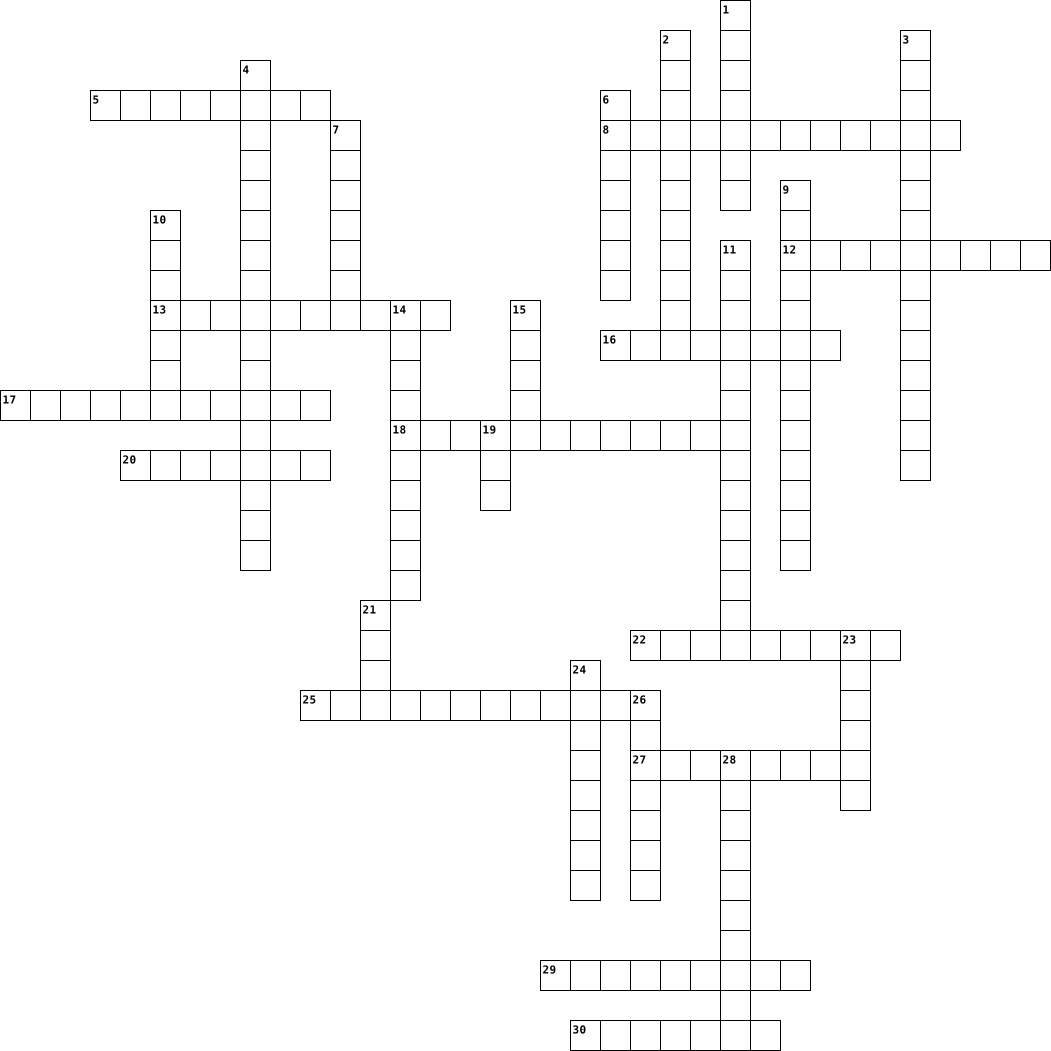
Across
- Genetic change
- Producing offspring
- Cell structure with a specific function
- DNA structure
- Study of heredity
- Internal stability in organisms
- Variety of life forms
- Cell division process
- Community and its environment
- Barrier around the cell
- Living entity
- Process of gradual change
- Chemical messenger in the body
Down
- Study of body structure
- Breathing and energy production
- Glands producing hormones
- Transport of nutrients in the body
- Essential biomolecule
- Cell's control center
- Using living organisms in technology
- Group of similar organisms
- Process converting light to energy
- Chemical processes in the body
- Kingdom of organisms like mushrooms
- Genetic material
- Basic unit of life
- Catalyst in biological reactions
- Classifying organisms
- Study of interactions in nature
- Trait for survival
30 Clues: DNA structure • Living entity • Genetic change • Genetic material • Study of heredity • Basic unit of life • Trait for survival • Producing offspring • Essential biomolecule • Cell's control center • Variety of life forms • Cell division process • Classifying organisms • Study of body structure • Barrier around the cell • Glands producing hormones • Process of gradual change • ...
Elijah Detrick’s Biology Exam 2 Crossword Puzzle 2021-09-24

Across
- 1 of 2 contractile proteins that make up a sarcomere, produces dense contractile filaments
- Tissue which consists of cells that are specialized for generating and transmitting nerve impulses
- Chemical released by neurons that may stimulate or inhibit other neurons
- Responsible for the growth of bones during childhood and adolescence
- A connective tissue that forms the skeleton
- White, flexible connective tissue, forms outer part of the human nose
- Connective tissue which connects bone to bone
- Form and function of this tissue vary extensively but include support and energy storage
- Amount of oxygen required after excerise to oxidize lactic acid in the body
- 1 of 2 contractile proteins that make up a sarcomere, produces thin contractile filaments
- Outermost layer of the skin
Down
- Smallest unit of a muscle that can contract
- Tissue which consists of cells that are specialized to shorten or contract
- Junction or area of contact between 2 or more bones
- Tissue which covers the bodies surface, forms glands and lines internal cavities
- Connective tissue which connects muscle to bone
- A constant and stable internal environment
- Neutral nerve cell
18 Clues: Neutral nerve cell • Outermost layer of the skin • A constant and stable internal environment • Smallest unit of a muscle that can contract • A connective tissue that forms the skeleton • Connective tissue which connects bone to bone • Connective tissue which connects muscle to bone • Junction or area of contact between 2 or more bones • ...
7 Science Revision Sustainability 2019-09-12

Across
- Flow of water down the surface
- Collected water droplets on a cold area when humid air is in contacted
- resources that are able to be replaced after a short amount of time
- Evaporated water from plants
- Removing salt from water
- Nature's way of recycling water
- Energy produced by the Sun
Down
- resources that are not able to be replaced easily
- A scientist who studies organisms
- An agriculture practice where water is supplied to crops through pipes
- heating a liquid, transforming it into a gas
- Different forms of water that fall from the sky
- Heat energy created and stored in the planet
- Not being able to contain any more water
- water stored in soil
- Water in it's most gaseous phase
- Air energy
17 Clues: Air energy • water stored in soil • Removing salt from water • Energy produced by the Sun • Evaporated water from plants • Flow of water down the surface • Nature's way of recycling water • Water in it's most gaseous phase • A scientist who studies organisms • Not being able to contain any more water • heating a liquid, transforming it into a gas • ...
bells energy crossword 2018-02-27

Across
- a substance that provides energy such as heat, light, motion or electricity
- another name for oil, from the Latin word Petra and oleum
- a factory in which crude oil is heated and separated into fuels and other products
- the warmth you feel on a sunny day or energy from the sun
- what is the most used source for energy
- a change from one form of energy to another
- combining two atomic nuclei to produce a single larger nucleus
- a resource that can be used again in a relatively short time
- the part of the nuclear reactor where nuclear fission occurs
- one of the three main fuels
- a main renewable resource
- energy made by the wind
- energy rich substances formed from the remains of organisms
- the reactor contains rod of u235
- active cells that generate an electric current
Down
- the central core of an atom that contains the protons and neutrons
- a layer of material that traps air to help block the transfer of heat between the air inside and outside a building
- the intense heat from earths interior that warms the magma
- the splitting of an atoms nucleus into two smaller nuclei
- chemical compounds that contain carbon and hydrogen atom
- adding the alcohol to gasoline forms a mixture called this
- electricity produced by flowing water
- reducing energy use
- compounds that are made from oil
- wood belongs to a group called this this is made from living things
- are used to slow down the chain reactions
- a resource that is limited or takes too long to be used again
- when fuel rods generate too much heat
- when fuels contain stored chemical energy, and its released by this
- percentage of energy used for work
30 Clues: reducing energy use • energy made by the wind • a main renewable resource • one of the three main fuels • compounds that are made from oil • the reactor contains rod of u235 • percentage of energy used for work • electricity produced by flowing water • when fuel rods generate too much heat • what is the most used source for energy • are used to slow down the chain reactions • ...
Chemistry of Life 2024-01-26

Across
- Carbon Hydrogen Oxygen 1:2:1 ratio
- Nucleic acid containing the sugar deoxyribose
- Monomer of a protein
- Formed by the addition of N and P to a CHO
- Elements or compounds that enter a reaction
- a polymer made of amino acids
- compound in living things-contains Carbon
- Monomer of carbohydrates
- Compounds or elements formed by a reaction
- Catalase is an example
Down
- Occurs when temperature or pH changes shape of a protein
- Forms polymer by removing water
- The reactant an enzyme catalyses: Hydrogen Peroxide is an example
- Speeds up reaction by lowering activation energy
- CHONP
- Building block of a macromolecule
- CHO no ratio
- a chain of paperclips is a good analology
- Nucleic acid containing the sugar Ribose
- Amount of energy required to start reaction
20 Clues: CHONP • CHO no ratio • Monomer of a protein • Catalase is an example • Monomer of carbohydrates • a polymer made of amino acids • Forms polymer by removing water • Building block of a macromolecule • Carbon Hydrogen Oxygen 1:2:1 ratio • Nucleic acid containing the sugar Ribose • a chain of paperclips is a good analology • compound in living things-contains Carbon • ...
Healthy Choices/Mental Health Review 2023-03-10

Across
- Positive thinkers
- The type of health involving the mind
- People that are more outgoing and gain energy from others
- People who yield to others
- Forceful leaders
- The factor that accounts for over half of all too-early deaths
- Bad stress
- A combination of traits that make you an individual
- Thing that causes stress
- Negative thinkers
Down
- The thing that forms most of the personality
- The type of health involving the body
- Non-forceful leaders
- Disorder caused experience or genetics
- The type of health involving relationships
- Leading cause of too-early death in teens
- Disorder caused by physical trauma
- Good stress
- People who tend to be quiet and gain energy from themselves
- Leading cause of too-early death among adults
20 Clues: Bad stress • Good stress • Forceful leaders • Positive thinkers • Negative thinkers • Non-forceful leaders • Thing that causes stress • People who yield to others • Disorder caused by physical trauma • The type of health involving the body • The type of health involving the mind • Disorder caused experience or genetics • Leading cause of too-early death in teens • ...
Energy Transfer 2021-05-11

Across
- produces electricity from motion or kinetic energy
- rotates in a motor or generator
- a material that cannot be replaced once used up
- converted into electrical energy by a solar cell
- a designer or problem solver who tests ways to accomplish a goal
- acts as a switch to reverse the flow of electricity or to turn electromagnets on and off in a motor
- the movement of energy from one location to another
Down
- generation of electricity using flowing water
- help wires make contact in motors and generators
- gases that contribute to climate change
- the ability to apply force over a distance
- giant ball of glowing gas powered by nuclear fusion
- type of fuel such as oil, coal, or natural gas
- in a lightbulb makes light when heated by an electric current
- produces motion from electricity
- type of magnet attached to the casing of a motor or generator
- forms when electricity flows through coils of insulated wire wrapped around a piece of iron
- radiation that causes sunburn
- Strayer Science
19 Clues: Strayer Science • radiation that causes sunburn • rotates in a motor or generator • produces motion from electricity • gases that contribute to climate change • the ability to apply force over a distance • generation of electricity using flowing water • type of fuel such as oil, coal, or natural gas • a material that cannot be replaced once used up • ...
Renaissance 2016-01-21

Across
- Hezekiah abbr.
- Stulbaum's slant
- Sanders and Lepak
- Eureka
- Cherokee, Creek, Seminoles' path
- Rod Stewart's digs her
- Scrabble's pizzas
- life process or flow of energy that sustains living being
- Warnings
- able
Down
- Digger's result
- Mango's resident
- Hittle's nucleus
- Toussaint's war hero
- Bohr's forms
- Total has it
16 Clues: able • Eureka • Warnings • Bohr's forms • Total has it • Hezekiah abbr. • Digger's result • Stulbaum's slant • Mango's resident • Hittle's nucleus • Sanders and Lepak • Scrabble's pizzas • Toussaint's war hero • Rod Stewart's digs her • Cherokee, Creek, Seminoles' path • life process or flow of energy that sustains living being
Renaissance 2016-01-21

Across
- Eureka
- Hezekiah abbr.
- Cherokee, Creek, Seminoles' path
- life process or flow of energy that sustains living being
- Stulbaum's slant
- Digger's result
- Mango's resident
- able
Down
- Rod Stewart digs her
- Scrabble's pizzas
- Total has it
- Toussaint's war hero
- Bohr's forms
- Warnings
- Hittle's nucleus
- Sanders and Lepak
16 Clues: able • Eureka • Warnings • Total has it • Bohr's forms • Hezekiah abbr. • Digger's result • Stulbaum's slant • Mango's resident • Hittle's nucleus • Scrabble's pizzas • Sanders and Lepak • Rod Stewart digs her • Toussaint's war hero • Cherokee, Creek, Seminoles' path • life process or flow of energy that sustains living being
ENERGY 2020-10-08

Across
- the flow of electrical power or charge. It’s one of the most widely used forms of energy.
- an energy source that can't be replenished or takes millions of years to form.
- the production of electricty by the force of fast moving water.
- a lamp in which electricity is the source of light.
- an unfavorable condition or position, it can cause damage or loss.
- energy that comes from natural sources or processes that are replenished but flow-limited.
Down
- a kind of energy produced by converting primary sources of energy.
- a type of renewable energy that is stored in rocks and fluids in the centre of the Earth.
- one of the natural sources of energy that comes from the air flows and it is used to generate electricity.
- an electrical appliance that is used to mix food or make fruit juice.
- energy that uses the power of the sun to produce electricity.
- a device that produces electricity to provide power for radios, cars,etc.
- an organic material that comes from plants and animals.
- an advantage or profit gained from something, so it isn't harmful.
- a hard rock which can be burned.
15 Clues: a hard rock which can be burned. • a lamp in which electricity is the source of light. • an organic material that comes from plants and animals. • energy that uses the power of the sun to produce electricity. • the production of electricty by the force of fast moving water. • a kind of energy produced by converting primary sources of energy. • ...
ENERGY 2020-10-08

Across
- a hard rock which can be burned.
- an electrical appliance that is used to mix food or make fruit juice.
- an advantage or profit gained from something, so it isn't harmful.
- energy that uses the power of the sun to produce electricity.
- a type of renewable energy that is stored in rocks and fluids in the centre of the Earth.
- an unfavorable condition or position, it can cause damage or loss.
- an organic material that comes from plants and animals.
- a kind of energy produced by converting primary sources of energy.
Down
- a lamp in which electricity is the source of light.
- an energy source that can't be replenished or takes millions of years to form.
- the flow of electrical power or charge. It’s one of the most widely used forms of energy.
- the production of electricty by the force of fast moving water.
- energy that comes from natural sources or processes that are replenished but flow-limited.
- a device that produces electricity to provide power for radios, cars,etc.
- one of the natural sources of energy that comes from the air flows and it is used to generate electricity.
15 Clues: a hard rock which can be burned. • a lamp in which electricity is the source of light. • an organic material that comes from plants and animals. • energy that uses the power of the sun to produce electricity. • the production of electricty by the force of fast moving water. • an advantage or profit gained from something, so it isn't harmful. • ...
Electricity Vocabulary 2022-02-28

Across
- Power wood waste that burns into energy
- set of compponents that allows electricity to flow
- Power energy from the wind
- power burning coal to produce power
- allows electrons to move freely
- power Fossil fuel, decomposing over years, found underground
- the movement of electrons
- Power heat within the earth
- Power uses energy from the sun
- Power fission that produces it
- gas power gets extracted from the earth
Down
- does not allow electrons to flow
- circuit each bulb is on its own power line
- slows down the flow of electricity
- complete circuit and electricity can flow
- how fast electrical energy is converted to other energy forms
- Power produced by moving water
- an amount of electricity flowing through a circiut
- Breaker opens the circiut when current is too strong
- how fast the current is pushed
- all the parts in one line
- current is too strong, metal inside breaks
- space in the circit so electricity can NOT flow
- law used to find current, resistance, voltage, and power in a circiut
- Diagram diagram that shows how to construct a circuit
25 Clues: all the parts in one line • the movement of electrons • Power energy from the wind • Power heat within the earth • Power produced by moving water • how fast the current is pushed • Power uses energy from the sun • Power fission that produces it • allows electrons to move freely • does not allow electrons to flow • slows down the flow of electricity • ...
Periodic Table Crossword 2025-10-02

Across
- Has the same number of protons but different numbers of neutrons
- good conductors of heat and electricity
- When an atom gives up one or more electrons it becomes positive
- Earth Metals Found in foods and never found freely in nature
- When an atom gains one or more electrons it bFamibecomestive
- Vertical Columns
- Forms when atoms gain or lose electrons to become stable
- Electrons The electrons found in the outermost energy level
- Energy the amount of energy needed to remove the valence electron of an atom
- + Charge
Down
- Poor conductors of heat and electricity
- the measure of an atom's ability to attract electrons
- radius The measure of the size of an atom
- Gases Stable elements that exist on their own
- conduct heat and electricity better than non-metals but not as well as Metals.
- Horizontal Rows
- the most active Non-Metals
- Metals Most reactive group
- No electric Charge
- - Charge
20 Clues: - Charge • + Charge • Horizontal Rows • Vertical Columns • No electric Charge • the most active Non-Metals • Metals Most reactive group • Poor conductors of heat and electricity • good conductors of heat and electricity • radius The measure of the size of an atom • Gases Stable elements that exist on their own • the measure of an atom's ability to attract electrons • ...
KEY TERMS CROSSWORD 2013-05-26

Across
- "Self-nourishing" organisms, make their own food
- Carbon-fixing enzyme of lights independent photosynthesis reactions
- Reaction in which light energy breaks down a molecule
- Metabolic pathway by which photoautotrophs capture light energy and use it to make sugars
- Choroplasts inner membrane system that forms a continous compartment in the stroma
- Main energy carrier between reaction sites in cells
- Semifluid matrix between the thylakoid membrane and the two outer membranes of chloroplasts
- Distance between the crests of two successive waves of light
Down
- Orange and red pigments
- Most common photosynthetic pigment in plants
- Organelle of photosynthesis
- Electromagnetic energy of light is organized in this packets
- Groups of pigments and other molecules that work as a unit to begin photosynthesis
- Organic molecule that absorbs light of specific wavelengths
- Coenzyme that accepts electrons and hydrogen bonds
15 Clues: Orange and red pigments • Organelle of photosynthesis • Most common photosynthetic pigment in plants • "Self-nourishing" organisms, make their own food • Coenzyme that accepts electrons and hydrogen bonds • Main energy carrier between reaction sites in cells • Reaction in which light energy breaks down a molecule • ...
KEY TERMS CROSSWORD 2013-05-26

Across
- "Self-nourishing" organisms, make their own food
- Choroplasts inner membrane system that forms a continous compartment in the stroma
- Most common photosynthetic pigment in plants
- Carbon-fixing enzyme of lights independent photosynthesis reactions
- Main energy carrier between reaction sites in cells
- Metabolic pathway by which photoautotrophs capture light energy and use it to make sugars
- Distance between the crests of two successive waves of light
- Organic molecule that absorbs light of specific wavelengths
- Semifluid matrix between the thylakoid membrane and the two outer membranes of chloroplasts
Down
- Reaction in which light energy breaks down a molecule
- Coenzyme that accepts electrons and hydrogen bonds
- Groups of pigments and other molecules that work as a unit to begin photosynthesis
- Organelle of photosynthesis
- Orange and red pigments
- Electromagnetic energy of light is organized in this packets
15 Clues: Orange and red pigments • Organelle of photosynthesis • Most common photosynthetic pigment in plants • "Self-nourishing" organisms, make their own food • Coenzyme that accepts electrons and hydrogen bonds • Main energy carrier between reaction sites in cells • Reaction in which light energy breaks down a molecule • ...
energy puzzle 2023-01-09

Across
- The ability to do work or cause changes
- transformation a change from one form to another also called an energy conversion
- the forces that two surfaces exert or each other when they rub against each other 2 the transfer of electrons from an uncharged object to another uncharged onject by rubbing
- energy kinetic or potential energy associated with the motion or position of an object
- energy the energy of light and other forms of radiation which travels through space as waves
- energy the energy an object has because of its positions also the internal stored energy of an object such as energy stored in chemical bonds
- energy the total kinetic and potential energy of all the particles of an object
Down
- energy the energy of electric charges
- energy energy that an object has due to its motion
- conservation of energy the rule that energy cannot be created or destroyed
- energy a form of potential energy that is stored in chemical bonds between atoms
- energy the potential energy stored in the nucleus of an atom
12 Clues: energy the energy of electric charges • The ability to do work or cause changes • energy energy that an object has due to its motion • energy the potential energy stored in the nucleus of an atom • conservation of energy the rule that energy cannot be created or destroyed • energy the total kinetic and potential energy of all the particles of an object • ...
Reactions 2024-05-06

Across
- An arrow in a chemical reaction
- Item on the left side of a reaction
- the ability to dissolve another substance
- bond that shares electrons
- absorbs energy
- most common polar molecule
- number in front of a product or reactant
Down
- has a relatively high pH
- Item on the right side of a reaction
- a solid that forms in a chemical reaction
- has a relatively low pH
- bond that transfers electrons
- releases energy
13 Clues: absorbs energy • releases energy • has a relatively low pH • has a relatively high pH • bond that shares electrons • most common polar molecule • bond that transfers electrons • An arrow in a chemical reaction • Item on the left side of a reaction • Item on the right side of a reaction • number in front of a product or reactant • a solid that forms in a chemical reaction • ...
Renewable and Nonrenewable Energy 2021-12-13

Across
- Burns more clear than other fossil fuels.
- Energy that can't be produced.
- Rock oil.
- Renewable energy that comes from the wind. This form can't run out.
- Energy that can be produced.
- Acid rain forms when the gases used to make energy combine with the air. This harms plants and animals.
Down
- Renewable energy from the sun.
- Nonrenewable energy that uses minerals in Earth's crust. It spits nuclei.
- Sedimentary rock formed from the remains of dead plants. This can be used for energy.
- Energy from the water.
- Extracted from heat and stored within the earth.
- biomass includes living or recently dead organic material that can be used as fuel.
12 Clues: Rock oil. • Energy from the water. • Energy that can be produced. • Renewable energy from the sun. • Energy that can't be produced. • Burns more clear than other fossil fuels. • Extracted from heat and stored within the earth. • Renewable energy that comes from the wind. This form can't run out. • Nonrenewable energy that uses minerals in Earth's crust. It spits nuclei. • ...
S1 Stuck at Sea revision 2026-01-04

Across
- Three weeks without this
- how much matter is in an object
- Energy that can travel by conduction, convection and radiation
- Greek word shouted by Archimedes meaning "I have found it"
- They can flow
- Shape associated with fire
- Always points away from a source of light
- Time for the Earth to spin once on its axis
- There are three states of this
- How long it takes the Earth to go once round the Sun
- When our part of the Earth is pointing away from the Sun
- Three minutes without this
- Units of energy
Down
- Used to navigate at night
- Its needle point to magnetic North
- Needed with oxygen and heat to start a fire
- The survival rule number
- Calculated by mass divided by Volume
- Chemical, gravitational and elastic are forms of energy that can be ...
- Needed to get things done
- Fixed volume and fixed shape
- Direction the Sun appears to rises in
- How much space an object takes up
- Evaporate, condense, precipitate - repeat (5,5)
- The opposite direction to North
- Three days without this
26 Clues: They can flow • Units of energy • Three days without this • The survival rule number • Three weeks without this • Used to navigate at night • Needed to get things done • Shape associated with fire • Three minutes without this • Fixed volume and fixed shape • There are three states of this • how much matter is in an object • The opposite direction to North • ...
30 forms of transport 2022-10-27

Across
- a four-wheeled road vehicle that is powered by an engine and is able to carry a small number of people.
- a type of aircraft which derives both lift and propulsion from one or more sets of horizontally revolving overhead rotors. It is capable of moving vertically and horizontally, the direction of motion being controlled by the pitch of the rotor blades.
- a ship, boat, or locomotive powered by steam.
- a vehicle that hangs from and is pulled by a moving cable and that carries passengers up and down a mountain
- a powered flying vehicle with fixed wings and a weight greater than that of the air it displaces; an aeroplane.
- a large ship that takes many people on a cruise at one time
- a comfortably equipped single-decker bus used for longer journeys
- private four-wheeled vehicle for people and is most commonly horse-drawn
- a small jet-propelled vehicle that skims across the surface of water and typically is ridden like a motorcycle.
- a long, low boat used on canals
- a boat usually propelled by sail.
- used for transportation in sandy desert areas throughout Asia and northern Africa
- a short narrow board with two small wheels fixed to the bottom of either end, on which a person can ride in a standing or crouching position, propelling themselves by occasionally pushing one foot against the ground.
- teach (a person or animal) a particular skill or type of behaviour through practice and instruction over a period of time.
- a medium-sized sailing boat equipped for cruising or racing.
- a cycle with a single wheel, typically used by acrobats.
Down
- a cloth canopy which fills with air and allows a person or heavy object attached to it to descend slowly when dropped from an aircraft, or which is released from the rear of an aircraft on landing to act as a brake.
- a large bag filled with hot air or gas to make it rise in the air, typically one carrying a basket for passengers.
- a wide canopy resembling a parachute that is attached to a person's body by a harness in order to allow them to glide through the air after jumping from or being hauled to a height.
- a passenger vehicle powered by electricity conveyed by overhead cables, and running on rails laid in a public road.
- a warship with a streamlined hull designed to operate completely submerged in the sea for long periods, equipped with a periscope and typically armed with torpedoes or missiles.
- a vehicle with two wheels tandem, handlebars for steering, a saddle seat, and pedals by which it is propelled
- a boat or ship for conveying passengers and goods, especially over a relatively short distance and as a regular service.
- a four-wheeled road vehicle that is powered by an engine and is able to carry a small number of people.
- a light two-wheeled open motor vehicle on which the driver sits over an enclosed engine with their legs together and their feet resting on a floorboard.
- a large, heavy road vehicle used for carrying goods, materials, or troops
- a short narrow board with two small wheels fixed to the bottom of either end, on which a person can ride in a standing or crouching position, propelling themselves by occasionally pushing one foot against the ground.
- an underground railway.
- a medium-sized motor vehicle, typically without side windows in the rear part, for transporting goods.
- a suspended, inclined cable equipped with a pulley and down which a harnessed rider glides for recreation: The most popular rides at the fair are the two ziplines.
- a light, narrow boat with pointed ends and no keel, propelled with a paddle or paddles.
31 Clues: an underground railway. • a long, low boat used on canals • a boat usually propelled by sail. • a ship, boat, or locomotive powered by steam. • a cycle with a single wheel, typically used by acrobats. • a large ship that takes many people on a cruise at one time • a medium-sized sailing boat equipped for cruising or racing. • ...
Forms of Mass Communication 2019-08-28
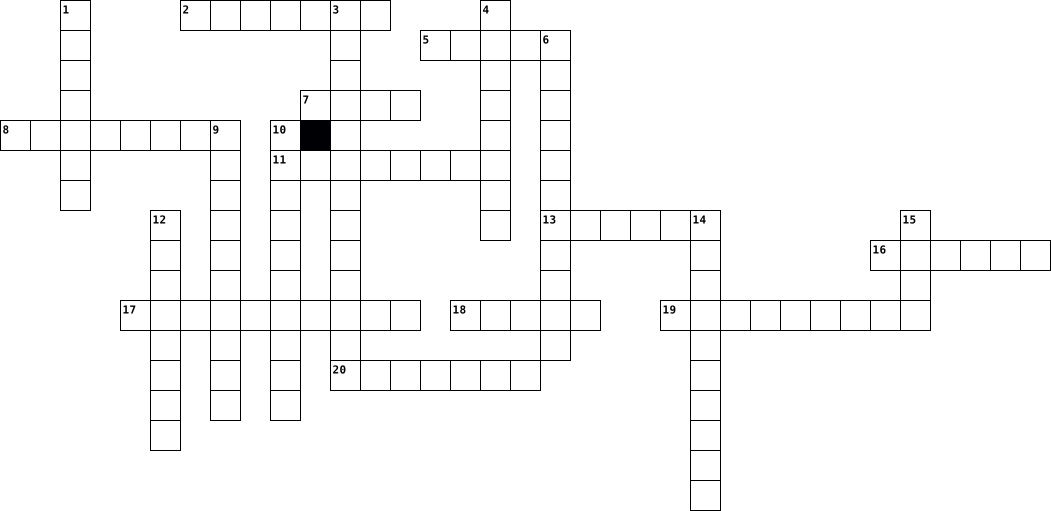
Across
- The object you use to take pictures or film movies.
- Novels or comics, for example. Harry Potter stories started out as these.
- Channels like CNN or Fox News report on this.
- A social media platform that you share pictures for 10 seconds and then they disappear. Usually, the company's logo is a ghost.
- the superhighway that keeps everyone connected.
- Also known as Film, these tell stories using motion pictures.
- a form of social media where people can post short videos.
- New York Times or Washington Post, for example. You can buy these pretty much anywhere.
- The form of Mass Communication you would have in your car.
- A social media platform that you can post pictures with different filters on your grid.
- A form of social Media that shares information using 280 characters. Elon Musk currently owns it.
Down
- A prerecorded talk show whose audio you can stream anytime.
- What companies use to communicate with us what they want us to buy.
- What a person in the Mass Communication industry would use to edit movies.
- The category of Mass Communication that Twitter, Instagram, and Facebook fall under.
- The place in your house you can watch Movies, DVDs or play a game console.
- What you can play on playstation, xbox, and switch.
- Created by Mark Zuckerberg, it was a form of social media that was originally for college students only. Now it is a place where people share news.
- A place where you can listen to music that an artist uploads.
- Also known as movies.
20 Clues: Also known as movies. • Channels like CNN or Fox News report on this. • the superhighway that keeps everyone connected. • The object you use to take pictures or film movies. • What you can play on playstation, xbox, and switch. • a form of social media where people can post short videos. • The form of Mass Communication you would have in your car. • ...
Forms of Government Review 2026-01-21

Across
- Dynasty founded by Muawiyah that ruled after the first civil war
- A written set of laws meant to bring order
- Roman system of government with elected leaders
- System of government in which citizens have a role in decision making
- The power to enforce laws and make decisions
- Belief that a monarch’s authority comes from God
- Chinese belief that rulers govern with heaven’s approval
- Condition of order and security in a government
- The right or authority of a government to rule
- Enslaved population that supported Sparta’s economy
- Action citizens must take for democracy to succeed
- Islamic civil war over leadership legitimacy
Down
- Fair treatment under the law
- Mesopotamian king who created a written law code
- Temple complex symbolizing Khmer royal power
- French king who ruled as an absolute monarch
- Greek city-state focused on order and military discipline
- Government support for citizens’ basic needs
- Greek city-state known for citizen participation
- Political and religious leader in early Islamic government
- A series of rulers from the same family
- Two Roman leaders who shared executive power
- Democracy where citizens elect a parliament
- Modern democracy that guarantees social welfare
- System where one ruler holds all political power
- Belief that a ruler is both a king and a god
- The rights and responsibilities of members of a state
27 Clues: Fair treatment under the law • A series of rulers from the same family • A written set of laws meant to bring order • Democracy where citizens elect a parliament • Temple complex symbolizing Khmer royal power • French king who ruled as an absolute monarch • Government support for citizens’ basic needs • Two Roman leaders who shared executive power • ...
Forms of Ownership & Entrepreneurship 2026-03-23

Across
- The chance of losing money in a business venture
- The person who buys the rights to operate a franchise
- When expenses are greater than income
- The owner of the franchise brand
- A business owned and managed by one person
- An organisation that does not aim to make profit
- A person who starts and runs a business taking on risk
- A company that sells shares to the public on the stock exchange
- A portion of profit paid to shareholders
- Owners are only liable for the amount they invested
- An employee who acts like an entrepreneur within a business
- Money invested to start or run a business
Down
- A person who owns shares in a company
- A business that has its own legal identity
- A business owned by two or more people who share profits and losses
- A legal entity separate from its owners
- A company owned by a small group of shareholders
- A business model where a brand is licensed to an owner
- Introducing new ideas or methods in a business
- A business owned and run by members for mutual benefit
- The financial gain made by a business
- Owners are responsible for all business debts
- A person responsible for managing a company
- The ability of a business to continue even if ownership changes
24 Clues: The owner of the franchise brand • A person who owns shares in a company • When expenses are greater than income • The financial gain made by a business • A legal entity separate from its owners • A portion of profit paid to shareholders • Money invested to start or run a business • A business that has its own legal identity • A business owned and managed by one person • ...
Energy and the Enviroment key terms 2016-04-04

Across
- Energy A resource that can be replaced when needed.
- The first and simplest element on the periodic table. It is one of the most common elements in the galaxy.
- Change Any significant change in the amount of precipitation,temperature or wind over periods of time longer than a decade.
- Gas Gas usually found within the vicinity of petroleum reserves.
- The ratio of the useful energy delivered by a dynamic system to the energy supplied to it.
- Energy The energy that a piece of matter has because of its position or nature or because of the arrangement of parts.
- Grid A system by which electrical power is delivered throughout a region.
- The ability to do work; types include heat, light, sound, chemical, nuclear, mechanical, electrical.
- Cell A device that converts light into electricity.
- Energy Energy released during a reaction.
- A unit measure of work.
- Amount of heat that will change a liquid from freezing to boiling.
- A measure of power equal to one joule of work per second.
- Energy stored in the earth in the form of heat.
- Energy An energy source that will never run out.
- Energy A resource that cannot be replaced once used.
- Farm A collection of wind turbines used to create electricity.
- Fuel A natural fuel such as coal or gas formed in the geological past from the remains of living organisms.
- Energy Energy associated with the flow of electrons.
Down
- Effect The phenomenon whereby the earth's atmosphere traps solar radiation, caused by the presence in the atmosphere of gases such as carbon dioxide, water vapor, and methane that allow incoming sunlight to pass through but absorb heat radiated back from the earth's surface.
- Energy The energy possessed by a body as a result of its motion.
- External surroundings.
- Oil.
- Energy The use of flowing water from waterfalls and dams to produce electricity.
- Refers to the use of resources in ways that prevent their being depleted or permanently damaged.
- Controlling Resources for example conserving water in a reservoir.
- Energy Energy produced by mechanical devices, such as gears, pulleys, levers, or internal combustion engines.
- of Conservation of Energy Energy can be neither created nor destroyed. There is a fixed amount of energy present in different forms that can be converted from one form to another, but energy does not go away.
- A result of a force moving an object a certain distance.
- Energy Energy from the sun.
- Energy Any source of energy that is limited and cannot be replaced when it is used, such as oil, coal, and natural gas.
- Plant materials and animal waste used as a source of fuel.
- (Thermal) Energy Energy in transit.
- The unit of energy or work in the MKS system of units, equal to the work done by a force of one Newton-meter.
- (Radiant) Energy Energy visible to the eye.
- Energy The power of the atom.
36 Clues: Oil. • External surroundings. • A unit measure of work. • Energy Energy from the sun. • Energy The power of the atom. • (Thermal) Energy Energy in transit. • Energy Energy released during a reaction. • (Radiant) Energy Energy visible to the eye. • Energy stored in the earth in the form of heat. • Energy An energy source that will never run out. • ...
Anatomy Chapter 2 2017-09-28

Across
- a positively or negatively charged atom
- stored energy
- the splitting of complex molecules by hte addition of a water molecule
- forms the shiny covering on plant leaves
- solid at room temperature, found on meat
- the hereditary material found in cells
- formed when two or more atoms unite by sharing or transferring electrons
- complex substances are broken dowqn
- outer covering of cells
- type of organic compound need for energy
- fruit sugar
- body responds to reverse the direction of change
- single strand that is important in forming protein
- atoms that occur in several in several different forms due to varying numbers of neutrons
- a subatomic particle that has no electric charge
- the base unit of all carbohydrates
- carb that is found in plant foods
- energy of motion
- the negatively charged particle of an atom
- on the pH scale ranges from 0-6
Down
- a lipid that is found in hormones
- the effort by the body to maintain a constant internal enviroment
- type of bond that is the sharing of electrons
- important for making energy, hormones, insulation, and covering of cells
- are composed of chains of smaller molecules or amino acids
- twisted double strand that serves as the blueprint for protein synthesis
- sucrose or table sugar
- reverse the change
- type of bond that is the giving and taking of electrons
- milk sugar
- carries oxygen to the cells
- carbs that are stored in the body
- the basic unit of structure of all matter
- a symbol for the value of hydrogen ion concentration of a solution
- the number of positively charged particles in the nucleus of the atom
- two or more substances combine to produce a new substance
- liquid at room temperature
- has a radioactive isotope
- elements chemically inactive due to complete outer shell
- on the pH scale ranges from 8-14
- the desired value of a variable
41 Clues: milk sugar • fruit sugar • stored energy • energy of motion • reverse the change • sucrose or table sugar • outer covering of cells • has a radioactive isotope • liquid at room temperature • carries oxygen to the cells • the desired value of a variable • on the pH scale ranges from 0-6 • on the pH scale ranges from 8-14 • a lipid that is found in hormones • ...
Anatomy & Physiology Chapter 10 Puzzle 2022-04-13

Across
- Muscle growth from heavy training
- Prolonged activity; requires oxygen and nutrients
- An alternate name for a mesodermal cell
- Primary energy source for peak muscle activity
- Red pigment that binds oxygen
- Lengthwise subdivisions within muscle fibers
- Hundreds of these are contained in skeletal muscle cells.
- Thin, light filaments
- Quick fatigue; strenuous activity
- Bundles of muscle fibers
Down
- The weakening of muscle due to lack of muscle activity
- The color of fast fibers
- The color of slow fibers
- A fixed contraction after death
- The chemical that forms the epimysium
- Dark, thick filaments
- Motor units contain hundreds of these.
- The initial tension and firmness of a muscle at rest
- An alternate name for a muscle cell
- Provides energy for muscle contraction
20 Clues: Dark, thick filaments • Thin, light filaments • The color of fast fibers • The color of slow fibers • Bundles of muscle fibers • Red pigment that binds oxygen • A fixed contraction after death • Muscle growth from heavy training • Quick fatigue; strenuous activity • An alternate name for a muscle cell • The chemical that forms the epimysium • Motor units contain hundreds of these. • ...
Electricity 2018-10-21

Across
- current in a circuit equals the voltage divided by the resistance
- charge cannot be created or destroyed but transferred from object to object
- device that can detect electric charge
- net movement of electric charge in a single direction
- closed path that electric current follows
- accumulation of excess electric charge on an object
- electric circuit with only one branch
Down
- rate at which electrical energy is converted to other forms
- process by transferring charge by touching or rubbing
- measured in ohms, the tendency for a material to resist the flow of electrons and to convert the electrical energy into other forms
- material in which electrons are not able to move easily
- electric circuit with two or more branches
- force that causes electric charges to flow
- rearrangement of electrons on a neutral object caused by a nearby charged object
- material through which electrons move easily
- surrounds every electric charge and exerts a force that causes other charges to be attracted or repelled
16 Clues: electric circuit with only one branch • device that can detect electric charge • closed path that electric current follows • electric circuit with two or more branches • force that causes electric charges to flow • material through which electrons move easily • accumulation of excess electric charge on an object • process by transferring charge by touching or rubbing • ...
Chapter 8,10,11 2014-03-07

Across
- Where the earthquake starts
- Vibration of Earth produced by the rapid release of energy.
- Largest intrusive igneous
- opening to the surface.
- A large structure composed of layers of lava and pyroclastic deposits
- Large fractures in Earth's crust and mantle.
- Association with anticlines are down folds
- Cooling and hardening of magma
- forms When magma is injected along sedimentary bedding surfaces.
- Substance's resistance to flow.
Down
- General term that refers to all changes in the original shape of rock.
- Forms When magma from a large magma chamber invades fractures in the surrounding rocks
- Movements that follow a major earthquake often produce smaller earthquakes
- Embedded into the continent in a process
- When magma is intruded between sedimentary layers close to the surface.
- Repeated eruption of lava,building a mountain
- Collection of processes that produce a mountain belt
- Floating crust in gravitational balance.
- steep-walled depression
- Seismic sea waves.
20 Clues: Seismic sea waves. • opening to the surface. • steep-walled depression • Largest intrusive igneous • Where the earthquake starts • Cooling and hardening of magma • Substance's resistance to flow. • Embedded into the continent in a process • Floating crust in gravitational balance. • Association with anticlines are down folds • Large fractures in Earth's crust and mantle. • ...
ENERGY 2020-10-08

Across
- a lamp in which electricity is the source of light.
- a kind of energy produced by converting primary sources of energy.
- an advantage or profit gained from something, so it isn't harmful.
- the production of electricty by the force of fast moving water.
- the flow of electrical power or charge. It’s one of the most widely used forms of energy.
- a type of renewable energy that is stored in rocks and fluids in the centre of the Earth.
- an organic material that comes from plants and animals.
- an unfavorable condition or position, it can cause damage or loss.
Down
- a device that produces electricity to provide power for radios, cars,etc.
- energy that comes from natural sources or processes that are replenished but flow-limited.
- an energy source that can't be replenished or takes millions of years to form.
- a hard rock which can be burned.
- one of the natural sources of energy that comes from the air flows and it is used to generate electricity.
- an electrical appliance that is used to mix food or make fruit juice.
- energy that uses the power of the sun to produce electricity.
15 Clues: a hard rock which can be burned. • a lamp in which electricity is the source of light. • an organic material that comes from plants and animals. • energy that uses the power of the sun to produce electricity. • the production of electricty by the force of fast moving water. • a kind of energy produced by converting primary sources of energy. • ...
ENERGY 2020-10-08

Across
- an organic material that comes from plants and animals.
- an unfavorable condition or position, it can cause damage or loss.
- the production of electricty by the force of fast moving water.
- a lamp in which electricity is the source of light.
- energy that comes from natural sources or processes that are replenished but flow-limited.
- the flow of electrical power or charge. It’s one of the most widely used forms of energy.
Down
- energy that uses the power of the sun to produce electricity.
- a hard rock which can be burned.
- a kind of energy produced by converting primary sources of energy.
- a device that produces electricity to provide power for radios, cars,etc.
- a type of renewable energy that is stored in rocks and fluids in the centre of the Earth.
- an energy source that can't be replenished or takes millions of years to form.
- an electrical appliance that is used to mix food or make fruit juice.
- an advantage or profit gained from something, so it isn't harmful.
- one of the natural sources of energy that comes from the air flows and it is used to generate electricity.
15 Clues: a hard rock which can be burned. • a lamp in which electricity is the source of light. • an organic material that comes from plants and animals. • energy that uses the power of the sun to produce electricity. • the production of electricty by the force of fast moving water. • a kind of energy produced by converting primary sources of energy. • ...
KEY TERMS CROSSWORD 2013-05-26

Across
- Coenzyme that accepts electrons and hydrogen bonds
- Organic molecule that absorbs light of specific wavelengths
- Organelle of photosynthesis
- Groups of pigments and other molecules that work as a unit to begin photosynthesis
Down
- Distance between the crests of two successive waves of light
- Electromagnetic energy of light is organized in this packets
- Semifluid matrix between the thylakoid membrane and the two outer membranes of chloroplasts
- Choroplasts inner membrane system that forms a continous compartment in the stroma
- "Self-nourishing" organisms, make their own food
- Most common photosynthetic pigment in plants
- Metabolic pathway by which photoautotrophs capture light energy and use it to make sugars
- Orange and red pigments
- Carbon-fixing enzyme of lights independent photosynthesis reactions
- Reaction in which light energy breaks down a molecule
- Main energy carrier between reaction sites in cells
15 Clues: Orange and red pigments • Organelle of photosynthesis • Most common photosynthetic pigment in plants • "Self-nourishing" organisms, make their own food • Coenzyme that accepts electrons and hydrogen bonds • Main energy carrier between reaction sites in cells • Reaction in which light energy breaks down a molecule • ...
Energy and the Enviroment key terms 2016-04-04

Across
- The ability to do work; types include heat, light, sound, chemical, nuclear, mechanical, electrical.
- Farm A collection of wind turbines used to create electricity.
- The first and simplest element on the periodic table. It is one of the most common elements in the galaxy.
- Cell A device that converts light into electricity.
- (Thermal) Energy Energy in transit.
- Energy A resource that cannot be replaced once used.
- Amount of heat that will change a liquid from freezing to boiling.
- Energy Energy produced by mechanical devices, such as gears, pulleys, levers, or internal combustion engines.
- A unit measure of work.
- Plant materials and animal waste used as a source of fuel.
- Energy An energy source that will never run out.
- A measure of power equal to one joule of work per second.
- Energy The power of the atom.
- Energy The energy that a piece of matter has because of its position or nature or because of the arrangement of parts.
- Refers to the use of resources in ways that prevent their being depleted or permanently damaged.
- The unit of energy or work in the MKS system of units, equal to the work done by a force of one Newton-meter.
- The ratio of the useful energy delivered by a dynamic system to the energy supplied to it.
- Energy Energy from the sun.
- Energy stored in the earth in the form of heat.
- Fuel A natural fuel such as coal or gas formed in the geological past from the remains of living organisms.
- A result of a force moving an object a certain distance.
Down
- Change Any significant change in the amount of precipitation,temperature or wind over periods of time longer than a decade.
- Energy Energy released during a reaction.
- of Conservation of Energy Energy can be neither created nor destroyed. There is a fixed amount of energy present in different forms that can be converted from one form to another, but energy does not go away.
- Energy The use of flowing water from waterfalls and dams to produce electricity.
- Oil.
- Effect The phenomenon whereby the earth's atmosphere traps solar radiation, caused by the presence in the atmosphere of gases such as carbon dioxide, water vapor, and methane that allow incoming sunlight to pass through but absorb heat radiated back from the earth's surface.
- Energy A resource that can be replaced when needed.
- Energy Any source of energy that is limited and cannot be replaced when it is used, such as oil, coal, and natural gas.
- Controlling Resources for example conserving water in a reservoir.
- (Radiant) Energy Energy visible to the eye.
- Gas Gas usually found within the vicinity of petroleum reserves.
- External surroundings.
- Energy Energy associated with the flow of electrons.
- Energy The energy possessed by a body as a result of its motion.
- Grid A system by which electrical power is delivered throughout a region.
36 Clues: Oil. • External surroundings. • A unit measure of work. • Energy Energy from the sun. • Energy The power of the atom. • (Thermal) Energy Energy in transit. • Energy Energy released during a reaction. • (Radiant) Energy Energy visible to the eye. • Energy stored in the earth in the form of heat. • Energy An energy source that will never run out. • ...
ENERGY RESOURCES 2021-10-08

Across
- What is one of the types of energy that is dynamic, transferable, and can be transformed into useful forms?
- RENEWABLE ENERGY What is the natural resource that cannot be readily replaced?
- OF FIRE What area you can find the best locations for geothermal energy?
- STEAM PLANTS What is the second basic type of geothermal power plant?
- FACILITIES What is the most common technology which uses a dam to create a large reservoir of water?
- OF RIVER FACILITIES What type of hydro plants is more intermittent than dammed hydro?
- ENERGY What is the call of the heat from the earth’s core due to the slow decay of radioactive substances?
- HEAT PUMPS What is the call to highly efficient renewable energy technology?
- ENERGY What is the energy from sources that are naturally replenishing but flow-limited?
Down
- What are the resources that have both water and heat?
- What is the energy that heats water on the surface of rivers, lakes, and oceans, which causes the water to evaporate.
- HEATING The first main type of Geothermal Energy System is Direct use and?
- STORAGE FACILITIES What type of hydro plants have a second reservoir below the dam?
- POWER PLANT What is the energy system that is generally constructed where geothermal reservoirs are located, within a mile or two from the earth's surface?
- CYCLE PLANTS What is the third basic type of geothermal power plant?
- FUEL What is the world’s primary energy source that provides most of the energy support in transportation, electricity, and industries?
- What is the call to the conversion of flowing water into electrical energy?
- RESERVOIRS What are the naturally occurring hydrothermal resource areas?
- PLATE What is the call of the boundaries where the most active geothermal resources can be found?
- STEAM PLANTS What is the first basic type of geothermal power plant?
20 Clues: What are the resources that have both water and heat? • CYCLE PLANTS What is the third basic type of geothermal power plant? • STEAM PLANTS What is the first basic type of geothermal power plant? • STEAM PLANTS What is the second basic type of geothermal power plant? • OF FIRE What area you can find the best locations for geothermal energy? • ...
Co-Op Science Quiz 2025-12-03

Across
- the change in position of an object
- the speed and direction of an object
- any change in direction and/or speed, either faster or slower
- Energy the energy an object has due to its motion
- First Law an object in motion stays in motion, an object at rest stays at rest until acted upon by an external force
- the measurement of how much matter is in an object
- Energy the stored energy an object has becase of its position or state
Down
- Machine a mechanical device with few or no moving parts that is used to simplify the motion of an object and reduce the needed force
- Second Law the greater the mass of an object, the greater force needed to accelerate the object
- Third Law when an object pushes on another object, the object being acted upon pushes back with equal force
- a force of attraction between two masses
- the rate at which an object travels in a certain amount of time
- the resistance to motion when two objects rub against one another
- when a force acts upon an object to cause it to move
- of Conservation of Energy the amount of energy doesn't change; energy is not created or destroyed; it is only converted to other forms of energy
- Speed the speed of an object at a specific instant in time
- a push or pull that causes an object to have a change in movement or direction
- how much ground has been covered during the movement of an object
18 Clues: the change in position of an object • the speed and direction of an object • a force of attraction between two masses • Energy the energy an object has due to its motion • the measurement of how much matter is in an object • when a force acts upon an object to cause it to move • Speed the speed of an object at a specific instant in time • ...
Final review 2013-06-17

Across
- speed which waves pass a particular point
- energy of motion quantified by the relationship
- amount of matter per unit volume
- range of electromagnetic waves that extends in frequency from radio waves to gamma waves
- scientific unit of force
- smallest particle of an element
- unit of electric current; rate of flow of 1 coulomb of charge per second
- atoms of the same element containing different number neutrons
- a push or a pull
- property of a system that enables it to do work
Down
- two or more atoms that bond together by sharing electrons
- flow of electric charge that transports energy from one place to another
- a wiggle in both space and time
- property of things to resist changes in motion
- collective name for a nuclear proton or neutron
- region of magnetic influence around a magnetic pole
- unit of frequency
- a nucleon in an electrically neutral state
- total energy of submicroscopic particles that make up a substance
- transfer of energy by means of electromagnetic waves
- combination of the nuclei of light atoms to form heavier nuclei
- time required for half the atoms in a sample of a radioactive isotope to decay
- speed of an object and specification of its direction of motion
- study of heat and its transformation to different forms of energy
- product of the mass of an object and its velocity
- ratio of force to the area where force is distributed
26 Clues: a push or a pull • unit of frequency • scientific unit of force • a wiggle in both space and time • smallest particle of an element • amount of matter per unit volume • speed which waves pass a particular point • a nucleon in an electrically neutral state • property of things to resist changes in motion • collective name for a nuclear proton or neutron • ...
Nutrition 2026-04-21

Across
- The way your body signals that it needs fuel.
- Maintains normal muscle and nerve function.
- A condition in which the bones become fragile and break easily.
- Forms bones and teeth, aids in blood clotting.
- Substances in food that your body needs to grow, to repair itself, and to supply you with energy.
- A serious reduction in the body's water content.
- A unit of heat used to measure the energy your body uses and the energy it receives.
- A nutrient that regulates many chemical reactions in the body.
Down
- A nutrient that helps the body use carbohydrates, proteins, and fats.
- Treating a substance with heat to kill or slow the growth of pathogens.
- This can increase your desire for food through your senses.
- A person who eats mostly or only plant-based foods.
- Produces energy and maintains healthy bones.
- A nutrient that is the main source of energy for the body.
- A nutrient that is needed for growth, and to build and repair body tissues.
- A nutrient that provides energy and helps the body store and use vitamins.
- The process by which your body breaks down substances and gets energy from food.
- moves waste through your digestive system.
- The process by which your body takes in and uses foods.
- Part of a compound in the red blood cells.
- A nutrient that is involved with all body processes.
21 Clues: moves waste through your digestive system. • Part of a compound in the red blood cells. • Maintains normal muscle and nerve function. • Produces energy and maintains healthy bones. • The way your body signals that it needs fuel. • Forms bones and teeth, aids in blood clotting. • A serious reduction in the body's water content. • ...
APES Chapter Three Vocabulary 2017-09-04

Across
- Water that sinks into the soil and is stored in slowly flowing and slowly renewed underground reservoirs called aquifers
- A thin spherical envelope of gases surrounding the earth’s surface
- Populations of different species living in a particular place, and potentially interacting with each other
- The science that focuses on how organisms interact with one another and with their nonliving environment of matter and energy
- of Energy Diagram representing the flow of energy through each trophic level in a food chain/web.
- Form of cellular respiration in which some decomposers get the energy they need through the breakdown of glucose in the absence of oxygen
- Organism that feeds on some or all parts of plants
- Consumer organism that feeds on parts of dead organisms, cast-off fragments, and wastes of living organisms.
- Made up of all of the water on or near the earth’s surface.
- A group of individuals of a same species living in a particular place
- Porous, water-saturated layers of sand, gravel, or bedrock that can yield an economically significant amount of water
- Cyclic movement of phosphorus in different chemical forms from the environment to organisms and back to the environment
- Cyclic movement of sulfur in different chemical forms from the environment to organisms and back to the environment
- Consumers that, in the process of obtaining their own nutrients, release nutrients from the wastes or remains of plants/animals and then return those nutrients to the soil, water, and air to reuse by producers
- A step in the nitrogen cycle. Specialized bacteria in soil combine gaseous N2 with hydrogen to make ammonia
- Specialized bacteria in the waterlogged soil and in the bottom sediments of lakes, oceans, swamps, and bogs convert NH3 and NH4+ back into nitrate ions, and then into nitrogen gas (N2)
- Parts of the earth’s air, water, and soil where life is found
- Process that uses oxygen to convert glucose (or other organic nutrient molecules) back into carbon dioxide and water
- Natural effect that releases heat in the atmosphere near the earth’s surface.
- Rate at which an ecosystem’s producers capture and store a given amount of chemical energy as biomass in a given length of time
- Organism that cannot produce the nutrients they need through photosynthesis and other processes. Instead, they get their nutrients by feeding on other organisms and their remains.
- Second layer of the atmosphere, extending about 17-48 kilometers above the earth’s surface.
- Consists of the earth’s intensely hot core, a thick mantle composed mostly of rock, and a thin outer crust.
Down
- (occurs to unused ammonia) Specialized soil bacteria convert most of the NH3 and NH4+ in the soil into nitrate ions (NH3-)
- A community of different species interacting with one another and with their nonliving environment of matter and energy
- Innermost layer of the atmosphere
- Animal that can use both plants and other animals as food sources
- Biogeochemical cycle that collects, purifies, and distributes the earth’s fixed supply of water from the environment to living organisms and then back to the environment
- Cyclic movement of carbon in different chemical forms from the environment to organisms and then back to the environment
- Rate at which producers use photosynthesis to produce and store chemical energy MINUS the rate at which they use some of this stored chemical energy through aerobic respiration
- Organism that uses solar energy or chemical energy to manufacture the organic compounds it needs as nutrients from simple inorganic compounds obtained from its environment
- The total dry weight of all living organisms that can be supported at each trophic level in a food chain or web
- Animals that feed on animal-eating animals
- The elements and compounds that make up nutrients move continually through air, water, soil, rock, and living organisms within ecosystems— as well as in biospheres through these cycles
- Nonliving components of an ecosystem
- Complex process that takes place in the cells of green plants (sun + water + CO2 = oxygen)
- Organism that feeds solely on primary consumers
- Freshwater from precipitation and melting ice that flows on the earth’s surface into nearby streams, lakes, wetlands, and reservoirs
- Animal that feeds on other animals
- The amount of energy that moves through a food chain
- Cyclic movement of nitrogen in different chemical forms from the environment to organisms and the back to the environment
- An individual living being
- Series of organisms in which each eats or decomposes the preceding one
- Complex network of many interconnected food chains and feeding relationships
- A level in an ecosystem that holds organisms of the same function in the food chain and that have the same nutritional relationship to the primary sources of energy
- Living components of an ecosystem
46 Clues: An individual living being • Innermost layer of the atmosphere • Living components of an ecosystem • Animal that feeds on other animals • Nonliving components of an ecosystem • Animals that feed on animal-eating animals • Organism that feeds solely on primary consumers • Organism that feeds on some or all parts of plants • ...
Unit 2 MS Science 2022-12-14

Across
- energy of motion
- stored energy based on position
- a high pressure fluid will push toward a lower pressure
- made up of two or more elements bonded together
- anything that has mass and takes up space
- the change from a solid to a gas
- the change from a liquid to a solid
- volume of a gas increases with temperature
- the pressure of a gas increases as its volume decreases
- in any physical or chemical change, matter is neither created nor destroyed but changed from one form to another
- the change from a gas to a liquid
- the change from a gas to a solid
Down
- kinetic energy depends on mass and _________
- the change from a solid to a liquid
- a substance that is made entirely from one type of atom
- all matter is composed of atoms or __________
- does not have a definite volume or shape
- has a definite volume and shape
- particles that have a higher temperature move ____________
- potential and kinetic energy are both forms of _____________ energy
- the change from a liquid to a gas
- a basic unit of matter consisting of a dense central nucleus surrounded by a cloud of negatively charged electrons
- has a definite volume but not shape
23 Clues: energy of motion • stored energy based on position • has a definite volume and shape • the change from a solid to a gas • the change from a gas to a solid • the change from a liquid to a gas • the change from a gas to a liquid • the change from a solid to a liquid • the change from a liquid to a solid • has a definite volume but not shape • ...
Elctricity 2012-11-26

Across
- a flow of electrons in one direction.
- matreail that does not eaisly allow movement of electrons through it.
- more protrons than electrons.
- has more electrons than protrons.
- the rate of electron flow.
- matreail that lets electrons move easily through it.
- has the same number of protrons and electrions.
- the rapid transfer of electric charge from one object to an other.
- the rate which electrical energy is produced.
- a device to measure electric current.
Down
- converts electrical energy into other forms of energy.
- a sorce that is unlimited.
- to oppose the flow of electrons
- a device used to measure voltage.
- connecting an object to a large body(like earth) that can remove an charge from an object.
- controlls the flow of electrons by opening or closing the circuit.
- a circuit which loads are connected end to end.
- a circuit which the loads are connectedc by branches.
18 Clues: a sorce that is unlimited. • the rate of electron flow. • more protrons than electrons. • to oppose the flow of electrons • has more electrons than protrons. • a device used to measure voltage. • a device to measure electric current. • a flow of electrons in one direction. • ...
Elctricity 2012-11-26

Across
- the rapid transfer of electric charge from one object to an other.
- a sorce that is unlimited.
- converts electrical energy into other forms of energy.
- matreail that does not eaisly allow movement of electrons through it.
- a circuit which loads are connected end to end.
- a flow of electrons in one direction.
- matreail that lets electrons move easily through it.
- has the same number of protrons and electrions.
Down
- has more electrons than protrons.
- a device used to measure voltage.
- a circuit which the loads are connectedc by branches.
- the rate which electrical energy is produced.
- the rate of electron flow.
- to oppose the flow of electrons
- a device to measure electric current.
- connecting an object to a large body(like earth) that can remove an charge from an object.
- more protrons than electrons.
- controlls the flow of electrons by opening or closing the circuit.
18 Clues: the rate of electron flow. • a sorce that is unlimited. • more protrons than electrons. • to oppose the flow of electrons • has more electrons than protrons. • a device used to measure voltage. • a device to measure electric current. • a flow of electrons in one direction. • ...