
forms of energy Crossword Puzzles
Types of Energy 2025-12-11

Across
- potential energy that depends upon an object’s height.
- sunlight that is converted into usable energy.
- The ability to do work.
- generates electricity by reacting hydrogen with oxygen.
- thermal energy beneath Earth’s surface.
- The process of changing energy from one form to another.
- potential energy of an object that is stretched or compressed.
- the total potential and kinetic energy of all the microscopic particles in an object.
- energy associated with electric charges.
- The energy associated with the motion and position of everyday objects.
- The energy stored in atomic nuclei.
- The energy of motion.
Down
- energy that is stored as a result of position or shape.
- energy resources include oil, natural gas, coal, and uranium.
- The chemical energy stored in living things.
- a form of energy that travels through space in a form of waves.
- include hydroelectric, solar, geothermal, wind, biomass, and possibly in the future, nuclear fusion
- Ways to use energy or to use energy more efficiently.
- Energy obtained from flowing water.
- Oil, Natural gas, and coal.
- the energy stored in chemical bonds.
21 Clues: The energy of motion. • The ability to do work. • Oil, Natural gas, and coal. • Energy obtained from flowing water. • The energy stored in atomic nuclei. • the energy stored in chemical bonds. • thermal energy beneath Earth’s surface. • energy associated with electric charges. • The chemical energy stored in living things. • sunlight that is converted into usable energy. • ...
Urinary System 2023-05-01

Across
- Organ that metabolizes the products of hemoglobin of red blood cells and excreting products of hemoglobin
- A type of urine pigments that is produced by bacterial action on bilirubin in the intestine
- Solutes move from glomerular capillaries to the glomerular capsule
- Accessory organ that consists of mucous coating and walls of smooth muscle fibers
- Hormone in kidney that regulates and secretes the cortex of of adrenal glands
- Main blood vessel that supplies blood to a kidney and its nearby adrenal gland and ureterbowman’s capsule: Part of a nephron that forms a coup-like sack surrounding the glomerulus. Bowman’s capsule: Part of a nephron that forms a coup-like sack surrounding the glomerulus.
- This disease can happen if there is poor secretion of aldosterone
Down
- Process in which ATP is utilized as an energy source
- The area at the center of the kidney
- a process in which chemical bonds are moved from the peritubular capillary into the distal convoluted tubule
- process in which kidneys use to filter excess fluid and waste products
- The duct by which urine passes from the kidney to the bladder
- functional Unit of the kidney and the structure in which urine forms
- Permeability of the cell membranes of cells of the collecting duct
- Part of a nephron that forms a coup-like sack surrounding the glomerulus.
- Organic substances resulting from breakdown of fat molecules
- External Structures of the kidney including a concave notch on the medial
17 Clues: The area at the center of the kidney • Process in which ATP is utilized as an energy source • Organic substances resulting from breakdown of fat molecules • The duct by which urine passes from the kidney to the bladder • This disease can happen if there is poor secretion of aldosterone • Permeability of the cell membranes of cells of the collecting duct • ...
Mr Brown's Year 7 Crossword 2025-12-18

Across
- The best of the three sciences
- The best chemistry teacher...
- A liquid turning to a gas
- Some reactions cause a change in T________________
- The variable we measure
- A solid becoming a liquid
- A substance made from one type of atom
- Some reactions cause a change in C__________
- When a solid forms from a reactions P__ci__tat_
Down
- The movement of particles from a high concentrations to a low concentration
- This type of change is reversible
- The substances made in a chemical reactions
- The variable we change
- When a liquid forms a solid
- The smallest part of an element
- The variables we keep the same
- A substance made of two or more different elements chemically bonded
- When Sir lit the sparkler, L______ was given off
- The substances that react in a chemical reaction
- This type of change is normally irreversible
- Gas particles have the highest kinetic _________ (6)
- __________ the red nosed reindeer
22 Clues: The variable we change • The variable we measure • A liquid turning to a gas • A solid becoming a liquid • When a liquid forms a solid • The best chemistry teacher... • The best of the three sciences • The variables we keep the same • The smallest part of an element • This type of change is reversible • __________ the red nosed reindeer • A substance made from one type of atom • ...
Chapter 8 EC #1 2021-03-22

Across
- An adenine-containing nucleoside triphosphate that releases free energy when its phosphate bonds are hydrolyzed
- the change in shape of the active site of an enzyme so that it binds more snugly to the substrate.
- The reactant on which an enzyme works
- A substance that reduces the activity of an enzyme by binding to a location remote from the active site
- The energy that matter possesses as a result of its location or spatial arrangement
- A measure of molecular disorder, or randomness.
- The specific region of an enzyme that binds the substrate and that forms the pocket in which catalysis occurs.
Down
- A macromolecule serving as a catalyst
- Thermal energy in transfer from one body of matter to another.
- A chemical agent that selectively increases the rate of a reaction without being consumed by the reaction.
- A process that occurs without an overall input of energy; a process that is energetically favorable.
- energy The amount of energy that reactants must absorb before a chemical reaction will start
- Any nonprotein molecule or ion that is required for the proper functioning of an enzyme
- The capacity to cause change, especially to do work
14 Clues: A macromolecule serving as a catalyst • The reactant on which an enzyme works • A measure of molecular disorder, or randomness. • The capacity to cause change, especially to do work • Thermal energy in transfer from one body of matter to another. • The energy that matter possesses as a result of its location or spatial arrangement • ...
Urinary System 2023-05-01

Across
- Organ that metabolizes the products of hemoglobin of red blood cells and excreting products of hemoglobin
- A type of urine pigments that is produced by bacterial action on bilirubin in the intestine
- Solutes move from glomerular capillaries to the glomerular capsule
- Accessory organ that consists of mucous coating and walls of smooth muscle fibers
- Hormone in kidney that regulates and secretes the cortex of of adrenal glands
- Main blood vessel that supplies blood to a kidney and its nearby adrenal gland and ureterbowman’s capsule: Part of a nephron that forms a coup-like sack surrounding the glomerulus. Bowman’s capsule: Part of a nephron that forms a coup-like sack surrounding the glomerulus.
- This disease can happen if there is poor secretion of aldosterone
Down
- Process in which ATP is utilized as an energy source
- The area at the center of the kidney
- a process in which chemical bonds are moved from the peritubular capillary into the distal convoluted tubule
- process in which kidneys use to filter excess fluid and waste products
- The duct by which urine passes from the kidney to the bladder
- functional Unit of the kidney and the structure in which urine forms
- Permeability of the cell membranes of cells of the collecting duct
- Part of a nephron that forms a coup-like sack surrounding the glomerulus.
- Organic substances resulting from breakdown of fat molecules
- External Structures of the kidney including a concave notch on the medial
17 Clues: The area at the center of the kidney • Process in which ATP is utilized as an energy source • Organic substances resulting from breakdown of fat molecules • The duct by which urine passes from the kidney to the bladder • This disease can happen if there is poor secretion of aldosterone • Permeability of the cell membranes of cells of the collecting duct • ...
Solar Energy 2021-02-09

Across
- Realated to the sun.
- This thing produces light and heat.
- A scientific device.
- Our home planet.
- Lights use this thing.
Down
- Something that turns light into electricity.
- In the summer ___________ is nice and relaxing.
- Multiple forms of this thing.
- Solar energy gives ______ to houses.
- The sun produces this.
10 Clues: Our home planet. • Realated to the sun. • A scientific device. • The sun produces this. • Lights use this thing. • Multiple forms of this thing. • This thing produces light and heat. • Solar energy gives ______ to houses. • Something that turns light into electricity. • In the summer ___________ is nice and relaxing.
Cells Crossword 2014-11-25

Across
- Small,dense region within most nuclei, assembly of proteins begin.
- Material in cell membrane.
- Particle in cell on which proteins are assembled.
- A part of the body of a living thing made of similar cells.
- Organelle that stores material such as water, salts, protein, and carbohydrates.
- Specialized structure that performs important cellular functions within a eukaryotic cell.
- Regulates what enters and leaves cells.
- Converts chemical energy stored in foods into compounds that are more convent of the cell to use.
- Maintains cell shape with a network of protein filaments.
- When the concentration of a solute is the same throughout a solution.
- Movement of of specific molecules across cell membrane through protein channels.
- stack of membrane that modify, sort, package, protein.
- Organism that has nucleus.
- Organelle used to capture energy from sunlight into chemical energy.
- Control cell activity.
- Support and protect cell.
Down
- Group of organs that work together to preform a function.
- Basic unit of all forms of life.
- Used to stimulate other cells in the body to communicate.
- Also know as adipocytes, stores excess energy form foods as fats.
- Organism that has no nucleus.
- Threadlike structure in nucleus contain genetic info.
- Specific part in organism, has a specific function in body.
- Requiring process that moves material across a cell membrane against concentration difference.
- Organelle filled with enzymes needed to break down cell.
- Two layer membrane that surrounds the nucleus of a cell.
- Double layered sheet that forms the core of nearly all cell membranes.
- Flows through blood stream to fight viruses,bacteria and invaders that threaten your body.
- Remove carboedioxide from your body transporting it to your lungs.
- When the concentration of the two solutions is the same.
- When comparing two solutions, the solution with the lesser concentration of solutes.
- When comparing two solutions, the solution with the greater concentration of solutes.
- Diffusion of water through a selectively preamble membrane.
- Carries genetic info of the male parent. Used to reproduce.
34 Clues: Control cell activity. • Support and protect cell. • Material in cell membrane. • Organism that has nucleus. • Organism that has no nucleus. • Basic unit of all forms of life. • Regulates what enters and leaves cells. • Particle in cell on which proteins are assembled. • Threadlike structure in nucleus contain genetic info. • ...
7th grade Chemistry (use your Vocab List + 2 extras) 2024-01-03

Across
- matter cannot be created nor destroyed, but it can change forms
- the energy of an object that is responsible for its temperature
- heat transfer performed through waves
- heat transfer due to direct contact
- a fundamental state of matter. Has no definite shape or volume
- heat transfer produced through the movement of gas or liquid
- the energy of an object due to its motion
- the measurement of how hot or cold something is
- anything that takes up space
- a change in properties such as texture, shape, or state
Down
- a change of materials into another, new materials with different properties and one or more than one new substances are formed
- how tightly or loosely packed the particles of an object are
- energy is not created nor destroyed, but is used and changes form
- a fundamental state of matter. Has a definite volume but no definite shape
- the energy stored in an object due to its position or condition
- the basic building block of all matter
- a fundamental state of matter. Has a definite shape and a definite volume
- the movement of temperature from high to low
18 Clues: anything that takes up space • heat transfer due to direct contact • heat transfer performed through waves • the basic building block of all matter • the energy of an object due to its motion • the movement of temperature from high to low • the measurement of how hot or cold something is • a change in properties such as texture, shape, or state • ...
chemistry 2024-04-23

Across
- discovered the nucleus of an atom
- packets of light given off by excited atoms
- a table in which chemical elements are arranged by atomic number
- element with atomic number 7 and atomic mass 14.01
- easily bent
- a substance that speeds up a chemical reaction
- when two liquids do not mix
- discovered the electron
- a mixture containing particles that settle out
Down
- shiny
- the energy released from the interaction of cations and anions is called the _____
- reversible reactions have a _____
- a solid produced during a chemical reaction
- reactions that require energy
- C3H8
- the ability of a substance to dissolve in a solvent and form a solution
- the most probable location of an electron
- the change in heat of the products from the reactants
- the concave surface of a liquid
- the temperature and pressure at which the solid, liquid, and gas forms of a substance coexist
20 Clues: C3H8 • shiny • easily bent • discovered the electron • when two liquids do not mix • reactions that require energy • the concave surface of a liquid • reversible reactions have a _____ • discovered the nucleus of an atom • the most probable location of an electron • a solid produced during a chemical reaction • packets of light given off by excited atoms • ...
Nutrient Crossword 2022-11-09

Across
- water-soluble vitamins
- vitamins that dissolve in water
- a type of protein
- type of carbohydrate
- fats like corn or sunflower
- a type of protein
- makes up 60% of your body weight
- vitamins that dissolve in fats and get stored in the liver
- an essential part of our bones
- help regulate body function
Down
- fat-soluble vitamins
- minerals we need small quantities of
- a type of fat created in an industrial process
- fats like peanuts or olive oil
- complex carbohydrate
- a type of fat linked to heart disease
- this fiber forms a gel when mixed with liquid
- the body breaks down carbs into this usable energy source
- type of carbohydrate
- this fiber passes through our intestines largely intact
- minerals we need large quantities of
- the body's main energy source
22 Clues: a type of protein • a type of protein • fat-soluble vitamins • complex carbohydrate • type of carbohydrate • type of carbohydrate • water-soluble vitamins • fats like corn or sunflower • help regulate body function • the body's main energy source • fats like peanuts or olive oil • an essential part of our bones • vitamins that dissolve in water • makes up 60% of your body weight • ...
Ecosystem 2022-12-20

Across
- process by which bacteria convert nitrates into nitrogen gas.
- organism that obtains food by consuming other living things; also called a consumer.
- total amount of living tissue within a given trophic level.
- single essential nutrient that limits productivity in an ecosystem.
- network of complex interactions formed by the feeding relationships among the various organisms in an ecosystems.
- illustration of the relative amounts of energy or matter contained within each trophic level in a given food chain of food web.
- photosynthetic algae found near the surface of the ocean.
- process used by plants and other autotrophs to capture light energy and use it to power chemical reactions that convert carbon dioxide and water into oxygen and energy-rich carbohydrates such as sugars and starches.
- organism that relies on other organisms for its energy and food supply; also called a heterotroph.
Down
- first producer of energy-rich compounds that are later used by other organisms.
- Process in which elements, chemical compounds, and other forms of matter are passed from one organism to another and from one part of the biosphere to another.
- organism that is able to capture energy form sunlight or chemicals and use it to produce its own food from inorganic compounds; also called a producer.
- a series of steps in a ecosystem in which organisms transfer energy by eating and being eaten.
- process of converting nitrogen gas into nitrogen compounds that plants can absorb and use.
- material made up of decaying bits of plant and animal material.
- process in which chemical energy is used to produce carbohydrates.
- each step in a food chain of food web.
- chemical substance that an organism needs to sustain life.
18 Clues: each step in a food chain of food web. • photosynthetic algae found near the surface of the ocean. • chemical substance that an organism needs to sustain life. • total amount of living tissue within a given trophic level. • process by which bacteria convert nitrates into nitrogen gas. • material made up of decaying bits of plant and animal material. • ...
Greenhouse Gases 2024-10-01

Across
- Fossil fuels all contain this element
- Most of US's greenhouse emissions come from this
- Energy from using fossil fuels turns to this
- Changing energy forms lead to this
- Releases energy as light or heat
Down
- The most major greenhouse gas there is
- Weather conditions in an area over time
- Anything that takes up space and has mass
- A glass building in which plants are grown
- Fundamental subunits of matter
10 Clues: Fundamental subunits of matter • Releases energy as light or heat • Changing energy forms lead to this • Fossil fuels all contain this element • The most major greenhouse gas there is • Weather conditions in an area over time • Anything that takes up space and has mass • A glass building in which plants are grown • Energy from using fossil fuels turns to this • ...
Waylon's crossword Nutrueints 2021-10-20

Across
- a colorless, odorless reactive gas, the chemical element of atomic number 8.
- a type of macronutrient found in certain foods and drinks.
- compounds in foods essential to life and health
- the chemical element of atomic number 6, a nonmetal which has two main forms.
- a simple sugar which is an important energy source in living organisms.
- a thread or filament from which a vegetable tissue.
- the energy needed to raise the temperature of 1 gram of water through 1 °C.
- found in food and used as a dietary supplement.
- something to help you lose weight.
Down
- the process of providing or obtaining the food necessary for health and growth.
- the action or fact of maintaining or supporting oneself at a minimum level.
- concerned with diet and nutrition.
- the food or other substances necessary for growth, health, and good condition.
- is the biochemical and physiological process by which an organism uses food to support its life.
- any nutritious substance that people or animals eat.
- provide with food or other stores.
- a list of dishes available in a restaurant.
- a natural oily or greasy substance occurring in animal bodies
- a substance present in cereal grains, especially wheat.
- a energy severe deficiency in caloric energy intake.
20 Clues: concerned with diet and nutrition. • provide with food or other stores. • something to help you lose weight. • a list of dishes available in a restaurant. • compounds in foods essential to life and health • found in food and used as a dietary supplement. • a thread or filament from which a vegetable tissue. • any nutritious substance that people or animals eat. • ...
Science Vocabulary Crossword 2013-12-03

Across
- Is the term used to describe how light is reflected from a mineral's surface.
- Is a sedimentary rock that forms when rock fragments are squeezed together.
- Breaks in Earth's crust where rocks have slipped past each other is called _______________.
- Vibrations that travel through Earth carrying the energy released during an earthquake.
- Forms when pieces of rock are pressed and cemented together.
- has a fine grain.
- Comes from the Latin word "ignis" meaning fire.
- IS the softest known mineral.
- Is a device that bounces sound waves off underwater objects and records the echoes of the sound waves.
Down
- The process by which ocean floor sinks beneath a deep-ocean trench and back into the mantle.
- The transfer of energy through space.
- Comes from the Greek word "meta" meaning change and "morphosis" meaning form.
- Is a rounded, hallow rock that is often lined with mineral crystals.
- Is the process by which atoms are arranged to form a material with a crystal structure.
- Is generally a light-colored rock that has a high silica content.
- Is a mixture in which one substance is dissolved in another.
- The color of a mineral's powder.
- You would divide the mass by volume to find the _________________.
- Running water, wind, or ice loosen and carry away fragments of rock.
- Has a density of 2.0-2.1/gm3.
20 Clues: has a fine grain. • Has a density of 2.0-2.1/gm3. • IS the softest known mineral. • The color of a mineral's powder. • The transfer of energy through space. • Comes from the Latin word "ignis" meaning fire. • Is a mixture in which one substance is dissolved in another. • Forms when pieces of rock are pressed and cemented together. • ...
jermiah Ingram 4th 6 weeks choice board 2023-02-11

Across
- begins food chains which feed all life
- when sediments are deposited
- a plantlike organism that typically forms a low branching growth on rocks, walls, and trees
- the process of oxidizing
- multiple interlocking food chains
- a flat, treeless permanently frozen region
Down
- how plants make food
- something that causes strain
- energy from the sun
- shows flow of energy
- living things
- a deep gorge, typically one with a river flowing through it
12 Clues: living things • energy from the sun • how plants make food • shows flow of energy • the process of oxidizing • something that causes strain • when sediments are deposited • multiple interlocking food chains • begins food chains which feed all life • a flat, treeless permanently frozen region • a deep gorge, typically one with a river flowing through it • ...
Nonrenewable Energy 2023-03-01

Across
- How is energy extracted from fossil fuels?
- Nuclear ________ is a process where the inner core of an atom is split and energy is released.
- This type of mining is used when the coals is located near the Earth’s surface.
- This type of glass is much cleaner than oil and coal, and is mostly made of methane.
- Most nonewneable energy sources are ___________ _________.
- This type of mining is used when the coal is located deep below the Earth’s surface.
Down
- This is a process where high-pressure water splits apart the rocks underground, releasing gas.
- Oil, coal, and natural gas are all forms of _________ energy.
- What is one product made from petroleum (often used for cars)?
- This is a black or brownish rock created from the carbonization of ancient plants and animals.
- This is a name for oil that’s found in underground rock formations.
- This is a type of energy that involves obtaining powerful energy from atoms.
12 Clues: How is energy extracted from fossil fuels? • Oil, coal, and natural gas are all forms of _________ energy. • Most nonewneable energy sources are ___________ _________. • What is one product made from petroleum (often used for cars)? • This is a name for oil that’s found in underground rock formations. • ...
Chapter 1 science crossword 2013-11-21

Across
- the amount of space that matter occupies
- a characteristic of a pure substance that describes its ability to change into different substances
- measurement of the amount off matter in objects
- the energy of electrically charged particles moving from one place to another
- a pure substance that cannot be broken down into other substances by chemical or physical means
- anything that as has mass and takes up space
- the fact that matter is not created or destroyed in any chemical or physical change
- two metal strips placed in a solution during electrolysis
- a mixture were you can’t see the different parts because it’s so evenly mixed
- a change when energy is released
- the study of properties of matter and how matter changes
- an example of a homogenous mixture; forms when substances dissolve
- measure of the average energy of random motion of particles of matter
- any change that alters the form or appearance of matter but does not make any substance in the matter into a different substance
- a pure substance made of two or more elements chemically combined in a set ratio
- made of two or more substances—elements, compounds, or both
- a measure of the force of gravity on an object
Down
- shows the elements in the compound and ratio of atoms
- relates the mass of a material in a given volume
- the total energy of all the particles in an object
- a change in matter that produces one or more new substances
- the internal energy stored in the chemical bonds between atoms and is a form of potential energy
- the energy an object has because of its position
- a form of energy that travels through space as waves
- scientists use this to measure the properties of matter
- a mixture in which you can see the different parts
- the energy of matter in motion
- the basic particle for with elements are made
- a single kind of matter that is pure
- a characteristic of a pure substance that can be observed without changing it into another substance
- a change in which energy is taken in
- the ability to do work or cause change
- a force of attraction between two atoms
- groups of two or more atom held together by chemical bonds
34 Clues: the energy of matter in motion • a change when energy is released • a single kind of matter that is pure • a change in which energy is taken in • the ability to do work or cause change • a force of attraction between two atoms • the amount of space that matter occupies • anything that as has mass and takes up space • the basic particle for with elements are made • ...
Plants & Animals - Wordsearch 2024-05-15

Across
- The process by which plants use energy to produce their own food.
- Animals that eat other animals for energy are called ________.
- This type of organisms rely on other organisms for their food.
- ________ are able to make their own food.
- Organisms that produce their own energy are called ________.
- ________ is transferable from one organism to the next, creating the food chain.
Down
- Organisms that eat only plants
- All life forms contain ________, it contains genetic information.
- Organisms that eat both plants and animals.
- ________ break down the dead remains of other organisms.
- Special structures that allow living organisms to react to internal and external changes.
- _________ eat only other organisms.
12 Clues: Organisms that eat only plants • _________ eat only other organisms. • ________ are able to make their own food. • Organisms that eat both plants and animals. • ________ break down the dead remains of other organisms. • Organisms that produce their own energy are called ________. • Animals that eat other animals for energy are called ________. • ...
Fossil Fuels 2024-01-14

Across
- a resource that cannot be restored as quickly as it is used
- petroleum is used to produce ________, waxes and plastics
- a form of energy resulting from the flow of charged particles
- natural gas is this type of fossil fuel
- a solid fossil fuel that forms from the remains of plants
- petroleum is this type of fossil fuel
Down
- a gaseous fossil fuel that forms from the remains of marine organisms buried in deeper and hotter regions than oil
- a fuel formed from the fossilized remains of organisms
- coal is used to produce electricity and _____
- a liquid fossil fuel that forms from the remains of marine organisms
- a resource that can be restored more quickly than it is used up
- coal is this type of fossil fuel
12 Clues: coal is this type of fossil fuel • petroleum is this type of fossil fuel • natural gas is this type of fossil fuel • coal is used to produce electricity and _____ • a fuel formed from the fossilized remains of organisms • petroleum is used to produce ________, waxes and plastics • a solid fossil fuel that forms from the remains of plants • ...
Week 14 2013-06-12

Across
- forms a beat
- place of recovery
- trick lord
- the emptying of space
- seen a rabbit?
- an objection built from curiosity
- a leaver of allies
- a person of power
- to influence in thought
- better than the cure
- to take under wing
- to form something new
Down
- player of sounds
- halt
- the thing that is placed into
- the changing of imagery or noise
- powered by energy
- a thought transferred
- to put in
- a doctor or nurse
- absorption of a product
- consumption
- to take on
- twist
24 Clues: halt • twist • to put in • trick lord • to take on • consumption • forms a beat • seen a rabbit? • player of sounds • place of recovery • powered by energy • a doctor or nurse • a person of power • a leaver of allies • to take under wing • better than the cure • a thought transferred • the emptying of space • to form something new • absorption of a product • to influence in thought • ...
Plant Agriculture - Ethan V. 2025-09-15

Across
- largest particle size
- partially decomposed plants & animals
- humus layer
- movement & filtering of water as it moves through soil
- layer of rock
- intermediate size
- parent material layer
- physical breakdown of rock
- bedrock layer
Down
- greatest ecological disaster in US
- subsoil layer
- bedrock from which the soil was formed
- molecular nature of rock is changed
- topsoil layer
- process of loosening and mixing soil
- plants gather energy by absorbing ____
- smallest particle size
- _____ is obtained from 2 sources
- part of plant that absorbs nutrients & water from soil
- forms as rock undergoes the process of weathering
20 Clues: humus layer • subsoil layer • topsoil layer • layer of rock • bedrock layer • intermediate size • largest particle size • parent material layer • smallest particle size • physical breakdown of rock • _____ is obtained from 2 sources • greatest ecological disaster in US • molecular nature of rock is changed • process of loosening and mixing soil • partially decomposed plants & animals • ...
Chapter 8 EC #1 2021-03-22

Across
- Thermal energy in transfer from one body of matter to another.
- A chemical agent that selectively increases the rate of a reaction without being consumed by the reaction.
- A process that occurs without an overall input of energy; a process that is energetically favorable.
- The specific region of an enzyme that binds the substrate and that forms the pocket in which catalysis occurs.
- A substance that reduces the activity of an enzyme by binding to a location remote from the active site
Down
- energy The amount of energy that reactants must absorb before a chemical reaction will start
- The energy that matter possesses as a result of its location or spatial arrangement
- An adenine-containing nucleoside triphosphate that releases free energy when its phosphate bonds are hydrolyzed
- A macromolecule serving as a catalyst
- The reactant on which an enzyme works
- the change in shape of the active site of an enzyme so that it binds more snugly to the substrate.
- A measure of molecular disorder, or randomness.
- Any nonprotein molecule or ion that is required for the proper functioning of an enzyme
- The capacity to cause change, especially to do work
14 Clues: A macromolecule serving as a catalyst • The reactant on which an enzyme works • A measure of molecular disorder, or randomness. • The capacity to cause change, especially to do work • Thermal energy in transfer from one body of matter to another. • The energy that matter possesses as a result of its location or spatial arrangement • ...
Science Words 2022-12-15

Across
- movement from an area of higher concentration to an area of lower concentration
- one or more sugar molecules
- substance that forms by the joining of many small molecules
- large macromolecule that does not dissolve in water
- membrane-bound organelle that uses light energy and makes food
- process by which cells become different types of cells
- growing, developing and division
- long chains of amino acid molecules
- stiff stuff structure outside the cell membrane
- a simple cell
- directs all cell activities and contains DNA
- group of different tissues working together to perform a job
- network of thread-like proteins inside a cell
- group of similar types of cells that work together to carry out specific tasks
- diffusion of water molecules only through a membrane
- macromolecule that forms when a long chain of nucleotides join together
- living things are made of one or more cells; the cell is the smallest unit of life; new cells come from preexisting cells
- division of cells nucules and contents
Down
- reaction used to obtain energy from food when oxygen levels are low
- when molecules pass through a cell membrane using transport proteins
- a complex cell
- process during which a cell takes in a substance by surrounding it with the cell membrane
- series of chemical reactions that converts energy in food molecules into ATP
- process for which something is used
- are one of the two identical strands of DNA that makes up a duplicated chromosome
- fluid inside a cell that contains salts and other molecules
- process by which glucose is broken down
- explanation based on scientific knowledge resulting from several observations and experiments
- protects the inside of a cell from the environment
- division of cells cytoplasm and contents
- process during which a cell vesicle releases their contents outside the cell
- two new cells that result from mitosis and cytokinesis
- structure that holds sister chromatids together
- movement of substances through a cell membrane without using energy
- membrane-bound cell structure with a specialized function
35 Clues: a simple cell • a complex cell • one or more sugar molecules • growing, developing and division • process for which something is used • long chains of amino acid molecules • division of cells nucules and contents • process by which glucose is broken down • division of cells cytoplasm and contents • directs all cell activities and contains DNA • ...
Cell Organelle Crossword 2023-10-02

Across
- The basic unit of all living organisms
- States that cells arise only from previously existing cells
- Convert light energy into chemical energy during photosynthesis
- DNA's location in eukaryotic cells
Down
- Forms a boundary around the outside of prokaryotic cells
- How is DNA described in prokaryotic cells?
- Convert fuel particles into usable energy
- Type of cell with a nucleus and membrane-bound organelles
- Make protein
- Internal structures are suspended in what substance?
10 Clues: Make protein • DNA's location in eukaryotic cells • The basic unit of all living organisms • Convert fuel particles into usable energy • How is DNA described in prokaryotic cells? • Internal structures are suspended in what substance? • Forms a boundary around the outside of prokaryotic cells • Type of cell with a nucleus and membrane-bound organelles • ...
Jonathyn Shimp Unit 2 2025-03-24

Across
- a method of moving molecules across the membrane
- groups of atoms bonded together
- energy minimum amount of energy
- The hole in the enzyme where the substrate enters
- Makes your metabolism possible
- water loving
- The fundamental structure
- molecules naturally move from being clustered
- The smallest unit
- any number of an organized structures inside a living thing
Down
- the material which something else is built
- only allows certain molecules to get in if you only let certain things enter what are
- disrupts enzyme activities
- transport occurs when a cell speeds up ATP to move molecules across the membrane
- Forms the basis of cell membranes
- An assembly of similar cells and their extra cellular matrix
- the diffusion of water across a membrane
- when you hate water
- part of the body such as skin
- a living thing
- Enzyme and substrate make the what
21 Clues: water loving • a living thing • The smallest unit • when you hate water • The fundamental structure • disrupts enzyme activities • part of the body such as skin • Makes your metabolism possible • groups of atoms bonded together • energy minimum amount of energy • Forms the basis of cell membranes • Enzyme and substrate make the what • the diffusion of water across a membrane • ...
Cross word 2022-06-24

Across
- the maximum displacement
- pleasing to the ear
- The push and pull objects acts upon
- the act or process of moving faster
- its formula is v=d/t
- a quantity or aggregate of matter usually of considerable size
- What is the force that prevents two solid objects from slipping or rolling over one another?
- The capacity or power to do work
- it forms energy that an object or a particle has by reason of its motion
- has multiple paths
- general quantity or size
Down
- identical to the nucleus of a normal
- has vibrating particles
- its formula is p=mw
- is the branch of the movement that deals with the movement of objects
- has one path only and are connected end-to-end
- its formula is d=vt+1/2at^2
- on earth's surface is 9.8m/s
- first law of Newton's
- its formula is p=w/Delta t
20 Clues: has multiple paths • pleasing to the ear • its formula is p=mw • its formula is v=d/t • first law of Newton's • has vibrating particles • the maximum displacement • general quantity or size • its formula is p=w/Delta t • its formula is d=vt+1/2at^2 • on earth's surface is 9.8m/s • The capacity or power to do work • The push and pull objects acts upon • ...
Surgeon's Steakbox 2018-09-21

Across
- Sugar particles
- Combining glucose molecules forms this substance (Found in Potatoes)
- Sugars formed in 1 or 2 unit chains
- Combinations of more than 2 monosaccharides
Down
- Nutrient that is a person's main source of energy
- Used in place of sugars
- Formed when 2 monosaccharides combine
- Simple carbohydrates
- Green pigment in plants
- Plants that can be eaten but human enzymes can't digest
- Sugars extracted from plants to sweeten foods
- Plants transform sunlight into energy
12 Clues: Sugar particles • Simple carbohydrates • Used in place of sugars • Green pigment in plants • Sugars formed in 1 or 2 unit chains • Formed when 2 monosaccharides combine • Plants transform sunlight into energy • Combinations of more than 2 monosaccharides • Sugars extracted from plants to sweeten foods • Nutrient that is a person's main source of energy • ...
Electricity Cross Word 2013-06-02

Across
- A device that reduces the flow of electric current
- Touching a charged object to a large body, like Earth and removing the electric charge is called _____.
- An object that has more electrons than protons is a _______ charged object.
- A continuous path for electrons to flow.
- The form of electricty that there is a steady flow of electric charge through a conductor.
- Rubber, oil and wool are all materials that don't easily allow electrons to pass through them and are good examples of ______.
- A device that transforms electrical energy into other useable forms of energy, such as lamps, fans or buzzers.
Down
- Charging a neutral object by bringing a charged object close to it but not coming in contact with it is called charging by ______.
- The ______ series allows us to predict the charge that will be gained by two materials that are rubbed together.
- When electrons are transfered between two neutral objects that are rubbed together it's called charging by _____.
- The transfer of electric charge from one object to another is called an electric _______.
- According to the Law of Electric Charges, objects that have like charges _____ each other.
- A circuit in which the loads are connected end to end so that there is only one path for electrons to flow is called a _____ circuit.
- A form of change either negative or positive that exerts an electric force is called an ____ charge.
- Using the energy of falling water to move the large blades of water turbines to create electricity is called ___________ generation.
- A material that allows electrons to easily move through it, such as copper or silver.
- A cell that cannot be recharged and can only be used once then must be replaced are ______ cells.
- The measure of how much energy a device produces compared to the amount of energy it uses.
- Charging by ______ occurs when a charged object comes into contact with an object and electrons move from one object to the other.
- An object that has equal number of protons and electrons.
- In a ____ current electrons flow in only one direction and is produced by an electric cell.
- The form of electricity that forms on the surface of objects and is very unpredictable.
22 Clues: A continuous path for electrons to flow. • A device that reduces the flow of electric current • An object that has equal number of protons and electrons. • An object that has more electrons than protons is a _______ charged object. • A material that allows electrons to easily move through it, such as copper or silver. • ...
Plant and Animal Cells 2022-11-30

Across
- forms and stores starch.
- store nutrients and water
- organize the microtubules
- makes glucose
- Reticulum makes protein and lipids
- protects the cell
- provides a rigid barrier for the cell
- stores water
- digestion of cell nutrients
- make protein
Down
- generate energy
- manufactures ribosomes
- stores DNA
- modify and sort proteins
14 Clues: stores DNA • stores water • make protein • makes glucose • generate energy • protects the cell • manufactures ribosomes • forms and stores starch. • modify and sort proteins • store nutrients and water • organize the microtubules • digestion of cell nutrients • Reticulum makes protein and lipids • provides a rigid barrier for the cell
Energy Vocab Crossword 2022-02-01

Across
- the SI unit of work and of all other forms of energy; one joule (J) of work is done when a force of one newton (N) is exerted on an object moved one meter (m) in the direction of the force
- the ratio of useful energy output to total energy input, or the percentage of the work input that is converted to work output
- the ratio of output force to input force for a machine
- that property of an object or a system which enables it to do work
- energy of position, usually related to the relative position of two things, such as a stone and the earth
- energy cannot be created or destroyed; it may be transformed from one form into another, but the total amount of energy never changes
- a simple machine, made of a bar that turns about a fixed point
Down
- the product of the force on an object and the distance through which the object is moved
- the energy due to the position or the movement of something; potential or kinetic energy (or a combination of both)
- rate at which work is done or energy is transformed, equal to the work done or energy transformed divided by time
- the pivot point of a lever
- a device for increasing (or decreasing) a force or simply changing the direction of a force
- energy of motion, equal to half the mass multiplied by the speed squared
- the SI unit of power; one watt (W) is expended when one joule (J) of work is done in one second (s)
- a type of lever that is a wheel with a groove in its rim, and one that is used to change the direction of a force
15 Clues: the pivot point of a lever • the ratio of output force to input force for a machine • a simple machine, made of a bar that turns about a fixed point • that property of an object or a system which enables it to do work • energy of motion, equal to half the mass multiplied by the speed squared • ...
Nutrition Vocabulary, Sarah Meade 2016-05-05

Across
- / collective term that refers all of monosaccharides and disaccharides
- /polysaccharides that are the storage form of energy in plants
- / organic compounds needed in small amounts as nutrients to regulate body processes
- / transport medium for delivering nutrients to the cells of the body
- / describes a diet in which one consumes the right amounts of each food group
- /trace mineral or vitamin that is required in small amounts
- / electrolyte that regulates many bodily functions, must be consumed as it is not produced by the body
- / units of energy
- /basic component of food that nourishes the body
- / describes food that is low in fat, cholesterol, sugar, or other rich ingredients
- / essential liquid nutrient that has many functions throughout the body
Down
- / words that suggests that a food in unprocessed, in its raw state, or subject to any forms of preservation
- / enery-yielding nutrients composed of carbon, hydrogen, and nitrogen
- / protein that contains iron and helps with the transportation of oxygen throughout the body
- / one of the three energy sources used by the body
- / organs that extract waste from blood, balance body fluids, and regulate other body functions
- / most common nutrient in the body, in teeth and bones
- / nutrient that contains sugars, starches and fibers; the body's main source of energy
- / produced or involving production without the use of chemical fertilizers, pesticides, or other artificial agents
- / provides light, an essential part of photosynthesis for plants, which allows them to make nutrients and energy
20 Clues: / units of energy • /basic component of food that nourishes the body • / one of the three energy sources used by the body • / most common nutrient in the body, in teeth and bones • /trace mineral or vitamin that is required in small amounts • /polysaccharides that are the storage form of energy in plants • ...
Science Crossword Puzzle 2020-04-28

Across
- forms between metal atoms when their outermost energy levals overlap
- group of atoms held together by chemical bonds
- poor conductors of heat and electricity
- positively or negatively charged particle
- forms when atoms share one or more pairs of electrons
Down
- abbreviation for an elements name
- positively charged particle found in a nucleus
- negatively charged subatomic particle
- force that brings oppositely charged ions together
- outermost level of electrons
10 Clues: outermost level of electrons • abbreviation for an elements name • negatively charged subatomic particle • poor conductors of heat and electricity • positively or negatively charged particle • positively charged particle found in a nucleus • group of atoms held together by chemical bonds • force that brings oppositely charged ions together • ...
nutrition 2022-01-27

Across
- amount of energy released when nutrients are broken down measured in units
- does not have all nine amino acids
- how many minerals are needed in significant amounts
- grow and repair body's tissues
- what percentage of your body is made out of water
- supply's your body with energy, forms your cells, and maintains body temperature
- what do these symptoms mean, weakness, rapid breathing, weak heartbeat
- a condition where the red blood cells do not contain enough hemoglobin
- what mineral can cause bad blood pressure
Down
- has all nine amino acids
- supply energy for your body's functions
- helps water balance and lowers blood pressure
- nine acids your body can manufacture
- helps functioning of the nervous system
- nutrients that occur naturally in rocks and soil
15 Clues: has all nine amino acids • grow and repair body's tissues • does not have all nine amino acids • nine acids your body can manufacture • supply energy for your body's functions • helps functioning of the nervous system • what mineral can cause bad blood pressure • helps water balance and lowers blood pressure • nutrients that occur naturally in rocks and soil • ...
Einstein's Atomic Theory 2022-02-28

Across
- Smallest particles in the universe
- "The father of modern physics."
- creating energy from atom
- All matter is defined by space and time
- Equivalence of mass and energy formula
Down
- Anything that takes up space in the universe
- Distribution of light
- Movement of particles of matter
- an idea used to explain a phenomenon
- group of atoms that forms substance
10 Clues: Distribution of light • creating energy from atom • "The father of modern physics." • Movement of particles of matter • Smallest particles in the universe • group of atoms that forms substance • an idea used to explain a phenomenon • Equivalence of mass and energy formula • All matter is defined by space and time • Anything that takes up space in the universe
CrossWave 2025-01-21

Across
- Type of wave that requires a medium
- Particle with negative charge
- Type of energy from the sun
- Branch of physics studying heat
- Scientist who discovered gravity
- Device that measures temperature
Down
- Phenomenon where light passes through a narrow opening
- Type of rock that forms from cooling magma
- Unit of measurement for energy
- Scientist who developed the theory of relativity
10 Clues: Type of energy from the sun • Particle with negative charge • Unit of measurement for energy • Branch of physics studying heat • Scientist who discovered gravity • Device that measures temperature • Type of wave that requires a medium • Type of rock that forms from cooling magma • Scientist who developed the theory of relativity • ...
Biology Chapter 4 Puzzle 1 2023-11-08

Across
- metabolic process where molecules are built and energy is stored
- this tells the ribosome that the protein is complete
- this is a gas produced through photosynthesis
- these organisms eat other organisms
- metabolic process where molecules are broken down and energy is released
- the sequencing of amino acids according to information from the DNA
- this gas is necessary for aerobic respiration to occur
- this type of anaerobic respiration occurs in our muscles if enough oxygen is not available
- this is the substance that transfers energy in the cell
Down
- the sum of all reactions in a living organism
- his type of RNA combines with different proteins to make the ribosomes
- chlorophyll is found in this part of the chloroplast
- when an organism reaches maturity, the metabolic rate does this
- aerobic respiration produces this many ATP molecules per molecule of glucose (not counting those through glycolysis)
- the DNA in your mitochondria is passed down from your _________
- this phase of photosynthesis energizes electrons and forms ATP or NADPH
- this compound helps muscle cells store energy and can be used to help make ATP
- how quickly metabolism occurs
- this can be a tasty metabolic pathway
- this green pigment is the primary catalyst of photosynthesis
- this is the normal pathway for photosynthesis
21 Clues: how quickly metabolism occurs • these organisms eat other organisms • this can be a tasty metabolic pathway • the sum of all reactions in a living organism • this is a gas produced through photosynthesis • this is the normal pathway for photosynthesis • chlorophyll is found in this part of the chloroplast • this tells the ribosome that the protein is complete • ...
Chapter 8 EC #1 2021-03-22

Across
- energy The amount of energy that reactants must absorb before a chemical reaction will start
- The energy that matter possesses as a result of its location or spatial arrangement
- A chemical agent that selectively increases the rate of a reaction without being consumed by the reaction.
- The reactant on which an enzyme works
- The capacity to cause change, especially to do work
- A measure of molecular disorder, or randomness.
- An adenine-containing nucleoside triphosphate that releases free energy when its phosphate bonds are hydrolyzed
- Thermal energy in transfer from one body of matter to another.
- A substance that reduces the activity of an enzyme by binding to a location remote from the active site
Down
- Any nonprotein molecule or ion that is required for the proper functioning of an enzyme
- A process that occurs without an overall input of energy; a process that is energetically favorable.
- The specific region of an enzyme that binds the substrate and that forms the pocket in which catalysis occurs.
- the change in shape of the active site of an enzyme so that it binds more snugly to the substrate.
- A macromolecule serving as a catalyst
14 Clues: The reactant on which an enzyme works • A macromolecule serving as a catalyst • A measure of molecular disorder, or randomness. • The capacity to cause change, especially to do work • Thermal energy in transfer from one body of matter to another. • The energy that matter possesses as a result of its location or spatial arrangement • ...
Changes in Energy on the Molecular Level - Vocabulary 2025-01-15

Across
- energy The total kinetic energy of the tiny particles that make up matter.
- A state of matter with indefinite volume and shape.
- To strike or hit something with any amount of force.
- A single substance, either an element or a compound, with definite composition and properties.
- The simplest unit of a chemical compound that can exist, formed when two or more atoms join together chemically.
- Anything that has volume and mass.
- Not chemically reactive; used to describe a substance.
- Force exerted on matter through contact with other matter; affects melting and boiling points.
Down
- Energy of motion.
- To move rhythmically and steadily; oscillate.
- The smallest particle of an element; made of protons, electrons, and neutrons.
- Distinct forms of matter known in everyday experience: solid, liquid, and gas; also referred to as phases.
- Average kinetic energy of all the particles in a material; measured by a thermometer in degrees.
- A state of matter with a definite volume but no definite shape.
- A state of matter with definite volume and shape.
15 Clues: Energy of motion. • Anything that has volume and mass. • To move rhythmically and steadily; oscillate. • A state of matter with definite volume and shape. • A state of matter with indefinite volume and shape. • To strike or hit something with any amount of force. • Not chemically reactive; used to describe a substance. • ...
Science Crossword Puzzle 2024-09-03

Across
- reactions in which precipitate is formed
- the process in which the energy gets released.
- the process in which both plants and animals obtain food and use it to get energy.
- also called diverging mirror.
- the chemical process by which different kinds of chemical reactions get involved to control the living state of the cells of that organism.
- those reactions in which oxygen addition takes takes and removal of hydrogen takes place
- reaction in which new substances with new properties are formed.
- those reactions in which removal of oxygen and addition of hydrogen takes place.
- a form of energy that enables us to see things
Down
- lens having both the type of lenses.
- the process in which the exchange of gases takes place
- When chemical reaction is denoted in the forms of symbols is called ________ _________.
- also called converging mirror.
- The surface which can reflect the light is a _____.
- the process in which the energy gets stored for future requirements.
15 Clues: also called diverging mirror. • also called converging mirror. • lens having both the type of lenses. • reactions in which precipitate is formed • the process in which the energy gets released. • a form of energy that enables us to see things • The surface which can reflect the light is a _____. • the process in which the exchange of gases takes place • ...
Clone of Forms of Prose 2024-06-05

Across
- the story of a real person's life, written by another person
- reason for reading
- a universal message about life
- a fictional story that is longer than twenty pages but shorter that one hundred
- putting events in sequence, or the order in which they happened
- a fictional prose narrative that is less than twenty pages
- written or spoken language in its ordinary form
- recall what you already know to help you understand something new
Down
- the imaginary people or animals in a story
- the vantage point from which a story is told
- the story of a person's life written by that person
- a story with no known author that has been passed on from generation to another orally
- the time and place in which the story is set
- a fictional story that is more than one hundred pages long
- writing that deals with real people, events, and places
- a prose account that is made up rather than true
16 Clues: reason for reading • a universal message about life • the imaginary people or animals in a story • the vantage point from which a story is told • the time and place in which the story is set • written or spoken language in its ordinary form • a prose account that is made up rather than true • the story of a person's life written by that person • ...
Flow of Energy 2021-02-18

Across
- - Overlapping food chains with different pathways to show the flow of energy in an ecosystem,
- - An organism that transforms energy from the Sun and uses carbon dioxide and water to make food,
- - the green substance (pigment) contained in the chloroplast of plant leaves that captures the energy in sunlight,
- - A self-contained living thing,
- - the process by which decomposers break down dead material and waste into simpler substances,
- - A collection of organs that work together to perform specialized functions,
- - A single, linear path showing the flow of energy from the Sun to a producer and through different levels of consumers,
- - A collection of similar tissues joined together into a structure that performs specialized functions,
- - A mass of similar cells that perform a specialized function, Transform - make a thorough or dramatic change in the form, appearance, or character of,
- - The basic structural and functional unit of living organisms,
Down
- - A sugar composed of six carbon atoms that is the preferred energy source for most cells; produced by photosynthesis,
- - The position an organism occupies on the food web
- - a structure in a plant cell that contains chlorophyll; site of photosynthesis,
- - Organisms such as bacteria and fungi that break down the remains of dead plants and animals without need for internal digestion,
- pyramid - A diagram that shows the total amount of energy contained within each trophic level,
- - An organism that must consume other organisms for nutrients,
- - A chemical reaction during which plants convert radiant energy from the Sun to chemical energy; the reaction converts carbon dioxide and water into sugar (glucose) and oxygen,
- energy- Energy stored in chemical bonds and released through chemical reactions,
- - Energy from the Sun that reaches Earth as visible light, ultraviolet radiation, and infrared (heat) radiation,
19 Clues: - A self-contained living thing, • - The position an organism occupies on the food web • - An organism that must consume other organisms for nutrients, • - The basic structural and functional unit of living organisms, • - A collection of organs that work together to perform specialized functions, • ...
Type of Energy 2023-12-11
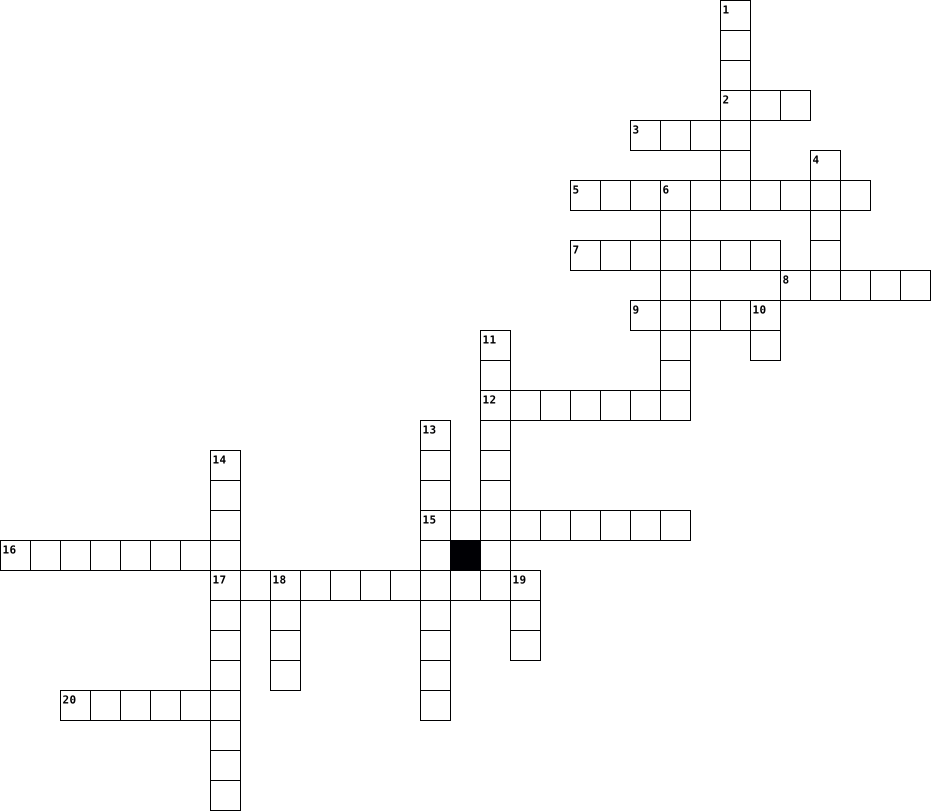
Across
- Energy can not be created or destroyed
- Chemical
- Energy of moving electrons
- Energy is motion.
- Energy from vibrations in matter
- travels in electromagnetic waves
- Heat energy
- Electrical- Thermal, Sound, Mechanical
- Chemical- Thermal, Radiant, Sound
- Light-Electrical
- Mechanical-Sound
Down
- Energy is locked in the nucleus of an atom.
- Sound
- Energy stored in bonds of molecules
- Electrical- Sound, Light, Thermal
- Stored energy
- Energy in moving objects
- Chemical
- Electrical
- Nuclear energy
20 Clues: Sound • Chemical • Chemical • Electrical • Heat energy • Stored energy • Nuclear energy • Light-Electrical • Mechanical-Sound • Energy is motion. • Energy in moving objects • Energy of moving electrons • Energy from vibrations in matter • travels in electromagnetic waves • Electrical- Sound, Light, Thermal • Chemical- Thermal, Radiant, Sound • Energy stored in bonds of molecules • ...
Type of Energy 2023-12-11
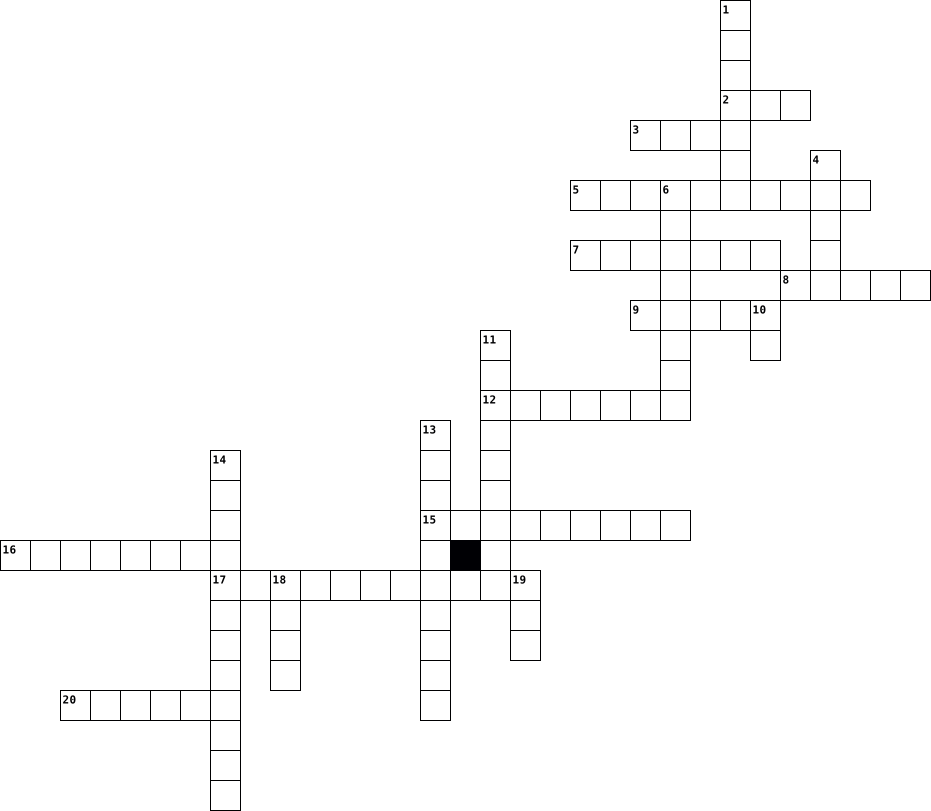
Across
- Energy can not be created or destroyed
- Chemical
- Energy of moving electrons
- Energy is motion.
- Energy from vibrations in matter
- travels in electromagnetic waves
- Heat energy
- Electrical- Thermal, Sound, Mechanical
- Chemical- Thermal, Radiant, Sound
- Light-Electrical
- Mechanical-Sound
Down
- Energy is locked in the nucleus of an atom.
- Sound
- Energy stored in bonds of molecules
- Electrical- Sound, Light, Thermal
- Stored energy
- Energy in moving objects
- Chemical
- Electrical
- Nuclear energy
20 Clues: Sound • Chemical • Chemical • Electrical • Heat energy • Stored energy • Nuclear energy • Light-Electrical • Mechanical-Sound • Energy is motion. • Energy in moving objects • Energy of moving electrons • Energy from vibrations in matter • travels in electromagnetic waves • Electrical- Sound, Light, Thermal • Chemical- Thermal, Radiant, Sound • Energy stored in bonds of molecules • ...
Types of Energy 2026-03-10

Across
- If you mix to of these together you might make a small explosion
- Energy can not be created or destroyed
- Something we use to run and play sports
- My ______ is 5ft 5in
- When you have a broken bone the doctors look at the bone using this
- You roast s'mores over this
- The type of energy when you stretch something
- Type of energy of something that is moving
- This is a type of energy that deals with heat
- The military make _______ bombs and drop them out of planes
Down
- Thunder and _________
- How energy is measured
- Type of energy depending on the objects height
- If you don't have power you call an __________ worker to fix it
- If A nuke hits somewhere it will make this
- People go to ____ everyday to make money
- If you get a screw made of iron and wrap it with a wire connected to a battery you will get one of these
- This type of energy has to do with stuff like bikes and things that have different moving parts
- A type of energy that has to do with an objects gravity
19 Clues: My ______ is 5ft 5in • Thunder and _________ • How energy is measured • You roast s'mores over this • Energy can not be created or destroyed • Something we use to run and play sports • People go to ____ everyday to make money • If A nuke hits somewhere it will make this • Type of energy of something that is moving • The type of energy when you stretch something • ...
Sarah Meade 2016-05-05

Across
- / essential liquid nutrient that has many functions throughout the body
- / nutrient that contains sugars, starches and fibers; the body's main source of energy
- / provides light, an essential part of photosynthesis for plants, which allows them to make nutrients and energy
- / units of energy
- / organic compounds needed in small amounts as nutrients to regulate body processes
- / one of the three energy sources used by the body
- / most common nutrient in the body, in teeth and bones
- / describes food that is low in fat, cholesterol, sugar, or other rich ingredients
- / protein that contains iron and helps with the transportation of oxygen throughout the body
- / organs that extract waste from blood, balance body fluids, and regulate other body functions
- / words that suggests that a food in unprocessed, in its raw state, or subject to any forms of preservation
Down
- /polysaccharides that are the storage form of energy in plants
- /trace mineral or vitamin that is required in small amounts
- / electrolyte that regulates many bodily functions, must be consumed as it is not produced by the body
- /basic component of food that nourishes the body
- / produced or involving production without the use of chemical fertilizers, pesticides, or other artificial agents
- / transport medium for delivering nutrients to the cells of the body
- / describes a diet in which one consumes the right amounts of each food group
- / enery-yielding nutrients composed of carbon, hydrogen, and nitrogen
- / collective term that refers all of monosaccharides and disaccharides
20 Clues: / units of energy • /basic component of food that nourishes the body • / one of the three energy sources used by the body • / most common nutrient in the body, in teeth and bones • /trace mineral or vitamin that is required in small amounts • /polysaccharides that are the storage form of energy in plants • ...
Non-renewable Resources 2022-04-04

Across
- This is a cause of burning fossil fuels like coal.
- A machine used to create energy.
- A synonym of petroleum.
- Fossil fuels can be used to create this, a form of energy.
- A highly abundant fossil fuel that is used to heat most homes.
- A fossil fuel that is used in most businesses.
Down
- The process of extracting material from the Earth.
- A non-renewable resource that takes very little material to create a huge amount of energy.
- A relatively cheap type of fossil fuel that is used in transportation around the world.
- A non-renewable resource that forms from decayed, organic material.
- Generators produce ______.
11 Clues: A synonym of petroleum. • Generators produce ______. • A machine used to create energy. • A fossil fuel that is used in most businesses. • The process of extracting material from the Earth. • This is a cause of burning fossil fuels like coal. • Fossil fuels can be used to create this, a form of energy. • A highly abundant fossil fuel that is used to heat most homes. • ...
Cell Processes 2025-01-30

Across
- acid fermentation one process of fermentation which uses pyruvate and NADH to form lactic acid
- a three-carbon molecule containing RuBisCo
- the phase involving capturing sunlight energy
- the first step in respiration; the release of energy to form ATP
- not requiring air to live or process
- the cycle that takes smaller molecules from glycolysis and forms cytric acid
- the movement of ions across a semipermeable membrane bound structure, down their electrochemical gradient
- transport chain the third cycle in reperation that produces a lot of ATP
Down
- the phase that does not require sunlight; also called the Calvin Cycle
- the process by which plants change the energy in sunlight to kinds of energy that can be stored for later use
- fermentation one process of fermentation which uses pyruvate and NADH to produce ethyl alcohol
- requiring air to live
- the process all organisms use to get energy from food
13 Clues: requiring air to live • not requiring air to live or process • a three-carbon molecule containing RuBisCo • the phase involving capturing sunlight energy • the process all organisms use to get energy from food • the first step in respiration; the release of energy to form ATP • the phase that does not require sunlight; also called the Calvin Cycle • ...
Dat Science Crossword Doe 2013-12-09

Across
- The line that is perpendicular to the reflecting surface.
- All objects that emit light.
- Clear substances that you can see through.
- The angle between the normal line and the incidence ray.
- Emy’s favourite animal.Bonus
- _____ reflects all colours.
- The process in which light strikes a surface and bounces back off that surface.
- Meg’s favourite animal.Bonus
- To send out energy in the form of waves or rays.
- What can effect refraction?
- Becca’s favourite animal.Bonus
- ________ of light causes an object to appear in a spot where it isn’t actually located.
- An example of an artificial light source.
- Only a _____ portion of light reflecting reaches your eyes.
- Mirrors that cave in.
Down
- The main refractor.
- Can't see through it.
- Change light into energy.
- The main reflector.
- _______ is rough compared to mirrors.
- When light is absorbed by a surface, it ________ into several different forms of energy.
- When light moves from a ____ dense to a more dense medium it will bend towards normal.
- Mirrors that bulge out.
- How much bending occurs depending on the type of ______.
- The bending of light when it travels from one medium to another.
- ______ absorbs all colours.
- The form of energy we can see.
27 Clues: The main refractor. • The main reflector. • Can't see through it. • Mirrors that cave in. • Mirrors that bulge out. • Change light into energy. • _____ reflects all colours. • What can effect refraction? • ______ absorbs all colours. • All objects that emit light. • Emy’s favourite animal.Bonus • Meg’s favourite animal.Bonus • Becca’s favourite animal.Bonus • ...
science cross word project 2013-03-13

Across
- keeping track of something for a specific purpose
- layer of ozone in the atmosphere 15 to 50 km above earths surface; protects the earth's surface from the sun's ultraviolet radiation
- gases in earth's atmosphere that trap the heat that forms when radiant energy from the sun reaches earth's surface
- greenhouse effect made greater by humman activities, such as burning fossil fuels and clearing land, that add greenhouse gases to the atmosphere
- colourless and odourless gas; produced by incomplete combustion of chemicals containing carbon
- amount of a substance that causes 50% of a group of test animals to die if they are given a specified dose of the substance all at once
- how poisonous a substance is
- consentration of acid that can dramatically lower the ph of the water in a pound, slough, lake, or river for a short period of time
- Fog or haze intensified by smoke or other atmospheric pollutants
Down
- forms when sulfur combines with oxygen in the air; major air pollutant that forms both smog and acid rain; major source: industrial processes
- at groung level it's a pollutant produced as a result of industrial processes and the use of motor vehicles; high in the atmosphere, it forms a layer protecting earth from the sun's ultraviolet radiation
- species used to monitor the health of an environment or ecosystem
- metals that have density of 5 or higher (e.g.,copper, zinc, lead, mercury, cadminum, nickel) heavy metals are one type of substance monitored to determine water quality
- major air pollutant; forms when nitrogen combines with oxygen as a result of fuel combustion; gives smog its characteristic brown colour; malor source: motor vehicles
- increased average temperatures worldwide caused by the enhanced greenhouse effect
- poisonous
- chemical used to kill pests
- animals without backbones
- measurement used to describe very small concentration of chemicals
19 Clues: poisonous • animals without backbones • chemical used to kill pests • how poisonous a substance is • keeping track of something for a specific purpose • Fog or haze intensified by smoke or other atmospheric pollutants • species used to monitor the health of an environment or ecosystem • measurement used to describe very small concentration of chemicals • ...
Puzzle Time : Lesson Four 2014-02-16

Across
- is a nonrenewable substance. its chemical energy comes from organisms that died millions of years ago.
- is extracted from heat stored within Earth
- a resource that forms at a rate much slower than the rate at which the resource is consumed.
- is a sedimentary rock formed from the remains of dead plants at the bottom of ancient swamps.
- is renewable and can help you harness the energy from the sun.
Down
- are energy resources made from carbon-rich plant and animal remains.
- the ability to cause change.
- earths main source of energy.
- is an energy source that can be easily reproduced or replaced by nature
- includes living or recently dead organic material that can be used as fuel.
- means "rock oil"
11 Clues: means "rock oil" • the ability to cause change. • earths main source of energy. • is extracted from heat stored within Earth • is renewable and can help you harness the energy from the sun. • are energy resources made from carbon-rich plant and animal remains. • is an energy source that can be easily reproduced or replaced by nature • ...
Weather & Climate Lessons 7-13 Review 2025-03-19

Across
- the process in which a liquid turns into a gas
- in order for a strong thunder storm to occur, a _____ temperature difference between the air near the ground and the air higher up is needed
- this type of precipitation forms when the air near the ground is at or below freezing
- this is what happens to a water droplet or ice crystal when the force of updraft is greater than the force of gravity
- thermal energy transfer that occurs as particles collide, such as when the ground heats the air above it
- thermal energy transfer that occurs when the Sun heats the ground without direct contact
- this is what happens to a water droplet or ice crystal when the forces of gravity and updraft are equal
- the downward force that acts on objects
Down
- the measurement that tells us the force of gravity on an object
- any liquid or frozen water that forms in the atmosphere and falls back to the ground
- bigger hailstones occur when the hailstone spends a _______ time in a cloud
- thermal energy transfer that is responsible for warm air rising and cold air sinking
- the amount of water vapor in the air
- this is what happens to a water droplet or ice crystal when the force of gravity is greater than the force of updraft
- cold air sinks because it is ______ dense than the surrounding air
- the upward movement of air
- solids such as dust, ash, smoke, etc. in the air that water vapor condenses to as part of cloud formation
- the process in which a gas turns into a liquid
- warm air rises because it is ______ dense than the surrounding air
19 Clues: the upward movement of air • the amount of water vapor in the air • the downward force that acts on objects • the process in which a liquid turns into a gas • the process in which a gas turns into a liquid • the measurement that tells us the force of gravity on an object • cold air sinks because it is ______ dense than the surrounding air • ...
Waves 2014-01-08

Across
- _____ shape the coast through erosion and deposition.
- a _____ is a beach that projects out like a finger
- ________ forms when waves erode a layer of soft rock.
- ______forms beaches.
- the energy of waves breaks apart the _____.
Down
- Energy that water gets from ____ causes particles to move up and down.
- soft rock _______ faster.
- Hallow out rock makes a ______.
- ________ slows the waves down.
- the ____ comes from wind that blows across the surface.
10 Clues: ______forms beaches. • soft rock _______ faster. • ________ slows the waves down. • Hallow out rock makes a ______. • the energy of waves breaks apart the _____. • a _____ is a beach that projects out like a finger • _____ shape the coast through erosion and deposition. • ________ forms when waves erode a layer of soft rock. • ...
IGCSE Bio Anaerobic Respiration 2023-07-03

Across
- Anaerobic respiration in yeast
- I cause your muscle cramps during exercise
- Left hand side of the respiration equation
- Without me, all forms of respiration will not happen
- Lactic acid ends up here after transportation throughout the body
- Needed for aerobic respiration
Down
- Almost every form of respiration has this as a byproduct
- Commonly used to study anaerobic respiration
- I am leftover energy from anaerobic respiration
- I release energy, but not that much
- The business of making beer
- Absence of oxygen
12 Clues: Absence of oxygen • The business of making beer • Anaerobic respiration in yeast • Needed for aerobic respiration • I release energy, but not that much • I cause your muscle cramps during exercise • Left hand side of the respiration equation • Commonly used to study anaerobic respiration • I am leftover energy from anaerobic respiration • ...
Climate Change 2017-11-02

Across
- This type of renewable energy source comes from the Earth's core
- The movement of carbon, in its many forms, between the atmosphere, oceans, biosphere and geosphere
- Humans breathe in this gas
- Acronym for the Environmental Protection Agency
- One of the most abundant greenhouse gasses
- Greenhouses gases regulate the temperature of Earth’s atmosphere via the _________________
- Formed from ferns, plants, and trees which hardened due to pressure and heat
Down
- These gases trap heat in the lower atmosphere
- Plants do this to create food
- This type of energy can never run out (ex. solar and wind)
- The average weather conditions over a 30 year period
- Heat (thermal) long wave radiation
- These are burned to create energy, they are non-renewable
- The most abundant atmospheric gas
- This type of carbon cycle operates on a timescale of thousands of years
15 Clues: Humans breathe in this gas • Plants do this to create food • The most abundant atmospheric gas • Heat (thermal) long wave radiation • One of the most abundant greenhouse gasses • These gases trap heat in the lower atmosphere • Acronym for the Environmental Protection Agency • The average weather conditions over a 30 year period • ...
Heat Capacity 2025-08-25

Across
- Heat the amount of heat required to raise the temperature of a unit mass of a substance by one degree Celsius.
- Energy the total energy contained within a system, including kinetic and potential energy of the particles that make up the system.
- the branch of physics that deals with the relationships between heat and other forms of energy.
- Energy the total energy of all the particles in a substance, related to temperature and heat.
- Conductivity a measure of a material's ability to conduct heat, usually expressed in watts per meter per Kelvin (W/m·K).
- Transfer the movement of thermal energy from one object or substance to another due to a temperature difference.
- the SI unit of energy, often used to quantify heat energy in scientific contexts.
- a state in which opposing forces or influences are balanced, often referring to thermal equilibrium in temperature.
Down
- a measure of the average kinetic energy of the particles in a substance, perceived as how hot or cold something is.
- a material that allows heat to flow easily through it, facilitating the transfer of thermal energy.
- Capacity the amount of heat energy required to raise the temperature of an object by one degree Celsius.
- Change the transition of a substance from one state of matter to another, such as from solid to liquid (melting) or liquid to gas (evaporation).
- a material that does not easily allow heat to pass through it, helping to retain thermal energy.
- Heat the amount of heat energy absorbed or released during a phase change without a change in temperature.
- Energy the energy an object possesses due to its motion, which increases with temperature in a substance.
15 Clues: the SI unit of energy, often used to quantify heat energy in scientific contexts. • Energy the total energy of all the particles in a substance, related to temperature and heat. • the branch of physics that deals with the relationships between heat and other forms of energy. • ...
Physics Crossword Puzzle 2020-02-15

Across
- Measure of energy transfer that occurs when an object is moved over a distance by an external force.
- A quantity that has both magnitude and direction but not position. It may be visualized as directed line segments whose lengths are their magnitudes.
- Energy It is defined as the work needed to accelerate a body of a given mass from rest to its stated velocity.
- In thermodynamics, it is the energy in transfer to or from a thermodynamic system, by mechanisms other than transfer of matter.
- It is an object's change in position, only measuring from it's starting position to the final position.
- Is the branch of Physics dealing with the study of motion.
- It is the speed at which something moves in one direction and is a vector measurement of the rate and direction of motion.
- Is the rate at which work is done or the rate at which energy is transferred from one place to another or transformed from one type to another.
- A force of attraction that exists between any two masses which tries to pull them towards each other.
- It deals with the movement of objects and the forces that drive that movement.
Down
- It is the use of power or energy of a system by making use of supply.
- Energy Stored energy that depends upon the relative position of various parts of a system.
- Is a unit of power and is defined as a derived unit of 1 joule per second.
- It is the push and pull on an object with mass that causes it to change velocity and has both magnitude and direction.
- Branch of physics and subdivision of mechanics concerned with the geometrically possible motion of a body or system of bodies without consideration of the forces involved.
- The capacity for doing work.
- The branch of physical science that deals with the relations between heat and other forms of energy.
- Is the condition of a system when neither its state of motion nor its internal energy state tends to change with time.
- Energy Is the potential of a chemical substance to undergo chemical reaction to transform into other substances.
- It is the change in the position of an object over time and is mathematically described in terms of displacement, distance, velocity, speed, and time.
20 Clues: The capacity for doing work. • Is the branch of Physics dealing with the study of motion. • It is the use of power or energy of a system by making use of supply. • Is a unit of power and is defined as a derived unit of 1 joule per second. • It deals with the movement of objects and the forces that drive that movement. • ...
Energy Review 2021-03-20

Across
- What allows us to work?
- Is hard coal which is a highly desirable fuel bemused of its high heat content and low sulfur content and because it burns cleaner, unfortunately, it is a limited resource
- Second most used energy source in Ecuador
- Energy in a transformed stage
- Who is the fifth largest producer of crude oil in South America?
- Who consumes large amounts of energy because many industries are established
- Remains of natural organisms that with time and pressure have become oil
Down
- Energy derived from sources that will run out during the human lifetime, it will not be replenished.
- What are fossil fuels mostly composed of?
- Which is extensively used as fuel because of its high heat and large supplies (contains high sulfur)
- Brown coal with low heat content, low sulfur content with a limited supply
- Energy forms that can be used directly from nature, do not have any previous conversion
- First stage of coal with low heat where partially decayed plants in swamps and bogs
- Energy that can be easily replenished, and won’t end during the human life span
- What do we call a combustible mineral made of carbon formed from organic matter after millions of years of compression?
15 Clues: What allows us to work? • Energy in a transformed stage • What are fossil fuels mostly composed of? • Second most used energy source in Ecuador • Who is the fifth largest producer of crude oil in South America? • Remains of natural organisms that with time and pressure have become oil • Brown coal with low heat content, low sulfur content with a limited supply • ...
Life's Rocky Start 2018-02-07

Across
- Creature that thrived during the Cambrian explosion of biological
- Ancient city in Morocco
- One of the longest-lasting materials in nature
- Yosemite is known for it's biological __________
- Father of evolutionary biology
- Rock that fell from space
- Fossilised ancient microbial structures
- Measurement in years of Earth's age
Down
- Earth's first rocks
- Life around hydrothermal vents thrives on __________ energy
- Molecule that is essential for all life
- Biological process that turned Earth red through iron oxidation
- Clay surfaces can act as __________ to make complex organic compounds
- Rock that forms the foundation of continents
- Building blocks of life that can be made from non-organic materials
- Scientist who performed an early earth experiment
- Carbon dioxide is a __________ gas
- One of the oldest places on Earth
- __________ is needed to split molecules
- Gas that was rare in the early atmosphere
20 Clues: Earth's first rocks • Ancient city in Morocco • Rock that fell from space • Father of evolutionary biology • One of the oldest places on Earth • Carbon dioxide is a __________ gas • Measurement in years of Earth's age • Molecule that is essential for all life • __________ is needed to split molecules • Fossilised ancient microbial structures • ...
Life's Rocky Start 2018-02-07

Across
- Father of evolutionary biology
- Rock that fell from space
- Fossilised ancient microbial structures
- Clay surfaces can act as __________ to make complex organic compounds
- One of the oldest places on Earth
- Rock that forms the foundation of continents
- Building blocks of life that can be made from non-organic materials
- __________ is needed to split molecules
- Ancient city in Morocco
- Gas that was rare in the early atmosphere
Down
- Earth's first rocks
- Yosemite is known for it's biological __________
- Biological process that turned Earth red through iron oxidation
- Life around hydrothermal vents thrives on __________ energy
- Creature that thrived during the Cambrian explosion of biological
- Carbon dioxide is a __________ gas
- Scientist who performed an early earth experiment
- Molecule that is essential for all life
- Measurement in years of Earth's age
- One of the longest-lasting materials in nature
20 Clues: Earth's first rocks • Ancient city in Morocco • Rock that fell from space • Father of evolutionary biology • One of the oldest places on Earth • Carbon dioxide is a __________ gas • Measurement in years of Earth's age • Fossilised ancient microbial structures • Molecule that is essential for all life • __________ is needed to split molecules • ...
Weather Crossword (Part 1) 2024-05-17

Across
- The transfer of thermal energy by the movement of heated material from one place to another.
- The greenhouse gases are good at absorbing ________- wavelength infrared heat energy emitted from Earth’s surface.
- A value that compares the amount of water vapor in the air with the amount the air could hold if it were totally saturated.
- The percentage of sun’s energy that enters Earth’s atmosphere that is absorbed by the land (lithosphere) and ocean (hydrosphere).
- Humid rainy skies are associated with ___________ pressure systems.
- This refers to all the water components of our earth, solid or liquid or gaseous forms.
- Warm air is ______ dense than cold air.
- All warm objects emit this type of radiation.
- Microscopic particles of dust, smog, mist, and other very fine particles that are suspended in the atmosphere.
- Dry air is ______ dense than humid air.
- True or False: Water is considered a good heat sink.
- The _________ of a surface is one factor that will affect how much solar energy is absorbed...better plan your outfits for warm summer days!
- True or False: Water cools (loses heat) much more slowly than land .
- All weather occurs here.
Down
- The pressure exerted by the mass of air above any point on Earth’s surface.
- Any substance that can absorb and retain a “pool” or reservoir of energy without undergoing a change of state.
- True or False: Earth maintains a temperature balance by radiating as much energy into space as it absorbs from the sun.
- Temperature at which air is saturated with water vapor so that it condenses and falls as precipitation.
- The term that refers to the reflectivity of a surface—how much energy it reflects.
- Oxygen and this gas make up about 99 percent of dry air?
- Thermal energy transfer that occurs between substances that are in direct physical contact with each other.
- The troposphere extends for the first ____ km of the atmosphere.
- When warm air pushes into an area of cold air near the ground, the atmospheric pressure in that location will ______.
- Clear Dry skies are associated with ___________ pressure systems.
24 Clues: All weather occurs here. • Warm air is ______ dense than cold air. • Dry air is ______ dense than humid air. • All warm objects emit this type of radiation. • True or False: Water is considered a good heat sink. • Oxygen and this gas make up about 99 percent of dry air? • Clear Dry skies are associated with ___________ pressure systems. • ...
Heat and Matter 2023-09-07

Across
- the smallest particle of an atom
- anything that has volume and mass
- average kinetic energy of all the particles in a material; measured by a thermometer in degrees
- distinct forms of matter known in everyday experience: solid, liquids, and gas; also referred to as phases
- energy of motion
- the simplest unit of a chemical compound that can exist, formed when two or more atoms joins together chemically
Down
- the total kinetic (motion) energy of the tiny particles that make up matter; the faster the particles move, the warmer the matter becomes
- energy transferred between two objects of different temperatures in a predictable pattern; always moves from high to low
- the sum of all the kinetic energy (KE) and potential energy (PE) that is found within a substance
- energy that is stored in a system or object
- movement of energy from one system to another
11 Clues: energy of motion • the smallest particle of an atom • anything that has volume and mass • energy that is stored in a system or object • movement of energy from one system to another • average kinetic energy of all the particles in a material; measured by a thermometer in degrees • ...
Chapter 25 Vocabulary Crossword 2015-02-24

Across
- Production of two unstable forms of energy at the same time from the same process, which can conserve resources and generate income
- Involves global management of Earth's natural resources to ensure that current and future energy needs will be met without harming the environment
- Black coal having a relatively high volatile content
- Nuclear reaction in which atomic nuclei of low atomic number fuse to form a heavier nucleus with the release of energy.
- Soft brownish coal showing traces of plant structure, intermediate between bituminous coal and peat
- A type of conservation in which the amount of work produced is compared to the amount of energy used
- Thin, transparent wafer that converts sunlight into electrical energy and is made up of two layers of two types of silicon
Down
- Coal of a hard variety that contains relatively pure carbon and burns with little flame and smoke
- Energy produced by Earth's naturally occurring heat, steam, and hot water
- Fuels derived from living things; renewable resources
- Power generated by converting the energy of free-falling water to electricity
- The process in which a heavy nucleus divides to form smaller nuclei and one or two neutrons and produces a large amount of energy
- Light, spongy, organic fossil fuel derived from moss and other bog plants
- Molecules with hydrogen and carbon bonds only
- Nonrenewable energy resources formed over geological time from the compression and partial decomposition of organisms that lived millions of years ago
15 Clues: Molecules with hydrogen and carbon bonds only • Black coal having a relatively high volatile content • Fuels derived from living things; renewable resources • Energy produced by Earth's naturally occurring heat, steam, and hot water • Light, spongy, organic fossil fuel derived from moss and other bog plants • ...
Biomolecule Crosswords 2017-10-31

Across
- Simple sugar
- Carbon, Oxygen and Hydrogen
- Macromolecule partially responsible for regulating metabolism
- Long polymer of glucose
Down
- Chains of monomers
- Study of life
- Monomer units for nucleic acid polymers
- Forms polymers
- Polymeric carb made of glucose
- "organic"
- Stores long term energy
11 Clues: "organic" • Simple sugar • Study of life • Forms polymers • Chains of monomers • Stores long term energy • Long polymer of glucose • Carbon, Oxygen and Hydrogen • Polymeric carb made of glucose • Monomer units for nucleic acid polymers • Macromolecule partially responsible for regulating metabolism
Nutrition 2021-09-08

Across
- witch are nutrients that occur naturally
- helps protect healthy cells from damage
- nutrients made by living things
- it regulates many processes in our cells
- helps build and maintain bones and teeth
- are nutrients made of carbon
- the amount of energy from a broken down nutrient
- a type of complex carbohydrate
- store energy for later
Down
- is a process where your body breaks down food
- if a persons diet does not include iron
- forms part of some amino acid and vitamin b
- when the body maintains order
- is a waxy fat like substance
- serious reduction in the body's water content
15 Clues: store energy for later • are nutrients made of carbon • is a waxy fat like substance • when the body maintains order • a type of complex carbohydrate • nutrients made by living things • helps protect healthy cells from damage • if a persons diet does not include iron • witch are nutrients that occur naturally • it regulates many processes in our cells • ...
8.1 Contact Forces 2023-09-10

Across
- stored energy that an object or system of objects may have
- the contact forces between a moving object and something it is sliding against
- all other considerations and limits from people and the environment
- any factor that can be manipulated, controlled for, or measured in an experiment.
- the variable that is varied or manipulated
- energy of movement
- maximum
- when an object bends, or changes shape
- can be found in many things and can take different forms
Down
- able to endure strain without being permanently injured
- a change in a object, that decreases its value or use
- the state or condition of physical touching
- a set of things working together as parts of a mechanism or an interconnecting network
- when a moving object hits another
- a set of things working together as parts of a mechanism or an interconnecting network
- a simplified drawing showing the appearance, structure, or workings of something
- the force that acts in the opposite direction to an object moving
- the response that is measured in an experiment
- resulting from the object's interaction with another object
19 Clues: maximum • energy of movement • when a moving object hits another • when an object bends, or changes shape • the variable that is varied or manipulated • the state or condition of physical touching • the response that is measured in an experiment • a change in a object, that decreases its value or use • able to endure strain without being permanently injured • ...
8.1 Contact Forces 2023-09-10

Across
- stored energy that an object or system of objects may have
- the contact forces between a moving object and something it is sliding against
- all other considerations and limits from people and the environment
- any factor that can be manipulated, controlled for, or measured in an experiment.
- the variable that is varied or manipulated
- energy of movement
- maximum
- when an object bends, or changes shape
- can be found in many things and can take different forms
Down
- able to endure strain without being permanently injured
- a change in a object, that decreases its value or use
- the state or condition of physical touching
- a set of things working together as parts of a mechanism or an interconnecting network
- when a moving object hits another
- a set of things working together as parts of a mechanism or an interconnecting network
- a simplified drawing showing the appearance, structure, or workings of something
- the force that acts in the opposite direction to an object moving
- the response that is measured in an experiment
- resulting from the object's interaction with another object
19 Clues: maximum • energy of movement • when a moving object hits another • when an object bends, or changes shape • the variable that is varied or manipulated • the state or condition of physical touching • the response that is measured in an experiment • a change in a object, that decreases its value or use • able to endure strain without being permanently injured • ...
Puzzle Time : Lesson Four 2014-02-16

Across
- are energy resources made from carbon-rich plant and animal remains.
- is an energy source that can be easily reproduced or replaced by nature
- is extracted from heat stored within Earth
- means "rock oil"
- is renewable and can help you harness the energy from the sun.
Down
- includes living or recently dead organic material that can be used as fuel.
- is a sedimentary rock formed from the remains of dead plants at the bottom of ancient swamps.
- a resource that forms at a rate much slower than the rate at which the resource is consumed.
- earths main source of energy.
- the ability to cause change.
- is a nonrenewable substance. its chemical energy comes from organisms that died millions of years ago.
11 Clues: means "rock oil" • the ability to cause change. • earths main source of energy. • is extracted from heat stored within Earth • is renewable and can help you harness the energy from the sun. • are energy resources made from carbon-rich plant and animal remains. • is an energy source that can be easily reproduced or replaced by nature • ...
Biology test 2023-09-09

Across
- material made up of decaying bits of plant and animal material
- a series of steps in an ecosystem in which organisms transfer energy by eating and being eaten
- single essential nutrient that limits productivity in an ecosystem
- process of converting nitrogen gas into nitrogen compounds that plants can absorb and use
- organism that obtains food by consuming other living things; also called a consumer
- process in which chemical energy is used to produce carbohydrates
- network of complex interactions formed by the feeding relationships among the various organisms in an ecosystem
- process used by plants and other autotrophs to capture light energy and use it to power chemical reactions that convert carbon dioxide and water into oxygen and energy-rich carbohydrates such as sugars and starches
Down
- organism that relies on other organisms for its energy and food supply; also called a heterotroph
- Process in which element, chemical compounds, and other forms of matter are passed off from one organism to another and from one part of the biosphere to another.
- process by which bacteria convert nitrates into nitrogen gas
- photosynthetic algae found near the surface of the ocean
- first poriducer of the energy-rich compounds that are later used by other organisms.
- organism that is able to capture energy from sunlight or chemicals and use it to produce its own food from inorganic compounds; also called a producer
- total amount of living tissue within a given trophic level
- each step in a food chain or food web
- illustration of the relative amounts of energy or matter contained within each trophic level in a given food chain or food web
- chemical substance that an organism needs to sustain life
18 Clues: each step in a food chain or food web • photosynthetic algae found near the surface of the ocean • chemical substance that an organism needs to sustain life • total amount of living tissue within a given trophic level • process by which bacteria convert nitrates into nitrogen gas • material made up of decaying bits of plant and animal material • ...
Biology test 2023-09-09

Across
- material made up of decaying bits of plant and animal material
- a series of steps in an ecosystem in which organisms transfer energy by eating and being eaten
- single essential nutrient that limits productivity in an ecosystem
- process of converting nitrogen gas into nitrogen compounds that plants can absorb and use
- organism that obtains food by consuming other living things; also called a consumer
- process in which chemical energy is used to produce carbohydrates
- network of complex interactions formed by the feeding relationships among the various organisms in an ecosystem
- process used by plants and other autotrophs to capture light energy and use it to power chemical reactions that convert carbon dioxide and water into oxygen and energy-rich carbohydrates such as sugars and starches
Down
- organism that relies on other organisms for its energy and food supply; also called a heterotroph
- Process in which element, chemical compounds, and other forms of matter are passed off from one organism to another and from one part of the biosphere to another.
- process by which bacteria convert nitrates into nitrogen gas
- photosynthetic algae found near the surface of the ocean
- first poriducer of the energy-rich compounds that are later used by other organisms.
- organism that is able to capture energy from sunlight or chemicals and use it to produce its own food from inorganic compounds; also called a producer
- total amount of living tissue within a given trophic level
- each step in a food chain or food web
- illustration of the relative amounts of energy or matter contained within each trophic level in a given food chain or food web
- chemical substance that an organism needs to sustain life
18 Clues: each step in a food chain or food web • photosynthetic algae found near the surface of the ocean • chemical substance that an organism needs to sustain life • total amount of living tissue within a given trophic level • process by which bacteria convert nitrates into nitrogen gas • material made up of decaying bits of plant and animal material • ...
Cells (´・ω・`) 2021-03-09

Across
- substance that forms by joining many small molecules
- long chain of amino acid molecules
- network of threadlike proteins inside a cell
- one or more sugar molecules
- living things are made of one or more cells
- membrane-bound cell structure with a specialized function
Down
- membrane-bound organelle that uses light energy and makes food
- purpose for which something is used
- protects the inside of a cell from the environment
- fluid inside cell that contains salts and other molecules
- macromolecule that forms when a long chain of nucleotides join togther
- outer covering
- stiff stucture outside the cell membrane
- large macromolecule that does not dissolve in water
- directs all cell activities and contains DNA
- explanation based on scientific knowledge resulting from several observations and experiments
16 Clues: outer covering • one or more sugar molecules • long chain of amino acid molecules • purpose for which something is used • stiff stucture outside the cell membrane • living things are made of one or more cells • directs all cell activities and contains DNA • network of threadlike proteins inside a cell • protects the inside of a cell from the environment • ...
Physics Crossword 12 2024-12-01

Across
- mgh (6)
- a build-up of static can be caused by this force (8)
- ____ energy (sometimes called wasted energy) (10)
- charge can only flow around a ____ circuit (6)
- groups of cells joined together in series (9)
- ____ isotopes decay to other elements (8)
- the ____ force is the overall force on an object (9)
- radiation type that can be stopped by a sheet of paper (5)
- unit for potential difference (4)
- directly proportional to force up to a limit (9)
- splitting large and unstable nuclei (7)
- specific latent heat: the energy need for a ____kg mass to change state (3)
Down
- property of the nucleus that increases during beta decay (6)
- doesn’t change during a change of state (11)
- when a substance goes from a solid to a gas without becoming liquid (11)
- radiation type that doesn’t change the charge or mass of a nucleus (5)
- ____ acceleration (often called constant acceleration) (7)
- varies depending on the gravitational force acting on a mass (6)
- BIl (5)
- 1 Newton metre = 1 ____ (5)
- proved the existence of the neutron (8)
- mass per unit volume (7)
- unit represented with a “J” (5)
- ½ mv^2 (6)
- a circuit with a single closed loop (6)
- different forms of the same element (8)
26 Clues: mgh (6) • BIl (5) • ½ mv^2 (6) • mass per unit volume (7) • 1 Newton metre = 1 ____ (5) • unit represented with a “J” (5) • unit for potential difference (4) • proved the existence of the neutron (8) • a circuit with a single closed loop (6) • different forms of the same element (8) • splitting large and unstable nuclei (7) • ____ isotopes decay to other elements (8) • ...
Energy Forms and Changes 2025-01-03

Across
- A form of energy released during nuclear fission or fusion, especially when used to generate electricity.
- Radiant energy that travels in waves at the speed of light.
- A form of energy that is possessed by an object due to its motion or due to its position.
- A form of electromagnetic radiation that is visible to the human eye
- The movement of energy through a substance – such as air or water – in the form of waves.
- A form of energy related to forces on electrically charged particles and the movement of those particles
Down
- A form of energy contained within a system that is responsible for its temperature.
- Stored energy that depends upon the relative position of various parts of a system.
- A form of energy stored in the bonds of chemical compounds
- The form of energy that an object possesses due to its motion.
10 Clues: A form of energy stored in the bonds of chemical compounds • Radiant energy that travels in waves at the speed of light. • The form of energy that an object possesses due to its motion. • A form of electromagnetic radiation that is visible to the human eye • A form of energy contained within a system that is responsible for its temperature. • ...
Climate Change 2017-11-02

Across
- Heat (thermal) long wave radiation
- Greenhouses gases regulate the temperature of Earth’s atmosphere via the _________________
- Formed from ferns, plants, and trees which hardened due to pressure and heat
- One of the most abundant greenhouse gasses
- This type of renewable energy source comes from the Earth's core
- The average weather conditions over a 30 year period
Down
- Humans breathe in this gas
- These gases trap heat in the lower atmosphere
- Plants do this to create food
- This type of carbon cycle operates on a timescale of thousands of years
- This type of energy can never run out (ex. solar and wind)
- The most abundant atmospheric gas
- The movement of carbon, in its many forms, between the atmosphere, oceans, biosphere and geosphere
- These are burned to create energy, they are non-renewable
- Acronym for the Environmental Protection Agency
15 Clues: Humans breathe in this gas • Plants do this to create food • The most abundant atmospheric gas • Heat (thermal) long wave radiation • One of the most abundant greenhouse gasses • These gases trap heat in the lower atmosphere • Acronym for the Environmental Protection Agency • The average weather conditions over a 30 year period • ...
Unit 3: Earth's Amosphere 2017-12-19

Across
- narrow belts of high-speed winds that blow from west to east, between 7km-16km above Earth's surface
- forms when ground-level ozone and vehicle exhaust react in the presence of sunlight
- protects Earth by absorbing large amounts of harmful ultraviolet radiation from the sun
- the transfer of energy from one object to another object through direct contact
- the total kinetic energy of particles
- the lowest layer of the atmosphere
- precipitation, such as rain, sleet, or snow that contains acids from air pollution
- the measure of the force with which particles in the air push on an area of a surface
- a tiny particle of solid that is suspended in air or water
- the energy that is transferred between objects that are at different temperatures
- a measure of the average kinetic energy of particles
- the contamination of the atmosphere by pollutants from human and natural sources
- the movement of air caused by differences in air pressure
Down
- the movement of air over short distances
- the atmospheric layer above the stratosphere
- the transfer of energy due to the movement of matter
- the mixture of gases that surrounds Earth
- the increase in volume that results from an increase in temperature
- the layer of atmosphere above the troposphere
- the apparent curving of the path of a moving object from an otherwise straight path due to Earth's rotation
- the transfer of energy as electromagnetic
- the process by which gases in the atmosphere absorb and give off infrared radiation
- the uppermost layer of the atmosphere
- measuring how clean or polluted the air is
- wind systems that occur at or near Earth's surface
25 Clues: the lowest layer of the atmosphere • the total kinetic energy of particles • the uppermost layer of the atmosphere • the movement of air over short distances • the mixture of gases that surrounds Earth • the transfer of energy as electromagnetic • measuring how clean or polluted the air is • the atmospheric layer above the stratosphere • ...
Chapter 8 EC #1 2021-03-22

Across
- A macromolecule serving as a catalyst
- The capacity to cause change, especially to do work
- A chemical agent that selectively increases the rate of a reaction without being consumed by the reaction.
- The reactant on which an enzyme works
- The specific region of an enzyme that binds the substrate and that forms the pocket in which catalysis occurs.
- The energy that matter possesses as a result of its location or spatial arrangement
Down
- A substance that reduces the activity of an enzyme by binding to a location remote from the active site
- A measure of molecular disorder, or randomness.
- Any nonprotein molecule or ion that is required for the proper functioning of an enzyme
- A process that occurs without an overall input of energy; a process that is energetically favorable.
- the change in shape of the active site of an enzyme so that it binds more snugly to the substrate.
- energy The amount of energy that reactants must absorb before a chemical reaction will start
- Thermal energy in transfer from one body of matter to another.
- An adenine-containing nucleoside triphosphate that releases free energy when its phosphate bonds are hydrolyzed
14 Clues: A macromolecule serving as a catalyst • The reactant on which an enzyme works • A measure of molecular disorder, or randomness. • The capacity to cause change, especially to do work • Thermal energy in transfer from one body of matter to another. • The energy that matter possesses as a result of its location or spatial arrangement • ...
Science crossword 2013-11-21

Across
- the total energy of all the particles in an object
- an example of a homogenous mixture; forms when substances dissolve
- relates the mass of a material in a given volume
- the energy an object has because of its position
- shows the elements in the compound and ratio of atoms
- a characteristic of a pure substance that can be observed without changing it into another substance
- measure of the average energy of random motion of particles of matter
- a measure of the force of gravity on an object
- measurement of the amount off matter in objects
- scientists use this to measure the properties of matter
- a force of attraction between two atoms
- a mixture were you can’t see the different parts because it’s so evenly mixed
- the basic particle for with elements are made
- a single kind of matter that is pure
- the ability to do work or cause change
- a characteristic of a pure substance that describes its ability to change into different substances
- the energy of electrically charged particles moving from one place to another
- made of two or more substances—elements, compounds, or both
Down
- a pure substance that cannot be broken down into other substances by chemical or physical means
- the study of properties of matter and how matter changes
- a change in matter that produces one or more new substances
- the fact that matter is not created or destroyed in any chemical or physical change
- a change in which energy is taken in
- a mixture in which you can see the different parts
- a change when energy is released
- a form of energy that travels through space as waves
- the internal energy stored in the chemical bonds between atoms and is a form of potential energy
- any change that alters the form or appearance of matter but does not make any substance in the matter into a different substance
- anything that as has mass and takes up space
- groups of two or more atom held together by chemical bonds
- the amount of space that matter occupies
- two metal strips placed in a solution during electrolysis
- the energy of matter in motion
- a pure substance made of two or more elements chemically combined in a set ratio
34 Clues: the energy of matter in motion • a change when energy is released • a change in which energy is taken in • a single kind of matter that is pure • the ability to do work or cause change • a force of attraction between two atoms • the amount of space that matter occupies • anything that as has mass and takes up space • the basic particle for with elements are made • ...
Unit 1.4 - 1.11 Vocabulary 2023-08-30

Across
- A consumer that eats other consumers.
- A carnivore that eats secondary consumers.
- Fungi and bacteria that convert organic matter into small elements and molecules that can be recycled back into the ecosystem.
- An organism that consumes dead animals.
- The combined amount of evaporation and transpiration
- The amount of biomass present in an ecosystem at a particular time.
- The transportation of dissolved molecules through the soil via groundwater.
- The process by which cells unlock the energy of chemical compounds.
- A representation of the distribution of biomass, numbers, or energy among trophic levels.
- A carnivore that eats primary consumers.
- A nutrient required for the growth of an organism but available in a lower quantity than other nutrients.
- The successive levels of all organisms consuming one another.
- The sequence of consumption from producers through tertiary consumers.
- The region of our planet where life resides, the combination of all ecosystems on Earth.
- The movements of matter within and between ecosystems.
- The proportion of consumed energy that can be passed from one trophic level to another.
- An organism that uses the energy of the Sun to produce usable forms of energy, also known as Autotroph
- A phenomenon in which a body of water becomes rich in nutrients.
Down
- The movement of nitrogen around the biosphere.
- The total amount of solar energy that producers in an ecosystem capture via photosynthesis over a given amount of time.
- A consumer that eats producers, also known as Primary consumer.
- The movement of sulfur around the biosphere.
- The total mass of all living matter in a specific area.
- A complex model of how energy and matter move between trophic levels.
- The movement of phosphorus around the biosphere.
- The energy captured by producers in an ecosystem minus the energy producers respire.
- The release of water from leaves during photosynthesis.
- The process by which producers use solar energy to convert carbon dioxide and water into glucose.
- The movement of carbon around the biosphere.
- The movement of water through the biosphere.
- An organism that is incapable of photosynthesis and must obtain its energy by consuming other organisms, also known as heterotroph.
- An organism that specializes in breaking down dead tissues and waste products into smaller particles.
- Water that moves across the land surface and into streams and rivers.
33 Clues: A consumer that eats other consumers. • An organism that consumes dead animals. • A carnivore that eats primary consumers. • A carnivore that eats secondary consumers. • The movement of sulfur around the biosphere. • The movement of carbon around the biosphere. • The movement of water through the biosphere. • The movement of nitrogen around the biosphere. • ...
Macromolecules 2024-09-30

Across
- Apparatus a cell organelle that helps process and package proteins and lipid molecules
- the sugar formed when two monosaccharides are joined by glycosidic linkage.
- the simplest forms of sugar and the most basic units from which all carbohydrates are built
- an organelle within the cells of plants and certain algae that is the site of photosynthesis,
- reaction a chemical reaction that releases energy by light or heat
- a situation where all binding sites of a molecule are occupied and further addition of a binding partner will not cause the occupation of any more binding sites.
- those containing one or more double bonds indicating that they can absorb additional hydrogen atoms.
- Membrane consists of a lipid bilayer that is semipermeable
- energy the amount of energy required to reach the transition state
- Reticulum a continuous membrane system that forms a series of flattened sacs
- reaction any chemical reaction that absorbs heat from its environment
- a long-chain carbohydrate made up of smaller carbohydrates called monosaccharides that's typically used by our bodies for energy or to help with cellular structure.
- Acid the building blocks of the fat in our bodies and in the food we eat.
- acid large biomolecules that play essential roles in all cells and viruses
- a biological catalyst and is almost always a protein
- the structure in a cell that contains the chromosomes
Down
- a nontoxic, sweet tasting, and viscous fluid
- class of naturally occurring compounds
- any carbohydrate that dissolves in water, is usually crystalline, and has a sweet taste
- microscopic hair-like structures involved in the locomotion of a cell.
- an intercellular structure made of both RNA and protein
- the basic building block of nucleic acids
- fatty, waxy, or oily compounds that are soluble in organic solvents and insoluble in polar solvents such as water
- acid molecules that combine to form proteins.
- A molecule made up of amino acids
- end substances after a biological process has occurred.
- membrane-bound cell organelle
- the surface on which an organism lives
- the gelatinous liquid that fills the inside of a cel
- Wall structural layer that surrounds some cell types
30 Clues: membrane-bound cell organelle • A molecule made up of amino acids • class of naturally occurring compounds • the surface on which an organism lives • the basic building block of nucleic acids • a nontoxic, sweet tasting, and viscous fluid • acid molecules that combine to form proteins. • the gelatinous liquid that fills the inside of a cel • ...
Unit 5 Vocab Words 2024-12-04

Across
- The smallest part of an element that still has the properties of that element.
- Metals usually lose electrons when they form chemical bonds.
- A chemical bond that forms when a metal gives one or more of its electrons to a non-metal. This bond happens between a metal cation and a non-metal anion.
- A type of ion that has a negative charge. It happens when an atom gains one or more electrons.
- Atoms like to have a full set of electrons in their outer energy level, which is usually eight electrons.
- A substance made from two or more elements that are chemically combined.
- This is a process where atoms are rearranged to make new or different substances.
- This tells us what elements are in a compound and how many of each element there are.
- The smallest part of a covalent or molecular compound. For example, H2O is a molecule.
- An atom that has either gained or lost electrons, which gives it a charge.
Down
- A bond that forms when two non-metal atoms share electrons.
- A simple way to show how many of each element are in a compound. For example, H2O means there are two hydrogen atoms and one oxygen atom.
- These are the electrons found in the outermost energy level of an atom. They are important for chemical bonding, and it takes energy to remove them.
- A type of ion that has a positive charge. It happens when an atom loses one or more electrons.
- A charged group of atoms made up of more than one atom. These often take part in ionic bonding.
- Non-metals usually gain or share electrons when they form chemical bonds.
- These are connections that form when two or more atoms share or move electrons.
- These are specific areas where electrons are likely to be found. The lower the energy level, the closer it is to the center of the atom (the nucleus).
18 Clues: A bond that forms when two non-metal atoms share electrons. • Metals usually lose electrons when they form chemical bonds. • A substance made from two or more elements that are chemically combined. • Non-metals usually gain or share electrons when they form chemical bonds. • An atom that has either gained or lost electrons, which gives it a charge. • ...
Chapter 14 Vocab 2026-02-10

Across
- the change from the liquid to the solid state of matter.
- the transfer of energy by electromagnetic waves.
- the temperature at which no more energy can be removed from matter.
- a current caused by the rising of heated fluid and sinking of cooled fluid.
- a material the conducts heat well
- the temperature scale on which water freezes at 32 degrees and boils at 212 degrees.
- a measure of the average energy of motion of the particles of a substance
- the amount of heat required to raise the temperature of 1 kilogram of a material by 1 kelvin.
- the transfer of heat by the movement of currents within a fluid
- a material that does not conduct heat well.
- the change from a gaseous state to liquid state of matter.
- the change from the solid to liquid state of matter
Down
- the total potential and kinetic energy of the particles in an object
- thermal energy that is transferred from matter at a higher temperature to matter at a lower temperature.
- the change of state from a liquid to a gas
- the temperature scale on which zero is the temperature at which no more energy can be removed from matter.
- the expansion of matter when it is heated
- the transfer of heat from one particle of matter to another by direct contact
- the process that occurs when vaporization takes place inside a liquid as well as on the surface.
- the physical change of matter from one state to another.
- the process that occurs when vaporization takes place only on the surface of a liquid.
- the temperature scale on which water freezes at 0 degrees and boils at 100 degrees.
- one of the three forms - solid, liquid, or gas - in which matter exists.
23 Clues: a material the conducts heat well • the expansion of matter when it is heated • the change of state from a liquid to a gas • a material that does not conduct heat well. • the transfer of energy by electromagnetic waves. • the change from the solid to liquid state of matter • the change from the liquid to the solid state of matter. • ...
Chapter 2 and 3 Vocab part 2 2023-12-19

Across
- not the same throughout
- a change that does not form a new substance
- anything that has mass and takes up space
- a change from gas to liquid
- combination of atoms bonded together
- the average kinetic energy of a sample of matter
- the amount of mass in a specific volume
Down
- a change directly from a gas to a solid
- a change directly from a solid to a gas
- the ability to move matter or do work
- change from liquid to a gas without boiling
- a physical change from liquid to a solid
- a change that forms new substances
- the same throughout
- smallest particle of an element
- two or more substances combined but not chemically
- matter that has unique properties
- a physical change from solid to liquid
18 Clues: the same throughout • not the same throughout • a change from gas to liquid • smallest particle of an element • matter that has unique properties • a change that forms new substances • combination of atoms bonded together • the ability to move matter or do work • a physical change from solid to liquid • a change directly from a gas to a solid • ...
Modalities 2023-12-11

Across
- use of heat
- pulling of a body part
- high frequency electric current
- heat transfer through other forms of energy
- modalities exerting pressure
- drives medicine into tissue
- high frequency sound wave
- transfer indirectly through air or water
- rays
Down
- heat transfer when liquid turns to gas
- manipulation
- heat transfer by or from its source in form of waves
- blocks pain sensation
- use of cold
- heat transfer by direct contact
- modalities use of electricty
16 Clues: rays • use of heat • use of cold • manipulation • blocks pain sensation • pulling of a body part • high frequency sound wave • drives medicine into tissue • modalities exerting pressure • modalities use of electricty • high frequency electric current • heat transfer by direct contact • heat transfer when liquid turns to gas • transfer indirectly through air or water • ...
Crossword Puzzle Chapter 4 2022-12-20

Across
- total ammount of living tissue within a given tropic level.
- process by which bacteria convert nitrates into nitrogen gas.
- each step in a food chain or food web.
- process in which elements, chemical compounds, and other forms of matter are passed form one organism to another and from part of the biosphere to another.
- a series of steps in an ecosystem in which organisms transfer energy by eating and being eaten.
- single essential nutrient that limits productivity in an ecosystem.
- network of complex interactions formed by the feeding relationships among the various organisms in an ecosystem.
- organism that obtains food by consuming other living things; also called a consumer.
- process used by plants and other autotrophs to capture lights energy and use it to power chemical reactions that convert carbon dioxide and water into oxygen and energy-rich carbohydrates such as sugars and starches.
- chemical substance that an organism needs to sustain life.
Down
- first producer of energy-rich compounds that are later used by other organisms.
- illustration of the relative amounts of energy or matter contained within each tropic level in a given food chain or food web.
- process of converting nitrogen gas into nitrogen compounds that plants can absorb and use.
- organisms that relies on other organisms for its energy and food supply; also called a heterotroph.
- process in which chemical energy is used to produce carbohydrates.
- material made up of decaying bits of plant and animal material.
- photosynthetic algae found near the surface of the ocean.
- organism that is able to capture energy from sunlight or chemicals and use it to produce its own food from inorganic compounds; also called a producer.
18 Clues: each step in a food chain or food web. • photosynthetic algae found near the surface of the ocean. • chemical substance that an organism needs to sustain life. • total ammount of living tissue within a given tropic level. • process by which bacteria convert nitrates into nitrogen gas. • material made up of decaying bits of plant and animal material. • ...
Photosynthesis 2024-10-30

Across
- a group of people living in the same place or having a particular characteristic in common
- a sweet substance that is made up wholly or mostly of sucrose, is colorless or
- all the inhabitants of a particular town, area, or country.
- the natural agent that stimulates sight and makes things visible
- light from the sun
- is the main type of sugar in the blood and is the major source of energy for the body's cells
- solid inorganic substance of natural occurrence.
- forms a molecule of two atoms which is a colorless gas at normal temperatures and pressures.
Down
- sugar molecules
- liquid that descends from the clouds as rain, forms streams, lakes, and seas, and is a major constituent of all living matter
- the strength and vitality required for sustained physical or mental activity
- Dioxide - is a colorless gas essential for photosynthesis in plants and the survival of animal life
- the main type of sugar in the blood and is the major source of energy for the body's cells
13 Clues: sugar molecules • light from the sun • solid inorganic substance of natural occurrence. • all the inhabitants of a particular town, area, or country. • the natural agent that stimulates sight and makes things visible • the strength and vitality required for sustained physical or mental activity • ...
The 17 Goals 2021-06-07

Across
- Ensure healthy life and promote well-being.
- Ensure sustainable management of water.
- Strengthen the means of implantation.
- Achieve food security and improved nutrition.
- Ensure access to affordable and clean energy.
Down
- Build infrastructure & foster innovation.
- Take urgent action to combat climate change.
- Ensure inclusive quality education.
- End poverty in all its forms everywhere.
- Promote peaceful and inclusive societies.
- Achieve gender equality and empower all women.
11 Clues: Ensure inclusive quality education. • Strengthen the means of implantation. • Ensure sustainable management of water. • End poverty in all its forms everywhere. • Build infrastructure & foster innovation. • Promote peaceful and inclusive societies. • Ensure healthy life and promote well-being. • Take urgent action to combat climate change. • ...
Life's Rocky Start 2018-02-07

Across
- Clay surfaces can act as __________ to make complex organic compounds
- __________ is needed to split molecules
- Creature that thrived during the Cambrian explosion of biological
- Father of evolutionary biology
- Scientist who performed an early earth experiment
- Rock that fell from space
- Ancient city in Morocco
- Measurement in years of Earth's age
- Biological process that turned Earth red through iron oxidation
- Yosemite is known for it's biological __________
Down
- Earth's first rocks
- Molecule that is essential for all life
- Life around hydrothermal vents thrives on __________ energy
- Fossilised ancient microbial structures
- One of the oldest places on Earth
- Rock that forms the foundation of continents
- Carbon dioxide is a __________ gas
- Building blocks of life that can be made from non-organic materials
- Gas that was rare in the early atmosphere
- One of the longest-lasting materials in nature
20 Clues: Earth's first rocks • Ancient city in Morocco • Rock that fell from space • Father of evolutionary biology • One of the oldest places on Earth • Carbon dioxide is a __________ gas • Measurement in years of Earth's age • Molecule that is essential for all life • Fossilised ancient microbial structures • __________ is needed to split molecules • ...
8th Grade Science 2025-09-12

Across
- in math or physics, the steepness of a line on a graph
- you should not do this while driving
- a designer who uses scientific information and other considerations to accomplish a goal or solve a problem
- the change in velocity per unit of time
- how far between two objects or locations
- the curved path of an object around another object
- a force acting on an object moving around another object, pulling it toward the center
- a negative change of velocity per unit of time (moving more slowly)
- energy stored in the position or condition of an object
- a force acting between surfaces in contact, acting to resist motion
- the process of changing position
- the type of ball pictured on page 41 of your text
- to move from one to another
Down
- usable power that can be transferred or converted to different forms, but cannot be created or destroyed
- energy of motion
- any factor that can be changed
- a restriction or limitation
- when one object hits another object
- country that produces a lot of car crash videos
19 Clues: energy of motion • a restriction or limitation • to move from one to another • any factor that can be changed • the process of changing position • when one object hits another object • you should not do this while driving • the change in velocity per unit of time • how far between two objects or locations • country that produces a lot of car crash videos • ...
Energy Introduction Vocab 2026-01-21

Across
- Energy cannot be created or destroyed, only transformed from one energy to another (all the energy we’ve ever had is all the energy we will ever have)
- Stored energy, waiting to do work, in a position to do work, depends on height/weight
- Energy sources that can be renewed in a short period of time such as plant stalks, feathers, wood (Biomass), Solar, Wind, Water and Geothermal
- Energy sources that cannot be renewed, once used they are not available anymore such as coal, oil and natural gas
- The movement of matter against matter, always generates heat energy
- The ability to make something move or change
- Mechanical, solar, sound, light, heat, chemical, electricity, magnetism and nuclear
Down
- Change from one form of energy to another.
- Energy in motion, depends on mass and speed
- Push or pull - such as gravity (a pull) or friction (push)
- The ability to do work
11 Clues: The ability to do work • Change from one form of energy to another. • Energy in motion, depends on mass and speed • The ability to make something move or change • Push or pull - such as gravity (a pull) or friction (push) • The movement of matter against matter, always generates heat energy • ...
Rates of Reaction (Hn) 2023-03-22

Across
- atoms, ions, and molecules can react to form products when they collide if the particles have enough kinetic energy.
- decreasing particle size increases _____ for a given mass of particles.
- reaction that absorbs heat
- a measure of how much something changes within a specified amount of time.
- the minimum energy that colliding particles must have in order to react
Down
- reaction that releases heat
- the number of particles in a given volume
- a substance that interferes with the action of a catalyst.
- increases the rate of a reaction by lowering the activation energy. It is a substance that does not get consumed by the reaction.
- catalysts that increase the rates of biological reactions
- measure the average kinetic energy of particles in a sample
- unstable arrangement of atoms that forms for a moment at the peak of the activation-energy barrier.
12 Clues: reaction that absorbs heat • reaction that releases heat • the number of particles in a given volume • catalysts that increase the rates of biological reactions • a substance that interferes with the action of a catalyst. • measure the average kinetic energy of particles in a sample • decreasing particle size increases _____ for a given mass of particles. • ...
Digestion! 2024-01-08

Across
- the churned thick liquid in stomach
- the rythmic movements of muscles
- what breaks down bolus through peristalsis
- when molecules combine w oxygen
- juices acids and enzymes that help break down food chemically
- part of the digestive tract that connects the mouth to the stomach
- increase the surface area of the intestine so it can absorb more nutrients
- a storage form of glucose
- juice mix of enzymes made by pancreas
- metabolism the energy you need to maintain automatic processes
- where bile is made
- the food that the tounge forms into a ball
Down
- helps break down food
- the liquid to help your food digest
- food is broken down by what
- processes breathing, digesting food, building and repairing tissue
- helps move waste products through the digestive system
- helps body digest and absorb fats
- the mechanical and chemcal process of breaking down food and changing nutrients into forms your body can use
- juice works w other juices to break down food
- blood sugar, bodys basic fuel
21 Clues: where bile is made • helps break down food • a storage form of glucose • food is broken down by what • blood sugar, bodys basic fuel • when molecules combine w oxygen • the rythmic movements of muscles • helps body digest and absorb fats • the churned thick liquid in stomach • the liquid to help your food digest • juice mix of enzymes made by pancreas • ...
Unit 1: Biology Basics Honors 2023-05-22

Across
- long term energy storage 9 grams/cal (C, H, O)
- 2 layers of plasma makes membrane selectively permable
- 6 essential elements for life
- large organic molecules (carbon containing)
- an atoms's ____ is in the negatively charged electron cloud
- how consistent and specific data is (how close are the measurements)
- in the electron cloud, negatively charged
- most common isotope located under the element symbol
- broad concept that describes patterns(how)
- a statement that shows what you are trying to answer (purpose)
- molecule critical for life's process, has special properties, and is polar
- 2 or more atoms of different elements bonded together
- no separation of charges (doesn't dissolve in water)
- polymer of carbs
- group used for comparison
- in the nucleus, positively charged, determine atomic #
- water loving
- what is deliberately changed
- an explanation of an observed phenomenon (why)
- monomer of nucleic acids
- what changes in response to IV
- ____ on the periodic table -> how many energy levels an atom has
- short term energy storage 4 grams/cal, made of C, H, O
- covalent bonds occur when
- a description of something
- temperature doesn't change easy, water absorbs more heat, helps regulate temp -> allows life to live
- an atom's mass is in the _____ charged nucleus
- an objective, verifiable observation
- monomer of carbs
- uniform mixture of 2 or more substances
- monomer of protiens
- the electron cloud of an atom is divided into ______ or shells
- numbers to measure
- all atoms want to be ____ (need a full energy shell)
- anything that has mass and occupies space
Down
- phosphate group
- ____ on the periodic table -> how many energy levels and atom has
- polymer of protiens
- describes qualities(ex. green liquid)
- holds different water molecules together externally
- statements about the data (patterns, trends, errors)
- the data from an experiment
- identifies and element based on the number of protons
- what does the dissolving
- electrons transfer electrons
- from your parents not food, CHONP contains genetic info
- types of attractions that happens between two water molecules stronger bonds than cohesion
- two or more forms of the same element
- monomer of lipids
- a statement based on repeated experimental observation
- forms when an atom loses an electron(positively charged)
- 2 or more atoms covalently bonded together
- made of 2 fatty acids and a phosphate
- how correct the data is
- in the nucleus, no charge, helps determine atomic mass
- _______ hold a water molecule internally
- group(s) that are being tested
- unequal distribution of charges (dissolves in water)
- atoms are made of _______
- most basic unit of life
- forms when an atom gains and electron (negatively charged)
- runs the body found in meats, nuts, ect. made in your body CHONPS last thing bodies break down
- water fearing
- electrons in the outermost energy level
- carbs are found in?
- polymer of nucleic acids (DNA or RNA)
- polymer of lipids
- the attraction between molecules of the same substance(same molecules to stick together highsurface tension)
- testable prediction based on observations that describes a cause and effect relationship
- aspect of an experiment held constant
- an educated guess
- smallest part of an element that still has the properties of that element
- what gets dissolved
73 Clues: water loving • water fearing • phosphate group • polymer of carbs • monomer of carbs • monomer of lipids • polymer of lipids • an educated guess • numbers to measure • polymer of protiens • carbs are found in? • what gets dissolved • monomer of protiens • how correct the data is • most basic unit of life • what does the dissolving • monomer of nucleic acids • group used for comparison • ...
Photosynthesis Keyterms 2013-05-27

Across
- Process in which molecules are broken down with energy
- Fixes carbon, attaches CO2 to five carbon RuBP
- Light-drive reacher that attaches one phosphate to another
- Uses CO2 to create sugars
- Light independent reaction of photosynthesis that forms glucose from CO2
- Distance between two successive waves of light
- Makes own food using CO2 from inorganic molecules
- Semifluid matrix that fills the chloroplast
Down
- Groups of pigments and molecules that work to begin reactions of photosynthesis
- Passes molecules from ECF to another.
- Three carbon PGAL
- Contains the chloroplast DNA
- Extract carbon atoms from inorganic sources
- Accessory pigment
- Electromagnetic energy light organized in packets
15 Clues: Three carbon PGAL • Accessory pigment • Uses CO2 to create sugars • Contains the chloroplast DNA • Passes molecules from ECF to another. • Extract carbon atoms from inorganic sources • Semifluid matrix that fills the chloroplast • Fixes carbon, attaches CO2 to five carbon RuBP • Distance between two successive waves of light • ...
Organelles 2022-09-21

Across
- A small round cell structure containing chemicals that break down large food particles
- a two layered structure that protects the nucleus keeps DNA separate from the rest of the cell and manages what materials enter the nucleus
- A sac inside the cell that acts of a storage
- A structure in a cell that receives proteins and other newly formed materials from the endoscopic reticulum, packages them, and distributes them to other cell parts
- contains the nucleolus
- A cell structure that forms passageways in which proteins and other materials are carried, Smooth
Down
- a structure in the cells of plants and some other organisms that captures energy from sunlight and uses it to produce food
- A cell structure that forms passageways in which proteins and other materials are carried, Rough
- A rigid layer of nonliving material
- The outside cell boundary
- The genetic material in a human or animal
- the material within a cell apart from the nucleus
- A small grain like structure in the cytoplasm of a cell where proteins are made
- Rod-Shaped cell structure that converts energy into food
- Part of the nucleus
15 Clues: Part of the nucleus • contains the nucleolus • The outside cell boundary • A rigid layer of nonliving material • The genetic material in a human or animal • A sac inside the cell that acts of a storage • the material within a cell apart from the nucleus • Rod-Shaped cell structure that converts energy into food • ...
Electricity 2023-04-04

Across
- a device that can detect electric charge.
- an electric circuit with only one branch.
- the process of transferring charge by touching or rubbing two materials together can result in the transfer of electrons.
- States that charge can be transferred from one object to another object but cannot be created or destroyed.
- contain two or more branches for current.
- surround every electric charge and exerts the force that causes other electric charges to be attracted or repelled.
- the tendency for a material to resist the flow of electrons and to convert electrical energy into other forms of energy such as thermal energy.
- a material through which electrons move easily.
- the net movement of electric charges in a single direction.
Down
- the rate at which electrical energy is converted to another form of energy.
- the accumulation of excess electric charge on an object.
- a material in which electrons are not able to move easily.
- The force that causes electric charges to flow.
- the rearrangement of electrons in a neutral object caused by nearby charged object.
- a closed path the electric current follows.
15 Clues: a device that can detect electric charge. • an electric circuit with only one branch. • contain two or more branches for current. • a closed path the electric current follows. • The force that causes electric charges to flow. • a material through which electrons move easily. • the accumulation of excess electric charge on an object. • ...
Electricity 2022-03-28

Across
- A device that can detect electric charge.
- An electric circuit with only one branch.
- The process of transferring charge by touching or rubbing two materials together can result in the transfer of electrons.
- States that charge can be transferred from one object to another object but cannot be created or destroyed.
- Contains two or more branches for current.
- Surround every electric charge and exerts the force that causes other electric charges to be attracted or repelled.
- The tendency for a material to resist the flow of electrons and to convert electrical energy into other forms of energy such as thermal energy.
- A material through which electrons move easily.
- The net movement of electric charges in a single direction.
Down
- The rate at which electrical energy is converted to another form of energy.
- The accumulation of excess electric charge on an object.
- A material in which electrons are not able to move easily.
- The force that causes electric charges to flow.
- The rearrangement of electrons in a neutral object caused by nearby charged object.
- A closed path the electric current follows.
15 Clues: A device that can detect electric charge. • An electric circuit with only one branch. • Contains two or more branches for current. • A closed path the electric current follows. • The force that causes electric charges to flow. • A material through which electrons move easily. • The accumulation of excess electric charge on an object. • ...
Electricity 2022-03-28

Across
- A device that can detect electric charge.
- An electric circuit with only one branch.
- The process of transferring charge by touching or rubbing two materials together can result in the transfer of electrons.
- States that charge can be transferred from one object to another object but cannot be created or destroyed.
- Contains two or more branches for current.
- Surround every electric charge and exerts the force that causes other electric charges to be attracted or repelled.
- The tendency for a material to resist the flow of electrons and to convert electrical energy into other forms of energy such as thermal energy.
- A material through which electrons move easily.
- The net movement of electric charges in a single direction.
Down
- The rate at which electrical energy is converted to another form of energy.
- The accumulation of excess electric charge on an object.
- A material in which electrons are not able to move easily.
- The force that causes electric charges to flow.
- The rearrangement of electrons in a neutral object caused by nearby charged object.
- A closed path the electric current follows.
15 Clues: A device that can detect electric charge. • An electric circuit with only one branch. • Contains two or more branches for current. • A closed path the electric current follows. • The force that causes electric charges to flow. • A material through which electrons move easily. • The accumulation of excess electric charge on an object. • ...
Atmosphere 2022-03-03

Across
- Transfer of heat energy through the movement of heated particles
- The atmosphere is made up of about 0.934% of ____
- The atmosphere is made up of about 78% of ____
- Transfer of heat energy on the electromagnetic spectrum
- Where meteoroids and meteors occur
- Intense solar radiation, and is divided into the ionosphere and the exosphere
- contains the ozone layer and protects us from UV rays
Down
- Angle at which the suns ray strike Earth
- Transfer of heat energy from collisions of the atoms or molecules of a substance
- Layers of ionized gases, forms auroras.
- Lowest layer. Only layer with active weather
- Dioxide The atmosphere is made up of about 0.036% of ____
- The atmosphere is made up of about 20.95% of ____
13 Clues: Where meteoroids and meteors occur • Layers of ionized gases, forms auroras. • Angle at which the suns ray strike Earth • Lowest layer. Only layer with active weather • The atmosphere is made up of about 78% of ____ • The atmosphere is made up of about 0.934% of ____ • The atmosphere is made up of about 20.95% of ____ • ...
Non-renewable Resources 2022-04-04

Across
- This is a cause of burning fossil fuels like coal.
- A machine used to create energy.
- A synonym of petroleum.
- Fossil fuels can be used to create this, a form of energy.
- A highly abundant fossil fuel that is used to heat most homes.
- A fossil fuel that is used in most businesses.
Down
- The process of extracting material from the Earth.
- A non-renewable resource that takes very little material to create a huge amount of energy.
- A relatively cheap type of fossil fuel that is used in transportation around the world.
- A non-renewable resource that forms from decayed, organic material.
- Generators produce ______.
11 Clues: A synonym of petroleum. • Generators produce ______. • A machine used to create energy. • A fossil fuel that is used in most businesses. • The process of extracting material from the Earth. • This is a cause of burning fossil fuels like coal. • Fossil fuels can be used to create this, a form of energy. • A highly abundant fossil fuel that is used to heat most homes. • ...
Chapter 8 Covalent Bonding 2023-02-20

Across
- the relative ability of an atom to attract electrons in a chemical bond
- type of bond where the electrostatic force that holds oppositely charged particles together in an ionic compound
- forms when parallel orbitals overlap and share electrons
- type of reaction when more energy is released during product bond formation than is required to break bonds in the reactants.
- type of bond that results from sharing valence electrons
- region around an atom's nucleus that defines an electron's probable location
- type of reaction that occurs when a greater amount of energy is required to break the existing products
- the force that holds two atoms together
Down
- one of the most useful molecular models
- type of covalent bond that forms when one atom donates both the electrons to be shared with an atom or ion that needs two electrons
- an acid that contains both a hydrogen atom and oxyanion
- single covalent bonds
- model used to determine the molecular shape
- they can represent the arrangement of electrons in a molecule
- process in which atomic orbitals mix and form new, identical hybrid orbitals
- condition that occurs when more than one valid Lewis structure can be written for a molecule or ion.
- a polyatomic ion in which an element is bonded to one or more oxygen atoms
- when two or more atoms bond together covalently
- unequal sharing results in this type of bond
19 Clues: single covalent bonds • one of the most useful molecular models • the force that holds two atoms together • model used to determine the molecular shape • unequal sharing results in this type of bond • when two or more atoms bond together covalently • an acid that contains both a hydrogen atom and oxyanion • forms when parallel orbitals overlap and share electrons • ...
Quarter 1 Science Review 2023-10-11

Across
- To change states, ______ must be added or taken away from matter.
- There is so much space between particles they can move freely.
- Change from a liquid to a gas.
- Matter is anything that has _______ and takes up space.
- Technically, everything is _______.
- When the particles of one type of matter are evenly distributed among the particles of liquid matter.
- Non-renewable resources can takes ____ of years to replace.
- _____ power uses heat from the sun to produce electricity.
- Change from a liquid or gas to a solid.
Down
- Hydropower generates energy from moving _______.
- Anything made by combining two or more different things.
- Renewable resources are _____ replaced by nature.
- Can be separated again into the substances that made it.
- Particles are packed so tightly they can't move.
- Three common states of matter are solid, _____ , and gas.
- The tiny building blocks that make up matter.
- Energy is the capacity to do work.
- Change from a solid to a liquid.
- Matter comes in different forms, or _____ .
- Wind turbine blades are pushed by the _____ of wind.
20 Clues: Change from a liquid to a gas. • Change from a solid to a liquid. • Energy is the capacity to do work. • Technically, everything is _______. • Change from a liquid or gas to a solid. • Matter comes in different forms, or _____ . • The tiny building blocks that make up matter. • Hydropower generates energy from moving _______. • ...