
forms of energy Crossword Puzzles
Unit 3 Vocabulary 2025-10-09

Across
- artificial lake used to store water
- to use an item again instead of throwing it away
- black sedimentary rock used as a fossil fuel
- energy generated from moving water
- underground layer of rock or sediment that holds water
- resources sources used to produce power, such as wind or coal
- emissions release of carbon dioxide into the atmosphere
- water water that is safe to drink
- mining mining technique that removes surface layers of soil and rock
- maintenance of clean and healthy living conditions
- change long-term alteration of temperature and weather patterns
- preservation protection of animals and their natural habitats
- fragmentation breaking up of natural habitats into smaller pieces
Down
- to use less of a resource to minimize waste
- sudden downhill movement of snow, ice, and rock
- close relationship between two different species that benefits at least one
- energy power derived from sunlight
- process of converting waste materials into reusable forms
- water found beneath the Earth’s surface
- water that flows over the land and into bodies of water
- process by which plants convert sunlight into chemical energy
- zone area of land next to a river or stream
- area of land that drains into a common water body
- island area that is significantly warmer than its surroundings due to human activity
- contamination of the environment with harmful substances
- organic material used as a renewable energy source
26 Clues: water water that is safe to drink • energy power derived from sunlight • energy generated from moving water • artificial lake used to store water • water found beneath the Earth’s surface • to use less of a resource to minimize waste • zone area of land next to a river or stream • black sedimentary rock used as a fossil fuel • ...
7th- chpt 3 2021-10-01

Across
- the stages that a cell goes through for its life3time- growing, reproducing, living
- this forms around the chromatids at the end of telophase as they unwind back into chromatin
- oxygen and glucose are the ___ of photosynthesis
- lactic acid fermentation may happen in your cells if you are in a very (fast or slow?) run
- the process of capturing sunlight E and converting into usable food for an autorroph
- all energy comes from this source directly or indirectly
- after mitosis when the cell pinches in two
- the stage in the cell cycle when the sister chromatids line up in the center of the cell
- another name for a heterotroph
- this is where the second part of cellular respiration takes place
- another name for an autotroph
- the stage in mitosis when sister chromatids are pulled apart and they go to opposite sides of the cell
- cellular respiration and photosynthesis form a cycle that keeps the quantities of __ and ___ ___ level in our environment
- the stage of the cellcycle when the nuclear envelope starts to reappear around the chromatids and they unwind into chromatin again
- the phase of the cell cycle when cell division takes place
- this holds the sister chromatids together until they split apart during anaphase
- what yeast cells produce along with carbon dioxide when they go through fermentation to get energy
Down
- celluar respiration produces energy for the cell, water, and this gas
- these are realeased from the centrioles as they move to opposite sides of the cell during prophase
- the process of taking glucose and converting it into usable energy for a cell
- stage of the cell cycle when the nuclear envelope breaks down and chromatin coils up into chromosomes
- this is where the first part of cellular respiration takes place in the cell
- the thing that forms between plant cells when cytokinesis occurs in plant cells
- what is copied in the cell during interphase?
- carbon dioxide enters through these pores in the plant
- ___ ___ are identical copies of a cells DNA
- the processes of photosynthesis and celluar respiration are ___ of each other
- the stage of cellular respiration that produces the most energy for the cell
- the by-product your cells produce when they have to go through lactic acid fermentation to produce energy when they don’t have enough oxygen
- the products of photosynthesis are the __ ___ of cellular respiration and vice versa
- this gas is needed for photosynthesis
- the green pigment in autotrophs that captures sunlight energy
- the form of energy produced from cellular respiration
- photosynthesis produces glucose and this gas
- This organelle is where photosynthesis takes place
- this part of the cell cycle is when the cell grows, copies DNA and prepared for cell division
36 Clues: another name for an autotroph • another name for a heterotroph • this gas is needed for photosynthesis • after mitosis when the cell pinches in two • ___ ___ are identical copies of a cells DNA • photosynthesis produces glucose and this gas • what is copied in the cell during interphase? • oxygen and glucose are the ___ of photosynthesis • ...
Bio Chapter 1 2023-09-14

Across
- made of more than one cell
- keeping a stable internal environment
- the study of life
- genetic code
- only organelles both prokaryotes and eukaryotes have
- a type of cell that is simple with no nucleus
- where eukaryotes keep their DNA
- make their own energy from the environment
- last name of the man who first observed cells
- a type of cell that is larger and more complex than a prokaryote
- a signal to which an organism responds
Down
- made of one cell
- obtain energy from other organisms
- reproduction between two parents
- the reaction to a stimulus
- reproduction from a single organism
- the place where all forms of life are connected and exist
- the combination of chemical reactions through which an organism builds up or breaks down materials
- where prokaryotes keep their DNA
19 Clues: genetic code • made of one cell • the study of life • made of more than one cell • the reaction to a stimulus • where eukaryotes keep their DNA • reproduction between two parents • where prokaryotes keep their DNA • obtain energy from other organisms • reproduction from a single organism • keeping a stable internal environment • a signal to which an organism responds • ...
Macromolecules of Life Crossword 2022-09-09

Across
- prefix that means "one"
- the common term for "lipids"
- a single carbohydrate monomer
- a macromolecule that is made of amino acid chains and can perform functions for the body
- a type of fatty acid that is straight in shape and has the maximum number of hydrogens bonded (unhealthy)
- a type of lipid (fat) that forms cell membranes
- a type of fatty acid that is curved in shape and has less hydrogens than other fatty acids (healthy)
- rigid carbohydrate used to thicken gravy and also in ironing clothing
- suffix that means "sugar"
- part of a DNA/RNA nucleotide that contains the coded chemicals A-T, C--G
- a monomer that forms DNA/RNA consisting of a Phosphosugar-Backbone and a base code
Down
- a macromolecule that is a easy source of energy and is common in white foods
- a monomer that forms long chains before they fold into proteins
- a chain or group of carbohydrate monomers
- prefix that means "many"
- the part of a DNA/RNA that acts to attach nucleotides in a long strand like ladder
- the bond that holds amino acid chains together as they form proteins
- most common form of sugar (hint: photosynthesis)
- the scientific term for "fat"
19 Clues: prefix that means "one" • prefix that means "many" • suffix that means "sugar" • the common term for "lipids" • a single carbohydrate monomer • the scientific term for "fat" • a chain or group of carbohydrate monomers • a type of lipid (fat) that forms cell membranes • most common form of sugar (hint: photosynthesis) • ...
Energy Physics Vocab 2024-12-05

Across
- a type of lever that is a wheel with a groove in its rim and one that is used to change the direction of a force
- The S1 unit of power one watt is expended when one joule of work is done in one second
- a simple machine made of a bar that turns about a fixed point
- energy energy of position usually related to the relative position of two things such as a stone and the earth
- The product of the force on an object and the distance through which the object is moved
- the ratio of useful energy output to total energy input or the percentage of the work input that is converted to work output
- energy energy of motion equal to half the mass multiplied by the speed squared
- of conversation of energy energy cannot be created or destroyed it may be transformed from one form into another but the total amount of energy never changes
Down
- the S1 unit of work and of all other forms of energy one joule of work is done when a force of one newton is exerted on an object moved one meter in the direction of the force
- Rate at which work is done or energy is transformed equal to the work done or energy transformed divided by time
- a device for increasing or decreasing a force or simply changing the direction of a force
- that property of an object or system which enables it to do work
- energy the energy due to the position or the movement of something potential or kinetic energy
- advantage the ratio of output force to input force for a machine
- the pivot point of a lever
15 Clues: the pivot point of a lever • a simple machine made of a bar that turns about a fixed point • that property of an object or system which enables it to do work • advantage the ratio of output force to input force for a machine • energy energy of motion equal to half the mass multiplied by the speed squared • ...
Chapter 3 Vocab 2024-09-27

Across
- the number of protons per atom
- exchanges no energy or matter with its surroundings.
- a complex assemblage of animals, plants, and their environment, through which materials and energy move.
- are those that receive inputs from their surroundings and produce outputs that leave the system.
- made of positively charged
Down
- a term we can use to describe the energy and matter that flow into, through, and out of a system.
- circled by negatively charged
- the pathways by which those resources move from one state variable to another.
- electrically neutral
- the sum of the protons and neutrons in each nucleus.
- which are substances that cannot be broken down into simpler forms by ordinary chemical reactions.
- which store resources such as energy, matter, or water.
- a network of interdependent components and processes with materials and energy flowing from one component of the system to another.
13 Clues: electrically neutral • made of positively charged • circled by negatively charged • the number of protons per atom • the sum of the protons and neutrons in each nucleus. • exchanges no energy or matter with its surroundings. • which store resources such as energy, matter, or water. • the pathways by which those resources move from one state variable to another. • ...
Integrated II Science Crossword 2024-05-17

Across
- The effect that is produced
- is stored in bonds that connect atoms to atoms and molecules to molecules
- DNA converts into RNA
- What type of base is Guanine always attached to?
- A reaction that releases energy from the system in form of heat
- RNA converts into protein
- The process, by which plants use sunlight, water and carbon dioxide to create oxygen and energy in the form of gluclose
- A detectable change
- Energy of motion/moving objects
- Which organelle in the cell does photosynthesis occur
- A state of balance among all the body systems needed for the body to survive and function correctly
Down
- What type of base is thymine always attached to?
- Receives directions to carry out a response
- A mixture in which components can be visually differentiated
- What forms the backbone of DNA structure
- An organism that makes its food by getting sunlight through photosynthesis
- Polymerase adds complementary bases to make a new DNA strand
- Which organelle in the cell does cellular respiration occur
18 Clues: A detectable change • DNA converts into RNA • RNA converts into protein • The effect that is produced • Energy of motion/moving objects • What forms the backbone of DNA structure • Receives directions to carry out a response • What type of base is thymine always attached to? • What type of base is Guanine always attached to? • ...
Year 9 EOY revision - Jasmine 2024-05-23

Across
- sub-atomic particle with a neutral charge
- the ratio of image size to object size (13)
- scientist who discovered the nucleus with alpha scattering particles (10)
- an organism which cells contain a nucleus within a membrane (9)
- scientist who created the periodic table (9)
- A band containing genetic code
- A cell division which makes two identical sister cells (7)
- sub-atomic particle with a negative charge (8)
- single celled organism which lacks some organelles (10)
- Converting an atom, molecule or a substance into an ion by removing an electron (8)
- energy level or orbital of an electron
- The region of a wave where the particles are spread out (11)
Down
- An organelle which helps create energy (12)
- Two or more forms of an element which has equal amount of protons but a different amount of neutrons (8)
- a type of wave which the medium is parallel to the energy transfer (12)
- a type of wave which the medium is 90 degrees to the energy transfer (10,4)
- sub-atomic particle with a positive charge (6)
17 Clues: A band containing genetic code • energy level or orbital of an electron • sub-atomic particle with a neutral charge • An organelle which helps create energy (12) • the ratio of image size to object size (13) • scientist who created the periodic table (9) • sub-atomic particle with a positive charge (6) • sub-atomic particle with a negative charge (8) • ...
Chemistry level 2.2 (as and a level) 2025-06-29

Across
- CHATELIER Principle predicting how equilibrium shifts with conditions
- Reaction that absorbs heat energy from surroundings
- Number of collisions occurring per second
- A law stating total enthalpy change is independent of reaction route
- Refers to equilibrium where reactions are still occurring
- State where forward and reverse reactions occur at the same rate
- How quickly reactants turn into products
- CONSTANT Proportionality constant in the rate equation
- Enthalpy change when one mole of a compound forms from its elements
- Describes how concentration affects rate
- Enthalpy change when one mole of a substance burns in oxygen
- LIFE Time taken for concentration of reactant to halve
- Minimum energy required for a reaction to occur
- Conditions of 298 K and 100 kPa pressure
Down
- Reaction that releases heat energy to surroundings
- Heat change measured at constant pressure
- AREA Increasing this often increases reaction rate for solids
- Equilibrium constant in terms of concentrations
- Enthalpy change when gaseous ions become aqueous
- Step-by-step sequence of a reaction
- Amount of product formed in a chemical reaction
- Experimental method for measuring heat changes
- Substance that increases reaction rate without being used up
- ENTHALPY Energy needed to break one mole of bonds in gaseous molecules
- Theory explaining how reactions occur
25 Clues: Step-by-step sequence of a reaction • Theory explaining how reactions occur • How quickly reactants turn into products • Describes how concentration affects rate • Conditions of 298 K and 100 kPa pressure • Heat change measured at constant pressure • Number of collisions occurring per second • Experimental method for measuring heat changes • ...
Heat Matter and Molecular Energy 2025-01-13

Across
- To strike or hit something with any amount of force
- Anything that has volume and mass; occurs as elements, compounds, and mixtures
- When a sample of matter changes from a liquid to a solid
- defines how two different systems can be said to be at the same temperature.
- force exerted on matter through contact with other matter; affects melting and boiling points
- the sum of all the kinetic and potential energies of all the particles within a system
- A form of matter with an indefinite shape and volume
- Distinct forms of matter known in everyday experience; include solid, liquid, and gas; also referred to as phases
- The sum of all of the kinetic energy (KE) and potential energy (PE) found within a substance
- the total kinetic (motion) energy of the tiny particles that make up matter. The faster the particles move, the warmer the matter becomes
Down
- Energy that is stored in a system or object
- Energy of motion
- Movement of energy from one system to another
- Average kinetic energy of all the particles in a material; measured by a thermometer in degree (usually Celsius or Fahrenheit)
- The simplest unit of a chemical compound that can exist; formed when two or more atoms join together chemically
- Energy transferred between two objects of different temperatures moving continually in a predictable pattern, from a warmer site to a cooler site until all sites have reached the same temperature
- the action of bringing a liquid to the temperature at which it bubbles and turns to vapor
- A state of matter with a definite volume but no definite shape
- A state of matter with a definite volume and shape
- When a sample of matter changes from a solid to a liquid
- The process by which a sample of matter changes from a gaseous state to a liquid state
21 Clues: Energy of motion • Energy that is stored in a system or object • Movement of energy from one system to another • A state of matter with a definite volume and shape • To strike or hit something with any amount of force • A form of matter with an indefinite shape and volume • When a sample of matter changes from a liquid to a solid • ...
Energy 2022-03-29

Across
- what control rods do (2 words)
- energy emitted in the form of waves of the electromagnetic spectrum
- energy required to move/change an object's position
- The products of nuclear fission are extremely radioactive for (Blank) periods of time
- Fission Breaking up an atoms nuclei
- ______ energy is stored in chemical bonds
- formed of the compression dead plant material
- Nuclear (Blank) involves the joining of 2 nuclei
- With secondary extraction, the initial pressure ____
- Formed from the remains of organisms millions of years ago
- formed from dead plant material called peat
- Joining 2 atomic nuclei
- What we call subatomic particles given off by unstable atoms
- ability of doing work
- Mining Uranium is (blank)than coal mining
- natural underground pressure pushes oil to the surface
- type of energy in the movement of molecules
- ______ resources that CANNOT be replaced
- Some atoms are ___
- The major contributor of global warming is ___
- (2 words) can cause Cancer, birth defects, etc
Down
- Nuclear fission involves ____ __ an atoms nucleus
- _____ are created during subsurface mining
- ______ resources that are readily available
- ____ separates the different hydrocarbons called crude oil.
- type of gas that is produced from CO2 and H2O
- _______ Energy associated with the movement/flow of electrons
- Also known as hydraulic fracturing
- occurs in low occurs
- used when coal deposits are near the surface
- energy in motion
- a massive oil spill in 2010
- the fuel for a nuclear reactor
- this type of energy is stored in forces holding atomic nuclei together
- New nuclear technology is being developed which could provide clean and abundant energy: Nuclear (Blank) mining the process of obtaining minerals
- natural gas is the ____ burning of the fossil fuels
- Water/gas is injected underground to push oil upwards
- common process for converting stored chemical energy into other forms
- 1986 Nuclear disaster
- (blank) pollution, caused by runoff from roadways and gas stations
- weapons Additionally, nuclear waste can be used in the manufacture of (2 word blank), making this an issue of national security
41 Clues: energy in motion • Some atoms are ___ • occurs in low occurs • ability of doing work • 1986 Nuclear disaster • Joining 2 atomic nuclei • a massive oil spill in 2010 • what control rods do (2 words) • the fuel for a nuclear reactor • Also known as hydraulic fracturing • Fission Breaking up an atoms nuclei • ______ resources that CANNOT be replaced • ...
crossword 5 2021-11-22

Across
- rate at which velocity changes over time
- the sum of kinetic energy and all forms of potential energy
- the potential energy associated with an object’s position relative to a gravitational source
- the product of the component of a force along the direction of displacement and the magnitude of the displacement
- a single force whose external effects in a rigid body are the same as the effects of several actual forces acting on the body
- is the tendency of an object to resist changes in its motion.
- the change in position of an object
- a parameter that is a measure of a spring’s resistance to being compressed or stretched
- greek capital letter that represents the sum of the quantities that come after it
Down
- the energy of an object that is associated with the object’s motion
- a force that acts on an object lying on a surface, acting in a direction perpendicular to the surface
- the energy stored in any deformed elastic object
- the net work done by all the forces acting on an object is equal to the change in the object’s kinetic energy
- the state in which the net force on an object is zero
- the energy associated with an object because of its interaction with the environment
- speed of something in a given direction
- any object thrown or launched into the air, moving under the influence of gravity alone
- a measure of the gravitational force exerted on an object it’s value can change with the location of the object in the universe
- the force that attracts a body toward the center of the earth
19 Clues: the change in position of an object • speed of something in a given direction • rate at which velocity changes over time • the energy stored in any deformed elastic object • the state in which the net force on an object is zero • the sum of kinetic energy and all forms of potential energy • is the tendency of an object to resist changes in its motion. • ...
Ecology Part 1 2023-03-02

Across
- an inborn impulse or motivation to action
- animal that naturally preys on others
- causes a noticeable change in output or another measure of a type of system
- pond, coral reef,savannah,jungle
- an organism that creates its own food
- natural interconnection of food chains
- a nonnative species that is hindering a ecosystem
- an organism that consumes other organisms for energy
- an animal that is hunted
- energy found within the trophic levels
- a species which other animals largely depend upon
- becoming used to something
Down
- organisms each dependent on the next as a source of food
- organisms that break down dead or decaying organisms
- the maximum population of a species that an ecosystem can support
- variation of life forms present in different ecosystems
- position of an organism in the food chain
- a place or location where an organism lives
- range of different inherited traits
- the mass of living organisms
20 Clues: an animal that is hunted • becoming used to something • the mass of living organisms • pond, coral reef,savannah,jungle • range of different inherited traits • animal that naturally preys on others • an organism that creates its own food • natural interconnection of food chains • energy found within the trophic levels • an inborn impulse or motivation to action • ...
Bio puzzle 2025-09-04

Across
- Process plants use to produce glucose and oxygen from sunlight.
- Backbone molecule that bonds with fatty acids in many lipids.
- Biomolecule that stores long-term energy and forms membranes.
- Biological catalyst that speeds reactions.
- One of the monomers of many lipids.
- Smallest unit of a carbohydrate, like glucose or fructose.
- Biomolecule that is the body's primary quick energy source.
- Genetic material carrying hereditary information.
- Tough carbohydrate in fungi and arthropod exoskeletons.
- DNA or RNA; carries genetic information.
- Structural carbohydrate in plant cell walls.
Down
- Monomer of nucleic acids; sugar + phosphate + base.
- Long chains of sugars such as starch or glycogen.
- Polymer of amino acids; builds and repairs tissues.
- Bond-linked short chain of amino acids.
- Building block of proteins.
- Simple sugar that fuels cells.
- Storage polysaccharide in animals.
- Sum of all chemical reactions in an organism.
- Nucleic acid that helps make proteins.
20 Clues: Building block of proteins. • Simple sugar that fuels cells. • Storage polysaccharide in animals. • One of the monomers of many lipids. • Nucleic acid that helps make proteins. • Bond-linked short chain of amino acids. • DNA or RNA; carries genetic information. • Biological catalyst that speeds reactions. • Structural carbohydrate in plant cell walls. • ...
Physical and Chemical Change 2019-11-07

Across
- The substances formed in chemical reactions
- An increase in size
- Any chemical reaction where a substance burns in oxygen to produce light and heat
- A solid formed during a chemical change
- A change of state where a liquid is heated and changes to a gas within the liquid
- A change that does not result in a new substance being produced
- Evaporation of solvent from a solution to leave solute behind as crystals
- A change of state where a liquid changes to a gas at the surface of the liquid
- A decrease in size
Down
- The change of state when a solid is heated and forms a liquid
- The chemical reaction in plants that converts carbon dioxide and water into oxygen and glucose using energy from the sun
- A change of state from gas to solid
- The starting substances in chemical reactions
- A simple chemical equation where chemicals are represented by their names
- The change of state from liquid to solid
- A change that results in a new substance being formed
- A chemcial reaction that converts oxygen and glucose into water and carbon dioxide while releasing energy.
- A change of state where a gas is cooled and forms a liquid
18 Clues: A decrease in size • An increase in size • A change of state from gas to solid • A solid formed during a chemical change • The change of state from liquid to solid • The substances formed in chemical reactions • The starting substances in chemical reactions • A change that results in a new substance being formed • A change of state where a gas is cooled and forms a liquid • ...
Formulae & Ionic Compound 2021-03-18

Across
- Covalent compounds often don’t take so much energy to turn into a liquid
- A typical, common example of an ionic compound. You have same on your table.
- Often ionic compounds are this state of matter (molecules are close together)…
- Pure water doesn’t do this, because it’s a covalent compound
- A sweet covalent compound, produced by photosynthesis
- A covalent compound that is a colorless gas that you breathe out
- This type of bond forms when electrons are shared
- If you look at salt under a microscope, it forms these pretty structures
- Electrons in a covalent bond do this.
Down
- You should drink eight, 12 oz. glasses of this covalent compound everyday
- Ionic compounds, like salt, have this property. Think ocean!
- Ionic compounds take a lot of energy to turn into a liquid
- What happens when oxygen in the air combines with the iron. Rust!!
- …or cov. compounds are this state of matter, where molecules slide past each other
- Covalent compounds without positive or negative charges, oils for example
- A bond formed when electrons are given or taken
- Often covalent compounds are this state of matter (molecules are faaaar apart)…
- Electrons in a ionic compound do this.
- Covalent compounds with positive and negative ‘poles’
- Because ionic compounds do this, you shouldn’t swim in the ocean during a lightning storm
20 Clues: Electrons in a covalent bond do this. • Electrons in a ionic compound do this. • A bond formed when electrons are given or taken • This type of bond forms when electrons are shared • Covalent compounds with positive and negative ‘poles’ • A sweet covalent compound, produced by photosynthesis • Ionic compounds take a lot of energy to turn into a liquid • ...
Matter Quiz Crossword Puzzle-Alex L. 2024-03-17

Across
- the sum of the kinetic and potential energy of particles in an object
- how easily a substance reacts; usually with an acid or base
- metals dissolved in other metals
- change in substance that affects its chemical properties-chemical reaction forms new substance
- the process in which ionic compounds separate into ions-usually reversible
- solute at maximum capacity
- oppositely charged ends
- the amount of energy needed to turn a solid into a liquid at its melting point
- mass per unit of volume
Down
- processby which the atoms of one or more substances are rearranged to form different substances
- temperature at which a solid becomes a liquid
- how easily a substance will set on fire
- pulls ions away from the crystal
- change in substance that only affects its physical properties
- neither created or destroyed; changes form
- can change with temperature
- measure of average kinetic energy of particles in an object
- how easily a substance reacts with Oxygen
- substance that is dissolved
- a substances ability to dissolve
- excellent polar solvent
21 Clues: excellent polar solvent • oppositely charged ends • mass per unit of volume • solute at maximum capacity • can change with temperature • substance that is dissolved • pulls ions away from the crystal • metals dissolved in other metals • a substances ability to dissolve • how easily a substance will set on fire • how easily a substance reacts with Oxygen • ...
Forms of Government 2020-02-12

Across
- / elected representatives by citizens decide what laws or choices they want to make once in office (elected)
- / all decisions are made by the government and citizens rely on the government for goods and resources
- / one person has complete control over everything; including citizens
- / a king a queen have power but it's limited by a constitution
- / native american (tribe) government that if recognized federally by the us government
- / absence of government and absolute freedom
Down
- / the government controls production and only gives citizens what they need
- / one ruler has power because of family or divine right
- / military officers that seized power and now run a country
- / government run through a certain religious belief and rulers
- / citizens choose laws or new policies and elect representatives to enact them
- / small group of people have complete control over a country
12 Clues: / absence of government and absolute freedom • / one ruler has power because of family or divine right • / military officers that seized power and now run a country • / small group of people have complete control over a country • / government run through a certain religious belief and rulers • / a king a queen have power but it's limited by a constitution • ...
Forms of Government 2025-08-04

Across
- The deomcracy where citizens vote and decide on all issues
- Run by the people
- New Zealand's government system
- When one person rules and, often violently, suppresses any opposition
- A system of governement where the governement plans and controls the economy
Down
- The democracy where people vote for people to make the decisions
- A small group of people having control of a country or organization.
- A state where power resides with the people and their elected representatives, rather than with a monarch or other hereditary ruler
- A governement where supreme power is in the hands of one person
- A system of government that is dictatorial and requires complete obedience to the state.
- When one or two people have complete rule of a country. Often this role is inherited from their parents.
- A governement ruled by a religious leader.
12 Clues: Run by the people • New Zealand's government system • A governement ruled by a religious leader. • The deomcracy where citizens vote and decide on all issues • A governement where supreme power is in the hands of one person • The democracy where people vote for people to make the decisions • A small group of people having control of a country or organization. • ...
Forms of Government 2026-04-23

Across
- selfish rule by one person
- rule by religion
- rule by workers
- power shared between national & states
- rule by force by one person
- rule by the wealthy/nobles
Down
- one central government
- rule by king/queen
- rule by a few
- rule by the people
- no monarch; leaders elected
- absolute power by one person
12 Clues: rule by a few • rule by workers • rule by religion • rule by king/queen • rule by the people • one central government • selfish rule by one person • rule by the wealthy/nobles • no monarch; leaders elected • rule by force by one person • absolute power by one person • power shared between national & states
Chemical kinetics 2022-02-24

Across
- the measurement of the outer surface of an object
- the reaction that forms from reactants
- the internal energy stored in the reactants; only the difference between the enthalpies of products and reactants can be known
- shows the energy changes that take place during the course of a reaction
- If a reaction can take place by more than one route and the initial and final conditions are the same, the total enthalpy change is the same for each route
- substance that speeds up the rate of a chemical reaction
- a reaction that releases heat
Down
- a measure of how hot (or cold) something is; specifically, a measure of the average kinetic energy of the particles in an object
- Energy needed to get a reaction started
- a reaction that absorbs energy
- a substance that slows or prevents a reaction
- measure of how fast a chemical reaction occurs
- Middle step not found in nature, used to make consumer products/can't buy
- the area of chemistry that is concerned with reaction rates and reaction mechanisms
- increases the interaction between solute and solvent
15 Clues: a reaction that releases heat • a reaction that absorbs energy • the reaction that forms from reactants • Energy needed to get a reaction started • a substance that slows or prevents a reaction • measure of how fast a chemical reaction occurs • the measurement of the outer surface of an object • increases the interaction between solute and solvent • ...
Macromolecules of Life Crossword 2022-09-09

Across
- the part of a DNA/RNA that acts to attach nucleotides in a long strand like ladder
- a type of fatty acid that is straight in shape and has the maximum number of hydrogens bonded (unhealthy)
- prefix that means "many"
- a monomer that forms long chains before they fold into proteins
- part of a DNA/RNA nucleotide that contains the coded chemicals A-T, C--G
- suffix that means "sugar"
- a type of lipid (fat) that forms cell membranes
- a type of fatty acid that is curved in shape and has less hydrogens than other fatty acids (healthy)
Down
- prefix that means "one"
- rigid carbohydrate used to thicken gravy and also in ironing clothing
- the scientific term for "fat"
- a single carbohydrate monomer
- a macromolecule that is made of amino acid chains and can perform functions for the body
- a macromolecule that is a easy source of energy and is common in white foods
- a monomer that forms DNA/RNA consisting of a Phosphosugar-Backbone and a base code
- most common form of sugar (hint: photosynthesis)
- the common term for "lipids"
- the bond that holds amino acid chains together as they form proteins
- a chain or group of carbohydrate monomers
19 Clues: prefix that means "one" • prefix that means "many" • suffix that means "sugar" • the common term for "lipids" • the scientific term for "fat" • a single carbohydrate monomer • a chain or group of carbohydrate monomers • a type of lipid (fat) that forms cell membranes • most common form of sugar (hint: photosynthesis) • ...
Macromolecules of Life Crossword 2022-09-09

Across
- a macromolecule that is made of amino acid chains and can perform functions for the body
- most common form of sugar (hint: photosynthesis)
- prefix that means "one"
- the common term for "lipids"
- the part of a DNA/RNA that acts to attach nucleotides in a long strand like ladder
- a chain or group of carbohydrate monomers
- the bond that holds amino acid chains together as they form proteins
- suffix that means "sugar"
- a type of fatty acid that is straight in shape and has the maximum number of hydrogens bonded (unhealthy)
Down
- a monomer that forms DNA/RNA consisting of a Phosphosugar-Backbone and a base code
- rigid carbohydrate used to thicken gravy and also in ironing clothing
- a monomer that forms long chains before they fold into proteins
- a type of lipid (fat) that forms cell membranes
- prefix that means "many"
- a macromolecule that is a easy source of energy and is common in white foods
- a type of fatty acid that is curved in shape and has less hydrogens than other fatty acids (healthy)
- a single carbohydrate monomer
- part of a DNA/RNA nucleotide that contains the coded chemicals A-T, C--G
- the scientific term for "fat"
19 Clues: prefix that means "one" • prefix that means "many" • suffix that means "sugar" • the common term for "lipids" • a single carbohydrate monomer • the scientific term for "fat" • a chain or group of carbohydrate monomers • a type of lipid (fat) that forms cell membranes • most common form of sugar (hint: photosynthesis) • ...
Chapter 8 Vocab 2023-02-02

Across
- this mechanism amplifies the response of enzymes to substrates.
- Every energy transfer or transformation increases the entropy of the universe.
- The reactant an enzyme acts on is referred to as the enzyme's
- Forms as the substrate enters the active site, the enzyme changes shape slightly due to interactions between the substrate's chemical groups
- The use of an exergonic process to drive an endergonic one.
- The portion of a system's energy that can perform work when temperature and pressure are uniform throughout the system, as in a living cell.
- Do not directly compete with the substrate to bind to the enzyme at the active site.
- A reaction proceeds with a net release of free energy.
- A measure of disorder, or randomness.
- An organic molecule cofactor.
- contains the sugar ribose, with the nitrogenous base adenine and a chain of three phosphate groups bonded to it.
- The term used to describe any case in which a protein's function at one site is affected by the binding of a regulatory molecule to a separate site.
- Begins with a specific molecule, which is then altered in a series of defined steps, resulting in a certain product.
- a macromolecule that acts as a catalyst
- The initial investment of energy for starting a reaction
- The recipient with the phosphate group covalently bonded to it is then called
- A restricted region of the enzyme molecule which actually binds to the substrate.
- The energy of the universe is constant; Energy can be transferred and transformed, but it cannot be created or destroyed.
- a process that can occur without an input of energy is called a spontaneous process.
Down
- Consume energy to build complicated molecules from simpler ones; they are sometimes called biosynthetic pathways.
- An object not presently moving may still possess energy
- The totality of an organism's chemical reactions
- The study of how energy flows through living organisms.
- Energy that can be associated with the relative motion of objects
- A metabolic pathway is switched off by the inhibitory binding of its end product to an enzyme that acts early in the pathway.
- term used by biologists to refer to the potential energy available for release in a chemical reaction.
- Reaction that absorbs free energy from its surroundings.
- The capacity to cause change.
- enzymes require non protein helpers for catalytic activity.
- kinetic energy associated with the random movement of atoms or molecules.
- Some metabolic pathways release energy by breaking down complex molecules to simpler compounds.
- The study of the energy transformations that occur in a collection of matter
32 Clues: The capacity to cause change. • An organic molecule cofactor. • A measure of disorder, or randomness. • a macromolecule that acts as a catalyst • The totality of an organism's chemical reactions • A reaction proceeds with a net release of free energy. • An object not presently moving may still possess energy • The study of how energy flows through living organisms. • ...
Fuel Source for Exercise Metabolism 2025-01-28

Across
- The process of synthesizing glycogen from glucose molecules.
- Organelles in the cell where oxidative phosphorylation and the TCA cycle occur.
- A metabolic process that breaks down fatty acids into acetyl-CoA molecules, occurring in the mitochondria.
- A hormone released from the adrenal medulla that stimulates glycogenolysis, lipolysis, and increased heart rate.
- A chain of carbon and hydrogen atoms, a major source of energy in the form of triglycerides in fat storage, especially during endurance exercise.
- The storage form of glucose in muscles and the liver.
- Slow-twitch, fatigue-resistant muscle fibers, high in oxidative capacity.
- The breakdown of glycogen into glucose.
- The immediate energy system, using ATP and creatine phosphate to resynthesize ATP for a quick energy source.
- Fast-twitch, fatigue-resistant muscle fibers, with both oxidative and glycolytic capacity.
- A hormone released from the pancreas that facilitates glucose uptake into cells and stimulates glycogen synthesis and fat storage.
- A protein that forms the thin filaments of muscle fibers, playing a key role in muscle contraction.
- An end-product of anaerobic glycolysis, produced during high-intensity exercise.
Down
- A protein that forms the thick filaments of muscle fibers, responsible for generating force during muscle contraction.
- The basic contractile unit of muscle fibers, consisting of overlapping thick and thin filaments.
- Stored fat within muscle fibers, providing a readily available source of energy during exercise.
- An enzyme that breaks down triglycerides into fatty acids and glycerol.
- The primary energy currency of the cell, providing the energy for muscle contraction and other cellular processes.
- A key enzyme in glycolysis that regulates the rate of the pathway.
- The membranous network in muscle cells that stores and releases calcium ions, crucial for muscle contraction.
- Fast-twitch muscle fibers, high in glycolytic capacity but fatigue quickly.
- An anaerobic metabolic pathway that breaks down glucose or glycogen into pyruvate, producing ATP and NADH in the sarcoplasm.
- The synthesis of glucose from non-carbohydrate precursors, such as amino acids, glycerol, or lactate, primarily in the liver.
- A hormone released from the pancreas that stimulates glycogenolysis and gluconeogenesis in the liver.
- A series of protein complexes in the mitochondria that generate ATP by transferring electrons, using oxygen as the final acceptor.
- An aerobic metabolic pathway in the mitochondria that produces ATP by transferring electrons to oxygen through the electron transport chain.
- A series of metabolic reactions in the mitochondria that oxidize acetyl-CoA, generating ATP precursors and carbon dioxide.
- A cytokine released from muscle tissue with a number of metabolic and inflammatory effects.
- A high-energy molecule that can donate a phosphate group to ADP to regenerate ATP.
29 Clues: The breakdown of glycogen into glucose. • The storage form of glucose in muscles and the liver. • The process of synthesizing glycogen from glucose molecules. • A key enzyme in glycolysis that regulates the rate of the pathway. • An enzyme that breaks down triglycerides into fatty acids and glycerol. • ...
Biology's Vocabulary 2013-05-27

Across
- It is an organic molecule that selectively absorbs light of specific wavelenghts.
- Are groups of hundreds of pigments and other molecules that work as a unit to begin the reactions of photosynthesis.
- It is the most common photosynthetic pigment in plants, photosynthetic protist ans cyanobacteria.
- They are packets in which electromagnetic energy of light is organized.
- A photon excites the electrons.
- The energy of light gets converted to the chemical bond energy of
- Enzyme that fixes carbon by attaching CO2 to five-carbon ribulose bisphosphate.
- It is a semifluid matrix that fill the two outer membranes of plant chloroplast.
Down
- It is the distance between the crests of two succesive waves of light.
- Metabolic pathway in which organisms can harness the energy of light to build organinc molecules from inorganic raw materials.
- It is known as an accesory pigment.
- It is the process by which any molecule becomes brokendown by light energy.
- It is an organelle that specializes in photosynthesis in plants and many protist.
- It is a coenzyme that accepts electrons and hydrogen ions.
- It forms stacks of disks that are connected by channels.
- They pass from one molecule of the electron transfer chain to the next
16 Clues: A photon excites the electrons. • It is known as an accesory pigment. • It forms stacks of disks that are connected by channels. • It is a coenzyme that accepts electrons and hydrogen ions. • The energy of light gets converted to the chemical bond energy of • It is the distance between the crests of two succesive waves of light. • ...
Nutrition Assignment 2016-04-10

Across
- Comes under two classifications
- A source of energy found in pastas, grains ect
- A healthy form of energy containing natural sugars
- Something children commonly deny to eat
- A substance that is made up of nutrients
- A,B,C but not X,Y,Z
- A simple sugar
Down
- Forms your bones and teeth
- 'Everything in _______'
- Essential for production of hormones and enzymes but also muscle development
- Your body requires about 1.6 Litres a day
- A substance deposited in bodily tissues
- Found at the top of the food pyramid
- An oily substance occurring in animal's bodies
- Containing or is made from milk
- The reason for tooth decay
16 Clues: A simple sugar • A,B,C but not X,Y,Z • 'Everything in _______' • Forms your bones and teeth • The reason for tooth decay • Comes under two classifications • Containing or is made from milk • Found at the top of the food pyramid • A substance deposited in bodily tissues • Something children commonly deny to eat • A substance that is made up of nutrients • ...
Work, Energy and Power 2021-02-18

Across
- Work is a ______ quantity, not a vector.
- The rate at which energy is transferred.
- The sum of kinetic energy and all forms of potential energy.
- The energy of an object due to its motion.
- ________ always does negative work on a system.
- ________ work is done on a system when energy is added to the system.
Down
- The potential energy in a stretched or compressed elastic object.
- The potential energy associated with an object due to the position of the object relative to the Earth or some other gravitational source.
- ________ work is done on a system when energy is taken away from an object.
- the product of the magnitude of the component of a force along the direction of displacement and the displacement.
10 Clues: Work is a ______ quantity, not a vector. • The rate at which energy is transferred. • The energy of an object due to its motion. • ________ always does negative work on a system. • The sum of kinetic energy and all forms of potential energy. • The potential energy in a stretched or compressed elastic object. • ...
Biogeochemical Cycles 2025-02-07

Across
- Process by which water vapor in the air is changed into liquid water
- Process by which droplets of water fall to Earth as rain, snow, sleet, or hail
- The fourth most abundant element in the universe and essential to life on Earth
- The process of burning something
- Cycle A system that transfers carbon from one part of the environment to another
- Precipitation not absorbed into soil that moved to water collection points
- Equation Glucose and oxygen yield carbon dioxide, water, and ATP energy
- The downward movement of water from land surfaces into soil or porous rock
- The most abundant element in the atmosphere, it is essential for life
- Cycle A system that changes atmospheric nitrogen into usable forms
Down
- Carbon molecules bonded to hydrogen molecules
- Carbohydrates(glucose) are used to make ATP energy for metabolic reactions
- The breaking down of materials by rotting, decay, or microorganisms
- Microscopic marine plants that use carbon to make shells of calcium carbonate
- Cycle Process in which water circulates between Earth’s oceans, atmosphere, and land
- A process by which green plants turn carbon dioxide into carbohydrates
- Matter Matter originating from a living organism; contains hydrocarbons
- Turning atmospheric nitrogen into useable forms
- Equation Carbon dioxide, water, and sunlight yields glucose and oxygen
- Nitrifying bacteria convert unusable forms of soil nitrogen into useable forms
- Process by which water changes from a liquid into a gas
21 Clues: The process of burning something • Carbon molecules bonded to hydrogen molecules • Turning atmospheric nitrogen into useable forms • Process by which water changes from a liquid into a gas • Cycle A system that changes atmospheric nitrogen into usable forms • The breaking down of materials by rotting, decay, or microorganisms • ...
Space Science 2018-05-16

Across
- A person who thought Earth was in the center of the universe
- A star that emits light when it pulse
- Middle of our solar system
- Everything in existence. Stars, gases, galaxies, black holes etc
- A nuclear reaction in stars to create hydrogen/helium
- Gas Giants are considered...
- An explosion of a high mass star
- The planet we live on
- A force that pulls one object to a bigger object
- The process of becoming bigger
Down
- A person who thought the sun was in the center of the universe
- The total energy a star can radiate per second
- Planets that do not pass the asteroid belt are...
- Massive celestial body
- A point with infinite density
- A cloud of gas in a galaxy
- The study of the universe
- The emission of energy as electromagnetic waves
- Earliest forms of matter, 1e-16 meters
- Any physical substance
20 Clues: The planet we live on • Massive celestial body • Any physical substance • The study of the universe • Middle of our solar system • A cloud of gas in a galaxy • Gas Giants are considered... • A point with infinite density • The process of becoming bigger • An explosion of a high mass star • A star that emits light when it pulse • Earliest forms of matter, 1e-16 meters • ...
Chapter 8 2013-06-17

Across
- another definition for krebs cycle.
- array of enzymes and other molecules in a cell membrane.
- direct transfers of a phosphate group from a substance to ADP.
- breaks down to pyruvate to CO2 and H2O for a net yeild of two ATP.
- anaerobic pathway that breaks down glucouse,ATP and lactate.
- they use oxygen.
- where the krabs cycle occurs in an inner compartment of it.
- functional group important in energy transfer.
- three-carbon end product of glycolysis.
- C6H12O6.
- can occur with oxygen and without it.
Down
- forms ethanol and ATP.
- it is inside mitochondria,aerobically.Its products are: ATP and H2O.
- they occur in the absence of oxygen.
- third stage of aerobical respiration inside mitochondria.
- adenosine triphosphate.
- pathways by which cells harvest energy from organic molecules.
- first stage of aerobic respiration and of anaerobic fermentation.
- the second-stage when reactions start.
- speeds up a reaction without being change by it.
20 Clues: C6H12O6. • they use oxygen. • forms ethanol and ATP. • adenosine triphosphate. • another definition for krebs cycle. • they occur in the absence of oxygen. • can occur with oxygen and without it. • the second-stage when reactions start. • three-carbon end product of glycolysis. • functional group important in energy transfer. • speeds up a reaction without being change by it. • ...
Cells and Cell Structure 2022-11-01

Across
- Location of photosynthesis.
- Part of the nucleus that forms ribosomes.
- Function to create energy (power house)
- Filaments that provide support and anchor organelles in a cell.
- Single-celled organisms whose cells lack a nucleus.
- Idea that some organelles were once free bacteria absorbed by the cells.
- Control center of the cell.
- The plasma membrane is made up of ________________ and proteins.
- Short, hair-like fibers that move substances outside cells.
- Movement of molecules that requires energy.
Down
- Organelle with digestive enzymes to help eliminate waste.
- Membrane bound storage sacs.
- Water is attracted to the ______________ head of a phospholipid.
- Scientist who first used the term "cell".
- Special proteins that catalyze production of substances.
- No attached ribosomes and helps build molecules like carbohydrates.
- Process of molecules moving to balance concentration.
- Packaging and shipping part of the cell.
- Smallest living unit
- Scientist who theorized "all cells come from cells".
20 Clues: Smallest living unit • Location of photosynthesis. • Control center of the cell. • Membrane bound storage sacs. • Function to create energy (power house) • Packaging and shipping part of the cell. • Part of the nucleus that forms ribosomes. • Scientist who first used the term "cell". • Movement of molecules that requires energy. • ...
Earth 2017-05-23

Across
- opening in Earth's surface
- magma that reaches Earth's surface
- block of crust and upper mantle
- Instrument used to record earthquake waves
- Earth's outer most layer
- measure of the energy released by an earthquake
- crack in Earth's crust along which rocks move
- movement of sediments from one place to another
- center part of Earth
Down
- scientist that studies Earth
- mountain that forms around a vent where magma escapes
- melted rock formed inside Earth
- force that acts on tectonic plates
- vibration of the ground caused by sudden movements along faults
- point on Earth's surface directly above an earthquakes focus
- solid iron center of Earth's core
- formed when lava cools above Earth's surface
- layer of Earth between the crust and outer core
- point in Earth's interior where earthquake energy is released
19 Clues: center part of Earth • Earth's outer most layer • opening in Earth's surface • scientist that studies Earth • melted rock formed inside Earth • block of crust and upper mantle • solid iron center of Earth's core • force that acts on tectonic plates • magma that reaches Earth's surface • Instrument used to record earthquake waves • formed when lava cools above Earth's surface • ...
Chemical Changes in Matter 2022-03-21

Across
- a number placed in front of a a chemical formula in an equation
- change any change that alters the form or appearance of a substance but that does not make the substance into another substance
- property a characteristic of a substance that can be observed without changing the substance into another substance
- the study of matter and how matter changes
- system matter can enter from or escape to the surroundings
- anything that has mass and takes up space
- when the reaction is complete, this is the new substances
- system matter is not allowed to enter or leave
- a material that increases the rate of a reaction by lowering the activation energy
- breaks down compounds into simpler products
- when two or more elements or compounds combine to make a more complex substance
- reaction a reaction in which energy is absorbed
- reaction a change in matter that produces one or more new substances
- a rapid reaction between oxygen and a substance called fuel
Down
- of mass during a chemical reaction, matter is not created or destroyed
- the amount of a substance in a given volume
- when one element replaces another in a compound or when two elements in different compounds trade places
- the substances you have at the beginning
- energy the minimum amount of energy needed to start a chemical reaction
- a solid that forms from solution during a chemical reaction
- the cells in your body that contain biological catalysts
- a material that releases energy when it burns
- a material used to decrease the rate of reaction
- reaction a reaction that releases energy in the form of heat
- equation a short, easy way to show a chemical reaction, using symbols instead of words
- property a characteristic of a substance that describes its ability to change into other substances
26 Clues: the substances you have at the beginning • anything that has mass and takes up space • the study of matter and how matter changes • the amount of a substance in a given volume • breaks down compounds into simpler products • a material that releases energy when it burns • system matter is not allowed to enter or leave • reaction a reaction in which energy is absorbed • ...
Biology Ch 2 Vocabulary 2022-09-18

Across
- Are catalysts for chemical reactions in a living thing.
- Is a polymer made of monomers called amino acids.
- Are the substances made by a chemical reaction.
- Is a large molecule or macromolecules, made of many monomers bonded together.
- Change substances into different substances by breaking and forming chemical bonds.
- Are molecules composed of carbon, hydrogen, and oxygen and they include sugar and starches.
- Forms when atoms share a pair of electrons.
- Are chains of carbon atoms bonded to hydrogen atoms.
- Is a substance that is present in the greater amount and that dissolves another substance.
- Is the amount of energy that will break a bond between two atoms.
- Is a mixture of substances that is the same throughout.
- Chemical reaction releases more energy that it absorbs.
- Are molecules that contain carbon, hydrogen, oxygen,nitrogen, and sometimes sulfur.
- Is the amount of energy that needs to be absorbed for a chemical reaction to start.
- Is reached when both reactants and products are made at the same rate.
- The attraction between molecules of different substances.
Down
- Are the substances changed during a chemical reaction.
- Are compounds that removes H+ ions in a solution.
- Is a substance that dissolves in a solvent.
- Is the measurement of the acidity in a solution.
- The attraction among molecules of a substance.
- The specific reactant that an enzyme acts on.
- Is an atom that has gained or lost one or more electrons.
- Is a substance made of atoms of different elements bonded together in a certain ratio.
- Is a substance that decreases the activation energy needed to start a chemical reaction and, as a result, also increases the rate of a chemical reaction.
- Is a compound that releases a proton when dissolved in water.
- Are polymers that are made up of monomers called nucleotides.
- The smallest basic unit of matter.
- Chemical reaction absorbs more energy than it releases.
- Is each subunit in the complete molecule.
- Is two or more atoms held together by covalent bonds.
- Forms through the electrical force between oppositely charged ions.
- Are nonpolar molecules that include fats, oils, cholesterol.
- One particular type of atom, and cannot be broken down into simpler substances by ordinary chemical means.
34 Clues: The smallest basic unit of matter. • Is each subunit in the complete molecule. • Is a substance that dissolves in a solvent. • Forms when atoms share a pair of electrons. • The specific reactant that an enzyme acts on. • The attraction among molecules of a substance. • Are the substances made by a chemical reaction. • Is the measurement of the acidity in a solution. • ...
Electric Vocab 2017-01-18

Across
- the force of attraction or repulsion on a charged particle that is due to an electric field
- en electrical device that contains a metal strip that melts when current in the circuit becomes too great
- the SI unit for potential difference across an energy source, measured in Joules supplied to each coulomb of charge (unit = volts)
- the SI unit of electric charge
- a circuit in which the parts are joined one after another such that the current in each part is the same
- a material in which charges cannot move freely
- a device that produces an electric current by converting chemical or radiant energy into chemical energy
- the rate at which charges pass through a given point
- the voltage difference in potential between two points in a circuit
- a unit of electrical energy
- a circuit in which the parts are joined in branches such that the potential difference across each part is the same
Down
- the space around a charged object in which another charged object experiences an electric force
- the opposition presented to the current by a material or device
- set of electrical components connected such that they provide one or more complete paths for the movement of charges
- a material in which charges can move freely
- a switch that opens a circuit automatically when the current exceeds a certain value
- the rate at which electrical energy is converted into other forms of energy
- ENERGY the ability to move an electric charge from one point to another
- an electrical property of matter that creates electric and magnetic forces and interactions
- a graphical representation of a circuit that uses lines to represent wires and different symbols to represent components
20 Clues: a unit of electrical energy • the SI unit of electric charge • a material in which charges can move freely • a material in which charges cannot move freely • the rate at which charges pass through a given point • the opposition presented to the current by a material or device • the voltage difference in potential between two points in a circuit • ...
Biology Unit 2 2023-10-04

Across
- First step of photosynthesis
- First step in aerobic respiration, breaks down glucose into pyruvate.
- Organelle, site of steps 2+3 in aerobic respiration.
- Organelle in which photosynthesis occurs.
- Sphere of earth, consisting of all the gases.
- An organism that must consume other organisms to get energy.
- A cells energy, with only two phosphorus groups.
- Sphere of Earth on which all living things are.
- Second step of photosynthesis, uses energy to make glucose.
- Green pigment in the chloroplast, used to trap sunlight.
- Process of breaking down glucose to make ATP.
- Forms the backbone for all macromolecules in living things.
- Nutrient used in phosphates...often limited
- Third step of aerobic respiration
- Second step of aerobic respiration, pyruvate is broken down.
Down
- Second step of aerobic respiration; alcoholic + lactic acid.
- Nutrient, must be fixed for living things.
- An organism that makes its own food
- A process that does not require energy
- Breaks down and recycles other organisms.
- A cells energy, 3 phosphorus groups.
- Process of capturing light and turning it into glucose
- Substances created during a chemical reaction; from reactants.
- Sphere of Earth where all rocks and geodes are.
- Sphere of Earth that contains all of the water.
- A process that requires oxygen.
- Anything that has mass or takes up space.
- Substances at the beginning of a chemical reaction, changes into product.
28 Clues: First step of photosynthesis • A process that requires oxygen. • Third step of aerobic respiration • An organism that makes its own food • A cells energy, 3 phosphorus groups. • A process that does not require energy • Breaks down and recycles other organisms. • Organelle in which photosynthesis occurs. • Anything that has mass or takes up space. • ...
Electricity 2026-03-06

Across
- A type of diode that emits light
- A component that is used to control the flow of current in a circuit
- Measure current in a circuit
- Example of a conductor
- Allows current to flow through easily
- Measures resistance
- Opens to break a circuit, closes to complete a circuit
- Rate at which work is done
- Displayed on appliances to show how much electricity it uses.
- Example of an insulator
- Opposes the flow of electrons through a wire/circuit
- Correct way to connect a diode so current will flow.
- Does not allow current to flow through.
- Unit of current
- Circuit where there is more than one path
- The amount of electrical energy that is converted into another form of energy per second.
- Unit of voltage
Down
- Percentage of electrical energy that is converted to useful forms.
- Component that controls the flow of current based on temperature
- Measure voltage
- Incorrect way to connect a diode so current will not flow.
- A component that converts electrical energy to sound energy
- Component that allows current to flow in one direction only.
- Continuous loop of metal that allows electricity to flow through it
- Circuit where there is only one path
- Flow of electrons
- Provides voltage to a circuit
- Unit of resistance
- Component that controls the flow of current based on light
- Pushes current around the circuit
30 Clues: Measure voltage • Unit of current • Unit of voltage • Flow of electrons • Unit of resistance • Measures resistance • Example of a conductor • Example of an insulator • Rate at which work is done • Measure current in a circuit • Provides voltage to a circuit • A type of diode that emits light • Pushes current around the circuit • Circuit where there is only one path • ...
Climate Change Cross Word 2026-05-08

Across
- Protecting nature and resources for the future
- The gas humans breathe out
- Fuel sources like coal, oil, and natural gas
- Cutting down large areas of forests
- Large sheets of ice found near the poles
- The layer of gases surrounding Earth
- A powerful storm that forms over warm oceans
- A sudden overflow of water onto land
- Frozen water covering mountains or polar areas
- A machine powered by electricity instead of gasoline
- Garbage or unwanted materials
- The average weather conditions over a long time
- Dirty air caused by pollution
Down
- A gas that traps heat in Earth’s atmosphere
- Changes made to help reduce climate change
- Energy produced from the sun
- Plants and animals living in a certain area
- Pollution released into the atmosphere
- A fuel made from plants or natural materials
- Energy that can naturally replenish
- A weather event with extremely high temperatures
- The use of Earth’s natural resources carefully
- A long period with little or no rainfall
- A source of energy that harms the environment less
- Energy created by moving air
- Trapping heat near Earth’s surface
- An area with many trees and wildlife
- The gradual increase in Earth’s temperature
- Tiny pieces of melting frozen water
- Reusing materials instead of throwing them away
30 Clues: The gas humans breathe out • Energy produced from the sun • Energy created by moving air • Garbage or unwanted materials • Dirty air caused by pollution • Trapping heat near Earth’s surface • Energy that can naturally replenish • Cutting down large areas of forests • Tiny pieces of melting frozen water • The layer of gases surrounding Earth • ...
AP Chemistry Quarter 1 Crossword 2024-05-10

Across
- small building block of matter
- heat is released by the system into the surroundings
- heat is absorbed by the system from the surroundings
- the capacity to do work (applying a force to move matter)
Down
- combination of multiple substances
- several atoms with specific shapes
- homogenous mixture of two or more substances
- the energy needed to move against a force
- material substance that constitutes the observable universe and, together with energy, forms the basis of all objective phenomena.
- sum of a thermodynamic system's internal energy and the product of its pressure and volume
10 Clues: small building block of matter • combination of multiple substances • several atoms with specific shapes • the energy needed to move against a force • homogenous mixture of two or more substances • heat is released by the system into the surroundings • heat is absorbed by the system from the surroundings • the capacity to do work (applying a force to move matter) • ...
Matter and Energy 2023-03-27

Across
- an attracting or repelling force that causes a magnetic material to move
- a state of matter in which the substance takes the shape of the container and has an unchanged volume when poured from one container to another
- a state of matter in which the substance expands to take both the shape and the volume of its container
- energy energy related to the temperature of an object or a substance
- density floating or sinking when compared to water
- a state of matter in which the substance has a set shape and size
- a substance or object that does not allow energy to flow through it easily
- a type of mixture in which the particles of one or more substances are dissolved (uniformly dispersed throughout) in another substance
- the process of changing a substance from a solid to a liquid by adding thermal energy
- anything that has mass and takes up space
- properties properties of matter that can be observed, measured, or changed without changing the matter itself
Down
- energy energy that is absorbed or delivered by an electric circuit
- a combination of two or more substances that can be easily separated in some physical way
- the ability of a substance to dissolve in another substance, such as sugar dissolving in water
- the process of forming a mixture of a substance broken down into small pieces and spread evenly throughout a liquid (water)
- of matter the forms matter can take, such as solid, liquid, and gas; sometimes called phases of matter
- the amount of matter in something
- a substance or object that allows energy to flow through it easily
- system the decimal measuring system based on the meter, liter, and gram as units of length, volume (capacity), and weight or mass
19 Clues: the amount of matter in something • anything that has mass and takes up space • density floating or sinking when compared to water • a state of matter in which the substance has a set shape and size • a substance or object that allows energy to flow through it easily • energy energy that is absorbed or delivered by an electric circuit • ...
Chemical Reaction Crossword 2022-05-08

Across
- Reaction that gives out energy in the form of heat
- Substance that speeds up a reaction without being consumed
- Reaction between an acid and base forming water and salts
- Reaction in which one element replaces another within a compound
- Chemical link that holds molecules together
- Reaction that takes in energy in the form of heat
- Gain of oxygen by a substance during a chemical reaction
Down
- Energy is the energy needed to start a reaction
- Factor affecting the rate of reactions
- Substance that participates in a chemical reaction
- Chemical reaction in which a single compound breaks down into two or more elements or compounds
- Solid that forms a solution during a chemical reaction
12 Clues: Factor affecting the rate of reactions • Chemical link that holds molecules together • Energy is the energy needed to start a reaction • Reaction that takes in energy in the form of heat • Reaction that gives out energy in the form of heat • Substance that participates in a chemical reaction • Solid that forms a solution during a chemical reaction • ...
Biology's Vocabulary 2013-05-29

Across
- It is an organelle that specializes in photosynthesis in plants and many protist.
- Metabolic pathway in which organisms can harness the energy of light to build organinc molecules from inorganic raw materials.
- They pass from one molecule of the electron transfer chain to the next
- Are groups of hundreds of pigments and other molecules that work as a unit to begin the reactions of photosynthesis.
- It is the distance between the crests of two succesive waves of light.
- It is known as an accesory pigment.
- It is a coenzyme that accepts electrons and hydrogen ions.
Down
- A photon excites the electrons.
- It is the most common photosynthetic pigment in plants, photosynthetic protist ans cyanobacteria.
- They are packets in which electromagnetic energy of light is organized.
- It forms stacks of disks that are connected by channels.
- It is an organic molecule that selectively absorbs light of specific wavelenghts.
- Enzyme that fixes carbon by attaching CO2 to five-carbon ribulose bisphosphate.
- It is the process by which any molecule becomes brokendown by light energy.
- The energy of light gets converted to the chemical bond energy of
- It is a semifluid matrix that fill the two outer membranes of plant chloroplast.
16 Clues: A photon excites the electrons. • It is known as an accesory pigment. • It forms stacks of disks that are connected by channels. • It is a coenzyme that accepts electrons and hydrogen ions. • The energy of light gets converted to the chemical bond energy of • They pass from one molecule of the electron transfer chain to the next • ...
Food Webs 2025-10-20

Across
- A type of abundant species that forms the base of an ecosystem.
- A diagram depicting the linear relationship of consumption in an ecosystem.
- The movement of energy through an ecosystem.
- An organism that consumes plants.
- A type of less abundant species that works to stabilize an ecosystem.
- An heterotrophic organism that eats other organism for energy.
- Organisms responsible for breaking down dead matter and waste matter.
Down
- The process in which sunlight is converted into sugar and oxygen.
- A type of organism that can produce its own energy through photosynthesis.
- An organism that consumes animals.
- An organism that consumes plants and animals.
- A diagram showing trophic relationships.
- An organism’s position in a food chain.
13 Clues: An organism that consumes plants. • An organism that consumes animals. • An organism’s position in a food chain. • A diagram showing trophic relationships. • The movement of energy through an ecosystem. • An organism that consumes plants and animals. • An heterotrophic organism that eats other organism for energy. • ...
Chapter 8 2013-06-17

Across
- C6H12O6.
- first stage of aerobic respiration and of anaerobic fermentation.
- can occur with oxygen and without it.
- the second-stage when reactions start.
- functional group important in energy transfer.
- pathways by which cells harvest energy from organic molecules.
- third stage of aerobical respiration inside mitochondria.
- where the krabs cycle occurs in an inner compartment of it.
Down
- direct transfers of a phosphate group from a substance to ADP.
- they use oxygen.
- speeds up a reaction without being change by it.
- anaerobic pathway that breaks down glucouse,ATP and lactate.
- adenosine triphosphate.
- forms ethanol and ATP.
- breaks down to pyruvate to CO2 and H2O for a net yeild of two ATP.
- array of enzymes and other molecules in a cell membrane.
- another definition for krebs cycle.
- it is inside mitochondria,aerobically.Its products are: ATP and H2O.
- three-carbon end product of glycolysis.
- they occur in the absence of oxygen.
20 Clues: C6H12O6. • they use oxygen. • forms ethanol and ATP. • adenosine triphosphate. • another definition for krebs cycle. • they occur in the absence of oxygen. • can occur with oxygen and without it. • the second-stage when reactions start. • three-carbon end product of glycolysis. • functional group important in energy transfer. • speeds up a reaction without being change by it. • ...
Space Science 2018-05-16

Across
- A force that pulls one object to a bigger object
- The study of the universe
- A nuclear reaction in stars to create hydrogen/helium
- An explosion of a high mass star
- Middle of our solar system
- Planets that do not pass the asteroid belt are...
- A person who thought the sun was in the center of the universe
- The process of becoming bigger
- A cloud of gas in a galaxy
- A star that emits light when it pulse
- Any physical substance
Down
- The planet we live on
- Earliest forms of matter, 1e-16 meters
- A person who thought Earth was in the center of the universe
- A point with infinite density
- Gas Giants are considered...
- The total energy a star can radiate per second
- Massive celestial body
- The emission of energy as electromagnetic waves
- Everything in existence. Stars, gases, galaxies, black holes etc
20 Clues: The planet we live on • Massive celestial body • Any physical substance • The study of the universe • Middle of our solar system • A cloud of gas in a galaxy • Gas Giants are considered... • A point with infinite density • The process of becoming bigger • An explosion of a high mass star • A star that emits light when it pulse • Earliest forms of matter, 1e-16 meters • ...
ecology vocabulary 2025-04-02

Across
- chain
- meat only
- a small part of the enviroment
- top dawg
- where an organism lives
- factors non living
- attacks inside and outside of the animal is melivant
- level The trophic level of an organism is the position it occupies in a food web.
- they eat all the things the producers creater
- web
- A heterotroph is an organism that cannot produce its own food, i
- bottom of the food chain
Down
- producers need items for enviroment
- entire amount of one species
- group of singular organisms
- looks for left over food
- demolishes dead items
- sigular life forms
- Carry's desease
- An autotroph is an organism that can convert abiotic sources of energy into energy stored in organic compounds, which can be used by other organisms
- factors living
- greens
- large portion of the land
- the scientific study of the interactions between living organisms and their environment,
24 Clues: web • chain • greens • top dawg • meat only • factors living • Carry's desease • sigular life forms • factors non living • demolishes dead items • where an organism lives • looks for left over food • bottom of the food chain • large portion of the land • group of singular organisms • entire amount of one species • a small part of the enviroment • producers need items for enviroment • ...
AKS1 Cell Structure and Function 2023-06-21

Across
- Reticulum A cell structure that forms a maze of passageways in which proteins and other materials are carried from one part of the cell to another.
- Powerhouse of the cell, organelle that is the site of ATP (energy) production
- Small membrane-bound sac that functions in moving products into, out of, and within a cell.
- A long molecule consisting of many similar or identical monomers linked together.
- An organelle found in plant and algae cells where photosynthesis occurs
- Control center of the cell
- A tendency to maintain a balanced or constant internal state; the regulation of any aspect of body chemistry, such as blood glucose, around a particular level
- Uses chemicals to break down food and worn out cell parts
- Makes proteins
- Energy-rich organic compounds, such as fats, oils, and waxes, that are made of carbon, hydrogen, and oxygen; long term energy storage.
Down
- The reactant on which an enzyme works.
- A simple compound whose molecules can join together to form polymers
- acid polymers of nucleotides (DNA and RNA)
- compartments within cells
- substance that speeds up the rate of a chemical reaction
- membrane A cell structure that controls which substances can enter or leave the cell.
- The elements or compounds produced by a chemical reaction.
- A jellylike fluid inside the cell in which the organelles are suspended
- Proteins that speed up chemical reactions; catalysts
- A very large organic molecule composed of many smaller molecules
- Cell organelle that stores materials such as water, salts, proteins, and carbohydrates
- wall A rigid layer of nonliving material that surrounds the cells of plants and some other organisms.
- Energy Energy needed to get a reaction started
- Broken down to glucose to provide energy; quick energy, main source of energy
- Nutrients the body uses to build and maintain its cells and tissues; chains of amino acids
- apparatus stack of membranes in the cell that modifies, sorts, and packages proteins from the endoplasmic reticulum
26 Clues: Makes proteins • compartments within cells • Control center of the cell • The reactant on which an enzyme works. • acid polymers of nucleotides (DNA and RNA) • Energy Energy needed to get a reaction started • Proteins that speed up chemical reactions; catalysts • substance that speeds up the rate of a chemical reaction • ...
TUESDAY 14 SCIENCE QUESTIONS 2024-05-09

Across
- the unit for electric charge
- an automatic device that trips like a switch to turn off
- chemical reaction from a large amount of energy being released when carbon with oxygen
- temperature scale in which water freezes at 0 degree wen atoms transfer or share electrons
- form of potential energy that is stored in molecules
- speed that stays the same
- transfer of heat by the motion of matter
- device that switches the direction of electrical current
Down
- forms wen atoms transfer or share electrons
- combination of frequencies that sounds pleasant
- transforms on substance into a different substance
- squeeze or decrease in size
- unit of motion that repeats
- contains two or more different elements
- material with low electrical resistance metals such as copper and aluminum
- the sensation created by the different energies of light falling on your eye
16 Clues: speed that stays the same • squeeze or decrease in size • unit of motion that repeats • the unit for electric charge • contains two or more different elements • transfer of heat by the motion of matter • forms wen atoms transfer or share electrons • combination of frequencies that sounds pleasant • transforms on substance into a different substance • ...
Ecology Crossword 2012-09-16

Across
- A large geographical region defined by climate(precipitation and temperature) with a specific set of biotic and abiotic features
- A body of water that is low in nutrients
- The ability to maintain an ecological balance
- The non-living physical and chemical components of an ecosystem
- The abiotic conditions within which a species can survive
- The movement of matter through the biotic and abiotic environment
- The zone around Earth where life can exist
- The maximum population size of a particular species that a given ecosystem can sustain
- The process in which the Sun's energy is converted into chemical energy
- An organism that makes its own energy-rich food compounds using the Sun's energy
- The biogeochemical cycle in which carbon is cycled through the lithosphere, atmosphere, hydrosphere, and biosphere
- A representation of the feeding relationships within a community
- Energy that travels through empty space
- All the living organisms and their physical and chemical environment
- The layer of gases surrounding the earth
- The land are drained by a particular river; also called a drainage basin
Down
- An organism that obtains its energy from consuming other organisms
- Any factor that restricts the size of a population
- The series of processes in which nitrogen compounds are moved through the biotic and abiotic environment
- Respiration The process by which sugar and oxygen are converted into carbon dioxide and water, to provide energy for the cell
- An ecosystem that is maintained through natural processes
- A representation of energy, numbers, or biomass relationships in ecosystems
- Earth's solid outer layer
- Living things, their remains, and features, such as nests, associated with their activities
- the form of energy transferred during heat or cooling
- All of Earth's water in solid, liquid, and gas form
- Visible forms of radiant energy
- A body of water that is rich in nutrients
- The series of processes that cycle water through the environment
- The mass of living organisms in a given area
30 Clues: Earth's solid outer layer • Visible forms of radiant energy • Energy that travels through empty space • A body of water that is low in nutrients • The layer of gases surrounding the earth • A body of water that is rich in nutrients • The zone around Earth where life can exist • The mass of living organisms in a given area • The ability to maintain an ecological balance • ...
Heat Transfer Puzzle 2024-02-21

Across
- 2 systems are at the same temperature
- allows heat to move through
- moving currents in gases and liquids
- the measure of disorder or randomness of a system
- a substance that flows easily
- resists heat
- transfers heat in all directions
Down
- determines if its hot or cold
- the branch of physical science that deals with the relations between heat and other forms of energy
- when two objects are touching
- a degree of compactness of a substances
- thermal energy
12 Clues: resists heat • thermal energy • allows heat to move through • determines if its hot or cold • when two objects are touching • a substance that flows easily • transfers heat in all directions • moving currents in gases and liquids • 2 systems are at the same temperature • a degree of compactness of a substances • the measure of disorder or randomness of a system • ...
Chap4 Biomolecules 2025-12-14

Across
- the Biuret solution turns to this colour in presence of proteins.
- the reaction to create polymers from monomers.
- it speeds up metabolic reactions.
- this reagent turns from blue to colourless in presence of vitamin C.
- they are all insoluble in water.
- disaccharide made of glucose and fructose.
- not all of them have a sweet taste.
- triglycerides are used to store "....".
- a protein that carries gases in the blood.
- the structure of DNA is a double "...".
- small compound always in very small amounts in the body but absolutely indisoensable.
- thanks to this molecule, hydrolysis is possible.
Down
- carbohydrate molecule used to store energy in animal cells.
- an enzyme can specifically bind to its (...).
- this kind of molecule belongs to the immune system.
- in DNA, T is always paired with A, they are called "...." bases.
- monosaccharide used to release energy by aerobic respiration.
- the (...) solution is used to detect the presence of starch.
- a protein with a structural function found in hair and nails.
- carbohydrate molecule used to store energy in plant cells.
- molecules made of amino-acids.
- carbohydrate molecule that can be found in plant cell walls.
- when mixed with water and fat or oil, it forms an emulsion.
- the (...)'s solution turns red in presence of glucose.
24 Clues: molecules made of amino-acids. • they are all insoluble in water. • it speeds up metabolic reactions. • not all of them have a sweet taste. • triglycerides are used to store "....". • the structure of DNA is a double "...". • disaccharide made of glucose and fructose. • a protein that carries gases in the blood. • an enzyme can specifically bind to its (...). • ...
Science Crossword Puzzle 2022-04-01

Across
- arer
- feff
- erag
- xdfvdf
- fvsvsdf
Down
- an unwanted change in the environment caused by substances or forms of energy
- aeggee
- dsfdsfgf
- decribes a species that has died out completely
- aggrg
- the place where an organisim usually lives
- errgae
12 Clues: arer • feff • erag • aggrg • aeggee • errgae • xdfvdf • fvsvsdf • dsfdsfgf • the place where an organisim usually lives • decribes a species that has died out completely • an unwanted change in the environment caused by substances or forms of energy
crossword 5 2021-11-22

Across
- the net work done by all the forces acting on an object is equal to the change in the object’s kinetic energy
- any object thrown or launched into the air, moving under the influence of gravity alone
- the potential energy associated with an object’s position relative to a gravitational source
- the energy of an object that is associated with the object’s motion
- the state in which the net force on an object is zero
- the energy associated with an object because of its interaction with the environment
- a parameter that is a measure of a spring’s resistance to being compressed or stretched
Down
- the change in position of an object
- is the tendency of an object to resist changes in its motion.
- the product of the component of a force along the direction of displacement and the magnitude of the displacement
- rate at which velocity changes over time
- a force that acts on an object lying on a surface, acting in a direction perpendicular to the surface
- the energy stored in any deformed elastic object
- the sum of kinetic energy and all forms of potential energy
- a single force whose external effects in a rigid body are the same as the effects of several actual forces acting on the body
- a measure of the gravitational force exerted on an object it’s value can change with the location of the object in the universe
- speed of something in a given direction
- greek capital letter that represents the sum of the quantities that come after it
- the force that attracts a body toward the center of the earth
19 Clues: the change in position of an object • speed of something in a given direction • rate at which velocity changes over time • the energy stored in any deformed elastic object • the state in which the net force on an object is zero • the sum of kinetic energy and all forms of potential energy • is the tendency of an object to resist changes in its motion. • ...
crossword 5 2021-11-22

Across
- any object thrown or launched into the air, moving under the influence of gravity alone
- is the tendency of an object to resist changes in its motion.
- the energy stored in any deformed elastic object
- a measure of the gravitational force exerted on an object it’s value can change with the location of the object in the universe
- the force that attracts a body toward the center of the earth
- the energy of an object that is associated with the object’s motion
- the net work done by all the forces acting on an object is equal to the change in the object’s kinetic energy
- greek capital letter that represents the sum of the quantities that come after it
- rate at which velocity changes over time
- the change in position of an object
- speed of something in a given direction
Down
- the energy associated with an object because of its interaction with the environment
- the product of the component of a force along the direction of displacement and the magnitude of the displacement
- the sum of kinetic energy and all forms of potential energy
- a single force whose external effects in a rigid body are the same as the effects of several actual forces acting on the body
- a parameter that is a measure of a spring’s resistance to being compressed or stretched
- the state in which the net force on an object is zero
- the potential energy associated with an object’s position relative to a gravitational source
- a force that acts on an object lying on a surface, acting in a direction perpendicular to the surface
19 Clues: the change in position of an object • speed of something in a given direction • rate at which velocity changes over time • the energy stored in any deformed elastic object • the state in which the net force on an object is zero • the sum of kinetic energy and all forms of potential energy • is the tendency of an object to resist changes in its motion. • ...
Cells and Respiration Crossword 2021-08-04

Across
- Dioxide
- The basic building block of all living things
- any of a number of organized or specialized structures within a living cell
- a colourless, odourless reactive gas
- instrument used for viewing very small objects
- The organelle where photosynthesis occure
- that comes from the sun
- The brain of the cell
- a simple sugar which is an important energy source in living organisms
- Is a chemical reaction that happenes in all living cells
Down
- Where the processes of respiration and energy production occur
- space or vesicle within the cytoplasm of a cell
- Membrane the semipermeable membrane surrounding the cytoplasm of a cell.
- the strength and vitality required for sustained physical or mental activity
- Wall A wall surrounding a cell to give protection
- Is the process by which plants use sunlight
- a raised plate on which a slide or object is placed for examination.
- a colourless, transparent, odourless liquid that forms the seas
- The lens or group of lenses that is closest to the eye in a microscope
- a thick solution that fills each cell and is enclosed by the cell membrane.
20 Clues: Dioxide • The brain of the cell • that comes from the sun • a colourless, odourless reactive gas • The organelle where photosynthesis occure • Is the process by which plants use sunlight • The basic building block of all living things • instrument used for viewing very small objects • space or vesicle within the cytoplasm of a cell • ...
7th Science IA 2024-05-13

Across
- Population a population that is eaten by organisms from another population
- Ridge forms when hot material from the mantle rises and cools on the edges of the plate creating hard solid rock
- plates moving away from each other
- a feature that forms on the surface of a planet, such as a mountain, channel, or sand dune
- a diagram that shows what the inside of something looks like
- Rock the rock type formed when magma cools and becomes solid
- plates moving towards each other
Down
- Rock the rock type formed when sediment is pressed and glued together
- a population that is eaten by organisms from another population
- every living thing is made of this; there are 3 phases
- a group of atoms joined together in a particular way
- the mixture of gasses surrounding the planet
- all the living and nonliving things interacting in a particular area
- the movement of sediment from one place to another, often caused by wind or flowing water
- Storage Molecule a molecule that organisms can use to release the energy needed to survive
15 Clues: plates moving towards each other • plates moving away from each other • the mixture of gasses surrounding the planet • a group of atoms joined together in a particular way • every living thing is made of this; there are 3 phases • a diagram that shows what the inside of something looks like • Rock the rock type formed when magma cools and becomes solid • ...
Unit 2 Crossword 2025-10-02

Across
- pigment in chloroplast, used to trap light energy during photosynthesis
- Adenosine triphosphate,charged energy storage molecules with three phosphate groups
- sphere of earth, all living things on earth
- process of using light energy to make glucose starts with C02 and H20 and ends with C6H12O6 and 02
- Nutrient, used in phosphate of nucleic acids and phospholipids of membranes often limited
- Describes a situation in which oxygen is not present
- second step of anaerobic respiration, 2 types include alcoholic and lactic acid
- First step of aerobic respiration, breaks down glucose into pyruvate,make some nadh
- organelle,site of steps 2 and 3 of aerobic cellular respiration
- second step of photosynthesis uses energy in atp and nadph to make glucose from co2
- Anything that has mass and takes up spaces makes everything up
- second step of aerobic respiration,pyruvate is broken down while nadh and fadh2 are made,releases c02
Down
- process of breaking down glucose to make ATP,starts with C6H120602 and ends with CO2 and H2O
- Describes a situation in which oxygen is present
- organelle site of photosynthesis
- nutrients used in proteins of nucleic acid,must be "fixed" for living things to use,often limited
- Nutrient,forms the back Bone for all macromolecules in living things
- Adenosine diphosphate,uncharged energy storage molecules with two phosphates
- First step of photosynthesis,uses sunlight to split h2o and make ATP and nadph o2 is released
- sphere of earth, all the gases surrounding earth
20 Clues: organelle site of photosynthesis • sphere of earth, all living things on earth • Describes a situation in which oxygen is present • sphere of earth, all the gases surrounding earth • Describes a situation in which oxygen is not present • Anything that has mass and takes up spaces makes everything up • organelle,site of steps 2 and 3 of aerobic cellular respiration • ...
Forms of Energy, Electricity, and Circuits 2022-02-28

Across
- Energy that travels as waves through the air or water and vibrates the eardrum upon contact
- What is needed to do work or cause change
- Energy resulting from the flow of electric charge through a conductor
- The flow of electrical energy through a circuit
- A material through which heat or electricity does not easily flow
Down
- To move or travel smoothly in a certain direction
- All the energy something has due to its movement and position
- Energy that causes a transfer of heat between materials
- To move or travel smoothly in a certain direction
- The pathway through which electricity flows
- A material that allows heat or an electric current to flow through easily
11 Clues: What is needed to do work or cause change • The pathway through which electricity flows • The flow of electrical energy through a circuit • To move or travel smoothly in a certain direction • To move or travel smoothly in a certain direction • Energy that causes a transfer of heat between materials • All the energy something has due to its movement and position • ...
Final Exam Vocab Review 2024-05-30

Across
- nulear energy -> radiant energy -> ___________ energy
- the shape that planets travel in around the Sun
- the kind of rock that forms through intense heat and pressure
- the average weather in an area over a period of time
- the breakdown of rocks into smaller pieces
- an air mass that brings cool and dry air
- a harmful greenhouse gas that increases with transportation, deforestation, and industrial burning of fossil fuels
- the practice of using something for a new purpose
- the permanent removal of a forest by cutting down trees
- the movement of sediments from one area to another
- the practice of using something again
- the maximum number of individuals a population can support
- a kind of energy that is better for the environment that comes from the Sun\
- a kind of species that is nonnative and harms native species
- a storm that forms over warm water
- what powers stars like the Sun
- the process of water soaking into the soil that, when it slows or stops, might lead to flooding
- process in the mantle that moves tectonic plates
- the biggest object in astronomy
- the reason for Earth's seasons
Down
- a process in the ocean that moves heat from the equator to the poles
- the point on the surface above the focus of the earthquake
- tectonic plate boundary in which plates move together
- the rising of Earth's temperatures
- a type of pollution generated from a single point of origin
- something in the stratosphere that absorbs electromagnetic radiation that is harmful to living things
- the variety of species in an area
- a pollutant that contributed to the formation of the hole in the ozone layer
- the effect that keeps the planet warm
- a process in agriculture to water crops that uses a lot of freshwater
- the practice of using less products and producing less waste
- a fossil fuel that, when burned, leads to more atmospheric carbon dioxide
- biome with most vegetation
- when trade winds weaken or reverse
34 Clues: biome with most vegetation • what powers stars like the Sun • the reason for Earth's seasons • the biggest object in astronomy • the variety of species in an area • the rising of Earth's temperatures • a storm that forms over warm water • when trade winds weaken or reverse • the effect that keeps the planet warm • the practice of using something again • ...
Ecosystems 3 2025-03-06

Across
- – The ability to maintain ecological balance by avoiding the depletion of natural resources
- Cycle – The process by which carbon is exchanged between the atmosphere, plants, animals, and the environment.
- – An organism that hunts and kills other organisms for food.
- Chain – A series of organisms each dependent on the next as a source of food (e.g., producer → primary consumer → secondary consumer → tertiary consumer).
- Web – A more complex system of interconnected food chains in an ecosystem.
- Impact – The influence humans have on ecosystems, including pollution, deforestation, and climate change.
- – The protection and preservation of natural environments and biodiversity.
- Cycle – The process by which nitrogen is converted between its various chemical forms and moved through ecosystems, often involving nitrogen-fixing bacteria, decomposers, and plants.
- of Biomass – A graphical representation of the relative amount of living biomass at each trophic level in an ecosystem.
- – Organisms (usually plants or algae) that produce their own food through photosynthesis and form the base of a food chain.
- – The specific environment in which an organism lives.
- – Organisms that are hunted and eaten by predators.
- Warming – The long-term rise in Earth's average temperature due to increased levels of greenhouse gases caused by human activity.
- – The process by which organisms break down glucose to release energy for growth, movement, and other life processes.
- Cycle – The movement of nutrients (such as nitrogen, carbon, and phosphorus) through the environment, from producers to consumers and decomposers and back into the soil or atmosphere.
Down
- – Organisms that eat other animals.
- – Organisms that consume other organisms for energy. They can be primary (herbivores), secondary (carnivores), or tertiary consumers.
- – Organisms (such as bacteria and fungi) that break down dead organic matter and recycle nutrients back into the ecosystem.
- – The process by which plants and algae use sunlight to synthesize food (glucose) from carbon dioxide and water, producing oxygen as a byproduct.
- – Organisms that eat plants.
- – A community of living organisms interacting with their physical environment.
- Levels – The levels in a food chain or food web, representing different positions in the flow of energy (e.g., producers are at the first trophic level, primary consumers at the second, etc.).
- Transfer – The movement of energy through an ecosystem, from producers to consumers and decomposers, typically represented as energy pyramids.
- – Organisms that eat both plants and animals.
- – The introduction of harmful substances or contaminants into the environment.
- – The variety and variability of life forms in an ecosystem.
26 Clues: – Organisms that eat plants. • – Organisms that eat other animals. • – Organisms that eat both plants and animals. • – Organisms that are hunted and eaten by predators. • – The specific environment in which an organism lives. • – An organism that hunts and kills other organisms for food. • – The variety and variability of life forms in an ecosystem. • ...
Macromolecules of Life Crossword 2022-09-09

Across
- rigid carbohydrate used to thicken gravy and also in ironing clothing
- a macromolecule that is made of amino acid chains and can perform functions for the body
- prefix that means "many"
- the scientific term for "fat"
- a macromolecule that is a easy source of energy and is common in white foods
- a type of fatty acid that is straight in shape and has the maximum number of hydrogens bonded (unhealthy)
- a single carbohydrate monomer
- most common form of sugar (hint: photosynthesis)
- suffix that means "sugar"
- the common term for "lipids"
- the bond that holds amino acid chains together as they form proteins
Down
- a type of lipid (fat) that forms cell membranes
- the part of a DNA/RNA that acts to attach nucleotides in a long strand like ladder
- a type of fatty acid that is curved in shape and has less hydrogens than other fatty acids (healthy)
- a chain or group of carbohydrate monomers
- part of a DNA/RNA nucleotide that contains the coded chemicals A-T, C--G
- a monomer that forms DNA/RNA consisting of a Phosphosugar-Backbone and a base code
- a monomer that forms long chains before they fold into proteins
- prefix that means "one"
19 Clues: prefix that means "one" • prefix that means "many" • suffix that means "sugar" • the common term for "lipids" • the scientific term for "fat" • a single carbohydrate monomer • a chain or group of carbohydrate monomers • a type of lipid (fat) that forms cell membranes • most common form of sugar (hint: photosynthesis) • ...
Macromolecules of Life Crossword 2022-09-09

Across
- rigid carbohydrate used to thicken gravy and also in ironing clothing
- a macromolecule that is made of amino acid chains and can perform functions for the body
- prefix that means "many"
- the scientific term for "fat"
- a macromolecule that is a easy source of energy and is common in white foods
- a type of fatty acid that is straight in shape and has the maximum number of hydrogens bonded (unhealthy)
- a single carbohydrate monomer
- most common form of sugar (hint: photosynthesis)
- suffix that means "sugar"
- the common term for "lipids"
- the bond that holds amino acid chains together as they form proteins
Down
- a type of lipid (fat) that forms cell membranes
- the part of a DNA/RNA that acts to attach nucleotides in a long strand like ladder
- a type of fatty acid that is curved in shape and has less hydrogens than other fatty acids (healthy)
- a chain or group of carbohydrate monomers
- part of a DNA/RNA nucleotide that contains the coded chemicals A-T, C--G
- a monomer that forms DNA/RNA consisting of a Phosphosugar-Backbone and a base code
- a monomer that forms long chains before they fold into proteins
- prefix that means "one"
19 Clues: prefix that means "one" • prefix that means "many" • suffix that means "sugar" • the common term for "lipids" • the scientific term for "fat" • a single carbohydrate monomer • a chain or group of carbohydrate monomers • a type of lipid (fat) that forms cell membranes • most common form of sugar (hint: photosynthesis) • ...
Different kinds of Energy 2016-10-03

Across
- Energy that travels through matter as sound waves
- I am made of atoms and can either repel or attract each other
- Energy stored in stretched, twisted, bent or compressed material
- Energy that is possessed by an object that is moving
- This energy causes certain metals to attract or repel each other
- The main source of energy on Earth
Down
- I am stored in the nucleus of atoms
- This energy is due to height, the higher the object the more potential it has to do work
- Energy that is possessed by moving particles in matter which are continuously vibrating and moving
- Can be transformed to other forms of energy by a chemical reaction
10 Clues: The main source of energy on Earth • I am stored in the nucleus of atoms • Energy that travels through matter as sound waves • Energy that is possessed by an object that is moving • I am made of atoms and can either repel or attract each other • Energy stored in stretched, twisted, bent or compressed material • ...
Chapter 6 Sam Smith 2022-03-22

Across
- =F
- =K
- freezing point 273K, the boiling point of water 373K, division: same size increments of Celcius scale, starts at 0K
- is defined as a flow of thermal energy due to a temperature difference. The direction of ____ flow is from a higher temperature substance always to a lower temperature
- freezing point: 32 F, boiling point of water 212F, division: 180-degree units
- quantity of heat required to change the temperature of one unit mass of a substance by one degree celcius
- freezing point of water 0C, boiling point of water 100C division 100 degree units, start at -273C
- matter is made up of tiny particles that are always in motion
- occurs in liquids and gasses, involves the movement of warmer gasses or liquids to cooler surroundings. Two characters of __________, the ability of flow, carrying thermal energy in the fluid, and the ability of warm fluid to rise in cooler surroundings
- when the temperature of a substance is increased its parties jiggle faster and more farther apart. All forms of matter generally expand when heated and contract when cooled.
Down
- =C
- occurs predominantly in solids where the molecules remain in relatively restricted locations
- total energy of the submicroscopic particles that make up a substance
- thermal inertia that indicates the resistance of a substance to a change in temperature sometices called specific heat
- measurement of a molecular movement of an objects molecules, units of Celcius and kelvin
- lowest limit of temperature where molecules have lost all available kinetic energy
- process by which thermal energy is transferred by electromagnetic waves (thermal energy). Such as the sun converting some of its energy into electromagnetic waves. These waves carry energy which converts back into thermal energy, when absorbed by a receiver ,the energy source radiates energy and a receiver absorbs it.
17 Clues: =F • =C • =K • matter is made up of tiny particles that are always in motion • total energy of the submicroscopic particles that make up a substance • freezing point: 32 F, boiling point of water 212F, division: 180-degree units • lowest limit of temperature where molecules have lost all available kinetic energy • ...
AP Chemistry Quarter 1 Crossword 2024-05-10

Across
- small building block of matter
- heat is released by the system into the surroundings
- heat is absorbed by the system from the surroundings
- the capacity to do work (applying a force to move matter)
Down
- combination of multiple substances
- several atoms with specific shapes
- homogenous mixture of two or more substances
- the energy needed to move against a force
- material substance that constitutes the observable universe and, together with energy, forms the basis of all objective phenomena.
- sum of a thermodynamic system's internal energy and the product of its pressure and volume
10 Clues: small building block of matter • combination of multiple substances • several atoms with specific shapes • the energy needed to move against a force • homogenous mixture of two or more substances • heat is released by the system into the surroundings • heat is absorbed by the system from the surroundings • the capacity to do work (applying a force to move matter) • ...
Cross word puzzle #2 2021-09-14

Across
- change-a change of one element to another element
- a substance formed by chemically combining two or more elements
- the amount of space that an object occupies.
- first law of thermodynamics-the branch of physical science that deals with the relations between heat and other forms of energy (such as mechanical, electrical, or chemical energy), and, by extension, of the relationships between all forms of energy.atom-
- a push or pull on an object
- change-a change in matter that doesn't alter its chemical identity
- that has mass and takes up space-a physical substance
- hotness or coldness of a substance stated in degrees; a measure of the average kinetic energy of the particles of a substance.
- change-the change from one pressure substance to another
- a fluid state of matter in which the particles move so fast and are so far apart as to have a little interaction with each other. Gases have both a changeable shape and volume
- change of state from solid to a liquid at the melting point that is caused by adding energy. Melting is in the atmosphere
- pure substance made of only one kind of atom
- of the matter-The physical form of matter described by its physical characteristics. The state of a pure substance largely depends on its temperature. Matter can be solid, liquid, gas, or plasma Phase of a matter can be another term for the state of matter
- a fluid state of matter in which the particles are free to move but are held close to each other. A liquid substance has an unchanging volume but a changeable shape.
- the attractive force between and two objects based on their mass
- substance- A material made of only one kind of element or compound; not a mixture
- when a gas turns into a solid
Down
- energy
- rigid state of matter in which the particles align in a fixed arrangement. A solid substance has an unchanging shape and volume
- change of state from a liquid to gas
- change from a gas to a liquid cause by removing energy
- change in state from a liquid to a solid caused by removing energy. Freezing is the opposite of melting
- charged atom
- or more combined atoms
- change in state from a liquid to a gas caused by adding energy. Vaporization is the opposite of condensation
- change of state from liquid to gas at the boiling point. Boiling is a form of vaporization that occurs when the pressure in the liquid exceeds the atmosphere.
- ability to do work
- fluid state of matter made extremely high-temperature ionized particles. Blank have both a changeable shape and volume. Since stars are made of plasma it is the most common state of matter in the universe
- change from a solid directly to a gas caused by adding energy
- force of gravitational attraction between an object's mass and its resident's planet
- A physical combination of two or more substances. Mixtures can be separated by physical means
31 Clues: energy • charged atom • ability to do work • or more combined atoms • a push or pull on an object • when a gas turns into a solid • change of state from a liquid to gas • the amount of space that an object occupies. • pure substance made of only one kind of atom • change-a change of one element to another element • that has mass and takes up space-a physical substance • ...
science exam pt.4 2026-05-12

Across
- study of blood and blood diseases
- study of life in the ocean
- study of matter and energy
- study of microscopic life forms
- study of insects
- study of fish
- study of glaciers
Down
- study of all types of animals
- study of mammals
- study of water on earth
- study of plants
- study of parasites
- science dealing with atmosphere and weather
- study of living things
- study of fungi's and yeasts
15 Clues: study of fish • study of plants • study of mammals • study of insects • study of glaciers • study of parasites • study of living things • study of water on earth • study of life in the ocean • study of matter and energy • study of fungi's and yeasts • study of all types of animals • study of microscopic life forms • study of blood and blood diseases • ...
Weather 2025-02-03

Across
- The long-term trend/pattern of weather in a specific area.
- The transfer of energy between two objects through direct contact.
- The height something is above sea level.
- The transfer of energy through waves.
- The process of water vapor cooling down and turning into liquid water.
- Any liquid or solid forms of water that fall to the ground from above.
Down
- The amount of moisture that is in the air.
- The process of liquid water heating up and entering the atmosphere as a gas.
- The minute-by-minute conditions in our atmosphere.
- The energy an object has due to its motion.
- The transfer of energy through the movement of molecules.
- The layer of gases surrounding Earth that are held in place by gravity.
12 Clues: The transfer of energy through waves. • The height something is above sea level. • The amount of moisture that is in the air. • The energy an object has due to its motion. • The minute-by-minute conditions in our atmosphere. • The transfer of energy through the movement of molecules. • The long-term trend/pattern of weather in a specific area. • ...
Respiration 2022-03-11

Across
- a by-product of respiration that also controls the rate of breathing
- a three carbon product made when a simple sugar is broke down in respiration
- making a useful product from living things
- a chemical which turns milky in the presence of carbon dioxide
- a reaction that occurs without oxygen
- A proton and electron carrier molecule
- a byproduct of respiration formed by combining oxygen with Hydrogen and electrons
- bacteria lack these organelles
- a vessel in which living things make a useful product
- a fermented product popular in Korean cuisine
- an energy carrier molecule that contains a low level of energy
Down
- what you must do to glucose solution prior to layering with oil when making alcohol
- a monosaccharide used for respiration and to build starch and cellulose cell walls
- the liquid part of cytoplasm
- a high energy storage molecule
- a reaction that occurs with oxygen
- two forms, alcohol and lactic exist
- a fungus that can produce alcohol
- the sum of all the reactions in a cell
- the inorganic chemical lost by ATP to release its stored energy
- a special chamber used in fermentation that prevents entry of oxygen and microorganisms
- the name of the test for alcohol that produces pale yellow crystals
22 Clues: the liquid part of cytoplasm • a high energy storage molecule • bacteria lack these organelles • a fungus that can produce alcohol • a reaction that occurs with oxygen • two forms, alcohol and lactic exist • a reaction that occurs without oxygen • the sum of all the reactions in a cell • A proton and electron carrier molecule • making a useful product from living things • ...
Cellular Respiration 2023-03-20

Across
- Phosphorylation is adding a ____ group to ADP to make ATP.
- The final electron acceptor is ______.
- Oxidative ______ involves an electron transport chain and a process called chemiosmosis.
- ______ is a waste product created during cellular respiration.
- The cell transfers energy by shuttling ______ from molecule to molecule.
- ____is loss of an electron.
- FADH2 is created during the _____ cycle.
- ____(number) molecules of ATP are created during oxidative phosphorylation.
- Glucose is converted to _____ during glycolysis.
- NAD+ picks up electrons and hydrogens, forming ______.
- ATP _____ are protein complexes that use energy from a gradient of ion concentration to make ATP.
- Muscle fatigue is due to the build up of _______ in the muscles.
- Acetyl-coA combines with oxaloacetate to form ____.
- If no oxygen is present, pyruvic acid will enter into a type of cellular respiration known as ____.
Down
- Energy released in the electron transport chain is used to pump ____ ions across a membrane.
- A sequence of electron carriers forms the electron _____ chain.
- Glycolysis occurs in the ______.
- ATP is made by adding ____ to an inorganic phosphate.
- The _____ cycle takes place in the mitochondrial matrix.
- During alcohol fermentation pyruvate is converted to _____.
- Energy is stored in the ____ of ATP molecules.
- ____is gain of an electron.
- The net gain of ATP from glycolysis is ____.
23 Clues: ____is loss of an electron. • ____is gain of an electron. • Glycolysis occurs in the ______. • The final electron acceptor is ______. • FADH2 is created during the _____ cycle. • The net gain of ATP from glycolysis is ____. • Energy is stored in the ____ of ATP molecules. • Glucose is converted to _____ during glycolysis. • ...
Photosynthesis 2023-11-03

Across
- During this reaction, carbon dioxide is used to create glucose
- Pigment used by plant cells to capture light energy
- The process by which plants use sunlight to create food
- Organelles that use glucose to harvest energy for the cell
- This energy storing molecule contains 3 phosphates, adenosine, and ribose
- Organisms that can form food from sunlight or chemicals
- Organisms that must consume food for their energy
Down
- Area within the chloroplast where the Calvin cycle takes place
- Glucose forms chains for long term energy storage; these substances are called
- During this reaction, ATP is produced to power the calvin cycle
- A product of photosynthesis; energy storage molecule
- Used in the light dependent reaction, it is split to form hydrogen and oxygen
- Required in the Calvin cycle to provide the raw ingredients to make glucose
- Area within the chloroplasts where the light-dependent reaction takes place
- This molecule is released as a produce during the light dependent reactions
- Organelles found in plants that carry out photosynthesis
16 Clues: Organisms that must consume food for their energy • Pigment used by plant cells to capture light energy • A product of photosynthesis; energy storage molecule • The process by which plants use sunlight to create food • Organisms that can form food from sunlight or chemicals • Organelles found in plants that carry out photosynthesis • ...
Earthquakes and Volcanoes 2022-03-25

Across
- a measurement of a liquids resistance to flow
- mudflow from a volcano
- a volcano that forms from ejected blobs and pyroclastic fragments
- the origin of an earthquake beneath the surface
- an instrument used to detect the ground shaking in an earthquake
- a volcano that forms from alternating layers of lava and tephra
Down
- a scale that measures the amount of energy released in an earthquake.
- a scale that measures the size of the seismic wave.
- a wave that can travel through both liquids and solids
- Destructive mass of very hot ash, lava fragments, and gases ejected explosively from a volcano and typically flowing downslope at great speed.
- the spot directly above the focus on the surface.
- a wave that can not travel through liquids
- a volcano that forms from basaltic lava flows
13 Clues: mudflow from a volcano • a wave that can not travel through liquids • a measurement of a liquids resistance to flow • a volcano that forms from basaltic lava flows • the origin of an earthquake beneath the surface • the spot directly above the focus on the surface. • a scale that measures the size of the seismic wave. • ...
Energy: types, forms, formulas and fundamentals 2021-08-19

Across
- this stored energy is found in food biomass and natural gas
- distance x time
- Thermal chemical nuclear electrical radiant light motion sound elastic gravitational
- is the movement of electrons lightning is an example of the energy
- is a form of potential energy amd it keeps things on the surface of the earth and makes things fall
- the faster the object moves the more energy is stored like a moving car
- stored energy
- the energy is created by from the vibration of the atoms and molecules with the substance (also called heat energy)
Down
- energy can not be created or destroyed only changed
- this simply states energy can never be created nor destroyed but can be transformed from one type to another
- energy is released when the nuclei are combined and power plants split the fission of uranium atoms to produce electricity
- this energy is stored and when a force causes them to be stretched or squashed
- energy is a type of kinetic energy that travels in waves like the sun and x rays
- Energy in motion
- is the only form of energy visible to the eye
- it moves in waves and is produced when a force makes an substance vibrate
- anything that takes up space and has mass
- the amount of matter
- 1/2 x mass x speed
19 Clues: stored energy • distance x time • Energy in motion • 1/2 x mass x speed • the amount of matter • anything that takes up space and has mass • is the only form of energy visible to the eye • energy can not be created or destroyed only changed • this stored energy is found in food biomass and natural gas • is the movement of electrons lightning is an example of the energy • ...
Law of Conservation of Energy 2024-12-13

Across
- In the context of energy, it refers to the principle that energy cannot be created or destroyed, only transformed from one form to another.
- Also known as thermal energy, it is the energy that comes from the movement of atoms and molecules in a substance.
- Energy caused by the movement of electrons. It is commonly used to power devices and appliances.
- The process of changing energy from one form to another, such as chemical energy to thermal energy.
- Energy that travels through substances in waves caused by vibrations.
- Energy stored in the bonds of atoms and molecules. It is released during chemical reactions, such as burning fuel.
Down
- A fundamental principle stating that the total energy in a closed system remains constant, though it can change forms.
- Energy that travels in waves and can move through empty space. It is a type of electromagnetic energy.
- The sum of kinetic and potential energy in an object that is used to do work. Kinetic energy is the energy of motion, while potential energy is stored energy based on an object's position or state.
- A measure of the average kinetic energy of the particles in a substance. It determines how hot or cold the substance is.
- A set of interacting or interdependent components forming an integrated whole. In science, it often refers to a specific part of the universe being studied.
- A state where opposing forces or influences are balanced. In terms of heat, it is when two objects reach the same temperature and heat transfer stops.
- The transfer of thermal energy from a warmer object to a cooler one.
13 Clues: The transfer of thermal energy from a warmer object to a cooler one. • Energy that travels through substances in waves caused by vibrations. • Energy caused by the movement of electrons. It is commonly used to power devices and appliances. • The process of changing energy from one form to another, such as chemical energy to thermal energy. • ...
Chapter 17-19 Crossword Puzzle 2022-03-17

Across
- A fuel made from organic materials.
- An liquid which forms when water seeps through a landfill and collects dissolved garbage.
- Type of energy that is still in development.
- An energy type that deals with heat.
- An energy that deals with water that is moving.
- Can be used but will run out.
Down
- Discarded bits of material that is rigid.
- Can be used again and again.
- An example of this would be an battery.
- Broken down by a process that deals with biological components.
- Experimental power station in Hawaii which uses temperature.
- A process which is reusing materials or recovering an valuable material from waste or scrap.
- Oil pumped from the ground.
- A resource made from decomposed ancient animals and plants.
- A permanent resort of waste and disposal facility.
15 Clues: Oil pumped from the ground. • Can be used again and again. • Can be used but will run out. • A fuel made from organic materials. • An energy type that deals with heat. • An example of this would be an battery. • Discarded bits of material that is rigid. • Type of energy that is still in development. • An energy that deals with water that is moving. • ...
Biology Unit 2 Vocab 2023-09-20

Across
- Plant cell organelles that convert light energy into relatively stable chemical energy via the photosynthetic process
- The total amount of water on a planet
- An organism that eats other plants or animals for energy and nutrients
- The part of the earth where living things exist
- Organism that breaks down dead organic material
- a molecule that is involved in transferring and providing cells with energy.
- The scientific name for the solid parts of a planet
- The substances which participate in a chemical reaction
- any of a series of chemical reactions in photosynthesis requiring the presence of light and involving the reduction of carbon dioxide to form carbohydrate
- A mixture of gases that surrounds the Earth
- An allotropic nonmetallic element occurring in phosphates and living matter
- Anything that takes up space and can be weighed
- The process in which glucose is broken down to produce energy
- Living, active, or occurring only in the presence of oxygen
- relating to, involving, or requiring an absence of free oxygen
Down
- A gas that makes up much of the air in Earth's atmosphere
- Any item or service you sell to serve a customer's need or want
- The process by which organisms use oxygen to break down food molecules to get chemical energy or cell functions
- The movement of something from one place to another
- Membrane-bound cell organelles
- The process in which a substance breaks down into a simpler substance
- The process of photosynthesis that converts energy from the sun into chemical energy
- A naturally abundant, nonmetallic element that occurs in all organic compounds and can be found in all known forms of life
- Organism that can produce its own food using light, water, carbon, dioxide, or other chemicals
- The source of energy for use and storage at the cellular level
- The natural compound present in green plants that gives them their color
- A series of chemical reactions that allow cells to use energy from carbohydrates
- A negatively changed subatomic particle that can be either bound to an atom or free
28 Clues: Membrane-bound cell organelles • The total amount of water on a planet • A mixture of gases that surrounds the Earth • The part of the earth where living things exist • Organism that breaks down dead organic material • Anything that takes up space and can be weighed • The movement of something from one place to another • ...
vocab 2023-02-13

Across
- a type of lever that is a wheel with a groove in its rim, and one that is used to change the direction of a force
- the SI unit of work and of all other forms of energy; one joule (J) of work is done when a force of one newton (N) is exerted on an object moved one meter (m) in the direction of the force
- energy of motion, equal to half the mass multiplied by the speed squared
- the ratio of useful energy output to total energy input, or the percentage of the work input that is converted to work output
- the ratio of output force to input force for a machine
- the pivot point of a lever
Down
- energy cannot be created or destroyed; it may be transformed from one form into another, but the total amount of energy never changes
- energy of position, usually related to the relative position of two things, such as a stone and the earth
- the product of the force on an object and the distance through which the object is moved
- the energy due to the position or the movement of something; potential or kinetic energy (or a combination of both)
- a simple machine, made of a bar that turns about a fixed point
- rate at which work is done or energy is transformed, equal to the work done or energy transformed divided by time
- a device for increasing (or decreasing) a force or simply changing the direction of a force
- that property of an object or a system which enables it to do work
- the SI unit of power; one watt (W) is expended when one joule (J) of work is done in one second (s)
15 Clues: the pivot point of a lever • the ratio of output force to input force for a machine • a simple machine, made of a bar that turns about a fixed point • that property of an object or a system which enables it to do work • energy of motion, equal to half the mass multiplied by the speed squared • ...
Cellular Respiration Terminology 2021-02-06

Across
- Molecule that stores energy that will be used to make ATP during the electron transport chain
- What compound is formed when NADH and FADH2 combine with oxygen?
- first step in aerobic cellular respiration where glucose is broken down into two pyruvates, occurs in the cytoplasm
- form of energy used by ALL cells
- 2nd step in aerobic cellular respiration where pyruvate is broken down into carbon dioxide, NADH, and FADH2
- Hydrogen electron acceptor during the Kreb's cycle
- Waste gas released during Kreb's cycle
- How many ATP's are produced from the 10 NADH molecules during the electron transport chain?
- organelle responsible for cellular respiration
- type of anaerobic respiration that forms 2 ATP's and lactic acid. Occurs in animals
Down
- name the cellular process that produces glucose
- type of cellular respiration that requires oxygen
- Compound produced when glucose is split in half
- type of cellular respiration that does NOT require oxygen
- type of anaerobic respiration that forms 2 ATP's and alcohol. Occurs in yeast
- Enzyme that breaks glucose in half during glycolysis, also acts as a Hydrogen acceptor
- How many ATP's are produced from the 4 FADH2's molecules during the electron transport chain?
17 Clues: form of energy used by ALL cells • Waste gas released during Kreb's cycle • organelle responsible for cellular respiration • name the cellular process that produces glucose • Compound produced when glucose is split in half • type of cellular respiration that requires oxygen • Hydrogen electron acceptor during the Kreb's cycle • ...
FORMS 2024-03-01

Across
- used when no birth certificate was issued or certificate was filed more than a year after birth
- this form is an affadavit of an identifying witness
- written consent from non nonapplying parent for issuance of passport to a minor
- supplements application when there is insufficient or no evidence of identity
- used when requesting a name change or correction
- form must be done in person at acceptance facility
- used to report passport that was not received in the mail
Down
- form used to request entry into the Children's Passport Issuance Alert Program
- used for identifying special/exigent circumstances
- used when applicant's current name substantially differs from name on evidence of citizenship
- used to determine eligibility to receive a passport when there is insufficient evidence of citizenship
- form used to apply for passport renewal
- form used when reporting lost/stolen passport
13 Clues: form used to apply for passport renewal • form used when reporting lost/stolen passport • used when requesting a name change or correction • used for identifying special/exigent circumstances • form must be done in person at acceptance facility • this form is an affadavit of an identifying witness • used to report passport that was not received in the mail • ...
Thermodynamics+ Review 2023-03-08

Across
- sodium's is 22.99
- cesium's is 55
- you eat these...equal to 4.184J
- youngest chemistry teacher on campus
- family...all are metals with a +1 charge
- diatomic nitrogen's is 28.02
- heat is released
- the (sum of products)-(sum of reactants) formula uses enthalpy of ___ values
- chemical equation with a delta H value attached
- polarity is based off of this value
- heat absorbed/released, PPT forms, color change, ___
- heat under constant pressure
- nitrate, sulfate, and ammonium are examples
- atom with a charge
- this model shows valence electron energy levels
- solution =solute/___
- bottom left corner of the PT has the largest ___
- change this, you change the element
- sum of reactions gives overall change in heat of overall reaction
Down
- what you are studying
- heat is absorbed
- joules of energy it takes to heat 1g of something 1C
- He has a number, its a mole
- top right corner of the PT has the largest
- only time its reactants - products
- energy flow due to differences in temperature
- has differing number of neutrons
- compound composed of only nonmetals
- moles over liters
- oldest chemistry teacher on campus
- energy stored in chemical bonds
- inert gas...Neon, Xenon, etc
- average KE of a substance
- everything other than what you are studying
- energy of motion
- M1V1=M2V2
- compound with a cation and anion
37 Clues: M1V1=M2V2 • cesium's is 55 • heat is absorbed • heat is released • energy of motion • sodium's is 22.99 • moles over liters • atom with a charge • solution =solute/___ • what you are studying • average KE of a substance • He has a number, its a mole • diatomic nitrogen's is 28.02 • inert gas...Neon, Xenon, etc • heat under constant pressure • you eat these...equal to 4.184J • ...
Waves 2021-11-18

Across
- the high point of a wave
- a point where a wave crosses its resting line
- the energy of movement
- a back and forth motion that transfers energy
Down
- the rate of something that repeats over and over
- a mathematical relationship where is one variable increases, the other decreases
- speed
- the height of the peaks above the resting line in a wave
- a substance or material (solid, liquid, gas)
- a low point of a wave
- usable power that can be transferred or converted to different forms but cannot be created or destroyed
11 Clues: speed • a low point of a wave • the energy of movement • the high point of a wave • a substance or material (solid, liquid, gas) • a point where a wave crosses its resting line • a back and forth motion that transfers energy • the rate of something that repeats over and over • the height of the peaks above the resting line in a wave • ...
Environmental Science 2024-09-18

Across
- trap heat in the earths atmosphere
- large scale removal of forests
- alterations in temp and wind patterns
- the variety of life in all forms
- solar, hydro and geothermal energy
Down
- Natural resources burned to make energy
- increase of earths average surface temp
- greenhouse gases emitted by humans
- capturing and storing atmospheric carbon dioxide
- oceans absorb CO2 from atmosphere
10 Clues: large scale removal of forests • the variety of life in all forms • oceans absorb CO2 from atmosphere • greenhouse gases emitted by humans • trap heat in the earths atmosphere • solar, hydro and geothermal energy • alterations in temp and wind patterns • Natural resources burned to make energy • increase of earths average surface temp • ...
Science Vocab 2021-05-04

Across
- a specific source of pollution that can be identified
- liquid fossil fuel; oil
- electricity produced by the kinetic energy of water moving over a waterfall or dam
- coal, oil, or natural gas that forms over millions of years from the remains of ancient organisms
- a resource that is either always available or is naturally replaced in a relatively short time
- the process by which two atomic nuclei combine to form a larger nucleus, forming a heavier element and releasing huge amounts of energy
- energy from the sun
Down
- a widely spread source of pollution that is difficult to link to a specific point of origin
- the percentage of input work that is converted to output work
- anything naturally occuring in the environment that humans use
- the intense heat energy that comes from Earth's interior
- a substance that provides energy as the result of a chemical result
- contamination of Earth's land, water, or air
- fuel made from living things
- a natural resource that is not replaced in a useful time frame
15 Clues: energy from the sun • liquid fossil fuel; oil • fuel made from living things • contamination of Earth's land, water, or air • a specific source of pollution that can be identified • the intense heat energy that comes from Earth's interior • the percentage of input work that is converted to output work • anything naturally occuring in the environment that humans use • ...
Biomolecules and Energy 2022-03-03

Across
- large biomolecules and macromolecules
- the building blocks of the fat in our bodies and in the food we eat.
- an organism that can produce its own food using light, water, carbon dioxide, or other chemicals
- a process used by plants and other organisms to convert light energy into chemical energy
- a double-membrane-bound organelle found in most eukaryotic organisms.
- a biomolecule consisting of carbon, hydrogen and oxygen atoms
- a set of 20 different molecules used to build proteins
- a source of metabolic energy (ATP).
Down
- biopolymers, macromolecules, essential to all known forms of life.
- A molecule consisting of a nitrogen-containing base
- involves the breakdown of food into smaller and smaller components
- plant cell organelles that convert light energy into relatively stable chemical energy via the photosynthetic process
- The process by which a biological structure, especially a relatively simple structure, is formed by a sequence of enzymic reactions that starts from common metabolites or 'synthons',
- an organism that consumes other organisms in a food chain
- a set of metabolic reactions and processes that take place in the cells of organisms
15 Clues: a source of metabolic energy (ATP). • large biomolecules and macromolecules • A molecule consisting of a nitrogen-containing base • a set of 20 different molecules used to build proteins • an organism that consumes other organisms in a food chain • a biomolecule consisting of carbon, hydrogen and oxygen atoms • ...
Greenhouse Gases 2024-10-01

Across
- Fossil fuels all contain this element
- Most of US's greenhouse emissions come from this
- Energy from using fossil fuels turns to this
- Changing energy forms lead to this
- Releases energy as light or heat
Down
- The most major greenhouse gas there is
- Weather conditions in an area over time
- Anything that takes up space and has mass
- A glass building in which plants are grown
- Fundamental subunits of matter
10 Clues: Fundamental subunits of matter • Releases energy as light or heat • Changing energy forms lead to this • Fossil fuels all contain this element • The most major greenhouse gas there is • Weather conditions in an area over time • Anything that takes up space and has mass • A glass building in which plants are grown • Energy from using fossil fuels turns to this • ...
Science Vocabulary Review 2025-12-17

Across
- the cell division process that forms gametes
- the sample in an experiment which variable are kept at a base level
- measurable data
- the smallest functional and structural unit of all living organism
- Having different alleles
- A different form of a single gene
- A changeable factor that could influence an experiment outcome
- Genetic combination present in an organism’s chromosomes
- universal generalization that are virtually unchanging (facts)
- Having the same alleles
Down
- type of cell that does not have a true nucleus
- data that is not measurable
- A prediction of what you think will happen
- respiration The process by which cells use oxygen to produce energy from food
- the ability to maintain stable internal environments
- molecule within a cell that carries the genetic information
- series of steps that scientists follow when they investigate problems
- The cell division process that forms new cell with an identical copy
- Small segment of DNA that carries hereditary information
- Observable traits of an organism
- logical explanation based on current evidence
21 Clues: measurable data • Having the same alleles • Having different alleles • data that is not measurable • Observable traits of an organism • A different form of a single gene • A prediction of what you think will happen • the cell division process that forms gametes • logical explanation based on current evidence • type of cell that does not have a true nucleus • ...
Muscular System 2024-10-02

Across
- cell energy generation that occurs when there is an inadequate supply of oxygen in the cell
- muscles that open joint wider (2 words)
- the way eyes move during sleep
- pairs of muscles that act to pull a bone in opposite directions (2 words)
- muscle that closes the mouth and keeps it closed
- this muscle connects to the back of the pelvis and the femur (2 words)
- occurs when tendons are overused and become inflamed
- another word for skeletal muscles, you can think and control them
- type of action where muscles move involuntarily
- cellular waste product created when energy is produced anaerobically (2 words)
Down
- this attaches the calf muscle to the heel bone (2 words)
- connect skeletal muscles to the bones
- muscles that close the joints (2 words)
- when a muscle is underused and becomes weak and shrinks
- strands of protein inside skeletal muscle cells
- muscle type that forms most of the heart
- small strips of protein located inside each myofibril
- type of energy production that requires oxygen
- the type of muscle that is attached to and moves your bones (2 words)
- sugar that the human body turns certain foods into, used to make energy to power muscle cells
- tone this is produced when muscles are partly contracted (2 words)
21 Clues: the way eyes move during sleep • connect skeletal muscles to the bones • muscles that close the joints (2 words) • muscles that open joint wider (2 words) • muscle type that forms most of the heart • type of energy production that requires oxygen • strands of protein inside skeletal muscle cells • type of action where muscles move involuntarily • ...
Energy 2023-04-14

Across
- Energy that flows within an electric circuit
- Type of energy is stored in the particles of matter and can be released when the particles react to form new substances
- The ability to cause changes in matter and involves either motion or position
- A form of energy that creates movement
- form of energy produced that is visible
- Energy that is stored within a nucleus of a cell. This energy can be used for electricity, but it has to be released from an atom
- a form of energythat can be heard
Down
- The total energy of the particles that make up an object
- Type of energy is due to the motion of an object or from the object being in a position where it can be put in motion
- Energy from the sun in the forms of heat and light energy
10 Clues: a form of energythat can be heard • A form of energy that creates movement • form of energy produced that is visible • Energy that flows within an electric circuit • The total energy of the particles that make up an object • Energy from the sun in the forms of heat and light energy • The ability to cause changes in matter and involves either motion or position • ...
Energy 2021-04-05

Across
- stored energy.
- is the energy stored in an object due to its position above the ground.
- is energy that travels in transverse waves.
- is the stored energy of an object that is being stretched, squashed or twisted.
Down
- transmitted through space in the form of electromagnetic waves
- is stored in the nucleus of an atom — the energy that holds the nucleus together.
- caused by vibration of particles in a medium such as steel, water, or air
- the energy due to motion.
- exists in different forms, but they are all grouped into two main "states": potential and kinetic.
- is energy stored in the bonds of atoms and molecules.
- is the movement of particles (atoms and molecules) in a substance.
11 Clues: stored energy. • the energy due to motion. • is energy that travels in transverse waves. • is energy stored in the bonds of atoms and molecules. • transmitted through space in the form of electromagnetic waves • is the movement of particles (atoms and molecules) in a substance. • is the energy stored in an object due to its position above the ground. • ...
Science 10 2023-01-24

Across
- waves have the longest wavelength in the electromagnetic spectrum.
- fall in the range of the EM spectrum between radio and IR
- Is an optical device consisting of a tube attached to a set of mirrors or prisms, through which an observer (typically in a submerged submarine or behind a high
- is the main source of ultraviolet radiation
- a device that converts other forms of energy into mechanical energy
- extend from radio waves to gamma rays
Down
- are very strong that they can kill living cells
- has its surface of reflection curved outwards against the center
- come just after ultraviolet rays.
- are a specific member of the motor family, they convert electrical energy into mechanical energy
- Uses the principle of diffraction to create a spectrum of colors emitted by a light source.
- is found in the middle of the EM spectrum, between IR and UV
- an object that has the capability to attract magnetic objects
- is the flow of electrons
- is a radio transmitter and receiver that uses microwaves
15 Clues: is the flow of electrons • come just after ultraviolet rays. • extend from radio waves to gamma rays • is the main source of ultraviolet radiation • are very strong that they can kill living cells • is a radio transmitter and receiver that uses microwaves • fall in the range of the EM spectrum between radio and IR • ...
Physical Chemistry Crossword 2024-05-02

Across
- This is often described as the disorder of a system
- This form of energy has the lowest number of states (partition function)
- This type of matter is the easiest to do calculations and models for
- This type of system holds pressure constant
- Dr. Poler's favorite candy that he can't stop dropping jars of
- this type of system holds temperature constant
- This partition function describes the number of accessible states of a system
- The resistance to flow
- This order of reaction is independent of reactant concentrations
- The probability distribution of molecular states
- This partition function describes the number of accessible states of one molecule
- This form of energy is associated with things in motion
- This branch of chemistry is known for causing mental pain for students
- This is the time it takes for 1/2 a given amount of substance to decay (also a very popular game series started in 1998)
- The energy needed to move against a force
- Students draw many of these types of structures horribly wrong
- The average distance traveled without collisions
Down
- This is held constant in the universe and isolated systems
- This form of energy has the highest number of states (partition function)
- This describes the rate based on the amount of substance used
- This type of system holds heat constant
- This theorem relates degrees of freedom to contributions of energy
- This describes the physical property of a substance needed to increase it by 1 ºC
- This program was used to build and calculate values for molecular properties
- This type of system holds volume constant
- The branch of physical sciences that deal with relations between heat and other forms of energy
- This form of energy has the third highest number of states (partition function)
- A type of process whose system is related to spontaneity
- This type of inhibitor races the substrate to reach the enzyme active site
- The total heat content of a system
- A fitting parameter that describes population distribution
- This form of energy has the second highest number of states (partition function)
32 Clues: The resistance to flow • The total heat content of a system • This type of system holds heat constant • This type of system holds volume constant • The energy needed to move against a force • This type of system holds pressure constant • this type of system holds temperature constant • The probability distribution of molecular states • ...
Jade's Crossword 2024-12-03

Across
- Energy storage, structural support, communication
- The power house of the cell
- Packages and transmits
- Gel-like fluid that supports the cell
- Makes food for the plant cell
- 1st person to observe living cells through microscope
Down
- The control center for the cell
- Concluded that'll animals are made of cells
- Energy storage,forms membranes, communication
- Makes protein for the cell.
- Necessary for cell nearly all functions
- Storeage space for water waste, food.
12 Clues: Packages and transmits • The power house of the cell • Makes protein for the cell. • Makes food for the plant cell • The control center for the cell • Gel-like fluid that supports the cell • Storeage space for water waste, food. • Necessary for cell nearly all functions • Concluded that'll animals are made of cells • Energy storage,forms membranes, communication • ...
Water and Macromolecules 2022-05-13

Across
- action, when water moves up a thin tube .
- gets dissolved in a substance.
- Large organic molecules.
- condition that is just right for an enzyme to work.
- when water sticks to other surfaces beside water
- does the dissolving.
- macro molecule that Provides short term energy.
- acids, monomer of a protein.
- acid, macro molecule that stores genetic information.
- The slightly negative charge atom on a water molecule.
- speeds up chemical reactants, and helps build and repair muscles.
- The small molecules found in macro molecules.
Down
- The slightly positively charged atom on a water molecule.
- , The basic unit of matter.
- when water sticks to water.
- macro molecule that provides long term energy.
- bond, what forms between partially positive and negatively charged poles.
- monomer of a nucleic acid.
- natural catalyst.
- a chain of molecules.
20 Clues: natural catalyst. • does the dissolving. • a chain of molecules. • Large organic molecules. • monomer of a nucleic acid. • , The basic unit of matter. • when water sticks to water. • acids, monomer of a protein. • gets dissolved in a substance. • action, when water moves up a thin tube . • The small molecules found in macro molecules. • ...
Geoscience Crossword 2022-12-04

Across
- Forms the nuclear mass of a continent or the central basin of an ocean
- Close relationship of two factors that cause them to impact how each other change
- Process where the nucleus of an unstable atom loses energy by emitting radiation
- Determining the relative order of past events or objects
- The true age of a rock or fossil
- The presence of oxygen
- The structure of the Earth's crust and results of the rigid plates that move over the mantle
- Branch of science studying earthquakes
- Meteor that survives its passage through the Earth's atmosphere and hits the ground
- Representation on a map of the natural and artificial features of an area
Down
- Time taken for the isotope to decrease into half its original value
- A massive, irregularly shaped slab of solid rock. Also called tectonic plate
- Movement in a fluid where hotter and less dense matter rises and colder and less dense matter sinks
- Dating rocks using the relative proportions of particular radioactive isotopes
- process by which rock is broken down, such as erosion and weathering
- A living factor
- Tectonic plates meet and hte edge of one plate descends below the edge of the other
- A non-living factor
- Process that help build up the Earth
- Waves of energy that travel through the Earth's layers
- Branch of science studying the magnetism in rocks
- An absences of oxygen
- Different forms of the same element that have a different number of nuetrons
23 Clues: A living factor • A non-living factor • An absences of oxygen • The presence of oxygen • The true age of a rock or fossil • Process that help build up the Earth • Branch of science studying earthquakes • Branch of science studying the magnetism in rocks • Waves of energy that travel through the Earth's layers • Determining the relative order of past events or objects • ...
Chapter 2 2022-03-21

Across
- a characteristic that has the ability to change into another substance
- matter in not created nor destroyed
- the minimum amount of energy needed to start a chemical reaction
- The amount of one material in a certain volume of another material.
- a solid that form from solution during a chemical reaction
- the substances you have at the beginning
- matter that can enter or leave their environment
- the substances when you complete the reaction
- two or more elements or compounds combine to make more complex substances
- A material that increases the rate of a reaction by lowering the activation energy.
- a easy way to show a chemical reaction using symbols instead of roles
- Any change that changes or alters the appearance of a substance
- a reaction that releases energy in the form of heat
Down
- a material used to decrease the reaction rate.
- breaks down compounds into simpler forms
- a change in matter that one or more new substances
- a characteristic of a substance that can be observed without changing into another substance
- a reaction in which energy is absorbed and does not always result in a decrease in temperature.
- anything that has mass and takes up space
- matter is not allowed to leave or enter
- a rapid reaction between oxygen and a substance called fuel
- When one element replaces another in a compound
- a material that releases energy when it burns
- a number placed in front of a chemical formula in an equation
- A biological catalyst that lowers the activation energy of reactions in cells.
25 Clues: matter in not created nor destroyed • matter is not allowed to leave or enter • breaks down compounds into simpler forms • the substances you have at the beginning • anything that has mass and takes up space • a material that releases energy when it burns • the substances when you complete the reaction • a material used to decrease the reaction rate. • ...
Chemical Changes in Matter 2022-03-21

Across
- a number placed in front of a a chemical formula in an equation
- change any change that alters the form or appearance of a substance but that does not make the substance into another substance
- property a characteristic of a substance that can be observed without changing the substance into another substance
- the study of matter and how matter changes
- system matter can enter from or escape to the surroundings
- anything that has mass and takes up space
- when the reaction is complete, this is the new substances
- system matter is not allowed to enter or leave
- a material that increases the rate of a reaction by lowering the activation energy
- breaks down compounds into simpler products
- when two or more elements or compounds combine to make a more complex substance
- reaction a reaction in which energy is absorbed
- reaction a change in matter that produces one or more new substances
- a rapid reaction between oxygen and a substance called fuel
Down
- of mass during a chemical reaction, matter is not created or destroyed
- the amount of a substance in a given volume
- when one element replaces another in a compound or when two elements in different compounds trade places
- the substances you have at the beginning
- energy the minimum amount of energy needed to start a chemical reaction
- a solid that forms from solution during a chemical reaction
- the cells in your body that contain biological catalysts
- a material that releases energy when it burns
- a material used to decrease the rate of reaction
- reaction a reaction that releases energy in the form of heat
- equation a short, easy way to show a chemical reaction, using symbols instead of words
- property a characteristic of a substance that describes its ability to change into other substances
26 Clues: the substances you have at the beginning • anything that has mass and takes up space • the study of matter and how matter changes • the amount of a substance in a given volume • breaks down compounds into simpler products • a material that releases energy when it burns • system matter is not allowed to enter or leave • reaction a reaction in which energy is absorbed • ...
my vocabulary 2024-02-03

Across
- open-minded
- forms of energy that are renewed as quickly as they are used
- the opposite of urban
- students who leave school at an early age
- very poor
- "must" in the past
- obligatory and mandatory
- the plural of "mouse"
- the past of throw
Down
- not able to read or write
- to work together "co....."
- the adjective of "laugh"
- cutting down trees in the forest
- a person who hates spending money,
- a modal verb for prohibition
- synonym of audacious
- very rich
- planting trees in the forest
- a female servant
- past participle of write
20 Clues: very rich • very poor • open-minded • a female servant • the past of throw • "must" in the past • synonym of audacious • the opposite of urban • the plural of "mouse" • the adjective of "laugh" • past participle of write • obligatory and mandatory • not able to read or write • to work together "co....." • a modal verb for prohibition • planting trees in the forest • ...
Type of Energy 2023-12-11
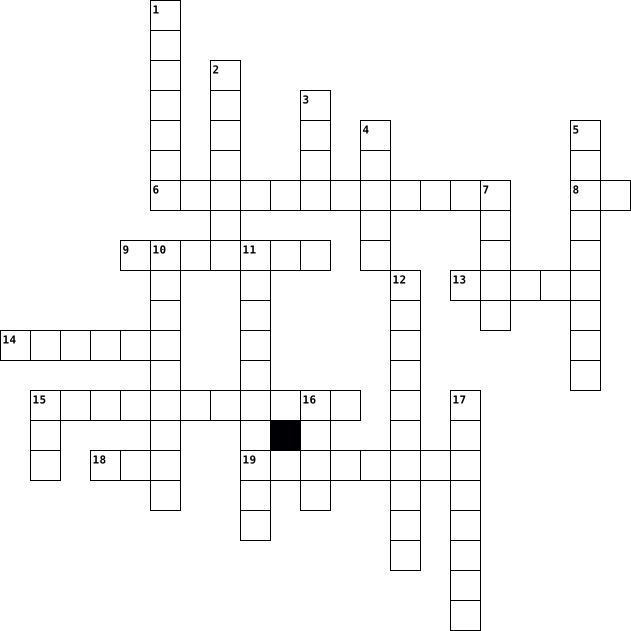
Across
- Chemical
- Electrical- Sound, Light, Thermal
- Heat energy
- travels in electromagnetic waves
- Mechanical-Sound
- Light-Electrical
- Energy can not be created or destroyed
- Chemical- Thermal, Radiant, Sound
Down
- Energy is motion.
- Energy is locked in the nucleus of an atom.
- Chemical
- Energy from vibrations in matter
- Stored energy
- Sound
- Electrical- Thermal, Sound, Mechanical
- Energy in moving objects
- Energy of moving electrons
- Nuclear energy
- Electrical
- Energy stored in bonds of molecules
20 Clues: Sound • Chemical • Chemical • Electrical • Heat energy • Stored energy • Nuclear energy • Mechanical-Sound • Light-Electrical • Energy is motion. • Energy in moving objects • Energy of moving electrons • Energy from vibrations in matter • travels in electromagnetic waves • Electrical- Sound, Light, Thermal • Chemical- Thermal, Radiant, Sound • Energy stored in bonds of molecules • ...
Types of Energy 2026-03-10

Across
- a type of electricity that can be turned on and off and can be a magnet
- the ability to do work
- the type of energy that is stored in a object
- the type of energy that is in a generator
- what energy is measured in
- the total energy of an isolated system remains constant
- the type of energy that food is
- energy that is in motion
Down
- the thing the doctors use to see if you have a broken bone
- the thing that is in a thunder storm thats not thunder
- another ward for heat
- the thing that you sit around camping
- The thing that heats your food in a microwave
- the potential energy is something stretchy
- synonym synenim for how tall someone o something is
- a very big type of bomb that is also energy
- a form of energy resulting from the flow of charged particles
- Gravitational potential energy
- the thing that people go to make money
19 Clues: another ward for heat • the ability to do work • energy that is in motion • what energy is measured in • Gravitational potential energy • the type of energy that food is • the thing that you sit around camping • the thing that people go to make money • the type of energy that is in a generator • the potential energy is something stretchy • ...