
forms of energy Crossword Puzzles
Crossword Puzzle 2015-12-22

Across
- Thermal energy that is transferred from matter at a higher temperature to matter at a lower temperature.
- Heat The amount of heat required to raise the temperature of 1 kilogram of a material by 1 kelvin.
- The change from the solid to the liquid state of matter.
- A material that does not conduct heat well.
- Current A current caused by the rising of heated fluid and sinking of cooled fluid.
- One of the three forms—solid, liquid, or gas—in which most matter on Earth exists.
- The measure of the average kinetic energy of the particles in matter.
- The transfer of heat from one particle of matter to another.
- Scale The temperature scale on which water freezes at 0 degrees and boils at 100 degrees.
Down
- The transfer of energy by electromagnetic waves.
- Scale The temperature scale on which zero is the temperature at which no more energy can be removed from matter.
- Zero The temperature at which no more energy can be removed from matter.
- The change from the liquid to the solid state of matter.
- of State The physical change of matter from one state to another.
- Scale The temperature scale on which water freezes at 32 degrees and boils at 212 degrees.
- The transfer of heat by the movement of currents within a fluid.
- A material that conducts heat well.
17 Clues: A material that conducts heat well. • A material that does not conduct heat well. • The transfer of energy by electromagnetic waves. • The change from the liquid to the solid state of matter. • The change from the solid to the liquid state of matter. • The transfer of heat from one particle of matter to another. • ...
Fossil Formation and What We Can Learn 2024-10-08

Across
- fossil fuel formed by decayed swam plants
- organisms in ___ water have a better chance to be fossilized
- Do organisms on land or in water have a better chance to become fossilized?
- Soft parts aren't often fossilized because they ___ or get eaten
- the hardened sediment that forms around an organism
- __ organism can become a fossil
- any natural preserved evidence of life
- petroleum and natural gas form from the remains of organisms in the ___
- process where continents moved from 1 place to another
- energy rich resources that form from the buried remains of organisms that were once alive
Down
- Coal was once the most used fossil fuel but has been replaced by ___.
- the 3D model that forms when sediment fills a mold and hardens
- Because fossils of temperate plants and animals have been found in Antarctica, we know it was once much ___
- knowing when an index fossil lived tells scientist the __ of the rock
- A whole body can get fossilized if the organism gets __ in a bog or amber
- sedimentary rock often forms in ____
- The oldest layer is on the bottom and the youngest layer on top is called the law of ___
- common fossils that lived during a short time and are found in many places
- Earth is about 4.6 ___ years old
- The ___ parts of an organism have a better chance to become fossilized
20 Clues: __ organism can become a fossil • Earth is about 4.6 ___ years old • sedimentary rock often forms in ____ • any natural preserved evidence of life • fossil fuel formed by decayed swam plants • the hardened sediment that forms around an organism • process where continents moved from 1 place to another • organisms in ___ water have a better chance to be fossilized • ...
Science Vocabulary 2024-02-08

Across
- compounds that are made up of two or more elements other than carbon,
- a simple sugar which is an important energy source in living organisms and is a component of many carbohydrates.
- large, complex molecules that play many important roles in the body.
- a process in living organisms involving the production of energy, typically with the intake of oxygen and the release of carbon dioxide from the oxidation of complex organic substances
- any of a large class of chemical compounds in which one or more atoms of carbon are covalently linked to atoms of other elements, most commonly hydrogen, oxygen, or nitrogen
- is the process by which green plants and some other organisms use sunlight to synthesize foods from carbon dioxide and water.
- the chemical element of atomic number 6, a nonmetal which has two main forms (diamond and graphite) and which also occurs in impure form in charcoal, soot, and coal
- converts the foods we eat into their simplest forms
Down
- a colorless, odorless reactive gas, the chemical element of atomic number 8 and the life-supporting component
- any very large molecule, usually with a diameter ranging from about 100 to 10,000 angstroms
- water
- acids a complex organic substance present in living cells, especially DNA or RNA, whose molecules consist of many nucleotides linked in a long chain
- fatty compounds that perform a variety of functions in your body.
- the source of energy for use and storage at the cellular level
- sugar molecules.
15 Clues: water • sugar molecules. • converts the foods we eat into their simplest forms • the source of energy for use and storage at the cellular level • fatty compounds that perform a variety of functions in your body. • large, complex molecules that play many important roles in the body. • compounds that are made up of two or more elements other than carbon, • ...
forms of goverment 2021-09-16

Across
- a government that has no limits
- political knowledge and political_______________ are the responsibilities of citizenship
- public ________________________ means the ability of citizens to oppose and run against the government
- government that is as close to a democracy as we can get according the Dahl
Down
- public ________________________means the amount of people that get to vote
- a government with specified limits on the power of its leader
- a government without limits except it is constrained by other institutions
- a form of government furthest away from democracy is a closed ___________________
- a government that is run by a small group of people
- caring and believing you can make a difference
- a government that is very responsive to its citizens
- a government with a single leader
12 Clues: a government that has no limits • a government with a single leader • caring and believing you can make a difference • a government that is run by a small group of people • a government that is very responsive to its citizens • a government with specified limits on the power of its leader • public ________________________means the amount of people that get to vote • ...
Forms of verbs 2023-05-27

Across
- freeze
- burn
- fight
- drive
- hold
Down
- forbid
- sing
- feed
- begin
- bite
- fall
11 Clues: sing • feed • burn • bite • fall • hold • begin • fight • drive • forbid • freeze
Forms of Government 2026-02-12

Across
- A system where the government owns most property and resources
- A system where the government helps manage services like healthcare or schools
- monarchy A government where a king or queen shares power with laws or a constitution
- system A system where lawmakers choose the leader of the government
- A government where people vote to choose their leaders
Down
- A government where one person has total control
- A government guided by religion or religious leaders
- A government where people elect others to represent them
- A system where people and businesses can own property and make money
- A government run by a small group of powerful people
- monarchy A government where a king or queen has all the power
11 Clues: A government where one person has total control • A government guided by religion or religious leaders • A government run by a small group of powerful people • A government where people vote to choose their leaders • A government where people elect others to represent them • monarchy A government where a king or queen has all the power • ...
Forms of transport 2026-04-30

Across
- It has two wheels. If you ride it, you need a helmet (casco).
- A type of train that moves under cities. There is an underground in Madrid, London, New York...
- People go on vacation in the sea here.
- This is used to fly in the sky.
- a boat used to transport people or objects.
- A small aircraft with rotating blades.
Down
- This is used to transport heavy things and is very slow.
- Very big families use this type of vehicle
- To disconnect something from electricity.
- To break something valuable.
- To defend something.
11 Clues: To defend something. • To break something valuable. • This is used to fly in the sky. • People go on vacation in the sea here. • A small aircraft with rotating blades. • To disconnect something from electricity. • Very big families use this type of vehicle • a boat used to transport people or objects. • This is used to transport heavy things and is very slow. • ...
Forms of Art 2026-06-03

Across
- Pretending to be a character in a story.
- Making music with a musical instrument.
- Making art from stone, wood, clay, or metal.
- Creating pictures with colors and a brush.
- Creating pictures with a pencil or pen.
- Making objects from clay.
Down
- Art that tells a story with pictures and speech bubbles.
- A place where people perform plays.
- Making music with your voice.
- Moving your body to music.
- Taking pictures with a camera.
11 Clues: Making objects from clay. • Moving your body to music. • Making music with your voice. • Taking pictures with a camera. • A place where people perform plays. • Making music with a musical instrument. • Creating pictures with a pencil or pen. • Pretending to be a character in a story. • Creating pictures with colors and a brush. • Making art from stone, wood, clay, or metal. • ...
MATTER AND ITS INTERACTIONS 2025-09-19

Across
- The transfer of thermal energy from one body to another.
- A characteristic of a substance that can be observed without changing its composition, like color or state.
- The process of a substance increasing in volume due to a rise in temperature.
- The process of a solid turning into a liquid.
- The process of a gas turning into a liquid.
Down
- The energy that comes from the temperature of matter.
- The distinct forms that different phases of matter take on, such as solid, liquid, or gas.
- The movement of energy from one object or system to another.
- A measure of the average kinetic energy of particles in a substance.
- A transformation from one state of matter to another, such as from solid to liquid.
- The process of a liquid changing into a gas.
- When something moves very fast repeatedly.
- The process of a substance decreasing in volume due to a drop in temperature.
- The process where a liquid turns into a solid.
14 Clues: When something moves very fast repeatedly. • The process of a gas turning into a liquid. • The process of a liquid changing into a gas. • The process of a solid turning into a liquid. • The process where a liquid turns into a solid. • The energy that comes from the temperature of matter. • The transfer of thermal energy from one body to another. • ...
HIGHER HUMAN REVISION 2021-05-26

Across
- ENHANCES IMMUNE SYSTEM IN VACCINES
- RECIEVE INFORMATION FROM NEURONES
- ENERGY REQUIRING METABOLIC PATHWAY
- PLAQUE BUILDS UP IN ARTERY
- SURFACE PROTEIN
- HIGH BLOOD PRESSURE
- CALCULATION OR WEIGHT USING WEIGHT AND HEIGHT
- LIQUID PART OF BLOOD
- MAKES MYELIN SHEATH
- SUBSTRATE HAS HIGH -------- FOR ACTIVE SITE
- ONLY BECOME CELL TYPE FROM WHICH IT ORIGINATED
- MUSCLE FIBRES FOR SHORT EXERCISE
- FINAL STAGE PROTEIN SYNTHESIS
- ENERGY RELEASING METABOLIC PATHWAY
Down
- MUSCLE FIBRES FOR ENDURANCE ACTIVITIES
- SAMPLE OF AMNIOTIC FLUID TAKEN TO PRODUCE KARYOYPE
- NEUROTRANSMITTER IN REWARD PATHWAYS
- SENDS BLOOD FROM HEART TO BODY
- SAMPLE OF PLACENTA TAKEN TO PRODUCE KARYOTYPE
- CONTROLS HEART RATE
- PROVIDES CONTEXT TO MEMORIES
- CLOT FORMS IN VEINS
- PLASMA WHICH SURROUNDS TISSUE CELLS
- BLOCKS RECEPTORS SO NATRUAL NEUROTRANSMITTERS CANT BIND
- CAUSES STORED GLYCOGEN TO TURN BACK INTO GLUCOSE
- MEASUREMENT OF ELECTRICITY RUNNING THROUGH HEART
- DNA GENES CONVERTED TO MRNA
27 Clues: SURFACE PROTEIN • CONTROLS HEART RATE • CLOT FORMS IN VEINS • HIGH BLOOD PRESSURE • MAKES MYELIN SHEATH • LIQUID PART OF BLOOD • PLAQUE BUILDS UP IN ARTERY • DNA GENES CONVERTED TO MRNA • PROVIDES CONTEXT TO MEMORIES • FINAL STAGE PROTEIN SYNTHESIS • SENDS BLOOD FROM HEART TO BODY • MUSCLE FIBRES FOR SHORT EXERCISE • RECIEVE INFORMATION FROM NEURONES • ENHANCES IMMUNE SYSTEM IN VACCINES • ...
Unit 4 Crossword Puzzle 2016-02-23

Across
- has matter and energy flowing in and out of it
- eat other animals
- web uses arrows to show who eats who
- a relationship where one organism benefits and one is unaffected
- besides sugar this is what needs to be used for cellular respiration
- the breakdown of nitrogen and carbon from dead plants and animals into other forms
- produce their own food
- each level in an energy pyramid
- the type of organisms who do photosynthesis
Down
- example of this is a tick living on a dog
- eat plants only
- the organism that gets eaten
- an example is an American grizzly bear in a specific forest
- eat dead organisms
- the cycle associated with fossil fuels
- a product of cellular respiration
- get food from consumer other organisms
- all populations of organisms that live in a single area
18 Clues: eat plants only • eat other animals • eat dead organisms • produce their own food • the organism that gets eaten • each level in an energy pyramid • a product of cellular respiration • web uses arrows to show who eats who • the cycle associated with fossil fuels • get food from consumer other organisms • example of this is a tick living on a dog • ...
Chemistry 4th nine-weeks bonus 2026-04-25

Across
- What is the minimal amount of energy that must be applied to a system to initiate a chemical change
- What is a substance that accepts a proton?
- A substance that speeds up a chemical reaction, without undergoing any chemical change itself, is called
- A substance that that can act as either a base or acid
- Reactions that require larger amounts of activation energy are called
- The transaction of a substance directly from gas to solid
- What is the device used to measure the energy absorbed or released as heat in a chemical reaction?
- Reaction where several reactants make a single product
- What is the transition of substance directly from solid to gas called
Down
- What is the point on a phase diagram in which two phases of a substance become indistinguishable from one another?
- What process can be used to find the concentration of a solution by comparing it to a solution of known concentration
- What is the measure of the average kinetic energy of the particles in a sample of matter?
- Reactions that release heat
- What is the change in heat of the products from the reactants called?
- Reaction where one element trades places with another element.
- Reaction where both elements in a reactant trade places
- A substance that increases the concentration of hydrogen ions in an aqueous solution.
- Law that states a direct relation between volume and temperature of a gas
- Reaction where one reactant forms multiple products
- - What is the total amount of energy called?
20 Clues: Reactions that release heat • What is a substance that accepts a proton? • - What is the total amount of energy called? • Reaction where one reactant forms multiple products • A substance that that can act as either a base or acid • Reaction where several reactants make a single product • Reaction where both elements in a reactant trade places • ...
Science MoY Review 2012-12-02

Across
- an idea about what will happen in the future
- a combination of two or more substances that do not form a new substance
- stored energy (ex. a roller coaster car at the top of a hill)
- the air that surrounds Earth
- a material that does not let heat energy or electricity pass through it easily
- consists of two different forms (kinetic & potential)
- energy of moving particles (ex. heart from an oven, toaster, sun)
- a complete path of conductors that an electrical current can flow through
- a force between two surfaces rubbing against each other
- the amount of matter in an object or substance
- the temperature at which a substance changes from a liquid to a gas
- the ability to do work
Down
- the bouncing back of light rays from a surface
- a push or a pull
- energy of motion (ex. bowling ball rolling down an alley)
- a force that pulls magnetic materials across a distance
- a property that can be observed, measured, or changed without changing the substance itself
- a form of energy that travels in waves (ex. light bulb, stars, computer screen)
- the process of changing from a gas to a liquid
- produced by vibrating objects (ex. loud speaker, radio, tv, wind)
- the change of water from one state to another as it moves between Earth's surface and the atmosphere
- the gas state of water
- to form a solution with another substance
- the area around a magnet where the force of magnetism can be felt
- water that falls to Earth's surface as rain, snow, sleet, or hail
- a mixture with one substance spread out so evenly in another substance that you cannot tell the two substances apart
- the process of changing from a liquid to a gas
- continuing without stop
- the material that allows heat energy or electricity to pass it easily
- a measure of the pull of gravity in an object
30 Clues: a push or a pull • the gas state of water • the ability to do work • continuing without stop • the air that surrounds Earth • to form a solution with another substance • an idea about what will happen in the future • a measure of the pull of gravity in an object • the bouncing back of light rays from a surface • the process of changing from a gas to a liquid • ...
Unit 1 - Molecules, Transport and Health 2024-06-16

Across
- all ______ are tertiary structures of proteins
- an example for a quaternary structure of proteins
- a monosaccharide that forms lactose
- Acronym that represents elements involved in proteins
- Are macromolecules made of many monomers joined together
- Two monosaccharides joined together
- which biomolecule is used for long-term energy
- _______ fatty acids can have one or more bonds
Down
- _______ fatty acids have only single bonds
- The most basic unit of carbohydrates
- what lipid contains a phosphate group
- Only biomolecule with nitrogen
- a polysaccharide found in plant cell wall
- formed from glycerol and three fatty acids
- which biomolecule is used for quick energy
- what is a large number of amino acids that are bonded together in a chain
16 Clues: Only biomolecule with nitrogen • a monosaccharide that forms lactose • Two monosaccharides joined together • The most basic unit of carbohydrates • what lipid contains a phosphate group • a polysaccharide found in plant cell wall • _______ fatty acids have only single bonds • formed from glycerol and three fatty acids • which biomolecule is used for quick energy • ...
Science Perfect 10 2019-02-19

Across
- a reaction that releases energy in the form of heat
- combination
- the minimum amount of energy required to start a chemical reaction
- a material that increases the rate of a reaction by lowering the activation energy
- the principle stating that matter is not created or destroyed during a chemical reaction
Down
- A chemical reaction that breaks down compounds into simpler products.
- a person or thing that takes the place of another
- a solid that forms from a solution during a chemical reaction.
- a reaction in which energy is absorbed
- A material that decreases the rate of a reaction
10 Clues: combination • a reaction in which energy is absorbed • A material that decreases the rate of a reaction • a person or thing that takes the place of another • a reaction that releases energy in the form of heat • a solid that forms from a solution during a chemical reaction. • the minimum amount of energy required to start a chemical reaction • ...
Renewable Energy - Chris Menchue 2016-04-05

Across
- cells producing an electric current directly from a chemical reaction
- an area of land with a group of energy-producing windmills or wind turbines.
- systems that use mirrors or lenses to concentrate a large area of sunlight, or solar thermal energy, onto a small area.
- use of mechanical and electrical equipment to enhance the conversion of solar energy to heat and electric power.
- the heating space that utilizes the design of the house or building so as trap solar heat when necessary.
- A fuel derived directly from living matter.
- specialized semiconductor diode that converts visible light into direct current.
Down
- chemical decomposition produced by passing an electric current through a liquid or solution containing ions.
- central building heating and/or cooling system that takes advantage of the relatively constant year-round ground temperature to pump heat to or from the ground.
- a turbine having a large vaned wheel rotated by the wind to generate electricity.
- a form of energy generated by the conversion of free-falling water to electricity.
- Energy derived from the heat of the earth.
- Renewable energy source from living or recently living plant and animal materials which can be used as fuel
- form of hydropower that converts the energy of the tides into electricity or other useful forms of power.
14 Clues: Energy derived from the heat of the earth. • A fuel derived directly from living matter. • cells producing an electric current directly from a chemical reaction • an area of land with a group of energy-producing windmills or wind turbines. • specialized semiconductor diode that converts visible light into direct current. • ...
Cell Parts 2023-09-08

Across
- Transforms energy from the sun into chemical energy in plant cells ONLY
- found in large numbers in the cytoplasm of living cells.
- Storage areas
- Control center of the cell
- a complex of vesicles and folded membranes within the cytoplasm
- a microscopic network of protein filaments and tubules in the cytoplasm of many living cells
- a microscopic membrane of lipids and proteins which forms the external boundary of the cytoplasm of a cell
Down
- Provides energy for the cell
- Jellylike fluid where many cell activities occur
- Control materials entering and leaving the cell
- Provides support in plant cells ONLY
- an organelle in the cytoplasm of eukaryotic cells containing degradative enzymes enclosed in a membrane.In plant cells ONLY!
12 Clues: Storage areas • Control center of the cell • Provides energy for the cell • Provides support in plant cells ONLY • Control materials entering and leaving the cell • Jellylike fluid where many cell activities occur • found in large numbers in the cytoplasm of living cells. • a complex of vesicles and folded membranes within the cytoplasm • ...
Chapter 7 vocabulary puzzle 2013-02-11

Across
- equal amount of water inside and out
- hallways in cell
- the basic unit of all forms of life
- storage unit
- make proteins
- makes quick energy
- less amount of water inside than out
Down
- diffusion of water
- spreading of something more widely
- kind of like air in a cell
- cell vacuole is released out of a cell with its own cell membrane
- state in which opposing forces are balanced
- postal office
- supporting layer around cell membrane
- recycling center
- security officers
- main office of a cell
- makes up the cell membrane
- support beams in cell
- more amount of water inside than out
20 Clues: storage unit • postal office • make proteins • hallways in cell • recycling center • security officers • diffusion of water • makes quick energy • main office of a cell • support beams in cell • kind of like air in a cell • makes up the cell membrane • spreading of something more widely • the basic unit of all forms of life • equal amount of water inside and out • ...
Science 2013-01-10

Across
- Science that deals with matter, energy, motion, and force.
- Science that deals with the composition and properties of substances.
- Knowledge, of facts or principles; knowledge gained by systematic study.
- Light produced by an object at very high temperatures
- Membrane forms a boundary between the inside and outside of a cell
- State of the atmosphere with respect to wind, temperature, cloudiness, moisture, pressure.
- Part of the eyeball that receives the image produced by the lens
- science of life or living matter in all its forms.
Down
- table/ A System displaying different elements sorted by the chemical elements, formerly arranged in the order of their atomic weights and now according to their atomic numbers.
- Chemical symbol "C"
- A system formed by the interaction of a community of organisms with their environment.
- Chemical symbol "K"
- malignant and invasive growth or tumor
- Genetic codes
- System A system of organs, tissues circulating blood and lymph through the body
- Light emitting _________
- the method of cell division
- Supports the microscope
18 Clues: Genetic codes • Chemical symbol "C" • Chemical symbol "K" • Supports the microscope • Light emitting _________ • the method of cell division • malignant and invasive growth or tumor • science of life or living matter in all its forms. • Light produced by an object at very high temperatures • Science that deals with matter, energy, motion, and force. • ...
Mark Tefft II 4A Vocab Chemistry 2016-10-31

Across
- Emissions from the cathode
- negative charged particles
- positively charged central core of an atom
- emission spectrum consisting of separate isolated lines
- position and momentum of a particle cannot be simultaneously measured with arbitrarily high precision
- 7 levels of the electron cloud
- smallest particle capable of chemical interactions
- quantum of all forms of electromagnetic radiation including light
- number of protons in the nucleus of an atom
Down
- subatomic particle with no charge
- concept that matter behaves like a wave
- actual or potential patterns of electron density that may be formed in an atom or molecule by one or more electrons
- Lowest energy state
- emission spectrum that consists of a continuum of wavelengths
- every compound is formed of elements combined in specific ratios by mass that are unique for that compound
- charge of +2
- energy emissions come only in certain amounts
- subatomic particle with a positive electric charge
18 Clues: charge of +2 • Lowest energy state • Emissions from the cathode • negative charged particles • 7 levels of the electron cloud • subatomic particle with no charge • concept that matter behaves like a wave • positively charged central core of an atom • number of protons in the nucleus of an atom • energy emissions come only in certain amounts • ...
Chemistry Vocabulary 2022-05-24

Across
- Neutral, 0, In Nucleus
- The amount of 3D space substance or object occupies (L x W x H) 2
- Very High temps, atoms lose their electrons 4
- A solid that forms & settles outside of a liquid mixture
- The difference between a measured value & its actual value 7
- Two or more forms of the same element can some Protons different neutrons
- How close or far off a given set of measurements are to each other 5
- How close or dispersed the measurement are to each other 6
- Mass per volume unit D=M/V
Down
- Positive, +1, In Nucleus
- Negative, -1, outside the nucleus
- Matter that cannot be separated into simpler materials. 3
- The size, length, or amount of something
- Degree of hotness or coldness of a substance
- The Quantity of matter in an object 1
- A unit of energy or heat 10
- The basic building block of chemistry 13
- A substance present at the beginning of the reaction
- The quantity of matter in a physical body 9
- Molecules that held firmly & vibrate
20 Clues: Neutral, 0, In Nucleus • Positive, +1, In Nucleus • Mass per volume unit D=M/V • A unit of energy or heat 10 • Negative, -1, outside the nucleus • Molecules that held firmly & vibrate • The Quantity of matter in an object 1 • The size, length, or amount of something • The basic building block of chemistry 13 • The quantity of matter in a physical body 9 • ...
Matter 2021-10-01

Across
- Any thing that takes up space and has mass
- A form of matter that we cannot see
- Heat transfer through electromagnetic waves
- A change that cannot go back to how it was
- A form of matter that forms to the container
- The act of taking away thermal energy
Down
- What makes up an object
- Heat transfer through touching
- Heat transfer through liquids or gases
- A form of matter that holds it's shape
- A change that can go back to the way it was
- Something that takes up open space
- The act of adding thermal energy
13 Clues: What makes up an object • Heat transfer through touching • The act of adding thermal energy • Something that takes up open space • A form of matter that we cannot see • The act of taking away thermal energy • Heat transfer through liquids or gases • A form of matter that holds it's shape • Any thing that takes up space and has mass • ...
Flow of Energy 2022-09-01

Across
- an organism that only eats plants
- an organism that eats everything
- the prefix for "itself"
- an organism that eats meat
- the prefix for different
- moving in a single direction
- a model representing many interconnected food chains and pathways for energy to flow
- this organism gets its energy by eating different organisms
Down
- an organism that eats dead things and returns their nutrients to the soil
- The prefix for "meat"
- the suffix for "to eat"
- the prefix for "life"
- the suffix for energy
- this organism makes its own food by using photosynthesis
- the prefix for "everything"
- each step in the food chain of food web
- the total mass of all living things at a trophic level
- the suffix for "the study of"
18 Clues: The prefix for "meat" • the prefix for "life" • the suffix for energy • the suffix for "to eat" • the prefix for "itself" • the prefix for different • an organism that eats meat • the prefix for "everything" • moving in a single direction • the suffix for "the study of" • an organism that eats everything • an organism that only eats plants • each step in the food chain of food web • ...
Flow of Energy 2022-09-01

Across
- an organism that only eats plants
- an organism that eats everything
- the prefix for "itself"
- an organism that eats meat
- the prefix for different
- moving in a single direction
- a model representing many interconnected food chains and pathways for energy to flow
- this organism gets its energy by eating different organisms
Down
- an organism that eats dead things and returns their nutrients to the soil
- The prefix for "meat"
- the suffix for "to eat"
- the prefix for "life"
- the suffix for energy
- this organism makes its own food by using photosynthesis
- the prefix for "everything"
- each step in the food chain of food web
- the total mass of all living things at a trophic level
- the suffix for "the study of"
18 Clues: The prefix for "meat" • the prefix for "life" • the suffix for energy • the suffix for "to eat" • the prefix for "itself" • the prefix for different • an organism that eats meat • the prefix for "everything" • moving in a single direction • the suffix for "the study of" • an organism that eats everything • an organism that only eats plants • each step in the food chain of food web • ...
Types of Energy 2022-01-31

Across
- Mechanical energy is the energy of position and ______.
- Thermal energy transfer by electromagnetic waves
- Sound energy travels through a _____ such as air.
- Today is an ______ release day!
- Energy that makes light, x-rays and microwaves
- The biggest source of electromagnetic energy
- Nuclear energy is released when an atom's _____ is broken apart.
- Energy from moving electrons
- The energy that comes from food
- The type of energy that you hear
Down
- Thermal energy transfer by moving air or liquid
- Thermal energy transfer by touching
- Chemical energy is found in the _____ of atoms in molecules.
- The energy of something that is moving
- Heat energy
- The movement between ________ causes electrical anergy
- The type of energy that comes from the nucleus of an atom
- Thermal energy is related to the _______ of movement of particles in an object.
18 Clues: Heat energy • Energy from moving electrons • Today is an ______ release day! • The energy that comes from food • The type of energy that you hear • Thermal energy transfer by touching • The energy of something that is moving • The biggest source of electromagnetic energy • Energy that makes light, x-rays and microwaves • Thermal energy transfer by moving air or liquid • ...
Types of Energy 2023-12-11

Across
- The ability to do work or cause change
- Energy of Motion
- Potential energy is energy while an object is _____________
- Energy stored in the bonds of molecules
- Radiant energy is also known as ______ Energy
- Potential energy can be increased by moving an object _______
- The Energy of Heat
- Sound Energy travels in _____
- The Law of __________ is when energy can't be created or destroyed
- The energy of moving electrons or electric charges
Down
- _______ Energy can be potential or kinetic energy
- Stored Energy
- Potential energy when something is getting pulled back
- The energy of moving electrons or electric charges
- Thermal energy is also known as ____ Energy
- An object in ______ is kinetic energy
- Energy of light; also referred to as light energy
- Electrical energy can travel through ____
- An example of Nuclear energy is the ___
- The energy of moving electrons or electric charges
20 Clues: Stored Energy • Energy of Motion • The Energy of Heat • Sound Energy travels in _____ • An object in ______ is kinetic energy • The ability to do work or cause change • Energy stored in the bonds of molecules • An example of Nuclear energy is the ___ • Electrical energy can travel through ____ • Thermal energy is also known as ____ Energy • ...
Types of Energy 2023-12-11

Across
- Electrical energy can travel through ____
- An example of Nuclear energy is the ___
- Radiant energy is also known as ______ Energy
- Potential energy is energy while an object is _____________
- The ability to do work or cause change
- _______ Energy can be potential or kinetic energy
- Energy stored in the bonds of molecules
- Energy of Motion
- Stored Energy
- Energy of light; also referred to as light energy
Down
- Sound Energy travels in _____
- Potential energy when something is getting pulled back
- The energy of moving electrons or electric charges
- The energy of moving electrons or electric charges
- An object in ______ is kinetic energy
- The Energy of Heat
- The energy of moving electrons or electric charges
- Potential energy can be increased by moving an object _______
- Thermal energy is also known as ____ Energy
- The Law of __________ is when energy cant be created or destroyed
20 Clues: Stored Energy • Energy of Motion • The Energy of Heat • Sound Energy travels in _____ • An object in ______ is kinetic energy • The ability to do work or cause change • An example of Nuclear energy is the ___ • Energy stored in the bonds of molecules • Electrical energy can travel through ____ • Thermal energy is also known as ____ Energy • ...
Types of Energy 2024-03-13

Across
- Energy that comes from moving water
- Energy that comes from moving air
- The element that is mainly used during nuclear reactions
- A fossil fuel that is in the form of a black liquid
- Energy sources that can run out
- Energy that comes from the warmth of Earth
- A highly flammable fossil fuel that doesn't pollute the air
- Energy sources that take millions of years to form
Down
- Greenhouse gas emitted from burning fossil fuels
- A device used to store solar energy
- A structure used to harness the power of the sun
- A structure used to harness the power of moving water
- Energy that comes from splitting atoms
- A fossil fuel that is in the form of a black rock
- Energy sources that do not run out
- A structure used to harness the power of the wind
- Energy that comes from living things
- Energy that comes from the sun
18 Clues: Energy that comes from the sun • Energy sources that can run out • Energy that comes from moving air • Energy sources that do not run out • A device used to store solar energy • Energy that comes from moving water • Energy that comes from living things • Energy that comes from splitting atoms • Energy that comes from the warmth of Earth • ...
Conservation of Energy 2025-01-06

Across
- Energy The energy stored in an object due to its position or state.
- A human-powered vehicle with two wheels, pedals, and handlebars, used for transportation, recreation, and exercise.
- Energy The sum of kinetic and potential energy in a system.
- The ratio of useful energy output to total energy input.
- A large natural elevation of the earth's surface, typically rising abruptly from the surrounding level; a large steep hill.
- The ability to do work or cause change.
- An amusement park ride consisting of a small train that travels along a winding, looping track at high speeds, often with steep drops and sharp turns.
Down
- Energy The energy of motion.
- A set of interacting or interdependent components forming an integrated whole.
- The principle that energy cannot be created or destroyed, only transformed from one form to another.
- Energy Energy caused by the movement of electrons.
- Energy The total energy of the particles in an object, often experienced as heat.
- Energy Energy carried by light.
- A seat suspended by ropes or chains, on which someone can sit and swing back and forth, typically found in playgrounds.
- Energy Energy stored in the nucleus of an atom.
- Energy Energy stored in the bonds of chemical compounds.
- A weight suspended from a pivot so that it can swing freely. Pendulums are often used in clocks to regulate the movement.
- The transfer of energy through motion.
18 Clues: Energy The energy of motion. • Energy Energy carried by light. • The transfer of energy through motion. • The ability to do work or cause change. • Energy Energy stored in the nucleus of an atom. • Energy Energy caused by the movement of electrons. • Energy Energy stored in the bonds of chemical compounds. • The ratio of useful energy output to total energy input. • ...
chemistry 2025-11-17

Across
- Collective term for double and triple bond. 〇〇 bond.
- Separation of covalent bond. Each atom gaining one electron from the shared pair to form two free radicals.
- Separation technique used to separate substances such as ink.
- Chemical reaction that absorbs energy (decrease temperature) is called 〇〇 energy.
- Name of electrode where reduction occur.
- Tendency of a substance to evaporate at normal temperature.
- Change in physical states solid to gas.
- Some elements have different structural forms(ex.carbon).
- The minimum amount of energy required to initiate a chemical reaction is called 〇〇 energy.
- Chemical reaction that burn something.
Down
- Separation techniques used to separate mixture of liquid having different boiling point.
- Name of electrode where oxidation occur.
- Molecular geometry of methane.
- Reaction in which monomers bond together.
- Collective term for oxidation and reduction reactions is called 〇〇 reaction.
- Vertical column of elements in the periodic table.
- Exception of Lewis structure appeared in ib syllabus, other than copper.
- Functional group alcohol+carboxylic acid.
- Change in physical states gas to liquid.
- Accurate appratus used for measuing liquid in titration.
- Component in a solution. Dissolved in a solvent.
- Temperature that substances start to convert into liqid is called 〇〇 point.
- Non-charged subatomic particle existing in nucleus.
- Process of losing electron
24 Clues: Process of losing electron • Molecular geometry of methane. • Chemical reaction that burn something. • Change in physical states solid to gas. • Name of electrode where oxidation occur. • Name of electrode where reduction occur. • Change in physical states gas to liquid. • Reaction in which monomers bond together. • Functional group alcohol+carboxylic acid. • ...
Amplify light waves crossword 2025-02-06

Across
- lowest frequency wave
- (UV) a type of invisible light that is beyond violet on the spectrum
- how often or fast something happens
- a curved line that shows the characteristics of a wave (shows wavelength and amplitude)
- to give off
- a pattern that describes how energy is carried from one place to another
- a type of wave that carries energy from one place to another even through empty space
- a range of different forms of light from radio to gamma rays (wavelengths large to small).
- the distance from one peak of a wave to the next
- the ability to make things move or change
Down
- a group of atoms joined together in a particular way
- to pass through (no change occurs)
- light ROYGBIV - red, orange, yellow, green, blue, indigo, violet
- anything that takes up space and has mass (solid, liquid, gas, plasma)
- to form a mental picture of something that cannot be seen
- to bounce off without absorbing
- the number of peaks in a wave that pass in a second
- highest frequency wave
- a cell that protects you from harmful UV rays
- source an object that emits light
- a type of light used to scan your body
21 Clues: to give off • lowest frequency wave • highest frequency wave • to bounce off without absorbing • to pass through (no change occurs) • how often or fast something happens • source an object that emits light • a type of light used to scan your body • the ability to make things move or change • a cell that protects you from harmful UV rays • ...
Life Processes Crossword 2022-11-04

Across
- cell appears to "rest"
- removal (exiting) of waste matter
- cytoplasm pinches in & cell membrane splits resulting in 2 new daughter cells
- food making process in plants
- all levels together; highest level of organization
- movement of substances other than water across membrane
- breaking down food into smaller pieces
- groups of similar cells organized to do a specific job
- R-R < G&O always "GO" together
- organisms are made of only one cell
- makes reproductive cells that have half the # of chromosomes as the parent cell (similar process to mitosis)
- nuclear membrane disintegrates
Down
- chromosomes line up in the middle of the cell
- chromosomes seperate
- output/by-products
- makes body cells for growth and repair that are identical to the parent cell (same # of chromosomes)
- input/raw materials
- different tissues working together to perform a specific job
- movement of water across membrane
- taking food into body or cell membrane
- releases the stored energy from food eaten or made into useable energy (ATP)
- useable energy
- are specialized so that all jobs in the body get done
- organisms are made of many cells
- nuclear membrane forms around each new nucleus
25 Clues: useable energy • output/by-products • input/raw materials • chromosomes seperate • cell appears to "rest" • food making process in plants • R-R < G&O always "GO" together • nuclear membrane disintegrates • organisms are made of many cells • removal (exiting) of waste matter • movement of water across membrane • organisms are made of only one cell • ...
Electricity Crossword 2024-04-11

Across
- The build up of an electrical charge on the surface of an object
- A machine that produces electricity
- The measure of electric pressure
- Found at the centre or nucleus of an atom
- A pathway made of wires that electrons can flow through
- A sealed container that holds chemicals which are used for producing electricity
- A device that emits light when an electric current is passed through it
- A machine that converts other forms of energy into mechanical energy which then creates motion
Down
- Charges produced or caused by static electricity
- The electrical device or devices that use electric power
- A substance capable of transmitting electricity and heat
- Incredibly tiny units of matter made up of protons and electrons
- Usable power or the resources used to produce usable power
- The flow of an electric charge
14 Clues: The flow of an electric charge • The measure of electric pressure • A machine that produces electricity • Found at the centre or nucleus of an atom • Charges produced or caused by static electricity • A pathway made of wires that electrons can flow through • The electrical device or devices that use electric power • ...
Cell Crossword 2024-11-08

Across
- living things
- forms passageways which proteins and other materials
- structure that forms passageways in which proteins
- Surrounds the cell of plants and some other organisms
- sac inside a cell that acts live a storage area
- Basic unit of structure and function in a living organism
Down
- captures energy from sunlight and uses to produce food
- breaks down large food particles into smaller ones
- rod-shaped cell structure that carries out a specific function
- an instrument that makes small objects look larger
- Control center
11 Clues: living things • Control center • sac inside a cell that acts live a storage area • breaks down large food particles into smaller ones • an instrument that makes small objects look larger • structure that forms passageways in which proteins • forms passageways which proteins and other materials • Surrounds the cell of plants and some other organisms • ...
Grade 10 Science (Plate Tectonic Theory) - Sir Greg 2023-09-28

Across
- a smaller earthquake that occurs in the same general area as a larger earthquake, following the mainshock.
- a series of large ocean waves generated by undersea earthquakes, volcanic eruptions, or landslides.
- vast, global ocean that surrounded Pangaea during the late Paleozoic and early Mesozoic eras.
- a linear depression on the Earth's surface that forms at divergent boundaries, where continental plates are pulling apart.
- a specific type of convergent boundary where one tectonic plate is forced beneath another into the Earth's mantle.
- an instrument used to detect and record the vibrations and ground motion caused by seismic waves during an earthquake.
- a type of plate boundary where two tectonic plates move toward each other.
- a measure of the size or energy released by an earthquake. It is typically quantified using the Richter scale or the moment magnitude scale (Mw). The higher the magnitude, the larger the earthquake's energy and potential for damage.
Down
- the point on the Earth's surface directly above the hypocenter (focus) of an earthquake.
- a supercontinent that existed during the late Paleozoic and early Mesozoic eras, approximately 335 to 175 million years ago.
- a long, underwater mountain range that forms at divergent boundaries in the ocean. It is characterized by volcanic activity and the creation of new oceanic crust as tectonic plates move apart.
- a type of plate boundary where two tectonic plates slide past each other horizontally in opposite directions.
- shaking or trembling of the Earth's surface resulting from the sudden release of energy in the Earth's crust.
- a type of plate boundary where two tectonic plates move away from each other.
- the actual point within the Earth where the earthquake originates. It is the source of the seismic energy and is typically located beneath the Earth's surface.
15 Clues: a type of plate boundary where two tectonic plates move toward each other. • a type of plate boundary where two tectonic plates move away from each other. • the point on the Earth's surface directly above the hypocenter (focus) of an earthquake. • vast, global ocean that surrounded Pangaea during the late Paleozoic and early Mesozoic eras. • ...
Vocabulary 2013-05-27

Across
- a chemical bond that forms when atoms share electrons
- the sum of the number of protons and neutrons in an atom
- a substance containing a hydrogen atom and produces hydronium ion when dissolved in water
- release energy as heat
- negatively charged particle that occupies the space in the atom outside the nucleus
- rate of change of velocity with time
- the amount of space occupied by a 3-d object
- an organic compound used by cells to store and release energy
- an attractive force between all objects that have mass
- a vector that represents an object's speed and direction
- a pulling force applied to an object stretch
- neutral particle located in the nucleus of an atom
Down
- a substance that can combine with hydrogen ions and produces hydroxide ions when dissolved in water
- a squeezing force applied to an object that can make an object shrink
- distance between any two crests or trough on a wave
- an influence tending to change the motion of an object or produce motion in a stationary object
- an atom that is no longer neutral because it has gained or lost electrons
- the ability of a material to transfer heart or electricity
- neutral particle that forms as a result of electron sharing
- a tentative explanation that can be tested with a scientific explanation
- occurred when a light ray changes direction as it passes from one material to another
- the return of light, heat or sound after striking a space
- absorbs energy as heat
- one or two or more atoms of an element having the same number of protons in their nuclei but a different number of neutrons
- mass per unit volume of a material
- neutral particle that has no charge
- a covalent compound made up of many small, repeating units linked together in a chain
27 Clues: release energy as heat • absorbs energy as heat • mass per unit volume of a material • neutral particle that has no charge • rate of change of velocity with time • the amount of space occupied by a 3-d object • a pulling force applied to an object stretch • neutral particle located in the nucleus of an atom • distance between any two crests or trough on a wave • ...
States of Matter 2026-04-29

Across
- or gas
- Able to be squeezed into a smaller space
- A change of state from solid to gas
- A substance with a fixed shape and volume
- A change of state from gas to solid
- A change of state from liquid to solid
- model The idea that all matter is made up of tiny particles
- A substance with no fixed shape or volume
- A change of state from solid to liquid
- Able to flow and change shape
Down
- or removed
- Unable to bend, flow or change shape
- of matter One of the forms that matter can take, such as solid,
- A substance with a fixed volume that flows and changes
- Unable to be squeezed into a smaller space
- A rapid change of state from liquid to gas, with vigorous
- A change of state from gas to liquid
- of state A transition between forms of matter when energy is
- A change of state from liquid to gas at the surface of a
- vapour Water in its gas state
- Any substance that takes up space and has mass
21 Clues: or gas • or removed • vapour Water in its gas state • Able to flow and change shape • A change of state from solid to gas • A change of state from gas to solid • Unable to bend, flow or change shape • A change of state from gas to liquid • A change of state from liquid to solid • A change of state from solid to liquid • Able to be squeezed into a smaller space • ...
Kalabe Tibebe electrical packet 2014-05-20

Across
- materials that contain electrons that can move more easily in the material.
- measure of how much electrical potential energy each electron can gain.
- the flow of electric charge.
- a circuit that has only one path for the electric current to follow.
- the flow of electric charge
- the measure of how difficult it is for electrons to flow trough a material.
- area that exists around every electric charge.
- a simple relationship among voltage,current,and resistance in a circuit.
Down
- a material in which electrons cannot move easily from place to place.
- a circuit that has more than one path for the electric current to.
- the force that all charged objects exert.
- the rapid movement of excess charge from place to another.
- a positively or negatively charged atom.
- the imbalance of electric charge on an object.
- the rate at which electrical energy is converted into other forms of energy.
15 Clues: the flow of electric charge • the flow of electric charge. • a positively or negatively charged atom. • the force that all charged objects exert. • the imbalance of electric charge on an object. • area that exists around every electric charge. • the rapid movement of excess charge from place to another. • ...
How Cellular Respiration Keeps You Alive 2026-05-15

Across
- The smaller molecules produced when glucose is split during glycolysis.
- The stage that produces the largest amount of ATP.
- The type of sugar used during cellular respiration.
- The innermost part of the mitochondria where the Krebs cycle occurs.
- The first stage of cellular respiration that occurs in the cytoplasm.
- The substance formed when oxygen combines with electrons and hydrogen ions.
Down
- High-energy molecules that carry electrons during cellular respiration.
- The waste gas released during cellular respiration.
- The process of breaking down food molecules to release energy.
- The fluid-filled area inside the cell where glycolysis occurs.
- The gas needed for most forms of cellular respiration.
- A high-energy electron carrier produced during cellular respiration.
- Tiny structures inside cells that perform specific jobs.
- The organelle where most cellular respiration takes place.
- The second stage of cellular respiration, also called the citric acid cycle.
15 Clues: The stage that produces the largest amount of ATP. • The waste gas released during cellular respiration. • The type of sugar used during cellular respiration. • The gas needed for most forms of cellular respiration. • Tiny structures inside cells that perform specific jobs. • The organelle where most cellular respiration takes place. • ...
Environmental Science 2022-01-20

Across
- the accumulation of a chemical by an organism from water and food exposure
- used in the manufacturing of aerosol sprays, blowing agents, solvents, and refrigerants
- device that harnesses the kinetic energy of some fluid
- practice of planting different crops sequentially on the same plot of land to improve soil health
- dark, organic material that forms in soil when plant and animal matter decays
- air pollution that reduces visibility
- composed of three oxygen atoms
Down
- occurs when an organism absorbs a substance at a rate faster than it can be eliminated
- energy source that can be used repeatedly and does not run out because it is naturally replaced
- Invisible rays that are part of the energy that comes from the sun
- a type of hazardous waste that can cause cancer
- a form of energy that harnesses the power of water in motion
- a method of tree removal where all trees in an area are removed
- a common heavy metal found in fish
- the science of controlling the growth, composition, health, and quality of forests
- Any substance or mixture of substances intended for preventing, destroying, or repelling any pest
- produced without the use of chemical fertilizers or pesticides
- this organism enhances soil quality
18 Clues: composed of three oxygen atoms • a common heavy metal found in fish • this organism enhances soil quality • air pollution that reduces visibility • a type of hazardous waste that can cause cancer • device that harnesses the kinetic energy of some fluid • a form of energy that harnesses the power of water in motion • ...
Types of Tissues 2019-09-09

Across
- The epithelial tissues are attached to a ___.
- Covers exposed surfaces; Lines internal passageways; Forms glands.
- Contains a variety of cells ranging from squamous to cuboidal to columnar cells.
- Collections of specialized cells and cell products that perform specific functions.
- Occurs where stress is severe, such as in the lining of the mouth, esophagus, and at the terminal surface of the tongue.
- Forms lining of heart and blood vessels
Down
- All the cells have contact with the basement membrane; Resembles layers seen in sections.
- Later of cube-shaped cells; Ducts of sweat glands.
- Lines body cavities
- Single layer of tall, cylindrical cells with the nuclei occurring at the base of the cells.
- Single layer of cube-shaped cells.
- Fills internal spaces; Supports other tissues; Transports materials; Stores energy.
- Single layer of flat cells.
- Closest to the epithelium
- Structures that produce fluid secretions
- Deeper portion of basement membrane
16 Clues: Lines body cavities • Closest to the epithelium • Single layer of flat cells. • Single layer of cube-shaped cells. • Deeper portion of basement membrane • Forms lining of heart and blood vessels • Structures that produce fluid secretions • The epithelial tissues are attached to a ___. • Later of cube-shaped cells; Ducts of sweat glands. • ...
Year 7 Science Revision 2024-12-10

Across
- Divides Earth’s history into eons, eras, and periods.
- The process plants use to make their own food.
- Large pieces of Earth's crust that move and interact.
- Includes all the water on Earth.
- The process driving evolution through survival of the fittest.
- How oxygen enters the blood from the lungs.
- Evidence of ancient life forms found in rock.
- Evidence for evolution showing similarities in body structures.
- The control center of a cell.
- The basic units of life.
Down
- The process that releases energy in cells.
- The region around a star where planets can support life.
- A natural satellite orbiting a planet.
- The study of embryo development across species.
- The organelle where photosynthesis occurs.
- The process of water moving through Earth's systems.
- Features inherited from ancestors but no longer useful.
- Produces energy in a cell.
- The process that wears down rocks and landforms.
- Tiny structures in the lungs where gas exchange occurs.
- A part of the water cycle requiring the Sun's energy.
- When one tectonic plate sinks beneath another.
- The layer of Earth that generates the magnetic field.
- Protects the body from infections.
- Caused by the Earth's tilt.
25 Clues: The basic units of life. • Produces energy in a cell. • Caused by the Earth's tilt. • The control center of a cell. • Includes all the water on Earth. • Protects the body from infections. • A natural satellite orbiting a planet. • The process that releases energy in cells. • The organelle where photosynthesis occurs. • How oxygen enters the blood from the lungs. • ...
Forms of Government 2018-01-05

Across
- single unified executive
- the titular executive
- name of the us legislature
- advisors to the head of the government
- legislature withdraws its support to the government
- head of the state
- uk legislature
Down
- head of the government
- between the legislature and the executive
- another name for the parliamentay form of government.
- nature of the parliamentary cabinet
11 Clues: uk legislature • head of the state • the titular executive • head of the government • single unified executive • name of the us legislature • nature of the parliamentary cabinet • advisors to the head of the government • between the legislature and the executive • legislature withdraws its support to the government • another name for the parliamentay form of government.
Unit 4 crossword 2024-02-16

Across
- The material that plants grow in
- the process plants use to convert light into stored energy in sugar molecules
- Where Cellular Respiration happens
- Negatively charged parts of an atom. They form the bonds between atoms
- Type of bond where one atom takes the electron from another
Down
- the process of converting food into energy
- Type of bond where electrons are “shared”
- Where Photosynthesis happens
- The connections between atoms in a molecule
- Multiple atoms bonded together
- Cannot be broken down into simpler forms of atoms
- The simplest part of an element
12 Clues: Where Photosynthesis happens • Multiple atoms bonded together • The simplest part of an element • The material that plants grow in • Where Cellular Respiration happens • Type of bond where electrons are “shared” • the process of converting food into energy • The connections between atoms in a molecule • Cannot be broken down into simpler forms of atoms • ...
Cell parts 2022-11-10

Across
- viscous fluid containing organelles
- forms ribosomes
- nucleus bound by a membrane
- found in plants, fungi, and many protists
- Solar energy capturing organelle
- hereditary material
- break down fuel molecules
Down
- first cell type on earth
- helps move substances in the cell
- contains cell contents
- contain water food and wastes
- control center of the cell
- smallest living thing
- packaging and shipping station of cell
- contain digestive enzymes
15 Clues: forms ribosomes • hereditary material • smallest living thing • contains cell contents • first cell type on earth • contain digestive enzymes • break down fuel molecules • control center of the cell • nucleus bound by a membrane • contain water food and wastes • Solar energy capturing organelle • helps move substances in the cell • viscous fluid containing organelles • ...
Cell parts 2022-11-10

Across
- viscous fluid containing organelles
- forms ribosomes
- nucleus bound by a membrane
- found in plants, fungi, and many protists
- Solar energy capturing organelle
- hereditary material
- break down fuel molecules
Down
- first cell type on earth
- helps move substances in the cell
- contains cell contents
- contain water food and wastes
- control center of the cell
- smallest living thing
- packaging and shipping station of cell
- contain digestive enzymes
15 Clues: forms ribosomes • hereditary material • smallest living thing • contains cell contents • first cell type on earth • contain digestive enzymes • break down fuel molecules • control center of the cell • nucleus bound by a membrane • contain water food and wastes • Solar energy capturing organelle • helps move substances in the cell • viscous fluid containing organelles • ...
Nutrition 2024-03-08

Across
- The type of fat produced when manufacturers add hydrogen to the fat molecules in vegetable oils.
- An abnormally low amount of water in the body.
- process of maintaining steady state inside the body
- A tough complex carbohydrate that the body cannot digest
- A nutrient made of carbon, hydrogen, and oxygen and that supplies energy.
- an interactive guide to healthful eating and active living
- a dissolved substance that regulates many processes in cells
- A fat that is liquid at room temperature and found in vegetable oils, nuts, and seeds
- nutrient that is made by living things, is required in small amounts, and assists in chemical reactions in the body.
- Nutrients the body uses to build and maintain its cells and tissues
- a set of recommendations for healthful eating and active living
Down
- Units of heat that measure the energy used by the body and the energy that foods supply to the body
- contain lots of vitamins and minerals relative to the number of calories
- A nutrient made of carbon, hydrogen, and oxygen; supplies energy, forms cells, maintains body temperature, and protects nerves.
- Nutrients that occur naturally in rocks and soil
- The chemical process by which the body breaks down food to release energy
- Substances in food that your body needs to grow, to repair itself, and to supply you with energy
- A waxy, fatlike substance that is found only in animal products.
- A condition in which the blood is deficient in red blood cells, in hemoglobin, or in total volume
- A fat that is solid at room temperature and found in animal fats, lards, and dairy products
- small units that are linked together chemically to form large protein molecules
21 Clues: An abnormally low amount of water in the body. • Nutrients that occur naturally in rocks and soil • process of maintaining steady state inside the body • A tough complex carbohydrate that the body cannot digest • an interactive guide to healthful eating and active living • a dissolved substance that regulates many processes in cells • ...
Chapter 4 + 9 Vocab. Puzzle 2018-02-28

Across
- Opposite of Proton
- Group 17
- The amount of protons in an element
- An atom that has lost or gained electrons
- opposite of cation
- Different forms of an element
Down
- electrons in the outer orbital
- Neutral particle in an atom
- The amount of matter in an element
- Can be called iron, silver, or gold
- opposite of anion
- Gas non reacting gases
- Opposite of Electron
- Can also be called a gas
- light energy particles
15 Clues: Group 17 • opposite of anion • Opposite of Proton • opposite of cation • Opposite of Electron • Gas non reacting gases • light energy particles • Can also be called a gas • Neutral particle in an atom • Different forms of an element • electrons in the outer orbital • The amount of matter in an element • Can be called iron, silver, or gold • The amount of protons in an element • ...
Chapter 4 lesson 2 and 3 vocab 2023-02-09

Across
- The energy of light and other forms of radiation with travels through space as waves
- The potential energy stored in the nucleus of an action
- Kinetic or potential energy associated with the motion or position of an object
- Potential energy that depends on the height of an object
- The total Kinetic and potential energy of all the partials of an object
Down
- Energy that an object has due to its motion
- A change from one form of energy to another
- A form of potential energy that is stored in chemical bond between atoms
8 Clues: Energy that an object has due to its motion • A change from one form of energy to another • The potential energy stored in the nucleus of an action • Potential energy that depends on the height of an object • The total Kinetic and potential energy of all the partials of an object • A form of potential energy that is stored in chemical bond between atoms • ...
EMP 2018-04-06

Across
- Wind energy is a form of renewable energy produced through machines that use wind as their power source
- radiant energy emitted by the sun.
- is thermal energy generated and stored in the Earth
- Nuclear power is the use of nuclear reactions that release nuclear energy to generate heat
- relating to or denoting the generation of electricity using flowing water
Down
- defined by any organic materials that can be burned and used as a source of fuel
- is a form of hydropower that converts the energy of the tides into electricity or other useful forms of power
- a rigid bar resting on a pivot, used to help move a heavy or firmly fixed load with one end when pressure is applied to the other
- strength or energy as an attribute of physical action or movement
- Mechanical advantage is a measure of the force amplification achieved by using a tool
- one of a set of toothed wheels that work together to alter the relation between the speed of a driving mechanism
- the branch of physics or technology concerned with the mechanical properties of gases
- activity involving mental or physical effort done to achieve a purpose or result
13 Clues: radiant energy emitted by the sun. • is thermal energy generated and stored in the Earth • strength or energy as an attribute of physical action or movement • relating to or denoting the generation of electricity using flowing water • defined by any organic materials that can be burned and used as a source of fuel • ...
Kalikeyas H. Electrical packet 2014-05-20

Across
- a material in which electrons cannot move easily from place to place.
- the rate at which electrical energy is converted into other forms of energy.
- the rapid movement of excess charge from place to another.
- the flow of electric charge
- measure of how much electrical potential energy each electron can gain.
- the measure of how difficult it is for electrons to flow trough a material.
Down
- the imbalance of electric charge on an object.
- the flow of electric charge.
- a positively or negatively charged atom.
- a circuit that has more than one path for the electric current to.
- area that exists around every electric charge.
- the force that all charged objects exert.
- a circuit that has only one path for the electric current to follow.
- materials that contain electrons that can move more easily in the material.
- a simple relationship among voltage,current,and resistance in a circuit.
15 Clues: the flow of electric charge • the flow of electric charge. • a positively or negatively charged atom. • the force that all charged objects exert. • the imbalance of electric charge on an object. • area that exists around every electric charge. • the rapid movement of excess charge from place to another. • ...
Vocabulary 2013-05-27

Across
- the amount of space occupied by a 3-d object
- one or two or more atoms of an element having the same number of protons in their nuclei but a different number of neutrons
- release energy as heat
- a substance containing a hydrogen atom and produces hydronium ion when dissolved in water
- occurred when a light ray changes direction as it passes from one material to another
- an attractive force between all objects that have mass
- a chemical bond that forms when atoms share electrons
- an influence tending to change the motion of an object or produce motion in a stationary object
- rate of change of velocity with time
- a substance that can combine with hydrogen ions and produces hydroxide ions when dissolved in water
- neutral particle that has no charge
- a covalent compound made up of many small, repeating units linked together in a chain
- a vector that represents an object's speed and direction
- negatively charged particle that occupies the space in the atom outside the nucleus
- a pulling force applied to an object stretch
Down
- neutral particle located in the nucleus of an atom
- the return of light, heat or sound after striking a space
- a tentative explanation that can be tested with a scientific explanation
- distance between any two crests or trough on a wave
- the sum of the number of protons and neutrons in an atom
- an organic compound used by cells to store and release energy
- neutral particle that forms as a result of electron sharing
- mass per unit volume of a material
- the ability of a material to transfer heart or electricity
- a squeezing force applied to an object that can make an object shrink
- absorbs energy as heat
- an atom that is no longer neutral because it has gained or lost electrons
27 Clues: release energy as heat • absorbs energy as heat • mass per unit volume of a material • neutral particle that has no charge • rate of change of velocity with time • the amount of space occupied by a 3-d object • a pulling force applied to an object stretch • neutral particle located in the nucleus of an atom • distance between any two crests or trough on a wave • ...
Chapters 6, 7 and 8 2025-03-26

Across
- this type of plant reduces photorespiration by separating carbon fixation and the calvin cycle in space
- this enzyme site is the region of an enzyme where the substrate binds and the reaction occurs
- the byproduct for this type of fermentation has brewing applications
- inorganic ions that temporarily bind to the enzyme
- this process includes light reactions and the calvin cycle
- this type of energy is from the sun and used in photosynthesis
- the fundamental particle of light and other forms of electromagnetic radiation
- RNA molecules that have catalytic activity, can facilitate chemical reactions
- this enzyme site is a separate binding site apart from the active site, where certain regulators bind to modulate enzyme activity
- the byproduct of this type of fermentation has implications for muscle function
- organic molecules that participate in the reaction but are left unchanged
- these reactions are spontaneous (-ΔG), the reactants have more free energy than products, and energy is released
- this process includes glycolysis, pyruvate breakdown, the citric acid cycle, and oxidative phosphorylation
- this law of thermodynamics states that energy cannot be created or destroyed
- the name of this type of plant refers to 3PG (3-Carbon), the first organic molecule made in the calvin cycle
Down
- this type of energy is stored in ATP and is used for various cellular processes
- can create its own food from inorganic substances, “producers”
- losing electrons
- these reactions are not spontaneous (+ΔG), the reactants have less free energy than products, and energy is required
- cannot produce its own food and must rely on other organisms for nutrition, “consumers”
- the sum of all chemical reactions occurring in an organism
- this type of plant reduces photorespiration by separating carbon fixation and the calvin cycle in time
- this is thermal energy generated by cellular processes, which helps to maintain body temperature
- the attachment of a phosphate group to a molecule or an ion
- this law of thermodynamics is related to entropy
- this happens to plants in hot and dry conditions where O2 competes with CO2 for binding with RuBP
- the chemical breakdown of a compound due to reaction with water
- gaining electrons
- the energy of movement, including muscle contractions
- biological catalysts that speed up chemical reactions
- this type of energy is seen in moving electrons and nerve impulses
31 Clues: losing electrons • gaining electrons • this law of thermodynamics is related to entropy • inorganic ions that temporarily bind to the enzyme • the energy of movement, including muscle contractions • biological catalysts that speed up chemical reactions • the sum of all chemical reactions occurring in an organism • ...
Energy Key Terms 2017-02-13

Across
- A collection of wind turbines used to create electricity.
- Plant materials and animal waste used especially as a source of fuel.
- The heat equal to 1/180 of the heat required to raise the temperature of one pound of water from 32 degrees Fahrenheit to 212 degrees Fahrenheit at a constant pressure of one atmosphere.
- The power of the atom.
- Oil.
- Any significant change in measures of climate, such as temperature, precipitation, or wind, lasting for an extended period of a decade or longer.
- The potential energy locked within a system and released during a chemical reaction.
- The ability to do work; types include heat, light, sound, chemical, nuclear, mechanical, electrical.
- External surroundings.
- Energy from the sun.
- Energy produced by mechanical devices, such as gears, pulleys, levers, or internal combustion engines.
- A result of a force moving an object a certain distance.
- Energy visible to the eye.
- A device that converts light into electricity.
- A natural fuel such as coal or gas formed in the geological past from the remains of living organisms.
- Any source of energy that is limited and cannot be replaced when it is used, such as oil, coal, and natural gas.
- Refers to the use of resources in ways that prevent their being depleted or permanently damaged.
- Energy can be neither created nor destroyed. There is a fixed amount of energy present in different forms that can be converted from one form to another, but energy does not go away.
- The phenomenon whereby the earth's atmosphere traps solar radiation, caused by the presence in the atmosphere of gases such as carbon dioxide, water vapor, and methane that allow incoming sunlight to pass through but absorb heat radiated back from the earth's surface.
- The process of controlling resources; for example, limiting soil erosion, reducing sediment in waterways, conserving water, and improving water quality.
Down
- Gas usually found within the vicinity of petroleum reserves.
- A propeller driven by the wind and connected to a generator. The wind makes it turn the generator, which produces electricity.
- Energy derived from wind by means of windmills or wind turbines.
- A measure of power equal to one joule of work per second.
- The energy that a piece of matter has because of its position or nature or because of the arrangement of parts.
- The first and simplest element on the periodic table. It is one of the most common elements in the galaxy.
- The energy possessed by a body as a result of its motion.
- The flow of electrical power or charge.
- A system by which electrical power is delivered throughout a region.
- The ratio of the useful energy delivered by a dynamic system to the energy supplied to it.
- The unit of energy or work in the MKS system of units, equal to the work done by a force of one Newton-meter.
- An energy source that will never run out.
- The use of flowing water from waterfalls and dams to produce electricity.
- A unit measure of work.
- A resource that cannot be replaced once used.
- Energy associated with the flow of electrons.
- Energy stored in the earth in the form of heat.
- A resource that can be replaced when needed.
- The rate at which work is performed or energy is expended.
- Energy in transit.
40 Clues: Oil. • Energy in transit. • Energy from the sun. • The power of the atom. • External surroundings. • A unit measure of work. • Energy visible to the eye. • The flow of electrical power or charge. • An energy source that will never run out. • A resource that can be replaced when needed. • A resource that cannot be replaced once used. • Energy associated with the flow of electrons. • ...
Science - Chapter 1 2023-09-18

Across
- a material that increases the rate of a reaction by lowering the activation energy
- the study of the properties of matter and how matter changes
- a combination of symbols that represent the elements in a compound
- a well-mixed mixture
- type of chemical reaction where two or more substances (elements or compounds) combine to make a more complex substance
- a reaction that absorbs energy in the form of heat
- a particle made of two or more atoms bonded together
- a number in front of a chemical formula that tells how many atoms or molecules of each reactant are present
- type of chemical reaction where reactant(s) are broken down into simpler products
- the amount of one material in a given volume of another material
- a material that releases energy when it burns
- a shorter, easier way to show chemical reactions using symbols instead of words
Down
- fire requires fuel, oxygen, and _____.
- the materials you have after a chemical reaction has occurred
- a solid that forms from solution during a chemical reaction
- numbers that show the number of atoms of an element in a molecule or the ratio of elements in a compound
- a reaction that releases energy in the form of heat
- a substance that cannot be broken down into any other substances by chemical or physical means
- biological catalysts that provide a surface on which reactions take place
- _______ of mass - matter cannot be created or destroyed. Total mass of the reactants must equal the total mass of the products
- a change that alters the form or appears of a material but does not convert the material into new substances
- (in chemistry) one or two letter set of characters used to identify an element
- a material that decreases the rate of a reaction
- the minimum amount of energy needed to start a chemical reaction
- type of chemical reaction where one element replaces another in a compound or two elements in different compounds trade places
- a change in matter that forms one or more new substances
- substance made of two or more elements chemically combined in a specific ratio
- the materials you have at the beginning of a chemical reaction
- a rapid reaction between oxygen and a fuel - results in fire.
- anything that has mass and takes up space
- two or more pure substances (elements, compounds, or both) that are in the same place but are not chemically combined
31 Clues: a well-mixed mixture • fire requires fuel, oxygen, and _____. • anything that has mass and takes up space • a material that releases energy when it burns • a material that decreases the rate of a reaction • a reaction that absorbs energy in the form of heat • a reaction that releases energy in the form of heat • a particle made of two or more atoms bonded together • ...
Chapter 2 Key Terms 2022-03-18

Across
- System A system in which no matter is allowed to enter or leave
- Anything that has mass and occupies space
- A biological catalyst that lowers the activation energy of reactions in cells
- Equation A short and easy way to show a chemical reaction using symbols
- A substance formed as a result of a chemical reaction
- Properties A characteristic of a substance that can be observed without changing the substance into another substance
- Reaction A reaction that releases energy in the form of heat
- A material that releases energy when it burns
- Properties A characteristic of a substance that describes it ability to change into different substances
- The amount of one material in a certain volume of another material
- A substance that enters into a chemical reaction
- A rapid reaction between oxygen and fuel that results in fire
- A material that decrease the rate of the reaction
Down
- A reaction in which one element replaces another in a compound or when two elements in different compounds trade places
- A chemical reaction that breaks down compounds into simpler products
- A number in front of a chemical formula in an equation that indicate how many molecules or atoms of each reactant and product involved in a reaction
- A solid that forms from a solution during a chemical reaction
- System A system in which matter can enter from or escape to the surroundings
- Change A change that alters the form or appearance of a material but does not change the material
- Energy The minimum amount of energy needed to get a chemical reaction started.
- Reaction A reaction that absorbs energy in the form of heat
- of Mass The principle stating that matter is not created or destroyed by a chemical reaction
- A material that increases the rate of a reaction by lowering the activation energy
- The study of the properties of matter and how matter changes
- A chemical reaction in which two or more simple substances combine to form one or more complex substances
- Reaction The process by which substances undergo chemical changes that result in new substances
26 Clues: Anything that has mass and occupies space • A material that releases energy when it burns • A substance that enters into a chemical reaction • A material that decrease the rate of the reaction • A substance formed as a result of a chemical reaction • Reaction A reaction that absorbs energy in the form of heat • ...
PSCI Terms 2023-01-13

Across
- a bond formed when atoms share one or more pairs of electrons
- negatively charged subatimic particle
- good conductors of heat and electricity
- a chemical reaction in which energy is released to the surroundings as heat
- a substance or molecule that participates in a chemical reaction
- an atom with same number of protons but different number of neutrons
- family group 8A
- the arrangement of atoms in a substance
- family group 7A
- a chemical formula that shows the number and kinds of atoms in a molecule, but not the arrangement of atoms
- a substance that forms in a chemical reaction
- equal to the number of protons
- the attractive force that holds atoms or ions together
Down
- brittle when struck
- electrons in the outer most energy level
- family group 2A
- greek prefix for 10
- positively charged subatomic particle
- an atom who has gained or lost an electron
- greek prefix for 2
- greek prefix for 1
- a chemical reaction that requires energy input
- an atom's center
- has characteristics of both metals and non metals
- family group 1A
- the attractive force between oppositely charged ions
26 Clues: family group 2A • family group 8A • family group 1A • family group 7A • an atom's center • greek prefix for 2 • greek prefix for 1 • brittle when struck • greek prefix for 10 • equal to the number of protons • negatively charged subatimic particle • positively charged subatomic particle • good conductors of heat and electricity • the arrangement of atoms in a substance • ...
Crossword Puzzle 2026-01-11

Across
- vascular plant that produce flowers and fruits
- plants that don't have a vascular system to carry water and nutrients throughout their bodies
- the main type of sugar in the blood and is the major source of energy for the body's cells
- have a vascular system to carry water and nutrients throughout their bodies
- structue that helps mosses attach to resourece
- a green substance that absorbs from sunlight
- The movement of a substance from an area of high concentration close high concentrationA large number of particles of one substance in a specific volume of another substance
- produce seeds incomes and have needle like leaves
- is a chemical used to support plant cell walls cellulose
- structure in sperm forms
- gymnosperm that are in pollution tolerant
Down
- make their own food by using energy nearby
- contain chlorophll and catptures energy from the sun
- root-like structures that grow at the base of many bryophytes, or mosses, hornworts and liverworts
- produce seeds that are not enclosed in a fruit
- the process in which plants make their own food
- a cylindrical, usually unbranched, trunk of spongy wood
- underground stem whose new leaves and roots grow
- green living things
- coarse powdery substance
20 Clues: green living things • coarse powdery substance • structure in sperm forms • gymnosperm that are in pollution tolerant • make their own food by using energy nearby • a green substance that absorbs from sunlight • vascular plant that produce flowers and fruits • structue that helps mosses attach to resourece • produce seeds that are not enclosed in a fruit • ...
Physics Units Puzzle by Jaylen Mitchell 2021-05-17

Across
- the energy of moving electrons
- conversions K H D (g,m,l) d c m
- the force that pulls objects toward Earth
- a push or pull
- force It can cause an object to start moving, stop moving, or change direction
- the law that states that energy cannot be created or destroyed but can be changed from one form to another
- energy the energy an object has due to its motion
- The tendency of an object to resist change in its motion
- When the only force acting on a object is gravity.
- The rate at which velocity changes change in speed/change in time distance/time/time; m/s2, km/hr/sec
- friction When two solid slides over each other.
- distance travelled per unit time change in distance/change in time m/s, km/hr, cm/s
- A littler longer than a yard
- When an object rolls over a surface.
- energy stored in the nucleus of an atom
- the energy of light and other forms of radiation
- The force on a person or object at the surface of a planet
- An object that is thrown
- the rule that in the absence of outside forces the total momentum of objects that interact does not change
- velocity This velocity, the greatest velocity the object reaches.
- System of Units A system based on the number ten
- the rate of doing work measured in watts (work/time)
- energy that is stored in readiness
- When an object moves through a fluid.
- speed in a given direction
- kinetic or potential energy associated with the motion or position of an object
- upward pushing force, which is greater than the downward pull of gravity, resulting in an upward direction
- The amount of mater in something, measured in grams, kg
Down
- the total kinetic and potential energy of all the particles in a sample of matter
- The force that one surface exerts on another against each other.
- force Equal forces on an object in opposite direction
- Objects falling through air experience is a type of fluid friction.
- potential energy that depends on the height of an object
- He proved experimentally that one of the basic quantum-mechanics laws
- any force that causes an object to move in a circle
- He discovered relativity, mass-energy equivalence and was instrumental in developing quantum theory
- energy stored in chemical bonds
- It's distance from another object is changing.
- In any situation on an object after all the forces acting on an object
- An X-ray crystallographer who made critical contributions to the understanding of the structure of DNA
- The energy of stretched or compressed objects
- a change from one form of energy to another
- the product of a body's mass and its velocity m x v
- Laws an object at rest willl stay at rest, and an object in motion will stay in motion at constant velocity unless acted upon by an unbalanced force
- the capacity to do work; measured in joules
- a unit of power equal to 1 joule per second
- coal, oil, natural gas, and other fuels that are ancient remains of plants and animals
- Point A place or object used for comparison to determine if something is in motion
- A unit of measure that equals the force required to accelerate one kilogram of mass at 1 meter per second per second
- Meitner The physicist who coined the term "Nuclear Fission"
50 Clues: a push or pull • An object that is thrown • speed in a given direction • A littler longer than a yard • the energy of moving electrons • conversions K H D (g,m,l) d c m • energy stored in chemical bonds • energy that is stored in readiness • When an object rolls over a surface. • When an object moves through a fluid. • energy stored in the nucleus of an atom • ...
Energy, Power, & Mechanics 2018-01-10

Across
- containing or operated by air or gas under pressure.
- one of a set of toothed wheels that work together to alter the relation between the speed of a driving mechanism
- a rigid bar resting on a pivot, used to help move a heavy or firmly fixed load with one end when pressure is applied to the other.
- heat energy generated and stored in the Earth.
- a renewable energy source from living or recently living plant and animal materials which can be used as fuel.
- the energy released during nuclear fission or fusion, especially when used to generate electricity.
Down
- the use of air flow through wind turbines to mechanically power generators for electric power.
- the ratio of the force produced by a machine to the force applied to it, used in assessing the performance of a machine.
- using a force to move an object a distance
- a form of hydropower that converts the energy of tides into useful forms of power
- strength or energy as an attribute of physical action or movement.
- electricity generated by hydropower
- radiant energy emitted by the sun.
13 Clues: radiant energy emitted by the sun. • electricity generated by hydropower • using a force to move an object a distance • heat energy generated and stored in the Earth. • containing or operated by air or gas under pressure. • strength or energy as an attribute of physical action or movement. • ...
Types of Energy 2020-10-09

Across
- Mechanical energy is the energy of position and ______.
- Thermal energy transfer by electromagnetic waves
- Sound energy travels through a _____ such as air.
- Today is an ______ release day!
- Energy that makes light, x-rays and microwaves
- The biggest source of electromagnetic energy
- Nuclear energy is released when an atom's _____ is broken apart.
- Energy from moving electrons
- The energy that comes from food
- The type of energy that you hear
Down
- Thermal energy transfer by moving air or liquid
- Thermal energy transfer by touching
- Chemical energy is found in the _____ of atoms in molecules.
- The energy of something that is moving
- Heat energy
- The movement between ________ causes electrical anergy
- The type of energy that comes from the nucleus of an atom
- Thermal energy is related to the _______ of movement of particles in an object.
18 Clues: Heat energy • Energy from moving electrons • Today is an ______ release day! • The energy that comes from food • The type of energy that you hear • Thermal energy transfer by touching • The energy of something that is moving • The biggest source of electromagnetic energy • Energy that makes light, x-rays and microwaves • Thermal energy transfer by moving air or liquid • ...
Conservation of Energy 2025-01-07

Across
- is the ability to do work.
- equal to 1 Joule per second.
- Energy: energy cannot be created or destroyed but it can zszs
- energy stored within the bonds between atoms of matter. It is used to keep atoms bonded together.
- applying a force to move or change something.
- Dissipation: loss of energy
- the rate at which energy is used (the amount of energy consumed per unit time).
- Machine: A machine that does work with only one movement of the machine
- the conversion of energy from one form to another.
- The movement of energy
- defined as the amount of energy exerted when a force of one newton is applied over a displacement of one meter.
Down
- Potential Energy (PEg): energy stored in an object as a result of its height.
- equals the energy consumed by a 1,000 watt device that is operating for 1 hour.
- energy that an object has due to its motion or position.
- energy stored within the nucleus of an atom. It is energy that keeps the subatomic particles of the atomic nucleus together.
- Ratio of output work to input work
- Energy (PE): stored energy of position
- Machine: Combination of two or more simple machines
- Energy (KE): energy of motion.
19 Clues: The movement of energy • is the ability to do work. • equal to 1 Joule per second. • Dissipation: loss of energy • Energy (KE): energy of motion. • Ratio of output work to input work • Energy (PE): stored energy of position • applying a force to move or change something. • the conversion of energy from one form to another. • ...
Science Crossword 2 2024-04-12

Across
- herbivores that eat plants and algae
- a circuit with 2 or more paths for the current
- an insect in its inactive immature form
- when light bounces off objects
- species that normally live and thrive in a particular ecosystem
- a state of matter with no definite share or volume
- a material or substance energy moves through
- movement between different forms of energy
- a factor that can change in an experiment or environment
- the energy that comes from electrical charges
Down
- a combination of 2 or more substances that are not chemically combined
- change of form or structure in an individual after hatching or birth
- the protection, preservation, and careful management of natural resources
- to rest or remain on the surface of a liquid
- a state of matter that has no definite share but a definite volume
- the rate at which the vibrations are produced
- the process of converting waste materials into useable materials
- carnivores that eat other carnivores
- the components or parts that make up a mixture of solution
- carnivores that feed on primary consumers
- two organisms that need each other for survival
- a circuit that has only 1 path for the current to follow
- an organism that only eats plants
- to prevent the passage of heat, electricity, or sound energy
24 Clues: when light bounces off objects • an organism that only eats plants • herbivores that eat plants and algae • carnivores that eat other carnivores • an insect in its inactive immature form • carnivores that feed on primary consumers • movement between different forms of energy • to rest or remain on the surface of a liquid • a material or substance energy moves through • ...
Grade 10 Science (Plate Tectonic Theory) - Sir Greg 2023-09-28

Across
- a smaller earthquake that occurs in the same general area as a larger earthquake, following the mainshock.
- a series of large ocean waves generated by undersea earthquakes, volcanic eruptions, or landslides.
- vast, global ocean that surrounded Pangaea during the late Paleozoic and early Mesozoic eras.
- a linear depression on the Earth's surface that forms at divergent boundaries, where continental plates are pulling apart.
- a specific type of convergent boundary where one tectonic plate is forced beneath another into the Earth's mantle.
- an instrument used to detect and record the vibrations and ground motion caused by seismic waves during an earthquake.
- a type of plate boundary where two tectonic plates move toward each other.
- a measure of the size or energy released by an earthquake. It is typically quantified using the Richter scale or the moment magnitude scale (Mw). The higher the magnitude, the larger the earthquake's energy and potential for damage.
Down
- the point on the Earth's surface directly above the hypocenter (focus) of an earthquake.
- a supercontinent that existed during the late Paleozoic and early Mesozoic eras, approximately 335 to 175 million years ago.
- a long, underwater mountain range that forms at divergent boundaries in the ocean. It is characterized by volcanic activity and the creation of new oceanic crust as tectonic plates move apart.
- a type of plate boundary where two tectonic plates slide past each other horizontally in opposite directions.
- shaking or trembling of the Earth's surface resulting from the sudden release of energy in the Earth's crust.
- a type of plate boundary where two tectonic plates move away from each other.
- the actual point within the Earth where the earthquake originates. It is the source of the seismic energy and is typically located beneath the Earth's surface.
15 Clues: a type of plate boundary where two tectonic plates move toward each other. • a type of plate boundary where two tectonic plates move away from each other. • the point on the Earth's surface directly above the hypocenter (focus) of an earthquake. • vast, global ocean that surrounded Pangaea during the late Paleozoic and early Mesozoic eras. • ...
Grade 10 Science (Plate Tectonic Theory) - Sir Greg 2023-09-28

Across
- a smaller earthquake that occurs in the same general area as a larger earthquake, following the mainshock.
- a series of large ocean waves generated by undersea earthquakes, volcanic eruptions, or landslides.
- vast, global ocean that surrounded Pangaea during the late Paleozoic and early Mesozoic eras.
- a linear depression on the Earth's surface that forms at divergent boundaries, where continental plates are pulling apart.
- a specific type of convergent boundary where one tectonic plate is forced beneath another into the Earth's mantle.
- an instrument used to detect and record the vibrations and ground motion caused by seismic waves during an earthquake.
- a type of plate boundary where two tectonic plates move toward each other.
- a measure of the size or energy released by an earthquake. It is typically quantified using the Richter scale or the moment magnitude scale (Mw). The higher the magnitude, the larger the earthquake's energy and potential for damage.
Down
- the point on the Earth's surface directly above the hypocenter (focus) of an earthquake.
- a supercontinent that existed during the late Paleozoic and early Mesozoic eras, approximately 335 to 175 million years ago.
- a long, underwater mountain range that forms at divergent boundaries in the ocean. It is characterized by volcanic activity and the creation of new oceanic crust as tectonic plates move apart.
- a type of plate boundary where two tectonic plates slide past each other horizontally in opposite directions.
- shaking or trembling of the Earth's surface resulting from the sudden release of energy in the Earth's crust.
- a type of plate boundary where two tectonic plates move away from each other.
- the actual point within the Earth where the earthquake originates. It is the source of the seismic energy and is typically located beneath the Earth's surface.
15 Clues: a type of plate boundary where two tectonic plates move toward each other. • a type of plate boundary where two tectonic plates move away from each other. • the point on the Earth's surface directly above the hypocenter (focus) of an earthquake. • vast, global ocean that surrounded Pangaea during the late Paleozoic and early Mesozoic eras. • ...
Chapter Two Vocabulary 2025-10-16

Across
- resource, natural resource that is being used up faster than it can be replaced by natural processes
- mixture of gases that forms a layer around Earth
- warming, scientific observation that Earth’s average temperature is increasing
- resource, part of the environment that supplies a material that is useful or necessary for the survival of living things
- precipitation, acidic rain or snow that forms when waste gases from automobiles and power plants combine with moisture in the air
- manufacturing new products out of used products
- something that has two different components performing essentially the same task
- contamination of the environment with substances that are harmful to life
Down
- smog, type of air pollution that is formed when sunlight reacts with waste gases from the burning of fossil fuels
- energy, thermal energy from within Earth
- resource, natural resource that can be replenished by natural processes at least as quickly as it is used
- act of meeting human needs in ways that ensure future generations also will be able to meet their needs
- resource, natural resource that will not run out, no matter how much of it people use
- to appear or happen
- layer, prevents most harmful ultraviolet (UV) radiation from reaching Earth
15 Clues: to appear or happen • energy, thermal energy from within Earth • manufacturing new products out of used products • mixture of gases that forms a layer around Earth • contamination of the environment with substances that are harmful to life • layer, prevents most harmful ultraviolet (UV) radiation from reaching Earth • ...
Joshua Wilson 2016-04-05

Across
- chemical decomposition produced by passing an electric current through a liquid or solution containing ions.
- a turbine having a large vaned wheel rotated by the wind to generate electricity.
- a specialized semiconductor diode that converts visible light into direct current
- a central building heating and/or cooling system that takes advantage of the relatively constant year-round ground temperature to pump heat to or from the ground.
- energy made by heat inside the Earth's crust.
- An earlier award for successful completion of an ICCP examination in systems development.
- a renewable energy source from living or recently living plant and animal materials which can be used as fuel.
Down
- uses mechanical and electrical equipment to enhance the conversion of solar energy to heat and electric power.
- a cell producing an electric current directly from a chemical reaction.
- a form of hydropower that converts the energy of the tides into electricity or other useful forms of power.
- the use of the sun's energy for the heating and cooling of living spaces.
- an area of land with a group of energy-producing windmills or wind turbines.
- a fuel derived directly from living matter.
- a form of energy generated by the conversion of free-falling water to electricity
14 Clues: a fuel derived directly from living matter. • energy made by heat inside the Earth's crust. • a cell producing an electric current directly from a chemical reaction. • the use of the sun's energy for the heating and cooling of living spaces. • an area of land with a group of energy-producing windmills or wind turbines. • ...
Science Vocabulary 2024-09-19

Across
- organisms that make their own food
- any liquid or frozen water that forms in the atmosphere and falls back to the earth
- Phication the process when a body of water is over-enriched with nutrients
- When liquid turns to gas
- harmful materials in the environment
- a process in which deep, cold water rises toward the surface
- the study of organisms and how they interact with the environment around them
Down
- the ability to do work
- cycle a chain of processes that produce and transform the rock types in Earth's crust
- resource a natural resource that can't be readily replaced by natural means at a pace quick enough to keep up with the consumption
- The ability to be maintained at a rate
- equilibrium a population with consistent allele frequencies over time
- cycle the movement of particles through a substance, transporting their heat energy from hotter areas to cooler areas
- key A simple tool used to identify a specific object
- Energy energy from the sun that is converted into thermal or electric energy
15 Clues: the ability to do work • When liquid turns to gas • organisms that make their own food • harmful materials in the environment • The ability to be maintained at a rate • key A simple tool used to identify a specific object • a process in which deep, cold water rises toward the surface • equilibrium a population with consistent allele frequencies over time • ...
Kalikeyas H. Electrical packet 2014-05-20

Across
- measure of how much electrical potential energy each electron can gain.
- a positively or negatively charged atom.
- the flow of electric charge
- the imbalance of electric charge on an object.
- the rapid movement of excess charge from place to another.
- a simple relationship among voltage,current,and resistance in a circuit.
- the rate at which electrical energy is converted into other forms of energy.
Down
- the flow of electric charge.
- a circuit that has more than one path for the electric current to.
- the measure of how difficult it is for electrons to flow trough a material.
- a circuit that has only one path for the electric current to follow.
- area that exists around every electric charge.
- a material in which electrons cannot move easily from place to place.
- the force that all charged objects exert.
- materials that contain electrons that can move more easily in the material.
15 Clues: the flow of electric charge • the flow of electric charge. • a positively or negatively charged atom. • the force that all charged objects exert. • the imbalance of electric charge on an object. • area that exists around every electric charge. • the rapid movement of excess charge from place to another. • ...
Ecosystem 2026-03-10

Across
- The ecological recovery process in an area where a disturbance has destroyed the community, but left the soil intact
- The total dry mass of all living organisms present within a specific trophic level or area.
- The process by which water vapor in the air cools and changes back into liquid water droplets, forming clouds.
- The non-living chemical and physical components of an ecosystem, such as sunlight, temperature, and water.
- Organisms that form the base of the food web and ecological pyramids by creating their own energy.
- Organisms, such as fungi and bacteria, that break down dead or decaying organic material.
- The process of ecological growth that occurs in an entirely new habitat completely devoid of soil
- The hierarchical feeding steps or positions in a food chain or energy pyramid.
Down
- Any liquid or frozen water (like rain, snow, or hail) that forms in the atmosphere and falls back to the Earth.
- Organisms that must eat other organisms to obtain energy and nutrients.
- Organisms that are capable of making their own food using light or chemical energy (also known as self-feeders).
- Organisms that cannot synthesize their own food and must rely on consuming other organisms for energy.
- The process by which moisture is carried through plants from roots to small pores on the underside of leaves, where it changes to vapor and is released to the atmosphere.
- An animal that gets its energy by eating only plants.
- The very first hardy organisms, such as lichens, to colonize a barren environment during ecological succession.
- An organism that eats a diet consisting of both plants and animals.
- A graphical representation showing the flow of energy from one trophic level to the next, with the largest amount at the base.
- The stage of the water cycle where liquid water turns into a gas or vapor due to heat.
- The living components of an ecosystem, including all plants, animals, and bacteria.
- An animal that gets its energy by eating only meat.
20 Clues: An animal that gets its energy by eating only meat. • An animal that gets its energy by eating only plants. • An organism that eats a diet consisting of both plants and animals. • Organisms that must eat other organisms to obtain energy and nutrients. • The hierarchical feeding steps or positions in a food chain or energy pyramid. • ...
photosynthesis 2023-09-26

Across
- The light dependent reactions are chemical reactions requiring electromagnetic energy
- having cells that lack membrane-bound nuclei
- disc shaped portion of chloroplast found in stacks called grana
- is a high energy electron carrier used in reduction
- loss of electrons
- the sugar that is the product of photosynthesis
- are photynthic roganisms wich convert light energy into chemical energy they need to develop grow and reproduce
- set of chemical reactions performed by the plants to reduce carbon dioxide and other compounds into glucose
Down
- ATP and NADPH are used to fix into carbohydrates takes place in the chloroplast stroma
- formation of compounds in plants aided by radiant energy
- a stack of thylakoids
- stands for adenosine triphosphate
- stands for adenosine diphosphate a product of the calvin cycle that is used in the light-independent reactions
- is the primary pigment used in photosynthesis. Plants contain two main forms of chlorophyll: a & b. Chlorophyll has a hydrocarbon tail that anchors it to an integral protein in the thylakoid membrane of the chloroplast. Chlorophyll is the source of the green color of plants and certain other autotrophs.
- organelle in which photosynthesis takes place
15 Clues: loss of electrons • a stack of thylakoids • stands for adenosine triphosphate • having cells that lack membrane-bound nuclei • organelle in which photosynthesis takes place • the sugar that is the product of photosynthesis • is a high energy electron carrier used in reduction • formation of compounds in plants aided by radiant energy • ...
Phase Changes 2022-01-31

Across
- vaporization (liquid to gas) that occurs only at the surface of a liquid under less than boiling temperatures; thermal energy is added
- the tiny atoms that make up all forms and states of matter
- solid turns into gas while skipping the liquid phase change; thermal energy is added
- the gas that we exhale and plants inhale, and it can be frozen into a solid to form dry ice, which sublimates back into its gaseous form when placed into warmer temperatures
- substance where its molecules move the fastest out the the 3 states of matter due to having the most thermal energy, and the molecules move all over the place randomly
- solid changes into liquid; thermal energy is added
Down
- liquid phase changes into gas; thermal energy is added
- when gas changes to liquid; thermal energy is lost
- when liquids turn into solids; thermal energy is lost
- a type of energy measured by temperature and is determined by the mass, the specific heat, and the average kinetic energy of the particles of an object
- vaporization (liquid to gas) that happens throughout the entire liquid once it has reached the boiling temperature of 100 degrees Celsius; thermal energy is added
- substance where the molecules are compact and close together with very little thermal energy and very little movement
- the process of when a form/state of matter changes into a different form/state of matter
- substance where its molecules have enough space and thermal energy to slide past each other while keeping a definite volume
14 Clues: when gas changes to liquid; thermal energy is lost • solid changes into liquid; thermal energy is added • when liquids turn into solids; thermal energy is lost • liquid phase changes into gas; thermal energy is added • the tiny atoms that make up all forms and states of matter • solid turns into gas while skipping the liquid phase change; thermal energy is added • ...
Science - Unit 1 Vocabulary Test 2024-09-24

Across
- Where all living things on Earth live
- A force that pushes on something
- Something made of one kind of thing
- Non-living things in nature
- A place where animals and plants live together
- Living things in nature
- Interaction When living things fight over resources
- Things that help us live, like water or food
- Resources Things that give us power, like the sun or wind
- The number of animals or plants in one area
- Resources Things we get from nature
- What makes things warm
- Water found underground
- A living thing like a plant, animal, or person
- Energy Heat energy
- A state of matter like a rock
- The smallest part of something
- Tiny groups of atoms stuck together
- The air around the Earth
- Resources Things that can run out, like food or water
Down
- Consumer An animal that eats other animals
- A small number written below a letter in science
- How hot or cold something is
- What everything is made of
- How much space something takes up
- Processes Changes that happen to Earth, like volcanoes or earthquakes
- A state of matter like water
- of Matter The different forms things can be in: solid, liquid, or gas
- Something we can keep using because it comes back
- When animals or plants try to get the same thing
- Substance Something made of only one kind of thing
- Solid with a shape like a diamond or snowflake
- A simple substance made of one kind of atom
- Something that can run out and can’t come back
- A state of matter like air
- Web How animals eat plants and each other to survive
- Energy Stored energy that can be used
- Consumer An animal that eats plants
- Energy Energy from moving
- Interaction When living things need each other
40 Clues: What makes things warm • Living things in nature • Water found underground • The air around the Earth • What everything is made of • A state of matter like air • Non-living things in nature • Energy Heat energy • How hot or cold something is • A state of matter like water • A state of matter like a rock • The smallest part of something • A force that pushes on something • ...
Latin / Greek Roots: The Sequel 2023-11-13

Across
- away (deny, repeal)
- last (a final demand)
- love (a person who loves to help others)
- language (the study of languages)
- I, self (self centered)
- life (life force, energy)
- different (having different forms)
- fly, wish (freely chosen)
- sleep (sleepwalk)
Down
- voice (loudly and repeatedly expressive)
- respectful (great respect)
- something written (a witty saying)
- speak (a curse)
- believe (gullible)
- peculiar, distinct (a peculiar characteristic)
- judge, lawyer (concerning the administration of justice)
- feed, grow (an organism that makes its own food)
- be silent (uncommunicative)
- follow (following in time)
- to write (a list of scholarly sources)
20 Clues: speak (a curse) • sleep (sleepwalk) • believe (gullible) • away (deny, repeal) • last (a final demand) • I, self (self centered) • life (life force, energy) • fly, wish (freely chosen) • respectful (great respect) • follow (following in time) • be silent (uncommunicative) • language (the study of languages) • something written (a witty saying) • different (having different forms) • ...
Science Terms 2024-05-16

Across
- The number of occurrences within a given period of time
- A fluid that takes the shape of the part of the container that it occupies, and that forms a distinct surface.
- A particle of an atom that carries a neutral charge.
- The low point in a wave.
- Having the same direction of vibration along their direction of travel.
- A final statement of the findings of an investigative process that is supported by investigative evidence (data).
- A disturbance that propagates through space and time, usually with transference of energy.
- The flow of electricity through a conductor.
- The state of matter characterized by resistance to deformation and changes of volume.
- The movement of atoms and molecules in matter. It is a form of kinetic energy produced from the random movements of those molecules.
- Any substance that undergoes a chemical change in a given reaction.
- a substance that has neither independent shape nor volume but tends to expand indefinitely
- A material that is a poor conductor of energy such as electricity or heat
- A stable unit of two or more atoms held together by chemical bonds.
- The energy of motion.
- Energy made available by the flow of electric charge through a conductor
Down
- The temperature at which a solid melts and becomes a liquid.
- The amount of mass per unit volume
- A wave that requires a medium to pass through.
- The highest point of a wave.
- Stored energy.
- The amount of the three-dimensional space enclosed within or occupied by an object, geometric solid, etc.
- The amount of matter inside an object.
- The distance between one peak or crest of a wave and the next peak or crest.
- A form of kinetic energy produced by the motion of atoms and molecules and may be transferred from one body or system to another due to a difference in temperature
- Energy liberated by a chemical reaction or absorbed in the formation of a chemical compound.
26 Clues: Stored energy. • The energy of motion. • The low point in a wave. • The highest point of a wave. • The amount of mass per unit volume • The amount of matter inside an object. • The flow of electricity through a conductor. • A wave that requires a medium to pass through. • A particle of an atom that carries a neutral charge. • ...
Chapter 2 Vocabulary 2022-03-21

Across
- a short way to show a chemcal reaction
- the reaction of two elements
- when matter can enter or leave
- a material that increase the rate of a reaction
- the result of the combined reaction
- a number placed in front of the chemical
- a material that increase the rate of burning.
- when one element replaces another
- a principle that provides an explanation of what happens when reactants combine
- a solid that forms from a chemical solution
- the minimum amount of energy needed to start a chemical reaction.
- the amount a substance is given to fill a certain volume.
Down
- a property that can be observed through telescopes but not touched
- the study of matter
- the substance you test with at the beginning
- a property that can be observed and touches
- a rapid reaction between 2 elements
- when energy is released
- when matter is not allowed to enter or leave.
- changes that require microscopes
- when energy is absorbed
- when elements break down
- an object used to decrease the rate of reaction
- changes that can be observed physically
- anything that takes up space
25 Clues: the study of matter • when energy is released • when energy is absorbed • when elements break down • the reaction of two elements • anything that takes up space • when matter can enter or leave • changes that require microscopes • when one element replaces another • a rapid reaction between 2 elements • the result of the combined reaction • a short way to show a chemcal reaction • ...
Science 2013-01-10

Across
- table/ A System displaying different elements sorted by the chemical elements, formerly arranged in the order of their atomic weights and now according to their atomic numbers.
- System A system of organs, tissues circulating blood and lymph through the body
- Chemical symbol "C"
- Part of the eyeball that receives the image produced by the lens
- A system formed by the interaction of a community of organisms with their environment.
- science of life or living matter in all its forms.
- Science that deals with matter, energy, motion, and force.
- Membrane forms a boundary between the inside and outside of a cell
Down
- malignant and invasive growth or tumor
- Chemical symbol "K"
- State of the atmosphere with respect to wind, temperature, cloudiness, moisture, pressure.
- Light produced by an object at very high temperatures
- Knowledge, of facts or principles; knowledge gained by systematic study.
- Genetic codes
- Science that deals with the composition and properties of substances.
- the method of cell division
- Light emitting _________
- Supports the microscope
18 Clues: Genetic codes • Chemical symbol "K" • Chemical symbol "C" • Supports the microscope • Light emitting _________ • the method of cell division • malignant and invasive growth or tumor • science of life or living matter in all its forms. • Light produced by an object at very high temperatures • Science that deals with matter, energy, motion, and force. • ...
Vitamins and Minerals 2015-11-11

Across
- helps the body make red blood cells
- found in vegetables and other dairy products/helps bones
- antioxidant/protects cells from damage
- turns carbs into energy and produces red blood cells
- prevents eye problems
- important for normal brain and nerve function
- helps the body keep balance of water in the blood and body
- helps blood clot/ dark leafy vegetables, cheese
- keeps your immune system strong/poultry, lean meat,etc
- helps red blood carry oxygen in body/meats,pork, fish etc
Down
- helps convert carbs into energy and necessary for heart
- strengthens bones by absorbing calcium
- part of every cell in the body/meats, dairy
- helps muscles and nerve function/ whole grains, nuts,etc
- makes red blood cells and is important for nerve cell function
- forms collagen,helps absorb iron, essential in bones,teeth,etc
- helps the body turn food into energy
17 Clues: prevents eye problems • helps the body make red blood cells • helps the body turn food into energy • antioxidant/protects cells from damage • strengthens bones by absorbing calcium • part of every cell in the body/meats, dairy • important for normal brain and nerve function • helps blood clot/ dark leafy vegetables, cheese • ...
Physics 2025-01-21

Across
- the amount of matter contained within an object
- the force that acts between two surfaces sliding past each other, always opposing the direction of motion of the object
- a unitless number that represents the ratio of the force of kinetic friction acting between two surfaces in relative motion to the normal force pressing those surfaces together
- the si unit of energy or work, the amount of energy transferred when a force of one newton acts on an object through a distance of one meter
- the metric system that is used universally as a standard for measurements
- a quantity that measures the rate at which work is done or energy is transformed
- a push or pull exerted on an object that can cause it to change its motion
- the total work done on an object by all forces acting on it
- the sum of all forces acting on an object
- the rate of change of velocity per unit of time
- a physical property or value that remains constant over time within a closed system
- the starting point or baseline in a system of measurement, essentially meaning "nothing" or the lowest possible value within that context
- a parameter that is a measure of a spring’s resistance to being compressed or stretched
- The length of a spring when no external forces are acting on it
- energy that has not been used or dissipated and is ready to be released
Down
- the change in an object's position
- the International System of Units (SI) unit for measuring force
- the distance an object moved per unit in time
- the sum of kinetic energy and all forms of potential energy
- a unit of measurement for power, or the rate at which energy is used or produced
- a physical quantity that is described solely by its magnitude (size), meaning it has no direction associated with it
- the energy of an object that is due to the object’s motion
- the potential energy stored in the gravitational fields of interacting bodies
- the net work done by all the forces acting on an object is equal to the change in the object’s kinetic energy
- the constant acceleration experienced by an object falling solely under the influence of gravity
- the energy available for use when a deformed elastic object returns to its original configuration
- the product of the component of a force along the direction of displacement and the magnitude of the displacement
- another unit of power 746 watts
- the energy associated with an object because of the position, shape, or condition of the object
- any form of energy that is not associated with the motion or position of an object
30 Clues: another unit of power 746 watts • the change in an object's position • the sum of all forces acting on an object • the distance an object moved per unit in time • the amount of matter contained within an object • the rate of change of velocity per unit of time • the energy of an object that is due to the object’s motion • ...
Biology 2013-09-13

Across
- your chromosomes
- Able to be changed or adapted
- Scientific study of life
- The end or finish of the process
- the rate at which you use materials and energy.
- The process of studying an object
- beliefs/values
- signal to which an organism responds
- scientific study of heredity
Down
- Evidence/information.
- change
- A process to investigate an object.
- Electronic tools used for everyday life.
- An educated guess
- you have doubts
- a personal point of view
- basic unit of all forms of life
- scientific reaction to stimulus
- an object increasing in physical size.
- The study of the natural world.
20 Clues: change • beliefs/values • you have doubts • your chromosomes • An educated guess • Evidence/information. • Scientific study of life • a personal point of view • scientific study of heredity • Able to be changed or adapted • basic unit of all forms of life • scientific reaction to stimulus • The study of the natural world. • The end or finish of the process • ...
Thermal Energy Transfer 2023-03-23

Across
- Anything that has volume and mass
- Heat transfer caused by the rising of hotter, less dense fluids and the falling of cooler, denser fluids
- Transfer of thermal energy that occurs in solids, liquids, and gases when two substances of different temperatures touch
- A group of interacting, interrelated, or interdependent elements forming a complex whole
- The total kinetic (motion) energy of the tiny particles that make up matter; the faster the particles move, the warmer the matter becomes
- Average kinetic energy of all the particles in a material; measured by a thermometer in degrees (usually degrees Celsius or degrees Fahrenheit)
Down
- Distinct forms of matter known in everyday experience: solid, liquid, and gas; also referred to as phases
- The thermal energy exchange between two objects of different temperatures; energy moves in a predictable pattern from warmer sites to cooler sites until all sites have reached the same temperature
- Known as the energy of motion
- The ability of a system to do work; required for changes to happen within a system
- The transfer of energy by the movement of electromagnetic waves or subatomic particles
- A substance that allows the flow of electrical charge or transfers thermal energy through matter
12 Clues: Known as the energy of motion • Anything that has volume and mass • The ability of a system to do work; required for changes to happen within a system • The transfer of energy by the movement of electromagnetic waves or subatomic particles • A group of interacting, interrelated, or interdependent elements forming a complex whole • ...
End of Year Laguna 2021-06-17

Across
- forms when electricity flows through coils of insulated wire wrapped around a piece of iron
- in air, the force exerted by air molecules on objects moving through air
- a material that cannot be replaced once used up
- rotates in a motor or generator
- a measure of the quantity of matter in an object
- a unit that describes measurement of force
- the type of speed that is the total distance divided by total time
- acts as a switch to reverse the flow of electricity or to turn electromagnets on and off in a motor
- gases that contribute to climate change
- a force acting between surfaces in contact
- the ability to apply force over a distance
- in a lightbulb makes light when heated by an electric current
- a measurement of the force on an object due to gravity
- to pull toward each other
- any factor that can be changed
- a designer or problem solver who tests ways to accomplish a goal
- energy stored in the position or condition of an object
- radiation that causes sunburn
- a force of attraction between masses
- produces motion from electricity
- Strayer Science
Down
- produces electricity from motion or kinetic energy
- to reach a conclusion based on evidence
- help wires make contact in motors and generators
- the change of velocity per unit of time
- converted into electrical energy by a solar cell
- the type of speed that does not vary over time
- in math or physics, the steepness of a line on a graph
- how far between two objects or locations
- the distance traveled by an object in a unit of time. Speed is reported in standard units of distance per unit time, such as meters per second or kilometers per hour
- an interaction between objects. A push or pull.
- giant ball of glowing gas powered by nuclear fusion
- the movement of energy from one location to another
- the location of an object
- usable power that can be transferred or converted to different forms, but cannot be created or destroyed
- generation of electricity using flowing water
- a force of attraction between masses
- a symbol that indicates change
- the sum of all the forces acting on a mass
- type of fuel such as oil, coal, or natural gas
- type of magnet attached to the casing of a motor or generator
- a unit of mass
42 Clues: a unit of mass • Strayer Science • the location of an object • to pull toward each other • radiation that causes sunburn • a symbol that indicates change • any factor that can be changed • rotates in a motor or generator • produces motion from electricity • a force of attraction between masses • a force of attraction between masses • to reach a conclusion based on evidence • ...
Cell Organelles 2018-11-05

Across
- fluid inside the cell
- important molecules
- prepares protein for these specific labs
- protects a cell from attack by harmful organisms
- protects the inside of the cell from the enviorment outside the cell
- contains genetic information
Down
- processes light energy, water and carbon dioxide to make glucose
- are often used for movement
- forms frame work inside the cell
- the cites of energy release
10 Clues: important molecules • fluid inside the cell • are often used for movement • the cites of energy release • contains genetic information • forms frame work inside the cell • prepares protein for these specific labs • protects a cell from attack by harmful organisms • processes light energy, water and carbon dioxide to make glucose • ...
Kalikeyas H. electrical packet 2014-05-20
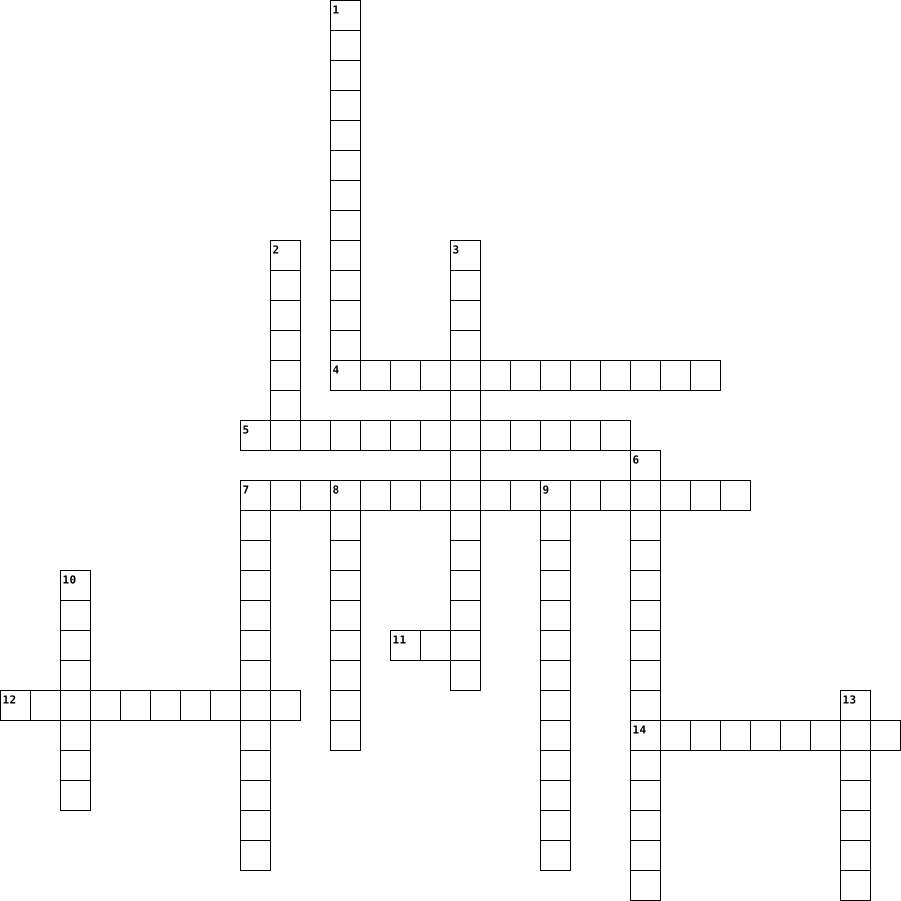
Across
- area that exists around every electric charge.
- the imbalance of electric charge on an object.
- the rapid movement of excess charge from place to another.
- a positively or negatively charged atom.
- the measure of how difficult it is for electrons to flow trough a material.
- a material in which electrons cannot move easily from place to place.
Down
- the force that all charged objects exert.
- the flow of electric charge
- the flow of electric charge.
- a circuit that has more than one path for the electric current to.
- the rate at which electrical energy is converted into other forms of energy.
- materials that contain electrons that can move more easily in the material.
- a circuit that has only one path for the electric current to follow.
- a simple relationship among voltage,current,and resistance in a circuit.
- measure of how much electrical potential energy each electron can gain.
15 Clues: the flow of electric charge • the flow of electric charge. • a positively or negatively charged atom. • the force that all charged objects exert. • area that exists around every electric charge. • the imbalance of electric charge on an object. • the rapid movement of excess charge from place to another. • ...
Vocab Crossword Puzzle 2022-04-01

Across
- of Earth that occurs when water vapor, carbon dioxide, and other gasses absorb and reradiate energy
- an unwanted changed in the environment caused by substances or forms of energy
- the warming of the surface and lower
- the layer of gases that surrounds the Earth
- describes a species that has died out completely
- a group of organisms of the same same species that live in a specific geographical area
- mostly solid, rocky part of Earth
- all water on Earth
- the ruin or alteration of a place inhabited by an ecological community
- the average consumption per person within a population
- pollution that comes from many sources rather than from a single, specific site
Down
- pollution that comes from a specific site
- any natural material or energy source that is used by humans, such as water, petroleum, minerals, forest, and animals
- all living things
- to reduce the serverity or impact or something
- the place where an organism usually lives
16 Clues: all living things • all water on Earth • mostly solid, rocky part of Earth • the warming of the surface and lower • pollution that comes from a specific site • the place where an organism usually lives • the layer of gases that surrounds the Earth • to reduce the serverity or impact or something • describes a species that has died out completely • ...
Cross word 2022-06-24

Across
- electromagnetic radiation that can be detected by the human eye
- is a decrease in speed as the body moves away from the starting point
- What is the force that prevents two solid objects from slipping or rolling over one another?
- identical to the nucleus of a normal
- is the branch of the movement that deals with the movement of objects
- the maximum displacement
- it forms energy that an object or a particle has by reason of its motion
- its formula is v=d/t
- on earth's surface is 9.8m/s
- unit of electric current
- is an elementary particle that is identical to the nucleus of the hydrogen atom
- has one path only and are connected end-to-end
- has vibrating particles
- Smallest unit of matter
- a closed loop through which charges can continuously move
- the unit that measures energy
Down
- its formula is d=vt+1/2at^2
- first law of Newton's
- device used to measure voltage
- The push and pull objects acts upon
- pleasing to the ear
- is the spatial period of a periodic wave
- the act or process of moving faster
- general quantity or size
- elementary particle with a negative charge
- The capacity or power to do work
- a quantity or aggregate of matter usually of considerable size
- the spreading of waves around obstacles
- its formula is p=mw
- Device that converts chemical energy to electric energy
- its formula is p=w/Delta t
- has multiple paths
32 Clues: has multiple paths • pleasing to the ear • its formula is p=mw • its formula is v=d/t • first law of Newton's • has vibrating particles • Smallest unit of matter • general quantity or size • the maximum displacement • unit of electric current • its formula is p=w/Delta t • its formula is d=vt+1/2at^2 • on earth's surface is 9.8m/s • the unit that measures energy • ...
The Boy Who Harnessed the Wind 2025-09-14

Across
- A group of people living in the same area who often work together to solve problems or share resources.
- A machine that converts mechanical energy into electrical energy.
- The ability to do work or cause change; it can take many forms, such as mechanical, electrical, or renewable energy.
- A new idea, method, or device created to solve a problem.
- Energy caused by the movement of electrons that can power lights, machines, and devices.
Down
- Related to motion or physical forces, often involving machines.
- A device that converts the kinetic energy of a fluid (such as wind or water) into rotational energy.
- A long period of time with little or no rainfall, causing shortages of water and food.
- A machine that converts the energy of the wind into mechanical energy to perform work.
- A supply of something that can be used when needed, such as materials, energy, or money.
10 Clues: A new idea, method, or device created to solve a problem. • Related to motion or physical forces, often involving machines. • A machine that converts mechanical energy into electrical energy. • A long period of time with little or no rainfall, causing shortages of water and food. • ...
SDGs 2025-09-05

Across
- Ensure healthy lives
- End poverty in all forms everywhere
- Reduce inequalities in and among different countries
- WorkandEconomicGrowth Promote sustained and inclusive economic growth and employment
- Build resilient infrastructure and inclusive and sustainable industrialization
- Promote peaceful and inclusive societies
Down
- Ensure sustainable consumption
- Achieve food security and improved nutrition
- Conserve and sustainably use the oceans, seas, and marine resources
- Ensure availability and sustainable management of water and sanitation
- Make cities inclusive, safe, resilient, and sustainable
- Achieve gender equality and empower women and girls
- Strengthen the means of implementation of the Global Partnership of the SDGs
- Energy Access to affordable, reliable and sustainable energy for all
- Take action to fight climate change
- Ensure inclusive and equitable education
- Protect, restore, and promote sustainable use of terrestrial ecosystems
17 Clues: Ensure healthy lives • Ensure sustainable consumption • End poverty in all forms everywhere • Take action to fight climate change • Ensure inclusive and equitable education • Promote peaceful and inclusive societies • Achieve food security and improved nutrition • Achieve gender equality and empower women and girls • Reduce inequalities in and among different countries • ...
Electromagnetic Spectum 2024-05-20

Across
- a form of electromagnetic radiation, similar to visible light. have higher energy and can pass through most objects, including the body.
- part of the electromagnetic spectrum.can detect it as heat.
- distance between corresponding points of two consecutive waves
- emit microwave energy, a longer wavelength, highlighted in yellow.
- Ray/ is electromagnetic radiation of the shortest wavelength and highest energy.
- a tiny particle that comprises waves of electromagnetic radiation
- Technology/ all equipment and programs that are used to process and communicate information.
- the number of occurrences of a repeating event per unit of time
Down
- shorter wavelengths than visible light. Purple.
- wavelengths shorter than other radio waves (as originally discovered) but longer than infrared waves.
- Spectrum/ the range of all types of EM radiation.
- Therapy/ also called radiotherapy, is a type of cancer treatment.
- a measurement of the amount of energy transferred by a wave
- Imaging/ X-ray technology is one of the oldest and most common forms of ______________ used by doctors.
- Waves/ a type of electromagnetic radiation, has a much longer wavelength than visible light.
15 Clues: shorter wavelengths than visible light. Purple. • Spectrum/ the range of all types of EM radiation. • part of the electromagnetic spectrum.can detect it as heat. • a measurement of the amount of energy transferred by a wave • distance between corresponding points of two consecutive waves • the number of occurrences of a repeating event per unit of time • ...
Unit 4 Biology Vocab 2025-10-08

Across
- A process used by plants and other autotrophs to capture light energy and use it to power chemical reactions that convert carbon dioxide and water into oxygen and energy-rich carbohydrates such as sugars and starches
- A series of steps in an ecosystem in which organisms transfer energy by eating and being eaten
- A material made up of decaying bits of plant and animal material
- An organism that relies on other organisms for its energy and food supply; also called a heterotroph
- An organism that obtains food by consuming other living things; also called consumers
- The process in which elements, chemical compounds, and other forms of matter are passed from one part of the biosphere to another
- An organism that is able to capture energy from sunlight or chemicals and use it to produce its own food from inorganic compounds; also called a producer
- The process by which bacteria converts nitrates into nitrogen gas
Down
- Each step in a food chain or food web
- A process of converting nitrogen gas into nitrogen compounds that plants can absorb and use
- A chemical substance that an organism needs to sustain life
- First producer of energy-rich compounds that are later used by other organisms
- The total amount of living tissue within a given trophic level
- A model of the relative amounts of energy or matter contained within each trophic level in a given food chain or food web
- A network of complex interactions formed by the feeding relationships among the various organisms in an ecosystem
- A process in which chemical energy is used to produce carbohydrates
16 Clues: Each step in a food chain or food web • A chemical substance that an organism needs to sustain life • The total amount of living tissue within a given trophic level • A material made up of decaying bits of plant and animal material • The process by which bacteria converts nitrates into nitrogen gas • ...
Chemistry Revision 2013-06-16

Across
- Uncharged subunit of an atom.
- Energy absorbed by an electron.
- The number of protons (or electrons) of an atom.
- Unstable state of an atom.
- This substance tastes sour and sometimes bitter.
- These metals are in a group of their own because they can form many charges and have different properties.
- Energy released by an electron as light.
- Detergents are an example of this substance.
- A positively charged ion.
Down
- Normal state of an atom (neutral).
- Negative subunit of an atom.
- Elements that lose one electron belong to this group and are metals.
- Total number of neutrons and protons of an atom.
- An ion that contains more than one atom.
- Positive subunit of an atom.
- Two or more forms of the same element so that they have the same atomic number but different mass number.
- A negatively charged ion.
- Elements that are inert belong to this group of gases.
18 Clues: A positively charged ion. • A negatively charged ion. • Unstable state of an atom. • Negative subunit of an atom. • Positive subunit of an atom. • Uncharged subunit of an atom. • Energy absorbed by an electron. • Normal state of an atom (neutral). • An ion that contains more than one atom. • Energy released by an electron as light. • Detergents are an example of this substance. • ...
Earth Systems and Structure 2016-12-20

Across
- fish live in this sphere
- the layer of rock that forms Earth's outer surface or skin.
- forces that erode mountains
- a layer of molten metal and is liquid
- the main source of energy that drives the Earth system
- indirect evidence that geologists use to study the Earth.
- a dense sphere of solid iron and nickel
Down
- an erupting volcano
- the crust that lies beneath the ocean
- the layer of hot, solid material between the Earth's crust and core.
- the sphere that contains humans
- a coarse, light colored rock found in the continental crust.
- the ability to do work
13 Clues: an erupting volcano • the ability to do work • fish live in this sphere • forces that erode mountains • the sphere that contains humans • the crust that lies beneath the ocean • a layer of molten metal and is liquid • a dense sphere of solid iron and nickel • the main source of energy that drives the Earth system • indirect evidence that geologists use to study the Earth. • ...
Ch.2 Cross Word Puzzle 2014-10-09

Across
- Single stranded acid
- Chain of molecules called amino acids
- It is a mixture of which one or more substances are evenly distributed
- Attraction between substances of different kinds
- Smallest unit of matter that cannot be broken down by chemical means
- Compound made of carbon, Hydrogen, and oxygen atoms
- Ability to change or move matter
- Attraction between substances of the same kind
- Compound that reduces the concentration of hydrogen
- Group of atoms held together by a covenant bond
Down
- acid: Small chain of nucleotides
- Main energy currency of cells
- Substance made of joined atoms of two or more elements
- Sugar,Phosphate,Oxygen
- Compound that when dissolved in water forms hydrogen bonds
- Double stranded acid
- Substance made of only one kind of atom
- Acids: Building blocks of protein
- A atom or molecule that has gained or lost one or more of its electrons
- Non-polar molecules that are not dissoluble in water
20 Clues: Single stranded acid • Double stranded acid • Sugar,Phosphate,Oxygen • Main energy currency of cells • acid: Small chain of nucleotides • Ability to change or move matter • Acids: Building blocks of protein • Chain of molecules called amino acids • Substance made of only one kind of atom • Attraction between substances of the same kind • ...
Cells and Respiration Crossword 2021-08-09

Across
- The basic building blocks of all living things.
- A thick solution that fills each cell and is enclosed by the cell membrane.
- Generates most of the chemical energy needed to power the cell's biochemical reactions.
- A colourless, odourless gas produced by burning carbon and organic compounds and by respiration.
- Light from the sun.
- A type of lens that is attached to a variety of optical devices such as telescopes and microscopes.
- The part of the microscope where you put the slide.
- A subcellular structure that has one or more specific jobs to perform in the cell.
Down
- The strength required for sustained physical or mental activity.
- An optical instrument used for viewing very small objects, such as mineral samples or animal or plant cells.
- The process by which plants use sunlight, water, and carbon dioxide to create oxygen and energy.
- Convert light energy into relatively stable chemical energy by the photosynthetic process.
- A colourless, odourless reactive gas, the chemical element of atomic number 8 and is what animals breathe.
- A membrane-bound organelle that contains the cell's chromosomes.
- A chemical reaction that happens in all living cells, including plant cells and animal cells.
- Is found in all cells and separates the interior of the cell from the outside environment.
- A colourless, transparent, odourless liquid that forms the seas, lakes, rivers, and rain.
- A membrane-bound cell organelle which is In animal cells and plant cells
- A structural layer surrounding some types of cells just outside the cell membrane. It can be tough, flexible, and sometimes rigid.
- A simple sugar which is an important energy source in living organisms and is a component of many carbohydrates.
20 Clues: Light from the sun. • The basic building blocks of all living things. • The part of the microscope where you put the slide. • The strength required for sustained physical or mental activity. • A membrane-bound organelle that contains the cell's chromosomes. • A membrane-bound cell organelle which is In animal cells and plant cells • ...
Chapter 3 Vocab 2024-09-19

Across
- The diffusion of water through the membrane
- The process by which cells release energy from food
- breaks down molecules from food to release energy
- holds the cell together, and protects it
- The diffusion of certain molecules through the cell membrane without help, no cell energy
- a form of chemical energy
- the process of building up larger molecules from smaller ones, when water and oxygen is stored
- the cell’s control center
- Carries food, waste products and hormones
- Supports, protects and holds the body together
- These structures help plants make their food.
- a clear, jelly-like substance within a cell
- When a cell reproduces by dividing its nucleus and forming two new cells
- a gel-like substance containing water, salt, and nutrients obtained from food
- thick strands that contain DNA
- groups of cells that work together to do a certain job
Down
- Coordinates body functions in addition to carrying messages to and from the brain and spinal cord
- tiny pores or holes in the cell membrane that allow some molecules to diffuse into the cell
- when molecules of a substance move from an area that is crowded to an area that is less crowded
- Groups of tissues that work together to do a certain job
- The chemical process in which cells receive nutrients for growth and reproduction
- Covers and protects body surfaces and internal organs
- structures inside a cell that float in the cytoplasm
- Contracts, when stimulated, to produce motion
- materials move from areas of high concentrations to low requiring energy
- where food, water, and waste material is stored within a cell
- the process of breaking down larger molecules into smaller ones, energy is released
- forms cells that are not identical to the parent cell
28 Clues: a form of chemical energy • the cell’s control center • thick strands that contain DNA • holds the cell together, and protects it • Carries food, waste products and hormones • The diffusion of water through the membrane • a clear, jelly-like substance within a cell • Contracts, when stimulated, to produce motion • These structures help plants make their food. • ...
Combustion 2025-01-06

Across
- Fuels: Fuels formed from the remains of ancient plants and animals, such as coal, oil, and gas.
- Machines that convert energy from combustion into mechanical motion.
- The process where a liquid forms solid crystals, often by cooling or evaporating.
- A small flash of light or heat that can start combustion.
- A rapid and violent release of energy caused by combustion or other reactions.
- Fuels made from living organisms or their waste, like ethanol or biodiesel.
- Fuels: Fuels made from resources that can be replenished, like biofuels.
- Pop Sound: The noise made when hydrogen gas burns quickly in the presence of a flame.
- A chemical reaction where a substance reacts with oxygen, releasing energy as heat and light.
- A reaction where a substance combines with oxygen, often releasing energy.
Down
- Reacting with great energy or intensity, like a fire burning strongly.
- A historical, now-discredited theory that substances released a material called "phlogiston" during burning.
- Fuels: Fuels from finite resources, like coal or oil, which cannot be replaced once used.
- Energy released from reactions involving atomic nuclei, such as in nuclear power plants.
- A compound made of hydrogen and carbon atoms, such as methane or petrol.
- The visible, glowing part of a fire caused by combustion.
- The environment around a reaction, including air, temperature, and materials nearby.
- Harmful substances released into the environment, often as a by-product of combustion.
- A compound formed when an element reacts with oxygen, such as carbon dioxide.
- of Conservation of Mass: The principle stating that mass cannot be created or destroyed in a chemical reaction.
- Decomposition: A reaction where heat causes a substance to break down into simpler substances.
- A reaction that releases heat to the surroundings.
22 Clues: A reaction that releases heat to the surroundings. • The visible, glowing part of a fire caused by combustion. • A small flash of light or heat that can start combustion. • Machines that convert energy from combustion into mechanical motion. • Reacting with great energy or intensity, like a fire burning strongly. • ...
Energy and the Environment Vocab 2016-04-04

Across
- A natural fuel such as coal or gas formed in the geological past from the remains of living organisms.
- The energy that a piece of matter has because of its position or nature or because of the arrangement of parts.
- Energy visible to the eye.
- The unit of energy or work in the MKS system of units, equal to the work done by a force of one Newton-meter.
- The use of flowing water from waterfalls and dams to produce electricity.
- Plant materials and animal waste used especially as a source of fuel.
- The potential energy locked within a system and released during a chemical reaction.
- A collection of wind turbines used to create electricity.
- The energy possessed by a body as a result of its motion.
- Gas usually found within the vicinity of petroleum reserves.
- A system by which electrical power is delivered throughout a region.
- Any source of energy that is limited and cannot be replaced when it is used, such as oil, coal, and natural gas.
- Energy can be neither created nor destroyed. There is a fixed amount of energy present in different forms that can be converted from one form to another, but energy does not go away.
- A resource that can be replaced when needed.
- The power of the atom.
- Energy from the sun.
- Oil.
- A measure of power equal to one joule of work per second.
- The ability to do work; types include heat, light, sound, chemical, nuclear, mechanical, electrical.
- Energy in transit.
- Energy stored in the earth in the form of heat.
Down
- The heat equal to 1/180 of the heat required to raise the temperature of one pound of water from 32 degrees Fahrenheit to 212 degrees Fahrenheit at a constant pressure of one atmosphere.
- The flow of electrical power or charge.
- Energy associated with the flow of electrons.
- The rate at which work is performed or energy is expended.
- Energy produced by mechanical devices, such as gears, pulleys, levers, or internal combustion engines.
- A result of a force moving an object a certain distance.
- The phenomenon whereby the earth's atmosphere traps solar radiation, caused by the presence in the atmosphere of gases such as carbon dioxide, water vapor, and methane that allow incoming sunlight to pass through but absorb heat radiated back from the earth's surface.
- An energy source that will never run out.
- The ratio of the useful energy delivered by a dynamic system to the energy supplied to it.
- The first and simplest element on the periodic table. It is one of the most common elements in the galaxy.
- A device that converts light into electricity.
- A resource that cannot be replaced once used.
- Any significant change in measures of climate, such as temperature, precipitation, or wind, lasting for an extended period of a decade or longer.
- External surroundings.
- A propeller driven by the wind and connected to a generator. The wind makes it turn the generator, which produces electricity.
- The process of controlling resources; for example, limiting soil erosion, reducing sediment in waterways, conserving water, and improving water quality.
- Energy derived from wind by means of windmills or wind turbines.
- Refers to the use of resources in ways that prevent their being depleted or permanently damaged.
39 Clues: Oil. • Energy in transit. • Energy from the sun. • External surroundings. • The power of the atom. • Energy visible to the eye. • The flow of electrical power or charge. • An energy source that will never run out. • A resource that can be replaced when needed. • Energy associated with the flow of electrons. • A resource that cannot be replaced once used. • ...
chapter 7 vocabulary 2021-12-06

Across
- reaction is a process that leads to the chemical transformation of one set of chemical substances to another.
- reactions release heat energy.
- is the amount of substance present in a certain volume.
- a substance that slows down a chemical reaction.
- reactions absorb heat energy.
Down
- of reaction tells how fast a reaction occurs after it has started.
- is a substance that speeds up a chemical reaction.
- equation tells chemist at a glance the reactants, products, physical sate, and the proportions of each substance present.
- a substance that forms as a result of the reaction.
- is the substance that exists before the reaction beings.
- energy to start a chemical reaction you need this energy.
- are large protein molecules that speed up reactions needed for your cells to work properly.
12 Clues: reactions absorb heat energy. • reactions release heat energy. • a substance that slows down a chemical reaction. • is a substance that speeds up a chemical reaction. • a substance that forms as a result of the reaction. • is the amount of substance present in a certain volume. • is the substance that exists before the reaction beings. • ...
7th Grade Final Vocabulary 2025-05-05

Across
- non-living things
- produces ATP energy in Eukaryotes
- the total energy of moving particles
- the process used by plants that require carbon dioxide and makes oxygen as a waste product
- the study of heredity, which is a biological process where a parent passes certain genes onto their offspring
- filters blood and forms urine
- processes food and breaks it down into nutrients
- single cell organisms, no nucleus
- respiration requires oxygen to produce ATP energy
Down
- respiration can take place when there is a lack of oxygen
- characteristics that can be observed or measured without changing a substance
- refers to the transfer of heat through a liquid or gas such as air
- differences in inherited traits among individuals of the same species
- multiple cell organisms
- characteristics that cab be observed or measured when atoms of matter rearrange during a chemical change
- the weight of a column of air over a particular location on Earth
- solids, liquids and gases
- favorable variations that help organisms survive in their environment over time
- a process where plants release excess water back into the atmosphere
- the smallest unit of life and make up all living things
20 Clues: non-living things • multiple cell organisms • solids, liquids and gases • filters blood and forms urine • produces ATP energy in Eukaryotes • single cell organisms, no nucleus • the total energy of moving particles • processes food and breaks it down into nutrients • respiration requires oxygen to produce ATP energy • the smallest unit of life and make up all living things • ...
Carbon chemistry 1 2022-09-28

Across
- a macromolecule that provides structure
- a protein which speeds up a reaction
- a monosaccharide is a word for a simple _?_
- monomer of a protein
- a simple sugar in milkj
- a macromolecule that provides quick energy
- key element in nucleic acids besides C,H,O,N
- a protein found in hair and nails
- much needed in the diet to help digest food
- a food that contains a lot of starch
- nucleic acids supply this type of code
- the cornerstone atom of living molecules
- prefix that means "two"
Down
- type of bond in macromolecules
- living things must acquire and use this
- COOH group in an amino acid
- prefix that means "one"
- greatest teacher around
- monomer of nucleic acids
- N-group in an amino acid
- monomer of a carbohydrate
- number of bonds carbon forms
- cellulose is an undigestible material contained in what?
- key element in proteins besides C,H,O
- means "large" as in a large molecule
- great lipid for cooking
- a gland in the neck that produces thyroxine
- monomer of a lipid
- a macromolecule that provides long-term energy storage
- prefix that means "many"
30 Clues: monomer of a lipid • monomer of a protein • prefix that means "one" • greatest teacher around • a simple sugar in milkj • great lipid for cooking • prefix that means "two" • monomer of nucleic acids • N-group in an amino acid • prefix that means "many" • monomer of a carbohydrate • COOH group in an amino acid • number of bonds carbon forms • type of bond in macromolecules • ...