
forms of energy Crossword Puzzles
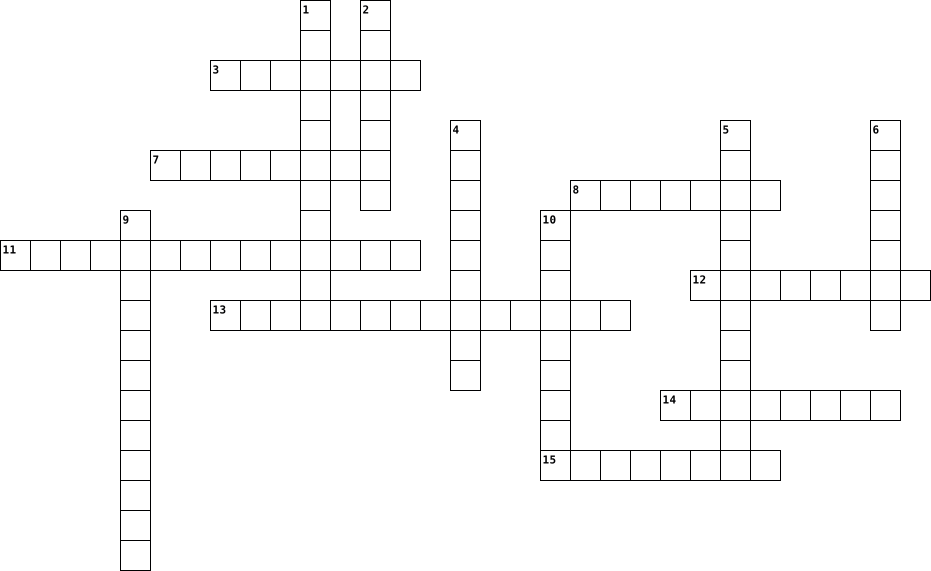
CHAPTERS 9 & 10 VOCAB 2024-11-30

Across
- mesophyll layer - contains closely packed cells that absorb light that enters the leaf
- A - plays a central role in metabolism; serves as a carrier for acyl groups
- - used in the calvin cycle; acts as an “acceptor” molecule for carbon dioxide
- - limits the loss of water through evaporation
- cell - a specialized cell in the epidermis of plants that controls the opening/closing of the stomata
- - fluid portion of the chloroplast; outside of the thylakoids
- - (aka G3P) is central to the synthesis of organic molecules in plants
- - saclike photosynthetic membranes found in chloroplasts
- - an organism able to get energy from sunlight/chemicals and use it to produce its food from inorganic compounds (aka producers)
- factors of photosynthesis - light intensity, carbon dioxide concentration, temperature, water availability, chlorophyll/pigment, nutrient availability
- acid fermentation - temporary solution for ATP production; anaerobic process where glucose is broken down to produce energy without oxygen
- II - light energy is absorbed and produces high-energy electrons here
- spectrum - range of wavelengths of light that a photosynthetic organism can absorb
- - accepts electrons during photosynthesis (becomes NADPH)
- cycle - takes in carbon dioxide and produces G3P (precursor to many organic molecules); vital for converting inorganic carbon into organic forms that plants can use for energy
- - used in photosynthesis, enables plants to fix carbon dioxide
- - a way in which some of the energy of sunlight can be trapped in chemical form
- respiration - the process by which cells produce ATP through the breakdown of glucose with oxygen
Down
- - process reduces the efficiency of photosynthesis by consuming energy/releasing carbon dioxide
- aerobes - organisms that require oxygen for survival; depend on aerobic respiration/oxygen for energy
- I - electrons are reenergized here
- respiration - the process by which cells produce ATP the breakdown of glucose without oxygen
- - an organism that obtains food by consuming other living things (aka consumers)
- plants - use evolved/more efficient methods of photosynthesis
- cycle - a series of enzyme-catalyzed reactions that play a central role in cellular respiration; generates energy
- aerobes - organisms that can survive in both the presence/absence of oxygen
- - first set of reactions in cell respiration in which a glucose molecule is broken into two pyruvic acid molecules
- - acts as an electron carrier during cellular respiration; helps generate ATP for the cell
- (stoma) - a small opening in the epidermis of a plant that allows carbon dioxide, water, and oxygen to diffuse into/out of the leaf
- - key in energy metabolism; carries high-energy electrons to the transport chain and produces ATP
- (granum) - a stack of thylakoid membranes found in chloroplasts (used in the process of photosynthesis)
- fermentation - glucose converted to ethanol, carbon dioxide, and ATP without the use of oxygen
- transport system - a series of electron carrier proteins that shuttle high-energy electrons during ATP-generating reactions
- plants - use the calvin cycle for photosynthesis; the most common type of plant
- - essential for cellular respiration/energy generation; a protein that assists in electron transport/energy production
- mesophyll layer - has air spaces between cells that connect with the exterior through stomata
- - the loss of water through leaves
- - adenosine triphosphate; a compound used by cells to store/release energy
- plants - adaption to arid environments; helps plants cope with water scarcity but comes with trade-offs (in terms of growth rate/energy)
- acid (pyruvate) - key organic acid in cellular metabolism; plays a role in aerobic/anaerobic energy production
40 Clues: - the loss of water through leaves • I - electrons are reenergized here • - limits the loss of water through evaporation • - saclike photosynthetic membranes found in chloroplasts • - accepts electrons during photosynthesis (becomes NADPH) • plants - use evolved/more efficient methods of photosynthesis • - fluid portion of the chloroplast; outside of the thylakoids • ...
Chp 6 Electricity 2022-11-16

Across
- charging by ____________ is the rearrangement of electrons on a neutral object caused by a nearby charged object
- the relationship between voltage difference, current, and resistance in a circuit; current is equal to the voltage difference divided by the resistance
- ______________circuit is an electric circuit with only one branch
- the net movement of electric charges in a single direction; measured in amperes (A)
- closed path that electric current follows
- device that can detect electric charge
- related to the force that causes electric charges to flow; measured in volts (V)
Down
- material in which electrons are not able to move easily
- region surrounding every electric charge in which a force of attraction or repulsion is exerted on other electric charges
- tendency for a material to resist the flow of electrons and to convert electrical energy into other forms of energy; measured in ohms
- law of ___________________ states that charge can be transferred from object to object, but it cannot be created or destroyed
- the accumulation of excess electric charge of an object
- material through which electrons move easily
- ____________ circuit contains two or more branches for current
- the rate at which electrical energy is converted to another form of energy; measured in watts
- charging by _____________ is the process of transferring charge by touching or rubbing
16 Clues: device that can detect electric charge • closed path that electric current follows • material through which electrons move easily • material in which electrons are not able to move easily • the accumulation of excess electric charge of an object • ____________ circuit contains two or more branches for current • ...
Energy Unit 2018-02-26

Across
- Respiration :what cells do to break up sugars into a form that the cell can use as energy. This happens in all forms of life. This takes in food and uses it to create ATP, a chemical which the cell uses for energy.
- respiration :Respiration that requires oxygen
- :The distance between two similar parts of a wave
- :H2o
- :The highest point on a transverse wave
- waves :A transverse wave of pure energy that can go through both a medium and empty space (vacuum). Light is this kind of wave.
- :the "Food" that plants make for themselves
- :Organelle in plant cells that contains the chemical needed for photosynthesis and makes plants green
- :The maximum distance from the rest position that the medium moves in a wave
- : Essential for human life
- Wave : disturbance in matter that carries energy from one place to another
- :An organelle in eukaryotic cells that is surrounded by two membranes, and that is the site of cellular respiration, which produces ATP
- :The ultimate source of energy
- :Two atoms of this are found in water
- :When a wave changes direction because it goes into a new medium
- :Originates from the glucose molecule but is stored for a very long time aka: fats
- Dioxide :This compound is a reactant of photosynthesis, breathed out by animals
- :The material a mechanical wave moves through
Down
- :The lowest point of a transverse wave
- :The parts of a longitudinal wave that are spread apart
- wave :A type of wave where the medium moves parallel (horizontal) to the direction the energy is moving. Sound is this type of wave.
- :When waves spread out to fill the space through which they are moving
- :The parts of a longitudinal wave that are closest together
- :Process by which cells release energy in the absence of oxygen (ex. lactic acid or alcoholic). (also called anaerobic respiration)
- :A repeated back and forth or up and down motion that gives energy to a wave.
- wave :A type of wave where the medium moves perpendicular (vertical) to the direction the energy is moving.
- :The fundamental process that plants go through to create their own food 6CO2 + 6H2O + light --> C6H12O6 + 6O2
- :When one wave hits another wave, their amplitudes combine and make a new wave
- :Originate from glucose molecule, usually found in beans or meat
- :Green pigment in the chloroplast of autotrophs that absorbs light energy used to carry out photosynthesis
- :A disturbance that transfers energy from place to place
- :A jelly like fluid inside the cell in which the organelles are suspended
- :How many waves are created every second. Measured in Hertz (Hz)
33 Clues: :H2o • : Essential for human life • :The ultimate source of energy • :Two atoms of this are found in water • :The lowest point of a transverse wave • :The highest point on a transverse wave • :the "Food" that plants make for themselves • respiration :Respiration that requires oxygen • :The material a mechanical wave moves through • ...
Chemistry of Life 2022-08-19

Across
- speeds up chemical reactions by lowering activation energy
- (4 words) property of water that allows us to use evaporative cooling
- monomer (building block) of nucleic acids; made up of a sugar, phosphate, and a base
- type of bond that forms between two water molecules; becomes stronger as more are made
- property of water that allows it to be known as the "universal solvent"
- (3 words) property of water that helps to keep temperatures on earth stable
- (2 words)monomer (building block) for proteins
- macromolecule that gives us short term energy;identify it because it looks like a cookie
- the type of charge the hydrogens in a water molecule have
- macromolecule that is made up of CHON
Down
- (2 words)macromolecule that stores genetic information
- monomer (building block) of carbohydrates
- water molecules stick to each other; creates surface tension
- the type of charge the oxygen in a water molecule has
- (5 words) property of water that helps aquatic organisms survive in the winter in colder climates
- macromolecule that gives us long term energy and makes up a significant part of the cell membrane
- (abbreviation)elements in nucleic acids
17 Clues: macromolecule that is made up of CHON • (abbreviation)elements in nucleic acids • monomer (building block) of carbohydrates • (2 words)monomer (building block) for proteins • the type of charge the oxygen in a water molecule has • (2 words)macromolecule that stores genetic information • the type of charge the hydrogens in a water molecule have • ...
chapter 18 crossword puzzle 2021-11-16

Across
- hydroelectric power.
- a turbine having a large vaned wheel rotated by the wind to generate electricity.
- generate solar power by using mirrors or lenses to concentrate a large area of sunlight onto a receiver.
- Method of heat that relies upon the sun to heat either air or liquids in a solar collector,and then distribute that heat throughout the structure.
- renewable energy from plants and animals.
- form of political power that revolves around populations
- a cell having a photovoltaic element mounted for exposure to light and provided with terminals for connection with a sensitive current meter
- heating/cooling system for buildings
- heat that is generated within the Earth
- the process of changing the solar energy stored in the ocean to electric power
- a fuel derived directly from living matter.
Down
- a type of solar collector consisting of a series of flat glass or plastic plates with black metal surfaces that absorb solar energy
- is one of several design approaches collectively called passive solar design
- type of hydropower that transforms the movement of the tides into electricity or other practical forms of power.
- an area of land with a group of energy-producing windmills or wind turbines.
- a cell producing an electric current directly from a chemical reaction.
- chemical decomposition produced by passing an electric current through a liquid or solution containing ions.
17 Clues: hydroelectric power. • heating/cooling system for buildings • heat that is generated within the Earth • renewable energy from plants and animals. • a fuel derived directly from living matter. • form of political power that revolves around populations • a cell producing an electric current directly from a chemical reaction. • ...
Diffusion, Osmosis and Active Transport 2021-09-27

Across
- Molecules move down this in diffusion, and up this in active transport
- Required for active transport; more can increase the rate of diffusion
- The movement of water molecules from a more dilute solution to a more concentrated solution
- The physical process involving the diaphragm that maintains a concentration gradient in the lungs
- The chemical process that provides the ATP needed for active transport
- The amount of surface available; sometimes used in ratios with volume.
- The net movement of molecules form an area of high concentration to an area of low concentration
Down
- Where the concentration of solutes is equal in a solution
- Where a solution is more concentrated outside of a cell
- Used to describe transport methods that do not require energy
- A type of transport that requires energy
- The mineral that is actively transported by plant roots
- The smallest blood vessel; forms a network around alveoli
13 Clues: A type of transport that requires energy • Where a solution is more concentrated outside of a cell • The mineral that is actively transported by plant roots • Where the concentration of solutes is equal in a solution • The smallest blood vessel; forms a network around alveoli • Used to describe transport methods that do not require energy • ...
POK 1 Crossword- Marian Qiqieh 2017-03-15

Across
- scale The measure of acidity or alkalinity in a substance.
- itself and still have the properties of that substance.
- The smallest particle of a compound which can normally exist
- An ion with a positive electric charge. An atom which has lost one or more electrons.
- A substance which contains hydrogen that can be replaced by a metal in solution, it turns litmus red.
- reaction A chemical reaction that gives off energy
- The way chemists write down chemical reactions,
- the substances formed as a result of a chemical change,
- reaction A chemical reaction that takes in energy
- A substance which alters the speed of a chemical reaction but remains chemically unchanged itself at the end of the reaction.
- substances that undergo chemical change
- energy The energy needed for a reaction to occur
- A charged particle, an atom or group of atoms which has lost or
Down
- A solid which forms and settles in a solution
- A substance which reacts with an acid to form a salt and water.
- compound A compound made up of molecules: the molecules
- of atoms that are linked by sharing electrons.
- electrons
- compound A compound made up of ions.
- combined.
- A way of describing the composition of a substances , using symbols and numbers
- A substance containing two or more elements which have been
- The removal of acidity or alkalinity in a substance.
- An ion with a negative electric charge. An atom which has gained one or more electrons.
24 Clues: electrons • combined. • compound A compound made up of ions. • substances that undergo chemical change • A solid which forms and settles in a solution • of atoms that are linked by sharing electrons. • The way chemists write down chemical reactions, • energy The energy needed for a reaction to occur • reaction A chemical reaction that takes in energy • ...
Biology 2022-10-21

Across
- base pair with the codon
- serves as a link
- Connects to A
- Connects to A
- Connects to T/U
- start the creation of protein chain
- provides a quick, source of energy
- to create proteins via translation
- forms a bond
Down
- contains instructions for a organism
- carry information that decide traits
- build and repair muscles and bones
- tells your body how to make proteins
- combine with proteins and enzymes nucleus store the cell's DNA
- Connects to G
- Connects to C
- needed for formation of bone & teeth
17 Clues: forms a bond • Connects to A • Connects to G • Connects to A • Connects to C • Connects to T/U • serves as a link • base pair with the codon • build and repair muscles and bones • provides a quick, source of energy • to create proteins via translation • start the creation of protein chain • contains instructions for a organism • carry information that decide traits • ...
Option C 2025-04-01

Across
- A lack of dietary ____ is a risk factor for osteoperosis
- A type of disease due to inactivity
- When a blood clot forms in blood vessels in brain
- When blood glucose levels are higher than normal
- Type ___ (spell it out) diabetes stems from an inability to produce insulin
- A major cause of CHD
- Excess body fat that endangers health
Down
- When energy intake is ___ to energy expenditure, body weight is stable.
- Bone Mass Density is low, cause fragile bones with large holes
- Typically, ____ achieve a lower peak bone density
- A feeling of competency is an example of how exercise improves ___ well-being.
- Measurement for obesity
- Ghrelin and ___ regulate appetite
- A hard buildup made of cholesterol and other substances in arteries
- Perceptions of being too old or fat are an example of a social ___ to exercise
- A state of emotional or affective arousal of varying, and nor permanent, duration.
16 Clues: A major cause of CHD • Measurement for obesity • Ghrelin and ___ regulate appetite • A type of disease due to inactivity • Excess body fat that endangers health • When blood glucose levels are higher than normal • Typically, ____ achieve a lower peak bone density • When a blood clot forms in blood vessels in brain • A lack of dietary ____ is a risk factor for osteoperosis • ...
class 2024-04-09

Across
- A living individual entity.
- Change in position or location.
- Increase in size or development.
- Aquatic vertebrates with gills and fins.
- Animals with a backbone or spinal column.
- Small arthropods with six legs and usually wings.
- Intake of nutrients for growth and energy.
- Organism composed of multiple cells.
- Chemical processes in an organism to maintain life.
- Warm-blooded vertebrates that nurse their young.
- Removal of waste products from the body.
- Invertebrates with exoskeletons and jointed limbs.
- Mass of an organism excluding water is called _____ mass..
Down
- Plant with one seed leaf, typically parallel-veined leaves.
- Arthropods with four pairs of legs, like spiders.
- Cold-blooded vertebrates with scales or plates.
- Taxonomic rank above species, grouping closely related organisms.
- Ability to detect or respond to stimuli.
- Process of releasing energy from food.
- Polysaccharide that forms the cell walls of plants.
- Organism composed of a single cell.
- Terrestrial arthropods with many legs, like centipedes.
- Green pigment in plants responsible for photosynthesis.
- Process of producing offspring.
- Group of organisms with similar characteristics, capable of interbreeding.
25 Clues: A living individual entity. • Change in position or location. • Process of producing offspring. • Increase in size or development. • Organism composed of a single cell. • Organism composed of multiple cells. • Process of releasing energy from food. • Aquatic vertebrates with gills and fins. • Ability to detect or respond to stimuli. • Removal of waste products from the body. • ...
The Rock Cycle Crossword Puzzle 2023-11-27

Across
- Prefix meaning fire
- a measure of the amount of heat energy
- force exerted on matter through contact with other matter; affects melting and boiling points
- Prefix meaning above
- the mineralized remains of organisms, showing how long-dead organisms lived and how their bodies were structured
- Cool, rigid, outermost layer of Earth that is divided into enormous pieces called tectonic plates; consists of the crust and the rigid uppermost part of the mantle
- The solid layer of Earth between the crust and the core; made of dense silicates
- A naturally formed, inorganic solid that has a specific chemical formula and repeating three-dimensional structure
- The mechanical or chemical processes that break rocks into smaller pieces and sometimes change the chemical composition
- formed deep underground where heat and pressure cause existing rocks to be changed in both mineral composition and structural characteristics.
- Prefix meaning Earth
Down
- formed when lava or magma cools and solidifies. Lava cools quickly and forms rocks with small crystals, while magma cools more slowly and forms rocks with larger crystals
- Prefix meaning to sit
- Prefix meaning under
- heat transfer caused by the rising of hotter, less dense fluids and the falling of cooler, more dense fluids
- Prefix meaning to change
- forms when particles of other rocks are deposited in layers and are compacted (crushed together) and cemented (binding of the sediments)
- The process by which water, ice, wind, and gravity remove and transport sediment from one place to another.
18 Clues: Prefix meaning fire • Prefix meaning under • Prefix meaning above • Prefix meaning Earth • Prefix meaning to sit • Prefix meaning to change • a measure of the amount of heat energy • The solid layer of Earth between the crust and the core; made of dense silicates • force exerted on matter through contact with other matter; affects melting and boiling points • ...
Regents Review 2021-06-09

Across
- Breaking down of rock
- Heat transfer through touch
- The temperature where condensation occurs (relative humidity would=100 at this temperature)
- The change of state of water from the vapor to the liquid phase.(creates clouds)
- The ability of water to pass through something
- A type of lake that forms when a chunk of the front of a glacier falls off and eventually melts
- The amount of empty space between sediments
Down
- Heat transfer through electromagnetic waves
- A measure of the amount of energy released by an earthquake
- The movement of sediments by natural processes like gravity
- Rock type formed through intense heat and pressure
- The ability of water to travel upwards through something
- How stars make energy in their cores
- Rock type formed by cementation and compaction
14 Clues: Breaking down of rock • Heat transfer through touch • How stars make energy in their cores • Heat transfer through electromagnetic waves • The amount of empty space between sediments • Rock type formed by cementation and compaction • The ability of water to pass through something • Rock type formed through intense heat and pressure • ...
Ch 3 Natural Resources 2025-10-07

Across
- small plantlike organisms that make up the first link in the ocean's food chain
- plowing, a method used by farmers to help keep water from washing soil away
- a solid substance found naturally in the earth's surface
- cover, a low growing crop such as clover
- chemicals produces from oil
- a resting period of time to allow natural processes replace the nutrients that were used up
- energy, produced as water flows from the reservoirs and turns turbines
- shelf, floating ice
- energy, sun's energy used to power and heat things
- formed from plant material that was quickly buried and fossilized under great pressure
- resources, can not be replaced easily
- concentrated areas of specific minerals often found near volcanic areas
- water vapor in the air
- used to separate metal in the ore from the other materials
- layers of sand gravel or bedrock that hold and move ground water
Down
- gas, a fossil fuel found in a gaseous state and found close to deposits of oil
- resources, materials on Earth that are available for our use
- liquid form of fossil fuels
- most nuclear energy depends on this mineral
- materials with usable amounts of metal in them
- sheet, huge expanse of ice
- water, rainwater flows into the soil and is stored beneath the surface of the earth
- used to describe metal that is soft and shapeable
- resources, can be replaced by natural means in a short amount of time
- energy, uses heat from the earth to produce steam
- fuels, formed when the remains of plants and animals are buried quickly
- all of Earth's water found in lakes oceans streams rivers soil underground and in the air
- holding areas used to help engineers control the flow of water
- a factory that separates crude oil into different products
- ice shelves break off into the ocean and float independently
- cycle, water replaced and reused by looking at the path it takes as it travels from land to sky and back to land
- energy, windmills use this to generate electrical energy
- ice, forms when ocean water freezes
- oil, wells are built to retrieve this petroleum
34 Clues: shelf, floating ice • water vapor in the air • sheet, huge expanse of ice • liquid form of fossil fuels • chemicals produces from oil • ice, forms when ocean water freezes • resources, can not be replaced easily • cover, a low growing crop such as clover • most nuclear energy depends on this mineral • materials with usable amounts of metal in them • ...
Introduction to plants 2024-11-18

Across
- Plants make spores that are genetically identical to the parent plant.
- When water must move from the environment and throughout the plant.
- Plants produce gametes.
- are plants that produce seeds that are not enclosed in a fruit.
- Vascular plants that produce flowers, and fruits, which surround and protect seeds.
- A nonvascular rootlike structure that helps mosses attach to surfaces such as rocks and trees.
Down
- A plant embryo enclosed in a protective coating.
- A system of tube-like tissues that transports water, nutrients, and other materials from one part of an organism to another part.
- A tiny structure in which sperm forms.
- The process by which plants and other organisms convert solar energy to chemical energy.
- make their own food by using energy from their surroundings.
- An underground stem from which new leaves and roots grow.
- A green pigment that captures energy from sunlight.
13 Clues: Plants produce gametes. • A tiny structure in which sperm forms. • A plant embryo enclosed in a protective coating. • A green pigment that captures energy from sunlight. • An underground stem from which new leaves and roots grow. • make their own food by using energy from their surroundings. • are plants that produce seeds that are not enclosed in a fruit. • ...
cell processes and cycle 2026-04-30

Across
- (8): Organism that eats other organisms for energy.
- (10): Inherited trait that improves an organism's chance of survival.
- (8): Site of protein synthesis.
- (8): Organism that makes its own food, usually through photosynthesis.
- (8): Organelle containing digestive enzymes to break down waste.
- (9): Change in the heritable characteristics of populations over generations.
- (6): Specialized cell that transmits nerve impulses.
- (14): Process of converting light energy into chemical energy.
- (8): A sudden change in the DNA sequence.
- Thin layer surrounding all cells, controlling entry and exit.
- (9): Cell with a true nucleus and membrane-bound organelles.
- (9): Interacting community of organisms and their environment
- (11): Organelle in plants where photosynthesis occurs.
- A segment of DNA that codes for a trait.
Down
- (9): Close, long-term interaction between two species.
- (10): Structure made of DNA and protein found in the nucleus.
- (9): The jelly-like fluid that fills a cell.
- (11): Process of producing cellular energy (ATP) using oxygen.
- (7): The control center of the cell, containing DNA.
- (6): Protein that acts as a biological catalyst.
- (12): The "powerhouse" of the cell; produces ATP.
- (9): Tiny structures within a cell that perform specific functions.
- (7): Cell division resulting in two identical daughter cells.
- (10): Single-celled organism lacking a nucleus
- (7): The natural home of an organism.
- (10): Protein in red blood cells that carries oxygen.
- (6): Different forms of a gene.
- (3): The molecule that carries genetic information
- (7): Cell division that produces gametes.
29 Clues: (8): Site of protein synthesis. • (6): Different forms of a gene. • (7): The natural home of an organism. • A segment of DNA that codes for a trait. • (8): A sudden change in the DNA sequence. • (7): Cell division that produces gametes. • (9): The jelly-like fluid that fills a cell. • (10): Single-celled organism lacking a nucleus • ...
Cell types 2020-10-21
Across
- storage area for most the DNA or genetic information, in the cells.
- Membrane-bound organelles that include enzymes.
- Fluid-filled sac that is used to store materials that are needed by a cell.
- stacks of membrane-enclosed areas rear process, sort an deliver proteins, and are closely layered.
- Form and support single cells and full organisms.
- A form that is unique to plant cells.
- An appendage that is threadlike that lets on many bacteria, Protozoa, etc. to swim.
- Surfaces of the ER that do not have ribosomes.
Down
- Changes solar energy into chemical energy by using photosynthesis.
- Surfaces of the ER coated with ribosomes.
- jellylike substance that has dissolved molecular components such as nucleus acids, minerals, ions, and proteins.
- forms a boundary within a cell and the outside environment and controls the passage of materials in and out of cells.
- Divide and transfer specific molecules.
- Produce energy for the cell.
- small organelles that bring amino acids together to create proteins.
15 Clues: Produce energy for the cell. • A form that is unique to plant cells. • Divide and transfer specific molecules. • Surfaces of the ER coated with ribosomes. • Surfaces of the ER that do not have ribosomes. • Membrane-bound organelles that include enzymes. • Form and support single cells and full organisms. • ...
Book Contract Crossword -Michaela 2023-06-13

Across
- speak in a low voice
- glowing with heat
- hollow part that forms holder
- material added to soil to help plants
- look like
- fine thread
- tall thin and awkward
- shaft driven by crank
- material used for roofs
- machine that converts energy
- going before
- tornado
- electric magnet
- unusable because of condition
Down
- extremely interesting
- to be in opposition
- oil used as fuel
- explosive mane underground
- break up and disappear
- a tape case
- important enough to be noticed
- farming
- able to work
- hard to manage because of size
- disease from contaminated water
25 Clues: farming • tornado • look like • a tape case • fine thread • able to work • going before • electric magnet • oil used as fuel • glowing with heat • to be in opposition • speak in a low voice • extremely interesting • tall thin and awkward • shaft driven by crank • break up and disappear • material used for roofs • explosive mane underground • machine that converts energy • hollow part that forms holder • ...
cell review Tony 2024-01-23

Across
- the cells transport organelle, processing and moving materials throughout the cell.
- Glucose in food reacts with oxygen, producing carbon dioxide, water and energy in the mitochondria; waste products are carbon dioxide and water.
- the basic function unit of all forms of life; they are able to replicate independ gelles the part of a cell. they process and release energy,destroy and digest materials,and replicate genetic information.
- Organisms that exist that are composed of a single cell (bacteria, yeast, protozoa, and diatoms).
- in plant cells only, they are orangelles that produce food. chlorophyll is a green pigment that makes plants look green and also uses energy from the sun to change water and carbon dioxide into glucose and simple sugar.
- orangelle that contains digestive chemicals that break down food,cell waste,and foreign particlesbacteriater the cell (i.e. viruses and batctria)
- The cell’s powerhouse, releasing energy in food by carrying out a reaction with oxygen.
- Transport proteins on the cell’s membrane transport substances into and out of the cell without energy.
- protien-making factories in a cell
- The movement of molecules from an area of high to low concentration.
- Much more complex types of cells (containing a membrane-bound nucleus, mitochondria, and organelles) found in protists, fungi, animals and plants.
- Organisms that exist that are composed of a single cell (bacteria, yeast, protozoa, and diatoms).
- This transport requires energy to move a substance into and out of a cell. A transport protein called AdenosineTriphosphate (ATP) binds with the molecule and transports it into the cell using the cell’s energy. (When a molecule moves against its concentration gradient, energy is required.))
- The cell’s packaging, sorting, and distributing organelle. They sort proteins from the Endoplasmic Reticulum and then distribute them to where they need to go.
Down
- in every cell, there is a layer on the outside of the cell that holds the cells together, and controls the flow of a material in and out of the cell(a semi-permeable layer,allowing some stuff through and keeping other things out.)
- Very simple, single-celled bacteria that do not have a membrane-bound nucleus, mitochondria, or organelles.
- All of the chemical reactions that allow a cell to survive; includes the chemical reactions required to release or generate energy, to produce chemicals the body needs such as proteins, and to expel waste.
- The chemical reaction a plant carries out in order to produce energy from sunlight. Chlorophyll uses the sun’s energy to convert carbon dioxide and water into energy (glucose). Oxygen is released as a waste product.
- A type of diffusion; it is simply the process of water molecules from a higher to a lower concentration through a membrane.
- The cell’s packaging, sorting, and distributing organelle. They sort proteins from the Endoplasmic Reticulum and then distribute them to where they need to go.
- The movement of things in and out of the cell without the use of energy.
- Molecules that help a chemical reaction proceed.
- Another chemical reaction where energy is released through the breakdown of food; occurs where oxygen is not present. One waste product is Lactic Acid (which causes muscles to cramp when it builds up).
- cells found in animals
24 Clues: cells found in animals • protien-making factories in a cell • Molecules that help a chemical reaction proceed. • The movement of molecules from an area of high to low concentration. • The movement of things in and out of the cell without the use of energy. • the cells transport organelle, processing and moving materials throughout the cell. • ...
chapter 5 terms 2018-01-11

Across
- covalent compound made up of many small repeating units inked together in a chain
- the number of electrons in its outermost energy level
- a neutral particle that forms with electron sharing
- the ability of a substance to be pulled into wires
- bond a force that hold atoms together in a compound
- bond electrical attraction between positively and negatively charged ion
Down
- small molecule that forms a link in a polymer chain
- regular repeating arrangement of atoms, ions, or molecules
- bond bond formed when many metal atoms share their pooled electrons
- bond chemical bond formed when atoms share electrons
- elements that are silver and shiney
- ability of a material to be hammered or rolled into sheets
- cell smallest repeating pattern that shows how the atoms, ions or molecules are arranged in a crystal
- substance with two or more elements
14 Clues: elements that are silver and shiney • substance with two or more elements • the ability of a substance to be pulled into wires • small molecule that forms a link in a polymer chain • a neutral particle that forms with electron sharing • bond a force that hold atoms together in a compound • bond chemical bond formed when atoms share electrons • ...
Biology 2021-09-29
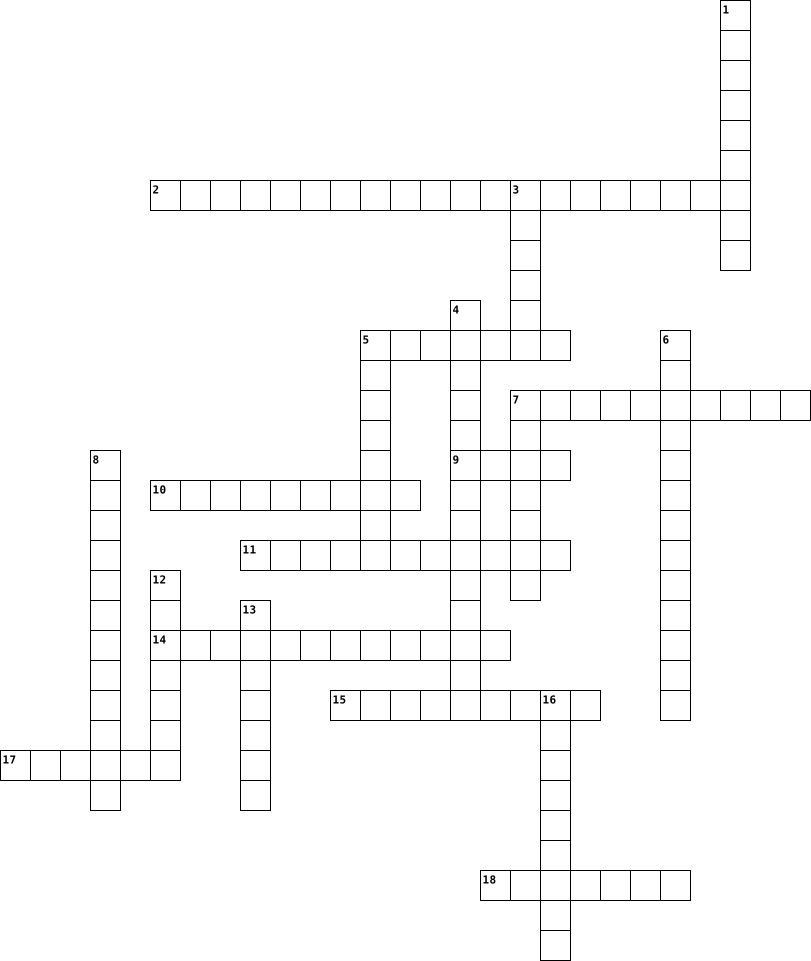
Across
- A cell structure that forms a maze of passageways in which proteins and other materials are carried from one part of the cell to another.
- a molecule that can be bonded to other identical molecules to form a polymer
- A unicellular organism that lacks a nucleus and membrane bound organelles
- basic unit of matter
- produces ribosomes
- macromolecule containing hydrogen, oxygen, nitrogen, carbon, and phosphorus examples include DNA and RNA, monomers are nucleotides
- organelles that capture the energy from sunlight and convert it into chemical energy in a process called photosynthesis
- site of protein synthesis
- Energy-rich organic compounds, such as fats, oils, and waxes, that are made of carbon, hydrogen, and oxygen, monomers are glycerol and fatty acids.
- the study of organisms
Down
- cell organelle filled with enzymes needed to break down certain materials in the cell
- A type of protein that speeds up a chemical reaction in a living thing, end in ase example :lactase
- A system of membranes that modifies and packages proteins for export by the cell
- A group of atoms bonded together
- the starches and sugars present in foods, monomers are glucose
- macromolecule that contains carbon, hydrogen, oxygen, and nitrogen; needed by the body for growth and repair, monomers are amino acids
- Powerhouse of the cell, organelle that is the site of ATP (energy) production
- A part of the cell containing DNA and responsible for growth and reproduction, only in eukaryotic cells
- A long molecule consisting of many similar or identical
- A cell that contains a nucleus and membrane bound organelles
20 Clues: produces ribosomes • basic unit of matter • the study of organisms • site of protein synthesis • A group of atoms bonded together • A long molecule consisting of many similar or identical • A cell that contains a nucleus and membrane bound organelles • the starches and sugars present in foods, monomers are glucose • ...
Eco-Architecture 2018-03-17

Across
- evaporates form Earth, rises into the atmosphere, cools, and condenses into rain or snow, and falls to the Earth as precipitation.
- to adapt or change something old to add something new.
- solar mix of sand, loam, clay and many more things. rammed hard within forms as a building material.
- earth roof plastered with vegetation, made for aesthetic value and optimal energy conservation.
- Having the ability to decompose over a period of time.
- healing or restoring to help cure or remedy.
- energy a natural, inexhaustible source of energy; as in biomass, solar , wind, or any hydroelectrically powered. It doesn't come from fossil or nuclear fuel.
- mass This building design is made to collect, store and distribute solar energy. It rejects solar heat in summer, and distributes heat during the winter months.
Down
- transfer
- to treat or process used or waste to make it suitable to be used again
- the occupation or industry of building.
- a system that maintains its viability by using ways for continual use.
- to bring uncultivated items or areas into condition to be used.
- roof ability of a material to absorb and store heat for energy.
14 Clues: transfer • the occupation or industry of building. • healing or restoring to help cure or remedy. • to adapt or change something old to add something new. • Having the ability to decompose over a period of time. • to bring uncultivated items or areas into condition to be used. • roof ability of a material to absorb and store heat for energy. • ...
Science Vocabulary Quiz 2025-10-09

Across
- A narrow strip of sand built up by waves, often found near beaches or river mouths
- A layer in the ground where many fossils or bones are found together
- A long crack or valley where the Earth's crust is pulling apart
- A black rock used as fuel that forms from ancient plant material
- Energy made by moving water, such as from rivers or dams
- marsh, A coastal area that floods with salt water and is home to grasses and wildlife
- Shaped like an oval; the shape of planets’ orbits
- A thick layer of mud made of tiny bits of dead plants and animals on the ocean floor
- When wind, water, or ice drop off sediment in a new place
- crust, The thin layer of rock that forms the ocean floor
- A thick, dark liquid fossil fuel found underground
- The idea that the Sun is at the center of the solar system
- How much salt is in a certain amount of water
- An underwater mountain formed by volcanic activity
- All the water on Earth — in oceans, lakes, rivers, and the atmosphere
Down
- The underground point where an earthquake starts
- Able to support life, especially with the right temperature and water
- A place where a river meets the ocean and fresh water mixes with salt water
- When deep, cold, nutrient-rich water rises to the ocean’s surface
- Fuel made from plants or animal waste that can be used for energy
- A layer of rock or soil that holds groundwater
- The study of space, stars, planets, and galaxies
- The point on Earth’s surface directly above where an earthquake begins
- The process where one tectonic plate slides under another
- The old belief that the Earth is at the center of the universe
- fuel, Energy that comes from the remains of ancient plants and animals, like coal and oil
- Gases or substances released into the air, often from burning fuel
- The edge of land that meets the ocean or sea
- The study of the ocean, including its life, floor, and movement
29 Clues: The edge of land that meets the ocean or sea • How much salt is in a certain amount of water • A layer of rock or soil that holds groundwater • The underground point where an earthquake starts • The study of space, stars, planets, and galaxies • Shaped like an oval; the shape of planets’ orbits • A thick, dark liquid fossil fuel found underground • ...
ENERGYS OF RENEWABLE, AND NON-RENEWABLE 2023-10-30

Across
- WHEN CARBON TRAVELS THROUGH THE EARTH'S NATURAL RESOURCES LIKE IN PHOTOSYNTHESIS, AND CAN BE REUNITED WITH THE ATMOSPHRERE THROUGH RESPIRATION, AND DECAYING ORGANISIMS.
- A SHEET OF CARBON WHICH SETTLES INTO THE ATMOSPHERE, TRAPPING HEAT IN THE EARTH LIKE A GREENOUSE.
- EFFECTS ON THE EARTH, AND ECOSYSTEMS, IN WHICH ARE CAUSED BY HUMAN ACTIONS.
- ENERGY SUPPLY THAT CAN BE RESTOCKED IN A HUMAN LIFETIME.
- WHEN HYDRO SOURCES OF ENERGY TRAVEL THROUGH A SERIES OF FORMS ON EARTH, BUT WILL ALWAYS RETURN TO A MAIN BODY.
Down
- AN ENERGY SOURCE THAT HUMANS CAN RESTOCK IN THEIR LIFETIMES.
- ENERGY SUPPLIE THAT TAKES MILLIONS OF YEARS TO REFORM.
- FUELS THAT ARE FORMED FROM ANCIENT DECAYED PLANTS AND ANIMALS.
- WHEN THE IMPACT FROM FALLING WATER POWERS A TURBINE WITHIN A MACHINE OR DAM.
- ENERGY CREATED BY USING PHOTOVOLTAIC CELLS IN A PANEL TO COLLECT LIGHT.
10 Clues: ENERGY SUPPLIE THAT TAKES MILLIONS OF YEARS TO REFORM. • ENERGY SUPPLY THAT CAN BE RESTOCKED IN A HUMAN LIFETIME. • AN ENERGY SOURCE THAT HUMANS CAN RESTOCK IN THEIR LIFETIMES. • FUELS THAT ARE FORMED FROM ANCIENT DECAYED PLANTS AND ANIMALS. • ENERGY CREATED BY USING PHOTOVOLTAIC CELLS IN A PANEL TO COLLECT LIGHT. • ...
Plate Tectonics and Geology 2013-02-15

Across
- A single landmass on Earth about 300 million years ago
- A German scientist that proposed the theory of continental drift
- The process by which the ocean floor sinks beneath a deep-ocean trench and back into the mantle
- A dense ball of solid metal.
- Breaks in Earths crust where rocks have slipped past each other
- A layer of molten metal surrounding the inner core
- Heat transfer between materials that are touching
- A group of parts that work together as a whole
- The parts of Earth where that contain living organisms make this up
Down
- Results from a force pressing on an area
- Has three main parts: a metal core, a solid middle layer, and a rocky outer layer
- Any trace of an ancient organism that has been preserved in rock
- Contains all of Earths water
- The layer of rock that forms that Earths outer skin
- A dark, fine-grained rock
- Heat transfer by the movement of a fluid
- A layer of hot rock
- The Earths outermost layer
- Transfer of energy that is carried in rays
- The ability to do work
20 Clues: A layer of hot rock • The ability to do work • A dark, fine-grained rock • The Earths outermost layer • Contains all of Earths water • A dense ball of solid metal. • Results from a force pressing on an area • Heat transfer by the movement of a fluid • Transfer of energy that is carried in rays • A group of parts that work together as a whole • ...
Water Unit Crossword 2020-10-12

Across
- several forms of
- eats dung and debris
- rain
- deoxyribonucleic acid
- Water word
- simple organic compound
- eats vegetables
- marine ecosystems
- eats meats
- shallow wetlands
Down
- how to tell if somethings hot or cold
- sea in Greek
- water without salt
- same nutritional relational to the primary source
- communities on the bottom
- something that drys up into a surface
- free floating plants or algae
- anything that uses matter
- low narrow sandy islands
- the sun
- substance composed of atoms that can’t be broken into smaller pieces
- how animals eat others
- where something lives
- eats dead things
24 Clues: rain • the sun • Water word • eats meats • sea in Greek • eats vegetables • several forms of • eats dead things • shallow wetlands • marine ecosystems • water without salt • eats dung and debris • deoxyribonucleic acid • where something lives • how animals eat others • simple organic compound • low narrow sandy islands • communities on the bottom • anything that uses matter • ...
ecology 2022-09-26

Across
- the flow of energy as it flows through ecosystems
- came from the recognition that food chains are linked where all organisms are food for other organisms
- the flow of energy divided into catergories
- something that is hunted as food for another organism
- when organisms benifit off of each other
Down
- where organisms live
- something that hunts for food
- interacting organisms and their physical environment
- animal, plant or any living thing
- the study of relationships between different forms of animals and their natural surrondings
10 Clues: where organisms live • something that hunts for food • animal, plant or any living thing • when organisms benifit off of each other • the flow of energy divided into catergories • the flow of energy as it flows through ecosystems • interacting organisms and their physical environment • something that is hunted as food for another organism • ...
Cell Structure & Function 2023-05-11

Across
- A jellylike fluid inside the cell in which the organelles are suspended
- flexible double-layered sheet that makes up the cell membrane and forms a barrier between the cell and its surroundings
- cell organelle filled with enzymes needed to break down certain materials in the cell
- A network of fibers that holds the cell together, helps the cell to keep its shape, and aids in movement
- A tiny cell structure that carries out a specific function within the cell
- Hairlike projections that extend from the plasma membrane and are used for locomotion
- A unicellular organism that lacks a nucleus and membrane bound organelles
- The basic unit of structure and function in living things
- A cell that contains a nucleus and membrane bound organelles
- organelle found in cells of plants and some other organisms that captures the energy from sunlight and converts it into chemical energy
- Cytoplasmic organelles at which proteins are synthesized.
Down
- A long, whip-like filament that helps in cell motility. Many bacteria are flagellated, and sperm are flagellated.
- Cell organelle that stores materials such as water, salts, proteins, and carbohydrates
- theory that eukaryotic cells formed from a symbiosis among several different prokaryotic organisms
- thin, flexible barrier around a cell; regulates what enters and leaves the cell
- idea that all living things are composed of cells, cells are the basic units of structure and function in living things, and new cells are produced from existing cells
- stack of membranes in the cell that modifies, sorts, and packages proteins from the endoplasmic reticulum
- A cell structure that forms a maze of passageways in which proteins and other materials are carried from one part of the cell to another.
- a property of cell membranes that allows some substances to pass through, while others cannot
- A rigid layer of nonliving material that surrounds the cells of plants and some other organisms.
- A part of the cell containing DNA and RNA and responsible for growth and reproduction
- An organelle found in large numbers in most cells, in which the biochemical processes of respiration and energy production occur.
22 Clues: The basic unit of structure and function in living things • Cytoplasmic organelles at which proteins are synthesized. • A cell that contains a nucleus and membrane bound organelles • A jellylike fluid inside the cell in which the organelles are suspended • A unicellular organism that lacks a nucleus and membrane bound organelles • ...
Biology Chapter 7 - 1 2025-10-03

Across
- solute concentration < that inside the cell
- ___________ potential - voltage across membrane
- solute concentration > that inside the cell
- requires energy
- type of endocytosis,triggered by binding
- includes channel and carrier proteins
- transport vesicles fuse with the membrane
- "cellular drinking" type of endocytosis
- moves from low to high solute concentration
- "cellular eating" type of endocytosis
Down
- electrogenic pump for plants
- most membranes are
- the charge on the inside of cell
- transport protein, generates voltage
- healthy state for plants in hypotonic solution
- "downhill" coupled with "uphill" transport
- cell forms vesicles to take in molecules
- membrane component in animal cells
- impacts membrane fluidity at different temps
- need bulk transport
- moves from high to low solute concentration
21 Clues: requires energy • most membranes are • need bulk transport • electrogenic pump for plants • the charge on the inside of cell • membrane component in animal cells • transport protein, generates voltage • includes channel and carrier proteins • "cellular eating" type of endocytosis • "cellular drinking" type of endocytosis • cell forms vesicles to take in molecules • ...
Fall APES Chapter 16 2014-09-03

Across
- This type of architecture is based on energy-efficient and money-saving designs or natural lighting and all that comes with it
- An energy-efficient, gasoline-electric car; can go up to 50 miles per gallon
- This type of program proposed by Amory Lovins would have the buyers of fuel-inefficient vehicles would pay a high fee
- The acronym for the government mandated standards for fuel efficiency in cars
- These government payments help businesses survive and thrive
- Doing this in houses and other buildings to keep them warm in the winter or cool in the summer can improve energy efficiency
- Production of two useful forms of energy from the same fuel source; used in combined heat and power systems (CHP)
- The measure of how much work we can get from each unit of energy we use
- Made from plants such as sugarcane, corn, and switchgrass, and from agriculture, forestry, and municipal wastes. Involves converting plant starches into sugars
- Electric cars may eventually being using these as they are at least twice as efficient as internal combustion engines, require little maintenance, and use hydrogen gas as fuel to produce electricity
- Uses kinetic energy of flowing and falling water to produce electricity
- A type of electrical grid currently being promoted that would save the U.S. economy $100 billion each year
- This type of energy-efficient car make up 45% of new passenger cars in Europe, have very low emissions, are quiet, and are about 30% more fuel efficient than traditional combustion engines
- Consists of plants materials and animal wastes that we can burn directly as a solid fuel or convert into gaseous or liquid biofuels
Down
- If this is done with scrap metals when their original use is done, it would take 75% less energy than it would to make a piece of metal from virgin ore
- This solar heating system captures energy from the sun by pumping a heat absorbing fluid through special collectors that are facing the sun
- A car that runs primarily on electricity and can go between 100 to 1,000 miles per gallon
- This type of light bulb, also known as a "heat bulb" wastes about 90-95% of the electricity it draws to produce the light
- This solar heating system absorbs and stores heat from the sun directly within a well-insulated structure
- This crisis is affecting 2.7 billion people in 77 countries due to harvesting wood faster than it can be replenished
- These thin wafers of purified silicon allow them to produce electricity when sunlight strikes them
- This type of energy path is based on increasing use of nonrenewable coal, oil, natural gas and nuclear energy
- This type of energy is heat stored in soil, underground rocks, and fluids in the earth's mantle
- This type of lighting uses one-fourth the energy as its predecessor and lasts ten times longer
- This type of power plant, which is very common in Indiana, wastes about 66% of its energy and produces toxic ash as a byproduct
- This type of power plant wastes about 75% of its energy and is also very dangerous as seen in past accidents; e.g. 3 Mile Island
- These thermal systems use different methods to collect and concentrate solar energy in order to boil water and produce steam for generating electricity
- Used commonly in trucks and buses, this is produced from vegetable oil extracted from various plants
- Places where wind turbines are being erected in large numbers
- This type of energy path is based on improving energy efficiency and increasing the use of various renewable energy resources
30 Clues: These government payments help businesses survive and thrive • Places where wind turbines are being erected in large numbers • The measure of how much work we can get from each unit of energy we use • Uses kinetic energy of flowing and falling water to produce electricity • An energy-efficient, gasoline-electric car; can go up to 50 miles per gallon • ...
Chemsitry 2018-02-05

Across
- / 2 or more atoms
- Mass / average mass of the types of an atom.
- / same substance throughout
- Metals / all have 1 electron in their outer shell
- / 2 or more substances that are physically combined
- Gasses / all have full shells
- Number / the amount of protons and neutrons
Down
- / vertically organized
- / forms and diagonal line on the PT
- Levels / the orbit the electrons follow
- / visibly different substances throughout
- / all have 7 electrons in their outer shell
- / more then one type of atom
- / made of 1 type of atom
- / horizontally organized
15 Clues: / 2 or more atoms • / vertically organized • / made of 1 type of atom • / horizontally organized • / same substance throughout • / more then one type of atom • Gasses / all have full shells • / forms and diagonal line on the PT • Levels / the orbit the electrons follow • / visibly different substances throughout • / all have 7 electrons in their outer shell • ...
Weather! 2026-01-19

Across
- This is what scientists use to explain how Evidence connects to the Claim. Answers the question "But WHY is this happening?"
- Providing Facts and Data to answer a question. This is the "E" in a "CER."
- Energy traveling as waves, like energy from the Sun reaching Earth
- A single piece of ice that forms in a storm cloud and falls to the ground
Down
- The transfer of heat when the warm ground heats the air touching it
- As you move higher and higher in the atmosphere, the air continues to get _______.
- The _________ absorbs the greatest amount of energy in Earth’s energy budget, approximately 51%!
- A type of storm where balls of ice fall from the clouds
- This is what we call how much energy enters the earth, and where the energy goes when it enters earth.
- The conditions of the air outside at a certain time and place, like temperature, wind, or rain
- A ________ is when scientists answer a question in a clear one sentence answer, without any evidence or reasoning.
11 Clues: A type of storm where balls of ice fall from the clouds • Energy traveling as waves, like energy from the Sun reaching Earth • The transfer of heat when the warm ground heats the air touching it • A single piece of ice that forms in a storm cloud and falls to the ground • Providing Facts and Data to answer a question. This is the "E" in a "CER." • ...
Magnetism 2026-04-27

Across
- power plant where remains of ancient marine plankton are burn release heat, which is used to boil water to drive a steam turbine; the fuel source is a gas
- A solenoid with a ferromagnetic core that forms a magnet that can be turned on and off.
- a region on a magnet where the force produced by the magnet is strongest.
- a force associated with charged particles, which has two aspects, electric force and magnetic
- a facility that uses heat from nuclear reactors to produce electrical energy
- a device with fanlike blades that turn when pushed, for example, by water or steam.
- a transformer that decreases voltage
- Energy from the sun that is converted into thermal or electrical energy
- a material that can be magnetized because it contains magnetic domains.
- the area surrounding Earth that is influenced by Earth's magnetic field
- A power plant that uses moving water to power a turbine generator to produce electricity.
- a coil of current carrying wire that produces a magnetic field.
- Energy produced by burning coal
Down
- the process of generating a current by moving an electrical conductor relative to a magnetic
- power plants that use the heat of hydrothermal reservoirs to produce steam and turn turbines
- a device that uses an electromagnet to measure electric current
- charge.
- A machine that converts mechanical energy into electrical energy
- The use of a windmill to drive an electric generator
- a transformer that increases voltage
- The area of magnetic force around a magnet
- A device that increases or decreases the voltage of two linked AC circuits.
- the force a magnetic field exerts on a magnet, on a ferromagnet material, or on a moving
- a region that has a large number of atoms with aligned magnetic fields.
- a device that uses an electromagnet to turn an axle.
25 Clues: charge. • Energy produced by burning coal • a transformer that increases voltage • a transformer that decreases voltage • The area of magnetic force around a magnet • The use of a windmill to drive an electric generator • a device that uses an electromagnet to turn an axle. • a device that uses an electromagnet to measure electric current • ...
Unit 4 Vocabulary 2015-11-22

Across
- A series of processes on the surface and inside the Earth that slowly changes rocks from one kind to another.
- The ingredients or chemical construct of a rock.
- The chemical and physical processes that breakdown rock and other substances.
- Sedimentary rock that forms when rock fragments are squeezed together under high pressure.
- A type of rock that forms from an existing rock that is changed by heat, pressure, or chemical reactions.
- Small, solid, pieces of material that come from rocks or the remains of organisms; Earth materials deposited by erosion.
- The process by which water, ice, wind, or gravity moves weathered particles of rock and soil.
Down
- Sedimentary rock that forms when minerals crystallize from a solution
- The process by which dissolved minerals crystalize and glue particles of sediment together into one mass.
- The particles of minerals or other rocks that give a rock its texture.
- Liquefied rock
- A type of rock that forms when particles from other rocks or remains of plants and animals are pressed together.
- The look and feel of a rock's surface determined by the size, shape, and pattern of a rock's grains.
- Sedimentary rock that forms from remains of organisms deposited in thick layers.
- Igneous rock that forms from lava on Earth's surface
- Igneous rock that forms when magma hardens beneath Earth's surface.
- Term used to describe metamorphic rocks that have grains arranged in parallel layers or bands.
- Process in which sediment is laid down in new locations.
- A type of rock that forms from the cooling of molten rock at or below the surface
- The process by which sediments are pressed together under their own weight.
20 Clues: Liquefied rock • The ingredients or chemical construct of a rock. • Igneous rock that forms from lava on Earth's surface • Process in which sediment is laid down in new locations. • Igneous rock that forms when magma hardens beneath Earth's surface. • Sedimentary rock that forms when minerals crystallize from a solution • ...
Cell Parts 2021-10-15

Across
- organelle that contains enzymes
- small organelle contains and transports materials within the cytoplasm
- organelle composed of numerous membranes that are used to convert solar energy into chemical energy; contains chlorophyll
- a rigid layer that gives protection, support, and shape to the cell
- RNA molecule that can catalyze specific chemical reaction
- a tail like structure that helps with movement
Down
- produces proteins that helps the rest of cell function
- organelle composed of a double membrane that acts as the storehouse for most of the cell’s DNA
- supply energy to the cell
- a group of membranes inside a cell that proteins and molecules move in
- double layer phospholipids that forms a boundary between a cell and the surrounding environment and controls the passage of materials into an out of the cell
- Stack of flat, membrane-enclosed spaces containing enzymes that process, sort, and deliver proteins
- jelly like substance inside sounds like intense molecules and some cells organelles
13 Clues: supply energy to the cell • organelle that contains enzymes • a tail like structure that helps with movement • produces proteins that helps the rest of cell function • RNA molecule that can catalyze specific chemical reaction • a rigid layer that gives protection, support, and shape to the cell • small organelle contains and transports materials within the cytoplasm • ...
Chapter 15, 16, 18 Vocabulary Crossword Puzzle 2024-12-14

Across
- transfer of energy by a wave to the medium through which it travels
- rapid back-and-forth motion that can occur in solids, liquids, or gases
- passage of light through an object
- reflected sound wave
- describes a material through which light does not pass
- bouncing of a wave off a surface
- the study of how sound interacts with structures
- type of cell in the retina of the eye that responds to colors
- figure, picture, or representation of an object
Down
- system that uses the reflection of sound waves to find underwater objects
- wave changes direction, because its speed changes
- material in which a mechanical wave travels
- optical device that forms magnified images of very small, close objects
- is thicker in the middle than at the edges
- perception of how high or low a sound seems
- electromagnetic radiation that you can see
- number of wavelengths that pass by a point each second
- a longitudinal wave that can only travel through matter
- highest point on a transverse wave
- ability to cause change
20 Clues: reflected sound wave • ability to cause change • bouncing of a wave off a surface • passage of light through an object • highest point on a transverse wave • is thicker in the middle than at the edges • electromagnetic radiation that you can see • material in which a mechanical wave travels • perception of how high or low a sound seems • ...
CWhitmore ch13 2016-10-13

Across
- Energy transfers from reactions to surroundings.
- What is needed to start the process to break bonds or start a combustion reaction.
- If a change is made to system in chemical equilibrium the equilibrium shifts to oppose the change until a new equilibrium.
- A substance that undergoes a chemical change.
- A reason that of at least 2 substances that forms a new more complex compound.
- A reaction in which a compound oxygen burn.
Down
- agents that selectively seed up chemical reactions without being consumed by the reaction.
- A substance that is the result of a chemical change.
- Areaction that releases energy in the form of heat.
- A reaction in which one compound breaks into at least 2 products.
- Energy is transferred to reactants from surrounding.
- The state in which a chemical reaction and its reverse occur at the scene time and at the scene rate.
- change that takes place when two or more substances interact to form new substance.
- what factor may affect equilibrium a chemical reaction.
- The specific substance affected by an enzyme.
15 Clues: A reaction in which a compound oxygen burn. • A substance that undergoes a chemical change. • The specific substance affected by an enzyme. • Energy transfers from reactions to surroundings. • Areaction that releases energy in the form of heat. • A substance that is the result of a chemical change. • Energy is transferred to reactants from surrounding. • ...
Cell Transport 2025-12-04

Across
- transport that requires no energy
- state in which movement occurs at equal rates
- difference in particle concentration across a space
- active transport that pumps sodium and potassium in opposite directions
- bulk transport moving large particles out of the cell
- tissue that includes skeletal cardiac and smooth muscle
- two phospholipid layers with hydrophobic tails inward
- tissue that sends and receives electrical impulses
- movement from high to low concentration using a protein
- condition with more solutes outside causing the cell to shrink
Down
- condition with more solutes inside causing the cell to swell
- tissue that forms linings of skin and internal organs
- transport that uses ATP energy
- tissue including cartilage bone and blood
- bulk transport moving large particles into the cell
- movement of water across a membrane from high to low concentration
- condition where water moves in and out at equal rates
- semipermeable membrane made of phospholipids
- movement of molecules from high to low concentration
19 Clues: transport that uses ATP energy • transport that requires no energy • tissue including cartilage bone and blood • semipermeable membrane made of phospholipids • state in which movement occurs at equal rates • tissue that sends and receives electrical impulses • bulk transport moving large particles into the cell • difference in particle concentration across a space • ...
WATER 2021-06-25

Across
- what does water helps to germinate
- harvesting
- process of watering the farms
- one of the main and natural sources of water
- energy produced by dams using water
- it is essential for all living things.
- 97% of water in the earth
- sea water
Down
- salts and minerals are present in this water
- water exists in how many forms
- water helps in the absorption of nutrients where in the human body
- source of power
- heavily rains
- small water storage body
- sea water
- water is needed to grow
16 Clues: sea water • sea water • harvesting • heavily rains • source of power • water is needed to grow • small water storage body • 97% of water in the earth • process of watering the farms • water exists in how many forms • what does water helps to germinate • energy produced by dams using water • it is essential for all living things. • salts and minerals are present in this water • ...
Chemical Reactions 2023-02-14

Across
- can be observed about a substance, such as color, smell, or boiling point
- chemical reaction in which heat energy is absorbed
- able to cause damage
- temperature at which a liquid changes to a gas
- smallest unit of matter
- process that changes one set of chemicals into another set of chemicals
- a change in state of matter where no new substances are formed
Down
- Chemical reaction in which energy is primarily given off in the form of heat
- temperature at which a solid becomes a liquid
- combo of chemical symbols and numbers to represent a substance
- undergoes change during a reaction
- to change the position of something
- matter with a composition that is always the same atoms or same groups of atoms
- forms in a chemical reaction
- speeds up the rate of a chemical reaction
- A change in matter that produces one or more new substances
16 Clues: able to cause damage • smallest unit of matter • forms in a chemical reaction • undergoes change during a reaction • to change the position of something • speeds up the rate of a chemical reaction • temperature at which a solid becomes a liquid • temperature at which a liquid changes to a gas • chemical reaction in which heat energy is absorbed • ...
Kobey Brewster Ch.6 crossword 2017-11-19

Across
- the quantity of heat required to raise the temperature of a unit mass of a substance by 1 degree Celsius
- heat never spontaneously flows from a lower-temperature substance to a higher-temperature substance, also all systems tend to become more and more disordered as time goes by
- the total energy (kinetic plus potential) of the submicroscopic particles that make up a substance (often called internal energy)
- the amount of heat needed to change the temperature of 1 gram of water by 1 Celsius degree
- the thermal energy that flows from a substance of higher temperature to a substance of lower temperature, commonly measured in calories or joules
- the study of heat and its transformation into different forms of energy
- the transfer of thermal energy in a gas or liquid by means of currents in the heated fluid
Down
- the transfer of energy by means of electromagnetic waves
- no system can reach absolute zero
- the transfer of thermal energy by molecular and electronic collisions within a substance (especially within a solid)
10 Clues: no system can reach absolute zero • the transfer of energy by means of electromagnetic waves • the study of heat and its transformation into different forms of energy • the amount of heat needed to change the temperature of 1 gram of water by 1 Celsius degree • the transfer of thermal energy in a gas or liquid by means of currents in the heated fluid • ...
Plate Tectonics and Geology 2013-02-15

Across
- A German scientist that proposed the theory of continental drift
- The layer of rock that forms that Earths outer skin
- The process by which the ocean floor sinks beneath a deep-ocean trench and back into the mantle
- A single landmass on Earth about 300 million years ago
- Has three main parts: a metal core, a solid middle layer, and a rocky outer layer
- A layer of molten metal surrounding the inner core
- The parts of Earth where that contain living organisms make this up
- Heat transfer between materials that are touching
- A layer of hot rock
- Transfer of energy that is carried in rays
Down
- The ability to do work
- Contains all of Earths water
- The Earths outermost layer
- Breaks in Earths crust where rocks have slipped past each other
- A group of parts that work together as a whole
- Heat transfer by the movement of a fluid
- Results from a force pressing on an area
- Any trace of an ancient organism that has been preserved in rock
- A dense ball of solid metal.
- A dark, fine-grained rock
20 Clues: A layer of hot rock • The ability to do work • A dark, fine-grained rock • The Earths outermost layer • Contains all of Earths water • A dense ball of solid metal. • Heat transfer by the movement of a fluid • Results from a force pressing on an area • Transfer of energy that is carried in rays • A group of parts that work together as a whole • ...
5th Sound and Light- Chapter 17 Crossword Review 2026-05-05

Across
- gives off light in a narrow beam
- the bouncing of heat or light off of an object
- the range of the spectrum that people can see
- carry only energy and forms an s shape
- travel as compressions of matter
- absorb the most light
- matter that carries sound waves
- the units that the volume of a sound is measured in
- a back and forth mvoement of matter
- the number of vibrations per second
Down
- the bending of light as it moves from one material to the other
- allowing light to pass through
- a lens that is ticker at the center than it is at the edges
- pass throug matter more easily
- range of energy
- a sound that bounces off of a surface
- a lens that is thicker at the edges than it is at the center
- how high or low a sound is
- gives off heat because the current heats up the filament inside the wire
- do not compress matter
- allowing only some light to pass through
- the loudness of a sound
- not allowing light to pass through
23 Clues: range of energy • absorb the most light • do not compress matter • the loudness of a sound • how high or low a sound is • allowing light to pass through • pass throug matter more easily • matter that carries sound waves • gives off light in a narrow beam • travel as compressions of matter • not allowing light to pass through • a back and forth mvoement of matter • ...
Chem Cross Word 2026-04-26

Across
- the study of how heat is converted to and from other forms of energy and how it affects matter
- the ability of a substance to combine with or change into one or more other substances
- one element in the 7 technique
- warmer, and releases
- several reactants make one product
- an element that has to be moved into a different letter category
- one element trades places with another element
- acid The stronger the base,the weaker the ________ ____
- transition of a substance directly from a solid to gas
- biological catalysts that speed up the rate of reactions in the body
- the temperature and pressure at which the solid, liquid, and gas forms of a substance coexist
- donates one proton per molecule
Down
- the species that results when an acid donates a hydrogen ion to a base
- something soluble in the solubility chart
- a change that alters a substance without changing it composition
- the first element in s4
- a solid forming when two solutions are mixed
- the point at which the indicator used in titration changes color
- a substance that increases the concentration of hydrogen ions in an aqueous solution
- reactions that release heat
20 Clues: warmer, and releases • the first element in s4 • reactions that release heat • one element in the 7 technique • donates one proton per molecule • several reactants make one product • something soluble in the solubility chart • a solid forming when two solutions are mixed • one element trades places with another element • transition of a substance directly from a solid to gas • ...
Therm / Socio Word List 2023-01-10

Across
- - related to heat
- - unit of heat (1000)
- - person who has a high rank
- - heat outside the body
- - containter used to keep things warm
- - device that records temperature changes
- - friendly
- - to break ties with a group
- - against basic rules of a group
- - fellow worker or friend
Down
- - heat within the body
- - tool used to measure temperature or heat
- - dislike for others in a group
- - device used to control temperature
- - organism that lives in high heat
- - person who has an antisocial mental disorder
- - diagram representing friends in a classroom
- - group of people with similar beliefs
- - heat changed into different energy forms
- - study of how people get along
20 Clues: - friendly • - related to heat • - unit of heat (1000) • - heat within the body • - heat outside the body • - fellow worker or friend • - person who has a high rank • - to break ties with a group • - dislike for others in a group • - study of how people get along • - against basic rules of a group • - organism that lives in high heat • - device used to control temperature • ...
Biology Bonus Crossword 2023-04-24

Across
- How close a measured value is to an accepted value.
- The change in heat of the products from the reactants.
- The study of how heat is converted to and from other forms of energy and how it affects matter.
- Silver + Hydrochloric Acid-->
- The relationship between the quantities of reactants and products before and after chemical reactions.
- PV=nRT
- Discovered the nucleus of the atom.
- Column 8 on the periodic table.
- Electrons are transferred between atoms, resulting in cations and anions.
- How strongly atoms attract bonding electrons to themselves.
Down
- A substance that speeds up a chemical reaction without itself undergoing any chemical change. They do this by lowering the activation energy of a reaction.
- Zinc + Oxygen-->
- Lithium + Bromine-->
- ___'s Law; V1/T1=V2/T2
- Exactly 6.02 atoms of a substance.
- The number of sig figs in 4.097.
- Microscopic particles dispersed evenly in another substance.
- Mass of one mole of mercury in grams (with the unit).
- Metals tend to ___ electrons.
- Crumbles easily, insulator, non-conductive, dull.
20 Clues: PV=nRT • Zinc + Oxygen--> • Lithium + Bromine--> • ___'s Law; V1/T1=V2/T2 • Silver + Hydrochloric Acid--> • Metals tend to ___ electrons. • Column 8 on the periodic table. • The number of sig figs in 4.097. • Exactly 6.02 atoms of a substance. • Discovered the nucleus of the atom. • Crumbles easily, insulator, non-conductive, dull. • ...
Best Crossword in the World about Chapter 2 2024-09-06

Across
- amount of energy needed to apply 1 newton across 1 meter
- condition in which the concentrations of reactants and products have no net changes over a period of time
- A measure of the hydrogen ion concentration within a solution
- The attraction between two molecules based on transient electron asymmetry around an atom
- the measure of randomness
Down
- The random movement of gases and liquids fueled by thermal energy
- the amount of heat needed to make the temperature of 1 gram of water rise by 1 degree C
- AKA Ionic Bonds
- An acid-base conjugate pair that resists any pH changes in a solution
- The law that shows the energy of an electrostatic interaction between two ions
- Type of bond that water readily forms
11 Clues: AKA Ionic Bonds • the measure of randomness • Type of bond that water readily forms • amount of energy needed to apply 1 newton across 1 meter • A measure of the hydrogen ion concentration within a solution • The random movement of gases and liquids fueled by thermal energy • An acid-base conjugate pair that resists any pH changes in a solution • ...
Lithosphere Vocabulary Eli F. 2023-02-01

Across
- When heat and pressure or chemical reactions transforms an igneous or sedimentary rocks.
- The study of the earth beneath our feet and the materials it is composed of.
- Vibrational energy that travels through the Earth and across the surface due to the convection of the Asthenosphere.
- A form of heat transfer, where warmer particles rise, and cooler particles fall. This creates a circular motion.
- When energy bends due to certain circumstances.
- Composed of silicon, oxygen, iron, aluminum, and magnesium primarily. Made from the cooling of lava from underwater volcanoes at the bottom of the ocean.
- When two plates move away from each other or divide. This is what forms valleys, and islands. SubductionZone A type of convergent boundary that occurs when a plate of oceanic crust collides with a plate of continental crust. When this happens the oceanic crust sinks beneath the continental crust.
- Rocks that came from volcanoes expelling magma from the mantle, that hardened after cooling.
- Made of a mixture of silicon and oxygen.
- The Earth’s crust is made of these pieces or plates that move around, forming the geography seen on the surface, as well as all the seismic phenomena that occurs on Earth.
Down
- An electromagnetic field that surrounds the Earth and acts as a safeguard against the solar winds.
- An instrument used to measure seismic waves.
- Rocks formed deposits of shells, remains from deceased organisms, and igneous or metamorphic rock all being cemented together.
- Regions of the magnetosphere with high energy ions.
- Charged particles that come from the surface of the Sun and causes the magnetosphere to expand on the side opposite the Sun.
- The separation of a planet into layers based on density.
- When two tectonic plates collide with each other. When this occurs between two plates of continental crust it forms mountains.
17 Clues: Made of a mixture of silicon and oxygen. • An instrument used to measure seismic waves. • When energy bends due to certain circumstances. • Regions of the magnetosphere with high energy ions. • The separation of a planet into layers based on density. • The study of the earth beneath our feet and the materials it is composed of. • ...
Science 2025-03-04

Across
- the magical treasure that cannot be created or destroyed, only transformed between different forms
- the study of energy and its behavior in various systems
- the principle of entropy, which states that the disorder of a system tends to increase over time
- a part of the fridge where the refrigerant absorbs heat from the food, causing it to evaporate
Down
- the principle of energy conservation, stating that energy cannot be created or destroyed
- a component in the refrigerator that releases absorbed heart from the inside
- a temperature scale that starts from absolute zero(0 Kelvin)
- zero the lowest possible temperature where all motion stops and no heat is present
- when two objects reach the same temperature and there's no more heat flow between them
- thermal energy that flows from hot objects to cold objects
10 Clues: the study of energy and its behavior in various systems • thermal energy that flows from hot objects to cold objects • a temperature scale that starts from absolute zero(0 Kelvin) • a component in the refrigerator that releases absorbed heart from the inside • zero the lowest possible temperature where all motion stops and no heat is present • ...
stars 2013-12-15

Across
- mass ejection a massive burst of solar wind and magnetic fields rising above the solar corona or being released into space.
- a cloud of dust and gas.
- makes up 20% of the suns diameter.
- the outer most layer of the suns atmosphere, huge region of gas.
- nebula a cloud of gas that forms around a dying star.
- visible surface of the sun.
- giant a stars shell of gases cool as it expands, as the gases get cooler their glow becomes reddish.
- Sequence the temperature and luminosity of most stars fall in a diagonal band on the graph.
- darker, cooler areas of the sun.
- a ball of very hot gases that emits light.
Down
- zone energy in the sun moves by radiation.
- thin visible layer of the suns atmosphere that is only visible during eclipses
- hole the gravitational pull is very strong, not even light can escape.
- dwarf a hot, dense core of mass.
- zone energy procedure in the core move through this zone by convection.
- giant massive stars become larger than giants as they leave the main sequence.
- neutron stars emit a beam of radio waves
- Star after a super nova a stars core may become a small, dense ball of neutrons.
- large explosions, which release energy and matter into space.
- Flare narrow jets of hot gas that shoot out of the sun.
20 Clues: a cloud of dust and gas. • visible surface of the sun. • dwarf a hot, dense core of mass. • darker, cooler areas of the sun. • makes up 20% of the suns diameter. • neutron stars emit a beam of radio waves • zone energy in the sun moves by radiation. • a ball of very hot gases that emits light. • nebula a cloud of gas that forms around a dying star. • ...
cell review Tony 2024-01-23

Across
- the cells transport organelle, processing and moving materials throughout the cell.
- Glucose in food reacts with oxygen, producing carbon dioxide, water and energy in the mitochondria; waste products are carbon dioxide and water.
- the basic function unit of all forms of life; they are able to replicate independ gelles the part of a cell. they process and release energy,destroy and digest materials,and replicate genetic information.
- Organisms that exist that are composed of a single cell (bacteria, yeast, protozoa, and diatoms).
- in plant cells only, they are orangelles that produce food. chlorophyll is a green pigment that makes plants look green and also uses energy from the sun to change water and carbon dioxide into glucose and simple sugar.
- orangelle that contains digestive chemicals that break down food,cell waste,and foreign particlesbacteriater the cell (i.e. viruses and batctria)
- The cell’s powerhouse, releasing energy in food by carrying out a reaction with oxygen.
- Transport proteins on the cell’s membrane transport substances into and out of the cell without energy.
- protien-making factories in a cell
- The movement of molecules from an area of high to low concentration.
- Much more complex types of cells (containing a membrane-bound nucleus, mitochondria, and organelles) found in protists, fungi, animals and plants.
- Organisms that exist that are composed of a single cell (bacteria, yeast, protozoa, and diatoms).
- This transport requires energy to move a substance into and out of a cell. A transport protein called AdenosineTriphosphate (ATP) binds with the molecule and transports it into the cell using the cell’s energy. (When a molecule moves against its concentration gradient, energy is required.))
- The cell’s packaging, sorting, and distributing organelle. They sort proteins from the Endoplasmic Reticulum and then distribute them to where they need to go.
Down
- in every cell, there is a layer on the outside of the cell that holds the cells together, and controls the flow of a material in and out of the cell(a semi-permeable layer,allowing some stuff through and keeping other things out.)
- Very simple, single-celled bacteria that do not have a membrane-bound nucleus, mitochondria, or organelles.
- All of the chemical reactions that allow a cell to survive; includes the chemical reactions required to release or generate energy, to produce chemicals the body needs such as proteins, and to expel waste.
- The chemical reaction a plant carries out in order to produce energy from sunlight. Chlorophyll uses the sun’s energy to convert carbon dioxide and water into energy (glucose). Oxygen is released as a waste product.
- A type of diffusion; it is simply the process of water molecules from a higher to a lower concentration through a membrane.
- The cell’s packaging, sorting, and distributing organelle. They sort proteins from the Endoplasmic Reticulum and then distribute them to where they need to go.
- The movement of things in and out of the cell without the use of energy.
- Molecules that help a chemical reaction proceed.
- Another chemical reaction where energy is released through the breakdown of food; occurs where oxygen is not present. One waste product is Lactic Acid (which causes muscles to cramp when it builds up).
- cells found in animals
24 Clues: cells found in animals • protien-making factories in a cell • Molecules that help a chemical reaction proceed. • The movement of molecules from an area of high to low concentration. • The movement of things in and out of the cell without the use of energy. • the cells transport organelle, processing and moving materials throughout the cell. • ...
January 29 2022-02-01

Across
- easterlies- begin as dense polar air that sinks
- long term average of variations
- westerlies- 30 N and 60N and 30S and 60S
- Transfer of thermal energy from a warmer material to a cooler material
- region- the area over which the air mass forms
- Affect the environment and life on Earth
Down
- a narrow region between two air masses of different densities
- mass- large volume os air that has the same characteristics
- the transfer of thermal energy by the flow of a heated substance
- winds- 30N and 30S
- stream- a narrow band of fast wind
- effect-results in fluids and objects moving in an apparent curved path
12 Clues: winds- 30N and 30S • long term average of variations • stream- a narrow band of fast wind • Affect the environment and life on Earth • westerlies- 30 N and 60N and 30S and 60S • region- the area over which the air mass forms • easterlies- begin as dense polar air that sinks • mass- large volume os air that has the same characteristics • ...
Water Systems 2024-02-24

Across
- What causes a glacier to move?
- What forms when snow builds up over time
- The ability for a material to absorb heat
- When countries are near the _______, they tend to be very hot and humid
- A _______ forms from a cluster of thunderstorms over the ocean
- When the temperature rises, a glacier shrinks and _____ in size
- A ________ is an area with a small limited climate, that can change from the climate around it
- 76% of Earth's fresh water is ____
- Because hurricanes are so strong, when they go over any part of land, they can cause a lot of _______
- It is estimated 1/3 of the worlds fresh water exists _______
Down
- Water ______ rises into the atmosphere and condenses, and cools into cloud
- There is no beginning or ending to the Water _____
- Water on Earth exists in three states which include gas, solid, and ______
- The ________ hemisphere has 81% ocean
- A reservoir underground which holds fresh water _______
- What was Canada's worst hurricane?
- Water has a higher capacity than ____
- Water vapor is an example of _________ water
- What does the sun provide in order to run the Water Cycle
- ________ is the study of groundwater
20 Clues: What causes a glacier to move? • What was Canada's worst hurricane? • 76% of Earth's fresh water is ____ • ________ is the study of groundwater • The ________ hemisphere has 81% ocean • Water has a higher capacity than ____ • What forms when snow builds up over time • The ability for a material to absorb heat • Water vapor is an example of _________ water • ...
Marine bio 2026-02-13

Across
- - organism that feeds on chemicals such as nitrogen, sulfide, and iron
- - Simplest, most primitive life forms
- Long whip like structures that help for motion
- - organism that contains chlorophyll and makes its own food utilizing sunlight
- - photosynthetic bacteria, important for producing oxygen
- - two flagella and lack skeleton
- - star-shaped internal skeleton made of silica
- An organism (usually an archaea) that can live in extreme conditions of temperature, acidity, or chemical composition
- - flagellated, spherical cells of calcium carbonate
- - a type of acid, or toxin, that can be produced by diatoms
Down
- - protozoan with a glass skeleton and forms sedimentation
- Stores the genetic material as a single strand RNA. Is responsible for many human diseases
- - protozoan with pseudopodia found on limestone beds
- - an organism that makes its own food
- - oldest living fossil, made of layers of mud, sand, and cyanobacteria, helped generate the oxygen rich atmosphere that supports life on Earth today
- - has a symbiotic relationship made with fungus and cyanobacteria
- The emission of light from living organisms
- - two-flagella and bioluminescent
- Protozoans w/ hairlike cilia for motion
- – obtain energy from organic matter by respiration
20 Clues: - two flagella and lack skeleton • - two-flagella and bioluminescent • - Simplest, most primitive life forms • - an organism that makes its own food • Protozoans w/ hairlike cilia for motion • The emission of light from living organisms • Long whip like structures that help for motion • - star-shaped internal skeleton made of silica • ...
Ecosystem 2025-04-08

Across
- All of the living and non-living things in an environment
- The study of different forms animals and their natural surroundings
- Place where an organism lives
- A relationship where one animal is hunted and the other hunts
- Living things
- Interconnected food chains
Down
- How every organisms is dependent on others and nature
- A relationship between organisms where both benefit
- How the flow of energy is divided
- Shows one possible route for energy to move through an ecosystem
10 Clues: Living things • Interconnected food chains • Place where an organism lives • How the flow of energy is divided • A relationship between organisms where both benefit • How every organisms is dependent on others and nature • All of the living and non-living things in an environment • A relationship where one animal is hunted and the other hunts • ...
Covalent bonds 2019-10-28

Across
- determines the molecular shape
- a a bond where three connect
- a structure that counts the number of valence electrons
- is a chemical property that describes the tendency of an atom to attract a shared pair of electrons towards itself
- all of which exist in the gas form: hydrogen, nitrogen, oxygen, fluorine, and chlorine
- a pair that is by itself
- a formula to describe identity’s
- composed of two or more atoms covalently bonded or of a metal complex
- a energy determined by the strength of the bond
- that occurs when two atoms share a pair of electrons with each other
- forms when two or more atoms covalently bond
Down
- a bond where only one connects
- a substance that has a molecular structure consisting chiefly or entirely of a large number of similar units bonded together
- The force that holds two atoms together
- a chemical bond that forms when electrons are not shared equally
- a chemical rule of thumb that reflects observation that elements tend to bond
- is a chemical compound containing two different elements
- any of a large class of chemical compounds in which one or more atoms of carbon are covalently linked
- a bond where two connect
19 Clues: a pair that is by itself • a bond where two connect • a a bond where three connect • a bond where only one connects • determines the molecular shape • a formula to describe identity’s • The force that holds two atoms together • forms when two or more atoms covalently bond • a energy determined by the strength of the bond • ...
Desert Biome Crossword 2021-10-24

Across
- A group of food chains.
- Eats other things in order to gain energy.
- Organisms that break down dead organisms.
- ___ consumers eat the secondary consumers.
- ___ consumers eat the primary consumers.
- An area classified by its temperature, soil, and amount of light and water.
- The study of forms and features of land surfaces
- First level of the food chain. Typically plants. Makes energy themselves.
Down
- How hot or cold an area is. A desert is typically 100℉ 38℃
- The general weather conditions of a certain area. A desert is typically very arid.
- The study of physical features of Earth
- A hierarchy of organisms each eating the one before them.
- How much rainfall an area gets. The desert gets about 10 inches.
- A climate that is very hot and receives very little rainfall
- Hottest biome with little rain
15 Clues: A group of food chains. • Hottest biome with little rain • The study of physical features of Earth • ___ consumers eat the primary consumers. • Organisms that break down dead organisms. • Eats other things in order to gain energy. • ___ consumers eat the secondary consumers. • The study of forms and features of land surfaces • ...
Desert Biome Crossword 2021-10-24

Across
- The study of forms and features of land surfaces
- How hot or cold an area is. A desert is typically 100℉ 38℃
- A hierarchy of organisms each eating the one before them.
- An area classified by its temperature, soil, and amount of light and water.
- ___ consumers eat the secondary consumers.
Down
- ___ consumers eat the primary consumers.
- Organisms that break down dead organisms.
- Eats other things in order to gain energy.
- The study of physical features of Earth
- The general weather conditions of a certain area. A desert is typically very arid.
- Hottest biome with little rain
- First level of the food chain. Typically plants. Makes energy themselves.
- How much rainfall an area gets. The desert gets about 10 inches.
- A climate that is very hot and receives very little rainfall
- A group of food chains.
15 Clues: A group of food chains. • Hottest biome with little rain • The study of physical features of Earth • ___ consumers eat the primary consumers. • Organisms that break down dead organisms. • Eats other things in order to gain energy. • ___ consumers eat the secondary consumers. • The study of forms and features of land surfaces • ...
WATER 2021-06-25

Across
- sea water
- 97% of water in the earth
- source of power
- water exists in how many forms
- what does water helpt to germinate
- water is needed to grow
- process of watering the farms
- sea water
- one of the main and natural sources of water
- it is essential for all linving things.
Down
- water helps in the absorption of nutrients where in the human body
- heavily rains
- energy produced by dams using water
- haresting
- small water storage body
- salts and minarals are present in this water
16 Clues: sea water • haresting • sea water • heavily rains • source of power • water is needed to grow • small water storage body • 97% of water in the earth • process of watering the farms • water exists in how many forms • what does water helpt to germinate • energy produced by dams using water • it is essential for all linving things. • one of the main and natural sources of water • ...
Water 2023-09-15

Across
- Clouds are an example of this.
- Our water is constantly cycling between phases
- Water that is found underground in the cracks and spaces in the soil, sand, and rocks.
- energy throughout the system as water evaporates and condenses
- Our water is constantly cycling between phases
- The fallen precipitation is then collected in bodies of water
Down
- most important source of water for the water cycle.
- water changes from a liquid to a vapor.
- liquid or frozen water that forms in the atmosphere and falls back to the earth.
- Changing from one phase to another requires
- Energy for the water cycle comes from the
- Our water is constantly cycling between phases
12 Clues: Clouds are an example of this. • water changes from a liquid to a vapor. • Energy for the water cycle comes from the • Changing from one phase to another requires • Our water is constantly cycling between phases • Our water is constantly cycling between phases • Our water is constantly cycling between phases • most important source of water for the water cycle. • ...
Review - Week One 2014-03-23

Across
- What legislation requires that telemarketers state their name, company, and reason when making outbound calls?
- What should we ask to find out what benefits are important to a customer?
- The Fair Trading Act ensures that you do not make false or ___ statements
- Is the process of finding out what savings can be made by looking at a past power bill
- Needs to be clearly marked to ensure correct delivery of the NZ Herald
- Energy Online is part of which larger power company
- 20% is the rate of what payment discount Energy Online customers can receive
Down
- What could you ignore, downplay, outweigh or turn around?
- Energy Online customers are only charged for this usage, rather than an estimate
- Never make this unless you are absolutely sure what you are offering is true and accurate
- New Zealand Herald has two subscription plans: Pay In Advance and ___ Payment Plan
- This act concerns the Collection, Use, Storage and Disclosure of personal information
- You have 5 seconds to make a good what?
- There are two main forms of power that Energy Online customers receive: Electricty and ___
14 Clues: You have 5 seconds to make a good what? • Energy Online is part of which larger power company • What could you ignore, downplay, outweigh or turn around? • Needs to be clearly marked to ensure correct delivery of the NZ Herald • What should we ask to find out what benefits are important to a customer? • ...
Science Vocab by Errol and Sebastian 2021-10-21

Across
- the energy produced by heat within earth.
- electrical energy produced by the flow of water.
- a natural resource that can be replaced at the same rate as it is consumed.
- Forms at a rate that is much slower than as it is produced.
- The process bu wich the nucleus of a heavy atom splits in two or more parts.
- plant material, manure or any other organic matter that is used as an energy source.
Down
- the preservation and wise use of natural resources.
- the energy produced by heat within earth.
- A non renewable energy resource that formed from remain organisms that lived long time ago.
- the process of recovering valuable useful materials from waste or scrap; the process of reusing some items.
- The process at by wich nuclei of small atoms combine to form a new and massive atom.
- a mineral deposit within a rock formation.
- Mineral deposists that can be removed profitably.
- A mineral, rock or organic material that can be used for as jewerly when is polished and cut.
- deposite: A deposit that contains a valuable mineral.
15 Clues: the energy produced by heat within earth. • the energy produced by heat within earth. • a mineral deposit within a rock formation. • electrical energy produced by the flow of water. • Mineral deposists that can be removed profitably. • the preservation and wise use of natural resources. • deposite: A deposit that contains a valuable mineral. • ...
List 9 Vocabulary - Atmosphere 2023-02-06

Across
- The layer of the atmosphere with the most air pressure. All weather occurs in this layer. As altitude increases, temperature decrease
- The hottest layer of the atmosphere. The air is thin and there is not a lot of air pressure. Space shuttles orbit in this layer and it is also where the Auroras occur
- Clouds that form at medium or low elevation. Spread out layer over layer and cover a large area. usually brings precipitation
- Clouds that form at medium or low elevation. Puffy with flat bottoms and signal fair weather when white in color and signal rain or thunderstorm when they are dark in color
- Coulds that form at or near the ground
- The coldest layer of the atmosphere. Meteoroids burn in this later
- This happens when solar energy is absorbed by the Earth and changed to heat energy that moves or radiates back into the atmosphere and cannot escape
- The driving energy source for heating the Earth and for the circulation of the Earth's atmosphere
- Water droplets falling from clouds in the form of rain, snow, freezing rain, sleet, or hail. Temperature levels within the clouds and atmosphere create the different forms of precipitation
- Occurs when the surface is not able to absorb water or it rains too fast for water tobe absorbed into the ground
- A colorless, odorless non-reactive gas that forms 78% of the Earth's atmosphere
Down
- This occurs only in the troposphere and is the state of the atmosphere in regards to heat and cold, wetness and dryness, and cloud cover
- A form of oxygen that is found in the stratosphere. IT absorbs energy from the sun and warms the air
- Clouds that form at high elevations. Wispy clouds that consist of ice crystals. Signify fair weather and could signal an approaching warm front
- The force exerted on a surface by the weight of the air
- This forms when water vapor changes from gas directly to ice crystals on a surface where the temperature is freezing or below
- This layer starts out cold, but includes the ozone which creates a warmth near the top. Planes fly in this layer. Weather balloons burst when they reach this layer
- When precipitation falls and the water attempts to move back toward sea level
- Occurs when the surface is able to absorb a lot of water into the ground
- The layer of the atmosphere with the least amount of air pressure, and the closest layer to outer space. Satellites are found in this layer.
- This occurs when water vapor condenses on a surface
- The process of water vapor turning from a gas to a liquid. This process causes clouds to form
- the layer of gasses that surrounds the planet and makes conditions on Earth suitable for living things
- the process is how water enters into the atmosphere as water vapor. The process of water turning from a liquid to a gas
24 Clues: Coulds that form at or near the ground • This occurs when water vapor condenses on a surface • The force exerted on a surface by the weight of the air • The coldest layer of the atmosphere. Meteoroids burn in this later • Occurs when the surface is able to absorb a lot of water into the ground • ...
Introduction to Atmosphere 2017-02-05

Across
- as air rises in the troposphere, air pressure
- what is the source of all energy that reaches earth
- contains ozone layer
- where weather occurs
- what percentage of the suns energy does earths surface absorb directly or indirectly
- solid particles in the atmosphere include salt and
Down
- the Latin word nimbus means
- about how much of earths waters is in the oceans
- clouds are classified on the basis of their
- all forms of water that fall from clouds to the ground are
10 Clues: contains ozone layer • where weather occurs • the Latin word nimbus means • clouds are classified on the basis of their • as air rises in the troposphere, air pressure • about how much of earths waters is in the oceans • solid particles in the atmosphere include salt and • what is the source of all energy that reaches earth • ...
Biology 2019-11-26

Across
- first step of cellular respiration
- one of the forms of fermentation
- the other form of fermentation
- sugar
- byproduct of cellular respiration that is used for photosynthesis
- the powerhouse of the cell
- where the light dependent reaction occurs
- occurs in the thylakoid
- how animals breath
Down
- doesn't require oxygen
- second step of cellular repiration
- requires oxygen
- last step of cellular respiration
- green pigment of plants
- where long chains of chemical reactions take place
- where the calvin cycle occurs
- Cellular respiration without oxygen
- What plants do to make glucose
- occurs in the stroma
- energy created in cellular respiration
- what we breath
- basic liquid for all living organisms
22 Clues: sugar • what we breath • requires oxygen • how animals breath • occurs in the stroma • doesn't require oxygen • green pigment of plants • occurs in the thylakoid • the powerhouse of the cell • where the calvin cycle occurs • the other form of fermentation • What plants do to make glucose • one of the forms of fermentation • last step of cellular respiration • ...
Solar System 2021-10-07

Across
- small, rounded body in orbit around a planet
- nearest star to Earth
- to move in a path around something
- large body of rock or gas in space that moves around a star
- imaginary line through the center of an object
- ball of hot gases that gives off light and other forms of energy
Down
- group of stars that forms a pattern shaped like an animal, person or object
- smaller; made of rock; Mercury, Venus, Earth, Mars
- larger; made of gas; gas giants; Jupiter, Saturn, Uranus, Neptune
9 Clues: nearest star to Earth • to move in a path around something • small, rounded body in orbit around a planet • imaginary line through the center of an object • smaller; made of rock; Mercury, Venus, Earth, Mars • large body of rock or gas in space that moves around a star • ball of hot gases that gives off light and other forms of energy • ...
Heat, Energy, Coduction,Convection, insulation, Radiation 2013-07-17

Across
- not hot but not cold
- a measurment of heat
- measures temperature
- when a solid is melted
- is a measurement of heat
- heat travels through easily
- formed when a liquid is boiled
- this is a form of kinetic energy?
- too much can make you sick and sometimes comes from the sun
- forms when a liquid is frozen
Down
- comes when body is hot
- heat is absorbed
- when somthing is below zero degrees
- Move alll the time
- is a convector
- is measured by a thermometer
- formed whem water boils
- keeps the temperature down
- allways oving and move faster the hotter it gets
- main form of heat
20 Clues: is a convector • heat is absorbed • main form of heat • Move alll the time • not hot but not cold • a measurment of heat • measures temperature • comes when body is hot • when a solid is melted • formed whem water boils • is a measurement of heat • keeps the temperature down • heat travels through easily • is measured by a thermometer • forms when a liquid is frozen • ...
Science 2023-04-24

Across
- 6 letter word, word for the whole world.
- 10 letter word, water power.
- 4 letter word, opposite of a base.
- 14 letter word, science that deals with relations between heat and other forms of energy.
- 4 letter word, air movement and pushes clouds
- 10 letter word, heat from the earth.
- 7 letter word, the material that is used to make nuclear power.
- 12 letter word,protecting the biome.
- 10 letter word, a type of energy that is used in circuits, lights, tech, etc.
- 5 letter word, the ability to do something.
- 12 letter word, a compound of hydrogen and carbon
- 7 letter word, an object that is able to return to its normal form after being contracted or deformed.
- 9 letter word, Commonly used to create reactions. A compound.
- 7 letter word, comes after potential.
- 3 letter word, lubricant and fossil fuel, liquid derived from petroleum.
- 7 letter word, fuel from dead organisms.
- 12 letter word, something that you can't get again like fossil fuels.
- 7 letter word, electromagnetic radiation.
Down
- 7 letter word, something not artificial.
- 6 letter word, used as a word of mixed genetics or combination of two species.
- 4 letter word, fossil fuel that is mined in mines.
- 10 letter word, a unit of power equal to 550 foot-pounds per second
- 5 letter word, A type of light energy produced by the sun.
- 6 letter word, power that is used to produce work.
- 14 letter word, plants way of producing food.
- 7 letter word, nonrenewable resource of energy that produces radioactive waste.
- 7 letter word, the act of renewing certain materials
- 9 letter word, a machine that makes energy, some people have them in their homes.
- 7 letter word, a machine that converts wind energy typically in fields
- 9 letter word, opposite of kinetic.
- 10 letter word, a building that is used to help plant growth.
- 6 letter word, The product from dead organisms bone from thousands of years ago
- 10 letter word, a type of energy that is physical and involves machines.
- 8 letter word, the fuel for cars.
34 Clues: 10 letter word, water power. • 8 letter word, the fuel for cars. • 4 letter word, opposite of a base. • 9 letter word, opposite of kinetic. • 10 letter word, heat from the earth. • 12 letter word,protecting the biome. • 7 letter word, comes after potential. • 7 letter word, something not artificial. • 6 letter word, word for the whole world. • ...
Vocab Crossword 2014-05-04

Across
- The weather conditions of a place over a long period of time
- The state of the atmosphere at a given time or place
- The violet end of the visible spectrum
- Energy Energy powered by the sun
Down
- Point The atmospheric temperature which water droplets condense and dew forms
- The emission of electromagnetic waves caused by sun
- All the waters on Earth's surface
- The atmospheric moisture
- The movement within a fluid
9 Clues: The atmospheric moisture • The movement within a fluid • Energy Energy powered by the sun • All the waters on Earth's surface • The violet end of the visible spectrum • The emission of electromagnetic waves caused by sun • The state of the atmosphere at a given time or place • The weather conditions of a place over a long period of time • ...
Desert Biome Crossword 2021-10-24

Across
- Organisms that break down dead organisms.
- How much rainfall an area gets. The desert gets about 10 inches.
- How hot or cold an area is. A desert is typically 100℉ 38℃
- Hottest biome with little rain
- The study of physical features of Earth
- ___ consumers eat the primary consumers.
- The study of forms and features of land surfaces
Down
- Eats other things in order to gain energy.
- The general weather conditions of a certain area. A desert is typically very arid.
- A climate that is very hot and receives very little rainfall
- A group of food chains.
- First level of the food chain. Typically plants. Makes energy themselves.
- ___ consumers eat the secondary consumers.
- A hierarchy of organisms each eating the one before them.
- An area classified by its temperature, soil, and amount of light and water.
15 Clues: A group of food chains. • Hottest biome with little rain • The study of physical features of Earth • ___ consumers eat the primary consumers. • Organisms that break down dead organisms. • Eats other things in order to gain energy. • ___ consumers eat the secondary consumers. • The study of forms and features of land surfaces • ...
Biology 1 - Carbon Compounds 2025-09-20

Across
- An element that forms the base of nucleotides.
- A macromolecule that is a polymer made of amino acids.
- The process of joining together monomers to form a polymer.
- The most versatile element on Earth.
- A varied group of macromolecules, including fats and oils, that are not generally soluble in water.
- An element important in cellular respiration.
- Macromolecules that living things use for energy and for structural purposes.
Down
- A key component of a lipid's "head".
- The monomers that make up nucleic acids.
- Macromolecules that store and transmit hereditary information.
- A key element in the energy molecule ATP and in the structure of nucleic acids.
- The single version, or building block, of a polymer.
- The type of bond that joins nucleotides together.
- The element needed for key protein synthesis.
- The molecules that are the building blocks of proteins
15 Clues: A key component of a lipid's "head". • The most versatile element on Earth. • The monomers that make up nucleic acids. • The element needed for key protein synthesis. • An element important in cellular respiration. • An element that forms the base of nucleotides. • The type of bond that joins nucleotides together. • The single version, or building block, of a polymer. • ...
Past forms 2018-02-14

Across
- leave
- give
- think
- drink
- swim
- go
- do
Down
- eat
- put
- meet
- find
- get
- take
- read
- know
- run
- see
- tell
18 Clues: go • do • eat • put • get • run • see • meet • find • give • take • read • know • swim • tell • leave • think • drink
Land forms 2026-01-26

Across
- where land touches the ocean
- a special feature on the surface of the Earth
- gap between hills or mountains, typically u shaped with river in the middle
- a huge slow moving river of ice that stays frozen all year
- small land mass surrounded by water
- opening in the earths crust where magma and hot gasses escape to the surface
- a rise in the land usually smooth and round
- very dry plain with few plans
- a massive solid, continuous, area of land usually separate by oceans
- open in the crust caused by erosion and dissolved minerals
Down
- biggest landmass on earth. Large change in elevation
- steep sided cliffs carved out by river
- type of clay sediment that forms as the flow of sediment slows down
- large fresh water surrounded by land
- flowing water that goes into the ocean or lakes
- steep cliff edge that over looks a plain
- large flat land full of grasses and fields
- largest body of water covers most of the earth
18 Clues: where land touches the ocean • very dry plain with few plans • small land mass surrounded by water • large fresh water surrounded by land • steep sided cliffs carved out by river • steep cliff edge that over looks a plain • large flat land full of grasses and fields • a rise in the land usually smooth and round • a special feature on the surface of the Earth • ...
7-8 Science Chapter 1 Vocab 2024-09-09

Across
- all the steps you need to do, the directions
- The ____________ variable is the one you choose to change.
- the process of obtaining knowledge about nature
- branch of physical science that studies the changes matter goes through
- your possible answer to the problem "If...then..."
- Data that describes (red, small, hot)
- using science information to make life better, inventions
- any factor that can change in an experiment
Down
- question that needs to be answered
- the ability to do work
- anything that has a mass and takes up space
- branch of physical science that studies the different forms of energy
- The _____ group is set up as normally as possible.
- all the information you gather as you run the test
- The _____________ variable is the one you measure in the test.
- Data that gives an amount (5cm, 24mL, 16kg)
16 Clues: the ability to do work • question that needs to be answered • Data that describes (red, small, hot) • anything that has a mass and takes up space • Data that gives an amount (5cm, 24mL, 16kg) • any factor that can change in an experiment • all the steps you need to do, the directions • the process of obtaining knowledge about nature • ...
Nutrients 2016-02-24

Across
- Regulates fluid balance
- Found in citrus fruits
- Helps other nutrients work efficiently
- Found in sunlight & added to milk
- Found in animal sources
- Build & repair body tissues (hair,nails, & skin)
- Found in breads & cereals
- Found in plant sources
- Forms tissues
- Simple carbs
- Complex carbs
- Animal source
Down
- Protects organs
- Helps thyroid glands
- Helps with night vision
- Prevents colon cancer
- Found in vegetables
- Quick energy
- Protein Plant source
- Builds red blood cells
- Found in fat soluble
- Stored in fat cells
- In every cell of the body
- Found in milk produces
24 Clues: Quick energy • Simple carbs • Forms tissues • Complex carbs • Animal source • Protects organs • Found in vegetables • Stored in fat cells • Helps thyroid glands • Protein Plant source • Found in fat soluble • Prevents colon cancer • Found in citrus fruits • Builds red blood cells • Found in plant sources • Found in milk produces • Helps with night vision • Regulates fluid balance • ...
Year 10 Marine - Term 2 2026-04-27

Across
- factor living component of an ecosystem
- structure formed by coral colonies
- caused by human activities
- ring-shaped coral reef surrounding a lagoon
- settling of particles onto coral reefs
- bleaching loss of zooxanthellae causing coral to turn white
- surface where organisms attach or live
- concentration of salt in water
- symbiotic algae living in coral tissue
- small soft-bodied coral animal
- type of symbiosis where both species benefit
- cloudiness of water caused by suspended particles
Down
- process where light energy is converted into chemical energy
- process of building calcium carbonate skeletons
- system system that resists changes in pH
- stinging cells used by corals to capture prey
- group of connected organisms living together
- factor non-living component of an ecosystem
- close relationship between two different species
- Acid weak acid formed when carbon dioxide dissolves in water
- carbonate hard material that forms coral skeletons
- coral and its associated microorganisms as one unit
- Acidification decrease in ocean pH due to dissolved carbon dioxide
- measure of how acidic or basic a solution is
24 Clues: caused by human activities • concentration of salt in water • small soft-bodied coral animal • structure formed by coral colonies • settling of particles onto coral reefs • surface where organisms attach or live • symbiotic algae living in coral tissue • factor living component of an ecosystem • system system that resists changes in pH • ...
bio honors 2023-08-19

Across
- storage polysaccharide in plants consisting entirely of glucose.
- substance that causes or hastens a chemical reaction; any agent that causes change
- reaction,A chemical reaction that releases energy
- of relating to or derived from living matter.
- of the chemical reactions that occur within an organism
- acid,Building blocks of protein
- organic compounds, such as fats oils and waxes that are made of carbon hydrogen and oxygen.
- that forms hydrogen ions (H+) in solution
- lack of electrical symmetry in a molecule. Charge differences on opposite ends of a structure.
- acids,An organic compound made of nucleotides responsible for storing and transmitting hereditary information (ex. DNA and RNA)
- measure of how acidic or basic a solution is
- observation,an observation that is measurable such as amount height length weight etc.
- substance in which the solute dissolves
- the shape of an enzyme changes in response to changes in temperature or pH
- organic compound that is made of one or more chains of amino acids and that is a principal component of all cells
- or compound produced by a chemical reaction
- attraction between molecules of different substances
- charged atom
- or more atoms held together by covalent bonds
- specific reactant acted upon by an enzyme
- bond,weak attraction between a hydrogen atom and another atom
Down
- substance that is dissolved
- attraction between molecules of the same substance
- solution that minimizes changes in pH when extraneous acids or bases are added to the solution.
- lipid containing a phosphate group in its molecule
- to water
- made up of carbon hydrogen and oxygen atoms; major source of energy for the human body
- mass of solute in a given volume of solution or mass/volume
- (alkaline),compound that produces hydroxide ions (OH-) in solution
- substance deposited in bodily tissues as a store of carbohydrates. It is a polysaccharide that forms glucose on hydrolysis.
- energy,the minimum amount of energy required to start a chemical reaction
- substance made up of atoms of two or more different elements joined by chemical bonds
- substance that takes part in and undergoes change during a reaction.
- homogeneous mixture of two or more substances
- variable,The measurable effect, outcome, or response in which the research is interested.
- substance made by mixing other substances together.
- variable,variable that is manipulated
- bond,Bonds that connect amino acids.
- form of sugar that circulates in the blood and provides the major source of energy for body tissues. When its level is low, we feel hunger.
- observation,An observation that describes using your 5 senses. It also uses NO numbers.
- an aversion to water; tending to coalesce and form droplets in water.
- group,In an experiment the group that is not exposed to the treatment; contrasts with the experimental group and serves as a comparison for evaluating the effect of the treatment.
- reaction,Reaction that absorbs free energy from its surroundings.
- type of protein that speeds up a chemical reaction in a living thing
44 Clues: to water • charged atom • substance that is dissolved • acid,Building blocks of protein • bond,Bonds that connect amino acids. • variable,variable that is manipulated • substance in which the solute dissolves • that forms hydrogen ions (H+) in solution • specific reactant acted upon by an enzyme • or compound produced by a chemical reaction • ...
Rock Crossword 2024-12-16

Across
- A solid combination of one or more minerals
- Helps igneous rocks form
- Forms when water evaporated
- Forms from the cooling of magma ex. Granite
- One of the ways scientists classify rock
- Opposite of coarse-grained
- Comes out of Earth
- Forms from the compaction of sediments ex. limestone
Down
- Forms from water, or naturally
- This rock type is fine-grained
- Forms from already existing rocks due to heat, ex. marble
- One way scientists classify rock
- Forms when magma intrudes surrounding rock below Earth's surface.
- Opposite of fine-grained
- What rocks contain
15 Clues: What rocks contain • Comes out of Earth • Helps igneous rocks form • Opposite of fine-grained • Opposite of coarse-grained • Forms when water evaporated • Forms from water, or naturally • This rock type is fine-grained • One way scientists classify rock • One of the ways scientists classify rock • A solid combination of one or more minerals • ...
Clone of Types of Energy 2024-02-12

Across
- Energy created by the strength of a magnetic field
- Example of solar energy
- a kind of kinetic energy with the ability to make types of lighGravitational human eyes
- Energy carried by light waves
- Vibration of particles with matter
- Example of sound energy
- Gives off light energy
- a nuclear reaction in which a heavy nucleus splits spontaneously or on impact with another particle, with the release of energy.
- Has chemical energy in it
- Energy of a moving object
- Collects energy from the Sun
Down
- Energy stored in the nucleus of an atom
- Energy that is still
- Has protein and chemical energy
- Moving energy
- energy stored in an object due to a force that temporarily changes its shape, such as squashing or stretching
- the energy stored in an object due to its height above the Earth
- Movement of electrons (electricity)
- Radiant energy from the Sun
- Energy stored in chemical bonds between atoms/molecules
- Vibration of waves through matter
- the strength and vitality required for sustained physical or mental activity
22 Clues: Moving energy • Energy that is still • Gives off light energy • Example of solar energy • Example of sound energy • Has chemical energy in it • Energy of a moving object • Radiant energy from the Sun • Collects energy from the Sun • Energy carried by light waves • Has protein and chemical energy • Vibration of waves through matter • Vibration of particles with matter • ...
CITIES OF THE FUTURE 2022-03-29

Across
- a form of energy that provides power to motors and devices that create light or heat
- causing, or made in a way that causes, little or no damage to the environment and therefore able to continue for a long time
- the covering that forms the top of a house, a building, vehicle, etc.
Down
- relating to forms of energy that are produced using the sun, wind, etc., or from crops, rather than those using fuels such as oil or coal
- (esp. of a place) acceptable or good enough
- a system of vehicles, such as buses, trains, aircraft, etc. for getting from one place to another
- of or from the sun, or using the energy from the sun to produce electric power
- to produce light that makes an object or area bright or easy to see
8 Clues: (esp. of a place) acceptable or good enough • to produce light that makes an object or area bright or easy to see • the covering that forms the top of a house, a building, vehicle, etc. • of or from the sun, or using the energy from the sun to produce electric power • a form of energy that provides power to motors and devices that create light or heat • ...
food 2024-01-09

Across
- helps body digest foods
- balls of food that tongue forms
- water in mouth
- acids that help food breakdown
- helps speed up reaction
- thick liquid made by churned food
- enzyme in saliva
- storage for glucose
- movement of muscles
- simple sugar that the body needs
- breathing, digesting food, building tissues
- last place food goes before exiting
- breaking down food
Down
- works with other juices to break down food
- part that connects the mouth and stomach
- mixture of enzymes
- energy you need for automatic processes
- where food goes after the esophagus
- inner wall of small intestines
- reaction combine with oxygen
20 Clues: water in mouth • enzyme in saliva • mixture of enzymes • breaking down food • storage for glucose • movement of muscles • helps body digest foods • helps speed up reaction • reaction combine with oxygen • acids that help food breakdown • inner wall of small intestines • balls of food that tongue forms • simple sugar that the body needs • thick liquid made by churned food • ...
Science 8th Grade 210-225 2022-12-06

Across
- volcanoes, steep sided mountains with layers of lava and tephra
- safe, a building that's able to withstand the vibrations caused by earthquakes
- sudden release of energy that causes rocks to break and vibrations in the ground
- volcano, build up of basaltic layers forms a board volcano with gently sloping sides
- the surface break along which a rock moves
Down
- waves, earthquake waves
- cone shaped mountains that spew lava
- cone volcano, small cone volcano less than 300 m high
- height of the lines traced on paper is a measure of the energy released by the earthquake
- the point on earths surface located directly above the earthquake focus
- seismic sea waves
- instrument used to obtain records of seismic waves
- liquid magma
13 Clues: liquid magma • seismic sea waves • waves, earthquake waves • cone shaped mountains that spew lava • the surface break along which a rock moves • instrument used to obtain records of seismic waves • cone volcano, small cone volcano less than 300 m high • volcanoes, steep sided mountains with layers of lava and tephra • ...
Light Absorption, Reflection, & Refraction 2018-02-21

Across
- The dark center part of your eye.
- The part of the eye where the image is displayed to the brain.
- When light bends.
- The colorful part of the eye that bends light.
- When light bounces off of something, it becomes _____.
Down
- To aim light, is to _____ it.
- A form of energy and the fastest known thing.
- It comes in different forms and gives us the ability to do work.
- Light catchers that bend light, allowing an image to appear on your retina.
- When light bounces off objects.
- The clear covering on the front of your eyeball.
- When light is soaked up by objects.
12 Clues: When light bends. • To aim light, is to _____ it. • When light bounces off objects. • The dark center part of your eye. • When light is soaked up by objects. • A form of energy and the fastest known thing. • The colorful part of the eye that bends light. • The clear covering on the front of your eyeball. • When light bounces off of something, it becomes _____. • ...
Science 2025-04-10

Across
- the pattern of weather at a certain place over a long time.
- rocks are made up of one or more
- a measurement of how hot or cold something is
- the decayed plants and animals in soil are known as
- a powerful storm with rotating winds that forms over land. It looks like a funnel
- a resource that can't be replaced or reused easily
- this rock forms when magma cools and hardens
- the movement of water between Earth's surface and the atmosphere
- water that is held in rocks below the ground is called
- water that falls to the ground from the atmosphere
- a rock that is changed by heating and squeezing
Down
- Plants, animals, water, and air are _____________ resources. They can be used again and again.
- it happens when harmful things get into water, air, and land.
- when liquid changes to a gas
- when gas changes to a liquid
- measures how fast the air is moving
- a large storm with strong winds and heavy rain. It forms over the ocean
- these clouds are low, flat layers of clouds that can be gray, yellowish or white
- what the air is like at a certain time and place
- this instrument measures the amount of precipitation
- a time of the year with different weather patterns
- energy from the Sun
- this instrument points out wind direction
- the pattern of weather at a certain place over a long time
- a storm with lots of snow, cold temperatures, and strong winds.
- thin, wispy white clouds high above the ground
26 Clues: energy from the Sun • when liquid changes to a gas • when gas changes to a liquid • rocks are made up of one or more • measures how fast the air is moving • this instrument points out wind direction • this rock forms when magma cools and hardens • a measurement of how hot or cold something is • thin, wispy white clouds high above the ground • ...
Chemical Reactions 2023-02-16

Across
- an example of an endothermic reaction
- the energy released when a chemical compound reacts to produce new compounds
- a substance that participates in a chemical reaction
- a word that describes a chemical reaction that you see everyday
Down
- a chemical reaction in which energy is released to the surroundings as heat
- a substance that forms in a chemical reaction
- is released when forming bonds
- occur when substances go through chemical changes to form new substances
- when this is formed, it is a sign a chemical reaction has occurred
- a chemical reaction that requires energy input
- must be added to break bonds
11 Clues: must be added to break bonds • is released when forming bonds • an example of an endothermic reaction • a substance that forms in a chemical reaction • a chemical reaction that requires energy input • a substance that participates in a chemical reaction • a word that describes a chemical reaction that you see everyday • ...
Chapter 4 Vocabulary Crossword 2020-11-08

Across
- the shortest distance between equivalent points on a continuous wave
- phenomena where photoelectrons are emitted from a metal’s surface when light at or above a certain frequency shines on the surface
- 6.626 x 10^-26 J*s
- minimum amount of energy that can be gained or lost by an atom
- massless particle that carries a quantum of energy
Down
- form of energy that exhibits wavelike behavior as it travels through space
- wave’s height from the origin to a crest/trough
- includes all forms of electromagnetic radiation
- set of frequencies of the electromagnetic waves emitted by atoms of an element
- the number of waves that pass a given point per second
10 Clues: 6.626 x 10^-26 J*s • wave’s height from the origin to a crest/trough • includes all forms of electromagnetic radiation • massless particle that carries a quantum of energy • the number of waves that pass a given point per second • minimum amount of energy that can be gained or lost by an atom • the shortest distance between equivalent points on a continuous wave • ...
Science Review 2013-05-24

Across
- The location of an object
- When Light bounces off of objects, it is called reflect
- The process where liquid changes to a gas.
- The water that evaporates is called water vapors.
- The layers of gases surrounding Earth’s Crust. [i.e. The air around you]
- An opaque object completely block light from passing through them
- To bend light
- Water that forms from Water vapor
- The invisible line that Earth tilts on.
- An object that allows energy/electricity to pass through
- Machine A type of machine that can be made using simple objects
- The rubbing together of two objects
Down
- Keeps heat from passing through
- The different cycles that the moon goes through.
- The measure of how hot or cold something is. [i.e. The temperature outside today is a cool 61 degrees Fahrenheit.]
- The path the Earth travels around the sun
- Allows light to pass through
- Various forms of liquid that falls from the Earth’s atmosphere. [i.e. Rain, sleet, snow]
- Allows some light pass through and blocks some light.
- The pulling force between two objects such as you and Earth.
- A force is a push or a pull
21 Clues: To bend light • The location of an object • A force is a push or a pull • Allows light to pass through • Keeps heat from passing through • Water that forms from Water vapor • The rubbing together of two objects • The invisible line that Earth tilts on. • The path the Earth travels around the sun • The process where liquid changes to a gas. • ...
Water Systems 2024-02-24

Across
- What causes a glacier to move?
- What forms when snow builds up over time
- The ability for a material to absorb heat
- When countries are near the _______, they tend to be very hot and humid
- A _______ forms from a cluster of thunderstorms over the ocean
- When the temperature rises, a glacier shrinks and _____ in size
- A ________ is an area with a small limited climate, that can change from the climate around it
- 76% of Earth's fresh water is ____
- Because hurricanes are so strong, when they go over any part of land, they can cause a lot of _______
- It is estimated 1/3 of the worlds fresh water exists _______
Down
- Water ______ rises into the atmosphere and condenses, and cools into cloud
- There is no beginning or ending to the Water _____
- Water on Earth exists in three states which include gas, solid, and ______
- The ________ hemisphere has 81% ocean
- A reservoir underground which holds fresh water _______
- What was Canada's worst hurricane?
- Water has a higher capacity than ____
- Water vapor is an example of _________ water
- What does the sun provide in order to run the Water Cycle
- ________ is the study of groundwater
20 Clues: What causes a glacier to move? • What was Canada's worst hurricane? • 76% of Earth's fresh water is ____ • ________ is the study of groundwater • The ________ hemisphere has 81% ocean • Water has a higher capacity than ____ • What forms when snow builds up over time • The ability for a material to absorb heat • Water vapor is an example of _________ water • ...
Plate Tectonics 2025-01-14

Across
- more than a dozen distinct plates that make up Earth’s surface and slowly move in different directions
- boundary where tectonic plates slide past each other in opposite directions
- shaking and trembling that result from tectonic plate movement
- area of the mantle where hot rock rises upward
- an idea that can be tested by experimentation or investigation
- process in which a dense plate sinks under a less dense plate and melts in Earth’s mantle
- structure that forms when magma rises into Earth’s crust but is trapped and can’t break through to the surface, causing pressure to build over time and finally erupt
- description of a repeated pattern observed in nature, without an explanation for the pattern
- a break in the rock of Earth’s crust or mantle
- a structure that forms in Earth’s crust when molten material reaches Earth’s surface
- boundary where two tectonic plates move away, or diverge, from one another
- one giant continent into which most or all of the continents were assembled long ago
- magma that has reached Earth’s surface
Down
- a type of thermal energy transfer in which differences in temperature and density of fluids make them rise and fall
- molten mixture of rock-forming substances, gases, and water from Earth’s mantle
- the idea that the continents were once fused together but slowly drifted apart over time
- a rating of an earthquake’s magnitude, on a scale from 0-9, based on the size if its seismic waves
- the condition of undisturbed sedimentary rock in which the oldest layer is at the bottom and the youngest layer is at the top
- an explanation for why a phenomenon
- vibrations that travel through Earth carrying energy
- the area under ocean water
- boundary where two tectonic plates move together, or converge
22 Clues: the area under ocean water • an explanation for why a phenomenon • magma that has reached Earth’s surface • area of the mantle where hot rock rises upward • a break in the rock of Earth’s crust or mantle • vibrations that travel through Earth carrying energy • boundary where two tectonic plates move together, or converge • ...
plate tectonics 2025-01-27

Across
- the idea that the continents were once fused together but slowly drifted apart over time
- boundary where two tectonic plates move together, or converge
- boundary where two tectonic plates move away, or diverge, from one another
- molten mixture of rock-forming substances, gases, and water from Earth’s mantle
- more than a dozen distinct plates that make up Earth’s surface and slowly move in different directions
- a rating of an earthquake’s magnitude, on a scale from 0-9, based on the size if its seismic waves
- a break in the rock of Earth’s crust or mantle
- structure that forms when magma rises into Earth’s crust but is trapped and can’t break through to the surface, causing pressure to build over time ad finally erupt
- one giant continent into which most or all of the continents were assembled long ago
- a structure that forms in Earth’s crust when molten material reaches Earth’s surface
- magma that has reached Earth’s surface
- the condition of undisturbed sedimentary rock in which the oldest layer is at the bottom and the youngest layer is at the top
Down
- the area under ocean water
- an idea that can be tested by experimentation or investigation
- boundary where two tectonic plates move away, or diverge, from one another
- shaking and trembling that result from tectonic plate movement
- a type of thermal energy transfer in which differences in temperature and density of fluids make them rise and fall
- description of a repeated pattern observed in nature, without an explanation for the pattern
- process in which a dense plate sinks under a less dense plate and melts in Earth’s mantle
- an explanation for why a phenomenon
- vibrations that travel through Earth carrying energy
- area of the mantle where hot rock rises upward
22 Clues: the area under ocean water • an explanation for why a phenomenon • magma that has reached Earth’s surface • a break in the rock of Earth’s crust or mantle • area of the mantle where hot rock rises upward • vibrations that travel through Earth carrying energy • boundary where two tectonic plates move together, or converge • ...
Vocabulary Words 2024-09-24

Across
- any form of water that forms in the atmosphere and falls back to the earth
- organisms that break down dead organic material
- people who purchase goods and services for their own use
- population in which the allelic frequencies don't change through generations
- A process where nitrogen is converted into multiple forms, passing from the atmosphere to the soil to organisms and back into the atmposphere
- Being able to be managed at a certain rate or level
- Method procedure of proving facts through testing and experimentation
Down
- Feeders animals that consume dead and decaying plant and animals
- speed up of developments and exchanges all over the world
- continuous cycle of water in the atmosphere
- organisms that create their own food or energy
- process of turning liquid into vapor
- group of people staying in the same setting or having common characteristics
- A tool used to identify an object
- A resource that can be replenished over time
- soil made of layers running parallel to the surface
16 Clues: A tool used to identify an object • process of turning liquid into vapor • continuous cycle of water in the atmosphere • A resource that can be replenished over time • organisms that create their own food or energy • organisms that break down dead organic material • soil made of layers running parallel to the surface • ...
Study sheet 2025-02-28

Across
- temporarily stores electrical energy through distributing charged particles on (generally two) plates to create a potential difference
- a semiconductor device, that acts as a one-way switch for current
- Intensity or amount of electrons flowing through
- amplify or switch electronic signals and electrical power
- provides different forms of energy to an output or a set of different loads
- Light emitting diodes are small, semiconductor light sources, that have the ability to conduct an electric current
- resistor
Down
- Voltage
- a voltage divider, which splits an input voltage into two voltages that add up to the input voltage, or a variable resistor
- building temporary circuits
- Current
- Positive side
- Limits the amount of current
- Provides the "push"
- Negative side
- a circuit where all components are connected end-to-end to form a single path for current flow
- a circuit with two or more paths for current to flow through
17 Clues: Voltage • Current • resistor • Positive side • Negative side • Provides the "push" • building temporary circuits • Limits the amount of current • Intensity or amount of electrons flowing through • amplify or switch electronic signals and electrical power • a circuit with two or more paths for current to flow through • ...
carbohydrates 2021-09-24

Across
- Synthesis the process through which disaccharides and polysaccharides are
- Carbohydrates low in sugar and fat but rich in fiber and other nutrients should make up the majority of carbohydrates in a diet.
- Organic compounds which provide the body with energy
- molecules often made up of hundreds or thousands of Monosaccharides linked together
- organic compounds with the same chemical formula but different atomic structures.
- medical condition caused by blood glucose levels not being regulated properly by the body
- The process through which plants use sunlight to create energy sources
- is the process that breaks down disaccharides and polysaccharides a water molecule is added to a compound to break the bond and form separate molecules.
- the pigment responsible for giving plants a green color
Down
- two monosaccharides linked together
- a compound forms a water molecule which is then extracted
- the cell wall of plants
- carbohydrates are sources of quick fixes for energy including many monosaccharides and disaccharides.
- simple sugar with chemical formula C6H12O6.
- simplest form of carbohydrates; single units of sugar.
- a hormone released by the pancreas which helps regulate blood glucose levels
16 Clues: the cell wall of plants • two monosaccharides linked together • simple sugar with chemical formula C6H12O6. • Organic compounds which provide the body with energy • simplest form of carbohydrates; single units of sugar. • the pigment responsible for giving plants a green color • a compound forms a water molecule which is then extracted • ...
Cell Organelles 2013-09-17

Across
- non-membrane b9und structure composed of proteins and nucleic acids found un the nucleus
- organelle found in large numbers in cells. contributes with respiration and energy production
- space within the cytoplasm of a cell containing fluid
- the mwmbrane surrounding the cytoplasm/cell
- cintains chlorophyll for photosynthesis
- eukaryotic organelle that forms an interconnected network of membrane vessicles. covered in ribosomes.
- ridgid outermost layer of a plant cell
Down
- eukaryotic organelle that forms an interconnected network of membrane vessicles. not covered in ribosomes.
- network of protien filaments in the cytoplasm giving shape.
- a part of the cell containing DNA and RNA and responsible for growth and reproduction.
- material within a living cell. excluding the nucleus
- particle consisting of RNA found in large numbers in the cytoplasm
12 Clues: ridgid outermost layer of a plant cell • cintains chlorophyll for photosynthesis • the mwmbrane surrounding the cytoplasm/cell • material within a living cell. excluding the nucleus • space within the cytoplasm of a cell containing fluid • network of protien filaments in the cytoplasm giving shape. • particle consisting of RNA found in large numbers in the cytoplasm • ...
FORMS OF BUSINESS ORGANISATION 2020-11-30

Across
- TYPE OF PARTNER
- IT RESTRICTS THE RIGHT OF MEMBERS TO TRANSFER ITS SHARES
- TYPE OF PARTNER WHO TAKES PART IN MANAGMENT
- A VOLUNTARY ASSOCIATION
- 2 MAN BUSINESS
- FAMILY BUSINESS
- AN AGREEMENT OF ENTERING THE FIRM'S NAME
Down
- TYPE OF PARTNER WHO DOESN'T TAKE PART IN MANGMENT
- IT HAS NO RESTRICTION IN TRANSFERING ITS SHARE
- JOINT HINDU FAMILY MEMBERS
- FORMED FOR CARRYING OUT BUSINESS ACTIVITIES
- HEAD OF THE FAMILY
- VOLUNTARY SOCIETY
- 1 MAN BUSINESS
14 Clues: 1 MAN BUSINESS • 2 MAN BUSINESS • TYPE OF PARTNER • FAMILY BUSINESS • VOLUNTARY SOCIETY • HEAD OF THE FAMILY • A VOLUNTARY ASSOCIATION • JOINT HINDU FAMILY MEMBERS • AN AGREEMENT OF ENTERING THE FIRM'S NAME • FORMED FOR CARRYING OUT BUSINESS ACTIVITIES • TYPE OF PARTNER WHO TAKES PART IN MANAGMENT • IT HAS NO RESTRICTION IN TRANSFERING ITS SHARE • ...
forms of government crossword 2021-09-10

Across
- a state in which supreme power is held by the people and their elected representatives, and which has an elected or nominated president rather than a monarch.
- form of government that attempts to assert total control over the lives of its citizens.
- a system of government by one person with absolute power.
- denoting attitudes, activities, or other things that have no religious or spiritual basis.
- monarchy system of government in which a monarch shares power with a constitutionally organized government.
- a system of government by the whole population or all the eligible members of a state, typically through elected representatives.
- a system of government in which priests rule in the name of God or a god.
- form of government in which one person or a small group possesses absolute power without effective constitutional limitations
Down
- a political and economic theory of social organization which advocates that the means of production, distribution, and exchange should be owned or regulated by the community as a whole.
- a small group of people having control of a country, organization, or institution.
- an individual ruler who functions as head of state.
- (in the UK) the highest legislature, consisting of the sovereign, the House of Lords, and the House of Commons.
- the policy or practice of acquiring full or partial political control over another country, occupying it with settlers, and exploiting it economically.
- the highest class in certain societies, especially those holding hereditary titles or offices
- a body of fundamental principles or established precedents according to which a state or other organization is acknowledged to be governed.
15 Clues: an individual ruler who functions as head of state. • a system of government by one person with absolute power. • a system of government in which priests rule in the name of God or a god. • a small group of people having control of a country, organization, or institution. • ...
Forms of Government Crossword 2021-09-09

Across
- in this form of government opposes capitalism and believes that everyone should be the same "our country, our house, our wealth"
- no religious or spiritual basis
- wealthy leaders make up the government and make decisions for their own benefit, control is in the hands of wealthy class or special class
- ruled by a monarch usually a king or queen, power is inherited, some have unlimited power
- group of elected officials with the power to make laws, think about the British
- no government or no authority, would be complete chaos if we ran a country like this today
- monarchy a system of government that is ruled by a king or queen limited by a constitution
Down
- government ran by the people for the people
- government where one person is the "driving" force behind the government and has power of all decisions, can be similar to a dictatorship or absolute monarchy
- small group of people are the leaders of the government and make decisions for their own benefit
- rulers claim to rule based off of religious ideas and doctrine, without a limit on power
- dictator holds all of power, government controls all aspects of life (socials, political, economical, government has no limitations
- representative elected for set terms, government by the people, strongly influenced by people
- single dictator or group holds all of the power, violence is not uncommon
14 Clues: no religious or spiritual basis • government ran by the people for the people • single dictator or group holds all of the power, violence is not uncommon • group of elected officials with the power to make laws, think about the British • rulers claim to rule based off of religious ideas and doctrine, without a limit on power • ...
Macromolecules Crossword 2023-05-17

Across
- large molecules that are critically important to all living things
- this macromolecule's function is muscle contraction, cell transport, and enzymes*
- this macromolecule's function is to store and transmit instructions to make proteins
- one of the monomers of lipids
Down
- the monomer of carbohydrates
- this macromolecule's function is energy and structure
- the monomer of nucleic acids
- the monomer of protein
- this macromolecule's function is energy storage, forms cell membranes, body insulation
- one of the monomers of lipids
10 Clues: the monomer of protein • the monomer of carbohydrates • the monomer of nucleic acids • one of the monomers of lipids • one of the monomers of lipids • this macromolecule's function is energy and structure • large molecules that are critically important to all living things • this macromolecule's function is muscle contraction, cell transport, and enzymes* • ...
Vocab Crossword 2014-05-04

Across
- The weather conditions of a place over a long period of time
- All the waters on Earth's surface
- The emission of electromagnetic waves caused by sun
- The movement within a fluid
Down
- The atmospheric moisture
- The state of the atmosphere at a given time or place
- Energy Energy powered by the sun
- The violet end of the visible spectrum
- Point The atmospheric temperature which water droplets condense and dew forms
9 Clues: The atmospheric moisture • The movement within a fluid • Energy Energy powered by the sun • All the waters on Earth's surface • The violet end of the visible spectrum • The emission of electromagnetic waves caused by sun • The state of the atmosphere at a given time or place • The weather conditions of a place over a long period of time • ...
Review - Water Cycle, Carbon Cycle, Properties of Water 2018-04-04

Across
- a general term for carbohydrates, proteins, nucleic acids and lipids
- this process helps to clean the water
- sugar
- a process that uses energy and releases carbon dioxide
- water
- winds move micro-droplets of water together to form clounds
- too much carbon in the ocean causes the water's pH to do what?
- the process by which elements of a dead animal are returned to the environment
- makes its own food
- in a mixture of salt and water - salt is referred to as the?
Down
- allows water droplets to form
- snow and hail are a type of this
- type of bond within the molecule of water
- excess water expelled from a eaf through stomata
- a process used to created stored energy
- this forms when the amount of precipitation is greater than infiltration
- this process brings water from the surface into the soil
- cooling down water increases the ________ of the water molecules
- water in the soil and water in underground aquifers
- combines with calcium to form shells and coral skeletons
- type of both found between molecules of water
21 Clues: sugar • water • makes its own food • allows water droplets to form • snow and hail are a type of this • this process helps to clean the water • a process used to created stored energy • type of bond within the molecule of water • type of both found between molecules of water • excess water expelled from a eaf through stomata • water in the soil and water in underground aquifers • ...
microbial world 2026-02-19

Across
- planktonic marine protozoans that secrete elaborate and delicate skeletons made of glass (silica) and other materials
- derives energy from chemical compounds, not light
- a biologist who study microorganisms
- Is able to obtain energy from organic matter by respiration
- structurally simple but very diverse eukaryotic organisms
- A very diverse group of simple, mostly aquatic and photosynthetic organisms
- a resistant carbohydrate found in the skeleton of many animals, whereas it is made of cellulose in plants
- have two flagella-one wrapped around the middle of the cell and one trailing free
- incredibly important for producing O2
- being formed in tropical seas
Down
- makes own organic compounds
- smallest of true living organisms and oldest forms of life
- the simplest primitive form of life
- protected by an outer protein
- Has 2 Domains - Bacteria and Archaea
- protozoans with calcium carbonate shell
- Can be a primary producer and consumer
- Is a short chain of genetic material and is protected by outer capsid.
- A complex carbohydrate characteristic of plants and other primary producers
- Has different shapes and is found on almost every surface.
- unicellular organisms that form in chain or star-like groups
21 Clues: makes own organic compounds • protected by an outer protein • being formed in tropical seas • the simplest primitive form of life • Has 2 Domains - Bacteria and Archaea • a biologist who study microorganisms • incredibly important for producing O2 • Can be a primary producer and consumer • protozoans with calcium carbonate shell • ...