
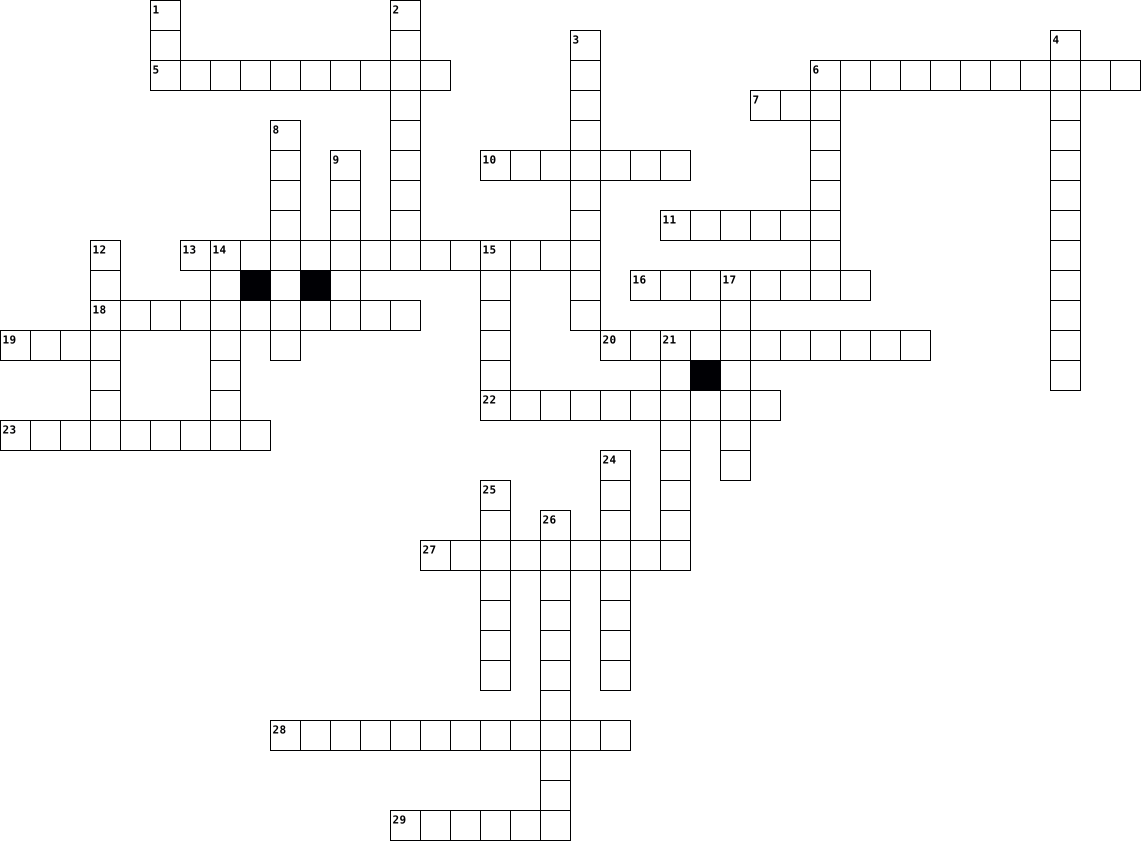
forms of energy Crossword Puzzles
Chapters 14 & 15 2023-05-10

Across
- energy - the chemical energy stored in living things
- - the ability to do work
- plane - a slanted surface along which a force moves an object to a different elevation
- - an inclined plane wrapped around a cylinder
- energy resource - a source of energy that can be replaced in a relatively short period of time
- fuels - rich deposits of hydrocarbon mixtures that formed from the remains of organisms
- conversion - the process of changing energy from one form to another
- - a rigid bar that is free to move around a fixed point
- and axle - a simple machine that consists of two rigidly attached disks or cylinders, each one with a different radius
- energy - energy that travels in waves
- conservation - the practice of finding ways to use less energy or to use energy more efficiently
- energy - thermal energy beneath Earth’s surface
- potential energy - potential energy that depends upon an object’s height above a reference point
- energy - the energy stored in chemical bonds
- energy - the energy an object has due to its motion
Down
- energy - the energy stored in atomic nuclei
- - a device that changes a force & helps you do work
- energy resource - a source of energy that exists in limited quantities and, once used, cannot be replaced except over the course of millions of years
- - a V-shaped object whose sides are two inclined planes sloped toward each other
- energy - the energy associated with the motion and position of everyday objects
- potential energy - the potential energy of an object that is stretched or compressed
- energy - energy that is stored as a result of position or shape
- energy - sunlight that is converted into usable energy
- energy - the energy associated with electric charges
- energy - energy obtained from flowing water
- - a simple machine that consists of a rope that fits into a groove in a wheel
- energy - energy dealing with temperature
- - the product of distance and the force in the direction an object moves
- - the rate of doing work
29 Clues: - the ability to do work • - the rate of doing work • energy - energy that travels in waves • energy - energy dealing with temperature • energy - the energy stored in atomic nuclei • energy - energy obtained from flowing water • energy - the energy stored in chemical bonds • - an inclined plane wrapped around a cylinder • energy - thermal energy beneath Earth’s surface • ...
Chap14 2023-05-10

Across
- energy - the chemical energy stored in living things
- - the ability to do work
- plane - a slanted surface along which a force moves an object to a different elevation
- - an inclined plane wrapped around a cylinder
- energy resource - a source of energy that can be replaced in a relatively short period of time
- fuels - rich deposits of hydrocarbon mixtures that formed from the remains of organisms
- conversion - the process of changing energy from one form to another
- - a rigid bar that is free to move around a fixed point
- and axle - a simple machine that consists of two rigidly attached disks or cylinders, each one with a different radius
- energy - energy that travels in waves
- conservation - the practice of finding ways to use less energy or to use energy more efficiently
- energy - thermal energy beneath Earth’s surface
- potential energy - potential energy that depends upon an object’s height above a reference point
- energy - the energy stored in chemical bonds
- energy - the energy an object has due to its motion
Down
- energy - the energy stored in atomic nuclei
- - a device that changes a force & helps you do work
- energy resource - a source of energy that exists in limited quantities and, once used, cannot be replaced except over the course of millions of years
- - a V-shaped object whose sides are two inclined planes sloped toward each other
- energy - the energy associated with the motion and position of everyday objects
- potential energy - the potential energy of an object that is stretched or compressed
- energy - energy that is stored as a result of position or shape
- energy - sunlight that is converted into usable energy
- energy - the energy associated with electric charges
- energy - energy obtained from flowing water
- - a simple machine that consists of a rope that fits into a groove in a wheel
- energy - energy dealing with temperature
- - the product of distance and the force in the direction an object moves
- - the rate of doing work
29 Clues: - the ability to do work • - the rate of doing work • energy - energy that travels in waves • energy - energy dealing with temperature • energy - the energy stored in atomic nuclei • energy - energy obtained from flowing water • energy - the energy stored in chemical bonds • - an inclined plane wrapped around a cylinder • energy - thermal energy beneath Earth’s surface • ...
Science 2020-04-17

Across
- process of a unstable atomic nucleus losing energy by radiation
- layer of rock or soil
- principal of geology that crosses
Down
- process of determining age
- related to the current geological age
- A fossil thats useful for dating
- a system of dating that relates to geology of time
- relative order of past events
- The principal of inclusions
- axiom that forms one of the bases of science and geology
10 Clues: layer of rock or soil • process of determining age • The principal of inclusions • relative order of past events • A fossil thats useful for dating • principal of geology that crosses • related to the current geological age • a system of dating that relates to geology of time • axiom that forms one of the bases of science and geology • ...
Cell Processes and Energy 2021-01-13

Across
- an organism that makes its own food
- during the ________________ a cell grows, prepares for division, and divides into two new cells
- the process by which a cell captures energy in sunlight and uses it to make food
- the ultimate source of energy
- the process that makes an exact copy of the DNA in a cell's nucleus
- green organelles found in plant cells that carry out photosynthesis
- during this phase of mitosis, the chromosomes attach to a spindle fiber and line up down the center of the cell
- the first part of photosynthesis occurs mostly in these structures
- the first stage of the cell cycle when the cell grows, makes a copy of DNA, and prepares to divide
- the main pigment for photosynthesis
- the process by which cells obtain energy from glucose
- the process when the cell splits into two identical daughter cells
- these cylindrical structures are copied during interphase
Down
- this allows organisms to grow, repair damaged structures, and reproduce
- the two new cells produced by the cell cycle are called...
- an organism that cannot make its own food
- this type of fermentation occurs in muscle cells
- plants require sunlight, carbon dioxide and _______ to carry out photosynthesis
- another name for a consumer
- another name for a producer
- the phase of mitosis when chromosomes are pulled to opposite ends of the cell
- the structure that forms in plant cells during cytokinesis
- the process that produces 2 new nuclei
- oxygen is used to break down this sugar through the process of cellular respiration
- the products of photosynthesis are sugar and __________.
- a process that releases energy without the use of oxygen
- the last phase of mitosis when nuclear membranes form around each set of chromosomes
- DNA and protein form these thread-like structures
- a single-celled organism that carries out alcoholic fermentation
- an important sugar that is produced through photosynthesis
30 Clues: another name for a consumer • another name for a producer • the ultimate source of energy • an organism that makes its own food • the main pigment for photosynthesis • the process that produces 2 new nuclei • an organism that cannot make its own food • this type of fermentation occurs in muscle cells • DNA and protein form these thread-like structures • ...
Energy Crossword by Pranjal Rai and Sarah Duong 2018-04-13

Across
- resource that can be replenished
- transfer of thermal energy through a fluid
- renewable energy that is energy from the sun
- resource that cannot replenish itself
- states that energy cannot be created or destroyed
- a type of kinetic energy that is created by vibrations
- unit of energy
- process of changing from one form of energy to the other
- transfer of thermal energy through waves or a string of particles
- it can be both kinetic and potential energy that is the result the movement of matter
- a type of energy from the electromagnetic spectrum
- energy created by the movement of particles
- type of potential energy that is a result of stretching or compressing
- renewable resource that is heat energy from deep within the earth
Down
- energy of motion
- a type of potential energy that can be stored energy
- renewable source made by the movement of water
- a type of kinetic and potential energy that involves the movement of electrons
- nonrenewable resource formed by the compression of plants, gases, and animals exposed to heat for a long period of time
- energy created through electricity and magnetism
- renewable energy source created by the movement of the earth
- energy of location
- nonrenewable resource made of methane and other hydrocarbons
- non renewable resource that is fossilized carbon
- the ability to move or cause change in matter
- the amount of matter in an object
- speed + direction
- a type of potential energy generated through fusion; this is also known as atomic energy
- transfer of thermal energy through electricity or matter
- renewable resource made of material from plants or microorganisms that were recently living
- nonrenewable resource extracted through drilling from specific rock reservoirs; thick black liquid
31 Clues: unit of energy • energy of motion • speed + direction • energy of location • resource that can be replenished • the amount of matter in an object • resource that cannot replenish itself • transfer of thermal energy through a fluid • energy created by the movement of particles • renewable energy that is energy from the sun • the ability to move or cause change in matter • ...
Forms of Business Organisations 2021-06-07

Across
- working together and with others for a common purpose
- Partner who does everything participating in Management
- only owner of a business
- Every partner is both an agent and a principal.
- Owners of the company who elect the Board of Directors of a joint stock company
Down
- Joint Hindu Family Business is governed by this law
- Maximum number of partners in a Partnership Business
- Partnership permitted in India after New Enterprise Policy in 1991
- Partner who only allows his name to be used by a firm and does not contribute to capital
- members of HUF other than Karta
- Type of company advantageous in transfer of ownership
- Controller of the HUF business
12 Clues: only owner of a business • Controller of the HUF business • members of HUF other than Karta • Every partner is both an agent and a principal. • Joint Hindu Family Business is governed by this law • Maximum number of partners in a Partnership Business • working together and with others for a common purpose • Type of company advantageous in transfer of ownership • ...
Forms of Tener, Venir 2021-04-19

Across
- Yo Tener
- nosotros tener
- tú venir
- ustedes venir
- vosotros venir
- nosotros venir
Down
- yo venir
- usted tener
- vosotros tener
- Tú Tener
- usted venir
- ustedes tener
12 Clues: yo venir • Yo Tener • Tú Tener • tú venir • usted tener • usted venir • ustedes tener • ustedes venir • nosotros tener • vosotros tener • vosotros venir • nosotros venir
Forms of Government Terminology 2022-01-11

Across
- any government that uses organizations to shape the citizens
- a form of government with a limited monarch and an elected legislative body
- a form of government where the individual governs himself/herself (while respecting the rights of others)
- form of government where a strong ruler exerted his/her authority over a group of people
- a form of government where the state own all means of production and generally directs the lives of its citizens
- all those things a government decides to do
Down
- the institution through which a society makes and enforces its public policy
- a form of government where a hereditary head holds all power
- a form of government where everyone works collectively for the common good (often devoid of personal property)
- a form of government where the populace elects others to make public policies for them
- a form of government where the people directly make all governmental decisions
- the earliest form of government consisting of a group of people led by a chief
12 Clues: all those things a government decides to do • a form of government where a hereditary head holds all power • any government that uses organizations to shape the citizens • a form of government with a limited monarch and an elected legislative body • the institution through which a society makes and enforces its public policy • ...
A New Way to Grow 2013-01-22

Across
- Container to hold and grow plants in
- Another word for dirt
- Animal needed for aquaponics (plural)
- Main source of energy for plants
- Known as producers (plural)
- H2O
Down
- Plants release this during photosynthesis
- Natural solid material that forms from minerals example lava, granite quartz (plural)
- The sun is an example of this
- Equipment that recycles and loops water back to the plant to the tank
- Cleans the water
- Equipment where fish is stored
12 Clues: H2O • Cleans the water • Another word for dirt • Known as producers (plural) • The sun is an example of this • Equipment where fish is stored • Main source of energy for plants • Container to hold and grow plants in • Animal needed for aquaponics (plural) • Plants release this during photosynthesis • Equipment that recycles and loops water back to the plant to the tank • ...
Branches of science 2021-09-07

Across
- Natural phenomenon.
- Study of the atmosphere that focuses on weather processes and forecasting
- The study of the structure and organization of living things
- The branch of medicine dealing with the nervous system and its disorders
- The scientific study of plant life
- The Study of science of the earth, its structure, and history
- Study of flower.
- The science of matter and its interactions with energy and itself
- The study of human cultures both past and present.
- Concerning the sounds of a language.
- The study of how organisms interact with each other and their environment
- The study of the organic chemistry of compounds and processes occurring in organisms
- Study of disease causing organisms. Genetics The science of genes, heredity, and the variation of organisms
- Study of kidneys.
- The study of the behavior and properties of matter
- Microbiology The study of microorganisms, including viruses, prokaryotes and simple eukaryotes Mineralogy The study of the chemistry, crystal structure, and physical (including optical) properties of minerals Mycology Study of fungi.
- The study of life-forms existing in former geological time periods
Down
- Deals with the study of blood vascular system.
- The study of celestial objects in the universe. Study of heavenly bodies. Biology The science that studies living organisms
- The branch of medicine dealing with the applications of radiant energy, including x-rays and radioisotopes Toxicology The study of poisons and the effects of posisoning
- A science dealing with the logic of quantity and shape and arrangement
- Study of disease causing organisms. Psychology Study of the mind and behaviour
- The science that studies living Climatology The study of climates and investigations of its phenomena and causes organisms
- Study of algae.
- Study of languages.
- The Study of science of the earth, its structure, and history Myology Study of muscles.
- Study of virus.
- The science of genes, heredity, and the variation of organisms
- The study of the mechanical, physical, and biochemical functions of living organisms Genetics The science of genes, heredity, and the variation of organisms
- The study of animals Paleontology The study of life-forms existing in former geological time periods
- Science dealing with crop plant.
31 Clues: Study of algae. • Study of virus. • Study of flower. • Study of kidneys. • Natural phenomenon. • Study of languages. • Science dealing with crop plant. • The scientific study of plant life • Concerning the sounds of a language. • Deals with the study of blood vascular system. • The study of human cultures both past and present. • The study of the behavior and properties of matter • ...
SCIENCE RULES 2023-03-07

Across
- flat part of ocean
- the make up of a substance
- When the tide is higher than usual.
- a current on the surface of the water
- the amount of salt in water
- when the tide is at it lowest point
- a underwater mountain range
- the rise and fall of water caused by the moon
- the process of moving broken down rock.
- underwater volcano
Down
- the edge of the continent in an ocean.
- the compactness of a substance
- this directs the movement of currents
- what forms when plates spread apart with no magma coming through
- a crack or valley in the middle of the ocean
- the blank is the first part of the continent ending
- currents deep in the ocean
- the dropping off of broken down sediments
- a movement of energy moves water
- The range of high and low tides
20 Clues: flat part of ocean • underwater volcano • the make up of a substance • currents deep in the ocean • the amount of salt in water • a underwater mountain range • the compactness of a substance • The range of high and low tides • a movement of energy moves water • When the tide is higher than usual. • when the tide is at it lowest point • this directs the movement of currents • ...
Unit 5 Vocab 1 2026-02-26

Across
- Energy is not created or destroyed, but is transformed from one form to another.
- Energy used to do something we want it to do
- energy being used to do something that can be observed or measured
- a tool used to measure the amount of energy in food
- the flow of energy along a conductor
- the movement of the atoms that make up an object
- (Useful Energy / Input Energy) x 100
- the form of potential energy found in objects which are stretched or squashed
- stored energy
- The amount of supplied energy
Down
- a simple flow diagram that traces the path of energy transformations back to its original source
- the energy produced by the sun
- energy stored in the bonds of the atoms that hold a substance together
- When energy changes from one form to another
- the ability to do work
- potential energy from the height of an object above the Earth’s surface
- The total amount of transformed energy (same as input)
- the energy of motion
- units used to measure energy
- 1000 Joules
- the portion of energy that takes an unusable form during transformation
- When heat energy moves from one object to another
- the unit used for measuring energy in food
- energy associated with pressure waves travelling through the air
24 Clues: 1000 Joules • stored energy • the energy of motion • the ability to do work • units used to measure energy • The amount of supplied energy • the energy produced by the sun • the flow of energy along a conductor • (Useful Energy / Input Energy) x 100 • the unit used for measuring energy in food • When energy changes from one form to another • ...
Ch 14 & 15 Vocab 2023-05-11

Across
- the energy stored in atomic nuclei
- the ability to do work
- energy that travels in waves
- the energy associated with the motion and position of everyday objects
- thermal energy beneath Earth’s surface
- energy dealing with temperature
- a source of energy that exists in limited quantities and, once used, cannot be replaced except over the course of millions of years
- the potential energy of an object that is stretched or compressed
- the energy stored in chemical bonds
- the energy an object has due to its motion
Down
- energy that is stored as a result of position or shape
- a source of energy that can be replaced in a relatively short period of time
- the process of changing energy from one form to another
- potential energy that depends upon an object’s height above a reference point
- the practice of finding ways to use less energy or to use energy more efficiently
- rich deposits of hydrocarbon mixtures that formed from the remains of organisms
- sunlight that is converted into usable energy
- the chemical energy stored in living things
- the energy associated with electric charges
- energy obtained from flowing water
20 Clues: the ability to do work • energy that travels in waves • energy dealing with temperature • the energy stored in atomic nuclei • energy obtained from flowing water • the energy stored in chemical bonds • thermal energy beneath Earth’s surface • the energy an object has due to its motion • the chemical energy stored in living things • the energy associated with electric charges • ...
Biology 2023-08-20
Across
- Trait that helps an organism survive in its environment.
- Movement of blood through the body.
- Single-stranded molecule involved in protein synthesis.
- Cell division for growth and repair.
- Fission Asexual reproduction in single-celled organisms.
- Process by which plants convert light energy into food.
- Passing of traits from parents to offspring.
- Site of photosynthesis in plant cells.
- Basic unit of life.
- Maintenance of stable internal conditions.
- Complete loss of a species.
- Community of living organisms and their environment.
- Term for inheritance patterns studied by Gregor Mendel.
- Internal structural system in vertebrates.
- Nerve cell for transmitting signals.
Down
- Genetic material containing instructions for traits.
- Gradual change in species over time.
- Initial step in cellular respiration.
- Variety of life forms within an ecosystem.
- Substance that increases the rate of a chemical reaction.
- Genetic makeup of an organism.
- Membrane Cell's outer boundary, controls entry and exit.
- Control center of the cell, contains DNA.
- Chemical messenger that regulates bodily functions.
- Protein that speeds up chemical reactions.
- Study of interactions between organisms and their environment.
- A change in DNA sequence.
- Protein that fights off foreign invaders.
- Square Tool used to predict offspring genotypes.
- Process of converting glucose into energy.
30 Clues: Basic unit of life. • A change in DNA sequence. • Complete loss of a species. • Genetic makeup of an organism. • Movement of blood through the body. • Gradual change in species over time. • Cell division for growth and repair. • Nerve cell for transmitting signals. • Initial step in cellular respiration. • Site of photosynthesis in plant cells. • ...
STEM 2024-03-06

Across
- a polynomial equation of the second degree, typically in the form ax^2+bx+c=0 (2 words)
- discrete pack of energy
- the rate at which a function changes with respect to its independent variable
- every object will remain at rest or in uniform motion in a straight line unless there's external force act upon it
- a series of numbers in which each number is the sum of the two preceding ones (2 words)
- a compound consisting only of hydrogen and carbon atoms
- a theory that assumed to be formed by overlap of atomic orbitals
- atoms of the same element with a different number of neutrons
Down
- a particle accelarator (2 words)
- a specialized cell transmitting nerve impulses
- the lightest and most abundant element in the universe
- mathematical constant representing the ratio of a circle's circumference to its diameteter
- mc²
- molecular shape that consist of 3 bonding pairs and 1 lone pair(2 words)
- the antideravative of a function
- product of mass and acceleration
- a biological catalyst that speeds up chemical reactions in living organisms.
- a green pigment in plants responsible for photosynthesis
- the process of cell division resulting in two identical daughter cells
- protects the internal organ and forms the body frame
20 Clues: mc² • discrete pack of energy • a particle accelarator (2 words) • the antideravative of a function • product of mass and acceleration • a specialized cell transmitting nerve impulses • protects the internal organ and forms the body frame • the lightest and most abundant element in the universe • a compound consisting only of hydrogen and carbon atoms • ...
Myler's science crossword 2025-09-25

Across
- The part of the earth that contains all lakes,oceans and water
- The heat in your beach umbrella rod travels by conduction
- The energy from the sun reaches you by electromagnetic
- The part of the earth that has increasing hot temperatures
- forms when a cold, dense air mass pushes under a warm, lighter air mass, forcing the warm air to rise
- The variable that is kept constant
- The thing that changes
- a large process involving bulk movement of a fluid that usually leads to a net transfer of heat through advection
- The heat in your beach umbrella rod travels
- The part of the earth that has all the clouds that make rain and thunder
- The part of the earth that contains all living beings
- The part of the earth that the air pressure is something that pushes down on molecules
- The part of the earth that contains the ozone layer and increases temperatures the higher you go
Down
- The part of the earth that is the outermost layer of the earth
- forms when a relatively moist, warm air mass slides up and over a cold air mass
- The envelope of gasses that surround the earth
- The thing that changes as a result of the independent
- Rain,snow,sleet, or hail that falls to the ground.
- Layers of the earth that contains rocks and dirt
19 Clues: The thing that changes • The variable that is kept constant • The heat in your beach umbrella rod travels • The envelope of gasses that surround the earth • Layers of the earth that contains rocks and dirt • Rain,snow,sleet, or hail that falls to the ground. • The thing that changes as a result of the independent • The part of the earth that contains all living beings • ...
Textbook Glossary Terminology 2025-02-09

Across
- Long Cables with a silica core that can be used to guid other light signals from one end of the cable to the other
- Evaporation of solvent from a solution to leave solute behind as crystals
- Able to be stretched to form a wire
- Any chemical reaction where a substance burns in oxygen to produce light and heat
- Grid-like structures of atoms
- Describes elements which consist of single atoms
- A simplified representation of solids, liquids and gases
- A change of state where a gas is cooled and forms a liquid
- The term used to describe the structure of the DNA molecule; consists of 2 strands twisted into a double spiral
- A process where two liquids or two gases mix due to the motion of their particles
- a chemical reaction that occurs in all living
Down
- A change of state from gas to solid
- the substance found in plants leaves that make leaves green and collects energy from the Sun for photosynthesis
- A solution in which a substance is dissolved in water
- An electrical switch used in computers to process data quickly
- Describes liquids that can be mixed
- Minerals rich in metals such as copper and iron
- A decrease in size
- Mixture of metal with other metals or non metals
- In this reaction, oxygen and glucose are converted into water and carbon dioxide while releasing energy. The energy released can be used by living things to live, grow and move.
- Describes liquids that do not mix
- Able to hammered or bent into new shapes
22 Clues: A decrease in size • Grid-like structures of atoms • Describes liquids that do not mix • A change of state from gas to solid • Able to be stretched to form a wire • Describes liquids that can be mixed • Able to hammered or bent into new shapes • a chemical reaction that occurs in all living • Minerals rich in metals such as copper and iron • ...
Notes: Active Transport Crossword 2023-10-17

Across
- When a vacuole/vesicle fuses with the cell membrane, releasing its contents.
- A type of active transport that moves NA+ and k+ molecules.
- What cell size (smallest, medium, or largest)will be the most efficient at taking in nutrients?
- As the volume of the cube decreases, the ratio of surface area to volume _________.
Down
- Taking in materials using the cell membrane.
- Energy used for active transport is called ___.
- The tendency of molecules to move from ____ to ____ concentration.
- As the volume of the cube increases, the ratio of surface area to volume _________.
- What happens when cells become too large? (It divides itself)
- All forms of active transport need ______.
10 Clues: All forms of active transport need ______. • Taking in materials using the cell membrane. • Energy used for active transport is called ___. • A type of active transport that moves NA+ and k+ molecules. • What happens when cells become too large? (It divides itself) • The tendency of molecules to move from ____ to ____ concentration. • ...
Chapter 3 Vocab 2023-01-04

Across
- Rock usually light-colored and has coarse grains.
- A group of parts that work as a whole.
- Waves produced by earthquakes.
- A dark, fine-grained rock.
- Ball of solid metal.
- All of Earth's water that flows on top of land.
- The relatively thin envelope of gasses.
- The crust and the uppermost part of the mantle.
- Forces that wear down.
- Layer of rock that forms Earth's outer skin.
- Results from a force pressing on an area.
Down
- A metal core, a solid middle layer, and a rocky outer layer.
- Contains all of Earth's water.
- Layer of hot rock.
- Forces that build up.
- The part of the mantle that is solid metal but could bend like a spoon
- The ability to do work.
- Layer of liquid metal.
- Contains all living things.
19 Clues: Layer of hot rock. • Ball of solid metal. • Forces that build up. • Layer of liquid metal. • Forces that wear down. • The ability to do work. • A dark, fine-grained rock. • Contains all living things. • Contains all of Earth's water. • Waves produced by earthquakes. • A group of parts that work as a whole. • The relatively thin envelope of gasses. • ...
7.1-7.3 Vocabulary Words 2013-02-13

Across
- stores material for the cell
- allows what goes in and what can go out
- create protein
- cell will shrink from above strength
- below strength
- acts like a recycling bin
- they are equal
- has no nuclues
- lets go of large amounts of material
- helps transport cells through the protein channel
Down
- has a nuclues
- when particles move from a high concentration area and spread out to a lower concentration area
- lets in and out membrane for plants only
- the membrane forms a pocket around a particle outside the cell
- main structure to life
- hallways in the cell
- Apparatus ships protein out the the cell
- same strength
- makes energy for the cell
- movement of water across a selectively permeable membrane
- holds the DNA
21 Clues: has a nuclues • same strength • holds the DNA • create protein • below strength • they are equal • has no nuclues • hallways in the cell • main structure to life • acts like a recycling bin • makes energy for the cell • stores material for the cell • cell will shrink from above strength • lets go of large amounts of material • allows what goes in and what can go out • ...
Unit 2 Vocab Assignment 2025-09-17

Across
- macromolecule that makes up genetic material
- macromolecule that is water resistant and forms cell membranes
- large molecule
- building block of macromolecules
Down
- smallest unit of a chemical compound that has the chemical properties of that compound
- organic compound made of only hydrogen and carbon atoms
- type of protein that speeds up chemical reactions
- macromolecule made up of amino acids
- macromolecule used for energy
- molecules that contain carbon to hydrogen bonds
- many monomers bonded together
11 Clues: large molecule • macromolecule used for energy • many monomers bonded together • building block of macromolecules • macromolecule made up of amino acids • macromolecule that makes up genetic material • molecules that contain carbon to hydrogen bonds • type of protein that speeds up chemical reactions • organic compound made of only hydrogen and carbon atoms • ...
CELL UNIT 2013-04-15

Across
- To pass or cause to pass into solution
- luminous energy is the perceived energy of light
- measure the ability
- converts light energy into ATP and other forms of energy needed for biochemical processes
- formed as a sphere
- The shortening and thickening of a muscle for the purpose of exerting force on or causing movement of a body part
- an organelle in the cytoplasm of cells that functions in energy production
- oxidation of organic compounds that occurs within cells, producing energy for cellular processes.
- to control
- the movement of ions or molecules across a cellular membrane from a lower to a higher concentration
- the outer structure of certain cells
- consists of one carbon and two oxygen atoms
- transport of a substance across a cell membrane by diffusion
- using energy from the sun and chlorophyll to make carbohydrates
- The movement of atoms or molecules from an area of higher concentration to an area of lower concentration
- a very small particle of matter
- a sugar/ starch syrup
- usually with twice as many hydrogen atoms as carbon or oxygen atoms
- one microoganism made up a single cell
- Any of a large group of long-chain monobasic organic acids hydrolytically derived from fats
- The taking in or incorporation of something, such as a gas, a liquid, light, or heat.
- the semipermeable membrane enclosing the cytoplasm of a cell.
- Energy liberated by a chemical reaction or absorbed in the formation of a chemical compound
- A small cavity in the cytoplasm of a cell bound by a single membrane and containing water/food
- a state of rest or balance due to the equal action of opposing forces
- contains enzymes responsible for energy production
- The capacity of a physical system to do work
Down
- A quantity whose value depends on the value given to one or more related quantities
- An autotrophic organism that serves as a source of food for other organisms in a food chain
- a structure composed of two molecular layers, especially of phospholipids in cellular membranes.
- a plastid containing chlorophyll
- process of burning
- Any of numerous proteins produced in living cells that accelerate or catalyze the metabolic processes of an organism
- any organism too small to be viewed by the human eye
- the cell substance between the cell membrane and the nucleus
- a form of life
- The arrangement or formation of the tissues, organs, or other parts of an organism.
- a process that involves changes in the structure and energy content of atoms, molecules, or ions but not their nuclei
- the basic structure of a cell membrane consisting of a double layer of phospholipid molecules
- reproduced singley
- a very small particle
- An increase in the strength of a fluid or gas in a mixture by purification, evaporation, or diffusion
- to produce carbohydrates by photosynthesize
- a number of actions of which each has a certain energy type
- the act or process of putting in
- Microorganisms made up of a single cell that has no distinct nucleus
- a part of the cell containing DNA and RNA and responsible for growth and reproduction
- The movement of a solvent through a membrane separating two solutions of different concentrations.
- a specialized part of a cell having some specific function; a cell organ.
- functioning as the site of protein manufacture
- indicating limits
- adenosine triphosphate
- composed of two or more parts
53 Clues: to control • a form of life • indicating limits • process of burning • formed as a sphere • reproduced singley • measure the ability • a very small particle • a sugar/ starch syrup • adenosine triphosphate • composed of two or more parts • a very small particle of matter • a plastid containing chlorophyll • the act or process of putting in • the outer structure of certain cells • ...
Physical Science 2021-12-16

Across
- change, when a substance combines with another to form a new substance.
- firm and stable in shape; not liquid or fluid
- electromagnetic waves with wavelengths longer than those of terahertz (THz) wavelengths, but relatively short for radio waves.
- the resistance that one surface or object encounters when moving over another.
- an atom or molecule with a net electric charge due to the loss or gain of one or more electrons.
- science, the study of the inorganic world.
- plant, is a thermal power station in which the heat source is a nuclear reactor.
- waves, wave in which particles of the medium vibrate at right angles, or perpendicular, to the direction that the wave travels.
- change, the material involved in the change is structurally the same before and after the change.
- energy, the stored energy in any object or system.
- the study of the electromagnetic force.
- the process of something moving or changing place, or even just changing position.
- the ability to do work
- a proposed explanation for a phenomenon.
- of matter, one of the distinct forms in which matter can exist.
- the quantity of matter in a physical body. waves, a disturbance that moves energy from one place to another.
- a brief statement or account of the main points of something.
- the emission or transmission of energy in the form of waves or particles through space or through a material medium.
Down
- is a form of energy that harnesses the power of water in motion.
- an atom that has more electrons than protons.
- energy, a form of energy that an object or a particle has by reason of its motion.
- circuit, comprises branches so that the current divides and only part of it flows through any branch.
- a property of matter by which it remains at rest or in motion in the same straight line unless acted upon by some external force.
- the return of light or sound waves from a surface.
- incompressible fluid that conforms to the shape of its container but retains a constant volume independent of pressure.
- a structure built across a river or stream to hold back water.
- laws, three laws of classical mechanics that describe the relationship between the motion of an object and the forces acting on it.
- a continuous path through which electricity travels.
- the basic building blocks of all living things.
- energy, the use of nuclear reactions to produce electricity.
- any substance that has mass and takes up space by having volume.
- mass per unit volume.
- that branch of science that deals with the structure of matter and how the fundamental constituents of the universe interact.
- a state of matter that has no fixed shape and no fixed volume.
- method, it is the technique used in the construction and testing of a scientific hypothesis.
- the smallest unit of matter.
36 Clues: mass per unit volume. • the ability to do work • the smallest unit of matter. • the study of the electromagnetic force. • a proposed explanation for a phenomenon. • science, the study of the inorganic world. • an atom that has more electrons than protons. • firm and stable in shape; not liquid or fluid • the basic building blocks of all living things. • ...
Energy Types & Transfers- Valentina Miranda 2023-12-11

Across
- energy: Mechanical potential energy stored in the physical system of something.
- reaction: Process in which one or more substances are converted to one or more different substances.
- energy: the stored energy that an object has
- energy: From the nucleus of Atoms.
- Energy: Energy that comes from the movement of atoms and molecules in a substance (heat).
- Energy stored in a magnetic field.
- Energy: Dieliverd by tiny charged particles called electrons.
- of conservation of energy: energy cannot be created or destroyed.
- The basic unit of a chemical element.
Down
- Energy: Also known as electromagnetic energy.
- energy: Energy stored in objects' height.
- Energy: Energy Gravitational objects by Tension
- A group of atoms bonded together the smallest unit of a chemical compound.
- A region in a longitudinal wave where the particles are furthest apart.
- The positively charged region of the center of an atom.
- Energy: Is the energy of motion
- Energy: The movement of energy through waves.
- Energy: stored in the bonds of atoms and molecules.
- energy: any form of energy related to the sun.
- This happens when a force causes an object to move
20 Clues: Energy: Is the energy of motion • energy: From the nucleus of Atoms. • Energy stored in a magnetic field. • The basic unit of a chemical element. • energy: Energy stored in objects' height. • energy: the stored energy that an object has • Energy: Also known as electromagnetic energy. • Energy: The movement of energy through waves. • ...
Types of Energy/Energy Transformations Crossword Puzzle 2023-12-07

Across
- The energy of chemical substances like food
- This is an example of energy transformation with mechanical and sound energy and it creates music
- The energy of a moving object
- The flow of charged electrons through a circuit
- This type of energy is stored in an elastic object
- This is a form of kinetic energy that travels in waves
- An energy created by two forces interacting
- This is the the act of nucleus coming together
- This is a form of energy transformation between radiant energy being collected to form electrical energy
Down
- This is a rule that says energy an neither be created or destroyed
- This uses nuclear fission and thermal energy to change water into steam and the steam goes into a mechanical turbine
- Heat energy
- Energy is built up by applying a force to it
- This is the act of a nuclear splitting causing a release of energy
- This energy is caused when atoms join together or split
- The energy held by an object in a high position
- Light energy; you can see it directly
- The built-up energy of an object
- This is the energy that we can hear
- This is an example of energy transformation with chemical, thermal, and radiant energy
20 Clues: Heat energy • The energy of a moving object • The built-up energy of an object • This is the energy that we can hear • Light energy; you can see it directly • The energy of chemical substances like food • An energy created by two forces interacting • Energy is built up by applying a force to it • The energy held by an object in a high position • ...
ESS Terminology crossword 2024-05-16

Across
- pollutants that cannot be broken down by living organisms and are organic
- a particular worldview or set of paradigms that shapes the way an individual perceives and evaluates environmental issues
- a system that has transfer of energy, but not of mass
- the environment in which a species normally lives
- feedback that amplifies or increases change
- a critical threshold when even a small change can have dramatic effects and cause a disproportionately large response in the overall system
- using global resources at a rate that allows natural regeneration and minimises damage to the environment
- the pollution comes from a discrete source that can be tracked
- the process whereby the concentration of a chemical increases at each trophic level
Down
- the removal of some or all of a cover of trees
- all forms of rainfall, snow, frost, hail and dew
- the process by which vegetation in drylands i.e. arid and semi-arid lands, such as grasslands or shrublands, decreases and eventually disappears
- the nutrient enrichment of streams, ponds and groundwater due to increased levels of nitrogen and phosphorus
- this equilibrium has constant inputs and outputs of energy and matter, but the overall stability of the system remains
- feedback that counteracts any change away from equilibrium, contributing to stability
- this law of thermodynamics states that energy goes from a concentrated form to a more dispersed form
- a group of species living together in the same environment at the same time
- pollutants that are active on emission
18 Clues: pollutants that are active on emission • feedback that amplifies or increases change • the removal of some or all of a cover of trees • all forms of rainfall, snow, frost, hail and dew • the environment in which a species normally lives • a system that has transfer of energy, but not of mass • the pollution comes from a discrete source that can be tracked • ...
Chapter 1 Puzzle 2021-05-12

Across
- The ceation of sectional images of the body that demonstrate the physiologic function of various organs and systems.
- Physician who specializes in the use of x-rays and other forms of both ionizing and nonionizing radiation in the diagnosis and treatment of disease.
- Synonym for x-ray.
- Radiologic procedures for the diagnosis and treatment of diseases of the cardiovascular system.
- Radiography of the breast.
- Capacity to operate work.
- Making of records of internal structures of the body by passing x-rays or gamma rays through the body to act on specially sensitized film or an imaging plate or system.
- An advanced-level radiographer who extends the capacity of the radiologist in the diagnostic imaging enviroment, therby enhancing patient care.
Down
- General term applied to an individual who perfoms radiography, radiation therapy, or nuclear medicine technology.
- Energy transmitted by waves thorugh space or through a medium.
- Visualization of deep structures of the body by recording the reflections of pulses of ultrasonic waves directed into the tissue.
- Branch of radiology that involves the introduction of radioactive sunstances into the body for both diagnostic and theraputic purposes.
- Branch of radiology involveed in the treatment of disease by means of x-rays or radioactive substances.
- Process of using a magnetic field and radiofrequencies to create sectional images of the body.
- Recording of a predetermind plane in the body using an x-ray beam that is measured, recorded, and then processed by a computerfor display on monitor.
- Electromagnetic radiation of short wavelength that is prooduced whe electrons moving at high velocity are suddenly stopped.
- Any process by which a neutral atom gaines or loses an electron, thus acquiring a net charge.
- Measurment of bone density using dual-energy x-ray absorptiometry to detect osteoporosis.
- Branch of the health sciences dealing with radioactive substances and radiant energy and with the diagnosis and tratment of diseas by means of both ionizing and nonionizing radiation.
19 Clues: Synonym for x-ray. • Capacity to operate work. • Radiography of the breast. • Energy transmitted by waves thorugh space or through a medium. • Measurment of bone density using dual-energy x-ray absorptiometry to detect osteoporosis. • Any process by which a neutral atom gaines or loses an electron, thus acquiring a net charge. • ...
Chapter 1 2022-09-02

Across
- brands of radiology that involve the interduction of radioactive substances into the body for both diagnostic and therapeutic purposes
- creation of sectional images of the body that demonstrate the psychological function of various organs and systems
- an advanced level radiographer who extends the capacity of the radiologist in the diagnostic imaging environment they are by enhancing patient care
- any process by which a neutral atom gains or loses an electron,acquiring a net charge
- radiography of the breast
- general term applied to an individual who performs radiography,radiation therapy or nuclear medicine technology
- visualization of deep structures of the body by recording the reflection of pulses of ultrasonic waves directed into the tissue
- electromagnetic radiation of short wave length that is produced when electrons moving at high velocity or suddenly stopped
- making of records of internal structures of the body by passing x-rays or gamma rays through the body to act on specially sensitize film or an imaging plate or system
- recording of a predetermined plane in the body using an x-ray beam that is measured recorded and then processed via computer for display on a monitor
- branch of the health system dealing with radioactive substances and radiant energy and with the diagnosis and treatment of disease by means of both ionizing and nonionizing radiation
Down
- recording procedures for the diagnosis and treatment of diseases of the cardiovascular system
- position who specializes in the use of x-rays and other forms of both ionizing and nonionizing radiation in the diagnosis and treatment of disease
- synonym for x-ray
- branch of radiology involved in the treatment of disease by means of x-ray or radioactive substances
- process of using a magnetic field and radio frequencies to create sectional images of the body
- capacity to operate or work
- energy transmitted by waves through space or through a medium
- measurement of bone density using do energy x-ray absorptiometry entry to detect osteoporosis
19 Clues: synonym for x-ray • radiography of the breast • capacity to operate or work • energy transmitted by waves through space or through a medium • any process by which a neutral atom gains or loses an electron,acquiring a net charge • recording procedures for the diagnosis and treatment of diseases of the cardiovascular system • ...
Science 2022-01-04

Across
- able to be noticed or perceived; discernible able to be discerned; perceptible.
- the scale of temperature in which water freezes at 0° and boils at 100° under standard conditions.
- a substance which does not readily allow the passage of heat or sound.
- the spreading of something more widely.
- the available body of facts or information indicating whether a belief or proposition is true or valid.
- an assertion of the truth of something, typically one that is disputed or in doubt.
- the quality or state of being natural.
- the pressure exerted by the weight of the atmosphere, which at sea level has a mean value of 101,325 pascals (roughly 14.6959 pounds per square inch). Also called barometric pressure.
- Of two quantities: such that one increases in proportion to a decrease in the other.
- the movement caused within a fluid by the tendency of hotter and therefore less dense material to rise, and colder, denser material to sink under the influence of gravity, which consequently results in transfer of heat.
- the degree of compactness of a substance.
- the lowest temperature that is theoretically possible, at which the motion of particles that constitutes heat would be minimal. It is zero on the Kelvin scale, equivalent to –273.15°C or –459.67°F.
- the process by which heat or electricity is directly transmitted through a substance when there is a difference of temperature or of electrical potential between adjoining regions, without movement of the material.
- a degree of density, firmness, viscosity, etc.
- the degree or intensity of heat present in a substance or object, especially as expressed according to a comparative scale and shown by a thermometer or perceived by touch.
- energy associated with microscopic forms of energy.
- the action of thinking about something in a logical, sensible way.
Down
- a three-dimensional representation of a person or thing or of a proposed structure, typically on a smaller scale than the original.
- a supposition or proposed explanation made on the basis of limited evidence as a starting point for further investigation.
- the ability to be foreseen
- a question that a research project sets out to answer
- A controled variable is any factor that is controlled or held constant in an experiment.
- the quality of being hot; high temperature.
- the quantity of matter which a body contains, as measured by its acceleration under a given force or by the force exerted on it by a gravitational field.
- the amount of space that a substance or object occupies, or that is enclosed within a container, especially when great.
- matter cannot be created or destroyed, but it can change forms.
- corresponding in size or amount to something else.
- the emission of energy as electromagnetic waves or as moving subatomic particles, especially high-energy particles which cause ionization.
- not certain or fixed; provisional.
29 Clues: the ability to be foreseen • not certain or fixed; provisional. • the quality or state of being natural. • the spreading of something more widely. • the degree of compactness of a substance. • the quality of being hot; high temperature. • a degree of density, firmness, viscosity, etc. • corresponding in size or amount to something else. • ...
Review 2025-03-09

Across
- An exothermic reaction is a chemical reaction that ___________ heat to its surroundings.
- Crystallization happens when a dissolved substance forms a _________ with a repeating pattern of molecules or atoms.
- Aluminum reacts with sodium hydroxide to produce ___________ gas and heat.
- When sodium acetate crystallizes in a hand warmer, it releases heat, making it an ___________ process.
- The reaction between calcium oxide and water is an example of an ___________ reaction.
- Crystallization can also absorb heat, making it an ________process, as seen with ammonium chloride.
Down
- Sodium carbonate reacts with calcium hydroxide to produce ___________ in the heating pack.
- In an endothermic reaction, energy is ___________ from the surroundings.
- In an endothermic reaction, the products have _______ energy than the reactants.
- The energy needed to start a chemical reaction is called ___________ energy.
- To make a supersaturated solution, first ______ the solvent to dissolve more solute than usual.
11 Clues: In an endothermic reaction, energy is ___________ from the surroundings. • Aluminum reacts with sodium hydroxide to produce ___________ gas and heat. • The energy needed to start a chemical reaction is called ___________ energy. • In an endothermic reaction, the products have _______ energy than the reactants. • ...
Unit 4 Crossword 2025-11-17

Across
- convenient, ideal emitter that approximates the behavior of many materials when heated
- constrained within some region of space
- light is both wavelike and particle like
- range of all types of electromagnetic radiation
- such lighting that consists of a range of broadly distributed frequencies
- arise when right passes through narrow slits closely spaced about wavelength apart
- inner shell orbitals
- metallic elements in which the last electron added occupies an f orbital
- fixed end points that restricts number and types of possible wave forms
Down
- infer energies of electrons within atoms and molecules
- distance between 2 consecutive peaks or through waves
- corresponds to magnitude if waves displacement
- number of wave cycles that pass a specified point in space in a specified amount of time
- last electron enters as a s or a p orbital in outermost shell
- elements metallic elements in which the last electron added enters a d orbital
- highest energy level orbitals of an atom
- stream of particles
- vert narrow line widths interspersed throughout spectral regions
- unit for frequency, expressed as cycles per second
- oscilliation or periodic movement can transport energy from one point in space to another
- harmonic waves have one or more points between the 2 end points that aren't in motion
21 Clues: stream of particles • inner shell orbitals • constrained within some region of space • light is both wavelike and particle like • highest energy level orbitals of an atom • corresponds to magnitude if waves displacement • range of all types of electromagnetic radiation • unit for frequency, expressed as cycles per second • ...
Bones of the skull 2023-10-09

Across
- form the side and base of the cranium
- region of the head pertaining to or located around the eye
- form most of the roof and upper sides of the cranium
- forms your hard palate
- upper jaw
- forms part of the orbit and the floor of the cranium
- forms the cheeks below and side of the eye
Down
- The jagged line where bones articulate and form a joint that does not move
- forms the back and base of the cranium
- form the bridge of the nose
- forms the forehead, the upper part of your eye socket
- Forms part of the anterior base of the skull and part of the walls of the orbit
- shape and structure of the human body
13 Clues: upper jaw • forms your hard palate • form the bridge of the nose • form the side and base of the cranium • shape and structure of the human body • forms the back and base of the cranium • forms the cheeks below and side of the eye • form most of the roof and upper sides of the cranium • forms part of the orbit and the floor of the cranium • ...
The energy stored in an object because of a) its height above the Earth or b) the stretching, compressing, or distorting a material that will spontaneously return to its original shape. c) chemical bonds 2023-12-13

Across
- A push or a pull that causes movement or a change in motion.
- energy the result when a force, either sound or pressure, makes an object or substance vibrate.
- of Conservation of Energy The theory that energy can only transfer between objects and change form; it is never created or destroyed.
- Energy Energy resulting from the movement of atoms and molecules in a system, causing them to collide with each other. Faster moving particles results in higher temperatures and slower moving particles results in lower temperatures.
- The unit of measurement used to describe the amount of energy that is in a system or that is being used/released in a system.
- Energy Energy resulting from the movement of charged particles (usually electrons) from one point to another.
- Energy energy that is transferred by electromagnetic radiation
- Energy Energy that is stored within an atom’s nucleus. Nuclear reactions including fusion, fission, and radioactive decay are sources of this type of energy.
- energy Light energy is a form of electromagnetic radiation. Light consists of photons, which are produced when an object's atoms heat up.
- The ability to do work
- Energy Energy stored in the chemical bonds of atoms and molecules.
Down
- Potential Energy Energy stored due to an object’s position above the surface of a planet.
- Energy The energy of an object has a result of its motion (can be on an atomic level).
- Energy/Radiant Energy Energy (both visible and nonvisible light) resulting from the release of electromagnetic radiation; which does not require a medium and is released in all directions.
- A type of mechanical force where a sudden force pushes an object in a specific direction.
- Energy The energy stored in an object because of its height above the earth.
- energy energy stored in moving objects.
- A measure of energy transfer that occurs when an object is moved over a distance by an external force.
- Energy Energy that is possessed by an object due to its motion
- Potential Energy Energy stored from stretching, compressing, or distorting a material that spontaneously returns to its original shape; like springs or rubber bands.
- Transformation When one type of energy is converted into another; like when dammed water is released and the kinetic energy is converted into electrical energy.
- Transfer The process by which energy is moved from one area to another.
22 Clues: The ability to do work • energy energy stored in moving objects. • A push or a pull that causes movement or a change in motion. • Energy Energy that is possessed by an object due to its motion • Energy energy that is transferred by electromagnetic radiation • Energy Energy stored in the chemical bonds of atoms and molecules. • ...
Ryen Brown January 7,2025 PS211A Chapter 5 Crossword 2025-01-07

Across
- A shorthand way of identifying a chemical compound consisting of the element symbols and subscripts that represent the number of atoms of each element.
- A compound made from only two elements
- The unequal distribution of electric charge in a covalent bond.
- The principle that states that atoms generally are most stable when they have eight electrons in their valence energy level.
- An electrostatic attraction that forms between atoms when they share or transfer valence electrons.
Down
- A group of covalently bonded atoms that together have gained or lost electrons and act as a single ionized particle.
- The smallest whole-number ratio of ions within an ionic compound.
- A molecule made of two atoms.
- A chemical bond formed when atoms transfer valence electrons.
- A simpler model of a covalent bond
- A positive or negative number showing the electric charge on an element when it forms a compound.
- The attraction between metal atoms and their collectively shared valence electrons.
- A chemical bond formed as a result of two atoms sharing valence electrons
13 Clues: A molecule made of two atoms. • A simpler model of a covalent bond • A compound made from only two elements • A chemical bond formed when atoms transfer valence electrons. • The unequal distribution of electric charge in a covalent bond. • The smallest whole-number ratio of ions within an ionic compound. • ...
Bones and Skeletal Tissue 2023-12-19

Across
- Covers the bone
- Middle of bone
- Cushions joints and also acts as lubricant
- Big movement bones in the body
- Point where bones flare out
- Connects ribs to sternum
- Protects spinal chord
- Small round protrusion on bone
- A bone that forms in a tendon
- The creation of red blood cells in the bone
- Cavity in the long bones
- connects bone to bone
Down
- Provides movement and protections to the body
- Forms airway and lungs
- Forms the nose
- bones wider than they are long
- Flattened plates of compound bones
- pads and protects
- End of bones
- Connects bone to muscle
20 Clues: End of bones • Forms the nose • Middle of bone • Covers the bone • pads and protects • Protects spinal chord • connects bone to bone • Forms airway and lungs • Connects bone to muscle • Connects ribs to sternum • Cavity in the long bones • Point where bones flare out • A bone that forms in a tendon • bones wider than they are long • Big movement bones in the body • ...
wireless technology 2019-11-14

Across
- transmitted by radiotelegraphy.
- to transmit.
- of the forms of energy, highlighted by the structure of matter.
- transmitting radio programs.
- of the coupled vibration of a variable electric field and magnetic field over time.
Down
- specialist.
- of progress and techniques of humanity.
- phone with personal assistant functions.
- for transmitting written messages, signals via a power line.
- of physics that studies the properties of magnets natural or artificial and related phenomena.
10 Clues: specialist. • to transmit. • transmitting radio programs. • transmitted by radiotelegraphy. • of progress and techniques of humanity. • phone with personal assistant functions. • for transmitting written messages, signals via a power line. • of the forms of energy, highlighted by the structure of matter. • ...
cells assignment 2019-11-13

Across
- provide support for the cell.
- folded membrane that forms a system of canals within the cytoplansm.
Down
- breaks down food particales to release their chemical energy for the cell's energy.
- animal cells contain many small vacuoles
- contain the green pigment chlorophyll.
- controls the cell's activities and contains chromosomes.
- for example gatekeeper/body guard.
- the liquid in which other cell parts float in.
8 Clues: provide support for the cell. • for example gatekeeper/body guard. • contain the green pigment chlorophyll. • animal cells contain many small vacuoles • the liquid in which other cell parts float in. • controls the cell's activities and contains chromosomes. • folded membrane that forms a system of canals within the cytoplansm. • ...
Cells: 1.4 2022-11-04

Across
- Proteins within the cell pick up specific molecules and move them across the cell membrane using cellular energy.
- movement of materials across a cell membrane without using cellular energy.
- molecules moving from high concentration to low concentration.
- The movement of water molecules across a selectively permeable membrane.
- The movement of materials across a cell membrane using cellular energy.
Down
- When proteins in the cell membrane form channels through which sugars to diffuse.
- When a vacuole forms around a particle and the cell membrane opens allowing large particles to leave.
- When the cell membrane changes shape and engulfs the particle it needs.
- substances can or cannot cross cell membrane.
9 Clues: substances can or cannot cross cell membrane. • molecules moving from high concentration to low concentration. • When the cell membrane changes shape and engulfs the particle it needs. • The movement of materials across a cell membrane using cellular energy. • The movement of water molecules across a selectively permeable membrane. • ...
Organelles 2025-12-09

Across
- forms structure to give cell shape
- cells energy center
- make proteins
- packages and exports proteins
Down
- used during cell divison
- storage for DNA
- makes ribosomes
- contains digestive enzymes
- Transport system - has ribosomes
- storage area - holds water
10 Clues: make proteins • storage for DNA • makes ribosomes • cells energy center • used during cell divison • contains digestive enzymes • storage area - holds water • packages and exports proteins • Transport system - has ribosomes • forms structure to give cell shape
Subjects - Parthav Pratim M - 1RV23IS081 2024-06-26

Across
- Analysis of matter, energy, and their interactions.
- Examination of human societies and social behavior.
- Exploration of fundamental questions about existence, knowledge, and ethics.
- Study of numbers, shapes, and patterns.
- Examination of past events and societies.
- Study of living organisms and their functions.
Down
- Study of the Earth's physical features and human societies.
- Analysis of production, distribution, and consumption of goods and services.
- Study of substances and their properties.
- Study of the mind and behavior.
- Creation and appreciation of visual forms.
- Exploration of written works and authors.
12 Clues: Study of the mind and behavior. • Study of numbers, shapes, and patterns. • Study of substances and their properties. • Exploration of written works and authors. • Examination of past events and societies. • Creation and appreciation of visual forms. • Study of living organisms and their functions. • Analysis of matter, energy, and their interactions. • ...
Jazzy's Crossword 2013-05-15

Across
- energy which causes vibrations in the air
- essential energy from plants
- type of energy stored in batteries and bananas
- high energy electromagnetic radiation
- energy alternative from the sea
- unit of measuring energy
- het energy from the sun
- process by which living things get energy from food
- one of man's oldest energy sources-used for sailing ships and grinding grain
- needed to do work
Down
- energy used for lifting in scrap metal yards
- fossil fuel which is one of our non-renewable resources
- produced in every energy conversation
- most commonly used energy in home and industry
- gas which is a good energy source but is dangerously explosive
- solid fossil fuel which causes pollution problems
- 'alternative energy' source which can be expensive to harness
- converts kinetic energy to electrical energy
- energy of movement
- important type of energy but with great potential dangers
20 Clues: needed to do work • energy of movement • het energy from the sun • unit of measuring energy • essential energy from plants • energy alternative from the sea • produced in every energy conversation • high energy electromagnetic radiation • energy which causes vibrations in the air • energy used for lifting in scrap metal yards • converts kinetic energy to electrical energy • ...
Energy Review 2016-09-05

Across
- / The loss of energy by an object is called energy ____________.
- / This item tells you how much energy an appliance uses in kilowatt hours.
- / This type of electromagnetic radiation warms the Earth.
- / This type of energy is stored within the nucleus of an atom.
- / The sub-field of physics that involves the study of mechanical energy and the motion of objects is called __________ mechanics.
- / This type of potential energy is stored in an object as a result of its height.
- / Work is measured in this unit.
- / This type of energy is created when an object vibrates.
- / Which has more kinetic energy a baseball weighing 100 kg and traveling at 30 m/s or a softball weighing 150 kg and traveling at 30 m/s?
- / The rate at which one form of energy is transformed into another is called _______.
- / This type of energy is stored energy.
- / The movement of the same form of energy is called energy ___________.
- / The _______________ the moving object, the more kinetic energy it has.
- / This type of potential energy is stored in materials that can be compressed or stretched.
Down
- / This type of electromagnetic radiation produces white light that we can see.
- / The conversion of energy from one form to another is called energy _________.
- / This type of energy creates weather, wind, clouds and precipitation.
- / All objects in motion have this type of energy.
- / Objects that are moving ____________ have more kinetic energy.
- / This type of energy is carried by charged particles.
- / Wind has this type of energy.
- / Energy stored in food is measured in this unit.
- / The law of conservation of energy states that energy cannot be ___________ or destroyed but it can change from one form to another.
- / This type of electromagnetic radiation is invisible and causes sunburns.
- / This includes the objects and things around the objects that you are studying.
- / Gasoline has this type of energy.
- / An object that has energy can perform ________.
- / Surprisingly, a lamp produces predominately this type of energy.
- / This is the source of all energy on Earth.
- / The ability to do work.
- / Power is measured in this unit.
31 Clues: / The ability to do work. • / Wind has this type of energy. • / Work is measured in this unit. • / Power is measured in this unit. • / Gasoline has this type of energy. • / This type of energy is stored energy. • / This is the source of all energy on Earth. • / All objects in motion have this type of energy. • / Energy stored in food is measured in this unit. • ...
Final Project 2021-06-04

Across
- are large organic molecules
- energy: is a form of electromagnetic radiation. Light consists of photons, which are produced when an object's atoms heat up.
- is a group of living and nonliving things in a place that has a specific climate, landforms, soil types, and vegetation.
- The process of stem cells becoming different cells.
- a self-replicating material that is present in nearly all living organisms as the main constituent of chromosomes.
- is the total mass of organisms in a given area
- : is the strength and vitality required for sustained physical or mental activity.
- : are a similar in every detail; exactly alike.
- All humans start as a single fertilized egg.
- the process by which green plants and some other organisms use sunlight to synthesize foods from carbon dioxide and water.
- is a colorless, odorless, highly flammable gas, the chemical element of atomic number 1.
Down
- the matter from which a thing is or can be made.
- is also a glucose polymer is not digestible!(it’s a kind of fiber)
- cells: are the body's raw materials — cells from which all other cells with specialized functions are generated Under the right conditions in the body or a laboratory.
- Cells need this energy to move and function.
- are rates.
- A characteristic or condition.Traits may be physical, such as hair color or leaf shape, or they may be behavioral, such as nesting in birds and burrowing in rodents.
- energy: is the potential of a chemical substance to undergo a chemical reaction to transform into other substances.
- is a chemical element that constitutes 21 percent of the Earth's atmosphere, that is capable of combining with all elements except some noble gases,
- is a polymer made of linked glucose.
- is the chemical element of atomic number 6, a nonmetal which has two main forms (diamond and graphite)
- are proteins that control the rate of chemical reactions.
22 Clues: are rates. • are large organic molecules • is a polymer made of linked glucose. • Cells need this energy to move and function. • All humans start as a single fertilized egg. • is the total mass of organisms in a given area • the matter from which a thing is or can be made. • The process of stem cells becoming different cells. • ...
Final Project 2021-06-04

Across
- are large organic molecules
- energy: is a form of electromagnetic radiation. Light consists of photons, which are produced when an object's atoms heat up.
- is a group of living and nonliving things in a place that has a specific climate, landforms, soil types, and vegetation.
- The process of stem cells becoming different cells.
- a self-replicating material that is present in nearly all living organisms as the main constituent of chromosomes.
- is the total mass of organisms in a given area
- : is the strength and vitality required for sustained physical or mental activity.
- : are a similar in every detail; exactly alike.
- All humans start as a single fertilized egg.
- the process by which green plants and some other organisms use sunlight to synthesize foods from carbon dioxide and water.
- is a colorless, odorless, highly flammable gas, the chemical element of atomic number 1.
Down
- the matter from which a thing is or can be made.
- is also a glucose polymer is not digestible!(it’s a kind of fiber)
- cells: are the body's raw materials — cells from which all other cells with specialized functions are generated Under the right conditions in the body or a laboratory.
- Cells need this energy to move and function.
- are rates.
- A characteristic or condition.Traits may be physical, such as hair color or leaf shape, or they may be behavioral, such as nesting in birds and burrowing in rodents.
- energy: is the potential of a chemical substance to undergo a chemical reaction to transform into other substances.
- is a chemical element that constitutes 21 percent of the Earth's atmosphere, that is capable of combining with all elements except some noble gases,
- is a polymer made of linked glucose.
- is the chemical element of atomic number 6, a nonmetal which has two main forms (diamond and graphite)
- are proteins that control the rate of chemical reactions.
22 Clues: are rates. • are large organic molecules • is a polymer made of linked glucose. • Cells need this energy to move and function. • All humans start as a single fertilized egg. • is the total mass of organisms in a given area • the matter from which a thing is or can be made. • The process of stem cells becoming different cells. • ...
Final Project 2021-06-05

Across
- are large organic molecules
- energy: is a form of electromagnetic radiation. Light consists of photons, which are produced when an object's atoms heat up.
- is a group of living and nonliving things in a place that has a specific climate, landforms, soil types, and vegetation.
- The process of stem cells becoming different cells.
- a self-replicating material that is present in nearly all living organisms as the main constituent of chromosomes.
- is the total mass of organisms in a given area
- : is the strength and vitality required for sustained physical or mental activity.
- : are a similar in every detail; exactly alike.
- All humans start as a single fertilized egg.
- the process by which green plants and some other organisms use sunlight to synthesize foods from carbon dioxide and water.
- is a colorless, odorless, highly flammable gas, the chemical element of atomic number 1.
Down
- the matter from which a thing is or can be made.
- is also a glucose polymer is not digestible!(it’s a kind of fiber)
- cells: are the body's raw materials — cells from which all other cells with specialized functions are generated Under the right conditions in the body or a laboratory.
- Cells need this energy to move and function.
- are rates.
- A characteristic or condition.Traits may be physical, such as hair color or leaf shape, or they may be behavioral, such as nesting in birds and burrowing in rodents.
- energy: is the potential of a chemical substance to undergo a chemical reaction to transform into other substances.
- is a chemical element that constitutes 21 percent of the Earth's atmosphere, that is capable of combining with all elements except some noble gases,
- is a polymer made of linked glucose.
- is the chemical element of atomic number 6, a nonmetal which has two main forms (diamond and graphite)
- are proteins that control the rate of chemical reactions.
22 Clues: are rates. • are large organic molecules • is a polymer made of linked glucose. • Cells need this energy to move and function. • All humans start as a single fertilized egg. • is the total mass of organisms in a given area • the matter from which a thing is or can be made. • The process of stem cells becoming different cells. • ...
Ecology 2018-06-08

Across
- the genetic constitution of an individual organism.
- organism that obtain energy from the foods it consumes
- step in a food chain
- one of two or more alternative forms of a gene that arise by mutation and are found at the same place on a chromosome
- a unit of heredity that is transferred from a parent to offspring and is held to determine some characteristic of the offspring
- physical or nonliving things in an ecosystem
- group of similar organisms that can breed and produce fertile offspring
Down
- organism that breaks down
- collection of all organisms that live in a particular place
- energy flow in a community
- a consumer product having no brand name or registered trademark
- a distinguishing quality or characteristic, typically one belonging to a person
12 Clues: step in a food chain • organism that breaks down • energy flow in a community • physical or nonliving things in an ecosystem • the genetic constitution of an individual organism. • organism that obtain energy from the foods it consumes • collection of all organisms that live in a particular place • a consumer product having no brand name or registered trademark • ...
Sydney's Vocabulary Crossword 2025-01-08

Across
- locked in the nucleus of a atom
- energy stored in elastic materials
- moving electrons or electric charges
- movement of particles where warm particles rise while cold ones sink
- particle energy
- energy from vibrations in matter
- energy changing from one another
- the ability to move or cause change in matter
- heat moving from one object to another
- vibration of sound
- energy of heat
Down
- stored energy
- energy stored due to the high difference
- energy in light
- energy of motion or position
- energy of motion
- amount of matter in a object
- high temperature
- energy energy is neither creater or destroyed
- symbol for measuring energy
20 Clues: stored energy • energy of heat • energy in light • particle energy • energy of motion • high temperature • vibration of sound • symbol for measuring energy • energy of motion or position • amount of matter in a object • locked in the nucleus of a atom • energy from vibrations in matter • energy changing from one another • energy stored in elastic materials • ...
Matter 2012-10-03
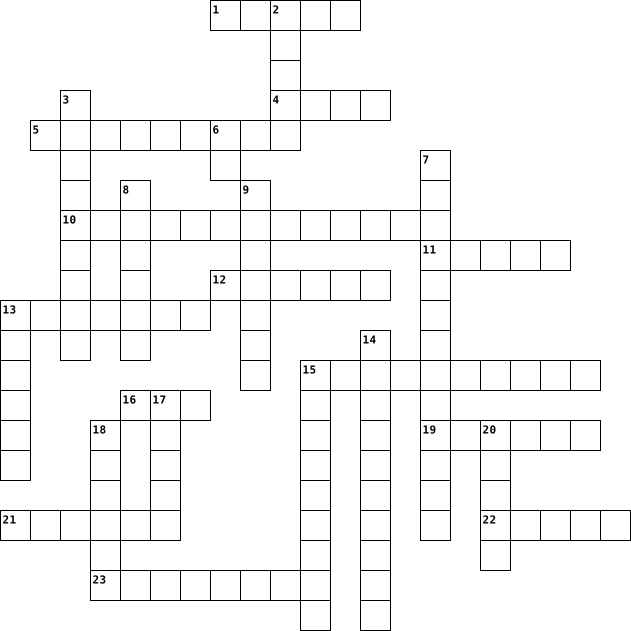
Across
- volume is the amount of ______ an object takes up
- atoms of each element have a unique_______
- atoms of two or more elements can combine to for ________
- change of a mixture or material from one state of matter to another
- the masses of the elements in a compound are always in constant ______
- atoms cannot be _______ into smaller pieces
- made up of atoms which make up matter
- mass, volume and shape are the three basic _________ of matter
- helium, water vapor and oxygen are examples
- to get larger in size, volume or quantity
- liquids have no definite shape but do have a definite ______
- dust, wood and chair are examples
- solids have _______ shape and volume
Down
- matter is composed of extremely small particles called______
- formed when two or more elements combine
- gases have _____ definite shape or volume
- heat energy that an object has dur to themotion of its particles
- anything that has mass and volume
- rapid back and forth motion
- ______ is not considered to be matter
- he proposed that atoms have certain characteristics
- smaller pieces of an item
- in any element all the atoms are exactly _________
- gasoline, milk and juice are examples
- any of the forms or states in which matter can exist
25 Clues: smaller pieces of an item • rapid back and forth motion • anything that has mass and volume • dust, wood and chair are examples • solids have _______ shape and volume • made up of atoms which make up matter • ______ is not considered to be matter • gasoline, milk and juice are examples • formed when two or more elements combine • gases have _____ definite shape or volume • ...
Alternative energy 2013-04-09

Across
- Biogas typically refers to a gas produced by the biological breakdown of organic matter in the absence of oxygen
- A fuel derived directly from living matter
- produced by the internal heat of the earth
- The perceptible natural movement of the air
- Move one's hand to and fro in greeting or as a signal
- a vegetable oil- or animal fat-based diesel fuel consisting of long-chain alkyl
- is a family of rechargeable battery
- A cell producing an electric current directly from a chemical reaction
- (Concentrated solar power) systems use mirrors or lenses to concentrate a large area of sunligh
- determined by the sun
Down
- is the process of producing coal gas
- The total quantity or weight of organisms in a given area or volume
- colorless, odorless, highly flammable gas
- produced by burning carbon and organic compounds
- powered by the energy released in nuclear fission or fusion.
- transparent, odorless, tasteless liquid that forms the seas
- electricity produced by water power
- a form of hydropower that converts the energy of tides into electricity
- delivers electricity from suppliers to consumers using digital technology with two-way communications to control appliances
- (Liquefied petroleum gas)A mixture of light gaseous hydrocarbons
20 Clues: determined by the sun • is a family of rechargeable battery • electricity produced by water power • is the process of producing coal gas • colorless, odorless, highly flammable gas • A fuel derived directly from living matter • produced by the internal heat of the earth • The perceptible natural movement of the air • produced by burning carbon and organic compounds • ...
Science Crossword Puzzle 2024-11-16

Across
- The process by which plants convert light energy into chemical energy, producing glucose and oxygen from carbon dioxide and water.
- The lightest and most abundant element in the universe, and a key component of water
- A yellow citrus fruit known for its acidic taste, commonly used in cooking, drinks, and as a source of Vitamin C.
Down
- The number of particles (atoms, molecules, etc.) in one mole of a substance, approximately 6.022×10²³
- A chemical element that forms the basis of life on Earth, commonly found in organic compounds and present in various forms such as graphite and diamond.
- A type of fungus used in baking and brewing, known for its ability to ferment sugars and produce carbon dioxide and alcohol.
- A colorless, odorless gas essential for respiration in most living organisms, and a key component of water.
- The double-walled membrane that surrounds and protects the heart, helping to reduce friction during heartbeats.
- The SI unit of pressure, named after a French scientist, which measures force applied per unit area.
- The English scientist who developed the laws of motion and the law of universal gravitation
10 Clues: The lightest and most abundant element in the universe, and a key component of water • The English scientist who developed the laws of motion and the law of universal gravitation • The SI unit of pressure, named after a French scientist, which measures force applied per unit area. • ...
Energy Types & Transfers- Valentina Miranda 2023-12-11

Across
- energy: Mechanical potential energy stored in the physical system of something.
- reaction: Process in which one or more substances are converted to one or more different substances.
- energy: the stored energy that an object has
- energy: From the nucleus of Atoms.
- Energy: Energy that comes from the movement of atoms and molecules in a substance (heat).
- Energy stored in a magnetic field.
- Energy: Dieliverd by tiny charged particles called electrons.
- of conservation of energy: energy cannot be created or destroyed.
- The basic unit of a chemical element.
Down
- Energy: Also known as electromagnetic energy.
- energy: Energy stored in objects' height.
- Energy: Energy Gravitational objects by Tension
- A group of atoms bonded together the smallest unit of a chemical compound.
- A region in a longitudinal wave where the particles are furthest apart.
- The positively charged region of the center of an atom.
- Energy: Is the energy of motion
- Energy: The movement of energy through waves.
- Energy: stored in the bonds of atoms and molecules.
- energy: any form of energy related to the sun.
- This happens when a force causes an object to move
20 Clues: Energy: Is the energy of motion • energy: From the nucleus of Atoms. • Energy stored in a magnetic field. • The basic unit of a chemical element. • energy: Energy stored in objects' height. • energy: the stored energy that an object has • Energy: Also known as electromagnetic energy. • Energy: The movement of energy through waves. • ...
Physics Energy 2026-02-18

Across
- type of energy due to motion
- principle that energy cannot be created or destroyed
- potential energy stored in stretched or compressed objects
- a push or pull on an object
- the ability to do work
- a type of energy resource that is naturally replenished
- the process of changing energy from one form to another
- energy related to heat and temperature
- SI unit of power
Down
- a type of energy resource that cannot be replaced quickly
- the rate at which work is done
- energy due to motion or position
- the ratio of useful energy output to total energy input
- a group of interacting parts considered together in physics
- SI unit of work or energy
- stored energy due to position
- energy stored in bonds of molecules
- energy stored in the nucleus of atoms
- force applied over a distance
- energy transferred due to temperature difference
20 Clues: SI unit of power • the ability to do work • SI unit of work or energy • a push or pull on an object • type of energy due to motion • stored energy due to position • force applied over a distance • the rate at which work is done • energy due to motion or position • energy stored in bonds of molecules • energy stored in the nucleus of atoms • energy related to heat and temperature • ...
Physical Science top 50 vocabulary terms 2023-12-06

Across
- The transfer of heat by the movement within a liquid or gas
- the tendency of an object to resist a change in its motion
- A measure of the average energy of motion of the particles of a substance.
- A disturbance that transfers energy from place to place
- any compound that forms H+ ions in solution, tastes sour, and has a pH less than 7
- a compound that produces hydroxide ions in solution, tastes bitter and feels slippery
- a bond formed when atoms share one or more pairs of electrons
- The force of attraction or repulsion of magnetic materials
- The rate at which velocity changes
- A pure substance made of only one kind of atom
- the number of complete wavelengths that pass a point in a given time
- A material that does not allow heat or electrons to move through it easily.
- the amount of matter in an object
- stored energy
- A form of matter that has a definite shape and volume
- An apparent change in the frequency of a sound when the source or observer is moving
- A horizontal row of elements in the periodic table
- The direct transfer of heat from one substance to another by touching.
- A state of matter that has no definite shape but has a definite volume.
- A nuclear reaction in which a nucleus splits into smaller nuclei with the simultaneous release of energy
- a state of matter that consists of free-moving ions and electrons
- positively charged subatomic particles
- a device that changes electrical energy to mechanical energy
Down
- A measurement of how much solute exists within a certain volume of solvent
- Smallest particle of an element that has its properties
- energy of motion
- Electrons on the outermost energy level of an atom
- a path for an electrical current to flow around
- Material through which a wave travels
- A state of balance in which solute is dissolving into the solution and coming out of the solution
- the degree of compactness of a substance, mass divided by volume.
- A flow of electric charge that regularly reverses its direction.
- A measure of the force of gravity on an object
- Atoms of the same element that have different numbers of neutrons
- A machine that converts mechanical energy into electrical energy
- smallest unit of most compounds, two or more atoms held together by covalent bonds
- The process by which two or more small nuclei fuse to make a bigger nucleus and release energy
- A push or a pull
- Speed in a given direction
- A substance made up of atoms of two or more different elements joined by chemical bonds
- A force of attraction between objects that is due to their masses.
- an element that is shiny and that conducts heat and electricity well, locate on the left and middle of the periodic table
- The bouncing back of a wave when it hits a surface through which it cannot pass.
- A result of a force moving an object a certain distance.
- A form of energy caused by the movement of electrons.
- The attractive force that holds atoms together
- A chemical bond formed when one or more electrons are transferred from one atom to another
- Elements in group 8A of the periodic table. Have no charge and are gases
- A state of matter with no definite shape or volume
- A homogeneous mixture of two or more substances in which a solute is dissolved in a solvent
50 Clues: stored energy • energy of motion • A push or a pull • Speed in a given direction • the amount of matter in an object • The rate at which velocity changes • Material through which a wave travels • positively charged subatomic particles • A measure of the force of gravity on an object • A pure substance made of only one kind of atom • ...
Plates 2021-11-19

Across
- and Henry Creator of plate tectonics
- Plate Boundary Collides into each other
- Rift Valley in Africa Cause of diverged boundary
- The plate that destroys crust
- of Fire A long train of volcanoes
- Currents Transfers energy in the mantle
Down
- Plate Boundary Divides from each other
- Crust Manly consist of basalt
- Plate Boundary Slides past each other
- Crust Forms shallow sea beds
10 Clues: The plate that destroys crust • Crust Forms shallow sea beds • Plate Boundary Slides past each other • Plate Boundary Collides into each other • Plate Boundary Divides from each other • Crust Manly consist of basalt • Currents Transfers energy in the mantle • and Henry Creator of plate tectonics • ...
theam 7 vocabulary 2012-12-10

Across
- a struggle amoung plants and animals for food
- an animal that lives in the sea
- a hard material that forms a skeletion in many animals
- a tiny plant/animal that lives in the ocean
Down
- an animal
- one of a kind
- part of something
- a substace found in plants that produce energy
- to live in a place
- to connect with things
10 Clues: an animal • one of a kind • part of something • to live in a place • to connect with things • an animal that lives in the sea • a tiny plant/animal that lives in the ocean • a struggle amoung plants and animals for food • a substace found in plants that produce energy • a hard material that forms a skeletion in many animals
Rivers 2024-03-22

Across
- a lake formed when a meander floods
- when the meanders are taken out of a river to prevent floods
- where two rivers join
- when the river has lost it's energy and drops it's load
- the mean speed of a river's flow
- when rocks become smoother, smaller and rounder
Down
- the water in a river
- the highest point of the valley
- when water wears down the riverbed
- where the river enters the ocean
- when water vapour cools and forms clouds
- where the river begins
12 Clues: the water in a river • where two rivers join • where the river begins • the highest point of the valley • where the river enters the ocean • the mean speed of a river's flow • when water wears down the riverbed • a lake formed when a meander floods • when water vapour cools and forms clouds • when rocks become smoother, smaller and rounder • ...
BIOLOGICAL MOLECULES 2024-03-07

Across
- the sugar made during photosynthesis
- this sugar is made up of glucose+galactose
- provides energy
- needed to keep plant cells turgid
- forms a blue-black colour when added to starch
- basic unit that makes up proteins
- needed to break down complex sugars to double sugars
Down
- single sugar found in fruits
- meat is a good source of this
- name of the test for proteins
- this complex sugar molecule has a branching pattern
- element found in proteins, carbohydrates and fats
12 Clues: provides energy • single sugar found in fruits • meat is a good source of this • name of the test for proteins • needed to keep plant cells turgid • basic unit that makes up proteins • the sugar made during photosynthesis • this sugar is made up of glucose+galactose • forms a blue-black colour when added to starch • element found in proteins, carbohydrates and fats • ...
Unit 1 I search 2025-10-07

Across
- one of the largest dead zones
- process plants use to convert light energy into chemical energy
- the introduction of substances or energy into the natural environment in amounts or concentrations that can be harmful for living organisms
- a reduction in the pH of the ocean over an extended period of time, harms marine life
- when a solid gains enough energy and particles slide past each other forming a liquid
- the energy carrier, key component of water and energy transfer in cells
- process of making an area more urban, increases carbon emissions due to energy consumption and transportation
- Circulates life's backbone
- atom and molecule and physically separated
- the movement of chemicals between living organisms and the physical enviornment
- key component in RNA, DNA, and ATP. forms the framework of the cell membrane
- a body of sediment that holds ground water
- crops grown to protect and improve the soil rather than for harvestcompost
- Gives structure to proteins
- essential for respiration & energy production, a part of water
- energy a object possesses due to its motion
- A direct transition from gas to solid
- particles packed closely and move around each other
- energy created from things like solar power and wind
- particles are tightly packed and vibrate in fixed motion
- a chemical bonding making 2 atoms combine
- areas of little to no oxygen where organisms die without oxygen
- a blend of 2 or more substances
- atoms or molecules and everything is mixed evenly
- anything that has mass and occupies space
- the process of replanting an area with trees
- most carbon is stored as this, mostly stored in the atmosphere
- long-term shifts in temperatures and weather patterns
- a direct transition from a solid to a gas
- the process in which nitrogen moves through both living and non-living things
- the building blocks of life
- when a liquid gains energy and it causes particles to move farther apart which then causes it to turn into a gas
- What decomposers do in the soil produce as they feed on organic material
- produced or involving production without the use of chemical fertilizers, pesticides, or other artificial agents
- precipitation that does not seep into soil and instead flows on earths surface
- building proteins and nucleic acids, a component of nitrohenous bases in RNA&DNA
- the framework of life, backbone of proteins, lipids, carbohydrates, and nucleic acids
Down
- when ecosystems are loaded with too many nutrients
- The supply of water to land or crops to help growth, typically by means of channels
- act as carbon sinks, storing carbon in plant biomass and soil
- the genetic blueprint of living organisms
- earth's hydration system
- the downward movement of water through the soil and porous rock to reach groundwater
- affects the carbon cycle by releasing carbon dioxide and methane through livestock and land clearing
- formed when carbon is absorbed by the ocean
- particles are far apart and move freely
- a major greenhouse gas
- the process by which cells derive energy from glucose
- humans burn these and they have a major impact on the carbon cycle
- practice of growing different crops in a planned sequence on the same piece of land over successive seasons or years
- needed for the body to function properly,a molecule made up of amino acids
- Gases in Earth's atmosphere that trap heat, contributing to the warming of the planet
- a processes removing energy
- the preparation of land for growing crops
- earth's largest reservoir of water
- one type of atom or molecule, cannot be physically seperated
- one type of atom on the periodic table
- when a liquid loses energy which allows the particles to go into a set position creating a solid
- Substances added to soil or plants to make them grow better, often containing important nutrients like nitrogen and phosphorus
- how water moves from the environment to plants
- the action of clearing a wide area of trees
- when a gas loses energy which causes the particles to move slower creating a liquid
62 Clues: a major greenhouse gas • earth's hydration system • Circulates life's backbone • Gives structure to proteins • a processes removing energy • the building blocks of life • one of the largest dead zones • a blend of 2 or more substances • earth's largest reservoir of water • A direct transition from gas to solid • one type of atom on the periodic table • ...
physics term 4 2023-11-13

Across
- The transfer of heat by the movement of a liquid or gas
- energy energy carried by light e.g the sun
- the transfer of energy through a substance from one partical to another. heat is transferred through solids and liquids in this way.
- of potential energy a ball at the top of a hill
- Potential Energy The energy stored in a system of magnets as a result of the exertion of a magnetic force on each other.
- of kinetic energy a moving car
- energy stored energy
- of Conservation of Energy the law that states that energy cannot be created or destroyed but can be changed from one form to another
- variable variable that is manipulated
- potential energy Energy stored by something that can stretch or compress
- energy relates to the displacement of molecules in a space as a function of the normal thermal motions e.g train on train tracks.
- energy Energy caused by an object's vibrations e.g speech
- energy the energy contained within a system that is responsible for its temperature e.g boiling water on stove.
Down
- design A design in which researchers manipulate an independent variable and measure a dependent variable to determine a cause-and-effect relationship
- potential energy Energy stored by objects due to their position above Earth's surface.
- the transfer of heat through empty space. no substance is needed.
- energy energy of motion
- for calculation of potential energy Ep=mgh
- potential energy Energy stored in chemical bonds
- variable what is measured in an experiment
- energy the power an atom's charged particals have to casue an action or move an object. e.g lightning
- An educated guess
- potential energy potential energy that results from conservative Coulomb forces.
- potential energy Energy stored in the nucleus of an atom
- for energy effciency Efficiency=output x 100 % input
- does G equal? 9.8 m/s^2
26 Clues: An educated guess • energy stored energy • energy energy of motion • does G equal? 9.8 m/s^2 • of kinetic energy a moving car • variable variable that is manipulated • energy energy carried by light e.g the sun • for calculation of potential energy Ep=mgh • variable what is measured in an experiment • of potential energy a ball at the top of a hill • ...
Chapter 55 - Ecosystems 2013-08-23

Across
- A carnivore that eats other carnivores.
- An autotroph, usually a photosynthetic organism. Collectively, autotrophs make up the trophic level of an ecosystem that ultimately supports all other levels.
- An element that must be added for production to increase in a particular area.
- The percentage of energy stored in food that is not used for respiration or eliminated as waste.
- The amount of light energy converted to chemical energy (organic compounds) by autotrophs in an ecosystem during a given time period.
- The warming of Earth due to the atmospheric accumulation of carbon dioxide and certain other gases, which absorb reflected infrared radiation and reradiate some of it back toward Earth.
- An organism that absorbs nutrients from nonliving organic material (after “decomposing” them with enzymes) such as corpses, fallen plant material, and the wastes of living organisms and converts them to inorganic forms.
- A carnivore that eats herbivores.
- Rain, snow, or fog that is more acidic than pH 5.2.
- All the organisms in a given area as well as the abiotic factors with which they interact; one or more communities and the physical environment around them.
Down
- The percentage of production transferred from one trophic level to the next.
- An herbivore; an organism that eats plants or other autotrophs.
- A consumer that derives its energy and nutrients from consuming nonliving organic material such as corpses, fallen plant material, and the wastes of living organisms.
- The amount of chemical energy in consumers’ food that is converted to their own new biomass during a given time period.
- A process by which nutrients, particularly phosphorus and nitrogen, become highly concentrated in a body of water, leading to increased growth of organisms such as algae or cyanobacteria.
- The amount of added nutrient, usually nitrogen or phosphorus, that can be absorbed by plants by natural means.
- The time required to replace the standing crop of a population or group of populations (for example, of phytoplankton), calculated as the ratio of standing crop to production.
17 Clues: A carnivore that eats herbivores. • A carnivore that eats other carnivores. • Rain, snow, or fog that is more acidic than pH 5.2. • An herbivore; an organism that eats plants or other autotrophs. • The percentage of production transferred from one trophic level to the next. • An element that must be added for production to increase in a particular area. • ...
wave to me 2014-05-22

Across
- if the vibration is at right angles opposite to the direction of travel
- low point of a wave
- waves in matter
- a single wave cycle
- particles spread apart
Down
- high point of a wave
- when the vibration is paralell to the direction of travel
- the distance between corresponding parts of two sequential wave forms
- the matter through which waves travel from place to place
- particles of travel
- periodic changes that transmit energy from one place to another
11 Clues: waves in matter • low point of a wave • particles of travel • a single wave cycle • high point of a wave • particles spread apart • when the vibration is paralell to the direction of travel • the matter through which waves travel from place to place • periodic changes that transmit energy from one place to another • ...
Tissues 2021-10-07

Across
- contains cylindrical cells with branching cells
- voluntary controlled
- forms the stroma or internal skeleton
- has a lot of space
- forms hormones
- lines much of the respiratory tract
Down
- only one type in its category
- found in the bladder lining
- most widely distrubuted tissue around the body
- forms the bony skeleton
- fat/ oil like structures
- a type of muscle that has a nuclei in every cell
- one layer and squshy like
- forms the embryonic skeleton
- involves the tendons and ligaments
15 Clues: forms hormones • has a lot of space • voluntary controlled • forms the bony skeleton • fat/ oil like structures • one layer and squshy like • found in the bladder lining • forms the embryonic skeleton • only one type in its category • involves the tendons and ligaments • lines much of the respiratory tract • forms the stroma or internal skeleton • ...
Minerals and Rocks 2022-01-20

Across
- Pressure that is exerted on the rock from one direction, the rock forms layers.
- mineral's physical properties are determined by its chemical __ and crystal structure
- these are often found where seas once covered the land.
- Scientists who study minerals
- these minerals contain sulfur atoms bonded to oxygen atoms
- A solid material that forms by a natural process
- rock that forms when sediments are compacted and cemented together
- A mineral's crystal __ is determined by the way the atoms are arranged
- these minerals contain one or two metal elements combined with oxygen
Down
- contain metal elements combined with sulfur
- People make gemstones in a
- these minerals have an atom of phosphorus, arsenic, or vanadium is bonded to oxygen.
- rock that forms when magma cools below Earth's surface
- __ elements contain only atoms of one type of element
- rock that forms when an existing rock is changed by heat or pressure.
- these minerals are salts and form when salt water evaporates
- a naturally formed, non-living Earth material
- the largest mineral group
- Minerals must be __
- melted rock inside Earth
20 Clues: Minerals must be __ • melted rock inside Earth • the largest mineral group • People make gemstones in a • Scientists who study minerals • contain metal elements combined with sulfur • a naturally formed, non-living Earth material • A solid material that forms by a natural process • __ elements contain only atoms of one type of element • ...
3 types of rocks 2025-03-11

Across
- mineral grains that are arranged in planes or bands
- forms when lava erupts or extrudes onto earth's surface
- forms when minerals that form from solution or sediment from older rocks get pressed and cemented together
- sometimes lava erupts and flows from long cracks in Earth's crust
- which rock changes from one type to another
- forms when pressure,temperature,or chemical processes change existing rock
- metamorphic rocks that do not have mineral grains that are aligned in plane or bands
- the size,shape,and position of the grains that make up a rock determine a rock's_
Down
- forms when magma or lava cools and hardens to become solid,it forms beneath or on earth's surface
- when magma pushes into or intrudes surrounding rock below earth's surface and cools
- forms from the remains or fossils of once living plants and animals
- forms when water usually seawater evaporates
- a combination of one or more minerals or organic matter
- the minerals and organic matter a rock contains determines the_
- forms when sediments buried compacted and cemented together by calcite or quartz
15 Clues: which rock changes from one type to another • forms when water usually seawater evaporates • mineral grains that are arranged in planes or bands • a combination of one or more minerals or organic matter • forms when lava erupts or extrudes onto earth's surface • the minerals and organic matter a rock contains determines the_ • ...
Chalenge it 2026-03-02

Across
- Energy from sources that are naturally replenished, such as solar or wind
- /The upper layer of earth in which plants grow, providing vital nutrients
- /The application of scientific knowledge for practical purposes.
- /liquid essential for all known forms of life.
Down
- conservation /use and protection of natural resources
- /Power derived from physical or chemical resources to provide light and heat
- MANAGEMENT /The strategic control and allocation of natural assets like land and minerals
- /The gaseous surrounding the Earth
- Meeting present needs without compromising future generations' ability to meet theirs
9 Clues: /The gaseous surrounding the Earth • /liquid essential for all known forms of life. • conservation /use and protection of natural resources • /The application of scientific knowledge for practical purposes. • Energy from sources that are naturally replenished, such as solar or wind • /The upper layer of earth in which plants grow, providing vital nutrients • ...
Our Energy Resources 2014-10-28

Across
- - lasting or continuing for a very long time
- - synonym: to free
- - antonym: non-renewable
- - an amount or quantity of something that is available to use
- - synonym: renewable
- - глобальный
- - остатки
- - electricity and other forms of power used for making things work
Down
- - to get rid of someone or something and put a new person or thing in their place
- - synonym: to save
- - a substance such as oil, gas, coal, or wood that produces heat or power when it is burned
- - ископаемый
- - relating to the Sun? or coming from the sun
- - to use all of something and not have any left
- - источники энергии
15 Clues: - остатки • - ископаемый • - глобальный • - synonym: to save • - synonym: to free • - источники энергии • - synonym: renewable • - antonym: non-renewable • - lasting or continuing for a very long time • - relating to the Sun? or coming from the sun • - to use all of something and not have any left • - an amount or quantity of something that is available to use • ...
Cell Structure and Function 2025-01-17

Across
- Bean-shaped organelle that supplies energy to the cell & has its own ribosomes & DNA.
- Protein that detects a signal molecule & performs an action in response.
- Interconnected network of thin, folded membranes that produce, process, & distribute proteins.
- Solution that has a lower concentration of dissolved particles than a cell.
- Cell that has a nucleus & other membrane-bound organelles.
- Diffusion of molecules across a membrane through transport proteins.
- Organelle that contains enzymes.
- Movement of molecules across the cell membrane without energy input from the cell.
- Organelle composed of numerous membranes that are used to convert solar energy into chemical energy; contains chlorophyll.
- Drives molecules across a membrane from lower concentration to higher concentration.
- Diffusion of water molecules across a semipermeable membrane from an area of higher water concentration to lower water concentration.
- Model that describes the arrangement & movement of the molecules that make up a cell membrane.
- Release of substances out a cell by the fusion of vesicle with the membrane.
- Condition or quality of allowing some, but not all, materials to cross a barrier or membrane.
- Process of taking liquids or large molecules into a cell by engulfing them in a membrane.
Down
- Solution that has an equal concentration of dissolved particles compared with another solution.
- Molecule that forms a double-layered cell-membrane; consists of a glycerol, a phosphate group, & two fatty acids.
- Membrane-bound structure that is specialized to perform a distinct process within a cell.
- Cell that does not have a nucleus or other membrane-bound organelles.
- Double-layer of phospholipids that forms a boundary between a cell and the surrounding environment & controls the passage of materials into & out of a cell.
- Organelle that links amino acids together to form proteins.
- Small organelle that contains & transports materials within the cytoplasm.
- Organelle that is used to store materials such as water, food, or enzymes, that are needed by the cell.
- Stack of flat, membrane-enclosed spaces containing enzymes that process, sort, & deliver proteins.
- Movement of dissolved molecules in a fluid or gas from higher concentration to lower concentration.
- Network of proteins, such as microtubules & microfilaments, inside a eukaryotic cell that supports & shapes the cell.
- Type of endocytosis in which the cell membrane engulfs large particles.
- Difference in the concentration of a substance from one location to another.
- All organisms are made up of cells. All existing cells are produced by other living things. The cell is the most basic unit of life.
- Jellylike substance inside cells that contains molecules & organelles.
- Small cylinder-shaped organelle made of protein tubes arranged in a circle, aids mitosis.
- Solution that has a higher concentration of dissolved particles than a cell.
- Rigid structure that gives protection, support, & shape to cells in plants, algae, fungi, & bacteria.
- Organelle composed of a double membrane that acts as the storehouse for most of a cell's DNA.
34 Clues: Organelle that contains enzymes. • Cell that has a nucleus & other membrane-bound organelles. • Organelle that links amino acids together to form proteins. • Diffusion of molecules across a membrane through transport proteins. • Cell that does not have a nucleus or other membrane-bound organelles. • ...
Health 2025-02-11

Across
- The accomplishment of an aim or purpose.
- Zone a place where you can acquire knowledge and adapt.
- a naturally occurring inorganic element or compound having an orderly internal structure and characteristic chemical composition, crystal form, and physical properties.
- carbohydrates, lipids, proteins, vitamins, minerals, and water.
- sugar molecules
- Balance he balance of calories consumed through eating and drinking compared to calories burned through physical activity.
- A nutrient that the body needs in small amounts to function and stay healthy.
Down
- large, complex molecules that play many critical roles in the body.
- a source of essential fatty acids, which the body cannot make itself.
- Zone a place, situation, or level where someone feels confident and comfortable
- Eating a healthy balanced diet.
- the liquid that descends from the clouds as rain, forms streams, lakes, and seas, and is a major constituent of all living matters
- a usual way of doing something
- a measure of energy
- (Basal Metabolic Rate) the rate at which the body uses energy while at rest to keep vital functions going, such as breathing and keeping warm.
- goal or objective is an idea of the future or desired result that a person or a group of people envision, plan, and commit to achieve.
- a distressing emotion aroused by impending danger, evil, pain, etc., whether the threat is real or imagined; the feeling or condition of being afraid.
17 Clues: sugar molecules • a measure of energy • a usual way of doing something • Eating a healthy balanced diet. • The accomplishment of an aim or purpose. • carbohydrates, lipids, proteins, vitamins, minerals, and water. • large, complex molecules that play many critical roles in the body. • Zone a place where you can acquire knowledge and adapt. • ...
Energy Types/transformations 2024-02-06

Across
- Energy When you rub your hands together.
- A transformation of energy when a battery that runs a moving toy (Three energy types with /.)
- The energy transformations of when a church bell is rung by a person (Two energy types with /.)
- An energy that turns from radiant from the sun then into chemical energy.
- Energy Can be used within wood in a campfire.
- The energy transformation of a solar panel on the roof of a house (Two energy types with /.)
- Energy A hair dryer in an outlet.
- Energy Can both be kinetic and potential energy.
- Energy Can be heard rather than done.
- A person strumming a guitar.
- Energy Can be found between bonds in a molecule.
Down
- A transformation of energy when an electric motor on a tesla runs (Three energy types with /.)
- Energy A Stored energy that is ready to be released or can be known as mass gravity, and height.
- Energy Solar panels use (blank energy) from the sun.
- Potential Energy A energy at rest that is stretched at and being ready to be released .
- Energy A energy in motion and moving at a constant rate.
- A transformation of energy by rubbing your hands together (Two energy types with /.)
- Can have a magnetic field around it and be used as a part of magnetic material.
- A transformation of energy when you switch on a light bulb (Three energy types with /.)
- The transfomation of energy when a person picks up a chair (Two energy types with /.)
20 Clues: A person strumming a guitar. • Energy A hair dryer in an outlet. • Energy Can be heard rather than done. • Energy When you rub your hands together. • Energy Can be used within wood in a campfire. • Energy Can both be kinetic and potential energy. • Energy Can be found between bonds in a molecule. • Energy Solar panels use (blank energy) from the sun. • ...
Goddess Lakshmi 2022-07-04

Across
- syllable used before each name while
- She is the sister of
- She is holding
- She is dressed in this Color
- She is holding
- People pray her to become
- Animal associated with her power
- Is another name of hers
- She is the Goddess of
- Her abode is the ocean of
- She is the concert of
- Has these many different forms
- The seed Mantra Syllable represents her name
- Manifested from
- Is the day of the Week, filled with her energy
Down
- Is the flower of her choice
- She also gives the wealth of
- She eradicates
- Means granter of all boons
- By Praying her People get
- She is wearing Jewelry made of
- is her another name
- Seated on
- While the Devas were trying to get nectar by
- She is holding
- She is holding
- She is the mother of
- Is one of her names
- number of hands
29 Clues: Seated on • She eradicates • She is holding • She is holding • She is holding • She is holding • number of hands • Manifested from • is her another name • Is one of her names • She is the sister of • She is the mother of • She is the Goddess of • She is the concert of • Is another name of hers • By Praying her People get • People pray her to become • Her abode is the ocean of • ...
Final Project 2021-06-04

Across
- are large organic molecules
- energy: is a form of electromagnetic radiation. Light consists of photons, which are produced when an object's atoms heat up.
- is a group of living and nonliving things in a place that has a specific climate, landforms, soil types, and vegetation.
- The process of stem cells becoming different cells.
- a self-replicating material that is present in nearly all living organisms as the main constituent of chromosomes.
- is the total mass of organisms in a given area
- : is the strength and vitality required for sustained physical or mental activity.
- : are a similar in every detail; exactly alike.
- All humans start as a single fertilized egg.
- the process by which green plants and some other organisms use sunlight to synthesize foods from carbon dioxide and water.
- is a colorless, odorless, highly flammable gas, the chemical element of atomic number 1.
Down
- the matter from which a thing is or can be made.
- is also a glucose polymer is not digestible!(it’s a kind of fiber)
- cells: are the body's raw materials — cells from which all other cells with specialized functions are generated Under the right conditions in the body or a laboratory.
- Cells need this energy to move and function.
- are rates.
- A characteristic or condition.Traits may be physical, such as hair color or leaf shape, or they may be behavioral, such as nesting in birds and burrowing in rodents.
- energy: is the potential of a chemical substance to undergo a chemical reaction to transform into other substances.
- is a chemical element that constitutes 21 percent of the Earth's atmosphere, that is capable of combining with all elements except some noble gases,
- is a polymer made of linked glucose.
- is the chemical element of atomic number 6, a nonmetal which has two main forms (diamond and graphite)
- are proteins that control the rate of chemical reactions.
22 Clues: are rates. • are large organic molecules • is a polymer made of linked glucose. • Cells need this energy to move and function. • All humans start as a single fertilized egg. • is the total mass of organisms in a given area • the matter from which a thing is or can be made. • The process of stem cells becoming different cells. • ...
Earth Ch 2 Matter, Forces, and Energy 2016-09-15

Across
- change from gas directly to a solid state.
- the change from liquid state to vapor.
- change from a solid to a gas.
- anything that takes up space and has mass.
- gives things weight
- the phase that most pure substances can be in is determined by temperature
- the amount of space matter occupies.
- the attractive particles are no longer rigidly held in place but can move somewhat.
- changes that occur in a material without changing the identity of the material.
- change of state or phase from a gas to a liquid.
- force acting on an object as it moves through a distance.
- when an atoms emits protons, it changes to another element.
- type of vaporization that occurs at a temperature below the boiling point.
- pure substance that cannot be broken down into a simpler substance by ordinary chemical means.
- refers to the gravitational pull on an object by another larger object.
- charged atoms.
Down
- also known as the law of conservation of mass energy.
- the ability to do work.
- when liquid particles have enough velocity to escape their partners.
- a push or pull that occur in pairs – contact or field.
- consists of only one type of matter.
- distinct groups of atoms bonded together.
- material that can be separated into two or more pure substances by physical changes.
- changes in the identity of a material changes that result in a different material with a different composition and properties.
- particles have relatively little kinetic energy compared to the attractive forces that are present between molecules.
- substance as it enters the liquid state.
- the average kinetic energy of the molecules of a substance.
- energetic ions and a seething cloud of electrons.
- the amount of matter in an object.
- vaporization happens so fast that the liquid forms bubbles that rise through the liquid.
- substance as it enters the solid state.
- the basic particles that make up elements.
32 Clues: charged atoms. • gives things weight • the ability to do work. • change from a solid to a gas. • the amount of matter in an object. • consists of only one type of matter. • the amount of space matter occupies. • the change from liquid state to vapor. • substance as it enters the solid state. • substance as it enters the liquid state. • distinct groups of atoms bonded together. • ...
7th Grade Science Final 2022 2022-05-24

Across
- The process by which new oceanic crust forms along a mid-ocean ridge and older oceanic crust moves away from the ridge.
- Theory that Earth's surface is broken into large, rigid pieces that move with respect to each other.
- Resources that can be replaced by natural processes in a relatively short amount of time.
- A rapid, downhill movement of soil, loose rocks, and boulders.
- The process that occurs when one tectonic plate moves under another tectonic plate.
- Energy from the sun.
- Electricity produced by flowing water.
- Deep, underwater troughs created by an oceanic plate subducting under another plate at a convergent plate boundary.
- A solid that is naturally occurring, inorganic, and has a crystal structure and definite chemical composition.
- Things that have all the characteristics of life.
- A group of organisms that have similar traits and are able to produce fertile offspring.
- A deposit of minerals that is large enough to be mined for a profit.
- The way a mineral reflects or absorbs light at its surface.
- Magma that erupts onto Earth's surface.
- The color of a mineral's powder.
Down
- The laying down or settling of eroded material.
- Molten rock beneath Earth's surface.
- Energy released from atomic reactions.
- Name given to a supercontinent that began to break apart approximately 290 million years ago.
- The movement of Earth's continent's over time.
- A pile of windblown sand.
- Energy produced by burning organic matter, such as wood, food scraps, and alcohol.
- Resources that are used faster than they can be replaced by natural processes.
- The moving of weathered material, or sediment, from one location to another.
- A large mass of ice, formed by snow accumulation on land, that moves slowly across Earth's surface.
- The series of processes that change one type of rock into another type of rock.
- Thermal energy from Earth's interior
27 Clues: Energy from the sun. • A pile of windblown sand. • The color of a mineral's powder. • Molten rock beneath Earth's surface. • Thermal energy from Earth's interior • Energy released from atomic reactions. • Electricity produced by flowing water. • Magma that erupts onto Earth's surface. • The movement of Earth's continent's over time. • ...
Energy Crossword by Pranjal Rai and Sarah Duong 2018-04-13

Across
- renewable energy source created by the movement of the earth
- transfer of thermal energy through waves or a string of particles
- without this type of energy, there would be no music to dance to!
- nonrenewable resource made of methane and other hydrocarbons
- resource that can be replenished
- unit of energy
- renewable energy that is energy from the sun
- it can be both kinetic and potential energy that is the result the movement of matter
- a type of kinetic and potential energy that involves the movement of electrons
- nonrenewable resource extracted through drilling from specific rock reservoirs; thick black liquid
- process of changing from one form of energy to the other
- states that energy cannot be created or destroyed
- a type of potential energy generated through fusion; this is also known as atomic energy
- transfer of thermal energy through electricity or matter
- renewable resource made of material from plants or microorganisms that were recently living
Down
- this type of energy can be found in ice cream and tacos
- nonrenewable resource formed by the compression of plants, gases, and animals exposed to heat for a long period of time
- energy of location
- resource that cannot replenish itself
- energy of motion
- rubber band has this type of potential energy
- renewable resource that is heat energy from deep within the earth
- fossil fuel made of fossilized carbon
- this type of energy melts your snowman
- the Hoover Dam harnesses this type of energy
- energy created through electricity and magnetism
- speed + direction
- transfer of thermal energy through a fluid
- the ability to move or cause change in matter
- the amount of matter in an object
- a type of energy from the electromagnetic spectrum
31 Clues: unit of energy • energy of motion • speed + direction • energy of location • resource that can be replenished • the amount of matter in an object • resource that cannot replenish itself • fossil fuel made of fossilized carbon • this type of energy melts your snowman • transfer of thermal energy through a fluid • renewable energy that is energy from the sun • ...
theme 7 2012-12-10

Across
- one of a kind rare or uncommon
- a part of something
- when you connect one thing to another thing
- a struggle among plants and animals for food water
- an animal that live in the sea
Down
- energy from sunlight
- an animal that lives in the sea
- living space
- a substance found in plants that enables them to
- to live in a place
- a hard material that forms parts of a skeloton in many
- plankton are tiny plants and animals that live in the
12 Clues: living space • to live in a place • a part of something • energy from sunlight • one of a kind rare or uncommon • an animal that live in the sea • an animal that lives in the sea • when you connect one thing to another thing • a substance found in plants that enables them to • a struggle among plants and animals for food water • ...
theme 7 2012-12-10

Across
- energy from sunlight
- plankton are tiny plants and animals that live in the
- an animal that lives in the sea
- a hard material that forms parts of a skeloton in many
- when you connect one thing to another thing
- a substance found in plants that enables them to
- a part of something
Down
- a struggle among plants and animals for food water
- to live in a place
- an animal that live in the sea
- living space
- one of a kind rare or uncommon
12 Clues: living space • to live in a place • a part of something • energy from sunlight • an animal that live in the sea • one of a kind rare or uncommon • an animal that lives in the sea • when you connect one thing to another thing • a substance found in plants that enables them to • a struggle among plants and animals for food water • ...
minerals 2022-12-07

Across
- special combination of the parts that make rocks
- the way a mineral reflects light
- the process by which sediments are pressed together under their own weight
- unique arrangement of atoms in a crystal
- the process by which dissolved minerals crystalize and glue particles of sediment into one mass
- type of rock that forms when particles from other rocks are pressed together
- an inorganic solid that has a crystal structure
- type of rock that forms from cooling molten rock
- rock that forms when magma hardens beneath Earth's surface
Down
- the way a mineral looks when it breaks apart irregularly
- rock that forms on the Earth's surface
- scale ranking ten minerals
- naturally occuring solids made of minerals
- minerals ability to split easily along flat surface
- type of rock that forms from an existing rock
- not formed from living things
16 Clues: scale ranking ten minerals • not formed from living things • the way a mineral reflects light • rock that forms on the Earth's surface • unique arrangement of atoms in a crystal • naturally occuring solids made of minerals • type of rock that forms from an existing rock • an inorganic solid that has a crystal structure • special combination of the parts that make rocks • ...
Science Crossword Puzzle 2024-11-17

Across
- The lightest and most abundant element in the universe, and a key component of water
- The process by which plants convert light energy into chemical energy, producing glucose and oxygen from carbon dioxide and water.
- A chemical element that forms the basis of life on Earth, commonly found in organic compounds and present in various forms such as graphite and diamond.
- A yellow citrus fruit known for its acidic taste, commonly used in cooking, drinks, and as a source of Vitamin C.
Down
- Force that pulls objects toward the Earth
- The English scientist who developed the laws of motion and the law of universal gravitation
- Organic compound made up of amino acids, that plays a key role in the growth and repair of cells.
- The SI unit of pressure, named after a French scientist, which measures force applied per unit area.
- A colorless, odorless gas essential for respiration in most living organisms, and a key component of water.
- A type of fungus used in baking and brewing, known for its ability to ferment sugars and produce carbon dioxide and alcohol.
10 Clues: Force that pulls objects toward the Earth • The lightest and most abundant element in the universe, and a key component of water • The English scientist who developed the laws of motion and the law of universal gravitation • Organic compound made up of amino acids, that plays a key role in the growth and repair of cells. • ...
Science Crossword Puzzle 2024-11-17

Across
- The lightest and most abundant element in the universe, and a key component of water
- The process by which plants convert light energy into chemical energy, producing glucose and oxygen from carbon dioxide and water.
- A chemical element that forms the basis of life on Earth, commonly found in organic compounds and present in various forms such as graphite and diamond.
- A yellow citrus fruit known for its acidic taste, commonly used in cooking, drinks, and as a source of Vitamin C.
Down
- Force that pulls objects toward the Earth
- The English scientist who developed the laws of motion and the law of universal gravitation
- Organic compound made up of amino acids, that plays a key role in the growth and repair of cells.
- The SI unit of pressure, named after a French scientist, which measures force applied per unit area.
- A colorless, odorless gas essential for respiration in most living organisms, and a key component of water.
- A type of fungus used in baking and brewing, known for its ability to ferment sugars and produce carbon dioxide and alcohol.
10 Clues: Force that pulls objects toward the Earth • The lightest and most abundant element in the universe, and a key component of water • The English scientist who developed the laws of motion and the law of universal gravitation • Organic compound made up of amino acids, that plays a key role in the growth and repair of cells. • ...
Plate Tectonics Station Lab 2022-01-19

Across
- rupture in the crust of a planetary mass object
- one convergent plate is more dense than other
- lowland region that forms where earth’s tectonic plates
- two plates moving away
Down
- transfer heat from one place to another
- two plates slide past each other
- created by a divergent boundary
- two plates moving together
- sudden release of energy in the earth
- type of excavation or depression in the ground
- molten rock
11 Clues: molten rock • two plates moving away • two plates moving together • created by a divergent boundary • two plates slide past each other • sudden release of energy in the earth • transfer heat from one place to another • one convergent plate is more dense than other • type of excavation or depression in the ground • rupture in the crust of a planetary mass object • ...
Ch. 15 Vocab 2022-05-12

Across
- the practice of finding ways to use less energy or to use energy more efficiently
- the ability to do work
- potential energy that depends upon an object’s heights above a reference point
- the chemical energy stored in living things
- the energy stored in atomic nuclei
- the energy an object has due to its motion
- the process of changing energy from one form to another
- a source of energy that can be replaced in a relatively short period of time
- a form of energy consisting of changing electric and magnetic fields
- a source of energy that exists in limited quantities and, once used, cannot be replaced except over the course of millions of years
Down
- the potential energy of an object that is stretched or compressed
- energy obtained from flowing water
- rich deposits of hydrocarbon mixtures that formed from the remains of organisms
- thermal energy beneath Earth’s surface
- energy that is stored as a result of position or shape
- the energy associated with the motion and position of everyday objects
- the total potential and kinetic energy of all the particles in an object
- sunlight that is converted into usable energy
- the energy associated with electric charges
- the energy stored in chemical bonds
20 Clues: the ability to do work • energy obtained from flowing water • the energy stored in atomic nuclei • the energy stored in chemical bonds • thermal energy beneath Earth’s surface • the energy an object has due to its motion • the chemical energy stored in living things • the energy associated with electric charges • sunlight that is converted into usable energy • ...
Physical Science Chapter 15 Vocab 2022-10-26

Across
- the energy stored in atomic nuclei
- the ability to do work
- a form of energy consisting of changing electric and magnetic fields
- the energy associated with the motion and position of everyday objects
- thermal energy beneath Earth’s surface
- the total potential and kinetic energy related to the motion of all the particles in an object
- a source of energy that exists in limited quantities and, once used, cannot be replaced except over the course of millions of years
- the potential energy of an object that is stretched or compressed
- the energy stored in chemical bonds
- the energy an object has due to its motion
Down
- energy that is stored as a result of position or shape
- a source of energy that can be replaced in a relatively short period of time
- the process of changing energy from one form to another
- potential energy that depends upon an object’s height above a reference point
- the practice of finding ways to use less energy or to use energy more efficiently
- rich deposits of hyrdrocarbon mixtures that formed from the remains of organisms
- sunlight that is converted into usable energy
- the chemical energy stored in living things
- the energy associated with electric charges
- energy obtained from flowing water
20 Clues: the ability to do work • the energy stored in atomic nuclei • energy obtained from flowing water • the energy stored in chemical bonds • thermal energy beneath Earth’s surface • the energy an object has due to its motion • the chemical energy stored in living things • the energy associated with electric charges • sunlight that is converted into usable energy • ...
Chapter 15 2023-05-01

Across
- a source of energy that exists in limited quantities and, once used, can not be replaced except over the course of millions of years
- energy that is stored as a result of position or shape
- the energy stored in atomic nuclei
- energy obtained from flowing water
- the energy associated with the motion and position of everyday objects
- potential energy that depends upon an object’s height above a reference point
- a source of energy that can be replaced in a relatively short period of time
- the chemical energy stored in living things
- the process of changing energy from one form to another
- the energy stored in chemical bonds
Down
- the potential energy of an object that is stretched or compressed
- the energy associated with electric charges
- the practice of finding ways to use less energy or to use energy more efficiently.
- the total potential and kinetic energy of all the particles in an object.
- the rich deposits of hydrocarbon mixture that formed from the remains of organisms
- the ability to do work
- the energy an object has due to its motion
- thermal energy beneath Earth’s surface
- sunlight that is converted into usable energy
- a form of energy consisting of changing electric and magnetic fields
20 Clues: the ability to do work • the energy stored in atomic nuclei • energy obtained from flowing water • the energy stored in chemical bonds • thermal energy beneath Earth’s surface • the energy an object has due to its motion • the energy associated with electric charges • the chemical energy stored in living things • sunlight that is converted into usable energy • ...
chapter 15 vocab 2023-05-02

Across
- the chemical energy stored in living things
- the practice of finding ways to use less energy or to use energy more efficiently
- the potential energy of an object that is stretched or compressed
- a form of energy consisting of changing electric and magnetic fields
- thermal energy beneath Earth’s surface
- the energy associated with electric charges
- a source of energy that exists in limited quantities and, once used, cannot be replaced except over the course of millions of years
- the ability to do work
- a source of energy that can be replaced in a relatively short period of time
- the energy stored in chemical bonds
- sunlight that is converted into usable energy
- energy that is stored as a result of position or shape
Down
- the energy an object has due to its motion
- potential energy that depends upon an object’s height above a reference point
- the energy associated with the motion and position of everyday objects
- energy obtained from flowing water
- the total potential and kinetic energy of all the particles in an object
- rich deposits of hydrocarbon mixtures that formed from the remains of organisms
- the process of changing energy from one form to another
- the energy stored in atomic nuclei
20 Clues: the ability to do work • energy obtained from flowing water • the energy stored in atomic nuclei • the energy stored in chemical bonds • thermal energy beneath Earth’s surface • the energy an object has due to its motion • the chemical energy stored in living things • the energy associated with electric charges • sunlight that is converted into usable energy • ...
Chapter 15 Vocab 2023-05-02

Across
- the energy stored in atomic nuclei
- the ability to do work
- a form of energy consisting of changing electric and magnetic fields
- the energy associated with the motion and position of everyday objects
- thermal energy beneath Earth’s surface
- the total potential and kinetic energy of all the particles in an object
- a source of energy that exists in limited quantities and, once used, cannot be replaced except over the course of millions of years
- the potential energy of an object that is stretched or compressed
- the energy stored in chemical bonds
- the energy an object has due to its motion
Down
- energy that is stored as a result of position or shape
- a source of energy that can be replaced in a relatively short period of time
- the process of changing energy from one form to another
- potential energy that depends upon an object’s height above a reference point
- the practice of finding ways to use less energy or to use energy more efficiently
- rich deposits of hydrocarbon mixtures that formed from the remains of organisms
- sunlight that is converted into usable energy
- the chemical energy stored in living things
- the energy associated with electric charges
- energy obtained from flowing water
20 Clues: the ability to do work • the energy stored in atomic nuclei • energy obtained from flowing water • the energy stored in chemical bonds • thermal energy beneath Earth’s surface • the energy an object has due to its motion • the chemical energy stored in living things • the energy associated with electric charges • sunlight that is converted into usable energy • ...
Chapter 15 Vocab Crossword Puzzle 2023-05-02

Across
- The energy stored in atomic nuclei
- The ability to do work
- A form of energy consisting of changing electric and magnetic fields
- The energy associated with the motion and position of everyday objects
- Thermal energy beneath Earth’s surface
- The total potential and kinetic energy of all the particles in an object
- A source of energy that exists in limited quantities and, once used, cannot be replaced except over the course of millions of years
- The potential energy of an object that is stretched or compressed
- The energy stored in chemical bonds
- The energy an object has due to its motion
Down
- Energy that is stored as a result of position or shape
- A source of energy that can be replaced in a relatively short period of time
- The process of changing energy from one form to another
- Potential energy that depends upon an object’s height above a reference point
- The practice of finding ways to use less energy or to use energy more efficiently
- Rich deposits of hydrocarbon mixtures that formed from the remains of organisms
- Sunlight that is converted into usable energy
- The chemical energy stored in living things
- The energy associated with electric charges
- Energy obtained from flowing water
20 Clues: The ability to do work • The energy stored in atomic nuclei • Energy obtained from flowing water • The energy stored in chemical bonds • Thermal energy beneath Earth’s surface • The energy an object has due to its motion • The chemical energy stored in living things • The energy associated with electric charges • Sunlight that is converted into usable energy • ...
Understanding Carbohydrates 2021-02-15

Across
- Contains more than one type of carbohydrates
- Carbohydrates is one of six __________ classes
- Defined as "sugar that are added during the processing of foods"
- Contains mostly glucose
- "Everything in _________" holds true still to including a variety of carbohydrate to help meet the need for glucose, fiber, vitamins, and minerals
- Too much fiber may impact the ____________ of vitamins and minerals, including iron
- If the body does not get enough carbohydrates, it will begin to break this down instead
- This organ relies on about 20% of the consumed carbohydrates daily
- Cannot be broken down by the body, but still provides health benefits
Down
- Not a source of carbohydrate
- The complex carbohydrates our body can digest into smaller forms
- A source of complex carbohydrates
- The body relies primarily on carbohydrates as ________ source
- This is the main form of carbohydrate the body uses as energy
- A starchy vegetable
- Our bodies relies on carbohydrates so much that our body begins breaking down carbohydrates in this part of the body
- Sources of carbohydrates are often plentiful sources of vitamins and __________
- Enriched with various vitamins and minerals that is regulated by the FDA
18 Clues: A starchy vegetable • Contains mostly glucose • Not a source of carbohydrate • A source of complex carbohydrates • Contains more than one type of carbohydrates • Carbohydrates is one of six __________ classes • The body relies primarily on carbohydrates as ________ source • This is the main form of carbohydrate the body uses as energy • ...
20 words.:) 2020-09-26

Across
- The state of being equal.
- To lead
- To make them equal.
- Not easily distubed.
- A branch of science that deals with the dynamics of fluids, especially in compressible fluids in motion.
- To take away from others.
- Egalitarian.
- The study of the actions or effects of drugs on living organisms.
Down
- The act or an instance of inducting.
- The study of personality and behavior in terms of such processes.
- Exhibiting superconductivity.
- Difficulty in articulation.
- Of or based on deduction.
- The quality of being calm and when tempered.
- Impairment of speech and verbal comprehension.
- One that equalizes.
- A mood disorder characterized by depressive symptoms that persist for 2 or more years.
- Difficult in speaking.
- Physics that deals with the relationship and conversations between heat and other forms of energy.
- The condition of being dystrophic.
- Any of several instruments used to measure mechanical power.
21 Clues: To lead • Egalitarian. • To make them equal. • One that equalizes. • Not easily distubed. • Difficult in speaking. • The state of being equal. • Of or based on deduction. • To take away from others. • Difficulty in articulation. • Exhibiting superconductivity. • The condition of being dystrophic. • The act or an instance of inducting. • The quality of being calm and when tempered. • ...
Drumm, Energy, 4 2024-05-06

Across
- Energy that won't run out
- Tallest Freshman
- Organic matter used as fuel to make electricity
- Type of energy that is stored until it moves
- Petroleum, Natural Gas and Coal
- Energy from the movement or use of water
- Energy in chemical bonds that is released during a reaction
- The ability to do work
- Energy from the nucleus' of atoms
Down
- Energy from Heat or Fire
- Solid used in nuclear reactors
- Type of energy based on moving or state of moving
- Gas, fossil fuel burned for energy
- Energy that will run out
- Energy from the heat of the earth
- Liquid, fossil fuel burned for energy
- Energy from the sun
- Gas that you burn to release energy, In ______ Tanks
- Energy of movement and work
- Energy of the air and its movement
- Solid, fossil fuel burned for energy
21 Clues: Tallest Freshman • Energy from the sun • The ability to do work • Energy from Heat or Fire • Energy that will run out • Energy that won't run out • Energy of movement and work • Solid used in nuclear reactors • Petroleum, Natural Gas and Coal • Energy from the heat of the earth • Energy from the nucleus' of atoms • Gas, fossil fuel burned for energy • ...
biology vocab crossword 2023-10-06

Across
- system consists of the organs (ex. heart and blood vessels) and fluids that transport materials like oxygen and nutrients to tissue throughout the body as well as carry away waste products they create.
- a very large molecule, such as a protein, made of many smaller units (e.g. amino acids) joined together.
- a long chain of amino acids joined together, forming a specific shape.
- exchange process through which oxygen and carbon dioxide are transferred in opposite directions across a specialized surface.
- transport movement of substances from lower to higher concentration (i.e. against their concentration gradient) this needs energy from respiration.
- system a system of organs in which the major function is to convert food into simpler, absorbable nutrients to keep the body functioning and healthy.
- system consists of the set of organs and tissue involved in the uptake of oxygen from the atmosphere and the release of carbon dioxide generated during aerobic respiration, this gas exchange is also called breathing.
- the movement of molecules from higher to lower concentration.
- cycle the process that moves carbon between plants, animals, and microbes; minerals in the earth and the atmosphere.
Down
- gradient the quantity/amount of a substance in a defined space or volume.
- the movement of water from higher to lower water concentration through a partially permeable membrane.
- hydtrates molecules that provide a ready source of energy for the body.they come in simple forms such as glucose.
- bacteria and fungi that feed on dead plants and animal material.
- maintaining a constant internal environment.
- substances such as fats and oils, used as a store of energy in living things.
- cycle a repeating cycle of processes during which nitrogen moves through both living and non living things.
- the process of breaking large insoluble molecules into small soluble ones.
- transport a movement of molecules across membranes that does NOT require am input of chemical energy (ATP).
18 Clues: maintaining a constant internal environment. • the movement of molecules from higher to lower concentration. • bacteria and fungi that feed on dead plants and animal material. • a long chain of amino acids joined together, forming a specific shape. • the process of breaking large insoluble molecules into small soluble ones. • ...
Introduction to Energy 2012-01-24

Across
- Prefix that means "water".
- Unit of measurement for energy.
- The ability to do work.
- Fossil fuel that is used to make gasoline, jet fuel, plastics and medicines.
- Type of mechanical energy associated with moving objects.
- Energy source that is replaced rapidly by natural processes.
- "Energy cannot be created or destroyed" is part of the law of _____ of energy.
- Radioactive element used as a source of energy in nuclear power plants.
- Thunder is an example of this form of energy.
- Prefix that means "earth".
- Lightning is an example of this form of energy.
- Another name for electromagnetic, or light, energy.
Down
- When energy is converted from one form to another, some of the original energy is often "wasted" and turned into this type of energy.
- Black or dark brown rock that was formed from ancient plants and is typically burned to generate electricity.
- The U.S. and China consume (use) more energy than they _____ (make).
- Device that transforms (kinetic) mechanical energy into electricity.
- Form of energy that comes from the processes of fission or fusion.
- Energy source caused by uneven heating of the earth’s surface by the sun.
- Converting (changing) one form of energy into another form of energy is also known as an energy _____.
- Refers to how much useful energy you can get out of a system.
- Form of energy stored in the bonds of atoms and molecules.
- Fossil fuel that is a flammable gas and is often bottled as fuel.
22 Clues: The ability to do work. • Prefix that means "water". • Prefix that means "earth". • Unit of measurement for energy. • Thunder is an example of this form of energy. • Lightning is an example of this form of energy. • Another name for electromagnetic, or light, energy. • Type of mechanical energy associated with moving objects. • ...
Chapter 15 Vocab 2023-05-02

Across
- energy - energy obtained from flowing water
- energy resource - a source of energy that exists in limited quantities and, once used, cannot be replaced except over the course of millions of years
- energy - thermal energy beneath Earth’s surface
- potential energy - the potential energy of an object that is stretched or compressed
- energy - the energy an object has due to its motion
- energy - the total potential and kinetic energy of all the particles in an object
- energy - the energy associated with electric charges
- conversion - the process of changing energy from one form to another
- energy - a form of energy consisting of changing electric and magnetic fields
- fuels - rich deposits of hydrocarbon mixtures that formed from the remains of organisms
- energy - the chemical energy stored in living things
- energy - energy that is stored as a result of position or shape
Down
- energy resource - a source of energy that can be replaced in a relatively short period of time
- potential energy - potential energy that depends upon an object’s height above a reference point
- energy - the energy associated with the motion and position of everyday objects
- energy - the energy stored in chemical bonds
- - the ability to do work
- conservation - the practice of finding ways to use less energy or to use energy more efficiently
- energy - the energy stored in atomic nuclei
- energy - sunlight that is converted into usable energy
20 Clues: - the ability to do work • energy - energy obtained from flowing water • energy - the energy stored in atomic nuclei • energy - the energy stored in chemical bonds • energy - thermal energy beneath Earth’s surface • energy - the energy an object has due to its motion • energy - the energy associated with electric charges • ...
electricity 2026-05-05

Across
- a closed, conducting path through which electric charge flows, driven by a potential difference
- the rate at which electrical energy is transferred, consumed, or converted into other forms of energy within a circuit
- the SI unit for measuring electrical resistance
- the non-contact attractive or repulsive interaction between two charged particles or objects
- the SI derived unit of electrical potential difference, electromotive force, or voltage.
- a fundamental, intrinsic property of matter that causes subatomic particles to experience a force when placed in an electromagnetic field
- the work done per unit charge required to move a charge carrier between two points in an electrical field or circuit
- the amount of work energy required to move a unit of electric charge between two points in an electric field
- a passive electronic component that stores electrical charge and energy in an electric field
- the rate at which electric charge flows past a specific point or through a given surface in a conductor
- an electric current that periodically reverses direction and changes its magnitude continuously with time, oscillating between positive and negative maximums
- electrical pathway where components are connected sequentially, end-to-end, forming a single loop
Down
- a physical property representing a material's opposition to the flow of electric current.
- a 2D abstract, symbolic representation of a physical system that focuses on functional connections rather than physical layout or exact locations
- an electrical circuit where components are connected across the same two points, creating multiple independent paths for current to flow
- the unidirectional flow of electric charge, meaning it flows consistently in only one direction, maintaining constant polarity
- the flow of electric charge through a conductor at a rate of one coulomb per second
- the amount of work energy needed to move a unit positive charge from a reference point to a specific point within an electric field, without producing acceleration
- a material that allows electricity or heat to move through it easily, characterized by high conductivity and low resistance
- the relationship between voltage, current, and resistance in an electrical circuit
20 Clues: the SI unit for measuring electrical resistance • the relationship between voltage, current, and resistance in an electrical circuit • the flow of electric charge through a conductor at a rate of one coulomb per second • the SI derived unit of electrical potential difference, electromotive force, or voltage. • ...
Science vocabulary 2021-12-07

Across
- Has a trunk
- Take up and store energy.
- energy Energy an object has because of its position or its condition.
- electricity The buildup of electrical charges.
- energy Energy that travels in waves through vibrations in matter.
- energy Energy that is stored in matter.
- Flying mammal
- To force away or apart.
- energy Energy caused by the movement of electrical charges.
- Man's best friend
- energy Energy a object has because of motion.
Down
- Large marsupial
- energy A type of energy an object has due to its motion or position.
- To bounce light, sound or heat off a surface.
- Likes to chase mice
- energy Total kinetic energy.
- The magnetic force exerted by oppositely charged objects or to describe the gravitational force that pulls objects toward each other.
- A relative frequency of a sound.
- The ability to biases change in matter.
- energy A farm of energy that you can see.
20 Clues: Has a trunk • Flying mammal • Large marsupial • Man's best friend • Likes to chase mice • To force away or apart. • Take up and store energy. • energy Total kinetic energy. • A relative frequency of a sound. • energy Energy that is stored in matter. • The ability to biases change in matter. • energy A farm of energy that you can see. • To bounce light, sound or heat off a surface. • ...
Physical Science Crossword Puzzle 2021-12-16

Across
- a condition that is not limited to a specific set of values but can vary, without gaps, across a continuum
- a region around a magnetic material or a moving electric charge within which the force of magnetism acts.
- process by which heat is transferred by movement of a heated fluid such as air or water.
- an alternating current
- the change in direction of a wavefront at an interface between two different media so that the wavefront returns into the medium from which it originated
- the act of protecting Earth's natural resources for current and future generations
- one of the distinct forms in which matter can exist
- a chemical substance that neutralizes alkalis, dissolves some metals, and turns litmus red; typically, a corrosive or sour-tasting liquid of this kind.
- the number of protons in the nucleus of an atom, which determines the chemical properties of an element and its place in the periodic table.
- a phenomenon in which two waves superpose to form a resultant wave of greater, lower, or the same amplitude
- measure of energy transfer that occurs when an object is moved over a distance by an external force at least part of which is applied in the direction of the displacement
- a double inclined plane such that the two sloping surfaces taper to form either a sharp edge or a pointed edge
- the force that attracts a body toward the center of the earth, or toward any other physical body having mass.
- a disturbance that travels through a medium
- a material or object that produces
- the principal molecule for storing and transferring energy in cells.
- the distance between successive crests of a wave
- the transfer of internal energy by microscopic collisions of particles and movement of electrons within a body.
- the superposition of a large component due to the fluid drag toward the filter barrier and a random component due to brownian motion
- the force exerted by magnets when they attract or repel each other
- a table of the chemical elements arranged in order of atomic number, usually in rows, so that elements with similar atomic structure (and hence similar chemical properties) appear in vertical columns.
- The highest surface part of a wave
- the ability to withstand the force or effect of resistance
- a type of chemical bonding that involves the electrostatic attraction between oppositely charged ions, or between two atoms with sharply different electronegativities, and is the primary interaction occurring in ionic compounds.
- a chemical substance composed of many identical molecules composed of atoms from more than one element held together by chemical bond
- caused by or related to heat or temperature
- An object at rest stays at rest
- one of two or more alternative forms of a gene that arise by mutation and are found at the same place on a chromosome.
- the basic building block for all matter in the universe
- an image or object which is identical in form to another, but with the structure reversed
- the quantity of motion of a moving body, measured as a product of its mass and velocity.
- the universal force of attraction acting between all matter
- the form of energy that is transferred between systems or objects with different temperatures
- the process by which a beam of light or other system of waves is spread out as a result of passing through a narrow aperture or across an edge, typically accompanied by interference between the wave forms produced.
- a usually round part of most cells that is enclosed in a double membrane, controls the activities of the cell
- the chemical element of atomic number 13, a light silvery-gray metal.
- vibrations that travel through the air or another medium and can be heard when they reach a person's or animal's ear.
- small regions in which the magnetic direction of all the atoms are aligned in the same directions
- Any alteration of a substance from its original shape, size and state
- the change of energy from one form to another.
- the superposition of a large component due to the fluid drag toward the filter barrier and a random component due to brownian motion.
- the time rate of change of the momentum of a body is equal in both magnitude and direction to the force imposed on it.
- If two individual forces are of equal magnitude and opposite direction
- a simple lifting machine consisting of a rope which unwinds from a wheel on to a cylindrical drum or shaft joined to the wheel to provide mechanical advantage.
- the rate at which heat is transferred by conduction through a unit cross-section area of a material
- stable subatomic particle occurring in all atomic nuclei, with a positive electric charge equal in magnitude to that of an electron, but of opposite sign.
- a soft metal core made into a magnet by the passage of electric current through a coil surrounding it
Down
- interference is a phenomenon in which two waves superpose to form a resultant wave of greater, lower, or the same amplitude
- a subatomic particle of about the same mass as a proton but without an electric charge, present in all atomic nuclei except those of ordinary hydrogen.
- an increase (or decrease) in the frequency of sound, light, or other waves as the source and observer move toward (or away from) each other.
- the measure of hotness or coldness expressed in terms of any of several scales
- a measure of how much a force is increased by using a tool or machine
- two forces acting on an object are not equal in size
- a discipline of thermal engineering that concerns the generation, use, conversion, and exchange of thermal energy between physical systems
- the fact or phenomenon of light, radio waves, etc. being deflected in passing obliquely through the interface between one medium and another or through a medium of varying density.
- a stable subatomic particle with a charge of negative electricity, found in all atoms and acting as the primary carrier of electricity in solids.
- chemical compound composed of ions held together by electrostatic forces termed ionic bonding
- light energy, heat energy, mechanical energy, gravitational energy, electrical energy, sound energy, chemical energy, nuclear or atomic energy
- the emission or transmission of energy in the form of waves or particles through space or through a material medium
- a wave vibrating at right angles to the direction of its propagation.
- proceeding or acting in a direction toward a center or axis centripetal acceleration of a body
- An individual form of life
- simple machine made of a rigid beam and a fulcrum
- of or relating to the motion of material bodies and the forces and energy associated therewith.
- any of a group of single-celled prokaryotic organisms
- a plane surface that makes an oblique angle with the plane of the horizon.
- a circuit in which the electric current passes through two or more branches or connected parts at the same time before it combines again.
- region at each end of a magnet where the external magnetic field is strongest
- the act or process of changing completely
- the rate at which someone or something is able to move or operate.
- the process of something moving or changing place, or even just changing position
- the chemical element of atomic number 56, a soft white reactive metal of the alkaline earth group.
- circuit that comprises a path along which the whole current flows through each component
- the lowest temperature that is theoretically possible, at which the motion of particles that constitutes heat would be minimal
- when two bodies interact, they apply forces to one another that are equal in magnitude and opposite in direction.
- a vector whose length is the shortest distance from the initial to the final position of a point P undergoing motion.
- a value that represents the sum of values divided by the number of values in the set
- wheel that carries a flexible rope, cord, cable, chain, or belt on its rim
- the mass of an atom.
- a class of substances characterized by high electrical and thermal conductivity as well as by malleability, ductility, and high reflectivity of light.
- any of the basic mechanical devices for applying a force
- the resistance of any physical object to any change in its velocity.
- state of equilibrium or equipoise
- strength or energy exerted or brought to bear
- to calculate the velocity of light.
- a short, slender, sharp-pointed metal pin with a raised helical thread running around it and a slotted head, used to join things together by being rotated so that it pierces wood or other material and is held tightly in place.
- the process of either splitting an atom
- time rate of doing work or delivering energy
- a small localized object to which can be ascribed several physical or chemical properties, such as volume, density, or mass
- a currently unrealized ability
- the physical structure, shape and size of an organism
- the chemical element of atomic number 35, a dark red fuming toxic liquid with a choking, irritating smell. It is a member of the halogen group and occurs chiefly as salts in seawater
- the rate at which an object changes its position
- the maximum displacement or distance moved by a point on a vibrating body or wave measured from its equilibrium position
- a numerical measurement of how far apart objects or points are
- rate at which velocity changes with time
- an electromotive force or potential difference expressed in volts.
- the capacity for doing work
- material substance that constitutes the observable universe and, together with energy, forms the basis of all objective phenomena
99 Clues: the mass of an atom. • an alternating current • An individual form of life • the capacity for doing work • a currently unrealized ability • An object at rest stays at rest • state of equilibrium or equipoise • a material or object that produces • The highest surface part of a wave • to calculate the velocity of light. • the process of either splitting an atom • ...
Physical Science Crossword Puzzle 2021-12-16

Across
- a condition that is not limited to a specific set of values but can vary, without gaps, across a continuum
- a region around a magnetic material or a moving electric charge within which the force of magnetism acts.
- process by which heat is transferred by movement of a heated fluid such as air or water.
- an alternating current
- the change in direction of a wavefront at an interface between two different media so that the wavefront returns into the medium from which it originated
- the act of protecting Earth's natural resources for current and future generations
- one of the distinct forms in which matter can exist
- a chemical substance that neutralizes alkalis, dissolves some metals, and turns litmus red; typically, a corrosive or sour-tasting liquid of this kind.
- the number of protons in the nucleus of an atom, which determines the chemical properties of an element and its place in the periodic table.
- a phenomenon in which two waves superpose to form a resultant wave of greater, lower, or the same amplitude
- measure of energy transfer that occurs when an object is moved over a distance by an external force at least part of which is applied in the direction of the displacement
- a double inclined plane such that the two sloping surfaces taper to form either a sharp edge or a pointed edge
- the force that attracts a body toward the center of the earth, or toward any other physical body having mass.
- a disturbance that travels through a medium
- a material or object that produces
- the principal molecule for storing and transferring energy in cells.
- the distance between successive crests of a wave
- the transfer of internal energy by microscopic collisions of particles and movement of electrons within a body.
- the superposition of a large component due to the fluid drag toward the filter barrier and a random component due to brownian motion
- the force exerted by magnets when they attract or repel each other
- a table of the chemical elements arranged in order of atomic number, usually in rows, so that elements with similar atomic structure (and hence similar chemical properties) appear in vertical columns.
- The highest surface part of a wave
- the ability to withstand the force or effect of resistance
- a type of chemical bonding that involves the electrostatic attraction between oppositely charged ions, or between two atoms with sharply different electronegativities, and is the primary interaction occurring in ionic compounds.
- a chemical substance composed of many identical molecules composed of atoms from more than one element held together by chemical bond
- caused by or related to heat or temperature
- An object at rest stays at rest
- one of two or more alternative forms of a gene that arise by mutation and are found at the same place on a chromosome.
- the basic building block for all matter in the universe
- an image or object which is identical in form to another, but with the structure reversed
- the quantity of motion of a moving body, measured as a product of its mass and velocity.
- the universal force of attraction acting between all matter
- the form of energy that is transferred between systems or objects with different temperatures
- the process by which a beam of light or other system of waves is spread out as a result of passing through a narrow aperture or across an edge, typically accompanied by interference between the wave forms produced.
- a usually round part of most cells that is enclosed in a double membrane, controls the activities of the cell
- the chemical element of atomic number 13, a light silvery-gray metal.
- vibrations that travel through the air or another medium and can be heard when they reach a person's or animal's ear.
- small regions in which the magnetic direction of all the atoms are aligned in the same directions
- Any alteration of a substance from its original shape, size and state
- the change of energy from one form to another.
- the superposition of a large component due to the fluid drag toward the filter barrier and a random component due to brownian motion.
- the time rate of change of the momentum of a body is equal in both magnitude and direction to the force imposed on it.
- If two individual forces are of equal magnitude and opposite direction
- a simple lifting machine consisting of a rope which unwinds from a wheel on to a cylindrical drum or shaft joined to the wheel to provide mechanical advantage.
- the rate at which heat is transferred by conduction through a unit cross-section area of a material
- stable subatomic particle occurring in all atomic nuclei, with a positive electric charge equal in magnitude to that of an electron, but of opposite sign.
- a soft metal core made into a magnet by the passage of electric current through a coil surrounding it
Down
- interference is a phenomenon in which two waves superpose to form a resultant wave of greater, lower, or the same amplitude
- a subatomic particle of about the same mass as a proton but without an electric charge, present in all atomic nuclei except those of ordinary hydrogen.
- an increase (or decrease) in the frequency of sound, light, or other waves as the source and observer move toward (or away from) each other.
- the measure of hotness or coldness expressed in terms of any of several scales
- a measure of how much a force is increased by using a tool or machine
- two forces acting on an object are not equal in size
- a discipline of thermal engineering that concerns the generation, use, conversion, and exchange of thermal energy between physical systems
- the fact or phenomenon of light, radio waves, etc. being deflected in passing obliquely through the interface between one medium and another or through a medium of varying density.
- a stable subatomic particle with a charge of negative electricity, found in all atoms and acting as the primary carrier of electricity in solids.
- chemical compound composed of ions held together by electrostatic forces termed ionic bonding
- light energy, heat energy, mechanical energy, gravitational energy, electrical energy, sound energy, chemical energy, nuclear or atomic energy
- the emission or transmission of energy in the form of waves or particles through space or through a material medium
- a wave vibrating at right angles to the direction of its propagation.
- proceeding or acting in a direction toward a center or axis centripetal acceleration of a body
- An individual form of life
- simple machine made of a rigid beam and a fulcrum
- of or relating to the motion of material bodies and the forces and energy associated therewith.
- any of a group of single-celled prokaryotic organisms
- a plane surface that makes an oblique angle with the plane of the horizon.
- a circuit in which the electric current passes through two or more branches or connected parts at the same time before it combines again.
- region at each end of a magnet where the external magnetic field is strongest
- the act or process of changing completely
- the rate at which someone or something is able to move or operate.
- the process of something moving or changing place, or even just changing position
- the chemical element of atomic number 56, a soft white reactive metal of the alkaline earth group.
- circuit that comprises a path along which the whole current flows through each component
- the lowest temperature that is theoretically possible, at which the motion of particles that constitutes heat would be minimal
- when two bodies interact, they apply forces to one another that are equal in magnitude and opposite in direction.
- a vector whose length is the shortest distance from the initial to the final position of a point P undergoing motion.
- a value that represents the sum of values divided by the number of values in the set
- wheel that carries a flexible rope, cord, cable, chain, or belt on its rim
- the mass of an atom.
- a class of substances characterized by high electrical and thermal conductivity as well as by malleability, ductility, and high reflectivity of light.
- any of the basic mechanical devices for applying a force
- the resistance of any physical object to any change in its velocity.
- state of equilibrium or equipoise
- strength or energy exerted or brought to bear
- to calculate the velocity of light.
- a short, slender, sharp-pointed metal pin with a raised helical thread running around it and a slotted head, used to join things together by being rotated so that it pierces wood or other material and is held tightly in place.
- the process of either splitting an atom
- time rate of doing work or delivering energy
- a small localized object to which can be ascribed several physical or chemical properties, such as volume, density, or mass
- a currently unrealized ability
- the physical structure, shape and size of an organism
- the chemical element of atomic number 35, a dark red fuming toxic liquid with a choking, irritating smell. It is a member of the halogen group and occurs chiefly as salts in seawater
- the rate at which an object changes its position
- the maximum displacement or distance moved by a point on a vibrating body or wave measured from its equilibrium position
- a numerical measurement of how far apart objects or points are
- rate at which velocity changes with time
- an electromotive force or potential difference expressed in volts.
- the capacity for doing work
- material substance that constitutes the observable universe and, together with energy, forms the basis of all objective phenomena
99 Clues: the mass of an atom. • an alternating current • An individual form of life • the capacity for doing work • a currently unrealized ability • An object at rest stays at rest • state of equilibrium or equipoise • a material or object that produces • The highest surface part of a wave • to calculate the velocity of light. • the process of either splitting an atom • ...
Stress 2020-04-23

Across
- stomach irritation due to excess acid
- a sore that forms in the stomach
- a harmful type of stress
- your physical, cultural, or emotional surroundings
- an emotional state that affects your mood or behavior
Down
- the instinct to attack or run away
- to share thoughts. information, or feelings
- something that causes stress
- a beneficial type of stress
- hormone that gives your body a rush of energy
- your body's reaction to a stressor
11 Clues: a harmful type of stress • a beneficial type of stress • something that causes stress • a sore that forms in the stomach • the instinct to attack or run away • your body's reaction to a stressor • stomach irritation due to excess acid • to share thoughts. information, or feelings • hormone that gives your body a rush of energy • ...
Biology Vocab Puzzle 2024-12-17

Across
- Single strand nucleic acid which supports making protiens
- This organelle uses digestive enzymes to break down molecules into new recycled parts
- Substances in food which the body needs
- A Nucleic Acic that stores genetic info. Known as "Deoxyribonucleic acid"
- Fatty, waxy, or oily organic compounds used to store energy
- Structure inside the cytoplasm that performs a specific job
- Small organelle that looks like a pouch which transports material to the cell membrane
- Organic compound made of amino acids
- Short segmant of DNA that has the code to make an RNA molecule a protien strand
- Type of lipid that is the main form of stored energy in animals
- Coiled structure made of DNA and protien
- Organelle containing most of the cells genetic information
- Large organelles that look like a pouch which store and transport material
- Organelles that produce the energy needed for a cell to cause chemical reactions
Down
- Single celled organism lacking a nucleus
- Organism with multiple cells containing a nucleus
- The liquid material inside the cell membrane
- Organelle found in the nucleus that is involved in the assembly of ribosomes
- A living thing
- Structures that are the site of protein synthesis
- The basic unit containing the structure and function for living things
- These structures are composed of two or more types of tissues working a certain function
- When DNA is not coiled into chromosones, it forms this material
- Extensions on a cell that help the cell move.
- Polar Lipids with a hydrophilic "head" and two hydrophobic "tails"
25 Clues: A living thing • Organic compound made of amino acids • Substances in food which the body needs • Single celled organism lacking a nucleus • Coiled structure made of DNA and protien • The liquid material inside the cell membrane • Extensions on a cell that help the cell move. • Organism with multiple cells containing a nucleus • ...
Chapter 12 Vocabulary 2025-05-16

Across
- The temperature at which condensation begins
- Any form of water that falls from clouds and reaches Earth’s surface as rain, snow, sleet, or hail
- The areas near both of the poles
- The area near the equator
- The average annual conditions of temperature, precipitation, winds, and clouds in an area
- The climate of some coastal regions, with relatively warm winters and cool summers
- The climate of the centers of the continents, with cold winters and warm to hot summers
- Wispy, feathery clouds made of ice crystal that form at high levels
- Coal, oil, or natural gas that forms over millions of years from the remains of ancient organisms; burned to release energy
- Clouds that form in flat layers and often cover much of the sky
Down
- A gradual increase in the average temperature of the atmosphere, thought to be caused by an increase in greenhouse gasses from human activities
- The change of state from a gas to a liquid
- The process by which molecules at the surface of a liquid absorb enough energy to change to a gas
- The percentage of water vapor in the air compared to the maximum amount of water vapor that the air can contain at a particular temperature
- The areas between tropical and polar zones
- The continual movement of water among Earth’s atmosphere, oceans, and land surface through evaporation, condensation, and precipitation
- The amount of water vapor in a given volume of air
- Gases in the atmosphere that trap energy
- Fluffy, white clouds, usually with flat bottoms, that look like rounded piles of cotton
19 Clues: The area near the equator • The areas near both of the poles • Gases in the atmosphere that trap energy • The change of state from a gas to a liquid • The areas between tropical and polar zones • The temperature at which condensation begins • The amount of water vapor in a given volume of air • Clouds that form in flat layers and often cover much of the sky • ...
Year 8 Crossword 2021-12-05

Across
- drift, The movement of sediment along a coastline in a zig-zag motion
- When the sea loses energy and drops the sediment it is carrying
- the study of rocks
- The motion the water moves in due to the winds energy
- limestone, The most resistant sedimentary rock
- The type of process that formed Lulworth Crumple
- A rock formed under intense heat and pressure
- A type of coastline where bands of rock run parallel to the coast
- The bit of land jutting out into the sea either side of a bay
Down
- When large boulders are rolled along the sea bed
- When sediment is dissolved by the acidic sea water
- The force that acts on the surface of the water when there is wind.
- When erosion happens at varying rates depending on the geology
- The type of coastline that a headland and bay forms on
- The process by which layers of sediment are compacted together
- The process of erosion where rock is scraped along the sea bed/cliff, like sandpaper
- When rocks knock against each other becoming smaller and rounder
- The landform that is created when hydraulic action widens a crack in the cliff face
- The rock that is left when a stack collapses
- The motion of water running back down the beach
20 Clues: the study of rocks • The rock that is left when a stack collapses • A rock formed under intense heat and pressure • limestone, The most resistant sedimentary rock • The motion of water running back down the beach • When large boulders are rolled along the sea bed • The type of process that formed Lulworth Crumple • When sediment is dissolved by the acidic sea water • ...