
history Crossword Puzzles
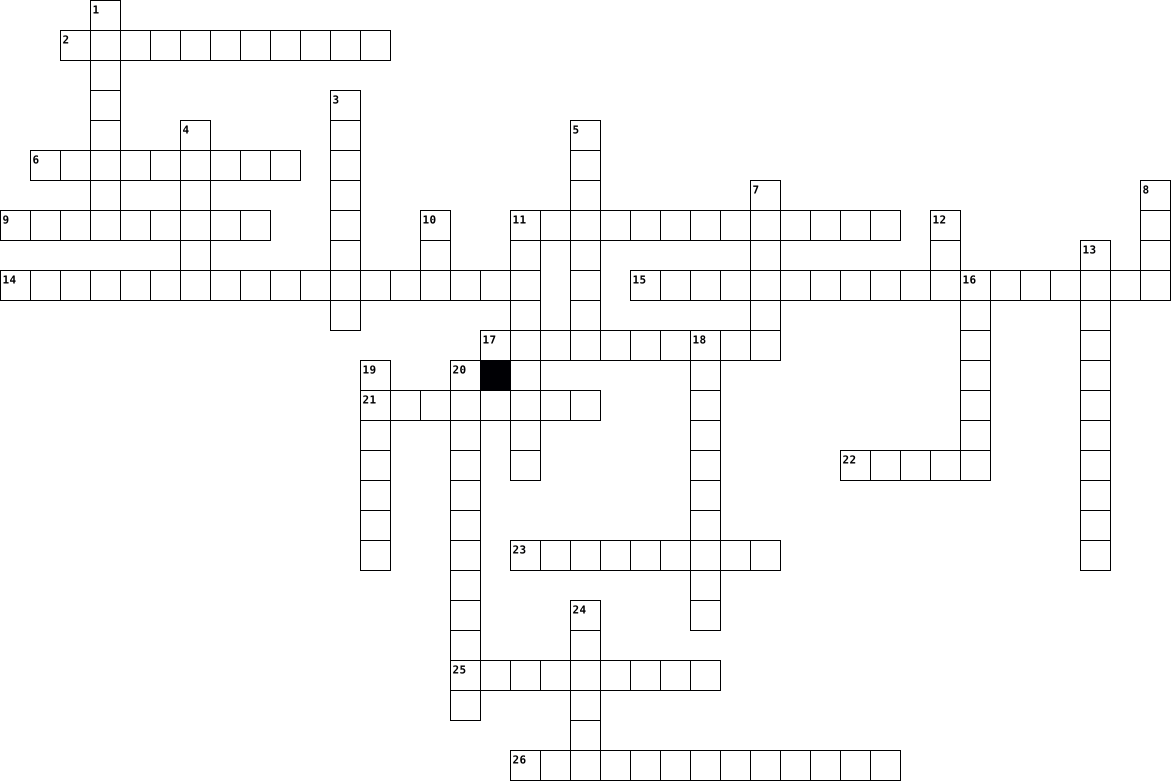
Kansas History 2023-05-16

Across
- A person having origins in any of the original people in Kansas
- President from 1953-1961 born in Kansas
- Kansas produces _______ for the US
- One of the few cities in the U.S. founded strictly for political reasons.
- Largest river that goes through Kansas
- The activity or business of growing crops and raising livestock.
- State flower
- Largest city in Kansas
- A ghost town in Kansas
Down
- Escape tunnel used for slaves
- Kansas state animals
- A town or city that serves as a market center or shipping point for cattle.
- The High Plains region in Kansas stretches across the western third of the state.
- Anti-slavery people fighting for black rights
- Drought that was cause by humans
- State Tree
- Kansas state capital
- What Kansas was regarding slaves
- The act that forces tribes from the east to move to Kansas
- The extreme limit of settled land beyond wilderness,
20 Clues: State Tree • State flower • Kansas state animals • Kansas state capital • Largest city in Kansas • A ghost town in Kansas • Escape tunnel used for slaves • Drought that was cause by humans • What Kansas was regarding slaves • Kansas produces _______ for the US • Largest river that goes through Kansas • President from 1953-1961 born in Kansas • ...
Japan history 2023-05-22

Across
- any specified division or portion of time
- the activity, spirit, or time of the great revival of art
- pertaining to, characteristic of, or in the style of the Middle Ages
- an overthrow or repudiation and the thorough replacement of an established government or political system by the people governed
- the code of the samurai
- giving back or showing an image
- the title applied to the chief military commanders from about the 8th century a.d. to the end of the 12th century
- a period of 100 years
- something that happens or is regarded as happening; an occurrence, especially one of some importance
Down
- a group of nations or peoples ruled over by an emperor, empress, or other powerful sovereign or government
- one of the great feudal lords who were vassals of the shogun
- a person who produces works in any of the arts that are primarily subject to aesthetic criteria
- the sequential order in which past events occur
- to provide details
- a collection of 100 tales
- any thing or place from which something comes
- diligent and systematic inquiry or investigation into a subject in order to discover or revise facts, theories
- a sequence of rulers from the same family, stock
- system of persons or things ranked one above another
- male sovereign or supreme ruler of an empire
20 Clues: to provide details • a period of 100 years • the code of the samurai • a collection of 100 tales • giving back or showing an image • any specified division or portion of time • male sovereign or supreme ruler of an empire • any thing or place from which something comes • the sequential order in which past events occur • a sequence of rulers from the same family, stock • ...
Japan history 2023-05-22

Across
- belonged to the third social tier soloing with samurai
- the leader of japan
- a building for religious purposes
- ranked members of a organisation
- 3rd shogun
- committing honourable suicide
- samurai without a master
- knows as the eco shogun
- controlled the provinces of japan
- believes in an ester worship and human
Down
- took place in activity’s like prostitution for money
- a member of a powerful military in japan
- sales people
- ranked against its competitors in a ranking of beaty and talent
- military leaders appointed by the emperor
- mostly farmers and fisherman
- social code for samurais
- religion from japan
- a country
- Spirit of a dead person
- a person who practises asceticism
21 Clues: a country • 3rd shogun • sales people • the leader of japan • religion from japan • knows as the eco shogun • Spirit of a dead person • social code for samurais • samurai without a master • mostly farmers and fisherman • committing honourable suicide • ranked members of a organisation • a building for religious purposes • a person who practises asceticism • ...
history vocab 2023-05-02

Across
- intense rainstorm with strong winds that forms over tropical oceans
- importance
- a form of government in which the state is ruled by a monarch
- amount of goods and services produced given the amount of resources used
- movement of people from rural to urban areas
- north, east, south, and west
- the process of a society becoming more democratic
- desire for a particular good or service
- useful material found in the environment
- country with a strong economy and a high quality of life
- coming from outside a country
- a group of people living in similar economic conditions
- period during which hours of daylight are longest in one hemisphere and shortest in the other hemisphere
- the study of humankind in all aspects, especially development and culture
- information that comes directly from a person who experienced an event
- basic value
- country with a less-productive economy and a lower quality of life
- the scientific study of ancient cultures through the examination of artifacts and other evidence
- the level of comfort enjoyed by a person or a society
- group of plants and animals that depend on each other and their environment for survival
- an object made by a human being, such as a tool or a weapon
- the beliefs, customs, practices, and behaviors of a particular nation or group of people
- average weather of a place over many years
- the position in degrees east or west of the Prime Meridian
- activities having to do with one’s society and community
- a system of basic rules and principles by which a government is organized
- amount of a good or service that is available for use
- study of the human and nonhuman features of Earth
- a government in which all power is held by a single person or a small group
- cause of migration that pulls, or attracts, people to new countries
- molten rock found under Earth’s surface
- cause of migration that pushes people to leave their home country
- to migrate out of a place
- person or business that makes and sells goods or services
- removal of trade barriers
- a group of people who have the power to make and enforce laws for a country or area
- effect
- the spread of cultural traits from one culture to another
- the time before humans invented writing
- unwanted; undesirable
- crack in Earth’s crust
- a system in which a central government makes all laws for the entire country
- share
- information about an event that does not come from a person who experienced that event
- study of how people meet their wants and needs
- the movement of water from Earth’s surface to the atmosphere and back again
- way to map Earth on a flat surface
- to support
- useful for achieving a desired result
- loss of forest cover in a region that results from trees being destroyed faster than they can grow back
- variety of different kinds of living things in a region or ecosystem
- a compass direction that lies between the cardinal directions, such as northeast
Down
- the position north or south of the Equator measured in degrees
- country’s economic growth and quality of life
- person or business that buys, or consumes, goods or services
- lowest possible or acceptable
- not extreme
- a list of events in the order in which they occurred
- condition of the air and sky at a certain time and place
- growth of machine-powered production and manufacturing
- a legal member of a country
- a legal process by which immigrants become citizens
- tax on imports or exports
- process of dropping eroded material in a new place
- a society’s ability to produce a product most efficiently given all the products it could produce
- a region made up of similar ecosystems and communities of plants and animals
- a length of time singled out because of a specific event or development that happened during that time; also known as an era or epoch
- process that breaks down rock into tiny pieces
- to receive as a result of being in a family or group
- cost of what you have to give up when making a choice
- area between the high and low latitudes; also know as middle latitudes
- the organized spread of features in a space
- period during which hours of daylight and hours of darkness are of equal length everywhere on Earth
- total value of all goods and services produced in a country in a year
- typical ways of living out daily life
- nonrenewable resource that forms over millions of years from the remains of dead plants and animals
- to turn in the opposite direction
- a pattern of organized relationships among groups of people within a society
- a form of government in which citizens hold political power
- relative size
- area between the Tropic of Cancer and the Tropic of Capricorn; also know as low latitudes
- a line marked off with a series of events and dates
- to bring different people or groups together
- loss of accuracy
- two or more things affecting each other
- the wind that most frequently blows across a particular region.
- a system in which power is divided among central, regional, and local governments
- something that keeps goods and services from entering a country
- a process involving huge blocks of Earth’s crust and upper mantle that are called tectonic plates
- connection of events over time
- a group of humans with a shared culture who have organized themselves to meet their basic needs
- an official event for a specific occasion
- a person's perspective on a person, thing, idea, or event
- exchange of goods and services in a market.
- relating to or found within a country
95 Clues: share • effect • importance • to support • not extreme • basic value • relative size • loss of accuracy • unwanted; undesirable • crack in Earth’s crust • tax on imports or exports • to migrate out of a place • removal of trade barriers • a legal member of a country • north, east, south, and west • lowest possible or acceptable • coming from outside a country • connection of events over time • ...
British History 2023-10-03

Across
- Indo-European tribes split into clans
- saint who led a religious mission
- the opposite for preys
- population that occupied Britain in 43 AD
- where the spread of Christianity began
- they buy and sell goods
- Queen Boudicca was one of them
- country that covers northern Britain
- people from Scandinavia
- they catch fishes
- common language of educated Europe
Down
- the first example of English literature
- famous circle of big stones
- the religious leaders of the celts
- person who cultivates a land
- the name of a town that ends the same as Manchester
- island consisting of England, Scotland and Wales
- it was erected by Hadrian
- invaders from northern Germany
- religion that brought written literature
20 Clues: they catch fishes • the opposite for preys • they buy and sell goods • people from Scandinavia • it was erected by Hadrian • famous circle of big stones • person who cultivates a land • invaders from northern Germany • Queen Boudicca was one of them • saint who led a religious mission • the religious leaders of the celts • common language of educated Europe • ...
World History 2023-10-10

Across
- Muslim city-states made their wealth with trade
- king of the Zagwe dynasty
- usually a warm temperature summer and winter rains
- group of people who migrate where the animals migrate
- main language in Africa
- speaks and has many languages
- ruling dynasty of the tEthiopianian empire
- written language of Ethiopia
- very wealthy sophisticated empire built over Ghana
- strong winds
- produced very expensive items to build wealth
- ruler of aksum
- Largest desert in the world
- first group to learn how to work with iron
- complex society lived in one area all spoke the same language
- forest wet environment rains every day
Down
- king tried to get rid of Jews because it was mainly Islamic
- storytellers trusted to practice oral tradition
- jobs you get depending on your age
- wealthy trading country with lots of cattle, middle men and taxes
- located deep in the forest
- Plained area division rivers division between wet and dry ares
- independent city-states
- palace in great zimbabwe
- leadership of the militray
- wealthiest man to ever live
- conquered past Ghana territories
- a major influnce on culture
- open grassland
- controlled the Red Sea trade
- expanded Songhai and strengthened their government
31 Clues: strong winds • open grassland • ruler of aksum • independent city-states • main language in Africa • palace in great zimbabwe • king of the Zagwe dynasty • located deep in the forest • leadership of the militray • wealthiest man to ever live • a major influnce on culture • Largest desert in the world • written language of Ethiopia • controlled the Red Sea trade • ...
History Mystery 2025-03-08

Across
- A tough school to get into
- Army facility
- Sports uniform
- Keeps your feet warm
- A rock on a ring
- The Great Bambino
- Seventh _____ stretch
- Pleasant recreation or hobby
- Backyard grilling food
- not amateur
- A federation
Down
- Independence Day spectacle
- Tea party location
- Onlookers
- Another word for supervisor
- Union men
- The A _____
- One, Two, Three; You’re out!
- Pub crawler’s order
- Green spot in a city
20 Clues: Onlookers • Union men • The A _____ • not amateur • A federation • Army facility • Sports uniform • A rock on a ring • The Great Bambino • Tea party location • Pub crawler’s order • Keeps your feet warm • Green spot in a city • Seventh _____ stretch • Backyard grilling food • Independence Day spectacle • A tough school to get into • Another word for supervisor • One, Two, Three; You’re out! • ...
SEA History 2025-03-11

Across
- Today, this country has a communist North and a democratic South
- Indian philosophy of loyalty to those with shared history and customs
- US policy to stop the spread of communism
- Leader of the first Chinese Communist Party
- Dynasty overthrown by the Chinese Nationalist Party
- The role of the Japanese emperor in the new government after WWII was mainly _________
- Mao's program launched in 1966 to revive revolutionary spirit
- US general who oversaw post-war reforms in Japan
- Japan’s constitution also prevents the country from declaring ______ of fighting with other countries
- Site of Japanese surprise attack on the US in 1941
- Chiang Kai-shek's political party
Down
- City where the first atomic bomb was dropped
- Indian leader who encouraged nonviolent protests against the British
- The idea that one country falls communist other countries will also fall to communism
- Mao's failed economic program to modernize China
- Type of government Japan has today
- The Japanese were also not allowed to rebuild their ________ in any way
- Chinese leader who made reforms after Mao's death
- India broke free from this country in 1947
- British interest in trading these goods from India
20 Clues: Chiang Kai-shek's political party • Type of government Japan has today • US policy to stop the spread of communism • India broke free from this country in 1947 • Leader of the first Chinese Communist Party • City where the first atomic bomb was dropped • Mao's failed economic program to modernize China • US general who oversaw post-war reforms in Japan • ...
US History 2025-03-06

Across
- the last state to join the U.S.A.
- the President on the Quarter
- how many presidents have come from NYS
- this is the first president to have an airplane specifically built for the office in 1962
- this state has had the most presidents born in it
- the US exports the majority of its goods to this country to the north
- on the US flag, these represent the thirteen original colonies
- The President can serve this maximum (2 wds)
- he is the representative in the House for Bethlehem and the surrounding area (2 wds)
- first in line to replace the president if necessary (2 wds)
- only president other than Cleveland to have 2 nonconsecutive terms (2 wds)
- this is the term for a US House member
- The month in which we celebrate President's Day
- this President oversaw the US Civil War
- the President is also head of their political ______
Down
- the state with the largest amount of House of Rep members
- The Only "First Lady" to run for president lost in 2016
- the month of the presidential election
- length of term for President (2 wds)
- the President oversees these ___________ for July 4th, Veterans Day, etc.
- office and residence of the POTUS (2 wds)
- the first state to join the U.S.A. and home state of President Biden
- as Commander-in-Chief, the President controls this
- this is the "Senior Senator" from NYS (1 wd)
- Each state has two of these in Congress
- this social media platform was almost canceled in January 2025 (2 wds)
- the President is supposed to be the _________ enforcer, make sure the court decisions are carried out
27 Clues: the President on the Quarter • the last state to join the U.S.A. • length of term for President (2 wds) • the month of the presidential election • how many presidents have come from NYS • this is the term for a US House member • Each state has two of these in Congress • this President oversaw the US Civil War • office and residence of the POTUS (2 wds) • ...
history crossword 2024-09-24

Across
- colonists can only buy tea from the British
- colonist dumped crates of tea in the ocean
- the first group of people that live in a country or different place
- a famous Germaon who broke away from the church
- the first English colony that disappeared
- people who wanted freedom in the American revlolution
- an event in Salem that hanged a lot of innocent people
- people that didn't care who won the American revolution
- British soldiers shot and killed five colonists
- to owe money
- a war over land with the British and the French
- the reason the colonists in the south came to the new world
- one of the reasons many people immigrate
- a type of farming where you can only grow enough to eat
- to respectfully ignore
- English group that wanted to change the Church of England who were thrown out
- a rule made in 1763 that did not let colonists go north of the appalachian mountains
Down
- a claim; similar to a law in America
- the indigenous people that were from Virginia when the colonists settled there
- the crop that saved Jamestown
- people who were on the kings side in the American revolution
- colonists had to provide British soldiers with housing
- English king that started his own church
- the first permanent English colony
- a law that put taxes on paper
- plants that are used for trade and to sell for money instead of eating
- similar to a dictator
- The person that saved the first permanent English colony
- colonial region that had the most land
- patriot that was famous for his speech "give me liberty or give me death."
30 Clues: to owe money • similar to a dictator • to respectfully ignore • the crop that saved Jamestown • a law that put taxes on paper • the first permanent English colony • a claim; similar to a law in America • colonial region that had the most land • English king that started his own church • one of the reasons many people immigrate • the first English colony that disappeared • ...
History Review 2024-09-25

Across
- Came along with the neolithic revolution because some genres of people were less needed
- First to migrate out of Africa
- First hominid
- People moving around in small groups usually following animals
- The archaeologist who discovered skull fragments of an Australopithecus
- An early homosapien skeletal remains found in the alps
- Old stone age
- Led to Artisans, Caused because people had more time hone in on a specific skill
- The moving patterns of hominids
- In this era people settle down and most are not nomadic
- Humanlike creatures
- The events before a recorded timeline was possible
- A society without a class system or social hierarchy
Down
- The land bridge between current day Alaska and Russia
- The study of ancient artifacts to figure out things like time period and culture of an area
- Beginning of agriculture, Less hunting and more farming
- The spread of cultures around the globe
- The act of using things often animals and making them less wild
- The hominid with the Biggest Brain
- The skeletal remains of an Australopithecus
- Large stone structures for religious purposes such as burials or prayer
- Things left behind form previous societies
- A cave in France containing early hominid drawings
- The jobs set for men and women before the neolithic revolution
- The first people to be skilled in a specific trade
- The society formed in modern day turkey around 7000 BCE
- Name means Handy man, first to develop tools
- The skill of finding artifacts and fossils
28 Clues: First hominid • Old stone age • Humanlike creatures • First to migrate out of Africa • The moving patterns of hominids • The hominid with the Biggest Brain • The spread of cultures around the globe • Things left behind form previous societies • The skill of finding artifacts and fossils • The skeletal remains of an Australopithecus • Name means Handy man, first to develop tools • ...
Our History 2024-09-16

Across
- Pram’s late night snacks
- Pram’s trait I hate
- Pram’s hobby
- Fira’s trait you hate
- Pram's company name
- Our first time
- Kiss Goodbye routine
- Second concert
- Fira’s hobby
Down
- Anniversary month
- Fira’s favorite food
- Fira’s company name
- First time you said ‘Aku Sayang Kamu’
- First concert
- Our first meeting
- Your first promise
- Our cat
- Second trip out of town
- Staycation Bandung
- Gifts after a fight
20 Clues: Our cat • Pram’s hobby • Fira’s hobby • First concert • Our first time • Second concert • Anniversary month • Our first meeting • Your first promise • Staycation Bandung • Fira’s company name • Pram’s trait I hate • Pram's company name • Gifts after a fight • Fira’s favorite food • Kiss Goodbye routine • Fira’s trait you hate • Second trip out of town • Pram’s late night snacks • ...
History Crossword 2024-09-23

Across
- Roman god of love which is also a name of a planet. (5)
- Plot to blow up parliament remembered on the 5th of November. (9)
- Unsinkable ship which sank on its maiden voyage. (7)
- Important law document, a copy of which is kept at Lincoln Castle. (5-5)
- What is 2024 in Roman numerals? (6)
- How many king Henrys were there? (5)
- Age which followed the Stone Age. (6)
- Ancient Greek games (8)
- Florence ______. Nurse known as the 'Lady of the Lamp' who introduced cleaner hospitals during the Crimean War. (11)
Down
- Outstanding Scunthorpe secondary school which first opened in 1951. (8)
- Ancient civilisation that built the great pyramid? (9)
- Where did the Great Fire of London start? (7-4)
- The last Tudor monarch. (9)
- Children who were sent from the cities to the countryside in World War II. (8)
- Queen who was the longest reigning monarch until Queen Elizabeth II? (8)
- The Roman emperor, whose name is given to the wall between England and Scotland. (7)
- Norman duke who defeated King Harold at the Battle of Hastings in 1066? (6)
- Battle of the _____. The largest land battle of World War I. (5)
- Popular name given to the Norsemen who invaded England in the 8th century? (7)
- Tudor king who had six wives. (5)
20 Clues: Ancient Greek games (8) • The last Tudor monarch. (9) • Tudor king who had six wives. (5) • What is 2024 in Roman numerals? (6) • How many king Henrys were there? (5) • Age which followed the Stone Age. (6) • Where did the Great Fire of London start? (7-4) • Unsinkable ship which sank on its maiden voyage. (7) • Ancient civilisation that built the great pyramid? (9) • ...
Atom History 2024-09-12

Across
- Ernest Rutherford experiment
- Bohr determined electron simultaneously behaved like waves
- Rutherford discovered the nucleus
- Planetary model
- JJ Thomsons model
- Negatively charged particles
- Coined the term atom
- Discovered positive rays
- Still accepted today
- Aided in the discovery of the protons
- Cathode ray tube
- Developed to describe electron motion
- Meaning indivisible
Down
- Consists of three steps
- Discovery of electrons
- J. Chadwick confirmed existence of neutrons
- Dalton's atomic theory
- Confirmed the existence of neutrons
- Developed wave equation
- Discovered the nucleus
20 Clues: Planetary model • Cathode ray tube • JJ Thomsons model • Meaning indivisible • Coined the term atom • Still accepted today • Discovery of electrons • Dalton's atomic theory • Discovered the nucleus • Consists of three steps • Developed wave equation • Discovered positive rays • Ernest Rutherford experiment • Negatively charged particles • Rutherford discovered the nucleus • ...
history crossword 2025-02-17

Across
- Mughals were the successors of ----- from father’s side
- The first Mughal emperor
- Rastrakutas, Gujara prathiharas and pala dnasty fought the ____ struggle
- Temple at thanjavur was built by
- Muhammad Ghazni raided the ------ temple
- A ruler from iran
- Cholas were known for --- sculptures
- Real name of shershah
- The ---- were loyal to the Mughals
- One of the Navratnas of Akbar(musician)
Down
- Leader of jat
- Akbars revenue minister
- System introduced to protect the cultivators
- History of Kashmir was written by
- A Rashtrakuta chief
- Mehrunnisa was given the title
- A famous Maratha ruler
- An important Rajput kingdom
- A tax collected by Marathas
- Observatory was constructed by
20 Clues: Leader of jat • A ruler from iran • A Rashtrakuta chief • Real name of shershah • A famous Maratha ruler • Akbars revenue minister • The first Mughal emperor • An important Rajput kingdom • A tax collected by Marathas • Mehrunnisa was given the title • Observatory was constructed by • Temple at thanjavur was built by • History of Kashmir was written by • ...
History 1a 2025-02-17

Across
- a local assembly withdrew church blessing
- what did the people of the renaissance think eduction was a remedy for?
- invented moveable type
- special hearing to stamp heresy
- where the renaissance started
- painter/sculptor from Italy
- heir to Aragon throne
- Botticelli was a?
- Germany became unified under this ruler
- Spanish Muslims
- heir to castle throne
Down
- music from the Middle Ages
- papal power reached its height under its ruler
- what became very important to meet the needs of the changing society?
- Italian writer
- One of the most important English documents
- famous English
- study of history, science, grammar, literature, and philosophy
- revival of learning and they renewed interest in art in the western world
- a scholar from the Netherlands
20 Clues: Italian writer • famous English • Spanish Muslims • Botticelli was a? • heir to Aragon throne • heir to castle throne • invented moveable type • music from the Middle Ages • painter/sculptor from Italy • where the renaissance started • a scholar from the Netherlands • special hearing to stamp heresy • Germany became unified under this ruler • a local assembly withdrew church blessing • ...
US History 2021-05-05
Across
- towns that homeless people would go.
- was a big issue in america pre 1938 because children got hurt, still continues in some countries.
- workers group in us that wanted to spread socialism.
- jews were placed there before concentration camps.
- was created to help familes get back on their feet (one letter repeated 3 times).
- helped defeat germany.
- used by many soldiers, built a closer relationship to the president.
- create a hole in the enemies army and flood in.
- leader of USSR.
- Hitler's book he wrote.
- day that were created so people wouldn't over withdraw money from the banks.
- book that talked about witnessing the pearl harbor attack.
- concentration camp in Poland.
- storm that affected many states and farmers.
Down
- people greatly affected after pearl harbor attack.
- dictator of Italy.
- leader of Germany.
- emperor of Japan.
- crashed when buyers kept ignoring the decline of consumers.
- had to wear the star of david on their arm to label them.
- day jews were targeted.
- when a person hates a certain type of race, ethnicity, religion.
- lebensraum in english means.
- group that targeted african americans.
- prime minister of Great Britain.
- the day they tricked Hitler with false news.
- food, heat, gas for soldiers in the world wars was _.
27 Clues: leader of USSR. • emperor of Japan. • dictator of Italy. • leader of Germany. • helped defeat germany. • day jews were targeted. • Hitler's book he wrote. • lebensraum in english means. • concentration camp in Poland. • prime minister of Great Britain. • towns that homeless people would go. • group that targeted african americans. • the day they tricked Hitler with false news. • ...
History Review 2025-02-02

Across
- This Old Testament king married Esther.
- Fra ________________ painted for the glory of God.
- Fra Filippo _____________ painted for his own selfish gain.
- Dias called the Southern coast of Africa the Cape of ________________.
- The first place of landfall for Columbus.
- The bodyguards that guard the Tower of London to this day.
- This country sponsored Columbus' trip across the Atlantic.
- Donatello the ____________ created many 3D art pieces.
- This man was thrown into the Tower of London.
- The War of Roses happened in this country.
- Ivan the Great stood up against the golden horde, in which country?
- At 13, Ismail I named himself king of the Safavid Empire which is called_______.
- Columbus took three ships the Nina, _____________, and the Santa Maria.
- Sundiata was the founder of this African empire.
- The Sunnis and Shiites are the two divisions of this religion.
Down
- Medici and his family lived in ________________, Italy.
- The house of Lancaster versus the House of York in 1455-1485.
- Cosimo de' Medici was a great influence for the Italian ________________.
- Henry __________ was the man who united the House of Lancaster and York.
- This empire took over Mali and was led by Askia Muhammed.
- As leader of the Mali empire, he regularly gave away gold.
- Batu Khana was the leader of this _____________ horde.
- Columbus' real name was Cristobal _______________.
- Bartolomeu Dias and Vasco da Gama were both explorers from this country.
- People chosen in Western Africa to memorize the history of their people
- In 1487, King John II of Portugal, paid for this explorer's trip around the Cape of Good Hope.
- In 1492, this person sailed the ocean blue.
- This African empire traded gold and salt.
- What was the occupation of Filippo Brunelleschi? (he designed buildings in Italy)
- In 1497, Vasco da Gama, successfully sailed to this country.
30 Clues: This Old Testament king married Esther. • The first place of landfall for Columbus. • This African empire traded gold and salt. • The War of Roses happened in this country. • In 1492, this person sailed the ocean blue. • This man was thrown into the Tower of London. • Sundiata was the founder of this African empire. • Fra ________________ painted for the glory of God. • ...
Aussie History 2024-10-06

Across
- swap
- something in the past
- there is other countries on this
- a belief or religion
- first part f a TS song
- compass W
- something you need to follow
- second part of a TS song
- Compass N
- a country
- like a vote
Down
- part of a volcano
- a harry potter quidditch position
- thousands of... fled across the boarder
- explosives
- American state
- compass E
- a verb that means doing something
- compass S
- something you...
- opposite of wrongs
- not needs
22 Clues: swap • compass E • compass W • compass S • Compass N • not needs • a country • explosives • like a vote • American state • something you... • part of a volcano • opposite of wrongs • a belief or religion • something in the past • first part f a TS song • second part of a TS song • something you need to follow • there is other countries on this • a harry potter quidditch position • ...
Australian history 2024-10-09

Across
- its short for element 79
- you cut down trees
- landed with cap cook
- a old rifle
- a European country
- famous bushranger
- you move something
- a country in Asia
- a crime where you steel something
- another word for prisoner
- before federation
- we live on it
Down
- something people do against the government
- after colonies
- its gold
- a specials person like the government
- a old pistol
- never allowed to come back
- a country in Oceana
- a small river
- it goes over seas
21 Clues: its gold • a old rifle • a old pistol • a small river • we live on it • after colonies • famous bushranger • a country in Asia • before federation • it goes over seas • you cut down trees • a European country • you move something • a country in Oceana • landed with cap cook • its short for element 79 • another word for prisoner • never allowed to come back • a crime where you steel something • ...
Russia's History 2025-04-02

Across
- Ivan I made ___________ become stronger as Mongol rule weakened
- Ancient trade routes that carried goods throughout the Mongole Empire
- Russian princes had to pay tribute and taxes to him
- President that tried to reform and improve the economy in Russia.
- Established in Central Asia by Genghis Khan in 1200s
- People that took control of a Slavic town
- Soviet leader that isolated citizens from contact with the West
- He invaded Russia in the summer of 1812
- System in which government controls economic resources.
- Napoleon started his retreat in Moscow because of the harsh ____________.
- People whose culture had the most influence on early Russia
Down
- Satellite launched by the USSR into space in 1957
- It was formed in 1992 by Russia, Ukraine and others.
- Conflict between the Soviet Union and the United States
- In 1991, the Soviet Union collapsed, and its republics gained their ______________.
- He invaded Russia during World War II.
- Territory with its own government established by a Varangian prince
- People that lived in southern Ukraine around 1200 BC
- He became first czar of Russia in 1547
- Single political party that controls the government and economy.
20 Clues: He invaded Russia during World War II. • He became first czar of Russia in 1547 • He invaded Russia in the summer of 1812 • People that took control of a Slavic town • Satellite launched by the USSR into space in 1957 • Russian princes had to pay tribute and taxes to him • It was formed in 1992 by Russia, Ukraine and others. • ...
Church History 2024-11-27

Across
- Defeated the Muslims at the Battle of Tours
- This Saint cut down Thor's tree in Germany
- Pope St. Gregory the Great paid this tribe not to attack Rome
- Religion started by Mohamed in the 600s
- A baptized Catholic who later rejects the Faith
- The language of the Holy Roman Empire
- Our Lord had twelve of these
- The language of the Byzantine Empire
- Outside the Church there is no _______________
- The Arena in Rome in which many Christians were martyred
- Another name for the Eastern Roman Empire
- Ora et __________, the motto of St. Benedict. It means to pray and work
- Queen of the Kievan-Rus who used pigeons as weapons
- The Romans did this to Christians for hundreds of years
- Saint who converted Ireland to the Catholic Faith
- The name of the Franking kingly dynasty that deposed the Merovingian kings
- The Viking false god known for his hammer
- One of two brother saints, apostles to the Slavs
- Said "Turn me over on this side, I'm done"
Down
- The founder of the Holy Roman Empire
- This saint is the founder of western monasticism
- The monastery of St. Benedict
- Early heresy that denied the Divinity of Christ
- Charlemagne was crowned Emperor on this day
- Our Lord gave this saint the Keys to Heaven
- Saint and Church Father in the East known for his valiant fight against Arianism
- Killed by King Boleslaus in a Church
- The kingdom of the Franks turned into this modern day nation-state
- Holy Catholic Chant made popular by Charlemagne
- The Saint wife of Clovis
- The heresy that destroyed holy images and statues
- St. Olaf brought about the conversion of this nation
- This Saint is known as the Apostle of Scotland
- King Saint of the Kievan-Rus
- States Land given to the Pope by Pepin
- Build the First Basilica of St. Peter in Rome
- This Pope Saint turned back Attila the Hun at Rome
- The Vicar of Christ on Earth
- This Saint Bishop baptized Clovis
- System of lords and peasants that began in the Middle Ages
- Pope St. Gregory the Great sent this saint to convert the English
- The name "Charlemagne" means Charles the _____________
- This city became the center of the Catholic Church
- First Merovingian King and first Catholic king of France
44 Clues: The Saint wife of Clovis • Our Lord had twelve of these • King Saint of the Kievan-Rus • The Vicar of Christ on Earth • The monastery of St. Benedict • This Saint Bishop baptized Clovis • The founder of the Holy Roman Empire • Killed by King Boleslaus in a Church • The language of the Byzantine Empire • The language of the Holy Roman Empire • ...
HISTORY CROSSWORD 2024-11-22

Across
- general of the continental army
- leaders of a army expedition
- chief of justice for the supreme court
- a from of tax on imported items
- longest artificial waterway
- 4th us president
- politicians who wanted war
- advise the president on anything he needs to know
- john Quincy's secretary
- land bought by ThomasJefferson
- give me liberty or death
- political philosophers
- changing or adding to the constatution
Down
- reflected a sense of national purpose
- a intersection in massachusetts
- forced men to severe against their will
- patriot and revolutionary salesman
- a rebellion started by farmers
- closed all ports for Britain
- first guy killed in the revolution
20 Clues: 4th us president • political philosophers • john Quincy's secretary • give me liberty or death • politicians who wanted war • longest artificial waterway • leaders of a army expedition • closed all ports for Britain • a rebellion started by farmers • land bought by ThomasJefferson • general of the continental army • a intersection in massachusetts • a from of tax on imported items • ...
US History 2024-11-22

Across
- People who wanted to stay with Britain
- Amendment that protects speech
- Believed in stronger central government
- What did the US declare from Britain in 1776
- Father of the constitution
- Makes law
- 2nd US president
- Give me liberty or give me death
- Interprets law
- Created the national bank
Down
- Believed in strong state government
- 3rd president
- Opening to the constitution
- The process of becoming a US citizen
- Rebellion that proved the Articles of Confederation need improvements
- 1st US president
- Amendment that protects the right to bear arms
- Enforces law
- Act to limit American trade
- One of the writers of the Federalist Papers
20 Clues: Makes law • Enforces law • 3rd president • Interprets law • 1st US president • 2nd US president • Created the national bank • Father of the constitution • Opening to the constitution • Act to limit American trade • Amendment that protects speech • Give me liberty or give me death • Believed in strong state government • The process of becoming a US citizen • ...
U.S History 2024-11-21

Across
- "Father of the Constituion"
- The intellectual and philosophical movement that occured in Europe in the 17th and 18th centuries
- First 10 amendments to the Constitution
- Advisory council for the president consisting of the heads of the executive department, the vice president, and other selected officials
- Branch of government that carries out laws
- People that wanted a stronger national government
- Turning point of the revolutionary war
- 1st person killed in American Revolution
- Government's power is limited and defined by a constitution
- Settled in Plymouth after travelling on the Mayflower
- A law passed in 1807 that prohibited American merchants from trading with other countries
- The capital of the Virginia colony from 1899 to 1780 and played a big role in the American Revolution
Down
- Proved that U.S needed stronger government
- Compromise between large and small states in 1778
- Weak document that governed before the Consitution
- An act of nonviolent, voluntary abstention from a product, person, or orginization
- Armed private ships used to attack merchant ships
- Wanted state's rights over government
- People who remained loyal to the British crown during the Revolutionary War
- Legal process to become a U.S citizen if born outside the U.S
20 Clues: "Father of the Constituion" • Wanted state's rights over government • Turning point of the revolutionary war • First 10 amendments to the Constitution • 1st person killed in American Revolution • Proved that U.S needed stronger government • Branch of government that carries out laws • Compromise between large and small states in 1778 • ...
History vocab 2024-11-24

Across
- Артефакт
- Обязательный
- Экономический
- Область
- Выставка
- Древний
- Думать
- Оружие
- Выставлять
- Текущий
- Заявлять, утверждать
- Заявлять
- History Естественная история
- Предлагать
- За пределами
- Спорить
- Археолог
- Рыцарь
Down
- Вымерший
- Раскопки
- Меч
- Останки
- Документ
- Исследовать
- Финансовый
- Иероглифы
- Указывать
- Обучение
- Obvious Менее очевидный
- Археология
- Период
- Экспонат
- Ископаемое
33 Clues: Меч • Думать • Оружие • Период • Рыцарь • Останки • Область • Древний • Текущий • Спорить • Вымерший • Артефакт • Раскопки • Документ • Выставка • Обучение • Заявлять • Экспонат • Археолог • Иероглифы • Указывать • Финансовый • Выставлять • Археология • Предлагать • Ископаемое • Исследовать • Обязательный • За пределами • Экономический • Заявлять, утверждать • Obvious Менее очевидный • History Естественная история
History crossword 2024-11-21

Across
- using people for work with no pay
- father of the constitution
- limited power to the king
- first war in the revolution
- "necessary and proper clause"
- invented the cotton gin
- anti-federalist who believed the us government had too much power
- laws/rules the us put in place
- wife of John adams
- turning point in the revolutionary war
Down
- 3/5ths of slaves counted as population
- allowed self-governing churches
- colonists who were neutral about the war
- held American troops in 1776-1777
- first 10 amendments
- colonists who wanted the us to win the war
- 2nd president of the us
- volunteer army
- colonists who wanted the British to win
- people rebelled over the government and a stronger national government was needed
20 Clues: volunteer army • wife of John adams • first 10 amendments • 2nd president of the us • invented the cotton gin • limited power to the king • father of the constitution • first war in the revolution • "necessary and proper clause" • laws/rules the us put in place • allowed self-governing churches • using people for work with no pay • held American troops in 1776-1777 • ...
History Project 2024-11-19

Across
- Rules apply to everyone, regardless of their ranking
- Legislative Branch, the one that creates our laws
- Made up of the House of Representatives and the Senate
- Gave certain rights to the English people, signed in 1215
- Difficult or has many details
- A complaint
- Rules created to guide a country or a state
- The people rule
- Made up of the President and his/her security
Down
- To establish an idea in hope of agreement
- A person who supports federal government
- A composition written on a specific topic
- Made to solve disagreements about federal laws
- Changes to a document or a piece of written text
- A high rank in House or U.S Congress
- Government that has a 2 party system
- Confirming a decision, giving consent
- An introduction to something
- Leader of the U.S
- Guarantee of rights or powers
20 Clues: A complaint • The people rule • Leader of the U.S • An introduction to something • Difficult or has many details • Guarantee of rights or powers • A high rank in House or U.S Congress • Government that has a 2 party system • Confirming a decision, giving consent • A person who supports federal government • To establish an idea in hope of agreement • ...
History Review! 2025-05-12

Across
- the world's most common religion
- to have way too much of something
- word for someone who worships Islam
- The thing that killed more than half of all of Europe
- how the Romans explained natural things in the world
- someone who doesn't live in the same place longer than a few months
- the job of every human in the stone age
- praying to more than one god
- how Romans and other cultures got water
- Making someone work for you without pay
Down
- original religion of Africans
- the root of many languages and commonly used by Romans
- A set of holy wars that were meant to take back holy land from Muslims
- Islamic word for god
- Law that isn't written, but is common practice sense for you to not do it
- A style of building similar to Roman buildings
- A place away from all the bad and negativity in the world
- most popular and well known trade route in history
- A huge burst in art and technology
- Increasing the amount of money someone pays back the longer they take
20 Clues: Islamic word for god • praying to more than one god • original religion of Africans • the world's most common religion • to have way too much of something • A huge burst in art and technology • word for someone who worships Islam • the job of every human in the stone age • how Romans and other cultures got water • Making someone work for you without pay • ...
History Mystery 2025-03-04

Across
- Police officer’s superior
- Without help, alone
- Cinema, ____ theater
- A rock, on the move
- Prop for Elvis
- Armed intrusion
- Noble global goal
- Bob, pixie, or fade
- 911 caller request
Down
- Longtime variety show host
- Mineral hunting spot
- “Let the ____ show”
- Clubs or diamonds, e.g
- Frenzied desire
- A type of pistol
- Country whose capital is New Delhi
- Roadside advertisement
- Banana ______
- Nickname for a VW car
- Neighbor of Scotland
20 Clues: Banana ______ • Prop for Elvis • Frenzied desire • Armed intrusion • A type of pistol • Noble global goal • 911 caller request • “Let the ____ show” • Without help, alone • A rock, on the move • Bob, pixie, or fade • Mineral hunting spot • Cinema, ____ theater • Neighbor of Scotland • Nickname for a VW car • Clubs or diamonds, e.g • Roadside advertisement • Police officer’s superior • ...
Washington History 2025-06-10

Across
- How many treaties did Stevens sign
- Immigrants that left because of a potato famine
- A major industry in early Washington
- Refusing to work until demands are met
- Mountain range separating Eastern and Western WA
- Outlawing alcohol
- A group of people fighting for worker rights
- Resources that can be grown
- Someone who moves from their country to a new one
- A school that forced natives to assimilate
- A Plateau tribe that acquired horses
- Missionaries killed by the Cayuse
Down
- There are 5 of these in Washington
- Tribes that lived on the Pacific Ocean
- To govern themselves
- A gold rush that boosted the growth of Seattle
- A city in Eastern Washington
- Railroad stretching from coast to coast
- The name of a coastal tribe also a local middle school
- People who traveled to spread religion
- First Territorial Governor of WA
21 Clues: Outlawing alcohol • To govern themselves • Resources that can be grown • A city in Eastern Washington • First Territorial Governor of WA • Missionaries killed by the Cayuse • There are 5 of these in Washington • How many treaties did Stevens sign • A major industry in early Washington • A Plateau tribe that acquired horses • Tribes that lived on the Pacific Ocean • ...
history exam 2025-06-12

Across
- Dating A scientific method used to date ancient remains
- The study of ideas about knowledge and life
- A temple in ancient Mesopotamia
- Code One of the earliest written legal codes
- Government led by religious leaders
- First system of writing used in Mesopotamia
- Preserved remains of a once-living organism
- Chinese belief that heaven grants rulers the right to rule
- A human-made object from the past
- A trained writer in ancient civilizations
- The practice that allowed humans to settle in one place
- Picture writing used in ancient Egypt
- Fertile land at the mouth of a river
- Top official in ancient Egypt
- A complex society with cities, government, and social classes
Down
- Government ruled by the people
- Early human ancestor
- Firsthand evidence from the past, like a diary or photo
- The spread of ideas and goods from one culture to another
- The process of adjusting to new environments
- A city that governs itself and surrounding land
- Physical features that influenced where humans lived
- The New Stone Age marked by farming and settlement
- Belief in many gods
- Moving from place to place in search of food
- Time before writing was invented
- A system where land is exchanged for loyalty and service
- When people focus on a specific type of work
- The Old Stone Age marked by hunting and gathering
- Ruler of ancient Egypt, seen as a god
30 Clues: Belief in many gods • Early human ancestor • Top official in ancient Egypt • Government ruled by the people • A temple in ancient Mesopotamia • Time before writing was invented • A human-made object from the past • Government led by religious leaders • Fertile land at the mouth of a river • Picture writing used in ancient Egypt • Ruler of ancient Egypt, seen as a god • ...
Evolutionary History 2025-06-05

Across
- a part of an organism (for example, one or more bones)
- sharing a common ancestor population
- the process by which the distribution of traits in a population changes over many generations
- A group of organisms of the same kind (in one or more populations) that do not reproduce with organisms from any other group
- to classify based on scientific examination
- the process by which one population evolves into two or more different species
- a scientist that studies fossils in order to understand the ancient history of life on earth
- living things, such as plants,animals,and bacteria
- a related organism from a previous generation
- when something stays mostly the same over time
- a specific charactgeristic of an individual organism
- everything (living & non living) that surrounds an organism
- evidence of life from the past,such as fossils bones, footprints, or leaf prints
- an organisms arm,leg,or wing
- a group of individuals born and living at the same time
- a graph that uses bars to show how characteristics or values distributed within a group
Down
- a more recent species that evolved from an ancestor population
- having died out completely and no longer alive anywhere on earth
- a body structure in two or more species that features the same parts (for example,the same bones)
- to receive genes from a parent
- a group of the same type of organism living in the same area
- the very long time that spans the history of earth,from the very first cellular life to the present
- An older population from which two or more species descended
- the process by which species adapt to environmental changes over a very long time
- a trait that makes it more likely that an individual will survive in a specific environment
- a random change to a gene that sometimes results in a new trait
26 Clues: an organisms arm,leg,or wing • to receive genes from a parent • sharing a common ancestor population • to classify based on scientific examination • a related organism from a previous generation • when something stays mostly the same over time • living things, such as plants,animals,and bacteria • a specific charactgeristic of an individual organism • ...
Computing History 2025-06-11

Across
- First-generation computer used these for logic circuitry based a thermionic valve
- Considered to be the "father" of computing
- ___ was done by plugging hundreds of wires into plugboards
- First microcomputer
- Element used in computer processors
- First truly general-purpose electronic computer
- First company to design a GUI
- Computer named after Steve Jobs' daughter meaning Local Integrated Software Architecture
- Originally a job title now evolved into a device we use daily
Down
- world's largest computer chip manufacturer today
- International Business Machine
- First computer programmer
- General Purpose computer proposed by Charles Babbage
- A semi-conductor device used to amplify or switch electronic signals and electrical power
- first fully transistor-powered, commercially available computer
- one of the largest electro-mechanical computers completed in 1944 by IBM
- An automatic computer designed to tabulate polynomial functions
- Many early computers used this as the primary method for input
- Graphical User Interface
- According to ___ ___, anything that went wrong with a computer is considered a computer bug.
20 Clues: First microcomputer • Graphical User Interface • First computer programmer • First company to design a GUI • International Business Machine • Element used in computer processors • Considered to be the "father" of computing • First truly general-purpose electronic computer • world's largest computer chip manufacturer today • ...
US History 2025-05-27

Across
- The "product" delivered by African kingdoms
- Cotton...machine that made cotton production effective
- First name Harriet
- The ... slavery
- First name Jim, racist "laws"
- The Declaration of ... in 1776
- Instrument used to control and maim
- The vehicle used to deliver slaves to America
- The Underground ...
- Europeans gave this to powerful African kingdoms
- President during American Civil War....A
- The method used to obtain insurance for cargo
- 1868: Coloured men were given the right to...
- Product from plantations that caused addiction
- Martin Luther...
- Famous speech: "I have a..."
Down
- A servant on contract
- The fate of a peaceful preacher
- A process where your humanity is taken away
- Way out for many at sea to make sure "souls returned"
- When you give people different rights you...
- Metal intrument to restrict movement
- The...war in 1860-1865
- Body part cut off to mark ownership
- Burn marks on skin to mark ownership
- 8 of 12 first presidents were slave...
- Product from plantations that kept you stylish
- 1808 slavery was...
- Number of centuries since slavery was introduced in NA
- White supremacist racist group lynched and killed coloured
30 Clues: The ... slavery • Martin Luther... • First name Harriet • The Underground ... • 1808 slavery was... • A servant on contract • The...war in 1860-1865 • Famous speech: "I have a..." • First name Jim, racist "laws" • The Declaration of ... in 1776 • The fate of a peaceful preacher • Body part cut off to mark ownership • Instrument used to control and maim • ...
Evolutionary History 2025-06-01

Across
- a group of organisms of the same kind that do not reproduce with organisms from any other group
- a group of the same type of organism living in the same area
- a group of individuals born and living at about the same time
- a trait that makes it more likely that an individual will survive in a specific environment
- sharing a common ancestor population
- the process by which species adapt to environmental changes over a very long time
- a body structure in two or more species that features the same parts
- living things, such as plants, animals, and bacteria
- a specific characteristic of an individual organism
- evidence of life from the past, such as fossilized bones, footprints, or leaf prints
- an organism's arm, leg, or wing
Down
- an older population from which two or more newer species descended
- when something stays mostly the same over time
- the very long time that spans the history of Earth, from the very first cellular life to the present
- the process by which the distribution of traits in a population changes over many generations
- a scientist who studies fossils in order to understand the ancient history of life on Earth
- a part of an organism
- a graph that uses bars to show how characteristics or values are distributed within a group
- a more recent species that evolved from an ancestor population
- a random change to a gene that sometimes results in a new trait
- the process by which one population evolves into two or more different species
- having died out completely and no longer alive anywhere on Earth
- everything that surrounds an organism
- a related organism from a previous generation
- to classify based on scientific examination
- to receive genes from a parent
26 Clues: a part of an organism • to receive genes from a parent • an organism's arm, leg, or wing • sharing a common ancestor population • everything that surrounds an organism • to classify based on scientific examination • a related organism from a previous generation • when something stays mostly the same over time • a specific characteristic of an individual organism • ...
Evolutionary History 2025-06-04

Across
- a group of organisms of the same kind (in one or more populations) that do not reproduce with organisms from any other group
- a group of the same type of organism living in the same area
- a group of individuals born and living at about t he same time
- a trait that makes it more likely that an individual will survive in a specific environment
- sharing a common ancestor population
- the process by which species adapt to environmental changes over a very long time
- a body structure in two or more species that features the same parts (for example, the same bones)
- living things, such as plants, animals, and bacteria
- a specific characteristic of an individual organism
- evidence of life from the past, such as fossilized bones, footprints, or leaf prints
- an organisms leg, arm, or wing
Down
- an older population from which two or more newer species descended
- when something stays mostly the same over time
- the very long time that spans the history of Earth, from the very first cellular life to the present
- the process by which the distribution of traits in a population changes over many generations
- a scientist who studies fossils in order to understand the ancient history of life on Earth
- a part of an organism (for example, one or more bones)
- a graph that uses bars to show how characteristics or values are distributed within a group
- a more recent species that evolved from an ancestor population
- a random change to a gene that sometimes results in a new trait
- the process by which one population evolves into two or more different species
- having died out completely and no longer alive anywhere on Earth
- everything (living and nonliving) that surrounds an organism
- a related organism from a previous generation
- to classify based on a scientific examination
- to receive genes from a parent
26 Clues: to receive genes from a parent • an organisms leg, arm, or wing • sharing a common ancestor population • a related organism from a previous generation • to classify based on a scientific examination • when something stays mostly the same over time • a specific characteristic of an individual organism • living things, such as plants, animals, and bacteria • ...
History Crossword 2025-05-23

Across
- Political ____
- Provincial _____
- Gold ____
- Underground_____
- A symbolic word to refer to the monarch
- _____ school
- Foreign ____
- Head ___
- The great_____ A time of high immigration
- The Charlottetown ____
- ______ Government
Down
- _________By Population
- House of ____
- a gift-giving feast practiced by Indigenous
- The____Famine
- Quebec ________
- ______ of Canada
- The ___ Act
- Groups coming together to do common action
- the official power to make legal decisions
- binding written agreement between sovereign states
- _____ Represetation
- A decree proclaiming the law in an area
- The upper house of the Parliament
- The ____ Conference In Quebec province
- prejudice in favor of or against one thing
26 Clues: Head ___ • Gold ____ • The ___ Act • _____ school • Foreign ____ • House of ____ • The____Famine • Political ____ • Quebec ________ • Provincial _____ • Underground_____ • ______ of Canada • ______ Government • _____ Represetation • _________By Population • The Charlottetown ____ • The upper house of the Parliament • A symbolic word to refer to the monarch • A decree proclaiming the law in an area • ...
Barranquilla history 2025-05-29

Across
- Motor económico por el río Magdalena
- Ubicación del Museo del Caribe
- Plato de arroz con pescado lisa
- Festival famoso antes de Cuaresma
- Ciudad costera de Colombia
- Edificio histórico, Antiguo Edificio
- Cantante famosa de Barranquilla
- Fabricados en Barranquilla
- Zona de playa con castillo histórico
- Departamento donde Barranquilla es capital
- Construido para evitar bancos de arena
- Exportación importante desde Barranquilla
- Grupo indígena en Barranquilla temprana
- Establecida alrededor de 1629
Down
- Rasgo arquitectónico moderno
- Era española que formó Barranquilla
- Término local para el ambiente de Barranquilla
- Río principal cerca de Barranquilla
- Parte del apodo "Puerta de Oro"
- Ritmo tradicional de la región
- Postre de coco típico
- Significa "oro" en español
- Característica económica clave
- Significa "abiertos" en español
- Pescado usado en la cocina local
- Música folclórica nacida en Barranquilla
- Oleadas llegaron tras guerras mundiales
- Parte del apodo "Brazos Abiertos"
- Tortas de maíz saladas locales
- Sopa tradicional de la región
- Producto industrial clave
- Autor ligado al Museo del Caribe
- Espacio cultural Amira de la Rosa
- Apodo que significa "La Arenosa"
- Mar que bordea Barranquilla
35 Clues: Postre de coco típico • Producto industrial clave • Significa "oro" en español • Ciudad costera de Colombia • Fabricados en Barranquilla • Mar que bordea Barranquilla • Rasgo arquitectónico moderno • Sopa tradicional de la región • Establecida alrededor de 1629 • Ritmo tradicional de la región • Ubicación del Museo del Caribe • Característica económica clave • ...
Medieval History 2024-12-12

Across
- - Noble rank.
- - Religious devotee.
- - Knight's assistant.
- - Land grant.
- - Peasant laborer.
- - Knight's code.
- - Religious outcast
- - Common farmer.
- - Holy war.
- - Siege weapon.
- - Feudal subject.
- - Architectural style.
- - Trade association.
Down
- - Woven art.
- - Knights' contest.
- - Social system.
- - Land estate.
- - Mounted warrior.
- - Church tax.
- - Announcer.
- - Armor type.
- - Prison cell.
- - Black Death.
- - Fortress residence.
24 Clues: - Holy war. • - Woven art. • - Announcer. • - Noble rank. • - Land grant. • - Church tax. • - Armor type. • - Land estate. • - Prison cell. • - Black Death. • - Siege weapon. • - Social system. • - Knight's code. • - Common farmer. • - Feudal subject. • - Mounted warrior. • - Peasant laborer. • - Knights' contest. • - Religious outcast • - Religious devotee. • - Trade association. • - Knight's assistant. • ...
History Crossword 2024-12-17

Across
- "Step Pyramids"
- Laconian city with men of few words
- The Oldest Civilization in the Ancient Near East
- The First Empire
- The Great King of Akaad
- The Land Between Rivers
- Where you'll find Athens and Sparta
- Egyptian god of the underworld
- The big battle between Egypt and the Hittites
Down
- Spartain Lawmaker
- Constructed in the Old Kingdom of Egypt
- The Hanging Gardens are in
- The Hero of the Enuma Elish
- Cyrus was the great king of this nation
- Jerusalem is in this region
- The Great King of Egypt
- Athenian Lawmaker
- The Sun god of Egypt
- The Epic and fabled king of Ur
- The king who ended the Babylonian Captivity of the Israelites
20 Clues: "Step Pyramids" • The First Empire • Spartain Lawmaker • Athenian Lawmaker • The Sun god of Egypt • The Great King of Egypt • The Great King of Akaad • The Land Between Rivers • The Hanging Gardens are in • The Hero of the Enuma Elish • Jerusalem is in this region • The Epic and fabled king of Ur • Egyptian god of the underworld • Laconian city with men of few words • ...
History 4 2025-01-06

Across
- – Where cowboys slept.
- – The type of house Abraham Lincoln was born in.
- – Something new that solves a problem.
- – What the president takes at inauguration.
- – Brothers who built the first airplane.
- – The buying and selling of enslaved people.
- – A journey to explore.
- – Made tools and horseshoes in colonial times.
- – Like the Grand Canyon, carved by a river.
- – The animal used in a famous mail delivery service.
- – The right to worship as you choose.
- – A Native American community.
- – Where the Civil War ended.
- – A group that helped with the Underground Railroad.
Down
- – Leader of a Native American tribe in Virginia.
- – What Southern states did before the Civil War.
- – The Northern side in the Civil War.
- – Movement to end slavery.
- – The Southern side in the Civil War.
- – Washington, D.C., is this for the U.S.
- – The other group in Congress.
- – Advisers to the president.
- – A famous frontiersman and explorer.
- – The "Father of the Constitution."
- – A region before it became a state.
- – Large farms in the South.
- – Important animal to Plains tribes.
- – One of two explorers of the western U.S.
- – A group in Congress.
- – The other explorer with Lewis.
30 Clues: – Where cowboys slept. • – A group in Congress. • – A journey to explore. • – Movement to end slavery. • – Large farms in the South. • – Advisers to the president. • – Where the Civil War ended. • – The other group in Congress. • – A Native American community. • – The other explorer with Lewis. • – The "Father of the Constitution." • – A region before it became a state. • ...
Theatre History 2025-09-24

Across
- Vietnamese water puppetry often tells legends and folk ______.
- Creator of the hit musical Hamilton (First & Last Name).
- Norwegian playwright called the “Father of Modern Drama.”
- Traditional Japanese puppet theatre using large dolls.
- The first permanent public theatre in London, built in 1576.
- Ancient Greek city where Aristophanes was born.
- A circular performance space in Greek Theatre
- Stage device used to lower gods onto the stage in Greek drama.
- Musical set during the French Revolution.
- Play by George Bernard Shaw that was adapted into the musical, My Fair Lady.
- Hamlet and Macbeth both contain these supernatural figures.
- English monarch during Shakespeare’s career (First Name).
Down
- Shakespeare Theatre : The theatre in Stratford-upon-Avon associated with Shakespeare.
- Sherlock Holmes’s nemesis is named ________.
- Brazilian theatre practitioner who created Theatre of the Oppressed.
- Arthur Miller was targeted during this 1950s anti __________ campaign.
- Antonin Artaud’s “Theatre of ________” sought to shock and influence the audience.
- Italian improvised comedy with stock characters.
- French playwright known for comedies like Tartuffe.
- Hamlet, Othello, Macbeth, and six others—name the playwright.
- Medieval plays based on Bible stories.
- Kabuki theatre originated in this country.
- Both Matilda and Annie feature _____________ girls with strict caretakers
- Highly respected ancient Greek playwright
- Classical Japanese theatre with masks and stylized movement.
- Playwright who wrote Waiting for Godot.
- Character from the play, The Cherry Orchard
- Traditional folk play performed in disguise.
- Ancient Greek Theatre actors used these to change their character without changing costumes.
- Side Story Musical inspired by Romeo and Juliet.
30 Clues: Medieval plays based on Bible stories. • Playwright who wrote Waiting for Godot. • Highly respected ancient Greek playwright • Musical set during the French Revolution. • Kabuki theatre originated in this country. • Character from the play, The Cherry Orchard • Sherlock Holmes’s nemesis is named ________. • Traditional folk play performed in disguise. • ...
History Crossword 2025-09-19

Across
- Make laws
- rich
- ruled
- Barca
- unstable
- hard
- Empire
- Power
- armed
Down
- commoner
- Period
- Classes
- aristocrat
- Romana
- magistrate
- public affairs
- Caesar
- money
- Ruler
- Wars
20 Clues: rich • hard • Wars • ruled • Barca • money • Ruler • Power • armed • Period • Romana • Caesar • Empire • Classes • commoner • unstable • Make laws • aristocrat • magistrate • public affairs
American History 2025-08-07

Across
- What is the highest court in the United States?
- Who was the first woman to fly solo across the Atlantic Ocean?
- The _ was signed in 1776 and declared America’s independence from Britain.
- The president lives in the _ House.
- What year did the United States land astronauts on the moon?
- What year was the first 4th of July?
- The Bill of _ lists the first ten amendments to the Constitution.
- Who led the underground railroad?
- The _ of Liberty is a famous symbol of freedom in New York.
- Who freed the slaves with the Emancipation Proclamation?
- The first President of the United States was _.
- The journey westward by settlers in covered wagons was called the _ Trail.
- The _ was a forced relocation of Native American nations?
Down
- This class is called?
- Who gave a speech that started with "I have a dream,"?
- Who is known for saying “Give me liberty, or give me death!”
- How many people wrote the Declaration of Independence?
- How many original colonies were there?
- Our current president is?
- What was the name of the ship that brought the Pilgrims to America?
- The _ was fought between the North and the South.
- Which document starts with “We the People”?
- She became famous for refusing to give up her bus seat.
- Which war was fought between the United States and Britain in the early 1800s?
- How many states are there now?
25 Clues: This class is called? • Our current president is? • How many states are there now? • Who led the underground railroad? • The president lives in the _ House. • What year was the first 4th of July? • How many original colonies were there? • Which document starts with “We the People”? • What is the highest court in the United States? • ...
History Crossword 2025-08-11

Across
- Looking down at other people like they are children or less fortunate than you.
- A nation that was settled by freed U.S. slaves
- Charles Darwin's idea of the fittest supported the argument that all European races were better than everyone else.
- Keeping local rulers in place but they have to follow the advice of European power
- The idea that someone's ethnic group is superior to someone else's.
- Steam powered merchant ships were sent overseas by Industrial powers
- Areas controlled by powerful nations
- A king who exploited the riches of Congo
- The war Britain defeated the Dutch in
- Can be caused in many ways such as interests in economy, political, military, and humanitarian goals
- Meeting where there were no Africans due to people negotiating over African territory
- Pride or patriotism
Down
- People who wanted to win people to Christianity
- Area where an outside power get's trading and investment privileges
- The duty's that doctors, missionaries, and colonial officials did because they saw the blessings of western civilization
- Officials being sent from Europe to control the colony
- Racial segregation system
- Known explorer-missionary who crisscrossed Africa
- Modernized his nation so his people became familiar with weapons.
- King Leopold II's interest in Africa was know as. the
- Local rulers or chiefs which governed under European power
- He went and mapped the course of the Nile and Congo rivers
- Goals The act of thinking someone is less than someone else because of their race or where they're from
23 Clues: Pride or patriotism • Racial segregation system • Areas controlled by powerful nations • The war Britain defeated the Dutch in • A king who exploited the riches of Congo • A nation that was settled by freed U.S. slaves • People who wanted to win people to Christianity • Known explorer-missionary who crisscrossed Africa • ...
U.S. History 2025-08-26

Across
- Writer of the Declaration of Independence.
- Alexander ______ was the first Treasury Secretary.
- Changes or additions to the Constitution.
- Legislative branch of U.S. government.
- Freedom from control; declared in 1776.
- President during the Civil War.
- Movement to end slavery.
- Statue in New York Harbor symbolizing freedom.
- Core American value often paired with equality.
- U.S. president assassinated in 1963.
- War that gained independence from Britain.
Down
- The right to vote.
- War between North and South, 1861–1865.
- Document signed in 1787 that defines U.S. government.
- First U.S. president.
- President who initiated the New Deal.
- Early settlement under British rule.
- Martin Luther King Jr. fought for civil ______.
- Economic system that enslaved Africans were forced into.
- City where a famous “Tea Party” protest took place.
20 Clues: The right to vote. • First U.S. president. • Movement to end slavery. • President during the Civil War. • Early settlement under British rule. • U.S. president assassinated in 1963. • President who initiated the New Deal. • Legislative branch of U.S. government. • War between North and South, 1861–1865. • Freedom from control; declared in 1776. • ...
Australian History 2025-08-25

Across
- What valuable metal was discovered in the 1850s that brought many people to Australia?
- Which southern continent did the video joke that nobody cares about?
- What was the first British colony in Australia called?
- Which British explorer mapped the east coast of Australia in 1770?
- What was the name of Captain Cook’s ship?
- Which sailors accidentally landed in Australia in the 1600s?
- Who were the first people to live in Australia?
- Where did philosophers think a hidden continent must exist?
- What was the Latin name for the mythical southern continent?
- Which half of the globe was thought to have too much land?
Down
- In 1901, what event joined all the Australian colonies together as one nation?
- What was Australia already when Europeans first arrived?
- Who was one of the early thinkers who believed there was too much land in the north?
- What is the capital city of Australia today?
- From where did Dutch sailors travel before landing in Australia?
- Which Roman philosopher believed in a balancing continent in the south?
- In what century did Dutch sailors first land in Australia?
- Which continent was the last of the “new world” to be discovered by Europeans?
- Where did the First Fleet first land in 1788?
- Which famous geographer also believed in a southern land?
20 Clues: What was the name of Captain Cook’s ship? • What is the capital city of Australia today? • Where did the First Fleet first land in 1788? • Who were the first people to live in Australia? • What was the first British colony in Australia called? • What was Australia already when Europeans first arrived? • Which famous geographer also believed in a southern land? • ...
U.S. History 2025-08-15

Across
- Economic theory of government control of foreign trade
- Colonial legislatures that governed each colony
- Flying mammal
- Has a trunk
- Important cash crop of the South
- COUNCIL System of democracy established by the Iroquois
- Native American tribe forcibly relocated on the "Trail of Tears"
- AWAKENING Religious movement of the 1730s-1740s
- Region where slavery was prohibited
- First permanent English settlement in America
- Likes to chase mice
- Man's best friend
- Large marsupial
Down
- TRADE System of trade between Europe, Africa, and the Americas
- Federalist Papers author
- OF RIGHTS Document that protected basic civil rights
- First African slaves arrived on this ship in 1619
- CONGRESS Colonial gathering that opposed British taxation
- OF INDEPENDENCE Document declaring American independence from Britain
- Native American leader who united tribes against settlers
- TUBMAN Underground Railroad conductor who led many to freedom
- FIFTHS COMPROMISE Compromise that counted slaves as 3/5 of a person
- TURNER Leader of Nat Turner's Rebellion
- PAINE Author of "Common Sense"
- Economic system of the South based on forced labor
25 Clues: Has a trunk • Flying mammal • Large marsupial • Man's best friend • Likes to chase mice • Federalist Papers author • PAINE Author of "Common Sense" • Important cash crop of the South • Region where slavery was prohibited • TURNER Leader of Nat Turner's Rebellion • First permanent English settlement in America • Colonial legislatures that governed each colony • ...
Evolutionary History 2025-09-09

Across
- a group of similar organisms that can reproduce together
- evidence of life from the past
- being unlike something else
- the change in a species to suit its environment better
- an organisms arm, leg, or wing
- a characteristic of an organism
- the study of body structure
- the living and non-living factors that surrounds an organism
- process in which traits are passed from parents to offspring
- the change in a species over time
- a diagram that shows evolutionary relationships amongst organism
- means "differences" or "variety"
- the role an organism plays in its ecosystem
- a much older, related organism from a previous generation
- to put things together to see how they are the same
Down
- the process of one species evolving into a new species
- being alike to something
- to put things together to see how they are different
- an animal with a background
- a species that has died out completely on Earth
- a scientist who studies fossils
- the random change in DNA
- someone/something who is related to an ancestor
- the connection or sharing between two things
- meaning "same"; such as similar traits
- the line of descent from an ancestor to a particular organism or species
- an organism in the earliest stages of development
27 Clues: being alike to something • the random change in DNA • an animal with a background • being unlike something else • the study of body structure • evidence of life from the past • an organisms arm, leg, or wing • a characteristic of an organism • a scientist who studies fossils • means "differences" or "variety" • the change in a species over time • ...
US History 2025-09-18

Across
- making something to sell for a profit
- a fight or disagreement
- a person who legally lives in a particular place
- able to produce many crops
- peoples the first known people to live on the land that is now known as America
- to store up
- the ability to feel and understand things from someone else's perspective
- a place where people start a community
- 10 years
- believing you deserve special treatment or rewards
- to rebel
- what you plan or hope for
- a person who is forced to work for another person against their will
- an area of land
- what people think or believe about you
Down
- 100 years
- demanding something for a prisoner to be released
- an activity that is done repeatedly and for a purpose
- being committed to doing something
- unchanging and constant
- to change
- crop a crop that makes a lot of money from its sales
- sisters corn beans and squash all grown together
- to travel by sea
- to be treated badly
- a person who travels for a religious reason
- a large property where crops were grown
- a variety or many different things
- an area of land operated by a ruler
- land that is almost completely surrounded by water
30 Clues: 10 years • to rebel • 100 years • to change • to store up • an area of land • to travel by sea • to be treated badly • unchanging and constant • a fight or disagreement • what you plan or hope for • able to produce many crops • being committed to doing something • a variety or many different things • an area of land operated by a ruler • making something to sell for a profit • ...
World History 2025-10-09

Across
- - Egyptian process of preserving bodies for the afterlife
- - Da Vinci, artist who exemplified Renaissance ideals through realistic paintings conveying human emotion
- - African people whose migrations spread iron technology across sub-Saharan Africa
- - Cultural rebirth that began in Florence, meaning "rebirth" in French
- - Religious communities that preserved knowledge during the Middle Ages
- - Member of the gentry class at the top of Ming Dynasty China's social hierarchy
- - Indian empire known for religious tolerance, trade networks, and tremendous wealth
- - Famous Egyptian burial structure built as part of elaborate afterlife practices
- - Greek philosopher who, along with Plato and Aristotle, taught the use of logic
- - Japanese military government led by a shogun, though emperors held ceremonial power
- - Succession of powerful leaders all from the same family
- - Plague that devastated Europe during the Middle Ages, killing millions
- - India's social hierarchy system that grew stronger during the Gupta Empire
- - City whose fall to the Turks opened new trading routes and gave the Ottoman Empire control of essential waterways
- - Organization in Florence that regulated trade and manufacturing, ensuring economic benefits for members
- - Empire that developed at the intersection of major trading routes, becoming a vital link between Europe and Asia
- - Related to the sea; the Ottoman Empire became a major ___ empire due to access to waterways
- - Language of the church that Renaissance thinkers studied for scholarly works
- - Khan who, along with his grandson Kublai, built one of history's largest empires
- - Payments to reduce punishment for sins, whose sale provoked Martin Luther to write his 95 Theses
- - Civilization that unified territory through infrastructure like roads, storehouses, and garrisons
Down
- - Exchange involving the massive transfer of people, animals, plants, and diseases between Old and New Worlds
- - Italian city-state where the Renaissance began, made wealthy by wool cloth manufacturing
- - Medieval system where peasants worked the land for noble lords, weakened by demands for higher wages
- - Warrior class at the top of Tokugawa Japan's strict social system
- - Empire that rose to power through war, tradition, and trade, requiring human sacrifices
- - Believing in one God who created everything (Judaism, Christianity, and Islam)
- - Head of the church in the Byzantine Empire who allowed political rulers to make decisions
- - Economic system where governments controlled economies to increase state power
- - Christian military campaigns aimed at capturing the Holy Land from Islamic rulers
- - Worshiping many gods, particularly the Sun (Maya, Aztec, and Inca)
- - Japanese shogunate that established peace and stability while isolating Japan from the world
- - Ancient civilization that believed the afterlife was a dark, frightening place
- - Agreement between God and believers in Judaism, promising protection for faithfulness
- - Renaissance intellectual movement encouraging pursuit of secular concerns alongside religious ones
- - Philosophy emphasizing social order and family loyalty that provided the foundation for Chinese society
- - Artistic style emphasizing lifelike depictions, characteristic of Renaissance and Leonardo da Vinci's work
- - Payment demanded by the Aztec Empire from conquered peoples in the form of goods and victims
- - Corn crop that was central to Maya, Aztec, and Inca agriculture
- - Religious upheaval in the 1500s that led to a decline in Catholic Church power
40 Clues: - Egyptian process of preserving bodies for the afterlife • - Succession of powerful leaders all from the same family • - Corn crop that was central to Maya, Aztec, and Inca agriculture • - Warrior class at the top of Tokugawa Japan's strict social system • - Worshiping many gods, particularly the Sun (Maya, Aztec, and Inca) • ...
Game History 2025-10-09

Across
- 1995 board game that sparked the Eurogame revolution
- The precursor to Monopoly, designed to critique capitalism
- Card game invented in 1970s that involves matching colors and numbers
- Ancient Egyptian board game believed to represent the soul’s journey through the afterlife
- Ancient Indian game that evolved into modern chess
- This game uses a spiral board shaped like a snake
- First video game to feature true 3D graphics
- Tabletop RPG that faced moral panic in the 1980s
- This game’s pieces were used to smuggle escape tools during WWII
Down
- Popular sandbox game where players build with blocks
- Puzzle game shown to reduce PTSD flashbacks
- The first coin-operated arcade game, based on Spacewar!
- Ancient Roman combat sport held in the Colosseum
- First published crossword puzzle appeared in this newspaper in 1913
- First mobile phone game, featured on Nokia in 1997
- Viral daily word puzzle launched in 2021
- This game’s 2014 battle cost players an estimated $300,000
- Word game created by Alfred Butts in 1938
- First Olympic Games were held in this country
- Strategic territory game from China still played today
20 Clues: Viral daily word puzzle launched in 2021 • Word game created by Alfred Butts in 1938 • Puzzle game shown to reduce PTSD flashbacks • First video game to feature true 3D graphics • First Olympic Games were held in this country • Ancient Roman combat sport held in the Colosseum • Tabletop RPG that faced moral panic in the 1980s • ...
English history 2026-03-16

Across
- → Early writing system used by Anglo-Saxons before Latin script became dominant
- → Systematic alternation of vowels in related words to mark tense, number, or grammatical categories (sing → sang → sung)
- → The language of the Anglo-Saxons, used in epic poems like Beowulf
- → Classification of nouns (masculine, feminine, neuter) affecting adjectives and pronouns in Old English
- → English translation of the Christian holy book, published in 1611, influential in shaping English prose
- → Famous Middle English collection of stories by Chaucer
- → American lexicographer who simplified English spelling and wrote a famous dictionary
- → English variant Noah Webster aimed to differentiate American spelling from
- → Henry VIII’s first wife; divorce led to schism with Roman Catholic Church
- → Historic site where Anne Boleyn was imprisoned and executed
- → Irregular morphological change where the form of a word is completely different (e.g., go → went; good → better)
- → King who broke with the Catholic Church to marry Anne Boleyn
- → Playwright of Othello and Macbeth, famous for coining many English words
Down
- → Shakespeare’s English, with expanded vocabulary and standardized spelling
- → The English of Chaucer’s time, influenced by Norman French
- → Verb that marks past tense by internal vowel change rather than adding a suffix (-ed)
- → Verb forming past tense using a dental suffix (-ed, -t) rather than internal change
- → Morphological modification of a word to express tense, case, number, or gender
- → Process of adding a morpheme at the end of a word to create a new form or meaning (Old English verbs and nouns often used this)
- → Classical source for early Bible translations; influenced King James Bible
- → Henry VIII’s second wife, mother of Elizabeth I, executed at the Tower of London
- → Technology that helped standardize English and spread literature
- → Tudor queen whose reign saw a golden age of English literature and exploration
- → Epic poem in Old English about a hero fighting monsters
24 Clues: → Famous Middle English collection of stories by Chaucer • → Epic poem in Old English about a hero fighting monsters • → The English of Chaucer’s time, influenced by Norman French • → Historic site where Anne Boleyn was imprisoned and executed • → King who broke with the Catholic Church to marry Anne Boleyn • ...
History prject 2025-10-07

Across
- God of perfume
- God of entertainment
- Goddess of earth
- Goddess of beauty
- God of sky
- God of hunting
- Goddess of soul protection
- God of death
Down
- God of deception
- God of magic
- God of earth
- Goddess of arrows
- God of motherhood
- God of war
- God of justice
- God of horizon
- Goddess of moisture
- God of sun
- God of air
- The Creator god
20 Clues: God of war • God of sky • God of sun • God of air • God of magic • God of earth • God of death • God of perfume • God of justice • God of horizon • God of hunting • The Creator god • God of deception • Goddess of earth • Goddess of arrows • God of motherhood • Goddess of beauty • Goddess of moisture • God of entertainment • Goddess of soul protection
INDIAN HISTORY 2026-03-27

Across
- Term meaning self-rule
- Medieval Delhi rule period
- Mauryan emperor who embraced Buddhism
- Dynasty ruling India for over 300 years
- Book written by Kautilya
- Founder of the Maratha Empire
- Alauddin belonged to this dynasty
- Last Viceroy of British India
- Battle fought in 1757
- Leader of INA
- Mughal emperor known for religious tolerance
- Place of Salt March destination
- Viceroy during Bengal partition
- First Prime Minister of independent India
Down
- Site of 1919 massacre
- Freedom fighter whose first name was Maulana
- Ancient Indian sacred texts
- Major site of Indus Valley Civilization
- Introduced Doctrine of Lapse
- Symbol of self-reliance
- Father of the Nation
- Gandhi’s method of non-violence
- Known as father of local self-government
- Founder of Brahmo Samaj
- Founder of the Mughal Empire
25 Clues: Leader of INA • Father of the Nation • Site of 1919 massacre • Battle fought in 1757 • Term meaning self-rule • Symbol of self-reliance • Founder of Brahmo Samaj • Book written by Kautilya • Medieval Delhi rule period • Ancient Indian sacred texts • Introduced Doctrine of Lapse • Founder of the Mughal Empire • Founder of the Maratha Empire • Last Viceroy of British India • ...
Animation History 2025-10-10

Across
- the first feature length animated film.
- created "Three Little Pigs" in 1933.
- was a nineteeth-century optical toy that featured a picture disk held by two strings.
- known for Aesop's Film Fables & Mighty Mouse.
- also known as "Flipbook" animation and has been around for over 150 years.
- created "Gertie the Dinosaur" in 1914.
- was invented in France in 1877 by Charles Emile Reynaud.
- unsuccessfully tried to patent many of McCay's animation techniques for himself.
- known for Felix the Cat.
Down
- known for Koko the Clown & Betty Boop.
- the earliest animated film to feature a dinosaur.
- Horner originally called this invention the "Daedalum."
- created "The Sinking of the Lusitania" in 1918.
- features spinning, painted cardboard disks reflected in mirrors, which created the illusion of movement.
- is the first instance of a film produced with traditional animation techniques.
- McCay's emplyer, curtailed McCay's vaudeville activities.
- created "Humorous Phases of Funny Faces" in 1906.
- created "Flowers and Trees" in 1932.
- created "Pauvre Pierrot" in 1892.
- known for Woody Woodpecker.
20 Clues: known for Felix the Cat. • known for Woody Woodpecker. • created "Pauvre Pierrot" in 1892. • created "Three Little Pigs" in 1933. • created "Flowers and Trees" in 1932. • known for Koko the Clown & Betty Boop. • created "Gertie the Dinosaur" in 1914. • the first feature length animated film. • known for Aesop's Film Fables & Mighty Mouse. • ...
HISTORY 1 2025-10-22

Across
- Silent guardians of Mindoro’s mountains
- Mangyan spirits
- municipality where Noli de Castro was born
- the smallest municipality
- an example of intricate weaving
- one of Oriental Mindoro’s most iconic natural wonders named after the island’s very own endemic anima
- fifth-largest lake in the Philippines
- current Congressman of Orientnal Mindoro
- a plant with natural dyes like indigo
- Mangyan souls of anscestors
- one of the most celebrated Filipino writers of the 20th century who spent his childhood in Mindoro
- a type of canoe-like speedboat of Mangyans
Down
- capital of Oriental Mindoro
- Vice Governor in Oriental Mindoro
- indigenous script
- Mangyan's supreme being
- meaning “high above the clouds”,
- scienctific name of Tamaraw
- biggest municipality
- oldest town in Mindoro
20 Clues: Mangyan spirits • indigenous script • biggest municipality • oldest town in Mindoro • Mangyan's supreme being • the smallest municipality • capital of Oriental Mindoro • scienctific name of Tamaraw • Mangyan souls of anscestors • an example of intricate weaving • meaning “high above the clouds”, • Vice Governor in Oriental Mindoro • fifth-largest lake in the Philippines • ...
Singapore's History 2025-10-27

Across
- – The founder of modern Singapore in 1819
- – Singapore’s first President
- – The highest natural point in Singapore
- – The first name of Sir Raffles
- – The main reason Singapore grew quickly as a port
- – The value that keeps Singaporeans strong together
- – Red and white with a crescent moon and five stars
- – When a country governs itself
- – Singapore’s first Prime Minister
- – The forces that occupied Singapore during World War II
- – The “durian-shaped” theatre by the bay
- – The period when Singapore was ruled by the British
- – The name meaning “Lion City” in Malay
- – The site of the international airport and a WWII prison camp
Down
- – Where early trade and settlement began
- – Government flats built by HDB for citizens
- – Modern area known for its Sands hotel and skyline
- – A UNESCO World Heritage Site in Singapore
- – What happened when Singapore fell in 1942
- – A society made up of many races living together
- – The old name of Singapore before 1299
- – A famous half-lion, half-fish statue in Singapore
- – The federation Singapore joined in 1963
- – Celebrated on 9 August every year
- – What Singapore gained in 1965
25 Clues: – Singapore’s first President • – The first name of Sir Raffles • – When a country governs itself • – What Singapore gained in 1965 • – Singapore’s first Prime Minister • – Celebrated on 9 August every year • – The old name of Singapore before 1299 • – The name meaning “Lion City” in Malay • – Where early trade and settlement began • – The highest natural point in Singapore • ...
British History 2025-11-15

Across
- Important, or having great meaning
- A dangerous, fast-spreading disease in Middle Ages
- A group of people that makes the laws in Britain
- To leave a place or a person forever
- the act of killing someone legally as a punishment for some crime
- A holy war in history
- A member of the Christian churches that separated from the Catholic Church in the 16th century
- a written record of historical events
- a disaster when people have no food to eat
- a group of people, often of related families, who live in the same area and share the same language
- The king or the queen of the country in one word
- A secret plan to do something illegal or harmful
- The leader of the Catholic Church
- A legal member of a country
- A large group of ships
Down
- a process of conquering another country; when you come with an army to another land to take control over it
- A person who is owned by another person and is forced to work for no money and without any freedom
- An explosive black powder used in old weapons like cannons and guns
- To take control of a place or people by using force; to win land in a war
- To suffer from extreme hunger
- Money paid to the government
- a period of time referring to Tudors, a time of great cultural rebirth
- a place where people come to live
- The power to make your choices, when no one is controlling you
- The crime of betraying your country or king
- to go and live somewhere, especially permanently
- a poor farmer in medieval times, who is working on the fields
- A strong building or military base that is built to be defended against attacks
28 Clues: A holy war in history • A large group of ships • A legal member of a country • Money paid to the government • To suffer from extreme hunger • a place where people come to live • The leader of the Catholic Church • Important, or having great meaning • To leave a place or a person forever • a written record of historical events • a disaster when people have no food to eat • ...
Indian History 2025-12-19

Across
- Organisation founded by A.O. Hume
- Book written by Dadabhai Naoroji on economic drain
- Famous Chola ruler who conquered Sri Lanka
- Chola inscriptions were mainly written in
- British official who introduced English education (1835)
- Mughal emperor who built the Red Fort
- Capital city built by Muhammad bin Tughlaq
- British law that ended Company rule in India
- Chola administrative unit grouping several villages
- Temple built by Rajaraja Chola at Thanjavur
Down
- Market control system introduced by Alauddin Khalji
- Founder of the Tughlaq dynasty
- Revenue system introduced by Akbar
- Revolt of 1857 leader in Jhansi
- British Governor-General associated with Doctrine of Lapse
- Official Mughal chronicle written by Abul Fazl
- Chola village assembly for Brahmin settlements
- Mughal administrative unit below Sarkar
- Permanent Settlement introduced in 1793 was by
- First Viceroy of India
20 Clues: First Viceroy of India • Founder of the Tughlaq dynasty • Revolt of 1857 leader in Jhansi • Organisation founded by A.O. Hume • Revenue system introduced by Akbar • Mughal emperor who built the Red Fort • Mughal administrative unit below Sarkar • Chola inscriptions were mainly written in • Famous Chola ruler who conquered Sri Lanka • ...
History Dates 2026-01-07

Across
- Youth program formed as a result of the Smith-Hughes Act but not part of schools
- Year women were allowed national membership in FFA
- Age range served by the 4-H Youth Program
- Organization serving business and office education students
- Act passed in 1917 that established vocational education in schools
- Official FFA colors chosen in 1929
- Livestock show where students competed in contests in 1926
- City where the first National FFA Convention was held
- Type of education that prepares students for jobs after high school
- Skills developed through VSOs such as leadership and teamwork
- First national president of the FFA
- Organization founded in 1971 to support FFA members and chapters
- Organization for students in health occupation programs
Down
- Government agency that conducts the 4-H program
- Hotel where the National FFA Organization was founded
- Year the name changed to the National FFA Organization
- Year the National FFA Organization was officially established
- Organizations that allow students to apply skills learned in vocational classes
- Student organization for those enrolled in agricultural education programs
- Organization for students in family and consumer sciences education
- Major event held annually with leadership sessions and competitions
- Organization for students in technology education programs
- First Star Farmer of America
- Teacher from Virginia known as the father of the National FFA Organization
- Organization that merged with FFA in 1965
- Primary purpose of the Smith-Hughes Act
- Organization serving trade, industrial, and technical students
- First national advisor of the FFA
28 Clues: First Star Farmer of America • First national advisor of the FFA • Official FFA colors chosen in 1929 • First national president of the FFA • Primary purpose of the Smith-Hughes Act • Age range served by the 4-H Youth Program • Organization that merged with FFA in 1965 • Government agency that conducts the 4-H program • Year women were allowed national membership in FFA • ...
History Crossword 2025-12-15

Across
- The name of this early civilization means “land between two rivers.”
- The 1954 Geneva Accords used the 17th parallel to divide one country into two. What country?
- Until 1989, what was Myanmar known as?
- The ancient Egyptians used what pictorial writing system to help communicate?
- The period in history between A.D. 395 and A.D. 1500
- What horse-related sport was popular in ancient Rome, Greece and the Byzantine Empire?
- What divine notion promoted the westward expansion of U.S. territory including the Louisiana Purchase?
- What was the capital city of the Inca Empire?
- The lowest class of people in the feudal system are called
- Modern-day Istanbul, Turkey, used to be called what when it was the capital of the Byzantine Empire?
- What was the name of the series of programs and projects President Franklin D. Roosevelt enacted during the Great Depression?
- In 1853, what country opened its borders to foreigners after being closed for more than 200 years?
Down
- In the mid-14th century, what catastrophic event accelerated the decline of the feudal system? (Black Death)
- Who fought in the Hundred Years’ War?
- What was the name of the confederation of five (later six) nations across upper New York state that played a strategic role in the struggle between the French and British for control of North America?
- Before European colonization, which group constituted one of the largest politically integrated tribes in the Americas, known for their complex societal structure?
- About 2,000 years before the Egyptians started using it, the Chinchorro people of Chile came up with which process for preserving their dead?
- What is the Chinese historic site of imperial power known as?
- Who was the last czar of Russia?
- Sharing a name with the character named in 2003 as the American Film Institute's top villain of the previous 100 years, which Carthaginian general is best remembered today for leading an invasion of Italy, having crossed the Alps with war elephants?
- What Italian physicist and engineer gave rise to the modern study of astronomy in the 1500s?
- What is the only country in South East Asia that was not colonized?
22 Clues: Who was the last czar of Russia? • Who fought in the Hundred Years’ War? • Until 1989, what was Myanmar known as? • What was the capital city of the Inca Empire? • The period in history between A.D. 395 and A.D. 1500 • The lowest class of people in the feudal system are called • What is the Chinese historic site of imperial power known as? • ...
US history 2024-06-12

Across
- Environmental protection agency
- Housing and Urban development
- Consumer product safety commission
- War on poverty program
- I have a dream
- People were fighting to end this
- Domestic program for America
- Women's national organization
- Provided jobs for highschool dropouts
- JFK wanted to send the first person to the moon so he funded this
- Given to people over the age of 65
- Occupational Safety and Health Administration
Down
- Lyndon Baines Johnson's domestic program
- Given to poor people for healthcare
- Author of Unsafe at Any speed
- Women's rights movement
- American Indian Movement
- Famous sit-ins to start for change
- equal rights amendments
- Green Power
20 Clues: Green Power • I have a dream • War on poverty program • Women's rights movement • equal rights amendments • American Indian Movement • Domestic program for America • Housing and Urban development • Author of Unsafe at Any speed • Women's national organization • Environmental protection agency • People were fighting to end this • Consumer product safety commission • ...
Women's History 2026-02-02

Across
- birth control movement founder Margaret
- computing pioneer Ada
- early suffrage leader Elizabeth Cady
- reformer of mental health care Dorothea
- Underground Railroad conductor Harriet
- acclaimed poet and memoirist Maya
- suffragist Susan B
- computer programming innovator Grace
- author of A Vindication of the Rights of Woman
- early colonial American poet Anne
- site of 1848 women’s rights convention
- physicist who helped explain nuclear fission Lise
- feminist and journalist Gloria
- aviation pioneer Amelia
- early feminist and abolitionist Lucretia
- author of The Feminine Mystique Betty
- inventor and actress Hedy
- abolitionist and women’s rights advocate Sojourner
- civil rights icon Rosa
Down
- right to vote in political elections
- primatologist studying chimpanzees Jane
- trailblazing astronomer and computing leader Grace
- novelist and civil rights activist Alice
- education activist and Nobel laureate Yousafzai
- first woman on US Supreme Court Sandra Day
- first female US presidential major party nominee Hillary
- social reformer and Nobel Peace laureate Jane
- pioneer of radioactivity research Marie
- Supreme Court justice Ruth Bader
- founder of modern nursing Florence
- American Red Cross founder Clara
- disability rights advocate Helen
- Mexican painter Frida
- first female UK prime minister Margaret
- transcendentalist writer Margaret
- librarian and early cataloging leader Dorothy
- women’s rights leader Elizabeth Cady
- women’s rights advocate Sojourner
- influential anthropologist Margaret
- aviation trailblazer Amelia
40 Clues: suffragist Susan B • computing pioneer Ada • Mexican painter Frida • civil rights icon Rosa • aviation pioneer Amelia • inventor and actress Hedy • aviation trailblazer Amelia • feminist and journalist Gloria • Supreme Court justice Ruth Bader • American Red Cross founder Clara • disability rights advocate Helen • acclaimed poet and memoirist Maya • transcendentalist writer Margaret • ...
History Crossword 2026-02-26

Across
- Treaty of___, nobody gained land
- What the 49ers set out to find
- The conditions of the factories were ____
- a new method of creating an idea of product
- nation that cannot be ignored on the world stage
- The era of___ (maybe?)
- the idea that it was the United States God-given right to expand from the Atlantic to the Pacific
- someone who invented something
- Opposed the national bank
- act of capturing navy sailors and forcing them to join capturing military
- Connected the Atlantic to the Pacific
- the time that Native Americans were forced west
- regarding foreign policy, No one should interfere with the US
Down
- Train that runs on “hot air” (sort of)
- created the cotton gin
- needed for machines to run
- waterway allowing ships to transport goods
- the time in the US when industry and innovation began to grow in the US
- creative ability
- 5th president of the united states
- A battle happened HERE (literally)
- Created by Eli Whitney to clean cotton
- of 1812
23 Clues: of 1812 • creative ability • created the cotton gin • The era of___ (maybe?) • Opposed the national bank • needed for machines to run • What the 49ers set out to find • someone who invented something • Treaty of___, nobody gained land • 5th president of the united states • A battle happened HERE (literally) • Connected the Atlantic to the Pacific • ...
U.S. History 2026-04-17

Across
- The villain of the world
- Turning point in the war for Allies
- Government led by a dictator.
- People moved from south to find jobs
- Reason why the US declares war on Japan
- Large hate group (Klu Klux Klan).
- Large withdrawals that ruin banks
- President that was blamed for the worsening of The Great Depression.
- They were punished after WWI
- A severe worldwide economic downturn that began in 1929.
- Many African Americans moved here during the Great Migration between 1910 and 1970.
- What Hitler was to Germany
- Cause of Hitler's death
- Fear of communism in the U.S.
- Solution to the depression
Down
- Who was the U.S leader during WWI
- Advertisement used during WWI
- Millions of Jews were killed
- Where the all black air unit was trained
- Automobile that almost every family had from 1908 to 1927.
- The camp that killed over 1.1 million men, women, and children.
- The view that your country is superior
- Won WWI
- Led the nation through the Great Depression and created the New Deals.
- Having a controlling government
25 Clues: Won WWI • Cause of Hitler's death • The villain of the world • What Hitler was to Germany • Solution to the depression • Millions of Jews were killed • They were punished after WWI • Advertisement used during WWI • Government led by a dictator. • Fear of communism in the U.S. • Having a controlling government • Who was the U.S leader during WWI • Large hate group (Klu Klux Klan). • ...
U.S HISTORY 2026-04-20

Across
- when a nation changes from an agrarian society to modern society
- His writing would lead to major reforms in the food industry
- putting friends and family into position of political power
- anonymous voting method to try to keep elections fair
- ban on alcohol
- made travel between eastern and western states easier
- the right to vote, or a vote itself
- election in which voters chose the candidates from each party who will run in the general election
- movement that responded to problems created by industrialization and urbanization by promoting reforms and solutions
- work in an organized and active way toward a particular goal
- gave women the right to vote
Down
- was sworn in as president after McKinley was shot
- the belief that incorporating immigrants into society would make them more loyal citizens
- physical migration from rural areas to cities
- theory that suggests that humans have developed through competition and natural selection with only the strongest surviving.
- converted iron into durable steel
- gave rise to organized crime
- an unsanitary building in which several families rent a room
- a form of journalism exposing corrupt government practices
- Social Darwinism is strongly based on his theory of evolution
- a way for citizens to approve or reject a local law
- Theodore Roosevelt´s promise of equal treatment to all americans
22 Clues: ban on alcohol • gave rise to organized crime • gave women the right to vote • converted iron into durable steel • the right to vote, or a vote itself • physical migration from rural areas to cities • was sworn in as president after McKinley was shot • a way for citizens to approve or reject a local law • made travel between eastern and western states easier • ...
US History 2021-09-24

Across
- A law that implemented protectionist trade policies in the United States
- A speech given by President Roosevelt calling for an international quarantine.
- The action of appeasing
- A series of programs that pitted American servicemen against young latino Mexican-American residents
- An area of land where vegetation has been lost and the soil has reduced to dust
- A system of wholesale trading whereby goods are paid for in full at the time of purchase.
- Debt securities issued by the government to finance military operations during the war
- A lawyer who was the 40th governor of Louisiana and a member of the United States Senate
- The purchase of an asset with the hope that it will become more valuable in the future
- Share prices on the New York Stock Exchange completely collapsed, becoming a pivotal factor in the start of the Great Depression
- Is cash payments who went to those in immediate and desperate need
- A political theory where all property is publicly owned and each person works and is paid according to their abilities and needs
- One of President Roosevelt's New Deal programs to help fight the devastating economic effects.
- A treaty between two or more states/countries that include a promise not to engage in military action against each other
- A code name for the making of the atomic bomb
- A series of radio broadcasts given by President Roosevelt to help and talk about recovering from the Great Depression
- To make changes to something
- A priest who founded the National Shrine of the Little Flower
- Acts that made transporting and selling arms illegal for Americans
- Government assistance in maintaining the market prices regardless of supply and demand.
- Was an Italian politician who founded the fascist party
- Is an act to promote the Defense of the United States
Down
- The act required all men in the U.S. between 21 and 30 to register for military service
- Is when the government's spending exceeds its revenue
- An agency that supervised war production during World War II.
- A system of government that is centralized and requires complete subservience to the state
- A policy created that made Japanese people go into isolation camps
- The ability for a customer to obtain goods or services before payment.
- Tennessee Valley Authority is an organization that gives jobs and electricity to rural Tennessee River valley
- Any government system that provides monetary assistance to people with a low income
- Borrowing money from a broker in order to purchase stock
- A policy of remaining apart from the affairs in other groups
- The controlled distribution of scarce resources, food, and supplies
- An American labor unionist and civil rights activist
- The Federal Deposit Insurance Corporation is an agency that deposits insurance.
- She was a cultural icon made to represent women who worked in factories during World War II
- Was a soviet political leader who governed the soviet union
- Is a form of far-right, authoritarian ultranationalism characterized by dictatorial power
- A law enacted by the 74th United States Congress and signed into law by President Roosevelt
- A statement issued in August 1941 that set out American and British goals for the world after World War II.
- Public Works Administration was a large-scale public work construction agency
- Assistance that can be given by others or themselves
- The Judicial Procedures Reform Bill of 1937 was an initiative proposed by President Roosevelt.
- The Women's Army Corps was the women's branch of the U.S. military
- Is an order for all banks to close until government audits declare them solvent
- The time one needs to recover something bad happening in their life
46 Clues: The action of appeasing • To make changes to something • A code name for the making of the atomic bomb • An American labor unionist and civil rights activist • Assistance that can be given by others or themselves • Is when the government's spending exceeds its revenue • Is an act to promote the Defense of the United States • ...
US History 2026-04-29

Across
- colonies declare freedom
- tea dumped in harbor
- North vs South conflict
- first U.S. president
- route to western lands
- explored western lands
- led slaves to freedom
- Northern states in war
- warned Europe stay out
- workers join for rights
- secret escape routes north
- nickname for British soldiers
- divided North and South
- law forcing Native relocation
Down
- Britain vs France in America
- president during Civil War
- forced Native relocation march
- colonists killed by soldiers
- wrote Declaration of Independence
- first ten amendments
- doubled size of nation
- machines replace hand labor
- powers to states
- no forced housing soldiers
- people who opposed slavery
- Southern states in war
- first permanent English settlement
27 Clues: powers to states • tea dumped in harbor • first ten amendments • first U.S. president • led slaves to freedom • doubled size of nation • route to western lands • explored western lands • Northern states in war • warned Europe stay out • Southern states in war • North vs South conflict • workers join for rights • divided North and South • colonies declare freedom • president during Civil War • ...
US History 2026-05-13

Across
- "trickle down" economics POTUS
- proclamation issued by Lincoln
- John _________, attacked Harper's Ferry
- name for seceeding states during Civil War
- Sons of _______
- someone who fought to end slavery
- 2nd POTUS (alien and sedition acts)
- paranoia of communism in America
- ____________ v. Ferguson
- 1st POTUS
- country the US fought in 1898 to liberate Cuba
- scandal involving Richard Nixon
- 1st foreign policy "doctrine"
- initials of "New Deal" POTUS
- first African American POTUS
Down
- place Japan attacked in 1941
- canal finished by US in 1905
- period after Civil War of rebuilding
- POTUS who dropped A-bombs on Japan
- surrendered to Washington at Yorktown
- 40 year period of tension b/w US and USSR
- territory Jefferson bought from France
- Articles of _________
- laws enforcing segregation
- impeached for Monica Lewinsky scandal
- official government of the US
- __________ Destiny
27 Clues: 1st POTUS • Sons of _______ • __________ Destiny • Articles of _________ • ____________ v. Ferguson • laws enforcing segregation • place Japan attacked in 1941 • canal finished by US in 1905 • initials of "New Deal" POTUS • first African American POTUS • official government of the US • 1st foreign policy "doctrine" • "trickle down" economics POTUS • proclamation issued by Lincoln • ...
History 10_06_2026 2026-06-10

Across
- Which French military commander and emperor was exiled to the island of Saint Helena?
- Who was the last active ruler of the Ptolemaic Kingdom of Egypt?
- Which famous British passenger liner sank in the North Atlantic Ocean in 1912?
- Which royal charter of rights was signed by King John of England at Runnymede in 1215?
- Which ancient temple on the Athenian Acropolis was dedicated to the goddess Athena?
- Which Italian astronomer discovered the four largest moons of Jupiter using a telescope?
- Who was the Thracian gladiator who led a major slave uprising against the Roman Republic?
- Which French palace, built by Louis XIV, is famous for its Hall of Mirrors?
Down
- What historical event began in France in 1789 with the storming of the Bastille?
- Which Mesoamerican civilisation founded the city of Tenochtitlan, where Mexico City stands today?
- Which territory did the United States purchase from the Russian Empire in 1867 for 7.2 million dollars?
- Which Balkan nation, with Sofia as its capital, became the latest country to adopt the euro as its official currency?
- What name is given to the Scandinavian seafaring warriors who raided and traded across Europe from the late 8th century?
- Which European capital city was, according to myth, founded by the twins Romulus and Remus?
- Which Ukrainian city was the site of the world's worst nuclear power plant accident in 1986?
- Which South American empire built the citadel of Machu Picchu in the Andes?
- What was the title of the military nobility and officer caste of medieval and early-modern Japan?
- Which English playwright, known as the "Bard of Avon", wrote Romeo and Juliet?
- Which ancient Roman city was buried under volcanic ash after the eruption of Mount Vesuvius in 79 AD?
- Who was the king of the gods in ancient Greek mythology, associated with thunder?
20 Clues: Who was the last active ruler of the Ptolemaic Kingdom of Egypt? • Which South American empire built the citadel of Machu Picchu in the Andes? • Which French palace, built by Louis XIV, is famous for its Hall of Mirrors? • Which famous British passenger liner sank in the North Atlantic Ocean in 1912? • ...
History Review 2026-06-12

Across
- PM during the Great Depression
- From the early 1830s to 1996, thousands of First Nation, Inuit, and Métis children, some as young as four years old, were forced to attend __________ schools
- Capture Paris quickly (2 words)
- First poison gas used by the Germans at Ypres during WWI
- Prize for bringing about peace in the Suez Crisis
- Canada supplied the uranium for the _________ dropped on Hiroshima and Nagasaki (2 words)
- __________ was the first time all four Canadian divisions fought together as one army during WWI (2 words)
- Empire building, expanding your territory
- USA declares war on Japan when Japan strikes _________ (2 words)
Down
- Considered one of the most significant domestic events in Canadian history during World War l (2 words)
- This gas was worse than Chlorine
- Increased security
- The League of _______ did not stand up to Hitler and took no military action
- Discrimination against Jews
- The Two Row ____________ was a treaty was made in 1613 between the Dutch and the Haudenosaunee
- Soldiers dug long, narrow ditches called _____________ for protection during WWI
- Deep loyalty and pride for your country and people
- Since 2015, Canada has been working with Indigenous partners to respond to the Truth and Reconciliation Commission's 94 Calls to _______
- Lightning War
- Treaty of _________ punished and humiliated Germany
- A young women who dressed and acted unconventionally
21 Clues: Lightning War • Increased security • Discrimination against Jews • PM during the Great Depression • Capture Paris quickly (2 words) • This gas was worse than Chlorine • Empire building, expanding your territory • Prize for bringing about peace in the Suez Crisis • Deep loyalty and pride for your country and people • Treaty of _________ punished and humiliated Germany • ...
guide history 2026-06-17

Across
- Capital city of the Aztec Empire
- Spanish takeover of indigenous civilizations
- First great civilization of Mexico
- Civilization located in the Yucatan Peninsula
- City where Porfirio Diaz fought against the French
- State gained by the US after the 1848 war
- Book made by the Maya from tree bark
- Land controlled by a foreign power
- One of the Three Sisters crops grown by the Maya
- Territory that separated from Mexico in 1836
- General who captured Mexico City in the war
- Made from cocoa cultivated by the Mexica
- Period of 35 years ruled by Porfirio Diaz
- He became the first Emperor of Mexico
- Institution whose lands were nationalized by Juarez
- Known as El Benemerito de las Americas
- Political group that opposed Juarez in the Reform War
- Political group that supported Juarez
- American president during the Mexican American War
- General who defeated Santa Anna at San Jacinto
- Infrastructure expanded to 23000 km under Diaz
Down
- Port city where Scott began his march to Mexico City
- He fought for Mexican Independence after Hidalgo
- Another state gained by the US in the Mexican Cession
- State that was part of the Mexican Cession
- Indigenous group that helped Hernan Cortes
- Another name for the Mexica people
- Movement that freed Mexico from Spanish rule
- Main goal of Reform Laws between Church and State
- Three Years War between liberals and conservatives
- State where both Juarez and Porfirio Diaz were born
- Father of Mexican Independence movement
- City where Porfirio Diaz died in 1915
- Type of government Diaz established in Mexico
- Spanish man who conquered Mexico
- Freedom of this was established by the Reform Laws
- American general who fought in northern Mexico
- First Mexican president of African descent
- Famous fort in Texas besieged by Santa Anna
- Infrastructure expanded to 23000 km under Diaz
- Floating garden used by the Aztecs to grow food
41 Clues: Capital city of the Aztec Empire • Spanish man who conquered Mexico • Another name for the Mexica people • First great civilization of Mexico • Land controlled by a foreign power • Book made by the Maya from tree bark • City where Porfirio Diaz died in 1915 • He became the first Emperor of Mexico • Political group that supported Juarez • ...
US History 2026-05-20

Across
- online platforms where people share information and communicate
- energy used to power machines and homes
- a cell phone that can access the internet and apps
- an object placed in orbit to send signals or gather data
- a worldwide system that connects computers
- a device that sends and receives sound broadcasts
- a device that shows moving images and sound
- A powered flying vehicle with wings for travel
- communication over long distances using technology
Down
- medicines used to treat bacterial infections
- a shot that protects people from disease
- an electronic machine that processes information
- energy made by splitting atoms
- a car used for transportation
- a small electronic circuit made for computers and phones
- broadcast a program sent out over tv signals
- the connection of countries through trade and culture
- a residential area outside a city
- a man made material used to create many products
- line a production method where workers build products step by step
20 Clues: a car used for transportation • energy made by splitting atoms • a residential area outside a city • energy used to power machines and homes • a shot that protects people from disease • a worldwide system that connects computers • a device that shows moving images and sound • medicines used to treat bacterial infections • broadcast a program sent out over tv signals • ...
Ancient History 2026-07-22

Across
- The arrangement of events in the order they happened.
- An object made or used by people in the past.
- A later source that explains or interprets the past.
- The reason a source was created.
- Trying to understand people from the past in the context of their own time.
- A period of 100 years.
- Comparing sources to see where they agree or differ.
- Information used by historians to investigate the past.
- Something that remains similar over time.
- Aboriginal systems of cultural knowledge connected to Country, law and history.
- How well a source helps answer a historical question.
- The abbreviation for “Before Common Era.”
- The process of asking questions and investigating evidence.
- How trustworthy a source is for answering a question.
- Things passed down from the past that are valued today.
Down
- What happened as a result of an event.
- Something that becomes different over time.
- The reason why an event happened.
- The study of soil layers and the objects found within them.
- Clue
- A visual line showing events and dates in order.
- A possible explanation that can be tested using evidence.
- Written or non-written material that provides information about the past.
- A source created or used during the period being studied.
- A period of 1,000 years.
- Spoken evidence about past experiences or cultural knowledge.
- A strong preference that affects how information is presented.
- A person’s point of view.
- The importance of a person, event, place or development in history.
- The idea that interpretations of the past can be debated.
- The abbreviation for “Common Era.”
31 Clues: Clue • A period of 100 years. • A period of 1,000 years. • A person’s point of view. • The reason a source was created. • The reason why an event happened. • The abbreviation for “Common Era.” • What happened as a result of an event. • Something that remains similar over time. • The abbreviation for “Before Common Era.” • Something that becomes different over time. • ...
Philippine History 2026-07-21

Across
- Deadliest woman in the galaxy and member of the Guardians.
- Tree-like Guardian known for saying "I am Groot."
- King of Wakanda and protector of the nation.
- Wisecracking antihero with regenerative abilities.
- Genetically enhanced raccoon and weapons expert.
- Heroine with wings who can shrink to insect size.
- Mutant who can control the weather.
- Friendly neighborhood hero who gained powers from a radioactive spider.
- Powerful sorceress with reality-warping abilities.
- Former Russian spy and member of the Avengers.
- Synthetic Avenger powered by the Mind Stone.
- Genius billionaire in a powered suit of armor.
- God of Thunder from Asgard who wields Mjolnir.
- Vigilante who wages war on criminals.
Down
- Sorcerer Supreme and master of the mystic arts.
- Master archer and expert marksman.
- Cosmic hero who travels through space on a silver board.
- God of Mischief and adopted brother of Thor.
- X-Men leader who fires optic blasts from his eyes.
- Blind lawyer who fights crime using heightened senses.
- Super soldier who carries a vibranium shield.
- Mutant with adamantium claws and a healing factor.
- Hero who can shrink and grow using Pym Particles.
- Green powerhouse who gets stronger when angry.
- Mutant who absorbs powers and memories through touch.
25 Clues: Master archer and expert marksman. • Mutant who can control the weather. • Vigilante who wages war on criminals. • King of Wakanda and protector of the nation. • God of Mischief and adopted brother of Thor. • Synthetic Avenger powered by the Mind Stone. • Super soldier who carries a vibranium shield. • Former Russian spy and member of the Avengers. • ...
History Crossword 2026-08-03

Across
- System of racial segregation set up after Boer War
- Used local rulers or chiefs who were under European direction
- Areas that were politically controlled by more powerful nations
- War between the Birtish and Dutch settlers in South Africa
- Popular explorer-missionary who crisscrossed the African continent
- Officials from Europe sent to rule directly
- Belgian King who exploited Congo
- One of the causes of Imperialism: Helping improve people’s lives
- King of Ethiopia who had modernized his country with weapons
- An explorer who set out to map the course of the Nile and Congo Rivers
- The duty that missionaries, doctors, and colonial officials believed they had
- Meeting in Berlin where many Europeans met to discuss Leopold’s claims to Congo
- Involves leaving local rulers forced to take the advice of European power
Down
- The idea that came from Charles Darwin's theory of survival of the fittest,which Europeans used
- The idea that ones ethnic group or culture is superior to others
- One of the areas that did not fall into the hands of the Europeans
- A time where Britain, France, and Germany all set out to conquer African territory
- An area where an outside power claimed exclusive investment or trading privileges
- The domination by one country extending its power onto another country or region
- People who tried to convert others to Christianity
- The idea of looking down at others as less able
- One of the causes of Imperialism: involves a nations army and government
- Strong pride in a country, patriotism
23 Clues: Belgian King who exploited Congo • Strong pride in a country, patriotism • Officials from Europe sent to rule directly • The idea of looking down at others as less able • System of racial segregation set up after Boer War • People who tried to convert others to Christianity • War between the Birtish and Dutch settlers in South Africa • ...
History Crossword 2026-07-17

Across
- The King that the plotters were trying to blow up.
- Large, painful swellings that appeared in the armpits and groin of victims.
- The fraction of the English population killed by the plague (roughly one-___).
- What medieval people called the bad, smelly air they thought caused the disease.
- The year the famous battle took place.
- The man caught in the cellars with the barrels of explosives.
- The group of poor workers who rebelled against the unfair laws.
- The Norman Duke who won the battle and became King of England.
- The unfair tax that everyone had to pay, which triggered the rebellion.
- The Anglo-Saxon King who was killed during the battle.
Down
- The famous leader of the peasants during the revolt.
- The type of tiny insect that lived on rats and spread the plague.
- The religious group the plotters belonged to.
- The country in Europe where the plague first arrived before spreading to Britain.
- The famous embroidered cloth that tells the story of the Norman Conquest.
- The month of the year when the plot was discovered.
- The weapon that famously hit King Harold in the eye.
- The building in London that the plotters targeted.
- The 14-year-old King who met the peasants at Mile End.
- The capital city where the angry peasants marched to protest.
20 Clues: The year the famous battle took place. • The religious group the plotters belonged to. • The King that the plotters were trying to blow up. • The building in London that the plotters targeted. • The month of the year when the plot was discovered. • The famous leader of the peasants during the revolt. • The weapon that famously hit King Harold in the eye. • ...
secret history 2026-08-21

Across
- American university where Donna Tartt received her bachelor's degree in classics and philosophy
- Extravagant style of Western art, architecture, and music from the 1600s to mid-1700s
- Mexican artist known for her symbolic self-portraits (5,5)
- A distinct period in history (3)
- GARDEN
- Magritte Surrealist painting Ceci n’est pas une ___ (4)
- 18th-century London name for the discreet meeting places of gay and queer individuals
- Former King of Huns
- Animals revered in ancient Egypt and associated with the goddess Bastet (3)
- Sacred red sandstone monolith in Central Australia (5)
- First Polynesian man to visit Britain, arriving with Captain Cook’s second voyage
- family who ruled over Florence and Tuscany from 1434 to 1737
Down
- Palaeolithic female figurine known as the Venus of ___ (10)
- Witch of Slavic folklore (4,4)
- What quoth the raven in Edgar Allan Poe's poem?
- Medieval manuscript written in an undeciphered script
- Oalca
- Stone guardian of Gothic architecture (8)
- Artist Yayoi Kusama is known for her obsession with this pattern (5,4)
- Tarot suit associated with communication and logic (6)
- Ancient city buried by Vesuvius in 79 CE
- Half-bird, half-woman mythical beings whose voices lured sailors
- Architect behind Barcelona’s dreamlike, organic architecture
- Site of a twentieth-century renaissance led by Black artists and intellectuals in New York (6)
- Psychiatrist who proposed the idea of the collective unconscious
- Terracotta dynasty
26 Clues: Oalca • GARDEN • Terracotta dynasty • Former King of Huns • Witch of Slavic folklore (4,4) • A distinct period in history (3) • Ancient city buried by Vesuvius in 79 CE • Stone guardian of Gothic architecture (8) • What quoth the raven in Edgar Allan Poe's poem? • Medieval manuscript written in an undeciphered script • Tarot suit associated with communication and logic (6) • ...
Philippians 2024-05-16

Across
- history oldest
- history victory
- gov divided
- geo island
- over Asia
- over Philippians
Down
- economy Peso
- gov convenience
- culture Christian
- geo humid
- economy world rank
11 Clues: geo humid • over Asia • geo island • gov divided • economy Peso • history oldest • gov convenience • history victory • over Philippians • culture Christian • economy world rank
Ancient Peoples (Hoffer Dani) 2023-12-13

Across
- Their history os often interwined with interactions with neighboring civilizations, partycularly the roman empire.
- They have rich and ancient history that dates back thousands of years. their iconic structures are the piramids.
- This language was an important tool of ancient literature and philosophy.
- They were indo europian people who inhabited a vast area of europe, extending from the british isles and the iberian peninsula to central eastern europe
- They are an ethnoreligious group historically associated with judaism.
- They were emerged in the southern region of mesopotamia, in what is now southern iraq, around 4500BCE.
- They were one of the earliest empires in history, thrieved during different periods (circa 911-609BCE)
- They discovered silk, gunpowder, and paper.
Down
- They were thrived in the central and northern regions of italy, primarily between the 8th and 3rd centuries BCE.
- They were the largest and most powerful civilization in the pre-columbian america
- They were an semitic-speaking people who established the city state on the coast of North Africa (modern day Tunisia) in the 9th century BCE.
- They played a significant role in europian history contributing various fields such as philosophy.
- They have contributed to various fields, including art, sience. They existed in what is now iran.
- They have a long compley history with influences from various civilizations, including aksumite and solomonic dynasties.
- An ancient civilization that played a crucial role in shaping western civilization.
15 Clues: They discovered silk, gunpowder, and paper. • They are an ethnoreligious group historically associated with judaism. • This language was an important tool of ancient literature and philosophy. • They were the largest and most powerful civilization in the pre-columbian america • An ancient civilization that played a crucial role in shaping western civilization. • ...
History Crossword 2016-03-31

Across
- The name that the Ottomans renamed Constantinople
- The battle in which Ottomans defeated the Serbs because of the spreading knowledge of firearms
- The Ottoman sultan's chief minister who carried the main burdens of the state and who led to council meetings
- "holder of power; the military and political head of state under the Seljuk Turks and the Ottomans
- The type of people who introduced Islam to Indonesia
- Traditional beliefs, especially in religion
- "sacred place"; the private domain of an Ottoman sultan, where he and his wives resided
- The Hindu custom of cremating a widow on her husband's funeral pyre
- The tower of a mosque from which the muezzin calls the faithful to prayer five times a day
- The empire that constructed the city of Cairo
Down
- An empire formed by outside conquerors who unified the regions that they conquered through their mastery of firearms
- A local official in Mogul India who received a plot of farmland for temporary use in return for collecting taxes for the central government
- A building used for public worship by Muslims
- A soldier in the elite guard of the Ottoman Turks
- Polictial disorder; lawlessness
- A group of religious advisers to the Ottoman sultan; this group administered the legal system and schools for educating Muslims
- A sultan who ruled for four years as leader of the Ottoman Empire
- An appointed official of the Ottoman Empire who collected taxes, maintained law and order, and was directly responsible to the sultan's court
- An empire that conquered many territories and was labled a "gunpowder empire"
- King(used in Persia and Iran)
20 Clues: King(used in Persia and Iran) • Polictial disorder; lawlessness • Traditional beliefs, especially in religion • A building used for public worship by Muslims • The empire that constructed the city of Cairo • The name that the Ottomans renamed Constantinople • A soldier in the elite guard of the Ottoman Turks • The type of people who introduced Islam to Indonesia • ...
Earth's History 2016-05-08

Across
- When minerals fill in the hollows of an organism
- To undergo changes and development.
- Forms when the mud or sand hardens to stone where a footprint, trail, or burrow of an organism was left behind.
- A mark or depression made by pressure.
- leaves carbon imprint in the rock.
- ("The Age of Mammals") from 65 million years ago to today
- Forms when minerals soak into the buried remains and changes them into rock
- It is the time from when the Earth formed and simple life-forms evolved.
- A series of dinosaur footprints preserved in a rock.
- The time it takes for half the atoms in a sample of a radioactive element to decay to a stable end product.
- The layers of sedimentary rock that form after particles settle out of a fluid and are compressed over time
- The preserved remains or evidence of prehistoric animals.
- A specialized feature that makes an animal or plant better suited to its particular environment.
Down
- When a leaf, feather, bone or even a body of an organism leaves an imprint on sediment, which hardens and becomes rock
- An element that is the product of radioactive decay
- The fossilized remains of organisms that lived and died within a particular time segment of Earth's history and that can be used to correlate rock layers.
- trapped in rock, ice, tar, or amber
- The scientific study of the Earth
- a method of dating geological or archeological specimens by determining the relative proportions of particular radioactive isotopes present in a sample.
- ("The Age of Ancient Life") occurred 600 to 245 million years ago
- ("The Age of Reptiles") occurred from 245-65 million years ago
- Fuels formed by the remains of dead plants and animals
- The process of placing events in the sequence in which they occurred; does not identify actual dates
- No longer living anywhere on earth.
- a fossil reptile of the Mesozoic era, often reaching an enormous size
25 Clues: The scientific study of the Earth • leaves carbon imprint in the rock. • trapped in rock, ice, tar, or amber • To undergo changes and development. • No longer living anywhere on earth. • A mark or depression made by pressure. • When minerals fill in the hollows of an organism • An element that is the product of radioactive decay • ...
Crossword History 2016-10-24

Across
- people living in Mesopotamia are known as the
- Latin word meaning citizen.
- because it was abundant it allowed the excess of population
- the most common job after Neolithic Revulation
- the area between the Tigris and Euphrates Rivers in modern=day Iraq
- with this invention the human lost its prehistoric innocence
- a sociaty group caused by excess food
- the material that earliset craftmen work with
- where agriculture first started
- primary corp for china
- the largest and best=preserved Neolithic site known so far
- where jericho is located
- the food source the Pre=Pottery Neolithic A are focused on
Down
- first inhabited by Natufians around 11,000=8500BC
- the gender got unequal treat after Neolithic Revulation
- for the storage and transportation of food
- nomadic lifestyle supported by large herds of animals.
- the way of getting food except hunting before Neolithic Revulation
- other word for agriculture
- ,most important crop in the middle east
- another word for middle stone age(10000-8300BC)
- place where the main corps were maize, beans and suash
- settled,hierarchical urban life supported by agriculture
- in the pre-pottery neolithic B they were domesticated
- agriculture spread to other fertile areas around rivers,such as Egypt around the
25 Clues: primary corp for china • where jericho is located • other word for agriculture • Latin word meaning citizen. • where agriculture first started • a sociaty group caused by excess food • ,most important crop in the middle east • for the storage and transportation of food • people living in Mesopotamia are known as the • the material that earliset craftmen work with • ...
History Crossword 2016-06-15

Across
- Edwin was the Earl of ....... in 1066.
- A tenth of something, paid as a contribution to churches.
- The name of the Duke of Normandy 1066.
- The place where the final battle for the English throne happened.
- The place where Harold and Hardrada's Battle had happened.
- Black Death infected by air.
- Shield Money.
- Nickname given to Edward I.
- A comet that had flew past Earth in 1066
- Tax that led to the Peasant's Revolt.
- The place where Magna Carta was signed.
Down
- Battles for the recovery of the Holy Land.
- The bay where the Duke of Normandy had landed in England.
- Bad King John's nickname.
- Monk's vow of no sexual relationship,
- Nickname given to Richard I.
- A bishop of the highest rank
- Black Death infected from the bite of an infected flea.
- Monk's vow of no belongings,
- A welsh major chieftain.
- The name of the tapestry that tells the story of 1066.
21 Clues: Shield Money. • A welsh major chieftain. • Bad King John's nickname. • Nickname given to Edward I. • Nickname given to Richard I. • A bishop of the highest rank • Black Death infected by air. • Monk's vow of no belongings, • Monk's vow of no sexual relationship, • Tax that led to the Peasant's Revolt. • Edwin was the Earl of ....... in 1066. • ...
History stuff 2016-10-20

Across
- People living in mesopotamina
- Prefix for old
- The study of human activity from recovered objects
- The near Eastern Neolithic Settlement
- the revolution that brought agriculture
- Used to cut and process grasses
- Every Natufian home had one
- The latin word for citizen
Down
- the largest and the best preserved neolithic site know so far
- What spread easily in settled society
- The main crop of south America
- Nomadic people that search for food
- Allowed easy production of pottery
- Some of the last animals to be domesticated
- What people could do with excess food
- The area bewteen the tigris and life
- Old stone age
- Prefix that means new
- Living in the same place
- Between 10000-8300 BC
- The way the houses were organized in Çatal Hüyük
- Something that was lost in agricultural societies
- Lush and full of life and different species
- A mix between agricultural and hunting gathering
24 Clues: Old stone age • Prefix for old • Prefix that means new • Between 10000-8300 BC • Living in the same place • The latin word for citizen • Every Natufian home had one • People living in mesopotamina • The main crop of south America • Used to cut and process grasses • Allowed easy production of pottery • Nomadic people that search for food • The area bewteen the tigris and life • ...
france history 2016-05-31

Across
- winner of Marignan(1515)
- A war that actually last 116 years (3 words)
- slaughter of many protestants in 1562 (2words)
- Was the last president of the IVth republic (2words)
- First King in France
- woman executed in 1793 (2words)
- symbol: king of the christians (2words)
- Where Charlemagne was made King
- happened on the 26 of august in 1789
- Struggles for Jerusalem
- Meet Hitler in 1940
Down
- burnt at the age of 19 (2words)
- last king who lived in saint germain en laye (2words)
- happened on the 14 of july in 1789 (2words)
- Killed cause he built the castle named Vaux-Le-Vicomte
- Became french's emperor in 1804
- Was assassinated by Ravaillac in 1610(2words)
- known cause he created school
- the king who was executed in 1793 (2words)
- was sacred in Reims in 1825
20 Clues: Meet Hitler in 1940 • First King in France • Struggles for Jerusalem • winner of Marignan(1515) • was sacred in Reims in 1825 • known cause he created school • burnt at the age of 19 (2words) • Became french's emperor in 1804 • woman executed in 1793 (2words) • Where Charlemagne was made King • happened on the 26 of august in 1789 • symbol: king of the christians (2words) • ...
Design History 2016-09-14

Across
- What is special about Dyson vacuum cleaners?
- Who was invented the plastic kitchenware phenomenon in 1942?
- What was the material of choice in the 1960's?
- The major military conflict of the 1960's?
- Wes Wilson is famous for what type of concert poster?
- What was the key technology that let Sony make its portable radios in the 1960's?
- Mini minors were also known as what?
- Light weight, ________ furniture was a new innovation of the 1960's.
- What was the brand name for Sony's 1968 aperture-grille-based CRT television?
Down
- What was the name of the first space satellite?
- Swatch Watch is made where?
- Founded in 1937, what type of camera is used by David Bowie in the 1976 film 'The man who fell to earth'?
- Who was the key competitor to the USA in the space race?
- The broad term for the anti-establishment movement originating in the 1960's?
- What was special about the Panton chair, created by Vernon Panton?
- Established in 1958, who revolutionised flat pack furniture?
- What is the nickname of Edwin Eugene Aldrin Jr?
- Dieter Rams is famous for his use of what forms in his designs?
- What was the name of the first spaceflight to land on the moon in 1969?
- Marking the start of the anti-establishment movement was the assassination of who, in 1963
20 Clues: Swatch Watch is made where? • Mini minors were also known as what? • The major military conflict of the 1960's? • What is special about Dyson vacuum cleaners? • What was the material of choice in the 1960's? • What was the name of the first space satellite? • What is the nickname of Edwin Eugene Aldrin Jr? • Wes Wilson is famous for what type of concert poster? • ...
Early History 2016-09-13

Across
- Relative who lived in the past.
- Wise men
- Handheld objects that's been modified to help people accomplish tasks.
- To use plants and animals for your own needs.
- Period Also known as the Old Stone Age.
- Upright men
- The study of the past based on what people left behind.
- Period Also known as the Middle Stone Age.
- The study of the past.
- Provides first hand evidence of historical events.
Down
- Period This is when agriculture started to develop.
- Handy men
- An early ancestor of humans.
- Southern ape
- The time before written language.
- A part or imprint of something that was once alive.
- An object created and used by humans.
- Referenced from primary sources.
- The knowledge, beliefs, customs, and values of a group of people.
- A community of people that share common culture.
20 Clues: Wise men • Handy men • Upright men • Southern ape • The study of the past. • An early ancestor of humans. • Relative who lived in the past. • Referenced from primary sources. • The time before written language. • An object created and used by humans. • Period Also known as the Old Stone Age. • Period Also known as the Middle Stone Age. • To use plants and animals for your own needs. • ...
Roman History 2015-11-22

Across
- 5 emperors who chose an able successor
- divided the Roman empire
- vision seen by Constantine
- River where Rome is located
- rule of three
- ordered Caesar home without his army
- Nero blamed them for the fire in Rome
- named his horse consul
- wealthiest empire
- queen of Egypt
- leader of the Conspiracy of 60
- capital of the Western Empire
- built a wall across the British Isle
- River associated with "the die is cast"
Down
- first Christian emperor
- capital of the Eastern Empire
- emperor when Rome burned
- battle that Antony and Cleopatra lost
- member of First Triumvirate
- commander of the army
- leader of a reform movement
- language of the Western Empire
- Augustus Caesar
- language of the Eastern Empire
- 15th of March
25 Clues: rule of three • 15th of March • queen of Egypt • Augustus Caesar • wealthiest empire • commander of the army • named his horse consul • first Christian emperor • emperor when Rome burned • divided the Roman empire • vision seen by Constantine • River where Rome is located • member of First Triumvirate • leader of a reform movement • capital of the Eastern Empire • ...
Roman History 2015-11-22

Across
- ordered Caesar home without his army
- vision seen by Constantine
- language of the Eastern Empire
- first Christian emperor
- Nero blamed them for the fire in Rome
- leader of the Conspiracy of 60
- commander of the army
- divided the Roman empire
- Augustus Caesar
- built a wall across the British Isle
- River associated with "the die is cast"
- named his horse consul
- River where Rome is located
- member of First Triumvirate
Down
- wealthiest empire
- capital of the Western Empire
- rule of three
- 15th of March
- capital of the Eastern Empire
- 5 emperors who chose an able successor
- emperor when Rome burned
- leader of a reform movement
- language of the Western Empire
- queen of Egypt
- battle that Antony and Cleopatra lost
25 Clues: rule of three • 15th of March • queen of Egypt • Augustus Caesar • wealthiest empire • commander of the army • named his horse consul • first Christian emperor • emperor when Rome burned • divided the Roman empire • vision seen by Constantine • leader of a reform movement • River where Rome is located • member of First Triumvirate • capital of the Western Empire • ...
History Vocabulary 2016-01-31

Across
- A type of government that gives supreme power to the people.
- Debt Debt that the National government to pay off.
- A tax paid on imports and exports
- Against the constitutional
- A farming economy viewpoint
- People are forced to take up arms and join Armies or Navies
- Party A group of people who have the same ideas for government and form a party to run for office.
- Platform List of values supported by a political party or individual
- A strong belief that the interests of a particular nation-state is very important.
- Act of solving a problem
- To explain the meaning of something
- Policy Administrative decisions which are directly related within a nation's borders.
- Establish or originate
- A significant important thing that a person did
- Act An act passed under John Adams' presidency which made foreigners harder to become citizens.
Down
- Not be on either side
- Policy Administrative decisions which are directly related with other countries.
- To give in compensation for something else
- A policy to never interfere
- Income
- Supported views of Alexander Hamilton
- A president's group of advisers
- Review Review of US Supreme Court
- Jurisdiction Court has the power to hear a case many times. But any higher court has the power to review a lower court's decision.
- A role model or example for others to follow
- Wealthy rich class people
- Owing money to someone else
- A tax on special luxury items
28 Clues: Income • Not be on either side • Establish or originate • Act of solving a problem • Wealthy rich class people • Against the constitutional • A policy to never interfere • A farming economy viewpoint • Owing money to someone else • A tax on special luxury items • A president's group of advisers • A tax paid on imports and exports • Review Review of US Supreme Court • ...
History Crossword 2016-01-13

Across
- Favoring a representative democracy as the best form of government
- Hired British soldiers to fight in the army
- Harrison 's troops cut off the British and Native American, and Tecumseh was killed in the Battle of ______
- Sharing power between the Federal and State governments
- The ___________ branch makes the laws
- America's first governing document
- ________ fled with what was left of his army to Saratoga, New York, where he expected British forces from the West and South, which ever came
- The British were kept out of Baltimore by this fort
- This is a peace agreement that both British and American representatives signed
- Jefferson and Madison claimed that a National Bank would be ________________
Down
- Privately owned merchant ships equipped with weapons
- An agreement that each enslaved person is worth 3/5 of a free person
- A group of angry farmers marched to a federal arsenal in protest over seizures and protest in ______________
- A two-house legislature
- In 1807, the British attacked the U.S. ship __________
- Washington took 2,400 troops across the Delaware river to surprise the british the next day in the _______________
- The British planned to defeat the Americans by capturing Albany to gain control of the ______ river
- While Tecumseh was in the south expanding his confederacy, Harrison attacked Prophetstown and won in the battle of __________
- _________________ was the commander of the U.S. naval forces on Lake Erie
- Remained neutral and loyal to Britain throughout the Revolutionary War
20 Clues: A two-house legislature • America's first governing document • The ___________ branch makes the laws • Hired British soldiers to fight in the army • The British were kept out of Baltimore by this fort • Privately owned merchant ships equipped with weapons • In 1807, the British attacked the U.S. ship __________ • Sharing power between the Federal and State governments • ...
Olympic History 2016-11-29

Across
- The seven large land masses on the earth's surface.
- Believing that people of a certain race are better than others.
- Inclusive of all nations around the world. Occurring in the entire world.
- Hundred of years. A century is one hundred years.
- Consent; getting approval to do something.
- Formal procedure.
- A line of people walking in a formal way as a part of a celebration.
- A two-wheeled vehicle pulled by a horse used in ancient times.
Down
- Occasions of winning.
- Prevented from happening.
- People who commit violent actions to scare people (cause terror) for political purposes.
- Arranges events to happen at a certain time.
- People who write and study about history.
- From a long long time ago.
- prisoner, normally used for ransom or negotiations.
- Dangerous
- Gatherings. Coming back together again.
- Areas.
- thwarted.
- A story about something that may have happened long ago.
- Place that is heated to a high temperature. Some people use this to lose weight.
21 Clues: Areas. • Dangerous • thwarted. • Formal procedure. • Occasions of winning. • Prevented from happening. • From a long long time ago. • Gatherings. Coming back together again. • People who write and study about history. • Consent; getting approval to do something. • Arranges events to happen at a certain time. • Hundred of years. A century is one hundred years. • ...
History Review 2016-12-12

Across
- who was the first estate
- was written in 1215
- used to kill people during the reign of terror
- a place where people went because they couldn't support themselves
- leader of the Jacobins
- created natural rights
- James Hargreaves invented it
- 20,000 to 40,000 people were killed
- invented the steam locomotive
- invented the cotton gin
- who was in the third estate
Down
- land that was fenced
- what did John H. Hall invented
- supported freedom of speech and religion
- was stabbed 23 times
- wanted equal rights for women
- he wanted a son
- peasants started to destroy records
- help start the French Revolution
- who was in the second estate
20 Clues: he wanted a son • was written in 1215 • land that was fenced • was stabbed 23 times • leader of the Jacobins • created natural rights • invented the cotton gin • who was the first estate • who was in the third estate • James Hargreaves invented it • who was in the second estate • wanted equal rights for women • invented the steam locomotive • what did John H. Hall invented • ...
History Crossword 2016-12-11

Across
- This man was the one to create the Jury System in 1154.
- This man is the son of King Mongkut who rebelled against Siam.
- This event was when the radicals started killing people during the French Revolution.
- This war was caused by weak leadership under King Louis XVI's command.
- This man proposed Natural Rights.
- This man was an english novelist and the first social critic.
- This woman believed in women rights.
- This man invented the Spinning Mule.
- This disease is caused by long exposure to coal dust usually children were the ones affected the most.
- These people were often called the lovers of wisdom.
- This event was when the peasants started burning public record buildings.
Down
- This document was one of the most influential documents in England signed on 1215.
- This king had 6 wives and wanted nothing but a son.
- This means to shine a light on.
- This man believed the best form of democracy was direct democracy.
- This man wrote the famous book Candide.
- This man was able to overthrow the monarchs in France.
- This nation was the one to take over most of Africa and Asia in Europe.
- This place is where people who weren't able to support themselves go to.
- This man believed in separate government powers.
20 Clues: This means to shine a light on. • This man proposed Natural Rights. • This woman believed in women rights. • This man invented the Spinning Mule. • This man wrote the famous book Candide. • This man believed in separate government powers. • This king had 6 wives and wanted nothing but a son. • These people were often called the lovers of wisdom. • ...
Geological History 2017-02-08

Across
- An element that is used to date rocks or non-living things
- Segment of Earth that helps life
- Dinosaurs that use only two legs
- This was when the oceans formed and the animals and plants appeared; first of three eras after precambrian
- A scientist that studies fossils\
- Lizard-hipped dinosaurs
- Rock that change from pressure and heat from the Earth
- This was the era of dinosaurs; second era after precambrian
- Warm blooded vertebrates; feeds its young milk
- A Supercontinent
- Animals that have no backbone
- Dinosaur dung that has been fossilized
- Rocks that are formed from cooled magma
Down
- Remain or traces of living things that have been preserved
- Bird-hipped dinosaur
- All the Water on the Earth
- Dinosaurs that use all four legs
- The rate of decay of a radioactive element
- A Gradual change in living things over long periods of time
- Rock that is formed from pressure and heat of the earth; also are the layers of the Earth
- Outer crust and mantle of the Earth
- Cold blooded vertebrates
- Rocks that are found in the digestive system of dinosaurs
- Animals that have a backbone
- Scientist that study origin, history and structure of the Earth
- A large amount of living things become extinct all at once
- Gases that are surrounding the Earth
- A theory that says the universe was created by a large explosion
- This is the present; the last of three eras after precambrian
- Used to date things as old as 50,000 years old; used to date living things
30 Clues: A Supercontinent • Bird-hipped dinosaur • Lizard-hipped dinosaurs • Cold blooded vertebrates • All the Water on the Earth • Animals that have a backbone • Animals that have no backbone • Dinosaurs that use all four legs • Segment of Earth that helps life • Dinosaurs that use only two legs • A scientist that studies fossils\ • Outer crust and mantle of the Earth • ...
U.S. History 2016-11-17

Across
- Idustrialists seen in a good way were called this.
- This bridge was proof the U.S. was a world power in hard work and inventiveness.
- Leader of the American Federation of Labor Union.
- They were put in dangerous positions in work because of their size.
- The leader of the American Railway Union.
- America's greatest inventor.
- Leader of the first labor union.
- a group of people who didn't feel the main political parties were doing enough to protect their interests.
- Tariffs protected these against foreign products.
- the type of police involved in the Homestead strike.
- A philosophy that believes in the survival of the fittest.
- this group of people join the populists because they were against the gold standard.
- people who waited for the boom to race and claim land.
- this kept money supplies tight because it had to be backed by gold.
- Fleeing from crime, religious beliefs, and a new start were all what factors?
- This is where Indians were put after they were rounded up.
Down
- This was signed by Pres. Lincoln in 1862.
- where the land race for territories took place.
- an attempt by the government to turn Native Americans into the rest of society.
- taxes on imported goods.
- Department of gov. who was in charge of making sure reservations had enough supplies.
- The leader of the Cheyenne Tribe.
- People who bought areas of land in hopes to sell it later for profit.
- people who cheated by sneaking in to claim land.
- Industrialists seen in a bad way were called this.
- Cheap land, gold, and getting rich were all what factors?
- Farmers wanted this as money backing instead of gold.
- Battle where Armstrong Custer underestimated the number of Indians he was facing.
- Invented the Morse Code.
- This was set up to provide land to Indian families so they could be self sufficient.
30 Clues: taxes on imported goods. • Invented the Morse Code. • America's greatest inventor. • Leader of the first labor union. • The leader of the Cheyenne Tribe. • This was signed by Pres. Lincoln in 1862. • The leader of the American Railway Union. • where the land race for territories took place. • people who cheated by sneaking in to claim land. • ...
American History 2017-11-20

Across
- a group of lands or countries under one government
- using resources to make and sell goods to grow nations
- harm people suffer because of who they are
- gathering of food corps
- things people need to live
- one of 7 large bodies of land
- make a home
- areas ruled by another country
- move from one place to another
- publicly disagree
Down
- all the people who live in an area
- a tool for finding direction
- people in government who are elected
- self government
- English colonists who wanted religious freedom
- people who buy and sell goods
- money people must pay to a government
- take possession
- way of life
- area of land
20 Clues: make a home • way of life • area of land • self government • take possession • publicly disagree • gathering of food corps • things people need to live • a tool for finding direction • one of 7 large bodies of land • people who buy and sell goods • areas ruled by another country • move from one place to another • all the people who live in an area • people in government who are elected • ...