
linear algebra symbols Crossword Puzzles
bebebb 2026-02-05

Across
- snbsbahsns
- snsnhs
- nsbs
- jsb
- hshahahah
- js
Down
- shjshs
- js
- jsha
- jsjsjs
- jsns
- nsb
- jsbs
- hshsh
- jdj
- jsbsjw
16 Clues: js • js • nsb • jsb • jdj • jsha • jsns • nsbs • jsbs • hshsh • shjshs • jsjsjs • snsnhs • jsbsjw • hshahahah • snbsbahsns
bebebb 2026-02-05

Across
- nsb
- jsb
- js
- jsns
- hshahahah
- jsjsjs
- hshsh
- jsha
Down
- shjshs
- jsbsjw
- js
- snsnhs
- nsbs
- jdj
- snbsbahsns
- jsbs
16 Clues: js • js • nsb • jsb • jdj • nsbs • jsns • jsbs • jsha • hshsh • shjshs • jsbsjw • snsnhs • jsjsjs • hshahahah • snbsbahsns
something 2022-05-20

Across
- a numerical quantity that is not a whole number
- a four-sided figure.
- (of an angle) more than 90° and less than 180°.
- the lowest part or edge of something, especially the part on which it rests or is supported
- the measurement from base to top or (of a standing person) from head to foot.
- not consistent or having a fixed pattern; liable to change.
- raise (a number or value) to its cube
- a whole number; a number that is not a fraction
Down
- the point or place where something begins, arises, or is derived
- (of a number) multiplied by itself.
- a fact or condition connected with or relevant to an event or action.
- a quantity representing the power to which a given number or expression is to be raised, usually expressed as a raised symbol beside the number or expression
- the continuous line forming the boundary of a closed geometric figure.
- the part of mathematics in which letters and other general symbols are used to represent numbers and quantities in formulae and equations
- the branch of mathematics concerned with the properties and relations of points, lines, surfaces, solids, and higher dimensional analogs.
- the amount of space that a substance or object occupies, or that is enclosed within a container, especially when great
- a relationship or expression involving one or more variables
- consisting in or characterized by the absence rather than the presence of distinguishing features.
- the extent or measurement of a surface or piece of land.
- the measurement or extent of something from end to end; the greater of two or the greatest of three dimensions of a bod
20 Clues: a four-sided figure. • (of a number) multiplied by itself. • raise (a number or value) to its cube • a numerical quantity that is not a whole number • (of an angle) more than 90° and less than 180°. • a whole number; a number that is not a fraction • the extent or measurement of a surface or piece of land. • not consistent or having a fixed pattern; liable to change. • ...
Spelling List: Mathematical Terms 2016-02-18

Across
- an abstract idea; a general notion
- something that is the opposite or reverse of something else
- a standard or example for imitation or comparison
- each of a group of numbers used to indicate the position of a point, line, or plane
- a quantity that during a calculation is assumed to vary or be capable of varying in value
- the part of mathematics in which letters and other general symbols are used to represent numbers and quantities in formulae and equations
- to reduce (an equation, fraction, etc) to a simpler form by cancellation of common factors, regrouping of terms in the same variable, etc.
- •each of four parts of a plane, sphere, space, or body divided by two lines or planes at right angles
- the action of thinking about something in a logical, sensible way
- The values to the left of zero on the number line
- a whole number; a number that is not a fraction
Down
- a mathematical statement which appears to be true, but has not been formally proven.
- •the size, length, or amount of something, as established by measuring
- of, relating to, or expressed as a number or numbers
- using particular examples to reach a general conclusion about something
- detailed examination of the elements or structure of something, typically as a basis for discussion or interpretation
- a calculation from zero or more input values to an output value
- a plan of action or policy designed to achieve a major or overall aim
- The values to the right of zero on the number line
- find a numerical expression or equivalent for (an equation, formula, or function)
20 Clues: an abstract idea; a general notion • a whole number; a number that is not a fraction • a standard or example for imitation or comparison • The values to the left of zero on the number line • The values to the right of zero on the number line • of, relating to, or expressed as a number or numbers • something that is the opposite or reverse of something else • ...
6th Grade Math Vocabulary 2025-04-29

Across
- The result of a division problem
- Figures that have the same shape and size
- A mathematical sentence showing that two expressions are equal
- A quadrilateral with one pair of parallel sides
- Any positive whole number, negative whole number, or 0
- Involves collecting, organizing, and interpreting pieces of info or data
- A 3D figure with two parallel bases that are congruent polygons
- The middle value of a data set
- The average
- A mathematical sentence that compares quantities that may or may not be equal
- The mirror image produced by flipping a figure across a line
- The distance from zero
- The output, the variable that changes in response to another quantity
- The process of multiplying each quantity in a ratio by the same number to obtain equivalent ratios
Down
- The amount of space inside a 3D figure
- The number that is divided
- The sum of the areas of the faces of a figure
- A rate in which the first quantity is compared to one unit of the second quantity
- The input, the variable that does not depend on another quantity
- The branch of mathematics that uses symbols
- A ratio, or rate, that compares a number to 100
- A comparison between two quantities
- A quadrilateral with opposite sides that are parallel and congruent
- Find a value (solve)
- A 2D representation of a 3D figure
- A symbol used to represent a number
- A data value that is very far away from the other data values
- The data value or values that occur the most often in a data set
- The number used to divide
29 Clues: The average • Find a value (solve) • The distance from zero • The number used to divide • The number that is divided • The middle value of a data set • The result of a division problem • A 2D representation of a 3D figure • A comparison between two quantities • A symbol used to represent a number • The amount of space inside a 3D figure • Figures that have the same shape and size • ...
Math Crossword Puzzle 2025-04-16

Across
- Flat surfaces
- Three terms
- algebraic expression containing a single term or multiple terms, separated by a addition or subtraction sign
- Vertical number line
- Exact location in space
- Any collection of facts or information
- Group of one or more factors
- Straight lines that make Up a polygon
- Four areas of a Cartesian Plane
- predicting a value within the boundaries of the original data
- Line segment is in points are on the circle
- Horizontal Number Line
- Where the faces meet
- A branch of mathematics that uses letters and other symbols to represent a unknown number
- Two terms
- Smallest data of value in the list
Down
- Polyhedra with two faces that are both congruent and parallel
- Describing the organ in which parts of a binomial should be multiply
- Closeness to the actual value
- A closed figure
- Value for Y
- A line throughout the Center of a circle with both ends on the circle
- One term
- angle Angle that adds up to 90°
- The measure of a close Shapes surface
- common endpoint
- Letters used to represent an unknown number
- The process used to find an appropriate answer to another arithmetic problem
- A line that is drawn from the center of the point on the circle
- Flat surface that extends infinitely in all directions
- Close figures were all points are Equally distant from the center
- where the number Lines on a Cartesian plane intersect
- special person in which every face of the square
- Largest data of value in the list
- Value for X
35 Clues: One term • Two terms • Three terms • Value for Y • Value for X • Flat surfaces • A closed figure • common endpoint • Vertical number line • Where the faces meet • Horizontal Number Line • Exact location in space • Group of one or more factors • Closeness to the actual value • angle Angle that adds up to 90° • Four areas of a Cartesian Plane • Largest data of value in the list • ...
Exams 2025-12-11

Across
- Score below the required standard
- The study of Earth's landscapes, environments, and places
- A subject involving reading, writing, and language skills
- Points awarded for answers
- The academic study of Earth's landscapes, environments, and places
- The study of numbers, shapes, and patterns
- Energy from moving charges
- The Spanish word for “Spanish”
- A person who supervises an exam
- A Shakespeare play about ambition and consequences
- Maths using letters and symbols to represent values
- The application of scientific knowledge to create tools
- Based on numbers or measurable data
- A letter or number showing overall performance
- Chart of all known chemical elements
- The science of substances and how they react
- The interaction of electric and magnetic fields
- The vast expanse beyond Earth's atmosphere
Down
- Written works studied for themes, style, and meaning
- What an exam is printed on
- The study of matter, energy, and forces
- The process of keeping internal conditions stable
- A system of communication using words
- A language spoken in Spain and much of Latin America
- Achieve the required score
- A classic novel by Jane Austen
- Creating or repairing fabric with stitches
- The science of living organisms
- Additional minutes added to an exam for eligible students
- Relating to the origin and structure of the universe
- A narrative technique blending narrator and character thoughts
- A novel about stranded boys forming a society
- Scheduled start and end points
- Writing that uses rhythm, structure, and expressive language
- The study of organisms and their environments
- Basic substances found on the periodic table
36 Clues: What an exam is printed on • Points awarded for answers • Achieve the required score • Energy from moving charges • A classic novel by Jane Austen • The Spanish word for “Spanish” • Scheduled start and end points • The science of living organisms • A person who supervises an exam • Score below the required standard • Based on numbers or measurable data • ...
Tek ko_05.02.26 (vol 4) 2026-04-30

Across
- a Japanese noodle dish
- algebra or calculus
- sport brand started by Adolf Dassler
- a score of zero in tennis
- "Hello ____": Sanrio character franchise
- "Wake Me Up When ____ Ends" by Green Day
- "Rene _____": 1925 winner at French Championships and at Wimbledon
- crossword or riddle
- Spanish "cuatro" in English
- mathematics of space
- backstroke or butterfly or breast stroke
- brain teaser or tricky question
- Spanish "dos" in English
- "banana ____": a deep-purple, fleshy, tear-shaped flower that grows at the end of banana fruit clusters
- board game with kings and queens
- sport that uses racket and net
- Spanish "cielo" in English
- "_____ dressing": a savory, creamy American salad dressing
- "...my head's in a _____"
- Spanish "uno" in English
- prearranged sequences in karate
- Spanish "gracias" in English
- prearranged sequences of Taekwondo techniques
Down
- tree-dwelling marsupial from Australia
- leaping marsupial with pouch
- "seven days a ____"
- martial art from Japan
- popular Italian flatbread dish with toppings
- "First of ____" by the Bee Gees
- string symbols of the following: tellurium, potassium and cobalt
- tall plant with large yellow petals
- "____ coaster": amusement ride with steep inclines and descents
- martial arts originated in S Korea
- sport played with racket and shuttlecock
- sports brand with a leaping cat logo
- French "au revoir" in English
- "____ wheel": a rotating, vertical amusement ride
- "je t'aime"
- "tu me manques"
- "_____ Kent": Superman's alter ego
- "_____ Banner": alter ego of "The Hulk"
- Japanese dish with vinegared rice and seafood
- Greek goddess of victory
- Spanish "tres" in English
44 Clues: "je t'aime" • "tu me manques" • "seven days a ____" • algebra or calculus • crossword or riddle • mathematics of space • a Japanese noodle dish • martial art from Japan • Spanish "dos" in English • Greek goddess of victory • Spanish "uno" in English • a score of zero in tennis • "...my head's in a _____" • Spanish "tres" in English • Spanish "cielo" in English • Spanish "cuatro" in English • ...
algebra crossword 2021-01-30

Across
- coefficients
- ax+b=
- somesymbols
- method
- father
- anothernumber
Down
- fraction
- nosymbols
- papyrus
- rationalirrational
- squared
- byitself
- symbolism
- cube,square
- arabic
15 Clues: ax+b= • method • arabic • father • papyrus • squared • fraction • byitself • nosymbols • symbolism • cube,square • somesymbols • coefficients • anothernumber • rationalirrational
Mathematics Creative Assignment- Crossword Puzzle 2015-04-19

Across
- when both lines intersect at 90 degrees
- progressing from one stage to another in a series, sequently
- The number it would be when at zero or x=0
- A method used to help us determine if a relation is linear
- the mathematical equation used to measure the steepness of a line
- Refers to the number that relates two variables that are directly proportional to each other
- When the numerator and denominator of a fraction is switched
- the point where a line crosses the vertical axis on a graph
- a group of numbers used to indicate the position of a point or line
Down
- a straight strip typically used to draw straight lines or to measure distance
- on a graph, the line that holds the independent variables
- Refers to the point where the line crosses either axis
- There is no y-intercept but the equation passes through the origin
- when an equation is containing a variable with an exponent other then one
- When there is a y-intercept but does not pass through the origin
- Direct and partial variations are examples of what
- on a graph, the line that holds the dependant variables
- the point where a line crosses the horizontal axis on a graph
- A linear relation that is represented by an equation in the form of Ax+By+C=0
- A change in one variable corresponding to a change in another
- a quality in a calculation that is assumed to vary or be capable of varying in value
- a diagram showing the relation between variable quantities
- the term used to describe the process of equating one thing with another
- two lines that have the same slope
- Refers to a set of two lines
25 Clues: Refers to a set of two lines • two lines that have the same slope • when both lines intersect at 90 degrees • The number it would be when at zero or x=0 • Direct and partial variations are examples of what • Refers to the point where the line crosses either axis • on a graph, the line that holds the dependant variables • ...
Operations Research Puzzle 2026-02-18

Across
- : North-West Corner Rule used to obtain an initial feasible solution in Transportation Problem.
- : Condition where objective function value can increase or decrease indefinitely.
- : The original Linear Programming Problem.
- : Vectors that cannot be expressed as a linear combination of each other.
- : Rectangular array of numbers arranged in rows and columns.
- : Critical Path Method used for deterministic project scheduling.
- : Special type of LPP that deals with distribution of goods from sources to destinations.
- : A flat affine subspace of one dimension less than its ambient space.
- : Single-server queuing model with Poisson arrivals and exponential service times.
- : Method used to solve Assignment Problems optimally.
- : Game where one player’s gain equals another player’s loss.
- : A corner point of the feasible region.
- : A limiting constraint that restricts the feasible region.
- : A feasible solution obtained by setting non-basic variables equal to zero.
Down
- : Variable introduced in Big-M or Two-Phase method to obtain an initial feasible solution.
- : Function that needs to be maximized or minimized in LPP.
- : Iterative algorithm used to solve Linear Programming Problems.
- : Concept that every Linear Programming Problem has a corresponding dual problem.
- : Another term for extreme point of feasible region.
- : To find the smallest value of the objective function.
- : Method that assigns a very large penalty cost to artificial variables in the objective function.
- : Variable added to convert ≤ constraint into equality form.
- : Condition in Transportation Problem where total supply equals total demand.
- : Program Evaluation and Review Technique used for probabilistic project scheduling.
- : Variable subtracted to convert ≥ constraint into equality form.
- : A solution that satisfies all constraints of an optimization problem.
- : Maximum number of linearly independent rows or columns in a matrix.
- : Process of reducing project duration by increasing resources at additional cost.
- : A basic feasible solution where one or more basic variables are zero.
- : Quantity having magnitude and direction.
- : A set of linearly independent vectors that spans a vector space.
31 Clues: : A corner point of the feasible region. • : The original Linear Programming Problem. • : Quantity having magnitude and direction. • : Another term for extreme point of feasible region. • : Method used to solve Assignment Problems optimally. • : To find the smallest value of the objective function. • : Function that needs to be maximized or minimized in LPP. • ...
TTS SPLDV 2024-12-01

Across
- simbol atau huruf yang digunakan untuk mewakili nilai yang tidak diketahui atau dapat berubah dalam ekspresi matematika adalah...
- Terdapat sebuah persamaan yaitu x+y=11 dan 2x-y=10. Maka tentukanlah nilai x+y nya...
- Terdapat sebuah persamaan yaitu 2x+2y=24 dan x-y=2. Maka tentukanlah nilai 2x-2y nya...
- Terdapat sebuah persamaan yaitu 2x+5y=34 dan x+y=8. Maka tentukanlah nilai 3y+2 nya...
- Terdapat sebuah persamaan yaitu 7x+y=58 dan 3x+y=30. Maka tentukanlah nilai 2x+1 nya...
- Angka dalam ekspresi aljabar yang memiliki nilai tetap dan tidak tergantung pada variabel adalah...
- Bilangan yang menyatakan banyaknya jumlah variabel yang sejenis adalah...
- Singkatan dari sistem persamaan linear dua variabel adalah...
- Terdapat sebuah persamaan yaitu 3x +2y=12 dan 2x+2y=10. Maka tentukanlah nilai y nya...
Down
- SPLDV merupakan materi yang adalah salah satu dari konsep...
- Singkatan dari persamaan linear dua variabel adalah...
- Terdapat sebuah persamaan yaitu 3x+2y=23 dan 8x-y=55. Maka tentukanlah nilai y nya...
- Terdapat sebuah persamaan yaitu x-y=3 dan 7x+y=45. Maka tentukanlah nilai x+y nya...
- Metode yang menentukan titik potong antara dua persamaan garis sehingga di dapatkan himpunan penyelesaian dari persamaan linear dua variabel adalah...
- Metode yang penyelesaiannya dilakukan dengan mengganti variabel pada satu persamaan menggunakan persamaan lain adalah...
- Terdapat sebuah persamaan yaitu 4x+y=12 dan 3x+3y=18. Maka tentukanlah nilai 2x+y nya...
- Metode yang menggunakan 2 metode yaitu substitusi dan eliminasi secara bersama bisa disebut juga dengan metode...
- Metode untuk menyelesaikan sistem persamaan linear dengan cara menghilangkan salah satu variabel untuk menemukan nilai variabel lainnya adalah metode...
- Terdapat sebuah persamaan yaitu 7x+2y=78 dan 2x+y=24. Maka tentukanlah nilai x nya...
- Terdapat sebuah persamaan yaitu x+y=11 dan 2x-3y=7. Maka tentukanlah nilai x-2y nya...
20 Clues: Singkatan dari persamaan linear dua variabel adalah... • SPLDV merupakan materi yang adalah salah satu dari konsep... • Singkatan dari sistem persamaan linear dua variabel adalah... • Bilangan yang menyatakan banyaknya jumlah variabel yang sejenis adalah... • Terdapat sebuah persamaan yaitu x-y=3 dan 7x+y=45. Maka tentukanlah nilai x+y nya... • ...
Exponential vs Linear Functions 2023-06-27

Across
- form of exponential equation (include +/=)
- rate of change "m" in a linear equation
- group of (x,y) points that can be plotted
- y-intercept "a" for an exponential equation
Down
- form of linear equation (include +/=)
- growth rate "b" in an exponential equation
- line of best fit for a scatterplot
- graph of (x,y) points
- initial value "b" in a linear equation
9 Clues: graph of (x,y) points • line of best fit for a scatterplot • form of linear equation (include +/=) • initial value "b" in a linear equation • rate of change "m" in a linear equation • group of (x,y) points that can be plotted • growth rate "b" in an exponential equation • form of exponential equation (include +/=) • y-intercept "a" for an exponential equation
Mathematics Cross word Puzzle 2021-05-07

Across
- A proven statement used to prove another statement or theorem
- How many zeros does a biquadratic polynomial have at most?
- If a pair of linear equation has infinitely many solutions, then what will be the nature if its graph?
- A polynomial with degree 2 is called ________.
- A series of well-defined steps which gives a procedure for solving a type of problem.
Down
- Who is the 'Price of Mathematicians'?
- How many zeroes can a cubic polynomial have at most?
- If a pair of linear equations which has no solution, is called _________ pair of linear equation.
- If the graphical representation of pair of linear equation is parallel, then how many solutions will it have?
- The product of the smallest power of each common prime factor in the numbers is called _________.
10 Clues: Who is the 'Price of Mathematicians'? • A polynomial with degree 2 is called ________. • How many zeroes can a cubic polynomial have at most? • How many zeros does a biquadratic polynomial have at most? • A proven statement used to prove another statement or theorem • A series of well-defined steps which gives a procedure for solving a type of problem. • ...
Linear equation in two variables , Probability 2016-11-02

Across
- The possible results of an event. For example, when a die is rolled, the possible outcomes are 1 , 2 , 3 , 4 , 5 , and 6 .
- any point on the line x+y=0 is of the form:
- a linear equation in two variables has ___________ solutions.
- x=0 is the equation for________.
- The ratio of the probability of an event to the probability of its complement; i.e., the ratio of favorable outcomes to unfavorable outcomes.
Down
- A subset of the outcomes of a process.
- A measure of the likeliness that an event will happen.
- an equation with degree 1 is called a linear equation in ____ variable.
- the graph of a linear equation in two variables is always a ________ line.
- ax+by+c=o is the standard form of linear equation in _____ variables.
10 Clues: x=0 is the equation for________. • A subset of the outcomes of a process. • any point on the line x+y=0 is of the form: • A measure of the likeliness that an event will happen. • a linear equation in two variables has ___________ solutions. • ax+by+c=o is the standard form of linear equation in _____ variables. • ...
linear integrated circuits 2015-03-31

Across
- rebus puzzle "deef"
- something that causes something else to happen
- parents with two children often use this strategy
- contraction of transfer resistance
- it is also known as '/' without a 's'.
- widely used to edit your selfies
- PWM performs this operation
Down
- sandwich made of metals
- on-off generator
- it is used in bombs
- the bit-rate of available or consumed information capacity
- amplifier made of resistors, capacitors, transistors.
- Jan 1,1994; Jan 1,2004;
- operational amplifier
- the point or level at which something begins or changes
15 Clues: on-off generator • rebus puzzle "deef" • it is used in bombs • operational amplifier • sandwich made of metals • Jan 1,1994; Jan 1,2004; • PWM performs this operation • widely used to edit your selfies • contraction of transfer resistance • it is also known as '/' without a 's'. • something that causes something else to happen • parents with two children often use this strategy • ...
LINEAR INTEGERATED CIRCUITS 2025-03-21

Across
- In a Dual-Slope ADC, which component measures the time taken for the integrator output to reach zero during the de-integration phase?
- ___modulation is a technique in which derivative of the signal is quantized.
- A type of ADC that uses a comparator and a binary search to determine the digital output.
- Which type of DAC ensures that the analog output always increases or remains constant as the digital input increases?
- What type of ADC is used in panel meter applications?
- Which ADC converter is considered to be simplest, fastest and most expensive?
- What is the initial value of d1 in SAR?
Down
- The time taken for the output to settle within a specified band of its final value is referred as.
- __________ is the maximum deviation between the actual converter output and ideal converter output.
- _____ refers to the smallest possible change in the input signal that results in a change in the output of an ADC or DAC.
- A key component used in DACs to divide input signals into discrete values.
- What type of encoder is used in a Flash Type ADC?
- What is the time interval between two consecutive samples taken from an analog signal in an ADC called?
- What mode does the Inverted R-2R DAC operate in?
- How many resistor values are used in an R-2R ladder DAC?
15 Clues: What is the initial value of d1 in SAR? • What mode does the Inverted R-2R DAC operate in? • What type of encoder is used in a Flash Type ADC? • What type of ADC is used in panel meter applications? • How many resistor values are used in an R-2R ladder DAC? • A key component used in DACs to divide input signals into discrete values. • ...
Permutation and Combination Crossword 2022-04-10

Across
- events are when the outcome of the previous event doesn’t affect the second event.
- Rule is another term for Addition Principle.
- Rule are also known as Multiplication Principle.
- is any of the natural numbers (positive or negative) or zero.
- Permutation is the total number of ways where n distinct objects can be arranged around a circle.
- Space is the set of all possible outcomes or findings of that experiment.
- Listing Method is a method used to determine the number of permutations made for each problem.
- of an event can be defined as the set of outcomes of an experiment.
- is the study of the collection, analysis, interpretation, presentation, and organization of data.
- Counting Principle is another term for counting rule.
- refers to the various ways of arranging some or all of the members within a specific order.
- is a symbol for mathematical elements.
- a permutation that has no fixed points.
- diagram is a simple way to illustrate the possible outcomes of events.
- occurs when two or more common or same objects.
- is a fact or rule that utilizes mathematical symbols. It is commonly used in mathematics.
Down
- also called combinatorial mathematics, are used in area of mathematic that is primarily concerned with counting.
- permutations are permutations or arrangements that can be distinguished from one another.
- refers to science of numbers and their operations.
- are the result or the effect of the experiment.
- events are when the outcome of the first event influences the outcome of the second event.
- is a set of possible outcomes resulting from a particular experiment.
- a mathematical technique for determining the number of possible arrangements in a set of items where the order of the selection is irrelevant.
- is the process or technique of determining the number of elements in a finite set of objects.
- is an ordered list of objects. Unlike a set, order matters, and a particular term can appear multiple times at different positions.
- permutations refers to the members or elements of sets are arranged here in a sequence or linear order.
- Permutation is another term for cyclic permutation.
- matters when illustrating permutation.
- refers to the process of grouping objects.
- rule is a way to figure out the number of possible outcomes for a given situation.
- is indicated with the symbol exclamation point or “!”.
31 Clues: matters when illustrating permutation. • is a symbol for mathematical elements. • a permutation that has no fixed points. • refers to the process of grouping objects. • Rule is another term for Addition Principle. • are the result or the effect of the experiment. • occurs when two or more common or same objects. • Rule are also known as Multiplication Principle. • ...
Permutation and Combination Crossword 2022-04-10

Across
- Rule are also known as Multiplication Principle.
- is the study of the collection, analysis, interpretation, presentation, and organization of data.
- diagram is a simple way to illustrate the possible outcomes of events.
- refers to the process of grouping objects.
- a permutation that has no fixed points.
- Counting Principle is another term for counting rule.
- events are when the outcome of the previous event doesn’t affect the second event.
- is a fact or rule that utilizes mathematical symbols. It is commonly used in mathematics.
- are the result or the effect of the experiment.
- is indicated with the symbol exclamation point or “!”.
- also called combinatorial mathematics, are used in area of mathematic that is primarily concerned with counting.
- is the process or technique of determining the number of elements in a finite set of objects.
Down
- refers to the various ways of arranging some or all of the members within a specific order.
- occurs when two or more common or same objects.
- rule is a way to figure out the number of possible outcomes for a given situation.
- Permutation is another term for cyclic permutation.
- Space is the set of all possible outcomes or findings of that experiment.
- Listing Method is a method used to determine the number of permutations made for each problem.
- Permutation is the total number of ways where n distinct objects can be arranged around a circle.
- events are when the outcome of the first event influences the outcome of the second event.
- a mathematical technique for determining the number of possible arrangements in a set of items where the order of the selection is irrelevant.
- permutations are permutations or arrangements that can be distinguished from one another.
- is an ordered list of objects. Unlike a set, order matters, and a particular term can appear multiple times at different positions.
- is a set of possible outcomes resulting from a particular experiment.
- permutations refers to the members or elements of sets are arranged here in a sequence or linear order.
- refers to science of numbers and their operations.
- of an event can be defined as the set of outcomes of an experiment.
- matters when illustrating permutation.
- is any of the natural numbers (positive or negative) or zero.
- Rule is another term for Addition Principle.
30 Clues: matters when illustrating permutation. • a permutation that has no fixed points. • refers to the process of grouping objects. • Rule is another term for Addition Principle. • occurs when two or more common or same objects. • are the result or the effect of the experiment. • Rule are also known as Multiplication Principle. • ...
Permutation and Combination Crossword 2022-04-10

Across
- matters when illustrating permutation.
- a permutation that has no fixed points.
- Space is the set of all possible outcomes or findings of that experiment.
- refers to science of numbers and their operations.
- is the study of the collection, analysis, interpretation, presentation, and organization of data.
- Permutation is another term for cyclic permutation.
- is a fact or rule that utilizes mathematical symbols. It is commonly used in mathematics.
- is any of the natural numbers (positive or negative) or zero.
- diagram is a simple way to illustrate the possible outcomes of events.
- permutations are permutations or arrangements that can be distinguished from one another.
- rule is a way to figure out the number of possible outcomes for a given situation.
- occurs when two or more common or same objects.
- refers to the process of grouping objects.
- refers to the various ways of arranging some or all of the members within a specific order.
Down
- also called combinatorial mathematics, are used in area of mathematic that is primarily concerned with counting.
- Listing Method is a method used to determine the number of permutations made for each problem.
- events are when the outcome of the first event influences the outcome of the second event.
- are the result or the effect of the experiment.
- Counting Principle is another term for counting rule.
- permutations refers to the members or elements of sets are arranged here in a sequence or linear order.
- is an ordered list of objects. Unlike a set, order matters, and a particular term can appear multiple times at different positions.
- Rule is another term for Addition Principle.
- a mathematical technique for determining the number of possible arrangements in a set of items where the order of the selection is irrelevant.
- Permutation is the total number of ways where n distinct objects can be arranged around a circle.
- is a symbol for mathematical elements.
- events are when the outcome of the previous event doesn’t affect the second event.
- of an event can be defined as the set of outcomes of an experiment.
- Rule are also known as Multiplication Principle.
- is a set of possible outcomes resulting from a particular experiment.
- is indicated with the symbol exclamation point or “!”.
30 Clues: matters when illustrating permutation. • is a symbol for mathematical elements. • a permutation that has no fixed points. • refers to the process of grouping objects. • Rule is another term for Addition Principle. • are the result or the effect of the experiment. • occurs when two or more common or same objects. • Rule are also known as Multiplication Principle. • ...
Permutation and Combination Crossword 2022-04-10

Across
- matters when illustrating permutation.
- a permutation that has no fixed points.
- Space is the set of all possible outcomes or findings of that experiment.
- refers to science of numbers and their operations.
- is the study of the collection, analysis, interpretation, presentation, and organization of data.
- Permutation is another term for cyclic permutation.
- is a fact or rule that utilizes mathematical symbols. It is commonly used in mathematics.
- is any of the natural numbers (positive or negative) or zero.
- diagram is a simple way to illustrate the possible outcomes of events.
- permutations are permutations or arrangements that can be distinguished from one another.
- rule is a way to figure out the number of possible outcomes for a given situation.
- occurs when two or more common or same objects.
- refers to the process of grouping objects.
- refers to the various ways of arranging some or all of the members within a specific order.
Down
- also called combinatorial mathematics, are used in area of mathematic that is primarily concerned with counting.
- Listing Method is a method used to determine the number of permutations made for each problem.
- events are when the outcome of the first event influences the outcome of the second event.
- are the result or the effect of the experiment.
- Counting Principle is another term for counting rule.
- permutations refers to the members or elements of sets are arranged here in a sequence or linear order.
- is an ordered list of objects. Unlike a set, order matters, and a particular term can appear multiple times at different positions.
- Rule is another term for Addition Principle.
- a mathematical technique for determining the number of possible arrangements in a set of items where the order of the selection is irrelevant.
- Permutation is the total number of ways where n distinct objects can be arranged around a circle.
- is a symbol for mathematical elements.
- events are when the outcome of the previous event doesn’t affect the second event.
- of an event can be defined as the set of outcomes of an experiment.
- Rule are also known as Multiplication Principle.
- is a set of possible outcomes resulting from a particular experiment.
- is indicated with the symbol exclamation point or “!”.
30 Clues: matters when illustrating permutation. • is a symbol for mathematical elements. • a permutation that has no fixed points. • refers to the process of grouping objects. • Rule is another term for Addition Principle. • are the result or the effect of the experiment. • occurs when two or more common or same objects. • Rule are also known as Multiplication Principle. • ...
Aphrodite crossword 2025-04-08

Across
- grace of splendor
- another story of how she came to be
- grace of good cheer
- how people discribe aphrodite
- another one of aphrodites symbols
- one of Aphrodite's kids
- Aphrodite's father
- aphrodite's mother
- the island whare Aphrodite appeared when she came from the sea
Down
- Aphrodite's power
- goddess of love
- one of Aphrodite's symbols
- another one of Aphrodite's kids
- grace of joy
- Aphrodite's husband
15 Clues: grace of joy • goddess of love • Aphrodite's power • grace of splendor • Aphrodite's father • aphrodite's mother • grace of good cheer • Aphrodite's husband • one of Aphrodite's kids • one of Aphrodite's symbols • how people discribe aphrodite • another one of Aphrodite's kids • another one of aphrodites symbols • another story of how she came to be • ...
Foundation of Technology A 2019-01-23

Across
- / electronic precautions to guarantee safety.
- / a plan or drawing produced to show the look and function or workings of a building, garment, or other object before it is built or made.
- / a framework, typically consisting of rafters, posts, and struts, supporting a roof, bridge, or other structure.
- / a final score, mark, or placing in a sporting event or examination.
- / a procedure intended to establish the quality, performance, or reliability of something, especially before it is taken into widespread use.
- / construct or convert (a building) so as to improve existing resources.
- / a plan or suggestion.
- / electronic standards of conduct or procedure.
- / a standard by which you judge, decide about, or deal with something.
- / a thing that may happen or be the case,
- / a limitation or restriction.
- / those freedoms extended to everyone in a digital world.
- / a rule in algebra or other branches of mathematics expressed by symbols.
- / form an idea of the amount, number, or value of; assess
- / inquire into or discuss (a subject or issue) in detail.
Down
- / those freedoms extended to everyone in a digital world.
- / electronic buying and selling of goods.
- / process of teaching and learning about technology and the use of technology.
- / the condition of being protected from or unlikely to cause danger, risk, or injury.
- / physical and psychological well-being in a digital technology world.
- / electronic exchange of information.
- / choosing a method to build.
- / a first, typical or preliminary model of something, especially a machine, from which other forms are developed or copied.
- / electronic responsibility for actions and deeds.
- / a group discussion to produce ideas and ways of solving problems.
- /an inquiry starting from given conditions to investigate or demonstrate a fact, result, or law.
- / recognize or distinguish.
- / the process of finding solutions to difficult or complex issues.
- / physical and psychological well-being in a digital technology world.
29 Clues: / a plan or suggestion. • / recognize or distinguish. • / choosing a method to build. • / a limitation or restriction. • / electronic exchange of information. • / electronic buying and selling of goods. • / a thing that may happen or be the case, • / electronic precautions to guarantee safety. • / electronic standards of conduct or procedure. • ...
Book 7 Words 2024-02-21

Across
- To allow oneself to enjoy the pleasure of
- A structure carrying a road, path, railroad, or canal across a river, ravine, road, railroad, or other obstacle
- To make a wrong or unfair decision about someone or something
- To come before in time
- To take a brief or hurried look
- A branch of mathematics in which letters and symbols are used to represent numbers and quantities in formulae and equations induce To succeed in persuading or influencing someone to do something
- To cause someone to believe firmly in the truth of something
- As a consequence; for this reason
- A call to take part in a contest or competition
- More than is necessary, normal, or desirable; immoderate
- The outside limit of an object, area, or surface
- A lack of proportion or relation between corresponding things
- A plan of action or policy designed to achieve a major or overall aim
- To intensify, increase, or further improve the quality, value, extent of
Down
- To make or manufacture from components or raw materials
- The action of inflicting hurt or harm on someone for an injury or wrong suffered at their hands
- A point, period, or step in a process or development
- To remove from a position of power or authority
- The process of promoting a cause or plan
- A monetary unit equal to 1/100 of a basic monetary unit
- To regard as probable; expect or predict
- To break down food in the alimentary canal into substances that can be absorbed and assimilated by the body
- A possibility of something happening
- To give a slight involuntary grimace or shrinking movement of the body out of pain or distress
24 Clues: To come before in time • To take a brief or hurried look • As a consequence; for this reason • A possibility of something happening • The process of promoting a cause or plan • To regard as probable; expect or predict • To allow oneself to enjoy the pleasure of • To remove from a position of power or authority • A call to take part in a contest or competition • ...
math crossword Nathan S 2025-05-06

Across
- y=mx+b
- the difference between the original number and the final number
- a percent that measures the amount of change between to given values
- a polynomial of three terms
- the incline or steepness of the cartesian plane
- terms that have the same variables raised to the same exponents
- an algebraic expression that has one term
- the top left quadrant
- numbers that multiply together to get another number
- the order of addends and factors can be reversed without affecting the answer
- all of the other digits of the number
- the vertical number line
- the reference point (0,0) where the two perpendicular lines of a plane intersect
- a polynomial of two terms
- the input
- the final digit on the right
- a mixed decimal and a power of 10
- A points location(x,y)
- a polynomial of one term
- the branch of mathematics uses letters and other symbols to represent unknown numbers
- an algebraic expression containing a single term or multiple terms seperated by addition or subtraction signs
Down
- the output
- the change in the y-axis
- shapes formed from the combining of many simple shapes
- known and fixed numbers
- a plane with two perpendicular number lines that intersect at the origin
- a group of one or more factors
- regrouping can be done within expressions containing two or more addition or multiplication operations without affecting the answer
- a letter that represents an unknown number
- a combination of constant and variable factors
- the four areas of a cartesian plane
- the horizontal number line
- the bottom right quadrant
- the change in the x-axis
- the bottom left quadrant
35 Clues: y=mx+b • the input • the output • the top left quadrant • A points location(x,y) • known and fixed numbers • the change in the y-axis • the vertical number line • the change in the x-axis • the bottom left quadrant • a polynomial of one term • a polynomial of two terms • the bottom right quadrant • the horizontal number line • a polynomial of three terms • the final digit on the right • ...
Secreto Decode 2013-04-28

Across
- Difficult 2
- Simple 2
- Intermediate 1
- Intermediate 2
Down
- Simple 3
- Difficult 3
- Difficult 1
- Intermediate 3
- Simple 1
9 Clues: Simple 3 • Simple 2 • Simple 1 • Difficult 3 • Difficult 2 • Difficult 1 • Intermediate 3 • Intermediate 1 • Intermediate 2
math crossword puzzle 2025-01-03

Across
- algebra
- coordinate plane lines meet
- number
- the value of a number
- the difference
- number standing alone
- letter
Down
- sequence
- equation without equal sign
- number with letter
- the angle a line is going on a coordinate plane
- problem
12 Clues: number • letter • algebra • problem • sequence • the difference • number with letter • the value of a number • number standing alone • equation without equal sign • coordinate plane lines meet • the angle a line is going on a coordinate plane
Erik'Z crossword 2013-05-17

Across
- quartile-is the median the lower half of the data
- plot- shows the minimum, maximum, first and third quartile of data
- is the middle most value in a data
- is a relation of two variables where each input at output
- a number or variable placed as a superscript to the right of another number or quantity indicating the number of times the number or quantity is to be multiplied
- fit- data using a linear function
- relative frequency-
- way frequency table- is the data that separates responses by a characteristic of the respondents
- plot- is a graph of data on a coordinate plane
- plot- data value is represented by a dot
- is the average value of the data
Down
- of a linear is the change in the dependent variable divided
- function in value of y at which the graph of the crosses the y axis
- frequency- is the number of responses for a given characteristic
- pattern in the data examined a two-way frequency
15 Clues: relative frequency- • is the average value of the data • fit- data using a linear function • is the middle most value in a data • plot- data value is represented by a dot • plot- is a graph of data on a coordinate plane • pattern in the data examined a two-way frequency • quartile-is the median the lower half of the data • ...
math 2014-11-03

Across
- of symmetry a lie that divides the parabola into two parts so that one part is the reflection of the other part
- steepness of a line
- a polynomial with three terms
- an abreviated process that can be performed in dividing a polynomial in x by a divisor of the form x-c, where c is a nonzero rational number
- a mathematical expression which may form a seperable part of an equation, a series or another expression
- highest exponent of a variable
Down
- Nonreal number that is denoted by i
- polynomial with one term
- graph of linear function that has the equation y=mx+b
- lowest or highest point of a parabola
- a linear function f(x) is the real number a such that f(a)=0
- polynomial with two terms
- Function in the form f(x)=mx+b
- any term that doesn't have variable
- a form of the quadratic function with the equation f(x)=ax(squared)+bx+c
15 Clues: steepness of a line • polynomial with one term • polynomial with two terms • a polynomial with three terms • Function in the form f(x)=mx+b • highest exponent of a variable • Nonreal number that is denoted by i • any term that doesn't have variable • lowest or highest point of a parabola • graph of linear function that has the equation y=mx+b • ...
Nia 2025-05-09

Across
- a method used to solve systems of equations
- plot or trace on a graph
- an algebraic expression which has two or more algebraic terms
- a function where the independent variable (like 'x') appears as an exponent
- something that can be represented by a straight line or a relationship that changes at a constant rate
- a statement that the values of two mathematical expressions are equal (indicated by the sign =)
- A rational number is a real number
Down
- the relation between two expressions that are not equal, employing a sign such as ≠ “not equal to,” > “greater than,” or < “less than.”
- Fractions represent the parts of a whole or collection of objects
- a symbol, typically a letter, that represents a value that can change or vary
- a number that divides another number evenly, leaving no remainder
- the difference between the highest and lowest values
- not linear, sequential, or straightforward; random
- a finite linear combination of indicator functions of measurable sets
- The smallest value of a set, function, etc.
15 Clues: plot or trace on a graph • A rational number is a real number • a method used to solve systems of equations • The smallest value of a set, function, etc. • not linear, sequential, or straightforward; random • the difference between the highest and lowest values • an algebraic expression which has two or more algebraic terms • ...
Math Cro$$word Puzzle 2014-05-13

Across
- A symbol for a number we don't know yet. It is usually a letter like x or y.
- On a two-dimensional graph it is where the X axis and Y axis cross, marked (0,0) on the graph here:The starting point
- four-sided flat shape where every angle is a right angle (90°).
- Lying next to each other.
- The ratio of a circle's circumference to its diameter
- uses letters (like x or y) or other symbols in place of unknown values.
- The length of the opposite side divided by the length of the adjacent side.
- the angles opposite each other when two lines cross.
- Numbers and symbols that show how to work something out.
- a set of values that show an exact position.
- The plane containing the "x" axis and "y" axis.
- Part of the circumference (edge) of a circle or part of any curve.
- A line that crosses at least two other lines.
- A 2-dimensional shape made by drawing a curve that is always the same distance from a center.
- a flat shape with 4 equal straight sides.
Down
- An angle less than 90°
- to split into equal parts or groups. It is "fair sharing".
- When two lines are crossed by another line (which is called the Transversal), the pairs of angles on opposite sides of the transversal but inside the two lines
- It measures 180° (half a revolution, or two right angles)
- The side opposite the right angle in a right-angled triangle
- The length of the opposite side divided by the length of the hypotenuse.
- The amount of turn between two straight lines that have a common end point (the vertex).
- The distance from the center to the edge of a circle. It is half of the circle's diameter.
- Two lines on a plane that never meet. They are always the same distance apart.
- A combination of a real and an imaginary number in the form a + bi
- The positive square root of minus 1 denoted by i or + √‒̅1̅
- The line that divides something into two equal parts.
- an angle of 90°, as in a corner of a square or at the intersection of two perpendicular straight lines.
- numerator and denominator
- A reference line drawn on a graph (you can measure from it to find values).
30 Clues: An angle less than 90° • Lying next to each other. • numerator and denominator • a flat shape with 4 equal straight sides. • a set of values that show an exact position. • A line that crosses at least two other lines. • The plane containing the "x" axis and "y" axis. • the angles opposite each other when two lines cross. • ...
Algebra 2 Vocab. 2022-05-17

Across
- a numerical or constant quantity placed before and multiplying the variable in an algebraic expression
- a number that can be represented as the quotient p/q of two integers such that q ≠ 0.
- each angular point of a polygon, polyhedron, or other figure.
- a number without fractions; an integer.
- an amount or quantity of something
- a quantity which during a calculation is assumed to vary or be capable of varying in value.
- any real number that cannot be expressed as the quotient of two integers
- a quantity forming or expressed as the root of another.
- the gradient of a graph at any point.
- the x-coordinate of a point where a line, curve, or surface intersects the x-axis.
- the set of values that a given function can take as its argument varies.
- each of the quantities in a ratio, series, or mathematical expression.
- the conceptual operation of inverting a system or event with respect to a plane
- a whole number; a number that is not a fraction.
- those whose graph is a straight line
Down
- the y-coordinate of a point where a line, curve, or surface intersects the y-axis.
- a number or algebraic expression by which another is exactly divisible.
- a quantity whose value is selected for the particular circumstances and in relation to which other variable quantities may be expressed.
- a numerical or constant quantity placed before and multiplying the variable in an algebraic expression
- a type of chart often used in explanatory data analysis
- a symbolic expression of the fact that two quantities are not equal.
- a data point on a graph or in a set of results that is very much bigger or smaller than the next nearest data point.
- The numbers that we use when we are counting or ordering
- a collection of symbols that jointly express a quantity.
- a pair of elements a, b having the property that ( a, b) = (u, v )
- the part of mathematics in which letters and other general symbols are used to represent numbers and quantities in formulae and equations.
- a number or quantity that when multiplied by itself, typically a specified number of times, gives a specified number or quantity.
- the set of possible values of the independent variable or variables of a function.
- numbers that include both rational and irrational numbers.
- a statement that the values of two mathematical expressions are equal
30 Clues: an amount or quantity of something • those whose graph is a straight line • the gradient of a graph at any point. • a number without fractions; an integer. • a whole number; a number that is not a fraction. • a type of chart often used in explanatory data analysis • a quantity forming or expressed as the root of another. • ...
Math Riddle Crossword 2026-04-29

Across
- I represent data using rectangular bars. What am I?
- I have four sides, and opposite sides are equal. What am I?
- I have a point in between numbers and help show smaller values. What am I?
- I am found by adding numbers and dividing by the total quantity. What am I?
- I am round with no corners or edges. What am I?
- I have more than two factors. What am I?
- I measure exactly 90 degrees. What am I?
- I leave a remainder of 1 when divided by 2. What am I?
- I am a shape with three sides and three angles. What am I?
- I use symbols like I, V, and X to represent numbers. What am I?
- I contain an equal sign and show that two expressions are equal. What am I?
- I am repeated addition. Students use me to find products quickly. What am I?
- I help you find the total distance around a shape. What am I?
- I have two endpoints and a fixed length. What am I?
- I tell how likely an event is to happen. What am I?
- I help you find how much is left after taking away numbers. What am I?
Down
- I am the number which, when multiplied by itself, gives the original number. What am I?
- We never meet each other even if extended forever. What are we?
- I represent a part of a whole. I have a numerator and denominator. What am I?
- I mean “out of 100.” Students use me in exams and discounts. What am I?
- I am the smallest common multiple of two or more numbers. What am I?
- I can be divided equally by 2 without any remainder. What am I?
- I include positive numbers, negative numbers, and zero. What am I?
- I have only two factors: 1 and myself. What am I?
- I help you share things equally into groups. What am I?
- I use letters and symbols to represent unknown values. What am I?
- I am used to find the total when two or more numbers are joined together. What am I?
- I measure the space inside a figure or shape. What am I?
- I compare two quantities using division. What am I?
- I am the greatest number that divides two or more numbers exactly. What am I?
30 Clues: I have more than two factors. What am I? • I measure exactly 90 degrees. What am I? • I am round with no corners or edges. What am I? • I have only two factors: 1 and myself. What am I? • I represent data using rectangular bars. What am I? • I have two endpoints and a fixed length. What am I? • I compare two quantities using division. What am I? • ...
10th Grade 2023-05-22

Across
- sings "boys a liar"
- teaches spanish 2 and 3
- teaches art 2 (drawing)
- teaches computer science
- teaches road to and through college 2
- sings "kill bill"
Down
- teaches english 2
- teaches algebra 2
- sings "flowers"
- teaches environmental science
- teaches world history
- teaches physical education
- teaches theatre arts
- teaches art 1
14 Clues: teaches art 1 • sings "flowers" • teaches english 2 • teaches algebra 2 • sings "kill bill" • sings "boys a liar" • teaches theatre arts • teaches world history • teaches spanish 2 and 3 • teaches art 2 (drawing) • teaches computer science • teaches physical education • teaches environmental science • teaches road to and through college 2
Unit 4 Review Crossword 2023-01-03

Across
- = nature
- = gold silk and spices
- = belief in one god
- objection to Judaism = Roman gods
- = bright garment
- denominations = interpret differently
- = unrest in Empire
- and Shia = Ali
Down
- = algebra, small pox, pharmacy
- = colored bricks, arches, mosaics
- = grazing animals
- Al Khali = harsh desert
- = beans, melons, rice
- = cattle, honey, wheat
14 Clues: = nature • and Shia = Ali • = bright garment • = grazing animals • = unrest in Empire • = belief in one god • = beans, melons, rice • = gold silk and spices • = cattle, honey, wheat • Al Khali = harsh desert • = algebra, small pox, pharmacy • = colored bricks, arches, mosaics • objection to Judaism = Roman gods • denominations = interpret differently
communication 2012-10-03

Across
- the loud and soft sounds of your voice
- the emphasis placed on individual words which conveys meaning
- the study of the use of motion to communicate
- the dictionary definition of a word
- a system of symbols use to communicate
- the way in which we say words which gives additional meaning
- the study of the use of space to communicate
Down
- to transfer ideas into known symbols
- the high and low sounds of your voice
- anything used to stand for an idea and used to communicate
- the personal meaning and associations attached to a word
- to transfer symbols into ideas
- verbal code
- the speed at which you speak
14 Clues: verbal code • the speed at which you speak • to transfer symbols into ideas • the dictionary definition of a word • to transfer ideas into known symbols • the high and low sounds of your voice • the loud and soft sounds of your voice • a system of symbols use to communicate • the study of the use of space to communicate • the study of the use of motion to communicate • ...
act crossword 2014-10-01

Across
- half
- same
- most
- big
- across
- around
- out
Down
- y=mx+b
- geometry
- plain
- neutral
- across
- small
- line
- up
- in
16 Clues: up • in • big • out • half • same • most • line • plain • small • y=mx+b • across • across • around • neutral • geometry
act crossword 2014-10-01

Across
- half
- same
- most
- big
- across
- around
- out
Down
- y=mx+b
- geometry
- plain
- neutral
- across
- small
- line
- up
- in
16 Clues: up • in • big • out • half • same • most • line • plain • small • y=mx+b • across • across • around • neutral • geometry
Advanced Math 2023-05-25

Across
- A strategy for finding the local maxima and minima of a function subject to equality constraints
- A series of algorithms that endeavors to recognize underlying relationships in a set of data
- A function that outputs the rate at which another function is changing at a given point
- A mathematical operation that is the reverse of differentiation
- Two lines that intersect to form right angles
- A generalization of the notion of a fiber bundle
- An arrangement of objects in a specific order
- The numerical factor in a term of an algebraic expression
- A theoretical device that manipulates symbols on a strip of tape
- An integral concept that extends the simple concept of area
- The longest side of a right-angled triangle
- A quantity that has both magnitude and direction
- A triangle where all sides are equal
- A partitioning of a plane into regions based on distance to points in a specific subset of the plane
- A rectangular array of numbers or symbols
- Two structures that have the same form or structure
- A branch of mathematics initiated by Évariste Galois that provides a connection between field theory and group theory
- A scalar associated with a linear system of equations
- This property allows you to multiply a sum by multiplying each addend separately and then add the products
- A mathematical tool for studying holes in shapes
- A generalization of the concept of Euclidean space
- A fractal with an uncountably infinite number of points, but zero measure
- The study of counting, arrangement, and combination
- A number that can be expressed as a fraction
- A sequence where the difference between any two terms can be made arbitrarily small
- A non-orientable surface with no identifiable inner and outer sides
- A property of operations where the result can depend on the order of the operands
Down
- The product of all positive integers up to a certain number
- A sequence of integers where the difference between any two elements is unique
- A one-dimensional complex manifold
- A point at which a mathematical object is not defined or not "well-behaved"
- The root of a number
- A way of defining derivatives of functions that are not necessarily differentiable in the classical sense
- A mathematical concept in the fields of multivariable calculus, differential topology, and tensors
- The study of relationships involving lengths and angles of triangles
- A property of functions that preserve the action of a group
- A step-by-step procedure to solve a problem
- An ordered list of numbers
- A line touching a curve at a single point without crossing over
- A polynomial of degree
- If multiplied, it results in the identity
- An algebraic expression or equation with more than one term
- A measure of how spread out a set of numbers are
- The smallest convex set that contains all points of a given set
- A function that is both one-to-one and onto
- A vector that does not change direction under a given linear transformation
- A stochastic model describing a sequence of possible events
- A line that a curve approaches, as it heads towards infinity
- The graph of a quadratic function
- The likelihood of a particular event happening
- A number that cannot be expressed as a simple fraction
- A continuous transformation from one function to another
- The operation that switches the row and column indices of a matrix
- A type of equation that involves derivatives
- A group in which the operation is commutative
- A linear ordering of vertices in a directed acyclic graph
- A set endowed with a structure that allows definition of continuity
- A continuous, bijective, inversely continuous function
- A function that counts the positive integers up to a given integer n that are relatively prime to n
- A mathematical space that is locally Euclidean
60 Clues: The root of a number • A polynomial of degree • An ordered list of numbers • The graph of a quadratic function • A one-dimensional complex manifold • A triangle where all sides are equal • If multiplied, it results in the identity • A rectangular array of numbers or symbols • A step-by-step procedure to solve a problem • A function that is both one-to-one and onto • ...
System Software 2016-04-07

Across
- contains opcode of mnemonics
- combines programs
- monitors performance of program
- defining symbols directly
- specifies data and structure of program
- contains external references
- consists of different records
Down
- program to run specific programs
- used for formatting
- Converts user program to machine Language
- line by line compilation
- Expand for full definition
- contains symbols
13 Clues: contains symbols • combines programs • used for formatting • line by line compilation • defining symbols directly • Expand for full definition • contains opcode of mnemonics • contains external references • consists of different records • monitors performance of program • program to run specific programs • specifies data and structure of program • ...
Chargers Puzzle! 2023-02-09

Across
- 7th grade
- Bull
- Principal
- ELA
Down
- Sports
- Chemistry
- 6-8
- Algebra
8 Clues: 6-8 • ELA • Bull • Sports • Algebra • Chemistry • 7th grade • Principal
Crossword "Ireland" 2021-10-17

Across
- the most hated of all
- ships of the death (pl.)
- lands of the poor (pl.)
- they were for IRA what the Mollies were for AOH
- famine
- one of the rarest Irish MPs
- their nickname
Down
- the 'H' of AOH
- a period of violence (pl.)
- infested the potatoes
- another of Ireland's symbols
- one of Ireland's symbols
- a PM who wanted to do good
- a comedy
- the Mollies worked there
- it was bloody
16 Clues: famine • a comedy • it was bloody • the 'H' of AOH • their nickname • the most hated of all • infested the potatoes • lands of the poor (pl.) • ships of the death (pl.) • one of Ireland's symbols • the Mollies worked there • a period of violence (pl.) • a PM who wanted to do good • one of the rarest Irish MPs • another of Ireland's symbols • they were for IRA what the Mollies were for AOH
Social hard words 2023-07-17

Across
- colours of symbols
- horizontal vertical lines
- small diagrams
- soil Agriculture
Down
- cities Countries
- mountain rivers
- planet
- sides
- Spherical shape
- Measurement
10 Clues: sides • planet • Measurement • small diagrams • mountain rivers • Spherical shape • cities Countries • soil Agriculture • colours of symbols • horizontal vertical lines
Permutation and Combination Crossword 2022-04-10

Across
- Permutation refers to the various ways of arranging some or all of the members within a specific order.
- is the study of the collection, analysis, interpretation, presentation, and organization of data.
- refers to the process of grouping objects.
- is the process or technique of determining the number of elements in a finite set of objects.
- refers to the various ways of arranging some or all of the members within a specific order.
- Permutation is another term for cyclic permutation
- a permutation that has no fixed points.
- matters when illustrating permutation.
- Listing Method is a method used to determine the number of permutations made for each problem.
- permutations are permutations or arrangements that can be distinguished from one another.
- Space is the set of all possible outcomes or findings of that experiment.
- is a set of possible outcomes resulting from a particular experiment.
- is an ordered list of objects. Unlike a set, order matters, and a particular term can appear multiple times at different positions.
- occurs when two or more common or same objects.
Down
- are the result or the effect of the experiment.
- permutations refers to the members or elements of sets are arranged here in a sequence or linear order.
- a mathematical technique for determining the number of possible arrangements in a set of items where the order of the selection is irrelevant.
- Counting Principle is another term for counting rule.
- events are when the outcome of the previous event doesn’t affect the second event.
- refers to science of numbers and their operations.
- Listing Method is a method used to determine the number of permutations made for each problem.
- also called combinatorial mathematics, are used in area of mathematic that is primarily concerned with counting.
- is indicated with the symbol exclamation point or !
- Rule are also known as Multiplication Principle.
- is a fact or rule that utilizes mathematical symbols. It is commonly used in
- of an event can be defined as the set of outcomes of an experiment.
- is any of the natural numbers (positive or negative) or zero.
- events are when the outcome of the first event influences the outcome of the second event.
- Rule is another term for Addition Principle.
- diagram is a simple way to illustrate the possible outcomes of events.
30 Clues: matters when illustrating permutation. • a permutation that has no fixed points. • refers to the process of grouping objects. • Rule is another term for Addition Principle. • are the result or the effect of the experiment. • occurs when two or more common or same objects. • Rule are also known as Multiplication Principle. • ...
Permutation and Combination Crossword 2022-04-10

Across
- Rule are also known as Multiplication Principle.
- Permutation is the total number of ways where n distinct objects can be arranged around a circle.
- Counting Principle is another term for counting rule.
- permutations are permutations or arrangements that can be distinguished from one another.
- rule is a way to figure out the number of possible outcomes for a given situation.
- is a fact or rule that utilizes mathematical symbols. It is commonly used in mathematics.
- matters when illustrating permutation.
- is the study of the collection, analysis, interpretation, presentation, and organization of data.
- refers to the various ways of arranging some or all of the members within a specific order.
- a permutation that has no fixed points.
- Space is the set of all possible outcomes or findings of that experiment.
- diagram is a simple way to illustrate the possible outcomes of events.
- is a set of possible outcomes resulting from a particular experiment.
- is an ordered list of objects. Unlike a set, order matters, and a particular term can appear multiple times at different positions.
- refers to science of numbers and their operations.
- is indicated with the symbol exclamation point or “!”.
- also called combinatorial mathematics, are used in area of mathematic that is primarily concerned with counting.
- events are when the outcome of the first event influences the outcome of the second event.
Down
- are the result or the effect of the experiment.
- permutations refers to the members or elements of sets are arranged here in a sequence or linear order.
- is a symbol for mathematical elements.
- a mathematical technique for determining the number of possible arrangements in a set of items where the order of the selection is irrelevant.
- occurs when two or more common or same objects.
- of an event can be defined as the set of outcomes of an experiment.
- Listing Method is a method used to determine the number of permutations made for each problem.
- Rule is another term for Addition Principle.
- refers to the process of grouping objects.
- events are when the outcome of the previous event doesn’t affect the second event.
- Permutation is another term for cyclic permutation.
- is any of the natural numbers (positive or negative) or zero.
30 Clues: is a symbol for mathematical elements. • matters when illustrating permutation. • a permutation that has no fixed points. • refers to the process of grouping objects. • Rule is another term for Addition Principle. • are the result or the effect of the experiment. • occurs when two or more common or same objects. • Rule are also known as Multiplication Principle. • ...
Permutation and Combination Crossword 2022-04-10

Across
- events are when the outcome of the first event influences the outcome of the second event.
- is indicated with the symbol exclamation point or “!”.
- is the study of the collection, analysis, interpretation, presentation, and organization of data.
- is a fact or rule that utilizes mathematical symbols. It is commonly used in mathematics.
- Space is the set of all possible outcomes or findings of that experiment.
- permutations refers to the members or elements of sets are arranged here in a sequence or linear order.
- also called combinatorial mathematics, are used in area of mathematic that is primarily concerned with counting.
- is the process or technique of determining the number of elements in a finite set of objects.
- refers to the process of grouping objects.
- Rule is another term for Addition Principle.
- occurs when two or more common or same objects.
- is an ordered list of objects. Unlike a set, order matters, and a particular term can appear multiple times at different positions.
- Listing Method is a method used to determine the number of permutations made for each problem.
- Permutation is another term for cyclic permutation.
- are the result or the effect of the experiment.
- is a set of possible outcomes resulting from a particular experiment.
- a mathematical technique for determining the number of possible arrangements in a set of items where the order of the selection is irrelevant.
- Counting Principle is another term for counting rule.
Down
- permutations are permutations or arrangements that can be distinguished from one another.
- of an event can be defined as the set of outcomes of an experiment.
- matters when illustrating permutation.
- is any of the natural numbers (positive or negative) or zero.
- Rule are also known as Multiplication Principle.
- rule is a way to figure out the number of possible outcomes for a given situation.
- refers to the various ways of arranging some or all of the members within a specific order.
- events are when the outcome of the previous event doesn’t affect the second event.
- diagram is a simple way to illustrate the possible outcomes of events.
- Permutation is the total number of ways where n distinct objects can be arranged around a circle.
- a permutation that has no fixed points.
- refers to science of numbers and their operations.
30 Clues: matters when illustrating permutation. • a permutation that has no fixed points. • refers to the process of grouping objects. • Rule is another term for Addition Principle. • occurs when two or more common or same objects. • are the result or the effect of the experiment. • Rule are also known as Multiplication Principle. • ...
Permutation and Combination Crossword 2022-04-10

Across
- events are when the outcome of the first event influences the outcome of the second event.
- is indicated with the symbol exclamation point or “!”.
- is the study of the collection, analysis, interpretation, presentation, and organization of data.
- is a fact or rule that utilizes mathematical symbols. It is commonly used in mathematics.
- Space is the set of all possible outcomes or findings of that experiment.
- permutations refers to the members or elements of sets are arranged here in a sequence or linear order.
- also called combinatorial mathematics, are used in area of mathematic that is primarily concerned with counting.
- is the process or technique of determining the number of elements in a finite set of objects.
- refers to the process of grouping objects.
- Rule is another term for Addition Principle.
- occurs when two or more common or same objects.
- is an ordered list of objects. Unlike a set, order matters, and a particular term can appear multiple times at different positions.
- Listing Method is a method used to determine the number of permutations made for each problem.
- Permutation is another term for cyclic permutation.
- are the result or the effect of the experiment.
- is a set of possible outcomes resulting from a particular experiment.
- a mathematical technique for determining the number of possible arrangements in a set of items where the order of the selection is irrelevant.
- Counting Principle is another term for counting rule.
Down
- permutations are permutations or arrangements that can be distinguished from one another.
- of an event can be defined as the set of outcomes of an experiment.
- matters when illustrating permutation.
- is any of the natural numbers (positive or negative) or zero.
- Rule are also known as Multiplication Principle.
- rule is a way to figure out the number of possible outcomes for a given situation.
- refers to the various ways of arranging some or all of the members within a specific order.
- events are when the outcome of the previous event doesn’t affect the second event.
- diagram is a simple way to illustrate the possible outcomes of events.
- Permutation is the total number of ways where n distinct objects can be arranged around a circle.
- a permutation that has no fixed points.
- refers to science of numbers and their operations.
30 Clues: matters when illustrating permutation. • a permutation that has no fixed points. • refers to the process of grouping objects. • Rule is another term for Addition Principle. • occurs when two or more common or same objects. • are the result or the effect of the experiment. • Rule are also known as Multiplication Principle. • ...
Permutation and Combination Crossword 2022-04-10

Across
- matters when illustrating permutation.
- a permutation that has no fixed points.
- Space is the set of all possible outcomes or findings of that experiment.
- refers to science of numbers and their operations.
- is the study of the collection, analysis, interpretation, presentation, and organization of data.
- Permutation is another term for cyclic permutation.
- is a fact or rule that utilizes mathematical symbols. It is commonly used in mathematics.
- is any of the natural numbers (positive or negative) or zero.
- diagram is a simple way to illustrate the possible outcomes of events.
- permutations are permutations or arrangements that can be distinguished from one another.
- rule is a way to figure out the number of possible outcomes for a given situation.
- occurs when two or more common or same objects.
- refers to the process of grouping objects.
- refers to the various ways of arranging some or all of the members within a specific order.
Down
- also called combinatorial mathematics, are used in area of mathematic that is primarily concerned with counting.
- Listing Method is a method used to determine the number of permutations made for each problem.
- events are when the outcome of the first event influences the outcome of the second event.
- are the result or the effect of the experiment.
- Counting Principle is another term for counting rule.
- permutations refers to the members or elements of sets are arranged here in a sequence or linear order.
- is an ordered list of objects. Unlike a set, order matters, and a particular term can appear multiple times at different positions.
- Rule is another term for Addition Principle.
- a mathematical technique for determining the number of possible arrangements in a set of items where the order of the selection is irrelevant.
- Permutation is the total number of ways where n distinct objects can be arranged around a circle.
- is a symbol for mathematical elements.
- events are when the outcome of the previous event doesn’t affect the second event.
- of an event can be defined as the set of outcomes of an experiment.
- Rule are also known as Multiplication Principle.
- is a set of possible outcomes resulting from a particular experiment.
- is indicated with the symbol exclamation point or “!”.
30 Clues: matters when illustrating permutation. • is a symbol for mathematical elements. • a permutation that has no fixed points. • refers to the process of grouping objects. • Rule is another term for Addition Principle. • are the result or the effect of the experiment. • occurs when two or more common or same objects. • Rule are also known as Multiplication Principle. • ...
Permutation and Combination Crossword 2022-04-10

Across
- matters when illustrating permutation.
- a permutation that has no fixed points.
- Space is the set of all possible outcomes or findings of that experiment.
- refers to science of numbers and their operations.
- is the study of the collection, analysis, interpretation, presentation, and organization of data.
- Permutation is another term for cyclic permutation.
- is a fact or rule that utilizes mathematical symbols. It is commonly used in mathematics.
- is any of the natural numbers (positive or negative) or zero.
- diagram is a simple way to illustrate the possible outcomes of events.
- permutations are permutations or arrangements that can be distinguished from one another.
- rule is a way to figure out the number of possible outcomes for a given situation.
- occurs when two or more common or same objects.
- refers to the process of grouping objects.
- refers to the various ways of arranging some or all of the members within a specific order.
Down
- also called combinatorial mathematics, are used in area of mathematic that is primarily concerned with counting.
- Listing Method is a method used to determine the number of permutations made for each problem.
- events are when the outcome of the first event influences the outcome of the second event.
- are the result or the effect of the experiment.
- Counting Principle is another term for counting rule.
- permutations refers to the members or elements of sets are arranged here in a sequence or linear order.
- is an ordered list of objects. Unlike a set, order matters, and a particular term can appear multiple times at different positions.
- Rule is another term for Addition Principle.
- a mathematical technique for determining the number of possible arrangements in a set of items where the order of the selection is irrelevant.
- Permutation is the total number of ways where n distinct objects can be arranged around a circle.
- is a symbol for mathematical elements.
- events are when the outcome of the previous event doesn’t affect the second event.
- of an event can be defined as the set of outcomes of an experiment.
- Rule are also known as Multiplication Principle.
- is a set of possible outcomes resulting from a particular experiment.
- is indicated with the symbol exclamation point or “!”.
30 Clues: matters when illustrating permutation. • is a symbol for mathematical elements. • a permutation that has no fixed points. • refers to the process of grouping objects. • Rule is another term for Addition Principle. • are the result or the effect of the experiment. • occurs when two or more common or same objects. • Rule are also known as Multiplication Principle. • ...
Permutation and Combination Crossword 2022-04-10

Across
- matters when illustrating permutation.
- a permutation that has no fixed points.
- Space is the set of all possible outcomes or findings of that experiment.
- refers to science of numbers and their operations.
- is the study of the collection, analysis, interpretation, presentation, and organization of data.
- Permutation is another term for cyclic permutation.
- is a fact or rule that utilizes mathematical symbols. It is commonly used in mathematics.
- is any of the natural numbers (positive or negative) or zero.
- diagram is a simple way to illustrate the possible outcomes of events.
- permutations are permutations or arrangements that can be distinguished from one another.
- rule is a way to figure out the number of possible outcomes for a given situation.
- occurs when two or more common or same objects.
- refers to the process of grouping objects.
- refers to the various ways of arranging some or all of the members within a specific order.
Down
- also called combinatorial mathematics, are used in area of mathematic that is primarily concerned with counting.
- Listing Method is a method used to determine the number of permutations made for each problem.
- events are when the outcome of the first event influences the outcome of the second event.
- are the result or the effect of the experiment.
- Counting Principle is another term for counting rule.
- permutations refers to the members or elements of sets are arranged here in a sequence or linear order.
- is an ordered list of objects. Unlike a set, order matters, and a particular term can appear multiple times at different positions.
- Rule is another term for Addition Principle.
- a mathematical technique for determining the number of possible arrangements in a set of items where the order of the selection is irrelevant.
- Permutation is the total number of ways where n distinct objects can be arranged around a circle.
- is a symbol for mathematical elements.
- events are when the outcome of the previous event doesn’t affect the second event.
- of an event can be defined as the set of outcomes of an experiment.
- Rule are also known as Multiplication Principle.
- is a set of possible outcomes resulting from a particular experiment.
- is indicated with the symbol exclamation point or “!”.
30 Clues: matters when illustrating permutation. • is a symbol for mathematical elements. • a permutation that has no fixed points. • refers to the process of grouping objects. • Rule is another term for Addition Principle. • are the result or the effect of the experiment. • occurs when two or more common or same objects. • Rule are also known as Multiplication Principle. • ...
Permutation and Combination Crossword 2022-04-10

Across
- matters when illustrating permutation.
- a permutation that has no fixed points.
- Space is the set of all possible outcomes or findings of that experiment.
- refers to science of numbers and their operations.
- is the study of the collection, analysis, interpretation, presentation, and organization of data.
- Permutation is another term for cyclic permutation.
- is a fact or rule that utilizes mathematical symbols. It is commonly used in mathematics.
- is any of the natural numbers (positive or negative) or zero.
- diagram is a simple way to illustrate the possible outcomes of events.
- permutations are permutations or arrangements that can be distinguished from one another.
- rule is a way to figure out the number of possible outcomes for a given situation.
- occurs when two or more common or same objects.
- refers to the process of grouping objects.
- refers to the various ways of arranging some or all of the members within a specific order.
Down
- also called combinatorial mathematics, are used in area of mathematic that is primarily concerned with counting.
- Listing Method is a method used to determine the number of permutations made for each problem.
- events are when the outcome of the first event influences the outcome of the second event.
- are the result or the effect of the experiment.
- Counting Principle is another term for counting rule.
- permutations refers to the members or elements of sets are arranged here in a sequence or linear order.
- is an ordered list of objects. Unlike a set, order matters, and a particular term can appear multiple times at different positions.
- Rule is another term for Addition Principle.
- a mathematical technique for determining the number of possible arrangements in a set of items where the order of the selection is irrelevant.
- Permutation is the total number of ways where n distinct objects can be arranged around a circle.
- is a symbol for mathematical elements.
- events are when the outcome of the previous event doesn’t affect the second event.
- of an event can be defined as the set of outcomes of an experiment.
- Rule are also known as Multiplication Principle.
- is a set of possible outcomes resulting from a particular experiment.
- is indicated with the symbol exclamation point or “!”.
30 Clues: matters when illustrating permutation. • is a symbol for mathematical elements. • a permutation that has no fixed points. • refers to the process of grouping objects. • Rule is another term for Addition Principle. • are the result or the effect of the experiment. • occurs when two or more common or same objects. • Rule are also known as Multiplication Principle. • ...
Math Revision 2021-05-24
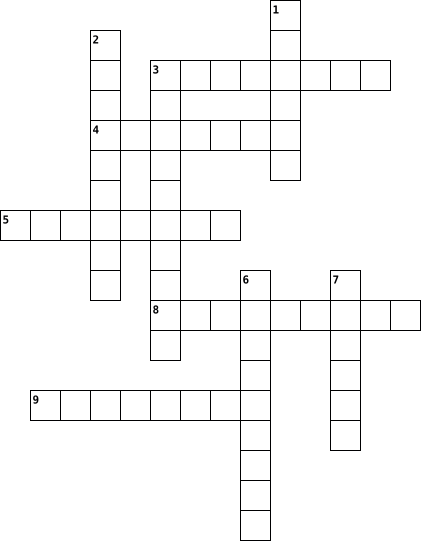
Across
- Bringing a number to its nearest amount for example nearest 10 or nearest 100.
- Uses letters and numbers to form equations.
- Shows numbers broken down into tenths and lower with a full stop.
- When you bring a multiple step equation down using the letters, for example 3ab+9bc+1ab-6bc.
- A number below zero.
Down
- Brackets, indices, division, multiplication, addition and subtraction.
- A type of algebra that requires brackets and making equations simpler.
- Is a type of angle at 90 degrees.
- Follows a certain rule that each number follows.
- Used to present data and coordinates.
10 Clues: A number below zero. • Is a type of angle at 90 degrees. • Used to present data and coordinates. • Uses letters and numbers to form equations. • Follows a certain rule that each number follows. • Shows numbers broken down into tenths and lower with a full stop. • Brackets, indices, division, multiplication, addition and subtraction. • ...
bebebb 2026-02-05

Across
- nsb
- jsb
- js
- jsns
- hshahahah
- jsjsjs
- hshsh
- jsha
Down
- shjshs
- jsbsjw
- js
- snsnhs
- nsbs
- jdj
- snbsbahsns
- jsbs
16 Clues: js • js • nsb • jsb • jdj • nsbs • jsns • jsbs • jsha • hshsh • shjshs • jsbsjw • snsnhs • jsjsjs • hshahahah • snbsbahsns
Algebra 2/Pre-Calculus Unit 3 Puzzle 2023-10-02

Across
- A system of equations that has at least one solution.
- What type of system do parallel lines represent?
- How many solutions do parallel lines have?
- A procedure used to find the maximum or minimum value of a linear function.
- Constraints are sometimes referred to as ________.
- Two or more equations combined in one problem.
- A situation that occurs where the equations represent the same line.
- A system of equations that has an infinite number of solutions.
- If there is a maximum or minimum value of the linear function, it occurs at one or more _____ of the feasible region.
- How many solutions do intersecting lines have?
Down
- An algebraic method for solving a system of equations in which you eliminate one of the variables.
- The area containing the overlapped shadings.
- An algebraic method for solving a system of equations in which you substitute an expression into another equation.
- A system of equations that has exactly one solution.
- A system of equations with no solutions.
- The linear function that is maximized or minimized.
- A method for solving a system of equations in which you graph each equation.
- The border lines formed by the inequalities.
- How many solutions do coinciding lines have?
19 Clues: A system of equations with no solutions. • How many solutions do parallel lines have? • The area containing the overlapped shadings. • The border lines formed by the inequalities. • How many solutions do coinciding lines have? • Two or more equations combined in one problem. • How many solutions do intersecting lines have? • ...
Algebra 1 Vocabulary 2024-11-24

Across
- The sign used in x < 12.
- A system of ____ lines has no solution.
- This property indicates that a(b + c) = ab + ac.
- The form of a linear equation y = mx + b.
- The form of a linear equation Ax + By = C.
- The point where a line crosses the x-axis.
- A relation where each input (x) has exactly one output (y).
- If a linear inequality uses the > symbol, the shading is ______ the boundary line.
- This number indicates how many times the base is multiplied by itself.
Down
- The point where a line crosses the y-axis.
- This type of line is written in the form y = #.
- This is the largest factor that a set of monomials share.
- A method used to solve systems of equations where one expression is replaced in an equation to solve for a variable.
- The rate of change found by dividing the change in y by the change in x.
- Terms that have the same variable raised to the same power.
- A method used to solve systems of equations where the equations are added or subtracted to solve for a variable.
- This type of line has an undefined slope.
- The set of all possible y-values for a relation.
- The set of all possible x-values for a relation.
19 Clues: The sign used in x < 12. • A system of ____ lines has no solution. • This type of line has an undefined slope. • The form of a linear equation y = mx + b. • The point where a line crosses the y-axis. • The form of a linear equation Ax + By = C. • The point where a line crosses the x-axis. • This type of line is written in the form y = #. • ...
Mathematics Creative Assignment- Crossword Puzzle 2015-04-19

Across
- on a graph, the line that holds the independent variables
- two lines that have the same slope
- Refers to the point where the line crosses either axis
- when both lines intersect at 90 degrees
- progressing from one stage to another in a series, sequently
- A change in one variable corresponding to a change in another
- There is no y-intercept but the equation passes through the origin
- a diagram showing the relation between variable quantities
- on a graph, the line that holds the dependant variables
- Direct and partial variations are examples of what
- the point where a line crosses the horizontal axis on a graph
- the mathematical equation used to measure the steepness of a line
Down
- a straight strip typically used to draw straight lines or to measure distance
- when an equation is containing a variable with an exponent other then one
- The number it would be when at zero or x=0
- a group of numbers used to indicate the position of a point or line
- When there is a y-intercept but does not pass through the origin
- When the numerator and denominator of a fraction is switched
- A method used to help us determine if a relation is linear
- Refers to the number that relates two variables that are directly proportional to each other
- the term used to describe the process of equating one thing with another
- the point where a line crosses the vertical axis on a graph
- a quality in a calculation that is assumed to vary or be capable of varying in value
- Refers to a set of two lines
- A linear relation that is represented by an equation in the form of Ax+By+C=0
25 Clues: Refers to a set of two lines • two lines that have the same slope • when both lines intersect at 90 degrees • The number it would be when at zero or x=0 • Direct and partial variations are examples of what • Refers to the point where the line crosses either axis • on a graph, the line that holds the dependant variables • ...
Permutation and Combination Crossword 2022-04-10

Across
- Permutation refers to the various ways of arranging some or all of the members within a specific order.
- is the study of the collection, analysis, interpretation, presentation, and organization of data.
- refers to the process of grouping objects.
- is the process or technique of determining the number of elements in a finite set of objects.
- refers to the various ways of arranging some or all of the members within a specific order.
- Permutation is another term for cyclic permutation
- a permutation that has no fixed points.
- matters when illustrating permutation.
- Listing Method is a method used to determine the number of permutations made for each problem.
- permutations are permutations or arrangements that can be distinguished from one another.
- Space is the set of all possible outcomes or findings of that experiment.
- is a set of possible outcomes resulting from a particular experiment.
- is an ordered list of objects. Unlike a set, order matters, and a particular term can appear multiple times at different positions.
- occurs when two or more common or same objects.
Down
- are the result or the effect of the experiment.
- permutations refers to the members or elements of sets are arranged here in a sequence or linear order.
- a mathematical technique for determining the number of possible arrangements in a set of items where the order of the selection is irrelevant.
- Counting Principle is another term for counting rule.
- events are when the outcome of the previous event doesn’t affect the second event.
- refers to science of numbers and their operations.
- Listing Method is a method used to determine the number of permutations made for each problem.
- also called combinatorial mathematics, are used in area of mathematic that is primarily concerned with counting.
- is indicated with the symbol exclamation point or !
- Rule are also known as Multiplication Principle.
- is a fact or rule that utilizes mathematical symbols. It is commonly used in
- of an event can be defined as the set of outcomes of an experiment.
- is any of the natural numbers (positive or negative) or zero.
- events are when the outcome of the first event influences the outcome of the second event.
- Rule is another term for Addition Principle.
- diagram is a simple way to illustrate the possible outcomes of events.
30 Clues: matters when illustrating permutation. • a permutation that has no fixed points. • refers to the process of grouping objects. • Rule is another term for Addition Principle. • are the result or the effect of the experiment. • occurs when two or more common or same objects. • Rule are also known as Multiplication Principle. • ...
Permutation and Combination Crossword 2022-04-10

Across
- Permutation refers to the various ways of arranging some or all of the members within a specific order.
- is the study of the collection, analysis, interpretation, presentation, and organization of data.
- refers to the process of grouping objects.
- is the process or technique of determining the number of elements in a finite set of objects.
- refers to the various ways of arranging some or all of the members within a specific order.
- Permutation is another term for cyclic permutation
- a permutation that has no fixed points.
- matters when illustrating permutation.
- Listing Method is a method used to determine the number of permutations made for each problem.
- permutations are permutations or arrangements that can be distinguished from one another.
- Space is the set of all possible outcomes or findings of that experiment.
- is a set of possible outcomes resulting from a particular experiment.
- is an ordered list of objects. Unlike a set, order matters, and a particular term can appear multiple times at different positions.
- occurs when two or more common or same objects.
Down
- are the result or the effect of the experiment.
- permutations refers to the members or elements of sets are arranged here in a sequence or linear order.
- a mathematical technique for determining the number of possible arrangements in a set of items where the order of the selection is irrelevant.
- Counting Principle is another term for counting rule.
- events are when the outcome of the previous event doesn’t affect the second event.
- refers to science of numbers and their operations.
- Listing Method is a method used to determine the number of permutations made for each problem.
- also called combinatorial mathematics, are used in area of mathematic that is primarily concerned with counting.
- is indicated with the symbol exclamation point or !
- Rule are also known as Multiplication Principle.
- is a fact or rule that utilizes mathematical symbols. It is commonly used in
- of an event can be defined as the set of outcomes of an experiment.
- is any of the natural numbers (positive or negative) or zero.
- events are when the outcome of the first event influences the outcome of the second event.
- Rule is another term for Addition Principle.
- diagram is a simple way to illustrate the possible outcomes of events.
30 Clues: matters when illustrating permutation. • a permutation that has no fixed points. • refers to the process of grouping objects. • Rule is another term for Addition Principle. • are the result or the effect of the experiment. • occurs when two or more common or same objects. • Rule are also known as Multiplication Principle. • ...
Permutation and Combination Crossword 2022-04-10

Across
- events are when the outcome of the first event influences the outcome of the second event.
- is indicated with the symbol exclamation point or “!”.
- is the study of the collection, analysis, interpretation, presentation, and organization of data.
- is a fact or rule that utilizes mathematical symbols. It is commonly used in mathematics.
- Space is the set of all possible outcomes or findings of that experiment.
- permutations refers to the members or elements of sets are arranged here in a sequence or linear order.
- also called combinatorial mathematics, are used in area of mathematic that is primarily concerned with counting.
- is the process or technique of determining the number of elements in a finite set of objects.
- refers to the process of grouping objects.
- Rule is another term for Addition Principle.
- occurs when two or more common or same objects.
- is an ordered list of objects. Unlike a set, order matters, and a particular term can appear multiple times at different positions.
- Listing Method is a method used to determine the number of permutations made for each problem.
- Permutation is another term for cyclic permutation.
- are the result or the effect of the experiment.
- is a set of possible outcomes resulting from a particular experiment.
- a mathematical technique for determining the number of possible arrangements in a set of items where the order of the selection is irrelevant.
- Counting Principle is another term for counting rule.
Down
- permutations are permutations or arrangements that can be distinguished from one another.
- of an event can be defined as the set of outcomes of an experiment.
- matters when illustrating permutation.
- is any of the natural numbers (positive or negative) or zero.
- Rule are also known as Multiplication Principle.
- rule is a way to figure out the number of possible outcomes for a given situation.
- refers to the various ways of arranging some or all of the members within a specific order.
- events are when the outcome of the previous event doesn’t affect the second event.
- diagram is a simple way to illustrate the possible outcomes of events.
- Permutation is the total number of ways where n distinct objects can be arranged around a circle.
- a permutation that has no fixed points.
- refers to science of numbers and their operations.
30 Clues: matters when illustrating permutation. • a permutation that has no fixed points. • refers to the process of grouping objects. • Rule is another term for Addition Principle. • occurs when two or more common or same objects. • are the result or the effect of the experiment. • Rule are also known as Multiplication Principle. • ...
Permutation and Combination Crossword 2022-04-10

Across
- a mathematical technique for determining the number of possible arrangements in a set of items where the order of the selection is irrelevant.
- is any of the natural numbers (positive or negative) or zero.
- Rule are also known as Multiplication Principle.
- also called combinatorial mathematics, are used in area of mathematic that is primarily concerned with counting.
- permutations refers to the members or elements of sets are arranged here in a sequence or linear order.
- Permutation is another term for cyclic permutation.
- rule is a way to figure out the number of possible outcomes for a given situation.
- are the result or the effect of the experiment.
- Counting Principle is another term for counting rule.
- diagram is a simple way to illustrate the possible outcomes of events.
- is the study of the collection, analysis, interpretation, presentation, and organization of data.
- is a fact or rule that utilizes mathematical symbols. It is commonly used in mathematics.
- is indicated with the symbol exclamation point or “!”.
- occurs when two or more common or same objects.
- Rule is another term for Addition Principle.
- events are when the outcome of the previous event doesn’t affect the second event.
- events are when the outcome of the first event influences the outcome of the second event.
- Space is the set of all possible outcomes or findings of that experiment.
Down
- refers to science of numbers and their operations.
- Permutation is the total number of ways where n distinct objects can be arranged around a circle.
- a permutation that has no fixed points.
- refers to the process of grouping objects.
- of an event can be defined as the set of outcomes of an experiment.
- is a set of possible outcomes resulting from a particular experiment.
- Listing Method is a method used to determine the number of permutations made for each problem.
- permutations are permutations or arrangements that can be distinguished from one another.
- matters when illustrating permutation.
- refers to the various ways of arranging some or all of the members within a specific order.
- is an ordered list of objects. Unlike a set, order matters, and a particular term can appear multiple times at different positions.
29 Clues: matters when illustrating permutation. • a permutation that has no fixed points. • refers to the process of grouping objects. • Rule is another term for Addition Principle. • are the result or the effect of the experiment. • occurs when two or more common or same objects. • Rule are also known as Multiplication Principle. • ...
Permutation and Combination Crossword 2022-04-10

Across
- are the result or the effect of the experiment.
- also called combinatorial mathematics, are used in area of mathematic that is primarily concerned with counting.
- is indicated with the symbol exclamation point or “!”.
- Permutation is another term for cyclic permutation.
- Listing Method is a method used to determine the number of permutations made for each problem.
- permutations are permutations or arrangements that can be distinguished from one another.
- of an event can be defined as the set of outcomes of an experiment.
- Space is the set of all possible outcomes or findings of that experiment.
- events are when the outcome of the first event influences the outcome of the second event.
- diagram is a simple way to illustrate the possible outcomes of events.
- is a set of possible outcomes resulting from a particular experiment.
- is an ordered list of objects. Unlike a set, order matters, and a particular term can appear multiple times at different positions.
- occurs when two or more common or same objects.
- Rule are also known as Multiplication Principle.
- permutations refers to the members or elements of sets are arranged here in a sequence or linear order.
- is any of the natural numbers (positive or negative) or zero.
- rule is a way to figure out the number of possible outcomes for a given situation.
Down
- refers to the process of grouping objects.
- Permutation is the total number of ways where n distinct objects can be arranged around a circle.
- is the study of the collection, analysis, interpretation, presentation, and organization of data.
- Counting Principle is another term for counting rule.
- Rule is another term for Addition Principle.
- is a fact or rule that utilizes mathematical symbols. It is commonly used in mathematics.
- refers to the various ways of arranging some or all of the members within a specific order.
- refers to science of numbers and their operations.
- events are when the outcome of the previous event doesn’t affect the second event.
- a permutation that has no fixed points.
- matters when illustrating permutation.
- a mathematical technique for determining the number of possible arrangements in a set of items where the order of the selection is irrelevant.
29 Clues: matters when illustrating permutation. • a permutation that has no fixed points. • refers to the process of grouping objects. • Rule is another term for Addition Principle. • are the result or the effect of the experiment. • occurs when two or more common or same objects. • Rule are also known as Multiplication Principle. • ...
Permutation and Combination Crossword 2022-04-10

Across
- are the result or the effect of the experiment.
- also called combinatorial mathematics, are used in area of mathematic that is primarily concerned with counting.
- is indicated with the symbol exclamation point or “!”.
- Permutation is another term for cyclic permutation.
- Listing Method is a method used to determine the number of permutations made for each problem.
- permutations are permutations or arrangements that can be distinguished from one another.
- of an event can be defined as the set of outcomes of an experiment.
- Space is the set of all possible outcomes or findings of that experiment.
- events are when the outcome of the first event influences the outcome of the second event.
- diagram is a simple way to illustrate the possible outcomes of events.
- is a set of possible outcomes resulting from a particular experiment.
- is an ordered list of objects. Unlike a set, order matters, and a particular term can appear multiple times at different positions.
- occurs when two or more common or same objects.
- Rule are also known as Multiplication Principle.
- permutations refers to the members or elements of sets are arranged here in a sequence or linear order.
- is any of the natural numbers (positive or negative) or zero.
- rule is a way to figure out the number of possible outcomes for a given situation.
Down
- refers to the process of grouping objects.
- Permutation is the total number of ways where n distinct objects can be arranged around a circle.
- is the study of the collection, analysis, interpretation, presentation, and organization of data.
- Counting Principle is another term for counting rule.
- Rule is another term for Addition Principle.
- is a fact or rule that utilizes mathematical symbols. It is commonly used in mathematics.
- refers to the various ways of arranging some or all of the members within a specific order.
- refers to science of numbers and their operations.
- events are when the outcome of the previous event doesn’t affect the second event.
- a permutation that has no fixed points.
- matters when illustrating permutation.
- a mathematical technique for determining the number of possible arrangements in a set of items where the order of the selection is irrelevant.
29 Clues: matters when illustrating permutation. • a permutation that has no fixed points. • refers to the process of grouping objects. • Rule is another term for Addition Principle. • are the result or the effect of the experiment. • occurs when two or more common or same objects. • Rule are also known as Multiplication Principle. • ...
Permutation and Combination Crossword 2022-04-10

Across
- events are when the outcome of the previous event doesn’t affect the second event.
- Rule is another term for Addition Principle.
- Rule are also known as Multiplication Principle.
- is any of the natural numbers (positive or negative) or zero.
- Permutation is the total number of ways where n distinct objects can be arranged around a circle.
- Space is the set of all possible outcomes or findings of that experiment.
- Listing Method is a method used to determine the number of permutations made for each problem.
- of an event can be defined as the set of outcomes of an experiment.
- is the study of the collection, analysis, interpretation, presentation, and organization of data.
- Counting Principle is another term for counting rule.
- refers to the various ways of arranging some or all of the members within a specific order.
- is a symbol for mathematical elements.
- a permutation that has no fixed points.
- diagram is a simple way to illustrate the possible outcomes of events.
- occurs when two or more common or same objects.
- is a fact or rule that utilizes mathematical symbols. It is commonly used in mathematics.
Down
- also called combinatorial mathematics, are used in area of mathematic that is primarily concerned with counting.
- permutations are permutations or arrangements that can be distinguished from one another.
- refers to science of numbers and their operations.
- are the result or the effect of the experiment.
- events are when the outcome of the first event influences the outcome of the second event.
- is a set of possible outcomes resulting from a particular experiment.
- a mathematical technique for determining the number of possible arrangements in a set of items where the order of the selection is irrelevant.
- is the process or technique of determining the number of elements in a finite set of objects.
- is an ordered list of objects. Unlike a set, order matters, and a particular term can appear multiple times at different positions.
- permutations refers to the members or elements of sets are arranged here in a sequence or linear order.
- Permutation is another term for cyclic permutation.
- matters when illustrating permutation.
- refers to the process of grouping objects.
- rule is a way to figure out the number of possible outcomes for a given situation.
- is indicated with the symbol exclamation point or “!”.
31 Clues: matters when illustrating permutation. • is a symbol for mathematical elements. • a permutation that has no fixed points. • refers to the process of grouping objects. • Rule is another term for Addition Principle. • are the result or the effect of the experiment. • occurs when two or more common or same objects. • Rule are also known as Multiplication Principle. • ...
Permutation and Combination Crossword 2022-04-10

Across
- is indicated with the symbol exclamation point or “!”.
- is the study of the collection, analysis, interpretation, presentation, and organization of data.
- matters when illustrating permutation.
- permutations are permutations or arrangements that can be distinguished from one another.
- rule is a way to figure out the number of possible outcomes for a given situation.
- refers to the process of grouping objects.
- a permutation that has no fixed points.
- Counting Principle is another term for counting rule.
- refers to science of numbers and their operations.
- occurs when two or more common or same objects.
- events are when the outcome of the previous event doesn’t affect the second event.
- is a fact or rule that utilizes mathematical symbols. It is commonly used in mathematics.
- Rule are also known as Multiplication Principle.
- Listing Method is a method used to determine the number of permutations made for each problem.
- of an event can be defined as the set of outcomes of an experiment.
- Rule is another term for Addition Principle.
Down
- also called combinatorial mathematics, are used in area of mathematic that is primarily concerned with counting.
- events are when the outcome of the first event influences the outcome of the second event.
- is any of the natural numbers (positive or negative) or zero.
- diagram is a simple way to illustrate the possible outcomes of events.
- is an ordered list of objects. Unlike a set, order matters, and a particular term can appear multiple times at different positions.
- Permutation is the total number of ways where n distinct objects can be arranged around a circle.
- a mathematical technique for determining the number of possible arrangements in a set of items where the order of the selection is irrelevant.
- is a symbol for mathematical elements.
- permutations refers to the members or elements of sets are arranged here in a sequence or linear order.
- is a set of possible outcomes resulting from a particular experiment.
- Permutation is another term for cyclic permutation.
- refers to the various ways of arranging some or all of the members within a specific order.
- are the result or the effect of the experiment.
- Space is the set of all possible outcomes or findings of that experiment.
- is the process or technique of determining the number of elements in a finite set of objects.
31 Clues: matters when illustrating permutation. • is a symbol for mathematical elements. • a permutation that has no fixed points. • refers to the process of grouping objects. • Rule is another term for Addition Principle. • occurs when two or more common or same objects. • are the result or the effect of the experiment. • Rule are also known as Multiplication Principle. • ...
Permutation and Combination Crossword 2022-04-10

Across
- Rule are also known as Multiplication Principle.
- is the study of the collection, analysis, interpretation, presentation, and organization of data.
- diagram is a simple way to illustrate the possible outcomes of events.
- refers to the process of grouping objects.
- a permutation that has no fixed points.
- Counting Principle is another term for counting rule.
- events are when the outcome of the previous event doesn’t affect the second event.
- is a fact or rule that utilizes mathematical symbols. It is commonly used in mathematics.
- are the result or the effect of the experiment.
- is indicated with the symbol exclamation point or “!”.
- also called combinatorial mathematics, are used in area of mathematic that is primarily concerned with counting.
- is the process or technique of determining the number of elements in a finite set of objects.
Down
- refers to the various ways of arranging some or all of the members within a specific order.
- occurs when two or more common or same objects.
- rule is a way to figure out the number of possible outcomes for a given situation.
- Permutation is another term for cyclic permutation.
- Space is the set of all possible outcomes or findings of that experiment.
- Listing Method is a method used to determine the number of permutations made for each problem.
- Permutation is the total number of ways where n distinct objects can be arranged around a circle.
- events are when the outcome of the first event influences the outcome of the second event.
- a mathematical technique for determining the number of possible arrangements in a set of items where the order of the selection is irrelevant.
- permutations are permutations or arrangements that can be distinguished from one another.
- is an ordered list of objects. Unlike a set, order matters, and a particular term can appear multiple times at different positions.
- is a set of possible outcomes resulting from a particular experiment.
- permutations refers to the members or elements of sets are arranged here in a sequence or linear order.
- refers to science of numbers and their operations.
- of an event can be defined as the set of outcomes of an experiment.
- matters when illustrating permutation.
- is any of the natural numbers (positive or negative) or zero.
- Rule is another term for Addition Principle.
30 Clues: matters when illustrating permutation. • a permutation that has no fixed points. • refers to the process of grouping objects. • Rule is another term for Addition Principle. • occurs when two or more common or same objects. • are the result or the effect of the experiment. • Rule are also known as Multiplication Principle. • ...
Permutation and Combination Crossword 2022-04-10

Across
- Rule are also known as Multiplication Principle.
- is the study of the collection, analysis, interpretation, presentation, and organization of data.
- diagram is a simple way to illustrate the possible outcomes of events.
- refers to the process of grouping objects.
- a permutation that has no fixed points.
- Counting Principle is another term for counting rule.
- events are when the outcome of the previous event doesn’t affect the second event.
- is a fact or rule that utilizes mathematical symbols. It is commonly used in mathematics.
- are the result or the effect of the experiment.
- is indicated with the symbol exclamation point or “!”.
- also called combinatorial mathematics, are used in area of mathematic that is primarily concerned with counting.
- is the process or technique of determining the number of elements in a finite set of objects.
Down
- refers to the various ways of arranging some or all of the members within a specific order.
- occurs when two or more common or same objects.
- rule is a way to figure out the number of possible outcomes for a given situation.
- Permutation is another term for cyclic permutation.
- Space is the set of all possible outcomes or findings of that experiment.
- Listing Method is a method used to determine the number of permutations made for each problem.
- Permutation is the total number of ways where n distinct objects can be arranged around a circle.
- events are when the outcome of the first event influences the outcome of the second event.
- a mathematical technique for determining the number of possible arrangements in a set of items where the order of the selection is irrelevant.
- permutations are permutations or arrangements that can be distinguished from one another.
- is an ordered list of objects. Unlike a set, order matters, and a particular term can appear multiple times at different positions.
- is a set of possible outcomes resulting from a particular experiment.
- permutations refers to the members or elements of sets are arranged here in a sequence or linear order.
- refers to science of numbers and their operations.
- of an event can be defined as the set of outcomes of an experiment.
- matters when illustrating permutation.
- is any of the natural numbers (positive or negative) or zero.
- Rule is another term for Addition Principle.
30 Clues: matters when illustrating permutation. • a permutation that has no fixed points. • refers to the process of grouping objects. • Rule is another term for Addition Principle. • occurs when two or more common or same objects. • are the result or the effect of the experiment. • Rule are also known as Multiplication Principle. • ...
Permutation and Combination Crossword 2022-04-10

Across
- Rule are also known as Multiplication Principle.
- is the study of the collection, analysis, interpretation, presentation, and organization of data.
- diagram is a simple way to illustrate the possible outcomes of events.
- refers to the process of grouping objects.
- a permutation that has no fixed points.
- Counting Principle is another term for counting rule.
- events are when the outcome of the previous event doesn’t affect the second event.
- is a fact or rule that utilizes mathematical symbols. It is commonly used in mathematics.
- are the result or the effect of the experiment.
- is indicated with the symbol exclamation point or “!”.
- also called combinatorial mathematics, are used in area of mathematic that is primarily concerned with counting.
- is the process or technique of determining the number of elements in a finite set of objects.
Down
- refers to the various ways of arranging some or all of the members within a specific order.
- occurs when two or more common or same objects.
- rule is a way to figure out the number of possible outcomes for a given situation.
- Permutation is another term for cyclic permutation.
- Space is the set of all possible outcomes or findings of that experiment.
- Listing Method is a method used to determine the number of permutations made for each problem.
- Permutation is the total number of ways where n distinct objects can be arranged around a circle.
- events are when the outcome of the first event influences the outcome of the second event.
- a mathematical technique for determining the number of possible arrangements in a set of items where the order of the selection is irrelevant.
- permutations are permutations or arrangements that can be distinguished from one another.
- is an ordered list of objects. Unlike a set, order matters, and a particular term can appear multiple times at different positions.
- is a set of possible outcomes resulting from a particular experiment.
- permutations refers to the members or elements of sets are arranged here in a sequence or linear order.
- refers to science of numbers and their operations.
- of an event can be defined as the set of outcomes of an experiment.
- matters when illustrating permutation.
- is any of the natural numbers (positive or negative) or zero.
- Rule is another term for Addition Principle.
30 Clues: matters when illustrating permutation. • a permutation that has no fixed points. • refers to the process of grouping objects. • Rule is another term for Addition Principle. • occurs when two or more common or same objects. • are the result or the effect of the experiment. • Rule are also known as Multiplication Principle. • ...
Permutation and Combination Crossword 2022-04-10

Across
- matters when illustrating permutation.
- a permutation that has no fixed points.
- Space is the set of all possible outcomes or findings of that experiment.
- refers to science of numbers and their operations.
- is the study of the collection, analysis, interpretation, presentation, and organization of data.
- Permutation is another term for cyclic permutation.
- is a fact or rule that utilizes mathematical symbols. It is commonly used in mathematics.
- is any of the natural numbers (positive or negative) or zero.
- diagram is a simple way to illustrate the possible outcomes of events.
- permutations are permutations or arrangements that can be distinguished from one another.
- rule is a way to figure out the number of possible outcomes for a given situation.
- occurs when two or more common or same objects.
- refers to the process of grouping objects.
- refers to the various ways of arranging some or all of the members within a specific order.
Down
- also called combinatorial mathematics, are used in area of mathematic that is primarily concerned with counting.
- Listing Method is a method used to determine the number of permutations made for each problem.
- events are when the outcome of the first event influences the outcome of the second event.
- are the result or the effect of the experiment.
- Counting Principle is another term for counting rule.
- permutations refers to the members or elements of sets are arranged here in a sequence or linear order.
- is an ordered list of objects. Unlike a set, order matters, and a particular term can appear multiple times at different positions.
- Rule is another term for Addition Principle.
- a mathematical technique for determining the number of possible arrangements in a set of items where the order of the selection is irrelevant.
- Permutation is the total number of ways where n distinct objects can be arranged around a circle.
- is a symbol for mathematical elements.
- events are when the outcome of the previous event doesn’t affect the second event.
- of an event can be defined as the set of outcomes of an experiment.
- Rule are also known as Multiplication Principle.
- is a set of possible outcomes resulting from a particular experiment.
- is indicated with the symbol exclamation point or “!”.
30 Clues: matters when illustrating permutation. • is a symbol for mathematical elements. • a permutation that has no fixed points. • refers to the process of grouping objects. • Rule is another term for Addition Principle. • are the result or the effect of the experiment. • occurs when two or more common or same objects. • Rule are also known as Multiplication Principle. • ...
Permutation and Combination Crossword 2022-04-10

Across
- matters when illustrating permutation.
- a permutation that has no fixed points.
- Space is the set of all possible outcomes or findings of that experiment.
- refers to science of numbers and their operations.
- is the study of the collection, analysis, interpretation, presentation, and organization of data.
- Permutation is another term for cyclic permutation.
- is a fact or rule that utilizes mathematical symbols. It is commonly used in mathematics.
- is any of the natural numbers (positive or negative) or zero.
- diagram is a simple way to illustrate the possible outcomes of events.
- permutations are permutations or arrangements that can be distinguished from one another.
- rule is a way to figure out the number of possible outcomes for a given situation.
- occurs when two or more common or same objects.
- refers to the process of grouping objects.
- refers to the various ways of arranging some or all of the members within a specific order.
Down
- also called combinatorial mathematics, are used in area of mathematic that is primarily concerned with counting.
- Listing Method is a method used to determine the number of permutations made for each problem.
- events are when the outcome of the first event influences the outcome of the second event.
- are the result or the effect of the experiment.
- Counting Principle is another term for counting rule.
- permutations refers to the members or elements of sets are arranged here in a sequence or linear order.
- is an ordered list of objects. Unlike a set, order matters, and a particular term can appear multiple times at different positions.
- Rule is another term for Addition Principle.
- a mathematical technique for determining the number of possible arrangements in a set of items where the order of the selection is irrelevant.
- Permutation is the total number of ways where n distinct objects can be arranged around a circle.
- is a symbol for mathematical elements.
- events are when the outcome of the previous event doesn’t affect the second event.
- of an event can be defined as the set of outcomes of an experiment.
- Rule are also known as Multiplication Principle.
- is a set of possible outcomes resulting from a particular experiment.
- is indicated with the symbol exclamation point or “!”.
30 Clues: matters when illustrating permutation. • is a symbol for mathematical elements. • a permutation that has no fixed points. • refers to the process of grouping objects. • Rule is another term for Addition Principle. • are the result or the effect of the experiment. • occurs when two or more common or same objects. • Rule are also known as Multiplication Principle. • ...
Permutation and Combination Crossword 2022-04-10

Across
- matters when illustrating permutation.
- is the process or technique of determining the number of elements in a finite set of objects.
- is any of the natural numbers (positive or negative) or zero.
- Space is the set of all possible outcomes or findings of that experiment.
- also called combinatorial mathematics, are used in area of mathematic that is primarily concerned with counting.
- is a symbol for mathematical elements.
- is a set of possible outcomes resulting from a particular experiment.
- Permutation is another term for cyclic permutation.
- events are when the outcome of the first event influences the outcome of the second event.
- is a fact or rule that utilizes mathematical symbols. It is commonly used in mathematics.
- Listing Method is a method used to determine the number of permutations made for each problem.
- refers to science of numbers and their operations.
- of an event can be defined as the set of outcomes of an experiment.
- Rule are also known as Multiplication Principle.
- is indicated with the symbol exclamation point or “!”.
- rule is a way to figure out the number of possible outcomes for a given situation.
Down
- refers to the process of grouping objects.
- Permutation is the total number of ways where n distinct objects can be arranged around a circle.
- a mathematical technique for determining the number of possible arrangements in a set of items where the order of the selection is irrelevant.
- a permutation that has no fixed points.
- permutations refers to the members or elements of sets are arranged here in a sequence or linear order.
- is an ordered list of objects. Unlike a set, order matters, and a particular term can appear multiple times at different positions.
- occurs when two or more common or same objects.
- refers to the various ways of arranging some or all of the members within a specific order.
- Counting Principle is another term for counting rule.
- diagram is a simple way to illustrate the possible outcomes of events.
- Rule is another term for Addition Principle.
- events are when the outcome of the previous event doesn’t affect the second event.
- is the study of the collection, analysis, interpretation, presentation, and organization of data.
- permutations are permutations or arrangements that can be distinguished from one another.
- are the result or the effect of the experiment.
31 Clues: matters when illustrating permutation. • is a symbol for mathematical elements. • a permutation that has no fixed points. • refers to the process of grouping objects. • Rule is another term for Addition Principle. • occurs when two or more common or same objects. • are the result or the effect of the experiment. • Rule are also known as Multiplication Principle. • ...
Permutation and Combination Crossword 2022-04-10

Across
- matters when illustrating permutation.
- a permutation that has no fixed points.
- Space is the set of all possible outcomes or findings of that experiment.
- refers to science of numbers and their operations.
- is the study of the collection, analysis, interpretation, presentation, and organization of data.
- Permutation is another term for cyclic permutation.
- is a fact or rule that utilizes mathematical symbols. It is commonly used in mathematics.
- is any of the natural numbers (positive or negative) or zero.
- diagram is a simple way to illustrate the possible outcomes of events.
- permutations are permutations or arrangements that can be distinguished from one another.
- rule is a way to figure out the number of possible outcomes for a given situation.
- occurs when two or more common or same objects.
- refers to the process of grouping objects.
- refers to the various ways of arranging some or all of the members within a specific order.
Down
- also called combinatorial mathematics, are used in area of mathematic that is primarily concerned with counting.
- Listing Method is a method used to determine the number of permutations made for each problem.
- events are when the outcome of the first event influences the outcome of the second event.
- are the result or the effect of the experiment.
- Counting Principle is another term for counting rule.
- permutations refers to the members or elements of sets are arranged here in a sequence or linear order.
- is an ordered list of objects. Unlike a set, order matters, and a particular term can appear multiple times at different positions.
- Rule is another term for Addition Principle.
- a mathematical technique for determining the number of possible arrangements in a set of items where the order of the selection is irrelevant.
- Permutation is the total number of ways where n distinct objects can be arranged around a circle.
- is a symbol for mathematical elements.
- events are when the outcome of the previous event doesn’t affect the second event.
- of an event can be defined as the set of outcomes of an experiment.
- Rule are also known as Multiplication Principle.
- is a set of possible outcomes resulting from a particular experiment.
- is indicated with the symbol exclamation point or “!”.
30 Clues: matters when illustrating permutation. • is a symbol for mathematical elements. • a permutation that has no fixed points. • refers to the process of grouping objects. • Rule is another term for Addition Principle. • are the result or the effect of the experiment. • occurs when two or more common or same objects. • Rule are also known as Multiplication Principle. • ...
CCA Chapter 6 Vocabulary 2021-03-05

Across
- a description of how much scatter there is in the data away from the line or curve of best-fit
- the lowest value that a prediction is likely to be
- a piece of data that does not seem to fit into the overall pattern
- the highest value that a prediction is likely to be
- a unique best-fit line that is found by making the squares of the residuals as small as possible
- an equation, table or graph can be used to interpret data that has not been seen yet
- a measure of the strength of an association already determined to be linear (values between -1 and 1)
- a hidden piece of information that was not part of the statistical study under investigation
Down
- this is created in order to analyze the appropriateness of a best-fit model
- a measure of the strength of a linear relationship and is usually expressed as a percent
- if one variable in a relationship increases as the other one increases, the __ is said to be (+pos)
- a prediction made outside the range of the observed data - often not reliable
- the distance a prediction is from the actual observed measurement in an association (R=A=P)
- a model of numerical two-variable data that helps describe the data and is used to make predictions
- a spread of data on a graph that has no discernible pattern
- the correlation coefficient which is a measurement of how much data is scattered around the LSRL
- a relationship between two (or more) variables and can be displayed on a scatterplot
- an example of this might be Hearing Loss due to Long-term Noise Exposure
- a mathematical summary (often an equation) of a trend in data
- this type of association can be linear or non-linear and can contain clusters of data
20 Clues: the lowest value that a prediction is likely to be • the highest value that a prediction is likely to be • a spread of data on a graph that has no discernible pattern • a mathematical summary (often an equation) of a trend in data • a piece of data that does not seem to fit into the overall pattern • ...
math 2025-02-12

Across
- on a plane according to a common action or operation.
- Form – The form of a linear equation: .
- Figures – Figures that have the same size and shape.
- Form – The form of a linear equation: .
- – The set of whole numbers and their opposites.
- of Linear Equations – When two or more linear equations define a
- – The coordinate of the point where a graph crosses an axis.
- – The direction and steepness of a line, usually represented with the
- – A transformation that produces a figure that is the same shape as the
- the relationship between the points.
- Operations – Pairs of operations that reverse the effects of each other.
- Parts – Angles/Sides that have the same relative positions in
- – The number of times you multiply the base of a power.
- – A flat surface, with an infinite length and width, but no depth.
- between two quantities.
- Plot – A graph of a collection of ordered pairs that allows an exploration
Down
- – When two figures’ ratios of their corresponding side lengths are equal.
- – A number multiplied by a variable expression.
- triangle equals the square of the length of the hypotenuse (a 2 + b 2 = c 2 )
- – The amount of space occupied by an object, measured in cubic units.
- – The side opposite the right angle in a right triangle.
- Notation – Used to express a very large or a very small number.
- it into two identical halves.
- figures.
- .
- of Symmetry – An imaginary line that passes through a shape or object and
- Form – The form of a linear equation: .
- – The mapping, or movement, of a plane and all the points of a
- Theorem – The sum of the squares of the lengths of the legs of a
- Pair – A pair of real numbers used to locate a point on a coordinate
- – A line that intersects two or more lines at distinct points.
- figure, but not necessarily the same size.
- Function – A function whose graph is a straight line.
33 Clues: . • figures. • between two quantities. • it into two identical halves. • the relationship between the points. • Form – The form of a linear equation: . • Form – The form of a linear equation: . • Form – The form of a linear equation: . • figure, but not necessarily the same size. • – A number multiplied by a variable expression. • – The set of whole numbers and their opposites. • ...
Polynomials 2024-08-23

Across
- 3
- 13
- 5
- 11
- 9
- 10
- 6
- 4
Down
- 1
- 2
- 12
- 7
- 14
- 8
14 Clues: 1 • 3 • 2 • 7 • 5 • 9 • 8 • 6 • 4 • 12 • 13 • 11 • 14 • 10
Permutation and Combination Crossword 2022-04-10

Across
- events are when the outcome of the first event influences the outcome of the second event.
- is indicated with the symbol exclamation point or !
- is the study of the collection, analysis, interpretation, presentation, and organization of data.
- is a fact or rule that utilizes mathematical symbols. It is commonly used in
- Space is the set of all possible outcomes or findings of that experiment.
- permutations refers to the members or elements of sets are arranged here in a sequence or linear order.
- also called combinatorial mathematics, are used in area of mathematic that is primarily concerned with counting.
- is the process or technique of determining the number of elements in a finite set of objects.
- refers to the process of grouping objects.
- Rule is another term for Addition Principle.
- occurs when two or more common or same objects.
- is an ordered list of objects. Unlike a set, order matters, and a particular term can appear multiple times at different positions.
- Listing Method is a method used to determine the number of permutations made for each problem.
- Permutation is another term for cyclic permutation
- are the result or the effect of the experiment.
- is a set of possible outcomes resulting from a particular experiment.
- a mathematical technique for determining the number of possible arrangements in a set of items where the order of the selection is irrelevant.
- Counting Principle is another term for counting rule.
Down
- permutations are permutations or arrangements that can be distinguished from one another.
- of an event can be defined as the set of outcomes of an experiment.
- matters when illustrating permutation.
- is any of the natural numbers (positive or negative) or zero.
- Rule are also known as Multiplication Principle.
- rule is a way to figure out the number of possible outcomes for a given situation.
- refers to the various ways of arranging some or all of the members within a specific order.
- events are when the outcome of the previous event doesn’t affect the second event.
- diagram is a simple way to illustrate the possible outcomes of events.
- Permutation refers to the various ways of arranging some or all of the members within a specific order.
- a permutation that has no fixed points.
- refers to science of numbers and their operations.
30 Clues: matters when illustrating permutation. • a permutation that has no fixed points. • refers to the process of grouping objects. • Rule is another term for Addition Principle. • occurs when two or more common or same objects. • are the result or the effect of the experiment. • Rule are also known as Multiplication Principle. • ...
Permutation and Combination Crossword 2022-04-10

Across
- events are when the outcome of the first event influences the outcome of the second event.
- is indicated with the symbol exclamation point or “!”.
- is the study of the collection, analysis, interpretation, presentation, and organization of data.
- is a fact or rule that utilizes mathematical symbols. It is commonly used in mathematics.
- Space is the set of all possible outcomes or findings of that experiment.
- permutations refers to the members or elements of sets are arranged here in a sequence or linear order.
- also called combinatorial mathematics, are used in area of mathematic that is primarily concerned with counting.
- is the process or technique of determining the number of elements in a finite set of objects.
- refers to the process of grouping objects.
- Rule is another term for Addition Principle.
- occurs when two or more common or same objects.
- is an ordered list of objects. Unlike a set, order matters, and a particular term can appear multiple times at different positions.
- Listing Method is a method used to determine the number of permutations made for each problem.
- Permutation is another term for cyclic permutation.
- are the result or the effect of the experiment.
- is a set of possible outcomes resulting from a particular experiment.
- a mathematical technique for determining the number of possible arrangements in a set of items where the order of the selection is irrelevant.
- Counting Principle is another term for counting rule.
Down
- permutations are permutations or arrangements that can be distinguished from one another.
- of an event can be defined as the set of outcomes of an experiment.
- matters when illustrating permutation.
- is any of the natural numbers (positive or negative) or zero.
- Rule are also known as Multiplication Principle.
- rule is a way to figure out the number of possible outcomes for a given situation.
- refers to the various ways of arranging some or all of the members within a specific order.
- events are when the outcome of the previous event doesn’t affect the second event.
- diagram is a simple way to illustrate the possible outcomes of events.
- Permutation is the total number of ways where n distinct objects can be arranged around a circle.
- a permutation that has no fixed points.
- refers to science of numbers and their operations.
30 Clues: matters when illustrating permutation. • a permutation that has no fixed points. • refers to the process of grouping objects. • Rule is another term for Addition Principle. • occurs when two or more common or same objects. • are the result or the effect of the experiment. • Rule are also known as Multiplication Principle. • ...
Permutation and Combination Crossword 2022-04-10

Across
- events are when the outcome of the previous event doesn’t affect the second event.
- Rule is another term for Addition Principle.
- Rule are also known as Multiplication Principle.
- is any of the natural numbers (positive or negative) or zero.
- Permutation is the total number of ways where n distinct objects can be arranged around a circle.
- Space is the set of all possible outcomes or findings of that experiment.
- Listing Method is a method used to determine the number of permutations made for each problem.
- of an event can be defined as the set of outcomes of an experiment.
- is the study of the collection, analysis, interpretation, presentation, and organization of data.
- Counting Principle is another term for counting rule.
- refers to the various ways of arranging some or all of the members within a specific order.
- is a symbol for mathematical elements.
- a permutation that has no fixed points.
- diagram is a simple way to illustrate the possible outcomes of events.
- occurs when two or more common or same objects.
- is a fact or rule that utilizes mathematical symbols. It is commonly used in mathematics.
Down
- also called combinatorial mathematics, are used in area of mathematic that is primarily concerned with counting.
- permutations are permutations or arrangements that can be distinguished from one another.
- refers to science of numbers and their operations.
- are the result or the effect of the experiment.
- events are when the outcome of the first event influences the outcome of the second event.
- is a set of possible outcomes resulting from a particular experiment.
- a mathematical technique for determining the number of possible arrangements in a set of items where the order of the selection is irrelevant.
- is the process or technique of determining the number of elements in a finite set of objects.
- is an ordered list of objects. Unlike a set, order matters, and a particular term can appear multiple times at different positions.
- permutations refers to the members or elements of sets are arranged here in a sequence or linear order.
- Permutation is another term for cyclic permutation.
- matters when illustrating permutation.
- refers to the process of grouping objects.
- rule is a way to figure out the number of possible outcomes for a given situation.
- is indicated with the symbol exclamation point or “!”.
31 Clues: matters when illustrating permutation. • is a symbol for mathematical elements. • a permutation that has no fixed points. • refers to the process of grouping objects. • Rule is another term for Addition Principle. • are the result or the effect of the experiment. • occurs when two or more common or same objects. • Rule are also known as Multiplication Principle. • ...
Permutation and Combination Crossword 2022-04-10

Across
- events are when the outcome of the previous event doesn’t affect the second event.
- Rule is another term for Addition Principle.
- Rule are also known as Multiplication Principle.
- is any of the natural numbers (positive or negative) or zero.
- Permutation is the total number of ways where n distinct objects can be arranged around a circle.
- Space is the set of all possible outcomes or findings of that experiment.
- Listing Method is a method used to determine the number of permutations made for each problem.
- of an event can be defined as the set of outcomes of an experiment.
- is the study of the collection, analysis, interpretation, presentation, and organization of data.
- Counting Principle is another term for counting rule.
- refers to the various ways of arranging some or all of the members within a specific order.
- is a symbol for mathematical elements.
- a permutation that has no fixed points.
- diagram is a simple way to illustrate the possible outcomes of events.
- occurs when two or more common or same objects.
- is a fact or rule that utilizes mathematical symbols. It is commonly used in mathematics.
Down
- also called combinatorial mathematics, are used in area of mathematic that is primarily concerned with counting.
- permutations are permutations or arrangements that can be distinguished from one another.
- refers to science of numbers and their operations.
- are the result or the effect of the experiment.
- events are when the outcome of the first event influences the outcome of the second event.
- is a set of possible outcomes resulting from a particular experiment.
- a mathematical technique for determining the number of possible arrangements in a set of items where the order of the selection is irrelevant.
- is the process or technique of determining the number of elements in a finite set of objects.
- is an ordered list of objects. Unlike a set, order matters, and a particular term can appear multiple times at different positions.
- permutations refers to the members or elements of sets are arranged here in a sequence or linear order.
- Permutation is another term for cyclic permutation.
- matters when illustrating permutation.
- refers to the process of grouping objects.
- rule is a way to figure out the number of possible outcomes for a given situation.
- is indicated with the symbol exclamation point or “!”.
31 Clues: matters when illustrating permutation. • is a symbol for mathematical elements. • a permutation that has no fixed points. • refers to the process of grouping objects. • Rule is another term for Addition Principle. • are the result or the effect of the experiment. • occurs when two or more common or same objects. • Rule are also known as Multiplication Principle. • ...
Permutation and Combination Crossword 2022-04-10

Across
- is indicated with the symbol exclamation point or “!”.
- is the study of the collection, analysis, interpretation, presentation, and organization of data.
- matters when illustrating permutation.
- permutations are permutations or arrangements that can be distinguished from one another.
- rule is a way to figure out the number of possible outcomes for a given situation.
- refers to the process of grouping objects.
- a permutation that has no fixed points.
- Counting Principle is another term for counting rule.
- refers to science of numbers and their operations.
- occurs when two or more common or same objects.
- events are when the outcome of the previous event doesn’t affect the second event.
- is a fact or rule that utilizes mathematical symbols. It is commonly used in mathematics.
- Rule are also known as Multiplication Principle.
- Listing Method is a method used to determine the number of permutations made for each problem.
- of an event can be defined as the set of outcomes of an experiment.
- Rule is another term for Addition Principle.
Down
- also called combinatorial mathematics, are used in area of mathematic that is primarily concerned with counting.
- events are when the outcome of the first event influences the outcome of the second event.
- is any of the natural numbers (positive or negative) or zero.
- diagram is a simple way to illustrate the possible outcomes of events.
- is an ordered list of objects. Unlike a set, order matters, and a particular term can appear multiple times at different positions.
- Permutation is the total number of ways where n distinct objects can be arranged around a circle.
- a mathematical technique for determining the number of possible arrangements in a set of items where the order of the selection is irrelevant.
- is a symbol for mathematical elements.
- permutations refers to the members or elements of sets are arranged here in a sequence or linear order.
- is a set of possible outcomes resulting from a particular experiment.
- Permutation is another term for cyclic permutation.
- refers to the various ways of arranging some or all of the members within a specific order.
- are the result or the effect of the experiment.
- Space is the set of all possible outcomes or findings of that experiment.
- is the process or technique of determining the number of elements in a finite set of objects.
31 Clues: matters when illustrating permutation. • is a symbol for mathematical elements. • a permutation that has no fixed points. • refers to the process of grouping objects. • Rule is another term for Addition Principle. • occurs when two or more common or same objects. • are the result or the effect of the experiment. • Rule are also known as Multiplication Principle. • ...
Permutation and Combination Crossword 2022-04-10

Across
- events are when the outcome of the first event influences the outcome of the second event.
- is indicated with the symbol exclamation point or “!”.
- is the study of the collection, analysis, interpretation, presentation, and organization of data.
- is a fact or rule that utilizes mathematical symbols. It is commonly used in mathematics.
- Space is the set of all possible outcomes or findings of that experiment.
- permutations refers to the members or elements of sets are arranged here in a sequence or linear order.
- also called combinatorial mathematics, are used in area of mathematic that is primarily concerned with counting.
- is the process or technique of determining the number of elements in a finite set of objects.
- refers to the process of grouping objects.
- Rule is another term for Addition Principle.
- occurs when two or more common or same objects.
- is an ordered list of objects. Unlike a set, order matters, and a particular term can appear multiple times at different positions.
- Listing Method is a method used to determine the number of permutations made for each problem.
- Permutation is another term for cyclic permutation.
- are the result or the effect of the experiment.
- is a set of possible outcomes resulting from a particular experiment.
- a mathematical technique for determining the number of possible arrangements in a set of items where the order of the selection is irrelevant.
- Counting Principle is another term for counting rule.
Down
- permutations are permutations or arrangements that can be distinguished from one another.
- of an event can be defined as the set of outcomes of an experiment.
- matters when illustrating permutation.
- is any of the natural numbers (positive or negative) or zero.
- Rule are also known as Multiplication Principle.
- rule is a way to figure out the number of possible outcomes for a given situation.
- refers to the various ways of arranging some or all of the members within a specific order.
- events are when the outcome of the previous event doesn’t affect the second event.
- diagram is a simple way to illustrate the possible outcomes of events.
- Permutation is the total number of ways where n distinct objects can be arranged around a circle.
- a permutation that has no fixed points.
- refers to science of numbers and their operations.
30 Clues: matters when illustrating permutation. • a permutation that has no fixed points. • refers to the process of grouping objects. • Rule is another term for Addition Principle. • occurs when two or more common or same objects. • are the result or the effect of the experiment. • Rule are also known as Multiplication Principle. • ...
Permutation and Combination Crossword 2022-04-10

Across
- Rule are also known as Multiplication Principle.
- is the study of the collection, analysis, interpretation, presentation, and organization of data.
- diagram is a simple way to illustrate the possible outcomes of events.
- refers to the process of grouping objects.
- a permutation that has no fixed points.
- Counting Principle is another term for counting rule.
- events are when the outcome of the previous event doesn’t affect the second event.
- is a fact or rule that utilizes mathematical symbols. It is commonly used in mathematics.
- are the result or the effect of the experiment.
- is indicated with the symbol exclamation point or “!”.
- also called combinatorial mathematics, are used in area of mathematic that is primarily concerned with counting.
- is the process or technique of determining the number of elements in a finite set of objects.
Down
- refers to the various ways of arranging some or all of the members within a specific order.
- occurs when two or more common or same objects.
- rule is a way to figure out the number of possible outcomes for a given situation.
- Permutation is another term for cyclic permutation.
- Space is the set of all possible outcomes or findings of that experiment.
- Listing Method is a method used to determine the number of permutations made for each problem.
- Permutation is the total number of ways where n distinct objects can be arranged around a circle.
- events are when the outcome of the first event influences the outcome of the second event.
- a mathematical technique for determining the number of possible arrangements in a set of items where the order of the selection is irrelevant.
- permutations are permutations or arrangements that can be distinguished from one another.
- is an ordered list of objects. Unlike a set, order matters, and a particular term can appear multiple times at different positions.
- is a set of possible outcomes resulting from a particular experiment.
- permutations refers to the members or elements of sets are arranged here in a sequence or linear order.
- refers to science of numbers and their operations.
- of an event can be defined as the set of outcomes of an experiment.
- matters when illustrating permutation.
- is any of the natural numbers (positive or negative) or zero.
- Rule is another term for Addition Principle.
30 Clues: matters when illustrating permutation. • a permutation that has no fixed points. • refers to the process of grouping objects. • Rule is another term for Addition Principle. • occurs when two or more common or same objects. • are the result or the effect of the experiment. • Rule are also known as Multiplication Principle. • ...
Permutation and Combination Crossword 2022-04-10

Across
- matters when illustrating permutation.
- is the process or technique of determining the number of elements in a finite set of objects.
- is any of the natural numbers (positive or negative) or zero.
- Space is the set of all possible outcomes or findings of that experiment.
- also called combinatorial mathematics, are used in area of mathematic that is primarily concerned with counting.
- is a symbol for mathematical elements.
- is a set of possible outcomes resulting from a particular experiment.
- Permutation is another term for cyclic permutation.
- events are when the outcome of the first event influences the outcome of the second event.
- is a fact or rule that utilizes mathematical symbols. It is commonly used in mathematics.
- Listing Method is a method used to determine the number of permutations made for each problem.
- refers to science of numbers and their operations.
- of an event can be defined as the set of outcomes of an experiment.
- Rule are also known as Multiplication Principle.
- is indicated with the symbol exclamation point or “!”.
- rule is a way to figure out the number of possible outcomes for a given situation.
Down
- refers to the process of grouping objects.
- Permutation is the total number of ways where n distinct objects can be arranged around a circle.
- a mathematical technique for determining the number of possible arrangements in a set of items where the order of the selection is irrelevant.
- a permutation that has no fixed points.
- permutations refers to the members or elements of sets are arranged here in a sequence or linear order.
- is an ordered list of objects. Unlike a set, order matters, and a particular term can appear multiple times at different positions.
- occurs when two or more common or same objects.
- refers to the various ways of arranging some or all of the members within a specific order.
- Counting Principle is another term for counting rule.
- diagram is a simple way to illustrate the possible outcomes of events.
- Rule is another term for Addition Principle.
- events are when the outcome of the previous event doesn’t affect the second event.
- is the study of the collection, analysis, interpretation, presentation, and organization of data.
- permutations are permutations or arrangements that can be distinguished from one another.
- are the result or the effect of the experiment.
31 Clues: matters when illustrating permutation. • is a symbol for mathematical elements. • a permutation that has no fixed points. • refers to the process of grouping objects. • Rule is another term for Addition Principle. • occurs when two or more common or same objects. • are the result or the effect of the experiment. • Rule are also known as Multiplication Principle. • ...
Permutation and Combination Crossword 2022-04-10

Across
- matters when illustrating permutation.
- a permutation that has no fixed points.
- Space is the set of all possible outcomes or findings of that experiment.
- refers to science of numbers and their operations.
- is the study of the collection, analysis, interpretation, presentation, and organization of data.
- Permutation is another term for cyclic permutation.
- is a fact or rule that utilizes mathematical symbols. It is commonly used in mathematics.
- is any of the natural numbers (positive or negative) or zero.
- diagram is a simple way to illustrate the possible outcomes of events.
- permutations are permutations or arrangements that can be distinguished from one another.
- rule is a way to figure out the number of possible outcomes for a given situation.
- occurs when two or more common or same objects.
- refers to the process of grouping objects.
- refers to the various ways of arranging some or all of the members within a specific order.
Down
- also called combinatorial mathematics, are used in area of mathematic that is primarily concerned with counting.
- Listing Method is a method used to determine the number of permutations made for each problem.
- events are when the outcome of the first event influences the outcome of the second event.
- are the result or the effect of the experiment.
- Counting Principle is another term for counting rule.
- permutations refers to the members or elements of sets are arranged here in a sequence or linear order.
- is an ordered list of objects. Unlike a set, order matters, and a particular term can appear multiple times at different positions.
- Rule is another term for Addition Principle.
- a mathematical technique for determining the number of possible arrangements in a set of items where the order of the selection is irrelevant.
- Permutation is the total number of ways where n distinct objects can be arranged around a circle.
- is a symbol for mathematical elements.
- events are when the outcome of the previous event doesn’t affect the second event.
- of an event can be defined as the set of outcomes of an experiment.
- Rule are also known as Multiplication Principle.
- is a set of possible outcomes resulting from a particular experiment.
- is indicated with the symbol exclamation point or “!”.
30 Clues: matters when illustrating permutation. • is a symbol for mathematical elements. • a permutation that has no fixed points. • refers to the process of grouping objects. • Rule is another term for Addition Principle. • are the result or the effect of the experiment. • occurs when two or more common or same objects. • Rule are also known as Multiplication Principle. • ...
Permutation and Combination Crossword 2022-04-10

Across
- matters when illustrating permutation.
- a permutation that has no fixed points.
- Space is the set of all possible outcomes or findings of that experiment.
- refers to science of numbers and their operations.
- is the study of the collection, analysis, interpretation, presentation, and organization of data.
- Permutation is another term for cyclic permutation.
- is a fact or rule that utilizes mathematical symbols. It is commonly used in mathematics.
- is any of the natural numbers (positive or negative) or zero.
- diagram is a simple way to illustrate the possible outcomes of events.
- permutations are permutations or arrangements that can be distinguished from one another.
- rule is a way to figure out the number of possible outcomes for a given situation.
- occurs when two or more common or same objects.
- refers to the process of grouping objects.
- refers to the various ways of arranging some or all of the members within a specific order.
Down
- also called combinatorial mathematics, are used in area of mathematic that is primarily concerned with counting.
- Listing Method is a method used to determine the number of permutations made for each problem.
- events are when the outcome of the first event influences the outcome of the second event.
- are the result or the effect of the experiment.
- Counting Principle is another term for counting rule.
- permutations refers to the members or elements of sets are arranged here in a sequence or linear order.
- is an ordered list of objects. Unlike a set, order matters, and a particular term can appear multiple times at different positions.
- Rule is another term for Addition Principle.
- a mathematical technique for determining the number of possible arrangements in a set of items where the order of the selection is irrelevant.
- Permutation is the total number of ways where n distinct objects can be arranged around a circle.
- is a symbol for mathematical elements.
- events are when the outcome of the previous event doesn’t affect the second event.
- of an event can be defined as the set of outcomes of an experiment.
- Rule are also known as Multiplication Principle.
- is a set of possible outcomes resulting from a particular experiment.
- is indicated with the symbol exclamation point or “!”.
30 Clues: matters when illustrating permutation. • is a symbol for mathematical elements. • a permutation that has no fixed points. • refers to the process of grouping objects. • Rule is another term for Addition Principle. • are the result or the effect of the experiment. • occurs when two or more common or same objects. • Rule are also known as Multiplication Principle. • ...
Permutation and Combination Crossword 2022-04-10

Across
- matters when illustrating permutation.
- a permutation that has no fixed points.
- Space is the set of all possible outcomes or findings of that experiment.
- refers to science of numbers and their operations.
- is the study of the collection, analysis, interpretation, presentation, and organization of data.
- Permutation is another term for cyclic permutation.
- is a fact or rule that utilizes mathematical symbols. It is commonly used in mathematics.
- is any of the natural numbers (positive or negative) or zero.
- diagram is a simple way to illustrate the possible outcomes of events.
- permutations are permutations or arrangements that can be distinguished from one another.
- rule is a way to figure out the number of possible outcomes for a given situation.
- occurs when two or more common or same objects.
- refers to the process of grouping objects.
- refers to the various ways of arranging some or all of the members within a specific order.
Down
- also called combinatorial mathematics, are used in area of mathematic that is primarily concerned with counting.
- Listing Method is a method used to determine the number of permutations made for each problem.
- events are when the outcome of the first event influences the outcome of the second event.
- are the result or the effect of the experiment.
- Counting Principle is another term for counting rule.
- permutations refers to the members or elements of sets are arranged here in a sequence or linear order.
- is an ordered list of objects. Unlike a set, order matters, and a particular term can appear multiple times at different positions.
- Rule is another term for Addition Principle.
- a mathematical technique for determining the number of possible arrangements in a set of items where the order of the selection is irrelevant.
- Permutation is the total number of ways where n distinct objects can be arranged around a circle.
- is a symbol for mathematical elements.
- events are when the outcome of the previous event doesn’t affect the second event.
- of an event can be defined as the set of outcomes of an experiment.
- Rule are also known as Multiplication Principle.
- is a set of possible outcomes resulting from a particular experiment.
- is indicated with the symbol exclamation point or “!”.
30 Clues: matters when illustrating permutation. • is a symbol for mathematical elements. • a permutation that has no fixed points. • refers to the process of grouping objects. • Rule is another term for Addition Principle. • are the result or the effect of the experiment. • occurs when two or more common or same objects. • Rule are also known as Multiplication Principle. • ...
Permutation and Combination Crossword 2022-04-10

Across
- matters when illustrating permutation.
- a permutation that has no fixed points.
- Space is the set of all possible outcomes or findings of that experiment.
- refers to science of numbers and their operations.
- is the study of the collection, analysis, interpretation, presentation, and organization of data.
- Permutation is another term for cyclic permutation.
- is a fact or rule that utilizes mathematical symbols. It is commonly used in mathematics.
- is any of the natural numbers (positive or negative) or zero.
- diagram is a simple way to illustrate the possible outcomes of events.
- permutations are permutations or arrangements that can be distinguished from one another.
- rule is a way to figure out the number of possible outcomes for a given situation.
- occurs when two or more common or same objects.
- refers to the process of grouping objects.
- refers to the various ways of arranging some or all of the members within a specific order.
Down
- also called combinatorial mathematics, are used in area of mathematic that is primarily concerned with counting.
- Listing Method is a method used to determine the number of permutations made for each problem.
- events are when the outcome of the first event influences the outcome of the second event.
- are the result or the effect of the experiment.
- Counting Principle is another term for counting rule.
- permutations refers to the members or elements of sets are arranged here in a sequence or linear order.
- is an ordered list of objects. Unlike a set, order matters, and a particular term can appear multiple times at different positions.
- Rule is another term for Addition Principle.
- a mathematical technique for determining the number of possible arrangements in a set of items where the order of the selection is irrelevant.
- Permutation is the total number of ways where n distinct objects can be arranged around a circle.
- is a symbol for mathematical elements.
- events are when the outcome of the previous event doesn’t affect the second event.
- of an event can be defined as the set of outcomes of an experiment.
- Rule are also known as Multiplication Principle.
- is a set of possible outcomes resulting from a particular experiment.
- is indicated with the symbol exclamation point or “!”.
30 Clues: matters when illustrating permutation. • is a symbol for mathematical elements. • a permutation that has no fixed points. • refers to the process of grouping objects. • Rule is another term for Addition Principle. • are the result or the effect of the experiment. • occurs when two or more common or same objects. • Rule are also known as Multiplication Principle. • ...
Permutation and Combination Crossword 2022-04-10

Across
- events are when the outcome of the first event influences the outcome of the second event.
- is indicated with the symbol exclamation point or “!”.
- is the study of the collection, analysis, interpretation, presentation, and organization of data.
- is a fact or rule that utilizes mathematical symbols. It is commonly used in mathematics.
- Space is the set of all possible outcomes or findings of that experiment.
- permutations refers to the members or elements of sets are arranged here in a sequence or linear order.
- also called combinatorial mathematics, are used in area of mathematic that is primarily concerned with counting.
- is the process or technique of determining the number of elements in a finite set of objects.
- refers to the process of grouping objects.
- Rule is another term for Addition Principle.
- occurs when two or more common or same objects.
- is an ordered list of objects. Unlike a set, order matters, and a particular term can appear multiple times at different positions.
- Listing Method is a method used to determine the number of permutations made for each problem.
- Permutation is another term for cyclic permutation.
- are the result or the effect of the experiment.
- is a set of possible outcomes resulting from a particular experiment.
- a mathematical technique for determining the number of possible arrangements in a set of items where the order of the selection is irrelevant.
- Counting Principle is another term for counting rule.
Down
- permutations are permutations or arrangements that can be distinguished from one another.
- of an event can be defined as the set of outcomes of an experiment.
- matters when illustrating permutation.
- is any of the natural numbers (positive or negative) or zero.
- Rule are also known as Multiplication Principle.
- rule is a way to figure out the number of possible outcomes for a given situation.
- refers to the various ways of arranging some or all of the members within a specific order.
- events are when the outcome of the previous event doesn’t affect the second event.
- diagram is a simple way to illustrate the possible outcomes of events.
- Permutation is the total number of ways where n distinct objects can be arranged around a circle.
- a permutation that has no fixed points.
- refers to science of numbers and their operations.
30 Clues: matters when illustrating permutation. • a permutation that has no fixed points. • refers to the process of grouping objects. • Rule is another term for Addition Principle. • occurs when two or more common or same objects. • are the result or the effect of the experiment. • Rule are also known as Multiplication Principle. • ...
THIRD QUARTER FINAL REQUIREMENT(WEEK 4) CROSSWORD 2022-04-10

Across
- Rule are also known as Multiplication Principle.
- Listing Method is a method used to determine the number of permutations made for each problem.
- permutations refers to the members or elements of sets are arranged here in a sequence or linear order.
- a permutation that has no fixed points.
- events are when the outcome of the previous event doesn’t affect the second event.
- refers to science of numbers and their operations.
- is indicated with the symbol exclamation point or “!”.
- refers to the process of grouping objects.
- is the process or technique of determining the number of elements in a finite set of objects.
- diagram is a simple way to illustrate the possible outcomes of events.
- rule is a way to figure out the number of possible outcomes for a given situation.
- Counting Principle is another term for counting rule.
- are the result or the effect of the experiment.
- Permutation is another term for cyclic permutation.
- of an event can be defined as the set of outcomes of an experiment.
Down
- also called combinatorial mathematics, are used in area of mathematic that is primarily concerned with counting.
- is an ordered list of objects. Unlike a set, order matters, and a particular term can appear multiple times at different positions.
- Space is the set of all possible outcomes or findings of that experiment.
- events are when the outcome of the first event influences the outcome of the second event.
- is the study of the collection, analysis, interpretation, presentation, and organization of data.
- occurs when two or more common or same objects.
- refers to the various ways of arranging some or all of the members within a specific order.
- permutations are permutations or arrangements that can be distinguished from one another.
- Rule is another term for Addition Principle.
- a mathematical technique for determining the number of possible arrangements in a set of items where the order of the selection is irrelevant.
- is any of the natural numbers (positive or negative) or zero.
- is a symbol for mathematical elements.
- is a fact or rule that utilizes mathematical symbols. It is commonly used in mathematics.
- Permutation is the total number of ways where n distinct objects can be arranged around a circle.
- matters when illustrating permutation.
30 Clues: is a symbol for mathematical elements. • matters when illustrating permutation. • a permutation that has no fixed points. • refers to the process of grouping objects. • Rule is another term for Addition Principle. • occurs when two or more common or same objects. • are the result or the effect of the experiment. • Rule are also known as Multiplication Principle. • ...
Permutation and Combination Crossword 2022-04-10

Across
- events are when the outcome of the previous event doesn’t affect the second event.
- Permutation is another term for cyclic permutation.
- is indicated with the symbol exclamation point or “!”.
- Counting Principle is another term for counting rule.
- Rule are also known as Multiplication Principle.
- a permutation that has no fixed points.
- is the study of the collection, analysis, interpretation, presentation, and organization of data.
- rule is a way to figure out the number of possible outcomes for a given situation.
- refers to the various ways of arranging some or all of the members within a specific order.
- Space is the set of all possible outcomes or findings of that experiment.
- is an ordered list of objects. Unlike a set, order matters, and a particular term can appear multiple times at different positions.
- Rule is another term for Addition Principle.
- refers to the process of grouping objects.
- diagram is a simple way to illustrate the possible outcomes of events.
Down
- is any of the natural numbers (positive or negative) or zero.
- events are when the outcome of the first event influences the outcome of the second event.
- a mathematical technique for determining the number of possible arrangements in a set of items where the order of the selection is irrelevant.
- is a fact or rule that utilizes mathematical symbols. It is commonly used in mathematics.
- occurs when two or more common or same objects.
- also called combinatorial mathematics, are used in area of mathematic that is primarily concerned with counting.
- of an event can be defined as the set of outcomes of an experiment.
- Permutation is the total number of ways where n distinct objects can be arranged around a circle.
- matters when illustrating permutation.
- permutations are permutations or arrangements that can be distinguished from one another.
- are the result or the effect of the experiment.
- Listing Method is a method used to determine the number of permutations made for each problem.
- permutations refers to the members or elements of sets are arranged here in a sequence or linear order.
- is the process or technique of determining the number of elements in a finite set of objects.
- refers to science of numbers and their operations.
- is a set of possible outcomes resulting from a particular experiment.
30 Clues: matters when illustrating permutation. • a permutation that has no fixed points. • refers to the process of grouping objects. • Rule is another term for Addition Principle. • occurs when two or more common or same objects. • are the result or the effect of the experiment. • Rule are also known as Multiplication Principle. • ...
izaiah crossword 2025-06-12

Across
- A number that cannot be expressed as a fraction, like √2 or π.
- Symbols such as <, >, ≤, ≥ that show comparison.
- A symbol usually a letter used to represent an unknown value.
- A mathematical sentence that shows that two expressions are equal, using an equal sign (=).
- A number that can be written as a ratio of two integers (fractions, whole numbers).
- Terms, Terms with the same variable(s) raised to the same power.
- A measure of how steep a line is, found by rise/run or (change in y)/(change in x).
- The distance a number is from zero on the number line; always positive.
- A number multiplied by a variable in an algebraic expression (e.g., in 3x, 3 is the coefficient).
- A way to write equations, such as Ax + By = C for linear equations.
- A mathematical phrase that can contain numbers, variables, and operations, but no equal sign.
- An expression that includes a square root or other root.
- A fixed value that does not change (e.g., in x + 5, 5 is a constant).
- A relation where each input has exactly one output.
- An equation that forms a straight line when graphed, typically written as y = mx + b.
Down
- The set of all possible output values (y-values) of a function.
- The point where a line crosses the y-axis (when x = 0).
- To combine like terms and make an expression shorter and clearer.
- The set of all possible input values (x-values) of a function.
- a(b + c) = ab + ac; used to multiply a number by a group of terms.
- A way to write linear equations as y = mx + b.
- The point where a line crosses the x-axis (when y = 0).
- To find the value of a variable that makes an equation true.
- The U-shaped graph of a quadratic function.
- An equation in the form ax² + bx + c = 0, where a ≠ 0.
- A number that shows how many times the base is multiplied by itself.
- Breaking down an expression into products of simpler expressions.
- A mathematical sentence that compares two expressions using <, >, ≤, or ≥.
- A single number, variable, or the product of numbers and variables.
29 Clues: The U-shaped graph of a quadratic function. • A way to write linear equations as y = mx + b. • Symbols such as <, >, ≤, ≥ that show comparison. • A relation where each input has exactly one output. • An equation in the form ax² + bx + c = 0, where a ≠ 0. • The point where a line crosses the y-axis (when x = 0). • ...
Algebra III Chapter 3 Vocabulary Quiz 2012-11-20

Across
- A set of values for the variables that makes all the equations true
- A set of two or more equations using the same variables
- System that have the same solution(s)
- When the outcome of one event does not affect the probability of a second event, the two events are independent.
- A system of linear equations is consistent if it has at least one solution
- A system of equations that does not have a unique solution
- A linear system Is a set of two or more linear equations that use the same variables
Down
- A system of equations that has no solution in an inconsistent system
- Restrictions on the variables of the objective function in a linear programming problem
- Contains all the values that satisfy the constraints on the objective function.
10 Clues: System that have the same solution(s) • A set of two or more equations using the same variables • A system of equations that does not have a unique solution • A set of values for the variables that makes all the equations true • A system of equations that has no solution in an inconsistent system • ...
200 Most Commonly Misspelled Words - Lesson 4 2021-01-05

Across
- distance
- opposite of being in danger
- a fourth of something
- required
- matching lines
- take place
Down
- the study of geometry, algebra, etc.
- short term
- a word that is a greeting
- accept
- strange
11 Clues: accept • strange • distance • required • short term • take place • matching lines • a fourth of something • a word that is a greeting • opposite of being in danger • the study of geometry, algebra, etc.
Permutation and Combination Crossword 2022-04-10

Across
- Permutation refers to the various ways of arranging some or all of the members within a specific order.
- is the study of the collection, analysis, interpretation, presentation, and organization of data.
- refers to the process of grouping objects.
- is the process or technique of determining the number of elements in a finite set of objects.
- refers to the various ways of arranging some or all of the members within a specific order.
- Permutation is another term for cyclic permutation
- a permutation that has no fixed points.
- matters when illustrating permutation.
- Listing Method is a method used to determine the number of permutations made for each problem.
- permutations are permutations or arrangements that can be distinguished from one another.
- Space is the set of all possible outcomes or findings of that experiment.
- is a set of possible outcomes resulting from a particular experiment.
- is an ordered list of objects. Unlike a set, order matters, and a particular term can appear multiple times at different positions.
- occurs when two or more common or same objects.
Down
- are the result or the effect of the experiment.
- permutations refers to the members or elements of sets are arranged here in a sequence or linear order.
- a mathematical technique for determining the number of possible arrangements in a set of items where the order of the selection is irrelevant.
- Counting Principle is another term for counting rule.
- events are when the outcome of the previous event doesn’t affect the second event.
- refers to science of numbers and their operations.
- Listing Method is a method used to determine the number of permutations made for each problem.
- also called combinatorial mathematics, are used in area of mathematic that is primarily concerned with counting.
- is indicated with the symbol exclamation point or !
- Rule are also known as Multiplication Principle.
- is a fact or rule that utilizes mathematical symbols. It is commonly used in
- of an event can be defined as the set of outcomes of an experiment.
- is any of the natural numbers (positive or negative) or zero.
- events are when the outcome of the first event influences the outcome of the second event.
- Rule is another term for Addition Principle.
- diagram is a simple way to illustrate the possible outcomes of events.
30 Clues: matters when illustrating permutation. • a permutation that has no fixed points. • refers to the process of grouping objects. • Rule is another term for Addition Principle. • are the result or the effect of the experiment. • occurs when two or more common or same objects. • Rule are also known as Multiplication Principle. • ...
Permutation and Combination Crossword 2022-04-10

Across
- events are when the outcome of the previous event doesn’t affect the second event.
- Rule is another term for Addition Principle.
- Rule are also known as Multiplication Principle.
- is any of the natural numbers (positive or negative) or zero.
- Permutation is the total number of ways where n distinct objects can be arranged around a circle.
- Space is the set of all possible outcomes or findings of that experiment.
- Listing Method is a method used to determine the number of permutations made for each problem.
- of an event can be defined as the set of outcomes of an experiment.
- is the study of the collection, analysis, interpretation, presentation, and organization of data.
- Counting Principle is another term for counting rule.
- refers to the various ways of arranging some or all of the members within a specific order.
- is a symbol for mathematical elements.
- a permutation that has no fixed points.
- diagram is a simple way to illustrate the possible outcomes of events.
- occurs when two or more common or same objects.
- is a fact or rule that utilizes mathematical symbols. It is commonly used in mathematics.
Down
- also called combinatorial mathematics, are used in area of mathematic that is primarily concerned with counting.
- permutations are permutations or arrangements that can be distinguished from one another.
- refers to science of numbers and their operations.
- are the result or the effect of the experiment.
- events are when the outcome of the first event influences the outcome of the second event.
- is a set of possible outcomes resulting from a particular experiment.
- a mathematical technique for determining the number of possible arrangements in a set of items where the order of the selection is irrelevant.
- is the process or technique of determining the number of elements in a finite set of objects.
- is an ordered list of objects. Unlike a set, order matters, and a particular term can appear multiple times at different positions.
- permutations refers to the members or elements of sets are arranged here in a sequence or linear order.
- Permutation is another term for cyclic permutation.
- matters when illustrating permutation.
- refers to the process of grouping objects.
- rule is a way to figure out the number of possible outcomes for a given situation.
- is indicated with the symbol exclamation point or “!”.
31 Clues: matters when illustrating permutation. • is a symbol for mathematical elements. • a permutation that has no fixed points. • refers to the process of grouping objects. • Rule is another term for Addition Principle. • are the result or the effect of the experiment. • occurs when two or more common or same objects. • Rule are also known as Multiplication Principle. • ...
Permutation and Combination Crossword 2022-04-10

Across
- a mathematical technique for determining the number of possible arrangements in a set of items where the order of the selection is irrelevant.
- is any of the natural numbers (positive or negative) or zero.
- Rule are also known as Multiplication Principle.
- also called combinatorial mathematics, are used in area of mathematic that is primarily concerned with counting.
- permutations refers to the members or elements of sets are arranged here in a sequence or linear order.
- Permutation is another term for cyclic permutation.
- rule is a way to figure out the number of possible outcomes for a given situation.
- are the result or the effect of the experiment.
- Counting Principle is another term for counting rule.
- diagram is a simple way to illustrate the possible outcomes of events.
- is the study of the collection, analysis, interpretation, presentation, and organization of data.
- is a fact or rule that utilizes mathematical symbols. It is commonly used in mathematics.
- is indicated with the symbol exclamation point or “!”.
- occurs when two or more common or same objects.
- Rule is another term for Addition Principle.
- events are when the outcome of the previous event doesn’t affect the second event.
- events are when the outcome of the first event influences the outcome of the second event.
- Space is the set of all possible outcomes or findings of that experiment.
Down
- refers to science of numbers and their operations.
- Permutation is the total number of ways where n distinct objects can be arranged around a circle.
- a permutation that has no fixed points.
- refers to the process of grouping objects.
- of an event can be defined as the set of outcomes of an experiment.
- is a set of possible outcomes resulting from a particular experiment.
- Listing Method is a method used to determine the number of permutations made for each problem.
- permutations are permutations or arrangements that can be distinguished from one another.
- matters when illustrating permutation.
- refers to the various ways of arranging some or all of the members within a specific order.
- is an ordered list of objects. Unlike a set, order matters, and a particular term can appear multiple times at different positions.
29 Clues: matters when illustrating permutation. • a permutation that has no fixed points. • refers to the process of grouping objects. • Rule is another term for Addition Principle. • are the result or the effect of the experiment. • occurs when two or more common or same objects. • Rule are also known as Multiplication Principle. • ...
Permutation and Combination Crossword 2022-04-10

Across
- events are when the outcome of the previous event doesn’t affect the second event.
- Rule is another term for Addition Principle.
- Rule are also known as Multiplication Principle.
- is any of the natural numbers (positive or negative) or zero.
- Permutation is the total number of ways where n distinct objects can be arranged around a circle.
- Space is the set of all possible outcomes or findings of that experiment.
- Listing Method is a method used to determine the number of permutations made for each problem.
- of an event can be defined as the set of outcomes of an experiment.
- is the study of the collection, analysis, interpretation, presentation, and organization of data.
- Counting Principle is another term for counting rule.
- refers to the various ways of arranging some or all of the members within a specific order.
- is a symbol for mathematical elements.
- a permutation that has no fixed points.
- diagram is a simple way to illustrate the possible outcomes of events.
- occurs when two or more common or same objects.
- is a fact or rule that utilizes mathematical symbols. It is commonly used in mathematics.
Down
- also called combinatorial mathematics, are used in area of mathematic that is primarily concerned with counting.
- permutations are permutations or arrangements that can be distinguished from one another.
- refers to science of numbers and their operations.
- are the result or the effect of the experiment.
- events are when the outcome of the first event influences the outcome of the second event.
- is a set of possible outcomes resulting from a particular experiment.
- a mathematical technique for determining the number of possible arrangements in a set of items where the order of the selection is irrelevant.
- is the process or technique of determining the number of elements in a finite set of objects.
- is an ordered list of objects. Unlike a set, order matters, and a particular term can appear multiple times at different positions.
- permutations refers to the members or elements of sets are arranged here in a sequence or linear order.
- Permutation is another term for cyclic permutation.
- matters when illustrating permutation.
- refers to the process of grouping objects.
- rule is a way to figure out the number of possible outcomes for a given situation.
- is indicated with the symbol exclamation point or “!”.
31 Clues: matters when illustrating permutation. • is a symbol for mathematical elements. • a permutation that has no fixed points. • refers to the process of grouping objects. • Rule is another term for Addition Principle. • are the result or the effect of the experiment. • occurs when two or more common or same objects. • Rule are also known as Multiplication Principle. • ...
Permutation and Combination Crossword 2022-04-10

Across
- Permutation is another term for cyclic permutation.
- is any of the natural numbers (positive or negative) or zero.
- Rule is another term for Addition Principle.
- are the result or the effect of the experiment.
- is an ordered list of objects. Unlike a set, order matters, and a particular term can appear multiple times at different positions.
- events are when the outcome of the previous event doesn’t affect the second event.
- a mathematical technique for determining the number of possible arrangements in a set of items where the order of the selection is irrelevant.
- is a set of possible outcomes resulting from a particular experiment.
- Permutation is the total number of ways where n distinct objects can be arranged around a circle.
- is a fact or rule that utilizes mathematical symbols. It is commonly used in mathematics.
- rule is a way to figure out the number of possible outcomes for a given situation.
- permutations are permutations or arrangements that can be distinguished from one another.
Down
- Rule are also known as Multiplication Principle.
- Space is the set of all possible outcomes or findings of that experiment.
- refers to the process of grouping objects.
- occurs when two or more common or same objects.
- of an event can be defined as the set of outcomes of an experiment.
- Listing Method is a method used to determine the number of permutations made for each problem.
- refers to science of numbers and their operations.
- is the process or technique of determining the number of elements in a finite set of objects.
- matters when illustrating permutation.
- permutations refers to the members or elements of sets are arranged here in a sequence or linear order.
- a permutation that has no fixed points.
- is indicated with the symbol exclamation point or “!”.
- events are when the outcome of the first event influences the outcome of the second event.
- also called combinatorial mathematics, are used in area of mathematic that is primarily concerned with counting.
- diagram is a simple way to illustrate the possible outcomes of events.
- refers to the various ways of arranging some or all of the members within a specific order.
- Counting Principle is another term for counting rule.
- is the study of the collection, analysis, interpretation, presentation, and organization of data.
30 Clues: matters when illustrating permutation. • a permutation that has no fixed points. • refers to the process of grouping objects. • Rule is another term for Addition Principle. • occurs when two or more common or same objects. • are the result or the effect of the experiment. • Rule are also known as Multiplication Principle. • ...
Permutation and Combination Crossword 2022-04-10

Across
- Rule are also known as Multiplication Principle.
- Permutation is the total number of ways where n distinct objects can be arranged around a circle.
- Counting Principle is another term for counting rule.
- permutations are permutations or arrangements that can be distinguished from one another.
- rule is a way to figure out the number of possible outcomes for a given situation.
- is a fact or rule that utilizes mathematical symbols. It is commonly used in mathematics.
- matters when illustrating permutation.
- is the study of the collection, analysis, interpretation, presentation, and organization of data.
- refers to the various ways of arranging some or all of the members within a specific order.
- a permutation that has no fixed points.
- Space is the set of all possible outcomes or findings of that experiment.
- diagram is a simple way to illustrate the possible outcomes of events.
- is a set of possible outcomes resulting from a particular experiment.
- is an ordered list of objects. Unlike a set, order matters, and a particular term can appear multiple times at different positions.
- refers to science of numbers and their operations.
- is indicated with the symbol exclamation point or “!”.
- also called combinatorial mathematics, are used in area of mathematic that is primarily concerned with counting.
- events are when the outcome of the first event influences the outcome of the second event.
Down
- are the result or the effect of the experiment.
- permutations refers to the members or elements of sets are arranged here in a sequence or linear order.
- is a symbol for mathematical elements.
- a mathematical technique for determining the number of possible arrangements in a set of items where the order of the selection is irrelevant.
- occurs when two or more common or same objects.
- of an event can be defined as the set of outcomes of an experiment.
- Listing Method is a method used to determine the number of permutations made for each problem.
- Rule is another term for Addition Principle.
- refers to the process of grouping objects.
- events are when the outcome of the previous event doesn’t affect the second event.
- Permutation is another term for cyclic permutation.
- is any of the natural numbers (positive or negative) or zero.
30 Clues: is a symbol for mathematical elements. • matters when illustrating permutation. • a permutation that has no fixed points. • refers to the process of grouping objects. • Rule is another term for Addition Principle. • are the result or the effect of the experiment. • occurs when two or more common or same objects. • Rule are also known as Multiplication Principle. • ...
THIRD QUARTER FINAL REQUIREMENT(WEEK 4) CROSSWORD 2022-04-10

Across
- events are when the outcome of the first event influences the outcome of the second event.
- is indicated with the symbol exclamation point or “!”.
- is the study of the collection, analysis, interpretation, presentation, and organization of data.
- is a fact or rule that utilizes mathematical symbols. It is commonly used in mathematics.
- Space is the set of all possible outcomes or findings of that experiment.
- permutations refers to the members or elements of sets are arranged here in a sequence or linear order.
- also called combinatorial mathematics, are used in area of mathematic that is primarily concerned with counting.
- is the process or technique of determining the number of elements in a finite set of objects.
- refers to the process of grouping objects.
- Rule is another term for Addition Principle.
- occurs when two or more common or same objects.
- is an ordered list of objects. Unlike a set, order matters, and a particular term can appear multiple times at different positions.
- Listing Method is a method used to determine the number of permutations made for each problem.
- Permutation is another term for cyclic permutation.
- are the result or the effect of the experiment.
- is a set of possible outcomes resulting from a particular experiment.
- a mathematical technique for determining the number of possible arrangements in a set of items where the order of the selection is irrelevant.
- Counting Principle is another term for counting rule.
Down
- permutations are permutations or arrangements that can be distinguished from one another.
- of an event can be defined as the set of outcomes of an experiment.
- matters when illustrating permutation.
- is any of the natural numbers (positive or negative) or zero.
- Rule are also known as Multiplication Principle.
- rule is a way to figure out the number of possible outcomes for a given situation.
- refers to the various ways of arranging some or all of the members within a specific order.
- events are when the outcome of the previous event doesn’t affect the second event.
- diagram is a simple way to illustrate the possible outcomes of events.
- Permutation is the total number of ways where n distinct objects can be arranged around a circle.
- a permutation that has no fixed points.
- refers to science of numbers and their operations.
30 Clues: matters when illustrating permutation. • a permutation that has no fixed points. • refers to the process of grouping objects. • Rule is another term for Addition Principle. • occurs when two or more common or same objects. • are the result or the effect of the experiment. • Rule are also known as Multiplication Principle. • ...
Permutation and Combination Crossword 2022-04-10

Across
- matters when illustrating permutation.
- a permutation that has no fixed points.
- Space is the set of all possible outcomes or findings of that experiment.
- refers to science of numbers and their operations.
- is the study of the collection, analysis, interpretation, presentation, and organization of data.
- Permutation is another term for cyclic permutation.
- is a fact or rule that utilizes mathematical symbols. It is commonly used in mathematics.
- is any of the natural numbers (positive or negative) or zero.
- diagram is a simple way to illustrate the possible outcomes of events.
- permutations are permutations or arrangements that can be distinguished from one another.
- rule is a way to figure out the number of possible outcomes for a given situation.
- occurs when two or more common or same objects.
- refers to the process of grouping objects.
- refers to the various ways of arranging some or all of the members within a specific order.
Down
- also called combinatorial mathematics, are used in area of mathematic that is primarily concerned with counting.
- Listing Method is a method used to determine the number of permutations made for each problem.
- events are when the outcome of the first event influences the outcome of the second event.
- are the result or the effect of the experiment.
- Counting Principle is another term for counting rule.
- permutations refers to the members or elements of sets are arranged here in a sequence or linear order.
- is an ordered list of objects. Unlike a set, order matters, and a particular term can appear multiple times at different positions.
- Rule is another term for Addition Principle.
- a mathematical technique for determining the number of possible arrangements in a set of items where the order of the selection is irrelevant.
- Permutation is the total number of ways where n distinct objects can be arranged around a circle.
- is a symbol for mathematical elements.
- events are when the outcome of the previous event doesn’t affect the second event.
- of an event can be defined as the set of outcomes of an experiment.
- Rule are also known as Multiplication Principle.
- is a set of possible outcomes resulting from a particular experiment.
- is indicated with the symbol exclamation point or “!”.
30 Clues: matters when illustrating permutation. • is a symbol for mathematical elements. • a permutation that has no fixed points. • refers to the process of grouping objects. • Rule is another term for Addition Principle. • are the result or the effect of the experiment. • occurs when two or more common or same objects. • Rule are also known as Multiplication Principle. • ...