
matter Crossword Puzzles
Cycles 2014-12-02

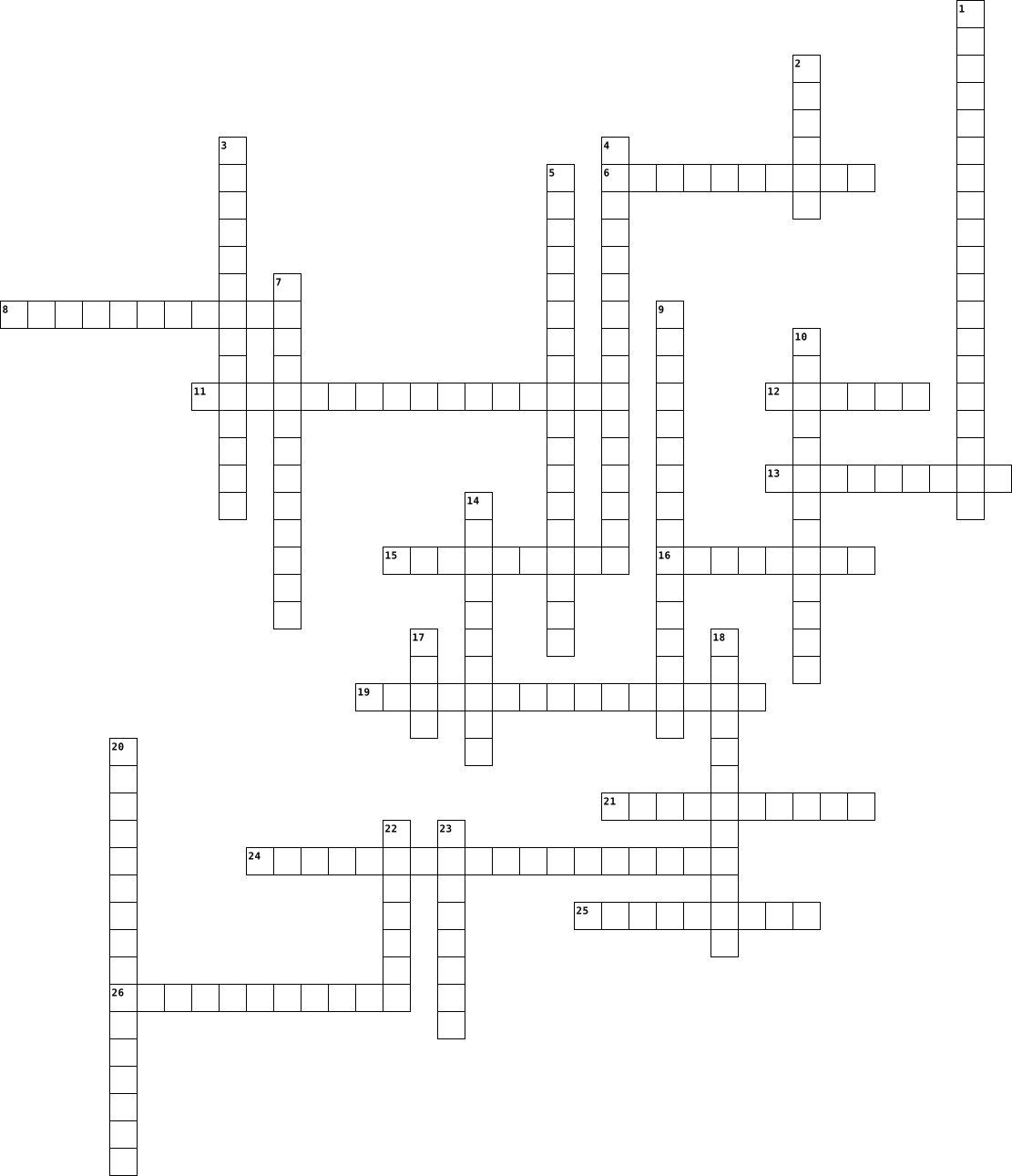
Across
- Ways that matter or energy is moved through a cycle
- Going directly from solid to gas
- Places where matter or energy is stored in a cycle
- Type of change that creates a new substance, a reaction occurs.
- Change in size, shape or state.
- The type of matter with the highest kinetic energy; particles fly freely.
- Reservoir that stores the majority of water on Earth as salt water.
- One of the processes that moves water from the biosphere to the atmosphere; evaporation from plants.
- The energy that drives all the water cycle.
- Drives the cycles.
- Evaporation of water from animals.
- Series of repeating events that move energy and/or matter through a system - no beginning or end
- Reservoir that stores 2% of water on Earth as solid water
- Describes a change where energy is taken away - deposition, freezing, condensation
- A state change; water to water vapor.
- The system that includes the Earth's crust, mantle, and core
- The system that protects the Earth; a layer of gases like a blanket.
Down
- Going directly from water vapor to solid, like frost.
- The type of matter with the lowest kinetic energy; particles just vibrate in place.
- Process that forms clouds.
- Solid state of water
- H2O
- Rain, hail, snow, sleet.
- Process in plants that takes water from the atmosphere into the biosphere and uses it to create energy.
- Describes a change where energy is added - melting, sublimation, or evaporation.
- When water falls on the crust and goes into the Earth
- All the water on the planet.
- Water that falls on land and moves to reservoirs.
- Water that has infiltrated the crust and is stored there.
- All the organisms on Earth
- Gaseous state of water.
31 Clues: H2O • Drives the cycles. • Solid state of water • Gaseous state of water. • Rain, hail, snow, sleet. • Process that forms clouds. • All the organisms on Earth • All the water on the planet. • Change in size, shape or state. • Going directly from solid to gas • Evaporation of water from animals. • A state change; water to water vapor. • The energy that drives all the water cycle. • ...
Cycles 2014-12-02

Across
- The system that includes the Earth's crust, mantle, and core
- Describes a change where energy is taken away - deposition, freezing, condensation
- When water falls on the crust and goes into the Earth
- Process in plants that takes water from the atmosphere into the biosphere and uses it to create energy.
- Ways that matter or energy is moved through a cycle
- Describes a change where energy is added - melting, sublimation, or evaporation.
- Reservoir that stores the majority of water on Earth as salt water.
- The type of matter with the highest kinetic energy; particles fly freely.
- Reservoir that stores 2% of water on Earth as solid water
- Places where matter or energy is stored in a cycle
- Process that forms clouds.
- H2O
Down
- Solid state of water
- Going directly from water vapor to solid, like frost.
- Change in size, shape or state.
- Series of repeating events that move energy and/or matter through a system - no beginning or end
- Type of change that creates a new substance, a reaction occurs.
- Evaporation of water from animals.
- The system that protects the Earth; a layer of gases like a blanket.
- The energy that drives all the water cycle.
- Drives the cycles.
- Rain, hail, snow, sleet.
- One of the processes that moves water from the biosphere to the atmosphere; evaporation from plants.
- Going directly from solid to gas
- All the water on the planet.
- The type of matter with the lowest kinetic energy; particles just vibrate in place.
- Water that falls on land and moves to reservoirs.
- Water that has infiltrated the crust and is stored there.
- Gaseous state of water.
- All the organisms on Earth
- A state change; water to water vapor.
31 Clues: H2O • Drives the cycles. • Solid state of water • Gaseous state of water. • Rain, hail, snow, sleet. • All the organisms on Earth • Process that forms clouds. • All the water on the planet. • Change in size, shape or state. • Going directly from solid to gas • Evaporation of water from animals. • A state change; water to water vapor. • The energy that drives all the water cycle. • ...
Atoms & Molecules CW 2 2021-11-04

Across
- the number of protons in an atom of an element
- Two or more atoms bonded together.
- The basic unit of an element. All matter is made up of atoms.
- change of state from a gas to a liquid
- A chart of all known elements that scientists reference when working with atoms or molecules.
- any of two or more atoms of the same element that have different numbers of neutrons
- change of state of a liquid into a gas
- decay process that occurs when an unstable atomic nucleus changes into another more
- matter that has a definite volume and a definite shape
- Protons and neutrons clump together at the center of an atom to form the nucleus of an atom.
Down
- describes elements that spontaneously emit radiation stable nucleus by emitting radiation
- Anything that has mass and takes up space.
- occurring without external force or cause
- vaporization that occurs only at the surface of a liquid
- A positively charged subatomic particle located at the center of an atom.
- sum of the number of protons and neutrons in an atom
- A subatomic particle of an atom that is negatively charged and orbits the nucleus extremely fast.
- matter that has no definite volume and no definite shape
- atom that is no longer neutral because it has gained or lost electrons
- gas state of a substance that is normally a solid or a liquid at room temperature
- matter with a definite volume but no definite shape
- Area around an atomic nucleus where an electron is most likely to be found.
- A subatomic particle with no charge located at the center of an atom.
23 Clues: Two or more atoms bonded together. • change of state from a gas to a liquid • change of state of a liquid into a gas • occurring without external force or cause • Anything that has mass and takes up space. • the number of protons in an atom of an element • matter with a definite volume but no definite shape • sum of the number of protons and neutrons in an atom • ...
Chemistry 2022-03-21
Across
- A number in front of a chemical formula
- A solid that forms from a solution during a chemical reaction
- Easy way to show a chemical reaction, using symbols
- Biological catalyst that lowers the activation energy of reaction in cells
- Material the decreases the rate of a reaction
- Study of the properties of matter and how it changes
- A substance that enters into a chemical reaction
- Process in which a substances undergo chemical changes that result in new substances
- System in which matter can enter and exit into the surroundings
- Principle stating that matter is not created or destroyed during a chemical reaction
- Chemical reaction in which two or more simple substances form a complex substance
- Reaction in which one element replaces another in a compound
Down
- A reaction that absorbs energy in the form of heat
- Anything that has mass and takes up space
- Change that alters the appearance of a material that doesn’t change the material into a different substance
- Minimum amount of energy needed to get a chemical reaction started
- A reaction that releases energy in the form of heat
- Chemical reaction that breaks down compound into simpler products
- Characteristic of a substance that describes its ability to change into different substances
- Amount of one material in a certain volume of another material
- A rapid reaction between oxygen and fuel that results in a fire
- A material that releases energy when it is burned
- System in which no matter is allowed to enter of exit
- Characteristic of a substance that can be seen without changing the substance
- A substance formed as a result of a chemical reaction
- Material that increases the rate of a reaction by lowering the activation energy
26 Clues: A number in front of a chemical formula • Anything that has mass and takes up space • Material the decreases the rate of a reaction • A substance that enters into a chemical reaction • A material that releases energy when it is burned • A reaction that absorbs energy in the form of heat • A reaction that releases energy in the form of heat • ...
Chemical Reactions 2022-11-03

Across
- The process of a liquid changing into a gas
- When a substance breaks up into tiny pieces and mixes completely with a liquid
- The ability to burn
- The temperature at which a solid becomes a liquid
- This gas is very dense and highly flammable.
- To identify an unknown substance, we should examine its ________
- Reactivity, conductivity, and flammability are examples of ______ properties.
- The amount of space an object takes up
- This key bath bomb ingredient reacts when mixed with baking soda
- This substance does not naturally exist as a liquid. It turns directly from a solid to a gas.
- the smallest piece of matter
- This state of matter is less dense than the others.
- Water molecules are made of oxygen and _______
- a single ingredient made of the same type of matter throughout
- The state of matter in which particles have the least energy
Down
- We can use our five senses to observe ______ properties.
- The third most common gas in the air around us is _______.
- Lemonade is an example of a ______ because it has multiple ingredients
- The process of a gas changing into a liquid
- This highly reactive substance is commonly found in bananas
- Multiple atoms bonded together form a ______
- The temperature at which a liquid becomes a gas
- This common gas makes up about 78% of the air around us.
- Sand is ________ in water because it does not dissolve
- Solids, liquids, and gases are all states of _____.
- The ability of a substance to chemically combine with other substances.
- This gas is not flammable and has a low density
- Wood has a lower _____ than water, so it tends to float
28 Clues: The ability to burn • the smallest piece of matter • The amount of space an object takes up • The process of a liquid changing into a gas • The process of a gas changing into a liquid • Multiple atoms bonded together form a ______ • This gas is very dense and highly flammable. • Water molecules are made of oxygen and _______ • ...
Types of Matter (Grade 6) 2023-10-02

Across
- A pure substance that consists of two or more different types of atoms.
- Also known as H2O.
- Phase of matter where particles are close together, but can slide around freely.
- An chemical property that describes a substance that is unreactive and can exist for long times.
- A property that describes the substance as it is (without changing it).
- What is the volume if mass equals 36g and density equals 3 grams per cubic centimeter?
- A chemical property that describes a substance that can be harmful to health.
- A substance that consists of two or more types of chemicals mixed together.
- What is the mass if density equals 5 grams per cubic centimeter and volume is 4 cubic centimeters?
- A chemical property that describes a substance that can ignite.
Down
- A property that relates to how a substance reacts or changes.
- A pure substance that only has one TYPE of atom (but may have many atoms).
- Element number 6 on the periodic table.
- What is the density if mass equals 24g and volume is 6 cubic centimeters?
- Phase of matter where particles are separated by long distances and move at very fast speeds.
- Measures how tightly packed particles are, equal to mass divided by volume.
- A very small object that comes in "lumps".
- A substance that consists of only one type of chemical.
- State of matter where particles are attached to each other and don't move much, but do vibrate in place.
- Amount of space an object occupies.
- Anything that has mass and volume.
- Quantity that measures the amount of matter in a substance and its inertia.
22 Clues: Also known as H2O. • Anything that has mass and volume. • Amount of space an object occupies. • Element number 6 on the periodic table. • A very small object that comes in "lumps". • A substance that consists of only one type of chemical. • A property that relates to how a substance reacts or changes. • A chemical property that describes a substance that can ignite. • ...
Phases of Matter Test 2024-02-29

Across
- the phase of matter in which particles are moving independent of each other
- pressure of gas particles exerted on a closed container of liquid
- the type of phase change where solid converts directly to gas
- the phase of matter in which particles cannot separate but can glide past one another and flow
- a measure of the force of collisions of gas particles on their container
- a solid with no pattern to its particle arrangement
- the kind of relationship between temperature and pressure; both variables move in the same direction
- O Kelvin; theoretical temperature at which all particle motion stops
- the variable on the x-axis of a phase diagram
- forces acting between molecules to attract them to each other
- the variable on the y-axis of a phase diagram
- the phase change where gas particles convert directly to solid
- the process of converting liquid to gas throughout the liquid; occurs only at certain temperature and pressure
Down
- an absence of gas pressure; it causes water to boil at room temperature
- a temperature scale used among scientists; has no degree symbol
- the phase of matter with the least kinetic energy
- meaning to move out; how gas particles expand
- abbreviation for the unit of pressure called atmosphere
- theory of matter says all particles of matter are in constant motion
- a kind of solid that is made from a repeating pattern
- a measure of the average kinetic energy in a substance; units of Fahrenheit/Celsius/Kelvin
- the conversion of liquid to gas at the surface of a liquid; happens at any temperature between melting point and boiling point
- 760 of this unit equals 1 atm
- the kind of relationship between intermolecular forces and vapor pressure; the variables move in opposite directions
- the temperature scale on which water boils at 100
- the temperature at which a solid transforms to a liquid
26 Clues: 760 of this unit equals 1 atm • meaning to move out; how gas particles expand • the variable on the x-axis of a phase diagram • the variable on the y-axis of a phase diagram • the phase of matter with the least kinetic energy • the temperature scale on which water boils at 100 • a solid with no pattern to its particle arrangement • ...
POM Chapter 4-6 Vocab 2020-02-27

Across
- the amount of space occupied by a sample of matter
- the air surrounding the planet
- outtermost solid shell of the planet
- device used to pump air in and out
- the SI unit for measuring temperature
- the measure of how hot an object is
- the increase in volume of matter with increasing temperature
- to adust to the standard scale of reading
- energy transferring from one substance to another resulting in a temperature change
- a device used to get consistent measurements
- made of 2 or more types of metal
- series of giant rigid crusts that fit togerher like a moving spherical jigsaw puzzle
- numeric scale to express magnitude of earthquakes based on readings from seismograph
- movement of gas, plastic solids, or liquid caused by variation in density that results from uneven heating
- the mass of a substance that fills one unit of volume and is measured in grams per cm cubed.
- substances used to create a chemical reaction
Down
- discontinuation of a rock formation due to rock mass movement
- scientific tool used to measure temperature
- temperature scale used in the United States
- a chemical element that is a greenish yellow gas
- measure of the amount of matter of an object
- a chemical reaction in which a compound is decomposed by heating
- substances formed by chemical reactions
- the process of changing one substance to another
- solids, liquids, and gases represent the three_ of matter
- the decrease in volume of matter with decreasing temperature
- chemical element with the symbol O and atomic number of 8
- ability to do work
28 Clues: ability to do work • the air surrounding the planet • made of 2 or more types of metal • device used to pump air in and out • the measure of how hot an object is • outtermost solid shell of the planet • the SI unit for measuring temperature • substances formed by chemical reactions • to adust to the standard scale of reading • scientific tool used to measure temperature • ...
Thermal Energy 2023-02-25

Across
- - Energy of motion.
- - This occurs when matter is heated, causing particles to gain energy and spread out.
- - Unit used for temperature in everyday life (in the US) (°F).
- - The total kinetic energy of the particles in a substance (speed AND quantity of particles).
- - A material that is good at spreading heat, like metal.
- - This occurs when matter is cooled, causing particles to lose energy and come closer together.
- - Refers to gases and liquids, NOT solids.
- - Type of heat transfer where warmer, less dense particles rise; and cooler, denser particles sink in an ongoing cycle; it occurs only in fluids (gases and liquids).
- - Unit used for temperature in science (°C).
- - A material that traps heat and keeps it from spreading, like wood or Styrofoam.
Down
- - A tool used to measure temperature; it works by a liquid (mercury or ethanol[alcohol]) expanding or contracting in a thin glass tube.
- - Type of heat transfer where particles spread heat to each other by direct contact; it requires at least one solid material.
- - A measurement of how much space an object or substance takes up.
- - Type of heat transfer that involves electromagnetic waves moving through a space.
- - Toxic material that used to be found inside glass thermometers.
- - A measurement of the average kinetic energy in a substance or object (speed of particles); it is measured with a thermometer.
- - Property of matter that refers to how much matter ("stuff") is in a particular "space" (volume).
- - Anything that has mass or takes up space.
- - Heat energy.
- - Heat will transfer from a warmer object to a cooler object until they reach an _____________ temperature.
20 Clues: - Heat energy. • - Energy of motion. • - Refers to gases and liquids, NOT solids. • - Anything that has mass or takes up space. • - Unit used for temperature in science (°C). • - A material that is good at spreading heat, like metal. • - Unit used for temperature in everyday life (in the US) (°F). • - Toxic material that used to be found inside glass thermometers. • ...
M&E in Ecosystems!!! 2025-04-04

Across
- A type of organism that breaks down dead matter to get its ESM's.
- The part of the cell that photosynthesis occurs in a plant cell.
- The substance that starts at chemical reaction.
- A type of molecule that is used to release energy when needed.
- A chemical reaction that occurs with oxygen and glucose atoms that release energy into cells.
- Something that is used for a process.
- A type of atom that makes up energy storage molecules.
- The end substance after a chemical reaction occurs.
- A type of ESM made of that can join together to make starch.
- All the matter in an ecosystem that is NON-living.
- All the matter in an ecosystem the IS living.
Down
- To join multiple things together.
- A type of ESM with a lower energy density then fat.
- The result of a process.
- The ability to make things move or change.
- A group of atoms joined together in a particular.
- A type of organism that has to eat in order to get ESM's.
- An organism that makes its own ESM's through energy from the sunlight.
- All the abiotic and biotic matter in an ecosystem.
- A molecule made up of 1 carbon atom and 2 oxygen atoms.
- The molecule made when multiple glucose molecules are joined together.
- A tiny particle that everything is made of.
- An organelle that cellular respiration occurs.
- A type of Energy Storage Molecule that has a higher energy density then glycogen.
- The process when producers use energy from the sunlight to get energy storage molecules.
- The set of parts forming a complex whole.
- Another word for biotic matter, representing all living things
- A man-made ecosystem.
28 Clues: A man-made ecosystem. • The result of a process. • To join multiple things together. • Something that is used for a process. • The set of parts forming a complex whole. • The ability to make things move or change. • A tiny particle that everything is made of. • All the matter in an ecosystem the IS living. • An organelle that cellular respiration occurs. • ...
ESS Topic 1 Important Terminology 2025-02-12

Across
- A measure of disorder in a system.
- footprint A measure of human impact on the environment based on resource use.
- equilibrium A system that maintains a constant state despite small fluctuations.
- value system (EVS) A worldview that influences how people perceive and respond to environmental issues.
- system A system that exchanges energy but not matter with its surroundings.
- A process where energy or matter changes form.
- Individuals who believe that human ingenuity will solve environmental problems.
- feedback A process that counteracts change in a system, promoting stability.
- capital The world’s stock of natural resources that provide ecosystem services.
- A worldview that prioritizes ecological balance and natural systems over human development.
- system A hypothetical system that does not exchange energy or matter.
- ecologists Individuals who believe nature has intrinsic value and advocate for minimal human impact.
- feedback A process that amplifies change in a system.
Down
- The use of resources in a way that meets present needs without compromising future generations.
- system A system that exchanges both energy and matter with its surroundings.
- A set of interrelated parts working together to form a complex whole.
- A worldview that values technological solutions to environmental issues.
- development Economic development that meets present needs without depleting resources for future generations.
- law of thermodynamics States that energy conversions increase entropy (disorder) in a system.
- A worldview that places humans at the center of environmental decision-making.
- point A threshold beyond which an environmental change becomes irreversible.
- The ability of a system to recover from disturbances.
- The movement of energy or matter from one place to another without changing form.
- income The yield obtained from natural resources.
- equilibrium A system that remains unchanged over time.
25 Clues: A measure of disorder in a system. • A process where energy or matter changes form. • income The yield obtained from natural resources. • The ability of a system to recover from disturbances. • feedback A process that amplifies change in a system. • equilibrium A system that remains unchanged over time. • ...
Forces 2026-01-04

Across
- The opposite direction to where a compass needle is pointing.
- A magnet which is created by an electric current running through a wire around a piece of metal.
- To push away.
- A solid translucent plastic which can act as an insulator.
- A device can be used to determine if something has been electrostatically charged.
- The lowest velocity that a body must have in order to escape the gravitational attraction of planet or another object.
- The direction in which a compass needle points.
- An interaction of a push, pull or twist on an object.
- A charge where there is more protons than electrons.
- A region where objects within that region are impacted upon by a force.
- To have the properties of a magnet.
Down
- A charge where there is more electrons than protons.
- When matter is not touching other matter.
- The force of attraction between any two masses.
- A piece of iron or other similar metal which exerts a magnetic field.
- The unit of force.
- To have an uneven amount of something.
- To pull towards.
- A machine which converts mechanical energy into electrical energy.
- A type of force where a positive charge is attracted to a negative charge.
- When matter has built-up an inbalance of electrons and protons.
- The ends of a magnet where the field is strongest.
- The speed at which a falling object (falling due to gravitational force) ceases to accelerate downward.
- A hard, heated rubber which acts as an insulator.
- A styrofoam ball used to detect electrostatic charge.
- When matter is touching other matter.
26 Clues: To push away. • To pull towards. • The unit of force. • To have the properties of a magnet. • When matter is touching other matter. • To have an uneven amount of something. • When matter is not touching other matter. • The force of attraction between any two masses. • The direction in which a compass needle points. • A hard, heated rubber which acts as an insulator. • ...
ChemPuzzle 2026-06-08

Across
- The change of a substance from solid to vapor without passing through the liquid state
- A State of matter that has an indefinite shape, but definite volume
- A solution where water is the solvent (2 words)
- A measure of how much the volume of matter decreases under a certain amount of pressure
- Amount of solute the dissolves in a given amount of solvent at a specific temperature and pressure.
- A container starts with a pressure of 2.1 atm and 30 liters with a constant temperature of 237K, the volume is decreased so that the new pressure is 4.2 atm. What is the final volume of the container?
- The temperature at which a solid becomes a liquid (2 words)
- The name for when something is in all three states of matter (2 words)
Down
- Something changing from a gas to a liquid
- When particles having enough anergy to be free and become a gas
- Something going from a gas to a solid
- The ability for something to be hammered or pressed into shapes
- Something changing from a liquid to a gas
- A state of matter that Moves freely
- The ability for something to be drawn into wires
- The tension on the surface of a water drop (2 words)
- The dissolved particles (usually ions)
- The tendency of molecules to move toward areas of lower concentration until the concentration is uniform
- A state of matter that has a definite shape
- A container starts with a pressure volume of 42 liters with a constant temperature of 248K, the volume is decreased to 28 liters so that the new pressure is 12 atm. What is the initial pressure of the container?
20 Clues: A state of matter that Moves freely • Something going from a gas to a solid • The dissolved particles (usually ions) • Something changing from a gas to a liquid • Something changing from a liquid to a gas • A state of matter that has a definite shape • A solution where water is the solvent (2 words) • The ability for something to be drawn into wires • ...
Chem Puzzle!! 2026-06-08

Across
- A solution where water is the solvent (2 words)
- A container starts with a pressure of 2.1 atm and 30 liters with a constant temperature of 237K, the volume is decreased so that the new pressure is 4.2 atm. What is the final volume of the container?
- The tension on the surface of a water drop (2 words)
- A measure of how much the volume of matter decreases under a certain amount of pressure
- The ability for something to be hammered or pressed into shapes
- A state of matter that has a definite shape
- The tendency of molecules to move toward areas of lower concentration until the concentration is uniform
- The temperature at which a solid becomes a liquid (2 words)
- The dissolved particles (usually ions)
- Something going from a gas to a solid
- Amount of solute the dissolves in a given amount of solvent at a specific temperature and pressure.
Down
- The name for when something is in all three states of matter (2 words)
- A State of matter that has an indefinite shape, but definite volume
- The ability for something to be drawn into wires
- The change of a substance from solid to vapor without passing through the liquid state
- A container starts with a pressure volume of 42 liters with a constant temperature of 248K, the volume is decreased to 28 liters so that the new pressure is 12 atm. What is the initial pressure of the container?
- When particles having enough anergy to be free and become a gas
- A state of matter that Moves freely
- Something changing from a gas to a liquid
- Something changing from a liquid to a gas
20 Clues: A state of matter that Moves freely • Something going from a gas to a solid • The dissolved particles (usually ions) • Something changing from a gas to a liquid • Something changing from a liquid to a gas • A state of matter that has a definite shape • A solution where water is the solvent (2 words) • The ability for something to be drawn into wires • ...
Gen Chem 3rd Quarter alternative task 2020-05-23

Across
- is a measure of how readily a substance undergoes a chemical reaction.
- it is a heterogeneous mixture that contains solid particles sufficiently large for sedimentation
- an effect is light scattering by particles in a colloid or in a very fine suspension
- the element K in the periodic table
- is a mixture in which the components of the mixture are not uniform
- it is a measure of the "hotness" or "coldness" of a substance.
- in science it means when the properties of the substance is unchanging
- change of state from gas to solid
- it is a substance whose atoms all have the same number of protons
- chemistry that deals with inorganic compounds
- change of state from gas to liquid
- the meaning of Fe in the periodic table
- 3rd element in the periodic table
- is a chemical substance composed of many identical molecules
- the technique of heating a liquid to create vapor which is collected when cooled separate from the original liquid
- is the degree to which a chemical substance or a particular mixture of substances can damage an organism
- the most abundant element in the universe
- it is a special type of homogeneous mixture composed of two or more substances
- the 13th element in the periodic table
- the meaning of Ag in the periodic table
- state of matter where atoms are not to far from each other
- the chemistry that study the behavior of matter
Down
- a laboratory technique for the separation of a mixture
- is the process by which an atom or a molecule acquires a negative or positive
- Substance substances that are made of only one type of atom
- it is the relationship between the mass of the substance and how much space it takes up
- a mixture that has a small diameter yet are still uniformly distributed in a solution
- it is a measure of how easily a substance burst into flames
- change of state from solid to liquid
- change of state from solid to gas
- property that does depend on the size of matter
- it is a measure of the amount of matter in an object
- a chemical operation that separates solid matter and fluid from a mixture with a filter medium
- it is the quantity of space occupied by a liquid, solid, or gas.
- makes your voice change when inhaled and it is a noble gas
- the chemistry of carbon compounds
- we humans inhale this gas
- the meaning of Na in the periodic table
- state of matter where atoms are far apart
- branch of science that explores living organism
- change of state from liquid to gas
- it is a material made up of two or more different substances which are physically combined
- is the ratio between the activity of your sample of interest
- 5th element in the periodic table
- chemistry that studies the structure of matter
- a property that does not depend on the size of matter
- it is a mixture in which the molecules that make up the mixture are uniformly distributed
- change of state from liquid to solid
- it’s the meaning of Au in the periodic table
- state of matter that atoms are close together
50 Clues: we humans inhale this gas • change of state from solid to gas • change of state from gas to solid • the chemistry of carbon compounds • 3rd element in the periodic table • 5th element in the periodic table • change of state from gas to liquid • change of state from liquid to gas • the element K in the periodic table • change of state from solid to liquid • ...
General Chemistry 2020-05-14

Across
- (state of matter) characterized by particles arranged such that their shape and volume are relatively stable.
- the conversion of liquid to gas
- combination of two or more substances
- is a negatively charged subatomic particle
- are ordorless, colorless, monotonic gases.
- Any characteristic that can be determined without changing the substance’s chemical identity.
- the study of chemistry in physics
- are good conductors of heat
- to pass through a sieve so as to separate the coarse from the fine particles
- is the method in which heavier components of the mixture are separated from the lighter substances with the help of wind
- process by which water changes from a liquid to a gas or vapor.
- a homogenous mixture or two or more element
- is a subatomic particle found in the nucleus of every atom
- is a chemical substance that cant be divided or changed into other chemical substances by any ordinary chemical means
- process used to separate solids from liquids or gases using a filter medium that allows the fluid to pass through but not the solid
- a neutral subatomic particle found in the atomic nucleus
- is a particle made up of two or more atoms that are chemically bonded together
- poor thermal conductors
- Any characteristic of matter that depends on the amount of matter being measured.
- chemical element with the symbol O
- A substance made up of two or more elements that are joined together in a fixed ratio.
- is the smallest object that retains the properties of an element
- (state of matter) has a definite volume, it does not have a definite shape.
- the study of chemical processes that occur inside of living organisms
- process in which a gas changes directly to a solid without going through the liquid state
Down
- process through which a substance changes from a liquid to a solid
- the substance that is dissolved or scattered
- the study of the chemistry of life
- Any characteristic of matter that does not depend on the amount of the substance present.
- the study of inorganic compounds
- is anything that has mass and takes up space.
- a method in which two or more components of different sizes are separated from a mixture on the basis of the difference in their sizes.
- Also known as semi-metals .have mostly non-metallic properties.
- the study of the chemistry of matter
- when heat is applied to solid
- process used to separate solids from liquids or gases using a strainer
- of matter) consisting of particles that have neither a defined volume nor defined shape.
- has definite composition, and specific properties.
- something that was forced to be mixed
- does not have a definite composition and is non uniform
- chemical element with the symbol H
- when a solid is converted directly into gas
- occurs when a gas loses energy
- Any characteristic that can be determined only by changing a substance’s molecular structure.
- any material that is not a mixture
- consists of highly charged particles with extremely high kinetic energy.
- is the power to attract
- chemical element with the symbol Cl
- is the study of matter and the chemical reactions between substances.
- chemical element with the symbol Si
50 Clues: poor thermal conductors • is the power to attract • are good conductors of heat • when heat is applied to solid • occurs when a gas loses energy • the conversion of liquid to gas • the study of inorganic compounds • the study of chemistry in physics • the study of the chemistry of life • chemical element with the symbol H • any material that is not a mixture • ...
General Chemistry 2020-05-14

Across
- the study of chemistry in physics
- chemical element with the symbol Au
- A substance made up of two or more elements that are joined together in a fixed ratio.
- is the power to attract
- chemical element with the symbol Ne
- the study of chemical processes that occur inside of living organisms
- process used to separate solids from liquids or gases using a filter medium that allows the fluid to pass through but not the solid
- when heat is applied to solid
- is a subatomic particle found in the nucleus of every atom
- (state of matter) has a definite volume, it does not have a definite shape.
- the study of the chemistry of matter
- is the study of matter and the chemical reactions between substances.
- process in which a gas changes directly to a solid without going through the liquid state
- a method in which two or more components of different sizes are separated from a mixture on the basis of the difference in their sizes.
- to pass through a sieve so as to separate the coarse from the fine particles
- process by which water changes from a liquid to a gas or vapor.
- Any characteristic that can be determined without changing the substance’s chemical identity.
- chemical element with the symbol O
- chemical element with the symbol Si
- poor thermal conductors
- are ordorless, colorless, monotonic gases.
- process through which a substance changes from a liquid to a solid
- consists of highly charged particles with extremely high kinetic energy.
- is a particle made up of two or more atoms that are chemically bonded together
- is a negatively charged subatomic particle
- is a chemical substance that cant be divided or changed into other chemical substances by any ordinary chemical means
- does not have a definite composition and is non uniform
Down
- the conversion of liquid to gas
- occurs when a gas loses energy
- any material that is not a mixture
- the study of the chemistry of life
- is the method in which heavier components of the mixture are separated from the lighter substances with the help of wind
- is anything that has mass and takes up space.
- Also known as semi-metals .have mostly non-metallic properties.
- Any characteristic that can be determined only by changing a substance’s molecular structure.
- has definite composition, and specific properties.
- chemical element with the symbol H
- when a solid is converted directly into gas
- a homogenous mixture of two or more element
- of matter) consisting of particles that have neither a defined volume nor defined shape.
- are good conductors of heat
- the substance that is dissolved or scattered
- process used to separate solids from liquids or gases using a strainer
- Any characteristic of matter that depends on the amount of matter being measured.
- the surname of the chemist who developed periodic table
- a neutral subatomic particle found in the atomic nucleus
- is the smallest object that retains the properties of an element
- (state of matter) characterized by particles arranged such that their shape and volume are relatively stable.
- Any characteristic of matter that does not depend on the amount of the substance present.
- combination of two or more substances
- the study of inorganic compounds
- something that was forced to be mixed
52 Clues: is the power to attract • poor thermal conductors • are good conductors of heat • when heat is applied to solid • occurs when a gas loses energy • the conversion of liquid to gas • the study of inorganic compounds • the study of chemistry in physics • any material that is not a mixture • the study of the chemistry of life • chemical element with the symbol H • ...
General Chemistry 2020-05-14

Across
- process in which a gas changes directly to a solid without going through the liquid state
- are good conductors of heat
- A substance made up of two or more elements that are joined together in a fixed ratio.
- is the study of matter and the chemical reactions between substances.
- poor thermal conductors
- chemical element with the symbol Au
- is anything that has mass and takes up space.
- occurs when a gas loses energy
- the conversion of liquid to gas
- the study of the chemistry of matter
- is a negatively charged subatomic particle
- Any characteristic that can be determined without changing the substance’s chemical identity.
- of matter) consisting of particles that have neither a defined volume nor defined shape.
- has definite composition, and specific properties.
- is the smallest object that retains the properties of an element
- Any characteristic of matter that does not depend on the amount of the substance present.
- the surname of the chemist who developed periodic table
- the substance that is dissolved or scattered
- combination of two or more substances
- a method in which two or more components of different sizes are separated from a mixture on the basis of the difference in their sizes.
- is a subatomic particle found in the nucleus of every atom
- Any characteristic that can be determined only by changing a substance’s molecular structure.
- process through which a substance changes from a liquid to a solid
- is a chemical substance that cant be divided or changed into other chemical substances by any ordinary chemical means
- consists of highly charged particles with extremely high kinetic energy.
- a homogenous mixture of two or more element
- is the method in which heavier components of the mixture are separated from the lighter substances with the help of wind
- the study of chemical processes that occur inside of living organisms
Down
- process used to separate solids from liquids or gases using a strainer
- chemical element with the symbol O
- process by which water changes from a liquid to a gas or vapor.
- a neutral subatomic particle found in the atomic nucleus
- any material that is not a mixture
- chemical element with the symbol Ne
- does not have a definite composition and is non uniform
- the study of the chemistry of life
- the study of chemistry in physics
- (state of matter) has a definite volume, it does not have a definite shape.
- is the power to attract
- is a particle made up of two or more atoms that are chemically bonded together
- Any characteristic of matter that depends on the amount of matter being measured.
- process used to separate solids from liquids or gases using a filter medium that allows the fluid to pass through but not the solid
- when a solid is converted directly into gas
- (state of matter) characterized by particles arranged such that their shape and volume are relatively stable.
- something that was forced to be mixed
- are ordorless, colorless, monotonic gases.
- to pass through a sieve so as to separate the coarse from the fine particles
- the study of inorganic compounds
- Also known as semi-metals .have mostly non-metallic properties.
- when heat is applied to solid
50 Clues: poor thermal conductors • is the power to attract • are good conductors of heat • when heat is applied to solid • occurs when a gas loses energy • the conversion of liquid to gas • the study of inorganic compounds • the study of chemistry in physics • chemical element with the symbol O • any material that is not a mixture • the study of the chemistry of life • ...
Chapter 11(burkholder) 2021-02-14

Across
- the smallest unit of a substance that
- of a substance.
- a substance made of atoms of more
- mixture- substances are not uniformly mixed.
- all of the properties characteristic of that substance.
- formula- the chemical symbols and
- substance- any matter that has a fixed composition and definite properties.
Down
- mixture- mixing occurs between individual units.
- is anything that has mass and occupies space.
- simpler substances.
- indicating the atoms contained in the basic
- a combination of more than one pure substance.
- a substance that cannot be broken down
- one element bound together.
- the ability to change or move matter.
15 Clues: of a substance. • simpler substances. • one element bound together. • a substance made of atoms of more • formula- the chemical symbols and • the smallest unit of a substance that • the ability to change or move matter. • a substance that cannot be broken down • indicating the atoms contained in the basic • mixture- substances are not uniformly mixed. • ...
water 2018-12-03

Across
- about_____ present water in the earth.
- underground layer that's made of rocks and soli
- where you treat your water.
- what matter is water in a cup?
- very flammable gas.
- stuff we drink?
Down
- what do you do when you are thirsty?
- when water freezes it becomes?
- plants make_____?
- rock ans water are filled with water
- what matter is stem?
- when you go to the store you buy a ______ of milk?
- in the olden days people would get their water from a _____?
- first to clean water?
- is the smallest constituent unit of matter?
15 Clues: stuff we drink? • plants make_____? • very flammable gas. • what matter is stem? • first to clean water? • where you treat your water. • when water freezes it becomes? • what matter is water in a cup? • what do you do when you are thirsty? • rock ans water are filled with water • about_____ present water in the earth. • is the smallest constituent unit of matter? • ...
Criss Cross Physical Science 2023-11-09

Across
- an example of a solid
- vertical row in the periodic table
- amount of space occupied by an object
- a phase that has a definite shape or volume
- a positively charged ion.
- A minute portion of matter
Down
- the action of being moved or moving
- example of a liquid matter
- positively charged center of an atom
- horizontal row in the periodic table
- amount of force exerted per unit area
- example of a metalliod
- amount of matter in an object
- example of a metal
- a charged product from the lose or gain of electrons
15 Clues: example of a metal • an example of a solid • example of a metalliod • a positively charged ion. • example of a liquid matter • A minute portion of matter • amount of matter in an object • vertical row in the periodic table • the action of being moved or moving • positively charged center of an atom • horizontal row in the periodic table • amount of force exerted per unit area • ...
Big Bang Theory 2025-03-24

Across
- Also known as the cosmic microwave background (CMB), it is the remnant thermal radiation from the early universe, providing evidence of the Big Bang and serving as a snapshot of the universe at about 380,000 years old.
- A form of matter that does not emit, absorb, or reflect light, making it invisible to direct observation it is inferred from gravitational effects on visible matter and cosmic structures.
- A unit of distance equal to the distance that light travels in one year in a vacuum.
- The process where light atomic nuclei combine to form heavier ones
- An instrument used to measure the intensity of light, often employed in astronomy to analyze the brightness of celestial objects.
- The hot, dense state of the early universe shortly after the Big Bang, before the formation of atoms, when radiation and high-energy particles dominated.
- Refers to the thermal history of the universe, with the current temperature of space
- A form of matter composed of antiparticles, which have the same mass as particles of ordinary matter but opposite charge; when matter and antimatter meet, they annihilate, releasing energy.
- The change in the wavelength of light or sound due to the relative motion between the source and the observer, with redshift indicating motion away and blueshift indicating motion toward.
- A type of variable star that pulsates in a predictable manner, making it a crucial "standard candle" for measuring cosmic distances.
- A space-based observatory launched in 1990 that has provided high-resolution images of the universe, significantly contributing to our understanding of cosmology.
- A rapid exponential expansion of the universe that occurred within a tiny fraction of a second after the Big Bang, explaining its large-scale structure and uniformity.
Down
- Influencing phenomena from the formation of stars and galaxies to the behavior of cosmic magnetic fields and the nature of light.
- A point in space-time where gravitational forces cause matter to have infinite density and zero volume, often associated with black holes and the origin of the universe in the Big Bang.
- The average density of matter and energy in the universe needed to halt its expansion after an infinite time, resulting in a flat, spatially-closed universe.
- A fundamental dimension in physics, often understood as a continuous progression of events from the past to the future, influencing the evolution of the universe.
- (First Law) Also known as the law of conservation of energy, it states that energy cannot be created or destroyed, only transformed from one form to another.
- The leading cosmological model explaining the origin of the universe, proposing that it began as an extremely hot, dense state and has been expanding ever since.
- The period in cosmic history following the Radiation Era, during which matter became the dominant component of the universe, leading to the formation of galaxies and stars.
- The unit of absolute temperature in the International System of Units (SI), starting from absolute zero, where all molecular motion ceases.
- The shortening of the wavelength of light from an object moving toward the observer, opposite of redshift.
- The apparent shift in the position of an object when viewed from two different locations, used in astronomy to measure the distances of nearby stars.
- Light from these galaxies is shifted to longer wavelengths
- A system of two equal and opposite charges or magnetic poles separated by a distance, often used in reference to the cosmic microwave background radiation's temperature variations.
- A branch of physics and metaphysics dealing with the nature of the universe
25 Clues: Light from these galaxies is shifted to longer wavelengths • The process where light atomic nuclei combine to form heavier ones • A branch of physics and metaphysics dealing with the nature of the universe • A unit of distance equal to the distance that light travels in one year in a vacuum. • ...
Level 10 Science 2025-07-22

Across
- (n): a dark area made when something stops light from moving
- (n): the part of the ear that vibrates so we can hear sounds
- (n): when matter changes size or shape
- (n): a liquid that has a solid or gas mixed into it
- (n): the point that a lever moves against
- (n): one kind of metal
- (n): a tool that uses a magnet to show direction
- (v): when matter changes from a liquid to a solid
- (v): when a solid mixes completely into a liquid and cannot be taken out
- (n): a large area of grass where people play games like soccer or baseball
- (n): something that liquids can go through but solids cannot
- (n): a liquid that is burned to make energy in an engine; often called gas or petrol
- (n): a kind of energy that can change the state of matter
- (n): how heavy or light something is
- (v): to pull something without touching it
- (v): when a liquid is made very hot and starts to bubble and evaporate quickly
- (n): the different ways that mixtures can be put together
- (n): a building that makes electricity for a town or city
- (v): to bounce off of something
- (n): a bar that moves against an unmoving point
- (n): where something is made or comes from
- (v): to take apart
- (n): an object that can make and store current electricity
- (v): when matter changes from a liquid to a gas
- (n): a kind of energy that we can hear
- (n): what is needed to make matter move, work, grow, or change
- (n): a force that can slow things down or make heat when objects rub together
- (n): two or more things put together
- (n): where something is; location
- (n): a tool that changes the size or direction of force
- (v): when matter changes from a gas to a liquid
- (v): when matter changes from a solid to a liquid
- (n): a straight, slanted surface
- (n): one kind of metal
- (v): to move back and forth quickly
Down
- (n): a kind of electricity that is made by tiny pieces of moving matter
- (n): how much or how many of something there is
- (v): to talk about something in a way that will help people understand about it
- (n): how fast or slow something is moving
- (n): something that can be burned to make heat energy
- (n): when matter changes into a new state of matter with new properties
- (n): a rope or chain that moves around a wheel
- (n): a kind of energy that allows us to see
- (n): where something is moving to
- (n): a tool that measures temperature
- (v): to describe what is different or the same about different things
- (n): an object that can attract or repel other magnets and some metals
- (n): a wheel connected to a bar that can turn
- (n): a force that pulls everything down to the Earth
- (v): to push something without touching it
- (v): to put different things together
- (n): one of the ends of a magnet; a magnet has a north and a south pole
- (n): an object that lets only some colors of light pass through
- (n): what is needed to make something move
- (n): a black rock that is burned as a fuel to make energy
- (n): how hot or cold something is
- (n): when something vibrates (v), it makes a vibration (n)
- (n): a kind of electricity that moves on a circuit
- (v): to have or hold something inside
- (n): the path that current electricity moves along
- (n): an object that can bend white light into the colors of the rainbow
- (n): how high or low a sound is
- (n): a change of position
63 Clues: (v): to take apart • (n): one kind of metal • (n): one kind of metal • (n): a change of position • (v): to bounce off of something • (n): how high or low a sound is • (n): a straight, slanted surface • (n): where something is moving to • (n): how hot or cold something is • (n): where something is; location • (v): to move back and forth quickly • ...
Unit 14 - Matter & Energy in Ecosystems 2022-04-22

Across
- A diagram that shows the dry mass of biological material at each trophic level of an ecosystem. It is called a pyramid of ________.
- An organism that obtains matter and energy by breaking down the organic matter in wastes and dead organisms. They recycle carbon, nitrogen, and other elements in organic matter by using them to make nutrients that producers need.
- The total dry mass of the biological material, including organisms and decaying organic matter, in a given part of an ecosystem.
- Anything that has weight and takes up space.
- A diagram that shows the amount of individuals at each trophic level of an ecosystem. It is called a pyramid of ________.
- A diagram that shows the feeding relationships among many species in an ecosystem.
- A group of individuals of the same species living together in the same area at the same time.
- A consumer that obtains matter and energy by eating pieces of dead organisms and organic wastes. Example: Earthworm
Down
- An organism that makes its own food and provides food for other organisms in a food chain or food web. It is always the first organism in a food chain and is also called a producer.
- A diagram that shows the feeding relationships that link together one series of species in an ecosystem.
- on its main source of food.
- A system formed by the interaction of living organisms with the nonliving physical environment.
- A form of energy related to the random motion of atoms and molecules. It is not useful to anything that produces it because it flows out of a warmer object into its cooler surroundings and dissipates.
- An organism that obtains matter and energy by eating other organisms or parts of organisms. It is also called a consumer.
- A diagram that shows the amount of energy (in kilocalories) at each trophic level of an ecosystem. It is called a pyramid of ________.
- To try to obtain resources (such as food, water, and space) that others are also trying to get.
- A consumer that obtains matter and energy by eating the remains of dead organisms. Example: vulture.
- The level of a species in an ecosystem
18 Clues: on its main source of food. • The level of a species in an ecosystem • Anything that has weight and takes up space. • A diagram that shows the feeding relationships among many species in an ecosystem. • A group of individuals of the same species living together in the same area at the same time. • ...
Properties of Matter 2021-11-30

Across
- Taste, Texture, Smell, Color
- matter that takes the volume and shape of the container
- Anything that holds its shape
- Anything that can fill the shape of the container
- The measurement of the amount of matter an object has
Down
- This is what all substances are made up of
- states of matter
- Matter is made up of these and they are too small to see
- A particular type of matter
9 Clues: states of matter • A particular type of matter • Taste, Texture, Smell, Color • Anything that holds its shape • This is what all substances are made up of • Anything that can fill the shape of the container • The measurement of the amount of matter an object has • matter that takes the volume and shape of the container • ...
Unit 1 Matter Crossword Review 2014-09-08

Across
- A homogenous material consisting of one particular kind of matter.
- A substance which can not be broken down by chemical means.
- Matter that has similar properties throughout.
- A reaction in which energy must be supplied.
- Two or more materials which do NOT chemically combine.
- A _____________ property depends on the amount of material.
- A ____________ property depends on observations.
- A _________ change affects the appearance of matter.
Down
- A homogenous mixture containing a solute mixed uniformly throughout,
- A reaction in which energy is given off.
- Two or more elements which are chemically combined in a fixed ratio.
- The chemical _________ can be used in place of the name of the element.
- Matter that has different properties.
13 Clues: Matter that has different properties. • A reaction in which energy is given off. • A reaction in which energy must be supplied. • Matter that has similar properties throughout. • A ____________ property depends on observations. • A _________ change affects the appearance of matter. • Two or more materials which do NOT chemically combine. • ...
Topic 1- 3 Vocabulary 2024-01-11

Across
- The ability of matter to bend.
- An object that can be pushed or pulled by a magnet.
- A trait or feature of an object that you can observe with your sense.
- An explanation of the pictures and signs on a map.
- An area that slants up or down.
- A way to compare the distance between objects on a map and the same objects in real life
Down
- A form of matter.
- A large body of flowing ice.
- A copy of something
- Anything that has weight and takes up space.
- Matter that does not have its own shape or size.
- The use of an object.
- To put something together.
13 Clues: A form of matter. • A copy of something • The use of an object. • To put something together. • A large body of flowing ice. • The ability of matter to bend. • An area that slants up or down. • Anything that has weight and takes up space. • Matter that does not have its own shape or size. • An explanation of the pictures and signs on a map. • ...
Science Review 6th graders 2022-11-19

Across
- change, When original matter transforms into other substance.
- Happens when a solid turns into liquid.
- Is the amount of matter and can be meausred in Kilograms or grams.
- Calculated by the water displacement method.
- Happens when substances combine with th oxygen,
- Calculated with simple mathematical formulas.
- When liquids turn into a solid.
Down
- When solid turns into gas without passing trough liquid state.
- The space that an object occupies and can be measured in liters or milliliters.
- Happens when object or susbtance are burned.
- The main component of everything that surround us.
- The amount of matter in a particulat volume.
- Changes to the state that don't produce new substances.
13 Clues: When liquids turn into a solid. • Happens when a solid turns into liquid. • Happens when object or susbtance are burned. • The amount of matter in a particulat volume. • Calculated by the water displacement method. • Calculated with simple mathematical formulas. • Happens when substances combine with th oxygen, • The main component of everything that surround us. • ...
Science 7 - Matter and Elements 2022-11-26

Across
- A system of arranging elements based on the structure of their atoms. (2 words - 8 and 5)
- An irreversible change that occurs when two or more substances react with each other to form a new substance. (2 words - 8 and 6)
- a change that occurs when atoms and molecules speed up or slow down. (8)
- ______________of matter; solid or liquid or gas.(6)
- The number of protons in a single atom of an element. (2 words, 6 and 6)
- Matter that is made of only one type of molecule or atom. (2 words - 4 and 8)
- A pure substance that is made of a single type of atom. (7)
Down
- How we can describe an element such as colour, melting/boiling/freezing point or thermal and electrical conductivity. (10)
- The state of matter with the slowest moving particles. (5)
- The smallest units of matter. (5)
- A substance that is formed when two or more elements are chemically bonded together. (8)
- The ordered arrangement of atoms or molecules. (2 words, 10 and 9)
- The state of matter with the fastest moving particles. (3)
- These are formed when two or more atoms are chemically bonded together. (9)
- A compound created when metal reacts with oxygen and water. (4)
- As in protons and neutrons and electrons. (9)
16 Clues: The smallest units of matter. (5) • As in protons and neutrons and electrons. (9) • ______________of matter; solid or liquid or gas.(6) • The state of matter with the slowest moving particles. (5) • The state of matter with the fastest moving particles. (3) • A pure substance that is made of a single type of atom. (7) • ...
Day 2 2024-05-29

Across
- a physical process that results in a phase transition of a substance from a solid to a liquid.
- a process where water vapor turns into water
- a measure of how quickly a specific material is capable of catching fire and burning
- a characteristic of a particular substance that can be observed in a chemical reaction
- where atoms are really close together
- a physically distinctive form of matter such as a solid, liquid,and gas.
- When anything solid turns into a gas without first becoming liquid
- a substance that is in a gaseous, or vaporous,state of matter
- the process by which a liquid turns into a vapor
Down
- The point which materials change from a solid to a liquid.
- a process that changes a substance from a liquid into a gas or vapor
- a super heated matter
- a change of materials into another, new materials with different properties and one or more than one new substances are formed.
- a type of matter with specific properties that make it less rigid than a solid but more rigid than gas.
- the process that causes a substance to change a from a liquid to a solid
- any solid material with its atoms, or smallest units of matter, organized in a repeating pattern
16 Clues: a super heated matter • where atoms are really close together • a process where water vapor turns into water • the process by which a liquid turns into a vapor • The point which materials change from a solid to a liquid. • a substance that is in a gaseous, or vaporous,state of matter • When anything solid turns into a gas without first becoming liquid • ...
science vocab crossword 2024-11-21

Across
- a form of matter that does not have a definite volume or shape
- the change of a state from a liquid to a solid
- is the change of state from a liquid to a gas that usually occurs at the surface of a liquid over a wide range of temperature
- the main temp of a compound internal state in a changing environment
- the change of state from a solid to a liquid
- a measure of the amount in an object
- property is a property of matter that describes a substance's ability to participate in chemical reactions
- the change of a state from a gas to a liquid
- Substance a sample of matter, either a single element or a single compound, that has definite chemical and physical properties
Down
- the process in which material is laid down
- describes something that does not have a uniform structure or composition throughout
- anything that has mass or takes up space
- property a characteristic of a substance that does not involve a chemical change such as density, colors, or hardness
- is the smallest part of an element that can not be broken down chemically
- a state of matter in which the volume and shape of a substance are fixed
- a combination of two or more substances that are not chemically combined
16 Clues: a measure of the amount in an object • anything that has mass or takes up space • the process in which material is laid down • the change of state from a solid to a liquid • the change of a state from a gas to a liquid • the change of a state from a liquid to a solid • a form of matter that does not have a definite volume or shape • ...
Conservation of Matter HMH 2024-12-01

Across
- a formula for calculating the volume of a rectangular object
- ________(of matter): a characteristic of a substance that distinguishes it from other substances; a way to classify and categorize matter
- the ability to burn
- the temperature at which a substance changes from a liquid to a gas
- the ability to reflect light
- the ability to rust
- the substance that something dissolves into
- the ability to disperse evenly into another substance
- how much space something takes up
- a change in which a new substance is formed (a gas or a solid precipitate); often accompanied by a change in color or odor, i.e., burning, rusting, rotting, etc. (flammability, toxicity, oxidation, etc.) The new substance may be a gas or a solid precipitate
- responsiveness to magnetic forces (i.e., behaving like a liquid in the solid state)
- the main unit for measuring mass/weight; can be multiplied into kilograms or divided into milligrams; measured using a balance
- the main unit for measuring volume; can be divided into milliliters; measured using a graduated cylinder (displacement) or the length x width x height formula
- a combination of two or more different substances in which the substances keep their identities; can be separated by physical methods (i.e., taking them apart)
- a characteristic of matter that can be observed or measured directly (size, shape, color, texture, etc.)
- the phase/state of matter with no definite shape and no definite volume; takes the size and shape of its container
- the substance that dissolves into the solvent
- to become evenly dispersed into another substance such that it seems to disappear
- the temperature at which a substance changes from a liquid to a solid
- the ability to transfer electricity
- a characteristic that can be seen when a substance undergoes a chemical change
- state/_____ (of matter): the size and shape of molecules/particles in a substance (determined by the amount of energy in the substance, as well as whether energy is flowing in or out)
- a tool for measuring mass/weight
- the phase/state of matter with a definite volume, but no definite shape; takes the shape of its container
- anything that has weight and takes up space
- a solid substance that has been separated from a liquid during a chemical process
- a one-meter-long stick (like the one we used as a flagpole during the fun run)
Down
- the side of a one-foot ruler that measures centimeters
- the ability to transfer heat
- the ability to stretch without changing shape
- the temperature at which a substance changes from a solid to a liquid
- a new material formed when two metals are mixed
- the amount of water moved by an object dropped into it
- how easily something can be bent or dented
- the ability to bend without breaking
- the fact that the amount of matter stays the same even when it undergoes physical or chemical changes—“Matter can be neither created nor destroyed.”
- molecule/________: chunks of atoms bonded together; the smallest unit of matter
- how much energy (heat) is in a substance
- how tightly packed the molecules/particles are in a substance
- also called “weight”; the amount of “stuff” that is in something
- a tool for measuring volume using the displacement of water
- the mixture of the solvent and solute; a mixture that has the same composition throughout because its parts are mixed evenly (usually liquids; sometimes gases)
- a chart that shows the freezing, melting, and boiling points of a substance
- the phase/state of matter with a definite shape and a definite volume
- a change in which no new substance is made (cutting, dissolving, and stretching)
- the main unit for measuring length, width, and height; can be multiplied into kilometers or divided into millimeters; measured using a metric ruler or meter stick
- __________ capacity: the inability to conduct heat or electricity
- the degree to which something is poisonous
- a force that makes things move; does not have weight or take up space
49 Clues: the ability to burn • the ability to rust • the ability to transfer heat • the ability to reflect light • a tool for measuring mass/weight • how much space something takes up • the ability to transfer electricity • the ability to bend without breaking • how much energy (heat) is in a substance • how easily something can be bent or dented • ...
history of the atom 2024-09-06

Across
- All matter is composed of extremely small particles called atoms
- matter is composed of discrete units called atoms, as opposed to the obsolete notion that matter could be divided into any arbitrarily small quantity
- said the atom is mostly empty space, with nearly all of its mass concentrated in a tiny central nucleus
- proposed a theory for the hydrogen atom, based on quantum theory that some physical quantities only take discrete values
- He said the four elements were not composed of atoms but were continuous forms of matter
- Said the building blocks of matter atomos, meaning literally “indivisible,”
- a given chemical compound always contains its component elements in fixed ratio (by mass) and does not depend on its source and method of preparation.
- when two elements combine with each other to form more than one compound, the weights of one element that combine with a fixed weight of the other are in a ratio of small whole numbers.
Down
- the first plural attempt to explain life and change and was based on the combination of four different roots that give rise to life and matter
- a theory of the nature of matter:
- He proposed a model of the atom in which negative electrons are scattered throughout a sphere of positive charge
- represents atoms containing a nucleus of protons and neutrons and a vague gradient or cloud surrounding it containing the ele
- the electrons were embedded in a uniform sphere of positive charge, like blueberries stuck into a muffin
- said the atom is mostly empty space, with nearly all of its mass concentrated in a tiny central nucleus
- the atom consists of a nucleus surrounded by orbiting electrons
15 Clues: a theory of the nature of matter: • the atom consists of a nucleus surrounded by orbiting electrons • All matter is composed of extremely small particles called atoms • Said the building blocks of matter atomos, meaning literally “indivisible,” • He said the four elements were not composed of atoms but were continuous forms of matter • ...
GENERAL CHEMISTRY 2020-04-28
Across
- Errors caused by limitations in the instruments or techniques or experimental design.
- The 66th element on the Periodic table of elements.
- A material made up of two or more different substances which are physically combined.
- The point in temperature when the liquid starts to boil.
- Property that changes when the amount of matter in a sample changes.
- a way to separate a substance by using a medium to hold one of the substances back. (i.e. using a sift)
- The point in temperature when the solid starts to liquefy.
- Substance formed when two or more chemical elements are chemically bonded together.
- A type of matter with fixed composition.
- The simplest substance and hence cannot be broken down using chemical reactions.
- The relationship between the mass of the substance and its volume.
- Group of element that readily forms positive ions (cations) and has metallic bonds.
- A process involving applying centrifugal force to detach particles from the solution by their scale, shape, density, medium and rotor speed viscosity.
- a phase of matter that has both indefinite volume and shape.
- Solid to Liquid.
- a phase of matter that has a definite volume and shape.
- Type of mixture that has the same proportions or uniform composition.
- The 24th element on the Periodic table of elements.
- Type of mixture that has no uniform composition.
- A positively charged ion.
- The basic building block for all matter in the universe.
- The resistance to flow by a fluid.
- Liquid to Gas.
- Positively charged center of the atom that contains most of the mass.
- group of elements that has physical properties of a metal, and chemical properties of a nonmetal.
Down
- Characteristic of a material you can observe without changing the identity.
- Particles in a atom with a positive charge.
- The sum of the number of protons and neutrons.
- The 44th element on the Periodic table of elements.
- A change in size, shape, or state.
- Gas to Solid.
- Refers to the number of important single digits (0 through 9 inclusive) in the coefficient of an expression in scientific notation.
- A process for separating substances by evaporating a liquid and recondensing its vapor.
- Particles in a atom with a negative charge.
- Universal Solvent.
- Type of mixture with particles that are larger than those in solutions, but not heavy enough to settle out.
- Gas to Liquid.
- Liquid to Solid.
- Effect that is known for scattering of light by colloidal particles.
- A change of one substance to another.
- Errors that result from random fluctuations.
- Number of protons in an atom is equal to a number called ___?
- Characteristic of a substance that indicates whether it can undergo a chemical change.
- Anything that has mass and takes up space and has volume.
- Homogeneous mixture with particles so small that they cannot be seen with a microscope.
- Property of matter that depends only on the type of matter in a sample and not on the amount.
- Particles in a atom with no charge.
- Solid to Gas.
- Materials that are able to be hammered.
- A positively charged ion.
- a phase of matter that has a definite volume and indefinite shape.
51 Clues: Gas to Solid. • Solid to Gas. • Gas to Liquid. • Liquid to Gas. • Liquid to Solid. • Solid to Liquid. • Universal Solvent. • A positively charged ion. • A positively charged ion. • A change in size, shape, or state. • The resistance to flow by a fluid. • Particles in a atom with no charge. • A change of one substance to another. • Materials that are able to be hammered. • ...
7th Grade Key Terms 2023-05-22

Across
- a property that describes how well one substance dissolves in another substance
- to change state from a solid to a gas
- a push or a pull on an object
- to change state from a gas to a solid
- a solid structure whose atoms or molecules are arranged in a repeating, three-dimensional pattern
- an individual particle of an element
- a limitation on the range of possible solutions to a design
- a representation of an object which makes important aspects easier to see
- when referring to forces, pulling together
- a full-scale, working model of a design that can be tested as part of the design process
- a chemical reaction that releases more energy to the surroundings than it absorbs
- a property that describes the mass of a certain volume of matter
- the requirements that must be met for an engineering solution to be successful
- the state of matter in which atoms or molecules are completely separated from one another by empty space and can move around independently of one another
- the amount of force exerted over a certain area
- a chemical reaction that absorbs more energy from the surroundings than it releases
- to change state from a gas to a liquid
- a substance that exists before a chemical reaction takes place and changes as a result of the reaction
- to change state from a liquid to a gas at the surface of the liquid
- a unique particle of matter that is a fundamental building block of matter
Down
- a shorthand notation of one, two, or three letters that represent the name of the element
- a new substance that forms during a chemical reaction
- a measure of the average kinetic energy of the particles of a substance
- an amount of something measured per unit of something else
- the rate of change of an object’s velocity; can be speeding up, slowing down, or changing direction
- a characteristic of matter
- on a scale that people can see with their eyes
- the distance and direction that an object is from a reference point
- able to be broken down into smaller molecules by biological agents, such as bacteria
- the path that an object in space follows around another object due to gravitational forces between the objects
- the state of matter in which atoms or molecules are closely packed and touching one another in fixed positions
- a group of two or more atoms that are held together by chemical bonds
- a force that opposes motion between two surfaces that are touching
- a unit used to measure the strength of a force
- a type of extended structure that is made of many smaller, repeating subunits in a chain
- matter that has a constant chemical composition and characteristics
- the amount of gravitational force on an object
- the state of matter in which atoms or molecules are closely packed and touching one another but are not held in fixed positions
- the amount of matter in an object or sample
- an object’s speed and direction of motion
- the rate that describes how far an object moves over time
- thermal energy transferred from a warmer object to a cooler one
42 Clues: a characteristic of matter • a push or a pull on an object • an individual particle of an element • to change state from a solid to a gas • to change state from a gas to a solid • to change state from a gas to a liquid • an object’s speed and direction of motion • when referring to forces, pulling together • the amount of matter in an object or sample • ...
Chemistry Crossword #1 April 9th + 10th 2026-04-09

Across
- Any of a variety of kinds of matter
- A process that changes chemical identities
- What results from a chemical reaction
- Show a reaction's direction
- To change the state of matter
- In the outermost energy level
- Electron is given up
Down
- Shows substance's state of being
- Electrons are shared
- What goes into a chemical reaction
- Attraction between certain kinds of molecules
- A very, very large number
- Anything with volume and mass
13 Clues: Electrons are shared • Electron is given up • A very, very large number • Show a reaction's direction • Anything with volume and mass • To change the state of matter • In the outermost energy level • Shows substance's state of being • What goes into a chemical reaction • Any of a variety of kinds of matter • What results from a chemical reaction • ...
Terminology Crossword (Augusto del Solar) 2013-09-18

Across
- Element with this symbol: Au.
- Type of element that are dull and are poor heat and electric conductors.
- The measure of how fast the particles of matter are moving.
- The quantity of force the gravity of each mass uses to attract other objects.
- Subatomic particle that has no charge.
- State of matter that has its own shape and defined volume.
- Substance made of of two or more elements.
- The ability of a substance to dissolve in another substance.
- rate in which a material transfers heat.
- State of matter with undefined shape but defined volume.
- Change of state from solid to gas, directly.
- Change of state from liquid to gas.
- The amount of matter an object has.
- The tendency of an object to resist a change its motion.
- Type of element that have both properties of metals and non-metals.
- State of matter with undefined shape and undefined volume.
- Substances made out of two or more compounds.
- The amount of force exerted to a given surface.
- A liquid’s tendency to flow.
- Everything that has mass and takes up space.
Down
- This law states that in a fixed amount of gas at a constant temperature, it will be inversely related to pressure.
- The physical form of an object as liquid, gas or solid.
- Subatomic particle that is negatively charged.
- Change of state from gas to liquid.
- Change of state from liquid to solid.
- To find this you have to multiply length times width times height.
- Subatomic particle that is positively charged.
- Mass per unit of volume.
- Type of element that are shiny and are good conductors of heat and electricity.
- A property that can be seeing or measured with out changing the material.
- Common unit measure the volume of small containers.
- The ability of an object to be transformed into sheets.
- A substance with only one type of atom.
- Change of state from solid to liquid.
- A ability of a substance to be pulled into a wire.
- Common unit to measure the volume of big containers.
36 Clues: Mass per unit of volume. • A liquid’s tendency to flow. • Element with this symbol: Au. • Change of state from gas to liquid. • Change of state from liquid to gas. • The amount of matter an object has. • Change of state from liquid to solid. • Change of state from solid to liquid. • Subatomic particle that has no charge. • A substance with only one type of atom. • ...
Chapter 3 Vocabulary Project - Vera Jusufi 8A 2019-10-14

Across
- A liquid's resistance to flowing.
- The change from solid to the liquid state of matter.
- The process that occurs when vaporization takes place inside a liquid as well as on the surface.
- A solid that is made up of crystals in which particles are arranges in a regular, repeating pattern.
- A substance that can easily flow.
- A diagram that shows how two variables are related.
- A principle that describes the relationship between the pressure and volume of a gas at constant temperature.
- A principle that describes the relationship between the temperature and volume of a gas at constant pressure.
- The temperature at which a substance changes from a solid to a liquid.
- A shape of matter with no definite shape or volume.
- The process that occurs when vaporization takes place only on the surface of a liquid.
Down
- A term used to describe the relationship between two variables whose graph forms a curve that slopes downward.
- The change from the gaseous to the liquid state of matter.
- The change of state from a liquid to a gas.
- The force exerted on a surface divided by the total area over which the force is exerted.
- A term used to describe the relationship between two variables whose graph is a straight line passing through the point (0,0).
- A state of matter that has a definite shape and a definite volume.
- A state of matter that has no definite shape but has a definite volume.
- A solid made up of particles that are not arranged in a regular pattern.
- The temperature at which a substance changes from a liquid to a gas.
- The change in state from a solid directly to a gas without passing through the liquid state.
- The result of an inward pull among the molecules of a liquid that brings the molecules on the surface closer together.
- The change from the liquid to the solid state of matter.
- The (0,0) point on a line graph.
24 Clues: The (0,0) point on a line graph. • A liquid's resistance to flowing. • A substance that can easily flow. • The change of state from a liquid to a gas. • A diagram that shows how two variables are related. • A shape of matter with no definite shape or volume. • The change from solid to the liquid state of matter. • ...
Science Chapter 3 - MatterPeriodic table 2022-04-06

Across
- This element is used in pencil and is lightweight.
- This type of element is mostly dull and a poor conductor of electricity and heat.
- This is the only metal that is liquid at room temperature.
- The particles in this state of matter are packed closely but not in fixed position.
- In periodic table, properties of elements arranged in this horizontal row gradually changed from metals to non-metals.
- few drops of this can be used to demonstrate diffusion throughout the water in a beaker.
- This model of matter can be used to describe the arrangement and behaviour of particles in different states of matter.
- This element is shiny but is non-metal. It is the hardest natural substance.
- This element is resistant to corrosion and is used to make jewelry.
- This element is grey and is a magnetic substance
- This element is shiny and coated in glass to make mirrors.
- This element is involve in a process called vulcanisation, making rubber stronger.
Down
- This symbols is used to represent names of elements in a periodic table.
- This table contains all elements that scientist have discovered.
- This element can explode when mixed with oxygen.
- This type of matter cannot be broken down into simpler substances by chemical methods.
- This element is a reddish-brown metallic solid
- This state of matter has particles that vibrate in a fixed position.
- This scientific instrument is used to demonstrate the diffusion of gas such as Bromine.
- This state of matter has no fixed shape or volume.
- This type of element is usually shiny and a good conductor of electricity and heat.
- This element is important for life but can also take life in a fire-related accident.
- This is a process where particles spread randomly in all directions.
- In periodic table, all elements arranged in this vertical column has similar chemical properties.
- We can put copper (ii) sulfate crystal in a test tube filled with this to show diffusion in solid.
25 Clues: This element is a reddish-brown metallic solid • This element can explode when mixed with oxygen. • This element is grey and is a magnetic substance • This element is used in pencil and is lightweight. • This state of matter has no fixed shape or volume. • This is the only metal that is liquid at room temperature. • ...
Crossword 2025-03-10

Across
- as temperature rises this happens to particle motion
- the process in which a gas changes directly into solid
- a phase of matter that consists of charged particles with extremely high energy
- a measure of how easily a liquid evaporates
- this theory explains the behavior of particles in matter
- the process in which a solid changes directly to gas
- a solid that lacks a definite geometric pattern
- accounts for the surface tension of a liquid
- A phase of matter with a definite shape and volume
- the process in which a solid turns into liquid
- a phase of matter that exists at extremely low temperatures near absolute zero
- a very thin layer of that are more strongly attracted to each other than they are to particles surrounding them
- a phase of matter that expands to fill its container
- this property describes a liquids resistance to flow
- a state of matter that takes the shape of its container but has a fixed volume
Down
- a solid with atoms arranged in a highly organized, repeating pattern
- a change that results in the formation of a new substance
- this type of solid is held together by metallic bonds
- the ability of a liquid to move upward in a narrow tube
- a change that only alters the appearance of a substance not its composition
- the temperature at which a liquid turns into a gas throughout the entire substance
- a type of solid with atoms covalently bonded in a continuous network
- the most abundant phase of matter in the universe
- this type of solid is formed by molecules held together by intermolecular forces
- the process in which a liquid turns into a solid
- the process in which a gas turns in to a liquid
- the energy required to convert a liquid into a gas at its boiling point
- this type of solid is held together by ionic bonds
- this happens to a liquids viscosity when it’s temperature rises
- the pressure exerted by a vapor in equilibrium with it’s liquid
30 Clues: a measure of how easily a liquid evaporates • accounts for the surface tension of a liquid • the process in which a solid turns into liquid • a solid that lacks a definite geometric pattern • the process in which a gas turns in to a liquid • the process in which a liquid turns into a solid • the most abundant phase of matter in the universe • ...
Chemistry Crossword 2025-07-15

Across
- To divide something using a sharp tool.
- The smallest unit of matter.
- A tiny piece that makes up matter.
- A hot, charged state of matter found in stars and lightning.
- The new substance made in a chemical reaction.
- When a solid turns into a liquid.
- A chemical change involving oxygen (like rusting).
- To change the shape of something without breaking it.
- Two or more substances combined without bonding.
- When substances change to make something new.
- When gas changes into a liquid.
- A state of matter with a fixed shape and volume.
- The path where electrons move around the nucleus.
- When a liquid becomes a gas quickly by heating.
- A chemical reaction where simpler substances form a more complex one.
- The centre of an atom containing protons and neutrons.
- A negatively charged particle that orbits the nucleus.
- A positively charged particle in the nucleus.
- To take substances apart.
Down
- A chemical reaction that breaks a compound into simpler parts.
- A chemical reaction that involves burning.
- Two or more atoms joined together.
- A substance made of different types of atoms bonded together.
- When a solid mixes into a liquid to form a solution.
- When a liquid slowly changes into a gas.
- A chemical change where oxygen is removed.
- When a solid turns straight into a gas.
- To combine two or more substances.
- A state of matter that flows and takes the shape of its container.
- An atom that has gained or lost electrons and has a charge.
- To press something until it breaks or loses shape.
- When atoms join together.
- The slow breakdown of metals (like rust).
- How much mass is in a certain volume.
- A state of matter that spreads out to fill any space.
- The form or outline of an object.
- A substance made of only one kind of atom.
- A particle with no charge found in the nucleus.
- The starting substances in a chemical reaction.
- When a liquid becomes a solid.
40 Clues: When atoms join together. • To take substances apart. • The smallest unit of matter. • When a liquid becomes a solid. • When gas changes into a liquid. • When a solid turns into a liquid. • The form or outline of an object. • Two or more atoms joined together. • A tiny piece that makes up matter. • To combine two or more substances. • How much mass is in a certain volume. • ...
Physical Properties Crossword puzzle 2021-04-04

Across
- the amount of space taken up by matter
- property, a characteristic of matter that can be observed or measured and can be changed without changing the matter itself
- anything that has mass and takes up space
- a state of matter that has a fixed shape and volume
Down
- a state of matter that does not have a fixes shape or volume
- the ability of a substance to dissolve in another substance
- a state of matter that has a fixed volume, but its shape changes to match the shape of its container
- the amount of mass an object has in a certain volume
- the amount of matter an object has
9 Clues: the amount of matter an object has • the amount of space taken up by matter • anything that has mass and takes up space • a state of matter that has a fixed shape and volume • the amount of mass an object has in a certain volume • the ability of a substance to dissolve in another substance • a state of matter that does not have a fixes shape or volume • ...
Jeremy's crossword 2021-06-03

Across
- , the force that attracts a body toward the center of the earth, or toward any other physical body having mass.
- , how much matter a object has
- , a substance made by mixing other substances together
- , firm and stable in shape
- , where the neutrons and the protons are in a atom
- , a celestial body moving in an elliptical orbit around a star
- , the 4th state of matter
- , a celestial object consisting of a nucleus of ice and dust
- , the action of rotating around an axis
- , the positive charged particle of a atom
- , vibrations that travel through the air or another medium and can be heard when they reach a person's or animal's ear.
- , a negative charged particle of a atom
Down
- , the degree to which a specified material conducts electricity
- , matter in a state in which it will expand freely to fill the whole of a container, having no fixed shape and no fixed volume
- , any thing with a ph under 7
- , the rate at which something happens or is done
- , a substance that flows freely but is of constant volume
- , an atom or molecule with a net electric charge due to the loss or gain of one or more electrons
- , a small body of matter from outer space that enters the earth's atmosphere, becoming incandescent as a result of friction and appearing as a streak of light
- , a substance formed from two or more elements chemically united in fixed proportions
- , a small rocky body orbiting the sun
- , the building blocks of all matter
- , any thing that has a ph over 7
- , the degree of highness or lowness of a tone
- , the neutral charged particle in a atom
25 Clues: , the 4th state of matter • , firm and stable in shape • , any thing with a ph under 7 • , how much matter a object has • , any thing that has a ph over 7 • , the building blocks of all matter • , a small rocky body orbiting the sun • , the action of rotating around an axis • , a negative charged particle of a atom • , the neutral charged particle in a atom • ...
Jeremy's crossword 2021-06-03

Across
- , the 4th state of matter
- , the rate at which something happens or is done
- , a small rocky body orbiting the sun
- , matter in a state in which it will expand freely to fill the whole of a container, having no fixed shape and no fixed volume
- , a celestial body moving in an elliptical orbit around a star
- , a small body of matter from outer space that enters the earth's atmosphere, becoming incandescent as a result of friction and appearing as a streak of light
- , the force that attracts a body toward the center of the earth, or toward any other physical body having mass.
- , where the neutrons and the protons are in a atom
- , the positive charged particle of a atom
- , firm and stable in shape
- , a substance formed from two or more elements chemically united in fixed proportions
- , an atom or molecule with a net electric charge due to the loss or gain of one or more electrons
Down
- , a substance that flows freely but is of constant volume
- , a negative charged particle of a atom
- , how much matter a object has
- , a substance made by mixing other substances together
- , the building blocks of all matter
- , the neutral charged particle in a atom
- , any thing that has a ph over 7
- , the degree to which a specified material conducts electricity
- , the action of rotating around an axis
- , any thing with a ph under 7
- , the degree of highness or lowness of a tone
- , a celestial object consisting of a nucleus of ice and dust
- , vibrations that travel through the air or another medium and can be heard when they reach a person's or animal's ear.
25 Clues: , the 4th state of matter • , firm and stable in shape • , any thing with a ph under 7 • , how much matter a object has • , any thing that has a ph over 7 • , the building blocks of all matter • , a small rocky body orbiting the sun • , a negative charged particle of a atom • , the action of rotating around an axis • , the neutral charged particle in a atom • ...
PBA Vocabulary Review 2022-11-01

Across
- Tells you the number and kinds of atoms/elements in one molecule of a substance
- the current state of a substance
- anything that has mass and takes up space
- Starting substances in a chemical reaction.
- a phase of matter that has definite volume but no definite shape. Loosely bonded particles in liquid can flow over and around one another.
- A substance made of two or more atoms/particles.
- a physical change from one phase (solid or liquid or gas) to another without changing the substance.
- A single particle of one element (Made of electrons, protons and neutrons.)
- Tells you what the substance is made of
- The small number that comes AFTER an element symbol. Tells you how many atoms/particles of that element there are.
- The temperature at which a liquid changes to a solid.
- Substance that cannot be broken into simpler substances by chemical or physical properties
- Substances created in a chemical reaction
Down
- The change of phase from gas to liquid
- a phase of matter that has definite volume and definite shape. The particles of a solid are tightly bonded and cannot move around.
- A scientific law stating that no matter is created or destroyed during a chemical reaction.
- the type of energy an object has because of its motion.
- To change phase from liquid to gas
- The temperature at which a liquid changes to a gas.
- a phase of matter that has no definite shape or volume. Particles of gas fly independently through space.
- The big number that comes BEFORE a chemical formula. Tells you how many molecules of a substance there are.
- The temperature at which a solid changes to a liquid.
22 Clues: the current state of a substance • To change phase from liquid to gas • The change of phase from gas to liquid • Tells you what the substance is made of • anything that has mass and takes up space • Substances created in a chemical reaction • Starting substances in a chemical reaction. • A substance made of two or more atoms/particles. • ...
Grade 7 science crossword 2023-04-20

Across
- Is nutrient commonly found in bananas
- Is a element that whose boiling point is 1586.85°C
- Is named after a planet
- A subatomic particle that is positively charged
- Is a mixture with a non-uniform composition
- A chemical substance that cannot be broken down into other substances
- Is looks, acts, and behaves like matter except composed of antiparticles
- All of its particles are far apart, fill their container, and move the fastest out of all states of matter
- Is the product of a Solute and a Solvent
- A subatomic particle that is neutral charged
- is a substance that is being dissolved
- Is the last element in the periodic table
- Is the rarest naturally occurring element
- Is a silvery-grey metal in the actinide series of the periodic table
- All of its particles are close, the particles are ridged and maintain their structure, and are the slowest out of all states of matter
Down
- All of its particles at a medium distance away from each other, fill their container, and move the second fastest out of all states of matter
- Is a mixture with a uniform composition
- Is a substance that dissolves the other substance
- Substance that is made up of only one kind of particle and have a fixed or constant structure
- The man who created particle theory
- A subatomic particle that is negatively charged
- Is named after the creator of the Theory of Relativity
- Is a group of two or more atoms held together by attractive forces known as chemical bonds
- Has a atomic mass:195.08 u
- A substance made from two or more different elements that have been chemically joined
- Is the bases of all matter
26 Clues: Is named after a planet • Has a atomic mass:195.08 u • Is the bases of all matter • The man who created particle theory • Is nutrient commonly found in bananas • is a substance that is being dissolved • Is a mixture with a uniform composition • Is the product of a Solute and a Solvent • Is the last element in the periodic table • Is the rarest naturally occurring element • ...
Periodic Table/ Matter Vocab 2013-02-10

Across
- The substance of which all observable physical objects consist
- Mixture/ Substances that are not uniform in composition
- A pure substance consisting of one type of atom
- A material's mass per unit volume
- Energy/ The energy of an object due to the position of the body or the arrangement of the particles of the system
- A homogeneous mixture composed of only one phase
- The form of matter that has more atom movement than a solid, but less than gas
- The most basic unit of matter that consists of a nucleus surrounded by negatively charged electrons
- A combination of two or more elements
- The force of the object due to gravity
- The form of matter that has the least atom movement
- Property/ Any properties that are evident during a chemical reaction
Down
- A subatomic particle with a positive charge
- Made of two or more different substances that are mixed but not combined chemically
- A group of two or atoms held together by covalent chemical bonds
- The form of matter that has the most atom movement
- Mixture/ Substances that are uniform in composition
- A subatomic particle with a negative charge
- Mixture of two chemicals with the property that one does not rapidly settle out
- A substance microscopically dispersed evenly throughout another substance
- A subatomic particle with no charge
- Energy/ The energy an object possesses due to it's motion
- When the total number of electrons is not equal to the total number of protons, giving the atom a positive or negative charge
- Property/ Any property that describes a substance (color, shape, size, malleability)
- A measure of the force exerted by an object
25 Clues: A material's mass per unit volume • A subatomic particle with no charge • A combination of two or more elements • The force of the object due to gravity • A subatomic particle with a positive charge • A subatomic particle with a negative charge • A measure of the force exerted by an object • A pure substance consisting of one type of atom • ...
Chem CrossWord! by: Mekayla York 2014-02-26
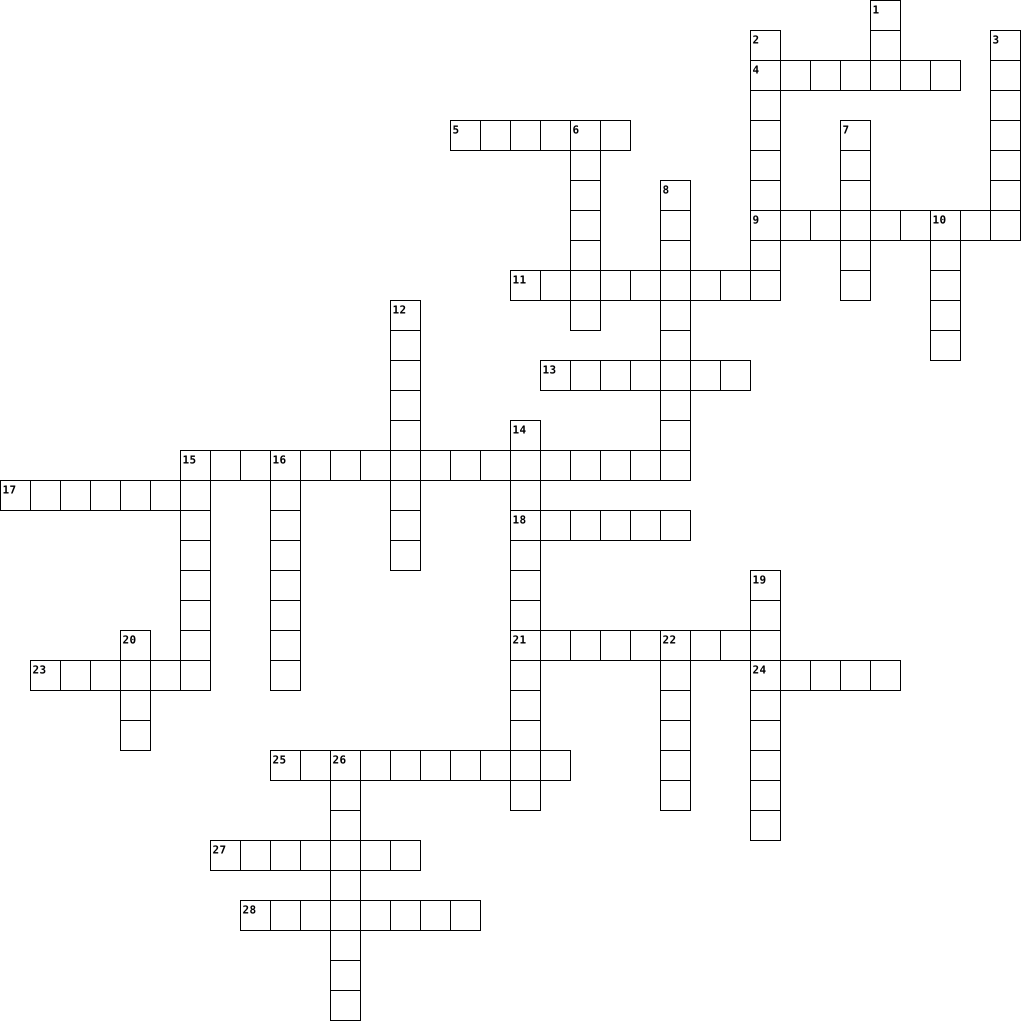
Across
- chemistry/ the chemistry of carbon compounds (other than simple salts such as carbonates, oxides, and carbides).
- A vertical column in a periodic table
- An element that is a poor conductor of electricity and does not form positive ions in a solution
- A substance or molecule that participates in a chemical reaction
- Has a definite volume, but no definite shape
- branch of chemistry that deals with the chemical action of electricity and the production of electricity by chemical reactions
- science/ the sciences involved in the study of the physical world and its phenomena
- Of State/ Liquid, solid, gas
- Property/ A Property that doesn't depend on pressure, temperature, or density.
- An element that is shiny and a good conductor of electricity
- The amount of matter
- Study of matter and how it changes
- Anything that takes up space
- Change/ A change of matter from one form to another without chemical Change (solid, liquid, gas)
Down
- organic Chemistry/ Study of non organics
- Made of two or more atoms
- A horizontal row in a periodic table
- A state of change starting from a gas then ionizing
- mass/number of mass
- An element that has properties of both a metal and nonmetal
- Smallest particle
- Study of the properties and changes of matter
- Study of substances
- Made up of atoms of one type
- Reaction/ The process by which one or more substances change to produce one or more substances
- Any substance that has a defined composition
- Has no definite volume or shape
- Has a definite volume and definite shape
- Property/ A property that depends on size.
29 Clues: Smallest particle • mass/number of mass • Study of substances • The amount of matter • Made of two or more atoms • Made up of atoms of one type • Of State/ Liquid, solid, gas • Anything that takes up space • Has no definite volume or shape • Study of matter and how it changes • A horizontal row in a periodic table • A vertical column in a periodic table • ...
Cycles 2014-12-02

Across
- All the organisms on Earth
- Ways that matter or energy is moved through a cycle
- Describes a change where energy is taken away - deposition, freezing, condensation
- Going directly from solid to gas
- The energy that drives all the water cycle.
- Reservoir that stores 2% of water on Earth as solid water
- Type of change that creates a new substance, a reaction occurs.
- Rain, hail, snow, sleet.
- The system that includes the Earth's crust, mantle, and core
- One of the processes that moves water from the biosphere to the atmosphere; evaporation from plants.
- When water falls on the crust and goes into the Earth
- The type of matter with the highest kinetic energy; particles fly freely.
- Change in size, shape or state.
- A state change; water to water vapor.
Down
- Places where matter or energy is stored in a cycle
- Gaseous state of water.
- Evaporation of water from animals.
- The system that protects the Earth; a layer of gases like a blanket.
- Process in plants that takes water from the atmosphere into the biosphere and uses it to create energy.
- Reservoir that stores the majority of water on Earth as salt water.
- Series of repeating events that move energy and/or matter through a system - no beginning or end
- Describes a change where energy is added - melting, sublimation, or evaporation.
- All the water on the planet.
- Process that forms clouds.
- Going directly from water vapor to solid, like frost.
- Water that has infiltrated the crust and is stored there.
- Drives the cycles.
- Solid state of water
- Water that falls on land and moves to reservoirs.
- The type of matter with the lowest kinetic energy; particles just vibrate in place.
- H2O
31 Clues: H2O • Drives the cycles. • Solid state of water • Gaseous state of water. • Rain, hail, snow, sleet. • All the organisms on Earth • Process that forms clouds. • All the water on the planet. • Change in size, shape or state. • Going directly from solid to gas • Evaporation of water from animals. • A state change; water to water vapor. • The energy that drives all the water cycle. • ...
Science Vocabulary 2014-11-30

Across
- a substance or object that does not allow energy to flow through it easily
- characteristics used to identify matter
- anything that has mass and takes up space
- a type of mixture in which the particles of one or more substances are uniformly dispersed (spread out) throughout another substance
- the ability of a substance to dissolve in another substance, such as sugar dissolving in water
- the temperature at which a substance changes from a liquid to a solid with the loss of heat for water this temperature is 0°C
- energy that is absorbed or delivered by an electric circuit
- floating or sinking when compared to water
- energy related to the temperature of an object or a substance
- the amount of matter in something
- the international scale of measurement for temperature
Down
- the temperature at which a substance changes from a liquid to a gas; for water this temperature is 100°C
- a substance or object that allows energy to flow through it easily
- a combination of two or more substances that can be easily separated in some physical way
- the temperature at which a substance changes from a solid to a liquid with the addition of heat for water this temperature is 0°C
- a way of measuring how hot or cold something is
- properties of matter that can be observed, measured, or changed without changing the matter itself
- the process by which substances breakdown into small pieces and spread evenly in liquid (water)
- the amount of space that a substance or object takes up
- a force of attraction that causes a magnetic material to move
20 Clues: the amount of matter in something • characteristics used to identify matter • anything that has mass and takes up space • floating or sinking when compared to water • a way of measuring how hot or cold something is • the international scale of measurement for temperature • the amount of space that a substance or object takes up • ...
Matter and mixtures - Topics 1-3 2016-02-29

Across
- Particles _____________ each other
- Type of matter where the particles are relatively close together
- Appear on the periodic table (oxygen, nitrogen, gold, etc)
- Each _________ substance has its own kind of particle, different from the particles of other pure substances
- Planetary model of the atom
- Center of the atom
- Process of decomposing a chemical compound by passing an electrical current through it.
- Workplace Hazardous Materials and Information System
- Type of mechanical mixture with fine particles evenly distributed through another substance (clouds)
- Plum pudding model of the atom
- Negatively charged particle in the atom cloud
- Type of matter where the particles are the furthest apart
- Type of mechanical mixture with large particles that will settle (charcoal in water)
- Uncharged particle in the atomic nucleus
- Positively charged particle in the atomic nucleus
Down
- Solid, liquid and gas; has a mass and a volume
- Effect produced when light scatters through a colloid
- Particles at a __________ temperature move faster on average than particles at a lower temperature
- Type of reaction where no new substance is produced
- Synonym for mechanical mixture
- Model of the atom currently used (Schrodinger and de Broglie)
- Solar system model of the atom
- All matter is made up of tiny __________
- Type of mechanical mixture with liquids dispersed through liquids (mayonnaise)
- Synonym for a solution
- Pure substances such as salt, sugar and water
- Substance that contains 2 or more pure substances
- Particles are always ______________
- Type of reaction where a new substance is produced
- Type of matter that has a defined shape and form
- Type of mechanical mixture such as granite
31 Clues: Center of the atom • Synonym for a solution • Planetary model of the atom • Synonym for mechanical mixture • Solar system model of the atom • Plum pudding model of the atom • Particles _____________ each other • Particles are always ______________ • All matter is made up of tiny __________ • Uncharged particle in the atomic nucleus • Type of mechanical mixture such as granite • ...
heet patel 2022-03-04

Across
- the amount of space that a substance or object
- principle states that when a force is applied to a confined fluid an increase in pressure is transmitted equally to all parts of the fluid
- is a chemical process where a solid turns into a gas without going through a liquid stage
- measure of the average
- change are changes a affecting the form of a chemical substance but not its chemical composition
- tension the uneven forces acting on the particles on the surface of a liquid
- energy of the individual
- the measure of the amount of matter in an object
- a push or pull
- the ability to cause change
- is any change at results in the formation of new chemical substances the molecular level, chemical l
- a liquid's resistance to flow
Down
- force upward force exerted on an object immersed in a fluid
- a force exerted on a surface divided by the total area over which the force is exerted
- energy the sum of the kinetic and potential energy of the particles in a materials
- mass of an object divided by its volume
- change of mater from a gas to a liquid state
- energy movement of thermal energy from a substance at a higher temperature
- principle states that the buoyant force on an object is equal to the weight of the fluid displaced by the object
- of a substance
- a small particle that makes up most types of matter
- matter with a definite shape and volume has tightly packed particles that move mainly by vibrating
- change of matter from a liquid state a solid state
- any thing that takes up space and mass
24 Clues: of a substance • a push or pull • measure of the average • energy of the individual • the ability to cause change • a liquid's resistance to flow • any thing that takes up space and mass • mass of an object divided by its volume • change of mater from a gas to a liquid state • the amount of space that a substance or object • the measure of the amount of matter in an object • ...
Observing Chemical Change 2022-03-18

Across
- A rapid reaction between oxygen and a substance called fuel
- reaction in which energy is absorbed.
- Matter can enter from or escape to the surroundings.
- A material used to decrease the rate of a reaction.
- in front of chemical formula in an equation.
- in your body contain biological catalysts.
- Substances you have at the
- material that increases the rate of a reaction by lowering the activation energy
- One element replaces another in a compound or when two elements in different compounds trade places.
- reaction, using symbols instead of words.
- A solid that forms from solution during a chemical reaction
- A short,easy way to show a
- Characteristics of a substance that describes its ability to change into other substances.
- Matter is not allowed to enter or leave.
- that has mass and takes up space.
- A characteristic of a substance that can be observed without changing the substance
Down
- reaction that releases energy in the for of heat.
- Material that releases energy when it burns.
- Minimum amount of energy needed to start a chemical reaction
- When the reaction is complete, you have a new substance
- A change that alters the form or appearance of a substance but that does not make the substance into another substance.
- Amount of a substance in a given volume
- A Principle
- A change in matter that produces one or more new substances is a chemical change.
- in contrast to a synthesis reaction.
- The study of matter and how matter changes.
- When two or more elements or compounds combine to make a more complex substance.
27 Clues: A Principle • Substances you have at the • A short,easy way to show a • that has mass and takes up space. • in contrast to a synthesis reaction. • reaction in which energy is absorbed. • Amount of a substance in a given volume • Matter is not allowed to enter or leave. • reaction, using symbols instead of words. • in your body contain biological catalysts. • ...
chemistry 2 2025-09-30

Across
- unit calculated by dividing Mass by volume D=m/v
- Mixture- particles are evenly distributed throughout lemonade
- only I kind of molecule
- Process where 2 or more substances bond and change to form a new substance
- the smallest piece of a pure substance (Compound) you can have.
- Law of __________The exact mass that goes into a chemical reaction must come out in its products
- Smallest unit of a compound
- a substances ability to burn
- theory of matter- theory that matter comes in large strands that Cannot be broken down into smaller pieces.
- insulators, do not conduct electricity.
- smallest piece that is made of one kind of Atom
- of matter solid liquid or gas l
Down
- of Elements When elements are put in order by their atomic number or mass properties of the elements Repeat.
- 2 or more substances that keep their own properties
- (how easily do heat & electricity move through the substance
- of Definite proportions - Atoms bond in specific ratios to make Specific compounds. In specific ratios
- ability to berd and change shape without shattering.
- theory matter Democritus 400BC said matter Could be broken down into smaller bits but eventually you would get a small piece that couldn't be broken any further..
- is the Smallest unit of an element
- Mixture particles of different things are visible Salad
- 2 or more elements bonded to create a new substance.
- 2 or more atoms bonded to make Something new Water H₂O Salt Wall
- - metals on zig zag Semiconductors
- the ability to bond with other atoms
- resistance to flow (thickness)
- transmit heat & electricity easily., Malleability,
- I kind of atom
- - the smallest piece of a pure element youCan have
- Scale of which substances Scratch Other substances.
29 Clues: I kind of atom • only I kind of molecule • Smallest unit of a compound • a substances ability to burn • resistance to flow (thickness) • of matter solid liquid or gas l • is the Smallest unit of an element • - metals on zig zag Semiconductors • the ability to bond with other atoms • insulators, do not conduct electricity. • smallest piece that is made of one kind of Atom • ...
ENVIRONMENTAL VALUE SYSTEMS CROSSWORD 2023-10-03

Across
- The laws of ___ explain the rules that energy flows in a system.
- This type of feedback promotes stability in a system as it reverses the change and returns the system to the original state of equilibrium.
- An animal that kills other animals for food.
- The yield from Natural Capital.
- Everything around that affects our opinions, the decisions we make and how we live our lives.
- The management of resources that allows for replacement.
- a set of interrelated parts and the connection between them that unites them to form a complex whole and produces emergent properties.
- The ability of the ecosystem to recover after a disturbance.
- An insecticide used in agriculture. Main example of POP.
- move energy and matter but in the process of doing so there is a change of state or form.
- It cannot be created nor destroyed.
- 2nd Word: The amount of land and water required to support a human population at a given standard of living.
- simply move energy or matter from one place to another without changing it in anyway.
- The ability of an ecosystem to remain in balance.
- The increase in disorder and randomness in a system.
Down
- People-centered approach
- Type of pollutant which does not break down easily.
- An ___ system exchanges neither energy nor matter with its surroundings.
- Technology will keep pace with and provide solutions to all problems.
- Nature-centered holistic view EVS
- Natural ___ is natural resources that produce sustainable natural income of goods and services.
- A thing that indicates the state or level of something.
- An animal that is caught and killed by another for food.
- An ___ system exchanges matter and energy with its surroundings.
- A ___ system exchanges energy but does not exchange matter with its surroundings.
25 Clues: People-centered approach • The yield from Natural Capital. • Nature-centered holistic view EVS • It cannot be created nor destroyed. • An animal that kills other animals for food. • The ability of an ecosystem to remain in balance. • Type of pollutant which does not break down easily. • The increase in disorder and randomness in a system. • ...
Science Review 2024-10-03

Across
- Superheated matter that is so hot that the electrons are ripped away from the atoms forming an ionized gas
- A mixture where the particles mixed therein stay mixed, but aren't fully homogeneous
- An element or compound made up of one type of particle
- The amount of substance in a defined space
- The process where water vapor becomes liquid
- An object that is described by volume, density and mass
- A physical combination of two or more substances that aren't chemically joined
- A type of heterogeneous mixture where solid particles do not dissolve in a liquid solution
- A solution that contains more than the maximum amount of solute that is capable of being dissolved at a given temperature
Down
- A mixture in which the composition is not uniform throughout the mixture
- A state of matter that keeps its shape and density when not confined
- A substance that dissolves in a solution
- Anything that takes up space and can be weighed
- A homogeneous mixture of two or more substances
- Color of Danger
- A substance that is in a gaseous, or vaporous, state of matter
- A substance is soluble if it dissolves in certain fluids
- A list of dangerous hazardous materials
- One whose composition is uniform throughout the mixture
- The process where a solute in a gaseous, liquid, or solid phase dissolves in a solvent to form a solution
- Color of Warning
- A type of matter with specific properties that make it less rigid than a solid but more rigid than a gas
- The phase transition in which gas transforms into solid without passing through the liquid phase
- Color of Caution
- A substance that dissolves a solute, resulting in a solution
25 Clues: Color of Danger • Color of Warning • Color of Caution • A list of dangerous hazardous materials • A substance that dissolves in a solution • The amount of substance in a defined space • The process where water vapor becomes liquid • Anything that takes up space and can be weighed • A homogeneous mixture of two or more substances • ...
Chem Puzzle!! 2026-06-08

Across
- Something changing from a gas to a liquid
- A State of matter that has an indefinite shape, but definite volume
- The change of a substance from solid to vapor without passing through the liquid state
- to 28 liters so that the new pressure is 12 atm. What is the initial pressure of the container?
- Something changing from a liquid to a gas
- The name for when something is in all three states of matter (2 words)
- A container starts with a pressure of 2.1 atm and 30 liters with a constant temperature of 237K, the volume is decreased so that the new pressure is 4.2 atm. What is the final volume of the container?
- Amount of solute the dissolves in a given amount of solvent at a specific temperature and pressure.
- The tendency of molecules to move toward areas of lower concentration until the concentration is uniform
- A solution where water is the solvent (2 words)
Down
- A measure of how much the volume of matter decreases under a certain amount of pressure
- A state of matter that has a definite shape
- The temperature at which a solid becomes a liquid (2 words)
- Something going from a gas to a solid
- The tension on the surface of a water drop (2 words)
- A state of matter that Moves freely
- When particles having enough anergy to be free and become a gas
- The ability for something to be drawn into wires
- A container starts with a pressure volume of 42 liters with a constant temperature of 248K, the volume is
- The dissolved particles (usually ions)
- The ability for something to be hammered or pressed into shapes
21 Clues: A state of matter that Moves freely • Something going from a gas to a solid • The dissolved particles (usually ions) • Something changing from a gas to a liquid • Something changing from a liquid to a gas • A state of matter that has a definite shape • A solution where water is the solvent (2 words) • The ability for something to be drawn into wires • ...
Vocabulary Terms for Matter and Its Properties Crossword Puzzle 2012-09-20

Across
- the state in which a substance has no tendency to flow under moderate stress; resists forces (such as compression) that tend to deform it; and retains a definite size and shape.
- Physical substance in general, as distinct from mind and spirit; (in physics) that which occupies space and possesses rest mass, esp. as distinct from energy.
- The basic unit of a chemical element.
- A fourth state of matter distinct from solid or liquid or gas and present in stars and fusion reactors.
- 1.A process that involves rearrangement of the molecular or ionic structure of a substance, as opposed to a change in physical form or a nuclear reaction.
- A coherent, typically large body of matter with no definite shape.
- A chemical substance formed as a result of a chemical reaction.
- Any property used to characterize matter and energy and their interactions.
- A property used to characterize materials in reactions that change their identity.
- A fluid in the gaseous state having neither independent shape nor volume and being able to expand indefinitely.
- A property that does not depend on the size of the sample. Melting points, boiling points, color, conductivity, and density are examples.
- All of the same or similar kind or nature.
Down
- A change in matter in which no new type of matter is produced; for example, freezing, melting, and boiling
- Chemical species that is formed when two or more atoms join together chemically, with covalent or ionic bonds.
- To change into either a solid, liquid or a gas.
- A property which increases in proportion with the amount of material considered.
- Bonds are broken and new bonds are formed between different atoms.
- A substance that takes part in and undergoes change during a reaction.
- A substance consisting of two or more substances mixed together (not in fixed proportions and not with chemical bonding)
- The state in which a substance exhibits a characteristic readiness to flow with little or no tendency to disperse and relatively high incompressibility.
20 Clues: The basic unit of a chemical element. • All of the same or similar kind or nature. • To change into either a solid, liquid or a gas. • A chemical substance formed as a result of a chemical reaction. • Bonds are broken and new bonds are formed between different atoms. • A coherent, typically large body of matter with no definite shape. • ...
Chapter 2 Terms 2022-03-21

Across
- the minimum amount of energy needed to get a chemical reaction started
- the process in which substances undergo chemical changes that result in the formation of new substances
- a chemical reaction that breaks down compounds into simpler products
- a substance formed as a result of a chemical reaction
- a system in which no matter is allowed to enter or leave
- a material that decreases the rate of a reaction
- a short and easy way to show a chemical reaction using symbols
- a rapid reaction between oxygen and fuel that results in fire
- a characteristic of a substance that can be observed without changing the substance into another substance
- a solid that forms from a solution during a chemical reaction
- the amount of one material in a certain volume of another material
- a material that releases energy when it burns
- a change that alters the form or appearance of a material but does not make the material into another substance
Down
- a number in front of a chemical formula in an equation that indicates how many molecules or atoms of each reactant and product are involved in a reaction
- a reaction in which one element replaces another in a compound or when two elements in different compounds trade places
- a reaction that releases energy in the form of heat
- anything that has mass and occupies space
- a system in which matter can enter from or escape to the surroundings
- a characteristic of a substance describes its ability to change into different substances
- a substance that enters into a chemical reaction
- the principle stating that matter is not created or destroyed during a chemical reaction
- a chemical reaction in which two or more simple substances combine to form a new more complex substance
- the study of the properties of matter and how matter changes
- a reaction that absorbs energy in the form of heat
- a material that increases the rate of a reaction by lowering the activation energy
- a biological catalyst that lowers the activation energy of reactions in cells
26 Clues: anything that has mass and occupies space • a material that releases energy when it burns • a substance that enters into a chemical reaction • a material that decreases the rate of a reaction • a reaction that absorbs energy in the form of heat • a reaction that releases energy in the form of heat • a substance formed as a result of a chemical reaction • ...
Chapter 2 Key Terms 2022-03-18

Across
- A chemical reaction in which two or more simple substances combine to form a new, more complex substance.
- A reaction in which one element replaces another in a compound or when two elements in different compounds trade places.
- The amount of one material in a certain volume of another material.
- A solid that forms from a solution during a chemical reaction,
- The study of the properties of matter and how matter changes.
- A biological catalyst that lowers the activation energy of reactions in cells.
- The principle stating that matter is not created or destroyed during a chemical reaction.
- A material that releases energy when it burns.
- A material that decreases the rate of a reaction
- A short, easy way to show a chemical reaction, using symbols.
- A substance formed as a result of a chemical reaction
- The minimum amount of energy needed to get a chemical reaction started.
- A change that alters the form or appearance of a material but does not make the material into another substance.
Down
- The process in which substances undergo chemical changes that result in the formation of new substances.
- A characteristic of a substance that can be observed without changing the substance into another substance.
- A characteristic of a substance that describes its ability to change into different substances.
- A system in which no matter is allowed to enter or leave.
- A number in front of a chemical formula in an equation that indicates how many molecules or atoms of each reactant and product are involved in a reaction.
- A material that increases the rate of a reaction by lowering the activation energy.
- A reaction that releases energy in the form of heat.
- Anything that has mass and occupies space.
- A rapid reaction between oxygen and fuel that results in fire.
- A chemical reaction that breaks down compounds into simpler products.
- A system in which matter can enter from or escape to the surroundings.
- A substance that enters into a chemical reaction.
- A reaction that absorbs energy in the form of heat.
26 Clues: Anything that has mass and occupies space. • A material that releases energy when it burns. • A material that decreases the rate of a reaction • A substance that enters into a chemical reaction. • A reaction that absorbs energy in the form of heat. • A reaction that releases energy in the form of heat. • A substance formed as a result of a chemical reaction • ...
A on Packet 2022-05-20

Across
- a property of matter by which it continues in its existing state of rest or uniform motion in a straight line, unless that state is changed by an external force.
- largest and most volatile telescope
- a supposition or a system of ideas intended to explain something, especially one based on general principles independent of the thing to be explained.
- last name of the author
- a minute portion of matter.
- elementary particle and a fundamental constituent of matter.
- boundless four dimensional continuum
- the universal force of attraction acting between all matter
- First to view a microorganism
- determined that the laws of physics are the same for all non accelerating observers
- relating to or based on mental concepts.
- thermal energy transferred between two systems at different temperatures that come in contact
- a scientific test which is done in order to discover what happens to something in particular conditions
- theoretical physicist, created theory of relativity
- anything that has mass and takes up space
Down
- Newtons second law
- a region of space having a gravitational field so intense that no matter or radiation can escape.
- the study of the relations between heat, work, temperature, and energy
- a form of energy that an object or a particle has by reason of its motion
- a system of millions or billions of stars, together with gas and dust, held together by gravitational attraction.
- speculative structure linking disparate points in spacetime
- a seemingly absurd or self contradictory statement or proposition that when investigated or explained may prove to be well founded or true.
- created theory of evolution
- minimum amount of any physical entity involved in an interaction.
- first name of the author
- one of the greatest mathematicians and physicists of all time and among the most influential scientists and created the three laws of motion
- the progression of events from the past to the present into the future
- an influence that can change the motion of an object
- the capacity for doing work
- penetrating form of electromagnetic radiation
30 Clues: Newtons second law • last name of the author • first name of the author • a minute portion of matter. • created theory of evolution • the capacity for doing work • First to view a microorganism • largest and most volatile telescope • boundless four dimensional continuum • relating to or based on mental concepts. • anything that has mass and takes up space • ...
Chemisty Crossword 2022-08-31

Across
- a state of matter that retains its shape and density when not confined
- a sample of matter that conforms to the shape of a container in which it is held, and which acquires a defined surface in the presence of gravity
- the condition of being protected from or unlikely to cause danger, risk, or injury
- a sample of matter that conforms to the shape of a container in which it is held and acquires a uniform density inside the container, even in the presence of gravity and regardless of the amount of substance in the container
- any substance that cannot be decomposed into simpler substances by ordinary chemical processes
- a substance made from two or more different elements that have been chemically joined
- a mixture in which the composition is uniform throughout the mixture
- a form of matter in which many of the electrons wander around freely among the nuclei of the atoms
- two or more different substances are physically mixed, but NOT chemically combined.
- the science that deals with the properties, composition, and structure of substances
- separating a liquid from another liquid where both have different boiling points
- separating components of a liquid mixture based on how fast the parts travel up a special paper
- separating a liquid from a solid that has been dissolved
- a mixture in which the composition is not uniform throughout the mixture
Down
- separating components of a mixture based on the difference in density of the parts of the mixture
- he amount of space an object takes up
- a compound or substance that has been purified or prepared, especially artificially
- knowledge or perception of a situation or fact
- the smallest unit of an element that has the same chemical properties of that element
- the smallest unit of an element OR a compound
- a measure of the amount of matter an object has
- anything that has mass and takes up space
- separating larger solids from smaller solids using a sieve
- separating smaller solids from liquids using filter paper
- a particle is a small localized object to which can be ascribed several physical or chemical properties
25 Clues: he amount of space an object takes up • anything that has mass and takes up space • the smallest unit of an element OR a compound • knowledge or perception of a situation or fact • a measure of the amount of matter an object has • separating a liquid from a solid that has been dissolved • separating smaller solids from liquids using filter paper • ...
Chapter 2-3 words 2024-02-14

Across
- property the ability to produce a change in the composition of matter
- the phase change in which a substance changes from a solid directly to a gas without changing to a liquid first
- the state of matter that has a definite shape and definite volume
- a homogeneous mixture that is transparent and forms when substances dissolve
- the state of matter that has neither a definite shape nor a definite volume
- the phase change from a gas to a liquid
- change a reversible physical change that occurs when a substance changes from one state of matter to another
- change change that occurs when a substance reacts and forms one or more new substances
- Substance matter that always has exactly the same composition; an element or compound
- the ability of a solid to be flattened without shattering
- a material’s ability to allow heat or electric charges to flow
- a change in which a system absorbs energy from its surroundings
- the process that changes a substance from a liquid to a gas at temperatures below the substance’s boiling point
- the smallest particle of an element
Down
- a material’s ability to burn in the presence of oxygen
- the phase change in which a substance changes from a liquid into a gas or vapor
- the phase change in which a gas changes directly into a solid without first changing into a liquid
- property any characteristic of a material that can be observed or measured without changing the composition of the substance
- a change in which a system releases energy to its surroundings
- a heterogeneous mixture that separates into layers over time
- a process that separates materials based on the size of their particles
- mixture a type of mixture in which the substances are evenly distributed and it looks like a single substance
- change a change that occurs when some properties of a material change, but the substances in the material stay the same
- a homogeneous mixture that is opaque
- a substance that is made from two or more simpler substances that are chemically combined in a specific ratio
- the state of matter in that has a definite volume but not a definite shape
- a substance that cannot be broken down into simpler substances
- mixture a type of mixture in which the parts of the mixture are noticeably different from one another
28 Clues: the smallest particle of an element • a homogeneous mixture that is opaque • the phase change from a gas to a liquid • a material’s ability to burn in the presence of oxygen • the ability of a solid to be flattened without shattering • a heterogeneous mixture that separates into layers over time • a change in which a system releases energy to its surroundings • ...
Chemistry Crossword 2020-06-05

Across
- " " Change, occurs when the internal make-up of matter stays the same.
- macroscopic, and particulate phenomena in chemical systems
- amount of space occupied by a substance
- study of the structure, properties, composition, reactions and preparation of carbon-containing compounds
- simplest form of matter
- Physical " "
- liquid to gas
- SI basic unit of temperature
- science of obtaining, processing, and communicating information about the composition and structure of matter
- another word for freezing
- separating the components of a suspension
- composed of two or more substances
- exhibits the Tyndall Effect
- the liquid that passes through the strainer
- anything that has mass and occupies space
- " " Analysis
- another word for "Extensive" Property
- branch of science that explores the chemical processes within and related to living organisms
- separating a homogenous mixture composed of two substances
- gas to solid
- takes shape of the container, not definite
- concerned with the properties and behavior of inorganic compounds, which include metals, minerals, and organometallic compounds
- composition varies from one position to another
- old term of melting, solid to liquid
Down
- the study of matter
- mixture, uniform in composition
- used in Magnetic Separation
- the liquid poured into another container during decantation
- a mixture is poured into a centrifuge apparatus
- " " Property, ability of a substance to react with other substances
- quantity of matter in the object
- solid particles are allowed to settle at the bottom
- definite shape and volume
- consists of coarse particles that are visible to the naked eye.
- separation is dependent upon the solubility of each component in the solvent
- " " Figures
- another word for "Intrinsic" Property
- liquid to solid
- consistency of a result
- tells how hot or cold an object is
- ratio of the mass of an object to the volume it occupies
- solid to liquid
- " " Notation
- determined when a certain quantitative value is relatively close to the "true" value
- takes shape of the container, definite
- solid to gas
- Chemical " "
- the substance which remains in the strainer
- formed from reaction of elements
- gas to liquid
50 Clues: solid to gas • gas to solid • liquid to gas • gas to liquid • " " Figures • liquid to solid • solid to liquid • Physical " " • " " Analysis • " " Notation • Chemical " " • the study of matter • simplest form of matter • consistency of a result • definite shape and volume • another word for freezing • used in Magnetic Separation • exhibits the Tyndall Effect • ...
Physics Crossword 2024-05-20

Across
- steam of geysers is used to spin turbines with generate electricity
- the difference in electric potential energy between two points
- energy stored in chemical bonds
- this state of matter has definite volume and definite shape
- this type of chance a new substance is created and requires the breaking of bonds
- turbines that are placed in the path of a river to generate electricity
- the Greek word meaning natural
- the force of postively and negatively charged particles that attract or repel each other
- resources that are limited and cannot be replaced by natural means within a lifetime
- the movement of thermal energy
- this Law of physics states that energy cannot be created nor destroyed
- this type of change may affect texture, shape, size and state of matter
- energy carried by sound waves
- resources that are inexhaustible and can be replaced by natural means
- these are nonrewable resources
- a complete one of these consists of an energy source, pathway, and load
- electricity generated by wind turbines
Down
- father of modern physics
- the energy of motion
- this type of energy is composed of kinetic and potential energies
- the amount of space ocupied by an object or substance
- the force exerted on mass by gravity
- the flow of electrical current that produces a magnetic field, discovered by Oersted
- this occurs when a force causes the displacement of an object
- heat energy
- a Greek mathematician, physicist, and inventor
- this is measured in amperes
- energy stored in an object because of its state
- how much matter an object contains
- this state of matter has no definite volume and no definite shape
- the force opposite of gravity in Archimedes principle
- electricity derived from the sun's light
- this law states that voltage is the product of current and resistance
- the science of matter and its energy
- the amount of mass per volume
- the ability to do work
- energy carried by light particles and vibrations
- this state of matter has definite volume but no definite shape
38 Clues: heat energy • the energy of motion • the ability to do work • father of modern physics • this is measured in amperes • energy carried by sound waves • the amount of mass per volume • the Greek word meaning natural • the movement of thermal energy • these are nonrewable resources • energy stored in chemical bonds • how much matter an object contains • ...
Puzzle 8: Matter, Light & Shadows 2026-05-27

Across
- An opaque object forms a dark region on the wall because it will completely ___.
- A marble retains its form when moved from a box to a cup because it has a ___.
- Why can more air be pumped into a basketball? Because gases can be forced to ___.
- Air inside a balloon can expand to fill a larger room because gases have an ___.
- The amount of space that an object occupies.
- We can see non-luminous objects because they ___ light from a lamp into our eyes.
- This type of material allows most light to pass through it clearly.
- To make a shadow on the screen larger, a student should decrease the object's ___.
- A stone dropped in a beaker pushes water up, showing a method of measuring volume by ___.
- Moving an object closer to a torch will cause a dramatic change in the ___.
- This type of material does not allow any light to pass through it.
- This type of material allows only some light to pass through it.
Down
- Clear glass allows a shadow to disappear because it lets all ___.
- An object that emits or produces its own light, such as the Sun or a lit torch.
- This state of matter has a definite volume but no definite shape.
- Syringes filled with water cannot be pushed in because liquids have a ___.
- A dark area formed on a screen when light is completely or partially blocked by an object.
- Why does water level rise when a stone is dropped inside? Because matter must ___.
- This state of matter has a definite shape and a definite volume.
- A liquid takes the shape of its container because it has an ___.
- To make a shadow on the wall smaller, a student should decrease the object's ___.
- Anything that has mass and occupies space.
- The amount of matter in an object, measured in grams or kilograms.
- Light from a torch travels in ___ to form sharp shadows of objects.
- This state of matter has no definite shape and no definite volume.
- Light behaves like a ball hitting a wall when it hits a mirror and begins to ___ off.
26 Clues: Anything that has mass and occupies space. • The amount of space that an object occupies. • This state of matter has a definite shape and a definite volume. • A liquid takes the shape of its container because it has an ___. • This type of material allows only some light to pass through it. • Clear glass allows a shadow to disappear because it lets all ___. • ...
Puzzle 8: Matter, Light & Shadows 2026-05-27

Across
- This state of matter has a definite shape and a definite volume.
- This state of matter has a definite volume but no definite shape.
- Anything that has mass and occupies space.
- This type of material allows most light to pass through it clearly.
- To make a shadow on the screen larger, a student should decrease the object's ___.
- An object that emits or produces its own light, such as the Sun or a lit torch.
- Moving an object closer to a torch will cause a dramatic change in the ___.
- Light behaves like a ball hitting a wall when it hits a mirror and begins to ___ off.
- A stone dropped in a beaker pushes water up, showing a method of measuring volume by ___.
- Syringes filled with water cannot be pushed in because liquids have a ___.
- The amount of space that an object occupies.
- Clear glass allows a shadow to disappear because it lets all ___.
- Why can more air be pumped into a basketball? Because gases can be forced to ___.
Down
- Light from a torch travels in ___ to form sharp shadows of objects.
- We can see non-luminous objects because they ___ light from a lamp into our eyes.
- This type of material allows only some light to pass through it.
- To make a shadow on the wall smaller, a student should decrease the object's ___.
- A dark area formed on a screen when light is completely or partially blocked by an object.
- A liquid takes the shape of its container because it has an ___.
- This state of matter has no definite shape and no definite volume.
- Air inside a balloon can expand to fill a larger room because gases have an ___.
- This type of material does not allow any light to pass through it.
- A marble retains its form when moved from a box to a cup because it has a ___.
- Why does water level rise when a stone is dropped inside? Because matter must ___.
- An opaque object forms a dark region on the wall because it will completely ___.
- The amount of matter in an object, measured in grams or kilograms.
26 Clues: Anything that has mass and occupies space. • The amount of space that an object occupies. • This state of matter has a definite shape and a definite volume. • This type of material allows only some light to pass through it. • A liquid takes the shape of its container because it has an ___. • This state of matter has a definite volume but no definite shape. • ...
Chapter 2 Crossword 2021-09-15

Across
- the strength and vitality required for sustained physical or mental activity.
- the branch of physical science that deals with the relations between heat and other forms of energy (such as mechanical, electrical, or chemical energy), and, by extension, of the relationships between all forms of energy.
- the transition of a substance directly from the solid to the gas state, without passing through the liquid state
- changes affecting the form of a chemical substance, but not its chemical composition
- A chemical substance is a form of matter having constant chemical composition and characteristic properties
- the action of bringing a liquid to the temperature at which it bubbles and turns to vapor.
- an element or compound is a phase transition from the liquid phase to vapor
- activity involving mental or physical effort done in order to achieve a purpose or result.
- the amount of space that a substance or object occupies, or that is enclosed within a container, especially when great.
- below 32°F (0°C).
- a coherent, typically large body of matter with no definite shape.
- the process of turning from liquid into vapor.
- a substance made by mixing other substances together.
- In physics, a state of matter is one of the distinct forms in which matter can exist. Four states of matter are observable in everyday life: solid, liquid, gas, and plasma.
- the laying down of sediment carried by wind, flowing water, the sea or ice.
- a substance or matter in a state in which it will expand freely to fill the whole of a container, having no fixed shape (unlike a solid) and no fixed volume (unlike a liquid).
Down
- occur when a substance combines with another to form a new substance, called chemical synthesis or, alternatively, chemical decomposition into two or more different substances.
- a body's relative mass or the quantity of matter contained by it, giving rise to a downward force; the heaviness of a person or thing.
- is a physical quantity that expresses hot and cold
- occur when the nuclei of atoms are rearranged to form new atoms.
- a group of atoms bonded together, representing the smallest fundamental unit of a chemical compound that can take part in a chemical reaction.
- a thing that is composed of two or more separate elements; a mixture.
- the colorless fluid part of blood, lymph, or milk, in which corpuscles or fat globules are suspended.
- physical substance in general, as distinct from mind and spirit; (in physics) that which occupies space and possesses rest mass, especially as distinct from energy.
- a substance that flows freely but is of constant volume, having a consistency like that of water or oil.
- strength or energy as an attribute of physical action or movement.
- an atom or molecule with a net electric charge due to the loss or gain of one or more electrons.
- each of more than one hundred substances that cannot be chemically interconverted or broken down into simpler substances and are primary constituents of matter.
- the force that attracts a body toward the center of the earth, or toward any other physical body having mass.
- is one of the four fundamental states of matter. The molecules in a solid are closely packed together and contain the least amount of kinetic energy.
- water which collects as droplets on a cold surface when humid air is in contact with it.
- the basic unit of a chemical element.
- becoming liquefied by heat.
33 Clues: below 32°F (0°C). • becoming liquefied by heat. • the basic unit of a chemical element. • the process of turning from liquid into vapor. • is a physical quantity that expresses hot and cold • a substance made by mixing other substances together. • occur when the nuclei of atoms are rearranged to form new atoms. • ...
Unit 1 2023-01-24

Across
- Information obtained from the senses
- Mixture with a uniform composition
- well-tested explanation for a broad set of observations
- Measure of how much close a measurement comes to the actual or true value
- is the study of processes that occur inside living organisms
- A visual way of displaying information or data
- Simplest form of matter that has a unique set of properties
Down
- Tells how many of each type of element are in a compound
- Ratio of the mass of an object to its volume
- proposed explanation for an observation
- Chemistry Study of chemicals containing carbon
- Separates two or more liquids with different boiling points
- Change A change that produces matter with a different composition that the original matter
- Anything that has mass and takes up space
14 Clues: Mixture with a uniform composition • Information obtained from the senses • proposed explanation for an observation • Anything that has mass and takes up space • Ratio of the mass of an object to its volume • A visual way of displaying information or data • Chemistry Study of chemicals containing carbon • well-tested explanation for a broad set of observations • ...
The Properties of Matter 2024-01-08

Across
- a tool used to measure liquids and powders.
- have a definite volume but not a definite shape.
- an instrument used to measure temperature.
- a measurable physical property described as the amount of matter in an object.
- a type of scale used to measure the mass of solids.
Down
- anything that has mass and volume.
- have a definite shape and volume.
- the amount of space an object takes up.
- a property that is any measurable or observable attribute that describes matter.
- an example of a physical property that can be observed with your eyes.
- have no definite volume or shape.
- the measure of heat energy within a substance.
- the metric unit for mass.
- another physical property that can describe matter, such as smooth, rough, hard grainy or soft.
14 Clues: the metric unit for mass. • have a definite shape and volume. • have no definite volume or shape. • anything that has mass and volume. • the amount of space an object takes up. • an instrument used to measure temperature. • a tool used to measure liquids and powders. • the measure of heat energy within a substance. • have a definite volume but not a definite shape. • ...
Physical Science Introduction 2023-08-16

Across
- science that is the study of matter, energy, and the changes they undergo
- variable that is expected to change and measured in response to manipulated variable
- way of learning about the natural world by gathering information
- description that doesn't use numbers or measurements
- well-tested explanation for a wide range of observations or experimental results
- a testable explanation of a natural phenomena
- observation that is a measurement
Down
- factor that can change an experiment
- study of matter and energy and how they interact
- statement that describes what scientists expect to happen every time under a particular set of conditions
- when you explain an observation you gathered
- variable that is changed
- study of properties of matter and how matter changes
- using one or more senses to gather information
14 Clues: variable that is changed • observation that is a measurement • factor that can change an experiment • when you explain an observation you gathered • a testable explanation of a natural phenomena • using one or more senses to gather information • study of matter and energy and how they interact • study of properties of matter and how matter changes • ...
SCIENCE 8 - QUIZ 1 2024-01-24

Across
- It is anything that takes up space and has mass.
- It is the change of a gaseous state of matter to its liquid state.
- It is the change of a solid state of matter to its gaseous state.
- The particles of this state slide past one another and assumes the shape of its container.
- It is the change of a solid state of matter to liquid.
Down
- It is the change of a liquid state of matter to its solid state.
- It is the change of a liquid state of matter to its gaseous state.
- It is the change of a gaseous state of matter to its solid state.
- The particles of this state freely float due to its kinetic energy.
- The particles of this state are tightly packed and vibrate in their place.
10 Clues: It is anything that takes up space and has mass. • It is the change of a solid state of matter to liquid. • It is the change of a liquid state of matter to its solid state. • It is the change of a gaseous state of matter to its solid state. • It is the change of a solid state of matter to its gaseous state. • ...
chemistry vocab 2025-04-24

Across
- energy-releasing," "exoergic
- general descriptors
- atom compound periodic table
- attractive force, sticking together,
- decomposition combination and exchange
- stuff that takes up space
- atom bond
- property "color," "density,
- amount of matter
- nucleus electrons protons and neutrons
Down
- cubic centimeters and "milliliters
- solution, suspension, alloy
- enthalpy
- reactions or changes
- active selective
- linkage, attraction, and connection
- calorimetry, specific heat
- change melting, freezing, boiling,
18 Clues: enthalpy • atom bond • active selective • amount of matter • general descriptors • reactions or changes • stuff that takes up space • calorimetry, specific heat • solution, suspension, alloy • energy-releasing," "exoergic • atom compound periodic table • property "color," "density, • cubic centimeters and "milliliters • linkage, attraction, and connection • ...
3rd Quarter Test 2020-05-28

Across
- What kind of atom that have a different number of neutrons, but are otherwise the same?
- What part of atom that have a negative charge?
- What kind of properties that must lead to a change in the substance’s structure?
- What simplest form of matter that has composed of only one kind of atom?
- When Protons and Neutrons combine is called what?
- When complete loss the electron from an atomic or molecular species is called?
- What element that exhibits some properties of metals and some non-metals?
- What kind of chemical compound that contains carbon?
- What kind of mixture that has to compose of a solute or dissolved substance and solvent for dissolving medium?
- What kind of mixture whose composition varies from one position to another within the sample?
- That group of two or more atoms that form the smallest identifiable unit into which a pure substance can be divided and still retain the composition and chemical properties of that substance called?
- what kind of chemistry study that matter and the development of tools to measure properties of matter?
- That contains two or more kinds of atom is called?
- What matter that adapts to the shape of its container but varies only slightly in volume?
- What matter that expands to occupy the volume and shape of its container?
- What kind of heterogeneous mixture that contains solid particles sufficiently large for sedimentation?
- That composed of two or more substances combined physically in variable proportions is called what?
- When solid turns to liquid, this called what?
- When measure an object or substance to tell if hot or cold is called what?
- When matter that has definite composition and distinct properties called?
- When gas turns to liquid, this called what?
- That tabular arrangement of the chemical elements by increasing atomic number which displays the elements called?
- That science that deals with the composition, structure, and properties of substances and with the transformations that they undergo is called?
- What elements that readily forms positive ions (cations) and has metallic bonds?
- What kind of chemistry study that applies physics and commonly includes the applications of thermodynamics and quantum mechanics to chemistry?
- That number digits have carry meaning in a number and contribute to its precision is called? Mass When measure of the amount of matter in a substance or object is called what?
Down
- What matter that have many electrons wander around freely among the nuclei of the atoms?
- When property referring to the ability for a given substance, the solute, to dissolve in a solvent is called?
- When liquid turns to solid, this called what?
- The mass of a substance per unit volume is called?
- What part of atom that have a positive charge?
- What chemical reaction that is accompanied by the absorption of heat?
- When liquid turns to gas, this called what?
- What kind of heterogeneous mixture that substance is dissolved or scattered and disappearing medium?
- What chemical reaction that is accompanied by the releases energy through light or heat?
- When solid turns to gas, this called what?
- Who discovered the oxygen?
- When gas turns to solid, this called what?
- What the amount of space occupied by a substance?
- That elements have odorless, colorless, monatomic gases with very low chemical reactivity is called what?
- What matter that maintains a fixed volume and shape?
- What element that doesn’t have the characteristics of metal?
- What kind of chemical compound that lacks carbon-hydrogen bonds?
- What are the basic units of matter?
- That anything that occupies space and has mass called?
- What kind atoms have too many neutrons in the nucleus, which makes them unstable?
- What neutral particles found in the middle of the atom?
- What kind of properties that can be measured or observed without changing the chemical nature of the substance?
- Who coined term atomos and now we know as an atom?
49 Clues: Who discovered the oxygen? • What are the basic units of matter? • When solid turns to gas, this called what? • When gas turns to solid, this called what? • When liquid turns to gas, this called what? • When gas turns to liquid, this called what? • When liquid turns to solid, this called what? • When solid turns to liquid, this called what? • ...
3rd Quarter Test 2020-05-28

Across
- That group of two or more atoms that form the smallest identifiable unit into which a pure substance can be divided and still retain the composition and chemical properties of that substance called?
- What kind of properties that can be measured or observed without changing the chemical nature of the substance?
- What kind of mixture whose composition varies from one position to another within the sample?
- What neutral particles found in the middle of the atom?
- What chemical reaction that is accompanied by the absorption of heat?
- What elements that readily forms positive ions (cations) and has metallic bonds?
- When gas turns to solid, this called what?
- What are the basic units of matter?
- What element that doesn’t have the characteristics of metal?
- When liquid turns to gas, this called what?
- What element that exhibits some properties of metals and some non-metals?
- What kind of chemical compound that lacks carbon-hydrogen bonds?
- What simplest form of matter that has composed of only one kind of atom?
- What chemical reaction that is accompanied by the releases energy through light or heat?
- When Protons and Neutrons combine is called what?
- What kind of mixture that has to compose of a solute or dissolved substance and solvent for dissolving medium?
- What kind of properties that must lead to a change in the substance’s structure?
- That number digits have carry meaning in a number and contribute to its precision is called?
- When complete loss the electron from an atomic or molecular species is called?
- When measure an object or substance to tell if hot or cold is called what?
- What kind of heterogeneous mixture that contains solid particles sufficiently large for sedimentation?
- That science that deals with the composition, structure, and properties of substances and with the transformations that they undergo is called?
- When solid turns to gas, this called what?
Down
- What kind atoms have too many neutrons in the nucleus, which makes them unstable?
- What the amount of space occupied by a substance?
- That tabular arrangement of the chemical elements by increasing atomic number which displays the elements called?
- What kind of chemical compound that contains carbon?
- That composed of two or more substances combined physically in variable proportions is called what?
- When matter that has definite composition and distinct properties called?
- That contains two or more kinds of atom is called?
- That elements have odorless, colorless, monatomic gases with very low chemical reactivity is called what?
- What part of atom that have a negative charge?
- When liquid turns to solid, this called what?
- Who discovered the oxygen?
- When solid turns to liquid, this called what?
- What matter that adapts to the shape of its container but varies only slightly in volume?
- When measure of the amount of matter in a substance or object is called what?
- The mass of a substance per unit volume is called?
- That anything that occupies space and has mass called?
- What matter that have many electrons wander around freely among the nuclei of the atoms?
- When gas turns to liquid, this called what?
- what kind of chemistry study that matter and the development of tools to measure properties of matter?
- What kind of chemistry study that applies physics and commonly includes the applications of thermodynamics and quantum mechanics to chemistry?
- Who coined term atomos and now we know as an atom?
- When property referring to the ability for a given substance, the solute, to dissolve in a solvent is called?
- What part of atom that have a positive charge?
- What kind of heterogeneous mixture that substance is dissolved or scattered and disappearing medium?
- What kind of atom that have a different number of neutrons, but are otherwise the same?
- What matter that expands to occupy the volume and shape of its container?
- What matter that maintains a fixed volume and shape?
50 Clues: Who discovered the oxygen? • What are the basic units of matter? • When gas turns to solid, this called what? • When solid turns to gas, this called what? • When liquid turns to gas, this called what? • When gas turns to liquid, this called what? • When liquid turns to solid, this called what? • When solid turns to liquid, this called what? • ...
Replacement to the Third Quarter Examination in Chemistry 1 2020-04-24

Across
- and centrifugation are processes of separating heterogeneous mixtures. These do not use filters or strainers.
- has various methods that can be used in separating mixtures such as paper chromatography.
- consist of substance that is dissolved or scattered.
- is a state of matter which particles are close together but are not held so rigidly in position and can move past one another.
- and addition answers must have the same number of decimal places as the measured number with the least number of decimal places.
- physical property can be affected by the size and amount of samples.
- property of matter is the ability of a substance to react with other substances.
- is the unit for luminous intensity.
- is an example of extensive property. It is the form of an object.
- can never be exact.
- is the most convenient system of units.
- are composed of two or more substances combined physically.
- is considered as an intensive property of matter. It refers to the ability to conduct electricity.
- physical property does not depend on the size or amount of the sample.
- is an example of extensive property. The amount of space that a substance or object occupies.
- is the smallest particle of an element.
- is a process of changing solid to gas without passing through the liquid state.
- has symbol “G” and billion on numerical value.
- is the unit for the amount of substance.
- and multiplication answers must have the same number of significant figures as the measured number with the lowest number of significant figures.
- is the process of converting liquid to gas.
- is a branch of chemistry that is an art and science of determining.
- is a state of matter which particles are far apart from each other and are arranged in a random way.
- consist of coarse particles that are unstable since they settle dowm after a short period of time.
Down
- is relatively close to the “true” value.
- is a chemical property that was described as whether the substance undergoes combustion or not.
- properties of matter are those that can be measured and observed without changing the composition of the substance.
- is a branch of chemistry which means biological chemistry. It involves the production of ATP.
- figures are the digits in any measurement that are known with certainty with an additional one digit which is uncertain.
- is whether the substance can damage an organism or not.
- mixture whose composition varies from one position to another.
- has symbol “n” and billionth on numerical value.
- is the simplest form of matter.
- is whether it reacts with acids,bases,oxygen and gas or not.
- is the consistency of result.
- is a process of separating a homogeneous mixture composed of two substances with different boiling points.
- is the unit for length.
- is a branch of chemistry that involves other elements bonded other than hydrogen and carbon.
- substance is a matter that has a definite composition and distinct properties.
- is the study of matter that is made of solid,liquid and gas.
- is a chemical property that was described as whether the substance can be easily decomposed or not.
- is the substance which remains in the strainer.
- is also called a homogeneous mixture.
- is considered as an intensive property of matter. It refers to the space of an object or substance takes up in relation to the amount of matter in that object or substance.
- has symbol “M” and million on numerical value.
- is the unit for electric current.
- separation is the process of separating elemental metals from other particles in a mixture.
- is a pure substance containing two or more kinds of atom chemically combined.
- has symbol “m” and thousandths on numerical value.
- is a process of separating the components of a suspension.
- is a state of matter which particles are close together.
51 Clues: can never be exact. • is the unit for length. • is the consistency of result. • is the simplest form of matter. • is the unit for electric current. • is the unit for luminous intensity. • is also called a homogeneous mixture. • is the most convenient system of units. • is the smallest particle of an element. • is relatively close to the “true” value. • ...
Scienec Vocab Words 2023-05-12

Across
- The study of the structure, function, and interactions of living organisms.
- The process by which plants, algae, and some bacteria convert sunlight, carbon dioxide, and water into organic compounds.
- The ability to do work or cause change.
- The study of the composition, structure, properties, and reactions of matter.
Down
- The smallest unit of matter that retains the properties of an element.
- A state of matter that has a definite shape and volume.
- A change in position of an object over time.
- The force that attracts two bodies toward each other.
- energy: The energy of motion.
- Anything that has mass and takes up space.
- The amount of mass per unit of volume of a substance.
- A state of matter that has no definite shape or volume.
12 Clues: energy: The energy of motion. • The ability to do work or cause change. • Anything that has mass and takes up space. • A change in position of an object over time. • The force that attracts two bodies toward each other. • The amount of mass per unit of volume of a substance. • A state of matter that has a definite shape and volume. • ...
Scienec Vocab Words 2023-05-12

Across
- The study of the structure, function, and interactions of living organisms.
- The process by which plants, algae, and some bacteria convert sunlight, carbon dioxide, and water into organic compounds.
- The ability to do work or cause change.
- The study of the composition, structure, properties, and reactions of matter.
Down
- The smallest unit of matter that retains the properties of an element.
- A state of matter that has a definite shape and volume.
- A change in position of an object over time.
- The force that attracts two bodies toward each other.
- energy: The energy of motion.
- Anything that has mass and takes up space.
- The amount of mass per unit of volume of a substance.
- A state of matter that has no definite shape or volume.
12 Clues: energy: The energy of motion. • The ability to do work or cause change. • Anything that has mass and takes up space. • A change in position of an object over time. • The force that attracts two bodies toward each other. • The amount of mass per unit of volume of a substance. • A state of matter that has a definite shape and volume. • ...
Antonella Q. Mixtures 2022-01-20

Across
- it cannot be separated into two or more substances by physical or mechanical means.
- chemical substance in which a solute dissolves
- matter made up of atoms of the same type.
- those in which there is no union of the elements but proximity.
- smallest unit of matter that has properties of a chemical element
- combination of two or more substances in which each retains its distinctive properties.
- non-uniform matter that has different properties depending on the portion taken from it.
Down
- propiedades intensivas tienen igual valor en todos sus puntos
- particular class of homogeneous matter whose composition is fixed and chemically defined.
- substance formed by the chemical combination of two or more elements
- consists of the union of two or more substances
- matter dissolved in a liquid, such as water.
12 Clues: consists of the union of two or more substances • matter made up of atoms of the same type. • chemical substance in which a solute dissolves • matter dissolved in a liquid, such as water. • propiedades intensivas tienen igual valor en todos sus puntos • smallest unit of matter that has properties of a chemical element • ...
Souza Chemistry Crossword 2024-10-31

Across
- anything that has mass
- thick or thin fluid
- water fearing
- Gray periodic table table
- Solute+Solvent
Down
- the study of matter
- superheated matter
- a physical property of matter
- Ex. Proteins, Lipids
9 Clues: water fearing • Solute+Solvent • superheated matter • the study of matter • thick or thin fluid • Ex. Proteins, Lipids • anything that has mass • Gray periodic table table • a physical property of matter
Science 2019-11-10

Across
- Where you get made-to-order ice cream
- The basic unit of a chemical element
- Change of state from gas to liquid
- Tiny droplets of water suspended in the air can form this
- A frozen treat
- Most of the air is this gas
- To reproduce, as in results of an experiment
- Water is this state of matter
Down
- Invisible substance that surrounds us
- Change of state from liquid to gas
- Change of state from solid to gas
- A scientific procedure undertaken to test a hypothesis
- Ice is this state of matter
- An educated guess
- There are over 100 of these on the periodic table
- Reactive gas that is 21% of air
- A branch of science
- Water vapor is this state of matter
18 Clues: A frozen treat • An educated guess • A branch of science • Ice is this state of matter • Most of the air is this gas • Water is this state of matter • Reactive gas that is 21% of air • Change of state from solid to gas • Change of state from liquid to gas • Change of state from gas to liquid • Water vapor is this state of matter • The basic unit of a chemical element • ...
Brookelyn Williams Crossword 2024-05-15

Across
- the amount of space occupied
- the amount of matter
- when one or more substances react
- a physical substance
- substances that are formed during a chemical change
- the ability to do work or cause change
- substance that increases the rate of chemica change
- a pure substance that is formed when two or more different elements combine
Down
- a piece of matter
- any substance that cannot be decomposed
- a group of atoms
- at different temps
- a measure of average kinetic energy of the atoms
- thermal energy transferred between two
- a combination of substances that can be physically separated from one another
- the ability of molecules of the sam substance to stick together
- a substance present before a chemical reaction occurs
- when different molecules are combined
18 Clues: a group of atoms • a piece of matter • at different temps • the amount of matter • a physical substance • the amount of space occupied • when one or more substances react • when different molecules are combined • thermal energy transferred between two • the ability to do work or cause change • any substance that cannot be decomposed • ...
Matter (Part 1) Review 2025-03-18

Across
- A substance made from two or more elements being chemically bonded.
- If an object's density is less than the density of a liquid it is tossed in it will do this.
- A type of mixture where the composition is not uniform throughout, meaning you can see the different components.
- Anything that has mass and takes up space.
- The amount of space an object occupies.
- A type of mixture where the composition is uniform throughout, meaning the components are evenly distributed and indistinguishable.
- A kind of matter that can not be separated physically into other kinds of matter, examples are elements and compounds.
Down
- The ratio of an object's mass to its volume.
- A combination of 2 or more substances physically combined together.
- A fundamental substance that can not be broken down; made of single types of atoms.
- The smallest unit of matter.
- Two or more atoms bonded together.
- The amount of matter an object contains.
- If an object's density is greater than the density of a liquid it is tossed in it will do this.
- The measure of the force exerted on an object due to gravity.
15 Clues: The smallest unit of matter. • Two or more atoms bonded together. • The amount of space an object occupies. • The amount of matter an object contains. • Anything that has mass and takes up space. • The ratio of an object's mass to its volume. • The measure of the force exerted on an object due to gravity. • ...
Chapter 3 2024-11-17

Across
- A phase change when a substance in gas form changes into a solid
- A phase change when a substance in solid form changes into a gas
- State of matter in which a material has neither a definite shape nor a definite volume
- The energy an object or particle has due to its motion
- when a phase change results in the absorption of energy from it’s surroundings
- The kinetic theory states that all particles of matter are in constant motion
- The result of a force distributed over an area
- A phase change when a substance in liquid form changes into a solid
- A phase change when a substance in liquid form changes into a gas
- The reversible physical change that occurs when a substance changes from one state of matter to another.
Down
- A phase change when a substance in gas form changes into a liquid
- State of matter in which materials have a definite volume, but not a definite shape
- when a phase change results in the release of energy to it’s surroundings
- A phase change when a substance in solid form changes into a liquid
- The state of matter in which materials have a definite shape and volume
15 Clues: The result of a force distributed over an area • The energy an object or particle has due to its motion • A phase change when a substance in gas form changes into a solid • A phase change when a substance in solid form changes into a gas • A phase change when a substance in gas form changes into a liquid • ...
Phases of Matter and Gas Laws 2025-05-05

Across
- The process of a liquid changing to a solid
- A law that describes the relationship between pressure, volume, temperature, and the number of moles of an ideal gas
- The phase transition from gas to liquid
- Describes the direct relationship between volume and temperature of a gas at constant pressure
- The change of a substance from one state of matter to another
- The process of a solid changing to a liquid
- At constant volume and number of moles, the pressure of a gas is directly proportional to its absolute temperature
- The phase transition directly from gas to solid
Down
- A state of matter with a fixed volume but no fixed shape taking the shape of its container
- The process of a liquid changing to a gas
- A state of matter with a fixed shape and volume
- A state of matter with no fixed shape or volume, easily compressed and expanding to fill its container
- A high-temperature state of matter where electrons are stripped from atoms, forming a gas of ions and electrons
- The phase transition directly from solid to gas
- Describes the inverse relationship between pressure and volume of a gas at constant temperature
15 Clues: The phase transition from gas to liquid • The process of a liquid changing to a gas • The process of a liquid changing to a solid • The process of a solid changing to a liquid • A state of matter with a fixed shape and volume • The phase transition directly from solid to gas • The phase transition directly from gas to solid • ...
Nerves, Brains, Neurons, & More! (structure to function) 2016-01-25

Across
- somatosensory, perception, language, math
- an extracellular space between a neuron and the next cell; outside of the cell membrane
- a cellular protein that binds specifically one type of neurotransmitter
- where in the neuron can a graded potential be generated?
- gray and white matter for synapsing or information transfer, respectively
- unconscious somatic motor control to smooth, refine, coordinate movement
- deep valley between cerebrum and cerebellum
- white matter track way between cerebral hemispheres, carries information between halves of cerebrum
- structure that is part glandular to release many hormones and part neuroendocrine
- contains CSF; continuous with central canal of spinal cord
- involved in unconscious motor control, reflex synapsing
- chemical released by neuron for the purpose of signaling to the next cell
- contains CSF in subarachniod space; provides route for blood vessels
- produces the hormone melatonin
- division between frontal and parietal lobes
- contains CSF (between two halves of thalamus)
- smallest-diameter axon
- deep valley between cerebral hemispheres
- contain CSF
- white matter within the cerebellum
- a type of junction between two adjacent cells that forms a continuous tunnel between adjacent cells
- the "bridge" that contains white matter track ways connecting cerebrum with cerebellum, spinal cord. vegetative funcitions.
- type of ion channel that generates a graded potential
- grey matter region with many functions including master control of endocrine system, autonomic nervous system, emotions, body temp, etc.
- shallow valley between ridges
Down
- extracellular or intracellular chemicals or events that provoke repsonses in cells (can in internal or external)
- vision perception
- deepest meninx, outermost limit of brain/spinal cord
- grey matter relay station for ascending sensory or descending motor information
- shallow valley between temporal and frontal/parietal lobes
- largest-diameter axon
- gray matter "bark"
- the measure of the transmembrane potential of a resting cell (cell that is neither sending or receiving a signal)
- strictly vegetative functions
- site of communication between two cells
- somatic motor control primary cortex
- division between left and right lateral ventricles
- toughest part of meninges-anchor/protect
- seat of personality, judgement, reasoning, somatic motor control, some olfactory perception
- structure of a neuron where action potentials are first triggered
- stalk of axons that connects pituitary to hypothalamus
- produces CSF from capillary/ependymal cells
- somatosensory primary cortex
- ridges that increase surface area available for neurons
- surround and protect brain
- hearing perception, facial recognition, some olfactory perception
- this structure harbors the same functions as the cerebellar hemispheres
47 Clues: contain CSF • vision perception • gray matter "bark" • largest-diameter axon • smallest-diameter axon • surround and protect brain • somatosensory primary cortex • strictly vegetative functions • shallow valley between ridges • produces the hormone melatonin • white matter within the cerebellum • somatic motor control primary cortex • site of communication between two cells • ...
Physical Science Module Test Review 2024-11-22

Across
- A substance made by humans through chemical processes
- This type of material has a constant composition and has consistent properties throughout the sample. Both elements and compounds are considered to be this.
- The relationship between the mass and volume of a material
- A substance made of two or more elements chemically bonded in a set ratio
- A change in matter that creates a new substance
- An object's vertical position in relation to the ground
- The amount of matter in an object (how heavy it is)
- Two or more atoms bonded together
- Long chains of molecules made of repeating units called monomers
- The temperature at which a substance will change from liquid to gas
- States that energy cannot be created or destroyed
- The smallest particle of matter
- The ability of a substance to dissolve in another substance
- The stored energy that an object has due to its position or shape
- The new material(s) that are formed at the end of a chemical reaction
- A reaction that absorbs energy (feels cold)
- Multiplying a number by itself; kinetic energy grows with the ________ of the speed of an object
- A trait that can be observed without changing the kind of matter
- Potential energy that specifically depends on the height of an object
- The temperature at which a substance will change from solid to liquid
- How fast something is moving (similar to velocity)
- A substance made of only one type of atom
Down
- A mixture that is NOT the same throughout, like salad
- A reaction that releases energy (feels hot)
- A mixture that is the same throughout, like salt water
- Having a constant ratio to another quantity; kinetic energy is ________ to the mass of an object
- A trait that describes how matter can change into a different substance
- Energy from pedaling a bicycle or turning a doorknob
- A change in matter that DOES NOT change what the substance is
- This states that matter cannot be created or destroyed
- The material(s) that are on the left side of the arrow in a chemical equation
- The energy that an object has due to its motion
- Heat energy that comes from particles moving
- A substance made of 2 or more substances that are not bonded and are not in a set ratio
- When energy is turned into a different form/type of energy
- When energy is moved from one object to another object
36 Clues: The smallest particle of matter • Two or more atoms bonded together • A substance made of only one type of atom • A reaction that releases energy (feels hot) • A reaction that absorbs energy (feels cold) • Heat energy that comes from particles moving • A change in matter that creates a new substance • The energy that an object has due to its motion • ...
Pick 50 2022-08-26

Across
- any substance that has mass and takes up space by having volume
- change, usually reversible change in the physical properties of a substance(size or shape)
- metallic substance composed of 2 or more elements
- condensate, state of matter that is typically formed when a gas of bosons at very low densities
- heterogeneous mixture of fluid that contains solid particles sufficiently large for sedimentation
- rapid vaporization of a liquid
- property, property of matter not in its manifestation of a chemical change
- rapid change of water into steam
- phase transition from the liquid phase to the vapor
- substance that dissolves a solute, usually a liquid but can be a solid or gas
- mixture in which the composition is not uniform throughout the mixture
- liquids are free to flow, has definite volume but not shape
- process through which a substance changes from a liquid to a solid
- form of matter in which many of the electrons wander around freely among the nuclei of the atoms
- mixture in which the composition is uniform throughout the mixture
- transition of a substance directly from the solid to the gas state
- material made up of 2 or more different chemical substances which are not chemically bonded
- chemically and physically uniform or homogeneous quantity of matter that can be separated mechanically from a non-homogeneous mixture that may consist of single substance or a mixture of substances
Down
- change, happens when one chemical substance is transformed into one or more different substances
- state of matter that retains its shape and density when not confined
- change from gas phase to liquid phase
- homogeneous mixture of 2 or more substances on relative amounts that can be varied
- cause to be deposited in solid form from a solution
- process where a solute in gas, liquid or solid phase dissolves in a solvent to form a solution
- substance that cannot be broken down into simpler components by any non-nuclear chemical reaction
- mixture in which 1 substance consisting of microscopically dispensed insoluble particles is suspended throughout another substance
- material formed by chemically bonding 2 or more chemical elements
- change of a solid into a liquid when heat is applied
- substance that is dissolved in a solution
- smallest unit of matter
- group of atoms bonded together
- occurs when molecules settle out of a solution
- fluid that has neither independent shape or volume but tends to expand indefinitely
- measure of the amount of matter in an object
- property, characteristic of a particular substance that can be observed in a chemical reaction
35 Clues: smallest unit of matter • rapid vaporization of a liquid • group of atoms bonded together • rapid change of water into steam • change from gas phase to liquid phase • substance that is dissolved in a solution • measure of the amount of matter in an object • occurs when molecules settle out of a solution • metallic substance composed of 2 or more elements • ...
Akari's Crossword 2022-03-29

Across
- Too much solute to be dissolved
- Something that moves around but keeps the same amount
- This mixture has many different parts you can see
- The smaller amount in a solution
- No more solute dissolves
- More solute can be dissolved
- Particles that are attracted to each other
Down
- This is when molecules stop moving
- Something that you breathe in
- What matter is apart of
- Amount of solute dissolved in specific amount of solvent
- Doesn't change the phases of matter
- This substance is only made up of one type of particle
- Something that stays it's shape
- Particles that aren't attracted to eachother
- Everything you touch is made of this
- The bigger amount in a solution
- This substance looks pure butis made of many different particles
18 Clues: What matter is apart of • No more solute dissolves • More solute can be dissolved • Something that you breathe in • Too much solute to be dissolved • Something that stays it's shape • The bigger amount in a solution • The smaller amount in a solution • This is when molecules stop moving • Doesn't change the phases of matter • Everything you touch is made of this • ...
Unit 1 2024-09-13

Across
- is the basic unit of matter
- measurement of volume
- mixture that has noticeably different parts
- mixture that is uniform
- property that can be measured without changing into a new substance
- measurement of mass
- anything that has mass and takes up space
- mass in a given volume
- object's resistance to scratching
- can be found on the periodic table
- ability to allow heat or electricity to flow through it
Down
- amount fo space an object takes up
- ability to be hit with a hammer and not shatter
- liquid's resistance to flow
- the amount of matter wiMeasurementect
- irreversible, heat, light gas given off, color change
- two or more elements in a fixed proportion chemically combined
- ability of a substance to be stretched into a wire
18 Clues: measurement of mass • measurement of volume • mass in a given volume • mixture that is uniform • is the basic unit of matter • liquid's resistance to flow • object's resistance to scratching • amount fo space an object takes up • can be found on the periodic table • the amount of matter wiMeasurementect • anything that has mass and takes up space • ...
Flow of Matter & Energy 2023-06-13

Across
- Organism that eats only plants.
- All the gases surrounding earth.
- Organism that eats secondary consumers is a ______ consumer.
- Matter derived from living things.
- Refers to the variety of different species in an ecosystem.
- Organism that must consume food.
- Each level in a food pyramid is a _______ level.
- Breaks down dead matter.
- Organisms with the most energy in a food web.
- The conditions in a habitat.
Down
- Organism that makes its own food.
- Animals that only eat other animals.
- The interactions of all abiotic and biotic factors.
- Nonliving factors in an ecosystem such as oxygen, water, and sunlight.
- All the water on earth.
- A group of organisms that can breed to produce fertile offspring.
- Living factors of an ecosystem are _______ factors.
- Eat dead matter.
18 Clues: Eat dead matter. • All the water on earth. • Breaks down dead matter. • The conditions in a habitat. • Organism that eats only plants. • All the gases surrounding earth. • Organism that must consume food. • Organism that makes its own food. • Matter derived from living things. • Animals that only eat other animals. • Organisms with the most energy in a food web. • ...
try 2016-11-26

Across
- An amorphous (non-crystalline) form of matter between a gas and a solid that has a definite volume, but no definite shape.
- A substance formed when two or more chemical elements are chemically bonded together.
- The scientific study of plants
- The branch of science concerned with the processes and phenomena of the atmosphere, especially as a means of forecasting the weather.
- A substance consisting of atoms which all have the same number of protons - i.e. the same atomic number.
- Property that changes when the size of the sample changes. Examples are mass, volume, length.
- A substance that is produced or used in a process (reaction) involving changes to atoms or molecules.
- The basic unit of a chemical element.
- The branch of chemistry concerned with the application of the techniques and theories of physics to the study of chemical systems.
- Used to express liters, cubic meters, gallons, milliliters, teaspoons and ounces.
- An airlike fluid substance which expands freely to fill any space available, irrespective of its quantity.
- Properties, such as density and color, do not depend on the amount of matter.
- The branch of science that deals with the identification of the substances of which matter is composed.
- An ionized gas consisting of positive ions and free electrons in proportions resulting in more or less no overall electric charge, typically at low pressures
Down
- Any substance that has a uniform and unchanging composition is considered to be pure.
- A distinctive smell, especially an unpleasant one.
- Elements that form cations when compounds of it are in solution and oxides of the elements form hydroxides rather than acids in water.
- These include carbon monoxide, carbon dioxide, carbonates, cyanides, cyanates, carbides, and thiocyanates.
- Subdiscipline involving the scientific study of the structure, properties, and reactions of compounds
- A measure of the intensity of heat, i.e. the hotness or coldness of a sample. or object.
- The scientific study of the behavior, structure, physiology, classification, and distribution of animals.
- A metabolic process in plants and certain bacteria, using light energy absorbed by chlorophyll.
- Relating to living organisms.
- In chemistry, a heavy, silvery metallic element, a liquid at normal temperatures and it's toxic.
- Studies the composition, structure, properties and change of matter.
- A physically distinctive form of matter.
- Packed together much closer than the particles in a gas or liquid.
- Anything that has mass and takes up space.
- Dealing with radioactivity.
- A measure of the amount of matter in an object.
30 Clues: Dealing with radioactivity. • Relating to living organisms. • The scientific study of plants • The basic unit of a chemical element. • A physically distinctive form of matter. • Anything that has mass and takes up space. • A measure of the amount of matter in an object. • A distinctive smell, especially an unpleasant one. • ...
Chemistry Crossword 2021-01-04

Across
- The Amount of Matter in an Object
- The Amount of space Something takes up
- Smallest form of Matter
- Number The amount of Protons and Electrons in a stable atom
- Mass The Mass a specific Atom on the Periodic Table has
Down
- The simplest form of Matter that cannot be broken down
- A form of Matter that doesn't have a defined Volume or Mass
- A form of Matter that is Sturdy, Stable, and Firm. Has Mass and Volume
- A form of Matter with Mass but not a set Volume. It flows freely and takes up the Space that it has
- Anything that has Mass and Volume
10 Clues: Smallest form of Matter • The Amount of Matter in an Object • Anything that has Mass and Volume • The Amount of space Something takes up • The simplest form of Matter that cannot be broken down • Mass The Mass a specific Atom on the Periodic Table has • A form of Matter that doesn't have a defined Volume or Mass • ...
Changes in Matter 2024-10-08

Across
- to back up
- a process in which a new kind of matter forms
- matter with a definite shape and volume
- a mixture in which the substances are evenly spread out and do not settle to the bottom of the container
- to identify the differences between two or more objects
- matter with a definite volume but no definite shape
Down
- a change in some properties of matter that does not change what the substance is made of
- a part
- a substance where different materials are put together but each keeps its own properties
- matter that does not have a definite shape or volume
- to show an idea
11 Clues: a part • to back up • to show an idea • matter with a definite shape and volume • a process in which a new kind of matter forms • matter with a definite volume but no definite shape • matter that does not have a definite shape or volume • to identify the differences between two or more objects • ...
Mechanical Waves Crossword 2023-10-10

Across
- Type of wave that has a vibrating element that moves perpendicular to the direction of the wave
- It can be any matter (Solid, Liquid, or ___)
- When it passes through something it_______
- Water waves are an ______ of mechanical energy
- Wave that travels in coils or vibrating in the direction of propagation
Down
- Disturbance in matter that transfers energy through the matter
- Wave the travels slow through Earth and has a lower frequency than body waves
- How many types of mechanical waves
- It needs to travel through a ______
- It can be any matter (Solid, ____, or gas)
- It can be any matter (____, Liquid, or gas)
11 Clues: How many types of mechanical waves • It needs to travel through a ______ • When it passes through something it_______ • It can be any matter (Solid, ____, or gas) • It can be any matter (____, Liquid, or gas) • It can be any matter (Solid, Liquid, or ___) • Water waves are an ______ of mechanical energy • Disturbance in matter that transfers energy through the matter • ...
Chapter 5 Vocabulary Terms 2021-01-04

Across
- one of two or more atoms of an element having the same number of protons but a different number of neutrons
- anything that has mass and takes up space
- uncharged particle in the nucleus of an atom
- matter with a composition that is always the same
- negatively charged particle
- number the number of protons in the nucleus of an atom of an element
- region at the center of an atom
Down
- matter that can vary in composition
- substance made of only one kind of atom
- positively charged particle
- two or more atoms that are held together by chemical bonds and act as a unit
- small particle that is the building block of matter
- electrical property of some objects that determines whether the object is +, - or neutral
- atom that has a charge because it has gained or lost electrons
- substance made of two or more elements that are chemically joined in a specific combination
15 Clues: positively charged particle • negatively charged particle • region at the center of an atom • matter that can vary in composition • substance made of only one kind of atom • anything that has mass and takes up space • uncharged particle in the nucleus of an atom • matter with a composition that is always the same • small particle that is the building block of matter • ...
Chapter 5 Vocabulary Terms 2021-01-04

Across
- two or more atoms that are held together by chemical bonds and act as a unit
- one of two or more atoms of an element having the same number of protons but a different number of neutrons
- uncharged particle in the nucleus of an atom
- number the number of protons in the nucleus of an atom of an element
- substance made of two or more elements that are chemically joined in a specific combination
- positively charged particle
- electrical property of some objects that determines whether the object is +, - or neutral
- atom that has a charge because it has gained or lost electrons
Down
- substance made of only one kind of atom
- negatively charged particle
- matter that can vary in composition
- matter with a composition that is always the same
- region at the center of an atom
- anything that has mass and takes up space
- small particle that is the building block of matter
15 Clues: negatively charged particle • positively charged particle • region at the center of an atom • matter that can vary in composition • substance made of only one kind of atom • anything that has mass and takes up space • uncharged particle in the nucleus of an atom • matter with a composition that is always the same • small particle that is the building block of matter • ...
Herr Chapter 11 Vocab Burkholder 2017-08-28

Across
- evaporation in which bubbles form beneath the liquid surface
- transformation of a liquid to a gas
- a structure in which atoms of different elements are bonded together
- research that leads to a better understanding of how the natural world works
- the transformation of a liquid to a solid
- the study of matter and the transformations it can undergo
- the energy absorbed or released in order to cause a change of phase
- transformation of a solid to a gas
Down
- transformation of a gas to a liquid
- a physical attribute of a substance
- matter that has a definite volume and shape
- transformation of a solid to a liquid
- matter that has no definite shape or volume, filling any space
- force of attraction between two atoms that holds them together
- matter that has a definite volume but no definite shape
15 Clues: transformation of a solid to a gas • transformation of a gas to a liquid • a physical attribute of a substance • transformation of a liquid to a gas • transformation of a solid to a liquid • the transformation of a liquid to a solid • matter that has a definite volume and shape • matter that has a definite volume but no definite shape • ...
5th Grade: Break It Down 2021-11-11

Across
- something scientists make to answer questions about the real world.
- a group of atoms joined together in a particular way.
- a way to separate a mixture by passing it through a material.
- to figure out what something is or what group it belongs to.
- a tiny piece of matter that is too small to see.
- matter that is made of only one kind of atom or molecule.
- information that supports an answer to a question.
Down
- an illustration that shows how something works or what its parts are.
- a material that separates out some parts of a mixture.
- a tool that spins a mixture very fast to separate the parts.
- the liquid part of blood.
- what you can observe or measure about something that helps you figure out what it is.
- how hot or cold something is.
- matter that is made of more than one substance.
- the stuff that things are made of.
15 Clues: the liquid part of blood. • how hot or cold something is. • the stuff that things are made of. • matter that is made of more than one substance. • a tiny piece of matter that is too small to see. • information that supports an answer to a question. • a group of atoms joined together in a particular way. • a material that separates out some parts of a mixture. • ...
science 2025-05-06

Across
- To make sure both sides of a reaction have the same amount of each element.
- The ability to do work or cause change.
- substance that undergoes a chemical change in a reaction.
- The smallest unit of an element
- A state of matter with a fixed shape and volume.
- To combine substances, often producing heat or light.-
- To combine substances together.
Down
- A substance produced from a chemical reaction.
- form of energy that makes things warm
- To undergo a chemical change.
- change in the substance, such as color or shape.
- The force that holds atoms together in a molecule.
- state of matter that has no fixed shape and expands to fill a container.
- The amount of matter in an object.
- state of matter that has a fixed volume but takes the shape of its container.
15 Clues: To undergo a chemical change. • The smallest unit of an element • To combine substances together. • The amount of matter in an object. • form of energy that makes things warm • The ability to do work or cause change. • A substance produced from a chemical reaction. • change in the substance, such as color or shape. • A state of matter with a fixed shape and volume. • ...