
matter Crossword Puzzles
1A Terms 2023-01-05

Across
- model that explains a related set of phenomena
- inquiry an on going orderly cyclical approach used to investigate the world
- a system of moral values or a theory of proper conduct
- is the systematic study of the universe to produce observations, inferences and models
- is a workable explaination or description of a phenomena
- System international d'Unites
Down
- the degree of exactness of the measurements
- key to a good model
- data can be used quantitative meaning that it is based on numbers or quantities
- the study of matter and energy and the interactions between them
- Mandate- directs us to fill the earth and have dominion over it
- compares a measurement to the accepted or excepted value of a measurement
- Science- the study of nonliving matter and energy
- the study of the composition, structure, and properties of matter as well as changes in matter
- often expressed as a mathmatics
15 Clues: key to a good model • System international d'Unites • often expressed as a mathmatics • the degree of exactness of the measurements • model that explains a related set of phenomena • Science- the study of nonliving matter and energy • a system of moral values or a theory of proper conduct • is a workable explaination or description of a phenomena • ...
Phase Change Crossword 2025-11-20

Across
- what wee see at the level of individual molecules
- a state of matter in which molecules shake in place, packed tightly together
- anything that takes up space or has weight
- energy the energy that something has because it is moving
- a phase change from liquid to solid
- a phase change from gas to liquid
- a measure of how hot or cold something is
- things we can see with the naked eye
- solid, liquid or gas
Down
- a phase change from liquid to gas
- a change in the molecules freedom of movement
- the way molecules move around each other
- phase change from solid to liqui
- a state of matter in which molecules bounce away from each other and fill a container
- a state of matter in which molecules move in the bottom of a container, always touching and flowing arounf eachother
15 Clues: solid, liquid or gas • phase change from solid to liqui • a phase change from liquid to gas • a phase change from gas to liquid • a phase change from liquid to solid • things we can see with the naked eye • the way molecules move around each other • a measure of how hot or cold something is • anything that takes up space or has weight • ...
Matter Crossword Puzzle 2022-10-25

Across
- a characteristic of a substance that can be observed or measured without actually changing the identity of the substance
- a substance that has mass and takes up space
- electrically charged gas; electrons broken away from their atoms and moving freely
- substance containing more than one kind of element; chemically combined
- different elements grouped together but not touching; physically combined
- state of matter; three dimensional
- listed on the periodic table
- state of matter; takes the shape of its container; flows freely
- has only one type of atom / chemical substance
Down
- when two different substances combine and form a new substance
- things like change in shape, size, or color
- a change of one type of matter into another type
- basic use of a chemical element
- two or more atoms grouped together
- has no shape or volume; takes the shape of its container
15 Clues: listed on the periodic table • basic use of a chemical element • two or more atoms grouped together • state of matter; three dimensional • things like change in shape, size, or color • a substance that has mass and takes up space • has only one type of atom / chemical substance • a change of one type of matter into another type • ...
phases of matter and gas laws 2024-05-03

Across
- what is the measure of the average kinetic energy of the particles in a substance?
- when a phase change is occurring, temperature remains constant
- the relationship between V, T, P is described as what?
- gasses ___ differently from solids and liquids because of the large empty space in between particles
- which phase of matter is spaced far apart
- as P increases,V decreases and as P decreases V increases
- as T increases, V increases and as T decrease, V decreases
- which phase of matter has definite volume and indefinite shape
Down
- what is volume gasses affected by other than temperature?
- which law has constant volume
- as a substance in any phase gains thermal energy it moves ___
- what is texture?
- which phase of matter has the highest molecular motion?
- what is the amount of space an object takes up?
- which phase of matter vibrates in place
15 Clues: what is texture? • which law has constant volume • which phase of matter vibrates in place • which phase of matter is spaced far apart • what is the amount of space an object takes up? • the relationship between V, T, P is described as what? • which phase of matter has the highest molecular motion? • what is volume gasses affected by other than temperature? • ...
Matter and Change 2024-08-19

Across
- a property that can be observed and measured without changing the material’s composition
- a substance that is currently a gas, but normally is a liquid or solidat room temp
- Energy energy of motion
- is the energy possessed by an object due to its position, composition or condition
- depends on the amount of matter in the sample
- process that releases energy into the surroundings
- particles collide with enough energy to break into charged particles (+/-)
- is the study of the composition, structure, and properties of matter and the changes it undergoes
Down
- will change the appearance, without changing the composition of the material
- particles can separate and move throughout container
- depends on the type of matter, not the amount present
- particles can move around, but are still close together
- anything with mass that occupies space
- particles vibrate but can’t move around
- a process that absorbs energy from the surroundings
15 Clues: Energy energy of motion • anything with mass that occupies space • particles vibrate but can’t move around • depends on the amount of matter in the sample • process that releases energy into the surroundings • a process that absorbs energy from the surroundings • particles can separate and move throughout container • ...
States Of Matter 2023-01-24

Across
- This property of a substance does not change during a change of state.
- Matter with a definite shape and volume.
- The average kinetic energy of particles
- Matter with no definite shape or volume
- What is added or removed to change a substance's temperature.
- The change of state from a solid to a gas.
- Matter's mass does not change during phase changes according to the law of _________ of mass.
Down
- Matter with a definite volume but not shape.
- The change in state from a gas to a liquid.
- If energy is added, particles move ______.
- The point when a solid becomes liquid.
- Matter with no definite shape or volume and with charged particles
- The point at which a substance changes from a liquid to a gas.
- Temperature goes _____ as energy is added.
- For particles to speed up, energy must be _____.
15 Clues: The point when a solid becomes liquid. • The average kinetic energy of particles • Matter with no definite shape or volume • Matter with a definite shape and volume. • If energy is added, particles move ______. • The change of state from a solid to a gas. • Temperature goes _____ as energy is added. • The change in state from a gas to a liquid. • ...
Unit 2 Vocab 2023-05-01

Across
- The substance in which a solute is dissolved in
- The state of matter with second most particle movement with fixed volume but not shape
- The point in which a substance transforms from liquid to gas
- 3 groups all matter is separated into based on their physical characteristics
- The transferring of materials of varying temperatures
- The measurment of something's ability to do work
- The point in which a substance transforms from solid to liquid
Down
- The speed of the dissolving of a substance
- The transformation of liquid to gas
- data involving numbers
- The substance that dissolves
- A homogeneous mixture with evenly spread particles consisting of a solute and solvent
- The ability for a substance to dissolve
- The state of matter with most particle movement with an unfixed shape and volume
- The state of matter with least particle movement with fixed shapes and volumes
15 Clues: data involving numbers • The substance that dissolves • The transformation of liquid to gas • The ability for a substance to dissolve • The speed of the dissolving of a substance • The substance in which a solute is dissolved in • The measurment of something's ability to do work • The transferring of materials of varying temperatures • ...
matter and change 2025-01-09

Across
- matter with the variable composition. made from two or more substances
- is a substance that is currently a gas, but normally is a liquid or solid at room temperature.
- a measure of the amount of matter
- a measure of the amount of space that is occupied
- beginning substances that start a reaction.
- a process that absorbs energy from the surroundings
- anything with mass that occupies space
Down
- substances that are formed during the reaction.
- a chemical substance whose atoms all have the same number of protons.
- process that releases energy into the surroundings
- firm and stable in shape; not liquid or fluid.
- matter with constant composition all partials have the same properties
- the capacity to do work or transfer heat
- the smallest unit of an element that maintains the properties of that element.
- a substance that is made from atoms of two or more elements that are chemically bonded such as water
15 Clues: a measure of the amount of matter • anything with mass that occupies space • the capacity to do work or transfer heat • beginning substances that start a reaction. • firm and stable in shape; not liquid or fluid. • substances that are formed during the reaction. • a measure of the amount of space that is occupied • process that releases energy into the surroundings • ...
Chemistry 1-Matter and Change 2025-08-14

Across
- Beginning substances that start a reaction
- The study of the composition, structure, and properties of matter and the change it undergoes
- The energy possessed by an object due to its position,composition or condition
- Anything with mass that occupies space
- a substance that is made from atoms of two or more elements that are chemically bonded such as water or salt
- Matter that has a definite composition
Down
- A pure substance made of only one kind of atom such as carbon
- Substances that are formed during the reaction
- Process that releases energy into surroundings
- A substance that is currently a gas, but normally is a liquid or solid at room temperature
- the energy of motion
- Process that absorbs energy from surroundings
- A measure of the amount of space that is occupied
- A measure of the amount of matter
- The capacity to do work and transfer heat
15 Clues: the energy of motion • A measure of the amount of matter • Anything with mass that occupies space • Matter that has a definite composition • The capacity to do work and transfer heat • Beginning substances that start a reaction • Process that absorbs energy from surroundings • Substances that are formed during the reaction • Process that releases energy into surroundings • ...
Matter and Change 2025-08-14

Across
- a substance that is made from atoms of 2 or more elements that are chemically bonded
- Process that releases energy into the surroundings
- Process that absorbs energy from surroundings
- type of energy possessed by an object due to its position, composition, or condition
- A measure of the amount of matter
- type of substance that is matter that has a definite composition
- Contains High kinetic energy where particles can separate and move throughout the container
Down
- type of energy in motion
- is a measure of the amount of space that is occupied
- Anything with mass that occupies space
- the study of composition, structure, and properties of matter
- The capacity to do work or transfer heat
- type of element that the majority are solids
- Contains very high kinetic energy where particles collide with enough energy to break into charged particles
- Contains low kinetic energy where particles can move around but are still close together
15 Clues: type of energy in motion • A measure of the amount of matter • Anything with mass that occupies space • The capacity to do work or transfer heat • type of element that the majority are solids • Process that absorbs energy from surroundings • Process that releases energy into the surroundings • is a measure of the amount of space that is occupied • ...
Chemistry Crossword Puzzle 2025-08-14

Across
- the study of the composition, structure, and properties of matter and the changes it undergoes
- they can be drawn into a fine wire
- energy of motion
- matter that has a definite composition
- a substance that is made from atoms of two or more elements that are chemically bonded
- a property that can be observed and measured without changing the material's composition
- beginning substances that start a reaction
Down
- anything that has mass or takes up space
- when one or more substances are changed into new substances
- they can be hammered or rolled into thin sheets
- the measure of the amount of matter
- a substance that is currently a gas, but normally is a liquid or solid at room temperature
- substances that are formed during the reaction
- a process that absorbs energy from the surroundings
- a pure substance made of only one kind of atom
15 Clues: energy of motion • they can be drawn into a fine wire • the measure of the amount of matter • matter that has a definite composition • anything that has mass or takes up space • beginning substances that start a reaction • substances that are formed during the reaction • a pure substance made of only one kind of atom • they can be hammered or rolled into thin sheets • ...
READY Workbook--Ch. 4 & 5 P. 45-47 & 49-54 2022-09-18

Across
- When a solid goes directly to a gas (Ch. 5)
- A _____ change happens when one substance changes into another substance (Ch. 5)
- Solids, liquids, and gases are called _______ of matter (Ch. 5)
- Chemical changes are usually not this? They cannot simply be changed back to the way they were (Ch. 5)
- Some examples of chemical changes are pH, toxicity, flammability, reactivity, and this? (Ch. 5)
- Properties that are measured using numbers (Ch. 4)
- If an ice cube melts in your hand to liquid, this is an example of a physical change. True or False (Ch. 5)
- When a gas goes directly to a solid--like snow in the winter (Ch. 5)
Down
- A chemical property that has the ability to burn in the presence of oxygen (Ch. 5)
- Color, odor, texture, magnetism, conductivity, or states of matter are all examples of ________ properties (Ch. 5)
- Describes how much matter is in an object (Ch. 4)
- A word that describes anything that has mass and takes up space (Ch. 4)
- If you were to take a chair and break it apart into many pieces; then pile up the parts, it's mass would be the same as if the chair was in one piece. This is an example of the Law of ________ of Matter (Ch. 4)
- When properties are described in words as descriptions (usually drawn from your 5 senses) Ch. 4
- When two or more substances combine physically, it is called a ____________ (Ch. 5)
- If a substance fizzes or heat or light is produced, then a chemical _____ has occurred (Ch. 5)
- When a solid is mixed into a liquid and disappears, we say the solid has dissolved. The result is a __________ (Ch. 5)
- The total mass of all objects is equal to the ______ of the mass of its parts (Ch. 4)
- A physical property is anything that can change without changing the true ________ of the substance that we are observing (Ch. 5)
- Which physical state of matter is made up of closely-packed atoms or molecules? Solids or Liquids (Ch. 5)
- The temperature at which a liquid becomes a gas is called the _______ point (Ch. 5)
21 Clues: When a solid goes directly to a gas (Ch. 5) • Describes how much matter is in an object (Ch. 4) • Properties that are measured using numbers (Ch. 4) • Solids, liquids, and gases are called _______ of matter (Ch. 5) • When a gas goes directly to a solid--like snow in the winter (Ch. 5) • A word that describes anything that has mass and takes up space (Ch. 4) • ...
Chemistry Crossword 2020-06-05

Across
- " " Change, occurs when the internal make-up of matter stays the same.
- macroscopic, and particulate phenomena in chemical systems
- amount of space occupied by a substance
- study of the structure, properties, composition, reactions and preparation of carbon-containing compounds
- simplest form of matter
- Physical " "
- liquid to gas
- SI basic unit of temperature
- science of obtaining, processing, and communicating information about the composition and structure of matter
- another word for freezing
- separating the components of a suspension
- composed of two or more substances
- exhibits the Tyndall Effect
- the liquid that passes through the strainer
- anything that has mass and occupies space
- " " Analysis
- another word for "Extensive" Property
- branch of science that explores the chemical processes within and related to living organisms
- separating a homogenous mixture composed of two substances
- gas to solid
- takes shape of the container, not definite
- concerned with the properties and behavior of inorganic compounds, which include metals, minerals, and organometallic compounds
- composition varies from one position to another
- old term of melting, solid to liquid
Down
- the study of matter
- mixture, uniform in composition
- used in Magnetic Separation
- the liquid poured into another container during decantation
- a mixture is poured into a centrifuge apparatus
- " " Property, ability of a substance to react with other substances
- quantity of matter in the object
- solid particles are allowed to settle at the bottom
- definite shape and volume
- consists of coarse particles that are visible to the naked eye.
- separation is dependent upon the solubility of each component in the solvent
- " " Figures
- another word for "Intrinsic" Property
- liquid to solid
- consistency of a result
- tells how hot or cold an object is
- ratio of the mass of an object to the volume it occupies
- solid to liquid
- " " Notation
- determined when a certain quantitative value is relatively close to the "true" value
- takes shape of the container, definite
- solid to gas
- Chemical " "
- the substance which remains in the strainer
- formed from reaction of elements
- gas to liquid
50 Clues: solid to gas • gas to solid • liquid to gas • gas to liquid • " " Figures • liquid to solid • solid to liquid • Physical " " • " " Analysis • " " Notation • Chemical " " • the study of matter • simplest form of matter • consistency of a result • definite shape and volume • another word for freezing • used in Magnetic Separation • exhibits the Tyndall Effect • ...
Chemistry Crossword 2020-06-05

Across
- separation is dependent upon the solubility of each component in the solvent
- used in Magnetic Separation
- the study of matter
- composition varies from one position to another
- solid to liquid
- mixture, uniform in composition
- takes shape of the container, definite
- consistency of a result
- separating the components of a suspension
- another word for "Intrinsic" Property
- determined when a certain quantitative value is relatively close to the "true" value
- solid particles are allowed to settle at the bottom
- branch of science that explores the chemical processes within and related to living organisms
- " " Analysis
- the liquid that passes through the strainer
- macroscopic, and particulate phenomena in chemical systems
- Physical " "
- old term of melting, solid to liquid
- formed from reaction of elements
- " " Change, occurs when the internal make-up of matter stays the same.
- definite shape and volume
- liquid to solid
- gas to liquid
Down
- " " Figures
- solid to gas
- gas to solid
- composed of two or more substances
- study of the structure, properties, composition, reactions and preparation of carbon-containing compounds
- SI basic unit of temperature
- separating a homogenous mixture composed of two substances
- a mixture is poured into a centrifuge apparatus
- the substance which remains in the strainer
- concerned with the properties and behavior of inorganic compounds, which include metals, minerals, and organometallic compounds
- tells how hot or cold an object is
- simplest form of matter
- ratio of the mass of an object to the volume it occupies
- exhibits the Tyndall Effect
- quantity of matter in the object
- Chemical " "
- another word for freezing
- anything that has mass and occupies space
- takes shape of the container, not definite
- the liquid poured into another container during decantation
- another word for "Extensive" Property
- science of obtaining, processing, and communicating information about the composition and structure of matter
- " " Notation
- consists of coarse particles that are visible to the naked eye.
- liquid to gas
- amount of space occupied by a substance
- " " Property, ability of a substance to react with other substances
50 Clues: solid to gas • gas to solid • liquid to gas • gas to liquid • " " Figures • solid to liquid • liquid to solid • Chemical " " • " " Notation • " " Analysis • Physical " " • the study of matter • simplest form of matter • consistency of a result • another word for freezing • definite shape and volume • used in Magnetic Separation • exhibits the Tyndall Effect • ...
Unit 1: Thermal Energy 2017-07-03

Across
- Positively charged particles
- To increase in size or amount
- The nucleus of an atom is the source of nuclear energy
- Moves back and forth quickly
- A temperature scale in which water freezes at 0 degrees and boils at 100 degrees.
- A form of energy that is transferred by a difference in temperature
- A material that does not conduct heat well
- A measure of how hot or cold something is
- Energy of motion
- Negatively charged particles
- Burning
- The temperature at which a solid becomes a liquid
- The direct transfer of heat from one substance to another substance that it is touching
- A form of matter that has a definite shape and volume
- Heat energy
- The change from a gas to a liquid
- An instrument used to measure temperature
- An element that is shiny and that conducts heat and electricity
- Amount of space occupied by an object
Down
- A state of matter that has no definite shape but has a definite volume
- A state of matter with no definite shape or volume
- Neutral particles that do not have an electrical charge
- A group of atoms bonded together
- The transfer of energy by electromagnetic waves
- Mass divided by Volume
- A change directly from the solid to the gaseous state without becoming liquid
- The basic state of matter on the sun's surface
- Freezing pt. 32 degrees boiling pt. 212
- The force pushing on an area or surface
- The temperature at which a liquid changes into a solid
- The change of a substance from a liquid to a gas
- Solid to liquid
- The transfer of thermal energy by the circulation or movement of a liquid or gas
- Center of an atom
- A pure substance made of only one kind of atom
- A chart of the elements, arranged to provide information about each element's behavior
- The temperature at which a liquid changes to a gas
- To draw together, to reduce in size
- Basic unit of matter
- Anything that has mass and takes up space
40 Clues: Burning • Heat energy • Solid to liquid • Energy of motion • Center of an atom • Basic unit of matter • Mass divided by Volume • Positively charged particles • Moves back and forth quickly • Negatively charged particles • To increase in size or amount • A group of atoms bonded together • The change from a gas to a liquid • To draw together, to reduce in size • ...
Pure Substances and Mixtures Vocabulary Practice 2022-05-16

Across
- do not have the same appearance throughout (2 words)
- when more solute has been dissolved in a solvent at a given temperature
- is a change from one physical state of matter to another. (3 words)
- substance that dissolves
- When a substance does not dissolve in a solvent
- matter that does not have a definite shape or volume
- the amount of solute dissolved in a specific amount of solvent
- If more solute can be dissolved in a solvent at a given temperature
- every part of the substance has the same composition as every other part.
- made up of many difference substances (2 words)
- The change of state from liquid to solid
- The change of state from gas to liquid
Down
- a solution that contains a large amount of dissolved solute and very little solvent
- energy that transfers from a substance at a higher to a lower temperature
- change of state from a solid to a liquid
- The change of state from gas to solid
- the energy of movement (2 words)
- made up of only one type of matter (2 words)
- the substance into which the solute dissolves
- matter that does not have a definite shape but does have a definite volume
- a metal made by combining two or more metallic elements
- when very little solute is dissolved in the solvent
- made up of two or more different substances
- The change of state from solid to gas
- maximum amount of solute that can be dissolved in a solvent at a given temperature
- the relative ability of a solute to form a solution when added to a certain solvent
- anything that has mass and takes up space
- are very small portions of matter
- The change of state from liquid to gas
- has the same appearance throughout, but are made up of two or more substances
- the measure of the average kinetic energy of the particles in a substance
31 Clues: substance that dissolves • the energy of movement (2 words) • are very small portions of matter • The change of state from gas to solid • The change of state from solid to gas • The change of state from liquid to gas • The change of state from gas to liquid • change of state from a solid to a liquid • The change of state from liquid to solid • ...
Chapter 2 and 3 vocab 2024-02-20

Across
- property - the ability to produce a change in the composition of matter
- - the phase change in which a substance changes from a solid directly to a gas without changing to a liquid first
- - the state of matter that has a definite shape and definite volume
- - a homogeneous mixture that is transparent and forms when substances dissolve
- - the state of matter that has neither a definite shape nor a definite volume
- - the phase change from a gas to a liquid
- change - a reversible physical change that occurs when a substance changes from one state of matter to another
- change - change that occurs when a substance reacts and forms one or more new substances
- Substance - matter that always has exactly the same composition; an element or compound
- - the ability of a solid to be flattened without shattering
- - a material’s ability to allow heat or electric charges to flow
- - a change in which a system absorbs energy from its surroundings
- - the process that changes a substance from a liquid to a gas at temperatures below the substance’s boiling point
- - the smallest particle of an element
Down
- - a material’s ability to burn in the presence of oxygen
- - the phase change in which a substance changes from a liquid into a gas or vapor
- - the phase change in which a gas changes directly into a solid without first changing into a liquid
- property - any characteristic of a material that can be observed or measured without changing the composition of the substance
- - a change in which a system releases energy to its surroundings
- - a heterogeneous mixture that separates into layers over time
- - a process that separates materials based on the size of their particles
- mixture - a type of mixture in which the substances are evenly distributed and it looks like a single substance
- change - a change that occurs when some properties of a material change, but the substances in the material stay the same
- - a homogeneous mixture that is opaque
- - a substance that is made from two or more simpler substances that are chemically combined in a specific ratio
- - the state of matter in that has a definite volume but not a definite shape
- - a substance that cannot be broken down into simpler substances
- mixture - a type of mixture in which the parts of the mixture are noticeably different from one another
28 Clues: - the smallest particle of an element • - a homogeneous mixture that is opaque • - the phase change from a gas to a liquid • - a material’s ability to burn in the presence of oxygen • - the ability of a solid to be flattened without shattering • - a heterogeneous mixture that separates into layers over time • ...
science vocab 2 2024-09-09

Across
- Temperature that liquid turns to vapor
- Carries electricity, mostly found in space
- A chemical reaction that absorbs heat: endo= inside; therm= heat
- The material is structurally the same before and after the change.
- Smallest unit of matter
- A measure of how easily a substance bursts into flame.
- Amount of space a substance takes up.
- Anything that takes up space and can be weighed.
- Solid, liquid, gas, change to one form and another.
- A chemical reaction that releases heat: exo= outside; therm= heat
- The level of acid in substances (0-6 pH)
- Physical quantity of hot or cold measured with a thermometer.
- Maximum amount of a solute that can dissolve in a solvent at a given temperature
- Loosely packed, slide past each other, take the shape of a container.
- A characteristic of matter that can be observed and measured without changing: change in state, solubility, density, color, mass, volume, length, malleability, melting point, hardness, odor, temperature, conductivity
Down
- Metal can be beaten into a sheet
- Matter cannot be created or destroyed, it can only change forms.
- Partly reflective surface
- A measure of how quickly a specific material is capable of catching fire and burning.
- Mass divided by volume
- The characteristic ability of a substance to react to form a new substance: acidic, basic, combustibility, reactive, flammable
- The ability of a substance to interact chemically with a second substance.
- Closely packed, vibrate in space, hold their shape.
- Widely spaces, bounce around, compressible
- A substance made by mixing other substances together that can be physically separated.
- A change of materials into another, new material with different properties. This cannot be reversed.
- Temperature that solid turns to liquid
- Amount of matter in a substance.
- The easure of its ability to accept a proton to form a stable product (7-14)
- Measure of the ability of water to pass an electric current.
- Matter that consists of one type of atom, molecule, or compound
31 Clues: Mass divided by volume • Smallest unit of matter • Partly reflective surface • Metal can be beaten into a sheet • Amount of matter in a substance. • Amount of space a substance takes up. • Temperature that liquid turns to vapor • Temperature that solid turns to liquid • The level of acid in substances (0-6 pH) • Carries electricity, mostly found in space • ...
Matter and Energy in Ecosystems 2026-05-15

Across
- something that is required for a process
- all the living and nonliving things interacting in a particular area
- dioxide: a molecule made of carbon and oxygen atoms
- something that results from a process
- the tiny pieces that all matter—all the stuff in the world—is made of
- a type of atom (a tiny piece) that makes up molecules such as carbon dioxide and energy
- matter: matter that makes up the nonliving parts of an ecosystem, such as air, water, and rocks
- carbon dioxide and water into oxygen and glucose (an energy storage molecule)
- an organism that needs to eat in order to get energy storage molecules (such as starch
- the part of a cell where photosynthesis happens
- matter
- oxygen atoms
- the process by which plants and other producers use energy from sunlight to
- the part of a cell where cellular respiration happens
- a set of interacting parts forming a complex whole
Down
- an organism that can make its own energy storage molecules (such as glucose)
- molecules
- a closed ecosystem made by humans
- the ability to make things move or change
- matter: matter that makes up the living and dead organisms in an ecosystem
- an ending substance that is made during a chemical reaction
- a type of energy storage molecule
- fat)
- a type of energy storage molecule
- a type of energy storage molecule made of many glucose molecules connected together
- respiration: the chemical reaction between oxygen and glucose that releases energy into cells
- storage molecule: a molecule that organisms can use to release the energy they need to survive
- living things, such as plants, animals, and bacteria
- a starting substance that is part of a chemical reaction
- a group of atoms joined together in a particular way
- to link two or more things
- an organism that gets energy storage molecules (such as glucose) by breaking down
- a molecule that organisms can use to release energy, and that is made of carbon, hydrogen,
33 Clues: fat) • matter • molecules • oxygen atoms • to link two or more things • a closed ecosystem made by humans • a type of energy storage molecule • a type of energy storage molecule • something that results from a process • something that is required for a process • the ability to make things move or change • the part of a cell where photosynthesis happens • ...
Matter and its Interaction Created by Nolan 2024-11-14

Across
- the amount of matter in an object
- the outcome of reactants
- everything that takes up space
- what happens when the product is formed
- light bouncing off an object
- Changes happen when matter changes state
- changes with gravity
Down
- transfers energy slowly
- transfers energy quickly
- another word for burning
- the parts of a substance
- chunks that form in a substance
12 Clues: changes with gravity • transfers energy slowly • transfers energy quickly • another word for burning • the outcome of reactants • the parts of a substance • light bouncing off an object • everything that takes up space • chunks that form in a substance • the amount of matter in an object • what happens when the product is formed • Changes happen when matter changes state
Chapter 1 Terms 2023-01-08

Across
- compares a measurement to the accepted or expected value of a measurement
- the systematic study of the universe to produce observations, inferences, and models
- an initial, testable explanation of a phenomenon that stimulates and guides the scientific investigation
- a system of moral values or a theory of proper conduct
- a model often expressed as a mathematical equation that describes phenomena under certain conditions
- International System of Units
- data that is quantitative(based on numbers or quantities)
Down
- the study of the composition, structure, and properties of matter as well as changes in matter
- the command to fill the earth and have dominion over it
- inquiry an ongoing, orderly, cyclical approach used to investigate the world
- science the study of nonliving matter and energy
- the key to good models
- the study of matter and energy and the interactions between them
- the degree of exactness of the measurments
- workable explanation or description of a phenomenon
- a model that explains a related set of phenomena
16 Clues: the key to good models • International System of Units • the degree of exactness of the measurments • science the study of nonliving matter and energy • a model that explains a related set of phenomena • workable explanation or description of a phenomenon • a system of moral values or a theory of proper conduct • the command to fill the earth and have dominion over it • ...
6th Grade Mixtures and Solutions 2024-04-22

Across
- The new substance that forms and settles out of the liquid after a reaction
- The amount of material (solute) dissolved in a measure of liquid (solvent).
- The answer to the original question, usually supported by evidence
- The idea that matter is not created or destroyed during a chemical reaction
- Clear, liquid is see-through
- Material with very tiny holes that blocks solid or larger particles but allows gas, liquid, or small grains to pass through
- The property that determines how readily a matter dissolves
- A natural form of a material; can be identified by their properties, such as shape, color and pattern.
Down
- Change of state from liquid to a gas
- A mixture in which solid is dissolved in a liquid
- When you add 2 or more materials together
- When a solid disappears in a liquid
- Anything that has mass and takes up space
- The solid material that dissolves in a liquid
- Attracts to metals
- The liquid in a solution
16 Clues: Attracts to metals • The liquid in a solution • Clear, liquid is see-through • When a solid disappears in a liquid • Change of state from liquid to a gas • When you add 2 or more materials together • Anything that has mass and takes up space • The solid material that dissolves in a liquid • A mixture in which solid is dissolved in a liquid • ...
Break it Down 2023-10-23

Across
- an illustration that shows how something works
- the liquid part of blood
- a group of atoms joined together in a particular way
- how hot or cold something is
- to figure out what something is or what group it belongs to
- way to separate a mixture by passing it through a material
- information that supports an answer to a question
- a tool that spins a mixture very fast to separate the parts
Down
- matter that is made of more than one substance
- a material that separates out some parts of a mixture
- something scientists make to answer questions about the real world
- to describe how something works or why something happens
- what you can observe or measure about something that helps you figure out what it is
- matter that is made of only one kind of atom or molecule
- tiny piece of matter that is too small to see
- the stuff that things are made of
16 Clues: the liquid part of blood • how hot or cold something is • the stuff that things are made of • tiny piece of matter that is too small to see • matter that is made of more than one substance • an illustration that shows how something works • information that supports an answer to a question • a group of atoms joined together in a particular way • ...
Physical Science Review 2024-12-10

Across
- A positively charged particle in the nucleus of an atom.
- A column on the periodic table.
- The center of the atom that contains most of the mass
- A substance made of only one kind of atom.
- A small particle that is the building block of matter.
- A row on the periodic table.
- A substance with a pH of less than 7.
- A mixture where the substance are not evenly mixed.
- Matter with a definite volume but no definite shape.
Down
- Anything that has mass and takes up space.
- An uncharged particle in the nucleus of an atom.
- A negatively charged particle that occupies space in an atom outside of the nucleus.
- A substance with a pH of more than 7.
- A substance made of two or more elements that are chemically joined.
- A combination of an acid and a base that has a neutral charge.
- matter that has a definite shape and a definite volume.
16 Clues: A row on the periodic table. • A column on the periodic table. • A substance with a pH of more than 7. • A substance with a pH of less than 7. • Anything that has mass and takes up space. • A substance made of only one kind of atom. • An uncharged particle in the nucleus of an atom. • A mixture where the substance are not evenly mixed. • ...
Particle Theory Of Matter 2025-06-02

Across
- the form of energy that is transferred between two substances at different temperatures
- the process by which heat or electricity is directly transmitted through a substance
- Changes when something changes in to another state
- a measure of the amount of matter an object contains
- the degree or intensity of heat present in a substance or object
- a substance or matter in a state in which it will expand freely
- a substance that flows freely but is of constant volume
- when particles are randomly moving
- the amount of space that a substance or object occupies
Down
- only seen with a microscope
- he movement caused within a fluid by the tendency of hotter
- Something that has always been in the universe and will never leave or be regenerated
- blocks of matter that cant be seen with the naked eye
- There is what between all particles
- something that has three dimensions
- something that makes up of everything
16 Clues: only seen with a microscope • when particles are randomly moving • There is what between all particles • something that has three dimensions • something that makes up of everything • Changes when something changes in to another state • a measure of the amount of matter an object contains • blocks of matter that cant be seen with the naked eye • ...
MATTER, ENERGY AND TECHNOLOGY 2025-10-17

Across
- / ELEMENTS THAT ARE SHINNY, MALLEABLE, GOOD CONDUCTORS F HEAT AND ELECTRICITY.
- / THE MOST COMMONLY USED LENGTH MEASURING TOOL, FOUND IN OFFICES AND SCHOOL.
- / IS A REACTION IN WHICH TWO OR MORE SUBSTANCES COMBINE FROM A SINGLE SUBSTANCE.
- / IS AN ARRANGEMENT OF ALL ELEMENTS KNOWN TO THEIR INCREASNG ATOMIC NUMBER.
- / IS THE EXERT OF FORCE THAT CAUSES AN OBJECT TO MOVE.
- / IT IS THE PASSAGE OF A SUSTANCE FROM SOLID TO LIQUID.
Down
- / THE TENDENCY OF MATTER TO BURN.
- / IS THE STUFF THAT MAKES UP THE UNIVERSE.
- / ARE THE CHARACTERISTICS THAT ALLOW US TU DIFFERENTIATE ONE MATTER FRO ANOTHER
- / REACTION IN WHICH A COMPOUND IS BROKEN DOWN INTO TWO OR MORE SAMPLER SUBSTANCES.
- / IT IS THE CHANGE OF STATE FORM LIQUID TO GAS.
- / THE TENDENCY OF MATTER TO COMBINE CHEMICALLY WITH OTHER SUBSTANCES.
- / IS THE UNIT OF MASS
- / IS TO COMPARE QUNATITIES OF THE SAME MAGNITUDE.
- / IS THE UNIT OF LENGTH
- / THIS OCCURS WHEN TWO OR MORE SUBSTANCES ARE COMBINED, BUT NOT CHEMICALLY.
16 Clues: / IS THE UNIT OF MASS • / IS THE UNIT OF LENGTH • / THE TENDENCY OF MATTER TO BURN. • / IS THE STUFF THAT MAKES UP THE UNIVERSE. • / IT IS THE CHANGE OF STATE FORM LIQUID TO GAS. • / IS TO COMPARE QUNATITIES OF THE SAME MAGNITUDE. • / IS THE EXERT OF FORCE THAT CAUSES AN OBJECT TO MOVE. • / IT IS THE PASSAGE OF A SUSTANCE FROM SOLID TO LIQUID. • ...
Science Crossword 2017-01-22

Across
- the ability to change or move matter
- The smallest particle that has the properties of an element
- Measure of space (liters)
- When two or more substances mix together evenly
- Helps us with big numbers
- The smallest unit of a substance that exhibits all of the properties of that substance
Down
- Anything that has mass and takes up space
- Is the air we breathe a pure substance or mixture
- Force with which gravity pulls on a quantity of matter
- A substance that cannot be broken down into simpler substances
- When two liquids will mix or dissolve into each other
- When two or more substances don't mix together evenly
- A measure of the quantity of matter in an object.
- A substance made of atoms of more than one element bound together
14 Clues: Measure of space (liters) • Helps us with big numbers • the ability to change or move matter • Anything that has mass and takes up space • When two or more substances mix together evenly • Is the air we breathe a pure substance or mixture • A measure of the quantity of matter in an object. • When two liquids will mix or dissolve into each other • ...
Chemical Reactions 2023-12-21

Across
- A group of two or more atoms bonded together chemically
- The state of matter where particles are moving freely
- The state of matter where particles vibrate in place
- A substance that has an ion made from carbon and oxygen
- A substance that releases hydrogen ions in solution
- The number in front of an atom or molecule in a chemical equation
- The smallest unit of matter
Down
- The state of matter where particles are sliding over each other
- A chemical reaction that attempts to bring the pH of a substance towards 7
- When a solid forms out of a solution
- The resulting substances from a chemical reaction
- A process where the nature of substances change
- Another word for a liquid solution
- A substance that releases hydroxide ions in solution
14 Clues: The smallest unit of matter • Another word for a liquid solution • When a solid forms out of a solution • A process where the nature of substances change • The resulting substances from a chemical reaction • A substance that releases hydrogen ions in solution • The state of matter where particles vibrate in place • A substance that releases hydroxide ions in solution • ...
Chem Honors Crossword 2025-08-18

Across
- energy possessed by an object due to its position, composition,or condition
- a process that absorbs energy from the surroundings
- process that releases energy into the surroundings
- a property that can be observed and measured without changing the material's composition
- depends on the type of matter, not the amount present
- Molecular Theory particles of matter are always in motion
Down
- depends on the amount of matter in the sample
- Very low KE- particles vibrate but can't move around
- energy of motion
- anything with mass that occupies space
- High KE- particles can separate and move
- measure of the amount of matter
- Very high kinetic energy- particles collide with enough energy to break into charged particles
- Low KE- particles can move around,but are still close together
- measured on a scale and is affected by gravity
15 Clues: energy of motion • measure of the amount of matter • anything with mass that occupies space • High KE- particles can separate and move • depends on the amount of matter in the sample • measured on a scale and is affected by gravity • process that releases energy into the surroundings • a process that absorbs energy from the surroundings • ...
Cross word ->- 2025-09-19

Across
- – Interstellar cloud of gas and dust, birthplace of stars (6)
- – Physical substance that has mass and occupies space (6)
- – Relating to the universe as a whole (6)
- – Vast system of stars bound by gravity (6)
- – Force that pulls matter together and shapes galaxies (7)
- – Energy that travels through space as waves or particles (9)
- – Type of electromagnetic radiation left over from the early universe (9)
- – Smallest possible unit of energy, central to modern physics (7)
Down
- – What drives processes and change in the universe (6)
- – All space, time, matter, and energy (8)
- – Rapid expansion phase of the early universe (9)
- – Word describing anything related to stars (7)
- – Basic units of matter, made of protons, neutrons, and electrons (5)
- – Event believed to mark the origin of space and time (7)
14 Clues: – All space, time, matter, and energy (8) • – Relating to the universe as a whole (6) • – Vast system of stars bound by gravity (6) • – Word describing anything related to stars (7) • – Rapid expansion phase of the early universe (9) • – What drives processes and change in the universe (6) • – Physical substance that has mass and occupies space (6) • ...
Cross word 2025-09-19

Across
- – Interstellar cloud of gas and dust, birthplace of stars (6)
- – Physical substance that has mass and occupies space (6)
- – Relating to the universe as a whole (6)
- – Vast system of stars bound by gravity (6)
- – Force that pulls matter together and shapes galaxies (7)
- – Energy that travels through space as waves or particles (9)
- – Type of electromagnetic radiation left over from the early universe (9)
- – Smallest possible unit of energy, central to modern physics (7)
Down
- – What drives processes and change in the universe (6)
- – All space, time, matter, and energy (8)
- – Rapid expansion phase of the early universe (9)
- – Word describing anything related to stars (7)
- – Basic units of matter, made of protons, neutrons, and electrons (5)
- – Event believed to mark the origin of space and time (7)
14 Clues: – All space, time, matter, and energy (8) • – Relating to the universe as a whole (6) • – Vast system of stars bound by gravity (6) • – Word describing anything related to stars (7) • – Rapid expansion phase of the early universe (9) • – What drives processes and change in the universe (6) • – Physical substance that has mass and occupies space (6) • ...
Michael Jimenez 2022-03-04

Across
- a small particle that makes up most types of matter
- The amount of space that a substance or object occupies.
- mass of an object divided by its volume.
- change matter from a liquid state to a solid state (water to ice).
- matter that does not have a definite shape or volume; has particles that move at high speeds in all directions.
Down
- a push or pull.
- matter with a definite shape and volume; has tightly packed particles that move mainly by vibrating.
- the measure of the amount of matter in an object.
- anything that takes up space and has mass.
- a liquid's resistance to flow.
10 Clues: a push or pull. • a liquid's resistance to flow. • mass of an object divided by its volume. • anything that takes up space and has mass. • the measure of the amount of matter in an object. • a small particle that makes up most types of matter • The amount of space that a substance or object occupies. • change matter from a liquid state to a solid state (water to ice). • ...
States of Matter 2025-03-17

Across
- a state of matter where the particles are always trying to spread out
- a liquid has a definite _________ but takes the shape of its container
- a state of matter where the particles can move around and change shape easily
- if heat is applied to a solid, the solid does this
- temperature can cause a physical __________ in matter
Down
- if water is cooled below 32 degrees, it does this
- a state of matter where the particles are do not move
- all forms of matter are made of these teeny tiny pieces
- if liquid is heated to its __________ point, it turns to a gas
- the "stuff" that everything is made of
10 Clues: the "stuff" that everything is made of • if water is cooled below 32 degrees, it does this • if heat is applied to a solid, the solid does this • a state of matter where the particles are do not move • temperature can cause a physical __________ in matter • all forms of matter are made of these teeny tiny pieces • ...
Ethan's matter vocab crossword 2013-01-19

Across
- The ability to be incorporated into a liquid, often forming a solution
- The ability to be pressed or hammered out of shape without breaking and cracking
- The change of state from a liquid to a gas
- The change in state from a solid directly to a gas without passing through the liquid state
- The change in state from liquid to a solid
- A substance made of two or more elements chemically combined in a specific ratio, or proportion
- A solid that is made up of crystals in which particles are arranged in a regular, repeating pattern
- the transfer of thermal energy from one particle of matter to another
- A state of matter with no definite shape or volume
- A state of matter that has a definite shape or volume
- A substance that cannot be broken down into any other substances by chemical or physical means
- A single kind of matter that is pure, and has a specific set of properties
- The temperature in which a liquid boils
- A state of matter that has no shape, but has a definite volume
- Two or more substances that are together in the same place but atoms are not chemically bonded
- A measure of how much matter is in an object
- The amount of space that matter occupies
Down
- A measure of the fore of gravity acting on an object
- A liquids resistance to flowing
- The process by which molecules at the surface of a liquid absorb enough energy to change to a gas
- Vaporization that occurs at and below the surface of liquid
- The temperature at which substance changes from a solid to a liquid; the same as the freezing point, or temperature at which liquid changes to a solid
- A solid made of particles that are not arranged in a regular pattern
- The basic particle from which all elements are made; the smallest particle of an element that has the properties of that elements
- A characteristic of a pure substance that cant be observed without changing into another substance
- The change of state from gas to a liquid
- Ability to burn ignite, or catch on fire
- Anything that has mass and takes up space
- A characteristic of a substance that describes its ability to change into different substances
- The result of an inward pull among the molecules of a liquid that brings the molecules on the surface closer together;causes the surface to act as if it has thin skin
- The change in state from a solid to a liquid
- The measurement of how much mass of a substance is contained in a given volume
- A neutral group of two or more atoms held together by chemical bonds
- The force pushing on a surface divided by the area of the surface
- Any substance that can flow
35 Clues: Any substance that can flow • A liquids resistance to flowing • The temperature in which a liquid boils • The change of state from gas to a liquid • Ability to burn ignite, or catch on fire • The amount of space that matter occupies • Anything that has mass and takes up space • The change of state from a liquid to a gas • The change in state from liquid to a solid • ...
Structures and Properties of Matter 2023-08-12

Across
- different forms that matter can be found in
- properties that are measurable and can be observed, can be determined without changing the chemical properties of an object (color, hardness, area, length, strength, temperature, state of matter)
- equals the number of protons in an atom
- neutrally charged subatomic particles found in the nucleus of an atom
- Atomic mass unit.
- equals the number of protons plus electrons in an atom
- the transfer of energy through direct contact of objects.
- amount of space that an object or substance occupies (physical property)
- nergy Energy that is generated by movement within an atom
- chemical property of how easily a substance will set on fire
- anything that has mass and occupies space
- pure chemical substance that is made up of two or more different elements
- table arranging all the known elements into groups with common properties. This arrangement also demonstrates trends based on those properties.
- made of two or more substances and you can differentiate between the substances (sand)
- negatively charged subatomic particles found in the electron cloud of an atom
Down
- properties that can be measured only by chemically changing an object (fire)
- matter of any form that cannot be broken down into separate elements by physical means but can be broken down using chemical changes
- no definite shape (take the shape of the container) and no definite volume (steam)
- Energy energy that is generated and measured by heat (kinetic energy of an atom)
- gas that is charged and conducts electricity easily (stars, neon lights, lightning). Plasma is different from the other states of matter in that it is a high-energy state of matter.
- chemical property of the capacity of an atom or molecule to go through a chemical reaction with another atom or molecule
- energy that is transferred by waves of the electromagnetic spectrum, such as sunlight
- physical property that describes the temperature at which a liquid will become a gas
- smallest unit of matter that defines the chemical reaction
- made of two or more substances that are not combined chemically
- physical property that describes how tightly matter is put together
- made of two or more substances and you cannot differentiate between the substances (salt, water)
- the transfer of energy through the movement of a liquid.
- physical property that describes the temperature at which a solid will become a liquid
- positively charged subatomic particles found in the nucleus of an atom
- electrons found in the outermost shell and involved in forming molecules
- made of two or more atoms joined together chemically; can be the same element (Oxygen) or different elements (Water)
- definite shape and volume which cannot be easily changed (ice)
- definite volume but no fixed shape (water)
- pure chemical substances that are made up of one type of atom
35 Clues: Atomic mass unit. • equals the number of protons in an atom • anything that has mass and occupies space • definite volume but no fixed shape (water) • different forms that matter can be found in • equals the number of protons plus electrons in an atom • the transfer of energy through the movement of a liquid. • the transfer of energy through direct contact of objects. • ...
Physical Science 2021-12-16

Across
- any substance that has mass and takes up space by having volume.
- incompressible fluid that conforms to the shape of its container but retains a constant volume independent of pressure.
- change, the material involved in the change is structurally the same before and after the change.
- the study of the electromagnetic force.
- of matter, one of the distinct forms in which matter can exist.
- energy, the use of nuclear reactions to produce electricity.
- energy, a form of energy that an object or a particle has by reason of its motion.
- a structure built across a river or stream to hold back water.
- circuit, comprises branches so that the current divides and only part of it flows through any branch.
- firm and stable in shape; not liquid or fluid
- the smallest unit of matter.
- the basic building blocks of all living things.
- laws, three laws of classical mechanics that describe the relationship between the motion of an object and the forces acting on it.
- is a form of energy that harnesses the power of water in motion.
- the ability to do work
- the emission or transmission of energy in the form of waves or particles through space or through a material medium.
Down
- waves, wave in which particles of the medium vibrate at right angles, or perpendicular, to the direction that the wave travels.
- an atom that has more electrons than protons.
- that branch of science that deals with the structure of matter and how the fundamental constituents of the universe interact.
- plant, is a thermal power station in which the heat source is a nuclear reactor.
- energy, the stored energy in any object or system.
- a proposed explanation for a phenomenon.
- a property of matter by which it remains at rest or in motion in the same straight line unless acted upon by some external force.
- electromagnetic waves with wavelengths longer than those of terahertz (THz) wavelengths, but relatively short for radio waves.
- a brief statement or account of the main points of something.
- the return of light or sound waves from a surface.
- change, when a substance combines with another to form a new substance.
- the quantity of matter in a physical body. waves, a disturbance that moves energy from one place to another.
- mass per unit volume.
- a continuous path through which electricity travels.
- science, the study of the inorganic world.
- the resistance that one surface or object encounters when moving over another.
- an atom or molecule with a net electric charge due to the loss or gain of one or more electrons.
- method, it is the technique used in the construction and testing of a scientific hypothesis.
- the process of something moving or changing place, or even just changing position.
- a state of matter that has no fixed shape and no fixed volume.
36 Clues: mass per unit volume. • the ability to do work • the smallest unit of matter. • the study of the electromagnetic force. • a proposed explanation for a phenomenon. • science, the study of the inorganic world. • an atom that has more electrons than protons. • firm and stable in shape; not liquid or fluid • the basic building blocks of all living things. • ...
8th grade Vocab 2022-09-30

Across
- the change in state from a liquid to a gas caused by adding energy
- any information scientist collect by observing nature
- change, The change from one pure substance to another by the rearrangement of atoms
- of matter, the physical form of matter described by its physical characteristics. The state of the substance depends on it’s temperature
- the ability to do work
- Mandate, Gods command Genesis 1:28 to manage the earth wisely and to use it for His Glory and man’s benefit
- the change of state from a liquid to a gas below the boiling point but above the freezing point
- a rigid state of matter in which the particles align in fixed arrangements
- Science: The knowledge and practices of observing the earth and its processes
- the measure of the amount of matter in an object
- a physical combination of two or more substances
- the ch age of state from a solid to a liquid
- the change in state from a liquid to a solid caused by removing energy
- a fluid state of matter in which the particles are free to move
- a description of the relationship between two or more variables that is based on repeated observations
- Process, an orderly way of investigation a question in science by using measurable an repeatable observations to test a hypothesis
- the overall perspectives that is based presuppositions that a person uses to view and interpret the world
Down
- , a model that attempts to explain a set of observations.. it explains
- change, a change in matter that doesn’t alter its chemical identity
- Science, the study of presently occurring scientific
- the hotness or coldness of a substance state in degrees
- , if than statement and the initial explanation for a scientific problem
- the change in state from gas to a liquid caused by removing energy. Condensation occurs at the drew point and is the opposite of vaporization
- Science, the investigation of events that happened in the un observable past by over serving evidence in the present
- the collection of observations, explanations, and models, produced through an organized study of nature and the processes found in nature
- substance, a material made of only one kind of element of compound
- anything that has mass and take up space; w physical substance
- the attractive force between any two objects based their masses
- a basic assumption about the world that a person assumes in true
- a fluid state of matter in which the particles move so fast and are so far apart
- the change in state from a solid directly to a gas caused by adding energy
- data, data the usually consist of numbers with units
- the force of gravitational attraction between and objects made and it’s resident planet
33 Clues: the ability to do work • the ch age of state from a solid to a liquid • the measure of the amount of matter in an object • a physical combination of two or more substances • Science, the study of presently occurring scientific • data, data the usually consist of numbers with units • any information scientist collect by observing nature • ...
8th Grade Science 2022-09-30

Across
- data, data the usually consist of numbers with units
- a basic assumption about the world that a person assumes in true
- a fluid state of matter in which the particles move so fast and are so far apart
- Mandate, God's command Genesis 1:28 to manage the earth wisely and to use it for His Glory and man’s benefit
- anything that has mass and take up space; w physical substance
- the measure of the amount of matter in an object
- a description of the relationship between two or more variables that is based on repeated observations
- Science: The knowledge and practices of observing the earth and its processes
- of matter, the physical form of matter described by its physical characteristics. The state of the substance depends on its temperature
- the change in state from a liquid to a gas caused by adding energy
- , if then statement and the initial explanation for a scientific problem
- the change in state from a solid directly to a gas caused by adding energy
- a fluid state of matter in which the particles are free to move
- the change in state from a liquid to a solid caused by removing energy
- the change of state from a solid to a liquid
- Process, an orderly way of investigation a question in science by using measurable and repeatable observations to test a hypothesis
- the overall perspectives that is based presuppositions that a person uses to view and interpret the world
Down
- the change of state from a liquid to a gas below the boiling point but above the freezing point
- the force of gravitational attraction between and objects made and it’s resident planet
- the ability to do work
- the collection of observations, explanations, and models, produced through an organized study of nature and the processes found in nature
- substance, a material made of only one kind of element of compound
- the hotness or coldness of a substance state in degrees
- , a model that attempts to explain a set of observations.. it explains
- any information scientist collect by observing nature
- a rigid state of matter in which the particles align in fixed arrangements
- change, The change from one pure substance to another by the rearrangement of atoms
- Science, the study of presently occurring scientific
- Science, the investigation of events that happened in the un observable past by over serving evidence in the present
- change, a change in matter that doesn’t alter its chemical identity
- the change in state from gas to a liquid caused by removing energy. Condensation occurs at the dew point and is the opposite of vaporization
- a physical combination of two or more substances
- the attractive force between any two objects based their masses
33 Clues: the ability to do work • the change of state from a solid to a liquid • the measure of the amount of matter in an object • a physical combination of two or more substances • data, data the usually consist of numbers with units • Science, the study of presently occurring scientific • any information scientist collect by observing nature • ...
Quarrt 2018-03-11

Across
- Negatively charged particles in an atom that are located outside of the nucleus.
- The temperature at which a liquid turns into a solid when cooled.
- an insoluble solid that emerges from a liquid solution.
- The measure of how much matter an object contains.
- A state of matter where the molecules are very spaced out and able to move around freely.
- The electrons are located in the _____ of the atom.
- The measure of the amount of matter in a given volume.
- the smallest piece of matter, can not be broken into smaller pieces, consists of a nucleus with protons and neutrons with electrons orbiting its nucleus.
- Created the First periodic table, arranged it by increasing atomic mass
- Same number of protons and electrons as the original element but different number of neutrons
- Any change that affects the physical properties of a substance.
- An object’s ability to dissolve
- A state of matter where the molecules are packed closely together and vibrating.
- A state of matter where the molecules are a little bit spaced out able to move a little freely.
- reorganized the Periodic Table in the early 1900’s according to increasing atomic number so now the elements within a period change in a predictable way
- When a substance releases energy making it hot
Down
- When a substance absorbs energy making it cold
- Any change that affects the chemical properties of substance.
- The temperature at which a liquid boils and turns to vapor.
- Same number of protons and neutrons as original element but different number of electrons.
- repeating chemical and physical properties of elements change periodically with the atomic number of the elements
- the number of protons in the nucleus of an atom, which determines the chemical properties of an element and its place in the periodic table.
- a substance that increases the rate of a chemical reaction without itself undergoing any permanent chemical change.
- The temperature at which a given solid will melt.
- The mass of an atom, on the periodic table
- The ability of a substance to burn or ignite, causing fire or combustion.
- Any substance that has mass and takes up space by having volume.
- used mathematical equations to describe the likelihood of finding an electron in a certain position. This atomic model is known as the quantum mechanical model of the atom.
- an abbreviation or short representation of a chemical element
- The amount of space that matter takes up.
- Positively charged particles in the nucleus of an atom.
- How shiny an objects is (how much light it can reflect)
- How good electrons or heat moves through a substance
- Has no charge, found in the nucleus of an atom
34 Clues: An object’s ability to dissolve • The amount of space that matter takes up. • The mass of an atom, on the periodic table • When a substance absorbs energy making it cold • Has no charge, found in the nucleus of an atom • When a substance releases energy making it hot • The temperature at which a given solid will melt. • ...
Ethan's matter vocab crossword 2013-01-19

Across
- A measure of how much matter is in an object
- The force pushing on a surface divided by the area of the surface
- The change of state from gas to a liquid
- The change of state from a liquid to a gas
- The ability to be pressed or hammered out of shape without breaking and cracking
- The temperature at which substance changes from a solid to a liquid; the same as the freezing point, or temperature at which liquid changes to a solid
- The temperature in which a liquid boils
- A solid that is made up of crystals in which particles are arranged in a regular, repeating pattern
- A substance made of two or more elements chemically combined in a specific ratio, or proportion
- A state of matter with no definite shape or volume
- The basic particle from which all elements are made; the smallest particle of an element that has the properties of that elements
- Any substance that can flow
- The change in state from a solid directly to a gas without passing through the liquid state
- A state of matter that has no shape, but has a definite volume
- the transfer of thermal energy from one particle of matter to another
Down
- A measure of the fore of gravity acting on an object
- A characteristic of a pure substance that cant be observed without changing into another substance
- The result of an inward pull among the molecules of a liquid that brings the molecules on the surface closer together;causes the surface to act as if it has thin skin
- The change in state from liquid to a solid
- The amount of space that matter occupies
- Vaporization that occurs at and below the surface of liquid
- A neutral group of two or more atoms held together by chemical bonds
- A characteristic of a substance that describes its ability to change into different substances
- The change in state from a solid to a liquid
- Two or more substances that are together in the same place but atoms are not chemically bonded
- The ability to be incorporated into a liquid, often forming a solution
- A substance that cannot be broken down into any other substances by chemical or physical means
- Ability to burn ignite, or catch on fire
- A state of matter that has a definite shape or volume
- A solid made of particles that are not arranged in a regular pattern
- The process by which molecules at the surface of a liquid absorb enough energy to change to a gas
- The measurement of how much mass of a substance is contained in a given volume
- Anything that has mass and takes up space
- A liquids resistance to flowing
- A single kind of matter that is pure, and has a specific set of properties
35 Clues: Any substance that can flow • A liquids resistance to flowing • The temperature in which a liquid boils • The amount of space that matter occupies • The change of state from gas to a liquid • Ability to burn ignite, or catch on fire • Anything that has mass and takes up space • The change in state from liquid to a solid • The change of state from a liquid to a gas • ...
Physical Science 2021-12-16

Across
- change, when a substance combines with another to form a new substance.
- firm and stable in shape; not liquid or fluid
- electromagnetic waves with wavelengths longer than those of terahertz (THz) wavelengths, but relatively short for radio waves.
- the resistance that one surface or object encounters when moving over another.
- an atom or molecule with a net electric charge due to the loss or gain of one or more electrons.
- science, the study of the inorganic world.
- plant, is a thermal power station in which the heat source is a nuclear reactor.
- waves, wave in which particles of the medium vibrate at right angles, or perpendicular, to the direction that the wave travels.
- change, the material involved in the change is structurally the same before and after the change.
- energy, the stored energy in any object or system.
- the study of the electromagnetic force.
- the process of something moving or changing place, or even just changing position.
- the ability to do work
- a proposed explanation for a phenomenon.
- of matter, one of the distinct forms in which matter can exist.
- the quantity of matter in a physical body. waves, a disturbance that moves energy from one place to another.
- a brief statement or account of the main points of something.
- the emission or transmission of energy in the form of waves or particles through space or through a material medium.
Down
- is a form of energy that harnesses the power of water in motion.
- an atom that has more electrons than protons.
- energy, a form of energy that an object or a particle has by reason of its motion.
- circuit, comprises branches so that the current divides and only part of it flows through any branch.
- a property of matter by which it remains at rest or in motion in the same straight line unless acted upon by some external force.
- the return of light or sound waves from a surface.
- incompressible fluid that conforms to the shape of its container but retains a constant volume independent of pressure.
- a structure built across a river or stream to hold back water.
- laws, three laws of classical mechanics that describe the relationship between the motion of an object and the forces acting on it.
- a continuous path through which electricity travels.
- the basic building blocks of all living things.
- energy, the use of nuclear reactions to produce electricity.
- any substance that has mass and takes up space by having volume.
- mass per unit volume.
- that branch of science that deals with the structure of matter and how the fundamental constituents of the universe interact.
- a state of matter that has no fixed shape and no fixed volume.
- method, it is the technique used in the construction and testing of a scientific hypothesis.
- the smallest unit of matter.
36 Clues: mass per unit volume. • the ability to do work • the smallest unit of matter. • the study of the electromagnetic force. • a proposed explanation for a phenomenon. • science, the study of the inorganic world. • an atom that has more electrons than protons. • firm and stable in shape; not liquid or fluid • the basic building blocks of all living things. • ...
Chapter 7 Vocabulary 2015-01-25

Across
- point/ is the temperature at which a substance changes from a solid to a liquid
- a characteristic of an object
- point/ is the temperature at which a substance changes from a liquid to a gas
- is the process of a gas changing into a liquid
- is a combination of two or more substances
- the property of matter that compares an object's mass to its volume is called ____
Down
- is the change from a liquid into a gas
- is the amount of space that matter takes up
- is the measure of the amount of matter that makes up an object
- the process of separating substances with a filter is called ____
- change/ produces a completely different kind of matter
- of matter/ the form in which particles are arranged and move is called a ____
12 Clues: a characteristic of an object • is the change from a liquid into a gas • is a combination of two or more substances • is the amount of space that matter takes up • is the process of a gas changing into a liquid • change/ produces a completely different kind of matter • is the measure of the amount of matter that makes up an object • ...
Chemistry Crossword 2013-01-15

Across
- A type of change where no new substance is formed
- A type of change that creates a new substance
- Unevenly mixed
- The substance that does the dissolving in a solution
- State of matter that has a definite shape and high density
Down
- The substance that is being dissolved in a solution
- State of matter that has definite volume
- When a solution cannot hold anymore solute at that temprature
- When a liquid is poured through a paper-like material and the solid is removed from it
- The smallest part of the element
- Evenly mixed
- The study of matter
- State of matter that takes the shape of its container but has low density
13 Clues: Evenly mixed • Unevenly mixed • The study of matter • The smallest part of the element • State of matter that has definite volume • A type of change that creates a new substance • A type of change where no new substance is formed • The substance that is being dissolved in a solution • The substance that does the dissolving in a solution • ...
Unit 1 Matter 2014-09-08

Across
- A _________ change affects the appearance of matter.
- Two or more elements which are chemically combined in a fixed ratio.
- A reaction in which energy must be supplied.
- A homogenous material consisting of one particular kind of matter.
- A homogenous mixture containing a solute mixed uniformly throughout,
- A _____________ property depends on the amount of material.
- A reaction in which energy is given off.
Down
- Matter that has similar properties throughout.
- Two or more materials which do NOT chemically combine.
- Matter that has different properties.
- The chemical _________ can be used in place of the name of the element.
- A ____________ property depends on observations.
- A substance which can not be broken down by chemical means.
13 Clues: Matter that has different properties. • A reaction in which energy is given off. • A reaction in which energy must be supplied. • Matter that has similar properties throughout. • A ____________ property depends on observations. • A _________ change affects the appearance of matter. • Two or more materials which do NOT chemically combine. • ...
claire crowley 2022-03-29

Across
- uneven forces acting on the surface of a liquid
- matter that has no definite shape or volume
- mass divided by volume
- the force that pushes up against an object that is in fluid
- the change from a solid to a liquid
- the change froma liquid to a gas
Down
- the change from liquid to solid
- matter with a definite shape and volume
- how much a liquid resists flowing
- matter that has a definite volume but no definite shape that can flow
- the change from gas to a liquid
- anything that takes up space and has mass
- movement of thermal energy from a substance at a higher temperature to a substance at a lower temperature
13 Clues: mass divided by volume • the change from liquid to solid • the change from gas to a liquid • the change froma liquid to a gas • how much a liquid resists flowing • the change from a solid to a liquid • matter with a definite shape and volume • anything that takes up space and has mass • matter that has no definite shape or volume • ...
Unit 1 2024-10-28

Across
- How a substance interacts with fire
- Characteristic of a substance that doesn't change
- Describes a material that can dissolve in a particular substance
- Made of one type of material throughout
- Describes a material that does NOT dissolve in something else
- Matter can get in or out
Down
- A blend of two or more substances
- Has Mass an takes up space
- When a solid dissolves in a liquid, the solid breaks apart into particles too small to see and it mixes completely in the liquid
- The substances you start with in a chemical reaction
- The new substances that occur after a chemical reaction
- How much matter in a certain space
- Matter cannot get in or out
13 Clues: Matter can get in or out • Has Mass an takes up space • Matter cannot get in or out • A blend of two or more substances • How much matter in a certain space • How a substance interacts with fire • Made of one type of material throughout • Characteristic of a substance that doesn't change • The substances you start with in a chemical reaction • ...
physical properties of matter. 2021-06-02

Across
- The Temperature scale used in the rest of the world.
- gravitational pull on an object.
- the ability to attract metallic materials.
- the temperature which a solid becomes a liquid
- when a liquid heats up and becomes a gas
- the type of matter that has NO definite shape or volume
Down
- Ability of a substance to dissolve in water.
- the temperature at which liquid changes to a solid
- The Temperature scale the United States uses
- the temperature at which liquid changes to a gas
- ; what type of matter has the most closely packed particles?
- when matter changes state as a result of absorbing or releasing heat
- type of matter that fits with its container.
13 Clues: gravitational pull on an object. • when a liquid heats up and becomes a gas • the ability to attract metallic materials. • Ability of a substance to dissolve in water. • The Temperature scale the United States uses • type of matter that fits with its container. • the temperature which a solid becomes a liquid • the temperature at which liquid changes to a gas • ...
General Chemistry 2020-05-14
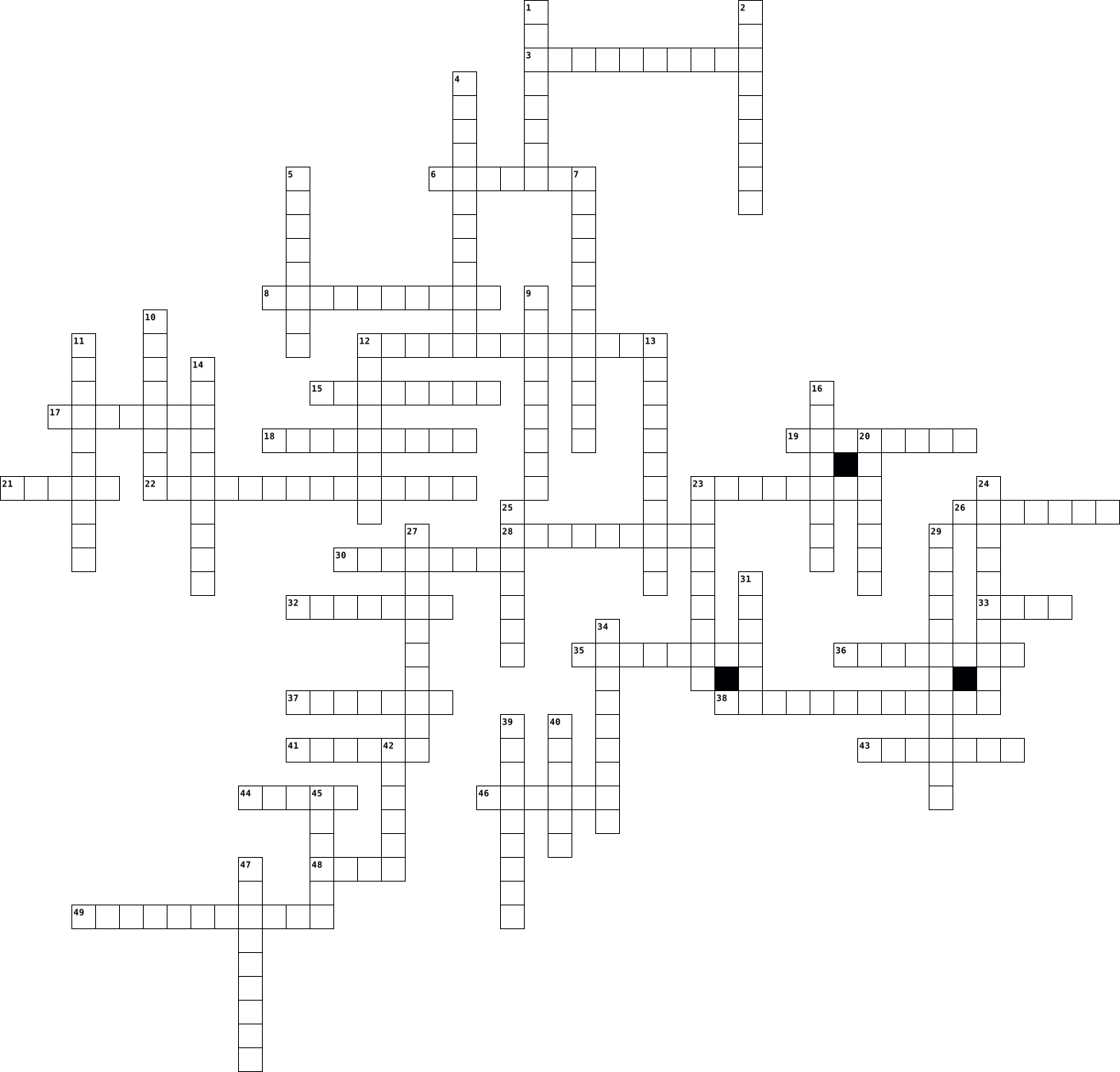
Across
- process in which a gas changes directly to a solid without going through the liquid state
- the study of the chemistry of life
- something that was forced to be mixed
- any material that is not a mixture
- Any characteristic that can be determined without changing the substance’s chemical identity.
- is a chemical substance that cant be divided or changed into other chemical substances by any ordinary chemical means
- process used to separate solids from liquids or gases using a strainer
- is a negatively charged subatomic particle
- (state of matter) characterized by particles arranged such that their shape and volume are relatively stable.
- process through which a substance changes from a liquid to a solid
- Any characteristic that can be determined only by changing a substance’s molecular structure.
- to pass through a sieve so as to separate the coarse from the fine particles
- Any characteristic of matter that does not depend on the amount of the substance present.
- chemical element with the symbol Cl
- chemical element with the symbol Si
- is the smallest object that retains the properties of an element
- combination of two or more substances
- is the power to attract
- a neutral subatomic particle found in the atomic nucleus
- the conversion of liquid to gas
- are good conductors of heat
- when heat is applied to solid
- a homogenous mixture of two or more element
- is a subatomic particle found in the nucleus of every atom
- chemical element with the symbol Au
- when a solid is converted directly into gas
Down
- chemical element with the symbol H
- poor thermal conductors
- does not have a definite composition and is non uniform
- A substance made up of two or more elements that are joined together in a fixed ratio.
- occurs when a gas loses energy
- of matter) consisting of particles that have neither a defined volume nor defined shape.
- are ordorless, colorless, monotonic gases.
- the study of the chemistry of matter
- the study of chemistry in physics
- process by which water changes from a liquid to a gas or vapor.
- Also known as semi-metals .have mostly non-metallic properties.
- is a particle made up of two or more atoms that are chemically bonded together
- the substance that is dissolved or scattered
- is the study of matter and the chemical reactions between substances.
- process used to separate solids from liquids or gases using a filter medium that allows the fluid to pass through but not the solid
- a method in which two or more components of different sizes are separated from a mixture on the basis of the difference in their sizes.
- has definite composition, and specific properties.
- the study of chemical processes that occur inside of living organisms
- consists of highly charged particles with extremely high kinetic energy.
- is the method in which heavier components of the mixture are separated from the lighter substances with the help of wind
- the study of inorganic compounds
- is anything that has mass and takes up space.
- (state of matter) has a definite volume, it does not have a definite shape.
- chemical element with the symbol O
- Any characteristic of matter that depends on the amount of matter being measured.
51 Clues: poor thermal conductors • is the power to attract • are good conductors of heat • when heat is applied to solid • occurs when a gas loses energy • the conversion of liquid to gas • the study of inorganic compounds • the study of chemistry in physics • chemical element with the symbol H • the study of the chemistry of life • any material that is not a mixture • ...
General Chemistry 2020-05-14
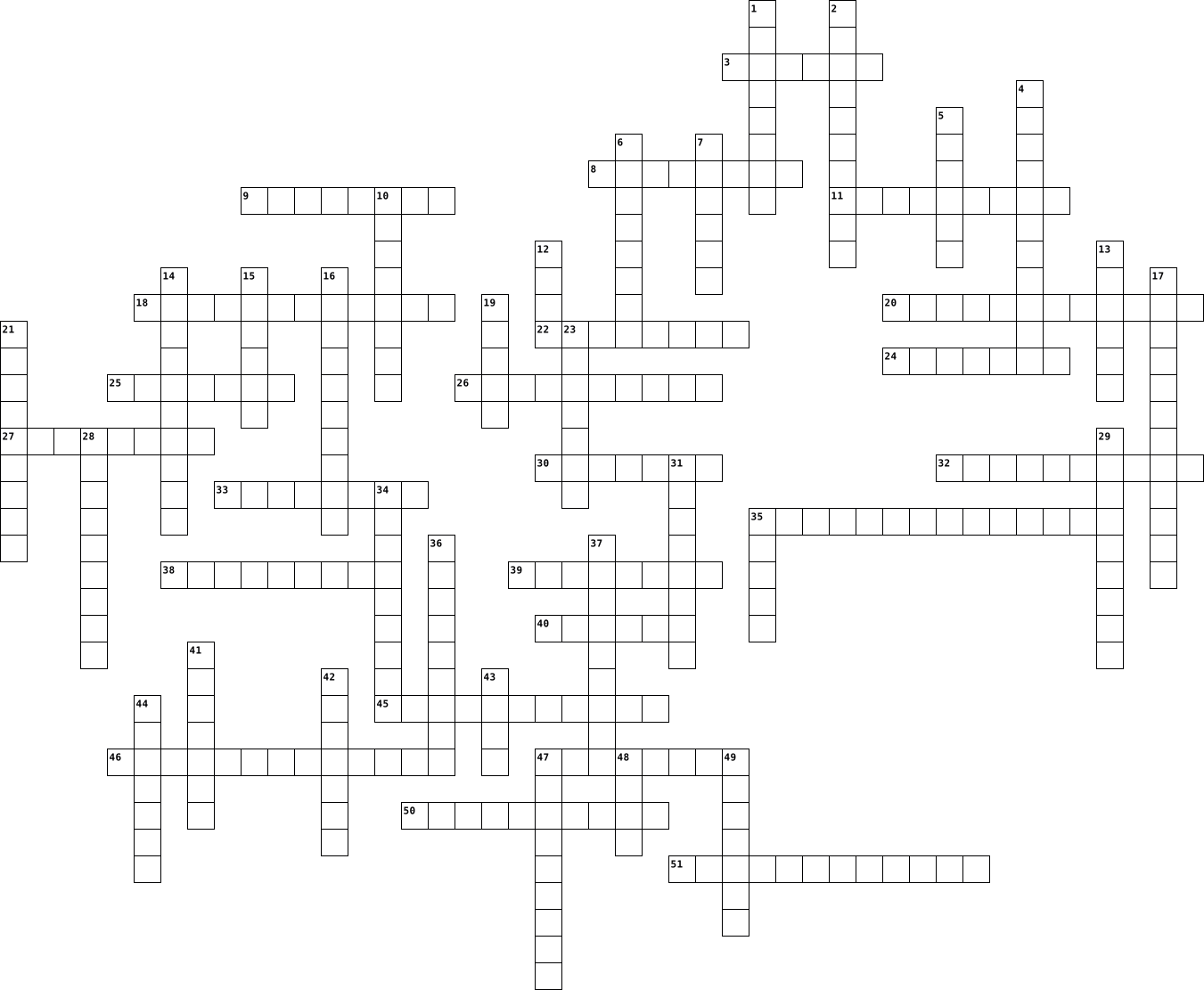
Across
- are good conductors of heat
- the study of chemistry in physics
- Any characteristic that can be determined without changing the substance’s chemical identity.
- the study of inorganic compounds
- does not have a definite composition and is non uniform
- the conversion of liquid to gas
- is a particle made up of two or more atoms that are chemically bonded together
- when heat is applied to solid
- chemical element with the symbol Si
- has definite composition, and specific properties.
- is a negatively charged subatomic particle
- a method in which two or more components of different sizes are separated from a mixture on the basis of the difference in their sizes.
- the study of the chemistry of matter
- chemical element with the symbol H
- process through which a substance changes from a liquid to a solid
- Any characteristic of matter that does not depend on the amount of the substance present.
- combination of two or more substances
- consists of highly charged particles with extremely high kinetic energy.
- process by which water changes from a liquid to a gas or vapor.
- any material that is not a mixture
- is the power to attract
- something that was forced to be mixed
- the study of chemical processes that occur inside of living organisms
Down
- Any characteristic that can be determined only by changing a substance’s molecular structure.
- process used to separate solids from liquids or gases using a filter medium that allows the fluid to pass through but not the solid
- when a solid is converted directly into gas
- chemical element with the symbol O
- chemical element with the symbol Cl
- (state of matter) has a definite volume, it does not have a definite shape.
- A substance made up of two or more elements that are joined together in a fixed ratio.
- is the smallest object that retains the properties of an element
- is anything that has mass and takes up space.
- Also known as semi-metals .have mostly non-metallic properties.
- is a subatomic particle found in the nucleus of every atom
- process in which a gas changes directly to a solid without going through the liquid state
- occurs when a gas loses energy
- a homogenous mixture of two or more element
- poor thermal conductors
- the study of the chemistry of life
- is the study of matter and the chemical reactions between substances.
- is the method in which heavier components of the mixture are separated from the lighter substances with the help of wind
- are ordorless, colorless, monotonic gases.
- Any characteristic of matter that depends on the amount of matter being measured.
- (state of matter) characterized by particles arranged such that their shape and volume are relatively stable.
- of matter) consisting of particles that have neither a defined volume nor defined shape.
- process used to separate solids from liquids or gases using a strainer
- is a chemical substance that cant be divided or changed into other chemical substances by any ordinary chemical means
- to pass through a sieve so as to separate the coarse from the fine particles
- chemical element with the symbol Au
- a neutral subatomic particle found in the atomic nucleus
- the surname of the chemist who developed periodic table
- chemical element with the symbol Ne
- the substance that is dissolved or scattered
53 Clues: poor thermal conductors • is the power to attract • are good conductors of heat • when heat is applied to solid • occurs when a gas loses energy • the conversion of liquid to gas • the study of inorganic compounds • the study of chemistry in physics • chemical element with the symbol O • the study of the chemistry of life • chemical element with the symbol H • ...
GEN CHEM 2020-05-26

Across
- the meaning of Xe in the periodic table
- it is a heterogeneous mixture that contains solid particles sufficiently large for sedimentation
- chemistry that studies the structure of matter.
- the chemistry of carbon compounds
- it is a measure of how easily a substance burst into flames
- is the degree to which a chemical substance or a particular mixture of substances can damage an organism
- 5th element in the periodic table
- it is the relationship between the mass of the substance and how much space it takes up
- in science it means when the properties of the substance is unchanging
- change of state from liquid to gas
- it is a measure of the amount of matter in an object
- humans inhale this gas.
- an effect is light scattering by particles in a colloid or in a very fine suspension
- it is a mixture in which the molecules that make up the mixture are uniformly distributed.
- is a chemical substance composed of many identical molecules
- a property that does not depend on the size of matter.
- is a mixture in which the components of the mixture are not uniform
- it is a material made up of two or more different substances which are physically combined.
- state of matter where atoms are not to far from each other
- it is a special type of homogeneous mixture composed of two or more substances
- is the ratio between the activity of your sample of interest.
- the chemistry that study the behavior of matter
- Substance substances that are made of only one type of atom
- the technique of heating a liquid to create vapor which is collected when cooled separate from the original liquid
- 4th element in the periodic table
- makes your voice change when inhaled and it is a noble gas.
- it’s the meaning of Au in the periodic table
Down
- chemistry that deals with inorganic compounds
- it is a substance whose atoms all have the same number of protons
- change of state from solid to liquid
- a laboratory technique for the separation of a mixture.
- is a measure of how readily a substance undergoes a chemical reaction.
- a mixture that has a small diameter yet are still uniformly distributed in a solution
- a chemical operation that separates solid matter and fluid from a mixture with a filter medium
- the most abundant element in the universe
- the meaning of Cl in the periodic table
- change of state from gas to solid
- change of state from liquid to solid
- it is a measure of the "hotness" or "coldness" of a substance.
- property that does depend on the size of matter
- change of state from solid to gas
- the 18th element in the periodic table
- branch of science that explores living organism
- state of matter that atoms are close together.
- state of matter where atoms are far apart.
- it is the quantity of space occupied by a liquid, solid, or gas.
- the element Ca in the periodic table
- the meaning of Rb in the periodic table
- is the process by which an atom or a molecule acquires a negative or positive
49 Clues: humans inhale this gas. • the chemistry of carbon compounds • 5th element in the periodic table • change of state from gas to solid • change of state from solid to gas • 4th element in the periodic table • change of state from liquid to gas • change of state from solid to liquid • change of state from liquid to solid • the element Ca in the periodic table • ...
GEN CHEM 2020-05-26

Across
- is a chemical substance composed of many identical molecules
- a chemical operation that separates solid matter and fluid from a mixture with a filter medium
- the meaning of Xe in the periodic table
- the chemistry of carbon compounds
- a property that does not depend on the size of matter.
- it is a measure of the "hotness" or "coldness" of a substance.
- it is a material made up of two or more different substances which are physically combined.
- state of matter that atoms are close together.
- 5th element in the periodic table
- is a measure of how readily a substance undergoes a chemical reaction.
- makes your voice change when inhaled and it is a noble gas.
- branch of science that explores living organism
- 57th in the periodic table
- chemistry that studies the structure of matter.
- is a mixture in which the components of the mixture are not uniform
- property that does depend on the size of matter
- change of state from solid to gas
- humans inhale this gas.
- an effect is light scattering by particles in a colloid or in a very fine suspension
- the meaning of Rb in the periodic table
- a mixture that has a small diameter yet are still uniformly distributed in a solution
- the most abundant element in the universe
- 4th element in the periodic table
- is the ratio between the activity of your sample of interest.
- it is a substance whose atoms all have the same number of protons
- it is the relationship between the mass of the substance and how much space it takes up
Down
- change of state from solid to liquid
- change of state from liquid to gas
- the element Ca in the periodic table
- is the process by which an atom or a molecule acquires a negative or positive
- the meaning of Cl in the periodic table
- it is a measure of how easily a substance burst into flames
- it is a special type of homogeneous mixture composed of two or more substances
- the technique of heating a liquid to create vapor which is collected when cooled separate from the original liquid
- change of state from liquid to solid
- change of state from gas to solid
- Substance substances that are made of only one type of atom
- state of matter where atoms are not to far from each other
- it is a heterogeneous mixture that contains solid particles sufficiently large for sedimentation
- it is a mixture in which the molecules that make up the mixture are uniformly distributed.
- a laboratory technique for the separation of a mixture.
- it is a measure of the amount of matter in an object
- chemistry that deals with inorganic compounds
- state of matter where atoms are far apart.
- what is Ti stands for in period table.
- the 18th element in the periodic table
- the chemistry that study the behavior of matter
- it is the quantity of space occupied by a liquid, solid, or gas.
- is the degree to which a chemical substance or a particular mixture of substances can damage an organism
- it’s the meaning of Au in the periodic table
- what is Fr stands for in periodic table
- in science it means when the properties of the substance is unchanging
52 Clues: humans inhale this gas. • 57th in the periodic table • the chemistry of carbon compounds • change of state from gas to solid • 5th element in the periodic table • change of state from solid to gas • 4th element in the periodic table • change of state from liquid to gas • change of state from solid to liquid • the element Ca in the periodic table • ...
GEN CHEM 2020-05-26

Across
- change of state from liquid to gas
- the technique of heating a liquid to create vapor which is collected when cooled separate from the original liquid
- a chemical operation that separates solid matter and fluid from a mixture with a filter medium
- is the process by which an atom or a molecule acquires a negative or positive
- it’s the meaning of Au in the periodic table
- branch of science that explores living organism
- 5th element in the periodic table
- what is Ti stands for in period table.
- the meaning of Cl in the periodic table
- it is a measure of how easily a substance burst into flames
- humans inhale this gas.
- it is the quantity of space occupied by a liquid, solid, or gas.
- it is a measure of the "hotness" or "coldness" of a substance.
- change of state from gas to solid
- is a measure of how readily a substance undergoes a chemical reaction.
- the chemistry that study the behavior of matter
- state of matter where atoms are far apart.
- it is the relationship between the mass of the substance and how much space it takes up
- a property that does not depend on the size of matter.
- what is Fr stands for in periodic table
- change of state from solid to liquid
Down
- is a mixture in which the components of the mixture are not uniform
- is a chemical substance composed of many identical molecules
- the 18th element in the periodic table
- the meaning of Xe in the periodic table
- in science it means when the properties of the substance is unchanging
- is the degree to which a chemical substance or a particular mixture of substances can damage an organism
- the most abundant element in the universe
- property that does depend on the size of matter
- the chemistry of carbon compounds
- chemistry that deals with inorganic compounds
- chemistry that studies the structure of matter.
- a laboratory technique for the separation of a mixture.
- state of matter that atoms are close together.
- the element Ca in the periodic table
- state of matter where atoms are not to far from each other
- it is a substance whose atoms all have the same number of protons
- 57th in the periodic table
- a mixture that has a small diameter yet are still uniformly distributed in a solution
- change of state from solid to gas
- is the ratio between the activity of your sample of interest.
- Substance substances that are made of only one type of atom
- makes your voice change when inhaled and it is a noble gas.
- it is a mixture in which the molecules that make up the mixture are uniformly distributed.
- it is a heterogeneous mixture that contains solid particles sufficiently large for sedimentation
- 4th element in the periodic table
- an effect is light scattering by particles in a colloid or in a very fine suspension
- it is a special type of homogeneous mixture composed of two or more substances
- the meaning of Rb in the periodic table
- it is a material made up of two or more different substances which are physically combined.
- change of state from liquid to solid
- it is a measure of the amount of matter in an object
52 Clues: humans inhale this gas. • 57th in the periodic table • the chemistry of carbon compounds • 5th element in the periodic table • change of state from solid to gas • 4th element in the periodic table • change of state from gas to solid • change of state from liquid to gas • the element Ca in the periodic table • change of state from liquid to solid • ...
Hannahs crossword 2024-05-15

Across
- water, sun, air, gas, solids, people
- change boiling an egg and baking a cake
- the amount of space occupied by a sample of matter
- source of nuclear energy
- amount of matter in an object
- the release of heat
- the measure of hotness of coldness
- Carbon, hydrogen, helium, oxygen
Down
- A substance that takes part and undergoes change in a reaction
- a substance made by mixing other substances
- an action performed or feeling experienced
- digestion, combustion, and cutting an onion
- the warmth of the sun and baking in the oven
- a substance that increases the rate of a chemical reaction without causing permanent damage
- water molecules
- property
- the strength and ability needed to undergo physical and mental activity
- electronics, food, airlines,clothing, and beverages
18 Clues: property • water molecules • the release of heat • source of nuclear energy • amount of matter in an object • Carbon, hydrogen, helium, oxygen • the measure of hotness of coldness • water, sun, air, gas, solids, people • an action performed or feeling experienced • change boiling an egg and baking a cake • a substance made by mixing other substances • ...
Q1 Exam Crossword 2023-10-09

Across
- - A state of matter with no definite shape or volume, where particles move freely.
- - A subatomic particle with no electrical charge (neutral) found in the nucleus of an atom.
- - The mass of an object or substance per unit volume.
- - A measure of the average kinetic energy of particles in a substance.
- - The degree of closeness between a measured value and the true value.
- - Molecules composed of two atoms of the same or different elements bonded together.
- - The force of gravity acting on an object's mass.
- - The amount of space occupied by an object or substance.
- - A subatomic particle with a negative charge (-1) that orbits the nucleus of an atom.
- - The process of adjusting or standardizing a measuring instrument to ensure accuracy.
- - Energy levels or electron orbitals that surround the nucleus of an atom.
- - A state of matter with a definite volume but no definite shape, where particles can flow.
- - A measure of the amount of matter in an object, typically expressed in kilograms or grams.
- - The number of bonds an atom can form with other atoms, often related to the number of electrons in its outermost shell.
- - A state of matter with a definite shape and volume, characterized by closely packed particles.
- - Having a uniform composition throughout, without distinct regions.
- - The same definition as mentioned earlier, a measure of the amount of matter in an object.
- - The smallest unit of matter consisting of a nucleus (protons and neutrons) surrounded by electrons.
- - A system of measurement using units like meters, kilograms, and liters.
- - The process of changing units or forms of measurement.
- - The degree of exactness or repeatability in a measurement.
Down
- - A distinct form or state of matter, such as solid, liquid, or gas.
- - A combination of substances that are physically mixed together but not chemically bonded.
- - Different forms of an element with the same number of protons but varying numbers of neutrons.
- - The emission of radiation from an unstable atomic nucleus, often resulting in the transformation of one element into another.
- - Having an uneven or non-uniform composition with distinct regions.
- - Relating to particles and processes that occur within atoms, such as electrons, protons, and neutrons.
- - The central core of an atom, containing protons and neutrons, and possessing a positive charge.
- - Pertaining to individual atoms or their properties.
- - A property of particles that can be positive (+) or negative (-) and determines their interactions with other charged particles.
- - A specific region within an electron shell where electrons are likely to be found.
- - Pertaining to the meaningful or important digits in a measurement or calculation.
- - A type of matter with uniform properties and composition throughout.
- - A mathematical function that describes the behavior of particles in quantum mechanics.
- - A high-energy state of matter consisting of charged particles.
- - A subatomic particle with a positive charge (+1) found in the nucleus of an atom.
- - Relating to the composition, structure, and properties of substances and their transformations.
- - A substance formed by chemically combining two or more different elements.
- - A substance composed of atoms with the same number of protons, thus sharing chemical properties.
- - A characteristic or attribute of a substance or material.
- - The same definition as mentioned earlier, a substance composed of atoms with the same number of protons.
- - An atom or molecule that has gained or lost electrons, resulting in a net electrical charge.
- - Anything that has mass and occupies space, including solids, liquids, gases, and plasma.
43 Clues: - The force of gravity acting on an object's mass. • - The mass of an object or substance per unit volume. • - Pertaining to individual atoms or their properties. • - The process of changing units or forms of measurement. • - The amount of space occupied by an object or substance. • - A characteristic or attribute of a substance or material. • ...
General Chemistry 2020-05-14

Across
- has definite composition, and specific properties.
- chemical element with the symbol O
- is the study of matter and the chemical reactions between substances.
- the study of the chemistry of matter
- (state of matter) characterized by particles arranged such that their shape and volume are relatively stable.
- A substance made up of two or more elements that are joined together in a fixed ratio.
- are ordorless, colorless, monotonic gases.
- is the method in which heavier components of the mixture are separated from the lighter substances with the help of wind
- is the power to attract
- Any characteristic that can be determined without changing the substance’s chemical identity.
- chemical element with the symbol H
- process used to separate solids from liquids or gases using a filter medium that allows the fluid to pass through but not the solid
- Any characteristic of matter that depends on the amount of matter being measured.
- poor thermal conductors
- Any characteristic of matter that does not depend on the amount of the substance present.
- does not have a definite composition and is non uniform
- is the smallest object that retains the properties of an element
- occurs when a gas loses energy
- chemical element with the symbol Cl
- chemical element with the symbol Si
- consists of highly charged particles with extremely high kinetic energy.
- the substance that is dissolved or scattered
- process in which a gas changes directly to a solid without going through the liquid state
- are good conductors of heat
- (state of matter) has a definite volume, it does not have a definite shape.
- process used to separate solids from liquids or gases using a strainer
- is a negatively charged subatomic particle
- process by which water changes from a liquid to a gas or vapor.
Down
- of matter) consisting of particles that have neither a defined volume nor defined shape.
- Any characteristic that can be determined only by changing a substance’s molecular structure.
- the study of chemistry in physics
- the conversion of liquid to gas
- something that was forced to be mixed
- is a chemical substance that cant be divided or changed into other chemical substances by any ordinary chemical means
- the study of the chemistry of life
- process through which a substance changes from a liquid to a solid
- the study of chemical processes that occur inside of living organisms
- is anything that has mass and takes up space.
- to pass through a sieve so as to separate the coarse from the fine particles
- is a particle made up of two or more atoms that are chemically bonded together
- is a subatomic particle found in the nucleus of every atom
- the study of inorganic compounds
- any material that is not a mixture
- chemical element with the symbol Ne
- Also known as semi-metals .have mostly non-metallic properties.
- a method in which two or more components of different sizes are separated from a mixture on the basis of the difference in their sizes.
- when a solid is converted directly into gas
- chemical element with the symbol Au
- combination of two or more substances
- when heat is applied to solid
- a neutral subatomic particle found in the atomic nucleus
- a homogenous mixture of two or more element
52 Clues: is the power to attract • poor thermal conductors • are good conductors of heat • when heat is applied to solid • occurs when a gas loses energy • the conversion of liquid to gas • the study of inorganic compounds • the study of chemistry in physics • chemical element with the symbol O • the study of the chemistry of life • chemical element with the symbol H • ...
GEN CHEM 2020-05-26

Across
- branch of science that explores living organism
- is a chemical substance composed of many identical molecules
- change of state from solid to liquid
- a chemical operation that separates solid matter and fluid from a mixture with a filter medium
- a laboratory technique for the separation of a mixture.
- it is a measure of the amount of matter in an object
- the meaning of Xe in the periodic table
- state of matter that atoms are close together.
- it’s the meaning of Au in the periodic table
- is the process by which an atom or a molecule acquires a negative or positive
- humans inhale this gas.
- chemistry that studies the structure of matter.
- change of state from liquid to gas
- an effect is light scattering by particles in a colloid or in a very fine suspension
- a property that does not depend on the size of matter.
- it is a special type of homogeneous mixture composed of two or more substances
- a mixture that has a small diameter yet are still uniformly distributed in a solution
- it is a measure of the "hotness" or "coldness" of a substance.
- it is a material made up of two or more different substances which are physically combined.
- the most abundant element in the universe
- it is a heterogeneous mixture that contains solid particles sufficiently large for sedimentation
- what is Ti stands for in period table.
- the meaning of Rb in the periodic table
Down
- 5th element in the periodic table
- the technique of heating a liquid to create vapor which is collected when cooled separate from the original liquid
- what is Fr stands for in periodic table
- change of state from solid to gas
- chemistry that deals with inorganic compounds
- it is a mixture in which the molecules that make up the mixture are uniformly distributed.
- the chemistry of carbon compounds
- state of matter where atoms are far apart.
- in science it means when the properties of the substance is unchanging
- is the ratio between the activity of your sample of interest.
- is the degree to which a chemical substance or a particular mixture of substances can damage an organism
- 57th in the periodic table
- it is a measure of how easily a substance burst into flames
- the element Ca in the periodic table
- change of state from liquid to solid
- the chemistry that study the behavior of matter
- property that does depend on the size of matter
- the meaning of Cl in the periodic table
- state of matter where atoms are not to far from each other
- 4th element in the periodic table
- it is the quantity of space occupied by a liquid, solid, or gas.
- it is the relationship between the mass of the substance and how much space it takes up
- is a mixture in which the components of the mixture are not uniform
- the 18th element in the periodic table
- is a measure of how readily a substance undergoes a chemical reaction.
- makes your voice change when inhaled and it is a noble gas.
- change of state from gas to solid
- it is a substance whose atoms all have the same number of protons
- Substance substances that are made of only one type of atom
52 Clues: humans inhale this gas. • 57th in the periodic table • 5th element in the periodic table • change of state from solid to gas • the chemistry of carbon compounds • 4th element in the periodic table • change of state from gas to solid • change of state from liquid to gas • change of state from solid to liquid • the element Ca in the periodic table • ...
GEN CHEM 2020-05-26

Across
- branch of science that explores living organism
- a laboratory technique for the separation of a mixture.
- what is Ti stands for in period table.
- chemistry that studies the structure of matter.
- Substance substances that are made of only one type of atom
- is a mixture in which the components of the mixture are not uniform
- it’s the meaning of Au in the periodic table
- is the degree to which a chemical substance or a particular mixture of substances can damage an organism
- it is a special type of homogeneous mixture composed of two or more substances
- is the process by which an atom or a molecule acquires a negative or positive
- the meaning of Rb in the periodic table
- 5th element in the periodic table
- change of state from solid to gas
- it is a measure of the amount of matter in an object
- change of state from liquid to gas
- it is the relationship between the mass of the substance and how much space it takes up
- the meaning of Xe in the periodic table
- the technique of heating a liquid to create vapor which is collected when cooled separate from the original liquid
- it is a mixture in which the molecules that make up the mixture are uniformly distributed.
- the element Ca in the periodic table
- is the ratio between the activity of your sample of interest.
- 4th element in the periodic table
- the most abundant element in the universe
- is a chemical substance composed of many identical molecules
- change of state from solid to liquid
Down
- the meaning of Cl in the periodic table
- is a measure of how readily a substance undergoes a chemical reaction.
- a chemical operation that separates solid matter and fluid from a mixture with a filter medium
- it is a heterogeneous mixture that contains solid particles sufficiently large for sedimentation
- the chemistry that study the behavior of matter
- in science it means when the properties of the substance is unchanging
- state of matter where atoms are far apart.
- change of state from gas to solid
- property that does depend on the size of matter
- a property that does not depend on the size of matter.
- it is a measure of the "hotness" or "coldness" of a substance.
- change of state from liquid to solid
- it is a measure of how easily a substance burst into flames
- the chemistry of carbon compounds
- it is a material made up of two or more different substances which are physically combined.
- a mixture that has a small diameter yet are still uniformly distributed in a solution
- 57th in the periodic table
- state of matter that atoms are close together.
- chemistry that deals with inorganic compounds
- it is the quantity of space occupied by a liquid, solid, or gas.
- state of matter where atoms are not to far from each other
- makes your voice change when inhaled and it is a noble gas.
- it is a substance whose atoms all have the same number of protons
- the 18th element in the periodic table
- an effect is light scattering by particles in a colloid or in a very fine suspension
- humans inhale this gas.
51 Clues: humans inhale this gas. • 57th in the periodic table • change of state from gas to solid • the chemistry of carbon compounds • 5th element in the periodic table • change of state from solid to gas • 4th element in the periodic table • change of state from liquid to gas • change of state from liquid to solid • the element Ca in the periodic table • ...
Matter & Chemical Change (Vocab 1) 2025-12-02

Across
- Properties Characteristics of a substance that can be observed or measured without changing what the substance is chemically. They describe the substance (e.g., colour, melting point).
- Properties Characteristics that describe how a substance reacts with other substances to form new substances. They describe its ability to change (e.g., flammability, ability to rust).
- Mixture A mixture that is not uniform; you can easily see the different parts or phases, and the composition varies from one point to another (e.g., oil and water, pizza, granite rock).
- The change of state from a solid to a liquid when heat is added (e.g., ice turning into water).
- The change of state from a gas to a liquid when heat is removed (e.g., water droplets forming on a cold mirror).
- The change of state directly from a solid to a gas, skipping the liquid phase (e.g., dry ice turning into fog).
- Everything around you that has mass (how much "stuff" is in it) and takes up space (volume). If you can weigh it and touch it, it's matter!
- The change of state from a liquid to a solid when heat is removed (e.g., water turning into ice).
- The change of state from a liquid to a gas at the surface of the liquid (e.g., a puddle drying up).
- Matter that has no fixed shape and no fixed volume. It will spread out to completely fill any container. Its particles are far apart and move randomly and quickly (e.g., air, steam).
- Elements that have properties of both metals and non-metals. They sometimes conduct electricity, making them important in electronics (e.g., silicon).
Down
- The change of state directly from a gas to a solid, skipping the liquid phase (e.g., frost forming on a window).
- Substance Matter that is made up of only one type of particle throughout. It has specific properties that never change (e.g., pure water, gold).
- Matter that has a fixed volume but takes the shape of its container. Its particles are close but can slide past each other (e.g., water, oil).
- The science that studies matter—what it's made of (atoms), what properties it has, and how it can change from one thing into another (chemical reactions).
- Mixture A mixture that looks completely uniform (the same) throughout, even under a microscope. You cannot see the different parts (e.g., sugar dissolved in water, air).
- Elements that are typically shiny, good at conducting heat and electricity, and can be easily shaped (e.g., copper, iron).
- Matter with a fixed shape and a fixed volume. Its particles are packed tightly together and vibrate in place (e.g., ice, a rock).
- Matter that is made up of two or more pure substances that are physically combined but not chemically joined. They can usually be separated (e.g., sand and water, air, salad).
- Elements that are usually dull (not shiny), poor conductors of heat and electricity, and often brittle or gases at room temperature (e.g., oxygen, sulfur).
- A pure substance that cannot be broken down into simpler substances by chemical means. It's the simplest form of matter (e.g., Oxygen (O), Gold (Au)).
- A pure substance made of two or more different elements that are chemically joined together in a fixed ratio (e.g., Water, Salt (NaCl)). Breaking it requires a chemical reaction.
- A special type of mixture (specifically, a homogeneous mixture) where one substance is completely and evenly dissolved in another (e.g., salt dissolved in water).
23 Clues: The change of state from a solid to a liquid when heat is added (e.g., ice turning into water). • The change of state from a liquid to a solid when heat is removed (e.g., water turning into ice). • The change of state from a liquid to a gas at the surface of the liquid (e.g., a puddle drying up). • ...
Jordans Crossword Puzzle 2022-08-31

Across
- the phase change of a substance from the liquid state to a solid-state.
- the measure of hotness or coldness expressed in terms of any of several scales, including Fahrenheit and Celsius.
- The temperature at which a material changes from a gas to a liquid;
- a state of matter that retains its shape and density when not confined.
- a fluid (such as air) that has neither independent shape nor volume but tends to expand indefinitely.
- conversion of a substance from the liquid or solid phase into the gaseous (vapour) phase.
- a form of matter in which many of the electrons wander around freely among the nuclei of the atoms.
- anything that takes up space and can be weighed.
- a sample of matter that conforms to the shape of a container in which it is held, and which acquires a defined surface in the presence of gravity.
- temperature at which a liquid becomes a solid.
Down
- the process by which water vapor in the air is changed into liquid water.
- change of a solid into a liquid when heat is applied.
- temperature at which the pressure exerted by the surroundings upon a liquid is equaled by the pressure exerted by the vapour of the liquid
- Molecular Theory a theory that explains the states of matter and is based on the idea that matter is composed of tiny particles that are always in motion.
- temperature at which the solid and liquid forms of a pure substance can exist in equilibrium.
15 Clues: temperature at which a liquid becomes a solid. • anything that takes up space and can be weighed. • change of a solid into a liquid when heat is applied. • The temperature at which a material changes from a gas to a liquid; • the phase change of a substance from the liquid state to a solid-state. • ...
Matter Vocab Sofia Atonal 2023-10-23

Across
- formula A combination of symbols that represents the element in a compound and their properties
- Amount of matter in an object
- amount of space taken up by a object
- The study of matter and energy and how they interact
- Properties of matter and how it changes
- Gold, iron, hydrogen, oxygen
- A mixture containing at least one solute that has the same properties
Down
- property A characteristic of a pure substance that describes its ability to change into a different substance
- A neutral particle made of two or more atoms joined covalent bands
- Particles from all elements are made up of
- Property A characteristic of a pure substance that can be observed without changing into another substance
- Something that takes up space
- distance between two points
- mass per unit volume
14 Clues: mass per unit volume • distance between two points • Gold, iron, hydrogen, oxygen • Amount of matter in an object • Something that takes up space • amount of space taken up by a object • Properties of matter and how it changes • Particles from all elements are made up of • The study of matter and energy and how they interact • ...
Landon's Sound waves vocab 2025-02-27

Across
- the distance from one crest to the next crest
- a disturbance that transfers energy through matter
- when waves bend
- the vertical distance from the top of the crest to the bottom trough
- the height of a wave
- Waves waves that only travel through matter: must use a MEDIUM to travel.
- Spectrum the range of wavelengths or frequencies over which electromagnetic radiation extends
- the number of waves in a given time period
Down
- the wave travels in the same direction as the matter
- an interruption in stillness
- when waves bounce back
- waves travel side to side as the matter travels up and down.
- the highest part of a wave
13 Clues: when waves bend • the height of a wave • when waves bounce back • the highest part of a wave • an interruption in stillness • the number of waves in a given time period • the distance from one crest to the next crest • a disturbance that transfers energy through matter • the wave travels in the same direction as the matter • ...
Big Bang Vocab Integrated science 2023-05-16

Across
- point in which matter is infinitely dense, as in the center of a black hole or the universe at the very beginning.
- by equal but opposite charges that are separated by a short distance
- Space Telescope/a space telescope and camera named for a famous astronaut (Edward Hubble) used to study space elements
- huge group of single stars, star systems, star clusters, dust, and gas bound together by gravity
- of the universe
- Fireball/Extremely high frequency radiation that filled space immediately following the Big Bang
- Forces/4 forces that act throughout the universe. They include gravity, electromagnetic force, strong nuclear force and weak nuclear force
- Era/time period greater than 500,000 years since the Big Bang where larger masses, such as stars, formed
- slightly unstable star that has a regular variation in brightness and luminosity due to a periodic expansion and contraction in its outer layers.
- of light to a longer wavelength as it moves away
- point in which matter is infinitely dense, as in the center of a black hole or the universe at the very beginning.
- (shape)/A position or moment of stillness
- measure of how hot or cold something is.
- Shift/the shift to a different wavelength
- Matter/matter that does not give off electromagnetic radiation but is quite abundant in the universe
- unit for temperature
- for measuring intensity of light
- Lines/The wavelengths where a specific element can absorb or emit light
- Fusion/a nuclear reaction in which atomic nuclei of low atomic number fuse to form a heavier nucleus with the release of energy.
Down
- Hole/An object in space whose gravity is so strong not even light can escape.
- of exponential expansion of space in the early universe.
- interaction between electricity and magnetism
- study of energy transformations that occur in a collection of matter.
- Doppler shift in which spectral features are shifted to shorter wavelengths, observed when an object is moving toward the observer.
- Bang Theory/The theory that the universe originated in a huge explosion that released all matter and energy.
- Density/The theoretical density of the universe that would create a flat universe.
- consisting of antiparticles of normal substances
- apparent shift in the position of an object when viewed from different locations
- volumes of space between superclusters that appear to contain very little matter
- Background Radiation/The electromagnetic radiation left over from the big bang
- distance light travels in one year
31 Clues: of the universe • unit for temperature • for measuring intensity of light • distance light travels in one year • measure of how hot or cold something is. • (shape)/A position or moment of stillness • Shift/the shift to a different wavelength • interaction between electricity and magnetism • of light to a longer wavelength as it moves away • ...
Unit 6 vocab 2022-04-13

Across
- mixture, a mixture in which the composition is not uniform throughout the mixture
- mixture, a mixture in which the composition is uniform throughout the mixture
- the process by which water changes from a liquid to a gas or vapor
- when liquid becomes gas, forming bubbles inside the liquid volume
- condensates, a state of matter in which separate atoms or subatomic particles, cooled to near absolute zero
- superheated matter – so hot that the electrons are ripped away from the atoms forming an ionized gas
- point, the temperature at which the substance changes from a solid to a liquid
- point, the temperature at which a liquid boils and turns to vapor
- conversion of a substance from the liquid or solid phase into the gaseous (vapour) phase
- reaction, a process in which one or more substances, also called reactants, are converted to one or more different substances, known as products
- the result of combining two or more substances, such that each maintains its chemical identity
- the mass of a unit volume of a material substance
- the relative capacity of an atom, molecule, or radical to undergo a chemical reaction with another atom, molecule, or compound
- the degree to which a substance dissolves in a solvent to make a solution
- anything that takes up space and can be weighed
Down
- capable of catching fire and burning; inflammable; flammable
- of conservation of matter, the amount of matter stays the same, even when matter changes form
- a homogenous mixture of two or more substances in relative amounts that can be varied continuously up to what is called the limit of solubility
- of fusion, the quantity of heat necessary to change 1 g of a solid to a liquid with no temperature change
- of vaporization, the amount of heat needed to turn 1g of a liquid into a vapor, without a rise in the temperature of the liquid
- substance, ordinarily a liquid, in which other materials dissolve to form a solution
- the process or result of oxidizing or being oxidized
- made up or consisting of two or more existing parts or elements
- The physical matter, material or that of which an organ or body consists
- any substance that cannot be decomposed into simpler substances by ordinary chemical processes
- the resistance of a fluid (liquid or gas) to a change in shape or movement of neighboring portions relative to one another
- a dissolved substance
- the degree or intensity of heat present in a substance or object, especially as expressed according to a comparative scale and shown by a thermometer or perceived by touch
28 Clues: a dissolved substance • anything that takes up space and can be weighed • the mass of a unit volume of a material substance • the process or result of oxidizing or being oxidized • capable of catching fire and burning; inflammable; flammable • made up or consisting of two or more existing parts or elements • ...
SCIENCE CROSSWORDA 2025-03-10

Across
- A theory stating that all matter is made of particles in constant motion.
- The phase change from gas to liquid when cooled, often seen as water droplets on glass.
- The process where liquid moves up narrow tubes, helping plants absorb water.
- The process where a liquid loses heat and turns into a solid.
- A state of matter with no fixed shape or volume, with particles moving rapidly.
- A solid with no definite structure, like glass or wax.
- A solid with free-moving electrons, making it a good conductor of electricity and heat.
- A reaction where a new substance forms, like burning wood into ash.
- A liquid’s resistance to flow; thicker substances like honey have high viscosity.
- A change in appearance, like cutting paper, without forming a new substance.
- The attraction between molecules of the same substance, like water forming droplets.
- How easily a substance evaporates; alcohol has high volatility.
- A solid with a structured, repeating atomic pattern, like salt or diamonds.
Down
- A type of solid with weak intermolecular forces, making it soft with low melting points.
- A state of matter at near absolute zero where particles act as a single quantum entity.
- When a solid turns directly into gas, like dry ice vaporizing.
- A solid held together by strong electrostatic forces, like table salt.
- Scientist who developed atomic theory, proposing that all matter is made of indivisible atoms.
- The process where a liquid turns into gas when heated to its boiling point.
- The force that creates a "skin" on a liquid’s surface, allowing insects to walk on water.
- When a solid absorbs heat and changes into a liquid.
- The attraction between different substances, like water sticking to glass.
- The process where a gas turns directly into a solid, like frost forming.
- A slow process where a liquid turns into gas at its surface without boiling.
- The temperature and pressure at which gas and liquid states become indistinguishable.
- The force exerted by a liquid’s vapor in a closed container, affecting boiling points.
- The curved surface of a liquid in a narrow container due to adhesion.
- A state of matter with a fixed shape and volume due to closely packed particles.
- A transition between states of matter, such as melting or freezing.
- A state of matter with ionized particles, found in stars and neon signs.
30 Clues: When a solid absorbs heat and changes into a liquid. • A solid with no definite structure, like glass or wax. • The process where a liquid loses heat and turns into a solid. • When a solid turns directly into gas, like dry ice vaporizing. • How easily a substance evaporates; alcohol has high volatility. • ...
big bang theory choice board 2025-03-25

Across
- a massive, compact astronomical object so dense that its gravity prevents anything from escaping, even light
- the phenomenon where light from an object moving towards an observer appears shifted towards the blue end of the electromagnetic spectrum, meaning shorter wavelengths and higher frequencies
- matter and anti-matter were being created equally out of the radiation pair production
- the apparent shift or change in an object's position when viewed from different locations or perspectives
- gravity, electromagnetism, the strong nuclear force, and the weak nuclear force
- a branch of physics and metaphysics dealing with the nature of the universe, the cosmos
- variable stars, known for their pulsating nature, exhibit a period-luminosity relationship
- a theory of exponential expansion of space in the very early universe
- matter composed of the antiparticles (or "partners") of the corresponding particles in "ordinary" matter
- the area around, within, and between objects, forms, and lines, encompassing both positive (occupied) and negative (empty) areas
- a unit of distance, not time, representing the distance light travels in one year, approximately 9.46 trillion kilometers or 5.88 trillion miles
Down
- the average density of matter required for the Universe to just halt its expansion, but only after an infinite time
- the phenomenon where the light from distant objects, like galaxies, appears shifted towards the red end of the electromagnetic spectrum, indicating that these objects are moving away from us due to the expansion of the universe
- the degree or intensity of heat present in a substance or object
- an instrument that measures the strength of electromagnetic radiation in the range from ultraviolet to infrared and including the visible spectrum
- the early, hot, and dense state of the universe
- the base unit for temperature in the International System of Units
- a theoretical point or region of space where the density of matter and the curvature of spacetime become infinite
- a branch of Physics, that deals with the electromagnetic force that occurs between electrically charged particles
- the change in the frequency of a wave in relation to an observer who is moving relative to the source of the wave
- what a clock reads, or the measure of change or the interval over which change occurs
- empty space
- a system of stars, stellar remnants, interstellar gas, dust, and dark matter bound together by gravity
- deals with the separation of the positive and negative electric charges found in any electromagnetic system
- a mysterious, invisible substance that makes up a significant portion of the universe's mass, estimated at around 85%
25 Clues: empty space • the early, hot, and dense state of the universe • the degree or intensity of heat present in a substance or object • the base unit for temperature in the International System of Units • a theory of exponential expansion of space in the very early universe • gravity, electromagnetism, the strong nuclear force, and the weak nuclear force • ...
Civ Pro Highly Tested Topics 2024-06-30

Across
- Under _________ fed. diversity & supplemental cases use fed. (_________) law (FRCP, SOL, BOP) and state _________ law (claims/defenses elements, conflict of law). (1 word)
- preliminary injunctions are awarded to Ps who need HEL(P). (2 words)
- Federal courts may exercise supplemental if state claims have a _________ as federal SMJ claims, but not over 3rd-P D claims or claims that (_________). (4 words)
- C(A)N’T ICE subject matter JX. (2 words)
- (C)AN’T ICE subject matter JX. (1 word)
- Laws are substantive if they are _________, (_________), OR not applying state law increases fed. ligation. (3 words)
- preliminary injunctions are awarded to Ps who need H(E)LP. (3 words)
- CAN’(T) ICE subject matter JX. (1 word)
Down
- CAN’T IC(E) subject matter JX. (2 words)
- Laws are substantive if they are (_________) _________, OR not applying state law increases fed. ligation. (2 words)
- State courts may exercise specific PJ over nonresident Ds consistent if they have a long-arm statute AND does not violate 14th A. Due Process Clause (_________, _________ and (_________)). (4 words)
- CAN’T (I)CE subject matter JX. (2 words)
- preliminary injunctions are awarded to Ps who need (H)ELP. (1 word)
- MSJ is granted if, taking the facts in the (_________) to the non-moving, there is no _________ & movant is entitled to _________. (3 words)
- preliminary injunctions are awarded to Ps who need HE(L)P. (3 words)
- Under _________ fed. diversity & supplemental cases use fed. _________ law (FRCP, SOL, BOP) and state (_________) law (claims/defenses elements, conflict of law). (1 word)
- CAN’T I(C)E subject matter JX. (2 words)
- State courts may exercise specific PJ over nonresident Ds consistent if they have a long-arm statute AND does not violate 14th A. Due Process Clause (_________, (_________) and _________). (2 words)
- State courts may exercise specific PJ over nonresident Ds consistent if they have a long-arm statute AND does not violate 14th A. Due Process Clause ((_________), _________ and _________). (2 words)
- Federal courts may exercise supplemental if state claims have a (_________) as federal SMJ claims, but not over 3rd-P D claims or claims that _________. (4 words)
- Under (_________) fed. diversity & supplemental cases use fed. _________ law (FRCP, SOL, BOP) and state _________ law (claims/defenses elements, conflict of law). (2 words)
- CA(N)’T ICE subject matter JX. (1 word)
- MSJ is granted if, taking the facts in the _________ to the non-moving, there is no (_________) & movant is entitled to _________. (5 words)
- MSJ is granted if, taking the facts in the _________ to the non-moving, there is no _________ & movant is entitled to (_________). (6 words)
24 Clues: CA(N)’T ICE subject matter JX. (1 word) • (C)AN’T ICE subject matter JX. (1 word) • CAN’(T) ICE subject matter JX. (1 word) • CAN’T IC(E) subject matter JX. (2 words) • CAN’T (I)CE subject matter JX. (2 words) • CAN’T I(C)E subject matter JX. (2 words) • C(A)N’T ICE subject matter JX. (2 words) • preliminary injunctions are awarded to Ps who need (H)ELP. (1 word) • ...
Break it Down 2023-10-23

Across
- an illustration that shows how something works
- the liquid part of blood
- a group of atoms joined together in a particular way
- how hot or cold something is
- to figure out what something is or what group it belongs to
- way to separate a mixture by passing it through a material
- information that supports an answer to a question
- a tool that spins a mixture very fast to separate the parts
Down
- matter that is made of more than one substance
- a material that separates out some parts of a mixture
- something scientists make to answer questions about the real world
- to describe how something works or why something happens
- what you can observe or measure about something that helps you figure out what it is
- matter that is made of only one kind of atom or molecule
- tiny piece of matter that is too small to see
- the stuff that things are made of
16 Clues: the liquid part of blood • how hot or cold something is • the stuff that things are made of • tiny piece of matter that is too small to see • matter that is made of more than one substance • an illustration that shows how something works • information that supports an answer to a question • a group of atoms joined together in a particular way • ...
5th Grade Matter 2024-05-06

Across
- The amount of space something takes up.
- Particles are ALWAYS in _______.
- Particles in a liquid can _____ past each other and flow.
- A change that occurs when a substance is completely different after.
- A change when a substance is cut, bent, melted or frozen.
- In gasses particles are moving the ______ as they speed around and bump into each other.
- In order to change matter from state to state you need to change the substances _________.
- In solids the particles move back and forth also known as,
Down
- When substances have changed and rearranged themselves to create something NEW>
- In solids, particles are ______ together and tightly packed.
- Anything that has mass and takes up space
- State of matter that has a definite shape and volume
- State of matter that does not have definite volume nor definite shape.
- Has a definite volume but takes the shape of its container.
- No two substances are the ______.
- When particles mix completely in with another material and it appears as one substance.
16 Clues: Particles are ALWAYS in _______. • No two substances are the ______. • The amount of space something takes up. • Anything that has mass and takes up space • State of matter that has a definite shape and volume • Particles in a liquid can _____ past each other and flow. • A change when a substance is cut, bent, melted or frozen. • ...
chem unit 1 2025-01-09

Across
- process that releases energy into surroundings
- low kinetic energy, particles can move around but still very close, variable shape, fixed volume
- energy can be released and absorbed in a reaction, it is not created nor destroyed.
- the energy possessed by an object due to its composition, position, or condition
- the measure of the amount of space
- study of composition, structure, and properties along with the change in matter
- high kinetic energy, particles move freely, variable shape, variable volume
- energy in motion
Down
- depends on the type of matter
- a process that absorbs energy from surroundings
- the ability of a substance to undergo a specific chemical change
- this will change the appearance without changing the composition of the material/object
- very low kinetic energy, particles can vibrate but move around, fixed shape, fixed volume
- a substance thats currently a gas but normally a solid or liquid at room temp.
- depends on the amount of matter
- anything with mass and occupies space
16 Clues: energy in motion • depends on the type of matter • depends on the amount of matter • the measure of the amount of space • anything with mass and occupies space • process that releases energy into surroundings • a process that absorbs energy from surroundings • the ability of a substance to undergo a specific chemical change • ...
U1 T1-2 Vocab Check-In 2025-11-06

Across
- a combination of two or more pure substances such as that each one’s properties are not lost, but may be hidden
- separate parts of a mechanical mixture
- the state of matter in which a substance has a definite volume, but no definite shape
- made up of parts, or mixed
- a mixture in which droplets of fat are prevented from joining together by an emulsifying agent
- the state of matter in which a substance has neither a definite shape nor a definite volume
- the state of matter in which a substance has a definite shape and a definite volume
- mixtures that are obviously heterogeneous
Down
- the same in structure, quality, or kind
- the ability to flow
- characteristics that describe matter
- a material that contains only one kind of particle
- a heterogeneous mixture in which particles do not settle
- a heterogeneous mixture in which particles settle slowly after mixing
- any substance that flows; includes liquids and gases
- a homogeneous mixture of two or more pure substances
16 Clues: the ability to flow • made up of parts, or mixed • characteristics that describe matter • separate parts of a mechanical mixture • the same in structure, quality, or kind • mixtures that are obviously heterogeneous • a material that contains only one kind of particle • any substance that flows; includes liquids and gases • ...
Thermal Energy In Matter 2024-02-21

Across
- The ability of a system to do work; required for changes to happen within a system
- Transfer of thermal energy that occurs in solids, liquids and gases when two substances of different temperatures touch
- Distinct forms of matter known in everyday experience: solid, liquid, gas
- Average kinetic energy of all the particles in a material; measured by a thermometer in degrees
- A group of interacting, interrelated, or independent elements forming a complex whole
- Energy of Motion
Down
- Heat transfer caused by the rising of hotter, less dense fluids and the falling of cooler, denser fluids
- A substance that allows the flow of electrical charge or transfers thermal energy through matter
- The total kinetic (motion) energy of the tiny particles that make up matter; the faster the particles move, the warmer the matter becomes
- Anything that has volume and mass
- Transfer The thermal energy exchange between two objects of different temperatures; energy moves in a predictable pattern from warmer sites to cooler sites until all sites have reached the same temperature
- A measure of how much matter is present in a substance
- The transfer of energy by the movement of electromagnetic waves or subatomic particles
13 Clues: Energy of Motion • Anything that has volume and mass • A measure of how much matter is present in a substance • Distinct forms of matter known in everyday experience: solid, liquid, gas • The ability of a system to do work; required for changes to happen within a system • A group of interacting, interrelated, or independent elements forming a complex whole • ...
science 2015-01-13

Across
- The measure of the pull of gravity between an object and Earth
- A measurement of how hot or cold something is
- A change that begins and ends with the same type of matter
- The amount of matter in a given space
- Anything that has mass and takes up space
- A measure of how much space a substances takes up
Down
- A physical change of matter from one state to another
- A characteristic that can be observed without changing substance
- The number of units that fit along one edge of an object
- Amount of matter making up an object
- Solids, liquids, and gasses
11 Clues: Solids, liquids, and gasses • Amount of matter making up an object • The amount of matter in a given space • Anything that has mass and takes up space • A measurement of how hot or cold something is • A measure of how much space a substances takes up • A physical change of matter from one state to another • The number of units that fit along one edge of an object • ...
States of Matter 2025-09-15

Across
- The amount of matter in an object.
- The process when a gas changes into a liquid.
- State of matter with no definite shape and no definite volume.
- State of matter with a definite volume but no definite shape.
- The process when a liquid changes into a gas.
- The process when a liquid turns into a solid.
Down
- State of matter with a definite shape and a definite volume.
- The amount of space an object takes up.
- Anything that has mass and takes up space.
- The process when a solid turns into a liquid.
- How heavy something is for its size (mass divided by volume).
11 Clues: The amount of matter in an object. • The amount of space an object takes up. • Anything that has mass and takes up space. • The process when a gas changes into a liquid. • The process when a solid turns into a liquid. • The process when a liquid changes into a gas. • The process when a liquid turns into a solid. • ...
Matter crossword 2022-03-31

Across
- What state of matter is it called when the atoms go a little bit slower than gas?
- What expands stuff with fast movement atoms?
- What is called when a liquid turns into a gas?
- What state of matter has the atoms spread apart everywhere?
- Which state of matter has its atoms compacted?
Down
- WHat is it called when a liquid turns into a solid?
- What is it called when a solid turns into a liquid?
- The amount of force matter pushes on an amount of space
- What is the state of matter that is in space mostly?
- What is a matter made up of?
10 Clues: What is a matter made up of? • What expands stuff with fast movement atoms? • What is called when a liquid turns into a gas? • Which state of matter has its atoms compacted? • WHat is it called when a liquid turns into a solid? • What is it called when a solid turns into a liquid? • What is the state of matter that is in space mostly? • ...
Gen Chem 2020-05-05

Across
- A mixture that is relatively uniform in composition
- Composed of two or more separate elements
- The quantity of matter in the object
- Whether it reacts with acids, bases, and oxygen, gas or not.
- Gas to Liquid
- This is a physical property that can be affected by the size and amount of samples
- The study of inorganic compounds
- Liquid to Solid
- This is a process of separating the components of a suspension
- Figures, This are the digits in any measurements that are known with certainty with an additional one digit which is uncertain
- Composed of a solute and a solvent
- Composed of two or more substances combined physically in variable proportions
- The simplest form of matter since it is composed of only one kind of atom
- Off, The process of removing insignificant digits from calculated numbers
- A mixture whose composition varies from one position to another within the sample
- Consist of coarse particles which are visible to the naked eye
- This is a physical property that does not depend on the size or amount of the sample.
- Solid to Gas
- Whether the substance can damage an organism or not
- Analysis, This is a process in which a conversion factor written in a form of ratio is used to change the units given in the data to the units desired
- A state of matter that the particles also move quickly in all directions
- The study of chemical processes that occur inside of living organisms
- Property, Property of matter that the ability of a substance to react with other substance such as air, water, acid and base.
- The Numerical Value is 1000
- Liquid to Gas
- A state of matter that the particles are close together but are not held so rigidly in position and can move past one another
Down
- Gas to Solid
- Activity, It's either the materials is more active or less active than other members of its chemical family
- Whether the substance can be easily decomposed or not
- A state of matter that the particles are close together but they can't be compressed and move freely
- Property, Property of matter that can be measured and observed without changing the composition of the substance
- This is the ratio of the mass of an object to the volume it occupies
- Tells how hot or cold an object is
- The substances remain dispersed and do not settle to the bottom of the container
- The study of carbon and its compounds; the study of the chemistry of life
- Effect, The ability to scatter a beam of light that passes through it
- Solid to Liquid
- The branch of chemistry that applies physics to the study of chemistry
- This is a process of separating a homogeneous mixture composed of 2 substances with different boiling points
- The study of the chemistry of matter and the development of tools to measure properties of matter
- Units that the symbol is G
- The substance undergoes combustion or not
- The dissolved substance
- Substance, This is a matter that has a definite composition and distinct properties
- This is another method of separating complex mixtures
- Notation, It is the process of simplifying a very large number or a very small number and is used to express multi digit numbers involving many zeros in compact form
- The dissolving medium
- Whether it will break into charged particles when in solution with water or not
- The Scientific Notation is 10^-6
- The amount of space occupied by a substance
50 Clues: Gas to Solid • Solid to Gas • Gas to Liquid • Liquid to Gas • Solid to Liquid • Liquid to Solid • The dissolving medium • The dissolved substance • Units that the symbol is G • The Numerical Value is 1000 • The study of inorganic compounds • The Scientific Notation is 10^-6 • Tells how hot or cold an object is • Composed of a solute and a solvent • The quantity of matter in the object • ...
Science Vocabulary 2025-12-17

Across
- A mixture that forms when one substance dissolves another.
- A state of matter that has a definite shape and a definite volume
- To change from a liquid to a gas
- A state of matter with no definite shape or volume
- The feel, appearance, or consistency of a surface, substance, or fabric.
- The change in state from a solid to a liquid
- Two or more substances that are mixed together but not chemically combined
- A state of matter that has no definite shape but has a definite volume.
Down
- A change that occurs when no new substance is created
- To change from a gas to a liquid
- When a solid is mixed into a liquid and disappears
- To change from a liquid to a solid
- When a material is attracted to a magnet
- ANYTHING in the world that has mass and takes up space
- A change that occurs when a new substance is created
15 Clues: To change from a gas to a liquid • To change from a liquid to a gas • To change from a liquid to a solid • When a material is attracted to a magnet • The change in state from a solid to a liquid • When a solid is mixed into a liquid and disappears • A state of matter with no definite shape or volume • A change that occurs when a new substance is created • ...
Phases of Matter 2025-12-08

Across
- Anything that has mass and takes up space
- When liquid reaches this, it has enough energy to become a gas
- High-energy state made up of charged particles
- The basic building blocks of all substances
- Liquid to Solid- Remove heat to slow particles
- Gas to Solid- Reverse of sublimation, such as frost forming on a cold surface
- Solid to Gas- When substances skip the liquid phase, such as dry ice
- Particles move freely and spread out to fill the space available
- Has a definite shape and volume
Down
- Liqid to Gas- When particles escape to become a gas (think disappearing water)
- Gas to Liquid- When water droplets form on a cold glass of lemonade on a hot day
- Matter that takes the shape of its container but maintains volume
- Solid to Liquid- Particles separate when heat is applied
- The weight of matter
- The amount of space matter takes up
15 Clues: The weight of matter • Has a definite shape and volume • The amount of space matter takes up • Anything that has mass and takes up space • The basic building blocks of all substances • High-energy state made up of charged particles • Liquid to Solid- Remove heat to slow particles • Solid to Liquid- Particles separate when heat is applied • ...
Unit 2 Vocabulary Crossword 2025-09-15

Across
- How much space an object takes up
- A measure of how easily a liquid may flow
- Anything that has mass and takes up space
- The _____ point is the temperature at which a substance changes from a liquid to a gas
- Change from a gas to a liquid
- Change from a solid to a gas
Down
- Change from a liquid to a gas
- Change from a solid to a liquid
- Matter that has a definite shape and volume
- Surface _____ is an inward pull among the molecules of a liquid that brings the molecules on the surface closer together
- Matter that has a definite volume, but no definite shape
- Change from a liquid to a solid
- Matter that does not have a definite shape or volume
- Change from a gas to a solid
- Charles' Law states that when you increase the temperature of a gas, the volume of the gas will ____.
15 Clues: Change from a gas to a solid • Change from a solid to a gas • Change from a liquid to a gas • Change from a gas to a liquid • Change from a solid to a liquid • Change from a liquid to a solid • How much space an object takes up • A measure of how easily a liquid may flow • Anything that has mass and takes up space • Matter that has a definite shape and volume • ...
Summit puzzle 2025-02-19

Across
- email with problem watch notice
- Adorable and delicious
- building block
- one who fastens
- forward FA invoices to
Down
- a group of ships
- email to fix a matter name, Matter Maintenance
- a deadly fish
- marine creatures who sing
- red
- found on the ground it is black
11 Clues: red • a deadly fish • building block • one who fastens • a group of ships • Adorable and delicious • forward FA invoices to • marine creatures who sing • email with problem watch notice • found on the ground it is black • email to fix a matter name, Matter Maintenance
SCIENCE 2025-03-11

Across
- measures the amount of matter in a substance or an object.
- a state of matter where the particles move very quickly because of the empty space surrounding them.
- is how much space matter can take up.
- are giant covalent substances held together by covalent bonds. They decompose before melting, they are extremely hard and they are non-conductors.
- these types of solids are held by metallic bonds. They are also good conductors of heat and electricity and they have a wide range of melting points.
- these type of solids are held together by ionic bonds, are non-conductors of electricity and have a high melting point.
- a type of change where atoms are rearranged and the reaction is accompanied by an energy change as new products are generated.
- the temperature a substance changes its state from a solid to liquid.
- this theory was established to explain the properties of matter
- is a change from gas to liquid
- the force of gravity on an object.
- these state of matter are made up of electrically charged particles.
- is a process of changing solid to gas directly without passing through the liquid phase.
- when the change only affects the physical properties of a substance but not its chemical composition it is called _______.
- the temperature at which a liquid solidifies.
Down
- a state of matter of a dilute gas of bosons cooled to temperatures close to absolute zero.
- groups of atoms bonded together.
- a thin layer of particles that are strongly attracted to each other than they are to the particles surrounding them
- it is the tendency for the same kind of particles to be attracted to one another.
- point, it is the temperature at which the vapor pressure of the liquid becomes equal to the pressure in the surroundings of the liquid
- is a process of changing gas to solid without passing through the liquid phase
- is the pressure exerted by the vapor/liquid in a close container
- this state of matter is an intermediate phase between solid and gas. It has no definite shape because the movement of the particles causes them to vary in shape.
- is a measure of how much liquid resists flowing freely. A thinner substance is said to have a low viscosity, while thick substances have high viscosity
- a property of a liquid that describes how readily a substance vaporizes.
- this phase of matter is very strong and hard because their particles are held together very closely.
- a type of solid that's held together by the same kind of forces that hold liquids together.
- is a change of a phase from liquid to solid
- is the process where liquid turns to gas
- is a phase change from solid to liquid
30 Clues: is a change from gas to liquid • groups of atoms bonded together. • the force of gravity on an object. • is how much space matter can take up. • is a phase change from solid to liquid • is the process where liquid turns to gas • is a change of a phase from liquid to solid • the temperature at which a liquid solidifies. • ...
3rd Quarter Test 2020-05-28

Across
- What kind of properties that must lead to a change in the substance’s structure?
- The mass of a substance per unit volume is called?
- What kind of mixture whose composition varies from one position to another within the sample?
- What chemical reaction that is accompanied by the absorption of heat?
- When solid turns to gas, this called what?
- What kind atoms have too many neutrons in the nucleus, which makes them unstable?
- When gas turns to liquid, this called what?
- Who coined term atomos and now we know as an atom?
- What chemical reaction that is accompanied by the releases energy through light or heat?
- When property referring to the ability for a given substance, the solute, to dissolve in a solvent is called?
- That tabular arrangement of the chemical elements by increasing atomic number which displays the elements called?
- What element that exhibits some properties of metals and some non-metals?
- That anything that occupies space and has mass called?
- That science that deals with the composition, structure, and properties of substances and with the transformations that they undergo is called?
- When measure of the amount of matter in a substance or object is called what?
- What matter that have many electrons wander around freely among the nuclei of the atoms?
- When matter that has definite composition and distinct properties called?
- What kind of chemical compound that contains carbon?
- What part of atom that have a positive charge?
- What matter that adapts to the shape of its container but varies only slightly in volume?
- When measure an object or substance to tell if hot or cold is called what?
- What matter that maintains a fixed volume and shape?
- What simplest form of matter that has composed of only one kind of atom?
- When liquid turns to solid, this called what?
- What matter that expands to occupy the volume and shape of its container?
Down
- What the amount of space occupied by a substance?
- When complete loss the electron from an atomic or molecular species is called?
- What part of atom that have a negative charge?
- What neutral particles found in the middle of the atom?
- That number digits have carry meaning in a number and contribute to its precision is called?
- When liquid turns to gas, this called what?
- What kind of chemistry study that applies physics and commonly includes the applications of thermodynamics and quantum mechanics to chemistry?
- That composed of two or more substances combined physically in variable proportions is called what?
- Who discovered the oxygen?
- What element that doesn’t have the characteristics of metal?
- What kind of mixture that has to compose of a solute or dissolved substance and solvent for dissolving medium?
- What kind of atom that have a different number of neutrons, but are otherwise the same?
- What kind of properties that can be measured or observed without changing the chemical nature of the substance?
- When Protons and Neutrons combine is called what?
- That contains two or more kinds of atom is called?
- What are the basic units of matter?
- That elements have odorless, colorless, monatomic gases with very low chemical reactivity is called what?
- What elements that readily forms positive ions (cations) and has metallic bonds?
- That group of two or more atoms that form the smallest identifiable unit into which a pure substance can be divided and still retain the composition and chemical properties of that substance called?
- What kind of heterogeneous mixture that substance is dissolved or scattered and disappearing medium?
- When gas turns to solid, this called what?
- What kind of chemical compound that lacks carbon-hydrogen bonds?
- what kind of chemistry study that matter and the development of tools to measure properties of matter?
- What kind of heterogeneous mixture that contains solid particles sufficiently large for sedimentation?
- When solid turns to liquid, this called what?
50 Clues: Who discovered the oxygen? • What are the basic units of matter? • When solid turns to gas, this called what? • When gas turns to solid, this called what? • When liquid turns to gas, this called what? • When gas turns to liquid, this called what? • When solid turns to liquid, this called what? • When liquid turns to solid, this called what? • ...
Physical Science 2023-05-15

Across
- theory in physics based on the fact that particles of matter are in vigorous motion and that the temperature of a substance increases with an increase in either the average kinetic energy of the particles or the average potential energy of separation of the particles, or in both, when heat is added
- a subatomic particle of about the same mass as a proton but without an electric charge, present in all atomic nuclei except those of ordinary hydrogen.
- as a result of their interaction, rearrangement of atoms of substances resulting in new substances; change in color or odor are hints that a chemical reaction has occurred; also chemical reaction
- net release of energy
- matter with no definite volume or shape
- a substance made by mixing other substances together.
- a chemical substance that contains only one kind of atom and that cannot be broken down into simpler substances
- a measure of how hot or cold something is; a measure of the average kinetic energy of the particles of a substance
- the basic unit of a chemical element.
- change to the structure of the nucleus of an atom during a nuclear reaction; a nuclear change gives off radiation and generally changes one element to another
- a gaslike state of matter consisting of positively charged ions, free electrons, and neutral particles; found in stars, the sun, solar wind, lightning, and fire; unlike gases, plasmas are good conductors of electrical currents
- a homogeneous mixture
- a force of attraction that one atom or group of atoms has for another atom or group of atoms; this force keeps the two atoms or groups together under some circumstances
- change to a substance that does not alter its chemical composition; examples of physical changes to substances include freezing water and dissolving salt in water
- matter with definite volume but no definite shape
- a measure of the disorder of a system as the system tends toward equilibrium; in a closed system, potential energy of the system will decrease over time (as potential energy decreases, entropy increases)
- the phase change of a substance from the solid state directly to the gaseous state; for example, dry ice, moth balls, or solid air freshener
Down
- substance in which all samples of the substance have fixed composition and properties; elements and compounds are pure substances (e.g., water is a compound, and silver is an element)
- the amount of heat needed to raise the temperature of a substance 1°C; the greater the specific heat, the greater the heat it takes to raise a substance´s temperature; also specific heat capacity
- having uniform composition throughout
- SI-derived unit to measure energy, work, and quantity of heat; for work, a joule is the amount of work done by a force of 1 N acting through 1 m; also newton-meter
- matter with definite volume and definite shape
- heat; energy transferred due to temperature differential that becomes associated with potential energy and kinetic energy on a molecular level
- the process by which water vapor changes from gas to liquid
- anything that occupies space and has mass
- physical form of matter, such as solid, liquid, and gas; a distinct state of matter in a system; matter that is identical in chemical composition and physical state, and is separated from other material by the phase boundary; for example, the reaction occurs in the liquid phase of the system
- a form of energy transferred (by way of conduction, convection, or radiation) by virtue of a difference in temperature; heat is energy in transit; heat is energy flow, measured in energy units
- substance composed of two or more elements that are chemically bonded in a definite, fixed ratio by mass
- the process by which water changes to water vapor
- in physics, the study of the nature of heat and its conversion or relationship to other energy forms
- having nonuniform composition throughout
- in a closed system in changing from one form to another, matter and energy cannot be created or destroyed; in this sense, conservation means that the physical quantity of matter and energy is entirely preserved during transformations and reactions
- the transfer of heat through matter by way of the collision of molecules
- the process by which a gas changes phase directly to a solid; for example, the formation of frost
- net absorption of energy
- a group of atoms bonded together, representing the smallest fundamental unit of a chemical compound that can take part in a chemical reaction.
- amount of heat it takes to raise a gram of water 1°C at normal atmospheric pressure
37 Clues: net release of energy • a homogeneous mixture • net absorption of energy • having uniform composition throughout • the basic unit of a chemical element. • matter with no definite volume or shape • having nonuniform composition throughout • anything that occupies space and has mass • matter with definite volume and definite shape • ...
The Big Bang 2015-10-20

Across
- ignited within these pockets.
- modern telescopes can detect these as they appeared when the universe was only one billion years old.
- due to tiny advantage in quantity, the battle between matter and antimatter was won by _____.
- considered strong evidence of the validity of the big-bang model
- have the same mass as particles of ordinary matter but have opposite charge and quantum spin
- protons abs neutrons came together to form the _____ of simple elements.
- discovered that the universe was expanding
- After inflation ended in the first tiny fraction of a second, the universe continued to
Down
- hypothetical point in space-time at which matter in infinitely compressed to infinitely small volume
- elementary particles that begin to bond in trios forming protons she neutrons.
- for the next 300,000 to 500,000 years, the universe remained an enormous of hot ________ gas.
- the vacuum energy that is emerging in the universe continues to overtake the pull of gravity from matter.
- today this cosmic microwave background _____ gives astronomers a window onto the early universe
- process in which peculiar type of energy that existed in the vacuum of space was suddenly mobilized.
- The universe began with a vast that generated space and time
15 Clues: ignited within these pockets. • discovered that the universe was expanding • The universe began with a vast that generated space and time • considered strong evidence of the validity of the big-bang model • protons abs neutrons came together to form the _____ of simple elements. • elementary particles that begin to bond in trios forming protons she neutrons. • ...
The Big Bang 2015-10-20

Across
- elementary particles that begin to bond in trios forming protons she neutrons.
- today this cosmic microwave background _____ gives astronomers a window onto the early universe
- process in which peculiar type of energy that existed in the vacuum of space was suddenly mobilized.
- discovered that the universe was expanding
- hypothetical point in space-time at which matter in infinitely compressed to infinitely small volume
- the vacuum energy that is emerging in the universe continues to overtake the pull of gravity from matter.
- The universe began with a vast that generated space and time
- ignited within these pockets.
Down
- due to tiny advantage in quantity, the battle between matter and antimatter was won by _____.
- protons abs neutrons came together to form the _____ of simple elements.
- modern telescopes can detect these as they appeared when the universe was only one billion years old.
- have the same mass as particles of ordinary matter but have opposite charge and quantum spin
- for the next 300,000 to 500,000 years, the universe remained an enormous of hot ________ gas.
- considered strong evidence of the validity of the big-bang model
- After inflation ended in the first tiny fraction of a second, the universe continued to
15 Clues: ignited within these pockets. • discovered that the universe was expanding • The universe began with a vast that generated space and time • considered strong evidence of the validity of the big-bang model • protons abs neutrons came together to form the _____ of simple elements. • elementary particles that begin to bond in trios forming protons she neutrons. • ...
, 2022-05-09

Across
- Are a composite particle composed of three quarks.
- These are particles that make up all matter.
- are unstable subtomic particles composed of one quark and one antiquark.
- These are the particles that mediate the strong nuclear force.
- Are particles that have the same mass as their ordinary matter equivalents but opposite properties like electromagnetic charge.
- Suggests that matter was less permanent than originally thought.
- Is the apparent movement of the closer stars relative to the background stars which is actually due to the motion of the earth.
Down
- Is the process in which matter is completely converted into energy.
- Is the actual brightness of a star, regardless of the distance from the observer.
- This theory was the main competitor to Hoyle's steady state theory.
- Are six of the fundamental particles in the universe. They cannot be found individually and only exist bound by the strong force within hadrons.
- Mechanics This suggests that matter was less permanent than originally thought.
- Is the distance to a star that has a parallax angle of one arcsecond.
- Are particles which mediate the various interactions between other particles.
- Are a composite particle that contain quarks held together by a strong force.
15 Clues: These are particles that make up all matter. • Are a composite particle composed of three quarks. • These are the particles that mediate the strong nuclear force. • Suggests that matter was less permanent than originally thought. • Is the process in which matter is completely converted into energy. • ...
What's the Matter? 2013-03-03

Across
- Matter that has definite volume by no definite shape
- The basic building block of matter
- Negatively charged particle that orbit the nucleus
- Matter that has no definite volume and no definite space
- Positively charged particle found in the nucleus
Down
- Particle found in the nucleus that have no charge
- The amount of space something takes up
- The centre of an atom
- Anything that has mass and takes up space
- Matter that has both a definite shape and a definite volume
10 Clues: The centre of an atom • The basic building block of matter • The amount of space something takes up • Anything that has mass and takes up space • Positively charged particle found in the nucleus • Particle found in the nucleus that have no charge • Negatively charged particle that orbit the nucleus • Matter that has definite volume by no definite shape • ...
It Matters - Review 2023-04-12

Across
- The amount of mass per volume; determines if it floats or sinks
- A property of matter; means is attracted to magnets
- How much matter is in something.
- To transfer heat or electricity
- The state of matter that takes the shape of its container
Down
- The amount of space something takes up
- The flow of electrons.
- The state of matter that expands to fill a container
- What everything is made of.
- A mixture that cannot be separated; is new substance
10 Clues: The flow of electrons. • What everything is made of. • To transfer heat or electricity • How much matter is in something. • The amount of space something takes up • A property of matter; means is attracted to magnets • The state of matter that expands to fill a container • A mixture that cannot be separated; is new substance • ...
Weather 2023-03-08

Across
- When volume increases, air molecules __________.
- anything that has mass and takes up space.
- an instrument used to measure air pressure.
- the amount of matter in an object or sample.
- When volume decreases, air molecules __________.
- a gas that makes up about 21% of earth's atmosphere.
- the amount of mass in a sample of matter compared to its volume.
- an instrument that measures thermal energy as temperature.
Down
- a space containing no matter, not even air.
- air pressure at ______ _______ is higher than it is at the top of a mountain.
- air pressure ___________ as elevation increases.
- the layer of gases around the earth.
- prevents gravity from attracting air particles to the ground.
13 Clues: the layer of gases around the earth. • anything that has mass and takes up space. • a space containing no matter, not even air. • an instrument used to measure air pressure. • the amount of matter in an object or sample. • When volume increases, air molecules __________. • air pressure ___________ as elevation increases. • ...
Puzzel 2025-05-16

Across
- The degree of hotness or coldness
- The process where a liquid turns into gas at any temperature below boiling point
- The state of matter that has a fixed shape and volume
- you like this in a printable worksheet format or turned into a fill-in-the-blanks quiz?
- Change of solid to liquid
- Matter in Our Surroundings (Class 9)
Down
- Tiny unit that makes up all matter
- The temperature at which a liquid changes into gas
- [Answer] [space] [Clue]
- Direct change from solid to gas
- The change of gas into liquid
- Here's the crossword puzzle in the format you requested:
- The state of matter with the highest kinetic energy
13 Clues: [Answer] [space] [Clue] • Change of solid to liquid • The change of gas into liquid • Direct change from solid to gas • The degree of hotness or coldness • Tiny unit that makes up all matter • Matter in Our Surroundings (Class 9) • The temperature at which a liquid changes into gas • The state of matter with the highest kinetic energy • ...
7D Sesa and Clara chemistry 2024-11-04

Across
- When heat is added to matter it creates / increases _____
- A combination of 2 or more pure substances that are not chemically combined
- A mixture in which the composition is uniform throughout the mixture
- State of matter with tightly packed molecules
- The fourth state of matter
- Pouring from one container to another slowly
- Definite mass but changing volume (changes shape)
Down
- A liquid changing matter into a gas
- a substance that can be dissolved into a solution by a solvent
- has definite chemical and physical properties
- Joined by chemical bonds, made of 2 or more different elements
- the second element / atomic number on the periodic table
- The centre of an atom
13 Clues: The centre of an atom • The fourth state of matter • A liquid changing matter into a gas • Pouring from one container to another slowly • has definite chemical and physical properties • State of matter with tightly packed molecules • Definite mass but changing volume (changes shape) • the second element / atomic number on the periodic table • ...
All about Matter. 2025-09-15

Across
- Positive particles found in the nucleus of an atom.
- What substances do when they mix and form something new.
- ______ change. A change that makes a brand new substance.
- A state of matter that keeps its shape.
- Tiny negative particles that move around the nucleus.
Down
- How heavy something is for its size.
- A state of matter that spreads out to fill any space.
- ______ change. A change that does NOT make a new substance.
- Tiny bits that make up matter.
- Particles in the nucleus that have no electric charge.
- The amount of space something takes up.
- The tiny building blocks of everything.
- A state of matter that flows and takes the shape of its container.
13 Clues: Tiny bits that make up matter. • How heavy something is for its size. • The amount of space something takes up. • A state of matter that keeps its shape. • The tiny building blocks of everything. • Positive particles found in the nucleus of an atom. • A state of matter that spreads out to fill any space. • Tiny negative particles that move around the nucleus. • ...
GEN CHEM 2020-05-26

Across
- it’s the meaning of Au in the periodic table
- a mixture that has a small diameter yet are still uniformly distributed in a solution
- is a mixture in which the components of the mixture are not uniform
- a property that does not depend on the size of matter.
- is a chemical substance composed of many identical molecules
- 57th in the periodic table
- the technique of heating a liquid to create vapor which is collected when cooled separate from the original liquid
- a laboratory technique for the separation of a mixture.
- the chemistry of carbon compounds
- change of state from solid to gas
- it is a measure of the amount of matter in an object
- Substance substances that are made of only one type of atom
- it is a special type of homogeneous mixture composed of two or more substances
- is a measure of how readily a substance undergoes a chemical reaction.
- it is a material made up of two or more different substances which are physically combined.
- branch of science that explores living organism
- makes your voice change when inhaled and it is a noble gas.
- it is the relationship between the mass of the substance and how much space it takes up
- state of matter that atoms are close together.
- is the process by which an atom or a molecule acquires a negative or positive
- 4th element in the periodic table
- chemistry that studies the structure of matter.
- is the ratio between the activity of your sample of interest.
- the meaning of Cl in the periodic table
Down
- an effect is light scattering by particles in a colloid or in a very fine suspension
- chemistry that deals with inorganic compounds
- change of state from liquid to solid
- it is a mixture in which the molecules that make up the mixture are uniformly distributed.
- the meaning of Xe in the periodic table
- what is Ti stands for in period table.
- change of state from liquid to gas
- the 18th element in the periodic table
- change of state from gas to solid
- the most abundant element in the universe
- it is a heterogeneous mixture that contains solid particles sufficiently large for sedimentation
- state of matter where atoms are far apart.
- it is a measure of the "hotness" or "coldness" of a substance.
- it is the quantity of space occupied by a liquid, solid, or gas.
- humans inhale this gas.
- it is a measure of how easily a substance burst into flames
- state of matter where atoms are not to far from each other
- is the degree to which a chemical substance or a particular mixture of substances can damage an organism
- in science it means when the properties of the substance is unchanging
- property that does depend on the size of matter
- change of state from solid to liquid
- the meaning of Rb in the periodic table
- the chemistry that study the behavior of matter
- a chemical operation that separates solid matter and fluid from a mixture with a filter medium
- 5th element in the periodic table
- it is a substance whose atoms all have the same number of protons
- the element Ca in the periodic table
51 Clues: humans inhale this gas. • 57th in the periodic table • change of state from gas to solid • the chemistry of carbon compounds • change of state from solid to gas • 5th element in the periodic table • 4th element in the periodic table • change of state from liquid to gas • change of state from liquid to solid • change of state from solid to liquid • ...
General Chemistry 2020-05-14

Across
- has definite composition, and specific properties.
- Any characteristic of matter that depends on the amount of matter being measured.
- a method in which two or more components of different sizes are separated from a mixture on the basis of the difference in their sizes.
- process by which water changes from a liquid to a gas or vapor.
- is the study of matter and the chemical reactions between substances.
- the conversion of liquid to gas
- combination of two or more substances
- occurs when a gas loses energy
- a neutral subatomic particle found in the atomic nucleus
- is a particle made up of two or more atoms that are chemically bonded together
- when a solid is converted directly into gas
- chemical element with the symbol O
- does not have a definite composition and is non uniform
- is the method in which heavier components of the mixture are separated from the lighter substances with the help of wind
- is a subatomic particle found in the nucleus of every atom
- chemical element with the symbol Si
- is anything that has mass and takes up space.
- of matter) consisting of particles that have neither a defined volume nor defined shape.
- when heat is applied to solid
- the study of chemistry in physics
- Any characteristic that can be determined without changing the substance’s chemical identity.
- any material that is not a mixture
- something that was forced to be mixed
- chemical element with the symbol H
- the study of the chemistry of life
- the substance that is dissolved or scattered
- Also known as semi-metals .have mostly non-metallic properties.
- process through which a substance changes from a liquid to a solid
- a homogenous mixture of two or more element
Down
- process in which a gas changes directly to a solid without going through the liquid state
- is a chemical substance that cant be divided or changed into other chemical substances by any ordinary chemical means
- is a negatively charged subatomic particle
- process used to separate solids from liquids or gases using a filter medium that allows the fluid to pass through but not the solid
- is the power to attract
- to pass through a sieve so as to separate the coarse from the fine particles
- Any characteristic of matter that does not depend on the amount of the substance present.
- process used to separate solids from liquids or gases using a strainer
- chemical element with the symbol Cl
- Any characteristic that can be determined only by changing a substance’s molecular structure.
- are good conductors of heat
- the study of inorganic compounds
- are ordorless, colorless, monotonic gases.
- chemical element with the symbol Au
- poor thermal conductors
- (state of matter) has a definite volume, it does not have a definite shape.
- consists of highly charged particles with extremely high kinetic energy.
- A substance made up of two or more elements that are joined together in a fixed ratio.
- the study of chemical processes that occur inside of living organisms
- the study of the chemistry of matter
- (state of matter) characterized by particles arranged such that their shape and volume are relatively stable.
- is the smallest object that retains the properties of an element
51 Clues: is the power to attract • poor thermal conductors • are good conductors of heat • when heat is applied to solid • occurs when a gas loses energy • the conversion of liquid to gas • the study of inorganic compounds • the study of chemistry in physics • chemical element with the symbol O • any material that is not a mixture • chemical element with the symbol H • ...
TCS - Unit 8 - Mixtures 2022-01-09

Across
- A process where pouring can separate things.
- A mixture of a solid dissolved in a liquid.
- A word that means a solid that can't dissolve.
- The separated liquid after filtration.
- A substance of only one type.
- The solid that is dissolved in liquid solvent.
- Process to separate insoluble solids & liquid.
- A method to separate solids using a magnet.
- State of matter where particles move freely.
- State of matter; particles are close & ordered.
Down
- The liquid that dissolves a solid.
- A process to separate liquids.
- A combination of separable substances.
- A word that describes a solid that can dissolve.
- This removes liquids from soluble solids.
- A method to separate solids by size.
- State of matter; particles are close but flow.
17 Clues: A substance of only one type. • A process to separate liquids. • The liquid that dissolves a solid. • A method to separate solids by size. • A combination of separable substances. • The separated liquid after filtration. • This removes liquids from soluble solids. • A mixture of a solid dissolved in a liquid. • A method to separate solids using a magnet. • ...
T1L3 2022-11-05

Across
- the surface structure that you can feel by touching a material
- the amount of space an object takes up
- °F
- mL
- °C
- the gas form of water
- to arrange something to make it easier to understand
- a tool used to measure the mass by comparing it to objects that have a known mass
- kg
Down
- another property if a solid that you can feel
- a measure of how fast particles of matter are moving
- a way of measuring how much force is acting over an area
- the amount of matter an object has
- a characteristic of a material, such as its color and odor
- a physical property of matter, determined by looking at it
- g
- solid water
17 Clues: g • °F • mL • °C • kg • solid water • the gas form of water • the amount of matter an object has • the amount of space an object takes up • another property if a solid that you can feel • a measure of how fast particles of matter are moving • to arrange something to make it easier to understand • a way of measuring how much force is acting over an area • ...
Science Class 2023-09-26

Across
- a substance made of two or more elements
- a substance that cannot be broken down
- matter cannot escape to the surroundings
- positively charged particles
- level the specific amount of energy an element has
- particles with no charge
- a change in which the appearance or form changes, but nothing new is made
Down
- matter can escape to the surroundings
- a change in which a new substance is chemically formed
- anything that has mass or takes up space
- nothing can be created or destroyed
- negatively charged particles
- the beginning of an equation
- the smallest particle of an element
- the end of an equation
- the center of an atom
- two or more substances that are mixed together
17 Clues: the center of an atom • the end of an equation • particles with no charge • negatively charged particles • the beginning of an equation • positively charged particles • nothing can be created or destroyed • the smallest particle of an element • matter can escape to the surroundings • a substance that cannot be broken down • a substance made of two or more elements • ...
States of Matter and Phase Changes 2025-11-18

Across
- Has definite volume but no shape
- The form of a substance or object
- Matter with no shape or volume
- Pulls objects and or substances closer together
- Solid ---> Gas without being a liquid
- Vaporization that only occurs to the surface of a liquid
- All things have this no matter the temperature
- Liquid ---> Gas
- Energy of motion
Down
- This force keeps water from spilling even if it is over the walls of the container
- How much space something takes up
- Thickness of a liquid
- Gas ---> Liquid
- An example of this matter is a pencil
- You need a thermometer to tell you the _________
- Gas state of a solid or liquid
- Gas ---> Solid without being a liquid
17 Clues: Gas ---> Liquid • Liquid ---> Gas • Energy of motion • Thickness of a liquid • Matter with no shape or volume • Gas state of a solid or liquid • Has definite volume but no shape • How much space something takes up • The form of a substance or object • An example of this matter is a pencil • Solid ---> Gas without being a liquid • Gas ---> Solid without being a liquid • ...
Chemistry Crossword Chapters 1 & 2 2013-09-11

Across
- a group of two or more atoms that are linked together by chemical bonds; the smallest particle that characterizes a compound.
- a subatomic particle representing the basic unit of a negative charge
- sum of protons and neutrons in a nucleus
- a record of the distribution of particles in a sample according to mass
- a substance which cannot be broken down into simpler substances by ordinary chemical means
- characteristics
- the branch of science that deals with the study of the composition, structure, and properties of matter and the changes that matter undergoes
- process of purifying a liquid by boiling and collecting vapor
- the temperature at which a solid changes into a liquid; the vapor pressures of solid and liquid are equal at this temperature
- a substance which can be broken down by chemical means into simpler substances
- subatomic particle which protons, neutrons, and other particles are thought to be composed of.
- process of separating mixtures by taking advantage of their differing solubilities in a given solvent
- the energy possessed by matter due to its motion
- a technique used to separate components of mixtures based on their differing solubilities or interactions with a stationary liquid or solid phase
- the temperature at which a liquid is changed into a gas; the vapor pressure of a liquid and gas are equal at this temperature
- the small, dense, center of an atom
- a quantity described as the randomness of a substance or system
Down
- the mass per unit volume of a substance
- a grouping of elemental symbols which tells not only what types of atoms compose the compound but also the number of each type of atom in one molecule of the compound
- an instrument used to determine the isotopes present in an element
- a reaction in which the products have a lower heat energy content than the reactants
- a class of matter that is homogeneous, of definite composition, and has its own unique properties which make it different from every other substance, it may either be an element or a compound.
- change a change in the physical appearance of matter but not in the identity
- average mass of atoms of an element relative to carbon-12 isotope
- a measure of the force of gravity upon an object
- the materials that compose the physical universe, anything that has mass and occupies space
- a reaction in which the products have a higher heat energy content than the reactants
- a state of matter characterized by particles which are close together, held in a fairly rigid positions about which they vibrate; a solid has definite volume and shape
- two or more elements or compounds that are physically mixed but not chemically combined
- subatomic particle found in nucleus having positive charge
- the measure of the quantity of matter in an object
- how close a measurement is to the actual value
- the smallest particle of an element that retains the characteristics of the element
- a negatively charged ion
- an atom or molecule that is electrically charged because it has a different number of electrons than protons
- a subatomic particle in the nucleus of the atom
- a fourth state of matter in which matter is partially broken down into electrons and ions
- a positively charged ion
- atoms of the same element that differ in their mass numbers
- model a model for the atom consisting of nucleus and mostly empty space occupied by light electrons
- the reproducibility or repeatability of a measurement
- a proton or a neutron
- a part of a system which is in contact with but physically distinct from other parts of the system
43 Clues: characteristics • a proton or a neutron • a negatively charged ion • a positively charged ion • the small, dense, center of an atom • the mass per unit volume of a substance • sum of protons and neutrons in a nucleus • how close a measurement is to the actual value • a subatomic particle in the nucleus of the atom • a measure of the force of gravity upon an object • ...
Metal, Nonmetal, Metalloid 2020-09-29

Across
- germanium
- can be hammered into thin sheets
- can carry or transfer heat or electricity
- magnesium
Down
- state of matter that cannot be seen or held
- dull is the ___ of shiny
- can be made into thin wires
- phosphorus
- state of matter than can be seen but not held
- breaks easily
- state of matter than can be seen and held
- shiny
12 Clues: shiny • germanium • magnesium • phosphorus • breaks easily • dull is the ___ of shiny • can be made into thin wires • can be hammered into thin sheets • state of matter than can be seen and held • can carry or transfer heat or electricity • state of matter that cannot be seen or held • state of matter than can be seen but not held
Jasmin Cochran August.29th.2024 physical science b. vocab ch.1 2024-08-29

Across
- A workable explanation or description of a phenomenon.
- An initial, testable explanation of a phenomenon that stimulates and guides scientific investigation.
- study of the composition, structure, and properties of matter, and the changes that take place in matter.
- A model that explains a related wet of phenomena; can be used to predict unobserved aspects of phenomena
- science: The study of nonliving matter and energy
- The basis upon which a model is assessed, taking into account how well it explains or describes a set of observations and how well the model makes predictions.
- The comparison of a measurement to an accepted or expected value.
- The study of the composition, structure, and properties of matter, and the changes that take place in matter.
- degree of exactness of a measurement; can indicate the closeness or repeatability of measurements.
- Mandate:science The systematic study of the universe that produces observations, inferences, and models, including the products that it creates through this systematic study.
- The systematic study of the universe that produces observations, inferences, and models, including the products that it creates through this systematic study.
- a standardized system of measurement units used for science. SI stands for Internation System of Units (from the French Systeme International d'Unites)
Down
- data that is based on numbers or quantities; includes a number and a unit; also known as quantitative data.
- A system of moral values; a theory of proper conduct.
- science: The study of nonliving matter and energy
- inquiry: An ongoing, orderly, cyclical approach used to investigate the world.
- The study of matter and energy and the interactions between them
- A model, often expressed as a mathematical equation, that describes phenomena under certain conditions.
- Mandate God's command that directs us to exercise wise and good dominion over His creation to the glory of God and for the benefit of fellow humans
- The study of matter and energy and the interactions between them
20 Clues: science: The study of nonliving matter and energy • science: The study of nonliving matter and energy • A system of moral values; a theory of proper conduct. • A workable explanation or description of a phenomenon. • The study of matter and energy and the interactions between them • The study of matter and energy and the interactions between them • ...