
mesopotamia Crossword Puzzles
Ancient Civilizations 2023-07-03

Across
- An ancient Roman city near Naples, Italy, that was buried under volcanic ash after the eruption of Mount Vesuvius. It was remarkably preserved, providing valuable insights into Roman life. Imagine a city frozen in time by a natural disaster!
- A massive amphitheater in ancient Rome used for gladiatorial contests, public spectacles, and other events. It was a symbol of Roman engineering and entertainment. Imagine a grand arena where exciting shows took place!
- One of the largest and most influential empires in ancient history. It encompassed various regions and cultures, leaving a lasting impact on architecture, language, and governance. Imagine a vast empire that once ruled over many lands!
- The capital city of ancient Greece and a center of art, philosophy, and democracy. It was known for its architecture, including the famous Parthenon temple.
- A powerful city-state in ancient Greece known for its military strength and discipline. The warriors there were highly skilled and trained from a young age. Imagine being part of a fearless and disciplined warrior society!
- An ancient Babylonian king who is famous for his code of laws. It was one of the earliest known sets of laws that governed the society. Imagine a wise ruler creating laws for a whole kingdom!
Down
- One of the major cities of the ancient Indus Valley Civilization. It was known for its advanced urban planning, including grid-like streets and well-built houses.
- A system of writing used by ancient Egyptians. It used pictures and symbols to represent words and sounds. Imagine writing in a unique language with fascinating symbols!
- Powerful rulers in ancient Egypt. They were like kings and queens and had great authority over the people.
- A famous river that flows through Egypt. It was crucial to the development of ancient Egyptian civilization, providing water, fertile soil, and transportation. Imagine a majestic river sustaining a civilization!
- Huge structures with a triangular shape that were built long ago. They were made from stone blocks and used as tombs for important people, like kings or pharaohs.
- A historical region that includes modern-day Iraq, Kuwait, and parts of Syria and Turkey. It was the birthplace of many ancient civilizations, such as Sumer, Babylon, and Assyria.
- Preserved bodies of humans or animals from ancient times. They were carefully prepared and wrapped in cloth or bandages to prevent decay. Ancient Egyptians mummified their pharaohs and important individuals.
13 Clues: Powerful rulers in ancient Egypt. They were like kings and queens and had great authority over the people. • The capital city of ancient Greece and a center of art, philosophy, and democracy. It was known for its architecture, including the famous Parthenon temple. • ...
Learning Contract #2 - Vocab 2 - Crossword Puzzle 2024-09-30

Across
- One of the earliest civilizations in western Asia between the Tigris and Euphrates Rivers. It stands in current day Iraq and is a place of early cities and an early writing called cuneiform.
- A specific type of government where religious leaders rule the area or certain land/hold power of certain policies they may have based on culture. It involves the unity of people directed by divine guidance or a deity.
- Is a political form in which a union or group of people/civilizations that assert dominance over a certain region or territory and projects power over certain people or land masses. The Romans are an example of this.
- Writing system in ancient Egypt that uses certain pictograms and certain symbols that represent words or sounds.
- A separate or independent city that is a political, economic, and cultural hub for a region or territory.
- An ancient region located to the south of Egypt along the Nile known for powerful empires and engagement with Egypt and/or class interactions.
- The scattering of people from the homeland in context to Jewish or Hebrew history but can be used in other context as well.
- The title used for Egyptians rulers who were politically and religious leaders of Egypt or king of ancient Egypt.
- A large amount or abundance of something often referring to an agricultural connotation.
Down
- A type of government where guidelines are made by state officials rather than elected governed people leading and has different departments and a social hierarchy.
- Commandments A set of ethical guidelines given by Moses by god according to the bible which form a big part of Jewish, Christian, and Islamic traditions.
- Central reference to Judaic tradition and is a combination of the first five books of the Hebrew bible.
- A series of rulers from the same family who hold power over a long period of time and is a like the royal family in England.
- The belief or worship of multiple gods or worship in multiple gods for multiple purposes.
- Age A period of human history characterized by the usage of tools and weapons following the Bronze age of 3,000 B.C.E.
- A system where people have certain status and/or rank divisions based on their importance and is a system to determine authority in a governing body.
- The belief in one singular god or existence of one god in general in religions such as Judaism or Islam.
- One of the oldest monotheistic religions forbidden by the prophet Zoroaster in ancient Persia and has influenced many monotheistic and other belief systems.
18 Clues: A large amount or abundance of something often referring to an agricultural connotation. • The belief or worship of multiple gods or worship in multiple gods for multiple purposes. • Central reference to Judaic tradition and is a combination of the first five books of the Hebrew bible. • ...
Mesopotamia and the Fertile Crescent - Section 4 2018-01-14

Across
- a wheeled ,horse-drawn battle car
- the Chaldean king who rebuilt Babylon
Down
- a set of letters that can be combined to form written words
- Code,the earliest known written collections of laws, comprising 282 laws that dealt with almost every part of life .
- a ruler of a kingdom or an empire
5 Clues: a ruler of a kingdom or an empire • a wheeled ,horse-drawn battle car • the Chaldean king who rebuilt Babylon • a set of letters that can be combined to form written words • Code,the earliest known written collections of laws, comprising 282 laws that dealt with almost every part of life .
THE MIDDLE EAST (CHAPTERS 17, 18, & 19) 2014-05-04

Across
- is diversifying its economy to draw in tourists
- nomdaic peoples from the Arabian desert
- house of worship for Muslims
- this canal helped connect the Atlantic to the Indian Oceans
- group that has a monopoly on a large amount of oil
- nation that is predominantly Jewish
- longest river in the world
- in Holy Land/recently became independent nation
- mountains in North Africa that can be commercial farmed
- boundaries drawn by European N. Africa colonized
- this peninsula includes Saudi Arabia, Yemen, and Oman
- this city in the Holy Land is sacred to 3 major religions
- this salty body of water in the Holy Land is drying up
- invented the first alphabet
- dominate language of the Middle East
- strict branch of Islamic faith that follow strict interpretation of Quran
- picture writings of the Egyptians
- this is found b/t the Tigris and Euphrates Rivers
- this peninsula is the majority of Turkey
- these are common in Middle East due to plate tectonics
- live in mountains b/t Turkey, Iraq, and Iran
- belief in one God
- wedge shaped symbols used by the Sumerians
- second largest climate/good for pastoralism
- strict Islamic leaders of Afghanistan prior to US invasion after Sept 11th
- current civil war is taking place in this nation of Holy Land
Down
- brought Christianity to parts of Middle East it controlled
- stony plains covered with rocky gravel/"desert pavement"
- Saudi Arabia is this type of monarchy (rare)
- indigenous people of North Africa
- largest climate region for the Middle East
- place Muslims are required to take a pilgrimage to
- the Suez Canal was dug through this Egyptian peninsula
- temples built by the Sumerians
- a month of fasting for followers of Islam
- oil rich N African nation that just underwent a revolution
- territory that is culturally or ethnically different from those around it
- Central Asian nation attempting democracy for first time
- sandy dunes
- stream beds that when activated by heavy rains are dangerous
- regions with this climate export citrus fruits, olives
- one of the few mountain ranges with highland climate
- 60% of world's known reserves are in this region
- the largest desert on Earth
- this sea in Central Asia is drying up due to diverted rivers
- place in desert where underground water surfaces
- dominate religion of the Middle East
- princes
- this human made lake was created when Aswan High Dam was built
- the people of Iran are mainly this ethnic group
- this is scarce in this region
- most common place for commercial farming to be practiced
- the highest point of elevation in the Middle East
53 Clues: princes • sandy dunes • belief in one God • longest river in the world • invented the first alphabet • the largest desert on Earth • house of worship for Muslims • this is scarce in this region • temples built by the Sumerians • indigenous people of North Africa • picture writings of the Egyptians • nation that is predominantly Jewish • dominate language of the Middle East • ...
Chapter Review Vocab 2019-08-27

Across
- An elaborate and complex outlook on life created by Australia's Aboriginal people. Dreamtime viewed everything in vibrations, or echos, of ancient events, linking current people to particular places and to events in the past.
- small sculptures of women usually with exaggerated sexual features created with certain interest in fertility; suggest intrest in generation of new life; created to increase fertility; first form of religion
- A ceremonial dance, usually undergone with the aid of psychoactive drugs to put the person in a trance-like state.
- Refers to the extinction of large animals/mammals.
- An example of an early agricultural village society, where equality was still was still present and there were no set leaders. This village showed signs of very few inequalities, men and women were both allowed to do a variety of tasks.
- People who were believed to be especially skilled at dealing with the spirit world.
- This refers to Paleolithic hunting-gathering societies. Not because they had so much, but because they needed so little.
- The transition from nomadic tribes to permanently located society
Down
- A Paleolithic culture that originated in the Americas. This culture was most known for being hunters of large mammals such as bison and mammoths. This culture went extinct with the extinction of several species of large mammals, including mammoths.
- A ceremonial site found in Turkey made by hunting and gathering people around 11,600 years ago.
- A form of society where the people are under the influence of a central power, the chief. This chief, unlike a king, relied on status and persuasion to convince their followers to do something.
- Nomadic societies that mainly relied on animals, such as sheep, goats, cattle, horses, and camels, instead of farming.
- An event set around 4000 BCE where people furthered the technological changes brought about by the Agricultural revolution. Important advances include using animals for more than their meat and learning how to ride horses and camels.
- migrations were the last to take place, around 3500 years ago. These migrations were mostly waterborne and resulted in the habitation of Madagascar, the Philippines, and many other islands.
- Refers to spread of ideas, beliefs, and technologies among people.
- An area of fertile land located in Southwest Asia that contained a great variety of plants and animals. It was the first area to fully experience the Agricultural Revolution and would later give way for the first civilization, Mesopotamia.
- The Bantu, beginning in southern Nigeria, began to migrate south and east, bringing their agricultural skills with them. This process diffused agriculture to southern and eastern Africa and drove away Paleolithic-like people.
- was part of the hunting and gathering society of the Yahi, who managed to keep their culture and not convert to agriculture.
- An early agricultural village that underwent an explosion of technological innovation.
- The ancestor of maize/corn.
20 Clues: The ancestor of maize/corn. • Refers to the extinction of large animals/mammals. • The transition from nomadic tribes to permanently located society • Refers to spread of ideas, beliefs, and technologies among people. • People who were believed to be especially skilled at dealing with the spirit world. • ...
Vocab Crossword 2022-04-19

Across
- the action of purifying a liquid by a process of heating and cooling.
- chemical products obtained from petroleum by refining
- denoting or relating to the wedge-shaped characters used in the ancient writing systems of Mesopotamia, Persia, and Ugarit, surviving mainly on clay tablets.
- Soil Deposit- loose clay, silt, sand, or gravel that has been deposited by running water in a stream bed, on a floodplain, in an alluvial fan or beach, or in similar settings.
- a gently sloping underground channel or tunnel constructed to lead water from the interior of a hill to a village below.
- an Abrahamic monotheistic religion based on the life and teachings of Jesus of Nazareth.
- a person regarded as an inspired teacher or proclaimer of the will of God.
- the modern Persian language, a member of the Iranian branch of the Indo-European family written in Arabic script.
- Mountains- extend some 2,500km across northwestern Africa, spanning Morocco, Algeria and Tunisia, separating the Atlantic and Mediterranean coastline from the Sahara Desert.
- Industry- a business that does work for a customer, and occasionally provides goods, but is not involved in manufacturing.
- Crescent- the boomerang-shaped region of the Middle East that was home to some of the earliest human civilizations.
- an Abrahamic monotheistic religion whose central text, the Quran, is considered by followers, known as Muslims, to be the word of God.
- process of removing salts or other minerals and contaminants from seawater, brackish water, and wastewater effluent.
Down
- a body of permeable rock which can contain or transmit groundwater.
- Peninsula- a peninsula of Western Asia, situated northeast of Africa on the Arabian Plate.
- Domestic Product- the total value of goods produced and services provided in a country during one year.
- places where Mesopotamian gods were worshiped.
- Delta- a landform created by deposition of sediment that is carried by a river as the flow leaves its mouth and enters slower-moving or stagnant water.
- a place of worship for Muslims.
- Diversity- the presence of people from a variety of cultural and ethnic backgrounds or identities.
- a nomadic Arab of the desert.
- a valley, ravine, or channel that is dry except in the rainy season.
- an Abrahamic, monotheistic, and ethnic religion comprising the collective religious, cultural, and legal tradition and civilization of the Jewish people.
- a fertile spot in a desert, where water is found.
- an intergovernmental organization of 13 countries.
- part of agriculture that deals with animal livestock such as goats, chickens, yaks, camels, sheep, and bovine, etc.
- relating to earthquakes or other vibrations of the earth and its crust
- Grains- the seeds that come from grasses such as wheat, millet, rice, barley, oats, rye, triticale, sorghum, and maize.
- Gulf-The body of water is an extension of the Indian Ocean located between Iran and the Arabian Peninsula.
29 Clues: a nomadic Arab of the desert. • a place of worship for Muslims. • places where Mesopotamian gods were worshiped. • a fertile spot in a desert, where water is found. • an intergovernmental organization of 13 countries. • chemical products obtained from petroleum by refining • a body of permeable rock which can contain or transmit groundwater. • ...
AP- 10 M15 Crossword Puzzle 2021-05-27

Across
- may mga ____ na puno ng mga malalaswang bidyo at larawan
- May mga bugaw na gumagamit na ng _______ para doon isasagawa ang transaksyon.
- Sa panahon ng matandang Mesopotamia ang prostitusyon ay ______dahil ang mga kababaihan ay maaaring ipagbili sa mga kaparian na naninirahan sa loob ng kanilang templo.
- Isang terminong hango sa salitang Griyego na pornea at grapho
- nakalimbag o visual na materyal na naglalaman ng tahasang paglalarawan o pagpapakita ng mga sekswal na organo o aktibidad, na inilaan upang pasiglahin ang kaguluhan sa sekswal.
- Maituturing na dahilan ang nakaraang karanasan sa sekwal na ____ upang pumasok sa prostitusyon.
- sa Japan ang mga babaeng bayaran ay tinatawag na _____
- Ang taong lagging nagnanais na bumili na mga bagay na makapagpapasaya ____
- maraming lugar na nagsimula pa noong panahon ng sibilisasyong _____
- hindi legal sa pilipinas ang pagkakaroon ng prostitution, sa dahilang tutol ang mga sektor at dahil narin sa _____.
- tumutukoy sa taong nagbebenta o nakikipagpalit ng serbisyong sekswal
- maraming lugar na nagsimula pa noong panahon ng sibilisasyong ____
- Tawag ng china sa prostitues ay female performer dahil hindi lamang serbisyong sekswal ang handog nila kung hindi ____ din nila ito.
- Ang salitang Griyego ng prostitusyon
- May mga taong hindi mo naman matatawag na talagang mahirap subalit naaakit sa ganitong hanapbuhay dahil sa paghahangad sa ___
- Ang adiksyon sa ___ ay nakapagpapabago ng takbo ng isipan.
- masasabing ang prostitution ay laganap sa buong bansa at itinuturing na isang malaking suliraning ____
- Hindi legal ang prostitution sa____
- maraming lugar na nagsimula pa noong panahon ng sibilisasyong _____
- Kasingkahulugan ng asob –onna_____.
- maraming lugar na nagsimula pa noong panahon ng sibilisasyong _____
- Kalimitan ang prostitusyon ay may kaugnayan sa mga beer garden,cyberden,____ o pub house.
Down
- Ibig-sabihin ng Hetaika
- Mayroon ding mga website na puno ng mga ______
- Ang ____ ayon sa Merriam - Webster Dictionary ay ang simpleng paggamit ng katawan ng isang tao upang kumita ng pera.
- ang prostitution ay gawaing sekswal na may kapalit na kabayarang ____ o iba pang material na bagay.
- maraming lugar na nagsimula pa noong panahon ng sibilisasyong ____
- taga alok ng kanilang alagang prostitute sa mga taong nangangailangan ng panandaliang ligaya kapalit ng halaga
- Madalas____ ang sangkot sa prostitusyon na mga kabataan
- kailangang magbayad ng _____ ang sinumang nagnanais makapanood sa mga website
- Sa sinaunang Greece ang mga prostitute ay tinatawag na____
- Ang prostitusyon ay isang uri ng _____
- nahuhulog ang iba sa Prostitusyon dahil sa kakulangan ng salapi na gagamitin sa pang araw – araw o ____
- ang mga kabataang wala sa tamang ____ ay madaling mahirati o mahikayat ng ilan kung kayat humahantong sa hindi tamang desisyon tungo sa prostitusyon
- pagbebenta ng____ ay napakadaling paraan kung hindi mo iisipin ang iyong kalusugan at kinabukasan.
- Inilalarawan din ang prostitution bilang ____.
- Kadalasan ang mga taong hindi nakapagtapos ng ___ ay sinasabing walang pagpipilian kung hindi pasukin ang prostitusyon.
- Ibig sabihin ng Salitang Griyego na grapho
- Sa China noon ang prostitusyon ay ligal at sila ay itinuturing na _____
- Ang prostitusyon ay tinaguriang pinaka____ uri ng propesyon sa buong mundo
40 Clues: Ibig-sabihin ng Hetaika • Hindi legal ang prostitution sa____ • Kasingkahulugan ng asob –onna_____. • Ang salitang Griyego ng prostitusyon • Ang prostitusyon ay isang uri ng _____ • Ibig sabihin ng Salitang Griyego na grapho • Mayroon ding mga website na puno ng mga ______ • Inilalarawan din ang prostitution bilang ____. • ...
Fine classe 4^ 2021-06-05

Across
- La puoi scrivere invece dell’e-mail per comunicare con qualcuno a distanza
- Il lago di Como è di origine
- La scrittura sumera
- “Fare” un problema matematico
- I numeri con la virgola
- Parola che si usa al posto del nome
- Essere mitologico metà uomo e metà toro
- Lo sono di, a, da, in, con, su, per, tra, fra
- È “carbonica” quella presente nell’aria
- La terra tra i due fiumi
- Ogni carta ha la sua
- È la misura del contorno di una figura
- Grandi costruzioni egizie utilizzate come tombe per i faraoni
- Peso del contenitore
- Unità di misura della capacità
- Scambio di merci senza l’uso del denaro
- La “casa” del cane
- Colori che si usano sciogliendosi in acqua
- Sinonimo di restare
- È l’energia che deriva dal vento
- Lo è l’Italia
- Strumento che viene utilizzato in musica per la scansione ritmica
- I cugini in inglese
- È lo strato dell’atmosfera dove la temperatura è altissima
- Quella del metro è quella di lunghezza
- Uno dei popoli del Mediterraneo insieme a Cretesi e Fenici
- Due frazioni che rappresentano la stessa quantità
- Il nome del gatto blu delle storie di inglese
- Si fanno per controllare l’ipotesi
- Li hanno i mammiferi per respirare
- Carta che indica gli aspetti del territorio
Down
- Poligoni con 4 lati
- I nomi che indicano idee, sentimenti, qualità e concetti
- Il re degli Egizi considerato una divinità
- Contrario di salire
- La pianura più vasta d’Italia
- La scoperta che ha fatto finire la preistoria e iniziare la storia
- È l’insieme delle relazioni tra esseri viventi e componenti non viventi di un ambiente
- Modo indicativo, tempo futuro semplice, 3^ persona plurale del verbo dormire
- Il fiume più lungo d’Italia
- Gruppo di isole
- Chi crede in tanti dei
- Successione regolare di battiti
- La quantità di denaro che il cliente paga al commerciante, il prezzo che c’è sullo scontrino
- Fenomeno con il quale alcuni animali modificano il loro aspetto per sfuggire ai predatori
- Simbolo che viene usato per sommare la durata di due o più note
- Catena montuosa italiana che la attraversa da Nord a Sud
- Il parallelo fondamentale
- Sono formate da tanti atomi
- I capelli lisci in inglese
- Colazione in inglese
- Gli animali che non hanno uno scheletro interno
- Inventano la scrittura alfabetica
- Il passaggio dallo stato liquido allo stato gassoso
- Rilievi che hanno un’altitudine compresa tra i 200 e i 600 metri circa
- Il modo del verbo “che io dipinga”
- Il codice di Hammurabi ne conteneva 282
- Modo indicativo, tempo imperfetto, 2^ persona singolare del verbo mangiare
- Il valore che ottieni sommando tutti i dati e dividendo il totale ottenuto per il numero dei dati
59 Clues: Lo è l’Italia • Gruppo di isole • La “casa” del cane • Poligoni con 4 lati • Contrario di salire • La scrittura sumera • Sinonimo di restare • I cugini in inglese • Ogni carta ha la sua • Colazione in inglese • Peso del contenitore • Chi crede in tanti dei • I numeri con la virgola • La terra tra i due fiumi • Il parallelo fondamentale • I capelli lisci in inglese • Il fiume più lungo d’Italia • ...
ENE111 2023-01-18

Across
- Father of Town Planning
- A law that is a basis for modern planning taking consideration the major natural disasters
- A district lying outside a city with smaller residential community
- Most populous city in the Philippines as of 2015
- One of the major laws as basis for Comprehensive Land Use Plan
- A greek city made of white marbles and granite
- It is the center of the town during the Spanish colonization
- A greek location for people to meet
- A population of 500/sq.m. in the Philippines
- The Eternal City
- An era when growth of agriculture resulted to permanent dwelling
- Destination of migrations from Cebu and Ilocos between 1948 and 1960
- A settlement pattern in which radial corridors emanate from a large circle in the middle
- It is where water was the basis for earliest urban development
- An industry in India associated with the rural setting
- One of the CHARMS of environmental planning
- A planning document
- Government housing projects in Queszon City after the WW2
- A government agency responsible for economic development and planning
- An attribute of planning process that values engagement of multi-stake holders
- A collective long-term vision and aspirations of the Filipino people
Down
- An important Infrastructure project of the Duterte Administration
- An attribute of planning process that requires expertise of various discipline
- The usual condition of resources that needed planning
- The first step in planning cycle
- A city designed during the City Beautiful Era in the US
- The first true city in the world
- Founder of the Garden City Movement
- The central districts of municipalities or cities
- Combined settlement of scattered Pre-Spanish Filipino villages
- An important figure in the City Beautiful Era
- The main implementing tool of CLUP and CDP
- A pressure associated with human settlement
- The settlement pattern of earliest agricultural settlement
- The time when there was the advancement of mercantilism
- An event that hastened production of goods through factories
- City of Dead
- Cities that relied on protective town walls for security
- The early settlement pattern with straight roads
- A metropolitan in Mindanao
- An activity or livelihood considered of rural characteristics in the Philippines
- The main instrument of the State
- An attribute of modern planning as oppose to “all-inclusive” before
- The popular name for Bagong Lipunan Improvement of Sites and Services which is a low cost housing project during the Marcos Sr. administration
- An attribute of planning process that responds to various changes during the process
- He first coined the Polluter Pays Principle
- Old name of Quezon City
- Urban in this country is at least 30,000 population
- A settlement pattern with parallel and intersecting streets at 90 degrees angle
- Cities where Church and State were united
50 Clues: City of Dead • The Eternal City • A planning document • Father of Town Planning • Old name of Quezon City • A metropolitan in Mindanao • The first step in planning cycle • The first true city in the world • The main instrument of the State • Founder of the Garden City Movement • A greek location for people to meet • Cities where Church and State were united • ...
Senior SOL Review 2026-04-06

Across
- Leader of the Catholic church
- Greek city-state that focused on education; loses Peloponnesian War
- Winning this war resulted in Rome have high unemployment and inflation
- Founded in Japan; worship kami (nature gods)
- War that Greek city-states win, resulting in control of the Aegean Sea
- Famous rulers are Cyrus and Darius, lost a war to Greece
- Form of Christianity practiced in the Byzantine Empire and Russia
- Islamic civilization that conquered the Byzantine Empire
- Founded by Siddhartha Gautama; rejects the caste system, as anyone can be freed of reincarnation
- Persia's form of divided government was an ________ bureaucracy
- Carried water into Roman cities
- Carthaginian general who fought Rome during the Punic Wars; brought elephants over the Alps mountains
- Holy book of Christianity
- River valley featuring the cities of Mohenjo Daro and Harrapa
- Founded by Lao Tzu; humility, nature, "Middle Path"
- Although Persia practiced Zoroastrianism, they practiced religious _______
- These tribes' invasions caused the fall of the Western Roman Empire
- Macedonian leader that conquered Greece, Persia, Egypt, and parts of India
- Holy book of Judaism
- Also known as a representative democracy, Rome had this type of government before the Empire
- "Dome in Rome" built for polytheistic worship
- Art of Jesus, Mary, the saints, etc.
- Founded in China; education, people are good, filial piety, ancestor worship
- Greek city-state that focused on military; wins Peloponnesian War
- Sacred texts of Hinduism
Down
- Reinforced the caste system in India; good karma puts reincarnates you higher in the caste system
- Eastern Rome; capital was Constantinople
- Augustus was the first ruler of the Roman ________
- River valley located on the Nile river
- Alexander the Great spread this culture, which was a mix of Egyptian, Persian, Indian, and Greek cultures
- Rulers from this civilization needed to get the MANDATE OF HEAVEN (approval of gods)
- Greek philosopher that taught Plato; sentenced to death for "corrupting the youth" due to his questions
- Rising costs and decreasing value of money; caused the fall of the Roman Empire AND Republic
- Famous Byzantine emperor that made a law code out of old Roman laws
- Darius built this across the Persian empire
- The _______________ Truths of Buddhism say that all life is suffering and that the Eightfold Path can help stop the suffering
- Form of Christianity that united Europe after the fall of Rome
- Archipelago (group of islands) whose writing and architecture was influenced by China
- Earliest law code from Mesopotamia
- Holy language of Judaism
- Athenian place of worship commissioned by Pericles
- Leader of the Orthodox church
- Former Orthodox church in the Byzantine capital; currently a mosque
- Athenian leader that promoted direct democracy
- Holy book of Islam
45 Clues: Holy book of Islam • Holy book of Judaism • Holy language of Judaism • Sacred texts of Hinduism • Holy book of Christianity • Leader of the Catholic church • Leader of the Orthodox church • Carried water into Roman cities • Earliest law code from Mesopotamia • Art of Jesus, Mary, the saints, etc. • River valley located on the Nile river • Eastern Rome; capital was Constantinople • ...
Stems list 13 2014-11-11

Across
- Noun, stem is lys, means cells being destroyed, ex, water in the lungs is a form of _____
- Adj, stem is chron, means constant, ex, a _____ illness
- Noun, stem is oligo, means a goverment in the hands of a few, ex, the _____ goverment idea was not liked by most people
- Noun, stem is infra, means framework, ex, the triad was as able as when they were part of the citys ______
- Noun, stem is mem, means remembering a moement, ex, as she stood there, lost in her ______, she didn't notice her son coming to her
- Noun, stem is phag, means a decorated tomb, ex, mummys are burryed in __________
- Noun, stem is phor, means a state or wave of happiness or confidance,ex, she was giddy with _________
- Noun, stem is osis, means the devision of cells, ex, we have to learn about ______ for our science test on cells
- Noun, stems are glyc and ose, C6H12O6, means sugar, ex, a diabetic takes his blood ______
- Noun, stem is leuko, means a white rock from volcanios, KAlSi2O6, ex, when the volcanio finished erupting, _____ was all around.
- Noun, stem is milli, means a thousanth of a meter, ex, we had to measure in _____ in math
- Adj, stem is hema, means fake blood, resembles blood, is fake blood, ex, the girl put on a lot of hemoid on for halloween
- Noun, stem is form, means the way things are formed, ex, the _____ of ice is a cool prosses to watch
- Noun, stem is sequ, means doing one thin after another, in an order, ex, many chores were assingned to the slave, and he followed them in the ____ he was given them
Down
- Noun, stem is patho, means sick in the mind, ex, ______ end up in asylums
- Noun, stem is phyte, means new, newly baptized, ex, the ______ was angry at the unexpected amount of work he had to do
- Noun, stem is phyll, means the green color of leaves,ex, the ________ of the leaves was more lusterous then she had ever seen
- Noun, stem is meso, is the first civilization, ex, _____ was between the Tigris and Euphrates rivers
- Noun, stem ie gress, means a step foward, moving towards a goal, ex, he made good _____ on day one of construction
- Adj, stem is vac, means empty, lack of ideas, ex, when brainstorming, he was ____, and had no ideas that were gemaine to the project
- Noun, stem is tude, means moral value, interity, what is right, ex, he showed great _____ when he gave up the lost money to the police
- Noun, stem is labor, means work, productive activity, ex, slave _____ was made illegal by the president
- Noun, stem is mya, means nearsightedness, narrowminded, ex, he wrights ____ about himself, for he is narrowminded
- Noun, stem is ultima, means final/last demand, ex, her _____ was that when she died, her ashes should be scattered over her garden
24 Clues: Adj, stem is chron, means constant, ex, a _____ illness • Noun, stem is patho, means sick in the mind, ex, ______ end up in asylums • Noun, stem is phag, means a decorated tomb, ex, mummys are burryed in __________ • Noun, stem is lys, means cells being destroyed, ex, water in the lungs is a form of _____ • ...
RIPASSO CLASSE 4^ 2021-06-03

Across
- STO Città della Mesopotamia che erano indipendenti l'una dall'altra, dotate di esercito e leggi proprie
- STO Fango che rendeva fertile il terreno in prossimità del fiume Nilo
- GEO Catena montuosa che si estende da est a ovest
- GEO territori senza rilievi, che possono essere di origine tettonica, vulcanica o alluvionale
- STO Stagione in cui il Nilo straripava e allagava la valle
- STO Città in cui il sovrano Assurbanipal fece raccogliere migliaia di tavolette incise in scrittura cuneiforme
- Una delle città sumere più importanti
- GEO Vulcani che non eruttano da molto tempo, ma che potrebbero tornare in attività
- GEO La zona più lontana dal centro storico della città
- STO Dio egizio del sole, padre di tutti gli dei
- GEO Improvviso scuotimento della crosta terreste a causa del movimento delle zolle tettoniche
- STO Pianta acquatica utilizzata dagli Egizi per creare i fogli
- STO Giardini sospesi tipici delle città babilonesi
- STO Fiume su cui si sviluppò la civiltà egizia
- STO Re babilonese che mise per iscritto le leggi facendole incidere su steli
- STO La colonia più importante della civiltà fenicia
- GEO Zone pianeggianti tra le montagne, originate dall'azione dei fiumi o dei ghiacciai
- GEO Il parallelo più importante e divide la Terra in due emisferi
- STO Edificio sacro per i Sumeri e i Babilonesi
- STO Capitale egizia del Medio Regno
- STO Tipo di scrittura usata dai Sumeri e dai Babilonesi
- GEO Catena montuosa che si estende da nord a sud
- STO Vasi egizi che contenevano gli organi del defunto
Down
- STO Essere mostruoso rinchiuso nel labirinto a Creta
- STO Lo sono tutte le civiltà studiate finora poiché credono in più divinità
- STO Dio egizio con la testa di falco, guardiano del faraone
- GEO Le quattro direzioni principali necessarie ad orientarsi
- STO Uno dei due fiumi più importanti della civiltà degli Indi
- STO Civiltà con un esercito forte e ben organizzato, che aveva come capitale Hattusa
- GEO Settore economico che comprende tutte le attività che forniscono dei servizi ai cittadini
- STO In greco significa "città dei morti"
- GEO Il fiume più lungo d'Italia
- STO L'invenzione più importante dei Sumeri
- GEO Settore economico che trasforma le materie in prodotti
- STO Pensatore cinese che praticava la pace e la gentilezza
- GEO L'altezza di un luogo rispetto al livello del mare
- STO Mollusco utilizzato dai Fenici per produrre la porpora
- STO Re cretese da cui prende il nome la civiltà minoica
- STO Bastone ricurvo, uno dei simboli di potere del faraone
- STO I cinesi li inventarono per sfruttare i pendii delle montagne e poter coltivare
- STO Forma che viene utilizzata per rappresentare la società delle civiltà studiate
- GEO Settore economico che ricava e utilizza le materie prime offerte dalla natura
42 Clues: GEO Il fiume più lungo d'Italia • STO Capitale egizia del Medio Regno • Una delle città sumere più importanti • STO In greco significa "città dei morti" • STO L'invenzione più importante dei Sumeri • STO Fiume su cui si sviluppò la civiltà egizia • STO Edificio sacro per i Sumeri e i Babilonesi • STO Dio egizio del sole, padre di tutti gli dei • ...
MENA Vocab Crossword 2022-04-21

Across
- Crescent the boomerang-shaped region of the Middle East that was home to some of the earliest human civilizations.
- Delta wetlands that form as rivers empty their water and sediment into another body of water.
- the action of purifying a liquid by a process of heating and cooling.
- a gently sloping underground channel or tunnel constructed to lead water from the interior of a hill to a village below.
- Soil Deposit Material deposited by rivers.
- a person regarded as an inspired teacher or proclaimer of the will of God.
- the world's oldest monotheistic religion.
- The Organization of the Petroleum Exporting Countries is an intergovernmental organization of 13 countries.
- places where Mesopotamian gods were worshiped.
- a nomadic Arab of the desert.
- that part of agriculture that deals with animal livestock such as goats, chickens, yaks, camels, sheep, and bovine, etc.
- Domestic Produce the total value of goods produced and services provided in a country during one year.
- Peninsula Kuwait, Bahrain, Qatar, and the United Arab Emirates (UAE) on the east, Oman on the southeast, Yemen on the south Page 3 and Saudi Arabia at the center.
Down
- chemical products obtained from petroleum by refining.
- the process of removing salts or other minerals and contaminants from seawater, brackish water, and wastewater effluent
- the modern Persian language, a member of the Iranian branch of the Indo-European family written in Arabic script.
- Industry include everything else: banking, communications, wholesale and retail trade, all professional services such as engineering, computer software development, and medicine, nonprofit economic activity, all consumer services, and all government services, including defense and administration of justice.
- Diversity the presence of people from a variety of cultural and ethnic backgrounds or identities.
- Gulf Bahrain, Iran, Iraq, Kuwait, Qatar, Saudi Arabia, and the United Arab Emirates.
- an Abrahamic monotheistic religion based on the life and teachings of Jesus of Nazareth.
- an Abrahamic monotheistic religion whose central text, the Quran, is considered by followers, known as Muslims, to be the word of God.
- caused by an earthquake
- also called masjid, is a place of worship for Muslims.
- denoting or relating to the wedge-shaped characters used in the ancient writing systems of Mesopotamia, Persia, and Ugarit, surviving mainly impressed on clay tablets.
- Grains the seeds that come from grasses such as wheat, millet, rice, barley, oats, rye, triticale, sorghum, and maize (corn).
- Mountains not a continuous chain of mountains but a series of ranges separated by wide areas of land, which are called plateaus.
- a place in a desert where water comes up to the surface from deep underground.
- a body of permeable rock which can contain or transmit groundwater.
- a valley, ravine, or channel that is dry except in the rainy season.
29 Clues: caused by an earthquake • a nomadic Arab of the desert. • the world's oldest monotheistic religion. • Soil Deposit Material deposited by rivers. • places where Mesopotamian gods were worshiped. • chemical products obtained from petroleum by refining. • also called masjid, is a place of worship for Muslims. • ...
History Final 2023-12-11

Across
- A group of rebels that took over in 750 AD
- Ancient assyrian city of mesopotamia
- The 4th letter in the greek alphabet
- An ancient city
- A ruler with total power over a country
- A violent conflict between a state and one or more organized nonstate actors in the state's territory
- An inhabitant of ancient times
- The art of beautiful handwriting
- a line of hereditary rulers of a country
- The process of preserving a dead body into a mummy
- Colourful pottery, textiles and geoglyphs
- ancient kushite ring
- One of the largest deserts
- exchange for other goods
- Comes from the Spanish maíz, or corn
- Any of the 12 disciples chosen by Jesus Christ
- A large Roman town in Campania, Italy which was buried in volcanic ash following Stupa A shrine containing the remains of a holy or sainted person and/or artifacts
- A long poem
- A large amount of rainfall
- The arts and manifestations of humans
- 4000-2000BC
- The royal wife Of Thatmose the third
- A event causing great suffering
- The first roman emperor
- A member of hellenic people
- A citystate in greece
- A primate of a family
- African people who lived in Nigeria between 500BC to AD200
- Founder of persian empire
- A soldier of fortune or hired gun
- A decrease in the purchasing power of money
Down
- The chief pastor and overseer of a diocese
- A member of society having no permanent abode
- Medierianan part city in egypt
- The first elaborate pre-Columbian civilization of Mesoamerica
- A state in which supreme power is held by the people and their elected representatives
- A form of government
- Process of specializing in one subject
- The Preserver and guardian of men
- Shaped characters used for writing
- A cruel ruler
- a city with surrounding territory thats a independent state
- Last achievement king
- An indigenous pre-Columbian civilization that flourished in the Valley of Oaxaca in Mesoamerica
- The bishop of rome
- The process of becoming similar to others by taking in and using their customs and culture
- A member of iranian people
- art works made during the classical period
- Ancient greek mathmatician
- A single seller or producer that excludes competition from providing the same product
- Humans
- Provincal govenor
- a ruler in ancient egypt
- A land based country in south east europe
- An official in ancient Rome chosen by the plebeians to protect their interests
- A system of government in witch priests rule in the name of god
- Earliest highly developed culture in pre-Columbian Peru
- an extensive group of states or countries under one rule
58 Clues: Humans • A long poem • 4000-2000BC • A cruel ruler • An ancient city • Provincal govenor • The bishop of rome • A form of government • ancient kushite ring • Last achievement king • A citystate in greece • A primate of a family • The first roman emperor • exchange for other goods • a ruler in ancient egypt • Founder of persian empire • One of the largest deserts • A member of iranian people • ...
Fall Semester Exam 2024-12-13

Across
- Greek city known for its extreme militarism
- Portuguese word which means "race" or "purity of blood"
- Chinese emperors ruled by this policy (3)
- old stone age
- religion in Indian civilization
- social order promoting cultural creation
- name Greeks called themselves
- leader of Carthage
- where the Agricultural Revolution began (2)
- the language Jesus spoke
- non-Jewish people
- temple to Athena in Athens
- river along which India's second-wave civilization started
- Greek city known for direct democracy
- to arrange in a hierarchal order according to graded status levels
- a belief in the unity of opposites (2)
- means "study"; standard collection of Jewish traditions
- literally means “deed” or “act”; universal principle of cause and effect
- collected writings/teachings of Confucius
- social distinction in Indian society based on occupation
- clear rules and harsh punishment
- Roman emperor who enforced a ban on all polytheistic rituals and practices
- superior principle; masculine; associated with Heaven and light
- freeing of a slave by its owner
- Greek historian that wrote about Greco-Persian Wars
- commoners who cultivated land; emerged into business class in India
- ancient Mesopotamia’s largest city
- Hindu sacred text consisting of poems, hymns, prayers, and rituals
- series of knotted cords, used extensively by the Incas
- pastoral Indo-European people believed to have destroyed Indus Valley civilization
- distinct and ranked social order in India; became a register of spiritual progress (2)
Down
- the process of making a city or town
- ranked classes in India
- “cradle” of civilization
- fixed residence
- Greek infantry
- large aggressive state that conquers, rules, and extracts from other states
- center of political life in Athens
- Roman slave gladiator that led a slave revolt beginning in 73 BC
- lower principle; feminine; associated with earth and darkness
- taming/changing of nature to benefit humans
- people conquered by Sparta who lived in slave-like conditions
- unique to Greece--active participation in society
- new stone age
- divine Jewish teachings; "law"; "teachings"; "instruction"; first 5 books of OT
- Indian lawyer who sought to raise status of untouchables; assassinated in 1948 (2)
- Hindu priests
- philosophy concerned with human relationships, effective government, social harmony
- where political authority rested in Sparta (3)
- rule by the people
- enlightenment achieved by those who followed the Buddha's path
- formulated the idea of "atoms" which collided to form visible matter
- supreme Persian god (2)
- patrician assembly in Rome; advised the 2 consuls
- warrior rulers who protected and governed Indian society
- far below the twice-born varnas; regarded as servants by their social betters in India
- Persian governors--one in each of 23 provinces
- Jewish God of the Old Testament
- system in which men held power, women subordinate
59 Clues: old stone age • new stone age • Hindu priests • Greek infantry • fixed residence • non-Jewish people • leader of Carthage • rule by the people • ranked classes in India • supreme Persian god (2) • “cradle” of civilization • the language Jesus spoke • temple to Athena in Athens • name Greeks called themselves • religion in Indian civilization • freeing of a slave by its owner • ...
Antiche civiltà PR 2023-02-02

Across
- Antica terra fenicia
- Muore precipitando in mare per essersi avvicinato troppo al sole
- Forma di governo in cui il potere è gestito da Dio o da un suo discendente o dalla casta sacerdotale
- Il loro re più famoso è Hammurabi
- Forma di scrittura in cui il segno corrisponda a un oggetto o a un concetto astratto
- Hanno ideato il mito del Minotauro
- Polvere per tingere i tessuti di rosso
- Nel 1250 a.C. scoppia la guerra di ...
- Il palazzo cretese più grande è quello della città di ...
- Padre di Teseo che si suicida gettandosi in mare
- Sono conosciuti anche come Achei
- I giovani ateniesi sacrificati al Minotauro nel mitico racconto corrispondono nella realtà storica ai ....... che gli ateniesi erano costretti a pagare a Creta
- Il suo nome significa terra tra i due fiumi
- Inventano la scrittura
- Basi commerciali fondate dai Fenici prima della fondazione di vere e proprie colonie
- Tipica scrittura sumerica
- I fenici la usano per orientarsi durante la navigazione notturna
- Mancano intorno all'isola di Creta e alle sue città
- Se tu volessi visitare i resti dell'antica Troia in quale Stato dovresti andare?
- I commerci nel Mediterraneo si svolgevano in senso ...
- Continente in ritardo nello sviluppo del progresso e delle civiltà
- Inventano e utilizzano la ruota per i trasporti
- Sono i primi a dominare il mare dal punto di vista commerciale
- Gli Hittiti lo scoprono e ne tengono segreta la lavorazione per un paio di secoli
- E' il principio su cui si basano molte leggi del codice di Hammurabi
- Rappresenta la doppia natura dell'uomo: bestiale e razionale
Down
- Si trovavano sui gradini più alti della scala sociale poiché con il loro operato garantivano la benevolenza e l'aiuto degli dei
- Creano il primo impero della storia
- Sinonimo di re ma non di imperatore
- Quale mare bagna le coste settentrionale della penisola anatolica?
- sovrano che deportò gli Ebrei in Babilonia
- I fenici la introducono sulle loro imbarcazioni per rinforzarne il fondo
- Sono conosciuti anche come Minoici
- Città fondata lontano dalla madrepatria per trasferirvi parte della popolazione definitivamente
- Penisola dove sorse Micene
- Nel 1200 a.C. fecero crollare molte civiltà
- La costruzione della sua torre non è stata portata a termine perché Dio ha confuso le lingue parlate da coloro che vi lavoravano
- Usano per primi il cavallo e il carro da guerra
- I greci le aggiunsero all'alfabeto
- Albero che cresce spontaneamente e in abbondanza in Libano
- Lago artificiale creato lungo il corso del Nilo dalla diga di Assuan
- Famiglia di lingue imparentate tra loro
- Battaglia di cui si conserva il trattato di pace
- Potere/dominio sul mare
- Ideatore del labirinto di Minosse
- Inventano la scrittura fonetica
- Fanghiglia che oggi si deposita nel lago di Nasser
- Reperto che ha permesso di decifrare i geroglifici
- I fenici lo superano per giungere fino in Gran Bretagna
49 Clues: Antica terra fenicia • Inventano la scrittura • Potere/dominio sul mare • Tipica scrittura sumerica • Penisola dove sorse Micene • Inventano la scrittura fonetica • Sono conosciuti anche come Achei • Il loro re più famoso è Hammurabi • Ideatore del labirinto di Minosse • Sono conosciuti anche come Minoici • I greci le aggiunsero all'alfabeto • Hanno ideato il mito del Minotauro • ...
Filosofía de la política y estética 2022-07-19

Across
- es en donde se vieron las primeras aproximaciones a la política
- es el estudio del origen de las palabras
- Conjunto de reglas o normas cuyo cumplimiento de manera constante conducen a cierto resultado
- filósofo que tomo la estética en un sentido más bien etimológico
- son una explicación amplia para una variedad de fenómenos e incluyen muchas hipótesis y leyes
- Exención de una carga, un gravamen, una obligación o una norma que una persona con autoridad concede a otra de forma excepcional
- Que tiene fin o límite en el espacio o en el tiempo, y por tanto puede ser numerado o medido
- se define como una teoría filosófica de la belleza formal y del sentimiento que ella despierta en el ser humano
- Disposición de las capas o estratos de un terreno .
- es una actividad humana consciente capaz de reproducir cosas, construir formas, o expresar una experiencia
- que se basa en ideas de superioridad y aplicando prácticas de dominación— es el conjunto de prácticas que implican la extensión de la autoridad y el control de un Estado o pueblo sobre otro
- Condición o circunstancia de no tener una misma naturaleza, cantidad, calidad, valor o forma que otro, o de diferenciarse de él en uno o más aspectos
Down
- De lo social y lo político conjuntamente, o relacionado con ambas cosas.
- es una organización política en el que un Estado o Nación impone su poder en otros países
- Tener la capacidad o facultad de hacer determinada cosa.
- es una persona que es privada de libertad y de sus derechos humanos, siendo tratada como una mercancía
- es un modelo o ejemplo de ideas o conocimiento del cual se derivan otros tantos para modelar los pensamientos y actitudes propias de cada individuo
- una persona que , a título de rey , ha recibido el poder por vía hereditaria y puede transmitirlo del mismo modo
- filósofo que uso la palabra estetica se la designó como ciencia de lo bello
- filósofo creador de una obra de la política
- es una ciencia formal que estudia la estructura o formas del pensamiento humano
- es un verbo que se utiliza en el sentido de resolver o poner fin a un conflicto, controversia o desacuerdo que se presente entre dos personas o partes
- Estado de una cosa o persona que ha alcanzado su momento de máxima perfección o desarrollo
- Estado de ánimo o disposición emocional hacia una cosa, un hecho o una persona
- es la ciencia que estudia la diversidad como consecuencia de su historia evolutiva
- Capacidad o aptitud natural, física o moral que tienen las personas para realizar una cosa
- filósofo que intento dar una explicación y planteo que deben gobernar los que usan la razón
- Que es excepcional por su altura moral o estética.
- es un proceso histórico de integración mundial en los ámbitos económico, político, tecnológico, social y cultural,
- Que no puede ser asido
30 Clues: Que no puede ser asido • es el estudio del origen de las palabras • filósofo creador de una obra de la política • Que es excepcional por su altura moral o estética. • Disposición de las capas o estratos de un terreno . • Tener la capacidad o facultad de hacer determinada cosa. • es en donde se vieron las primeras aproximaciones a la política • ...
50 Greatest Terms/Facts - Sarah Autry 2019-04-29

Across
- Major period of religious change and conflict brought on by the 95 thesis
- Scientific ideology promoted by Copernicus and Galileo
- The primary influence on the development of writing
- Landowning ruling class Nobles in ancient Rome
- Greatest ruler who formed the Mongolian Empire
- Term used to describe the “working class” in Europe
- Historical period known for the rebirth of classical knowledge
- Term used to describe the visual impact of three-dimensional art
- Government highly influenced by religious beliefs
- The bloodless overthrow of King James II of England
- Medieval system based on land, loyalty, and service
- Period of change from hunter-gatherer to settled farmers
- Mingling of ancient Greek, Persian, and Indian cultures
- Ideology promoting men's ability to achieve great things
- Name given to the first four rulers of Islam after Muhammad
- Ancient Chinese ideology giving rulers their power
- Disease believed to have killed thousands during the Middle Ages
- Feudal Japanese Knights
- Historical name given to the Germanic Christian region of Europe
- Branch of Islam who believe they follow the true successors of Muhammad
- Term used to describe Asian efforts to resist European influences
- Period of Roman openness, peace, and prosperity
- Shared belief Judaism, Islam, and Christianity
- The most important development of the Neolithic revolution
- Gutenberg's invention that increased literacy
Down
- King John of England was forced to sign this in 1215
- Location of the key defeat of Napoleon in 1815
- Soil rich region between Mesopotamia and Eygpt
- Church agreement that divided the world into two hemispheres
- Medieval Christian centers of knowledge and learning
- Nomadic Scandinavian Warriors during the Middle Ages
- Earliest form of Egyptian paper
- This event was designed to bring an end to lay investiture
- Period of increased research, observation, and experimentation
- Early Phoenician form of writing
- Method of writing in the common language of a region or country
- The Global transfer of plants, animals, and diseases from the old world to the new world
- Early Aryan religious system
- Instituted by Hammurabi, Moses, and Justinian to maintain order
- This event traditionally marks the end of the Middle Ages
- Crusade to reclaim Spain from the Muslims
- Created by the French Kings to maintain control over the nobility
- A period after the Middle Ages great intellectual and cultural development
- Early seafaring traders of the Mediterranean
- Rise, Decline, and the overthrow of Chinese ruling dynasties
- Name for the region located south of the largest African desert
- Term used to identify wealthy European Merchant class
- Church issue addressed by the concordat of worms
- Supreme military commander in feudal Japan
- Orthodox branch of Muslim that adhere to the teachings of Muhammad
50 Clues: Feudal Japanese Knights • Early Aryan religious system • Earliest form of Egyptian paper • Early Phoenician form of writing • Crusade to reclaim Spain from the Muslims • Supreme military commander in feudal Japan • Early seafaring traders of the Mediterranean • Gutenberg's invention that increased literacy • Location of the key defeat of Napoleon in 1815 • ...
Chapter Review Vocab 2019-08-27

Across
- The transition from nomadic tribes to permanently located society
- Refers to the extinction of large animals/mammals.
- small sculptures of women usually with exaggerated sexual features created with certain interest in fertility; suggest intrest in generation of new life; created to increase fertility; first form of religion
- A ceremonial site found in Turkey made by hunting and gathering people around 11,600 years ago.
- An example of an early agricultural village society, where equality was still was still present and there were no set leaders. This village showed signs of very few inequalities, men and women were both allowed to do a variety of tasks.
- An event set around 4000 BCE where people furthered the technological changes brought about by the Agricultural revolution. Important advances include using animals for more than their meat and learning how to ride horses and camels.
- People who were believed to be especially skilled at dealing with the spirit world.
- A ceremonial dance, usually undergone with the aid of psychoactive drugs to put the person in a trance-like state.
- was part of the hunting and gathering society of the Yahi, who managed to keep their culture and not convert to agriculture.
- The ancestor of maize/corn.
- A form of society where the people are under the influence of a central power, the chief. This chief, unlike a king, relied on status and persuasion to convince their followers to do something.
Down
- This refers to Paleolithic hunting-gathering societies. Not because they had so much, but because they needed so little.
- An elaborate and complex outlook on life created by Australia's Aboriginal people. Dreamtime viewed everything in vibrations, or echos, of ancient events, linking current people to particular places and to events in the past.
- migrations were the last to take place, around 3500 years ago. These migrations were mostly waterborne and resulted in the habitation of Madagascar, the Philippines, and many other islands.
- An area of fertile land located in Southwest Asia that contained a great variety of plants and animals. It was the first area to fully experience the Agricultural Revolution and would later give way for the first civilization, Mesopotamia.
- The Bantu, beginning in southern Nigeria, began to migrate south and east, bringing their agricultural skills with them. This process diffused agriculture to southern and eastern Africa and drove away Paleolithic-like people.
- Nomadic societies that mainly relied on animals, such as sheep, goats, cattle, horses, and camels, instead of farming.
- A Paleolithic culture that originated in the Americas. This culture was most known for being hunters of large mammals such as bison and mammoths. This culture went extinct with the extinction of several species of large mammals, including mammoths.
- An early agricultural village that underwent an explosion of technological innovation.
- Refers to spread of ideas, beliefs, and technologies among people.
20 Clues: The ancestor of maize/corn. • Refers to the extinction of large animals/mammals. • The transition from nomadic tribes to permanently located society • Refers to spread of ideas, beliefs, and technologies among people. • People who were believed to be especially skilled at dealing with the spirit world. • ...
Chapter 2 Vocabulary 2023-06-07

Across
- Deals with the status of a private right or matter, such as a business contract or inheritance of property.
- A system of government that includes departments and levels of authority.
- Deals with instances where one person commits harm against another, which can include anything from robbery to murder.
- Spiritual leaders that interpret God’s will.
- Pharoah during Egypt's New Kingdom, she encouraged trade with eastern Mediterranean lands and along the Red Sea coast of Africa.
- Writing down laws.
- Considered the father of the Israelite people.
- Promise God made with Abraham.
- King of Babylon around 1790 BCE, who became famous for developing one of the first sets of recorded laws in the world.
- Region within the Fertile Crescent, area of land between the Tigris and Euphrates Rivers.
- Triangular area of marshland formed by deposits of silt at the mouth of some rivers.
- Ruling family.
- A large building often used as a religious site or temple, distinguished by its layers of platforms shaped like steps.
- An Akkadian ruler who led his armies to conquer other Sumerian city-states around 2300 BCE, which made him the first-ever known leader of an empire in human history.
- A waterfall.
- God that gave pharaohs their right to rule.
- A Babylonian king who, after about one thousand years of decline, re-established the city as an empire in 612 BCE to rule over most of the Fertile Crescent.
- Ancient Egyptian lead administrator that helped supervise the government.
Down
- Preservation of dead bodies by embalming them and wrapping them in cloth.
- Writing system in which symbols or pictures represent objects, concepts, or sounds.
- A section of land in the Middle East between the Mediterranean Sea and the Persian Gulf which served as an important region for the development of several important civilizations.
- Sacred text of Judaism.
- One of the first recorded stories in history, known for depicting the life of a Sumerian hero-king, as well as telling of a flood that once destroyed all of the known world.
- One of the earliest known forms of human writing, often performed by Sumerians carving wedge-like shapes into slabs of clay.
- Believe in one god.
- Pharoah who tried to make Egyptians monotheistic by having them only worship Aton.
- Object that helped scholars decipher ancient Egyptian hieroglyphics.
- Society where men hold the greatest legal and moral authority.
- Holy day for rest and worship.
- Ancient Egyptian rulers.
- A small collection of city-states that existed near the Persian Gulf around 3300 BCE, which came to be known as the first known civilization in human history.
- The spreading out of Jewish people from their homeland.
- Founded a religion with a system of beliefs centered on an eternal conflict between pure good and pure evil, which is considered to have influenced other religions such as Judaism, Christianity, and Islam.
33 Clues: A waterfall. • Ruling family. • Writing down laws. • Believe in one god. • Sacred text of Judaism. • Ancient Egyptian rulers. • Promise God made with Abraham. • Holy day for rest and worship. • God that gave pharaohs their right to rule. • Spiritual leaders that interpret God’s will. • Considered the father of the Israelite people. • ...
geo puzzle 2022-04-19

Across
- a body of permeable rock which can contain or transmit groundwater.
- the religion based on the person and teachings of Jesus of Nazareth
- an area made fertile by a source of freshwater in an otherwise dry and arid region.
- an organization of countries that produce oil. It tries to develop a common policy and system of prices.
- a grouping of people who identify with each other on the basis of shared attributes that distinguish them from other groups.
- Industry a business that does work for a customer, and occasionally provides goods, but is not involved in manufacturing.
- Muslim place of worship.
- Peninsula a peninsula in Southwest Asia at the junction of Africa and Asia consisting mainly of desert.
- a form of animal husbandry where domesticated animals known as livestock are released onto large vegetated outdoor lands for grazing, historically by nomadic people who moved around with their herds.
- of, subject to, or caused by an earthquake also : of or relating to an earth vibration caused by something else (such as an explosion or the impact of a meteorite)
- faith regarded as revealed through Muhammad as the Prophet of Allah.
- a gently sloping underground channel or tunnel constructed to lead water from the interior of a hill to a village below.
- the action of purifying a liquid by a process of heating and cooling.
- a nomadic Arab of the desert.
- Gulf shallow marginal sea of the Indian Ocean that lies between the Arabian Peninsula and southwestern Iran.
- a chemical obtained from petroleum and natural gas.
Down
- a crescent-shaped region in the Middle East
- the ancient writing systems of Mesopotamia, Persia, and Ugarit, surviving mainly on clay tablets.
- Delta wetlands that form as rivers empty their water and sediment into another body of water, such as an ocean, lake, or another river.
- a rectangular stepped tower, sometimes surmounted by a temple.
- Soil Deposit loose clay, silt, sand, or gravel that has been deposited by running water in a stream bed, on a floodplain, in an alluvial fan or beach, or in similar settings.
- Domestic Product the total value of goods produced and services provided in a country during one year.
- any grass cultivated for the edible components of its grain composed of the endosperm, germ, and bran.
- Mountains a mountain range in NW Africa, extending through Morocco, Algeria, and Tunisia.
- the monotheistic religion of the Jewish people.
- the bed or valley of a stream in regions of southwestern Asia and northern Africa that is usually dry except during the rainy season and that often forms an oasis
- a person regarded as an inspired teacher or proclaimer of the will of God.
- the modern Persian language, a member of the Iranian branch of the Indo-European family written in Arabic script.
- the process of removing salt from seawater.
29 Clues: Muslim place of worship. • a nomadic Arab of the desert. • a crescent-shaped region in the Middle East • the process of removing salt from seawater. • the monotheistic religion of the Jewish people. • a chemical obtained from petroleum and natural gas. • a rectangular stepped tower, sometimes surmounted by a temple. • ...
geo puzzle 2022-04-19

Across
- a body of permeable rock which can contain or transmit groundwater.
- the religion based on the person and teachings of Jesus of Nazareth
- an area made fertile by a source of freshwater in an otherwise dry and arid region.
- an organization of countries that produce oil. It tries to develop a common policy and system of prices.
- a grouping of people who identify with each other on the basis of shared attributes that distinguish them from other groups.
- Industry a business that does work for a customer, and occasionally provides goods, but is not involved in manufacturing.
- Muslim place of worship.
- Peninsula a peninsula in Southwest Asia at the junction of Africa and Asia consisting mainly of desert.
- a form of animal husbandry where domesticated animals known as livestock are released onto large vegetated outdoor lands for grazing, historically by nomadic people who moved around with their herds.
- of, subject to, or caused by an earthquake also : of or relating to an earth vibration caused by something else (such as an explosion or the impact of a meteorite)
- faith regarded as revealed through Muhammad as the Prophet of Allah.
- a gently sloping underground channel or tunnel constructed to lead water from the interior of a hill to a village below.
- the action of purifying a liquid by a process of heating and cooling.
- a nomadic Arab of the desert.
- Gulf shallow marginal sea of the Indian Ocean that lies between the Arabian Peninsula and southwestern Iran.
- a chemical obtained from petroleum and natural gas.
Down
- a crescent-shaped region in the Middle East
- the ancient writing systems of Mesopotamia, Persia, and Ugarit, surviving mainly on clay tablets.
- Delta wetlands that form as rivers empty their water and sediment into another body of water, such as an ocean, lake, or another river.
- a rectangular stepped tower, sometimes surmounted by a temple.
- Soil Deposit loose clay, silt, sand, or gravel that has been deposited by running water in a stream bed, on a floodplain, in an alluvial fan or beach, or in similar settings.
- Domestic Product the total value of goods produced and services provided in a country during one year.
- any grass cultivated for the edible components of its grain composed of the endosperm, germ, and bran.
- Mountains a mountain range in NW Africa, extending through Morocco, Algeria, and Tunisia.
- the monotheistic religion of the Jewish people.
- the bed or valley of a stream in regions of southwestern Asia and northern Africa that is usually dry except during the rainy season and that often forms an oasis
- a person regarded as an inspired teacher or proclaimer of the will of God.
- the modern Persian language, a member of the Iranian branch of the Indo-European family written in Arabic script.
- the process of removing salt from seawater.
29 Clues: Muslim place of worship. • a nomadic Arab of the desert. • a crescent-shaped region in the Middle East • the process of removing salt from seawater. • the monotheistic religion of the Jewish people. • a chemical obtained from petroleum and natural gas. • a rectangular stepped tower, sometimes surmounted by a temple. • ...
World History Review 2017-05-17

Across
- Eastern Europe during the middle ages
- Led the Hungarian counterrevolution
- Growth of cities
- Trade route between Europe and Asia
- Religion of multiple gods
- System Communities were organized into these in the middle ages
- Created to insure workers rights
- First indian people
- Drove English from France in 1453
- Era of art, literature, and music
- Tried to bring Russia into the modern ages
- Wrote "The Communist Manifesto"
- Torture of Protestants and disobedient catholics
- A time of invention and theory backed by science
- Earliest european civilization
- Ancient civilization next to the Nile
- A person who has complete control of a country
- Many tribes converted to this in the middle ages
- Oldest religion
- A split from the roman catholic church
- Vladimir Lenin's political party
- Indian history when the arts flourished
- Leader of Egypt during the downfall
- First few centuries of the middle ages
- Trade system between Americas, Africa, and Europe
- Ended WWI, put all the blame on Germany
- System of trade between Americas and Europe
- Ancient civilization between Tigris and Euphrates Rivers
- Took control of France
- Dictator of Rome before his assassination
- A study of the stars
- Merchants got together to regulate prices
- Lasted 700 years and developed the first writing
- Religion created by Siddhārtha
- Complete power over something
Down
- Series of military campaigns ordered by the Pope
- The man who made the first microscope
- Earliest civilization, large trading network
- Trying to improve humanity
- Western Europe during the Middle Ages
- Made to make someone feel or act a certain way
- Independent self-governing parts of Greece
- increased tensions between U.S.S.R and U.S.
- Stated that the king was not above the law
- Attacked Rome during its decline
- Earliest form of Democracy
- A person claims God chose them to be king
- Wiped out the Aztec Empire when landing in Mexico
- Social Class system of the middle ages
- Rejected violence, converted to Buddhism
- Started when ships sailed the oceans
- Goods traded in Europe created by craftspeople
- Era in which machines moved via fuel
- Idea that one's country is better than anothers
- industrialized Russia in 1924
- Stronger eastern part of Roman Empire
- Alliance formed to stop war from breaking out
- Social classes of ancient India
- Beginning of modern art
- First City
- Produced kings for most of the European powers
- Created lawmaking body called the Senate
- Unified Germany
- Time between modern day and Ancient times
- A love for your country
- Send goods back from colonies to motherland
- Christians were allowed to choose their own religious leaders
- Name people went by in the Middle Ages
- Spaces fought between trenches
- Wrote "The Wealth of Nations"
70 Clues: First City • Oldest religion • Unified Germany • Growth of cities • First indian people • A study of the stars • Took control of France • Beginning of modern art • A love for your country • Religion of multiple gods • Trying to improve humanity • Earliest form of Democracy • industrialized Russia in 1924 • Wrote "The Wealth of Nations" • Complete power over something • ...
Cruciverborghi 2019-03-22

Across
- il fiume più lungo
- Help in italiano
- Provocato da un uomo mentre lava i piatti
- Poesie recitate sul carro in piemontese
- Dove le donne lavavano i panni nell'antica riva
- Molecola senza ma
- Secondo utopia il vincitore del borghi 2019
- Ci lavora la Ada, sorella di un pubblico ufficiale
- Cartone animato walt disney operatore sanitario
- Simmetria dei minerali
- Terza persona singolare modo indicativo tempo presente verbo scrutare
- mamma mia
- La prepara Quaglino
- Un organo del comune
- Storico presentatore di striscia la notizia
- Si trova il centro commerciale le fornaci
- Supporto per la lettura dei libri
- Velivolo senza motore
- nome senza vocali
- Grease
- Prestigiosa competizione ciclistica mondiale
- Suina cinese (danza polacca)
- Popolazione biblica
- Lo sono i Ph7
- Colorata manifestazione estiva rivese
- Santo iridato del 2015
- Originale, ricco di inventiva
- Il rivale di achille
- La svedese che monti
- E' parlante
- Dicono fosse abbastanza intelligente
- lo è l'azoto
- Quello magico cattura topi
- Sinonimo di distrutti, rovinati
- Fu mangiato dalla balena
- al centro di magari
- gianluca allenatore di calcio
- Rossi
- Pizza e cipolle e
- rana in inglese
- Al goal di Ronaldo
- lione senza e
- Unità di misura della carica elettrica
- Commettere una indelicatezza, azione inopportuna
- Abita nelle campagne rivesi
- Isole siciliane
- Conte per allegri
Down
- Musica Arte Cultura e Spettacolo,
- Storia a disegni, TOPOLINO
- Piano dell'offerta formativa
- Piccolo zaino
- Determinare il prezzo o il valore di un bene
- lo fa una gnocca
- sale
- Unità di misura della capacità
- Luca Tommasini
- Utilizzare passato remoto prima persona singolare
- Museo di palazzo di grosso
- eros senza s
- Sensazione eccessiva di luce
- INN Catena di alberghi
- Genere a cui appartiene IT
- Italia
- Lo è cascina Serramena
- Vicino alla San Paolo
- verso dell'asino
- famosa canzone di Jhonn lennon
- Varietà di agrumi
- Dopo la notte
- Sicuramente
- E' famosa quella rivese
- E' famoso quello matto
- Si festeggia a metà giugno
- Noto locale della movida rivese
- quarantacinquesimo Vicepresidente degli Stati Uniti d'America
- Si appende al muro
- Il quadro della dama
- Borgo di riva a cui appartiene la pasticceria rivese
- Restituisce energia
- Il più famoso maestro di musica rivese
- penso in latino
- Brescia
- uffa senza a
- Città in cui ebbe inizio la famosissima guerra d'indipendenza greca
- Sinonimi di migrazioni
- Fiume della Mesopotamia
- Passato remoto Terza persona singolare del verbo accorrere
- Piccolo e corto
- adesso
- Piazza greca
- doppie in farfalla
- Una tipologia di bullismo
- E' famoso quello medievale
- Piero ex sciatore alpino
94 Clues: sale • Rossi • Italia • Grease • adesso • Brescia • mamma mia • Sicuramente • E' parlante • eros senza s • uffa senza a • lo è l'azoto • Piazza greca • Piccolo zaino • Dopo la notte • Lo sono i Ph7 • lione senza e • Luca Tommasini • penso in latino • Piccolo e corto • rana in inglese • Isole siciliane • Help in italiano • lo fa una gnocca • verso dell'asino • Molecola senza ma • Varietà di agrumi • nome senza vocali • ...
Law Ed Vocab 1.1 2023-01-11

Across
- (1723-1780) English jurist who explained the common law and who defined the rights of individuals under English law.
- principle that the law applies to everyone, even those who govern
- a person chosen to interpret laws, decide on a winner, or settle a controversy
- a formal written or spoken statement, especially one given in a court of law.
- the royal charter of political rights given to rebellious English barons by King John in 1215 Trial by Jury
- an official order or proclamation issued by a person in authority
- set of laws from ancient Athens replacing oral law A very strict law with severe punishment if broken.
- someone who sees an event and reports what happened
- A set of laws for responsible behavior, which, according to the Bible, were given to Moses by God.
- a system of law concerned with the punishment of those who commit crimes.
- Branch of government that decides if laws are carried out fairly. Lead by the Supreme Court
- In Hindu belief, a person's religious and moral duties
- A body of enforceable rules governing relationships among individuals and between individuals and their society.
- a proposed law presented to a legislative body for consideration
- set rules and the Great Law of Peace is the oral constitution of the Iroquois Confederacy.
- an ancient manuscript text in book form.
- Constitutional division of powers among the legislative, executive, and judicial branches, with the legislative branch making law, the executive applying and enforcing the law, and the judiciary interpreting the law
Down
- A document which spells out the principles by which a government runs and the fundamental laws that govern a society
- Court sentences prohibited by the Eighth amendment. Although the Supreme Court has ruled that mandatory death sentences for certain offenses are unconstitutional, it has not held that the death penalty itself constitutes cruel and unusual punishment.
- the branch of government that carries out laws Lead by the President
- A law that governs relationships between individuals and defines their legal rights.
- Babylonian king who codified the laws of Sumer and Mesopotamia (died 1750 BC)
- The centuries-old body of legal rules and procedures that protected the lives and property of the British monarch's subjects.
- the branch of government that makes the laws The Senate and the House of Representatives
- The body of Roman law collected by order of the Byzantine emperor, Justinian around A.D. 534.
- A legal system based on custom and court rulings
- believed government should have separation of powers
- a person who brings a case against another in a court of law.
- to request
- the national legislative body of a country.
- A group of people sworn to abide by the laws to determine the truth
- 17th century English philosopher who opposed the Divine Right of Kings and who asserted that people have a natural right to life, liberty, and
32 Clues: to request • an ancient manuscript text in book form. • the national legislative body of a country. • A legal system based on custom and court rulings • someone who sees an event and reports what happened • believed government should have separation of powers • In Hindu belief, a person's religious and moral duties • ...
Asian Crossword Puzzle 2022-11-22

Across
- It's one of the world's greenest cities.
- This country was actually known as Siam 1939(and again from 1945 to 1949).
- Is home to the home to the world's largest river Delta.
- It's home to the Manhatten of the desert.
- It was one of the earliest adopters of Islam.
- The 3rd largest country in the world.(Tea was discoverd there).
- Is the birthplace of Lord Buddha.
- This country New Year's Celebrations called( Choul Chnam, Thmey in local language - khmer) is held in mid April each year and makes the end of the harvest season.
- It's orginal name was Mesopotamia.
- It's most known for it's abundance of Beaches and Buddhist sites.
- The stinkest fruit grows there.
- It's captial is Jerusalem
- This country has a fire that never goes out.
- It has the sixth-largest oil reserve in the world.
- It's the second safest country in the world.
- It is believed that Nicholas was born sometime around 280 A.D. in Patara, near Myra in Modern-day Turkey.
- Ulaanbaater is this countries captial city, is offically the world's coldest captial.
- It was the first country to have adopted Christianity a its state religion.
- Is home to Zoroastriansim.
- The only portuguese-speaking country in Asia and one of two predominalty Catholic Asian nations.
- It had the longest border.
- The only Carbon Negative Country in the world.
- Soccer/Football is most popular sport in this country.
- It's considered a "developed" nation and countries to prosper thanks to an abundance of oil.
Down
- It's home to the oldest libary in the world.
- It's was oldest city in the world.
- Despite social reform, regulations still restict women's rights.
- The lowest point on Earth is there .
- It produced the longest poem history.
- The official name of south korea (ROK).
- This countryis well known for it's fine fruits, especially promegrantes, grapes and its extra-sweet jumbo-sized melons.
- Their capital is Tbilisi.
- It's home to the worlds longest underground river.
- A tooth from Buddha sits under the roof of a temple in a place called kandy.
- This country is the 7th largest country in the world.
- It is the oldest independet state in the Arab world.
- It has the fourth longest irrigation system in the world.
- In 2009, the Maldives held an underground meeting,making the Maldives the first country in the world to place a governmental meeting on a scuba.
- It has over 600 ethnic groups.
- Russia ruled this country for nearly two centuries.
- Asia Cover mainly North korea, Japan, China, and Taiwan.
- In this country wgite symbolizes death and is worn at funerals.
- It's the only landlock country in the whole of Southeast asia.
- Is home to world's second second tallest dam
44 Clues: Their capital is Tbilisi. • It's captial is Jerusalem • Is home to Zoroastriansim. • It had the longest border. • It has over 600 ethnic groups. • The stinkest fruit grows there. • Is the birthplace of Lord Buddha. • It's was oldest city in the world. • It's orginal name was Mesopotamia. • The lowest point on Earth is there . • It produced the longest poem history. • ...
NYE Crossword 2024 2024-11-12

Across
- For which religion does Rosh Hashana mark the beginning of the New Year? (7)
- In Brazil, the New Year marks the start of which season? (6)
- Each New Year's Eve in Finland, a German comedy sketch is shown. It's called "___ For One" (6)
- New Years' Day is also the celebration of St Basil in which European country? (6)
- The year we're going into; a quarter of a century (10)
- On New Years' Eve in 1983, the country of Brunei gained independence from who? (7)
- What instrument is pivotal to a New Year's celebration in Indonesia? (7)
- The Babylonian New Year began with the first new moon after which season? (6)
- The tradition of fireworks on NYE began in which country? (5)
- Which country gained independence on the 1st January 1803? (5)
- From which Roman God does January get its name? (5)
- In the Chinese calendar, 2024 is the year of which animal? (5)
- The calendar the Chinese New Year is based around (5)
- What fruit is dropped to signify the New Year in Miami, Florida? (6)
- Which Asian country rings their Buddhist temple bells 108 times to welcome in the New Year? (5)
Down
- 360 million glasses of which drink is served is USA each NYE? (9)
- An old Sicilian tradition states that good luck comes to those who eat what on New Years' Day? (7)
- What is the French term for "Happy New Year"? (two words, 5,5)
- Two animals are considered back luck to eat on NYE because they can walk backwards. Name the other. (Hint: Marine Crustacean) (7)
- What is the diameter (in feet) of the Times’ Square New Years’ Eve Ball? (6)
- During which month did the Romans celebrate NYE? (5)
- Norwegians make rice pudding at New Years'; what to they hide in it which guarantees wealth to the person who finds it? (7)
- Which Roman Emperor was the first to declare New Years’ Day a holiday? (two words, 6,6)
- 12 of which fruit is eaten in Spain for good luck before the clock strikes midnight? (5)
- Two animals are considered back luck to eat on NYE because they can walk backwards. Name one. (Hint: Bird) (7)
- The earliest known NYE celebration was held in Mesopotamia. How many thousands of years ago was it? (4)
- In Thailand, a three-day event is held to mark the Buddhists' celebration of the New Year. What element are they celebrating? (5)
- On New Years' Day in Japan, children receive Otoshidamas, which are small gifts with what inside? (5)
- In Jewish tradition, which food is used to symbolise a sweet New Year? (5)
- In Austria and Germany, a metal is poured into a bowl of water and the shapes this produces predict what is going to happen in the New Year. What metal is used? (4)
30 Clues: From which Roman God does January get its name? (5) • During which month did the Romans celebrate NYE? (5) • The calendar the Chinese New Year is based around (5) • The year we're going into; a quarter of a century (10) • In Brazil, the New Year marks the start of which season? (6) • The tradition of fireworks on NYE began in which country? (5) • ...
Gov Unit 2 Priority Words 2025-09-25

Across
- A Babylonian legal code of ancient Mesopotamia dating back to about 1754 B.C.
- A legislature made up of two chambers or houses
- A proposal by Virginia delegates for a bicameral legislative branch.
- The first government of the United States.
- The idea that a government's legitimacy and moral right to use state power is only justified when consented to by the people or society over which that political power is exercised
- An implicit agreement among the members of a society to cooperate for social benefits by sacrificing some individual freedom for state protection
- Rights that people supposedly have under natural law. The Declaration of Independence lists life, liberty, and the pursuit of happiness as examples of these
- A form of democracy in which people decide on policy initiatives directly
- The principle that all people and institutions are subject to and accountable to law that is fairly applied and enforced
- An agreement reached at the 1787 Constitutional Convention that three-fifths of the population of slaves would be counted for enumeration purposes regarding both the distribution of taxes and the apportionment of the members of the United States House of Representatives.
- An agreement that both large and small states reached during the Constitutional Convention of 1787 that in part defined the legislative structure and representation that each state would have under the United States Constitution.
- Opponents of the constitution, who generally favored a weaker central government and insisted on a Bill of Rights.
Down
- An unofficial British policy of avoiding strict enforcement of parliamentary laws, meant to keep the American colonies obedient to Great Britain
- The founding document of the United States, adopted on July 4,1776. This announces separation from Great Britain
- The right or duty of the people of a country to overthrow a government that acts against their common interests and/or threatens the safety of the public without cause
- Proponents of the constitution. They were typically wealthy merchants, planters, and lawyers who favored a strong central government.
- A pamphlet written by Thomas Paine advocating for independence from Great Britain to people in the Thirteen Colonies.
- The first governing document of Plymouth Colony, signed by the Pilgrims in 1620
- Rights that cannot be given away, transferred, or sold to another person
- A proposal for the structure of the United States Government presented by William Paterson at the Constitutional Convention on June 15, 1787.
- The legislative body of the American colonies during the revolutionary period
- A form of government in which the people elect officials to create laws and policies on their behalf.
- The group of British colonies on the Atlantic coast of North America founded between 1607 and 1733
- The first attempt by the Romans to create a code of law.
- A charter of early British government which influences the Constitution
- A European intellectual movement of the 17th and 18th centuries emphasizing reason and individualism rather than tradition
26 Clues: The first government of the United States. • A legislature made up of two chambers or houses • The first attempt by the Romans to create a code of law. • A proposal by Virginia delegates for a bicameral legislative branch. • A charter of early British government which influences the Constitution • ...
TTS Sejarah 2023-04-05

Across
- kitab pararaton yang ditulis raja sri baduga maharaja dalam perang?
- aliran dalam agama hindu
- ekspedisi yang menjadikan sumatra sebagai benteng pertahanan dalam menghadapi ekspensi bangsa mongol
- biji2an yg rasanya pedas
- raja terakhir kerajaan tarumanegara yang tidak memiliki anak
- raja yang mengangkat dirinya setelah runtuhnya tumapel dengan membangun kerajaan kediri
- suatu situs penggalian arkeologi menemukan jambangan cengkih
- sepeninggal buddha, pengikutnya menyebarkan ajaran dan lahirnya kitab suci?
- yang mendirikan kerajaan singasari
- yang melambangkan tempat para dewa/jiwa yang telah disucikan
- kayu dari pulau timor yang tersohor dari gugusan kepulauan sunda kecil
- bunga lawang, asli dari negara?
- teori brahmana dikemukakan oleh
- pohon endemik dari ternate,tidore,moti
- orang yang tergolong dalam kasta sudra
- raja mataram kuno di jawa timur
- candi peninggalan kerajaan sunda yang terletak di garut, jawa barat
- bangsa yang menciptakan sistem kasta karena tidak ingin tercampur dengan bangsa dravida
- jalur rempah adalah jalur
- tokoh yang dikenal oleh orang2 eropa dari kota pelabuhan di jalur rempah nusantara
- siapa yang pertama kali menerima rempah2 di malaka adalah
- kitab peninggalan mpu kanwa
- kitab weda ditulis dengan bahasa sanskerta yg hanya dipahami oleh kaum?
- bangsa yang terlibat dalam perdagangan utama rempah2
Down
- raja yang memberikan sedekah kepada para brahmana sejumlah 20.000 ekor sapi
- kerajaan buddha pada 611-1377 M
- teori yang membahas bangsa india ke indonesia didasarkan motivasi berdagang
- pohon endemik dari pulau banda
- kerajaan hindu tertua di indonesia
- ayah dari pangeran sidharta
- arca yang dihadiahi kepada maharaja melayu srimat thribuwanaraja mauli warmadewa
- nama zaman saat perkembangan agama hindu di india sekitar tahun 1500 SM
- prasasti peninggalan tarumanegara yang terdapat ukiran laba2 dan telapak kaki
- kerajaan yang berdiri di abad VII-XVI
- kumpulan bumbu rempah yang sering digunskan dalam masakan eropa
- prasasti peninggalan tumapel yang ditemukan tahun 2017 di persawahan dusun rejoso
- pendeta terkenal pada masa kerajaan sriwijaya yang mengajar 1.000 orang
- bangsa penutur bahasa yang datang ke nusantara sekitar 4.500 tahun lalu dengan perahu menjadi awal pertukaran rempah antar pulau di indonesia timur
- raja kediri yang saat pemerintahannya, karya sastra berkembang pesat
- kaum brahmana kebanyakan adalah seorang?
- kerajaan yang ditaklukan sriwijaya sekitar tahun 692 M
- rempah2 yang berwarna kuning
- pelabuhan yang menjadi saksi bisu lalu lalang pedagang multietnis sejak abad IX sebagai perdagangan antar bangsa
- kota dari padang yang dulunya menjadi pusat perdagangan yang dilakukan VOC, 1663
- nama rempah yang sering dijadikan minuman penghabgat badan
- salah satu pulau yang berperan krusial dalam peta rempah nusantara
- sebutan untuk 2 budaya yang menyatu menghasilkan budaya baru
- anak dari tunggu ametung dan ken dedes yang membalas dendam dengan membunuh ken arok
- bagi bangsa moor, cengkeh disebut dengan calatur dan menjadi cikal-bakal yang berbahasa?
- rempah yang menjadi produk ekspor pertama di sumatra barat
- pohon yang dijadikan pangeran sidharta sebagai tempat simedi
- dulunya sriwijaya menjadi pusat agama?
52 Clues: aliran dalam agama hindu • biji2an yg rasanya pedas • jalur rempah adalah jalur • ayah dari pangeran sidharta • kitab peninggalan mpu kanwa • rempah2 yang berwarna kuning • pohon endemik dari pulau banda • kerajaan buddha pada 611-1377 M • bunga lawang, asli dari negara? • teori brahmana dikemukakan oleh • raja mataram kuno di jawa timur • kerajaan hindu tertua di indonesia • ...
Chapter 21,22, and 23 crossword puzzle 2014-09-30

Across
- A Muslim place of worship.
- River A river that provides one of the most precious resources in the entire region-- water, located down the mountains of Lebanon near Mt. Hermon.
- Also known as the “land between the rivers” built by Sumer, Babylonia, Assyria, and Chaldea.
- Sea A landlocked salt lake which the Jordan River flows into.
- a fertile spot in a desert where water is found.
- One of the most important rivers that supported several ancient river valley civilizations in an area called the fertile Crescent.
- Religious leaders control the government, which is found on the land of Muslims.
- A fundamentalist Muslim political group protecting Osama bin Laden and his al-Qaeda terrorist network in Afghanistan.
- Workers These people are largely unskilled laborers that full jobs that the region’s native peoples find culturally or economically unacceptable.
- The removal of salt from ocean water that is done at technically sophisticated water treatment plants.
- An ethnic group in Southwestern Asia, died from the chemical weapons attack.
- Water Water pumped from underground aquifers.
- The holiest city of Islam.
- One of the main branches of Muslim with about 17% of Muslim, which are most Iranians.
- The job of a refinery is to convert the crude oil into useful products.
- of the Rock Houses the spot where Muslims believe the Prophet Muhammad rose into heaven.
- Heights A hilly plateau overlooking the Jordan River and the Sea of Galilee.
- Bank A strip of land on the west side of the Jordan River.
- Flat When winds evaporate the moisture in the soil, and chemical salts remain.
Down
- a valley, ravine, or channel that is dry except in the rainy season..
- The founder of the religion based teaching.
- They are Arabs and their descendants who lived or still live in the atre formerly called Palestine and now called Israel.
- The most famous dessert in the region, also known as the “Empty Quarter”.
- Commodity A resource so important that nations will go to war to ensure its steady supply.
- Nation A nation of people without a land to legally occupy.
- Wall The holiest site of Jerusalem; a portion of the second temple.
- Irrigation The practice of using small pipes that slowly drip water just above ground to conserve water used for crops.
- One of the main branches of Muslim with 83% of Muslims.
- A movement in the 19th century that had a goal to create and support a Jewish homeland in Palestine.
- Liberation Organization A group formed to regain the land for Palestinian Arabs.
- Helps members control worldwide oil prices.
- Strip A territory along the Mediterranean Sea just northeast of the Sinai Peninsula.
- Oil Petroleum that has not yet been processed.
- Resources The skills and talents of their people.
- A monotheistic religion based on the teachings of its founder.
- One of the most important rivers that supported several ancient river valley civilizations in an area called the fertile Crescent.
36 Clues: A Muslim place of worship. • The holiest city of Islam. • The founder of the religion based teaching. • Helps members control worldwide oil prices. • Water Water pumped from underground aquifers. • Oil Petroleum that has not yet been processed. • a fertile spot in a desert where water is found. • Resources The skills and talents of their people. • ...
10.3.2016 2016-10-03

Across
- The belief in multiple gods or goddesses in religion.
- Materials or substances such as minerals, forests, water, and fertile land that occur in nature and can be used by people for economic gain.
- Is a system where people focus on creating one thing and become specialists in that producing more than they can use and selling the rest
- A society or family that is based around the males.
- A mostly flat area of land that sits near a water source that floods. The flooding often helps create rich farmland.
- Also called the cradle of civilization, an area of modern day Iraq, Syria and Turkey where human civilization developed
- A society based around agriculture and cannot survive without producing much of their own food.
- Age A time period beginning around 3000 BCE where humans began using metals to make tools - also humans begin developing significant urban development
- The world's oldest complete Code of Law. Created around 1800 BCE in Babylon, the laws listed crime and punishments.
- A small independent city that operates like a tiny country. Controls city and lands surrounding with own government.
- Archeological evidence suggests that the city-state of UR invented the wheel around 3500 BCE - considered the most important mechanical invention in history.
Down
- The "land between the rivers" are general names for the area and the people where civilization was first developed
- World's oldest calendar based on lunar cycle and used a 354 day year.
- A Mesopotamian religious temple. Ziggurats are tiered buildings and where often the biggest and most important building within a city-state.
- Two parallel rivers in Iraq and Syria where civilization first developed around. The rivers flooded annually providing rich farmland for humans to use.
- Metal tool that is used to carve open ground planting - likely dates back to about 3200 BCE. Revolutionary invention in the development of farming.
- The exchanging of goods and services or other goods and services.
- One of the earliest forms of writing developed by mankind.
- A method in which water is supplied to plants at regular intervals for agriculture
- hierarchy A system of organizing society into groups and rank them in order of importance to the society. Often uses a pyramid shape.
- A Babylonian King (605 BCE-562 BCE) and is credited with building the legendary Hanging Gardens of Babylon and destroying much of Jerusalem.
- Believed to be the world's oldest great work of literature that dates back to at least 2100 BCE. The story is known to have influence of many Biblical stories.
- A person who has the ability to write in ancient times. Often used to keep records for the government.
- A muddy material left behind after a river floods. The material is often rich in nutrients needed in good farmland.
24 Clues: A society or family that is based around the males. • The belief in multiple gods or goddesses in religion. • One of the earliest forms of writing developed by mankind. • The exchanging of goods and services or other goods and services. • World's oldest calendar based on lunar cycle and used a 354 day year. • ...
Vocab Crossword 2022-04-19

Across
- the action of purifying a liquid by a process of heating and cooling.
- chemical products obtained from petroleum by refining
- denoting or relating to the wedge-shaped characters used in the ancient writing systems of Mesopotamia, Persia, and Ugarit, surviving mainly on clay tablets.
- Soil Deposit- loose clay, silt, sand, or gravel that has been deposited by running water in a stream bed, on a floodplain, in an alluvial fan or beach, or in similar settings.
- a gently sloping underground channel or tunnel constructed to lead water from the interior of a hill to a village below.
- an Abrahamic monotheistic religion based on the life and teachings of Jesus of Nazareth.
- a person regarded as an inspired teacher or proclaimer of the will of God.
- the modern Persian language, a member of the Iranian branch of the Indo-European family written in Arabic script.
- Mountains- extend some 2,500km across northwestern Africa, spanning Morocco, Algeria and Tunisia, separating the Atlantic and Mediterranean coastline from the Sahara Desert.
- Industry- a business that does work for a customer, and occasionally provides goods, but is not involved in manufacturing.
- Crescent- the boomerang-shaped region of the Middle East that was home to some of the earliest human civilizations.
- an Abrahamic monotheistic religion whose central text, the Quran, is considered by followers, known as Muslims, to be the word of God.
- process of removing salts or other minerals and contaminants from seawater, brackish water, and wastewater effluent.
Down
- a body of permeable rock which can contain or transmit groundwater.
- Peninsula- a peninsula of Western Asia, situated northeast of Africa on the Arabian Plate.
- Domestic Product- the total value of goods produced and services provided in a country during one year.
- places where Mesopotamian gods were worshiped.
- Delta- a landform created by deposition of sediment that is carried by a river as the flow leaves its mouth and enters slower-moving or stagnant water.
- a place of worship for Muslims.
- Diversity- the presence of people from a variety of cultural and ethnic backgrounds or identities.
- a nomadic Arab of the desert.
- a valley, ravine, or channel that is dry except in the rainy season.
- an Abrahamic, monotheistic, and ethnic religion comprising the collective religious, cultural, and legal tradition and civilization of the Jewish people.
- a fertile spot in a desert, where water is found.
- an intergovernmental organization of 13 countries.
- part of agriculture that deals with animal livestock such as goats, chickens, yaks, camels, sheep, and bovine, etc.
- relating to earthquakes or other vibrations of the earth and its crust
- Grains- the seeds that come from grasses such as wheat, millet, rice, barley, oats, rye, triticale, sorghum, and maize.
- Gulf-The body of water is an extension of the Indian Ocean located between Iran and the Arabian Peninsula.
29 Clues: a nomadic Arab of the desert. • a place of worship for Muslims. • places where Mesopotamian gods were worshiped. • a fertile spot in a desert, where water is found. • an intergovernmental organization of 13 countries. • chemical products obtained from petroleum by refining • a body of permeable rock which can contain or transmit groundwater. • ...
geo puzzle 2022-04-19

Across
- a body of permeable rock which can contain or transmit groundwater.
- the religion based on the person and teachings of Jesus of Nazareth
- an area made fertile by a source of freshwater in an otherwise dry and arid region.
- an organization of countries that produce oil. It tries to develop a common policy and system of prices.
- a grouping of people who identify with each other on the basis of shared attributes that distinguish them from other groups.
- Industry a business that does work for a customer, and occasionally provides goods, but is not involved in manufacturing.
- Muslim place of worship.
- Peninsula a peninsula in Southwest Asia at the junction of Africa and Asia consisting mainly of desert.
- a form of animal husbandry where domesticated animals known as livestock are released onto large vegetated outdoor lands for grazing, historically by nomadic people who moved around with their herds.
- of, subject to, or caused by an earthquake also : of or relating to an earth vibration caused by something else (such as an explosion or the impact of a meteorite)
- faith regarded as revealed through Muhammad as the Prophet of Allah.
- a gently sloping underground channel or tunnel constructed to lead water from the interior of a hill to a village below.
- the action of purifying a liquid by a process of heating and cooling.
- a nomadic Arab of the desert.
- Gulf shallow marginal sea of the Indian Ocean that lies between the Arabian Peninsula and southwestern Iran.
- a chemical obtained from petroleum and natural gas.
Down
- a crescent-shaped region in the Middle East
- the ancient writing systems of Mesopotamia, Persia, and Ugarit, surviving mainly on clay tablets.
- Delta wetlands that form as rivers empty their water and sediment into another body of water, such as an ocean, lake, or another river.
- a rectangular stepped tower, sometimes surmounted by a temple.
- Soil Deposit loose clay, silt, sand, or gravel that has been deposited by running water in a stream bed, on a floodplain, in an alluvial fan or beach, or in similar settings.
- Domestic Product the total value of goods produced and services provided in a country during one year.
- any grass cultivated for the edible components of its grain composed of the endosperm, germ, and bran.
- Mountains a mountain range in NW Africa, extending through Morocco, Algeria, and Tunisia.
- the monotheistic religion of the Jewish people.
- the bed or valley of a stream in regions of southwestern Asia and northern Africa that is usually dry except during the rainy season and that often forms an oasis
- a person regarded as an inspired teacher or proclaimer of the will of God.
- the modern Persian language, a member of the Iranian branch of the Indo-European family written in Arabic script.
- the process of removing salt from seawater.
29 Clues: Muslim place of worship. • a nomadic Arab of the desert. • a crescent-shaped region in the Middle East • the process of removing salt from seawater. • the monotheistic religion of the Jewish people. • a chemical obtained from petroleum and natural gas. • a rectangular stepped tower, sometimes surmounted by a temple. • ...
VOCAB #3 2023-10-04

Across
- the virtue of exhibiting the proper love and respect for one's parents, elders, and ancestors
- December 1987: Kurt, Krist and drummer Aaron Burckhard form the original lineup of
- the most ancient Hindu scriptures, written in early Sanskrit and containing hymns, philosophy, and guidance on ritual for the priests of Vedic religion. Believed to have been directly revealed to seers among the early Aryans in India, and preserved by oral tradition, the four chief collections are the Rig Veda, Sama Veda, Yajur Veda, and Atharva Veda.
- a member of the highest Hindu caste, that of the priesthood.
- a pre-islam religion practiced in mesopotamia
- is a collective term for a sector of government composed mainly of career civil servants hired rather than appointed or elected
- The Indian subcontinent, consisting variably of India, Nepal, Bangladesh, Pakistan, Bhutan, Sri Lanka, and the Maldives, with over 1.7 billion people, is the largest such entity in the world.
- endowed the emperor with the privilege and responsibility of building a prosperous and peaceful human society, educating his subjects, and maintaining a state of harmony between the spirit world and human realm. The legal establishment was a key measure in achieving this mission
- Right View, Right Resolve, Right Speech, Right Action, Right Livelihood, Right Effort, Right Mindfulness, and Right Concentration.
- the world's oldest religion
- liberation from the cycle of death and rebirth
- The Gupta Empire was an ancient Indian empire which existed from the early 4th century CE to early 6th century CE
- the spiritual life principle of the universe, especially when regarded as inherent in the real self of the individual.
- a person sent on a religious mission, especially one sent to promote Christianity in a foreign country.
- supporters both of magic and of proto-science;
Down
- the ancient Indian principle of nonviolence which applies to actions towards all living beings.
- is a Chinese philosophical concept that describes opposite but interconnected forces.
- a loosely compacted yellowish-gray deposit of windblown sediment of which extensive deposits occur, e.g., in eastern China and the American Midwest.23.FourNobleTruths
- we I bring something back
- any of the ranked, hereditary, endogamous social groups, often linked with occupation, that together constitute traditional societies in South Asia, particularly among Hindus in India.
- a pattern of the rise and fall of dynasties in China.
- a member of a people speaking an Indo-European (or specifically Indo-Iranian) language, or of an ancient people thought to have spoken the hypothetical proto-Indo-European language.
- (in Indian religion) the eternal and inherent nature of reality, regarded in Hinduism as a cosmic law underlying right behavior and social order.
- if you make a mistake it will come back to you
- is a 2016 monster film directed by Zhang Yimou
25 Clues: we I bring something back • the world's oldest religion • a pre-islam religion practiced in mesopotamia • liberation from the cycle of death and rebirth • if you make a mistake it will come back to you • is a 2016 monster film directed by Zhang Yimou • supporters both of magic and of proto-science; • a pattern of the rise and fall of dynasties in China. • ...
mesopotamia 2021-11-23

Across
- terre tra i due fiumi sumeri primo popolo della mesopotamia re esecutore dei voleri di vini tavolette le usavano i bambini aa scuola baratto si usava per scambi commerciali ziqqurat il palazzo piu importante dalla mesopotamia
Down
1 Clue: terre tra i due fiumi sumeri primo popolo della mesopotamia re esecutore dei voleri di vini tavolette le usavano i bambini aa scuola baratto si usava per scambi commerciali ziqqurat il palazzo piu importante dalla mesopotamia
Mesopotamia crossword puzzle 2023-01-24

Across
- Euphrates River
- first civilization
Down
- soil
- Tigris river
4 Clues: soil • Tigris river • Euphrates River • first civilization
Mesopotamia Mr. Robins 2021-12-17

Across
- watering crops
Down
- trade
2 Clues: trade • watering crops
Mesopotamia crossward puzz 2022-11-02

Across
- code
Down
- writer
2 Clues: code • writer
Empires in Mesopotamia 2025-09-08

Across
- laws
Down
- economy
- laws
- economy
4 Clues: laws • laws • economy • economy
Empires in Mesopotamia 2025-09-08

Across
- laws
Down
- economy
- laws
- economy
4 Clues: laws • laws • economy • economy
Vocab #2 Crossword 2023-10-04

Across
- a family or line of ruler, a succession of sovereigns of a country belong in to a single family or tracing their descent to a common ancestor.
- also called the Decalogue, list of religious precepts that, according to various passages in Exodus and Deuteronomy, were divinely revealed to Moses on Mount Sinai and were engraved on two tablets of stone.
- a political system consisting of an independent city having sovereignty over contiguous territory and serving as a centre and leader of political, economic, and cultural life.
- an ancient pre-Islamic religion of Iran that survives there in isolated areas an, more prosperously, in India, where the descendants of Zoroastrian Iranian (Persian) immigrants are known as Parsis, or Parsees.
- a writing system that employs characters in the form of pictures.
- a region in southwestern Asia where the world's earliest civilizations developed. It's housed between the Tigris and Euphrates rivers but sometimes is defined to include areas now know as eastern Syria, southeastern Turkey, and most of Iraq.
- a specific from of organization defined by complexity, division of labor, permanence, professionals management, hierarchical coordination and control, strict chain of command, and legal authority.
- in Judaism, in the broadest sense, the substance of divine revelation to Israel, the people; God's revealed teaching or guidance to human kind.
Down
- the final technological and cultural stage in the Stone-Bronze-Iron Age sequence. The date of the full Iron Age, in which this metal for the most part replaced bronze in implements and weapons, varied geographically beginning in the Middle East and southeastern Europe about 1200 BCE but in China not until about 600 BCE.
- a major political political unit in which the metropolis, or single sovereign authority, exercises controls over territory of great extent or a number of territories or people through formal annexations or various forms of informal domination.
- a belief in existence of one god, or in the oneness of God.
- a government by divine guidance or by officials who are regarded as divinely guided
- originally, the royal palace in ancient Egypt. The word came to be used metonymically, for the Egyptian king under the New Kingdom, and by the 22nd dynasty it has been adopted as an epithet of respect.
- the belief in many gods.
- the dispersion of Jews among Gentiles after the Babylonian Exile or the aggregate of Jews or Jewish communities scattered "in exile" outside Palestine or present day Israel.
- a ranking of positions of authority often associated with a chain of command and control.
- an amount of something left over when requirements have been met. An excess of production or supply over demand.
- an ancient region in northeastern Africa, extending approximately from the Nile River valley eastward to the shores of the Red Sea, southward to Khartoum (in what is now Sudan), and westward to the Libyan Desert.
18 Clues: the belief in many gods. • a belief in existence of one god, or in the oneness of God. • a writing system that employs characters in the form of pictures. • a government by divine guidance or by officials who are regarded as divinely guided • a ranking of positions of authority often associated with a chain of command and control. • ...
Gawaing Pagpapaunlad: Pagbuo ng Puzzle 2021-06-17

Across
- kailangang magbayad ng ______________ ang sinumang nagnanais makapanood ng mga ito.
- Inilalarawan din itong ____________ o pagbebenta ng katawan o pagbibigay ng panandaliang ligaya sa kahit anumang paraan upang kumita ng pera
- Sa kasalukuyan ito ay may makabagong katawagan ang ____________ na tumutukoy sa taong nagbebenta.
- Hindi ito legal sa ___________ sapagkat tutol ang maraming sektor ng lipunan lalu na ang mga relihiyon.
- ang mga babaeng bayaran ay tinatawag na asobi - onna o women of pleasure.
- sa bansang ito ligal ang prostitusyon
- isang terminong hango sa salitang Griyego na pornea
- Madalas ________ ang sangkot sa prostitusyon na mga kabataan, subalit ngayon wala nang pinipili, lalaki man, bakla, transgender, mga batang nasa murang edad ay biktima na rin ng prostitusyon.
- sila ay itinuturing na ______________ dahil hindi lamang serbisyong sekswal ang handog nila sa kanilang mga kapareha kung hindi kinakantahan nila ito at sinasayawan.
- sa Japan ang mga babaeng bayaran ay tinatawag na__________
- dahil sa kakulangan ng salapi na gagamitin sa pang araw - araw na pamumuhay at paggastos sa pangunahing mga pangangailangan, napipilitan ang iba na pumasok sa ganitong uri ng hanapbuhay upang kumita ng malaki at mabilis na paraan.
- pornograpiya isang terminong hango sa salitang Griyego na ____________
- Sa sinaunang Greece ang mga prostitute ay tinatawag
- Sa ___________ ay mayroong itinuturo ukol sa mga gawa ng laman kabilang dito ang ukol sa prostitusyon.
- Mayroon ding mga bugaw na taga alok ng kanilang alagang __________ sa mga taong nangangailangan ng panandaliang ligaya kapalit ng halaga.
- Ang prostitusyon ayon sa ____________________ ay ang simpleng paggamit ng katawan ng isang tao upang kumita ng pera.
Down
- Kadalasan ang mga taong hindi nakapagtapos ng pag -aaral ay sinasabing walang pagpipilian kung hindi pasukin ang prostitusyon.
- kung saan ang pakikipagtalik sa isang prostitute ay sa pamamagitan ng internet at webcam kapalit ng halaga.
- Ang prostitusyon ay isang uri ng ________
- mga website na puno ng mga __________
- Ang adiksyon sa ______ ay nakapagpapabago ng takbo ng isipan.
- Ang paggamit ng _________________
- Isa pang tawag sa Hetaika
- Ang isang taong nagkakaroon ng kaisipang wala nang mawawala kung papasok sa mundo ng prostitusyon sapagkat dati na rin siyang naging biktima ng sekwal na pang aabuso.
- Ang prostitusyon ay tinaguriang ________________________ sa buong mundo sa maraming lugar na nagsimula pa noong panahon ng sibilisasyong Mesopotamia, Greece, Rome, China at Japan.
- ang simpleng paggamit ng katawan ng isang tao upang kumita ng pera.
- Ang mga taong hindi mo naman matatawag na talagang mahirap subalit naaakit sa ganitong hanapbuhay dahil sa pangakong malaking kita at mabibili ang mga nais na mayroon sa buhay at sa bahay.
- May mga bugaw na gumagamit ng ng _________ para doon isasagawa ang transaksyon.
- Ang mga _________ na wala sa tamang edad ay madaling mahirati o mahikayat ng ilan kung kayat humahantong sa hindi tamang desisyon tungo sa prostitusyon.
- Marami nito sa mga syudad gaya ng____________
- sa pagnanais na bumili na mga bagay na makapagpapasaya ang magiging kita mula sa pagbebenta ng aliw ay napakadaling paraan kung hindi mo iisipin ang iyong kalusugan at kinabukasan.
31 Clues: Isa pang tawag sa Hetaika • Ang paggamit ng _________________ • mga website na puno ng mga __________ • sa bansang ito ligal ang prostitusyon • Ang prostitusyon ay isang uri ng ________ • Marami nito sa mga syudad gaya ng____________ • isang terminong hango sa salitang Griyego na pornea • Sa sinaunang Greece ang mga prostitute ay tinatawag • ...
Ancient Art 2026-01-20

Across
- Containers used to hold the internal organs of a mummy.
- A massive, tiered platform made of sun-dried bricks, built to support a temple.
- A small, carved stone tube rolled over wet clay to leave a unique signature or design.
- Illustrated papyrus scrolls placed in tombs containing spells to help the deceased navigate the afterlife.
- The primary materials for jewelry and funerary masks, symbolizing the sun, the gods, and the heavens.
- A colossal protector deity featuring a human head, a winged bull or lion body, and five legs (to look standing from the front and walking from the side).
- Massive architectural sites (like the Valley of the Kings) designed specifically to house art and treasures for the dead.
- Pharaohs were almost always depicted as young, fit, and powerful, regardless of their actual age or health.
- A material prepared from the pithy stem of a water plant, used as a surface for writing and painting.
- An oval frame surrounding hieroglyphs that spell out a royal name.
- A flat-topped, rectangular tomb that served as the precursor to the pyramids.
- A strict grid system used to ensure every human figure was drawn with the exact same proportions for 3,000 years.
- A technique of carving into a surface (like a cylinder seal) so that when pressed into clay, it leaves a raised impression.
- A stone coffin, typically adorned with sculpture or inscriptions, intended to protect the body.
- An artistic convention where the size of a figure indicates their importance (e.g., a Pharaoh is larger than his servants).
- Depicting the human figure with the head and legs in profile, while the eye and torso face forward.
- A tall, four-sided, tapering stone pillar topped with a pyramid shape.
Down
- Horizontal bands used to organize a story or scene in wall paintings and reliefs.
- The wedge-shaped writing system used in Mesopotamia, often found on clay tablets and stone monuments.
- A fascination with powerful composite creatures,
- Low-relief carving where the figures project only slightly from the background (common in Assyrian palace walls).
- A deep-blue semi-precious stone highly prized for inlay work, such as on the Standard of Ur.
- Bricks painted with a glass-like coating and fired, famously used for the bright blue Ishtar Gate.
- was a likeness of a person’s face created after their death to preserve their features and ensure their soul could recognize their body in the afterlife.
- Frequent use of the Ankh (life), the Scarab (rebirth), and the Solar Disk (the god Ra).
- An upright stone slab used as a monument, often carved with laws (like the Code of Hammurabi) or battle victories.
- were specialized funerary containers used by the ancient Egyptians during the mummification process to store and preserve the internal organs for the afterlife.
- The "life force" or soul; statues were created as a backup home for the Ka if the mummy was destroyed.
- Small limestone statues with wide, staring eyes placed in temples to represent a person continually praying to the gods.
- A glazed, non-clay ceramic (usually blue or green) used for jewelry and small figurines like shabtis.
30 Clues: A fascination with powerful composite creatures, • Containers used to hold the internal organs of a mummy. • An oval frame surrounding hieroglyphs that spell out a royal name. • A tall, four-sided, tapering stone pillar topped with a pyramid shape. • A flat-topped, rectangular tomb that served as the precursor to the pyramids. • ...
history 2021-05-28
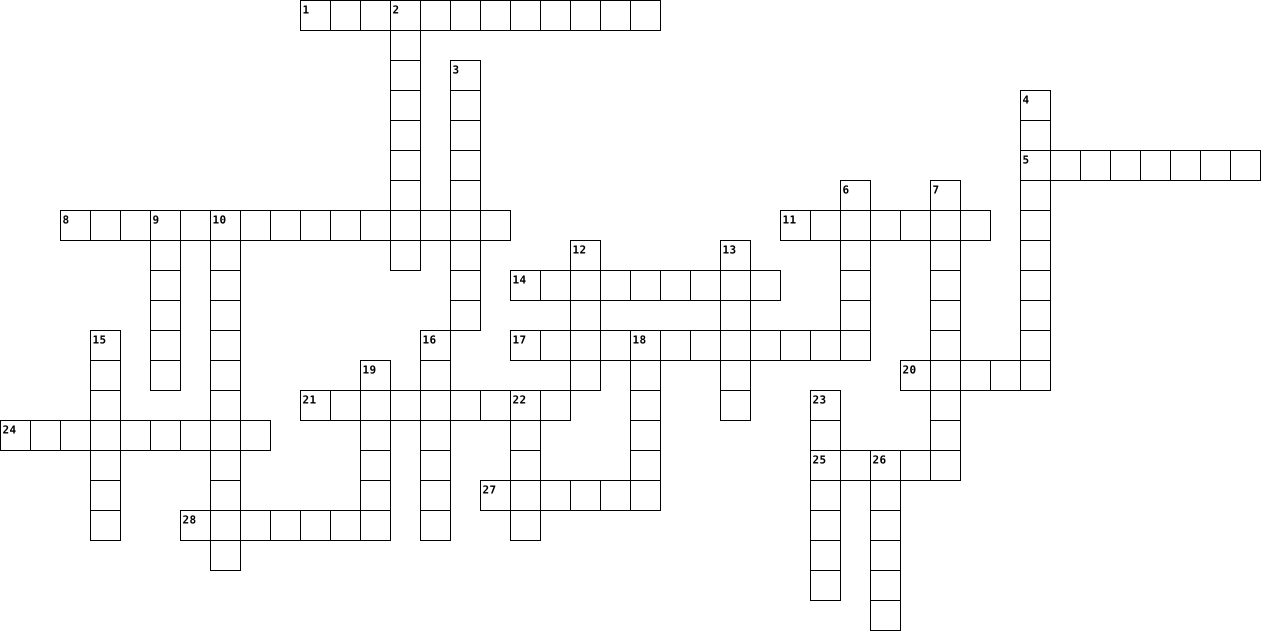
Across
- blank Columbus an Italian explorer and navigator who completed four voyages across the Atlantic, blank Ocean, and explore the Americas.
- is separated from continental Europe by the North Sea to the east and the English Channel to the south.
- Sailor or travel all the way around.
- Napoleon Bonaparte, Henry I, Louis XIV, henry IV where rulers of this Country which is located on the continent of Europe.
- blank da Vinci was an Italian man who was a painter, draughtsman, engineer, scientist, theorist, and more.
- Period in European cultural, artistic, political and economic “rebirth” following the Middle Ages.
- blank Antony was a Roman politician and general who played a critical role in the transformation of the Roman empire one of the husbands of Cleopatra.
- Was a Portuguese explorer who organised the Spanish expedition to the East Indies, also the first man to circumnavigate the globe.
- The former Queen of the United Kingdom of Great Britain. The time period in which she rolled was known as the Victorian era of Britain.
- blank Erikson was a norse explorer from Iceland, who is thought to have been the first European to set foot on continent of North America.
- s a landform created by deposition of sediment that is carried by a river as the flow leaves its mouth and enters slower-moving or stagnant water.
- The blank river, is the longest river in Asia, the third-longest in the world and the longest in the world to flow entirely within one country.
Down
- The queen known for supporting and financing Christopher Columbus's.
- a French military leader who was sent into exile.
- The last active ruler of the Ptolemaic Kingdom of Egypt
- blank Polo was a Venetian merchant, explorer, and writer who travelled through Asia along the Silk Road.
- Thw king known for supporting and giving Christopher Columbus the money for his exploration.
- Is a country in East Asia and it is the world's most populous country.
- Is a historical region of Western Asia situated within the Tigris–Euphrates river system.
- blank Calvin was a French theologian, pastor and reformer in Geneva during the Protestant Reformation.
- the blank empire was founded when Augustus Caesar proclaimed himself the first emperor of Rome.
- blank Luther was a German professor of theology, priest, author, composer, Augustinian monk, and a seminal figure in the Reformation.
- blank Caesar was a Roman general and statesman who played a critical role in the events that led to the demise of the Roman Republic and the rise of the Roman Empire.
- European country with a long Mediterranean coastline.
- Is a civilization of ancient North Africa, concentrated along the lower reaches of the Nile River.
- The longest river in Africa, it has historically been considered the longest river in the world.
- The blank river is the second-longest river in China.
- Is a country in South Asia, is the second-most populous country, and the seventh-largest country.
28 Clues: Sailor or travel all the way around. • a French military leader who was sent into exile. • European country with a long Mediterranean coastline. • The blank river is the second-longest river in China. • The last active ruler of the Ptolemaic Kingdom of Egypt • The queen known for supporting and financing Christopher Columbus's. • ...
Testing Your History Knowledge 2023-10-04

Across
- A "hunt" in which, contrary to popular belief, no one was ever burned at the stake.
- This country was separated at the 38th Parallel in 1945.
- Are said to have "discovered" North America almost 500 years before Columbus.
- What country started the slave trade?
- A type of wartime conflict characterized by the military blockade of a city in an effort to force surrender.
- The long-debunked theory that held that the Earth was the center of the universe.
- A Gaelic festival that is characterized by wearing masks to ward off evil spirits, considered a precursor to modern day Halloween and the celebration of "the darker half of the year."
- Guiteau, to Garfield.
- An ultimatum issued to the Japanese in 1945 that promised utter destruction unless they surrendered.
- King Philip's naval strategy to invade England, 1588.
- An eruption in 1883 that was so loud, that it was said to rupture eardrums 40 miles away.
- Prior to the War on Terror, this was the longest conflict and proxy war in modern history.
- Colloquial term for a disease that wiped out a significant number of the European population during the Crusades.
- It is said that you cannot walk this battlefield without stepping where a soldier died.
- Inventor of the first automobile (name)
- Cleopatra was a descendent of this heritage.
- Conceptually, he invented the first tank.
- The area of North America said to have been explored by (6-Across)
- The first known civilization.
- A Roman Pagan festival often considered the basis of Christmas when it was co-opted by the Christian faith.
Down
- Hitler was known for painting these.
- The inventor of the first telephone, 1876.
- A pre-20th century battle strategy designed to maximize combat effectiveness before the advent of modern rifling in firearms.
- What country built the first firearms?
- The most famous last-stand battle site in history, characterized by 300 hoplites and 7,000 foot soldiers.
- Colloquially, the conflict in which so many combatants died that they came to be known as "The Lost Generation."
- Document designed to protect feudal serfs from tyrannical rulers.
- Short Victorian-Era books that often told stories of horror, crime, or adventure.
- (First name) of the White Death, the most deadly sniper in all of history who fought in the Winter War against the USSR.
- Russian mystic who reportedly survived being poisoned, shot, and stabbed numerous times before he was finally drowned in the Volga river.
- Used to store the viscera of the human body after the Egyptian mummification process.
- This system of systemic segregation ended in South Africa in 1994.
- The final battle of the American Revolution.
- Style of battle where combatants are deadlocked for long periods of time, separated by a long field full of barbed wire.
- He was assassinated while viewing a play called "Our American Cousin."
- Credited with inventing the vaccine for Polio.
36 Clues: Guiteau, to Garfield. • The first known civilization. • Hitler was known for painting these. • What country started the slave trade? • What country built the first firearms? • Inventor of the first automobile (name) • Conceptually, he invented the first tank. • The inventor of the first telephone, 1876. • The final battle of the American Revolution. • ...
Araling Panlipunan 2019-03-07

Across
- Simbahan ng namuuno sa Holy roman empire
- Culture of Greek
- Sinulat ang Don quixote de la mancha
- Nile serpent
- Tawag sa mga middle class/traders
- Pangalawang pinuno ng Chaldeans
- God of wisdom
- Tawag sa mga ruler o teacher ng rome
- God of Earth
- Dito nanggaling ang pangalang Arkhenaton
- Unang emperor
- Religon ng Hebrews
- Unang lider ng assyrians
- where the arrow always points
- To rebirth or reveal
- God of death
- May akda ng "The Prince
- Mga tawag sa slaves ng Sparta
- Son in law ni iknaton
- Isang kantang pagibig
- Lider ng Holy roman empire
- system of a direction of a map grid system
- God of Labor
- principal God
- Condominium ng sumerians
- Tells exact direction of
- Religion ng mga babylonians
- Ang "Makata ng mga Makatata"
- Unang propeta ng Hebrew
- founder of Chaldeans
- Mababang uri ng tao sa rome
- Worlds first empire
- gear na gawa sa bakal ng mga assyrians
- Majic rites
- Pinuno ng middle kingdom ng Egypt
- locating by degrees of latitude and longitude
- Diyos ng Assyria
- Barko ng Punic80
- system of currency ng sumerian
- Also known as the traders of antiquity
- Pagkapatay ni Julius Caesar
- Libro na ginawa ni Aristotle
- Unang hari ng Phoenicians
- locating by bodies of water
- Emblem of Life
- Chosen people of God
- Greek word kung saan nanggaling ang Phoenicians
- Lider ng Egypt
Down
- Kanang kamay ni Alexander the Great
- Kailan namatay si Julius Caesar
- Most basic type of direction
- Oldest Medicine documents
- Pinakasikat na lider ng assyria
- Locating by neighboring countries
- Unang nakadiskobre ng bakal
- First Girl ruler in the world
- Goddes of Sky
- Longest river in the world
- Pangalan ng hari ng sumerians
- Pera ng Sparta
- Pinuno ng Byzantine
- Asawa ni Nebuchadnezzar
- god of water
- anak si Charlemagne
- Asaawa ni Hatshepsute
- unang pinuno ng babylonians
- Prinsepe ng mga humanista
- Tatay ng Alex D' Great
- And rerevive ng Renaissance
- Guro ni alexander the great
- Tawag sa mga nanay dati
- Tirahan ng mga assyrians
- God of Justice
- A.k.a Fertile Crescent
- Pinakamahal na bakal
- City States in Greece
- Asawa ni Alex D' Great
- Sacred Sign
- Pinakamataas sa Catholic
- God of sun
- lider ng lower cataract
- Gumawa ng hanging gardens of babylon
- Estudyante ni Leonardo da vinci
- gumawa ng "The Last Supper"
- Pinakamatibay na bakal
- Namuno sa Tang dyanasty
- Arkhenation's prayers
- Records of egyptians civilization
- Hymns/Prayers
- Isang heneral ni Sulla
- Rule of God
- ibig sabihin ng VEDI
- 1st War between Athens and Persia
- sistem ng pagsusulat sa sumeria
- Pangalawang pinuno ng babylonians
- Judge of evil spirit
- God of love
- Guro ni Plato
- Tawag sa mga pinakamataas ng pharoah
- Unang pinuno ng akkadians
- Ibig sabihin ng I saw
101 Clues: God of sun • Sacred Sign • Rule of God • Majic rites • God of love • Nile serpent • God of Earth • god of water • God of death • God of Labor • God of wisdom • Goddes of Sky • Unang emperor • principal God • Hymns/Prayers • Guro ni Plato • Pera ng Sparta • God of Justice • Emblem of Life • Lider ng Egypt • Culture of Greek • Diyos ng Assyria • Barko ng Punic80 • Religon ng Hebrews • Pinuno ng Byzantine • ...
assssean 2019-03-07

Across
- tawag sa pera ng ispartano
- kungsaan nagbigti si hannibal
- aymga lupa na masmaliit kaysa kontinente
- malaking bahagi ng lupa na napaliligiran ng tubig
- a war between athens and sparta
- pagitan ng longitud at latitude
- father of political science
- attica
- barko ng carthage
- pinuno ng carthage nung second punic war
- fossils of animals
- ,means"three"
- faith/religion
- war between rome and phoenicians
- significe dictatorship and intelligence
- “eat to live or live to eat"
- nile serpent
- god of love in babylonians
- imaginary line whuich devides the earth
- “guro"
- binubuo ng mga city state na kaalyado ng athens
- paraan ng pagsusulat
- human raise
- kakambal ni Romolus
- katangiang pisikal ng mga taong naninirahan
- delian vs peloponnessian
- the world first empire
- pinuno ng etruscan
- ang pinakamayamang sibilisasyon
- provinces or cities in persia
- pinakasalan ni alexander the great
- principle/philosophers
- pinuno ng rome sa second punic war
- isang maliit na bahagi ng lupa nanagdurugton sa dalawang malaking masa ng lupa
- father of history
- greek wor of phoencia
- roman gladiator
- patag nalupain sa pagitan ng dalawa o higit pang bundok
- pagtukoy sa lugar
- makipot na ilog na nagdurugtong sa france at italya
- unang sistema ng pagsusulat
- human behavior
- pumalit kay simuabum
- hari ng mga sumerians
- locating by means of degrees of latitude and longhitude
- hayop na nasa selyo ng rome
- kapapahan
- means"rule"
- nilupig ko
Down
- longest river
- pinakaunang hari ng mesopotamia
- anyong tubig na nasa baybayin
- ama ni Alexander D’ great
- Governor in persia
- roman culture
- means"representation"
- king of macedon
- great traders of antquity
- capital ng Italy
- pilosopiya,paniniwala at prinsipyo/naging pamantayan ng pamumuhay
- god of death in babylonians
- ay malawak na anyong tubig
- seat of governance
- ninuno ng mga sinaunang tao
- "rever/s"
- asian European combination of culture
- mas malaki ito kaysa pook
- itiniwalag sa second triumvirate
- wife of iknaton
- heneral ni alexander the great
- anak ni pepin d’ short
- katawan ni kristo
- taksil na griyego
- ang tawag sa pagkapanalo na inalay kay phyrus
- city state na kaalyado ng sparta
- kung saan natagpuan ni nabopolassar ang chaldeans
- peloponessus
- “pagtatanim”
- digmaan sa pagitan ng phoenicie at rome
- the missing link
- Greece vs Rome
- means "people"
- unang ruler sa (history) ng rome
- ang tawag sa agham ng lokasyon
- unang ruler ng rome ayon sa (mythology)
- simbolo ng pakikihango ng romano sa katoliko
- dahil sa pagmamahal niya kay Cleopatra ibibigay nya ang lahat ng pagaari
- unang nagpakita ang humanista
- society
- "between"
- ang malawak at patag na lupa
- pansamantalang papalit kay Julius Caesar
- CRASSUS piñata siya nung papunta siya sa parthia
- god of creator or creation
- PETRINE DOCTRINE DERIVE FROM
- founder of taoism
- parte sa greece kung saan tumakbo si pompey
- means"victory/fame"
98 Clues: attica • “guro" • society • "rever/s" • "between" • kapapahan • nilupig ko • human raise • means"rule" • nile serpent • peloponessus • “pagtatanim” • longest river • roman culture • ,means"three" • faith/religion • Greece vs Rome • means "people" • human behavior • king of macedon • wife of iknaton • roman gladiator • capital ng Italy • the missing link • barko ng carthage • katawan ni kristo • taksil na griyego • ...
APHG Vocab Review 2020-04-09

Across
- Contentious political process by which a state breaks into smaller countries
- Manufacturing in which the cost of transportation and the material do not play a factor in deciding location
- Group of people who are a common identity
- The encouragement of white property owners to sell their homes at a loss because they were being overtaken by minorities
- Type of agriculture that requires the plots are abandoned once their fertility is lost
- Boundaries that are delimited and defined by straight lines
- Identifies the economically indepndent and dependent of a population (2 words)
- International organization that has joined together for military purposes
- Theory that political destabilization in one country can lead to acollapse of political stability in neighboring countires
- Physical land and cultural features of a location
- Movements of livestock according to seasonal patterns
- Represents data of equal value on a map
- Any of the languages derived from Latin (2 words)
- Any small group or region surrounded by another larger area
- Created the idea of the cultural landscape (2 words)
- Proportion of Earth inhabited by humans
- Expansion of cultural traits
- Term used to refer to the northern industrial states (2 words)
- Type of density that uses the number of people in a given unit
- Population group unified by a specific common characteristic
- Found at approximately 180 degrees (3 words)
- Describes the location in relationship to the areas around it
- Agriculture that specializes in grapes, avocados, and olives
- Term used to identify the southeastern and southwestern states (2 words)
Down
- Linked system of processes of a product that includes the beginning to the end (2 words)
- Location of where goods are broken up and change transportation modes (3 words)
- Economic and political relations that organize food production for commercial purposes
- Having to do with many cultures
- Market area surrounding an urban center
- Pidgin language that evolves to become a primary language
- Abandonment of cities by affluent or middle-class white residents (2 words)
- People who come from a common ethnic background but live in regions outside of their home ethnicity
- System mostly found in India that identifies social hierarchy
- Delegation of legal authority from a central government to lower levels of political organization
- Decrease in interaction between two phenomena as the distance increases (2 words)
- This type of diffusion includes contagious, hierarchical and stimulus
- A capital city placed in a remote or peripheral area for economic, strategic or symbolic reasons (2 words)
- Adoption of cultural traits
- Breakup of an agglomeration
- This allows geographers to map anlayze and model spatial data
- Cities that are located on the outskirts of larger cities (2 words)
- Model of economic development that has 5 stages
- One of the first agricultural hearths located in Mesopotamia (2 words)
- Theory created by Weber to describe the optimal location of industry (2 words)
- Theory that claimed that the power based in the heart of Eurasia could dominate the world
- Total value of goods and services produced by residents of a country
46 Clues: Adoption of cultural traits • Breakup of an agglomeration • Expansion of cultural traits • Having to do with many cultures • Market area surrounding an urban center • Represents data of equal value on a map • Proportion of Earth inhabited by humans • Group of people who are a common identity • Found at approximately 180 degrees (3 words) • ...
Gawaing Pagpapaunlad: Pagbuo ng Puzzle 2021-06-17

Across
- Ang prostitusyon ay isang uri ng ________
- May mga bugaw na gumagamit ng ng _________ para doon isasagawa ang transaksyon.
- sila ay itinuturing na ______________ dahil hindi lamang serbisyong sekswal ang handog nila sa kanilang mga kapareha kung hindi kinakantahan nila ito at sinasayawan.
- Isa pang tawag sa Hetaika
- Ang adiksyon sa ______ ay nakapagpapabago ng takbo ng isipan.
- dahil sa kakulangan ng salapi na gagamitin sa pang araw - araw na pamumuhay at paggastos sa pangunahing mga pangangailangan, napipilitan ang iba na pumasok sa ganitong uri ng hanapbuhay upang kumita ng malaki at mabilis na paraan.
- Kadalasan ang mga taong hindi nakapagtapos ng pag -aaral ay sinasabing walang pagpipilian kung hindi pasukin ang prostitusyon.
- sa Japan ang mga babaeng bayaran ay tinatawag na__________
- Ang prostitusyon ayon sa ____________________ ay ang simpleng paggamit ng katawan ng isang tao upang kumita ng pera.
- ang mga babaeng bayaran ay tinatawag na asobi - onna o women of pleasure.
- Ang prostitusyon ay tinaguriang ________________________ sa buong mundo sa maraming lugar na nagsimula pa noong panahon ng sibilisasyong Mesopotamia, Greece, Rome, China at Japan.
- sa pagnanais na bumili na mga bagay na makapagpapasaya ang magiging kita mula sa pagbebenta ng aliw ay napakadaling paraan kung hindi mo iisipin ang iyong kalusugan at kinabukasan.
- Ang mga _________ na wala sa tamang edad ay madaling mahirati o mahikayat ng ilan kung kayat humahantong sa hindi tamang desisyon tungo sa prostitusyon.
- Sa ___________ ay mayroong itinuturo ukol sa mga gawa ng laman kabilang dito ang ukol sa prostitusyon.
Down
- Ang mga taong hindi mo naman matatawag na talagang mahirap subalit naaakit sa ganitong hanapbuhay dahil sa pangakong malaking kita at mabibili ang mga nais na mayroon sa buhay at sa bahay.
- pornograpiya isang terminong hango sa salitang Griyego na ____________
- Marami nito sa mga syudad gaya ng____________
- Sa sinaunang Greece ang mga prostitute ay tinatawag
- kailangang magbayad ng ______________ ang sinumang nagnanais makapanood ng mga ito.
- Sa kasalukuyan ito ay may makabagong katawagan ang ____________ na tumutukoy sa taong nagbebenta.
- Ang isang taong nagkakaroon ng kaisipang wala nang mawawala kung papasok sa mundo ng prostitusyon sapagkat dati na rin siyang naging biktima ng sekwal na pang aabuso.
- Hindi ito legal sa ___________ sapagkat tutol ang maraming sektor ng lipunan lalu na ang mga relihiyon.
- mga website na puno ng mga __________
- Ang paggamit ng _________________
- sa bansang ito ligal ang prostitusyon
- Mayroon ding mga bugaw na taga alok ng kanilang alagang __________ sa mga taong nangangailangan ng panandaliang ligaya kapalit ng halaga.
- Inilalarawan din itong ____________ o pagbebenta ng katawan o pagbibigay ng panandaliang ligaya sa kahit anumang paraan upang kumita ng pera
- ang simpleng paggamit ng katawan ng isang tao upang kumita ng pera.
- kung saan ang pakikipagtalik sa isang prostitute ay sa pamamagitan ng internet at webcam kapalit ng halaga.
- isang terminong hango sa salitang Griyego na pornea
- Madalas ________ ang sangkot sa prostitusyon na mga kabataan, subalit ngayon wala nang pinipili, lalaki man, bakla, transgender, mga batang nasa murang edad ay biktima na rin ng prostitusyon.
31 Clues: Isa pang tawag sa Hetaika • Ang paggamit ng _________________ • mga website na puno ng mga __________ • sa bansang ito ligal ang prostitusyon • Ang prostitusyon ay isang uri ng ________ • Marami nito sa mga syudad gaya ng____________ • Sa sinaunang Greece ang mga prostitute ay tinatawag • isang terminong hango sa salitang Griyego na pornea • ...
Ritmos e instrumentos de america 2022-11-08

Across
- En la Mesopotamia existió, hacia el año 3000 a. de J.C., un instrumento conocido con el nombre de «A-la»,Pertenecen a la familia de los idiófonos, por lo que el sonido se produce entrechocando uno con otro o percutiéndolos con baquetas
- es un género musical bailable que nace en la República Dominicana a principio de los años 60.
- es un género musical, así como también una danza folclórica que tiene su origen en las fiestas populares de la Región Nordeste de Brasil, concretamente en la región de Pernambuco.
- es un instrumento musical de origen peruano que se ha popularizado en todo el mundo gracias al nuevo flamenco, el jazz moderno y la música afro-latina-caribeña
- es un pequeño instrumento de viento sin llaves descendiente de primitivos silbatos hechos con barro o hueso.
- es un instrumento de cuerda frotada tocado con un arco. Cuenta con cuatro cuerdas tensadas cuya afinación es Mi, la, re, sol (desde la cuerda más delgada a la más gruesa).
- es un instrumento musical de cuerda pulsada, compuesto de una caja de madera, un mástil sobre el que va adosado el diapasón o trastero —generalmente con un agujero acústico en el centro de la tapa (boca)—, y seis cuerdas.
- es un género musical nacido a finales del siglo XIX en los Estados Unidos, que se expandió de forma global a lo largo del siglo XX.
- es un género musical bailable originado en la República Dominicana a finales del siglo XIX.
Down
- es un ritmo musical y baile folclórico tradicional del Caribe Colombiano.
- es un baile vivo y rítmico de origen afrobrasileño en 2/4 tiempos bailada a la música Samba cuyos orígenes incluyen el Maxixe.
- es un género de música popular interpretada de manera instrumental o cantada usando un compás binario que ha sido incorporada como música y danza folclórica en Nicaragua.
- se origina de paris, es un instrumento musical cónico, de la familia de los instrumentos de viento-madera, generalmente hecho de latón, que consta de una boquilla con una caña simple al igual que el clarinete.
- Es un instrumento de viento madera con bisel, que es un agujero por el que sale el aire al soplar y que al vibrar en esta pieza produce el sonido.
- es una danza de pareja enlazada estrechamente surgida a partir de la fusión de danzas y ritmos afro-rioplatenses, gauchos y europeos
- es un instrumento de percusión de sonido indeterminado, perteneciente a la familia de los membranófonos según el sistema de clasificación de Hornbostel-Sachs.
- es un género musical originado en Jamaica en los años 60.
- fue creado en alemania . es un instrumento de viento madera de relativa nueva creación que se conoce desde principios del siglo XVIII.
- es un instrumento musical de percusión. Cada lámina se afina según un tono específico de la escala cromática.en Europa por primera vez en el año 1511
- es un género musical bailable resultante de la síntesis del son cubano y otros géneros de música caribeña y estadounidenses como el jazz y el blues
20 Clues: es un género musical originado en Jamaica en los años 60. • es un ritmo musical y baile folclórico tradicional del Caribe Colombiano. • es un género musical bailable originado en la República Dominicana a finales del siglo XIX. • es un género musical bailable que nace en la República Dominicana a principio de los años 60. • ...
geografi 2025-03-08

Across
- Pegunungan terpanjang di dunia
- Taman nasional terkenal di Amerika Serikat
- Danau terdalam di dunia
- Pegunungan yang terletak di Asia Tengah
- Nama lain dari Denali, gunung tertinggi di Amerika Utara
- Pegunungan yang memisahkan Eropa dan Asia
- Samudra terbesar di dunia
- Laut yang dikelilingi oleh tiga benua
- Gunung tertinggi di dunia
- Air terjun terbesar berdasarkan lebar dan volume air
- Pulau terbesar di dunia
- Pegunungan yang memisahkan Spanyol dan Prancis
- Pegunungan tertinggi di dunia
- Danau terbesar di Afrika
- Sungai terpanjang di dunia
- Palung laut terdalam di dunia
- Terusan yang menghubungkan Laut Tengah dan Laut Merah
- Terumbu karang terbesar di dunia
- Teluk terbesar di Amerika Serikat
- Sekelompok danau besar di Amerika Utara
- Gunung tertinggi di Eropa
- Pulau besar di sebelah timur Afrika
- Wilayah di AS yang sering mengalami tornado
- Garis lintang yang mengelilingi Kutub Selatan
- Air terjun tertinggi di dunia
- Wilayah subur di Timur Tengah yang dikenal sebagai tempat lahir peradaban
- Zona aktivitas gempa dan gunung berapi di Samudra Pasifik
- Satu-satunya Danau Besar yang seluruhnya berada di AS
- Gurun terbesar di dunia
- Gunung tertinggi di Afrika
- Pegunungan utama di Australia
- Sungai utama yang mengalir melalui banyak negara Eropa
- Garis lintang yang mengelilingi Kutub Utara
- Gurun terkering di dunia
Down
- Wilayah luas yang membentang di Rusia
- Danau terbesar di dunia berdasarkan luas
- Garis lintang yang berada di belahan bumi selatan
- Gunung terkenal di Jepang
- Semenanjung yang mencakup beberapa negara di Eropa Tenggara
- Sungai terbesar di dunia berdasarkan volume air
- Garis bujur nol derajat yang melewati Greenwich
- Wilayah di Amerika Selatan yang terkenal dengan pegunungan dan gletser
- Sungai suci di India
- Ngarai terbesar di dunia
- Gurun besar di Afrika bagian selatan
- Sungai yang mengaliri wilayah Mesopotamia kuno
- Garis imajiner yang membagi bumi menjadi belahan utara dan selatan
- Selat yang memisahkan Asia dan Amerika Utara
- Danau air tawar terbesar di dunia berdasarkan luas
- Gurun terbesar di Asia
- Danau tertinggi di dunia yang bisa dilayari
- Benua paling dingin di dunia
- Hutan hujan terbesar di dunia
- Kepulauan vulkanik di Samudra Pasifik
- Laut yang terletak di sekitar Kepulauan Karibia
- Sungai utama yang mengalir di Asia Tenggara
- Arus laut hangat yang mempengaruhi iklim Eropa
- Wilayah Rusia yang terkenal dengan gunung berapinya
- Garis lintang yang berada di belahan bumi utara
- Terusan yang menghubungkan Samudra Atlantik dan Pasifik
- Sungai utama di Amerika Serikat
- Sungai terpanjang di Asia
- Laut dengan kadar garam tertinggi di dunia
- Rangkaian pulau kecil di selatan Florida
- Pegunungan besar yang membentang di Amerika Utara
- Formasi alam khas Norwegia yang terkenal indah
- Laut yang berbatasan dengan negara-negara Nordik dan Eropa Timur
- Sungai yang dikenal sebagai "Bencana China" karena sering banjir
- Laut yang membentang di sebelah utara Siberia
- Negara dengan banyak gunung berapi dan gletser
70 Clues: Sungai suci di India • Gurun terbesar di Asia • Danau terdalam di dunia • Pulau terbesar di dunia • Gurun terbesar di dunia • Ngarai terbesar di dunia • Danau terbesar di Afrika • Gurun terkering di dunia • Gunung terkenal di Jepang • Samudra terbesar di dunia • Gunung tertinggi di dunia • Sungai terpanjang di Asia • Gunung tertinggi di Eropa • Sungai terpanjang di dunia • ...
Feliz cumple 2025-09-11

Across
- poeta chileno, Premio Nobel 1971.
- pintor español apodado “el Greco”.
- habitante primitivo de Mesopotamia.
- zurdo tenaz, rival colosal; de Susana ídolo sin igual.
- diosa romana de la caza.
- pintor de la Capilla Sixtina.
- río más largo de Asia.
- piedra semipreciosa azul.
- instrumento para medir la presión atmosférica.
- deporte que ambos contemplan, aunque ninguno golpea la esfera amarilla.
- río más largo de Europa.
- en verano va Marcos con fuerza tenaz; Susana replica: “¡yo me quedo en paz!”.
- mar que baña a Estambul.
- ejercicio cruel de esfuerzo cabal; Susana lo sufre con aire marcial.
- poema de Virgilio.
- capital de Mongolia.
- lugar deportivo bautizado como grasa, pero sede de sudor familiar.
- ciudad destruida por el Vesubio.
- piedra preciosa de color verde.
- no es yoga ni pesas, pero te saca las torceduras traviesas.
- amargo brebaje que inaugura las mañanas de susana.
- poema épico de Homero.
- maestra de la siesta y del debate, gana discusiones hasta en sus sueños.
- jamás se deja tentar por el color; viste luto elegante.
- del queso amante, del sol también, si hay día afuera lo grita bien.
- isla donde nació Napoleón.
- vecino sindicado como autor de la muerte de Cot.
- lengua oficial de Irán.
- canto obligado en toda reunión de camaradas.
- pulcro en demasía, responsable de consumo desmedido de dentífrico.
- lugar de deporte y piscina ideal; Marcos lo nombra, mas nunca va.
Down
- árbol sagrado de los griegos.
- moneda de Rusia.
- serbio tenista de gran condición; mas en Susana despierta aversión.
- montaña más alta de África.
- es lo que se come cuando comienza la función, nunca llegaste a probarlo porque no te sonó el despertador.
- fundador del psicoanálisis.
- bajita en cuerpo, gigante en voz, un simple “¡buh!” y grita feroz.
- no es carruaje alemán, sino ciudad natal.
- moneda oficial de Japón.
- profesional en rendir pleitesía a la cocina de su suegra.
- monte sagrado de Grecia.
- reina esto no es asado: si no hay huevo frito, algo ha fallado.
- en la cancha es voraz, joven campeón llamado.
- no altavoz, mas se la escucha desde toda habitación.
- capital del estado de Yucatán.
- denominación de la vivienda; no insecto.
- autor de “Cien años de soledad”.
- playa de sol abrasante; allí la familia se quema bastante.
- ciudad francesa famosa por su tapiz medieval.
- autor de La Divina Comedia.
- rubia o morena, en la mesa nunca falta los domingos.
- héroe aqueo de la Ilíada.
- científico que formuló la teoría de la relatividad.
- planeta más cercano al Sol.
- de queso y dulzura, manjar celestial; Susana lo ofrece tras todo banquete familiar.
- can de índole escapista, cual Houdini doméstico.
- animal símbolo de Australia.
- no es el más chico de la familia pero es el.
- metal cuyo símbolo químico es Sn.
- lengua oficial de Etiopía.
- filósofo griego discípulo de Sócrates.
- océano que baña la costa oriental de África.
- obra principal de Cervantes.
- unidad de medida de intensidad luminosa.
- animal emblemático de Canadá.
- ave rapaz nocturna.
67 Clues: moneda de Rusia. • poema de Virgilio. • ave rapaz nocturna. • capital de Mongolia. • río más largo de Asia. • poema épico de Homero. • lengua oficial de Irán. • moneda oficial de Japón. • monte sagrado de Grecia. • diosa romana de la caza. • río más largo de Europa. • mar que baña a Estambul. • piedra semipreciosa azul. • héroe aqueo de la Ilíada. • lengua oficial de Etiopía. • ...
Gawaing Pagpapaunlad: Pagbuo ng Puzzle 2021-06-17

Across
- Mayroon ding mga bugaw na taga alok ng kanilang alagang __________ sa mga taong nangangailangan ng panandaliang ligaya kapalit ng halaga.
- kung saan ang pakikipagtalik sa isang prostitute ay sa pamamagitan ng internet at webcam kapalit ng halaga.
- Ang prostitusyon ay isang uri ng ________
- Isa pang tawag sa Hetaika
- Kadalasan ang mga taong hindi nakapagtapos ng pag -aaral ay sinasabing walang pagpipilian kung hindi pasukin ang prostitusyon.
- Sa kasalukuyan ito ay may makabagong katawagan ang ____________ na tumutukoy sa taong nagbebenta.
- dahil sa kakulangan ng salapi na gagamitin sa pang araw - araw na pamumuhay at paggastos sa pangunahing mga pangangailangan, napipilitan ang iba na pumasok sa ganitong uri ng hanapbuhay upang kumita ng malaki at mabilis na paraan.
- sila ay itinuturing na ______________ dahil hindi lamang serbisyong sekswal ang handog nila sa kanilang mga kapareha kung hindi kinakantahan nila ito at sinasayawan.
- May mga bugaw na gumagamit ng ng _________ para doon isasagawa ang transaksyon.
- Ang mga taong hindi mo naman matatawag na talagang mahirap subalit naaakit sa ganitong hanapbuhay dahil sa pangakong malaking kita at mabibili ang mga nais na mayroon sa buhay at sa bahay.
- Ang adiksyon sa ______ ay nakapagpapabago ng takbo ng isipan.
- Madalas ________ ang sangkot sa prostitusyon na mga kabataan, subalit ngayon wala nang pinipili, lalaki man, bakla, transgender, mga batang nasa murang edad ay biktima na rin ng prostitusyon.
- sa pagnanais na bumili na mga bagay na makapagpapasaya ang magiging kita mula sa pagbebenta ng aliw ay napakadaling paraan kung hindi mo iisipin ang iyong kalusugan at kinabukasan.
- Ang paggamit ng _________________
- sa Japan ang mga babaeng bayaran ay tinatawag na__________
- Ang prostitusyon ay tinaguriang ________________________ sa buong mundo sa maraming lugar na nagsimula pa noong panahon ng sibilisasyong Mesopotamia, Greece, Rome, China at Japan.
Down
- Ang isang taong nagkakaroon ng kaisipang wala nang mawawala kung papasok sa mundo ng prostitusyon sapagkat dati na rin siyang naging biktima ng sekwal na pang aabuso.
- mga website na puno ng mga __________
- Ang prostitusyon ayon sa ____________________ ay ang simpleng paggamit ng katawan ng isang tao upang kumita ng pera.
- Sa sinaunang Greece ang mga prostitute ay tinatawag
- ang mga babaeng bayaran ay tinatawag na asobi - onna o women of pleasure.
- Sa ___________ ay mayroong itinuturo ukol sa mga gawa ng laman kabilang dito ang ukol sa prostitusyon.
- sa bansang ito ligal ang prostitusyon
- kailangang magbayad ng ______________ ang sinumang nagnanais makapanood ng mga ito.
- Marami nito sa mga syudad gaya ng____________
- ang simpleng paggamit ng katawan ng isang tao upang kumita ng pera.
- isang terminong hango sa salitang Griyego na pornea
- Ang mga _________ na wala sa tamang edad ay madaling mahirati o mahikayat ng ilan kung kayat humahantong sa hindi tamang desisyon tungo sa prostitusyon.
- Inilalarawan din itong ____________ o pagbebenta ng katawan o pagbibigay ng panandaliang ligaya sa kahit anumang paraan upang kumita ng pera
- Hindi ito legal sa ___________ sapagkat tutol ang maraming sektor ng lipunan lalu na ang mga relihiyon.
- pornograpiya isang terminong hango sa salitang Griyego na ____________
31 Clues: Isa pang tawag sa Hetaika • Ang paggamit ng _________________ • mga website na puno ng mga __________ • sa bansang ito ligal ang prostitusyon • Ang prostitusyon ay isang uri ng ________ • Marami nito sa mga syudad gaya ng____________ • Sa sinaunang Greece ang mga prostitute ay tinatawag • isang terminong hango sa salitang Griyego na pornea • ...
The World of Islam 2018-10-19

Across
- muslim slave soldiders and muslim ruler of slave.
- a member of the Sassanian dynasty.
- god worship in pre Islamic arabia.
- the semitic language of the arabs spoken by some 150 millions people throughout the middle east and north Africa, relation to the literature or language of arab people.
- non-muslim citizen of Islamic state.
- the capitail and likely largest city of Syria but then it decline in population of Aleppo due to the battle of the city.
- the old arab or non-European quarter of north African town.
- a person regarded as an inspired teacher or proclaimer of the will of god.
- the muslim profession of faith.
- the religious faith or muslim including in allah as the sole deity and Muhammad as his prophet.
- a high official in some Muslim countries, especially in Turkey under Ottoman rule.
- the Byzantine empire or the eastern orthodox church.
- age is idyillic often imaginary past time of peace, prosperity, and happiness.
- the birthplace in 570 A.D. of the Prophet Muhammad, it was the scene of his early teaching before his emigration to Medina in 622.
- a collection of tradition containing saying of the prophet Muhammad which with all account of his daily sunna constitution the major source of guidance of muslim apart of koran.
- a body of Muslim scholars recognized as having specialist knowledge of Islamic sacred law and theology.
Down
- was a famous Muslim hero, he was the sultan, or king, of all the Muslim territories of Syria, Egypt, Palestine, and northern Mesopotamia.
- obligatory payment made annually under Islamic law certain kind of property and used for charitable and religious purpose.
- dynasty of caliphs based in Damascus that ruled from A.D. 661 to 750.
- he is the founder and chief prophet if Islam, he was born in mecca in 570 A.D., his father dies shorty before his birth and he lost his mother at age six.
- of mysticism in Islam is called.
- a company of travlers on a journey desert or hostile region also a train of pack of animal a group of vehicles traveling together.
- Turk a native or inhabitant of Turkey.
- sunni Islam to refer to the first four caliphs following the death of the Islamic prophet Muhammad.
- the civil and religious leader of a muslim state consider to be repenative of Allah on earth.
- the ruler or reign of a caliph or chief muslim.
- is the language of the crops which represent the final stage of ancient Egyptian
- Dynasty a member of a dynasty of caliphs ruling at Baghdad 1259-750 A.D. governing most of the Islamic world and claiming descent from abbas uncle of Muhammad.
- the ritual prayer of muslim preformed five time daily in a set of form.
- is the way prescribe a nonmative for muslim on basic of teaching and practicing of Muhammad.
- generally known as the first teacher.
- the muslim pilgrimage to mecca that take place in the last on of the year.
32 Clues: the muslim profession of faith. • of mysticism in Islam is called. • a member of the Sassanian dynasty. • god worship in pre Islamic arabia. • non-muslim citizen of Islamic state. • generally known as the first teacher. • Turk a native or inhabitant of Turkey. • the ruler or reign of a caliph or chief muslim. • muslim slave soldiders and muslim ruler of slave. • ...
Tema 4 (Kerja sama dunia) 2025-03-04

Across
- Benua terluas di dunia yang terdiri dari banyak negara adalah benua
- Negara dengan luas wilayah terbesar dimiliki oleh negara
- kerjasama antara beberapa negara di berbagai kawasan dunia disebut dengan kerjasama
- Secara geografis, Benua Afrika dikelilingi oleh Laut tengah atau yang biasa disebut
- G20 merupakan forum global untuk membahas isu-isu moneter internasional dengan tujuan menjaga stabilitas ... internasional
- sebagai lembaga kerja sama internasional terbesar di dunia PBB memiliki badan khusus yang menangani berbagai bidang, badan khusus apakah yang menangani bidang pendidikan dan kebudayaan
- pada masa peradaban awal manusia wilayah manakah yang mengalami perkembangan populasi yang sangat pesat sehingga menciptakan kelas sosial yang lebih kompleks
- tahun 1993 merupakan tahun resmi terbentuknya Uni Eropa melalui penandatanganan perjanjian yang disebut sebagai perjanjian
- Benua terkecil setelah benua Australia adalah benua
- siapakah sejarawan Amerika yang menuturkan jika aktivitas perdagangan di jalur sutra merupakan faktor penting dalam perkembangan peradaban di Cina, anak benua India, persia, eropa, dana arab
- salah satu pertimbangan banyak negara menjalin kerjasama adalah untuk meningkatkan pertumbuhan ... di negara tersebut
- indus sebuah artefak yang bergambar kerbau bertanduk panjang disegel diperkirakan berasal dari
- kerjasama regional yang ada di Asia tenggara adalah
- beberapa catatan sejarah menunjukkan bahwa kerajaan Sriwijaya juga pernah membangun kerjasama yang berfokus pada bidang .. dengan kerajaan di India
- Secara garis besar kita dapat melihat keragaman masyarakat di dunia dari tiga hal yakni etnik, agama dan
- Bumi yang bisa dihuni oleh manusia secara umum dibagi ke dalam 5 benua yaitu benua Asia, Afrika, Eropa, Amerika, dan benua
Down
- kerjasama yang dilakukan oleh dua negara disebut kerjasama
- salah satu negara yang pertama kali mengakui kemerdekaan Indonesia adalah negara
- Benua yang jarang ditinggali karena kondisi iklimnya yang sangat dingin adalah benua
- Terdapat sebuah kota bersejarah di Eropa yang bernama instanbul atau dulu dikenal dengan nama
- pemeluk agama terbanyak kedua di dunia adalah agama
- Pada interaksi kuno India dan Nusantara, wilayah nusantara tersebut dikenal dengan nama ... atau Pulau emas
- lembah sungai Huangho terletak di
- kerjasama yang dilakukan oleh beberapa negara di satu kawasan tertentu disebut kerja sama
- Dari sumber literatur kuno bangsa India mereka melakukan interaksi perdagangan dengan wilayah kepulauan nusantara untuk mendapatkan beberapa jenis
- Istilah manusia modern
- badan khusus PBB yang menangani bidang pemberdayaan anak-anak yang membutuhkan bantuan adalah
- Jalur perdagangan klasik yang sangat ramai dilewati oleh para pedagang yang dikenal dengan nama jalur
- jika dilihat dari daftar negara yang memiliki jumlah variasi ragam bahasa terbanyak adalah negara
- Para ahli menyepakati jika kemunculan awal manusia modern berasal dari daratan
- negara ke negara yang mengikuti kerjasama internasional bertujuan untuk menghindari permusuhan atau persaingan yang memicu terjadinya
- Secara astronomis Benua yang terletak di 10°BB-170°BB dan 83°LU-55°LS adalah benua
- singkatan dari perserikatan bangsa bangsa adalah
- dalam perkembangannya setiap wilayah peradaban kemudian mulai melakukan interaksi baik dalam bentuk konflik maupun .... untuk memenuhi kebutuhan hidupnya
- saat ini ada berapa negara yang tergabung pada kerjasama ASEAN
35 Clues: Istilah manusia modern • lembah sungai Huangho terletak di • singkatan dari perserikatan bangsa bangsa adalah • pemeluk agama terbanyak kedua di dunia adalah agama • Benua terkecil setelah benua Australia adalah benua • kerjasama regional yang ada di Asia tenggara adalah • Negara dengan luas wilayah terbesar dimiliki oleh negara • ...
geografi 2025-03-08

Across
- Pegunungan terpanjang di dunia
- Taman nasional terkenal di Amerika Serikat
- Danau terdalam di dunia
- Pegunungan yang terletak di Asia Tengah
- Nama lain dari Denali, gunung tertinggi di Amerika Utara
- Pegunungan yang memisahkan Eropa dan Asia
- Samudra terbesar di dunia
- Laut yang dikelilingi oleh tiga benua
- Gunung tertinggi di dunia
- Air terjun terbesar berdasarkan lebar dan volume air
- Pulau terbesar di dunia
- Pegunungan yang memisahkan Spanyol dan Prancis
- Pegunungan tertinggi di dunia
- Danau terbesar di Afrika
- Sungai terpanjang di dunia
- Palung laut terdalam di dunia
- Terusan yang menghubungkan Laut Tengah dan Laut Merah
- Terumbu karang terbesar di dunia
- Teluk terbesar di Amerika Serikat
- Sekelompok danau besar di Amerika Utara
- Gunung tertinggi di Eropa
- Pulau besar di sebelah timur Afrika
- Wilayah di AS yang sering mengalami tornado
- Garis lintang yang mengelilingi Kutub Selatan
- Air terjun tertinggi di dunia
- Wilayah subur di Timur Tengah yang dikenal sebagai tempat lahir peradaban
- Zona aktivitas gempa dan gunung berapi di Samudra Pasifik
- Satu-satunya Danau Besar yang seluruhnya berada di AS
- Gurun terbesar di dunia
- Gunung tertinggi di Afrika
- Pegunungan utama di Australia
- Sungai utama yang mengalir melalui banyak negara Eropa
- Garis lintang yang mengelilingi Kutub Utara
- Gurun terkering di dunia
Down
- Wilayah luas yang membentang di Rusia
- Danau terbesar di dunia berdasarkan luas
- Garis lintang yang berada di belahan bumi selatan
- Gunung terkenal di Jepang
- Semenanjung yang mencakup beberapa negara di Eropa Tenggara
- Sungai terbesar di dunia berdasarkan volume air
- Garis bujur nol derajat yang melewati Greenwich
- Wilayah di Amerika Selatan yang terkenal dengan pegunungan dan gletser
- Sungai suci di India
- Ngarai terbesar di dunia
- Gurun besar di Afrika bagian selatan
- Sungai yang mengaliri wilayah Mesopotamia kuno
- Garis imajiner yang membagi bumi menjadi belahan utara dan selatan
- Selat yang memisahkan Asia dan Amerika Utara
- Danau air tawar terbesar di dunia berdasarkan luas
- Gurun terbesar di Asia
- Danau tertinggi di dunia yang bisa dilayari
- Benua paling dingin di dunia
- Hutan hujan terbesar di dunia
- Kepulauan vulkanik di Samudra Pasifik
- Laut yang terletak di sekitar Kepulauan Karibia
- Sungai utama yang mengalir di Asia Tenggara
- Arus laut hangat yang mempengaruhi iklim Eropa
- Wilayah Rusia yang terkenal dengan gunung berapinya
- Garis lintang yang berada di belahan bumi utara
- Terusan yang menghubungkan Samudra Atlantik dan Pasifik
- Sungai utama di Amerika Serikat
- Sungai terpanjang di Asia
- Laut dengan kadar garam tertinggi di dunia
- Rangkaian pulau kecil di selatan Florida
- Pegunungan besar yang membentang di Amerika Utara
- Formasi alam khas Norwegia yang terkenal indah
- Laut yang berbatasan dengan negara-negara Nordik dan Eropa Timur
- Sungai yang dikenal sebagai "Bencana China" karena sering banjir
- Laut yang membentang di sebelah utara Siberia
- Negara dengan banyak gunung berapi dan gletser
70 Clues: Sungai suci di India • Gurun terbesar di Asia • Danau terdalam di dunia • Pulau terbesar di dunia • Gurun terbesar di dunia • Ngarai terbesar di dunia • Danau terbesar di Afrika • Gurun terkering di dunia • Gunung terkenal di Jepang • Samudra terbesar di dunia • Gunung tertinggi di dunia • Sungai terpanjang di Asia • Gunung tertinggi di Eropa • Sungai terpanjang di dunia • ...
Vocab #2 2025-10-07

Across
- An ancient region along the Nile River, south of Egypt, that is now part of modern-day Sudan and southern Egypt. It was rich in gold and was home to one of the earliest civilizations in ancient Africa.
- A period of human history that followed the Bronze Age, characterized by the widespread use of iron and steel for tools and weapons.
- A sovereign, independent state that consists of a single city and its surrounding territory. It functions as its own self-governing political unit.
- A system of organizing people or things into ranked levels of importance, with those at the top holding more power and authority
- A system of writing used in ancient Egypt that uses pictorial characters to represent objects, concepts, or sounds. The word itself comes from Greek words meaning "sacred carving".
- An amount of something that remains after all needs have been met; an excess. In early civilizations, an agricultural surplus was a key factor in the growth of cities.
- An ancient Persian religion founded by the prophet Zoroaster. Its teachings center on a supreme god, Ahura Mazda, and feature a dualistic cosmology of good versus evil.
- A sequence of rulers from the same family. Ancient Egypt and China were governed by a succession of dynasties.
- An ancient region in West Asia situated between the Tigris and Euphrates rivers, in what is now modern-day Iraq. It is considered one of the earliest cradles of human civilization and is known for innovations like writing and agriculture.
Down
- A system of government or business administration characterized by a complex set of rules, a clear hierarchy, and a division of labor. It organizes large numbers of people to work together efficiently.
- The first five books of the Hebrew Bible: Genesis, Exodus, Leviticus, Numbers, and Deuteronomy. It contains the foundational laws and teachings of Judaism. The term can also refer to the entirety of Jewish teachings.
- important info
- The belief in the existence of only one god. Judaism, Christianity, and Islam are major monotheistic religions.
- The belief in and worship of multiple gods or deities. Ancient Egyptian and Greek religions are classic examples of polytheistic belief systems.
- A set of religious and ethical directives that, according to the Hebrew Bible, were given by God to Moses on Mount Sinai. They are foundational to Jewish law and considered divinely authoritative in many Christian traditions.
- A form of government where religious leaders hold political power and rule based on religious doctrines. It is based on the belief that authority comes from divine guidance.
- A political unit of diverse territories and peoples under the control of a single sovereign power. The ruler is an emperor or empress.
- The dispersion or spreading of a people or culture from their original homeland. It can also refer to the community of people scattered across the world.
- The supreme ruler of ancient Egypt, who was considered both a king and a living god.
19 Clues: important info • The supreme ruler of ancient Egypt, who was considered both a king and a living god. • A sequence of rulers from the same family. Ancient Egypt and China were governed by a succession of dynasties. • The belief in the existence of only one god. Judaism, Christianity, and Islam are major monotheistic religions. • ...
Check Time Puzzle on 'Mesopotamia and Agriculture' Lesson 2021-05-07

Across
- the process of adapting wild plants and animals for human use
Down
- The first animals to be domesticated by the Sumerians
- A blade used in farming to turn over soil
- to change something
- the prepared skins of animals
5 Clues: to change something • the prepared skins of animals • A blade used in farming to turn over soil • The first animals to be domesticated by the Sumerians • the process of adapting wild plants and animals for human use
INFLUENCIA DE LA ESCRITURA EN EGIPTO Y MESOPOTAMIA 2022-11-17

Across
- estaban formados por casi 750 símbolos.
- empleados para dar un significado específico a una imagen representada.
- una manera sintetizada de la escritura hierática.
Down
- eran la representación de un elemento humano, animal o cosa.
- era una forma abreviada de la escritura jeroglífica.
5 Clues: estaban formados por casi 750 símbolos. • una manera sintetizada de la escritura hierática. • era una forma abreviada de la escritura jeroglífica. • eran la representación de un elemento humano, animal o cosa. • empleados para dar un significado específico a una imagen representada.
World History Unit 1 Keywords Crossword 2018-02-26

Across
- a ruler with total power over a country, typically one who has obtained power by force
- first emperor of a unified China from 221 BC to 210 BC
- system of writing used by the Ancient Egyptians
- form of direct participation of citizens in democratic decision making
- world's oldest religion; polytheistic; reincarnation; Vedas and other holy books
- belief in many gods
- a city and its surrounding lands functioning as an independent political unit; Ancient Greece – Athens, Sparta
- a period of time during which a very high level of achievement is reached
- group of states or countries under a single supreme authority
- a system of society or government in which the father or eldest male is head of the family and descent is traced through the male line
- major change in human life life caused by the beginnings of farming – shift from hunting and gathering to food producing; 10,000 years ago
- a text or source that presents an account of an event or a figure that is either untrue or is embellished in order to present a more favorable or negative account
- source that was created later by someone who did not experience first-hand or participate in the events or conditions
- a class structure that is determined by birth; Indian social system
- the system of ethics, education, and statesmanship taught stressing love for humanity, ancestor worship, reverence for parents, and harmony in thought and conduct
- legislation that stood at the foundation of Roman law
- A fortified wall in northern China built as a protection against nomad invaders (barbarians)
Down
- period of relative peace and prosperity throughout the Roman Empire; 27BC-180AD
- based on the life and teachings of Jesus Christ; Bible
- first monotheistic religion; Abraham; Torah; Israel
- ruler in ancient Egypt; viewed as a god
- form of culture characterized by cities, specialized workers, complex institutions, record keeping, and advanced technology
- an artifact, a document, diary, manuscript, autobiography, a recording, or any other source of information that was created at the time under study
- Siddhartha Guatama (Buddha) broke off from Hinduism; originated in India and spread to East Asia; Eightfold Path; monks (no god)
- first collection of recorded laws and rules; “eye for an eye”
- the spread of cultural beliefs and social activities from one group of people to another; the mixing of world cultures through different ethnicities, religions, and nationalities has only increased with advanced communication, transportation, and technology
- his empire stretched from Italy to India; spread of Hellenistic (Greek) culture
- form of govt in which power is in the hands of representatives and leaders elected by the people
- slow decay over hundreds of years; inefficient leaders; civil wars; poor economy; Germanic invasions – leads to chaos (Dark Ages)
- an ancient network of trade routes that were for centuries central to cultural interaction originally through regions of Eurasia connecting the East and West and stretching from the Korean peninsula and Japan to the Mediterranean Sea
- the study of past events
- each dynasty rises to a political, cultural, and economic peak and then, because of moral corruption, declines, loses the Mandate of Heaven, and falls, only to be replaced by a new dynasty
- wedge-shaped characters used in the ancient writing systems of Mesopotamia: 1st form of writing
- united most of the Indian subcontinent under one rule and was converted to Buddhism
34 Clues: belief in many gods • the study of past events • ruler in ancient Egypt; viewed as a god • system of writing used by the Ancient Egyptians • first monotheistic religion; Abraham; Torah; Israel • legislation that stood at the foundation of Roman law • based on the life and teachings of Jesus Christ; Bible • first emperor of a unified China from 221 BC to 210 BC • ...
Ancient Civilizations and Religions 2020-08-19

Across
- What would it be called if I arranged the world's 4 main religions in the following order: Hinduism, Buddhism, Christianity, Islam.
- Music associated with Rastafarianism.
- The majority of people in Indonesia, the Middle East, and North Africa are this religion.
- The sabbath day for Muslims.
- The Roman mother language of Europe's modern languages.
- The Jews, Christians, and Muslims all trace their family trees back to this man.He founded Judaism.
- Christians believe he died for their sins so they could go to Heaven.
- The country where most Hindus are.
- The holy book of Islam.
- This religion was started by a prince named Gautama Siddhartha
- Because of this form of survival, people were able to produce a surplus of food needed to build civilizations
- This plague killed half the people in Europe
- A woman wearing a headscarf called a hijab is probably __________.
- The holy city of Islam
- The area between the Tigris and Euphrates Rivers where the first civilization began.
- The ________ Pillars of Faith are part of Islam.
- To find out how long ago a BC date is you __ to 2020
- What archeologist used to determine early human patterns of migration
- Their fall led to the Middle Ages
- The world's oldest known system of writing.
- A meat taboo to both Muslims and Jews.
- The largest polytheistic religion practiced on Earth
- The _________ System in Hinduism is a four level social hierarchy that you are born into and must marry within.
- What all four of the earliest civilizations had in common about their locations
- The world's oldest known civilization
- The believe you have to go through auditing to become "clear".
- How humans survived for 100's of thousands of years.
- To find out an AD date you _____ from 2020
- The first of the Four Noble Truths of Buddhism says that life is ______________.
Down
- Hindus, Buddhists, Scientologists and Sikhs and believe this is what happens to the soul after death.
- If I saw a wheel representing Buddhism. How many spokes would it have for the path they follow.
- The oldest monotheistic religion currently practiced on Earth.
- They gave the world an alphabet based on sounds not pictures
- Large group of people with advanced culture, specified labor, written records, laws...etc.
- The exchange of land for military service. Knights serving Lords.
- The country where I would find most Rastafarians.
- The holiest city to Jews and Christians, also holy to Muslims.
- The men wear turbans carry five items that begin with K and will defend anyone from persecution.
- The holy book off the Jews.
- The main prophet of Islam
- This was the only institution to survive the fall of Rome and the largest sect of Christians.
- The religion with the most followers on Earth 2.3 billion.
- The largest sect of Islam.
- This form of government was a legacy of Ancient Rome
- Athens invented this form of government
- He founded Rome after killing his brother and drinking wolf milk.
- A period when civilization does not advance and may even go backwards
- Who the Romans learned their culture from
- The continent where you would find most Buddhists.
- This series of failed holy wars exposed Europeans to more advanced Arab/Muslim culture
50 Clues: The holy city of Islam • The holy book of Islam. • The main prophet of Islam • The largest sect of Islam. • The holy book off the Jews. • The sabbath day for Muslims. • Their fall led to the Middle Ages • The country where most Hindus are. • Music associated with Rastafarianism. • The world's oldest known civilization • A meat taboo to both Muslims and Jews. • ...
EPIC WORLD HISTORY FINAL EXAM VOCAB REVIEW 2021-01-09

Across
- warrior during the European Middle Ages
- a period of peace, prosperity, and achievement
- Sumerian temples
- floating gardens used by the Aztec
- the majority class of the Roman Republic
- the father of history
- holy text of Jews
- a soul no longer reincarnates; becomes one with Brahma
- one’s actions can have consequences on their next life
- hot and dry
- language that spread with the diffusion of Islam
- guidelines specific to each caste in Hinduism
- known for its columns and steps using optical illusions
- warriors in Japan who took their honor very seriously
- word would best describe animism and Shintoism
- follower of Islam
- code of conduct for samurai; failure to act honorably resulted in ritual suicide
- phonetic writing system established by the Phoenicians
- a type of writing system that can describe both Egyptian and Mayan systems.
- code of conduct for knights
- a pilgrimage all Muslims should try to make once in their life, if able
- honor one’s elders and ancestors
- wedge-shaped writing pressed into clay tablets; used by the Sumerians
- a state of enlightenment
- a decentralized system of government; land in exchange for loyalty and service
- holy month of Islam that requires fasting during the day
- elite class of the Roman Republic
- located in modern Iraq, known for its unpredictable flooding
- father of medicine
- soul is reborn into new lives; practiced by Hindus and Buddhists
- began after agriculture was used for food; allowed for people to focus on other aspects of life
- laws for the Roman Republic; protected plebeians from patricians
Down
- Greek statue known for its realistic features
- “New Stone Age”
- characters needed to know thousands of them to be literate
- winds that can bring rain or dry air; prevalent in Asia
- guidelines for Muslims; examples include believe one god, hajj, fast during Ramadan
- gov’t system that would best describe Sparta
- skilled workers such as bakers, weavers, smith, etc
- religion founded in Mecca by Mohmmad
- humans learning to grow crops and keep herds of animals
- “land between two rivers”
- nomadic people prior to the start of agriculture
- known for its dome
- structure used for arena style entertainment
- also known as Buddhism’s “Middle Way”
- guidelines for Jews and Christians; examples include do not kill or steal, keep sabbath holy, believe in one god.
- life is suffering due to selfish desire, give up desires to achieve nirvana
- leader of the Babylonians; known for establishing a law code with harsh punishments
- honoring of ancestor spirits
- established the foundation for Judaism, Christianity, and Islam with the belief in one god
- belief in one god
- grand churches built during the Middle Ages in Europe; some with flying buttresses and gargoyles
- the holy text of Islam
- Greek mathematician who invented the equation for right angle triangles
- an ethical system
- Arabic for god
- a belief system with no higher being or deity
- deserts are often described as this because they are so hot and dry
- was accused of “corrupting the youth and creating false gods” by people who disliked his teaching style
- a type of farming used in mountainous terrain
- Roman method of transporting water to their cities
- system of government with citizen participation
- a form of government that includes no king
64 Clues: hot and dry • Arabic for god • “New Stone Age” • Sumerian temples • holy text of Jews • belief in one god • follower of Islam • an ethical system • known for its dome • father of medicine • the father of history • the holy text of Islam • a state of enlightenment • “land between two rivers” • code of conduct for knights • honoring of ancestor spirits • honor one’s elders and ancestors • ...
ArPan 10 - Prostitusyon 2021-05-26

Across
- Isang uri ng seksuwal na panghahalay o pag-atake na karaniwang nasa anyo ng pagtatalik o iba pang uri ng penetrasyon seksuwal mula sa isa o higit pang indibidwal nang walang pahintulot.
- Ang madalas naaabuso sapagkat mahihina pa ang mga loob.
- Ang tawag naman sa babaeng bayaran o prostitute sa bansang Japan.
- Sa panahon ng matandang Mesopotamia ang prostitusyon ay _______.
- Tagalog ng Gay.
- maikling pagbigkas sa Acquired Immune Deficiency Syndrome.
- Ay ang simpleng paggamit ng katawan ng isang tao upang kumita ng pera.
- Ang paggamit sa ipinagbabawal na _____ ang isa sa mga sanhi rin ng ng pagkapasok sa prostitusyon.
- Ang tawag sa sinaunang prostitute ng bansang Greece.
- Isang terminong hango sa salitang Griyego na pornea (prostitusyon) at grapho (illustration).
- Ang prostitusyon ay isang uri ng _____ ___________.
- Kung saan ang pakikipagtalik sa isang prostitute ay sa pamamagitan ng internet at webcam kapalit ng halaga.
- Isa sa mga rason sa pagiging Hostess.
- Sa China noon ang prostitusyon ay ligal at sila ay itinuturing na ______ _________ dahil hindi lamang serbisyong sekswal ang handog nila sa kanilang mga kapareha kung hindi kinakantahan nila ito at sinasayawan.
- Sinasamantala naman sila ng mga ito sa pamamagitan ng hindi pagbabayad o panloloko.
- Ay tinaguriang pinakamatandang uri ng propesyon sa buong mundo sa maraming lugar.
- Mahalagang maunawaan na ang _____________ ay hindi lamang para makadama ng kasiyahang sensuwal, kundi isang paraan para ipagbukod ang isang babae at lalake.
- Bagong katawagan sa mga prostitute.
- Siya ang gumawa ng Anti Prostitution Act of 2010.
- Ang pinaka dahilan kung bakit sila pumapasok sa ganitong kalakaran. Upang kumita ng salapi na gagamitin sa araw-araw na pamumuhay.
- Inilalarawan din ang prostitusyon bilang isang ________ ___.
- Dahil sa pornographiya, ang tao ay maaaring mag-iba ang a_al.
Down
- Nawawala na ang de_enc_ na dapat kaakibat ng makabuluhang pagtingin sa katawan ng tao.
- Amerikanong Sikolohista na naglista ng mga rason kung bakit may sumasali sa prostitusyon.
- Tinutulan nila ang pagpasa ng batas para maging legal ang prostitusyon.
- Ito naman ay maaaring mangyari sa iba't ibang anyo. Pisikal, emosyonal, at sekswal ang kalimitang ekspresyon nito at maraming tao ang hindi alam tumugon dito.
- Ang isa sa mga ugat sa pang-aabuso sa kababaihan at kabataan.
- Sinasamantala ng mga _______ ang mga prostitute.
- Ginawa niya ang "Documenting Cases of Violence against Women".
- Kakulangan sa ________ ang isa sa mga dahilan kaya't pinasok nila ito dahil wala na silang pagpipilian na pasukin.
- Ang pornographiya ay nagpapakita ng mga larawan hubad o mga kilos seksuwal na kadalasan ay pro_o_at_ve.
- Hindi ito legal sa ________ sapagkat tutol ang maraming sektor ng lipunan lalu na ang mga relihiyon.
- Murang edad o ______.
- Ang madalas na sangkot sa prostitusyon.
- Ipinatupad niya ang batas tungkol sa lingguhang pagsusuri ng mga prostitute upang masigurado wala silang nakuhang sakit.
- Pakikipagtalik nang hindi tumutuntong sa sakramento ng kasal.
- Kulay ng flag ng mga kaanib sa LGBTQ+ community.
- Ginagamit ngayon para mas mapadali ang ganitong kalakaran.
- Ang kon_en_o na ipinahahayag ng mga prostitute ay hindi nagpapabuti sa kaniyang kilos.
- Malakas ang mga impluwensiya nito upang mapasok sa prostitusyon ang isang kabataan.
- sa prostitusyon naaabuso ng tao ang kaloob na handog ng _____ na sekswalidad.
- Ito rin ay ginagamit ng mga pedo______ sa interent upang makuha ang kanilangmga bibiktimahin.
42 Clues: Tagalog ng Gay. • Murang edad o ______. • Bagong katawagan sa mga prostitute. • Isa sa mga rason sa pagiging Hostess. • Ang madalas na sangkot sa prostitusyon. • Sinasamantala ng mga _______ ang mga prostitute. • Kulay ng flag ng mga kaanib sa LGBTQ+ community. • Siya ang gumawa ng Anti Prostitution Act of 2010. • Ang tawag sa sinaunang prostitute ng bansang Greece. • ...
Ancient World History 2025-06-06

Across
- Describing a lifestyle of moving from place to place rather than settling permanently
- Tut The nickname for the Egyptian pharaoh Tutankhamun, known for his tomb's discovery
- The belief in or worship of multiple gods or deities
- An ancient city known for its impressive walls and the Hanging Gardens
- A representation of a deity or spirit in a physical form, often used in digital contexts
- The largest continent, home to a vast array of cultures, languages, and histories
- The stage of human social development and organization that is considered most advanced
- A religion and philosophy based on the teachings of Buddha, emphasizing spiritual development
- Africa A country at the southern tip of Africa known for its rich cultural heritage
- Romana A period of relative peace and stability throughout the Roman Empire
- A political leader who wields absolute power, often in an oppressive manner
- Those from whom one is descended, often referred to in cultural or familial contexts
- Tables The earliest attempt by the Romans to create a code of law
- A practice of focused thought or contemplation, often for relaxation or spiritual purposes
- A monotheistic religion based on the life and teachings of Jesus Christ
- A structured community of people who share a common culture
- An ancient civilization known for its pyramids, pharaohs, and the Nile River
- the Great A king of Macedonia who created one of the largest empires in history
- A monotheistic religion founded on the teachings of the Prophet Muhammad
- Wars A series of three wars fought between Rome and Carthage from 264 BC to 146 BC
- A title of ancient Egyptian rulers, often considered gods on earth
- A major world religion originating in India, characterized by a variety of beliefs and practices
Down
- A traditional story sometimes popularly regarded as historical but unauthenticated
- An ancient region located between the Tigris and Euphrates rivers, known as the cradle of civilization
- A Roman emperor known for his eccentric and tyrannical rule
- A country in South Asia, known for its diverse culture and history
- A group of people living in the same place or having a particular characteristic in common
- One of the oldest monotheistic religions, characterized by the belief in one God
- Caesar A Roman general and statesman whose actions led to the demise of the Roman Republic
- The practice of farming, including cultivation of the soil and rearing of animals
- Dynasty The first imperial dynasty of China, known for unifying the country
- Relating to the last part of the Stone Age, marked by the development of agriculture
- Pertaining to the early phase of the Stone Age, characterized by the use of simple stone tools
- lifestyle characterized by little or no physical activity
- Caesar The first Roman emperor, known for his significant reforms and establishing the Pax Romana
- An intellectual movement emphasizing reason and individualism rather than tradition
- Code An ancient Babylonian code of law consisting of 282 laws
- A system of government by the whole population, typically through elected representatives
- The belief in a single, all-powerful god
39 Clues: The belief in a single, all-powerful god • The belief in or worship of multiple gods or deities • lifestyle characterized by little or no physical activity • A Roman emperor known for his eccentric and tyrannical rule • A structured community of people who share a common culture • Code An ancient Babylonian code of law consisting of 282 laws • ...
Crossword Review 2017-05-22

Across
- Best known philosopher of his time
- This Reformation was lead by Martin Luther
- The oldest ancient civilization
- His discoveries would lead to the coordinate plane
- This saying mean ‘’ Roman peace’’
- The belief that race accounts for differences in human character
- This country bomb Pearl Harbor on December 7,1941
- Belief in the superiority of one’s own ethnic group
- Interest or culture of one’s nation as superior to other belief
- Warned that leaders could manipulate citizens what philosopher
- This war was involved nearly every country in Europe
- The oldest major religion in the world history
- This tsar tried to bring Russia into the modern world
- Stronger eastern part of Rome that survived after Rome fall
- This country in Europe would split among the U.S,Great Britain,France, and Soviet Union
- He developed the scientific method
- This was ruled the holy roman empire between 1438-1470
- The leading city-states were Sparta in this ancient civilization
- This age start to make machine and burn fuel
- A young prince from Northern India who was against the caste system and thought Hinduism was wrong
- This civilization grew become a strong city-state at a boot the time of Alexander the great
- He was a anti-apartheid leader who was arrested in 1964 given a life sentence
- This system had to choose their own religious leaders,collect their own taxes, and use their own language
- This president would take a leadership role help countries threatened by communism
- This is the name for a 14 day confrontation between the navy of the U.S and the Soviet Union
- Series of military campaigns ordered by series from 1097 to 1497
- This pharaoh of ancient Egypt committed suicide that end the ancient Egypt civilization
- This empire when art,drama,literature,and science flourished
- He purposed a heliocentric solar system
Down
- He rounded Africa to Asia in 1498
- This reformation is inquisition a system of church courts that placed heretics and sinners on trials
- First Indian empire was in the Ganges valley
- A trade route from Asia to Europe
- This country was ruled by Austrian and Spanish royal families
- Love of and devotion to one’s country
- Groups of merchants that got together to regulate prices of goods
- Time between ancient time and modern times
- He studied orbits of the planets and discover the laws of planetary motion
- This revolution enforced the social contract ended rule by the king
- This unsuccessful military invasion of cuba by American- trained and support paramilitary group
- A growing distrust of Soviet Union fear intensified among American people communist threat
- This war fought on french soil from 1337 to 1453
- A fear of foreign people
- Extreme nationalism especially by belligerent foreign policy
- He was the one that sail the ocean blue in 1492
- This country was divided by the 38th parallel
- He built an early microscope
- Sociopolitical policy favoring the interest of immigrants
- A philosophy,art,and science that values manged,and protect majority cultures
- A polytheistic religion their important gods included Ra, god of the sun and creator of life , and Osiris, god of rebirth in this ancient civilization
- He was the one who develop one of the first telescopes
51 Clues: A fear of foreign people • He built an early microscope • The oldest ancient civilization • He rounded Africa to Asia in 1498 • A trade route from Asia to Europe • This saying mean ‘’ Roman peace’’ • Best known philosopher of his time • He developed the scientific method • Love of and devotion to one’s country • He purposed a heliocentric solar system • ...
Unit 4 KIM Terms 2021-12-16

Across
- Facility that turns petroleum into gasoline and other products
- Local marketplace in North Africa and Southwest Asia
- Area built up by rich fertile soil left by river floods
- Ban on trade with a particular country
- Small territory entirely surrounded by larger territory
- Pilgrimage to the Muslim holy city of Makkah, the completion of which at least once in a lifetime, is one of the Five Pillars of Islam
- Art of beautiful writing
- Person who lives by moving from place to place to follow herds of migrating animals that they hunt or to lead herds of grazing animals to fresh pasture.
- Older Section of Algerian Cities
- Crop Farm product grown for export
- Process of collecting water and distributing it to crops
- Chemical salt used to make fertilizer
- Crack in the Earth’s crust where two tectonic plates meet; prone to earthquakes
- Settlement in Israel where settlers share all their property and make goods as wells as carry out farming
- Tales or Poems about heroes or heroines
- Belief in one god
- Law Rules in certain religions that detail which foods people can and cannot eat and how food should be prepared and handled
- Form of writing from ancient Mesopotamia that consisted of wedge-shaped markings pressed into clay tablets
- Christian Holy Person
- Illegal Fishing or hunting
- Fertile area that rises in a desert whenever water is regularly available
- Large areas of soft sand and dunes in the Sahara
- Successor of Muhammad
- Messenger of God
- Farming Agriculture that conserves water and uses crops and growing methods suited to semi-arid environments
- Form of government in which the leader claims to rule on behalf of a god
- Fight between opposing groups for control of a country’s government
- Large group of people who have a common ancestor in the far past
- Independent political unit that includes a city and the surrounding area
- Making a resource available in limited amounts
- Form of government in which a leader rules by force and typically limits citizens freedoms
Down
- Step taken to cut off trade with a country to show opposition to its government's action
- Underground layer of rock through which water flows
- Peasant farmers of Egypt who rent small plots of land
- Process of treating seawater to remove salts and minerals and make it drinkable
- plain Area built up by rich fertile soil left by river floods
- Name for a powerful ruler in ancient Egypt
- Settlement in Israel in which people share in farming, production and selling, but each person is allowed to own some private property as well
- Form of government in which a monarch is the head of State but elected officials run the government
- Dry riverbed that fills with water when rare rains fall in a desert
- Type of rock formed when layers of sediment or dirt from the ocean floor, are compressed together and harden
- Small particles of rich soil
- Chemical salt used to make fertilizer
- Non Religious
- Violence used against the people or government in hopes of winning political goals
- Partly dry grassland often found on the edges of a desert
- Islamic House of Worship
- Belief in more than one God
- Mass murder of people from a particular ethnic group
- Nomadic desert people of Southwest Asia who follow a traditional way of life
- System of writing that uses small pictures to represent sounds or words
- Agreement
52 Clues: Agreement • Non Religious • Messenger of God • Belief in one god • Christian Holy Person • Successor of Muhammad • Art of beautiful writing • Islamic House of Worship • Illegal Fishing or hunting • Belief in more than one God • Small particles of rich soil • Older Section of Algerian Cities • Crop Farm product grown for export • Chemical salt used to make fertilizer • ...
Crossword for My Goobeling 2021-11-28

Across
- Founder of the Mongol empire
- Pertaining to Venus
- For gazing
- A sugar naturally occurring in most fruits
- A German tank
- The science that addresses the production and effects of very low temperatures
- A radio station fallen from grace
- Is in the eye of the beholder
- Coarse-grained, intrusive igneous mineral (occasionally found in minecraft)
- To formally credit or reference
- Best animal
- An informal conversation
- Something that I have an insane amount of (for you)
- A fate that will befall you if you play a fromsoft game carelessly
- Last name of the actor who served as a firefighter during the 9/11 attacks
- A depression above the lip
- The tip of a writing utensil
- In the body, this is a pathological swelling or enlargement
- Transylvanian count
- Life-saving bean featured in dragon ball
- Something of yours that I will rub later to soothe you
- A path between two or more points along which an electrical current can be carried
- Was a race car driver
- According to Freud, this is the part of the subconscious associated with primal instinct and primary impulses
- An enormous legendary bird of prey in the popular mythology of the Middle East
- A deity who was worshipped throughout ancient Mesopotamia. Hymns depict him as a god of pestilence, hunger, and devastation. (shares a name with the main antagonist of Billy and Mandy)
- A long, bladed weapon similar to a pike
- A small, sweet citrus fruit
- An antisocial person
- A 1982 American science fiction action-adventure film written and directed by Steven Lisberger
Down
- Extinct flying creature
- A female spirit in Irish folklore who heralds the death of a family member, usually by wailing, shrieking, or keening
- A prefix meaning "stomach"
- A compound pet name I use for you
- A city home to two knights; a dragon slayer and an executioner
- A carnivorous medium- to large-sized bird (such as a hawk, eagle, owl, or vulture) that has a hooked beak and large sharp talons and that feeds wholly or chiefly on meat taken by hunting or on carrion
- A seabird
- To avoid or put off
- A strong tendency or inclination for something
- Crescent shaped pokemon
- Having more than the normal number of toes or fingers
- Synonymous with corrosive
- A Jewish person
- The plant that tequila is made from
- The demon that possessed the main character of The Exorcist
- Imperceptible to the average male
- A small, mischievous demon
- Aztec feathered serpent god
- Greek god of the underworld
- Second largest Russian city, sieged during WWII
- A legendary avian creature in certain North American indigenous peoples' history and culture
- Used to denote age or nostalgia
- Name shared by a Roman emperor and red wizard of Thay
- A metallic finish
- Lighter brand
- Split into two
- A ceremonially significant table or raised platform
- Deprived, lonely
- Measurement around the middle of something (usually a person's waist)
- A male demon that preys on humans by weaponizing sexuality
60 Clues: A seabird • For gazing • Best animal • A German tank • Lighter brand • Split into two • A Jewish person • Deprived, lonely • A metallic finish • Pertaining to Venus • To avoid or put off • Transylvanian count • An antisocial person • Was a race car driver • Extinct flying creature • Crescent shaped pokemon • An informal conversation • Synonymous with corrosive • A prefix meaning "stomach" • ...
50 Greatest Terms and Facts From Antiquity-Renaissance 2019-04-30

Across
- A set of letters or symbols in a fixed order used to represent the basic sounds of a language
- Title for a leader of Islam after Muhammad
- A period of openness peace and prosperity throughout the Roman Empire
- A major division split within a religious faith, an example would be the Eastern and Western Christian churches in 1054
- Ideology promoting mans ability to do great things
- The period of change in time from hunters and gatherers to settled farmers
- A religious journey for the enlightenment of forgiveness,
- The global transfer of plants, animals, and diseases from the Old World to the New World
- A period after the Middle Ages pf great intellectual and cultural developments
- Kings who ruled their people without any legal restrictions
- The name given to Christian Europe established by Charlemagne
- Early Aryan religious system, which’s main belief is that a human being's basic nature is not confined to the body or the mind
- The crusade to reclaim Spain from the Muslims
- Napoleon's greatest non-military achievement
- A warrior in feudal Japan
- Term used to describe a more worldly outlook
- A Christian holy war
- Gutenberg's invention that increased literacy
- A type of government that is highly influenced by religious beliefs
- Nomadic Scandinavian warriors during the Middle Ages
- Name given to Spanish explorers like Pizzaro and Cortez
- An Aryan social class system that divides Hindus into four main categories
Down
- Medieval social class system based on land, loyalty, and service
- Period of increased research, observation, and experimentation
- The bloodless overthrow of King James II of England
- Muhammad's migration from Mecca to Yathrib
- Method of writing in the common language of a region or country
- A line of rulers from the same family
- The most significant development in the Neolithic Revolution
- The branch of Islam who believe they follow the true successors of Muhammad
- Shared belief of Islam, Judaism, and Christianity that there is one god
- The soil rich region between Mesopotamia and Egypt
- of great cultural blending in the Islamic world
- Term used to describe the visual impact three-dimensional art
- This event was designed to bring an end to Lay Investiture
- The primary defenders of feudal Europe
- Belief that there are many gods
- Carta King John of England was forced to sign this document in 1215
- The reoccurring rise, decline, and overthrow of ruling dynasties
- Created by French kings to maintain control over the nobility
- Church issue over the ability to appoint local church officials through investiture, addressed by the Concordat of Worms
- Instituted by Hammurabi, Moses, Justinian to maintain order
- Historical period known for the rebirth of classical knowledge
- The first Middle Eastern monotheistic faith
- The term used to describe Asian efforts to resist European influences
- The action of buying and selling goods and services that was a primary influence on writing
- The sacred Islam Pilgrimage to Mecca
- The sacred city where Muslims go to on holy pilgrimage
- The supreme military commander in feudal Japan
- Orthodox branch of Islam that adheres to the teachings of Muhammad
50 Clues: A Christian holy war • A warrior in feudal Japan • Belief that there are many gods • The sacred Islam Pilgrimage to Mecca • A line of rulers from the same family • The primary defenders of feudal Europe • Title for a leader of Islam after Muhammad • Muhammad's migration from Mecca to Yathrib • The first Middle Eastern monotheistic faith • ...
50 Greatest Terms and Facts From Antiquity-Renaissance 2019-04-30

Across
- Carta King John of England was forced to sign this document in 1215
- Medieval social class system based on land, loyalty, and service
- The supreme military commander in feudal Japan
- A major division split within a religious faith, an example would be the Eastern and Western Christian churches in 1054
- Ideology promoting mans ability to do great things
- The reoccurring rise, decline, and overthrow of ruling dynasties
- A religious journey for the enlightenment of forgiveness,
- The branch of Islam who believe they follow the true successors of Muhammad
- Gutenberg's invention that increased literacy
- A period after the Middle Ages pf great intellectual and cultural developments
- The soil rich region between Mesopotamia and Egypt
- This event was designed to bring an end to Lay Investiture
- Orthodox branch of Islam that adheres to the teachings of Muhammad
- Kings who ruled their people without any legal restrictions
- A period of openness peace and prosperity throughout the Roman Empire
- The term used to describe Asian efforts to resist European influences
- Instituted by Hammurabi, Moses, Justinian to maintain order
- Belief that there are many gods
- Muhammad's migration from Mecca to Yathrib
- The primary defenders of feudal Europe
- The period of change in time from hunters and gatherers to settled farmers
- The sacred city where Muslims go to on holy pilgrimage
- The global transfer of plants, animals, and diseases from the Old World to the New World
- The crusade to reclaim Spain from the Muslims
- Shared belief of Islam, Judaism, and Christianity that there is one god
Down
- A set of letters or symbols in a fixed order used to represent the basic sounds of a language
- Method of writing in the common language of a region or country
- Nomadic Scandinavian warriors during the Middle Ages
- Term used to describe the visual impact three-dimensional art
- Historical period known for the rebirth of classical knowledge
- of great cultural blending in the Islamic world
- Created by French kings to maintain control over the nobility
- The most significant development in the Neolithic Revolution
- The first Middle Eastern monotheistic faith
- The action of buying and selling goods and services that was a primary influence on writing
- A Christian holy war
- Church issue over the ability to appoint local church officials through investiture, addressed by the Concordat of Worms
- The name given to Christian Europe established by Charlemagne
- The bloodless overthrow of King James II of England
- The sacred Islam Pilgrimage to Mecca
- Name given to Spanish explorers like Pizzaro and Cortez
- Napoleon's greatest non-military achievement
- Period of increased research, observation, and experimentation
- Early Aryan religious system, which’s main belief is that a human being's basic nature is not confined to the body or the mind
- A type of government that is highly influenced by religious beliefs
- A warrior in feudal Japan
- A line of rulers from the same family
- Term used to describe a more worldly outlook
- An Aryan social class system that divides Hindus into four main categories
- Title for a leader of Islam after Muhammad
50 Clues: A Christian holy war • A warrior in feudal Japan • Belief that there are many gods • The sacred Islam Pilgrimage to Mecca • A line of rulers from the same family • The primary defenders of feudal Europe • Muhammad's migration from Mecca to Yathrib • Title for a leader of Islam after Muhammad • The first Middle Eastern monotheistic faith • ...
STS 2020-04-07

Across
- studying the biology of animals that are under the control of humankind
- Father of Biology
- Founder of the Copernican Revolution
- taxonomic rank used in the biological classification of living and fossil organisms, as well as viruses, in biology
- sometimes called biological chemistry
- farming of fish, crustaceans, molluscs, aquatic plants, algae, and other organisms.
- study of medicine
- study of body function
- place where papyrus was invented
- variations in ecosystems within a geographical location and its overall impact on human existence and the environment.
- member of a large group of unicellular microorganisms which have cell walls but lack organelles and an organized nucleus, including some which can cause disease
- science and art of cultivating plants and livestock
- Came from the latin word “Modo”
- Father of Taxonomy
- profession that breeds animals
- called plant science, plant biology or phytology
- also known as smart card
- weather conditions prevailing in an area in general or over a long period.
- also known as artificial selection
- Imaginary location of genes
- any organism whose genetic material has been altered using genetic engineering techniques
- Father of Anatomy
- Father of Human Medicine
- air-breathing vertebrates covered in special skin made up of scales, bony plates, or a combination of both
- branch of science that deals with microorganisms.
- study of Body parts
- branch of biology that studies the animal kingdom, including the structure, embryology, evolution, classification, habits, and distribution of all animals, both living and extinct, and how they interact with their ecosystems
- A Fundamental and relatively sudden change in political power and political organization
- limbless cold-blooded vertebrate animal with gills and fins and living wholly in water
Down
- from the greek word “demokratia”
- Largest Christian Denomination
- variety and variability of life on Earth
- island where Darwin stayed and theorized about evolution
- technology that utilizes biological systems, living organisms or parts of this to develop or create different products
- study of diseases
- meaning middle age
- set of observable characteristics of an individual resulting from the interaction of its genotype with the environment
- total number of genetic characteristics in the genetic makeup of a species
- artificial device that replaces a missing body part
- Galileo’s book that is published in 1610
- Father of Evolution
- specific group of domestic animals within the same species but with clear distinction
- Father of Microbiology
- vertebrate animals constituting the class Mammalia, and characterized by the presence of mammary glands which in females produce milk for feeding their young, a neocortex, fur or hair, and three middle ear bones
- Copernicus’ book
- basic unit of classification and a taxonomic rank of an organism, as well as a unit of biodiversity
- Italian astronomer, physicist and engineer, sometimes described as a polymath, from Pisa.
- Father of Physiology
- part of the genetic makeup of a cell, and therefore of any individual, which determines one of its characteristics
- Father of Genetics
- Oldest civilization
- Father of Pathology
- state of the atmosphere at a place and time as regards heat, dryness, sunshine, wind, rain, etc
- study of parasites
- branch of biology concerning interactions among organisms and their biophysical environment, which includes both biotic and abiotic components
- branch of science that deals with the structure of matter and how the fundamental constituents of the universe interact.
56 Clues: Copernicus’ book • Father of Biology • study of diseases • study of medicine • Father of Anatomy • meaning middle age • Father of Taxonomy • Father of Genetics • study of parasites • Father of Evolution • Oldest civilization • Father of Pathology • study of Body parts • Father of Physiology • study of body function • Father of Microbiology • also known as smart card • Father of Human Medicine • ...
History Crossword terms 2024-05-14

Across
- An ancient city located in present-day Sudan, which was the capital of the Kingdom of Kush and known for its pyramids and iron production.
- An ancient kingdom located in present-day Ethiopia and Eritrea, known for its powerful trading empire and adoption of Christianity as the state religion.
- A vast country in East Asia known for its rich history, culture, and civilization, including significant contributions to philosophy, literature, art, technology, and cuisine.
- Referring to Alexander the Great, a Macedonian king and military conqueror who created one of the largest empires in ancient history, stretching from Greece to Egypt and the Indian subcontinent.
- Monumental structures built by ancient civilizations, particularly associated with ancient Egypt, consisting of a square or triangular base and four triangular sides that meet at a point.
- A prehistoric lifestyle in which people rely on hunting wild animals and gathering wild plants for sustenance, typical of early human societies before the development of agriculture.Gatherer
- An ancient port city located in present-day Eritrea, known for its role in the trade network of the Red Sea and Indian Ocean.
- A philosophical and ethical system based on the teachings of Confucius, emphasizing morality, filial piety, social harmony, and the importance of proper conduct in personal and political life.
- An ancient Mesoamerican city located near present-day Mexico City, known for its impressive pyramids, Avenue of the Dead, and significant influence on later civilizations in the region.
- One of the earliest known cities in Mesopotamia, located in present-day Iraq, considered one of the first urban centers in human history and a significant site in the development of civilization.
- The capital city of ancient Rome and later the center of the Roman Empire, known for its significant contributions to art, architecture, governance, and culture.
Down
- Relating to or characteristic of a city or urban area that is culturally diverse, with a mixture of people from various backgrounds, nationalities, and ethnicities.
- An ancient civilization located in modern-day Iran, known for its vast empire, sophisticated art, architecture, and influential cultural and political developments.
- An indigenous civilization that originated in the Andean region of South America, known for their vast empire, sophisticated engineering, and administrative systems, including the famous Machu Picchu.
- An indigenous Mesoamerican civilization that flourished in central Mexico from the 14th to the 16th century, known for their advanced agricultural practices, art, architecture, and religious traditions.
- Referring to Cyrus the Great, the founder of the Achaemenid Empire in Persia and known for his military conquests, religious tolerance, and innovative governance.
- Referring to Caesar Augustus, the first Roman emperor and founder of the Roman Empire, known for his consolidation of power, administrative reforms, and patronage of the arts.
- An ancient civilization located in northeastern Africa along the Nile River, known for its pyramids, hieroglyphs, pharaohs, and rich cultural heritage.
- An ancient Mesoamerican civilization that flourished in present-day Mexico, Guatemala, Belize, Honduras, and El Salvador, known for their advancements in mathematics, astronomy, architecture, and hieroglyphic writing.
- The practice of cultivating crops and raising livestock for food, fiber, and other products, considered a fundamental aspect of human civilization's development.
- A fine grain native to Ethiopia and Eritrea, used in traditional Ethiopian cuisine to make injera, a type of flatbread.
21 Clues: A fine grain native to Ethiopia and Eritrea, used in traditional Ethiopian cuisine to make injera, a type of flatbread. • An ancient port city located in present-day Eritrea, known for its role in the trade network of the Red Sea and Indian Ocean. • ...
HiSet Social Studies: History 2025-04-21

Across
- Making of goods in factories.
- Political system in which citizens vote directly on leaders and laws.
- Controversial law that required all U.S. citizens to help capture and return runaway slaves to their owners.
- British policy setting a western limit for colonial settlement.
- Region of Mexico, Central America, and South America settled by people long ago.
- Legal separation of people by race.
- Agricultural crop grown to sell for profit.
- Law of 1862 giving people free land in the West under
- Agreement that admitted California and made new rules about the possible expansion of slavery westward.
- European religious reform movement started by Martin Luther.
- Refuse to buy
- Journalists who wrote about social problems.
- Social movement to end slavery.
- Long, difficult Atlantic crossing that was part of the slave trade.
- Independent city with its own government and citizenship.
- Political system in which citizens vote for leaders who then make laws on their behalf
- Social movement that advocated for women's rights.
- Set of trade routes between the Americas, Europe, and West Africa over which raw materials, finished goods, and enslaved humans traveled.
- Support for one's own nation above others.
- Spanish adventurers and conquerors during the Age of Exploration.
- Series of federal programs that provided economic relief during the Great Depression.
- People who survive by collecting wild plants and hunt
- Document announcing American independence from Great Britain.
- Period of European cultural renewal with a focus on classical art and new philosophies.
- National focus on building military power.
- Indigenous group of what is now the United States.
- Empire based at Constantinople that was once part of the Roman Empire until its conquest in 1453.
Down
- Powerful military weapon using nuclear technology
- Period of people working together to end legalized racial discrimination.
- Writing that uses pictures to show ideas or syllables.
- Voting by the people.
- Meeting of colonial leaders
- Idea that the United States had a duty to expand to the Pacific Ocean.
- Law overturning the Missouri Compromise and allowing people in Kansas and Nebraska to vote on whether to allow slavery.
- Formally leave a country
- Division of labor in which people do different jobs.
- First Governing document of the United States that gave most power to the states.
- Long distance train route linking the Atlantic and Pacific Oceans.
- Competition between the United States and Soviet Union for global power.
- Period of social, political, and economic reform lasting between about 1900 and 1915.
- Proposed constitutional amendment guaranteeing gender equality.
- Ancient writing cut into clay tablets that began in Mesopotamia.
- Ruling families in which kingship passes from generation to generation.
- Agreement that ended World War 1 that heavily punished Germany and blamed them for starting the war.
- Use of power by one country to rule another.
- Policy of staying out of global conflicts.
- Time period from about 500AD to 1000AD with little surviving recorded history.
- Central document for the function of the United States of America.
- Agreement of 1820 that admitted Missouri and Maine, and tried to end debate over slavery.
- A light, mobile Portuguese ship.
- Systems to move water for farming.
- Period of worldwide economic downturn during the 1930s.
- Theory stating that colonies existed to provide raw materials and markets for their ruling country.
53 Clues: Refuse to buy • Voting by the people. • Formally leave a country • Meeting of colonial leaders • Making of goods in factories. • Social movement to end slavery. • A light, mobile Portuguese ship. • Systems to move water for farming. • Legal separation of people by race. • Policy of staying out of global conflicts. • Support for one's own nation above others. • ...
13-14 2022-09-23

Across
- Researchers have found that many newly married couples keep their money in ? accounts.
- The politician promised to take a ? approach to governance rather than strictly follow his party’s ideology.
- The path up the mountain was ? and took five hours to hike.
- Exploring outer space was once considered ?.
- The black mamba is one of the world’s most ? snakes.
- The online community has added several ? to the English language.
- Astronomers ? count the number of sunspots that occur each year.
- Reality shows have been the ? format for TV shows in recent years.
- As wine ages, ? collects at the bottom of the bottle.
- the machine ? old cars into blocks of scrap metal.
- Mandy’s vague excuse ? her father’s anxiety.
- After a long ?, the jury announced its decision in the murder trial.
- The author ? answered the questions during the interview.
- The Black Plague ? the population in Europe.
- The presence of cycles in history is ? when studying later Mesopotamia.
- The once popular theory regarding the existence of intelligent life on Mars now seems ?.
- The statue ? where the famous speech took place.
- The teacher ? used simple terms to explain the complex concept to the students.
- Doris finally got a refund for the faulty microwave after making ? complaints.
- Credit card information is a ? target for hackers and cybercriminals.
- After the country hosted its first World Cup, interest in soccer among the local population ?.
- The international mediator attempted to ? the two countries.
- Nelson Mandela ? South Africa’s struggle for independence.
- Nancy was grateful to an ? reader for some helpful comments.
Down
- The contract ? that employees report to work at 9 a.m. from Monday to Friday.
- The ? for lightning to strike the same location twice is small.
- Skin cancer can result from the ? effects of the sun.
- The Hubble Space telescope can capture ? images of distant galaxies.
- The ? of pandas in captivity is rare.
- The man ? wanted to buy a bottle of water, but the store was already closed.
- In the jungle, archaeologists uncovered pottery and other ? from an ancient civilization.
- The prize for first place was a new car, so contestants had a large ? to win.
- The flu season is expected to ? in late January.
- Lincoln’s ? education aroused his desire to learn.
- The movie was praised for its ? depiction of what happens in a war.
- After a long meeting, the two sides were finally able to reach a ?.
- A sudden downturn in the stock market is one of the ? of investing.
- Oil drills ? a tremendous amount of force and can easily break through hard rock.
- The police officers ? the stolen money from the thief’s hiding place.
- Jack often speaks ? in meetings because he lacks confidence.
- The ? site of Machu Picchu was rediscovered in 1911.
- Some treatments that have worked in the rat ? have also been successful in humans.
- Hawks ? return to the same place to breed year after year.
- Sir Issac Newton is the ? father of modern optics.
- Winning the lottery is highly ?.
- To prepare for any possible hostilities to come, the military was ?.
- The neighborhood kids made it a Halloween tradition to visit the ? house on the hill.
- The ? of a healthy relationship is honest communication.
- The global unemployment rate has improved ? since the financial crisis.
- In Alaska’s cold and harsh climate, evergreen trees such as spruce ?.
- Houses are ? throughout the desolate region.
51 Clues: Winning the lottery is highly ?. • The ? of pandas in captivity is rare. • Exploring outer space was once considered ?. • Mandy’s vague excuse ? her father’s anxiety. • The Black Plague ? the population in Europe. • Houses are ? throughout the desolate region. • The flu season is expected to ? in late January. • The statue ? where the famous speech took place. • ...
STS 2020-04-07

Across
- studying the biology of animals that are under the control of humankind
- total number of genetic characteristics in the genetic makeup of a species
- vertebrate animals constituting the class Mammalia, and characterized by the presence of mammary glands which in females produce milk for feeding their young, a neocortex, fur or hair, and three middle ear bones
- farming of fish, crustaceans, molluscs, aquatic plants, algae, and other organisms.
- place where papyrus was invented
- branch of biology concerning interactions among organisms and their biophysical environment, which includes both biotic and abiotic components
- specific group of domestic animals within the same species but with clear distinction
- Father of Evolution
- any organism whose genetic material has been altered using genetic engineering techniques
- science and art of cultivating plants and livestock
- 3 legs
- taxonomic rank used in the biological classification of living and fossil organisms, as well as viruses, in biology
- technology that utilizes biological systems, living organisms or parts of this to develop or create different products
- study of diseases
- also known as artificial selection
- study of medicine
- state of the atmosphere at a place and time as regards heat, dryness, sunshine, wind, rain, etc
- air-breathing vertebrates covered in special skin made up of scales, bony plates, or a combination of both
- Father of Physiology
- branch of science that deals with the structure of matter and how the fundamental constituents of the universe interact.
- Imaginary location of genes
- variety and variability of life on Earth
- Father of Human Medicine
- profession that breeds animals
- Copernicus’ book
- part of the genetic makeup of a cell, and therefore of any individual, which determines one of its characteristics
- Father of Microbiology
- Largest Christian Denomination
- basic unit of classification and a taxonomic rank of an organism, as well as a unit of biodiversity
- also known as smart card
- A Fundamental and relatively sudden change in political power and political organization
- artificial device that replaces a missing body part
- limbless cold-blooded vertebrate animal with gills and fins and living wholly in water
Down
- member of a large group of unicellular microorganisms which have cell walls but lack organelles and an organized nucleus, including some which can cause disease
- variations in ecosystems within a geographical location and its overall impact on human existence and the environment.
- branch of science that deals with microorganisms
- Founder of the Copernican Revolution
- study of parasites
- sometimes called biological chemistry
- study of body function
- Father of Genetics
- study of Body parts
- Italian astronomer, physicist and engineer, sometimes described as a polymath, from Pisa.
- Father of Taxonomy
- island where Darwin stayed and theorized about evolution
- from the greek word “demokratia”
- Came from the latin word “Modo”
- set of observable characteristics of an individual resulting from the interaction of its genotype with the environment
- Father of Anatomy
- Father of Biology
- weather conditions prevailing in an area in general or over a long period.
- branch of biology that studies the animal kingdom, including the structure, embryology, evolution, classification, habits, and distribution of all animals, both living and extinct, and how they interact with their ecosystems
- Oldest civilization
- 4 legs
- Galileo’s book that is published in 1610
- Father of Pathology
- meaning middle age
- called plant science, plant biology or phytology
58 Clues: 3 legs • 4 legs • Copernicus’ book • study of diseases • Father of Anatomy • Father of Biology • study of medicine • study of parasites • Father of Genetics • Father of Taxonomy • meaning middle age • study of Body parts • Father of Evolution • Oldest civilization • Father of Pathology • Father of Physiology • study of body function • Father of Microbiology • Father of Human Medicine • ...
filosofia de la educacion 2020-10-14

Across
- es el fundador de la escuela pitagorica de una sociedad que era de naturaleza predominantemente religiosa
- cual es el significado de la palabra physis usado en la filosofia
- son las acciones de los hombres en cuanto proceden de su voluntad, ellos determinan el valor de la persona humana
- proviene del latin "educare" y significa criar, ilustrar, alimentar
- este filosofo es el mas grande de la antiguedad, enseñaba que el mundo foRma una unidad por si mismo y no ha sido creado por ningun dios ni por ningun hombre
- es la filosofia que se desarrollo enytre los siglos XV Y XVI comenzando en italia y avanzando hacia el resto de europa
- es aquel que busca la sabiduria, saber, pensar, dar conceptos y responder preguntas mediante la razon
- la__________ filosofica pone como centro de refrexion al ser humano como se que vive y sabe vive en este mundo
- como ciencia estructura el papel del maestro a travez de la didactica qe llevada a la practica cambia la memoria del estudiante
- se considera el primer filosofo o uno de los 7 sabios de grecia
- es la doctrina que abarca una gran cantidad de estudios logicos y metodologicos de interes para el ser humano
- es una actitud que te prepara para disernir el conocimiento el cual , finalmente en la vida del ser es relativo por la misma constitucion de la naturaleza humana
- este gran sabio chino desarrollo una filisofia politica que reflejaba su horror ante la guerra constante que le rodeaba.
Down
- el origen de los manuscritos o escritura surgio en:
- la filosofia seria por tanto para la ciencia lo que el alma para el cuerpo o lo que la forma para la ______
- internarse en la filosofia es:
- este metodo sostiene que el niño necesita de estimulos y libertad para aprender, dejar que el niño exprese sus gustos y preferencias, al aprender jugando
- fue unos de los primeros filosofos que lograron concebir y explotar el potencial de la filosofia
- escritura que se basaba en dibujos lo cual contenia toda la informacion mediante diversos simbolos e ilustraciones somo en los jerogloficos y pictogramas.
- famoso por sus estudios sobre la infancia, concideraba que hasta 11 - 12 años los niños no eran capaces de desarrollar el pensamiento critico
- segun este filosofo, el conocimiento es
- es una rama de la filosofia que se dedica al estudio del ser humano alma y cuerpo.
- rama de la filosofia que se encarga de determinar que conductas son normalmente correctas
- es la persona que posee conocimientos de diferentes temas y tiene la habilidad para llevarlos a la practica.
- se dedicaban a la enseñanza del sentido de las palabras se les conoce como:
- el inicio de la historia de la filosofia occidental se situa en _____
- es una corriente que se caracteriza por interpretar el mundo como algo dual, se accede a las ideas a traves del conocimiento y de la sencibilidad
- nace de la critica y de la curiosidad por conocer mejor la naturaleza y sus fenomenos, del origen de las cosas materiales no hechas por el hombre
- la civilizacion que desarrollo la escritura alfabetica fue en los pueblos semitas que vivian en:
- filosofo que se destaco por centrar su atencion en el terreno de la moral y la etica
30 Clues: internarse en la filosofia es: • segun este filosofo, el conocimiento es • el origen de los manuscritos o escritura surgio en: • se considera el primer filosofo o uno de los 7 sabios de grecia • cual es el significado de la palabra physis usado en la filosofia • proviene del latin "educare" y significa criar, ilustrar, alimentar • ...
Sara Crossword 2023-05-16

Across
- A Chinese and European invention that allowed sailors to determine their position by using Earth as a giant magnet.
- Series of "holy wars" where Christians tried to take back Muslim land.
- An Arab invention that allowed sailors to catch winds from both sides of the ship, allowing it to travel in different directions and successfully travel in large bodies of water.
- 1765-1783, the Declaration of Independence would inspire others for many years.
- Capitalism (U.S./Western Europe) against communism (USSR and China).
- Allows messages to be sent quickly over a wire.
- The science of mapmaking that improved navigation.
- Beginning of the European "scramble for Africa".
- A machine that makes it much easier to separate cotton seeds from cotton fiber.
- Extermination of Jews,issued by adolf hitler
- the Arab prophet who founded Islam (570-632)
- son of Philip II; received military training in Macedonian army and was a student of Aristotle; great leader; conquered much land in Asia Minor, Syria, Egypt, and Mesopotamia; goal was to conquer the known world
- U.S. acquires Guam, Philippines, Cuba, and Puerto Rico.
- Using an engine that they invented, Orville and Wilbur Wright invent the first...
- coordinated suicide terrorist attacks carried out by the militant Islamist extremist network al-Qaeda against the United States
Down
- Establishes immense European influence over China.
- Made dictator for life in 45 BCE, after conquering Gaul, assassinated in 44 BCE by the Senate because they were afraid of his power
- A small, easily steerable ship used by the Portuguese and Spanish in their explorations
- Roman emperor (r. 312-337). After reuniting the Roman Empire, he moved the capital to Constantinople and made Christianity a favored religion.
- "Old World" trades livestock, smallpox, influenza, and coffee (the "Old World" side of this exchange will lead to the death of millions of Native Americans who are not immune to these diseases).
- leader of the Communist Party in Indochina after WWII; led Vietnamese against the French, then North Vietnamese against the United States in the Vietnam War
- The machine spins more than one ball of yarn or thread at a time, making it easier and faster to make cloth.
- Scottish professor of philosophy. Developed the idea of free enterprise, critical of mercantilism. Wrote Wealth of Nations.
- Known as the Magnificent. The Ottoman sultan who brought the Ottoman Empire to its height; he succeeded in defeating the Habsburgs and capturing Vienna.
- Gandhi leads peaceful protests for independence.
- Mongolian general and emperor of the late twelfth and early thirteenth centuries, is known for his military leadership and great cruelty. He conquered vast portions of northern China and southwestern Asia.
- English philosopher who advocated the idea of a "social contract" in which government powers are derived from the consent of the governed and in which the government serves the people; also said people have natural rights to life, liberty and property.
- A safer way to blast holes in mountains or the ground than simply lighting black powder.
- Large sailing vessel with multiple masts with a large cargo capacity, stable in rough seas, which enabled voyages of several months through difficult waters
- Cuban socialist leader who overthrew a dictator in 1959 and established a Marxist socialist state in Cuba (born in 1927)
30 Clues: Extermination of Jews,issued by adolf hitler • the Arab prophet who founded Islam (570-632) • Allows messages to be sent quickly over a wire. • Gandhi leads peaceful protests for independence. • Beginning of the European "scramble for Africa". • Establishes immense European influence over China. • The science of mapmaking that improved navigation. • ...
History Crossword terms 2024-05-14

Across
- An ancient city located in present-day Sudan, which was the capital of the Kingdom of Kush and known for its pyramids and iron production.
- An ancient kingdom located in present-day Ethiopia and Eritrea, known for its powerful trading empire and adoption of Christianity as the state religion.
- A vast country in East Asia known for its rich history, culture, and civilization, including significant contributions to philosophy, literature, art, technology, and cuisine.
- Referring to Alexander the Great, a Macedonian king and military conqueror who created one of the largest empires in ancient history, stretching from Greece to Egypt and the Indian subcontinent.
- Monumental structures built by ancient civilizations, particularly associated with ancient Egypt, consisting of a square or triangular base and four triangular sides that meet at a point.
- A prehistoric lifestyle in which people rely on hunting wild animals and gathering wild plants for sustenance, typical of early human societies before the development of agriculture.Gatherer
- An ancient port city located in present-day Eritrea, known for its role in the trade network of the Red Sea and Indian Ocean.
- A philosophical and ethical system based on the teachings of Confucius, emphasizing morality, filial piety, social harmony, and the importance of proper conduct in personal and political life.
- An ancient Mesoamerican city located near present-day Mexico City, known for its impressive pyramids, Avenue of the Dead, and significant influence on later civilizations in the region.
- One of the earliest known cities in Mesopotamia, located in present-day Iraq, considered one of the first urban centers in human history and a significant site in the development of civilization.
- The capital city of ancient Rome and later the center of the Roman Empire, known for its significant contributions to art, architecture, governance, and culture.
Down
- Relating to or characteristic of a city or urban area that is culturally diverse, with a mixture of people from various backgrounds, nationalities, and ethnicities.
- An ancient civilization located in modern-day Iran, known for its vast empire, sophisticated art, architecture, and influential cultural and political developments.
- An indigenous civilization that originated in the Andean region of South America, known for their vast empire, sophisticated engineering, and administrative systems, including the famous Machu Picchu.
- An indigenous Mesoamerican civilization that flourished in central Mexico from the 14th to the 16th century, known for their advanced agricultural practices, art, architecture, and religious traditions.
- Referring to Cyrus the Great, the founder of the Achaemenid Empire in Persia and known for his military conquests, religious tolerance, and innovative governance.
- Referring to Caesar Augustus, the first Roman emperor and founder of the Roman Empire, known for his consolidation of power, administrative reforms, and patronage of the arts.
- An ancient civilization located in northeastern Africa along the Nile River, known for its pyramids, hieroglyphs, pharaohs, and rich cultural heritage.
- An ancient Mesoamerican civilization that flourished in present-day Mexico, Guatemala, Belize, Honduras, and El Salvador, known for their advancements in mathematics, astronomy, architecture, and hieroglyphic writing.
- The practice of cultivating crops and raising livestock for food, fiber, and other products, considered a fundamental aspect of human civilization's development.
- A fine grain native to Ethiopia and Eritrea, used in traditional Ethiopian cuisine to make injera, a type of flatbread.
21 Clues: A fine grain native to Ethiopia and Eritrea, used in traditional Ethiopian cuisine to make injera, a type of flatbread. • An ancient port city located in present-day Eritrea, known for its role in the trade network of the Red Sea and Indian Ocean. • ...
POE Unit 0 Introduction to Product Design and Development KeyTerms 2024-10-18

Across
- A person who is trained in and uses technological and scientific knowledge to solve practical problems.
- Step 2 of the PLTW engineering design process where brainstorming and research would be done in developing a solution.
- Image or design made by painting on rocks or in caves.
- An item used to mechanically join two things together.
- Step 6 of the PLTW engineering design process, where you show your designed product to clients or your superiors.
- A manufacturing process of shaping materials into desired forms.
- Statement that describes the anticipated design effort to address the needs of stakeholders and problem statement.
- Image or design made by scratching or carving in rock.
- A rapid prototyping method where three-dimensional objects are built by adding layer upon layer of material.
- A mass production method used to cut out shapes by shearing materials
- A joining technique used in the manufacture and repair of a wide range of products by means of a sealant or binder.
- Wedge-shaped characters used in the ancient writing systems of Mesopotamia.
- A list of specific, concise, and measurable design requirements that describe what the design solution must do to meet the needs of stakeholders and be successful.
Down
- Egyptian writing consisting of stylized pictures of objects that represent words, syllables, or sounds.
- Step 4 of the PLTW engineering design process where you build a prototype and conduct tests.
- Making the best or most effective use of resources to obtain the best possible solution.
- Step 1 of the PLTW engineering design process where you find a need or opportunity for a new product.
- A clear and concise identification and description of the design problem or opportunity.
- The action of two or more people working together through idea sharing to accomplish a common goal.
- A tool used to compare potential design solutions against one another and provide evidence to help make a design decision.
- A line with text that points to and identifies something in a drawing.
- A balancing of factors, all of which are not attainable at the same time.
- The limits on the design and production of a product, expressed with specific, measurable values. These might include time constraints, budget, codes, safety, or physical attributes (size, weight, color).
- Step 3 of the PLTW engineering design process where you draw out a detailed plan to serve as your guide.
- The action of understanding, being aware of, being sensitive to, and vicariously experiencing the feelings, thoughts, and experience of another of either the past or present without having the feelings, thoughts, and experience fully communicated in an objectively explicit manner.
- A graphical representation of an idea that can quickly communicate design intent and details.
- Step 5 of the PLTW engineering design process, where you reflect on your product as a whole to see if any improvements could be made.
- A systematic problem-solving strategy, with criteria and constraints, used to develop many possible solutions to solve a problem or satisfy human needs.
- A person who designs any of a variety of things. This usually implies the task of creating drawings or in some way uses visual cues to organize his or her work.
- A subtractive manufacturing process that uses a rotating cutter to remove material in a controlled manner from a workpiece.
30 Clues: Image or design made by painting on rocks or in caves. • An item used to mechanically join two things together. • Image or design made by scratching or carving in rock. • A manufacturing process of shaping materials into desired forms. • A mass production method used to cut out shapes by shearing materials • ...
Geography and the Mediterranean 2025-01-06

Across
- The Greek name for the Fertile Crescent, the area between the Tigris and Euphrates rivers, literally means "between" "rivers".
- The largest stone building ever built stands over 482 feet high and contains over two million stone blocks.
- As one of the Five Pillars of Islam, Muslims are asked to take one of these pilgrimages to Mecca once during their lifetime.
- The "West Bank" in modern-day Israel refers to one side of this river.
- Perfected by the Macedonians, and later turned into the Roman "tortoise", this Greek military formation was a deep rectangle of soldiers with spears and shields.
- You can explore the Nazca Lines, Patagonia, Machu Picchu, the Atacama Desert, pampas, and Tierra Del Fuego if you visit this continent in the southern hemisphere.
- These people invaded Egypt around 1720 BCE, took it over, and introduced chariots to the Egyptians. When the were finally driven out, the New Kingdom began.
- On August 18th, 1869, this canal opened in Egypt, linking the Red Sea to the Mediterranean Sea.
- This is the second largest continent and contains the Namid desert, the Great Rift Valley, the Sahel, and the Congo River Basin. It is the birthplace of humanity.
- The highest, driest, windiest, and coldest continent on planet Earth covers one fifth of the southern hemisphere.
- This is the name for a follower of Islam.
- Citizen-soldiers of Ancient Greek city-states who were primarily armed with spears & shields and fought on foot.
Down
- King Menes united Upper and Lower Egypt into one kingdom around 3100 BCE and began what we consider the first main period of Egyptian history.
- Greek warship with three rows of oars and a battering ram on the front.
- At one time the capital of the Abbasid Caliphate, this Middle Eastern city once contained the House of Wisdom before it was destroyed by a Mongol invasion and the Tigris River ran black with the ink of destroyed books. It was also home to the first hospital in the Middle East.
- The Roman Empire surrounded this sea and nicknamed it Mare Nostrum, "our sea".
- First created in Athens, this form of government comes from two Greek words that mean "people" and "rule".
- The chief Muslim civil and religious ruler of a caliphate, regarded as the successor of Muhammad.
- This Egyptian god of the dead was often shown as a man with the head of a jackal (wild dog).
- The flow of this long, inundating river in Africa is segmented by giant waterfalls called cataracts.
- The first, aboriginal wave of migrants to this continent were able to walk here. Later immigrants, like the Polynesians, had to island hop to this continent that was once used as a giant prison by the British.
- This is the term for the blending of Greek, Macedonian, Persian, Egyptian, and Indian cultures due to Alexander the Great’s conquests.
- Thought to possibly be the richest man to ever live, this ruler of Mali turned Timbuktu and Gao into sophisticated centers of learning in the Islamic world. While in Cairo, he met with the Sultan of Egypt, and his caravan spent and gave away so much gold that the overall value of gold decreased in Egypt for the next 12 years
- The term "pharaoh" was never used in ancient times -- subjects would have said this to refer to an Egyptian dynasty or its ruler.
- You should never get started in a land war in this largest continent -- unless you are the Mongolians.
25 Clues: This is the name for a follower of Islam. • The "West Bank" in modern-day Israel refers to one side of this river. • Greek warship with three rows of oars and a battering ram on the front. • The Roman Empire surrounded this sea and nicknamed it Mare Nostrum, "our sea". • ...
Mr. Irwin's World History (Stone Age - Renaissance) Crossword 2025-02-24

Across
- Jewish prophet
- Formerly Abyssinia, home of multiple powerful African empires
- Legendary Indian emperor, of the Maurya dynasty
- Progenerators of hundreds of African cultures and languages
- Empire that succeeded Rome in eastern Europe
- Roman alphabet
- Legendary New Kingdom pharaoh
- Usual moniker of the Biblical martyr
- Center of the Italian Renaissance
- Indigenous Japanese religion
- Iranian rival, during both the Parthian and Sasanian periods
- Movement that spawned Lutheranism, Calvinism, Anabaptism, etc.
- Southeast Asian home of the Khmer, and former center of the Khmer Empire
- Common seasoning that provided great wealth to West African empires such as Ghana and Mali
- Chinese dynasty and the predominant ethnic group in China
- Renowned Kushite weapon
- Alexander's general and Cleopatra's daddy
- Malinka word for "king", used by the Mali Empire- most famous example is "Musa"
- Invasive nomads that threatened the Goths, the Vandals, the Han Dynasty, and Mulan
- Western European feudal peasant
- Five main Islamic religious practices
- "Great Yuan", grandson of Genghis
- Frankish king that united western Europe after the fall of Rome
- More common moniker for religion founder Siddhartha Gautama
- "reborn", in Vedic religions such as Hinduism
- The natural way of the universe, present in multiple Chinese philosophies
- Capital of the Abbasid Caliphate
- Civilization-spawning river in India
- Powerful Central African kingdom, shared its name with a rainforest and multiple modern-day countries
- Enforcers of feudal Japan
- Trade route that reached its height under the Tang Dynasty
- Ancient Egyptian pictographs
- Indigenous Mesoamerican conquerors
- Religion that developed in medieval Arabia
- First civilization, in Mesopotamia or elsewhere
- Capital of Egypt, built by the Fatimid Caliphate
- Modern-day successor to multiple maritime empires- both Majapahit, centered in Java, and Srivijaya, centered in Sumatra
- Classical Ethiopian empire, spelled without the "x"
Down
- Reunited the Islamic world in order to combat the Crusaders
- Viking, more accurately
- Modern-day incarnation of Joseon
- Mongolic title
- Spoken by the colonizers of Mesoamerica
- Japanese gods and spirits
- One of twelve primary figures in Greek polytheism, or an athlete
- The original Persian Empire
- Rival of Babylon
- Eighteenth letter of the Greek alphabet, or a Gen Z slang term
- Hebrew religious text
- Christians of the east, post-1054
- __ of civilization, a place where civilization began
- Southeast Asian nation of which the Kingdom of Ayutthaya is the precursor
- Second-largest branch of Islam
- Warlike Ancient Greek city-state
- Describes the period in which humans learned to farm
- City from which the world's first empire emerged
- Mathematical concept developed in classical India
- Persia today
- Rome before Caesar
- Norse watercraft capable of navigating oceans and rivers alike
- Christians of the west, post-1054
- "the magnificent", Ottoman sultan
- Progenerated by the Phoenicians
- "Lost City of the Incas", world wonder in Peru
- Member of the first civilization in Mexico
- Epithet referring to the Ottoman, Safavid, and Mughal empires
- Home of "the great"
- First Chinese dynasty after the Mongols, or a priceless vase
68 Clues: Persia today • Jewish prophet • Mongolic title • Roman alphabet • Rival of Babylon • Rome before Caesar • Home of "the great" • Hebrew religious text • Viking, more accurately • Renowned Kushite weapon • Japanese gods and spirits • Enforcers of feudal Japan • The original Persian Empire • Indigenous Japanese religion • Ancient Egyptian pictographs • Legendary New Kingdom pharaoh • ...
STS 2020-04-07

Across
- also known as artificial selection
- studying the biology of animals that are under the control of humankind
- study of body function
- branch of science that deals with microorganisms.
- Father of Microbiology
- branch of biology that studies the animal kingdom, including the structure, embryology, evolution, classification, habits, and distribution of all animals, both living and extinct, and how they interact with their ecosystems
- branch of biology concerning interactions among organisms and their biophysical environment, which includes both biotic and abiotic components
- Italian astronomer, physicist and engineer, sometimes described as a polymath, from Pisa.
- limbless cold-blooded vertebrate animal with gills and fins and living wholly in water
- Copernicus’ book
- farming of fish, crustaceans, molluscs, aquatic plants, algae, and other organisms.
- taxonomic rank used in the biological classification of living and fossil organisms, as well as viruses, in biology
- set of observable characteristics of an individual resulting from the interaction of its genotype with the environment
- science and art of cultivating plants and livestock
- also known as smart card
- variety and variability of life on Earth
- artificial device that replaces a missing body part
- Father of Human Medicine
- Largest Christian Denomination
- A Fundamental and relatively sudden change in political power and political organization
- meaning middle age
- from the greek word “demokratia”
- any organism whose genetic material has been altered using genetic engineering techniques
- vertebrate animals constituting the class Mammalia, and characterized by the presence of mammary glands which in females produce milk for feeding their young, a neocortex, fur or hair, and three middle ear bones
- Father of Taxonomy
- variations in ecosystems within a geographical location and its overall impact on human existence and the environment.
Down
- total number of genetic characteristics in the genetic makeup of a species
- Father of Evolution
- study of Body parts
- branch of science that involves the study of the composition, structure and properties of matter
- study of medicine
- part of the genetic makeup of a cell, and therefore of any individual, which determines one of its characteristics
- Father of Physiology
- branch of science that deals with the structure of matter and how the fundamental constituents of the universe interact.
- basic unit of classification and a taxonomic rank of an organism, as well as a unit of biodiversity
- called plant science, plant biology or phytology
- air-breathing vertebrates covered in special skin made up of scales, bony plates, or a combination of both
- Galileo’s book that is published in 1610
- Came from the latin word “Modo”
- Father of Genetics
- profession that breeds animals
- place where papyrus was invented
- island where Darwin stayed and theorized about evolution
- Father of Anatomy
- member of a large group of unicellular microorganisms which have cell walls but lack organelles and an organized nucleus, including some which can cause disease
- Father of Pathology
- weather conditions prevailing in an area in general or over a long period.
- study of parasites
- sometimes called biological chemistry
- Oldest civilization
- Father of Biology
- technology that utilizes biological systems, living organisms or parts of this to develop or create different products
- Founder of the Copernican Revolution
- study of diseases
- Imaginary location of genes
- state of the atmosphere at a place and time as regards heat, dryness, sunshine, wind, rain, etc
56 Clues: Copernicus’ book • study of medicine • Father of Anatomy • Father of Biology • study of diseases • Father of Genetics • study of parasites • meaning middle age • Father of Taxonomy • Father of Evolution • study of Body parts • Father of Pathology • Oldest civilization • Father of Physiology • study of body function • Father of Microbiology • also known as smart card • Father of Human Medicine • ...
STS 2020-04-07

Across
- studying the biology of animals that are under the control of humankind
- Father of Biology
- Founder of the Copernican Revolution
- taxonomic rank used in the biological classification of living and fossil organisms, as well as viruses, in biology
- sometimes called biological chemistry
- farming of fish, crustaceans, molluscs, aquatic plants, algae, and other organisms.
- study of medicine
- study of body function
- place where papyrus was invented
- variations in ecosystems within a geographical location and its overall impact on human existence and the environment.
- member of a large group of unicellular microorganisms which have cell walls but lack organelles and an organized nucleus, including some which can cause disease
- science and art of cultivating plants and livestock
- Came from the latin word “Modo”
- Father of Taxonomy
- profession that breeds animals
- called plant science, plant biology or phytology
- also known as smart card
- weather conditions prevailing in an area in general or over a long period.
- also known as artificial selection
- Imaginary location of genes
- any organism whose genetic material has been altered using genetic engineering techniques
- Father of Anatomy
- Father of Human Medicine
- air-breathing vertebrates covered in special skin made up of scales, bony plates, or a combination of both
- branch of science that deals with microorganisms.
- study of Body parts
- branch of biology that studies the animal kingdom, including the structure, embryology, evolution, classification, habits, and distribution of all animals, both living and extinct, and how they interact with their ecosystems
- A Fundamental and relatively sudden change in political power and political organization
- limbless cold-blooded vertebrate animal with gills and fins and living wholly in water
Down
- from the greek word “demokratia”
- Largest Christian Denomination
- variety and variability of life on Earth
- island where Darwin stayed and theorized about evolution
- technology that utilizes biological systems, living organisms or parts of this to develop or create different products
- study of diseases
- meaning middle age
- set of observable characteristics of an individual resulting from the interaction of its genotype with the environment
- total number of genetic characteristics in the genetic makeup of a species
- artificial device that replaces a missing body part
- Galileo’s book that is published in 1610
- Father of Evolution
- specific group of domestic animals within the same species but with clear distinction
- Father of Microbiology
- vertebrate animals constituting the class Mammalia, and characterized by the presence of mammary glands which in females produce milk for feeding their young, a neocortex, fur or hair, and three middle ear bones
- Copernicus’ book
- basic unit of classification and a taxonomic rank of an organism, as well as a unit of biodiversity
- Italian astronomer, physicist and engineer, sometimes described as a polymath, from Pisa.
- Father of Physiology
- part of the genetic makeup of a cell, and therefore of any individual, which determines one of its characteristics
- Father of Genetics
- Oldest civilization
- Father of Pathology
- state of the atmosphere at a place and time as regards heat, dryness, sunshine, wind, rain, etc
- study of parasites
- branch of biology concerning interactions among organisms and their biophysical environment, which includes both biotic and abiotic components
- branch of science that deals with the structure of matter and how the fundamental constituents of the universe interact.
56 Clues: Copernicus’ book • Father of Biology • study of diseases • study of medicine • Father of Anatomy • meaning middle age • Father of Taxonomy • Father of Genetics • study of parasites • Father of Evolution • Oldest civilization • Father of Pathology • study of Body parts • Father of Physiology • study of body function • Father of Microbiology • also known as smart card • Father of Human Medicine • ...
STS 2020-04-07

Across
- farming of fish, crustaceans, molluscs, aquatic plants, algae, and other organisms.
- also known as artificial selection
- Father of Microbiology
- limbless cold-blooded vertebrate animal with gills and fins and living wholly in water
- technology that utilizes biological systems, living organisms or parts of this to develop or create different products
- specific group of domestic animals within the same species but with clear distinction
- Imaginary location of genes
- study of Body parts
- meaning middle age
- Father of Anatomy
- weather conditions prevailing in an area in general or over a long period.
- study of diseases
- Father of Evolution
- branch of biology that studies the animal kingdom, including the structure, embryology, evolution, classification, habits, and distribution of all animals, both living and extinct, and how they interact with their ecosystems
- Galileo’s book that is published in 1610
- variety and variability of life on Earth
- Founder of the Copernican Revolution
- Father of Pathology
- branch of science that deals with the structure of matter and how the fundamental constituents of the universe interact.
- any organism whose genetic material has been altered using genetic engineering techniques
- part of the genetic makeup of a cell, and therefore of any individual, which determines one of its characteristics
- island where Darwin stayed and theorized about evolution
- Father of Physiology
- studying the biology of animals that are under the control of humankind
- called plant science, plant biology or phytology
- Father of Biology
- Largest Christian Denomination
- Oldest civilization
Down
- also known as smart card
- branch of biology concerning interactions among organisms and their biophysical environment, which includes both biotic and abiotic components
- branch of science that deals with microorganisms
- A Fundamental and relatively sudden change in political power and political organization
- set of observable characteristics of an individual resulting from the interaction of its genotype with the environment
- Copernicus’ book
- variations in ecosystems within a geographical location and its overall impact on human existence and the environment.
- artificial device that replaces a missing body part
- profession that breeds animals
- study of medicine
- Father of Genetics
- sometimes called biological chemistry
- basic unit of classification and a taxonomic rank of an organism, as well as a unit of biodiversity
- Father of Human Medicine
- study of body function
- study of parasites
- total number of genetic characteristics in the genetic makeup of a species
- place where papyrus was invented
- state of the atmosphere at a place and time as regards heat, dryness, sunshine, wind, rain, etc
- Father of Taxonomy
- air-breathing vertebrates covered in special skin made up of scales, bony plates, or a combination of both
- Came from the latin word “Modo”
- vertebrate animals constituting the class Mammalia, and characterized by the presence of mammary glands which in females produce milk for feeding their young, a neocortex, fur or hair, and three middle ear bones
- science and art of cultivating plants and livestock
- from the greek word “demokratia”
- member of a large group of unicellular microorganisms which have cell walls but lack organelles and an organized nucleus, including some which can cause disease
- Italian astronomer, physicist and engineer, sometimes described as a polymath, from Pisa.
- taxonomic rank used in the biological classification of living and fossil organisms, as well as viruses, in biology
56 Clues: Copernicus’ book • study of medicine • Father of Anatomy • study of diseases • Father of Biology • Father of Genetics • meaning middle age • study of parasites • Father of Taxonomy • study of Body parts • Father of Evolution • Father of Pathology • Oldest civilization • Father of Physiology • Father of Microbiology • study of body function • also known as smart card • Father of Human Medicine • ...
STS 2020-04-07

Across
- Father of Pathology
- variations in ecosystems within a geographical location and its overall impact on human existence and the environment.
- set of observable characteristics of an individual resulting from the interaction of its genotype with the environment
- Father of Biology
- total number of genetic characteristics in the genetic makeup of a species
- specific group of domestic animals within the same species but with clear distinction
- Galileo’s book that is published in 1610
- Italian astronomer, physicist and engineer, sometimes described as a polymath, from Pisa.
- vertebrate animals constituting the class Mammalia, and characterized by the presence of mammary glands which in females produce milk for feeding their young, a neocortex, fur or hair, and three middle ear bones
- taxonomic rank used in the biological classification of living and fossil organisms, as well as viruses, in biology
- farming of fish, crustaceans, molluscs, aquatic plants, algae, and other organisms.
- Came from the latin word “Modo”
- science and art of cultivating plants and livestock
- Founder of the Copernican Revolution
- study of body function
- Imaginary location of genes
- study of diseases
- Father of Taxonomy
- Oldest civilization
- Copernicus’ book
- Father of Anatomy
- branch of science that deals with the structure of matter and how the fundamental constituents of the universe interact.
- Largest Christian Denomination
- Father of Genetics
- variety and variability of life on Earth
- limbless cold-blooded vertebrate animal with gills and fins and living wholly in water
- also known as smart card
- from the greek word “demokratia”
- branch of science that involves the study of the composition, structure and properties of matter
- technology that utilizes biological systems, living organisms or parts of this to develop or create different products
- branch of biology that studies the animal kingdom, including the structure, embryology, evolution, classification, habits, and distribution of all animals, both living and extinct, and how they interact with their ecosystems
- branch of biology concerning interactions among organisms and their biophysical environment, which includes both biotic and abiotic components
Down
- artificial device that replaces a missing body part
- Father of Microbiology
- also known as artificial selection
- air-breathing vertebrates covered in special skin made up of scales, bony plates, or a combination of both
- place where papyrus was invented
- weather conditions prevailing in an area in general or over a long period.
- meaning middle age
- sometimes called biological chemistry
- member of a large group of unicellular microorganisms which have cell walls but lack organelles and an organized nucleus, including some which can cause disease
- studying the biology of animals that are under the control of humankind
- branch of science that deals with microorganisms
- basic unit of classification and a taxonomic rank of an organism, as well as a unit of biodiversity
- Father of Physiology
- part of the genetic makeup of a cell, and therefore of any individual, which determines one of its characteristics
- any organism whose genetic material has been altered using genetic engineering techniques
- Father of Evolution
- island where Darwin stayed and theorized about evolution
- called plant science, plant biology or phytology
- study of Body parts
- state of the atmosphere at a place and time as regards heat, dryness, sunshine, wind, rain, etc
- profession that breeds animals
- study of medicine
- study of parasites
- Father of Human Medicine
56 Clues: Copernicus’ book • Father of Biology • study of diseases • Father of Anatomy • study of medicine • meaning middle age • Father of Taxonomy • Father of Genetics • study of parasites • Father of Pathology • Father of Evolution • Oldest civilization • study of Body parts • Father of Physiology • Father of Microbiology • study of body function • also known as smart card • Father of Human Medicine • ...
MENA Crossword Puzzle 2022-04-18

Across
- a person regarded as an inspired teacher or proclaimer of the will of God.
- what type of crescent is the boomerang-shaped region of the Middle East that was home to some of the earliest human civilizations
- a mode of subsistence that involves raising domestic animals in grassland environments using herd and household mobility
- the modern Persian language, a member of the Iranian branch of the Indo-European family written in Arabic script.
- What type of industry that people with intangible products or services and completes tasks that are useful to customers
- a nomadic Arab of the desert.
- what type of mountains are a mountain range in the Maghreb in North Africa. It separates the Mediterranean and Atlantic coastlines from the Sahara Desert.
- a body of permeable rock which can contain or transmit groundwater
- a valley, ravine, or channel that is dry except in the rainy season
- to gather for prayers, to study and to celebrate festivals such as Ramadan
- the world's oldest monotheistic religion, dating back nearly 4,000 years
- a fertile spot in a desert, where water is found
- what type of grains are the seeds that come from grasses such as wheat, millet, rice, barley, oats, rye, triticale, sorghum, and maize (corn). About 80 percent of the protein and over 50 percent of the calories consumed by humans and livestock come from this
- the denoting or relating to the wedge-shaped characters used in the ancient writing systems of Mesopotamia, Persia, and Ugarit, surviving mainly impressed on clay tablets
- the world's second-largest religion with more than two billion followers or 24.9% of the world's population, known as Muslims
- a gently sloping underground channel or tunnel constructed to lead water from the interior of a hill to a village below
Down
- coordinates and consolidates the policies about petroleum production and output involving its member nations
- relating to earthquakes or other vibrations of the earth and its crust.
- what type of domestic product is the total value of goods produced and services provided in a country during one year
- what type of river wetlands that form as rivers empty their water and sediment into another body of water, such as an ocean, lake, or another river.
- the action of purifying a liquid by a process of heating and cooling.
- the process of removing salts or other minerals and contaminants from seawater, brackish water, and wastewater effluent and it is an increasingly common solution to obtain fresh water for human consumption and for domestic/industrial utilization.
- places where Mesopotamian gods were worshipped
- which peninsula is a peninsula between the Red Sea and the Persian Gulf; strategically important for its oil resources. synonyms: Arabia. example of: peninsula. a large mass of land projecting into a body of water
- what soil deposit is Material deposited by rivers. It consists of silt, sand, clay, and gravel, as well as much organic matter
- the chemical products obtained from petroleum by refining
- what type of gulf is a shallow arm of the Arabian Sea between SW Iran and Arabia: linked with the Arabian Sea by the Strait of Hormuz and the Gulf of Oman; important for the oilfields on its shores.
- what type of diversity is the presence of people from a variety of cultural and ethnic backgrounds or identities
- The Abrahamic monotheistic religion based on the life and teachings of Jesus of Nazareth. It is the world's largest religion, with about 2.5 billion followers
29 Clues: a nomadic Arab of the desert. • places where Mesopotamian gods were worshipped • a fertile spot in a desert, where water is found • the chemical products obtained from petroleum by refining • a body of permeable rock which can contain or transmit groundwater • a valley, ravine, or channel that is dry except in the rainy season • ...
History Crossword terms 2024-05-14

Across
- An ancient city located in present-day Sudan, which was the capital of the Kingdom of Kush and known for its pyramids and iron production.
- An ancient kingdom located in present-day Ethiopia and Eritrea, known for its powerful trading empire and adoption of Christianity as the state religion.
- A vast country in East Asia known for its rich history, culture, and civilization, including significant contributions to philosophy, literature, art, technology, and cuisine.
- Referring to Alexander the Great, a Macedonian king and military conqueror who created one of the largest empires in ancient history, stretching from Greece to Egypt and the Indian subcontinent.
- Monumental structures built by ancient civilizations, particularly associated with ancient Egypt, consisting of a square or triangular base and four triangular sides that meet at a point.
- A prehistoric lifestyle in which people rely on hunting wild animals and gathering wild plants for sustenance, typical of early human societies before the development of agriculture.Gatherer
- An ancient port city located in present-day Eritrea, known for its role in the trade network of the Red Sea and Indian Ocean.
- A philosophical and ethical system based on the teachings of Confucius, emphasizing morality, filial piety, social harmony, and the importance of proper conduct in personal and political life.
- An ancient Mesoamerican city located near present-day Mexico City, known for its impressive pyramids, Avenue of the Dead, and significant influence on later civilizations in the region.
- One of the earliest known cities in Mesopotamia, located in present-day Iraq, considered one of the first urban centers in human history and a significant site in the development of civilization.
- The capital city of ancient Rome and later the center of the Roman Empire, known for its significant contributions to art, architecture, governance, and culture.
Down
- Relating to or characteristic of a city or urban area that is culturally diverse, with a mixture of people from various backgrounds, nationalities, and ethnicities.
- An ancient civilization located in modern-day Iran, known for its vast empire, sophisticated art, architecture, and influential cultural and political developments.
- An indigenous civilization that originated in the Andean region of South America, known for their vast empire, sophisticated engineering, and administrative systems, including the famous Machu Picchu.
- An indigenous Mesoamerican civilization that flourished in central Mexico from the 14th to the 16th century, known for their advanced agricultural practices, art, architecture, and religious traditions.
- Referring to Cyrus the Great, the founder of the Achaemenid Empire in Persia and known for his military conquests, religious tolerance, and innovative governance.
- Referring to Caesar Augustus, the first Roman emperor and founder of the Roman Empire, known for his consolidation of power, administrative reforms, and patronage of the arts.
- An ancient civilization located in northeastern Africa along the Nile River, known for its pyramids, hieroglyphs, pharaohs, and rich cultural heritage.
- An ancient Mesoamerican civilization that flourished in present-day Mexico, Guatemala, Belize, Honduras, and El Salvador, known for their advancements in mathematics, astronomy, architecture, and hieroglyphic writing.
- The practice of cultivating crops and raising livestock for food, fiber, and other products, considered a fundamental aspect of human civilization's development.
- A fine grain native to Ethiopia and Eritrea, used in traditional Ethiopian cuisine to make injera, a type of flatbread.
21 Clues: A fine grain native to Ethiopia and Eritrea, used in traditional Ethiopian cuisine to make injera, a type of flatbread. • An ancient port city located in present-day Eritrea, known for its role in the trade network of the Red Sea and Indian Ocean. • ...
World Civ. I Winter Final 2022-12-03

Across
- These people, known as "Purple People" on the street, were outstanding merchants and explorers.
- This group came to help the Ionians against the Persians, and burned down Sardis in their excitement.
- In Hinduism, this is the “right way of living”, which helps to guide people through life.
- This Hebrew King created twelve districts and constructed the Temple in Jerusalem.
- This Chinese thinker believed in the usefulness of the useless, and that death might not be as bad as we all think.
- This is the release from the "wheel of life" (samsara).
- This group was supposedly responsible for the weakening/collapse of a number of states in the Bronze Age.
- This Chinese thinker wanted a return to an ideal age where everyone did what was expected (five cardinal relationships).
- This Athenian created harsh punishments in order to deal with blood feuds.
- This Persian ruler introduced a different way of ruling, as he respected culture and protected people (e.g. he freed the Jews from their Babylonian Captivity).
- These people, found on Crete, were a Bronze Age civilization that appeared to be peaceful with their octopus art.
- This Athenian ended the practice of debt slavery and opened the assembly to all citizens.
- This group had incredible siege machinery and a corps of engineers who helped the forces cross rivers.
- He attracted more followers by dismissing the Vedas and downplaying sacrifices.
- This Egyptian pharaoh caused many problems when he claimed all gods other than Aton were outlawed.
- This Mauryan ruler was responsible for the slaughter at Kalinga.
- These were the soldiers of the Greek city-states.
- The greatest problem during this dynasty was caused by the rulers themselves as relatives and trusted subordinates were given hereditary positions.
- His law code had punishments that fit the crimes (i.e. an eye for an eye for equals).
Down
- While the Egyptians painted these guys are cruel invaders, they actually introduced bronze tools and weapons to Egypt.
- At this battle, Miltiades was able to save the day with strong tactics and the phalanx.
- This Chinese Legalist said that the people would do things they'd not rather do, if the ruler provided clear rewards and punishments.
- Since Sparta could not send colonies to Sicily and Southern Italy, the state took over this neighbor.
- The Sumerians created this system of writing.
- When the Delphic oracle said, "Trust in the wooden walls," this Athenian did his best to convince the people that the answer was the navy.
- Alexander the Great brought this empire to an end.
- This Athenian was a great speaker, and was the one who told the Athenians to move inside the city walls during the second Peloponnesian War.
- The people here had a particularly pessimistic view of their gods.
- In this faith, it is believed that all things have a living soul, and that one must try to live without destroying another life.
- This Athenian philosopher was killed when he became too critical of the city.
- The Spartans were upset when the Athenians tried to build these, and really weren't happy after they were tricked by Themistokles.
- This battle saw a clash between the Hittites and the Egyptians. They later made a treaty, and, for a moment, there was peace.
- This river, because of loess soil, is prone to flooding.
- This varna (caste) contains peasants.
34 Clues: This varna (caste) contains peasants. • The Sumerians created this system of writing. • These were the soldiers of the Greek city-states. • Alexander the Great brought this empire to an end. • This is the release from the "wheel of life" (samsara). • This river, because of loess soil, is prone to flooding. • ...
World Civ. I Winter Final 2022-12-03

Across
- These people, known as "Purple People" on the street, were outstanding merchants and explorers.
- This group came to help the Ionians against the Persians, and burned down Sardis in their excitement.
- In Hinduism, this is the “right way of living”, which helps to guide people through life.
- This Hebrew King created twelve districts and constructed the Temple in Jerusalem.
- This Chinese thinker believed in the usefulness of the useless, and that death might not be as bad as we all think.
- This is the release from the "wheel of life" (samsara).
- This group was supposedly responsible for the weakening/collapse of a number of states in the Bronze Age.
- This Chinese thinker wanted a return to an ideal age where everyone did what was expected (five cardinal relationships).
- This Athenian created harsh punishments in order to deal with blood feuds.
- This Persian ruler introduced a different way of ruling, as he respected culture and protected people (e.g. he freed the Jews from their Babylonian Captivity).
- These people, found on Crete, were a Bronze Age civilization that appeared to be peaceful with their octopus art.
- This Athenian ended the practice of debt slavery and opened the assembly to all citizens.
- This group had incredible siege machinery and a corps of engineers who helped the forces cross rivers.
- He attracted more followers by dismissing the Vedas and downplaying sacrifices.
- This Egyptian pharaoh caused many problems when he claimed all gods other than Aton were outlawed.
- This Mauryan ruler was responsible for the slaughter at Kalinga.
- These were the soldiers of the Greek city-states.
- The greatest problem during this dynasty was caused by the rulers themselves as relatives and trusted subordinates were given hereditary positions.
- His law code had punishments that fit the crimes (i.e. an eye for an eye for equals).
Down
- While the Egyptians painted these guys are cruel invaders, they actually introduced bronze tools and weapons to Egypt.
- At this battle, Miltiades was able to save the day with strong tactics and the phalanx.
- This Chinese Legalist said that the people would do things they'd not rather do, if the ruler provided clear rewards and punishments.
- Since Sparta could not send colonies to Sicily and Southern Italy, the state took over this neighbor.
- The Sumerians created this system of writing.
- When the Delphic oracle said, "Trust in the wooden walls," this Athenian did his best to convince the people that the answer was the navy.
- Alexander the Great brought this empire to an end.
- This Athenian was a great speaker, and was the one who told the Athenians to move inside the city walls during the second Peloponnesian War.
- The people here had a particularly pessimistic view of their gods.
- In this faith, it is believed that all things have a living soul, and that one must try to live without destroying another life.
- This Athenian philosopher was killed when he became too critical of the city.
- The Spartans were upset when the Athenians tried to build these, and really weren't happy after they were tricked by Themistokles.
- This battle saw a clash between the Hittites and the Egyptians. They later made a treaty, and, for a moment, there was peace.
- This river, because of loess soil, is prone to flooding.
- This varna (caste) contains peasants.
34 Clues: This varna (caste) contains peasants. • The Sumerians created this system of writing. • These were the soldiers of the Greek city-states. • Alexander the Great brought this empire to an end. • This is the release from the "wheel of life" (samsara). • This river, because of loess soil, is prone to flooding. • ...
World Civ. I Winter Final 2022-12-04

Across
- These people, known as "Purple People" on the street, were outstanding merchants and explorers.
- This group came to help the Ionians against the Persians, and burned down Sardis in their excitement.
- In Hinduism, this is the “right way of living”, which helps to guide people through life.
- This Hebrew King created twelve districts and constructed the Temple in Jerusalem.
- This Chinese thinker believed in the usefulness of the useless, and that death might not be as bad as we all think.
- This is the release from the "wheel of life" (samsara).
- This group was supposedly responsible for the weakening/collapse of a number of states in the Bronze Age.
- This Chinese thinker wanted a return to an ideal age where everyone did what was expected (five cardinal relationships).
- This Athenian created harsh punishments in order to deal with blood feuds.
- This Persian ruler introduced a different way of ruling, as he respected culture and protected people (e.g. he freed the Jews from their Babylonian Captivity).
- These people, found on Crete, were a Bronze Age civilization that appeared to be peaceful with their octopus art.
- This Athenian ended the practice of debt slavery and opened the assembly to all citizens.
- This group had incredible siege machinery and a corps of engineers who helped the forces cross rivers.
- He attracted more followers by dismissing the Vedas and downplaying sacrifices.
- This Egyptian pharaoh caused many problems when he claimed all gods other than Aton were outlawed.
- This Mauryan ruler was responsible for the slaughter at Kalinga.
- These were the soldiers of the Greek city-states.
- The greatest problem during this dynasty was caused by the rulers themselves as relatives and trusted subordinates were given hereditary positions.
- His law code had punishments that fit the crimes (i.e. an eye for an eye for equals).
Down
- While the Egyptians painted these guys are cruel invaders, they actually introduced bronze tools and weapons to Egypt.
- At this battle, Miltiades was able to save the day with strong tactics and the phalanx.
- This Chinese Legalist said that rulers shouldn’t trust people as that made them vulnerable and open to manipulation.
- Since Sparta could not send colonies to Sicily and Southern Italy, the state took over this neighbor.
- The Sumerians created this system of writing.
- When the Delphic oracle said, "Trust in the wooden walls," this Athenian did his best to convince the people that the answer was the navy.
- Alexander the Great brought this empire to an end.
- This Athenian was a great speaker, and was the one who told the Athenians to move inside the city walls during the second Peloponnesian War.
- The people here had a particularly pessimistic view of their gods.
- In this faith, it is believed that all things have a living soul, and that one must try to live without destroying another life.
- This Athenian philosopher was killed when he became too critical of the city.
- The Spartans were upset when the Athenians tried to build these, and really weren't happy after they were tricked by Themistokles.
- This battle saw a clash between the Hittites and the Egyptians. They later made a treaty, and, for a moment, there was peace.
- This river, because of loess soil, is prone to flooding.
- This varna (caste) contains peasants.
34 Clues: This varna (caste) contains peasants. • The Sumerians created this system of writing. • These were the soldiers of the Greek city-states. • Alexander the Great brought this empire to an end. • This is the release from the "wheel of life" (samsara). • This river, because of loess soil, is prone to flooding. • ...
psygma 2025 2025-03-01

Across
- – Generating creative ideas in a group (13)
- – Opposite of a utopia (8)
- – Disorder causing distorted thinking and reality perception (13)
- – Field measuring intelligence and personality (11)
- – Field dealing with intelligent machines (8)
- – Curve formed by a quadratic function (8)
- – Force pulling objects towards Earth (7)
- – Persistent worry or fear (7)
- – The mind’s storage system (6)
- – Darwin’s theory of species change (9)
- – Psychology approach focusing on observable actions (11)
- – Plates that cause earthquakes (8)
- Dissonance – Psychological conflict of contradictory beliefs (19)
- – Equation of the form ax²+bx+c=0 (9)
- – Study of heat and energy transfer (14)
- – Mathematician behind the right triangle theorem (10)
- – Famous inkblot test (9)
- – Water movement through a membrane (7)
- – Step-by-step problem-solving method (9)
- Lobe – Brain region for decision-making (12)
- – Chemical messenger in the brain (16)
- – Right to vote (8)
- – Perceiving something that isn’t real (13)
- Conditioning – Pavlov’s famous learning theory (21)
- – Rate of change in calculus (10)
- – Story with symbolic meaning (8)
- – Measure of disorder in a system (7)
- – Iconic Roman amphitheater (9)
- Road – Ancient trade route connecting East and West (4,4)
- – Brain’s outer layer responsible for higher thinking (9)
- – Monet’s artistic movement (13)
- – Increasing behavior through rewards (13)
- – Ornate European art style (7)
- – Device to observe distant stars (9)
- – Einstein’s groundbreaking theory (10)
- Number – Number only divisible by 1 and itself (5,6)
- – Study of communication in machines and organisms (11)
- – Scientific assumption to be tested (10)
- – Something without limits (8)
- – Supercontinent in Earth’s history (6)
Down
- – Junction between neurons (7)
- – Figurative speech comparing two things (8)
- – Dreamlike artistic movement (10)
- – 14-line poem form (6)
- – Art of arranging letters in print (10)
- – Process where plants make food using sunlight (14)
- – Moral component of Freud’s psyche (8)
- – Positively charged particle (6)
- – Egyptian ruler (7)
- – Rocky object orbiting the Sun
- Hole – Region in space with immense gravity (9,4)
- – Hidden mental processes beneath awareness (12)
- – Fake treatment with real effects (7)
- – World’s highest mountain range (9)
- – Empire famous for its complex politics (8)
- – Proven mathematical statement (7)
- – Smallest unit of matter (4)
- – Japanese art of paper folding (7)
- – Feudal warriors of Japan (7)
- –a Puzzle game with words (9)
- – Closed loop for electric flow (7)
- – Decorative handwriting style (11)
- – Main character in a story (11)
- – Mental ability to learn and adapt (12)
- – Mental framework for organizing information (6)
- – Humor used to criticize society (6)
- – Psychological disorder marked by persistent sadness (10)
- – Japanese poetry of 5-7-5 syllables (5)
- – Mental processes involved in acquiring knowledge (10)
- – “Feel-good” neurotransmitter (8)
- – Collection of ancient legends (9)
- – Resistance to motion change (7)
- – Mental shortcuts for quick decision-making (10)
- – Mathematical sequence seen in nature (9)
- – Genetic blueprint of life (3)
- Conditioning – Skinner’s reinforcement-based learning (19)
- – Ancient civilization between Tigris and Euphrates (11)
- – Cultural revival in the 14th-17th century (10)
- – Freudian therapy method (14)
- – Process of interpreting sensory information (10)
- – Physics branch dealing with tiny particles (7)
- – Abstract art style by Picasso (6)
- – Automatic response to stimuli (6)
- – Political center of Russia (7)
- – Psychological approach emphasizing perception as a whole (7)
85 Clues: – Right to vote (8) • – Egyptian ruler (7) • – 14-line poem form (6) • – Famous inkblot test (9) • – Opposite of a utopia (8) • – Smallest unit of matter (4) • –a Puzzle game with words (9) • – Junction between neurons (7) • – Persistent worry or fear (7) • – Feudal warriors of Japan (7) • – Freudian therapy method (14) • – Something without limits (8) • ...
World History 2025-10-09

Across
- - Egyptian process of preserving bodies for the afterlife
- - Da Vinci, artist who exemplified Renaissance ideals through realistic paintings conveying human emotion
- - African people whose migrations spread iron technology across sub-Saharan Africa
- - Cultural rebirth that began in Florence, meaning "rebirth" in French
- - Religious communities that preserved knowledge during the Middle Ages
- - Member of the gentry class at the top of Ming Dynasty China's social hierarchy
- - Indian empire known for religious tolerance, trade networks, and tremendous wealth
- - Famous Egyptian burial structure built as part of elaborate afterlife practices
- - Greek philosopher who, along with Plato and Aristotle, taught the use of logic
- - Japanese military government led by a shogun, though emperors held ceremonial power
- - Succession of powerful leaders all from the same family
- - Plague that devastated Europe during the Middle Ages, killing millions
- - India's social hierarchy system that grew stronger during the Gupta Empire
- - City whose fall to the Turks opened new trading routes and gave the Ottoman Empire control of essential waterways
- - Organization in Florence that regulated trade and manufacturing, ensuring economic benefits for members
- - Empire that developed at the intersection of major trading routes, becoming a vital link between Europe and Asia
- - Related to the sea; the Ottoman Empire became a major ___ empire due to access to waterways
- - Language of the church that Renaissance thinkers studied for scholarly works
- - Khan who, along with his grandson Kublai, built one of history's largest empires
- - Payments to reduce punishment for sins, whose sale provoked Martin Luther to write his 95 Theses
- - Civilization that unified territory through infrastructure like roads, storehouses, and garrisons
Down
- - Exchange involving the massive transfer of people, animals, plants, and diseases between Old and New Worlds
- - Italian city-state where the Renaissance began, made wealthy by wool cloth manufacturing
- - Medieval system where peasants worked the land for noble lords, weakened by demands for higher wages
- - Warrior class at the top of Tokugawa Japan's strict social system
- - Empire that rose to power through war, tradition, and trade, requiring human sacrifices
- - Believing in one God who created everything (Judaism, Christianity, and Islam)
- - Head of the church in the Byzantine Empire who allowed political rulers to make decisions
- - Economic system where governments controlled economies to increase state power
- - Christian military campaigns aimed at capturing the Holy Land from Islamic rulers
- - Worshiping many gods, particularly the Sun (Maya, Aztec, and Inca)
- - Japanese shogunate that established peace and stability while isolating Japan from the world
- - Ancient civilization that believed the afterlife was a dark, frightening place
- - Agreement between God and believers in Judaism, promising protection for faithfulness
- - Renaissance intellectual movement encouraging pursuit of secular concerns alongside religious ones
- - Philosophy emphasizing social order and family loyalty that provided the foundation for Chinese society
- - Artistic style emphasizing lifelike depictions, characteristic of Renaissance and Leonardo da Vinci's work
- - Payment demanded by the Aztec Empire from conquered peoples in the form of goods and victims
- - Corn crop that was central to Maya, Aztec, and Inca agriculture
- - Religious upheaval in the 1500s that led to a decline in Catholic Church power
40 Clues: - Egyptian process of preserving bodies for the afterlife • - Succession of powerful leaders all from the same family • - Corn crop that was central to Maya, Aztec, and Inca agriculture • - Warrior class at the top of Tokugawa Japan's strict social system • - Worshiping many gods, particularly the Sun (Maya, Aztec, and Inca) • ...
sts 2020-04-07

Across
- branch of science that deals with the structure of matter and how the fundamental constituents of the universe interact.
- study of Body parts
- Came from the latin word “Modo”
- study of body function
- state of the atmosphere at a place and time as regards heat, dryness, sunshine, wind, rain, etc
- basic unit of classification and a taxonomic rank of an organism, as well as a unit of biodiversity
- Father of Evolution
- Father of Genetics
- study of medicine
- any organism whose genetic material has been altered using genetic engineering techniques
- Copernicus’ book
- - total number of genetic characteristics in the genetic makeup of a species
- weather conditions prevailing in an area in general or over a long period.
- called plant science, plant biology or phytology
- the place where papyrus was invented
- sometimes called biological chemistry
- Father of Human Medicine
- Father of Microbiology
- limbless cold-blooded vertebrate animal with gills and fins and living wholly in water
- from the greek word “demokratia”
- a member of a large group of unicellular microorganisms which have cell walls but lack organelles and an organized nucleus, including some which can cause disease.
- island where Darwin stayed and theorized about evolution
- Italian astronomer, physicist and engineer, sometimes described as a polymath, from Pisa.
- study of parasites
- Father of Biology
- air-breathing vertebrates covered in special skin made up of scales, bony plates, or a combination of both
- Galileo’s book that is published in 1610
Down
- branch of science that deals with microorganisms.
- science and art of cultivating plants and livestock
- farming of fish, crustaceans, molluscs, aquatic plants, algae, and other organisms.
- set of observable characteristics of an individual resulting from the interaction of its genotype with the environment
- variations in ecosystems within a geographical location and its overall impact on human existence and the environment.
- technology that utilizes biological systems, living organisms or parts of this to develop or create different products
- Largest Christian Denomination
- also known as smart card
- Father of Physiology
- the variety and variability of life on Earth
- branch of biology that studies the animal kingdom, including the structure, embryology, evolution, classification, habits, and distribution of all animals, both living and extinct, and how they interact with their ecosystems
- Father of Taxonomy
- study of diseases
- profession that breeds animals
- artificial device that replaces a missing body part
- Founder of the Copernican Revolution
- Oldest civilization
- Imaginary location of genes
- "studying the biology of animals that are under the control of humankind".
- Father of Pathology
- branch of biology concerning interactions among organisms and their biophysical environment, which includes both biotic and abiotic components
- also known as artificial selection
- meaning middle age
- vertebrate animals constituting the class Mammalia, and characterized by the presence of mammary glands which in females produce milk for feeding their young, a neocortex, fur or hair, and three middle ear bones
- Father of Anatomy
- taxonomic rank used in the biological classification of living and fossil organisms, as well as viruses, in biology
- part of the genetic makeup of a cell, and therefore of any individual, which determines one of its characteristics
54 Clues: Copernicus’ book • study of medicine • study of diseases • Father of Anatomy • Father of Biology • Father of Taxonomy • Father of Genetics • meaning middle age • study of parasites • study of Body parts • Father of Evolution • Oldest civilization • Father of Pathology • Father of Physiology • study of body function • Father of Microbiology • also known as smart card • Father of Human Medicine • ...
STS 2020-04-07

Across
- a member of a large group of unicellular microorganisms which have cell walls but lack organelles and an organized nucleus, including some which can cause disease
- Imaginary location of genes
- branch of biology that studies the animal kingdom, including the structure, embryology, evolution, classification, habits, and distribution of all animals, both living and extinct, and how they interact with their ecosystems
- variations in ecosystems within a geographical location and its overall impact on human existence and the environment.
- study of medicine
- any organism whose genetic material has been altered using genetic engineering techniques
- weather conditions prevailing in an area in general or over a long period.
- Father of Evolution
- taxonomic rank used in the biological classification of living and fossil organisms, as well as viruses, in biology
- Father of Microbiology
- island where Darwin stayed and theorized about evolution
- called plant science, plant biology or phytology
- farming of fish, crustaceans, molluscs, aquatic plants, algae, and other organisms.
- set of observable characteristics of an individual resulting from the interaction of its genotype with the environment
- technology that utilizes biological systems, living organisms or parts of this to develop or create different products
- sometimes called biological chemistry
- profession that breeds animals
- air-breathing vertebrates covered in special skin made up of scales, bony plates, or a combination of both
- from the greek word “demokratia”
- branch of science that deals with the structure of matter and how the fundamental constituents of the universe interact.
- A Fundamental and relatively sudden change in political power and political organization
- study of parasites
- also known as smart card
- part of the genetic makeup of a cell, and therefore of any individual, which determines one of its characteristics
- branch of science that deals with microorganisms.
Down
- artificial device that replaces a missing body part
- study of body function
- also known as artificial selection
- branch of science that involves the study of the composition, structure and properties of matter
- Largest Christian Denomination
- Italian astronomer, physicist and engineer, sometimes described as a polymath, from Pisa.
- Copernicus’ book
- the place where papyrus was invented
- Father of Pathology
- Oldest civilization
- the variety and variability of life on Earth
- study of Body parts
- studying the biology of animals that are under the control of humankind
- - total number of genetic characteristics in the genetic makeup of a species
- Galileo’s book that is published in 1610
- Father of Human Medicine
- vertebrate animals constituting the class Mammalia, and characterized by the presence of mammary glands which in females produce milk for feeding their young, a neocortex, fur or hair, and three middle ear bones
- Father of Anatomy
- Father of Physiology
- limbless cold-blooded vertebrate animal with gills and fins and living wholly in water
- Father of Genetics
- Founder of the Copernican Revolution
- Came from the latin word “Modo”
- Father of Biology
- branch of biology concerning interactions among organisms and their biophysical environment, which includes both biotic and abiotic components
- meaning middle age
- basic unit of classification and a taxonomic rank of an organism, as well as a unit of biodiversity
- study of diseases
- state of the atmosphere at a place and time as regards heat, dryness, sunshine, wind, rain, etc
- science and art of cultivating plants and livestock
- Father of Taxonomy
56 Clues: Copernicus’ book • study of medicine • Father of Anatomy • Father of Biology • study of diseases • Father of Genetics • meaning middle age • study of parasites • Father of Taxonomy • Father of Pathology • Oldest civilization • study of Body parts • Father of Evolution • Father of Physiology • study of body function • Father of Microbiology • Father of Human Medicine • also known as smart card • ...
Islam, Christianity, and the Jewish 2021-02-26

Across
- what other caliphate was with the Rashidun
- Baghdad was _____ located between Europe and Asia
- some governors named ______ oversaw smaller political units
- some forms of Judaism and Christianity practiced _______ peninsula
- the Abbasids ruled for ___ centuries
- caliphate, The region of the first four caliphs from 632 to 661 CE
- the early caliphates had a _____ army
- middle Pillar of Islam
- second Pillar of Islam from the right
- the early caliphate had built _____ towns
- second Pillar of Islam from the left
- Qur’an, A book that Islams use is called _______
- a dynasty of caliphs who ruled in Baghdad from 750 to 1258
- ____ land in between Mesopotamia and Egypt
- Islam as spread from Arabian Peninsula all the way to modern ____
- a path followed by a projectile flying or an object moving under the action of given forces
- modern Islam is divided into many _____
- a love of knowledge was evident in _______
- in china _________ was a practice reserved for elites
- Arab Abu al Abbas, ____mounted a revolution in 750 CE
- al- Haythm, who invented the first camera
- ______ contributed to the spread of Islamic culture
- Baghdad and its suburbs have over two _______ people
- of Wisdom, a dedicated space for scholarship
- Dynasty, lasted from 750 to 1258
- Umayyads shifted the capital from Mecca to _____
- caliph, most conquests happened during the reign of the _______
- Dynasty, who fought Abbasid Caliphate in the Battle of Talas
- ______ built Baghdad from scratch
- Mamluk slave- soldiers of Turkish origin were ______ power
- Baghdad was formed by the _____ River
- Umayyads capital was in _____ but now is in Syria
- ______ died June 8, 632 AD
- sacking, what ended the Abbasids ruling
- brief period ruled by the ______ Calips
- non-Arab Muslims like ______
- The Star of David represents ____
- who was the leader of the Ayyubid dynasty
Down
- Dynasty, lasted from 661 to 750
- the book Canon of Medicine helped physicians diagnose things like________
- What is the name for religious scholars
- caliphate, Baghdad is the hub of_____________
- Baghdad was the _____ of modern-day Iraq
- what mineral did Baghdad trade
- A new lslamic political structure is called _______
- al-Rashid, ruled from 786 to 809
- Herbert Geroge _____ was a science fiction author from early 20th century
- Arabia was known for
- Arab Muslim armies began to swiftly conqur territory in the neighboring B________
- Arab leaders are called _____
- groups of travelers that used camels to transport themselves
- Turks, ______ migrated into the Islamic empires
- Umayyads were able to ______ their political expansion
- the Umayyads did not come into power ______
- Muslim, what forces expanded quickly under the Rashidun caliphate and the Ummayyad caliphate
- routes, Baghdad was a prime spot for_____ because it was between two continents
- the era where_____ thrived
- Golden Age , when construction and rule of Baghdad is known as________
- last Pillar of Islam from left to right
- Muslim, ________were required to pay special tax
- ______ institutions became more defined during this period as state power waned
- Khwarizmi, who invented Algebra
- The Faravahar represents
- The cross represents ____
- dynasty, ______ lasted from 1169 to 1260
- title of the section we are learning
- of Tala, battle between the Abbasid Caliphate and Tang Dynasty was ______
- Umayyads minted _____ coins
- first Pillar of Islam on the far left
- based, Arab tribes retained their communal _______ systems of choosing leaders
- al- Hamawi, Arabs historian and biographer
- and Islam, Name of the 43 chapter in A Short History of the World
72 Clues: Arabia was known for • middle Pillar of Islam • The Faravahar represents • The cross represents ____ • the era where_____ thrived • ______ died June 8, 632 AD • Umayyads minted _____ coins • non-Arab Muslims like ______ • Arab leaders are called _____ • what mineral did Baghdad trade • Dynasty, lasted from 661 to 750 • Khwarizmi, who invented Algebra • ...
Middle East 2022-04-21

Across
- the chemical products obtained from petroleum by refining.
- a person regarded as an inspired teacher or proclaimer of the will of God.
- A cereal is any grass cultivated for the edible components of its grain composed of the endosperm, germ, and bran.
- a gently sloping underground channel or tunnel constructed to lead water from the interior of a hill to a village below.
- Soil Deposit a fine-grained fertile soil deposited by water flowing over flood plains or in river beds.
- connected with or relating to different racial or cultural groups of people.
- the monotheistic religion of the Jewish people.
- an agricultural region extending from the Levant to Iraq. an area in the Middle and Near East: formerly fertile, now partly desert.
- Gulf Baḥr Fāris, Persian Khalīj-e Fārs, also called Arabian Gulf, shallow marginal sea of the Indian Ocean that lies between the Arabian Peninsula and southwestern Iran.
- an organization founded in 1960 of nations that export large amounts of petroleum: formed to establish oil-exporting policies and set prices.
- a fine-grained fertile soil deposited by water flowing over flood plains or in river beds.
- a fertile spot in a desert, where water is found.
- relating to earthquakes or other vibrations of the earth and its crust.
Down
- a peninsula between the Red Sea and the Persian Gulf; strategically important for its oil resources.
- Delta wetlands that form as rivers empty their water and sediment into another body of water, such as an ocean, lake, or another river.
- a form of animal husbandry where domesticated animals known as livestock are released onto large vegetated outdoor lands for grazing, historically by nomadic people who moved around with their herds. The species involved include cattle, camels, goats, yaks, llamas, reindeer, horse and sheep.
- the religion of the Muslims, a monotheistic faith regarded as revealed through Muhammad as the Prophet of Allah.
- the process of removing salt from seawater.
- a body of permeable rock which can contain or transmit groundwater.
- a Muslim place of worship.
- the religion based on the person and teachings of Jesus of Nazareth, or its beliefs and practices.
- Industry a business that does work for a customer, and occasionally provides goods, but is not involved in manufacturing.
- the action of purifying a liquid by a process of heating and cooling.
- denoting or relating to the wedge-shaped characters used in the ancient writing systems of Mesopotamia, Persia, and Ugarit, surviving mainly impressed on clay tablets.
- a nomadic Arab of the desert.
- Mountains series of mountain ranges in northwestern Africa, running generally southwest to northeast to form the geologic backbone of the countries of the Maghrib (the western region of the Arab world)—Morocco, Algeria, and Tunisia.
- the total value of goods produced and services provided in a country during one year.
- the modern Persian language, a member of the Iranian branch of the Indo-European family written in Arabic script.
- places where Mesopotamian gods were worshipped.
- (in certain Arabic-speaking countries) a valley, ravine, or channel that is dry except in the rainy season.
30 Clues: a Muslim place of worship. • a nomadic Arab of the desert. • the process of removing salt from seawater. • the monotheistic religion of the Jewish people. • places where Mesopotamian gods were worshipped. • a fertile spot in a desert, where water is found. • the chemical products obtained from petroleum by refining. • ...
asdasdas 2025-05-17

Across
- Mischief-makers
- "Semiserious ""Got it!"""
- "___ Kornfeld, music promoter for Woodstock"
- Classic concert chambers
- Trigger
- Seminoles' sch.
- Some crumbly blocks
- Accomplished the task
- Profligate sort
- Member of the superfamily Hominoidea
- Least messy
- State to be the case
- The brainy bunch?
- Convene for another session
- S.F. metro
- Boggy expanse
- ___ Moines
- ___ dish
- Running behind
- Negligent
- Equivalent of the Face With Tears of Joy emoji
- ___ of Alexandria (wonder of the ancient world)
- Code-cracking grp.
- See captain?
- Noted U.S. rock group?
- Mischief-makers
- Inconvenience
- Piercing eye hue
- ε
- Consecrates
- """To quote yours truly ..."""
- ___ ex machina
- Inits. at Westminster
- Build on
- State of equilibrium
- Kind to Mother Nature
- """Hey ... over here!"""
- Trial
- Puerto Rico clock setting: Abbr.
- Farthest down?
- Regardless of the outcome
- "Action done while saying ""Good dog"""
- Anklebone
- Guff
- They can be wrinkled or thumbed
- Keypad triplet
- Military dismissal
- Heavy weights in Britain
- """You betcha!"""
- Act investigated by an insurance company
- Derby lengths
- ___ court
- Measures of electrical resistance
- Stun
- Approximately
- Places hangers hang
- Candy bit that comes in a plastic roll
- Heath
- Mano a mano
- Harris in the Country Music Hall of Fame
- """I Wanna Be Sedated"" band"
- Field that deals with fields
- Have
Down
- Berate blisteringly
- Clerical vestment
- Lipton competitor
- Dance-a-___
- Sense of self
- Haphazard
- """Murder, ___ Wrote"""
- Yang's counterpart
- Words to live by
- Stage between larva and imago
- Southern region of Mesopotamia
- Give a buzz
- Relative of a bug
- Living ___
- Fabric options
- Maximum degree
- What's frequently used by poets?
- Popular tick repellent
- Horrid
- One runs from Me. to Fla.
- Cupidity
- "Ballpark figures, in brief"
- Glasgow gal
- Desperate
- """You game?"""
- One of the fire signs
- Cause of boom and bust?
- Bugs
- "Fluent speaker of Elvish, say"
- Wash out
- City with a Little Havana
- Fall mo.
- "Journalist Fallaci who wrote ""Interview With History"""
- "F, in music"
- Critical remark
- Clinch
- "Concept, in Cannes"
- "Samuel ___, business partner of Marcus Goldman"
- QVC alternative
- Kinda
- Bygone sovereign
- Match-ending rugby call
- "Send away, in a way"
- Head for the hills?
- Studio fixtures
- Daddy-o
- "The newest trend, in slang"
- Churchill ___ Rooms (London tourist attraction)
- Distributor of CARES Act funds
- Northern ___ (curiously named apple variety)
- Card in a royal flush
- It might click for a writer
- "Execute, as a royal of old"
- What wiggly lines in comics may represent
- Inits. for a theatrical hit
- Tries for a role
- Nickname for Jos�
- Long ball
- Silicon Valley's ___ Research Center
- Sorority member
- Just in case
- Gradually wear away
- "Alveolar trill, as it's commonly known"
- Great Basin native
- Purposes
- "Changes from commercial to residential, perhaps"
- Up to it
130 Clues: Bugs • Guff • Stun • Have • Kinda • Trial • Heath • Horrid • Clinch • Trigger • Daddy-o • ___ dish • Cupidity • Wash out • Fall mo. • Build on • Purposes • Up to it • Haphazard • Desperate • Negligent • ε • Anklebone • ___ court • Long ball • Living ___ • S.F. metro • ___ Moines • Dance-a-___ • Give a buzz • Least messy • Glasgow gal • Consecrates • Mano a mano • See captain? • Just in case • Sense of self • Boggy expanse • Inconvenience • "F, in music" • ...
Mesopotamia 2021-10-05

Across
- Mesopotamia cuneiform
Down
1 Clue: Mesopotamia cuneiform
Mesopotamia 2021-10-05

Across
- Mesopotamia cuneiform
Down
1 Clue: Mesopotamia cuneiform
Ancient Civilizations 2023-01-18

Across
- The land between
Down
1 Clue: The land between
Ancient Mesopotamia Crossword Puzzle 2023-01-27

Across
- is called: TheCradleOfCivilizatio
Down
1 Clue: is called: TheCradleOfCivilizatio