
mesopotamia Crossword Puzzles
Review Q1 2018-10-23

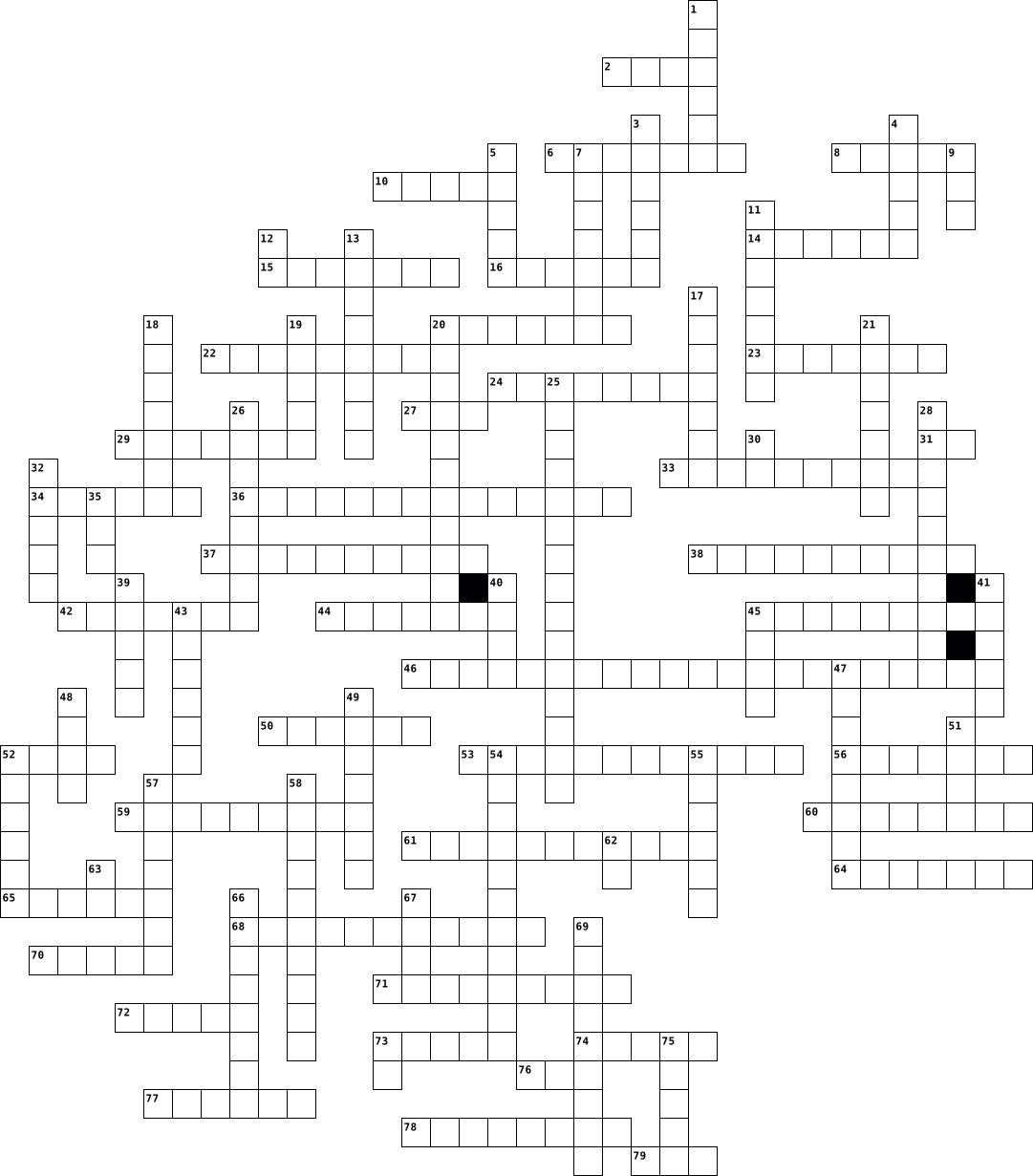
Across
- the amount of space that an object occupies
- a literary work based on the imagination and not necessarily on fact
- passion and perseverance in the pursuit of long-term goals very fine sand or gravel
- a picture; An extended example narrative case history or anecdote that is striking and memorable
- take part
- the quality of being friendly generous and considerate.
- a feeling or belief that you can do something well or succeed at something
- an expression of approval and commendation
- Belief in one God
- Agricultural areas with a walled city in the center ruled by its own government usually a monarchy (king queen).
- the amount of matter in an object
- the world's first system of writing in ancient Mesopotamia
- a force that exists between any two objects that have mass
- classes groups of people that occupy different ranks or levels in society
- specialization the doing of specific types of work by trained or knowledgeable workers
- the force of gravity on an object
- A category or type of literature (or of art music etc.) characterized by a particular form style or content.
Down
- hard work done by the mind or body
- crescent an area of rich farmland in Southwest Asia where the first civilizations began
- Material that has some mass and takes up some amount of space
- the ability to produce novel and valuable ideas
- A developed society with culture religion cities government job specialization writing and social classes
- writing that tells facts and information about real people places and or events
- A pyramid shaped temple tower in the middle of a city
- (v.) to restate in other words;(n.)a statement that presents a given idea in new language
- belief in more than one god
- Great excitement for or interest in a subject or cause.
- an object's mass divided by its volume; a measure of how many particles are packed together into a certain amount of space
- to concentrate The center of interest or attention.
- A long narrative (story) poem telling of a hero's deeds
- up to the present time
- all the knowledge and values shared by a society including art music buildings scientific knowledge food and so on.
- A government ruled by a king or queen.
- to look at something carefully by attention to its parts
- an author's style or speech patterns of a character in a story
35 Clues: take part • Belief in one God • up to the present time • belief in more than one god • the amount of matter in an object • the force of gravity on an object • hard work done by the mind or body • A government ruled by a king or queen. • an expression of approval and commendation • the amount of space that an object occupies • the ability to produce novel and valuable ideas • ...
Review Q1 2018-10-23

Across
- (v.) to restate in other words;(n.)a statement that presents a given idea in new language
- an expression of approval and commendation
- Agricultural areas with a walled city in the center ruled by its own government usually a monarchy (king queen).
- classes groups of people that occupy different ranks or levels in society
- A category or type of literature (or of art music etc.) characterized by a particular form style or content.
- A developed society with culture religion cities government job specialization writing and social classes
- a force that exists between any two objects that have mass
- take part
- to look at something carefully by attention to its parts
- A long narrative (story) poem telling of a hero's deeds
- the quality of being friendly generous and considerate.
- Great excitement for or interest in a subject or cause.
- writing that tells facts and information about real people places and or events
- crescent an area of rich farmland in Southwest Asia where the first civilizations began
- the amount of matter in an object
- Material that has some mass and takes up some amount of space
- hard work done by the mind or body
Down
- an author's style or speech patterns of a character in a story
- specialization the doing of specific types of work by trained or knowledgeable workers
- A government ruled by a king or queen.
- the ability to produce novel and valuable ideas
- a picture; An extended example narrative case history or anecdote that is striking and memorable
- the amount of space that an object occupies
- all the knowledge and values shared by a society including art music buildings scientific knowledge food and so on.
- a feeling or belief that you can do something well or succeed at something
- belief in more than one god
- the force of gravity on an object
- to concentrate The center of interest or attention.
- the world's first system of writing in ancient Mesopotamia
- up to the present time
- Belief in one God
- A pyramid shaped temple tower in the middle of a city
- an object's mass divided by its volume; a measure of how many particles are packed together into a certain amount of space
- a literary work based on the imagination and not necessarily on fact
- passion and perseverance in the pursuit of long-term goals very fine sand or gravel
35 Clues: take part • Belief in one God • up to the present time • belief in more than one god • the force of gravity on an object • the amount of matter in an object • hard work done by the mind or body • A government ruled by a king or queen. • an expression of approval and commendation • the amount of space that an object occupies • the ability to produce novel and valuable ideas • ...
History Vocab Crossword 2019-09-04

Across
- Supplying water to crops to make them grow
- Convert to something that you are familiar with
- A system where certain groups are ranked above or below another.
- One of the most successful ruler in ancient egypt, defeated many of his enemies, ruled from 1479 BC - 1425 BC
- A way of life created by Confucius.
- The dominant government system in the medieval ages in Europe
- Chinese tradition where a dynasty falls and gets a new one
- Title for a monarch in ancient egypt
- Also one of the most famous and victorious leaders in egyptian history. Ruled from (1279 BC - 1213 BC)
- According to egyptian religion, Amon-Ra is the god of the universe and the supreme ruler of all the gods.
- Writing system made by the Egyptians
- Creator of the Qin Dynasty and the first emperor to rule a unified China
- Economic system where systems of exchange are the first option
- Founder of the Mauryan Empire, created one of the biggest empires on the subcontinent India
- Form of writing created by the sumerians
- To make a hole by digging
- Mad, angry?
Down
- Law, Non-Criminal Laws
- List of rulers in a country
- Law, Laws that specify for criminals and what their punishment should be based on the degree of the crime.
- An organization formed by religious, educational, or social purpose
- Ruler of Akkardian empire
- First female ruler of the egyptian empire
- Two or more generations living under the same household
- The policy of territorial expansion
- Something that is accomplished by great skill
- To preserve a body by wrapping it in cloth
- Arrange laws into a systematic code
- Economic system were their traditions, beliefs, etc. shape their goods and services
- Commands the military
- Economic system that used currency for buying goods and services
- Longest ruler of Bablyonian empire (605 BC - 562 BC)
- Ruler of mesopotamia. Also made a set of laws called Hammurabi’s Code
- Someone who gets the throne after the current leader dies
- of Heaven, Chinese tradition that Heaven chose the leaders based on whether they can govern fairly and just.
- Chinese philosophy that states to firmly be with the law and dependence on moral law rather than religious beliefs
- System of government where government officials make important decisions instead of elected representatives.
- Another ruler of the Mauryan Empire, ruled from 265-238 BCE
38 Clues: Mad, angry? • Commands the military • Law, Non-Criminal Laws • Ruler of Akkardian empire • To make a hole by digging • List of rulers in a country • The policy of territorial expansion • A way of life created by Confucius. • Arrange laws into a systematic code • Title for a monarch in ancient egypt • Writing system made by the Egyptians • Form of writing created by the sumerians • ...
Hunter-Gatherers and the Agricultural Revolution 2019-10-16

Across
- People who travel from place to place in search of food or for pastureland for their animal herds.
- Means Old Stone Age; the time when humans made tools from stone and bone (hand axes; stone crushers; bone needles, etc.)
- An organized way of farming.
- Means New Stone Age; the time when humans made more sophisticated tools and shifted from hunting and gathering to growing food by farming.
- Having specific knowledge of how to do a job or accomplish a task efficiently.
- An enormous change or alteration.
- A time when ice and snow covered the Earth. Prehistoric humans lived through the fourth of these eras from 100,000 years ago to about 9,000 years ago.
- The name of the present-day nation where the Neolithic community of Catalhuyuk was founded; mud-brick houses with entrances on the roof.
- The first form of government formed by civilizations; government by a single powerful ruler.
Down
- Mysterious Neolithic shepherd or hunter whose body was found frozen in the Austian Alps in 1991.
- A skilled craftsman or worker.
- Raising and breeding plants and animals so that they have the traits that humans want or need.
- Cities and civilizations in Mesopotamia, Egypt, India, and China formed on ______ valleys.
- A hard stone used to make stone tools and used to create sparks to make fire.
- This metal, made of copper and tin, lends its name to the age in which tools were made from it; stronger than copper alone.
- A tool or method to perform a task or to solve a problem.
- Scientists believe that early humans migrated from Asia to North America across a land ________ near present-day Alaska.
- The label given to a person who survives by hunting animals and foraging for plants, fruits, nuts, and berries.
- One of the worldś oldest cities; a farming community that grew up on the West Bank of the River Jordan, between Israel and Jordan.
- Paintings of prehistoric animals have been found in _________ in Altamira, Spain; and Lascaux, France, among other places.
- An organized system of human communities that have government, technology and trade, organized religion, social structure, written language and art, and buildings.
- After the Agricultural Revolution, humans stopped hunting and gathering and began to do ____________ farming.
- Energy source used by prehistoric humans--and humans today--to keep warm, provide light, and to cook food. Animal meat is easier to digest when it is cooked.
- An organized way of producing crops and goods to permit people to live.
24 Clues: An organized way of farming. • A skilled craftsman or worker. • An enormous change or alteration. • A tool or method to perform a task or to solve a problem. • An organized way of producing crops and goods to permit people to live. • A hard stone used to make stone tools and used to create sparks to make fire. • ...
Ancient History 2023-05-22

Across
- what you had when you grew more food than you needed
- the world's longest river
- the city-state that defeated the Persians at the naval Battle of Salamis
- a collection of stories about gods and heroes
- God the Father-the Son-the Holy Spirit
- a carved stone slab or pillar
- the effect of a person's action in this life and previous lives
- weekly day of rest
- the rebirth of a soul in a new body
- a network of trade routes the crossed Asia
- period of "Roman Peace"
- a system of writing that uses triangular shaped symbols pressed in clay
- the prophet of Islam
- title for the king of Egypt
- Jesus' teachings which were presented in the form of a story
- first first books of the Hebrew bible
- the right to rule in China that caused a dynasty to act properly
- soldiers on horseback
- channel that moves water over land
- soldiers who fight for pay
- a therapy developed in China that uses needles to cure sickness and stop pain
- a city and its surrounding territory
- Jewish house of worship
- a Hindu prince who obtained enlightenment through meditation
- Islam's holy book
- open area in a Roman city
Down
- The Phoenicians developed a set of letters which each stand for a sound
- the league or alliance formed by Sparta
- the belief in many gods
- a culture that combined both Greek and Roman elements
- Buddhist belief in a state of blissful peace (also the name of a rock band)
- Sumerian temples
- head of the Roman household
- large Roman country homes
- the escape of the Jews from Egypt
- the city-state that defeated the Persians at Thermopylae
- belief that the natural world was filled with spirits
- people who moved from place to place
- person chosen by God as a messanger
- bones, animals bones or turtle shells carved with characters to be used to tell the future
- found in Egypt these a structures with triangular sides
- a Greek battle formation
- anything made or used by humans
- Christians who died for their faith
- the Chinese art of beautiful writing
- a material similar to paper invented by the Egyptians
- another name for The Fertile Crescent or the area between the rivers
- name for the Old Stone Age
48 Clues: Sumerian temples • Islam's holy book • weekly day of rest • the prophet of Islam • soldiers on horseback • the belief in many gods • period of "Roman Peace" • Jewish house of worship • a Greek battle formation • the world's longest river • large Roman country homes • open area in a Roman city • soldiers who fight for pay • name for the Old Stone Age • head of the Roman household • ...
Storia finale 2023-06-04

Across
- Crearono il primo impero della storia
- All'inizio 3, poi 35 a Roma
- Scrisse il primo codice di leggi ad Atene
- Retribuzione che ad Atene spettava ai magistrati
- Lo usavano gli Egizi per scrivere
- Popolo contro cui i Romani combatterono dal 343 a.C. al 290 a.C.
- Lago su cui si scontrarono Romani e Latini
- Unione di villaggi per creare una nuova città
- Soprannome dell'ultimo re di Roma
- Divenne famoso il suo nodo
- Al vertice della società egizia
- Il libro sacro degli Ebrei
- Furono costruiti dai Sardi
- Arconte che guida l'esercito
- Termine per indicare coloro che non parlavano
- Inventarono la scrittura
- La versione etrusca di Giove
- Re dell'Epiro
- Fu tiranno ad Atene
- Dove ebbe inizio la storia dell'uomo
- Popolo guerriero che conquistò i Babilonesi
- Nel 338 a.C. vi persero l'indipendenza i Greci
- Padre di Alessandro Magno
- Il numero delle tribù di Israele
- Potere militare a Roma
- Sacerdotessa dell'oracolo di Delfi
- Controllava i costumi e la moralità a Roma
- Consiglio degli ex arconti
- Monumento caratteristico degli Egizi
- Storico delle guerre persiane
- Inchino di fronte al sovrano
- Re spartano che iniziò la guerra del Peloponneso
- Istituì le leggi spartane
Down
- Primo grande re persiano
- Introdusse la democrazia ad Atene
- Osservava le interiora degli animali
- i Macedoni
- Termine per indicare la città stato greca
- Fuga del re
- Altro nome di Iulo
- Schiavi a Sparta
- Numa re di Roma
- Indica l'appartenenza alla gens
- Lunghe lance macedoni
- Vi morirono 300 valorosi spartani
- Vi trovò la morte Dario III
- Demagogo nipote di Pericle
- Peccato di superbia
- Vi fu rinchiuso il Minotauro
- Vittoria navale greca dopo la distruzione di Atene nella seconda guerra persiana
- Causa della morte di Pericle
- Governarono il regno ellenistico d'Egitto
- Altro nome dei Cretesi
- Unica colonia fondata da Sparta
- Uguaglianza dei cittadini di fronte alla legge
- Storico della guerra del Peloponneso
- Erano i più poveri nelle classi di Atene
- Re persiano che venne sconfitto nella seconda
- Continuò la guerra dopo la morte di Pericle
- la regione tra il Tigri e l'Eufrate
- Versione greca di Venere
- Generale tebano
- Provvedimento per esiliare politici ateniesi pericolosi
- Giochi panellenici
- Vi si tenne la prima vittoria macedone sull'impero persiano
65 Clues: i Macedoni • Fuga del re • Re dell'Epiro • Numa re di Roma • Generale tebano • Schiavi a Sparta • Altro nome di Iulo • Giochi panellenici • Peccato di superbia • Fu tiranno ad Atene • Lunghe lance macedoni • Altro nome dei Cretesi • Potere militare a Roma • Primo grande re persiano • Inventarono la scrittura • Versione greca di Venere • Padre di Alessandro Magno • Istituì le leggi spartane • ...
Midterm Exam 2025-10-08

Across
- __ Direct Investment (FDI)
- The first such personal computer was the __.
- The first mechanical __ began to appear in Europe toward the end of the 13th century and was used in cathedrals to mark the time when services would be held.
- The first irrigation systems arose roughly simultaneously in the civilizations of the Tigris-Euphrates river valley in Mesopotamia and the __ River valley in Egypt.
- Small-Medium Sized __ (SMEs)
- __ McCormick invented the mechanical reaper.
- Geographic __ Systems (GIS)
- Economies of __ is the ability to alter the traditional value chain with consequent economic advantage will drive the globalization of the industry.
- The steam engine became one of the most important inventions of the Industrial __.
- Samuel __ was a successful painter who became interested in the possibility of an electric telegraph in the 1830s.
- As global consumption increases due to globalization, more natural __ deplete.
- Organizations move from hierarchical to __ organizational structures.
- Transfer from the physical domain to the __ domain is a driving factor toward globalization.
- The first sailing __ were used on the Nile River.
- It is the word used to describe the growing interdependence of the world’s economies, cultures, and populations brought about by cross-border trade in goods and services, technology and flows of investment, people, and information.
- __ Graham Bell made the first telephone call.
Down
- During the __ Period, several key technologies arose together, such as farming.
- She symbolizes UE.
- It was the first book printed in the West.
- Orville __ made the first airplane flight, of 120 feet, near Kitty Hawk, North Carolina.
- The first windmills were in __ or what is now known as Iran.
- Sharp flakes of __ used as knives and larger unshaped stones used as hammers and anvils have been uncovered at Lake Turkana in Kenya.
- After thousands of trials, American inventor Thomas __ got a carbon-filament light bulb to burn for 13½ hours.
- John Atanasoff designed the first electronic digital __.
- One of the best invention of China is the magnetic __.
- English engineer Richard Trevithick built the first __ locomotive at an ironworks in Wales.
- Alchemists in China invented the __ as a result of their search for life-extending elixirs.
- As we feed other’s financial needs, the __ imbalance is also met. Government of countries show concern about each other.
- Information and __ technology (ICT) is a driving factor in the process of globalization.
- Nearly 5,000 years after the first sailing ships, the __ was first used to operate a mill.
30 Clues: She symbolizes UE. • __ Direct Investment (FDI) • Geographic __ Systems (GIS) • Small-Medium Sized __ (SMEs) • It was the first book printed in the West. • The first such personal computer was the __. • __ McCormick invented the mechanical reaper. • __ Graham Bell made the first telephone call. • The first sailing __ were used on the Nile River. • ...
Unit 1-5 Vocabulary Review 2025-12-02

Across
- Bringing water to dry land by using canals, ditches, or pipes to help crops grow.
- A religion founded by Siddhartha Gautama that teaches the Four Noble Truths and the path to end suffering.
- An ancient civilization along the Nile River known for pyramids, pharaohs, and mummification.
- Trading goods or services without using money.
- An ancient region between the Tigris and Euphrates Rivers; known as the “land between the rivers.”
- Soil that is rich and good for growing crops.
- Fine, rich soil deposited by rivers that helps crops grow.
- A city that rules itself and the land around it like a small independent country.
- The belief in many gods.
- A region in the Middle East where Judaism began and where the ancient Israelites lived.
- A government ruled by one person, usually a king or queen.
- A Babylonian king known for creating one of the first written law codes.
- Specialization When people focus on one job they are good at, like pottery, farming, or trading.
- A writing system used in ancient Egypt that used pictures and symbols.
- A large country in South Asia and home to ancient civilizations like the Harappans, as well as Hinduism and Buddhism.
- Seasonal winds in India that bring heavy summer rain and dry winter air.
Down
- Training or taming plants and animals so they can be used by humans.
- Farming; growing crops and raising animals for food and resources.
- One of the world’s first writing systems, created by the Sumerians using wedge-shaped marks on clay tablets.
- When a group of people are spread out and live away from their original homeland.
- The belief in only one god.
- A legendary Sumerian king and the hero of one of the world’s oldest stories
- Gods or goddesses worshipped by people.
- The way a society uses resources to make and trade goods and services.
- A social class a person is born into that determines their job, place in society, and who they can interact with.
- A large group of lands and people ruled by one leader or government.
- One of the oldest monotheistic religions; its followers believe in one God and follow teachings in the Tanakh.
- The sacred text of Judaism; includes the Torah and other writings.
- The process of preserving a dead body, practiced in ancient Egypt.
- Extra food or supplies left over after a community has what it needs.
- A major religion from India that teaches beliefs such as dharma, karma, reincarnation, and moksha.
31 Clues: The belief in many gods. • The belief in only one god. • Gods or goddesses worshipped by people. • Soil that is rich and good for growing crops. • Trading goods or services without using money. • Fine, rich soil deposited by rivers that helps crops grow. • A government ruled by one person, usually a king or queen. • ...
World History Review 2017-05-23

Across
- Family that most royalty descended from in the Roman empire.
- Last ruler of Egypt.
- First civilization to cultivate cotton.
- Achieved inner peace and rejected caste system.
- Open terrain covered in barbed wire and landmines.
- An example of a utopia.
- Extreme socialism.
- US would take a leadership role and help countries threatened by communism.
- Competition between US and Soviet Union, a race to see who could better explore space.
- When a ruler thinks about what is best for the community now, not in the future.
- Travelled Europe, and tried to bring Russia into the modern world.
- Believed humans were ultimately selfish.
- Exchange of cultural and biological aspects between the Americas and Europe.
- Oldest major religion in world.
- Young girl who led army to victory in Battles of Orleans.
- Francis Ferdinand was heir to the throne here.
- He invented the coordinate plane
- A perfect society.
- British-American invasion of North Africa that reduced pressure on Soviet troops.
- “Cradle of Civilization”
- He took control of the Soviet Union after Vladimir Lenin.
- First living passenger to go into outer space; a dog.
- A palace built by Louis XIV; cost millions of dollars.
- The belief God put us on earth and left us to fend for ourselves.
- Believed that humans were good.
Down
- Latin for “Roman Peace”
- Love or devotion for one's country
- The founder of utilitarianism.
- Legalized Christianity in Rome.
- Concern with human beliefs as opposed to religious beliefs.
- Kings of Ancient Egypt
- Claimed “Divine Rights” from God.
- The relaxing of tensions between the US, Soviet Union, and China can be referred to as this.
- Self-employed craftspeople of Europe.
- Leader of Aztec Empire; Had doubts about Cortes.
- The emperor of Germany.
- Last religious war
- Means “Rebirth”
- Prussia’s prime minister.
- The night of broken glass
- Established the Kingdom of Israel
- Discovered the law of gravity.
- Was forced to drink poison in Ancient Greece
- Fought on French soil from 1337 to 1453
- Unsuccessful military invasion of Cuba on April 17, 1961.
- The belief that one’s ethnic group is superior to any other.
- Ancient Roman stadium.
- Wrote the 95 theses’
- Series of military campaigns by Catholic Church.
- Fifth level of the Caste System, considered to be not human.
- North Atlantic Treaty Organization
- Social classes of Ancient India.
- Extreme segregation in South Africa.
- First city
54 Clues: First city • Means “Rebirth” • Extreme socialism. • Last religious war • A perfect society. • Last ruler of Egypt. • Wrote the 95 theses’ • Kings of Ancient Egypt • Ancient Roman stadium. • Latin for “Roman Peace” • An example of a utopia. • The emperor of Germany. • “Cradle of Civilization” • Prussia’s prime minister. • The night of broken glass • The founder of utilitarianism. • ...
Review Q1 2018-10-23

Across
- writing that tells facts and information about real people places and or events
- the world's first system of writing in ancient Mesopotamia
- all the knowledge and values shared by a society including art music buildings scientific knowledge food and so on.
- specialization the doing of specific types of work by trained or knowledgeable workers
- the ability to produce novel and valuable ideas
- a force that exists between any two objects that have mass
- Great excitement for or interest in a subject or cause.
- take part
- A category or type of literature (or of art music etc.) characterized by a particular form style or content.
- A developed society with culture religion cities government job specialization writing and social classes
- hard work done by the mind or body
- Belief in one God
- to concentrate The center of interest or attention.
- A pyramid shaped temple tower in the middle of a city
- the quality of being friendly generous and considerate.
- the force of gravity on an object
- passion and perseverance in the pursuit of long-term goals very fine sand or gravel
- up to the present time
Down
- an expression of approval and commendation
- an author's style or speech patterns of a character in a story
- to look at something carefully by attention to its parts
- belief in more than one god
- A government ruled by a king or queen.
- (v.) to restate in other words;(n.)a statement that presents a given idea in new language
- crescent an area of rich farmland in Southwest Asia where the first civilizations began
- a feeling or belief that you can do something well or succeed at something
- a picture; An extended example narrative case history or anecdote that is striking and memorable
- a literary work based on the imagination and not necessarily on fact
- the amount of space that an object occupies
- Material that has some mass and takes up some amount of space
- Agricultural areas with a walled city in the center ruled by its own government usually a monarchy (king queen).
- A long narrative (story) poem telling of a hero's deeds
- the amount of matter in an object
- an object's mass divided by its volume; a measure of how many particles are packed together into a certain amount of space
- classes groups of people that occupy different ranks or levels in society
35 Clues: take part • Belief in one God • up to the present time • belief in more than one god • the amount of matter in an object • the force of gravity on an object • hard work done by the mind or body • A government ruled by a king or queen. • an expression of approval and commendation • the amount of space that an object occupies • the ability to produce novel and valuable ideas • ...
Review Q1 2018-10-23

Across
- classes groups of people that occupy different ranks or levels in society
- Agricultural areas with a walled city in the center ruled by its own government usually a monarchy (king queen).
- the amount of matter in an object
- a literary work based on the imagination and not necessarily on fact
- belief in more than one god
- specialization the doing of specific types of work by trained or knowledgeable workers
- a force that exists between any two objects that have mass
- crescent an area of rich farmland in Southwest Asia where the first civilizations began
- an expression of approval and commendation
- A developed society with culture religion cities government job specialization writing and social classes
- all the knowledge and values shared by a society including art music buildings scientific knowledge food and so on.
- A long narrative (story) poem telling of a hero's deeds
- to look at something carefully by attention to its parts
- A government ruled by a king or queen.
- Great excitement for or interest in a subject or cause.
- to concentrate The center of interest or attention.
- writing that tells facts and information about real people places and or events
- (v.) to restate in other words;(n.)a statement that presents a given idea in new language
- the quality of being friendly generous and considerate.
Down
- the force of gravity on an object
- an object's mass divided by its volume; a measure of how many particles are packed together into a certain amount of space
- the amount of space that an object occupies
- Material that has some mass and takes up some amount of space
- a picture; An extended example narrative case history or anecdote that is striking and memorable
- the world's first system of writing in ancient Mesopotamia
- a feeling or belief that you can do something well or succeed at something
- the ability to produce novel and valuable ideas
- take part
- an author's style or speech patterns of a character in a story
- A pyramid shaped temple tower in the middle of a city
- A category or type of literature (or of art music etc.) characterized by a particular form style or content.
- up to the present time
- passion and perseverance in the pursuit of long-term goals very fine sand or gravel
- Belief in one God
- hard work done by the mind or body
35 Clues: take part • Belief in one God • up to the present time • belief in more than one god • the force of gravity on an object • the amount of matter in an object • hard work done by the mind or body • A government ruled by a king or queen. • an expression of approval and commendation • the amount of space that an object occupies • the ability to produce novel and valuable ideas • ...
CRUCIVERBORGHI 2019 2019-03-24
Across
- Conte per allegri
- Dove le donne lavavano i panni nell'antica riva
- verso dell'asino
- Unità di misura della capacità
- Terza persona singolare modo indicativo tempo presente verbo scrutare
- Grease
- lo fa una gnocca
- Popolazione biblica
- Sinonimo di distrutti, rovinati
- Determinare il prezzo o il valore di un bene
- Fu mangiato dalla balena
- lo è l'azoto
- Poesie recitate sul carro in piemontese
- doppie in farfalla
- Sicuramente
- Molecola senza ma
- Un organo del comune
- E' famoso quello matto
- Si festeggia a metà giugno
- famosa canzone di Jhonn lennon
- Provocato da un uomo mentre lava i piatti
- Il quadro della dama
- Colorata manifestazione estiva rivese
- Il rivale di achille
- Piero ex sciatore alpino
- Prestigiosa competizione ciclistica mondiale
- Fiume della Mesopotamia
- Quello magico cattura topi
- Si trova il centro commerciale le fornaci
- Storico presentatore di striscia la notizia
- Velivolo senza motore
- Genere a cui appartiene IT
- Lo è cascina serramena
- Pizza e cipolle e
- Borgo di riva a cui appartiene la pasticceria rivese
- Suina cinese (danza polacca)
- Al goal di Ronaldo
- Help in italiano
- uffa senza a
- quarantacinquesimo Vicepresidente degli Stati Uniti d'America
- Noto locale della movida rivese
- Piano dell'offerta formativa
Down
- Dopo la notte
- Il più famoso maestro di musica rivese
- La prepara Quaglino
- Vicino alla San Paolo
- Passato remoto Terza persona singolare del verbo accorrere
- adesso
- Originale, ricco di inventiva
- neme senza vocali
- Dicono fosse abbastanza intelligente
- Rossi
- Storia a disegni, TOPOLINO
- Abita nelle campagne rivesi
- E' famosa quella rivese
- Secondo utopia il vincitore del borghi 2019
- Museo di palazzo di grosso
- Ci lavora la Ada, sorella di un pubblico ufficiale
- Varietà di agrumi
- Italia
- E' famoso quello medievale
- eros senza s
- Commettere una indelicatezza, azione inopportuna
- lione senza e
- Isole siciliane
- sale
- penso in latino
- Restituisce energia
- rana in inglese
- Unità di misura della carica elettrica
- Musica Arte Cultura e Spettacolo,
- E' parlante
- Simmetria dei minerali
- gianluca allenatore di calcio
- Cartone animato walt disney operatore sanitario
- Santo iridato del 2015
- al centro dimagari
- il fiume più lungo
- Città in cui ebbe inizio la famosissima guerra d'indipendenza greca
- mamma mia
- Si appende al muro
- Brescia
- Piccolo e corto
83 Clues: sale • Rossi • adesso • Grease • Italia • Brescia • mamma mia • Sicuramente • E' parlante • lo è l'azoto • eros senza s • uffa senza a • Dopo la notte • lione senza e • Isole siciliane • rana in inglese • Piccolo e corto • verso dell'asino • lo fa una gnocca • penso in latino • Help in italiano • Conte per allegri • neme senza vocali • Varietà di agrumi • Molecola senza ma • Pizza e cipolle e • doppie in farfalla • ...
Hebrew Kingdoms Crossword 2013-03-25

Across
- n. one of the first four books of the New Testament, describing the life and teachings of Jesus
- n. a spiritual leader who conveys the words and wishes of God or a god
- n. a building for Jewish prayer and worship and instruction in the Jewish faith
- n. according to the bible, the prophet who led the Israelites from Egypt and was their lawgiver
- n. the belief that only one god exists
- v. to oppose or harass
- n. one of Jesus' 12 closest followers
- n. the king of Israelites who won control of Jerusalem in 1000 BC
- n. a 50 year period in which the Israelites were held in Babylon, away from their homeland of Judah. During this period the Israelites became known as the Jews.
- n. according to the bible, a shepherd from the city of Ur in Mesopotamia who became the father of the Hebrews
- n. one of the letters included in the New Testament, written by Jesus' apostles to early Christan churches to instruct them in Christan beliefs and practices
Down
- n. a teacher whose life and teachings serve as the basis of the Christan religion. Christians believe Jesus to be the Son of God
- n. a statement in religious beliefs
- n. a simple story that conveys a religious or moral lesson
- n. the third king of Israel, under whom it became a powerful nation
- n. the basis of the law of the Israels, given, according to the Torah, by God to Moses
- n. a return to life after death
- n. the savior and king foretold by Jewish prophets
- n. the scattering of Jewish people after they were forced out of Judea by the Romans in AD 70
- n. a person who travels to a foreign land to spread his or her beliefs
- n. an execution by hanging on a cross
- n. the religion of the Hebrews, based on the Hebrew Scriptures and a belief in one god; practiced by Jews today
- n. a religious leader and teacher trained in Jewish law, rituals, and tradition
- n. the most important of the apostles who spread Jesus' teachings
- n. a high-ranking local official in some Christan churches
- adj. universal
- n. the bishop of Rome and head of the Catholic Church
- n. a person who is not Jewish
- n. the union of three persons- Father, Son, and Holy Spirit -in one god
- n. the migration of the Israelites from Egypt, as told in the Torah
30 Clues: adj. universal • v. to oppose or harass • n. a person who is not Jewish • n. a return to life after death • n. a statement in religious beliefs • n. an execution by hanging on a cross • n. one of Jesus' 12 closest followers • n. the belief that only one god exists • n. the savior and king foretold by Jewish prophets • n. the bishop of Rome and head of the Catholic Church • ...
Unit 1 Chapters 1-4 2023-12-12

Across
- The dynasty known for gaining control of china and unifying it.
- The way a new item or idea is spread from culture to culture.
- Introduced the first pyramid.
- The "Cradle of civilizations"
- Ancient Iranian people.
- An Assyrian king that tried to invade Jerusalem.
- The sponsor of one of Egypt's most successful trading expeditions.
- Made the first organized library
- A Nubian kingdom
- Brings together several people, nations, or previously independent states under one ruler.
- Manufactured advanced iron goods
- One of the most famous pharaoh's known for his military strength.
- Movement from one place to another
- A series of rulers from a single family
- A Chinese ethical system.
- book from Confucius about Taoism.
- The people who lived in eastern Europe and central Asia thousands of years ago.
- A kingdom in Egypt ran by pharaohs.
- The "advocation of humility and religious piety".
- A Chinese influential scholar
- The forth letter of the Greek alphabet.
- The act of respecting parents
- "The creator" in Hinduism
Down
- An ancient Egyptian pharaoh of the early dynastic periods.
- A group that captured the Jews as a manifestation of the wrath of God.
- The belief in multiple gods.
- Writing consisting of hieroglyphs(images)
- A city that with its surrounding territory forms an independent state.
- Longest reigning king in the Babylonian dynasty.
- The ruler in Buddhism.
- A ruler in ancient Egyptian times.
- "asia minor"
- Emperor of the Qin Dynasty.
- 4 collections of prayers, magical spells, and instructions for performing magical spells.
- A system of government in which priests rule in the name of God or gods.
- A writing surface used in ancient times from the stem of a papyrus plant.
- The process used in preserving bodies as a mummy.
- The Balance of two opposites working in harmony.
- Known for conquering all of Syria.
- Known for its rich deposit of gold along the Nile River.
- The capital of the Assyrian empire.
- A way of dividing society up.
- Area close to the red sea.
- The "Birthplace of writing"
- An ancient civilization that God punished for being to prideful and arrogant.
- "rulers of foreign land".
- A 3 dimensional shape that ancient Egyptians used in their architecture.
- a former Babylon ruler known for his rules.
- A single person who holds all the power for the whole country.
49 Clues: "asia minor" • A Nubian kingdom • The ruler in Buddhism. • Ancient Iranian people. • A Chinese ethical system. • "rulers of foreign land". • "The creator" in Hinduism • Area close to the red sea. • Emperor of the Qin Dynasty. • The "Birthplace of writing" • The belief in multiple gods. • Introduced the first pyramid. • The "Cradle of civilizations" • A way of dividing society up. • ...
BOOK BOGGLER 2024-02-28

Across
- The title of this book, a 2012 NYT bestseller, was chosen from the Shakespeare play Julius Caesar, where it was spoken by Cassius to Brutus.
- Published in 1936, this book is set in Georgia during the Civil War and Reconstruction Era.
- While said in the prologue that it would contain 120 stories, this collection originally published around 1400 contains only 24.
- With Al Pacino and Marlon Brando playing large roles, the first 2 movies in this 3 part series were based on the book by Mario Puzo.
- This novel published in 1960 follows siblings Jem and Scout, alongside their friend Dill, who is visiting their home of Maycomb.
- Set in Alabama, this movie starring Tom Hanks was based on this novel from 1986 by Winston Groom.
- “As….you….wish….” this movie was based on an inconceivable novel of the same name.
- The author of The Casual Vacancy also wrote another series of much fame, with 8 movies based on the heptology.
- Based on Ben Mezrich’s book The Accidental Billionaires, this book and movie are about the founding of a certain social media site.
- The author of Coraline who has also written comic strips.
- Pen name for Theodor Geisel, an author known mainly for children's literature but also illustrated political cartoons.
Down
- Set in Afghanistan, this bestseller by Khaled Hosseini was popularized in book clubs and appeared on the NYT bestseller list for 2 years.
- The opening of this book is "It is a truth universally acknowledged, that a single man in possession of a good fortune, must be in want of a wife."
- This first book in the series follows the main character Percy as he battles mythical creatures across the U.S.
- Written in 2008, this dystopian book and the other 2 in the trilogy are set in a place called Panem.
- This psychological horror and thriller film featuring iconic lines like “I’m having an old friend for dinner,” was based on a novel of the same name.
- The author of The Shining that has also written 64 (and counting) other novels/novellas.
- The author best known for her 2016 romance novel It Ends with Us, who self-published many books before signing with a publisher.
- This poem from Mesopotamia is the oldest known written story.
- This book has the main character moving to a new town so her mother can travel with the minor league baseball player she married.
20 Clues: The author of Coraline who has also written comic strips. • This poem from Mesopotamia is the oldest known written story. • “As….you….wish….” this movie was based on an inconceivable novel of the same name. • The author of The Shining that has also written 64 (and counting) other novels/novellas. • ...
C.E.M.G.S.J.P CONTABILIDA BANCARIA 2024-04-06

Across
- Es el contrato por el cual el banco recibe del CLIENTE una suma de dinero, de la cual puede disponer libremente obligándose a restituirla el mismo genero y cantidad
- Son sociedades que pueden actuar como intermediarios en las negociaciones de cualquier documento financiero que se realiza en la Bolsa de valores.
- Es el departamento donde se registra el movimiento diario del dinero en efectivo en moneda nacional o extranjero
- Su objetivo es comercializar con la compra y venta de la divisa.
- Es aquel que ya estaba constituido en un banco, pero que por orden de un juez se manda a inmopvilizarGRIEGOS Y LIBIOS Los primeros en utilizar monedas acuñadas con sellos y leyendas impresas en el metal fueron _____________a finales del siglo VII antes de nuestra era.
- Es la comprobación física o material del saldo de caja detallando en una relación como está constituida la existencia del efectivo.
- Los primeros en utilizar monedas acuñadas con sellos y leyendas impresas en el metal fueron _____________a finales del siglo VII antes de nuestra era.
- Es el que tiene a su cargo la bóveda o reserva del banco.
- Esta ley establece que la unidad monetaria de Honduras es el lempira y su símbolo es L.
Down
- Comienza con el primer prototipo de banco de comerciantes de la Mesopotamia, que hacía préstamos de granos a los agricultores y negociantes que transportaban bienes entre las ciudades desde aproximadamente 2000 a. C. en Fenicia, Asiria y Babilonia.
- Es la persona que recibe los bienes en deposito
- Don Pedro P. Amaya propuso que la moneda se llamara
- Es la principal función de un Banco
- Es aquel que se hace constar en libretas especiales
- En 1879 el _______________por decreto adopto el sistema Decimal y la unidad del peso de plata equivalente a 100 centavos.
- Son organizaciones legales cuya actividad principal es prestar dinero recibiendo en garantía una prenda. Ejemplo: Las casas de empeños
- En 1714 se fundó la primera casa de la moneda en_________, acuñando la moneda llamada MACACOS.
- Es una institución autónoma que tiene por objeto canalizar los recursos financieros para el desarrollo de la producción y productividad de la agricultura y ganadería
- Es una institución de crédito de segundo piso cuyo objetivo es promover el crecimiento y desarrollo de los sectores productivos.
- Es la relación de cambio entre dos monedas
- Se presenta cuando el arqueo de caja es menor que el corte de caja y en este caso se responsabiliza al cajero.
21 Clues: Es la principal función de un Banco • Es la relación de cambio entre dos monedas • Es la persona que recibe los bienes en deposito • Don Pedro P. Amaya propuso que la moneda se llamara • Es aquel que se hace constar en libretas especiales • Es el que tiene a su cargo la bóveda o reserva del banco. • Su objetivo es comercializar con la compra y venta de la divisa. • ...
6th Grade WORLD GEOGRAPHY 2024-05-30

Across
- The largest country in the world
- Name of the ocean between North America and Asia
- The river that Hindus believe is god.
- The largest religion in the world
- Large country north of China where Genghis Khan once ruled.
- The country where Angkor Wat (ancient Buddhist temple) is located.
- The type of rule CHina was under for hundreds of years, when the same family would rule until a disaster happened.
- Name of the ocean between North America and Europe
- The only continent that is a country.
- An archipelago east of China where Mount Fuji is located.
- between China and India
- The second largest continent, with countries like Egypt, Sudan, and Kenya
- An example of a country with unlimited rule, that is West of Japan.
- What Ancient Egyptians built for their pharoahs to be buried in
- The system of government in Russia, China, Cuba and Vietnam that involves government controlling production, and a sharing of wealth.
- The large area in the north part of Russia that is super cold.
- Name of the ocean between Africa and India
Down
- What is happening to the Amazon Rainforest due to landclearing
- The first civilization that formed along the Tigris and Euphrates Rivers
- The continent where the France, England, Germany and part of Russia are located.
- An issue in Africa that leads to disease and death.
- The continent that Mexico, the U.S., and Canada are on
- The religion started by Abraham, that moved to the "promised land" which is today Israel, but was then forced to leave.
- A country in Central America in the Caribbean Sea that has a very low GDP and is attached to the Dominican Republic.
- The longest river in the world
- The largest rainforest in the world
- the religion that believes in the 8-fold path.
- The largest desert in the world
- The father of India
- The only continent that has no countries on it.
- Name of the ocean where the NOrth Pole is located.
- The largest continent on earth
- The continent where Brazil, Peru, and Chile are located.
- Name of the road between CHina and Europe that Marco Polo used for trading
- The type of government MExico and the U.S. have, that they got from Ancient Rome--when people choose representatives to rule for them.
35 Clues: The father of India • between China and India • The longest river in the world • The largest continent on earth • The largest desert in the world • The largest country in the world • The largest religion in the world • The largest rainforest in the world • The river that Hindus believe is god. • The only continent that is a country. • Name of the ocean between Africa and India • ...
CONCURSO DE CRUCIGRAMAS 2023-06-14

Across
- MOVIMIENTOS TECTONICOS DE MAYOR ESCALA CAUSADO POR LA LIBERACIÓN REPENTINA DE ENERGÍA DENTRO DE LA MISMA TIERRA.
- MANO EN QUECHUA
- PARTE DE LOS PERIFÉRICOS DE TU EQUIPO Y ES LA PARTE DEL COMPUTADOR .PUNTERO QUE VERÁS EN EL MONITOR DE TU COMPUTADORA.
- ORIGEN DEL IDIOMA CASTELLANO
- DISPOSITIVO PEQUEÑO QUE SE UTILIZA PARAM GUARDAR UNA GRAN CANTIDAD DE INFORMACIÓN MEDIANTE LO QUE SE CONOCE SISTEMA FLASH
- CONSIDERADO COMO LA ULTIMA EDAD EN LA ESTRUCTURA DE LA LINEA DE TIEMPO EN LA HISTORIA
- ¿CÓMO SE ESCRIBE 2023 EN LETRAS?
- ¿QUIÉN ES EL PERSONAJE QUE INVENTO EL VOLEIBOL?
- MÁQUINA QUE SE CONECTA A UNA COMPUTADORA SELECCIONADA CONTENIDA EN ELLA
- CABEZA EN QUECHUA
- ¿CUÁL ES EL MÁXIMO DE TOQUES POR EQUIPO EN VOLEIBOL?
- ¿LA LÍNEA SE DEFINE COMO?
- CONSIDERADA COMO LA SEGUNDA EDAD EN LA ESTRUCTURA DE LA LINEA DE TIEMPO EN LA HISTORIA , DONDE LA IGLESIA ERA CONSIDERADO COMO EL ESTADO
- GAS CONTAMINANTES PRODUCIDO POR QUEMA DE COMBUSTIBLE FÓSIL
- SIMBOLO DEL CLORURO DE SODIO
- EL DELICIOSO PLATO QUE CONSISTE EN MARISCOS O PESCADO CORTADO EN TROZOS, MARINADO EN JUGO DE LIMÓN, CEBOLLA, AJÍ Y SAL, SE LLAMA?
- PIE EN QUECHUA
- NOMBRE DEL DIRECTOR DE LA I.E "COMUNPIARI"
- SIMBOLO DEL DISOXIDO DE CARBONO ES.....
- AUTOR DE LA OBRA ODISEA
- WIKSA EN CASTELLANO ES;.........
Down
- QUIEN ES EL PADRE DE LA HISTORIA
- DISPOSITIVO ELECTRÓNICO DE SALIDA DE LA COMPUTADORA MEDIO DE UN ADAPTADOR GRÁFICO
- ¿CUÁNTO ES LA MEDIDA DE LA PISTA DE ATLETISMO DE UN ESTADIO OLÍMPICO?
- PRIMERA CULTURA EN LA EDAD ANTIGUA
- OJO EN QUECHUA
- ¿QUIÉN OBTUVO UN NUEVO RECORD EN LOS JUEGOS PANAMERICANOS LIMA 2019?
- AUTOR DE OLLANTAY
- EL 28 DE JULIO DE 1821 EL PERÚ LOGRÓ SU...........
- EL ATLETISMO ES UN DEPORTE DE….........
- MOVIMIENTOS TECTONICOS DE MENOR ESCALA CAUSADO POR LA LIBERACIÓN REPENTINA DE ENERGÍA DENTRO DE LA MISMA TIERRA.
- SISTEMA DE TRABAJO QUE SE IMPLANTÓ EN LA ÉPOCA COLONIAL PARA GARANTIZAR LA EXPLOTACIÓN MINERA.
- ¿CUÁL ES LA MONTAÑA MÁS ALTA DEL PERÚ?
- LA CELEBRACIÓN DEL DÍA DE LA ........... EL 7 DE JUNIO ES UN HOMENAJE A LA VALENTÍA Y EL HONOR DE LOS SOLDADOS PERUANOS QUE OFRENDARON SU VIDA EN DEFENSA DEL PAÍS Y DE SU ESTANDARTE
- SISTEMA POLITICO , CUYO PODER ABSOLUTO TENIAN LOS REYES DURANTE LA EDAD MODERNA
- LUGAR SOBRE UN ESCENARIO, CONSISTE EN LA RECREACIÓN DE ACTORES, DISCURSOS, MÚSICA Y ESCENOGRAFÍA
- COMBINACIÓN DE UN ÁTOMO DE CARBONO Y DOS ÁTOMOS DE OXÍGENO: CO2
37 Clues: OJO EN QUECHUA • PIE EN QUECHUA • MANO EN QUECHUA • AUTOR DE OLLANTAY • CABEZA EN QUECHUA • AUTOR DE LA OBRA ODISEA • ¿LA LÍNEA SE DEFINE COMO? • ORIGEN DEL IDIOMA CASTELLANO • SIMBOLO DEL CLORURO DE SODIO • QUIEN ES EL PADRE DE LA HISTORIA • ¿CÓMO SE ESCRIBE 2023 EN LETRAS? • WIKSA EN CASTELLANO ES;......... • PRIMERA CULTURA EN LA EDAD ANTIGUA • ¿CUÁL ES LA MONTAÑA MÁS ALTA DEL PERÚ? • ...
The Greece History (Gilbert) 2022-08-27

Across
- The success of the Minoans was based on ________, not conquest.
- Abundant resources and trade helped Minoans to build a ________.
- The Mycenaeans were under attack from sea raiders called the ________.
- Minoans was called after ________, a legendary king of Crete.
- How many years Minoan civilization lay buried for?
- Most Minoans writing appeared on ________.
- The Mycenaeans are best remembered for their part in the ________.
- Homer’s epics reflected the Greek world view, which later had much influence on the ________ world.
- The Iliad’s first word and major theme is anger, especially the anger of ________.
- The Crete lived at the crossroads of how many continents?
- Epics Tales from the Iliad and Odyssey have been told and retold for almost ________ years.
- The Iliad and Odyssey are credited to a blind poet called ________.
- Mycenaean civilization dominated the ________ world from about 1400 b.c. to 1200 b.c.
Down
- What was the cradle of an early civilization that later influenced Greeks living on the European mainland?
- From the end of the Mycenaean civilization in about 1100 b.c. until about 800 b.c. Greek civilization seemed to step ________.
- The Minoans were invaded with the first Greek-speaking people called ________.
- Where did the Minoan kings build their vast palace?
- Like the Minoans, the Mycenaeans were ________.
- Schliemann In the 1870s, a wealthy German businessman called ________, set out to prove that the legend was rooted in fact.
- After the Dorian invasions, the land of Greece passed several centuries in ________.
- The Odyssey tells of the many struggles of the Greek hero called ________ (oh dis ee us) on his return home to his faithful wife, Penelope, after the fall of Troy.
- The Mycenaeans learned many skills from the Minoans, including the art of ________.
- Who developed several systems of writing during their long history?
- What affected the early people of Crete?
- The gods played a role, but they had the same weaknesses as ________.
- Over time they made the stories about Crete and Mycenae a part of their ________.
- The Greeks thought of Homer as their ________, a cultural hero.
- What artistic ideas and technology that they acquired through contact with the older civilizations of Egypt and Mesopotamia?
- As Schliemann excavated the site of ancient Troy, he discovered that the city had been rebuilt many times and included at least ________ layers.
- The walls of the palace at Knossos were covered with colorful ________.
30 Clues: What affected the early people of Crete? • Most Minoans writing appeared on ________. • Like the Minoans, the Mycenaeans were ________. • How many years Minoan civilization lay buried for? • Where did the Minoan kings build their vast palace? • The Crete lived at the crossroads of how many continents? • Minoans was called after ________, a legendary king of Crete. • ...
History Test #1 Review 2023-09-19

Across
- the instrument Sumerians used to stamp their documents
- means in the year of our Lord
- 25,000 miles, the measurement of Earth's " "
- means between the rivers
- the shape a globe, which is the shape of a map of the world
- the mountain upon which Noah's Ark came to rest
- the structure (tower) built to try to keep man from being scattered after the Flood
- the event that marked the beginning of history and of man
- the type of government found in the United States; the leader is called a president
- a belief based on fear and ignorance rather than the truth
- Sumerian moon god
- one of two major rivers of the Fertile Crescent, the other is the Euphrates
- man's attempt to put himself in the place of God
- this hemisphere is the area between the equator and the North Pole
- supplying land with water
- the tall temples the Sumerians built for worshipping their gods
Down
- a type monarchy (government) whose ruler is often born into office and has complete power
- these people dig up and study the remains of ancient cities
- 8,000 miles, the measurement of Earth's " "
- a ruler who comes into power by force
- the only completely accurate record of ancient history
- a false idea of how man began
- a large body of people who think of themselves as one, are united under one ruler, and are subject to the same general laws
- located at the top of a ziggurat
- southern part of Sumer
- the birth of this person is what our dating system is centered on
- the way of life of a group of people
- Sumerian's form of wedge-shaped writing
- the eastern hemisphere, includes Europe, Asia, Africa, Australia, Antarctica, called the " " World
- this hemisphere has more land than the Western Hemisphere; where 6/7 of the world's population live
- the civilization that invented the wheel and writing, where the occupations were farmers, herdsmen, sheperds
- the written record of mankind
- architecture that Sumerians used in their buildings
- the most important Sumerian city
- powerful ruler of Ur who built its ziggurat
- famous citizen of Ur mentioned in the Bible
- an imaginary line drawn that runs halfway between the North Pole and South Pole
- this tomb revealed much about the Sumerians' beliefs, and the name begins with Lady
38 Clues: Sumerian moon god • southern part of Sumer • means between the rivers • supplying land with water • means in the year of our Lord • a false idea of how man began • the written record of mankind • located at the top of a ziggurat • the most important Sumerian city • the way of life of a group of people • a ruler who comes into power by force • ...
PKN bab 3 2024-10-27

Across
- Proses memilah dan memilih perkembangan IPTEK yang terbaik bagi bangsa Indonesia merupakan sikap
- Candi yang diperkirakan dibangun pada abad ke-9 di Yogyakarta disebut candi...
- Candi yang diperkirakan dibangun pada abad ke-8 di Jawa Tengah disebut candi ..
- LBN adalah lembaga negara yang mengurusi di bidang
- Apa nama pesawat penumpang kelas menengah pada tahun 1988 hasil dari IPTN/PT DI
- Pengetahuan yang telah ada sebelum bertemu dengan pengalaman disebut
- "Pemerintah wajib memajukan ilmu pengetahuan dan teknologi yang sejalan dengan nilai-nilai agama dan persatuan bangsa". Merupakan UUD NRI tahun 1945 pasal 31 ayat
- Lembaga penerbangan dan antariksa Nasional disingkat menjadi
- Informasi dunia dapat dengan mudah diraih, perkembangan ide, gagasan dan informasi dapat dengan mudah dan cepat tersebar merupakan definisi dari
- Pertanian di Bali menggunakan sistem yang disebut dengan ...
- Apa nama obat yang dapat membantu petani dalam memerangi hama
- Siapakah yang mendirikan LIPI pada tanggal 23 Agustus 1967...
- Obat-obat yang dapat menjadi berbahaya jika dosis penggunaannya tidak berdasarkan ketentuan dokter. merupakan contoh pengaruh negatif dari iptek di bidang
- Pada tanggal 23 Agustus 1967, perkembangan iptek di Indonesia semakin maju dengan didirikannya
- Dalam bidang komunikasi, pemerintah RI membeli satelit. apa nama satelit tersebut
- Pendiaman terhadap penyalahgunaan IPTEK adalah tindakan yang bertentangan dengan sila ke...Pancasila
Down
- Pada zaman kolonial apa Indonesia dipengaruhi oleh IPTEK ..
- Aliran empiris berkembang di negara
- Sistem pelayanan di rumah sakit menjadi semakin efektif dan efisien. Merupakan salah satu contoh IPTEK di aspek kesehatan yang memiliki pengaruh
- Pesawat N219 dibuat untuk mengangkut...ke daerah terpencil
- "Pengetahuan terjadi semata-mata karena rasio manusia" pernyataan tersebut terdapat dalam aliran
- Memudahkan seseorang untuk berpindah tempat, pendistribusian barang-barang serta bagan mengenai sektor pariwisata. Merupakan contoh perkembangan iptek khususnya di bidang
- LEN adalah lembaga negara yang mengurusi di bidang
- Sistem apa yang yang dikembangkan oleh warga Mesopotamia untuk mengakhiri era masyarakat yang berburu dan meramu sebelum abad ke-20
- LAPIP didirikan untuk industri...
- Seni, keterampilan atau cara yang digunakan untuk meraih sesuatu. Merupakan arti dari istilah bahasa Yunani, apa nama istilah tersebut...
- Aliran yang menyatakan bahwa pengetahuan terbentuk dari pengalaman adalah
- "Warga negara Indonesia berhak mengembangkan diri dengan memanfaatkan iptek". Merupakan UUD NRI tahun 1945 pasal 31 ayat
- Sikap selektif dalam penggunaan teknologi berdasarkan sila ke-3 Pancasila mengajak kita untuk memperkokoh...negara Indonesia
- Metode ilmiah untuk mencapai tujuan praktis disebut...
30 Clues: LAPIP didirikan untuk industri... • Aliran empiris berkembang di negara • LBN adalah lembaga negara yang mengurusi di bidang • LEN adalah lembaga negara yang mengurusi di bidang • Metode ilmiah untuk mencapai tujuan praktis disebut... • Pesawat N219 dibuat untuk mengangkut...ke daerah terpencil • Pada zaman kolonial apa Indonesia dipengaruhi oleh IPTEK .. • ...
The Greece History (Gilbert) 2022-08-27

Across
- The Iliad’s first word and major theme is anger, especially the anger of ________.
- The Mycenaeans are best remembered for their part in the ________.
- The Crete lived at the crossroads of how many continents?
- Minoans was called after ________, a legendary king of Crete.
- What affected the early people of Crete?
- The Mycenaeans learned many skills from the Minoans, including the art of ________.
- The Greeks thought of Homer as their ________, a cultural hero.
- The Minoans were invaded with the first Greek-speaking people called ________.
- Epics Tales from the Iliad and Odyssey have been told and retold for almost ________ years.
- Who developed several systems of writing during their long history?
- In the 1870s, a wealthy German businessman called ________, set out to prove that the legend was rooted in fact.
- Abundant resources and trade helped Minoans to build a ________.
- Mycenaean civilization dominated the ________ world from about 1400 b.c. to 1200 b.c.
- What artistic ideas and technology that they acquired through contact with the older civilizations of Egypt and Mesopotamia?
- After the Dorian invasions, the land of Greece passed several centuries in ________.
Down
- Like the Minoans, the Mycenaeans were ________.
- How many years Minoan civilization lay buried for?
- Where did the Minoan kings build their vast palace?
- What was the cradle of an early civilization that later influenced Greeks living on the European mainland?
- The Iliad and Odyssey are credited to a blind poet called ________.
- The gods played a role, but they had the same weaknesses as ________.
- Over time they made the stories about Crete and Mycenae a part of their ________.
- Most Minoans writing appeared on ________.
- The Mycenaeans were under attack from sea raiders called the ________.
- As Schliemann excavated the site of ancient Troy, he discovered that the city had been rebuilt many times and included at least ________ layers.
- The success of the Minoans was based on ________, not conquest.
- The Odyssey tells of the many struggles of the Greek hero called ________ (oh dis ee us) on his return home to his faithful wife, Penelope, after the fall of Troy.
- From the end of the Mycenaean civilization in about 1100 b.c. until about 800 b.c. Greek civilization seemed to step ________.
- The walls of the palace at Knossos were covered with colorful ________.
- Homer’s epics reflected the Greek world view, which later had much influence on the ________ world.
30 Clues: What affected the early people of Crete? • Most Minoans writing appeared on ________. • Like the Minoans, the Mycenaeans were ________. • How many years Minoan civilization lay buried for? • Where did the Minoan kings build their vast palace? • The Crete lived at the crossroads of how many continents? • Minoans was called after ________, a legendary king of Crete. • ...
AP World Crossword 2022-06-01

Across
- First system of writing that was formed by wedge-shaped characters on clay tablets
- The blending of the qualities of different belief systems or cultures
- Precious mineral that was mined in places such as Potosi and used for trade by European powers with Asian countries
- Leader of France after the French Revolution who created eponymous codes and embarked on eponymous wars. Was eventually defeated by the Duke of Wellington at the Battle of Waterloo and exiled to St. Helena
- Type of military dictatorship dynasty prevalent in Japan led by this eponymous leader
- The belief in or worship of more than one god
- Normally involving a centrally planned economy, this political and economic system was seen as a transition between capitalism and communism by Karl Marx. Examples of societies employing this political and economic system include the mill town, New Lanark, in Scotland
- First civilization that is situated in present-day Iraq between the Tigris and Euphrates rivers
- Polytheistic religion founded in the Indus River Valley in India whose beliefs included reincarnation and that everyone had assigned roles in society
- Type of theistic leadership that was common in Islamic empires
Down
- Belief system founded by Siddhartha Gautama that pulls many of its beliefs from Hinduism. Followers attempt to achieve Nirvana through good deeds and giving up their desire
- An economic theory that established that it was favorable to have a large trade surplus and that countries should focus on being exporters
- Belief system formed in China that highlighted the importance of relationships in society and the need for rituals and traditions to preserve order
- Pastoral Nomads led by Chinggis Khan who created one of the largest empires in history
- Gunpowder empire based in India. Notable leaders include Akbar, Shah Jahan, and Jahangir
- Intellectual movement that took place in France during the 1800s. Major members of the movement included Montesquieu, Voltaire, and Rousseau
- Elite fighting force taken from their families at birth and converted to Islam. Technically slaves yet received a lot of prestige in the Ottoman Empire
- Social/Political system where landowners would provide land in exchange for loyalty
- - If in doubt, a person with this name is probably the King of France. XIV was the Sun King and XVI was the last king before the revolution
- Holy book of Islam that records Muhammad’s teachings
- Descendants of Muhammad Ali who ruled Egypt until 1952. Attempted to reform yet failed and were effectually controlled by European powers due to their financial insecurity
21 Clues: The belief in or worship of more than one god • Holy book of Islam that records Muhammad’s teachings • Type of theistic leadership that was common in Islamic empires • The blending of the qualities of different belief systems or cultures • First system of writing that was formed by wedge-shaped characters on clay tablets • ...
Unit 1 Exam Art 209 2020-09-30

Across
- Statues, A type of statue that represents the donors of offerings to the gods.
- An ancient civilization in the north-eastern part of Africa.
- Temple, A temple devoted to rituals performed on the deceased.
- Standing, A sculpture of a Sumerian king standing with a cup of overflowing water.
- Enthroned, An Egyptian statue showing a pharaoh in a throne.
- Sumerian god of love and war. Later called Ishtar
- Wife of Akhenaton.
- Scene, A cylindrical seal meant for rolling onto clay. Depicts a banquet.
- Egyptian god of the sun.
- Boy pharaoh. Famous after the excavation of his tomb.
- Topmost part of a post and lintel.
- A large post and lintel structure in Brittan.
- Pyramid, A pyramid with stepped sides as opposed to smooth.
- A round, often tall, structure.
- A large statue of a Sumerian mythical creature. The statue has five legs.
- An ancient civilization in Mesopotamia.
- Sumerian fort.
- A large city in Sumer. Was home to the Ishtar gate.
- A time when agriculture began to spread.
- A cavern in France containing many prehistoric paintings such as the hall of the bulls.
Down
- Temple, A famous Sumerian temple.
- Gate, A large gate from Babylon. Has glazed brick reliefs on it.
- A pharaoh famous for changing the Egyptian Pantheon. Possibly of extra-terrestrial origins.
- Scribe, An Egyptian sculpture of a scribe.
- A way of showing people that only depicts what they look like from the side.
- A way of sculpting where the images are carved into a large stone.
- Head, A head of a women, possibly a Sumerian god, found in the White Temple.
- The uppermost part of a column.
- Sumerian god of the sky and of the city Uruk.
- Egyptian structure typically with four sides.
- A time in Egypt when it was divided into two kingdoms.
- An Egyptian architect. Built the first stone pyramid during the third dynasty.
- A place in Egypt with several pyramids
- standing, A sculpture that stands without any need for support.
- Female pharaoh during the 18th dynasty.
- A type of Sumerian sculpture that is a tall rock with words/picture carved on it.
- Monotheistic god put in place by Akhenaton, who possibly has extra-terrestrial origins.
- Sumerian king. Famous for renovating temples and putting his statue in them.
- A time when only basic stone tools were available.
- Pyramid, An eight-sided structure. The largest of three similar structure at Giza
40 Clues: Sumerian fort. • Wife of Akhenaton. • Egyptian god of the sun. • The uppermost part of a column. • A round, often tall, structure. • Temple, A famous Sumerian temple. • Topmost part of a post and lintel. • A place in Egypt with several pyramids • Female pharaoh during the 18th dynasty. • An ancient civilization in Mesopotamia. • A time when agriculture began to spread. • ...
2020 Review 2020-12-17

Across
- the divine or supernatural disclosure to humans of something relating to human existence or the world.
- a black box that is a shrine to Abraham
- the Muslim pilgrimage to Mecca that takes place in the last month of the year, and that all Muslims are expected to make at least once during their lifetime.
- a peninsula of Western Asia, situated northeast of Africa on the Arabian Plate
- a historical term for non-Muslims living in an Islamic state with legal protection.
- a person involved in trade or commerce
- a group of people, especially traders or pilgrims, traveling together across a desert in Asia or North Africa.
- the Muslim profession of faith (“there is no god but Allah, and Muhammad is the messenger of Allah”).
- an Arab market or marketplace; a bazaar.
- fasting from dawn until dusk during Ramadan, one of the Five Pillars of Islam.
- an ancient city (widely regarded as the world's oldest) and present capital and largest city of Syria
- the ritual prayer of Muslims, performed five times daily in a set form.
- the religion of the Muslims, a monotheistic faith regarded as revealed through Muhammad as the Prophet of Allah.
- the round city
- the eastern of the two great rivers that define Mesopotamia
Down
- a nomadic Arab of the desert
- a city in Saudi Arabia that was the birthplace of Muhammad and is the holiest city of Islam
- a member of a Muslim dynasty that ruled the Islamic world from AD 660 (or 661) to 750 and Moorish Spain from 756 to 1031. The dynasty claimed descent from Umayya, a distant relative of Muhammad.
- a major Abbasid public academy and intellectual center in Baghdad
- the chief Muslim civil and religious ruler, regarded as the successor of Muhammad
- relating to a dynasty of caliphs who ruled in Baghdad from 750 to 1258.
- the founder of Baghdad
- the one true god in Islam
- a chapter in the Quran
- a verse in the Quran
- the prophet ____
- the longest and one of the most historically important rivers of Western Asia
- the ninth month of the Muslim year, during which strict fasting is observed from sunrise to sunset
- someone who practices Islam
- obligatory payment made annually under Islamic law on certain kinds of property and used for charitable and religious purposes.
- the Islamic sacred book, believed to be the word of God as dictated to Muhammad by the archangel Gabriel and written down in Arabic.
31 Clues: the round city • the prophet ____ • a verse in the Quran • the founder of Baghdad • a chapter in the Quran • the one true god in Islam • someone who practices Islam • a nomadic Arab of the desert • a person involved in trade or commerce • a black box that is a shrine to Abraham • an Arab market or marketplace; a bazaar. • the eastern of the two great rivers that define Mesopotamia • ...
Chapter 1 Megapuzzle, Part I 2021-09-08

Across
- Theory that explains the spread of human beings as a species.
- People who move frequently in search of food and resources.
- One of the oldest known pieces of literature.
- Homer wrote these two important pieces of Western literature.
- Allows humans to grow crops, raise livestock, and settle in one location.
- Alternative name for the Bering Strait Land Bridge.
- Developed based on people’s relative importance to their societies.
- Government in which people elect others to govern on their behalf.
- An area in which one lives defined by climate, resources, etc.
- Established to protect lives and property.
- The ability to walk on two feet.
- A specific task or trade.
- Eventually conquered the Greeks.
- Term referring to European based civilizations and later countries.
- Period of extreme cold in the Earth’s geological past.
- Allowed humans to expand their diets and work with metals.
- Three important Greek philosophers.
- The rivers that allowed Sumerian civilization to develop.
Down
- Innovations that allow humans to produce work or goods faster and more efficiently.
- The study of the unwritten past.
- An excess of food, supplies, and other goods.
- Primates that walk on two feet.
- Land mass that allowed the first people to cross from Asia to America.
- Items that allowed humans to work more efficiently.
- Developed as agriculture allowed people to settle in one place.
- Bones, tools, and other physical remains left behind by people over history.
- Communities that share common cultural traits.
- Type of government in which people govern themselves.
- Early writing system in which symbols represented sounds and words pressed into clay tablets.
- Limited in supply or availability.
- One of the first true civilizations, located in the Middle East.
- Developed as a need to record historical events, business transactions, etc.
- Scientific name for the human species.
- The area in which the Sumerian and other early civilizations developed.
- The adaptation of wild plants and animals to human needs.
- Term for the first human inhabitants of the Americas.
- This development allowed humans to survive in colder climates.
- Group of people that share values, traditions, and practices.
- Term referring to the traits shared by people from a common ancestry.
- People who hunt wild game and obtain resources from their environment to survive.
- The direct genetic ancestors of human beings.
- The two most powerful Greek city-states.
42 Clues: A specific task or trade. • Primates that walk on two feet. • The study of the unwritten past. • The ability to walk on two feet. • Eventually conquered the Greeks. • Limited in supply or availability. • Three important Greek philosophers. • Scientific name for the human species. • The two most powerful Greek city-states. • Established to protect lives and property. • ...
Primeras civilizaciones 2021-08-21

Across
- Cultura avanzada con gran desarrollo urbano y que hace grandes construcciones
- Primera colonia fenicia en la costa sur de la península ibérica
- Religión en la que se adoran a varios dioses
- El pueblo hebreo acabó adorando a un solo dios, siendo por ello una religión...
- Conjunto formado por los gobernantes y las personas que trabajan para ellos -
- Gobernantes de las provincias persas - sátrapas
- Primera forma de Estado que abarca una ciudad independiente y el territorio próximo
- Principal ciudad de Mesopotamia que llegó a formar un imperio
- Edificio o lugar dedicado a rituales religiosos
- Primera civilización de Mesopomía que se asentó en el sur
- Grupo social formado por los gobernantes y los ricos
- Camino que siguen habitualmente las caravanas de comerciantes.
- Conjunto de canales, diques y otras construcciones con las que se aprovechaba el agua fluvial
- Creador del primer Imperio de la historia con capital en Akad
- Principal ciudad-estado fenicia
- Civilización mesopotámica asentada en el norte que se caracterizó por su carácter militar y conquistador
- Estructuras curvas que se usan para cubrir los edificios
Down
- Pirámide escalonada mesopotámica como la de Ur
- Grupo social formado por personas que trabajan para el gobernante
- Escultura que sobresale del plano sin despegarse totalmente del fondo-relieve
- Legendario fundador de la religión judía
- Grupo social formado por personas que carecen de derechos y que hacían el trabajo más duro
- Rueda giratoria que usaban los alfareros para moldear la arcilla.
- Monumento monolítico vertical que tiene una función conmemorativa, funeraria o religiosa
- Miembros del principal grupo social de las primeras civilizaciones
- Río mesoptámico que situado en paralelo al oeste del Tigris
- Invento que permitió cultivar la tierra con mayor rapidez y eficacia
- Principal religión del Imperio persa
- Guerras entre las polis griegas y Persia, primero contra Darío I (492- 490 a.C.) y contra Jerjes I después (480-479 a.C.)
- Invento que permitió reducir el tiempo de transporte por tierra mercancías y aumentar el peso
- Rey de Babilonia que creó un Imperio y el primer código de leyes por escrito que se conoce
- Casa grande y decorada de los reyes o personas importantes
- Guardia personal del emperador persa - inmortales
- País actual que se corresponde con la zona de origen del Imperio persa
- Primer tipo de escritura que recibe su nombre por su forma de cuña
- Principal aportación cultural de los fenicios
- Fundador del Imperio persa
37 Clues: Fundador del Imperio persa • Principal ciudad-estado fenicia • Principal religión del Imperio persa • Legendario fundador de la religión judía • Religión en la que se adoran a varios dioses • Principal aportación cultural de los fenicios • Pirámide escalonada mesopotámica como la de Ur • Gobernantes de las provincias persas - sátrapas • ...
Chapter 7 Review 2016-03-06

Across
- Descendants of Jews who settled in Spain and Portugal in Western Europe
- Beginning of the Jewish New Year
- Religions that worship more than one god
- First king of the Hebrews
- Religions that worship only one god
- Hebrew term for God
- Written code of moral laws that the Hebrews follow
- Religious leaders and teachers
- Group of Jews locked themselves in this mountain fortress
- People who are said to receive messages from God to share with people
- Scattering of the Jews out of Canaan
- Jewish house of worship
- Jewish holiday where followers seek forgiveness for their wrongdoings, which often involves prayer and fasting
- Hebrews were called this after they conquered Canaan
- Journey of the Hebrews out of Egypt
- Commentaries written by scholars to explain the most sacred Jewish text
- Mix of Spanish, Hebrew, and Arabic
- Jewish holiday that remembers the journey of the Hebrews out of slavery in Egypt
- Believed to be the first religion to worship only one god
Down
- Holy day of the week or a day of rest
- Jewish orphan who became a Persian queen and saved Jews from being killed
- Language similar to German that is written in the Hebrew alphabet
- In the 130s A.D., Romans banned all Jews from this city
- Term used to describe the persecution of Jews during the Middle Ages and the prejudice today
- Group of rebellious Jews who refused to obey Roman rule and believed they should only answer to God
- Branch of the Jewish faith that follows some but not all of the ancient laws
- Jewish family who led a successful revolt against foreign rule in the 160s B.C.
- Sacred writings of Jews who lived about 2,000 years ago, which include: prayers, commentaries, letters, and passages from the Hebrew holy book
- Jewish teachings tell that God gave this man a system of laws for his people to obey
- Descendants of Jews who moved to France, Germany, and Eastern Europe
- Most sacred text of Judaism
- Branch of the Jewish faith that strictly follows Mosaic Law
- Jewish dietary rules for what foods can be eaten and how they are to be prepared
- Jewish tradition that honors the rededication of the Second Temple during the revolt of the Maccabees
- Hebrews trace their history back to this man who left Mesopotamia to settle along the Mediterranean Sea
35 Clues: Hebrew term for God • Jewish house of worship • First king of the Hebrews • Most sacred text of Judaism • Religious leaders and teachers • Beginning of the Jewish New Year • Mix of Spanish, Hebrew, and Arabic • Religions that worship only one god • Journey of the Hebrews out of Egypt • Scattering of the Jews out of Canaan • Holy day of the week or a day of rest • ...
Chapter 7 Judaism 2016-03-08

Across
- Journey of the Hebrews out of Egypt
- Descendants of Jews who moved to France, Germany, and Eastern Europe
- Religious leaders and teachers
- Term used to describe the persecution of Jews during the Middle Ages and the prejudice today
- Mix of Spanish, Hebrew, and Arabic
- Scattering of the Jews out of Canaan
- Jewish dietary rules for what foods can be eaten and how they are to be prepared
- Sacred writings of Jews who lived about 2,000 years ago, which include: prayers, commentaries, letters, and passages from the Hebrew holy book
- In the 130s A.D., Romans banned all Jews from this city
- Religions that worship more than one god
- Hebrews were called this after they conquered Canaan
- Hebrew term for God
- Most sacred text of Judaism
- Jewish family who led a successful revolt against foreign rule in the 160s B.C.
- Jewish holiday where followers seek forgiveness for their wrongdoings, which often involves prayer and fasting
- Jewish holiday that remembers the journey of the Hebrews out of slavery in Egypt
- Jewish tradition that honors the rededication of the Second Temple during the revolt of the Maccabees
- Jewish orphan who became a Persian queen and saved Jews from being killed
- Believed to be the first religion to worship only one god
Down
- Beginning of the Jewish New Year
- Group of Jews locked themselves in this mountain fortress
- Written code of moral laws that the Hebrews follow
- Branch of the Jewish faith that follows some but not all of the ancient laws
- Language similar to German that is written in the Hebrew alphabet
- Jewish teachings tell that God gave this man a system of laws for his people to obey
- Branch of the Jewish faith that strictly follows Mosaic Law
- Group of rebellious Jews who refused to obey Roman rule and believed they should only answer to God
- Religions that worship only one god
- Holy day of the week or a day of rest
- First king of the Hebrews
- Jewish house of worship
- Commentaries written by scholars to explain the most sacred Jewish text
- Hebrews trace their history back to this man who left Mesopotamia to settle along the Mediterranean Sea
- Descendants of Jews who settled in Spain and Portugal in Western Europe
- People who are said to receive messages from God to share with people
35 Clues: Hebrew term for God • Jewish house of worship • First king of the Hebrews • Most sacred text of Judaism • Religious leaders and teachers • Beginning of the Jewish New Year • Mix of Spanish, Hebrew, and Arabic • Journey of the Hebrews out of Egypt • Religions that worship only one god • Scattering of the Jews out of Canaan • Holy day of the week or a day of rest • ...
Age of Exploration 2021-11-21

Across
- The distance north or south of the equator, expressed in degrees (0-90). On a map or globe, latitude lines are drawn running east and west.
- The distance east or west of the Prime Meridian in Greenwich, England, expressed in degrees (0-180). On a map or globe, longitude lines are drawn running north and south.
- Navigation instrument used to measure the altitude of the stars.
- Flower of a tree picked before it opens and dried in the sun. It had medicinal value because it can numb skin and be used for tooth aches. It was used to make an air freshener, known as a pomander.
- Conceived a plan to sail WEST in order to reach the EAST.
- The imaginary line running east/west around the world midway between the North and South Poles. The equator divides the earth into the Northern Hemisphere and the Southern Hemisphere.
- T-shaped navigational instrument invented about 1500 CE.
- plant native to central america and west indies.
- The front of a ship or boat.
- Originally from Ethiopia, Africa, these beans are fermented, dried, and roasted. The beverage was created by people on the Arabian Peninsula.
- American crop that would become very important in feeding farm animals back in Europe.
Down
- This plant root has a hot (spicy) sensation. We see it fresh in markets but explorers shipped it dried or crystallized. It is the underground stem of a plant originally from China.
- To be the first to find out, or see something.
- The northern or southern half of the earth as divided by the equator or the eastern or western half as divided by a meridian.
- Indicates magnetic north.
- Chocolate. Columbus knew the natives used the bean as money. It was not until Cortez brought back sacks from the Aztec civilization that the Spanish learned how to make chocolate.
- popular trading item in the Americas.
- A method of water navigation using oral traditions, estimates of speed, non-celestial instruments, and a feel for the sea, also known as deductive reasoning.
- To travel in a region that was previously unknown or little known in order to learn about its natural features and inhabitants.
- China held the secret for turning caterpillar cocoons into this fabric.
- One of the oldest recorded spices, it was in use in 3000 B.C. Mesopotamia. It is the inner bark of an evergreen tree, which is stripped and the dried in the sun. It is used as a seasoning, perfume, preservative.
21 Clues: Indicates magnetic north. • The front of a ship or boat. • popular trading item in the Americas. • To be the first to find out, or see something. • plant native to central america and west indies. • T-shaped navigational instrument invented about 1500 CE. • Conceived a plan to sail WEST in order to reach the EAST. • ...
MENA 2022-04-21

Across
- wedge-shaped characters used in the ancient writing systems of Mesopotamia, Persia, and Ugarit, surviving mainly impressed on clay tablets.
- a Muslim place of worship.
- the religion based on the person and teachings of Jesus of Nazareth, or its beliefs and practices.
- Delta landform created by deposition of sediment that is carried by a river as the flow leaves its mouth
- a nomadic Arab of the desert.
- the modern Persian language
- the monotheistic religion of the Jewish people.
- state of complete emptiness or destruction.
- Gulf sometimes called the Arabian Gulf, is a mediterranean sea in Western Asia.
- Grains any grass cultivated for the edible components of its grain, composed of the endosperm, germ, and bran.
- the action of purifying a liquid by a process of heating and cooling.
- Organization of the Petroleum Exporting Countries is an intergovernmental organization of 13 countries.
- body of permeable rock which can contain or transmit groundwater.
- Soil Deposit clay, silt, sand, or gravel that has been deposited by running water in a stream bed,
- Peninsula a peninsula of Western Asia, situated northeast of Africa on the Arabian Plate.
Down
- a person regarded as an inspired teacher or proclaimer of the will of God.
- a rectangular stepped tower, sometimes surmounted by a temple.
- Crescent crescent-shaped region in the Middle East
- a chemical obtained from petroleum and natural gas.
- Domestic Product the total value of goods produced and services provided in a country during one year.
- a fertile spot in a desert, where water is found.
- Industry business that does work for a customer, and occasionally provides goods, but is not involved in manufacturing.
- a system for transporting water from an aquifer or water well to the surface, through an underground aqueduct
- Diversity the presence of people from a variety of cultural and ethnic backgrounds or identities.
- Mountains Mountains extend some 2,500km across northwestern Africa
- a valley, ravine, or channel that is dry except in the rainy season.
- the religion of the Muslims, a monotheistic faith regarded as revealed through Muhammad as the Prophet of Allah.
- a form of animal husbandry where domesticated animals known as livestock are released onto large vegetated outdoor lands for grazing, historically by nomadic people who moved around with their herds
- relating to earthquakes or other vibrations of the earth and its crust.
29 Clues: a Muslim place of worship. • the modern Persian language • a nomadic Arab of the desert. • state of complete emptiness or destruction. • the monotheistic religion of the Jewish people. • a fertile spot in a desert, where water is found. • Crescent crescent-shaped region in the Middle East • a chemical obtained from petroleum and natural gas. • ...
IMPERIALISME KUNO 2023-11-26

Across
- Kota kuno yang menjadi pusat perdagangan di Laut Tengah dan dihancurkan oleh letusan gunung berapi pada 79 M adalah?**
- Bangsa yang menaklukkan Yunani pada tahun 338 SM dan memulai era Helenistik adalah?**
- Imperium Romawi Timur yang bertahan lebih lama setelah jatuhnya Romawi Barat disebut sebagai?**
- Siapakah penakluk Mongolia yang mendirikan Kekaisaran Mongol pada abad ke-13?**
- Dinasti yang membangun Kuil Angkor Wat di Kamboja adalah?**
- Pemimpin Karthaginian yang mengejutkan Romawi dengan menyeberangi Alpen selama Perang Punisia adalah?**
- Kota kuno yang menjadi pusat kebudayaan dan perdagangan di Lembah Sungai Indus adalah?**
- Pertempuran terkenal pada Perang Salib Pertama yang melibatkan pasukan Kristen dan Muslim terjadi di?**
- Pertempuran terkenal antara Ratu Boadicea dan pasukan Romawi terjadi di?**
- Negara kuno di Sungai Tigris dan Efrat yang dikenal dengan peradabannya yang maju adalah?**
- Ratu Mesir yang terkenal karena keindahan wajahnya dan keterlibatannya dalam politik adalah?**
- Pertempuran di mana Hannibal memimpin pasukan Kartago melawan pasukan Romawi di wilayah Italia adalah?**
- Penguasa Romawi yang dikenal sebagai kaisar pertama dan mengakhiri Republik Romawi adalah?**
- Negara di Eropa yang menjadi pusat Kekaisaran Carolingian di abad ke-9 adalah?**
Down
- Sistem pemerintahan yang dipimpin oleh seorang penguasa yang dianggap berasal dari keturunan dewa adalah ciri dari?**
- Filsuf Yunani yang dikenal sebagai "Bapak Sejarah" karena karyanya yang menggambarkan Perang Peloponnesos adalah?**
- Kaisar Romawi yang memberlakukan kebijakan agama tunggal dan mendirikan Konstantinopel adalah?**
- Negara yang dikenal sebagai "Negeri Matahari Terbit" dan memiliki kekaisaran yang luas pada abad ke-20 adalah?**
- Menara Kebesaran di Babilonia yang menjadi simbol kekaisaran manakah yang dibangun pada abad ke-6 SM?**
- Dinasti yang membangun Tembok Besar China untuk melindungi dari serangan bangsa-negara di utara adalah?**
- Negara kuno di Mesir yang terkenal dengan piramida dan Sphinx adalah?**
- Pertempuran di mana pasukan Alexander Agung mengalahkan Darius III dari Kekaisaran Persia terjadi di?**
- Pertempuran di mana William sang Penakluk mengalahkan Harold II di Inggris pada tahun 1066 adalah?**
- Tokoh Romawi yang menaklukkan Britania dan membangun Hadrian's Wall untuk melindungi perbatasan utara adalah?**
- Kekaisaran Cina yang diperintah oleh Dinasti ini membangun Tembok Besar untuk melindungi dari serangan luar. Apa nama Dinastinya?**
- Dinasti Mesir Kuno yang membangun piramida termasuk Piramida Giza adalah?**
- Imperium Aztec yang terletak di Amerika Tengah dikepung oleh penaklukan dari bangsa ini. Siapakah mereka?**
- Negara di Amerika Selatan yang merupakan pusat Kekaisaran Inca adalah?**
- Filsuf Yunani yang mengajarkan muridnya, Alexander Agung, dan mendirikan Akademi di Athena adalah?**
- Kota ini merupakan pusat kebudayaan dan politik di Yunani kuno, di mana filsuf seperti Plato dan Aristoteles berkembang. Apakah namanya?**
30 Clues: Dinasti yang membangun Kuil Angkor Wat di Kamboja adalah?** • Negara kuno di Mesir yang terkenal dengan piramida dan Sphinx adalah?** • Negara di Amerika Selatan yang merupakan pusat Kekaisaran Inca adalah?** • Pertempuran terkenal antara Ratu Boadicea dan pasukan Romawi terjadi di?** • ...
JB OLOP TEST 2024-02-12

Across
- First numeral (3)
- Public transport vehicle (3)
- African tribe in Lesotho (6)
- Not crooked(8)
- Egg (4)
- Scottish town between the Forth and the Tay(10)
- Probability (6)
- As well (4)
- Oration (6)
- Unfamiliar (7)
- Byron, Shelley, Shakespeare wrote such.(6)
- arms Upper limbs (3,4)
- All of it (5)
- Meadow land (7)
- Find alternative accommodation (7)
- Unaccompanied (4)
- ‘Just a bowl of cherries’(Judy Garland) (4)
- Home of football (7)
- HQ at Farnborough initials (1,1,1)
- aloft Displayed on high (4,5)
- George Cross Island (5)
- Volcano in Sicily (4)
- Wager (5)
- white Colour to freshen up the ceiling (6, 5)
- To Twirl (4)
- Afghan tribe (4)
- we'll all have tea What for? (4,3,4,3)Linked to 3 & 21 down
- Mordern Iraq (9)
- Shortsighted (6)
- Silent (7)
- take it off again Forget it Suki – (4,4,2,3,5),
- Program concerning marketing (two words in one),(10)
- Sharp edge (4)
- Ding dong (4)
- Tithe(7)
- One short of three (3)
- Prefix meaning new (3)
- Video game – ? Joe (9)
- Man of principle displacing water(physics)(10)
- RAF multi role aircraft (7)
Down
- Free trade area, not EU (acronym) (1,1,1,1)
- Footwear (4)
- Mid war German art school (7)
- Waterproof anorak with hood (6)
- air in gusts (5)
- Gratis (4)
- Ordered the tide back – unsuccessfully (6)
- Just the two of us (2)
- Compressed snow track (5)
- Prophet Osee, son of Berri, eighth century, BCE (5)
- put the kettle on Hey Parrot, time for elevenses.(5,3,3,6,2)
- Dry yourself with it (5)
- So sad (7)
- Far from empty (4)
- Synonym for almost (8)
- Extract mined for minerals (3)
- Unused part (5)
- They display the lie of the land (3)
- Dress worn in classical ballet (4)
- Type of cooker (8)
- First Sacrament (7)
- The very essence (7)
- Sir Adrian – 16th Century Dominican Martyr (9)
- Vigorous hip twisting dance (5)
- gone away Why don’t we want the hot water?(6,3,4,4)
- Shuddering from fear of cold (9)
- Sutton ?, place of Saxon gold hoard (3)
- power Extra strength (4,5)
- Why don’t we want the hot water?(6,3,4,4)
- Fund allowance for students (5)
- Before (3)
- East, China University of Science and Technology (acronym)(1,1,1,1,1)
- Stream in chalk district (6)
- Vicinity (6)
- Effort (6)
- Bend forwards (5)
76 Clues: Egg (4) • Tithe(7) • Wager (5) • Gratis (4) • So sad (7) • Before (3) • Silent (7) • Effort (6) • As well (4) • Oration (6) • Footwear (4) • To Twirl (4) • Vicinity (6) • All of it (5) • Ding dong (4) • Not crooked(8) • Unfamiliar (7) • Sharp edge (4) • Probability (6) • Meadow land (7) • Unused part (5) • air in gusts (5) • Afghan tribe (4) • Mordern Iraq (9) • Shortsighted (6) • First numeral (3) • Unaccompanied (4) • ...
TTS XI SEJARAH LANJUTAN 2024-08-12

Across
- Peristiwa penting dalam Islam yang menandai tahun pertama kalender Hijriah
- Penulis kitab suci agama Zoroaster
- Kota di Mesopotamia yang menjadi pusat kekuasaan Kekaisaran Persia
- Ilmuwan Muslim yang dikenal sebagai ‘Bapak Modern Kedokteran’
- Kitab suci umat Islam yang diturunkan kepada Nabi Muhammad
- Istilah untuk kebijakan politik ‘Roti dan Sirkus’ dalam masyarakat Romawi
- Kepercayaan utama yang dianut oleh orang Persia kuno
- Kota Yunani kuno yang terkenal dengan demokrasi langsungnya
- Sistem politik Yunani yang memungkinkan warga ikut serta dalam pemerintahan
- Benteng suci di Athena yang menjadi simbol budaya Yunani
- Penyair Yunani kuno yang menulis ‘Iliad’ dan ‘Odyssey’
- Ilmuwan Muslim yang terkenal dengan karya di bidang matematika dan astronomi
- Bangunan megah yang dikenal sebagai ‘Takht-e Jamshid’ dalam bahasa Persia
- Kota suci umat Islam tempat kelahiran Nabi Muhammad
- Wilayah Persia yang dikenal sebagai pusat astronomi dan matematika
- Negara kota yang menjadi cikal bakal Kekaisaran Romawi
- Dinasti yang pertama kali menyatukan kekaisaran Persia
- Ibu kota Islam yang terkenal sebagai pusat ilmu pengetahuan pada abad pertengahan
- Dewa Yunani yang dikenal sebagai dewa perang
- Kaisar Romawi yang dikenal karena mengadopsi agama Kristen
- Perang besar antara Yunani dan Troya yang diabadikan dalam ‘Iliad’
- Pakar matematika Yunani yang dikenal dengan teorema segitiganya
- Raja Persia yang terkenal dengan “Piagam Kebebasan” pertama di dunia
- Kitab hukum yang terkenal dalam Kekaisaran Romawi
Down
- Filsuf Yunani yang menjadi guru bagi Alexander Agung
- Dinasti Islam yang memerintah di wilayah Spanyol
- Pertemuan para dewa Yunani yang dikenal sebagai ‘Rumah Dewa’
- Penguasa Persia yang dikalahkan oleh Alexander Agung
- Raja Persia yang memerintah pada puncak kejayaan Kekaisaran Achaemenid
- Jenderal Kartago yang hampir mengalahkan Roma dalam Perang Punic
- Pilar kelima Islam yang mengharuskan umat Islam berziarah ke Mekkah
- Kaisar Islam yang mendirikan Dinasti Abbasiyah
- Kota suci umat Islam kedua setelah Mekkah
- Bangunan suci agama Islam di Mekkah
- Bentuk seni kaligrafi yang berkembang pesat dalam budaya Islam
- Sungai yang dilintasi oleh Julius Caesar yang menandai perang saudara
- Ibu kota Persia di zaman Kekaisaran Achaemenid
- Bangunan Romawi yang digunakan untuk pertarungan gladiator
- Pertemuan olahraga yang berasal dari Yunani kuno
- Kaisar Romawi pertama yang membawa masa Pax Romana
- Pertempuran terkenal antara Persia dan Yunani di 490 SM
- Kaisar Romawi yang memindahkan ibu kota ke Byzantium
- Dewa utama dalam mitologi Yunani yang menguasai Gunung Olympus
- Peradaban kuno yang membangun jalan raya ‘Jalan Sutra’
- Nama lain dari Zoroastrianisme yang merupakan agama kuno Persia
- Pusat kebudayaan Yunani di Mesir kuno yang didirikan oleh Alexander Agung
- Simbol Republik Romawi yang terdiri dari tongkat dan kapak
- Filsuf Yunani yang dikenal dengan dialektika dan metode bertanya
- Sistem hukum yang menjadi dasar hukum Romawi dan dunia modern
49 Clues: Penulis kitab suci agama Zoroaster • Bangunan suci agama Islam di Mekkah • Kota suci umat Islam kedua setelah Mekkah • Dewa Yunani yang dikenal sebagai dewa perang • Kaisar Islam yang mendirikan Dinasti Abbasiyah • Ibu kota Persia di zaman Kekaisaran Achaemenid • Dinasti Islam yang memerintah di wilayah Spanyol • Pertemuan olahraga yang berasal dari Yunani kuno • ...
Learning Contract - Vocab #1 - Crossword 2024-09-01

Across
- A pyramidal stepped structure or temple tower used for religious purposes in ancient Mesopotamia from 2200 BCE to 500 BCE.
- The species to what we or modern humans derive from. Also known as "wise man".
- The customs, arts, social institutions, and accomplishments of a nation, people, or other societal group.
- An image, sign, or type of symbol used to express and idea or describe information.
- Skilled craftsmen who created artifacts with hands and tools without powered machinery who worked in autonomous workshops.
- A widespread and historically significant writing system in the ancient Middle East. Used logos or wedge shaped characters as symbols of writing multiple languages.
- To compile a series of laws in an orderly fashion and make laws and principles into a concise/compact form.
- The process of adapting wild plants and animals for human usage. Taming animals for food, clothing, or work is an example.
- The period of time before civilizations and written documentation.
- The final division of the stone age. Also called the New Stone Age. It's associated with a dependence on domesticated plants and animals as well as permanent villages and pottery.
- A person that is part of a culture that relies on hunting, fishing arrivals and foraging to receive food and nutrients like honey. They had moved from place to place in search of water, food, and prey.
- A society that had developed a writing system, government, production of food in surplus, and a working divisional labor system, and urbanization.
Down
- A region in the Middle East spanning current day Iraq, Israel, Lebanon, Jordan, Palestine, and Syria where ancient agricultural practices and civilizations had emerged from.
- Professional record-keepers/documenters. They were great in reading, writing, and more and were vital to the documentation of knowledge in ancient civilizations.
- The study of human history and prehistory through excavation and analysis of artifacts like tools, pottery, and more.
- The central transition that resulted in the transition of hunting and gathering to making foods. Also called the Agricultural Revolution and started around 10,000 B.C in the Fertile Crescent.
- A type of person who moves from place to place rather than settling down as they follow animals and carry tents periodically.
- A religious site in England and expression of power, yet we still don't understand it's purpose.
- An object made by humans including art, tools, and clothing from any period of time.
- Referring to a time period when humans used tools and weapons made of stone. Also called the Old Stone Age.
20 Clues: The period of time before civilizations and written documentation. • The species to what we or modern humans derive from. Also known as "wise man". • An image, sign, or type of symbol used to express and idea or describe information. • An object made by humans including art, tools, and clothing from any period of time. • ...
Team 7C - End of the Year Crossword 2024-05-22

Across
- Which vocabulary term means a “sporting competition held every four years in honor of Zeus”? *Hint*: These are being hosted in Paris this summer.
- Which vocabulary term means a “material made from a type of insect that was used to produce clothing and became China’s main trading export?” *Hint*: This name also became part of a term used for a famous trade route, The ______ Road.
- What is the name of Dr. Mills’ dog?
- What was the nickname of Hercules’ love interest in the movie we watched?
- Where did Dr. Mills go to college?
- Ms. Carnes is usually drinking what in class?
- What is Mrs. Pope most likely to be listening to on the radio?
- North High school’s mascot is a what?
- North Middle school’s mascot is a what?
- What was the name of the game we played in class to work on learning our vocabulary for a new unit?
- Which 7C teacher has taught at North Middle the longest?
- Mrs. Kasubke was named North Middle’s what this year?
- Ms. Carnes likes to snack on chocolate covered what in class?
- Which principal was the youngest person to ever win “Teacher of the Year” at North Middle?
- Where did Dr. Mills live before she came here for the rest of the school year?
Down
- Which teacher (who shares her name with a color) was named North Middle’s Student Choice Teacher of the Year this year?
- Which vocabulary term means “stories about gods and heroes that attempt to explain different natural and historical events”?
- What was Mrs. Pope’s job before she became a teacher?
- Which ancient civilization were we learning about when Dr. Mills arrived?
- Which vocabulary term means a “type of government that gives citizens the power to rule themselves”?
- What is Ms. Carnes’ favorite animated character?
- Dr. Mills and Mrs. Pope are likely to have a drink on their desk from where?
- Who was considered to be “The Prince of Egypt” in the movie we watched?
- Which one of the major ancient countries that we studied is located in Africa?
- What is Dr. Mills’ maiden name? *Hint*: It’s the last name that is currently on her FZSD email.
- How many siblings does Dr. Mills have?
- What other subject has Dr. Mills taught?
- Dr. Mills’ wife serves in what branch of the United States military?
- Which principal played minor league baseball?
- Which vocabulary term means “to prohibit or block a certain law or action from taking place”?
30 Clues: Where did Dr. Mills go to college? • What is the name of Dr. Mills’ dog? • North High school’s mascot is a what? • How many siblings does Dr. Mills have? • North Middle school’s mascot is a what? • What other subject has Dr. Mills taught? • Ms. Carnes is usually drinking what in class? • Which principal played minor league baseball? • ...
TTS MENYENANGKAN 2024-10-11

Across
- Ayah Daud
- Bahtera Nuh terbuat dari kayu
- Ahli-ahli perbintangan dari Timur
- Kabar gembira atau berita baik
- Bahasa Yunani rumah ibadat
- Orang-orang yang diberi tugas khusus untuk menjadi pelayan Allah di kemah suci
- Materi yang digunakan dalam membabtis
- Bukit disebelah timur kota Yerusalem
- Ketika Tuhan Yesus selesai dibaptis, terbukalah langit dan turunlah Roh Kudus diatas-Nya berupa
- Dibuat dari tanduk domba jantan, dipakai dalam persiapan perang dan dalam ibadah
- Siapa yang membabtis Tuhan Yesus
- Sebagai tanda menjadi milik Kristus
- Seorang tokoh pejuang bagi kaum kulit hitam dari Afrika Selatan
- Pada hari kedua Allah menciptakan
- Anak Nuh
- Raja Israel setelah Daud
- Istilah Ibrani yang artinya "Pujilah Tuhan"
- Kata Ibrani yang berarti "pasti, sungguh, benar", biasanya digunakan pada akhir sebuah doa atau berkat
- Utusan Allah
- Kerajaan kuno di Mesopotamia bagian selatan
- Mertua Musa
- Anak dari Abraham dan Hagar, hamba istrinya Sara
- Siapa nama hamba imam besar yang telinga kanannya dipotong pada saat Tuhan Yesus ditangkap
- Memaafkan seseorang dengan tulus hati, membebaskan dia dari beban rasa bersalah dan tidak mengungkit ungkit lagi kesalahannya adalah pengertian dari
- Hari ketujuh atau hari istirahat untuk orang Israel
- Pada saat Yesus masuk ke kota Yerikho Ia mampir disebuah rumah kepala pemungut cukai yang kaya bernama
- Ingatlah dan Kuduskanlah hari sabat adalah bunyi kesepuluh hukum Tuhan yang ke
Down
- Yang dijual oleh saudara-saudaranya menjadi budak
- Salah satu Kitab Musa
- Kidung jemaat nomor 36
- Bangsa orang-orang tak bersunat
- Tulah ke sembilan
- Perbuatan yang bertentangan dengan kehendak Allah
- Siapa murid yang mengkhianati Tuhan Yesus
- Siapa murid yang menyangkal Tuhan Yesus
- Bukit tempat Allah menyatakan diri-Nya kepada bangsa Israel
- Raja Israel yang kedua
- Penyakit kulit
- Tumbuhan kecil yang batang dan daunnya digunakan pada perayaan Paskah
- Yang diselamatkan dari air
- Kitab suci Agama Kristen
- Istri Ishak
- Bapa dari segala orang percaya
- Nama iblis sebagai kepala roh-roh jahat dan setan-setan
- Kota tempat Yesus dibesarkan
- Istri Abraham
- Persembahan kepada Allah berupa binatang, tepung, buah-buahan yang berbau harum sebagai ucapan syukur kepada Allah
- Manusia pertama yang ditempatkan di Taman Eden
- Huruf pertama dan terakhir dalam abjad Yunani
- Istri Musa
- Roti dari langit yang diturunkan bagi orang Israel sebagai makanan selama mengembara dipadang gurun
- Kuasa yang melawan Allah dan Kristus
- Dimana Tuhan Yesus dibaptis
- Seorang visioner yang melahirkan Apple, sebuah perusahaan besar di Amerika yang dipakai oleh manusia di seluruh dunia
54 Clues: Anak Nuh • Ayah Daud • Istri Musa • Istri Ishak • Mertua Musa • Utusan Allah • Istri Abraham • Penyakit kulit • Tulah ke sembilan • Salah satu Kitab Musa • Kidung jemaat nomor 36 • Raja Israel yang kedua • Kitab suci Agama Kristen • Raja Israel setelah Daud • Bahasa Yunani rumah ibadat • Yang diselamatkan dari air • Dimana Tuhan Yesus dibaptis • Kota tempat Yesus dibesarkan • ...
Architecture 2024-10-21

Across
- - An architectural style known for its raw concrete structures and stark geometric forms.
- - A rectangular column attached to a wall for decorative purposes.
- - The central stone at the top of an arch that holds the structure together.
- - The overhanging part of a roof that extends beyond the walls of a building.
- - A framework of beams designed to support roofs, bridges, or other structures.
- - The front face or exterior of a building, often designed to be visually appealing.
- - A low protective wall along the edge of a roof, balcony, or terrace.
- - A large public building in ancient Rome or a Christian church with a central nave and aisles.
- - A decorative molding that crowns a building or wall, often found where the roof meets the exterior walls.
- - A self-supporting arched form used to provide space with a ceiling or roof.
- - A massive terraced structure from ancient Mesopotamia, resembling a stepped pyramid.
- - A covered walkway or portico, often used in ancient Greek architecture.
- - A monumental structure with a square or triangular base and sloping sides, commonly associated with ancient Egypt.
- - The craft of building structures with stone, brick, or concrete blocks.
- - A rounded, vaulted roof structure often seen in cathedrals and state buildings.
- - A tall, continuously habitable building of many floors, typically found in cities.
- - A curved structure used to support weight over an open space, like a doorway or bridge.
Down
- - The triangular upper part of a building front, often seen in classical architecture.
- - An external support that counteracts the lateral forces exerted by a structure, particularly in cathedrals.
- - The arrangement of windows in a building.
- - A detailed plan or drawing used in the design and construction of buildings.
- - The triangular portion of a wall between the edges of a sloping roof.
- - A tall, four-sided pillar that tapers to a point, often used as a monument or in ancient Egyptian architecture.
- - The central part of a church building, intended to accommodate most of the congregation.
- - An architectural style characterized by pointed arches, ribbed vaults, and flying buttresses.
- - A light, open building or structure used for shelter, entertainment, or exhibitions.
- - A structure consisting of a roof supported by columns at regular intervals, typically attached to a building entrance.
- - A vertical support structure, often cylindrical, used in buildings and monuments.
- - A projecting beam or structure supported only at one end.
- - A large, open space within a building, often featuring a glass roof.
30 Clues: - The arrangement of windows in a building. • - A projecting beam or structure supported only at one end. • - A rectangular column attached to a wall for decorative purposes. • - A low protective wall along the edge of a roof, balcony, or terrace. • - A large, open space within a building, often featuring a glass roof. • ...
Unit 1 Review 2025-08-27

Across
- All modern humans migrated out of this continent
- the science or practice of farming
- Çatalhöyük is a rare example of a well-preserved _______________ Era city, inhabited nearly 9,000 years ago
- PRIME MERIDIAN; angular coordinates that measure the Earth
- something that analyzes information to create a narrative
- Some proof of ancient people's artistic ability includes _____ _____
- One example of ancient technology
- a long period of time or history with a distinct characteristic
- a transition from hunter-gatherer lifestyles to agriculture
- ancient art or crafts that assisted early human life
- seasonal movement from one place to another
- EQUATOR; angular coordinates that measure the Earth
- a method for determining the age of an object containing organic material
- a group of closely related families
- The species or evolutionary link between apes and early modern humans
- an object made by a human being, typically an item of cultural or historic interest
- a prehistoric period that followed the Stone Age and came before the Iron Age
- the species to which all modern human beings belong
- direct, first-hand evidence about a topic or event
- Most historians believe Stonehenge was built as a sort of astronomical ______________
Down
- a word that means worshipping many gods
- Humans were able to migrate to North and South America using the _________ _______ ________
- Some maps include one of these, which shows N,S,W,E directions
- having an opinion
- Tablets in Sumer and Mesopotamia used this early written language
- the ability to read and write
- customary beliefs, social norms, and material traits of a racial, religious, or social group
- a now extinct species of early humans; cavemen
- ancient stage of human development characterized by the use of stone tools
- All maps should have this box, which tells the reader how to understand the map.
- a prehistoric monument in England of cultural value
- a word that means background knowledge
- a person or group of people who traveled from one place to another to find fresh resources
- the process of taming an animal or plant
- the study of human history through excavation and analysis of artifacts
- a nomadic group of people who survive by harvesting wild food
- the remains or impressions of a prehistoric organism preserved in petrified form or as a cast in a rock
- walking on two legs
38 Clues: having an opinion • walking on two legs • the ability to read and write • One example of ancient technology • the science or practice of farming • a group of closely related families • a word that means background knowledge • a word that means worshipping many gods • the process of taming an animal or plant • seasonal movement from one place to another • ...
Unit One World History Vocab. Review 2014-09-30

Across
- Empire that initially punished those who attempted to worship God, often executing them by burning or lions.
- According to Diamond, an animal must grow very ________ in order to be worth farming.
- In North & South America, the only large available mammal that could be domesticated was the __________.
- Greek city-state that prioritized education of the arts and sciences, they developed the world’s first large democracy.
- Muslim name for God.
- One pillar of Islam states that individuals should pay a 2.5% tax to help support _____________.
- The founder of Christianity, many felt that he was a new prophet who was actually the Son of God.
- Religious term for someone who is believed to have spoken to God and have a message to spread.
- Mesopotamian king who published one of the first systems of written law.
- The Four Noble Truths state that __________ is the cause of all human suffering.
- A textbook or documentary would be an example of a _________________ source of information.
- Someone who dies for their beliefs, often specifically their religion.
- Roman individual who had to final say in all matters of Roman Law & Order in the Roman Empire.
- Many Gods
- Written language that developed in Mesopotamia, evolving from pictographs.
- The achievement of complete happiness and enlightenment in Buddhism is known as ____________.
- Hunter & Gatherers were considered _____________ due to the fact that they constantly had to move around to find food and shelter.
- According to Diamond, an animal must have a _________ society structure in order to be domesticated by humans.
- the _______________ River civilization built one of the world’s first toilet systems.
- One God
- Classical civilization that had city-states that developed independently due to its mountainous terrain.
- Holy book of Christianity.
- Christian belief that there is a Father, Son, and Holy Spirit.
- Holt says that in order to be a civilization a society must have developed ___________________ where individuals learn and perform unique complex tasks and skills.
- Original continent of human beings.
- Direction that the wind blows on the Nile River, allowing people to sail to Upper Egypt.
- Controversial Islamic holy text that promotes peace but if often manipulated by terrorists to encourage violence.
- According to Judaism, the “promised land” was offered to the people of this prophet of God, in exchange for his loyalty.
- Oldest of the monotheistic religions that we studied in class.
- Number of Commandments (from God) that Christians believe were given to Moses.
- The ____________ Testament of the Bible is mostly unique to Christianity, because it focuses on the teachings of Jesus Christ.
- Type of democratic system that was invented by the Athenians.
- According to Jared Diamond, inequality on earth can be explained by the availability of large mammals that can be ____________________ for food, clothing, etc.
- The ___________ Fold Pathway prescribes multiple habits that Buddhist should strive for in order to become content and happy with their lives.
- Collection of religious stories and rules; it is the holy book for the Jewish faith.
- Ethnic group of people that founded the Jewish faith & escaped Egyptian slavery.
- Macedonian individual who is remembered for his “great” achievements, such as building an empire that spanned from Egypt to India.
- Judaism, Islam, & Christianity are considered _________________ religions because they all believe that Abraham was the first prophet of God.
- The emancipation or release from the cycle of reincarnation is known as _____________ and is the ultimate goal of Hinduism.
- A collection of stories and viewpoints about a past event, that strive to recreate the story as accurately as possible.
- Greek city-state that developed a masculine warrior culture, but also granted extensive freedoms to women.
- Scientific tool that allows scientists to trace back to the origins of human evolution.
- Oldest of the monotheistic religions that we studied in class, it originated in Mecca.
- The Greek term for a city-state.
Down
- The holiest city for Muslims and the birthplace of Islam.
- This historical dating abbreviation (c.) means “approximately”
- Dates that are labeled “A.D” would fall on the __________ side of a timeline.
- Man who led to exodus, or exit, of Jews out of Egyptian slavery.
- Head of the family unit in Roman society.
- One pillar of Islam states that individuals should make a pilgrimage to ____________ during their lifetime.
- Holt says that a town must be able to grow a _____________ of food in order for it to evolve into a civilization.
- Government body of Athens, it had over 40,000 members who could vote (but only need 6,000 people to conduct business).
- Region of northern Greece, people from this area eventually united all the Greek city-states.
- Macedonian individual who built the first Greek military that was loyal to an individual instead of a city-state.
- Christians and Jews would most likely agree with the stories in the __________ Testament of the Bible.
- Stories about events and people that occurred in the past.
- Government body of the Roman Republic, it contained a few hundred men, usually from Rome’s oldest families.
- Jared diamond argues that an animal must be a _________________ in order to be economically efficient to grow. (Hint: grass is cheap! Meat is not!)
- In Rome, the public _____________ were one of the only places where rich and poor interacted side by side.
- Holt says that civilizations usually have a ______________ system in order to plan for droughts and floods.
- Samsara is the Hindu belief in the system of _____________ upon one’s death.
- Socioeconomic group that had educational opportunities in ancient Rome.
- The founder of Buddhism was a prince who became known as _______________.
- Monotheistic religion that started in the Roman Empire around 4BCE – 30CE.
- Art, Artifacts, and Journals would all be examples of ______________ sources of historical information.
- Probably the world’s oldest religion, it has 900 million followers despite being over 12,000 years old.
- Civilization that is built in the “fertile crescent” of the Middle East, between two rivers.
- Holt says that societies must have a system of ______________ in order to be a civilization.
- The approximate age of the earth according to historians and scientists is 4.5 ___________ years old.
- The shift from hunting & gathering to farming was known as the __________________ Revolution.
- A specific point in time that can never be 100% fully recreated.
- Location where Romans often viewed Gladiator battles for entertainment.
- Another abbreviation for AD, it is considered the modern alternative that is more culturally sensitive.
- Most historians believe that Jesus was a member of this ethnicity.
- According to Diamond, an animal must ______________ in captivity in order to be worth farming.
- Direction of the flow of water in the Nile River.
- According to Islam, that last (and most important) prophet that existed on earth was ________________.
- People of this river civilization wrote on animal’s bones in order to try to predict the future.
- Greek & Roman religious views would be classified as having many gods, or _______________.
- Holt says that a civilization typically forms larges cities with complex ____________________ systems.
- Angel that Muslims believe communicated with Muhammad during the Spiritual Transformation.
- Someone who practices Islam is known to be ________________.
- African civilization that was built around the Nile River.
- Jews believe that Moses helped slaves escape Egypt by opening the _________ Sea.
- The original Jewish name for the area of land that is now known as Israel.
- Original first name of the Buddha
- Most Greek city-states were ruled by a _________.
- An event that occurred 3014 years ago occurred in 1000 _______.
- The Hindu belief that individuals have a unique and separate moral duty in their lives.
- This region of the world had the largest number of native species that could be domesticated (giving it an early edge).
- Mesopotamia cities were built around the _____________ & Euphrates rivers.
- Continent that, according to Diamond, had ZERO native animals that could be domesticated.
- One pillar of Islam states that individuals must fast from sunrise to sunset during the 30-day period known as ______________.
- According to Jared Diamond, inequality on earth can be explained by the type of native ________ that were available to grow.
- The Buddhist belief that your actions have positive or negative consequences in your life, depending on the nature of your decisions.
95 Clues: One God • Many Gods • Muslim name for God. • Holy book of Christianity. • The Greek term for a city-state. • Original first name of the Buddha • Original continent of human beings. • Head of the family unit in Roman society. • Direction of the flow of water in the Nile River. • Most Greek city-states were ruled by a _________. • ...
Classical Era 2013-04-17

Across
- EmpirePersianEmpire empire centered in modern-day Iran, ruled by Cyrus and Darius I, this classical era state for the Greeks in the fifth century BC and ruled over a very large territory
- Greek term for city-state; Athens and Sparta were examples of this
- Greek mathematician who devised the lever, screw pump, and siege engine
- began in India around 500 BC; founded by Siddhartha Gautama; eightfold path; believed in reincarnation self-denial and mediation; one must give upselfish desire to find nirvana
- ancient Greek mathematician who developed latitude and longitude; first use the term geography; created the first map of the world incorporating parallels and meridians
- philosophy first established in China, still followed today; emphasize beauty and responsibility, correct relationships and conduct order to maintain society
- powerful Indian Empire who ushered in a golden era of Hindu culture; advanced the concept of zero, decimal system, which is used today
- a system of government were all citizens vote all laws and make solutions; practiced and developed in the Greek city state of Athens
Down
- the blending of Greek culture with that of northeastern African and West Asian cultures after the conquests of Alexander the great
- famous Indian Emperor of the Maurya dynasty who allowed all religions in India; converted to Buddhism and promoted the spread of Buddhism across Asia
- Chinese belief that a ruler was chosen by heaven/God, and would keep their authority as long as they were just right; idea used by the spell ZHOU to claim legitimacy over China after overthrowing the Shang Dynasty
- system of government by elected representatives; type of governance in early Rome, included a Senate and consoles
- Chinese dynasty of emperors who moved from 206 BC to 220 CE; selecting officials based on examinations, establish trade along the silk Road
- ancient trade route linking the lands of the Mediterranean with China by way of Mesopotamia, Iran, and Central Asia
- literally "Roman peace," it was the stability and prosperity that Obama will brought to the lands of the Roman Empire in the first two centuries CE
- people who came into India around 1500 BC; introduced Hinduism to India; developed a new social order known as the caste system
16 Clues: Greek term for city-state; Athens and Sparta were examples of this • Greek mathematician who devised the lever, screw pump, and siege engine • system of government by elected representatives; type of governance in early Rome, included a Senate and consoles • ...
religions crossword 2022-10-13

Across
- is a collection of traditional stories that express the beliefs or values of a group of people
- a religious teaching by Buddha and his followers, which declares that by destroying greed and hatred, which are the causes of all suffering, man can attain perfect enlightenment
- originated in India and can be viewed as both monotheistic and polytheistic; religious beliefs and cultural practices are characterized by a belief in reincarnation and a supreme being of many forms and nature
- specific fundamental set of beliefs and practices generally agreed upon by a number of persons.
- is the belief in one God (Judaism, Christianity and Islam)
- is a folktale that tries to explain the way the world is or how things came to be; usually involving a god or goddess, hero, and/or human
- The way of life propagated by a Chinese philosopher named K'ung Fu-tzu or Confucius, the Westernized version, believed that a society could become perfect, if the people who lived in it exhibited "beautiful conduct." High value given to learning and to devotion to family (including ancestors)
Down
- the Christian religion, based on the life and teachings of Jesus and on the Christian holy book, the Bible.
- The religion of the Israelites of the Bible and of the Jews of today, based on the teachings of the Torah. Judaism involves the belief in one God, whose Chosen People are the Jews. Abraham is considered the founder of Judaism, although Moses, who delivered the laws of God to the Israelites, is also an important figure. It is the world’s oldest monotheistic religion.
- a religion based on the messages that Muhammad is believed to have received from God. In Arabic, the word Islam means “to submit to God
- is the belief in many gods (Mesopotamia, Egypt, Greek Mythology, Roman Mythology, and Ancient Americas
11 Clues: is the belief in one God (Judaism, Christianity and Islam) • is a collection of traditional stories that express the beliefs or values of a group of people • specific fundamental set of beliefs and practices generally agreed upon by a number of persons. • is the belief in many gods (Mesopotamia, Egypt, Greek Mythology, Roman Mythology, and Ancient Americas • ...
Final Review III 2024-05-16

Across
- Means the recitation, Muslims believe it is the final word of God as recorded by the prophet Muhammad.
- The migration of these African peoples beginning around 2000 BC would have a far ranging impact on Modern African societies.
- This aspect of spice includes art, scientific knowledge, writing, religion and social customs.
- These kinds of systems created in human societies organize people and resources to meet the needs of individuals.
- A way of living for pastoral people, this way of life would describe many societies like the Germanic invaders of Rome and most pre-Islamic Arabs.
- A trading center in southern Africa, its enormous stone walls demonstrate the interdependence and skill of African civilizations and the power of African trade networks in the Middle Ages.
- These kinds of systems created by societies organize people through law and government.
- The spiritual center of Islam, it is the destination for Muslims taking a Haj and the site of the Kaaba.
- The language of the Koran
Down
- The division of this empire would lead western Europe and Roman Christianity to evolve differently than Eastern Europe and Orthodox Christianity.
- Keepers of history in pre-literate African societies. They preserved the history of great African kings like Sundiata
- ______ Civilizations drew its origins from the civilizations of Mesopotamia and Egypt and were established in Europe by Greek and Roman civilizations. More recently, it would dominate the world politically and economically up through World War II.
- This Islamic traveler of the 14th century would traverse the Islamic world from West Africa to China around the same time the Italian traveler Marco Polo visited China.
- This ancient Christian kingdom of sub-Saharan Africa was thought to be the home of the legendary Christian Prester John and the Portuguese sought them as an ally against Islam in the region.
- While Christians see him as a savior and the son of God, Muslims view him as a person like Muhammad and the second most important prophet
- This meteorological phenomenon would help carry trade from East Africa to South Asia and connect the economies of sub- Saharan Africa with China.
- An Arab merchant who Muslims believe is the final prophet of the God of Abraham
- In understanding how human societies work, this is the focus on how humans use and move on the land.
- ___ structures are an aspect of SPICE that examines how human societies create organizations and roles for individuals to meet the needs of society. It also examines class and gender structures within a society
19 Clues: The language of the Koran • An Arab merchant who Muslims believe is the final prophet of the God of Abraham • These kinds of systems created by societies organize people through law and government. • This aspect of spice includes art, scientific knowledge, writing, religion and social customs. • ...
religions crossword 2022-10-13

Across
- is a collection of traditional stories that express the beliefs or values of a group of people
- a religious teaching by Buddha and his followers, which declares that by destroying greed and hatred, which are the causes of all suffering, man can attain perfect enlightenment
- originated in India and can be viewed as both monotheistic and polytheistic; religious beliefs and cultural practices are characterized by a belief in reincarnation and a supreme being of many forms and nature
- specific fundamental set of beliefs and practices generally agreed upon by a number of persons.
- is the belief in one God (Judaism, Christianity and Islam)
- is a folktale that tries to explain the way the world is or how things came to be; usually involving a god or goddess, hero, and/or human
- The way of life propagated by a Chinese philosopher named K'ung Fu-tzu or Confucius, the Westernized version, believed that a society could become perfect, if the people who lived in it exhibited "beautiful conduct." High value given to learning and to devotion to family (including ancestors)
Down
- the Christian religion, based on the life and teachings of Jesus and on the Christian holy book, the Bible.
- The religion of the Israelites of the Bible and of the Jews of today, based on the teachings of the Torah. Judaism involves the belief in one God, whose Chosen People are the Jews. Abraham is considered the founder of Judaism, although Moses, who delivered the laws of God to the Israelites, is also an important figure. It is the world’s oldest monotheistic religion.
- a religion based on the messages that Muhammad is believed to have received from God. In Arabic, the word Islam means “to submit to God
- is the belief in many gods (Mesopotamia, Egypt, Greek Mythology, Roman Mythology, and Ancient Americas
11 Clues: is the belief in one God (Judaism, Christianity and Islam) • is a collection of traditional stories that express the beliefs or values of a group of people • specific fundamental set of beliefs and practices generally agreed upon by a number of persons. • is the belief in many gods (Mesopotamia, Egypt, Greek Mythology, Roman Mythology, and Ancient Americas • ...
Religion Vocabulary Crossword 2022-10-19

Across
- originated in India and can be viewed as both monotheistic and polytheistic religious beliefs and cultural practices are characterized by a belief in reincarnation and a supreme being of many forms and natures.
- is a collection of traditional stories that express the beliefs or values of a group of people.
- The religion of the Israelites of the Bible and of the Jews of today, based on the teachings of the Torah. Judaism involves the belief in one God, whose Chosen People are the Jews. Abraham is considered the founder of Judaism, although Moses, who delivered the laws of God to the Israelites, is also an important figure. It is the world’s oldest monotheistic religion.
- is the belief in one God (Judaism, Christianity and Islam)
Down
- a religion based on the messages that Muhammad is believed to have received from God.In Arabic, the word Islam means “to submit to God.”
- The way of life propagated by a Chinese philosopher named K'ung fu-tzu or Confucius, the Westernized version, believed that a society could become perfect, if the people who lived in it exhibited "beautiful conduct." High value given to learning and to devotion to family (including ancestors).
- religious teaching by Buddha and his followers, which declares that by destroying greed and hatred, which are the causes of all suffering, man can attain perfect enlightenment.
- is a specific fundamental set of beliefs and practices generally agreed upon by a number of persons. polytheism is the belief in many gods (Mesopotamia, Egypt, Greek Mythology, Roman Mythology, and Ancient Americas).
- a folktale that tries to explain the way the world is or how things came to be; usually involving a god or goddess, hero, and/or human.
9 Clues: is the belief in one God (Judaism, Christianity and Islam) • is a collection of traditional stories that express the beliefs or values of a group of people. • a folktale that tries to explain the way the world is or how things came to be; usually involving a god or goddess, hero, and/or human. • ...
Akkadains 2022-10-24

Across
- huge structures, with their summit sanctuaries, the appearance of which can only be guessed at, were faced with kiln-baked brick,
- Akkadian Dynasty, founded by King Sargon around 2300 BC, ruled most of Mesopotamia for about two centuries. In a shift away from earlier Sumerian art, Akkadian art was more realistic.
- clothing is shown in ancient Mesopotamian sculptures, art, and artifacts. Men often wore a loincloth around the hips. Knee-length skirts had either fringe or a rolled edge at the bottom. Long toga-like robes had a cloth draped over the left shoulder.
Down
- Akkadian kings wanted art to remind the conquered people how impressive and important the kings were, so they wouldn't try to revolt. Because Akkadian art was all about showing how impressive the rulers were, their enemies destroyed or carried away a lot of Akkadian art after the rulers lost battles.
- extended from the silver mines of Anatolia to the lapis lazuli mines in Afghanistan, and from the cedars of Lebanon to the copper of Magan. The empire's breadbasket was the rain-fed agricultural system of northern Mesopotamia (Assyria), and a chain of fortresses was built to control the imperial wheat production.
- bronzes, massive stone carvings, and tiny cylinder seals, we see the emphasis on naturalism.
- 2334 BCE, Sargon of Akkad launched a series of conquests from his city on the Euphrates River. The empire he conquered extended from the Persian Gulf, up the Tigris and Euphrates Rivers as far as Anatolia (modern Turkey). To support his wars, Sargon created the world's first permanent army.
7 Clues: bronzes, massive stone carvings, and tiny cylinder seals, we see the emphasis on naturalism. • huge structures, with their summit sanctuaries, the appearance of which can only be guessed at, were faced with kiln-baked brick, • ...
Akkadains 2022-10-24

Across
- huge structures, with their summit sanctuaries, the appearance of which can only be guessed at, were faced with kiln-baked brick,
- Akkadian Dynasty, founded by King Sargon around 2300 BC, ruled most of Mesopotamia for about two centuries. In a shift away from earlier Sumerian art, Akkadian art was more realistic.
- clothing is shown in ancient Mesopotamian sculptures, art, and artifacts. Men often wore a loincloth around the hips. Knee-length skirts had either fringe or a rolled edge at the bottom. Long toga-like robes had a cloth draped over the left shoulder.
Down
- Akkadian kings wanted art to remind the conquered people how impressive and important the kings were, so they wouldn't try to revolt. Because Akkadian art was all about showing how impressive the rulers were, their enemies destroyed or carried away a lot of Akkadian art after the rulers lost battles.
- extended from the silver mines of Anatolia to the lapis lazuli mines in Afghanistan, and from the cedars of Lebanon to the copper of Magan. The empire's breadbasket was the rain-fed agricultural system of northern Mesopotamia (Assyria), and a chain of fortresses was built to control the imperial wheat production.
- bronzes, massive stone carvings, and tiny cylinder seals, we see the emphasis on naturalism.
- 2334 BCE, Sargon of Akkad launched a series of conquests from his city on the Euphrates River. The empire he conquered extended from the Persian Gulf, up the Tigris and Euphrates Rivers as far as Anatolia (modern Turkey). To support his wars, Sargon created the world's first permanent army.
7 Clues: bronzes, massive stone carvings, and tiny cylinder seals, we see the emphasis on naturalism. • huge structures, with their summit sanctuaries, the appearance of which can only be guessed at, were faced with kiln-baked brick, • ...
Akkadains 2022-10-24

Across
- huge structures, with their summit sanctuaries, the appearance of which can only be guessed at, were faced with kiln-baked brick,
- Akkadian Dynasty, founded by King Sargon around 2300 BC, ruled most of Mesopotamia for about two centuries. In a shift away from earlier Sumerian art, Akkadian art was more realistic.
- clothing is shown in ancient Mesopotamian sculptures, art, and artifacts. Men often wore a loincloth around the hips. Knee-length skirts had either fringe or a rolled edge at the bottom. Long toga-like robes had a cloth draped over the left shoulder.
Down
- Akkadian kings wanted art to remind the conquered people how impressive and important the kings were, so they wouldn't try to revolt. Because Akkadian art was all about showing how impressive the rulers were, their enemies destroyed or carried away a lot of Akkadian art after the rulers lost battles.
- extended from the silver mines of Anatolia to the lapis lazuli mines in Afghanistan, and from the cedars of Lebanon to the copper of Magan. The empire's breadbasket was the rain-fed agricultural system of northern Mesopotamia (Assyria), and a chain of fortresses was built to control the imperial wheat production.
- bronzes, massive stone carvings, and tiny cylinder seals, we see the emphasis on naturalism.
- 2334 BCE, Sargon of Akkad launched a series of conquests from his city on the Euphrates River. The empire he conquered extended from the Persian Gulf, up the Tigris and Euphrates Rivers as far as Anatolia (modern Turkey). To support his wars, Sargon created the world's first permanent army.
7 Clues: bronzes, massive stone carvings, and tiny cylinder seals, we see the emphasis on naturalism. • huge structures, with their summit sanctuaries, the appearance of which can only be guessed at, were faced with kiln-baked brick, • ...
Akkadains 2022-10-24

Across
- huge structures, with their summit sanctuaries, the appearance of which can only be guessed at, were faced with kiln-baked brick,
- Akkadian Dynasty, founded by King Sargon around 2300 BC, ruled most of Mesopotamia for about two centuries. In a shift away from earlier Sumerian art, Akkadian art was more realistic.
- clothing is shown in ancient Mesopotamian sculptures, art, and artifacts. Men often wore a loincloth around the hips. Knee-length skirts had either fringe or a rolled edge at the bottom. Long toga-like robes had a cloth draped over the left shoulder.
Down
- Akkadian kings wanted art to remind the conquered people how impressive and important the kings were, so they wouldn't try to revolt. Because Akkadian art was all about showing how impressive the rulers were, their enemies destroyed or carried away a lot of Akkadian art after the rulers lost battles.
- extended from the silver mines of Anatolia to the lapis lazuli mines in Afghanistan, and from the cedars of Lebanon to the copper of Magan. The empire's breadbasket was the rain-fed agricultural system of northern Mesopotamia (Assyria), and a chain of fortresses was built to control the imperial wheat production.
- bronzes, massive stone carvings, and tiny cylinder seals, we see the emphasis on naturalism.
- 2334 BCE, Sargon of Akkad launched a series of conquests from his city on the Euphrates River. The empire he conquered extended from the Persian Gulf, up the Tigris and Euphrates Rivers as far as Anatolia (modern Turkey). To support his wars, Sargon created the world's first permanent army.
7 Clues: bronzes, massive stone carvings, and tiny cylinder seals, we see the emphasis on naturalism. • huge structures, with their summit sanctuaries, the appearance of which can only be guessed at, were faced with kiln-baked brick, • ...
Akkadains 2022-10-24

Across
- huge structures, with their summit sanctuaries, the appearance of which can only be guessed at, were faced with kiln-baked brick,
- Akkadian Dynasty, founded by King Sargon around 2300 BC, ruled most of Mesopotamia for about two centuries. In a shift away from earlier Sumerian art, Akkadian art was more realistic.
- clothing is shown in ancient Mesopotamian sculptures, art, and artifacts. Men often wore a loincloth around the hips. Knee-length skirts had either fringe or a rolled edge at the bottom. Long toga-like robes had a cloth draped over the left shoulder.
Down
- Akkadian kings wanted art to remind the conquered people how impressive and important the kings were, so they wouldn't try to revolt. Because Akkadian art was all about showing how impressive the rulers were, their enemies destroyed or carried away a lot of Akkadian art after the rulers lost battles.
- extended from the silver mines of Anatolia to the lapis lazuli mines in Afghanistan, and from the cedars of Lebanon to the copper of Magan. The empire's breadbasket was the rain-fed agricultural system of northern Mesopotamia (Assyria), and a chain of fortresses was built to control the imperial wheat production.
- bronzes, massive stone carvings, and tiny cylinder seals, we see the emphasis on naturalism.
- 2334 BCE, Sargon of Akkad launched a series of conquests from his city on the Euphrates River. The empire he conquered extended from the Persian Gulf, up the Tigris and Euphrates Rivers as far as Anatolia (modern Turkey). To support his wars, Sargon created the world's first permanent army.
7 Clues: bronzes, massive stone carvings, and tiny cylinder seals, we see the emphasis on naturalism. • huge structures, with their summit sanctuaries, the appearance of which can only be guessed at, were faced with kiln-baked brick, • ...
Akkadains 2022-10-24

Across
- huge structures, with their summit sanctuaries, the appearance of which can only be guessed at, were faced with kiln-baked brick,
- Akkadian Dynasty, founded by King Sargon around 2300 BC, ruled most of Mesopotamia for about two centuries. In a shift away from earlier Sumerian art, Akkadian art was more realistic.
- clothing is shown in ancient Mesopotamian sculptures, art, and artifacts. Men often wore a loincloth around the hips. Knee-length skirts had either fringe or a rolled edge at the bottom. Long toga-like robes had a cloth draped over the left shoulder.
Down
- Akkadian kings wanted art to remind the conquered people how impressive and important the kings were, so they wouldn't try to revolt. Because Akkadian art was all about showing how impressive the rulers were, their enemies destroyed or carried away a lot of Akkadian art after the rulers lost battles.
- extended from the silver mines of Anatolia to the lapis lazuli mines in Afghanistan, and from the cedars of Lebanon to the copper of Magan. The empire's breadbasket was the rain-fed agricultural system of northern Mesopotamia (Assyria), and a chain of fortresses was built to control the imperial wheat production.
- bronzes, massive stone carvings, and tiny cylinder seals, we see the emphasis on naturalism.
- 2334 BCE, Sargon of Akkad launched a series of conquests from his city on the Euphrates River. The empire he conquered extended from the Persian Gulf, up the Tigris and Euphrates Rivers as far as Anatolia (modern Turkey). To support his wars, Sargon created the world's first permanent army.
7 Clues: bronzes, massive stone carvings, and tiny cylinder seals, we see the emphasis on naturalism. • huge structures, with their summit sanctuaries, the appearance of which can only be guessed at, were faced with kiln-baked brick, • ...
Chapter II--DEWH 2024-01-31

Across
- The belief in or worship of multiple deities. Polytheistic religions involve the acknowledgment and reverence of several gods or goddesses.
- An undeciphered script used in the ancient Minoan civilization, particularly on the island of Crete. The script remains a mystery, and its meaning is yet to be fully understood.
- One of the earliest known writing systems, characterized by wedge-shaped marks on clay tablets. Cuneiform was used in ancient Mesopotamia for various purposes, including record-keeping and communication.
- A succession of rulers from the same family, passing down leadership and authority through generations. Dynasties are commonly associated with monarchies or hereditary systems.
- A system of writing used in ancient Egypt, consisting of pictorial symbols that represent objects, sounds, or ideas. Hieroglyphics were often inscribed on monuments, tombs, and papyrus.
- A large and permanent human settlement characterized by complex social, economic, and political structures. Cities often serve as centers of culture, trade, and administration.
Down
- A social system where men hold primary positions of power, authority, and decision-making. Patriarchal societies often exhibit gender-based hierarchies.
- The division of tasks and roles within a society, where individuals focus on specific skills or occupations. Specialization of labor is a key characteristic of complex societies.
- The title used for the ancient Egyptian rulers, considered both political leaders and divine figures. Pharaohs were believed to be the intermediaries between the gods and the people.
- A writing system where each symbol represents a distinct sound, allowing for the formation of words by combining these sounds. Examples include the Latin alphabet used in English.
- A political entity characterized by defined borders and centralized authority, governing a specific geographic area. Territorial states often include various cities and regions under a single government.
- An ancient script used in the Mycenaean civilization, deciphered by Michael Ventris and John Chadwick. It is an early form of Greek writing and was primarily used for administrative and economic records.
- An independent and self-governing urban center and the surrounding territory. In ancient times, city-states were common political entities, each with its own government and often competing with others.
13 Clues: The belief in or worship of multiple deities. Polytheistic religions involve the acknowledgment and reverence of several gods or goddesses. • A social system where men hold primary positions of power, authority, and decision-making. Patriarchal societies often exhibit gender-based hierarchies. • ...
Akkadains 2022-10-24

Across
- huge structures, with their summit sanctuaries, the appearance of which can only be guessed at, were faced with kiln-baked brick,
- Akkadian Dynasty, founded by King Sargon around 2300 BC, ruled most of Mesopotamia for about two centuries. In a shift away from earlier Sumerian art, Akkadian art was more realistic.
- clothing is shown in ancient Mesopotamian sculptures, art, and artifacts. Men often wore a loincloth around the hips. Knee-length skirts had either fringe or a rolled edge at the bottom. Long toga-like robes had a cloth draped over the left shoulder.
Down
- Akkadian kings wanted art to remind the conquered people how impressive and important the kings were, so they wouldn't try to revolt. Because Akkadian art was all about showing how impressive the rulers were, their enemies destroyed or carried away a lot of Akkadian art after the rulers lost battles.
- extended from the silver mines of Anatolia to the lapis lazuli mines in Afghanistan, and from the cedars of Lebanon to the copper of Magan. The empire's breadbasket was the rain-fed agricultural system of northern Mesopotamia (Assyria), and a chain of fortresses was built to control the imperial wheat production.
- bronzes, massive stone carvings, and tiny cylinder seals, we see the emphasis on naturalism.
- 2334 BCE, Sargon of Akkad launched a series of conquests from his city on the Euphrates River. The empire he conquered extended from the Persian Gulf, up the Tigris and Euphrates Rivers as far as Anatolia (modern Turkey). To support his wars, Sargon created the world's first permanent army.
7 Clues: bronzes, massive stone carvings, and tiny cylinder seals, we see the emphasis on naturalism. • huge structures, with their summit sanctuaries, the appearance of which can only be guessed at, were faced with kiln-baked brick, • ...
Akkadains 2022-10-24

Across
- huge structures, with their summit sanctuaries, the appearance of which can only be guessed at, were faced with kiln-baked brick,
- Akkadian Dynasty, founded by King Sargon around 2300 BC, ruled most of Mesopotamia for about two centuries. In a shift away from earlier Sumerian art, Akkadian art was more realistic.
- clothing is shown in ancient Mesopotamian sculptures, art, and artifacts. Men often wore a loincloth around the hips. Knee-length skirts had either fringe or a rolled edge at the bottom. Long toga-like robes had a cloth draped over the left shoulder.
Down
- Akkadian kings wanted art to remind the conquered people how impressive and important the kings were, so they wouldn't try to revolt. Because Akkadian art was all about showing how impressive the rulers were, their enemies destroyed or carried away a lot of Akkadian art after the rulers lost battles.
- extended from the silver mines of Anatolia to the lapis lazuli mines in Afghanistan, and from the cedars of Lebanon to the copper of Magan. The empire's breadbasket was the rain-fed agricultural system of northern Mesopotamia (Assyria), and a chain of fortresses was built to control the imperial wheat production.
- bronzes, massive stone carvings, and tiny cylinder seals, we see the emphasis on naturalism.
- 2334 BCE, Sargon of Akkad launched a series of conquests from his city on the Euphrates River. The empire he conquered extended from the Persian Gulf, up the Tigris and Euphrates Rivers as far as Anatolia (modern Turkey). To support his wars, Sargon created the world's first permanent army.
7 Clues: bronzes, massive stone carvings, and tiny cylinder seals, we see the emphasis on naturalism. • huge structures, with their summit sanctuaries, the appearance of which can only be guessed at, were faced with kiln-baked brick, • ...
Akkadains 2022-10-24

Across
- huge structures, with their summit sanctuaries, the appearance of which can only be guessed at, were faced with kiln-baked brick,
- Akkadian Dynasty, founded by King Sargon around 2300 BC, ruled most of Mesopotamia for about two centuries. In a shift away from earlier Sumerian art, Akkadian art was more realistic.
- clothing is shown in ancient Mesopotamian sculptures, art, and artifacts. Men often wore a loincloth around the hips. Knee-length skirts had either fringe or a rolled edge at the bottom. Long toga-like robes had a cloth draped over the left shoulder.
Down
- Akkadian kings wanted art to remind the conquered people how impressive and important the kings were, so they wouldn't try to revolt. Because Akkadian art was all about showing how impressive the rulers were, their enemies destroyed or carried away a lot of Akkadian art after the rulers lost battles.
- extended from the silver mines of Anatolia to the lapis lazuli mines in Afghanistan, and from the cedars of Lebanon to the copper of Magan. The empire's breadbasket was the rain-fed agricultural system of northern Mesopotamia (Assyria), and a chain of fortresses was built to control the imperial wheat production.
- bronzes, massive stone carvings, and tiny cylinder seals, we see the emphasis on naturalism.
- 2334 BCE, Sargon of Akkad launched a series of conquests from his city on the Euphrates River. The empire he conquered extended from the Persian Gulf, up the Tigris and Euphrates Rivers as far as Anatolia (modern Turkey). To support his wars, Sargon created the world's first permanent army.
7 Clues: bronzes, massive stone carvings, and tiny cylinder seals, we see the emphasis on naturalism. • huge structures, with their summit sanctuaries, the appearance of which can only be guessed at, were faced with kiln-baked brick, • ...
Akkadains 2022-10-24

Across
- huge structures, with their summit sanctuaries, the appearance of which can only be guessed at, were faced with kiln-baked brick,
- Akkadian Dynasty, founded by King Sargon around 2300 BC, ruled most of Mesopotamia for about two centuries. In a shift away from earlier Sumerian art, Akkadian art was more realistic.
- clothing is shown in ancient Mesopotamian sculptures, art, and artifacts. Men often wore a loincloth around the hips. Knee-length skirts had either fringe or a rolled edge at the bottom. Long toga-like robes had a cloth draped over the left shoulder.
Down
- Akkadian kings wanted art to remind the conquered people how impressive and important the kings were, so they wouldn't try to revolt. Because Akkadian art was all about showing how impressive the rulers were, their enemies destroyed or carried away a lot of Akkadian art after the rulers lost battles.
- extended from the silver mines of Anatolia to the lapis lazuli mines in Afghanistan, and from the cedars of Lebanon to the copper of Magan. The empire's breadbasket was the rain-fed agricultural system of northern Mesopotamia (Assyria), and a chain of fortresses was built to control the imperial wheat production.
- bronzes, massive stone carvings, and tiny cylinder seals, we see the emphasis on naturalism.
- 2334 BCE, Sargon of Akkad launched a series of conquests from his city on the Euphrates River. The empire he conquered extended from the Persian Gulf, up the Tigris and Euphrates Rivers as far as Anatolia (modern Turkey). To support his wars, Sargon created the world's first permanent army.
7 Clues: bronzes, massive stone carvings, and tiny cylinder seals, we see the emphasis on naturalism. • huge structures, with their summit sanctuaries, the appearance of which can only be guessed at, were faced with kiln-baked brick, • ...
Akkadains 2022-10-24

Across
- huge structures, with their summit sanctuaries, the appearance of which can only be guessed at, were faced with kiln-baked brick,
- Akkadian Dynasty, founded by King Sargon around 2300 BC, ruled most of Mesopotamia for about two centuries. In a shift away from earlier Sumerian art, Akkadian art was more realistic.
- clothing is shown in ancient Mesopotamian sculptures, art, and artifacts. Men often wore a loincloth around the hips. Knee-length skirts had either fringe or a rolled edge at the bottom. Long toga-like robes had a cloth draped over the left shoulder.
Down
- Akkadian kings wanted art to remind the conquered people how impressive and important the kings were, so they wouldn't try to revolt. Because Akkadian art was all about showing how impressive the rulers were, their enemies destroyed or carried away a lot of Akkadian art after the rulers lost battles.
- extended from the silver mines of Anatolia to the lapis lazuli mines in Afghanistan, and from the cedars of Lebanon to the copper of Magan. The empire's breadbasket was the rain-fed agricultural system of northern Mesopotamia (Assyria), and a chain of fortresses was built to control the imperial wheat production.
- bronzes, massive stone carvings, and tiny cylinder seals, we see the emphasis on naturalism.
- 2334 BCE, Sargon of Akkad launched a series of conquests from his city on the Euphrates River. The empire he conquered extended from the Persian Gulf, up the Tigris and Euphrates Rivers as far as Anatolia (modern Turkey). To support his wars, Sargon created the world's first permanent army.
7 Clues: bronzes, massive stone carvings, and tiny cylinder seals, we see the emphasis on naturalism. • huge structures, with their summit sanctuaries, the appearance of which can only be guessed at, were faced with kiln-baked brick, • ...
Akkadains 2022-10-24

Across
- huge structures, with their summit sanctuaries, the appearance of which can only be guessed at, were faced with kiln-baked brick,
- Akkadian Dynasty, founded by King Sargon around 2300 BC, ruled most of Mesopotamia for about two centuries. In a shift away from earlier Sumerian art, Akkadian art was more realistic.
- clothing is shown in ancient Mesopotamian sculptures, art, and artifacts. Men often wore a loincloth around the hips. Knee-length skirts had either fringe or a rolled edge at the bottom. Long toga-like robes had a cloth draped over the left shoulder.
Down
- Akkadian kings wanted art to remind the conquered people how impressive and important the kings were, so they wouldn't try to revolt. Because Akkadian art was all about showing how impressive the rulers were, their enemies destroyed or carried away a lot of Akkadian art after the rulers lost battles.
- extended from the silver mines of Anatolia to the lapis lazuli mines in Afghanistan, and from the cedars of Lebanon to the copper of Magan. The empire's breadbasket was the rain-fed agricultural system of northern Mesopotamia (Assyria), and a chain of fortresses was built to control the imperial wheat production.
- bronzes, massive stone carvings, and tiny cylinder seals, we see the emphasis on naturalism.
- 2334 BCE, Sargon of Akkad launched a series of conquests from his city on the Euphrates River. The empire he conquered extended from the Persian Gulf, up the Tigris and Euphrates Rivers as far as Anatolia (modern Turkey). To support his wars, Sargon created the world's first permanent army.
7 Clues: bronzes, massive stone carvings, and tiny cylinder seals, we see the emphasis on naturalism. • huge structures, with their summit sanctuaries, the appearance of which can only be guessed at, were faced with kiln-baked brick, • ...
A.O.E PUZZLEE 2023-01-23

Across
- The distance east or west of the Prime Meridian in Greenwich, England, expressed in degrees (0-180). On a map or globe, longitude lines are drawn running north and south.
- Flower of a tree picked before it opens and dried in the sun. It had medicinal value because it can numb skin and be used for tooth aches. It was used to make an air freshener, known as a pomander.
- Originally from Ethiopia, Africa, these beans are fermented, dried, and roasted. The beverage was created by people on the Arabian Peninsula.
- One of the oldest recorded spices, it was in use in 3000 B.C. Mesopotamia. It is the inner bark of an evergreen tree, which is stripped and the dried in the sun. It is used as a seasoning, perfume, preservative.
- To be the first to find out, or see something.
- Chocolate. Columbus knew the natives used the bean as money. It was not until Cortez brought back sacks from the Aztec civilization that the Spanish learned how to make chocolate.
- This plant root has a hot (spicy) sensation. We see it fresh in markets but explorers shipped it dried or crystallized. It is the underground stem of a plant originally from China.
- China held the secret for turning caterpillar cocoons into this fabric.
- Navigation instrument used to measure the altitude of the stars.
Down
- The imaginary line running east/west around the world midway between the North and South Poles. The equator divides the earth into the Northern Hemisphere and the Southern Hemisphere
- Oldest spice known to man, and in the past one of the most valuable. The spice is made from ripened berries of a climbing shrub, dried in the sun. It originated in Eastern Asia.
- Columbus Conceived a plan to sail WEST in order to reach the EAST.
- The northern or southern half of the earth as divided by the equator or the eastern or western half as divided by a meridian.
- An East Indies spice introduced to the west by Arab traders. It is the seed of a fruit. It is used to flavor wine and food, and was so popular it became very expensive in the 14th Century.
- Plant native to Central America and the West Indies. It has the combined flavor of nutmeg, cinnamon and cloves, giving it its name.
15 Clues: To be the first to find out, or see something. • Navigation instrument used to measure the altitude of the stars. • Columbus Conceived a plan to sail WEST in order to reach the EAST. • China held the secret for turning caterpillar cocoons into this fabric. • ...
LC#2: Vocab Crossword 2024-09-27

Across
- An ancient region in northeastern africa, was divided into 2 parts: the southern portion, known as Upper Nubia, Kush, and Ethiopia by various civilizations, and the northern portion, known as Lower Nubia and Wawat
- A group of nations or people ruled over an emperor, empress, or other powerful sovereign or government, usually a territory of greater extent than a kingdom; Ex: the former British Empire
- The five books containing the law as revealed to Moses constituting the first of the 3 divisions in the Hebrew
- A specific form of government run by several bureaus, administrators, officials, and branches normally with hierarchical control and a strict chain of command
- The scattering of a group of people outside of their traditional homeland; especially when the Hebrews were scattered outside of Canaan.
- An amount or quantity greater than what is needed
- The religious belief of/in more than one god or in many gods/deities
- A sovereign state consisting of an autonomous city and, especially historically, any dependent settlements or territories.
Down
- Commandment Ten religious and ethical directives or rules given by Yahweh to Moses according to the Hebrew Bible
- A system (like a government) in which the people are organized into levels of based on their authority and influence
- One of the oldest religions, an Iranian religion, containing both monotheistic and dualistic elements, though primarily monotheistic, and it may have influenced Christianity and Judaism.
- An ancient civilization/region in west Asia containing the Tigris and Euphrates rivers, was in the fertile crescent, and the people in the civilization developed cuneiform
- The religious belief that there is only one god.
- A form of government in which God or a deity is recognized as the supreme civil ruler and God’s/Deitys’ laws are being interpreted by church authorities
- A sequence of rulers from the same family, stock, or group, an example could be the Ming dynasty
- designating or pertaining to a type of pictographic script, used by Egyptians, in which many symbols are conventionalized, recognizable pictures of the things represented.
- Age The period in history of mankind following the stone and bronze age, marked by the widespread use and production of implements, tools, and weapons made of iron.
- The title of ancient Egyptian kings starting in the 18th dynasty but was never the title of the kings, its generic modern usage was cause by the Hebrew Bible
18 Clues: The religious belief that there is only one god. • An amount or quantity greater than what is needed • The religious belief of/in more than one god or in many gods/deities • A sequence of rulers from the same family, stock, or group, an example could be the Ming dynasty • ...
Ancient Mesopotamia Lesson 3 2025-08-23

Across
- a city that acts as an independent country with its own independent government.
Down
- movement of things from one place to another
- creating, buying, selling, trading, and using goods and services
3 Clues: movement of things from one place to another • creating, buying, selling, trading, and using goods and services • a city that acts as an independent country with its own independent government.
The first civilizations 2014-08-26

Across
- What drove the Israelites into Egypt?
- Who was King Darius's successor. Hint: most notable for his failed attempt to conquer Greece.
- What writing system did the Sumerians use?
- Two major ancient cities of the Indus valley region were Harappa and _________?
- Which Egyptian pharaoh was monotheistic and worshiped Aton the sun god?
- He The first urban communities of East Asia emerged in which river valley?
- Which civilization did he found?
- In 570 B.C, what prophet called for a reform of the Persian religion?
- What was the name for the Egyptian written language?
- What was considered to be the most magnificent city in all of Persia?
- What is the name of the seasonal winds that affect the climate of South Asia?
- What was the Hebrew name for god?
- Where did the Israelites originate?
- The law code of which Babylonian King revolutionized the judicial system?
- What was the term for a Sumerian terraced temple?
- What was the name for the provincial governors Devised by Darius?
- Who was the first empire builder of Mesopotamia?
- Moses led the Israelites out of Egypt on an _______?
- What was the Hittite capital?
Down
- What is the term for the economic practice of exchanging wares for other goods of comparable value?
- Kush The South Asia subcontinent is separated from the rest of Asia by the Himalayas and the ___________?
- The Chaldeans reached their peak during the reign of which King?
- What civilization succeeded the Assyrians?
- When the Israelites were enslaved and deported by the Babylonians they wrote the first what?
- Which civilization settled the Indus Valley region?
- What writing style did the Egyptians and Chinese use?
- What is the name for the peninsula that juts out between the Mediterranean, Black, and Aegean seas?
- Which civilization is credited with being the first to set product prices and make a standardized coin based currency?
- What is the worship of multiple deities?
- In what modern day country did the nomadic Persian culture settle?
- From which direction did the monsoon patterns bring moist air?
- Which King succeeded David?
- Which goddess was the main gate of Babylon named after?
- What was the name for a Sumerian Scribe school?
- What is the term for a worker who specialized in a craft
- The division of the Jewish people in different lands was referred to as the ________? (Greek word meaning "Scattered")
- What plateau did the Hittites set up several city states upon?
- Where was it that it was believed that Abraham was born?
- What was the name for the leaders of the twelve tribes of Israel?
- What was the first dynasty of China?
40 Clues: Which King succeeded David? • What was the Hittite capital? • Which civilization did he found? • What was the Hebrew name for god? • Where did the Israelites originate? • What was the first dynasty of China? • What drove the Israelites into Egypt? • What is the worship of multiple deities? • What writing system did the Sumerians use? • ...
Egypt and Kush test prep 2021-01-27

Across
- a period of order and stability when there was no central ruler; Egypt was conquered by the Hyksos
- the most famous pharaoh of the Old Kingdom
- goods and services purchased from other countries
- an ancient Nubian kingdom whose rulers controlled Egypt between 2000 and 1000 B.C.
- A series of rulers from the same family
- the period in Egyptian history when Egypt reached the height of its power and glory
- An ancient group from Mesopotamia who invaded Egypt and drove the Kushites out, ending the Kushite Dynasty
- Goods and Services sold to other countries
- center of the Kush dynasty from about 250 B.C. to A.D. 150; known for its manufacture of iron weapons and tools.
- The first pharaoh of Egypt, he united the kingdoms of lower and upper Egypt and created first Egyptian dynasty
- monumental architecture typical of Old Kingdom Egypt; used as burial sites for pharaohs.
- triangular area of marshland formed by deposits of silt at the mouth of some rivers
- a tall, pointed, four-sided pillar in ancient Egypt
- a period in Egyptian history when pharaohs were constructing pyramids as burial chambers
- An ancient Egyptian writing system in which pictures were used to represent ideas and sounds
- stone slab inscribed with hieroglyphics and Greek that allowed historians to understand Egyptian writing.
Down
- Kushite king who conquered all of Egypt
- people who buy and sell goods
- A ruler of ancient Egypt
- the Egyptian method of preserving dead bodies by wrapping them in cloth
- First female pharaoh who expanded Egypt through trade
- A government controlled by religious leaders
- youngest Pharaoh of Egypt who died at an early age; his tomb found intact in 1922 by Howard Carter
- the people who invaded Egypt during Middle Kingdom and ruled for 200 years; when they were defeated it began the New Kingdom in Egyptian history
- imaginary creatures with the bodies of lions and the heads of other animals or humans
- A long-lasting, paper-like material made from reeds
- It is around 4000 miles long and flows from SOUTH to NORTH
- a type of dark, heavy wood
- Egyptians prepared their dead for this through mummification
- an ancient region in the Nile River Valley, on the site of present-day southern Egypt and northern Sudan
- The application of scientific knowledge for practical purposes
- rapids along a river, such as those along the Nile in Egypt
- people from rich and powerful families
- New Kingdom ruler who led long battle with the Hittites and built on a grand scale throughout Egypt.
- hard white material made from elephant tusks
35 Clues: A ruler of ancient Egypt • a type of dark, heavy wood • people who buy and sell goods • people from rich and powerful families • Kushite king who conquered all of Egypt • A series of rulers from the same family • the most famous pharaoh of the Old Kingdom • Goods and Services sold to other countries • A government controlled by religious leaders • ...
Cruciverborghi 2019-03-22

Across
- lo è l'azoto
- Help in italiano
- Originale, ricco di inventiva
- lione senza e
- Il rivale di achille
- famosa canzone di Jhonn lennon
- Piccolo zaino
- Vicino alla San Paolo
- Un organo del comune
- Si appende al muro
- Piccolo e corto
- eros senza s
- Fiume della Mesopotamia
- lo fa una gnocca
- il fiume più lungo
- Varietà di agrumi
- Colorata manifestazione estiva rivese
- Borgo di riva a cui appartiene la pasticceria rivese
- Popolazione biblica
- E' famosa quella rivese
- adesso
- E' famoso quello matto
- Conte per allegri
- E' famoso quello medievale
- Abita nelle campagne rivesi
- Brescia
- Sicuramente
- Unità di misura della capacità
- Ci lavora la Ada, sorella di un pubblico ufficiale
- Dicono fosse abbastanza intelligente
- Dove le donne lavavano i panni nell'antica riva
- gianluca allenatore di calcio
- Genere a cui appartiene IT
- Dopo la notte
- Il più famoso maestro di musica rivese
- Al goal di Ronaldo
- Lo sono i Ph7
- Rossi
- doppie in farfalla
- La prepara Quaglino
- penso in latino
- Piano dell'offerta formativa
Down
- Piero ex sciatore alpino
- Musica Arte Cultura e Spettacolo,
- sale
- Pizza e cipolle e
- Storico presentatore di striscia la notizia
- Si trova il centro commerciale le fornaci
- La svedese che monti
- Si festeggia a metà giugno
- Molecola senza ma
- Il quadro della dama
- Noto locale della movida rivese
- Museo di palazzo di grosso
- Fu mangiato dalla balena
- Utilizzare passato remoto prima persona singolare
- Città in cui ebbe inizio la famosissima guerra d'indipendenza greca
- al centro di magari
- Prestigiosa competizione ciclistica mondiale
- Grease
- Storia a disegni, TOPOLINO
- Restituisce energia
- Cartone animato walt disney operatore sanitario
- Lo è cascina Serramena
- Simmetria dei minerali
- Santo iridato del 2015
- Determinare il prezzo o il valore di un bene
- Quello magico cattura topi
- rana in inglese
- Secondo utopia il vincitore del borghi 2019
- Sinonimi di migrazioni
- Italia
- Terza persona singolare modo indicativo tempo presente verbo scrutare
- Poesie recitate sul carro in piemontese
- Sinonimo di distrutti, rovinati
- uffa senza a
- Unità di misura della carica elettrica
- E' parlante
- Velivolo senza motore
- Passato remoto Terza persona singolare del verbo accorrere
- quarantacinquesimo Vicepresidente degli Stati Uniti d'America
- mamma mia
- nome senza vocali
- Suina cinese (danza polacca)
- Commettere una indelicatezza, azione inopportuna
- Isole siciliane
- verso dell'asino
87 Clues: sale • Rossi • Grease • adesso • Italia • Brescia • mamma mia • Sicuramente • E' parlante • lo è l'azoto • eros senza s • uffa senza a • lione senza e • Piccolo zaino • Dopo la notte • Lo sono i Ph7 • Piccolo e corto • rana in inglese • Isole siciliane • penso in latino • Help in italiano • lo fa una gnocca • verso dell'asino • Pizza e cipolle e • Molecola senza ma • Varietà di agrumi • Conte per allegri • nome senza vocali • ...
History of Art 2017-11-23

Across
- Usually the _________ of the Etruscan tombs depicting the scenes of gods and heroes.
- Greek art is usually categorized under three headings , the _______ period, the Classical period and the Hellenistic period.
- During Mesopotamian era, they keep records, giving law and communicate using a medium called ________
- In the Minoan Art, during the Bronze Age, _________ was the largest building in Europe.
- ___________ was one of the popular themes for the Stone Age art.
- In the Etruscan funerary art, the ______ usually was placed on a sort of throne in the tomb, which may have indicated a high status for deceased.
- The Altamira cave, which located at Spain have extraordinary images painted on the walls and ceilings with the illustration of ________ and human during the Ice Age era.
- What is the code that shows Mesopotamians had an eye-for-an-eye system of justice?
- Mesopotamia is known as the cradle of civilization and this phrase itself is full of meaning, for civilization refers to a society that is _______
- For the Etruscan sculpture, the terra cotta was ________ rather than carved.
- Greek art introduced to something new into the history of cultural production, which the concept that art would and should ________ and change.
- For the Greek sculpture, the idealized public sculptures of gods an _________ were more than images to worship.
- The medieval period encompassed eight major artistic movements which include Byzantine, Islamic, _______, Carolingian, Celtic, Ottonian, Romanesque and gothic art.
- _______ work was one of the distinctive artistic styles that developed in the Roman Empire especially after Julius Caesar's death.
Down
- The most famous Stone Age structure which featuring the post – and – beam constructs typical of the time.
- Another famous cave that has images painted on the ceiling and wall is located at the________,France.
- Christian art received a big impetus when ________ himself commissioned the building of several churches which had some stunning examples of Christian art in the form of colorful mosaics.
- _______ and musical instruments are strong motif in Etruscan art.
- During the golden era of Roman art, Roman buildings usually were covered with decorative ________ surfaces, internally and externally.
- In the Egyptian art, ________ for example were often the largest figures in any painting symbolizing their dominance and power.
- For the Greek Art, in the early geometric period,________ vessels were primarily used as funerary items.
- One of the functions of the Stonehenge is the gathering place for the ______
- Some Mesopotamian art were created for status symbols, like _________
- In the second millennium BC, Island of Crete was the center of a vast domain that encompassed most of the islands in the Aegean, and for this reason, the _______ civilization are named after.
24 Clues: ___________ was one of the popular themes for the Stone Age art. • _______ and musical instruments are strong motif in Etruscan art. • Some Mesopotamian art were created for status symbols, like _________ • For the Etruscan sculpture, the terra cotta was ________ rather than carved. • One of the functions of the Stonehenge is the gathering place for the ______ • ...
Civilizations of the Fertile Crescent and Nile River Valley 2023-09-15

Across
- a region in northeast Africa, formerly known as Kush
- Crescent a large arc of fertile lands between the Persian Gulf and the Mediterranean Sea; the world's earliest civilizations began in this region
- the worship of many gods
- Kingdom a period in Egyptian history that lasted from 2700 to 2200 BC
- a way of supplying water to an area of land
- Stone a huge stone slab inscribed with hieroglyphics, Greek, and a later form of Egyptian; used by scholars to learn how to read hieroglyphics
- life after death according to some beliefs
- the ancient Egyptian writing system that used picture symbols to communicate
- a long-lasting, paperlike material made from reeds
- an ancient kingdom south of Egypt
- people from rich and powerful families
- imaginary creatures having the body of a lion and the head of another animal or a human
- finely ground fertile soil that is good for growing crops
- Code a set of 282 laws created by the Babylonian leader Hammurabi
- a landform at the mouth of a river created by sediment deposits
- Egypt the northern part of ancient Egypt, a country in North Africa on the Mediterranean Sea
- Egypt the southern part of ancient Egypt, a country in North Africa on the Mediterranean Sea
- city located on the Euphrates near what is now Baghdad, Iraq
- more than what is needed
- the title used by the rulers of ancient Egypt
Down
- rapids in a river
- a land with different territories and peoples under a single ruler
- a wheeled, horse-drawn cart used in battle
- network a system of people in different lands who trade goods
- a tall, four-sided pillar that is pointed on top
- buyers and sellers of goods; traders
- a political unit made up of a city and all its surrounding lands
- a pyramid shaped temple
- human-made waterways
- a series of rulers from the same family
- the world's first system of writing
- of labor an arrangement in which each worker specializes in a particular task or job
- long poems that tell the stories of heroes
- Kingdom the period in which Egypt reached the height of its power and glory
- a person who keeps records or copies documents
- a government ruled by religious leaders
- Kingdom a period of order and stability in ancient Egypt that lasted to about 1750 BC
- the economic center and capital of ancient Kush
- another name for Mesopotamia, the region in Southwest Asia between the Tigris and Euphrates Rivers
- hierarchy the division of society according to people's rank or class
40 Clues: rapids in a river • human-made waterways • a pyramid shaped temple • the worship of many gods • more than what is needed • an ancient kingdom south of Egypt • the world's first system of writing • buyers and sellers of goods; traders • people from rich and powerful families • a series of rulers from the same family • a government ruled by religious leaders • ...
Graces crossword 2024-08-07

Across
- Largest city in Africa
- Indigenous group from coastal B.C. known for resistence to colonialism, slaves, canoes, and use of firearms
- Largest city in Asia
- Famous Thomas from Burkina Faso who was killed in 1987 in a French backed coup
- Pokemon based on an axolotl from Generation III
- South American country with a sizeable Welsh speaking population
- River that runs through Niamey, Timbuktu, and Bamako
- French ____ (French colony in southeast Asia from 1887-1954)
- Former African Empire sitting on Lake Victoria
- Country which the Mekong rivers delta lies in
- First State admitted to the United States
- Northernmost Russian city
- Vietnamese revolutionary who fought the French, Japanese, and Americans
- Sea that straddled Kazakhstan and Uzbekistan but dried up
- Mrs. for the French
- Largest city in South America
- ___ gap (thick forest between Panama and Colombia)
- Grace's favorite band for short
- Region disputed between Guyana and Venezuela
- Western military alliance
- Old name for Tokyo
- German King
- Russian King
- You might find this in Halloween candy
- Largest city in Ghana
- Largest city in Europe
- Formerly Stalingrad
- Who does France share it's longest border with?
- Polish-German socialist Rosa ____
- Famous Mississippian mounds across the river from St. Louis, Missouri
- City in Azerbaijan that shares a name with a slang term for Marijuana
- Largest city in Uruguay
Down
- Thailand's capital city
- Fourth most populated country
- Wonder of the world in Jordan
- Roman name for modern day Croatia
- Largest police department in Washington for short
- Best thing to put on a pop-tart
- ___ Horizonte, Brazil
- Where did Scotland hold as a colony in 1695-1698 known as the Darien Co.
- River that runs through London
- Cuban revolutionary and leader from 1959-2008
- Largest city in North America
- Largest city in Romania
- Chinese revolutionary and the author of "Combat Liberalism" and "On Guerilla Warfare"
- Who rizzed up Livvy Dunne?
- Largest city in Iran
- Mediterranean island split between three countries and a demilitarized zone
- Fourth planet in the solar system
- American city which became the first American-Soviet sister city in 1973 with Tashkent, now in Uzbekistan
- Largest city in Oceania
- Country which Ahmedabad is in
- CIA experiment involving LSD in the 1960's
- Eastern economic alliance
- Pokemon early game rodent in generation V
- Possession of King Leopold II in Central Africa
- City in both Spain and Venezuela
- Russian city which Soviet industry was moved to during Operation Barbarossa
- Algerian neighbor
- What modern day country was Mesopotamia in
60 Clues: German King • Russian King • Algerian neighbor • Old name for Tokyo • Mrs. for the French • Formerly Stalingrad • Largest city in Asia • Largest city in Iran • ___ Horizonte, Brazil • Largest city in Ghana • Largest city in Africa • Largest city in Europe • Thailand's capital city • Largest city in Romania • Largest city in Oceania • Largest city in Uruguay • Northernmost Russian city • ...
Ancient Art History Review 2025-01-13

Across
- one of the 2 very important rivers for the development of the Mesopotamian civilizations.
- Minoan and Mycenaean cultures were very famous for their wheel-thrown
- Hierarchical Proportion or Hieratic Scale means that people who are ____________ in an artwork are more important.
- a technique where wet paint is painted directly onto a wet, freshly plastered wall.
- this ancient and basic architectural technique was first seen in the Neolithic period: Stonehenge is an example.
- this early period in art history was known mostly for cave paintings and small portable sculptures.
- Female fertility figures found in early Europe were called _______________ figures.
- Mesopotamian votive figures had unusually large ____________ to show their eternal devotion and attention to the Gods.
- Minoan art was inspired by living around the ____________. We see many blue pastel colours and aquatic creatures.
- this Egyptian ruler revolutionized Art and Religion during the Amarna period.
- Paleolithic people had a ______________ lifestyle: they moved with the food and seasons.
- the Palace of ________________ is found on the Greek island of Crete.
- much of the artwork made in Ancient Egypt was devoted to ensuring the deceased had a good ________________.
- this is a ring-shaped earth work found during the Neolithic era. They were made of stone or timber and had a raised bank or ditch.
Down
- In Mesopotamian, Egyptian, and Minoan Art, men were usually shown with ________ skin tones than women.
- this art form was particularly important to the Ancient Egyptians because of its permanence and ability to hold the soul (Ka) of the deceased.
- Golden hammered faces that looked like the deceased and were buried with elite men in Mycenaean culture.
- the style and conventions of Ancient Egyptian art could be described as__________.
- AD stands for ____________________.
- these are the bands or lines used to divide up the space in an artwork. The most important bands or lines were at the top of the artwork and helped to organize a narrative.
- The oldest known cave paintings are found in this present day country.
- this Mesopotamian invention was extremely important for the further development of technology, transportation, and trade.
- the religions of Mesopotamia and Ancient Egypt could be described as ________________: the worship of many Gods.
- the jackal-headed God in Ancient Egypt that weighs the heart of the dead in the underworld.
- this subject matter was not seen in ancient European cave paintings. The oldest surviving example of this subject matter is shown in a fresco from the Minoan civilization.
- The Ancient Egyptian civilization spans nearly 3 _______________ years.
- the Mesopotamian civilizations flourished on the land that is now called __________. (country’s name)
27 Clues: AD stands for ____________________. • Minoan and Mycenaean cultures were very famous for their wheel-thrown • the Palace of ________________ is found on the Greek island of Crete. • The oldest known cave paintings are found in this present day country. • The Ancient Egyptian civilization spans nearly 3 _______________ years. • ...
Islamic Civilization Vocabulary Puzzle 2025-03-14

Across
- (v.)—to speak out loud from memory.
- (n.)—a long journey for a religious purpose.
- (n.)—the person who started Islam.
- (n.)—the holiest city of Islam.
- (n.)—a deep and unfailing commitment to someone.
- (n.)—belief in many gods and goddesses.
- (n.)—a spiritual being that works for God.
- (n.)—an animal used by Bedouins to cross the desert.
- (v.) – to give someone a gift for helping you.
- (n.)—giving money to the poor.
- (n.)—talking to God.
- (n.)—the second largest group of Muslims, making up less than 15%. They have different beliefs than Sunni.
- (n.)—an area of land with little or no rainfall.
- (n.)—a person who travels his whole life.
- (n.)—the next leader.
- (n.)—the holy month when Muslims fast.
- (n.)—a holy war of Islam; “the 6th pillar of Islam”
- (n.)—the largest group of Muslims, making up over 80%. They have different beliefs than Shia.
- (n.)—the second holy book of Islam; a commentary on the Quran.
- (n.)—a person from Arabia.
- source (n.) – a historical document written by someone who witnessed an event.
- Crescent (n.)—the lands containing the major trade routes between Egypt and Mesopotamia.
Down
- (n.)—a group of people travelling together across land.
- source (n.)—a historical document written by someone who did not witness an event.
- (n.)-- money paid to another country to prevent them from attacking you.
- (n.)—the holy book of Islam.
- (n.)—a person who lives in the deserts of Arabia.
- (n.)—not eating for a long time.
- (n.)—a religious and political leader of Islam.
- (n.)—a person who practices Islam.
- (n.)—the head covering worn by Muslim women.
- (n.)—Muhammad’s journey of escape from Mecca to Medina.
- (n.)—the Islamic name for God.
- (n.)—a body of land surrounded by water on 3 sides.
- (n.)—a person who speaks for God.
- (n.) –a large, black cube containing the holiest objects in Islam, located in Mecca.
- (n.)—a place where many roads meet.
- (n.)—an Islamic house of worship.
- (n.)—a person who raises sheep or goats.
- East (n.)—the geographic region of the world between Africa, Europe and Asia.
- (n.)—the gods worshipped by Arabs before Islam.
- (n.)—belief in only one God.
- (n.)—the religion started by Muhammad; the fastest growing religion in the world today.
- (n.)—the language spoken by Arabs; the language used to write and recite the Quran.
- (n.) –1. a large column that holds up the roof of a building; 2. One of the five central beliefs of Islam.
45 Clues: (n.)—talking to God. • (n.)—the next leader. • (n.)—a person from Arabia. • (n.)—the holy book of Islam. • (n.)—belief in only one God. • (n.)—the Islamic name for God. • (n.)—giving money to the poor. • (n.)—the holiest city of Islam. • (n.)—not eating for a long time. • (n.)—a person who speaks for God. • (n.)—an Islamic house of worship. • (n.)—the person who started Islam. • ...
MENA VOCAB 2022-05-02

Across
- Delta- extends a river's mouth into the body of water into which it is emptying.
- animal herders who migrate into the desert during the rainy winter season and move back toward the cultivated land in the dry summer months.
- Industry- an industry such as banking or insurance that provides a service but does not produce anything.
- one who utters divinely inspired revelations
- a system for transporting water from an aquifer or water well to the surface, through an underground aqueduct.
- religious faith of Muslims
- emoval of dissolved salts from seawater and in some cases from the brackish (slightly salty) waters of inland seas, highly mineralized groundwaters (e.g., geothermal brines), and municipal wastewaters.
- Domestic Product- represents the total dollar value of all goods and services produced in a country in a given period
- a body of porous rock or sediment saturated with groundwater.
- of, subject to, or caused by an earthquake
- the language of Persia (Iran) in any of its ancient forms.
- Peninsula- is bounded by the Red Sea on the west and southwest, the Gulf of Aden on the south-
- Organization of the Petroleum Exporting Countries
- Soil Deposit-is loose clay, silt, sand, or gravel that has been deposited by running water in a stream bed
- system of writing used in the ancient Middle East.
Down
- Diversity- Differences among groups of people and individuals based on ethnicity, race, socioeconomic status, gender, exceptionalities, language, religion, sexual orientation, and geographical area.
- Jewish people collectively.
- Grains- any grass cultivated for the edible components of its grain
- a Muslim place of worship, usually having one or more minarets and often decorated with elaborate tracery and texts from the Koran
- Gulf - the body of water bordering Iran, Iraq, Kuwait, Saudi Arabia, Bahrain, Qatar, United Arab Emirates, and Oman.
- pyramidal stepped temple tower that is an architectural and religious structure characteristic of the major cities of Mesopotamia (now mainly in Iraq) from approximately 2200 until 500 bce.
- an area made fertile by a source of freshwater in an otherwise dry and arid region
- Crescent- the region where the first settled agricultural communities of the Middle East and Mediterranean basin
- any chemical manufactured from crude oil and natural gas as distinct from fuels and other products
- the bed or valley of a stream in regions of southwestern Asia and northern Africa that is usually dry except during the rainy season and that often forms an oasis
- the extensive livestock production system that involves the tracking and use of grazing and water across a given landscape
- Central to the project of Christian scholarship and, by extension, Christian geography, is the biblically based confession that there is no part of the world
27 Clues: religious faith of Muslims • Jewish people collectively. • of, subject to, or caused by an earthquake • one who utters divinely inspired revelations • Organization of the Petroleum Exporting Countries • system of writing used in the ancient Middle East. • the language of Persia (Iran) in any of its ancient forms. • ...
River Valley Civilizations Culminating Assignment 2022-12-15

Across
- weather patterns over a long period of time
- Large planned city of ancient India where indoor plumbing was thought to have been used
- the taming of plants and animals for human use
- lines that go east and west but measure north and south of the equator
- weather patterns that changed that brought cold air from the Himalayas in the winter and warm moist air in the spring to India
- era in history when agriculture began and people began to settle
- coins or paper money representing a certain value
- continent that the first people are thought to have moved from
- A polytheistic religion created by a mixture of Aryan and Harappan beliefs
- civilization known as the land between 2 rivers and the cradle of civilization
- the worship of one god
- river valley civilization of Africa bordered on the west by the largest desert in the world
- trade across land often using camels to carry goods across many civilizations
- a subcontinent that originally formed along the Indus River
- considered the most important philosophy in China instructing people to help their fellow man
Down
- lines that run north and south but measure east and west of the prime meridian
- The earliest era in history before the agriculture began when all people were hunter gatherers
- the good and bad energy a person builds up throughout their lives
- periods of intense cold where sheets of ice covered much of the Earth
- a line of rulers from the same family
- the trading of goods prior to the creation of currency
- a social class system of India that forced you to stay in one group your entire life
- early technology of the Paleolithic Era that brought safety, light, cooked food, etc...
- a tool created and improved upon by the river valley civilizations which prepared the ground for planting
- manmade way of moving water often used in agriculture
- everything about a particular group of people such as food, religion, activities, etc...
- rebirth of the soul
- worship of many gods
- monotheistic religion of the Hebrews/Jews that is considered the oldest monotheistic religion
- the growing of food for human consumption
- the surroundings or conditions in which a person, animal, or plant lives or operates
- religion founded by Siddhartha Gautama that sought to find nirvana or a release from the cycle of rebirth
- physical features of the land
- people who created the first alphabet and were traders throughout the Mediterranean
- Egyptian king thought of as the reincarnation of the sun god Re
- a river valley civilization to the East with 2 rivers with only 10% of its land available for farming
36 Clues: rebirth of the soul • worship of many gods • the worship of one god • physical features of the land • a line of rulers from the same family • the growing of food for human consumption • weather patterns over a long period of time • the taming of plants and animals for human use • coins or paper money representing a certain value • ...
The Ancient Greece 2022-08-29

Across
- The Mycenaean civilization reached out beyond the Aegean to… (answer 1 beginning with “E”)
- Mycenaean civilization dominated the Aegean world from about how many b.c? (assume 0 = O)
- What is the early civilization in greek?
- What writing system did they use at first?
- What did the minoans export things from crete? (beginning with “w”)
- The palace housed rooms for the royal family, banquet halls, and working areas for artisans. It also included religious…., areas dedicated to the honor of gods and goddesses.
- Epics Tales from the Iliad and Odyssey have been told and retold for almost…..years (assume 0 = O)
- Who were the first Greek-speaking people who have a written record?
- What Is a blind poet who wandered from village to village, singing of heroic deeds.
- As their world expanded after 750 b.c. The Greeks evolved a unique version of the city-state,which they called the….
- People of Crete lived at the crossroads of three continents which is…. (answer 1 of them)
- What island that later influenced Greeks living on the European mainland?
- What did Greeks develop in different forms between 750 b.c. and 500 b.c?
- Minoans developed what systems during their long history?
- The Minoans are recognized not only for their unique civilization but also for their …….. to the rise of civilization in Greece.
- The greeks returned not only with grains and metals but also with _ _ _ _, for their own need
- As Mycenaean power faded, People forgot many skills, including the…of writing.
Down
- The Myceneaens who moved into southeastern Europe and the Aryans migrated into what country?
- What country is part of the Balkan peninsula, which extends southward into the eastern Mediterranean Sea?
- A government in which a hereditary ruler, such as a king or queen, exercises central power is a?
- When were the Minoan palaces destroyed? (assume 0 = O)
- The people of Crete, absorbed many ideas from the older civilizations of?
- The Spartans were Dorian invaders from the north who conquered Laconia, in the southern part of Greece, and built the city-state of…..
- From childhood, a Spartan should be prepared to be part of a …… state.
- Who was being kidnapped by the Trojan prince, Paris?
- The walls of the palace at Knossos were covered with colorful….
- During 1700 b.c. and 1400 b.c. Minoan kings built a vast palace at…
- The _ _ _ _ _ seas were as central to the development of Greek civilization as the Nile was to the Egyptians.
- How many years has the Minoan civilization been buried? (assume 0 = O)
- The nearest tin mines in Greece were located in? (answer 1 of them)
- The Mycenaeans are best remembered for their part in the…., which took place around 1250 b.c.
31 Clues: What is the early civilization in greek? • What writing system did they use at first? • Who was being kidnapped by the Trojan prince, Paris? • When were the Minoan palaces destroyed? (assume 0 = O) • Minoans developed what systems during their long history? • The walls of the palace at Knossos were covered with colorful…. • ...
Sejarah Indonesia TL 2025-11-13

Across
- Nama lain Peradaban Lembah Sungai Indus, merujuk pada salah satu kotanya.
- Kota terencana terbesar di Lembah Indus, di mana ditemukan pemandian besar.
- Bahan bangunan utama yang digunakan di kota-kota Lembah Indus.
- Komoditas utama yang diperdagangkan Tiongkok ke Barat melalui jalur darat pada masa Dinasti Han.
- Nama lain bagi Tiongkok yang berarti "Negeri Tengah" (digunakan oleh orang Tiongkok kuno).
- Kaisar yang berhasil menyatukan Cina dan mendirikan Dinasti Chin, dikenal karena membangun Tembok Besar.
- Suku-suku pengembara dari Utara yang dihindari dengan pembangunan Tembok Besar.
- Gelar penguasa tiongkok kuno yang berarti "Putra Langit".
- Kitab suci tertua dan dasar agama Hindu yang terdiri dari himpunan mantra.
- Struktur besar yang ditemukan di kota-kota Indus, mungkin berfungsi sebagai tempat penyimpanan gandum.
- Pendiri Dinasti Han yang berasal dari kalangan petani.
- Sungai yang dianggap paling suci dalam agama Hindu.
- Dewa penguasa sungai Hoang-Ho yang dipuja masyarakat kuno.
- Struktur raksasa yang dibangun pada Dinasti Chin untuk menahan serangan dari utara.
- Kota pelabuhan penting Peradaban Indus di wilayah Gujarat, India.
- Gelar yang mungkin diemban oleh pemimpin Peradaban Indus (seperti yang digambarkan pada patung kecil).
- Dewa Veda yang dikenal sebagai dewa perang dan petir.
- Selain berdagang, pekerjaan utama penduduk Lembah Indus.
- Nama lain peradaban Lembah Sungai Kuning, yang merujuk pada peradaban tertua di Asia Timur.
- Bahasa suci yang digunakan dalam penulisan teks-teks Veda.
Down
- Wilayah di sekitar Sungai Gangga tempat kerajaan-kerajaan besar (seperti Maurya) muncul.
- Tanaman yang menjadi bukti perdagangan maritim Peradaban Indus dengan Mesopotamia.
- Sistem pemerintahan yang lahir pada Dinasti Chou karena pembagian tanah kepada para penguasa bawahan.
- Struktur di Mohenjo Daro yang diyakini sebagai tempat mandi ritual publik.
- Dewa yang digambarkan dalam stempel Indus, mirip dengan figur yoga.
- Kelompok migran yang diyakini membawa peradaban Veda ke Lembah Gangga.
- Istilah untuk ritual persembahan atau pengorbanan yang menjadi pusat agama Veda.
- Kepercayaan masyarakat Lembah Sungai Kuning yang memuja banyak dewa atau kekuatan alam.
- Nama dinasti yang menggantikan Dinasti Shang setelah terjadi perebutan kekuasaan.
- Nama lain dari Huang Ho yang berarti 'Sungai Kuning' (Mandarin modern).
- Sungai yang dikenal juga sebagai "Sungai Kuning".
- Bentuk tulisan kuno yang aksaranya disebut Honji pada masa Dinasti Shang.
- Endapan alami berwarna kuning yang membuat daerah sungai subur, berasal dari Gurun Gobi.
- Jenis tulisan yang digunakan Peradaban Indus yang belum berhasil dipecahkan.
- Konsep yang muncul pada Dinasti Zhou, menganggap kaisar mendapat restu dari langit.
- Ahli filsafat terkenal pada Dinasti Chou, pendiri Taoisme.
- Sistem pembagian kelas sosial yang diperkenalkan oleh bangsa Arya.
- Dinasti pertama Tiongkok yang tercatat dalam sejarah, didirikan oleh Yu yang Agung.
- Tanaman pangan utama yang ditanam masyarakat Tiongkok sejak Zaman Neolitikum (selain gandum).
- Sistem pengelolaan air dan sanitasi maju di kota-kota Indus.
40 Clues: Sungai yang dikenal juga sebagai "Sungai Kuning". • Sungai yang dianggap paling suci dalam agama Hindu. • Dewa Veda yang dikenal sebagai dewa perang dan petir. • Pendiri Dinasti Han yang berasal dari kalangan petani. • Selain berdagang, pekerjaan utama penduduk Lembah Indus. • Gelar penguasa tiongkok kuno yang berarti "Putra Langit". • ...
1 2015-10-12

Across
- a big advanced society with food surplus, specialization, cities, government, bureaucracy, army, organized religion, social hierarchy, long-distance trading relationships. Also a judgy term that tends to mean whatever a given society thinks makes it special and advanced. This can include arts and culture, a sense of law and order, etc.
- when people figured out how to farm their food instead of chasing after it and could settle in one place; Effects: more food, specialization, more people, more disease, more complex societies with governments, religions, trade systems, warfare, less equality, social hierarchy, more patriarchy, civilization
- a term used by civilizations to describe people who don’t fit in – this can mean nomadic hunter-gatherers at the border, or it can mean anyone who is perceived to be uncivilized because they don’t follow the laws or value systems of a given civilization. A biased term
- prejudice in favor or against a person, group, or point of view (either intentional or subconscious)
- people who moved from place to place (nomadic) to find food (hunting and gathering); all humans lived this way before the Neolithic Revolution; some to live this way even today
- 's Code - one of the first legal codes (set of laws) created in a Mesopotamian civilization - supported power structure by having different punishments for different classes
- surplus more food than you need for just yourself for the short-term survival; allows societies to become more complex and do long-term things like build big buildings
- farming
Down
- an early river valley civilization found in the Middle East – one of the first civilizations, invented writing & had the Code of Hammurabi
- a social system in which men have power and influence over women
- society divided into different classes based on how much power each class has
- time period before writing existed
- People beginning to have skilled, specific jobs (warrior, potter, weaver, priest, etc.)
- sources of information written during the time period a historian is studying (ex: a historian studying Ancient Rome could use Julius Caesar’s diary)
- Sources of information written after and about the time period a historian is studying (ex: textbook)
- a society based on equality between members of the community
- the story about the past historians tell based on primary and secondary sources
- any institution or system in society that keeps the social hierarchy the way it is (laws, etc).
- a political territory organized under one government (similar to how we usually use the word "country")
- the study of how historical narratives are written, the differences between them, and how they change over time
20 Clues: farming • time period before writing existed • a society based on equality between members of the community • a social system in which men have power and influence over women • society divided into different classes based on how much power each class has • the story about the past historians tell based on primary and secondary sources • ...
History of Art 2017-11-23

Across
- The Altamira cave, which located at Spain have extraordinary images painted on the walls and ceilings with the illustration of _______ and human during the Ice Age era.
- Some Mesopotamian art were created for status symbols, like ___________
- _______ was one of the popular themes for the Stone Age art.
- The most famous Stone Age structure which featuring the post – and – beam constructs typical of the time
- In the Etruscan funerary art, the _____ usually was placed on a sort of throne in the tomb, which may have indicated a high status for deceased.
- In the Minoan Art, during the Bronze Age, __________ was the largest building in Europe.
- Greek art introduced to something new into the history of cultural production, which the concept that art would and should ______ and change.
- Greek art is usually categorized under three headings , the ______ period, the Classical period and the Hellenistic period.
- The medieval period encompassed eight major artistic movements which include Byzantine, Islamic, ______, Carolingian, Celtic, Ottonian, Romanesque and gothic art.
- ______ and musical instruments are strong motif in Etruscan art.
- In the Egyptian art,_______ for example were often the largest figures in any painting symbolizing their dominance and power.
- Usually the _______ of the Etruscan tombs depicting the scenes of gods and heroes.
Down
- During the golden era of Roman art, Roman buildings usually were covered with decorative ______ surfaces, internally and externally.
- For the Etruscan sculpture, the terra cotta was _______ rather than carved.
- Christian art received a big impetus when ________ himself commissioned the building of several churches which had some stunning examples of Christian art in the form of colorful mosaics.
- For the Greek sculpture, the idealized public sculptures of gods and _______ were more than images to worship.
- During Mesopotamian era, they keep records, giving law and communicate using a medium called _______
- One of the functions of the Stonehenge is the gathering place for the ______
- Another famous cave that has images painted on the ceiling and wall is located at the ______,France.
- What is the code that shows Mesopotamians had an eye-for-an-eye system of justice?
- For the Greek Art, in the early geometric period, ______ vessels were primarily used as funerary items.
- ______ work was one of the distinctive artistic styles that developed in the Roman Empire especially after Julius Caesar's death.
- In the second millennium BC, Island of Crete was the center of a vast domain that encompassed most of the islands in the Aegean, and for this reason, the ______ civilization are named after.
- Mesopotamia is known as the cradle of civilization and this phrase itself is full of meaning, for civilization refers to a society that is _____
24 Clues: _______ was one of the popular themes for the Stone Age art. • ______ and musical instruments are strong motif in Etruscan art. • Some Mesopotamian art were created for status symbols, like ___________ • For the Etruscan sculpture, the terra cotta was _______ rather than carved. • One of the functions of the Stonehenge is the gathering place for the ______ • ...
Historical crossword puzzle (world history) 2023-04-23

Across
- The month which is the other name for the Bolshevik Revolution
- Name of the person who first brought the printing press to Europe
- Name of the operation that in 1947 separated East and West Pakistan from India
- Name of the canal across Central America, completed in 1914
- An emperor who ruled the Frankish kingdom, and expanded it to be as large as ancient Rome
- THE PALACE OF ..............- the name for the buildings that contain the United Kingdom's parliament
- The influential wife of Justinian
- Name of the operation to eliminate left-wing oppositions, run by the conservative regimes of Brazil, Chile, Argentina, Paraguay, Bolivia and Uruguay between 1975 and 1983
- A religious community of men who give up their possessions to devote themselves to a life of worship
- Surname of the brothers who led the Cuban Revolution in the 1950s
- an alphabet for the writing of Slavic languages, devised in the ninth century by Saints Cyril and Methodius
- The plague that devastated Europe in the Middle Ages
- Name of the territory leased to the British in the 19th century and given back to China in 1997
- in feudal Europe, a person who received a grant of land in exchange for a pledge of loyalty and services to a lord
Down
- The taking away of a person’s right of membership in a Christian church
- Genghis Khan was from here
- a lord's estate in feudal Europe
- Name of the country where a revolution in 1964 was the most violent outbreak of anti-Arab violence in postcolonial African history
- Name of the Spanish general who led the winning nationalist side in the Spanish Civil War 1936-1939
- ALEXANDER THE ........ - Macedonian ruler who conquered Persia, Egypt, Mesopotamia, and some parts of India
- Name for the period of intense economic hardship in the US and Europe, starting in 1929
- Name of the African country in which there was a 15-year conflict that occurred between May 30, 1977 and October 4, 1992
- a medieval peasant legally bound to live on a lord’s estate
- Name of the first satellite successfully launched into space
- The name of the wars about drugs, fought in the 19th century between China and Great Britain
- Surname of the person who invented the first computer
- Surname of the US president assassinated in November 1963
- The modern name for Constantinople
- A large fortified building to protect land and people.
- A code of behaviour for knights in medieval Europe, stressing ideals such as courage, loyalty, and devotion
30 Clues: Genghis Khan was from here • a lord's estate in feudal Europe • The influential wife of Justinian • The modern name for Constantinople • The plague that devastated Europe in the Middle Ages • Surname of the person who invented the first computer • A large fortified building to protect land and people. • Surname of the US president assassinated in November 1963 • ...
The Israelites 2014-10-20

Across
- known for his wise sayings, the son of David, was a terrible ruler because he taxed people and enslaved them
- Laws that, according to the Bible, Moses received from God on Mount Sinai; these laws became the first part of the Hebrew Bible
- The 12 tribes of Israel were quarrelling with one another and the only way they could unite against the Philistines was to have a strong ______ to guide them.
- a person who claims to be instructed by God to share God’s words
- a Jewish house of worship
- Jewish leader and teacher
- Deborah, Eli, Samson, and Samuel were ______. They were military leaders who ruled 1-2 of the tribes.
- Around 1000 b.c. they were the strongest people living in Canaan
- Israelites spoke ________ and wrote their history and beliefs in what later became the Hebrew Bible or Old Testament
- A people called Israelites built a kingdom in _____, along the Mediterranean Sea in southwest Asia.
- Jewish men wear caps called yarmulkes and women wear _______.
- capital of the Kingdom of Judah
- is a Greek word that means “scattered”
- being forced to live in a foreign land
Down
- wise sayings
- The Israelites were forced to leave ______ because they were conquered by the Chaldeans who forced them to live in exile in Babylon.
- found along the Nile River in a basket, raised by the pharaohs son, herded sheep as an adult. Led the Israelites out of Egypt and received the laws from god (10 commandments) atop Mount Sinai.
- Israelites believed _____ told Abraham to leave Mesopotamia, settle in Canaan and worship the one true God.
- agreement
- food that is prepared according to Jewish dietary laws
- The belief in one god
- ________ led the Israelites against the Canaanites in the battle of Jericho.
- Abraham’s grandson, named ______, raised 12 sons in Canaan. Their families became the 12 tribes of Israel.
- a great warrior-farmer that took over after Saul was killed. Defeated Goliath. Created an empire and forced conquered people to pay tribute
- a weekly day of worship and rest
- The Persians defeated the Chaldeans and the Persian king, _____ , allowed the Jews to return to Judah.
- The Israelites believed they descended from a man named __________.
- Jews today celebrate a holiday called _______ to remember how God “passed over” their homes.
- 1st king of the Israelites selected by Samuel, he was very jealous of David and plotted to have him killed. He was a warrior and a farmer prior to becoming the 1st king. He disobeyed gods commands and was replaced as king.
- Followers of the Jewish religion can eat _____ and lamb but not pork.
30 Clues: agreement • wise sayings • The belief in one god • a Jewish house of worship • Jewish leader and teacher • capital of the Kingdom of Judah • a weekly day of worship and rest • is a Greek word that means “scattered” • being forced to live in a foreign land • food that is prepared according to Jewish dietary laws • Jewish men wear caps called yarmulkes and women wear _______. • ...
History of Art 2017-11-23

Across
- The Altamira cave, which located at Spain have extraordinary images painted on the walls and ceilings with the illustration of _______ and human during the Ice Age era.
- In the Egyptian art,_______ for example were often the largest figures in any painting symbolizing their dominance and power.
- Greek art is usually categorized under three headings , the ______ period, the Classical period and the Hellenistic period.
- _______ was one of the popular themes for the Stone Age art.
- Christian art received a big impetus when ________ himself commissioned the building of several churches which had some stunning examples of Christian art in the form of colorful mosaics.
- ______ and musical instruments are strong motif in Etruscan art.
- One of the functions of the Stonehenge is the gathering place for the ______
- Greek art introduced to something new into the history of cultural production, which the concept that art would and should ______ and change.
- During Mesopotamian era, they keep records, giving law and communicate using a medium called _______
- During the golden era of Roman art, Roman buildings usually were covered with decorative ______ surfaces, internally and externally.
- The medieval period encompassed eight major artistic movements which include Byzantine, Islamic, ______, Carolingian, Celtic, Ottonian, Romanesque and gothic art.
- In the Etruscan funerary art, the _____ usually was placed on a sort of throne in the tomb, which may have indicated a high status for deceased.
Down
- Another famous cave that has images painted on the ceiling and wall is located at the ______,France.
- What is the code that shows Mesopotamians had an eye-for-an-eye system of justice?
- For the Etruscan sculpture, the terra cotta was _______ rather than carved.
- Usually the _______ of the Etruscan tombs depicting the scenes of gods and heroes.
- In the Minoan Art, during the Bronze Age, __________ was the largest building in Europe.
- For the Greek sculpture, the idealized public sculptures of gods and _______ were more than images to worship.
- The most famous Stone Age structure which featuring the post – and – beam constructs typical of the time
- Mesopotamia is known as the cradle of civilization and this phrase itself is full of meaning, for civilization refers to a society that is _____
- For the Greek Art, in the early geometric period, ______ vessels were primarily used as funerary items.
- Some Mesopotamian art were created for status symbols, like ___________
- ______ work was one of the distinctive artistic styles that developed in the Roman Empire especially after Julius Caesar's death.
- In the second millennium BC, Island of Crete was the center of a vast domain that encompassed most of the islands in the Aegean, and for this reason, the ______ civilization are named after.
24 Clues: _______ was one of the popular themes for the Stone Age art. • ______ and musical instruments are strong motif in Etruscan art. • Some Mesopotamian art were created for status symbols, like ___________ • For the Etruscan sculpture, the terra cotta was _______ rather than carved. • One of the functions of the Stonehenge is the gathering place for the ______ • ...
AP World Study Guide 2018-05-31

Across
- of Heaven This idea was used to overthrow the Shang dynasty. The idea is that there can only be one ruler of China at a time and the ruler has the blessing of the gods.
- The dynasty that followed the Shang dynasty and came before the Qin dynasty.
- The period in between the death of Alexander the Great and the rise of the Roman Empire. It spread Greek ideas and culture from the Eastern Mediterranean to Asia.
- the Great He was a Russian tsar from 1689 to 1725. He introduced Western ideals to the Russian elite. Thus, modernizing Russia.
- This Chinese dynasty established the first centralized government and built a large part of the Great Wall.
- Darwinism This is the idea that the biological theory of "survival of the fittest" can be applied to social life.
- The belief that every nation is entitled to its own government, which should represent and rule over that unified nation.
- With government protection, this is a means in which a country can amass wealth. The system works by exporting more than it imports and increasing stores of gold and precious metals through trade.
- Code A number of laws that were produced by a Babylonian king.
- of Vienna The meeting where leaders of Austria, Britain, Russia, Prussia and France met to discuss post-Napoleon.
- Based on the writings of Laozi, the believers of this religion accept the world as they find it and do not stray from the Dao.
- This dynasty lasted from 1600 BCE to 1046 BCE and overthrow the Xia China. They were known for their craftsmanship in bronze and ceramics.
- Empire Empire founded in 1526 that was ruled by Muslims despite the Hindu majority.
- Rebellion in China during the Qing Dynasty that was violent anti-foreign, anti-colonial and anti-Christian.
Down
- System A set social order most commonly seen in Hinduism.
- The Edict of Nantes freed these Protestants from persecution until the late 1700s.
- An ancient civilization that is in between the Tigris and the Euphrates River.
- The highest Hindu caste: priesthood
- Someone who hunts animals and gathers plants for food most commonly during the Paleolithic Age
- A relationship where lords provided protection to lesser lords in return for military service.
- L'Overture The main leader of the Haitian independence movement.
- Wollstonecraft English author who wrote A Vindication of the Rights of Women in 1792
- the Great This leader famously conquered Persian power in a series of battles and conquered the Achaemenid Empire.
- In this modern religion the members believe that the soul is reborn into another body or animal after someone dies.
24 Clues: The highest Hindu caste: priesthood • System A set social order most commonly seen in Hinduism. • Code A number of laws that were produced by a Babylonian king. • L'Overture The main leader of the Haitian independence movement. • The dynasty that followed the Shang dynasty and came before the Qin dynasty. • ...
Ghatfan Ammar (13) 2023-06-05

Across
- Sejarah sebagai peristiwa disebut sejarah?
- Interpretasi rentan dimasuki oleh sifat
- Kausalitas merupakan inti dari penjelasan sejarah, dikemukakan ole
- Istilah dan peristiwa itu abadi, yaitu
- Panglima tentara jepang di indonesia disebut...
- Siapa yang juga dikenal sebagai pendiri sosialisme ilmiah?
- luther Siapa yang menyampaikan pidato terkenal "Saya punya mimpi"?
- Sebuatan bapak sejarah diberikan kepada.
- raja para dewa Olympian dalam mitologi Yunani.
- Peradaban Aztec berasal dari negara mana?
- david Kematian Socrates dilukis oleh siapa?
- Ajaran Hindu dan Buddha berasal dar
- Manakah dari kota berikut yang memiliki monumen bersejarah tertinggi?
- tanam paksa terjadi pada masa pemerintahan?
- Setelah Lenin, siapa yang resmi menjadi pemimpin Uni Soviet?
- Perspektif waktu dalam sejarah adalah waktu dilihat sebagai
- Upaya untuk mengerahkan tenaga kerja masyarakat dengan kerja paksa pada masa Jepang disebut....
- Siapakah pendiri Partai Komunis?
- Taktik perjuangan yang dilaksanakan oleh para tokoh pergerakan nasional selama masa penduduka Jepang adalah
- Koperasi pertanian pada masa pemerintahan jepang disebut
- Kitab Negarakertagama ditulis abad ke-14 oleh Empu Prapanca pada masa pemerintahan
- Oral tradition termasuk sumber?
- Surat kabar pertama di dunia dimulai oleh
- bangsa portugis pertama kali mendarat di?
- Yang merupakan dinasti terakhir di Cina?
- Pencarian fakta dapat disebut
- Siapa manusia pertama yang berjalan di bulan
- Pembabakan waktu disebut juga
Down
- Jepang pertama kali datang ke Indonesia di kota
- Di mana Black Death membawa dampak servis paling banyak?
- Di bawah ini yang termasuk organisasi pergerakan nasional pada masa pendudukan jepang yang bersifat militer adalah....
- Di mana tempat terakhir Alexandre Yersin tinggal sebelum dia meninggal?
- Di laut manakah Titanic tenggelam?
- Perlawanan rakyat Singaparna, Jawa Barat melawan Jepang dipimpin oleh
- Julius Caesar lahir di kota mana?
- Siapa yang menemukan Yersinia pestis?
- Perjanjian penyerahan tanpa syarat dari Belanda ke Jepang adalah
- siapa yang menjelajahi Dunia Baru?
- Salah satu pakar yang mengemukakan teori brahmana dalam penyebaran Hindu di Indonesia adalah
- Di mana negara asal Joan of Arc?
- Tahap akhir metode sejarah adalah.
- Sophocles dikenal sebagai master bahasa?
- Tragedi Perang Bubat merupakan perang antara Kerajaan Pajajaran Melawan kerajaan.
- Bagian mana dari sejarah yang disebut sebagai periode kuat dari "kelahiran kembali" budaya, seni, politik, dan ekonomi Eropa setelah Abad Pertengahan?
- Kata fakta berasal dari bahasa latin, yaitu?
- Koperasi pertanian pada masa pemerintahan jepang disebut
- Unsur-unsur sejarah, yaitu ruang, waktu, dan...
- Perlawanan Peta di Blitar dipimpin oleh....
- Manakah peradaban tertua di dunia?
- Periode siapa yang dikenal sebagai Zaman Keemasan Roma
- Yang merupakan nenek moyang paling awal dari penduduk asli Amerika
- Kritik mengenai keaslian sumber disebut kritik
52 Clues: Pencarian fakta dapat disebut • Pembabakan waktu disebut juga • Oral tradition termasuk sumber? • Di mana negara asal Joan of Arc? • Siapakah pendiri Partai Komunis? • Julius Caesar lahir di kota mana? • Di laut manakah Titanic tenggelam? • siapa yang menjelajahi Dunia Baru? • Tahap akhir metode sejarah adalah. • Manakah peradaban tertua di dunia? • ...
Civilizations Review 2024-04-15

Across
- Age that began with the agricultural revolution, allowing humans to found permanent settlements
- Civilization that relied on the Nile river, built pyramids for their god king Pharaohs
- West African empire that was made prosperous my Mansa Musa
- Civilization founded between the Tigris and Euphrates river
- Age of early humans, when we developed fire, and followed our food as hunters and gatherers
- Large empire that used roads and bureaucracy to unite their empire. Twice tried and failed to conquer Greece
- People that come from Scandinavia, went on to invade and conquer all throughout Europe
- Civilization founded in Italy, gained control of the Mediterranean. Consuls and the Senate made decisions
- A period in western Europe marked by the rebirth of Greco-Roman culture
- Invaders from the Central Asia that conquer India and bring the Caste System to India
- This trade route connected Europe and Asia and was essential for the spread of learning and ideas
- Term for the eastern half of the Roman Empire. The capital of this empire was Constantinople
- City-States in Central America, known for their calendar and their pyramids, like the one at Chichen Itza
- Greek city-state that developed democracy. Patron goddess was Athena, goddess of wisdom
- Civilization in the Andes Mountains of South America, built Machu Picchu
- Time of human history before the development of writing
Down
- Nomadic herders that conquered the largest land empire in history. Genghis Khan was their great leader
- The mixture of Greek and local culture in Alexander the Great's empire
- Civilization that thrived in modern day southern Mexico. Known for human sacrifices at pyramids like the ones of the ancient city of Tenochtitlan
- City-state in North Africa that challenged the Romans in the Punic Wars
- Period after the fall of the Western Roman Empire in Europe. Feudalism was key to organizing and protecting society
- This term refers to Greek culture, spread by Alexander the Great
- Era of peace and prosperity during the Roman Empire
- Civilization that was based around sea trade and was responsible for creating the alphabet we use today
- Civilization in India that developed indoor plumbing and panned their cities using grids
- Jewish people from the Jordan river Valley, enslaved in Egypt and Babylon, Abraham is considered the first
- Greek city-state that focus on the military and was ruled by an oligarchy
- People from Northern Europe that settle in England, conquered by William in 1066
- Where the compass, gunpowder, block printing, paper, and porcelain where invented
- Civilization founded in Italy, Augustus Caesar was its first leader. Fell in 476 CE
- Considered the golden age of India
- Christian empire in Eastern Africa, in modern day Ethiopia
32 Clues: Considered the golden age of India • Era of peace and prosperity during the Roman Empire • Time of human history before the development of writing • West African empire that was made prosperous my Mansa Musa • Christian empire in Eastern Africa, in modern day Ethiopia • Civilization founded between the Tigris and Euphrates river • ...
Mrs. D Early Man 10/23 2023-10-10

Across
- Introducing goats that ate everything in sight created the first ____ disaster on record.
- Humans are the only species to ____ to other continents on their own power.
- Humans either became _____to diseases or they got sick and died.
- The ____ of early humans was much shorter that it is today because they did not have the medical knowledge or tools we use today.
- Growing one crop in one area over time.
- Another name for hunter/ gatherers.
- Agricultural life was much more ____ than a nomadic life
- Foragers/hunter-gatherers were believed to have a ____ diet.
- As food supplies increase so does ____.
- Rules in nomadic groups usually addressed how to treat _____ members.
- Living close together in villages caused ____to spread faster in humans, plants,and animals
- The ______ forms the eastern border of Egypt.
- Humans added _____ to the soil after crops used all the nutrients.
- As people learned to grow more food in a short period of time they discovered they needed to build a system to ____ the grain.
- Over time people learned more and more as they came in contact with other groups of people. Developing written language really helped preserve the ____knowledge of the group.
- The fertile crescent borders what sea?
- Shifting from an active foraging life to life with agriculture meant staying in one place. We call this a ___lifestyle.
Down
- Early humans assigned tasks in villages according to _____.
- More people = the need for more food which = the need for more people ____ in the fields.
- All rivers flow _____.
- Humans worked to ____crops and animals by selecting the best seeds and animals to reproduce so they would have bigger and better food.
- This particular food provided better nutrition and was easier to harvest than wheat.
- The Tigris and Euphrates Rivers flow into this body of water.
- The fertile crescent is located north of this country.
- The area between the Persian Gulf and Israel where people first started farming life.
- The official name for the land between the rivers.
- Early people understood the need to ____ outside of their family group to increase the likelihood of having healthy children.
- The Tigris and ____ rivers made the Fertile Crescent great for agriculture.
- We aren't sure if ____ (or farming) was driven by climate change or population change.
- The social studies term we use to describe stripping away nutrients from the soil or area.
- Tens of thousands of years ago and even today humans have to constantly work to keep ____ out of their food supply.
- Scientists and historians believe a ____ was the first to begin planting seeds to grow crops.
32 Clues: All rivers flow _____. • Another name for hunter/ gatherers. • The fertile crescent borders what sea? • Growing one crop in one area over time. • As food supplies increase so does ____. • The ______ forms the eastern border of Egypt. • The official name for the land between the rivers. • The fertile crescent is located north of this country. • ...
Ancient Art History Review 2026-01-13

Across
- a technique where wet paint is painted directly onto a wet, freshly plastered wall.
- In Mesopotamian, Egyptian, and Minoan Art, men were usually shown with ________ skin tones than women.
- Domini AD stands for ____________________.
- this art form was particularly important to the Ancient Egyptians because of its permanence and ability to hold the soul (Ka) of the deceased.
- Hierarchical Proportion or Hieratic Scale means that people who are ____________ in an artwork are more important.
- the name in Mesopotamian art for a winged bull-human hybrid creature.
- this early period in art history was known mostly for cave paintings and small portable sculptures.
- Golden hammered faces that looked like the deceased and were buried with elite men in Mycenaean culture.
- this is a ring-shaped earth work found during the Neolithic era. They were made of stone or timber and had a raised bank or ditch.
- this Egyptian ruler revolutionized Art and Religion during the Amarna period.
- the style and conventions of Ancient Egyptian art could be described as__________.
- the Palace of ________________ is found on the Greek island of Crete.
- the religions of Mesopotamia and Ancient Egypt could be described as ________________: the worship of many Gods.
Down
- this subject matter was not seen in ancient European cave paintings. The oldest surviving example of this subject matter is shown in a fresco from the Minoan civilization.
- this ancient and basic architectural technique was first seen in the Neolithic period: Stonehenge is an example.
- Paleolithic people had a ______________ lifestyle: they moved with the food and seasons.
- this Mesopotamian invention was extremely important for the further development of technology, transportation, and trade.
- these are the bands or lines used to divide up the space in an artwork. The most important bands or lines were at the top of the artwork and helped to organize a narrative.
- The Ancient Egyptian civilization spans nearly 3 _______________ years.
- the Mesopotamian civilizations flourished on the land that is now called __________. (country’s name)
- Minoan and Mycenaean cultures were very famous for their wheel-thrown
- Mesopotamian votive figures had unusually large ____________ to show their eternal devotion and attention to the Gods.
- one of the 2 very important rivers for the development of the Mesopotamian civilizations.
- Minoan art was inspired by living around the ____________. We see many blue pastel colours and aquatic creatures.
- Female fertility figures found in early Europe were called _______________ figures.
- much of the artwork made in Ancient Egypt was devoted to ensuring the deceased had a good ________________.
- the jackal-headed God in Ancient Egypt that weighs the heart of the dead in the underworld.
- The oldest known cave paintings are found in this present day country.
28 Clues: Domini AD stands for ____________________. • Minoan and Mycenaean cultures were very famous for their wheel-thrown • the name in Mesopotamian art for a winged bull-human hybrid creature. • the Palace of ________________ is found on the Greek island of Crete. • The oldest known cave paintings are found in this present day country. • ...
Bible 2020-10-01
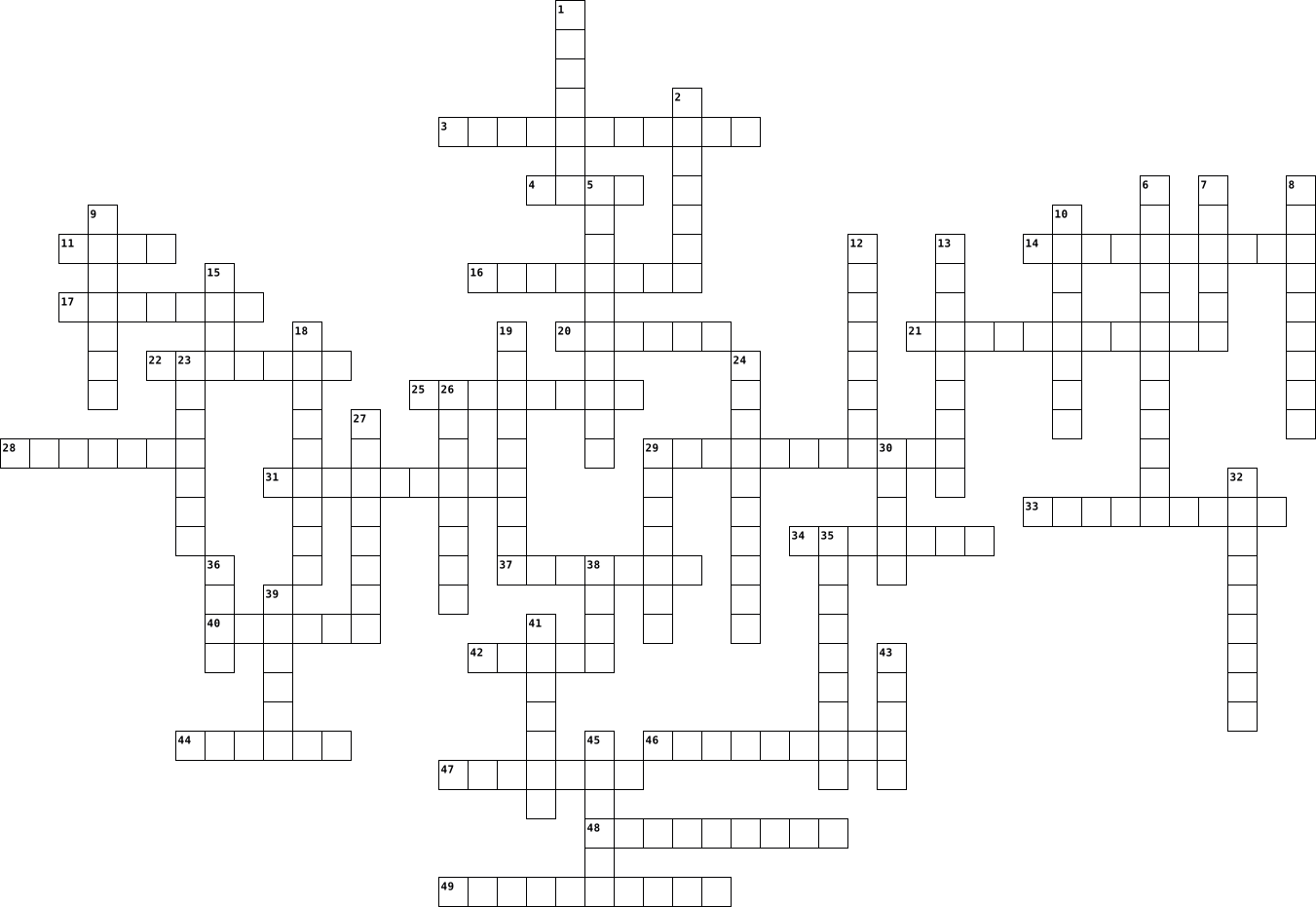
Across
- the epistle is attributed to Paul the Apostle and a co-author named Sosthenes
- the evangelist
- is the third of the four canonical Gospels
- or Ginosar, was a town alloted to the tribe of Naphtali, called "Kinnereth"
- a leader in the Colossian church
- Servant of King Ahab of Israel
- his name means "my holidays"
- is a Pauline epistle of the New Testament of the Christian Bible
- where Jesus first called his disciples
- symbolical angelic figure repeatedly mentioned in the Bible
- was from the Lycaonian city of Lystra in Asia Minor, born of a Jewish mother who had become a Christian believer, and a Greek father.
- the land between the rivers Tigris and Euphrates
- where Jesus was baptized
- the eleventh of the Twelve Minor Prophets
- ancient city in Israel
- full name: Malachias
- the second book of the Bible
- also known as Moshe Rabbenu
- the sixth book in the New Testament
- sometimes called Mary of Magdala
- the first book of the Hebrew Bible
- the tenth book of the New Testament
- the kinsman and fellow prisoner of Paul
Down
- is one of the oldest countries in the world with a recorded history of about 3500 years.
- Christian scriptures portray this as a wicked city
- final book of the New Testament
- one of the chief towns of Macedonia
- an early follower of Christianity mentioned in the Acts of the Apostles as a prophet
- also known as Julias
- also called The Fourth Book Of Moses
- often called the burning ones
- Hebrew or Chaldee appellation of a place, also called "Pavement"
- the most prominent one being the prophet who prophesied in the days of Josiah
- known by his Hebrew name Saul of Tarsus
- being the place of Jesus Christ's birth
- means “city of peace”
- the city of Assur
- twelfth book of the New Testament
- was a prophet whose oracles and prayer are recorded in the Book of Habakkuk
- one of the leaders of the Corinthian church
- name means "gift of the Lord"
- from Moresheth-Gath, in southwest Judah
- the location of the healing of the paralytic lowered by friends through the roof to reach Jesus
- briefly mentioned in the first Book of the Maccabees
- Son of Pethuel
- from the southern Kingdom of Judah but preached in the northern Kingdom of Israel
- the story of Israel from the conquest of Canaan to the Babylonian exile
- was Abraham's first son according to Jews, Christians and Muslims
- Son of Beeri
- also named Jerubbaal and Jerubbesheth
50 Clues: Son of Beeri • the evangelist • Son of Pethuel • the city of Assur • also known as Julias • full name: Malachias • means “city of peace” • ancient city in Israel • where Jesus was baptized • also known as Moshe Rabbenu • his name means "my holidays" • the second book of the Bible • often called the burning ones • name means "gift of the Lord" • Servant of King Ahab of Israel • ...
History 7 Test 3 2021-09-28

Across
- Established the Chaldean Empire
- Writing is the greatest accomplishment of this group of people
- Wrote Defender of the Peace in challenge of the Roman Catholic Church
- The Greek ruler that conquered Persia and attempted to conquer the world was ______ the Great
- United Mesopotamia
- A chief adviser in both the Babylonian and Persian Empires
- Caused the fall of the Western Roman Empire
- The first Christian church was located here
- Became the name of the new capital of the Roman Empire
- The first pope officially recognized as the supreme head of the church
- The greatest turning point in world history was Jesus' ____
- City was destroyed by a volcanic eruption during the reign of Titus
- Built the Royal Road
- This Roman emperor reigned during Jesus' crucifixion, resurrection, and ascension
- the most important thing the Phoenicians carried on their trading ventures
- The law that God established to protect the sanctity of human life is ______ punishment
- This Roman emperor pushed the boundaries of the empire to their greatest extent
- Is remembered for asking for wisdom to govern Israel
- term that was given to non-Jews
- The portion of the world in which Christianity prevails
- The French scholar that deciphered the Rosetta Stone
- The Roman emperor that declared toleration for Christians
- These early inhabitants of Italy built the firsts cities
Down
- Fall of the Assyrian Empire (ruler)
- God allowed this as punishment for the height of evil man had reached
- Means "that makes fruitful"
- The first pharaoh to unite all of Egypt
- Israel's first king
- the name given to Israel's founding fathers, Abraham, Isaac, and Jacob
- Invaded Belshazzar's Chaldean Empire
- became the most powerful body in the early Roman Republic
- Led in building the Tower of Babel
- The most common form of the Greek language
- The Carthaginian general that led a large force of men, horses, and elephants across the Alps into Italy
- First Roman Emperor to persecute Christians
- The theory that states that Christ made Peter the head of the catholic church
- When Israel was divided, the Southern Kingdom was called this
- Introduced democratic principles to Athens
- The location where Octavian defeated Antony's fleet
- At this mountain pass the Spartans tried to block the Persian Advance during the Greco-Persian War
- the first nation in world history to have a complete written account of its history
- the Greek poet that refined stories of Greek mythology
- Brought Egypt to its greatest extent was _____ III
- Deported the tribes of the Northern Kingdoms of Israel was _______ V
- These were the prominent, wealthy people of Rome
- Pax Romana was ______ Augustus
46 Clues: United Mesopotamia • Israel's first king • Built the Royal Road • Means "that makes fruitful" • Pax Romana was ______ Augustus • Established the Chaldean Empire • term that was given to non-Jews • Led in building the Tower of Babel • Fall of the Assyrian Empire (ruler) • Invaded Belshazzar's Chaldean Empire • The first pharaoh to unite all of Egypt • ...
MENA Vocab Crossword 2022-04-25

Across
- a fertile or green area in an arid region
- The Organization of the Petroleum Exporting Countries
- loose clay, silt, sand, or gravel that has been deposited by running water in a stream bed, on a floodplain, in an alluvial fan or beach, or in similar settings
- places where Mesopotamian gods were worshiped
- an English-language acronym referring to the Middle East and North Africa
- measures the monetary value of final goods and services
- individuals in Islam who are believed to spread God's message on Earth and to serve as models of ideal human behaviour
- chemical products obtained from petroleum by refining
- an Abrahamic monotheistic religion based on the life and teachings of Jesus of Nazareth
- Christianity and Islam, plus Judaism and Druze faith
- a peninsula between the Red Sea and the Persian Gulf
- a gently sloping underground channel or tunnel constructed to lead water from the interior of a hill to a village below
- the world's oldest monotheistic religion
- a Muslim place of worship
- the bed or valley of a stream in regions of southwestern Asia and northern Africa that is usually dry except during the rainy season and that often forms an oasis
- the seeds that come from grasses such as wheat, millet, rice, barley, oats, rye, triticale, sorghum, and maize
- A river delta is a landform created by deposition of sediment that is carried by a river as the flow leaves its mouth and enters slower-moving or stagnant water
Down
- Arabic, Hebrew, Kurdish, Persian and Turkish
- Algeria, Egypt, Libya, Morocco, Sudan, Tunisia, Western Sahara
- a mountain range in northern Africa between the Mediterranean and the Sahara Deser
- a business that does work for a customer, and occasionally provides goods, but is not involved in manufacturing
- of, subject to, or caused by an earthquake
- denoting or relating to the wedge-shaped characters used in the ancient writing systems of Mesopotamia, Persia, and Ugarit, surviving mainly impressed on clay tablets
- he process of removing salt
- a shallow arm of the Arabian Sea between SW Iran and Arabia
- the boomerang shaped region of the Middle East that was home to some of the earliest human civilizations
- the action of purifying a liquid by a process of heating and cooling
- an Abrahamic, monotheistic, and universal religion teaching that Muhammad is a messenger of God
- refers to the presence of people from a variety of cultural and ethnic backgrounds or identities
- a body of rock and/or sediment that holds groundwater
- a nomadic Arab of the desert
- a mode of subsistence that involves raising domestic animals in grassland environments using herd and household mobility
32 Clues: a Muslim place of worship • he process of removing salt • a nomadic Arab of the desert • the world's oldest monotheistic religion • a fertile or green area in an arid region • of, subject to, or caused by an earthquake • Arabic, Hebrew, Kurdish, Persian and Turkish • places where Mesopotamian gods were worshiped • Christianity and Islam, plus Judaism and Druze faith • ...
Sejarah 2023-11-16

Across
- Siapakah tokoh yang mengembangkan sistem telegrafi?
- Sebelun adanya kertas, surat ditulis di atas
- Salah satu ahli Igor Sikorsky yang dilibatkan dalam proyek Manhattan berhasil menciptakan
- kemudahan masuknya informasi dari luar ke dalam negri Indonesia disebabkan oleh peran teknologi dan informasi hal berikut merupakan dampak iptek di bidang
- Beredarnya berbagai barang elektronik di Indonesia dengan merk negara lain memperlihatkan contoh globalisasi dalam bidang
- teknologi pertama yang di miliki Indonesia
- Kejahatan (kriminal) di dunia internet dikenal dengan istilah.
- Berdasarkan penemuan hasil dari megaproyek Amerika Serikat, bagian terkecil dari sebuah materi dan dapat melontarkan energi yang sangat besar adalah?
- Teknologi informasi dan komunikasi dengan menggunakan media cetak, adalah
- jaringan yang berfungsi untuk menghubungkan antara satu media elektronik dengan media lainnya di sebut
- globalisasi dan kemajuan iptek membawa dampak poster yang membawa bangsa Indonesia ke arah
- Suatu proses yang merupakan internasionalisasi struktur teknologi dalam bentuk informasi dan transportasi yang berjalan tanpa batas, dinamakan…
- Sejarah transportasi dunia diawali dengan ditemukanya roda pada sekitar 3500 SM di wilayah
- Piagam atau dokumen yang ditulis pada bahan yang keras dan tahan lama. termasuk pada alat komunikasi.
- sifat konsumtif merupakan dampak negatif iptek di bidang
- kebijakan Indonesia dalam mencapai swasembada beras
Down
- Berikut ini yang termasuk sarana komunikasi tradisional adalah
- Wernher von Braun seorang ilmuwan roket Jerman mengembangkan peluru kendali A4 yang lebih dikenal sebagai
- paham yang melihat bahwa kesenangan atau kenikmatan menjadi tujuan hidup dan tindakan manusia merupakan paham
- teknologi robot yang di kembangkan oleh negara Amerika Serikat
- Perkembangan pertelevisian di Indonesia mulai berkembang sejak 1962 di tandai dengan kemunduran stasiun televisi pertama .stasiun televisi yang dimaksud adalah
- candi di Indonesia IPTEK senyatanya sudah di gunsejak dahulu adapun dalam bidang arsitektur bangsa Indonesia patut berbangga dengan adanya
- negara tidak lagi di anggap sebagai pemegang kunci dalam proses pembangunan merupakan dampak negatif dari kemajuan iptek bagi negara di bidang
- benda yang mengorbit benda lain dengan periode revolusi dan rotasi tertentu di sebut
- sebuah mesin untuk mengirim dan menerima pesan pada jarak jauh di sebut
- ruang beserta isinya yang terdapat di luar Ruang Udara yang mengelilingi dan melingkupi Ruang Udara di sebut
- Nama satelit pertama buatan dalam negeri Amerika Serikat yang diluncurkan pada awal Desember 1957 namun mengalami kegagalan adalah satelit.
- Teknologi informasi dan komunikasi dengan menggunakan media suara dan gambar adalah
- Ketika negara lain sedang tertimpa bencana, maka berbagai negara di dunia ikut membantunya. Peristiwa tersebut merupakan salah satu contoh pengaruh globalisasi di bidang
- Peralatan komunikasi yang digunakan untuk mengirim dokumen dengan menggunakan suatu perangkat yang mampu beroperasi melalui jaringan telepon adalah
30 Clues: teknologi pertama yang di miliki Indonesia • Sebelun adanya kertas, surat ditulis di atas • Siapakah tokoh yang mengembangkan sistem telegrafi? • kebijakan Indonesia dalam mencapai swasembada beras • sifat konsumtif merupakan dampak negatif iptek di bidang • Berikut ini yang termasuk sarana komunikasi tradisional adalah • ...
Historic Figures 2024-01-19

Across
- Byzantine emperor who reconquered much of the former Western Roman Empire
- Leader of the Mali Empire, known for being the richest person of all time
- Macedonian king who conquered Greece, father of Alexander
- English king who was forced by his nobles to sign the Magna Carta
- French military leader that helped France win the Hundred Years War, burned at the stake
- Invented the Cyrillic Language to spread Christianity to Slavic peoples
- King of the Franks who was crowned by the Pope as Holy Roman Emperor
- Father of Humanism
- Leader of the Muslim forces in the second and third Crusades, known for his religious toleration
- Pope who started the First Crusade
- Led Hebrews out of slavery in Egypt, received the 10 Commandments
- Original name was Octavian, first Emperor of the Roman Empire
- Leader of the Norman invasion of Britain, won the Battle of Hastings in 1066
- Last of the great Greek philosophers, teacher of the Alexander
- Islamic Caliph who was assassinated which caused the Sunni/Shia split in Islam
- Roman emperor who converted to Christianity, the city of Byzantium was renamed after him
- Most famous of the Greek storytellers, wrote the Iliad and Odyssey
- Macedonian who conquered the Persian Empire and spread Hellenic Culture
- Greek considered the father of geometry
- Founder of Doaism, a philosophy of going with the flow and oneness with nature
Down
- Created a formula to find the length of a triangles hypotenuse
- Indian prince who found the path to Enlightenment, founder of Buddhism
- Member of the First Triumvirate, became dictator of Rome, ended the republic, and was assassinated by the Senate
- Carthaginian general in the second Punic War, Rome's most formidable foe
- United China under the Qin dynasty, constructed the Great Wall
- Sculpted the Statue of David and painted the Sistine Chapel
- Founded a code of politeness that emphasized ancestor worship, correct behavior, and social order
- Leader of Athens during its golden age, built the Parthenon, expanded democracy
- English King who instituted Common Law and trial by jury
- Found of Islam
- Founder of Christianity
- Painter of the Last Supper and the Mona Lisa, quintessential Renaissance Man
- Persian emperor who was known for being tolerant of conquered peoples religion, freed the Jews from exile
- Founder of Judaism, first Hebrew, father of monotheism
- Emperor of the Mauryan Empire in India, spread Buddhism throughout Asia
- Roman poet who wrote the epic the Aeneid
- King of Babylon in Mesopotamia, first written law code
- Roman scientist who introduced the Heliocentric Model
38 Clues: Found of Islam • Father of Humanism • Founder of Christianity • Pope who started the First Crusade • Greek considered the father of geometry • Roman poet who wrote the epic the Aeneid • Roman scientist who introduced the Heliocentric Model • Founder of Judaism, first Hebrew, father of monotheism • King of Babylon in Mesopotamia, first written law code • ...
Civilizations Fertile Crescent Nile River Valley 2023-09-15

Across
- a region in northeast Africa, formerly known as Kush
- Crescent a large arc of fertile lands between the Persian Gulf and the Mediterranean Sea; the world's earliest civilizations began in this region
- the worship of many gods
- Kingdom a period in Egyptian history that lasted from 2700 to 2200 BC
- a way of supplying water to an area of land
- Stone a huge stone slab inscribed with hieroglyphics, Greek, and a later form of Egyptian; used by scholars to learn how to read hieroglyphics
- life after death according to some beliefs
- the ancient Egyptian writing system that used picture symbols to communicate
- a long-lasting, paperlike material made from reeds
- an ancient kingdom south of Egypt
- people from rich and powerful families
- imaginary creatures having the body of a lion and the head of another animal or a human
- finely ground fertile soil that is good for growing crops
- Code a set of 282 laws created by the Babylonian leader Hammurabi
- a landform at the mouth of a river created by sediment deposits
- Egypt the northern part of ancient Egypt, a country in North Africa on the Mediterranean Sea
- Egypt the southern part of ancient Egypt, a country in North Africa on the Mediterranean Sea
- city located on the Euphrates near what is now Baghdad, Iraq
- more than what is needed
- the title used by the rulers of ancient Egypt
Down
- rapids in a river
- a land with different territories and peoples under a single ruler
- a wheeled, horse-drawn cart used in battle
- network a system of people in different lands who trade goods
- a tall, four-sided pillar that is pointed on top
- buyers and sellers of goods; traders
- a political unit made up of a city and all its surrounding lands
- a pyramid shaped temple
- human-made waterways
- a series of rulers from the same family
- the world's first system of writing
- of labor an arrangement in which each worker specializes in a particular task or job
- long poems that tell the stories of heroes
- Kingdom the period in which Egypt reached the height of its power and glory
- a person who keeps records or copies documents
- a government ruled by religious leaders
- Kingdom a period of order and stability in ancient Egypt that lasted to about 1750 BC
- the economic center and capital of ancient Kush
- another name for Mesopotamia, the region in Southwest Asia between the Tigris and Euphrates Rivers
- hierarchy the division of society according to people's rank or class
40 Clues: rapids in a river • human-made waterways • a pyramid shaped temple • the worship of many gods • more than what is needed • an ancient kingdom south of Egypt • the world's first system of writing • buyers and sellers of goods; traders • people from rich and powerful families • a series of rulers from the same family • a government ruled by religious leaders • ...
Bible archeology crossword 2025-01-31

Across
- Crescent: A rich agricultural region in the Middle East, stretching from the Nile River in Egypt to the Tigris and Euphrates rivers in Mesopotamia. It is known as the cradle of civilization due to early farming and urbanization.
- A collection of sacred religious texts or scriptures, central to Christianity, Judaism, Samaritanism, and other religious traditions.
- Ghazal: An archaeological site in Jordan, where excavations revealed early farming and the discovery of plaster statues, dating back to 7200–5000 BCE.
- The oldest known walled city in the world, located in the Jordan Valley. It is mentioned in the Bible, notably for the fall of its walls during Joshua's conquest.
- Mesha: The 9th-century BCE king of Moab, known for the Mesha Inscription detailing his victory over Israel.
- Sea Border: The Dead Sea borders Jordan to the east and Israel and Palestine to the west. It is a saltwater lake known for its high salinity and mineral-rich waters.
- Issa: In Islam, Prophet Issa (Jesus) is regarded as a central figure, a prophet and messenger of God, believed to have performed miracles and preached monotheism.
- River: A 251-km river in the Middle East, flowing through Israel, Jordan, and Palestine, significant in religious history.
- Early forms of writing that use simple pictures to represent objects, actions, or ideas.
- Stone: A famous artifact that helped scholars decipher Egyptian hieroglyphics, providing the same text in Greek, Egyptian hieroglyphic, and demotic script.
- The study of ancient remains, such as artifacts and ruins, providing insights into past civilizations, including biblical events.
Down
- A region in the Middle East, including parts of Israel, the West Bank, and Gaza Strip.
- Relating to Greece, its language, or culture. In religious history, it is centered around polytheism, with gods like Zeus and Hera.
- A country in the Middle East, known for its rich history, ancient Persia, and its capital, Tehran.
- An ancient system of writing using pictorial symbols to represent words, sounds, or ideas, used in ancient Egypt.
- The process of digging to uncover ancient artifacts and remains.
- Stele: A stone inscription dating to the 13th century BCE, containing the earliest known Egyptian reference to "Israel" as a people, found in Egypt.
- Inscription: A 9th-century BCE inscription detailing King Mesha’s victory over Israel, providing historical context and a reference to Israel during that time.
- An ancient writing material made from the stalks of the papyrus plant, used by ancient Egyptians, Greeks, and Romans.
- me know if you need anything else!
- An ancient region in the Levant, roughly covering modern-day Israel, Palestine, Lebanon, and parts of Syria and Jordan.
21 Clues: me know if you need anything else! • The process of digging to uncover ancient artifacts and remains. • A region in the Middle East, including parts of Israel, the West Bank, and Gaza Strip. • Early forms of writing that use simple pictures to represent objects, actions, or ideas. • ...
Happy Holidays, Paul Emile! 2024-12-21

Across
- In-house performer, early 2000’s
- Horton to Campbell
- Large deer, caffeinated
- Pivotal site during the Acadian Civil War
- Studmuffin #1
- Outdoor educator and nature interpreter
- Chiasson Matriarch
- Hoppy’s happy hour classic
- Participated in cooperative efforts in Laos
- “Mr. Watson, come here. I want to see you”
- Shameless cult
- “All we have to do is decide what to do with the time that is given to us.”
- Previously known as Angora, this city is famous for its goats, cats, and rabbits of the same name.
- 2 for 1 sale, 1996
- View from the top
- August 15th celebrates
- Virer et empanner, Catherine
- Known for rug hooking landscapes
- An auburn Bouchard
- What is the most iconic international music festival of all time?
- Most of "The Hill"
- TD Station, previously
- Curved index, lovingly
- Grande soeur
- Steep cliff named after a solemn profile
- Home of the Village Historique Acadien
- Initially produced aircraft engines
- Exiled from Trueman House
- Who is a “good boy”?
- Qualification for instructing ELL's
- Mi'kmaq tradition using birch bark
- Band of Brothers, Major
- ~14,000 settled here in 1783
- Prestigious piano
- Sunday farmers market
- Perfect summer activity
- Instrument with roots back 3000yrs in Egypt and Mesopotamia
- Fizzy adventure in Atlanta
- Edwardian venue reborn in the heart of Saint John
- Festival on the Kennebecasis
Down
- Leads the troop on movement, feeding sites, and resting spots
- New grandma in town
- Freshwater ecology expert
- Age of Sail tribute
- Where true love was found...
- Summer by the Han River
- Poster-family outdoor fun
- Birthplace of Human Rights
- Treasured neighbours
- Up to 16 metres
- Bonus Daughter
- 19th-Century defensive structure nearby
- One of few rivers globally that still supports spawning Atlantic salmon
- Local songbird
- Extra hops, English
- Mastermind here
- Smaller house
- Stefan
- Pirate-approved brew for what ails ye?
- Dairy, donuts and hot air balloons
- Higher learning on the Bay of Fundy
- Lighthouse and lifeguards
- Perfect place to study
- Mug collection
- “Your heart will never leave!”
- “A child is born” in January
- Best-selling Canadian recording artist of all time
- Friendship, cars and calculators
- Barrier stroll on March 8, 2008
- Tin whistle, fiddle, bagpipes, harp
- Spa date of Kim Jung Un
- A tall tower
- Saint John River, Maliseet
- Local fermented apples
- Newspaper, pellets and leafy greens
- Most spoken
- Town where kilts and cabers take centre stage
77 Clues: Stefan • Most spoken • Grande soeur • A tall tower • Studmuffin #1 • Smaller house • Bonus Daughter • Local songbird • Shameless cult • Mug collection • Up to 16 metres • Mastermind here • View from the top • Prestigious piano • Horton to Campbell • Chiasson Matriarch • 2 for 1 sale, 1996 • An auburn Bouchard • Most of "The Hill" • New grandma in town • Age of Sail tribute • Extra hops, English • ...
history 2021-05-28
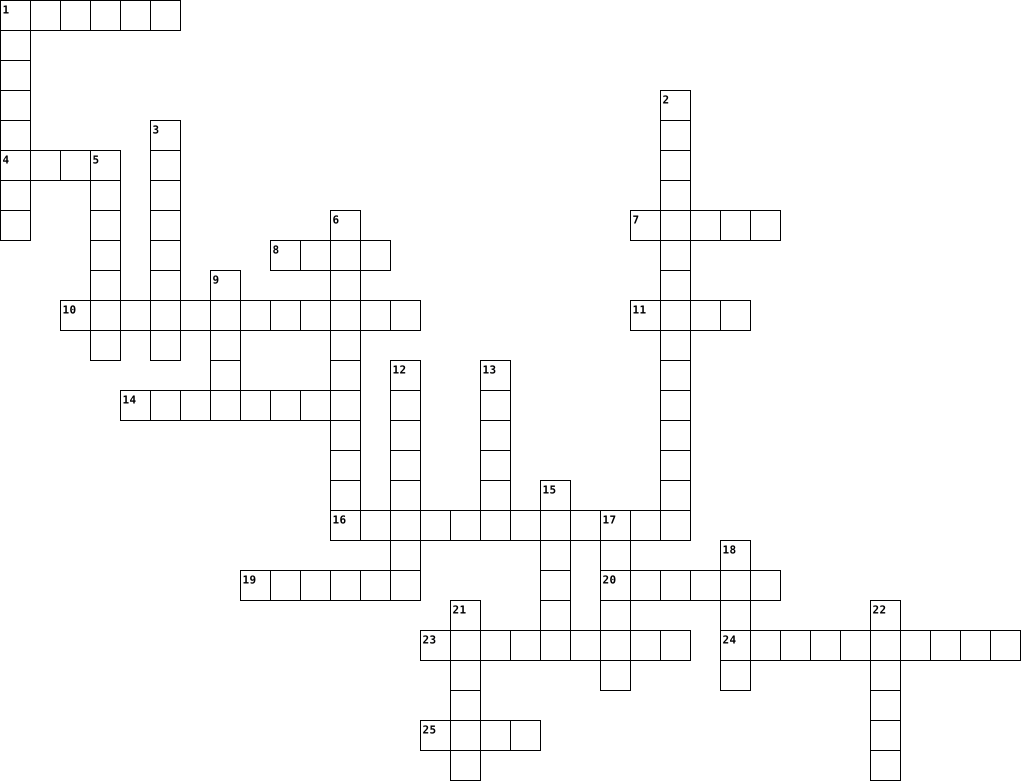
Across
- European country with a long Mediterranean coastline.
- Erikson, A Norse explorer from Iceland, who is thought to have been the first European to set foot on continent of North America.
- Victoria, Former Queen of the United Kingdom of Great Britain. The time period in which she rolled was known as the Victorian era of Britain.
- Calvin, Was a French theologian, pastor and reformer in Geneva during the Protestant Reformation.
- Is a historical region of Western Asia situated within the Tigris–Euphrates river system.
- Antony, A Roman politician and general who played a critical role in the transformation of the Roman empire one of the husbands of Cleopatra.
- da Vinci, An Italian man who was a painter, draughtsman, engineer, scientist, theorist, and more.
- Period in European cultural, artistic, political and economic “rebirth” following the Middle Ages.
- Is a civilization of ancient North Africa, concentrated along the lower reaches of the Nile River.
- Is a country in South Asia, is the second-most populous country, and the seventh-largest country.
- Magellan, Was a Portuguese explorer who organised the Spanish expedition to the East Indies, also the first man to circumnavigate the globe.
- The last active ruler of the Ptolemaic Kingdom of Egypt
- Roman Empire, Was the largest empire of the ancient world. Its capital was Rome, and its empire was based in the Mediterranean.
Down
- and Ferdinand, Known for supporting and financing Christopher Columbus's.
- Sailor or travel all the way around.
- Bonaparte, French military leader who was sent into exile.
- Napoleon Bonaparte, Henry I, Louis XIV, henry IV where rulers of this Country which is located on the continent of Europe.
- Columbus, An Italian explorer and navigator who completed four voyages across the Atlantic Ocean, and explore the Americas.
- Empire, The post-Republican period of ancient Rome.
- is separated from continental Europe by the North Sea to the east and the English Channel to the south.
- Caesar, Was a Roman general and statesman who played a critical role in the events that led to the demise of the Roman Republic and the rise of the Roman Empire.
- River, Is the longest river in Asia, the third-longest in the world and the longest in the world to flow entirely within one country.
- Is a country in East Asia and it is the world's most populous country.
- polo, A Venetian merchant, explorer, and writer who travelled through Asia along the Silk Road.
- River, The second-longest river in China.
- Luther, A German professor of theology, priest, author, composer, Augustinian monk, and a seminal figure in the Reformation.
26 Clues: Sailor or travel all the way around. • River, The second-longest river in China. • Empire, The post-Republican period of ancient Rome. • European country with a long Mediterranean coastline. • The last active ruler of the Ptolemaic Kingdom of Egypt • Bonaparte, French military leader who was sent into exile. • ...
Social Studies Review 2020-06-11

Across
- member of a phalanx (Greek foot soldier)
- formed by river deposits
- a Greek city-state
- style of notes that has a column for study questions
- judges and laws helped prevent these in Sumer
- friend of Gilgamesh
- birthplace of democracy
- large terraced temples built in Mesopotamia
- a phase of the moon
- in Athens, the Council of 500
- grasses that produce edible grain
- prefix meaning middle
- when a student is nervous but asks their question anyway (a Kulshan characteristic)
- study of earths layers and a method of dating artifacts
- the D in AD
- way most Athenians lived
- "We remember what we ____" (along with "focus on" and "review")
- time before the invention of writing
- garbage heaps left by people of the past
- What Chauvet cave is famous for
- Kulshan characteristic related to persistence
- people trained in the world's first schools
- round building where part of the Athenian boule worked
- government where power is in the hands of a small group
- features related to humans
- oldest and longest period of human history
- residents of Athens born in other poleis
- rule by one; usually a king
- the gathering or assembly of citizens where laws and decisions were voted on
- known for his code of laws
Down
- used an alphabet that the Greeks copied
- natural vegetation (native plants)
- enslaved people whose lands were conquered by Sparta
- a tyrant run out of Athens
- animals painted on walls
- happily awaited in Egypt; destructive in Sumer
- features found in nature: topography, climate, soil, etc.
- writing practice material
- syllabic writing developed in Sumer
- replaces BC
- home for Spartan boys after age 7
- honored by athletes in Oympia
- Hammurabi's home
- culture of sedentary foragers in the Levant
- ruler who seizes power
- 100 years
- the record of humans found in the layers of a place
- Kulshan characteristic that makes the world a better place
- used in Athens to randomly select jurors
- job of all Spartan men
- guide for marking a text
- common among Greek poleis
- Sumerian solution to lack of rain
- ____ crops: grapes and olives, for example
- the study of the world and what a place is like
- missing from the Phoenician alphabet
- way to remember the 5 themes of geography
- Athena's head on one side; an owl on the other
- wildlife
- layers
- 1000 years
- ____ regions--result of Greece's topography
- polis with strong, athletic woman
63 Clues: layers • wildlife • 100 years • 1000 years • replaces BC • the D in AD • Hammurabi's home • a Greek city-state • friend of Gilgamesh • a phase of the moon • prefix meaning middle • ruler who seizes power • job of all Spartan men • birthplace of democracy • formed by river deposits • animals painted on walls • guide for marking a text • way most Athenians lived • writing practice material • ...
ARCH141#1 2014-10-28

Across
- A tall, four-sided, narrow tapering monument which ends in a pyramid-like shape at the top.
- A sunken panel in the shape of a square, rectangle, or octagon in a ceiling, soffit or vault.
- A temporary structure upon which the stones of an arch or vault are laid during construction.
- A long sequence of columns joined by their entablature, often free-standing, or part of a building.
- This comes from the French language, literally meaning "frontage" or "face"
- A superstructure of moldings and bands which lie horizontally above columns, resting on their capitals.
- This order similar to the Doric order, and yet in its overall proportions and intercolumniation, it follows the ratios of the Ionic
- A small shrine.
- a rectangular stepped tower, sometimes surmounted by a temple Ur is a massive structure built in the ancient Mesopotamia valley the form of a terraced step pyramid
- A fortress, typically on high ground, protecting or dominating a city.
- an arched form used to provide a space with a ceiling or roof. The parts of a vault exert lateral thrust that requires a counter resistance.
- This is a spiral, scroll-like ornament that forms the basis of the Ionic order, found in the capital of the Ionic column.
Down
- ______column an is a column embedded in a wall and partly projecting from the surface of the wall.
- A wedge-shaped element, typically a stone, used in building an arch or vault.
- A rectangular hall, fronted by an open, two-columned porch, vented though an oculus in the roof above it and surrounded by four columns.
- The upper part of the church, containing a series of windows that admits light to the central parts
- ____ and_____ carved in wood, stone, or plaster quarter-round oval moldings, consisting of an egg-shaped object alternating with an element shaped like an arrow, anchor or dart.
- Sun dried brick made of mud and straw.
- A strip of material with various profiles used to cover transitions between surfaces or for decoration nave main body of the church
- A semicircular recess covered with a hemispherical vault or semi-dome, where the altar is in a church.
- A view of a building seen from one side, a flat representation of one façade
- An artificial channel for conveying water, typically in the form of a bridge supported by tall columns.
- An exedra or an apse that has been reduced in size, retaining the half-dome heading usual for an apse.
- A succession of arches, A covered passageway with arches along one or both sides.
- This is a country house, originally for Roman elite.
25 Clues: A small shrine. • Sun dried brick made of mud and straw. • This is a country house, originally for Roman elite. • A fortress, typically on high ground, protecting or dominating a city. • This comes from the French language, literally meaning "frontage" or "face" • A view of a building seen from one side, a flat representation of one façade • ...
History of Art 2017-11-23

Across
- The wife of King Minoas give birth to man - beast creatures called ______
- During the golden era of Roman art, Roman buildings usually were covered with decorative ______ surfaces, internally and externally.
- ______ and musical instruments are strong motif in Etruscan art.
- One of the functions of the Stonehenge is the gathering place for the ______
- The most famous Stone Age structure which featuring the post – and – beam constructs typical of the time
- Another famous cave that has images painted on the ceiling and wall is located at the ______,France.
- _______ was one of the popular themes for the Stone Age art.
- The eruption of the ______ volcano destroyed the Minoans
- The medieval period encompassed eight major artistic movements which include Byzantine, Islamic, ______, Carolingian, Celtic, Ottonian, Romanesque and gothic art.
- Some Mesopotamian art were created for status symbols, like ___________
- In the second millennium BC, Island of Crete was the center of a vast domain that encompassed most of the islands in the Aegean, and for this reason, the ______ civilization are named after.
- Mesopotamia is known as the cradle of civilization and this phrase itself is full of meaning, for civilization refers to a society that is _____
Down
- What is the code that shows Mesopotamians had an eye-for-an-eye system of justice?
- In the Egyptian art,_______ for example were often the largest figures in any painting symbolizing their dominance and power.
- The Altamira cave, which located at Spain have extraordinary images painted on the walls and ceilings with the illustration of _______ and human during the Ice Age era.
- For the Greek sculpture, the idealized public sculptures of gods and _______ were more than images to worship.
- During Mesopotamian era, they keep records, giving law and communicate using a medium called _______
- For the Etruscan sculpture, the terra cotta was _______ rather than carved.
- Christian art received a big impetus when ________ himself commissioned the building of several churches which had some stunning examples of Christian art in the form of colorful mosaics.
- For the Egyptian art, like sculpture, _______ did not change a century's past, regardless the old, middle and new kingdoms.
- In the Etruscan funerary art, the _____ usually was placed on a sort of throne in the tomb, which may have indicated a high status for deceased.
- Greek art is usually categorized under three headings , the ______ period, the Classical period and the Hellenistic period.
- For the Greek Art, in the early geometric period, ______ vessels were primarily used as funerary items.
- Greek art introduced to something new into the history of cultural production, which the concept that art would and should ______ and change.
- ______ work was one of the distinctive artistic styles that developed in the Roman Empire especially after Julius Caesar's death.
25 Clues: The eruption of the ______ volcano destroyed the Minoans • _______ was one of the popular themes for the Stone Age art. • ______ and musical instruments are strong motif in Etruscan art. • Some Mesopotamian art were created for status symbols, like ___________ • The wife of King Minoas give birth to man - beast creatures called ______ • ...
Chapters 2-5 9WT Review 2022-03-02

Across
- groups of merchants or citizens traveling together for safety over long distances
- a group of states or territories controlled by one ruler
- a fan-shaped area of fertile silt near where a river flows into the sea
- any change that has an enormous effect on peoples' way of life
- a person with certain rights and responsibilities in his or her country or community
- early system of writing in which wedge-shaped characters were made with a sharp reed on wet clay
- a member of a group that has no permanent home and wanders in search of food and water
- a person who writes things down; an official record-keeper.
- a writing system made up of a combination of pictures and sound symbols
- a half of the earth, as divided by the equator or by the Prime Meridian
- a worker skilled in a craft
- circles the Earth from Pole to Pole; measures east and west
- the process of treating a body to keep it from decaying
- forced payments taken from conquered people
- a line of rulers from the same family
- a long poem that tells the story of a hero.
- a complex, highly organized social order
- the principle that limited amounts of goods and services are available to meet unlimited wants
- the physical and human characteristics of a location
- land between the Tigris and Euphrates rivers where the first civilizations developed
- chaldean king who rebuilt Babylon
Down
- to tame; to bring plants or animals under human control
- the exact position of a place on the earth's surface.
- the earliest period of the Stone Age
- a flat grassland, sometimes with scattered trees, in a tropical or subtropical region
- the science or practice of farming, including the growing of crops and the rearing of animals
- a government controlled by religious leaders
- the belief in or worship of more than one god.
- the position of a place in relation to another place
- the period after the Paleolithic Age marked by a shift from hunting-and-gathering to agriculture
- a ruler of ancient Egypt
- Babylonian king who established Sumeria
- a government representative to another country
- parallel to the equator; measures north and south
- holy places decorated with images of Gods and Goddesses
- an area of Earth distinguished by a distinctive combination of cultural and physical features
- a government ruled by a king or queen
- great stone tomb built for an Egyptian pharaoh
- beliefs, customs, and traditions of a specific group of people.
- a reed plant growing wild along the Nile River that was used to make paper
40 Clues: a ruler of ancient Egypt • a worker skilled in a craft • chaldean king who rebuilt Babylon • the earliest period of the Stone Age • a line of rulers from the same family • a government ruled by a king or queen • Babylonian king who established Sumeria • a complex, highly organized social order • forced payments taken from conquered people • ...
Adv. World History Semester Review 2024-12-09

Across
- First legal code in Mesopotamia- eye for an eye.
- Get out of heaven free card that Martin Luther attacked in his 95 Theses.
- Form of government where leader/small group has TOTAL power, usually backed by military.
- Lord's home in Feudal Society- also economic system of maintaining the relationship between land holding lord & land working peasant.
- 1215- Passed due to King John's reign- king is subject to the law.
- Political hierarchy of the Middle Ages in Western European kingdoms that provided safety for food and protection.
- Tang & Song Dynasties saw a ________________ where lots of innovations, such as wood-block printing, paper currency, etc.
- Italian scientist- ground-breaking astronomical observations using telescope.
- Form of government where power is held in religion/church/religious figure.
- Wrote "The Prince"- a how to guide on wielding & maintaining power- the ends justifies the means.
- Persian ruler that set up satraps in charge of regions and grew the Persian Royal Road.
- Ancient series of overland trade routes that connected the Western World with Middle East & Asia.
- Gold-Salt Trade or Trans-Saharan Trade allowed for the spread of what religion?
- Code of Laws collected from Roman law & codified by Byzantine Emperor _______________.
- Began by 95 Theses- questioned authority of the Catholic Church- led to churches & religions that "protested" the Catholic Church.
- Split in the Roman Catholic Church & Greek Orthodox Church in 1054.
Down
- Roman Emperor that passed Edict of Milan & split the empire into two.
- by which commodities, people, and diseases crossed the Atlantic after Columbus' arrival, including transmission of diseases to natives.
- Philosophy of life originated during the Renaissance-placed central emphasis on the value of human being.
- Revolution that introduced agriculture, moved societies to stratified, sedentary. Ended nomadic life.
- Challenged church authority advocating for heliocentric, not geocentric.
- Series of religious wars over the Holy Land between Muslims & Christians- effect was increased trade between the two.
- Representative democracy- people elect representatives to make decisions on their behalf.
- Martin Luther's publication that started the Protestant Reformation- attacked the sale of indulgences.
- Replaced River Valley Civilizations: Greece, Rome, Persia, India & China. Had more territories & more people.
- Example: Ancient Rome. Small group of aristocrats lead.
- Government where the people lead.
- First ruler of Mongol Empire that launched a series of military campaigns to grow the empire.
- Time period also known as the Middle Ages after Rome had fallen.
- Upper class in Ancient Rome.
- Johannes Gutenberg's invention helped spread Luther's translation of the bible & allowed for literacy rates to increase.
- Led by empires seeking God, Glory & Gold plus access to trade routes/spices.
- Period of cultural rebirth in Italy- led to significant achievements in art, architecture, literature & thinking.
33 Clues: Upper class in Ancient Rome. • Government where the people lead. • First legal code in Mesopotamia- eye for an eye. • Example: Ancient Rome. Small group of aristocrats lead. • Time period also known as the Middle Ages after Rome had fallen. • 1215- Passed due to King John's reign- king is subject to the law. • ...
SANDWICHES 2018-02-24

Across
- luncheon meats, cooked meats, sliced meats, cold meats and deli meats—are precooked or cured meat, often sausages or meat loaves, that are sliced and served cold or hot on sandwiches or on party trays.
- a type of bread made with various proportions of flour from rye grain.
- also known as Arabic bread, Lebanese bread, or Syrian bread, is a soft, slightly leavened flatbread baked from wheat flour, which originated in Western Asia, most probably Mesopotamia around 2500 BC.
- a small, often round loaf of bread served as a meal accompaniment. A roll can be served and eaten whole or cut transversely and dressed with filling between the two halves.
- at is prepared specifically to be used for the preparation of sandwiches.CHAPATTI / also known as roti, safati, shabaati and roshi, is an unleavened flatbread from the Indian Subcontinent; and popular staple in India, Nepal, Bangladesh, Pakistan, and Sri Lanka.
- a sandwich consisting of three pieces of bread and two layers of filling.
- is a thick, creamy dressing often used as a condiment. It is a stable emulsion of oil, egg yolk, and acid, either vinegar or lemon juice, with many options for embellishment with other herbs and spices
- a type of bread made using flour that is partly or entirely milled from whole or almost-whole wheat grains.
- a spice, sauce, or preparation that is added to food to impart a particular flavor.
- a food typically consisting of vegetables, sliced cheese or meat, placed on or between slices of bread, or more generally any dish wherein two or more pieces of bread serve as a container or wrapper for another food type.
- a very thin unleavened dough used for making pastries such as baklava and börek in Middle Eastern and Balkan cuisines.
Down
- bread platter or tartine, consists of a single slice of bread with one or more food items on top.
- an imitation butter spread used for flavoring, baking, and cooking.
- a small prepared sandwich meant to be eaten at afternoon teatime to stave off hunger until the main meal.
- as those having two slices of bread or two halves of the roll ( which can be toasted also) , which have a spread applied and are filled with a cold filling.
- a type of very thin pastry, usually made from wheat flour or buckwheat flour.
- a shape, usually rounded or oblong, mass of food. It may refer to a whole article of bread.
- a tortilla is a type of thin, unleavened flatbread, made from finely ground maize.
- made with a soft flatbread rolled around a filling. The usual flatbreads are wheat tortillas, lavash, or pita.
19 Clues: an imitation butter spread used for flavoring, baking, and cooking. • a type of bread made with various proportions of flour from rye grain. • a sandwich consisting of three pieces of bread and two layers of filling. • a type of very thin pastry, usually made from wheat flour or buckwheat flour. • ...
American history 2019-08-14

Across
- a member of an ancient North American people of the southwestern US, who flourished between c.200 BC and AD 1500. The earliest phase of their culture is known as the Basket Maker period; the present-day Pueblo culture developed from a later stage.
- or blood relations. Sometimes _______ ties were based on the mother's family
- They began there rise around 400 BC there houses were pyramids,palaces and temples. Their peak or prime time was around AD 250 to 900.
- the action or process of settling among and establishing control over the indigenous people of an area.
- was a Norse explorer from Iceland. He was the first known European to have set foot on continental North America, before Christopher Columbus.
- is a type of Mesoamerican agriculture which used small, rectangular areas of fertile arable land to grow crops on the shallow lake beds in the Valley of Mexico.
- the traditional dwelling of the Iroquois and other North American Indians.
- was founded by the prophet Muhammad.
- interchange, named for Christopher Columbus, was the widespread transfer of plants, animals, culture, human populations, technology, diseases, and ideas between the Americas, West Africa, and the Old World in the 15th and 16th centuries.
- a member of a nomadic people who live chiefly by hunting and fishing, and harvesting wild food.
Down
- North American Indians who traditionally lived in what is now British Columbia, Canada, along the shores of the waterways between Vancouver Island and the mainland. Their name for themselves means.
- were an Arawak people who were the indigenous people of the Caribbean and Florida. At the time of European contact in the late 15th century, they were the principal inhabitants of most of Cuba, Jamaica, Hispaniola (the Dominican Republic and Haiti), and Puerto Rico.
- the assignment of different parts of a manufacturing process or task to different people in order to improve efficiency.
- This group came to dominate central Mexico. They were known for builders, warriors, artisans.
- were people believed in spiritual and healing powers. They called _______ the medicine men
- They were known to conquer many neighboring people they believed in many gods. They also did human sacrifices. They took over around the 1400s
- any of the Scandinavian seafaring pirates and traders who raided and settled in many parts of northwestern Europe in the 8th–11th centuries.
- They were known to be called the mother culture of Mesopotamia. They were known for their art, religion, agriculture. They were engineers and also artists.
- a group of close-knit and interrelated families (especially associated with families in the Scottish Highlands).
19 Clues: was founded by the prophet Muhammad. • the traditional dwelling of the Iroquois and other North American Indians. • or blood relations. Sometimes _______ ties were based on the mother's family • were people believed in spiritual and healing powers. They called _______ the medicine men • ...
Learning Contract #2 - Vocab 2 - Crossword Puzzle 2024-09-30

Across
- Writing system in ancient Egypt that uses certain pictograms and certain symbols that represent words or sounds.
- A series of rulers from the same family who hold power over a long period of time and is a like the royal family in England.
- Central reference to Judaic tradition and is a combination of the first five books of the Hebrew bible.
- One of the oldest monotheistic religions forbidden by the prophet Zoroaster in ancient Persia and has influenced many monotheistic and other belief systems.
- The title used for Egyptians rulers who were politically and religious leaders of Egypt or king of ancient Egypt.
- A set of ethical guidelines given by Moses by god according to the bible which form a big part of Jewish, Christian, and Islamic traditions.
- The scattering of people from the homeland in context to Jewish or Hebrew history but can be used in other context as well.
- A type of government where guidelines are made by state officials rather than elected governed people leading and has different departments and a social hierarchy.
- The belief in one singular god or existence of one god in general in religions such as Judaism or Islam.
Down
- A specific type of government where religious leaders rule the area or certain land/hold power of certain policies they may have based on culture. It involves the unity of people directed by divine guidance or a deity.
- The belief or worship of multiple gods or worship in multiple gods for multiple purposes.
- A separate or independent city that is a political, economic, and cultural hub for a region or territory.
- A system where people have certain status and/or rank divisions based on their importance and is a system to determine authority in a governing body.
- Is a political form in which a union or group of people/civilizations that assert dominance over a certain region or territory and projects power over certain people or land masses. The Romans are an example of this.
- A period of human history characterized by the usage of tools and weapons following the Bronze age of 3,000 B.C.E.
- A large amount or abundance of something often referring to an agricultural connotation.
- One of the earliest civilizations in western Asia between the Tigris and Euphrates Rivers. It stands in current day Iraq and is a place of early cities and an early writing called cuneiform.
- An ancient region located to the south of Egypt along the Nile known for powerful empires and engagement with Egypt and/or class interactions.
18 Clues: A large amount or abundance of something often referring to an agricultural connotation. • The belief or worship of multiple gods or worship in multiple gods for multiple purposes. • Central reference to Judaic tradition and is a combination of the first five books of the Hebrew bible. • ...