
moon phases Crossword Puzzles
Amplify Earth, Moon, and Sun Vocabulary 2025-08-21

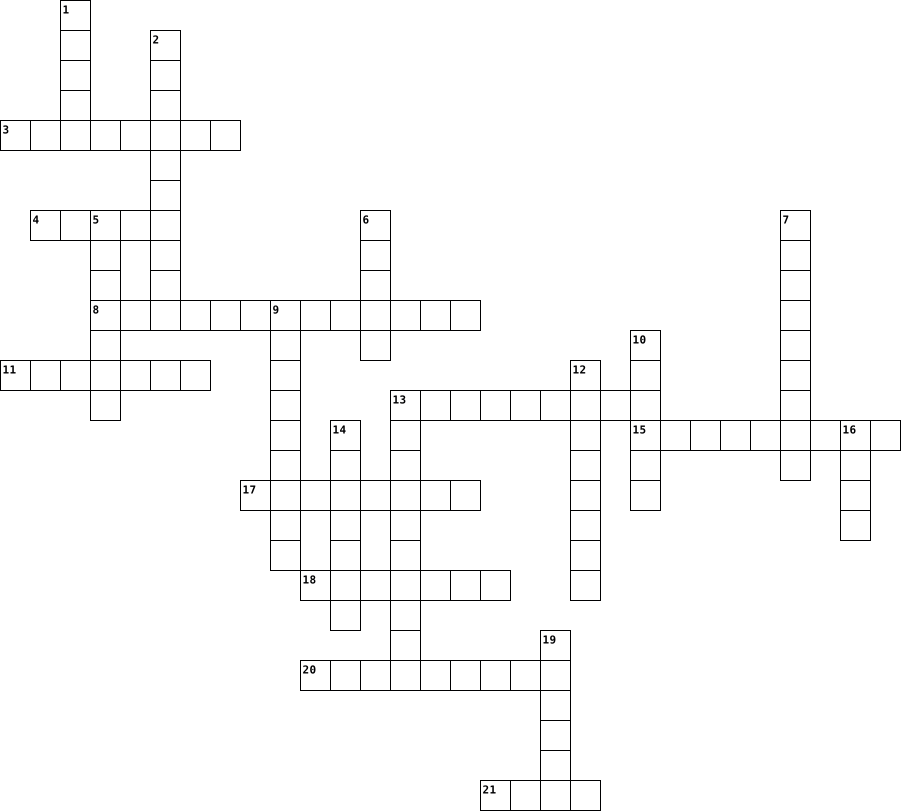
Across
- Moon, a moon phase that looks like more than half a circle from Earth
- Moon, a moon phase in which the Moon is not visible from Earth
- moon, a moon that looks like a full circle from Earth
- a rocky sphere that travels around a planet
- Moon, a moon phase that looks like a half-circle from Earth
- the star that is the main source of light at the center of our solar system
- something we observe to be similar over and over again
- Phase, the shape of the illuminated part of the Moon as it appears from Earth
- the amount of time it takes for a planet to complete one orbit around a star or stars
- a moon outside our solar system
- the nearly circular path a smaller object (like the Moon) travels around a larger object (like Earth)
- the relative size of things
- a feature that forms on a surface of a planet such as a channel, crater, or volcano
- a measurement of the gravitational force of an object depending on mass and location
Down
- an object that moves around a larger object
- System, the sun, the planets that orbit the sun, and other objects that orbit the sun
- a measure of the amount of matter in an object
- an object, diagram, or computer program that helps us understand something by making it simpler or easier to see
- Eclipse, when the Moon is completely dark
- the border between light and dark on the Moon
- a force that attracts object toward one another
- moon, a moon phase that looks like less than half of a circle from Earth
- a planet outside our solar system
- eclipse, when the moon casts a shadow on the Earth caused by perfect alignment of the Earth, moon, and the Sun
- to shine light on an object and make it visible
25 Clues: the relative size of things • a moon outside our solar system • a planet outside our solar system • Eclipse, when the Moon is completely dark • an object that moves around a larger object • a rocky sphere that travels around a planet • the border between light and dark on the Moon • a measure of the amount of matter in an object • ...
Solar System 2023-05-31
Across
- a rocky or metallic object that orbits the sun
- a mixture of ice, gas, rock and dust that orbits the Sun
- a pattern formed by stars in the night sky
- the tendency of an object to move in a straight line
- an exploding star
- any object that orbits a larger object
- when high tide is lower than normal
- The farthest planet from the Sun.
- a meteor that strikes Earth's surface
- a sphere of hot gas that gives off light & heat
Down
- the nearly circular path an object travels around a larger object
- a complete pass around the sun
- The closest planet to the sun
- the planet we live on
- an object with powerful gravity nothing can escape
- The distance light travels in a year
- the apparent shape of the moon in the sky
- a complete spin on Earth's axis
- when high tide is higher than normal
- The largest planet
- a regular rise and fall of water
- a huge cloud of gas and dust where a star forms
22 Clues: an exploding star • The largest planet • the planet we live on • The closest planet to the sun • a complete pass around the sun • a complete spin on Earth's axis • a regular rise and fall of water • The farthest planet from the Sun. • when high tide is lower than normal • The distance light travels in a year • when high tide is higher than normal • ...
SSB Unit Review Crossword 2023-12-06

Across
- Describes a Moon phase after a New Moon but before a Full Moon
- The type of phase when less than 50% of the side of the Moon facing Earth is illuminated, but more than 0%
- The first day of summer and winter
- States that furthest galaxies appear to be moving the fastest
- The relationship between gravitational force and distance is _________________ and exponential
- Describes a Moon phase after a Full moon but before a New Moon
- ______ tide: occurs when the Moon, Earth, and the Sun are all at right angles to each other. The weakest tidal pull.
- The line that runs along the middle of the Earth dividing the Northern and Southern Hemispheres
- The season it would be in the Southern Hemisphere if it is Winter in the Northern Hemisphere
- ____________ tide: occurs when the Moon, Earth, and the Sun are all in a straight line. The strongest tidal pull.
- Explanation for the formation of the Universe and its expansion
Down
- The moon phase that occurs halfway between a New Moon and Full Moon
- The phase of the moon makes when the illuminated side is fully visible from Earth
- The relationship between gravitational force and mass is direct and ___________
- The Earth’s axis is ____________ 23.5 degrees
- When no Moon is visible
- The two factors that determine gravitational force are mass and __________.
- The type of phase when more than 50% of the side of the Moon facing Earth is illuminated, but less than 100%
- The kind of eclipse that occurs during a New Moon
- The first day of fall and spring
- Holds the planets in orbit around the Sun
- The different shapes made by the Moon as viewed from Earth
- The kind of eclipse that occurs during a Full Moon
23 Clues: When no Moon is visible • The first day of fall and spring • The first day of summer and winter • Holds the planets in orbit around the Sun • The Earth’s axis is ____________ 23.5 degrees • The kind of eclipse that occurs during a New Moon • The kind of eclipse that occurs during a Full Moon • The different shapes made by the Moon as viewed from Earth • ...
Ms. Nagy's Room Scavenger Hunt 2023-08-22

Across
- What is the MAIN color of the work turn-in bins?
- What color is the sign for the emergency eyewash station, white and ____.
- Which side of the board is the Science Agenda on?
- True or False, you should always leave class out the back door.
Down
- What direction is the fire extinguisher's arrow pointing?
- How many sinks are in this classroom?
- True or False, you will be allowed 5 bathroom passes only per midterm.
- How many moon phases are there?
- The 5th step of the Scientific Method says _____ information.
- What color is the sign directing you to extra warm up sheets?
- What animal is left of where you'll find vocabulary?
11 Clues: How many moon phases are there? • How many sinks are in this classroom? • What is the MAIN color of the work turn-in bins? • Which side of the board is the Science Agenda on? • What animal is left of where you'll find vocabulary? • What direction is the fire extinguisher's arrow pointing? • The 5th step of the Scientific Method says _____ information. • ...
Lunar Phases Crossword 2024-11-06

Across
- the general term for when the moon is "getting bigger"
- where the moon gets its light from
- the lunar phase where we see the entire face of the moon
- the final moon phase before a new moon
- the lunar phase where the majority of the right side of the moon is lit up
- we only see one side of the moon because its ___________ speed is the same as its orbital speed
- the moon phase 1/4 of the way through the lunar cycle
- the moon phase about two weeks after the first quarter moon
- as the Earth orbits the Sun, the moon ___________ the Earth.
Down
- the length of time one lunar cycle takes
- the moon phase when the moon is directly between the Sun and Earth
- the moon phase right after a full moon
- the moon phase where a sliver of the right side of the moon is illuminated
- when the moon disappears below the horizon
- when the moon appears above the horizon
- the amount of the moon that is always lit up by the moon
- the general term for when the moon is "getting smaller"
17 Clues: where the moon gets its light from • the moon phase right after a full moon • the final moon phase before a new moon • when the moon appears above the horizon • the length of time one lunar cycle takes • when the moon disappears below the horizon • the moon phase 1/4 of the way through the lunar cycle • the general term for when the moon is "getting bigger" • ...
Solar System Part 2 2022-02-24

Across
- nickname for Earth's moon
- this belt is located beyond Neptune (two words)
- Saturn's moon with a fully formed atmosphere
- Eris' only moon
- Neptune's moon with an atmosphere and retrograde orbit
- planet with the largest ring system
- Pluto's largest moon
- largest moon in the Solar System
- planet with the same temperature day or night
- dwarf planet namded for the Hawaiian goddess of childbirth,
- planet with an 88 day year
- dwarf planet whose discovery led to Pluto's demotion
- Haumea's moon with an apostrophe in the name
- one of the moons of Mars
- planet entirely inhabited by robots
- this belt of objects is located between Mars and Jupiter (two words)
- moon of Saturn with ice geysers
- moon of Jupiter with the closest orbit
- most heavily cratered moon of Jupiter
Down
- blue planet that is the farthest of the ice giants
- Saturn's Death Star moon
- dwarf planet with a repetitive name
- moon of Uranus that looks very jumbled
- pale blue planet tipped on its side
- Haumea's moon without an apostrophe in the name
- dwarf planet that used to be an asteroid
- Pluto's moon named after the 3 headed canine guard of the underworld
- moon of Jupiter with a liquid ocean under teh ice
- planet with 79 moons
- Pluto's moon named after a many headed monster
- Pluto's moon named after the river in the underworld
- one of Pluto's moons discovered in 2005
- only planet with liquid water on its surface
- planet discovered in 1930 and named by a child
- one of the moons of Mars
35 Clues: Eris' only moon • Pluto's largest moon • planet with 79 moons • Saturn's Death Star moon • one of the moons of Mars • one of the moons of Mars • nickname for Earth's moon • planet with an 88 day year • moon of Saturn with ice geysers • largest moon in the Solar System • dwarf planet with a repetitive name • pale blue planet tipped on its side • planet with the largest ring system • ...
Super blue blood moon 2018-01-29

Across
- The main body of the shadow.
- A lunar eclipse is when the ______'s shadow blocks the sun.
- The Moon's orbit around Earth is _____________.
- This word is derived from the word "Moon".
- A supermoon occurs when the full moon occurs at the moon's _________ (the closest point of the moon's orbit closest to Earth)
- The event occurs only during a _______ moon.
- “Blood moon" occurs during a lunar eclipse when faint red _____________ shines out from the edges of the moon.
- “Once in a blue moon” refers to the instance when there is a full moon _______ in a calendar month.
- During a year with blue moon, there are _________ lunations as compared to the usual twelve.
- The blue moon can never occur in this month.
Down
- The next blue moon in 2018 will occur in _______.
- The current pole star.
- The earth is ___________ the moon and the sun.
- The furthest point of a moon on its orbit is called the ______________.
- Earth's ___________________absorbs some colors while allowing others to pass through.
- For an eclipse to occur, the moon, sun and Earth must be lined up along the same ________.
- A blood moon is a moon formed during a __________eclipse.
- This is called an eclipse season and occur about every _______ months and last for 34 days.
- The pole star for the ancient Egyptians.
- The next pole star.
20 Clues: The next pole star. • The current pole star. • The main body of the shadow. • The pole star for the ancient Egyptians. • This word is derived from the word "Moon". • The event occurs only during a _______ moon. • The blue moon can never occur in this month. • The earth is ___________ the moon and the sun. • The Moon's orbit around Earth is _____________. • ...
Super blue blood moon 2018-01-29

Across
- The current pole star.
- “Once in a blue moon” refers to the instance when there is a full moon _______ in a calendar month.
- The furthest point of a moon on its orbit is called the ______________.
- An eclipse season and occur about every _______ months and last for 34 days.
- For an eclipse to occur, the moon, sun and Earth must be lined up along the same ________.
- This word is derived from the word "Moon".
- Earth's ___________________absorbs some colors while allowing others to pass through.
- The blue moon can never occur in this month.
- A supermoon occurs when the full moon occurs at the moon's _________ (the closest point of the moon's orbit closest to Earth)
- The pole star for the ancient Egyptians.
- A blood moon is a moon formed during a __________eclipse.
Down
- “Blood moon" occurs during a lunar eclipse when faint red _____________ shines out from the edges of the moon.
- The next pole star.
- The next blue moon in 2018 will occur in _______.
- During a year with blue moon, there are _________ lunations as compared to the usual twelve.
- The Moon's orbit around Earth is _____________.
- The earth is ___________ the moon and the sun.
- A lunar eclipse is when the ______'s shadow blocks the sun.
- The main body of the shadow.
- Lunar eclipse occurs only during a _______ moon.
20 Clues: The next pole star. • The current pole star. • The main body of the shadow. • The pole star for the ancient Egyptians. • This word is derived from the word "Moon". • The blue moon can never occur in this month. • The earth is ___________ the moon and the sun. • The Moon's orbit around Earth is _____________. • Lunar eclipse occurs only during a _______ moon. • ...
Memory Applied 2016-10-23

Across
- [Method 3] One ____ after the removal, a second researcher visited the child in regard to what the child remembered during the removal day.
- [Purpose 1] ____ is an important factor that influences children's memories from traumatic events.
- [Results 5] Acute removed children had a significant effect on memory accuracy when it involved _____ questions.
- [Results 2] The high-stress phases involved ____ parent and children of the decision to remove the child, and the drive to the new home.
- [Implication 2] CPS should be aware of the limits of maltreated children's capacity to handle stress and how it will impact their ____
- [Results 1] The low-stress phases involved the ____and departure of CPS.
- [Implication 5] It is about the _____.
- [Implication 1] CPS should be aware that there is a _____ between acute and planned removal
Down
- [Implication 4] Society should seek the best interest of these children by putting their ____ first.
- [purpose 4] A ____ removal happens in an emergency in which the parent and child are not informed while child separation and removal takes place.
- [Implication 3] CPS should be able to exert necessary care and _____, especially when evaluating what type of removal to use.
- [purpose 3] A ____ removal involves a court order due to deficiencies in child care, and both the child and parent are aware of the removal.
- [Method 4] Results were scored into units, correct information was a ___ or correct rejection while incorrect information was commission or omission.
- [Purpose 2] In former studies, there are ____ findings regarding the impact of stress.
- [purpose 5] The purpose of this study is to determine the connection between the stress of the _____ and memory.
- [Method 3] They were all given 74 questions that involved open-ended, direct, and ______ memory questions.
- [Methods 2] The raising scale was based on a 1(not present) to 5 (present to a strong degree) reading.The raising scale was focusing on the child's ____ from the CPS removals.
- [Methods 1] In the study, researchers used a ______ phase checklist during the removal process.
- [Results 3] Children within the acute removal process, experienced more stress during the ____ stress phases than planned removal children.
- [Results 4] Children recalled more units of information during the low-stress phases, but children recalled ____ incorrect information during high-stress phases.
20 Clues: [Implication 5] It is about the _____. • [Results 1] The low-stress phases involved the ____and departure of CPS. • [Purpose 2] In former studies, there are ____ findings regarding the impact of stress. • [Implication 1] CPS should be aware that there is a _____ between acute and planned removal • ...
Earth, Moon, Sun crossword puzzle 2025-03-11

Across
- a moon outside solar system
- the fire ball in the sky
- the size of things
- to shine light on an object
- eclipse when the moon is completely dark
- moon moon phase in which is not visible
- a planet outside our solar system
- border between light and dark
- moon the phase of half of a moon
Down
- moon less then half of a moon
- rocky sphere in the sky
- moon a moon phase that looks like a full
- an object or diagram
- system the sun and planets in the sky
- moon a moon phase less than half
- something that happens over and over again
- phase the shape of the illuminated part of of the moon
- nearly circular path that goes around a smaller object
- the amount of time it takes for a full cycle to happen
19 Clues: the size of things • an object or diagram • rocky sphere in the sky • the fire ball in the sky • a moon outside solar system • to shine light on an object • border between light and dark • moon less then half of a moon • moon the phase of half of a moon • moon a moon phase less than half • a planet outside our solar system • system the sun and planets in the sky • ...
Alabama Moon 2016-03-13

Across
- Moon's teacher at Pinson
- Hal's father
- Moon's best friend who was sick
- The man Moon met in jail
- What animal sounds like a screaming woman?
- Moon lived in what forest?
- the first dog the kids found
- Moon carried his father's body in a
- The police station is located in
- The vehicle the kids took to escape from Pinson
- The home where Moon met Hal and Kit
- Moon's aunt
- Moon's uncle
- What did Moon name the creek where he killed the deer?
- The police officer that wanted to put Moon in jail
- Moon's hat was made out of
- moon Moon's nickname
Down
- Moon's female cousin
- How Moon communicates with dead people
- The man who owned the general store
- Sanders accused Moon of shooting him with a
- The lawyer who defended Moon
- Moon's older friend who was harder to get along with
- Pap hated the
- The second dog the kids found
- The state where pap said there were more people like them
- The main character
- The judge's name
- The author of "Alabama Moon"
- What was the first thing Moon and Kit ate in the forest?
- The creek Moon named after Kit
- Where did Moon stay for over twelve hours while waiting for Kit
- Moon's male cousin
- What Moon called his father
34 Clues: Moon's aunt • Hal's father • Moon's uncle • Pap hated the • The judge's name • The main character • Moon's male cousin • Moon's female cousin • moon Moon's nickname • Moon's teacher at Pinson • The man Moon met in jail • Moon lived in what forest? • Moon's hat was made out of • What Moon called his father • The lawyer who defended Moon • the first dog the kids found • ...
Super blue blood moon 2018-01-29

Across
- “Once in a blue moon” refers to the instance when there is a full moon _______ in a calendar month.
- The event occurs only during a _______ moon.
- The main body of the shadow.
- The next pole star.
- During a year with blue moon, there are _________ lunations as compared to the usual twelve.
- Earth's ___________________absorbs some colors while allowing others to pass through.
- A supermoon occurs when the full moon occurs at the moon's _________ (the closest point of the moon's orbit closest to Earth)
- The current pole star.
- For an eclipse to occur, the moon, sun and Earth must be lined up along the same ________.
Down
- This is called an eclipse season and occur about every _______ months and last for 34 days.
- The pole star for the ancient Egyptians.
- A blood moon is a moon formed during a __________eclipse.
- The next blue moon in 2018 will occur in _______.
- “Blood moon" occurs during a lunar eclipse when faint red _____________ shines out from the edges of the moon.
- The blue moon can never occur in this month.
- The earth is ___________ the moon and the sun.
- The furthest point of a moon on its orbit is called the ______________.
- The Moon's orbit around Earth is _____________.
- A lunar eclipse is when the ______'s shadow blocks the sun.
- This word is derived from the word "Moon".
20 Clues: The next pole star. • The current pole star. • The main body of the shadow. • The pole star for the ancient Egyptians. • This word is derived from the word "Moon". • The event occurs only during a _______ moon. • The blue moon can never occur in this month. • The earth is ___________ the moon and the sun. • The Moon's orbit around Earth is _____________. • ...
Cameron's earth, sun and moon crossword 2019-10-27

Across
- Eclipse when the suns rays hit the moon to make it a blood moon
- the imaginary line that runs through the earth from the north to south
- Something that goes up, Must come Down
- where the earth moves around the sun
- Its Hot, Trees losing leaves, Freezing, Plants regrowing
- Forming a Full Moon
- a time period of 31, 30 and 29 days
- moon When you can see the whole moon
Down
- A Ball of Cheese
- a phase of the moon that starts with C
- Where the moon moves around the sun
- This causes the seasons and is approximately 23.5 degrees
- a phase of the moon that starts with g
- Forming a New Moon
- Eclipse When the moon covers the sun in daytime
- Moon when you can't see the moon
- A massive ball of Piping hot Magma
- moon both waning cresent and Waxing cresent
18 Clues: A Ball of Cheese • Forming a New Moon • Forming a Full Moon • Moon when you can't see the moon • A massive ball of Piping hot Magma • Where the moon moves around the sun • a time period of 31, 30 and 29 days • where the earth moves around the sun • moon When you can see the whole moon • a phase of the moon that starts with C • Something that goes up, Must come Down • ...
Taylah's Earth, Sun & Moon Crossword 2019-10-27

Across
- This is when the Sun and The moon cross
- It takes 365 days to go around the sun
- When you cant see the moon
- When you can see the whole moon
- This causes the seasons
- This is really hot and bright
- Almost a full moon
- When the moon changes from a full moon to a new moon
- it comes out at night and looks like cheese
Down
- The imaginary line that runs through Earth from the north to south
- when a quarter of the moon is visible
- When the moon goes red
- It takes 365 and a quarter days for the Earth to do this
- there are 4 of these
- A small portion of the moon is eliminated
- There are 12 of these a year
- The force that holds us on air
- When the moon changes from a new moon to a full moon
18 Clues: Almost a full moon • there are 4 of these • When the moon goes red • This causes the seasons • When you cant see the moon • There are 12 of these a year • This is really hot and bright • The force that holds us on air • When you can see the whole moon • when a quarter of the moon is visible • It takes 365 days to go around the sun • This is when the Sun and The moon cross • ...
The Moon 2024-04-25

Across
- glow, same as Sun glow
- the moon orbiting the Earth
- force on the moon that creates tides
- eclipses occur when light is ____
- the month Apollo 11 landed in the moon
- phase when we see the whole face of the moon
- moon rocks do this with light
- astronauts gathered as samples
- T or F you cannot see the moon in the daytime
- how the moon was formed is a ____
Down
- first mission to land on the moon
- quakes, Earth's gravity causes these on the moon
- month, time it takes the moon to revolve Earth
- eclipse, shadow of the Earth causes
- phase when we cannot see the moon
- aborted mission to the moon
- the orbit of the moon is ____
- sixth, gravity on the moon is __ of Earth's
- eclipse, shadow of the moon causes
19 Clues: glow, same as Sun glow • the moon orbiting the Earth • aborted mission to the moon • the orbit of the moon is ____ • moon rocks do this with light • astronauts gathered as samples • first mission to land on the moon • phase when we cannot see the moon • eclipses occur when light is ____ • how the moon was formed is a ____ • eclipse, shadow of the moon causes • ...
Earth, Moon, And Sun Crossword 2024-02-02

Across
- a moon phase that looks like a full circle from earth
- a moon phase that looks like less than half a circle from earth
- the amount of time it takes for a planet to complete one orbit around the earth
- a moon phase that looks like a half circle from the earth
- the sun,the planets that orbit the sun and other objects that orbit the sun
- when the moon is completely dark
- a rocky sphere that travels around a planet
- something we observe to be similar over and over again
- a moon outside our solar system
- the shape of the illuminated portion of the moon as it appears to the earth
Down
- a moon phase that looks lime more than a half circle from earth
- to shine light on an object and make it visible
- an object, diagram, or computer program that helps us understand something by making it simpler or easier to see
- a planet outside our solar system
- the border between the light and dark parts on the moon
- the star that is the main source of light at the center of our solar system
- the nearly circular path a smaller object like the moon takes around a larger object like the earth
- the relative size of things
- a moon phase in which the moon is not visible from the earth
19 Clues: the relative size of things • a moon outside our solar system • when the moon is completely dark • a planet outside our solar system • a rocky sphere that travels around a planet • to shine light on an object and make it visible • a moon phase that looks like a full circle from earth • something we observe to be similar over and over again • ...
Lunar Cycle and Tides Crossword Puzzle 2017-02-08

Across
- when the moon appears to be increasing in size
- lasts 29.5 days
- the moons gravitational pull
- only a small sliver of the left side of the moon is illuminated
- when the high tides are very high and the low tides are very low
- a cause of the lunar cycle in which the moon spins around itself
- more than half of the moon is visible
- entire moon is illuminated
- changes in ocean water levels that take place in a regular rising and falling of the sea
Down
- when the moon appears to be decreasing in size
- the left half of the side of the moon that is visible from earth is illuminated
- a cause of the lunar cycle in which the moon orbits the earth
- only a small sliver of the moon is visible
- only a small sliver on the right of the moon is illuminated
- when high and low tides are basically equal
- the right half of the side of the moon that is visible from earth is illuminated
- the flow of water between high and low tides
- more than half of the moon is illuminated on the right side
- entire moon is dark
- more than half of the moon is illuminated on the left side
20 Clues: lasts 29.5 days • entire moon is dark • entire moon is illuminated • the moons gravitational pull • more than half of the moon is visible • only a small sliver of the moon is visible • when high and low tides are basically equal • the flow of water between high and low tides • when the moon appears to be decreasing in size • when the moon appears to be increasing in size • ...
demon slayer characters. part 222.4 2022-09-14

Across
- insect hashira
- upper moon 4
- Flame hashira
- lower moon 5
- creator of seventh form of thunder breathing
- Stone hashira
- upper moon 1
- lower moon 1
- tamayo's assistant
- water hashira
Down
- beast breathing user
- serpent hashira
- creator of sun breathing
- main character
- tanjiros teacher
- mist hashira
- demon doctor
- lower moon 6
- wind hashira
- past lower moon 6
20 Clues: upper moon 4 • lower moon 5 • mist hashira • demon doctor • upper moon 1 • lower moon 6 • wind hashira • lower moon 1 • Flame hashira • Stone hashira • water hashira • insect hashira • main character • serpent hashira • tanjiros teacher • past lower moon 6 • tamayo's assistant • beast breathing user • creator of sun breathing • creator of seventh form of thunder breathing
Back To School 2013-08-23
Across
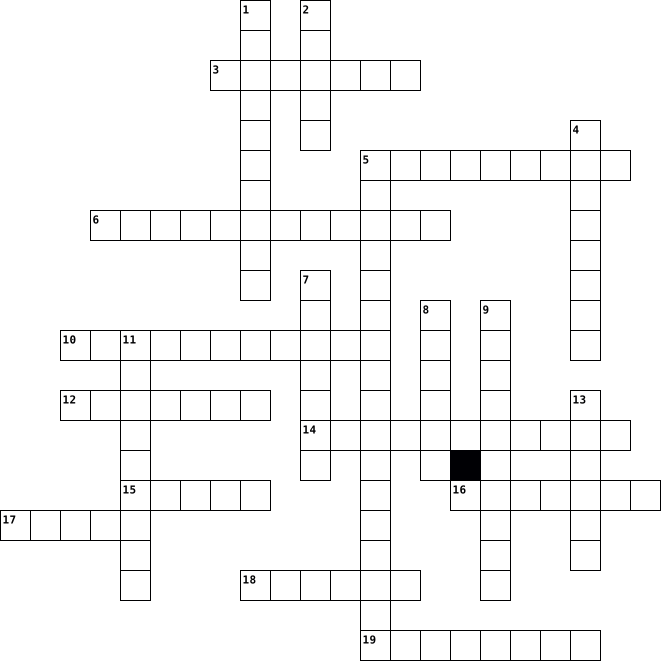
- discovered that the earth revolves around the sun
- is the name of our most famous constellation (all one word)
- is also known as running down
- the belief that only material things are real
- is an error in reasoning
- this area used to be called the gym
- is used to find the stars
- is the word that means study of the earth
- is no longer a planet
- is what we call a preserved specimen of a creature found inside a rock
- this teacher is teaching English this year
Down
- this teacher is teaching Spanish this year
- is the confident belief in the authority or reliability of something
- our mascot
- theory that says that natural laws and processes are the same today as they were hundreds of years ago.
- defined as the total collection of knowledge gained through man's observations
- what the moon does when it cycles from full to crescent
- is an educated guess about something scientific
- is used to view the stars
- this teacher is teaching Bible this year
20 Clues: our mascot • is no longer a planet • is an error in reasoning • is used to view the stars • is used to find the stars • is also known as running down • this area used to be called the gym • this teacher is teaching Bible this year • is the word that means study of the earth • this teacher is teaching Spanish this year • this teacher is teaching English this year • ...
The Solar System 2013-12-05

Across
- Has deep canyons and high volcanoes. Surface rocks contain iron.
- The "Moon" is one of these.
- Hurricane thats the size of 3 earths.
- The sun is made of most of this
- Only planet known the has water in 3 phases (solid, liquid,and gas).
- Atmospheres made of hydrogen and helium.
- Millions of these small bodies are orbiting the sun beyond Neptune.
- In 2006 was demoted to dwarf planet.
- Celestial body that orbits one or more stars.
- Ceres is an example of this.
- Has storms occuring on the surface all the time.
- Rains Sulphuric Acid.
- Contains 99% of the entire solar systems mass.
Down
- Dirty snowballs that originate from Kuiper Belt or Oort Cloud.
- Smallest planet.
- Planets revolve in _________ paths
- Atmospheres of carbon and nitrogen (or none at all).
- Cloud of tiny icy fragments at the far edge of our solar system.
- Largest Planet.
- Has rings made of ice particles surronding it.
- Rotates on it's axis like a wheel.
21 Clues: Largest Planet. • Smallest planet. • Rains Sulphuric Acid. • The "Moon" is one of these. • Ceres is an example of this. • The sun is made of most of this • Planets revolve in _________ paths • Rotates on it's axis like a wheel. • In 2006 was demoted to dwarf planet. • Hurricane thats the size of 3 earths. • Atmospheres made of hydrogen and helium. • ...
KS3 SPACE 2025-09-11

Across
- The time taken for the Earth to orbit the Sun once.
- Caused by the Earth’s rotation.
- The curved path of a planet or satellite.
- The galaxy that contains our Solar System.
- The imaginary line the Earth spins around.
- Changes in the Moon’s appearance as it orbits the Earth.
- A natural satellite that orbits a planet.
- One complete orbit of the Earth around the Sun.
- A huge ball of gas that produces its own light.
- An icy body that orbits the Sun with a glowing tail.
- Everything that exists, including all matter and energy.
Down
- An object in orbit around a planet, can be natural or artificial.
- The force that keeps planets in orbit around the Sun.
- The Sun and everything that orbits it.
- A huge collection of stars, gas, and dust held together by gravity.
- A rocky object that orbits the Sun, smaller than a planet.
- Caused by the tilt of the Earth’s axis.
- A large object that orbits a star.
- When one object in space blocks the light from another.
- The spinning of the Earth on its axis.
20 Clues: Caused by the Earth’s rotation. • A large object that orbits a star. • The Sun and everything that orbits it. • The spinning of the Earth on its axis. • Caused by the tilt of the Earth’s axis. • The curved path of a planet or satellite. • A natural satellite that orbits a planet. • The galaxy that contains our Solar System. • The imaginary line the Earth spins around. • ...
Sort 14 Crossword 2026-02-04

Across
- A utensil for soup; also, to cuddle closely.
- An arithmetic sign or an added advantage.
- A low guttural sound, or a low-ranking soldier.
- A small swelling or a light collision.
- The "liquid" in a fruit, or slang for electrical power.
- Constructed in the past; also, slang for a sturdy physique.
- A striped animal known for "parting gifts."
- A vacation on a ship, or to drive at a steady speed.
- To construct, or a person's physical stature.
- A woodwind played horizontally, or a tall glass for bubbly.
- A molar or incisor; also, a gear's "cog."
- Lacking bumps
Down
- Opposite of sun, has many phases.
- A dried plum, or to trim back the hedges.
- To rely on someone; it’s also a legal arrangement for assets.
- A "black and blue" mark on the skin or a fruit.
- Endearingly pretty; "As ____ as a button."
- An animal like a donkey.
- Unrefined, like oil; or a joke that’s a bit "low-brow."
- A set of matching clothes, or a request to a court.
- To flower, or the powdery coating on a fresh grape.
21 Clues: Lacking bumps • An animal like a donkey. • Opposite of sun, has many phases. • A small swelling or a light collision. • An arithmetic sign or an added advantage. • A dried plum, or to trim back the hedges. • A molar or incisor; also, a gear's "cog." • Endearingly pretty; "As ____ as a button." • A striped animal known for "parting gifts." • ...
earth moon and sun 2024-03-03

Across
- 3/4 full moon
- below equator
- moon in front of sun
- moon getting smaller
- slight oval shape
- earths shadow
- what type of moon it is
- basalt plains on moon
- slight slope
- above equator
- what a bomb leaves behind
- moon around earth
- less than 1/4 of the moon
Down
- sun is at its max or min angle
- spin
- when the sun is at the equator
- when water is high
- spin around sun
- higher tide
- there is four of these each year
- when moon is in earths shadow
- when water is low
- moon getting larger
- what ray-tracing does
- center of rotation
- less shadowy parts of earths shadow
- lower tide at equator
27 Clues: spin • higher tide • slight slope • 3/4 full moon • below equator • earths shadow • above equator • spin around sun • slight oval shape • when water is low • moon around earth • when water is high • center of rotation • moon getting larger • moon in front of sun • moon getting smaller • basalt plains on moon • what ray-tracing does • lower tide at equator • what type of moon it is • ...
our first year <3 2024-02-13

Across
- flash photography subject
- i'm your...
- when we look up we see the same one
- for the love of god don't form your cookies like this
- one of our first marathoned shows
- you're my...
- our last name in final fantasy
- sickly sweet and we're full of it
- honeymoon soundtrack
- it means something in dinosaur
- an essential tool for comparing hand sizes
- our spot in genshin
- scent of our first candle
Down
- our first craft
- what big ben is actually a nickname for
- the go-to soundtrack for sleep
- thanks to you, we have a matching set
- i live by being devoured. what am i?
- we watched buffy fight a puppet after making this
- these would never hurt you
- you swiped your screen to this
- a musical curse that has plagued us
- the game you were playing when we met
- how long i plan on staying by your side
- our moon phases make perfect ones
- daily onomatopoeia
- your night shift stand-in
27 Clues: i'm your... • you're my... • our first craft • daily onomatopoeia • our spot in genshin • honeymoon soundtrack • flash photography subject • your night shift stand-in • scent of our first candle • these would never hurt you • the go-to soundtrack for sleep • you swiped your screen to this • our last name in final fantasy • it means something in dinosaur • one of our first marathoned shows • ...
Ininiwuk Moons 2020-01-24

Across
- Autumn Moon
- Flying Up Moon
- Leaf Budding Moon
- Mating Moon
- Frost Exploding Moon
- Great Moon
- Frost Moon
- Goose Moon
Down
- Leaf Falling Moon
- Egg Hatching Moon
- Frog Moon
- Migrating Moon
- Moulting Moon
- Freeze-up Moon
- Eagle Moon
15 Clues: Frog Moon • Great Moon • Eagle Moon • Frost Moon • Goose Moon • Autumn Moon • Mating Moon • Moulting Moon • Migrating Moon • Flying Up Moon • Freeze-up Moon • Leaf Falling Moon • Egg Hatching Moon • Leaf Budding Moon • Frost Exploding Moon
Space Crossword Puzzle 2025-09-20

Across
- moon of Quaoar
- largest moon in the solar system
- nickname for makemake's moon
- most famous dwarf planet
- outermost moon of haumea (no apostrphe)
- football-shaped dwarf planet
- star system with twelve stars (no spaces)
- outer-most gallilaen moon of Jupiter
- innermost moon of haumea
Down
- large object in scattered disc
- dwarf planet with ammonia splotches
- second largest known object in scattered disc
- bright yellow dwarf planet
- large moon with huge subsurface ocean
- asteroid with two moons, including one on a super-eccentric orbit
- star system with nine stars (no spaces)
- moon of varda
- largest object in scattered disk
- large moon with methane and ethane lakes
- most volcanically active object in the solar system
20 Clues: moon of varda • moon of Quaoar • most famous dwarf planet • innermost moon of haumea • bright yellow dwarf planet • nickname for makemake's moon • football-shaped dwarf planet • large object in scattered disc • largest moon in the solar system • largest object in scattered disk • dwarf planet with ammonia splotches • outer-most gallilaen moon of Jupiter • ...
Moons/eclipses/tides 2023-02-03

Across
- the type of eclipse when the Earth's shadow covers the Moon
- phase when the moon is 0% illuminated
- phase when the Moon is at position 7
- when the Moon is appearing to become more dim
- a series of events that repeat and are predictable
- phase when the Moon is at position 4
- type of eclipse when the Moon blocks the light of the Sun from reaching Earth
Down
- phase when the moon is at position 2
- phase when the moon is 100% illuminated
- the type of tide when the Moon and Sun are in a straight line
- phase when the Moon is at position 6
- shape that we see when the Moon is less than 50% illuminated
- the type of tide when the Moon and Sun are at right angles to each other
- shape that we see when the Moon is more than 50% illuminated
- When one object blocks another object
- phase when the Moon is at position 8
- when the moon is appearing to grow larger
- phase when the Moon is at position 3
18 Clues: phase when the moon is at position 2 • phase when the Moon is at position 6 • phase when the Moon is at position 7 • phase when the Moon is at position 8 • phase when the Moon is at position 3 • phase when the Moon is at position 4 • phase when the moon is 0% illuminated • When one object blocks another object • phase when the moon is 100% illuminated • ...
Spinning In Space! 2015-11-12

Across
- Named by the roman goddess of love
- all existing matter and space considered as a whole
- It is our home planet
- pictures we see made of stars
- First planet to the sun
- the biggest gas giant in our Solar System
- Our home galaxy
- Has rings made by ice crystals
- The rocket _____ into space
- Has different phases during the month
- a humongous ball of burning gas, held together by gravity
Down
- Brings us light while it is night
- A tech device used to see things in space, made by Galileo Galilei
- Used to be a planet, but now a dwarf planet
- A person who studies Astrology and sometimes goes to space to research
- a system of millions or billions of stars, together with gas and dust, held together by gravitational attraction.
- He theorised that the Earth was in the centre of the universe
- Where Curiosity is currently at
- the dimensions of height, depth, and width within which all things exist and move.
- Seventh planet from the sun
20 Clues: Our home galaxy • It is our home planet • First planet to the sun • Seventh planet from the sun • The rocket _____ into space • pictures we see made of stars • Has rings made by ice crystals • Where Curiosity is currently at • Brings us light while it is night • Named by the roman goddess of love • Has different phases during the month • the biggest gas giant in our Solar System • ...
Our Solar System 2022-02-23

Across
- Jupiter's natural satellite and largest orbiting Sol
- Empty space
- Sixth planet of Sol and second largest
- Smallest and closest planet with shortest orbit of Sol
- System, Network of bodies that orbit Sol
- Saturn's largest natural satellite
- The sun of our solar system
- Phases, Shape of Luna's sunlit portion
- Fifth planet of Sol and largest
- Uranus's largest natural satellite
- Saturn's third largest natural satellite
- Jupiter's smallest natural satellite
- Repeating path of an object around another
- Fourth planet of Sol and second smallest
- Neptune's largest natural satellite
Down
- Jupiter's second largest natural satellite
- Second planet of Sol and brightest object in Earth's night sky
- Largest natural satellite of Pluto
- Saturn's second largest natural satellite
- dwarf planet in the Kuiper Belt orbiting Sol
- Earth's natural satellite
- Seventh planet of Sol and first planet discovered by telescope
- Eighth and most dense planet of Sol
- Smaller of two natural satellites orbiting Mars
- Jupiter's third largest natural satellite
- Third planet of Sol and our home
- Larger of two natural satellites orbiting Mars
27 Clues: Empty space • Earth's natural satellite • The sun of our solar system • Fifth planet of Sol and largest • Third planet of Sol and our home • Largest natural satellite of Pluto • Saturn's largest natural satellite • Uranus's largest natural satellite • Eighth and most dense planet of Sol • Neptune's largest natural satellite • Jupiter's smallest natural satellite • ...
Space 2026-02-09

Across
- this galaxy has no shape
- this galaxy is a circular egg shape
- this solar system has the Earth in the center
- they are made of gas and are bigger
- the tilt of Earth's axis causes these
- the moons gravitational pull causes these
- we use this to measure outside of our solar system
- the first phase of moon phases
- how bright a star appears
- the hottest layer of the Sun
- a darker cooler area on the Sun
- the distance between the Sun and Earth
- this is a dwarf planet in our solar system
Down
- how bright a star actually is
- they are made of rock and are smaller
- there are 8 of these
- stars are made of this
- the color of a star tells us this
- a giant loop of gas on the Sun
- this solar system has the Sun in the center
- mass and distance affect this
- an explosion on the surface of the Sun
- the outer layer of atmosphere on the Sun
23 Clues: there are 8 of these • stars are made of this • this galaxy has no shape • how bright a star appears • the hottest layer of the Sun • how bright a star actually is • mass and distance affect this • a giant loop of gas on the Sun • the first phase of moon phases • a darker cooler area on the Sun • the color of a star tells us this • this galaxy is a circular egg shape • ...
Earth's Moon 2023-02-12

Across
- the large, dark, flat areas on the moon
- phases:phases of the Moon during which less of the Moon’s near side is lit each night
Down
- phase: phases of the Moon during which more of the moon’s near side is lit each night
- the lit part of the Moon or a planet that can be seen from Earth
4 Clues: the large, dark, flat areas on the moon • the lit part of the Moon or a planet that can be seen from Earth • phase: phases of the Moon during which more of the moon’s near side is lit each night • phases:phases of the Moon during which less of the Moon’s near side is lit each night
Lunar Phases 2025-11-17

Across
- The darkest part of a shadow, where the light source is completely blocked.
- A Moon phase where less than half of the Moon is visible in a thin, curved shape.
- lunar eclipse When only a portion of the Moon passes into Earth’s umbra (shadow).
- The period when the visible part of the Moon is decreasing.
- solar eclipse When the Moon completely covers the Sun as seen from Earth.
- The force that attracts objects toward one another, especially toward the center of the Earth.
- Eclipse When the Earth passes between the Sun and the Moon, casting a shadow on the Moon.
- An event where one celestial body moves into the shadow of another.
- A Moon phase where more than half, but not all, of the Moon is visible.
- Eclipse When the Moon passes between the Sun and Earth, blocking the Sun’s light.
Down
- A Moon phase where half of the Moon is illuminated.
- solar eclipse When only part of the Sun is obscured by the Moon.
- The period when the visible part of the Moon is increasing.
- lunar eclipse When the entire Moon passes into Earth’s umbra (shadow).
- A stage in the cycle of the Moon’s appearance from Earth.
- The lighter, outer part of a shadow, where the light source is only partially blocked.
- The regular rise and fall of sea levels caused by the gravitational pull of the Moon and Sun.
17 Clues: A Moon phase where half of the Moon is illuminated. • A stage in the cycle of the Moon’s appearance from Earth. • The period when the visible part of the Moon is increasing. • The period when the visible part of the Moon is decreasing. • solar eclipse When only part of the Sun is obscured by the Moon. • ...
Historical Astronomy 2022-04-26

Across
- the type of moon before and after a new moon
- a planets path around the Sun
- Earth's _____ creates the seasons
- moon phase that follows a full moon
- the universe is _________ and galaxies are moving further apart from each other
- without this, our planet would fly off into space
- spinning on axis; makes day and night
- eclipse that occurs when the Earth creates a shadow on the moon
- occurs when Earth is tilted towards the Sun
- losing light
- gaining light
- eclipse that occurs when the moon is between the Earth & Sun
Down
- model of the solar system with the earth in the center
- a planet's trip around the Sun
- theory that estimates the universe is about 14 billion years old
- model of the solar system with the sun in the center
- phase that occurs when the moon is closest to the Sun
- the type of moon before and after a full moon
- shape of the planets' orbit
- without this, our moon would crash into earth
- moon phase that follows a first quarter moon
21 Clues: losing light • gaining light • shape of the planets' orbit • a planets path around the Sun • a planet's trip around the Sun • Earth's _____ creates the seasons • moon phase that follows a full moon • spinning on axis; makes day and night • occurs when Earth is tilted towards the Sun • the type of moon before and after a new moon • moon phase that follows a first quarter moon • ...
Astronomy Exam Review 2012-06-03

Across
- The force that is most responsible for the formation of a star.
- The astronomer who first discovered the red shift of light from distant galaxies, showing that they are moving away from us.
- Type of motion of objects in the sky that is due to earth's rotation.
- You observe a waxing gibbous moon at 10 PM. What would the moon phase be at 3 AM?
- Group of planets having relatively thin atmospheres, a rocky crust, and a metal core.
- The path the Sun appears to follow through the sky over the course of a year.
- Stars form in giant _____.
- A glowing light display in the upper atmosphere produced due to solar flares and/or CMEs.
- The celestial equivalent of latitude.
- A unit used to measure the distance to stars.
- What color are the hottest stars?
- Refined the theory of general relativity to explain the motion of the planet Mercury.
- All of the elements heavier than iron came from a _____ explosion.
Down
- A method used to measure the distance to nearby stars based on the diameter of earth's orbit and an apparent shift in the star's position over a 6 month period.
- The next stage in the Sun's life cycle - when it runs low on Hydrogen in the core.
- Discovered that Venus has phases like the Moon.
- Nuclear ___ in the core of a star turns hydrogen into helium. making lots of energy.
- Brightness of a star due to its distance from Earth.
- When will a flagpole have no shadow in Remus?
- Model of the universe that puts Earth at the center.
- The time of year when the Sun is at the point in the sky where the ecliptic and the celestial equator intersect.
- Largest volcano in the solar system.
- Stars that are fusing hydrogen into helium are on what part of the HR Diagram?
- An eclipse that occurs when the Moon casts its shadow on the Earth.
- You can't see Polaris, our _____, if you are south of the equator.
- The groups that stars are placed in based on their spectra.(OBAFGKM)
- A chart that compares the brightness and temperatures of main sequence stars.
- If the Sun were in the constellation Taurus at noon, in which constellation would it be at sunset?
28 Clues: Stars form in giant _____. • What color are the hottest stars? • Largest volcano in the solar system. • The celestial equivalent of latitude. • When will a flagpole have no shadow in Remus? • A unit used to measure the distance to stars. • Discovered that Venus has phases like the Moon. • Brightness of a star due to its distance from Earth. • ...
7 WEST TEAM ACTIVITY 2024-03-19

Across
- GAINING LIGHT
- MEASURES CURRENT
- TOTAL DISTANCE AROUND THE OUTSIDE OF AN OBJECT
- MR. PERCHINSKE’S FAVORITE COLOR
- MOVES FROM NEGATIVE TO POSITIVE
- BEST TEAM IN THE BUILDING
- YOUR ANSWER TO AN ARGUEMENT PROMPT
- OCCURS AFTER A NEW MOON
- HIGHEST HIGH TIDE AND LOWEST LOW TIDE
- EXPLANATION OF EVIDENCE
- LOW POINT
- DECREASES AS ALTITTUDE INCREASES
- CHARLIE'S PARENT'S COLLEGE
- ONE POSSIBLE PATH FOR ELECTRICITY
- CAUSED BY SOURCE OF MOTION MOVING
- AVERAGE
- HIGH POINT
- STATEMENT THAT SHOWS 2 MATH EXPRESSIONS ARE EQUAL
- SOMETHING YOU USE TO MULTIPLY
- HELLO, HELLO, HELLO
- MIDDLE VALUE OF A SORTED LIST OF NUMBERS
- ATTENDED SHS
- OZONE OCCURS THERE
- GREEK WORD FOR CITY-STATE
- ALEX'S PARENT'S COLLEGE
- WHAT THE TEXT IS MOSTLY ABOUT
- BAILEY'S PARENT'S COLLEGE
- QUOTE DIRECTLY FROM THE TEXT
- MR. BUBONICS' POSITION IN COLLEGE BASEBALL
- MEASURED IN HERTZ
- MARKETPLACE IN A CITY-STATE
- SOMETHING THAT IS NOT EQUAL
- NUMBER OF TEACHERS WHO HAVE LIVED IN SOLON
- TYPE OF CAR 2 OF YOUR TEACHERS DRIVE
- BOSSY STATEMENT IN THE CONCLUSION
- MEASURES RESISTANCE
- FORTRESS LOCATED ON A HILL IN MIDDLE OF CITY-STATE
- ONE PART IN EVERY 100
Down
- 0.5
- DIFFERENCE BETWEEN THE HIGHEST AND LOWEST NUMBER
- MORE THAN ONE PATH FOR ELECTRICITY
- WE LIVE IN IT
- TO REJECT OR SAY NO
- A CULTURAL REAWAKENING
- LOSING LIGHT
- LENGTH TIMES WIDTH
- OCCURS DURING QUARTER MOON PHASES
- COMPRESSES AND EXPANDS
- MOST ABUNDANT GAS IN OUR ATMOSPHERE
- ADDRESSING THE OTHER SIDE OF THE ARGUMENT
- MR. CAIN'S PET
- LIFE LESSON
- MR. PERCHINSKE'S PET
- FIRST MOVIE MR. BUBONICS SAW IN A THEATER
- A PARAGRAPH IN A POEM
- HOW MANY YEARS HAS MR. BUBONICS OWNED BROWNS TICKETS?S
- MOON IN FRONT OF SUN
- MOVES PERPENDICULAR TO WAVE
- MRS. HAUPTMAN’S FAVORITE STATE
- MR. BUBONICS'S PET
- TYPE OF EQUATION WHOSE RESULT IS AN INTERSECTION
- CODE OF CONDUCT FOR KNIGHTS
- METHOD OF WRITING LARGE NUMBERS IN TERMS OF POWERS
- WYATT'S PARENT'S COLLEGE
- NUMERATOR AND DENOMINATOR
- TOTAL NUMBER OF CHILDREN OF TEAM TEACHERS
- FAVORITE MUSIC OF THE DOCTOR
- EARTH BETWEEN SUN AND MOON
- SERIES OF RELIGIOUS WARS
- MRS. HAUPTMAN'S PET
70 Clues: 0.5 • AVERAGE • LOW POINT • HIGH POINT • LIFE LESSON • LOSING LIGHT • ATTENDED SHS • GAINING LIGHT • WE LIVE IN IT • MR. CAIN'S PET • MEASURES CURRENT • MEASURED IN HERTZ • LENGTH TIMES WIDTH • OZONE OCCURS THERE • MR. BUBONICS'S PET • TO REJECT OR SAY NO • HELLO, HELLO, HELLO • MRS. HAUPTMAN'S PET • MEASURES RESISTANCE • MR. PERCHINSKE'S PET • MOON IN FRONT OF SUN • A PARAGRAPH IN A POEM • ONE PART IN EVERY 100 • ...
Moons/eclipses/tides 2023-02-03

Across
- the type of tide when the Moon and Sun are at right angles to each other
- phase when the moon is at position 2
- shape that we see when the Moon is more than 50% illuminated
- shape that we see when the Moon is less than 50% illuminated
- phase when the Moon is at position 8
- When one object blocks another object
- phase when the Moon is at position 7
- phase when the moon is 100% illuminated
Down
- phase when the Moon is at position 6
- when the Moon is appearing to become more dim
- when the moon is appearing to grow larger
- phase when the Moon is at position 4
- the type of tide when the Moon and Sun are in a straight line
- the type of eclipse when the Earth's shadow covers the Moon
- a series of events that repeat and are predictable
- phase when the moon is 0% illuminated
- type of eclipse when the Moon blocks the light of the Sun from reaching Earth
- phase when the Moon is at position 3
18 Clues: phase when the Moon is at position 6 • phase when the Moon is at position 4 • phase when the moon is at position 2 • phase when the Moon is at position 8 • phase when the Moon is at position 3 • phase when the Moon is at position 7 • phase when the moon is 0% illuminated • When one object blocks another object • phase when the moon is 100% illuminated • ...
Why Is The Moon Upside Down? 2026-04-23

Across
- The tow halves of the Earth, divided into north and south by equator
- A gourd container
Down
- A timekeeping system based on the phases of the Moon
- A Māori language nest for young children
- A traditional story from the past
5 Clues: A gourd container • A traditional story from the past • A Māori language nest for young children • A timekeeping system based on the phases of the Moon • The tow halves of the Earth, divided into north and south by equator
SNT, Rotation Motion, and Moon PHases 2022-09-21

Across
- The moon's light is turning on.
- Baby stars can be found here.
- "Hey, watch out. I'm a circle. Don't squash me, you'll give me_________."
- Hop on the quarter merry-go-round on rotation. Link arms with you group partners, but don't fall, this is what we studied spinning round and round y'all.
- Grab the weights and do-si-do, look at how fast you go. (must take a turn)
- One star to another, "Back up, you're too close!
- Focus!!
Down
- Even though I'm purple you can't see me, I'm too high of an Energy.
- A fishing star.
- "We proposed the nebular hypothesis."
- explains formation of solar system.
11 Clues: Focus!! • A fishing star. • Baby stars can be found here. • The moon's light is turning on. • explains formation of solar system. • "We proposed the nebular hypothesis." • One star to another, "Back up, you're too close! • Even though I'm purple you can't see me, I'm too high of an Energy. • "Hey, watch out. I'm a circle. Don't squash me, you'll give me_________." • ...
Face Painting by J.G. (1860) 2021-11-14

Across
- The Indians had a certain arrangement of _____
- Examples of light colors used on the face include bright red, white, and ______
- different tribes have their own favorite colors, but generally natives seem to hold their own native copper ____ in special affection
- The line of ___________ either ran down the nose vertically or across it horizontally
Down
- color that represents mourning
- Hardly any Indian could distinguish ____ from green
- On their faces, they wanted to demonstrate the different phases of the ____
- Thick lines on the face were drawn with _______
- While one side of the face was dark, the other was _____
- The color that represents joy and festivity
10 Clues: color that represents mourning • The color that represents joy and festivity • The Indians had a certain arrangement of _____ • Thick lines on the face were drawn with _______ • Hardly any Indian could distinguish ____ from green • While one side of the face was dark, the other was _____ • On their faces, they wanted to demonstrate the different phases of the ____ • ...
Asian Lunar New Year 2026-02-10

Across
- The dates on this type of calendar change depending on the phases of the moon
- Happy New Year in Mandarin
- 2026 is the year of the ______________
Down
- The dates don't change on this type of calendar do not change
- The name of the monster that came to the village to frighten people
- Red pockets are filled with _____________
- It is advised not to take a shower, clean, or get rid of garbage before the new year so that good luck isn't thrown out by accident
- Only Chinese people celebrate Asian Lunar New Year
- How the monster was scared away
- The color of most objects used during Asian Lunar New Year
10 Clues: Happy New Year in Mandarin • How the monster was scared away • 2026 is the year of the ______________ • Red pockets are filled with _____________ • Only Chinese people celebrate Asian Lunar New Year • The color of most objects used during Asian Lunar New Year • The dates don't change on this type of calendar do not change • ...
Ajoba Jun 13 Crossword (MISC!) 2024-06-12

Across
- The largest city in australia known for its opera house architecture
- A sweet potato is also referred to as a ___
- location where one stores their cars at home or additional misc items
- the capital if Nepal, this city is located at the base of the Himalayas
- This is what you hand to a flight attendant or a train conductor
Down
- the highest mountain in the world, part of the Himalayas range
- the chemical symbol for Sodium
- The english translation of 'muley'!
- Another name for a wasp is a yellow ____, also the name of an outerwear
- The central feature of the night sky, this object changes phases over the month
10 Clues: the chemical symbol for Sodium • The english translation of 'muley'! • A sweet potato is also referred to as a ___ • the highest mountain in the world, part of the Himalayas range • This is what you hand to a flight attendant or a train conductor • The largest city in australia known for its opera house architecture • ...
Renaissance Inventors/Artists 2023-05-18

Across
- Created the printing press
- An Italian astronomer and Mathematician who developed the Heliocentric Theory
- An English Philosopher who created the Scientific Method
- Painted the Sistine Chapel and sculpted "The David"
- Painted the "School of Athens"
- Italian sculptor who sculpted the "Bronze David"
Down
- English Mathematician who discovered gravity and created the laws of motion
- Created the earliest version of a flying vehicle. He also painted the Mona Lisa
- Was a very talented poet and playwright. Created the plays "Hamlet" and "Romeo and Juliet"
- An Italian astronomer who discovered craters on the moon, discovered the moons of Jupiter,and found out the phases of Venus
10 Clues: Created the printing press • Painted the "School of Athens" • Italian sculptor who sculpted the "Bronze David" • Painted the Sistine Chapel and sculpted "The David" • An English Philosopher who created the Scientific Method • English Mathematician who discovered gravity and created the laws of motion • ...
Lunar cycle 2023-02-20

Across
- When the moon is between earth & sun
- make lighter or brighter
- When the moon passes into earth's shadow it causes a ___.
- When earth, moon,and sun are aligned
- The moon revolves around the ____.
- more than half full
- Moving around something
- When it spins in its place
- Rise and fall of earth's surface water
Down
- it takes 29.5 days to ___ a phase from new moon to new moon.
- The earth revolves around the ____.
- The first fourth of the Moon's period of revolution around the Earth
- Earth is divided into four sections called ____.
- When the moon is on the same side of earth as the soon it creates a ___.
- We see half the Moon illuminated and the other half in shadow for the 2nd time
- When the moon appears to be getting bigger
- A sliver of the moon is a ____.
- There are different ____.
- When the moon appears to be getting smaller
- What causes the seasons
20 Clues: more than half full • What causes the seasons • Moving around something • make lighter or brighter • There are different ____. • When it spins in its place • A sliver of the moon is a ____. • The moon revolves around the ____. • The earth revolves around the ____. • When the moon is between earth & sun • When earth, moon,and sun are aligned • Rise and fall of earth's surface water • ...
Lunar cycle 2023-02-14

Across
- The first fourth of the Moon's period of revolution around the Earth
- Moving around something
- When earth, moon,and sun are aligned
- What causes the seasons
- make lighter or brighter
- There are different ____.
- We see half the Moon illuminated and the other half in shadow for the 2nd time
- it takes 29.5 days to ___ a phase from new moon to new moon.
- more than half full
Down
- A sliver of the moon is a ____.
- When the moon is on the same side of earth as the soon it creates a ___.
- When the moon is between earth & sun
- Earth is divided into four sections called ____.
- When it spins in its place
- When the moon passes into earth's shadow it causes a ___.
- When the moon appears to be getting smaller
- The earth revolves around the ____.
- Rise and fall of earth's surface water
- The moon revolves around the ____.
- When the moon appears to be getting bigger
20 Clues: more than half full • Moving around something • What causes the seasons • make lighter or brighter • There are different ____. • When it spins in its place • A sliver of the moon is a ____. • The moon revolves around the ____. • The earth revolves around the ____. • When the moon is between earth & sun • When earth, moon,and sun are aligned • Rise and fall of earth's surface water • ...
Science Revision 2025-11-04

Across
- Earth's natural satellite, which only shines because it reflects light from another source
- The "fuel" or energy required for any appliance or system to function
- A term you would not use for a machine if its wasted output is more than its useful output
- The useful energy output from a torch or a car's headlights
- The ultimate energy source that a plant uses to create its own food
- The chemical energy input used by the car in the scenario
- The process an energy chain demonstrates, showing how energy moves between objects
- The Earth's 24-hour spin that is directly responsible for causing day and night
Down
- The imaginary line that the Earth spins on, causing day and night
- The result of an energy transfer, which can be either useful or wasted
- The kind of stored energy found in petrol, a battery, or a stretched elastic band
- The period of time it takes for the Earth to complete one full revolution around the Sun
- The term for the predictable cycle of the Moon's appearance from Earth
- Describes the heat from a car's engine because it doesn't contribute to the car's main purpose
- What the Moon does with sunlight, which is why we can see it
- The type of energy being used by a moving car, or the energy input required to play a drum
- The specific form of useful energy output from the car's radio
- The year-long journey the Earth takes around the Sun
18 Clues: The year-long journey the Earth takes around the Sun • The chemical energy input used by the car in the scenario • The useful energy output from a torch or a car's headlights • What the Moon does with sunlight, which is why we can see it • The specific form of useful energy output from the car's radio • ...
Earth, Moon, and Sun 2021-02-02

Across
- the nearly circular path a smaller object (like the Moon) travels around a larger object (like Earth).
- a moon phase in which the Moon is not visible from Earth
- a moon phase that looks like less than half a circle from Earth
- moon: a moon phase that looks like more than half a circle from Earth
- a moon outside our solar system
- the border between light and dark on the Moon
- something we observe to be similar over and over again
- the star that is the main source of light at the center of our solar system
- when the Moon is completely dark
Down
- a moon phase that looks like a half-circle from Earth
- to shine light on an object and make it visible
- phase: the shape of the illuminated part of the Moon as it appears from Earth
- the sun, the planets that orbit the sun, and other objects that orbit the sun
- the relative size of things
- an object, diagram, or computer program that helps us understand something by making it simpler or easier to see
- a planet outside our solar system
- a rocky sphere that travels around a planet
- a moon phase that looks like a full circle from Earth
18 Clues: the relative size of things • a moon outside our solar system • when the Moon is completely dark • a planet outside our solar system • a rocky sphere that travels around a planet • the border between light and dark on the Moon • to shine light on an object and make it visible • a moon phase that looks like a half-circle from Earth • ...
Earth in Space Vocab Review 2021-04-13

Across
- Half of the disk is illuminated, and the cycle is in the waxing phase.
- Half of the disk is illuminated, and the cycle is in the waning phase.
- A theory that says the universe began as a small point that expanded rapidly about 13.7 billion years ago.
- The phase when the Moon is between the Sun and Earth and none of the illuminated portion is seen from Earth.
- Entire disk illuminated.
- To spin on an axis or the spinning of Earth on its axis that causes day and night to occur.
- The type of energy released by stars consisting of electric and magnetic waves that travel at the speed of light
- The galaxy in which the Earth and Sun are located.
- The imaginary line through the Earth that extends from the north pole to the south pole and is the center of the Earth's rotation.
- Stable stars in the middle developmental phases that plot along a continuous diagonal belt on the H-R Diagram.
- Shape of the Moon that is greater than a quarter moon, but not full
- A galaxy with a bulge in the center and very distinct long arms winding around the center.
- Move in an elliptical path around a center.
- A large grouping of stars in space.
- The Moon’s repeated pattern of movement and changes in appearance due to its position relative to the Earth and Sun.
Down
- The intensity of light from a celestial body that can be used to identify the body's characteristics.
- A plot of the surface temperature (color) of stars vs. their luminosity (brightness).
- All space and the matter space contains.
- The change in wavelength that allows us to determine if an object is moving toward us or away from us.
- A grouping of all possible energy levels of electromagnetic radiation from radio waves to gamma rays, including visible light.
- A galaxy with a long oval shape, a bright center, no apparent internal structure or spiral arms, and very little dust or gas.
- The death of a large star by explosion
- Shape of the Moon that is less than a quarter moon.
- Growing or getting larger
- The remains of a star or other large object that collapsed under its own gravity to form a super-dense object with gravity so strong that light cannot escape its pull.
- Large cloud of gas and dust in interstellar space; the location of star formation.
- A galaxy with very little symmetry that does not fit into any category.
- Weakening or getting smaller.
- The four natural divisions of the year based on changes in temperature due to the varied amounts of sunlight (both intensity and number of daylight hours received) caused by the tilt of Earth during revolution.
- The different shapes that the Moon seems to have as seen from Earth caused by the Moon’s orbit around Earth.
30 Clues: Entire disk illuminated. • Growing or getting larger • Weakening or getting smaller. • A large grouping of stars in space. • The death of a large star by explosion • All space and the matter space contains. • Move in an elliptical path around a center. • The galaxy in which the Earth and Sun are located. • Shape of the Moon that is less than a quarter moon. • ...
Space Puzzle 2022-04-13

Across
- - to shine light on an object and make it visible
- Pull - the force that pulls two objects together due to their mass
- System - the sun, the planets that orbit the sun, and other objects that orbit the sun
- (Cosmos) - all of space and its contents
- - the four parts of the year where weather, ecology, and number of daylight hours change as a result of Earth’s orbit around the sun
- Phase - the shape of the illuminated part of the Moon as it appears from Earth
- - the border between light and dark on the Moon
- - a moon outside our solar system
- Eclipse - when the moon is completely dark
- Moon - a moon phase where the Moon is not visible from the Earth
- - the force by which all things with mass or energy (including planets, stars, galaxies, and light) are brought towards one another
- Eclipse - The moment that the moon orbits directly between the sun and the Earth
Down
- - the tendency of an object to remain at rest or unchanged
- Moon - a moon phase that looks like a full circle from Earth
- Moon - a moon phase that looks like more than a half circle from Earth
- - the relative size of things
- Moon - a moon phase that looks like less than half a circle from Earth
- Moon - a moon phase that looks like half a circle from Earth
- - the star that is the main source of light at the center of our solar system
- - something we observe to be similar over and over again
- - the nearly circular path a smaller object (like the Moon) travels around a larger object like Earth)
- - a rocky sphere that travels around a planet
- - a planet outside our solar system
- - the circular movement of an object around its center (like a top spinning)
- - a collection of gas, dust, stars, and solar systems that are held together by gravity
25 Clues: - the relative size of things • - a moon outside our solar system • - a planet outside our solar system • (Cosmos) - all of space and its contents • Eclipse - when the moon is completely dark • - a rocky sphere that travels around a planet • - the border between light and dark on the Moon • - to shine light on an object and make it visible • ...
Unit 7 2017-01-22

Across
- a half of a sphere
- To move in a circular motion around a center point.
- An imaginary line that runs through the South and North Pole of the Earth
- when the sun reaches its highest or lowest point in the sky at noon
- each of the four divisions of the year (spring, summer, autumn, and winter)
- Moon The moon is one-half illuminated by the sun
- Phase The changing appearances of the Moon as seen from Earth
- is used to describe something that is related to the moon
- When the Moon appears to get smaller
- A steady incline.
- When the Moon appears to get bigger
Down
- The alternate rising and falling of the sea
- Tide a tide just after the first or third quarters of the moon
- when the size of the illuminated portion of the moon is greater than half but not a full moon
- the movement of one object around a center or another object
- Bulge The oval shape of the Earth's water surrounding the planet caused by the moon's gravity
- The phase of the moon in which only a curved edge of the moon's side that faced earth is illuminated
- Tide a tide just after a new or full moon
- the time or date (twice each year) at which the sun crosses the celestial equator
- Tide the state of the tide when at its lowest level
- repeating path that one object in space takes around another one
- Moon When the moon appears invisible
- Moon the phase of the moon in which we see the entire moon lighted, and it appears bright and round
- Tide the state of the tide when at its highest level
24 Clues: A steady incline. • a half of a sphere • When the Moon appears to get bigger • When the Moon appears to get smaller • Moon When the moon appears invisible • Tide a tide just after a new or full moon • The alternate rising and falling of the sea • Moon The moon is one-half illuminated by the sun • To move in a circular motion around a center point. • ...
Our Place in Space- Chapter 8 2017-01-22

Across
- The apparent motion of an object in the sky
- Imaginary but important
- Studying of the Galaxy and beyond
- A team of satellites that keep you from getting lost
- Large and round but unique
- EM
- Looks like a planet.. but doesn't dominate its orbit
- The Milky Way is one
- Water rising and falling due to the pull of the moon and the sun
- From the Earth to the Sun
- "Turning around" of Earth's axis
- Angular height..appears above horizon
- The sun being the centre of attention
- Horizontal.. measured Eastward
- Are expelled above a sunspot
- Pathway in space
Down
- Everything that exists including energy, planets and stars
- "Shooting star"
- Radio waves to Gamma waves
- When one mass in the universe is attracted to another
- Pictures painted by stars
- A path right above the Equator
- Lies in space, but also with your TV at home
- Daylight=Darkness
- Phases of the moon
- The average distance between something in the solar system and the sun
- Up above a world so bright, like a diamond in the sky
- Low in energy but will travel for thousands of kilometres
- Whatever lies in space is considered this
- Some can get to be bigger than Earth
- One celestial object blocking out another
- Shining bright
- The first part of the name can also be referred to as a Disney princess
- Occurs twice a year
- Travelling around and around
35 Clues: EM • Shining bright • "Shooting star" • Pathway in space • Daylight=Darkness • Phases of the moon • Occurs twice a year • The Milky Way is one • Imaginary but important • Pictures painted by stars • From the Earth to the Sun • Radio waves to Gamma waves • Large and round but unique • Are expelled above a sunspot • Travelling around and around • A path right above the Equator • ...
Cells Crossword 2022-02-22

Across
- Extra protection for a plant cell
- The longest of plant cell phases
- Food maker for plants
- Control center
- After mitosis a cell makes 2 new
Down
- Latin for small room
- The phases of mitosis
- One of the reasons why cells divide
- Another word for DNA
- Powerhouse of the cell
- What sees small things
- Smooth and rough
12 Clues: Control center • Smooth and rough • Latin for small room • Another word for DNA • The phases of mitosis • Food maker for plants • Powerhouse of the cell • What sees small things • The longest of plant cell phases • After mitosis a cell makes 2 new • Extra protection for a plant cell • One of the reasons why cells divide
Chapter 1; Section 1,2,3 2012-10-02

Across
- a stage in a process of change or development.
- a dark region of considerable extent on the surface of the moon.
- Part way between a full moon and a half moon, or between a half moon and a full moon.
- Part way between a half moon and a new moon, or between a new moon and a half moon
- Quarter Looks like half a circle with the right side lit by the sun
- a single complete cycle of such orbital or axial motion.
- the region in which only a portion of the light source is obscured by the occluding body.
- Phase When the moon looks smaller each night
- Either of the two points on the celestial sphere where the ecliptic crosses the celestial equator.
- the innermost and darkest part of a shadow, where the light source is completely blocked by the occluding body.
Down
- the regular rise and fall in the surface level of the Earth's oceans, seas, and bays caused by the gravitational attraction of the Moon and to a lesser extent of the Sun.
- Phase the moon is getting larger in the sky moving from the New Moon towards the Full Moon.
- Either of the two points in the ecliptic farthest from the equator.
- Eclipse occurs when the Moon passes between the Sun and Earth, and the Moon fully or partially blocks the Sun.
- The act or process of turning around a center or and axis.
- The path of a celestial body or an artificial satellite as it revolves around another body.
- Moon When the moon is not visible from Earth, because the side of the moon that is facing us is not being lit by the sun.
- Eclipse occurs when the Moon passes directly behind the Earth into its umbra (shadow).
- Moon Appears as an entire circle in the sky
19 Clues: Moon Appears as an entire circle in the sky • Phase When the moon looks smaller each night • a stage in a process of change or development. • a single complete cycle of such orbital or axial motion. • The act or process of turning around a center or and axis. • a dark region of considerable extent on the surface of the moon. • ...
Chapter 1; Section 1,2,3 2012-10-02

Across
- Eclipse occurs when the Moon passes directly behind the Earth into its umbra (shadow).
- Either of the two points in the ecliptic farthest from the equator.
- a stage in a process of change or development.
- Moon When the moon is not visible from Earth, because the side of the moon that is facing us is not being lit by the sun.
- The act or process of turning around a center or and axis.
- Phase When the moon looks smaller each night
- Quarter Looks like half a circle with the right side lit by the sun
Down
- the innermost and darkest part of a shadow, where the light source is completely blocked by the occluding body.
- Moon Appears as an entire circle in the sky
- The path of a celestial body or an artificial satellite as it revolves around another body.
- a single complete cycle of such orbital or axial motion.
- the regular rise and fall in the surface level of the Earth's oceans, seas, and bays caused by the gravitational attraction of the Moon and to a lesser extent of the Sun.
- the region in which only a portion of the light source is obscured by the occluding body.
- a dark region of considerable extent on the surface of the moon.
- Eclipse occurs when the Moon passes between the Sun and Earth, and the Moon fully or partially blocks the Sun.
- Part way between a half moon and a new moon, or between a new moon and a half moon
- Either of the two points on the celestial sphere where the ecliptic crosses the celestial equator.
- Phase the moon is getting larger in the sky moving from the New Moon towards the Full Moon.
- Part way between a full moon and a half moon, or between a half moon and a full moon.
19 Clues: Moon Appears as an entire circle in the sky • Phase When the moon looks smaller each night • a stage in a process of change or development. • a single complete cycle of such orbital or axial motion. • The act or process of turning around a center or and axis. • a dark region of considerable extent on the surface of the moon. • ...
Apollo Moon Missions of 60s 2024-05-01

Across
- - 8 Christmas Eve broadcast
- - Module main spacecraft
- - Moon commitment speech
- - Mission Control city
- - V rocket used in Apollo missions
- - Module moon lander
- - NASA moon program
- - Side of the moon
- - Small step for man
- - Moon spacecraft path
- - Michael command module pilot
- - Left on the moon
- - Lunar Module name
Down
- - First artificial satellite
- - Moon surface material
- - Planted on the moon
- - Rover exploration vehicle
- - Month of the first landing
- - Aldrin second moonwalker
- - Base Apollo 11 landing site
- - 13 successful failure
- - Difference on the moon
- - Armstrong first moonwalker
- - Race competition with USSR
- - Rocket launch
25 Clues: - Rocket launch • - Side of the moon • - Left on the moon • - NASA moon program • - Lunar Module name • - Module moon lander • - Small step for man • - Planted on the moon • - Mission Control city • - Moon spacecraft path • - Moon surface material • - 13 successful failure • - Module main spacecraft • - Moon commitment speech • - Difference on the moon • - Aldrin second moonwalker • ...
The Solar System 2025-02-21

Across
- path an object makes as it goes around
- different shapes of the moon
- 24 hours
- small crescent lit on the right side of the moon
- four divisions of the year
- small crescent lit on the left side of the moon
- Earth's ______ around the sun takes 1 year
- Earth's shadow covers the moon
- the angle of the Earth's axis
- the phase before the full moon
Down
- whole moon is lit
- the left half of the moon is lit
- force that pulls objects towards eachother
- moon blocks the sunlight
- Center of our solar system
- spinning of an object on its axis
- an imaginary line
- none of the moon is lit
- the phase before the third quarter
- 365 or 366 days
- Earth's natural satellite
- divides the north and south hemisphere
- 3rd planet from the sun
23 Clues: 24 hours • 365 or 366 days • whole moon is lit • an imaginary line • none of the moon is lit • 3rd planet from the sun • moon blocks the sunlight • Earth's natural satellite • Center of our solar system • four divisions of the year • different shapes of the moon • the angle of the Earth's axis • Earth's shadow covers the moon • the phase before the full moon • ...
The Farmers' Almanac 2025-06-12

Across
- Games or questions designed to test ingenuity, a common feature in the Almanac.
- The scientific study of the atmosphere and weather, contrasted with Almanac's methods.
- Astrological signs linked to body parts, featured in some Almanac calendars.
- The activity of cultivating a garden, a popular section in the Almanac.
- An annual publication containing a calendar, astronomical information, and other diverse content.
- The Farmers' Almanac is most famous for its long-range predictions of this.
- A prediction or estimate of future events, especially weather.
- The season for which the Almanac's long-range predictions are most anticipated.
- An activity for which the Almanac provides "best days" based on lunar phases.
- A magazine or newspaper published at regular intervals.
- The science that studies celestial objects and phenomena, a key component of the Almanac's predictions.
- Traditional beliefs, customs, and stories, often included in the Almanac.
- The publisher who co-founded the Almanac with David Young.
- The process of gathering crops, guided by Almanac's planting tables.
- The study of past events, a recurring theme in the Almanac's articles.
- One of the founders of the Farmers' Almanac in 1818.
- The quality of being amusing or comical, often found in the Almanac's tone.
- The U.S. state where the Farmers' Almanac is currently published.
- The act of putting seeds or plants into the ground, for which the Almanac provides calendars.
- The rise and fall of sea levels, influenced by the Moon, also considered by the Almanac.
Down
- Relating to the Sun, whose activity is part of the Almanac's prediction formula.
- A system for organizing days, weeks, and months, a primary function of the Almanac.
- Culinary instructions found within the Almanac.
- Natural treatments or cures for ailments, sometimes featured in the Almanac.
- The country for which the Farmers' Almanac also provides long-range weather predictions.
- The way in which a person or group lives, often influenced by Almanac's advice.
- Short, popular sayings stating a general truth or piece of advice, often found in the Almanac.
- The act of producing and issuing a book or periodical.
- A debated aspect of the Almanac's long-range weather predictions.
- The primary audience for whom the Almanac was originally created.
- Relating to the Moon, whose phases influence the Almanac's content.
- A custom or belief passed down through generations, central to the Almanac's appeal.
- A marmot known for predicting weather, a folklore method.
- Activity on the Sun's surface, part of the Almanac's prediction formula.
34 Clues: Culinary instructions found within the Almanac. • One of the founders of the Farmers' Almanac in 1818. • The act of producing and issuing a book or periodical. • A magazine or newspaper published at regular intervals. • A marmot known for predicting weather, a folklore method. • The publisher who co-founded the Almanac with David Young. • ...
american31 2024-06-08

Across
- Robotic explorer on Mars.
- Soviet space program.
- Space telescope launched in 1990.
- First U.S. manned space program.
- International Space Station.
- Soviet moon probe series.
- 1969 historic event.
- Second man on the moon.
- U.S. space agency.
- First name of Armstrong.
Down
- President who challenged to go to the moon.
- NASA moon mission program.
- Reusable spacecraft program.
- First man on the moon.
- Moon landing craft.
- First artificial satellite.
- Gagarin's spacecraft.
- Context for the Space Race.
- Program preparing for moon landing.
- First human in space.
20 Clues: U.S. space agency. • Moon landing craft. • 1969 historic event. • Soviet space program. • Gagarin's spacecraft. • First human in space. • First man on the moon. • Second man on the moon. • First name of Armstrong. • Robotic explorer on Mars. • Soviet moon probe series. • NASA moon mission program. • First artificial satellite. • Context for the Space Race. • Reusable spacecraft program. • ...
Earth, Moon, And Sun 2021-02-02

Across
- the nearly circular path a smaller object (like the Moon) travels around a larger object (like Earth).
- the amount of time it takes for a planet to complete one orbit around a star or stars
- an object, diagram, or computer program that helps us understand something by making it simpler or easier to see
- the border between light and dark on the Moon
- a rocky sphere that travels around a planet
- a moon phase that looks like less than a half-circle from Earth
- a moon phase in which the Moon is not visible from Earth
- to shine light on an object and make it visible
- the shape of the illuminated part of the Moon as it appears from Earth
- a planet outside our solar system
Down
- a moon phase that looks like a half-circle from Earth
- a moon phase that looks like more than half a circle from Earth
- the sun, the planets that orbit the sun, and other objects that orbit the sun
- a moon phase that looks like a full circle from Earth
- something we observe to be similar over and over again
- the relative size of things
- a moon outside our solar system
- star that is the main source of light at the center of our solar system
- when the Moon is completely dark
19 Clues: the relative size of things • a moon outside our solar system • when the Moon is completely dark • a planet outside our solar system • a rocky sphere that travels around a planet • the border between light and dark on the Moon • to shine light on an object and make it visible • a moon phase that looks like a half-circle from Earth • ...
Amplify 8th Grade: Earth, Moon, Sun 2024-01-24

Across
- is an object, diagram, or computer program that helps us understand something by making it
- is the star that is the main source of light at the center of our solar system
- is the nearly circular path a smaller object (like the Moon) travels around a larger object (like Earth)
- moon is a moon phase that looks like a half-circle from Earth
- moon is a moon phase that looks like a full circle from Earth
- moon is a moon phase that looks like less than half a circle from Earth
- is the border between light and dark on the Moon
- system is the sun, the planets that orbit the sun, and other objects that orbit the sun
- is a rocky sphere that travels around a plane
- is something we observe to be similar over and over again
Down
- phase is the shape of the illuminated part of the Moon as it appears from Earth
- is to shine light on an object and make it visible
- is the amount of time it takes for a planet to complete one orbit around a star or stars
- is a planet outside our solar system
- moon is a moon phase that looks like more than half a circle from Earth
- moon is a moon phase in which the Moon is not visible from Earth
- is the relative size of things
- or easier to see
- eclipse is when the Moon is completely dark
- is a moon outside our solar system
20 Clues: or easier to see • is the relative size of things • is a moon outside our solar system • is a planet outside our solar system • eclipse is when the Moon is completely dark • is a rocky sphere that travels around a plane • is the border between light and dark on the Moon • is to shine light on an object and make it visible • ...
Days and Months 2025-12-18

Across
- There are 12 in one year
- The current day
- The season of changing and falling leaves
- The month of the Rice Moon
- The month of the Broken Snowshoe Moon
- The month of the Snowcrust Moon
- The month of the Sugarbush Moon
- The month of the Falling Leaves Moon
- The month of the Sucker Moon
Down
- The month of the Changing Leaves Moon
- The month of the Spirit moon
- The month of the Blossom Moon
- The month of the Little Spirit Moon
- The month of the Bear Moon
- The month of the Berry Moon
- The month of the Freezing Moon
- There are 365 in one year
17 Clues: The current day • There are 12 in one year • There are 365 in one year • The month of the Bear Moon • The month of the Rice Moon • The month of the Berry Moon • The month of the Spirit moon • The month of the Sucker Moon • The month of the Blossom Moon • The month of the Freezing Moon • The month of the Snowcrust Moon • The month of the Sugarbush Moon • ...
Lunar Cycle 2023-12-13

Across
- The spinning of an object on its axis
- high and low water caused by the moon's gravity
Down
- cycle the phases of the moon each month
- a force that pulls
- The time it takes for an object to go around another object
5 Clues: a force that pulls • The spinning of an object on its axis • cycle the phases of the moon each month • high and low water caused by the moon's gravity • The time it takes for an object to go around another object
Solar system 2 2024-03-07

Across
- 2 words.A sudden eruption of intense high-energy radiation from the sun's surface.
- The force that attracts a body toward the center of the earth, or toward any other physical body having mass.
- A large, bowl-shaped cavity on a celestial body's surface caused by an impact.
- The different shapes of the moon we see from Earth.
- An instrument used to observe objects in space.
- An object that orbits planets or dwarf planets, natural like the moon, or artificial like the Hubble Space Telescope.
- A vehicle for exploring the surface of an extraterrestrial body (like Mars).
- 2 words.The galaxy that contains our Solar System.
Down
- 2 words.A region of the solar system beyond the orbit of Neptune, believed to contain many comets, asteroids, and other small bodies made largely of ice.
- 2 words.The region of space between the orbits of Mars and Jupiter where most asteroids are found.
- 2 words.The distance that light travels in one year, about 9.46 trillion kilometers.
- A small body of matter from outer space that enters the earth's atmosphere, appearing as a streak of light.
- A person who is trained to travel in space.
13 Clues: A person who is trained to travel in space. • An instrument used to observe objects in space. • 2 words.The galaxy that contains our Solar System. • The different shapes of the moon we see from Earth. • A vehicle for exploring the surface of an extraterrestrial body (like Mars). • A large, bowl-shaped cavity on a celestial body's surface caused by an impact. • ...
PHY 121 Module 2 Crossword 2026-04-21

Across
- Earth's orbital plane around the sun.
- An area where a group of visible stars forms a perceived pattern or outline, often an animal or mythological figure.
- The border between the Earth and sky as you look forward in the distance.
- Slow changes in the orientation of the rotational axis of a celestial body, similar to the changes in the rotational direction of a spinning top.
- A pattern of stars in the sky, not necessarily related to a constellation.
- The number of phases of the moon
Down
- An imaginary Earth-centered sphere projecting into space, used to describe the position of celestial bodies.
- The point right above your head directly opposite the ground below you.
- The constellation that includes a three-star "belt."
- The length of time it takes the Earth to orbit completely around the Sun.
- An imaginary arc that extends from the North Pole to the South Pole and separates the Eastern Hemisphere from the Western Hemisphere, from your point of view. It passes through the zenith right above you.
- The season in the Northern hemisphere when the North Pole is tilted away from the Sun.
- The fraction of the moon we see all the time.
13 Clues: The number of phases of the moon • Earth's orbital plane around the sun. • The fraction of the moon we see all the time. • The constellation that includes a three-star "belt." • The point right above your head directly opposite the ground below you. • The length of time it takes the Earth to orbit completely around the Sun. • ...
6th grade BM5 review 2018-03-15

Across
- a moon phase where the Moon is not visible from Earth
- a moon phase that looks more like a half circle
- the relative size of things
- a moon phase that looks like a full circle from Earth
- the shape of the illuminated part of the Moon
- a rocky sphere that travels around a planet
- an object, diagram, or computer program that helps us understand
- the border between light and dark on the Moon
- a planet outside our solar system
- something we observe to be similar over and over
- a moon phase that looks like half a circle
Down
- the star that is closest to us
- a moon outside our solar system
- to shine light on an object and make it visible
- when the Moon is completely dark
- a moon phase that looks like less than a half circle
- about how long it takes for the moon to complete one orbit
- the amount of time it takes for a planet to complete one orbit
- the nearly circular path a moon travels around a planet
19 Clues: the relative size of things • the star that is closest to us • a moon outside our solar system • when the Moon is completely dark • a planet outside our solar system • a moon phase that looks like half a circle • a rocky sphere that travels around a planet • the shape of the illuminated part of the Moon • the border between light and dark on the Moon • ...
Sun, Earth, Moon Vocab 2020-10-28

Across
- When more than half the moon is showing
- When less than half the moon is showing
- A weak tide caused from the earth, moon and sun creating a 90* angle
- The darkest part of the shadow during an eclipse
- When the whole moon is illuminated in the sky
- Earth is ____ 23.5*, which causes seasons
- When the moon is not illuminated
- When the earth casts a shadow on the moon, blocking its light
- When day and night are equal
- Tides A strong tide caused from the earth, moon and sun being in line
Down
- When the moon blocks the sunlight from reaching earth
- The force of the moon that causes the ocean to rise and fall for the tides
- The line across earth's middle
- What the earth revolves around
- The "toothpick" that earth spins around
- The larger, less dark, part of the shadow during an eclipse
- The longest and shortest days of the year
- when the moon is getting closer to new moon
- When the moon is getting closer to full moon
19 Clues: When day and night are equal • The line across earth's middle • What the earth revolves around • When the moon is not illuminated • When more than half the moon is showing • When less than half the moon is showing • The "toothpick" that earth spins around • The longest and shortest days of the year • Earth is ____ 23.5*, which causes seasons • ...
The Solar System 2025-02-21

Across
- 365 or 366 days
- spinning of an object on its axis
- path an object makes as it goes around
- force that pulls objects towards eachother
- different shapes of the moon
- 3rd planet from the sun
- Center of our solar system
- an imaginary line
- Earth's natural satellite
- none of the moon is lit
- divides the north and south hemisphere
- the phase before the third quarter
- four divisions of the year
Down
- small crescent lit on the left side of the moon
- the angle of the Earth's axis
- the left half of the moon is lit
- Earth's shadow covers the moon
- whole moon is lit
- Earth's ______ around the sun takes 1 year
- the phase before the full moon
- moon blocks the sunlight
- 24 hours
22 Clues: 24 hours • 365 or 366 days • whole moon is lit • an imaginary line • 3rd planet from the sun • none of the moon is lit • moon blocks the sunlight • Earth's natural satellite • Center of our solar system • four divisions of the year • different shapes of the moon • the angle of the Earth's axis • Earth's shadow covers the moon • the phase before the full moon • ...
The Earth-Sun-Moon System 2024-03-08

Across
- A thin silver of the moon becomes visible and continues to grow.
- The visible fraction of the sunlit moon continues to decrease.
- A star that points north.
- The path that a body follows as it travels around another body
- A group of stars that form a shape.
- When they are in the same line
- Closest star from Earth
- Change in the sunlit area
- From Earth's Northern Hemisphere, the right half of the moon appears fully lit.
- A type of lunar eclipse
- When the moon is completely blood red
Down
- The sunlit fraction of the moon that is visible from Earth decreases.
- Earth's natural satellite
- When the sun appears to be completely blocked by the moon
- When only part of the moon is passing through the umbra
- A moon at the first quarter of the orbit.
- The lighter larger shadow
- The darker inner shadow
- A moon at the beginning of each month
- the shadow of the moon falls on the Earth
- Shadow of one celestial body falls on another
- From Earth's Northern Hemisphere, the left half of the moon appears fully lit.
- When people are in the umbra.
- The sunlit fraction of the moon that is visible from Earth continues to grow.
- The shadow of the Earth falls on the moon
25 Clues: The darker inner shadow • Closest star from Earth • A type of lunar eclipse • Earth's natural satellite • A star that points north. • The lighter larger shadow • Change in the sunlit area • When people are in the umbra. • When they are in the same line • A group of stars that form a shape. • A moon at the beginning of each month • When the moon is completely blood red • ...
The 8 Moon Phases <3 2021-09-30

Across
- Invisible in the night(1st)
- 75% of a circle on the right(4th)
- you see this phase on dream-works (waxing)(2nd)
- waning on the right side(7th)
Down
- 75% of a circle on the left(6th)
- you see this phase on dream-works on (waning)(8th)
- waxing on the left side(3rd)
- wolves howl at it at night(5th)
8 Clues: Invisible in the night(1st) • waxing on the left side(3rd) • waning on the right side(7th) • wolves howl at it at night(5th) • 75% of a circle on the left(6th) • 75% of a circle on the right(4th) • you see this phase on dream-works (waxing)(2nd) • you see this phase on dream-works on (waning)(8th)
Quiz on Phases of Moon 2025-03-30

Across
- – "More than half is still bright, but now shrinking."
- – "A thin sliver of light appears on the right side."
- – "The Moon looks half bright on the right side."
- – "More than half of the Moon is lit and growing."
Down
- – "The Moon is fully bright and round in the sky."
- – "A tiny curved sliver is left before it disappears."
- – "Half of the Moon is visible on the left side."
- – "The Moon is completely invisible in the sky."
8 Clues: – "The Moon is completely invisible in the sky." • – "Half of the Moon is visible on the left side." • – "The Moon looks half bright on the right side." • – "The Moon is fully bright and round in the sky." • – "More than half of the Moon is lit and growing." • – "A thin sliver of light appears on the right side." • ...
Vocab choice 5 2022-02-16

Across
- Moon a moon phase where the Moon is not visible from the Earth
- Moon a moon phase that looks like more than a half circle from Earth
- the nearly circular path a smaller object (like the Moon) travels around a larger object like Earth)
- System the sun, the planets that orbit the sun, and other objects that orbit the sun
- Eclipse when the moon is completely dark
- a moon outside our solar system
- a rocky sphere that travels around a planet
- Eclipse The moment that the moon orbits directly between the sun and the Earth
- the star that is the main source of light at the center of our solar system
- a planet outside our solar system
- Pull the force that pulls two objects together due to their mass
Down
- something we observe to be similar over and over again
- a collection of gas, dust, stars, and solar systems that are held together by gravity
- Phase the shape of the illuminated part of the Moon as it appears from Earth
- Moon a moon phase that looks like a full circle from Earth
- the relative size of things
- Moon a moon phase that looks like less than half a circle from Earth
- the circular movement of an object around its center (like a top spinning)
- to shine light on an object and make it visible
- Moon a moon phase that looks like half a circle from Earth
- the four parts of the year where weather, ecology, and number of daylight hours change as a result of Earth’s orbit around the sun
- the tendency of an object to remain at rest or unchanged
- the force by which all things with mass or energy (including planets, stars, galaxies, and light) are brought towards one another
23 Clues: the relative size of things • a moon outside our solar system • a planet outside our solar system • Eclipse when the moon is completely dark • a rocky sphere that travels around a planet • to shine light on an object and make it visible • something we observe to be similar over and over again • the tendency of an object to remain at rest or unchanged • ...
Earth and Space Crossword 2024-01-17

Across
- Cycle The time period when the Moon orbits Earth one time and goes through all of its phases. Takes about 29 days.
- The driving force of water cycle and is the center of our solar system
- Happens in the West (PM)
- When water fills every available pore space in soil. New rain has no where to go and flooding is very likely.
- The spinning of Earth on its axis.
- The movement of one object around another object. Orbit
- Has a rocky surface and has a very THIN atmosphere
- The evaporation of water from the leaves of a plant into the atmosphere.
- Water that falls to Earth as rain, snow, hail, or sleet.
- Has a rocky surface and has an atmosphere
- The time it takes Earth to revolve around the sun
Down
- Water collecting in rivers, oceans, and streams
- The flow of water through soil and porous or cracked rock
- belt Separates the inner and outer planets.
- The time it takes Earth to rotate once on its axis
- Causes the rise and fall of ocean tides
- Caused by the tilt of Earth on its axis and Earth's revolution around the Sun
- ...planets: Mercury, Venus, Earth, Mars.
- water that flows over the ground surface rather than soaking into the ground
- Happens in the East (AM)
- ...planets: Jupiter, Saturn, Uranus, Neptune.
- average weather conditions in an area over a long period of time. (What you can expect)
- The condition of Earth's atmosphere at a particular time and place. Changes day-to-day. (What you get)
23 Clues: Happens in the West (PM) • Happens in the East (AM) • The spinning of Earth on its axis. • Causes the rise and fall of ocean tides • ...planets: Mercury, Venus, Earth, Mars. • Has a rocky surface and has an atmosphere • belt Separates the inner and outer planets. • ...planets: Jupiter, Saturn, Uranus, Neptune. • Water collecting in rivers, oceans, and streams • ...
Tides and Lunar Cycle 2025-02-17

Across
- half of the Moon is visible
- extra high/low tide during a new or full moon
- Earth moves between the Sun and Moon
- more than half of the Moon is visible
- entire Moon is bright and visible
- small silver of Moon before a new moon again
- Half of the Moon is visible again
- different shapes of the Moon
Down
- small sliver of the Moon appears
- 29.5 day cycle of Moon's changing appearance
- ocean water rises to its highest level
- weaker tides at the 1st or 3rd quarter moon phase
- Moon gets smaller
- ocean water drops to its lowest level
- rise and fall of ocean water
- Moon moves between the Sun and Earth
- moon completely dark between Earth and the Sun
17 Clues: Moon gets smaller • half of the Moon is visible • rise and fall of ocean water • different shapes of the Moon • small sliver of the Moon appears • entire Moon is bright and visible • Half of the Moon is visible again • Earth moves between the Sun and Moon • Moon moves between the Sun and Earth • more than half of the Moon is visible • ocean water drops to its lowest level • ...
On Earth & the Moon 2021-11-04

Across
- Solstice that begins around June 21.
- Equinox that begins close to September 22.
- Phase of the Moon when it is more than a Quarter Moon but less than a Full Moon.
- Phase of the Moon that is less than a quarter.
- The point in Earth's orbit where the Earth is nearest the Sun.
- Point of the orbit where the Moon is furthest from the Earth.
- The point of the orbit where the Moon is closest to the Earth.
- The movement of one object around another.
- Type of eclipse where the Moon passes through the shadow of Earth.
- The solid surface of Earth.
- Region of the Earth that contains water.
- The outer layer of the Moon.
Down
- The solstice that begins around December 21.
- The layer of air that surrounds the Earth.
- The flat area of the Moon.
- The inner portion of the Moon.
- The middle layer of the Moon.
- Movement of an object about an internal axis.
- Name of the equinox that begins Spring.
- Circular depressions on the Moon.
- the magnetic field of the Earth.
- Type of eclipse where the Moon passes between the Sun and Earth.
- Point of the orbit where Earth is furthest from the Sun.
23 Clues: The flat area of the Moon. • The solid surface of Earth. • The outer layer of the Moon. • The middle layer of the Moon. • The inner portion of the Moon. • the magnetic field of the Earth. • Circular depressions on the Moon. • Solstice that begins around June 21. • Name of the equinox that begins Spring. • Region of the Earth that contains water. • ...
Lunar Phases 2023-02-07

Across
- Occurs two weeks after the full moon. The Moon is positioned between the Sun and Earth. The side of the Moon visible from Earth is not illuminated.
- The act of gaining light
- Occurs after the full moon. The amount of the Moon illuminated is decreasing.
- Occurs after the waning gibbous. Only the left quarter of the Moon is illuminated. From Earth, it appears to be exactly the left half.
- Occurs after the new moon, only a sliver of light is seen as it is growing.
- Occurs after the waxing crescent. Only the right quarter of the Moon is illuminated. From Earth, it appears to be exactly the right half.
- The act of loosing light
Down
- Occurs after the first quarter. The amount of the Moon illuminated is increasing.
- Occurs after the third quarter. Only the left sliver of the Moon is illuminated.
- The Earth is positioned between the Sun and Moon; this occurs two weeks after the new moon. The side of the moon visible from Earth is illuminated.
- this illuminates the moon
- known as lighting something
- the planet we live on
- otherwise known as luna
14 Clues: the planet we live on • otherwise known as luna • The act of gaining light • The act of loosing light • this illuminates the moon • known as lighting something • Occurs after the new moon, only a sliver of light is seen as it is growing. • Occurs after the full moon. The amount of the Moon illuminated is decreasing. • ...
Thirty Years War 2023-12-18

Across
- In 1618 the Thirty Years War ____
- king of sweden who was a military mastermind
- This is where most of the war was fought
- In 1648 The _________ ___________ ended
- What area is in modern-day Czech Republic
Down
- These two phases were continental and political
- Mercenary who sends the danes back to denmark
- The winners at the end of the bohemian phase
- How many phases did the War have
- The two phases that were local and religious
10 Clues: How many phases did the War have • In 1618 the Thirty Years War ____ • In 1648 The _________ ___________ ended • This is where most of the war was fought • What area is in modern-day Czech Republic • The winners at the end of the bohemian phase • king of sweden who was a military mastermind • The two phases that were local and religious • ...
The Moon 2025-11-20

Across
- the sixth moon phase where the moon begins to shrink to the right
- light on the moon shrinks to the right
- the seventh moon phase where the right half of the moon is lit
- the moon rotating on in 27.3 days
- the fourth moon phase where the moon is mostly lit on the left
- the first moon phase where the moon is between the earth and sun
- the fifth moon phase where the moon is completely lit
- the second moon phase where light begins to grow from the left
Down
- the third moon phase where the left half of the moon is lit
- the eighth moon phase where only a small part of the moon is lit on the right
- from the moon, the earth blocks the sun
- the moon orbiting the earth in 27.3 days
- from earth, the moon blocks the sun
- light on the moon grows from the left
- when rotation and revolution occurs in the same time frame
- Occurs in 29.5 days
16 Clues: Occurs in 29.5 days • the moon rotating on in 27.3 days • from earth, the moon blocks the sun • light on the moon grows from the left • light on the moon shrinks to the right • from the moon, the earth blocks the sun • the moon orbiting the earth in 27.3 days • the fifth moon phase where the moon is completely lit • ...
Earth, Moon, and Sun 2021-02-02

Across
- a moon phase that looks like a half-circle from Earth
- the amount of time it takes for a planet to complete one orbit around a star or stars
- when the Moon is completely dark
- a moon outside our solar system
- to shine light on an object and make it visible
- the nearly circular path a smaller object (like the Moon) travels around a larger object (like Earth).
- a rocky sphere that travels around a planet moon phase the shape of the illuminated part of the Moon as it appears from Earth
- an object, diagram, or computer program that helps us understand something by making it simpler or easier to see
- a moon phase that looks like less than half a circle from Earth
- a moon phase that looks like more than half a circle from Earth
Down
- a planet outside our solar system
- the relative size of things
- the border between light and dark on the Moon
- the sun, the planets that orbit the sun, and other objects that orbit the sun
- a moon phase that looks like a full circle from Earth
- a moon phase in which the Moon is not visible from Earth
- something we observe to be similar over and over again
- the star that is the main source of light at the center of our solar system
- the nearly circular path a smaller object (like the Moon) travels around a larger object (like Earth).
19 Clues: the relative size of things • a moon outside our solar system • when the Moon is completely dark • a planet outside our solar system • the border between light and dark on the Moon • to shine light on an object and make it visible • a moon phase that looks like a half-circle from Earth • a moon phase that looks like a full circle from Earth • ...
Space- Audrey K 2022-06-02

Across
- known as a half moon and it is waxing
- the phase when the moon is getting smaller and right before a new moon
- everything that has mass and volume
- the shadow cast by the earth or moon over an area experiencing a partial eclipse.
- a place in space where no light can get out and it sucks in everything around it
- when the moon passes in between the earth and the sun
- when the moon is completely dark from earths perspective.
- when the moon shrinks from 99.9% to 50.1%
- the amount that light travels in one year
Down
- right after a new moon and is the smallest amount of light that the sun hits the moon (Besides no light)
- the galaxy in which we live in
- when the moon appears fully illuminated from the earth's perspective
- the ability to do work
- space rock
- has two tails
- when the moon passes into earths shadow and is in lined with earth and the sun
- means gaining less sunlight
- moon phase that begins after the first quarter moon
- someone who studies space
- means gaining more sunlight
- beyond the orbit of Neptune is believed to contain many comets, asteroids, and more.
21 Clues: space rock • has two tails • the ability to do work • someone who studies space • means gaining less sunlight • means gaining more sunlight • the galaxy in which we live in • everything that has mass and volume • known as a half moon and it is waxing • when the moon shrinks from 99.9% to 50.1% • the amount that light travels in one year • ...
Space 2023-07-14

Across
- A system of billions of stars, along with gas, dust, and dark matter, held together by gravity. Our Milky Way is a galaxy.
- A celestial object made of ice, dust, and rock. When a comet gets close to the sun, it develops a glowing coma and tail.
- The star at the center of our solar system. It provides light and heat to the planets, including Earth.
- A person who travels and works in space. Astronauts wear special suits and conduct experiments on spacecraft.
- A small piece of rock or metal that enters the Earth's atmosphere.
- A giant ball of hot gas that emits light and heat. Stars are visible in the night sky and form constellations.
- The curved path followed by an object, such as a planet or satellite, as it revolves around another object due to gravity.
Down
- An object that orbits around a planet or star. Satellites are used for communication, weather observation, and navigation.
- A large celestial body that orbits around a star. Examples include Earth, Mars, Jupiter, and Saturn.
- A vehicle that launches into space by expelling gas from its engines. It carries astronauts and satellites into orbit.
- A vehicle designed for space travel.
- The natural satellite that orbits around the Earth. It reflects sunlight and has phases, such as full moon and crescent moon.
- An area in space with extremely strong gravity. Nothing, not even light, can escape its gravitational pull.
13 Clues: A vehicle designed for space travel. • A small piece of rock or metal that enters the Earth's atmosphere. • A large celestial body that orbits around a star. Examples include Earth, Mars, Jupiter, and Saturn. • The star at the center of our solar system. It provides light and heat to the planets, including Earth. • ...
Phases of the Moon 2020-11-17

Across
- curved path
- hollow area
- moon a complete circle
Down
- smaller in size
- narrow arc
- blocking view
6 Clues: narrow arc • curved path • hollow area • blocking view • smaller in size • moon a complete circle
The Phases of the Moon 2012-11-17

Across
- When most of the moon is visible
- When the moon seems to shrink
- When the moon appears to be growing
- Light bouncing from the surface
Down
- The Earth's natural satellite
- When the moon is invisible
- The blocking of light from the moon
- A small curved slither of the satellite
8 Clues: When the moon is invisible • The Earth's natural satellite • When the moon seems to shrink • Light bouncing from the surface • When most of the moon is visible • When the moon appears to be growing • The blocking of light from the moon • A small curved slither of the satellite
Moon crossword 2021-12-16

Across
- our moon is the _____ largest moon in the solar system
- when the earth blocks a (what should be) full moon from the sun
- the moon phase between waxing crescent and waxing gibbous
- “dents” on the moon caused by meteorites
- The phase caused when the moon is right between the sun and earth
- before full moon
- when the moon is exactly 50% illuminated and waning
Down
- when the moon appears fully illuminated from the earth
- caused by the angles and positions of the earth, moon, and sun
- the sun ___________ the moon (lights up)
- the moon when it is 1-49% illuminated and getting bigger
- first man on the moon
- relating to the moon (definition)
- one of mars’ moons
- after third quarter
- four of Jupiter’s moons that were first seen by Galileo Galilei
- the moon when it is 51-99% illuminated and getting smaller
17 Clues: before full moon • one of mars’ moons • after third quarter • first man on the moon • relating to the moon (definition) • the sun ___________ the moon (lights up) • “dents” on the moon caused by meteorites • when the moon is exactly 50% illuminated and waning • our moon is the _____ largest moon in the solar system • when the moon appears fully illuminated from the earth • ...
Celestial Crosswords: Lunar Edition 2023-07-21

Across
- Orbits in the keeler gap of Saturn's rings, its known as the wavemaker moon causing ripples to form in the rings of Saturn
- The egg-shaped moon that orbits Saturn having a mean radius of just 1 mile
- Taking 360 days to complete one orbit around Neptune, it has the most eccentric orbit of any moon in the solar system
- Uranus' largest moon, named after the queen of fairies in William Shakespeare's "A midnight summer night's dream"
- A faint inner moon of Uranus, named after the roman god of love
- Most cratered moon in the solar system
- The reddest object in the solar system and appears to give out more heat than it recieves from the sun
- Named after the nine-headed venomous snake monster in Chinese mythology, the only moon of the dwarf planet Gonggong.
- A potato-shaped moon, tends to disrupt Saturn's F ring
- Named after the guardian of the land of the fire in Norse mythology
- One of the inner moons of Saturn orbiting in saturn's A ring; Shaped like a flying saucer or a ravioli
- The first non-round moon to be discovered
- The water particles ejected from the cryo-volcanoes of this moon form the 2nd outermost ring of Saturn
- The double-lobed moon of Pluto
- The closest moon of Uranus; is a shepherd moon that keeps the particles of the epsilon ring contained
Down
- One of the darkest moons in the solar system;Shares its name with one of the main characters of the TV show "Friends"
- The "Frankenstein moon" of Uranus
- Being 1/4th of the earth's diameter, this moon's 60-150 km deep ocean may contain twice the amount of water as on the Earth
- Being in a co-orbital condition with its sister moon Janus, this moon switches orbits with Janus every 4 Earth years
- Also known as the Yin and Yang moon, where one side of the moon is bright and the other is dark
- Closest moon of Saturn, has a giant impact crater which makes the moon look like the Death star from "Star Wars"
- The largest moon in the solar system relative to its parent body
- The largest member of a 16 moon group which formed from a captured asteroid which broke off into the 16 pieces in a collision
- Having a crust of frozen nitrogen; Io, Venus and this moon are the only bodies besides the earth to have volcanic activity at present
- The only moon in the solar system that has its own magnetic field
- The farthest orbiting moon of any planet in the solar system
- Discovered by Giovanni Cassini in 1672, its the first moon in the solar system to have rings discovered around it
- Has a crater(Stickney) half its size and is expected to crash into its planet in about 50 million years
- A leafy vegetable
29 Clues: A leafy vegetable • The double-lobed moon of Pluto • The "Frankenstein moon" of Uranus • Most cratered moon in the solar system • The first non-round moon to be discovered • A potato-shaped moon, tends to disrupt Saturn's F ring • The farthest orbiting moon of any planet in the solar system • A faint inner moon of Uranus, named after the roman god of love • ...
Earth Sun and Moon 2025-10-27

Across
- A ___________ crescent and __________ gibbous have moonlight on the left side.
- ___________ is another word for orbits.
- A __________ crescent and __________ gibbous have moonlight on the right side.
- When the sun is higher in the sky our shadows are ________.
- The earth orbits the sun one time every ____.
- A moon that is a full circle.
- A moon where no light can be seen. The beginning of the moon cycle.
- _______ light, bright light, next night.
- A moon that is less than a semicircle.
Down
- When the moon moves ________ from the sun then the moonlight gets brighter.
- The force that causes the earth to orbit the sun and the moon to orbit the earth.
- When the moon moves _________ to the sun then the moonlight gets dimmer The earth rotates on its axis one time every ______.
- _________ is another word for rotates.
- The earth rotates on its axis one time every ____.
- A moon that is bigger than a semicircle but less than a full moon.
- When the sun is lower in the sky our shadows are ______.
- The moon __________ light from the sun.
- A moon that is equal to a semicircle.
- The moon orbits the earth about one time every ______.
- ________ light, less light, next night.
20 Clues: A moon that is a full circle. • A moon that is equal to a semicircle. • _________ is another word for rotates. • A moon that is less than a semicircle. • ___________ is another word for orbits. • The moon __________ light from the sun. • ________ light, less light, next night. • _______ light, bright light, next night. • The earth orbits the sun one time every ____. • ...
SPACE RACE 2024-07-07

Across
- NASA's moon mission program.
- The main module in Apollo missions.
- Path of a spacecraft around a planet.
- Soviet spacecraft still in use today.
- First man on the moon.
- U.S. president who set moon landing goal.
- First man in space.
- Rocket family used for Apollo missions.
- First dog in space.
- Soviet spacecraft for first human spaceflight.
Down
- Soviet moon exploration program.
- First U.S. manned space program.
- Vehicle used on the moon.
- First artificial satellite.
- Soviet astronaut.
- Second man on the moon.
- Term for walking on the moon.
- NASA program between Mercury and Apollo.
- Lunar module that landed on the moon.
- U.S. space agency.
20 Clues: Soviet astronaut. • U.S. space agency. • First man in space. • First dog in space. • First man on the moon. • Second man on the moon. • Vehicle used on the moon. • First artificial satellite. • NASA's moon mission program. • Term for walking on the moon. • Soviet moon exploration program. • First U.S. manned space program. • The main module in Apollo missions. • ...
Celestial Crosswords: Lunar Edition 2023-07-03

Across
- Discovered by Giovanni Cassini in 1672, its the first moon in the Solar System to have rings discovered around it
- The egg-shaped moon that orbits Saturn having a mean radius of just 1 mile
- Has a crust of frozen nitrogen; Io, Venus and this moon are the only bodies besides the earth to have volcanic activity at present
- The water particles ejected from the cryo-volcanoes of this moon form the 2nd outermost ring of Saturn
- The "Frankenstein moon" of Uranus
- A faint inner moon of Uranus, named after the roman god of love
- A potato-shaped moon, tends to disrupt Saturn's F ring
- Being in a co-orbital condition with its sister moon Janus, this moon switches orbits with Janus every 4 years
- The largest moon in the solar system relative to its parent body
- One of the inner moons of Saturn orbiting in Saturn's A ring; Shaped like a flying saucer or a ravioli
- The double-lobed moon of Pluto
- The farthest orbiting moon of any planet in the Solar System
- The only moon in the solar system that has its own magnetic field
- Named after the guardian of the land of the fire in Norse mythology
- Orbits in the keeler gap of Saturn's rings, its known as the wavemaker moon causing ripples to form in the rings of Saturn
Down
- Named after the nine-headed venomous snake monster in Chinese mythology, the only moon of the dwarf planet Gonggong
- Being 1/4th of the Earth's diameter, this moon's 60-150 Km deep ocean may contain twice the amount of water as on the Earth
- The closest moon of Uranus, is a shepherd moon that keeps the particles of the epsilon ring contained
- Uranus' largest moon, named after the queen of fairies in William Shakespeare's "A Midsummer Night's Dream"
- The first non-round moon to be discovered
- The largest member of a 16 moon group which formed from a captured asteroid which broke off into the 16 pieces in a collision
- Most cratered moon in the solar system
- The reddest object in the solar system and appears to give out more heat than it receives from the Sun
- One of the darkest moons in the Solar System; Shares it's name with one of the main characters of "Friends"
- Also known as the Yin and Yang moon, where one side of the moon is bright and the other is dark
- Has a crater(Stickney) half its size and is expected to crash into its planet in about 50 million years
- A leafy vegetable
- Taking 360 days to complete one orbit around Neptune, it has the most eccentric orbit of any moon in the Solar System
- Closest moon of Saturn, has a giant impact crater which makes the moon look like the Death star from "Star Wars"
29 Clues: A leafy vegetable • The double-lobed moon of Pluto • The "Frankenstein moon" of Uranus • Most cratered moon in the solar system • The first non-round moon to be discovered • A potato-shaped moon, tends to disrupt Saturn's F ring • The farthest orbiting moon of any planet in the Solar System • A faint inner moon of Uranus, named after the roman god of love • ...
Moon Crossword 2021-12-16

Across
- relating to the moon (definition)
- when the earth blocks a (what should be) full moon from the sun
- when the moon is exactly 50% illuminated and waning
- the moon when it is 1-49% illuminated and getting bigger
- caused by the angles and positions of the earth, moon, and sun
- before full moon
- the moon phase between waxing crescent and waxing gibbous
- The phase caused when the moon is right between the sun and earth
Down
- the moon when it is 51-99% illuminated and getting smaller
- four of Jupiter’s moons that were first seen by Galileo Galilei
- after third quarter
- when the moon appears fully illuminated from the earth
- first man on the moon
- our moon is the _____ largest moon in the solar system
- “dents” on the moon caused by meteorites
- one of mars’ moons
- the sun ___________ the moon (lights up)
17 Clues: before full moon • one of mars’ moons • after third quarter • first man on the moon • relating to the moon (definition) • “dents” on the moon caused by meteorites • the sun ___________ the moon (lights up) • when the moon is exactly 50% illuminated and waning • when the moon appears fully illuminated from the earth • our moon is the _____ largest moon in the solar system • ...
lunar cycle 2022-03-03

Across
- after being full, now the moon is shrinking in size. It is more than half-way lit, but now the LEFT side is illuminated
- the days that it takes the moon to revolve around the earth and we always see the same side of the moon.
- earths only natural satellite
- with little or no light
- a dark area or shape produced by a body coming between rays of light and a surface
- the entire right half of the moon is illuminated and the moon continues to grow
- is a latin word and it means moon
- a series of events that are regularly repeated in the same order
- now the moon is more than half-full, but not fully lit up. it is still getting bigger
- a distinct period or stage in a series of events or a process of change or development
Down
- is a ball of hot plasma in the center of the solar system
- is a planet on which we live on
- the days each moon phase lasts
- the side of the moon that is lit up is facing the sun and the dark side is facing the earth. We do not see a moon
- during this phase, the right side of the moon is illuminated and resembles a smile
- the natural agent that stimulates sight and makes things visible
- the entire side of the moon facing earth is lit up and appears like a complete circle
- the physical universe beyond the earths atmosphere
- during this phase, the entire left-half of the moon is illuminated and the riht-half is dark. Were getting closer to a new moon.
- opposite of a waxing crescent, left side of the moon is illuminated and resembles a smile or a finger-nail.
20 Clues: with little or no light • earths only natural satellite • the days each moon phase lasts • is a planet on which we live on • is a latin word and it means moon • the physical universe beyond the earths atmosphere • is a ball of hot plasma in the center of the solar system • the natural agent that stimulates sight and makes things visible • ...
The Moon 2024-03-13

Across
- Lava filled crater basins on the moon
- about 6 days can be almost all white or just a little more than 1/2 white
- when the size of the illuminated portion of the moon is greater than half but not a full moon,
- The changing appearances of the Moon as seen from Earth
- The phase of the moon when it is three-quarters of the way through its orbit, and we see the left half of the moon lighted
- The spinning motion of a planet on its axis
- a regular, repeating path that one object in space takes around another one
- Moon phase that occurs when the Moon is between Earth and the Sun, at which point the Moon cannot be seen because its lighted half is facing the Sun and its dark side faces Earth
- phase that occurs when all of the Moon's surface facing Earth reflects light
- The movement of an object around another object
Down
- When the Moon appears to get bigger; lit on the right side
- The moon is a quarter of the way around the Earth. You can see the right half of the moon
- When the Moon appears to get smaller; lit on the left side
- Less then half of the moon is visible from earth
- a valley on the moon caused by lava flows
- a large, bowl-shaped opening in the ground on the surface of a planet or the moon, typically one caused by an explosion or the impact of a meteorite or other celestial body
- A natural satellite of a planet
- An object that orbits, or revolves around a larger object in space
- The Latin word for moon
19 Clues: The Latin word for moon • A natural satellite of a planet • Lava filled crater basins on the moon • a valley on the moon caused by lava flows • The spinning motion of a planet on its axis • The movement of an object around another object • Less then half of the moon is visible from earth • The changing appearances of the Moon as seen from Earth • ...
Phases of the Moon 2020-12-18

Across
- the shadow cast by the earth or moon over an area experiencing a partial eclipse.
- Rise and fall of the ocean caused by the moon
- Where the moon phase is getting bigger/increasing
Down
- Where the moon phase is getting smaller/decreasing
- the different shapes of the moon
- the fully shaded inner region of a shadow especially an area on the earth or moon experiencing the total phase of an eclipse.
6 Clues: the different shapes of the moon • Rise and fall of the ocean caused by the moon • Where the moon phase is getting bigger/increasing • Where the moon phase is getting smaller/decreasing • the shadow cast by the earth or moon over an area experiencing a partial eclipse. • ...
Billie Jean's Moon Phases Crossword 2021-03-02

Across
- When the moon is 100% in view
- When the moon is half visible (left side)
- When the moon gets bigger
- When only a sliver of the moon is visible
Down
- When the moon blocks out the sun
- When the moon is half visible (right side)
- When the moon gets smaller
- When the moon is in the Earth's shadow
8 Clues: When the moon gets bigger • When the moon gets smaller • When the moon is 100% in view • When the moon blocks out the sun • When the moon is in the Earth's shadow • When the moon is half visible (left side) • When only a sliver of the moon is visible • When the moon is half visible (right side)
Earth & Space Patterns 2025-04-26

Across
- one of the four main directions; when you are facing north, it is the direction behind you
- something that happens again and again and again in a way that can be predicted
- one of four main directions; if you are facing north, it is to the right
- a group of stars in the night sky that form a pattern
- moon phase when the Moon looks like half of a circle
- moon phase when the Moon looks like a sliver
- moon phase when the Moon looks like a circle
- one of the four main directions; if you are facing north, it is to the left
- a large, round object in the night sky that can reflect the Sun’s light
- to spin or turn around a central point, like the Earth around its axis
- the distance around a circle
Down
- moon phase when the Moon looks like a little less than a full circle
- moon phase when the Moon looks completely dark
- a time of year with specific weather that repeats every year
- circling another object, like the Earth around the Sun
- a large, round object in outer space that orbits a star
- one of the four main directions; when you are face north, west is to the left and east is to the right
- a tool that tells time by using the changing direction of shadows caused by the Sun's movement across the sky
- a pretend version of something that scientists use when the real thing is too big, small, or complicated to work with
- a set of events that repeats in the same order over and over
20 Clues: the distance around a circle • moon phase when the Moon looks like a sliver • moon phase when the Moon looks like a circle • moon phase when the Moon looks completely dark • moon phase when the Moon looks like half of a circle • a group of stars in the night sky that form a pattern • circling another object, like the Earth around the Sun • ...
sfdsd 2022-04-07

Across
- - the relative size of things
- - the four parts of the year where weather, ecology, and number of daylight hours change as a result of Earth’s orbit around the sun
- - a planet outside our solar system
- Moon - a moon phase that looks like a full circle from Earth
- - something we observe to be similar over and over again
- - to shine light on an object and make it visible
- Pull - the force that pulls two objects together due to their mass
- Moon - a moon phase where the Moon is not visible from the Earth
- - a collection of gas, dust, stars, and solar systems that are held together by gravity
- - a rocky sphere that travels around a planet
Down
- - the tendency of an object to remain at rest or unchanged
- Moon - a moon phase that looks like half a circle from Earth
- Moon - a moon phase that looks like less than half a circle from Earth
- - the nearly circular path a smaller object (like the Moon) travels around a larger object like Earth)
- - a moon outside our solar system
- - the force by which all things with mass or energy (including planets, stars, galaxies, and light) are brought towards one another
- Eclipse - when the moon is completely dark
- Phase - the shape of the illuminated part of the Moon as it appears from Earth
- - the circular movement of an object around its center (like a top spinning)
- Moon - a moon phase that looks like more than a half circle from Earth
20 Clues: - the relative size of things • - a moon outside our solar system • - a planet outside our solar system • Eclipse - when the moon is completely dark • - a rocky sphere that travels around a planet • - to shine light on an object and make it visible • - something we observe to be similar over and over again • - the tendency of an object to remain at rest or unchanged • ...
space puzzle 2022-04-13

Across
- Moon - a moon phase where the Moon is not visible from the Earth
- - the force by which all things with mass or energy (including planets, stars, galaxies, and light) are brought towards one another
- - the nearly circular path a smaller object (like the Moon) travels around a larger object like Earth)
- - to shine light on an object and make it visible
- - a rocky sphere that travels around a planet
- - something we observe to be similar over and over again
- Moon - a moon phase that looks like a full circle from Earth
- Moon - a moon phase that looks like more than a half circle from Earth
- Pull - the force that pulls two objects together due to their mass
- Moon - a moon phase that looks like half a circle from Earth
Down
- - a collection of gas, dust, stars, and solar systems that are held together by gravity
- Moon - a moon phase that looks like less than half a circle from Earth
- - the four parts of the year where weather, ecology, and number of daylight hours change as a result of Earth’s orbit around the sun
- - the circular movement of an object around its center (like a top spinning)
- Phase - the shape of the illuminated part of the Moon as it appears from Earth
- - a planet outside our solar system
- - the tendency of an object to remain at rest or unchanged
- - a moon outside our solar system
- - the relative size of things
- Eclipse - when the moon is completely dark
20 Clues: - the relative size of things • - a moon outside our solar system • - a planet outside our solar system • Eclipse - when the moon is completely dark • - a rocky sphere that travels around a planet • - to shine light on an object and make it visible • - something we observe to be similar over and over again • - the tendency of an object to remain at rest or unchanged • ...
phases change 2022-03-29

Across
- gas are well separated with no regular arrangement
- ln ice cube melting into liquid water is a familiar example of the process
- point Boiling point becomes lower as the external pressure is reduced
- The most familiar examples of phases are solids, liquids, and gases.
- Water turning into ice when the temperature drops below 0˚C Evaporation Drying clothes in the sun is one of the most common examples of evaporation
- ice crystals inside boxes of frozen foods: Frozen foods sublime and results in
- point salt lowering the freezing point of water to keep ice from freezing on roads in cold temperatures.
- Frost is the deposition of water vapour from humid air or air containing water vapour on to a solid surface.
Down
- plasma include lightning, the aurora, a welding arc, and (of course) a plasma ball toy
- Particles do not change
- change phase changes include melting, freezing, condensation, evaporation, and sublimation.
- when the water droplets in clouds combine, they become heavy enough to form raindrops to rain down onto your head.
- point Melting point of a solid is the same as the freezing point of the liquid
- gases include air, water vapor, and helium
- point will begin to form at 44 degrees Fahrenheit (7 degrees Celsius)
- liquid is heated, the atoms or molecules gain kinetic energy
- solids are common table salt, table sugar, water ice, frozen carbon dioxide (dry ice), glass, rock, most metals, and wood
17 Clues: Particles do not change • gases include air, water vapor, and helium • gas are well separated with no regular arrangement • liquid is heated, the atoms or molecules gain kinetic energy • The most familiar examples of phases are solids, liquids, and gases. • point Boiling point becomes lower as the external pressure is reduced • ...
Lunar Phases 2026-01-15

Across
- Shaped like a toenail
- The moon is less illuminated
- Half moon
- Revolves around Earth
- The biggest star in our milky way
- Caused by the pull of gravity
- Is the spinning of a object
- Is the changes of the moon
Down
- Is a force that tries to pull two objects together
- Whole moon in sight
- The moon is more illuminated
- No moon in sight
- Half-humped moon
- Is the movement of something
14 Clues: Half moon • No moon in sight • Half-humped moon • Whole moon in sight • Shaped like a toenail • Revolves around Earth • Is the changes of the moon • Is the spinning of a object • The moon is less illuminated • The moon is more illuminated • Is the movement of something • Caused by the pull of gravity • The biggest star in our milky way • ...
Crossword 2021-02-22

Across
- SI Unit of Light
- A kind of lens used to magnify objects.
- This is why the sky is blue
Down
- First person to see the Rings of Saturn and the Moons of Jupiter with his telescope.
- Joseph Fraunhofer invented and used it to discover absorption lines of the stars.
- He discovered that prism can be used to split white light into it's components.
- We see phases of this because of reflection from our nearest star.
7 Clues: SI Unit of Light • This is why the sky is blue • A kind of lens used to magnify objects. • We see phases of this because of reflection from our nearest star. • He discovered that prism can be used to split white light into it's components. • Joseph Fraunhofer invented and used it to discover absorption lines of the stars. • ...
8 Science STAAR Review 2023-05-01

Across
- properties in between, or that are a mixture of, those of metals and nonmetals
- the number of protons and neutrons in an atom of an element
- the semi-permeable layer of a cell that controls what goes in and out of a cell
- caused by air moving from areas of high pressure to areas of low pressure
- a round galaxy, generally containing old stars
- stored energy by position
- a galaxy with no regular shape
- tides formed when the Earth, Sun, and Moon form a 90 degree angle
- a push or pull
- the Earth's ____ is 23.5 degrees
- vertical columns on the periodic table
- the body system that includes bones
- energy in motion
- one parent; identical offspring
- the chemical substances found on the left side of the arrow in a chemical reaction
- succession that occurs following a disturbance that destroys an environment
- organisms that are reliant on other organisms to feed
- the organelle in plants that collects sunlight for photosynthesis
- the type of change that results in a new substance and cannot be changed back easily
- the movement of sediment to a new location
- speed with a direction
- to spin on an axis
- a subatomic particle with a positive charge
- horizontal rows on the periodic table
- the process of laying down sediment in a new location
- a single celled organism
- an organism that breaks down wastes and dead organisms
- any opaque, fusible, ductile, and typically lustrous substances that are good conductors of electricity and heat
- the body system that helps the body achieve homeostasis with chemicals
- the body system that exchanges gases
- the force that governs the movement of the solar system
- parts of an environment that are not alive and have never been alive
- the phases of the moon in which the lit side of the moon is fading
- a subatomic particle with a negative charge
- succession that occurs when no soil is present
- the rigid outer layer of plant cells
- organisms that eat both plants and meat
- the type of boundary found when 2 tectonic plates move towards each other
- the gel-like substance in cells that helps hold organelles in place
- a substance made up of two or more elements chemically bonded
- organisms that only eat meat
- the type of force that has a net force equal to zero
- moon phase when the entire side facing Earth is illuminated
- in a chemical formula, a number that comes before a molecule and applies to entire molecule
- organisms that only eat plants
- a place where an organism lives
- the type of change that only alters the appearance but not the name and can be changed back
- the type of cell with a nucleus
- the type of boundary found when 2 tectonic plates move away from each other
Down
- to move around the Sun
- the type of boundary found when 2 tectonic plates slip or slide past each other
- the body system that is responsible for breaking down food
- in a chemical formula, a number below and to the right of a symbol indicating number of atoms
- the type of force that is not equal and results in a change in motion
- tides formed when the Earth, Sun, and Moon are in a straight alignment
- a variety of living organisms
- the distance light can travel in one year
- the type of cell with no nucleus
- determined using the formula distance over time
- the organelle responsible for holding water
- a subatomic particle with a neutral charge
- usually poor conductors of heat and electricity, and brittle or crumbly when solid
- a convergent boundary where one plate sinks beneath the other
- the outermost electrons of an atom
- the phases of the moon in which the lit side of the moon is growing
- the power house of a cell
- a current created by the rising of a heated substance and the sinking of the cooler substance
- moon phase in which the Moon is in between the Earth and Sun and the dark side faces the Earth
- an animal that hunts other animals for food
- the chemical substances found on the right side of the arrow in a chemical reaction
- the body system that helps control the body
- the number of protons in an atom of an element
- the breaking down of sediment to smaller pieces
- parts of an environment that are living or were once alive
- two parents; diverse offspring
- found by dividing mass by the volume
- the body system that aids in movement
- a large cloud of gas and dust where stars are born
- an animal that is hunted for food
- the amount of matter in an object
- organisms that are "self feeders" or able to make their own food
- the type of galaxy with arms and bulge at the middle (ie. Milky Way)
- the body system that contains the heart
- organisms made up of more than one cell
- speeding up, slowing down, or changing direction
- the tendency of an object to resist a change in motion
86 Clues: a push or pull • energy in motion • to spin on an axis • to move around the Sun • speed with a direction • a single celled organism • stored energy by position • the power house of a cell • organisms that only eat meat • a variety of living organisms • a galaxy with no regular shape • two parents; diverse offspring • organisms that only eat plants • one parent; identical offspring • ...
History of Time Measurement 2021-10-28

Across
- The Babylonians got the number 60 from the ______.
- The ______(counting in 60’s) system.
- The ______ cycle keeps track of the excessive time periods of light and dark as the earth.
- The ______ cycle is defined by the Earths seasons
- The ______ was used to indicate time length to track the hours during the day
Down
- Today we use the _______ calendar.
- The_______ was used to track the time length to track the hours of the night
- The _______ created a calendar of 12 months of 30 days with approximately 5 days for the solar year.
- The ______cycle keeps track of the phases of the moon.
9 Clues: Today we use the _______ calendar. • The ______(counting in 60’s) system. • The ______ cycle is defined by the Earths seasons • The Babylonians got the number 60 from the ______. • The ______cycle keeps track of the phases of the moon. • The_______ was used to track the time length to track the hours of the night • ...
Phases of the moon 2023-03-03

Across
- The thing that gives up tides.
- the rise and the fall of water caused by the gravitational pull of the moon.
- A place that is the ocean in a lower zone.
- dry land above the coastline.
- The tides consist of a low low and a low high.
Down
- The coastline that changes over time.
- The tides consist of the lowest lows, and the highest highs.
7 Clues: dry land above the coastline. • The thing that gives up tides. • The coastline that changes over time. • A place that is the ocean in a lower zone. • The tides consist of a low low and a low high. • The tides consist of the lowest lows, and the highest highs. • the rise and the fall of water caused by the gravitational pull of the moon.