
moon phases Crossword Puzzles
Quarter 1 Review 2025-10-30

Across
- This age of rock strata is found towards the bottom
- The moon is appearing to get smaller
- The eclipse where the moon blocks light from the sun so it doesn’t get to the earth
- What people do to remove fossils from the ground
- The type of scientist that studies fossils
- Gravity does this to objects
- When the earth is tilted away from the sun (Northern Hemisphere)
- The act of an object moving around another object
Down
- This age of rock strata is found towards the top
- The eclipse where earth blocks light from the sun so it doesn't get to the moon
- When the earth is tilted towards the sun (Northern Hemisphere)
- What the outer planets are referred to
- The moon is appearing to get larger
- What the inner planets are referred to
- The act of gravity is always this
- The act of an object spinning on its axis
16 Clues: Gravity does this to objects • The act of gravity is always this • The moon is appearing to get larger • The moon is appearing to get smaller • What the outer planets are referred to • What the inner planets are referred to • The act of an object spinning on its axis • The type of scientist that studies fossils • This age of rock strata is found towards the top • ...
Ultimate crossword pussle!!! 2024-10-29

Across
- you can see 25 percent of the moon.
- the leaves are changing color and are falling to the ground.
- the force that attracts a body toward the center of the earth.
- gas giants
- you can see 50 percent of the moon.
- the scientific study of matter.
- the oldest of this is at the bottom and the youngest is on top.
- the earth is in between the sun and the moon.
- when a planet is spinning on its axis.
- usually the coldest season of the year.
Down
- also known as terrestrial planets
- the moon is blocking our vision from the sun.
- the motion of a planet around the sun along its orbit.
- preserved remains of organisms from past geological ages.
- the remains that were found from an extinct species.
- the principle of geology about the sequence of rock layers.
16 Clues: gas giants • the scientific study of matter. • also known as terrestrial planets • you can see 25 percent of the moon. • you can see 50 percent of the moon. • when a planet is spinning on its axis. • usually the coldest season of the year. • the moon is blocking our vision from the sun. • the earth is in between the sun and the moon. • ...
LCATS Crossword Puzzle 2024-11-09

Across
- a detection system that works on the principle of radar, using laser light to map surfaces
- a fragment of rock or iron from outer space that lands on a planet
- lunar impact crater located at the south pole of the moon
- NASA program returning humans to the moon
- In-Situ-Resource-Utilization, the process of using local materials, like lunar soil, for building and sustaining lunar habitats
- underground tunnel formed by ancient volcanic activity on the moon
- dust size particles of basalt, space-borne dust, and fragments of meteors, together this is called ________
Down
- the act of exiting, critical in space habitats
- the act of entering, often used in space contexts
- Lunar Orbiter Laser Altimeter
- -9.807
- Earth's natural satellite
- _______ Hills Skylight
- emitting radiation, which lunar explorers need to protect against
- a measurement of mass per unit volume
- a planned lunar landing pad system to minimize dust during landings
16 Clues: -9.807 • _______ Hills Skylight • Earth's natural satellite • Lunar Orbiter Laser Altimeter • a measurement of mass per unit volume • NASA program returning humans to the moon • the act of exiting, critical in space habitats • the act of entering, often used in space contexts • lunar impact crater located at the south pole of the moon • ...
Astronomy Crossword Puzzle 2023-11-20

Across
- The earth revolves around the sun because the sun has strong _________
- The moon _______ around the earth
- There are 2 low and high each day
- when the half of the moon that has light is growing every day
- The moon has 8 of these
Down
- Every year the earth makes a ____________ around the sun
- the earth is ______ on its axis
- The earths rotation around the sun causes ________
- earth is one of the _______
- when the half of the moon with light is fading every day
- the object that orbits the earth
11 Clues: The moon has 8 of these • earth is one of the _______ • the earth is ______ on its axis • the object that orbits the earth • The moon _______ around the earth • There are 2 low and high each day • The earths rotation around the sun causes ________ • Every year the earth makes a ____________ around the sun • when the half of the moon with light is fading every day • ...
Science- astronomy 2024-11-12

Across
- the __________ is between mars and Jupiter (no spaces)
- the _____ planets are small and they are the close ones the the sun
- the _____ are caused by the moons gravity
- earth is referred to as the ____________ planet (no spaces)
Down
- the ______________ protects us from harmful solar radiation
- an _____ is on earth and is 75% of earth
- a comet is also referred to as a _____________ (no spaces
- the ____ orbits our planet earth
- the ____ causes the seasons
- the ____ moon is the biggest phase of the moon
- a _________ moon is one away from a new moon
11 Clues: the ____ causes the seasons • the ____ orbits our planet earth • an _____ is on earth and is 75% of earth • the _____ are caused by the moons gravity • a _________ moon is one away from a new moon • the ____ moon is the biggest phase of the moon • the __________ is between mars and Jupiter (no spaces) • a comet is also referred to as a _____________ (no spaces • ...
Moon Quiz 2015-03-31

Across
- The Moon gets its name from the Old English word _______, which means “measure.”
- 1 Moon-year is 29.5 days. This means that it takes the Moon 29.5 days to make a complete ______________ around Earth.
- The Moon’s rotation matches its orbital period. This means that, as the Moon revolves around Earth, the same side of the Moon is always __________ the Earth.
Down
- The gravitational pull of the Moon affects the rise and fall of ______ levels.
- When a month has two full moons, the second moon is called a ______ moon.
- The _______ is 238,900 miles from Earth.
- Because there is no wind on the surface of the Moon, the ______________ of astronauts who walked on the Moon more than 45 years ago are still there today.
- ________ is the latin word for the Moon. This word can also mean month, night, or crescent.
- According to the most popular theory, the Moon was created long ago when a rock the size of _______ (about half the size of Earth) slammed into the Earth, blasting materials from Earth into orbit that came together to form the Moon.
9 Clues: The _______ is 238,900 miles from Earth. • When a month has two full moons, the second moon is called a ______ moon. • The gravitational pull of the Moon affects the rise and fall of ______ levels. • The Moon gets its name from the Old English word _______, which means “measure.” • ...
Thgings I've learned in Science 2025-10-30

Across
- The Earth is always tilted towards this star
- when the entire side of the moon facing the Earth is lit
- the gravity between two objects depends on mass and ______.
- the spinning of an object on it's axis
- The Law of ____________ states that the oldest layers are at the bottom.
- the person who discovered the concept of gravity
- Index fossils are used to ______ geologic periods.
- the process of rock layers over a long period of time.
- when the moon blocks the light from the sun
Down
- fossils are ancient organisms _______ in rock.
- the movement of an object around another object
- outer planets are also called ______ planets
- when the Earth blocks the light from reaching the moon
- when the right half of the moon is lit up
- The tilt of Earth's ______ causes the seasons
- Inner planets are more _____ than outer planets.
16 Clues: the spinning of an object on it's axis • when the right half of the moon is lit up • when the moon blocks the light from the sun • The Earth is always tilted towards this star • outer planets are also called ______ planets • The tilt of Earth's ______ causes the seasons • fossils are ancient organisms _______ in rock. • the movement of an object around another object • ...
Space terms 2021-11-01

Across
- A massive ball of gas that generates prodigious
- Any prominent star pattern that isn’t a whole constellation, such as the Northern Cross or the Big Dipper.
- The fraction of the Moon or other body that we
- A telescope’s main light-gathering lens or
- Traditionally, something that happens rarely or never. More recently, this has come to mean the second full Moon in a single calendar month.
- fusion in its hot, dense core. The Sun
- Greek for “circle of animals.” It’s the set of constellations situated along the ecliptic in the sky, through which the Sun, Moon, and planets move.
Down
- The time after sunset or before sunrise when the sky is not fully dark. Astronomical twilight ends after sunset (and begins before sunrise) when the Sun is 18° below the horizon.
- A supermassive black hole gorging on gas at the
- illuminated by sunlight.
- The line on the Moon or a planet that divides the bright, sunlit part from the part in shadow. It’s usually the most exciting and detailed region of the Moon to view through a telescope.
- a star.
- of a distant galaxy.
- of energy (including light) from
- The point in the sky that’s directly overhead.
- Great clouds of glowing gas
- Big collection of stars, gas, and dust
17 Clues: a star. • of a distant galaxy. • illuminated by sunlight. • Great clouds of glowing gas • of energy (including light) from • Big collection of stars, gas, and dust • fusion in its hot, dense core. The Sun • A telescope’s main light-gathering lens or • The fraction of the Moon or other body that we • The point in the sky that’s directly overhead. • ...
Dwarf Planets, Moons, and Space Rocks 2025-12-11

Across
- Icy bodies that release dust and gas as it orbits the Sun
- Largest moon in our solar system
- This planet was discovered in 2005 and led the IAU to define what a planet is
- Rocky body that orbits among terrestrial planets and gas giants
- There is an ocean beneath this moon's icy surface that may be one of the most likely places to look for life in the solar system
- The most volcanically active body in the solar system
- Saturn's largest moon and only moon with a notable atmosphere
- Only large moon in solar system that orbits its planets in a direction opposite to the planet's rotation
Down
- Dwarf planet named after Rapanui God of fertility
- The most heavily cratered object in solar system
- Only dwarf planet located in asteroid belt
- A small piece that has survived Earth's atmosphere and lands on Earth
- Which dwarf planet has an egg shape
- The dwarf planet located in Kuiper belt and it's largest moon, Charon, is about half its size
- Larger of Mars' two moons that orbits it three times a day
- A small rocky body that orbits the Sun and most of these bodies are found between Mars and Jupiter
- Rocky body that traves through the Earth's atmosphere and leaves a streak of light
17 Clues: Largest moon in our solar system • Which dwarf planet has an egg shape • Only dwarf planet located in asteroid belt • The most heavily cratered object in solar system • Dwarf planet named after Rapanui God of fertility • The most volcanically active body in the solar system • Icy bodies that release dust and gas as it orbits the Sun • ...
SQM 2014-07-01

Across
- metaphor for quality views
- Six Sigma Model
- Software Validation characteristic
- Client's friend in the developer's camp
- McCall's Model
Down
- controlled Measure
- the extent to which the system works without failure
- view based on fitness for purpose
- Zero defects
- phases for quality Improvement
10 Clues: Zero defects • McCall's Model • Six Sigma Model • controlled Measure • metaphor for quality views • phases for quality Improvement • view based on fitness for purpose • Software Validation characteristic • Client's friend in the developer's camp • the extent to which the system works without failure
Why Does the Moon Change Shape? 2024-01-31

Across
- the opposite of thick
- a set of things
- tools that help you see
Down
- people who study planets, stars, and the sky
- curved
- turns
- exact
- stages
8 Clues: turns • exact • curved • stages • a set of things • the opposite of thick • tools that help you see • people who study planets, stars, and the sky
Week 24 Vocabulary Puzzle 2026-02-24

Across
- Any object that orbits a planet, either natural like a moon or human-made.
- race Cold War competition between the U.S. and USSR to achieve milestones in space.
- U.S. civilian agency created in 1958 to run the nation’s space program.
- V Giant rocket that launched Apollo spacecraft toward the Moon.
- of Tranquility Flat area on the Moon where Apollo 11 landed.
- Term used by the Soviet Union for a person trained to travel in space.
- A small Soviet satellite launched in 1957, first human-made object to orbit Earth.
- 11 1969 mission that carried the first astronauts to walk on the Moon.
- U.S. missions practicing longer flights, spacewalks, and docking in orbit.
- NASA program designed to land astronauts on the Moon and return them safely.
- The moment a rocket leaves the launchpad and begins to rise.
Down
- Walking on the Moon’s surface in a spacesuit with reduced gravity.
- module Small spacecraft used to land on the Moon and then lift off again.
- First U.S. crewed space program, testing if humans could survive spaceflight.
- Term used by the United States for a person trained to travel in space.
- The Soviet spacecraft design that carried Yuri Gagarin into orbit.
- control Ground center where flight controllers monitor and guide a space mission.
- Platform where a rocket stands and is fired into space.
- War Period of tension and rivalry between the United States and Soviet Union after World War II.
- The curved path one object follows as it moves around another in space.
20 Clues: Platform where a rocket stands and is fired into space. • of Tranquility Flat area on the Moon where Apollo 11 landed. • The moment a rocket leaves the launchpad and begins to rise. • V Giant rocket that launched Apollo spacecraft toward the Moon. • Walking on the Moon’s surface in a spacesuit with reduced gravity. • ...
Space Race and cuban Missile crisis 2025-12-12

Across
- Race: A Cold War competition between the United States and the Soviet Union to achieve major accomplishments in space, aiming to prove scientific and political superiority.
- 1: The first artificial satellite, launched by the Soviet Union on October 4, 1957. Its launch shocked the U.S. and began the Space Race.
- Rocket Equation: A mathematical formula created by Konstantin Tsiolkovsky that helps engineers calculate how rockets work and how much fuel they need.
- Glenn: The first American to orbit Earth, completing his mission aboard Friendship 7 in 1962.
- Armstrong: The American astronaut who became the first human to step on the Moon during Apollo 11.
- Program: The first U.S. human-spaceflight program (1958–1963), designed to send astronauts into space and bring them back safely.
- Shepard: The first American astronaut in space, flying on Mercury-Redstone 3 in 1961.
- 11: The 1969 mission that carried astronauts Neil Armstrong, Buzz Aldrin, and Michael Collins to the Moon, resulting in the first Moon landing.
Down
- Program: NASA’s second human-spaceflight program (1961–1966) that prepared astronauts and technology for future Moon missions.
- 1: The Soviet spacecraft that carried Yuri Gagarin into orbit, completing the first human spaceflight.
- Aldrin: The second astronaut to walk on the Moon during the Apollo 11 mission.
- Program: NASA’s program to land humans on the Moon and return them safely, created to accomplish Kennedy’s goal.
- F. Kennedy’s Moon Speech: A 1961 speech in which President Kennedy set the goal for the United States to land a person on the Moon before 1970.
- V Rocket: A powerful multistage rocket used in Apollo missions. It launched astronauts toward the Moon and is one of the strongest rockets ever built.
- Gagarin: A Soviet cosmonaut who became the first human to orbit Earth on April 12, 1961, aboard Vostok 1.
- 2: A Soviet spacecraft that became the first human-made object to reach the Moon in 1959.
- Module: The small spacecraft that carried two astronauts from lunar orbit down to the Moon’s surface and back to the Command Module.
17 Clues: Aldrin: The second astronaut to walk on the Moon during the Apollo 11 mission. • Shepard: The first American astronaut in space, flying on Mercury-Redstone 3 in 1961. • 2: A Soviet spacecraft that became the first human-made object to reach the Moon in 1959. • Glenn: The first American to orbit Earth, completing his mission aboard Friendship 7 in 1962. • ...
space 2024-08-08

Across
- Outer ______
- Saturn's features
- Moon Lander
- Moon Vehicle
Down
- Red planet
- Our star
- Planet path
- Pragyan
- Earth's satellite
- Twinkling light
10 Clues: Pragyan • Our star • Red planet • Planet path • Moon Lander • Outer ______ • Moon Vehicle • Twinkling light • Saturn's features • Earth's satellite
Sarah's Crossword 2023-10-19

Across
- planet A planet made up mostly of gases, such as hydrogen and helium
- an imaginary line halfway between the North and South Poles
- satellite An object that orbits a planet or star and is human-made
- An imaginary line through an object around which it spins
- The time it takes a planet to rotate once
Down
- an event where one object in space blocks another from view
- A large space rock that orbits the Sun
- moon The phase when the sunlit side of the Moon is facing towards Earth
- moon Any phase when less than half of the sunlit side of the Moon can be seen
- A group of millions or billions of stars
- quarter moon The phase when the Moon is waxing and half of the sunlit side can be seen
- sunlight sunlight that hits the Earth's surface at a high angle
12 Clues: A large space rock that orbits the Sun • A group of millions or billions of stars • The time it takes a planet to rotate once • An imaginary line through an object around which it spins • an event where one object in space blocks another from view • an imaginary line halfway between the North and South Poles • ...
Space Crossword Puzzle- for after you've finished yesterday's Conversion Practice! 2026-03-18

Across
- Smallest periodic table element, most common one in stars
- What orbits around stars, with enough mass to clear out it's orbital path
- Moon phase when the moon is reflecting the most light onto Earth
- Type of eclipse we see from Earth when the Earth blocks sun from reflecting off the moon
- How long it takes for the moon phase cycle to restart
- Verb for the motion an object with less mass does around one with more mass
- Period of time it takes for the Earth to orbit the Sun
Down
- Period of time in takes for the Earth to spin on its axis
- Word for planets outside of our solar system
- Most massive objects in universe, first picture taken in 2019
- Moon phase when the moon is reflecting the least light onto Earth
- Type of eclipse we see from Earth when the moon's shadow hits us
12 Clues: Word for planets outside of our solar system • How long it takes for the moon phase cycle to restart • Period of time it takes for the Earth to orbit the Sun • Smallest periodic table element, most common one in stars • Period of time in takes for the Earth to spin on its axis • Most massive objects in universe, first picture taken in 2019 • ...
Q1 Reflection 2025-11-03

Across
- the youngest layer of rock is on the _______
- when the moon is more than halfway illuminated
- eclipse when the moon blocks the light from the sun which causes darkness in the daytime
- planets a planet that is rocky and solid; closer to the sun
- gravity depends on this to determine the strength of the gravitational pull
- planets a planet that is gassy and icy and giant; farther from the sun
- when the light on the moon increases
- an object's spin on it's axis; a day for Earth
Down
- the remains of an object that is hardened under ground
- eclipse when the Earth blocks the light from the sun to the moon so the moon appears red
- movement of an object in an orbit; a year for Earth around the Sun
- fossils are the remains of ancient ______
- the season in which the north part of the axis is tilted more toward the sun
- an imaginary line that goes through the North and South poles that the Earth rotates around which causes the seasons on Earth
- the force that pulls mass to an object
- the oldest layer of rock is on the ______
16 Clues: when the light on the moon increases • the force that pulls mass to an object • fossils are the remains of ancient ______ • the oldest layer of rock is on the ______ • the youngest layer of rock is on the _______ • when the moon is more than halfway illuminated • an object's spin on it's axis; a day for Earth • the remains of an object that is hardened under ground • ...
Solar, Lunar, and Earthly Behavior 2026-03-02

Across
- The different shapes of the Moon we see from Earth.
- The curved path an object follows as it moves around another object in space.
- The phase when the entire lit side of the Moon is visible.
- When Earth blocks sunlight from reaching the Moon.
- The regular rise and fall of ocean water caused mostly by the Moon’s gravity.
- The Moon phase when it cannot be seen from Earth.
- The day with the longest or shortest amount of daylight in a year.
Down
- Half of Earth, usually divided into Northern and Southern halves.
- When one object in space moves into the shadow of another.
- The 23.5 degree lean of Earth’s axis that causes the seasons.
- The movement of one object around another; Earth takes about 365 days to go around the Sun.
- The force that pulls objects toward each other.
- When the Moon blocks sunlight from reaching part of Earth.
- An imaginary line through the North and South Poles that Earth spins around.
- The time of year when day and night are about equal in length.
- The spinning of Earth on its axis that causes day and night.
16 Clues: The force that pulls objects toward each other. • The Moon phase when it cannot be seen from Earth. • When Earth blocks sunlight from reaching the Moon. • The different shapes of the Moon we see from Earth. • When one object in space moves into the shadow of another. • When the Moon blocks sunlight from reaching part of Earth. • ...
Astronomy 2024-10-17

Across
- the outer planets are larger and are known as _______ giants
- the path a celestial object follows as it revolves around another object
- imaginary line that runs through the center of the Earth from pole to pole
- moon phase where the moon looks a bit like a hunchback
- a large system composed of gasses, stars, planets, moons and other celestial objects
- the pole that receives 24 hours of daylight when the northern hemisphere is tilted toward the sun
- the gravitational pull between two objects is determined by their mass and...
- movement of Earth around its axis
- changes in the amount of light reflected off the moon as it revolves around Earth
- imaginary line around the center of the Earth dividing north and south
Down
- a measure of the amount of matter in an object
- seasons on earth are a result of the tilt of Earth on its axis and this type of movement
- occurs every four years to make up for the 365 1/4 days it takes Earth to revolve
- a lunar cycle where the light is increasing on the right
- gravitational pull between two objects as a result of their _________ to each other
- we only ever see the ________ side of the moon
- season that occurs when the Earth is tilted away from the sun
- type of eclipse that occurs when the moon is between the sun and the Earth
- the two hemispheres receive ________ amounts of light during the spring and fall
19 Clues: movement of Earth around its axis • a measure of the amount of matter in an object • we only ever see the ________ side of the moon • moon phase where the moon looks a bit like a hunchback • a lunar cycle where the light is increasing on the right • the outer planets are larger and are known as _______ giants • ...
lunar cycle moon cycles 2021-02-25

Across
- after the full moon
- slim to the right
- where you see the moon
- right before the full moon
- before the new moon
- full of light
Down
- comes after the waning gibbous
- comes after the waxing crescent
- source of light
- no light
10 Clues: no light • full of light • source of light • slim to the right • after the full moon • before the new moon • where you see the moon • right before the full moon • comes after the waning gibbous • comes after the waxing crescent
Part : Crossword Puzzle 2023-02-28

Across
- a lunar eclipse can only occur during a ______ moon phase
- the lighter part of the shadow where light is partially blocked
- the ____ is the darker, central part of the shadow during an eclipse
- in order to have a ________ lunar eclipse, the moon needs to be completely inside the umbra
- to move around something
Down
- ______ eclipse is where the moon travels between the earth and the sun and casts a shadow on the earth
- ______ eclipse is where the moon travels behind the earth and the earth casts a shadow on the moon
- in order to have a _________ solar eclipse, the location on earth needs to be in the penumbra
- a solar eclipse can only occur during a _______ moon phase
- A _______ moon is when the moon is completely inside the umbra and turns a red color
10 Clues: to move around something • a lunar eclipse can only occur during a ______ moon phase • a solar eclipse can only occur during a _______ moon phase • the lighter part of the shadow where light is partially blocked • the ____ is the darker, central part of the shadow during an eclipse • ...
Week 24 Vocabulary 2026-02-24

Across
- Any object that orbits a planet, either natural like a moon or human-made.
- race Cold War competition between the U.S. and USSR to achieve milestones in space.
- U.S. civilian agency created in 1958 to run the nation’s space program.
- V Giant rocket that launched Apollo spacecraft toward the Moon.
- of Tranquility Flat area on the Moon where Apollo 11 landed.
- Term used by the Soviet Union for a person trained to travel in space.
- A small Soviet satellite launched in 1957, first human-made object to orbit Earth.
- 11 1969 mission that carried the first astronauts to walk on the Moon.
- U.S. missions practicing longer flights, spacewalks, and docking in orbit.
- NASA program designed to land astronauts on the Moon and return them safely.
- The moment a rocket leaves the launchpad and begins to rise.
Down
- Walking on the Moon’s surface in a spacesuit with reduced gravity.
- module Small spacecraft used to land on the Moon and then lift off again.
- First U.S. crewed space program, testing if humans could survive spaceflight.
- Term used by the United States for a person trained to travel in space.
- The Soviet spacecraft design that carried Yuri Gagarin into orbit.
- control Ground center where flight controllers monitor and guide a space mission.
- Platform where a rocket stands and is fired into space.
- War Period of tension and rivalry between the United States and Soviet Union after World War II.
- The curved path one object follows as it moves around another in space.
20 Clues: Platform where a rocket stands and is fired into space. • of Tranquility Flat area on the Moon where Apollo 11 landed. • The moment a rocket leaves the launchpad and begins to rise. • V Giant rocket that launched Apollo spacecraft toward the Moon. • Walking on the Moon’s surface in a spacesuit with reduced gravity. • ...
Space 2022-11-02

Across
- Caused by the pull of gravity from the moon.
- The movement of an object around another.
- Light
- invisible
- invisible line on which an object spins.
- A thing that illuminates the night sky
Down
- Mostly illuminated
- Pull
- Fully Visible
- Spinning
10 Clues: Pull • Light • Spinning • invisible • Fully Visible • Mostly illuminated • A thing that illuminates the night sky • invisible line on which an object spins. • The movement of an object around another. • Caused by the pull of gravity from the moon.
Science Puzzle byAddison.B ` 2022-09-30

Across
- It orbits around the sun.
- Almosta full moon of the right side.
- A circle of darkness.
- Left side of the circle of a quarter.
Down
- full circle of brightness up in the dark sky.
- Almost a full moon.
- Half of the left side of the moon.
- Half of the right side of the moon.
- Right side of a quarter.
- It orbits around the Earth.
10 Clues: Almost a full moon. • A circle of darkness. • Right side of a quarter. • It orbits around the sun. • It orbits around the Earth. • Half of the left side of the moon. • Half of the right side of the moon. • Almosta full moon of the right side. • Left side of the circle of a quarter. • full circle of brightness up in the dark sky.
Words of Our Universe 2017-04-19

Across
- The darkest part of the Earth's shadow
- Both rotation and orbital periods are equal
- When the Moon is closest to Earth
- When the Moon passes behind a planet's shadow
Down
- Largest object in our galaxy
- Gradually getting smaller
- Gradually getting larger
- When the Moon is farthest from Earth
- When the Moon passes between a planet and a star
- Closest body in space relative to Earth
10 Clues: Gradually getting larger • Gradually getting smaller • Largest object in our galaxy • When the Moon is closest to Earth • When the Moon is farthest from Earth • The darkest part of the Earth's shadow • Closest body in space relative to Earth • Both rotation and orbital periods are equal • When the Moon passes behind a planet's shadow • ...
lunar cycle moon cycles 2021-02-25

Across
- full of light
- where you see the moon
- before the new moon
Down
- right before the full moon
- comes after the waxing crescent
- after the full moon
- slim to the right
- source of light
- comes after the waning gibbous
- no light
10 Clues: no light • full of light • source of light • slim to the right • after the full moon • before the new moon • where you see the moon • right before the full moon • comes after the waning gibbous • comes after the waxing crescent
Space 2022-11-02

Across
- Caused by the pull of gravity from the moon.
- The movement of an object around another.
- Light
- invisible
- invisible line on which an object spins.
- A thing that illuminates the night sky
Down
- Mostly illuminated
- Pull
- Fully Visible
- Spinning
10 Clues: Pull • Light • Spinning • invisible • Fully Visible • Mostly illuminated • A thing that illuminates the night sky • invisible line on which an object spins. • The movement of an object around another. • Caused by the pull of gravity from the moon.
Astronomy 2023-11-20

Across
- Moon appears darkened in Earths shadow
- The longest and shortest day of the year
- The left side of the Moon is lit up
- The four parts of a year
- The closest star to Earth
Down
- The force that attracts things to Earth
- Revolves around the Sun
- The right side of the Moon is lit up
- Sun is obscured by the Moon
- The natural satellite of Earth
10 Clues: Revolves around the Sun • The four parts of a year • The closest star to Earth • Sun is obscured by the Moon • The natural satellite of Earth • The left side of the Moon is lit up • The right side of the Moon is lit up • Moon appears darkened in Earths shadow • The force that attracts things to Earth • The longest and shortest day of the year
c 13 2026-01-26

Across
- — ICE WITH A TAIL.
- WAY — OUR HOME GALAXY.
- — THE VAST DARK VOID.
- — TYPE OF STAR.
- — OUR CLOSEST STAR.
- — EARTH'S PULL.
- — TRAVEL TO THE MOON.
- — MARS-LIKE WORLD.
- — CIRCLE AROUND A PLANET.
- — BLUE DAYLIGHT.
Down
- — STAR TRAVELER.
- — SIGNAL FROM THE SKY.
- — ALL OF SPACE.
- — IT ORBITS EARTH.
- — EVERYTHING THAT EXISTS.
- — SPACE ROCK.
- — COLLECTION OF STARS.
- — BRIGHT SKY POINT.
- — THE MOTION OF THE SUN.
- — ZOOM INTO SPACE.
20 Clues: — SPACE ROCK. • — ALL OF SPACE. • — TYPE OF STAR. • — EARTH'S PULL. • — STAR TRAVELER. • — BLUE DAYLIGHT. • — ICE WITH A TAIL. • — IT ORBITS EARTH. • — MARS-LIKE WORLD. • — ZOOM INTO SPACE. • — OUR CLOSEST STAR. • — BRIGHT SKY POINT. • — THE VAST DARK VOID. • — TRAVEL TO THE MOON. • — SIGNAL FROM THE SKY. • WAY — OUR HOME GALAXY. • — COLLECTION OF STARS. • — THE MOTION OF THE SUN. • ...
c 13 2026-01-26

Across
- — CIRCLE AROUND A PLANET.
- — TRAVEL TO THE MOON.
- — IT ORBITS EARTH.
- — BLUE DAYLIGHT.
- — COLLECTION OF STARS.
- — THE VAST DARK VOID.
- — EARTH'S PULL.
- — SIGNAL FROM THE SKY.
- — THE MOTION OF THE SUN.
- — ICE WITH A TAIL.
- — EVERYTHING THAT EXISTS.
Down
- — ZOOM INTO SPACE.
- — TYPE OF STAR.
- WAY — OUR HOME GALAXY.
- — STAR TRAVELER.
- — ALL OF SPACE.
- — MARS-LIKE WORLD.
- — SPACE ROCK.
- — BRIGHT SKY POINT.
- — OUR CLOSEST STAR.
20 Clues: — SPACE ROCK. • — TYPE OF STAR. • — ALL OF SPACE. • — EARTH'S PULL. • — BLUE DAYLIGHT. • — STAR TRAVELER. • — ZOOM INTO SPACE. • — IT ORBITS EARTH. • — MARS-LIKE WORLD. • — ICE WITH A TAIL. • — BRIGHT SKY POINT. • — OUR CLOSEST STAR. • — TRAVEL TO THE MOON. • — THE VAST DARK VOID. • WAY — OUR HOME GALAXY. • — COLLECTION OF STARS. • — SIGNAL FROM THE SKY. • — THE MOTION OF THE SUN. • ...
c 13 2026-01-26

Across
- — OUR CLOSEST STAR.
- — IT ORBITS EARTH.
- — THE VAST DARK VOID.
- WAY — OUR HOME GALAXY.
- — EVERYTHING THAT EXISTS.
- — SIGNAL FROM THE SKY.
- — ALL OF SPACE.
- — EARTH'S PULL.
- — TYPE OF STAR.
- — THE MOTION OF THE SUN.
Down
- — STAR TRAVELER.
- — CIRCLE AROUND A PLANET.
- — ICE WITH A TAIL.
- — BLUE DAYLIGHT.
- — MARS-LIKE WORLD.
- — TRAVEL TO THE MOON.
- — ZOOM INTO SPACE.
- — BRIGHT SKY POINT.
- — COLLECTION OF STARS.
- — SPACE ROCK.
20 Clues: — SPACE ROCK. • — ALL OF SPACE. • — EARTH'S PULL. • — TYPE OF STAR. • — STAR TRAVELER. • — BLUE DAYLIGHT. • — IT ORBITS EARTH. • — ICE WITH A TAIL. • — MARS-LIKE WORLD. • — ZOOM INTO SPACE. • — OUR CLOSEST STAR. • — BRIGHT SKY POINT. • — THE VAST DARK VOID. • — TRAVEL TO THE MOON. • WAY — OUR HOME GALAXY. • — SIGNAL FROM THE SKY. • — COLLECTION OF STARS. • — THE MOTION OF THE SUN. • ...
c 13 2026-01-26

Across
- — EARTH'S PULL.
- — BLUE DAYLIGHT.
- — COLLECTION OF STARS.
- — BRIGHT SKY POINT.
- — ZOOM INTO SPACE.
- — TYPE OF STAR.
- — SIGNAL FROM THE SKY.
- — ICE WITH A TAIL.
- — TRAVEL TO THE MOON.
- — CIRCLE AROUND A PLANET.
Down
- — EVERYTHING THAT EXISTS.
- — STAR TRAVELER.
- — THE VAST DARK VOID.
- — IT ORBITS EARTH.
- — OUR CLOSEST STAR.
- — MARS-LIKE WORLD.
- — ALL OF SPACE.
- — SPACE ROCK.
- — THE MOTION OF THE SUN.
- WAY — OUR HOME GALAXY.
20 Clues: — SPACE ROCK. • — EARTH'S PULL. • — TYPE OF STAR. • — ALL OF SPACE. • — BLUE DAYLIGHT. • — STAR TRAVELER. • — IT ORBITS EARTH. • — ZOOM INTO SPACE. • — MARS-LIKE WORLD. • — ICE WITH A TAIL. • — BRIGHT SKY POINT. • — OUR CLOSEST STAR. • — THE VAST DARK VOID. • — TRAVEL TO THE MOON. • — COLLECTION OF STARS. • — SIGNAL FROM THE SKY. • WAY — OUR HOME GALAXY. • — THE MOTION OF THE SUN. • ...
c 13 2026-01-26

Across
- — TRAVEL TO THE MOON.
- — SPACE ROCK.
- — STAR TRAVELER.
- — SIGNAL FROM THE SKY.
- — BRIGHT SKY POINT.
- — EVERYTHING THAT EXISTS.
- — EARTH'S PULL.
- — CIRCLE AROUND A PLANET.
- — OUR CLOSEST STAR.
- WAY — OUR HOME GALAXY.
- — ICE WITH A TAIL.
Down
- — TYPE OF STAR.
- — ZOOM INTO SPACE.
- — MARS-LIKE WORLD.
- — THE VAST DARK VOID.
- — THE MOTION OF THE SUN.
- — BLUE DAYLIGHT.
- — COLLECTION OF STARS.
- — ALL OF SPACE.
- — IT ORBITS EARTH.
20 Clues: — SPACE ROCK. • — TYPE OF STAR. • — EARTH'S PULL. • — ALL OF SPACE. • — STAR TRAVELER. • — BLUE DAYLIGHT. • — ZOOM INTO SPACE. • — MARS-LIKE WORLD. • — ICE WITH A TAIL. • — IT ORBITS EARTH. • — BRIGHT SKY POINT. • — OUR CLOSEST STAR. • — TRAVEL TO THE MOON. • — THE VAST DARK VOID. • — SIGNAL FROM THE SKY. • — COLLECTION OF STARS. • WAY — OUR HOME GALAXY. • — THE MOTION OF THE SUN. • ...
Solar System 2021-04-21

Across
- radiation: a kind of radiation including visible light, radio waves, gamma rays, and X-rays.
- moon at any time after new moon and before full moon, so called because its illuminated area is increasing.
- oval
- an imaginary line drawn around the earth equally distant from both poles.
- an optical instrument designed to make distant objects appear nearer.
- the angular distance of a place north or south of the earth's equator.
- the angular distance of a place east or west of the meridian at Greenwich.
- small rocky body orbiting the Sun.
- the point in the orbit of a planet, asteroid, or comet at which it is closest to the sun.
- tide: period of moderate tides when the sun and moon are at right angles to each other.
- the force that attracts a body toward the center of the earth.
- the angular distance of a point north or south of the celestial equator.
- the time or date at which the sun crosses the celestial equator.
- the point in the orbit of a planet, asteroid, or comet at which it is furthest from the sun.
- a group of stars forming a recognizable pattern.
- a progressively smaller part of its visible surface illuminated.
- that earth orbits.
- a way in which heat travels causing hot air to rise and cold air to sink.
- system: the collection of eight planets and their moons in orbit around the sun.
- a celestial body moving in an elliptical orbit around a star.
- tide:a tide just after a new or full moon
- single-stranded sequence of DNA.
- the natural satellite of the earth, visible by reflected light from the Sun.
Down
- the act of rising to an important position or a higher level.
- action by a celestial body of going round in an orbit.
- motion: Kepner's law.
- a meteor that survives its passage through the earth's atmosphere such that part of it strikes the ground.
- unit: the average distance from the center of the earth to the center of the Sun.
- cosmic snowballs of frozen gases, rock and dust that orbit the Sun.
- representing the sun as the center.
- shadow cast by the earth or moon over an area experiencing a partial eclipse.
- planet: a celestial body resembling a small planet but lacking a certain criteria that is required for it to be classed as such.
- a small body moving in the solar system that would become a meteor if it entered the earth's atmosphere.
- the action of rotating around an axis or center.
- a large body of matter in orbit around the sun/star thought to be developing into a planet
- eclipse: an eclipse in which the sun is obscured by the moon.
- and falling of the sea due to the moon.
- representing the earth as the center.
- small body from outer space that enters the earth's atmosphere.
- autumn, spring, winter, summer
- burning ball of gas.
- the fully shaded inner region of a shadow cast by an opaque object.
42 Clues: oval • that earth orbits. • burning ball of gas. • motion: Kepner's law. • autumn, spring, winter, summer • single-stranded sequence of DNA. • small rocky body orbiting the Sun. • representing the sun as the center. • representing the earth as the center. • and falling of the sea due to the moon. • tide:a tide just after a new or full moon • ...
SQM 2014-07-01

Across
- metaphor for quality views
- Six Sigma Model
- Software Validation characteristic
- Client's friend in the developer's camp
- McCall's Model
Down
- controlled Measure
- the extent to which the system works without failure
- view based on fitness for purpose
- Zero defects
- phases for quality Improvement
10 Clues: Zero defects • McCall's Model • Six Sigma Model • controlled Measure • metaphor for quality views • phases for quality Improvement • view based on fitness for purpose • Software Validation characteristic • Client's friend in the developer's camp • the extent to which the system works without failure
22A and 22B 2023-03-31

Across
- this zone is the region within the sun where energy travels primarily as electromagnetic waves
- these form when pairs of local magnetic disturbances appear on the sun's surface
- we know the moons interior is similar to earths from collecting data from
- the moon has a nearly perfect spherical shape likely because it rotates_____
- a depression on the surface of the moon usually surrounded by circular walls
- the outer region of the sun's atmosphere
- streams of plasma that rise up into and descend from the sun's corona
- severe solar storms that can disrupt telecommunication on Earth
- about 93% of the sun's energy output is emitted as this
- moon's surface gravity is ___________ of Earth's
- in this zone hot plasma rises, cools, and descends into the sun's interior again
- the sun is composed mostly of this
Down
- the moon has a very thin atmosphere because it has too little _____
- this unit is defined as the distance between the earth and sun
- just a continuation of the sun's atmosphere
- the entire range of electromagnetic waves released by the sun is the solar _____
- visible surface of the sun
- materials blasted out of a crater during a meteorite impact
- compared to earth, the average density of the moon is
- some of these are cracks in the moon's crust that formed when it cooled and shrank
- large, flat region on the moon's surface that are made of hardened basaltic lava
- gases in the moon's thin atmosphere come mostly from here
- a large, dark area on the surface of the moon
23 Clues: visible surface of the sun • the sun is composed mostly of this • the outer region of the sun's atmosphere • just a continuation of the sun's atmosphere • a large, dark area on the surface of the moon • moon's surface gravity is ___________ of Earth's • compared to earth, the average density of the moon is • about 93% of the sun's energy output is emitted as this • ...
YEAR 7 EXAM REVISION 2016-10-23

Across
- Non-living things
- The force that pulls objects down
- The force between 2 objects as they move against each other
- The study of how living things interact with the environment
- The motion of turning on the spot
- A line that shows the energy flow between organisms
- The moon phase when the moon is fully seen
- A force that doesn't require objects to touch
- A type of consumer that just eats plants
- A push or pull motion
- The motion of moving around another object
- An invention that increased our understanding of space
- Interconnected or linked food chains
- An upward force provided by water
- What happens to the ocean level when on the moon side
- A measure of the amount of matter in an object
Down
- A measure of the amount of gravity that is pulling you down
- A specific place within an ecosystem
- A type of consumer that eats plants and animals
- Living things
- An organism that consumes dead matter to obtain energy
- A force that requires objects to touch
- A type of consumer that just eats animals
- An organism that needs to produce their own energy
- A group of organisms of the same species in the same area
- A lot of different populations living in the same area
- The moon phase when the moon is not seen
- A year with 366 days
- An organism that eats other organisms to gain energy
- A large area of biotic and abiotic things
- The name of the inventor of the telescope
31 Clues: Living things • Non-living things • A year with 366 days • A push or pull motion • The force that pulls objects down • The motion of turning on the spot • An upward force provided by water • A specific place within an ecosystem • Interconnected or linked food chains • A force that requires objects to touch • The moon phase when the moon is not seen • ...
space crossword 2021-12-14

Across
- The angle between the planet's rotational axis and its orbital axis
- Intermediate phase of the Moon
- the trajectory of a planet around a star
- A regular, repeating path that one object in space takes around another one
- Composed mainly of hydrogen and helium
- Having or representing the sun as the center
- The use of astronomy and space technology
- A symbol or emblem used to represent the lunar phase in the first quarter
- Earth's only natural satellite
- The dark, inner shadow of planet Earth
- Appears fully illuminated from Earth's perspective
- The number of occurrences of a repeating event per unit of time
- Collection of eight planets and their moons in orbit
- The universal force of attraction acting between all matter
- The side of the moon not visible from earth
Down
- Highest level
- A naturally occurring physical entity
- A small planetary-mass object that is in direct orbit of the Sun
- The throwing back by a body or surface of light
- Gravity and inertia act in opposition on the Earth's oceans
- The four innermost planets in the solar system
- Occurs three or four times per year
- Partial obscuring of a celestial body by another
- The star at the center of the Solar System
- Where strong magnetic fields bind plasma
- A small rocky body orbiting the sun
- Representing the earth as the center
- The lighted area around the shadow of a planet or moon during an eclipse.
- The side of the moon visible from earth
- Lowest level
30 Clues: Lowest level • Highest level • Intermediate phase of the Moon • Earth's only natural satellite • Occurs three or four times per year • A small rocky body orbiting the sun • Representing the earth as the center • A naturally occurring physical entity • Composed mainly of hydrogen and helium • The dark, inner shadow of planet Earth • The side of the moon visible from earth • ...
ENTERTAINMENT IS SO FANCY 2026-01-15

Across
- race you
- social media for readers
- suspenseful genre for books and movies
- holds your spot in a book
- a get together to play against each other
- unit of a season
- the big screen
Down
- you go through phases of playing
- if girl v boy, girl demolishes
- a great, educational passtime
- unit of a book
- can get heated - no pun intended
- bound compilation of sentences
- we love playing these
- lovely genre for books and movies
- played best in abby's presence
16 Clues: race you • unit of a book • the big screen • unit of a season • we love playing these • social media for readers • holds your spot in a book • a great, educational passtime • if girl v boy, girl demolishes • bound compilation of sentences • played best in abby's presence • you go through phases of playing • can get heated - no pun intended • lovely genre for books and movies • ...
The Moon 2021-04-17

Across
- the Moon's name in Greek
- reflect light
- the natural satellite of the Earth
- what the moon look like facing away from the sun
- brightest object in the solar system
Down
- how the moon looks like in different position
- circles around the Earth
- one of the phase of the moon
- the Moon's name for the ancient Romans
- one of the geographical feature of the moon
10 Clues: reflect light • circles around the Earth • the Moon's name in Greek • one of the phase of the moon • the natural satellite of the Earth • brightest object in the solar system • the Moon's name for the ancient Romans • one of the geographical feature of the moon • how the moon looks like in different position • what the moon look like facing away from the sun
Astronomy 2023-11-20

Across
- the climate changing throughout the year
- we have this because of the moon's gravity
- when we can't see the sun because the moon blocks the sun
- moon getting smaller
- planets circling each other
Down
- changing of the moon's shape
- when the earth blocks sunlight from getting to the moon
- the planet that orbits the Earth
- moon getting bigger
- the reason apples fall from trees
10 Clues: moon getting bigger • moon getting smaller • planets circling each other • changing of the moon's shape • the planet that orbits the Earth • the reason apples fall from trees • the climate changing throughout the year • we have this because of the moon's gravity • when the earth blocks sunlight from getting to the moon • ...
Space BJV 2022-07-31

Across
- Lump of rock that orbit the Sun
- Moon blocks out Sun
- Our star
- Gives spacecraft thrust
- Human spaceflight program
- Trained to travel in spacecraft
- Space agency.
- Used for weather, radio, tv, internet, etc.
- Exploded
- Massive explosion
- The red planet
- First animal to orbit the Earth
- Biggest planet in Solar System
- American space company
Down
- Known for its rings.
- First planet
- Satellite furthest from Earth
- Unit of measurement for huge distances in space
- Poseidon's planet
- The fastest thing in the universe
- Bright objects with long tails
- Hottest planet
- Launched the first satellite.
- Earth's satellite
- The former planet
- Early maker of telescopes
- 3rd rock from the sun
- 2nd on moon.
- Nothing can escape it.
- Said Sun was at center of the Universe
30 Clues: Our star • Exploded • First planet • 2nd on moon. • Space agency. • Hottest planet • The red planet • Poseidon's planet • Earth's satellite • The former planet • Massive explosion • Moon blocks out Sun • Known for its rings. • 3rd rock from the sun • Nothing can escape it. • American space company • Gives spacecraft thrust • Human spaceflight program • Early maker of telescopes • ...
Claudia & Armand 2022-09-05

Across
- "Where is the...?"
- Goes well with the veggie soup
- Keep them on, please
- Morning biscuit
- Armand: "Ok Google, play..."
- Fluffy killing machine
- Much better when empty
- Claudia gets a new one this year
- Author of children's books
- Armand can't watch it
- It is our emblem
- Practice pays off beautifully
- Maker of Cinnamon rolls
- He will hug you for eternity
Down
- Moon will do things for one of these
- House nut
- Don't call Daddy that
- he will chase you but it's not scary
- I'm hungry!
- Sound of reward
- Resident scientist
- You can make them of many colours
- Claudia's best friend
- Claudia's response to "Dinner's ready!"
- So many different blocky games
- What Moon does when not sleeping or eating
- Meow meow meow!
27 Clues: House nut • I'm hungry! • Sound of reward • Morning biscuit • Meow meow meow! • It is our emblem • "Where is the...?" • Resident scientist • Keep them on, please • Don't call Daddy that • Claudia's best friend • Armand can't watch it • Fluffy killing machine • Much better when empty • Maker of Cinnamon rolls • Author of children's books • Armand: "Ok Google, play..." • He will hug you for eternity • ...
Puzzle 3 2021-07-25

Across
- the last name of the scientist who discovered cells
- made of a double phospholipid layer
- the SI unit for luminous intensity
- planet with largest axial tilt and spins on its side
- biggest moon of neptune
- the number of sig figs in 10000
- how close measured values are to one another
- organelle that contains digestive enzymes
- the SI unit for electrical current
- the prefix for 10 to the negative 15th power
- the passive transport of water
Down
- cells that do not contain a nucleus
- venus's atmosphere is mostly this gas
- moon of saturn which contains ice
- the number of sig figs in 4.001
- second most abundant gas in the universe
- the prefix for 10 to the 18th power
- where ribosomes are made
- largest volcano in the solar system
- volcanically active moon
20 Clues: biggest moon of neptune • where ribosomes are made • volcanically active moon • the passive transport of water • the number of sig figs in 4.001 • the number of sig figs in 10000 • moon of saturn which contains ice • the SI unit for luminous intensity • the SI unit for electrical current • cells that do not contain a nucleus • made of a double phospholipid layer • ...
planet puzzle 2023-05-04

Across
- the sun heats this up causing energy
- spot neptunes infamous area
- Great dark spot
- Largest planet
- two tails
- habitants of Earth
- an asteroid can turn into a
- Water ice mantle
- tons of volcanos
- these are within saturns rings
- can become a moon of a planet
- uranus is almost all
- color comes from methane and ice
Down
- Jupiter tourist spot
- too small to be planet
- lots of asteroids
- dwarf planets names
- hottest planet
- Venus has a lot of these
- Burn up in atmosphere
- majority is water
- Ring system
- largest volcano Olympus-
- big dust storms
- Meteoroids are the _______ rock out there
- plutos mantle is filled with
- comets can sometimes do this with a planet
- moon temp
- Mercurys atmosphere is
29 Clues: two tails • moon temp • Ring system • hottest planet • Largest planet • Great dark spot • big dust storms • Water ice mantle • tons of volcanos • lots of asteroids • majority is water • habitants of Earth • dwarf planets names • Jupiter tourist spot • uranus is almost all • Burn up in atmosphere • too small to be planet • Mercurys atmosphere is • Venus has a lot of these • largest volcano Olympus- • ...
Space Exploration 2023-05-30

Across
- Specific task or assignment in space exploration
- Path followed by a spacecraft around a celestial body
- Interstellar cloud of dust and gases
- International Space Station
- Instrument for observing distant objects in space
- Spacecraft used for landing on the Moon
- Vehicle used to propel spacecraft into space
- Rocky object orbiting the Sun
- NASA program that landed humans on the Moon
- Extravehicular activity outside a spacecraft
- Astronaut from Russia or the former Soviet Union
Down
- Relating to travel between planets
- Fourth planet from the Sun
- Object placed in orbit around a celestial body
- Natural satellite of Earth
- Profession of someone who travels to space
- Vast system of stars, gas, and dust
- Sending a spacecraft into space
- Act of traveling or investigating outer space
- Vehicle designed for travel or operation in space
20 Clues: Fourth planet from the Sun • Natural satellite of Earth • International Space Station • Rocky object orbiting the Sun • Sending a spacecraft into space • Relating to travel between planets • Vast system of stars, gas, and dust • Interstellar cloud of dust and gases • Spacecraft used for landing on the Moon • Profession of someone who travels to space • ...
M1-Sci2 T3 Exam Revision 2017-03-01

Across
- highest point reached by star on celestial sphere
- another name for rock layer
- aka Seven Sisters Cluster
- initial ?? duration (quake)
- 2nd word of NCP
- origin point of Earthquake
- Jovian moon
- also known as (abbr.)
- direction of Earth's daily rotation
- 'empty' space
- Gas Giant with rings
- Eclipse occurs when the Moon is between Sun and Earth
Down
- celestial object does not emit light by itself and orbits a star
- meaning: can see through
- Astronomical ????
- aka Star time
- terrestrial planet
- opposite side to windward
- The 'North Star'
- ring of constellations the Sun seems to pass through each year as Earth orbits it
- The path the Sun follows is called the ?
- Venus revolves around the Sun
- opposite of new moon
- 400 billion in Milky Way Galaxy
24 Clues: Jovian moon • aka Star time • 'empty' space • 2nd word of NCP • The 'North Star' • Astronomical ???? • terrestrial planet • opposite of new moon • Gas Giant with rings • also known as (abbr.) • meaning: can see through • aka Seven Sisters Cluster • opposite side to windward • origin point of Earthquake • another name for rock layer • initial ?? duration (quake) • Venus revolves around the Sun • ...
Space Crossword 7999 2018-05-22

Across
- 4 planet
- 6 planet
- Proved heliocentrism
- Goddess of strife
- Orbits a star
- The moon covers the sun
- Orbits a planet
- 3 planet
- Our system
- Hydrogen Fusion
- Huge gravity
- Zero mass, infinite density
- Force that keeps us down
- Moons larger than planets
- Heliocentric scientist
- Red giant in Orion
- Dog star
- Orbit a star, small
- Large nearby galaxy
- Dwarf planet (hades)
- Most common element in the universe, fused in young stars
Down
- Hunter constellation
- Dead star full of neutal subatomic particles
- 5 planet
- Our galaxy
- 2 planet
- 7 planet
- Gallilean moons
- 1 planet
- Dwarf planet in asterioid belt
- Star birth
- The earth covers the moon
- Discovered gravity
- Our star
- Crashes into earth
- Cannot be fused
- 8 planet
37 Clues: 4 planet • 5 planet • 2 planet • 6 planet • 7 planet • 1 planet • 3 planet • Our star • Dog star • 8 planet • Our galaxy • Star birth • Our system • Huge gravity • Orbits a star • Gallilean moons • Orbits a planet • Hydrogen Fusion • Cannot be fused • Goddess of strife • Discovered gravity • Crashes into earth • Red giant in Orion • Orbit a star, small • Large nearby galaxy • Hunter constellation • Proved heliocentrism • ...
moon and tide 2024-11-21

Across
- They open their shells during high tide to feed and then close them during low tide.
- They catch fish depending on the tides and will follow tides to catch fish.
Down
- Female Sea turtles lay their eggs in the sand when the high tides come in.
- of the Serengeti They are night stalkers, they hunt during the darker phases of the moon’s cycle.
- corals off the coast of Australia synchronize the most massive release of egg and sperm on Earth. researchers have found that moonlight levels play a major role: The event always occurs on or near a full moon.
5 Clues: Female Sea turtles lay their eggs in the sand when the high tides come in. • They catch fish depending on the tides and will follow tides to catch fish. • They open their shells during high tide to feed and then close them during low tide. • of the Serengeti They are night stalkers, they hunt during the darker phases of the moon’s cycle. • ...
Saturn 2026-01-25

Across
- this moon is the only moon of an outer planet that we have landed a probe on
- Saturn was discovered by this man
- Saturn’s day lasts about as long as ten Earth ___________
- this is the main component of Saturn’s atmosphere
- Saturn’s rings are about 30 _________ thick
- Titan is the only moon in the solar system to have a significant _________
- there are lakes of this on Titan
- the long cracks on enceladus are sometimes called
- Saturn has a density less than __________ (density of 1 gram per cubic centimeter)
- Saturn is about 9.6 _____________ ____________ from the Sun
- This part of Saturn is divided into parts named A B C D E F and G
- These types of moons help mold Saturn’s rings with their gravity
Down
- Enceladus is most similar to this moon of Jupiter
- the moons prometheus and pandora are responsible for the stability of this part of Saturn
- A heavier molecule that is abundant in Saturn’s atmosphere used to hide the inner parts of Saturn until recently (hint: made of nitrogen and hydrogen)
- This is a regularly occurring timeframe (day, month, etc.) that is named after Saturnus, Saturn’s namesake
- Titan is about the size of this planet
- a storm on the north pole of Saturn is this shape
- this moon has water geysers that eject water into space
- This is the name of the mission that recently crashed into Saturn after orbiting for decades
- the second largest moon in the solar system orbits Saturn and is named ______
- Saturn is classified as an ________ spheroid due to its “squished” dimensions
22 Clues: there are lakes of this on Titan • Saturn was discovered by this man • Titan is about the size of this planet • Saturn’s rings are about 30 _________ thick • Enceladus is most similar to this moon of Jupiter • this is the main component of Saturn’s atmosphere • a storm on the north pole of Saturn is this shape • the long cracks on enceladus are sometimes called • ...
Apollo 11 2025-05-23

Across
- "That's one small step for man, one giant leap for _______."
- The landing module landed on the moon in a region known as the Sea of __________.
- The last name of the first man on the moon.
- The city that the control center was based in
- The Columbia Command Module used a heat ______ to reenter the Earth's atmosphere.
- The last name of the man who stayed in orbit around the moon.
Down
- State that the mission was launched from.
- Name of president in office during the landing.
- The Apollo craft passed through the ________ Radiation Belt on the way to the moon.
- The ______ V rocket carried the Apollo missions.
- Name of the procedure that reconnects the Lunar and Command Modules in orbit.
- Name of the government organization behind the mission.
- The Apollo mission landed on the moon on ____ 20, 1969.
13 Clues: State that the mission was launched from. • The last name of the first man on the moon. • The city that the control center was based in • Name of president in office during the landing. • The ______ V rocket carried the Apollo missions. • Name of the government organization behind the mission. • The Apollo mission landed on the moon on ____ 20, 1969. • ...
Astronomy 2023-11-20

Across
- Earth's natural satellite
- The earth _____ around the sun
- When the moon blocks the earth from the sun
- The path the earth orbits in
- When the earth blocks the sun from the moon
- The earth orbits this object
Down
- What the moon looks like in 28 days
- The earth ____ around the sun
- The moon is _____ed
- As a result the earth gets _______ From revolving around the sun
10 Clues: The moon is _____ed • Earth's natural satellite • The path the earth orbits in • The earth orbits this object • The earth ____ around the sun • The earth _____ around the sun • What the moon looks like in 28 days • When the moon blocks the earth from the sun • When the earth blocks the sun from the moon • As a result the earth gets _______ From revolving around the sun
Astronomy 2023-11-20

Across
- the climate changing throughout the year
- we have this because of the moon's gravity
- when we can't see the sun because the moon blocks the sun
- moon getting smaller
- planets circling each other
Down
- changing of the moon's shape
- when the earth blocks sunlight from getting to the moon
- the planet that orbits the Earth
- moon getting bigger
- the reason apples fall from trees
10 Clues: moon getting bigger • moon getting smaller • planets circling each other • changing of the moon's shape • the planet that orbits the Earth • the reason apples fall from trees • the climate changing throughout the year • we have this because of the moon's gravity • when the earth blocks sunlight from getting to the moon • ...
Astronomy 2023-11-20

Across
- the climate changing throughout the year
- we have this because of the moon's gravity
- when we can't see the sun because the moon blocks the sun
- moon getting smaller
- planets circling each other
Down
- changing of the moon's shape
- when the earth blocks sunlight from getting to the moon
- the planet that orbits the Earth
- moon getting bigger
- the reason apples fall from trees
10 Clues: moon getting bigger • moon getting smaller • planets circling each other • changing of the moon's shape • the planet that orbits the Earth • the reason apples fall from trees • the climate changing throughout the year • we have this because of the moon's gravity • when the earth blocks sunlight from getting to the moon • ...
5th Grade Science Vocabulary - Are you a Word Whiz? 2026-04-13

Across
- the phase of the moon when it is completely dark
- state of matter with particles that are slightly packed and slide past each other
- when 2 applied forces are not equal and cause an object to move
- the unit of measurement for force
- the shape of the Milky Way galaxy
- a tool for measuring temperature
- the brightness of a star as seen from Earth
- a species that is dead and not coming back
- state of matter with particles that move quickly, freely, and constantly
- liquid to gas
- the rising and falling of the sea that happens twice a day due to gravitational pull from the moon
- anything that has mass and takes up space
- the imaginary middle line of the Earth that separates the Northern Hemisphere from the Southern Hemisphere
- a push or pull
- the phase of the moon when it is completely lit up
- a behavior that an organism is born knowing how to do
- the rare event that happens when the Sun, Earth, and Moon line up perfectly
- the motion of Earth spinning on its axis
- liquid to solid
- a combination of 2 or more substances that can be easily separated
- a tool for measuring length
- the season characterized by more direct sunlight and intense Sun ray’s/heat
- state of matter with particles that are tightly packed and vibrate in place
- the product of two parents (plants or animals)
- the time of day with the shortest shadows
- the force that pulls objects to Earth’s core
- the 24 hour time period taken for one rotation of the Earth
Down
- a pattern of stars in the night sky
- a trait received from parents
- a rocky object that orbits a planet
- a change an organism makes to better survive in its environment
- the season characterized by less direct sunlight and less intense Sun ray’s/cool
- the type of change where a new substance is created
- the farthest north and farthest south locations on the Earth
- a tool used to view stars in the night sky
- natural ______ : the process where organisms die off if they are not fit for the environment
- when 2 applied forces are equal and cause an object to stay still
- a combination of 2 or more substances that appear as one and cannot be separated easily
- solid to liquid
- Earth’s path around the Sun
- the center of our solar system
- the moon phase type where the moon is more dark than lit
- the motion of Earth making a lap around the Sun
- the moon phase type where the moon is more lit than dark
- the imaginary vertical line that the Earth is tilted on
- a characteristic of a living thing, such as hair color, skin color, height, etc.
- the type of change that does not create a new substance
47 Clues: liquid to gas • a push or pull • solid to liquid • liquid to solid • Earth’s path around the Sun • a tool for measuring length • a trait received from parents • the center of our solar system • a tool for measuring temperature • the unit of measurement for force • the shape of the Milky Way galaxy • a pattern of stars in the night sky • a rocky object that orbits a planet • ...
Biology Review 2022-12-12

Across
- What category of macromolecule does DNA/RNA belong to?
- What is the process from DNA to RNA called?
- What is the process called from DNA-RNA-Amino Acids-Proteins-Traits?
- Who was the first person to take a picture of DNA? (last name)
- _____ proof reads and attaches the nitrogen bases and make sure that no mistakes have been made. (in DNA replication)
- During which phase of mitosis do the chromosomes line up/down the middle of the cell?
- Cytosine always bonds to...?
- Mistakes in genetic code are called?
- Where inside of the cell do we ALWAYS find DNA?
Down
- At the end of DNA replication, the result is two identical molecules of DNA, where on side is an original strand and on side is a new strand. This is called...?
- What sugar is found in DNA?
- What is the enzyme that opens up DNA during DNA replication?
- Which of the major phases of the cell cycle is the longest?
- What type of bond holds the nitrogen bases together?
- Adenine always bonds to....?
- Which of the major phases of the cell cycle means the division of the cytoplasm?
- What are the building blocks of nucleic acids?
- What is the complimentary strand of this strand of DNA TCCGAG
- Sections of our DNA code for specific things like eye color, what is this called?
- The strand that replicated in chunks or pieces is. known as ____ fragments.
20 Clues: What sugar is found in DNA? • Adenine always bonds to....? • Cytosine always bonds to...? • Mistakes in genetic code are called? • What is the process from DNA to RNA called? • What are the building blocks of nucleic acids? • Where inside of the cell do we ALWAYS find DNA? • What type of bond holds the nitrogen bases together? • ...
Weird Water Events 2023-11-16

Across
- The combination of glaciers and hot rock create___ (2 words - no space)
- the phase change going from gas to liquid What do flash floods do to cracks to carve a canyon?
- the gas phase of water (2 words - no space)
- In the liquid phase, water molecules still ____ together, which is why water beads on a car windshield.
- the phase change going from liquid to gas
- When water molecules are stuck in place, the phase they are in is ____
- Gas expands to fill its ____
Down
- What formed Antelope Canyon? (2 words - no space)
- Even though Niagara Falls is frozen in the winter and looks like rocks, it is still ____
- a scale we cannot usually see
- If you looked at a substance on the molecular ___ when it is frozen, the molecules would be moving in place.
- Since the molecules of water are held in place, the ice is ____
- A gallon of water is made up of ___ of molecules
- water molecules have a greater freedom of _____ when they are liquid compared to solid
- water molecules are ____ packed together in ice
- When old faithful erupts and the water changes phases to water vapor, the molecules have more____ (3 words - no spaces)
- When ice meets hot rock, the ice changes ____.
- What kind of hot rock is close to the surface in Iceland?
- A ____ heats up the rocks at Old Faithful to cause the water to change phases
- Molecules in a gas can move ___ from each other
20 Clues: Gas expands to fill its ____ • a scale we cannot usually see • the phase change going from liquid to gas • the gas phase of water (2 words - no space) • When ice meets hot rock, the ice changes ____. • water molecules are ____ packed together in ice • Molecules in a gas can move ___ from each other • A gallon of water is made up of ___ of molecules • ...
Astronomy Final Project 2024-03-11

Across
- Any star pattern that isn't an entire constellation
- A vast collection of stars, gas, and dust
- When the Moon appears more than half, but not fully showing
- A telescope’s main light-gathering lens or mirror
- A pattern of stars used to organize a part of the sky
- ice and rocky debris that orbits the sun
- A solid body orbiting the Sun that consists of metal and rock
- A large black hole on gas at the center of a distant galaxy
- A small telescope used to aim your main scope at an object in the sky
- A streak of light caused by a small piece of solid matter entering Earth very fast
- When the Moon or a planet appears close either to another planet or to a bright star
- A temporary dark blemish on the surface of the Sun
Down
- An event that occurs when the shadow of a planet or moon falls upon a second body
- The fraction of the Moon or other body that we see lit by sunlight
- When Mercury or Venus crosses the disk of the Sun
- A star ending its life in a huge explosion
- When a planet or asteroid is opposite the Sun in the sky
- Sunlight reflected by Earth that makes the dark part of the Moon glow faintly
- The time after sunset or before sunrise when the sky is not fully dark
- The imaginary north-south line that passes directly overhead
- A massive ball of gas that generates large amounts of energy
21 Clues: ice and rocky debris that orbits the sun • A vast collection of stars, gas, and dust • A star ending its life in a huge explosion • When Mercury or Venus crosses the disk of the Sun • A telescope’s main light-gathering lens or mirror • A temporary dark blemish on the surface of the Sun • Any star pattern that isn't an entire constellation • ...
Space Crossoword 2024-11-11

Across
- - This happens seven days after the spring tide. It refers to the period of moderate tides when the sun and moon are at right angles to each other.
- - A dwarf planet.
- - The Giant Impact theory is said to have made the _____.
- - The biggest planet.
- - How many planets are gasses?
- - Small, rocky objects that orbit the sun. They caused the extinction of dinosaurs.
- - A space rock that enters the atmosphere of earth. There is a myth that says that you should wish when you see these things because they will some true.
- - It is a high tide cluster. They happen during full moon and new moon
- - A star which all of the planets in our solar system orbit.
- - It is an invisible force that attracts objects towards each other.
- - The hottest planet.
Down
- - They are days in which the hours of the day and night are equal. There are two in a year.
- - The name of our moon.
- - The name of our galaxy.
- - Another word for the sun.
- - It is a path. It is the way something goes around an object in space.
- - The distance of the location in degrees north or south of the equator.
- - An imaginary line that divides the Earth into northern and southern hemispheres.
- - Billions of these make up our galaxy.
- - The Big Bang theory is said to have made the ______.
- - The smallest planet.
- - They are days in a year that have the longest and shortest daylight.
- - The vitamin that the sun provides us with.
23 Clues: - A dwarf planet. • - The biggest planet. • - The hottest planet. • - The smallest planet. • - The name of our moon. • - The name of our galaxy. • - Another word for the sun. • - How many planets are gasses? • - Billions of these make up our galaxy. • - The vitamin that the sun provides us with. • - The Big Bang theory is said to have made the ______. • ...
Science project 2018-06-13

Across
- The oval shaped holes on the moon.
- You can see a whole side of the moon at this phase.
- Lowest solar atmosphere layer, aka: sun's "surface".
- You can’t see the moon at this phase.
- The light parts on the moon.
Down
- When hydrogen atoms fuse to make helium.
- Earth's rock layer.
- Equinox means...
- The dark spots on the moon.
- Object's path around another object in space.
10 Clues: Equinox means... • Earth's rock layer. • The dark spots on the moon. • The light parts on the moon. • The oval shaped holes on the moon. • You can’t see the moon at this phase. • When hydrogen atoms fuse to make helium. • Object's path around another object in space. • You can see a whole side of the moon at this phase. • Lowest solar atmosphere layer, aka: sun's "surface".
The Moon 2022-11-07

Across
- The moons gravity is responsible for changing .. of the water
- The moon's gravity is ... than earths gravity
- Theory that states the creation of the moon
- How old the moon is (years)
- The moon is very dry with no ...
Down
- Authors POV
- ... Would be a subheading about the moon
- ... Is the text structure of the article
- the Authors main point
- There are ... Paragraphs in the article
10 Clues: Authors POV • the Authors main point • How old the moon is (years) • The moon is very dry with no ... • There are ... Paragraphs in the article • ... Is the text structure of the article • ... Would be a subheading about the moon • Theory that states the creation of the moon • The moon's gravity is ... than earths gravity • ...
Lunar Cycle 2022-05-06

Across
- when half of the moon is visible
- the spinning of an object
- the changing in appearance of the Moon
- when all the moon is visible
- the ocean being pulled by the Moon
- when none of the moon is visible
Down
- when half of the moon is visible
- two objects being pulled together
- Earth's natural satellite
- the movement of an object
10 Clues: Earth's natural satellite • the spinning of an object • the movement of an object • when all the moon is visible • when half of the moon is visible • when half of the moon is visible • when none of the moon is visible • two objects being pulled together • the ocean being pulled by the Moon • the changing in appearance of the Moon
Astronomy Crossword Puzzle 2018-08-08

Across
- size of the Sun
- planet of life
- nearest galaxy to the Milky Way
- group of stars which forms imaginary patterns
- movement of a planet on its axis
- first artificial satellite ever launched
- cause of the rise and fall of tides
- a constellation meaning "Great Bear"
- first person to focus the telescope to the heavens
- brightest star in the Earth's sky
- leading theory about the origin of the universe
- universe
- a type of galaxy
Down
- "ringed planet"
- collection of gas,dust and billions of stars
- famous comet appearing every 76 years
- meteoroid which falls to the ground
- heliocentric
- someone who studies astronomy
- rocky body too small to be called planet
- first man on space
- Mons highest mountain in the Solar System
- moon of Mars
- a moon of Jupiter
24 Clues: universe • heliocentric • moon of Mars • planet of life • "ringed planet" • size of the Sun • a type of galaxy • a moon of Jupiter • first man on space • someone who studies astronomy • nearest galaxy to the Milky Way • movement of a planet on its axis • brightest star in the Earth's sky • meteoroid which falls to the ground • cause of the rise and fall of tides • ...
Twilight 2023-07-14

Across
- County known for it's pasta
- Make of car
- twilight soundtrack
- Jealous redhead
- Opposite of dusk
- The age before 18
- A color, a vegetable
- America's pasttime
- Meaning beautiful
- Filthy bloodsucker
- ...and wonderland
- Comes out during the full moon
- ...and ikes
- Between daytime and nighttime
Down
- The study of life
- Leader of the pack
- Rosalie Cullen once said
- Opposite of a full moon
- Pauly's birth place
- In your veins
- Big South American country (American spelling)
- Song by Claude Debussy
- The Spanish word for crazy
- Bella googles this
- When the moon, earth, and sun align
- Bella, Jacob, and Mike see this movie
- "Shape of You" artist's full first name
- Rises from the ashes
- Type of silverware
- Beach on Jacobs' reservation
30 Clues: Make of car • ...and ikes • In your veins • Jealous redhead • Opposite of dusk • The study of life • The age before 18 • Meaning beautiful • ...and wonderland • Leader of the pack • Bella googles this • America's pasttime • Filthy bloodsucker • Type of silverware • twilight soundtrack • Pauly's birth place • A color, a vegetable • Rises from the ashes • Song by Claude Debussy • Opposite of a full moon • ...
SPACE 2013-11-27
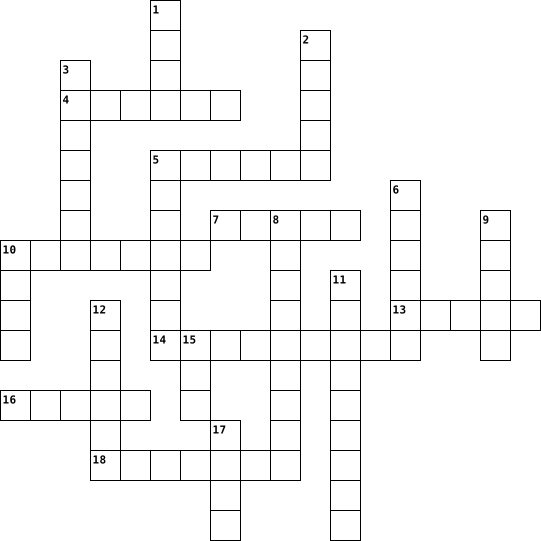
Across
- WHICH NATIONS FLAG IS ON THE MOON
- WHAT IS THE BIGGEST STAR IN THE SOLAR SYSTEM
- THE BEINGS BELIEVED TO INHABIT THE PLANETS OTHER THAN EARTH
- THE BALL THAT COVERS THE SUN CREATING A SOLAR ECLIPSE
- THE DWARF PLANET
- OUR PLANET
- THE HOTTEST PLANET
- THE VEHICLE USED TO TRAVEL THROUGH SPACE
- THE TINY SHINY THINGS YOU SEE AT NIGHT
- THE BIGGEST PLANET
- THE PLANET KNOWN FOR ITS RINGS
Down
- THE RED PLANET
- THE PLANET THAT GETS TEASED
- THE PIECE OF DEBRIS THAT HAS A FIREY TAIL
- THE SECOND FURTHEST PLANET
- THE NAME OF SOMEONE IN SPACE
- THE HOLE THAT SUCKS STUFF INTO IT
- THE SECOND CLOSEST PLANET
- THE PIECE OF DEBRIS THAT FLOATS THROUGH SPACE
- WHAT IS THE FIRST NAME OF THE FIRST HUMAN ON THE MOON
20 Clues: OUR PLANET • THE RED PLANET • THE DWARF PLANET • THE HOTTEST PLANET • THE BIGGEST PLANET • THE SECOND CLOSEST PLANET • THE SECOND FURTHEST PLANET • THE PLANET THAT GETS TEASED • THE NAME OF SOMEONE IN SPACE • THE PLANET KNOWN FOR ITS RINGS • WHICH NATIONS FLAG IS ON THE MOON • THE HOLE THAT SUCKS STUFF INTO IT • THE TINY SHINY THINGS YOU SEE AT NIGHT • ...
Halloween Crossword 2024-10-31

Across
- Spooky black bird
- This guy might be called Mike or Sully
- A skeleton is just a bunch of these
- A spooky spirit
- A flying insect eater
- Several of these make a coven
- Undead
- What witches cast
- Witch transportation
- What graveyards have
- The Count
- A triangle treat
- A creaky place to visit for a scare
- Might be full, half, or new
- He hates garlic
Down
- Where a vampire sleeps
- What witches make in cauldrons
- What kids wear on Halloween
- Comes out on full moon nights
- What haunted houses are
- A Halloween squash
- October 31st
- Ghosts playground
- A boney kind of fellow
- A witches pet
- ______ or Treat
- A carved pumpkin
- The doctor a monster
- What wolves do at the moon
- Found in Egypt
30 Clues: Undead • The Count • October 31st • A witches pet • Found in Egypt • A spooky spirit • ______ or Treat • He hates garlic • A carved pumpkin • A triangle treat • Spooky black bird • Ghosts playground • What witches cast • A Halloween squash • Witch transportation • What graveyards have • The doctor a monster • A flying insect eater • Where a vampire sleeps • A boney kind of fellow • What haunted houses are • ...
Ganesha 2025-07-25

Across
- – The Moon God who laughed at Ganesha
- – What Ganesha chose over speed in his race
- – What Ganesha threw to defeat Gajamukhasura
- – Ganesha’s loyal mouse vehicle
- – Mountain home of Ganesha and his divine family
- – Proud god who hosted a feast for Ganesha
- – What Ganesha gave the Moon for mocking him
- – Son of Parvati created from sacred clay
- – Animal whose head was placed on Ganesha
- – Simple food that finally satisfied Ganesha’s hunger
Down
- – What Ganesha symbolically circled by walking around his parents
- – Kubera’s flaw that Ganesha helped humble
- – Ganesha’s favourite sweet
- – Ganesha’s brother, who raced around the world
- – Title of Ganesha meaning “Remover of Obstacles”
- – God who accidentally severed Ganesha’s head
- – Goddess who lovingly created Ganesha
- – The form Gajamukhasura took after defeat
- – Festival on which we avoid looking at the moon
- – Kartikeya’s majestic ride
20 Clues: – Ganesha’s favourite sweet • – Kartikeya’s majestic ride • – Ganesha’s loyal mouse vehicle • – The Moon God who laughed at Ganesha • – Goddess who lovingly created Ganesha • – Son of Parvati created from sacred clay • – Animal whose head was placed on Ganesha • – Kubera’s flaw that Ganesha helped humble • – The form Gajamukhasura took after defeat • ...
Activity on Solar System 2025-07-28

Across
- Twin of Earth in size but hotter
- Red planet known for dust storms
- Rocky objects mostly found between Mars and Jupiter
- Moon of Jupiter, believed to have a subsurface ocean
- Bright tail-bearing space traveler
- Fifth planet from the Sun
- Planets made mostly of gas
- Coldest and most distant known planet
- The star at the center of our solar system
- A minor planet, often found in the asteroid belt
- Earth's natural satellite
Down
- A dwarf planet in the Kuiper belt
- Blue planet with a tilted axis
- Largest planet in the solar system
- Sixth planet from the Sun
- Spacecraft that carries instruments
- The planet famous for its rings
- The closest planet to the Sun
- The path a planet follows around the Sun
- The largest moon of Saturn
20 Clues: Sixth planet from the Sun • Fifth planet from the Sun • Earth's natural satellite • Planets made mostly of gas • The largest moon of Saturn • The closest planet to the Sun • Blue planet with a tilted axis • The planet famous for its rings • Twin of Earth in size but hotter • Red planet known for dust storms • A dwarf planet in the Kuiper belt • Largest planet in the solar system • ...
Space 2018-05-17

Across
- 4/4 of a moon
- a person who goes into space
- a place that is rounded into a sphere
- how the universe was made
- a planet with rings around it
- 1/4 of a moon
- a planet starting with the letter U
- a planet we have never been on
- the planet we live on
- a billion years in space
- something you travel to space in
Down
- 2/4 or 1/2 of a moon
- a weight in space
- the big glowing ball in the sky
- something you can see small things turn into big things in space
- a star in the north
- a black hole than is skinnier and thinner
- the place inside of a universe
- the largest planet in our solar system
- a big ball of light passing by at night
20 Clues: 4/4 of a moon • 1/4 of a moon • a weight in space • a star in the north • 2/4 or 1/2 of a moon • the planet we live on • a billion years in space • how the universe was made • a person who goes into space • a planet with rings around it • the place inside of a universe • a planet we have never been on • the big glowing ball in the sky • something you travel to space in • ...
Sky Science 2012-02-08

Across
- has no gravity
- a blue green planet
- when the moon gose over the sun
- is the distance light travels in one year
- a dent in the moons surface
- an object in space made from rocks, frozen water and gasses
- is the science that studies heavenly bodies such as the moon
Down
- this is known as the red planet
- is not considered a planet
- has a great red spot
- a rotating group of stars
- chunks of rock found in space
- a series of planets around the
- the man that wears a space suit
- is the oval path around which objectsin space travel or revolve
- closest planet to the sun
- rotates once in 24 hours
- heats the earth
- a planet surrounded by rings
- is a satellite that travels around the earth (and other planets)
20 Clues: has no gravity • heats the earth • a blue green planet • has a great red spot • rotates once in 24 hours • a rotating group of stars • closest planet to the sun • is not considered a planet • a dent in the moons surface • a planet surrounded by rings • chunks of rock found in space • a series of planets around the • this is known as the red planet • when the moon gose over the sun • ...
Space Crossword 2014-08-31

Across
- has many rings around it made of ice and dust
- spacemen
- We live on it
- the smallest planet in the solar system
- a rocky space object
- the huge space which contains all matter and energy in existence
- a big ball of dirty ice and snow in outer space
- a planet so big that all the other planets could fit inside it
- to revolve around something
- the closest planet to earth
- relates to the sun
Down
- relates to the moon
- Very very hot
- an object that moves around a larger object
- all the gasses that surround a planet or star
- has a moon called tritan
- to turn around a center point
- Comes up in the sky at night time
- not a planet anymore
- iron in its soil gives it its red texture
20 Clues: spacemen • Very very hot • We live on it • relates to the sun • relates to the moon • a rocky space object • not a planet anymore • has a moon called tritan • to revolve around something • the closest planet to earth • to turn around a center point • Comes up in the sky at night time • the smallest planet in the solar system • iron in its soil gives it its red texture • ...
Planets and Space 2014-10-28

Across
- solid piece of debris that survives impact with the earth
- surname of the first person on the moon
- our galaxy is called the ?
- a person who travels into space
- Uranus can not be seen without a ?
- the sun is a very large ?
- a stellar explosion of stars
- asteroids are mostly made of air and ?
- the only celestial body humans have set foot on other than earth
- known as the red planet
Down
- how many planets are there? (do not count pluto).
- a dwarf planet
- groups of stars that form patterns in the night sky
- the largest planet
- the moon is covered in ?
- each star in the sky is a glowing ball of ?
- astronauts travel by ?
- the planet humans live
- Mercury is the closest planet to the ?
- Saturn is surrounded by ?
20 Clues: a dwarf planet • the largest planet • astronauts travel by ? • the planet humans live • known as the red planet • the moon is covered in ? • the sun is a very large ? • Saturn is surrounded by ? • our galaxy is called the ? • a stellar explosion of stars • a person who travels into space • Uranus can not be seen without a ? • Mercury is the closest planet to the ? • ...
Science Vocab 2021-10-21

Across
- The equinox after winter solstice
- more than half
- A chunk of rock that orbits the Sun and it's too tiny to be a planet
- A chunk if rock in space
- when the Moon is between the Earth and Sun
- revolving the sun
- A chunk of rock that has entered the atmosphere
- getting bigger
- less than half
- when the Earth is between the Sun and Moon
Down
- A meteor that has crashed on Earth's surface.
- getting smaller
- When a hemisphere is tilted away from the sun
- When a hemisphere is tilted toward the sun
- a chunk of dust and ice
- A celestial body that orbits the sun
- The equinox after summer solstice
- any object that revolves around another one
- giant rock that orbits Earth
- spinning around on an axis
20 Clues: more than half • getting bigger • less than half • getting smaller • revolving the sun • a chunk of dust and ice • A chunk if rock in space • spinning around on an axis • giant rock that orbits Earth • The equinox after winter solstice • The equinox after summer solstice • A celestial body that orbits the sun • When a hemisphere is tilted toward the sun • ...
World Explorers 1: U1-5 2023-10-11

Across
- Neil likes to ? on the moon.
- Lola is a small ?
- today we want to ?
- Lucy paints an ?
- But there are no ? on the moon.
- He likes to eat ? too.
- she is too ?
- Lola's grandmother is small and ?
- Jerome is my ?
- Who wants some ?
- she only likes to eat pies and likes to ?
- We are at my ? today.
- We play with helecopters in my ?
Down
- Tom likes to eat ?
- what ? do you want to paint
- Lola is a ? girl.
- But Grandmother's heart is ?
- we paint animals on our ?
- Jill paints a ?
- ? don't fly that high
- Her ? is small, too.
- We are at my home ?
- she only likes to eat ?
- tom likes to eat fruit and ?
- Neil likes to walk on the ?
25 Clues: she is too ? • Jerome is my ? • Jill paints a ? • Lucy paints an ? • Who wants some ? • Lola is a ? girl. • Lola is a small ? • Tom likes to eat ? • today we want to ? • We are at my home ? • Her ? is small, too. • ? don't fly that high • We are at my ? today. • He likes to eat ? too. • she only likes to eat ? • we paint animals on our ? • what ? do you want to paint • Neil likes to walk on the ? • ...
UNIT 6 2023-02-28

Across
- one who is a funeral director
- a room of building in which scientific test are carried out
- an uncontrollable urge to steal
- science or study of
- one who does not believe in God
- work
- science dealing with life and living organisms
- to work together
- science dealing with the earth's structure and history
- an insane desire to see things burn
- a craving; a madness
Down
- science which collects, studies, and explains facts about animals
- science of the mind and human behavior
- of or pertaining to the moon
- the moon
- insanity; craziness; originally thought to be influenced by the moon
- the study of the supposed influence of the stars and planets on the lives and behavior of humans
- one who
- an exaggerated craving for books
- work which is either physical or mental
20 Clues: work • one who • the moon • to work together • science or study of • a craving; a madness • of or pertaining to the moon • one who is a funeral director • an uncontrollable urge to steal • one who does not believe in God • an exaggerated craving for books • an insane desire to see things burn • science of the mind and human behavior • work which is either physical or mental • ...
ASTRO-PUZZLE 2022-12-06

Across
- the circle of stellar constellations around the Earth
- Lion constellation
- nearest star to us other than SUN
- - Rotating Nuetron star as the most accurate Nature Clock
- indian term to describe sacred fresh waters oozing into prominent rivers of India every 12 years
- human events connect to Astronomical bodies
- the planet with rings around it
- used to map Milky-way galaxy
- biggest planet in solar system
Down
- biggest moon of Jupiter
- the stinging constellation
- - where light too does not escape the gravitational pull
- name of our galaxy
- the nearest star to the Earth
- the Question form constellation
- the smallest moon of Jupiter
- unit of distance in astronomy
- the farthest planet in solar system
- mystery in the palm of your hand
- biggest moon of Saturn
- travels at 3 lacs km per sec
21 Clues: name of our galaxy • Lion constellation • biggest moon of Saturn • biggest moon of Jupiter • the stinging constellation • the smallest moon of Jupiter • travels at 3 lacs km per sec • used to map Milky-way galaxy • the nearest star to the Earth • unit of distance in astronomy • biggest planet in solar system • the Question form constellation • the planet with rings around it • ...
Astronomy Vocabulary 2022-05-02

Across
- A tide just after the first or third quarters of the moon when there is least difference between high and low water
- The outer part of a shadow cast by a celestial body where the light from the Sun is partially blocked
- Angular distance from the ecliptic of a point on the celestial sphere
- How long an object takes to spin around another object
- The rotation of an object that always shows the same face to an object that it is orbiting
- A tide just after a new or full moon, when there is the greatest difference between high and low water
Down
- Angular distance from a point on the celestial sphere that is perpendicular to the ecliptic at the point of a vernal equinox
- The appearance of a celestial body's state of illumination
- The periodic rise and fall of the ocean level from the gravitational force exerted by the Moon and Sun
- How long an object takes to spin around its axis
- A shadow darkest,central part,where light is completely excluded
- Occurs when Earth passes between the Sun and Moon, with Earth casting its shadow on the Moon
- Occurs when the Moon passes between the Sun and Earth, with the Moon casting its shadow on Earth
13 Clues: How long an object takes to spin around its axis • How long an object takes to spin around another object • The appearance of a celestial body's state of illumination • A shadow darkest,central part,where light is completely excluded • Angular distance from the ecliptic of a point on the celestial sphere • ...
its 2021-12-02

Across
- creation
- soup
- widow
- floop
- saturn
- fro
- fromp
- watermelon
- solar
- rat
- sun
- ocean
- moon
- mercury
- dark
- venus
- gorp
- water
- jupiter
- million
- rope
Down
- window
- scroll
- billion
- pluto
- flow
- mars
- melon
- winter
- monopoly
- uranus
- steve
- john
- neptune
- lemon
- crossword
- frog
- grape juice
- earth
- fop
- ratio
- loop
- fox
43 Clues: fro • rat • sun • fop • fox • soup • flow • mars • john • moon • frog • dark • gorp • loop • rope • pluto • widow • floop • fromp • melon • solar • steve • ocean • lemon • venus • earth • ratio • water • window • scroll • saturn • winter • uranus • billion • neptune • mercury • jupiter • million • creation • monopoly • crossword • watermelon • grape juice
Crater: The Crossword Puzzle 2023-04-28

Across
- An illegal biological machine
- The reoccurring enemy of Crater
- Lead of the Aces shoveball team
- Crater's short tempered brother
- Crowhopper transport
- Mechanics
- An Umlap
- Explosives experts
- John Medaris' son
- Moon currency
- Crater's song
Down
- Former crowhopper hostage
- A notably dumb creature
- A creature that attacked the cycler
- Former warhorse
- A giant city on the moon
- Crater's job
- Crater's hometown
- Umlap King
- Truck driver who died in a race
20 Clues: An Umlap • Mechanics • Umlap King • Crater's job • Moon currency • Crater's song • Former warhorse • Crater's hometown • John Medaris' son • Explosives experts • Crowhopper transport • A notably dumb creature • A giant city on the moon • Former crowhopper hostage • An illegal biological machine • The reoccurring enemy of Crater • Lead of the Aces shoveball team • Crater's short tempered brother • ...
18 2025-02-15

Across
- Beatles songwriter
- LGBTQ uprising
- Film princess
- 1969 space milestone "69"
- Music & peace event
- Bombing tragedy
- Bluesy singer
- Civil rights movement
- Voting rights
- Hippie explosion
- Beatles activist
- Civil unrest
Down
- Godfather of Soul
- Berkeley activism
- Cold War crisis
- Urban riots
- Desegregation activists
- Feminist movement
- Protest singer
- Rock poet
- Action movie star
- Race to moon
- Campus protests
- MLK’s event
- Folk rock star
25 Clues: Rock poet • Urban riots • MLK’s event • Race to moon • Civil unrest • Film princess • Bluesy singer • Voting rights • LGBTQ uprising • Protest singer • Folk rock star • Cold War crisis • Bombing tragedy • Campus protests • Hippie explosion • Beatles activist • Godfather of Soul • Berkeley activism • Feminist movement • Action movie star • Beatles songwriter • Music & peace event • Civil rights movement • ...
Our Solar System 2024-03-18

Across
- THE LAST PLANET
- THE EARTH ROTATES ON ITS___
- THE SUN'S RAYS ___ ON THE MOON
- THERE ARE ____ PLANETS IN OUT SOLAR SYSTEM
- A PLANET THAT LAYS ON ITS SIDE
- AN ICE GIANT
- THE MOON ____ THE EARTH
- PLANETS IN OUR SOLAR SYSTEM ORBIT THE
Down
- EART'S NATURAL SATELLITE IS CALLED THE
- THE ONLY PLANET WITH LIFE
- A PLANET FAMOUS FOR ITS RINGS
- IS NOT CONSIDERED A TRUE PLANET ANYMORE
- VENUS IS A _____ PLANET (HINT: LAND)
- THE 4TH PLANET FROM THE SUN
- A GAS GIANT
- THE CLOSEST PLANET TO THE SUN
16 Clues: A GAS GIANT • AN ICE GIANT • THE LAST PLANET • THE MOON ____ THE EARTH • THE ONLY PLANET WITH LIFE • THE EARTH ROTATES ON ITS___ • THE 4TH PLANET FROM THE SUN • A PLANET FAMOUS FOR ITS RINGS • THE CLOSEST PLANET TO THE SUN • THE SUN'S RAYS ___ ON THE MOON • A PLANET THAT LAYS ON ITS SIDE • VENUS IS A _____ PLANET (HINT: LAND) • PLANETS IN OUR SOLAR SYSTEM ORBIT THE • ...
SPACE 2023-05-11

Across
- A scientist that studies space
- spinning on axis
- longest wave length
- U-V index
- Hot flaming ball of gas
- sun and moon at right angles with eachother
- used to look into bodies
- Where stars form
Down
- object going around another object
- very long-period waves
- a tide just after a new or full moon
- A lot of solar systems in one clump
- New moon, 1rst quarter, waxing gibbous
- The Hulk
14 Clues: The Hulk • U-V index • spinning on axis • Where stars form • longest wave length • very long-period waves • Hot flaming ball of gas • used to look into bodies • A scientist that studies space • object going around another object • A lot of solar systems in one clump • a tide just after a new or full moon • New moon, 1rst quarter, waxing gibbous • ...
Cloghan Childcare Crossword 2023-08-11

Across
- Capital of Florida.
- First meal of the day.
- Last man on moon.
- First man at South Pole
- Edmond Enright.
- Large African lake.
- Capricorn sign.
- Aonach Urmhumhan.
- Local Radio Station.
Down
- Belguim's capital.
- The Cats.
- Second American president.
- Abba Eurovision winner.
- Tir Conaill.
- Second man on moon.
- New Late Late presenter.
- Gold.
- He wrote Paradise Lost.
- Donegal Highest Mountain.
- Is the Man Utd manager a witch.
20 Clues: Gold. • The Cats. • Tir Conaill. • Edmond Enright. • Capricorn sign. • Last man on moon. • Aonach Urmhumhan. • Belguim's capital. • Capital of Florida. • Second man on moon. • Large African lake. • Local Radio Station. • First meal of the day. • Abba Eurovision winner. • First man at South Pole • He wrote Paradise Lost. • New Late Late presenter. • Donegal Highest Mountain. • ...
Earth and Space Science 2023-04-13

Across
- To reuse materials after they have been changed into another form
- lit portion of the moon grows larger
- an area of land drains or "sheds" water into a specific body of water
- moving in a fixed path around an object
- using resources in a way that they will continue to be available in the future
- patterns created by groups of stars
- waste, chemicals, or other harmful substances that dirty or contaminate the environment
Down
- process in which earthen materials are worn away and transported by natural forces
- protection of nature and Earth's natural resources
- eclipse where the moon is between the sun and the Earth
- believed the sun was the center of the universe
- lit portion of the moon grows smaller
- instrument that makes distant objects appear larger
- spinning or turning on an axis
- Ptolemy believed the _____ was the center of the universe
- the ____ of Earth's axis causes the seasons
- eclipse where the moon seems darker because it's behind the earth
17 Clues: spinning or turning on an axis • patterns created by groups of stars • lit portion of the moon grows larger • lit portion of the moon grows smaller • moving in a fixed path around an object • the ____ of Earth's axis causes the seasons • believed the sun was the center of the universe • protection of nature and Earth's natural resources • ...
SPACE CROSSWORD 2024-03-08

Across
- WHEN THE MOON BLOCKS SUNLIGHT FROM EARTH
- WHEN THE MOON GOES COMPLETELY DARK
- CIRCLES EARTH
- AN UNIDENTIFIED FLYING OBJECT
- A SHIP USED FOR GOING TO SPACE
- CIRCLES SATURN
Down
- A SPACE ROCK
- A LOT OF SPACE ROCKS CIRCLING AROUND THE SUN BEHIND MARS
- VERY DARK AND BIG
- GREEN PEOPLE AND ARE MYTHS
- CIRCLING SOMETHING BIGGER
- HAS LIVING THINGS
- GIVES OFF LIGHT
13 Clues: A SPACE ROCK • CIRCLES EARTH • CIRCLES SATURN • GIVES OFF LIGHT • VERY DARK AND BIG • HAS LIVING THINGS • CIRCLING SOMETHING BIGGER • GREEN PEOPLE AND ARE MYTHS • AN UNIDENTIFIED FLYING OBJECT • A SHIP USED FOR GOING TO SPACE • WHEN THE MOON GOES COMPLETELY DARK • WHEN THE MOON BLOCKS SUNLIGHT FROM EARTH • A LOT OF SPACE ROCKS CIRCLING AROUND THE SUN BEHIND MARS
Ted Hughes Trivia 2023-07-04

Across
- Attributing human characteristics to something
- A pause in the middle of a line of poetry
- When consecutive words begin with the same sound
- How 'the other creatures' in "The Jaguar" appear
- An implied reference to another text
- How the animals feel about the moon
- What the blown ball does at Slack
- Hughes found a _______ at the sea's edge.
- Hughes' first wife
- When final vowel and consonant sounds match
- What a snowdrop is
- Who "pursues her ends"
- A four-line stanza
- Sounds like /s/ and /sh/
- The final word of "Relic"
- The sort of colours Hughes' footballers wear
- In "The Harvest Moon," the moon seems to grow more and more _______ as the poem goes on.
- True or false: "A Memory" is about smoking.
Down
- One of the possible interpretations of "The Harvest Moon"
- "A Memory" is most likely about Hughes' _______.
- Typical Hughes theme
- Poem about Hughes' mother and aunt
- Part of the wheat's cry to the moon
- A type of poem with no set structure or rhyme scheme
- "The Other"
- Sounds like /b/ and /p/
- Poem about rural life and work
- What Hughes' fox represents
- When the meaning in the poem runs from one line to the next
- One of the adjectives used to describe the stink of the fox
- Something is something else
- How the Jaguar appears in the eponymous poem
- The speed at which you are meant to read something
- When only the final consonant sounds match
- Poem about a powerful creature
35 Clues: "The Other" • Hughes' first wife • What a snowdrop is • A four-line stanza • Typical Hughes theme • Who "pursues her ends" • Sounds like /b/ and /p/ • Sounds like /s/ and /sh/ • The final word of "Relic" • What Hughes' fox represents • Something is something else • Poem about rural life and work • Poem about a powerful creature • What the blown ball does at Slack • ...
Space 2025-02-05

Across
- What Happens when the earth is directly between the Sun and the Moon
- The Sixth Planet From the Sun
- The Zodiac Constellation that is based on the Goat
- The Fourth Planet From the Sun
- The Space Craft that Exploded
- Closest Galaxy to the Milky Way
- The Eighth Planet From the Sun
- The Zodiac Constellation based on the Centaur
- Used to measure distance in space
- The smallest thing that makes up everything
- The Zodiac Constellation based on the Bull
- The Seventh Planet From the Sun
- What happens when the Moon passes between the earth and the sun
- First Man In Space
- The Zodiac Constellation based on the Scorpion
- Is Only visible every 80 years (next visible 1961)
Down
- Neil _________ The first man to walk on the Moon
- The First Planet From the Sun
- The Zodiac Constellation based on the Scales
- The Race between The Soviet Union and America
- The Zodiac Constellation based on the Virgin
- The Biggest Object in our Solar System
- The Supermassive Black Hole in the center of the Milky Way
- The Second Planet From the Sun
- The Zodiac Constellation based on the Crab
- The Year of the moon landing
- Not a Planet anymore.
- The Zodiac Constellation Based on a water carrier
- The Third Planet From the Sun
- The Fifth Planet From the Sun
- The Zodiac Constellation based on the Ram
- The Zodiac Constellation Based on Two Fish
- The President during the Moon Landing
- The Zodiac Constellation based on the Lion
34 Clues: First Man In Space • Not a Planet anymore. • The Year of the moon landing • The First Planet From the Sun • The Sixth Planet From the Sun • The Space Craft that Exploded • The Third Planet From the Sun • The Fifth Planet From the Sun • The Fourth Planet From the Sun • The Second Planet From the Sun • The Eighth Planet From the Sun • Closest Galaxy to the Milky Way • ...
Earth and Life Science 2018-08-04

Across
- Composed almost entirely of hydrogen and helium
- Dark moon
- The entire universe is a hologram
- completely illuminated
- God created the universe in seven days
- Half moon
- formed by the cooling and crystallization of magma
- Coronal gas has enough heat energy to escape the sun's gravity
- Brightest object in the sky after the sun and moon
- Formed from accumulation of weathered material
Down
- Warm jets of matter
- Solid objects thought to exist in protoplanetary
- Study of solar interior
- source of solar winds
- Largest and most massive planet
- The physical and chemical breakdown of rocks
- One-half is illuminated
- Formed from pre-existing rocks that have been transformed
- the science that considers the history of the earth as recorded in rocks
- Only planet to support living organisms
20 Clues: Dark moon • Half moon • Warm jets of matter • source of solar winds • completely illuminated • Study of solar interior • One-half is illuminated • Largest and most massive planet • The entire universe is a hologram • God created the universe in seven days • Only planet to support living organisms • The physical and chemical breakdown of rocks • ...
Sky Science 2012-02-08

Across
- heats the earth
- is a satellite that travels around the earth (and other planets)
- a blue green planet
- a dent in the moons surface
- a series of planets around the
- is the oval path around which objectsin space travel or revolve
- chunks of rock found in space
- is the science that studies heavenly bodies such as the moon
- when the moon gose over the sun
- a rotating group of stars
Down
- has no gravity
- this is known as the red planet
- has a great red spot
- the man that wears a space suit
- a planet surrounded by rings
- is the distance light travels in one year
- an object in space made from rocks, frozen water and gasses
- closest plant to the sun
- is not considered a planet
- rotates once in 24 hours
20 Clues: has no gravity • heats the earth • a blue green planet • has a great red spot • closest plant to the sun • rotates once in 24 hours • a rotating group of stars • is not considered a planet • a dent in the moons surface • a planet surrounded by rings • chunks of rock found in space • a series of planets around the • this is known as the red planet • the man that wears a space suit • ...
Space Crossword 2014-08-31

Across
- has many rings around it made of ice and dust
- spacemen
- We live on it
- the smallest planet in the solar system
- a rocky space object
- the huge space which contains all matter and energy in existence
- a big ball of dirty ice and snow in outer space
- a planet so big that all the other planets could fit inside it
- to revolve around something
- the closest planet to earth
- relates to the sun
Down
- relates to the moon
- Very very hot
- an object that moves around a larger object
- all the gasses that surround a planet or star
- has a moon called tritan
- to turn around a center point
- Comes up in the sky at night time
- not a planet anymore
- iron in its soil gives it its red texture
20 Clues: spacemen • Very very hot • We live on it • relates to the sun • relates to the moon • a rocky space object • not a planet anymore • has a moon called tritan • to revolve around something • the closest planet to earth • to turn around a center point • Comes up in the sky at night time • the smallest planet in the solar system • iron in its soil gives it its red texture • ...
Space 2024-09-04

Across
- A region in space with an intense gravitational force.
- A big sphere in the sky cleraly visible at night.
- A creature on a different planet.
- A space explorer.
- The biggest planet in our solar system.
- A theory for beggining of everything.
- A object in space in orbit collecting and transmitting infromation.
- A bowl shaped cavity on the moon.
- A funny planet.
- The centre of our universe which is very hot.
Down
- An object which orbits around the sun.
- A well known dwaf planet.
- The moon has very little.
- Our home planet.
- The fartherst planet from the sun.
- A red planet next to earth.
- Our galaxy(also a chocolate).
- A 5 pointed shape in the sky.
- The hottest planet in our solar system.
- This planet has rings.
20 Clues: A funny planet. • Our home planet. • A space explorer. • This planet has rings. • A well known dwaf planet. • The moon has very little. • A red planet next to earth. • Our galaxy(also a chocolate). • A 5 pointed shape in the sky. • A creature on a different planet. • A bowl shaped cavity on the moon. • The fartherst planet from the sun. • A theory for beggining of everything. • ...
Prototype Spacesuit 2023-04-17

Across
- descriptive word about the spacesuit
- the moon pole the astronauts will land on
- filled with gases that humans need to breathe
- early version of a device or product
- inner layer like a balloon
- material used to reflect heat from the sun
- displayed range of motion of spacesuit
- sits on top of helmet 2 words
- will still be worn by astronauts in new suit
- portable life support system
- Artemis spacecraft
Down
- private aerospace company 2 words
- number of people who have set foot on moon
- number of Artemis astronauts
- resistant to dust and tears 2 words
- layer that maintains the suit's shape
- hours the suit may be worn
- program that plans to send humans back to moon
- layer that protects against temp changes
- missions that ended in 1972
20 Clues: Artemis spacecraft • hours the suit may be worn • inner layer like a balloon • missions that ended in 1972 • number of Artemis astronauts • portable life support system • sits on top of helmet 2 words • private aerospace company 2 words • resistant to dust and tears 2 words • descriptive word about the spacesuit • early version of a device or product • ...
SPACE 2025-04-10

Across
- THE PLANET THAT GETS TEASED
- THE BEINGS BELIEVED TO INHABIT THE PLANETS OTHER THAN EARTH
- THE PIECE OF DEBRIS THAT HAS A FIREY TAIL
- THE SECOND CLOSEST PLANET
- OUR PLANET
- THE NAME OF SOMEONE IN SPACE
- THE HOTTEST PLANET
- THE SECOND FURTHEST PLANET
Down
- THE BALL THAT COVERS THE SUN CREATING A SOLAR ECLIPSE
- THE TINY SHINY THINGS YOU SEE AT NIGHT
- THE BIGGEST PLANET
- WHICH NATIONS FLAG IS ON THE MOON
- THE VEHICLE USED TO TRAVEL THROUGH SPACE
- THE PIECE OF DEBRIS THAT FLOATS THROUGH SPACE
- THE DWARF PLANET
- THE RED PLANET
- THE HOLE THAT SUCKS STUFF INTO IT
- THE PLANET KNOWN FOR ITS RINGS
- WHAT IS THE BIGGEST STAR IN THE SOLAR SYSTEM
- WHAT IS THE FIRST NAME OF THE FIRST HUMAN ON THE MOON
20 Clues: OUR PLANET • THE RED PLANET • THE DWARF PLANET • THE BIGGEST PLANET • THE HOTTEST PLANET • THE SECOND CLOSEST PLANET • THE SECOND FURTHEST PLANET • THE PLANET THAT GETS TEASED • THE NAME OF SOMEONE IN SPACE • THE PLANET KNOWN FOR ITS RINGS • WHICH NATIONS FLAG IS ON THE MOON • THE HOLE THAT SUCKS STUFF INTO IT • THE TINY SHINY THINGS YOU SEE AT NIGHT • ...
Earth/Space Science Vocabulary 2015-01-14

Across
- The 4 main positions in a body's path
- the force that bodies with enough mass have that attracts other bodies
- One body orbiting another body with more mass
- How long it takes for a body to complete one rotation
- when the moon travels behind Earth's shadow
- The movement of Earth's oceans caused by the Moon's gravitational pull
- the galaxy our solar system is in
- When the Moon passes directly between the Earth and the Sun, creating a shadow on Earth
Down
- the imaginary line running through a planet that it rotates on
- The day with the longest and shortest periods of daylight per year
- The act of orbiting something
- one body traveling around another body
- Full Moon, when all the moon is showing, Waxing Gibbous, when 3/4 is showing, First Quarter, when half is showing, Waxing Crescent, when 1/4 is showing, New Moon, when none is showing, Waning Crescent, when 1/4 is showing, Third Quarter, when half is showing, and Waning Gibbous, when 3/4 is showing
- One body continually turning around
- when day and night are both exactly 12 hours
15 Clues: The act of orbiting something • the galaxy our solar system is in • One body continually turning around • The 4 main positions in a body's path • one body traveling around another body • when the moon travels behind Earth's shadow • when day and night are both exactly 12 hours • One body orbiting another body with more mass • ...
Exact Sciences Labs Go Beyond Crossword Puzzle 2022-04-14
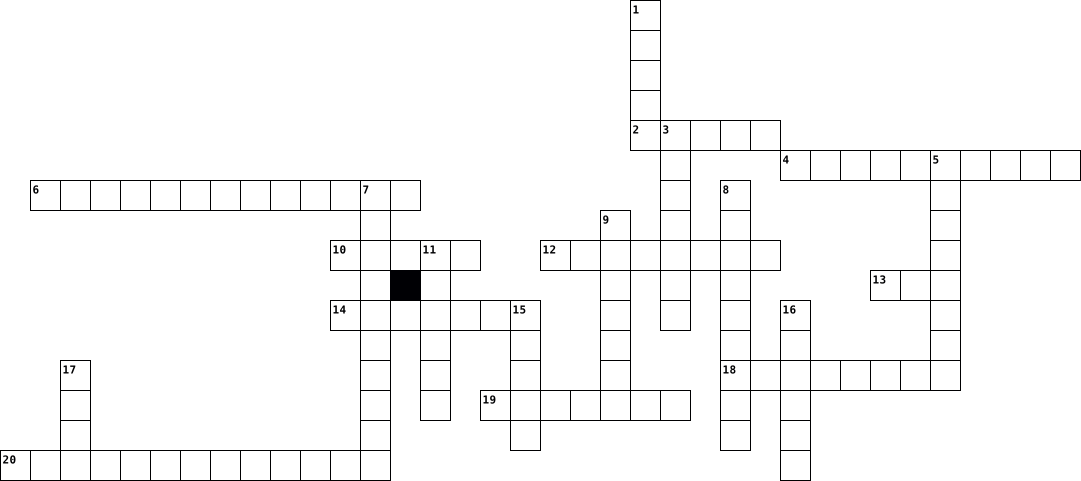
Across
- CONTINUOUS AREA
- PURIFICATION SYSTEM
- MADISON
- SHINY OBJECTS
- ALL EXISTING MATTER AND SPACE
- THE ONLY STAR IN THE SOLAR SYSTEM
- PPE
- GALAXY THAT HOLDS THE SOLAR SYSTEM
- CELEBRATION OF LAB HEROES
- A GROUP OF STARS
Down
- TO BREAKDOWN
- LARGE BODIES THAT REVOLVE AROUND THE SUN
- ENDLESS
- TO PURIFY
- A MIXTURE OF REAGENTS AND ENZYMES
- TO MEASURE LIQUID
- TO THE MOON
- ROBOTIC ASSISTANCE
- SOLAR SYSTEM
- EARTH'S NATURAL SATELLITE
20 Clues: PPE • ENDLESS • MADISON • TO PURIFY • TO THE MOON • TO BREAKDOWN • SOLAR SYSTEM • SHINY OBJECTS • CONTINUOUS AREA • A GROUP OF STARS • TO MEASURE LIQUID • ROBOTIC ASSISTANCE • PURIFICATION SYSTEM • EARTH'S NATURAL SATELLITE • CELEBRATION OF LAB HEROES • ALL EXISTING MATTER AND SPACE • A MIXTURE OF REAGENTS AND ENZYMES • THE ONLY STAR IN THE SOLAR SYSTEM • GALAXY THAT HOLDS THE SOLAR SYSTEM • ...
Rockets and Astronauts 2023-03-02

Across
- Russia's answer to the space shuttle
- Russian moon rocket
- First American to orbit the earth.
- Space Capsule that took Yuri Gagarin into space.
- First human on the moon
- America's first satellite.
- European space program
- U.S. space program
Down
- America's first sub-orbital crewed rocket.
- Launches like a rocket but lands like a plane
- America's moon rocket
- The first man made thing in space.
- The first human in space.
- The amount of mercury missions that there were.
- Famous rocket that carried John Glenn into orbit.
15 Clues: U.S. space program • Russian moon rocket • America's moon rocket • European space program • First human on the moon • The first human in space. • America's first satellite. • The first man made thing in space. • First American to orbit the earth. • Russia's answer to the space shuttle • America's first sub-orbital crewed rocket. • Launches like a rocket but lands like a plane • ...
Astronomy 2023-11-21

Across
- rotates around the earth
- gives heat to earth
- there are many at night glowing in the sky
- getting bigger
- summer, fall, winter, spring
- slanted
Down
- new moon, waxing cresent, 1st quarter, waxing gibbous, full moon, waning gibbous, 3rd quarter, waning cresent
- created by the moon (type of wave)
- getting smaller
- keeps things on earth
- Mercury, Venus, Earth, Mars, Jupiter, Saturn, Uranus, Neptune and Pluto
11 Clues: slanted • getting bigger • getting smaller • gives heat to earth • keeps things on earth • rotates around the earth • summer, fall, winter, spring • created by the moon (type of wave) • there are many at night glowing in the sky • Mercury, Venus, Earth, Mars, Jupiter, Saturn, Uranus, Neptune and Pluto • ...
A Journey Through Space! 2024-05-27

Across
- what is the name of Saturn's largest moon?
- What is the name of the first manned mission to land on the Moon?
- The galaxy that contains our solar system.
- The third planet from the sun, home to all known life.
- The smallest planet in our solar system.
- What are the small, icy bodies that develop tails when they approach the Sun?
- The planet that takes the longest to orbit the sun.
- The largest planet in our solar system.
- What is at the center of our solar system?
Down
- A natural satellite that orbits a planet.
- what is the name of Jupiter's largest moon?
- The dwarf planet located.
- The red planet.
- The second planet from the sun, often called Earth's twin.
- The force that keeps planets in orbit around the sun.
- What is the term for the path an object takes as it moves around another object in space?
- The planet known for its beautiful rings.
17 Clues: The red planet. • The dwarf planet located. • The largest planet in our solar system. • The smallest planet in our solar system. • A natural satellite that orbits a planet. • The planet known for its beautiful rings. • what is the name of Saturn's largest moon? • The galaxy that contains our solar system. • What is at the center of our solar system? • ...
Science crossword 2026-02-15

Across
- is located on the floor of the Atlantic ocean from ice land to Antartica
- grind past each other without going up or down
- the natural movement of air caused by uneven heating of the earth’s surface by the sun
- the highest point of the volcano
- outermost layer of the earth
- the apparent curving of moving objects on a rotating body
- the water vapor condenses into moisture, forming clouds
- the steep, circular wall made of hardened lava that surrounds the main vent of the volcano
- these tides occur when the sun, moon, and earth are aligned perfectly
- such as mountains and hills affect the flow of air during a typhoon
- A powder-like fine-grained material that is ejected during explosive volcanic
- happens when warm, moist air is pushed upward over a mountain
- the movement of water from low tide to high tide
- the difference in height between the high tide and the low tide
- the primary opening through which magma escapes during an eruption
- occur when plates move towards one another.
- the sides of the volcano
- using a scientific instrument called a [blank]
- occur when two tectonic plates move away from each other
- calm, clear center of a strong tropical cyclone
- these tides occur movement of water from high tide to low tide
- openings in earth’s surface where hot magma, gases, and rocks erupt from underground
- when strong winds from different directions move toward a specific area
- side of a mountain is the sheltered side away from the sea
- starts in Cordillera mountains of south America and extends up to the Philippines and Indonesian islands
- the lowest section of the volcano
Down
- covers more of earth’s surface
- side of a mountain that receives heavier rainfall during a typhoon
- the study of the formation and topography of elevated landforms such as mountains or hills
- the pool of melted rock under a volcano
- stretches from Europe to Sumatra reaching the Atlantic.
- the crack on earth’s crust which lava erupts
- when the clouds are saturated with moisture, the water droplets fall nack to earth as rain
- super hot melted rock found deep inside earth
- Extremely hot, molten (liquid) and semi-molten rock found beneath the earth’s surface
- also known as stratovolcanoes
- water vapor or water in its gaseous state gets trapped in the air and rises through the atmosphere
- largest volcanoes on Earth.
- molten rock that has erupted from a volcano
- type of water that makes up most of earth’s water
- wall is a ring towering thunderstorms that encircled the calm center.
- huge rigid pieces that make up earth’s outer layer
- act as natural barriers and weaken typhoons
- the short period before or after high tide or low tide
- when the moon is in its first and third quarter phases
- the process where a liquid changes into gas
- a dangerous ocean current that flows from the shore out to sea
- smallest types of volcanoes.
- The passageway through which magma travels to reach earth’s surface
- caused by the combined gravitational forces of the sun and the moon on the oceans
50 Clues: the sides of the volcano • largest volcanoes on Earth. • outermost layer of the earth • smallest types of volcanoes. • also known as stratovolcanoes • covers more of earth’s surface • the highest point of the volcano • the lowest section of the volcano • the pool of melted rock under a volcano • molten rock that has erupted from a volcano • ...
Quiz from another planet 2020-10-19

Across
- an ancient greek god
- the fastest thing in the known universe
- the most prety godness out of the twelve
- the first human made sattlite to reaach out of our planet system
- the source of life in our planet
- our home
- the power that keep the planets 'organised'
- the ice giant and one of the ancient greek gods
- biggest star in our planet system
- earth's satelite
Down
- the power that spaceships use
- the rays of power that sun releases
- the most famous comet
- krono's biggest satellite
- the most common gas in our planet
- most phenomenal including moon and the sun
- the black 'things' on moon
- collection of spaceships sent in space with astronauts with them
- the protective filter that keep us safe from the sun's rays
19 Clues: our home • earth's satelite • an ancient greek god • the most famous comet • krono's biggest satellite • the black 'things' on moon • the power that spaceships use • the source of life in our planet • the most common gas in our planet • biggest star in our planet system • the rays of power that sun releases • the fastest thing in the known universe • ...