
moon phases Crossword Puzzles
Moons 2023-09-26

Across
- titan
- natural satellite
- io
- phobos
- europa
- ganymede
Down
- deimos
- titania
- callisto
- triton
- rhea
- moon
12 Clues: io • rhea • moon • titan • deimos • triton • phobos • europa • titania • callisto • ganymede • natural satellite
vocabulary week 6 2015-10-13

Across
- widen
- work out carefully
- receive from source
- set value
- events after climax
- an object made during time of study
- form an opinion
- verify correctness
- large chunk of rock in space
Down
- raise to a higher degree
- increase in size
- events before climax
- an object created after time of study
- a ball that orbits the sun that is made of ice and dust
- all of the moons phases
- journey by water
- an act of investigation
- review
- to determine something
- a meteoroid that is in Earths atmosphere
20 Clues: widen • review • set value • form an opinion • increase in size • journey by water • work out carefully • verify correctness • receive from source • events after climax • events before climax • to determine something • all of the moons phases • an act of investigation • raise to a higher degree • large chunk of rock in space • an object made during time of study • ...
Final Review 2022-12-12

Across
- Punctuation
- energy
- system
- green zone
Down
- capitalization
- noun
- sun
- adjective
- absorb
- moon
- right
- verb
12 Clues: sun • noun • moon • verb • right • absorb • energy • system • adjective • green zone • Punctuation • capitalization
Wednesday Workout 2023-08-11

Across
- status that allows electrical connection
- geographical organization
- name for new / upcoming GIS system
- support structure
- largest serviced municipality by population
- electrical sub-network
- Transmission provider
- added to G/tech for spatial reference
- contains underground switches
- point of delivery
Down
- (mostly) decommissioned mobile GIS
- least common asset type
- source of a circuit
- streetlight voltage category
- what we deliver to customers
- comes in 1-, 2-, and 3- varieties
- term for telecom attachments
- transition from primary to secondary
- name for internal esri portal
- pole or structure, in a relationship
20 Clues: support structure • point of delivery • source of a circuit • Transmission provider • electrical sub-network • least common asset type • geographical organization • streetlight voltage category • what we deliver to customers • term for telecom attachments • name for internal esri portal • contains underground switches • comes in 1-, 2-, and 3- varieties • ...
Lunar Cycle 2023-04-05

Across
- Path of a celestial object around another
- Caused by pull of gravity from the Moon
- Occurs when the Sun and Moon are on opposite sides of Earth
- The spinning of an object on its axis
- This is what actually gives the Moon its light
- The Moon revolves around this planet
Down
- The movement of an object around another
- Occurs when the Moon is between the Earth and the Sun
- Change in appearance of the Moon during revolution
- A force that moves two objects towards each other
10 Clues: The Moon revolves around this planet • The spinning of an object on its axis • Caused by pull of gravity from the Moon • The movement of an object around another • Path of a celestial object around another • This is what actually gives the Moon its light • A force that moves two objects towards each other • Change in appearance of the Moon during revolution • ...
Solar Eclipse Crossword Puzzle 2024-04-05

Across
- The Big ______ is a famous constellation
- A group of stars
- A natural satellite that goes around the Earth
- When the moon moves in front of the sun
- The moon causes a _______ during a total eclipse
Down
- When the moon blocks part of the sun, it is a ______ eclipse
- What month will the solar eclipse be happening in?
- When the moon completely blocks the sun, it is a ______ eclipse
- A solar eclipse happens during which moon phase?
- Don't look directly at this without special glasses!
10 Clues: A group of stars • When the moon moves in front of the sun • The Big ______ is a famous constellation • A natural satellite that goes around the Earth • A solar eclipse happens during which moon phase? • The moon causes a _______ during a total eclipse • What month will the solar eclipse be happening in? • Don't look directly at this without special glasses! • ...
Vocabulary Puzzle Earth,Moon,and Sun 2022-12-08

Across
- an object's spinning motion about its own axis
- that part of a shadow in which all light from a given source is excluded
- the angle between the plane of the earth's equator and the plumb line (direction of gravity) at a given point on the earth's surface
- the branch of science that deals with celestial objects, space, and the physical universe as a whole
- tidal levels and water motion which would result from Earth's rotation and gravitational effects of, in particular, the Earth, Sun and Moon, without any atmospheric influences
- the object's orbital motion around another object
- a moon, planet or machine that orbits a planet or star
- a half-shadow region that occurs when a light source is only partly covered by an object
- a period of moderate tides when the sun and moon are at right angles to each other
- any of the varying appearances of a celestial body as different amounts of its disk are seen (from Earth, ordinarily) to be illuminated by the Sun
- an invisible line around which an object rotates, or spins
- complete or partial obscuring of a celestial body by another
- an event in which a planet's subsolar point passes through its Equator
Down
- the equinox in autumn, on about September 22 in the northern hemisphere and March 20 in the southern hemisphere
- the force by which a planet or other body draws objects toward its center
- occurs when the moon is either new or full and closest to Earth
- a tool that astronomers use to see faraway objects
- occurs when the moon “eclipses” the sun
- an event in which a planet's poles are most extremely inclined toward or away from the star it orbits
- a bowl-shaped depression, or hollowed-out area, produced by the impact of a meteorite, volcanic activity, or an explosion
- any flat, dark plain of lower elevation on the Moon
- occurs when the Moon passes through the Earth's shadow
- the equinox in spring, on about March 20 in the northern hemisphere and September 22 in the southern hemisphere
- a regular, repeating path that one object takes around another object or center of gravity
24 Clues: occurs when the moon “eclipses” the sun • an object's spinning motion about its own axis • the object's orbital motion around another object • a tool that astronomers use to see faraway objects • any flat, dark plain of lower elevation on the Moon • a moon, planet or machine that orbits a planet or star • occurs when the Moon passes through the Earth's shadow • ...
Science Puzzle 2021-10-06

Across
- the moon at any time after the new moon and before a full moon
- the sunlight on earth and moving onto the moon
- a lot of sunlight on the moon
- circling around a object
- the hottest planet in our solar system
Down
- the sunlight on the moon moving onto the earth
- have a progressively smaller part of its visible surface illuminated so that it appears to decrease in size.
- no sunlight at all
- a line that the earth rotates on
- a planet where people live on
10 Clues: no sunlight at all • circling around a object • a planet where people live on • a lot of sunlight on the moon • a line that the earth rotates on • the hottest planet in our solar system • the sunlight on the moon moving onto the earth • the sunlight on earth and moving onto the moon • the moon at any time after the new moon and before a full moon • ...
moons 2021-03-25

Across
- Cycle: the change in appearance of the moon as it takes one full revolution around Earth
- the spinning of an object
- a rock revolving around Earth
- light is getting smaller when it is...
- when the moon is between the Earth and the sun
Down
- when Earth is between the moon and the sun
- the movement around an object
- a force that tries to pull two objects together
- another name for waves (ocean waves)
- Light is getting bigger when it is...
10 Clues: the spinning of an object • the movement around an object • a rock revolving around Earth • another name for waves (ocean waves) • Light is getting bigger when it is... • light is getting smaller when it is... • when Earth is between the moon and the sun • when the moon is between the Earth and the sun • a force that tries to pull two objects together • ...
Aly's crossword 2023-12-14

Across
- movement of an object around another object
- the changes in the moon as it moves around the Earth
- spinning of an object like the Earth on its axis
Down
- moon phase which is the 1st quarter turn of the moon around the earth
- when the moon is between the earth and sun
- movement of the ocean based on the moon
- when the earth is between the moon and the sun
- force that pulls two objects together
- planet humans live on
- light source of the galaxy
10 Clues: planet humans live on • light source of the galaxy • force that pulls two objects together • movement of the ocean based on the moon • when the moon is between the earth and sun • movement of an object around another object • when the earth is between the moon and the sun • spinning of an object like the Earth on its axis • ...
Astronomy Vick 3 2018-03-22

Across
- at which the sun crosses the celestial equator, when day and night are of equal length
- an eclipse in which the moon appears darkened as it passes into the earth's shadow.
- the path of an object as it revolves
- a group of stars making up a pattern
- light from one celestial body by the passage of another between it and the observer or between it and its source of illumination.
- spinning motion of a planet on its axis
- An object that orbits a planet
- the fully shaded inner region of a shadow cast by an opaque object, especially the area on the earth or moon experiencing the total phase of an eclipse.
- the movement of an object around another object
- a tide just after a new or full moon, when there is the greatest difference between high and low water.
- an eclipse in which the sun is in front of the moon.
- the force that attracts a body toward the center of the earth, or toward any other physical body having mass
Down
- The tidal levels and character which would result from gravitational effects
- the partially shaded outer region of the shadow cast by an opaque object.
- An imaginary line that passes through a planet's center
- a particle attracts every other particle in the universe with a force
- A ball of hot gas
- A streak of light in the sky produced by the burning of a meteoroid in Earth's atmosphere
- a tide just after the first or third quarters of the moon when there is the least difference between high and low water.
- an object that orbits a star
- A loose collection of ice and dust that orbits the sun
- a large, bowl-shaped cavity in the ground or on the surface of a planet or the moon
- a chart or series of pages showing the days, weeks, and months of a particular year, or giving particular seasonal information.
- arge, dark, basaltic plains on Earth's Moon, formed by ancient volcanic eruptions
- a meteor that survives its passage through the earth's atmosphere such that part of it strikes the ground
- when the sun reaches its highest or lowest point in the sky at noon, marked by the longest and shortest days.
26 Clues: A ball of hot gas • an object that orbits a star • An object that orbits a planet • the path of an object as it revolves • a group of stars making up a pattern • spinning motion of a planet on its axis • the movement of an object around another object • an eclipse in which the sun is in front of the moon. • A loose collection of ice and dust that orbits the sun • ...
Science Vocab Challenge 2022-03-30

Across
- a moon phase that looks like less than a half circle from Earth
- a moon phase that looks like more than a half circle from Earth
- the rock type formed when sediment is pressed and glued together
- the nearly circular path a smaller object (like the Moon) travels around a larger object (like Earth)
- the process of clearing trees from land
- the way molecules in a substance move around relative to each other
- the rock type formed when heat or pressure deep underground changes existing rock
- phase when molecules move apart from each other
- the process of rock breaking down into smaller pieces due to wind or moving water
- overall tendency (for example, a consistent increase) in a set of data over time
- a group of atoms joined together in a particular way
- hot liquid rock below the surface of Earth
- the process by which all the rock formations of a region are pushed up due to plate motion
- the process of burning fuels, which produces carbon dioxide
- the process by which rock material moves under Earth’s outer layer and into the mantle due to plate motion
- small pieces of rock
- the ability to make things move or change
Down
- the process of sediment being buried and pressed together
- when the Moon turns red
- the energy that an object has because it is moving
- a diagram that shows what the inside of something looks like
- one of the many different types of matter that make up rocks
- the mixture of gases surrounding a planet
- phase when molecules move in place
- a noticeably different form or state of the same substance
- a pull between two molecules that is always the same for a substance
- the border between light and dark on the Moon
- a moon phase that looks like half a circle from Earth
- the process of sediment being glued together
- a moon phase that looks like a full circle from Earth
- phase when molecules move around each other
- a measure of how much light is present
- the rock type formed when magma cools and becomes solid
- the movement of sediment from one place to another, often caused by wind or flowing water
34 Clues: small pieces of rock • when the Moon turns red • phase when molecules move in place • a measure of how much light is present • the process of clearing trees from land • the mixture of gases surrounding a planet • the ability to make things move or change • hot liquid rock below the surface of Earth • phase when molecules move around each other • ...
Austin and Ally 2022-04-13

Across
- a love song Austin Moon
- than this Austin Moon
- best friends
- hits Austin Moon
Down
- Austin Moon rockstar
- from the top Austin Moon
- Ally Dawnson Songwriter
- Ally Dawnson songwriter
- Trish best friends
9 Clues: best friends • hits Austin Moon • Trish best friends • Austin Moon rockstar • than this Austin Moon • a love song Austin Moon • Ally Dawnson songwriter • from the top Austin Moon • Ally Dawnson Songwriter
Austin and Ally 2022-04-13

Across
- a love song Austin Moon
- than this Austin Moon
- dez best friends
- hits Austin Moon
Down
- Austin Moon rockstar
- from the top Austin Moon
- Ally Dawnson Songwriter
- Ally Dawnson songwriter
- Trish best friends
9 Clues: hits Austin Moon • dez best friends • Trish best friends • Austin Moon rockstar • than this Austin Moon • a love song Austin Moon • Ally Dawnson songwriter • from the top Austin Moon • Ally Dawnson Songwriter
Phases of Matter 2024-11-04

Across
- phase change from solid to gas
- phase change from liquid to solid
- type of energy that comes from the movement of molecules and atoms
- phase change from gas to liquid
- state of matter that has a definite shape and fixed volume
Down
- phase change from liquid to gas
- measurement of the amount of thermal energy in a system
- phase change from solid to liquid
- state of matter that has no definite shape but a fixed volume
- state of matter that has no definite shape and no definite volume
- phase change from gas to solid
11 Clues: phase change from solid to gas • phase change from gas to solid • phase change from liquid to gas • phase change from gas to liquid • phase change from solid to liquid • phase change from liquid to solid • measurement of the amount of thermal energy in a system • state of matter that has a definite shape and fixed volume • ...
Astronomy CW 2024-08-16

Across
- - The moon BLANK around a the earth
- - created by moons gravitational pull
- - Created by the moon
- moon - Whole thing
Down
- Quart - Half of the Moon after a Waxing Cresent
- - The force that keeps us here
- hundred sixty five - amount of days to go around the sun
- Moon - Almost not visible
- - The earth rotates on what
- - The main source of light
10 Clues: moon - Whole thing • - Created by the moon • Moon - Almost not visible • - The main source of light • - The earth rotates on what • - The force that keeps us here • - The moon BLANK around a the earth • - created by moons gravitational pull • Quart - Half of the Moon after a Waxing Cresent • hundred sixty five - amount of days to go around the sun
The Seasons 2022-03-31

Across
- Longest and shortest days of the year.
- The Earth makes one around the sun per year.
- What the sun is directly over on each Equinox.
- What the Earth makes once every 24 hours.
- When the moon blocks the sun.
- The shape of Earth's orbit around the sun.
Down
- Name for the Spring Equinox
- When its summer in the Northern Hemisphere, the Southern Hemisphere experiences...
- Name for the Fall Equinox
- The phase hen the moon is mostly dark.
- 12 hours of light and darkness
- The phase when the moon is mostly full.
- When Earth's shadow falls on the moon.
- The main cause of Earth's seasons
14 Clues: Name for the Fall Equinox • Name for the Spring Equinox • When the moon blocks the sun. • 12 hours of light and darkness • The main cause of Earth's seasons • The phase hen the moon is mostly dark. • Longest and shortest days of the year. • When Earth's shadow falls on the moon. • The phase when the moon is mostly full. • What the Earth makes once every 24 hours. • ...
Solar Eclipse 2024-03-26

Across
- one way to safely observe the eclipse
- amount of space between two objects
- location in the Earth where a total eclipse can be observed
- observing the eclipse without looking directly at the sun
- sun's atmosphere
- when the moon passes between the earth and the sun
- eclipse where the sun is partly covered by the moon
Down
- eclipse when the moon is farther from the sun
- point in moon's orbit closest to the Earth
- eclipse where the sun is completely covered by the moon
- shadow where the eclipse is partial
- shadow where the eclipse is total
- oval shape of the moon's orbit
- point in the moon's orbit farthest from Earth
14 Clues: sun's atmosphere • oval shape of the moon's orbit • shadow where the eclipse is total • shadow where the eclipse is partial • amount of space between two objects • one way to safely observe the eclipse • point in moon's orbit closest to the Earth • eclipse when the moon is farther from the sun • point in the moon's orbit farthest from Earth • ...
ASTRO TEST REVIEW 2022-12-12

Across
- _________________ are mostly found between Mars and Jupiter.
- Our sun will NOT collapse and become a _(2 words)_ because it has less mass.
- A__(2 words)___occurs when we add up the extra quarter day every 4 years.
- If you drew a diagram of a LUNAR eclipse, the moon would be covered by Earth's _________.
- The moon revolves around the Earth because the Earth has a greater _______ and gravity.
- The axis ______ different parts of the Earth toward or away from the sun as we revolve.
- The Earth takes 365 1/4 days to complete one ________________.
- __________ tide is the HIGHEST tide that occurs (GREATEST diff. between high and low)
- The moon rotates and revolves at the SAME rate so we see _(2 words)_ of the moon.
- The _________(2 words)_____________ of the sun is caused
- An object's resistance to change in motion (wants to keep doing what it's doing)
- There would be NO _________________ if the Earth did not TILT and REVOLVE.
- NEAP tide is the ________ high tide that occurs. (LEAST diff. between high and low)
- Comets, like planets, have a predictable _________________ -shaped orbit.
Down
- The ________ pull of the moon causes the TIDES to occur.
- Scientists compare the ________ of stars to elements to figure out what a star contains.
- To spin on a fixed axis
- Seasons in the Northern and Southern hemispheres are ________________.
- Earth's rotation.
- If it’s called a ___________ eclipse, then the MOON is being blocked from our view.
- Our ________________ protects us from meteorite impact and UV sun rays
- The greater the ________ of an object, the stronger its gravitational pull.
- The Earth's ________________ causes day and night and takes approx. 24 hours
- Objects at a greater ___________ from one another will have LESS gravitational pull.
- The Earth's TILT and __________ cause the seasons to occur.
- All stars start off in a cloud of dust and gas called a ____________.
- On the day of the __________ we experience equal hours of daylight and darkness.
- Our planet is just the right distance from the sun for ______________ to exist as a liquid.
- The moon shines reflected ___________ in the night sky.
- The season in which a hemisphere gets DIRECT SUNLIGHT would be ___________.
- The PATH an object takes as it moves around another object
- Our atmosphere provides us with ______________ to breathe.
- If the moon was blocking the ____________ from us it would be called a SOLAR eclipse.
- On the day of a ____________ we experience the GREATEST or LEAST hours of sunlight.
34 Clues: Earth's rotation. • To spin on a fixed axis • The moon shines reflected ___________ in the night sky. • The ________ pull of the moon causes the TIDES to occur. • The _________(2 words)_____________ of the sun is caused • The PATH an object takes as it moves around another object • Our atmosphere provides us with ______________ to breathe. • ...
Artemus 2026-04-10

Across
- Newton’s law stating that every action force has an equal and opposite reaction force
- The product of an object’s mass and velocity
- The relationship between force mass and acceleration
- The high speed gases expelled from a rocket engine
- The region beyond Earth’s atmosphere where spacecraft travel
- The mission planned to land humans on the Moon and explore the surface
- A push or pull acting on an object
- The scientist who developed the three laws of motion
- The path followed by a moving object
- VELOCITY The minimum speed needed to break free from a planet’s gravity
- NASA’s program focused on returning humans to the Moon and beyond
- A vehicle that moves by expelling gases to produce thrust
- The force of gravity acting on an object and it depends on location
- The act of sending a rocket into space
- Motion under the influence of gravity only
- The amount of matter in an object and it does not change with location
- The curved path an object follows around a planet or moon
- The force applied by the rocket pushing gases downward
- The rate at which velocity changes over time
- An object that orbits a planet, either natural or artificial
Down
- The upward force produced by a rocket pushing gases downward
- Speed in a given direction
- A space with no air or matter
- The force that pushes back in response to an action force
- A substance burned to produce energy for motion in rockets
- Resistance of an object to changes in its motion
- The layer of gases surrounding Earth
- The mission planned to build a lunar space station and support long term Moon exploration
- An object at rest stays at rest and an object in motion stays in motion unless acted on by a force
- The process of pushing or driving a rocket forward
- The planet we live on and the source of gravity we must overcome
- The force that pulls objects toward Earth or another massive body
- Earth’s natural satellite
- The 2022 uncrewed mission that tested the rocket and spacecraft around the Moon
- The first crewed mission planned to orbit the Moon and return safely to Earth
35 Clues: Earth’s natural satellite • Speed in a given direction • A space with no air or matter • A push or pull acting on an object • The layer of gases surrounding Earth • The path followed by a moving object • The act of sending a rocket into space • Motion under the influence of gravity only • The product of an object’s mass and velocity • ...
Coalface - Space 2017-08-06

Across
- What shape is the Milky Way (6)
- In 1781, Uranus was discovered using this device (9)
- The name of the NASA rover launched to Mars in 2011 (9)
- The hottest planet in our solar system (5)
- The first human to travel in space (4,7)
- A theoretical passage through space-time (8)
- What is a meteor called when it reaches Earth's surface (9)
- Which planet is furthest from the sun (7)
- The brightest comet in the solar system (7,5)
- What force bends light rays travelling through the universe (8)
Down
- In what month is the Earth closest to the sun (7)
- What you hear in space (7)
- What unit of length that is approximately 3.26 light years (6)
- What was Sputnik (9)
- Which planet does Titan orbit (6)
- Who was the first man to walk on the moon (4,9)
- A place with a gravitational field that not even light can escape (5,4)
- The largest moon in the solar system (8)
- The moon Callisto orbits this planet (7)
- Closest galaxy to the Milky Way (9)
- How many people have walked on the moon (6)
21 Clues: What was Sputnik (9) • What you hear in space (7) • What shape is the Milky Way (6) • Which planet does Titan orbit (6) • Closest galaxy to the Milky Way (9) • The largest moon in the solar system (8) • The moon Callisto orbits this planet (7) • The first human to travel in space (4,7) • Which planet is furthest from the sun (7) • The hottest planet in our solar system (5) • ...
Astronomy-Richmond 2018-03-19

Across
- after the first and third stage of the moon
- the large surface of the moon
- The law that states that everything in space is attracted to everything else
- The block of light to reach earth
- The attractive point between two objects
- The darkest part of a shadow
- A streak of light
- A movement of another object
- a very large hole in the ground
- When the earth is tilted toward the earth or away
Down
- A loose collection of dust or ice orbiting the sun
- A spinning motion on its axis
- the first stage of something
- When earth reaches its farthest point north or south
- The blocking of sunlight t the moon
- a system of organizing time
- a ball of hot gas
- different shapes of the moon seen from earth
- The part of a shadow that surrounds the darkest part
- A pattern or shape made out of stars
- The path of an object around the other object in space
- The total blocking of an object in space
- a small body moving into the ocean
- An object that orbits a star
- The rise in water in the water
25 Clues: a ball of hot gas • A streak of light • a system of organizing time • the first stage of something • An object that orbits a star • The darkest part of a shadow • A movement of another object • A spinning motion on its axis • the large surface of the moon • The rise in water in the water • a very large hole in the ground • The block of light to reach earth • ...
MCA Science - Solar System 2022-04-29

Across
- The planets _________ the Sun
- Direction the Earth both rotates and revolves
- Term for when over half of the moon is lit up
- The moon phase after a waxing gibbous
- Closest star to Earth
- Name of the largest planet
- The Earth rotates on its ___________
Down
- Term for when only a sliver of the moon is lit up
- The movement of one object around another
- When the Earth blocks light going to the moon, it is which type of eclipse?
- Which planet is furthest from the Sun?
- What is bigger the universe or galaxies?
- The name of our galaxy
13 Clues: Closest star to Earth • The name of our galaxy • Name of the largest planet • The planets _________ the Sun • The Earth rotates on its ___________ • The moon phase after a waxing gibbous • Which planet is furthest from the Sun? • What is bigger the universe or galaxies? • The movement of one object around another • Direction the Earth both rotates and revolves • ...
Space 2016-03-02
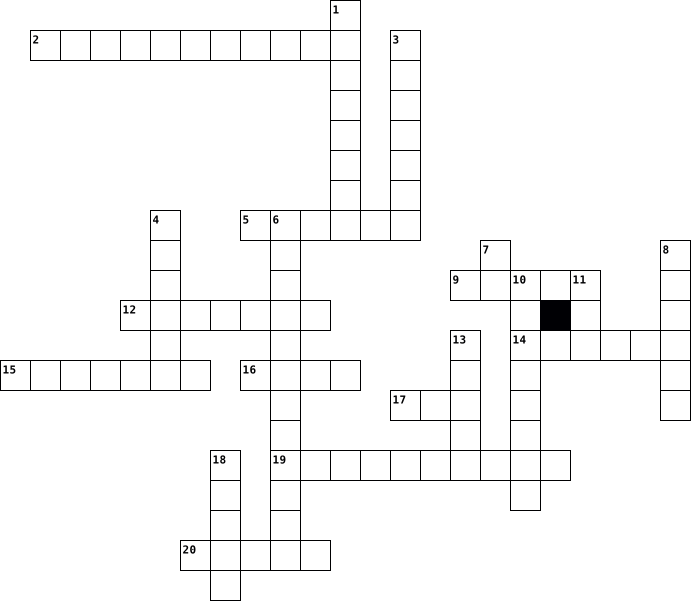
Across
- A power that keeps planets orbiting the sun
- A gravitationally bound system of starts, stellar remnants, interstellar gas, dust and dark matter
- A satellite orbiting the Sun, may go really far away from the Sun and return after hundreds or thousands of year. Some contain water ice.
- The biggest planet of the Solar system
- Last name of the man who did the first spacewalk
- Eighth planet from the sun
- A natural satellite orbiting Earth
- The center of the Solar system
- A star system consisting of two stars orbiting around their common barycenter
- Third planet from the Sun
Down
- The biggest galaxy of the Local group
- The smallest planet of the Solar system
- The planet with least density on the Solar system
- A circumstellar disc between planets Mars and Jupiter that contains asteroids, minor planets and debris
- The fourth biggest moon in the solar system. Has a lot of volcanoes.
- Number of the Apollo flight that landed to the Moon
- Second biggest galaxy of the Local group
- Number of moons orbiting planet Mars
- Second planet from the sun
- The biggest moon orbiting Saturn
20 Clues: Third planet from the Sun • Second planet from the sun • Eighth planet from the sun • The center of the Solar system • The biggest moon orbiting Saturn • A natural satellite orbiting Earth • Number of moons orbiting planet Mars • The biggest galaxy of the Local group • The biggest planet of the Solar system • The smallest planet of the Solar system • ...
Gravity 2023-05-15

Across
- The scientist who discovered the laws of gravity
- The amount of matter in an object
- Gravity even affects the way your ____________develop
- Toss a ball into the air and it will _________down because of gravity
- Experiences less gravity when they are on the Moon or in space
- Force of attraction between objects
- If objects are closer together, then they will have _______ gravity
- Weighs about one Newton on Earth and 0.2 N on the Moon
- How many high tides happen each day?
Down
- The moon's gravity controls the ocean's ___________
- The gravity of a planet can cause a star to ____________
- The force that holds water in the oceans
- You weigh ___________on the moon than on the earth
- Gravity pulls objects towards the ________of the Earth
- It revolves around the Earth
- The gravitational pull of a planet depends on the _____________to its center
- The planets stay in __________because of gravity
- Gravitational pull is more noticeable in __________than solids
- The greater the mass of an ____________, the stronger its gravitational force
- Is gravity stronger or weaker on Mars?
- Is gravity a push or a pull?
21 Clues: It revolves around the Earth • Is gravity a push or a pull? • The amount of matter in an object • Force of attraction between objects • How many high tides happen each day? • Is gravity stronger or weaker on Mars? • The force that holds water in the oceans • The scientist who discovered the laws of gravity • The planets stay in __________because of gravity • ...
Neil Armstrong 2022-05-27

Across
- space shuttle landed in this ocean after their flight to the moon
- rank he earned in the Boy Scouts of America
- born and died in this state
- name of the movie released in 2018 based on his life
- last name of his partner when landing on the moon
- cause of daughter's death
- title earned in the military in 1950
- shuttle for the first manual space docking manuever
- second wife's first name
- college he attended to study aeronautical engineering
- number of hours they spent on the moon in total
- the month of his death
- what he had surgery on before passing away
Down
- university in which he got a job as a professor at
- name of younger sister; also the name of a month
- place where he stepped foot on before anyone else
- the astronaut that accompanied Armstrong on Gemini 8
- age in which he received his junior pilot license
- father's job that caused him to travel
- what he fell in love with at age 6
- war he served in as a part of the NAVY
- the name of his high school in Wapakoneta
- his mother's first name
23 Clues: the month of his death • his mother's first name • second wife's first name • cause of daughter's death • born and died in this state • what he fell in love with at age 6 • title earned in the military in 1950 • father's job that caused him to travel • war he served in as a part of the NAVY • the name of his high school in Wapakoneta • what he had surgery on before passing away • ...
Astronomy 2025-02-18

Across
- When the amount of day/night is the same
- third planet from the sun
- The way the Earth spins
- Where the sun rises
- seventh planet from the sun
- We cant see the ___ during a solar eclipse
- When you cant see the moon
- fourth planet from the sun
- most abundant gas in Earths atmosphere
- The outer planets are ___ Giants
- A place where astronauts from around the world condict research
- The second most abundant gas in Earths atmosphere
- the shape of Earths orbit
- It helps us see things in space from afar
- fifth planet from the sun
- what causes day/night
Down
- Helps us explore space and take important pictures
- When you can see the all of the moon
- sixth planet from the sun
- second planet from the sun
- Only planet supports life
- The largest of the inner planets
- First planet next to the sun
- What is our sun made of
- during a lunar eclipse we cant see the ___
- synonym for shrinking
- The shortest and longest day of the year
- Getting bigger
- how many seasons are there
- The inner planets are
- what causes the seasons
- what is caused by the moons gravity
- When the moon is barely seen
33 Clues: Getting bigger • Where the sun rises • synonym for shrinking • The inner planets are • what causes day/night • What is our sun made of • The way the Earth spins • what causes the seasons • sixth planet from the sun • Only planet supports life • third planet from the sun • the shape of Earths orbit • fifth planet from the sun • second planet from the sun • When you cant see the moon • ...
Crossword 2025-05-06

Across
- Way, Our home galaxy
- Super strong space beam
- A big colorful cloud in space
- Earth is one of these
- Earth's nighttime neighbor
- What people say they saw flying weird in the sky
- Sucks in everything, even light
- Little green guy from another planet
- A person who goes to space
- When the moon or sun gets covered
- What aliens and astronauts travel in
- They twinkle in the night sky
- Keeps you from floating into space
- Made-up alien bug creature
Down
- A space rock that burns up in the sky
- What rockets do when they lift off
- Lets you see stars and planets
- Cool gaming tech named after aliens
- Icy space ball with a glowing tail
- Dance move or walking on the moon
- Shoots up into space with fire and noise
- The path a planet or moon follows
- Everything that exists, all of space
- A huge group of stars and planets
- The giant nothingness outside Earth
- The red planet
- Planet with cool rings
- Space agency that sends rockets up
- A message aliens might send us
- A rocky thing floating in space
30 Clues: The red planet • Way, Our home galaxy • Earth is one of these • Planet with cool rings • Super strong space beam • Earth's nighttime neighbor • A person who goes to space • Made-up alien bug creature • A big colorful cloud in space • They twinkle in the night sky • Lets you see stars and planets • A message aliens might send us • Sucks in everything, even light • ...
Gravity 2026-02-18

Across
- The scientist who discovered the laws of gravity
- The amount of matter in an object
- Gravity even affects the way your ____________develop
- Toss a ball into the air and it will _________down because of gravity
- Experiences less gravity when they are on the Moon or in space
- Force of attraction between objects
- If objects are closer together, then they will have _______ gravity
- Weighs about one Newton on Earth and 0.2 N on the Moon
- How many high tides happen each day?
Down
- The moon's gravity controls the ocean's ___________
- The gravity of a planet can cause a star to ____________
- The force that holds water in the oceans
- You weigh ___________on the moon than on the earth
- Gravity pulls objects towards the ________of the Earth
- It revolves around the Earth
- The gravitational pull of a planet depends on the _____________to its center
- The planets stay in __________because of gravity
- Gravitational pull is more noticeable in __________than solids
- The greater the mass of an ____________, the stronger its gravitational force
- Is gravity stronger or weaker on Mars?
- Is gravity a push or a pull?
21 Clues: It revolves around the Earth • Is gravity a push or a pull? • The amount of matter in an object • Force of attraction between objects • How many high tides happen each day? • Is gravity stronger or weaker on Mars? • The force that holds water in the oceans • The scientist who discovered the laws of gravity • The planets stay in __________because of gravity • ...
Science Crossword 2021-10-06

Across
- there's little to none of this on the moon
- when the moon orbits around the earth it makes a
- when an object spins on its axis
- when the appearance of the moon changes
- the c in CER
Down
- the R in CER
- this gives us light
- the main topic of class
- proof
- due to the force between the ocean and moon
10 Clues: proof • the R in CER • the c in CER • this gives us light • the main topic of class • when an object spins on its axis • when the appearance of the moon changes • there's little to none of this on the moon • due to the force between the ocean and moon • when the moon orbits around the earth it makes a
Space crossword puzzle 2023-05-04

Across
- has the most moons and has a storm spot just like Neptune
- has a thin atmosphere just like Mars
- frozen ice going around space mostly
- smaller than Asteroids
- almost the same size as Venus
- bigger than Meteoroids
- has craters just like Pluto
- the second biggest planet after Jupiter and has multiple rings
Down
- Saturn and this planet have rings but this planet is sideways
- was once included as a planet and is similar to moon
- Earths twin sister
- is the coldest moon in Neptune's gravitational pull and is bigger than Eris
- a dwarf planet in Kuiper belt that is smaller than Neptune's moon Triton
- has comets floating around the planet and has similar color as Uranus
- had water once just like earth
15 Clues: Earths twin sister • smaller than Asteroids • bigger than Meteoroids • has craters just like Pluto • almost the same size as Venus • had water once just like earth • has a thin atmosphere just like Mars • frozen ice going around space mostly • was once included as a planet and is similar to moon • has the most moons and has a storm spot just like Neptune • ...
Space 2021-05-12

Across
- Sky is not fully dark
- moves in reverse
- a stars death
- a Dirty snowball
- Ball of gas
Down
- space cloud
- Shooting star
- fractions of the moon
- Moon appears more than half
- collection of stars gas or dust
- Shadow of a planet or moon
- supports a telescope
12 Clues: space cloud • Ball of gas • Shooting star • a stars death • moves in reverse • a Dirty snowball • supports a telescope • fractions of the moon • Sky is not fully dark • Shadow of a planet or moon • Moon appears more than half • collection of stars gas or dust
The Planets 2014-10-17

Across
- the name given to the eclipse that occurs when the moon passes between the sun and the Earth
- The galaxy our solar system is part of
- I am the fastest moving planet
- I am considered to be a dwarf planet
- The planet furthest from the sun
- I am the only planet that has only 1 moon
- the category of planets that include the four closest planets to the sun
- the name given to the eclipse that occurs when the moon passes into the earth's shadow
- I stop people and things on earth from floating away
- The planet with the most visible rings
Down
- I control the tides on Earth
- the curbed path a planet takes around the sun is called its....
- I am the gaseous envelope that surrounds the Earth
- The largest planet in our solar system
- the name given to a group of stars that make patterns in the sky
- all of the planets in our solar system orbit me
- Sometimes called the 'Red Planet'
- a meteoroid enters into the earths atmosphere
- the planet that is second from the sun
- the Earth has a tilt of approx 23* on its.....
20 Clues: I control the tides on Earth • I am the fastest moving planet • The planet furthest from the sun • Sometimes called the 'Red Planet' • I am considered to be a dwarf planet • The galaxy our solar system is part of • The largest planet in our solar system • the planet that is second from the sun • The planet with the most visible rings • ...
Science project#213 2023-02-10

Across
- When is you shadow the shortest?
- Which part of the moon can you see when you look at the moon?
- What size star is the sun?
- What time is it for the side of the earth that is facing away from the sun?
- The moon orbits the earth because of _____.
- Does the moon give off its own light?
- What is Groton-Dunstable's mascot?
- Where does the side of the earth that has daytime face toward?
- It is warmer in one hemisphere because it is getting ______ sunlight.
- Stars produce their own light, energy,and _____.
- Shadows point in which direction of the sun?
Down
- There is an imaginary pole that runs through the earth and divides it into the Northern Hemisphere and the____.
- Why are seasons caused?
- How long does the earth take to rotate on its axis one time?
- It is colder in one hemisphere because it is getting ____ sunlight.
- The earths axis is around the ______.
- The sun rises east, and sets west,and your shadows start west, and stop _____.
- Where does earths gravity pull you?
- Gravity is a type of______.
- Why does the sun has the strongest gravitational pull?
20 Clues: Why are seasons caused? • What size star is the sun? • Gravity is a type of______. • When is you shadow the shortest? • What is Groton-Dunstable's mascot? • Where does earths gravity pull you? • Does the moon give off its own light? • The earths axis is around the ______. • The moon orbits the earth because of _____. • Shadows point in which direction of the sun? • ...
Review 2024-01-05

Across
- a collapsed cloud of dust and gas
- contact lenses and glasses are an example of
- type of interaction that can only occur when two objects are touching eachother
- rate of change in velocity speeding up and slowing down
- this pulls gas, dust, and rocky objects to form planets
- a push or pull that changes an objects motion
- during neap tides the sun, moon, and earth form a
- flow of electrons through a wire
- unit used for measuring large distances across space
- temporary magnet created by an electric current
- equal and _______ reaction is Newton's Third Law
- occurs during a 1st quarter and 3rd quarter moon
- length from crest to crest of trough to trough
Down
- how quickly an object moves along a path
- shortest wavelength
- the hottest stars are this color
- Force equals mass times acceleration is which law
- longest wavelength
- high tides occur ______a day
- occurs during a new moon and full moon
- bottom of the wave
- first planet in the solar system
- like charges ______ eachother
- caused from an explosion of a star
- Newton's 1st Law of Motion
- height of a wave
26 Clues: height of a wave • longest wavelength • bottom of the wave • shortest wavelength • Newton's 1st Law of Motion • high tides occur ______a day • like charges ______ eachother • the hottest stars are this color • first planet in the solar system • flow of electrons through a wire • a collapsed cloud of dust and gas • caused from an explosion of a star • ...
MODULE ONE Review 2023-10-15

Across
- when the Moon goes missing
- weaker tide occurring at the quarter moons
- the left half is sunlit
- occurs on December 21 or 22
- the orbit of one object around another object
- occurs before the new moon
- the path an object follows moving around another object
- occurs on June 20 or 21
- the natural satellite of Earth
- the line on which an object rotates
- the last waxing phase
- measures 23.5 degrees from the vertical
- brightest object in the sky
- the lighter part of a shadow
- occurs before the full moon
- when the Sun goes missing
Down
- the first waning phase
- when objects appear to be moving
- the right half is sunlit
- the spin of an object around its axis
- the first waxing phase
- the last waning phase
- the third planet from the Sun
- occurs on March 20 or 21
- stronger tide occurring at new and full moons
- the day when direct rays strike a Tropic line
- the day when direct rays strike the equator
- occurs on September 22 or 23
- the darker part of a shadow
29 Clues: the last waning phase • the last waxing phase • the first waning phase • the first waxing phase • the left half is sunlit • occurs on June 20 or 21 • the right half is sunlit • occurs on March 20 or 21 • when the Sun goes missing • when the Moon goes missing • occurs before the new moon • occurs on December 21 or 22 • the darker part of a shadow • brightest object in the sky • ...
Solar Eclipse 2024-04-08

Across
- A huge ball of hot glowing gas
- term referring to the Sun
- the brightness of a star as seen from Earth
- everything found everywhere
- different appearances of the moon through its cycle
- this may drop during a Solar Eclipse, especially in the shadow
- Moon phase that can coincide with a lunar eclipse
- term referring to the Moon
- Moon phase that can coincide with a solar eclipse
- the act of spinning on an axis
- extremely powerful explosion near the end of a large star's life cycle
- Singer of "Total Eclipse of the Heart".
- our home
Down
- to travel in a circular orbital path
- Travel in a circular path
- the brightness of a star
- path an object takes around another
- A rock or chunk of metal streaking through Earth's atmosphere
- Writer of "Total Eclipse of the Heart" who also wrote songs for Meat Loaf
- lighter outer portion of the shadow
- shadow cast upon another
- dark center portion of the shadow
- the true brightness of a star
- force that is caused by the mass of an object
- easiest camera method to observe a Solar eclipse
25 Clues: our home • the brightness of a star • shadow cast upon another • Travel in a circular path • term referring to the Sun • term referring to the Moon • everything found everywhere • the true brightness of a star • A huge ball of hot glowing gas • the act of spinning on an axis • dark center portion of the shadow • path an object takes around another • ...
Terraria Achievments (All about Defeating or Surviving) 2024-04-06

Across
- ____ A Doctor Bones for the First Time
- ____ The Pumpkin Moon
- ____ All 4 Celestial Pillars
- ____ A Nymph, Found Underground
- ____ The Martian Invasion
- ____ The Deerclops
- ____ Moon Lord
- ____ The Torch God
- ____ The Dreadnautilus
- ____ Queen Slime
- ____ All Bosses of Terraria
- ____ The Groom, a Rare Zombie
- ____ The Mechanical Bosses all at Once
- ____ Brain of Cthulhu
- ____ Tim, a Rare Skeleton
- ____ King Slime
Down
- ____ The Lunatic Cultist
- ____ An Enemy using a Minecart
- ____ The Old One's Army
- ____ Queen Bee
- ____ Plantera
- ____ Duke Fishron
- ____ The Empress of Light
- ____ Eye of Cthulhu
- ____ The Golem
- ____ Pinky, the Rare Pink Slime
- ____ The Goblin Army
- ____ Your First Blood Moon
- ____ The Frost Moon
- ____ Eater of Worlds
- ____ Every kind of Slime Possible
- ____ Your First Night
- ____ Skeletron
- ____ Wall of Flesh
- ____ The Pirate Invasion
- ____ All Mechanical Bosses in Hardmode
36 Clues: ____ Plantera • ____ Queen Bee • ____ The Golem • ____ Moon Lord • ____ Skeletron • ____ King Slime • ____ Queen Slime • ____ Duke Fishron • ____ The Deerclops • ____ The Torch God • ____ Wall of Flesh • ____ Eye of Cthulhu • ____ The Frost Moon • ____ The Goblin Army • ____ Eater of Worlds • ____ The Pumpkin Moon • ____ Your First Night • ____ Brain of Cthulhu • ____ The Dreadnautilus • ...
Crossword 2025-05-06

Across
- Way, Our home galaxy
- Super strong space beam
- A big colorful cloud in space
- Earth is one of these
- Earth's tiny gray neighbor
- What people say they saw flying weird in the sky
- Sucks in everything, even light
- Little green guy from another planet
- A person who goes to space
- When the moon or sun gets covered
- What astronauts travel in
- They twinkle in the night sky
- Keeps you from floating into space
- Made-up alien bug creature
Down
- A space rock that burns up in the sky
- What rockets do when they lift off
- Lets you see stars and planets
- Cool gaming tech named after aliens
- Icy space ball with a glowing tail
- Dance move or walking on the moon
- Shoots up into space with fire and noise
- The path a planet or moon follows
- Everything that exists, all of space
- A huge group of stars and planets
- The giant nothingness outside Earth
- The red planet
- Planet with cool rings
- Space agency that sends rockets up
- A message aliens might send us
- A rocky thing floating in space
30 Clues: The red planet • Way, Our home galaxy • Earth is one of these • Planet with cool rings • Super strong space beam • What astronauts travel in • Earth's tiny gray neighbor • A person who goes to space • Made-up alien bug creature • A big colorful cloud in space • They twinkle in the night sky • Lets you see stars and planets • A message aliens might send us • ...
Science T1 - T4 2021-01-25

Across
- the movement of energy to something else.
- the place outside of Earth.
- energy in motion
- magnet created from electricity.
- a force that is pushing down on us.
- Earth is tilted on its _______.
- space rock (shooting star)
- rays that create warmer weather on Earth.
- rays that create colder weather on Earth.
- how much matter is in an object
- this is why we have seasons on Earth.
- an eclipse where the Moon blocks the Sun.
- created when light is blocked by an object
Down
- type of moon that is less than half full.
- caused by the Earth's tilt on its axis.
- these are found between Mars and Jupiter.
- an eclipse where the Moon turns red.
- when a meteor hits the ground
- magnet that always has a magnetic field.
- type of moon that is more than half full.
- electricity that stores electrons
- measure of how compact something is.
- the total amount of heat energy
- largest planet in our Solar System.
- magnet that can be turned on or off.
- type of energy from the flow of electrons.
- largest star in our solar system
27 Clues: energy in motion • space rock (shooting star) • the place outside of Earth. • when a meteor hits the ground • the total amount of heat energy • Earth is tilted on its _______. • how much matter is in an object • magnet created from electricity. • largest star in our solar system • electricity that stores electrons • largest planet in our Solar System. • ...
Time, Cycles and the Solar System 2025-09-25

Across
- Method used before H4 (5, 8)
- The pointy part of a sundial (6)
- A planet crossing in front of a star (7)
- Solved the longitude problem (8)
- Time as indicated by the Sun (8, 5, 4)
- Difference between AST and MST (8, 2, 4)
- Moons falling into line around a planet (7, 9)
- Radius at which water can exist (10, 4)
- Forces that pull on planets and moons (5)
- Name for the ring-shaped early Solar System (14, 4)
- Day and night of equal length (7)
- Shape of the EOT graph (8)
Down
- Method for discovering exoplanets (6, 8)
- The Moon more than half-full (7)
- The moon getting bigger (6)
- Stable points in a two-body system (10)
- Method for discovering exoplanets (10)
- Point at which a moon is torn to shreds (5, 5)
- A day that lasts 23h 56m (8)
- Threshold for ice formation (5, 4)
- Lumps of dust sticking together (9)
- Time averaged out across the year (4, 5, 4)
- Planets that formed beyond the frost line (3, 5)
- Longest, or shortest, day (8)
- A day that lasts 24 hours (7)
- The Moon getting smaller (6)
26 Clues: Shape of the EOT graph (8) • The moon getting bigger (6) • Method used before H4 (5, 8) • A day that lasts 23h 56m (8) • The Moon getting smaller (6) • Longest, or shortest, day (8) • A day that lasts 24 hours (7) • The Moon more than half-full (7) • The pointy part of a sundial (6) • Solved the longitude problem (8) • Day and night of equal length (7) • ...
Ch. 18 & 22 - Earth's Atmosphere, The Sun, Moon, and Earth System 2026-05-15

Across
- layer, shields us from the sun’s harmful ultraviolet light and converts it to heat
- gases, water vapor, carbon dioxide, methane, etc.
- the layer of earth's atmosphere where jet streams occur
- the visible surface of the sun
- the time it takes the moon to complete one orbit of the earth
- happens when one celestial body cuts off sunlight from another body
- the layer of the atmosphere that we live in
- round, shallow depressions on the moon
Down
- the sun, moon, and earth have a _______________ on the very inside of them that is very hot
- waxing means ______________________
- heat transferred by direct contact
- vertical movement of warmed masses of air into cooler regions
- the hottest layer of the earth's atmosphere
- and helium, the sun is mainly made of these two elements
- waning means _______________________
- the color that we see the sun as
- we use it to tell time and it is our greatest source of energy
- the sun's outer atmosphere
- small, cooler, dark areas of stronger magnetic field strength on the sun
- the envelope of gas that surrounds a planet
- if God represents the sun then Christians represent the __________________
21 Clues: the sun's outer atmosphere • the visible surface of the sun • the color that we see the sun as • heat transferred by direct contact • waxing means ______________________ • waning means _______________________ • round, shallow depressions on the moon • the hottest layer of the earth's atmosphere • the envelope of gas that surrounds a planet • ...
Tides and Eclipses 2024-12-04

Across
- Occurs when the completely passes into the darkest part (umbra) of Earth's shadow.
- When the Moon is at its furthest point in orbit
- When the moon blocks out the Sun entirely
- The rise and fall of the surface levels of Earth's ocean water due to the gravitational effects of the Sun and Moon
- When the Sun and the Moon are aligned with each other, the gravitational pull is in the same direction
Down
- Occurs when the Moon passes into the lightest part (penumbra) of Earth's shadow.
- Occurs when the Moon passes between Earth and the Sun totally or partially.
- The total or partial obscuring of a planet, star, or moon by another celestial object
- Occurs when Earth passes between the Moon and The Sun
- When the Sun and the Moon are at right angles to each other, the gravitational pulls are NOT in the same direction.
10 Clues: When the moon blocks out the Sun entirely • When the Moon is at its furthest point in orbit • Occurs when Earth passes between the Moon and The Sun • Occurs when the Moon passes between Earth and the Sun totally or partially. • Occurs when the Moon passes into the lightest part (penumbra) of Earth's shadow. • ...
Rosie and Katies Solar System Word Search 2023-10-30

Across
- An imaginary line through an object
- An imaginary line halfway between the north and south poles
- A planet made up of gasses
- Attractive force between any two objects mass on earth
- The time it takes for the earth to rotate once
- The time it takes for the planet to orbit around the sun once.
- More then half of the moon can be seen
Down
- half of the earth in a north or south equator
- A ball of gas, that has light and heat
- satellite Human made object that orbits around planets
- Group of billions of stars
- a planet made of mostly icy materials
- Small, Rocky, Object
- Eclipse When the moon passes into the earths shadow
- moon Any phase where half of the sunlit moon can be seen
15 Clues: Small, Rocky, Object • Group of billions of stars • A planet made up of gasses • An imaginary line through an object • a planet made of mostly icy materials • A ball of gas, that has light and heat • More then half of the moon can be seen • half of the earth in a north or south equator • The time it takes for the earth to rotate once • ...
Q1w2 2025-11-03

Across
- when the entire side of the moon is lit up
- the path a object follows as it revolves around another
- when the moon looks like its shrinking
- preserved remains of organisms found in rock layers
- imprints of organisms like leaf or footprint fossils
- the angle of the earths axis
- moon moves between the sun and earth
- the time it takes earth to do a full revolution around the sun
- the largest planet in the solar system
Down
- earth comes between the sun and the moon
- the preserved skeletal remains of animals of humans
- nickname for jupiter and saturn due to their composition
- what do because of gravity
- what gravity is a pull between objects with mass
- human made objects found in archaeological layers
- earths yearly path around the sun
16 Clues: what do because of gravity • the angle of the earths axis • earths yearly path around the sun • moon moves between the sun and earth • when the moon looks like its shrinking • the largest planet in the solar system • earth comes between the sun and the moon • when the entire side of the moon is lit up • what gravity is a pull between objects with mass • ...
SANDWHICHH!!! 2024-12-06

Across
- Moon passes into the penumbra or Earth's shadow
- when the moon passes over the sun
- Happens when moon passes into umbra
- when the sun partially obscures the Moon
- Earth passes between our Moon and Sun
Down
- Moon at its appagee
- darkest part of shadow
- Fully covered
- cast by the Earth or Moon
- caused by our Moon's gravitational pull
10 Clues: Fully covered • Moon at its appagee • darkest part of shadow • cast by the Earth or Moon • when the moon passes over the sun • Happens when moon passes into umbra • Earth passes between our Moon and Sun • caused by our Moon's gravitational pull • when the sun partially obscures the Moon • Moon passes into the penumbra or Earth's shadow
Gases 2017-05-02

Across
- symbol Vm
- the process of turning from liquid into vapor.
- an instrument measuring atmospheric pressure, used especially in forecasting the weather and determining altitude.
- A theory of the thermodynamic behavior of matter, especially the relationships among pressure, volume, and temperature in gases, based on the dependence of temperature on the kinetic energy of the rapidly moving particles of a substance.
- an ideal gas law where at constant volume, the pressure of an ideal gas is directly proportional to its absolute temperature
- approximately 0.000145 pounds per square inch, or 9.9 × 10⁻⁶ atmospheres
- water that collects as droplets on a cold surface when humid air is in contact with it.
- the degree or intensity of heat present in a substance or object, especially as expressed according to a comparative scale and shown by a thermometer or perceived by touch.
- states that in a mixture of non-reacting gases, the total pressure exerted is equal to the sum of the partial pressures of the individual gases.
- point the temperature at which solid and liquid phases coexist in equilibrium.
- the continuous physical force exerted on or against an object by something in contact with it.
- the SI base unit of thermodynamic temperature, equal in magnitude to the degree Celsius.
- It states the ratio of the product of pressure and volume and the absolute temperature of a gas is equal to a constant. PV/T = k.
- the envelope of gases surrounding the earth or another planet
- A law stating that the volume of an ideal gas at constant pressure is directly proportional to the absolute temperature.
Down
- diagram a diagram representing the limits of stability of the various phases in a chemical system at equilibrium, with respect to variables such as composition and temperature.
- the pressure of a vapor in contact with its liquid or solid form.
- The direct solidification of a vapor by cooling; the reverse of sublimation.
- a physical constant which is featured in many fundamental equations in the physical sciences
- states that in a mixture of non-reactinggases the total pressure exerted is equal to the sum of the partial pressures of the individual gases.
- point a point on a phase diagram at which both the liquid and gas phases of a substance have the same density, and are therefore indistinguishable.
- the temperature at which a liquid boils and turns to vapor.
- the intermingling of substances by the natural movement of their particles.
- of an element or compound is a phase transition from the liquid phase to vapor.
- point the temperature and pressure at which the solid, liquid, and vapor phases of a pure substance can coexist in equilibrium.
- When the surface layer of snow or ice turns into fog or steam without melting
- a law in chemistry: equal volumes of all gases at the same temperature and pressure contain equal numbers of molecules
- where P (pressure) × V (volume) = n (number of moles) × R (the gas constant) × T (temperature in Kelvin).
- a gas law, stating that the pressure and volume of a gas have an inverse relationship, when temperature is held constant.
29 Clues: symbol Vm • the process of turning from liquid into vapor. • the temperature at which a liquid boils and turns to vapor. • the envelope of gases surrounding the earth or another planet • the pressure of a vapor in contact with its liquid or solid form. • approximately 0.000145 pounds per square inch, or 9.9 × 10⁻⁶ atmospheres • ...
Mod 7 Vocab 2022-02-15

Across
- denoted by the symbol R or R. It is the molar equivalent to the Boltzmann constant, expressed in units of energy per temperature increment per mole, i.e. the pressure–volume product, rather than energy per temperature increment per particle.
- equilibrium vapor pressure is defined as the pressure exerted by a vapor in thermodynamic equilibrium with its condensed phases at a given temperature in a closed system.
- the envelope of gases surrounding the earth or another planet.
- an element or compound is a phase transition from the liquid phase to vapor.
- the process of turning from liquid into vapor.
- The degree or intensity of heat present in a substance or object, especially as expressed according to a comparative scale and shown by a thermometer or perceived by touch.
- a law stating that the pressure of a given mass of an ideal gas is inversely proportional to its volume at a constant temperature.
- continuous physical force exerted on or against an object by something in contact with it
- the volume of one mole of a substance at a specified pressure and temperature.
- a law stating that the volumes of gases undergoing a reaction at constant pressure and temperature are in a simple ratio to each other and to that of the product.
- the spreading of something more widely.
Down
- a point on a phase diagram at which both the liquid and gas phases of a substance have the same density, and are therefore indistinguishable.
- The process of changing from a solid to a gas without passing through an intermediate liquid phase.
- a mixture of non-reacting gases, the total pressure exerted is equal to the sum of the partial pressures of the individual gases.
- a law stating that equal volumes of gases at the same temperature and pressure contain equal numbers of molecules.
- the temperature at which a given solid will melt.
- combines the three gas laws: Boyle's Law, Charles' Law, and Gay-Lussac's Law.
- a diagram representing the limits of stability of the various phases in a chemical system at equilibrium, with respect to variables such as composition and temperature.
- the law that the product of the pressure and the volume of one gram molecule of an ideal gas is equal to the product of the absolute temperature of the gas and the universal gas constant.
- an instrument measuring atmospheric pressure used especially in forecasting the weather and determining altitude
- Gases are composed of a large number of particles that behave like hard, spherical objects in a state of constant, random motion.
- the temperature and pressure at which the solid, liquid, and vapor phases of a pure substance can coexist in equilibrium.
- the volume of a gas equals a constant value multiplied by its temperature as measured on the Kelvin scale
- occurs when molecules settle out of a solution.
- a high-level structured computer programming language used for teaching and general programming
- the SI base unit of thermodynamic temperature
- the temperature at which a liquid turns into a solid when cooled.
- the temperature at which a liquid boils and turns to vapor.
- water which collects as droplets on a cold surface when humid air is in contact with it.
29 Clues: the spreading of something more widely. • the SI base unit of thermodynamic temperature • the process of turning from liquid into vapor. • occurs when molecules settle out of a solution. • the temperature at which a given solid will melt. • the temperature at which a liquid boils and turns to vapor. • the envelope of gases surrounding the earth or another planet. • ...
Science 2021-12-15

Across
- When light bounces off an object
- A natural luminous body visible in the sky especially at night
- A groups of stars and other space objects held together by gravity.
- An empty, blank or available area
- A celestial body that orbits around the Sun
- A type of space object that is smaller than a regular planet
- The large round object that circles the Earth
- When the phase of the moon is getting smaller
- half-moon but less than full
- How much matter something has
- The invisible force that pulls all objects
Down
- An influence that can change the motion of an object.
- A copy of an object that is larger or smaller than its actual size
- Rate at which velocity changes with time, in terms of both speed and direction
- The planet on which we live
- A star which is located at the center of our solar system.
- Small, rocky objects that orbit the Sun.
- The whole mass of air that surrounds the earth
- A repeating path that an object in space takes around another one
- An imaginary line on which a body rotates
- When the phase of the moon are getting bigger
21 Clues: The planet on which we live • half-moon but less than full • How much matter something has • When light bounces off an object • An empty, blank or available area • Small, rocky objects that orbit the Sun. • An imaginary line on which a body rotates • The invisible force that pulls all objects • A celestial body that orbits around the Sun • ...
Space 2016-03-02
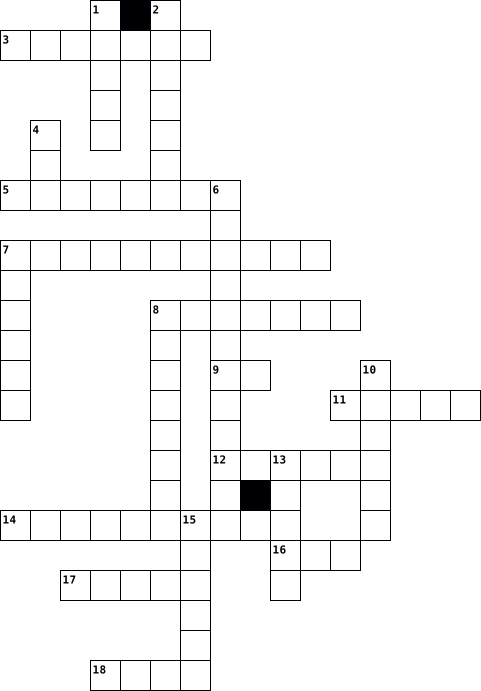
Across
- The biggest planet of the Solar system
- The biggest galaxy of the Local group
- A power that keeps planets orbiting the sun
- The smallest planet of the Solar system
- The fourth biggest moon in the solar system. Has a lot of volcanoes.
- Second planet from the sun
- Number of the Apollo flight that landed to the Moon
- A star system consisting of two stars orbiting around their common barycenter
- Number of moons orbiting planet Mars
- A satellite orbiting the Sun, may go really far away from the Sun and return after hundreds or thousands of year. Some contain water ice.
- A natural satellite orbiting Earth
Down
- The biggest moon orbiting Saturn
- Eighth planet from the sun
- The center of the Solar system
- A circumstellar disc between planets Mars and Jupiter that contains asteroids, minor planets and debris
- A gravitationally bound system of starts, stellar remnants, interstellar gas, dust and dark matter
- Second biggest galaxy of the Local group
- Last name of the man who did the first spacewalk
- Third planet from the Sun
- The planet with least density on the Solar system
20 Clues: Third planet from the Sun • Eighth planet from the sun • Second planet from the sun • The center of the Solar system • The biggest moon orbiting Saturn • A natural satellite orbiting Earth • Number of moons orbiting planet Mars • The biggest galaxy of the Local group • The biggest planet of the Solar system • The smallest planet of the Solar system • ...
Planets 2024-05-21

Across
- Region between Mars and Jupiter with numerous rocky bodies.
- Rocky planets, including Mercury, Venus, Earth, and Mars.
- Largest moon of Neptune, has geysers.
- Central star of the solar system.
- Warming of a planet's surface due to its atmosphere trapping heat.
- Large planets with thick atmospheres, including Jupiter and Saturn.
- Earth's natural satellite.
- Region beyond Neptune with icy bodies and dwarf planets.
- Seventh planet, rotates on its side.
Down
- Giant storm on Jupiter.
- Circular bands of ice and rock particles around gas giants.
- Closest planet to the Sun.
- Second planet from the Sun, hottest planet.
- Largest moon of Saturn, has a thick atmosphere.
- Depressions on a planet's surface caused by impact events.
- Eighth planet, deep blue color.
- Third planet from the Sun, supports life.
- Sixth planet, known for its ring system.
- Planets with thick atmospheres and icy compositions, including Uranus and Neptune.
- Cloud Spherical shell of icy objects surrounding the solar system.
- Layer of gases surrounding a planet.
- Largest moon of Jupiter.
- Largest planet, fifth from the Sun.
- Largest volcano in the solar system, located on Mars.
- Fourth planet, known as the Red Planet.
25 Clues: Giant storm on Jupiter. • Largest moon of Jupiter. • Closest planet to the Sun. • Earth's natural satellite. • Eighth planet, deep blue color. • Central star of the solar system. • Largest planet, fifth from the Sun. • Layer of gases surrounding a planet. • Seventh planet, rotates on its side. • Largest moon of Neptune, has geysers. • Fourth planet, known as the Red Planet. • ...
Space Race Achievements 2023-09-09

Across
- The reusable spacecraft used by NASA for several missions.
- An activity where astronauts leave the spacecraft while in space.
- The historic event when humans first stepped on the Moon in 1969.
- The first living creature to orbit Earth, a Soviet space dog.
- Autonomous robots sent to explore the surface of Mars.
- The first U.S. space program that sent astronauts into space.
- The spacecraft that carried the first human, Yuri Gagarin, into space.
- The U.S. program that prepared astronauts for the Apollo missions.
Down
- The part of the spacecraft that landed on the Moon.
- The collaborative efforts between countries in space exploration.
- A term for a Russian or Soviet astronaut.
- The NASA program that achieved the Moon landing.
- The first human to travel into space.
- The world's first artificial satellite launched by the Soviet Union.
- The international space station where astronauts conduct experiments.
- The space telescope that provides stunning images of the cosmos.
- A series of Soviet spacecraft that explored the Moon.
- The Russian space station that orbited Earth for 15 years.
- The Russian spacecraft still used for human spaceflight.
- The path an object takes as it revolves around another celestial body.
20 Clues: The first human to travel into space. • A term for a Russian or Soviet astronaut. • The NASA program that achieved the Moon landing. • The part of the spacecraft that landed on the Moon. • A series of Soviet spacecraft that explored the Moon. • Autonomous robots sent to explore the surface of Mars. • The Russian spacecraft still used for human spaceflight. • ...
Chapter 25- Space Exploration 2025-04-11

Across
- The first US space station
- The first man to walk on the moon
- A type of telescope that bends light to produce an image
- A device powered by a reaction engine, using propulsion
- The US president who declared man would be put on the moon, thus beginning the space race
- A type of telescope that see radio wavelengths
- A smaller body that orbits a larger one
- The space project that put man on the moon
- The space station used by 26 counties which conducts ongoing research
Down
- NASA is a result of his legacy
- This word always means moon
- A one way space vehicle sent from earth to explore space
- The first man to orbit the earth
- A probe designed to land softly on a planet to transmit photographs and data back to earth
- The first space station put in orbit by the USSR
- The US space shuttle program which used reusable space craft
- Instruments that form enlarged images of distant objects, making them appear close
- The father of modern rocketry
- A type of telescope which uses dish shaped mirrors as the main light gathering element
- A mobile lander that is remotely controlled from earth
20 Clues: The first US space station • This word always means moon • The father of modern rocketry • NASA is a result of his legacy • The first man to orbit the earth • The first man to walk on the moon • A smaller body that orbits a larger one • The space project that put man on the moon • A type of telescope that see radio wavelengths • ...
Crossword 2025-05-06

Across
- Way, Our home galaxy
- Super strong space beam
- A big colorful cloud in space
- Earth is one of these
- Earth's tiny gray neighbor
- What people say they saw flying weird in the sky
- Sucks in everything, even light
- Little green guy from another planet
- A person who goes to space
- When the moon or sun gets covered
- What astronauts travel in
- They twinkle in the night sky
- Keeps you from floating into space
- Made-up alien bug creature
Down
- A space rock that burns up in the sky
- What rockets do when they lift off
- Lets you see stars and planets
- Cool gaming tech named after aliens
- Icy space ball with a glowing tail
- Dance move or walking on the moon
- Shoots up into space with fire and noise
- The path a planet or moon follows
- Everything that exists, all of space
- A huge group of stars and planets
- The giant nothingness outside Earth
- The red planet
- Planet with cool rings
- Space agency that sends rockets up
- A message aliens might send us
- A rocky thing floating in space
30 Clues: The red planet • Way, Our home galaxy • Earth is one of these • Planet with cool rings • Super strong space beam • What astronauts travel in • Earth's tiny gray neighbor • A person who goes to space • Made-up alien bug creature • A big colorful cloud in space • They twinkle in the night sky • Lets you see stars and planets • A message aliens might send us • ...
Chapter 25- Space Exploration 2026-04-15

Across
- The space station used by 26 counties which conducts ongoing research
- The first space station put in orbit by the USSR
- NASA is the result of his legacy
- The first man to orbit the earth
- A mobile lander that is remotely controlled from earth
- A one way space vehicle sent from earth to explore space
- The father of modern rocketry
- Instruments that form enlarged images of distant objects, making them appear close
- The first US space station
- The first man to walk on the moon
- A type of telescope which uses dish shaped mirrors as the main light gathering element
Down
- The US space shuttle program which used reusable space craft
- A probe designed to land softly on a planet to transmit photographs and data back to earth
- This word always means moon
- A device powered by a reaction engine using propulsion
- The space project that put man on the moon
- The US president who declared man would be put on the moon, thus beginning the space race
- A smaller body that orbits a larger one
- A type of telescope that sees wavelengths
- A type of telescope that bends light to produce an image
20 Clues: The first US space station • This word always means moon • The father of modern rocketry • NASA is the result of his legacy • The first man to orbit the earth • The first man to walk on the moon • A smaller body that orbits a larger one • A type of telescope that sees wavelengths • The space project that put man on the moon • The first space station put in orbit by the USSR • ...
Planets 2023-08-22
Across
- - Blue and Stormy
- - Egg-shaped
- - Closest to Sun
- - Rings
- - Hot and Cloudy
- - Moon of Saturn
- - Largest Gas Giant
Down
- - Moon of Jupiter
- - Red Planet
- - Our Home
- - Dwarf
- - Asteroid Belt
- - Kuiper Belt
- - Dwarf in Kuiper Belt
- - Tilted Axis
15 Clues: - Dwarf • - Rings • - Our Home • - Red Planet • - Egg-shaped • - Kuiper Belt • - Tilted Axis • - Asteroid Belt • - Closest to Sun • - Hot and Cloudy • - Moon of Saturn • - Moon of Jupiter • - Blue and Stormy • - Largest Gas Giant • - Dwarf in Kuiper Belt
Space!! 2025-09-10

Across
- Sun is blocked out by the sun.
- moon No moon can be seen
- Eclipse earth blocks the light of the moon.
- Darkest part of the shadow
- Eclipse where you can not see with a naked eye
Down
- moon When the moon is a whole circle
- Moon appears to be smaller then the sun
- The light that passes through the eclipse.
- Moon does not cover the entire sun.
9 Clues: Darkest part of the shadow • Sun is blocked out by the sun. • moon No moon can be seen • Moon does not cover the entire sun. • Moon appears to be smaller then the sun • moon When the moon is a whole circle • The light that passes through the eclipse. • Eclipse earth blocks the light of the moon. • Eclipse where you can not see with a naked eye
Jupiters Moons 2022-11-02

Across
- First (I) moon ever discovered
- Labelled XLV
- Second Galilean moon to be discovered
- Tenth (X) moon ever discovered
- Only moon in the carpo group
Down
- Galilean moon with a mass of 15 million
- Discovered by Perrine in 1904
- Inner group with a mass of ~3.6
- Himalian moon discovered in 1905
9 Clues: Labelled XLV • Only moon in the carpo group • Discovered by Perrine in 1904 • First (I) moon ever discovered • Tenth (X) moon ever discovered • Inner group with a mass of ~3.6 • Himalian moon discovered in 1905 • Second Galilean moon to be discovered • Galilean moon with a mass of 15 million
Rosie and Katies Solar System Word Search 2023-10-30

Across
- An imaginary line through an object
- An imaginary line halfway between the north and south poles
- A planet made up of gasses
- Attractive force between any two objects mass on earth
- The time it takes for the earth to rotate once
- The time it takes for the planet to orbit around the sun once.
- More then half of the moon can be seen
Down
- half of the earth in a north or south equator
- A ball of gas, that has light and heat
- satellite Human made object that orbits around planets
- Group of billions of stars
- a planet made of mostly icy materials
- Small, Rocky, Object
- Eclipse When the moon passes into the earths shadow
- moon Any phase where half of the sunlit moon can be seen
15 Clues: Small, Rocky, Object • Group of billions of stars • A planet made up of gasses • An imaginary line through an object • a planet made of mostly icy materials • A ball of gas, that has light and heat • More then half of the moon can be seen • half of the earth in a north or south equator • The time it takes for the earth to rotate once • ...
Space! 2018-03-18

Across
- The star closest to Earth
- The phase of the moon where you can see the left half
- Another name for Waxing Half Moon
- Another name for Inner Planets
- This separates the inner and outer planets
- Another name for the outer planets
- Dwarf Planet
Down
- Another name for the moon
- Canada created this for space exploration
- The group of planets closest to the sun
- Known as the "red planet"
- Planet closest to the sun
- Process of moving around the sun
- Process of spinning on an axis
- Stars are made of _____
- The force that holds us down
16 Clues: Dwarf Planet • Stars are made of _____ • Another name for the moon • The star closest to Earth • Known as the "red planet" • Planet closest to the sun • The force that holds us down • Another name for Inner Planets • Process of spinning on an axis • Process of moving around the sun • Another name for Waxing Half Moon • Another name for the outer planets • ...
Earth and Space 2020-10-21

Across
- imaginary line that runs through the earth's poles
- large natural object that orbits a planet
- when a sliver of moon shows
- a force that pulls objects toward each other
- to spin around
- our galaxy
- the way an object appears to move
- to appear bigger
- object that revolves around a star
Down
- our star
- path a revolving body follow
- group of stars forming a pattern
- ball of hot gases that gives off light and heat
- to appear smaller
- amount of illuminated moon seen from earth
- to travel around another object in space
16 Clues: our star • our galaxy • to spin around • to appear bigger • to appear smaller • when a sliver of moon shows • path a revolving body follow • group of stars forming a pattern • the way an object appears to move • object that revolves around a star • to travel around another object in space • large natural object that orbits a planet • amount of illuminated moon seen from earth • ...
Sun-Earth-Moon Crossword 2019-02-26

Across
- Dark central portion of the shadow from an eclipse.
- Dark spots on the sun that tell us the rotation rate and the strength of the magnetic field of our star.
- Whenever less than one-half of the moon's face is illuminated, the phase is known as a _____.
- When the amount of illumination is growing toward a full moon, the phase is said to be _____.
- A solar flare that is known to effect life on Earth.
- When the sun and moon are aligned, this type of tide occurs.
- Earth revolves around the sun due to this kind of force.
Down
- Whenever more than half of the moon's face is illuminated, the phase is known as a _____.
- This is known as the motion of a planet, moon, star or galaxy around a central axis.
- Occurs when the moon aligns exactly between the sun and Earth.
- When the sun and moon are at right angles, this type of tide occurs.
- A planet completes one _____ when it travels fully around the Sun once.
- The process of combining lighter elements into heavier ones in the core of the sun (as well as other stars).
- Scientist who discovered the Law of Universal Gravitation.
- Outer portion of the shadow of an eclipse. You can only see a partial solar eclipse from this area.
- Type of tide in which only one high and low tide occurs on the planet.
- When the amount of illumination is decreasing toward a new moon, the phase is said to be _____.
17 Clues: Dark central portion of the shadow from an eclipse. • A solar flare that is known to effect life on Earth. • Earth revolves around the sun due to this kind of force. • Scientist who discovered the Law of Universal Gravitation. • When the sun and moon are aligned, this type of tide occurs. • Occurs when the moon aligns exactly between the sun and Earth. • ...
Neptune Moons 2023-02-27

Across
- Also known as Neptune X, is a retrograde irregular satellite of Neptune.
- Also known as Neptune XII, is a prograde irregular satellite of Neptune.
- Also known as Neptune VII, is the fifth-closest inner satellite of Neptune.
- Is a prograde irregular satellite of Neptune.
- Also designated Neptune XIV, is a small moon of Neptune discovered on 1 July 2013.
- Is the innermost satellite of Neptune and the nearest to the center of any gas giant with moons with a distance of 48,224 km from the planet's center.
Down
- Or Neptune IX, is a retrograde irregular satellite of Neptune.
- The largest natural satellite of the planet Neptune, and was the first Neptunian moon to be discovered, on October 10, 1846, by English astronomer William Lassell.
- Also known as Neptune IV, is the second-innermost satellite of Neptune.
- Also known as Neptune VIII, is the second-largest Neptunian moon, and Neptune's largest inner satellite.
- Or Neptune II, is the third-largest moon of Neptune.
- Also known as Neptune XIII, is the outermost known natural satellite of Neptune.
- Also known as Neptune VI, is the fourth-closest inner moon of Neptune.
- Also known as Neptune V, is the third-closest inner moon of Neptune.
14 Clues: Is a prograde irregular satellite of Neptune. • Or Neptune II, is the third-largest moon of Neptune. • Or Neptune IX, is a retrograde irregular satellite of Neptune. • Also known as Neptune V, is the third-closest inner moon of Neptune. • Also known as Neptune VI, is the fourth-closest inner moon of Neptune. • ...
The Water Cycle Vocabulary by Everett 2023-12-05

Across
- phases of water
- evaporation of water from plants
- water that overflowed from soil
- A layer of rock or sand below ground that contains water
- water is stored here for houses and agriculture
- gas to liquid
- water to ice
Down
- also known as vaporizing
- river of ice
- ice to water
- change of matter
- falling from the clouds
12 Clues: river of ice • ice to water • water to ice • gas to liquid • phases of water • change of matter • falling from the clouds • also known as vaporizing • water that overflowed from soil • evaporation of water from plants • water is stored here for houses and agriculture • A layer of rock or sand below ground that contains water
Mid Autumn Festival Crossword 2022-09-08

Across
- lights up the way at night
- mythological Chinese archer
- a green gem
- determined by, or resembling the moon
- to give thanks for the harvest
Down
- sought refuge in the moon, goddess in the moon
- largest satellite of a planet relative to Earth
- a collection of myths
- family and friends come together, harvesting crops for the festival
- the process or period of gathering in crops
- Chinese baked goods traditionally eaten during the Mid-Autumn Festival
- one of the three animals in the legend
12 Clues: a green gem • a collection of myths • lights up the way at night • mythological Chinese archer • to give thanks for the harvest • determined by, or resembling the moon • one of the three animals in the legend • the process or period of gathering in crops • sought refuge in the moon, goddess in the moon • largest satellite of a planet relative to Earth • ...
Tides 2021-11-27

Across
- are tides that are not high
- causes solar tides
- gravity is... when objects witha mass are closer
- ... fore is the net gravitational force that causes tides
- force that causes tides
- are tides that occur on the sides nearest and furthest from the moon
Down
- are tides caused by the moon
- exert gravitational pull that causes tides
- high tides are rises in ... level
- exert gravitational pull on the moon
- next tides are 50 minutes earlier/later
- number of high tides in one day
12 Clues: causes solar tides • force that causes tides • are tides that are not high • are tides caused by the moon • number of high tides in one day • high tides are rises in ... level • exert gravitational pull on the moon • next tides are 50 minutes earlier/later • exert gravitational pull that causes tides • gravity is... when objects witha mass are closer • ...
Jupiter Crossword 2021-11-22

Across
- Current orbiter of Jupiter
- The moon that is most likely to contain life
- The largest Galilean moon
- How hydrogen behaves on Jupiter
- Type of radiation used to measure the magnetic field of Jupiter
- Include everything else in the universe
Down
- The most abundant element in Jupiter's atmosphere
- The largest storm on Jupiter
- The overall classification of Hydrogen and Helium
- The last moon of Jupiter
- Compounds that form the elements Oxygen, Carbon, and Nitrogen
- the closest moon to Jupiter
12 Clues: The last moon of Jupiter • The largest Galilean moon • Current orbiter of Jupiter • the closest moon to Jupiter • The largest storm on Jupiter • How hydrogen behaves on Jupiter • Include everything else in the universe • The moon that is most likely to contain life • The most abundant element in Jupiter's atmosphere • The overall classification of Hydrogen and Helium • ...
Eclipse 2024-05-02

Across
- the darkest part of the shadow
- earth moves around the sun
- eclipse when the sun-moon-earth are perfectly aligned
- sun's outer atmosphere seen during a total solar eclispe
- third planet from the sun
- main source of energy
Down
- eclipse this happens when the moon passes between the sun and earth.
- partial shadow
- satellite of the earth
- eclipse when earth passes between the sun and moon
- when an object moves around its axis
- occurs when one celestial body moves in the shadow of another
12 Clues: partial shadow • main source of energy • satellite of the earth • third planet from the sun • earth moves around the sun • the darkest part of the shadow • when an object moves around its axis • eclipse when earth passes between the sun and moon • eclipse when the sun-moon-earth are perfectly aligned • sun's outer atmosphere seen during a total solar eclispe • ...
Earth, Moon, Sun System 2023-12-15

Across
- The Moon is Earth's only_______satellite.
- 14 days
- Growing bigger.
- How long does it take to make a full rotation?
- The North Hemisphere pointing away from the sun.
- What does Earth's axis always point toward?
- What direction does the sun rise in?
Down
- What does it do when it's on its axis?
- What direction does Earth rotate in?
- From new to full moon.
- The Moon reflects light from the______.
- Cause of tides?
- Start of a new cycle.
- Growing smaller.
- What direction does the sun set in?
- The North Hemisphere pointing towards the sun.
16 Clues: 14 days • Cause of tides? • Growing bigger. • Growing smaller. • Start of a new cycle. • From new to full moon. • What direction does the sun set in? • What direction does Earth rotate in? • What direction does the sun rise in? • What does it do when it's on its axis? • The Moon reflects light from the______. • The Moon is Earth's only_______satellite. • ...
science 2024-11-07

Across
- Degrees earth Imaginary line tilts at.
- How many rotations does Earth completein one year
- is earth like a large magnet
- What is the time change
- what is the area to the north
- when dose happen Summer solstice
- what rotates earth
- Phase of moon when all lit up
- how long does it take Earth to rotate
- is earth farthest is around July 4.
Down
- Earth revolves around ?
- Sun is directly above earth’s equator
- earth tilted at 23.5 degrees- SEASONS
- phase of moon when completely dark
- when dose Winter
- seen in the north
- which side is facing Earth?
- what does earth spin on.
- does earth tilted at 23.5 degrees
19 Clues: when dose Winter • seen in the north • what rotates earth • Earth revolves around ? • What is the time change • what does earth spin on. • which side is facing Earth? • is earth like a large magnet • what is the area to the north • Phase of moon when all lit up • when dose happen Summer solstice • does earth tilted at 23.5 degrees • phase of moon when completely dark • ...
DATABASE DESIGN 2025-09-15

Across
- How many levels in ANSI-SPARC?
- First phase of DBLC?
- Internal level independent of?
- Standard database language?
- Tree-like model?
Down
- Last phase of DBLC?
- Tables with rows and columns?
- External level shows?
- Conceptual level shows?
- How many phases in DBLC?
10 Clues: Tree-like model? • Last phase of DBLC? • First phase of DBLC? • External level shows? • Conceptual level shows? • How many phases in DBLC? • Standard database language? • Tables with rows and columns? • How many levels in ANSI-SPARC? • Internal level independent of?
Motions of the earth-5th std 2021-05-11

Across
- What is the line that divides the planet into two hemispheres called? (7)
- What is the adjective of moon? (5)
- What is every day of lunar month called? (5)
- What is the process of new moon to full moon called? (6)
- What is the process of full moon to new moon called? (6)
Down
- What is the cycle of 6 seasons called? (10)
- What is the movement of the moon around the earth called? (10)
- What is turning of an object around itself called? (8)
- I have no light of my own (4)
- What is the imaginary line round which an object rotates? (4)
10 Clues: I have no light of my own (4) • What is the adjective of moon? (5) • What is the cycle of 6 seasons called? (10) • What is every day of lunar month called? (5) • What is turning of an object around itself called? (8) • What is the process of new moon to full moon called? (6) • What is the process of full moon to new moon called? (6) • ...
Science 2023-11-11

Across
- unit for mass
- underneath red supergiant on HR diagram
- very hot and dim on HR diagram
- tide after 1st or 3rd quarters (90 degrees)
- moon phase less than half complete
- top right corner of HR diagram
Down
- made of dust and gas where stars are formed
- most of a star's life
- moon phase more the half complete
- moon phase positioned right in front of the sun
- hieght above sea level
- tide after new or full moon(180 degrees)
12 Clues: unit for mass • most of a star's life • hieght above sea level • very hot and dim on HR diagram • top right corner of HR diagram • moon phase more the half complete • moon phase less than half complete • underneath red supergiant on HR diagram • tide after new or full moon(180 degrees) • made of dust and gas where stars are formed • tide after 1st or 3rd quarters (90 degrees) • ...
Lethal Company 2024-04-16

Across
- The fourth moon in the list and has a rickety bridge and a dam. It is forested, damp, and it is most known for its high spawn of brackens.
- An outdoor enemy most common in Adamance. These are only dangerous in groups; when in groups, they can all latch onto the player and fly them upward. The fan in the facility lobby can even be flown into and cause the player to die.
- An outdoor enemy most common in Titan. These dinosaur-like animals are blind, lunging to where it last heard a noise.
- An enemy most common in Rend. This enemy stalks one player at a time until it gets tired of its hide and seek game and skips towards the player to kill.
- The tenth moon in the list and has a large building with stairs going up to the entrance. It is snowy, foggy, and most known for its high loot spawn and high danger.
- An indoor enemy most common in Offense. This enemy is like a weeping angel; it only attacks when not looked at.
- An indoor enemy most common in Rend. This enemy stomps around and after a while scans the area with its eye for movement; if it detects movement it loads its shotgun and shoots.
- An indoor enemy most common in Offense. A slow-moving slime-like enemy, it enjoys music.
- The second moon in the list and the simplest. It is rocky, small, and it is most known for being a good starting moon.
- The sixth moon in the list and has a large lake in the center. It is forested, wet, and most known for its 3 fire exits.
- An indoor enemy most common in Rend. This enemy is like a jack-in-the-box, but don't let it finish Pop Goes the Weasel. Once it pops, it goes berserk, knowing the location of every player and killing them instantly upon impact.
- The eighth moon in the list and has the first (update-wise) appearance of the forest keeper cabin. It is foggy, snowy, and most known for its enemy spawns.
- An enemy most common in Rend. These are basically zombies, if touching the player turning them into another.
- An indoor enemy most common in Dine. These odd-looking humanoids shuffle around the mansion cleaning, but when finding an alone player pulls out its knife and attacks.
- The only unused moon, and is said to be a water planet with high scrap value.
Down
- An indoor enemy most common in Assurance. It gathers scrap and brings it to its nest, and when provoked swirls slowly around trying to hit you.
- An indoor enemy most common in Experimentation. It marks its territory with webs and is just as fast as the player.
- An outdoor enemy most common in Adamance. These enemies are mostly found in groups, coming together to attack players for loot.
- The seventh moon in the list and has a cabin with a code to a new moon. It is forested, low, and most known for its large spawn rate of baboon hawks.
- An outdoor enemy most common in Assurance. These large enemies hide in the ground until detecting prey, lunging to eat it.
- An outdoor enemy most common in Adamance. They start swarming the player when it gets too close to their nest.
- The second hidden moon, and is a large rocky surface with no life. It is most known for its low scrap and ridiculous amounts of Old Birds.
- An outdoor enemy most common in Vow. These are childish; once seeing something, it puts it in its mouth.
- The fifth moon in the list and has a jump to get closer to the fire exit before the time starts. It is rocky, sandy, and most known for its layout confusing to those unfamiliar with it.
- The third moon in the list and has a ladder onto a large boulder. It is rocky, sandy, and it is most known for its fire exit and good scrap amount.
- The ninth moon in the list and has mountains in between paths to the entrance. It is snowy, foggy, and is most known for its spawns of butlers.
- The first moon in the list and where you go to sell scrap.
- An indoor enemy most common in Offense. Said to be related to sharks, these enemies charge the player, but can run into walls.
- An indoor enemy most common in Vow. It stalks the player waiting for the right time to attack; when looked at, it stands up and backs away.
- An indoor enemy most common in Experimentation. This enemy is mostly passive, releasing a pink cloud when scared.
- A unique enemy that appears when killing a butler. These flying insects fly around unstoppably and act as indoor bees.
- The first hidden moon, and has multiple buildings in its area, along with a fence. It is quite grassy, and is most known for its high loot value and Old Bird spawns.
- An outdoor enemy most common in Embrion. These robots scan for players, and when finding a player, can stomp on, explode, or burn the player.
- An indoor enemy most common in Assurance. To kill, it drops on a player's head and suffocates them.
34 Clues: The first moon in the list and where you go to sell scrap. • The only unused moon, and is said to be a water planet with high scrap value. • An indoor enemy most common in Offense. A slow-moving slime-like enemy, it enjoys music. • An indoor enemy most common in Assurance. To kill, it drops on a player's head and suffocates them. • ...
The Moon 2025-10-21

Across
- the core of the moon is 1.6-1.8% of this
- The place the average person can see the moon
- One of the theories on how the moon formed
- The moon's surface takes longer to do this compared to Earth's
Down
- Has the most knowledge about the moon
- The person who recognized that the moon wasn't a perfect circle
- Has the same makeup as the moon
- the size of the object that hit earth to form the moon
- the moon helps ________ the Earth's climate
9 Clues: Has the same makeup as the moon • Has the most knowledge about the moon • the core of the moon is 1.6-1.8% of this • One of the theories on how the moon formed • the moon helps ________ the Earth's climate • The place the average person can see the moon • the size of the object that hit earth to form the moon • ...
code.org Unit 3 2022-03-07

Across
- data that are sent to a computer for processing by a program. Can come in a variety of forms, such as tactile interaction, audio, visuals, or text.
- specification a description of all the requirements for the program.
- a collaborative programming style in which two programmers switch between the roles of writing code and tracking or planning high level progress
- The use of material created by someone else without permission and presented as one's own
- A program or a collection of programs
- some program statements run when triggered by an event, like a mouse click or a key press
- a design approach requires refinement and revision based on feedback, testing, or reflection throughout the process. This may require revisiting earlier phases of the process.
- Finding and fixing problems in an algorithm or program.
- associated with an action and supplies input data to a program. Can be generated when a key is pressed, a mouse is clicked, a program is started, or by any other defined action that affects the flow of execution.
Down
- a mistake in the program where the rules of the programming language are not followed.
- the steps or phases used to create a piece of software. Typical phases include investigating, designing, prototyping, and testing
- a design approach that breaks the problem into smaller pieces and makes sure each piece works before adding it to the whole.
- a command or instruction. Sometimes also referred to as a code statement.
- the inputs and outputs that allow a user to interact with a piece of software. User interfaces can include a variety of forms such as buttons, menus, images, text, and graphics.
- a collection of program statements. Programs run (or "execute") one command at a time.
- a written description of how a command or piece of code works or was developed.
- descriptions how a program functions and may include a description of user interactions that a program must provide.
- any data that are sent from a program to a device. Can come in a variety of forms, such as tactile interaction, audio, visuals, or text.
- form of program documentation written into the program to be read by people and which do not affect how a program runs.
- Programming program statements run in order, from top to bottom.
20 Clues: A program or a collection of programs • Finding and fixing problems in an algorithm or program. • Programming program statements run in order, from top to bottom. • specification a description of all the requirements for the program. • a command or instruction. Sometimes also referred to as a code statement. • ...
Earth, Moon and Sun 2014-02-09

Across
- When the sun goes down
- The direction where the sun goes down
- The moon phase when we can't see it
- The planet we live on
- Shape of the moon between quarter and full
- Getting bigger
- The star at the centre of our solar system
Down
- The moon phase when it is completely lit up
- When the sun comes up
- The direction where the sun comes up
- A small slice of the moon which is lit up
- Getting smaller
12 Clues: Getting bigger • Getting smaller • When the sun comes up • The planet we live on • When the sun goes down • The moon phase when we can't see it • The direction where the sun comes up • The direction where the sun goes down • A small slice of the moon which is lit up • Shape of the moon between quarter and full • The star at the centre of our solar system • ...
Unit 3 Vocabulary Review 2022-02-07

Across
- Dark spots that are visible on the surface of the sun that are caused by intense magnetic activity that disrupts convection forming areas of reduced surface temperature
- Equipment used to magnify objects far away.
- This occurs when the Moon passes between the Sun and the Earth so that the Sun is completely or partially obscured.
- This is a natural satellite that orbits a planet or smaller body.
- This is the tide that occurs twice a month, when the difference between high and low tide is least; the lowest level of high tide.
- This is an arc of gas that erupts from the surface of the Sun (also called a filament) which can loop hundreds of thousands of miles into space.
- These are caused by the gravitational pull of the moon.
- This is the distance that a light travels in 365.25 earth days.
- One of four major divisions of the year based on the Earth's tilt and the light from the sun.
- The layer of the Sun above the chromosphere which is hotter than the Sun's surface.
- This occurs when the Moon passes through some portion of the Earth's shadow. This can occur only when the Sun, Earth, and Moon are aligned exactly, or very closely.
- This is a massive, gravitationally bound system consisting of stars, interstellar gas and dust, and dark matter.
- This is the very high and low tides that occur during the new moon or the full moon when the sun, moon, and earth are approximately aligned.
- This is an attractive force between any two objects due to mass.
- This is a massive ball of plasma that shines because of thermonuclear fusion in its core.
Down
- A specially designed robotic space vehicle designed to explore various aspects of the solar system.
- This is an instrument used to analyze the component parts of a sample by separating its parts into a color spectrum.
- This is the Sun and the celestial objects bound to it by gravity.
- This is the star at the center of the solar system around which the Earth and other matter orbit.
- A large, rocky body found in space. It often orbits the sun in a belt between Mars and Jupiter.
- The third planet from the sun.
- This is the distance between the sun and the earth. It is the standard unit for distance within our solar system.
- This is the visible event that occurs when an asteroid enters Earth's atmosphere and becomes visible.
- This is a celestial body in orbit around a star.
24 Clues: The third planet from the sun. • Equipment used to magnify objects far away. • This is a celestial body in orbit around a star. • These are caused by the gravitational pull of the moon. • This is the distance that a light travels in 365.25 earth days. • This is an attractive force between any two objects due to mass. • ...
Earth, Sun, and Moon 2025-11-10

Across
- Phase of the moon where the right half is illuminated
- A thin curved shape
- The moon is completely dark during this phase
- More than half but less than full
- When the moon passes into the earths shadow
- To increase in size
Down
- Phase of the moon where the left half is illuminated
- eclipse When the moon passes between the earth and the sun
- cause by the tilt of the earth toward or away from the sun
- To decrease in size
- 100% of the moons surface is illuminated
11 Clues: To decrease in size • A thin curved shape • To increase in size • More than half but less than full • 100% of the moons surface is illuminated • When the moon passes into the earths shadow • The moon is completely dark during this phase • Phase of the moon where the left half is illuminated • Phase of the moon where the right half is illuminated • ...
Saturn V 2022-10-19

Across
- The first stage lifted the rocket to ___ miles.
- The 1st and 2nd stages ______ off after they are used.
- Rocket NASA built send people to the Moon.
- The SaturnV weighed 6.2 _______ pounds.
- The SaturnV can carry as much as ___ school buses into Earth orbit (130 tons).
- 363 feet describes the _____ of the SaturnV.
- The SaturnV created 34.5 million newtons of ____ at launch.
- The _______ stage carried it almost into orbit.
Down
- SaturnV is 18 meters taller than the ___ __ ______.
- Program that the Saturn V was used for in the 1960s and 70s.
- The SaturnV can carry ____ tons to the Moon (4 buses).
- The V in SaturnV stands for this number.
- SaturnV was also used to launch this space station.
- The second stage fell into the _____.
- The _____ state moves it into orbit and toward the moon.
- The third stage stayed in ____ or hit the Moon.
16 Clues: The second stage fell into the _____. • The SaturnV weighed 6.2 _______ pounds. • The V in SaturnV stands for this number. • Rocket NASA built send people to the Moon. • 363 feet describes the _____ of the SaturnV. • The third stage stayed in ____ or hit the Moon. • The _______ stage carried it almost into orbit. • The first stage lifted the rocket to ___ miles. • ...
The Solar System 2013-12-03

Across
- this planet has spectacular rings
- a moon of Uranus with many valleys
- you might say this planet has East and West poles
- this moon is a like a large ball of ice with some cracks on the surface
- the path a body follows as it revolves around something else
- a natural satellite of a planet
- a meteor that reaches the ground intact
- a very volcanic moon
Down
- a small body of frozen gases that orbit a star in very elliptical orbits
- this is the hottest planet in the solar system
- The name of the Sun and all bodies that revolve around it.
- a large body that revolves around a star, but is not a star
- a chunk of matter that enters Earth's atmosphere
- a small rocky body that orbits a star
- a large hole made from an impact
- the force that holds the solar system together
16 Clues: a very volcanic moon • a natural satellite of a planet • a large hole made from an impact • this planet has spectacular rings • a moon of Uranus with many valleys • a small rocky body that orbits a star • a meteor that reaches the ground intact • this is the hottest planet in the solar system • the force that holds the solar system together • ...
Are you smarter than a 6th Grader? 2024-12-12

Across
- when the moon passes behind the Earth's shadow
- the model of the universe with the sun in the center
- rain, sleet, snow, or hail
- the model of the universe with the earth in the center
- heat transferred by electromagnetic waves
- matter changing from gas to liquid
Down
- when the moon passes between the sun and the earth
- heat transfer by the movement of liquids and gases
- the tendency of an object to either remain at rest or in motion unless an external force acts upon it
- matter changing from liquid to gas
- attraction between objects due to their masses and the distance between them
- heat transferred by direct contact between objects
- when the moon appears to decrease in size each night
- atmospheric conditions at a specific date and time
- atmospheric conditions in a general area over a long period of time
- when the moon appears to grow larger each night
16 Clues: rain, sleet, snow, or hail • matter changing from liquid to gas • matter changing from gas to liquid • heat transferred by electromagnetic waves • when the moon passes behind the Earth's shadow • when the moon appears to grow larger each night • when the moon passes between the sun and the earth • heat transfer by the movement of liquids and gases • ...
Q1 reflection crosssword 2025-10-30

Across
- occurs when the earth blocks light from the moon
- occurs when the moon is blocking the sun so earth cant see it
- when the light on the moon is decreasing
- the ____________________ states that the oldest layers of rock are at the bottom and the new rock layers are at the bottom
- the greater the _______ the stronger gravity
- when the northern hemisphere is pointed away from the sun
- actual remains like a tooth or bone that got buried fast than turned to rock
Down
- terrestrial
- jovian
- movement of an object around another object
- the layers of sedimentary rock
- the greater __________ the less gravity
- spinning movement of an object around its axis
- evidence of a creatures activity like footprints or nests that got buried fast than turned to rock
- when the northern hemisphere is pointed towards the sun
- when the light on the moon is increasing
16 Clues: jovian • terrestrial • the layers of sedimentary rock • the greater __________ the less gravity • when the light on the moon is decreasing • when the light on the moon is increasing • movement of an object around another object • the greater the _______ the stronger gravity • spinning movement of an object around its axis • occurs when the earth blocks light from the moon • ...
Q1 Reflection Crossword Puzzle 2025-10-28

Across
- On the way to a Full moon.
- A push or pull that causes massive objects to accelerate towards one another.
- A celestial body’s orbital motion around another.
- When the Earth is between the Sun and Moon
- The top layer or fault.
- Have rocky surfaces and closest to the sun.
Down
- Reveals the fossil so that it can be studied by scientists.
- A process in which rock layers are formed over long periods of time.
- Cold,ice,snow,skiing.
- Every object in the universe exerts a gravitational ________.
- Are giant balls of gas far from the sun.
- The circular movement of an object around an axis.
- When its spring in the northern hemisphere its opposite in the southern.
- A two-dimensional imprint.
- Occurs when the moon passes between the sun and and Earth.
- On the way to a New moon
16 Clues: Cold,ice,snow,skiing. • The top layer or fault. • On the way to a New moon • On the way to a Full moon. • A two-dimensional imprint. • Are giant balls of gas far from the sun. • When the Earth is between the Sun and Moon • Have rocky surfaces and closest to the sun. • A celestial body’s orbital motion around another. • The circular movement of an object around an axis. • ...
Unit 7: Extra Credit Crossword 2023-03-05

Across
- a group of stars that seems to form a picture or design in the night sky.
- the study of objects in space and their properties.
- a nearly round body, slightly smaller than a planet, whose orbit crosses the orbit of another body.
- an event during a new moon where the shadow of the moon falls on Earth, blocking the sun’s light.
- a star and all the planets and other bodies that revolve around it.
- the imaginary line around which Earth rotates.
- a large body that revolves around a star.
- to turn about an axis.
- an event during a full moon where the shadow of Earth falls on the moon, causing the moon to darken.
Down
- everything that exists, including galaxies and everything in them.
- a group of billions of stars, objects that orbit those stars, gas, and dust.
- a change in the appearance of the moon’s shape as it orbits Earth.
- a chunk of frozen gases, rock, ice, and dust orbiting the sun.
- a chunk of rock or iron less than 1,000 kilometers (621 miles) in diameter that orbits the sun.
- the path of one object in space around another object.
- a huge ball of very hot, glowing gasses in space that produces its own light and heat.
- to go around, or orbit, another object.
17 Clues: to turn about an axis. • to go around, or orbit, another object. • a large body that revolves around a star. • the imaginary line around which Earth rotates. • the study of objects in space and their properties. • the path of one object in space around another object. • a chunk of frozen gases, rock, ice, and dust orbiting the sun. • ...
P6 Revision Crossword 2023-09-18
Across
- suitcase
- arrivals
- departures
- moon
- remote control
- luggage
Down
- satellite
- mobile phone
- cartoon
- passenger
- autumn
- money
12 Clues: moon • money • autumn • cartoon • luggage • suitcase • arrivals • satellite • passenger • departures • mobile phone • remote control
The Moon 2022-01-27

Across
- Galileo Galilei discovered for moons are this planet
- If the Earth were the same size as a nickel, the moon would be the size of a ________________ bean.
- The moon could be the site of future _________________ by humans
- The moon makes a complete ________ around Earth in 27 Earth days
Down
- The Moon rotates at the same speed it revolves around Earth and this is called a _______________ rotation.
- The moon shines because its surface ___________ light from the sun.
- the moon moderates the Earth's _________________
- Earth's Moon is the ______________ largest moon in the solar system
- The Moon moves one __________ away from the Earth each year.
9 Clues: the moon moderates the Earth's _________________ • Galileo Galilei discovered for moons are this planet • The Moon moves one __________ away from the Earth each year. • The moon could be the site of future _________________ by humans • The moon makes a complete ________ around Earth in 27 Earth days • ...
B 2023-02-03

Across
- Force that makes water on the side of the moon bulge
- The moon orbits the...
- Gravity draws object towards the....
- What the moon does to the water
- Highest point of the tide
- Cause of the rise and fall of the tide
Down
- Lowest point in the tide
- How many times a day the ocean rises and falls
- Earth and Moon both have this force
- When ocean water starts spilling onto the streets or coming up from drains
- How many sides of the Earth had a tidal bulge?
11 Clues: The moon orbits the... • Lowest point in the tide • Highest point of the tide • What the moon does to the water • Earth and Moon both have this force • Gravity draws object towards the.... • Cause of the rise and fall of the tide • How many times a day the ocean rises and falls • How many sides of the Earth had a tidal bulge? • ...
Arisha10 2020-05-27

Across
- the planet that has rings round it
- what some people joke that the moon is made of
- the state you are in outside the Earth's atmosphere
- the surname of the first man on the moon (his first name was Neil)
- they circle the Earth so that phones and TV stations work
- a lump of rock that travels through space, sometimes falling on the Earth (thought to be responsible for the extinction of dinosaurs)
- rotates around the Earth
- the largest planet
- what you get if you are in the sun too much
- a collection of thousands of stars
Down
- needed to launch a spaceship
- when one planet or moon moves in front of another, blocking it out
- what you look through to make things in the sky bigger
- someone who pilots a spaceship
- lots of this when there is good weather
- the force that stops us floating off into space
16 Clues: the largest planet • rotates around the Earth • needed to launch a spaceship • someone who pilots a spaceship • the planet that has rings round it • a collection of thousands of stars • lots of this when there is good weather • what you get if you are in the sun too much • what some people joke that the moon is made of • the force that stops us floating off into space • ...
Q1 reflection 2025-10-30

Across
- layers of rock on top of eachother
- when you cannot see the light of the moon
- when the earth blocks the light from the moon
- the movement of an object around another object
- when Earths axis is starting to point towards the sun
Down
- an object spinning on its axis
- an object or beings mass and distance
- the planets that are behind the astroid belt
- the impression of an animal shells or other things
- when the moon blocks the light of the sun
- when one of the hemispheres is pointed towards the sun
- the planets that are in front of the astroind belt
- when the moon is fully lit up
- when Earths axis is starting to point away from the sun
- when one of the hemispheres is pointed away from the sun
- bones of dead animals or bones
16 Clues: when the moon is fully lit up • an object spinning on its axis • bones of dead animals or bones • layers of rock on top of eachother • an object or beings mass and distance • when the moon blocks the light of the sun • when you cannot see the light of the moon • the planets that are behind the astroid belt • when the earth blocks the light from the moon • ...
Q1 Science Reflection 2025-10-30

Across
- what holds the universe together
- when the Moon appears to be completely dark
- when the Sun, Earth, and Moon are in that order
- there is a total of 4 of them
- it has layers and the oldest is on the bottom and the youngest is on the top
- when an object spins around another object
- these are made of bones and archeologists look for them
- when the Northern Hemisphere is pointed away from the Sun
Down
- this is determined by the mass and how far away the object is
- when the Moon appears to be completely light up
- when an object spins around and around on its axis
- another name for this is Jovian Planets
- these are what makes layers of strata
- another name for this is Terrestrial Planets
- fossils are immediately covered by this to be able to form into fossils
- when the Earth, Moon, and Sun are in that order
16 Clues: there is a total of 4 of them • what holds the universe together • these are what makes layers of strata • another name for this is Jovian Planets • when an object spins around another object • when the Moon appears to be completely dark • another name for this is Terrestrial Planets • when the Moon appears to be completely light up • ...
Earth, Sun, and Moon Review 2020-11-22

Across
- the quarter moons are also called the __ because we can see 50% of the moon.
- to go around
- imaginary line that the Earth rotates on
- daily rise and fall of water
- means the moon is growing
- when the moon is completely dark
Down
- when the moon is completely lighted
- the earth is mostly covered in this
- to spin or turn
- the sun is the closest ____.
- the name of our galaxy
- the sun is mostly made of this
12 Clues: to go around • to spin or turn • the name of our galaxy • means the moon is growing • the sun is the closest ____. • daily rise and fall of water • the sun is mostly made of this • when the moon is completely dark • when the moon is completely lighted • the earth is mostly covered in this • imaginary line that the Earth rotates on • ...
Graphing behavior review 1 2025-09-22

Across
- In behavioral modification, a complete graph requires the presence of ... elements.
- Another name of the y-axis, where behavior is represented on a graph.
- A visual representation of the occurrence of a behavior over time.
- A ... variable is any event not planned by the researcher that may be affecting behavior.
- In this research design, the baseline and treatment phases are applied twice.
Down
- A c... response is a behavior that is incompatible with the behavior we wish to decrease.
- In research, an ... variable is what the researcher manipulates to produce a change in behavior.
- Another name of the x-axis, where time is represented on a graph.
- This design only has two phases.
9 Clues: This design only has two phases. • Another name of the x-axis, where time is represented on a graph. • A visual representation of the occurrence of a behavior over time. • Another name of the y-axis, where behavior is represented on a graph. • In this research design, the baseline and treatment phases are applied twice. • ...
5th Grade Science 2026-05-19

Across
- Motion, The way something appears or seems to move
- The place in an ecosystem where an organism lives
- Change, Begins and ends with the same matter
- Phases, The apparent shape of the moon in the sky; the moon cycles through all of its phases during one orbit
- Dioxide, A colorless gas made of carbon and oxygen; released by animals and used by plants
- Property, characteristic that can only be observed when there is a change in matter
- of Mass, The law that states matter is neither created nor destroyed during a physical or chemical change
- The solid parts of Earth (rocks, soil, mountains, and land)
- Organisms that use energy from the sun to make their own food
- Mixture, A mixture that is uniform throughout; you cannot take it apart
- Organisms that cannot make their own food
- All the water on Earth
- Year, A measurement of distance; the distance light travels in one year
- The ability of matter to be attracted
- Species, An organism introduced to a new ecosystem that causes harm
- The ability of matter to dissolve in a liquid
- Variable, The variable(s) that are kept the same
- Chain, A model showing a series of feeding relationships and how energy moves
- The amount of matter in an object
- Data, Data or information that is observed
- The ability to perform work or change something; the “fuel” that makes things work
- Anything that has mass and takes up space
- Variable, The variable that you change
- Matter with no definite shape or volume; particles move freely
- Web, A model showing how multiple food chains are linked together
- Was your hypothesis correct?
- Matter with a definite volume but no definite shape
- The regular rise and fall of water along the shore; Earth’s gravity and the moon’s gravity are both pulling water toward them
- Organisms that hunt for food
- Data, Data that is collected by counting or measuring
- The amount of space an object takes up (not the same as weight)
- When sediment is dropped or left behind in a new place
- Tiny openings on the underside of leaves that allow air to enter; close to prevent water loss
- Factors, All of the non-living things in the environment
- Particles of matter move closer together
- Matter with a definite shape and volume
- A type of organism made up of a single cell
Down
- A procedure to test your hypothesis
- The part of a meteor that does not burn up in the atmosphere and hits the ground, leaving craters in Earth’s surface
- The layer of air that surrounds Earth
- When water, wind, or ice slowly wears away and moves rock or soil to a new place
- Mixture, A mixture with parts that are not uniformly mixed; you can take it apart
- A type of heterogeneous mixture that looks the same throughout but particles settle over time
- How energy can move through matter
- One complete spin on the Earth’s axis; makes one rotation every 24 hours
- The evaporation of water from a plant’s leaves
- An educated guess about the outcome of the experiment that answers the question
- Patterns in the sky made by stars; there are 88 recognized constellations
- The way light bounces off of matter
- Change, creates new matter
- Organisms hunted by predators
- Particles of matter move farther apart
- Gathering information about your question or topic
- All the living things on Earth (plants, animals, and people)
- Organisms that break down materials into simpler substances
- Property, A characteristic of matter that can be observed or measured
- Cycle, The circulation of oxygen and carbon dioxide gases
- Anything that can change or be changed
- One complete pass of the Earth around the sun; takes the Earth 365¼ days
- Variable, The variable that is observed
- What you want to learn more about and get an answer to
- A space rock that enters Earth’s atmosphere and burns up, usually hitting the ground (sometimes called “shooting stars”)
- Factors, All of the living things in an environment
- A force of attraction or pull between any two objects; pulls to the center of the Earth
- Rain, Rain that is polluted and can harm plants, animals, and buildings
- A type of homogeneous mixture where soluble matter dissolves into pieces so small you can no longer see it
- The path a revolving object follows; Earth’s orbit is shaped like an ellipse
- Use your data and observations to draw conclusions about your experiment and hypothesis
68 Clues: All the water on Earth • Change, creates new matter • Was your hypothesis correct? • Organisms that hunt for food • Organisms hunted by predators • The amount of matter in an object • How energy can move through matter • A procedure to test your hypothesis • The way light bounces off of matter • The layer of air that surrounds Earth • The ability of matter to be attracted • ...
Astronomy 2022-11-16

Across
- These are like asteroids, but are mostly ice and far away from earth and other planets
- This orbits earth and may have come from earth
- The impact of meteors hitting the moon have left
- The earth is tilted on this (which gives us seasons)
- The first crescent moon shape is known as
- When you can see the moon in a perfect circle
Down
- Every star is actually also a
- When something revolves around another thing
- Rocks flying through space that burn up in earth's atmosphere
- it takes an entire one of these for earth to circle the sun
- The red planet next to Earth
- The last crescent moon shape is known as
12 Clues: The red planet next to Earth • Every star is actually also a • The last crescent moon shape is known as • The first crescent moon shape is known as • When something revolves around another thing • When you can see the moon in a perfect circle • This orbits earth and may have come from earth • The impact of meteors hitting the moon have left • ...
Astronomy Crossword Puzzle 2022-09-06

Across
- happens when Earth comes between the Sun and the Moon and the shadow of Earth falls on the moon.
- An event in which the shadow of one celestial body falls on another
- A small rocky body that reaches Earth's surface without burning up completely
- The shadow cast by the Earth or Moon over an area experiencing a partial eclipse. The lighter part of the shadow
- A bright streak of light that results when a small rocky body burns up in the Earth's atmosphere
- A relatively small, rocky body that travels through space
Down
- happens when the Moon comes between the Earth and the Sun and the shadow falls on part of Earth.
- The sunlit portion of the Moon that we can see it getting smaller or decreasing
- a region of the sky that contains a recognizable star pattern and that is used to describe the location of objects in space.
- An instrument that collects electromagnet radiation from the sky and concentrates it for better observation, an optical instrument designed to make distant objects appear nearer, containing an arrangement of lenses, or of curved mirrors and lenses, by which rays of light are collected and focused and the resulting image magnified
- The sunlit portion of the Moon that we can see is getting bigger or increasing
- the fully shaded inner region of a shadow cast by an opaque object, especially the area on the Earth or Moon experiencing the total phase of an eclipse
- More than half but less than fully illuminated phase of the Moon. Hump shaped
- A small rocky object that orbits the Sun, usually in a band between the orbits of Mars and Jupiter
- A small body of ice, rock and cosmic dust that follows an elliptical orbit around the Sun and gives off gas and dust in the form of a tail as it passes close to the Sun
15 Clues: A relatively small, rocky body that travels through space • An event in which the shadow of one celestial body falls on another • More than half but less than fully illuminated phase of the Moon. Hump shaped • A small rocky body that reaches Earth's surface without burning up completely • ...
GIRLS SPELLING PUZZLE 2021-09-30

Across
- TIE
- TRAIN
- SHIELD
- ALIEN
Down
- TODAY IS…
- EARTH
- MOON
- ICE CREAM
- BRAIN
- RAIN
- SUN
- PIE
12 Clues: TIE • SUN • PIE • MOON • RAIN • EARTH • BRAIN • TRAIN • ALIEN • SHIELD • TODAY IS… • ICE CREAM
Phases of Matter Crossword 2016-09-21

Across
- The phase of matter with the atoms are LOOSELY held together.
- The phase of matter where the atoms are held tightly together.
- The phase change that starts a solid and ends as a gas.
- The phase change that starts as a gas and ends as a solid.
- The phase change that starts as a liquid and ends as a gas.
- A phase change that releases energy.
- The phase change that starts as a gas and ends as a liquid.
- A physical change between states of matter that can be reversed.
- The phase change that starts as a liquid and ends as a solid.
Down
- The phase of matter where the atoms break apart into tiny pieces.
- The phase change that starts as a plasma and ends as a gas
- Anything that has mass and takes up space.
- The phase change that starts as a gas and ends as a plasma
- The phase change that starts as a solid and ends as a liquid.
- The phase of matter where the atoms are not held together.
- A phase change that absorbs energy.
16 Clues: A phase change that absorbs energy. • A phase change that releases energy. • Anything that has mass and takes up space. • The phase change that starts a solid and ends as a gas. • The phase change that starts as a plasma and ends as a gas • The phase change that starts as a gas and ends as a solid. • The phase change that starts as a gas and ends as a plasma • ...
The Moon by:Mustafa 2013-03-21

Across
- the earliest life on earth is developed about one ______ years
- ______is the force that attracts objects together
- the mighty impact "splashed off" rocks and other material into _____
- the _____ impact was massive
Down
- the moon has no___
- the _______ color of the moon is an effect of contrast
- the small planet that hit the earth is named _____
- the moon is made of several ______
- the moons ____ is a hot mass
- under the surface of the moon lies a rocky _____
- the moon is about ___ quarter as wide as the earth
11 Clues: the moon has no___ • the moons ____ is a hot mass • the _____ impact was massive • the moon is made of several ______ • under the surface of the moon lies a rocky _____ • ______is the force that attracts objects together • the small planet that hit the earth is named _____ • the moon is about ___ quarter as wide as the earth • ...
Science Terminology: 1st Semester 2026-01-22

Across
- describes the moon going from a new to a full
- running a mock experiment on the computer to replicate likely results
- a scientist who studies extict prehistoric animals
- the name for energy from the sun
- the planet with the greatest number of moons
- a non-tangible substance that can be neither created nor destroyed
- a term for describing the moon when greater than half but less than all of it are seen
- a term for when the moon is past new but not quite to the half
Down
- after the moon reaches its full stage, it then begins this stage
- downgraded to a dwarf planet in the Kuiper belt
- the closest star to us
- the skeletal build of an animal
- the planet we call home
- the newest space telescope for taking pictures of deep space
- largest of the outer planets
- a process of gradual change over time
16 Clues: the closest star to us • the planet we call home • largest of the outer planets • the skeletal build of an animal • the name for energy from the sun • a process of gradual change over time • the planet with the greatest number of moons • describes the moon going from a new to a full • downgraded to a dwarf planet in the Kuiper belt • ...