
moon phases Crossword Puzzles
Clinical research 2025-01-21

Across
- a document replaced with another version
- opposite of "in progress"
- doctor at site
- study processes
- Filter for duplicates check
- More than one trainees in Metadata
- Exploratory Medicine & Pharmacology
- external repository
- COV
- Study name
- Jamie's favourite food
- we open workflows for it
Down
- we create it for external repositories check
- "Our"secure repository
- we use it for checking opened QIs
- Is not an early phase
- trigger points
- quality review process
- Milestones dashboard
- they are our users
- we perform it once a year
- monitor
- ALCOAs section to review
- expected document list
- Data monitor
- Backlog activities recently performed
26 Clues: COV • monitor • Study name • Data monitor • trigger points • doctor at site • study processes • they are our users • external repository • Milestones dashboard • Is not an early phase • "Our"secure repository • quality review process • expected document list • Jamie's favourite food • ALCOAs section to review • we open workflows for it • opposite of "in progress" • we perform it once a year • ...
Astronomy 2025-08-12

Across
- A scientific instrument used to make far away objects appear nearer
- The penumbra is the outer, partially shaded region of a shadow, surrounding the umbra.
- A robotic vehicle that can travel after it’s landed.
- An imaginary line extending through the north and south pole.
- A natural or manmade object that orbits another object. Manmade Satellites gather data.
- Illuminated portion of the moon is decreasing
- Tides are the regular rise and fall of ocean water caused mainly by the Moon’s gravity pulling on Earth’s oceans.
- The point where the moon is farthest from the Earth in its orbit.
Down
- When an object’s orbit makes a full circle around another object, it completes one full revolution.
- The umbra is the darkest and central part of a shadow cast by an opaque object.
- An imaginary line that stretches around the earth like a belt.
- A half-sphere of the Earth
- A computerized spacecraft that takes pictures and performs calculations about space
- The spinning or twirling of an object in space
- The point where the moon is closest to the Earth in its orbit.
- Illuminated portion of the moon is increasing
- A round 3D shape like a ball
- To travel in a circle around another object
18 Clues: A half-sphere of the Earth • A round 3D shape like a ball • To travel in a circle around another object • Illuminated portion of the moon is increasing • Illuminated portion of the moon is decreasing • The spinning or twirling of an object in space • A robotic vehicle that can travel after it’s landed. • An imaginary line extending through the north and south pole. • ...
Seasons and Eclips 2024-10-25

Across
- ------- caused by the Earth's tilt
- when the earth is facing away from the sun
- If it is spring in Astraila and your in the USA what season is it
Down
- new moon back to new moon
- the hotest time of the year
- flowers
- namer Luna
- moon
- the ---- cause seasons
- moon
10 Clues: moon • moon • flowers • namer Luna • the ---- cause seasons • new moon back to new moon • the hotest time of the year • ------- caused by the Earth's tilt • when the earth is facing away from the sun • If it is spring in Astraila and your in the USA what season is it
Astronomical Phenomena 2026-01-18

Across
- When Earth has an equal number of hours of daylight and darkness.
- the star closest to Earth and provides light and heats Earth.
- Observable events that happen among objects in space.
- Objects in space that orbit another larger object. May be natural or artificial.
- Facts or events that can be observed.
Down
- Occurs when the Moon passes between the Sun and Earth and the Moon casts a shadow on Earth.
- Refers to either the north or the south half of Earth divided by the equator, or the east or west half divided by the prime meridian.
- A period of time with unique characteristics, such as weather conditions, growing patterns and daylight hours.
- An optical device used to make faraway objects appear closer.
- This is when Earth has the longest or shortest number of daylight hours
- An astronomical phenomenon consisting of coloured lights in the sky seen in polar regions.
- Occurs when Earth passes between the Sun and the Moon and Earth casts a shadow on the Moon.
- A natural object that orbits a planet.
13 Clues: Facts or events that can be observed. • A natural object that orbits a planet. • Observable events that happen among objects in space. • An optical device used to make faraway objects appear closer. • the star closest to Earth and provides light and heats Earth. • When Earth has an equal number of hours of daylight and darkness. • ...
Sky Vocabulary Crossword Puzzle 2013-03-09

Across
- A large collection of closely grouped stars.
- A rock from space that fall into the Earth's atmosphere.
- The motion of a planet, moon, or star about its axis.
- When the Moon passes directly between the Sun and the Earth. (2 words)
- A large round natural satellite circling a star.
- When the Earth blocks sunlight from reaching the moon. (2 words)
- The Sun and all the bodies that orbit around it. (2 words)
- The path of a planet or other heavenly body as it revolves around another body in space.
- Chunks of rock that vary in size and orbit the Sun between Mars and Jupiter.
- A ball of ice, dust, rock, and gasses that orbit the sun in a long narrow path.
- An imaginary straight line through a planet or other object that the object seems to rotate around.
- A large ball of very hot gasses emitting light, heat, and radiation
Down
- A collection of gasses around a planet.
- Everything that exists.
- Group of bright stars named for the patterns they show in the sky.
- One complete journey of a planet around a star, or a moon around a planet.
- Send out light or other energy.
- The part of a “shooting star” that survives to reach the ground.
18 Clues: Everything that exists. • Send out light or other energy. • A collection of gasses around a planet. • A large collection of closely grouped stars. • A large round natural satellite circling a star. • The motion of a planet, moon, or star about its axis. • A rock from space that fall into the Earth's atmosphere. • ...
Something Goes Bump In The Night 2021-10-24

Across
- What the pot might call the kettle
- might be full, half, or new
- Playground for ghosts
- found in Egypt, wrapped
- "_____ or treat"
- A skeleton is just a bunch of these
- Where a vampire sleeps
- Stories, white in appearance
- What a spider spins
- The Count
- October 31st
Down
- What you get when you go trick or treating
- He likes to howl at the moon
- He hates garlic
- House
- Witches form of transportation
- To Frighten
- Makes a popular Pie, served with Cool Whip
- something a ghost says
19 Clues: House • The Count • To Frighten • October 31st • He hates garlic • "_____ or treat" • What a spider spins • Playground for ghosts • Where a vampire sleeps • something a ghost says • found in Egypt, wrapped • might be full, half, or new • He likes to howl at the moon • Stories, white in appearance • Witches form of transportation • What the pot might call the kettle • ...
Week 6 2016-09-28

Across
- new moon to new moon
- to intensify
- information created later
- to widen or expand
- an icy, small solar system body
- the action of traveling
- to obtain something
Down
- related to a topic by time
- evaluate in a detailed way
- creating suspense
- a small rock body orbiting around the sun
- to inspect
- to estimate or evaluate
- to develop or present
- to form an idea
- to form an idea
- a small body of matter from space
- to become larger
- a long journey
- action after the climax
20 Clues: to inspect • to intensify • a long journey • to form an idea • to form an idea • to become larger • creating suspense • to widen or expand • to obtain something • new moon to new moon • to develop or present • to estimate or evaluate • action after the climax • the action of traveling • information created later • related to a topic by time • evaluate in a detailed way • ...
Emma P3 2023-02-27

Across
- orbit
- dark colored lava filled areas
- ertra high high tide (new and Full)
- causes day and night
- going in shadow
- imaginary line throw poles
- barely noticeable (1st and 3rd)
- growing (right)
- hole from something impacting space body
- light colored, old and cratered areas
Down
- sun blocked
- causes the seasons
- A small planet collided with earth
- minimum and maximum power of sunlight
- moon blocked
- Shrinking (left)
- pattern of weather
- darkest shadow
- lightest shadow
19 Clues: orbit • sun blocked • moon blocked • darkest shadow • going in shadow • growing (right) • lightest shadow • Shrinking (left) • causes the seasons • pattern of weather • causes day and night • imaginary line throw poles • dark colored lava filled areas • barely noticeable (1st and 3rd) • A small planet collided with earth • ertra high high tide (new and Full) • ...
Alex1 2024-03-14

Across
- barely noticeable
- darkest shadow
- dark colored lava filed craters
- causes the seasons
- light colored old and cratered areas
- imaginary line through poles
- orbit
- going in shadow
- maximum and minimum hours of sunlight
Down
- shrinking
- A small planet collided with the earth
- Causes day and night
- lightest shadow
- growing
- sun block
- patterns of weather
- Extra high-high tide
- hole from something impacting a space body
- moon block
19 Clues: orbit • growing • shrinking • sun block • moon block • darkest shadow • lightest shadow • going in shadow • barely noticeable • causes the seasons • patterns of weather • Causes day and night • Extra high-high tide • imaginary line through poles • dark colored lava filed craters • light colored old and cratered areas • maximum and minimum hours of sunlight • A small planet collided with the earth • ...
Adriana Hour 1 2024-03-14

Across
- --Barely Noticeable(1st and 3rd).
- -Darkest Shadow.
- --Dark colored, Lava filled craters.
- -causes the seasons.
- -Light colored,old, and cratered areas.
- -Imaginary line through poles.
- -Orbit.
- -Going in Shadow.
- -Maximum and minimum hours of sunlight.
Down
- -Shrinking(Left).
- -A small planet collided with
- -Causes day and night.
- -Lightest Shadow.
- -Growing(Right).
- --Sun Blocked.
- -Patterns of weather.
- --Extra High-High tide(New and Full).
- -Hole from something impacting a space
- --Moon Blocked.
19 Clues: -Orbit. • --Sun Blocked. • --Moon Blocked. • -Darkest Shadow. • -Growing(Right). • -Shrinking(Left). • -Lightest Shadow. • -Going in Shadow. • -causes the seasons. • -Patterns of weather. • -Causes day and night. • -A small planet collided with • -Imaginary line through poles. • --Barely Noticeable(1st and 3rd). • --Dark colored, Lava filled craters. • --Extra High-High tide(New and Full). • ...
Science 2 p.258-305 2024-05-31

Across
- everything you see
- like smooth and rough
- has it's own shape
- large object in space
- breakable
- used to describe something
- pointy parts of mountains
- middle of something
- flower starts to grow
- light does this
Down
- one out of four
- causes the seasons
- the moon does this to Earth
- of the Sun
- the different amounts of light on moon
- what something is made from
- can make a sweater from this material
- how heavy something is
- you can do this to clay
19 Clues: breakable • of the Sun • one out of four • light does this • everything you see • causes the seasons • has it's own shape • middle of something • like smooth and rough • large object in space • flower starts to grow • how heavy something is • you can do this to clay • pointy parts of mountains • used to describe something • the moon does this to Earth • what something is made from • ...
Apollo 11 2023-01-18

Across
- Neil Armstrong blank moon rocks
- To look for something is to Blank for it
- We use our minds to Blank
- We Blank with our ears
- In Science it is important to keep detailed Blank
- The Astronauts will Blank on the moon
- When we touch the ground we blank the dirt
Down
- Astronauts Blank space
- When we watch the Moon we Blank it
- We use our fingers to Blank
- Dad uses a Tape Blank
- We use our noses to Blank
- Something you do with a shovel
13 Clues: Dad uses a Tape Blank • Astronauts Blank space • We Blank with our ears • We use our minds to Blank • We use our noses to Blank • We use our fingers to Blank • Something you do with a shovel • Neil Armstrong blank moon rocks • When we watch the Moon we Blank it • The Astronauts will Blank on the moon • To look for something is to Blank for it • ...
space 2021-09-13

Across
- the speed you need to get to to get out of earths gravity
- year pluto was discovered
- average temperature on earth
Down
- name of the spacecraft that visited the moon in 1969
- name of the galaxy we are in
- year the ISS first had astronauts on it
- the planet we live on
- largest moon in the solar system
- second largest planet
- smallest moon in the solar system
- the planet that was discovered in 1849
- the first planet from the sun
- number of planets in the solar system
13 Clues: the planet we live on • second largest planet • year pluto was discovered • name of the galaxy we are in • average temperature on earth • the first planet from the sun • largest moon in the solar system • smallest moon in the solar system • number of planets in the solar system • the planet that was discovered in 1849 • year the ISS first had astronauts on it • ...
How Sun, Moon and Wind Went Out to Dinner 2024-11-07

Across
- Where is this tale from?
- What was their sisters name?
- What was the mother called?
- How do they describe Sun and Wind?
- How did Moon save her mother food?
- What did the Sun go out for?
- What did Star say that the people will call Moon?
- What did Sun and Wind eat?
Down
- What word did Sun use to describe his dinner?
- Why didn't Wind bring anything home?
- What word did Wind use to describe his dinner?
- What did Star call Wind?
- Who will hide when Wind comes near them?
13 Clues: Where is this tale from? • What did Star call Wind? • What did Sun and Wind eat? • What was the mother called? • What was their sisters name? • What did the Sun go out for? • How do they describe Sun and Wind? • How did Moon save her mother food? • Why didn't Wind bring anything home? • Who will hide when Wind comes near them? • What word did Sun use to describe his dinner? • ...
Laney's Halloween Fun! 2021-09-30
Across
- Similar to Ghoul
- Famous chocolate brand
- Finished product of carved pumpkin
- What a werewolf howls at
- Undead Human
- Died in Egypt
- Witch's pet
- Carve it on Halloween
Down
- October holiday
- Day of Halloween
- Howls at the moon
- Rides a broom
- Month Halloween is in
- What you go Trick-Or-Treating for
- Candy with orange, white, and yellow stripes
- What you dress in on Halloween
16 Clues: Witch's pet • Undead Human • Rides a broom • Died in Egypt • October holiday • Similar to Ghoul • Day of Halloween • Howls at the moon • Month Halloween is in • Carve it on Halloween • Famous chocolate brand • What a werewolf howls at • What you dress in on Halloween • What you go Trick-Or-Treating for • Finished product of carved pumpkin • Candy with orange, white, and yellow stripes
Moon Jelly Crossword 2019-04-22

Across
- Main prey of the Moon Jelly.
- The technique used by jellyfish to move.
- The Phylum Moon Jelly (And other Jellyfish) belong to.
- Color of a Moon Jelly.
- Organelles found in Jellyfish tentacles and work like a hypodermic needle being straightened out.
Down
- Jellyfish' stinging cells
- What you might call a group of Jellyfish
- The Scientific Name of a Moon Jelly
- Slightly Transparent.
- What 90%-95% of a Jellyfish' body is composed of.
10 Clues: Slightly Transparent. • Color of a Moon Jelly. • Jellyfish' stinging cells • Main prey of the Moon Jelly. • The Scientific Name of a Moon Jelly • What you might call a group of Jellyfish • The technique used by jellyfish to move. • What 90%-95% of a Jellyfish' body is composed of. • The Phylum Moon Jelly (And other Jellyfish) belong to. • ...
Solar and Lunar Crossword Puzzle 2021-12-02

Across
- The amount of light on the moon appears to increase
- The moon appears to have disappeared
- The outermost layer of the sun
- The visible surface of the sun
Down
- 'Loop' that extends out of the sun
- The moon appears as a full circle
- Explosions that occur on the sun
- The amount of light on the moon appears to decrease
- Cooler areas on the sun that appear darker
- When an object is blocking another object
10 Clues: The outermost layer of the sun • The visible surface of the sun • Explosions that occur on the sun • The moon appears as a full circle • 'Loop' that extends out of the sun • The moon appears to have disappeared • When an object is blocking another object • Cooler areas on the sun that appear darker • The amount of light on the moon appears to increase • ...
Apollo Space Mission 2025-04-22

Across
- the Apollo 11 space mission Commander
- the first Apollo without a crew
- the second crew to make it to the moon
- the commander of the Apollo 1
Down
- when you leave the earth's atmosphere
- something important that needs to be Carried out
- the crew that went around the moon without landing
- the last Apollo mission
- the third time they landed on the moon
- the first crew to make it to the moon
10 Clues: the last Apollo mission • the commander of the Apollo 1 • the first Apollo without a crew • when you leave the earth's atmosphere • the Apollo 11 space mission Commander • the first crew to make it to the moon • the third time they landed on the moon • the second crew to make it to the moon • something important that needs to be Carried out • ...
✿ Morphographs: Term 3 ✿ 2025-08-19

Across
- a bridge like structure that leads across a valley on other low ground
- is of the moon
- to take away, subtract
- a condition of insanity triggered by the moon cycle
- the moons period of invisibility between the old moon and the new
Down
- a person who is deemed insane
- to take away by force or deception
- a person who leads something
- the act of introducing
- the moon at the bottom of your fingernail
10 Clues: is of the moon • the act of introducing • to take away, subtract • a person who leads something • a person who is deemed insane • to take away by force or deception • the moon at the bottom of your fingernail • a condition of insanity triggered by the moon cycle • the moons period of invisibility between the old moon and the new • ...
Total Solar Eclipse 2024-03-20

Across
- The state of darkness on Earth during a total solar eclipse
- The ancient civilization that believed solar eclipses were a sign of angry gods.
- The darkest part of the moon's shadow during an eclipse.
- The time when the sun, Earth, and moon are in a straight line, causing a solar eclipse. Solar __________________.
- The organization that tracks and records solar eclipses worldwide.
- The phenomenon where a solar eclipse appears as a ring of fire around the moon.
- The rare occurrence when a total solar eclipse's path crosses over a specific location more than once.
Down
- True or False: The distance between the Earth and the moon during a lunar eclipse is always the same.
- The type of eclipse that occurs when the moon completely covers the sun, leaving only the corona visible.
- The month of the last total solar eclipse visible in the United States
- The outer part of the moon's shadow during an eclipse.
- The phase of the moon during a solar eclipse.
- The layer of the sun's atmosphere that becomes visible during a total solar eclipse.
13 Clues: The phase of the moon during a solar eclipse. • The outer part of the moon's shadow during an eclipse. • The darkest part of the moon's shadow during an eclipse. • The state of darkness on Earth during a total solar eclipse • The organization that tracks and records solar eclipses worldwide. • The month of the last total solar eclipse visible in the United States • ...
yara's cross word puzzle 2024-02-28

Across
- moon-getting bigger
- vapor-the gases state of water
- turn on an axis
- time between sunrise and sunset on earth
- amount of material in something
- to use again
Down
- moon-getting smaller
- time between sunset and sunrise on earth
- a building that houses a telescope
- shape of the viable pat of the moon
- group of billions of stars.earth is in the milky way
- a mass of ice rock,and gas orbiting the sun
- mixture of gasses surrounding earth
13 Clues: to use again • turn on an axis • moon-getting bigger • moon-getting smaller • vapor-the gases state of water • amount of material in something • a building that houses a telescope • shape of the viable pat of the moon • mixture of gasses surrounding earth • time between sunset and sunrise on earth • time between sunrise and sunset on earth • ...
Chapter 22.2 The Earth-Moon-Sun System 2012-09-16

Across
- When the moon moves in a line directly between Earth and the sun, casting a shadow on Earth.
- The point at which the moon is farthest from Earth.
- The point at which the moon is closest to Earth.
- The turning, or spinning, of a body on its axis.
- The time in January when Earth is closest to the sun.
- Because of the inclination (tilt) of Earth's axis, Earth has its yearly cycle of _______.
- A ________ day is the time it takes for Earth to make one complete rotation (360º) with respect to a star other than the sun—23 hours, 56 minutes, 4 seconds.
Down
- When the moon passes through Earth’s shadow.
- Changes in the moon’s appearance during the month.
- A _______ day is the time interval from one noon to the next, about 24 hours.
- The motion of a body, such as a planet or moon, along a path around some point in space.
- The motion of earth's axis that traces out a cone over a period of 26,000 years.
- The time in July when Earth is farthest from the sun.
13 Clues: When the moon passes through Earth’s shadow. • The point at which the moon is closest to Earth. • The turning, or spinning, of a body on its axis. • Changes in the moon’s appearance during the month. • The point at which the moon is farthest from Earth. • The time in July when Earth is farthest from the sun. • The time in January when Earth is closest to the sun. • ...
Cell Cycle 2021-12-17

Across
- division of cytoplasm
- acronym for mitosis phases
- phase of mitosis where 2 sister chromatids separate from each other
- where mitosis takes place
- longest phase of the cell cycle
Down
- contain DNA
- chromosomes line up on the equator
- each duplicated chromosome has two
- holds two chromatids together
9 Clues: contain DNA • division of cytoplasm • where mitosis takes place • acronym for mitosis phases • holds two chromatids together • longest phase of the cell cycle • chromosomes line up on the equator • each duplicated chromosome has two • phase of mitosis where 2 sister chromatids separate from each other
Unit 3 2022-10-07

Across
- when you can see all of the moon
- the big star in the center of our system
- an object that revolves around the earth
- moving around an object
- what happens to the tides at full/new moon
- an invisible force acting on mass
Down
- spinning on an axis
- what happens to the tides at 1st and 3rd qtr
- when the moon is closest to the sun
- the planet we live on
10 Clues: spinning on an axis • the planet we live on • moving around an object • when you can see all of the moon • an invisible force acting on mass • when the moon is closest to the sun • the big star in the center of our system • an object that revolves around the earth • what happens to the tides at full/new moon • what happens to the tides at 1st and 3rd qtr
Kaulana Mahina 2025-09-30

Across
- You'll try to find the moon but its not there
- The first moon in the lunar month
- One of the full moons, starts with an M
- The moon right before the nights of Ku
- The first night of "nothing"
- The second night of harvesting medicinal plants
Down
- This means moon in Hawaiian
- The first night dedicated to Ku
- The night after the second 'Olepau
- Said to be when the nightmarchers walk ancient paths
10 Clues: This means moon in Hawaiian • The first night of "nothing" • The first night dedicated to Ku • The first moon in the lunar month • The night after the second 'Olepau • The moon right before the nights of Ku • One of the full moons, starts with an M • You'll try to find the moon but its not there • The second night of harvesting medicinal plants • ...
Primary Planets & Their Moons 2022-08-13

Across
- Most volcanically active object in the Solar System
- Largest moon in the Solar System
- Largest of the ice planets
- Innermost terrestrial planet
- Has very active jets of water ice erupting from its south pole
- Only moon with a substantial atmosphere
Down
- King of the planets
- Hottest planet in the Solar System
- Second largest and least dense planet in the Solar System
- Smoothest moon in the Solar System due to its active ice crust.
- Largest terrestrial planet
- Closest planet to the Earth
- Furthest planet from the Sun
13 Clues: King of the planets • Largest terrestrial planet • Largest of the ice planets • Closest planet to the Earth • Innermost terrestrial planet • Furthest planet from the Sun • Largest moon in the Solar System • Hottest planet in the Solar System • Only moon with a substantial atmosphere • Most volcanically active object in the Solar System • ...
Space Race Crossword 2022-06-06

Across
- the trajectory around something, ex: Earth
- The on that goes on space missions
- Month of first orbital satellite in space
- State from which Apollo 11 was launched from
- First name of first man on the moon
- Name of the first orbital satellite.
Down
- Opposing nation in the Space Race to the US
- Space Race's winning destination
- The international space agency in USA
- Last name of first human in space
- Mission that put man on the moon
- Last name of a president during space race
- Planet we live on
13 Clues: Planet we live on • Space Race's winning destination • Mission that put man on the moon • Last name of first human in space • The on that goes on space missions • First name of first man on the moon • Name of the first orbital satellite. • The international space agency in USA • Month of first orbital satellite in space • the trajectory around something, ex: Earth • ...
Sist, lune, duct 2025-08-26

Across
- within the moons orbit and subjects to its influence
- of the moon
- one who assists another, standing by to prove help or aid
- small crescent-moon shaped
- someone who leads or guides
- a person who is mentally ill
- not staying the same throughout
Down
- something that doesnt produce the desired or expected results
- to take a firm stand upon something
- the period when the moon is not visible
- too attractive and tempting to be resisted
- able to be drown out into a thin wire
- to stand against something
13 Clues: of the moon • small crescent-moon shaped • to stand against something • someone who leads or guides • a person who is mentally ill • not staying the same throughout • to take a firm stand upon something • able to be drown out into a thin wire • the period when the moon is not visible • too attractive and tempting to be resisted • ...
Biology of Plants: Exam 1 Review (biology, chemistry) 2018-02-15

Across
- ________ Bond: Electrons Shared, high energy.
- Plants can _________ sexually or asexually (vegetative).
- Packaging of DNA for Distribution
- Reformed new cells.
- ________ cells do not have a Nucleus.
- Polymers of nucleotides.
- _________ Bonds: Electrostatic force, low energy, weak.
- When a plant moves toward the light.
- Composed of glucose and cellulose.
- Pores in plant cell walls through which cytoplasm may pass.
- Made of RNA and proteins.
- Chemical formula is 1C:2H:1O.
- Growth is controlled by ____________ and environment.
- Calvin Cycle in plants carrying out photosynthesis to make sugar is an example of this.
- Contains the Prophase, Metaphase, Anaphase, and Telophase phases.
- Change within a generation.
- Soupy fluid of the cytoplasm.
- _______ Bonds: Electron Transfer.
- Examples of _______ sugars are Glucose, Fructose.
Down
- Control center of the eukaryotic cell.
- Polymers of amino acids.
- ______ cells have a Nucleus!
- Contains the Growth 1, S and Growth 2 phases. Where DNA replication takes place, cell is in this phase 90% of the time.
- Separation of Chromosomes, spindle fibers shorten and pull daughter chromosomes to opposite poles.
- "The Powerhouse of The Cell!"
- Examples of __________ are Sucrose and Dextrose.
- Alignment of Chromosomes, spindle fibers attach to centromere and poles.
- Starch and Cellulose are examples of this type of carbohydrate.
- Change over many generations.
- Maintain cell pressure, pH and can control salinity.
- Where Mitosis happens
- Lamella Space between primary walls of two plant cells.
- (stacked pancakes) in the Chloroplast where photosynthesis occurs
- Cellular components that are not in the nucleus.
- Glycerol + Carboxyl. Can be saturated, or unsaturated.
- To be living an organism must be composed of....
- Wasps responding to Jasmonic Acid is an example of this characteristic of living things... (response to _______)
37 Clues: Reformed new cells. • Where Mitosis happens • Polymers of amino acids. • Polymers of nucleotides. • Made of RNA and proteins. • Change within a generation. • ______ cells have a Nucleus! • "The Powerhouse of The Cell!" • Change over many generations. • Chemical formula is 1C:2H:1O. • Soupy fluid of the cytoplasm. • Packaging of DNA for Distribution • _______ Bonds: Electron Transfer. • ...
Unsaturated Soil Mechanics 2016-05-03

Across
- ratio of mass to density
- a time-based or directional dependency of a soil
- a property of expansive soil
- matric or osmotic
- abbr. for an unsaturated soil property
- the behavior of soil as tubes with hairline internal diameter
- measures negative pore-water pressures
- a state of stress with continued increase in strain
- the space the can be occupied by either air or water in soil
- a model that is subject to or involving chance variation
- a stress that is without excess water pressure
- the pressure exerting on or exerted by the soil
- a parameter in a constitutive equation that can change
- a slope failure
- a displacement of soil in any direction
- a point where two soil phases interact
- Author of stress analysis method
- the property of a soil that quantify rates of flow through it.
- an apparent tension
- air voids not continuous in the past
- in-place
Down
- one of 4 phases of unsaturated soil
- occupies the void space in soil
- a force exerted on an area
- a property of soil for constant stress under continued strain
- a property of soil for completely recoverable strain
- a state of physical balance
- a type of soil that swell
- changes in length with respect to the original length
- a sudden loss in volume
- a relationship of state variables with soil property constants
- - to have experienced a larger stress in the past
- a type of strain in soil structure produced by pressure
- difference in major and minor stress
- flow of water through a medium
- the way in which soil acts
- a stress that is perpendicular to a surface
- the stress of a soil at failure
38 Clues: in-place • a slope failure • matric or osmotic • an apparent tension • a sudden loss in volume • ratio of mass to density • a type of soil that swell • a force exerted on an area • the way in which soil acts • a state of physical balance • a property of expansive soil • flow of water through a medium • occupies the void space in soil • the stress of a soil at failure • ...
STAAR Crossword 2023-04-17

Across
- The phase of the cell cycle where the cytoplasm divides
- The other part of the backbone in a nucleotide
- Whether good or bad it is a change in the DNA of an organism
- 4th part of mitosis
- What builds and makes up DNA
- The phase of the cell cycle where the cell divides
- The punnet square that combines 1 trait and the one that combines 2 traits
- The base that pairs with Adenine
- The 1st part of mitosis
- The base that pairs with Guanine
- 3rd part of mitosis
- Part of the backbone in a nucleotide
- The base that pairs with Thymine
- The phases that create a protein in a cell
Down
- A capital letter, only needs to have one of these to express the trait
- The 2 parts of interphase where the cell grows
- When the trait is either both dominant or both recessive, same
- When the trait contains a dominant and recessive trait, different
- The structure of DNA is a ___________
- The base that pairs with Cytosine
- Is only expressed when it is there twice, not expressed if there is a dominant trait, lower case letter
- When mRNA is used to make a protein
- The part of protein synthesis where mRNA is created
- The 2nd part of mitosis
- When 2 things match or pair together they are ______________
- is comprised of growth phases and synthesis and also takes up most of the cell cycle
- The order of these makes DNA unique from other organisms
- Genetic code for an organism and the specified code produced from it
28 Clues: 4th part of mitosis • 3rd part of mitosis • The 2nd part of mitosis • The 1st part of mitosis • What builds and makes up DNA • The base that pairs with Adenine • The base that pairs with Guanine • The base that pairs with Thymine • The base that pairs with Cytosine • When mRNA is used to make a protein • Part of the backbone in a nucleotide • The structure of DNA is a ___________ • ...
CROSSWORD TCSC 2025-02-28

Across
- the main goal must be set, and ab action plan developed
- it is a key success factor in organizations and one of the most important functions of management
- change process is implemented in a participative way
- the possibility of an individual person, organizational area or the company itself
- represent the phases in the change processes represented by rooms in a house
- communicate meaning and vision
- it is a special leadership task
- how many rooms of change?
- most of the time it is obvious to people something is different or wrong, but they convince themselves everything is fine denying the signs of times
- Father of organizational development
- how many stages has the original model?
- the ability to develop working relationship
- how many phases of change?
- experience of change is here described as a journey
- is an on-going systematic process of implementing effective organizational change
Down
- communicate change concept establish appetite and capability for change
- secure change results secure appetite and capability for change
- maximizing capabilities, minimizing uncertainties
- influences the organizational operations, decisions and employee behavior and attitude
- degree of objectively necessary changes to the company
- attitudes of people or organizational areas involved in or affected by the change
- employees find new hope and inspiration
- it has three key aspects of change
- unpleasant situation and some of the employees affected make an unconscious choice and return to the denial room
- it covers four action fields
- plays an important role in effective organizational change
- happen outside the organization
- change has to clarify and define
- before an organization, it must accept that change is necessary
- one classic definition of organizational development is by him
30 Clues: how many rooms of change? • how many phases of change? • it covers four action fields • communicate meaning and vision • it is a special leadership task • happen outside the organization • change has to clarify and define • it has three key aspects of change • Father of organizational development • employees find new hope and inspiration • ...
Materials Science 2025-04-10

Across
- The property of a material that describes how it appears to reflect light.
- A type of material made from long chains of repeating units.
- A material that conducts electricity well.
- A material with a regular, repeating arrangement of atoms.
- The ability of a material to absorb energy and deform without fracturing.
- A material that does not conduct electricity well.
- A group of materials with high strength and stiffness, often used in aerospace.
- The temperature at which a solid changes to a liquid.
- The breaking or fracturing of a material under stress.
- A measure of a material's resistance to flow.
- The arrangement of atoms in a material.
- A material that is a compound of metal and nonmetal.
- The process of hardening a metal by heating it and then cooling it rapidly.
- A measure of how much a material can be stretched before it breaks.
Down
- The ability of a material to be hammered into thin sheets.
- A long chain of repeating molecules.
- A process used to join materials by melting them together.
- The resistance of a material to indentation or scratching.
- The ability of a material to be drawn into wires.
- A material made of two or more phases.
- A material that can be deformed plastically without fracturing.
- A type of bonding where electrons are transferred between atoms.
- A diagram showing the phases of a material at different temperatures and compositions.
- The force per unit area.
- The study of the properties of materials and their applications.
- A mixture of two or more metals.
- A measure of a material's resistance to deformation.
- The smallest unit of an element.
- The ability of a material to deform under stress and return to its original shape.
- A type of bonding where electrons are shared between atoms.
30 Clues: The force per unit area. • A mixture of two or more metals. • The smallest unit of an element. • A long chain of repeating molecules. • A material made of two or more phases. • The arrangement of atoms in a material. • A material that conducts electricity well. • A measure of a material's resistance to flow. • The ability of a material to be drawn into wires. • ...
Intro To Construction Drawings 2025-10-27

Across
- The physical act of building the project based on the plans
- The process of preparing a tract of land for construction
- A plan for performing tasks or achieving goals, often with dates
- The 'E' in 'A&E' projects; deals with structure and systems
- Project planning, design, and layout are three distinct ones
- Describes the new conditions and structures planned for the land
- Piece of earth or a territory planned for a building project
- The specific tract of land that is the subject of the site plan
- A formal document that authorizes a project and defines its preliminary scope
- Phase focused on creating the specific look and technical specifications
- The arrangement and positioning of elements, a key planning phase
- The initial phase of an architectural project, from idea to buildable steps
- A visual representation of an object or building; a type of site plan output
Down
- The overhead perspective a site plan provides
- Pertaining to the design and construction of buildings
- The end product of the planning and design phases, leading to buildable steps
- The physical characteristics (existing and proposed) shown on the site plan
- A legal right to use a section of another person's land for a specific purpose, such as utility access
- A detailed architectural drawing providing a bird's-eye view of a plot
- Large-scale systems like roads, water, and power necessary for a project
- Another common term for a Site Plan
- The defined boundaries and objectives of the entire project
- Describes the current, in-place conditions on the piece of land
- The minimum required distance from a building to a property line
- What a site plan essentially functions as, a comprehensive guide
25 Clues: Another common term for a Site Plan • The overhead perspective a site plan provides • Pertaining to the design and construction of buildings • The process of preparing a tract of land for construction • The physical act of building the project based on the plans • The 'E' in 'A&E' projects; deals with structure and systems • ...
4th nine weeks bonus - kelly boone 2023-04-26

Across
- discovered the electron
- how close a series of measurements are to each other
- temp increases, pressure increases
- discovered the nucleus
- modern atomic theory
- point two phases are indistinguishable
- point solid, liquid, and gas coexisting
- created the planetary model
- how strongly atoms attract bonding electrons
Down
- has the highest electronegativities
- highest ionization energy
- sum of protons and electrons
- transition directly from gas to solid
- ductile, conductor, lustrous
- transition directly from solid to gas
- volume increases,pressure decreases
- crumbles easily, insulator, dull
- how close a measured value is to an accepted value
- atoms in same element with different number of neutrons
- temp increases, volume increases
20 Clues: modern atomic theory • discovered the nucleus • discovered the electron • highest ionization energy • created the planetary model • sum of protons and electrons • ductile, conductor, lustrous • crumbles easily, insulator, dull • temp increases, volume increases • temp increases, pressure increases • has the highest electronegativities • volume increases,pressure decreases • ...
Matter by cale 2022-02-08

Across
- the amount of room something takes up
- condensation evaporation condensation
- gas turning into a solid
- small things that make up matter
- two or more substances mixed
- vapor
- physical weight
- liquid turning into a gas
- oxygen nitrogen and carbon dioxide
- liquid molecules slow down and becomes a solid
Down
- gas turns into a liquid
- skipping the liquid phase
- a minute pattern of matter
- hard firm keeps shape
- one or more different substances
- solid gets energy added and becomes liquid
- energy added to melt
- solid, liquid, gas
- Anything that takes up space and has mass
- fluid that takes the shape of the container
20 Clues: vapor • physical weight • solid, liquid, gas • energy added to melt • hard firm keeps shape • gas turns into a liquid • gas turning into a solid • skipping the liquid phase • liquid turning into a gas • a minute pattern of matter • two or more substances mixed • one or more different substances • small things that make up matter • oxygen nitrogen and carbon dioxide • ...
motorcycle engine 2023-11-12

Across
- (Double Overhead Camshaft)
- (Device mixing fuel and air for combustion)
- (Four cylinders arranged in a row)
- (Electronic Fuel Injection)
- (Horizontally-opposed engine cylinders)
- (Forced induction device)
- (Austrian engine manufacturer)
- (Piston movement within a cylinder)
- (Two cylinders in a parallel configuration)
- (Engine with two cylinders arranged in a V shape)
- (Mechanical method of engine starting)
Down
- (Valve actuation system)
- (Engine with a single cylinder)
- (Three-cylinder engine)
- (Engine cycle with compression and ignition in two strokes)
- (Engine cycle with four distinct phases)
- (Controls valve movement)
- (Cylinder diameter)
- (Converts reciprocating motion to rotational motion)
- (Engine with four cylinders arranged in a V shape)
20 Clues: (Cylinder diameter) • (Three-cylinder engine) • (Valve actuation system) • (Forced induction device) • (Controls valve movement) • (Double Overhead Camshaft) • (Electronic Fuel Injection) • (Austrian engine manufacturer) • (Engine with a single cylinder) • (Four cylinders arranged in a row) • (Piston movement within a cylinder) • (Mechanical method of engine starting) • ...
arapaho halloween 2022-12-08

Across
- Hoheis
- moon Heniisei3e
- Nih'oo3oo
- Biibeet
- Biikousiis
Down
- house Biiteino'oowu'
- Ce'bixko'
- Ceeceibeceinoo'
- Wosein3e'neihii
- Biitei
10 Clues: Hoheis • Biitei • Biibeet • Ce'bixko' • Nih'oo3oo • Biikousiis • moon Heniisei3e • Ceeceibeceinoo' • Wosein3e'neihii • house Biiteino'oowu'
space 2023-10-03

Across
- a blue planet
- number 1
- hot planet
- around with axis
- big red spot
- it is just funny
Down
- how earth go around the sun
- we live here
- the forth planet
- earth has only one
- rings
- hot ball
- what the moon controls
13 Clues: rings • number 1 • hot ball • hot planet • we live here • big red spot • a blue planet • the forth planet • around with axis • it is just funny • earth has only one • what the moon controls • how earth go around the sun
science vocab 2021-10-06

Across
- the lit up side of the moon doesnt face earth
- when the moon goes from full to new
- earth has one at 23.5
- something going around something else in circles
- what a planet spins on
- when a planet spins on its axis
Down
- when the moon goes from new to full
- the southern side of earth
- the northern side of earth
- the entire lit up side of the moon faces earth
10 Clues: earth has one at 23.5 • what a planet spins on • the southern side of earth • the northern side of earth • when a planet spins on its axis • when the moon goes from new to full • when the moon goes from full to new • the lit up side of the moon doesnt face earth • the entire lit up side of the moon faces earth • something going around something else in circles
Ad hoc, not ad nauseum 2020-04-30

Across
- / A beagle that’s just had a litter?
- / What a stone-skipper hopes for
- / Ricky loves this natural blonde
- / Cleo's demise
- / A lady who rode bare back in the day
- / A tree with edible pods
- Horses / Osmonds hit about screwy stallions
- / Roger Rabbit was one
- / A cow releases 30-50 gallons of this daily
- / This dunker’s delight is a crossword cliché
- / Aussie band that’s always a current favorite
- / The body's strongest muscle (by weight) is located here
- / A caffeinated island?
- One / How dramas always start
- / The sun in Seville
- / The thug who probably committed the crime?
- / A moon of Jupiter that sounds quite continental
- / A type of column
- / Spiced ham portmanteau
- Dam / A curse by a semiaquatic rodent?
- / The Fab Four could use a little!
- / Ghana's greatest export
- / It's a bird! It's a Canadian coin! It's a...
- E / A vowel with laryngitis?
- / New York politician who sexted his
- / Mild swear with a twang
- / A sign of fire on the first day of winter
- / Wall-hanger that’s a noun and a verb
- Hogthrob / Porcine captain on The Muppets Show
Down
- / Alice Walker never suffered this fear
- Overcoat / A spy's parka?
- / A tomb that makes a point
- / A flaming cure for what bugs you
- / Often called the best screenplay ever written
- / This Chevy model was a no-go in Mexico
- Crusader / Batman’s alliterative alias
- / Leonardo drew this man in phases
- / Hip swiveling sobriquet “Elvis the ______”
- / A motherless calf
- / Fred’s baby daughter
- / A Yiddish hill of beans
- / Sri Lanka’s erstwhile moniker
- / Slogan of a Brooklynite amnesiac?
- Petrie / Before MTM was Mary Richards, she was her
- Cobra / Dubya's nickname for NYT columnist Maureen Dowd
- / Jacob's right hand
- / An element so radioactive, it glows in the dark
47 Clues: / Cleo's demise • / A type of column • / The sun in Seville • / A motherless calf • / Jacob's right hand • / Fred’s baby daughter • / Roger Rabbit was one • / A caffeinated island? • / Spiced ham portmanteau • / Mild swear with a twang • / A tree with edible pods • / A Yiddish hill of beans • / Ghana's greatest export • Overcoat / A spy's parka? • / A tomb that makes a point • ...
Week 9 Croosword puzzle 2015-11-29

Across
- Based on statistical and historical data
- Eliminates over-allocation
- Inter and External involvement
- Reaching a certain point
Down
- Expressed as noun
- Scope Schedule Cost
- Organized activities
7 Clues: Expressed as noun • Scope Schedule Cost • Organized activities • Reaching a certain point • Eliminates over-allocation • Inter and External involvement • Based on statistical and historical data
Moon Features 2022-04-21

Across
- Which is younger, Maria or Highlands?
- What is the moon made up?
- bright areas covered in pits
- long,light streaks of pulverized rock radiating out from pits
- blanket of rock chunks and powder tens of meters deep on the surface of the moon
- What color is the moon?
Down
- What is the most popular conclusion about how our moon was created?
- created by many objects hitting the moon and leaving dents
- lunar canyons
- created by large impacts forming basins, basins filling in with lava, and the lava cooling over time
10 Clues: lunar canyons • What color is the moon? • What is the moon made up? • bright areas covered in pits • Which is younger, Maria or Highlands? • created by many objects hitting the moon and leaving dents • long,light streaks of pulverized rock radiating out from pits • What is the most popular conclusion about how our moon was created? • ...
Halloween words 2022-11-04

Across
- full moon
- hanted house
- ghost
- witch
- candy
Down
- boogieman
- spider
- bat
- pumkin
- moon
10 Clues: bat • moon • ghost • witch • candy • spider • pumkin • boogieman • full moon • hanted house
05 Entertainment "B" 2023-12-18

Across
- sci-fi
- chess
- yell
- Beethoven
- concert
Down
- documentary
- game
- Hollywood
- subtitle
- moon
10 Clues: game • moon • yell • chess • sci-fi • concert • subtitle • Hollywood • Beethoven • documentary
TETANUS 2025-12-17

Across
- Warna cahaya apa yang ditampakkan bulan Cloud Moon?
- Nama Cloud Moon diberikan oleh suku Mohawk yang berasal dari?
- Kucing tidak punya reseptor dengan rasa?
- Adanya Cloud Moon menandai datangnya musim?
- Rasi taurus adalah rasi yang berbentuk?
- Apa nama kucing yang tidak memiliki bulu?
Down
- berapa kelopak mata yang dimiliki kucing?
- Fungsi kumis kucing adalah?
- Kucing membersihkan tubuh dengan cara?
- Salah satu lokasi untuk menyaksikan Cloud Moon berada di tempat yang tinggi, yaitu?
10 Clues: Fungsi kumis kucing adalah? • Kucing membersihkan tubuh dengan cara? • Rasi taurus adalah rasi yang berbentuk? • Kucing tidak punya reseptor dengan rasa? • berapa kelopak mata yang dimiliki kucing? • Apa nama kucing yang tidak memiliki bulu? • Adanya Cloud Moon menandai datangnya musim? • Warna cahaya apa yang ditampakkan bulan Cloud Moon? • ...
Moon Festival 2022 2022-08-28

Across
- A way of cooking something over fire, usually with charcoal.
- It is a way of communicating with God, mostly to ask favors.
- According to legends, he is an expert archer.
- A kind of fruit. Its peels are turned into a hat for kids to wear.
- She is Hou Yi's wife.
- A shortage of food and water.
- The name of the man who tried to steal the elixir of immortality.
Down
- A long period without rain leading to a shortage of water.
- When extended members of your family gather together (2 words)
- The place where Chang'E chose to live forever.
- This word means to line up.
- It means family and friends coming together
- A round-shape pastry that is commonly shared during the moon festival
- It means to pick and collect crops
14 Clues: She is Hou Yi's wife. • This word means to line up. • A shortage of food and water. • It means to pick and collect crops • It means family and friends coming together • According to legends, he is an expert archer. • The place where Chang'E chose to live forever. • A long period without rain leading to a shortage of water. • ...
Waxing Moon Chronicle 2026-05-07

Across
- Tea __ is at 3pm
- Its all in Asenath's ____
- The ___ is an archipelago
- Meris uses this to repair weapons
- Divine casters use this
- The ___ Market is the circle hub
- Tin Wivers is known for its Worker's ___
- Omen of the ___
- The Explorer's ___
Down
- Tin El'Shin is a ___ Empire
- Hal, Pikit, and Placit are a part of ___
- Its the High Holy Day of ___
- Known as the ___ of Humanity
- Not right but ___
14 Clues: Omen of the ___ • Tea __ is at 3pm • Not right but ___ • The Explorer's ___ • Divine casters use this • Its all in Asenath's ____ • The ___ is an archipelago • Tin El'Shin is a ___ Empire • Its the High Holy Day of ___ • Known as the ___ of Humanity • The ___ Market is the circle hub • Meris uses this to repair weapons • Hal, Pikit, and Placit are a part of ___ • ...
Ocean Motions 2025-12-04

Across
- The movement of energy through a body of water
- A tide with the least difference between low and high tide that occurs when the sun and moon pull at right angles to each other at the first and third quarters of the moon
- The total amount of dissolved salts in a water sample
- The movement of cold water upward from the deep ocean that is caused by wind
- A giant wave usually caused by an earthquake beneath the ocean floor
- An abnormal climate event that occurs every two to seven years in the Pacific Ocean, causing changes in winds, currents, and weather patterns for one to two years.
- The daily rise and fall of earth’s waters on its coastlines
- The pattern of temperature and precipitation typical of an area over a long period of time
- The number of waves that pass a specific point in a given amount of time
Down
- A large stream of moving water that flows through the oceans
- The vertical distance from the crest of a wave to the trough
- The horizontal distance between two wave crests
- The movement of sand along a beach
- The effect of earth’s rotation on the direction of winds and currents
- A tide with the greatest difference between high and low tide that occurs when the sun and the moon are aligned with earth at the new moon and the full moon
- An underwater vehicle built of strong materials to resist pressure
- A rush of water that flows rapidly back to sea through a narrow opening in a sandbar
- A wall made of rocks or concrete that is built outward from a beach to reduce erosion
18 Clues: The movement of sand along a beach • The movement of energy through a body of water • The horizontal distance between two wave crests • The total amount of dissolved salts in a water sample • The daily rise and fall of earth’s waters on its coastlines • A large stream of moving water that flows through the oceans • ...
Bluberries 2021-04-26

Across
- The other half of the moon or what equals 75 cents.
- A toenail shape getting bigger.
- Comes after the first quarter.
- 25 cents or a half of the moon.
- Where the whole moon is lit up.
Down
- A toenail shape getting smaller.
- The moon phase that comes after the Full Moon.
- You cant see the moon but it is there.
8 Clues: Comes after the first quarter. • A toenail shape getting bigger. • 25 cents or a half of the moon. • Where the whole moon is lit up. • A toenail shape getting smaller. • You cant see the moon but it is there. • The moon phase that comes after the Full Moon. • The other half of the moon or what equals 75 cents.
trippy troubadours 2021-03-14

Across
- jonathan
- moon
- bill quick
- lady
- annette
- chains
Down
- crosby
- tim buckley
- richie
- bearings
10 Clues: moon • lady • crosby • richie • chains • annette • jonathan • bearings • bill quick • tim buckley
Lunar Cylce 2021-02-13

Across
- during the _____ ______ the moon appears to be shrinking; less of the Moon's lighted side is visible to Earth each night.
- the Moon's entire lighted side is visible to the Earth.
- when the Full Moon moves into Earth's shadow; a rare occurrence.
- when the New Moon passes between the Sun and Earth, entirely or partially blocking the Sun from view; a rare occurrence.
- describes the shape of the Moon when more than half of the Moon's lighted side is visible to the Earth.
Down
- during the _____ ______ the moon appears to be growing; more of the Moon's lighted side is visible to Earth each night.
- the approximate length of the lunar cycle.
- describes the shape of the Moon when less than half of the Moon's lighted side is visible to the Earth.
- the first phase of the lunar cycle, when none of the Moon's lighted side it visible to the Earth.
- the Moon's _____ around the Earth causes the moon to appear to change shape.
10 Clues: the approximate length of the lunar cycle. • the Moon's entire lighted side is visible to the Earth. • when the Full Moon moves into Earth's shadow; a rare occurrence. • the Moon's _____ around the Earth causes the moon to appear to change shape. • the first phase of the lunar cycle, when none of the Moon's lighted side it visible to the Earth. • ...
Space Exploration Vocabulary - Units 1 & 2 2014-04-11
Across
- The angle measured above the horizon in degrees when measuring altitude-azimuth co-ordinates
- Newton's law states that all objects attract all other objects, and provides an explaination for the planets' elliptical orbits
- A model of the universe that places Earth at the centre with the sun, moon, and planets revolving around it
- The angle measured clockwise from North when measuring altitude-azimuth co-ordinates
- A figure that looks like a squashed circle; planets in the solar system move in elliptical orbits around the sun
- A model of the universe that places at the centre with Earth, the planets and the moon revolving around it.
- All objects seen in the sky (sun, moon, stars, and planets)
- A set of axes of any kind that is used to describe the positions or motion of things
- Another name for placing the sun at the centre with the planets and moon revolving around it
- A device used to measure the altitude of an object
- To throw or bend back from a surface
Down
- Locate a celestial body relative to a fixed Earth (as though the celestial bodies are circling the Earth)
- A device used to measure an object's azimuth
- The lens through which you view a magnified object using a telescope
- Another name in which you can view objects that are magnified using a telescope
- Celestial bodies in our solar system, including Earth, that orbits the sun
- The large lens at the front of a telescope
- Determines the fineness of detail a telescope can produce of an object in view
- Groupings of stars that form patterns, which appear like objects and are given names
- Another name for placing Earth at the centre so that the sun, moon and planets revolve around it
- To deflect
21 Clues: To deflect • To throw or bend back from a surface • The large lens at the front of a telescope • A device used to measure an object's azimuth • A device used to measure the altitude of an object • All objects seen in the sky (sun, moon, stars, and planets) • The lens through which you view a magnified object using a telescope • ...
Space Exploration Vocabulary - Units 1 & 2 2014-04-11
Across
- The large lens at the front of a telescope
- A figure that looks like a squashed circle; planets in the solar system move in elliptical orbits around the sun
- Newton's law states that all objects attract all other objects, and provides an explaination for the planets' elliptical orbits
- Another name for placing the sun at the centre with the planets and moon revolving around it
- A device used to measure the altitude of an object
- The angle measured above the horizon in degrees when measuring altitude-azimuth co-ordinates
- The lens through which you view a magnified object using a telescope
- Groupings of stars that form patterns, which appear like objects and are given names
- A set of axes of any kind that is used to describe the positions or motion of things
- A device used to measure an object's azimuth
- Another name in which you can view objects that are magnified using a telescope
Down
- To deflect
- A model of the universe that places at the centre with Earth, the planets and the moon revolving around it.
- Another name for placing Earth at the centre so that the sun, moon and planets revolve around it
- Locate a celestial body relative to a fixed Earth (as though the celestial bodies are circling the Earth)
- To throw or bend back from a surface
- A model of the universe that places Earth at the centre with the sun, moon, and planets revolving around it
- The angle measured clockwise from North when measuring altitude-azimuth co-ordinates
- All objects seen in the sky (sun, moon, stars, and planets)
- Determines the fineness of detail a telescope can produce of an object in view
- Celestial bodies in our solar system, including Earth, that orbits the sun
21 Clues: To deflect • To throw or bend back from a surface • The large lens at the front of a telescope • A device used to measure an object's azimuth • A device used to measure the altitude of an object • All objects seen in the sky (sun, moon, stars, and planets) • The lens through which you view a magnified object using a telescope • ...
Space 2022-04-23
Across
- synonym of to orbit
- unidentified flying object
- the phase of the moon in which its whole disc is illuminated
- to establish a colony
- a theoretical passage through space creating a shortcut through time and space
- a spaceship used to travel from Earth to space several times
- an eclipse in which the moon appears darkened as it passes into the earth's shadow
- when moon closes the sun
- an equipment to operate in open space
- a resident of another planet
- a large artificial satellite used as a long-term base for manned operations in space
- a small rocky body orbiting the sun
- a celestial object consisting of a nucleus of ice and dust
- a ship used to travel in space
- an optical instrument used to watch stars
Down
- a professional who flies onto space for scientific or other strategical purposes
- a group of stars, such as the Milky way
- the phase of the moon when it first appears as a slender crescent, shortly after its conjunction with the sun
- a satellite of the Earth
- to set a ship or rocket into motion by pushing it
- The Sun and other 8 planets as a system
- a machine used to launch spaceships into space
- synonym of to move around
- a person who travels into space for fun
- to move around a bigger object
- huge, glowing balls of gases
- a star in the centre of the solar system
- to adjust a planet so that people could live there
- Venus, Mercury, Jupiter in one word
- the practice of travelling into space for recreational purposes
- a space machine which operates without pilots
- any flying object used to fly into space
- a group of stars
- an artificial body or object which orbits a bigger palnet
34 Clues: a group of stars • synonym of to orbit • to establish a colony • a satellite of the Earth • when moon closes the sun • synonym of to move around • unidentified flying object • huge, glowing balls of gases • a resident of another planet • to move around a bigger object • a ship used to travel in space • Venus, Mercury, Jupiter in one word • a small rocky body orbiting the sun • ...
Space Exploration 2024-10-10

Across
- - Related to the moon or moon exploration.
- - A small rocky body orbiting the Sun, mostly found in the asteroid belt.
- - The red planet that scientists are exploring for signs of life.
- - The NASA program that successfully sent astronauts to the moon.
- System - The Sun and all the planets, moons, and other objects that orbit it.
- - The protective clothing worn by astronauts in space.
- - An object that orbits a planet, often used for communication.
- - A space telescope that has provided stunning images of the universe.
- - The International Space Station, where astronauts live and work in orbit.
- - A celestial object made of ice, dust, and gas, often with a visible tail.
- - A massive system of stars, planets, and other celestial bodies.
- - Earth's natural satellite, where astronauts first landed in 1969.
- - When an astronaut exits a spacecraft to work outside in space.
- - A vehicle used to launch astronauts and equipment into space.
- Way - The galaxy that contains our solar system.
- - A planet that orbits a star outside our solar system.
- - The U.S. government agency responsible for space missions.
- - The path of an object as it revolves around another object in space.
Down
- - A spacecraft that has traveled beyond our solar system.
- - The platform from which rockets are launched into space.
- Rover - A robot designed to explore the surface of Mars.
- - The universe seen as a well-ordered and harmonious system.
- - An instrument used to observe distant objects in space.
- Armstrong - The first human to set foot on the moon.
- - The force that keeps planets, moons, and satellites in orbit.
- - The study of celestial objects and the universe as a whole.
- - The first artificial satellite launched by the Soviet Union in 1957.
- - A vehicle designed for travel or operation in outer space.
- Hole - A region of space with a gravitational pull so strong that not even light can escape.
- - A person trained to travel and work in space.
30 Clues: - Related to the moon or moon exploration. • - A person trained to travel and work in space. • Way - The galaxy that contains our solar system. • Armstrong - The first human to set foot on the moon. • - The protective clothing worn by astronauts in space. • - A planet that orbits a star outside our solar system. • ...
Unit 1 Test Review (6th Grade Science) 2024-09-30

Across
- What is the term for the phase when the Moon is half illuminated?
- What is the term for the area where the Moon's shadow falls on Earth?
- What is the name of the scientist condemned by the Catholic Church?
- What is the term for a comet's tail made of dust?
- What is the term for a "space rock" that is still in space?
- What is the coldest planet in the solar system?
- What is the term for the mass of gases surrounding a planet?
- What is the name of the planet known as the "Red Planet"?
- What type of planets are Mercury, Venus, Earth, and Mars?
- What is the shape of the orbits of planets?
- What is the most widely accepted theory for the formation of the universe?
- What is the term for the gravitational pull of the Moon on Earth's oceans?
- What phase comes after the Full Moon?
Down
- What is the term for the time it takes the Moon to complete a cycle?
- What is the main gas in Venus's atmosphere?
- What is the term for the visible part of a comet?
- What do we call a meteoroid that hits the Earth's surface?
- Who proposed the heliocentric model?
- Who developed the geocentric model?
- What is the name of the belt where most asteroids are found?
- What is the center of the solar system?
- What is the largest planet in the solar system?
- What does "geo" mean in Greek?
- What is the term for the process of a planet orbiting another body?
- What is the term for the force that keeps planets in orbit? Spiral
- What is the term for the Moon phase when it is not visible?
- What is the term for the visible tail of a comet when it nears the Sun?
27 Clues: What does "geo" mean in Greek? • Who developed the geocentric model? • Who proposed the heliocentric model? • What phase comes after the Full Moon? • What is the center of the solar system? • What is the main gas in Venus's atmosphere? • What is the shape of the orbits of planets? • What is the largest planet in the solar system? • ...
Bluberries 2021-04-26

Across
- 25 cents or a half of the moon.
- A toenail shape getting smaller.
- Comes after the first quarter.
- Where the whole moon is lit up.
Down
- The other half of the moon or what equals 75 cents.
- A toenail shape getting bigger.
- You cant see the moon but it is there.
- The moon phase that comes after the Full Moon.
8 Clues: Comes after the first quarter. • 25 cents or a half of the moon. • A toenail shape getting bigger. • Where the whole moon is lit up. • A toenail shape getting smaller. • You cant see the moon but it is there. • The moon phase that comes after the Full Moon. • The other half of the moon or what equals 75 cents.
The Moon 2021-10-03

Across
- a vehicle used to travel in space
- Earth's only natural satellite
- an imaginary line about which a body rotates
- the third planet from the sun
Down
- an instrument designed to make distant objects appear nearer
- when a surface or body throws back light, heat or sound without absorbing it
- a word resembling the moon
- a person that is trained to travel in a spacecraft
- the star at the centre of our solar system
9 Clues: a word resembling the moon • the third planet from the sun • Earth's only natural satellite • a vehicle used to travel in space • the star at the centre of our solar system • an imaginary line about which a body rotates • a person that is trained to travel in a spacecraft • an instrument designed to make distant objects appear nearer • ...
moon boom 2023-11-08

Across
- The smallest moon phase
- This has to do with wax
- describes the length
Down
- Has something to do with brightness
- Many colors appear in this night in the sky
- It happens in the morning everyday
- This happens every night
- If we didn't have this we would fly
- To change directions
9 Clues: To change directions • describes the length • The smallest moon phase • This has to do with wax • This happens every night • It happens in the morning everyday • Has something to do with brightness • If we didn't have this we would fly • Many colors appear in this night in the sky
Maggot Moon 2025-10-13

Across
- Fruit that Standish gives to Mrs Lush
- Gramps said a little and '.../....'
- First name of Standish's bully
Down
- Soup served to the Lush's
- What is hidden in Gramps'and Standish's basement?
- Make believe planet created by Standish and Hector
- He had arms like army tanks
- Standish's best friend
- Teacher who understands Standish
9 Clues: Standish's best friend • Soup served to the Lush's • He had arms like army tanks • First name of Standish's bully • Teacher who understands Standish • Gramps said a little and '.../....' • Fruit that Standish gives to Mrs Lush • What is hidden in Gramps'and Standish's basement? • Make believe planet created by Standish and Hector
Space Exploration Vocabulary - Units 1 & 2 2014-04-11
Across
- Newton's law states that all objects attract all other objects, and provides an explaination for the planets' elliptical orbits
- A model of the universe that places Earth at the centre with the sun, moon, and planets revolving around it
- A set of axes of any kind that is used to describe the positions or motion of things
- Another name for placing Earth at the centre so that the sun, moon and planets revolve around it
- A model of the universe that places at the centre with Earth, the planets and the moon revolving around it.
- A device used to measure an object's azimuth
- Determines the fineness of detail a telescope can produce of an object in view
- Groupings of stars that form patterns, which appear like objects and are given names
- The angle measured above the horizon in degrees when measuring altitude-azimuth co-ordinates
- All objects seen in the sky (sun, moon, stars, and planets)
Down
- A device used to measure the altitude of an object
- Locate a celestial body relative to a fixed Earth (as though the celestial bodies are circling the Earth)
- Celestial bodies in our solar system, including Earth, that orbits the sun
- The lens through which you view a magnified object using a telescope
- The large lens at the front of a telescope
- To throw or bend back from a surface
- Another name in which you can view objects that are magnified using a telescope
- Another name for placing the sun at the centre with the planets and moon revolving around it
- To deflect
- A figure that looks like a squashed circle; planets in the solar system move in elliptical orbits around the sun
- The angle measured clockwise from North when measuring altitude-azimuth co-ordinates
21 Clues: To deflect • To throw or bend back from a surface • The large lens at the front of a telescope • A device used to measure an object's azimuth • A device used to measure the altitude of an object • All objects seen in the sky (sun, moon, stars, and planets) • The lens through which you view a magnified object using a telescope • ...
Space Exploration Vocabulary - Units 1 & 2 2014-04-11
Across
- Groupings of stars that form patterns, which appear like objects and are given names
- Newton's law states that all objects attract all other objects, and provides an explaination for the planets' elliptical orbits
- A model of the universe that places Earth at the centre with the sun, moon, and planets revolving around it
- Celestial bodies in our solar system, including Earth, that orbits the sun
- A device used to measure the altitude of an object
- The angle measured clockwise from North when measuring altitude-azimuth co-ordinates
- A set of axes of any kind that is used to describe the positions or motion of things
- A model of the universe that places at the centre with Earth, the planets and the moon revolving around it.
- The large lens at the front of a telescope
Down
- A figure that looks like a squashed circle; planets in the solar system move in elliptical orbits around the sun
- Determines the fineness of detail a telescope can produce of an object in view
- To throw or bend back from a surface
- Another name for placing the sun at the centre with the planets and moon revolving around it
- Another name for placing Earth at the centre so that the sun, moon and planets revolve around it
- Locate a celestial body relative to a fixed Earth (as though the celestial bodies are circling the Earth)
- The angle measured above the horizon in degrees when measuring altitude-azimuth co-ordinates
- All objects seen in the sky (sun, moon, stars, and planets)
- To deflect
- The lens through which you view a magnified object using a telescope
- A device used to measure an object's azimuth
- Another name in which you can view objects that are magnified using a telescope
21 Clues: To deflect • To throw or bend back from a surface • The large lens at the front of a telescope • A device used to measure an object's azimuth • A device used to measure the altitude of an object • All objects seen in the sky (sun, moon, stars, and planets) • The lens through which you view a magnified object using a telescope • ...
Astronomy Vocabulary 2023-09-12

Across
- A chunk of rock or dust in space
- the partial or total blocking of one object by another
- the amount of matter in a given amount of space
- a streak of light in the sky produced by the burning of a meteoroid in Earth's atmosphere
- mass divided by volume
- the force that attracts a body toward another body with mass
- a meteoroid that has hit Earth's surface
- an imaginary line that passes through Earth's center and the North and South poles, about which Earth rotates
- a natural or artificial body that revolves around a planet
- rotation the clockwise spin of a planet or moon as seen from above the planet's North Pole
- the study of the universe
- the motion of a body that travels around another body in space; one complete trip along an orbit
Down
- A description of the solar system in which all of the planets revolve around the sun.
- a ball of ice and dust whose orbit is usually a long, narrow ellipse
- the physical material that makes up an object
- objects revolving around the sun that are too small and too numerous to be considered planets
- An object's resistance to changes in speed or direction, unless acted on by an unbalanced force
- the amount of space an object takes up
- the amount of matter in an object
- Eclipse occurs when the moon comes between Earth and the sun and the shadow of the moon falls on part of Earth
- Eclipse occurs when Earth comes between the sun and the moon and the shadow of Earth falls on the moon
- the spin of a body on its axis
- A description of the solar system in which all of the planets revolve around the Earth.
- a giant structure that contains hundreds of billions of stars
24 Clues: mass divided by volume • the study of the universe • the spin of a body on its axis • A chunk of rock or dust in space • the amount of matter in an object • the amount of space an object takes up • a meteoroid that has hit Earth's surface • the physical material that makes up an object • the amount of matter in a given amount of space • ...
The Moon 2020-06-26

Across
- a small animal which flies at night
- a place where ships and boats are tied
- to hug
- a device for showing time
- midday
Down
- an area where ships and boats take shelter
- a small bird
- sound of a mouse
- heavenly body seen at night
9 Clues: to hug • midday • a small bird • sound of a mouse • a device for showing time • heavenly body seen at night • a small animal which flies at night • a place where ships and boats are tied • an area where ships and boats take shelter
The Moon 2025-04-01

Across
- These space "rocks" pulverize the moon's surface
- This is what an astronaut wears to protect themselves in space
- It was originally believed that this planet was responsible for the Moon
- Now it is believed that this type of event created the moon
- This planet has the most moons in our solar system
- The moon is responsible for this water wonder on Eart
Down
- The number of moons that populate our solar system
- These are the terms to describe the massive holes in the moon's surface
- The moon does not have this important protection
9 Clues: These space "rocks" pulverize the moon's surface • The moon does not have this important protection • The number of moons that populate our solar system • This planet has the most moons in our solar system • The moon is responsible for this water wonder on Eart • Now it is believed that this type of event created the moon • ...
SHADOWS & ECLIPSES 2021-06-16

Across
- when the earth casts a shadow on the moon
- allows light to pass fully through it
- lunar
- darkest part of a shadow
- does not allow any light to pass through
Down
- eclipse when the moon casts a shadow on the earth
- our home planet
- lighter part of a shadow
- allows light to pass through it partially
- hottest planet
- absence of light
11 Clues: lunar • hottest planet • our home planet • absence of light • lighter part of a shadow • darkest part of a shadow • allows light to pass fully through it • does not allow any light to pass through • allows light to pass through it partially • when the earth casts a shadow on the moon • eclipse when the moon casts a shadow on the earth
Astronomy Crossword Puzzle 2021-11-03

Across
- If a planet is moving away, the color shifts towards...
- She is arguably the biggest singer/songwriter in the country. She is also an actress in the mockumentary series "High School Musical: The Musical"
- This is a book written by Frank Herbert in 1965 that has recently been adapted to a movie for the second time. It has also been the inspiration of a board game by the same name.
- "each planet's orbit about the Sun is an ellipse. The Sun's center is always located at one focus of the orbital ellipse. The Sun is at one focus. The planet follows the ellipse in its orbit, meaning that the planet to Sun distance is constantly changing as the planet goes around its orbit."
- Newton made a law around this that describes the force between two objects.
- Which tech entrepreneur named his son X Æ A-12?
- this is the most massive and second-best known dwarf planet in our solar system. It is found in the asteroid belt.
Down
- This is another name for when the moon disappears from view.
- K burns this color
- This is the phase of the moon where the moon is lease visible, not including a new moon
- This is your ride when you take a trip to the moon.
- This is a jovian planet in our solar system
- This is the farthest "planet" in our solar system
- Pink Floyd's album "Dark side of the Moon" album is a picture of this (Hint: It was a recent lab that we have done)
- If a planet is moving closer, the color shifts towards...
15 Clues: K burns this color • This is a jovian planet in our solar system • Which tech entrepreneur named his son X Æ A-12? • This is the farthest "planet" in our solar system • This is your ride when you take a trip to the moon. • If a planet is moving away, the color shifts towards... • If a planet is moving closer, the color shifts towards... • ...
Stacey Smith Vocabulary Crossword 2026-01-21

Across
- A steep slope or cliff on a planet’s surface, often formed by tectonic activity or erosion.
- A system that uses radio waves to detect, map, and measure the distance, speed, or surface features of objects like planets or asteroids.
- Large gas or ice giant planets with thick atmospheres and no solid surface; Jupiter, Saturn, Uranus, and Neptune.
- The smaller and more distant moon of Mars, with a smoother shape than Phobos.
- The four largest moons of Jupiter: Io, Europa, Ganymede, and Callisto, discovered by Galileo.
- The minimum distance a moon can orbit a planet without being torn apart by tidal forces.
- A huge impact crater on Mercury formed by a massive asteroid collision.
- A large highland region on Venus containing mountains and plateaus, similar in size to Australia.
- The larger and closer of Mars’s two moons; it is irregularly shaped and slowly spiraling toward Mars.
- Collections of ice, rock, and dust particles that orbit a planet; most famously found around Saturn.
Down
- A massive canyon system on Mars, over 2,500 miles long, caused by tectonic forces rather than erosion.
- Rocky planets with solid surfaces; Mercury, Venus, Earth, and Mars.
- Saturn’s largest moon, known for its thick atmosphere and lakes of liquid methane and ethane.
- A chemical process where sunlight breaks molecules into smaller parts, common in planetary atmospheres.
- The largest moon in the solar system, orbiting Jupiter; it is even larger than the planet Mercury.
- The largest volcano in the solar system, located on Mars; it is about three times taller than Mount Everest.
- Fast-moving bands of wind in a planet’s atmosphere that influence weather patterns.
- Neptune’s largest moon, notable for its retrograde orbit and icy surface with geysers.
18 Clues: Rocky planets with solid surfaces; Mercury, Venus, Earth, and Mars. • A huge impact crater on Mercury formed by a massive asteroid collision. • The smaller and more distant moon of Mars, with a smoother shape than Phobos. • Fast-moving bands of wind in a planet’s atmosphere that influence weather patterns. • ...
Day and Night 2024-03-01

Across
- The part of the day from 12 midday until about 6 o'clock.
- The moon when only half of it can be seen from the earth, the time when this happens.
- The moon when it appears as a full circle, a time when this happens.
- A small meteor (a piece of rock in outer space) that travels very fast and burns with bright light as it enters the earth's atmosphere.
- The main meal of the day, eaten in the evening.
- A meal eaten in the morning as the first meal of the day.
- The moon when it appear in a curved shape that is wide in the middle and pointed at each end.
Down
- A meal that is eaten in the middle of the day.
- The part of the day between the afternoon and the time you go to bed.
- The early part of the day from the time people wake up until midday or before lunch.
- The time when the sun first appears in the sky in the morning.
- The round object that moves around the earth.
- A group of stars that forms a shape in the sky.
- A grey or white mass made of very small drops of water, that floats in the sky.
- The space above the earth that you can see when you look up, where cloud and the sun, moon and star appear.
- The time when the sun goes down and night begin.
- A piece of equipment shaped like a tube, containing lenses, that you look through to make objects that are far away appear larger and nearer.
17 Clues: The round object that moves around the earth. • A meal that is eaten in the middle of the day. • A group of stars that forms a shape in the sky. • The main meal of the day, eaten in the evening. • The time when the sun goes down and night begin. • The part of the day from 12 midday until about 6 o'clock. • A meal eaten in the morning as the first meal of the day. • ...
space 2023-06-20

Across
- light cannot escape me.
- moon of Saturn
- hot
- space company
- keeps you safe in space.
Down
- halley
- dark
- ice giant
- rings
- bright
- rock
11 Clues: hot • dark • rock • rings • halley • bright • ice giant • space company • moon of Saturn • light cannot escape me. • keeps you safe in space.
The Solar System Vocab Crossword 2024-10-17

Across
- time of the year during which Earth’s axis is at 90 degree angle to the sun; both hemispheres receive exactly 12 hours of sunlight and the Sun is directly overhead at the equator
- a small fragment of an orbiting body that has fallen to Earth, generating heat; does not completely burn up in Earth's atmosphere and strikes Earth’s surface, sometimes causing an impact crater
- percentage of sunlight that is reflected by the surface of a planet or satellite, such as the Moon
- small, eccentrically orbiting body made of rock and ice which have one or more tails that point away from the Sun
- piece of interplanetary material that falls toward Earth and enters its atmosphere
- when the Moon passes between the Earth and Sun and the Moon casts a shadow on Earth; blocking Earth’s view of the sun; can be partial or total
- period when the Sun is overhead at its farthest distance either north or south of the equator
Down
- an oval that is centered on two points, called the foci; the shape of planets' orbits
- when Earth passes between the Sun and the Moon, and Earth’s shadow falls on the Moon; occurs only during a full moon
- plane of Earth’s orbit around the sun
- the average distance between the Sun and Earth 1.496 x 10^8 km
- space object built of solid particles that can form planets through collisions and mergers
- an object that, due to its own gravity, is spherical in shape, orbits the sun, is not a satellite, and has not cleared the area of its orbit of smaller debris
- layers of loose, ground-up rock on the lunar surface
- streak of light produced when a meteoroid falls towards Earth and burns up in Earth’s atmosphere
15 Clues: plane of Earth’s orbit around the sun • layers of loose, ground-up rock on the lunar surface • the average distance between the Sun and Earth 1.496 x 10^8 km • piece of interplanetary material that falls toward Earth and enters its atmosphere • an oval that is centered on two points, called the foci; the shape of planets' orbits • ...
Rocket Science 2018-09-13

Across
- The man almost fell off the bike due to the __________.
- The stitches of a baseball have the effect of _________.
- The ______ of the mentor created a large creator.
- Heading a soccer ball demonstrates ______.
- The inventor of the first liquid-fueled rocket.
- The smooth journey indicated the plan was _______.
- The storm created a ________ airplane experience.
- The ________ of a rocket for the launch pad.
- The ________ of the rocket changed its direction.
- A vehicle to the moon.
Down
- The father of rocket technology.
- Earth exerts a force on the Moon, the Moon must exert an equal and opposite force on the Earth, is an example of ___________.
- ______ is demonstrated by newtons cradle.
- The astronauts had to fire the _______ to change the rocket's direction.
- The _______ combusting in the rocket.
- Measured in Newton-seconds.
- The rocket experienced _____ of the earth's gravity.
17 Clues: A vehicle to the moon. • Measured in Newton-seconds. • The father of rocket technology. • The _______ combusting in the rocket. • ______ is demonstrated by newtons cradle. • Heading a soccer ball demonstrates ______. • The ________ of a rocket for the launch pad. • The inventor of the first liquid-fueled rocket. • The ______ of the mentor created a large creator. • ...
Space 2026-05-12

Across
- What we use to take a closer look?
- What is the closest star to earth?
- What is the coldest planet in the solar system?
- How many moons on mercury?
- What is the name of the sun family?
- What is meteors?
- What is the largest planet in the solar system?
- How many humans walked on the moon?
- What is the hottest planet in the solar system?
- What is the type of the earth?
Down
- How many celsius is the surface of the sun?
- What is a star?
- What is the closest planet to the sun?
- What is the second person to walk on the moon?
- Who is the first person to walk on the moon?
- What is the other name of our galaxy?
- What is the furthest planet away from the sun?
17 Clues: What is a star? • What is meteors? • How many moons on mercury? • What is the type of the earth? • What we use to take a closer look? • What is the closest star to earth? • What is the name of the sun family? • How many humans walked on the moon? • What is the other name of our galaxy? • What is the closest planet to the sun? • How many celsius is the surface of the sun? • ...
Tides 2022-01-28

Across
- zone that goes through periods of coverage
- when you can't see moon from earth
- when earth, sun, and moon form a right angle
- when the right side of moon is shown
Down
- when the left side of moon is shown
- when earth, sun, and moon are aligned
- when the moon looks full from earth
- rise and fall of the ocean
8 Clues: rise and fall of the ocean • when you can't see moon from earth • when the left side of moon is shown • when the moon looks full from earth • when the right side of moon is shown • when earth, sun, and moon are aligned • zone that goes through periods of coverage • when earth, sun, and moon form a right angle
Space Exploration Vocabulary - Units 1 & 2 2014-04-11

Across
- A device used to measure the altitude of an object
- To throw or bend back from a surface
- A device used to measure an object's azimuth
- The angle measured above the horizon in degrees when measuring altitude-azimuth co-ordinates
- The lens through which you view a magnified object using a telescope
- Determines the fineness of detail a telescope can produce of an object in view
- A figure that looks like a squashed circle; planets in the solar system move in elliptical orbits around the sun
- Newton's law states that all objects attract all other objects, and provides an explaination for the planets' elliptical orbits
- Groupings of stars that form patterns, which appear like objects and are given names
- A model of the universe that places Earth at the centre with the sun, moon, and planets revolving around it
- The angle measured clockwise from North when measuring altitude-azimuth co-ordinates
Down
- Celestial bodies in our solar system, including Earth, that orbits the sun
- Locate a celestial body relative to a fixed Earth (as though the celestial bodies are circling the Earth)
- A set of axes of any kind that is used to describe the positions or motion of things
- All objects seen in the sky (sun, moon, stars, and planets)
- The large lens at the front of a telescope
- Another name in which you can view objects that are magnified using a telescope
- A model of the universe that places at the centre with Earth, the planets and the moon revolving around it.
- Another name for placing Earth at the centre so that the sun, moon and planets revolve around it
- To deflect
- Another name for placing the sun at the centre with the planets and moon revolving around it
21 Clues: To deflect • To throw or bend back from a surface • The large lens at the front of a telescope • A device used to measure an object's azimuth • A device used to measure the altitude of an object • All objects seen in the sky (sun, moon, stars, and planets) • The lens through which you view a magnified object using a telescope • ...
Space Exploration Vocabulary - Units 1 & 2 2014-04-11

Across
- The large lens at the front of a telescope
- All objects seen in the sky (sun, moon, stars, and planets)
- The lens through which you view a magnified object using a telescope
- Newton's law states that all objects attract all other objects, and provides an explaination for the planets' elliptical orbits
- A model of the universe that places at the centre with Earth, the planets and the moon revolving around it.
- Celestial bodies in our solar system, including Earth, that orbits the sun
- A device used to measure an object's azimuth
- Groupings of stars that form patterns, which appear like objects and are given names
- Determines the fineness of detail a telescope can produce of an object in view
- Another name for placing the sun at the centre with the planets and moon revolving around it
- Another name in which you can view objects that are magnified using a telescope
- To throw or bend back from a surface
Down
- A set of axes of any kind that is used to describe the positions or motion of things
- The angle measured clockwise from North when measuring altitude-azimuth co-ordinates
- A figure that looks like a squashed circle; planets in the solar system move in elliptical orbits around the sun
- The angle measured above the horizon in degrees when measuring altitude-azimuth co-ordinates
- A device used to measure the altitude of an object
- Locate a celestial body relative to a fixed Earth (as though the celestial bodies are circling the Earth)
- To deflect
- Another name for placing Earth at the centre so that the sun, moon and planets revolve around it
- A model of the universe that places Earth at the centre with the sun, moon, and planets revolving around it
21 Clues: To deflect • To throw or bend back from a surface • The large lens at the front of a telescope • A device used to measure an object's azimuth • A device used to measure the altitude of an object • All objects seen in the sky (sun, moon, stars, and planets) • The lens through which you view a magnified object using a telescope • ...
Space Exploration Vocabulary - Units 1 & 2 2014-04-11

Across
- Another name for placing Earth at the centre so that the sun, moon and planets revolve around it
- Another name for placing the sun at the centre with the planets and moon revolving around it
- To throw or bend back from a surface
- All objects seen in the sky (sun, moon, stars, and planets)
- Newton's law states that all objects attract all other objects, and provides an explaination for the planets' elliptical orbits
- Another name in which you can view objects that are magnified using a telescope
- A device used to measure the altitude of an object
- A figure that looks like a squashed circle; planets in the solar system move in elliptical orbits around the sun
- Celestial bodies in our solar system, including Earth, that orbits the sun
- A device used to measure an object's azimuth
- A set of axes of any kind that is used to describe the positions or motion of things
- The large lens at the front of a telescope
- The angle measured clockwise from North when measuring altitude-azimuth co-ordinates
Down
- Groupings of stars that form patterns, which appear like objects and are given names
- To deflect
- A model of the universe that places Earth at the centre with the sun, moon, and planets revolving around it
- Locate a celestial body relative to a fixed Earth (as though the celestial bodies are circling the Earth)
- The angle measured above the horizon in degrees when measuring altitude-azimuth co-ordinates
- Determines the fineness of detail a telescope can produce of an object in view
- The lens through which you view a magnified object using a telescope
- A model of the universe that places at the centre with Earth, the planets and the moon revolving around it.
21 Clues: To deflect • To throw or bend back from a surface • The large lens at the front of a telescope • A device used to measure an object's azimuth • A device used to measure the altitude of an object • All objects seen in the sky (sun, moon, stars, and planets) • The lens through which you view a magnified object using a telescope • ...
Twilight Alli Wilkey 6th 2013-05-16

Across
- - Wooded areas.
- moon - Warewolfs howl at this.
- - A person who glitters when exposed to sun light.
- - Edward and Bella go out on a _____.
- - The main female character.
- - A vampire battle
- - Edwards father.
- - Bad for vampires to be in.
- - A vampires trusty side kick.
- - A very hairy male who howls at the moon.
- - Where Bellas mom lives.
- moon - When the moon is starting to form.
- - Bellas fear because Edward will always stay 18.
- - When the suna dn the moon are perfectly alined.
- - Bellas dads profession.
- - Bellas last name.
- - What cops do whent they get a work call.
- - Edwards newest brother.
- - Edwards last name.
- - What Bella and Edward need to do for eachother.
- - Vampires humans and warewolfs all have there own _______.
- Ball - A vampires version of baseball.
- - The genre of this book; hint not fiction
- - The last name of the author.
- - What warewolves have on their body.
- - Jacobs last name.
Down
- - Another one of Edwards sisters.
- - The evil vampire who trys to kill Bella.
- - A warewolf battle.
- - vampires do this to make people forget things
- - The early morning.
- - The main male warewolf.
- - All the stars and planets in space.
- - What vampires drink.
- - The first name of the author af this book.
- - What Edward wont let Bella do.
- - Bellas fathers name.
- - A very large house much like the one Edward lives in.
- - Where Bellas dad lives.
- - When you live forever.
- - The main male vampire.
- - THe type of car Bella drives.
- - The light in the sky when the sun is below the horizion.
- - Bellas mothers name.
- - Edwards sister and Bellas close friend
- - What vampires never do at night.
- - The car that almost killed Bella
- - The rainest place on Earth.
- - Edwards brother.
- Minds - Edwards gift.
- - What they are afraid will happen.
51 Clues: - Wooded areas. • - Edwards father. • - A vampire battle • - Edwards brother. • - Bellas last name. • - Jacobs last name. • - A warewolf battle. • - The early morning. • - Edwards last name. • Minds - Edwards gift. • - What vampires drink. • - Bellas fathers name. • - Bellas mothers name. • - When you live forever. • - The main male vampire. • - The main male warewolf. • ...
satellites and space 2015-03-12

Across
- a telescope that is in orbit around the Earth. Used for taking photographs of the Sun, stars, or planets without atmosphere getting in the way
- a space vehicle that is put into the orbit around another planet or moon. Used for taking photographs or other measurements from close to a planet
- the family of waves that includes light, infrared, microwaves and radio waves
- millions of stars group the force of attraction between any two objects together
- an orbit where a satellite is over the equator and takes exactly 24 hours to circle the Earth, so it always stays over the same part of the Earth
- a star with planets and other objects orbiting it
- a satellite that has not been made by humans. The Moon is a natural satellite of the Earth
- the force of attraction between any two objects
- the part of the electromagnetic spectrum that we can detect with our eyes
- the path that a planet takes around a star, or the path that a moon or satellite takes around a planet
- a satellite used to transmit tv programmes telephone calls
- a space vehicle that lands on another planet or moon. Used for taking soil samples on another planet or moon
- an orbit where a satellite passes over the North and South Poles. It will pass over all parts of the Earth during several orbits
- another name for heat energy that travels by radiation. It can travel through transparent things and a vacuum (empty space)
Down
- an instrument with lenses or mirrors that makes things look bigger. Used for taking photographs of Sun, stars or planets
- a huge ball of gas that gives out heat and light energy
- a satellite made by humans
- a satellite used to take pictures of Earth- for instance to help forecast weather
- a large object orbiting a star. For example the Earth is a planet
- all the galaxies and the space between them
20 Clues: a satellite made by humans • all the galaxies and the space between them • the force of attraction between any two objects • a star with planets and other objects orbiting it • a huge ball of gas that gives out heat and light energy • a satellite used to transmit tv programmes telephone calls • a large object orbiting a star. For example the Earth is a planet • ...
Space Exploration 2026-04-08

Across
- A belief that events are secretly controlled or faked, often without strong evidence. (___________ Theory)
- A rocket engine or section that provides extra power during launch.
- The curved path an object follows as it moves around another object in space due to gravity.
- The process of a spacecraft returning to Earth’s atmosphere.
- The force that pulls objects toward each other, such as pulling objects toward Earth.
- A substance burned by rockets to produce thrust and power their engines. (2 words)
- The path a moving object follows through space.
- A series of NASA missions that successfully landed humans on the Moon.
- The speed needed for an object to break free from a planet’s gravity without falling back. (2 words)
- The U.S. government agency responsible for space exploration and research.
- The system that moves a rocket forward using force.
- The field of designing and building aircraft and spacecraft. (____________ Engineering)
- NASA’s modern program aiming to return humans to the Moon and eventually go to Mars.
Down
- Broken pieces of objects, often referring to space junk orbiting Earth.
- Anything related to the Moon.
- A condition in space where gravity is very weak, causing objects to float.
- The cargo carried by a rocket, such as satellites or astronauts.
- A large spacecraft in orbit where astronauts live and conduct experiments. (International ______ _____ [ISS])
- An object that orbits a planet, either natural (like the Moon) or man-made.
- A vehicle that uses thrust from engines to travel through space.
- The force that pushes a rocket upward into space.
- A section of a spacecraft designed for a specific job, such as controlling the mission or landing on the Moon.
- A protective layer that prevents a spacecraft from burning up during re-entry. (2 words)
- A person trained to travel and work in space.
- Competition between countries (mainly the United States and Soviet Union) to achieve major accomplishments in space exploration. (2 words)
25 Clues: Anything related to the Moon. • A person trained to travel and work in space. • The path a moving object follows through space. • The force that pushes a rocket upward into space. • The system that moves a rocket forward using force. • The process of a spacecraft returning to Earth’s atmosphere. • The cargo carried by a rocket, such as satellites or astronauts. • ...
*Unit 1 Test Review (6th Grade Science) 2024-09-30

Across
- What is the term for the force that keeps planets in orbit? Spiral
- What is the term for the visible tail of a comet when it nears the Sun?
- What is the term for a "space rock" that is still in space?
- What is the main gas in Venus's atmosphere?
- What is the term for the visible part of a comet?
- What does "geo" mean in Greek?
- What is the center of the solar system?
- What is the name of the scientist condemned by the Catholic Church?
- What is the term for the time it takes the Moon to complete a cycle?
- What is the term for the process of a planet orbiting another body?
- What do we call a meteoroid that hits the Earth's surface?
- What is the coldest planet in the solar system?
- What phase comes after the Full Moon?
- What is the term for the gravitational pull of the Moon on Earth's oceans?
- Who developed the geocentric model?
- What is the name of the planet known as the "Red Planet"?
Down
- What is the term for the mass of gases surrounding a planet?
- What is the name of the belt where most asteroids are found?
- What is the most widely accepted theory for the formation of the universe?
- Who proposed the heliocentric model?
- What is the term for the Moon phase when it is not visible?
- What is the term for the phase when the Moon is half illuminated?
- What is the shape of the orbits of planets?
- What is the term for the area where the Moon's shadow falls on Earth?
- What type of planets are Mercury, Venus, Earth, and Mars?
- What is the largest planet in the solar system?
- What is the term for a comet's tail made of dust?
27 Clues: What does "geo" mean in Greek? • Who developed the geocentric model? • Who proposed the heliocentric model? • What phase comes after the Full Moon? • What is the center of the solar system? • What is the main gas in Venus's atmosphere? • What is the shape of the orbits of planets? • What is the coldest planet in the solar system? • ...
Space Exploration Vocabulary - Units 1 & 2 2014-04-11

Across
- Determines the fineness of detail a telescope can produce of an object in view
- A figure that looks like a squashed circle; planets in the solar system move in elliptical orbits around the sun
- Celestial bodies in our solar system, including Earth, that orbits the sun
- To deflect
- Locate a celestial body relative to a fixed Earth (as though the celestial bodies are circling the Earth)
- Groupings of stars that form patterns, which appear like objects and are given names
- A device used to measure an object's azimuth
- The large lens at the front of a telescope
- Another name for placing Earth at the centre so that the sun, moon and planets revolve around it
- Another name for placing the sun at the centre with the planets and moon revolving around it
Down
- A model of the universe that places Earth at the centre with the sun, moon, and planets revolving around it
- A set of axes of any kind that is used to describe the positions or motion of things
- To throw or bend back from a surface
- A device used to measure the altitude of an object
- The angle measured clockwise from North when measuring altitude-azimuth co-ordinates
- Newton's law states that all objects attract all other objects, and provides an explaination for the planets' elliptical orbits
- All objects seen in the sky (sun, moon, stars, and planets)
- A model of the universe that places at the centre with Earth, the planets and the moon revolving around it.
- The lens through which you view a magnified object using a telescope
- Another name in which you can view objects that are magnified using a telescope
- The angle measured above the horizon in degrees when measuring altitude-azimuth co-ordinates
21 Clues: To deflect • To throw or bend back from a surface • The large lens at the front of a telescope • A device used to measure an object's azimuth • A device used to measure the altitude of an object • All objects seen in the sky (sun, moon, stars, and planets) • The lens through which you view a magnified object using a telescope • ...
Space Exploration Vocabulary - Units 1 & 2 2014-04-11

Across
- Determines the fineness of detail a telescope can produce of an object in view
- A model of the universe that places at the centre with Earth, the planets and the moon revolving around it.
- The lens through which you view a magnified object using a telescope
- The large lens at the front of a telescope
- To throw or bend back from a surface
- A device used to measure the altitude of an object
- Locate a celestial body relative to a fixed Earth (as though the celestial bodies are circling the Earth)
- A device used to measure an object's azimuth
- Another name for placing Earth at the centre so that the sun, moon and planets revolve around it
- All objects seen in the sky (sun, moon, stars, and planets)
- To deflect
- Another name for placing the sun at the centre with the planets and moon revolving around it
- Groupings of stars that form patterns, which appear like objects and are given names
Down
- Another name in which you can view objects that are magnified using a telescope
- A set of axes of any kind that is used to describe the positions or motion of things
- The angle measured above the horizon in degrees when measuring altitude-azimuth co-ordinates
- Newton's law states that all objects attract all other objects, and provides an explaination for the planets' elliptical orbits
- A model of the universe that places Earth at the centre with the sun, moon, and planets revolving around it
- The angle measured clockwise from North when measuring altitude-azimuth co-ordinates
- Celestial bodies in our solar system, including Earth, that orbits the sun
- A figure that looks like a squashed circle; planets in the solar system move in elliptical orbits around the sun
21 Clues: To deflect • To throw or bend back from a surface • The large lens at the front of a telescope • A device used to measure an object's azimuth • A device used to measure the altitude of an object • All objects seen in the sky (sun, moon, stars, and planets) • The lens through which you view a magnified object using a telescope • ...
Solar System Review 2025-11-03

Across
- hottest planet in the solar system
- the largest planet in our solar system
- scientists say the big ____ created the universe
- this is a hole left by impact from space objects
- this planet was the first discovered by telescope
- the second largest dwarf planet
- an explosion happens when a star runs out of...
- comets have this feature that follows them
- solar ______, particles emitted from the Sun
- the galaxy we are in is the Milky ___
- our galaxy is this type
- OMS's original mascot
- a "shooting star" of gas and ice
- new stars are born here
- dwarf planet located in the asteroid belt
- it means the moon is losing light
- _____ belt, the area beyond Neptune
- Jupiter is an example of a ___ giant
- the sun's name
- the center of the Earth
- this is the largest natural satellite of Earth
- the "cloud" on the edge of our solar system
- ____ giants, planets such as Uranus & Neptune
Down
- planet furthest from the sun
- the larger of Mars' moons
- planet closest to the sun
- the only habitable planet in our solar system
- this is the largest manmade satellite of Earth
- Pluto is an example of a _____ planet
- being suitable or good enough to live in
- when the moon isn't lit, it's a ___ moon
- one of Jupiter's moons that may be habitable
- it means the moon is gaining light
- the smaller of Mars' moons
- a _____ hole has very powerful gravity
- this planet has the most visible rings
- it stopped being a planet in 2006
- what the "O" in OMS stands for
- Earth's magnetic _____ protects it
- the third most abundant gas in Earth's atmosphere
- the sun is one of these
- the path one object follows around another
- it is known as the "red planet"
43 Clues: the sun's name • OMS's original mascot • our galaxy is this type • new stars are born here • the sun is one of these • the center of the Earth • the larger of Mars' moons • planet closest to the sun • the smaller of Mars' moons • planet furthest from the sun • what the "O" in OMS stands for • the second largest dwarf planet • it is known as the "red planet" • ...
Miss Crawly's Crossword 2022-04-13

Across
- Worn during a performance
- Great set of pipes, boring to watch
- Used during a performance
- Wants to sing but is too shy
- One mean lady
- Learns to play the guitar
- Hangs from the ceiling of the Moon Theater
Down
- Director of the Moon Theater
- Raise the !
- You sing into this
- Wants to get out of her boyfriends shadow
11 Clues: One mean lady • Raise the ! • You sing into this • Worn during a performance • Used during a performance • Learns to play the guitar • Director of the Moon Theater • Wants to sing but is too shy • Great set of pipes, boring to watch • Wants to get out of her boyfriends shadow • Hangs from the ceiling of the Moon Theater
Earth and Moon Cross Word 2014-03-27

Across
- a turning around as on an axis.
- half of the terrestrial globe or celestial sphere, which the earth is divided.
- the path that a body follows as it travels around another body in space
- a self-luminous heavenly body; star.
- the great circle of the earth that is equidistant from the North Pole and South Pole
- This condition is geometrically defined as the time at which the line from the Earth to the Moon is at right angles to the line from the Earth to the Sun.
Down
- the curved path, usually elliptical, described by a planet, satellite, spaceship, etc., around a celestial body, as the sun
- one of the four periods of the year (spring, summer, autumn, and winter), beginning astronomically at an equinox or solstice, but geographically at different dates in different climate the obscuration of the light of the sun by the intervention of the moon between it and a point on the earth
- either of the two points in the ecliptic farthest from the equator.
- the obscuration of the light of the sun by the intervention of the moon between it and a point on the earth (solar eclipse)
- A tide in which the difference between high and low tide is the greatest. Spring tides occur when the Moon is either new or full, and the Sun, the Moon, and the Earth are aligned
- the period of darkness between sunset and sunrise.
- the time when the sun crosses the plane of the earth's equator, making night and day of approximately equal length all over the earth and occurring about March 21, June 22 ,December 22, and September 22
- the time between sunrise and
- an object that rotates around the sun
15 Clues: the time between sunrise and • a turning around as on an axis. • a self-luminous heavenly body; star. • an object that rotates around the sun • the period of darkness between sunset and sunrise. • either of the two points in the ecliptic farthest from the equator. • the path that a body follows as it travels around another body in space • ...
Rocket Science Crossword Puzzle 2018-10-09

Across
- The rocket experienced _____ of the earth's gravity.
- The astronauts had to fire the _______ to change the rocket's direction.
- The man almost fell off the bike due to the __________.
- The inventor of the first liquid-fueled rocket.
- Heading a soccer ball demonstrates ______.
- Earth exerts a force on the Moon, the Moon must exert an equal and opposite force on the Earth, is an example of ___________.
- The ______ of the mentor created a large creator.
- The _______ combusting in the rocket.
Down
- The father of rocket technology.
- A vehicle to the moon.
- The stitches of a baseball have the effect of _________.
- ______ is demonstrated by newton's cradle.
- The smooth journey indicated the plan was _______.
- The ________ of the rocket changed its direction.
- Measured in Newton-seconds.
- The ________ of a rocket for the launch pad.
- The storm created a ________ airplane experience.
17 Clues: A vehicle to the moon. • Measured in Newton-seconds. • The father of rocket technology. • The _______ combusting in the rocket. • ______ is demonstrated by newton's cradle. • Heading a soccer ball demonstrates ______. • The ________ of a rocket for the launch pad. • The inventor of the first liquid-fueled rocket. • The ________ of the rocket changed its direction. • ...
unit 1 2018-01-16

Across
- Generator feeds power into bus
- Phase sequence is abc
- Generator draw power from the bus
- bus Voltage & frequency remain constant for it
- Method of representation of Power system
- Theorem for symmetrical component
Down
- reactance Total reactance of synchronous machines
- unit Ratio of actual & base
- All are in same phase
- Phase sequence is acb
- There phases are displaced by equal phase angle
- Squence circuit equation are in dicoupled form
- Axis along inter polar region
- Angle between Ef & VL
- Axis along the main poles
15 Clues: All are in same phase • Phase sequence is acb • Phase sequence is abc • Angle between Ef & VL • Axis along the main poles • unit Ratio of actual & base • Axis along inter polar region • Generator feeds power into bus • Generator draw power from the bus • Theorem for symmetrical component • Method of representation of Power system • There phases are displaced by equal phase angle • ...
Chemistry Unit 1 2020-07-07

Across
- The study of matter
- Each component retains its individual properties
- Extensive property; changes with matter amount(cm3)
- Variable volume and variable shape
- Properties that remain the same regardless of amount
- Property used to describe or observe matter
- Uniform composition
Down
- Two or more phases
- Study of chemical processes that occur in the body
- SI unit of temperature
- Composed of highly charged particles
- Fixed volume and variable shape
- Anything that has mass and takes up space
- Property of matter to undergo change
- Particles are fixed and close together
15 Clues: Two or more phases • The study of matter • Uniform composition • SI unit of temperature • Fixed volume and variable shape • Variable volume and variable shape • Composed of highly charged particles • Property of matter to undergo change • Particles are fixed and close together • Anything that has mass and takes up space • Property used to describe or observe matter • ...
F2F Yellow belt Training 2024-03-04

Across
- - project's owner
- - something customer wants to pay
- - one of the lean principles to avoid bottleneck
- - focuses on reducing variation
- - Complete: "Sigma (σ) is a statistical term and represents ..."
- - phase based on data
Down
- - Project type when the solution is unknown
- - who support the project leader
- - process on demand
- - where the Lean was originated
- - How many types of waste are there?
- - how many Lean principles are there
- - complete: "..." exists at all levels of the organizations
- - specific slide format to document each L6S phase
- - process built on 5 phases (Acronym)
15 Clues: - project's owner • - process on demand • - phase based on data • - where the Lean was originated • - focuses on reducing variation • - who support the project leader • - something customer wants to pay • - How many types of waste are there? • - how many Lean principles are there • - process built on 5 phases (Acronym) • - Project type when the solution is unknown • ...
Key Concepts in Economic Policy 2024-06-16

Across
- Human effort used in production.
- Phases include expansion, peak, contraction, and trough.
- Total amount or sum of individual parts.
- The amount of something produced.
- Financial return on investment.
- Sustained increase in the general price level.
- Relating to the government or community.
- Total quantity of goods and services available.
Down
- Financial plan for a specified period.
- Distribution of assets among a population.
- Guidelines or principles directing action.
- When expenses exceed revenue.
- Measures the economic output of a country.
- Medium of exchange.
- Public investment and redistribution mechanism.
15 Clues: Medium of exchange. • When expenses exceed revenue. • Financial return on investment. • Human effort used in production. • The amount of something produced. • Financial plan for a specified period. • Total amount or sum of individual parts. • Relating to the government or community. • Distribution of assets among a population. • Guidelines or principles directing action. • ...
motorcycle engine 2023-08-29

Across
- (Double Overhead Camshaft)
- (Device mixing fuel and air for combustion)
- (Four cylinders arranged in a row)
- (Electronic Fuel Injection)
- (Horizontally-opposed engine cylinders)
- (Forced induction device)
- (Austrian engine manufacturer)
- (Piston movement within a cylinder)
- (Two cylinders in a parallel configuration)
- (Engine with two cylinders arranged in a V shape)
- (Mechanical method of engine starting)
Down
- (Valve actuation system)
- (Engine with a single cylinder)
- (Three-cylinder engine)
- (Engine cycle with compression and ignition in two strokes)
- (Engine cycle with four distinct phases)
- (Controls valve movement)
- (Cylinder diameter)
- (Converts reciprocating motion to rotational motion)
- (Engine with four cylinders arranged in a V shape)
20 Clues: (Cylinder diameter) • (Three-cylinder engine) • (Valve actuation system) • (Forced induction device) • (Controls valve movement) • (Double Overhead Camshaft) • (Electronic Fuel Injection) • (Austrian engine manufacturer) • (Engine with a single cylinder) • (Four cylinders arranged in a row) • (Piston movement within a cylinder) • (Mechanical method of engine starting) • ...
Baby Sprinkle 2025-06-02

Across
- Bag: purse replacement,
- doctor approved sleepless night remedy,
- shoulder saving square,
- pregnancy phases, there is three,
- need to clean before bean gets here,
- little bean wardrobe staple,
- a suggested expiration date,
- a moment of silence ranging anywhere from 5 minutes- 3 hours,
- scheduled labor,
- baby’s preferred way of communicating,
- parenthood perfume ,
Down
- applause after the bottle from the baby,
- natural stripes of motherhood,
- the baby’s biggest secret… for now,
- when is this babe due,
- sudden need for pickles at dinner,
- babes first photoshoot,
- tight squeeze with a purpose, wave like,
- third trimester strut,
- wrapped like a burrito,
- baby’s very first dump,
21 Clues: scheduled labor, • parenthood perfume , • when is this babe due, • third trimester strut, • Bag: purse replacement, • babes first photoshoot, • shoulder saving square, • wrapped like a burrito, • baby’s very first dump, • little bean wardrobe staple, • a suggested expiration date, • natural stripes of motherhood, • pregnancy phases, there is three, • sudden need for pickles at dinner, • ...
The Lunar Cycle 2021-03-26

Across
- Moon/ Werewolves
- planet that supports human beings
- Moon/ First phase of the moon.
- turning on an axis
- keeps us from floating
Down
- circling around an object.
- phase/ changing angles seen from earth.
- source of light in the universe
- Gibbous/ Gibby from iCarly
- Surfers
10 Clues: Surfers • Moon/ Werewolves • turning on an axis • keeps us from floating • circling around an object. • Gibbous/ Gibby from iCarly • Moon/ First phase of the moon. • source of light in the universe • planet that supports human beings • phase/ changing angles seen from earth.
Astronomy- Smith 2nd 2018-03-19

Across
- there are 8 of them including Pluto as it speeds by
- tide The tide with the biggest difference between consecutive low and high tides
- A large bit caused by the impact of a meteorite
- The two days of the year when the sun reaches it's highest point
- of universal gravitation The law that says every object in the universe attracts every other object
- tells you what month, day, or year it is
- An object that orbits the planet
- eclipse When the sunlight to the moon is locked by the earth directly between them.
- The partial or total blocking of of one object in space by another
- The force that keeps us on the ground
- A chunk of rock or dust in space that is usually smaller than an asteroid
- An object circling another object.
- A streak of light int he sky produced by an object burning from entering earth atmosphere
- A line that passes through the planets poles on which the planet rotates on.
Down
- The different shapes of the moon seen from the earth
- The spinning of a planet on it's axis
- The path of an object as it circles another object in space
- the rise and fall of water in the ocean
- eclipse The blocking of the sunlight that happens when the moon is right between earth and the sun
- They come out at night with the moon and shine
- Groups of stars that look like or represent something like the big dipper
- the darkest part of a shadow
- tide The tide with the smallest difference between the consecutive low and high tides
- The part of a shadow surrounding the darkest part
- The two days of the year when neither hemisphere is tilted toward or away from the sun.
- Dark and flat surfaces on the moon made from ancient lava flows
26 Clues: the darkest part of a shadow • An object that orbits the planet • An object circling another object. • The spinning of a planet on it's axis • The force that keeps us on the ground • the rise and fall of water in the ocean • tells you what month, day, or year it is • They come out at night with the moon and shine • A large bit caused by the impact of a meteorite • ...
Rside - Suns and Stars - Chino C 2015-03-05

Across
- Greek astronomer
- mass stars lives for 100 billion years and burns out
- model theory that the Sun is the centre of the universe
- rotation 23.5°
- small debris moving in solar system
- moon when the whole planet is lit
- when the sun reaches its highest/lowest point in the sky at noon
- a star in early stages
- scientific position that requires studying celestial bodies
- matter matter that exists between the star system in a galaxy
- diagram devised by two scientists
- Major constellation best seen in the month of April
- stars remanents of a supernova that could cause a black hole
- interplanetery debris that burns up
- telescope to detect celestial bodies and track heat
- 1600's German mathematican
- Italian astronomer
- model theory that Earth was the centre of the universe
Down
- eclipse sun is obscured by the moon
- when gas and dust start forming to create a star
- a star that explodes
- mass stars lives for 7 billion years, explodes when it dies
- shadow of the Moon or Sun during an eclipse
- dwarf cools down immensely so it's invisible
- groupings of stars that look like familiar patterns
- partial shading of a planet during an eclipse
- dwarf when a low mass star loses its nuclear fuel
- 1500's Polish astronomer
- effect a small wave of frequency that shifts
- phase when the lit portion of the Moon orbits around Earth
- two hydrogen atoms that fuse to create helium
- a group of lights that shine in the sky
- mass lives for 10 billion years, size of the sun
- dwarf small, old, cool star
- eclipse moon looks darkened due to Earth's shadow
- moving towards Earth
- moon when the whole planet is partially lit
- Dipper seven stars under the Ursa Major
- tilt angle between a planet's rotational axis
39 Clues: rotation 23.5° • Greek astronomer • Italian astronomer • a star that explodes • moving towards Earth • a star in early stages • 1500's Polish astronomer • 1600's German mathematican • dwarf small, old, cool star • moon when the whole planet is lit • diagram devised by two scientists • eclipse sun is obscured by the moon • small debris moving in solar system • ...
Space Exploration Vocabulary - Units 1 & 2 2014-04-11
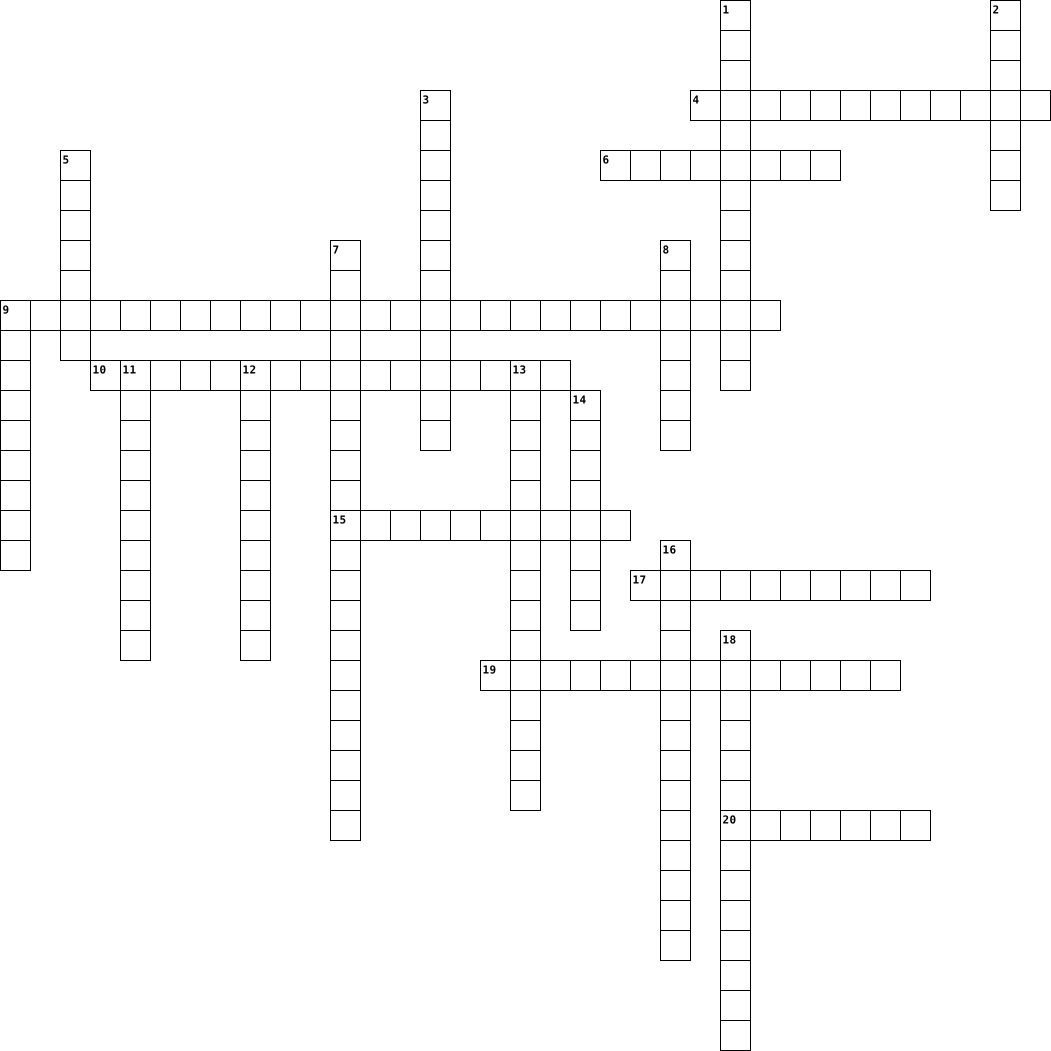
Across
- Another name for placing the sun at the centre with the planets and moon revolving around it
- The angle measured above the horizon in degrees when measuring altitude-azimuth co-ordinates
- Locate a celestial body relative to a fixed Earth (as though the celestial bodies are circling the Earth)
- A set of axes of any kind that is used to describe the positions or motion of things
- Another name for placing Earth at the centre so that the sun, moon and planets revolve around it
- To deflect
- Groupings of stars that form patterns, which appear like objects and are given names
- A device used to measure an object's azimuth
Down
- The large lens at the front of a telescope
- A figure that looks like a squashed circle; planets in the solar system move in elliptical orbits around the sun
- A model of the universe that places at the centre with Earth, the planets and the moon revolving around it.
- The angle measured clockwise from North when measuring altitude-azimuth co-ordinates
- Newton's law states that all objects attract all other objects, and provides an explaination for the planets' elliptical orbits
- Celestial bodies in our solar system, including Earth, that orbits the sun
- A device used to measure the altitude of an object
- To throw or bend back from a surface
- The lens through which you view a magnified object using a telescope
- All objects seen in the sky (sun, moon, stars, and planets)
- Another name in which you can view objects that are magnified using a telescope
- Determines the fineness of detail a telescope can produce of an object in view
- A model of the universe that places Earth at the centre with the sun, moon, and planets revolving around it
21 Clues: To deflect • To throw or bend back from a surface • The large lens at the front of a telescope • A device used to measure an object's azimuth • A device used to measure the altitude of an object • All objects seen in the sky (sun, moon, stars, and planets) • The lens through which you view a magnified object using a telescope • ...
Space Exploration Vocabulary - Units 1 & 2 2014-04-11
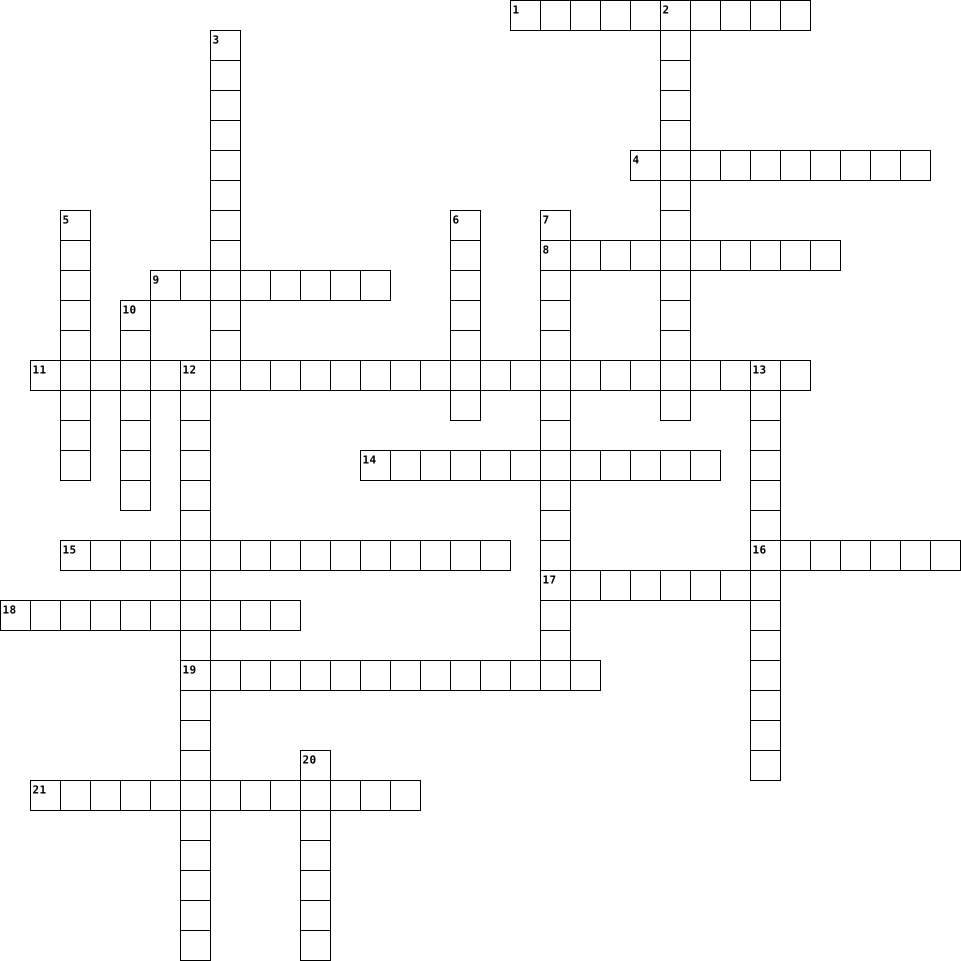
Across
- To throw or bend back from a surface
- Another name for placing Earth at the centre so that the sun, moon and planets revolve around it
- To deflect
- Another name in which you can view objects that are magnified using a telescope
- Locate a celestial body relative to a fixed Earth (as though the celestial bodies are circling the Earth)
- Another name for placing the sun at the centre with the planets and moon revolving around it
- All objects seen in the sky (sun, moon, stars, and planets)
- A device used to measure an object's azimuth
- The angle measured above the horizon in degrees when measuring altitude-azimuth co-ordinates
- The lens through which you view a magnified object using a telescope
- Determines the fineness of detail a telescope can produce of an object in view
- The large lens at the front of a telescope
Down
- Groupings of stars that form patterns, which appear like objects and are given names
- A model of the universe that places at the centre with Earth, the planets and the moon revolving around it.
- A device used to measure the altitude of an object
- Celestial bodies in our solar system, including Earth, that orbits the sun
- A set of axes of any kind that is used to describe the positions or motion of things
- The angle measured clockwise from North when measuring altitude-azimuth co-ordinates
- Newton's law states that all objects attract all other objects, and provides an explaination for the planets' elliptical orbits
- A model of the universe that places Earth at the centre with the sun, moon, and planets revolving around it
- A figure that looks like a squashed circle; planets in the solar system move in elliptical orbits around the sun
21 Clues: To deflect • To throw or bend back from a surface • The large lens at the front of a telescope • A device used to measure an object's azimuth • A device used to measure the altitude of an object • All objects seen in the sky (sun, moon, stars, and planets) • The lens through which you view a magnified object using a telescope • ...
Astronomy Review 2024-01-12

Across
- Oblong dwarf planet, rotates in only 4hrs
- Only dwarf planet in the inner solar system, was once thought an asteroid
- Summer and Winter have this season
- When the moon appears completely dark
- Bright streaks starting from a crater and extending away for long distances.
- Mercury, Venus, Earth, Mars - These are _______ planets
- Smaller, heavier, and further out than Pluto
- The moon shows on just the right or left side
- ~75% of the moon is showing on the right or left side
- When space debris lands on Earth
- When the moon is about halfway visible from the left or right side
- rim Mountains that form during impact due to pressure
- Bowl shaped or flat, below surrounding ground level
- When this object hits the Earth's atmosphere and they start to burn up
- A model of the solar system with the Earth at the center
Down
- Jupiter, Saturn, Uranus, Neptune - These are _______ planets
- Characteristically steep and may have giant "stairs" called terraces.
- The moon appears completely bright
- Fall and Spring have this season
- Space debris made of mainly rock with some iron or icy parts
- Blanket of material surrounding the crater that was excavated during the impact
- The science that deals with the material universe beyond the Earth's atmosphere
- Objects in space that range in size from dust to small asteroids
- The curvature of an orbit
- A model of the solar system with the sun in the center
- This dwarf planet's existence proved another planet isn't actually a plane
- planets get further from the sun, their period of revolution increases, This is Kepler's ____ Law
- A solid body of ice, rock, dust, and/or frozen gasses
- Planets move in elliptical orbits with the sun at one of the foci, This is Kepler's ____ Law
- Was once classified as the 9th planet
30 Clues: The curvature of an orbit • Fall and Spring have this season • When space debris lands on Earth • The moon appears completely bright • Summer and Winter have this season • When the moon appears completely dark • Was once classified as the 9th planet • Oblong dwarf planet, rotates in only 4hrs • Smaller, heavier, and further out than Pluto • ...