
one direction Crossword Puzzles
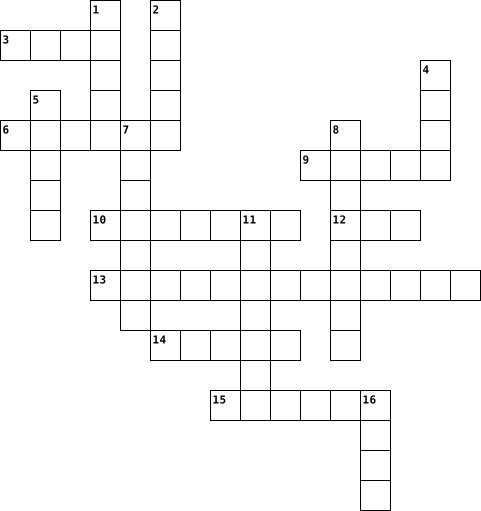
Microsystems M3Ts Final Review 1 2020-06-22

Across
- A written record of what happened at a meeting.
- AC electricity supply in a house or building
- The electrical _____ used in the US has two flat prongs and one round grounding pin in a triangle shape.
- A __ is a diagram that shows the functions and relationships of each part of a circuit, but not the specific components in each part. (two words)
- The prefix "___" represents 1,000,000 times a base unit. For example, a MHz is one million hertz.
- A ___ uses symbols to show all of the components in a circuit and how they are connected. (two words)
- A ___ is an electronic component that allows electricity to go through it in one direction but not the other direction.
Down
- A ___ is a device that stores electrical energy in an electric field. It discharges quicker than a battery.
- where a meeting takes place
- is the process of investigating and solving technical problems
- The ISO (International ___ Organization) helps governments and industries decide which measurements to use.
- An __________ is an electrical device for a specific task, especially one used in the houehold (stove, oven, refrigerator, etc.).
- An _____ is a device that enables an electrical plug from one country to fit into a socket from another country. (Note: this word can be spelled with -er or -or at the end.)
- The prefix " " means one thousandth (1/1000) of a base unit. It is written using a lowercase "m" as in mm, ms, mA, and so on.
14 Clues: where a meeting takes place • AC electricity supply in a house or building • A written record of what happened at a meeting. • is the process of investigating and solving technical problems • The prefix "___" represents 1,000,000 times a base unit. For example, a MHz is one million hertz. • ...
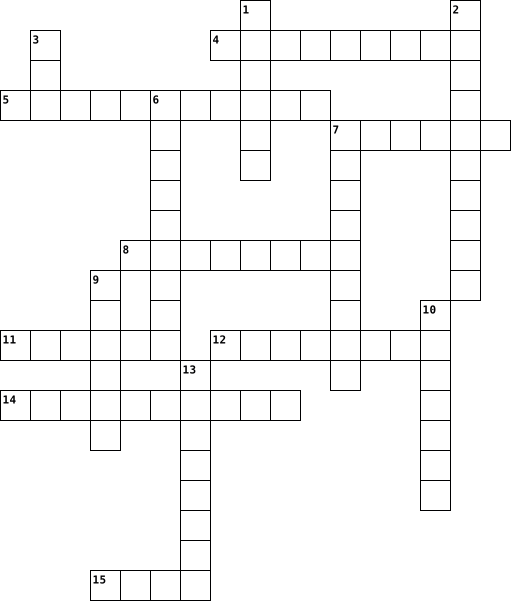
Definition Physics AS 2019-02-24

Across
- mass multiplied by its velocity.
- The turning effect of a force (or moment or torque)about a point is defined as the force x the perpendicular distance from the point to the line of action of the force, i.e. moment = F × d.
- A vector is a quantity that has magnitude and direction.
- A _________ wave is one where the particle oscillations are at 90° (right angles) to the direction of travel (or propagation) of the wave.
- The spring constant is the force per unit extension.
- For a system to be in equilibrium, ∑ anticlockwise moments about a point = ∑ clockwise moments about the same point.
- the spreading out of waves after passing through an aperture or meeting the edge of an obstacle.
- the ratio of stress to strain
- The terminal velocity is the constant, maximum velocity of an object when the resistive forces on it are equal and opposite to the accelerating forces
- A scalar is a quantity that has magnitude only.
- It is the force per unit cross-sectional area when equal opposing forces act on a body.
Down
- The wavelength of a progressive wave is the minimum distance between two points on the wave oscillating in phase.
- _________ states that if two or more waves occupy the same region then the total displacement at any one point is the vector sum of their individual displacements at that point.
- there is no loss of kinetic energy in _____ collision
- Waves or wave sources, which have a constant phase difference between them (and therefore must have the same frequency)
- The amplitude is defined as the maximum displacement of any particle from its equilibrium position.
- Waves which move energy from place to place without the transfer of matter
- The tension in a spring or wire is proportional to its extension from its natural length, provided the extension is not too great.
- A _________ wave is one where the particle oscillations are in line with (parallel to) the direction of travel (or propagation) of the wave.
19 Clues: the ratio of stress to strain • mass multiplied by its velocity. • A scalar is a quantity that has magnitude only. • The spring constant is the force per unit extension. • there is no loss of kinetic energy in _____ collision • A vector is a quantity that has magnitude and direction. • Waves which move energy from place to place without the transfer of matter • ...
science project crossword puzzle 2025-09-24

Across
- strength or energy as an attribute of physical action or movement
- the quantity of motion of a moving body, measured as a product of its mass and velocity.
- the resistive force exerted by a fluid (liquid or gas) on an object moving through it, or between layers of the fluid itself
- a body's relative mass or the quantity of matter cont
- a self-adjusting force that prevents two surfaces in contact from sliding relative to each other when there is no relative motion
- attraction or repulsion that arises between electrically charged particles because of their motion
- he pulling or stretching force transmitted axially along an object such as a string, rope, chain, rod, truss member, or other object, so as to stretch or pull apart the object
- the total force acting on an object, calculated as the vector sum of all individual forces
Down
- the ability or tendency to float in water or air or some other fluid
- forces where the effect of one force is cancelled out by another
- is the force that resists the sliding motion between two surfaces in contact, always acting in the opposite direction of the movement and dependent on the surfaces' materials
- a type of friction that opposes the motion of a rolling object, such as a ball or wheel, as it rolls across a surface
- the force of fundamental attraction between all things that have mass or energy
- It is equal to the force that would give a mass of one kilogram an acceleration of one meter per second per second
- forces that are not equal in magnitude and may or may not act in the same direction
- he repulsive or attractive interaction between any two charged bodies
- a property of matter by which it continues in its existing state of rest or uniform motion in a straight line, unless that state is changed by an external force
- a coherent, typically large body of matter with no definite shape
- the rate at which velocity changes with time, in terms of both speed and direction
19 Clues: a body's relative mass or the quantity of matter cont • forces where the effect of one force is cancelled out by another • strength or energy as an attribute of physical action or movement • a coherent, typically large body of matter with no definite shape • the ability or tendency to float in water or air or some other fluid • ...
Weather and Climate Chapters 1-3 Vocabulary Review 2022-08-17

Across
- measure of the amount of water vapor in the air
- the movement of air
- the layer of air that surrounds Earth
- water that falls from the sky in the form of rain, snow, sleet or hail
- regular patterns of winds that blow from one direction
- to change from gas to liquid
- to change from a liquid to gas
Down
- the direction from which air moves when wind blows
- the gas form of water
- a large body of air in the atmosphere
- the weight of air as it presses on objects below or within it
- what the air outside is like at any given time
- a measure of how fast wind blows
13 Clues: the movement of air • the gas form of water • to change from gas to liquid • to change from a liquid to gas • a measure of how fast wind blows • a large body of air in the atmosphere • the layer of air that surrounds Earth • what the air outside is like at any given time • measure of the amount of water vapor in the air • the direction from which air moves when wind blows • ...
Throwing & Catching 2020-11-12

Across
- rate at which velocity changes with respect to time.
- how often you exercise per week.
- following the path of the object.
- the path in which an object travels.
- physical activity relating to fitness and skill.
- push or pull effect that one object has on another.
- rate of motion in a particular direction.
Down
- Through, continued motion after the release of the object.
- How hard you work.
- a unit of energy you get from food.
- ability to successfully throw an object in a desired direction or to a target.
- impact of an object should be absorbed by "giving" with the entire body.
- stepping towards the target with the non-dominant
13 Clues: How hard you work. • how often you exercise per week. • following the path of the object. • a unit of energy you get from food. • the path in which an object travels. • rate of motion in a particular direction. • physical activity relating to fitness and skill. • stepping towards the target with the non-dominant • push or pull effect that one object has on another. • ...
unit one 2016-10-11

Across
- Strong and healthy
- The action of straightening body to full length.
- To prepare for a sport event by exercising.
- Relating to Olympic Games.
- One of the two breathing organs.
- The upper part of the arm .
- To send something through the air with force.
- To curve.
Down
- A heavy flat object thrown as far as possible.
- A set of gentle exercises to prepare the body for sport .
- Sports such as running and jumping.
- A vehicle with two wheels pulled by a horse.
- Relaxation exercises for mind and body.
- To run very fast for a short distance
- Hot ,bright burning gas
- To make regular movements forwards and backwards.
16 Clues: To curve. • Strong and healthy • Hot ,bright burning gas • Relating to Olympic Games. • The upper part of the arm . • One of the two breathing organs. • Sports such as running and jumping. • To run very fast for a short distance • Relaxation exercises for mind and body. • To prepare for a sport event by exercising. • A vehicle with two wheels pulled by a horse. • ...
Puzzle One 2013-09-27

Across
- custom of having more than one husband at a time
- ending of a marriage legally
- the male line
- relationship
- woman who rules a family
- Family/all generation under one roof
- of marrying eve3n though one is already married
- custom of being married to one person at a time
Down
- condition or practice of having more than one wives at a time
- related people having sexual intercourse
- on the mother as the head of the family or household
- document for ending a marriage
- separation/remains married but is living apart following a court law
- man who rules a family
- state in which a man and a woman are formally united
- individuals position
16 Clues: relationship • the male line • individuals position • man who rules a family • woman who rules a family • ending of a marriage legally • document for ending a marriage • Family/all generation under one roof • related people having sexual intercourse • of marrying eve3n though one is already married • custom of being married to one person at a time • ...
Puzzle One 2013-09-27

Across
- closely related people having sexual intercourse
- an individuals position
- follow the male line
- the ending of a marriage legally
- legal document for ending a marriage
- a woman who rules a family
- a state in which a man and a woman are formally united
- the custom of being married to one person at a time
Down
- blood relationship
- Family/ all generation under one roof
- the condition or practice of having more than one wives at a time
- a man who rules a family
- separation remains married but is living apart following a court law
- crime of marrying eve3n though one is already married
- based on the mother as the head of the family or household
- the custom of having more than one husband at a time
16 Clues: blood relationship • follow the male line • an individuals position • a man who rules a family • a woman who rules a family • the ending of a marriage legally • legal document for ending a marriage • Family/ all generation under one roof • closely related people having sexual intercourse • the custom of being married to one person at a time • ...
German One 2013-12-16

Across
- to disturb
- to tell.infomr
- homeaddress
- to dial
- to seize/take
- to leave
Down
- phonenumber
- a while
- job
- message
- zipcode
- relationship
- sad
- person
- to ring
- to call
16 Clues: job • sad • person • a while • message • zipcode • to dial • to ring • to call • to leave • to disturb • phonenumber • homeaddress • relationship • to seize/take • to tell.infomr
One pice 2022-03-29

Across
- wont hit a woman
- first son of the sea
- best of the revolutionary army
- king of pirates
- soul king
- king of snipers
- suuuuuuppppeeeeerrrrr!
Down
- unlocking everything about the world
- wants all the money
- pops
- greatest swordsman
- fire fist
- strongest dragon
- lowest bounty
- eats a lot
- shogun of wano
16 Clues: pops • fire fist • soul king • eats a lot • lowest bounty • shogun of wano • king of pirates • king of snipers • wont hit a woman • strongest dragon • greatest swordsman • wants all the money • first son of the sea • suuuuuuppppeeeeerrrrr! • best of the revolutionary army • unlocking everything about the world
Episode one 2022-05-13

Across
- храбрый
- умный
- странный
- торопиться
- трусливый
- добрый
- печатная машинка
- пустой
- ползать
Down
- схватить
- эгоистичный
- дружелюбный
- неестественно
- властный
- понимать
- разыгрывать
16 Clues: умный • добрый • пустой • храбрый • ползать • схватить • странный • властный • понимать • трусливый • торопиться • эгоистичный • дружелюбный • разыгрывать • неестественно • печатная машинка
hebrew one 2019-01-29

Across
- sea
- father
- water
- I
- night
- came(f)
- believe
Down
- what
- where
- came
- who
- prophet
- she
- son
- here
- God
16 Clues: I • sea • who • she • son • God • what • came • here • where • water • night • father • prophet • came(f) • believe
Inter one 2025-03-15

Across
- 8
- 4
- 5
- 6
- 15
- 1
- 2
- 10
Down
- 12
- 14
- 7
- 11
- 16
- 9
- 3
- 13
16 Clues: 8 • 7 • 4 • 5 • 9 • 3 • 6 • 1 • 2 • 12 • 14 • 11 • 16 • 13 • 15 • 10
unit one 2025-09-29

Across
- a type of business that the government runs and owns is called a _____ corporation
- when there's something everyone wants only for a little bit its called what?
- a group of companies that make the same kind of products is called what?
- two or people owning a business together is called what?
- two companies come together to make a better one
- if two products are almost the same thing its called ______ goods
- something essential to survive is called a what?
Down
- you don't need it but you ____ it
- when there's something that everyone wants more and more as time goes on can be called what?
- a big company lets other people use their name and branding
- someone vs someone trying to be the best
- if people buy something and the demand of another products go up because they go together it's called __________ goods (eg, car and gas)
- someone doing something for a fee
- when someone owns a business all on their own its called ___ proprietor
- something you can feel and use can be called what?
- a type of business that sells something to someone that wont sell it again
16 Clues: you don't need it but you ____ it • someone doing something for a fee • someone vs someone trying to be the best • two companies come together to make a better one • something essential to survive is called a what? • something you can feel and use can be called what? • two or people owning a business together is called what? • ...
Week one 2025-08-25

Across
- To belong to or purchase
- The 8th month in the year
- Every now and then
- Rhaelynn is in a different __
- Rae takes her ______ off
- She ____ MooMoo
- Mom likes to ____ plants
- Rae hates to go to
Down
- The moon is out at
- Jesus died on the
- Dad ___ in the truck earlier
- Rae flips ____ in the air
- This starts to early
- Happens all the time
- The opposite of run
- the opposite of far
16 Clues: She ____ MooMoo • Jesus died on the • The moon is out at • Every now and then • Rae hates to go to • The opposite of run • the opposite of far • This starts to early • Happens all the time • To belong to or purchase • Rae takes her ______ off • Mom likes to ____ plants • Rae flips ____ in the air • The 8th month in the year • Dad ___ in the truck earlier • Rhaelynn is in a different __
Sound Waves and Hearing 2018-05-09

Across
- The use of echoes,or reflected sound waves to find objects
- The distance from any point on a wave to an identical point on the next wave
- The way that frequency is expressed
- How high or low you think a sound is
- A longitudinal wave that is caused by vibrations and travels through a medium
- Sound waves that have frequencies greater than 20,000 Hz
- A system that uses sound waves to determine the location of objects or to communicate
- Particles move back and forth in the same direction that the wave travels or parallel to the wave
- The speed at which a wave travels
- The time required for one cycle
Down
- The material through which a wave travels
- A common unit used to express loudness
- A disturbance that transfers energy from one place to another
- A disturbance in electric and magnetic fields
- The particles move perpendicularly to the direction the wave travels
- The maximum distance that the particles of wave's medium vibrate from their rest position
- A measure of how well a sound can be heard
- A wave that requires a medium through which to travel
- Tells how many cycles occur in an amount of time, usually 1 s
19 Clues: The time required for one cycle • The speed at which a wave travels • The way that frequency is expressed • How high or low you think a sound is • A common unit used to express loudness • The material through which a wave travels • A measure of how well a sound can be heard • A disturbance in electric and magnetic fields • ...
waves 2016-02-23

Across
- The sensation of a frequency
- what makes a particular musical sound different from another, even when they have the same pitch and loudness
- the change in direction of a wave passing from one medium to another caused by its change in speed
- the number of crests of a wave that move past a given point in a given unit of time
- wave a wave produced by the acceleration of an electric charge and propagated by the periodic variation of intensities of, usually, perpendicular electric and magnetic fields
- a fixed relationship between the phases of waves in a beam of radiation of a single frequency
- the change in direction of a wave front at an interface between two different media so that the wave front returns into the medium from which it originated
- the separation of white light into a color spectrum by a prism
- Angle the angle of incidence that provides an angle of refraction of 90-degrees
- Internal reflection a phenomenon which occurs when a propagating wave strikes a medium boundary at an angle larger than a particular critical angle with respect to the normal to the surface
- A substance that makes possible the transfer of energy from one location to another, especially through waves
- of Reflection the angle that a ray of light or the like, reflected from a surface, makes with a normal to the surface at the point of reflection
- lowest point of a wave
Down
- the highest point of a wave
- Harmonic Motion where the restoring force is directly proportional to the displacement and acts in the direction opposite to that of displacement.
- a unit used to measure the intensity of a sound or the power level of an electrical signal by comparing it with a given level on a logarithmic scale
- The distance between one peaks of a wave to the next corresponding peak
- the reduction of an item's density, the opposite of compression
- the rate at which energy flows through a unit area perpendicular to the direction of wave motion
- power is the ability of an imaging device to separate points of an object that are located at a small angular distance or it is the power of an optical instrument to separate far away objects that are close
- image an image from which rays of reflected or refracted light appear to diverge, as from an image seen in a plane mirror
- difference the difference in path traversed by the two waves, measured in terms of wavelength of the associated wave
- A device that produces a very narrow, highly concentrated beam of light
23 Clues: lowest point of a wave • the highest point of a wave • The sensation of a frequency • the separation of white light into a color spectrum by a prism • the reduction of an item's density, the opposite of compression • The distance between one peaks of a wave to the next corresponding peak • A device that produces a very narrow, highly concentrated beam of light • ...
Motion 2018-08-27

Across
- A famous physicist who proposed the 3 Laws of Motion.
- A device that makes life easier by often reducing the force necessary to do the work.
- This is caused whenever a force is applied to an object and the object moves in the direction of the force.
- The movement of objects.
- The measure of how far and in what direction an object has moved from its starting place.
- How fast an object moves and in what direction it moves from its starting place.
- Another name for the First law of motion is the Law of _______.
- Energy is neither created nor destroyed. This is called the Law of ___________ of Energy.
- For every action there is an equal and opposite reaction. Action/Reaction forces.
Down
- The amount of force an object has due to the gravity of the Earth.
- The units used to measure force.
- A force that acts upon every object, by pulling it to the centre of the Earth. Large bodies being relatively close to one another cause it.
- The rate at which the speed or velocity of an object changes. Also it is the change in direction of a moving object.
- The stored energy an object has. Often it is due to its height.
- A push or a pull.
- resistance A force caused through the motion of an object that reduces its speed.
- A device used to measure through the use of dots the speed or acceleration of an object.
- Force is equal to the mass of the object multiplied by its acceleration.
- The measure of how far an object has moved. Usually measured in metres.
- An object will remain at rest unless acted upon by another or unbalanced force.
- The rate at which an object moves over a distance.
- The energy associated with movement.
22 Clues: A push or a pull. • The movement of objects. • The units used to measure force. • The energy associated with movement. • The rate at which an object moves over a distance. • A famous physicist who proposed the 3 Laws of Motion. • Another name for the First law of motion is the Law of _______. • The stored energy an object has. Often it is due to its height. • ...
Physics Digital Review 2020-12-17

Across
- How close your answers are to the actual value
- motion of an object thrown or projected into the air
- Branch of mathematics that studies relationships between side lengths and angles of triangles
- Is a diagram that shows the force, direction, and vectors of an object
- Set of rules that explains what to do in the science lab
- Goes through one dimensional plane
- Have a size or magnitude only along with a direction
- The amount; the quantity of something
- How close your answers are together
- Goes through at least two dimensional planes
- The rate of change in velocity
- process of experimentation that is used to explore observations and answer
- Quantities, Have a size or magnitude only and no direction
- Based on observations and proven true
- a2 + b2 = c2; used to find the missing side of a triangle
Down
- Analysis that uses physical quantities
- The rate something moves with direction
- Number written in positional notation are digits that carry meaningful contributions to measurements
- The rate something moves
- A method of expressing numbers in terms of a decimal number between 1 and 10 raised to the 10th
- Change in position of an object
- cm
- The variable that stays the same
- explains the object; tells of the quality
- How far you've traveled or how far two things are apart
- The variable that is changed by the experimenter
- The normal way of writing numbers
- Is the branch of physics that describes the motion of points, bodies, and systems of bodies
- The variable that changes in response to the independent
- The why; Explains why something happens
- Units, Universal Measurement
- The total amount of forces acting on an object
- The what; says what happens based on observations
- What is the strength or energy as an attribute of physical action or movement.
- The contact force that goes against the movement of an object.
- kg
36 Clues: cm • kg • The rate something moves • Units, Universal Measurement • The rate of change in velocity • Change in position of an object • The variable that stays the same • The normal way of writing numbers • Goes through one dimensional plane • How close your answers are together • The amount; the quantity of something • Based on observations and proven true • ...
Laws of Motion Review 2021-05-06

Across
- the average location of the mass of a system
- Gravity, electromagnetic, weak and strong nuclear forces are the four ___ forces
- transfer of energy
- an attractive force that occurs between all objects that have mass
- This type of contact force is caused by contact of surfaces. It will either slow down or oppose motion and it will turn motion into heat
- How many laws of motion are there?
- For every action force, there is an equal and opposite reaction force. Forces are always paired.
- Forces are always paired into these two
- a pull or push that is applied to an object
- the rate at which distance is traveled
- a change in velocity over time
- the unit of mass is grams and the unit of force is ___
Down
- the amount of space between one point and another
- States that the greater the force, the greater the acceleration. The greater the mass, the greater the force needed for the same acceleration
- the distance traveled by an object divided by time it traveled
- If vector arrows are in opposite directions, do you add or subtract?
- a vector quantity that indicates both the rate at which displacement changes and the direction of motion
- a physical quantity that has magnitude but no direction
- This is when the forces are not equal and/or are not opposite in direction. The net force will not equal zero and there is change in motion.
- Another name for the law that states that an object at rest stays at rest or an object in motion stays in motion (in the same direction, at the same speed) unless acted upon by an outside force
- These types of forces are equal in size and in opposite directions. The net force is zero. There is no change in motion.
21 Clues: transfer of energy • a change in velocity over time • How many laws of motion are there? • the rate at which distance is traveled • Forces are always paired into these two • a pull or push that is applied to an object • the average location of the mass of a system • the amount of space between one point and another • the unit of mass is grams and the unit of force is ___ • ...
Math 5 Q1 AA 2023-10-15

Across
- The degenerate case of a hyperbola is ____ intersecting lines
- One test used to determine eligibility to be considered a function is the ______ line test.
- The x-values of a function
- The line from B1 and B2 in a hyperbola is called the _____ axis
- The y-values of a function
- In a hyperbola, B1 and B2 are used to designate the ______ (include the hyphen)
- A point and a line are examples of _____ cases
- of symmetry Passes through the vertex and the focus
- If p<0 in x^2 = 4py, the parabola will open in this direction
- Math 5 teacher (without spaces)
- A function with the form f(x) = mx + b
- A fixed points in an ellipse from where the sum of distances is always constant
- When the foci of the ellipse are both moved to be at the center, the resulting conic is a _____
- if p<0 in y^2 = 4px, the parabola will open in this direction
- A function that is a reflection of the exponential function f(x) = a^x along y = x is called ________
Down
- The line that goes through the co-vertices of an ellipse is the _____ axis
- The number of asymptotes in a hyperbola (spelled out)
- The midpoint of the foci
- A line whose midpoint is the parabola's focus and whose endpoints are points in the parabola with the same y-value (no space)
- if p>0 in y^2 = 4px, the parabola will open in this direction
- Parabolas, hyperbolas, ellipses, and circles are called _____ sections
- When the r value in the circle equation is 0, a ____ will appear on the graph
- The maker of this puzzle (without spaces)
- The line passing through the foci and the center is the major _____
- The eccentricity of a circle (spelled out)
- For parabolas, the distance of all points to the focus is the same as the distance to the _______
- If p>0 in x^2 = 4py, the parabola will open in this direction
27 Clues: The midpoint of the foci • The x-values of a function • The y-values of a function • Math 5 teacher (without spaces) • A function with the form f(x) = mx + b • The maker of this puzzle (without spaces) • The eccentricity of a circle (spelled out) • A point and a line are examples of _____ cases • of symmetry Passes through the vertex and the focus • ...
Waves Vocab 2023-12-12

Across
- An object allows some frequencies of visible light to pass through but not others.
- waves- When a wave shakes to the direction of propagation
- Something that takes energy from point to point
- The number of waves that pass a fixed point in unit time
- A region of the electromagnetic radiation spectrum where wavelengths range from about 700 nanometers to 1 millimeter.
- Shorter wavelengths than visible light.
- Measurement of the amount of energy transferred by a wave
- A portion or “band” found at the higher frequency end of the radio spectrum.
- Low point of a wave
- The change in direction of a wave as it passes from one medium to another.
- The time it takes for two successive crests to pass a specified point.
- The rate of change of position of an object in any direction
- waves- A mechanical wave that goes along the interface between media
Down
- waves- Something that travels through a medium
- waves- A wave that is created when several variations of magnetic fields and electricity are intense.
- Materials that allow the transmission of light waves through them
- A piece of glass or other transparent material cut with precise angles and plane faces, useful for analyzing and reflecting light.
- Does not allow transmission of light waves.
- The distance between corresponding points of two consecutive waves
- A transverse wave characterized by alternating magnetic and electric fields propagating perpendicular to the directions of the wave.
- ray- The smallest wavelengths and the most energy of any wave in the electromagnetic spectrum.
- A type of electromagnetic radiation with the longest wavelengths in the electromagnetic spectrum.
- waves- When a wave shakes at right angles
- A point on a surface wave when the displacement of the medium is at the max
- The change in direction of a wavefront at an interface between two different media so that the wavefront returns to the medium from which it originated.
25 Clues: Low point of a wave • Shorter wavelengths than visible light. • waves- When a wave shakes at right angles • Does not allow transmission of light waves. • waves- Something that travels through a medium • Something that takes energy from point to point • The number of waves that pass a fixed point in unit time • waves- When a wave shakes to the direction of propagation • ...
Motion/Force Vocabulary 2024-02-16

Across
- The maximum speed an object will reach when falling through a substance, such as air.
- Distance an object travels per unit of time
- Force that opposes the motion of objects that move through the air.
- Force that opposes the sliding motion between two touching surfaces.
- Rate of change of velocity; can be calculated by dividing the change in the velocity by the time it takes the change to occur
- Distance and direction of an object's change in position from the starting point.
- A force that is directed toward the center of a curved or circular path.
- States that the acceleration of an object is in the same direction as the net force on the object, and that the acceleration equals the net force divided by its mass.
- A change in an object's position relative to a reference point.
- States that if no external forces act on a group of objects, their total momentum does not change.
Down
- States that when one object exerts a force on a second object, the second object exerts a force on the first object that is equal in strength and in the opposite direction.
- States that an object moving at a constant velocity keeps moving at that velocity unless an unbalanced force acts on it.
- Attractive force between two objects that depends on the masses of the objects and the distance between them.
- Gravitational force exerted on an object
- Describes the fall of an object on which only the force of gravity is acting.
- Acceleration of an object toward the center of a curved or circular path.
- The length an object travels, measured in SI units of meters.
- A push or pull exerted on an object.
- Tendency of an object to resist any change in its motion.
- The speed and direction of a moving object
20 Clues: A push or pull exerted on an object. • Gravitational force exerted on an object • The speed and direction of a moving object • Distance an object travels per unit of time • Tendency of an object to resist any change in its motion. • The length an object travels, measured in SI units of meters. • A change in an object's position relative to a reference point. • ...
Newton's Three Law of Motion 2024-02-13

Across
- states that when one object exerts a force on a second object, the second object exerts a force on the first object that is equal in strength and in the opposite direction
- states that an object moving at a constant velocity keeps moving at that velocity unless an unbalanced force acts on it
- rate of change of velocity; can be calculated by dividing the change in the velocity by the time it takes the change to occur
- gravitational force exerted on an object
- tendency of an object to resist any change in its motion
- states that if no external forces act on a group of objects, their total momentum does not change
- a push or pull exerted on an object
- distance and direction of an object’s change in position from the starting point
Down
- a force that is directed toward the center of a curved or a circular path
- a change in an object’s position relative to a reference point
- attractive force between two objects that depends on the masses of the objects and the distance between them
- states that the acceleration of an object is in the same direction as the net force on the object, and that the acceleration equals the net force divided by its mass
- the length an object travels, measured in SI units of meters
- the maximum speed an object will reach when falling through a substance, such as air
- describes the fall of an object on which only the force of gravity is acting
- distance and object travels per unit of time
- the speed and direction of a moving object
- force that opposes the motion of objects that move through the air
- force that opposes the sliding motion between two touching surfaces
- acceleration of an object toward the center of a curved or circular path
20 Clues: a push or pull exerted on an object • gravitational force exerted on an object • the speed and direction of a moving object • distance and object travels per unit of time • tendency of an object to resist any change in its motion • the length an object travels, measured in SI units of meters • a change in an object’s position relative to a reference point • ...
Q Group activity 2026-05-29

Across
- Record or graphical representation of data
- Major Australian city and capital of NSW
- being State of health and happiness
- A set of connected processes or components
- Above average but not flawless
- Ideal outcome with no flaws
- Direction opposite east
- Imaging using high-frequency sound waves
- NSW coastal region south of Sydney
- X‑ray used for early detection of breast cancer
- Movement from one place to another
- Visual result of a radiographic exposure
- Not sufficient or below required standard
- Control panel for imaging equipment
- Degree of opacity seen on an X-ray
- Larger or more extensive
- Country in the United Kingdom
- Patient-reported sign of illness
- Scheduled visit for a procedure or consultation
- Placement of patient or equipment
- Direction opposite south
- NSW region known for wine production
- Method used to achieve optimal imaging
- Person receiving a professional service
- Part of the body examined in mammography
Down
- Organisation for education or research
- Artificial device inserted into the body
- Evaluation or judgement process
- Series of items or names written in order
- Area where land meets the sea
- Direction of the rising sun
- Access credentials for a system
- Middle level or degree
- People engaged in employment
- Amount of radiation used in imaging
- Equipment that can be moved between locations
- Measure of how good an image or service is
- Disease involving uncontrolled cell growth
- Accepted level of quality or practice
- Collaboration between parties
- Process of learning skills
- Location of a service or activity
- Permission given before a procedure
- Administrative region within a country
- Systematic investigation to gain knowledge
- Check for disease before symptoms appear
- Direction opposite north
- Professional who performs medical imaging
- Relating to the south
- Recently made or not existing before
- Located in the middle
- 3D breast imaging technique
52 Clues: Relating to the south • Located in the middle • Middle level or degree • Direction opposite east • Direction opposite north • Larger or more extensive • Direction opposite south • Process of learning skills • Direction of the rising sun • Ideal outcome with no flaws • 3D breast imaging technique • People engaged in employment • Area where land meets the sea • ...
Frisbee 2020-04-02

Across
- The underlying concept of fair play inherent in all respects of the sport of Ultimate.
- An offensive movement characterized by a sharp change of direction, often combined with a change in speed.
- The part of the field in the direction of the offensive team’s end zone relative to thrower. Dump Pass/ A short lateral or backwards pass.
- To begin play, players from each team line on their end zones and the defensive team throws to the other team, as a ‘Kick Off’. Each time a goal is scored, the teams switch the direction of their attack and the team which scored stays in that end zone and throws off to the other.
- Crossing the goal line by any offensive or defensive player prior to the pull.
- Any throw that goes against the defense’s mark.
- When the disc is forcibly knocked from the offensive player’s hands. The disc is returned to the offensive player’s possession and the stall count goes back to 0, unless the call is contested.
Down
- A technique used by the defense to control the direction the disc is moved.
- Pass A pass used to move the disc laterally across the field; often used in conjunction with the dump.
- Any of the six players playing defense not covering the thrower.
- an offensive player in position to receive a pass from a thrower. After catching a pass, the receiver is only allowed the fewest number of steps required to come to a stop and establish a pivot foot.
- The foot upon which the thrower pivots. Usually, it is the opposite foot of the throwing hand.
- Bodily contact by defensive players, usually to the hands or arms of offensive players, which clearly interference with either the throw or the catch. When a foul is called the offending player has the opportunity to ‘contest’ the call, i.e. to declare that it was not a foul. If there is a contest the play is typically redone.
- A pass thrown in front of a receiver in motion, taking into account her/his speed and direction.
- count The amount of time the offensive player with the disc has to throw it. The stall count must be called aloud by the marker at a reasonable pace, beginning with “stalling, one, two, and three...” The player calling the stall must be within 3 meters of the person with the disc in order to count, but must also be at least an arm’s length away from the player.
- When the marker reaches the end of the stall count (ten) before the offensive player has released the disc.
- Big throw by the offense; usually the length of the field.
- Any attempt (offensive or defensive) to do something exciting.
- The defensive player who is guarding the thrower. The marker must be positioned at least one disc’s diameter (approximately one foot) from the thrower and cannot straddle the thrower’s pivot foot.
- A violation that occurs when a defensive players cannot cover her/his opponent because of bodily interference by another player. It is a dangerous play in Ultimate because of the speed with which players are running. Picks don’t have to be intentional and you can be picked by your own teammate.
20 Clues: Any throw that goes against the defense’s mark. • Big throw by the offense; usually the length of the field. • Any attempt (offensive or defensive) to do something exciting. • Any of the six players playing defense not covering the thrower. • A technique used by the defense to control the direction the disc is moved. • ...
Forces 2023-07-19

Across
- two forces equal in size and opposite in direction
- combination of all forces acting on an object
- unit used to measure force (N)
Down
- two or more forces that are unequal in size and direction and therefore change an object's speed, direction or shape
- how much matter or atoms an object has, measured in kg
- force of attraction that objects have on one another due to their masses
- a measure of the gravitational pull on an object
- push or pull acting on an object
8 Clues: unit used to measure force (N) • push or pull acting on an object • combination of all forces acting on an object • a measure of the gravitational pull on an object • two forces equal in size and opposite in direction • how much matter or atoms an object has, measured in kg • force of attraction that objects have on one another due to their masses • ...
Give us a wave 2020-12-06

Across
- The maximum height of a wave-measured from the centre line to the peak.
- A wave where the vibrations causing the wave are parallel to the direction of energy transfer.
- Number of waves produced (or passing a point ) in one second
- A wave where the vibrations causing the wave are at 90⁰ (right angles) to the direction of energy transfer.
- How far a point is from its rest position.
- the time to produce one wave or for one wave to pass a point.
Down
- A periodic disturbance (vibration) that transfers energy from the source to the surroundings.
- A substance through which a wave travels, e.g. air, water, string.
- Position on longitudinal waves where the particles are squashed closest together – highest pressure on sound wave.
- Point of maximum displacement, at the top of a transverse wave.
- Point of maximum displacement at the bottom of a transverse wave
- the distance between a point on a wave and the same point on the next wave.
- Place on longitudinal waves where the particles are most spread out (lowest pressure on sound wave).
13 Clues: How far a point is from its rest position. • Number of waves produced (or passing a point ) in one second • the time to produce one wave or for one wave to pass a point. • Point of maximum displacement, at the top of a transverse wave. • Point of maximum displacement at the bottom of a transverse wave • ...
Wave Vocabulary Definitions 2024-12-10

Across
- A disturbance that transfers energy through space or matter
- the number of Waves that pass a point in one second
- Spectrum The range of all types of electromagnetic radiation,including visible light
- A type of wave where the disturbance moves perpendicular to the direction of the wave
- A type of wave where the disturbance moves parallel to the direction of the wave
- A type of electromagnetic radiation that is visible to the human eye
- The bouncing back of a wave when it hits a surface
- The lowest point of a wave
- light The portion of the electromagnetic spectrum that is visible to the human eye
Down
- The region in a longitudinal wave where particles are closest together
- the bending of a wave as it passes from one medium to another
- The process by which a wave is absorbed by a material and converted to energy
- The region in a longitudinal wave where particles are spread apart
- The distance between successive crests or troughs in a wave
- The highest point of a wave
- The height of a wave from its rest position,related to energy of the wave
- A transparent object that refracts light the converge or diverge beams
17 Clues: The lowest point of a wave • The highest point of a wave • The bouncing back of a wave when it hits a surface • the number of Waves that pass a point in one second • A disturbance that transfers energy through space or matter • The distance between successive crests or troughs in a wave • the bending of a wave as it passes from one medium to another • ...
Waves Part 1 Vocabulary Definitions 2024-12-10

Across
- The range of all types of electromagnetic radiation, including visibile light
- The region in a longitudinal wave where particles are spread apart.
- The distance between successive crests or troughs in a wove
- The height of a wave from its rest position, related to the energy of the wave
- The number of waves that pass a point in one second
- The lowest point of a wave
- The portion of the electromagnetic spectrum that is visible to the human eye
- The bending of a wave as it passes from one medium to another
Down
- A type of wave where the disturbance moves perpendicular to the direction of the wave
- The region in a longitudinal wave where particles are closest together
- A type of wave where the disturbance moves parallel to the direction of the wave
- A transparent object that refracts light to converge or diverge beams.
- A disturbance that transfers energy through space or matter
- The bouncing back of a wave when it hits a surface
- The highest point of a wave
- The process by which a wave is absorbed by a material and converted to energy
- A type of electromagnetic radiation that is visible to the human eye
17 Clues: The lowest point of a wave • The highest point of a wave • The bouncing back of a wave when it hits a surface • The number of waves that pass a point in one second • The distance between successive crests or troughs in a wove • A disturbance that transfers energy through space or matter • The bending of a wave as it passes from one medium to another • ...
y10 after mocks 2023-03-27

Across
- – the area of the Earth's surface where seismographs cannot detect an earthquake after the waves have passed through the earth
- – the alpha particle is the same as the nucleus of which element
- - When waves change direction as they pass through a medium due to a change of speed which is due to a change in density of the material
- –an electrical safety device made of a thin wire
- - Force X distance in the same direction
- - A quantity that has magnitude and direction
- - The rate of transferring energy or the rate of doing work
- – rate of flow of charges
- - The maximum displacement of a point on the wave from its undisturbed (rest) position
- - A system where neither matter nor energy can enter or leave
- - The atomic model that suggested atoms were spheres of positive charges with negative electrons stuck in them is called the
- – You need this to find the instantaneous speed of an accelerating object on a displacement – time graph
- - It’s the velocity of a falling object at which the air resistance and weight are equal
- - Low level radiation that is present at all times is call the _____ radiation
- – unit for spring constant
Down
- - the force acting on an object due to gravity
- - the oscillations are parallel to the direction of energy transfer of the wave
- - at high temperatures, its resistance drops
- - The turning effect of a force
- - a single force that can replace all the forces acting on an object to give the same effect as the original forces acting together
- – the first letter of the colours of the spectrum, starting from the colour with the shortest wavelength
- - If the resultant force on a moving object is zero, the object is not
- – energy transferred per unit charge
- - The distance a vehicle travel after the brakes are applied until it comes to a complete stop as a result of the braking force
- – the beta particle is a fast moving _____
- - The joining together of small nuclei to make larger nuclei (and energy is released)
- – the unit for radioactivity
- – unit of frequency
- - element with the same number of protons but a different number of neutrons
- - the collective term for protons and neutrons
- - A component that only lets current flow in one direction
31 Clues: – unit of frequency • – rate of flow of charges • – unit for spring constant • – the unit for radioactivity • - The turning effect of a force • – energy transferred per unit charge • - Force X distance in the same direction • – the beta particle is a fast moving _____ • - at high temperatures, its resistance drops • - A quantity that has magnitude and direction • ...
Unit One 2015-02-11

Across
- prepared material that can be used legally, without paying a fee to the artist, publishing company, etc; some royalty-free material is available at no cost, however, most
- copyrighted software that is available free of charge on a trial basis
- a career that involves designing and creating the graphics that accompanies text as well as page layouts
- a career that involves designing, creating, and modifying websites
- using a computer and software program to produce high quality, printed documents that combine text and graphics
- software that is provided without charge
- property rights that belong to the community at large, are unprotected by copyright or patent, and are subject to use by anyone
- must be purchased
Down
- laws designed to protect intellectual property rights and provide potential monetary rewards for inventiveness and hard work
- a career involved in the production of video material
- a career that involves taking pictures of subjects such as people, buildings or merchandise to be used in a variety of media
- a person who takes photographs, either as a hobby or a profession
- a career that involves designing or creating graphics to meet specific commercial or promotional needs
- a computer-based communication process that incorporates text, graphics, sound, animation and video
- using technology to convey information
- a section of the U.S. copyright law that allows the use of copyrighted works in reporting news, conducting research, and teaching
16 Clues: must be purchased • using technology to convey information • software that is provided without charge • a career involved in the production of video material • a person who takes photographs, either as a hobby or a profession • a career that involves designing, creating, and modifying websites • copyrighted software that is available free of charge on a trial basis • ...
One Piece 2016-07-28
Across
- Will never lose another duel.
- Super.
- Hands aren't for fighting.
- Princess of an island, also a gladiator.
- Ally of the Straw Hats.
- Three words that pop up at the end of every episode.
- Famous captain who leads tousands of men, also a sniper.
- His son will become the next "Pirate King".
Down
- Need a hand? How about a hundred?
- Ate the rubber fruit.
- Princess of a desert island.
- Rockstar pirate.
- A man who can cut fire.
- Powerless old man, once sailed with the "Pirate King".
- Straw Hat Crew's drug dealer.
- Burglar.
16 Clues: Super. • Burglar. • Rockstar pirate. • Ate the rubber fruit. • A man who can cut fire. • Ally of the Straw Hats. • Hands aren't for fighting. • Princess of a desert island. • Will never lose another duel. • Straw Hat Crew's drug dealer. • Need a hand? How about a hundred? • Princess of an island, also a gladiator. • His son will become the next "Pirate King". • ...
Issue one 2023-09-19

Across
- G in DARING
- Bones
- Popular fall dessert
- Nightmare on ________
- Popular fall style
- The Dark_____
- Its the Great Pumpkin_____
Down
- _____crow
- Music composer for Tim Burton movies
- Bug of the season
- Crunchy_____
- Don't say this 3 times...
- Live, Laugh, _____
- a² +b² =c²
- "I'm just ___"
- Most basic Halloween costume
16 Clues: Bones • _____crow • a² +b² =c² • G in DARING • Crunchy_____ • The Dark_____ • "I'm just ___" • Bug of the season • Live, Laugh, _____ • Popular fall style • Popular fall dessert • Nightmare on ________ • Don't say this 3 times... • Its the Great Pumpkin_____ • Most basic Halloween costume • Music composer for Tim Burton movies
One Piece 2023-03-20
Across
- Prasasti kuno misterius
- Siput komunikasi
- Penunggu Reverse Mountain
- Luffy berasal dari?
- Pemburu Putih
- Julukan Luffy
- Kapal pertama kru Mugiwara
- Nakama pertama Luffy
Down
- Desa tempat Luffy bertemu Shanks
- Desa kelahiran Zoro
- Kakak Luffy
- Nami berperan sebagai . . . . di kapal
- Tempat eksekusi Roger
- Penjaga bar desa Foosha
- Restaurant terapung
- Anak Kapten Morgan
16 Clues: Kakak Luffy • Pemburu Putih • Julukan Luffy • Siput komunikasi • Anak Kapten Morgan • Desa kelahiran Zoro • Luffy berasal dari? • Restaurant terapung • Nakama pertama Luffy • Tempat eksekusi Roger • Prasasti kuno misterius • Penjaga bar desa Foosha • Penunggu Reverse Mountain • Kapal pertama kru Mugiwara • Desa tempat Luffy bertemu Shanks • Nami berperan sebagai . . . . di kapal
Task one 2021-10-18

Across
- telling the difference between right and wrong
- being dishonest
- feeling hopeless and distressed
- get over a problem
- intense questioning
- a group of people that govern a state or a country
- quickly recover from difficulties
- stiff and tight
Down
- not liveable environment e.g. broken down house
- bad luck
- options to overcome a situation
- higher class
- disagreement or argument
- strength to face your fear
- competitive situation or fight
- worth of something
16 Clues: bad luck • higher class • being dishonest • stiff and tight • get over a problem • worth of something • intense questioning • disagreement or argument • strength to face your fear • competitive situation or fight • options to overcome a situation • feeling hopeless and distressed • quickly recover from difficulties • telling the difference between right and wrong • ...
Task one 2021-10-18

Across
- intense questioning
- a group of people that govern a state or a country
- telling the difference between right and wrong
- feeling hopeless and distressed
- stiff and tight
- competitive situation or fight
- quickly recover from difficulties
Down
- being dishonest
- worth of something
- get over a problem
- disagreement or argument
- not liveable environment e.g. broken down house
- options to overcome a situation
- strength to face your fear
- higher class
- bad luck
16 Clues: bad luck • higher class • being dishonest • stiff and tight • worth of something • get over a problem • intense questioning • disagreement or argument • strength to face your fear • competitive situation or fight • options to overcome a situation • feeling hopeless and distressed • quickly recover from difficulties • telling the difference between right and wrong • ...
One year 2024-10-20

Across
- Movie were obsessed with
- what we ate on our first date
- series were watching
- my little bean
- My fav drink
- what we watched for your bday
- I’m ____ for you
- flowers that remind me of you
Down
- You’re my ____
- harana
- where our farm is
- ur nickname for me
- You and I are ____
- What you got me for valentines
- I paid
- I better than you at this game
16 Clues: harana • I paid • My fav drink • You’re my ____ • my little bean • I’m ____ for you • where our farm is • ur nickname for me • You and I are ____ • series were watching • Movie were obsessed with • what we ate on our first date • what we watched for your bday • flowers that remind me of you • What you got me for valentines • I better than you at this game
one more? 2022-10-08

Across
- What you are 24/7
- Name of group chat
- Send me picture of ___ everyday
- It's still mine give it back pls
- My playlist ___
- Birthday month yay
- Your name for me :*
- Your bestieeeeeee
Down
- Please send more ___ videos
- Don't think i can say it enough times
- My Bday gift !!!
- Venky's secret winky winky?
- We're never getting one of these
- The one thing you know how to cook pt2
- Maanasa pose
- The one thing you know how to cook pt1
16 Clues: Maanasa pose • My playlist ___ • My Bday gift !!! • What you are 24/7 • Your bestieeeeeee • Name of group chat • Birthday month yay • Your name for me :* • Please send more ___ videos • Venky's secret winky winky? • Send me picture of ___ everyday • We're never getting one of these • It's still mine give it back pls • Don't think i can say it enough times • ...
New One 2022-07-30

Across
- cheerful, optimistic as in a _________ disposition
- to rest on the surface of, or be suspended in, a fluid
- flat stiff usually small and rectangular pieces of material (such as paper, cardboard, or plastic) usually bearing information: such as baseball players’ picture and statistics
- the name of a famous water float
- deceptive, dexterous, or ingenious feats, especially designed to puzzle or amuse
- a large bird that feeds on fish by diving and have its legs placed far back under the body for optimal locomotion underwater
- rhymes with float or coat
- a charcoal ¬¬¬¬¬¬¬¬¬¬¬¬¬¬¬¬¬¬¬¬________
Down
- the plural of what you’re doing now
- able to be puffed up with air
- the art of producing illusions by sleight of hand
- a usually wooden pier used as a landing place or moorage for boats
- a compartment below deck on a boat used for living accommodations
- the name of where we stayed this summer
- special eating treats during our summer vacation
- cardboard pieces that we have fun with
16 Clues: rhymes with float or coat • able to be puffed up with air • the name of a famous water float • the plural of what you’re doing now • cardboard pieces that we have fun with • the name of where we stayed this summer • a charcoal ¬¬¬¬¬¬¬¬¬¬¬¬¬¬¬¬¬¬¬¬________ • special eating treats during our summer vacation • the art of producing illusions by sleight of hand • ...
One Flame 2022-11-10

Across
- conjunção coordenativa para ligar orações, significando "porque"
- expressa negação.
- privado da liberdade, está submetido à vontade de um senhor
- indivíduo do gênero feminino
- forma conjugada do verbo haver
- flexão do verbo ser na 3ª pessoa do plural
- habitante ou natural da Grécia
- conjunção coordenativa para ligar palavras
- preposição
- segue a religião e/ou a tradição judaica
Down
- que não está sob o jugo
- Redentor
- Conjunto de coisas ou pessoas não especificadas nem determinadas
- conjunção coordenativa para ligar palavras
- ser útil ou prestável a
- artigo indefinido
- indivíduo do gênero masculino
- conjunção coordenativa para ligar palavras
18 Clues: Redentor • preposição • expressa negação. • artigo indefinido • que não está sob o jugo • ser útil ou prestável a • indivíduo do gênero feminino • indivíduo do gênero masculino • forma conjugada do verbo haver • habitante ou natural da Grécia • segue a religião e/ou a tradição judaica • conjunção coordenativa para ligar palavras • flexão do verbo ser na 3ª pessoa do plural • ...
UNIT ONE 2022-09-22

Across
- JAPANESE METHOD WITH SAME AS ACUPUNTURE
- INDIAS FIRST GREAT MEDIACAL WORKS
- OPENED FIRST MASSAGE SCHOOL IN US
- AGE WHEN MASSAGE DECLINED IN EUROPE/ASIA
- FAMOUS ROMAN PHYS. WHO WROTE OF MASSAGE
- INSTITUE OPENED IN 1962
- MOST FAMOUS MEDICINE HISTORY BOOK E&W
- FATHER OF MOD. WESTERN MEDICINE
- EFFORTS LED TO USE OF FRENCH TERMINOLOGY
Down
- CLASSIC SCRIPTURE OF TRAD. CHINESE MED.
- MANUAL MANIPULARION OF SOFT TISSUE
- FOUNDER OF MODERN NURSING
- OF FIRST WRITTEN RECORDS OF MASSAGE
- FATHER OF SWEDISH MASSAGE
- ORG PROVIDING BOARD CERT FOR MASSAGE
- ORG PROVIDING LICEN. EXAMS FOR MASSAGE
16 Clues: INSTITUE OPENED IN 1962 • FOUNDER OF MODERN NURSING • FATHER OF SWEDISH MASSAGE • FATHER OF MOD. WESTERN MEDICINE • INDIAS FIRST GREAT MEDIACAL WORKS • OPENED FIRST MASSAGE SCHOOL IN US • MANUAL MANIPULARION OF SOFT TISSUE • OF FIRST WRITTEN RECORDS OF MASSAGE • ORG PROVIDING BOARD CERT FOR MASSAGE • MOST FAMOUS MEDICINE HISTORY BOOK E&W • ORG PROVIDING LICEN. EXAMS FOR MASSAGE • ...
PHASE ONE 2026-01-25

Across
- COMMUNICATIONS SGT
- STATION ONE
- 673
- 819 ACCIDENT WITH NO INJURIES
- 818 ACCIDENT WITH INJURIES
- PAYROLL WEBSITE
- 251
- EVENING SHIFT SUPERVISOR
- 501 VEHICLE
Down
- 505 VEHICLE
- 603 PREVENTION
- 672
- COMMUNICATIONS CAPTAIN
- 670
- 671
- CONSTABLE
- EVENING SHIFT SUPERVISOR
17 Clues: 672 • 670 • 673 • 671 • 251 • CONSTABLE • 505 VEHICLE • STATION ONE • 501 VEHICLE • 603 PREVENTION • PAYROLL WEBSITE • COMMUNICATIONS SGT • COMMUNICATIONS CAPTAIN • EVENING SHIFT SUPERVISOR • EVENING SHIFT SUPERVISOR • 818 ACCIDENT WITH INJURIES • 819 ACCIDENT WITH NO INJURIES
Pluzzle One 2025-09-09

Across
- very slow; solemn
- part of a melody
- distance in pitch between any two tones
- Distance between lowest tone & highest tone
- term describing music in which one main melody is accompanied by chords
- alphabet ABCDEFG
- performance of two or more melodic lines of relatively equal interest at the same time
- means of playing a string instrument by which the chords are plucked, usually with a finger of the right hand
Down
- lively
- very fast
- as fast as possible
- widely used keyboard instrument of great range & versatility, whose sound is produced by felt-covered hammers striking against steel strings
- shift from one key to another within the same piece
- single melodic line without accompaniment
- relative highness or lowness of a sound
- very soft
- Interval between two tones in which the higher tone has twice the frequency of the lower tone
17 Clues: lively • very fast • very soft • part of a melody • very slow; solemn • as fast as possible • alphabet ABCDEFG • distance in pitch between any two tones • relative highness or lowness of a sound • single melodic line without accompaniment • Distance between lowest tone & highest tone • shift from one key to another within the same piece • ...
one year 2026-02-21

Across
- Favorite way to relax
- Something unique about us
- I Cant wait for you to experience this
- I hope you know how much
- My favorite color for you to wear
- Delilah
- our OG shared music interest
- First Date
- I cant wait to be a...
- You give the best...(besides Stinson)
Down
- 350 Anna Hume Blvd
- First Roadtrip
- Our favorite meal to cook
- Dream Car
- I DO
- My favorite thing about you
16 Clues: I DO • Delilah • Dream Car • First Date • First Roadtrip • 350 Anna Hume Blvd • Favorite way to relax • I cant wait to be a... • I hope you know how much • Something unique about us • Our favorite meal to cook • My favorite thing about you • our OG shared music interest • My favorite color for you to wear • You give the best...(besides Stinson) • I Cant wait for you to experience this
Activity One 2025-12-15

Across
- January
- Sport
- Twenty
- Birthday
- Eleven
- Thank You
- Goodbye
Down
- Rabbit
- Green
- Right
- Silly
- Left
- Hello
- Cat
- Mouse
- Grey
16 Clues: Cat • Left • Grey • Green • Right • Silly • Sport • Hello • Mouse • Rabbit • Twenty • Eleven • January • Goodbye • Birthday • Thank You
the one 2026-01-12

Across
- humorous imitation of another, usually serious work
- Three line stanza
- sounds are almost but not exactly alike
- lines that are musically pleasent to the ear and smooth
- a harsh, discordant mixture or sounds
- rhyme that occurs within a line, rather than at the end
- a condensed form of paradox in which two contradictory words are used together
- a lyric poem usuall marked by serious,repectful, and exalted feelings toward the subject
Down
- an outcome that turns out to be very diffrent from what was expected
- poetry designed to teach an ethical, moral, or religious lesson
- two consecutive lines of poetry that rhyme
- a witty saying expressing a single thought or observation
- rhyme that appears correct from spelling but does not rhyme because of pronunciation
- rhyme that occurs at the end of two or more lines of poetry
- a lyric poem lamenting the dead
- the art of ridiculing a folly or vice in order to expose or correct it
16 Clues: Three line stanza • a lyric poem lamenting the dead • a harsh, discordant mixture or sounds • sounds are almost but not exactly alike • two consecutive lines of poetry that rhyme • humorous imitation of another, usually serious work • lines that are musically pleasent to the ear and smooth • rhyme that occurs within a line, rather than at the end • ...
Puzzle One 2026-05-26

Across
- Roy's best buddy
- Canine "children"
- Carnivorous stalker and ambush predator
- Long-legged fisher
- Every year, an anniversary
- Smoke gets there
- The Old
- I left my heart
- Guns and ___
- Mexican Swordsman
Down
- They carry a trunk wherever they go
- Sometimes called the Arabian
- Three times the original
- Some say it's a choke sandwich
- The person behind the curtain
- People are always trying to keep up with them
16 Clues: The Old • Guns and ___ • I left my heart • Roy's best buddy • Smoke gets there • Canine "children" • Mexican Swordsman • Long-legged fisher • Three times the original • Every year, an anniversary • Sometimes called the Arabian • The person behind the curtain • Some say it's a choke sandwich • They carry a trunk wherever they go • Carnivorous stalker and ambush predator • ...
Light 2023-12-19

Across
- light:light produced by heating a piece of metal, usually tungsten, until it glows.
- Light absorbing colored molecules, such as chlorophyll and carotenoid, in the thylakoid membranes of chloroplasts.
- Material that absorbs or reflects all light And does not transmit any light.
- light:light that can contain more than one wavelength, travel in more than one direction, and has varying distances between the corresponding crests of the waves.
Down
- image Of a distant object produced by the refraction of light through air layers of different density.
- Material that transmits and scattered light so objects viewed through it appear blurry
- light:light generated by using phosphors to convert ultraviolet radiation to visible light.
- Material that transmit light without scattering so that objects are clearly visible through it
- light:light of one wavelength that travels in one direction with a constant distance between the corresponding crests of the waves.
- A transparent material Got selectively transmits light
10 Clues: A transparent material Got selectively transmits light • Material that absorbs or reflects all light And does not transmit any light. • light:light produced by heating a piece of metal, usually tungsten, until it glows. • Material that transmits and scattered light so objects viewed through it appear blurry • ...
Sound Waves and Hearing 2018-05-10

Across
- Tells how many cycles occur in an amount of time.
- WAVE A disturbance in electric and magnetic fields.
- Frequencies greater than 20,000 Hz.
- The use of echoes, or reflected sound waves to find objects.
- WAVE Particles move perpendicularly to the direction the wave travels.
- A disturbance that transfers energy from one place to another.
- How high or low you think a sound is.
- A measure of how far the particles in the medium move away from their normal rest position.
Down
- EFFECT A change in the observed frequency of a wave when the sound source, the observer, or both are moving.
- The distance from any point on a wave to an identical point on the next wave.
- WAVE The particles of a medium vibrate in the same direction that the wave travels.
- A unit of frequency equal to one cycle per second.
- The most common unit used to express loudness.
- A longitudinal wave that is caused by vibrations and travels through a medium.
- WAVE A wave that requires a medium through which to travel.
- The material through which a wave travels.
- A measure of how well a sound can be heard.
17 Clues: Frequencies greater than 20,000 Hz. • How high or low you think a sound is. • The material through which a wave travels. • A measure of how well a sound can be heard. • The most common unit used to express loudness. • Tells how many cycles occur in an amount of time. • A unit of frequency equal to one cycle per second. • ...
Mrs. Harkins 4th Math Chapter 10 2012-10-05

Across
- lines that meet or cross at a point
- the vertical axis on a coordinate plane
- lines that meet or cross each other to form 90 degree angles
- a part of a line that has one endpoint and continues in one direction the other way
- a type of transformation in which a figure is slid horizontally, vertically or both
- two figures having the same size and same shape
- symmetry of a figure which allows it to be folded so the two halves match exactly
- the point at either end of a line segment or the point at the end of a ray
Down
- the point (0,0) on a coordinate plane where the x-axis meets the y-axis
- a type of transformation that flips a figure
- a movement of a figure
- a pair of numbers that are on the coordinate plane
- lines that are the same distance apart and do not meet
- the numbers that make up an ordered pair which graphs a set of points
- the horizontal axis on a coordinate plane
- symmetry of a figure which allows it to be turned about a point
- a straight set of points that extend in opposite direction without ending
17 Clues: a movement of a figure • lines that meet or cross at a point • the vertical axis on a coordinate plane • the horizontal axis on a coordinate plane • a type of transformation that flips a figure • two figures having the same size and same shape • a pair of numbers that are on the coordinate plane • lines that are the same distance apart and do not meet • ...
Homeostasis 2024-11-26

Across
- when a person cannot thermoregulate, and their body temperature drops below 95 degrees
- the force of your blood pressing on the walls of your blood vessels
- when a person has unusually high body temperature
- mechanism to maintain homeostasis; when one factor goes in one direction, another factor will take it in the opposite direction
- this term means to open or make larger
- when a person does not ingest enough water causing them to be ill
- this is a hormone that releases stored sugar into the bloodstream from the liver
- a disorder where a person cannot maintain proper blood sugar levels
Down
- how many times your heart beats every minute
- a device in our homes that controls the air temperature with the heat and Air Conditioning
- this means to close or make smaller
- this term refers to the homeostasis of body temperature
- organ were excess sugar is stored and released using hormones
- this term means balance
- organ that releases Insulin and Glucagon
- the ability to maintain a stable internal environment
- a hormone that works by taking sugar out of the bloodstream to be stored in the liver
17 Clues: this term means balance • this means to close or make smaller • this term means to open or make larger • organ that releases Insulin and Glucagon • how many times your heart beats every minute • when a person has unusually high body temperature • the ability to maintain a stable internal environment • this term refers to the homeostasis of body temperature • ...
Waves Vocabulary definitions 2024-12-10

Across
- The number of waves that pass a point in one second.
- The distance between successive crests or troughs in a wave.
- The highest point of a wave.
- The height of a wave from it's rest position, related to the energy of the wave.
- The lowest point of a wave.
- The portion of the electromagnetic spectrum that is visible to the human eye.
- A transparent object that refracts light to converge or diverge beams.
Down
- The range of all types of electromagnetic radiation, including visible light.
- The bouncing back of a wave when it hits the surface.
- The region in a longitudinal wave where particles are closest together.
- The region in a longitudinal wave where particles are spread apart.
- A type of wave where the disturbance moves parallel to the direction of the wave.
- A disturbance that transfers energy through space or matter.
- The bending of a wave as it passes from one medium to another.
- A type of wave where the disturbance moves perpendicular to the direction of the wave.
- The process by which a wave is absorbed by a material and converted to energy.
- A type of electromagnetic radiation that is visible to the human eye.
17 Clues: The lowest point of a wave. • The highest point of a wave. • The number of waves that pass a point in one second. • The bouncing back of a wave when it hits the surface. • The distance between successive crests or troughs in a wave. • A disturbance that transfers energy through space or matter. • The bending of a wave as it passes from one medium to another. • ...
Electricity Crossword Puzzle 2018-04-10

Across
- A device for making, breaking, or changing the connections in an electrical circuit
- A machine, especially one powered by electricity or internal combustion, that supplies motive power for a vehicle or for some other device with moving parts.
- A stable subatomic particle with a charge of negative electricity, found in all atoms and acting as the primary carrier of electricity in solids.
- A material through which electric current can pass.
- A measurement of the difficulty encountered by a power source in forcing electric current through an electrical circuit, and hence the amount of power dissipated in the circuit.
- The time rate of flow of electric charge.
Down
- circuit Closed circuit in which the current follows one path
- current An electric current flowing in one direction only.
- Conducting connection between an electric circuit or equipment and the earth or some other conducting body.
- current An electric current that reverses its direction many times a second at regular intervals, typically used in power supplies.
- The SI unit of electrical resistance, expressing the resistance in a circuit transmitting a current of one ampere when subjected to a potential difference of one volt.
- A container consisting of one or more cells, in which chemical energy is converted into electricity and used as a source of power.
- circuit A parallel circuit is a closed circuit in which the current divides into two or more paths before recombining to complete the circuit.
- A substance or device that does not readily conduct electricity.
- A schematic diagram, in particular of an electric or electronic circuit.
15 Clues: The time rate of flow of electric charge. • A material through which electric current can pass. • current An electric current flowing in one direction only. • circuit Closed circuit in which the current follows one path • A substance or device that does not readily conduct electricity. • A schematic diagram, in particular of an electric or electronic circuit. • ...
Balanced & Unbalanced Forces Crossword 2023-10-05

Across
- A unit of measure describing force
- A force that resists motion
- How fast an object is moving
- Sum of all forces
- When forces are equal in speed and direction
Down
- Change in velocity (speed and direction)
- When an object moves
- What way an object is facing
- When forces are unequal in speed and direction
- A push or pull
- Speed and direction
11 Clues: A push or pull • Sum of all forces • Speed and direction • When an object moves • A force that resists motion • What way an object is facing • How fast an object is moving • A unit of measure describing force • Change in velocity (speed and direction) • When forces are equal in speed and direction • When forces are unequal in speed and direction
Electronics 2022-07-07

Across
- a unit of electric current equal to a flow of one coulomb per second
- a substance or device that does not readily conduct electricity
- the SI unit of electrical resistance, expressing the resistance in a circuit transmitting a current of one ampere when subjected to a potential difference of one volt.
- the SI unit of electromotive force, the difference of potential that would drive one ampere of current against one ohm resistance
- An electric current that reverses its direction many times a second at regular intervals, typically used in power supplies
- an electromotive force or potential difference expressed in volts
- a flow of electricity which results from the ordered directional movement of electrically charged particles.
- the degree to which a substance or device opposes the passage of an electric current, causing energy dissipation
Down
- Neutron a subatomic particle of about the same mass as a proton but without an electric charge, present in all atomic nuclei except those of ordinary hydrogen
- a stable subatomic particle with a charge of negative electricity, found in all atoms and acting as the primary carrier of electricity in solids
- A law relating the voltage difference between two points, and the electric current flowing between them
- an electric current flowing in one direction only.
- a material or device that conducts or transmits electricity
- The basic unit of a chemical element
- stable subatomic particle occurring in all atomic nuclei, with a positive electric charge equal in magnitude to that of an electron, but of opposite sign
15 Clues: The basic unit of a chemical element • an electric current flowing in one direction only. • a material or device that conducts or transmits electricity • a substance or device that does not readily conduct electricity • an electromotive force or potential difference expressed in volts • a unit of electric current equal to a flow of one coulomb per second • ...
Music & Singers 2020-12-11

Across
- Robert Pattinson's ex-girlfriend
- the nutcracker
- this male singer never goes out of fashion
- girl who hollers
- this female singer moves quickly
- Robin
- warm vs not warm
- George is hushed (hint)
Down
- the 6th member of one direction
- babooshka
- katrina snarf (anagram)
- T.S Eliot Poetry Collection
- Singer who's real name is Abel
- at least ya have ya ...
- Fleetwood Mac song
15 Clues: Robin • babooshka • the nutcracker • girl who hollers • warm vs not warm • Fleetwood Mac song • katrina snarf (anagram) • at least ya have ya ... • George is hushed (hint) • T.S Eliot Poetry Collection • Singer who's real name is Abel • the 6th member of one direction • Robert Pattinson's ex-girlfriend • this female singer moves quickly • this male singer never goes out of fashion
Concept Summary Crossword 2021-10-12

Across
- a quantity having direction as well as magnitude, especially as determining the position of one point in space relative to another.
- the steepness of a straight line on a graph
- represents the position, velocity, and acceleration of an object at various clock readings
- the speed of an object at a particular moment in time.
- the overall rate at which an object moves in a particular direction; total displacement divided by the time interval during which the displacement occurs
- change in position from the starting position to the ending position; a vector quantity
- used to determine if an object is accelerating, decelerating, or moving at a constant speed.
- represents the change in velocity.
- the state of an object being stationary relative to a particular frame of reference or another object.
- speed that does not change
Down
- a set of four equations that can be utilized to predict unknown information about an object's motion if other information is known.
- when an object changes position over time when compared to a reference point
- the limit of the average velocity as the elapsed time approaches zero
- increase in the rate or speed of something.
- how far an object has traveled from its starting position at any given time since it started moving
- velocity that does not change over time
- a physical quantity that is completely described by its magnitude
- how fast something moves; an expression of how much time it takes for a change in position to occur; rate of motion; rate of change of position
- the speed of an object in a particular direction; ratio of change in position to time interval over which change takes place.
- shows the speed and direction an object travels over a specific period of time.
- the separation of two points; the actual distance traveled; a scalar quantity
21 Clues: speed that does not change • represents the change in velocity. • velocity that does not change over time • increase in the rate or speed of something. • the steepness of a straight line on a graph • the speed of an object at a particular moment in time. • a physical quantity that is completely described by its magnitude • ...
Forces 2023-10-30

Across
- A push or a pull
- device: “What I change in the investigation.” (Independent starts with
- Investigation: An investigation or experiment in which the variables are carefully
- An event in which two (or more) bodies exert forces on each other for a
- Also sometimes referred to as a control group.
- amount of something; how large or small something is, represented by the length of the vector arrow.
- a quantity that has a magnitude and a direction; shown by an arrow representing a force in one direction - must be labeled.
- The change in motion due to the object’s changing speed or direction.
- A “downward” force exerted on everything that has mass by the earth.
- and controlled. A fair investigation can be trusted to yield accurate results.
Down
- Pair: The equal and opposite forces always present when two objects are in contact. The objects push together equally or pull apart equally. For example, a book on a table or a balloon on a string. Shown as a dot at the contact of two objects, with equal and opposite vector arrows.
- motion: An object which is not accelerating. Constant motion can mean no
- of time.
- variable: The measured results of the investigation. “This is the variable that depends on what I changed.”
- variable: Variable/condition that is purposely changed in the
- forces: When the sum of the forces on an individual object add up to zero.
- The amount of matter in an object.
- or motion that is not changing in speed or direction.
- of Comparison: Something used to judge or measure against (in an
- When the sum of the forces on an individual object add up to zero.
- Forces: When the sum of the forces on an individual object do not add up to zero.
- Variables/conditions that are kept the same in an investigation.
22 Clues: of time. • A push or a pull • The amount of matter in an object. • Also sometimes referred to as a control group. • or motion that is not changing in speed or direction. • variable: Variable/condition that is purposely changed in the • of Comparison: Something used to judge or measure against (in an • Variables/conditions that are kept the same in an investigation. • ...
Motion crossword puzzle 2024-02-11

Across
- A force that is directed toward the center of a curved or circular path
- The length an object's travels, measured in SI units of meters
- A push or pull exerted on an object
- Force that opposes the sliding motion between two touching surfaces
- Distance and direction of an object's change in position from the starting point
- Force the opposes the motion of objects that move through the air
- States that the acceleration of an object is in the same direction as the net force on the object, and that the acceleration equals the net force divided acts on it
- The speed and direction of a moving object
Down
- States that if no external forces act on a group of objects, their total momentum does not change
- Attractive force between two objects that depends on the masses of the objects and the distance between them
- States that when one objects exerts a force on a second object, the second object exerts a force on the first object that is equal in strength and in the opposite direction
- Distance an object travels per unit of time
- Rate of change of velocity; can be calculated by dividing the change in velocity by the time it takes the change to occur
- States that an object moving at a constant velocity keeps moving at the velocity unless an unbalanced force acts on it
- Acceleration of an object toward the center of a circular path
- Tendency of an object to resist any change in its motion
- Describes the fall of an object on which only the force of gravity is acting
- The maximum speed an object will reach when falling through a substance, such as air
- A change in an object's position relative to a reference point.
- Gravitational force exerted on an object
20 Clues: A push or pull exerted on an object • Gravitational force exerted on an object • The speed and direction of a moving object • Distance an object travels per unit of time • Tendency of an object to resist any change in its motion • Acceleration of an object toward the center of a circular path • The length an object's travels, measured in SI units of meters • ...
forces unit vocab 2025-11-06

Across
- a contact force exerted by a surface on an object, acting perpendicular to the surface
- The rate of change of velocity. It is a vector that indicates a change in speed, direction, or both.
- a simplified graphical representation of all the external forces acting on a single object
- The magnitude of velocity. It is a scalar quantity, meaning it only has magnitude and no direction.
- the property of an object that resists changes to its state of motion
- weight is the force of gravity on an object
Down
- the unique point in a system where the weighted average position of all its mass is located
- A push or pull on an object.
- A force that opposes motion or the tendency of motion between surfaces in contact
- The vector sum of all forces acting on an object.
- a non-contact force that acts on an object through a region of space called a field
- The state where the resultant force on an object is zero. The object is either at rest or moving with a constant velocity.
- the total force acting on an object, calculated as the vector sum of all individual forces
- A quantity with both magnitude and direction, such as displacement, velocity, acceleration, and force.
- a measure of the amount of matter in an object, and it also quantifies an object's inertia, or resistance to a change in motion
- A newton is the SI unit of force, defined as the force required to accelerate a one-kilogram mass at a rate of one meter per second squared
16 Clues: A push or pull on an object. • weight is the force of gravity on an object • The vector sum of all forces acting on an object. • the property of an object that resists changes to its state of motion • A force that opposes motion or the tendency of motion between surfaces in contact • ...
Art Terms 2021-11-30

Across
- Method to soften lines or transition colors
- using perpendicular lines to add value
- How dark or light a color is
- Using lines in one direction to add texture
- you use it to create your art like pencils or ink
Down
- using dots to create value or shape
- used to create the illusion of depth
- Path of a point and can vary in width and length
- look like 3 dimensional shapes of volume and mass
- Flat enclosed areas that are two dimensional
- The way a surface feels or looks like it feels
- used to create shape and direction of light
- Hue produced when light is reflected off an object
13 Clues: How dark or light a color is • using dots to create value or shape • used to create the illusion of depth • using perpendicular lines to add value • Method to soften lines or transition colors • used to create shape and direction of light • Using lines in one direction to add texture • Flat enclosed areas that are two dimensional • ...
Throwing & Catching 2020-11-13

Across
- rate at which velocity changes with respect to time.
- how often you exercise per week.
- following the path of the object.
- the path in which an object travels.
- physical activity relating to fitness and skill.
- push or pull effect that one object has on another.
- rate of motion in a particular direction.
Down
- Through, continued motion after the release of the object.
- How hard you work.
- a unit of energy you get from food.
- ability to successfully throw an object in adesired direction or to a target.
- impact of an object should be absorbed by "giving" with the entire body.
- stepping towards the target with the non-dominant
13 Clues: How hard you work. • how often you exercise per week. • following the path of the object. • a unit of energy you get from food. • the path in which an object travels. • rate of motion in a particular direction. • physical activity relating to fitness and skill. • stepping towards the target with the non-dominant • push or pull effect that one object has on another. • ...
geometry (lines and angles) 2021-10-14

Across
- lines that do not make a right angle
- a dot that represents a place
- lines that are side by side and never touch
- angle with a square corner of 90 degrees
- goes on forever in both ways
- how steep or tilted a line is and the direction it is going
- angle bigger than 90 degrees
Down
- two rays that share an endpoint
- lines that make a right angle
- part of a line that has one start point and goes on forever in the other direction
- flat surface that goes on forever in all directions
- angle that is a straight line and is 180 degrees
- segment a part of a line with a start point and an end point
- angle smaller than 90 degrees
14 Clues: goes on forever in both ways • angle bigger than 90 degrees • lines that make a right angle • a dot that represents a place • angle smaller than 90 degrees • two rays that share an endpoint • lines that do not make a right angle • angle with a square corner of 90 degrees • lines that are side by side and never touch • angle that is a straight line and is 180 degrees • ...
UNIT 1 REVIEW CONCEPTUAL PHYSICS 2023-10-13

Across
- The rate of change of velocity during some time intervals.
- Measures both mass and weight.
- Occurs when giving up on one thing in return for another.
- A limitation or restriction in an engineering design.
- Unit to measure Length.
- The size or amount with units and direction.
Down
- Is the size or amount with a unit.
- A change in position from a starting point to an ending.
- A change in position relative to something else
- What is the 5th step in the Engineering design process?
- The time rate at which an object is moving along a path.
- The amount of matter that something has.
- The rate and direction of an object's movement.
13 Clues: Unit to measure Length. • Measures both mass and weight. • Is the size or amount with a unit. • The amount of matter that something has. • The size or amount with units and direction. • A change in position relative to something else • The rate and direction of an object's movement. • A limitation or restriction in an engineering design. • ...
7.3 2025-10-04

Across
- | An instrument for detecting and measuring small electric currents.
- | A device that converts mechanical energy into electrical energy.
- Current | Electric current that changes direction periodically.
- | A push or pull on an object that can cause motion.
- Current | Electric current that flows in one direction only.
- | Devices that convert chemical energy into electrical energy.
Down
- Induction | The process of generating current using a magnetic field.
- | The point where a current enters or leaves a device.
- | A combination of cells that stores and supplies electrical energy.
- | The unit of electric current.
- | A machine that produces direct current electricity.
- | A looped wire used in electromagnets and generators.
- Panels | Devices that convert sunlight into electrical energy.
13 Clues: | The unit of electric current. • | A push or pull on an object that can cause motion. • | A machine that produces direct current electricity. • | The point where a current enters or leaves a device. • | A looped wire used in electromagnets and generators. • Current | Electric current that flows in one direction only. • ...
Forces 2022-10-13

Across
- Attraction force between any two objects
- Friction that acts on objects that aren't moving
- Force towards the center of a curved path
- Curved path due to gravity and inertia
- Tendency of an object to resist change in motion
- Unequal forces on an object
Down
- Friction encountered when moving in the air
- Force that opposes motion between two surfaces
- Equal forces that are opposite in direction
- Greatest speed reached by falling object
- Force away from the center of a curved path
- Combination of forces on an object
- Friction that occurs when one objects slides
- Friction that occurs when one object rolls
- When one object circles another
- A measure of the force of gravity on an object
- A push or pull
17 Clues: A push or pull • Unequal forces on an object • When one object circles another • Combination of forces on an object • Curved path due to gravity and inertia • Greatest speed reached by falling object • Attraction force between any two objects • Force towards the center of a curved path • Friction that occurs when one object rolls • Friction encountered when moving in the air • ...
Vocab 2022-10-31

Across
- - an arrow whose length represents the magnitude of a quantity and whose direction represents the direction of the quantity
- - an object that falls around the earth or some other body rather than falling into it
- - a quantity that can be completely specified by its magnitude, and has no direction
- - the process of resolving a vector into components
Down
- - the vector sum of two or more component vectors
- - one of the vectors, often mutually perpendicular, whose sum is a resultant vector
- - a quantity that has both magnitude and direction
- - any object that moves through the air or through space, acted on only by gravity (and air resistance, if any)
8 Clues: - the vector sum of two or more component vectors • - a quantity that has both magnitude and direction • - the process of resolving a vector into components • - one of the vectors, often mutually perpendicular, whose sum is a resultant vector • - a quantity that can be completely specified by its magnitude, and has no direction • ...
Week 8 Words 2014-02-16

Across
- opposite of closed
- to show or explain by using examples
- an opportunity or possibility
- to grind up food with your teeth
- a spoken presentation
- you wear it on your wrist to tell time
Down
- if one person is in front of you, then you are
- things that are equal or similar to each other
- examples are North, South, East and West
- to show a sample or model
- to go on a trip or journey
- the amount in one baking
- the standard to be imitated
- to start something
- a place of origin
- not soft
16 Clues: not soft • a place of origin • opposite of closed • to start something • a spoken presentation • the amount in one baking • to show a sample or model • to go on a trip or journey • the standard to be imitated • an opportunity or possibility • to grind up food with your teeth • to show or explain by using examples • you wear it on your wrist to tell time • ...
Challenge #1: Let's go on a blank together 2024-02-03

Across
- I often ask if blank are still good
- Riddle #1
- King of all Manthers no over 26 seen with him
- Every burrito you have gotten from me is from
- God Bless the Rains Down in Africa
- Number one Matthew M. movie ever made
- Riddle #4
Down
- Fleetwood Mac song released 11/28/1987 in US
- only Latin song from Music Tuesday
- Funniest comedic teddy bear
- I think its cute when you twiddle your thumbscause it used to mean you were
- Feeling of disgust
- Riddle#3
- Harry Style lead blank direction
- Bird catches the worm
- Riddle #2
16 Clues: Riddle#3 • Riddle #1 • Riddle #4 • Riddle #2 • Feeling of disgust • Bird catches the worm • Funniest comedic teddy bear • Harry Style lead blank direction • only Latin song from Music Tuesday • God Bless the Rains Down in Africa • I often ask if blank are still good • Number one Matthew M. movie ever made • Fleetwood Mac song released 11/28/1987 in US • ...
AWL 21 and 22 2025-04-23

Across
- a goal or aim
- to go down or decrease
- to say no to something
- to turn or face in a certain direction
- very important or basic
- to help something happen more easily
- but; in contrast, used to compare things
- the space or ability to hold something
- moving from one place to another
- one being or company
Down
- the space around the edge
- having to do with health and doctors
- income, especially from a business
- the same in amount or value
- a way of thinking or viewing something
- to speak or write to someone
16 Clues: a goal or aim • one being or company • to go down or decrease • to say no to something • very important or basic • the space around the edge • the same in amount or value • to speak or write to someone • moving from one place to another • income, especially from a business • having to do with health and doctors • to help something happen more easily • ...
3rd Grade Spelling Word Crossword Puzzle (3) 2026-03-08

Across
- To find your way from one place to another
- To go from one place to another
- A male parent
- The way you go to get somewhere
- A loud shout when scared or excited
- A big road for cars
- A place where kids go to learn
- Not in danger; protected
- To hold onto something
Down
- The main idea or topic
- A very large body of salt water
- To lift something up
- Not hard; simple to do
- Got to a place or goal
- A level or score in school
- To keep something for later or protect it
16 Clues: A male parent • A big road for cars • To lift something up • The main idea or topic • Not hard; simple to do • Got to a place or goal • To hold onto something • Not in danger; protected • A level or score in school • A place where kids go to learn • To go from one place to another • A very large body of salt water • The way you go to get somewhere • A loud shout when scared or excited • ...
James' Crossword Puzzle 2015-03-13

Across
- friction when object moves through fluid meaning a liquid or gas
- anything thrown or shot through the air
- distance and direction of an objects change in position from starting point
- occurs when an object changes position
- includes speed of an object and direction
- friction like force that opposes motion of objects that move through air
- a push or pull applied to an object
- any two masses that exert attractive force on each other
- how far an object has traveled
- rate of change of velocity
Down
- tendency in object to resist any change in motion
- airplane taking off
- friction between a rolling object and what it rolls on
- friction in which two surfaces are not moving past eachother
- distance an object travels per unit of time, rate of change in position
- when two or more forces act on an object
- the resistance that one surface or object encounters when moving over another
- friction where two surfaces sliding past eachother
- an object in motion stays in motion
19 Clues: airplane taking off • rate of change of velocity • how far an object has traveled • a push or pull applied to an object • an object in motion stays in motion • occurs when an object changes position • anything thrown or shot through the air • when two or more forces act on an object • includes speed of an object and direction • ...
Waves Revision 2022-06-14

Across
- A wave changing direction when it bounces off a different material.
- Maximum vibration, measured from the middle of the wave.
- An imaginary line at 90 degrees to the object. It is used to measure all the angles.
- A material that allows no light to pass through.
- Visible light is part of this spectrum.
- Organ of the body that detects noise.
- The unit of wavelength
- A wave changes direction when going through a different material.
- A material that allows all light through it.
Down
- How quiet or loud something is.
- A material that allows some light through it.
- A piece of material that only allows light of a particular colour to pass through.
- The distance between two identical points on a wave.
- Light can travel through it but sound can't.
- The number of waves produced in one second.
- Sound is a wave of _________.
- Organ of the body that detects light.
- The unit of frequency
- The musical equivalent to frequency.
19 Clues: The unit of frequency • The unit of wavelength • Sound is a wave of _________. • How quiet or loud something is. • The musical equivalent to frequency. • Organ of the body that detects noise. • Organ of the body that detects light. • Visible light is part of this spectrum. • The number of waves produced in one second. • Light can travel through it but sound can't. • ...
Challenge #1: Let's go on a blank together 2024-02-03

Across
- I often ask if blank are still good
- Riddle #1
- King of all Manthers no over 26 seen with him
- Every burrito you have gotten from me is from
- God Bless the Rains Down in Africa
- Number one Matthew M. movie ever made
- Riddle #4
Down
- Fleetwood Mac song released 11/28/1987 in US
- only Latin song from Music Tuesday
- Funniest comedic teddy bear
- I think its cute when you twiddle your thumbs cause meant you were blank
- Feeling of disgust
- Riddle#3
- Harry Style lead blank direction
- Bird catches the worm
- Riddle #2
16 Clues: Riddle#3 • Riddle #1 • Riddle #4 • Riddle #2 • Feeling of disgust • Bird catches the worm • Funniest comedic teddy bear • Harry Style lead blank direction • only Latin song from Music Tuesday • God Bless the Rains Down in Africa • I often ask if blank are still good • Number one Matthew M. movie ever made • Fleetwood Mac song released 11/28/1987 in US • ...
The solar system 2024-04-11

Across
- Burnt lava
- Moon of Mars
- Earth's movement on its axis
- Days takes for the Earth to make one complete movement around the sun
- Days taken for the Moon to make one complete movement around the earth
- Baby cones on the sides of volcanoes
- Island made up of layers of lava
- Number of planets
- model of the earth
Down
- Earth's movement around sun
- Places at risk of volcanic eruption
- When a vent widens
- direction in which the Earth spins in
- Hours taken for 1 rotation
- Volcanic materials flow up this
- Where are asteroids found
16 Clues: Burnt lava • Moon of Mars • Number of planets • When a vent widens • model of the earth • Where are asteroids found • Hours taken for 1 rotation • Earth's movement around sun • Earth's movement on its axis • Volcanic materials flow up this • Island made up of layers of lava • Places at risk of volcanic eruption • Baby cones on the sides of volcanoes • ...
REVISIONS S2 2025-03-31

Across
- A visual representation of data, often used to display numbers and trends
- The highest point
- a rise in something
- A general direction in which something is developing or changing over time
- numbers
- the exchange of goods and services for money
- to rise dramatically
- 1000
Down
- A sharp fall or drop, especially in value or numbers
- One of four equal parts of a whole
- stable, unchanging
- competences
- The financial expert responsible for managing financial records
- This refers to one of three equal parts
- %
- A representation of a trend or data typically in bars or lines
16 Clues: % • 1000 • numbers • competences • The highest point • stable, unchanging • a rise in something • to rise dramatically • One of four equal parts of a whole • This refers to one of three equal parts • the exchange of goods and services for money • A sharp fall or drop, especially in value or numbers • A representation of a trend or data typically in bars or lines • ...
Final Test Review 2021-11-29

Across
- glucose is a type of what
- process by which plants turn energy from the sun
- a=s/t
- p=mv
- forces in the same direction
- makes an object move
- law of action-reaction
- a magnet using electricity
- forces in the opposite direction
- glucose and what are the inputs of photosynthesis
- powerhouse of the plant cell
Down
- natural magnet
- a net force of zero
- law of inertia
- has its on magnetic field
- pores of a plant
- law of acceleration
- the only difference between speed and velocity
- ATP is what
- s=d/t
- measurement for force
- type of magnet a paperclip is
22 Clues: p=mv • a=s/t • s=d/t • ATP is what • natural magnet • law of inertia • pores of a plant • a net force of zero • law of acceleration • makes an object move • measurement for force • law of action-reaction • glucose is a type of what • has its on magnetic field • a magnet using electricity • forces in the same direction • powerhouse of the plant cell • type of magnet a paperclip is • ...
Week 2 - Why Do We Plan? – The Purpose of Strategic Planning 2025-06-06

Across
- Outcomes organisations work towards
- The outcome of good planning
- What planning builds by connecting actions to purpose
- Allocating people and funds to priorities
- Moving plans into action
- Specific, measurable results
- A statement of purpose
Down
- Understanding external trends
- Key achievements along the planning path
- The documented strategy and steps
- Adjusting plans when reality shifts
- Ability to adjust strategies
- What matters most when planning
- Correction Adjusting strategy based on feedback
- Building ownership among teams
- Ensuring efforts point in the same direction
- What planning provides about priorities
- Statement Describes a desired future state
- Planning Setting direction for the future
- Making departments work together effectively
20 Clues: A statement of purpose • Moving plans into action • The outcome of good planning • Ability to adjust strategies • Specific, measurable results • Understanding external trends • Building ownership among teams • What matters most when planning • The documented strategy and steps • Outcomes organisations work towards • Adjusting plans when reality shifts • ...
Sounds Amazing 2017-04-08

Across
- when an object moves back and forth in a repeated motion
- the time taken for a complete wave to pass a point
- how many waves or oscillations per second
- region of a sound wave or wave on longitudinal slinky where the particles (or slinks) are very close together
- a type of wave in which the oscillations are perpendicular to the direction of travel (direction of energy transfer)
- a measure of the frequency of a sound, described as high or low
- a type of wave in which the oscillations are parallel to the direction of travel (direction of energy transfer)
- transmits energy but not matter, sound and light are examples of this
- to allow energy (from waves) to pass through
- the size of a wave, on a graph this is the distance from a peak to the middle of the wave or half the distance between a peak and a trough
Down
- unit for loudness in sound
- region of a sound wave or wave on a longitudinal slinky where the particles (or slinks) are very far apart
- to take in energy (from waves), usually energy turns into heat (thermal)
- when an object moves back and forth in a repeated motion
- when a wave returns in the direction that it came from after hitting an object (the energy travels in the opposite direction)
- the unit of frequency
- a device that creates sound waves of particular shapes depending on how it is operated
- the distance between two peaks, two troughs or two compressions on a wave
- the perceived energy of a sound wave, a measure of the amplitude of the wave measured in decibels
- a type of longitudinal wave characteristized by particles pa
- distance / time. In terms of waves it is how far a wave travels in a unit time (usually metres per second)
21 Clues: the unit of frequency • unit for loudness in sound • how many waves or oscillations per second • to allow energy (from waves) to pass through • the time taken for a complete wave to pass a point • when an object moves back and forth in a repeated motion • when an object moves back and forth in a repeated motion • ...
another one 2023-03-08

Across
- chubby black cat
- ili's favourite summer drink
- nickname for Merja's car
- it is very easy to understand
- the real name of Sofia's and Ilona's downstairs neighbor
- when should the optimal body score for a sow is 3,5
- how many animal species does Valtteri have?
- where are Ilona and Ili going for the summer?
Down
- a hobby btw Merja, Ili and Sofia
- what happens on the 13th of May
- topic of yesterday's surgery lecture
- Pekka's drink of the day
- with 2 where are we gonna watch it?
- game to unleash ones artistic abilities
- what happens this Friday
- step 1 for rectal examination in mare/cow
16 Clues: chubby black cat • Pekka's drink of the day • nickname for Merja's car • what happens this Friday • ili's favourite summer drink • it is very easy to understand • what happens on the 13th of May • a hobby btw Merja, Ili and Sofia • with 2 where are we gonna watch it? • topic of yesterday's surgery lecture • game to unleash ones artistic abilities • ...
Lesson one 2023-02-25

Across
- 知道
- 給予
- 百
- 幾乎
- 或者
- 每一
- 千
- 只有
Down
- 週末
- 蔬菜
- 對抗、打擊
- 小時
- 足夠的
- 錢
- 餓的
- 相同的
16 Clues: 百 • 錢 • 千 • 週末 • 蔬菜 • 小時 • 知道 • 給予 • 幾乎 • 或者 • 每一 • 餓的 • 只有 • 足夠的 • 相同的 • 對抗、打擊
Semester One 2017-06-28

Across
- slavery in children
- best religion teacher
- Jesus died on one
- never believe in another god
- being eaten by lions
- this nations backbone
- to help others without pay
- a story that teaches us a message
Down
- he built the ark
- A man who burnt and executed Christians
- god gave him the Ten Commandments
- A story about a man dying on a road when people walk past only the enime helps him
- A man who calms water
- to donate to the poor
- Also known as snail fever
- worm A person becomes infected when they drink water that contains water fleas
16 Clues: he built the ark • Jesus died on one • slavery in children • being eaten by lions • best religion teacher • A man who calms water • to donate to the poor • this nations backbone • Also known as snail fever • to help others without pay • never believe in another god • god gave him the Ten Commandments • a story that teaches us a message • A man who burnt and executed Christians • ...
Unit One 2020-02-09

Across
- of little importance
- a strong opinion or belief
- involving or causing sudden great damage or suffering
- to continue trying to do or achieve sth. despite difficulties
- to make a sudden movement with your face or body as a result of pain, fear, surprise, etc.
- (of a situation) extremely or dangerously
- put an end to
Down
- politely congratulate or praise sb. for sth.
- serious and difficult
- giving an appearance or impression different from the true one
- an unfortunate condition or event
- very great in amount
- having or showing new and exciting ideas
- a great victory or achievement
- to go somewhere even though you know that it might be dangerous or unpleasant
- a person or thing that causes, or may cause, serious damage, harm or danger
16 Clues: put an end to • of little importance • very great in amount • serious and difficult • a strong opinion or belief • a great victory or achievement • an unfortunate condition or event • having or showing new and exciting ideas • (of a situation) extremely or dangerously • politely congratulate or praise sb. for sth. • involving or causing sudden great damage or suffering • ...
Puzzle One 2021-02-10

Across
- the colour of sunshine
- the bamboo eating cuddle
- chugs to places
- very angry
- the source of light
- where the queen rules
- third rock from the sun
- how much do you weigh?
- come in
- where flowers grow among mountains
Down
- the city of love
- 22 of these in cricket
- truly evil
- a dance form for two
- wish someone
- imagination may come true
16 Clues: come in • truly evil • very angry • wish someone • chugs to places • the city of love • the source of light • a dance form for two • where the queen rules • the colour of sunshine • 22 of these in cricket • how much do you weigh? • third rock from the sun • the bamboo eating cuddle • imagination may come true • where flowers grow among mountains
One Piece 2022-05-18
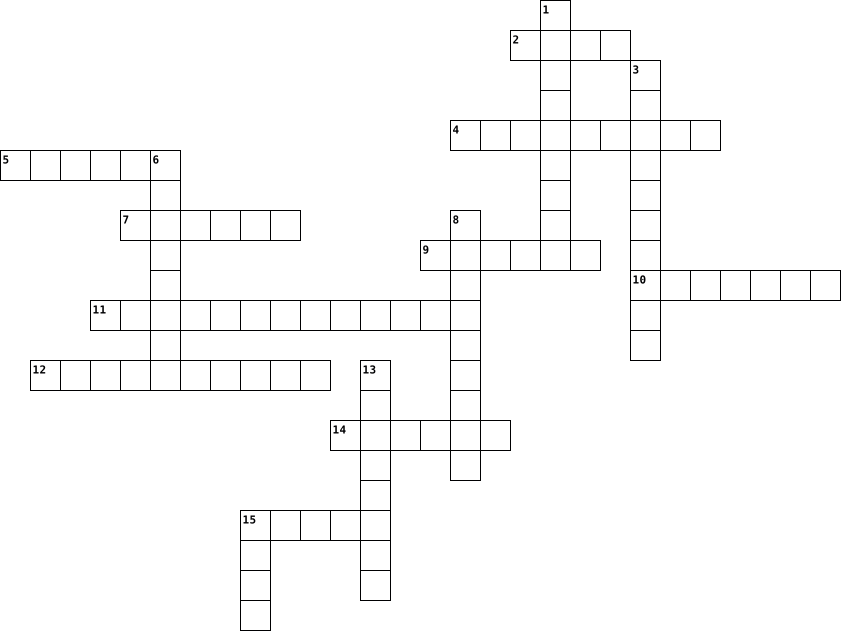
Across
- Pink-haired "future admiral", trained by Luffy's grandfather
- Nami's favorite fruit
- Zoro's tripling demon sword form
- Trafalgar D. Law's other middle name
- Village where Luffy was born
- Trained Luffy over the time-skip
- Post time-skip Fishman arc
- In love with Luffy, but faces constant rejection
- Legendary island that holds the one piece
- Blonde Vinsmoke son, also meaning "3 o'clock"
Down
- Encrypted ancient rock messages
- First ship of the straw hats
- Viv's sand kingdom
- Ace's father
- Position in which Whitebeard died
- Post time-skip, Brooke is known as the ___ King
16 Clues: Ace's father • Viv's sand kingdom • Nami's favorite fruit • Post time-skip Fishman arc • First ship of the straw hats • Village where Luffy was born • Encrypted ancient rock messages • Zoro's tripling demon sword form • Trained Luffy over the time-skip • Position in which Whitebeard died • Trafalgar D. Law's other middle name • Legendary island that holds the one piece • ...
chapter one 2019-08-15

Across
- biology the complete development of an individual from fertilization to death
- the first eight weeks of development after fertilization of a human egg
- structure of specific systems of the body such as the nervous or respiratory systems
- the careful cutting apart of body structures to study their relationships
- microscopic structure of tissues
- structure changes(gross to microscopic) associated with disease
Down
- structure that can be examnined without a microscope
- functional properties of nerve cells
- functions of individual molecules such as proteins and DNA
- cellular structure and functions
- hormones (chemical regulators) and how they control body functions
- specific regions of the body such as the head or chest
- surface markings of the body to understand internal anatomy through visualization and palpation (gentle touch)
- internal body structures that can be visualized with techniques such as xray, mri, ct scan and other technoglogies for clinical analysis and medical intervention
- the science of body structures and the relationships among them
- the science of body functions-how the body works
16 Clues: cellular structure and functions • microscopic structure of tissues • functional properties of nerve cells • the science of body functions-how the body works • structure that can be examnined without a microscope • specific regions of the body such as the head or chest • functions of individual molecules such as proteins and DNA • ...
Puzzle One 2023-07-28

Across
- In a natural manner
- Rapid circular motion.
- The short term state of the atmosphere
- Ill will or hatred toward another
- Worthy of being remarked or noted; notable
- To stir together
- The answer to a problem
- Insane, mad, crazy.
- Anything that nourishes or sustains.
Down
- One’s female offspring
- Distance between the two ends of a line segment.
- To make melancholy; to sadden or grieve (someone).
- The people living within a geographical region
- A container of liquid or other substance
- Any large flow of a liquid in a single body.
- An expression of appreciation; a thought.
16 Clues: To stir together • In a natural manner • Insane, mad, crazy. • One’s female offspring • Rapid circular motion. • The answer to a problem • Ill will or hatred toward another • Anything that nourishes or sustains. • The short term state of the atmosphere • A container of liquid or other substance • An expression of appreciation; a thought. • ...
One Love 2024-02-14

Across
- When we travel internationally we will go here
- I say this every time before leaving
- ___ and arsicault croissants
- when I'm ___ it brings the worst out of me
- You ask for it any time during the day, even before bed
- You can't get enough of this
- Almost every karachiite says this(2 words)
- Where was our first kiss?
Down
- The first thing we cooked together
- '____ tou mai bilkul nai khata'
- Where was our first road trip?
- The bird or hot boys?
- I'm a ___ girl lol
- One thing I made you like
- Wildcard
- "Mai ki karaan"
16 Clues: Wildcard • "Mai ki karaan" • I'm a ___ girl lol • The bird or hot boys? • One thing I made you like • Where was our first kiss? • ___ and arsicault croissants • You can't get enough of this • Where was our first road trip? • '____ tou mai bilkul nai khata' • The first thing we cooked together • I say this every time before leaving • when I'm ___ it brings the worst out of me • ...
BURST ONE 2025-09-30

Across
- I am going to ______ into a new apartment.
- I will ____ to California.
- opposite of above
- How _____ the movie?
- I would, if I ______
- opposite of below
- Do you _____ the music?
- I _____ want to go to the wedding.
- If you could go ______, where would it be?
- Do you know ____ to play the game?
Down
- lead don't _____
- I will look at the ______, so I can see how to do it.
- There is ______ wrong with my iphone.
- I will buy _____ the toy and the candy.
- I have no _____ how to play the game.
- I just bought a _____ TV.
16 Clues: lead don't _____ • opposite of above • opposite of below • How _____ the movie? • I would, if I ______ • Do you _____ the music? • I just bought a _____ TV. • I will ____ to California. • I _____ want to go to the wedding. • Do you know ____ to play the game? • There is ______ wrong with my iphone. • I have no _____ how to play the game. • I will buy _____ the toy and the candy. • ...
uni 2022-09-28

Across
- (adj) moving in only one direction
- (n) a one-wheeled vehicle on which the rider sits and pedals
- (n) a one-piece leotard and tights combination
- (adj) having only one cell
- (n) one group
Down
- (v) to join together into one group
- (n) an instance of saying the same words or sounds at the
- time; in group that sounds like one
- (adj) one of a kind; unusual or rare
9 Clues: (adj) having only one cell • (n) one group • (adj) moving in only one direction • time; in group that sounds like one • (v) to join together into one group • (adj) one of a kind; unusual or rare • (n) a one-piece leotard and tights combination • (n) an instance of saying the same words or sounds at the • ...
currents, tides, waves & climate 2024-04-02

Across
- a type of wave that travels in the direction of the medium
- occurs because water waves contain components of both longitudinal and transverse waves, leading to circular motion
- a natural climate phenomenon marked by warmer-than-average sea surface temperatures in the central and eastern Pacific Ocean near the equator
- The highest surface part of a wave
- the rise and fall of sea levels caused by the combined effects of the gravitational forces exerted by the Moon
- motion in which all points on a wave oscillate along paths at right angles to the direction of the wave's advance.
- The lowest part
Down
- the movement of water from one location to another.
- the state of the atmosphere, including temperature, atmospheric pressure, wind, humidity, precipitation, and cloud cover
- a large system of rotating ocean currents.
- the periodic cooling of ocean surface temperatures in the central and east-central equatorial Pacific.
- the general weather over a long period
- circulating air is deflected toward the right in the Northern Hemisphere and toward the left in the Southern Hemisphere
- distance from one wave to another
- a storm with a violent wind, in particular a tropical cyclone in the Caribbean.
- The time it takes for two successive crests (one wavelength) to pass a specified point
- the number of waves that pass a fixed point in a given amount of time.
17 Clues: The lowest part • distance from one wave to another • The highest surface part of a wave • the general weather over a long period • a large system of rotating ocean currents. • the movement of water from one location to another. • a type of wave that travels in the direction of the medium • the number of waves that pass a fixed point in a given amount of time. • ...
Spelling Module 8 Week 2 Crossword 2022-07-18

Across
- something no one can see
- to treat badly
- to send away
- to guide in the wrong direction
- something you suddenly can't see
- not in a straight line or course
- to lose respect
- shaky or unsteady
Down
- to lie or avoid the truth
- unfinished
- unneeded
- a sudden event causing destruction
- showing a false feeling
- to have a different opinion
- not smart
15 Clues: unneeded • not smart • unfinished • to send away • to treat badly • to lose respect • shaky or unsteady • showing a false feeling • something no one can see • to lie or avoid the truth • to have a different opinion • to guide in the wrong direction • something you suddenly can't see • not in a straight line or course • a sudden event causing destruction
Crossword 2024-04-15

Across
- credible, believable
- get rid of
- very thorough and careful
- lessen the effectiveness
- being of one mind
- spreading widely
- a thing that motivates or encourages someone to do something
Down
- an imperfection
- with evil intentions
- reasonable and valid (e.g. advice)
- new
- having a good reputation
- leaning towards a certain direction
- a word you use to say smth is unfortunate
- strict, precise, exact
15 Clues: new • get rid of • an imperfection • spreading widely • being of one mind • with evil intentions • credible, believable • strict, precise, exact • having a good reputation • lessen the effectiveness • very thorough and careful • reasonable and valid (e.g. advice) • leaning towards a certain direction • a word you use to say smth is unfortunate • ...
Family & Parenting 2026-09-19

Across
- Female parent
- Training and correction
- Teaching children what is right
- Male parent
- Sons and daughters
- What is passed from one generation to another
Down
- Favor or gift received from God
- Direction given to another
- Lasting influence left behind
- Supplying necessities
- Keeping loved ones safe
- Caring for growth and development
- Mother or father
- Basic household unit
- Behavior children can imitate
15 Clues: Male parent • Female parent • Mother or father • Sons and daughters • Basic household unit • Supplying necessities • Keeping loved ones safe • Training and correction • Direction given to another • Lasting influence left behind • Behavior children can imitate • Favor or gift received from God • Teaching children what is right • Caring for growth and development • ...
Wave basics 2023-01-04

Across
- A unit for angle, often used for measuring the phase difference between two waves
- A wave in which the energy travels continuously outward away from the source
- The 'spreading out' of wave energy as a wave goes through a gap.
- Light coming from the sun is ___________
- a wave where the oscillation of particles is perpendicular to the direction of travel of the wave
- A type of interference in which two waves cancel each other out
- A frequency of 4 Hz means four waves pass each ______
Down
- A type of wave that needs a material (medium) to travel through
- The maximum displacement of particles in a wave
- 330 m/s is the speed of this type of wave through air
- the opposite of crest
- When two or more waves meet
- In a longitudinal wave, the oscillation of particles is _______ to the direction of travel of the wave
- The time between one wave crest arriving and the next wave crest arriving
- Light is an example of this type of wave
- A type of wave in which energy remains confined in a fixed region
- the distance from one crest of a wave to the next
17 Clues: the opposite of crest • When two or more waves meet • Light coming from the sun is ___________ • Light is an example of this type of wave • The maximum displacement of particles in a wave • the distance from one crest of a wave to the next • 330 m/s is the speed of this type of wave through air • A frequency of 4 Hz means four waves pass each ______ • ...
Vocabulary Words #1 2023-11-20

Across
- Celebrations or events where people come together to enjoy music, food, and activities.
- The time in the evening when the sun disappears below the horizon.
- The line where the sky seems to meet the Earth.
- Substances in food that provide growth and health.
- Animals or activities that happen at night.
- The time of day when the sky starts getting light but the sun is still below the horizon.
- up To make something brighter.
- The front lights of a vehicle, used for lighting the road ahead.
- The time of the evening just before it becomes completely dark; when the sun is below the horizon but there is still some light in the sky.
Down
- The time in the morning when the sun first appears in the sky.
- The direction opposite to north; one of the cardinal directions.
- A living creature that produces light.
- Lights on poles along roads to help vehicles and people see in the dark.
- The state of being without light.
- The direction opposite to south; one of the cardinal directions.
- A person, place or event where there is a lot of movement and energy.
- Having little or no light.
17 Clues: Having little or no light. • up To make something brighter. • The state of being without light. • A living creature that produces light. • Animals or activities that happen at night. • The line where the sky seems to meet the Earth. • Substances in food that provide growth and health. • The time in the morning when the sun first appears in the sky. • ...
Physical Science Chapter 13 Vocabulary 2023-10-04

Across
- Work = Force times _________.
- The _________________ Family contains the Simple Inclined Plane, the Wedge, and the Screw.
- A quantity that measures the rate at which work is done or energy is transformed.
- ____________ help do work by changing the size of an input force, the direction of the force, or both.
- Gravitational Potential Energy = _______ times acceleration due to gravity times height.
- The _________ Family contains the Simple Lever, the Pulley, and the Wheel and Axle.
- Power = Work divided by _______.
- The SI unit used to express work is the _______.
- The energy that an object has because of the position, shape, or condition of the object.
- The transfer of energy to an object by the application of a force that causes the object to move in the direction of the force.
Down
- A quantity that expresses how much a machine multiplies force or distance
- The sum of the kinetic energy and the potential energy in a system.
- A machine made of more than one simple machine.
- The energy of an object due to the object's motion.
- The ability to do work.
- The SI unit used to express power is the ________.
- The SI unit used to express energy is the ________.
- Kinetic Energy = one-half an object's mass times ___________ squared.
18 Clues: The ability to do work. • Work = Force times _________. • Power = Work divided by _______. • A machine made of more than one simple machine. • The SI unit used to express work is the _______. • The SI unit used to express power is the ________. • The energy of an object due to the object's motion. • The SI unit used to express energy is the ________. • ...
Waves part 1 Vocab Definitions 2024-12-11

Across
- The number of waves that pass a point in one second
- The height of a wave from its rest position, related to the energy of the wave
- The lowest part of a wave
- A type of wave where the disturbance moves perpendicular to the direction of the wave
- The region in a longitudinal wave where particles are closest together
- The portion of the electromagnetic spectrum that is visible to the human eye
- The bouncing back of a wave when it hits a surface
- A transparent object that refracts light to converge or diverge beams
Down
- The range of all types of electromagnetic radiation, including visible light
- The region in a longitudinal wave where particles are spread apart
- The distance between successive crests or troughs in a wave
- A disturbance that transfers energy through space or matter
- The bending of a wave as it passes from one medium to another
- The process by which a wave is absorbed by a material and converted to energy
- A type of electromagnetic radiation that is visible to the human eye
- A type of wave where the disturbance moves parallel to the direction of the wave
- The highest point of a wave
17 Clues: The lowest part of a wave • The highest point of a wave • The bouncing back of a wave when it hits a surface • The number of waves that pass a point in one second • The distance between successive crests or troughs in a wave • A disturbance that transfers energy through space or matter • The bending of a wave as it passes from one medium to another • ...
Waves Part 1 Vocab 2024-12-11

Across
- the portion of the electromagnetic spectrum that is visible to the human eye
- the range of all types of electromagnetic radiation, including visible light
- the process by which a wave is absorbed by a material and converted to energy
- the number of waves that pass a point in one second.
- the distance between successive crests or troughs in a wave
- A disturbance that transfers through space or matter
- the height of a wave from its rest position, related to the energy of the wave
- a type of electromagnetic radiation that is visible to the human eye.
Down
- the region in a longitudinal wave where particles are closest together
- a type of wave where the disturbance moves perpendicular to the direction of the wave
- a type of wave where the disturbance moves parallel to the direction of the wave
- the bouncing back of a wave when it hits a surface
- the lowest point of a wave
- the region in a longitudinal wave where particles are spread apart
- the being of a wave as it passes from one medium to another
- the highest point of a wave
- a transparent object that refracts light to converge or diverge beams
17 Clues: the lowest point of a wave • the highest point of a wave • the bouncing back of a wave when it hits a surface • the number of waves that pass a point in one second. • A disturbance that transfers through space or matter • the being of a wave as it passes from one medium to another • the distance between successive crests or troughs in a wave • ...