
one direction Crossword Puzzles
Puzzle 2015-10-06

Across
- allows current to flow in one direction
- a flow of electron due to a potential different
- an apparatus for reducing or increasing voltage of alternating current
- subatomic particle with negative elementary electric charge
- a type of energy
- an instrument which use to find direction
Down
- positive particle of matter that is part of the nucleus of an atom
- an equipment use to masseur the pressure
- an arrangement of numbers in a pattern used for solving mathematical problems
- a type of polymer used to make non-stick pans
- react with acids and produce hydrogen gas
- energy that flows from a high temperature body to a low temperature body
- water in solid state
- substance in the gas state
14 Clues: a type of energy • water in solid state • substance in the gas state • allows current to flow in one direction • an equipment use to masseur the pressure • react with acids and produce hydrogen gas • an instrument which use to find direction • a type of polymer used to make non-stick pans • a flow of electron due to a potential different • ...
Puzzle 2015-10-06

Across
- an arrangement of numbers in a pattern used for solving mathematical problems
- an instrument which use to find direction
- subatomic particle with negative elementary electric charge
- an apparatus for reducing or increasing voltage of alternating current
- substance in the gas state
- a flow of electron due to a potential different
- water in solid state
- a type of polymer used to make non-stick pans
- energy that flows from a high temperature body to a low temperature body
Down
- an equipment use to masseur the pressure
- allows current to flow in one direction
- react with acids and produce hydrogen gas
- positive particle of matter that is part of the nucleus of an atom
- a type of energy
14 Clues: a type of energy • water in solid state • substance in the gas state • allows current to flow in one direction • an equipment use to masseur the pressure • an instrument which use to find direction • react with acids and produce hydrogen gas • a type of polymer used to make non-stick pans • a flow of electron due to a potential different • ...
Puzzle 2015-10-06

Across
- an instrument which use to find direction
- an arrangement of numbers in a pattern used for solving mathematical problems
- an apparatus for reducing or increasing voltage of alternating current
- allows current to flow in one direction
- a type of polymer used to make non-stick pans
- a flow of electron due to a potential different
- energy that flows from a high temperature body to a low temperature body
Down
- water in solid state
- react with acids and produce hydrogen gas
- substance in the gas state
- an equipment use to masseur the pressure
- subatomic particle with negative elementary electric charge
- positive particle of matter that is part of the nucleus of an atom
- a type of energy
14 Clues: a type of energy • water in solid state • substance in the gas state • allows current to flow in one direction • an equipment use to masseur the pressure • an instrument which use to find direction • react with acids and produce hydrogen gas • a type of polymer used to make non-stick pans • a flow of electron due to a potential different • ...
Puzzle 2015-10-06

Across
- energy that flows from a high temperature body to a low temperature body
- an instrument which use to find direction
- substance in the gas state
- react with acids and produce hydrogen gas
- water in solid state
- a type of energy
- an apparatus for reducing or increasing voltage of alternating current
- allows current to flow in one direction
- positive particle of matter that is part of the nucleus of an atom
Down
- subatomic particle with negative elementary electric charge
- an equipment use to masseur the pressure
- an arrangement of numbers in a pattern used for solving mathematical problems
- a flow of electron due to a potential different
- a type of polymer used to make non-stick pans
14 Clues: a type of energy • water in solid state • substance in the gas state • allows current to flow in one direction • an equipment use to masseur the pressure • an instrument which use to find direction • react with acids and produce hydrogen gas • a type of polymer used to make non-stick pans • a flow of electron due to a potential different • ...
Puzzle 2015-10-06

Across
- water in solid state
- An equipment use to measure the pressure
- A type of polymer used to make non-stick pans
- A flow of electron due to a potential different
- A type of energy
- An arrangement of numbers in a pattern used for solving mathematical problems
- Allows current to flow in one direction
- An apparatus for reducing or increasing voltage of alternating current
- Positive particle of matter that is part of the nucleus of an atom
Down
- Substance in the gas state
- Energy that flows from a high temperature body to a low temperature body
- React with acids and produce hydrogen gas
- Subatomic particle with negative elementary electric charge
- An instrument which use to find direction
14 Clues: A type of energy • water in solid state • Substance in the gas state • Allows current to flow in one direction • An equipment use to measure the pressure • React with acids and produce hydrogen gas • An instrument which use to find direction • A type of polymer used to make non-stick pans • A flow of electron due to a potential different • ...
Word Master Crossword Puzzle 2015-04-29

Across
- All living things do this when they die
- Be careful the___is sharp
- One example is water(H2O)
- Between rock#1 and rock#2, which one is rougher?
- The ocean is this...
- NW
- x+2=5
- The pen is $2
Down
- You do this when walking on a beam
- 2122 Gould Ave.
- The opposite of horizontal
- The opposite of vertical
- First go to the supermarket. Second, go to the mall. Lastly, come back home
- The box is 15 in tall
- All living things are this...
15 Clues: NW • x+2=5 • The pen is $2 • 2122 Gould Ave. • The ocean is this... • The box is 15 in tall • The opposite of vertical • Be careful the___is sharp • One example is water(H2O) • The opposite of horizontal • All living things are this... • You do this when walking on a beam • All living things do this when they die • Between rock#1 and rock#2, which one is rougher? • ...
Driving Big Review 2024-06-21

Across
- To refuel a vehicle.
- Plan and direct the route.
- Reduce speed.
- To begin a journey or trip.
- A facility where one can be served without leaving their car.
- The lane intended for faster-moving traffic.
- Cease movement.
- A safety device worn in a vehicle.
Down
- A light indicating a vehicle's direction change.
- Fill the vehicle with fuel.
- Shift to another lane or position.
- Increase speed.
- Change from one lane to another.
- An official document permitting a person to drive.
- A division of the road marked off with lines.
15 Clues: Reduce speed. • Increase speed. • Cease movement. • To refuel a vehicle. • Plan and direct the route. • Fill the vehicle with fuel. • To begin a journey or trip. • Change from one lane to another. • Shift to another lane or position. • A safety device worn in a vehicle. • The lane intended for faster-moving traffic. • A division of the road marked off with lines. • ...
Salah Word Puzzle 2026-01-07

Across
- Barrier placed in front of the person praying.
- One who follows the Imam in Salah.
- The part of body that must be covered at all times.
- Prohibited
- Disliked
- To make up the salah after its time is gone.
- Double the shadow
- ritual purity
- One who leads the Salah.
- rows in salah
Down
- ritual impurity
- The direction in which Muslims face to pray.
- Sunnah that is emphasized.
- Sun at its highest position (zenith).
- The number of wajib in Salah.
- To make an intention. A pre-condition for salah.
- This salah doesn't have adhan, iqamah, ruku, or sajdah.
- To offer salah at its correct time.
- The number of fard in Salah.
19 Clues: Disliked • Prohibited • ritual purity • rows in salah • ritual impurity • Double the shadow • One who leads the Salah. • Sunnah that is emphasized. • The number of fard in Salah. • The number of wajib in Salah. • One who follows the Imam in Salah. • To offer salah at its correct time. • Sun at its highest position (zenith). • The direction in which Muslims face to pray. • ...
Functions of single and two variable 2026-02-08

Across
- value of a function
- value of a function
- of finding best solution
- of maximum increase
- of change of a function
- of all possible input values
- of all output values
- of a function without sudden break
- of single variable function
- graph of two variable function
- of second order derivatives
- with more than one variable
Down
- having only one optimum
- approached by a function
- quantity whose value can change
- joining equal function values
- produced by function
- relation that maps input to output
- given to a function
- used for multivariable functions
20 Clues: value of a function • value of a function • of maximum increase • given to a function • produced by function • of all output values • having only one optimum • of change of a function • approached by a function • of finding best solution • of single variable function • of second order derivatives • with more than one variable • of all possible input values • joining equal function values • ...
Aphrodite 2026-06-12

Across
- Remaja; Pelangi
- Hayley Williams
- Rumah Kaca
- Tiga Dua Satu
- Nadin
Down
- Takut; Satu-Satu
- Tiga Dua Satu
- Kali Kedua
- Direction
9 Clues: Nadin • Direction • Kali Kedua • Rumah Kaca • Tiga Dua Satu • Tiga Dua Satu • Remaja; Pelangi • Hayley Williams • Takut; Satu-Satu
Geography of the United States vocabulary words 2017-09-05

Across
- a model of the earth
- an imaginary line that circles the globe halfway between North and South poles
- Map a map that shows geographic features of a place such as mountains valleys and bodies of water
- Direction a direction such as northwest that is between two cardinal directions
- Scale a line drawn on a map that shows the relationship between a unit of measurement on the map and the real distance on earth
- Map a map that shows information such as borders capitals and important cities
- lines that measure the distances east and west of the prime meridian
- a unit measure there are 360 degrees of latitude and longitude to used to locate places
Down
- a collection or book of maps
- the distance above or below sea level
- lines that measure distance north and west of the equator
- Direction one of the four main compass points north south east and west
- Meridian the starting point for measuring longitude
- half of a sphere
- a thing that stands for or represents something else
- Rose a symbol on a map that shows directions
- a system of lines that cross each other to form a pattern of squares and on a map used to locate places
17 Clues: half of a sphere • a model of the earth • a collection or book of maps • the distance above or below sea level • Rose a symbol on a map that shows directions • a thing that stands for or represents something else • Meridian the starting point for measuring longitude • lines that measure distance north and west of the equator • ...
Crossword 10/11/19 by Neel Singh pd.3 2019-10-09

Across
- The force which creates resistance between two items
- Objectives that must be met to achieve the challenge
- force A drag or drive which invokes motion
- Reduplications of procedure
- The distance an item moves in a set measure of time
- acceleration An alteration in speed that makes an item go slower
- acceleration An alteration in speed that makes an item go faster
- The alteration in arrangement of an item from one place to the next
- The draw between two items
Down
- The base, wheels, and axles of a car
- A drag or drive
- point The item that you analogize another item to view that objects movement
- Things that complicate the challenge
- To be capable of movement without being propelled or dragged
- motion Movement in assimilation to a vantage point
- The objects which minimizes resistance and permits the axles to move smoothly
- The object bonding the two opposite wheels
- To alter direction or move off course
- A gauge of speed with direction added
19 Clues: A drag or drive • The draw between two items • Reduplications of procedure • The base, wheels, and axles of a car • Things that complicate the challenge • To alter direction or move off course • A gauge of speed with direction added • force A drag or drive which invokes motion • The object bonding the two opposite wheels • motion Movement in assimilation to a vantage point • ...
ERICS CROSSWORD 2015-03-13

Across
- includes speed of an object and direction
- a push or pull applied to an object
- an object in motion stays in motion
- airplane taking off
- occurs when an object changes position
- friction between a rolling object and what it rolls on
- a constant velocity
- friction in which two surfaces are not moving past eachother
- distance and direction of an objects change in position from starting point
Down
- anything thrown or shot through the air
- any two masses that exert attractive force on each other
- rate of change of velocity
- how far an object has traveled
- friction like force that opposes motion of objects that move through air
- when two or more forces act on an object
- friction when object moves through fluid meaning a liquid or gas
- tendency in object to resist any change in motion
- the resistance that one surface or object encounters when moving over another
- friction where two surfaces sliding past eachother
- distance an object travels per unit of time, rate of change in position
20 Clues: airplane taking off • a constant velocity • rate of change of velocity • how far an object has traveled • a push or pull applied to an object • an object in motion stays in motion • occurs when an object changes position • anything thrown or shot through the air • when two or more forces act on an object • includes speed of an object and direction • ...
Physics Vocab 2025-11-11

Across
- the length of a wave
- the time taken for one complete motion
- the measure of change in a single period
- the bouncing of a wave off a surface
- the highest point of a wave
- the change in frequency of a wave in relation to an observer who is moving relative to the wave source
- a wave that oscillates in the direction parallel to the direction the wave travels
- the bending of a wave
- where two or more waves cancel each other
- a wave that travels through a vacuum at the speed of light
Down
- a wave that transfers energy through particle oscillation
- a disturbance that transfers energy
- the number of cycles of a repeating event
- the bending of waves around obstacles
- where two or more waves combine to produce a single wave
- how fast a wave travels
- what a wave travels through
- a wave that oscillates along paths at right angles
- the lowest point of a wave
19 Clues: the length of a wave • the bending of a wave • how fast a wave travels • the lowest point of a wave • what a wave travels through • the highest point of a wave • a disturbance that transfers energy • the bouncing of a wave off a surface • the bending of waves around obstacles • the time taken for one complete motion • the measure of change in a single period • ...
Movement and Direction 2024-11-05

Across
- Path that an aircraft or missile follows through the air
- Object's weight is evenly balanced
- Ability of an aircraft to stay balanced and steady
Down
- Aircraft changing position or direction
- Spinning or turning of the aircraft
- Imaginary line that aircraft tilts up and down
- Movement of aircraft rotating around it's front-to-back axis
- Movement of aircraft's nose left or right around a vertical axis
8 Clues: Object's weight is evenly balanced • Spinning or turning of the aircraft • Aircraft changing position or direction • Imaginary line that aircraft tilts up and down • Ability of an aircraft to stay balanced and steady • Path that an aircraft or missile follows through the air • Movement of aircraft rotating around it's front-to-back axis • ...
crossword 2023-09-11

Across
- control two independent circuits
- solid state device
- container with many cells
- moving in one direction
- A power source, a continuous pathway, and a load
- Current electrons oscillating
Down
- generate voltage
- can be rotated left or right
- do not stay in position
- One switch position
10 Clues: generate voltage • solid state device • One switch position • do not stay in position • moving in one direction • container with many cells • can be rotated left or right • Current electrons oscillating • control two independent circuits • A power source, a continuous pathway, and a load
Waves 2023-04-05

Across
- the distance between the start of one wave cycle and the start of the next wave cycle
- pulse a wave made of a single disturbance that does not repeat
- a disturbance that carries energy, but not matter, from one place to another
- a representation of a situation which makes important aspects easy to see
- wave a wave in which the matter moves in a circular pattern that is sometimes parallel and sometimes perpendicular to the direction that the wave travels
- a wave in which particles of matter move back and forth
Down
- the number of wave cycles that pass a certain point in a given period of time; often expressed in wave cycles per second, or hertz (Hz)
- wave relationship the equation that relates wave speed, frequency and wavelength (wave speed = frequency × wavelength)
- cycle one complete motion of the repeating pattern of a wave
- speed the distance a wave moves in a given amount of time
- wave a wave in which the matter moves in a pattern perpendicular to the direction that the wave travels
- wave a wave in which the matter moves in a pattern parallel to the direction that the wave travels
- the size of the disturbance a wave causes in its medium
- the matter that a mechanical wave travels through
14 Clues: the matter that a mechanical wave travels through • the size of the disturbance a wave causes in its medium • a wave in which particles of matter move back and forth • speed the distance a wave moves in a given amount of time • cycle one complete motion of the repeating pattern of a wave • ...
6.01 Transverse and Longitudinal Waves 2016-03-15

Across
- the unit for frequency
- A ____________ wave has particles oscillating at right angles to the direction of wave travel
- A ______________ wave has particles oscillating in parallel to the direction of wave travel
- the to-and-fro movement of particles in a wave
- the time taken for one wave oscillation or 1 / frequency of wave
- the distance between two similar points on a wave or the length of one wave cycle
Down
- A line that joins all the peaks of a transverse wave or compressions of a longitudinal wave
- regions where the waves are bunched up or tightly packed together
- the number of waves completed or passing any point per second
- regions where the waves are stretched out or loosely packed
- the maximum displacement of the wave from its rest position or size of a wave
- ___________ of wave = frequency x wavelength
12 Clues: the unit for frequency • ___________ of wave = frequency x wavelength • the to-and-fro movement of particles in a wave • regions where the waves are stretched out or loosely packed • the number of waves completed or passing any point per second • the time taken for one wave oscillation or 1 / frequency of wave • ...
Waves Crossword 2022-01-28

Across
- the distance between one point on a wave to the same point on the next wave
- the number of times the pattern repeats in a given time
- the change in direction of a wave when it travels by the edge of an object or through an opening
- the bouncing of a wave off a surface
- the valley or bottom in a transverse wave
- the passage of a wave through a medium
Down
- the maximum distance that the wave moves from its rest position
- the transfer of energy by a wave to the medium through which it travels
- a wave in which the disturbance is perpendicular to the direction the wave travels
- a disturbance that transfers energy from one place to another without transferring matter
- wave that travels only through matter
- the peak of the transverse wave
12 Clues: the peak of the transverse wave • the bouncing of a wave off a surface • wave that travels only through matter • the passage of a wave through a medium • the valley or bottom in a transverse wave • the number of times the pattern repeats in a given time • the maximum distance that the wave moves from its rest position • ...
Crosswors From Khadidja.A. and Esma.A 2022-11-10

Across
- to be the right size or shape for someone or something:
- spoken or written statements that something is true, especially those given in a law court:
- the act of leaving your job and stopping working, usually because you are old:
- to employ someone:
- the people living in one particular area or people who are considered as a unit because of their common interests, social group, or nationality:
Down
- being the only existing one of its type or, more generally, unusual, or special in some way:
- someone who studies or is an expert in sociology
- the process in which someone or something grows or changes and becomes more advanced:
- in a position or direction surrounding, or in a direction going along the edge of or from one part to another (of):
- understanding of or information about a subject that you get by experience or study, either known by one person or by people generally:
10 Clues: to employ someone: • someone who studies or is an expert in sociology • to be the right size or shape for someone or something: • the act of leaving your job and stopping working, usually because you are old: • the process in which someone or something grows or changes and becomes more advanced: • ...
Net Forces and Newton's three Laws 2024-11-12

Across
- forces that are going in the same direction are_______.
- The acceleration of an object is directly proportional to the force acting on it and inversely proportional to its mass. Force=massXacceleration (F=ma)
- As one aspect increases the other decreases.
- the combined effect of all the forces on the object's acceleration
- When the net force is any number greater than zero, Object moves.
- For every action there is an equal and opposite reaction.
Down
- As one aspect increases, so does another. As one one aspect decreases so does
- Forces that are going in the opposite direction are ________.
- When the net force is equal to zero and the object is not moving.
- An object at rest stays at rest and an object in motion stays in motion at a constant speed and in a straight line, unless an unbalanced force acts on the object.
10 Clues: As one aspect increases the other decreases. • forces that are going in the same direction are_______. • For every action there is an equal and opposite reaction. • Forces that are going in the opposite direction are ________. • When the net force is equal to zero and the object is not moving. • When the net force is any number greater than zero, Object moves. • ...
Purpose 2023-11-22

Across
- Situated above or beyond in place or position.
- The act of traveling from one place to another.
- Natural aptitudes or skills.
- A detailed proposal for achieving something.
- Arranged in a straight line or in the correct relative positions.
- Having worth or importance.
- The state of being alive; existence.
- Being the only one of its kind; distinct.
Down
- Deserving of respect, attention, or consideration.
- The ability to understand something instinctively.
- A state of peaceful coexistence or agreement.
- Find or learn something new.
- The state of being successful or flourishing.
- The effect or influence of one thing on another.
- Able to withstand or recover from difficulties.
- Guide or direct others in a particular direction.
16 Clues: Having worth or importance. • Find or learn something new. • Natural aptitudes or skills. • The state of being alive; existence. • Being the only one of its kind; distinct. • A detailed proposal for achieving something. • A state of peaceful coexistence or agreement. • The state of being successful or flourishing. • Situated above or beyond in place or position. • ...
Light 2023-12-19

Across
- light:light produced by heating a piece of metal, usually tungsten, until it glows.
- Light absorbing colored molecules, such as chlorophyll and carotenoid, in the thylakoid membranes of chloroplasts.
- Material that absorbs or reflects all light And does not transmit any light.
- light:light that can contain more than one wavelength, travel in more than one direction, and has varying distances between the corresponding crests of the waves.
Down
- image Of a distant object produced by the refraction of light through air layers of different density.
- Material that transmits and scattered light so objects viewed through it appear blurry
- light:light generated by using phosphors to convert ultraviolet radiation to visible light.
- Material that transmit light without scattering so that objects are clearly visible through it
- light:light of one wavelength that travels in one direction with a constant distance between the corresponding crests of the waves.
- A transparent material Got selectively transmits light
10 Clues: A transparent material Got selectively transmits light • Material that absorbs or reflects all light And does not transmit any light. • light:light produced by heating a piece of metal, usually tungsten, until it glows. • Material that transmits and scattered light so objects viewed through it appear blurry • ...
Fundamentals of Electronics 2017-09-14

Across
- electrolytic capacitors are used as filter elements in line-derived power supplies because of their __________ value in a relatively small unit
- reverses direction many times in a second
- component which makes it possible to design unique power suplies
- type of fuse frequently used to protect circuits against instantaneous overloads
- a choke input filter provides better _________ than a capacitor input filter
- flow in one direction
- a capacitor input filter provides a _________ voltage output than a choke input filter
- semiconductor (0.7v)
Down
- filter
- is the process in which ac is converted to dc
- a type of resistor that draws about 15 to 20 percent of the total current
- PIV
- overload protector
- semiconductor (0.3v)
- used to smooth the pulsating dc output of rectifiers
- process of converting dc to ac
- to reverse the polarity of the output wave-form in a half-wave rectifier, it is necessary to reverse the _________ in the circuit
- number of diodes in a bridged type rectifier
- maximum sine-wave voltage input
19 Clues: PIV • filter • overload protector • semiconductor (0.3v) • semiconductor (0.7v) • flow in one direction • process of converting dc to ac • maximum sine-wave voltage input • reverses direction many times in a second • number of diodes in a bridged type rectifier • is the process in which ac is converted to dc • used to smooth the pulsating dc output of rectifiers • ...
Genesis 13 2021-03-30

Across
- One of the things Abram was rich in
- The men of Sodom were ________.
- The _______ dwelled then in the land
- Lot dwelled in the _______ of the plain
- Third place Abram built an altar
- This caused strife between Lot's and Abram's herdsmen
- Abram dwelled here after Lot separated from him
- Direction Abram traveled after leaving Egypt
- Place Abram returned to after leaving Egypt
Down
- Lot chose the _____ __ _____.
- God told Abram that if he could number this, then his seed could also be numbered.
- The plain of Mamre is in ______.
- One of the things Abram was rich in
- Lot journeyed this direction when he left Abram.
- Abram said he and Lot should do this to stop the strife
- God promised to give the land Abram saw to him and his seed ___ ____.
- The ________ dwelled then in the land.
- One of the things Abram was rich in
- Lot saw that the land he chose was well _____.
- Lot pitched his tent toward _____.
- Abram's nephew who came with him when he left Haran.
21 Clues: Lot chose the _____ __ _____. • The men of Sodom were ________. • The plain of Mamre is in ______. • Third place Abram built an altar • Lot pitched his tent toward _____. • One of the things Abram was rich in • One of the things Abram was rich in • One of the things Abram was rich in • The _______ dwelled then in the land • The ________ dwelled then in the land. • ...
Cross Word Puzzle 2023-04-26

Across
- Wave with linear wave front.
- It is defined as the normals to the wavefront and thus point in the direction of propagation.
- One complete run of a set of electric conductors from a power source to various electrical devices (appliances, lights, etc.) and back to the same power source.
- A circuit that contains more than one path of current flow.
- It measures small amount of current.
- It is electricity at rest
- It is a disturbance that moves from the point of origin with a wave velocity v.
- Waves with circular wave front.
- It is a wave that line forming the crests of two dimensional wave.
- It is a wave the particles are displaced perpendicular to the direction of wave propagation.
- The flow of electric charge.
- It is the amount of force required to drive a steady current of one ampere through a resistance of one ohm.
- A substance that cannot be broken down into simpler substances by ordinary means.
- Positively charged subatomic particle forming part of the nucleus of an atom and determining the atomic number of an element.
Down
- A subatomic particle forming part of the nucleus of an atom. It has no charge.
- It is the power supply or power source.
- A circuit that contains only one path.
- An instrument used to measure the properties of an electrical circuit.
- It is an electricity in motion.
- A device, which through electromagnetic induction but without the use of moving parts, transforms alternating or intermittent electric energy in one circuit into energy of similar type in another circuit, commonly with altered values of voltage and current.
- The total linear length of one wave crest and trough.
- It attracts metallic objects such as metal paper clip and iron nails.
- A property of the basic particles of matter. A form of energy having magnetic, radiant and chemical effects.
- Contain both series and parallel arrangements.
- The smallest possible amount of matter which still retains its identity as a chemical element, consisting of a nucleus surrounded by electrons.
- The opposition of current flow
26 Clues: It is electricity at rest • Wave with linear wave front. • The flow of electric charge. • The opposition of current flow • It is an electricity in motion. • Waves with circular wave front. • It measures small amount of current. • A circuit that contains only one path. • It is the power supply or power source. • Contain both series and parallel arrangements. • ...
Science Crossword 2020-10-06

Across
- speed at a specific time
- horizontal direction
- vertical direction
- same distance each second
- velocity changes with time
- is speed and direction
Down
- the difference from the first position and the last position
- has both size and direction
- to describe the position of an object
- distance divided by time
- how steep
- distance with time
12 Clues: how steep • vertical direction • distance with time • horizontal direction • is speed and direction • speed at a specific time • distance divided by time • same distance each second • velocity changes with time • has both size and direction • to describe the position of an object • the difference from the first position and the last position
Aquatic Ecosystems 2022-09-21

Across
- surface of sea floor
- only 3% of water
- high tide and low tide
- title of notes
- shallow plus sunlight
Down
- living interacting with environment
- fresh meets salty
- vary in size
- deep, deep, down
- high levels of salt
- shines bright for photosynthesis
- soil as a filter
- flows in one direction
13 Clues: vary in size • title of notes • deep, deep, down • soil as a filter • only 3% of water • fresh meets salty • high levels of salt • surface of sea floor • shallow plus sunlight • flows in one direction • high tide and low tide • shines bright for photosynthesis • living interacting with environment
Vocabulary 2024-01-28

Across
- Move in a specific direction
- Widely known and celebrated
- Set up or create
- A beginning action or plan
- confusion
- Firmly in mind
- Roam without a specific destination
Down
- Modern musical styles
- Move quickly in a sprint
- Express displeasure
- Add to or support
- Cultural aspects by economic activity
- unexpected experience
- Interpret exactly as stated
- Local food specialties
- One who welcomes guests or runs a show
16 Clues: confusion • Firmly in mind • Set up or create • Add to or support • Express displeasure • Modern musical styles • unexpected experience • Local food specialties • Move quickly in a sprint • A beginning action or plan • Widely known and celebrated • Interpret exactly as stated • Move in a specific direction • Roam without a specific destination • Cultural aspects by economic activity • ...
Motion Crossword 2023-03-17

Across
- Speed with direction
- A location which you compare other locations to.
- Displacement in opposite direction of reference direction.
- Has size or magnitude
- Common name for negative acceleration.
- Force that holds everything on earth.
- Final velocity- Initial Velocity/Time
Down
- Speed that depends on a reference point
- Distance over time
- Change of Distance over time.
- Need a speedometer to find this type of speed
- Has a magnitude and direction
- How Fast - Longer arrow = faster
- Type of acceleration you get from going in a circle.
- Total distance over total time
15 Clues: Distance over time • Speed with direction • Has size or magnitude • Change of Distance over time. • Has a magnitude and direction • Total distance over total time • How Fast - Longer arrow = faster • Force that holds everything on earth. • Final velocity- Initial Velocity/Time • Common name for negative acceleration. • Speed that depends on a reference point • ...
Motion 2022-11-15

Across
- velocity is decreasing
- how fast something is moving without direction
- speed with direction
- force of attraction in all mass
- forces that are balanced
- velocity is increasing
- universal force of attraction
- not moving
- boost of object in vacuum
- forces that do not resist
- the act of movement
- how far an object is going
- Matter with no definite shape
Down
- an objects place
- the interval over which change occurs
- when the speed stays the same
- a change in position
- the way an object is moving
- ability to resist change
- forces that aren't balanced
- forces that resist
- Strength or energy as a trait of movement
22 Clues: not moving • an objects place • forces that resist • the act of movement • a change in position • speed with direction • velocity is decreasing • velocity is increasing • ability to resist change • forces that are balanced • boost of object in vacuum • forces that do not resist • how far an object is going • the way an object is moving • forces that aren't balanced • ...
Electronics and Robotics Crossword 2023-02-23

Across
- electrical current that isn't complete
- Commonly found in homes (powers things)
- circuit that has even flow of energy
- Does Not allow materials to pass through
- Circuit that has one or more stops
- SI unit of electric current
- negatively charged particle
- current that reverses
- SI unit of electrical resistance
- current that flows in one direction
- material that allows electrons to pass freely
- Form of electricity caused by friction
Down
- Electrical current that is complete
- opposite flow in current
- SI unit of electricity
- force that attracts or repels objects, produced by motion
- path in which electricity flows
- natural discharge of electric
- energy that flows in a *loop motion
19 Clues: current that reverses • SI unit of electricity • opposite flow in current • SI unit of electric current • negatively charged particle • natural discharge of electric • path in which electricity flows • SI unit of electrical resistance • Circuit that has one or more stops • Electrical current that is complete • energy that flows in a *loop motion • ...
Summer school week 1 2026-07-16

Across
- If dreams die, life is a broken-winged _______
- Having no strong feeling one way or the other
- to condemn harshly
- A gift from Prometheus
- Stern; strict
- To hate or detest
- Gaea's first "litter" of sons
- Father Sky
- The father who warmed the house also polished these
Down
- The direction Icarus went
- Wise; cautious
- Some say the world will end in fire, some say in ___________
- The cyclopes had only one ________
- Ate a rock in a baby blanket
- If dreams go, life is a barren _____________
- Bold, daring, fearless
- Icarus' feather were attached with this
- The imprudent son flew too close to this
- Another name for labyrinth
19 Clues: Father Sky • Stern; strict • Wise; cautious • To hate or detest • to condemn harshly • A gift from Prometheus • Bold, daring, fearless • The direction Icarus went • Another name for labyrinth • Ate a rock in a baby blanket • Gaea's first "litter" of sons • The cyclopes had only one ________ • Icarus' feather were attached with this • The imprudent son flew too close to this • ...
Summer school week 1 2026-07-16

Across
- If dreams die, life is a broken-winged _______
- Having no strong feeling one way or the other
- to condemn harshly
- A gift from Prometheus
- Stern; strict
- To hate or detest
- Gaea's first "litter" of sons
- Father Sky
- The father who warmed the house also polished these
Down
- The direction Icarus went
- Wise; cautious
- Some say the world will end in fire, some say in ___________
- The cyclopes had only one ________
- Ate a rock in a baby blanket
- If dreams go, life is a barren _____________
- Bold, daring, fearless
- Icarus' feather were attached with this
- The imprudent son flew too close to this
- Another name for labyrinth
19 Clues: Father Sky • Stern; strict • Wise; cautious • To hate or detest • to condemn harshly • A gift from Prometheus • Bold, daring, fearless • The direction Icarus went • Another name for labyrinth • Ate a rock in a baby blanket • Gaea's first "litter" of sons • The cyclopes had only one ________ • Icarus' feather were attached with this • The imprudent son flew too close to this • ...
Crossword Puzzle: Wave 2024-02-24

Across
- do not need a medium to travel.
- moves in a direction back and forth parallel to the direction of the wave.
- refers to a repetitive motion
- refers to a quantity when given to a particular substance will heat it up or make it do work
Down
- requires a medium through which to travel.
- a disturbance that moves energy from one place to another
- moves up and down perpendicular to the direction of the wave
- The material through which a wave travels.
8 Clues: refers to a repetitive motion • do not need a medium to travel. • requires a medium through which to travel. • The material through which a wave travels. • a disturbance that moves energy from one place to another • moves up and down perpendicular to the direction of the wave • moves in a direction back and forth parallel to the direction of the wave. • ...
Science Vocab Crossword Puzzle 2023-09-14

Across
- a coherent, typically large body of matter with no definite shape.
- apply or bring to bear
- the rate at which someone or something is able to move or operate.
- the force applied in one direction is greater than the force applied in the opposite direction.
- the action or process of moving or being moved.
Down
- Increase in the rate or speed of something.
- strength or energy as an attribute of physical action or movement.
- The speed of something in a given direction.
8 Clues: apply or bring to bear • Increase in the rate or speed of something. • The speed of something in a given direction. • the action or process of moving or being moved. • a coherent, typically large body of matter with no definite shape. • strength or energy as an attribute of physical action or movement. • ...
Commonly Confused Words Crossword 2023-08-28

Across
- be deprived to have
- associated with the person the speaker is addressing.
- expressing direction
- equivalent to the sum of one and one
- The place in which
- belonging to a thing previously mentioned
- at a position somewhere
- belonging to something of unspecified gender
- pick out or select
- not firmly or tightly fixed in place
Down
- To carry or have
- a contraction of the words you and are
- not any
- A contraction of the words we and are
- past subjunctive of be
- a contraction of the words they and are
- a contraction of the words it and is
- decide on a course of action
- be aware
19 Clues: not any • be aware • To carry or have • The place in which • pick out or select • be deprived to have • expressing direction • past subjunctive of be • at a position somewhere • decide on a course of action • equivalent to the sum of one and one • a contraction of the words it and is • not firmly or tightly fixed in place • A contraction of the words we and are • ...
Projectile Motion 2022-10-28

Across
- an arrow whose length represents the magnitude of a quantity and whose direction represents the direction of the quantity
- an object that falls around the earth or some other body rather than falling into it
- a quantity that can be completely specified by its magnitude, and has no direction
- the process of resolving a vector into components
Down
- the vector sum of two or more component vectors
- one of the vectors, often mutually perpendicular, whose sum is a resultant vector
- a quantity that has both magnitude and direction
- any object that moves through the air or through space, acted on only by gravity (and air resistance, if any)
8 Clues: the vector sum of two or more component vectors • a quantity that has both magnitude and direction • the process of resolving a vector into components • one of the vectors, often mutually perpendicular, whose sum is a resultant vector • a quantity that can be completely specified by its magnitude, and has no direction • ...
Light 2023-12-19

Across
- light:light produced by heating a piece of metal, usually tungsten, until it glows.
- Light absorbing colored molecules, such as chlorophyll and carotenoid, in the thylakoid membranes of chloroplasts.
- Material that absorbs or reflects all light And does not transmit any light.
- light:light that can contain more than one wavelength, travel in more than one direction, and has varying distances between the corresponding crests of the waves.
Down
- image Of a distant object produced by the refraction of light through air layers of different density.
- Material that transmits and scattered light so objects viewed through it appear blurry
- light:light generated by using phosphors to convert ultraviolet radiation to visible light.
- Material that transmit light without scattering so that objects are clearly visible through it
- light:light of one wavelength that travels in one direction with a constant distance between the corresponding crests of the waves.
- A transparent material Got selectively transmits light
10 Clues: A transparent material Got selectively transmits light • Material that absorbs or reflects all light And does not transmit any light. • light:light produced by heating a piece of metal, usually tungsten, until it glows. • Material that transmits and scattered light so objects viewed through it appear blurry • ...
Laws of motion 2022-09-28

Across
- The rate at which someone or something is able to move or operate
- Strength or energy as an attribute of physical action or movement
- The action or prosess of moving or being moved
- Make a physical or mental effort
- force- The force applied in one direction is greater than the force applied in the opposite direction
Down
- speed of something in a given direction
- The rate of change of velocity per unit of time
- A conernt, typiccally large body of mater with no definate shape
8 Clues: Make a physical or mental effort • speed of something in a given direction • The action or prosess of moving or being moved • The rate of change of velocity per unit of time • A conernt, typiccally large body of mater with no definate shape • The rate at which someone or something is able to move or operate • ...
VOCABULARY CROSSWORD PUZZLE 2025-12-17

Across
- A force applied over a short amount of time that changes momentum.
- An object's tendency to resist changes in its motion.
- The straight-line distance from start to finish with direction.
- What happens when an object changes in speed or direction.
- A force that resists motion between touching surfaces.
- A quantity that has size but no direction.
Down
- Mass times velocity;harder to stop when this is large.
- How fast an object is moving, without direction.
- Speed with direction.
- The amount of matter in an object.
- The force that pulls objects toward Earth.
- force force The overall force after all pushes and pulls combined.
- A quantity that has size but no direction.
- A push or pull that can change motion.
- fall Motion when gravity is the only force acting.
15 Clues: Speed with direction. • The amount of matter in an object. • A push or pull that can change motion. • The force that pulls objects toward Earth. • A quantity that has size but no direction. • A quantity that has size but no direction. • How fast an object is moving, without direction. • An object's tendency to resist changes in its motion. • ...
vocabulary 2022-08-29

Across
- middle of a line
- order in which to solve equations (parenthesis, exponents, multiplication, division, addition, subtraction)
- next to each other, sharing a side
- pair of adjacent angles equaling a straight line
- two rays connecting at one point
- space between two points
Down
- two angles equaling 90 degrees
- certain location in space
- goes on forever in both directions in a straight path
- goes on forever in one direction, has one point
- part of a line with two endpoints
- two angles equaling 180 degrees
12 Clues: middle of a line • space between two points • certain location in space • two angles equaling 90 degrees • two angles equaling 180 degrees • two rays connecting at one point • part of a line with two endpoints • next to each other, sharing a side • goes on forever in one direction, has one point • pair of adjacent angles equaling a straight line • ...
flight technology 2018-04-05

Across
- raise to a higher position or level
- a hinged surface in the trailing edge of an airplane wing, used to control lateral balance
- how high you are
- shear variation in wind velocity occurring along a direction at right angles to the wind's direction
- a state in which opposing forces or influences are balanced
- a direction or bearing
- the angular distance of a place east or west of the meridian
Down
- the angular distance of a place north or south of the earth's equator, or of a celestial object north
- a structure with curved surfaces designed to give the most favorable ratio of lift to drag in flight
- the direction or position of something, or the direction of movement, relative to a fixed point
- body of an aircraft
- used to control the motion of the aircraft about its lateral axis
- pull someone or something along forcefully, roughly, or with difficulty
- a flat piece, usually of wood, metal, or plastic, hinged vertically
- push something or someone suddenly or violently in the specified direction.
15 Clues: how high you are • body of an aircraft • a direction or bearing • raise to a higher position or level • a state in which opposing forces or influences are balanced • the angular distance of a place east or west of the meridian • used to control the motion of the aircraft about its lateral axis • a flat piece, usually of wood, metal, or plastic, hinged vertically • ...
CPE 9 15&16 vocab 2022-01-20

Across
- a superposition of two or more waves that produces an intensity equal to the sum of the intensities of the individual waves
- the bouncing back of a ray of light, sound, or heat when the ray hits a surface that it does not go through
- refraction is the change in direction of a wave passing from one medium to another or from a gradual change in the medium
- the highest point of a wave
- the lowest point of a wave
- a line in space that matches the direction of the flow of radiant energy
- a wave in which the particles of the medium move perpendicularly to the direction the wave is traveling
- the distance from any point on a wave to an identical point on the next wave
- the maximum distance that the particles of a wave’s medium vibrate from their rest position
- a wave in which the particles of the medium vibrate parallel to the direction of wave motion
- the combination of two or more waves that results in a single wave
- an observed change in the frequency of a wave when the source or observer is moving
- is a disturbance that wave carries energy through matter or space
Down
- The electromagnetic spectrum consists of waves at all possible energies, frequencies, and wavelengths
- a wave that requires a medium through which to travel
- the number of cycles or vibrations per unit of time
- a superposition of two or more waves that produces an intensity equal to the difference of the intensities of the individual waves
- a wave that consists of oscillating electric and magnetic fields, which radiate outward at the speed of light
- a physical environment in which phenomena occur
- a unit or quantum of light; a particle of electromagnetic radiation that has zero rest mass and carries a quantum of energy
20 Clues: the lowest point of a wave • the highest point of a wave • a physical environment in which phenomena occur • the number of cycles or vibrations per unit of time • a wave that requires a medium through which to travel • the combination of two or more waves that results in a single wave • is a disturbance that wave carries energy through matter or space • ...
STAAR Crossword #1 (TEKS 5.6 & 5.7) 2024-06-22

Across
- the total amount of matter stays the same, even when two types of matter are mixed together
- a combination of two or more substances
- energy of motion
- the form that matter is existing in
- a substance or object that does not allow energy to flow through it easily
- the amount of space that a substance or object takes up
- the smallest, discrete portion of a substance
- a push or pull on an object; forces have both strength and direction
- a measure of the amount of matter in a sample
- the ability of a substance to dissolve in another substance, such as sugar dissolving in water
Down
- a force that acts in the opposite direction to movement
- anything that takes up space and has mass
- a substance or object that allows energy to flow through it easily
- two or more forces that act on an object in different directions with the same size strength; result in no change in position, direction, or motion
- a state of matter in which the substance expands to take both the shape and volume of its container
- the ability of a material (not an object) to sink or float in water
- a state of matter in which the substance has a set shape and size
- a state of matter in which the substance takes the shape of the container and has an unchanged volume when poured from one container to another
- forces that are acting on an object in different directions and are not the same strength; result in a change in position, direction, or motion
- a pulling force; on Earth, gravity pulls objects down closer to the Earth's surface
- a feature of matter that can be observed or measured to describe and differentiate between samples of matter
21 Clues: energy of motion • the form that matter is existing in • a combination of two or more substances • anything that takes up space and has mass • the smallest, discrete portion of a substance • a measure of the amount of matter in a sample • a force that acts in the opposite direction to movement • the amount of space that a substance or object takes up • ...
Rollercoaster Crossword - bella 2023-05-03

Across
- the tendency of something to stay in rest or motion
- A force caused by a rubbing motion between two objects.
- Also known as a gravitational force. Is equal to the force exerted on an object by the Earth's gravity at sea level.
- a body remains at rest or in motion with a constant velocity unless acted upon by an external force
- the product of a body's mass and its velocity
- the continuum of experience in which events pass to the past
- How quickly an object speeds up, slows down or changes direction. Is equal to change in velocity divided by time
- How fast an object moves. Is equal to the distance that object travels divided by the time it takes.
- action and reaction are equal and opposite
- the energy stored by an object ready to be used. (In this lesson, we use gravitational potential energy, which is directly related to the height of an object and its mass.)
Down
- the rate of change of momentum is proportional to the imposed force and goes in the direction of the force
- The speed needed at the top of a loop for a car to make it through the loop without falling off the track.
- A force that draws any two objects toward one another.
- The energy of an object in motion, which is directly related to its velocity and its mass. Mechanical Energy= Kinetic = Potential Energy
- Any push or pull
- a twisting force
- an amusement park attraction that consists of a light railroad track with many tight turns and steep slopes, on which people ride in small fast open cars.
- A combination of speed and the direction in which an object travels.
- the time a pilot or or aircraft spends in flight.
- a quantity that has magnitude and direction
20 Clues: Any push or pull • a twisting force • action and reaction are equal and opposite • a quantity that has magnitude and direction • the product of a body's mass and its velocity • the time a pilot or or aircraft spends in flight. • the tendency of something to stay in rest or motion • A force that draws any two objects toward one another. • ...
Wave Unit Vocabulary 2026-04-17

Across
- lowest frequency of visible light
- can pass through space, gases, liquids, and some solids
- light curving inward to a focal point
- Lowest point of a wave
- Sound waves with frequencies above 20,000 Hz. Can be used to produce images in the body
- not letting light through
- light curved outward
- high-frequency light waves beyond the violet frequency
- A wave that moves in a direction perpendicular to the direction in which the wave travels (side to side)
- the height of a wave's crest or trough
- The bouncing back of a wave when it hits a surface through which it cannot pass.
- Allowing light to pass through, light scattered, some absorbed
- electromagnetic waves with wavelengths shorter than ultraviolet rays, but longer than gamma rays
- light electromagnetic waves that are visible to the human eye
- Allowing light to pass through
Down
- the process of using reflected sound waves to find objects; used by animals such as bats
- A wave that moves the medium in a direction parallel to the direction in which the wave travels (back and forth)
- The distance between two corresponding crests or troughs
- can pass through solids, liquids, gases
- Electromagnetic waves with the longest wavelengths and lowest frequencies
- light turned into heat energy when interacting with a material
- Highest point of a wave
- Electromagnetic waves with the shortest wavelengths and highest frequencies
- The bending of a wave as it passes at an angle from one medium to another
- Highest frequency of visible light
- A piece of glass that separates white light into colors of the spectrum.
- Unit of frequency
- the number of complete wavelengths that pass a point in a given time
- electromagnetic radiation with wavelengths longer than visible light but shorter than radio waves. HEAT
29 Clues: Unit of frequency • light curved outward • Lowest point of a wave • Highest point of a wave • not letting light through • Allowing light to pass through • lowest frequency of visible light • Highest frequency of visible light • light curving inward to a focal point • the height of a wave's crest or trough • can pass through solids, liquids, gases • ...
Circuits 2025-08-27

Across
- a device that changes the voltage of an alternation current
- a gas-filled incandescent bulb
- the electric box that distributes the electricity coming into a house or other building to each outlet and switch
- a light bulb that provides very efficient lighting
- a material that conducts some electricity
- a layer of gas surrounding Earth
- a place where trash and other waste materials are buried and covered with soil
- a special power plant where electricity is reduced in voltage so it can be used in homes, offices, and so on
- to put into effect
Down
- a gas in the atmosphere that traps heat and contributes to warming temperatures
- a semiconductor device that allows the flow of current in one direction
- an electric current where electricity flows in one direction
- a kind of light with short wavelengths. It can't be seen with the naked eye.
- a light bulb that uses less electricity and lasts longer than an incandescent light bulb
- relating to the sun
- a device that converts AC electricity into DC
- a place where electric power is produced to be spread out and used
- a pure substance that is made of atoms that are all the same
- an electric current where electricity flows back and forth
19 Clues: to put into effect • relating to the sun • a gas-filled incandescent bulb • a layer of gas surrounding Earth • a material that conducts some electricity • a device that converts AC electricity into DC • a light bulb that provides very efficient lighting • an electric current where electricity flows back and forth • ...
The morpheme di-, which means apart or not 2025-07-19

Across
- to spread out widely
- the way something or someone is going
- very different from each other
- make a liquid weaker by adding water
- spread out or scatter in different directions
- go in a different direction from a path or person
- the way the body breaks down food
- changing the direction of something
Down
- old and falling apart
- become wider or more open
- go off topic when speaking or writing
- to tell something that was a secret
- sent in a different direction
- show or tell someone the way
14 Clues: to spread out widely • old and falling apart • become wider or more open • show or tell someone the way • sent in a different direction • very different from each other • the way the body breaks down food • to tell something that was a secret • changing the direction of something • make a liquid weaker by adding water • the way something or someone is going • ...
En Ville 2024-11-21

Across
- a type of street that isn't avenue
- someone where a family lives
- a type of direction; opposite of left
- a community of people
- a slow animal
- up the?
- a type of direction but you don't turn left nor right
- a smaller community of people
- another word for road
- a type of direction; opposite of right
- A group of houses
Down
- down the?
- a type of street that isn't boulevard
- a aggressive animal
- another word for apartment
- a way of rotating while in motion
- a way to alter trajectory
- a domesticated animal
- somewhere where multiple families and people can live
- another way to say "keep going"
20 Clues: up the? • down the? • a slow animal • A group of houses • a aggressive animal • a community of people • a domesticated animal • another word for road • a way to alter trajectory • another word for apartment • someone where a family lives • a smaller community of people • another way to say "keep going" • a way of rotating while in motion • a type of street that isn't avenue • ...
Crucible Vocab 2023-12-18

Across
- unknown, secrecy
- having moral defect
- loyalty
- Awkwardly
- crazy
- False statements knowingly made to injure someone
Down
- political disorder and confusion
- Small group within a larger one
- things that elicit great dislike
- work of divine direction
- capable of being heard
11 Clues: crazy • loyalty • Awkwardly • unknown, secrecy • having moral defect • capable of being heard • work of divine direction • Small group within a larger one • political disorder and confusion • things that elicit great dislike • False statements knowingly made to injure someone
6th Grade Review 2022-04-18

Across
- type of muscle tissue
- the "dark reactions" are more technically known as light __________
- the right "pipe" for food to travel down in the throat
- "builds new bone"
- contains the DNA and manages cell replication through mitosis
- fancy name for a white blood cell; translates to "big eater"
- protective barrier that manages what can get in or out of a cell
- how's your hearing?
- the "master gland"; produces HGH, among others
Down
- the grape-like sacs that perform gas exchange in the lungs
- Ingredient #4 of blood
- the bones of the ear and the spine are examples of this type of bone
- the system responsible for getting oxygen, CO2 and glucose around the body
- anatomical direction for "above"
- how do plants turn to the sun or know which direction to grow
- the ability of a muscle tissue to go back to its original shape
- the "funny bone"
- one of the three primary differences between plant and animal cells
- the study of the structures of the body
19 Clues: the "funny bone" • "builds new bone" • how's your hearing? • type of muscle tissue • Ingredient #4 of blood • anatomical direction for "above" • the study of the structures of the body • the "master gland"; produces HGH, among others • the right "pipe" for food to travel down in the throat • the grape-like sacs that perform gas exchange in the lungs • ...
6th Grade Review 2022-04-18

Across
- how's your hearing?
- fancy name for a white blood cell; translates to "big eater"
- the system responsible for getting oxygen, CO2 and glucose around the body
- the "dark reactions" are more technically known as light __________
- the "funny bone"
- protective barrier that manages what can get in or out of a cell
- "builds new bone"
- the study of the structures of the body
- one of the three primary differences between plant and animal cells
Down
- Ingredient #4 of blood
- the "master gland"; produces HGH, among others
- type of muscle tissue
- the bones of the ear and the spine are examples of this type of bone
- the right "pipe" for food to travel down in the throat
- contains the DNA and manages cell replication through mitosis
- anatomical direction for "above"
- the ability of a muscle tissue to go back to its original shape
- how do plants turn to the sun or know which direction to grow
- the grape-like sacs that perform gas exchange in the lungs
19 Clues: the "funny bone" • "builds new bone" • how's your hearing? • type of muscle tissue • Ingredient #4 of blood • anatomical direction for "above" • the study of the structures of the body • the "master gland"; produces HGH, among others • the right "pipe" for food to travel down in the throat • the grape-like sacs that perform gas exchange in the lungs • ...
Genesis 13 2021-03-30

Across
- Lot pitched his tent toward _____.
- Abram's nephew who came with him when he left Haran.
- God promised to give the land Abram saw to him and his seed ___ ____.
- Abram said he and Lot should do this to stop the strife
- Third place Abram built an altar
- Lot saw that the land he chose was well _____.
- Abram dwelled here after Lot separated from him
- This caused strife between Lot's and Abram's herdsmen
- The plain of Mamre is in ______.
- Lot chose the _____ __ _____.
Down
- One of the things Abram was rich in
- God told Abram that if he could number this, then his seed could also be numbered.
- One of the things Abram was rich in
- Lot dwelled in the _______ of the plain
- The ________ dwelled then in the land.
- Lot journeyed this direction when he left Abram.
- Place Abram returned to after leaving Egypt
- The _______ dwelled then in the land
- The men of Sodom were ________.
- Direction Abram traveled after leaving Egypt
- One of the things Abram was rich in
21 Clues: Lot chose the _____ __ _____. • The men of Sodom were ________. • Third place Abram built an altar • The plain of Mamre is in ______. • Lot pitched his tent toward _____. • One of the things Abram was rich in • One of the things Abram was rich in • One of the things Abram was rich in • The _______ dwelled then in the land • The ________ dwelled then in the land. • ...
Waves, solenoids and infrared radiation 2021-05-07

Across
- Longitudinal waves travel in this direction
- The unit to measure frequency
- Radiation all objects emit and absorb this
- X-rays are used for...
- This is a type of wave that is emitted by mobile phones
- Sound waves are an example of this type of wave
- Tells us how much energy a wave has
- This is added to a solenoid to make it an electromagnet
- This is a type of wave that is emitted by TV broadcastings
- Name given for the flow of charge
Down
- Shaping the wire in a coil increases its...
- This wave has the highest frequency
- Transverse waves travel in this direction
- This is a type of wave found in a water ripple
- More infrared radiation releases more...
- The generic term for a coil of wire used as an electromagnet
- The colour that absorbs and emits the most infrared radiation
- Something that transfers energy from one place to another without the transfer of matter
- The highest point in a wave
19 Clues: X-rays are used for... • The highest point in a wave • The unit to measure frequency • Name given for the flow of charge • This wave has the highest frequency • Tells us how much energy a wave has • More infrared radiation releases more... • Transverse waves travel in this direction • Radiation all objects emit and absorb this • Shaping the wire in a coil increases its... • ...
Crossword 10/11/19 by Neel Singh 2019-10-09

Across
- The base, wheels, and axles of a car
- Objectives that must be met to achieve the challenge
- An alteration in speed that makes an item go slower
- force A drag or drive which invokes motion
- The object bonding the two opposite wheels
- The force which creates resistance between two items
- The object which minimizes resistance and permits the axles to move smoothly
- A gauge of speed with direction added
- The draw between two items
- The distance an item moves in a set measure of time
Down
- acceleration An alteration in speed that makes an item go faster
- point The item that you analogize another item to view that objects movement
- To be capable of movement without being propelled or dragged
- The alteration in arrangement of an item from one place to the next
- Things that complicate the challenge
- Reduplications of procedure
- A drag or drive
- motion Motion in assimilation to a vantage point
- To alter direction or move off course
19 Clues: A drag or drive • The draw between two items • Reduplications of procedure • The base, wheels, and axles of a car • Things that complicate the challenge • To alter direction or move off course • A gauge of speed with direction added • force A drag or drive which invokes motion • The object bonding the two opposite wheels • motion Motion in assimilation to a vantage point • ...
Electricity Vocab 2026-02-17

Across
- The flow of electric charge through a conductor
- A buildup of electric charge on a surface that doesn't flow
- A natural discharge of static electricity in the atmosphere
- A material that does not allow electricity to flow through it
- A complete circuit where current can flow continuously
- A circuit where components are connected across multiple paths
- A broken circuit where current cannot flow
- AC; electricity that reverses direction repeatedly
- A force produced by moving electric charges or magnets
Down
- The flow of electric charge in a circuit
- A negatively charged particle that carries electric current
- A circuit where components are connected in a single loop
- Opposition to the flow of electric current
- A closed path through which electricity can flow
- A material that allows electricity to flow through it easily
- The unit used to measure electrical resistance
- DC; electricity that flows in one direction only
- The unit used to measure electrical voltage
- The unit used to measure electrical current
19 Clues: The flow of electric charge in a circuit • Opposition to the flow of electric current • A broken circuit where current cannot flow • The unit used to measure electrical voltage • The unit used to measure electrical current • The unit used to measure electrical resistance • The flow of electric charge through a conductor • ...
Puzzle 2015-10-06

Across
- a type of energy
- an arrangement of numbers in a pattern used for solving mathematical problems
- an apparatus for reducing or increasing voltage of alternating current
- substance in the gas state
- an instrument which use to find direction
- a flow of electron due to a potential different
- a type of polymer used to make non-stick pans
Down
- energy that flows from a high temperature body to a low temperature body
- react with acids and produce hydrogen gas
- allows current to flow in one direction
- an equipment use to masseur the pressure
- subatomic particle with negative elementary electric charge
- water in solid state
- positive particle of matter that is part of the nucleus of an atom
14 Clues: a type of energy • water in solid state • substance in the gas state • allows current to flow in one direction • an equipment use to masseur the pressure • react with acids and produce hydrogen gas • an instrument which use to find direction • a type of polymer used to make non-stick pans • a flow of electron due to a potential different • ...
Puzzle 2015-10-06

Across
- a type of energy
- an equipment use to masseur the pressure
- an instrument which use to find direction
- substance in the gas state
- react with acids and produce hydrogen gas
- subatomic particle with negative elementary electric charge
- energy that flows from a high temperature body to a low temperature body
- a type of polymer used to make non-stick pans
Down
- allows current to flow in one direction
- water in solid state
- an apparatus for reducing or increasing voltage of alternating current
- a flow of electron due to a potential different
- positive particle of matter that is part of the nucleus of an atom
- an arrangement of numbers in a pattern used for solving mathematical problems
14 Clues: a type of energy • water in solid state • substance in the gas state • allows current to flow in one direction • an equipment use to masseur the pressure • an instrument which use to find direction • react with acids and produce hydrogen gas • a type of polymer used to make non-stick pans • a flow of electron due to a potential different • ...
Puzzle 2015-10-06

Across
- allows current to flow in one direction
- an arrangement of numbers in a pattern used for solving mathematical problems
- an instrument which use to find direction
- an equipment use to masseur the pressure
- subatomic particle with negative elementary electric charge
- water in solid state
- positive particle of matter that is part of the nucleus of an atom
Down
- a type of energy
- a type of polymer used to make non-stick pans
- an apparatus for reducing or increasing voltage of alternating current
- react with acids and produce hydrogen gas
- substance in the gas state
- a flow of electron due to a potential different
- energy that flows from a high temperature body to a low temperature body
14 Clues: a type of energy • water in solid state • substance in the gas state • allows current to flow in one direction • an equipment use to masseur the pressure • react with acids and produce hydrogen gas • an instrument which use to find direction • a type of polymer used to make non-stick pans • a flow of electron due to a potential different • ...
Puzzle 2015-10-06

Across
- water in solid state
- An equipment use to measure the pressure
- A type of polymer used to make non-stick pans
- A flow of electron due to a potential different
- A type of energy
- An arrangement of numbers in a pattern used for solving mathematical problems
- Allows current to flow in one direction
- An apparatus for reducing or increasing voltage of alternating current
- Positive particle of matter that is part of the nucleus of an atom
Down
- Substance in the gas state
- Energy that flows from a high temperature body to a low temperature body
- React with acids and produce hydrogen gas
- Subatomic particle with negative elementary electric charge
- An instrument which use to find direction
14 Clues: A type of energy • water in solid state • Substance in the gas state • Allows current to flow in one direction • An equipment use to measure the pressure • React with acids and produce hydrogen gas • An instrument which use to find direction • A type of polymer used to make non-stick pans • A flow of electron due to a potential different • ...
Puzzle 2015-10-06

Across
- water in solid state
- An equipment use to measure the pressure
- A type of polymer used to make non-stick pans
- A flow of electron due to a potential different
- A type of energy
- An arrangement of numbers in a pattern used for solving mathematical problems
- Allows current to flow in one direction
- An apparatus for reducing or increasing voltage of alternating current
- Positive particle of matter that is part of the nucleus of an atom
Down
- Substance in the gas state
- Energy that flows from a high temperature body to a low temperature body
- React with acids and produce hydrogen gas
- Subatomic particle with negative elementary electric charge
- An instrument which use to find direction
14 Clues: A type of energy • water in solid state • Substance in the gas state • Allows current to flow in one direction • An equipment use to measure the pressure • React with acids and produce hydrogen gas • An instrument which use to find direction • A type of polymer used to make non-stick pans • A flow of electron due to a potential different • ...
Puzzle 2015-10-06

Across
- An arrangement of numbers in a pattern used for solving mathematical problems
- Allows current to flow in one direction
- An instrument which use to find direction
- React with acids and produce hydrogen gas
- An equipment use to measure the pressure
- A type of polymer used to make non-stick pans
- Energy that flows from a high temperature body to a low temperature body
Down
- Substance in the gas state
- An apparatus for reducing or increasing voltage of alternating current
- Subatomic particle with negative elementary electric charge
- water in solid state
- A flow of electron due to a potential different
- Positive particle of matter that is part of the nucleus of an atom
- A type of energy
14 Clues: A type of energy • water in solid state • Substance in the gas state • Allows current to flow in one direction • An equipment use to measure the pressure • An instrument which use to find direction • React with acids and produce hydrogen gas • A type of polymer used to make non-stick pans • A flow of electron due to a potential different • ...
Unit 6 - Circutis 2024-04-18

Across
- U-shaped turn
- higher top speed with less acceleration
- type of turn where you have to brake
- how much the rider is inclined
- in the direction in which the hands (= thin parts that point) of a clock move
- two colour line next to the track
Down
- a lane adjacent (usually on the inner curve) to a racetrack where the competing teams' garages are situated.
- a set of seats arranged in rising rows
- for example triangle, square, rectangular
- a vehicle that can easly turn or lean
- type of turn that seems an animal’s “shoe”
- continuing in one direction without bending or curving
- an area on a motorsport race track used for racer safety
- a piece of road with severe bends like an S
14 Clues: U-shaped turn • how much the rider is inclined • two colour line next to the track • type of turn where you have to brake • a vehicle that can easly turn or lean • a set of seats arranged in rising rows • higher top speed with less acceleration • for example triangle, square, rectangular • type of turn that seems an animal’s “shoe” • ...
Test-1 2025-07-30

Across
- Limits the flow of current in a circuit
- Returns the length of a string
- Used to repeat blocks of code
- Difference in electric potential
- Logic gate with output 1 only when all inputs are 1
- Component that resists changes in current
- Stores multiple values of same type in C
- Converts binary input into one-hot output
Down
- Basic memory unit in sequential logic
- Amplifies or switches electronic signals
- Common reference point in an electric circuit
- Stores charge and blocks DC in a circuit
- A diode that emits light
- Holds the address of a variable in C
- Allows current to flow in one direction only
- Selects one input from many
16 Clues: A diode that emits light • Selects one input from many • Used to repeat blocks of code • Returns the length of a string • Difference in electric potential • Holds the address of a variable in C • Basic memory unit in sequential logic • Limits the flow of current in a circuit • Amplifies or switches electronic signals • Stores charge and blocks DC in a circuit • ...
Waves Crossword 2023-04-27

Across
- Reflected wave is exactly like the original wave, but traveling in the opposite direction.
- Any interference that results in a smaller than the largest of the original waves.
- Combination of waves in the same location, resulting in a single wave.
- Bending of waves as they pass an edge or obstacle.
- Bouncing back of a wave when it meets a surface or boundary that it isn't able to pass through.
- Wave that requires a medium through which to travel.
Down
- Wave that consists of oscillating electric and magnetic fields, can travel through space.
- Disturbances that carry energy through matter or space.
- Bending of waves as they pass from one medium to another.
- When the particles in a medium vibrate parallel to the direction of the wave motion.
- A pattern of vibration that stimulates a wave that is standing still, but is, in reality, the result of waves traveling in both directions.
- The motion of the particles in the medium is perpendicular to the motion of the waves as a whole.
- Lowest point of a wave.
- Highest point of a wave.
- A solid, liquid or gas.
- Reflected wave is turned upside down as it travels back in the other direction.
- Any interference that results in a larger wave.
17 Clues: Lowest point of a wave. • A solid, liquid or gas. • Highest point of a wave. • Any interference that results in a larger wave. • Bending of waves as they pass an edge or obstacle. • Wave that requires a medium through which to travel. • Disturbances that carry energy through matter or space. • Bending of waves as they pass from one medium to another. • ...
Geography of the United States vocabulary words 2017-09-05

Across
- lines that measure distance north and west of the equator
- a collection or book of maps
- Meridian the starting point for measuring longitude
- Rose a symbol on a map that shows directions
- lines that measure the distances east and west of the prime meridian
- half of a sphere
- Map a map that shows geographic features of a place such as mountains valleys and bodies of water
- the distance above or below sea level
- Direction one of the four main compass points north south east and west
- a model of the earth
Down
- Scale a line drawn on a map that shows the relationship between a unit of measurement on the map and the real distance on earth
- Direction a direction such as northwest that is between two cardinal directions
- an imaginary line that circles the globe halfway between North and South poles
- a thing that stands for or represents something else
- a system of lines that cross each other to form a pattern of squares and on a map used to locate places
- Map a map that shows information such as borders capitals and important cities
- a unit measure there are 360 degrees of latitude and longitude to used to locate places
17 Clues: half of a sphere • a model of the earth • a collection or book of maps • the distance above or below sea level • Rose a symbol on a map that shows directions • a thing that stands for or represents something else • Meridian the starting point for measuring longitude • lines that measure distance north and west of the equator • ...
Newton's Three Law of Motion 2024-02-13

Across
- states that the acceleration of an object is in the same direction as the net force on the object, and that the acceleration equals the net force divided by its mass
- a push or pull exerted on an object
- distance and object travels per unit of time
- states that when one object exerts a force on a second object, the second object exerts a force on the first object that is equal in strength and in the opposite direction
- distance and direction of an object’s change in position from the starting point
- describes the fall of an object on which only the force of gravity is acting
- the speed and direction of a moving object
- force that opposes the sliding motion between two touching surfaces
- a change in an object’s position relative to a reference point
- states that an object moving at a constant velocity keeps moving at that velocity unless an unbalanced force acts on it
- the maximum speed an object will reach when falling through a substance, such as air
- force that opposes the motion of objects that move through the air
- gravitational force exerted on an object
Down
- acceleration of an object toward the center of a curved or circular path
- rate of change of velocity; can be calculated by dividing the change in the velocity by the time it takes the change to occur
- states that if no external forces act on a group of objects, their total momentum does not change
- the length an object travels, measured in SI units of meters
- attractive force between two objects that depends on the masses of the objects and the distance between them
- a force that is directed toward the center of a curved or a circular path
- tendency of an object to resist any change in its motion
20 Clues: a push or pull exerted on an object • gravitational force exerted on an object • the speed and direction of a moving object • distance and object travels per unit of time • tendency of an object to resist any change in its motion • the length an object travels, measured in SI units of meters • a change in an object’s position relative to a reference point • ...
Energy, Forces and Motion 2020-10-31

Across
- The force when an object is moving over another
- Contact force that is perpendicular to the surface that an object contains
- pulling force
- A force that requires contact to occur
- A force that acts upon an object without physical contact
- a force exerted by a compressed or stretched spring upon any object
- the object’s motion does not change. If the object is at rest, it will stay at rest. If the object is moving, it will continue moving in the same direction with the same speed.
- push or pull of an object
- The force of gravity
- The quantity of motion an object has
- between electrically charged particles and their motion.
Down
- an interaction between two objects that physically come into contact with each other.
- More than one force can on an object at the same time, and the forces can act in the same or opposite directions
- a scientist and mathematician who lived 1643 – 1727.
- An upward force exerted by a fluid that opposes the weight of a fully immersed object.
- An object at rest will remain at rest unless acted on by unbalanced forces. An object in motion continues in motion with the same speed and direction unless acted on by unbalanced forces.
- a force that is applied onto another object
- For every action there is an equal and opposite reaction.
- A force between any two charged objects
- An object accelerates when a force acts on an object with mass. The greater the mass of the object being accelerated, the more force needed to accelerate the object.
- change in an object’s velocity
- the tendency to resist change in motion
- its motion will change. The object’s speed, position or direction will change. The change in an object’s motion depends on the net force acting on the object and the mass of the object.
- The speed and direction of an object’s motion
- the amount of matter in something
25 Clues: pulling force • The force of gravity • push or pull of an object • change in an object’s velocity • the amount of matter in something • The quantity of motion an object has • A force that requires contact to occur • A force between any two charged objects • the tendency to resist change in motion • a force that is applied onto another object • ...
Wave Basics 2023-11-06

Across
- time to complete 1 oscillation (measured in seconds)
- disturbance that moves energy through a medium vacuum from one location to another
- the height of the wave, measured from equilibrium; greater Amplitudes transfer more energy
- region of low concentration of particles in longitudinal waves (low pressure). (looks "stretched")
- region of high concentration of particles in longitudinal waves (looks "squeezed")
- a wave capable of transmitting energy through a vacuum.
- an oscillation; a repeating back-and-forth motion about an equilibrium position
- a wave in which particles move in a direction parallel to the wave movement with compressions and rarefactions
Down
- a wave in which the particles move in a direction perpendicular to the direction of the wave motion with crests and troughs
- natural or resting position of the medium. The state of the medium if there was no disturbance or energy it input
- distance between successive crests, troughs, or identical parts of a wave (λ)
- frequencies above 20,000 Hz, the upper limit of human hearing.
- a pressure wave which is created by a vibrating object that propagates as a longitudinal through a medium such as a air
- unit of measure for frequencies number of oscillations in 1 second
- frequencies below 20 Hz, the lower limit of human hearing.
- a wave that requires a medium to travel and is not capable of transmitting its energy through a vacuum.
- part of a wave that is lowest where the disturbance is greatest in the opposite direction of the crest.
- the number of full oscillations that pass a particular point per unit time
- part of the wave that is highest, here the disturbance is greatest.
- the amount of energy transported past a given area of the medium over time; in sound this is perceived as loudness
- a substance or material that carries the wave/that the wave travels through
21 Clues: time to complete 1 oscillation (measured in seconds) • a wave capable of transmitting energy through a vacuum. • frequencies below 20 Hz, the lower limit of human hearing. • frequencies above 20,000 Hz, the upper limit of human hearing. • unit of measure for frequencies number of oscillations in 1 second • ...
Forces and Motion and Newton's Laws 2024-09-23

Across
- A force that slows things down when they rub against each other.
- How fast something is moving in a certain direction.
- The path something takes as it moves around a planet or star.
- The idea that things like to keep doing what they’re doing (stay still or keep moving).
- A force that slows things down as they move through the air.
- A value with size and direction (like velocity).
- The total force acting on an object when all forces are combined.
- A value that only has size, no direction (like speed).
- Forces that are not the same, causing movement.
- A push or pull that can change how something moves.
- Force The force that pushes back when you push something (Newton’s Third Law).
- How far something is from its starting point (in a straight line).
- More force makes things move faster (Force = mass × acceleration).
Down
- Objects don’t move or stop unless a force pushes or pulls them.
- How heavy something is because of gravity (Weight = mass × gravity).
- How far something has traveled (no matter the direction).
- Every action has an opposite reaction (when you push, something pushes back).
- The force that pulls objects towards each other, like the Earth pulling you down.
- The pull between objects with mass (the more mass, the stronger the pull).
- – The fastest speed something can fall when gravity and air resistance balance.
- How something moves from one place to another.
- How quickly something speeds up or slows down.
- When something falls, and gravity is the only force acting on it.
- – Forces that are the same size but pull in opposite directions, so nothing moves.
- How much matter is in an object (this doesn’t change, even on the Moon).
- How fast something is moving (distance divided by time).
26 Clues: How something moves from one place to another. • How quickly something speeds up or slows down. • Forces that are not the same, causing movement. • A value with size and direction (like velocity). • A push or pull that can change how something moves. • How fast something is moving in a certain direction. • A value that only has size, no direction (like speed). • ...
G7 Science - Physics! 2026-05-13

Across
- the unit shown by the symbol N
- this force pulls objects down towards Earth
- the force used to move a shopping cart away from you
- this force can happen after rubbing a balloon on hair
- a cyclist riding 10 m/s north has this, not just speed
- this motion happens when an object moves from one place to another
- this describes the final overall force after combining forces
- this tells you where something is, like “on the table” or “next to the door”
- air can create this force against a moving object
- these forces can make an object start, stop, speed up, slow down, or change direction
- friction is this type of force because surfaces touch
- distance and speed are examples because they do not need direction
Down
- this force happens in a stretched rope or string
- this motion happens when something shakes quickly back and forth
- these forces are equal and opposite
- another word for air resistance
- this force can attract some metals without touching them
- a heavier object usually has more of this
- a bus, bird, or rolling ball shows this when its position changes
- you use this when you kick a ball or open a door
- a runner who goes around a track measures the total length travelled
- a cheetah has more of this than a walking person
- this force supports a book resting on a table
- after walking away from your desk, this tells how far you are from where you started
- the number size of a measurement, such as 5 N or 10 m
- this is measured with a clock or stopwatch
- force and velocity are examples because direction matters
- this motion happens when a wheel turns
- north, south, left, right, up, and down are examples of this
- this force helps your shoes grip the floor
- the force used to open a drawer towards you
31 Clues: the unit shown by the symbol N • another word for air resistance • these forces are equal and opposite • this motion happens when a wheel turns • a heavier object usually has more of this • this is measured with a clock or stopwatch • this force helps your shoes grip the floor • this force pulls objects down towards Earth • the force used to open a drawer towards you • ...
Au Port: Direction Hong Kong 2025-02-17

Across
- auch
- schlafen
- Ticket Office (French word for ticket + -erie)
- ich habe Ihnen gesagt
- Kennengelernt
- genau
- verkaufer (Root of the verb: vendre + -eur)
Down
- getrennt
- Kompliziert
- behalten
- angeln
- Geld
- Betten
- ich muss
- stimmt
- er muss
16 Clues: auch • Geld • genau • angeln • Betten • stimmt • er muss • getrennt • behalten • schlafen • ich muss • Kompliziert • Kennengelernt • ich habe Ihnen gesagt • verkaufer (Root of the verb: vendre + -eur) • Ticket Office (French word for ticket + -erie)
Simple Machines Vocabulary Part 1 2026-02-19

Across
- the speed and direction of an object.
- how much ground has been covered during the movement of an object.
- the change in position of an object.
- a push or pull that causes an object to have a change in movement or direction.
- the rate at which an object travels in a certain amount of time.
Down
- any change in direction and/or speed, either faster or slower.
- the resistance to motion when two objects rub against one another.
- the measurement of how matter is in an object.
8 Clues: the change in position of an object. • the speed and direction of an object. • the measurement of how matter is in an object. • any change in direction and/or speed, either faster or slower. • the rate at which an object travels in a certain amount of time. • the resistance to motion when two objects rub against one another. • ...
Wave Parts Vocab 2023-02-13

Across
- A disturbance that transfers energy from one point to another.
- A type of wave whose disturbance moves parallel to the direction of motion.
- A type of wave whose disturbance moves perpendicular to the direction of motion.
- The number of times a wave repeats in a second.
Down
- The distance from one crest to the next.
- The top of a wave
- The distance from the middle of the wave to the crest or trough.
- The bottom of a wave
8 Clues: The top of a wave • The bottom of a wave • The distance from one crest to the next. • The number of times a wave repeats in a second. • A disturbance that transfers energy from one point to another. • The distance from the middle of the wave to the crest or trough. • A type of wave whose disturbance moves parallel to the direction of motion. • ...
Electronics 2024-01-31

Across
- The route in which an electrical current can flow begging and ending at the same point.
- electrons that create a electric current
- a flow of electricity through a cable, wire, or other conductor.
- a electric charge built on persons or object through friction
Down
- An electric current that regularly reverses direction.
- A circuit having one path for the electricity to flow
- A subatomic particle with a negative charge
- An electrical current that flows in only one direction.
8 Clues: electrons that create a electric current • A subatomic particle with a negative charge • An electric current that regularly reverses direction. • A circuit having one path for the electricity to flow • An electrical current that flows in only one direction. • a electric charge built on persons or object through friction • ...
Rodd Physics Crossword 2020 2021-01-06

Across
- quantity of matter in a body
- 1000 grams
- unit is m/s/s
- force acting on object due to gravity
- always acts perpendicular to the surface
- pull by rope
- resistance of object to change in motion
- sum of all forces acting on object
- speed in specific direction
Down
- a quantity with magnitude but no direction
- mass times velocity
- newton's –––– law states every action has an equal opposite reaction
- is the energy of motion
- opposite divided by adjacent
- resistance moving through air
- a quantity with magnitude and direction
- unit of energy
- pushing off air
- friction between two unmoving objects in relation to each other
- unit of force
20 Clues: 1000 grams • pull by rope • unit is m/s/s • unit of force • unit of energy • pushing off air • mass times velocity • is the energy of motion • speed in specific direction • quantity of matter in a body • opposite divided by adjacent • resistance moving through air • sum of all forces acting on object • force acting on object due to gravity • a quantity with magnitude and direction • ...
commonly confused words 2018-11-19

Across
- means it is or it has
- an award
- indicates Somnath
- move a specific direction
- when I am sick I cannot ___ through my nose
- includes direction
- means you are
- make a difference to
- I am going to ____ meet my new boss at a nice restaurant
- means they are
- my brother is about to _____ his tool
- shows that something belongs to a person
- she is standing ______ two stools
- she stood ____ the table
Down
- no longer existing
- indicates something belongs to "it"
- with things
- not including
- to cause something to happen
- also
- in earlier time
- in direction
- not able to find
- in addiction
- the number
25 Clues: also • an award • the number • with things • in direction • in addiction • not including • means you are • means they are • in earlier time • not able to find • indicates Somnath • no longer existing • includes direction • make a difference to • means it is or it has • she stood ____ the table • move a specific direction • to cause something to happen • she is standing ______ two stools • ...
Reading 2: Why Do We Plan? – The Purpose of Strategic Planning 2025-04-26

Across
- – Outcomes organisations work towards
- – The outcome of good planning
- – What planning builds by connecting actions to purpose
- – Allocating people and funds to priorities
- – Moving plans into action
- – Specific, measurable results
- – A statement of purpose
Down
- – Understanding external trends
- – Key achievements along the planning path
- – The documented strategy and steps
- – Adjusting plans when reality shifts
- – Ability to adjust strategies
- – What matters most when planning
- Correction – Adjusting strategy based on feedback
- – Building ownership among teams
- – Ensuring efforts point in the same direction
- – What planning provides about priorities
- Statement – Describes a desired future state
- Planning – Setting direction for the future
- – Making departments work together effectively
20 Clues: – A statement of purpose • – Moving plans into action • – The outcome of good planning • – Ability to adjust strategies • – Specific, measurable results • – Understanding external trends • – Building ownership among teams • – What matters most when planning • – The documented strategy and steps • – Outcomes organisations work towards • – Adjusting plans when reality shifts • ...
Magnets - Vocabulary 1 2026-05-15

Across
- Force that moves objects further apart
- A closed path like a circle
- An object that pulls some metals
- Something you cannot see
- A push or a pull
- The amount of space between two objects
- Lasting for little time
- Greater force
- Less force
- Force that moves objects away
- Charge with a subtract sign
- Force that moves objects closer together
Down
- Force that pulls objects toward
- Charge with a plus sign
- Tool that shows direction
- Lasting for a long time, or forever
- A big distance
- A magnetic metal
- Direction, usually up on a map
- Direction, usually down on a map
- Invisible area of force
- A small distance
22 Clues: Less force • Greater force • A big distance • A push or a pull • A magnetic metal • A small distance • Charge with a plus sign • Lasting for little time • Invisible area of force • Something you cannot see • Tool that shows direction • A closed path like a circle • Charge with a subtract sign • Force that moves objects away • Direction, usually up on a map • Force that pulls objects toward • ...
Drill and Ceremonial Proficiency 1 2020-04-24

Across
- Command to form column of threes on the march
- Foot halt is called on in slow time
- Position of upper body while slow marching
- Change direction not formation - column of threes
- In a form flight, all except the marker are to
- Slow time instructional aide
- New movement to dress
- Number of paces the marker takes in a form and form flight
- To march on an incline
- Cadence in slow time (bpm)
- Pace length, in cm, in quick time
Down
- Flight at the halt change direction left left form
- Flight at the halt on the right form flight
- Command for new dressing movement
- in order to march on a diagonal
- Command to form a single file on the march
- Pace length, in cm, in slow time
- Changing direction and formation
- flight Changing formation not direction
- Change direction not formation - column of route
20 Clues: New movement to dress • To march on an incline • Cadence in slow time (bpm) • Slow time instructional aide • in order to march on a diagonal • Pace length, in cm, in slow time • Changing direction and formation • Command for new dressing movement • Pace length, in cm, in quick time • Foot halt is called on in slow time • flight Changing formation not direction • ...
FUSE YOUR BRAIN 2020-02-27

Across
- Hysteresis loop represents the area of _______(10) loss
- Potentiometric recorders are _______(4) type recorders
- Internal resistance of ideal current source is (8)
- A layer of Silver bromide and Gelatin that coats photographic film (8)
- A box which tells the effect of inputs on control sub system is (8)
- In electronic communications, "AM" stands for (19)
- Silicon and Germanium are ________(11) elements.
- NASA robot used for deep ice exploration (7)
Down
- Commutator is used in DC machine as (9)
- Candela is the unit of (17)
- HLT opcode means (12)
- The presence and flow of electrons in one direction (11)
- The right hand rule for determining the direction of the induced EMF was introduced by (7)
- _______(10) oscillators are easy to fabricate a monolithic IC
- _______ (11) rotor is used in thermal power plants
- The H in the given equation : H=E+PV (8)
- Relative permittivity can be measured by _______(8) bridge
- Voltage dependent resistor (VDR) is known as (8)
- Inductance does not allow sudden change of _____(7)
19 Clues: HLT opcode means (12) • Candela is the unit of (17) • Commutator is used in DC machine as (9) • The H in the given equation : H=E+PV (8) • NASA robot used for deep ice exploration (7) • Voltage dependent resistor (VDR) is known as (8) • Silicon and Germanium are ________(11) elements. • _______ (11) rotor is used in thermal power plants • ...
Crossword 10/11/19 by Neel Singh 2019-10-09

Across
- motion / Motion in assimilation to a vantage point
- / The base, wheels, and axles of a car
- / To be capable of movement without being propelled or dragged
- acceleration / An alteration in speed that makes an item go faster
- / The object bonding the two opposite wheels
- / Reduplications of procedure
- / The object which minimizes resistance and permits the axles to move smoothly
- force / A drag or drive which invokes motion
- / A gauge of speed with direction added
- / A drag or drive
Down
- acceleration / An alteration in speed that makes an item go slower
- / The force which creates resistance between two items
- / Objectives that must be met to achieve the challenge
- point / The item that you analogize another item to view that objects movement
- / Things that complicate the challenge
- / The distance an item moves in a set measure of time
- / The draw between two items
- / The alteration in arrangement of an item from one place to the next
- / To alter direction or move off course
19 Clues: / A drag or drive • / The draw between two items • / Reduplications of procedure • / Things that complicate the challenge • / The base, wheels, and axles of a car • / A gauge of speed with direction added • / To alter direction or move off course • / The object bonding the two opposite wheels • force / A drag or drive which invokes motion • ...
Doppler 2023-04-05

Across
- High velocities in one direction that cannot be correctly displayed on the monitor
- Machine tool that processes spectral Doppler (abbreviation)
- Doppler that displays average velocities
- Unit for Doppler shift
- 100cm/s is an example of ______
- Mirror artifact making the waveform look like its on both sides
- Frequency change due to sound sources being in motion
- The angle correct should not exceed __ degrees
- When the Doppler shift increases, velocity _______
- No Doppler shifts are detected when the Doppler angle is at ______
Down
- Machine tool that processes velocity for color Doppler
- Process of separating the low Doppler frequency from the higher transducer frequency
- Doppler that is sensitive to flow, but cannot provide direction
- Doppler that can detect and accurately measure high velocities
- Simultaneous imaging and Doppler
- 100cm/s away from the transducer is an example of _______
- Area from which Doppler information is received
- Doppler that can select an exact location for Doppler sampling
- A maximum Doppler shift is produced at a Doppler angle of _____
19 Clues: Unit for Doppler shift • 100cm/s is an example of ______ • Simultaneous imaging and Doppler • Doppler that displays average velocities • The angle correct should not exceed __ degrees • Area from which Doppler information is received • When the Doppler shift increases, velocity _______ • Frequency change due to sound sources being in motion • ...
need to relax and play some game? 2021-03-20
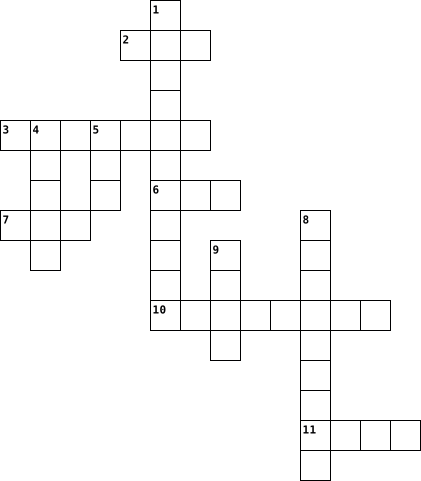
Across
- Lany song 2020
- Tilly Birds song 2020
- popethorn nickname
- Eden song 2017
- Ariana Grande song 2017
- XXXTENTACION song 2018
Down
- H.E.R. song 2020
- one direction song 2011
- John Mayer song 2018
- maroon5 song 2009
- Robbie Williams song 2011
11 Clues: Lany song 2020 • Eden song 2017 • H.E.R. song 2020 • maroon5 song 2009 • popethorn nickname • John Mayer song 2018 • Tilly Birds song 2020 • XXXTENTACION song 2018 • one direction song 2011 • Ariana Grande song 2017 • Robbie Williams song 2011
Crossword Puzzle for Grade 3 2023-03-08

Across
- the amount of falling water
- cloud one of cloud that means will be rain
- a gas that living things need to breathe
- vane tool to measure wind direction
- the process how liquid water change into water vapor
- vapor a gas of water that changed through evaporation
- cloud one of cloud that has puffy and flat bottom
- small spinning colunns of strong wind
- one of science tool that measure temperature
- one of weather that very sunny and hot
Down
- the measurement of how hot or cold something is
- condition of the atmosphere at some time and place
- one form of water and can be found in ocean
- a gas that surround earth
- a snow storm with strong wind and very low temperature
- a process how water vapor change into liquid
- bad weather that has thunder and lightning
- a bad weather that has strong wind that can go up to 119 kilometers
- gauge tool to measure amount of rainfall
19 Clues: a gas that surround earth • the amount of falling water • vane tool to measure wind direction • small spinning colunns of strong wind • one of weather that very sunny and hot • a gas that living things need to breathe • gauge tool to measure amount of rainfall • cloud one of cloud that means will be rain • bad weather that has thunder and lightning • ...
Astrospud 2022-08-30

Across
- Energy Energy of position; energy that is stored and held in readiness. Includes chemical energy, such as fossil fuels, electrical batteries, and food we eat.
- How fast an object is moving. The distance traveled over time.
- Potential energy due to elevated position.
- The quantity of motion of a moving object, equal to the product of its mass and its velocity.
- The ability to do work. Appears in many forms, all of which are either kinetic or potential.
- The amount of matter that is contained by an object.
- The amount of momentum remains constant. Momentum is neither created nor destroyed, but only changed through the action of forces.
- When an unbalanced force acts on a body, it is accelerated in the direction of the force; the magnitude of the acceleration is directly proportional to the force and inversely proportional to the mass of the body… F=ma.
- A push or a pull. An influence on a body or system, causing or tending to cause a change in movement or shape.
Down
- Forces always occur in pairs. If object A exerts a force, F, on object B exerts an equal and opposite force, -F, on object A. Or “Every action has an equal and opposite reaction.”
- Energy cannot be created or destroyed; it may be transformed from one form into another, or transferred from one place to another, but the total amount of energy never changes.
- The velocity attained by an object wherein the resistive forces counterbalance the driving forces, so motion is without acceleration.
- The rate at which an object changes its velocity.
- An object at rest tends to stay at rest and an object in motion tends to stay in motion with the same speed and in the same direction unless acted upon by an unbalanced force.
- The speed of something in a given direction.
- Energy of motion. Includes heat, sound, and light (motion of molecules).
- The tendency of matter to remain at rest if at rest, or if moving, to keep moving in the same direction, unless affected by an outside (or unbalanced) force.
17 Clues: Potential energy due to elevated position. • The speed of something in a given direction. • The rate at which an object changes its velocity. • The amount of matter that is contained by an object. • How fast an object is moving. The distance traveled over time. • Energy of motion. Includes heat, sound, and light (motion of molecules). • ...
Uni Words 2022-09-26

Across
- An instance of saying the same words or sounds at the same time; in a group that sounds like one
- One group
- Moving in one direction
- Having only one cell
Down
- To join together in one group
- a one piece leotard and tights combination
- One-wheeled vehicle
- One of a kind; unusual or rare
8 Clues: One group • One-wheeled vehicle • Having only one cell • Moving in one direction • To join together in one group • One of a kind; unusual or rare • a one piece leotard and tights combination • An instance of saying the same words or sounds at the same time; in a group that sounds like one
Geometry Crossword Puzzle 2021-11-08

Across
- names a location and has no size
- points that are not on the same line
- the point in the middle
- part of a line consisting of 2 endpoints
- to run or extend in the same direction without intersecting
- a part of a line that starts at an endpoint and extends forever in one direction
Down
- angles that add up to 180
- points that form a line
- an angle that measures more than 90 degrees
- an angle that measures exactly 90 degrees
- a straight path that has no thickness and extends forever
- a flat surface that has no thickness and extends forever
- angles that add up to 90 degrees
13 Clues: points that form a line • the point in the middle • angles that add up to 180 • names a location and has no size • angles that add up to 90 degrees • points that are not on the same line • part of a line consisting of 2 endpoints • an angle that measures exactly 90 degrees • an angle that measures more than 90 degrees • ...
alex m forces crossword 2014-09-03

Across
- measured in newtons
- is measured in kg
- how well something goes up
- the rate of change of the position of an object
- how much faster something gets in a certain amount of time
- the amount of power generated on a rocket going upwards
- increases when something isn't streamlined
Down
- the difference when you drop a stone in water
- what holds us down on the ground
- two forces of equal weight
- a combination of a physical quantity and a distance
- When a system accelerates mass in one direction, the accelerated mass will cause a force of equal magnitude but opposite direction on that system
- how fast an object is moving
13 Clues: is measured in kg • measured in newtons • how well something goes up • two forces of equal weight • how fast an object is moving • what holds us down on the ground • increases when something isn't streamlined • the difference when you drop a stone in water • the rate of change of the position of an object • a combination of a physical quantity and a distance • ...
Data Strucutres 2024-11-26

Across
- Another name for a record
- A graph that depicts a specific direction between nodes (vertices)
- The data structure cannot change at run time
- A tree that has a maximum of two outcomes
- A LIFO data structure
Down
- The data structure can change at run time
- When the algorithm generates the same hash value
- A graph that does not have a specific direction between the nodes (vertices)
- A FIFO data structure
- A list that involves the use of pointers so they do not need to be stored in order
- a data structure that can be 1d 2d 3d etc
- A mutable data structure in Python
- A one way function
13 Clues: A one way function • A FIFO data structure • A LIFO data structure • Another name for a record • A mutable data structure in Python • The data structure can change at run time • a data structure that can be 1d 2d 3d etc • A tree that has a maximum of two outcomes • The data structure cannot change at run time • When the algorithm generates the same hash value • ...
10th KUP Crossword 2024-09-24

Across
- Middle
- Punch
- Kick
- Front
- Forefist
- Kaunde jirugi
- High
- Side
- Najunde
- Side rising kick
- Block
- Sonkal
- L Stance
Down
- Four direction block
- Parallel ready stance
- Four direction punch
- Front rising kick
- Stance
- Forearm
- Ap cha busigi
- Ball of the foot
- Gunnun Sogi
- Annun sogi
- Attention stance
24 Clues: Kick • High • Side • Punch • Front • Block • Middle • Stance • Sonkal • Forearm • Najunde • Forefist • L Stance • Annun sogi • Gunnun Sogi • Kaunde jirugi • Ap cha busigi • Ball of the foot • Attention stance • Side rising kick • Front rising kick • Four direction block • Four direction punch • Parallel ready stance
Energy Transformation 2023-12-11

Across
- Energy used for a Hairdryer
- The ability to do work
- Energy that is stored within an atom’s nucleus.
- Energy stored in a object
- The change of energy from one form to another
- Energy that produces heat
- Energy a guitar requires
- The unit energy is measured with
Down
- When the energy of an object has a result of its motion.
- Energy stored within wood
- Energy that is used by solar panels
- where a sudden force pushes an object in a specific direction
- A push or pull
- The Action or process of moving or being moved.
- The rubbing of one object against another
- Moving something from one place to another
- Energy Cannot be created or __________.
17 Clues: A push or pull • The ability to do work • Energy a guitar requires • Energy stored within wood • Energy stored in a object • Energy that produces heat • Energy used for a Hairdryer • The unit energy is measured with • Energy that is used by solar panels • Energy Cannot be created or __________. • The rubbing of one object against another • ...
science terminology crrossword 2021-11-24

Across
- in the sky
- changing to match the environment
- slows down thrust
- a large body of matter
- holds chemicals
- two objects rubbing together
- an combination of liquids
- push or pull
- spinning in a certain way
Down
- safty clothing
- resistance in the water
- a living place
- science equipment that makes flame
- a push in one direction
- it pulls you down
15 Clues: in the sky • push or pull • safty clothing • a living place • holds chemicals • slows down thrust • it pulls you down • a large body of matter • resistance in the water • a push in one direction • an combination of liquids • spinning in a certain way • two objects rubbing together • changing to match the environment • science equipment that makes flame
Random Stuff 2012-09-12

Across
- toby is...
- need to calm down a times
- Topic that sucks at the moment
- lots of people hate...
- What did you have lunch person
- kats and coke mr condon eats
- the principals maths class
Down
- Desktop macs
- One Direction is full of ....
- A old things that need replacing
- thing Ethan says
- marshall Vasi mum
- school
- Laptops
- Mr Hicklings nickname
15 Clues: school • Laptops • toby is... • Desktop macs • thing Ethan says • marshall Vasi mum • Mr Hicklings nickname • lots of people hate... • need to calm down a times • the principals maths class • kats and coke mr condon eats • One Direction is full of .... • Topic that sucks at the moment • What did you have lunch person • A old things that need replacing
ONE IRECTION ♥♥♥♥♥- Zuzia Tomińska 2013-06-12

Across
- Ulubiona rzecz Zayna.
- Miejsce gdzie mieszkają.
- Ulubiony zwierzak Liama.
- Kolor oczy Harrego.
- W tym programie telewizyjnym powstało one direction.
- Louis nazywa je Kevinami.
- Harry ma włosy w...
- Boi się ich Liam.
Down
- Louis je uwielbia.
- Miasto w Irlandii gdzie mieszkał Niall.
- Ulubiony zwierzak Harrego.
- Ulubiona restauracja Nialla.
- Louis lubi nosić koszulki w...
- Ma na nazwisko Tomlinson.
- Ulubiony kolor Zayna.
15 Clues: Boi się ich Liam. • Louis je uwielbia. • Kolor oczy Harrego. • Harry ma włosy w... • Ulubiona rzecz Zayna. • Ulubiony kolor Zayna. • Miejsce gdzie mieszkają. • Ulubiony zwierzak Liama. • Ma na nazwisko Tomlinson. • Louis nazywa je Kevinami. • Ulubiony zwierzak Harrego. • Ulubiona restauracja Nialla. • Louis lubi nosić koszulki w... • Miasto w Irlandii gdzie mieszkał Niall. • ...
CNA Crossword Lesson 15 2024-07-04

Across
- top layer of skin
- force created by one surface rubbing against another
- separation of wound edges with protrusion of abdominal organs
- pathological death of one or more cells resulting in tissue damage
- drainage
- excessive blood loss over a short period of time
- inflammation & fever
- skin layer containing nerve endings, blood vessels, & oil glands
- tailbone
- swelling
- scale that assesses risk for skin breakdown
Down
- pus
- ulcer caused by altered blood flow
- separation of wound edges
- situation where the skin sticks to a surface & muscles slide the direction the body is moving
- purple-splotched appearance of skin
- body system composed of skin, hair, & nails
- tissue death
- removing pressure from an area
19 Clues: pus • drainage • tailbone • swelling • tissue death • top layer of skin • inflammation & fever • separation of wound edges • removing pressure from an area • ulcer caused by altered blood flow • purple-splotched appearance of skin • body system composed of skin, hair, & nails • scale that assesses risk for skin breakdown • excessive blood loss over a short period of time • ...
February USA 1 review 2026-02-11

Across
- The name of your FFA region
- The plant that Mendel studied
- Trait you must have both parents give you
- The 12 word FFA statement starting Learning to Do
- The name of your chapter
- Strong trait given to you by at least one parent
- National Blue/Corn gold
- Coded as Rr
- What you should do when there's high transpiration
Down
- The physical characteristic shown
- Your genetic code
- A probability square showing genetic crosses
- Water evaporating off of leaves
- The DNA code for a trait
- Mendel's occupation
- Father of Genetics
- Could be RR or rr
- Direction you turn hose faucet, to turn it off
- One small piece of DNA
19 Clues: Coded as Rr • Your genetic code • Could be RR or rr • Father of Genetics • Mendel's occupation • One small piece of DNA • National Blue/Corn gold • The DNA code for a trait • The name of your chapter • The name of your FFA region • The plant that Mendel studied • Water evaporating off of leaves • The physical characteristic shown • Trait you must have both parents give you • ...
Stage 5 Set 11 2024-01-26

Across
- "Is this _____?"
- People who have a bond together
- Coming after or as a result of
- Close to
- A male sibling
Down
- Direction of movement from one side to another
- Not old yet
- A female sibling
- "Once ______ a time"
- Your Aunt or Uncle's child
- In the meantime
- Shouted loudly
- Possessive. Belonging to.
- The two of you
- Process of creating a story
15 Clues: Close to • Not old yet • Shouted loudly • The two of you • A male sibling • In the meantime • "Is this _____?" • A female sibling • "Once ______ a time" • Possessive. Belonging to. • Your Aunt or Uncle's child • Process of creating a story • Coming after or as a result of • People who have a bond together • Direction of movement from one side to another
Wrinkle in Time Vocabulary, Ch 1, 3, 5 2024-03-20

Across
- smart in a clever way
- measurement in one direction
- not too much
- never ending
- nothing special
- to horrible to accept
- able to be touched
- defenseless
Down
- unhappy
- feeling or showing anger because something is unfair
- to cause to be worried or upset
- the quality of something
- the spirit of the dead
- to slowly disappear
- an unusual way of doing something
15 Clues: unhappy • defenseless • not too much • never ending • nothing special • able to be touched • to slowly disappear • smart in a clever way • to horrible to accept • the spirit of the dead • the quality of something • measurement in one direction • to cause to be worried or upset • an unusual way of doing something • feeling or showing anger because something is unfair