
periodic%20table Crossword Puzzles
The Periodic table of elements 2024-01-11

Across
- table Organized chart with elements
- metal Not a good conductor of heat
- Both a non metal and metal
- Smallest unit of an element
- Mendeleev Person who organized the periodic table
Down
- Symbol The letters you see that abbreviate the elements
- A substance that can be broken down
- substance A substance that stands alone
- A conductor of heat and is luster
- A substance that can not be broken down
10 Clues: Both a non metal and metal • Smallest unit of an element • A conductor of heat and is luster • metal Not a good conductor of heat • A substance that can be broken down • table Organized chart with elements • substance A substance that stands alone • A substance that can not be broken down • Mendeleev Person who organized the periodic table • ...
Atoms and the periodic table 2026-01-22

Across
- Regions where electrons are arranged around the nucleus
- Neutral particle in the nucleus
- Element that conducts electricity and is malleable
- Vertical column in the periodic table
- Positively charged particle in the nucleus
Down
- Negatively charged particle orbiting the nucleus
- Smallest unit of matter
- Element that is brittle and a poor conductor
- Horizontal row in the periodic table
- Substance made of two or more different elements chemically bonded
10 Clues: Smallest unit of matter • Neutral particle in the nucleus • Horizontal row in the periodic table • Vertical column in the periodic table • Positively charged particle in the nucleus • Element that is brittle and a poor conductor • Negatively charged particle orbiting the nucleus • Element that conducts electricity and is malleable • ...
Chapter 9 Crossword 2019-09-10

Across
- Number of protons
- Any of the possible energies an electron may have in an atom
- Have no charge
- Side that non-metals are found
- Have a positive charge
Down
- Last name of designer of the periodic table of elements
- An electron in the outermost energy level of an atom
- First name of designer of the periodic table of elements
- Side that metals are found
- Have a negative charge
10 Clues: Have no charge • Number of protons • Have a negative charge • Have a positive charge • Side that metals are found • Side that non-metals are found • An electron in the outermost energy level of an atom • Last name of designer of the periodic table of elements • First name of designer of the periodic table of elements • ...
Periodic Table 2023-11-28

Across
- The group with all three phases of matter
- An alkaline earth metal in period three
- Only group with a full outer shell
- The group Sodium is in.
Down
- This group has multiple oxidation states
- Created the first periodic table
- These types of elements are semiconductors
- Metals do this with their electrons
- The number of valence electrons carbon has
- The first periodic table was put in order by...
10 Clues: The group Sodium is in. • Created the first periodic table • Only group with a full outer shell • Metals do this with their electrons • An alkaline earth metal in period three • This group has multiple oxidation states • The group with all three phases of matter • These types of elements are semiconductors • The number of valence electrons carbon has • ...
Periodic Table 2023-08-28

Across
- Most elements are ___
- Makes the periodic table invaluble
- Found on the upper left
- The man in 1869 who invented the periodic table
- The atomic number
- each row corresponds to a different ___
- the s and p blocks are known as the ___
Down
- Found on the upper right
- You can predict a lot about an element if you know this
- The one to two letter symbol representing an element
- what the seven rows are called
- Tells you all of the elements
12 Clues: The atomic number • Most elements are ___ • Found on the upper left • Found on the upper right • Tells you all of the elements • what the seven rows are called • Makes the periodic table invaluble • each row corresponds to a different ___ • the s and p blocks are known as the ___ • The man in 1869 who invented the periodic table • ...
Periodic Table 2023-08-28

Across
- Most elements are ___
- Makes the periodic table invaluble
- Found on the upper left
- The man in 1869 who invented the periodic table
- The atomic number
- each row corresponds to a different ___
- the s and p blocks are known as the ___
Down
- Found on the upper right
- You can predict a lot about an element if you know this
- The one to two letter symbol representing an element
- what the seven rows are called
- Tells you all of the elements
12 Clues: The atomic number • Most elements are ___ • Found on the upper left • Found on the upper right • Tells you all of the elements • what the seven rows are called • Makes the periodic table invaluble • each row corresponds to a different ___ • the s and p blocks are known as the ___ • The man in 1869 who invented the periodic table • ...
Periodic Table Vocab 2024-01-25

Across
- The chart on which elements are listed
- Can be found at the top of a Element Card
- The most reactive group
- Horizontal rows on a periodic table
Down
- The sign for a element
- Vertical columns on a periodic table
- Chart of a atom that shows the scientific Symbol and Valence Electrons
- Can be found below an element's symbol
- The Least reactive group
- The smallest form of a element
10 Clues: The sign for a element • The most reactive group • The Least reactive group • The smallest form of a element • Horizontal rows on a periodic table • Vertical columns on a periodic table • The chart on which elements are listed • Can be found below an element's symbol • Can be found at the top of a Element Card • ...
English Crossword 2025-08-06

Across
- it’s to protect your hands
- all the energy an object has because of it’s motion
- subatomic particle that is in the atom’s nucleus
- you put it around your head to protect your eyes
- means something is dangerous
- most simple element in the periodic table
- a vertical column in the periodic table
Down
- it protects your whole body
- it stops a fire
- it helps to see small things
10 Clues: it stops a fire • it’s to protect your hands • it protects your whole body • it helps to see small things • means something is dangerous • a vertical column in the periodic table • most simple element in the periodic table • subatomic particle that is in the atom’s nucleus • you put it around your head to protect your eyes • ...
Elements, Compounds, and Mixtures 2022-10-13

Across
- a table that represents all of the elements
- anything that has mass or takes up space
- vertical row of the periodic table
- one type of element/atom
- building blocks
Down
- two different types of atoms chemically bonded
- atoms of the same type grouped together
- the horizontal row of the periodic table
- a metal mixed with at least one other element a pure substance
- not chemically bonded together
10 Clues: building blocks • one type of element/atom • not chemically bonded together • vertical row of the periodic table • atoms of the same type grouped together • the horizontal row of the periodic table • anything that has mass or takes up space • a table that represents all of the elements • two different types of atoms chemically bonded • ...
Econ 2nd Semester 2023-03-03

Across
- of production resources
- cost value
- proptier exclusive
- company
- excess
- possbilites curve production possibilites frontier
- scarcity
- share
- unemployment search umeployment
- unemployment involuntary forms of unemployment
Down
- two or more people
- cost differnt cost
- benefit margnial revenue
- balance
- unemployment periodic
- lack
- tax
17 Clues: tax • lack • share • excess • balance • company • scarcity • cost value • two or more people • cost differnt cost • proptier exclusive • unemployment periodic • benefit margnial revenue • of production resources • unemployment search umeployment • unemployment involuntary forms of unemployment • possbilites curve production possibilites frontier
SOL 6.5b Relearning Matter Crossword 2021-12-01

Across
- How many electrons does tin have?
- Use your periodic table. How many protons does Calcium have?
- an element is a substance made up of ____ kind of atom.
- _______symbol distinguishes elements from other elements on the periodic table.
- how many neutrons does florine have?
Down
- a chemical ___________ is an abbreviation of the chemical name.
- the first letter in a chemical symbol is always a capital letter. if there is a 2nd letter, it is always ________ case
- the atomic __________ distinguishes elements from other elements on the periodic table.
8 Clues: How many electrons does tin have? • how many neutrons does florine have? • an element is a substance made up of ____ kind of atom. • Use your periodic table. How many protons does Calcium have? • a chemical ___________ is an abbreviation of the chemical name. • _______symbol distinguishes elements from other elements on the periodic table. • ...
Matter and Change (Chapter 1) 2015-09-10

Across
- anything that has mass and takes up space
- the smallest unit of an element that maintains the chemical properties of that element
- of State the change of a substance from one physical state to another
- an element that has properties of both metals and nonmetals and is sometimes referred to as a semiconductor
- Property a characteristic of a substance that does not involve a chemical change such as density, hardness or color
- an element that conducts heat and electricity poorly and that does not form positive ions in an electrolytic solution
- a vertical column of the periodic table
- the state of matter that has a definite volume but not a definite shape
- the state of matter in which the volume and shape of a substance are fixed
Down
- a form of matter that does not have a definite volume or shape
- a substance or molecule that participates in a chemical reaction
- an element that is shiny and that conducts heat and electricity well
- a substance made up of atoms of two or more different elements joined by chemical bonds
- a vertical column of elements in the periodic table that share similar chemical properties
- the scientific study of the composition, structure and properties of matter and the changes that it undergoes
- Property a property of matter that describes a substances ability to participate in chemical reactions
- a substance that cannot be separated or broken down into simpler substances by chemical means
- a measure of the amount of matter in an object
- a horizontal row of elements in the periodic table
19 Clues: a vertical column of the periodic table • anything that has mass and takes up space • a measure of the amount of matter in an object • a horizontal row of elements in the periodic table • a form of matter that does not have a definite volume or shape • a substance or molecule that participates in a chemical reaction • ...
chapter 9 tanner pollard mr.b atomic structure 2017-09-18

Across
- symbol an abbreviation for an element or atom
- any vertical column in the periodic table also known as a family of elements
- an extremely small negatively charged subatomic particle found in a cloud outside the atomic nucleus
- an electrically neutral subatomic particle in the atomic nucleus
Down
- any member of a set of atoms of the same element whose nuclei contain the same number of protons but different numbers of neutrons
- any material that is made up of only one type of atom
- any subatomic particle found in the atomic nucleus another name for either a proton or a neutron
- table a chart in which all known elements are listed in order of atomic number
- a positively charged subatomic particle in the atomic nucleus
- a horizontal row in the periodic table
10 Clues: a horizontal row in the periodic table • symbol an abbreviation for an element or atom • any material that is made up of only one type of atom • a positively charged subatomic particle in the atomic nucleus • an electrically neutral subatomic particle in the atomic nucleus • any vertical column in the periodic table also known as a family of elements • ...
Chemistry Vocabulary Crossword 2013-10-20

Across
- The height of a wave from the origin to a crest or from the origin to a trough
- Consists of an element’s symbol, representing the atomic nucleus and inner level electrons, that is surrounded by dots, representing the atom’s valence electrons
- A type of group B element that is contained in the d-block of the periodic table and, with some exceptions, is characterized by a filled outermost s orbital of energy level n, and filled or partially filled d orbitals of energy level n-1
- Groups of elements in the modern periodic table that are designated with a B and are further divided into transition metals and inner transition metals
- negatively charged particles that are part of all forms of matter
- States that atoms lose, gain, or share electrons in order to acquire a full set of eight valence electrons
- All matter is composed of extremely small particles called atoms
- A subatomic particle in an atoms nucleus that has a positive charge of 1+
- An element that is solid at room temperature, a good conductor of heat and electricity, and generally is shiny
- Group 2A elements in the modern periodic table
- located along the bottom of the periodic table
- Groups of elements in the modern periodic table that are designated with an A and possess a wide range of chemical and physical properties
- A horizontal row of elements in the modern periodic table
- An ion that has a negative charge
- Highly reactive group 7A elements
- Elements that are generally gases or dull, brittle solids that are poor conductors of heat and electricity
- States that equal volumes of gases at the same temperature and pressure contain equal numbers of particles
- Group 1A elements, except for hydrogen, that are on the left side of the modern periodic table
- A particle with two protons and two neutrons, with a 2+ charge
- The positively charged protons and neutral neutrons contained in an atom’s densely packed nucleus.
- The minimum amount of energy that can be gained or lost by an atom
- Ray of radiation that originated from the cathode to the anode within the tube
- Radiation consisting of fast moving electrons
- The process in which some substances spontaneously emit radiation
- The rays and particles-alpha and beta particles and gamma rays-that are emitted by radioactive material
Down
- The boxes that are arranged in order of increasing atomic number into a series of columns
- The weighted average mass of the isotopes of that element
- An element, such as silicon or germanium, that has physical and chemical properties of both metals and nonmetals
- The shortest distance between equivalent points on a continuous wave; is usually expressed in meters, centimeters, or nanometers.
- A three-dimensional region around the nucleus of an atom that describes an electron’s probable location
- Includes all forms of electromagnetic radiation, with the only differences in the types of radiation being their frequencies and wavelengths
- relative ability of its atoms to attract electrons in a chemical bond
- An extremely unreactive group 8A element
- A neutral subatomic particle in an atom’s nucleus that has a mass nearly equal to that of a proton
- States that when the elements are arranged by increasing atomic number, there is a periodic repetition of their chemical and physical properties
- The arrangement of electrons in an atom, which is prescribed by three rules-the aufbau principle, the Pauli exclusion principle, and Hund’s rule
- High-energy radiation that has no electrical charge and no mass, is not deflected by electric or magnetic fields, usually accompanies alpha and beta radiation, and accounts for most of the energy lost during radioactive decay
- A reaction that involves a change in the nucleus of an atom
- A spontaneous process in which the unstable nuclei lose energy by emitting radiation
- The number 6.022x10^23, which is the number representative particles in a mole
- The energy required ti remove an electron from a gaseous atom; generally increases in moving from left-to-right across a period and decreases in moving down a group
- an atom or a bonded group of atoms that has a positive or negative charge
- The number after an element’s name, representing the sum of its protons and neutrons
- Radiation that is made up of alpha particles
- Radiation that is deflected toward the positively charged plate
- A type of equation that shows the atomic number and mass number of the particles involved
- The electrons in an atoms outermost orbitals; determine the chemical properties of an element
- Atoms of the same element with the same number of protons but different numbers of neutrons
- The number of protons in an atom
- A particle of electromagnetic radiation with no mass that carries a quantum of energy
50 Clues: The number of protons in an atom • An ion that has a negative charge • Highly reactive group 7A elements • An extremely unreactive group 8A element • Radiation that is made up of alpha particles • Radiation consisting of fast moving electrons • Group 2A elements in the modern periodic table • located along the bottom of the periodic table • ...
Periodic Table Crossword Puzzle 2020-10-09

Across
- Found in fireworks, batteries, flashbulbs
- all have same basic properties of metals
Down
- Many are man-made in labs
- Becomes more rare as you move down the table
- all nonmetals that easily combine with other elements, often from Alkali metals
- Vertical columns on the Periodic Table
- Called Rare Earth Metals
- any substance made up of only 1 type of atom
- Horizontal rows on the Periodic table
- Has 1 Valence electron
10 Clues: Has 1 Valence electron • Called Rare Earth Metals • Many are man-made in labs • Horizontal rows on the Periodic table • Vertical columns on the Periodic Table • all have same basic properties of metals • Found in fireworks, batteries, flashbulbs • Becomes more rare as you move down the table • any substance made up of only 1 type of atom • ...
Elements, Compounds, and Mixtures 2021-10-26

Across
- the building blocks of science
- subatomic particle with a charge of negative charge
- a group of two or more atoms that form a substance
- when something in science is physically mixed
- when a molecule contains two or more atoms
Down
- number 7 on the periodic table
- anything that takes up space
- a subatomic particle with no charge
- number 26 on the periodic table
- the odorless gas O2
10 Clues: the odorless gas O2 • anything that takes up space • number 7 on the periodic table • the building blocks of science • number 26 on the periodic table • a subatomic particle with no charge • when a molecule contains two or more atoms • when something in science is physically mixed • a group of two or more atoms that form a substance • ...
8F and 8G 2023-02-24

Across
- Able to be beaten and bent into shape
- can be pulled into a wire,without breaking
- the smallest unit of matter
- A description of how a material behaves
Down
- made of only 1 type of atom
- a column on the periodic table
- these metals react violently with water
- made of two or more elements chemically joined
- these elements have toxic gases
- a row on the periodic table
10 Clues: made of only 1 type of atom • a row on the periodic table • the smallest unit of matter • a column on the periodic table • these elements have toxic gases • Able to be beaten and bent into shape • these metals react violently with water • A description of how a material behaves • can be pulled into a wire,without breaking • made of two or more elements chemically joined
Chemistry Puzzle 2022-01-28

Across
- a row of chemical elements on the periodic table
- an element with the atomic mass of 11
- negatively charged atoms
- The number of protons in an element
- an element with the atomic number of 3
Down
- an atom with the smallest mass number
- a column of chemical elements on the periodic table
- Have one electron in their outermost layer of electrons
- smallest particle of an element
- 6.02x10^23
10 Clues: 6.02x10^23 • negatively charged atoms • smallest particle of an element • The number of protons in an element • an atom with the smallest mass number • an element with the atomic mass of 11 • an element with the atomic number of 3 • a row of chemical elements on the periodic table • a column of chemical elements on the periodic table • ...
Science 2026-02-26

Across
- section of elements that don't contain metal
- Number of protons and electrons combined.
- Electrically neutral particles in the nucleus without charge.
- The group on the right of periodic table
- Group with the most elements
- Number of protons=number of electrons
Down
- The small positively charged center of an atom.
- Particles with an electric charge of 1-
- First group farthest left on periodic table
- particles with an electric charge of 1+
10 Clues: Group with the most elements • Number of protons=number of electrons • Particles with an electric charge of 1- • particles with an electric charge of 1+ • The group on the right of periodic table • Number of protons and electrons combined. • First group farthest left on periodic table • section of elements that don't contain metal • ...
Science 2022-02-24

Across
- - Atom-
- Gravity-
- down
- - Reactivity -
- - Nonmetal -
Down
- - Electron-
- Neutron-
- - Element-
- - Noble -
- - Metal -
10 Clues: down • Neutron- • Gravity- • - Atom- • - Electron- • - Noble - • - Element- • - Metal - • - Reactivity - • - Nonmetal -
science 2024-01-12

Across
- metals
- gases
- metals
- metals
- number
Down
- point
- malleability
- luster
- hydrogen
- semiconductor
- elements
- metals
- table
13 Clues: point • gases • table • luster • metals • metals • metals • metals • number • hydrogen • elements • malleability • semiconductor
PERIODIC CROSSWORD 2019-09-15

Across
- SMALLEST PARTICLE OF AN ELEMENT.
- NUMBER OF PROTONS IN AN ATOM (2 WORDS)
- MOVING LEFT TO RIGHT ACROSS THE PERIODIC TABLE, THE NUMBER OF ELECTRONS IN ATOMS _______
Down
- NUMBER OF PROTONS AND NEUTRONS IN AN ATOM (2WORDS)
- ELEMENTS ARE ARRANGED BY THE _________TABLE
- MOVING LEFT TO RIGHT ACROSS THE PERIODIC TABLE, ATOMIC RADIUS
- ATOMS HAVE THE SAME NUMBER OF PROTONS AND _______.
7 Clues: SMALLEST PARTICLE OF AN ELEMENT. • NUMBER OF PROTONS IN AN ATOM (2 WORDS) • ELEMENTS ARE ARRANGED BY THE _________TABLE • NUMBER OF PROTONS AND NEUTRONS IN AN ATOM (2WORDS) • ATOMS HAVE THE SAME NUMBER OF PROTONS AND _______. • MOVING LEFT TO RIGHT ACROSS THE PERIODIC TABLE, ATOMIC RADIUS • ...
Chapter 10 Modern Atomic Theory And The Periodic Table 2016-01-10

Across
- Group VIIA Elements
- this atom's orbital configuration is 1s² 2s²2p⁶ 3s²3p⁶ 4s²3d¹⁰
- rows in the periodic table
- When a gas emits light shown through a prism, the beaming colored lines are part of a _____
- outermost electron shell
- in a given atom, no 2 electrons may have the same set of 4 quantum numbers therefore an orbital must have electrons with opposite spins ↓↑
- 1st sublevel
- this method of arranging electrons uses arrows and boxes
- energy is emitted in tiny distinct packets called _____
- all the Group IIIB to Group IIB (3-12) elements
- lowest energy level
- Which rule is this: electrons will occupy separate orbitals of the same energy before pairing of electrons occur
- columns in the periodic table
- 2nd sublevel
- region in space around a nucleus with a high probability of finding an electron
- small packets of energy in streams of light
Down
- distance between two peaks or trough inside a wave
- Who said this: “electrons revolve in specific regions at various distances from the nucleus called energy levels”
- the energy level expressed by the principal quantum number n
- neon’s orbital configuration
- what is white light?
- as stated by this principle, an orbital cannot contain more than 2 electrons
- all the Group A’s elements in the Periodic Table
- electrons on the outermost energy level
- this method of arranging electrons uses numbers, letters, and superscripts
- Every principle energy level is divided into _____
- this atom's orbital configuration is 1s² 2s²2p⁶ 3s²3p⁶ 4s²
- this atom's orbital configuration is 1s² 2s²2p⁶ 3s²3p⁶
- 4th sublevel
- 3rd sublevel
30 Clues: 1st sublevel • 2nd sublevel • 4th sublevel • 3rd sublevel • Group VIIA Elements • lowest energy level • what is white light? • outermost electron shell • rows in the periodic table • neon’s orbital configuration • columns in the periodic table • electrons on the outermost energy level • small packets of energy in streams of light • all the Group IIIB to Group IIB (3-12) elements • ...
Chapter 10 Modern Atomic Theory And The Periodic Table 2016-01-10

Across
- columns in the periodic table
- energy is emitted in tiny distinct packets called _____
- this method of arranging electrons uses arrows and boxes
- region in space around a nucleus with a high probability of finding an electron
- 3rd sublevel
- Group VIIA Elements
- rows in the periodic table
- in a given atom, no 2 electrons may have the same set of 4 quantum numbers therefore an orbital must have electrons with opposite spins ↓↑
- all the Group A’s elements in the Periodic Table
- the energy level expressed by the principal quantum number n
- neon’s orbital configuration
- Which rule is this: electrons will occupy separate orbitals of the same energy before pairing of electrons occur
Down
- this method of arranging electrons uses numbers, letters, and superscripts
- as stated by this principle, an orbital cannot contain more than 2 electrons
- electrons on the outermost energy level
- Every principle energy level is divided into _____
- 2nd sublevel
- 4th sublevel
- 1st sublevel
- distance between two peaks or trough inside a wave
- When a gas emits light shown through a prism, the beaming colored lines are part of a _____
- outermost electron shell
- this atom's orbital configuration is 1s² 2s²2p⁶ 3s²3p⁶ 4s²3d¹⁰
- all the Group IIIB to Group IIB (3-12) elements
- small packets of energy in streams of light
- this atom's orbital configuration is 1s² 2s²2p⁶ 3s²3p⁶
- Who said this: “electrons revolve in specific regions at various distances from the nucleus called energy levels”
- this atom's orbital configuration is 1s² 2s²2p⁶ 3s²3p⁶ 4s²
- lowest energy level
- what is white light?
30 Clues: 2nd sublevel • 3rd sublevel • 4th sublevel • 1st sublevel • Group VIIA Elements • lowest energy level • what is white light? • outermost electron shell • rows in the periodic table • neon’s orbital configuration • columns in the periodic table • electrons on the outermost energy level • small packets of energy in streams of light • all the Group IIIB to Group IIB (3-12) elements • ...
Chapter 10 Modern Atomic Theory And The Periodic Table 2016-01-10

Across
- distance between two peaks or trough inside a wave
- rows in the periodic table
- 3rd sublevel
- small packets of energy in streams of light
- electrons on the outermost energy level
- 1st sublevel
- columns in the periodic table
- the energy level expressed by the principal quantum number n
- this method of arranging electrons uses numbers, letters, and superscripts
- as stated by this principle, an orbital cannot contain more than 2 electrons
- this atom's orbital configuration is 1s² 2s²2p⁶ 3s²3p⁶ 4s²3d¹⁰
- Group VIIA Elements
- what is white light?
- all the Group IIIB to Group IIB (3-12) elements
- 2nd sublevel
Down
- outermost electron shell
- lowest energy level
- this method of arranging electrons uses arrows and boxes
- 4th sublevel
- neon’s orbital configuration
- in a given atom, no 2 electrons may have the same set of 4 quantum numbers therefore an orbital must have electrons with opposite spins ↓↑
- all the Group A’s elements in the Periodic Table
- energy is emitted in tiny distinct packets called _____
- Who said this: “electrons revolve in specific regions at various distances from the nucleus called energy levels”
- this atom's orbital configuration is 1s² 2s²2p⁶ 3s²3p⁶
- this atom's orbital configuration is 1s² 2s²2p⁶ 3s²3p⁶ 4s²
- region in space around a nucleus with a high probability of finding an electron
- Every principle energy level is divided into _____
- Which rule is this: electrons will occupy separate orbitals of the same energy before pairing of electrons occur
- When a gas emits light shown through a prism, the beaming colored lines are part of a _____
30 Clues: 3rd sublevel • 4th sublevel • 1st sublevel • 2nd sublevel • lowest energy level • Group VIIA Elements • what is white light? • outermost electron shell • rows in the periodic table • neon’s orbital configuration • columns in the periodic table • electrons on the outermost energy level • small packets of energy in streams of light • all the Group IIIB to Group IIB (3-12) elements • ...
Unit B 2017-11-13

Across
- Chemical combination pf two or more elements in a specific ratio
- Change of state from a solid to a gas or form a gas to a solid
- Energy stored in a chemical and release when chemical react
- Made up of 2 or more substance combined together
- When two or more substance reacts to create a different substance
- of one atom of an element calculated from the total number of protons
- Group 2 in the periodic table
- An experiment in which all reactants and all products of a chemical reaction are accounted for
- Description of how a substance interacts with other substances
- Positively charged particles in the nucleus of an atom
- measure of atomic mass; 1 amuis equal to 1/12th the mass of a carbon 12 atom
Down
- Smallest part of the element, made up of nucleus containing protons and neutron
- Substance made of only one kind of matter, which has a unique sets of properties
- Anything that has mass and occupies space
- gases Group 18 elements in the periodic table
- Group 1 element in the periodic table, not including hydrogen
- Combination of symbols that represent a compound
- Element that has both metallic and non-metallic properties
- Refers to the tree common states in which matter can exist: solid liquid and gas
- A reaction that takes place when 2 or more substance react to form a new substance
- Colorless,Odorless gas
- Organic molecules made up of atoms of carbon, hydrogen and oxygen
- Characteristics that can be used to describe a substance
- dull, brittle element that does not conduct electricity
- Substance that helps s chemical reaction to proceed more quickly
25 Clues: Colorless,Odorless gas • Group 2 in the periodic table • Anything that has mass and occupies space • Combination of symbols that represent a compound • Made up of 2 or more substance combined together • gases Group 18 elements in the periodic table • Positively charged particles in the nucleus of an atom • ...
Matter and the Periodic Table Puzzle 2018-02-07

Across
- Another name for a column of the periodic table.
- I take the shape of the container I am in.
- If phosphorus gains 1 proton it turns into this element.
- I have no charge and you can find me at the center of an atom.
- I am a transition metal with 47 electrons used to make photographic film.
- Two forms of the same element that contain same number of protons but different number of neutrons.
- These types of elements are malleable, ductile and conduct electricity.
- An atom that has gained or lost one or more electrons.
- I am negatively charged and barely contribute to the mass of the atom.
- I am the heaviest alkaline earth metal.
- Arsenic is an example of this type of element.
- I am the positively charged center of an atom.
- I am made up of hydrogen and oxygen atoms and you need me to live.
Down
- Another name for a row of the periodic table.
- Electrons furthest from the nucleus that are responsible for interactions of atoms with one another also referred to as _________ electrons.
- The number of _______ gives the identity of an element.
- Members of Group 17 (or VIIA) are called _______.
- Elemental symbol for tin.
- I can be either heterogeneous or homogeneous.
- Protons, neutrons and electrons are classified as ________ particles.
- A combination of two or more atoms held together in a specific shape by attractive forces.
- You can find me in Group 1 of the periodic table and in table salt.
- Substance that contains more than one element.
- My atomic number is 7.
- I have definite shape and volume.
- My atomic mass is 63.546.
- I am one of the noble gases.
27 Clues: My atomic number is 7. • Elemental symbol for tin. • My atomic mass is 63.546. • I am one of the noble gases. • I have definite shape and volume. • I am the heaviest alkaline earth metal. • I take the shape of the container I am in. • Another name for a row of the periodic table. • I can be either heterogeneous or homogeneous. • Substance that contains more than one element. • ...
Matter and the Periodic Table Puzzle 2018-02-07

Across
- I am one of the noble gases.
- Another name for a row of the periodic table.
- I have definite shape and volume.
- Electrons furthest from the nucleus that are responsible for interactions of atoms with one another also referred to as _________ electrons.
- An atom that has gained or lost one or more electrons.
- These types of elements are malleable, ductile and conduct electricity.
- A combination of two or more atoms held together in a specific shape by attractive forces.
- I am negatively charged and barely contribute to the mass of the atom.
- My atomic number is 7.
- Protons, neutrons and electrons are classified as ________ particles.
- The number of _______ gives the identity of an element.
- I take the shape of the container I am in.
- I am a transition metal with 47 electrons used to make photographic film.
Down
- My atomic mass is 63.546 amu.
- You can find me in Group 1 of the periodic table and in table salt.
- I am the heaviest alkaline earth metal.
- I am made up of hydrogen and oxygen atoms and you need me to live.
- If phosphorus gains 1 proton it turns into this element.
- I am the positively charged center of an atom.
- Members of Group 17 (or VIIA) are called _______.
- I have no charge and you can find me at the center of an atom.
- Arsenic is an example of this type of element.
- Substance that contains more than one element.
- I can be either heterogeneous or homogeneous.
- Two forms of the same element that contain same number of protons but different number of neutrons.
- Another name for a column of the periodic table.
- Elemental symbol for tin.
27 Clues: My atomic number is 7. • Elemental symbol for tin. • I am one of the noble gases. • My atomic mass is 63.546 amu. • I have definite shape and volume. • I am the heaviest alkaline earth metal. • I take the shape of the container I am in. • Another name for a row of the periodic table. • I can be either heterogeneous or homogeneous. • ...
Pre-Cal Vocab 2021-10-07

Across
- two sets that contain all the elements contained in either set (or both sets).
- Intercept, y=mx+b
- a function which takes zero or more input values to a well-defined output value.
- form, ax+by=c
- a variable that does not depend on any other variable for its value.
- type of problem that deals with a variable multiplied by itself — using an operation known as squaring.
- the exponent or power to which a base must be raised to yield a given number
- one complete pattern of y-values for a periodic function.
- the set of possible output values, which are shown on the y-axis.
- a relation from a set of inputs to a set of possible outputs where each input is related to exactly one output
- pairs of mathematical manipulations in which one operation undoes the action of the other.
Down
- four specific ways to manipulate the shape and/or position of a point, a line, or figure.
- the horizontal length of one cycle for a periodic or repeating function.
- a function that repeats a pattern of y-values itself over and over again at regular intervals
- a variable in an expression that depends on the value of another variable.
- between two sets is a collection of ordered pairs containing one object from each set.
- the set of possible input values, which consists of all the input values shown on the x-axis.
- to determine the value of the expression for a given value of each variable in the expression.
- a function is one which is defined not by a single equation, but by two or more.
- cycle, is the horizontal center line about which the function oscillates above and below.
20 Clues: form, ax+by=c • Intercept, y=mx+b • one complete pattern of y-values for a periodic function. • the set of possible output values, which are shown on the y-axis. • a variable that does not depend on any other variable for its value. • the horizontal length of one cycle for a periodic or repeating function. • ...
Chapter 12 Vocabulary 2022-01-04

Across
- A representation of an object on some con- venient scale.
- A small, discrete packet of light energy.
- Members of a set of atoms of the same element whose nuclei contain the same number of protons but different numbers of neutrons.
- A count of the number of protons in the atomic nucleus.
- An extremely small negatively charged subatomic particle found outside the atomic nucleus.
- The abbreviation for an element or atom.
- Any material that is made up of only one type of atom.
- n An integer that specifies the quantized energy level of an atomic orbital.
- in order of atomic number.
- Any subatomic particle found in the atomic nucleus; another name for either a proton or a neutron.
Down
- The pattern of frequencies of electromagnetic radiation emitted by the atoms of an element, considered to be an element’s “fingerprint."
- The idea that light energy is contained in discrete packets called quanta.
- A device that uses a prism or diffraction grat- ing to separate light into its color components.
- A vertical column in the periodic table also known as
- A representation of a system that helps us predict how the system behaves.
- A chart in which all the known elements are
- The mass of an element’s atoms listed in the periodic table as an average value based on the relative abundance of the element’s isotopes.
- A region of space around the atomic nucleus within which electrons may reside.
- A horizontal row in the periodic table
- The dense, positively charged center of every atom.
- An electrically neutral subatomic particle of the atomic nucleus.
- A positively charged subatomic particle of the atomic nucleus.
22 Clues: in order of atomic number. • A horizontal row in the periodic table • The abbreviation for an element or atom. • A small, discrete packet of light energy. • A chart in which all the known elements are • The dense, positively charged center of every atom. • A vertical column in the periodic table also known as • Any material that is made up of only one type of atom. • ...
Chemistry Midterm Vocab 2021-12-06

Across
- the ability of an atom to attract and hold an electron
- the ability to achieve the correct results each time
- a change that occurs, causing the substances involved to change
- substance consisting of only one type of atom
- atoms that have different mass numbers due to different amounts of neutrons
- The periodic table is arranged by ________.
- the neutral particle in an atom's nucleus
- when two substances under go a chemical change, it can be written in mathematical form, called a chemical ________
- the units used when measuring mass
- most metals in the periodic table belong to this family
- the electrons that are found in the outermost orbit are called the __________ electrons
- a charged atom
- the type of reaction or change that puts off heat
- two substances that are chemical bonded
- the ability of an atom to lose an electron is called _________ energy
- this family of elements seems to be an exception to many rules
Down
- the amount of mass per unit of volume of a substance
- two substances that can be separated via a chemical means
- this family of elements has only one valence electron: _______ earth metals
- the ability of an atom to attract an electron in a chemical bond
- the amount of space something takes up, measured in liters
- the number of protons plus neutrons equals the atomic __________
- a mixture in which the different components can be seen
- the negatively charged particles that reside outside the atom's nucleus
- the positive particles found in an atom's nucleus
- the ability to achieve the same results each time
- a change that occurs without changing the substance
- all of the elements are arranged by atomic number/number of protons in the ________ table of elements
28 Clues: a charged atom • the units used when measuring mass • two substances that are chemical bonded • the neutral particle in an atom's nucleus • The periodic table is arranged by ________. • substance consisting of only one type of atom • the positive particles found in an atom's nucleus • the ability to achieve the same results each time • ...
Atomic Structure and the Periodic Table 2022-09-30

Across
- The lightest metal.
- the scientist who proposed that atoms are a tiny dense positive nucleus surrounded by largely empty space and orbiting negative particles.
- The most reactive metal
- The Danish scientist who proposed a model of the atom in 1913.
- An ion formed by losing an electron.
- A charged atom.
- The element discovered in and named for the Sun prior to being found on Earth.
- Defined as the total number of protons for an element (6,5).
- The subatomic component of atom that orbits the nucleus.
- The columns on the periodic table.
- The type of chemical bond where electrons are shared.
- An ion formed by gaining an electron.
- The type of bond where electrons are shared.
- The scientist who created the first periodic table.
- The first element discovered by Madame Curie.
- Has 33 electrons on a neutral atom.
- A row on the periodic table.
- The chargeless particle in the nucleus atom.
- an atom lacking electrons than has this charge.
Down
- SO2 (6,7)
- Has three valence electrons and three electron shells.
- The most abundant element in the universe
- The city where Madame Curie was born.
- The positive component of an atom.
- K
- The chemical formula of Magnesium oxide
- The ion with 17 protons and 18 electrons.
- The number of protons + the number of neutrons (6,4).
- The heaviest naturally occurring element.
- The greek philosopher that proposed that matter has an indivisible subunit - the atom.
- The solvent of the Earth's atmosphere.
- How mane electrons can be held in the second shell.
- an atom with excess electrons has this charge.
33 Clues: K • SO2 (6,7) • A charged atom. • The lightest metal. • The most reactive metal • A row on the periodic table. • The positive component of an atom. • The columns on the periodic table. • Has 33 electrons on a neutral atom. • An ion formed by losing an electron. • The city where Madame Curie was born. • An ion formed by gaining an electron. • The solvent of the Earth's atmosphere. • ...
Science crossowrd 2024-09-06

Across
- a subatomic particle with zero charge
- a stable particle with a positive charge
- the element with the catomic number of 23
- a element with properties of metals and non metals
- ther state of power of being or the degree to which a thing is reactive
- a chemical element with the atomic number of 79
- the element with the atomic number of 10
- a element with the atomic number of 91
- the chemical element with the atomic number of 80
- the chemical element with the atomic number of 83
- A numbeer of protons in an atom of an element
- hard but liable to break or shatter easily
- a horizontal row on a periodic table
- an atom thats gained or lost electrons
- a vertical column on a periodic table
Down
- a element with no conductivity
- a element with the atomic number of 5
- A pure substance made up of only one atom
- the element with the atomic number 92
- a chemical element that forms a salt when it reacts with metal
- the smallest component of an element
- the element with the atomic number of 78
- Atoms of the same element with different number of neutronds
- the element with the atomic number 30
- the element with atomic number 20
- a elementary particle with negative charge
- - the vertical column on a periodic table
- an element that conducts electricity
- the chemical element with the atomic number of 22
- the central and most important part of an object, movement, or group, in the middle of cells
- the chemical element of atomic number 88
31 Clues: a element with no conductivity • the element with atomic number 20 • the smallest component of an element • an element that conducts electricity • a horizontal row on a periodic table • a subatomic particle with zero charge • a element with the atomic number of 5 • the element with the atomic number 92 • the element with the atomic number 30 • ...
Chp 17 The Periodic Table Vocabulary Crossword 2023-02-17

Across
- -the second row of inner transition elements; radioactive and unstable
- -elements of group 18; exist as isolated atoms; most stable elements
- -element that is shiny, malleable, ductile, and a good conductor of heat and electricity
- -elements of group 2; similar to the alkali metals; some used to color fireworks
- -element that shares some properties with metals and some with nonmetals
- -elements of group 17; very reactive
- -first row of the inner transition elements; used in movie lighting
- -organized list of all known elements that are arranged by increasing atomic number and by changes in chemical and physical properties
- -vertical column in the periodic table
- -different molecular structures of the same element
- -a molecule that consists of two atoms of the same element, joined by a covalent bond
Down
- -property of metals and alloys that allows them to be hammered or rolled into thin sheets
- -element that usually is a gas or brittle solid at room temperature, is not malleable or ductile, is a poor conductor of heat and electricity, typically not shiny
- -element, such as radium, whose nucleus breaks down and emits particles and energy
- -horizontal row in the periodic table
- -occurs because some electrons move freely among a metal's positively charged ions
- -elements of group 1; shiny, malleable, ductile, softer than most metals; most reactive
- -elements in groups 3 through 12 of the periodic table; occur in nature as uncombined elements and include the iron triad and coinage metals
- -material that conducts an electric current under certain conditions
- -property of metals and alloys that allows them to be drawn into wires
20 Clues: -elements of group 17; very reactive • -horizontal row in the periodic table • -vertical column in the periodic table • -different molecular structures of the same element • -first row of the inner transition elements; used in movie lighting • -elements of group 18; exist as isolated atoms; most stable elements • ...
C1 Atoms, Elements and Compounds 2023-06-15

Across
- Most reactive group 7 non-metal
- Particle Particles found in atoms
- Atoms that lose electrons when reacting
- Technique used to separate liquids with different boiling points
- _______ table Layout of all the known elements
- ______ pudding Model Atomic model with a positively charged sphere and negative electrons embedded in it
- Russian scientist who produced the modern periodic table
- Atom with a different number of neutrons but the same number of protons
- Newland's ________ Arrangement of atoms that only work for the first 20 elements
- ______ Newland Scientist who attempted to
- Substance made of only one type of atom
- Neutral subatomic particles
- Scientist who proved the existence of the nucleus
- Centre of the atom
- ______ metals Group 1 metals
- Atoms that gain electrons when reacting
- ______ number states the total mass of an element
- Group 7 non-metals
- Technique used to separate insoluble solids from a liquid
- JJ ______ Scientist who developed the plum pudding model
Down
- ______ gases Group 0 elements
- ______Bohr Scientist who proved the existence of electron shells
- Positively charged subatomic particle
- Most reactive alkali metal
- Two or more atoms bonded together
- Smallest thing in the universe
- Substance made from two or more different substances not chemically bonded
- John ______ Produced the billiard ball model of atoms
- Technique used to separate soluble solids from liquids
- _______ Model Atomic model designed by Bohr
- Substance made from two or more different atoms bonded together
- Negatively charged subatomic particles
- shell Location of electrons within an atom
- Describes a solid that will dissolve
- Describes a solid that will not dissolve
- _________ configuration Arrangement of electrons
- ________ metals Metals found in the middle of the periodic table
- _______ number states how many protons an element has
- _______ Particle Experiments Experiments performed by Rutherford
39 Clues: Centre of the atom • Group 7 non-metals • Most reactive alkali metal • Neutral subatomic particles • ______ metals Group 1 metals • ______ gases Group 0 elements • Smallest thing in the universe • Most reactive group 7 non-metal • Two or more atoms bonded together • Particle Particles found in atoms • Describes a solid that will dissolve • Positively charged subatomic particle • ...
Science Vocab 2023-08-29

Across
- A unit of mass used to measure the molecular weight of an atom.
- A subatomic particle that has a neutral charge and that is found in the nucleus of an atom.
- A gas element that doesn't readily mix with other elements.
- The amount of distance between the outer shell of an atom and the nucleus.
- The difference of protons and electrons, often calulated mathematically with 'P-E'.
- The set of matallic elements occupying the central portion of the periodic table.
- A particle such as a neutron, proton, or electron that makes up an atom.
- A subatomic particle that has a negative charge and that is found in the electron cloud.
- The area around the nucleus of an atom where the atom's electrons are most likely to be found.
Down
- An array consisting of elements in a specific order.
- A column in the periodic table that categorizes the atoms by number of electrons.
- The number of atoms in the molecules of an element.
- A letter or figure used to describe things.
- Smallest particle of an element.
- The ability something has to change shape easily.
- The ability of something to be hammered thin or stretched into a wire easily.
- A row of the periodic table that categorizes atoms by the number of outer shells.
- The state of being reactive.
- Reactive nonmetallic elements that form strongly acidic compounds with hydrogen.
- A subatomic particle that has a positive charge and that is found in the nucleus of an atom.
- A substance made of purely the same kind of atoms
- The center of an atom.
- The distance from the outermost electron to the nucleus.
23 Clues: The center of an atom. • The state of being reactive. • Smallest particle of an element. • A letter or figure used to describe things. • The ability something has to change shape easily. • A substance made of purely the same kind of atoms • The number of atoms in the molecules of an element. • An array consisting of elements in a specific order. • ...
physical science 2025-12-03

Across
- Horizontal row in the periodic table
- Chemical bond formed by sharing electron pairs between atoms
- An atom that has gained or lost electrons (general term)
- Mass of an atom including protons and neutrons
- Atoms of the same element with different numbers of neutrons
- The force that holds the nucleus together
- Scientist who discovered the neutron (1932)
- Chart that organizes elements by increasing atomic number
- Ability to do work, often discussed in electron transitions and reactions
- Group 18 elements that are very unreactive
- Scientist who performed the gold-foil experiment and found the nucleus
- Vertical column in the periodic table (shared chemical properties)
- Elements that are typically good conductors of heat and electricity
- Neutral particle found in the nucleus
Down
- Process that forms new elements inside stars (stellar element formation)
- Region where electrons are most likely found (quantum region)
- General term for an atom that carries a net electric charge
- Positively charged subatomic particle in the nucleus
- Scientist who proposed the solid-sphere atomic model (early atomic theory)
- The lightest noble gas
- Ancient philosopher often credited with early atomism (named the indivisible particle)
- Number of protons in the nucleus
- Scientist who proposed a planetary model for electrons circling the nucleus
- Element with atomic number 6 (basis of organic chemistry)
- Negatively charged subatomic particle
- Central part of the atom containing protons and neutrons
- A pure substance made of only one kind of atom
- Discrete energy levels where electrons reside around the nucleus
- The first element on the periodic table
- Basic unit of matter
- Scientist who discovered the electron (plum pudding model)
31 Clues: Basic unit of matter • The lightest noble gas • Number of protons in the nucleus • Horizontal row in the periodic table • Negatively charged subatomic particle • Neutral particle found in the nucleus • The first element on the periodic table • The force that holds the nucleus together • Group 18 elements that are very unreactive • Scientist who discovered the neutron (1932) • ...
Chemistry 2026-02-27

Across
- The elements in group 17. They're really reactive (they vigorously gain electrons to complete the octet)
- compound A compound containing only two elements
- equation The recipe that describes what you need to do to make a reaction take place.
- A molecule containing (only) carbon and hydrogen.
- earth metals Group II on the periodic table.
- The electrode in which reduction occurs. Reduction is when a compound gains electrons.
- When a process releases energy.
- metals Group I on the periodic table.
- The substance(s) created (produced) in a chemical reaction.
- dissolved in water
- A vertical column on the periodic table. Elements in the same group tend to have the same properties. These are also called "families."
Down
- When the maximum amount of solute is dissolved in a liquid (for a given amount and temperature of the liquid).
- A measurement of the average kinetic energy of the particles in a system.
- point The boiling temperature of a substance when the pressure is 1.00 atm.
- When a solid changes directly into a gas. Dry ice (solid CO2) does this.
- An organic molecule containing an -OH group
- When a process absorbs energy from its surroundings
- When you make a bigger molecule from two or more smaller ones.
- When a molecule has water molecules attached to it.
- Changing a liquid to a gas. This happens even when the liquid is below its boiling temperature — “all liquids vaporize”
- contains more than one atom; often refers to polyatomic ions.
- number The apparent charge on an atom when it’s in a compound.
- The state of a compound (solid, liquid, or gas)
- This is where the electrons in an atom live – regions of high probability of finding electrons.
24 Clues: dissolved in water • When a process releases energy. • metals Group I on the periodic table. • An organic molecule containing an -OH group • earth metals Group II on the periodic table. • The state of a compound (solid, liquid, or gas) • compound A compound containing only two elements • A molecule containing (only) carbon and hydrogen. • ...
Science Unit 1 Crossword 2018-11-04

Across
- elements with similar properties found on the right side of the “staircase” on the periodic table
- a positive subatomic particle found in the nucleus of an atom
- physical combinations of two or more different substances that retain their own individual properties and are combined physically (mixed together)
- pure substances that are composed of two or more types of elements that are chemically combined
- is uniform throughout, the substances are evenly mixed and cannot be visibly distinguished
- elements with similar properties that create a “staircase” on the periodic table
Down
- is not uniform throughout, the component substances can be visibly distinguished
- elements with similar properties found on the left side of the “staircase” on the periodic table
- a quick reference for associating the name and symbol of an element
- a subatomic particle with no charge (neutral) found in the nucleus of the atom.
- a negatively charged subatomic particle found outside of the nucleus of the atom
11 Clues: a positive subatomic particle found in the nucleus of an atom • a quick reference for associating the name and symbol of an element • is not uniform throughout, the component substances can be visibly distinguished • a subatomic particle with no charge (neutral) found in the nucleus of the atom. • ...
Class 10th Science - Periodic Table 2021-12-03

Across
- This element has an atomic mass of 32.06
- This element is the lightest element on the periodic table
- This element has the lowest boiling point on the periodic table
- This element has a atomic number of 9
- this element has a melting point of 336.7 K
- This elements symbol is Si
Down
- This element was discovered in 1669
- This element is a girls best friend
- This element was discovered by johan august arfwedson
- This element costs $230 per pound
- The chief ore of this element is bauxite
- νέον is how you say this element in greek
- This elements heat of vaporization is 340 kj
13 Clues: This elements symbol is Si • This element costs $230 per pound • This element was discovered in 1669 • This element is a girls best friend • This element has a atomic number of 9 • This element has an atomic mass of 32.06 • The chief ore of this element is bauxite • νέον is how you say this element in greek • this element has a melting point of 336.7 K • ...
The Periodic Table Crossword 2022-06-21

Across
- the horizontal row on the periodic table
- the group of elements
- The group of 7 elements
- negatively charged particles that move around the nucleus
- a pure substance containing one type of atom
- the smallest unit of a pure substance
- the vertical column on the periodic table
- element with the lowest atomic mass
Down
- a particle with no charge found in the nucleus
- a group of highly stable elements due to their full outer shell of electrons
- the number of protons and neutrons with an atom
- An element which has properties of both metals and non metals
- positively charged particles found in the nucleus of an atom
13 Clues: the group of elements • The group of 7 elements • element with the lowest atomic mass • the smallest unit of a pure substance • the horizontal row on the periodic table • the vertical column on the periodic table • a particle with no charge found in the nucleus • the number of protons and neutrons with an atom • a pure substance containing one type of atom • ...
Crossword 2014-11-06

Across
- horizontal row of elements in the periodic table
- homogeneous mixture of two or more pure substance
- The smallest part of an element
- compounds compound whose molecules contain carbon...
- element that has both metallic and non-metallic properties
- workplace hazardous materials information
- shiny malleable ductile element that conducts electricity
- change of state from solid to a liquid
- poisonous
- positively charged particle in the nucleus of an atom
Down
- new substance produced in a chemical reaction between reactants
- combination of pure substance unlike a compound
- mass of a substance that can dissolve in a given amount of solvent
- vertical column of elements in the periodic table
- pure substance that cant be broken down into other substances
- amount of mass in a given volume of a substance
- vertical column of elements in the periodic table
- compound pure substance formed when at least one metal and non metal combined
18 Clues: poisonous • The smallest part of an element • change of state from solid to a liquid • workplace hazardous materials information • combination of pure substance unlike a compound • amount of mass in a given volume of a substance • horizontal row of elements in the periodic table • homogeneous mixture of two or more pure substance • ...
The Periodic Table 2024-09-16

Across
- The noble gases are in this group.
- This element has eight protons in its nucleus.
- The rows in the periodic table are called …..
- This element has atomic number six.
- The alkali earth metals are in this group.
- An atomic nucleus contains protons and …..
- Elements can be divided into metals and…..
- Elements in group five have five valence …..
Down
- This element has atomic number seven.
- The columns in the periodic table are called…..
- This element has only one proton in its nucleus.
- An element is defined by the number of ….. in its nucleus.
- Elements in group eight have eight ..... electrons.
- These elements are usually hard, dense and malleable, and they conduct electricity and heat well.
- Elements in period two have two electron …..
- The alkali metals are in group.
- This element has twenty protons in its nucleus.
17 Clues: The alkali metals are in group. • The noble gases are in this group. • This element has atomic number six. • This element has atomic number seven. • The alkali earth metals are in this group. • An atomic nucleus contains protons and ….. • Elements can be divided into metals and….. • Elements in period two have two electron ….. • ...
INTRODUCTION TO CHEMISTRY 2021-11-22

Across
- was the year in which PET was formed
- is the main component of Talcum powder .
- Dalton proposed the atomic theory
- is the non toxic mineral that the core of the pencil
- is an Antibiotic medicine
- periodic table has been updated to include 92 naturally occurring elements and 26 synthesized elements.
- are substances that contain sulphates of compound fertilizers help to increase the production of food.
Down
- the year in which the eraser was created
- Laurent Lavoisier identified and named Oxygen in 1778
- acid is used in cheese as a preservative
- created the periodic table
- was the first fiber created ?
- is neither loss nor created
13 Clues: is an Antibiotic medicine • created the periodic table • is neither loss nor created • was the first fiber created ? • Dalton proposed the atomic theory • was the year in which PET was formed • is the main component of Talcum powder . • acid is used in cheese as a preservative • the year in which the eraser was created • ...
Chap 3 Crossword 2020-05-12

Across
- A weighted average of the mass of the isotopes of the element (3 words)
- Has a charge
- Integer counting the total number of heavy particles (protons and neutrons) in the nucleus (2 words)
- Very stable, nonreactive elements (2 words)
- _______________ _____________ elements comprise of groups 1A to 8A in the periodic table
Down
- Each element is made of tiny building blocks, __________. John Dalton thought they were indivisible
- The __________ stays the same before and after a chemical reaction, indicating that atoms are not created, nor destroyed
- Each element has a unique ________ ____________, an integer that counts the number of protons in the atom
- ___________ of the same element have the same number of protons but different number of neutrons
- Below and left of the zigzag line, the periodic table is made of elements known as __________
- A vertical alignment in the periodic table, made of elements that tend to have similar properties
11 Clues: Has a charge • Very stable, nonreactive elements (2 words) • A weighted average of the mass of the isotopes of the element (3 words) • _______________ _____________ elements comprise of groups 1A to 8A in the periodic table • Below and left of the zigzag line, the periodic table is made of elements known as __________ • ...
Atomic Structure 2015-09-09

Across
- Mass An element is a weighted average mass of the atoms in a naturally occurring sample of the element.
- Atoms that have the same number of protons but different numbers of neutrons.
- Subatomic particles with no charge but with a mass nearly equal to that of a proton.
- The vertical columns on the periodic table.
- The horizontal rows on the periodic table.
Down
- Negatively charged subatomic particles.
- The smallest particle of an element that retains its identity in a chemical reaction.
- Table An arrangement of elements in which the elements are separated into groups based on a set of repeating properties.
- Positively charged subatomic particles.
9 Clues: Negatively charged subatomic particles. • Positively charged subatomic particles. • The horizontal rows on the periodic table. • The vertical columns on the periodic table. • Atoms that have the same number of protons but different numbers of neutrons. • Subatomic particles with no charge but with a mass nearly equal to that of a proton. • ...
Periodic Table Video (Part 2) 2020-06-01

Across
- Are all in group 18 and don’t like to form compounds with other elements. Non-reactive.
- Used to classify and organize elements and predict properties of elements.
- These elements are found around the staircase on the periodic table.
- Are all in group 17 and like to combine with metals to form salts.
Down
- Along the top of the periodic table are _____, which are numbered vertical columns
- Are gas or brittle solids at room temperature (no dash in answer!)
- Are all in group 1 of the periodic table and react with water.
- Are good conductors
- Share characteristics with both metals and non-metals.
- Pure substance made of only one type of atom that cannot be broken down chemically or physically. Pure gold is an example.
- Pure substance, made of two or more types of atoms, which cannot be broken down physically, but can be broken down chemically into elements. Water is an example.
11 Clues: Are good conductors • Share characteristics with both metals and non-metals. • Are all in group 1 of the periodic table and react with water. • Are gas or brittle solids at room temperature (no dash in answer!) • Are all in group 17 and like to combine with metals to form salts. • These elements are found around the staircase on the periodic table. • ...
5.2.1 Chemical Bonds (Ionic) 2017-05-15

Across
- elements found on the left of the periodic table
- the number of different types of chemical bond
- elements found on the right of the periodic table
- atoms .... electrons to form negative ions
- when atoms lose electrons this type of ion is formed
- if an atoms gains or loses electrons an ... is formed
Down
- a particle with the same number of electrons and protons
- negatively charged particle
- the type of bonding where non-metal atoms share pairs of electrons
- the strength of chemical bonds
- the type of bonding in metals
- the type of bond formed when oppositely charged ions attract
12 Clues: negatively charged particle • the type of bonding in metals • the strength of chemical bonds • atoms .... electrons to form negative ions • the number of different types of chemical bond • elements found on the left of the periodic table • elements found on the right of the periodic table • when atoms lose electrons this type of ion is formed • ...
Science Revision 2020-06-25

Across
- Study of chemicals and reactions.
- Study of living things/ organisms.
- Study of movement and forces.
- What element has the symbol Au?
Down
- What element has the symbol O?
- The planet that's closest to the sun.
- What are the rows of the Periodic Table called?
- What are the columns of the Periodic Table called?
- What element has the symbol Fe?
9 Clues: Study of movement and forces. • What element has the symbol O? • What element has the symbol Fe? • What element has the symbol Au? • Study of chemicals and reactions. • Study of living things/ organisms. • The planet that's closest to the sun. • What are the rows of the Periodic Table called? • What are the columns of the Periodic Table called?
scientific crossword 2013-04-19

Across
- is the very first element on the periodic table
- atomic symbol is B and its atomic number is 5
- has the secound smallest atomic number
- has 1 valance electron
- its atomic number is 10 it is a noble gas
Down
- discovered in 1898 chemical symbol
- horizonal on the periodic table
- has 8 valence electrons
- the element under hydrogen
9 Clues: has 1 valance electron • has 8 valence electrons • the element under hydrogen • horizonal on the periodic table • discovered in 1898 chemical symbol • has the secound smallest atomic number • its atomic number is 10 it is a noble gas • atomic symbol is B and its atomic number is 5 • is the very first element on the periodic table
Scientific Crossword 2013-04-19

Across
- atomic symbol is B and its atomic number is 5
- has the secound smallest atomic number
- discovered in 1898 chemical symbol
- has 1 valence elctron
- its atomic number is 10 it is a noble gas
Down
- horizonal on the periodic table
- is the very first element of the periodic table
- has 8 valence electrons
- the element under hydrogen
9 Clues: has 1 valence elctron • has 8 valence electrons • the element under hydrogen • horizonal on the periodic table • discovered in 1898 chemical symbol • has the secound smallest atomic number • its atomic number is 10 it is a noble gas • atomic symbol is B and its atomic number is 5 • is the very first element of the periodic table
Periodic Table Crossword 2023-11-30

Across
- Creator of the first periodic table
- Poisonous metalloid
- Nonmetal often used in signs
- Good conductor; can corrode
- Contains properties of both metals and nonmetals
Down
- Sodium, silver, and strontium are examples of this
- Stated that elements listed in order of their atomic numbers will fall into groups
- Low melting point; breaks easily
- Organized the modern periodic table
9 Clues: Poisonous metalloid • Good conductor; can corrode • Nonmetal often used in signs • Low melting point; breaks easily • Creator of the first periodic table • Organized the modern periodic table • Contains properties of both metals and nonmetals • Sodium, silver, and strontium are examples of this • ...
Periodic Table Crossword 2023-11-30

Across
- Creator of the first periodic table
- Poisonous metalloid
- Nonmetal often used in signs
- Good conductor; can corrode
- Contains properties of both metals and nonmetals
Down
- Sodium, silver, and strontium are examples of this
- Stated that elements listed in order of their atomic numbers will fall into groups
- Low melting point; breaks easily
- Organized the modern periodic table
9 Clues: Poisonous metalloid • Good conductor; can corrode • Nonmetal often used in signs • Low melting point; breaks easily • Creator of the first periodic table • Organized the modern periodic table • Contains properties of both metals and nonmetals • Sodium, silver, and strontium are examples of this • ...
Word Study 33-37 Practice 2022-03-29

Across
- to move around a body
- view
- showing tact
- to grow
- difficult to follow
- center
- see
- thought of action
- breathe
- to fly around
Down
- touch
- lay down authority
- outer edge
- make secret plans
- focus
- say
- circle
- move in a circle
- around
- near
- roll
- deny the truth
- rough
- occurring intervals
24 Clues: say • see • view • near • roll • touch • focus • rough • circle • around • center • to grow • breathe • outer edge • showing tact • to fly around • deny the truth • move in a circle • make secret plans • thought of action • lay down authority • difficult to follow • occurring intervals • to move around a body
Chemistry 2016-02-09

Across
- Different atoms
- Protons
- Shiny, solid, malleable
- Middle
- Letters of an element
- +
- Matter, mixture
- Outcome
- Made of
- Columns
- Similair
- Neutral
- Ring
- -
- Line across
Down
- Released
- Absorbed
- Two or more
- Weight
- outer most
- Crown
- Pennies
- Periodic Table
- Aren't solid or shiny
- Input
- smallest part of element
26 Clues: + • - • Ring • Crown • Input • Weight • Middle • Protons • Pennies • Outcome • Made of • Columns • Neutral • Released • Absorbed • Similair • outer most • Two or more • Line across • Periodic Table • Different atoms • Matter, mixture • Letters of an element • Aren't solid or shiny • Shiny, solid, malleable • smallest part of element
rndm2/22/2024 2024-02-22

Across
- top
- it is usually boring
- socks
- is makes u sad
- cream
- it go up
- splash!
- cube
- king
- shirt
- reactor
Down
- it mak battery's with it go boom
- bug
- science
- extinguisher
- board
- knob
- it kan mak a bom
- 4 on the periodic table
- spinner
- pack
- ur kebord
- buzzz
23 Clues: top • bug • knob • cube • king • pack • socks • board • cream • shirt • buzzz • science • splash! • spinner • reactor • it go up • ur kebord • extinguisher • is makes u sad • it kan mak a bom • it is usually boring • 4 on the periodic table • it mak battery's with it go boom
Science vocab ch. 3 2023-11-02

Across
- a length or portion of time.
- a gentle sheen or soft glow, especially that of a partly reflective surface.
- the quality of something that can be shaped into something else without breaking
- metal, any of the elements lithium, sodium, potassium, rubidium, cesium, and francium,
- an element or substance that is not a metal.
- gas, any of the gaseous elements helium, neon, argon, krypton, xenon, and radon,
- materials which have a conductivity between conductors generally metals and nonconductors or insulators
- six elements in Group 17 of the periodic table.
Down
- the physical property of the metal which means if we pull the metal it's going to stretch rather than break.
- a solid material that is typically hard, shiny, malleable, fusible, and ductile, with good electrical and thermal conductivity
- table, a table of the elements, arranged in order of increasing atomic number, based on the periodic law
- a number of people or things that are located close together or are considered or classed together.
- earth metal, any of the elements beryllium, magnesium, calcium, strontium, barium, and radium
- element whose properties are intermediate between those of metals and solid nonmetals or semiconductors.
- element, any of the set of metallic elements occupying a central block
15 Clues: a length or portion of time. • an element or substance that is not a metal. • six elements in Group 17 of the periodic table. • element, any of the set of metallic elements occupying a central block • a gentle sheen or soft glow, especially that of a partly reflective surface. • the quality of something that can be shaped into something else without breaking • ...
PERIODIC TABLE VOCABULARY CROSSWORD PUZZLE 2013-12-05

Across
- that share SOME of the qualities of metals
- horizontal organization system
- no charge
- Number/The Numbering system used in the Periodic Table, the bigger the _____________, the bigger the Atomic Mass gets
- Sulfur
- vertical organization system
- Point/The point at which it goes from a liquid to a gas
- Conduct electricity very well
- Table/A chart that organizes information about all of the known Elements according to their Properties
Down
- Neutrons, Protons and Electrons
- Is made out of Protons and Neutrons
- a negative charge
- Point/The point at which it goes from a solid to a liquid
- Hydrogen, Carbon, Nitrogen, Oxygen and Chlorine
- a positive charge
- Gases/Characteristics of the ___________ are that they all conduct electricity, fluoresce, are odorless and colorless
- up of 2 or more Elements
- Pure Substance
- First letter is in UPPERCASE and if there is a second letter, it is in lowercase
19 Clues: Sulfur • no charge • Pure Substance • a negative charge • a positive charge • up of 2 or more Elements • vertical organization system • Conduct electricity very well • horizontal organization system • Neutrons, Protons and Electrons • Is made out of Protons and Neutrons • that share SOME of the qualities of metals • Hydrogen, Carbon, Nitrogen, Oxygen and Chlorine • ...
Outline 8 Science 10 Crossword 2022-10-31

Across
- An abbreviation of the element name
- The number of electrons Magnesium has
- The name of the element Ba
- A substance in which two or more different elements are CHEMICALLY bonded together
- Electrons have a _________ charge
- a subatomic particle without an electric charge
- Atomic ______ tells you how many protons or neutrons there are
- Has 8 electrons
- A chemical ______ is a process in which atoms of one or more substances are rearranged to form different substances
- Atomic _____ is the number of protons and neutrons in the nucleus of an atom
- The name of the element Kr
Down
- Protons have a ________ charge
- The name of the element Ta
- The 1st element on the periodic table
- The 20th element of the periodic table
- Has 6 electrons
- The number of electrons boron has
- A substance composed of a single kind of atom.
- Two or more substances that are mixed together but are NOT chemically bonded.
19 Clues: Has 6 electrons • Has 8 electrons • The name of the element Ta • The name of the element Ba • The name of the element Kr • Protons have a ________ charge • Electrons have a _________ charge • The number of electrons boron has • An abbreviation of the element name • The 1st element on the periodic table • The number of electrons Magnesium has • ...
IMF and Gas Law Review 2023-03-31

Across
- a bond between a metal and non-metal
- an unequal sharing of electrons
- point the point on a phase diagram where all substances exist
- what side of the periodic table non-metals are located on
- bonding that polar molecules can have
- a bond between two non-metals
- "_______ dissolves _______"
- the strongest IMF CH4 can have
- the flat line on a heating curve is where this type of change occurs
- an equal sharing of electrons
- this law says (V1/T1) = (V2/T2)
Down
- as heat is increased at a constant volume pressure...
- the strongest IMF HF can have
- this does NOT change during a phase change
- how much an element wants to pull electrons in
- this bonding occurs when H is bonded to NOF
- when IMF increase this point also increases
- the strongest IMF RbBr can have
- this law says P1V1=P2V2
- the only force non-polar molecules can have
- the most electronegative atom on the periodic table
- as this is added to a substance the molecules speed up and spread out
22 Clues: this law says P1V1=P2V2 • "_______ dissolves _______" • the strongest IMF HF can have • a bond between two non-metals • an equal sharing of electrons • the strongest IMF CH4 can have • an unequal sharing of electrons • the strongest IMF RbBr can have • this law says (V1/T1) = (V2/T2) • a bond between a metal and non-metal • bonding that polar molecules can have • ...
7th Grade Science Final 2023-05-15

Across
- Clouds are formed by the process of
- the build up electric charge on an object
- SI unit for measuring mass
- SI unit for volume
- helps keep the Earth revolving around the sun
- What can you predict from an elements position on the periodic table?
- a variable that you measure during an experiment
- the process by which cells capture energy in sunlight and uses it to make sugars
Down
- A complete, unbroken path through which electric charges can flow
- Relative humidity can be measured with a
- The number of different species in an area
- The center part of most cells that stores genetic info
- an observation that deals with numbers
- The layer of our atmosphere in which weather occurs is the
- Created the first periodic table
- an example of an insulator
- temp scale based around water's boiling and freezing point
- The atomic number of an element is based on the number of
- A large pellet of ice that is formed in a cumulonimbus cloud is called ______
19 Clues: SI unit for volume • SI unit for measuring mass • an example of an insulator • Created the first periodic table • Clouds are formed by the process of • an observation that deals with numbers • Relative humidity can be measured with a • the build up electric charge on an object • The number of different species in an area • helps keep the Earth revolving around the sun • ...
Golden 2013-06-28

Across
- Host; Manchild
- Pure; genuine
- Gold will never _
- Unexpected
- Measured weight
- Source
- Periodic symbol
Down
- Only other non-white-colored metal
- Month abbr.
- Money
- Can be eaten
- Measurement
- Event; gathering
- Iced dessert
- Guest of Honor
15 Clues: Money • Source • Unexpected • Month abbr. • Measurement • Can be eaten • Iced dessert • Pure; genuine • Host; Manchild • Guest of Honor • Measured weight • Periodic symbol • Event; gathering • Gold will never _ • Only other non-white-colored metal
Atomic Structure And The Periodic Table (Chapter 5) 2014-01-09

Across
- Atoms that have the same number of protons but different numbers of neutrons are called what?
- A weighted average mass of the atoms in a naturally occurring sample of the element is called what?
- Negatively charged subatomic particles are called what?
- Group A elements are these because they exhibit a wide range of both physical and chemical properties.
- Positively charged subatomic particles are called what?
- Horizontal rows of the periodic table is what?
- These have a high electrical conductivity and a high luster when clean.
- This beam, which traveled from the cathode to the anode, is called what?
Down
- Vertical column of elements in the periodic table is called a what?
- Subatomic particles with no charge but with a mass nearly equal to that of a proton is called what?
- The total number of protons and neutrons in an atom is called a what?
- Defined as one-twelfth the mass of carbon-12 amu is what?
- When the elements are arranged in order of increasing atomic number, there is a periodic repetition of their physical and chemical properties is called what?
- An arrangement of the elements according to similarities in their properties is called a what?
- The number of protons in the nucleus of an atom is called what?
15 Clues: Horizontal rows of the periodic table is what? • Negatively charged subatomic particles are called what? • Positively charged subatomic particles are called what? • Defined as one-twelfth the mass of carbon-12 amu is what? • The number of protons in the nucleus of an atom is called what? • Vertical column of elements in the periodic table is called a what? • ...
Y9 CHEM MIXED 2026-01-04

Across
- — The only non-metal found in Group 1
- — An ionic compound with a crystal lattice (6,8)
- — Group 1 elements that become more reactive down the group (6,6)
- — Bonding in metals involving delocalised electrons
- — Generally increases down Groups 1 and 2
- — A negatively charged particle around the nucleus
Down
- — A vertical column in the periodic table
- — A horizontal row in the periodic table
- — Bonding formed by electron transfer between a metal and a non-metal
- — An energy level where electrons are found
- — Bonding where atoms share electrons
- — A regular repeating structure of particles in a solid
- — A giant covalent structure made of carbon
- — A giant covalent structure that can conduct electricity
- — Increases down Groups 1 and 2; likelihood of forming compounds
- — An element that gains or shares electrons in reactions
16 Clues: — The only non-metal found in Group 1 • — Bonding where atoms share electrons • — A horizontal row in the periodic table • — A vertical column in the periodic table • — Generally increases down Groups 1 and 2 • — An energy level where electrons are found • — A giant covalent structure made of carbon • — An ionic compound with a crystal lattice (6,8) • ...
Fun Facts about Bones and Joints 2022-12-27

Across
- this is the v-shaped bone located at the base of the tongue, the only bone in the human skeletal system not connected to another
- this nutrient is used to make bone, P on the Periodic Table of Elements
- the adult human body is made of ___ bones
- the ___, or collarbone, is the most commonly broken bone among children
- this bone of the middle ear in humans, is the smallest and lightest bone of the human skeleton
- most bones in the human skeleton stop growing in length during or around ___
- the bones of the human skeleton provide ___ to internal organs and other structures, like the ribs offer to the heart and lungs
Down
- there are 26 bones in the human ___
- this is likely the most notable function of the human skeleton
- this nutrient is used to make bone, Na on the Periodic Table of Elements
- the human ___, including the wrist, contains 54 bones
- in addition to nutrients and other minerals, bones are commonly composed of specialized protein called ___
- the thighbone, or ___, is the longest and strongest bone of the human skeleton
- bone ___ changes over time, a measure of the amount of mass for a given volume of bone
- bones produce white and ___ blood cells
- this nutrient is used to make bone, Ca on the Periodic Table of Elements
16 Clues: there are 26 bones in the human ___ • bones produce white and ___ blood cells • the adult human body is made of ___ bones • the human ___, including the wrist, contains 54 bones • this is likely the most notable function of the human skeleton • this nutrient is used to make bone, P on the Periodic Table of Elements • ...
Chemistry Crossword 2020-09-04

Across
- horrizontal row
- solid from liquid
- gas
- a mixture of substances
- packed atoms
- new substance
- measurement of space
Down
- chemical composition
- physically combined
- two or more elements
- fluid
- table of elements
- from chemical reaction
- separating solids
- vertical column
- a pure substance
16 Clues: gas • fluid • packed atoms • new substance • horrizontal row • vertical column • a pure substance • solid from liquid • table of elements • separating solids • physically combined • chemical composition • two or more elements • measurement of space • from chemical reaction • a mixture of substances
Ch. 5 Chemistry Crossword 2014-01-11

Across
- One of a class of elements having properties intermediate to metals and nonmetals
- The number of protons in the nucleus of an atom of an element
- A positively charged subatomic particle found in the nucleus of an atom
- An arrangement of elements into rows and columns according to similarities n their properties
- A subatomic particle with no charge and a mass of 1 amu
- Any member of a group of gaseous elements in Group 0 of the periodic table
- A unit of mass equal to one-twelfth the mass of a carbon-12 atom
Down
- First theory to relate chemical changes to events at the atomic level
- The total number of protons and neutrons in the nucleus of an atom
- Elements arranged in order of increasing atomic number in a periodic repetition of their physical and chemical properties
- Any member of the nonmetallic elements in Group 7A of the periodic table
- Atoms of the same element that have the same atomic number but different atomic masses due to different number of neutrons
- Stream of electrons produced at the negative electrode of a tube containing gas at low pressure
- A negatively charged subatomic particle
- The dense central portion of an atom, composed of protons and neutrons
15 Clues: A negatively charged subatomic particle • A subatomic particle with no charge and a mass of 1 amu • The number of protons in the nucleus of an atom of an element • A unit of mass equal to one-twelfth the mass of a carbon-12 atom • The total number of protons and neutrons in the nucleus of an atom • ...
Chem 2024-05-06
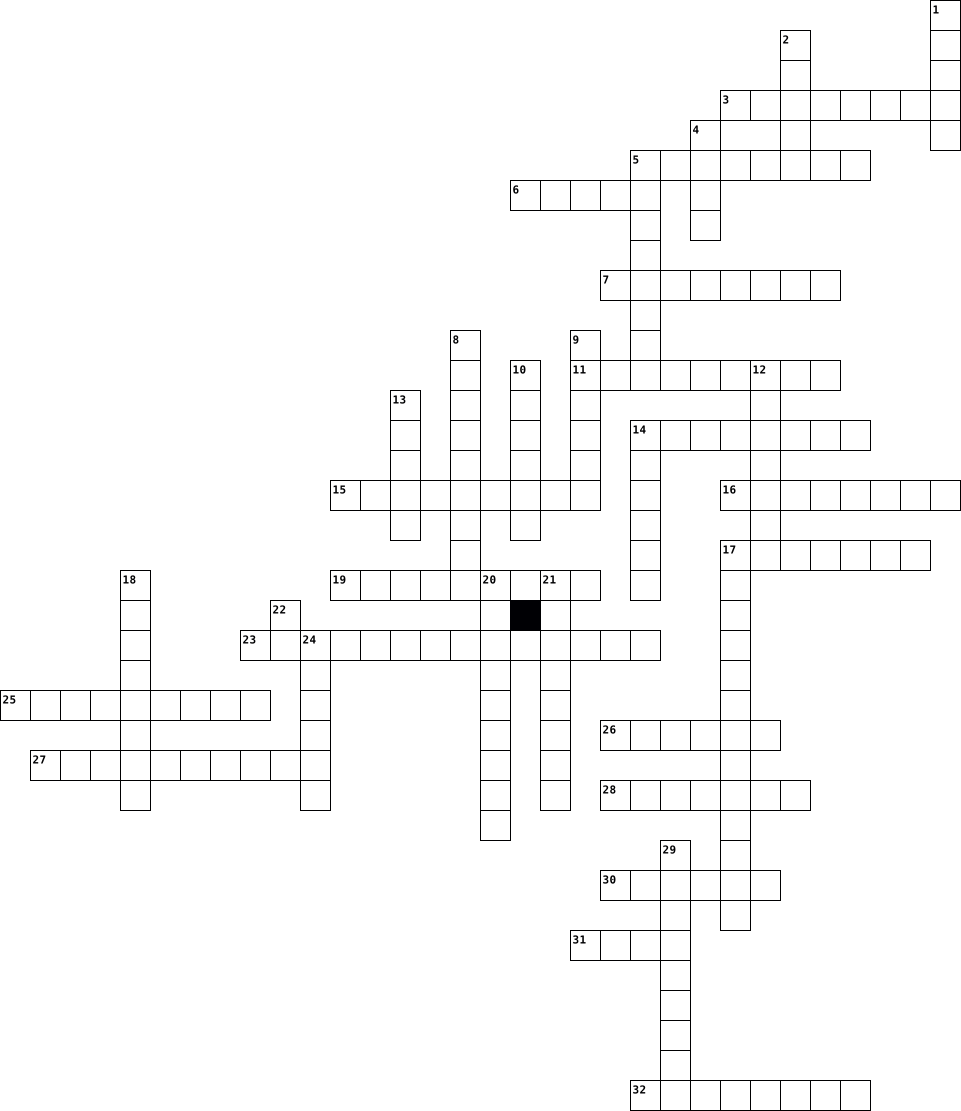
Across
- - 35
- - 11
- - 20
- - 4
- - 19
- - 9
- - 7
- - 5
- - 16
- - 26
- - 22
- - 34
- - 33
- - 10
- - 30
- - 31
- - 14
- - 13
Down
- - 25
- - 18
- - 1
- - 3
- - 28
- - 8
- - 6
- - 24
- - 15
- - 12
- - 2
- - 27
- - 17
- - 23
- - 32
- - 21
- - 29
35 Clues: - 1 • - 3 • - 4 • - 8 • - 6 • - 9 • - 7 • - 5 • - 2 • - 25 • - 18 • - 35 • - 11 • - 20 • - 28 • - 19 • - 24 • - 15 • - 12 • - 16 • - 27 • - 26 • - 17 • - 23 • - 32 • - 22 • - 21 • - 34 • - 33 • - 10 • - 30 • - 29 • - 31 • - 14 • - 13
Matter and Change 2013-12-10

Across
- smallest unit of an element
- study of composition, structure, and properties of matter
- horizontal rows of elements in the periodic table
- high temperature physical state of matter, in which most electrons are lost
- definite volume but not a definite shape
Down
- anything that has mass and takes up space
- any substance that has a definite composition
- no definite volume or shape
- vertical columns of elements in the periodic table
- definite volume and shape
10 Clues: definite volume and shape • smallest unit of an element • no definite volume or shape • definite volume but not a definite shape • anything that has mass and takes up space • any substance that has a definite composition • horizontal rows of elements in the periodic table • vertical columns of elements in the periodic table • ...
Atomic Structure 2021-04-13

Across
- Basic unit of all matter
- Number of protons and neutrons in nucleus of an atom
- Columns on periodic table equal to valance electrons
- Subatomic particle with a negative charge
- Subatomic particle with a neutral charge
- Pure substance made of only one kinds of atom
Down
- Number of protons in the nucleus of an atom
- Electrons in outermost energy level
- Subatomic particle with a positive charge
- Rows on periodic table equal to energy levels
10 Clues: Basic unit of all matter • Electrons in outermost energy level • Subatomic particle with a neutral charge • Subatomic particle with a positive charge • Subatomic particle with a negative charge • Number of protons in the nucleus of an atom • Rows on periodic table equal to energy levels • Pure substance made of only one kinds of atom • ...
Chapter 5 Section 2 & 3 Crossword 2023-11-16

Across
- These elements fill the 4f orbital
- radius of the atom
- All these elements are radioactive.
- patterns that appear vertically in the periodic table
Down
- an atom that has a charge due to the gain or loss of electrons
- energy needed to remove an electron from a neutral atom
- size of the atom
- This block is unpredictable
- The metal side of the periodic table wants to ______ electrons
- p-block has ______ electrons in the ns sublevel
10 Clues: size of the atom • radius of the atom • This block is unpredictable • These elements fill the 4f orbital • All these elements are radioactive. • p-block has ______ electrons in the ns sublevel • patterns that appear vertically in the periodic table • energy needed to remove an electron from a neutral atom • an atom that has a charge due to the gain or loss of electrons • ...
The periodic Table 2019-09-25

Across
- weight The way they sorted the elements on the table
- Extremely reactive metals
- The creator of the periodic table
- elements between metal and solid nonmetals
- extremely reactive nonmetallic elements
Down
- The elements on the left side of the Periodic Table
- is a mineral found in many foods, such as milk
- metals any of the set of metallic elements
- Not so reactive earth metals
- The amount of elements discovered at the time of Mendeleev
10 Clues: Extremely reactive metals • Not so reactive earth metals • The creator of the periodic table • extremely reactive nonmetallic elements • metals any of the set of metallic elements • elements between metal and solid nonmetals • is a mineral found in many foods, such as milk • The elements on the left side of the Periodic Table • ...
The Radical Radium Rascal Puzzle 2023-03-23

Across
- A metal on the periodic table with the atomic mass of 88
- Term used when something can cause harm
- Emits ionizing radiation particles
- When a metal can be molded
- Poisonous, venomous, causes harm
Down
- table Where the element radium is found
- earth metals The family radium is found in
- Term when something is shiny
- Term for when something glows in the dark
- term for when a metal can be pulled into a wire
10 Clues: When a metal can be molded • Term when something is shiny • Poisonous, venomous, causes harm • Emits ionizing radiation particles • Term used when something can cause harm • Term for when something glows in the dark • table Where the element radium is found • earth metals The family radium is found in • term for when a metal can be pulled into a wire • ...
Periodic Table Project 2024-11-22

Across
- Recognized that atomic numbers is the basis for the organization of the periodic table
- credited for designing the first periodic table
- Reacts with water to make strong base
- low melting point (are usually gases)
Down
- iron is in this group
- hydrogen is in this group
- good conductor of heat and electricity
- silicon is in this group
- Mendeleev organized the elements in order of increasing atomic
- shape can be easy or hard to change
10 Clues: iron is in this group • silicon is in this group • hydrogen is in this group • shape can be easy or hard to change • Reacts with water to make strong base • low melting point (are usually gases) • good conductor of heat and electricity • credited for designing the first periodic table • Mendeleev organized the elements in order of increasing atomic • ...
Elements and compounds crossword Puzzle 2021-10-26

Across
- far, 118 elements have been discovered. Gold is an element made up of only gold atoms.
- Able to be hammered or pressed into shape without breaking
- formula A symbol that shows the chemical composition of a substance
- A substance made up of two or more types of atom bonded together
- has the atomic number 6 and is followed in the periodic table by nitrogen (7) and oxygen (8).
- A repeating arrangement of atoms in a solid
- metals are located in the first group of the periodic table.
- are broken or formed during chemical reactions.
- The smallest particle of an element
- Easily broken
- the number by which elements are ordered in the periodic table
- metal rhenium is the element with the highest known boiling point, 5590°C!
- general, metals have higher melting points than non-metals.
- chemicalformula for water shows that it has 2 hydrogen atoms for each oxygen atom.
- The temperature at which a substance changes from solid to liquid
- in the same group have similar properties. Atomic number increases from top to bottom.
- is a compound with molecules made of one oxygen atom bonded to two hydrogen atoms.
Down
- One or two letters used to represent an element
- The temperature at which a substance changes from liquid to gas
- symbols for some elements come from Latin, such as Au for gold, from the Latin word 'aurum'.
- non-metal elements are brittle, breaking easily when hit.
- bond An attractive force that holds two atoms together
- A soft, shiny metal that is highly reactive
- and oxygen gases chemically react to form a new substance, water.
- The re-arrangement of atoms to form one or more new substances
- A substance made up of only one type of atom
- metals are malleable, allowing them to be hammered into thin sheets.
- are highly ordered structures held together by bonds between atoms.
- atom is made up of even smaller “subatomic” particles.
29 Clues: Easily broken • The smallest particle of an element • A soft, shiny metal that is highly reactive • A repeating arrangement of atoms in a solid • A substance made up of only one type of atom • One or two letters used to represent an element • are broken or formed during chemical reactions. • bond An attractive force that holds two atoms together • ...
Unit 1 Crossword (NO SPACES) 2021-09-29

Across
- the _________ variable goes on the y-axis
- glucose is a kind of...
- this provides the plant with energy for photosynthesis
- A tiny hole in the lower epidermis. These holes let carbon dioxide from the air get into the leaf.
- What is "C" on the periodic table of elements.
- some plants are green because they contain...
- the "i" in IB stands for...
- when two variables move in opposite directions it is called a ________ correlation
- when two variables move in the same direction it is called a ________ correlation
- The name of your Science teacher right now
- The study of living things is called...
- another name for C6H12O6
- this carries water to the cells in leaves
- something else that is required for photosynthesis
Down
- The ________ contains cells that do most of the photosynthesis.
- Another name for independent variable is ________ variable.
- a relationship between variables is called a...
- All living things are made of...
- The process by which plants make food
- What is "H" on the periodic table of elements.
- the _________ variable goes on the x-axis
- Another name for dependent variable is _________ variable.
- something that is produced in photosynthesis that humans need
- The cells in the _______ do a small amount of photosynthesis.
- A variable that you want to keep the same each time so they are not affecting your experiment is called a _________ variable.
- something required for photosynthesis
- What is "Au" on the periodic table of elements.
- Anything that can change and be changed and anything that we can measure and observe is called a...
- The name of this class
- The _________ on the leaf surface stops the leaf cells from drying out.
30 Clues: The name of this class • glucose is a kind of... • another name for C6H12O6 • the "i" in IB stands for... • All living things are made of... • The process by which plants make food • something required for photosynthesis • The study of living things is called... • the _________ variable goes on the y-axis • the _________ variable goes on the x-axis • ...
Matter and the Periodic Table Puzzle 2018-02-07

Across
- I am made up of hydrogen and oxygen atoms and you need me to live.
- I am a transition metal with 47 electrons used to make photographic film.
- The number of _______ gives the identity of an element.
- My atomic mass is 63.546 amu.
- I am one of the noble gases.
- I take the shape of the container I am in.
- A combination of two or more atoms held together in a specific shape by attractive forces.
- Two forms of the same element that contain same number of protons but different number of neutrons.
- I have no charge and you can find me at the center of an atom.
- Arsenic is an example of this type of element.
- Elemental symbol for tin.
- My atomic number is 7.
- I have definite shape and volume.
Down
- Another name for a column of the periodic table.
- Members of Group 17 (or VIIA) are called _______.
- Electrons furthest from the nucleus that are responsible for interactions of atoms with one another also referred to as _________ electrons.
- Another name for a row of the periodic table.
- You can find me in Group 1 of the periodic table and in table salt.
- I am the heaviest alkaline earth metal.
- Protons, neutrons and electrons are classified as ________ particles.
- If phosphorus gains 1 proton it turns into this element.
- Substance that contains more than one element.
- I am negatively charged and barely contribute to the mass of the atom.
- These types of elements are malleable, ductile and conduct electricity.
- I can be either heterogeneous or homogeneous.
- I am the positively charged center of an atom.
- An atom that has gained or lost one or more electrons.
27 Clues: My atomic number is 7. • Elemental symbol for tin. • I am one of the noble gases. • My atomic mass is 63.546 amu. • I have definite shape and volume. • I am the heaviest alkaline earth metal. • I take the shape of the container I am in. • Another name for a row of the periodic table. • I can be either heterogeneous or homogeneous. • ...
Chemistry Crossword 2017-11-13

Across
- the mass of one atom in an element calculated using the protons and neutrons
- Things that speed up the chemical reaction rate
- neutral particle in the nucleus of an atom
- the number of protons in one atom of an element
- A compound made up of 2 non-metals
- a change where an entirely new substance is created with different properties from the original combinations
- A physical characteristic of a substance in which it can be pounded or rolled into sheets
- The vertical columns of the periodic table also known as families
- A property that describes the appearance and composition of a substance
- An experiment where one or more products of a chemical reaction can escape
- An experiment in which all reactants and product in a chemical reaction are accounted for
- characteristics used to describe a substance
- A homogeneous mixture
Down
- group 17 of the periodic table
- the substance that reacts to another substance to create a product
- a positivly charged centre of an atom consisting of protons and neutrons
- An invisible negatively charged particle that orbits around the nucleus of an atom
- the most reactive group of the metals on the periodic table
- A substance that strongly resists the flow of electricity
- Heterogeneous Mixtures
- A element with both metal and nonmetal properties
- Pure substances merged as a result of their opposite charges
- a new substance produced in a chemical reaction between reactants
- An atom or a group of atoms that become electrically charged because it has lost or gained electrons
- a pure substance made up of only one type of atom
25 Clues: A homogeneous mixture • Heterogeneous Mixtures • group 17 of the periodic table • A compound made up of 2 non-metals • neutral particle in the nucleus of an atom • characteristics used to describe a substance • Things that speed up the chemical reaction rate • the number of protons in one atom of an element • A element with both metal and nonmetal properties • ...
Semester 2 2016-05-18

Across
- units for resistance
- formed by the transfer of electrons
- an element of Group 1
- a circuit with parts connected one after another
- the process of combining nuclei
- a material that does the dissovling
- a wave made on a rope for example
- measured in amps
- a reaction that emits energy
- a horizontal row on the periodic table
- positive subatomic particle
- the change from gas to liquid
- neutral subatomic particle
- formed by the sharing of electrons
- a measure of energy in a wave
- a sound wave for example
- an electron/positron emitted in nuclear decay
- began with the Big Bang and is still expanding
- the highest point of a wave
- the ratio of mass per unit volume
- A + B -> C
- a substance that participates in a chemical reaction
Down
- a circuit created with different branches
- looks the same throughout
- a stable non-reactive group on the periodic table
- a positive He nucleus emitted in nuclear decay
- a charged atom
- A -> B + C
- created from the death of the most massive stars
- tearing paper or painting a wall
- a reaction that takes in energy
- attractive force that holds atoms together
- negative subatomic particle
- a voltage source
- burning, rusting, decomposing for example
- the smallest unit of an element
- a vertical column on the periodic table
- the lowest point of a wave
- different parts are visible
- opposing the flow of current in a circuit
- a substance that forms in a chemical reaction
- a material that will dissolve
- the process of splitting a nucleus
43 Clues: A -> B + C • A + B -> C • a charged atom • a voltage source • measured in amps • units for resistance • an element of Group 1 • a sound wave for example • looks the same throughout • the lowest point of a wave • neutral subatomic particle • negative subatomic particle • positive subatomic particle • different parts are visible • the highest point of a wave • a reaction that emits energy • ...
✰crossword✰ 2020-01-14

Across
- Positive charge
- No charge.
- Any of the series of fifteen metallic elements from lanthanum to lutetium in the periodic table.
- Element that doesn't have the characteristics of metal.
- An electrically charged atom or group of atoms formed by the loss or gain of one or more electrons.
- The number of protons in the nucleus of an atom.
- Properties are intermediate between those of metals and solid nonmetals or semiconductors.
- Any of the set of metallic elements occupying a central block.
- Region of negative charge surrounding an atomic nucleus that is associated with an atomic orbital
- An electrically charged atom or group of atoms formed by the loss or gain of one or more electrons.
- Negative charge.
Down
- A horizontal row in the periodic table of the elements (has varying properties).
- Each of two or more forms of the same element that contain equal numbers of protons but different numbers of neutrons in their nucleus.
- Any of the elements fluorine, chlorine, bromine, iodine, and astatine, occupying group
- Any of the elements found in Group.
- Spontaneous emission of radiation in the form of particles or high energy photons resulting from a nuclear reaction.
- Atom or molecule that has gained or lost one or more of its valence electrons.
- A vertical column in the periodic table of the elements.
- Loss of elementary particles from an unstable nucleus, ultimately changing the unstable element into another more stable element.
- Average of the proton rest mass and the neutron rest mass.
- Any chemical element that is an effective conductor of electricity and heat.
- These elements, together with the lanthanides, are called internal transition elements.
- Very reactive, electropositive, monovalent metals forming strongly alkaline hydroxides.
- Group of chemical elements with very similar properties
- Positively charged center of the atom consisting of protons and neutrons.
25 Clues: No charge. • Positive charge • Negative charge. • Any of the elements found in Group. • The number of protons in the nucleus of an atom. • Element that doesn't have the characteristics of metal. • Group of chemical elements with very similar properties • A vertical column in the periodic table of the elements. • Average of the proton rest mass and the neutron rest mass. • ...
Alternating Current and Voltage 2013-06-17

Across
- The relative displacement of a time varying waveform in terms of its occurrence with respect to a reference.
- A type of waveform that consists of two equal and opposite steps in voltage or current separated by a time interval.
- The time interval required for a pulse to charge from 90% to 10% of its full amplitude.
- The time interval of one complete cycle of a given sine wave or any periodic waveform.
- Current that reverses direction in response to a change in source voltage polarity.
- The voltage or current value of a waveform at its maximum positive or negative points.
- A measurement instrument that displays signal waveforms on a screen.
- The unit of frequency.
- A type of electrical waveform that consists of ramps; a special case of triangular wave.
- The activating mechanism of some electronic devices or instruments.
Down
- The maximum value of a voltage or current.
- The ratio of pulse width to period.
- The voltage or current value of a waveform measured from it’s minimum to it’s maximum points.
- An energy source that produces electrical signals.
- One repetition of a periodic waveform.
- It is 0.637 times the peak value.
- It is equal to 0.707 times the peak value.
- A measure of the rate of change of a periodic.
- An electronic circuit that produces a time varying signal without an external input signal using positive feedback.
- The value of a quantity, such as the number of volts of voltage or the number of amperes of current.
- The pattern of variations of a voltage or current showing how the quantity changes with time.
- The frequencies contained in a composite waveform. Which are integer multiplies of the repetition frequency.
22 Clues: The unit of frequency. • It is 0.637 times the peak value. • The ratio of pulse width to period. • One repetition of a periodic waveform. • The maximum value of a voltage or current. • It is equal to 0.707 times the peak value. • A measure of the rate of change of a periodic. • An energy source that produces electrical signals. • ...
Chemistry Wood Search 2013-05-30

Across
- A change in which one or more new substances are produced or they'res a change in the starting substance.
- Any property of a substance that does not have a numerical number is a ______ property such as colour or odour.
- A change in which no new substances are formed and the substance remains unaltered.
- The temperature at which a substance changes state from a liquid to a gas.
- The elements found in the upper right portion of the periodic table are called ______.
- A negatively charged particle in an atom that orbits the nucleus.
- An ____ is a pure element that cannot be broken down in, by any physical or chemicals means.
- The ____ of a substance is a ratio of its mass to its volume.
- A positively charged ion.
- The ____ number is the number of protons and neutrons in an atom's nucleus.
Down
- The temperature at which a substance changes state ffrom a liquid to a solid.
- A _____ substance is a substance that is made up of only one type of particle.
- The ____ gases are named this because of their stable nature and unreactivity.
- A _____ bond is a bond formed when two non-metal atoms share electrons.
- A _____ is two or more atoms of the same or different elements that are chemically joined together.
- A pure substance composed of two or more elements that have been chemically joined.
- A substance with two different types of particles is known as a ______.
- The smallest unit of an element.
- An _____ is a solid solution made up of two or more moetals.
- A row on the periodic table is called a _____.
- Potassium, Calcium, and Lithium are all on the periodic table and are all examples of ______.
- A particle that has became charged. Either positively or negatively.
22 Clues: A positively charged ion. • The smallest unit of an element. • A row on the periodic table is called a _____. • An _____ is a solid solution made up of two or more moetals. • The ____ of a substance is a ratio of its mass to its volume. • A negatively charged particle in an atom that orbits the nucleus. • ...
Chemistry crossword 2014-11-07

Across
- ability of a substance to conduct electricity or heat
- mass of 1 atom of an element calculated from the total number of protons, neutrons, and electrons of that atom
- pure substance formed when at least one metal and non- metal combine
- change that results when two or more substances react to create a different substance or substances
- chemical reaction that occurs when oxygen reacts with a substance to form a new substance and give off energy
- new substance produced in a chemical reaction between reactants
- element that has both metallic and non metallic properties
- pure substance that can not be broken down into other substances
- number of protons in the nucleus of one atom of an element
- description of a substance that can be pounded or rolled into sheets
- vertical column of elements in the periodic table
Down
- substance that helps a chemical reaction proceed more quickly
- change in the appearance or state of a substance that does not change the composition
- an experiment in which all reactants and all product of a chemical reaction are accounted for
- group 17 elements in the periodic table; the most reactive non-metals
- vertical column of elements in the periodic table
- description of a solid that can be stretched into long wire
- slow chemical change that occurs when oxygen in the air reacts with a metal
- pure substance formed when at least one metal and one non metal combine
- chemical combination of two or more elements i a specific ratio
- neutral particle in the nucleus of an atom
- group 1 elements in the periodic table, not including hydrogen; the most reactive of the metals
- catalyst involved in chemical reactions in living things
- shiny,malleable,ductile, element that conducts electricity
- invisible negatively charged particle that orbits the nucleus of an atom
25 Clues: neutral particle in the nucleus of an atom • vertical column of elements in the periodic table • vertical column of elements in the periodic table • ability of a substance to conduct electricity or heat • catalyst involved in chemical reactions in living things • element that has both metallic and non metallic properties • ...
Chemistry Crossword 2014-05-14

Across
- a numerical scale ranging from 0-14 that is used to compare the acidity of solutions
- The rapid reactions of a substance with oxygen to produce oxides and energy
- The breakdown of a metal resulting from reactions with chemicals in its environment
- A molecule consisting of only two atoms of either the same or different elements
- A reaction in which a larger or more complex molecule breaks down to form two (or more) simpler products
- A bond that results from the sharing of outer electrons between non-metal atoms
- A solid formed from the reaction of 2 solutions
- An aqueous solution that conducts electricity, tastes sour, turns blue litmus red, and neutralizes bases
- The elements in the 17th column of the periodic table
- A chemical, present at the start of a chemical reaction, that is used up during the reaction
Down
- A particle in which atoms are joined by covalent bonds
- A measure of how acidic or basic a solution is
- Neither acidic nor basic
- A way of describing a chemical reaction using the chemical formulas of the reactants and products
- A charged particle that results when an atom gains or loses one or more electrons
- A row of elements in the periodic table
- A chemical that is produced during a chemical reaction
- A column of elements in the periodic table with similar products
- An aqueous solution that conducts electricity and turns red litmus blue
- A description of what a substance does as it changes into one or more new substance(s)
- An ion made up of more than 1 atom that acts as a single particle
- A compound that separates into ions when it dissolves in water, producing a solution that conducts electricity
22 Clues: Neither acidic nor basic • A row of elements in the periodic table • A measure of how acidic or basic a solution is • A solid formed from the reaction of 2 solutions • The elements in the 17th column of the periodic table • A particle in which atoms are joined by covalent bonds • A chemical that is produced during a chemical reaction • ...
Chapter 10 Modern Atomic Theory And The Periodic Table 2016-01-11

Across
- small packets of energy in streams of light
- Every principle energy level is divided into _____
- outermost electron shell(2)
- as stated by this principle, an orbital cannot contain more than 2 electrons(3)
- what is white light?(2)
- 4th sublevel
- this atom's orbital configuration is 1s² 2s²2p⁶ 3s²3p⁶ 4s²3d¹⁰
- energy is emitted in tiny distinct packets called _____
- columns in the periodic table
- region in space around a nucleus with a high probability of finding an electron
- all the Group IIIB to Group IIB (3-12) elements(2)
- Who said this: “electrons revolve in specific regions at various distances from the nucleuscalled energy levels”(2)
- this atom's orbital configuration is 1s² 2s²2p⁶ 3s²3p⁶
Down
- Group VIIA Elements
- all the Group A’s elements in the Periodic Table(2)
- rows in the periodic table
- electrons on the outermost energy level (2)
- the energy level expressed by the principal quantum number n(3)
- this method of arranging electrons uses numbers, letters, and superscripts(2)
- When a gas emits light shown through a prism, the beaming colored lines are part of a _____(2)
- this method of arranging electrons uses arrows and boxes(2)
- 2nd sublevel
- this atom's orbital configuration is 1s² 2s²2p⁶ 3s²3p⁶ 4s²
- lowest energy level(2)
- 3rd sublevel
- 1st sublevel
- Which rule is this: electrons will occupy separate orbitals of the same energy before pairing of electrons occur(2)
- distance between two peaks or trough inside a wave
- neon’s orbital configuration
- German physicist who was best known for his quantum mechanics work(2)
30 Clues: 2nd sublevel • 3rd sublevel • 1st sublevel • 4th sublevel • Group VIIA Elements • lowest energy level(2) • what is white light?(2) • rows in the periodic table • outermost electron shell(2) • neon’s orbital configuration • columns in the periodic table • small packets of energy in streams of light • electrons on the outermost energy level (2) • ...
Chapter 10 Modern Atomic Theory And The Periodic Table 2016-01-10

Across
- Group VIIA Elements
- all the Group A’s elements in the Periodic Table
- 3rd sublevel
- rows in the periodic table
- small packets of energy in streams of light
- in a given atom, no 2 electrons may have the same set of 4 quantum numbers therefore an orbital must have electrons with opposite spins ↓↑
- the energy level expressed by the principal quantum number n
- 2nd sublevel
- columns in the periodic table
- 1st sublevel
- Every principle energy level is divided into _____
- all the Group IIIB to Group IIB (3-12) elements
Down
- neon’s orbital configuration
- Who said this: “electrons revolve in specific regions at various distances from the nucleus called energy levels”
- outermost electron shell
- this atom's orbital configuration is 1s² 2s²2p⁶ 3s²3p⁶
- as stated by this principle, an orbital cannot contain more than 2 electrons
- region in space around a nucleus with a high probability of finding an electron
- this atom's orbital configuration is 1s² 2s²2p⁶ 3s²3p⁶ 4s²
- what is white light?
- Which rule is this: electrons will occupy separate orbitals of the same energy before pairing of electrons occur
- 4th sublevel
- electrons on the outermost energy level
- this atom's orbital configuration is 1s² 2s²2p⁶ 3s²3p⁶ 4s²3d¹⁰
- this method of arranging electrons uses numbers, letters, and superscripts
- distance between two peaks or trough inside a wave
- this method of arranging electrons uses arrows and boxes
- When a gas emits light shown through a prism, the beaming colored lines are part of a _____
- lowest energy level
- energy is emitted in tiny distinct packets called _____
30 Clues: 3rd sublevel • 4th sublevel • 2nd sublevel • 1st sublevel • Group VIIA Elements • lowest energy level • what is white light? • outermost electron shell • rows in the periodic table • neon’s orbital configuration • columns in the periodic table • electrons on the outermost energy level • small packets of energy in streams of light • all the Group IIIB to Group IIB (3-12) elements • ...
Chapter 10 Modern Atomic Theory And The Periodic Table 2016-01-10

Across
- energy is emitted in tiny distinct packets called _____
- what is white light?
- 1st sublevel
- as stated by this principle, an orbital cannot contain more than 2 electrons
- 2nd sublevel
- electrons on the outermost energy level
- all the Group A’s elements in the Periodic Table
- Every principle energy level is divided into _____
- this method of arranging electrons uses arrows and boxes
- small packets of energy in streams of light
- all the Group IIIB to Group IIB (3-12) elements
- When a gas emits light shown through a prism, the beaming colored lines are part of a _____
- Which rule is this: electrons will occupy separate orbitals of the same energy before pairing of electrons occur
- lowest energy level
- region in space around a nucleus with a high probability of finding an electron
Down
- this method of arranging electrons uses numbers, letters, and superscripts
- columns in the periodic table
- the energy level expressed by the principal quantum number n
- rows in the periodic table
- neon’s orbital configuration
- Group VIIA Elements
- in a given atom, no 2 electrons may have the same set of 4 quantum numbers therefore an orbital must have electrons with opposite spins ↓↑
- this atom's orbital configuration is 1s² 2s²2p⁶ 3s²3p⁶
- this atom's orbital configuration is 1s² 2s²2p⁶ 3s²3p⁶ 4s²
- distance between two peaks or trough inside a wave
- outermost electron shell
- Who said this: “electrons revolve in specific regions at various distances from the nucleus called energy levels”
- this atom's orbital configuration is 1s² 2s²2p⁶ 3s²3p⁶ 4s²3d¹⁰
- 3rd sublevel
- 4th sublevel
30 Clues: 1st sublevel • 2nd sublevel • 3rd sublevel • 4th sublevel • Group VIIA Elements • lowest energy level • what is white light? • outermost electron shell • rows in the periodic table • neon’s orbital configuration • columns in the periodic table • electrons on the outermost energy level • small packets of energy in streams of light • all the Group IIIB to Group IIB (3-12) elements • ...
Chapter 10 Modern Atomic Theory And The Periodic Table 2016-01-10

Across
- region in space around a nucleus with a high probability of finding an electron
- energy is emitted in tiny distinct packets called _____
- small packets of energy in streams of light
- as stated by this principle, an orbital cannot contain more than 2 electrons
- Every principle energy level is divided into _____
- outermost electron shell
- all the Group A’s elements in the Periodic Table
- this method of arranging electrons uses arrows and boxes
- the energy level expressed by the principal quantum number n
- this atom's orbital configuration is 1s² 2s²2p⁶ 3s²3p⁶ 4s²
- this method of arranging electrons uses numbers, letters, and superscripts
- this atom's orbital configuration is 1s² 2s²2p⁶ 3s²3p⁶ 4s²3d¹⁰
- 4th sublevel
- 1st sublevel
- 3rd sublevel
Down
- what is white light?
- Group VIIA Elements
- Who said this: “electrons revolve in specific regions at various distances from the nucleus called energy levels”
- columns in the periodic table
- neon’s orbital configuration
- When a gas emits light shown through a prism, the beaming colored lines are part of a _____
- in a given atom, no 2 electrons may have the same set of 4 quantum numbers therefore an orbital must have electrons with opposite spins ↓↑
- 2nd sublevel
- rows in the periodic table
- all the Group IIIB to Group IIB (3-12) elements
- electrons on the outermost energy level
- Which rule is this: electrons will occupy separate orbitals of the same energy before pairing of electrons occur
- this atom's orbital configuration is 1s² 2s²2p⁶ 3s²3p⁶
- distance between two peaks or trough inside a wave
- lowest energy level
30 Clues: 2nd sublevel • 4th sublevel • 1st sublevel • 3rd sublevel • Group VIIA Elements • lowest energy level • what is white light? • outermost electron shell • rows in the periodic table • neon’s orbital configuration • columns in the periodic table • electrons on the outermost energy level • small packets of energy in streams of light • all the Group IIIB to Group IIB (3-12) elements • ...
Chemistry unit study guide 2016-02-11

Across
- something formed by a union of elements or parts
- the mass of the products in a chemical reaction must equal the mass of the reactants
- a substance that is a good conductor of heat and electricity, can be melted, and is usually capable of being shaped
- the smallest particle of a substance that can exist by itself or be combined with other atoms
- characterized by or formed with absorption of heat
- any of a group of rare gases
- a very small particle of matter that has no electrical charge
- one of the basic substances that are made of atoms of one kind and that cannot be separated by ordinary chemical means into simple substances
- only partially conducts electricity
- a very small particle of matter that is part of the nucleus of an atom, and that has a positive electrical charge
Down
- columns in the periodic table
- the smallest possible amount of a particular substance
- a very small particle of matter that has a negative charge of electricity
- characterized by or formed with evolution of heat
- of protons in a nucleus
- a thin layer of metal that has been added to the outside of something
- Russian chemist, created periodic table
- a substance that changes when combined with another substance
- the mass of an atom usually expressed in atomic mass units
- has properties opposite of metals
- the central part of an atom that is made up of protons and neutrons
- the result of a process
- a mathematically described region around a nucleus in a atom or molecule that may contain zero, one, or two electrons
- rows going across the periodic table
24 Clues: of protons in a nucleus • the result of a process • any of a group of rare gases • columns in the periodic table • has properties opposite of metals • only partially conducts electricity • rows going across the periodic table • Russian chemist, created periodic table • something formed by a union of elements or parts • characterized by or formed with evolution of heat • ...
chemistry 2022-12-06
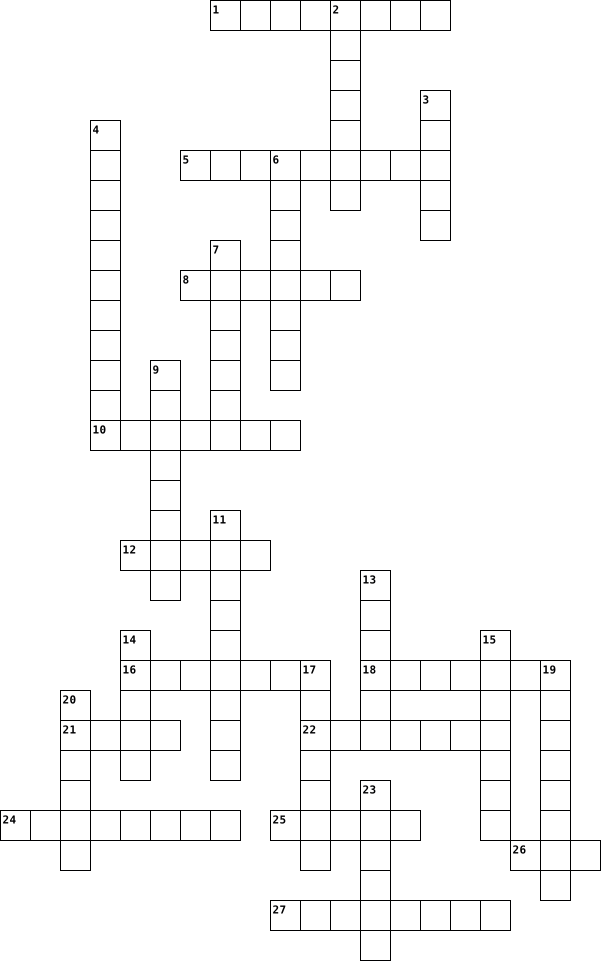
Across
- created by linking monomers together to make a chain; proteins; DNA, and slime
- number that shows the number of each element in a compound
- anything that has mass or volume
- substance that does the dissolving in a solution
- a mixture of two or more metals
- subatomic particle with no charge; found in the nucleus
- atoms of the same element with different numbers of neutrons
- smallest part of an element; made up of protons, neutrons, and electrons
- a solid in which the atoms are arranged in a pattern that repeats again and again
- substances that are produced by a chemical reaction
- particles that make up protons and neutrons
- an atom that has lost or gained an electron
- molecules that are linked together to make polymers
Down
- two or more substances mixed together, but are not chemically combined
- elements found on the left-hand side of the periodic table
- type of mixture appears the same throughout
- homogeneous mixture in which one substance is dissolved in another
- electrons in the outermost energy level
- a group of atoms held together by covalent bonds
- elements found on the right-hand side of the periodic table
- groups or columns of elements in the periodic table with similar properties
- an atom that has gained an electron and has a negative charge
- a mixture made up of a liquid and particles that remain suspended rather than dissolved in that liquid
- center of the atom
- subatomic particle with a negative charge; found in energy levels around the nucleus
- an atom that has lost an electron and has a positive charge
- subatomic particle with a positive charge; found in the nucleus
27 Clues: center of the atom • a mixture of two or more metals • anything that has mass or volume • electrons in the outermost energy level • type of mixture appears the same throughout • particles that make up protons and neutrons • an atom that has lost or gained an electron • a group of atoms held together by covalent bonds • substance that does the dissolving in a solution • ...
6th grade: Vocabulary - School subjects 2022-02-21

Across
- theatre
- science
- periodic table
- picasso
- technology
Down
- instruments
- countries
- sports
- past happenings
- numbers
10 Clues: sports • theatre • science • numbers • picasso • countries • technology • instruments • periodic table • past happenings
PERIODIC CROSSWORD 2019-08-12

Across
- Atoms have the same number of protons and _____.
- Number of protons and neutrons in an atom (2 words)
- Moving left to right across the periodic table, atomic radius ______.
Down
- Elements are arranged by _____ table.
- Number of protons in an atom (2 words)
- Moving left to right across the periodic table, the number of electrons in atoms______.
- Smallest particle of an element.
7 Clues: Smallest particle of an element. • Elements are arranged by _____ table. • Number of protons in an atom (2 words) • Atoms have the same number of protons and _____. • Number of protons and neutrons in an atom (2 words) • Moving left to right across the periodic table, atomic radius ______. • ...
electronegativity 2023-05-21

Across
- This element has a lower electronegativity than chlorine and is located in the same period as sulfur.
- This element has the highest electronegativity of all the elements on the periodic table.
- which element is located in the same group as fluorine and has a lower electronegativity than fluorine?
- Which element is located in the same period as magnesium and has a lower electronegativity than magnesium?
- Which side of the periodic table is an element on if it has a high electronegativity value and tends to attract electrons to itself in a chemical bond?
Down
- What is it called when a measure of an atom's ability to attract electrons when it forms a chemical bond with another atom occurs?
- What element on the periodic table is located in the same period as oxygen and has a higher electronegativity than oxygen?
- This element has a higher electronegativity than phosphorus and is located in the same period as silicon.
- This element has the lowest electronegativity of all the elements on the periodic table.
- This element has a higher electronegativity than carbon and is located in the same group as nitrogen.
10 Clues: This element has the lowest electronegativity of all the elements on the periodic table. • This element has the highest electronegativity of all the elements on the periodic table. • This element has a lower electronegativity than chlorine and is located in the same period as sulfur. • ...
Everyday Chemistry 2022-04-11

Across
- Negatively charged ions
- The _____________ is the first antibiotic discovered by the scientist Alexander Fleming
- Smallest particle of an element
- Positively charged particles
- The study ofthe behavior of matter and its charges and how it interacts with other matter and energy
- Vertical columns in the periodic table, where elements contain similar chemical properties
- ______ Curie first discovered the radioactive elements polonium and radium
- a _______ table is a table of the chemical elements arranged in order of atomic number
- electron configuration for this element is
Down
- _______ is a strong acid that is used in car batteries
- Ni
- Ti
- _____ rule states when several orbitals are available in a subshell, each orbital gets one electron before the electrons pair up
- The fundamental states of matter are: Liquid, solid, and _____
- Made of 2 or more elements that are chemically combines
- Nuclear particle with no charge
- Fe
17 Clues: Ni • Ti • Fe • Negatively charged ions • Positively charged particles • Smallest particle of an element • Nuclear particle with no charge • electron configuration for this element is • _______ is a strong acid that is used in car batteries • Made of 2 or more elements that are chemically combines • The fundamental states of matter are: Liquid, solid, and _____ • ...
Revision 2013-12-08

Across
- Different planets take different amounts of time to ____________ the sun.
- Key word describing liquid to a gas
- A compound has ________________ properties to the elements that have reacted.
- Two or more elements that are chemically combined is a _________________
- Non-metals are found on the _______________ of the periodic table
- Iron and sulphur react to form iron_____________
- A bowl of grapes and apples is an example of a _______________
- Metal properties include conduction of electricity and _____________
Down
- When a metal reacts with air a metal ___________ is formed
- Magnesium + ______________ --> Magnesium oxide
- I am the fifth element from the sun.
- Metals are found on the _____________ of the periodic table
- In this state of matter the particles are far apart
- When steam cools on a cold surface we say it is
- At the centre of the solar system
- Solids ______________ and gases are the 3 states of matter
- I am the third planet from the sun
17 Clues: At the centre of the solar system • I am the third planet from the sun • Key word describing liquid to a gas • I am the fifth element from the sun. • Magnesium + ______________ --> Magnesium oxide • When steam cools on a cold surface we say it is • Iron and sulphur react to form iron_____________ • In this state of matter the particles are far apart • ...
Dallas Science Crossword 2024-05-02

Across
- The molecular forces are weaker than in a solid
- The elements on the right side of the periodic table
- Bonds One metal and nonmetal Bond that transfer electrons
- When you lose electrons/ positively charged
- Any substance, usually liquid, which is capable of dissolving one or several substances
- When you gain electrons/ negatively charged
- A solid, liquid, or gas which is dissolved to make a solution
- The atomic number of the elements
- A splitting or breaking up into parts
- The elements on the left side of the periodic table
Down
- The molecules are closely bound to one another by molecular forces
- Occurs when two atoms slam together to form a heavier atom
- Have the same number of protons
- Bonds Two nonmetal Bonds that share electrons
- The atom that has a neutral charge
- The molecular forces are very weak
- The fourth state of matter
17 Clues: The fourth state of matter • Have the same number of protons • The atomic number of the elements • The atom that has a neutral charge • The molecular forces are very weak • A splitting or breaking up into parts • When you lose electrons/ positively charged • When you gain electrons/ negatively charged • Bonds Two nonmetal Bonds that share electrons • ...
Unit 1 Review 2023-10-05

Across
- Number of electron energy levels that Magnesium has.
- Type of bond where electrons are transferred between a metal and a nonmetal.
- The element with the largest atomic radius.
- Analyzing the colors a planet or star gives off to see what elements it contains.
- Horizontal row on the periodic table.
- Subatomic particle with a positive charge, that tells us what element it is.
- Type of bond where electrons are shared between two nonmetals.
- Subatomic particle with a negative charge.
- When an atom has an equal number of protons and electrons.
Down
- The element with the highest ionization energy.
- Atom with a charge.
- Element in group 2, period 4.
- When a molecule like water has a positive and negative end.
- Element with 6 protons, 6 neutrons and 6 electrons.
- Subatomic particle with no charge.
- Electron in the outermost energy level.
- Vertical column on the periodic table.
17 Clues: Atom with a charge. • Element in group 2, period 4. • Subatomic particle with no charge. • Horizontal row on the periodic table. • Vertical column on the periodic table. • Electron in the outermost energy level. • Subatomic particle with a negative charge. • The element with the largest atomic radius. • The element with the highest ionization energy. • ...
Metals, Non Metals and More! 2026-02-02

Across
- Describes metals that reflect light.
- Describes nonmetals that do not reflect much light.
- Describes how easily a substance reacts with other substances.
- The way a material reflects light.
- An element that does not conduct heat or electricity well.
- Having a lot of mass in a small space.
- Able to bend without breaking.
- A state of matter with no fixed shape or volume.
Down
- A material that allows heat or electricity to flow through it easily.
- A state of matter with a fixed shape and volume.
- Breaks easily when hit or bent.
- A material that does not allow heat or electricity to flow easily.
- A pure substance made of only one type of atom.
- A tiny, negatively charged particle in an atom.
- Related to the periodic table of elements.
- An element that is usually shiny and conducts heat and electricity
- Able to be hammered or pressed into thin sheets.
17 Clues: Able to bend without breaking. • Breaks easily when hit or bent. • The way a material reflects light. • Describes metals that reflect light. • Having a lot of mass in a small space. • Related to the periodic table of elements. • A pure substance made of only one type of atom. • A tiny, negatively charged particle in an atom. • ...
IPC vocab 2019-09-19

Across
- a state of matter consisting of particles that have neither a defined volume nor defined shape.
- a stable subatomic particle occurring in all atomic nuclei.
- does not have a definite shape.
- a measure of its ability to conduct electricity.
- smallest unit of matter.
- the smallest of the particles that make up an atom.
- an electromotive force.
- a part or aspect of something abstract.
- vertical column in the Periodic Table.
Down
- firm and stable in shape; not liquid or fluid.
- a subatomic particle found in the nucleus of atoms
- a solid material that is typically hard.
- a material made up of two or more different substances.
- a substance formed when two or more chemical elements.
- the name given to a horizontal row of the periodic table.
15 Clues: an electromotive force. • smallest unit of matter. • does not have a definite shape. • vertical column in the Periodic Table. • a part or aspect of something abstract. • a solid material that is typically hard. • firm and stable in shape; not liquid or fluid. • a measure of its ability to conduct electricity. • a subatomic particle found in the nucleus of atoms • ...
The Periodic Table and its Trends 2024-05-02

Across
- a negative charge
- do not form bonds in group 8 and have 8 valence electrons
- an element that have some property of metal and nonmetal combined
- group 2 and have 2 valence electrons
- horizontal row in a periodic table
- the number of protons in one atoms
- located in group 7 contain nonmetal and have 7 valence electrons
- A bond formed between two non metal elements
Down
- A bond formed between two metal element
- A positive charge
- elements that does not conduct electricity and gas at a room temperature
- the electrons in the outer most shell
- elements or substance that very good in conduct electricity
- group 1, 1 valence electrons in outer level and very reactive, shiny,silver
- vertical column in the periodic table
15 Clues: A positive charge • a negative charge • horizontal row in a periodic table • the number of protons in one atoms • group 2 and have 2 valence electrons • the electrons in the outer most shell • vertical column in the periodic table • A bond formed between two metal element • A bond formed between two non metal elements • ...